Osher Lifelong Learning Institute
University of Pittsburgh
Clicking on an item in the table of contents will take you to its corresponding page in the catalog.
CONTENTS
DATES AND DEADLINES
OLLI fall term financial assistance application period JULY 9 – OCT. 28, 2026
OLLI course registration opens JULY 23
OLLI Open House (in-person) AUG. 4
OLLI Open House (online) AUG. 19
No OLLI membership refunds issued after AUG. 21
University fall classes begin (for audit courses) AUG. 24
OLLI session 1 begins AUG. 31
University add/drop period ends (for audit courses) SEPT. 4
Add/drop deadline for OLLI session 1 and 10-week courses SEPT. 11
OLLI session 1 ends OCT. 5
OLLI session 2 begins OCT. 19
Add/drop deadline for OLLI session 2 courses OCT. 30
OLLI session 2 ends NOV. 20
ABOUT OLLI
Established in 2005 at the University of Pittsburgh, the Osher Lifelong Learning Institute (OLLI) is one of over 120 OLLI programs located on college campuses throughout the United States. OLLI at Pitt seeks to create a dedicated intellectual environment for learners aged 50 and better by offering non-credit and engaging college-level courses, providing opportunities for social interaction, and maintaining connections to the vibrant University community. OLLI at Pitt’s instructors include current and retired faculty from the University of Pittsburgh and others from the diverse and talent-filled Pittsburgh area and beyond. The OLLI at Pitt program nurtures a passion for learning and contributes to the health and engagement of the older adult community.
CONTACT US
Phone: 412-624-7308 | Email: osher@pitt.edu | Office Hours: Monday – Friday, 8:30 a.m. – 4 p.m. 4227 Fifth Avenue, 710 Alumni Hall, Pittsburgh, PA 15260
OLLI AT PITT MEMBERSHIP
STRUCTURE AND FEES
Fees have a two-part structure that includes both a membership fee and a tuition fee. There are multiple tuition tiers based on course registration. Financial assistance is available; see olli.pitt.edu for more information.
MEMBERSHIP
All members will pay the $50 annual membership fee, no matter when in the academic year they join (Aug. 2026 – Aug. 2027). This fee includes these membership benefits:
• OLLI at Pitt ID card
• CheapSeats (Pittsburgh Cultural Trust discounted tickets)
• Pitt library, shuttle, and on-campus wi-fi privileges
• Eligibility to create and join OLLI Special Interest Groups
TUITION
• Ability to participate in OLLI local tours, day trips, and travel opportunities (additional fees may apply)
• Attendance at OLLI social events (coffee hours, lunches, etc.)
• Receipt of weekly OLLI email newsletters
• Ability to audit undergraduate University classes
SPECIAL OFFER FOR NEW MEMBERS
Brand new members can purchase a $50 ONE-TIME Introductory Membership. This option is only for those who have never been an OLLI at Pitt member and is only good once, for one term. No additional tuition payment is required. This membership includes:
• Enrollment in up to 2 OLLI courses and all lectures in the term
• Enrollment in 1 audit class in the University semester
• All membership benefits
COURSE INFORMATION
Learn more about audit and OLLI courses.
AUDIT INFORMATION
A membership benefit of the OLLI at Pitt program is the ability to audit University courses. Auditing does not involve grades, credits, exams, or homework—just like OLLI classes. Auditors “sit in” on a class for the purpose of self-enrichment and exploration, and their presence should involve no extra work for the faculty.
Auditing differs from OLLI courses in significant ways:
1. University courses are 16 weeks
2. Members are responsible for securing permission to attend courses as auditors
3. Audit courses follow the University calendar and add/drop dates, breaks, and other course details will differ from OLLI courses
Auditing is a privilege that the University affords OLLI students who want to extend their love of learning. Auditors follow the University Student Code of Conduct as well as conduct expectations for OLLI auditors.

OLLI COURSE TYPE
What can you expect from your OLLI at Pitt course? Our course type categories will help you understand the structure of the class and instructor expectations of participation:
LECTURE —These courses are primarily oral presentations where information, history, theories, or ideas are presented by instructors with occasional contributions from participants through questions and answers.
DISCUSSION —These courses can be on academic, cultural, or enrichment topics where participants are welcome to talk and contribute to class dialogue through open class discussions.
For more information on membership, course registration, auditing classes, and financial assistance, visit the website:
ACTIVE LEARNING —These courses require a high degree of participants' active involvement and practice (language, painting, exercise, etc.).
FALL 2026: SESSION 1 SCH EDULE AT-A-GLANCE
Aug. 31 – Oct. 5, 2026
The courses below are current as of July 9, 2026. For the most up-to-date course information, always consult the OLLI at Pitt website at olli.pitt.edu. Clicking on each course title will take you to its course description in the catalog.
(classes that meet in
MONDAY
and Wars in the North
Beyond The Basics: The Emotional Side of Money
Understanding the Balkans: Culture, History, and Identity
Consequences: A History of Civic Apathy
Yi Jin Jing: Qigong for Strength and Flexibility
TUESDAY
WEDNESDAY
FALL 2026: SESSION 1 SCHEDULE AT-A-GLANCE
Aug. 31 – Oct. 5, 2026
WEDNESDAY
The Austro-Hungarian Empire, 1848–1914
Hollywood's Comedies of Remarriage
Armageddon Dawns, 1938–1941
Art in Times of Turmoil: The Music of Dmitri Shostakovich
Humor and Human Life
The Maya: 20 Centuries of Art and Culture
Early Theatre History Around the Globe
The Poisonous Pen of Agatha Christie
THURSDAY
Schaupp
Pamboukian
Italian: Beginning Level A Cinzia Delfini
The Next Outbreak: Intro to Infectious Disease Epidemiology
in
Great Replacement Theory, Race, and Global Authoritarianism
The Life and Times of Literary Favorites, Part 2
The Triangle Shirtwaist Fire
Label Me: Record Labels and Their Artists, Part 1
Spanish: Advanced Conversational
What's New in Architecture, Part 1
Beginning Guitar, Part 2
Documentaries from Around the World
Modern Macroeconomics: Markets, Money, Technology, and Trade
The Grateful Dead: History and Music 1964–1995
FRIDAY
Elements of a Great Broadway Musical
Odd Geology!
Spanish: Intermediate Level A
Online course In-person course
Hybrid course (classes that meet in person and are also streamed online)
Mertz and Rika
Burt
Swoger
FALL 2026: SESSION 2 SCHEDULE AT-A-GLANCE
Oct. 19 – Nov. 20, 2026
The courses below are current as of July 9, 2026. For the most up-to-date course information, always consult the OLLI at Pitt website at olli.pitt.edu. Clicking on each course title will take you to its course description in the catalog.
MONDAY
Gentle Yoga A (continued)
A Movie-able Feast: Films From Hemingway
The Wide World of Wellness
Yoga (continued)
A Very Brief British History
Hitler Unleashed: The War in Europe from 1939 to 1941
Poetry at Life's Edge
Pittsburgh and the Environment: From Devastation to Renewal
Conspiracies, and Modern Media
TUESDAY
U.S. Supreme Court in 2026
In a Festive Spirit
and Observing the Fall Season
In the Likeness of a Human Mind: Thinking Critically about AI
Learn Mandarin (continued)
Engineering in Aldous Huxley's Brave New World
Caribbean Women Writers: Voice, Memory, and Being Human
Who Was Henry Clay Frick?
French: Beginning Level (continued)
Developmental Perspectives in Myth and Fairy Tales
WEDNESDAY
Gentle Yoga B (continued) Jill Donnette Clary
Heroism and Friendship in the World of Schulz's Peanuts
Billy Joel and The Cold War
Online course In-person course
Hybrid course (classes that meet in person and are also streamed online)
FALL 2026: SESSION 2 SCHEDULE AT-A-GLANCE
Oct. 19 – Nov. 20, 2026
WEDNESDAY
International Short Stories: United by Our Humanity
Unifications of Germany and Italy
Ireland and Northern Ireland: Conflict and Peace
Animal Cognition and Culture
Generative AI in Practice: Intermediate Applications
The Maya: 20 Centuries of Art and Culture (continued)
The Night Sky
French Wines
THURSDAY
Italian: Beginning Level A (continued)
The Films of Sidney Lumet
Springsteen and the Soundtrack of Life
Marxism: An Introduction
Printmaking
A Century of Fiction in The New Yorker, Part 3
Fundamentals of Evolving Technology
Spanish: Advanced Conversational (continued)
Beginning Level A (continued)
Media and Public Opinion in the 2026 Elections
Map of the World, Part 2
The Grateful Dead: History and Music 1964–1995 (continued)
FRIDAY
Chakra Yoga (continued)
French: Intermediate Level (continued)
Stars and History of the Movie Musical, Part 3
Vázquez-D’Elía
Online course In-person course
Hybrid course (classes that meet in person and are also streamed online)
Cathleen Sendek-Sapp
Sam and Candy Caponegro
Threats of Artificial Super Intelligence to Democracy Ralph Bangs and Cory Gwin
Exploding Stars and Their Aftermath Don Ellison
Spanish: Intermediate Level A (continued) Silvina Orsatti
p.m.
FALL 2026 COU
FALL 2026 COURSES
FALL 2026: SESSIONS 1 & 2
COURSES LISTED ALPHABETICALLY
14 Flawed Democracies in the World
Paul Macek
TUESDAYS, 1 – 2:30 P.M.
Session: 1 (5 classes)
Modality: Online
A Century of Fiction in The NewYorker, Part 3
David Walton
THURSDAYS, 1 – 2:30 P.M.
Session: 2 (5 classes)
Modality: Online
A History of Disability Rights and Advocacy
Katherine Hirsh
THURSDAYS, 1 – 2:50 P.M.
Session: 2 (5 classes)
Modality: In-person
A Movie-able Feast: Films From Hemingway
Michael Young
MONDAYS, 10 – 11:50 A.M.
Session: 2 (5 classes)
Modality: In-person
A Very Brief British History
Peter Gilmore
MONDAYS, 11 A.M. – 12:30 P.M.
Session: 2 (5 classes)
Modality: Online
This course explores the following 14 flawed democracies in the world: Malta, United States, Chile, Slovenia, Israel, South Korea, Belgium, Botswana, Lithuania, Italy, Poland, Cyprus, Slovakia, and India. Key characteristics of flawed democracies include weak checks and balances and corruption in functioning of government, low confidence in political parties, polarization, voter apathy, and more. We will analyze geography, climate, demographics, history, politics and government, economy, and culture of each country according to a variety of indexes.
We will read and discuss a selection of ten stories from the 100th anniversary collection of The New Yorker short fiction. Participants need not have taken either of the earlier courses based on this anthology. This final round of stories will include some classics by Shirley Jackson, J.D. Salinger, and Annie Proulx.
This course is a review of the social history, legislation, and activism that transformed the lives of disabled Americans and their families through the 20th and 21st centuries. Participants will learn about “visible” and “invisible” disabilities and how causes, treatments, and individual access and experience have changed over time.
Perhaps the most popular and influential fiction writer of the first half of the 20th century also provides the material for a collection of notable films. From just a few years after his publishing career flourished, Ernest Hemingway's short stories and books were adapted into major motion pictures, some with Hemingway's input. They starred Bogart, Cooper, Tracy, Bacall, Bergman, Power, Lancaster, Gardner, and more. The plots did not always stay true to the details of his texts, but original spirit and themes can still be seen.
What would the millennia-long history of Britain be like if condensed into a five-week course? Exactly like this: it begins with the peopling of the island after the Ice Age and concludes post-Brexit. Stories of risings and fallings, invasions, immigration, revolutions (Glorious and otherwise), and wars (Great and otherwise) move us through the millennia to an understanding of the bigger picture.
COURSES
Beginning Guitar, Part 2
Daniel Rectenwald
THURSDAYS, 1 – 2:50 P.M.
Session: 1 (5 classes)
Modality: In-person
Beyond The Basics: The Emotional Side of Money
Aaron Kahn
MONDAYS, 10 – 11:50 A.M.
Session: 1 (4 classes)
Modality: In-person
The Bible in Art
David Brumble
THURSDAYS, 11 A.M. – 12:30 P.M.
Session: 2 (5 classes)
Modality: Online
Biblical Prophets
Sandra Collins
TUESDAYS, 11 A.M. – 12:30 P.M.
Session: 2 (5 classes)
Modality: Online
Billy Joel and The Cold War
Mark Macedonia
WEDNESDAYS, 10 – 11:50 A.M.
Session: 2 (5 classes)
Modality: In-person
This course builds on skills learned in Beginning Guitar, Part 1, although that course is not a prerequisite if members already have some basic guitar skills and knowledge. More advanced note-reading, single-note playing as well as scales, and additional chords will be covered. Students apply skills and knowledge to a handful of songs from the American tradition.
This course will explore the human side of money—how emotions, values, and experiences influence every financial decision. The course does not cover investment strategies. Instead, members will examine the qualitative aspects of money, focusing on the cognitive factors that shape how people view and manage our financial ecosystems. Guided conversations will broach common relationships with money, and members are encouraged to engage at their comfort level. Ultimately, the goal is to understand how feelings about money evolve through the lenses of behavioral finance and psychology.
This course addresses Bible stories and how they have been depicted in art, mostly Medieval and Renaissance art. We will be looking at a wonderfully wide range of art, from murals in a 3rd-century synagogue to Caravaggio, Artemisia Gentileschi, and Rembrandt, and from van Eyck's Ghent Altarpiece to Buoninsegna's early 14th century Maestà.
This course provides a general survey of prophetic literature in the Hebrew Bible/Old Testament. Prophets, while necessary, are the religious conscience of the people and, as such, are often social pariahs. Thematically we will consider the role of oracles; prophetic literature and women; the theology of prophecies; social justice in the prophets; and how different faith communities read and interpret the prophetic literature.
From 1945 through 1991, almost every aspect of society was in some way impacted by the propaganda used by both the United States and the Soviet Union as they faced off in a conflict that came to be known as the Cold War. We will utilize the lyrics of a popular Billy Joel song to enhance a comprehensive examination of the most significant events of this conflict. The course will address the depth and impact of the Cold War on both the United States and Soviet Union by presenting the history of this conflict in chronological order.
COURSES LISTED ALPHABETICALLY
Bruce Springsteen and the Soundtrack of Life
James Kelly
THURSDAYS, 10 – 11:50 A.M.
Session: 2 (5 classes)
Modality: In-person
Caribbean Women Writers: Voice, Memory, and Being Human
Gemma Stemley
TUESDAYS, 1 – 2:50 P.M.
Session: 2 (5 classes)
Modality: In-person
Chair Yoga
Susan Gillis Kruman
MONDAYS, 11 A.M. – NOON
Session: 1 and 2 (9 classes)
Modality: Online
Chakra Yoga
Jill Donnette Clary
FRIDAYS, 9 – 10 A.M.
Session: 1 and 2 (10 classes)
Modality: Online
Contemporary Asian Cinema
Lucy Fischer
TUESDAYS, 1 – 2:30 P.M.
Session: 2 (5 classes)
Modality: Online
Bruce Springsteen’s songs add to the soundtrack of the lives of his audience. From the celebrations of adolescence (Greetings from Asbury Park) through the turmoil of early adulthood (The River), and the social consciousness of middle adulthood (The Rising) to the acceptance of older adulthood (Western Stars), Springsteen wove a tapestry of the story of life in the America of his times. Through a lens of psychosocial development theory, we will explore how the artist’s sensitivity to the challenges of life taps into universal resonances for us as listeners, from our youth through middle age to older adulthood.
Caribbean women writers have reshaped contemporary literature with explorations of identity, history, migration, and belonging. This course introduces new and experienced readers to the literature in selected short works by writers Jamaica Kincaid, Rosa Guy, Claudia Rankine, Ramabai Espinet, and Merle Hodge. The course will provide opportunities for shared reflection and dialogue to discover how much we as a people have in common in our day-to-day lives, regardless of cultural upbringing.
This gentle form of yoga is practiced using a chair as a prop/stabilizer for support during standing poses or adapted for sitting on a chair. It is especially beneficial for people concerned with balance or coordination issues or those who have felt unable to participate in other yoga experiences. The class includes poses for strength training, mobility in the joints, and more relaxing poses to help steady the mind. Modifications will be offered throughout the course so that participants learn to adapt to their personal situations and comfort as well as challenge themselves. The course is appropriate for all levels.
This course moves through traditional yoga poses (or asanas) that align each chakra, moving up the spine from the root chakra to the crown chakra. Chakras are energy centers located at different points on our spinal column. When energy becomes blocked in a chakra, it triggers imbalances that manifest in symptoms such as anxiety, lethargy, or poor digestion. This course is for members who like fluid, mindful practice that links alignment, movement, and breath. Participants should wear comfortable, loose-fitting clothing and have a yoga mat. While accessible to a beginning student, this class is more challenging than the Gentle Yoga classes.
This course will provide a sampling of important contemporary feature films from Asia, including works from China, India, Japan, South Korea, and possibly other nations. Attention will be paid not only to the specific films themselves (and their aesthetic strategies) but to the history of cinema in that country, the previous work of the director of the film, and the social/political context in which the film was made. Before each class, participants will view complete films, which are available through numerous streaming services.
The Declaration of Independence and Collective Memory
Joel Woller
TUESDAYS, 1 – 2:50 P.M.
Session: 1 (5 classes)
Modality: In-person
Developmental Perspectives in Myth and Fairy Tales
Christina Frasher
TUESDAYS, 6 – 7:30 P.M.
Session: 2 (5 classes)
Modality: Online
Early Theatre History Around the Globe
Jennifer Schaupp
WEDNESDAYS, 3:30 – 5 P.M.
Session: 1 (5 classes)
Modality: Online
Elements of a Great Broadway Musical
Sam and Candy Caponegro
FRIDAYS, 10 – 11:30 A.M.
Session: 1 (5 classes)
Modality: Online
Engaging and Communicating in an Inclusive Society
Patreese Ingram
TUESDAYS, 11 A.M. – 12:30 P.M.
Session: 1 (5 classes)
Modality: Online
From 19th-century feminists and abolitionists to the Steel Workers Organizing Committee and the Black Panthers in the 20th century, from Confederate secessionists to the Democratic Republic of Vietnam, the Declaration of Independence has been invoked persistently. This wide range highlights the ways in which it retains its relevance by being repeatedly rewritten, as well as its deep roots in our political and intellectual culture. Focusing primarily on U.S. history, lectures examine the rhetoric of the Declaration, investigate its contexts and sources, and trace its sometimes surprising legacies.
Stories encourage us to wander in our imaginations, connecting metaphorical phrases to our own identities and lived experiences. Myths and fairy tales provide fertile ground for our psychological selves and can be helpful containers to understanding the joys and conflicts in life. This course will explore lifelong social, emotional, and cognitive developments through the lens of developmental psychology across the lifespan, using myth and fairy tale as our guides.
The origins of film are actually in theater! This course will cover the origins of theater from ancient rituals to Shakespeare, including select prominent time periods and developments in the Eastern and Western world, such as ancient Greece, medieval Japan, and European Renaissance, among others. We will consider sample plays from the periods, connecting what we read and watch to the traditions we discussed and the theater and film trends we see in present day.
Love Broadway musicals? Sit back and learn while you enjoy those wonderful numbers that make musicals great! They can be songs that make you laugh yourself silly, big numbers at the end of act one that make you come back for more, ballads that make you cry, and production numbers that make you stand up and cheer.
Society is composed of a mixture of people with various backgrounds, cultures, experiences, beliefs, and practices that can bring challenges as we communicate and interact with others. Members will explore several topics that increase effectiveness in communicating and interacting with diverse others. Beginning with a brief look at American history, the course will move to an exploration of implicit/unconscious bias, microaggressions, privilege, and intercultural competence. Members will engage in self-reflection and will learn techniques to address bias without causing others shame or guilt.
Ethics in Modern Life
Sarah Rosenson
MONDAYS, 3:30 – 5 P.M.
Session: 2 (5 classes)
Modality: Online
Exploding Stars and Their Aftermath
Donald Ellison
FRIDAYS, 1 – 2:30 P.M.
Session: 2 (5 classes)
Modality: Online
Explore the Allegheny Observatory
Kerry Handron
THURSDAYS, 1 – 2:50 P.M.
Session: 2 (5 classes)
Modality: In-person
Exploring The Night Sky
Stephen Lindberg
WEDNESDAYS, 6 – 7:30 P.M.
Session: 2 (5 classes)
Modality: Online
The Films of Sidney Lumet
Steven Cherry
THURSDAYS, 9 – 10:30 A.M.
Session: 2 (5 classes)
Modality: Online
In this interactive online discussion class, we will explore a different realworld ethical issue each week. Questions will include: Should billionaires exist? What ethical issues arise now that artificial intelligence can “reanimate” people, both historical figures and lost loved ones? Should parents of school shooters be prosecuted? And if so, what crime should they be charged with? Come join the conversation and share your views!
The death of stars is one of the most important phenomena in the universe. Stars end their lives in various ways, some peacefully and some spectacularly. Besides producing an incredible show, exploding stars are the sources of cosmic rays and many of the heavy elements which make up our world. This course will describe how some stars end their lives by exploding, explore why there are different types of explosions, analyze how these explosions have influenced our history, and see how supernovae are essential for understanding the past and future of the universe.
This course will be held at the Allegheny Observatory in Riverview Park. Each class will include both a presentation and discussion about a person or a discovery at the observatory and a short tour of a portion of the building. At the end of the five classes, we will have explored the entire building and looked at how John and Phoebe Brashear, Samuel Langley, and James Keeler impacted both the field of astronomy and the city of Pittsburgh.
Note: This course will be taught at the Allegheny Observatory, which is NOT on campus at the University of Pittsburgh. This historic building is only partially handicapped accessible. Some of the tours will require steps. Parking is free.
The wonders of the night sky are revealed as we discuss the observable celestial sphere as viewed from here on Earth. The motions and phases of the moon, the properties and apparent motion of stars, constellations, planets, and other objects visible to the naked eye and through a telescope are some of the topics we will cover. Learn how to read and interpret star charts, constellations, and the changing night sky throughout the seasons. This introduction to astronomical viewing will prepare you for exploring the nighttime sky.
Though not often thought of as an auteur, Sidney Lumet directed some of the most memorable films of the 20th century, including 12 Angry Men (1957), The Pawnbroker (1965), Serpico (1973), Murder on the Orient Express (1974), Network (1976), and The Verdict (1982). We will discuss ten of his movies, tracing a career that spanned the mid-1950s to the 2000s. Members should watch the films on their own before class; each is available on mainstream streaming platforms (Prime, Netflix, etc.).
Founding Fathers: Life and Times
Ken Koncerak
MONDAYS, 6 – 7:30 P.M.
Session: 2 (5 classes)
Modality: Online
French: Beginning Level
Cathleen Sendek-Sapp
TUESDAYS, 3 – 4:30 P.M.
Session: 1 and 2 (10 classes)
Modality: Online
French: Intermediate Level
Cathleen Sendek-Sapp
FRIDAYS, 10 – 11:30 A.M.
Session: 1 and 2 (10 classes)
Modality: Online
Fundamentals of Evolving Technology
Vernon Franklin
THURSDAYS, 1 – 2:30 P.M.
Session: 2 (5 classes)
Modality: Online
Generative AI in Practice:
Intermediate Applications
Joseph Reinwald
WEDNESDAYS, 1 – 2:50 P.M.
Session: 2 (5 classes)
Modality: In-person
This American history lecture course will focus on the biographies of key founding fathers: Benjamin Franklin, George Washington, John Adams, Thomas Jefferson, John Jay, James Madison, and Alexander Hamilton. The time periods of colonial, revolutionary, and early U.S. history will also be explored in the context of their lives.
In this course, designed for members with minimal prior knowledge of French, our focus will be on mastering phrases and set structures that may be useful for communicating across a variety of situations. Members will be encouraged to develop strategies to try to make themselves understood where language proficiency may be lacking. The material presented in this course will vary each term according to the needs of the participants.
Note: Members may only take one French course at a time.
Each term, the focus of this course will be on studying the formation and uses of various French verb tenses. In addition to grammar-oriented textbook exercises, we will also explore material found online to deepen our understanding of many grammatical concepts. Participants will be encouraged to actively engage in both structured and free-form communicative activities. This course is geared to members who may still have difficulty in comfortably delivering simple sentences in French. Some prior knowledge of French is expected. Advanced speaking skills are not required.
Note: Members may only take one French course at a time.
This course provides a foundation in computer literacy, covering computer concepts, applications, and information systems. Members will learn computer concepts (hardware, software, networks, Internet of Things, security, and privacy), task applications (word processing, spreadsheet, and presentation), AI tools (Grammarly, Copilot, ChatGPT), and evolution and emerging technology. Members will acquire practical and critical thinking skills in the use of technologies within society. This course also provides an awareness of the impact of technological advancement on current and lifelong learning.
This intermediate level course builds on the foundations established in Introduction to Using Generative AI. Members will move from understanding what generative AI can do to developing fluency in how to use it strategically, critically, and creatively. Through hands-on projects, comparative analysis, and guided experimentation, students will deepen their prompt engineering skills, explore multi-modal workflows, and develop a personal AI toolkit tailored to their interests and goals.
Gentle Yoga A
Jill Donnette Clary
MONDAYS, 9 – 10 A.M.
Session: 1 and 2 (9 classes)
Modality: Online
Gentle Yoga B
Jill Donnette Clary
WEDNESDAYS, 9 – 10 A.M.
Session: 1 and 2 (10 classes)
Modality: Online
The Grateful Dead: History and Music 1964–1995
Jeffrey Hunter
THURSDAYS, 6 – 7:30 P.M.
Session: 1 and 2 (10 classes)
Modality: Online
Great Replacement Theory, Race, and Global Authoritarianism
Ralph Bangs
THURSDAYS, 10:30 A.M. – NOON
Session: 1 (5 classes)
Modality: Hybrid
Greatest Movie Songs of All Time
Emanuel Abramovits
WEDNESDAYS, 9 – 10:30 A.M.
Session: 1 (5 classes)
Modality: Online
This course is geared for those new to yoga, those interested in a slower and more gentle practice, or those recovering from illness or injury. It includes a combination of meditation, breath work, and flowing movement intended for all abilities. Participants will move from seated on the floor (or a chair) to standing and then will return to mats. Participants will experiment with balance, strength, flexibility, and stillness while practicing mindfulness and meditation techniques.
Note: The Gentle Yoga A and B classes are companion courses. Members can register for both or just one.
See Gentle Yoga A
This course offers a historical and musicological study of the band The Grateful Dead from their cultural prehistory in 1964 through the death of Jerry Garcia in 1995. Emphasis is placed on musical analysis, live performance practices, lyrical traditions, technological innovation, and the band’s enduring influence on American culture and improvisational music. Members will listen to recordings and readings to understand The Grateful Dead as both a band and a social institution.
Many White people fear there is a conspiracy by global elites to use Black and Hispanic immigration, policies on diversity, and demographic change to take White people’s jobs, culture, political power, and lives. Perceived threats to White people and other groups are being used around the world to tear down democracy and support authoritarianism. Ibram X. Kendi’s new book Chain of Ideas: The Origins of Our Authoritarian Age documents the rise of great replacement theory and its central ideas. This course will help people understand the harm being done by this movement and how to counteract it.
Songs have been a fascinating component of many of our favorite movies. We will analyze songs in terms of cultural significance, role within the movie itself, lyrics, and the historical context of when they were written. Great songs like “Moon River,” “As Time Goes By,” “Mrs. Robinson,” and “My Heart Will Go On” each set a tone or mood, define characters, advance the plot, and express the film's themes in a manner that elevates the art of moviemaking.
Heroism and Friendship in the World of Schulz's Peanuts
David Fetterman
WEDNESDAYS, 9 – 10:30 A.M.
Session: 2 (5 classes)
Modality: Online
Hiking and Observing the Fall Season
Melissa Sokulski
TUESDAYS, 10 – 11:50 A.M.
Session: 2 (5 classes)
Modality: In-person
Histories of Outer Space, Part 2
Robert Peckyno
WEDNESDAYS, 10 – 11:50 A.M.
Session: 1 (5 classes)
Modality: In-person
Hitler Unleashed: The War in Europe from 1939 to 1941
Barry Fulks
MONDAYS, 1 – 2:30 P.M.
Session: 2 (5 classes)
Modality: Online
Hollywood's Comedies of Remarriage
Joseph Harris
WEDNESDAYS, NOON – 3 P.M.
Session: 1 (5 classes)
Modality: In-person
Beneath the simple panels of Charles Schulz's Peanuts lies a profound meditation on failure, hope, loneliness, and connection. Rather than traditional heroic figures, Schulz portrays ordinary individuals who wrestle with courage, loyalty, disappointment, and hope. This course uses the comic strip as a lens to explore two of humanity's most enduring themes: heroism and friendship. We will ask: What does it mean to be brave when you always lose? How do we sustain friendships marked by misunderstanding? And why does a beagle dreaming atop a doghouse move us so deeply?
In Eastern theory, fall is the transition from yang to yin, between the expansive growth phases of spring and summer to the inward, cooler fall and winter seasons. We will take five easy hikes around Schenley Park to observe the fall season, noticing plants dropping their seeds, trees releasing their fruit, and other trees dropping nuts. We will explore the abundance of mushrooms, watch wildlife, and soak in the colors of the changing leaves. This course will meet rain or shine (except when lightning or in a thunderstorm) and involve walking on possibly uneven natural paths and surfaces, up to one mile or so each week.
Humans have studied the heavens since ancient times for agriculture, navigation, religion, and science. Today, humans have a full time presence in space and have sent robotic observers to every planet. But, how did we get from there to here? This course will explore the people and events that helped drive key discoveries and developments in astronomy, rocketry, physics, math, robotics, communications, and more. This course will examine the shuttle era, space stations, extraterrestrials, and more. It is a continuation of the course offered in Summer 2026, although it is not a prerequisite.
This course will begin with a synopsis of German expansion from 1933 through 1939, and will then focus on the German invasion of Poland and the resulting outbreak of war in September of 1939. This will be followed by discussions of the occupation of Denmark and Norway, the period of the so-called "phony war," and Germany's stunning victory in the West in 1940, which seemed to guarantee Germany's continental hegemony. The course will conclude with analyses of the German plan to invade Great Britain and of the ensuing aerial Battle of Britain, whose outcome thwarted the German invasion plan.
Most rom-coms center on two people falling in love for the first time. Meet cute. Miscommunication. Happily ever after. But in Hollywood studio films of the 1940s, we also find another kind of romance, one critic Stanley Cavell called the "comedy of remarriage." These begin with a married couple who have begun to lose interest in each other, and center on strong women—played by the likes of Katherine Hepburn and Barbara Stanwyck—whose love needs to be re-earned by their husbands. We will watch and discuss several comedies of remarriage from the classic period, as well as recent attempts to update the genre.
Humor and Human Life
Joe Givvin
WEDNESDAYS, 1 – 2:50 P.M.
Session: 1 (5 classes)
Modality: In-person
Illuminating Documentaries from Around the World
Roger Rouse
THURSDAYS, 1 – 2:50 P.M.
Session: 1 (5 classes)
Modality: In-person
In the Likeness of a Human Mind: Thinking Critically about AI
Cressida Magaro
TUESDAYS, 10 – 11:50 A.M.
Session: 2 (5 classes)
Modality: In-person
International Short Stories: United by Our Humanity
Kenneth
Boas
WEDNESDAYS, 10 – 11:50 A.M.
Session: 2 (5 classes)
Modality: In-person
Introduction to Eastern European Literature
Orin James
MONDAYS, 11 A.M. – 12:30 P.M.
Session: 1 (4 classes)
Modality: Online
Is humor an intrinsic part of being human? What is funny to us? Why is it funny? What does offensive humor tell us about ourselves and our society? This course introduces members to the philosophy, history, culture, and psychology of humor and laughter. Our time will be spent reviewing pertinent literature, observing humorous archetypes, and actually creating our own examples. The objective is to enable members to achieve a little wisdom about mirth and self.
How can we enhance our enjoyment of documentary filmmaking while increasing our understanding of key developments across the planet? We will focus on five recent documentaries, all widely praised for using inventive forms of storytelling to illuminate globally important interactions in their chosen settings. They are Dawson City: Frozen Time (Canada), Soundtrack to a Coup d’Etat (Congo), Nostalgia for the Light (Chile), A Night of Knowing Nothing (India), and All the Beauty and the Bloodshed (US). We will watch each film on our own time, then meet in class to expand on what we have seen.
This course examines the history, technology, and politics of artificial intelligence, with a focus on preparing members to think critically about the current and future impacts of AI and associated technologies on society. This is not a course for learning how to use AI; instead we will consider deeper questions surrounding human-computer interaction, intelligence and consciousness, bias, and the nature of truth.
In a world filled with strife, violence, and division, these short stories transcend “national boundaries to comment on the most prevailing aspects of the human condition.” They attempt to redefine the borders of the world we live in by recognizing the conflicting issues of race, language, economy, gender, and ethnicity which separate and limit us. The stories reflect on these beautiful, but at times chaotic and tragic, renditions on the human experience.
This course provides an introduction into Eastern European literature. We will explore the area from Austria to western parts of Russia. Discussions will include a look at key historical events, genre types, common motifs, and literary movements.
Introduction to Improv Comedy
Connor McCanlus
TUESDAYS, 1 – 2:50 P.M.
Session: 1 (5 classes)
Modality: In-person
Ireland and Northern Ireland: Conflict and Peace
Paul Adams
WEDNESDAYS, 1 – 2:30 P.M.
Session: 2 (5 classes)
Modality: Online
Italian: Beginning Level A
Cinzia Delfini
THURSDAYS, 9 – 10:30 A.M.
Session: 1 and 2 (10 classes)
Modality: Online
Japanese Poetry at Life's Edge
J.D. Wright
MONDAYS, 1 – 2:50 P.M.
Session: 2 (5 classes)
Modality: In-person
Label Me: Record Labels and Their Artists, Part 1
Larry Gondelman
THURSDAYS, 1 – 2:30 P.M.
Session: 1 (5 classes)
Modality: Online
Life never came with a script. Through the fundamentals of improvisational comedy and the "yes, and" philosophy, members will learn new communication and social skills through theatre games and exercises in a fun and supportive environment.
This course explores the development, process, and issues of conflict and peace in Northern Ireland and Ireland focusing on the periods of Irish Rebellion (1870s–1920s), the Troubles (1960s–1990s), the Good Friday Agreement of 1998, and continuing problems from 1998 to the present. The course will first begin with an exploration of Ireland under British rule through the 19th century leading to the early conflicts of the 20th century. Significant emphasis is on the status of Northern Ireland after 1921 and into the 21st century.
This course is an introduction to the basic structures and vocabulary of the Italian language. Members will learn to understand, speak, read, and write Italian at a beginning level, thereby developing the necessary skills needed for basic communication and comprehension. Each week, real-life situations will be proposed to develop the ability to converse in Italian, improve and practice the pronunciation of the sounds of the Italian language, and learn idioms and expressions of the spoken language.
Cultures shine through the cracks of experience: moments of transformation that illuminate times, places, and peoples. Moments like death. The Japanese tradition dignifies poems that respond with candor and clarity, not despair. These pieces prize brevity and restraint— verse as an ordered response to perfect stillness, long understood as a consummation, not an ending. Emphasizing craft rather than grief, we will see Buddhism, Shinto, ritual honor, and samurai ethics in Japanese culture, past and present, in poetry on the edge.
In this course we will learn about the history of the great record labels of the Rock ‘n Roll era. Each of these labels brought something distinctive to the development of rock music. Each week, we will focus on a particular label and listen to songs by its key artists, including Howlin’ Wolf, Jerry Lee Lewis, Aretha Franklin, B.B. King, The Temptations, Elvis Presley, Bob Dylan, The Beatles, the Beach Boys, James Taylor, as well as many others.
Learn Mandarin
Linda Lieu
TUESDAYS, 10 – 11:50 A.M.
Session: 1 and 2 (10 classes)
Modality: In-person
The Life and Times of Literary Favorites, Part 2
Lauren Radick
THURSDAYS, 11 A.M. – 12:30 P.M.
Session: 1 (5 classes)
Modality: Online
Map of the World, Part 2
Michael Rizzi
THURSDAYS, 6 – 7:30 P.M.
Session: 2 (5 classes)
Modality: Online
Marx's Marxism:
An Introduction
Javier Vázquez-D’Elía
THURSDAYS, 10 – 11:50 A.M.
Session: 2 (5 classes)
Modality: In-person
The Maya: 20 Centuries of Art and Culture
George Scheper
WEDNESDAYS, 3:30 – 5 P.M.
Session: 1 and 2 (10 classes)
Modality: Online
Curious about learning Mandarin Chinese? Traveling to China? Or need a refresher course on tones and customs? Join us for a course on travel phrases commonly used if you are planning a trip or if you would like to learn the basics of a new language. This course is designed for learners with little to no experience to novice speakers.
Step into the vibrant worlds of five legendary storytellers—without leaving your living room. This course explores the lives and works of Mark Twain, Margaret Mitchell, Charles Dickens, the Brontë Sisters, and Sir Arthur Conan Doyle. Discover how Twain’s wit, Mitchell’s sweeping Southern epic, Dickens’s unforgettable characters, the Brontës’ gothic passions, and Conan Doyle’s clever mysteries were shaped by their times and imaginations. Each week blends biography, history, humor, and lively discussion.
This course explores the geography of Africa, the Americas, and Australia/ Oceania. Each class will highlight a different region of the globe as we discuss the land, resources, borders, languages, cultures, flags, and history of every country. This is the second part of a two-part course. The two parts can be taken in any order.
Karl Marx is among the political thinkers that most powerfully contributed to shape the political and ideological dynamics of the past century. Among the most perplexing aspects of his influence is the diversity of political movements and ideological currents that labeled themselves "Marxist,” and the magnitude of the differences that frequently separated their respective versions of "Marxism." Marx, however, famously denied being a Marxist himself.
This course is a richly illustrated survey of Maya culture from preColumbian to contemporary times, focusing first on archaeological study of the art and architecture of the Maya past, including such worldheritage sites as Copan, Palenque, Tikal, and Chichen Itza. We will then look at the social and political history, syncretistic religious traditions, art, and literature of the colonial, modern, and contemporary Maya peoples in their diverse Mexican and Central American settings, in the context of a globalized world economy and increasingly globalized popular culture.
COURSES
Media and Public Opinion in the 2026 Elections
Ralph Begleiter
THURSDAYS, 3:30 – 5 P.M.
Session: 2 (5 classes)
Modality: Online
The Medieval World
Alan Irvine
TUESDAYS, 10 – 11:50 A.M.
Session: 1 (5 classes)
Modality: In-person
Modern Macroeconomics: Markets, Money, Technology, and Trade
Aaron Leaman
THURSDAYS, 1 – 2:50 P.M.
Session: 1 (5 classes)
Modality: Hybrid
Monet in Normandy
Katherine Zoraster
TUESDAYS, 1 – 2:30 P.M.
Session: 1 (5 classes)
Modality: Online
The Next Outbreak: Intro to Infectious Disease Epidemiology
Kristen Mertz and Rika Maeshiro
THURSDAYS, 10 – 11:50 A.M.
Session: 1 (5 classes)
Modality: In-person
The nation is poised for a pivotal midterm election, a battle for control of Congress, and a referendum on the current administration. The election punctuates a tumultuous era in American politics, marked by a nearly successful insurrection, dismantling of longstanding political party and congressional roles, unprecedented upheaval in American government, challenges to Constitutional precedents, and profound effects on campaigns and media driven by the meteoric rise of artificial intelligence technology. This course offers real-time analysis of forces shaping the vote.
After the fall of the Roman Empire, Europe descended into the Dark Ages; but how dark were they? While the Medieval period (roughly 450–1450) saw Europe ravaged by Saxons, Vikings, Normans, and Mongols, by schisms, wars and plagues, it also saw the creation of castles and cathedrals, monasteries and universities. This is the world of Chaucer and King Arthur and Beowulf. This is also the rise of Islam and the great clash of the Crusades. Meanwhile, in the Indian Ocean a great trading network grew up that connected ultimately China and Africa and all the empires in between.
This course will focus on the existing and emerging technologies and institutions that underpin modern economic markets, from central banks and global trade policies to AI, cryptocurrencies, and algorithmic trading. We will look at how markets and economies have changed over the centuries, and where they might be going from here as technology, politics, and the global order are now evolving faster than ever before. We will cover the big picture of history and global macroeconomics, while also drilling down to actionable lessons that can be applied to your own investing and portfolios.
Claude Monet was born in Paris but moved to Le Havre on the Normandy coast around the age of five, and a love of the water and the coast never left him. Throughout his life, he would commonly return to his home town to paint and find inspiration. Although Monet is known for his time in Paris and for the water lily pond he cultivated at his home in Giverny where he settled in 1883, the beaches of Normandy are where he learned to paint and continued to be a major focus for the entirety of his career. This course will look at Monet's time spent in and around his hometown of Le Havre and in the countryside.
What are the biggest infectious disease threats today, and how do we respond? This course will introduce students to basic concepts of infectious disease epidemiology with real life examples and interactive group activities. Students will learn about selected infectious diseases, work through an outbreak investigation, and see the potential for disease transmission in various settings. Each class will begin with a lecture to introduce terminology and concepts, followed by hands-on activities.
Odd Geology!
Stephenie Slahor
FRIDAYS, 1 – 2:30 P.M.
Session: 1 (5 classes)
Modality: Online
Pittsburgh and the Environment: From Devastation to Renewal
Andrew McElwaine
MONDAYS, 1 – 2:50 P.M.
Session: 2 (5 classes)
Modality: In-person
Plant Now for a Great Garden
Doug Oster
TUESDAYS, 11 A.M. – 12:30 P.M.
Session: 1 (5 classes)
Modality: Online
The Poisonous Pen of Agatha Christie
Sylvia Pamboukian
WEDNESDAYS, 6 – 7:30 P.M.
Session: 1 (5 classes)
Modality: Online
Propaganda, Conspiracies, and Modern Media
M. Shivaun Corry
MONDAYS, 6 – 7:30 P.M.
Session: 2 (5 classes)
Modality: Online
Geology is mostly focused on tectonic plates, oil deposits, gems, and earthquakes. But there are some interesting, amazing, and even mysterious aspects of geology that we will explore. Among our topics will be speleothems, gastroliths, minerals that fluoresce, shungite and EMFs, borax, meteorites, and many more.
This course will explore Pittsburgh's environmental history from industrial devastation in the 19th century to economic decline and eventual renewal. Members will learn about the environmental dilemmas of air, water, and land pollution, and the impact of industry on the city's landscape.
Garden Guru Doug Oster shares his love of fall planting. He will cover soil preparations, perennial planting, late season vegetables, share bulb planting tips, tree and shrub planting, and much more.
This course reads the Miss Marple novel The Mirror Crack’d from Side to Side alongside several Poirot and Marple short stories, all of which involve poisoning. Through a combination of lecture and discussion, the course will explore questions about Christie’s contexts and her relevance today. Why was poison Christie’s favorite murder weapon? How does learning about poisons enrich our reading experience? How does Christie anticipate modern concerns about fame, celebrity, drugs, and privacy? Is there more to Christie than just finding out whodunit?
How did Freud's nephew convince American women to start smoking cigarettes? Who started the rumor that HIV doesn't cause AIDS? Did Putin try to convince us that Pfizer vaccines cause autism? This course explores the evolution of persuasive communication and propaganda drawing on psychology, sociology, and communication theory. Case studies include (but are not limited to) Nazi Germany and Cold War propaganda, Putin's strategy, and contemporary Iranian propaganda. We will also discuss recent government strategies involving A.I. images, social media manipulation, and influencer campaigns.
COURSES LISTED ALPHABETICALLY
Red French Wines
Ricardo Llovet
WEDNESDAYS, 6 – 7:30 P.M.
Session: 2 (5 classes)
Modality: Online
Right Brain Photography
Eli Vega
MONDAYS, 11 A.M. – 12:30 P.M.
Session: 2 (5 classes)
Modality: Online
Rock & Roll History: A Sonic Journey Through Decades
Alexa Palilla
TUESDAYS, 6 – 7:30 P.M.
Session: 1 (5 classes)
Modality: Online
Saratoga and Wars in the North
Buck Beasom
MONDAYS, 9 – 11 A.M.
Session: 1 (4 classes)
Modality: Online
Saving Taxes in Retirement
Bud Kahn
THURSDAYS, 10 – 11:50 A.M.
Session: 1 (5 classes)
Modality: Hybrid
Although wine had been produced and consumed throughout antiquity, the French illustration brought a level of sophistication that elevated wine quality. Geography helped since most French regions were in climatic sweetspots and have suitable soils. Its varietals (e.g. Cabernet Sauvignon, Merlot, Shiraz, and Pinot Noir) became paradigms and New World wineries focused on them. Each week, we will undertake a journey of discovery by tasting and rating the typical varietal from a region while we explore its terroir. Members will need to purchase the wines and we will taste them during class. The selection will depend on what is good, available, and affordable at the store. Cheers!
This highly interactive course piggybacks on the author’s award-winning book of the same title. Members will learn creative in-camera concepts, principles, and techniques, without having to spend hours in front of the computer manipulating images. Members will learn two photography paradigms/models. Included in those models are concepts and techniques like intuition, extracting, impressionism, surrealism through photography, and eastern philosophy applications to photography.
This course offers a critical overview of rock music's evolution from the 1950s to the early 2000s. Through focused listening, cultural context, and artist analysis, members will dive into the sounds, stories, and social shifts behind the music, examining how rock challenged norms, gave voice to generations, and continues to influence artists today. Each week will focus on a different decade of rock and roll, where emphasis will be placed on key artists, shifting aesthetics, and the ways rock music shaped generational identity and cultural change.
The Battle of Saratoga, as it is known to history, was actually 10 battles; the end of a 20 year succession of conflicts among British, French, Colonists, and indigenous Native tribes. We will look at vicious wilderness combat, fresh-water naval engagements, and countless acts of bravery and endurance that remain incredible centuries later. The outcome changed the World—and the trajectory of the American Revolution—and created America’s first generation of military heroes.
Diligent savers enter the second half of retirement with little insight into the complex tax and distribution planning dangers that can wipe away the sacrifice made during their working years. This course is designed to educate participants about how to keep more of their retirement savings by effective use of planning opportunities available under current tax laws. This course is updated annually to reflect new legislative developments and tax planning opportunities.
COURSES LISTED ALPHABETICALLY
Scrappy Printmaking
Ann Rosenthal
THURSDAYS, 11 A.M. – 12:50 P.M.
Session: 2 (5 classes)
Modality: Online
Social Engineering in Aldous Huxley's Brave NewWorld
anupama jain
TUESDAYS, 1 – 2:30 P.M.
Session: 2 (5 classes)
Modality: Online
In this hands-on class, we will explore “scrappy” printmaking. The goal is to make expressive prints largely from upcycled materials you likely have at home. This will include using packaging to make drypoint and relief prints; using scraps to make collages that can be printed; making relief plates using foam produce trays—and more! You will need a few basic printmaking materials, but most supplies can be scavenged. Hand printing will be emphasized, so access to a printing press is not required. This will be a fun, exploratory class that emphasizes process and experimentation.
This course delves into the novel Brave New World by Aldous Huxley (1932), which is considered a masterpiece of dystopian literature because it seemed to predict major historical turns of the 20th century. Members will learn about an imaginary worldstate in which people are engineered to love their society and their own places in it. We will read the novel against a backdrop of questions about happiness, ideal communities, the impact of new technologies on humanity, and whether human freedom is always merely an illusion.
HOW OLLI SPANISH COURSES WORK TOGETHER
Because OLLI Spanish courses only meet once a week, moving from one level to the next may not always be automatic. Each course has a different focus, but all courses practice similar core skills such as speaking, listening, and vocabulary development. Repeating a course at a certain level is a normal and helpful part of learning a language as an adult.
Note that Beginning and Intermediate Level courses will follow an A, B, C sequence. A (offered in the fall term) will be the most basic level; B (offered in the spring term) will build on the skills and knowledge from the fall (A level); and C (offered in the summer term) will culminate and advance the learning from A and B.
Instructor guidance may also help participants choose the course that best fits their current level and learning goals. Members may only take ONE level of Spanish at a time.
Spanish: Advanced Conversational
María Franco de Gómez
THURSDAYS, 1 – 2:30 P.M.
Session: 1 and 2 (10 classes)
Modality: Online
This course is appropriate for participants who are comfortable and successful at communicating in Spanish and want to further develop their reading and conversational skills. Participants are expected to be able to use present, past, and future tenses, and have significant vocabulary and understanding of syntax (or have successfully completed Spanish: Intermediate Level). The course is taught in Spanish and focuses on analyzing and discussing reading material. Weekly class material is provided.
Spanish: Beginning Level A
Álvaro Bernal
THURSDAYS, 2 – 4 P.M.
Session: 1 and 2 (10 classes)
Modality: Online
Spanish: Intermediate Level A
Silvina Orsatti
FRIDAYS, 2 – 3:30 P.M.
Session: 1 and 2 (10 classes)
Modality: Online
Stars and History of the Movie Musical, Part 3
Sam and Candy Caponegro
FRIDAYS, 10 – 11:30 A.M.
Session: 2 (5 classes)
Modality: Online
Steel Sweat Survival:
The Industrial Novel in Pittsburgh
Kevin McGuire
TUESDAYS, 3 – 4:50 P.M.
Session: 1 (5 classes)
Modality: Hybrid
TED Talks
Kathy Callahan
TUESDAYS, 3 – 4:30 P.M.
Session: 2 (5 classes)
Modality: Online
This course is an introduction to very basic Spanish communication for beginning adult learners. The course will emphasize pronunciation, essential vocabulary, and simple interactions in a supportive and slowerpaced environment. Greetings, introductions, subject pronouns, numbers, dates, time, articles and adjective agreement, and simple questions and answers will be covered.
This 10-week course is appropriate for participants who are comfortable with basic Spanish conversation using the present tense. The course reviews the present tense but focuses primarily on the use of commands and past tenses. The context and vocabulary include family gatherings (birthdays, anniversaries, holidays, etc.) and food recipes for those events. In Spanish, we will explore other topics like famous artists (Frida Kahlo, Pablo Picasso, etc.) and music (ballads, Christmas songs, etc.).
Focusing on film musicals from 1990 to the present, we will show clips as we explore trends in modern film musicals. Always popular are turning Broadway musicals into films (e.g. Wicked), but a newer trend transforms non-musical films into musicals (e.g. Hairspray and Mean Girls). Other trends include incorporation of contemporary music and biography musicals. Join us as we appreciate this great American art form.
This course explores the grit, heat, and heartbreak of the American steel industry through two seminal works of labor literature: Thomas Bell’s Out of This Furnace and William Attaway’s Blood on the Forge. We will examine how the mills acted as a crucible, melting down old identities, whether European immigrant or Southern sharecropper, and forging something new, though often at a devastating human cost.
Technology, Entertainment, and Design (TED), a nonprofit organization that promotes “ideas worth spreading,” features talks by some of the world’s most engaging speakers on a wide variety of subjects. The TED website features more than 3,900 talks on video. In this class, be prepared for discussion! We will discuss, debate, and reflect on a few of these talks each week. Some talks are informational, and some are just plain fun. Members are encouraged to select talks that inspire or intrigue them to kick off the discussion.
Threats of Artificial Super Intelligence to Democracy
Ralph Bangs and Cory Gwin
FRIDAYS, 10:30 A.M. – NOON
Session: 2 (5 classes)
Modality: Hybrid
The Triangle Shirtwaist Fire
John Burt
THURSDAYS, 11 A.M. – 12:30 P.M.
Session: 1 (5 classes)
Modality: Online
Understanding the Balkans: Culture, History, and Identity
Natasha Garrett
MONDAYS, 10 – 11:50 A.M.
Session: 1 (4 classes)
Modality: In-person
Unexpected Consequences: A History of Civic Apathy
Alan Perper
MONDAYS, 1 – 3 P.M.
Session: 1 (4 classes)
Modality: Online
Unifications
of Germany and Italy
Jared Day
WEDNESDAYS, 11 A.M. – 12:30 P.M.
Session: 2 (5 classes)
Modality: Online
Artificial super intelligence will be here soon and could threaten democracy. The technology could destabilize democracies by eliminating mass employment, particularly white-collar jobs. It could become autonomous and take over society. Totalitarian states could use it to dominate the world through biological, cyber, and military attacks, influence operations, and economic disruption. Authoritarian and democratically-elected officials could use it for domestic mass surveillance and propaganda. Tech companies could use it to control society and government. This course will describe artificial super intelligence and its rapid development and threats to democracy.
During a time of strife between management and labor, a fire erupted in the Triangle Shirtwaist Factory in New York City on March 25, 1911. The fire killed 146 workers, most of them immigrant young women. Neither the management nor the fire department were prepared to handle the disaster. It led to changes in state law and gave new direction to the life work of Frances Perkins, a witness, who would serve as Secretary of Labor for FDR.
This course offers an introduction to the rich and fascinating cultures of the Balkan peninsula. Through an interdisciplinary approach, members will explore the region’s complex history, varied geography, and vibrant cultural traditions. We will dive into the stories behind Yugoslavia’s rise and subsequent breakup, sample regional flavors, listen to iconic sounds from folk to pop, and unpack the roles of language, religion, and identity in everyday life. Emphasizing shared heritage and local distinctiveness, the course will deepen learners, understanding of Southeast Europe through discussion, multimedia materials, and practical cultural insights.
Far too often in our history, Americans have taken their citizenship for granted. As United States citizens, you have a choice: make the most of your rights and responsibilities or leave others to decide for you. Civic apathy now has well documented consequences, many resulting in unexpected and often dangerous outcomes to our democratic form of government. This course seeks to explore this history but with a focus on current consequential events including challenges to voting rights, immigration policies' effect on our economy, a growing distrust of government institutions, a decrease in civics education in our schools, and much more.
This course examines the reinvention of central Europe that occurs between 1848 and 1880 when splintered collections of small city states, bishoprics, and kingdoms unified into the two modern states of Germany and Italy. Nationalists instigated a series of wars, insurrections, and land grabs, often done with extraordinary flair, boldness, and ruthless cunning. At times referred to as “unification from the top down,” these processes of unification will inspire many other Europeans and, indeed, shake the foundations of established monarchies such as in Austria-Hungary, Russia, France, and Great Britain.
COURSES
The U.S. Supreme Court in 2026
Tom Allen
TUESDAYS, 10 – 11:50 A.M.
Session: 1 (5 classes)
Modality: In-person
TUESDAYS, 9 – 10:30 A.M.
Session: 2 (5 classes)
Modality: Online
What is Europe? Debates and Dilemmas
Leah Valtin-Erwin
WEDNESDAYS, 10 – 11:50 A.M.
Session: 1 (5 classes)
Modality: In-person
What's New in Architecture, Part 1
Jeffrey Swoger
THURSDAYS, 1 – 2:30 P.M.
Session: 1 (5 classes)
Modality: Online
Who Was Henry Clay Frick?
Douglas Swanson
TUESDAYS, 1 – 2:50 P.M.
Session: 2 (5 classes)
Modality: In-person
The Wide World of Wellness
John McCarthy
MONDAYS, 10 – 11:50 A.M.
Session: 2 (4 classes)
Modality: In-person
During its 2025-2026 term, the U.S. Supreme Court heard cases raising significant issues involving Presidential power, gerrymandering of Congressional districts, birthright citizenship, voting rights, gun rights, and transgender rights. In this class, we will analyze the Supreme Court's most important rulings of 2026.
Note: This course will be offered twice: once in person and once online. It is the same course.
As Brexit revealed, the European Union is only one of many ways to understand Europe. This course explores efforts to define Europe after World War II. Each week, members will analyze short primary texts offering distinct visions of Europe, its subregions, and its inhabitants, reading foundational texts of European integration in conversation with perspectives on belonging in Europe from the Balkans, Central Europe, and non-white communities. We will debate the strengths and limitations of each vision, working together to revise our own definition(s) of Europe.
Since the Masters of Modern Architecture course was created, there is a wide array of new and exciting buildings that have been built, are in the process of being built, or have been proposed. In Part 1 of a multipart course, in addition to the architects, we will meet an array of firms from around the globe, both large and small. Trends such as social engineering, energy conservation, and the influence of the global elite will be highlighted. Class discussions will enrich the course.
History generally remembers Henry Clay Frick as Andrew Carnegie's anti-union enforcer and as a prodigious art collector. The author of an upcoming biography of Frick, to be published by W.W. Norton, reveals a deeper, more layered, and previously undiscovered version of the man. He was far more influential in business and politics than generally acknowledged, and far more venal and corrupt than even his legion of detractors have claimed.
From the annual World Happiness Report to body odors and foods to dental health, this course offers a potpourri of wellness findings from research and experts that may surprise, affirm, and motivate members. Why has Finland ranked #1 in global happiness for eight consecutive years? What does garlic do to body sweat? Which sports have been linked to a longer lifespan? An array of ideas and studies from different areas of wellness— physical, social, intellectual, and spiritual wellness—will be offered.
Women in American Education
Joan Gundersen
THURSDAYS, 1 – 2:50 P.M.
Session: 1 (5 classes)
Modality: In-person
Writing Down the Bones
Elizabeth Rodenz
MONDAYS, 1 – 2:50 P.M.
Session: 1 (4 classes)
Modality: In-person
Yi Jin Jing: Qigong for Strength and Flexibility
Mengjun Wang
MONDAYS, 6 – 7:30 P.M.
Session: 1 (4 classes)
Modality: Online
Zentangle: In a Festive Spirit
Sue Schneider
TUESDAYS, 9 – 10:30 A.M.
Session: 2 (5 classes)
Modality: Online
Women’s literacy played an important part in the development of the United States, but access to education at all levels came with a great struggle. Both as students and teachers, women’s experience was quite different from that of their brothers. This course will trace the development of women’s education from the colonial period to the present, the rationales used to further it and restrict it, and the ways women responded. Topics will include the development of public and private schools, colleges, professional education, student life, the inequities of race, and the changing status of the profession of education.
Whether you are writing a memoir or fictional novel, experienced or a novice, there are certain elements that must be considered as necessary for an effective presentation of the written word. In this course, those elements of good writing will be revealed, and you will have an opportunity to purge your fear of the blank page and write. With exercises during each class that will inspire, you will have the opportunity to improve your writing as you learn to eliminate even the most subtle issues that writers face and will help you at every stage take your writing to a higher—and more successful—level.
Yi Jin Jing is a traditional Chinese qigong practice known for improving flexibility, balance, posture, and mind-body coordination. In this course, members will learn the history and health principles of Yi Jin Jing while practicing a gentle, structured sequence of movements suitable for most adults. Each session will include guided warm-up, movement instruction, breathing coordination, and repeated practice. The course is designed for beginners as well as returning learners who want to build a stronger foundation in this classic qigong form.
The calming meditative practice of Zentangle drawing infuse the upcoming holidays with a festive spirit. Projects will use Zentangle principles and patterns to craft cards, gifts, little books, and decor. No previous experience is necessary.
EVENTS
The Peter M. Winter Institute for Simulation, Education and Research (WISER) Tour
MONDAY, AUGUST 10, 2026
Time: 1 – 2 p.m.
Cost: Free
Location: WISER Building, 230 McKee Place, Pittsburgh, PA 15213
The Peter M. Winter Institute for Simulation, Education and Research (WISER) is a leading medical simulation center training thousands of health care professionals each year to increase patient safety and enhance medical education. During this fascinating tour, members will be introduced to SimMan, a patient simulator that looks and responds like a real person. They also will view simulation theaters that can be configured to nearly any scene, from operating rooms to outdoor disaster scenes.
Note: Travel is on your own.
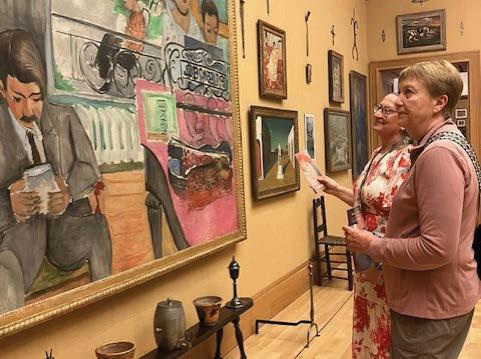
Meet at The Frick — French Moderns: Matisse/Renoir/Degas Exhibit
THURSDAY, AUGUST 20, 2026
Time: 10 – 11:30 a.m.
Cost: $20 (discounts may apply)
Location: 7227 Reynolds Street, Pittsburgh, PA 15208
Members will view the works in the French Moderns: Matisse/Renoir/Degas exhibit and attend the associated Gallery Conversation. Encompassing realism, impressionism, post-impressionism, symbolism, Fauvism, cubism, and surrealism, this exhibit exemplifies the avant-garde movements that defined modern art in the nineteenth and twentieth centuries and that continue to awe art-goers today. This is not a docent-led tour, but rather an opportunity for OLLI members to experience the exhibit together.
Members may choose to dine at The Café at The Frick after the museum visit.
Note: Travel is on your own; parking for the museum is free in their lot.
WHAT'S NEXT?
Membership purchases can be made on or after July 16, 2026. Membership, once purchased, is valid for the entire academic year (Fall 2026, Spring 2027, and Summer 2027 OLLI terms).
Tuition purchases also open on July 16, 2026. Refer to page 3 of this catalog for more information on tuition level options.
Course registration opens Thursday, July 23, 2026. After that date, paid members can register for classes and events. After registration, members will immediately receive email confirmation of classes and whether they are registered or waitlisted.
One week before classes start, members will receive the Zoom link (for online classes) or the room location (for in-person classes). This information will be sent again the first two weeks of the course.
Waitlists are monitored and if we can create openings, members will be notified. We do our best to eliminate waitlists.
Members will receive our weekly updates via email. Newsletters include membership information, new event details, information about OLLI at Pitt benefits, and opportunities for activities at Pitt and beyond.
LECTURES

More of the Best of Hitchcock: Domestic Drama
Jay Sherwin
WEDNESDAY, AUGUST 12, 2026
Time: 10 – 11:30 a.m.
Modality: Online
In this follow-up to last spring’s popular “Best of Hitchcock” course, this lecture will discuss two Hitchcock films from the early 1940s, Rebecca and Suspicion, both of which focus on strange and troubled marriages. If possible, members should watch the two films on their own, in advance of the lecture. During the lecture, we will look at brief film clips and discuss key themes and motifs. Join us for another fascinating trip into the dark and unsettling world that Alfred Hitchcock created on film.
Jay Sherwin is a writer and consultant who has been watching, studying, and enjoying Hitchcock films for decades. He created a walking tour of Alfred Hitchcock’s San Francisco that attracts Hitchcock fans from around the world, and he has taught online “Best of Hitchcock” courses for more than twenty OLLI programs nationwide.
From Tradition to Green Burial: Options and the Value of Early Planning
Laura Faessel & Deanna Mance
WEDNESDAY, AUGUST 19, 2026
Time: 10 – 11:30 a.m.
Modality: Hybrid
This lecture explores the history of burial and funeral practices in the United States, from traditional customs to the wide range of options available today, including green burial. The presenters will examine the emotional, logistical, and financial dimensions of end-of-life choices, comparing common practices while considering environmental impact, cost, and personal values. Members will also learn how early pre-planning can reduce stress, minimize family conflict, and empower individuals to make meaningful decisions that reflect their personal, cultural, and environmental values — supporting a more compassionate approach to death.
Laura Faessel, manager of Penn Forest Natural Burial Park, holds a bachelor’s degree in environmental studies from Slippery Rock University, where she studied burial practices across five cultures, sparking her passion for green burial and caring for the dead.
Deanna Mance began her career as an artist and arts educator. She later combined creativity with end-of-life care, becoming a life enrichment coordinator, death doula, and founder of Pittsburgh Community Deathcare. Today, she serves as assistant manager at Penn Forest Natural Burial Park.
TRAVEL OPPORTUNITIES
Visit OLLI’s website for more details on the travel opportunities below: olli.pitt.edu/events/travel-trips

Highlights of France: The Riviera, Provence, and Paris
APRIL 30 – MAY 9, 2027
Splashes of color and the spray of the sea abound in southern France. The best way to pair them with the allure of Paris? Taking this OLLI at Pitt customized trip!
OLLI members and their guests will swing from the glitz of the Cote d'Azur to the pastoral elegance of Provence, finishing with a three-night stay in Paris. Members can choose to extend their exploration of French art, history, and culture with a post-trip extension to Monet's Giverny and the storied shores of Normandy.

Flavors of Chile & Argentina
OCTOBER 21 – 30, 2027
Experience the essence of two South American countries on an immersive journey from Santiago, Chile to Argentina’s wine country and vibrant Buenos Aires. Encounter the history and culture of Chile and Argentina in capital cities and the sprawling countryside. From cooking to tango; from museums to architecture — this trip has all that a curious OLLI member could ask for!
WANT TO LEARN MORE?
Join us for the upcoming online information session:
Thursday, September 10, 2026 3 – 4 p.m.
Visit olli.pitt.edu/events/ travel-trips or scan the QR code for details and to register. Once registered, you will receive a Zoom link to access the session.
INSTRUCTOR BIOGRAPHIES
Emanuel Abramovits has been a concert promoter since 2000 and was directly involved in many events by international artists. He designed and staged many original orchestral events and several world premieres. He was cultural director at Union Israelita De Caracas from 2008 to 2019, releasing books and organizing film cycles, concerts, and art exhibits. He has taught online and in person across the United States since 2020.
Paul Adams, PhD, is associate professor of political science at the University of Pittsburgh at Greensburg. His research and courses focus on comparative politics and international relations, especially in Europe with specializations in Irish, Northern Irish, German, and Swiss politics as well as the European Union. He earned a doctorate in political science from the University of Massachusetts in 2008.
Tom Allen, JD, is a lawyer who practiced with a large global law firm for over 40 years before his retirement from the firm at the end of 2021. Early in his career, Allen was a trial attorney with the Antitrust Division of the U.S. Justice Department. He has appeared in courts throughout the United States. Allen obtained a BA from the University of Michigan and a JD from the University of North Carolina at Chapel Hill.
Ralph Bangs, PhD, MPA, is the retired associate director of the Center on Race and Social Problems at the University of Pittsburgh. His most recent book is Race and Social Problems: Restructuring Inequality. He has received racial justice and leadership awards and has taught courses on race for several decades.
Buck Beasom, MBA, teaches courses for OLLI chapters across the country. He has a two-track career that includes four decades in data management and applications development while teaching courses in business, accounting, and economics. He spent five years teaching history at the middle and high school levels. He holds a BS in management science, with additional majors in history and economics, and an MBA in accounting.
Ralph Begleiter, MA, was CNN’s most widely traveled reporter during his two decades as the network’s “world affairs correspondent,” covering five U.S. Secretaries of State and three Presidents. He founded the Center for Political Communication at the University of Delaware. He earned his bachelor’s degree in political science at Brown University and his master’s degree in journalism at Columbia University.
Álvaro Bernal, PhD, is a professor of Spanish and Latin American literature at the University of Pittsburgh at Johnstown. He received his PhD from the University of Iowa.
Kenneth Boas, PhD, was formerly an instructor in the University of Pittsburgh Kenneth P. Dietrich School of Arts and Sciences Department of English. He has been a long-time board member of the Israeli Committee Against House Demolitions (ICAHD-USA). He is an avid hiker.
David Brumble, PhD, is professor emeritus of English at the University of Pittsburgh and a recipient of both of Pitt’s most prestigious teaching prizes. Two of his five books are on medieval and renaissance art and literature, and he has published articles on the Bible.
Barbara Burstin, PhD, is on the history faculty of both the University of Pittsburgh and Carnegie Mellon University and is the author of several books including Steel City Jews, Volumes I and II and a biography of Sophie Masloff. With degrees from Vassar College, Columbia University, and the University of Pittsburgh, she has been teaching for over 25 years.
John Burt, JD, is a retired history teacher and lawyer. He served as a featured speaker in Safe Harbor, a public television awardwinning documentary on the Underground Railroad in Western Pennsylvania. Since 1986, he has lectured on the history of American reform movements, especially the abolitionist movement, and he has conducted tours connected with Underground Railroad activities.
Kathy Callahan retired from management consulting for Fortune 200 companies, specializing in executive and leadership development and performance improvement. An experienced facilitator and trainer, she is inspired to bring the TED Talks discussion group to OLLI members.
Sam and Candy Caponegro have worked in all aspects of theater for over 30 years. Their goal is to keep the classic movie musicals and the golden age of Broadway alive through their lectures.
Steven Cherry, MFA, is a writer and editor, now based in New York’s Hudson Valley. He has taught writing, journalism, and film at the University of Pittsburgh and previously at New York University. He has a bachelor’s degree from Geneseo College (State University of New York) and a master’s degree in creative writing from the New School.
Jill Donnette Clary has been practicing yoga since 2003, has completed a 200-hour yoga teacher training program, and is registered with Yoga Alliance. Her classes are a blend of different yoga styles, but all focus on a slow flow with longer holds.
Sandra Collins, PhD, focuses on women in the Old Testament in her courses at the University of Pittsburgh. She has also taught for Carnegie Mellon University, Duquesne University, and, currently, the Byzantine Catholic Seminary as well as online for the Graduate Theological Union in Berkeley, California.
M. Shivaun Corry, PhD, is a communications scholar specializing in rhetoric, media, and persuasion. She has extensive experience teaching courses for senior learners on how information is created, framed, and interpreted across contexts, including health, religion, and politics. Her teaching emphasizes practical strategies for evaluating claims and understanding influence in everyday media.
Jared Day, PhD, taught American history at Carnegie Mellon University in Pittsburgh for 16 years. His areas of specialization are U.S. political, urban, and cultural history as well as world history from the late 18th century to the present. He is the author of several books along with numerous other popular and peer-reviewed articles.
Cinzia Delfini, MA, graduated from the masters program of Italian at the University of Pittsburgh in December of 2017. She previously received her degree in Russian and English languages and literature at the University of Verona, Italy. She moved to Pittsburgh in 2023 and, at present, she is a parttime instructor at the University of Pittsburgh and teaches Italian language at different levels.
Donald Ellison, PhD, has taught physics and astrophysics for nearly 40 years. Since retiring from North Carolina State University, he has taught OLLI classes at the University of Pittsburgh, Duke University, and NC State. In addition to teaching, he had an active research career studying supernovae and other aspects of high-energy astrophysics.
David Fetterman, MDiv, MEd, is a retired pastor, chaplain, and spiritual care specialist who has served in several long-term care facilities, hospices, and communities of faith. He has also served as director of religious education in several congregations. He is a lifelong follower of Charles Schulz's Peanuts comic strip and its observation of what it means to be human.
Lucy Fischer, PhD, is a distinguished professor emerita of English and Film Studies at the University of Pittsburgh, where she received the Provost's Excellence in Mentorship Award and the Chancellor's Distinguished Research Award. She is the author of many books on film and received fellowships from the National Endowment for the Arts and for the Humanities.
María Franco de Gómez, MA, is a retired instructor of Spanish at Pennsylvania State University New Kensington, where she served as Spanish coordinator. Her career as a faculty member includes a substantial record of academic service, solid scholarly activity, and very strong evidence of outstanding teaching.
Vernon Franklin, EdD, is a dedicated instructor and consultant with a long history of technology, administrative, and leadership expertise. His mission is to increase human and organizational capacity for progressive innovation amidst constant paradigm shifts caused by social trends and emerging technological advancements. He has a master’s degree in organizational leadership from Geneva College and a doctorate from the University of Pittsburgh.
Christina Frasher, PhD, is faculty in the Health and Human Development Department in the School of Education at the University of Pittsburgh. The use of story, image, and metaphor are foundational to her teaching, research, and psychotherapeutic practice. She earned a master’s degree in counseling psychology from Pacifica Graduate Institute and a PhD in counselor education and supervision from Duquesne University.
Barry Fulks, PhD, earned his PhD in modern European cultural history at the University of WisconsinMadison. He has taught at both the secondary and post-secondary levels, most recently at St. Vincent College, where for over a decade he taught a course on the European Theater of World War II, and for OLLI, for which he has taught a cycle of three courses on the war in the East.
Natasha Garrett, PhD, joined the Nationality Rooms and Intercultural Exchange program in 2025. She is a higher education professional, a writer, and a translator. She has been teaching cross-cultural communication and cultural geography courses for undergraduate, graduate, and adult students. She earned a master’s degree in English literature from Duquesne University and a PhD in social and comparative analysis in Education from the University of Pittsburgh.
Susan Gillis Kruman is emeritus faculty at the University of Pittsburgh, was the first to introduce yoga as a credit class at Pitt, where she taught for over 20 years. She has her 200- and 300hour Yoga Alliance certifications and a Kundalini pre-natal yoga certification with over 1,000 hours of in-class instruction.
Peter Gilmore, PhD, received his doctorate in history from Carnegie Mellon University and is an adjunct lecturer in history at several Pittsburgh universities. He is the author of Irish Presbyterians and the Shaping of Western Pennsylvania, 1770-1830, published in 2018 by the University of Pittsburgh Press.
Joseph Givvin, PhD, holds his doctorate in philosophy from St. John’s University, New York, and has been teaching for over 40 years. A member of the American Association of Philosophy Teachers since 1984, he was presented with an Award of Merit for Outstanding Leadership and Achievements in the Teaching of Philosophy.
Larry Gondelman, JD, who grew up in Pittsburgh, is a mostly retired attorney who has loved rock 'n roll his whole life. He has led a wide range of music-focused study groups at the American University
and Carnegie Mellon University OLLIs, including courses on the history of rock 'n roll, the great guitarists of rock, one hit wonders, songwriters, and lyrics.
Joan Gundersen, PhD, is professor emerita of history at California State University San Marcos. Author of seven history books and numerous scholarly articles, she taught women's history at a variety of institutions. She enjoys sharing the fascinating world of American women’s history with others.
Cory Gwin is a senior software engineer at GitHub, a web-based platform that combines a distributed version control system with tools for collaboration, project management, and automation. He helped to bring the first and one of the most used AI software development tools to market. Currently, he mentors at Carnegie Mellon University’s Software Engineering Institute, working in the intersection of AI, software engineering, and education.
Kerry Handron studied physics at Dartmouth College and space physics and astronomy at Rice University, focusing on the Helix Nebula. Most of her career is in informal education, at the Carnegie Museum of Natural History and now at the Allegheny Observatory. The intersection of these interests is the field of Archeoastronomy, which is both fascinating and accessible.
Joseph Harris, PhD, taught courses in creative nonfiction, composition, popular culture, and literature for almost 40 years before retiring from the University of Delaware. He has written several books about teaching writing, including The Work of Teaching Writing: Learning from Fiction, Film, and Drama
Katherine Hirsh, MS, is a board certified behavior analyst and former special education teacher with over 10 years of experience working with children with disabilities and their families. She earned her bachelor’s degree in early childhood education from Duquesne University and her master’s degree in special education from Carlow University.
Matthew Hodge, MFA, is an awardwinning musician and music professor with over 15 years of experience as a pianist, composer, scholar, and entrepreneur. He has worked with Oscar, Grammy, Emmy, Tony, and Golden Globe award winners. His music credits include films, television, video games, commercials, theatre, and podcasts. He has serviced over 1,000 music clients spanning over 30 countries.
Jeffrey Hunter is a conservationist who lives and works in the Blue Ridge Mountains in western North Carolina. He saw the Grateful Dead dozens of times from 1978-1995. He has taught classes on the Grateful Dead at both the University of North Carolina Asheville and the University of Pittsburgh.
Patreese Ingram, EdD, is a professor of agriculture and extension education and assistant dean emerita at The Pennsylvania State University. She has published in professional journals, taught college courses, and has been an invited speaker at national and international conferences. She holds a master's degree from Michigan State University and an EdD from Western Michigan State University.
Alan Irvine, PhD, is a professional storyteller with a life-long fascination with Arthurian tales. His CD, The Red Dragon: Tales of King Arthur, won a Storytelling World Honors award. He has a doctorate degree in sociology and teaches many courses at area universities.
anupama jain, PhD, has been a professor since 2002. Since moving to Pittsburgh in 2011, she has worked in community engagement and DEI consulting, run a small business, worked for a mayor, and been an executive director. She earned her bachelor’s degree in English and Psychology at Bryn Mawr College and her PhD in literary studies at the University of Wisconsin-Madison.
Orin James, MS, is an assistant professor of biology at the University of Pittsburgh at Bradford. He is also chair of the Austria Nationality Room in the Cathedral of Learning. In addition to biology, he teaches courses that include discussions of social philosophy, determinism, colonialism, race, sex, and gender to individuals of all ages.
Aaron Kahn, MBA, CFP, is a 2ndgeneration CFP® at WMS Wealth Planners, a family-owned RIA, with over a decade of experience helping his clients find contentment with their money. He received his bachelor’s degree from Indiana University-Bloomington before earning his MBA from the Katz School of Business at the University of Pittsburgh. He holds his Certified Financial Planner designation and is a board member at Trail Pittsburgh.
Bud Kahn, MBA, is the Founding Principal of WMS Wealth Planners, a Pittsburgh-based fiduciary investment advisory firm. Bud is a licensed CPA and holds many professional credentials. Bud is a graduate of the University of Pittsburgh, with a bachelor’s
degree in economics and an MBA in accounting and finance. He also earned a master’s degree in taxation at Robert Morris University. Bud is a Visiting Executive Lecturer at the Katz Graduate School of Business at the University of Pittsburgh and has taught classes for both Pitt and CMU. He is also an alumnus of Leadership Pittsburgh and the FBI Citizens Academy.
James Kelly, PhD, LSW is a professor emeritus at Carlow University where he taught courses on the history of social welfare, the impact of literature on social justice, human behavior in the social environment, theories of community/organizations/groups, media and social change, youth media advocacy, and seminars in social work field placement.
Bridget Keown, PhD, leads the Gender and Science Initiative in the Gender, Sexuality and Women's Studies Program at the University of Pittsburgh. As a historian and a Russian speaker, she has loved Shostakovich's music since her high school music teacher introduced her to his work.
Ken Koncerak, MA, earned his bachelor’s degree in secondary education with a history minor from Penn State University and his master’s degree in history from the California University of Pennsylvania. In addition to teaching high school U.S. history and social studies, he taught U.S. history at the Community College of Allegheny County. He also served as an award-winning high school librarian for 13 years.
Aaron Leaman, CFA, is a Chartered Financial Analyst (CFA®) and chief investment officer of Signature Financial Planning, where he manages over $400 million in assets for institutions, municipalities, and high-net worth investors from
around the world. He has made numerous media appearances to discuss markets and investing.
Stephen Lindberg, MA, has been teaching since 1978 and has been an adjunct professor in geology in the Department of Energy and Earth Resources at the University of Pittsburgh at Johnstown since 1997. He teaches courses on principles of astronomy, prehistoric life, earthquakes and volcanoes, meteorology, and geologic field methods.
Ricardo Llovet is a biochemist who has built his wine knowledge through extensive reading, tasting, and traveling. He has harvested grapes, made wines, and visited winemakers around the world. He has conducted wine tastings for 41 years and taught 15 wine courses at OLLI programs. Recently, he earned a Certified Wine Judge status at the Annual American Wine Society Conference. He founded the American Wine Society—Pittsburgh Chapter and posts wine reviews at www.wineandfriends.net.
Lisa Ludvico, PhD, has taught courses in animal behavior for over 25 years. She conducted field work on wild horses for over two years for her PhD dissertation. She has worked with domesticated as well as feral populations of cats for the majority of her life. She is currently on the board of a non-profit cat charity that seeks to humanely limit overpopulation of feral cats.
Mark Macedonia, MA, is a retired social studies teacher from Seneca Valley School District. He holds a bachelor’s degree in communication from St. Bonaventure University and a master’s degree in education from the University of Pittsburgh. He is also a published author of historical fiction.
Paul Macek, MEd, has master's degrees in history and English. He has taught U.S. history for over twenty-five years. He has also worked as a proofreader, copyeditor, indexer, translator, writer, and publisher for over thirty years. He is the author of eight books: one on education, two on literature (one of which was a translation), and five on American history.
Cressida Magaro, MA, is the senior manager for learning environments at the University of Pittsburgh’s Center for Teaching and Learning. She has a master’s degree in teaching from Towson University and two decades of experience in educational technology at both Pitt and Carnegie Mellon University, creating, evaluating, and supporting tools to help educators meet their learning objectives.
Connor McCanlus is a Pittsburgh native and proud member of Actors’ Equity Association and the Screen Actors Guild. He is a local comedy performer and producer whose work has been featured in Chicago (Second City, The iO Theater, MCL Chicago, Athenaeum) and New York City (Upright Citizens Brigade, The Magnet Theater, The People's Improv Theater), and serves as the academy director at Arcade Comedy Theater.
John McCarthy, PhD, earned his PhD in counseling psychology and has taught for over 25 years both in the United States and internationally. He has 30 journal publications and over 60 professional presentations across 14 countries. His professional writings have been featured in The Pittsburgh Post-Gazette, Huffpost.com, The Buffalo News, Cleveland.com, Counseling Today, and The Psychotherapy Networker. He is the author of two books, The Innovator Next Door
and Driving Forward in Reverse, that address creative thinking and problem-solving.
Andrew McElwaine is a former University of Pittsburgh adjunct faculty member who taught Pennsylvania environmental law and policy in the Law School and the Department of Geology. He was president of the Pennsylvania Environmental Council and vice president of The Heinz Endowments, Pittsburgh’s largest environmental philanthropy. He was Senator John Heinz' environmental policy advisor.
Kevin McGuire, MS, is the library media specialist at Woodland Hills High School, where he has worked since 2008. He has degrees in history and education from Grove City College and a master’s degree in library and information science from Clarion University.
Silvina Orsatti, EdD, teaches Spanish language and culture, and foreign language pedagogy at the University of Pittsburgh in Greensburg. Her research interests include digital storytelling, gamebased learning, and sustainability projects in the foreign language classroom. She received the PSMLA Educator of the Year Award in 2014 and became a Pitt Green Ambassador in 2024.
Doug Oster is the host of the popular radio show The Organic Gardener on KDKA radio every Sunday morning. He writes a gardening column for The Green Voice, the newsletter for Pittsburgh Earth Day. He is host of the Talking Trees podcast for the Davey Tree Expert Company and stars in and produces In Doug’s Garden, a weekly television show for CBS/KDKA Streaming. He is the author of The Steel City Garden: Creating a One-of-a-Kind Garden in Black and Gold.
Alexa Palilla, PhD, holds a bachelor's degree in English and a master's degree in secondary special education from Edinboro University of Pennsylvania, and a PhD in organizational learning and leadership from Gannon University. Most recently, she earned a certificate in Rock & Roll History.
Sylvia Pamboukian, PhD, is a professor of English at Robert Morris University. Her research and teaching areas include Victorian literature, the health humanities, and detective fiction. Her last book is entitled Agatha Christie and the Guilty Pleasure of Poison, which was shortlisted as a book of the year by the Crime Fiction Studies Association.
Robert Peckyno, MS, has a master’s degree in space studies from the University of North Dakota and a second master’s degree in geography from Oregon State University, where he researched lava flow morphology on Earth and Mars. He was also a GIS researcher on the Cassini mission helping to build the first geologic map of Titan. He has taught the history of outer space on both campuses as well as a unique course on the women's history of space.
Alan Perper is a founding member of VoteAsIf.org, an LA-based consortium seeking to increase voter registration and turnout through 501C3 nonprofit partnerships. He has also previously trained with the U.S. Immigration and Naturalization Services to develop an adult U.S. Citizenship curriculum and has lectured on civics and citizenship issues at multiple OLLI university programs.
Lauren Radick, MEd, is a dynamic educator and adjunct literature instructor for OLLI at Florida International University. She holds a bachelor’s degree in journalism and literature from Emerson College and master’s degree in education from The George Washington University.
Daniel Rectenwald, MM, is integrally rooted in the Pittsburgh music scene, playing guitar in various groups in the area. He earned a bachelor's degree in music from Duquesne University and a master's degree in music from the Cleveland Institute of Music. Currently, he teaches privately and is an adjunct professor at the University of Pittsburgh.
Joseph Reinwald, BS, earned his degree in mathematics and physics from the University of Pittsburgh. He started as a certified mathematics teacher in the Pittsburgh Public Schools, and went on to teach at several technical colleges in Philadelphia and Pittsburgh. For the last 25 years he has been involved with corporate technical training at IBM and Amazon Web Services (AWS).
Michael Rizzi, EdD, has taught international affairs at the University of Pittsburgh for over a decade. He is the author of one book and over 20 articles on history, international affairs, and education. He holds master's and doctoral degrees from Pitt and an undergraduate degree in foreign service from Georgetown University.
Elizabeth Rodenz, PhD, earned her PhD from the University of Pittsburgh. She is author of Odd Ducks and Birds of a Feather, a unique approach to teaching psychological types, based on the work of Jung. She has taught a variety of courses at several OLLI programs. She is also the author of Josephine: A
Woman of Indomitable Spirit, a saga of social injustice that chronicles the Industrial Age in American history from the 1880s into the 1920s.
Sarah Rosenson, JD, has a bachelor's degree from Georgetown University, a master's degree in Jewish studies from the Spertus Institute, and a JD from the University of Pennsylvania. She practiced law for a decade and then taught classes on ethics, philosophy, the Bible, and world religions at a private high school. She currently teaches adults both in person and online for various institutions around the country.
Ann Rosenthal has more than 30 years of experience as an artist, educator, and writer. Her work has been shown locally at the Andy Warhol Museum, the Mattress Factory, and SPACE, and has been featured in exhibitions across the United States and internationally.
Roger Rouse retired after five decades of teaching anthropology, cultural studies, and global studies. He has discussed documentary and fiction films in many of his courses, has organized film series to accompany several of them, and has written and given invited talks about the cultural significance of quite a few mainstream movies and their themes.
Jennifer Schaupp, PhD, has a background in improvisational comedy, creative writing, and higher education teaching. Currently, she teaches in the theatre and literary arts departments at Point Park University. Her dissertation has informed her teaching and art making, as she explored traumainformed theatrical practices for self-empowerment in English as an Additional Language classrooms.
George Scheper, PhD, received his PhD in English literature from Princeton University. He has been director of the Odyssey Program and is currently senior lecturer in the Master of Liberal Arts Program, both at Johns Hopkins University. He is also emeritus professor of Humanities at the Community College of Baltimore County. He is a recipient of many Excellence in Teaching Awards.
Sue Schneider is a Certified Zentangle™ Teacher (CZT) and an award-winning artist in watercolor, fiber arts, and bookmaking. She brings her broad knowledge and playful teaching style to her Zentangle™ classes. She has been teaching for OLLI at Pitt for several years.
Cathleen Sendek-Sapp, MFA, has her master’s degree in French language and literature. She has taught French at the University of Pittsburgh as a teaching fellow and part-time instructor as well as for noncredit lifelong learning.
Stephenie Slahor, JD, is retired from university and law school teaching and now creates informative and enjoyable OLLI courses for universities around the nation, primarily in the natural sciences and history.
Melissa Sokulski, MAC, is an herbalist, wild food educator, avid hiker, and licensed acupuncturist with a master's degree from the New England School of Acupuncture. She writes personal essays and has won grants and residencies for memoir writing. She has taught many popular classes at OLLI, including a variety of hiking classes, Wild Edibles Walks, and Fantastic and Ferocious Fungi.
Gemma Stemley is an author, poet, musician, and cultural educator who was born in Trinidad and Tobago. While working as an administrator at both Clarion University and Cheyney University, she taught classes in Caribbean women's literature and Third World women's literature.
Douglas Swanson, BA, is a research associate professor in the English department at the University of Pittsburgh, where he teaches nonfiction writing. He is the author of five novels and two nonfiction books. He has been a finalist for the Pulitzer Prize and was a John S. Knight Fellow in Journalism at Stanford University. He has spent the last five years researching the life of Henry Clay Frick.
Jeffrey Swoger is a retired graphic designer with a lifelong interest in the arts, specifically design, music, architecture, and film. Much of his life was spent in Chicago where he was involved with the Chicago Architecture Foundation, designing their logo and printed materials.
Leah Valtin-Erwin, PhD, is the deputy director of the Association for Slavic, East European, and Eurasian Studies at the University of Pittsburgh. She holds a PhD in Eastern European history from Indiana University Bloomington, a master’s degree in global studies and Russian and East European Studies from the University of North Carolina at Chapel Hill, and a bachelor’s degree in liberal arts from Hampshire College.
Javier Vázquez-D’Elía, PhD, has a doctorate in political science from the University of Pittsburgh. He is currently a researcher at the University Center for International Studies. Throughout
the last 10 years, he has taught at Pitt, California University of Pennsylvania, Penn State, and the Indiana University of Pennsylvania.
Eli Vega is a highly published, award-winning photographer and author. He has published two books on photography. He has taught photography for thirty years, including field workshops in Rocky Mountain National Park, and classes for OLLI throughout the country. He is a certified facilitator and makes his classes and workshops casual, engaging, and fun.
David Walton, MFA, is retired from the English department at the University of Pittsburgh, where he taught a variety of literature and writing courses over the last 20 years. He is a regular book reviewer for several national newspapers, a recipient of a National Endowment for the Arts fellowship in literature, and the author of two collections of short stories and a novel.
Mengjun Wang, MS, is a Tai Chi and Qigong instructor with graduate training in sports medicine and athletic training. She holds a master’s degree in sports medicine from the University of Pittsburgh and has experience teaching traditional Chinese exercise to adult learners in community and wellness settings. Her instruction emphasizes safe, accessible, and health-focused movement.
Joel Woller, MA, is an experienced interdisciplinary educator who has served several universities, including Carlow University, where he has taught history since 1999. Committed to popular education, he provides lectures for National Endowment for the Humanities History and Landmark Workshops as well as local
community organizations. He has a master’s degree in literary and cultural studies from Carnegie Mellon University and a master’s degree in English from The Ohio State University.
J.D. Wright, PhD, is a long-time OLLI instructor and "Japanese Poetry at Life's Edge" marks his twelfth course with the program. A teaching consultant with the Center for Teaching and Learning, he also offers courses on English and Slavic languages and literatures. His PhD from the University of Pittsburgh focused on poetry. This course builds on "The Art of Haiku" but requires no previous exposure to haiku.
Michael Young, PhD, earned his PhD from the University of Cincinnati. He is an experienced teacher of both film and history and is a faculty member in the University of Pittsburgh’s English Department. He is the author of numerous articles and conference papers, several of them in Canadian studies and history, and was awarded a Faculty Enrichment Grant by the Government of Canada to study there and create curricular programming.
Katherine Zoraster, MA, is a contextual art historian specializing in western art from the Renaissance to the 20th century. Having received her master's degree in art history with distinction from California State University Northridge, she began teaching at the college level at several different institutions and now also teaches at several different lifelong learning programs across the country.
GENERAL OLLI INFORMATION/POLICIES
How to Drop a Course or Event
Please notify the OLLI office if you are unable to attend a course/class so that we can maintain accurate information on our programming and course evaluation efforts. Email us at osher@pitt.edu prior to the beginning of a class or at any time for courses that have multiple weeks. Let us know if you would like to enroll in an alternate course. Event refunds depend on each event and they are marked if the fees are refundable or not, and if they are, by what date.
Postponed, Canceled, or Full Courses
Occasionally, courses are postponed or canceled, typically due to reasons beyond our control, such as emergencies or illness of instructors, etc. If a class is postponed, you will be notified by email and informed of the rescheduled date, if it is known. If a course is canceled, you will receive email notice as soon as possible.
Course enrollment size varies for several reasons, including size of physical classroom space or the nature of the course material (regardless of format). For these reasons, not all courses can be open to everyone who wishes to attend, including online courses. If a course or event is full, you will be given the opportunity to be added to the waiting list in case there are cancellations. People are added to the course or event from the waiting list in the order received.
Double-booking Courses in a Time Period
During registration, be sure to select only one course during a given time frame. If you attempt to double-book your courses, the system will not allow you to continue with course registration. You may only register for one course in any given time period.
Refunds
Each catalog will indicate the date by which a membership may be refunded. There are no exceptions. Events or tours that require a fee will indicate if the fee is refundable, and if so, by what date you must request a refund.
Email Notifications
Make sure the OLLI office has your correct email address. The OLLI office sends emails to notify members of Zoom invites and course changes, course cancellations, upcoming events, as well as for our email newsletter. Instructors may also want to contact students regarding class information. Your information is always confidential.
Course Evaluations
During the last week of your courses, you will receive an email with a link to your course evaluations. Please try to respond and share information about your experience of the course. This information helps guide future programming. If you have an issue with your course evaluation, please contact us at osher@pitt.edu Do not contact the University Office of Measurement and Evaluation of Teaching (OMET).
IMPORTANT DATES
Code of Conduct
In all courses, lectures, and events and in all formats, OLLI members are expected to follow the OLLI Code of Conduct. By purchasing a membership, individuals agree to follow the Code of Conduct. OLLI members are expected to respect the learning environment, instructors, staff, and other members and embrace the concept of a civil community as well as follow all OLLI and University policies, procedures, and conduct guidelines. Please visit Member Resources on the OLLI website to read the OLLI Code of Conduct and Guide to Civil and Productive Classroom Conversations.
Auditing Classes
OLLI at Pitt members may audit undergraduate courses. Members who audit do not receive credits nor grades and generally do not participate in exams or homework. Auditors learn side-by-side with undergraduate students, but they are guests in the course and participation can be limited or restricted by instructor or department. Full information about auditing and how to register is found on our website, olli.pitt.edu
Financial assistance application period for Fall 2026 term: July 9 – Oct. 28, 2026
NO REFUNDS ISSUED FOR MEMBERSHIP OR TUITION PAYMENTS AFTER AUG. 21, 2026.
Last day to add/drop Fall session 1 and 10-week classes is Sept. 11, 2026
Last day to add/drop Fall session 2 classes is Oct. 30, 2026.
CONTACT US
Phone: 412-624-7308 | Email: osher@pitt.edu
Office Hours: Monday – Friday, 8:30 a.m. – 4 p.m.
4227 Fifth Avenue, 710 Alumni Hall, Pittsburgh, PA 15260