September 18, 2026 | 7 Tishrei 5787
Renovations planned for Weinberg Terrace
NOTEWORTHY LOCAL True loving kindness
A call for volunteers
Candlelighting 7:06 p.m. | Havdalah 8:03 p.m. | Vol. 69, No. 38 | pittsburghjewishchronicle.org
Page 3
C
Aiming to uproot antisemitism
Page 4
LOCAL
Steeler Aaron Rodgers weighs in on Israel
Page 5
HOLIDAYS Origins of Yom Kippur
Customs and history
Page 8
consist of upcoming changes to communal spaces, she continued. “People move into personal care and they’re coming in because they need to be in a supervised setting, but that doesn’t mean they have to give up their lifestyle. It doesn’t mean that they have to give up the fact that they still have friends. And for many people coming in, it does mean creating new friendships.” For too long, Weinberg Terrace has lacked “adequate spaces for individuals to congregate — so what we find is that people spend a lot more time in their apartment than [we] would like to see them spending in their apartment. We want to be able to have individuals coming out into comfortable spaces.” To that end, an inner courtyard at Weinberg Terrace will be enclosed and a dining room will be opened to permit more “walkers and wheelchairs,” she said. The hope, Foley continued, is that a renovated Weinberg Terrace connects the “Squirrel Hill area in a different way.” Currently, the JAA maintains affordable housing units at The New Riverview Apartments. A memory care and secured assisted living space is available at AHAVA
arnegie Mellon University, Duquesne University and the University of Pittsburgh were all given F grades in the latest College Free Speech Rankings Report by FIRE, the Foundation for Individual Rights and Expression. Of the 261 colleges and universities included in the report, 120 received an F grade, another 104 received some form of a D, 34 received some form of a C and two received a B-. Duquesne’s and Pitt’s grades were consistent with their grades in last year’s report; CMU, however, dropped from a D- to an F. CMU was ranked 187 in the report, Duquesne 181 and Pitt 205. The foundation’s rankings, it wrote in the report, are determined using 12 components: six are based on student perception; three assess campus speech policies; and three evaluate how schools respond to speech controversies. The survey included 232 students from CMU, 294 from Duquesne and 317 from Pitt. The six components on which students gave their perceptions were: comfort expressing ideas; self-censorship in conversation with other students, professors and administrators; students’ acceptance of disruptive behavior, including shouting down speakers, blocking access to events and using violence to stop campus speech; administrative support protecting free speech; openness, measuring how many of 22 social and political topics students identified as difficult to discuss; and political tolerance, which measured students’ willingness to allow controversial speakers on campus.
Please see Weinberg Terrace, page 10
Please see Universities, page 10
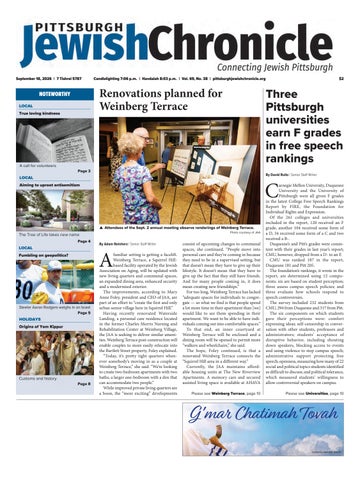
p Attendees of the Sept. 2 annual meeting observe renderings of Weinberg Terrace. Photo courtesy of JAA By Adam Reinherz | Senior Staff Writer
A
Fumbling on geopolitics?
Three Pittsburgh universities earn F grades in free speech rankings By David Rullo | Senior Staff Writer
LOCAL
The Tree of Life takes new name
$2
familiar setting is getting a facelift. Weinberg Terrace, a Squirrel Hillbased facility operated by the Jewish Association on Aging, will be updated with new living quarters and communal spaces, an expanded dining area, enhanced security and a modernized exterior. The improvements, according to Mary Anne Foley, president and CEO of JAA, are part of an effort to “create the first and only urban senior village here in Squirrel Hill.” Having recently renovated Waterside Landing, a personal care residence located in the former Charles Morris Nursing and Rehabilitation Center at Weinberg Village, the JAA is seeking to deliver similar amenities. Weinberg Terrace post-construction will enable couples to more easily relocate into the Bartlett Street property, Foley explained. “Today, it’s pretty tight quarters whenever somebody’s moving in as a couple at Weinberg Terrace,” she said. “We’re looking to create two-bedroom apartments with two baths, a larger one-bedroom with a den that can accommodate two people.” While improved private living quarters are a boon, the “more exciting” developments
G'mar Chatimah Tovah tomertu/Adobe Stock
Headlines Vision CRC seeks to connect and empower next generation of community leaders — LOCAL— By Adam Reinherz | Senior Staff Writer
A
group committed to civic discourse and mutual understanding is furthering its mission by welcoming younger advocates. The Community Relations Council of the Jewish Federation of Greater Pittsburgh — a division of the umbrella organization that seeks to build “harmonious relations and mutual understanding in a diverse world” — is partnering with more than a dozen young adults, between the ages of 22-45, for a yearlong cohort. Titled, “Vision CRC,” the group will receive training from local leaders and enable participants to strengthen Jewish life, promote public policy, effectively support Israel and build a more inclusive Pittsburgh. “The whole focus is on building relationships, civic engagement and empowering the next generation of community leadership,” Beth Vander Stoep, CRC’s assistant director said. “We live in a hyper-polarized society and we’re in a moment where we need leadership, especially young adult leadership. Now, really more than ever, we need people who want to engage both in the Jewish community and also in the broader Pittsburgh community.” Over the course of eight sessions and a trip to Harrisburg, participants will connect with interfaith leaders and elected officials, practice bridge building skills, learn about Pittsburgh’s neighborhoods and makeup, and develop confidence to engage in civic advocacy and interfaith dialogue.
p A CRC initiative seeks to develop future communal leaders. Photo by Xhemi Photo via Pexels
“The whole focus of Vision CRC is envisioning not the Pittsburgh that we see today, but a future Pittsburgh — a Pittsburgh that is really warm, really inclusive, where people can have deep conversations and meaningful relationships across cultural divides,” Vander Stoep told the Chronicle. North Side resident Elayna Tell, 38, said she was drawn to the cohort for personal and professional reasons. “I work in the Israel advocacy space, and I see firsthand how difficult it is to have important conversations that people want to have but they wonder whether they
feel safe enough to have those conversations,” she said. Having the space to discuss sensitive topics with similar-aged adults, without being judged, “was something that appealed to me more than anything.” Aspinwall resident Rebekah Adams, 27, said the cohort represents a chance to learn and discuss. “It’s important nowadays to have this type of dialogue, especially since there’s just a lot of misconceptions about Judaism,” Adams said. “A lot of people, especially on campus, tend to be stuck on the opinions that they read on social media or what people synthesize for them.”
Having the chance to work through texts — whether shared religious readings or other materials — learn from diverse leaders and partner with other young adults is an opportunity to bolster Pittsburgh’s future, Adams added. It’s also a chance to remind the wider community that the next generation is deeply invested in growth, Tell said. “Sometimes there’s a fundamental misunderstanding that there isn’t a desire by younger generations to engage in these conversations — that we’re just stuck on our phones and in our TikToks, and that we’re all just being brainwashed — I think it’s important for readers to understand that there are young people that want these spaces to exist, that seek out these spaces, and that want to have conversations with each other.” Vision CRC officially begins Oct. 6. Applications for participation are still being accepted. And while the work is “focused on the Jewish community, Jewish values and Jewish worldviews, there’s actually no hardline requirement to be Jewish if you want to be in this cohort,” Vander Stoep said. “Allies of the Jewish community are more than welcome to sign up. We would honestly love to have them join.” By working and learning together, the cohort will prove a truth and engender a better future, Vander Stoep explained. “Young adults in the Pittsburgh Jewish community have hope,” she said. “And small conversations, and deep and meaningful relationships, do make long-term change.” PJC Adam Reinherz can be reached at areinherz@pittsburghjewishchronicle.org.
5915 Beacon St., 5th Floor Pittsburgh, PA 15217
Main phone number: 412-687-1000
Subscriptions: 412-687-1000, ext. 2 SUBSCRIPTIONS subscriptions@pittsburghjewishchronicle.org 412-687-1000, ext. 2
Jim Busis, CEO and Publisher 412-228-4690 jbusis@pittsburghjewishchronicle.org
TO ADVERTISE advertising@pittsburghjewishchronicle.org 412-687-1000, ext. 1
EDITORIAL Toby Tabachnick, Editor 412-228-4577 ttabachnick@pittsburghjewishchronicle.org
EDITORIAL DEPARTMENT Email: newsdesk@pittsburghjewishchronicle.org BOARD OF TRUSTEES Evan H. Stein, Chair Evan Indianer, Vice Chair Derek Smith, Treasurer Gayle R. Kraut, Secretary Gail Childs, Dan Droz, Malke Steinfeld Frank, Karen Gal-Or, Seth Glick, Judith Kanal, Cátia Kossovsky, Charles Saul, Lynn Zelenski
Adam Reinherz, Senior Staff Writer 412-687-1000 areinherz@pittsburghjewishchronicle.org David Rullo, Senior Staff Writer 412-687-1000 drullo@pittsburghjewishchronicle.org ADVERTISING Amy Weiss, Account Executive (412) 613-0697 aweiss@pittsburghjewishchronicle.org
PRODUCTION Jeni Mann Tough Production Manager Carl Weigel Art/Production Coordinator Subscriptions subscriptions@pittsburghjewishchronicle.org 412-687-1000, ext. 2 Published every Friday by the Pittsburgh Jewish Publication and Education Foundation 5915 Beacon St., 5th Floor Pittsburgh, PA 15217 Phone: 412-687-1000 POSTMASTER: Send address change to PITTSBURGH JEWISH CHRONICLE, 5915 BEACON ST., 5TH FLOOR PITTSBURGH, PA 15217 (PERIODICAL RATE POSTAGE PAID AT PITTSBURGH, PA AND AT ADDITIONAL MAILING OFFICES) USPS 582-740
Manuscripts, letters, documents and photographs sent to the Pittsburgh Jewish Chronicle become the property of this publication, which is not responsible for the return or loss of such items. The Pittsburgh Jewish Chronicle does not endorse the goods or services advertised or covered in its pages and makes no representation to the kashrut of food products and services in said advertising or articles. The publisher is not liable for damages if, for any reason whatsoever, he fails to publish an advertisement or for any error in an advertisement. Acceptance of advertisers and of ad copy is subject to the publisher’s approval. The Pittsburgh Jewish Chronicle is not responsible if ads violate applicable laws and the advertiser will indemnify, hold harmless and defend the Pittsburgh Jewish Chronicle from all claims made by governmental agencies and consumers for any reason based on ads appearing in the Pittsburgh Jewish Chronicle.
GENERAL COUNSEL Stuart R. Kaplan, Esq.
2
SEPTEMBER 18, 2026
PITTSBURGH JEWISH CHRONICLE
PITTSBURGHJEWISHCHRONICLE.ORG
Headlines
Jewish burial society seeks volunteers for ‘true loving kindness’ — LOCAL — By Adam Reinherz | Senior Staff Writer
K
indness comes in many forms. Perhaps the highest is one recipients never see. Last week, representatives of Gesher HaChaim, one of two Pittsburgh Jewish burial societies, issued a call for volunteers. The request, which came via a letter disseminated by multiple congregations, asked community members to become shomrim (guards). Shomrim, explained Cheryl DeSure, the letter’s author, serve a critical function within the Jewish burial process. After an individual dies, a shomer (plural shomrim) sits nearby — often in an adjacent room with the door open — and recites psalms. “We never leave a body alone from the moment that a person dies until the moment of burial,” DeSure said. “We do this out of respect.” The longstanding practice, according to Rabbi Elisar Admon, head of Gesher HaChaim, stems from a desire to protect a body before burial.
p An excerpt of Psalms
Photo by Joachim Schnürle via Pexels
Years ago, prior to refrigeration, concerns arose that vermin or ill-intentioned individuals would desecrate the deceased. Shomrim prevented such misfortunes. Additionally, Admon said, rabbinic literature maintains that until burial the deceased’s soul remains nearby; shomrim respect and accompany each soul along its way. “Judaism places extreme importance on the final moments before a body is buried; and to that extent, the Rabbis prescribed a specific mitzvah, to have someone with the body prior to burial,”
Squirrel Hill resident Elli Kanal told the Chronicle. For more than 20 years, Kanal has volunteered with the Jewish burial society. Time and again, he’s seen the value of its practices. “You’re accompanying the body to the final resting place,” he said. “Families appreciate it.” When a shomer is present, “families know their loved one is not alone, that someone is there — especially someone from the community,” Admon said. DeSure referenced both the death of her mother and husband and said, “it’s very meaningful in the moment” to know that a loved one’s body is not alone. In the hours before a funeral “there’s so many things to think about,” she continued. “With my husband, my kids were younger — and there was just getting them to the funeral — knowing that somebody cared, and was praying, and was there for him, it gave me a sense of peace and I want to pass that on.” DeSure said she’s received positive feedback from the letter and hopes others are inspired to volunteer. The Jewish community is attuned to caring: When a woman gives birth, “people
want to cook a meal.” When “somebody is sick, or broke a bone,” people want to help; similarly, “death is a part of life,” DeSure said. Mortality can be a terrifying prospect, but there’s little to fear about being a shomer, according to Gesher HaChaim representatives. “There’s nothing creepy or scary about it. You just stay there and say psalms,” DeSure said. The process is relatively simple. After receiving an alert from a WhatsApp group, volunteers register for hourlong slots. People often sit in an adjacent room on a comfortable chair. And if someone is worried about going alone, they’re welcome to bring a partner to recite psalms with, Admon said. For generations, Jewish burial practices have been called “chessed shel emet.” The Hebrew phrase, which translates to “true loving kindness,” is described as such “because you’re helping someone and they can’t repay you,” DeSure said. “You’re doing it because it’s important, and you’re doing it because it’s important to you. It’s a true act of kindness.” PJC Adam Reinherz can be reached at areinherz@pittsburghjewishchronicle.org.
‘Blood libel’: Israeli politicians assail Israeli film alleging AI-powered killing in Gaza — WORLD — By Michael Horovitz | The Times of Israel
I
sraeli politicians from across the spectrum on Sunday slammed filmmakers Yuval Abraham and Rachel Szor for their documentary “NAZA,” about Israel’s alleged AI-assisted killing of civilians in Gaza, which won a special jury prize at the Venice Film Festival. The Israel Defense Forces rejected claims made in the film, and specifically one featured in a promotional video of the documentary that it planned a strike during the war against Hamas in the Gaza Strip in which 500 civilian deaths had been anticipated. “The IDF has never planned, approved, or carried out a strike in Gaza in which 500 civilians or anything near that number were anticipated to be killed. Nor was any credible claim raised throughout the war suggesting that an IDF strike had caused anything near that number of fatalities,” the military said. The IDF said that Abraham and Szor “couldn’t possibly verify this claim, there is no real supporting evidence, and yet they published it anyway.” In an unsourced report, Ynet said that IDF Chief of Staff Lt. Gen. Eyal Zamir was expected to hold a discussion on Monday regarding the military’s response to the film, despite the IDF Spokespersons Unit already issuing multiple comments. Yashar party chair Gadi Eisenkot, a former IDF chief of staff and frontrunner in the upcoming election, wrote on X on Sunday, “The choice of Israeli creators to stand on an international stage, present a distorted and one-sided picture, and cast moral aspersions on the soldiers who defend our home is moral blindness, detachment from reality, and damage to the State of Israel in a time of distress.” Writing in English, Blue and White chair Benny Gantz, also a former IDF chief of staff, said, “Those behind the movie have never set foot in the battlefield — nor do I ever wish they will have to do so. PITTSBURGHJEWISHCHRONICLE.ORG
p Yuval Abraham and Rachel Szor with the Special Jury Prize for “Naza” during the Venice International Film Festival
Photo by Ondine Goat, CC BY-SA 4.0, via Wikimedia Commons
“But fighting in the most just war since Israel’s re-establishment, against a murderous group capable and willing to murder women & children — the IDF upholds itself to the highest moral and legal standard. As former IDF Chief of Staff & Minister of Defense, I can unequivocally attest to that. Anyone who lacks this basic understanding should just keep on making fiction!” Yisrael Beytenu leader Avigdor Liberman called the filmmakers “Israel’s enemies” who “took the war that was forced upon Israel after the October 7 massacre and turned it into a spectacle of slander and blood libels against the State of Israel, against the IDF, and against our magnificent fighters!” He said Abraham and Szor are willing to “sell their country” for applause, and that they represented a small minority in Israel. National Security Minister Itamar Ben Gvir called the film “antisemitic” and cast the creators as “direct damage to the people of Israel.” “To those who slander our heroic soldiers, who risk their lives so that we may live in peace and security, I say: You are a disgrace and a shame to the entire people of Israel. Get lost,” Ben Gvir wrote on X. “I’m sure your friends, our enemies in Hamas in Gaza, will welcome you with open arms!” Culture Minister Miki Zohar filed a request on Monday with the Population and Immigration Authority on Monday to examine the possibility of revoking the citizenship of
the filmmakers, following through on a threat he made a day earlier. Zohar accused Abraham and Szor of “breaching their loyalty to the state and collaborating with the enemy,” said they should be investigated over how they found their materials for the movie, “and whether, in the process of obtaining or publishing them, actions were taken that amount to aiding the enemy during wartime.” Zohar had accused the filmmakers on Sunday of “treason,” and called for their citizenship to be revoked. “The searing self-hatred of the producers, who are willing to hurt their homeland for applause from the antisemites of the world, is inconceivable and is a betrayal of the country,” Zohar said in his earlier statement. The revocation of nationality is legally possible in Israel, although it is rarely applied. In 2022, the Supreme Court ruled that the state can revoke the citizenship of those who carry out terror attacks or actions that constitute treason. The law requires the interior minister to submit the revocation request, the justice minister to approve it, and judges to validate it. Without explicitly defending the filmmakers, The Democrats MK Naama Lazimi on Sunday slammed Zohar for seeking to revoke their citizenship for “treason,” citing the government’s own failures and links to enemy countries. “That’s the madness in its ultimate form — honestly, you don’t need ‘hasbara terror attacks’ when you have ministers like that,” she wrote on X. Lazimi said that from the government’s point of view, the Qatargate scandal and Prime Minister Benjamin Netanyahu’s overseeing of Qatari funding to Hamas while reportedly ignoring warnings ahead of the Oct. 7, 2023, massacre is “just fine.” In the so-called Qatargate affair, Netanyahu’s adviser Yonatan Urich, along with former Netanyahu spokesman Eli Feldstein and ex-campaign adviser Yisrael Einhorn, is accused of taking money to spearhead a public relations campaign for Qatar in the aftermath of the Oct. 7, 2023, Hamas-led massacre, despite the Gulf
PITTSBURGH JEWISH CHRONICLE
state’s strong ties to the terror group, and doing so while working in the PMO. Abraham and Szor say they used conversations with 24 different Israeli military or intelligence whistleblowers who spoke on condition that their identities be protected. Abraham has defended the film’s reporting, done in partnership with Britain’s The Guardian newspaper, calling it “rigorous” and its findings reported by other mainstream journalists as well. He asserted that the filmmakers had received threats but did not go into more detail. The IDF already on Friday said it “categorically rejects” the allegations made in the film, saying that decisions regarding the selection and approval of strikes were made “by human personnel only… and not by artificial intelligence.” Also, in its initial response to the film, the IDF said that “the excerpts cited include claims regarding national and military strategy that are clearly beyond the knowledge of juniorlevel soldiers,” and that there are “references to situations in which IDF Intelligence Directorate soldiers, who were allegedly interviewed for the film, by definition would not have been involved.” The war, which was sparked by the Hamas-led October 2023 terror onslaught against Israel, has killed over 73,500 people in Gaza, including more than 1,330 since the October 2025 ceasefire, according to the Hamas-run health ministry in the enclave, although the toll does not differentiate between combatants and civilians. The Israeli military believes that Hamas’ overall toll is largely accurate, with IDF officials estimating that two to three civilians were killed for every dead terror operative. Abraham and Szor were also part of the team behind the 2024 documentary “No Other Land,” which chronicled Israel’s demolitions in the Palestinian West Bank village of Masafer Yatta and won an Academy Award for best documentary feature. PJC Emanuel Fabian and AFP contributed to this report. SEPTEMBER 18, 2026
3
Headlines Tree of Life organization announces new name — LOCAL — By David Rullo | Senior Staff Writer
N
early eight years after the deadliest antisemitic attack in United States history — when 11 Jews from three congregations were murdered during Shabbat services — the Tree of Life organization has announced a new name. Created in 2022 with the mission to end antisemitism, the nonprofit’s new name, The Tree of Life Center for Humanity, was announced in a video narrated by actor Tom Hanks, who served on the honorary cabinet when the organization’s “Remember. Rebuild. Renew.” campaign was first announced. Michael Bernstein, Tree of Life Center for Humanity board chair, said that sharing a name with the Tree of Life building where the attack occurred on Oct. 27, 2018, was important when the organization was launched, but its leadership recognized the “inherent challenge” of distinguishing what the center would be doing and how that relates to Tree of Life Congregation. “We didn’t have to address it out of the gate,” Bernstein noted, “but it’s important as we build the foundation and really understand who we are and where our lane is in terms of a new institution, both locally and nationally.” The new name codifies the shared humanity central to the organization’s mission of uprooting antisemitism and hate, according to Carole Zawatsky, CEO of the Tree of Life Center for Humanity. “The Tree of Life Center for Humanity will not only be a beacon of Jewish life here in Pittsburgh, but also will be a national model for bridge building and education,” she said. The new name, Bernstein offered, speaks to the Jewish values at the core of the organization’s mission. “Welcoming the stranger, repairing the world — this is who we are,” he said. In a statement announcing the change, the Tree of Life Center for Humanity said the name is a nod to its “education-centered approach to countering antisemitism, hate, and division, which focuses on building community and forging new relationships across differences by emphasizing shared values.”
p A memorial for the 11 murdered on Oct. 27, 2018, will be a part of the new Tree of Life Center for Humanity.
Rendering courtesy of Studio Libeskind
The Tree of Life Center for Humanity has a unique position, as various other organizations — especially post-Oct. 7 — grapple with how best to address the rising tide of hate, Bernstein noted. “We have a sense of space that no other institution has,” he said. “What happened on Oct. 27, 2018, happened at our place on the corner of Shady and Wilkins. It violated a sense of sanctuary. We should all feel safe when we are in sacred spaces, practicing our religion, practicing being in community, and ours was violated.” The institution’s name, he explained, reclaims the importance of sacred space for gathering, “not just for Jews, but certainly for Jews and others, who want to join us in those sacred spaces and hopefully gives the courage for others to stand up and establish sacred spaces of their own.” Construction on the building is underway and was the subject of a recent town hall meeting, where an update on the progress of the work was shared. Bernstein said that the while it might seem like it has taken awhile to begin construction
on the site, there’s a natural evolution to capital projects. “It’s slow, slow, slow, and then you hit a tipping point, and it goes faster,” he said. “The fact that we’re a startup organization adds to that. Startups take a long time until they launch. It was steady progress, but of course everyone — nobody more so than me — wants it to go faster.” The project has reached the stage, he said, where vision, funding, financing and design are “all systems go.” “I think it’s going to be a sprint for the next 18 months until we’re open,” he said. To date, more than $51.5 million has been raised in support of the project. Donors include the Richard King Mellon Foundation, the Henry Hillman Foundation, the Heinz Endowments, the PNC Foundation and the Ford Foundation. The project has also received funding through federal grants secured by Pennsylvania’s congressional delegation and through the Commonwealth of Pennsylvania’s Redevelopment Assistance Capital Program, as well as from individual donors.
L’Shana Tova! Wishing the Pittsburgh Community a Happy New Year 5787
Physical, Occupational & Speech Therapy
Those funds will support the building, establishment of a museum, programming — including the Holocaust Center of Pittsburgh and LIGHT Initiative — as well as seed operations costs and program reserves to ensure the institution’s long-term financial stability and health, and the creation of the 10/27 Memorial. The new building will include a restored sanctuary/auditorium, exhibit space, lobby, library, social hall, gathering spaces and kitchen, as well as offices for both The Tree of Life Center for Humanity and Tree of Life Congregation, and a secure courtyard. The building is scheduled to open in early 2028. “The Tree of Life Center for Humanity will open its doors to thousands of students, families and people of good moral conscience, equipping them to uproot antisemitism by remembering those taken from us and building relationships across difference to repair our world,” Bernstein said. PJC David Rullo can be reached at drullo@ pittsburghjewishchronicle.org.
PLAN AHEAD:
Protect Yourself and Your Loved Ones – Your Way We provide expert help with long term care planning, powers of attorney, wills, trusts and special needs. We help you implement legal and tax strategies to protect your wealth during your life and afterwards. mhm@ahmpc.com 4927 William Flinn Highway Allison Park, Pennsylvania 15101 We make house calls!
4
SEPTEMBER 18, 2026
PITTSBURGH JEWISH CHRONICLE
PITTSBURGHJEWISHCHRONICLE.ORG
Headlines Steeler Aaron Rodgers accuses Trump administration of being ‘pro-Israel first’ is entirely legitimate, there is no place for baseless accusations of disloyalty to the United States,” Paris posted on Facebook. “Many American citizens and political leaders support strong ties between the U.S. and Israel because they believe this relationship benefits the American people on many levels.” She noted that Rodgers’ rhetoric echoes a history of conspiracy theories accusing Jews of controlling governments and being disloyal to their country of residence. “This is deeply harmful, particularly at a time when antisemitic hatred and violence are on the rise,” she said. “In 2026, Jews were targeted in over 60% of all hate crimes motivated by religion, despite making up only around 2% of the U.S. population.” The United States-Israel alliance, Paris said,
p Aaron Rodgers
— LOCAL — By David Rullo | Senior Staff writer
J
ust days before the Pittsburgh Steelers season opening win against the Atlanta Falcons, quarterback Aaron Rodgers publicly commented on the U.S.-Israel relationship, drawing concern from some local community members. Appearing on fellow Steeler Cam Heyward’s “Not Just Football” podcast, Rodgers suggested that the Trump administration prioritizes Israel’s interests over the United States. “Anybody who even liked Trump or thought that things would change — this is a pro-Israel first administration,” Rodgers said. “When you dig into it — that’s the uni-party. It’s how many members of Congress are sponsored by AIPAC.” Also on the podcast, Rodgers railed against the COVID vaccine, Anthony Fauci, the relationship between the Federal Drug Administration, Centers for Disease Control and the National Institutes of Health. The quarterback voiced his frustration with the Trump administration and the MAGA movement, as well. “There is no MAGA movement,” he said. “There’s no Make America Great Again
PITTSBURGHJEWISHCHRONICLE.ORG
Photo by Cramerwiki, CC0, via Wikimedia Commons
movement because the guy you elected hasn’t done any of his campaign promises.” He continued, targeting topics like the Epstein files, the Affordable Care Act and his distrust of politics. “If voting really mattered,” Rodgers said, “they wouldn’t let you do it.” The comments were quickly picked up by news organizations across the country and abroad, including the Quds News Network, which bills itself as the “largest independent and comprehensive Palestinian youth electronic news network,” and Arab independent media satellite channel Al Mayadeen. This isn’t Rodgers’ first brush with controversy. In 2013, it was reported by CNN that Rodgers told Pamela Brown that the massacre at the Sandy Hook Elementary School was a staged government event. In 2024, he alleged that Jimmy Kimmel would appear in court documents related to Jeffrey Epstein, offering no proof to back up his claim. It was an assertion that proved false. Julie Paris, StandWithUs Mid-Atlantic regional director, condemned Rodgers’ comments about Israel. “While debating foreign policy, government spending, and the impact of lobbying
should be debated on its merits, not through conspiracy theories or stereotypes, and urged Rodgers to educate himself before making similar statements in the future. David Knoll, Jewish Federation of Greater Pittsburgh associate vice president of public affairs, said that Rodgers is entitled to his remarks but noted that “these remarks should be viewed in the context of a public figure who has repeatedly made controversial and unsupported assertions on a wide range of topics.” The Chronicle reached out to the Pittsburgh Steelers for a comment but did not receive a response before press time. PJC David Rullo can be reached at drullo@ pittsburghjewishchronicle.org.
“Peace of mind is not the absence of conflict from life, but the ability to cope with it.”
PITTSBURGH JEWISH CHRONICLE
Lee & Lisa Oleinick
SEPTEMBER 18, 2026
5
Calendar Submit calendar items on the Chronicle’s website, pittsburghjewishchronicle.org. Submissions also will be included in print. Events will run in the print edition beginning one month prior to the date as space allows. The deadline for submissions is Friday, noon. q SUNDAYS, SEPT. 20–DEC. 20 Join Chabad of Squirrel Hill for its Men’s Tefillin Club. Services and tefillin are followed by a delicious breakfast and engaging discussions on current events. 8:30 a.m. 1700 Beechwood Blvd. chabadpgh.com Join a lay-led online Parashah study group to discuss the weekly Torah portion. No Hebrew knowledge needed. The goal is to build community while deepening understanding of the text. 8:30 p.m. For more information, visit bethshalompgh.org/online-parashah. q MONDAY, SEPT. 21 Engage in teshuvah (repentance) by listening, remembering and empowering storytellers at High Holidays of Hope: Yom Kippur, Bearing Witness: Hope and Resilience Through Listening. Join in the mitzvah of deeply understanding other people’s experiences and finding
hope together this Yom Kippur. 3 p.m. JCC Squirrel Hill, Levinson Hall, 5738 Forbes Ave. jccpgh.formstack.com/ forms/high_holidays_of_hope_2026 q TUESDAYS, SEPT. 22–DEC. 22 Join Beth El’s Rabbi Alex Greenbaum and his Bible/ Talmud Adult Education class for a thought-provoking weekly session of Bible and Talmudic study. This program is available both in person and virtually. Call the office at 412-561-1168 to receive the Zoom link or to make an in-person reservation. 10:30 a.m. 1900 Cochran Road. bethelcong.org q WEDNESDAYS, SEPT. 23–NOV. 11 Join Hazzan Barbara Barnett as she leads a 10-week Shabbat davening class. Whether you want to follow along with confidence, sing every niggun with the kahal, or step up to lead Kabbalat Shabbat, Shacharit, Torah service or Musaf yourself — this class builds the skills for it. Work through Friday night and Shabbat morning davening, piece by piece. 7:30 p.m. Congregation Beth Shalom, 5915 Beacon Street. bethshalompgh.org/ shabbat-davening-class
q WEDNESDAYS, SEPT. 23, OCT. 21; TUESDAY, DEC. 1 The Beacon and Friendship Circle present “Let’s Talk About It: The Conversations Every Family Is Having … or Avoiding,” a parent and teen conversation series. Join other parents and teens for honest conversations about today’s biggest challenges. Teens hold an active role in planning and co-facilitating the conversations. Free. 7 p.m. 1922 Murray Ave. For more information, including topics, visit eventbrite.com/e/lets-talk-about-it-the-conversations-every-family-is-havingor-avoiding-tickets-1998 932272236?aff=oddtdtcreator.
q WEDNESDAY, SEPT. 30 Join Chabad of the South Hills for Seniors in the Sukkah. Enjoy lunch, a holiday program and shake the lulav and etrog. This month’s topic is resources in the community for seniors. 1 p.m. $5 suggested donation. Wheelchair accessible. RSVP at 412-278-2658. 1701 McFarland Road. chabadsh.com
q WEDNESDAYS, SEPT. 23–DEC. 23 Explore the weekly Torah portion with the mystical and interpersonal lens of the Hassidic rabbis with Rabbi Mark Asher Goodman. Hassidut for the People is a fun and engaging class taught online and in person meant to help learners find deeper meaning in Torah and in themselves. All levels welcome. 10 a.m. $5. Shoresh PGH, 4300 Murray Ave. Contact rabbimark@shoreshpgh.org for more information. shoreshpgh.org/classschedule-and-events
q MONDAY, OCT. 5 The Edith Balas Annual Lecture Series welcomes Rachel Perry presenting “Who Will Draw Our History: Women’s Graphic Novels of the Holocaust.” The lecture and small exhibition features the work of Zusza Merenyi, Maria Turan Hacker, Edit Ban Kiss and Agnes Lukacs — four Jewish Hungarian women who used visual art to testify to their experiences under Nazism. 5:15 p.m. Free. Rachel Mellon Walter Room, Posner Hall CMU, 5000 Forbes Ave. Organized by the Jewish Studies Program at the University of Pittsburgh and the Jack Buncher Endowed Chair in Jewish Studies at Carnegie Mellon University. PJC
diplomatic efforts in the international arena. No proposed political framework for resolving the conflict receives majority support. Twenty-seven percent favor a two-state solution; 22% support a single binational state with full equal rights; 26% favor a Palestinian state “from the river to the sea” — encompassing all of what they consider “historic Palestine” — with no permanent Jewish presence; and 17% favor a Palestinian state throughout the entire territory in which Jews would be permitted to live as citizens or residents. Regarding the future of Hamas in the Gaza Strip, 40% of respondents say the terror group should disarm, though fewer than half of those respondents believe it would actually agree to do so. The most popular option for the future administration of the Gaza Strip is a technocratic government — the existing, U.S.-backed National Committee for the Administration of Gaza
— selected by 32% of respondents. Twenty-one percent favored the Palestinian Authority, which governs West Bank Palestinian population centers, another 21% favor a Fatah-Hamas unity government, and just 5% choose Hamas. In a question asking respondents whom they would prefer to succeed Palestinian Authority President Mahmoud Abbas, nearly half — 44% — say they do not know or declined to answer. Among respondents who express a clear preference, Marwan Barghouti, who is serving multiple life sentences in Israeli prison for his role in planning deadly terror attacks, leads the field by a wide margin, with 34% support. Hussein al-Sheikh, Abbas’s deputy, receives 8%. A 53% majority say President Donald Trump is not at all committed to Palestinian interests. The survey was conducted by telephone between June 27 and July 2, 2026, among a sample of 400 Palestinian respondents in the West Bank. The margin of error is 4.9%. PJC
Poll: West Bank Palestinians split on whether Israel has right to exist, could be eliminated — WORLD — By Nurit Yohanan | The Times of Israel
W
est Bank Palestinians are split on whether Israel has a right to exist, and whether its existence could be brought to an end at some point, according to a survey conducted by Tel Aviv University’s Institute for National Security Studies. The poll finds that 41% of respondents say Israel has a right to exist, compared with 46%
who say it does not. In a separate question, 42% say they believe it would be possible to bring about the end of Israel’s existence, either in the near or distant future. Conversely, 32% say ending Israel’s existence is impossible. Asked about resolving the conflict with Israel, 52% say they prefer negotiations as the best means of ending the conflict, compared with 13% who favor unarmed popular resistance and 12% who chose armed resistance. Fifty-seven percent agreed with the statement that violent struggle had failed and that Palestinians should instead focus on
Author Nicholas Lemann to join the Chronicle Book Club
T 3473 Butler Street, Pittsburgh, PA 15201 412.586.4347 sentirestaurant.com Free off street parking after 6:00PM 6
SEPTEMBER 18, 2026
he Pittsburgh Jewish Chronicle invites you to join the Chronicle Book Club for its Nov. 1 discussion of “Returning: A Search for Home Across Three Centuries,” by Nicholas Lemann. The author will join us for the meeting, and also will appear in person at the Jewish Book Festival, at Congregation Beth Shalom, on Sunday, Oct. 25, at 7:30 p.m. From Amazon.com: “Nicholas Lemann, a veteran New Yorker correspondent, grew up in New Orleans, the son of German Jews in a world of gilded privilege. Yet in contrast to his parents’ generation, which always sought to downplay their religious background, Lemann was intrigued by his roots, thinking he wanted to be like Jack Burden, the ever-curious reporter in Robert Penn Warren’s 'All the King’s Men.' “And like his fictional hero, who gets drawn into a web of Southern political intrigue, Lemann in ‘Returning’ delves deeply into the family story from their arrival in the 1830s as peddlers from Germany, to their becoming plantation owners and department store owners after the Civil War, to their emergence as aspirants in the aristocratic world of New Orleans, where they could never quite belong.”
How it works
We will meet on Zoom on Sunday, Nov. 1, at 1 p.m.
What to do
Buy: “Returning: A Search for Home Across Three Centuries.” It is available from online retailers, including Amazon and Barnes & Noble, and in some local Barnes & Noble stores. It is also available through the Carnegie Library system. Email: Contact us at drullo@pittsburgh jewishchronicle.org, and write “Chronicle Book Club” in the subject line. We will send you a Zoom link for the discussion meeting. Happy reading! PJC
Your hosts
Toby Tabachnick, Chronicle editor David Rullo, Chronicle senior staff writer
PITTSBURGH JEWISH CHRONICLE
PITTSBURGHJEWISHCHRONICLE.ORG
Headlines Over 50 Jewish organizations declare: ‘Zionism is part of Jewish identity’ — WORLD— By JNS Staff
William Daroff, CEO of the Conference of Presidents of Major American Jewish Organizations, chaired the J50 Forum gathering, saying that the declaration “affirms Zionism as the national movement of the Jewish people and the expression of our right to selfdetermination in our ancient homeland, Israel.”
J
ewish organizations from around the world signed the J50 Declaration on Zionism and Antisemitism in Jerusalem last week, which states unequivocally that “Zionism is part of Jewish identity.” William Daroff, CEO of the Conference of Presidents of Major American Jewish Organizations, chaired the J50 Forum gathering, saying that the declaration “affirms Zionism as the national movement of the Jewish people and the expression of our right to self-determination in our ancient homeland, Israel.” The document calls for anti-Zionism “to be recognized and confronted when it is used to marginalize, exclude, or discriminate against Jews.” It further states, “Anti-Zionism, as manifested today through efforts to deny the Jewish people their right to self-determination, or demand that Jews renounce Zionism as the price of acceptance in political, academic, professional, or cultural life, is antisemitic.” The declaration ends by stressing, “Zionism is part of Jewish identity. We will not allow others to define it for us.” The declaration, endorsed by 59 signatories, says that the erosion the right of the Jewish people to self-determination is “increasingly challenged and denied,” adding
p William Daroff
Photo courtesy of Wikimedia Commons
that “Governments, international institutions, municipalities and political parties, media and cultural institutions, universities and educational institutions, professional associations, and civil society are increasingly becoming arenas for the delegitimization and distortion of Zionism, serving to marginalize and exclude Jews. “Anti-Zionism, as manifested today through efforts to deny the Jewish people their right to self-determination, or demand that Jews renounce Zionism as the price of
acceptance in political, academic, professional, or cultural life, is antisemitic,” it holds. Israeli Foreign Minister Gideon Sa’ar hosted the third meeting of the J50 Forum in Jerusalem on Sept. 1. The assembly composed of 50 core Jewish organizations focused on the worldwide rise in antisemitism and the connection between obsessive anti-Israel rhetoric and increasing attacks against Jewish communities in the Diaspora. Organized by Israel’s Foreign Ministry, the forum includes presidents of Jewish communities, CEOs, chief rabbis and other senior Jewish leaders, from organizations such as
the Conference of Presidents, the Jewish Federations of North America, B’nai B’rith International, the Anti-Defamation League, the Conference of European Rabbis, the Board of Deputies of British Jews, including leading Jewish organizations from Europe, North and South America, Australia and South Africa. Sa’ar founded the J50 Forum in May 2025 at the International Conference against Antisemitism held at the ministry in Jerusalem. The forum receives regular briefings from the foreign minister and ongoing updates, and maintains daily contact with ministry officials. PJC
On this Yom Kippur, may you be sealed in the Book of Life
PITTSBURGHJEWISHCHRONICLE.ORG
PITTSBURGH JEWISH CHRONICLE
SEPTEMBER 18, 2026
7
Headlines The origins of Yom Kippur — HOLIDAYS — By Tim Miller | Special to the Chronicle
W
e are lucky that the earliest mentions of holidays like Pesach or Purim, as found in our foundational scriptures, still speak to us viscerally. It is hard not to be moved by the drama of the Exodus story, or the soap opera of Esther, and it is no surprise that both can be dramatized so easily. Yom Kippur, as it first appears in the Torah in Leviticus 16, is much more forbidding. In part this is because what is outlined there is a ritual that we have not seen performed for almost 2,000 years. As Baruch Levine writes, it is “one of the most complex rituals to have reached us from any ancient society.” While it was later expanded during Temple times, Leviticus claims to give us the earliest version of the rite as it took place at the portable Tabernacle in the wilderness: It includes the bathing and dressing of the High Priest, the sacrifice of a bull and a goat to expiate the sins of the priesthood and the people, the famous scene of driving a second goat (the “scapegoat”) into the wilderness with the sins of the
p “On the Eve of Yom Kippur,” by Jakub Weinles
people now clinging to it, and the purification of the sanctuary by sprinkling the blood of the sacrificed goat and bull. So close at this moment to the presence, or kavod, of God, the High Priest also burned incense inside the
Public domain, via Wikimedia Commons
Holy of Holies, its cloud serving as a kind of protection for him. The goal of this ritual was to purify the sanctuary and make it a fit place for God’s presence; the purification of the Israelites and their priests was a secondary matter, and only necessary to keep the sanctuary itself pure, should God decide to descend to the earthly residence the Israelites had made for him. The main actor in this ritual was the High Priest and, centuries later, the Mishnah and Talmud — which, we must remember, were only written after the Temple and office of High Priest were gone — recreate the High Priest’s much more expanded preparations so slowly and carefully, as if the sages were trying to take hold again of an irretrievable world. Once the ritual is completed we suddenly read more familiar words in the closing verses of Leviticus 16: “And this shall be to you a law for all time: In the seventh month, on the tenth day of the month, you shall practice self-denial; and you shall do no manner of work … For on this day atonement (yom-ha-kippurim) shall be made for you to purify you of all your sins; you shall be pure before God.” And yet throughout, the one doing all the work is the High Priest, and the focus is still on the sanctuary itself, whether wilderness Tabernacle or Temple. From the destruction of the Second Temple in 70 CE until today, however — and, incredibly, for much longer than the priesthood and either Temple was ever in existence — the act of atonement has fallen on each one of us. We can see this clearly in the Ashkenazic custom of the kittel. While the Talmud says the High Priest wore “white linen garments” for part of the Temple service and that the people “wear white and cover themselves in white,” the tradition of wearing a kittel seems to have originated only in the 12th or 13th century. Of the many reasons given, some are: its resemblance both to burial shrouds or the clothing of angels; white as the color of purity, cleanliness and joy; and to remember
the High Priest in the Temple. The well-known kapparot ceremony is first mentioned in writing in the late seventh century in Babylonia, and had likely been a popular practice for some time already. From the Middle Ages through the modern period, and depending on who you read, the act of swinging a rooster (or hen) over your head a set number of times while reciting “This is my exchange, this is my ransom, this is my atonement,” was condemned or justified, but it never lost its popularity on the ground. Some suggest that, after the destruction of the Temple, when the scapegoat rite could no longer be enacted, the kapparot served a similar purpose in transferring one’s sins to the chicken or allowing it (since it was then ritually slaughtered) to die in your place. As always in Judaism there are etymological justifications, too: kapparah (the singular of kapparot) means atonement; and in Aramaic, the word for rooster, gever, is also Hebrew for man (geveret for woman). While it is easy to disparage the rite as superstitious or magical or just cruel, it clearly met a need that wasn’t otherwise being filled and, since chickens were inexpensive, even the poorest Jew could participate. Bella Chagall, first wife of the artist Marc Chagall, left a vivid description of the rite from the late 19th century in Vitebsk, Russia, when, as a little girl, she saw that “the courtyard was littered with feathers. It sounded like a thousand gongs clanging for fire: the courtyard reechoed with the crowing of the cocks, with their embattled uproar … I remember how my little chicken quivered in my hands when I held it upraised for the rite. I too was quivering.” Again during the period of the Mishnah and Talmud (third through sixth centuries), the Book of Jonah became the haftarah for the Yom Kippur Mincha service because it “mentions the repentance of the people of Nineveh.” But with the centuries of accumulated preparations and rites surrounding the High Priest on Yom Kippur no longer possible after the destruction of the Temple, and with life in Jerusalem now a memory for everyone in exile, I wonder if Jonah wasn’t also chosen because it gives us the story of a city that, at the last moment, escaped destruction. It must have been a bitter vision for the sages to focus on, and it also gives us the complex character of Jonah himself, a reluctant prophet if there ever was one, a man who remains unsatisfied even after accomplishing what God asked him to do. In other words, the weight of what Yom Kippur asks of us is not easy, and it is to Judaism’s credit that the difficulty and strangeness of it has never been ironed out of the day, and that it is still called, these many centuries later, the holiest day of the year. We might say it along with Bella Chagall about the entire experience: “I too was quivering.” PJC Tim Miller is a poet and writer living in Pittsburgh. He is online at wordandsilence.com.
www.pittsburghjewishchronicle.org 8
SEPTEMBER 18, 2026
PITTSBURGH JEWISH CHRONICLE
PITTSBURGHJEWISHCHRONICLE.ORG
Headlines — WORLD— J Street goes on the offensive against AIPAC-backed candidates
J Street, the liberal Jewish Middle East advocacy group, announced that it will spend $3 million to defeat a handful of Republican candidates backed by AIPAC, joining the plethora of progressive groups targeting the American Israel Public Affairs Committee this election year, JTA reported. Such an attack campaign is an unusual initiative for J Street, which typically endorses candidates but does not target opponents on the basis of an AIPAC endorsement. Until now, according to J Street President Jeremy Ben-Ami, the likelier scenario for his organization was finding its endorsed candidates on the defensive against AIPAC’s spending. The $3 million will be spent on ads targeting Republican Rep. Mike Collins, who is running for U.S. Senate in Georgia against Democratic Sen. Jon Ossoff, who is Jewish, and a handful of incumbents: Ohio Rep. Max Miller, who is running for reelection amid allegations of domestic abuse, which he denies; Wisconsin Rep. Derrick Van Orden; Pennsylvania Rep. Ryan Mackenzie; and Iowa Rep. Mariannette Miller-Meeks. Ben-Ami said J Street targeted those particular candidates in part because they each face competitive races as the Democrats look to take control of the House and Senate and they have ideological distance from J Street. Many of them were also connected to the movement to deny and overturn the 2020 election results, Ben-Ami said.
AIPAC blasted the campaign in a post on X. “Is this from J Street or Justice Democrats?” AIPAC wrote, referring to the progressive organization that has increasingly aligned with pro-Palestinian advocacy. “A dark money super PAC spending millions to defeat pro-Israel candidates and lie about AIPAC,” the group wrote. “Not a word about helping elect pro-Israel candidates further exposes the difference between J Street and actual pro-Israel organizations.”
Woman wearing Star of David allegedly attacked in Berlin
A woman wearing a Star of David was allegedly stabbed after being accosted by two unidentified men in central Berlin at around 2:30 a.m. on Friday, Sept. 11, according to a police statement, JNS reported. The men hurled antisemitic insults at the woman on Torstrasse, a main thoroughfare in the Mitte district, before one of them allegedly attacked the 43-year-old with a broken bottle, police said. The woman suffered several cuts to her hand and was taken to the hospital by emergency responders, per the statement. No additional details were given regarding the suspects, who fled the scene. The number of antisemitic incidents documented in Germany in 2025 rose slightly from the previous year to a record 8,725, according to the Berlin-based Federal Association of Departments for Research and Information on Antisemitism. The 2025 tally, up by 98 incidents from 2024, included 178 assaults and 257 cases involving threats. The 2022 tally stood at 2,480 incidents.
Today in Israeli History — ISRAEL — Items are provided by the Center for Israel Education (israeled.org), where you can find more details.
Sept. 18, 1949 — Compulsory education law is implemented
The Compulsory Education Law goes into effect. It requires all children ages 5 to 15 to attend school, provides free elementary education, and facilitates alternative public systems for Arabs and Haredi Jews.
Sept. 19, 2014 — Filmmaker Avraham Heffner dies
Filmmaker Avraham Heffner dies at 79 in Tel Aviv. He made his acting debut in 1964’s “Hole in the Moon.” He wrote and directed “But Where Is Daniel Wax?” — considered Israel’s greatest movie by some scholars.
Sept. 20, 1890 — Poet Rachel Bluwstein is born
Rachel Bluwstein, one of the four founding mothers of modern Hebrew poetry, is born in Russia. She makes aliyah in 1909 and is one of the first modern poets to write in conversational Hebrew.
Sept. 21, 2010 — International law scholar Shabtai Rosenne dies
Diplomat and legal scholar Shabtai Rosenne, a Bar-Ilan University professor, dies of a heart attack at 92. He contributed to the law of treaties and law of the sea and formulated Israel’s 1949 armistice agreements.
Sept. 22, 1943 — Musician Ariel Zilber is born
S i n g e r- s o n g w r i t e r Ariel Zilber is born in Tel Aviv. In the 1970s and 1980s he establishes an eclectic sound, leads multiple bands, then has a solo career from rock to hip-hop. He moves toward the Orthodox right in the early 2000s.
p Ariel Zilber performs at the Sultan’s Pool in Jerusalem in 1998, before a shift to more Orthodox observance led him to grow out a beard.
By Amos Ben Gershom, Israeli Government Press Office, CC BY-SA 3.0
Sept. 23, 2003 — Diplomat Simcha Dinitz dies
PITTSBURGHJEWISHCHRONICLE.ORG
Sept. 24, 1950 — Operation Magic Carpet concludes
Two planes carrying 177 Jews to Israel from Aden mark the end of Operation Magic Carpet, the airlift of nearly 50,000 Jews from their ancient community in Yemen over 15 months. PJC
for his public support of Israel and the Jewish community following the Hamas-led terrorist attacks in Israel on Oct. 7, 2023. For the first time in public, the 65-year-old British singer performed “We Will Dance Again,” his tribute to those murdered at the Nova music festival. The singer also joined Rabbi Dan Moskovitz, senior rabbi at the synagogue, on stage for a conversation about the inspiration behind his song and the backlash to its release. Moskovitz said he has been listening to the artist since he was a teenager in the 1980s, “first on my Walkman, then on my Discman.” He asked Boy George why he chose the title of the song. “I went to the Nova Exhibit,” he answered. “I’ve done festivals in Israel. I’ve done festivals all over the world. So it was like walking into my world.” “I walked into that room they’d set up, and I was like, ‘Oh, my God, I’ve been here, I know what this is,’” he said. He met a Nova survivor and told her he was going to write a song. “She looked at me like I was mad,” Boy George said. “When I wrote it, it just kind of came.” He described crying while recording the song. During the performance at the synagogue, the audience cheered after the lyric, “I stand with the Jews.” Boy George told the crowd that as someone whose mother is Irish, “it’s been a real shock to me that the Irish people are so antisemitic.” “People have said to me, ‘Oh, your mother would be ashamed of you,’ I’m like, ‘No. My mother would be proud of me,’” he said. PJC
A Chabad House in Phuket, Thailand, where demonstrations have been taking place, canceled Rosh Hashanah celebrations on Friday, JNS reported. “Due to a request from Israeli security officials, we deeply regret that we are canceling the event,” the Chabad reportedly wrote to registered guests. “Please do not approach the area. The protesters could become violent, and it is dangerous.” Some 500 people protested outside the building on Friday in “opposition to activities organized by the local Jewish community.” They reportedly had signs stating “Save Phuket. No Israel.” There were also reported antisemitic statements made during the mass rally. “I am deeply concerned by rising antisemitic rhetoric in Thailand,” stated Yehuda Kaploun, a rabbi and U.S. special envoy to monitor and combat antisemitism. “The State Department remains in close contact with Thai authorities to ensure that the Jewish community is protected during the holiday season,” he stated. Hundreds recently protested outside the Israeli embassy in Thailand to demand that foreign nationals respect Thai laws and culture. The Jewish state said that it will release new guidelines to Israeli tourists entering the Southeast Asian country.
In Vancouver, Boy George performs ‘We Will Dance Again’ for first time in public
Some 800 people gathered at Temple Sholom in Vancouver, British Columbia, last week to honor musical artist Boy George
— Compiled by Toby Tabachnick
412-421-1015 412-421-4450 FAX 412-421-4451
1916 MURRAY AVE. PITTSBURGH, PA 15217
PRICES EFFECTIVE SUNDAY, SEPTEMBER 20 – FRIDAY, SEPTEMBER 25, 2026 Candle Lighting Time Friday, September 18, 2026 • 7:06 p.m. MEAT
WINE SPECIALS
MEAL MART CHICKEN NUGGETS
DALTON CANAAN WINE
$
Simcha Dinitz, whose diplomatic career included serving as ambassador to the United States from 1973 to 1978, dies at 74. He helped secure an emergency airlift of U.S. weapons during the Yom Kippur War. p Rachel Bluwstein is considered one of the four mothers of modern Hebrew poetry.
Thai Chabad House cancels Rosh Hashanah celebrations, citing security concerns
25.99 4 LB BAG .6
14.99
$
750 ML
SINGLE CUT BRISKET
$
14.99 LB
VALLE REALE VIGNETO SANT'EUSANIO
.6
BONELESS CHICKEN BREAST
7
May you be inscribed in the Book of Life on Yom Kippur
35.99
$
$ .99 LB
750 ML
.6
STORE HOURS
Sunday 10/13 • 8 a.m. – 1 p.m. Monday 10/14 • Closed – Yom Kippur Tuesday 10/15 • 8 a.m. – 6 p.m. Wednesday 10/16 • 8 a.m. – 7 p.m. Thursday 10/17 • 8 a.m. – 8 p.m. Friday 10/18 • 8 a.m. – 3 p.m.
GROCERY
COOKED FOODS
DELI
KEDEM CEREAL BARS $ .49
LIMA BEAN SOUP $ .99
SPANISH EGGPLANT $ .19
BEEF CHILI .99
A&H LEAN PASTRAMI $ .29
4
EA
TUSCANINI ALFREDO ,VODKA OR MAC N CHEESE SAUCE $ .99
8
EA
SCHTARK 2 LB SHREDDED CHEESE $ .99
10
2 LB
GOLD'S DUCK SAUCE $ .59
5
40 OZ
HOMEMADE SALADS & SOUPS DELI PARTY TRAYS
PITTSBURGH JEWISH CHRONICLE
11
$
10
QT
LB
BBQ CHICKEN BREAST OR LEGS $ .99
9
LB
SESAME NOODLES $ .99
6
LB
9
LB
23
$
LB
NOVA LOX .00
31
LB
OIL CURED OLIVES $ .99
6
LB
We Prepare Trays
CATERING SPECIALISTS DELICIOUS FRIED CHICKEN
UNDER THE SUPERVISION OF VAAD OF PITTSBURGH
WE RESERVE THE RIGHT TO LIMIT QUANTITIES.
— for All Occasions —
SEPTEMBER 18, 2026
9
Headlines Weinberg Terrace: Continued from page 1
Memory Care. “We have Waterside Living, which is the new personal care facility that opened a year ago. And then we will have independent living, with a beautiful connector space, that will be able to connect all of these things,” she said. “It’s really truly an exciting time for us to be able to say that this is the direction and the future of aging in Squirrel Hill, and in Pittsburgh, for the Jewish Association on Aging.” Foley explained that within each of the organization’s facilities, “wraparound services” are available. What this means, she said, is that — just like at the former Charles Morris Nursing and Rehabilitation Center — individuals can “receive home health services, which is skilled nursing care.” Individuals who are “considered homebound, but they have a skilled need for nursing, physical therapy, occupational therapy, speech, can also receive outpatient therapy, which is the rehab component that sits in our rehab satellite office [located at
PT at the JCC, inside the Squirrel Hill Jewish Community Center].” Additionally, outpatient therapists can “come over and do outpatient therapy in an individual’s apartment or within the living
Updates to Weinberg Terrace remain in the “planning phase,” but a $20 million campaign is underway, Foley announced during a Sept. 2 annual meeting. To date, more than $9 million has been
“It really is about envisioning the future and envisioning a future that is not tonight or tomorrow or even Monday — it’s well into the future. It’s for generations to come.” –RUTH KATZ
space at any of our buildings. So, although the nursing home level of care doesn’t exist, what we have done is we have been able to deploy the wraparound services in each of our buildings to allow individuals to age in place with the services that they need.”
raised; and while renovations will deliver enhanced eating spaces, there will be no changes to the JAA’s approach to kosher food, she told the Chronicle. The area of Weinberg Terrace where kosher food is “plated and served” will be redone and
Universities: Continued from page 1
Troubling data can be found in the responses of students at all three local universities. Nearly three out of four CMU students surveyed (72%) said that shouting down a speaker to prevent them from speaking is acceptable, at least in rare cases; 34% said that using violence to stop someone from speaking on campus is acceptable, at least in rare cases. At Duquesne, slightly more than half of students surveyed (53%) said that it was acceptable to shout down a speaker, while slightly more than a quarter (27%) said violence was acceptable to stop someone from speaking on campus. Pitt had the highest number of students surveyed who accept the shouting down of speakers, 77%. Thirty-four percent of students surveyed that said violence was sometimes acceptable to stop someone from speaking on campus. FIRE reported no free speech controversies at either CMU or Duquesne and noted only one at Pitt: the university’s investigation and suspension of Students for Justice in Palestine last year. Jared Stonesifer, head of external communications and media relations at Pitt, said the university is “deeply committed” to free speech and free expression. “Encouraging hard conversations and constructive dialogue is foundational to our mission, and the free exchange of ideas is a central pillar of our strategic plan, the Plan for Pitt, including participation in the Institute for Citizens & Scholars’ Campuswide Immersion
10
SEPTEMBER 18, 2026
“We take this responsibility seriously and continually review policies and practices to ensure they reflect both our legal obligations and our university community’s shared values.” p Cover of FIRE’s report: “What is the State of Free Speech on American Campuses?”
–CMU’S CHUCK CARNEY
Pilot that provides the architecture for our robust and wide-ranging free speech efforts,” he said in an email to the Chronicle. Stonesifer acknowledged that there are opportunities for the university to improve and said it is determined to “get it right.” A spokesperson for CMU said the school is committed to upholding free expression, academic freedom and civil discourse, adding that CMU also endeavors to ensure the safety and well-being of its campus community. “We take this responsibility seriously and continually review policies and practices to ensure they reflect both our legal obligations and our university community’s shared values,” said Chuck Carney, CMU’s senior director of reputation and issues management, communications and marketing, in an email.
“The broader rankings,” he said, “also show that the vast majority of colleges and universities across the country are navigating complex questions in this area and CMU remains focused on meeting these challenges with care, consistency and transparency.” The absence of speech controversies documented in the report at CMU might be a question of timing. The university spent much of the summer dealing with anti-Zionist messages painted on its Fence — a platform for student expression — although anti-Zionist and anti-Hindu messages have been painted from time to time on the century-old Fence for at least a year. CMU President Farnam Jahanian convened a working group in September 2025 to investigate how the Fence was managed.
PITTSBURGH JEWISH CHRONICLE
“kosher [meals] will continue to come out of the main area of the Charles Morris building because that’s where the main kitchen is, and that’s where we have the supervision of the Vaad.” Ruth Katz, president and CEO of Association for Jewish Aging Services, attended the recent JAA annual meeting. Katz praised the JAA’s quest to improve living conditions for residents. “It really is about envisioning the future and envisioning a future that is not tonight or tomorrow or even Monday — it’s well into the future. It’s for generations to come,” she told the Chronicle. Portions of the construction project will begin “within this fiscal year,” Foley said. The renovations, she explained, are an example of JAA’s efforts to lead a changing approach to aging. “We want individuals to see us as the future of aging,” Foley said. “Aging reimagined and the future of aging is where JAA is today.” PJC Adam Reinherz can be reached at areinherz@pittsburghjewishchronicle.org. CMU also investigated several students for taking part in painting the anti-Zionist messages, some of which community members and school administers said ventured into calls for violence. One of the students investigated is still barred from campus. The Fence Working Group issued its final report in June, and on Sept. 10 the university created an Interim Fence Policy. The policy prohibits messages painted on the Fence that contain obscenities, threatening language and harassment, vandalism, personal or ad hominem attacks and violations of university policies or law. In a message to the CMU community, Jahanian wrote that the interim policy is “intended to provide a clear, predictable and viewpoint-neutral framework for decisions related to the Fence.” The university, Jahanian wrote, is not seeking to limit controversial statements on the Fence but that it recognizes the Fence is “a highly visible and limited medium.” “This reality requires us to be thoughtful in how we balance expression with the rights of listeners, the safety of our community and the responsibilities that come with speaking in a shared space,” he wrote. While there is no time frame for a permanent policy to be announced, Carney said that interim policies can remain in place for up to 12 months. The Chronicle reached out to Duquesne for a comment but did not receive a response before press time. FIRE’s 2027 College Free Speech Rankings Report can be read at rankings.fire.org. PJC David Rullo can be reached at drullo@ pittsburghjewishchornicle.org.
PITTSBURGHJEWISHCHRONICLE.ORG
Headlines New scrutiny over ‘NY Times’ Gaza coverage in journal article — NATIONAL — By David Isaac | JNS
T
he New York Times coverage of the Gaza war “offers a distorted view of the conflict,” focusing on the suffering of Palestinians, their casualties and Gaza’s destruction while de-emphasizing Israeli suffering, according to a Sept. 7 study in the journal Studies in Conflict and Terrorism. Edieal Pinker, of the Yale School of Management, studied 1,559 news articles in the newspaper between Oct. 7, 2023, and June 7, 2024, and found a “dominant narrative consistent with a framing that assigns near-exclusive agency and responsibility to Israel while diminishing Hamas’s role in sustaining the conflict.” The Times depicted Hamas on Oct. 7 as the perpetrator of a brutal assault on Israel, but starting the following day, Israel was portrayed as “the sole aggressor,” and reporting in the Times “consistently diminished Hamas’s role in the war beyond starting it,” according to the study. In the period examined, Israeli violence was frequently mentioned and Palestinian violence was only included infrequently. “Palestinians are portrayed as passive victims, whose suffering grows daily as they are relentlessly attacked by the Israeli military,” according to the study. “Personal accounts of Palestinian suffering appear two out of every three days, while comparable accounts of Israeli suffering rarely appear.” “Once the Israeli counteroffensive began,
p The New York Times building
it also appears that even Israeli civilians are viewed less as victims,” the study found. The Times narrative leads the reader to think that the Israelis have not paid a high price outside of a loss of international support and popular sympathy, it said. Yet, in the period studied, the Israel Defense Forces lost 364 soldiers and several thousand were wounded, many seriously. Thirty-one Israeli civilians were also killed. The Times reporting on the post-Oct. 7 Israeli casualties has been “thin,” according to the study. Meanwhile, a “Times reader will never go more than five days in a row without an article mentioning a personal story of Palestinian or Lebanese suffering from the war,” it stated. “This pattern of reporting thus contributes to the perception that post-Oct. 7 the war is a one-sided affair.” “When you didn’t think you could have
Photo by Anna Kapustina via iStock
more contempt for the New York Times and the bias of mainstream media, this will solidify your outrage as to how unreliable once respected and now discredited news organizations have become,” stated Mike Huckabee, U.S. ambassador to Israel, about the study. The Times stated that it “has covered this war with more rigor than virtually any other U.S. news organization, reporting on the conflict from all angles.” But Pinker said that the Times narrative made an “implied moral judgment” that the way Israel has waged the war is “immoral.” The study quoted a Jan. 4, 2025, Times interview with then-U.S. Secretary of State Antony Blinken. “One of the things that I found a little astounding throughout is that for all of the understandable criticism of the way Israel has conducted itself
in Gaza, you hear virtually nothing from anyone since Oct. 7 about Hamas,” Blinken said at the time. “Why there hasn’t been a unanimous chorus around the world for Hamas to put down its weapons, to give up the hostages, to surrender—I don’t know what the answer is to that,” he said. “Israel, on various occasions has offered safe passage to Hamas’s leadership and fighters out of Gaza. Where is the world? Where is the world, saying, ‘Yeah, do that! End this! Stop the suffering of people that you brought on.’” Pinker said that he isn’t accusing the newspaper of “bias,” as that would require a benchmark of what “unbiased” reporting looks like. He is pointing out imbalances in Times reporting that could impact reader opinions “in a direction that is at odds with reality.” “It is my hope that the analyses presented in this study help increase understanding of how choices in what to cover can create an imbalanced perspective of an important issue,” he wrote. “The result of these choices can be to shift a newspaper, in this case the New York Times, from being a reporter of the news to a manufacturer of the same.” “This study also raises the question of whether the reporting has made a resolution of the conflict more or less likely,” he wrote. “If public opinion in the United States is shaped by a framing that systematically downplays one side’s casualties and attributes near-exclusive agency to a single belligerent, then mediators can be constrained in the solutions they propose, and these will be rejected.” PJC
Unlimited 5G Internet Faster Than a Pittsburgh Left
As Pittsburgh’s only privately owned Internet provider, Green Light Wireless is your connection to Unlimited 5G Internet and local support.
Go with Green Light
Scan here and use the code Chronicle to get your first month free GreenWiFi.com
PITTSBURGHJEWISHCHRONICLE.ORG
PITTSBURGH JEWISH CHRONICLE
| (412)228-3000
SEPTEMBER 18, 2026
11
Opinion On the 25th anniversary of the heroism of the passengers of Flight 93 Guest Columnist Rabbi James A. Gibson
Rabbi James A. Gibson delivered these remarks at the Flight 93 National Memorial in Shanksville, Pennsylvania, marking 25 years since 9/11.
W
hat is courage? American writer and activist Ambrose Redwood wrote: “Courage is not the absence of fear but rather the judgement that something else is more important.” Author Mark Twain wrote: “Courage is resistance to fear, mastery of fear, not absence of fear.”
One of the most famous rabbis in Jewish tradition, Rabbi Nachman of Bratzlav declared: “The whole world is a very narrow bridge. The most important thing is not to give in to fear.” We could cite any one of these quotations regarding the heroism of the passengers of Flight 93 on September 11, 2001, whose ground we gather upon today. As a group they decided that something was more important than being terrified of terrorists. As a group they consciously and decisively resisted and mastered their fear. As a group they stood on that very narrow bridge and refused to give in to fear, though they knew their lives were forfeit. Our Jewish tradition would declare all of them to have perished al kiddush haShem, sanctifying God’s name. Even those who may not have believed, acted in a manner that makes them holy in God’s sight. Their courage has made them holy. Their
actions have sanctified them. And so today, on the 25th anniversary of their deaths, we consecrate, we commemorate, we celebrate their lives. Our words can ring hollow when we ourselves speak of bravery, valor or courage. I fear our speech does not do the lives of the Flight 93 heroes justice. We honor them best, not by our words but by our commitment to remembering who they were, caring for the families they loved, upholding the values they lived by, and calling to mind their deeds, which will live in perpetuity. We best honor their memories by living our lives by the virtues for which they gave theirs: Courage, Fearlessness, Patriotism, Fidelity, Faith. And so we pray — pray that their sacrifice will not only be remembered, but serve as a model for all of us who honor, cherish and still mourn them this day. In my tradition, we pray the following for
the souls of the departed, those who have died at the hands of cruel oppressors: El Malei Rachamim, Shochen BaM’romim – O God, full of compassion, dwelling on High, may our departed find perfect rest beneath the sheltering wings of Your Presence, among the holy and the pure; who shine with the light of the heavens, the souls of our brothers and sisters, our neighbors, men, women, and children, who have died at the hands of terrorists. May the Garden of Eden be their resting place. Oh please, Master of compassion, keep them in the shelter of Your wings for eternity and bind up their souls in the bond of life. God is their inheritance; may they rest in peace, and let us say, Amen. PJC Rabbi James A. Gibson is chair of the Community Relations Council of the Jewish Federation of Greater Pittsburgh and rabbi emeritus of Beit Kulanu (formerly Temple Sinai).
Two screens, one choice: The lie of ‘NAZA’ and the truth of ‘Fauda’ Guest Columnist Fiamma Nirenstein
I
was there. And in a sense, I have been inside both films. The first is “NAZA,” an Israeli movie that won the Special Jury Prize at the Venice Film Festival and received an astonishing 25-minute standing ovation on Saturday. Do not be deceived by the applause. The creators are themselves Jews and Israelis. That creates a double deception: The film can be presented to international audiences not merely as an accusation against Israel, but as an accusation seemingly validated from within Israeli society itself. Yet they employ against the Jews one of the oldest weapons in the arsenal of antisemitism: a blood libel. I investigated the Israel Defense Forces’ war on the ground, including the deaths of civilians that “NAZA” depicts as the consequence of a deliberate policy of cruelty and extermination. The truth is the opposite. Then there is the second screen: Netflix, where millions of viewers around the world are watching the TV series “Fauda.” It is a magnificent series, and in its latest season,
it confronts an international audience with something many people have never truly understood: the horror of Oct. 7, 2023. In the aftermath of the Hamas massacre, I visited the burned-out kibbutzim. I walked through the homes of murdered young people and saw blood in kindergartens. I saw the dead piled up. I listened to parents and children and heard testimony about rape and other atrocities. These are the two screens now before us: the lie and the truth. The reception given to “NAZA” in Venice tells us something disturbing about a cultural milieu apparently eager to believe the worst accusations against the Jewish state. The anonymous voices in the film who claim that Israel made a decision to target civilians make accusations that my own experience contradicts. My witnesses are not anonymous. At Tze’elim, I entered the high-tech command tents from which soldiers are directed building by building, house by house and tunnel by tunnel. Asaf, a 51-year-old colonel, and other soldiers explained to me how instructions are issued in real time: Stop. Advance. Change route. Destroy. Avoid. The purpose is twofold: to protect Israeli soldiers and to protect civilians. That is the opposite of the picture presented by “NAZA.” Indeed, the more I have investigated Israel’s conduct of this war, the more convinced
I have become of something extraordinary: Never in the history of warfare has an army done so much to try to protect the civilian population of its enemy. Never. I also met the lawyers whose job is to determine, according to international law, whether a threat to life emanating from a tower, an underground tunnel or even a hospital makes a target lawful. War is terrible. Civilians die. Gaza has suffered enormously. But suffering does not prove an Israeli policy of deliberately killing civilians. To turn the tragedy of war into an accusation that Jews deliberately thirst for innocent blood is something much older and darker. That is why the applause in Venice matters. Twenty-five minutes of applause for a blood libel. And then there is “Fauda.” In episodes seven and eight, viewers encounter the Oct. 7 massacre in a way that millions around the world have never seen it before. Most of the public has never watched the 53 minutes of footage from the massacre that many journalists and officials have seen, much of it by the Hamas terrorists themselves. Perhaps they should have. After Oct. 7, I spoke with Avida. Trapped in a shelter with one leg severed, he saw his wife, Dana, and 15-year-old Carmel murdered. Carmel told him: “Dad, bury me with my surfboard.” Avida survived with 13-year-old Hadar.
I spoke with Nir, the father of 6-year-old Amit, who had been kidnapped. “He’s a Juventus fan,” he told me. “He’s smart. You’ll see, he’ll make it through, and then I’ll take him to Italy.” At the same time, the Bibas children were in the hands of Hamas. They, too, became symbols of what happened when the terrorists crossed into Israel on Oct. 7. Now the world has two screens before it. On one, “NAZA” receives a jury prize and prolonged applause in Venice for presenting Israel as a country that deliberately kills civilians. On the other, “Fauda” brings millions of viewers face to face with the savagery that started this war. Lie and truth. Deuteronomy tells us: “I have set before you life and death, blessing and curse.” Perhaps it is time to choose. And perhaps it is time to choose the truth. PJC Fiamma Nirenstein is an Italian-Israeli journalist, author and senior research fellow at the Jerusalem Center for Security and Foreign Affairs. An adviser on antisemitism to Israel’s Ministry of Foreign Affairs, she served in the Italian Parliament (2008-2013 as vice president of the Foreign Affairs Committee. A founding member of the Friends of Israel Initiative, she has written 15 books, including "October 7, Antisemitism and the War on the West." This article was first published on The Times of Israel.
A call to serve on Election Day Guest Columnist Andee Lowenstein
A
s the election season begins, I urge you to consider signing up now to serve as a poll worker on Election Day, Tuesday, Nov. 3. I have been a poll worker for more than 10
12
SEPTEMBER 18, 2026
years. You do not have to be a lawyer or any other type of expert to do this job and do it well. You just need to be a registered voter, an honest, hardworking person who can follow directions, and one who knows to ask if there is a question. It is an important job, a rewarding job and a way to contribute to our community. Elections are, of course, one of the most important parts of our democracy. We need everyone to register (by Oct. 19 for the Nov. 3 election) and to vote, in person or by mail. We also need poll workers to assist in
conducting the election. At every polling place each Election Day, there are poll workers who work together to make sure the election is conducted properly, that ballots are properly cast, tabulated and delivered for overall counting, and to make the necessary record of how the election was conducted. Although there are senior election officials who provide oversight and overall direction, most poll workers are regular citizens. Poll workers are typically inspectors and clerks of election, working under the
PITTSBURGH JEWISH CHRONICLE
direction of the judge of elections, who is on site. If there are more complicated questions — which in my experience is rare — there is a chain of command to have such questions answered. New poll workers receive training in proper election procedure, which takes about two hours. Before each election, poll workers take an oath to conduct the elections faithfully and impartially. You might think that your first time as a poll Please see Lowenstein, page 13
PITTSBURGHJEWISHCHRONICLE.ORG
Opinion Chronicle poll results: World safety post-9/11
L
ast week, the Chronicle asked its readers in an online poll the following question: “Is the world more safe, less safe, or about the same since 9/11/2001?” Of the 265 people who responded, 90% said less safe; 7% said about the same; and 3% said more safe. Comments were submitted by 68 people. A few follow.
Less safe in most regards: attacks from abroad and within our own country, a rise in malign autocracy, and an increase in extremists from both directions crushing the sane, moderate middle. Ideological fanaticism and blatant profiteering at public expense have become the norms. Naturally, each of these groups blames the others, but the real problem is all of them, from jihadist terrorists to the woke who support them. We are less safe not because of 9/11, but because of Trump and Hegseth. The world is less safe for Jews. Current events seem to mirror early-1930s Germany.
Is the world more safe, less safe, or about the same since 9/11/2001? 7%
3%
About the same
More safe
90%
Less safe
I used to worry about the leaders of China and Russia. And now we have our own mad man. Am I afraid? I’m very afraid. I think people are more vigilant now. With the open borders under Biden, too many unknown people are now in the U.S. I’m worried about the next threat and/or attack on America.
Lowenstein:
find it extremely worthwhile and come back year after year. Election Day is a full day, starting at 6 a.m. and lasting until about 9 p.m., as there is work to do before the polls open and after the polls close. There is a lot of teamwork, camaraderie and mutual respect. It is gratifying seeing voters of all ages and backgrounds doing their civic duty and feeling good about having done so. As a poll worker, you feel you are doing
worker might be intimidating. In my experience, it’s not. If you take the training seriously, follow directions and know that it is OK (and in fact encouraged) to ask questions, even the first year is pretty smooth. After that, you are a veteran, often working with many of the same people, as most of us
The world will not be safe until Hamas is eliminated. The world is definitely less safe. Terrorism and attacks continue and antisemitism is on the rise. It is not a safe world.
People seem to be more aggressive in their physical attacks against others. We did not have the impact of social media back in 2001. It makes you wonder if there is a correlation.
Continued from page 12
On the surface it may seem that the world is less safe since 9/11. The real difference is our level of awareness about the threats out there.
Most new threats to our safety are Trump-induced. Certainly Putin and others destabilized some areas, but Trump has made us more unsafe on our own soil. In addition, his economic and environmental policies have decreased our long- and short-term safety, health and viability. There are still terrorists, and now there are probably more blatant antisemites and anti-Zionists willing to turn their hatred into action. I don’t think any country is safe anymore. I believe we are less safe mostly as a result of policies taken by the United States government. That, and the refusal of our something important, and that you are helping to make something vital work the way it should. Pitching in to do your part. Working to ensure fairness. These are core Jewish values. We speak often of tikkun olam — repairing the world — and it is rewarding to have the chance to put these core values into action. There is always a need for new poll workers. So, please, give it some thought. Here is a link to the Allegheny County website for poll workers. It provides detailed information
elected officials to follow our wishes and enact sensible gun control laws. In the Western democracies, the traditional political and societal guardrails are gone. Jew-hatred is worldwide and socially acceptable. It has become a hysteria and we are in grave danger. Europe’s insane immigration policies have ignited a demographic time bomb. Western civilization is in terminal decline. And now, Israel is following a self-destructive antidemocracy path. It seems hopeless. The developed world may be somewhat more safe from a 9/11-style terrorist attack, but there are so many more threats nowadays. In addition to terroristic threats, there’s global climate change, unregulated AI, the rise of illiberalism and intolerance, and on and on. PJC — Compiled by Toby Tabachnick
Chronicle weekly poll question:
Which of these two lobbying groups — AIPAC and J Street — do you support or mostly agree with? Go to pittsburghjewish chronicle.org to respond. PJC on what is required and to expect (including to be paid for your time): alleghenycounty.us/ Government/Elections/Poll-Workers. If you are interested, I urge you to contact them this month. The office needs time to plan, and you need time to arrange for training and make sure that your schedule is clear on Election Day on Nov. 3. PJC Andee Lowenstein has worked at the polls for 15 years.
— LETTERS — The view from the other end
Your story about Julie Paris and the Jewish riders pressing Peloton captured a dilemma that is distinctly American: what to do when standing up visibly for Israel starts to cost something (“Pittsburgher joins push for Peloton to address Jewish users’ concerns over anti-Zionism,” Sept. 4). From Efrat, where I write about Israeli society, the same story looks very different. Israel sits at the other end of the rhetoric your riders are answering, and daily life here has developed a relationship to that storm which might surprise your readers: Mostly, we do not notice it. The honest inventory first. Israelis notice the things with hands. The singer who cancels, the academic conference that quietly disinvites, the airline that drops its route: Those sting, and they make the news here for days. What almost never registers is the discursive layer, the protests, the op-eds, the online campaigns, the spreadsheets of brands activists abroad urge shoppers to shun. Walk into an Israeli supermarket and nobody stands in the aisle consulting a list. The storm that organizes so much anguish in Pittsburgh synagogues and community Facebook groups is, on the ground here, close to invisible. That is not bravado; it is arithmetic. A country of 10 million that exports what Israel exports feels rhetorical pressure the way a whale feels rain. The record exports of recent years kept climbing straight through the loudest seasons of the campaigns, and the economy the movement promised to strangle has been busy setting records instead.
There is a deeper reason the shrug is rational. Anti-Israel rhetoric aims at the country’s legitimacy, and legitimacy for Israelis is not decided in the detergent aisle or the op-ed page. The sense of being judged by rules no other conflict attracts has hardened into a civic reflex: communities under pressure close ranks, a pattern relief workers have watched in every hard season this country has absorbed. Coverage abroad that drops ordinary reporting standards the moment the story turns to Israel feeds the loop, telling the public it is being scored by unfair referees. None of this means the riders’ fight does not matter, and this is the part I would say directly to them. Their weather and ours are different storms from the same front. When Jewish consumers in America organize, they are not defending Israel’s economy, which is managing, but their own place in American life, the right to be visibly Jewish, in a gym or anywhere, without penalty. That fight happens on their side of the ocean, and no shrug from Efrat excuses anyone from it. So ride on, press the company, spend accordingly. Just know that from here the view is quieter than the campaigns promise. The whales keep swimming, the rain keeps falling, and the country at the other end of the rhetoric gets up on Saturday morning, notices the sirens and not the speeches, and rides its own bikes, indoors when necessary, through whatever the season brings. Mark Ginsberg Efrat, Israel
We invite you to submit letters for publication. Letters must include name, address and daytime phone number; addresses and phone numbers will not be published. Letters may not exceed 500 words and may be edited for length and clarity; they cannot be returned. Send letters to:letters@pittsburghjewishchronicle.org or Pittsburgh Jewish Chronicle, 5915 Beacon St., 5th Floor, Pittsburgh, PA 15217 We regret that owing to the volume of correspondence, we cannot reply to every letter. PITTSBURGHJEWISHCHRONICLE.ORG
PITTSBURGH JEWISH CHRONICLE
SEPTEMBER 18, 2026
13
Life & Culture Jewish Morocco: Essaouira, the North African port that was half Jewish — TRAVEL— By Asaf Peled | Special to the Chronicle
I
n the first week of September, more than 1,000 people arrived in a small Moroccan port on the Atlantic to pray at the tomb of a rabbi who died in 1845. They came from the East Coast, Israel, France, Canada and beyond, filling the guesthouses and the narrow lanes behind the harbor for five days. Rabbi Haim Pinto’s hiloula (death anniversary celebration) draws them back to Essaouira every year at this season. The town has almost no Jews left. Fewer than a handful live there now, though 60 or 80 Moroccan-Jewish families spend part of each year in the place their parents left. Many of those families left in the same postwar decade that brought Moroccan Jews to Pittsburgh. Sephardic history in Pennsylvania has mostly been an eastern story. The Jews who left Spain and Portugal after 1492 and traveled north through Amsterdam and London reached New York, Newport and Philadelphia, and, as Eric Lidji has written
p Dar Rabbi Haim Pinto in Essaouira, Morocco Photo courtesy of Shin Tours
p Slat Lkahal Synagogue in Essaouira, Morocco
Photo courtesy of Shin Tours, Elfathiamine, Creative Commons
in these pages, they largely didn’t cross the Alleghenies. Our Sephardic community arrived later and by another road: after the Second World War, in families from Egypt, Greece, Iran, Israel and Morocco. That last word is worth following. The
expulsion had a southern door as well as a northern one, and the Strait of Gibraltar is eight miles across at its narrowest. The Jews who crossed it did not arrive in an empty country. Communities had lived in Morocco since Roman times, in Amazigh villages, praying in a rite the newcomers from Spain did not recognize. Most people planning a Jewish journey through North Africa think of Fes or Marrakesh. Essaouira rarely comes up. But in my experience it’s the history, the old Jewish quarter, and the annual hiloula that make Essaouira the most moving destination on a trip to Morocco from a Jewish perspective.
The Moroccan city that was half Jewish
MAZAL TOV
Debra Caplan, Jeff Herzog, & Eric Lidji! 18 DIFFERENCE MAKERS 2026
Essaouira, known as Mogador until the 1960s, was not an ancient quarter that grew slowly. It was built almost from scratch in the 1760s, when Sultan Sidi Mohammed ben Abdellah wanted a modern Atlantic port to channel Morocco’s trade with both Europe and with sub-Saharan Africa. I recently did a deep dive into the fascinating Jewish history of Essaouira. From around 1764 he recruited roughly 10 Jewish merchant families to run it: the Corcos, the Afriat, the Knafo, the Pinto. They were named tujjar as-sultan, the sultan’s traders, exempt from the poll tax levied on non-Muslims. They were housed in the prestigious casbah quarter rather than the cramped Jewish streets, given interest-free royal loans and sent to negotiate with European consuls on the sultan’s behalf. They controlled the port’s tea, sugar, metals and gunpowder, and they nicknamed their city the “Port of Timbuktu”. This community was not sheltered. It was recruited. At its height the town was close to half Jewish, and by one account held more synagogues than mosques.
The top Jewish sites to visit in Essaouira
The Jewish sites sit within a morning’s walk of one another.
Start at Bayt Dakira, the House of Memory, a restored home inaugurated by King Mohammed VI in January 2020 and now holding a small museum, a research center and the restored Simon Attias synagogue. It was the project of André Azoulay, born in Essaouira and for decades a senior adviser to the king. From there the Mellah spreads across the northern corner of the medina, 15 blocks or so, part of the UNESCO-listed old town. Much of it fell into disrepair after the community left. Stars of David are still cut above doorways. The quarter once held dozens of small distilleries producing mahia, an anise-scented fig spirit. The Haim Pinto synagogue preserves the rabbi’s home and still holds services when pilgrims come, which is essentially the week I have just described. Slat Lkahal, a short walk away, reopened at the end of 2017 after a five-year restoration paid for by Jewish donors around the world and by UNESCO. That restoration was led by Haim Bitton, who was born in Essaouira, left as a young man and came back in retirement to do it. Outside the city gates, on the seafront, are the old and new Jewish cemeteries. This is where Pinto’s shrine stands and the Hebrew inscriptions are slowly eroding in the salt air. I have led Jewish heritage journeys through Morocco for years, and Essaouira is the place that most often stops people in the street. Partly it is the scale of what was here. Mostly it is the care with which a country preserves a heritage almost none of whose people remain.
Two days on foot
Day one: Bayt Dakira first thing, before the light gets hard. Then the Mellah on foot, slowly, looking up at the doorways. Lunch at the harbor. Day two: The Haim Pinto synagogue and Slat Lkahal in the morning, then out through the gate to the cemeteries by the sea in the late afternoon, when the wind drops. Marrakesh is three hours inland if you want to pair the two. PJC Asaf Peled is the founder and CEO of Shin Tours, which specializes in Jewish heritage travel to Morocco, Spain, Portugal, Italy, France and Israel.
www.pittsburghjewishchronicle.org 14
SEPTEMBER 18, 2026
PITTSBURGH JEWISH CHRONICLE
PITTSBURGHJEWISHCHRONICLE.ORG
High Holidays of Hope Bearing Witness: Hope and Resilience Through Listening
Yom Kippur
Monday, September 21 • 3-5 pm • JCC Squirrel Hill • Levinson Hall Engage in teshuvah (repentance) by listening, remembering, and empowering storytellers. Together we will explore resonant listening through stories from Julie Armagost and Alain Tamonoche. A short service will accompany the program.
Julie Armagost has spent the past 15 years immersed in mutual aid work grounded in harm reduction. Since 2021, she has been providing direct care and support to those experiencing homelessness in Pittsburgh as a street outreach coordinator with Bridge Outreach. Currently, Julie is focused on her work as a death doula, nurturing the invisible ties that bind us all by offering a space for grief and end-of-life support to our unhoused neighbors.
RSVP here
Alain Tamonoche is a Bamileke elder and activist based in Pittsburgh. A co-founder and facilitator of the Bamileke diaspora organization La’akam, Alain has spent over a decade promoting the cultural and spiritual renewal of the Bamileke people and raising awareness about the genocide perpetrated against them in Cameroon from the late 1950s to early 1960s. A small business owner and father of three, he has an MS in Legal Studies from California University of PA and is the former starting center of the Cameroonian national basketball team.
For more information, contact Elisha Serotta • eserotta@jccpgh.org
PITTSBURGHJEWISHCHRONICLE.ORG
PITTSBURGH JEWISH CHRONICLE
SEPTEMBER 18, 2026
15
Life & Culture He went to a different Manhattan synagogue every week. Here’s what it taught him. — BOOKS — By Andrew Silow-Carroll | JTA
R
eporting on the Jewish community is a lot like ornithology, except instead of birds the goal is to describe the dress, the habits and the particular behavior that distinguish, say, the Black-Hatted Monsey Orthodox from the Greater Philadelphia Jewish Renewalist. The careful shul-watcher notes their habitats, listens carefully to their songs and pays close attention to the things they eat. Andrew Waxman is a banking and risk management consultant, not a journalist or an ornithologist. Yet he’s written what amounts to a field guide to the varieties of being and praying Jewish in New York City. For “My Year in New York Synagogues,” he spent his Friday evenings and Shabbat mornings in 2025 visiting nearly every synagogue within walking distance of his home on the Upper West Side. That’s close to 50 synagogues, including most of Manhattan’s significant congregations. He also includes a few unclassifiable communities, such as a Jewish runners’ club and meetings of the Hostages Forum in Central Park. The result is part sociological field trip to New York City’s Jewish landscape and part love letter to the city’s Jewish variety: Ashkenazi, Sephardic, Moroccan, LGBTQ, Modern Orthodox, haredi Orthodox, Conservative, Reform, Reconstructionist and independent, to name a few.
p Andrew Waxman’s book, “My Year in New York Synagogues,” is a subjective guide to close to 50 different communities. Courtesy photo via JTA
Written at a time when the city’s Jews are on edge, buffeted by waves of antisemitism and anti-Zionism, Waxman wants to remind them that the community’s diversity and creativity are its strength. “The impetus for the book really was just the awe in which I find myself around the number of amazing communities, and the diversity that we have in New York that I really think is unparalleled in Jewish history,” he said in an interview. His stops include familiar places like Central Synagogue, where Rabbi Angela Buchdahl’s Asian-American background, a talented musical ensemble and distinct Moorish Revival architecture helped Waxman, who describes himself as liberal Orthodox, see a “community very comfortable in its approach to spirituality and Judaism, forging its own path, authentic in its own way, distinctive even
2027 SHORE WHITEHILL AWARD T h e S h o r e Wh i t e h i l l Awa r d , n a me d f o r B a r b a r a S h o r e ( z ” l ) a n d R o b e r t Wh i t e h i l l , c e l e b r a t e s t h o s e wh o a r e d e d i c a t e d t o d i s a b i l i t y i n c l u s i o n i n t h e P i t t s b u r g h J e wi s h c o mmu n i t y . D o y o u k n o w s o me o n e wh o i s a c h a mp i o n o f inclusion for people of all abilities in the P i t t s b u r g h J e wi s h c o mmu n i t y ? D o y o u wa n t t o c e l e b r a t e t h e i r c o n t r i b u t i o n s ? N o mi n a t e a c h a mp i o n t o d a y ! C o mp l e t e t h e n o mi n a t i o n f o r m o n l i n e a t : shorewhitehill .org o r c a l l 412.325.0039 f o r a s s i s t a n c e . SUBMIT A NOMINATION TODAY
Nominations due by September 24, 2026 16
SEPTEMBER 18, 2026
amongst all the differences that characterize so many New York communities.” At Or Zarua, the egalitarian Conservative synagogue on the Upper East Side, the intimate scale allowed a lively back-and-forth between rabbi and congregants during the Torah reading. Meanwhile, the cavernous Young Israel of the Upper West Side offered a surprise: A synagogue he remembered as nearly empty and elderly had, decades later, become packed with young Orthodox Jews. Less well known is the Koznitz. Behind an unmarked green door on the Upper West Side, Waxman found what a friend called the “speakeasy minyan.” There 70 or so men gather for “no frills, fast and lay-led” Shabbat prayers in a congregation named after the 18th-century Koznitzer Rebbe and his descendants. “I realized that everybody feels that their community is special,” Waxman said. “And their community, whether it’s Reform, Reconstructionist, Conservative, they feel proud and they feel very connected.” Waxman’s synagogue year included the bittersweet resolution of the Israeli hostage crisis, as well as the simmering aftermath of the campus protests and growing political tensions over Israel and antisemitism after Oct. 7. Many congregations added prayers or other rituals remembering the hostages, efforts that crossed political lines. Other times, the ideological divides were stark. In Orthodox synagogues, Waxman heard rhetoric about Israel and the war that he described as “aggressive, jingoistic almost.” At the Orthodox Fifth Avenue Synagogue, one member of the “Kiddish Club” joked about Upper West Side liberals and another proudly mentioned his apartment in Trump Tower. At the liberal independent B’nai Jeshurun, the rabbis’ remarks included concern for Palestinians as well as Israeli Jews. Few of those political discussions make it into his guidebook, however. If some congregations were seeing a growing contingent of anti-Zionists in the pews, for example, he doesn’t mention it. Waxman acknowledges that he sought to avoid labelling congregations by their politics. “It has been distressing to see political discord come between families and communities and I have no wish to put a pin on that,” he writes. Waxman tends to focus on the positive, ending each entry with a short description of the synagogues’ “strengths” and “distinctiveness.” In the admittedly very tiny genre of synagogue reviewing, others have been a little more pointed in their assessments. London’s Jewish Chronicle used to run reviews by Secret Shulgoer that awarded (and took away) stars based on “warmth,” “welcome,” “decorum” and “service.” In the 1990s, Kol Ha’Ir, an alternative Jerusalem weekly, dispatched the sharp-tongued Jacky Levy to review synagogues as he would a play or restaurant; he
PITTSBURGH JEWISH CHRONICLE
once compared a Reform synagogue to a church. More recently, David A.M. Wilensky of J., the Northern California Jewish weekly, took a journalistic approach in his “Jew in the Pew” column, offering his own observations and quoting congregants on their impressions, positive and sometimes negative, about their Bay Area synagogues. Waxman’s goal appears more boosterish than critical or journalistic. He sees his ideal reader as someone who has just moved to the city and is looking for a spiritual home. Anticipating their criteria, he describes not only the prayers and sermons but the people, clothes, melodies, architecture and conversation. And, yes, the kiddush. He had initially joked with a friend that the book might simply be about kiddushes, the receptions that follow most Saturday morning Shabbat services. Do they serve meat? Will it be enough food to count as lunch? Who showed up “JFK” — just for kiddush? But the food turned out to be more than comic relief. Kiddush, Waxman said, is where community happens. People who may not see one another during the week reconnect. They talk about their children, their problems, who’s getting married, who might be ill. And he suspects that kiddush has become competitive. At Altneu, a new Orthodox synagogue that broke away from Park East Synagogue in 2022, Waxman found a bartender, tequila and an impressive selection of whisky. He notes that other Orthodox synagogues in the area now regularly offer meat kiddushes, suggesting that congregations are using food to lure and hold on to members. As for clothes, Waxman grew up in an Orthodox synagogue in Manchester, England, where the congregation president and other leaders wore top hats. The custom persists at The Jewish Center on the Upper West Side, where the rabbis and officers wear top hats and morning suits between Sukkot and Shavuot. Elsewhere, especially but not exclusively at non-Orthodox synagogues, the codes have loosened: Reflecting a similar change in corporate life, men have doffed their jackets and ties; women often swap skirts and dresses for slacks. Waxman hadn’t attended a Reform service before setting out on his grand tour, and he said that the experience changed him. Himself a member of Darkhei Noam, a “partnership minyan” that combines Orthodox ritual with expanded roles for women, he appreciated how the Reform congregations included Hebrew selectively but intentionally in their prayers. He admired congregations like Romemu, which resists easy denominational categorization, for their willingness to bend the traditional service structure — to go “off piste,” as he put it — rather than treat the prayer book as a script that must be followed exactly. Waxman may have set out to write a Yelp for synagogues, but the project came to mean more. In addition to a sense of abundance, he found a spirit of hospitality. Currently working on a project in Mexico City, he noted how synagogues there won’t admit strangers — even the author of a book on New York synagogues — unless they sign up in advance. He insisted that, despite heightened security, New York’s synagogues are still welcoming places for newcomers. “I’m hopeful that New York can remain as open as it is to the stranger,” he said. “Judaism, at the end of the day, for me, is really about giving people a community, a sense of belonging.” PJC PITTSBURGHJEWISHCHRONICLE.ORG
Behind Every Door, a Team Working to Keep Pittsburgh’s Jewish Community Safe By Shawn A. Brokos | Director, Community Security, Jewish Federation of Greater Pittsburgh
A
As the High Holidays approached this year, families across Greater Pittsburgh prepared for services the way they always do: driving to synagogue, dropping kids at religious school, gathering with friends for a holiday meal. Behind the scenes, a very different kind of preparation had been underway for months.
congregations directly, so they’d know what to expect. But the holidays are only the most visible moment of a job that never really stops. All year long, our team is building relationships with local police and the FBI, running trainings, and helping member organizations apply for state and federal security grants. This year alone, 30 local institutions received a combined $1.7 million through the Pennsylvania Nonprofit Security Grant Fund Program, funding that pays for guards, cameras, and equipment at synagogues, schools, and communal buildings across the region.
cations throughout Greater Pittsburgh, built up over several years of steady investment. With the push of a button, it connects directly to local law enforcement, cutting the time between a threat and a police response. We take these steps so our community can feel safe and focus on what matters. Our community can walk into the sanctuary, the classroom or the community center, any day of the year, not just during the holidays, and simply be present, celebrating, learning and building Jewish life without looking over their shoulder.
“Our Community Security For nearly two months before the High Holidays, our Community Security team coorditeam coordinates with nated directly with local police departments, requesting additional patrols near 30 Jewish local police, shares community locations observing the holidays. information with the We shared information with the FBI to stay ahead of anything that might affect Pitts- One of our most important investments is FBI, and maintains a burgh’s Jewish community, and we briefed the Bluepoint system, now installed at 36 lodirect line to emergency responders at 36 sites KEEPING OUR COMMUNITY SAFE across the region, work $1.7M 36 32 that continues all year Secured this year in state Locations currently Jewish community locations long, not just during the security grants for 30 local equipped with the Bluepoint covered by coordinated Jewish institutions emergency alert system police patrols this High holidays.” Holiday season
THAT’S FEDERATION THAT’S FEDERATION Keeping Our Community Safe Learn more
jewishpgh.org/thats-federation
PITTSBURGHJEWISHCHRONICLE.ORG
PITTSBURGH JEWISH CHRONICLE
SEPTEMBER 18, 2026
17
Celebrations
Torah
Birth
Radical focus: Taking back the choice
Lillian Rafson, daughter of Sally and Roger Rafson (of Squirrel Hill), and Kenny Gould, son of Amy and Wayne Gould (formerly of the South Hills), are thrilled to announce the birth of their son, August Lee Gould, born on July 24, 2026, in Vero Beach, Florida. August’s middle name honors his maternal great-grandmother, Learita Scott. Lillian and Kenny, who now reside in Vero Beach, Florida, are overjoyed to become parents.
Engagement Jacqueline Gindler, of Atlanta (formerly of Pittsburgh), is delighted to announce the engagement of her daughter, Lily Jacobs, of Manhattan, to Adam Rafael, also of Manhattan. Lily is a 2018 cum laude graduate of Yeshiva University’s Stern College for Women, where she majored in biology and sociology. She holds a Master of Science degree from CUNY’s York College Physician Assistant Program and is employed as a physician assistant in the plastic surgery department at King’s County Hospital in Brooklyn. Lily is the sister of Dr. Rose Jacobs Massey of Edgewater, New Jersey, and Ruby Jacobs of Athens, Georgia; granddaughter of the late Lorraine Solstein; and niece of Andrea and Aviel (z”l) Klausner. Adam is the son of Donna Rafael of Farmingdale, New Jersey, and Russell Rafael, of Morganville, New Jersey; stepson of Brian Komar; and brother of Kara Rafael. He is a 2018 graduate of Binghamton University’s School of Management, where he studied accounting and business administration. Adam is a licensed certified public accountant working in Manhattan.
Wedding Adam Barad Eller and Eve Maimon Gural announce their marriage on July 25, 2026, at the Union League of Philadelphia. The bride, a graduate of the University of Vermont, is a sales and partnerships leader at Deel. The groom, a graduate of Franklin and Marshall College and the Cornell Johnson Graduate School of Management (MBA), is a consultant specializing in technology, media and telecom at Altman Solon. The bride is the daughter of Jill and David Gural. The groom is the son of Dr. Andrew and Andrea Eller, and Dr. Roxana Barad. Their grandparents are Nely Barad, Barbara Maimon and Sandra (Bunnie) Gural. Lovingly remembered and greatly missed are Eugene Barad (z”l), Lee Maimon (z”l), Ivan Gural (z”l), and Melvin and Barbara Eller (z”l). The newlyweds reside in New York City and are planning a honeymoon in the fall. PJC
bagel factory and delicatessen
Make your Break-the-Fast easy, fresh, and delicious
OPEN MONDAY FOR YOM KIPPUR 6AM – 4PM Get everything you need for Break-the-Fast! Stop in throughout the weekend for:
Fresh Bagels • Cream Cheese • Whitefish • Corned Beef • Pastrami • Pastries • And More!
5885 Forbes Avenue • Squirrel Hill, PA 15217 412-521-8100 • Open Tuesday to Sunday, 6 a.m. – 3 p.m.
Wishing you an easy fast and a sweet New Year!
Rabbi Yitzi Genack Parshat Ha’azinu Deuteronomy 32:1–32:52
A
few weeks ago, I picked up my phone to do something specific. I don’t even remember exactly what it was. Maybe I needed to answer a message or look something up. Whatever it was, it should have taken a couple of minutes. A little while later, I realized I was doing something completely different. One thing led to another, and I had forgotten why I picked up the phone in the first place. There was nothing dramatic about that moment. That was actually what bothered me. I had not made some terrible decision. I had barely made a decision at all. I have been thinking about that as we move from Rosh Hashanah toward Yom Kippur. We usually think about teshuvah in terms of choices. What did I do wrong? What should I have done differently? What do I regret? What am I going to change? But maybe there is another question that comes first: How much of what I do am I actually choosing? Rabbi Eliyahu Dessler, in Michtav MeEliyahu, develops his well-known idea of the nekudat habechirah, the point of choice. He compares a person’s moral life to two armies facing each other. Most of the territory is already controlled by one side or the other. The real fighting happens only at the front. His point is that not every action in our lives feels like an active moral struggle. Some things have become second nature. Good habits can become automatic, and bad habits can too. The real point of choice is wherever the battle is actually taking place right now. I think that is a very useful way to think about our relationship with technology. Obviously, the problem is not the phone itself. I use mine all day for things I need to do. We use our phones to work, learn, speak to family, do chesed, get directions, and stay connected. The problem is how easily using the phone stops being a decision. You take it out to answer one message and before you know it you are checking three other things you never planned to check. You have a few empty seconds and your hand reaches for the phone almost before you have thought about it. The action has become automatic. In Rav Dessler’s terms, the behavior has moved away from the point of conscious choice. We stop asking ourselves whether we want to do it. We just do it. So this Elul, I decided to try an experiment at
my shul, Shaare Torah in Pittsburgh. We called it Radical Focus. Each day, we gave people one small challenge meant to make us a little more conscious of where we put our attention. One day, the challenge was to notice the urge to check something unnecessary and wait four minutes before doing it. The point was not that you could never check it. After four minutes, you could. The idea was simply to create some space between the urge and the action. Another day, we did almost the opposite. We deliberately picked up our phones to use them for a mitzvah, whether to learn Torah, give tzedakah, arrange a chesed, or reach out to someone who needed encouragement. We also tried setting a timer before starting a quick task online, putting the phone away before bed, and eating a meal without it. None of these challenges is dramatic. That is part of the point. Rav Dessler explains that as we make choices, the battle line can move. Something that once happened automatically can become something we notice and think about. And something that once required real effort can eventually become more natural. Our nekudat habechirah does not have to stay in the same place. That feels especially relevant during the Aseret Yemei Teshuvah. On Yom Kippur, we will say Vidui again and again. We will think about choices we wish we had made differently. But maybe there is another question worth asking too: Where in my life have I stopped choosing? Technology is an obvious example, but it is certainly not the only one. It could be how we react when we are frustrated, how quickly we speak about someone else, or even parts of our religious lives that have become so routine that we are no longer fully present. Sometimes the first step of teshuvah is not making a better choice. It is turning something back into a choice. And that is why this work cannot end at Neilah. It is easier to be thoughtful during Elul and the Aseret Yemei Teshuvah. The harder test comes later, on an ordinary Tuesday in Cheshvan, when nothing in the calendar is pushing us to stop and think. The goal of Radical Focus was never really to use our phones less. The phone was just a useful place to practice something much bigger: noticing the moment when impulse is about to turn into action, creating enough space to choose, and learning to do that not only before Yom Kippur, but all year. PJC Rabbi Yitzi Genack is the rabbi of Shaare Torah Congregation. This column is a service of the Vaad Harabonim of Greater Pittsburgh.
Business & Professional Directory ASPHALT PAVING
T&H PAVING, LLC
–ASPHALT PAVING & SEALCOATING– Driveways & Parking Lots
800-641-9055 PA HIC # 007266 50 years in Business tandhpavingllc.com
18
SEPTEMBER 18, 2026
Reach out to Amy Weiss to advertise in our
Business Directory section!
412-613-0697
aweiss@pittsburghjewishchronicle.org
PITTSBURGH JEWISH CHRONICLE
PITTSBURGHJEWISHCHRONICLE.ORG
Obituaries FALLOON: Helen Rosenthal Falloon, 78, of Pittsburgh, died on Aug. 22, 2026. Born Sept. 24, 1947, in New Castle, Pennsylvania, Helen was the daughter of Dorothy Girard and Bernard Rosenthal. Helen believed deeply in education and devoted much of her life to it. She earned a B.A. from the University of Wisconsin and a Master of Education from Westminster College, pursued doctoral studies at the University of Maryland and later earned certification in special education from La Roche College. During her career as an educator, Helen taught at nearly every level, from elementary school through college, and spent much of her later career in special education. She cared deeply about her students and was a determined advocate for young people who needed encouragement and support. Helen served on the board of Airway Industries, the family company co-founded by her grandfather and known for its Atlantic luggage brand and distinctive seahorse logo. Her community involvement included volunteering at a Pittsburgh hospital. Intelligent, inquisitive and strong-willed, Helen encouraged others to pursue their interests and find their own paths. A talented photographer, she also loved books, movies, music, horses and dogs. She treasured her longtime friendships, appreciated good food, and knew how to make things fun. Helen’s influence lives on through her family, friends and the many students whose lives she touched. May her memory be a blessing. Professional services trusted to D’Alessandro Funeral Home & Crematory Ltd., Lawrenceville. dalessandroltd.com
Peabody High School and she subsequently graduated from the Wheeler School of Business in 1972. Lynda began her career as the theater arts secretary for the University of Pittsburgh. She left Pitt after 30 years. Lynda also worked at the Squirrel Hill Theater for many years as the charismatic ticket taker. Lynda made many friends and was loved by her customers. Lynda enjoyed all kinds of music, from opera to Motown. She loved to sing and especially enjoyed dancing. She was an avid Pirates fan and attended all playoff and World Series games in the 1970s. Her favorite Pirate player was Willie Stargell. Lynda was an adamant activist and supporter for equal rights. Lynda’s family would like to extend a special thanks to the nurses, doctors and food service employees on the eighth, 12th and ICU floors of Mercy Hospital for their extraordinary care and compassion. Graveside services and interment were held at Beth Abraham Cemetery. The family suggests donations be made in Lynda’s name to the charity of the donor’s choice. schugar.com SHEA: A Kelly Ho Shea, 67, passed away on 9th of September, 2026. Born June 15, 1959, in Queens, New York, Kelly was the daughter of Grace Lee Ho and Shao I Ho. Kelly Shea was a remarkable woman whose life was defined by warmth, strength, curiosity, intelligence, and an extraordinary devotion to her communities and the people she loved. She was a beloved wife, mother, daughter, sister and friend whose presence made a lasting difference in the lives of those fortunate enough to know her. As a child of immigrants, Kelly’s experience growing up as an Asian American woman with resilient and hard-working parents impacted the path she chose for herself. She graduated from Barnard College with her bachelor’s degree in urban studies, spent a year as one of the first cohorts of American students to study in Beijing, earned an advanced degree in modern Chinese history at Beijing University, and went on to earn her master’s in international relations from American University.
New Chesed Shel Emeth Cemetery
Please see Obituaries, page 20
KAISERMAN: Lynda Lesser Kaiserman. It is with great sadness that we announce the passing of Lynda Lesser Kaiserman on Sept. 8, 2026. Lynda was affectionately known to her loved ones as “Mim.” Lynda lived in Squirrel Hill, but was originally from Stanton Heights and was the daughter of Morry and Roslyn Lesser. Lynda was married to Jeffrey Kaiserman, the love of her life, for 48 years. She was also the adoring mother of Max Ryan and was the dear sister of Ilene Lesser. Lynda also had a “soul sister” in Franny Zellat. Lynda was born on July 4, 1952, and for years she thought the annual fireworks display was set off to celebrate her birthday. She was a 1970 graduate of
This This field field of of graves, graves, established established in in 1913 1913 in in Shaler Shaler Township Township when when Old Old Chesed Chesed Shel Shel Emeth Emeth ran ran out out of of space, space, demonstrates demonstrates our our sacred sacred mission mission to to bury bury the the indigent. indigent. In In addition, addition, four four separate separate burials burials of of damaged damaged prayer prayer books books and and other other sacred sacred Why It’s Acceptableprovided and Encouraged inthe Judaism to Pre-Plan for Funeral andJCBA, Burial texts, a service to community by the texts, a service provided to the community by the JCBA, New Chesed Shel Emeth Cemetery were in 2013, This field graves, established in 1913 inand Shaler2021. Township were held held inof2007, 2007, 2013, 2018, 2018, and 2021.
In Judaism, preparing for life’s major transitions—including death—is deeply rooted in tradition and faith. Pre-planning your funeral and burial is not only practical but also aligns with Jewish values of respect, dignity, and care for both the living and the deceased.
3. Adhering to Jewish Burial Customs Jewish burial traditions, including prompt burial and simple, unadorned caskets, reflect the value of humility and equality in death. Pre-planning ensures these customs are followed, preventing misunderstandings or complications. It helps ensure that the body is treated with the utmost respect, in accordance with Jewish law, while safeguarding your wishes.
6. Making Personal, Thoughtful Choices By pre-planning, you have the opportunity to personalize your funeral in ways that reflect your beliefs, values, and preferences. Whether it’s selecting a specific cemetery, making arrangements for a tahara (ritual purification), a chapel or graveside service, you are able to make informed, meaningful decisions that align with your spiritual path and values.
when Old Chesed Shel Emeth ran out of space, demonstrates If more information on free burial sacred mission to bury the indigent. In addition, four in 4. Embracing Life’s Journey If you you would wouldourlike like more information on free burial in New ShelpartEmeth Judaism teachesChesed that death is a natural of life, and Cemetery planning Conclusion Pre-planning for a funeral and burial is an accepted, for itburials is seen as an extension of living a conscious and responsiseparate of damaged prayer booksTownship and other sacred This field graves, established in events 1913who in Shaler encouraged, and meaningful practice in Judaism. It not ble life. Justof as we prepare for important life such as wed- are Chesed Shel Emeth for those indigent, Chesed Shel Emeth for those who are only honors JewishJCBA, values and traditions but also provides or barChesed mitzvahs, pre-planning for ran funerals and burials is demonstrates texts,when adings service provided to theoutcommunity byindigent, the Old Shel Emeth of space, a sense of peace and security for you and your loved ones. a reflection of taking life seriously, acknowledging that death our sacred mission buryFarthe indigent. In addition, four this responsibility, you are helping ensure In embracing is an inevitable step in the to journey. from being morbid, it were held in 2007, 2013, 2018, and 2021. please contact us at the information provided below. that the sacred rites of passage in death are handled with demonstrates a thoughtful approach to the full cycle of life. please contact us at the information provided below.
1. Fulfilling the Mitzvah of Kavod HaMet (Honoring the Dead) One of the central commandments in Judaism is Kavod HaMet—the obligation to honor the dead. This mitzvah is fulfilled by ensuring a proper and respectful burial. By pre-planning, you are ensuring that your funeral and burial will adhere to Jewish customs, sparing your loved ones from the burden of making these arrangements under emotional distress. Planning ahead is an act of kindness, showing care for both the departed and those left behind.
separate burials of damaged prayer books and other thesacred same care and thoughtfulness as in life. 5. Financial Responsibility texts, a service provided to the community by the JCBA, If you would like more information onTofree burial in Another Jewish value is Tzedakah—acts of justice and ask questions and/or begin the process of pre-planning responsibility, including financial care for oneself and others. were held in 2007, 2013, 2018, and 2021.the funeral and burial of a loved one or for yourself,
2. Relieving the Burden on Family Death can be an overwhelming experience for families. In Judaism, the grieving process, or avelut, is a sacred time for mourning. Pre-planning allows family members to focus on mourning and healing rather than being consumed with logistics. By removing the guesswork of funeral arrangements, you provide a gift of peace to your loved ones during a time of emotional vulnerability.
Pre-planningShel for your funeral and burial you to lock Chesed Emeth forallows those who are pleaseindigent, contact the Jewish Cemetery & Burial Association in today’s costs, avoiding financial strain on your family If you would like more information on later. free burial in Pittsburgh at 412-553-6469. We are here to of Greater It’s a contact way of practicing (repairing the world) by provided guide you. please ustikkun at olam the information below. Chesed Shel foraren’t those who with are indigent, ensuring that those whoEmeth survive you burdened unexpected expenses. us at the information provided below. please contact
For more information about JCBA cemeteries, to volunteer, to read our complete histories and/or to make a contribution, For more information about JCBA cemeteries, to volunteer, to read our complete histories and/or to make a contribution, please visit our website at www.JCBApgh.org, email us at office@jcbapgh.org, or call the JCBA office at 412-553-6469 For more information about JCBA cemeteries, toJCBA volunteer, read our complete and/or make a contribution, For more information about cemeteries, to to volunteer, to read our completehistories histories and/or to make to a contribution, please visit our website at www.JCBApgh.org, email us at office@jcbapgh.org, or call the JCBA office at 412-553-6469 please visit our website at www.JCBApgh.org, email us at office@jcbapgh.org,or or call JCBAJCBA office atoffice 412-553-6469 please visit our website at www.JCBApgh.org, email us at office@jcbapgh.org, callthethe at 412-553-6469 JCBA’s expanded vision is made possible by a generous grant from the Jewish Federation of Greater Pittsburgh’s Jewish Community Foundation
JCBA’s expanded vision is made possible by a generous grant from the JCBA’s expanded vision isFederation made ofpossible by a generous grant from the Jewishis Greater Pittsburgh’s Jewish Community Foundation JCBA’s expanded vision made possible by a generous grant from the Jewish Federation of Greater Pittsburgh’s Jewish Community Foundation Jewish Federation of Greater Pittsburgh’s Jewish Community Foundation
PITTSBURGHJEWISHCHRONICLE.ORG
PITTSBURGH JEWISH CHRONICLE
SEPTEMBER 18, 2026
19
Obituaries Jewish Association on Aging gratefully acknowledges contributions from the following:
A gift from ...
In memory of...
Anonymous . . . . . . . . . . . . . . . . . . . . . . . . . . . . . . . . . . . . . . . . . . . . . . . . . . . . . . . .Florence Rose Stevenson Rachel Letty Americus . . . . . . . . . . . . . . . . . . . . . . . . . . . . . . . . . . . . . . . . . . . . . . . . . . . . . . Leo M . Americus Rachel Letty Americus . . . . . . . . . . . . . . . . . . . . . . . . . . . . . . . . . . . . . . . . . . . . . . .Bessie Taback Americus Regina Bardin . . . . . . . . . . . . . . . . . . . . . . . . . . . . . . . . . . . . . . . . . . . . . . . . . . . . . . . . . . . .Bernard Hoddeson Margaret Browar . . . . . . . . . . . . . . . . . . . . . . . . . . . . . . . . . . . . . . . . . . . . . . . . . . . . . . . . . . Henry Browarsky Sarah Carson . . . . . . . . . . . . . . . . . . . . . . . . . . . . . . . . . . . . . . . . . . . . . . . . . . . . . . . . . . . . . . . . . . Sam Carson Lynne Gottesman & Debra Ritt . . . . . . . . . . . . . . . . . . . . . . . . . . . . . . . . . . . . . . . . . . . . . . . . .Louis Wesoky Joan Israel . . . . . . . . . . . . . . . . . . . . . . . . . . . . . . . . . . . . . . . . . . . . . . . . . . . . . . . . . . . . . .Sylvan Joseph Israel Amy R . Kamin . . . . . . . . . . . . . . . . . . . . . . . . . . . . . . . . . . . . . . . . . . . . . . . . . . . . . . . . .Sarah Deborah Kamin Aaron Krouse . . . . . . . . . . . . . . . . . . . . . . . . . . . . . . . . . . . . . . . . . . . . . . . . . . . . . . . . . . . . . . . . .Selma Krouse Linda Levine . . . . . . . . . . . . . . . . . . . . . . . . . . . . . . . . . . . . . . . . . . . . . . . . . . . . . . . . . . . . . . . . Leonard Levine Randy Malt . . . . . . . . . . . . . . . . . . . . . . . . . . . . . . . . . . . . . . . . . . . . . . . . . . . . . . . . . . . . . . . . . . . . . . . . Max Malt Randy Malt . . . . . . . . . . . . . . . . . . . . . . . . . . . . . . . . . . . . . . . . . . . . . . . . . . . . . . . . . . . Rabbi Henry Friedman Richard, Mindy, & Logan Stadler . . . . . . . . . . . . . . . . . . . . . . . . . . . . . . . . . . . . . . . . . . . . . . . . Morris Saxen Nancy Kramer Young . . . . . . . . . . . . . . . . . . . . . . . . . . . . . . . . . . . . . . . . . . . . . . . . . . . . . . . . Harry Zeligman Nancy Kramer Young . . . . . . . . . . . . . . . . . . . . . . . . . . . . . . . . . . . . . . . . . . . . . . . . . . . . . . . . . Ruth Zeligman Contact the Development department at 412-586-2690 or development@jaapgh.org for more information.
THIS WEEK’S YAHRZEITS —
Sunday September 20: Max Berezin, Florence F . Blass, Ida K . Borovetz, Henry Browarsky, Michael H . Cohen, Ruth Geduldig, Donald L . Klein, Hyman Leipzig, Leonard Levine, Marie Morris, Sarah Finkel Moses, Samuel A . Myers, Beile Levinson Ofshinski, Ethel Shaffer Pariser, Esther Y . Podolsky, Abraham I . Rose, Jessie Ruben, Harry Shapiro, Abe Sobel Monday September 21: Louis Alpert, Eugene Brown, Louis Chotiner, Morris Cohen, Fannie Coon, Ida Goldberg, Anna Halpern, Isaac Halpern, Eugene Rosen, Sylvia Rosenzweig, Alex Sherman, Freda Spokane, Minna B . Trellis Tuesday September 22: Charles Bahm, Herman Goldman, Ben A . Herman, Bernard Hoddeson, Jacob Jacobs, Ise Kramer, Frieda Miller, Benjamin Mossoff, Florence Rubin, Arnold Sommer Wednesday September 23: Max Danovitz, Max Dobkin, Hyman J . Dobkin, Ruth P . Kamin, Sarah Kamin, Herman Lang, Mollie Levine, Rose Levine, Max C . Levy, Ruth O . Martin, Ida Osgood, Irving Leonard Podolsky, Estelle L . Schaeffer, Samuel Siegal, Alfred Supowitz, Rebecca Cody Zeff Thursday September 24: Mollie Brand Amsel, Ruth Haltman Caplan, Gerald C . Davidson, Thekla Zimmern Gordon, Esther Mandell, Samuel Maryn, Michael Sattler, Morris Saxen, Jeanette Schutzman, Harry T . Weiner Friday September 25: Joseph Bowytz, Freda K . Unikel Bregman, Leah Breman, Dora Brody, Sadie Colton, Bess R . Escott, Laura Fletcher, Helen Goldfeder, Leana M . Herman, Earl Latterman, Harold Martin Lewis, Ben Markowitz, Celia Miller, Mollie Osgood, Dr . Gerald L . Ostfield, Elizabeth L . Ostfield, M .D ., Eleanor W . Pettler, Israel Raphael, Clarence Rosenberg, Bessie Ruth Roth, Albert Solomon, Henry Ziskind Saturday September 26: Beatrice Ash, Jacob Bennett, Max M . Bergad, Morris R . Cohn, Max Dine, Harry Dorsey, Jacob Florman, Bess Hansell, Millie Kanowitz, Morris Kempler, Selma Krouse, Pvt . Isadore Levy, Ernest Mannheimer, Katie Levine Marcus, Anna Mazer, Bella Olinsky, Esther Simon, Max Staman, Anna Stein, Nathaniel Steinberg, Barbara Ruth Weisenberg, Louis Wesoky, Louis Aaron White, Milton Wirtzman
Obituaries: Continued from page 19
At American University, she helped to write a book on Chinese history and met her husband, Tim. Following her studies, she worked at a think tank in Washington, D.C., and also for the U.S. China Business Council. She then went on to build a long and successful 25-year career at Lockheed Martin, where she led business development across Asia. Kelly led a politically active life defined by her commitment to values of care and compassion for others. Kelly’s greatest accomplishments were the relationships she built. She was a loving and devoted wife and mother. Her family was at the center of her life, and she took great pride in her children. She gave them not only her love, but also the example of a woman who valued education, independence and perseverance. Even while working full time, and for seven years working in a different state, she was ever-present at swim meets or tennis matches. She was always experimenting with a new recipe for the family to enjoy, cooking the family classic sesame noodles, or baking cookies just because. Kelly also made time for passing on important lessons to her children, volunteering with them at local community centers. Even after retiring early in 2015 and being diagnosed with early onset Alzheimer’s in 2016, Kelly continued her culture of hard work, service to others and perseverance by completing two half marathons and continuing to volunteer, teaching English while she still could. While early onset Alzheimer’s changed many aspects of her later years, it does not define who Kelly was or the life she lived. The Kelly her loved ones remember is the woman who built a career, pursued her education, raised a family, maintained deep friendships, and brought her own strength and character to everything she did. Kelly leaves behind her husband, Tim; her daughters, Meaghan (Zach) and Mairin (Andrew); her son, Colin; her brothers, Paul (Susan) Ho, MD, James (Katy) Ho, and Tonny (June) Ho; extended family, and friends. In lieu of flowers, the family kindly asks that donations be made in Kelly’s memory to Hilarity for Charity (HFC) which provides resources, education, and support for families and caregivers affected by Alzheimer’s disease, or to the Jewish Association on Aging (JAA) where Kelly resided in her final years. The JAA provides comprehensive services designed to keep seniors safe, independent, and connected to the community. We hope these gifts will honor Kelly’s memory by helping other families who are walking a similar path. Service was held Tuesday, Sept. 15, 2026, at Homewood Cemetery Chapel. Arrangements entrusted to Rose Funeral Home & Cremation Services. PJC
Shana Tova Shana Tova
The Original
ShanaShana Tova Wishing a Wishing allall a Tova Wishing allYear a all a Shana Tova Shana Tova Shana Tova Wishing Happy New Happy New Year Happy New Year all aNew Year WishingWishing all a Happy
Wishing all a Happy Year HappyHappy New YearNew New Year Proudly serving the Jewish
community for over 100 years. Proudly serving the Jewish Proudly serving the Jewish community for over 100 years. community for over 100 years. Proudly serving the Jewish 5509 Centre Ave serving the Jewish Proudly servingProudly the Jewish Pittsburgh, PA 100 15232 5509 Centre Ave community for over years. community for over 100 years. community for over 100 years. 5509 Centre Ave
Our Only Location At
2145 BRIGHTON ROAD • PITTSBURGH, PA 15212 • 412-321-2235 Serving the Jewish Community Since 1924
Real Estate REALTOR SERVICES
Pittsburgh, 15232 Proudly serving thePAJewish (412) 621-8282
Pittsburgh, PA 15232 5509 Centre Ave 5509 Centre Ave (412) 621-8282 community for over 100 years. schugar.com (412) Pittsburgh, PA 15232 5509 Centre Ave621-8282 Pittsburgh, PA 15232
schugar.com schugar.com Pittsburgh, PA 15232 (412)Funeral 621-8282 (412) 621-8282 Rose Au: Licensed Director and
5509 Centre Ave Supervisor Pittsburgh, PA 15232 (412) 621-8282
Au:Ryave Licensed Funeral Director and Sharon Brody: Owner, President, schugar.com schugar.comRose Rose Au: Licensed Funeral Director and Supervisor Licensed Funeral Director Sharon Ryave Brody: Owner, President,Supervisor Sharon Ryave Brody: Owner, President, Licensed Funeral Director
FOR RENT 5125 Fifth Ave.
2 & 3 Bedrooms Corner of Fifth and Wilkins Spacious 1500-2250 square feet
”Finest in Shadyside”
412-661-4456
www.kaminrealty.kamin.com
(412) 621-8282
Funeral Director Roseand Au: Licensed Funeral DirectorLicensed and Rose Au: Licensed Funeral Director Supervisor Supervisor Sharon Ryave Brody: Owner, President, Sharon Ryave Brody: Owner, President, Licensed Funeral Director Licensed Funeral Director
schugar.com schugar.com
Rose Au: Licensed Funeral Director and Rose Au: Licensed Funeral Director and Supervisor Supervisor Sharon Ryave Brody: Owner, President,
20
SEPTEMBER 18, 2026
PITTSBURGH JEWISH CHRONICLE
PITTSBURGHJEWISHCHRONICLE.ORG
F O R S A LE F O R S A LE
MONROEVILLE • $750,000 328 Shalimar Court • $750,000 MONROEVILLE Nestled at the end of a tranquil cul-de-sac, this exquisite residence epitomizes timeless elegance and sophistication. 328 Shalimar Adorned withCourt graceful touches, the sprawling 5-bedroom, 4.2 bathroom estate offers an unparalleled living
Nestled at the end of a tranquil cul-de-sac, this exquisite residence epitomizesmanicured timeless elegance and sophistication. experience. Spanning across an expansive 0.61 acres of meticulously grounds, privacy is paramount, Adorned with graceful touches, the sprawling 5-bedroom, 4.2 bathroom estate offers an unparalleled living with a massive fence enveloping the rear and side of the home. The three-car garage provides ample space for experience. Spanning across an expansive 0.61 acres of meticulously manicured grounds, privacy is paramount, vehicles and storage. Inside, a grand foyer withThe soaring ceilings andprovides an abundance of natural with a massive fence enveloping the rear andwelcomes side of theyou home. three-car garage ample space for light, setting the stage for the impeccable craftsmanship and attention to detail found throughout. Each of the four vehicles and storage. Inside, a grand foyer welcomes you with soaring ceilings and an abundance of natural light, upstairs bedrooms features its own walk-in closet. off ering both style and functionality. setting the stage for the impeccable craftsmanship and attention to detail found throughout. Each of the four upstairs bedrooms features its own walk-in closet. offering both style and functionality.
Shanah tovah
OAKLAND • $275,000 OAKLAND Neville House• $275,000
Neville House2 bedroom 2 bath bright open unit with spectacular views. Enjoy open spaces in this luxury condo. New listing! New listing! 2 bedroom 2 bath bright unit with spectacular views. Enjoy open spaces in this luxury condo. Close to hospitals, universities, andopen transportation. Close to hospitals, universities, and transportation.
Our best wishes for an easy fast this Yom Kippur POINT BREEZE• $579,000 • $579,000 – PENDING POINT BREEZE – PENDING Sophisticated2 bedroom 2 bedroom bath home sparkling hardwood floors, andoflots of pouring light pouring Sophisticated 2.52.5 bath home withwith sparkling hardwood floors, and lots light in, in, sleekgourmet gourmetkitchen, kitchen, private outdoor courtyard, a 2 integral garage. Breeze’s aasleek private outdoor courtyard, andand a 2 integral garage. StepsSteps from from PointPoint Breeze’s vibrantbusiness businesscommunity. community. Easy access to Frick Park, Shadyside, Downtown and Oakland. Very Special. vibrant Easy access to Frick Park, Shadyside, Downtown and Oakland. Very Special.
JILL and MARK PORTLAND JILL and MARK PORTLAND
RE/MAX REALTY BROKERS RE/MAX REALTY BROKERS 412.521.1000 EXT. 200 412.521.1000 EXT. 200 412.496.5600 JILL | 412.480.3110 MARK 412.496.5600 JILL | 412.480.3110 MARK
PITTSBURGHJEWISHCHRONICLE.ORG
PITTSBURGH JEWISH CHRONICLE
SEPTEMBER 18, 2026
21
Life & Culture For Sukkot, raise a glass to natural wine — HOLIDAYS — By Emma Riva | Special to the Chronicle
I
f you have any young wine drinkers in your life, there’s a chance you’ve heard the term “natural wine.” As the highly analog wine industry struggles to define itself in the digital age, this is one of the buzzwords producers gravitate toward to try to engage eco-conscious younger consumers. But as Jewish tradition shows, sustainability and a deep relationship to the earth is nothing new. Sukkot, which begins Sept. 25, requires us to spend time outdoors and reflect that we are temporary residents of a natural world that will outlast us. Wine under the sukkah is an enjoyable part of the holiday. But rather than just grabbing a bottle of typical kosher wine, I want to encourage you to learn more about natural wine. Coincidentally, one of the pioneers of the natural wine movement is James Beard Award-winning Alice Feiring, a Jewish wine journalist who has written at length about growing up drinking Manischewitz at her childhood Shabbat dinners and trying unsuccessfully later in life to introduce her mother to wines
Photo by denisgo via iStock
that are, well, anything else. But, in any case, Feiring’s writing on the subject is some of the best, because the topic can be rather opaque. “To Fall in Love, Drink This,” her 2022 memoir that touches on the connections between her Jewish identity and her interest in wine, is an excellent read that would make for good sukkah dinner conversation. “Natural,” “organic,” “biodynamic” and “vegan” all mean technically different things on wine labels. The legal element of the wine business is quite thorny, and labeling laws are harsh. The places where synthetic elements might be involved are often the
fining and filtering part of the winemaking process, so wines that claim to be natural often skip filtration entirely or use specific natural materials for fining. The wines that skip filtration have a unique taste that some describe as wet cardboard — I know, so appealing, but I promise it can be good; it’s an earthiness that still manages to be light and balanced. But, now for the wines. Sukkot is arguably one of the most social Jewish holidays, given its spirit of inviting all under the sukkah, so there’s almost no wrong answer for a Sukkot bottle. Because natural wines have less intervention involved, producing kosher natural wine can be challenging since interventions are required to stabilize the wine during breaks during Shabbat observance. However, it does exist. Elvi Wine, a kosher Spanish producer, focuses on sustainability and vegan-friendliness in its production standards. For a Sukkot splurge, their Clos Mesorah Rioja ($89.99, not mevushal) will complement the cooling autumn temperatures with its spice notes and tannic structure. Elvi also produces a Cava ($23.99, not mevushal) which would make for a nice sukkah happy hour glass of bubbly. Shirah Wine Co., a natural winemaker out of California, is offering some of
the most inventive kosher wines in the market right now. Its 2025 Rosé of Grenache and Sangiovese grown in Sonoma County ($30.00, not mevushal) is a layered, complex rosé with a lot of body and character that would be perfect at any Sukkot table with some fresh produce and challah. For a more fruit-forward red, the Shirah 2023 Coalition blend of zinfandel, Sangiovese, Teroldego and Mencía ($50.00, not mevushal) is an unusual choice of blending grapes for a California producer. One of the most popular styles among natural wine lovers is “skin contact” or “orange” wines. Contrary to the name, they do not taste like orange — the name refers to the amber color. Winemaking from the Caucasian country of Georgia is famous for both its orange wines and its strict emphasis on organic production. A kosher option to try Georgian winemaking is the GRW Rkatsiteli Qveri Collection Orange Wine 2024 ($18.99, mevushal). Whatever you’re drinking under your Sukkah, I hope you’re able to spend the holiday appreciating not just everything the earth gives you, but also what you can give it back. PJC Emma Riva is a freelance writer living in Pittsburgh.
SHANAH TOVAH! Bring your TOTS to Beit Kulanu to celebrate the High Holy Days! Our Tot Services are fun and active with stories, singing, and dancing for families with children ages 0–5.
YOM KIPPUR
Kol Nidre Tot Service
Sunday, September 20 | 5:15–6 PM (Fun & Snacks start at 4:45 PM) | Cohen Chapel
9 AM Yom Kippur Tot Morning Service
Monday, September 21 | 9–9:30 AM | Cohen Chapel
REGISTRATION REQUIRED (for members & non-members)
RSVP to DANIE OBERMAN doberman@beitkulanu.org, (412) 621-6566, ext. 118
4905 Fifth Avenue | Pittsburgh, PA 15213 | BeitKulanu.org
www.pittsburghjewishchronicle.org 22
SEPTEMBER 18, 2026
PITTSBURGH JEWISH CHRONICLE
PITTSBURGHJEWISHCHRONICLE.ORG
Community Standing together
Toot your own horn
p From left: Lifetime Achievement honorees Amy and Lou Weiss; former Miss Israel and combat medic Noa Cochva; StandWithUs Director of Legal Policy Carly Gammill; StandWithUS Mid-Atlantic Regional Director Julie Paris; StandWithUs Pittsburgh Co-Chair Charlene Tissenbaum; Pillar of Courage honoree Marjorie Manne; and City Controller and former StandWithUs honoree Rachael Heisler Photo by Christina Montemurro, courtesy of StandWithUs
p Charlie Heller, Zemer Goldschmidt and Amelia Bloom Photo courtesy of Community Day School
It’s a party
Macher and Shaker
Honorees and staff gathered during the StandWithUs Community Reception on Sept. 8.
The Sally and Howard Levin Clubhouse hosted a Labor Day party. The fun-filled event featured a picnic, dancing and a good-spirited game of cornhole.
p Let’s have a good time.
Photo courtesy of The Branch
Which way to the beach
Hillel JUC’s Student Coalition for Israel at Pitt hosted a Tel Aviv Beach-themed Israel Shabbat on Sept. 4. Students shared Israeli food and enjoyed getting a taste of Tel Aviv in Pittsburgh.
p Super fun beach day
PITTSBURGHJEWISHCHRONICLE.ORG
Photo courtesy of Hillel JUC
Community Day School students readied classmates for the new year by blowing shofars.
Pittsburgh native and editor-in-chief of CBS News Bari Weiss was named No. 10 among the 50 most influential Jews by The Jerusalem Post.
p Bari Weiss
Photo courtesy of the Tel Aviv International Salon, via The Times of Israel
Speeding toward a new year
Hills and heat proved no challenge for Hillel Academy of Pittsburgh’s girls high school cross-country runners at the Shady Side Academy Mini Invitational 2026. The Sept. 9 meet featured top regional squads, including the Kiski School, Shady Side Academy, Oakland Catholic High School, The Ellis School and Yough Senior High School.
p All smiles from Hillel Academy coaches and athletes
PITTSBURGH JEWISH CHRONICLE
Photo courtesy of Hillel Academy of Pittsburgh
SEPTEMBER 18, 2026
23
D y a t i y n Scho u m m
Co
FALL fest
ol
MONDAY, SEP. 28 5-7 P.M.
On the CDS campus: 6424 Forward Ave Free and open to the community Augmented security on-site. Event occurs rain or shine.
A COMMUNITY-WIDE CELEBRATION OF FALL AND SUKKOT FEATURING FESTIVE ACTIVITIES FOR ALL AGES! A Do Jewish program sponsored by the Jewish Federation
24
SEPTEMBER 18, 2026
PITTSBURGH JEWISH CHRONICLE
PITTSBURGHJEWISHCHRONICLE.ORG