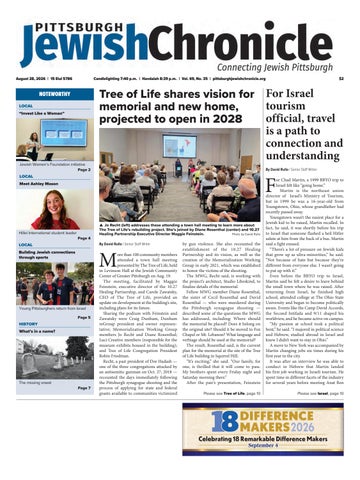
August 28, 2026 | 15 Elul 5786
Candlelighting 7:40 p.m. | Havdalah 8:39 p.m. | Vol. 69, No. 35 | pittsburghjewishchronicle.org
NOTEWORTHY LOCAL “Invest Like a Woman”
Jewish Women’s Foundation initiative
Tree of Life shares vision for For Israel tourism memorial and new home, official, travel projected to open in 2028 is a path to connection and understanding By David Rullo | Senior Staff Writer
Page 2
F
LOCAL
by gun violence. She also recounted the establishment of the 10.27 Healing Partnership and its vision, as well as the creation of the Memorialization Working Group in early 2021, which was established to honor the victims of the shooting. The MWG, Recht said, is working with the project’s architect, Studio Libeskind, to finalize details of the memorial. Fellow MWG member Diane Rosenthal, the sister of Cecil Rosenthal and David Rosenthal — who were murdered during the Pittsburgh synagogue shooting — described some of the questions the MWG has addressed, including: Where should the memorial be placed? Does it belong on the original site? Should it be moved to Fox Chapel or Mt. Lebanon? What language and verbiage should be used at the memorial? The result, Rosenthal said, is the current plan for the memorial at the site of the Tree of Life building in Squirrel Hill. “It’s exciting,” she said. “Our family, for one, is thrilled that it will come to pass. My brothers spent every Friday night and Saturday morning there.” After the pair’s presentation, Feinstein
or Chad Martin, a 1999 BBYO trip to Israel felt like “going home.” Martin is the northeast union director of Israel’s Ministry of Tourism, but in 1999 he was a 16-year-old from Youngstown, Ohio, whose grandfather had recently passed away. Youngstown wasn’t the easiest place for a Jewish kid to be raised, Martin recalled. In fact, he said, it was shortly before his trip to Israel that someone flashed a heil Hitler salute at him from the back of a bus. Martin said a fight ensued. “There’s a lot of pressure on Jewish kids that grow up as ultra-minorities,” he said. “Not because of hate but because they’re different from everyone else. I wasn’t going to put up with it.” Even before the BBYO trip to Israel, Martin said he felt a desire to leave behind the small town where he was raised. After returning from Israel, he finished high school, attended college at The Ohio State University and began to become politically aware. Events like the Camp David Accords, the Second Intifada and 9/11 shaped his worldview, and he became active on campus. “My passion at school took a political bent,” he said. “I majored in political science and Hebrew, studied abroad in Israel and knew I didn’t want to stay in Ohio.” A move to New York was accompanied by Martin changing jobs six times during his first year in the city. It was after an interview he was able to conduct in Hebrew that Martin landed his first job working in Israeli tourism. He spent time in different facets of the industry for several years before meeting Anat Ben
Please see Tree of Life, page 10
Please see Israel, page 10
Meet Ashley Mason
Hillel International student leader
Page 4
LOCAL
Young Pittsburghers return from Israel Page 5
HISTORY What’s in a name?
The missing vowel
p Jo Recht (left) addresses those attending a town hall meeting to learn more about The Tree of Life’s rebuilding project. She’s joined by Diane Rosenthal (center) and 10.27 Healing Partnership Executive Director Maggie Feinstein. Photo by David Rullo By David Rullo | Senior Staff Writer
M
Building Jewish connections through sports
Page 7
$2
ore than 100 community members attended a town hall meeting presented by The Tree of Life, held in Levinson Hall at the Jewish Community Center of Greater Pittsburgh on Aug. 19. The meeting, facilitated by Maggie Feinstein, executive director of the 10.27 Healing Partnership, and Carole Zawatsky, CEO of The Tree of Life, provided an update on development at the building’s site, including plans for its future. Sharing the podium with Feinstein and Zawatsky were Craig Dunham, Dunham reGroup president and owner representative; Memorialization Working Group members Jo Recht and Diane Rosenthal; Luci Creative members (responsible for the museum exhibits housed in the building); and Tree of Life Congregation President Robin Friedman. Recht, a past president of Dor Hadash — one of the three congregations attacked by an antisemitic gunman on Oct. 27, 2018 — recounted the days immediately following the Pittsburgh synagogue shooting and the process of applying for state and federal grants available to communities victimized
Celebrating 18 Remarkable Difference Makers September 4
Headlines JWF ‘Invest like a Woman’ series seeks to spark conversation and financial awareness — LOCAL— By Adam Reinherz | Senior Staff Writer
W
omen traditionally receive lower wages than men, experience greater career interruptions due to childcare responsibilities and are more tasked with caring for aging parents. They also typically have longer lifespans than men. For these reasons, and others, Jewish Women’s Foundation of Greater Pittsburgh is hosting a series of programs for its trustees dedicated to empowering women by bolstering members’ relationships with finances. “We want to bring money out into the open,” Judy Cohen, JWF executive director, said. In 2025, women working full time in the U.S. earned approximately 81 to 83 cents for every dollar earned by men, according to the Economic Policy Institute. Whether conversations concern salaries, spending or investments, money too often remains a taboo topic, Cohen explained. A three-part series, titled, “Invest Like a Woman,” runs this fall and is led by Fern Schwartz and Debbie Graver. The aim, Cohen explained, is to broaden awareness. Schwartz, a managing director and wealth management adviser at the Schwartz Group at Merrill, a Bank of America Company,
p Debbie Graver speaks to JWF trustees.
Photo courtesy of JWF
“Women need to own their power with money and be comfortable talking about it.” –JUDY COHEN and Graver, a partner and chief compliance officer at Signature Wealth, are “two amazing leaders in our community,” who will help bring this topic “out in the open,” Cohen said. JWF hosted a similar program last year,
and was a reminder that its members — JWF refers to members as trustees — needed further education. “I’ve met women through my career that had no idea where their bank accounts were, how their money was managed,
and then a spouse passes and they are scrambling to find passwords for accounts or who their investment adviser is, and that’s a terrible situation to be in,” she said. JWF was founded in 2000 with a goal of creating “lasting social change in the lives of women and girls in the Jewish and general communities.” Each year, JWF awards programmatic and operating grants up to $10,000, as well as Impact grants, for Jewish community organizations, in an amount greater than $10,000 and up to $25,000. Grants are determined collectively by JWF trustees. And, at least 50% of JWF funds are invested each year into the Jewish community, according to the organization. While membership in the group, which starts at an annual $1,000 gift, yields an opportunity to determine grants and meet like-minded community members, there’s also the chance to enjoy meaningful programs. The “Invest Like a Woman” series, Cohen said, is one such example of highquality programming dedicated to the needs of women and girls. “Women need to own their power with money and be comfortable talking about it,” she continued. JWF cares about this issue and “wants to empower women to be able to do that.” PJC Adam Reinherz can be reached at areinherz@pittsburghjewishchronicle.org.
www.pittsburghjewishchronicle.org
5915 Beacon St., 5th Floor Pittsburgh, PA 15217
Main phone number: 412-687-1000
Subscriptions: 412-687-1000, ext. 2 SUBSCRIPTIONS subscriptions@pittsburghjewishchronicle.org 412-687-1000, ext. 2
Jim Busis, CEO and Publisher 412-228-4690 jbusis@pittsburghjewishchronicle.org
TO ADVERTISE advertising@pittsburghjewishchronicle.org 412-687-1000, ext. 1
EDITORIAL Toby Tabachnick, Editor 412-228-4577 ttabachnick@pittsburghjewishchronicle.org
EDITORIAL DEPARTMENT Email: newsdesk@pittsburghjewishchronicle.org BOARD OF TRUSTEES Evan H. Stein, Chair Evan Indianer, Vice Chair Derek Smith, Treasurer Gayle R. Kraut, Secretary Gail Childs, Dan Droz, Malke Steinfeld Frank, Karen Gal-Or, Seth Glick, Judith Kanal, Cátia Kossovsky, Charles Saul, Lynn Zelenski
Adam Reinherz, Senior Staff Writer 412-687-1000 areinherz@pittsburghjewishchronicle.org David Rullo, Senior Staff Writer 412-687-1000 drullo@pittsburghjewishchronicle.org ADVERTISING Amy Weiss, Account Executive (412) 613-0697 aweiss@pittsburghjewishchronicle.org
PRODUCTION Jeni Mann Tough Production Manager Carl Weigel Art/Production Coordinator Subscriptions subscriptions@pittsburghjewishchronicle.org 412-687-1000, ext. 2 Published every Friday by the Pittsburgh Jewish Publication and Education Foundation 5915 Beacon St., 5th Floor Pittsburgh, PA 15217 Phone: 412-687-1000 POSTMASTER: Send address change to PITTSBURGH JEWISH CHRONICLE, 5915 BEACON ST., 5TH FLOOR PITTSBURGH, PA 15217 (PERIODICAL RATE POSTAGE PAID AT PITTSBURGH, PA AND AT ADDITIONAL MAILING OFFICES) USPS 582-740
Manuscripts, letters, documents and photographs sent to the Pittsburgh Jewish Chronicle become the property of this publication, which is not responsible for the return or loss of such items. The Pittsburgh Jewish Chronicle does not endorse the goods or services advertised or covered in its pages and makes no representation to the kashrut of food products and services in said advertising or articles. The publisher is not liable for damages if, for any reason whatsoever, he fails to publish an advertisement or for any error in an advertisement. Acceptance of advertisers and of ad copy is subject to the publisher’s approval. The Pittsburgh Jewish Chronicle is not responsible if ads violate applicable laws and the advertiser will indemnify, hold harmless and defend the Pittsburgh Jewish Chronicle from all claims made by governmental agencies and consumers for any reason based on ads appearing in the Pittsburgh Jewish Chronicle.
GENERAL COUNSEL Stuart R. Kaplan, Esq.
2
AUGUST 28, 2026
PITTSBURGH JEWISH CHRONICLE
PITTSBURGHJEWISHCHRONICLE.ORG
Headlines CMU professor leads research project for Dept. of Energy’s Genesis Mission — LOCAL — By David Rullo | Senior Staff Writer
F
or Rachel Mandelbaum, Carnegie Mellon University’s work with the Genesis Mission is a natural fit. Mandelbaum is the department head and a professor in the university’s astrophysics and cosmology department. The Jewish scientist is the lead in one of three Genesis Mission research projects awarded to CMU last month by the Department of Energy. As part of the Genesis Mission-funded project to help scientists use artificial intelligence to better understand the universe, researchers at CMU are partnering with the University of Washington in collaboration with the U.S. Department of Energy’s SLAC National Accelerator Laboratory. “We have a tradition of collaboration between people working in AI and computer science, with people working in a variety of scientific domains like astrophysics,” Mandelbaum said. The research, she said, will span nine months, a period Mandelbaum classified as “quite short.” It’s part of the Genesis Mission’s Phase 1 projects. The hope is that after completing this Phase 1 project, CMU will also be involved in a Phase 2 project, which will last three years and is meant for teams that are three to five times larger than the ones currently working on CMU’s Genesis Mission research. As for the research Mandelbaum and her team are doing, she said, it has to do with being able to efficiently share large volumes of data. “Imagine that a team says we’re going to use this telescope for five years to look at the sky and study something,” she said. “The survey team, the observatory, has to decide how they are going to provide this data for people to carry out scientific analysis. Each observatory or team generally considers this question in isolation.” If a researcher wants to use an AI method to learn something from data collected by several different teams, using as much information as possible, she explained, there is a need for a common format, so all the data can be used and understood efficiently. “Our team is working on data infrastructure that is going to make it easier for researchers to apply AI to data from multiple sky surveys,” Mandelbaum offered. “We’re not carrying out the scientific analysis of that data. We’re producing tools that researchers will be able to use for their analysis and especially their application of AI tools to the data.”
p CMU professor Rachel Mandelbaum is leading a nine-month Genesis Mission research project the university was awarded in July. Photo by David Rullo
“I am fundamentally driven by wanting to do some science and data infrastructure is a steppingstone to that.” –RACHEL MANDELBAUM The scientific community’s data infrastructure is sometimes a limiting factor to what it can do, she said. Mandelbaum’s analogy is a person who looks through a telescope at the sky for one night and gets many images. They can download that to their computer, go home and analyze the data. But a survey of the sky every 30 seconds for 10 years is unable to fit on a laptop, making it more difficult to analyze. CMU’s research for the Genesis Mission will allow the scientific community to look at that large data, from multiple cosmic surveys at once, in the most efficient way. CMU’s involvement with the Genesis Mission, Mandelbaum said, is a great opportunity for the university to play a leading role in the science that comes from a new generation of sky surveys coming online now. “The Rubin Observatory’s Legacy Survey of Space and Time, a 10-year survey that started in June, 2026 — NASA is going to launch the Nancy Grace Roman Space Telescope that is going to start a survey,” Mandelbaum said. “That launch is Aug. 30. We have a lot of exciting things that are starting up. Thousands of astronomers are going to use this data and to be part of the
team that’s providing them with the tool that will actually let them do the science with all these data sets together. It’s a huge opportunity from the impact of this one nine-month project.” Because of its work with projects like the Genesis Mission, Mandelbaum said, CMU is one of the premier schools for astrophysics. In fact, her department recently launched a new doctorate program in astronomy and astrophysics, with the first admission cycle in the fall of 2025. “We had a huge volume of applications for that program,” she said. “It was highly selective and we were very successful in recruiting our top picks. Half the offers we made for admission were accepted.” And while 50% might not typically seem very high, Mandelbaum said it’s incredibly high in admission yields. “Two of those incoming students won graduate research fellowships from the Natural Science Foundation, which are highly selective,” she said. The department, she noted, has also found success recruiting strong post-doctoral fellows and faculty in astrophysics “because the work and the environment is so compelling.”
The Gensis Mission is a national initiative to build the world’s most powerful scientific platform to accelerate discovery science, strengthen national security, and drive energy innovation, according to the Department of Energy. Its goal is to develop an integrated platform that connects the world’s best supercomputers, experimental facilities, AI systems, and unique datasets across every major scientific domain to double the productivity and impact of American research and innovation within a decade. It was launched in November 2025 by an executive order. For Mandelbaum, the opportunity to work on the Genesis Mission as part of CMU is exciting. As a scientist though, it’s the result that is most thrilling. “I am fundamentally driven by wanting to do some science and data infrastructure is a steppingstone to that. It’s not the end game. I’m excited that the data infrastructure will let a lot of people do their own science, and they’re going to do so many different things with these data sets, and that’s amazing,” she said. PJC David Rullo can be reached at drullo@ pittsburghjewishchronicle.org.
www.pittsburghjewishchronicle.org PITTSBURGHJEWISHCHRONICLE.ORG
PITTSBURGH JEWISH CHRONICLE
AUGUST 28, 2026
3
Headlines Pitt student Ashley Mason to serve as Hillel International student leader — LOCAL — By Adam Reinherz | Senior Staff Writer
A
shley Mason’s nearly three years in Oakland have yielded valuable insights on campus life at the University of Pittsburgh. This year, the Hillel at Pitt president will share her knowledge with Hillel International executives and fellow students across the country. As one of approximately 20 members of the Hillel International Student Cabinet, Mason, 21, will spend the year partnering with others to develop strategies to engage students, bolster programming and increase Israel education, she told the Chronicle. Working with fellow student leaders and Hillel International executives presents multiple opportunities. For starters, joining the cabinet is a chance to “share what’s happening on my campus — give the kind of Pittsburgh Jewish experience and perspective,” she said. “Pitt’s campus is really special. We have a pretty interconnected Jewish community here in Pittsburgh.” Mason, originally from Columbia, Maryland, pointed to the Hillel JUC and Chabad at Pitt relationship. “We are very lucky here at Pitt that we have a really positive, grounded, connected relationship with Chabad,” she said. “I know that’s not the experience on a lot of campuses.” Mason, who is studying early childhood
p Ashley Mason will serve as a Hillel International student leader.
Photo courtesy of Ashley Mason
p University of Pittsburgh student Ashley Mason, second from right, joins Hillel JUC peers in Oakland. Photo courtesy of Ashley Mason
and special education, called her university a model of “what a truly interconnected Jewish community on campus can look like,” and said she’ll share that sentiment during a multi-day summit in Washington, D.C., as well as through regular Zoom meetings with cabinet members. Organizational ties, however, are not the only college takeaway Mason plans to share. “We at Pitt — in my time as a student — have especially since Oct. 7 seen a lot
of protesting and a lot of misinformation going on around campus,” she said. In the face of adversity, Hillel JUC has continuously aimed to support students “in all the different, various ways that Judaism can look as a young adult.” As much as Mason is looking forward to sharing Pitt’s story, she said she is excited to learn “even more about how we can best support our students.” The desire, she said, is driven by a “jarring” question that has been repeatedly raised by several of her peers: Given world affairs, “and all of the threats or the risk — is being Jewish worth it?” That question cannot be ignored, Mason said. “If a student on our campus feels that way, we are not doing enough as Hillel to make this a space for them.” By serving on the Hillel International Student Cabinet, “I can go to the top and we can address the things that we are doing.” Mason’s goal is to see campuses where “we are doing the absolute most to support our students,” she said. “That is really important to me.” Dan Marcus, Hillel JUC’s executive director and CEO, said he’s proud of Mason’s commitment to “bringing Jewish student life to every Jewish student.” What she’s accomplished as a student leader is “outstanding,” and “we look forward to
“Pitt’s campus is really special. We have a pretty interconnected Jewish community here in Pittsburgh.” –ASHLEY MASON her bringing all that she learns back to Hillel JUC.” Since learning of her acceptance to the national role several months ago, Mason has received considerable praise. In response to the comments, she hopes people understand that it’s “not all a reflection of me,” she said. Whether it’s the students who elected her to various leadership positions or staff who pushed her to pursue national opportunities, “I owe a lot of my experience, and my strength and security in my Jewish identity, to the people in the Pittsburgh Jewish community,” she said. Representing Pitt and serving as a national Jewish student leader is “just a reflection of the people that have been working with me.” PJC Adam Reinherz can be reached at areinherz@pittsburghjewishchronicle.org.
STORIES COME TO life HERE. Connect with Pittsburgh Jewish Chronicle.
In your mailbox or all the time online at pittsburghjewishchronicle.org 5915 Beacon Street, 5th Floor, Pittsburgh, PA 15217 4
AUGUST 28, 2026
PITTSBURGH JEWISH CHRONICLE
PITTSBURGHJEWISHCHRONICLE.ORG
Headlines Pittsburgh teens return from Israel Maccabiah Games with new friends and appreciation — LOCAL — By Adam Reinherz | Senior Staff Writer
S
eeking competition and camaraderie, several young Pittsburghers visited Israel and participated in the Maccabiah Games, an Olympic-style event held quadrennially in the Jewish state. Now back in Pittsburgh, the teens have repeatedly told friends and family about their travels as well as the importance of visiting Israel and connecting with other Jews. “It was just amazing,” Kimi Smuckler, 15, said. “I won’t waste the chance to talk about how great of an experience it was.” What made it so memorable, according to Jonny Balk, 18, was that there were two facets to the trip: sports and touring. “Both were amazing for separate reasons,” he said. Fellow soccer player, Benji Smuckler, 17, agreed. Apart from competing against so many talented athletes, the June 30-July 14 experience afforded a chance to explore, he said. “Even when we had games, our coaches
would find ways and time for us to just get out of the hotel, take a 30-minute bus ride, and go look at the beach or go surfing.” Along with visiting the Dead Sea and Western Wall, meaningful time was spent introducing athletes to Israel post-Oct. 7, Jonny said. Stops at the Nova Music Festival Memorial and T’kuma — where vehicles recovered from the Oct. 7 attacks are preserved — contextualized Oct. 7 and reinforced the “importance of remembering those affected,” according to organizers. Kimi, a soccer player, said she was supposed to visit Israel with Community Day School two years ago as part of an eighth grade graduation trip, but the tour was canceled due to war. The inability to travel then was part of the impetus for going now, she said. “Getting to go to Israel and seeing everything and meeting new people was just really important.” Fellow soccer player Lital Friedman, 15, said that being in Israel last month facilitated new relationships and understandings. Making friends with fellow teens from Switzerland, Costa Rica, Brazil,
p Jonny Balk and Benji Smuckler
Photo courtesy of Marshall Balk
Great Britain, Slovakia and “Israel, of course,” yielded an awareness that “we’re all connected, even though we observe Judaism in different ways.” The realization is one the Squirrel Hill resident hopes more Pittsburghers achieve — even if they never kick a ball
p Kimi Smuckler competes. Photo courtesy of Marshall Balk
Lombardo Concrete, established in 1989, Fully Insured - inWe Do All! specializes and excels all types of It residential Fully Insured We Do It All! concrete work: and decorative • Stamping • Flagstone Patios • Exposed Aggregate • Floors • Colored Staining • Foundation Masonry • Sealing • Footers • Brick & Block Walls • Laying Stone • Dry • Sidewalks Lay
• Driveway Construction • Steps
Fully Insured - We Do It All!
or board a plane. “Israel connects Jews from all over the world,” Lital said. “It brings them together, especially the youth.” PJC Adam Reinherz can be reached at areinherz@pittsburghjewishchronicle.org.
PLAN AHEAD:
Protect Yourself and Your Loved Ones – Your Way We provide expert help with long term care planning, powers of attorney, wills, trusts and special needs. We help you implement legal and tax strategies to protect your wealth during your life and afterwards.
Fully Insured - We Do It All!
Fully Fully FullyInsured Insured Insured---We We WeDo Do DoItItItAll! All! All!
mhm@ahmpc.com 4927 William Flinn Highway Allison Park, Pennsylvania 15101 We make house calls!
Fully Insured - We Do It All!
Fully Insured - We Do It All!
PITTSBURGHJEWISHCHRONICLE.ORG
www.pittsburghjewishchronicle.org PITTSBURGH JEWISH CHRONICLE
AUGUST 28, 2026
5
Calendar Submit calendar items on the Chronicle’s website, pittsburghjewishchronicle.org. Submissions also will be included in print. Events will run in the print edition beginning one month prior to the date as space allows. The deadline for submissions is Friday, noon.
mini golf, basketball and the gaga pit; 2 to 6 p.m. Individual members: $10 each; children 10 and younger are free. A la carte members and nonmembers: $12 each. Goldstein Pavilion at the JCC Family Park, 261 Rosecrest Drive, Monroeville, PA. treeoflifepgh.org
q SUNDAY, AUG. 30 Join Chabad of the South Hills for a trip to Jewish New York. Visit the Rebbe’s resting place and Chabad world headquarters; take part in a Crown Heights tour. Enjoy shopping and a meal at a delicious kosher restaurant. Fly roundtrip to New York City. 7 a.m. to 7 p.m. $125. chabadsh.com/jny
q SUNDAYS, AUG. 30–DEC. 20 Join Chabad of Squirrel Hill for its Men’s Tefillin Club. Services and tefillin are followed by a delicious breakfast and engaging discussions on current events. 8:30 a.m. 1700 Beechwood Blvd. chabadpgh.com
Tree of Life Congregation and Rabbi Hannah Estrin invite you to pay your respects to the dearly departed during their Kaver Ovot service at Memorial Park Cemetery. 10 a.m. to noon. Memorial Park Cemetery, 2062 Reis Run Road, Franklin Park, PA. treeoflifepgh.org Pay your respects to those who have passed at the Pliskover Cemetery Memorial Day (Kever Avot) ceremony. Sara Stock Mayo will assist with graveside prayers. 10 a.m. to noon. Pliskover Cemetery, Green Oaks Drive, Kennedy Township, PA. pliskover.com Join Tree of Life Congregation for an afternoon of food and family fun at its end-of-summer picnic. Guests will have complete access to the pool,
Join a lay-led online Parashah study group to discuss the weekly Torah portion. No Hebrew knowledge needed. The goal is to build community while deepening understanding of the text. 8:30 p.m. For more information, visit bethshalompgh.org/online-parashah. q TUESDAYS, SEPT. 1–DEC. 22 Join Beth El’s Rabbi Alex Greenbaum and his Bible/Talmud Adult Education class for a thought-provoking weekly session of Bible and Talmudic study. This program is available both in person and virtually. Call the office at 412561-1168 to receive the Zoom link or to make an in-person reservation. 10:30 a.m. 1900 Cochran Road. bethelcong.org q WEDNESDAY, SEPT. 2 Join Beit Kulanu for Biblical Garden Open Door
Wishing you a sweet and joyful New Year 5787! Rosh Hashahah 5787 • Publishes Sept. 11 Greeting Deadline Sept. 4 Wishing you a sweet and joyful New Year 5787!
#1
Names here
Names here
1/16–$125
#2
1/16–$125
5787
5787
WE STAND WITH ISRAEL In the new year, may you be blessed with peace, love and happiness. Names here Names here
#3 1/8–$170
5787
#4
1/8–$170
5787
Together we survive.
WE STAND WITH ISRAEL
Together we find strength and seek peace. Together we make the world better and life sweeter.
Names here Names here
#5
#6
1/4–$200
1/4–$200
5787
5787
Join Chabad of the South Hills for a pre-High Holiday seniors’ lunch. Enjoy a delicious lunch with honey cake, a holiday program and presentation on “Are You Lost in the Senior Living Jungle?” Wheelchair accessible. 1 p.m. $5 suggested donation. 1701 MacFarland Road. chabadsh.com q WEDNESDAYS, SEPT. 2–DEC. 23 Explore the weekly Torah portion with the mystical and interpersonal lens of the Hassidic rabbis with Rabbi Mark Asher Goodman. Hassidut for the People is a fun and engaging class taught online and in person meant to help learners find deeper meaning in Torah and in themselves. All levels welcome. 10 a.m. $5. Shoresh PGH, 4300 Murray Ave. Contact rabbimark@shoreshpgh.org for more information. shoreshpgh.org/class-schedule-and-events q THURSDAY, SEPT. 3 Rendezvous in Beit Kulanu’s Biblical Botanical Garden with drinks and hors d’oeuvres for a free Summer Garden Concert with the Jake Epstein Trio. Apps start at 6:30 p.m. and music from 7 to 8:30 p.m. The concert is free but registration is required. 4905 Fifth Ave. BeitKulanu.org q SUNDAY, SEPT. 6 All kids are invited to a Pre-Rosh Hashana Challah
Bake, where they will make and braid their own challah to take home and enjoy entertainment by juggler Howard Mincone. 2:30 to 4 p.m. $10/child. Chabad of Squirrel Hill, 1700 Beechwood Blvd. chabadpgh.com/kidscooking q TUESDAY, SEPT. 8 Join StandWithUs for its Community Reception at 6 p.m., honoring Lou and Amy Weiss, and Marjorie Manne. Register at standwithus.com/ events/pgh-2026/. Venue shared after RSVP. q THURSDAY, SEPT. 10 Join the Holocaust Center of Pittsburgh for an evening with local Holocaust survivor Irene Skolnick as she shares her story of resilience. 6:30 p.m. Chatham University’s Eddy Theatre. 1157 Murray Hill Ave. Register at hc-irene. eventbrite.com. q TUESDAY, SEPT. 15-17 Rooted in the aftermath of the deadliest antisemitic shooting in the United States, the Eradicate Hate Global Summit has grown to become the world’s most comprehensive, multidisciplinary conference to prevent hatefueled violence, convening people committed to building relationships and forging solutions to address this growing issue. $150-$325. David L. Lawrence Convention Center, 1000 Fort Duquesne Blvd. To learn more about the summit, see the full agenda, and register, visit eradicatehatesummit.org. PJC
Join the Chronicle Book Club!
T
he Pittsburgh Jewish Chronicle invites you to join the Chronicle Book Club for its Aug. 30 discussion of “As a Jew: Reclaiming Our Story from Those Who Blame, Shame, and Try to Erase Us – A Defiant Memoir of Heritage, Identity, and Antisemitism,” by Sarah Hurwitz. A New York Times bestseller, “As a Jew” is an “urgent exploration of how antisemitism has shaped Jewish identity and how Jews can reclaim their tradition, by the celebrated White House speech-writer and author of the critically acclaimed ‘Here All Along,’” according to Amazon.com. “In As a Jew, Hurwitz documents her quest to take back her Jewish identity, how she stripped away the layers of antisemitic lies that made her recoil from her own birthright and unearthed the treasures of Jewish tradition. With antisemitism raging worldwide, Hurwitz’s defiant account of reclaiming the Jewish story and learning to live as a Jew, without apology, has never been timelier or more necessary.”
What to do
Buy: “As a Jew.” It is available from online retailers, including Amazon and Barnes & Noble, and in some area Barnes & Noble stores. It is also available through the Carnegie Library system. Email: Contact us at drullo@pittsburghjewishchronicle.org, and write “Chronicle Book Club” in the subject line. We will send you a Zoom link for the discussion meeting. Happy reading! PJC
Your hosts
Names here
Names here
Tour: Free, docent-led tour of the congregation’s Biblical Botanical Garden the first Wednesday of the month. 12:15-1 p.m. Free. 4905 Fifth Ave. rodefshalom.org/garden
Toby Tabachnick, Chronicle editor David Rullo, Chronicle senior staff writer
#8
#7 1/2–$375
5787
1/2–$375
5787
Choose from one of the ads shown or have us customize your greeting (add $15 to ad cost). For more information, call Amy Weiss at 412-613-0697 or email aweiss@pittsburghjewishchronicle.org
How it works
We will meet on Zoom on Sunday, Aug. 30, at 1 p.m.
www.pittsburghjewishchronicle.org 6
AUGUST 28, 2026
PITTSBURGH JEWISH CHRONICLE
PITTSBURGHJEWISHCHRONICLE.ORG
Headlines
412-421-1015 412-421-4450 FAX 412-421-4451
1916 MURRAY AVE. PITTSBURGH, PA 15217
The missing vowel
PRICES EFFECTIVE SUNDAY, SEPTEMBER 7, 2025 – FRIDAY, SEPTEMBER 12, 2025 Candle Lighting Time Friday, August 21, 2026 • 7:51 p.m.
STORE HOURS
Sunday • 8 a.m. – 6 p.m. Monday • 8 a.m. – 6 p.m. Tuesday • 8 a.m. – 6 p.m.
Wednesday • 8 a.m. – 6 p.m. Thursday • 8 a.m. – 8 p.m. Friday • 8 a.m. – 3 p.m.
SPECIALS YEHUDA GEFILTE FISH SWEET OR REGULAR
8.99
$
MANISCHEWITZ. MATZO BALL OR MATZO BALL & SOUP MIX $ .09
YAHRZEIT CANDLE TINS
1
$ .09
.6
1
.6
.6
WINES
9
19
$ .99 JEUNESSE WHITE WINES 750 ML p The Troy Hill Cemetery in Reserve Township is the oldest Jewish communal property in western Pennsylvania, established in 1847. Photo courtesy of Rauh Jewish Archives
— HISTORY — By Eric Lidji | Special to the Chronicle
D
r. Adam Shear told me he once puzzled over the term “Balt Filler” in old records. What is balt? How do you fill it? Then, it clicked. It meant to say Baal Tefilah, a prayer leader. This gets to a challenge of Jewish words. Often we know what we mean but don’t know what we’re saying. Throughout my childhood, I thought Haftarah was spelled “Half Torah.” It made a lot of sense to me. It was a lot shorter than the “full” Torah reading. Some confused transliterations are good for a laugh, but sometimes they matter. In the summer of 1847, a group of Jewish men acquired property in Reserve Township for a cemetery. It was the first Jewish communal asset in western Pennsylvania. For more than 150 years, this cemetery has been known as Bes Almon. What do those two words mean? Bes is clearly “Beit,” which means “house of.” What is an “Almon?” In August 1854, the American Israelite newspaper in Cincinnati published a short history of the Jewish community of Pittsburgh, written by Leopold Jaroslawsky. It begins, “In 1847 a Beth Olam Society was founded in this city by twelve Jewish residents.” Beth Olam means “House of Forever.” The phrase “Beit Olamo” appears in Ecclesiastes 12:5, “And the caper bush may bud again, but mortals set out for their eternal home.” A literal translation is limited. Hebrew uses a “construct state” to create words. A Beit Ha-Sefer isn’t a House of the Book. It’s a school. A Beit Olam is a cemetery. At its conception in 1847, the Bes Almon Society may have just been a generic name: “cemetery society.” When it incorporated in 1867, this generic name became a legal name. Only they took a different spelling. They used “Bes Almon,” not “Beth Olam.” The meaning is the same, but the language is different. “Bes almin” transliterates the Yiddish term for cemetery. “Beth Olam” transliterates the Hebrew term for cemetery. I don’t know whether Leopold Jaroslawsky actually wrote the words “Beth Olam” or whether editor Rabbi Isaac Mayer Wise took the liberty of adapting the original letter. I suspect the latter. PITTSBURGHJEWISHCHRONICLE.ORG
Throughout the mid-19th century, Western scholars were developing systems for transliterating Hebrew scripture into Latin characters. By the early 1820s, some scholars were adding an aspirate “h” to six Hebrew letters with dual pronunciations. The Hebrew letter “tav” was now spelled “th” in certain cases. And so “Bes” became “Beth.” The German-born Wise uses this convention throughout his memoirs. Jaroslawsky was an immigrant from PolandLithuania who most likely would have defaulted to Yiddish. Let’s say Jaroslawsky actually wrote, “In 1847 a bes-almin society was founded.” If Wise in fact decided to transliterate the word “bes” as “Beth,” according to the Hebrew pronunciation, it would have made sense to translate “almin” into Hebrew as “olam.” This gets to another question. Why did they name it Bes Almon and not Bes Almin? One of the men who purchased the cemetery property in 1847 was William Frank. He handwrote a memoir in 1889. In our copy, he spelled the name “Besalomon.” In Yiddish, “almin” is spelled: ayinlamed-mem-yud-nun. I take Frank’s extra “o” to reflect the “schwa” vowel sound on the lamed. As far as the second “o,” perhaps it reflected Frank’s particular accent. I know people who pronounce “almond” as “almend.” Or maybe it’s not an “o.” Frank’s penmanship is loose. It could be “o,” an “e,” or an “a.” William’s son Isaac translated the memoir into English. Charles Cooper reprinted this translation for an article in the Jewish Criterion in 1918, spelling it “Bes-Almen.” Julia Miller used the same translation for an article in 1929, but she spelled it “Bes Almon,” perhaps relying upon the name of the organization from its 1867 incorporation filing. Dr. Jacob Rader Marcus included Isaac Frank’s translation in the second volume of his book “Memoirs of American Jews, 1775-1865,” published in 1955. He spelled it “Bes Almon.” In the years preceding publication, he made an effort to track down the original German but was unsuccessful. That same year, a Jewish community history published in the Pittsburgh Press used “Bes-Almen,” likely using Cooper’s history as its source.
CARDOVA RIOJA $ .99 CRIANZA OR 750 ML GARNACHA
WEEKLY SPECIALS BODEK OR B'GAN BROCCOLI FLORETS $ .99
SHOR HABOR LEAN PASTRAMI $ .99
CHICKEN LIVER AND ONIONS $ .99
B'GAN GARLIC CUBES $ .99
EMPIRE SMOKED TURKEY $ .99
$
BAKER'S CHOICE SESAME SEEDS $ .59
OIL CURED OLIVES $ .99
CABBAGE AND NOODLES $ .29
MARINATED EGGPLANT $ .99
JUMBALAYA WITH KIELBASA $ .99
8
2
3
24
24 OZ
9
EA
7
EA
HONEY BEARS $ .09
1
8
12 OZ
LB
LB
LB
LB
16
LENTIL SOUP .99
11 3
QT
LB
8
ROSH HASHANAH MENU MAIN DISH BRISKET SINGLE ROASTED CHICKEN LEG ROASTED CHICKEN BREAST SHERRY MUSHROOM CHICKEN BONELESS BREAST ROASTED TURKEY BREAST HALF ROASTED TURKEY LEG (DRUM & THIGH) STUFFED CABBAGE # OF PIECES STUFFED BONELESS TURKEY BREAST
APPETIZERS GEFILTE FISH CHOPPED LIVER MOROCCAN TILAPIA SOUPS CHICKEN SOUP CHICKEN NOODLE SOUP MUSHROOM BARLEY SOUP MATZO BALLS KREPLACH SIDE DISHES KASHA AND BOWS CARROT AND PRUNE TZIMMES FARFEL AND MUSHROOMS GLAZED BABY CARROTS ROASTED VEGETABLES POTATO KNISH WILD RICE & CRANBERRIES
KUGELS POTATO KUGEL NOODLE KUGEL APPLE KUGEL ZUCCHINI KUGEL GLUTEN-FREE POTATO KUGEL
ORDER DEADLINE IS FRIDAY SEPTEMBER 4, 2026 HOMEMADE SALADS & SOUPS DELI PARTY TRAYS
Please see Vowel, page 11
PITTSBURGH JEWISH CHRONICLE
We Prepare Trays
CATERING SPECIALISTS DELICIOUS FRIED CHICKEN
UNDER THE SUPERVISION OF VAAD OF PITTSBURGH
WE RESERVE THE RIGHT TO LIMIT QUANTITIES.
— for All Occasions —
AUGUST 28, 2026
7
Headlines A Jewish federation had big plans for a community campus. Then the money ran out. — REGIONAL — By Grace Gilson | JTA
W
hen the Jewish federation in Harrisburg, Pennsylvania, laid off its entire support staff earlier this month, the move didn’t come as a surprise. Instead, it felt like an inevitable next step in an inexorable trajectory of decline that has unfolded in public over the course of months, upending the infrastructure that had long organized Jewish communal life in the state capital. The slow-rolling collapse in Harrisburg, which has roughly 9,000 Jews in the city area, has included the closure of programs, the displacement of Jewish institutions and the planned sale of the Alexander Grass Campus for Jewish Life, which was purchased by the federation for $4.5 million in 2022 and envisioned as a hub for Jewish life in central Pennsylvania. The downfall has also featured an unusual intervention by Jewish Federations of North America, the umbrella organization for 141 local federations that usually work highly independently. JFNA dispatched a former federation leader to help the Harrisburg Federation make hard financial decisions as it became clear its situation was not sustainable. “While well-intentioned, there were clearly mistakes made that have set back Jewish life in Harrisburg and caused distress and division,” JFNA’s president and CEO, Eric Fingerhut, wrote in a letter to the community in April, in which he called the local federation’s business model “not viable.” At the time, Fingerhut expressed optimism that the situation could turn around, writing, “Despite all that has transpired in recent years, I am confident the members of the Greater Harrisburg community can come together to repair what has been broken and build a bright future.” Four months later, that optimism is being tested as Harrisburg’s Jewish residents have watched core functions of the local federation evaporate. Gila Ogle, the head of the Silver Academy, a Jewish day school in Harrisburg, said there was a “deep desire to ensure a vibrant future for Jewish life in Harrisburg,” but lamented that there is no longer a local Jewish federation to support it. “What people are saying is, ‘Well, now what’s our opportunity? How can we come together?’” she said. The Silver Academy officially learned in June that it could no longer be housed in the Grass Campus, Ogle said. The school will open this fall in the educational wing of Beth El Temple, a Conservative synagogue in Harrisburg. The synagogue is also hosting senior programs previously operated by the JCC. Ogle said the school had seen a small decline in enrollment over the past year, a trend she attributed to the “unsettlingness of the whole situation” for families. “Families have a lot of concerns, and I 8
AUGUST 28, 2026
p The Alexander Grass Campus for Jewish Life in Harrisburg, Pennsylvania Google Streetview
think that’s fair,” Ogle said. “We’ve really done our best to communicate transparently and keep families looped in and part of the process, but it is hard.” The Silver Academy was not the only institution housed on the Grass Campus that was hurt by the Harrisburg federation’s downfall. When Rebecca Anzel first heard about the looming closure of her 3-year-old daughter’s preschool in April, she was “shocked and confused.” Her daughter attended the Brenner Family Early Learning Center, which shut down on May 1, just over a week after Anzel and other families were informed of its closing. The preschool has no plans for reopening. “I was devastated for my daughter, because I was worried about what that would do for her development and progression,” Anzel said at the time. Now, as the federation’s collapse enters its final stages, the institutions it once supported are beginning to chart a future without it. “It wasn’t that the Harrisburg Jewish community failed; it was that the business construct, the model, was failing and was faulty,” said Marc Terrill, the former head of the Jewish Federation of Baltimore, whom the national organization dispatched to Harrisburg to help the local federation deal with its finances. “They recognized that this isn’t the end to Jewish life in Harrisburg. They want very much a reset in putting together a financial, an organizational, construct that is more similar to what the most thriving Jewish communities in North America have.” The abrupt closure of the campus comes as Jewish institutions increasingly rethink the necessity of large physical hubs amid rising operational costs and shifting demographics. While closures on the scale of Harrisburg’s are rare, in 2022, the Jewish Federation of New Mexico collapsed following a spate of bitter legal and boardroom battles and a widening financial crisis. For some in Harrisburg, the federation’s short-lived experiment with the 6.4-acre campus underscored the need to pursue a more flexible model of community building.
Terrill pointed to the purchase of the Grass Campus as the pivotal decision in the federation’s unraveling. “What’s been called into question is the business model,” said Terrill. “That wrapped around a number of things, but really, the thing that was the large decision that became existential was the purchase of the Grass campus.” Rabbi Ariana Capptauber, the former leader of Beth El Temple and ex officio member of the Harrisburg federation’s board, said that she hoped the sale of the campus could serve as a turning point for the local Jewish community to reexamine how it organizes and sustains Jewish communal life. If these developments serve as “a wake-up call” that lead to a more creative use of the community’s resources, Capptauber said, “then it could be really good.” The financial strain surrounding the campus had been mounting for years. While the federation had a net income of $2.9 million in 2023, according to public tax filings, in 2024, the organization operated at a $3.3 million deficit. Sam Levine, a member of the federation’s transition committee, told The Burg in May that expenses to run the campus were “considerably higher than anticipated,” adding that the organization was also “depending on some donations, which unfortunately did not materialize.” Since the property was purchased, the mortgage for the Alexander Grass Campus had risen to $9 million, Jeanette Krebs, a member of the federation’s transition committee, told Penn Live. “We are continuing to work through a debt elimination strategy which includes monetizing real estate. Much remains to be seen regarding how things will turn out,” Krebs told JTA in an emailed statement. “I think there are several things that we can all agree on in Harrisburg. Most importantly, that there is a future, people care deeply and we are committed to learning from our mistakes.” Parents and other stakeholders said they learned little about the looming crisis before
PITTSBURGH JEWISH CHRONICLE
programs began shutting down. For Anzel, the lack of communication compounded the distress of losing her daughter’s preschool. “We have not been given any sort of explanation at all other than major donors fell through, and so now we’re sort of left to try to fill in the blanks ourselves,” Anzel said. Dana Ray, another parent at the Early Learning Center who organized a letter signed by parents calling on the federation to preserve the center, said that the prevailing sentiment among parents at the school had been “anger and sadness.” Terrill said that there had also been a divide within the community over the initial move to the Grass Campus. “There were some people that were very anti-campus,” Terrill said. “They thought that there was a different way to go, and ultimately a decision was made to go, and that had certain implications for it.” Levine, the transition committee member, told local outlets that the federation is not planning to file for bankruptcy in hopes that local donations and the sale of the campus will help buoy the organization as it faces roughly $500,000 worth of debt on top of a large outstanding mortgage. For Terrill, the “cautionary tale” of the collapse of the Harrisburg Federation was that there’s “no substitute for building community consensus, effective governance, and effective planning.” The federation’s transition committee, which was announced by Fingerhut in April, has held roughly 200 conversations and listening sessions with community members as it charts what comes next. “In a nutshell, the business plan, if you could call it that, was very reactionary,” Terrill said. “What they’re looking to put in place in response to lessons learned is an approach that’s quite different. That is linked to transparency, to financial discipline, to right-sizing, to community input.” But as the Harrisburg federation begins selling off the campus that was intended to secure its future, local rabbis and parents say the federation’s unraveling has meant the loss of a central part of the local Jewish community’s infrastructure. “It kind of makes me sad that now we’re sort of forced to leave this really, really lovely, vibrant Jewish community where she’s learning and actually retaining information about Judaism,” Anzel said of her daughter, who is now enrolled in a different preschool. “I don’t know where else she’s going to get that, and I’m really sad.” Rabbi Tzvia Jasper, the senior rabbi of Temple Ohev Sholom, said that while many were “understandably upset” by the situation, it had also given way to a new sense of community. “It’s certainly a really devastating time for our community, but in the same vein, I think there’s a lot of anticipation for what this new moment is going to bring,” Jasper said. “With any big change like this, comes the opportunity for creativity and innovation to sort of rethink and restructure the community and find out what the needs truly are.” PJC PITTSBURGHJEWISHCHRONICLE.ORG
Headlines — NATIONAL — Remains of last Israeli soldier missing from First Lebanon War’s Sultan Yacoub battle found
The remains of Yehuda Katz, the last Israeli soldier still missing from the 1982 Battle of Sultan Yacoub during the First Lebanon War, have been recovered after 44 years, the Israeli military said last week, bringing to a close one of the country’s longest-running missing soldier cases, according to a JTA report. Katz, a 22-year-old tank gunner and yeshiva student who disappeared just 10 days before he was due to complete his military service, was one of three soldiers whose fate was unknown for decades after Israeli forces became trapped by Syrian troops in Lebanon’s Bekaa Valley on June 11, 1982. Twenty Israeli soldiers were killed and dozens more were wounded in the battle, with six initially listed as missing. Three were later returned or confirmed dead, leaving Katz, Zachary Baumel and Zvi Feldman as the only soldiers whose fate were unknown. The remains of Baumel and Feldman were recovered in separate operations in 2019 and 2025. Katz’s remains were located during a special overnight operation carried out by the IDF in cooperation with Mossad and based on intelligence obtained in recent months. They were returned to Israel and military representatives informed Katz’s family of the discovery. Katz had studied in the Hesder program at
Yeshivat Kerem B’Yavneh, combining Torah study with military service. He had planned to become a rabbi and teach at a yeshiva after completing his military service. On the night before the battle, Katz gathered fellow soldiers around him and taught them Maimonides’ laws governing the conduct of Jewish soldiers in battle, the yeshiva said on its website. He then led them in singing Psalm 23, including the verse about walking through the valley of the shadow of death.
Jewish federation head says Mamdani is inciting violence against Jews
Eric Fingerhut, the president and CEO of the Jewish Federations of North America, told Ynet that New York City Mayor Zohran Mamdani’s “descriptions of Israel, the prime minister of Israel and Zionism hurt the Jewish community, which is Zionist,” the New York Jewish Week reported. “There is no question that his statements and behavior contribute to the increase in violence,” Fingerhut told Ynet. “His statements and actions have incited and contributed to incitement to violence.”
‘Right 45 minutes’ can shift attitudes of teens on Jew-hatred, ADL study suggests
If schools devote just 45 minutes to a lesson that situates the Holocaust in the broader history of antisemitism and its impact on Jews, they can go a long way to dispelling
harmful conspiracy theories, according to new research from the Anti-Defamation League’s Center for Antisemitism Research, JNS reported. “This research is significant in that it features evidence from real classrooms,” stated Matt Williams, vice president of the center. “We now have data showing that a single, well-designed lesson, taught by educators with no special training, can measurably shift how teens think about antisemitism.” “That’s a solvable problem for schools,” Williams stated. “Based on our research, districts don’t need a semester-long unit or a major new investment to make progress. They need the right 45 minutes, and now we’re closer to knowing what that looks like.” In the study, 372 middle and high school students from nine schools in a larger school district in the southeastern part of the United States were randomly assigned either a control lesson or the one that researchers wanted to measure. They found that those who learned the latter were 14.4 percentage points more likely to disagree with the statement that Jews have too much power in the United States. They were also 15.5 percentage points less likely to say that Jews are more loyal to Israel than to America and 13.6 percentage points less likely to minimize Jew-hatred, per the study. The study’s importance goes beyond showing that students can respond to lessons about antisemitism, according to Williams.
The findings come as Jewish students across the country face increased Jew-hatred in schools. “We’ve long believed that education is one of our most powerful tools in the fight against antisemitism and hate, and this research confirms it,” stated Jonathan Greenblatt, CEO and national director of the ADL. “As Jewish students across the country are experiencing increased antisemitism, we believe we can provide a clear, practical path forward for schools to address this scourge everywhere,” he stated. The findings also demonstrate that schools can intervene in a way that produces positive outcomes. “We’re relatively confident that there is an available avenue to surface the conversation about antisemitism in schools, and ways that causally produce positive outcomes,” Greenblatt said.
Former hostage Eliya Cohen marries Nova massacre survivor Ziv Abud
Former hostage Eliya Cohen and Ziv Abud, who survived the Oct. 7, 2023, Nova music festival massacre, got married last week at Ronit Farm in central Israel, JNS reported. Cohen was kidnapped by Hamas from the roadside shelter where Abud survived by hiding. He was freed after 505 days in captivity. PJC — Compiled by Toby Tabachnick
Today in Israeli History — ISRAEL — Items are provided by the Center for Israel Education (israeled.org), where you can find more details.
Aug. 28, 1965 — Physicist Giulio Racah dies
Physicist Giulio Racah dies at 56 during a visit to his birth city, Florence, Italy. His work on atomic spectroscopy earned himself and the Hebrew University of Jerusalem international recognition.
Aug. 31, 1947 — Last meeting for special panel on Palestine
The U.N. Special Committee on Palestine, formed four months earlier to investigate violence and recommend the next political steps for the British-administered region, meets for the final time.
Sept. 1, 1967 — Arab League says No, No, No p The Racah Institute of Physics is on the Givat Ram campus of the Hebrew University of Jerusalem.
Aug. 29, 1897 — First Zionist Congress starts
Spearheaded by “The Jewish State” author Theodor Herzl, the First Zionist Congress opens in Switzerland. The congress unanimously adopts the Basel Program, which calls for a legal, safe Jewish home in the Land of Israel.
Aug. 30, 1944 — Commissioner MacMichael ends term in Palestine
Rattled by numerous attempts on his life, Harold MacMichael resigns as Britain’s fifth high commissioner to Palestine after more than six years, a period of rising restrictions on Jewish immigration and land purchases.
The Arab League summit in Sudan ends with the signing of the Khartoum Resolutions, best known for the “Three Nos”: no recognition of Israel, no negotiations with Israel and no peace with Israel.
Sept. 2, 1953 — Israel begins Jordan River project
“Ignorance is the greatest enemy of Peace.”
Israel starts work on a project to divert some of the water of the Jordan River at the B’not Yaakov Bridge in the north to irrigate the Negev and generate electricity. Syria’s protests quickly halt the project.
Sept. 3, 1905 — Scholar Nechama Leibowitz is born
Scholar and biblical commentator Nechama Leibowitz is born in Riga, Latvia. She teaches at yeshivas, seminaries and Tel Aviv University and is known for her weekly “Pages” dispatches of Torah questions. PJC
p Nechama Leibowitz was a nationally treasured Torah scholar and teacher.
By Gilabrand, CC BYSA 3.0, via Wikimedia Commons
Lee & Lisa Oleinick
www.pittsburghjewishchronicle.org PITTSBURGHJEWISHCHRONICLE.ORG
PITTSBURGH JEWISH CHRONICLE
AUGUST 28, 2026
9
Headlines Tree of Life: Continued from page 1
shared a rendering of the memorial, which she said is a place that many “might find significant as a space for reflection,” and includes “natural beauty.” Feinstein closed the MWG portion of the presentation by citing a member’s idea that the 11 Jewish community members who were murdered on Oct. 27 were a blessing to both their biological and congregational families — and that the memorial should give those families a voice. Dunham next provided an update on The Tree of Life building. He began his remarks by noting that he lives only a few blocks from the site and considers himself a member of the neighborhood and community. Dunham explained that the project, originally planned to encompass nearly 40,000 square feet, has been reset to be approximately 26,000 square feet. “We started working immediately with the project team to realize the programmatic opportunities, the mission and the vision of
“We are speaking about continuity, about ensuring that this 163-year legacy does not end with us but continues stronger, deeper and more alive for generations to come.” –ROBIN FRIEDMAN the site and building within those programmatic spatial constraints and budgetary constraints,” he explained. Dunham ran through several slides of renderings of the single-story building and the outside property, showing a restored sanctuary/auditorium, exhibit space, lobby, library, social hall, gathering spaces and kitchen. Images also included offices for both The Tree of Life and Tree of Life Congregation, as well as allied organizations, a parking area and a secure courtyard. The Luci team discussed the exhibits and museum that will be housed in the building.
“The most important thing,” its representative said, is “that this act of murder happened in the place where we are creating this museum. This happened to 11 people who were killed from three congregations.” Several planned galleries were outlined, including: “Witness,” centering on a 24-hour timeline of the events of Oct. 27, 2018; “Understand,” exploring how the Pittsburgh synagogue shooting could have happened; and a third focusing on how people responded to the violence. Tree of Life Congregation President Robin Friedman spoke next, noting that the
Israel: Continued from page 1
Yosef, Israel’s consul and director of the western region of the United States, who invited Martin to apply for his current position with the Israel Ministry of Tourism. The rest, as they say, is history. “This is a shaliach position that they are no longer using shaliach for,” Martin said. “They wanted to hire me to run the New York office with a team. I got really lucky.” For Martin, who didn’t serve in the Israel Defense Forces and has considered making aliyah, the position provides an opportunity to give back to Israel. “This way my way of joining the fray — doing what I’ve done for 10 years,” he said. And while Martin is passionate about both his Jewish heritage and Israel, he’s quick to note a third topic that he’s also ardent about: Israel travel. There are opportunities in that third category that Martin thinks are being missed in America’s hyper-politicized view of Israel. An example, he said, are trips he put together for Christian travelers while still working at ARZA World and Holy Land Voyager Brands, as one of only two account managers in North America. He arranged what’s known in the industry as “fam,” or familiarization, trips for different groups of pastors, giving them a larger view of Israel than they would get from a typical religious mission. Martin has challenged the perception of Israel as merely a bucket-list destination, and encourages others to view it as a place of opportunity and innovation — particularly given its “Start-Up Nation” nickname and the number of technology companies founded there. His work on building relationships has paid off. Shortly after taking his role with the
p Chad Martin, who has roots in Youngstown, Ohio, has a passion for Israeli travel. Photo courtesy of the Israel Ministry of Tourism
ministry, Martin planned a trip with the Jewish Community Relations Council of New York CEO Emeritus Michale Miller and others, bringing 11 pastors to Israel. Since then, those pastors have brought more than 1,000 people to Israel. Conferences, he said, are another important avenue for Israeli tourism. Companies like Ernst and Young and Huntington Bank have already had conferences there and Martin thinks Israel, with its rich start-up history, can attract a larger portion of the trillion-dollar industry segment. It’s these types of trips, he pointed, out, that
have more impact than simply stuffing the coffers of the Israeli travel industry. As an example, he uses what he calls the “neighbor scenario,” where a person who’s been to Israel might have a neighbor who has something negative to say about the Jewish state. Rather than simply arguing, one can talk about what they saw in the country, and share photos of the land and what they experienced there. “It’s a side door. You’re not beating down the front door and saying, ‘You’re wrong and you’re a bad person for believing that.’ You’re saying, ‘I’ve been there.’ You’re sowing a little
congregation has existed for 163 years. “Generation after generation has walked through the doors of the building at Wilkins and Shady, and together built the legacy that we now inherit,” she said. “That legacy is in our hands with a new building.” Friedman said she wants the building to be a place of belonging for the entire community. “We are speaking about continuity, about ensuring that this 163-year legacy does not end with us but continues stronger, deeper and more alive for generations to come,” she said. Community questions collected during the meeting were addressed by Dunham and Zawatsky. The security of building components were addressed by the local architect. Zawatsky said that gifts left at the site of the shooting by community members would be rotated at the museum. She invited people interested in helping to tell Tree of Life’s story to reach out to her directly. The Tree of Life building is projected to open in early 2028. PJC David Rullo can be reached at drullo@ pittsburghjewishchronicle.org. bit of doubt and lead them down that path to truth, and truth is on our side,” he said. Martin, and the Ministry of Tourism, are working hard to bring tourists to Israel. He said that since the pandemic, more than 2 million people who otherwise might have gone to Israel haven’t. “So, about two years’ worth of our tourists,” he said. Oct. 7 and Israel’s defensive wars haven’t helped, but Martin is quick to point out that violent crime is very low in Israel and that there are an equal number of security challenges in other popular tourist destinations throughout the world — Mexico and Europe included. The issue, he said, is that Americans are afraid. By talking about the many opportunities and experiences Israel offers, people can move across what he calls the “fear bridge” and become excited about visiting the country. Martin said the missing piece in U.S. tourism right now is the return of flights from U.S. air carriers, although more are coming in the next week or so — including flights from Delta and United — but only about half the number needed. Because of the slowdown, he said, Israeli hotels, tour guides and operators have had a tough time the last few years. “They had COVID and then this,” he noted. To help, the Ministry of Tourism has launched the “I AM ISRAEL,” campaign aimed at reconnecting U.S. citizens with the Jewish state, telling Israel’s story through the people who live there. Videos are available to view on YouTube. As more flights become available, Martin has advice for anyone thinking of coming to Israel. “Make a plan now,” he said. PJC David Rullo can be reached at drullo@ pittsburghjewishchronicle.org.
www.pittsburghjewishchronicle.org 10
AUGUST 28, 2026
PITTSBURGH JEWISH CHRONICLE
PITTSBURGHJEWISHCHRONICLE.ORG
Headlines ‘Hair-raising’: Oct. 7 bereaved families say Israel again downplaying Hamas threat — WORLD — By Times of Israel Staff
A
damning independent report published Monday, citing soldiers and security officials, alleged that “warning lights” that went unheeded in the run-up to the Oct. 7, 2023, Hamas attack were once again flashing, but that individuals in the security establishment were afraid to speak up about the country’s unpreparedness. The document, which runs dozens of pages, was produced by the October Council, a group harshly critical of the government comprising hundreds of bereaved families, attack survivors and former hostages. It cites testimonies from troops as well as conversations with security personnel from Israeli communities along the Gaza border. “A disaster doesn’t begin the moment the enemy crosses the border. It begins when the warning signs are before our eyes, but the system doesn’t connect the dots,” said the report, titled “Failure 2026.” Presenting its findings to the press on Monday, the council listed a series of “warning lights” reminiscent of the lead-up to the Hamas invasion. They were: the terror group’s remaining arsenal; warnings from surveillance soldiers of unusual behavior; operatives crossing the ceasefire line to test the army’s response; a strain on reservists and other forces; the suppression of dissent within the security forces; and the absence of an independent body with the authority to comprehensively investigate the failures surrounding the attack three years ago. According to the council’s investigation, combat and surveillance soldiers are again warning the army that Hamas operatives in the Gaza Strip are testing Israeli forces and
Vowel: Continued from page 7
The Rauh Jewish Archives holds a typescript version of this English translation. Our copy reads “Besalmon,” but someone has crossed out the word, struck the “s,” swapped in “th,” and written, “Beth Salmon” above it. That would mean “House of Nova Lox.” In the 1970s and 1980s, a new generation of historians began investigating the beginnings of the local Jewish community. All the original actors were gone. Only records remained. Here is where the volley of vowels begins to matter. If you reverse engineer “Bes Almon” back into Hebrew characters, you might spell it “alef-lamed-mem-nun.” By using an “alef ” and dropping the “yud,” the Yiddish word “almin,” meaning “forever,” becomes the Hebrew word “alomon,” meaning “widower.” In “A Time for Gathering,” Hasia Diner surveyed American congregations that had emerged from immigrant benevolent associations. She wrote, “A clear case of this — also reflecting problems with Hebrew — happened in Pittsburgh, where what must have been the society of the Bes Olam (the eternal house — the cemetery) became a congregation with a transposed name Bes Almon (the house of the widower, a meaningless term).” PITTSBURGHJEWISHCHRONICLE.ORG
p IDF Chief of Staff Lt. Gen. Eyal Zamir meets with troops in the Gaza Strip, Aug. 25, 2026. Photo courtesy of the Israel Defense Forces
successfully identifying weaknesses that might be exploited in a coming attack. Many such incidents occur on the so-called Yellow Line, which ostensibly separates the Israeli-controlled part of Gaza from the remainder of the enclave still controlled by the terror group. The report said Hamas operatives have been recorded approaching Israeli forces, planting explosives, gathering intelligence and even stealing weapons, but that when soldiers identify such behavior, clearance to respond is often delayed or never given. A reservist officer quoted in the report said: “It’s not that gunmen come up to the border, up to the Yellow Line, and stop there. They cross it.” “They cross this line day after day, they approach, they check us out, and sometimes — unbelievably — they manage to steal weapons from territory that the IDF is supposed to have total control over,” he continued. “We are just a few meters from the enemy, we see them with our own eyes — and the orders tie our hands. Instead of defeating them, we ‘contain’ them. Instead of addressing
the root of the problem, we continue to manage the failure.” Another soldier warned: “The moment there’s another entry [by forces into the Hamas-controlled area], there will be a crazy amount of damage from IEDs.” The report stressed that Hamas has been severely weakened by Israel’s military campaign in Gaza, but that it has not been fully dismantled. The terror group “has not yet been disarmed and continues to recruit, manufacture [weapons], rehabilitate itself and reestablish governing mechanisms,” it said. While Israel continues to engage with Washington’s plans for international and alternative governing mechanisms for postwar Gaza, Prime Minister Benjamin Netanyahu has rejected Washington’s latest disarmament plan for phased Israeli withdrawal alongside Hamas’ disarmament, insisting that the IDF will not withdraw further or allow reconstruction to begin until Hamas is fully disarmed. A senior security official from an Israeli community along the Gaza border told the council: “What’s disturbing is not any
In the early 1980s, Jacob Feldman began publishing articles about the beginnings of Jewish life here. He initially left Bes Almon un-translated, but in his 1986 book “The Jewish Experience in Western Pennsylvania,” he called it the “Mourners’ House.”
traditional name for a cemetery. Using primary sources, she followed the path from the charter, to William Frank’s memoir, to Isaac Frank’s translation, to Marcus’ book, showing how “bes-almen” became “bes alomon” became “Bes Almon.”
In the 1970s and 1980s, a new generation of historians began investigating the beginnings of the local Jewish community. All the original actors were gone. Only records remained. A mourner in Hebrew is an “ovel” or an “onein,” not an “almon.” I haven’t found any explanation for his rationale. Perhaps he was trying to square the circle of “widower.” Once in print, though, it assumed the authority of fact. Rodef Shalom Congregation later used the translation “Mourners’ House” on a large bronze plaque commemorating the founding of the congregation. It now hangs in the central hallway of the synagogue. All this bothered Dr. Ida Cohen Selavan. In addition to being a skilled researcher, she was Yiddish speaker. She knew “bes almin” was a
In a letter to the Chronicle in 1992, she wrote, “It seems to me that it is time to correct this error, due to ignorance rather than design, and return to the correct transliteration (Ashkenazi pronunciation) of Bes Almin.” A few years later, writer Brenda Wineapple visited Pittsburgh to research author Gertrude Stein and her older brother Leo Stein. It became the dual biography “Sister Brother.” Her first chapter is titled “Bes Almon.” It begins with Gertrude Stein’s mother Amelia visiting the cemetery where she had buried
PITTSBURGH JEWISH CHRONICLE
one event – it’s the accumulation that we’re seeing again.” “Before Oct. 7, every warning sign had an explanation, but in the end we discovered that the signs all made up a bigger picture that we didn’t want to see,” the official said. According to the report, soldiers and officials are once again afraid to speak up about their concerns. “Over the course of preparing this brief, we spoke with dozens of parents, soldiers, and people in the field. We heard hair-raising testimonies about what they’re seeing today, about the gaps, the warnings, and the things that they say are not being taken care of,” the council wrote in its introduction. “Again and again, we asked them to expose these things, and again and again we received the same answer: We’re afraid.” Sources told the council that suppression of dissent was “coming from on high,” with one ex-official even alleging that “the prime minister’s emissaries are running a deterrence campaign,” in a quote carried by Channel 13. “I’m telling you from [firsthand] knowledge: Security officials who have argued time and again that our deterrence is falling apart have been silenced,” the ex-official said. The council, in a demand it has made since its inception, again called for a state commission of inquiry into the failures surrounding the Hamas invasion and subsequent war — a move endorsed by the majority of Israelis, but opposed by the current government, which has argued such a probe would be biased against it. A state commission of inquiry is Israel’s highest investigative authority, with unique power to subpoena witnesses. It is established by government decision but acts independently, and comprises experts selected by the judiciary. Netanyahu has instead pushed for a government-backed probe with a mandate determined by the ruling coalition. Leon Kraiem contributed to this report. PJC two children. It was, Wineapple writes, “the small plot of land that twelve Jewish men had purchased there in 1847. The men were a burial society, their land a graveyard. They called it Bes Almon, or House of the Dead.” Her source seems to have been the nonJewish caretaker of the property at the time. Here you can see a different pathway of misinformation. “Widower” becomes “mourner” becomes “dead.” Each is more plausible and less factual than the one before it. In a 1997 essay, Wineapple explained the resonance. The Steins had intended to have five children. Leo and Gertrude were born after the two who had died young. In the echo of those deaths, Wineapple hears the origins of Leo and Gertrude’s rich creative lives. “But in titling the first chapter of Sister Brother ‘Bes Almon,’” she wrote, “I voiced not only the Steins’ obsession with death, but my own. For if biography is a form of mourning, its finished product is in fact an imaginary boneyard inhabited by real people.” Swapping a single vowel — an “o” for an “i” — inverts reality. The hopeful ring of “eternity” becomes the hard clank of “dead.” The present bends the past to its will. PJC Eric Lidji is the director of the Rauh Jewish Archives at the Heinz History Center and can be reached at rjarchives@heinzhistorycenter. org or 412-454-6406. AUGUST 28, 2026
11
Opinion Don’t fall off Guest Columnist Dr. Jonathan Weinkle
N
early 40 years ago at summer camp, I learned a song about a bridge. This year, I learned the significance of the bridge. The song was “Gesher Tzar Me’od,” “A Very Narrow Bridge.” It was based on the teaching of Rebbe Nachman of Bratslav, the 18th-century Hasidic master. In his master work, “Likutei Moharan,” he taught, “Know this! That a human being must pass over a very narrow bridge (gesher tzar me’od), and the rule and the essence (ha’k’lal v’ha’ikar) is that they should never be afraid at all.” Like high school students will, we changed the words when we sang it in English. Instead of “never be afraid,” we said, “and the important thing is . . . DON’T FALL OFF!!!” We were closer to the truth than we realized. Rereading Rabbi Alan Lew’s “This Is Real and You Are Completely Unprepared” for the fifth time, I came across his interpretation of Rebbe Nachman. Lew writes: “All the world is a bridge, Rebbe Nachman said,
The gamble Guest Columnist Sarah Kendis
T
here has been a recent uptick in the ever-present screeching of Pallywood regarding Israeli Prime Minister Benjamin Netanyahu’s rejection of the new-and-improved 15-point Gaza rehabilitation plan toward Palestinian statehood: the Board of Peace’s “take two” at reenergizing the stagnant situation of an impossible ideal. It’s true that such public statements may be a political stunt designed to rev up one’s base and aid in coming elections. It’s also true that this plan is simply the next illusion to feign soonto-be success and distract from the reality that failure is inevitable. But anyone who objects to others’ objections against this Falestini fantasy must first ask the question: Why are we here, physically still in Gaza and existentially in this limbo of deal delusions?
a narrow bridge between the nothingness at the beginning and the nothingness at the end. We spend our whole lives on this precarious span, unaware that we are even on it. Then one day we wake up and see it, and we feel terror. We say to ourselves, My God, what have I been doing with my life?” Not only do I see the bridge, and the nothingness at either end that Rabbi Lew describes, but I see the nothingness that is below, and to either side. I am a doctor, and my job, more or less, is to do exactly what my friends and I used to scream in high school, as we stood on chairs and someone pointed out the words on a painted mural using a broom handle. My job is to make sure people don’t fall off. The end of the journey will be nothingness, no matter what I do, regardless of my brilliance or my technical prowess. The beginning of the journey is in the past, an off-ramp from someone else’s bridge. But over the railings, there is an abyss. And the bridge is not only narrow, it’s like Galloping Gertie, the Tacoma Narrows Bridge that fell into the water in the 1930s. It shakes up and down, side to side, and the shaking gets worse the closer to the destination we get. And my job is just to help people reach the destination — if I can, without being afraid at all. It seems impossible. It is nearly impossible. Life is frightening, especially once we realize
we’re on the bridge, even more so when we realize what’s underneath us (or what isn’t underneath us). But it’s what we do. We try to keep people from falling off, and from being afraid, even though we all know the end of the bridge, the place we’re trying to get to, is nothingness, too. Crossing the bridge is the ikar, the most important thing. Not crossing without fear, but the crossing itself, is the whole point. It’s what we’re supposed to be doing with our lives, to answer Rabbi Lew’s rhetorical question. And the point of medicine is to help people continue that journey. There’s a thing I have to do as a primary care doctor called a Medicare Adult Wellness Visit. Every person insured by Medicare is supposed to have a visit like this once a year. On paper, the assignment looks like a box-checking exercise of prevention and screening recommendations that an AI could do faster and better than me, covering fall risk, nutrition, and end-of-life planning, among other things. Certainly, I didn’t need to go to medical school and residency to conduct a visit like this, right? But once I stopped thinking about what was on the paper, and focusing on who was in the room with me, I began to frame the visit as the “what really matters most to you” visit. “Staying lucid until the end.” “Visiting friends.” “Not being hospitalized and isolated.” “Finishing a
life’s work.” A job has become a joy, and the box-checking is a tool I use to help achieve the ikar, the main point — to help that person complete the crossing. And yes, we even talk about the person’s fears. Believe it or not, these visits do a great deal to help someone not be afraid. I don’t mean this as an ad for Medicare Wellness Visits, although I hope some of my colleagues who find them infuriating can take this as a way to re-energize themselves around caring for their older patients. I mean for us to think about our whole careers like this: We must always keep our eyes on the bridge. It is all there is, and no matter how hard we try we cannot make it longer or change or control what lies at the far end. But we can do our best to hold a person’s hand and ensure they make the crossing, all the way to the end, without fear, without falling off — and without their life resembling a great engineering disaster. If we can pull that off, we’re doing about as well as we can. PJC
The answer to that is another date about which one won’t hear many screeching: Aug. 15, 2005 — the date that Israel left Gaza, the date that nearly 10,000 Jews were expelled from the land in order to gift it turnkey to another population. The date that Israel made the gigantic gamble which has paid only in dividends of pain. It is said that only hindsight is 20/20, but every future sign was already there. The slew of painful images of Jews being forced from their homes forewarned what we would see broadcast via Gazan terrorists 18 years later. In one of the greatest failed experiments of modern nations, the Israeli government wagered desperately and lost devastatingly on two key realities of external entities. The first, of course, was the famous farce of “land for peace”: the hope that if one gives up land for a neighbor, the neighbor will give up their homicidal ideation in return — that uprooting all Jews would uproot any conflict. Stability for stability. A future for a future. But as we’ve seen since then, that was and continues to be a pipe dream. Unrealistic trust was undeservedly extended to those who never earned nor could even
understand such a concept. The misnomer of “disengagement” not only sanitized the agony of the operation but ironically forecast the deadly engagement that would soon be forced. About a month after the expulsion, security was stolen with the first of what would become the usual rocket attacks. Israelis themselves were stolen only one year later. And the grand finale of both tangible and intangible theft was what we witnessed almost three years ago. Because what the government naively banked on was assuming that the root of the problem was about land, when that was only a surface metaphor for much deeper and insidious beliefs. When dark doctrine teaches to glorify and prioritize dying over living, when paradise and fulfillment can only be found in death and not in life on earth, there will always be a fatally irreconcilable problem between two incompatible concepts of society. Combining such dogmas of death with historically habitual hatred, modernized with irresponsible funding and governmental directives, predictably leads in just one direction, which we have already seen and will continue to see if not righted.
The writing was always on the wall. When a society values demise of others over prosperity for themselves, when one’s national identity is birthed from and based upon opposition to another, destruction for both is the only possible outcome of providing the former with the means to do so. The second miscalculation was that this regional offering would finally buy Israel some global humanity in the world’s eyes. Of course, the fatal flaw in that wishful thinking is that one can’t ever buy humanity from those whose default is to consider one less than human. In the double standard reserved only for this region, no one would ever second guess any other country’s need to eliminate the threat of terrorism to its people. Every other nation would be granted the acknowledgment that its own well-being would depend on its eradication and well worth the effort involved. However, too much of the world doesn’t see Israel as worthy of well-being and doesn’t value the lives of its citizens as full humans, so it doesn’t value its necessary elimination of threats against them.
Jonathan Weinkle MD, FAAP, FACP is a primary care physician in Pittsburgh. He teaches at the University of Pittsburgh, and is the author of “Healing People, Not Patients” and “From Illness to Exodus,” and host of the podcast, “Healing People, Not Patients.”
Please see Kendis, page 13
The most important election no one is talking about Guest Columnist Danny Danon
I
n a world gripped by political volatility, the global gaze is understandably fixated on the traditional centers of power. Commentators obsess over the upcoming midterms in the United States, dissect the unpredictable shifts in Israeli coalition politics, and track the oscillating waves of regime change sweeping across South America. These political shifts are undoubtedly significant, shaking up
12
AUGUST 28, 2026
regional alliances and dominating the 24-hour news cycle. Yet, while the world watches these highly visible contests, one of the most consequential elections of our time is taking place in near-total silence. The truly critical vote, the one that will affect the future of international governance, law and global stability, is the upcoming election for the next secretary-general of the United Nations. The person chosen to lead the United Nations will inherit an institution facing one of the deepest moral crises in its history. The next secretary-general will not simply manage a bureaucracy. They will determine whether the U.N. can restore its credibility, rebuild trust and return to its founding principles. After nearly a decade under Secretary-
General António Guterres, the United Nations stands at a crossroads. An organization created to defend peace, uphold international law, and prevent atrocities has suffered a profound ethical crisis. Instead of strengthening the U.N., this era has witnessed the erosion of its authority and the weakening of public confidence in its institutions. One of the clearest examples of the damage Guterres inflicted on the U.N. is the way U.N.-affiliated organizations have handled Israel’s war against terrorism. UNRWA, the United Nations Relief and Works Agency for Palestine Refugees, has caused unprecedented damage to the reputation of the organization it represents. For years, Israel warned that Hamas had
PITTSBURGH JEWISH CHRONICLE
deeply infiltrated UNRWA. Yet, at the peril of Israeli citizens, those warnings were dismissed by many in the international community. Israel and the United States revealed UNRWA employees with links to terrorist organizations. Hamas repeatedly used its facilities, including schools in Gaza, to indoctrinate Palestinian children, and in some cases, conduct attacks against Israelis. No international organization can maintain credibility while ignoring such failures. The damage was not only operational. It was moral. The U.N. system suffers when an institution created to promote peace becomes associated with those who promote violence. Please see Danon, page 13
PITTSBURGHJEWISHCHRONICLE.ORG
Opinion Chronicle poll results: Visiting Israel after Oct. 7
L
ast week, the Chronicle asked its readers in an online poll the following question: “Have you been to Israel since Oct. 7, 2023?” Of the 261 people who responded, 81% said no and 19% said yes. Comments were submitted by 72 people. A few follow.
I have not been back since 2006, and I am feeling Jewish guilt over it.
Have you been to Israel since Oct. 7, 2023? 19% Yes
I’ve never been there. We were hopeful to celebrate our daughters’ bat mitzvahs in Jerusalem but the current climate is too uncomfortable.
81% No
I’m afraid to go. I went in 2024 and 2025. I’m sad that my 2026 plans have fallen through due to the continuing instability. I know how much it encourages Israelis to see foreigners come even in hard times. I’m already planning trips for 2027 and 2028. My next trip to Israel will likely be a oneway flight. I currently have no future plans to visit Israel, but it’s always in the back of my mind. The war hasn’t stopped me. It just hasn’t been in my plans.
Get on a flight and go! Move beyond the headlines and you’ll see for yourself the resiliency, trauma, aspiration, innovation and gratitude Israelis are experiencing. It’s the best thing you can do to combat antisemitism.
My finances don’t allow me to go. If I had enough money I would have gone several times, since I have a brother there. I have no plans to return till things calm down. We were there in April of 2024 for three weeks. We felt very safe, even the night that Iran launched the missiles over Tel Aviv. The merchants were very happy to have some tourist business and we felt like we were doing a small part to help them. I would love to go but travel insurance is too high. I live here. PJC — Compiled by Toby Tabachnick
I have been there three times as my son is in the reserves and has spent time on active
duty, and I help take care of the grandkids when he is gone.
I just returned from a wonderful two-week vacation in Israel. We witnessed none of the turmoil or strife so frequently described in daily news headlines. Instead, we experienced a vibrant place where people were relaxed and seemed to know how to simply enjoy life.
Kendis:
predictable past with current coconspirators to enshrine future success. But while many others may always be homicidal, Jews must not become suicidal. Through necessary survival over millennia, Jews have learned a noble but bad habit of tempering our specific suffering to that of all others, in order to prove our humanity against the antisemitism that insists we have none. This 20-year disaster is the direct result of trying to get the whole world to like and accept the Jewish state, to point and say, “see, we are human, too!” Yet the depressing reality is that anything Israel does, short of complete capitulation, will be vilified around the globe, and therefore, the most important goal must become securing its own future survival. No longer can there be the luxury of clinging to past ideals over current issues, nor self-image over collective necessity. Israel simply cannot afford to make the mistake of trying to appease the world at
the expense of its people again. In the end, it’s really no coincidence that both gambles of external fantasies ultimately failed — because Israel should instead be gambling on itself. As we’ve since harshly discovered, what “never again” means in action is a hell of a lot different than what “never again” has meant in theory. Israel was rebuilt for many reasons, but especially to ensure that the vast slaughters of the past could never happen again. Now, it is sorely understood, even by the previously most ardent supporters of fairytale symbiosis, that the premature dispensing of land in this untenable state only ensured more of what was intended to be prevented. Golda Meir once famously stated that “if we have to have a choice between being dead and pitied, and being alive with a bad image, we’d rather be alive and have the bad image.” This truth is as appropriate
today as it was when first spoken, and while other parties may genuinely prefer the more convenient option of dead and pitied, Jews can no longer allow others to dictate our survival nor our state’s existence for the sake of some standing in the international eye. While much going forward remains clouded in the unknown, one thing is crystal clear: Insanity will always be trying some version of the same thing over and over and expecting different results. It is past time for Israel to stop doing what bad actors want and start doing what needs to be done — and to stop playing into others’ hands and start playing its own. PJC
terrorist organizations responsible for some of the worst atrocities of our time was not only deeply offensive. It represented a moral failure of historic proportions. The problem is not confined to the U.N. headquarters alone. The U.N. has faced questions about accountability and transparency across its institutions. Serious concerns have emerged, even at the highest levels of international justice. When the former prosecutor of the International Criminal Court pursued controversial actions against Israeli leaders, including seeking arrest warrants against Prime Minister Benjamin Netanyahu and former Israeli defense minister Yoav Gallant, questions were also raised about serious allegations of misconduct involving the prosecutor himself. Today, it is widely understood that the arrest warrants were issued to divert media attention from the sexual misconduct allegations against the ICC’s chief prosecutor, allegations that recently led to his suspension. These issues cannot simply disappear behind political headlines. International institutions must hold themselves to the same standards they demand from others.
For years, leaders around the world have spoken about the need for comprehensive reform at the U.N. Today, those calls are louder than ever. President Donald Trump, whom Israel deeply respects as a partner in advancing global stability, is leading several initiatives aimed at addressing these challenges and demanding greater accountability from international institutions. But reform alone is not enough. The next secretary-general must have the courage and leadership necessary to save the U.N. from decline. The U.N. was one of the greatest achievements of the 20th century. It was created from the ashes of the Second World War with a promise that the world would never again remain silent in the face of evil. But institutions do not survive on history alone. They survive when they remain faithful to their founding values. Every day that the U.N. fails to confront terrorism, antisemitism, and political bias, it loses more of the respect and authority it once commanded. The upcoming election for secretary-general is therefore not just about choosing the next leader of an international organization.
It is about deciding what kind of international system the world wants to build. The next secretary-general must remember that the U.N. was created to serve all member states equally. It will be their responsibility to confront the institutional antisemitism that has become embedded within parts of the U.N. system, restore transparency and accountability, and return the organization to the principles of professionalism and impartiality on which it was built. Will the next secretary-general restore the U.N.’s moral compass? Will they ensure that truth matters more than politics? Will they rebuild an institution that stands firmly against terrorism and protects those who seek peace? These are the questions that will be answered in this election. An election that will shape the future of the world, and an election that we can’t afford to ignore. PJC
Continued from page 12
It is the age-old dichotomy of Islamic infantilism versus antipathy for Jews yet again rearing its ugly head: No one believes Israel has the agency to ensure a secure future for itself, and no one believes that Gaza has the agency to support a terror-driven regime and ideology. But beyond that, it is a perfect example of the end result of infatuation with allowing appeasement and low expectations to reign over responsibility and accountability. And with such an inability or flat out refusal to address the core of this conflict, on some level, from explicitly obvious to unadmittedly unconscious, the world actually desires to keep in place this fatal status quo. Hamas et al. read the global room, calculated effectively and hedged their bets on that poignant reality. They wagered on a
Danon: Continued from page 12
The politicalization of the U.N. during Guterres’ tenure has also reached unprecedented levels. The organization that claims to represent international neutrality has too often appeared unable or unwilling to apply its standards consistently. The most troubling examples came when Israel was placed on U.N. blacklist related to conflict-related sexual violence without any factual evidence. Israel was listed next to some of the world’s most brutal terrorist organizations. These decisions came less than three years after the Oct. 7 massacre, the darkest day for the Jewish people since the Holocaust. A day when Hamas terrorists murdered, raped and kidnapped Israeli civilians. While the U.N. secretary general has visited conflict zones around the world, he has not visited Israel since Oct. 7, 2023. That is a shameful decision that is terribly disappointing. The secretary general’s placement of Israel, the Middle East’s only democracy, alongside
Chronicle weekly poll question: How would you primarily categorize Judaism? Go to pittsburghjewishchronicle.org to respond. PJC
Sarah Kendis is an oboist and writer in Pittsburgh, covering antisemitism and women’s issues. Her work has been published in sp!ked, Skeptic, The American Spectator and The Federalist.
Ambassador Danny Danon was Israel’s 17th permanent representative to the U.N. He is chairman of the World Likud and a candidate for the Knesset. This was first published on The Times of Israel.
We invite you to submit letters for publication. Letters must include name, address and daytime phone number; addresses and phone numbers will not be published. Letters may not exceed 500 words and may be edited for length and clarity; they cannot be returned. Send letters to: letters@pittsburghjewishchronicle.org or Pittsburgh Jewish Chronicle, 5915 Beacon St., 5th Floor, Pittsburgh, PA 15217 We regret that owing to the volume of correspondence, we cannot reply to every letter. PITTSBURGHJEWISHCHRONICLE.ORG
PITTSBURGH JEWISH CHRONICLE
AUGUST 28, 2026
13
Life & Culture Meet Moshe, the nonexistent ‘Israeli thinker’ Hezbollah loves to quote — WORLD — By Nurit Yohanan | The Times of Israel
A
ddressing his followers via video this month, Hezbollah leader Naim Qassem delivered a forceful diatribe against monthslong negotiations between Lebanon and Israel over a permanent agreement that would entail the disarmament of his Iran-backed terror group. The Aug. 14 speech, marking the 20th anniversary of the terror group’s 2006 war with Israel, saw Qassem sharply castigating the Lebanese government for, as he said, failing to stand up for the country and caving to Israeli demands. Even the Israelis think Beirut is rolling over, he said, quoting from one of Israel’s most widely circulated newspapers to drive his point home. “Listen to this passage by a Jewish thinker named Moshe Yair in the Yedioth Ahronoth newspaper,” Qassem told his tens of thousands of followers. “This passage is from after the second round [of negotiations]… ‘Fortunately for us, [the Lebanese] sent a delegation that loves Israel and the United States.’” There is just one problem: The journalist and thinker Moshe Yair does not appear to exist, neither at Yedioth nor any other Israeli publication. The speech was far from the first time the phantom Israeli writer has been cited in Arabic or pro-Iranian discourse, though he more often purportedly goes by “Moshe Meir.” Supposed writings of “Moshe Yair/ Meir” about Israelis fleeing the country by the millions or talking up the strength of Hezbollah have been cited repeatedly in the past year by anti-Israel commentators and news outlets, according to a report by the anti-Hezbollah Al Jadeed network and subsequent online research by The Times of Israel. While the false attributions have pinged around certain corners of social media and the internet, Qassem’s speech appeared to be the most high-profile use of the contrivance yet. His citation of a made-up quote in an official speech may not have been deliberate, but it likely reflects a broader willingness — and not only by Qassem — to use misleading or false information as a propaganda tool to reinforce narratives that serve the organization.
A tool for criticizing Israel
Websites and social media accounts sympathetic to the Iran-led “Axis of Resistance,” which includes Hezbollah, have on several occasions attributed purported quotes to the Israeli journalist “Moshe Meir” in an apparent effort to lend Israeli credibility to their criticism of the Jewish state. On April 4, a quote from “strategic thinker” Moshe Meir appeared on an X account called Al-Machhad al-Alami, which presents itself as an independent news 14
AUGUST 28, 2026
p Hezbollah leader Naim Qassem in 2009
Photo by Sebastian Baryli from Wien, Österreich, CC BY 2.0 via Wikimedia Commons
outlet but regularly publishes anti-Israel and anti-American content supportive of Iran and the Axis of Resistance. The account appears to have no relation to the Dubaibased al-Mashhad media outlet. “People [Israelis] are fleeing by the millions because Netanyahu destroyed us. It was not Iran’s missiles or Hezbollah’s operations that destroyed us – he [Netanyahu] destroyed us,” the purported quote read. The post was used to bolster a narrative depicting Israel as being in a state of severe internal crisis. Days earlier, Al-Raed, an Arabic-language news site that publishes content supportive of Iran and Hezbollah, published an article citing the same supposed Israeli figure. It carried a nearly identical message, again depicting Israel as a country whose population was fleeing en masse. “Settlers are leaving by the millions — including [Prime Minister Benjamin Netanyahu’s] wife and son — to the point that most cities and neighborhoods have become empty,” the purported quote read. “Most have left the country never to return, and some have completely liquidated their assets … Some are heading to Argentina so that they can have a ‘promised state’ there.” Al-Shiraa, a Lebanese news website without a clear political affiliation, also cited “Moshe Meir” in an Aug. 9 article criticizing calls for Hezbollah to disarm. According to the article, even Israel recognized that Hezbollah’s weapons represented Lebanon’s only source of leverage against the Jewish state. “The only card of strength the Lebanese state possesses against us [Israel] is the resistance card, whether for war or negotiations,” Meir was purportedly quoted as writing. “Imagine if the Lebanese government included Hezbollah in its negotiating delegation in Washington. Wouldn’t their position be stronger?” The same quote, also attributed to “Moshe Meir,” was posted on X on May 31, 2025, by Rindala Jabbour, a Lebanese media personality and labor boss who has backed Hezbollah holding onto its arms. “This is the Israeli Moshe Meir, not me,” she adds after the quote. Days before Jabbour, former labor minister
Mustafa Bayram, who served in the government on behalf of Hezbollah from 2021 to February 2025, also cited “Moshe Meir.” This time, the fictitious Israeli writer was used to convey the message that Lebanon’s new government was weak, leaving Hezbollah’s weaponry as the only thing standing in the way of Israel taking over the whole country. “The politicians and leaders in Lebanon serve us through their confusion and contradictory positions, and work in Israel’s interest — knowingly or unknowingly… especially when it comes to the issue of Hezbollah’s weapons,” he quoted “Meir” as saying. “This is the most opportune moment for Lebanon to disintegrate. No one will be able to defend it and prevent us from occupying it except Hezbollah’s weapons, and once they are dismantled, it will be easy for us to expel everyone.” Three days after posting the purported article and quote on X, Bayram shared the remarks again.
A possible source: A fake X account
The original source of the fabricated quotes remains unclear. But an investigation published in October 2025 found that an X account operated between 2021 and 2025 that purported to belong to a Jew of Yemeni origin used the name Moshe Yair, along with several other apparently fake identities, many of them also using versions of the name Moshe. The report by ARIJ — which describes itself as a leading nonprofit organization dedicated to investigative journalism and fact-checking across the Arab world — found that content published by the account, which posted exclusively in Arabic, had been copied from other accounts and that the profile pictures it used had also been taken from other people’s accounts. A current search did not turn up an active X account matching the one described in the investigation. Notably, according to ARIJ, the account itself generally posted pro-Israel content hostile to Palestinians and the Iran-backed Axis of Resistance. Nevertheless, its posts were cited over the years in more than 200 articles by Arab media outlets. Among them were the Palestinian
PITTSBURGH JEWISH CHRONICLE
Information Center, a Palestinian news outlet affiliated with Hamas, and the London-based Arabi21, which publishes content highly critical of Israel and of Arab governments opposed to the Muslim Brotherhood. According to the investigation, such outlets presented the account as belonging to an Israeli journalist, effectively lending credibility to the fabricated persona. It is possible that, after years of repeated citations, the name somehow evolved into a purported Israeli voice used to bolster support for Hezbollah among the group’s backers. The switch from Moshe Yair to Moshe Meir, and now back to Moshe Yair, could simply stem from an unfamiliarity with Hebrew names among Arabic speakers. Those with little regard for whether they are quoting a real person are unlikely to check if they got that person’s name right, a group that now includes the head of Hezbollah. “We are not talking about a social media user who reposted an unverified story, but about the secretary-general of an armed organization that has fought wars with Israel and brought unprecedented devastation upon the people of southern Lebanon and Lebanon’s Shia community,” Lebanese journalist Diana Moukalled wrote recently. “He criticizes a negotiating process that concerns the fate of the entire country amid ongoing Israeli threats. He then invokes an ‘Israeli witness’ to lend weight and credibility to his position, only for both the supposed source and the article to turn out to be complete nonsense.” “The issue here is not the fictional figure of ‘Moshe Yair,’ but what happens when narrative and illusion become more powerful than facts,” she added. “What facts are the decisions that could take Lebanon to war once again being based on today?” Despite Qassem’s spurious citation receiving wide attention and ridicule, Hezbollah has yet to issue any clarification or response. Qassem’s predecessor, Hassan Nasrallah, who was killed in an Israeli airstrike in September 2024, also promoted false claims in his speeches in the years before his death. Those, however, largely involved narratives already circulating widely in Arab media, particularly surrounding Hamas’ Oct. 7, 2023, massacre, that sought to downplay the terror group’s atrocities. In a November 2023 speech, for example, Nasrallah sought to attribute deaths during the massacre to Israeli fire, despite extensive evidence that Hamas-led terrorists deliberately killed hundreds of civilians. Nasrallah also made extensive use of Israeli media reports and commentary in his speeches to bolster his arguments about Israel’s military, political and social condition. There is, however, no known instance in which he attempted to bolster an argument by publicly citing fabricated quotes supposedly written by a nonexistent Israeli journalist. PJC PITTSBURGHJEWISHCHRONICLE.ORG
JCC 131STANNUAL MEETING
Wednesday, September 16 • 5:30 pm JCC Squirrel Hill • Levinson Hall 5738 Forbes Avenue Free and Open to Everyone
MAZEL TOV TO OUR AWARDEES Rogal-Ruslander Leadership Award Marcie Weinstein
S. J. Noven Koach Award Meryl Ainsman
Ida and Samuel Latterman Volunteer Mitzvah Award JCC Israel Engagement Committee
Lillian Goldstein Senior Adult Volunteer Award Trish Callaway
Loving Kindness Award
YMCA of Greater Pittsburgh
Caplan-Lieber Human Relations Award
Rasika Khedikar from Upper St. Clair High School JCC Volunteer of the Year through The Jewish Chronicle Ron Heyman
For more information, contact Rosemary Alley, ralley@jccpgh.org
Join us at the Annual Meeting for a special program A Community Conversation: From Afghanistan to Pittsburgh
W
hen thousands of Afghans were desperate to escape the chaos following the return of the Taliban, The New York Times went to great lengths to evacuate its current and former Afghan employees and their families, helping them begin new lives in the United States. For one family, that journey eventually led to Pittsburgh and the JCC. Featuring Pittsburgh Afghan refugees Samira and Waissuddin Rustami, their Pittsburgh “mom,” Laura Kessler, and Rebecca Blumenstein, President-Editorial of NBC News, this conversation will explore the Rustamis’ remarkable journey from Afghanistan to Pittsburgh and the relationships that helped them build a new life here, including the extraordinary support of their Pittsburgh “parents,” Laura and Jon Kessler. At the heart of this conversation is a story that reflects what Pittsburgh and our JCC strive
PITTSBURGHJEWISHCHRONICLE.ORG
PITTSBURGH JEWISH CHRONICLE
to be every day: a place where people from different backgrounds, experiences and circumstances are welcome and can build relationships and discover opportunities. Rebecca Blumenstein previously served as deputy managing editor of The New York Times, deputy editor of The Wall Street Journal and China bureau chief. Along with Diana Kapp, Blumenstein co-authored The Last Free Women: A Daring Escape from Afghanistan & Coming of Age in America, tracing the journeys of four Afghan women, including Samira Rustami, from the fall of Kabul in 2021 through their evacuation and resettlement in America. Signed copies of book will be available for purchase at the event.
AUGUST 28, 2026
15
Life & Culture From fake burps to reverse tashlich, new children’s books bring the High Holidays to life — BOOKS — By Penny Schwartz | JTA
A
bumper crop of new kids’ books about the High Holidays is hitting shelves in 2026, surprising close observers of Jewish children’s literature. “It is unusual for multiple Sukkot books to be published in the same year, especially of consistently high quality. It’s very exciting,” said Heidi Rabinowitz, a Jewish librarian and host of the Book of Life podcast, which describes itself as “a podcast about Jewish kidlit (mostly).” Rabinowitz noted with appreciation that one of the books was coming from a mainstream secular press, rather than from the smaller boutique presses that tend to release books about Jewish holidays. She offered a possible explanation for the surging interest in the harvest holiday in particular: “Sukkot is family- and environmentally friendly, and I think that is a big part of its appeal.” But the new books showcase a wide range of Jewish traditions and values, from apologizing for Yom Kippur to engaging with tashlich on Rosh Hashanah. They also feature communal celebrations, festive foods and, well, fake burps. Here’s what new on shelves for the season:
“Rosh Hashanah: Square-CircleStar!: A First Shapes Book” Joy Nelkin Wieder; pictures by Aura Lewis Abrams Appleseed; ages birth to 3
Preschoolers will enjoy finding shapes in their favorite Rosh Hashanah traditions with this large-format board book – square bites of honey cake, a round swirl of challah, the curves of the shofar and even apple slice semicircles.
“The Sweetest Rosh Hashanah: Festivals of the World” Mara Bergman; illustrated by Aura Lewis Candlewick Press; ages 4-8
As Rosh Hashanah approaches, Ellie looks forward to a visit from her relatives and her favorite cousin, Lara. But last year, Lara was bossy and borrowed Ellie’s cherished paint set and didn’t return it. This year, Ellie decides to hide all of her favorite toys. When Lara arrives with a hand-made Rosh Hashanah card, the cousins apologize for their misdeeds and embrace. Mara Bergman’s sweet story is accompanied by Aura Lewis’s large, bright illustrations that include a multiracial family.
“Stella’s Special Recipe: A Rosh Hashanah Story” Melissa Stoller; illustrated by Valerya Milovanova Kar-Ben Publishing; ages 2-8
Stella is eager to help her mother prepare her family’s special stuffed cabbage for Rosh Hashanah — a well-worn recipe that includes extra touches from both her grandmothers and her mother. She and her mom gather the fresh veggies from their garden — cabbage and tomatoes and eggs from their chickens. What can Stella add? Her creative idea is perfect for a sweet new year. 16
AUGUST 28, 2026
p New Jewish children’s books released for the High Holidays in 2026 include ones about awe, tashlich and apologizing for burping. Image courtesy of JTA
“Diving Deep on Rosh Hashanah: Reverse Tashlich for a Better World” Rachelle Burk; illustrated by Craig Orback Intergalactic Afikomen; ages 4-10
This children’s book illustrates a relatively new Jewish tradition that has gained wide traction in recent years: the reverse tashlich. It recounts the story of Ed Rosenthal, who — years after watching “The Underworld of Jacques Cousteau” and dreaming of one day seeing the wonders beneath the sea — snorkeled in the Red Sea after hiking in Israel. As a rabbi at a college in Florida, he created the “Scubi Jew Club” for his students to share his passion. At a service for tashlich, the Rosh Hashanah tradition in which Jews cast symbols of their sins into bodies of water, a student suggested instead clearing the water of trash to make a cleaner, better world for the start of the Jewish year. Now, synagogues across the country and world include a reverse tashlich in their High Holiday plans. The title comes from the team behind “The Space Torah,” an award-winning depiction of a Jewish astronaut’s journey with a miniature Torah.
“Awe! It’s Everywhere”
Chana Stiefel; illustrated by Susan Gal Scholastic; ages 4-8 In Chana Stiefel’s simply worded, lavishly illustrated book, young readers can experience awe, in perfect time for the Days of Awe — another term for the period from the start of Rosh Hashanah through Yom Kippur. Awe can be small or miraculous, according to the book, which features mesmerizing illustrations including a double-page spread that unfolds to reveal the waterfalls of Yosemite National Park.
“I’m Sorry for the Bagel Burps: A Yom Kippur Apology” Jacob Sager Weinstein; illustrated by Jason Kirschner Rocky Pond Books; ages 5-8
In this story optimized for children with a penchant for the gross, a young boy and his older brother have a spat when the older one calls him a baby because he’s not old enough to fast on Yom Kippur, the Day of Atonement. In turn, during synagogue services, the young boy teases back. By story’s end, they apologized for their hurtful words and are back to their playful ribbing — all involving fake burps. Jason Kirschner’s cartoon-style illustrations match the levity of the moment.
“The Sukkah Hop”
Barbara Lerman-Golomb; illustrated by Talia Drigues Green Bean Books; birth to 4 Kids will have a hoot bopping along with a multi-generational procession of families and friends as they visit each others’ sukkahs in this book that illustrates the popular community tradition of the sukkah hop. Barbara Lerman-Golomb’s simple, rhyming verse comes alive in Talia Drigues’ colorful illustrations.0
“A Purr-Fect Sukkot”
Jenna Waldman; illustrated by Erica J. Chen Apples & Honey Press; ages 3-7 The youngest kids will have fun along with a family of kittens who gather branches for the hut’s open roof, decorate their sukkah with paper chains, shake the lulav and enjoy a festive holiday meal.
“Build a Sukkah With Me”
Katie Moss; illustrated by Orit Magia Green Bean Books; ages 4-8 Katie Moss creates a delightful sukkahbuilding story around a catchy, simple rhyming verse, using only three words that are easy for kids to repeat. Orit Magia’s cartoonish illustrations bring the pages to life.
PITTSBURGH JEWISH CHRONICLE
“A House With No Door: A Sukkot Story”
Amy Fellner Dominy; illustrated by Rotem Teplow Kar-Ben Publishing; ages 2-8 Join a young boy and his kitty as he explores the simple outdoor hut his family is building for Sukkot. In a stunning pairing of Amy Fellner Dominy’s sparsely worded verse and Rotem Teplow’s beautiful illustrations, young children join in the boy’s wondrous observations of his sukkah. A lovely connection with the meaning of the holiday.
“Our Spectacular Sukkah” Sidura Ludwig; illustrated by Sophia Vincent Guy Candlewick Press; ages 4-8
In Sidura Ludwig’s heartwarming story, illuminated by Sophia Vincent Guy’s sparkling illustrations, a young girl and her family build a seasonally decorated sukkah. Drama builds when a storm knocks down their beloved structure. Neighbors of all backgrounds come to the rescue and return the scattered sukkah parts in parade-like fashion. They all pitch in to rebuild the sukkah, which becomes a truly welcoming space for all.
“The Art of Jewish Jewish Joy: Crafts and Activities for Celebration and Connection” Amanda Kingloff and Suzy Ultman Chronicle Books; ages 3 and up
Children of all ages and their grown-ups can kick off the Jewish New Year with a creative spark with this engaging collection of activities for Jewish celebrations. This 224-page, how-to compendium is chock full of brightly-colored illustrations and easy-to-follow instructions. More than 50 pages are devoted to the Jewish High Holidays, with ideas for New Year’s greetings cards, hand-held silhouettes and dipped apple slices. PJC PITTSBURGHJEWISHCHRONICLE.ORG
The Pittsburgh Jewish Chronicle announces its inaugural class of
Mazel tov, and thank you, to our 2026 18 Difference Makers, who embody the doctrine of tikkun olam! Lifetime Achievement Award, Karen Wolk Feinstein
Outgoing president and CEO of the Jewish Healthcare Foundation Rabbi Yisroel and Chani Altein Co-directors of Chabad of Squirrel Hill
a a a a
Dean Aseef Shaliach at the Jewish Community Center of Greater Pittsburgh Michael Bernstein The Tree of Life board chair Nina Butler Director of Bikur Cholim Pittsburgh Debra L. Caplan Jewish Healthcare Foundation, board of trustees and volunteer, and WHAMglobal (Women’s Health Activist Movement Global), founding chair
Rebecca Elhassid Community volunteer
Eric Lidji Director of the Rauh Jewish History Program & Archives at the Heinz History Center
Meyer “Skip” Grinberg Community volunteer
Fraidy and Dovie Nadoff Community volunteers
Tsipy Gur Classrooms Without Borders, founder and executive director
Julie Paris Mid-Atlantic regional director of StandWithUs
Rachael Heisler Pittsburgh City Controller
Rabbi Chezky and Bassie Rosenfeld Co-directors of Our Giving Kitchen
Avi Cohen Community volunteer
a a a a a a a
Jeff Herzog Community volunteer The Rev. Jonathon Jensen Calvary Episcopal Church Rona Kaufman Associate professor at Thomas R. Kline School of Law of Duquesne University
a a a a
Kelly Schwimer Executive director of the Jewish Cemetery & Burial Association
Look for a special section on Sept. 4 celebrating the honorees!
a
To inquire about individual or corporate sponsorship packages, placing congratulatory ads or for any other questions, please contact Amy Weiss at 412-613-0697, or aweiss@pittsburghjewishchronicle.org.
PITTSBURGHJEWISHCHRONICLE.ORG
PITTSBURGH JEWISH CHRONICLE
AUGUST 28, 2026
17
Celebrations
Torah
Bat mitzvah
Is anybody listening?
Ava Rose Jones will celebrate becoming a bat mitzvah on Aug. 29, 2026, at the Jewish Community Center. She will be surrounded by her proud parents, Jenny and Chad Jones; her brother, Mason; her grandparents, Pam and Bruce Silberman, and Karen and Gary Jones; and many beloved family members and friends. Ava is a seventh grade student at Dorseyville Middle School. She enjoys swimming, spending time with her friends and being active in her community. As part of her bat mitzvah journey, Ava chose to focus on helping others through a community service project benefiting the YMCA of Greater Pittsburgh. She is collecting new swim goggles and swim caps to support individuals who may not otherwise have access to these important items. Through this project, Ava hopes to help make swimming more accessible and enjoyable for everyone. Ava is grateful to celebrate this meaningful milestone with the people she loves and looks forward to continuing to make a positive impact in her community. PJC
bagel factory and delicatessen
Your Rosh Hashanah and Yom Kippur headquarters!
Brisket, potato pancakes, matzoh ball soup, hand-sliced lox, home-
made chocolate and cinnamon babka, homemade whitefish salad STOP IN FOR LET'S START and of course Pittsburgh's best bagels and homemade cream cheese
THE HOLIDAYS!
5885 Forbes Avenue • Squirrel Hill, PA 15217 Open 6 days a week (Tuesday-Sunday) • 412-521-8100
YOUR FALL FAVORITES
Business & Professional Directory FOR RENT
HOME CARE
For Rent
24 Hour Home Care
2524 Beechwood Blvd. 2nd Floor
Spacious 3-bedroom, 1-bath duplex featuring: • Central air conditioning Refrigerator, range & dishwasher • Indoor garage • Water included • No pets • $1,875/month
I am a professional nurse’s aid with 26 years’ experience caring and cooking for your loved ones.
Ask for Curtis:
For more information, call 412-421-7774
412-277-6737
BUYING – AUTOS
ASPHALT PAVING
VEHICLES WANTED WE PAY CA$H
BUYING DOMESTIC & FOREIGN VEHICLES: CARS • TRUCKS • SUVS • VANS GOOD/WRECKED/ MECHANICAL PROBLEMS LEGAL TITLE TRANSFER PURCHASED AT YOUR LOCATION
Call Denny Offstein
724-287-7771 Auto Sales 7 Days a Week
18
AUGUST 14, 2026
T&H PAVING, LLC
–ASPHALT PAVING & SEALCOATING– Driveways & Parking Lots
800-641-9055 PA HIC # 007266 50 years in Business tandhpavingllc.com
Rabbi Kara Tav Parshat Ki Tavo Deuteronomy 26:1 – 29:8
E
very time someone asks about what a chaplain does, there is usually someone who answers. “She listens.” They’re not wrong. Listening is a large part of what I do. But listening is not a simple thing. It is not something a person does alone. Listening is a team sport, with at least two players: the person speaking and the person listening. The listener can only work with what is offered. That may sound obvious, but in my work as a chaplain, I have learned that it is not. Every person I meet is carrying a story, and I don’t get to decide what part of that story they will share with me. Sometimes they know exactly what they want to tell me, but usually they don’t — and then again, sometimes they surprise themselves. A patient tells me something they have never said out loud before. A wife talks about the argument she had with her husband the morning she fell ill. A son, caring for his infirm mother, suddenly remembers a story from childhood. Someone tells me they are angry with God. Another says in a stage whisper: “To be honest, rabbi, I have never believed in God.” So many say, “I don’t know why I’m telling you this.” I think: I do. Because being listened to changes what a person is able to hear in their own story. Parashat Ki Tavo, particularly Devarim 27:910, has something to say about this, too. Moses and the Levitical priests gather all of Israel and begin with an unusual command: “Hasket u’shema — Silence! Hear, O Israel!” And then Moses says: “Today you have become the people of the Eternal your God.” It is striking to me that the moment in which Israel becomes a people begins with listening. Not speaking. Not explaining. Not reacting. Not even understanding. Listening. And then comes the next verse: “V’shamata b’kol Adonai Elohecha — Hear the Eternal your God and observe the commandments and laws that I enjoin upon you this day.” Listen. And then respond. Early in the history of modern clinical pastoral education, the chaplain and theologian Anton Boisen described the people we encounter as “living human documents.” A person’s life is a text: not a problem to be solved, but a story to be encountered and understood. Our experiences, relationships, losses, hopes, fears, bodies and beliefs all become part of that text. I love this idea because it describes something I have experienced over many years of spiritual care work: Every person I meet is carrying a story, and I don’t get to decide what part of that story they will share when they meet me. I can ask a question. I can notice. I can wonder. I can sit quietly. But the person in front of me has to decide what to tell me. And sometimes, what they tell me surprises them as much as it surprises me. This is what makes listening so much more than a passive activity. In order to become a people, we have to learn how to hear. We tend to think of listening as something we do for another
PITTSBURGH JEWISH CHRONICLE
person. A chaplain listens to a patient. A friend listens to a friend. A parent listens to a child. But Torah asks us to listen to God, too: V’shamata b’kol Adonai Elohecha. Hear the voice of the Eternal your God. The relationship between God and Israel is, at least in part, a relationship of speaking and listening. God speaks. Israel listens. Israel cries out, complains, argues, questions and pleads. The relationship between us is reciprocal. We are partners with God in creating the world we inhabit. The choices we make, the way we treat one another, the communities we build, the care we offer and the justice we pursue all shape the world we share. This is part of what it means to be in covenant: to listen, and then to respond. This is not a silent, one-way street relationship. Abraham and Moses argue with God. Jeremiah protests. Job demands an answer. The Psalms cry out in anguish, gratitude, rage and hope. Jewish prayer itself hopes that we can speak and that someone is listening. This is how I was drawn to the work of chaplaincy. I don’t meet someone because I have the answer to their suffering — I don’t even know what their question is. Often they don’t either. I meet a person, a living human document that I have not yet read. And I wait. Sometimes the story comes easily and sometimes in fragments. Sometimes it comes through tears, or anger, or laughter. Sometimes the most important thing that happens is silence. There is a kind of humility required to listen this way. I have to resist the temptation to fill the silence. I have to resist deciding what someone’s story means before they have finished telling it. I have to trust that what I offer is enough. Because listening is not passive. When we truly listen to another person, something happens between us. A story that had been held inside enters the space between two people. The speaker may hear themselves differently because someone else has heard them. The listener is always changed by what they have received. Perhaps this is true of our relationship with God, too. We listen. We respond. We hope God listens and our world changes. “Silence! Hear, O Israel.” The Torah does not say: “Understand everything.” It says: “Listen.” And listening is where relationship begins. Before we can become a people, we have to hear one another. Before we can accompany someone through grief, we have to listen and hear the particular shape of their loss. Before we can know what another person needs, we have to give them space to tell us. And before we can participate in the continued work of creating the world with God, we have to learn how to listen: to God, to one another, and to ourselves. The work of listening is never finished. There is always another story, another voice, another layer. This is the invitation of Ki Tavo: not to obey, but to listen and to become the kind of people who can hear. Because what we hear asks something of us. And what we do with what we hear becomes part of the world we create. PJC Rabbi Kara Tav is rabbi of spiritual care at Congregation Beth Shalom and is a chaplain at UPMC Magee-Womens Hospital. This column is a service of the Greater Pittsburgh Jewish Clergy Association. PITTSBURGHJEWISHCHRONICLE.ORG
Obituaries KART: Mindy Lynn Kart, on Friday, Aug. 21, 2026. Loving mother of Jordan Kart (Jamie Exler); daughter of the late Max and Bernice Katz; sister of Ira Katz; also survived by the Weitzman family. Mindy was an avid dog lover. Graveside services and interment were held at Homewood Cemetery, Star of David Section. In lieu of flowers, the family requests that memorial contributions be made to Animal Friends, 562 Camp Horn Road, Pittsburgh, PA 15237 or the ASPCA (The American Society for the Prevention of Cruelty to Animals) aspca.org. Arrangements entrusted to Ralph Schugar Chapel, Inc. schugar.com LIBSON: Nancy Libson, 79, of Annapolis, Maryland, passed away peacefully in Pittsburgh on July 27, 2026. Nancy was predeceased by her parents, Pittsburgh and nationally engaged civic leaders attorney Sylvan Libson and Margaret Segal Libson, and her brother, Franklin B. (Sally) Libson. She is survived by a brother, Robert (Dori) Libson, nieces and nephew Judy (Brandon) McAuley, Karen (Chris) Morrow, Brittany Libson (Dereje) Girma, and Bradley Sylvan (Marina) Libson, as well as eight grand-nieces and -nephews. A 1964 graduate of Taylor Allderdice High School, Nancy earned a B.A. from Cornell University in 1968 and a master’s in public administration from the University of Pittsburgh (GSPIA). Then followed 50 years of professional success in public policy positions in housing and regional development in Washington, D.C. including at the Appalachian Regional Dev. Commission, HUD, and the U.S. House Subcommittee on Housing and Community Development. She concluded her professional career at Leading Age advocating for affordable service enriched senior housing. Thereafter she volunteered as a reading tutor for first and second grade students in the Stair Annapolis Program and served as chairperson for The Annapolis Housing and Community Equity Dev. Committee. Nancy cherished family celebrations and vacations, especially trips to Cape Cod as a child with her parents and brothers, and then almost every summer with family and friends. She also loved traveling to St. Maarten with her brother Franklin and his family. She was a “foodie” before it was en vogue and loved to share the fine meals she prepared with everyone. Over her lifetime her family also included four Wheaten terriers, whom she called her “little men” and spoiled shamelessly. A private family burial took place on Aug. 2, 2026, in Pittsburgh. Her life will be celebrated at a memorial service on Oct. 20 at 10:30 a.m. at Temple Beth Shalom, Arnold, Maryland. Donations in her memory can be made to NCJW in Pittsburgh or Annapolis.
MILLER: Carmela Miller, age 89, passed away peacefully on Aug. 23, 2026. Born on April 29, 1937, in New Kensington, Pennsylvania, Carmela was the beloved daughter of Andrew Zappala and Adalgisa Navari. She lived a life defined by love, family, service, compassion and resilience. Her warmth, caring spirit and generosity touched the lives of all who knew her. Family was the center of Carmela’s world. She was a devoted mother, grandmother, great-grandmother, sister, cousin, aunt and friend who found her greatest joy in spending time with those dear to her heart. Carmela was formerly married to Robert Gagne, with whom she had shared three beloved children. She later shared many happy years with her husband Donald Miller, who preceded her in death. She is survived by her loving children, Michael Gagne, Annette Grazioso (Guy) and Stephen Gagne (Carrie); her beloved sister, Andreina Panion; her cherished grandchildren, Andrew (Kathryn) Gagne, Evan Gagne, Anthony Grazioso, Mia Grazioso, Stephanie Gagne, Joseph Gagne, Drew Gagne and Grace Gagne; and her cherished great-grandchild, Clara Gagne. She also leaves behind her dear cousin Paula Pedicone (Carmen), and her beloved nephews and niece, Tommy Panion, Dana (Brian) Battle and Frank Panion all of whom hold a special place in her heart along with many other family members and treasured friends. For more than 20 years, Carmela worked as a secretary for the Pennsylvania attorney general’s office, a position she truly enjoyed. She took great pride in her work, valued her colleagues, and earned the respect of those around her through her hard work and dedication. Carmela remained actively involved in her community. She served as treasurer for her condominium homeowners association and was deeply involved with the South Hills women’s Republican group. Carmela was an amazing cook and loved to prepare food for those she loved. Some of her signature dishes were lasagna, stuffed shells, pasta fagioli among others. Many of her happiest moments were spent bringing those she loved around the table. Those who knew Carmela will remember her as a remarkably positive person and strong spirit. One of her expressions was, “The world is your oyster.” These words reflected her belief in Please see Obituaries, page 20
Jewish Association on Aging gratefully acknowledges contributions from the following:
A gift from ...
D’Alessandro Funeral Home and Crematory Ltd. “Always A Higher Standard”
Dustin A. D’Alessandro, Supervisor • Daniel T. D’Alessandro, Funeral Director
4522 Butler St. • Pittsburgh, PA 15201 (412) 682-6500 • www.dalessandroltd.com
Contact the Development department at 412-586-2690 or development@jaapgh.org for more information.
THIS WEEK’S YAHRZEITS —
PITTSBU RGH NEWEST ’S FUNERA L HOME
• Serving the Pittsburgh Jewish Community with Traditional Jewish funerals • Specially Developed Taharah Room with Mikva facilities for Chevra Kadisha • Accommodations for Shomer • Guaranteed advanced funeral planning LOCALLY OWNED and OPERATED
DEBORAH S. PRISE Licensed Jewish Funeral Director
In memory of...
Anonymous . . . . . . . . . . . . . . . . . . . . . . . . . . . . . . . . . . . . . . . . . . . . . . . . . . . . . . . . . . . . . . . . . . . . . . Joseph Gelman Frani & Milo Averbach . . . . . . . . . . . . . . . . . . . . . . . . . . . . . . . . . . . . . . . . . . . . . . . . . . . . . . . . Morris L . Schachter Karen & Allison Broudy . . . . . . . . . . . . . . . . . . . . . . . . . . . . . . . . . . . . . . . . . . . . . . . . . . . . . . . . . . Sylvia Lebenson Christine Dobrushin . . . . . . . . . . . . . . . . . . . . . . . . . . . . . . . . . . . . . . . . . . . . . . . . . . . . .Norma Cohen Dobrushin Edward M . Goldston Z"L . . . . . . . . . . . . . . . . . . . . . . . . . . . . . . . . . . . . . . . . . . . . . . . . . . . . . . . . . . . . . . .Ted Brown Susan Neuwirth Johnson . . . . . . . . . . . . . . . . . . . . . . . . . . . . . . . . . . . . . . . . . . . . . . . . Marilyn Neuwirth Herron Carl Krasik . . . . . . . . . . . . . . . . . . . . . . . . . . . . . . . . . . . . . . . . . . . . . . . . . . . . . . . . . . . . . . . . . Dora Podolney Krasik Michael Kweller . . . . . . . . . . . . . . . . . . . . . . . . . . . . . . . . . . . . . . . . . . . . . . . . . . . . . . . . . . . . . . . . . . . . Leon Kweller Harold & Cindy Lebenson . . . . . . . . . . . . . . . . . . . . . . . . . . . . . . . . . . . . . . . . . . . . . . . . . . . . . . . Sylvia Lebenson Jean Metzger . . . . . . . . . . . . . . . . . . . . . . . . . . . . . . . . . . . . . . . . . . . . . . . . . . . . . . . . . . . . . . . . . . . . . . Justine Becker Lisa D . Pollack . . . . . . . . . . . . . . . . . . . . . . . . . . . . . . . . . . . . . . . . . . . . . . . . . . . . . . . . . . . . . . . . . Leah Tobias Levy Linda & Jeffrey Reisner and Family . . . . . . . . . . . . . . . . . . . . . . . . . . . . . . . . . . . . . . . . . . . Norma Davis Brodell Richard, Mindy, & Logan Stadler . . . . . . . . . . . . . . . . . . . . . . . . . . . . . . . . . . . . . . . . . . . . . . . Barbara Goldstein Sandra Taxay Schanfarber . . . . . . . . . . . . . . . . . . . . . . . . . . . . . . . . . . . . . . . . . . . . . . . . . . . Martin S . Taxay M .D . Mitchell & Elly Toig . . . . . . . . . . . . . . . . . . . . . . . . . . . . . . . . . . . . . . . . . . . . . . . . . . . . . . . . . . . . . . Pearl Beck Levy
1650 GREENTREE ROAD • PITTSBURGH, PA 15220 412.563.2800 • FAX 412.563.5347
Sunday August 30: Regina Berg, Ethel Borovetz, Celia Grudzinsky Catz, Joseph Gelman, Lillian Ohringer Girson, Louis Goldberg, Barbara Goldstein, Louis Hershenson, Herbert Isaacs, Leon Kweller, Leon Lappin, Pearl Beck Levy, Norma Lewis, Essie Jacobs Marcus, Martin S . Morrow, William Richman, Rose Leib Rothman, Mollie Steinman, Selma Volkin, Joseph Weitzman, Belle Strauss Wilder Monday August 31: Justine Becker, Pessie Esman, Nathan Glantz, Leah A . Gluck, Toby Goldberg, Martha Hirsch Green, Bess Z . Kaufmann, Morris Kessler, Leah Tobias Levy, Rose Mikulitzky, William Miller, David Pecarsky, Goldie Rubin, Lena Ruttenberg, Estelle Rae Sable, Martin S . Taxay, M .D ., Joseph N . Verk Tuesday September 1: Minnie E . Aberman, Emanuel Hyman Bennett, Isadore Brown, Ted Brown, Norma Cohen Dobrushin, Marilyn B . Neuwirth Herron, Julia Kitman, Fannie Liebman, Lillian E . Friedman Pachtman, Sadie Rebecca Ruttenberg, Benjamin C . Simon, Meir A . Weiner, Meyer Wolk, Irving S . Zamore Wednesday September 2: Sam Carson, Elizabeth Marine Chaiken, Esther F . Cohen, Sadie Friedland, Leonard H . Goldberg, Samuel Henry Harris, Ella Herman, Henry H . Katz, Anna C . Kenner, Samuel G . Osgood, Benjamin L . Schulman, M .D ., Yetta B . Sirota, Ruth Soffer, Bennie Star, Lawrence Swartz, Harry H . Wyner, Oliver Zimmer Thursday September 3: Isadore Ackerman, Sadye G . Adler, Anna Amdur, Milton Saul Baseman, Isadore Cohen, Arnold Deutelbaum, Harold Glick, Joseph Klein, Sylvia Lebenson, William Leibovitz, Isadore Liberman, Pearl Love, Lena Mandelblatt, Lena Morantz, Bessie Wilkoff Osgood, Dora Podolney Krasik, Alick Portnoy, Sarah Rosen, Albert Ross, Morris Schachter, Elsie Skigen, Anne Skirboll, Hyman Stearns, Louis Herman Weiss Friday September 4: William Beck, Joseph Cohen, Helen Rosen Cowen, Rebecca Eger, Peter Glick, Rose Goldenson, Lucile F . Hanauer, Fannie Zweig Lando, Leonora Lichtenstul, Lila P . Margolis, Lillian Goldman Mason, Sam Perilman, Maurice Perr, Bessie Geber Rosenfield, Allan Schwartz, Morris Sigman, Jacob Silberman, Bennie Turk, Max Turk, Sally Weintraub Eichner Saturday September 5: Julius Altshuler, William V . Conn, M .D ., Adelyne Crumb, Julius Davis, June Y . Enelow, Fay Ruth Frank, Rebecca Green, Stanley Hohenstein, Charles M . Horovitz, Sarah Basia Horwitz, Max I . Levinson, Mary Ethel Miller, Mark J . Mundel, Charles S . Perlman, Adolf Siegel, Norman Sife, Sarah B . Simon, Herman Wolfe
SERVING Scott Twp., Greentree, Carnegie, Mt. Lebanon, Upper St. Clair and Bethel Park
PITTSBURGHJEWISHCHRONICLE.ORG
PITTSBURGH JEWISH CHRONICLE
AUGUST 28, 2026
19
Obituaries Obituaries: Continued from page 19
opportunity and making the most of life. She encouraged her family to approach life with confidence, hard work and resilience. While her family mourns her passing, they will celebrate her and always cherish the wonderful memories and life lessons that she inspired upon them. Her memory will live on in the hearts of those who loved her. Graveside service and interment were held at B’Nai Israel Cemetery. Arrangements entrusted to Ralph Schugar Chapel, Inc. schugar.com PECHERSKY: Mark S. Pechersky, age 79, surrounded by his many loved ones, passed away on Aug. 14, 2026. Survived by his devoted wife of 53 years, Debbie Pechersky; his sons, Brett (Mindy) Pechersky and David (Laura) Pechersky, and his daughter, Liz (Eric) Greenfield; brother to Jack Pechersky and Eve Hadburg. Grandfather to Sara and Aidan Pechersky; Sasha and Theo Pechersky; Ella and Levi Greenfield. He attended Taylor Allderdice High School, the University of Pittsburgh, and the University of Pittsburgh School of Dental Medicine. As a pediatric dentist, his calm presence was the kind of care his patients will always remember. He found peace in his garden and tremendous joy with his family and friends. Arrangements were entrusted to Gesher Hachaim. Funeral service was held at Chabad of Squirrel Hill with a burial service following at Homewood Cemetery. Donations can be made to Chabad of Monroeville. SHERMAN: Jane K. Sherman of Bridgewater, New Jersey, formerly of Pittsburgh, on Monday, Aug. 17. Beloved mother of Lisa (Stuart) Persky. Sister of Judi (Ted) McKissick. Predeceased by sisters Joan (Donald) Kollar and Joyce (Steven) Throne, and brother Frank Kukurin. Grandmother of Aaron and Alexander Persky. Also survived by nieces and nephews, and Michael (Debra) Sherman and Cathy (late Allan) Steinitz. Services were held at West View Cemetery. Donations may be made to Rabbi Selsberg’s Discretionary Fund at Temple Sholom in Bridgewater, New Jersey, templesholomnj.org/give/ or a charity of the donor’s choice. schugar.com
SMIZIK: Judy Tabor Smizik, 77, of Pittsburgh and Boca Raton, Florida, passed away on Aug. 16, 2026. Judy is survived by her loving husband of 53 Years, Frank Smizik. A loving mother to Stacey Smizik of California, and Stephen and Bari (Feinberg) Smizik of Boca Raton, Florida; proud grandmother of Jakob and Reid Smizik; and beloved sister of Mark and Susan (Gilbert) Tabor of Boca Raton, Florida, and Bob and Nancy (Homer) Smizik of Pittsburgh; her nephews Gregory and Eden (Hirsch) Tabor of Boca Raton, Florida, Scott and Beth (Lawrence) Smizik of Richmond, Virginia, and Dave and Carrie (Schmidt) Smizik of Denver, Colorado. Adoring daughter to the late Harry and Adeline Tabor. Judy was loved by her many cousins and friends. Judy was a passionate kindergarten teacher with Pittsburgh Public Schools for more than 35 years and a role model in her profession. She loved molding young minds and was a leader in teaching reading comprehension to many young children, in and out of the classroom. An expert in her field, Judy successfully helped countless children with learning disabilities utilizing her experience, patience and enthusiasm. Her love of teaching continued after retirement through her work as a tutor and substitute teacher. Like her late parents, Judy was a longtime member of Rodef Shalom Congregation in Pittsburgh. She had a deep love for everything Pittsburgh and especially enjoyed cheering on the Pirates and Steelers. Judy also had a lifelong passion for learning and took great pride in researching, documenting and preserving her family’s history and legacy for future generations. Judy will be remembered for the wonderful life she built with Frank by her side, the love of her children and grandsons, and the love she shared with her family and friends. She will also be remembered for her contribution to her community, her passion for teaching and the many lives she touched throughout her life. In lieu of flowers, memorial contributions may be made to The Eugene M. & Christine E. Lynn Cancer Institute at Boca Raton Regional Hospital. A semi-private service was held at Temple Beth El on Wednesday, Aug. 19, 2026. PJC
Real Estate FOR RENT
REALTOR SERVICES
Are You Buying or Selling a Home? Let Us Guide You Through the Process! CALL THE SMITH-ROSENTHAL TEAM TODAY.
5125 Fifth Ave.
2 & 3 Bedrooms Corner of Fifth and Wilkins Spacious 1500-2250 square feet
”Finest in Shadyside”
412-661-4456
www.kaminrealty.kamin.com
Smith-Rosenthal Team
Jason A. Smith & Caryn Rosenthal Jason: 412-969-2930 | Caryn: 412-389-1695 Jasonasmith@howardhanna.com Carynrosenthal@howardhanna.com
5501 Baum Blvd. Pittsburgh PA 15232 Shadyside Office | 412-361-4000
Please support our advertisers, and mention that you saw their ad here.
We depend on them, and they depend on you!
www.pittsburghjewishchronicle.org 20
AUGUST 28, 2026
PITTSBURGH JEWISH CHRONICLE
PITTSBURGHJEWISHCHRONICLE.ORG
PITTSBURGHJEWISHCHRONICLE.ORG
PITTSBURGH JEWISH CHRONICLE
AUGUST 28, 2026
21
Life & Culture Do you suffer from ‘Israel Derangement Syndrome’? This ad says there’s a cure — NATIONAL — By Benyamin Cohen | Forward
I
t opens like a two-minute infomercial pulled off a 1990s VHS tape. Soft lighting, Clinton-era fashion, a narrator whose voice has the reassuring cadence of a prescription drug ad. “Do you or someone you love suffer from Israel Derangement Syndrome?” he asks. The two-minute ad became one of the most-shared clips on Jewish and pro-Israel social media last week — posted Wednesday, Aug. 19, it garnered 2.6 million views on X by the following afternoon. “Israel Derangement Syndrome” is presented like a real illness, complete with a fictional treatment center, the Clarity Center, and patients who describe “recovering.” The “symptoms” are a list of ways people criticize Israel and its supporters — bringing up the conflict unprompted, refusing to see any other issue in the world as important, being unable to acknowledge nuance. The “cure,” according to the ad, is just reading more and checking your sources. It ends with a rapid-fire list of side effects: “reading past the headline, a sudden interest in Middle East history, and a constant urge to touch grass.” The ad’s target is obvious: people who are sharply critical of Israel. The name isn’t new. It’s modeled on “Trump Derangement Syndrome,” a term used to dismiss criticism of the president as pathology. Mike Huckabee, the U.S. Ambassador to Israel, called the video “hilarious and very well done.”
Why it lands the way it does
Anita Atwell Seate, a professor of communication at the University of Maryland who studies how people’s group identities shape the way they respond to criticism, called what’s happening in the video a textbook case of tribalism. Our group memberships, she said, shape our psychological processes, since they’re so tied to our sense of self. That pushes us
p Scenes for an ad to treat “Israel Derangement Syndrome”
to process information in self-protective ways: “When we feel good about our social groups,” she said, “we feel good about ourselves.” There’s a well-documented pattern researchers call the “intergroup sensitivity effect,” where people are far more willing to accept criticism from members of their own group than from people they see as outsiders. When criticism comes from outside, the instinct isn’t to engage with it; it’s to discredit whoever’s delivering it. “They’re deranged, they don’t understand facts,” Atwell Seate said, describing that reflex, which is more or less the whole premise of the ad. She doesn’t see the video as an attempt at persuasion at all. “It doesn’t do anything to help change hearts and minds of the out-group,” she said. “But it certainly does something important for the in-group, which is reify their beliefs.” Videos like this, she said, are like a pep talk — aimed at people who already agree, meant to bring them closer together.
Where it came from
It’s not entirely clear who actually made the video. What’s clear is that it was shared — and got millions of views — from an X account called the Trencher Broadcasting Company, whose bio reads: “Building the future of AI media. Mostly satire, always entertaining.” It appears to have been made with AI video tools, part of a broader wave of AI-generated political videos that have flooded social media this year. TBC has posted this kind of thing before. Earlier this month, the account shared an AI-fabricated video appearing to show Michigan Senate candidate Abdul El-Sayed and YouTube personality Ms. Rachel discussing Israeli “colonizers” with children — a conversation that never actually happened. Ms. Rachel had, notably, donated to El-Sayed’s campaign, and both have been outspoken advocates for children in Gaza, which may have inspired the video. The “Israel Derangement Syndrome” video ends with a display of fake contact
Screenshot Clarity Center ad via X
info, which comes with its own punchline. Call the phone number and it’s like spinning a roulette wheel. The first time I called, the robotic voice wanted to sell me a home security system. The second time: a medical alert device. And the third time, I got this message: “If you received a call displaying this telephone number on your caller ID, it has been spoofed, meaning the caller ID has been faked by a scammer trying to hide their actual telephone number. We are sorry this is occurring. Unfortunately, we cannot stop this from happening.” The ad also promotes a website IDSHelp. org, a domain that was registered last week and redirects to DerekhLearning.com, the homepage of an AI-powered app for studying Torah and Talmud. It’s a fitting coda for a video built around telling people to check their sources. PJC This story was originally published on the Forward. To get the Forward’s free email newsletters delivered to your inbox, go to forward.com/newsletters.
US regulator green-lights Israir flights to NY — WORLD — By JNS
I
srair announced on Monday that it has received final Federal Aviation Administration approval for its New
22
AUGUST 28, 2026
York flights this fall. Israel’s second-largest carrier said last week that it plans to start its New York flights by Oct. 19, but could bring the launch date forward to the busy High Holiday season, which begins in September. While American carriers, led by Delta
and United, are scheduled to resume service to Tel Aviv next month, airfares remain high throughout the fall due to heavy postwar demand. Five airlines, led by Israeli flag carrier El Al, are now slated to service the lucrative transatlantic route by the fall. PJC
PITTSBURGH JEWISH CHRONICLE
p Israir plane
Photo by Oyoyoy, via Wikimedia Commons
PITTSBURGHJEWISHCHRONICLE.ORG
Community Right-armed rabbi
Beit Kulanu’s Rabbi Dan Fellman threw out a ceremonial first pitch at the Pittsburgh Pirates Jewish Heritage Night. The Aug. 18 event celebrated community and featured a dazzling 4-1 win for the Buccos over the Detroit Tigers.
p Rabbi Dan Fellman, right, steps into his pitch.
Photo courtesy of Pittsburgh Pirates
Learning with the First Lady
Katie O’Connor, the first lady of Pittsburgh, joined early childhood educators from the Jewish Community Center of Greater Pittsburgh during staff in-service week. O’Connor’s address helped staff prepare for the new school year.
Take me out to the ballgame
Community Day School families joined the Pittsburgh Jewish community at the Pittsburgh Pirates Jewish Heritage Night.
p Roee Cohen and Mia Kaplan savor a snack and memory.
Photo courtesy of Community Day School
Friends scream for ice-cream
Friendship Circle of Pittsburgh hosted an EKC Ice Cream Social, bringing together campers from Emma Kaufmann Camp for a fun and relaxed evening of connection. The night included trivia, ice cream and plenty of laughter, with participants winning Friendship Circle prizes.
p Katie O’Connor speaks with Jewish Community Center of Greater Pittsburgh staff.
p New and old friends gather.
Memories and mitzvahs
Welcome back
Photo courtesy of Jewish Community Center of Greater Pittsburgh
Family and friends of Barry Faigen gathered at Our Giving Kitchen on Aug. 23 for a volunteer session. The gathering enabled participants to aid community members and dedicate a legacy board in Faigen’s memory.
p Family and friends of Barry Faigen gather on Aug. 23.
PITTSBURGHJEWISHCHRONICLE.ORG
Photo courtesy of Our Giving Kitchen
Photo courtesy of Friendship Circle of Pittsburgh
Deborah Gubin, head of Hillel Academy of Pittsburgh’s early childhood center, welcomes students back to class.
p Who’s ready for high fives and happiness?
PITTSBURGH JEWISH CHRONICLE
Photo courtesy of Hillel Academy of Pittsburgh
AUGUST 28, 2026
23
FALL ADULT JEWISH LEARNING: HARVEST WISDOM With Gefsky Community Scholar Rabbi Danny Schiff
The Gefsky Community Scholar position is endowed by the H. Arnold and Adrien B. Gefsky Endowment Fund of the Federation’s Jewish Community Foundation.
Ketuvim
13 Core Beliefs That Make Judaism What It Is
25 Sessions • ZOOM SEP. 28, 2026–MAY 24, 2027
14 Sessions • ZOOM OCT. 21, 2026–APR. 14, 2027
Verdict at Nuremberg
Learn. Love. Hope:
Contemporary Jewish Ethics
The Menorah: What One Precious Symbol Reveals About Judaism 3 Sessions • ZOOM JAN. 5–19, 2027
The Extraordinary Life of Rabbi Akiva 3 Sessions • ZOOM NOV. 4–18, 2026
4 Sessions • ZOOM SEP. 30–OCT. 28, 2026
20 Sessions • ZOOM OCT. 5, 2026-MAY 3, 2027
Modern Living:
Maintaining Balance 6 Sessions • ZOOM OCT. 6–NOV. 17, 2026 QUESTIONS? Contact Curt Stambaugh at learning@jfedpgh.org or 412-697-6652.
Continuing Legal Education 2026-2027 Series • Thursdays 8:30-10:45 AM on ZOOM* Underwritten by the Alan Papernick Educational Institute Endowment Fund.
Yield Not:
Who Gets the Estate?
Jewish Law’s Uncompromising Stance on Corruption
The Jewish Approach To Inheritance
MAR. 25, 2027
SEP. 24, 2026
Finders Keepers?
Lost and Found in Jewish Law
Zionism in the Jewish Legal Tradition
Antisemitism and The Law:
The Ten Commandments:
NOV. 19, 2026
MAY 6, 2027
A Guide for the Perplexed With Special Guest Lecturer Professor Rona Kaufman
The Cornerstone of Western Law
JUN. 3, 2027
JAN. 14, 2027
QUESTIONS? Contact Patti Dziekan at pdziekan@jfedpgh.org or 412-992-5221. Classes are generously supported by the Elaine Belle Krasik Fund for Adult Education. Full inclusion is a core value of Jewish Pittsburgh. The Jewish Federation welcomes invitees of all abilities, backgrounds, races, religious affiliations, sexual orientations and gender identities. The cost of taking a course is never a barrier to participation. If price is an issue, or if you need accommodation for a disability, please contact Curt Stambaugh at learning@jfedpgh.org or 412-697-6652 so that we can make the course accessible for you.
24
AUGUST 28, 2026
REGISTER TODAY:
PITTSBURGH JEWISH CHRONICLE
jewishpgh.org/explore/learning
PITTSBURGHJEWISHCHRONICLE.ORG