


By David Rullo | Senior Staff Writer
Rabbi Shmuli Rothstein knows how hard it can be for some Jewish women to get a college degree.
Rothstein is the head of Chabad House on Campus-Pittsburgh. He said that two of his sisters got married and had children before getting degrees. When they decided to go back to school, they had to juggle all the challenges that accompany a Jewish life — holidays and life cycle events specific to Judaism, for example — while raising a family and meeting the obligations of school assignments.
“College is built around mainstream students,” Rothstein said. “You graduate from high school, maybe do a gap year, you’re not married, you’re not running a business, you’re not having kids.”
An idea emerged during a conversation between Rothstein, former Chabad House on Campus-Pitt co-Director Sara Weinstein and Carlow University President Kathy Humphrey about strengthening ties with the Jewish community.
Weinstein told Humphrey that some
women in the community were interested in entering the workforce, Humphrey recalled.
Humphrey said she wanted to help community members achieve that goal and suggested that anyone — women or men — considering a return to school should pursue careers that lead to well-paying jobs.
“We need to make it count,” Humphrey said.
Her desire, Humphrey said, was to start a program with at least 10 students that would be focused on degrees those students could receive quickly and which would enable them to earn a livable wage.
“LPN [licensed practical nurse] is a 16-month program. In 16 months, you come out making $60,000. The surgical tech program is a 20-month program, you walk out making between $60,000 and $65,000. Our early learning programs train you to become a certified teacher,” Humphrey said.
The program would focus on the needs of the Jewish community with classes shaped around the rhythm of Jewish life, including Friday night/Saturday Shabbat celebrations, Jewish holidays and more.
By Adam Reinherz | Senior Staff Writer
Summer is in full swing but those responsible for Holocaust education are already eyeing next school year.
Emily Loeb, director of the Holocaust Center of Pittsburgh, said she and staff are gearing up for “Holocaust 101: The Fundamentals of Holocaust Education.”
The Aug. 4 program at Allegheny Intermediate Unit represents the first in a yearlong series of educational opportunities for teachers spanning grade levels and subject areas.
“We really see it as an opportunity for both new and returning educators,” Loeb said.
The one-day program will cover latent antisemitism in pre-war Europe “that led to the rise of the Nazi party and the Holocaust,” as well as “various pedagogical [frameworks] that the teachers can use with their students,” she said.
Whether it’s accessing Holocaust testimony and implementing it within classrooms, or contextualizing images “so teachers can think about how that was used by the Nazis,” the free Aug. 4 program is designed to be both an introduction and refresher, Loeb said.
Holocaust education is required by law in about half of U.S. states and the District of Columbia, according to a July report from the U.S. Government Accountability Office.
Pennsylvania schools are not mandated to teach the Holocaust; however, Act 70 of 2014 strongly encourages school-based instruction regarding the Holocaust, genocide and human rights.
Despite this recommendation, there’s a lack of Holocaust-related knowledge throughout the commonwealth.
A 2020 survey released by the Conference on Jewish Material Claims Against Germany



By Adam Reinherz | Senior Staff Writer
U.S. history and the expansion of South Hills Jewish life will be explored at an upcoming Jewish Genealogy Society of Pittsburgh event. On Aug. 16 the member-supported group will host genealogist and former South Hills resident Jonina Duker for a Zoom talk titled, “The Admiral and The Submarine: The (South) Hills Are Alive with The Sounds of BBQ.”
Duker, a Maryland resident who also goes by Taibel bas Rachel Leah and Shlomo Yehoshua, grew up in Whitehall and attended Baldwin High School.
Speaking with the Chronicle by phone, Duker recalled her experience as one of a handful of Jewish teens at the high school.
Her parents, she said, had moved the family from Long Island, New York, and New London, Connecticut, to western Pennsylvania for work.
Many of the other area Jewish teens Duker came to meet had similar roots in what she called “BBQ,” an acronym for Brooklyn, Bronx and Queens.
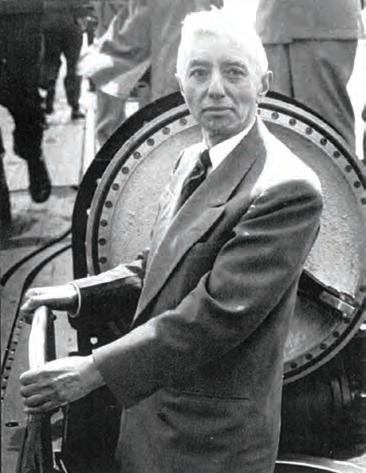
After Admiral Hyman George Rickover awarded Westinghouse federal contracts to build the first nuclear submarine, multiple Jewish families relocated to Baldwin, Pleasant Hills, Whitehall and surrounding areas, Duker said.
Those spaces saw an influx of residents and the erection of Beth Israel Center, a small Pleasant Hills-based Conservative synagogue whose membership boasted more than 100 families at its peak.
Formed in 1958 and closed in 2017, Beth
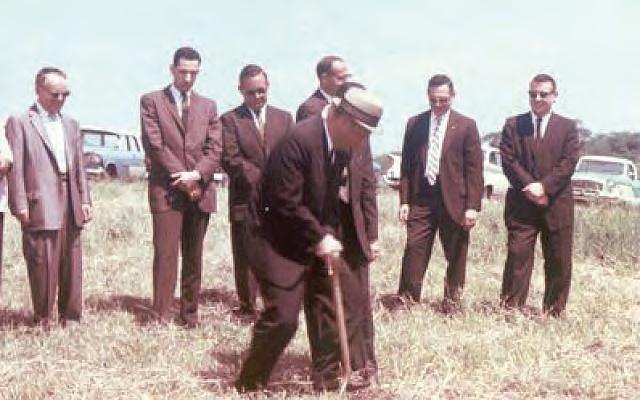
Israel was powered by scientists, engineers and businessmen — often with ties to the Bettis Atomic Power Laboratory, a U.S. government-owned research and development facility in West Mifflin.
Duker said she reviewed Beth Israel’s records at the Rauh Jewish Archives, explored federal and local records, interviewed individuals who grew up in the South Hills and came to appreciate a quirk of South Hills Jewish history.
“All these engineers — and engineers think in a certain way — who were from BBQ, even if they didn’t grow up religiously observant, they grew up surrounded by the Jewish culture. They had no clue what culture they were going to be dumping their kids in,” she said.
With few other nearby landsmen, Jewish residents of Pleasant Hills, Jefferson Hills, Baldwin and Whitehall treated the congregation like a “tight-knit community.”
For two generations Beth Israel offered a
Hebrew school and robust programming. Still, she continued, the children who grew up there largely moved away from the South Hills.
Duker said she plans to showcase Beth Israel’s records during the talk and also hopes to explore a question about hiring practices. “Why did Westinghouse — that had not hired Jews in Pittsburgh — start hiring Jews to build this nuclear submarine at Bettis when GE did not?”
Whether it’s an interest in those who helped shape small Jewish communities or a fascination with Rickover — “an extraordinary person who was tyrannical, but the strength of his will changed a whole bunch of things” — there is much to enjoy at the upcoming talk, Duker said. “When people are interested in other people, or even American history, there’s so many fascinating things.”
Steve Jaron, president of the Jewish Genealogy Society of Pittsburgh, said he’s

SUBSCRIPTIONS subscriptions@pittsburghjewishchronicle.org 412-687-1000, ext. 2
TO ADVERTISE advertising@pittsburghjewishchronicle.org 412-687-1000, ext. 1
EDITORIAL DEPARTMENT
Email: newsdesk@pittsburghjewishchronicle.org
BOARD OF TRUSTEES
Evan H. Stein, Chair
Evan Indianer, Vice Chair
Derek Smith, Treasurer
Gayle R. Kraut, Secretary
Gail Childs, Dan Droz, Malke Steinfeld Frank, Karen Gal-Or, Seth Glick, Judith Kanal, Cátia Kossovsky, Charles Saul, Lynn Zelenski
GENERAL COUNSEL
Stuart R. Kaplan, Esq.
Jim Busis, CEO and Publisher 412-228-4690 jbusis@pittsburghjewishchronicle.org
EDITORIAL
Toby Tabachnick, Editor 412-228-4577 ttabachnick@pittsburghjewishchronicle.org
Adam Reinherz, Senior Staff Writer 412-687-1000 areinherz@pittsburghjewishchronicle.org
David Rullo, Senior Staff Writer 412-687-1000 drullo@pittsburghjewishchronicle.org
Octavia Liku, Staff Writer oliku@pittsburghjewishchronicle.org
ADVERTISING
Amy Weiss, Account Executive (412) 613-0697 aweiss@pittsburghjewishchronicle.org
PRODUCTION
Jeni Mann Tough
Production Manager
Carl Weigel
Art/Production Coordinator
excited to welcome Duker and looks forward to “bringing more local Jewish genealogical history to Pittsburgh.”
He hopes the Aug. 16 program is a further means of promoting growth.
Throughout 2025, the group welcomed 65 new members. Between January and June of this year, another 65 members joined.
“We look forward to growing that number even more with programs like this and other locally-related programming in the years to come,” Jaron said. “We’re excited about the incredible growth we’ve experienced over the past few months and hopefully this program helps us bring fresh faces.” PJC
Adam Reinherz can be reached at areinherz@pittsburghjewishchronicle.org.
5915 Beacon St., 5th Floor Pittsburgh, PA 15217
Main phone number: 412-687-1000
Subscriptions: 412-687-1000, ext. 2
Subscriptions subscriptions@pittsburghjewishchronicle.org 412-687-1000, ext. 2
Published every Friday by the Pittsburgh Jewish Publication and Education Foundation 5915 Beacon St., 5th Floor Pittsburgh, PA 15217
Phone: 412-687-1000
POSTMASTER:
Send address change to PITTSBURGH JEWISH CHRONICLE, 5915 BEACON ST., 5TH FLOOR PITTSBURGH, PA 15217
(PERIODICAL RATE POSTAGE PAID AT PITTSBURGH, PA AND AT ADDITIONAL MAILING OFFICES)
USPS 582-740
Manuscripts, letters, documents and photographs sent to the Pittsburgh Jewish Chronicle become the property of this publication, which is not responsible for the return or loss of such items.
The Pittsburgh Jewish Chronicle does not endorse the goods or services advertised or covered in its pages and makes no representation to the kashrut of food products and services in said advertising or articles. The publisher is not liable for damages if, for any reason whatsoever, he fails to publish an advertisement or for any error in an advertisement. Acceptance of advertisers and of ad copy is subject to the publisher’s approval. The Pittsburgh Jewish Chronicle is not responsible if ads violate applicable laws and the advertiser will indemnify, hold harmless and defend the Pittsburgh Jewish Chronicle from all claims made by governmental agencies and consumers for any reason based on ads appearing in the Pittsburgh Jewish Chronicle



By Adam Reinherz | Senior Staff Writer
APittsburgh-trained photographer
captured glimpses of a Jewish life lost nearly 80 years ago to horror. The images, which are on display at ARCHER at House 88 in Oświęcim, Poland, as part of the “Ground Glass” exhibition, concern Lore Sternfeld, an engineer at Astro-Berlin, a German optical company that made lenses used by Nazi propagandists.
Hannah Altman, a Point Park University graduate who majored in photography, partnered with the Counter Extremism Project, an international policy organization, to use historic Astro-Berlin lenses to depict, and imagine, Sternfeld’s final months before her Jan. 29, 1943, deportation from Berlin to Auschwitz.
At the time of her deportation, Sternfeld, 27, was a precision engineer at Astro-Berlin. In fact, “Astro-Berlin actually wrote to the Nazi Party to complain that they owed them money because she had a bunch of lenses in her apartment when she was deported,” Altman, 31, said by phone from New Jersey.
About a year ago, CEP acquired several lenses made during Sternfeld’s Astro-Berlin tenure. In collaboration with Focus Canning, a Londonbased company, CEP had the lenses restored and retrofitted to a modern camera. CEP contacted Altman and asked the Jewish photographer to use the pieces and retrace Sternfeld’s trek from Berlin to Auschwitz.
Although Altman had photographed “Jewish ritual objects and folklore for about seven or eight years,” she said she was surprised by CEP’s request. “I’m not a documentary photographer.”
Still, the former Pittsburgher was interested in Sternfeld’s story.
Altman, 31, said she and the late artist shared striking similarities: Both were Ashkenazi Jews who worked with lenses, both lost family in the Holocaust and “we were both quite young.”
In lieu of photographing the scant details of Sternfeld’s life, such as former residences,
Altman said she told CEP that she “really wanted to take a more sort of storytelling, fictional, narrative approach to the work.”
CEP acquiesced, and the Jewish photographer traveled to Berlin.
A wrinkle to the project, Altman said, is that CEP also acquired House 88. Located directly adjacent to the Auschwitz-Birkenau concentration and death camps, the home was formally occupied by camp commandant Rudolf Höss.
Given CEP’s various acquisitions, “all of these things started to come together,” Altman said. House 88 granted space to work and “tell a really interesting story about what we do know about Lore Sternfeld — and what we do know about the lenses — but also about what we don’t know.”
Altman’s quest to mine and wrestle with Sternfeld’s historical archive is evident throughout “Ground Glass.” The exhibition, which includes evocative self-portraits and haunting depictions of inanimate pieces, is a mashup of personalities relying on period-appropriate details.
“Every dress that I’m wearing, my haircut, my nails, every object that is included, all of the menorahs, all of the furniture, every single small detail that builds up the world of Lore Sternfeld is very intentionally sourced,” Altman said.
“Ground Glass” isn’t merely a cataloging of old items, nor is it simply a depiction of Altman, or even Altman as Sternfeld. The photographs exist in “this sort of strange space,” she continued. “Instead of being self-portraits or a formal portrait of somebody else, they’re just like our bodies combined, and there’s this real tension between what feels like it’s more me, and what feels like it’s more her.”
Adding complexity are the lenses themselves, which have “really unique characteristics because they were made before a lot of standardization,” Altman said. “They have a lot of interesting lens flares, and they have these moments of extreme vignetting and tunneling, and they have a lot of things that kind of fall out of focus.”
Sharpness and exactitude are purposely eluded in “Ground Glass,” Altman said. “It’s

really this sort of collapsing of my body, her body, the camera lenses, and how they sort of interact with the environment and the light. I think that creates this kind of world.”
Further texture stems from the exhibition’s placement.
Although CEP has modernized some of the
former Höss house for use as an exhibition space, rougher portions of the home solidify the educational experience, Altman explained. Some areas have “peeling wallpaper, and it’s not quite abandoned, but it’s definitely a very raw space,” she said. “If you have the opportunity to see the work in person, it feels like a powerful reclamation to have it living in this house.”
Altman, whose “Ground Glass” photos were featured in The New York Times, said that she hopes the images inspire meaning wherever they are seen.
“There’s a very certain kind of method that has developed around Holocaust education,” she said. “A lot of it is focused on numbers and data, and finding out as much as you possibly can about people.”
In the absence of details, however, life remains.
“Ground Glass” conveys that with “gentleness and care and tenderness and poeticism,” she said. There’s an “acknowledgement that we won’t always know everything about Lore’s story, but I think this sense of imagination and tenderness really fosters a sense of empathy and connection.” PJC
Adam Reinherz can be reached at areinherz@pittsburghjewishchronicle.org.

By David Rullo
Acase against the Massachusetts Institute of Technology that considers whether anti-Zionism can be discriminatory is getting support from a legal center with roots in Pittsburgh.
Last week, the Center for Jewish Legal Studies filed an amicus brief in support of Jewish students — backed by StandWithUs Center for Legal Justice — to have an appeal heard by the U.S. Supreme Court.
The center was co-founded earlier this year by Rona Kaufman and Andrea J. Martin. Kaufman lives in Pittsburgh and is an associate professor at the Thomas R. Kline School of Law of Duquesne University, where she teaches constitutional law, employment discrimination, family law and gender and the law. Martin teaches law at Penn State Dickinson Law School.
Two Jewish students and StandWithUs, a non-partisan organization that fights antisemitism and educates about Israel, filed their case against MIT in 2025, alleging that, during the 2023-2024 academic year, the university was home to pro-Palestinian activities that left some Jewish students feeling unsafe or unwelcome on campus. The alleged incidents included Jewish students being blocked from campus areas and targeted with hostile remarks.
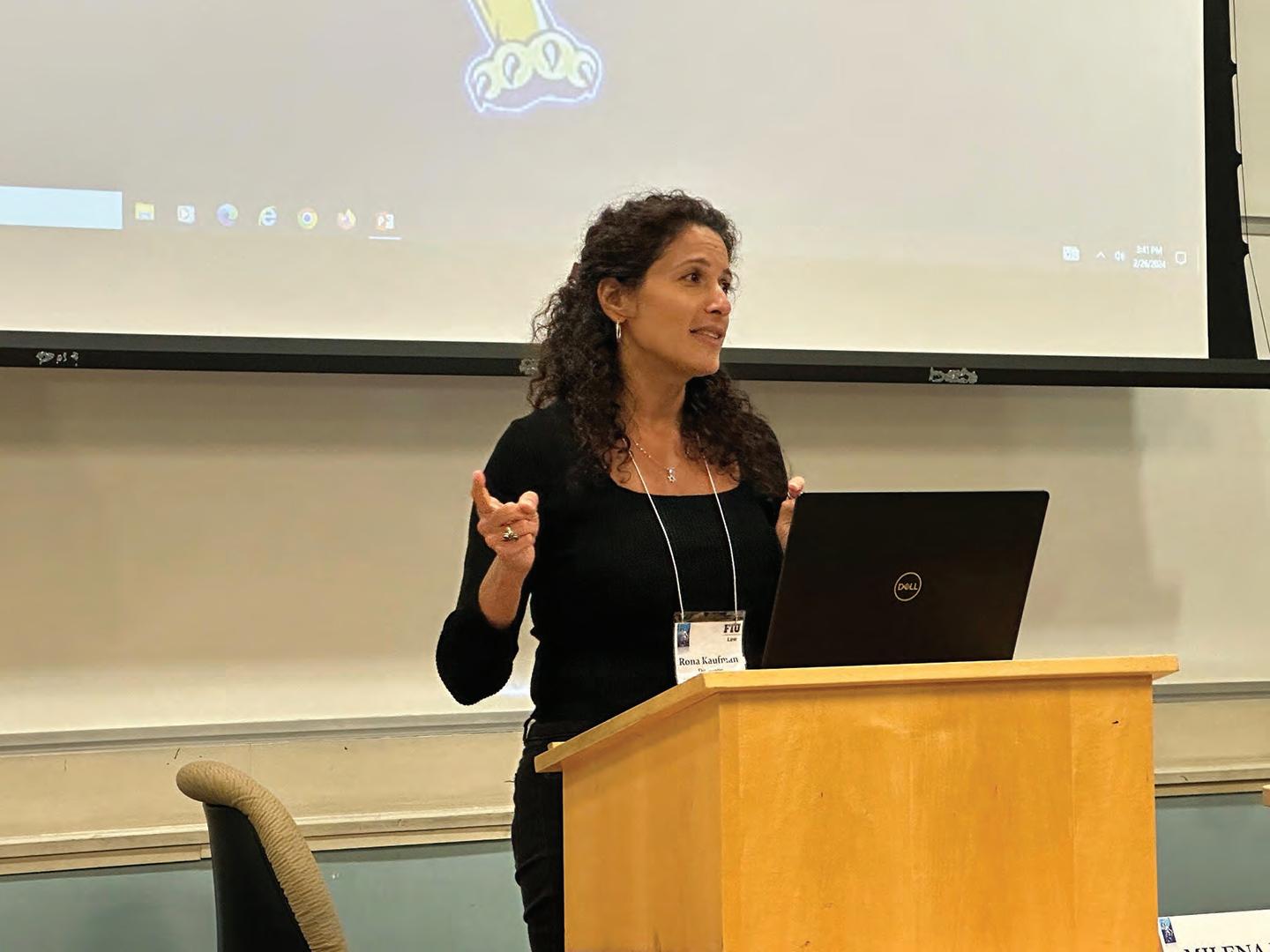
Julie Paris, StandWithUs’ Mid-Atlantic regional director, said the organization is “incredibly proud to partner with the Center for Jewish Legal Studies.”
“We are deeply appreciative of the center’s critical legal efforts to combat antisemitism and protect Jewish students on campus, including its recent amicus brief supporting the Supreme Court petition in StandWithUs Center for Legal Justice v. MIT,” she said. “This case reflects our shared commitment to ensuring Jewish students can learn free from discrimination and harassment.”
While awaiting word on whether the Supreme Court will hear the appeal, Kaufman and the Center for Jewish Legal Studies have their hands full.
Kaufman and co-founder Martin are busy gathering scholars to join the center. They currently have 30, 12 of whom will soon attend a retreat in Washington D.C.
“We’re refining our research agenda, we’re refining our core principles, coming to agreement about exactly what the field is,” she said. “We’re publishing a law review article right now with the Touro Law Review and the Journal of Contemporary Antisemitism announcing the field — Jewish legal studies — and why it’s necessary.”
In October, the center will be part of a symposium at Northwestern University Prtizker School of Law, focusing on international law.
MIT responded by revising protest policies, suspending some student groups and eventually clearing an anti-Israel encampment; however, it did not discipline all protestors or end the demonstrations immediately, according to case filings.
The StandWithUs Center For Legal Justice and the MIT students sued the university, accusing it of “deliberate indifference” to antisemitic harassment, and claiming that the university selectively enforced rules, failed to protect Jewish students and allowed pro-Palestinian demonstrations that included calls for intifada and chants like “from the river to sea,” which created a hostile educational environment.
A Massachusetts district court dismissed the suit, finding that the plaintiffs did not allege actional harassment or deliberate indifference.
On appeal, the First Circuit Court of Appeals, which covers Maine, Massachusetts, New Hampshire, Puerto Rico and Rhode Island, affirmed the dismissal.
Kaufman said the district court essentially held that “even if everything the plaintiffs say in their case is true, it doesn’t prove that MIT acted deliberately indifferent, which is the standard. Therefore, there’s no liability for MIT.”
The First Circuit, she said, should have
The appellate court was wrong in ruling that anti-Zionism is not discriminatory, Kaufman said, because that should be a matter of fact for a jury to determine.
simply affirmed the lower court’s decision; instead “they issued a 54-page opinion and about 20 pages of it were dedicated to telling the world that anti-Zionism is not discriminatory against Jews.”
Kaufman called the opinion “outrageous” because, if it is allowed to stand, any time a similar case comes up, defendants can claim that “anti-Zionism doesn’t discriminate against Jews.”
The appellate court was wrong in ruling that anti-Zionism is not discriminatory, Kaufman said, because that should be a matter of fact for a jury to determine.
The court reached other conclusions that effectively changed the elements needed for plaintiffs to prove a hostile environment, she added.
“They said all this nonsense about how anti-Zionism could never be a source of a hostile environment because it’s protected speech and doesn’t discriminate against
Jews,” Kaufman said. “Those are also false. If you hear the phrase, ‘There’s only one solution, intifada revolution’ — a perfect combination of Hitler’s final solution and Islamist intifada — that’s the same to me as if someone said the ‘N’ word to a Black person or called me a whore. In fact, intifada revolution sounds a whole lot scarier to me than if someone calls me a whore.”
Kaufman said that while MIT will likely prevail in the suit, that isn’t the point. Rather, she hopes the Supreme Court will remand the case back to the First Circuit, telling it to write a decision consistent with the law.
In that case, she explained, the only question will be whether MIT was deliberately indifferent and created a hostile environment.
“The students will still lose their case. The case will be over, but the record will not be a mess,” she said.
“We going to have all these international law scholars talk about the genocide claims and apartheid claims, and crimes against women on Oct. 7, from an international law perspective,” Kaufman said.
In the meantime?
Kaufman said the center is “teaching courses at different law schools on antisemitism, Holocaust law. We’re filing amicus briefs. We’re working with students — we have four students interning with us, helping us with different projects. And hopefully soon, I’ll start preparing a trip to Israel for professors.”
Paris said that Kaufman and Martin — and the Center for Jewish Legal Studies — provide “clarity, leadership and education” at a time when the Jewish community faces unprecedented challenges.
“Their tireless advocacy ensures the Jewish community is not only heard but also fully protected under the law,” she said. “We also welcomed enthusiastically Andrea’s nomination to the Pennsylvania Human Relations Commission following her overwhelming bipartisan confirmation in the state Senate. Together, we will continue fighting for the rights and safety of the Jewish community nationwide.” PJC
David Rullo can be reached at drullo@ pittsburghjewishchronicle.org.
Eric Lidji | Special to the Chronicle
With an existential dread once reserved for Yom Kippur afternoon, all Allegheny County spent early July wondering what would happen when PennDOT closed the Squirrel Hill Tunnel for a month to finish the Commercial Street Bridge. My first few days outbound on the Parkway East were delightful. There was hardly any traffic at all.
Was it like this in the old days? The Squirrel Hill Tunnel opened June 5, 1953. By the end of July, state police had issued more than 1,350 warnings, mostly for speeding.
The Parkway East initially had a speed limit of 50 miles per hour. To combat all the flagrant speeding, authorities soon dropped the speed limit to 35 through the tunnel.
As we all know, this problem solved itself. By the early 1960s, perpetual traffic jams had made it impossible to speed through the tunnel except in the middle of the night. Today, lamenting slowdowns approaching the Squirrel Hill Tunnel is a foundational aspect of life in the eastern part of the county.
State transportation officials — along with thousands of amateur transportation experts crawling along in traffic — have spent decades batting around a fix for this problem. Dedicate three lanes to inbound traffic during the morning rush hour. Issue tickets for driving two slowly. Restrict truck traffic at certain hours. Add a third tube.
The most enduring proposal has been a Squirrel Hill Tunnel bypass. The current iteration emerged in the late 1980s, as one of many projects tacked onto the Mon-Fayette Expressway. It would essentially create a Y-shaped junction at the Glenwood Bridge with each branch connecting to the Parkway East on opposite sides of the existing tunnel.
There was briefly an alternate idea for bypassing the Squirrel Hill Tunnel. It didn’t last long, but it played an important role in the history of the neighborhood.
At the end of the 1960s, the leading idea for improving the Parkway East was adding a third tube to the Squirrel Hill Tunnel, creating six or seven lanes instead of four.
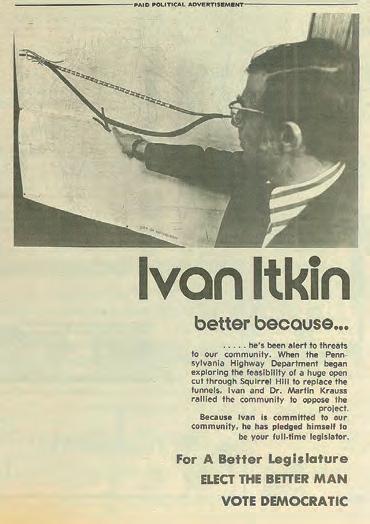
part of a series of paid political
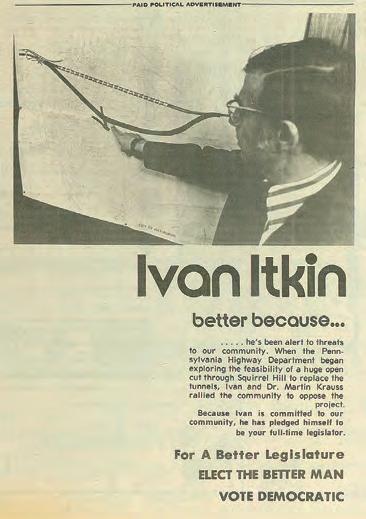
As PennDOT was advancing these plans in early 1972, rumors emerged that the agency might also be secretly developing an alternate plan to build a sixlane bypass immediately south of the Squirrel Hill Tunnel. This bypass would have required the demolition of several hundred homes between Morrowfield and Caton streets.
Within a few days of news spreading, two Squirrel Hill men called a press conference to oppose the idea. Both were Jewish and both active in local politics.
Dr. Martin J. Krauss was a North Side optometrist who lived in Squirrel Hill. He had gained notoriety in the early 1970s as president of the Highway Emergency and Relocation Team, better known as HEART. The citizens’ group opposed the Parkway North, which was proposing a similar scale of demolitions in the East Street Valley.
Krauss brought along Ivan Itkin. Itkin was one of the many Jewish engineers who had come to Pittsburgh from New York in the late 1950s to work for Westinghouse. He made a shift to politics in the early 1970s, serving as Democratic chairman for the 14th Ward and chairman of a conglomerate of local Democratic groups called Coalition ’71.
After the press conference, PennDOT insisted there were no definite plans for
Without action, aging infrastructure in the city and public investment in the suburbs would have likely meant the end of Squirrel Hill as a pluralistic Jewish community set into a multicultural neighborhood.
an open-cut bypass, only preliminary work to outline alternatives. It preferred a third tube. It said any opposition was premature, and it accused the two men of political motivation.
Krauss was running for a spot as Democratic committeeman. Itkin was one of seven Democratic candidates running for the 23rd district of the Pennsylvania legislature.
The 23rd district was created during statewide redistricting in the late 1960s. Rep. Gerald Kaufmann was elected in 1966 as an at-large representative for Allegheny County. With the 23rd district, he represented greater Squirrel Hill, home to some 24,000 Jewish people, more than 60% of the entire Jewish population of the county.
Kaufmann left office before the 1972 election. As often happens when an incumbent departs, a rush of people filed candidacies during the primary season.
A few days after the press conference, state Transportation Secretary Jacob Kassab ruled out an open-cut bypass in Squirrel Hill. He described the communal anger as a “politically inspired scare tactic not in the best interest of the community.”
Even with this reassurance, Krauss and Itkin maintained pressure. They arranged a meeting at the Y-IKC in Squirrel Hill called “Stop Them At The Bypass” on April 10.
In the middle of the meeting, Councilman
John Lynch arrived. He had just met with Gov. Milton Shapp at the William Penn Hotel and claimed Shapp had issued a statement saying he would not approve an open-cut bypass during his term in office.
With that, the idea was effectively dead.
About two weeks after the meeting, Itkin easily won the Democratic primary, taking more than a third of the votes in the seven-way race. He made the open-cut bypass part of his general campaign, running an ad highlighting his role fighting the proposal.
Itkin faced Republican Bernard Markovitz in the fall, winning by 277 votes. At that margin of victory, every issue is decisive. Itkin held the seat until he retired in 1999.
The open-cut bypass came at an introspective moment for Squirrel Hill. In a forum on the future of the neighborhood in 1970, a city planning official had said, “My opinion is that if the present state of affairs continues — unchecked, unchanged and untampered with — Squirrel Hill in 15 years will be what the Hill District is now.” The insensitive comparison ignored the vastly different historical circumstances of the two city neighborhoods, but it must have resonated with many in Squirrel Hill who still remembered the old Jewish neighborhood of the Hill District before World War II.
The open-cut bypass symbolized the moment. Without action, aging infrastructure in the city and public investment in the suburbs would have likely meant the end of Squirrel Hill as a pluralistic Jewish community set into a multicultural neighborhood.
This newspaper led communal efforts to revitalize the neighborhood. A few days before news broke of the open-cut bypass, it devoted an entire issue to the state of Squirrel Hill. Editor Al Bloom noted that a Jewish out-migration from the neighborhood would mean millions to relocate communal institutions, drawing funds from other needs.
This is what prompted the Urban Affairs Foundation of the United Jewish Federation to propose bringing together all relevant neighborhood groups to deal with emerging issues. The Squirrel Hill Urban Coalition was incorporated in July 1972. PJC
Eric Lidji is the director of the Rauh Jewish Archives at the Heinz History Center and can be reached at rjarchives@heinzhistorycenter. org or 412-454-6406.

Submit calendar items on the Chronicle’s website, pittsburghjewishchronicle.org. Submissions also will be included in print. Events will run in the print edition beginning one month prior to the date as space allows. The deadline for submissions is Friday, noon.
q SUNDAY, AUG. 2
Join Chabad of the South Hills for the 2nd Annual South Hills Jewish Festival, celebrating Jewish life and culture. Live concert with Chassidic singer Berel Faiden, cultural crafts, kosher wine tasting and food, fun zone, petting zoo. 1 p.m. Free. 1700 Bower Hill Road. chabadsh.com
q SUNDAYS, AUG. 2–DEC. 20
Join Chabad of Squirrel Hill for its Men’s Tefillin Club. Services and tefillin are followed by a delicious breakfast and engaging discussions on current events. 8:30 a.m. 1700 Beechwood Blvd. chabadpgh.com
Join a lay-led online Parashah study group to discuss the weekly Torah portion. No Hebrew knowledge needed. The goal is to build community while deepening understanding of the text. 8:30 p.m. For more information, visit bethshalompgh.org/online-parashah.
q TUESDAY, AUG. 4
Join the Holocaust Center of Pittsburgh for Holocaust 101: The Fundamentals of Holocaust Education, the first program in its 2026–2027 series of teacher trainings. The training is designed for teachers across grade levels and subject areas, whether you are new to teaching the Holocaust
and antisemitism or looking to deepen your existing practice. Each session will offer practical guidance, classroom-ready resources and time to think through common challenges with other educators. Act 48 credits available. 9 a.m. Allegheny Intermediate Unit, 475 East Waterfront Drive. eventbrite.com/e/holocaust-101-the-fundamentalsof-holocaust-education-tickets-1990912143816
q TUESDAYS, AUG. 4–DEC. 22
Join Beth El’s Rabbi Alex Greenbaum and his Bible/ Talmud Adult Education class for a thoughtprovoking weekly session of Bible and Talmudic study. This program is available both in person and virtually. Call the office at 412-561-1168 to receive the Zoom link or to make an in-person reservation. 10:30 a.m. 1900 Cochran Road. bethelcong.org
q WEDNESDAYS, AUG. 5, SEPT. 2
Join Beit Kulanu for Biblical Garden Open Door Tours: Free, docent-led tours of the congregation’s Biblical Botanical Garden the first Wednesday of the month. 12:15 p.m. Free. 4905 Fifth Ave. rodefshalom.org/garden
q WEDNESDAYS, AUG. 5–DEC. 23
Explore the weekly Torah portion with the mystical and interpersonal lens of the Hassidic rabbis with Rabbi Mark Asher Goodman. Hassidut for the People is a fun and engaging class taught online and in-person meant to help learners find deeper meaning in Torah and in themselves. All levels welcome. 10 a.m. $5. Shoresh PGH, 4300 Murray Ave. Contact rabbimark@shoreshpgh. org for more information. shoreshpgh.org/classschedule-and-events

q THURSDAY, AUG. 6
Join the Holocaust Center of Pittsburgh to discover the story behind the Holocaust Memorial Garden at Temple Emanuel of South Hills. The garden is a living memorial inspired by the vision of local Holocaust survivor Marga Silbermann Randall, z”l, and brought to life in partnership with master gardener Lynn Rubin, the daughter of a Holocaust survivor. There will be a screening of a WQED documentary about the creation of the garden, followed by a discussion with Rubin. A guided tour of the garden will follow the program, weather permitting. 6 p.m. Free. 1250 Bower Hill Road. eventbrite.com/e/cultivating-memorya-holocaust-survivors-legacy-in-bloomtickets-1991203762054
q WEDNESDAY, AUG. 12
Join Shoresh for a “Taste of Shoresh.” Different educators will teach classes in topics they are passionate about to give a taste of the learning and community they are building. There will be snacks, drinks, and childcare for children ages 5 and up. The event will launch Shoresh’s weeklong community fundraiser. No registration or commitments required to attend. 7 p.m. Anderson Park Shelter, Schenley Park
q THURSDAY, AUG. 13
Join Chabad Young Professionals for its Summer Soirée, an unforgettable evening on the rooftop featuring handcrafted cocktails, delicious cuisine, great music and the opportunity to connect with hundreds of young Jewish professionals from across the city. Slip into your favorite summer chic
look, gather your friends, and join CYP for one of Pittsburgh’s signature nights. 7 p.m. $30. Rooftop Bar in Lawrenceville. cyppittsburgh.com/summer
q WEDNESDAY, AUG. 19
The 10.27 Healing Project presents Town Hall: Tree of Life, an important conversation about the future of the Tree of Life site. Hear directly from those leading the planning and development of the site, including those working on: the memorial honoring the 11 lives lost, the building redevelopment and construction plans, the museum that will be within the building and Jewish life, education and other community programming. Presenters will share updates on the work, the vision taking shape and what’s ahead. RSVP requested. 5:30 p.m. Levinson Hall, Jewish Community Center. 1027healingpartnership.org/event/townhall-tree-of-life
q WEDNESDAY, AUG. 19, & THURSDAY, SEPT. 3
Rendezvous in Beit Kulanu’s Biblical Botanical Garden with drinks and hors d’oeuvres for free live musical performances. Apps start at 6:30 p.m. and music at 7 p.m. The concert is free but registration is required. 4905 Fifth Ave. BeitKulanu.org
q SUNDAY, AUG. 30
Join Chabad of the South Hills for a trip to Jewish New York. Visit the Rebbe’s resting place and Chabad world headquarters; take part in a Crown Heights tour. Enjoy shopping and a meal at a delicious kosher restaurant. Fly roundtrip to New York City. 7 a.m. to 7 p.m. $125. chabadsh.com/jny PJC
The Pittsburgh Jewish Chronicle invites you to join the Chronicle Book Club for its Aug. 30 discussion of “As a Jew: Reclaiming Our Story from Those Who Blame, Shame, and Try to Erase Us – A Defiant Memoir of Heritage, Identity, and Antisemitism,” by Sarah Hurwitz.
A New York Times bestseller, “As a Jew” is an “urgent exploration of how antisemitism has shaped Jewish identity and how Jews can reclaim their tradition, by the celebrated White House speechwriter and author of the critically acclaimed ‘Here All Along,’” according to Amazon.com.
“In As a Jew, Hurwitz documents her quest to take back her Jewish identity, how she stripped away the layers of antisemitic lies that made her recoil from her own birthright and unearthed the treasures of Jewish tradition. With antisemitism raging worldwide, Hurwitz’s defiant account of reclaiming the Jewish story and learning to live as a Jew, without apology, has never been timelier or more necessary.”
Your hosts
Toby Tabachnick, Chronicle editor
David Rullo, Chronicle senior staff writer
How it works
We will meet on Zoom on Sunday, Aug. 30, at 1 p.m.
Buy: “As a Jew.” It is available from online retailers, including Amazon and Barnes & Noble, and in some area Barnes & Noble stores. It is also available through the Carnegie Library system.
Email: Contact us at drullo@pittsburghjewishchronicle.org, and write “Chronicle Book Club” in the subject line. We will send you a Zoom link for the discussion meeting.
Happy reading! PJC

By David Rullo | Senior Staff Writer
Murray’s Market, a planned kosher grocery store, is moving forward after a July 20 decision by the Pittsburgh Zoning Board of Adjustments.
The six-page decision granted a special exception to allow the former Rite Aid location on the corner of Forbes and Murray avenues in Squirrel Hill to operate as a grocery store with 23 on-site parking spaces.
The agreement specified several points, including:
• The store will operate between the hours of approximately 8 a.m. and no later than 8 p.m.
• The customer seating area will be limited to no more than 10 seats.
• A dumpster will be located in the parking area and will be screened.
• Garbage collection will occur no more than four times a week and recyclable collection will occur no more than twice a week.
• A kitchen ventilation system will be installed.

The idea, he explained, is to eliminate the need to visit several different stores to complete a shopping trip.
Murray’s Market, he said, will also include a pharmacy and stock products found in most drug stores.
And while the store itself won’t be certified kosher, Glassner told the Chronicle that all the prepared food will be certified under the Vaad Harabonim of Pittsburgh.
P repackaged food will have its own certification from the manufacturer.
At the time, Glassner, who has spent more than a decade working at a surplus company doing logistics and close-out sales, said serving the community was an important motivating factor in opening the store.
In a November 2025 interview, store
In its applications, the store’s owners said the ventilation system would reduce odors from food preparation on nearby properties. They also proposed installing an accessible entrance on the side of the building, with access from the parking lot, and to create a parking space that’s compliant with the Americans with Disabilities Act.
owner Isaac Glassner told the Chronicle that the store would be a “one-stop shop that has everything. It’s going to be a gourmet kosher grocery store with fresh produce, a butcher, bakery, takeout, sushi created by a sushi master — everything that you can imagine.”
Glassner also said the store would include a deli featuring hot food, soups and even coffee.
“ There are some people scheduling deliveries twice a month. There are people going to Cleveland. There are people shopping in four different stores to get their needs met. They’ll be able to do everything here,” he said.
An opening date for the store has not been announced. PJC
David Rullo can be reached at drullo@ pittsburghjewishchronicle.org.
By JNS Staff
Pennsylvania Gov. Josh Shapiro, who is Jewish, said on Monday that there are $10 million in state funds available to nonprofits to fight hate crimes. The funds are available through the Pennsylvania Commission on Crime and Delinquency.
“Protecting public safety is our mission every day at PCCD, and this program truly exemplifies that,” stated Kirsten Kenyon, executive director of the commission.
“By once again investing $10 million in the Nonprofit Security Grant Fund Program in this year’s budget, we’re continuing to support critical security enhancements to help ensure that community members can safely gather, worship and access services without fear,” Kenyon said.

“I strongly encourage eligible nonprofits to apply and take advantage of this funding.” The funding “will support planning, training, equipment and technology upgrades at places of worship, community centers and other nonprofit institutions across the commonwealth that primarily serve individuals or communities at heightened risk of hate crimes,” the state said.
Grants range from $5,000 to $150,000. PJC
By Kelly Hartog | JTA
The Church of England’s legislative body has voted to encourage churches across England to engage with a docu ment produced by Palestinian Christians that accuses Israel of genocide despite requests from Jewish organizations and Britain’s chief rabbi to reject it.
The document is titled “Moment of Truth: Faith in a Time of Genocide” and is also known as Kairos II, after the Palestinian Christian movement Kairos Palestine that produced it.
It describes Israel’s military campaign in Gaza as a genocide, states that Israel is a “colonial enterprise built on racism,” and says decades of “occupation,” “apartheid” and “settler colonialism” are at the heart of the Israeli-Palestinian conflict.
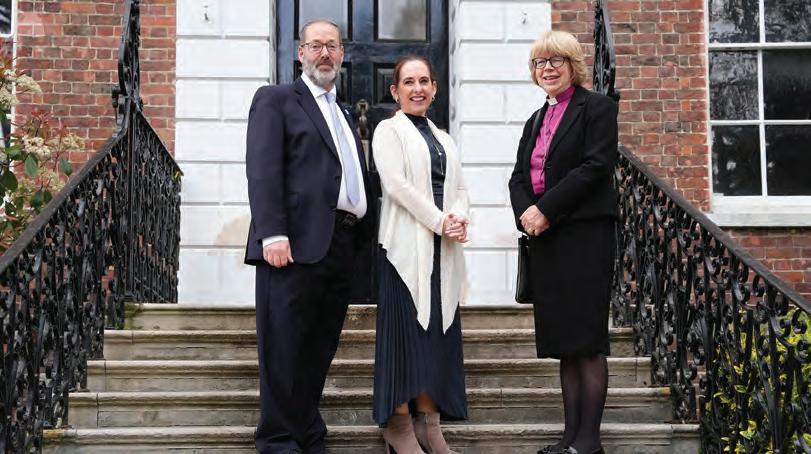
hear the documents as “heartfelt expressions of the lived experience of Palestinian Christians,” and to engage with them in order to better understand the conflict.
Jewish organizations expressed concerns, and Chief Rabbi Sir Ephraim Mirvis asked Synod members to reject the amendment. Mirvis called Kairos II “deeply concerning” and that it “risks undermining decades of careful relationship-building” between
“It is truly shocking that a document which purports to speak in the name of truth contains so much falsehood,” he said.
Afterward, the president of the Board of Deputies of British Jews, Phil Rosenberg, issued a statement calling the passage of the motion “highly problematic.”
“Kairos Palestine may come from a place of genuine pain, but the falsehoods and distortions of Kairos II, including its erasure of Jewish identity and experience, is a prescription for more division and not the answer to conflict in the Middle East,” he said.
The Archbishop of Canterbury, Sarah Mullally, acknowledged both sides in a speech opening the debate at the Synod.
trauma of the Palestinian people. As a pastor, I hear the cry of our Palestinian Christian sisters and brothers — a cry that rises from the ruins of Gaza, and from the violence and oppression of the West Bank,” she said.
She added, ”I also hear the concerns of the chief rabbi, the co-leads of the Movement for Progressive Judaism, and the Board of Deputies, and I thank them for their honesty.” She said the church remained opposed to antisemitism and committed to safety for Israelis as well as Palestinians.
The Synod debate followed Mullally’s visit to the West Bank in June, where she met Palestinian Christian communities in Birzeit. During the visit she said, “I will use my role as Archbishop to seek the peace you desire and the freedom you deserve.”
The vote does not adopt the accusations as
Ahead of the debate in York, several
“This document reflects the pain and
The debate marks the ascendance of Israelrelated issues in another major church, after the Catholic Church’s Pope Leo XIV angered Jewish groups soon after being elected last year by endorsing an investigation into whether Israel committed genocide in Gaza. PJC
‘Politically
—
By Grace Gilson | JTA
BANGOR, Maine — With Maine’s marquee U.S. Senate race now set, many Jewish Democratic voters are confronting a difficult choice: whether concerns over newly nominated Democrat Troy Jackson’s rhetoric on Israel outweighs their longstanding opposition to incumbent Republican Sen. Susan Collins.
“I, and many Jews in Maine, certainly feel politically homeless at this point,” said Chris Myers Asch, a history teacher at Colby College and Jewish resident of Hallowell, Maine. “We don’t feel like there are candidates who actually represent us and that we trust to defend our interests, and I think that’s sad, particularly for people like myself who have been active and involved and supportive of many different candidates over the years.”
Jackson, 58, a former logger and state Senate president, secured the Democratic nomination Saturday following the party’s nominating convention to replace Graham Platner, who withdrew earlier this month following a sexual assault allegation, which he denies.
But as Jackson shored up his bid for the nomination, he began to echo the rhetoric of Platner, a staunch Israel critic whose Nazilinked tattoo sparked concern across Maine’s Jewish community. Since joining the race, Jackson has, for the first time, embraced the term “genocide” to describe Israel’s war in Gaza and called for an end to U.S. military aid to Israel.
Those positions contrasted with the union advocacy and affordability agenda on which Jackson had built his two-decade political career in the state.
They also alarmed some Maine Jewish voters, who overwhelmingly lean Democratic.
“I thought Platner was a disaster from the beginning, so pretty much anyone would be an improvement, and I think Jackson is an improvement,” said Myers Asch, who

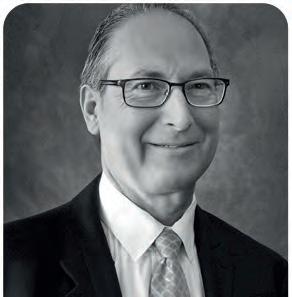







identifies as an independent. “But I can’t say I am wholeheartedly enthusiastic about him. I think he has bowed to the pressure of far-left activists on foreign policy issues, particularly on Israel, and I think that’s unfortunate.”
But while Jackson’s newfound stances on Israel have alienated some Jewish Democrats, it has not necessarily made their choice in November’s general election any easier. Many remain critical of Collins, 73, who has paired strong support for Israel with votes backing much of President Donald Trump’s agenda.
The latest polling in the race, conducted by the University of New Hampshire, finds the contest is a toss up, with Jackson receiving 49% of the vote compared with Collins’ 46%. The poll, which surveyed 1,236 likely voters from July 15 to 20, has a margin of error of +/-2.8%.
With Election Day just 99 days away, the choice facing Jewish voters carries stakes beyond Maine. Democrats see the Maine contest as one of their best pickup opportunities in the battle for control of the Senate. Independent analysts, including the Cook Political Report, rate Maine as one of the few GOP-held Senate seats that Democrats have a decent shot at this year.
While Jews make up a small share of





Maine’s electorate, the community leans heavily Democratic. The state has roughly 19,000 Jews across 10,600 households, nearly 70% of which identify as liberal or very liberal, according to the 2024 Maine Jewish Community Study, conducted by Brandeis University in partnership with the Jewish Community Alliance of Southern Maine.
Maine State Rep. Laurie Osher, who is Jewish and said she intends to vote for Jackson, said that despite the anxiety many Jews have felt since Hamas’ Oct. 7 terror attack, the stakes of defeating Collins outweighed broader political concerns.
“Long before that, we have had a problem with having Susan Collins give strength and support to crazies that are Republican,” Osher said. “We need to get rid of her, and most of the Jews I know agree with that.”
Despite the Maine Jewish community’s overwhelmingly liberal bent, Myers Asch said he had heard more Jews than ever before discussing voting for Collins.
“I have heard more people talking about voting for Susan Collins than I ever have before, because I think a lot of Jews in Maine feel abandoned by the Democratic Party and feel politically homeless,” said Myers Asch.
Brian Kresge, the president of Congregation Beth Israel in Bangor, Maine, said that while he had seen peers in the Jewish community “get behind (Jackson) and trying to overlook the word genocide,” he had also observed many throwing their support behind Collins.
“It’s that hard choice a lot of Jews are weighing. What does the rhetoric against genocide really mean when he’s so good in all these other ways?” Kresge said, referring to Jackson’s strong union ties. “We like him for all of this, and so that’s the hard part. I don’t envy any Jew that hasn’t already made up their mind about the election.”
While Collins has received an endorsement from Trump, she has also broken with the president on several key votes, including in April when she backed a resolution to end U.S. military action against Iran.
Still, during his acceptance speech for the Democratic nomination Saturday,
Jackson used much of his remarks to hammer Collins’ record of supporting Trump’s policies.
“Thirty years later, Susan Collins is still in Washington, so I do have one question. Who has she served? She has served Donald Trump. She voted with him 96% of the time,” Jackson said. “She helped deliver enormous tax breaks to the corporations and the wealthy on our backs, and she voted to confirm Kavanaugh and Gorsuch, the Supreme Court justice who overturned Roe versus Wade.”
Collins, who has worked to distance herself from Trump and voted with the president’s opinion 95% of the time in 2025, took her own stab at her new opponent Saturday, calling him “hyper-partisan” in an interview with News Center Maine.
“I have known him for more than 20 years, he has been an Augusta insider, and he’s very much a person who takes a hyper-partisan approach to the issues,” Collins said. “I think that’s one of the big contrasts between us. I have always prided myself in working in a bipartisan way.”
For some Jews in the state, the choice between Collins and Jackson has been much more clear-cut.
Lila Kohrman, a 33-year-old Jewish Portland resident, voted for Jackson during the nominating convention Saturday. “Susan Collins has been a senator for almost my entire life, and during that time, things have pretty clearly just gotten worse and worse for Americans,” she said.
“Jewish voters are not a monolith,” Kohrman added. “But I hope that people will be able to support a candidate who has clearly demonstrated that — and I mean Troy Jackson — that has clearly demonstrated that he cares for the lives of marginalized and oppressed people in the United States and around the world, and right now that means opposing sending money to Israel because they are using that money to commit a genocide against the Palestinian people.”
Jackson, who has raised over $1 million since announcing his bid for the nomination, is also facing a significant funding gap against Collins, who has $11 million in her campaign account, according to the latest Federal Election Commission findings.
While Jackson vowed he would not accept any “dark money,” and specifically said he won’t be taking any funding from AIPAC, Collins has received over $1.5 million in donations from at least 750 donors whose contributions were earmarked through AIPAC, according to the latest FEC findings.
The race has also already seen a massive influx of outside ad spending. Collins’ campaign, her allies and other groups aligned with Senate Republican leadership have reserved roughly $60 million in airtime through the fall, while the Senate Democrats’ main super PAC and its affiliates have purchased roughly $24 million. PJC
NYPD: Jewish man stabbed in Manhattan by attacker yelling ‘Allahu Akbar’
An assailant on July 23 stabbed two victims, one of whom was visibly Jewish, in an area of Manhattan’s Upper West Side known for its Jewish institutions, according to the New York Jewish Week.
Police said two male victims, aged 57 and 50, were in stable condition and being treated for stab wounds to the torso. One was Jewish and one was Asian, police said.
New York Police Commissioner Jessica Tisch announced last week that the force had arrested 51-year-old Raul Morales in connection with both assaults and that he had yelled “Allahu akbar” during both attacks, according to multiple witnesses and a victim.
“The NYPD is currently evaluating whether this is a potential hate crime,” Tisch said, noting, “Detectives are continuing to work the case and determine motive.”
Rabbi Allen Schwartz of the neighborhood’s Congregation Ohab Zedek told the Jewish Telegraphic Agency that one of the victims was a congregant who is visibly Jewish and wears a kippah.
Mayor Zohran Mamdani called the stabbings “horrifying” in a statement following the stabbings, noting that the perpetrator allegedly yelled “Allahu akbar” during both attacks.
Some critics of Mamdani have tied the attack to the New York City mayor’s sharp criticism of Israel and its prime minister, Benjamin Netanyahu.
Gideon Sa’ar, Israel’s minister of foreign affairs, wrote that the attacks “did not
happen in a vacuum.”
“Months of incitement against the Jewish state from Mamdani have helped create a climate in which Jews are targeted,” Sa’ar said.
Israel’s ambassador to the United Nations, Danny Danon, charged Mamdani with “putting Jewish lives in danger in New York.”
Trump administration drops demand that Penn turn over list of Jewish employees
The Trump administration has withdrawn a controversial demand for the University of Pennsylvania to produce a list of Jewish employees as part of a larger investigation into alleged employment discrimination at the Ivy League university, JTA reported.
The withdrawal ends a round of lawsuits over the legality of such a demand, which alarmed Jewish groups on campus and beyond.
The federal Equal Employment Opportunity Commission, which is overseeing the probe, did not explain its decision to drop the subpoena in its court filing.
In its own statement, Penn, which had been engaged in a legal back-and-forth over the school’s refusal to compile such a list, said it had “protected its employees’ rights.” The school had shared the names of Jewish staff who had consented to the probe, but resisted sharing the names of all Jewish staff.
The unusual demand, first made in November, came as the Trump administration has aggressively targeted a handful of elite schools accused of failing to curb antisemitism on campus. Most of the time, its intervention has come through the education and health and human services departments, which have cited civil rights violations in seeking to yank billions of dollars in federal funding.
But the EEOC has gotten involved, too,
Aug. 3, 1981 — Archaeologists, Haredim battle in City of David
arguing that Penn, in particular, had failed to protect its Jewish and Israeli employees from discrimination.
Hillel files, then withdraws, legal brief supporting Harvard in campus antisemitism fight against Trump administration
In the span of a few hours, Hillel International filed, then withdrew, an amicus brief supporting Harvard University in its ongoing legal battle with the Trump administration over campus antisemitism enforcement procedures, JTA reported.
A representative for the Hillel parent organization said the original 22-page brief filed on July 22 “was filed without having gone through our internal review process.” They did not elaborate further.
The whiplash further complicated institutional Jewish efforts to address campus antisemitism while sounding alarm about some of the government’s aggressive enforcement mechanisms.
In its since-withdrawn brief, Hillel had argued that Harvard has improved in its response to antisemitism, also asserting that the Trump administration’s moves to defund the school “do not help Jewish students or improve the campus climate.”
“To the contrary, they disproportionately impact the very Jewish students and Jewish researchers the government purportedly seeks to help,” the brief continued. It followed Harvard’s own brief in the case, which revolves around federal efforts to cite antisemitism as a reason to freeze more than $2 billion in U.S. Health and Human Services contracts and grants.
Jewish legacy groups have sought to straddle their demands for a crackdown on campus antisemitism with concerns that

Items are provided by the Center for Israel Education (israeled.org), where you can find more details.
July 31, 1988 — Jordan drops claim to West Bank Jordan’s King Hussein announces that he is giving up political claims to the West Bank, although he seeks to retain influence over Jerusalem. King Abdullah I annexed the West Bank and East Jerusalem in 1950.
An excavation on the eastern side of Jerusalem’s City of David is suspended amid attacks by Haredi Jews, most of them from the anti-Zionist Neturei Karta. The site reportedly includes a Jewish cemetery.

Aug. 4, 1888 — Writer Yitzhaq Shami is born Yitzhaq Shami, an early writer of modern Hebrew literature, is born to an Arabic-speaking father and a Ladinospeaking mother in Hebron. He fills his stories and poems with Arabs and Mizrahi Jews.
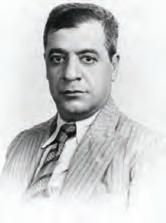
Aug. 1, 2016 — Composer Andre Hajdu dies Composer and ethnomusicologist Andre Hajdu dies at 84. Born in Hungary, he first visited Israel in 1966, moved to Jerusalem that year, and taught at the Tel Aviv Music Academy and Bar-Ilan University.
Aug. 2, 1923 — Shimon Peres is born Shimon Peres, the only Israeli to serve as prime minister and president, is born in what is now Belarus. Peres makes aliyah in 1934, enters politics in 1941 and is first elected to the Knesset in 1959.
Aug. 5, 1995 — Composer Menachem Avidom dies Composer Menachem Avidom dies at 87. A Russian native, he became an innovator in fusing Middle Eastern and European musical theories, beginning in 1944, and paved the way for Mizrahi musicians.
Aug. 6, 2015 — Actress Orna Porat dies
Stage and screen actress Orna Porat dies at 91 in Tel Aviv. Originally a German Christian, she moved to the Land of Israel with a Jewish British officer she met after World War II and converted. PJC
the Trump administration’s threats of massive cuts could harm research and students.
Guatemala recognizes City of David as part of its heritage
In a ceremony at Jerusalem’s City of David National Park on July 24, Guatemala dedicated a commemorative plaque recognizing the City of David — the site of biblical Jerusalem — and the millennia of history uncovered there as part of the cultural heritage of the Guatemalan people, JNS reported.
The plaque, dedicated by Guatemalan President César Bernardo Arévalo de León, bears his name alongside that of Guatemala’s ambassador to Israel, Ava Atzum Arévalo de Moscoso, who unveiled it on the president’s behalf.
Guatemala is the third country to recognize the City of David archaeological site as part of its national heritage, following similar declarations by the United States in 2021 and Argentina in 2025. Both countries also dedicated commemorative plaques at the site highlighting their historical and cultural ties to Jerusalem.
Speaking to JNS, Arévalo de Moscoso said she was honored to dedicate the plaque, describing the City of David as a symbol of the deep historical and cultural connection between Guatemala and Israel.
During the ceremony, she said the plaque represented far more than a ceremonial gesture, calling it a reaffirmation of the enduring friendship between the two countries.
Calling it “a great honor” to represent Guatemala at the unveiling, she said Jerusalem has always held “profound historical and spiritual significance” for the Guatemalan people. PJC — Compiled by Toby Tabachnick









Carlow:
Continued from page 1
“Jewish living,” Rothstein explained, “is more than just the major holidays. It’s Tisha B’Av, Chanukah, Purim, fast days, kosher food, modesty concerns and needs, and more.”
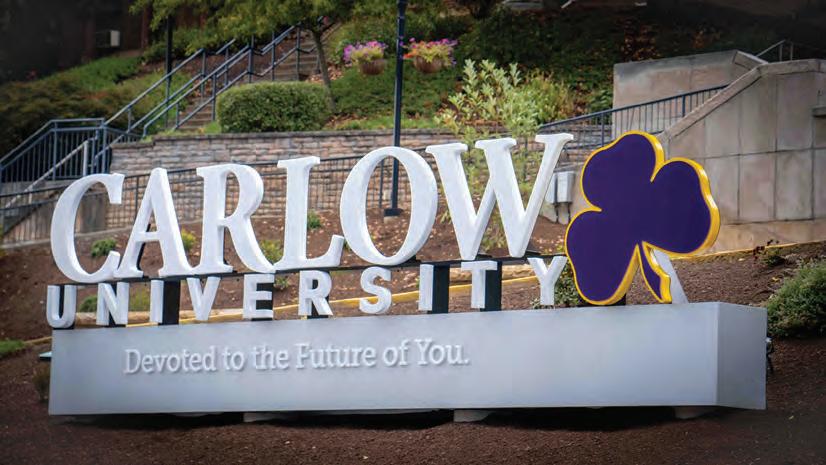
Carlow University, a private, Catholic university founded by the Sisters of Mercy in 1929, has always had a special relationship with the Jewish community, Weinstein said.
Humphrey said the university launched with the mission of educating Catholic women.
“But when it surfaced that Jewish women weren’t being given the opportunity to get an education, they were encouraged to come, as well,” she said. “Many did.”
The university, Weinstein said, continues to focus on the needs of its students.
“One woman told me she went to Carlow and was in a class that had an assignment due every Saturday night. After struggling with it, she told her professor, ‘This is just impossible for me.’ She had
Training:
Continued from page 1
found that among millennials and Gen Z adults in Pennsylvania, only 45% could name a concentration camp or ghetto; 40% didn’t know what Auschwitz is; and 59% didn’t know that 6 million Jews were killed in the Holocaust.
The reality is that “you obviously cannot teach the Holocaust in one day to educators,” Loeb said. Therefore, the Aug. 4 program will offer advice on where to access lesson plans and how best to incorporate those materials within a classroom setting.
The educational effort is supported by Echoes and Reflections, a more than 20-year-old collaboration between the ADL, USC Shoah Foundation and Yad Vashem, the World Holocaust Remembrance Center, in Jerusalem.
Relying on the strengths of those organizations, Echoes and Reflections prides itself on providing educators with resources and professional development opportunities for teaching the Holocaust “responsibly, accurately and effectively.”
From conversations with educators it’s clear that teachers “believe in the importance of teaching about the Holocaust, but they also really want to make sure that they’re getting it right,” Loeb said.
For the Holocaust Center, it’s important to provide teachers with “vetted resources that they know they can access and trust,” Loeb continued, “especially with everything
a family, a husband, Shabbos — she couldn’t get it done by Saturday night.”
Rather than tell her those were the requirements of the course, the professor moved her deadline to Sunday nights,
“We are sensitive to others’ needs. Period,” she said.
While the university benefits, Weinstein said it’s a testament to Humphrey and the way she views opportunities. “It’s always a
“The goal is to help Jewish students get a degree without compromising their values and to encourage accessibility without penalizing people for starting a family early,”
–RABBI SHMULI ROTHSTEIN
allowing her to continue working toward her degree.
Weinstein shared that story with Humphrey.
“I told Kathy and she said, ‘I want to know that professor’s name because I want to thank them,’” Weinstein recounted.
Humphrey said that’s what Carlow strives to do: embrace each student as a whole person.
win-win with her,” she said.
Chabad House on Campus-Pittsburgh and Carlow University hope to launch the program in the fall 2026 semester. It will require just 10 students to get started — what Weinstein called “a minyan of female students.”
They’ve already held one meet-and
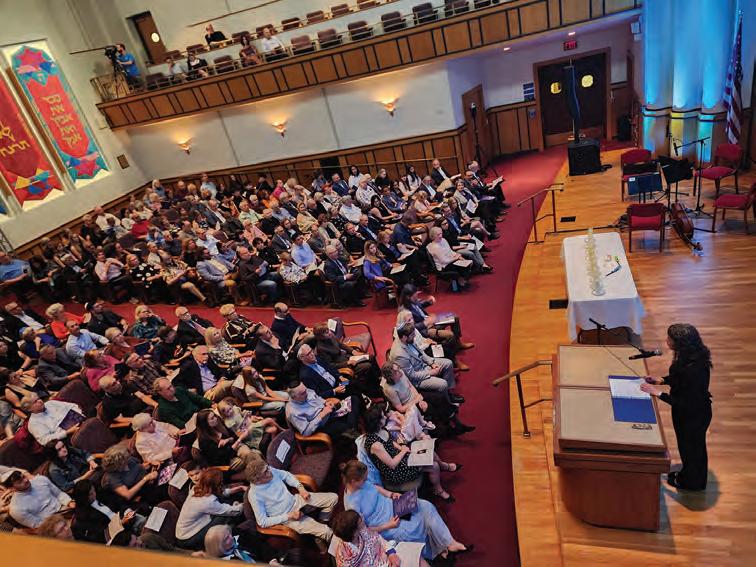
Relying on the strengths of those organizations, Echoes and Reflections prides itself on providing educators with resources and professional development opportunities for teaching the Holocaust “responsibly, accurately and effectively.”
greet that featured both Humphrey and Carlow University Provost and Vice President of Academic Affairs Rhonda Maneval. Another is being planned targeting school/education administrators, healthcare professionals, students, community members, parents/grandparents and anyone who might be interested in learning more about the opportunity.
The program will be tailored to the needs of Jewish women, but men can also register for the program. In fact, Rothstein said, it’s open to anyone across the Jewish spectrum.
“The goal is to help Jewish students get a degree without compromising their values and to encourage accessibility without penalizing people for starting a family early,” he said.
Those interested in learning more about the program can reach out to Chabad House on Campus-Pittsburgh at chabadpgh.org; for information about becoming a Carlow University student, visit carlow.edu/become-a-celtic. PJC
David Rullo can be reached at drullo@ pittsburghjewishchronicle.org.
that’s out on the internet.”
A 2022 report from the United Nations and UNESCO studied Holocaust denial and distortion on Facebook, Instagram, Telegram, TikTok and X (formerly Twitter) in English, French, German and Spanish.
While denial and distortion content represents nearly 10% of relevant material on Facebook, the number jumps to 15% on X and nearly 49% on Telegram.
“Throughout the war, the Nazis sought to cover their heinous crimes under a veil of secrecy and outrageous lies. Today, that same denial and distortion runs rampant once again amidst growing antisemitism, ignorance, and bigotry,” authors noted. It’s deeply distressing to know that teachers can search online and not always appreciate “what’s fabricated and what is true,” Loeb said. “Introducing them to the resources that we have at the Holocaust Center is really critical.”
The Aug. 4 program, made possible through the Jack Sittsamer Holocaust Endowment Fund for Teacher Training, is the first of four professional development opportunities for educators scheduled this year. Whether teachers are new to Holocaust education or seasoned veterans, the Holocaust Center is a reliable educational partner, Loeb said. “At any point throughout their school year, when they need some support, they can reach out to us and we can help.” PJC
Adam Reinherz can be reached at areinherz@pittsburghjewishchronicle.org.

By Ron Kampeas | JTA
WASHINGTON – Benjamin Netanyahu, the Israeli prime minister, and Yair Lapid, the leader of his opposition, are in Washington, ostensibly to attend the funeral of one of the staunchest pro-Israel American politicians, Lindsey Graham.
They are also, as Lapid made clear in an appearance Monday at the influential Atlantic Council think tank, launching a bruising election campaign and are intensely seeking the favor of a constituent who does not vote in Israel on Oct. 27: President Donald Trump.
Or more broadly, the favor of Americans.
Israeli-born Netanyahu, who was raised in Philadelphia, has made a career of defining himself as his country’s best, even inevitable, envoy to its most important ally. He met with Trump on Tuesday. Lapid in his speech sought to portray Netanyahu’s public diplomacy – the defining characteristic of his political career – as busted and harmful.
“The first step is obvious” to restoring Israel’s reputation, Lapid said. “Send into retirement Benjamin Netanyahu and his group of extremists who are tearing us apart at home and abroad.”
Lapid, who speaks in fluent but accented English, says he wants to be the foreign minister in the next government, one led by Naftali Bennett, a security hawk, as prime minister. He, too, claims an intimacy with the American psyche, evident in an essay he just published in The Atlantic about the cross-country road trips he takes every several years.
Netanyahu is on a mission to secure support for continuing and winning the war he and Trump launched against Iran. In remarks in Hebrew he recorded just prior to leaving Israel on Monday, he leaned into his friendship with Trump.
“I am on my way to Washington to a meeting with our friend the president of the United States, Donald Trump,” he said, standing with his wife, Sara, outside the airplane. “This is my eighth meeting with him since he was elected for his second term, more than any other world leader. It is a great privilege, and also a great responsibility.”
Both Lapid and Netanyahu claimed a closeness to Graham, the South Carolina Republican senator who helped Netanyahu cajole Trump into the war with Iran. Graham, Netanyahu said, was “a true friend of mine and the state of Israel.” Lapid inserted Graham into his argument that the long term goal for Israel and the United States should be the collapse of the Iranian regime. “The last conversation I had with the late Lindsey Graham was about this,” he said Monday.
Lapid at the outset of his remarks sought to erode Netanyahu’s reputation as an America whisperer, saying the coming election would “be the most dramatic, the most crucial, the most intense the country has ever seen.”

“Here is the not to-do list for the Israeli government if you don’t want to witness the complete collapse of the country’s international status.”
Lapid accused Netanyahu of isolating Israel by caving to extremists in his government and alienating allies. Instead, he laid out a formula for how the next prime minister would govern.
“If a minister in your government says a nuclear bomb should be dropped on Gaza, fire him. If a minister in your government says there are circumstances in which it is acceptable to starve the civilian population, fire him. If a minister stands over a large group of handcuffed activists lying on the floor of a detention facility, waving a flag and mocking them, fire him,” Lapid said.
He was referring, respectively, to controversial statements and actions by Heritage Minister Amichai Eliyahu, Finance Minister Betzalel Smotrich and National Security Minister Itamar Ben-Gvir, some of which have been used to fuel the claim that Israel is committing genocide against Palestinians in the war Hamas launched on Oct. 7, 2023 with deadly raids inside Israel.
Netanyahu’s mission comes at a perilous juncture in the U.S.-Israel relationship, and his own reputation. Trump’s approval ratings are at a low as the war appears to have generated victories for Iran, which now controls the Strait of Hormuz, the waterway critical to the passage of a fifth of the world’s petroleum. Inflation has skyrocketed, US allies are furious, and Americans in large majorities oppose the war, just as Trump is facing his own electoral test less than 100 days before the midterm elections.
Netanyahu is unpopular in the United States, and for the first time, Americans are more likely to favor Palestinians than Israelis. An Economist poll published Tuesday showed half of Americans supported Netanyahu’s arrest. Trump wants Israel to stay out of the war, crippling Israel’s ability to influence the outcome of the conflict that continues to loom on its border with
Lebanon, where Hezbollah, Iran’s proxy, hopes to regain its strength.
Lapid’s audience here is mostly left of center: His host at the event was Daniel Shapiro, the Obama administration’s ambassador to Israel. A spokesman for Lapid said that other than his attendance at Graham’s funeral, his only public appearance on his trip to the United States this week would be with a group of Democratic senators.
The Atlantic Council is bipartisan, but its Republican component is made up mostly of the old-school believers in alliances that Trump has all but ousted from the party. Seated in the front row was Stephen Hadley, the national security advisor to former President George W. Bush, who is a board member of the Atlantic Council.
Lapid said reconciling with Democrats would be a priority in the next government, should his dream team emerge victorious: Bennett as prime minister, Lapid as foreign minister and Gadi Eizenkot as defense minister. Eizenkot, who has in recent polls surpassed Bennet and Netanyahu, obviously might have different ideas about who gets which job.
“Elizabeth Warren, John Ossoff and Tim Kaine are not the enemy,” he said, referring to Democratic senators from Massachusetts, Georgia and Virginia who have been critical of Israel’s conduct of the Gaza war, and who have voted to suspend defense assistance to Israel. “The Democratic Party is not the enemy.“
Bennett and then Lapid were rotating prime ministers during the last government’s eighteen months of tenure in 2021 and 2022, interrupting Netanyahu’s 12 year run launched in 2009. Netanyahu by then was already persona non grata among Democrats for his all-out campaign against President Barack Obama’s Iran policies.
Lapid, like others running against Netanyahu, appeared cowed by Netanyahu’s attempts to tar their past association with Mansour Abbas, the leader of the United Arab List. Bennet and Lapid made history by including the party in the governing coalition. That would not happen again, Lapid said, although garnering enough seats to govern is more daunting without the inclusion of Arab parties.
“I have a lot of conversations about this with Mansour Abbas, who seems to understand this better than some of my Jewish friends, the fact that maybe it’s time for a coalition that will be made of only of Zionist parties,” he said.
Lapid’s greater affinity to Democrats notwithstanding, he took shots at Netanyahu’s relationship with Trump –arguing that he was the better friend to the president’s Middle East agenda. He noted that last year he brought Trump’s 20-point plan for bringing peace to Gaza to a Knesset vote – and that Netanyahu and his coalition partners absented themselves from the Knesset rather than vote for it.
“I passed the 20-point plan, I did it just to bend Netanyahu’s arm into it,” he said. Netanyahu could not afford to back the plan because its provisions anticipating Palestinian self-governance might have cost him his right-wing coalition partners. ”So I got all the compliments from the American administration,” Lapid said. “It was fun.” PJC










In a Jewish social service center in Lviv, Ukraine, I joined other Federation CEOs packing backpacks with school supplies for children from families displaced by the conflict. Many had fled from eastern Ukraine. Some of those children had fled from Kherson, a city that has been battered since the start of the conflict. They were about to start a new school year anyway, in a new city, because someone had decided they still deserved backpacks and pencils and a normal Tuesday.
I went to see where our Federation’s dollars actually land. What I found, again and again, was Pittsburgh’s fingerprints.
In Tbilisi, Georgia, I toured a Hesed, one of the community centers JDC operates across the former Soviet Union to feed and care for Jews, most elderly, while giving young fami-
That someone, in part, is us. It’s Pittsburgh and our Federation donors.
I spent last week on the ground in Georgia, Poland and Ukraine on a mission organized by the American Jewish Joint Distribution Committee, the century-old organization that serves as the Jewish world’s first responder in more than 70 countries, and one of our Federation’s historic core partners. JDC doesn’t focus on a single program. It provides the infrastructure that allows Jewish communities to care for seniors, respond to crises and rebuild after unimaginable loss.
received grant funding from Pittsburgh’s Jack Buncher Foundation, specifically earmarked for that work. Our Federation helped connect the Buncher Foundation to JCC Global so the money could actually get where it needed to go.
None of that prepared me for Lviv.
JDC doesn’t focus on a single program. It provides the infrastructure that allows Jewish communities to care for seniors, respond to crises and rebuild after unimaginable loss.
lies a place to gather. It’s a warm, well-run building full of people who need it. This one happens to exist because Pittsburghers, the Posner Family, funded its purchase through a relationship built with our Federation. Halfway around the world, I was looking at something Pittsburgh helped make possible. I saw the same pattern in Warsaw, at the city’s JCC, where I met the head of the Jewish community center from Kishinev, Moldova. Both centers serve Ukrainian IDPs (Internally Displaced Persons), and both
We left Rzeszow, Poland, early in the morning, drove to the Ukrainian border, crossed on foot and rode a bus to reach the city. Our first stop was another Hesed, this one also built with Posner family support, where seniors were cared for and looked after as Jewish children were playing in the courtyard. Speak to almost anyone there for more than a few minutes and you learn many are IDPs. From there we went to a JDC-supported volunteer center and spent part of our day packing those back-to-school
supplies. It was, without question, the longest day of the trip. It was also the one I keep coming back to.
I’ve worked at this Federation long enough to know how easy it is for the services we fund to feel abstract, a line in a budget, a name on a grant. This trip erased that feeling for me completely. The Posner family’s gift is a building where a woman who survived things I can’t imagine gets a hot meal. The Jack Buncher Foundation’s gift is a partnership that moved supplies to refugee families before winter. And at the core of it all is our Community Campaign support of organizations like the JDC powering them to do this life sustaining work on our behalf.
I flew home from Warsaw thinking about scale. Pittsburgh’s Jewish community isn’t one of the nation’s largest. But in just one week, across three countries, I watched our generosity reach people I will never forget. It built a Hesed. It stocked a backpack. It brought Jewish joy. And it gave trusted organizations the flexibility to help when help was needed most. Jewish tradition has a word for this: arevut, the idea that we are responsible for one another, wherever we are. I’ve read that word my whole life. In Lviv, Warsaw and Tbilisi, I watched it work. PJC
Jeffrey Finkelstein is president and CEO of the Jewish Federation of Greater Pittsburgh.
It seems to be open season for Democratic Party politicians in Pennsylvania. First, in May, Pennsylvania Supreme Court Justice David Wecht announced he was leaving the Democratic Party to become a registered independent because, in his view, the party had become tolerant of antisemitism. Then, in July, U.S. Sen. John Fetterman threatened to leave the Democratic Party if it became an “anti-Israel” party, specifically referencing an arms embargo bill sponsored by Democrats in the House. Fetterman did not say whether, if he left the party, he would become an independent or register Republican.
elected because he was a Democrat, he was elected to serve the interests of the Democratic Party in the U.S. Senate. By running as a Democratic candidate in 2022, Fetterman was promising each voter that he would serve as a Democrat in the Senate until 2028. That is why Fetterman, unlike Wecht, has no right to leave the Democratic Party and still remain in office.
be nearly impossible for Democrats to win a Senate majority in 2026. Thus, by changing parties Fetterman would be undermining a sovereign decision that only the voters have a right to make.
People tend to forget how important majority control of the Senate is. If Democrats had consistently controlled the Senate in President’s Trump’s first term,
In threatening to leave the party, Fetterman is treating his office as if it were his property. He is forgetting that he was elected as a representative.
Obama did not come to a vote. Because Republicans controlled the Senate in 2020, Amy Coney Barrett was confirmed to the court after the death of Justice Ruth Bader Ginsburg despite the imminence of an election that Trump lost.
Wecht’s announcement provoked criticism, mostly because as a jurist he should not enter into political issues. But no one doubted Wecht’s right to leave the Democratic Party. After all, Wecht’s decisions as a judge, like those of all judges, are always to be strictly non-partisan. In a sense, it should not matter what political party a judge belongs to once that judge joins the bench.
Fetterman’s situation is different. He was elected by voters as a partisan act to reflect partisan differences. Not only was Fetterman
This can easily be understood if we imagine Fetterman becoming a Republican. When I voted for him in 2022, it was not just a vote for Fetterman personally. It was also a vote to try to maintain a Democratic Party majority in the Senate, which narrowly succeeded that year. In the coming midterms, there is a small chance that the Democrats will retake the Senate majority. I voted for Fetterman on the assumption that he would vote to maintain a Democratic majority every two years. If Fetterman became a Republican, it would
the U.S. Supreme Court would not have a conservative majority. If Democrats retake the Senate in the 2026 midterms, Trump will be unable to appoint a justice should a vacancy occur.
Majority control of either the House or the Senate means that the leadership of that party determines the legislative agenda of that branch of Congress. Because Republicans controlled the Senate in 2016, Judge Merrick Garland’s nomination to the U.S. Supreme Court by President Barack
The importance of majority control is why Democrats in Maine are so determined to oust GOP Sen. Susan Collins despite her quite reasonable voting record. Collins votes to give Republicans the majority in the Senate. All of this is why Fetterman would be betraying the voters if he became a Republican.
But what if Fetterman did not actually change parties? What if he left the Democratic Party but became a registered independent and voted to give the Democrats the majority in the Senate if circumstances allowed? That is what Arizona Sen. Kyrsten Sinema did in 2022 and West Virginia Sen. Joe Manchin did in 2024. They were elected as Democrats and then caucused with the Democrats after switching to independent status. What if Fetterman became an independent who caucused with the Democrats?
This action would still be a betrayal of the voters, as it was for Sinema and Manchin. Unlike Joe Lieberman and Bernie Sanders, who were elected to the Senate as independents, Fetterman was elected to the Senate as a Democrat. When I voted for him in
Please see Ledewitz, page 13 Guest
Last week, the Chronicle asked its readers in an online poll the following question: “How long do you think the current military conflict between the U.S. and Iran will last?” Of the 201 people who responded, 50% said longer than one year; 26% said six months to one year; 22% said one to six months; and 2% said less than one month. Comments were submitted by 72 people. A few follow.
Delusional narcissists with unchecked power are in charge of both countries. It will continue, sometimes hot and sometimes cold, until sometime after that situation ends — maybe in our grandchildren’s time.
It has already lasted too long, with no rationale, no aim and no purpose.
This is a forever conflict with Iran, or at least until Iran abandons its hatred for Little Satan (Israel) and Big Satan (U.S.). Maybe not a “military” conflict, but an
Ledewitz:
Continued from page 12
2022, I was not just voting for him to work in the Senate. I was also voting for him to be a voice for me in the national Democratic Party. I have a right to insist that he continue to be that voice.
It is true that support for Israel was not a big issue in 2022. I did not know how Fetterman felt about Israel. In fact, Fetterman has taken numerous positions that his supporters would not have expected and often disagree with. There is nothing dishonorable or unusual in that. Aside from particular campaign promises on specific actions and issues, our elected representatives are expected to use their best judgment about the needs of our country. You elect a person to public office in part because you respect their judgment in terms of future issues. Disagreeing
How long do you think the current military conflict between the U.S. and Iran will last?
“existential” one forever. I just don’t understand why other Middle East countries don’t join in militarily and take care of business with Iran.
Though I do not have much confidence in our leadership, taking out Iran’s nuclear program and perhaps effecting regime
with your constituents can sometimes be a badge of honor.
Nevertheless, when I voted in 2022, I was trusting Fetterman to be a voice in the Democratic Party. I have a right to that voice even if I do not agree with what he has to say. Fetterman would be betraying that trust if he left the Democratic Party. And that is the case even though the polls tell us that most Democrats want Fetterman to leave the Democratic Party. He made a promise to each voter, not to Democrats in general.
As it happens, I agree with Fetterman on something like an arms embargo, even though I am probably more critical of Israel than he is. What is even more important, however, is that it would not serve America’s interests, nor those of Israel, if there really were two political parties in America, one pro-Israel and one anti-Israel. It is very important that Fetterman remain in the Democratic Party
change in Iran would be a good thing for the region and the world. Let’s hope they can pull this off, and have a plan for what comes after.
Our president and his staff completely underestimated the strength and will of the Iranian leadership and the people, and of its military resolve.
No one likes war but I support the military for what they are fighting for. Iran cannot be allowed to attack anyone with nuclear weapons. The civilians in Iran unfortunately are the innocent ones who are suffering the most.
The fool who got us into this unnecessary war has no idea how to get us out of it, so it may go on until a sane president is elected.
At least until the new Congress in January.
I just hope this doesn’t get dragged out like Iraq and Afghanistan.
and continue an intra-party debate over America’s relationship with Israel.
If fact, I think it is important that both parties contain both supportive and critical views about Israel. Important foreign policy issues should not become strictly partisan. America’s long-term foreign policy commitments are not supposed to change every time we vote the other party into office.
If Fetterman feels too offended by what some Democrats are doing to remain in the party, he is always free to resign from the Senate. In threatening to leave the party, Fetterman is treating his office as if it were his property. He is forgetting that he was elected as a representative.
There is one additional aspect to Fetterman’s position. He might change parties or become an independent to set up a run for reelection in 2028. It is a given that Fetterman would have little chance of surviving a Democratic Party primary for
Iran has been terrorizing the world for 47 years. The United States finally has a president that will do something. President Trump will continue bombing Iran until Iran realizes they must stop fighting back, which will not be much longer.
If Obama and Biden had not sent billions of dollars via planeloads of cash to Iran, this war would never have happened. This cash was also used to fund Iran’s proxies’ attacks on Israel.
Looks like an endless war. Hope I’m wrong. PJC
— Compiled by Toby Tabachnick
Chronicle weekly poll question: Should U.S. political leaders consider the safety of Jews at home when choosing words critical of Israel? Go to pittsburghjewishchronicle.org to respond. PJC
his Senate seat and it is equally clear that if he announced he was running for reelection as a Democrat, there would be a primary. So, Fetterman might prefer to run as an independent or as a Republican. Fetterman has every right to pursue either course. But to keep faith with the voters from 2022, he has to wait. I am entitled to his vote and his presence in the Democratic Party until his term ends. What Fetterman does then will create a new set of allegiances, expectations and obligations. If he were to run in 2028 as a Republican or an independent, and were successful, then he would owe those voters the same fidelity that he owes to us now. PJC
Bruce Ledewitz is professor of law emeritus at the Thomas R. Kline School of Law of Duquesne University. The views expressed in this article do not reflect those of Duquesne University.
Misjudging Hamas/Israel war
Both the International Criminal Court and Mayor Zohran Mamdani have exhibited ignorance of the law as well as antisemitism (“Mamdani lacerates Netanyahu while admitting he can’t arrest him,” online, July 22).
On Oct. 7, 2023, Hamas broke a ceasefire and invaded Israel, attacking people attending a music festival and breaking into people’s homes, torturing and killing men, women and children. Hamas vowed to replicate this behavior a thousand times — a vow cheered by the people living in Gaza under Hamas rule. Yet, the ICC issued an arrest warrant for Israeli Prime Minister Benjamin Netanyahu and the mayor of New York expressed a desire to act on the warrant.
Did they think that Israel was fighting too hard to protect its people? Were they unaware that the Israelis killed included people who had been driving Gazans into Israel to receive medical treatment? Didn’t the ICC and the mayor know that Major (ret) John Spencer, head of Urban Warfare Studies at West Point, had lauded the IDF’s efforts (and success) in avoiding civilian casualties while fighting in a densely populated area where Hamas had deliberately embedded its extensive network of terror tunnels amid the Gazan populace, guaranteeing that Israeli efforts would have to be less than 100% effective?
Toby F. Block Atlanta, Georgia
We invite you to submit letters for publication. Letters must include name, address and daytime phone number; addresses and phone numbers will not be published. Letters may not exceed 500 words and may be edited for length and clarity; they cannot be returned.
Send letters to: letters@pittsburghjewishchronicle.org or Pittsburgh Jewish Chronicle, 5915 Beacon St., 5th Floor, Pittsburgh, PA 15217
We regret that owing to the volume of correspondence, we cannot reply to every letter.
— ISRAEL —
By Andrew Silow-Carroll | JTA
“To be a liberal Zionist, it’s quite a lonely place,” said Amir Tibon, the Israeli journalist whose memoir “The Gates of Gaza” is one of the defining books of the Oct. 7, 2023, Hamas attack on Israel.
“Lonely” is relative, of course. Tibon’s story of how he, his wife, Miri, and their young daughters hunkered in a safe room as Hamas gunmen overran their kibbutz in southern Israel, and how his parents — Maj. Gen. (ret.) Noam Tivon and Dr. Gali Mir-Tibon — rushed into the war zone on a mission to save them, has made him one of the best-known survivors of the carnage.
In an interview, he described the outpouring of support his family received from fellow Israelis and American Jews, and the letters he gets weekly from people inspired by his book.
But Tibon, the opinion editor for the leftwing Israeli daily Haaretz, was speaking about a political reality. In the 33 months since Oct. 7, Israeli society has moved to the right, while the global left has turned Israel, its government, its people and its supporters into pariahs. That makes Tibon an inconvenient figure in both camps: too left for the Zionists, too Zionist for the left, and an eyewitness to events — acts of butchery on one side, security lapses on the other — that both would rather forget.
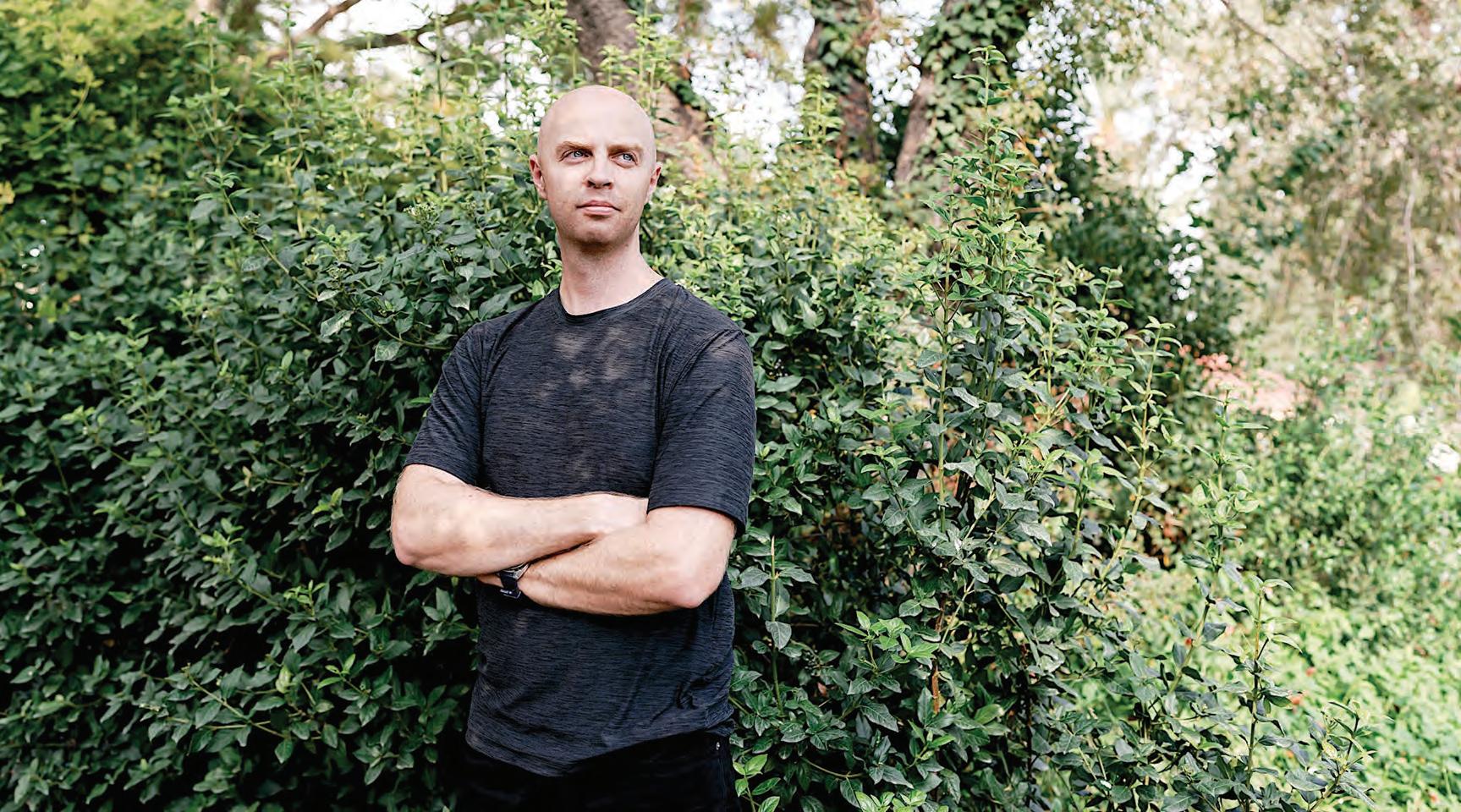
think the judging panel is doing the opposite: It’s once again putting a spotlight on that day, and on everything that has changed because of it.
Meanwhile, even as he feels like a beleaguered minority, he remains committed to a vision of coexistence. “The one thing that is not changing: In this land, you have about 50% Palestinians or Arabs — some of them civilian citizens of Israel — and 50% Jews,” he said. “What do we do? How do we live together in this land? I think that question is not going anywhere.”
On July 28, at the National Library of Israel in Jerusalem, Tibon will receive the 2026 Sami Rohr Prize for Jewish Literature for his memoir, subtitled “A Story of Betrayal, Survival, and Hope in Israel’s Borderlands.” The $100,000 award, established 20 years ago by the family of the late American real estate developer, philanthropist and Holocaust survivor, is presented annually to an emerging author “who demonstrates the potential to make ongoing contributions to Jewish literature.”
In “The Gates of Gaza,” published in the fall of 2024, Tibon weaves his family’s rescue story with a wider history of Kibbutz Nahal Oz and the Gaza border communities and an account of the intelligence and policy failures that left them undefended. The book has also won the National Jewish Book Award, the Wingate Prize and the Bernstein Prize, and has been translated into Hebrew, German, French, Romanian, Italian and Hungarian, with a Spanish edition on the way.
The Rohr prize, Tibon said, arrives at a moment when he feels a duty to keep Oct. 7 in view. “It means that we are not forgetting Oct. 7,” he said of the prize. “We are not allowing anyone to minimize, deny, justify or otherwise just ignore that day and its place in history. There are very powerful forces that are trying to shift the conversation away from that day for
Since the attack, Tibon and his family have lived as evacuees in Kibbutz Mishmar HaEmek in northern Israel. In August, nearly three years after the invasion, they and other evacuees plan to move back home to Nahal Oz and join those who have already come back. Fifteen civilians from the kibbutz were killed on Oct. 7, and eight were taken to Gaza as hostages. More than 50 Israeli soldiers and security personnel were killed in the battle for the kibbutz and at the adjacent army base.
The return, he said, is “still a difficult, complicated situation on many levels — security, resources and just kind of the mental part of it.”
Counting his family, roughly two-thirds of the community who lived there before the attacks will soon be living there.
“I’m not sure everybody who is returning is definitely going to stay,” he said. “I think this is a test we still have to see — how is life going to look for families, what’s going to be the security situation, how much the education and health care and transportation and other government services are going to be high quality. These are all open questions.”
His daughters, Galia, 6, and Carmel, 4, have absorbed more in the last three years than any child should. “The kids here grow up too fast,” he said. “They understand a lot of what has happened — Oct. 7, the war with Gaza, the experience of having to leave your home, and then the subsequent Hezbollah and Iran wars. Unfortunately they understand pretty much everything.”
Between the book and a 2025 documentary based on his story, “The Road Between Us: The Ultimate Rescue,” Tibon has become one of the most recognizable faces of Oct. 7 — a status he wears uneasily.
“I don’t see myself as a spokesperson for anyone,” he said, pointing to others whose books have resonated widely, including the former hostage Eli Sharabi and Rachel Goldberg-Polin, Her son, Hersh Goldberg-Polin, was abducted by Hamas from the Supernova music festival
surviving for nearly 11 months in captivity.
Even within his own tiny community, Tibon said, “every story is different.” Nahal Oz has 450 residents. “Each family has its own story from that day.”
But the reception for the book means he has had an impact on how people remember and discuss Oct. 7. “Tens of thousands of people around the world have read this book,” he said, and he still hears from readers weekly. “Most of them are very supportive and uplifting, but there’s also criticism, and I’m happy for that as well.”
Some of that criticism comes from the left, from those who feel his story of Israeli suffering crowds out attention that should be focused on the tens of thousands of Gazans killed in the war and the million-plus who have been displaced. Tibon doesn’t flinch from the argument that the war has been catastrophic for Palestinians — he has said so in print, repeatedly. And he remains a harsh critic of the Netanyahu government, which he feels has extended the war in part to keep its hold on power.
But he insists that Hamas’ culpability for all that followed cannot be erased: “This war never would have started without Oct. 7. That’s just a fact,” he said. “And that day, it was a catastrophe for Israelis, and it was just as much a calamity for the Palestinians.”
Tibon said he is less worried about the activist left’s hostility toward Israel than he is about the mainstream turn in U.S. public opinion. “Today 60% of Americans have a negative view of the country,” he said, “and nobody is going to convince me that 60% of Americans is antisemitic and supports BDS.”
The Netanyahu government, he said, has been “a godsend, a gift from the heavens, for the far left in America,” which prefers to point to Netanyahu and his far-right ministers, Itamar Ben-Gvir and Bezalel Smotrich, rather than Israelis like Tibon’s family and the other residents of Nahal Oz who still yearn for peace.
But he warns fellow supporters of Israel against making the opposite mistake, and defending the Israeli government from justified criticism. “If you’re saying Netanyahu
s immune from criticism and cannot be separated from Israel, you just made Zohran Mamdani’s day,” he said, referring to the anti-Isibon is blunt about what he sees as an Israeli government strategy of trying to move on from Oct. 7. “The government would very much like to erase Oct. 7 from public memory,” he said, “or at least to frame it in terms that are very favorable for them, and make it smaller than
Given the security failures on that day, Tibon remains flabbergasted that Netanyahu’s government has survived the almost three years since. e argues Israel abandoned its founding doctrine of short, decisive wars for long, inconclusive ones in Gaza, Lebanon and Iran that erved the coalition’s survival more than the country’s security: “They did not defeat Hamas. They did not defeat Hezbollah. They did not defeat Iran. But they managed to survive a full
Not everyone who lived through what Tibon’s family did has landed where he has politically. But while acknowledging the sharp political shift to the right in Israel since Oct. 7, he says it’s not just the left that remains “disgusted” with the government. Friends across the spectrum who served hundreds of days in reserve duty are appalled, for example, by legislation sheltering approximately 72,000 haredi Orthodox yeshiva students from the draft.
That contradiction, he said, is why figures like Avigdor Liberman, Naftali Bennett and Gadi Eisenkot — politicians critical of Netanyahu but hardly doves — are “ascendant right now.”
Asked if he’s changed his own mind about anything since Oct. 7, Tibon didn’t hesitate: “I’ve become more pessimistic.” Then, he catches himself. “If we succumb to total pessimism, then what’s the point of being here at all?”
If there is hope, he said, it has come from community, family and routine. He calls Mishmar HaEmek “a wonderful kibbutz” that “opened their hearts and their home.” Miri resumed her work with autistic children, now in Afula, a city in northern Israel. He went back to Haaretz and wrote the book. “It gives you a sense of purpose and meaning and something to get up for in the morning,” he said. He has also found purpose over the past three years in visiting the families of soldiers who died defending Nahal Oz or fell later in Gaza or Lebanon — “many dozens” by now. “I keep in touch with many of them,” he said. “There is no release from this.”
He is also grateful to the American Jewish organizations and synagogues, many from the Washington, D.C.-area where he and Miri once lived, for an outpouring of support that began on Oct. 8 and hasn’t let up.
“I also find a lot of reasons for hope within my own family — to see my daughters, how they’re growing and overcoming this trauma and becoming independent and strong every day — and to see my community, the people of Nahal Oz, who are doing a little bit every day to make things better and to overcome what happened.
“And I want to be optimistic that just as we are able to rebuild Nahal Oz now, and rebuild our life over there, we will also rebuild the country and put it on the right track.” PJC


Lifetime Achievement Award, Karen Wolk Feinstein
Outgoing president and CEO of the Jewish Healthcare Foundation
Rabbi Yisroel and Chani Altein
Co-directors of Chabad of Squirrel Hill a
Dean Aseef Shaliach at the Jewish Community Center of Greater Pittsburgh a
Michael Bernstein
The Tree of Life board chair a
Nina Butler
Director of Bikur Cholim Pittsburgh a
Debra L. Caplan
Jewish Healthcare Foundation, board of trustees and volunteer, and WHAMglobal (Women’s Health Activist Movement Global), founding chair
Avi Cohen Community volunteer a
Rebecca Elhassid Community volunteer a
Meyer “Skip” Grinberg Community volunteer a
Tsipy Gur
Classrooms Without Borders, founder and executive director a
Rachael Heisler Pittsburgh City Controller a
Jeff Herzog Community volunteer a
The Rev. Jonathon Jensen Calvary Episcopal Church a
Rona Kaufman
Associate professor at Thomas R. Kline School of Law of Duquesne University
Eric Lidji Director of the Rauh Jewish History Program & Archives at the Heinz History Center a
Fraidy and Dovie Nadoff Community volunteers a
Julie Paris
To inquire about individual or corporate sponsorship packages, placing congratulatory ads or for any other questions, please contact Amy Weiss at 412-613-0697, or aweiss@pittsburghjewishchronicle.org. Mazel tov, and thank you, to our 2026 18 Difference
Mid-Atlantic regional director of StandWithUs a
Rabbi Chezky and Bassie Rosenfeld Co-directors of Our Giving Kitchen a
Kelly Schwimer
Executive director of the Jewish Cemetery & Burial Association

Look for a special section on Sept. 4 celebrating the honorees!



By Sarah Tuttle-Singer | The Times of Israel
When Melanie Koloditzky talks about breast milk, she sounds part scientist, part artist and entirely mom.
The Buenos Aires native, who moved to Israel shortly after marrying her teenage sweetheart, has spent the last five years transforming breast milk into handmade keepsake jewelry for mothers across Israel and all around the world. For her, each piece is far more than a necklace, ring or pendant. It is a way of enshrining a fleeting chapter of life.
“I often say that I’m not only creating jewelry,” she says. “I’m preserving moments that can never be repeated.”
Koloditzky grew up in a secular Jewish family in Argentina with traditional roots. A twin with an older sister, she met the boy who would eventually become her husband when she was just 15 years old.

“As we grew up together, we shared the same dream: building our future in Israel,” she recalls.
After marrying, the couple celebrated with family and friends in what felt, she says, like both a wedding and a farewell party. Two weeks later, they boarded a plane and moved to Israel.
The move was exhilarating but not easy.
“I didn’t speak Hebrew other than ‘shalom,’ ‘todah’ and ‘mazel tov,’” she says, using the popular phrases for greeting, thanks and congratulations.
She spent five months studying at an immersive Hebrew language course on a kibbutz in northern Israel before gradually building a life for herself. Along the way, she worked a variety of jobs, including babysitting, and later worked at the Weizmann Institute of Science.
Those experiences reflected two interests that had long existed side by side. She always loved science. Before immigrating,
she had begun studying biotechnology and remained captivated by the remarkable capabilities of the human body. And at the same time, she nurtured her creative side, studying graphic and interior design and spending years making art and crafts.
Looking back, she says, breast-milk jewelry became the perfect meeting point between those two worlds.
“It combines my fascination with science and my love of creating things with my hands,” she says.
Another thread ran through her life: Koloditzky wanted to become a mother.
“Even as a little girl, I knew I wanted to be a mother one day,” she continues.
She welcomed her first daughter at 22 and quickly discovered that motherhood, while deeply rewarding, was not easy.
“Breastfeeding surprised me,” she

says. “I had never imagined it could be so challenging.”
There was pain, deep frustration and tears. But the experience also sparked a deeper curiosity about breast milk itself — a curiosity that drew together her personal experience and scientific interests.
To Koloditzky, breast milk is one of nature’s great marvels.
“It isn’t simply food,” she says. “It’s a living substance that changes constantly according to a baby’s needs.”
Research has shown that breast milk adapts throughout infancy, altering its composition as babies grow and even increasing immune-supporting components when a child is sick.
“To me, that feels almost like a superpower,” she says.
The idea of preserving that experience first took root before she became a
mother herself, when she saw a Spanish YouTuber wearing earrings made from her
The image stayed with her.
After experiencing pregnancy, birth and breastfeeding firsthand, she finally
“For me, breast milk jewelry is not simply about preserving milk,” she says. “It’s about preserving a chapter of life that passes so quickly, yet changes you forever.”
After the birth of her second daughter, she began creating keepsake pieces for herself. Eventually, friends and other mothers began asking for their own.
That personal project gradually evolved into Forever Moments, the business
For the past five years, Koloditzky has created handmade breast-milk jewelry for clients throughout Israel and abroad. She also offers do-it-yourself kits for mothers who want to craft their own keepsakes
Some of the most meaningful work she does, however, happens through a volunteer partnership with Magen David Adom’s breast-milk bank. For mothers who have experienced stillbirth and choose to donate their breast milk to vulnerable infants, Koloditzky creates commemorative breastmilk stones that accompany certificates of appreciation.
“These women go through an unimaginable loss,” she says. “Despite their grief, they choose to transform that pain into an act of generosity.”
It is work she describes as both humbling and deeply moving.
What stays with her most are the stories. Behind every pendant, ring or stone, she says, is a family, a memory and a journey unlike any other.
“When I look at breast-milk jewelry, I don’t simply see a piece of jewelry,” she says. “I see strength. I see resilience. I see the incredible transformation that happens when a woman becomes a mother.” PJC


contact

Rhoades, srhoades@jccpgh.org or 412-697-3510. pittsburghgives.org/organization/jccpittsburgh

Brad and Kayleigh Zimmerman of Scott Township are overjoyed to announce the birth of their beautiful daughter, Olivia Grace, born nine weeks early on April 5, 2026. After a six-week stay in the West Penn NICU, Olivia is now thriving at home. Her parents are deeply grateful to the doctors, nurses and staff whose care helped bring her home safely. Olivia is welcomed home by her adoring big sister, Gabriella Zimmerman. Proud grandparents are Irwin and Judy Zimmerman of Squirrel Hill, and Tom and Tracey O’Donnell of Canonsburg, Pennsylvania. Olivia (Avigail) is named in loving memory of her paternal great-aunt, Gail Ryave. A naming ceremony was held on July 26, 2026, to celebrate Olivia’s arrival with family and friends.
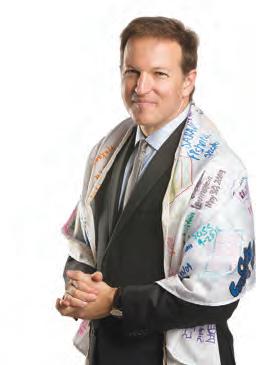
(formerly of Pittsburgh) were married in Madison, Wisconsin by Rabbi Sarah Berman of Central Synagogue (New York) on July 12, 2026. Ellen is the daughter of Barbara Y. Mitchell, Esq. (Dr. John Mitchell) of Madison and the late Byron Yaffe of Rockville, Maryland. Rick is the son of Donna B. Mullaugh (the late Michael Mullaugh) of Boca Raton and the late Charles L. Kalson of Pittsburgh. Ellen is a managing director in the financial services sector at Russell Reynolds Associates in New York and Rick is a shareholder in the construction law practice group at Cozen O’ Connor in New York. The wedding ceremony was preceded by a wedding blessing by Rabbi Joel Mosbacher of Temple Shaaray Tefila in New York. The couple reside in the Upper East Side of Manhattan.
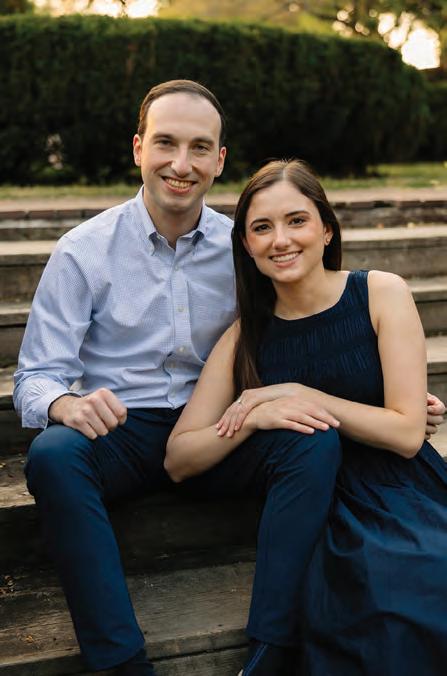
Greg and Ann Steiner of Point Breeze are delighted to announce the marriage of their son, Jeffrey, to Audrey Magnelli, daughter of Anthony Magnelli and Carol Neish of Moon Township. Jeffrey and Audrey were married at PPG Wintergarden on June 27, 2026, and will reside in Pittsburgh. PJC

Rabbi Larry Freedman
Parshat Eikev
Deuteronomy 7:12 – 11:25
always find it interesting when a certain subset of liberal Jews becomes very fundamentalist when reading Torah. While the est of the Jewish world reads a portion for the metaphor, for the truisms embedded in a story, or for the hidden Kabbalistic meaning, this subset of Jews treats the text as the direct word of God and therefore true in an exclusively literal manner. This approach runs into real problems in Parshat Eikev when we come up against one “if-then” statement after another. Right from the start: “If you do obey these rules … He will favor you and bless you … . You shall be blessed above all other peoples … .” Or, there is this recapitulation in Chapter 8, referring to the 40 years of wandering: “The clothes upon you did not wear out, nor did your feet swell these forty years.” Or this weird threat: “If you do forget the Lord your God and follow other gods … I warn you this day that you shall certainly perish like the other nations [that do not follow God].” It sure seems like many other peoples exist today who do not follow God (although it’s true the Canaanites, et al., are no longer around).
Want more? In the recapitulation of the Golden Calf episode, God suggests to Moses that God will wipe out all Israel and start again with Moses. Yikes. And then Moses, who did not want God to kill all the Israelites, let alone create a new people from his stock, eats no bread, drinks no water for 40 days and yet somehow survives.
It goes on and on like this, and if I were one of these literalists I probably would have stopped reading some time ago. But of course, this type of literal reading is a faux-pious strawman argument. I’m referring to someone who approaches the text this way and says,





“Fine! I’ll read it like a true believer and show you how silly it is.” But a true, true believer knows better. Fidelity to the text requires not buying into every word. Rashi knows that; he made a whole career of it. Same for Rambam and every Kabbalist and every commentator up to this very day, including those insights that guy in your Torah study comes up with.
The real point is found in places like chapter 10, when we read, “Israel, what does the Lord your God demand of you? Only this: to revere the Lord your God to walk only in His paths, to love Him and to serve the Lord your God with all your heart and soul.” And why should we do this? Because if we follow God we will act like God who “upholds the cause of the fatherless and the widow, and befriends the stranger, providing him with good and clothing. You, too, must befriend the stranger for you were strangers in the land of Egypt.”
Now, Eikev concludes with more if-then statements that seek to encourage allegiance to God. But I always wonder, what is the purpose of this allegiance? Do we follow God just to follow God? How much attention does God really need? How big an ego are we dealing with?
No, the purpose of following God is to give us a clear, encouraging path to do the things that make the world a better place. Follow God not for God but for the orphan, for the stranger, for the widow; to uplift the least among us, to make better the life of the downtrodden. Some people will do it on their own. Maybe. But for Jews, the Torah we read is there to bring us to the goal God has for us: Make the world a better place, make yourself a better person. Are the words of Eikev true? Wrong question. Is the message of Eikev true? Absolutely. PJC
Rabbi Larry Freedman is the director of the religious school of Congregation Beth Shalom and the newly unified Beit Kulanu. This column is a service of the Greater Pittsburgh Jewish Clergy Association.












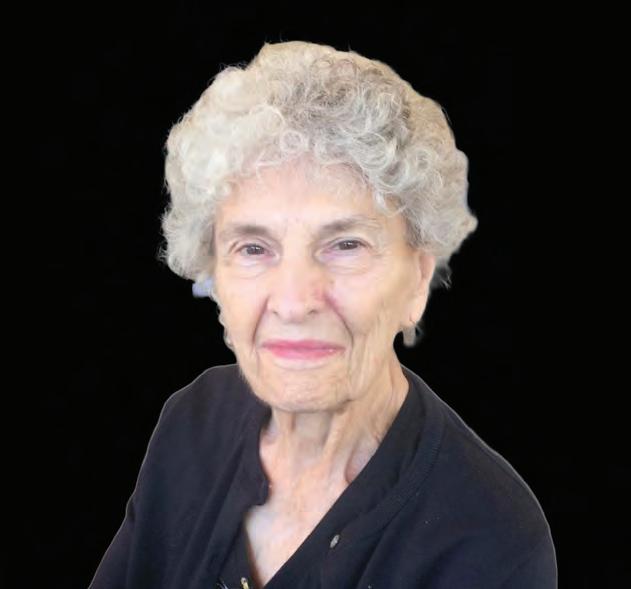
BERNSTEIN: Marlene Judith (Karsh) Bernstein, born June 19, 1932, passed away peacefully on July 20, 2026, at the age of 94. Marlene was preceded in death by the love of her life, her husband Joseph “Buddy” Bernstein; her parents, Anna and David Karsh; and her siblings, Florence Klein, Emanuel Karsh and Joseph Klein. Following her mother’s death in 1934, Marlene was lovingly raised by her sister, Florence, and Florence’s husband, Zola Klein. Their bond was made legal when they adopted Marlene at the age of 41, formally making Joseph, Eugene and Gerald Klein her brothers. Marlene was the devoted matriarch of a beautiful family she and Joe raised in Squirrel Hill. She is survived by her children, Larry (Karen, of blessed memory) Bernstein, Bob (Ellie) Bernstein, and Hollie (Donald) Machen; her brothers, Eugene (Robin) Karsh, and Sherwin (Helen) Karsh; and her brothers Eugene and Gerald Klein. She is also survived by her seven grandchildren: David (Kate Barbee) Bernstein, Jaime (Steve Mason) Bernstein, Katie (David Miller) Bernstein, Alex (Teagen O’Malley) Bernstein, Daniel Rudov, Lindsey (Dylan Laventhal) Rudov, and Roxanne Rudov. She was the proud great-grandmother of Merrin O’Malley Bernstein

D’Alessandro Funeral Home and Crematory Ltd.
“Always A Higher Standard”

Dustin A. D’Alessandro, Supervisor • Daniel T. D’Alessandro, Funeral Director 4522 Butler St. • Pittsburgh, PA 15201 (412) 682-6500 • www.dalessandroltd.com

and Nora Laventhal. She is also lovingly remembered by her many nieces, nephews, cousins and friends. Marlene was a dedicated mother and community leader. Proving that it is never too late to pursue a dream, she graduated from Duquesne University School of Law in 1983 at the age of 51. She practiced alongside her husband, son, and daughter at their family law firm, Bernstein & Bernstein. Of all her accomplishments, however, her most treasured roles were those of mother, grandmother and great-grandmother. As the keeper of the family’s history and records, Marlene treasured her extended family and made a point of staying connected with everyone through emails, cards and her renowned Facebook posts. She loved to travel, read and knit, and she cherished time spent with the people she loved. She touched many lives and will be deeply missed. Services and interment were held at Temple Sinai Memorial Park. Memorial contributions may be made to the National Multiple Sclerosis Society in memory of Marlene Bernstein at Remembering Marlene Bernstein (donate.nationalmssociety.org/campaigns/RememberingMarlene-Bernstein), or mailed to the National Multiple Sclerosis Society, P.O. Box 54879, Los Angeles, CA 90054. Arrangements entrusted to Ralph Schugar Chapel, Inc. schugar.com
LUBERTO: Beth Sue (Hostein) Luberto passed away at her home in Virginia after a long illness at the age of 74 on June 20, 2026. She is survived by her beloved husband, Joseph, and adoring children, Brian (Michelle), Andrew (Hope) and Nicole (John). She is also survived by her loving grandchildren and great-grandchildren as well as loving in-laws, nieces, cousins and friends. Beth was the daughter of the late Dorothy and Milton Hostein of Pittsburgh. She was the beloved sister of Eddie, Sally and Sharon. While Beth Sue will be missed by all that knew and loved her, we are grateful she is finally at peace. If desired, contributions to the Parkway Jewish Center will be appreciated. The address is 201 Penn Center Blvd, Pittsburgh PA, 15235.

Chamovitz
Finkel
Edward M Goldston Z"L
S Grinberg
& Cindy Lebenson
Middleman
Maxine & Larry Myer
Ted Pinsker
Nathaniel Samuel Pirchesky
Nathaniel Samuel Pirchesky
Marc Rice
Bernard Shire
Lisa Weinstock, Debra & Ron Weinstock
Weinstock
Contact the Development department at 412-586-2690 or development@jaapgh.org for more information. THIS WEEK’S YAHRZEITS —











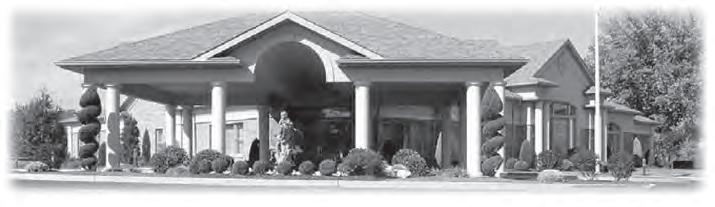
• Serving the Pittsburgh Jewish Community with Traditional Jewish funerals
• Specially Developed Taharah Room with Mikva facilities for Chevra Kadisha
• Accommodations for Shomer • Guaranteed advanced funeral planning
SERVING Scott Twp., Greentree, Carnegie, Mt. Lebanon, Upper St. Clair and Bethel Park D
Sunday August 2: Sadye Bowytz, Julius S Broida, Bernard S Davis, Irwin Sowie Fein, Lester A Hamburg, Lois Hepps, Herman Hollander, Bessie Perr Miller, Larry Miller, Esther Patkin, Theodore Somach, Gilbert Stein, Edward Stern, Rebecca Supowitz, Bella Weiner, Renee Weinstock
Monday August 3: Sara J Ansell, Earl Barmen, Esther Caplan, Harriet L Cohen, Rebecca Lebenson, George Lisker, Joseph Siegman, David P Zelenski
Tuesday August 4: Liza Canter, Elizabeth Cohen, Leonard Ehrenreich, Dr Morris H Glick, Bertha Klein, Harry Lipser, Paul A Love, Harry H Marcus, Rhea Mark, Sophie Masloff, Gussie Sacks, Morris Schwartz, Herbert Sternlight, Rose Zweig
Wednesday August 5: Zelda Cohen, Meyer David Elovitz, Fanny Kramer, Mary Lang, Hazel Pinsker Lemelman, Albert P Levine, Zelman Lee Moritz, Tillie K Morris, Irene I Posner, Mollie Rothman, Samuel Selkovits, Gabe Shapiro, Melvin Tobias, Eva Ulanoff, Rabbi Hugo Unger, Sarah Wesely
Thursday August 6: Sarah Aronson, Irwin George Berman, Nathan Corn, Milton David Daniels, Abraham Herman, Ida Garber Hytovitz, William Kaplan, Samuel S Lewinter, Leon Loibman, Morris Middleman, Hazel Rose Newman, Samuel Simon, Harry Suttin, Merle Weitz, Leah Wekselman, Samuels Zionts
Friday August 7: Eda Yitta Katron Ash, Etta Borof Ontville, Charlotte Charapp, Lois Pearlman Diamond, Dora Fargotstein, David Finkel, Ronald Friedken, Arthur Friedman, Faye Glasser, Libbie Glasser, Herbert Goldstein, Rebecca Goldstein, John J Gruene, Charles Laufe, Kenneth Phillip Levenson, Pauline Loibman, Anne P Morris, Mary Plung, Harry Serbin, Clara Ida Shapiro
Saturday August 8: Samuel Danzinger, Abraham Gernstat, Samuel Green, Elliott Hansell, Jennie Herron, Richard Lebby, Dina Schiff, Tzulel Seiavitch, Harvey Edward Thorpe, Hymen Weiss, Gussie Wright

David Patrick Hughes a/k/a David Hughes, deceased, of Pittsburgh, PA, No. 02-26-04145 of 2026, John B. Dunn, Executor, c/o David J. Slesnick, Esq., 310 Grant Street, Suite #1220, Pittsburgh, PA 15219

Obituaries:

Continued from page 19
NESBIT: Jack Nesbit passed away peacefully on July 20, 2026. A beloved husband, father, grandfather and great-grandfather. He will be deeply missed by all who knew and loved him. He was the beloved husband of the late Carol Jean Nesbit. He is survived by his loving wife, Dorothy Nesbit; his daughter, Carla E. Abraham, and his son, Steven L. Nesbit (Sandy); his grandchildren, Ari Abraham (Nathalie), Shannon Abraham (Brian Hennis), Caroline and Paige Nesbit; and his great-grandchildren, Paxton, Adeline, Eloise and Theodore. He is also survived by his sisters, Nancy Stoller and Susan Torin (Lee). Graveside service was held at Beth Shalom Cemetery. Arrangements entrusted to Ralph Schugar Chapel, Inc. schugar.com
TAPPER: Dr. Alan J. Tapper passed away on July 23, 2026, at the age of 87. He is survived by his beloved wife, Judith Tapper, loving children S. Scott Tapper (Elizabeth) and Amy Jennifer Tapper (Adam Israel), adoring grandchildren Alex, Katie, Sashie and Nicky, great-grandchildren Wesley and Brooks, loving siblings Dr. Edward Tapper (Betsy) and Nancy Tapper Smith (late Robert), and many nieces, nephews, friends and relatives. Alan was a highly esteemed obstetriciangynecologist, a talented artist and athlete, and a great wit. He was known for his humor, charm, and interest in all who knew him. A native Pittsburgher who remained a Steelers fan despite decades living in Baltimore, Alan is a graduate of Shady Side Academy, Brown University and the University of Pittsburgh Medical School. Services were held in Baltimore. Contributions in his memory can be sent to the Maryland Institute College of Art, the SEED School of Maryland, Gilman School, or Bryn Mawr School.










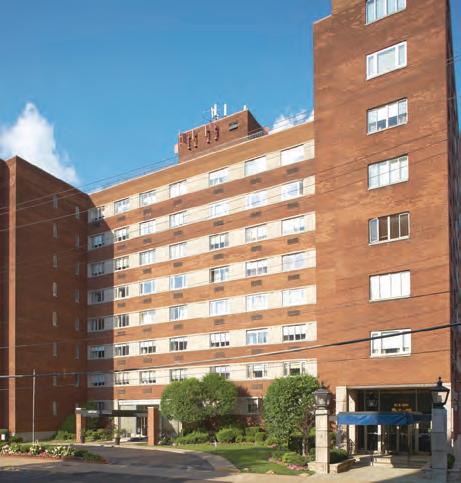






By Toby Axelrod | JTA
How do you stop neo-Nazis from meeting up at Adolf Hitler’s birthplace? Station officers there around the clock, of course.
That is just what the small town of Braunau in Austria has done — but the officers are not providing surveillance. Instead, they will be on site as part of their regular duties, because Hitler’s first home has become a police station.
After years of discussion, planning and construction, the new police station on a corner near Braunau’s town square opened July 22, in the house where the future Nazi dictator was born in 1889 and spent the first few months of his life.
The building looks different, and there will now be surveillance cameras out front.
The city’s aim was “to prevent any association with Adolf Hitler, so as to strip it of that mystique,” the head of the Austrian interior ministry’s history department, Stephan Mlczoch, told reporters on a recent tour.
At last week’s opening ceremony, Austrian Interior Minister Gerhard Karner emphasized that today’s police are “the exact opposite of the symbolism tied to this place. Our police stand … for democracy and the rule of law,” The Associated Press reported.
Some 50 local and district police officers will be stationed at the new site. And there will also reportedly be a police training program on issues related to human rights.
“They will probably also do antisemitism training. And I think that’s a good thing,” Hannah Lessing, who was on the expert commission to decide what should be done with the property, told the Jewish Telegraphic Agency in an interview. Lessing, who co-chairs the Austrian delegation to the International Holocaust Remembrance Alliance, was opposed to tearing down the building:
“I don’t like historical cancellation. But we should use it for something,” she said. “A museum was for me not a good idea, because it would attract automatically people who are probably Hitler fans.”
Thomas Ulmer is a retired officer with the Stuttgart police who fought to turn a former Gestapo headquarters in his German city
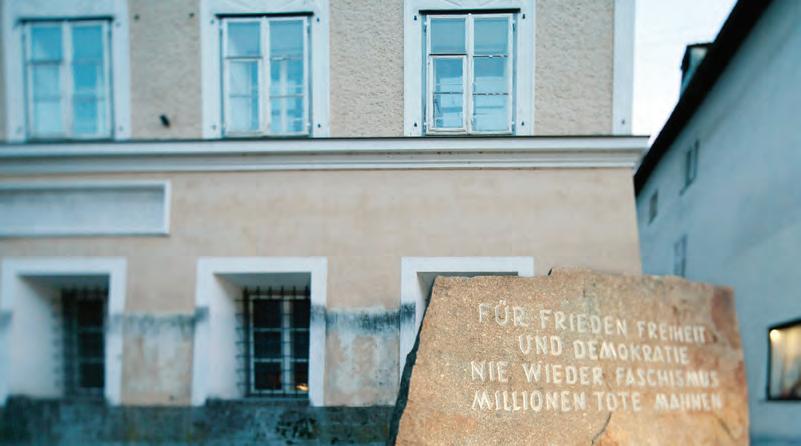
the Austrian government has turned it into a monument,” he said in an email to the JTA. “We probably need a different generation — one that isn’t afraid of the truth and has the courage to truly come to terms with the past. I hope that generation will emerge.”
Also disappointed is California attorney Cary Lowe, who was born in Braunau to Holocaust survivors. He was originally in favor of turning the site into a “House of Responsibility.” That plan is still alive, with another local site in mind. The city did “their best to come up with a result that’s acceptable to everybody,” he said. “And now it’s a done deal, so I think we just have to move on.”
The building where Hitler was born dates back to the early to mid-19th century and sits, along with some other structures, on about three quarters of an acre. It has been privately owned, and over the years has housed a school and a branch of a disability support organization.
Some 50 local and district police officers will be stationed at the new site. And there will also reportedly be a police training program on issues related to human rights.
into a place of remembrance. He said the new site could benefit the officers who are stationed there.
“It’s very important to convey the memory and the history to young people, to young police trainees,” he said.
Today — as an activist in the VelsPol advocacy organization for queer staff in the police and justice system — Ulmer brings police recruits to the Hotel Silber Memorial and Learning Center, where they learn how police were co-opted into the Nazi machine.
Recently, he helped design an exhibit in another former Hitler dwelling that became a police station: a nine-room apartment on Prinzregentenplatz in Munich. The exhibit, which spanned 100 years of history, included the years in which Hitler’s popularity grew after the Beer Hall Putsch, his attempted coup in 1923.
The Munich station’s head, Andreas Franken, doesn’t hide the building’s history, Ulmer said. In his office, Franken even has the famous photo of the American war photographer Lee Miller sitting in Hitler’s bathtub.
“When people come to him, whether they’re new police officers or just other people, they always ask him about this picture, and then he can tell the story of the building again,” Ulmer said.
Back in Braunau, the new police station “will continue to be known as ‘Hitler’s birthplace’ and will attract visitors accordingly,” laments Austrian filmmaker Günter Schwaiger, who had opposed the plan back in 2023. In his documentary, “Who’s afraid of Braunau?”, he claimed that Hitler himself wanted to have local officials move into the rooms where he was born.
“It used to be a modest house, but now
In 1989, a memorial stone taken from the quarry at the Mauthausen concentration camp was erected in front of the house, and inscribed with a warning “Never again fascism.” Noticeable visits by neo-Nazis declined since then, Cary Lowe told JTA.
“Yes, they still get the occasional individual that wants to carry out a pilgrimage or do a photo op or something in front of the house,” he said. “But it’s on a much smaller scale.”
In 2017, the city of Braunau expropriated the vacant property and organized an expert commission to debate possible uses, or even demolition. Suggestions ranged from the serious — a museum — to the wild:
An Austrian artist collective called Total Refusal suggested that a controversial statue of Vienna’s wartime mayor Karl Luegers, a devoted antisemite, be picked up by helicopter and dropped over Hitler’s birth house.
But that was not to be. After deciding on the police station option, renovation began. Even then, the idea that Hitler fanatics might seek relics led the city to grind down all the construction rubble and bury it in a secret location.
Lessing hopes that the new police station will reach the younger generation, with lessons of the past newly accessible in Braunau and not just at concentration camp sites in the region.
“We didn’t need another museum,” she said. “We have Mauthausen for that.” PJC

Campers and staff from South Hills Day Camp, a program of the Jewish Community Center of Greater Pittsburgh, made

Friendship Circle of Pittsburgh members hosted a lemonade stand. Members helped squeeze lemons, mix drinks, decorate signs and greet customers. Participants worked together, learned new skills and enjoyed a fun summer afternoon while raising money for Friendship Circle programs.