July 24, 2026 | 10 Av 5786
Candlelighting 8:25 p.m. | Havdalah 9:28 p.m. | Vol. 69, No. 30 | pittsburghjewishchronicle.org
NOTEWORTHY LOCAL New leadership at Tree of Life
Rabbi Hannah Estrin comes to town Page 3
LOCAL
$2
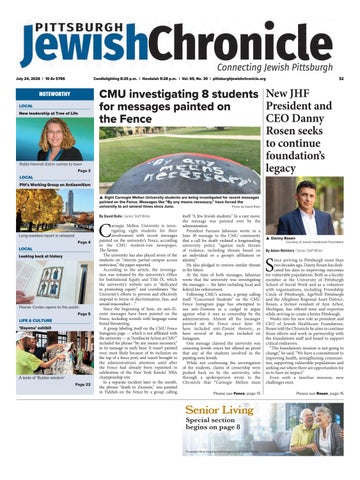
CMU investigating 8 students New JHF President and for messages painted on CEO Danny the Fence Rosen seeks to continue foundation’s legacy
Pitt’s Working Group on Antisemitism p Eight Carnegie Mellon University students are being investigated for recent messages painted on the Fence. Messages like “By any means necessary,” have forced the university to act several times since June. Photo by David Rullo By David Rullo | Senior Staff Writer
Long-awaited report is released Page 4
LOCAL Looking back at history
Posner Center opens to the public Page 5
LIFE & CULTURE ‘Dayenu’ exhibit
A taste of ‘Bubbe wisdom’ Page 22
C
arnegie Mellon University is investigating eight students for their involvement with recent messages painted on the university’s Fence, according to the CMU student-run newspaper, The Tartan. The university has also placed seven of the students on “interim partial campus access restriction,” the paper reported. According to the article, the investigation was initiated by the university’s Office for Institutional Equity and Title IX, which the university’s website says is “dedicated to promoting equity” and coordinates “the University’s efforts to prevent and effectively respond to forms of discrimination, bias, and sexual misconduct …” Since the beginning of June, six anti-Zionist messages have been painted on the Fence, including screeds with language some found threatening. A group labeling itself on the CMU Fence Instagram page — which is not affiliated with the university — as “Antifascist Action at CMU” included the phrase “by any means necessary,” in its message in early June. It wasn’t painted over, most likely because of its inclusion on the top of a fence post, and wasn’t brought to the administration’s attention until after the Fence had already been repainted in celebration of the New York Knicks’ NBA championship win. In a separate incident later in the month, the phrase “death to Zionism,” was painted in Yiddish on the Fence by a group calling
itself “A few Jewish students.” In a rare move, the message was painted over by the administration. President Farnam Jahanian wrote in a June 30 message to the CMU community that a call for death violated a longstanding university policy “against such threats of violence, including threats based on an individual or a group’s affiliation or identity.” He also pledged to remove similar threats in the future. At the time of both messages, Jahanian wrote that the university was investigating the messages — the latter including local and federal law enforcement. Following CMU’s actions, a group calling itself “Concerned Students” on the CMU Fence Instagram page has attempted to use anti-Zionism as a cudgel to argue against what it sees as censorship by the administration. Almost all the messages painted on the Fence since June 30 have included anti-Zionist rhetoric, as have several of the posts included on Instagram. One message claimed the university was censoring Jewish voices but offered no proof that any of the students involved in the painting were Jewish. While not confirming the investigation of the students, claims of censorship were pushed back on by the university, who through a spokesperson wrote to the Chronicle that “Carnegie Mellon must Please see Fence, page 15
Senior Living Special section begins on page 8
Thurstan Hinrichsen/peopleimages.com/Adobe Stock
p Danny Rosen
Courtesy of Jewish Healthcare Foundation
By Adam Reinherz | Senior Staff Writer
S
ince arriving in Pittsburgh more than two decades ago, Danny Rosen has dedicated his days to improving outcomes for vulnerable populations. Both as a faculty member at the University of Pittsburgh School of Social Work and as a volunteer with organizations, including Friendship Circle of Pittsburgh, AgeWell Pittsburgh and the Allegheny Regional Asset District, Rosen, a former resident of Ann Arbor, Michigan, has offered time and expertise while striving to create a better Pittsburgh. Weeks into his new role as president and CEO of Jewish Healthcare Foundation, Rosen told the Chronicle he aims to continue those efforts and work in partnership with the foundation’s staff and board to support critical endeavors. “The foundation’s mission is not going to change,” he said. “We have a commitment to improving health, strengthening communities, supporting vulnerable populations and seeking out where there are opportunities for us to have an impact.” Even with a familiar mission, new challenges exist. Please see Rosen, page 15
Headlines Song leaders strike a chord with congregants at Temple Emanuel — LOCAL — By Octavia Liku | Staff Writer
“B
ashert” is how Jacob Shinder describes his first month as song leader at Temple Emanuel of South Hills. As a child, Shinder kept rhythm on his doumbek while his mother, a rabbi, led their congregation in prayer, guitar in hand. “That’s how I express my Judaism,” Shinder told the Chronicle. “With music.” Over the years, he traded his doumbek for a trumpet before teaching himself to play guitar during the pandemic. Now, he serves as a cantorial intern at Temple Emanuel, where music has become both his calling and connection to his faith. “Temple Emanuel is a uniquely musical congregation,” he said. “It has been so rewarding to provide the music, and to experience the music through prayer with the congregants. They don’t hold back — they love to sing.” Raised in New Jersey, Shinder attended Temple Beth Shalom in Florida, New York. But his Pittsburgh roots run deep. His grandfather, Fredric Pomerantz, was a rabbi at Rodef Shalom. Known as “the Jazz Rabbi,” Pomerantz blended traditional Jewish liturgical music with folk, rock and jazz — all in an effort to make worship more accessible. Shinder noted that continuing this legacy of accessibility — providing a space for people to come “as they are” — defines his cantorial practice. He draws from the works of musicians like Dan Nichols, Debbie Friedman and Craig Taubman, mostly
p Jacob Shinder
Courtesy
accompanying himself on guitar while congregants join him in song. “I could have the best voice in the world, but what does that mean when I could focus on getting other people to sing and join with me?” he said. Shinder also attended the University of Pittsburgh, graduating with a degree in religious studies and vocal music performance. During his time there, he was involved in a variety of musical extracurriculars, including the men’s Glee Club and the Pitt marching band. Shinder first connected with Temple Emanuel in 2024, when he met Cantor Kalix Jacobson at a song leader boot camp conference. “Kalix saw my backpack that said ‘Pitt
p Lucy Greenbaum
Courtesy
Band’ on it,” he recalled “They came over to me and said, ‘Are you in Pittsburgh? Come lead services with me.’” From there, he led a Shabbat service at Temple Emanuel, before joining the congregation for the High Holidays. He also worked at Rodef Shalom, leading youth High Holiday services. During his time at Pitt, Shinder ran a club called Healing Harmonies, where he performed music at local retirement homes across the Pittsburgh area. He brought that same philosophy of accessibility to his work with the seniors, playing songs from artists like Carole King, Elton John and Joni Mitchell. “That music really brings back memories and joy for the residents … like ‘Leaving on
a Jet Plane’ — they ate that up,” he recalled, laughing. “The good thing about this music is people can be present in different ways — whether that’s singing, clapping, humming along or just sitting and being present.” At Temple Emanuel, he shares the stage with Student Cantor Lucy Greenbaum, who leads services on a monthly basis. “We led services together a couple weeks ago,” he said. “We sat together in my office and said, ‘All right, who wants to do the harmonies? Who wants to lead?’ It was like we’d been doing this forever. We just clicked.” Greenbaum grew up in Phoenix, Arizona, and has spent the last decade working as a song leader across the country. Most recently, she worked full time as a music director at Congregation Shaare Emeth in St. Louis, Missouri. “I’ve been taking music lessons basically since I could walk and talk,” she told the Chronicle. “That was always my connection to Judaism — through music. For a long time, I thought I wanted to be a social worker, and I would just do song leading or Jewish music on the side.” Through her work at Shaare Emeth, Greenbaum recognized that cantorial work exists at the intersection of musicality, spiritual care and social work. Her new role, she says, allows her to provide that vital support to congregants in the South Hills. Greenbaum just completed her first year of a five-year program at Hebrew Union College’s Debbie Friedman School of Sacred Music. Shinder hopes to follow a similar path. In the meantime, both hope to grow as spiritual leaders during their time at Temple Emanuel — one song at a time. PJC Octavia Liku can be reached at oliku@ pittsburghjewishchronicle.org.
5915 Beacon St., 5th Floor Pittsburgh, PA 15217
Main phone number: 412-687-1000
Subscriptions: 412-687-1000, ext. 2 SUBSCRIPTIONS subscriptions@pittsburghjewishchronicle.org 412-687-1000, ext. 2
Jim Busis, CEO and Publisher 412-228-4690 jbusis@pittsburghjewishchronicle.org
TO ADVERTISE advertising@pittsburghjewishchronicle.org 412-687-1000, ext. 1
EDITORIAL Toby Tabachnick, Editor 412-228-4577 ttabachnick@pittsburghjewishchronicle.org
EDITORIAL DEPARTMENT Email: newsdesk@pittsburghjewishchronicle.org BOARD OF TRUSTEES Evan H. Stein, Chair Evan Indianer, Vice Chair Derek Smith, Treasurer Gayle R. Kraut, Secretary Gail Childs, Dan Droz, Malke Steinfeld Frank, Karen Gal-Or, Seth Glick, Judith Kanal, Cátia Kossovsky, Charles Saul, Lynn Zelenski GENERAL COUNSEL Stuart R. Kaplan, Esq.
2
JULY 24, 2026
Adam Reinherz, Senior Staff Writer 412-687-1000 areinherz@pittsburghjewishchronicle.org David Rullo, Senior Staff Writer 412-687-1000 drullo@pittsburghjewishchronicle.org Octavia Liku, Staff Writer oliku@pittsburghjewishchronicle.org ADVERTISING Amy Weiss, Account Executive (412) 613-0697 aweiss@pittsburghjewishchronicle.org
PRODUCTION Jeni Mann Tough Production Manager Carl Weigel Art/Production Coordinator Subscriptions subscriptions@pittsburghjewishchronicle.org 412-687-1000, ext. 2 Published every Friday by the Pittsburgh Jewish Publication and Education Foundation 5915 Beacon St., 5th Floor Pittsburgh, PA 15217 Phone: 412-687-1000 POSTMASTER: Send address change to PITTSBURGH JEWISH CHRONICLE, 5915 BEACON ST., 5TH FLOOR PITTSBURGH, PA 15217 (PERIODICAL RATE POSTAGE PAID AT PITTSBURGH, PA AND AT ADDITIONAL MAILING OFFICES) USPS 582-740
PITTSBURGH JEWISH CHRONICLE
Manuscripts, letters, documents and photographs sent to the Pittsburgh Jewish Chronicle become the property of this publication, which is not responsible for the return or loss of such items. The Pittsburgh Jewish Chronicle does not endorse the goods or services advertised or covered in its pages and makes no representation to the kashrut of food products and services in said advertising or articles. The publisher is not liable for damages if, for any reason whatsoever, he fails to publish an advertisement or for any error in an advertisement. Acceptance of advertisers and of ad copy is subject to the publisher’s approval. The Pittsburgh Jewish Chronicle is not responsible if ads violate applicable laws and the advertiser will indemnify, hold harmless and defend the Pittsburgh Jewish Chronicle from all claims made by governmental agencies and consumers for any reason based on ads appearing in the Pittsburgh Jewish Chronicle.
PITTSBURGHJEWISHCHRONICLE.ORG
Headlines Getting to know: Rabbi Hannah Estrin — LOCAL — By Adam Reinherz | Senior Staff Writer
S
ome beginnings represent dramatic severance from the past; others signal careful steps between periods. Rabbi Hannah Estrin, the newly named interim rabbi of Tree of Life Congregation, sees her pulpit as closer to the latter. In the coming weeks, the Jerusalemite will replace Rabbi Hazzan Jeffrey Myers at the 162-year-old congregation. The goal, she told the Chronicle by phone from northern Colorado, is that her year with Tree of Life enables the congregation to “look deeply and broadly into who they are and what they want, so that their next search committee and their next rabbi will hopefully be a good match.” Estrin, a former Californian who’s called Israel home for nearly two decades, said guiding congregants from one era to the next evokes a familiar spiritual journey. “Every community, especially communities coming off of long-term rabbis or out of difficult times, which Tree of Life has got both, sometimes need that 40 years in the wilderness to kind of just pause and take a break,” she said. “I walk with them through that break — and hopefully do some deep soul work for individuals and community — in order to leave them in a healthy place.” Estrin, 57, is no novice to shepherding. As an interim rabbi, she formerly aided congregations in Kalamazoo, Michigan, and Portland, Maine. The work, she said from inside a Jeep Renegade near Rocky Mountain National Park, is an outgrowth of earlier professional ventures. After obtaining an undergraduate degree in Judaic studies and education at University of California, San Diego, Estrin worked in Jewish education for more than a decade. From there, the married mother of two later obtained a master’s and ordination from Ziegler School of Rabbinic Studies. Promoting pause and introspection from an interim pulpit is similar to another job Estrin held for almost 20 years: licensed tour guide in Israel. The challenge and rush of sometimes having mere days to help people “find a
p Rabbi Hannah Estrin is joining Tree of Life Congregation as an interim rabbi.
Photo courtesy of Rabbi Hannah Estrin
connection with the land — whether that’s historical or archeological or whatever,” is that “I can really dive into it wholeheartedly,” she said. “You just jump in with both feet, there’s no onboarding time,” she said. “I throw it all out and see what sticks.” Less chaotic than comprehensive, the approach, which Estrin will adopt after arriving in Pittsburgh, will include meeting as many people as possible, holding fireside chats and assessing needs before the High Holidays arrive. Those activities, she said, will continue after the holidays, “as needed,” with overarching questions no different than those a tour guide asks. “Who is this person? Who is this family? What are they looking for? And how do I not change the itinerary, but
adjust what we’re doing in any given location to meet what their needs are, and really find the thing that speaks deeply to them?” When an interim rabbi enables congregants to experience various endeavors and recognize preferences, future parties benefit, she said. “If you hate musical instruments in your services, then you know not to bring in somebody who’s a guitar player and really wants to do that. If you love musical instruments, then you need to lean that way. If you are looking for high intellectual, we’re going to try these classes that are high intellectual. If they go well, great. If not, not a problem.” Part of the challenge and opportunity Tree of Life faces is that almost 50 new families joined the congregation weeks ago. Those individuals, Estrin said, represent
a “very different demographic from the families that have been there, so one of the things we’ll be looking at this year is how do we honor the past and also make space for this future.” The rabbi, who before arriving in Pittsburgh spent four days hiking in the Rockies with her wife Shari Robins as part of a cross-country drive from Portland, Oregon, is looking forward to helping Tree of Life answer what it means “to be progressive Conservative Jews,” she said. The s earch has long held meaning for Estrin. After growing up in San Diego, riding horses, and raising sheep and guide dogs for the blind, she converted to Judaism at 21. What appealed most was an “intellectual honesty” encouraged by the faith, Estrin explained. Judaism possesses “rules and regulations that you have to follow, whether you like them or not, but we can argue until you are done arguing about it,” she said. “Coming out of a Catholic background, I really appreciated that ability to challenge and ask why.” Given Estrin’s background and talents, “We are looking for her expertise in guiding the congregation into our next chapter,” Robin Friedman, Tree of Life’s president, told the Chronicle. “We are excited to start this new chapter for Tree of Life Congregation, and we are looking forward to the changes that Rabbi Estrin will bring to the congregation, while putting her individual mark on the traditions that the congregation has had for 162 years.” Estrin, a self-proclaimed National Parks and coffee lover, welcomed the praise and said the purpose of her year in Pittsburgh is to “listen with a deep and open heart, on both the personal and the communal level, and to work with the community to find their best selves, so that when they do go and search for a new rabbi, that becomes a longterm partnership between the two.” Being an interim rabbi is about delivering the “ultimate goal,” she continued. The hope is that the “next rabbi is successful with the community, and that the partnership is successful.” PJC Adam Reinherz can be reached at areinherz@pittsburghjewishchronicle.org.
PLAN AHEAD:
Protect Yourself and Your Loved Ones – Your Way We provide expert help with long term care planning, powers of attorney, wills, trusts and special needs. We help you implement legal and tax strategies to protect your wealth during your life and afterwards. mhm@ahmpc.com 4927 William Flinn Highway Allison Park, Pennsylvania 15101 We make house calls!
PITTSBURGHJEWISHCHRONICLE.ORG
PITTSBURGH JEWISH CHRONICLE
JULY 24, 2026
3
Headlines University of Pittsburgh’s Working Group on Antisemitism issues final report — LOCAL — By David Rullo | Senior Staff Writer
T
he University of Pittsburgh’s Working Group on Antisemitism has released its long-awaited final report. Formed in 2025 in response to a rash of antisemitic activity on and around the university following Hamas’ terrorist attack on Israel on Oct. 7, 2023 — including antisemitic graffiti, activity on a digital chat, damage to university property, anti-Zionist encampments and the physical assault of three Jewish students — the working group was charged with “making actionable recommendations to prevent and respond to antisemitism.” Kathleen Blee, chair of the Working Group on Antisemitism, said that Chancellor Joan Gabel wanted the group to “think through the problem” and come up with a set of actionable recommendations. “Recommendations that fit Pitt, that aren’t just off the shelf, weren’t just copying what was going on in other places and would really work in the Pitt environment,” she said. Blee said that the group was given no timetable for their work and felt no pressure from the university. The report issued on July 20 contained recommendations in five broad areas: • Institutional capacity to respond to antisemitism
Oakland and Cathedral of Learning
Photo by Cam Miller via Flickr at https://rb.gy/r2yato
• Institutional policies • Training, education and contextual understanding • Incident response and enforcement mechanisms • External events and off-campus influences The report recommended a unified bias and misconduct portal for reporting incidents, not limited to antisemitism, with case tracking capabilities which can be used to issue annual summaries of antisemitic incidents, and hiring staff, where possible, with an expertise in dealing with antisemitism for handling reports and staff training. Blee said that the university already has the Concerns Connection system to report incidents but that over time, it may have become a bit clunky, so the recommendations made highlighted “what needs to be tightened.” An important part of that, she said, was better feedback and “closing the loop” with the person who filed the complaint. It also recommended addressing social
ANNUAL SHADYSIDE
Sidewalk Sale P
GARAGE ON BELLEFONTE SIDE STREET PARKING SURFACE LOT ON BELLEFONTE
JULY 29 THROUGH AUGUST 2 THINKSHADYSIDE.COM
4
JULY 24, 2026
media harassment, ensuring the university community understands that university policy regarding antisemitic harassment and discrimination applies to social media and other forms of electronic communications. As part of the institutional capacity to respond to antisemitism, the group recommended regularly surveying antisemitism in the campus environment and formalizing the university’s consultation with external local Jewish leaders by creating an advisory council that included Hillel Jewish University Center of Pittsburgh, Chabad House on Campus, the Jewish Federation of Greater Pittsburgh and other groups. University leadership, the report said, should continue to make clear that antisemitism has no place on the campus. It recommended reviewing training and education of faculty and staff to ensure this is addressed. Included in the institutional policies section of the report is the recommendation that the university continue to develop its free speech website, including the explanation of “time place and manner” polices that govern online and offline demonstrations and forums, as well as distinguish protected and unprotected conduct. A recommendation that an independent Title VI unit be created was written without knowledge that the university was already creating more robust compliance by moving part of that responsibility to its compliance officer. “That person deals with all kinds of compliance issues — rule-breaking, anything like that at the university,” Blee said, “so they’re going to handle that part.” It also said that the university should “continue to create new and support existing partnerships and exchanges with Israeli” faculty and staff. Antisemitism awareness and anti-harassment training should be provided to all faculty, staff, teacher assistants, resident assistants and students as part of their anti-discrimination training. The report also supports the expansion of course offering on topics such as antisemitism, Israel, Zionism and Jewish political thought. Recommendations are included for university faculty, including adopting language to Pitt’s collective bargaining agreement that “Faculty members are entitled to speak and write as private citizens free from institutional censorship or discipline but as scholars and educators they should at all times be accurate, exercise appropriate restraint and show respect for the opinions of others.” The safety and security of the university’s Jewish faculty, staff and students is addressed through the continual review of the university’s response to antisemitic incidents as well as areas on campus where Jewish students and faculty cluster, such as “Hillel, Chabad, and the offices, classrooms and events associated with the Jewish studies program.” Continued coordination is recommended between the university’s public safety team and the security staff at the Jewish Federation of Greater Pittsburgh. Regular outreach between Jewish organizations, programs and institutions, as well as communication with parents of Jewish students is stressed, as is “regular, proactive communication with students, parents and community members, during non-crisis times to lay the groundwork for helpful and effective communication during antisemitic crises.” The university issued a response to the working group’s report and recommendations, which acknowledged that members “of our Jewish community have experienced harm.” “We are committed to our Jewish community
PITTSBURGH JEWISH CHRONICLE
and to building a better tomorrow for our entire community,” the response said. The university’s response said it agreed with the report’s emphasis on “strong institutional capacity to address discrimination, harassment and related concerns.” To that end, it noted that it had already begun implementing updates to its organizational structure related to “compliance, investigations and wellbeing” intended to “strengthen institutional coordination, clarity and responsiveness regarding Title VI matter,” noting that those functions will now be administered by the Office of Compliance, Investigations and Ethics. The university, the response said, will refresh its free speech website by the end of 2026, continue reviewing its policies to ensure “antisemitism and other forms of harassment, intimidation and discrimination are addressed,” strengthen its “commitment to dialogue and civil engagement,” and ensure it adheres to applicable state law and “prohibit institutional participation in boycott, divestment or sanctions activity.” It pledged to review its training portfolio to “determine where additional or enhanced training is needed” and to engage members of the university community in considering next steps. The response said it will ask faculty to consider the report’s recommendations through “appropriate shared-governance and academic channels,” noting that it valued the role of the faculty in determining how “relevant issues are addressed in teaching, curriculum and classroom practice.” It goes on to say it appreciates the recommendation for an external advisory council, will continue to gauge campus climate through its Student Experience and Research University survey, and review its processes and identify appropriate mechanisms to share “periodic summaries of reported incidents and institutional response to strengthen transparency and campus understanding of these processes.” One recommendation not made by the report is the adoption of a single definition of antisemitism. The university’s response said the group wasn’t charged with creating a single definition and would not adopt one, believing no “single definition fully captures and relates to the range of lived experiences, concerns and perspectives within and regarding the Jewish community.” In an email to the Chronicle, the university wrote that it appreciates the “time, effort and care contributed by the Working Group and for the meaningful contributions of those whose lived experiences informed this work.” “Our immediate priority,” it said, “is to implement the report’s recommendations, while also listening to our community’s feedback on an ongoing basis. The Working Group crafted its report to be both sustainable and adaptable, with continual review and input built into the process moving forward. The University is committed to ensuring implementation of the report is transparent, coordinated, and reflective of the Working Group’s recommendations.” Blee said that committee took their job seriously. “We had a lot of opinions about things,” she said. “People really wanted to come up with things that will work and that would really matter. I think we did a good job. We’re collectively proud of it.” PJC David Rullo can be reached at drullo@ pittsburghjewishchronicle.org. PITTSBURGHJEWISHCHRONICLE.ORG
Headlines At CMU’s newly reopened Posner Center, history is hidden in the margins — LOCAL — By Octavia Liku | Staff Writer
A
mid rows of 19th-century books, Sam Lemley, the curator of special collections and director of the Posner Center for Special Collections at Carnegie Mellon University, noticed one that looked older — out of place. Scrawled on the title page in faded ink, was an inscription: “To His Excellency Thomas Jefferson, Esquire, respectfully presented by the author.” “I just happened to pull it out and look at it,” Lemley said. “Thomas Jefferson had a really peculiar way of marking his books — he marked it, and so [we] come to find out that this book belonged to [him] and was in his collection at Monticello.” Even after years of cataloging, the Posner Center’s collections continue to yield new findings. A stray note in the margin, a small letter astride a signature mark, or even a longforgotten inscription can transform a seemingly ordinary book into a novel discovery. Last year, the Posner Foundation funded a $6 million renovation, transforming the center into what the university describes as both “a museum and laboratory for the humanities.” The project added facilities including secure storage, a digitization lab and a reading room, while an additional $2 million gift endowed the care and expansion of the collection. The renovated space, open to the public for the first time in its 22-year history, grants researchers, students and community members new opportunities to uncover the stories hidden within its shelves. Since reopening in November 2025, the center has welcomed more than 8,000 visitors. “We’re open to everyone — not just the [Carnegie Mellon] community,” Catherine Blauvelt, special collections coordinator, said. “The greater Pittsburgh community is welcome for any of our events, talks, or to just make an appointment and come in.”
A Haggadah at the Posner Center
While the Posner Center houses over 8,000 books, its “amber core” is the Posner Memorial Collection. Built by Polish-Jewish entrepreneur and philanthropist Henry Posner, the collection comprises roughly 1,000 books, containing some of the rarest books in the history of Western science. “Henry Posner Sr. was very particular about what he bought,” Anne Molloy, trustee of the Posner Foundation, said. “It was built very intentionally and slowly — you couldn’t put together that collection today.” The bulk of Posner’s collecting included acquiring early printings of Aristotle, Newton, Galileo, Copernicus — all major figures in Western science. Among its highlights is one of five known copies of the first official printing of the Bill of Rights, dating to 1792. “He knew things, so he would challenge something that a librarian at the Library of Congress might tell him. For instance, when he acquired [the Bill of Rights], I don’t think anyone knew how rare it was,” Lemley said. “We have his letter that he sent to the librarian at the Library of Congress at the time, where he’s just asking, ‘Hey, what does your copy look like? How rare is this?’ He wasn’t happy
Photo by Octavia Liku
with their response, so he kept doing the work, and he was able to show that it was quite a bit rarer than [that of] scholars.” For Curatorial Intern Claire Thurston, every book contains a history of its own. She became transfixed by the marginalia of the first printed edition of Plato’s complete works, published in 1513 by Venetian humanist Aldus Manutius. “I said, ‘OK, who wrote this? Why did they write it? What were they doing?’” Thurston said. “You have no idea what it could be.” After studying the annotations, Thurston found that a reader had added in editorial notes from a later edition of Plato, published by German philologist Friedrich Ast. The jottings left in the margins, she says, reflects a broader movement across classical philology to standardize ancient Greek texts. “Whoever was writing those [notes] in thought that those new ideas of Ast’s were definitive and important enough to write them into a centuries-old book,” she later wrote to the Chronicle. “Those discoveries are certainly waiting in every single book in the collection.” Posner’s collection extends beyond literature, philosophy and history of science.
Interfaith beer hopes to bring a blessing — LOCAL — By Adam Reinherz | Senior Staff Writer
A
Catholic and a Jew sat down for a beer. Less a punchline than a promise of friendship, “Catholics, Jews and Brews” is aiming to coalesce young Pittsburghers of faith. Hosted by the Jewish Federation of Greater Pittsburgh’s Community Relations Council and the Diocese of Pittsburgh, the Aug. 24 event at Walter’s BBQ Southern Kitchen is an outgrowth of decades of local Catholic-Jewish relations and a chance for younger community members to strengthen those bonds, organizer and CRC Assistant Director Beth Vander Stoep said. “There needs to be more fellowship between the Catholic community and the Jewish community,” Vander Stoep told the Chronicle. “We have so much in common. We have all of these histories of living together. And yes, oftentimes those are fraught with tension, but there’s so many incredible stories of CatholicJewish collaboration and friendship and meaningful connection.”
PITTSBURGHJEWISHCHRONICLE.ORG
p Program organizers hope that a beer and conversation will bring communities closer. Photo by Ketut Subiyanto via Pexels
“We really want to bring these communities together. There’s so much common ground,” fellow organizer and Diocese Director of Youth and Young Adult Ministry Jonah Soucy said. “We share so many of our sacred texts. We share a lot of our roots.” For both Soucy and Vander Stoep, the upcoming program is more than a feel-good attempt at harmonizing communities.
“This event matters,” Soucy said. “There’s a lot of antisemitism out in the world today. We want to take a stand against that in whatever way we can, and I think doing something in solidarity like this can help.” Whether by grabbing a beer or simply sitting and chatting, social ills can be stymied, he continued. “One of the worst diseases that we face in this country is just a lack of an ability to talk to people that are different from you. I see this a lot with young people — teenagers especially. When I was younger, you were just kind of friends with everyone. You didn’t all have to share the same political party or religion. But there seems to be a lot of polarization right now.” The goal is combating heightened public rhetoric, he said. “We just want to turn the temperature down on that and give people a space where they can meet people who have a different background from them, give them opportunities to learn how to dialogue, and really just socialize and form friendships.” For Vander Stoep, “Catholics, Jews and Brews” has both personal and professional meaning. “I became Jewish later in life. My family is predominantly Catholic, and my
PITTSBURGH JEWISH CHRONICLE
According to Lemley, Judaica makes up anywhere from 2% to 5% of the collection. “You see glimpses of Henry Posner’s involvement in the Jewish community and his interest in Jewish literature in what he’s collecting,” he said. “As an immigrant to the United States, I get the sense that he held immense reverence for the American story, and it’s … ideally welcoming of immigrants and different groups of faith traditions [and] ethnicities” Among the collection’s oldest works is a pocket-sized 13th-century Hebrew manuscript. Shrouded in animal skin and inscribed on vellum, the book offers a view into Jewish devotional practice in medieval Europe. Separated by nearly 700 years is a copy of Arthur Szyk’s illustrated Haggadah, drawn in the 1930s against the backdrop of impending war. Kaleidoscopic hues and sardonic caricatures animate its 48 illustrations, transforming the ancient text into a warning about the spread of Nazism. Lemley points specifically to Szyk’s depiction of ‘the wicked son’ as a testament to the artist’s political approach. “He’s got the Hitler mustache. He’s got this cravat — that’s a Nazi red … Kitted out, much like a German would be in the 1930s,” he said. “Even though this is an ancient text, he’s connecting wickedness with what was then the rise of Nazism.” Currently on view at the Posner Center is “Rare Books & Ancestral Machines.” The inaugural exhibit juxtaposes censored copies of Copernicus with the nation’s founding documents, Turing with Shelley, the old with the new. The exhibit, Lemley writes in the accompanying handbook, links “the tactile past to our digital present and our computational futures.” The renovated space is set to host one major exhibit a year, alongside a series of “open stacks” events that invite students and community members to engage directly with the collection. PJC Octavia Liku can be reached at oliku@ pittsburghjewishchronicle.org.
husband’s mother is Jewish, and his father is Catholic,” she said. When conversations about offering this program began, Vander Stoep noted that she was “really emotionally connected to this.” Along with an eagerness to host the program, organizers are pleased to support the city’s longstanding history of interfaith work. Vander Stoep applauded CRC board chair Rabbi Jamie Gibson for dedicating 30 years to “Catholic-Jewish dialogue,” and said she hopes the next generation of Pittsburghers can follow suit. “Our goal is to build a very meaningful community of people that are Catholic and people that are Jewish that want to be each other’s friends, that want to host each other at their shared communities,” she said. “And when organizations such as the Diocese and Federation take the lead, that’s how we’re going to build into these longer, more sustainable situations that will hopefully lead us into doing really great things.” PJC Adam Reinherz can be reached at areinherz@pittsburghjewishchronicle.org. JULY 24, 2026
5
Calendar Submit calendar items on the Chronicle’s website, pittsburghjewishchronicle.org. Submissions also will be included in print. Events will run in the print edition beginning one month prior to the date as space allows. The deadline for submissions is Friday, noon. q SUNDAY, JULY 26 Chabad of the South Hills presents Mommy and Me, music and movement with Hindy Rosenblum for children aged 0-3. A project of the South Hills Jewish Preschool, featuring sensory play and friends. 10:30 a.m. $5 per week. chabadsh.com/baby q SUNDAYS, JULY 26–DEC. 20 Join Chabad of Squirrel Hill for its Men’s Tefillin Club. Services and tefillin are followed by a delicious breakfast and engaging discussions on current events. 8:30 a.m. 1700 Beechwood Blvd. chabadpgh.com Join a lay-led online Parashah study group to discuss the weekly Torah portion. No Hebrew knowledge needed. The goal is to build community while deepening understanding of the text. 8:30 p.m. For more information, visit bethshalompgh.org/online-parashah. q MONDAYS, JULY 27–DEC. 21 Join students online and in-person for a weekly Talmud class with Rabbi Mark Asher Goodman. We are currently learning our way through Bava Kamma, on damages and injury and the moral obligations and responsibilities to our fellow humans. All levels welcome. 10 a.m. $5. Shoresh PGH, 4300 Murray Ave. Contact rabbimark@shoreshpgh. org for more information. shoreshpgh.org/classschedule-and-events
q TUESDAYS, JULY 28–DEC. 22 Join Beth El’s Rabbi Alex Greenbaum and his Bible/ Talmud Adult Education class for a thoughtprovoking weekly session of Bible and Talmudic study. This program is available both in person and virtually. Call the office at 412-561-1168 to receive the Zoom link or to make an in-person reservation. 10:30 a.m. 1900 Cochran Road. bethelcong.org q WEDNESDAYS, JULY 29–DEC. 23 Explore the weekly Torah portion with the mystical and interpersonal lens of the Hassidic rabbis with Rabbi Mark Asher Goodman. Hassidut for the People is a fun and engaging class taught online and in-person meant to help learners find deeper meaning in Torah and in themselves. All levels welcome. 10 a.m. $5. Shoresh PGH, 4300 Murray Ave. Contact rabbimark@shoreshpgh. org for more information. shoreshpgh.org/classschedule-and-events q SUNDAY, AUG. 2 Join Chabad of the South Hills for the 2nd Annual South Hills Jewish Festival, celebrating Jewish life and culture. Live concert with Chassidic singer Berel Faiden, cultural crafts, kosher wine tasting and food, fun zone, petting zoo. 1 p.m. Free. 1700 Bower Hill Road. chabadsh.com q TUESDAY, AUG. 4 Join the Holocaust Center of Pittsburgh for Holocaust 101: The Fundamentals of Holocaust Education, the first program in its 2026–2027 series of teacher trainings. The training is designed for teachers across grade levels and subject areas, whether you are new to teaching the Holocaust and antisemitism or looking to deepen your existing practice. Each session will offer practical guidance, classroom-ready resources and time
to think through common challenges with other educators. Act 48 credits available. 9 a.m. Allegheny Intermediate Unit, 475 East Waterfront Drive. eventbrite.com/e/holocaust-101-the-fundamentalsof-holocaust-education-tickets-1990912143816 q WEDNESDAYS, AUG. 5, SEPT. 2 Join Beit Kulanu for Biblical Garden Open Door Tours: Free, docent-led tours of the congregation’s Biblical Botanical Garden the first Wednesday of the month. 12:15 p.m. Free. 4905 Fifth Ave. rodefshalom.org/garden q THURSDAY, AUG. 6 Join the Holocaust Center of Pittsburgh to discover the story behind the Holocaust Memorial Garden at Temple Emanuel of South Hills. The garden is a living memorial inspired by the vision of local Holocaust survivor Marga Silbermann Randall, z”l, and brought to life in partnership with master gardener Lynn Rubin, the daughter of a Holocaust survivor. There will be a screening of a WQED documentary about the creation of the garden, followed by a discussion with Rubin. A guided tour of the garden will follow the program, weather permitting. 6 p.m. Free. 1250 Bower Hill Road. eventbrite.com/e/cultivating-memory-a-holocaustsurvivors-legacy-in-bloom-tickets-1991203762054 q WEDNESDAY, AUG. 12 Join Shoresh for a “Taste of Shoresh.” Different educators will teach classes in topics they are passionate about to give a taste of the learning
and community they are building. There will be snacks, drinks, and childcare for children ages 5 and up. The event will launch Shoresh’s weeklong community fundraiser. No registration or commitments required to attend. 7 p.m. Anderson Park Shelter, Schenley Park. q THURSDAY, AUG. 13 Join Chabad Young Professionals for its Summer Soirée, an unforgettable evening on the rooftop featuring handcrafted cocktails, delicious cuisine, great music and the opportunity to connect with hundreds of young Jewish professionals from across the city. Slip into your favorite summer chic look, gather your friends, and join CYP for one of Pittsburgh’s signature nights. 7 p.m. $30. Rooftop Bar in Lawrenceville. cyppittsburgh.com/summer q THURSDAYS, AUG. 20, SEPT. 3 Rendezvous in Beit Kulanu’s Biblical Botanical Garden with drinks and hors d’oeuvres for free live musical performances. Apps start at 6:30 p.m. and music at 7 p.m. The concert is free but registration is required. 4905 Fifth Ave. BeitKulanu.org q SUNDAY, AUG. 30 Join Chabad of South Hills for a trip to Jewish New York. Visit the Rebbe’s resting place and Chabad world headquarters; take part in a Crown Heights tour. Enjoy shopping and a meal at a delicious kosher restaurant. Fly roundtrip to New York City. 7 a.m. to 7 p.m. $125. chabadsh.com/jny PJC
Join the Chronicle Book Club!
T
he Pittsburgh Jewish Chronicle invites you to join the Chronicle Book Club for its Aug. 30 discussion of “As a Jew: Reclaiming Our Story from Those Who Blame, Shame, and Try to Erase Us – A Defiant Memoir of Heritage, Identity, and Antisemitism,” by Sarah Hurwitz. A New York Times bestseller, “As a Jew” is an “urgent exploration of how antisemitism has shaped Jewish identity and how Jews can reclaim their tradition, by the celebrated White House speechwriter and author of the critically acclaimed ‘Here All Along,’” according to Amazon.com. “In As a Jew, Hurwitz documents her quest to take back her Jewish identity, how she stripped away the layers of antisemitic lies that made her recoil from her own birthright and unearthed the treasures of Jewish tradition. With antisemitism raging worldwide, Hurwitz’s defiant account of reclaiming the Jewish story and learning to live as a Jew, without apology, has never been timelier or more necessary.”
What to do
Buy: “As a Jew.” It is available from online retailers, including Amazon and Barnes & Noble, and in some area Barnes & Noble stores. It is also available through the Carnegie Library system. Email: Contact us at drullo@pittsburghjewishchronicle.org, and write “Chronicle Book Club” in the subject line. We will send you a Zoom link for the discussion meeting. Happy reading! PJC
Your hosts
Toby Tabachnick, Chronicle editor David Rullo, Chronicle senior staff writer
How it works
We will meet on Zoom on Sunday, Aug. 30, at 1 p.m.
6
JULY 24, 2026
PITTSBURGH JEWISH CHRONICLE
PITTSBURGHJEWISHCHRONICLE.ORG
Headlines — WORLD — Belgium advances boycott of Judea and Samaria goods
The Belgian government is advancing a royal decree to ban the import of goods produced in Israeli communities in Judea, Samaria, eastern Jerusalem and Gaza, JNS reported. The move makes Belgium the fourth European nation to impose such a boycott, joining Spain, the Netherlands and Ireland. The decision, approved by the Council of Ministers just before summer recess, amends a 1993 decree governing the transit and trade of goods and operates within the country’s existing import authorization system. Laurens Soenen, spokesperson for Belgian Foreign Minister Maxime Prévot, told JNS in written comments on July 20 that import authorizations will be “systematically refused” for goods originating from Israeli communities in these areas. The origins of the goods will be verified using an existing European Union postcode list that determines eligibility for preferential tariffs. A 120-day transitional period will allow business and administrators to adapt to the new rules. Soenen noted exemptions are in place for local Palestinian Arab producers and humanitarian supplies, emphasizing that the measure strictly targets the Israeli economy in the territories. According to Soenen, Brussels considers the Israeli communities illegal under international law, a position he said is shared across the European Union, referring to the July 19, 2024 International Court of Justice advisory opinion. He claimed that the decree is a response
to specific Israeli government policies and “takes nothing away from Belgium’s relationship with Israel or from our attachment to Israel’s security.” Israeli officials sharply criticized the Belgian move. “Belgium has reached a point of no return,” Israeli lawmaker Sharren Haskel wrote on the social media platform X. The former deputy minister of foreign affairs, who resigned from her position earlier this month, accused Brussels of signaling it is “not interested in having a Jewish minority within its borders,” adding: “It can continue importing radical Islam. We will continue exporting products from Judea and Samaria to countries that choose to import innovation, quality and technology.”
Trump rejects Mamdani vow to arrest Netanyahu in NYC
Mayor Zohran Mamdani says he’s still thinking about whether he should arrest Benjamin Netanyahu the next time the Israeli prime minister is in New York City. Not going to happen, President Donald Trump stepped in on July 20 to say, according to JTA. “Benjamin Netanyahu will not be arrested, in any way, shape, or form, while in the United States of America,” Trump wrote on Truth Social. Trump’s post came days after Mamdani said that he is in “active conversation” with the city’s Law Department about detaining a foreign leader like Netanyahu, who faces an arrest warrant from the International Criminal Court for alleged actions related to Israel’s war with Hamas. Netanyahu often attends the United Nations General Assembly in Manhattan in September and
Today in Israeli History — ISRAEL — Items are provided by the Center for Israel Education (israeled.org), where you can find more details.
July 24, 1920 — Congresswoman Bella Abzug is born
Bella Abzug, the first Jewish woman elected to Congress, is born in the Bronx to Orthodox immigrants from Russia. She gains experience for a career in politics by lecturing about Zionism at subway stops as a teen.
July 25, 1992 — Nightclub owner Aris San dies
Aris San, who helped popularize the Greek sound in Israeli music, dies in Budapest at 52. A Greek, he moved to Israel at 17, and his hybrid music, laika, set the stage for the rise of Mizrahi music in the 1970s.
July 26, 1967 — Allon presents West Bank plan
Yigal Allon, a member of the government and a retired general, presents a strategic proposal for Israel’s retention of the Jordan Valley with p This map provides settlements and an overview of the military bases as Allon Plan. By Tallicfan20, own work, part of a regional public domain, via Arab-Israeli peace. Wikimedia Commons PITTSBURGHJEWISHCHRONICLE.ORG
July 27, 1955 — Bulgaria shoots down El Al airliner
Bulgarian fighter jets shoot down El Al Flight 402 en route from London’s Heathrow Airport to Israel after the Lockheed Constellation veers into Bulgarian airspace between Vienna, Austria, and Istanbul, Turkey.
July 28, 1923 — Opera arrives in land of Israel
Mordechai Golinkin’s production of “La Traviata” marks the beginning of opera in the Land of Israel. His Palestine Opera stages 16 productions by 1945, including “Dan Hashomer,” the first opera written in Hebrew.
is planning to do so this year. “I believe that Prime Minister Netanyahu belongs in The Hague,” Mamdani reiterated, in an interview with the New York Times, referring to the court’s seat in the Netherlands. He also hedged on his earlier pledge, seeming ready to defer to the city’s lawyers. (The legal consensus has been that a warrant by a court not recognized by the United States is unenforceable. Secretary of State Marco Rubio has said he is seeking the dismantlement of the ICC.) “I’ve also said that I will follow the laws that we have here in New York City because I believe that there is an importance in following the law as a leader who presides over our city,” Mamdani told the Times. The interviewer, Lulu Garcia-Navarro, prompted him to elaborate. “Meaning that whatever the law allows me to do in New York City, that’s what we will do, but we won’t be writing our own laws to that end,” Mamdani said. Trump jumped to the defense of Netanyahu, who is up for reelection later this year. Netanyahu, he said, is busy fighting the Islamic Republic of Iran, and that the “only ones that should be arrested are the people that led Iran into this unprecedented SPIRAL OF DEATH AND DESTRUCTION, something that should have been dealt with years ago, by previous Presidents!” Trump’s comments come after months of speculation over how an attempted arrest of Netanyahu could pit New York City law enforcement against the United States. Mamdani told reporters after a private meeting with the president last year that the two men did not discuss his vow to
MEAT
WINE SPECIALS
A&H NAVEL PASTRAMI RAW
TEPPERBERG ESSENCE CABERNET
.6
7
35.99 750 ML
CHATEAU RIGANES WINE
The Knesset passes Basic Law: Jerusalem, enshrining the official Israeli position that a united Jerusalem is the state’s capital. The U.N. Security Council rejects the law with Resolution 476 on Aug. 20. PJC
.6
MEAL MART CHICKEN NUGGETS
$
Support Israel!
$
$ .99 LB
July 30, 1980 — Jerusalem Basic Law is enacted
–Compiled by Jarrad Saffren
412-421-1015 412-421-4450 FAX 412-421-4451
BONELESS CHICKEN BREAST
OB-GYN Bernhard Zondek is born in Wronke, Germany, now in Poland. He and Jewish colleague Selmar Aschheim develop the A-Z pregnancy test in 1928. Zondek moves to Mandatory Palestine in 1934.
Humberty Jesus Carillo Garcia of Puerto Rico has been indicted by a federal grand jury on five counts of transmitting interstate threats after allegedly using the social media platform X and TikTok to post violent threats against Jews, U.S. soldiers, law enforcement officers and government buildings, federal prosecutors said, according to JNS. According to the indictment, returned on July 16 and unsealed on July 20, Carillo Garcia posted photos of himself on X in March holding a knife and a machete, writing that he would use the knife “to tear apart American soldiers and Jews.” Prosecutors allege that in a May TikTok video, he urged viewers to “take up arms against the United States,” “shoot at North American soldiers,” “hit and stab Jews” and burn “gringo” businesses as well as “Jewish synagogues and Judeo Christian churches,” including Jehovah’s Witness and Pentecostal churches. The indictment further alleges that Carillo Garcia later posted videos stating that police officers and CIA agents “must be killed” and calling for the bombing of the White House, Fort Buchanan and multiple banks. The alleged threats were posted between March 3 and June 27, according to the indictment. PJC
PRICES EFFECTIVE SUNDAY, JULY 26 – FRIDAY, JULY 31, 2026 Candle Lighting Time Friday, July 24, 2026 • 8:25 p.m.
7
July 29, 1891 — Pregnancy test developer Zondek is born
Puerto Rico man indicted for allegedly threatening to kill Jews, burn synagogues
1916 MURRAY AVE. PITTSBURGH, PA 15217
$ .99 LB
p A playbill shows that Mordechai Golinkin’s production of “La Traviata” was not a onenight-only opera.
arrest Netanyahu. Mamdani has said he would also push for the arrest of Russian President Vladimir Putin, were he to enter New York City.
$
26.49 4 LB
14.99
750 ML
6
Buy Israeli Products STORE HOURS
Sunday • 8 a.m. – 6 p.m. Monday • 8 a.m. – 6 p.m. Tuesday • 8 a.m. – 6 p.m. Wednesday • 8 a.m. – 6 p.m. Thursday • 8 a.m. – 8 p.m. Friday • 8 a.m. – 3 p.m.
GROCERY
COOKED FOODS
DELI
TA’AMTI ASSORTED BOUREKAS $ .29
BEEF MINESTRONI SOUP $ .99
SHOR HABOR HARD SALAMI $ .99
MOUSSAKA .99
SHOR HABOR LEAN PASTRAMI $ .59
8
EA
GRATIFY GLUTEN FREE PETIT BEURRE $ .99
3
EA
11
$
14
QT
LB
LIEBER'S CHOCOLATE CHIPS $ .19
PEANUT BUTTER NOODLES $ .99
PEREG BREAD CRUMBS $ .39
RATATOUILLE SALAD $ .99
5
4
9 OZ EA
HOMEMADE SALADS & SOUPS DELI PARTY TRAYS
PITTSBURGH JEWISH CHRONICLE
8
10
LB
LB
25 24
LB
LB
GUACAMOLE
$ .99
7
LB
PEPPADEW PEPPERS $ .99
7
LB
We Prepare Trays
CATERING SPECIALISTS DELICIOUS FRIED CHICKEN
UNDER THE SUPERVISION OF VAAD OF PITTSBURGH
WE RESERVE THE RIGHT TO LIMIT QUANTITIES.
— for All Occasions —
JULY 24, 2026
7
Senior Living didesign/Adobe Stock
Why seniors make the very best volunteers Guest Columnist Sharyn Rubin
A
s someone who has had the privilege of working with volunteers for many years, I can honestly say that I welcome anyone willing to give their time and talents to help others. Volunteers come from every age, background and profession, and each person brings something unique to our community. But if I am asked who consistently makes some of the most extraordinary volunteers, my answer is almost always the same: older adults. There is something profoundly special about the gifts that seniors bring to volunteer service. Their contributions go far beyond the hours they devote or the tasks they complete. They bring something even more valuable: perspective. Many seniors have spent decades building careers, raising families, overcoming hardships, celebrating triumphs and learning life’s greatest lessons. They understand patience because they have practiced it. They understand resilience because they have lived it. They understand compassion because they have experienced
both joy and heartbreak. Those qualities cannot be taught in a classroom or listed on a résumé. They are earned through a lifetime of living. Older volunteers also possess a work ethic that is becoming increasingly rare. They arrive when they say they will. They take their responsibilities seriously. They understand commitment and reliability. They know that if someone is depending on them, showing up matters. Whether they are delivering meals, comforting a hospice patient, greeting visitors, mentoring a young person, or helping at community events, seniors approach their volunteer roles with quiet purpose. They don’t seek recognition or applause. They simply want to make someone else’s day a little brighter. Perhaps that is because they have lived long enough to understand what truly matters. They know that kindness is never wasted and that sometimes the greatest gift we can offer another person is simply our presence. Ironically, while seniors volunteer to help others, they often become some of the greatest beneficiaries of their own generosity. Research has shown that volunteering can reduce loneliness, improve emotional well-being, keep minds active, and provide a renewed sense of purpose. Retirement may signal the end of a career, but it should never signal the end of purpose. One of the greatest joys of being a volunteer
coordinator is helping people discover that there truly is a place for everyone. If you’ve ever thought, “I’d love to volunteer, but I don’t know what I could do,” begin with what brings you joy. Think about the skills you’ve developed over the years. Do you enjoy driving, gardening, cooking, music, crafts, photography, organizing, or simply talking with people? Have you spent a lifetime teaching, working in healthcare, raising a family, or running a business? Every experience has value, and every talent can enrich someone else’s life. The best volunteer opportunities often grow naturally from your passions. Someone who loves animals may thrive at a shelter. A retired teacher might tutor children. A musician can brighten the day of nursing home residents. Someone with a warm smile can welcome visitors at a hospital or community center. Sometimes the greatest gift you can offer isn’t a special skill at all — it’s your kindness, your time and your willingness to care. Volunteer opportunities are as flexible as the people who fill them. Some require only a few hours each month, while others meet weekly. Some can even be done from home. A good volunteer coordinator will help you find a role that matches your interests, schedule and comfort level. Most importantly, don’t underestimate
We Are Here To Help 24/7
Comprehensive Estate Planning services addressing a full range of legal issues: • Estate Planning • Elder Law • Wills • Powers of Attorney (POA) • Long Term Care and Asset Protection Planning • Guardianships • Special Needs Trusts • Probate and Estate Administration • Living Wills Carol Sikov Gross, Certified Elder Law Attorney Sikov and Love, P.A. 310 Grant Street, Suite 1110, Pittsburgh, PA 15219 412-261-4202 • www.sikovandlove.com email: csikovgross@sikovandlove.com 8
JULY 24, 2026
what you have to offer. Too often, older adults believe they have “nothing special” to contribute because they’re no longer employed. The truth is your most valuable contributions may stem less from your professional accomplishments than from the person you have become. Your patience. Your wisdom. Your compassion. Your ability to comfort someone who is frightened or simply sit beside someone who needs a friend. Volunteering creates a beautiful circle of giving. The recipient receives companionship, encouragement, or practical help. The organization gains dedicated support. And the volunteer discovers new friendships, renewed confidence and a deeper connection to the community. The next time you see an older volunteer delivering a meal, greeting a visitor, comforting a hospice patient, or reading to a child, remember that you are witnessing something remarkable. You are seeing a lifetime of experience transformed into an act of service. That is the true beauty of senior volunteering. While they are busy enriching the lives of others, they are quietly enriching their own — and making our communities stronger in the process. PJC Sharyn Rubin is the director of Resident and Community Services at the Jewish Association on Aging.
A Private Duty/Private Pay Service
• Companionship/ Meal Preparation
• Escorts to Doctor’s Appointments
• Light Housekeeping
• Medication Reminders
412.798.5320
www.cadencare.com
STEPHANIE DAVIS
LICENSED LIFE & HEALTH INSURANCE SPECIALIST
412.260.4149 (phone or text) sdvoice18@gmail.com Serving PA and FL Please contact Medicare.gov, 1-800-MEDICARE, or your local state health insurance program (SHIP) to get information on all of your options.
MEDICARE INDIVIDUAL PHONE NUMBER: 412-790-2881
PITTSBURGH JEWISH CHRONICLE
Please support our advertisers,
and mention that you saw their ad here.
We depend on them, and they depend on you!
PITTSBURGHJEWISHCHRONICLE.ORG
Life & Culture Schenley Gardens
Building Bridges. Breaking Barriers. DIFFERENT GENERATIONS. ONE REMARKABLE COMMUNITY. Compassionate support and meaningful connections come together in the heart of Oakland.
SCHEDULE A TOUR TODAY! (412) 577-9388
Vincentian.us
WATCH THE COMMERCIAL 3890 Bigelow Blvd., Pittsburgh, PA 15213
ABERNETHY, HAGERMAN & MILLER
OVERCOMING FEAR OF LAWYERS AND LEGAL WORK
We all deal with scary experiences. Fear at some level is a frequent feeling in ordinary daily life, let alone unusual or extraordinary events. Going to a doctor? Waiting for the results of that biopsy from your dermatologist? Expecting a contentious meeting with your kids, or showdown with your partner? All kinds of financial, health and family issues can be worrying. Lawyers are scary to many. The uncertainty and fear of legal problems, hiring a lawyer and the legal process that follows can be overwhelming, especially if you haven’t dealt with lawyers and legal work much before. We may wonder, Will he or she be nice? Will they listen to me? How will I know what it will cost? Will I get to talk to the actual lawyer? In a lawsuit or criminal case, will I win or lose? Will there be a trial? Will I have to testify? How long will I have to wait to get my problem solved? Of course, the biggest question is: can I afford it, or am I putting my house, my business, or my family at risk? These risks are legitimately frightening. Anxiety is normal but don’t let it stop you from protecting yourself. Here are my tips on overcoming fear of lawyers and legal matters, and also when you might need a lawyer, and why and how you should hire an attorney. The most common reasons for people to need a lawyer are: For estate planning (Wills, Powers of Attorney, trusts); Probate and estate administration after someone’s died; If you’re charged with a crime; Help in a divorce, custody or support case; If you are injured; Real estate matters such as buying or selling a house; Employment matters like a wrongful firing;
Starting or running a business; or Other litigation. These situations can all be innately stressful, emotional and urgent - but ignoring a legal problem rarely makes it disappear. Why hire lawyer instead of trying to handle it yourself? How will they help? First, knowing you have expert help reduces your stress, right from the start. In my practice I sell peace of mind. Your attorney’s job is to represent and advise you and help you solve your problem in the most favorable (or least harmful) way, using their knowledge, skills and intelligence. They are your guide through a foreign territory with its own terms and language, analyzing, interpreting and helping you to navigate complex changes and important transitions in life. Lawyers help to inform you in plain language so you know your alternatives, to make well informed decisions and protect your interests. How should you find a lawyer if you don’t already have one? Should you call someone who advertises on TV? They might be good. Many are, but it’s hard to know. Every ad says that lawyer is the best! My suggestion is to get personal referrals from folks you know and trust, who may have used a lawyer that they were happy with before., or to someone they know. If you had a lawyer before but now need a different kind of legal help, ask your own prior attorney for a referral. Ask others who help you, like your accountant or tax preparer, realtor, or dentist. You can also call the Allegheny County Bar Association. Your lawyer has to practice law in the relevant area of the law in which you need help, with experience in cases like yours. Talk to more than one lawyer when assessing candidates to help you. Find someone who listens to you and hears you, someone who “gets” you. Do you want the resources and formality of a big firm, or the flexibility and responsiveness that may be a benefit of a smaller team? As to the business side of the relationship, including fees, once you have representation, communication is the key.
Your counsel works for you, not the other way around. Ask questions and get clear answers. Find out how best to reach member of your legal team, and let them know how they can best reach you back. Find out what kind of fee arrangement the lawyer is proposing: • A fixed fee for specified set of services; • An hourly billed fee, for the time spent working in your case; • A contingent fee, as a percentage of money that the lawyer recovers for you; • Some combination or other approach You should end up with a clear written agreement that repeats and confirms what you agreed to about the scope of the work and the fees. Sometimes, it does cost more than you can pay. But sometimes, you can’t afford NOT to have legal help! When you get to work on your case, tell your lawyer about your problem in an organized, honest, and complete way as best you can. Don’t conceal the parts that feel embarrassing or leave out what doesn’t seem important. What should you expect from your lawyer in return? They should communicate with you clearly, and explain the legal issues, your alternatives and possible outcomes. They need to help you meet any deadlines, deal with other participants in the situation, negotiate for you and capably go to court for you when necessary. Lawyers aren’t experts in other fields but they know how to get experts when needed. Not every problem in life needs a lawyer. People often call me with problems I can’t help with. But when legal representation can help you, don’t be afraid. Do your homework then get the help you need.
At Abernethy Hagerman and Miller, we help people every day with issues like these. I invite your questions and feedback. Please let me know how I can help you and your family. PITTSBURGHJEWISHCHRONICLE.ORG
PITTSBURGH JEWISH CHRONICLE
mhm@a-h.law NEW FIRM MAIN OFFICE 3960 William Flinn Highway (Route 8) Allison Park, PA 15101 10 minutes closer to town! (412)486-6624 • We make house calls
JULY 24, 2026
9
WHEN
WHERE
Wednesday, September 2, 2026 Doors Open: 6:30 p.m. Meeting: 7:00 p.m.
Weinberg Terrace Courtyard 5757 Bartlett Street Pittsburgh, PA 15217
(Includes coffee/dessert reception)
Join us for an evening of community, conversation and updates on the latest initiatives and developments at the Jewish Association on Aging. A formal invitation will follow. RSVP HERE
bit.ly/JAAmeeting26
OR CALL
412-586-2690
We actively hire and provide services without regard to age, race, gender, color, national origin, ancestry, sexual orientation, religious affiliation, or disability.
10
JULY 24, 2026
PITTSBURGH JEWISH CHRONICLE
PITTSBURGHJEWISHCHRONICLE.ORG
Senior Living Clear vision for sports and life: The impact of cataract surgery Guest Columnist Joshua Paul, MD
Y
ou line up a 4-foot putt. After sinking it, you reach for your reading glasses to record your score. At dinner that evening, you slip them off to look across the table, only to put them back on a moment later to read the menu. For millions of Americans, switching between glasses and clear vision has become part of everyday life. What many people do not realize is that modern cataract surgery can often reduce that dependence while restoring the clarity lost from cataracts. More than 4 million cataract surgeries are performed each year in the United States, making it one of the most common and successful operations in medicine. Today’s cataract surgery is no longer just about removing a cloudy lens. It is also an opportunity to reduce dependence on glasses by selecting the lens that best matches a person’s lifestyle. Almost every patient asks the same question: “Will I still need my glasses?” For many patients, the answer is “less than you do today,” but the degree of freedom depends largely on the type of lens you choose to have implanted during cataract surgery. Each lens offers a different balance of distance, intermediate and near vision.
A personalized approach to cataract surgery
Every cataract surgery involves replacing the eye’s cloudy natural lens with a clear artificial lens called an intraocular lens, or IOL. The artificial lens is designed to remain clear permanently and stays in the eye for life. Because the artificial lens remains in the eye permanently, choosing the right lens before surgery is one of the most important decisions patients make. The exciting part is that there is no longer just one type of lens available. Modern cataract surgery has become increasingly personalized, allowing patients to choose an option that best matches their daily activities.
SUPPORTIVE AND AFFORDABLE HOUSING
Love Where You Live! JOIN US! ACCEPTING APPLICATIONS FOR RESIDENCY.
Standard monofocal lenses
The most commonly implanted lens is the standard monofocal lens. Since the earliest days of modern cataract surgery, monofocal lenses have provided excellent vision at one distance, most commonly for driving and other distance activities. Patients who choose this option generally enjoy sharp distance vision but still require supplementation with glasses for many near and intermediate activities, including reading, using a smartphone and working on a computer. For many people, this remains an excellent choice because it provides outstanding image quality with a long track record of success.
Enhanced Depth of Focus lenses
Over the past several years, Enhanced Depth of Focus, or EDOF, lenses have become an increasingly popular option. Enhanced Depth of Focus lenses occupy a unique middle ground. They provide a broader range of vision than a standard monofocal lens while preserving the crisp, natural quality of vision and visual side effect profile associated with a standard monofocal lens. Unlike multifocal lenses, which are discussed later, they are designed to minimize glare and halos. Reading glasses are still often needed for fine print, but many patients find they can comfortably perform much of their everyday routine without constantly reaching for them. In my practice, most patients do not have demanding near vision requirements. Instead, they want the flexibility to enjoy golf, use a computer, or simply go about their day with less dependence on glasses or contact lenses. For these patients, an Enhanced Depth of Focus lens often provides an excellent balance by extending their range of vision while preserving the visual quality of a standard monofocal lens.
Multifocal lenses
For patients seeking the greatest degree of freedom from glasses, multifocal lenses offer another option. These lenses are designed to provide a broader range of vision, including distance, intermediate and near, allowing many patients to drive, use a computer and read without glasses most of the time. Like any technology, there are trade-offs. Some patients notice halos or glare around lights at night. For that reason, careful patient Please see Paul, page 15
The award winning SeniorCare Network is dedicated to meeting the needs of individuals 62 and older and those 18 years of age and older with disabilities. We manage a variety of conveniently located communities in rural and urban neighborhoods. Make one your home! PLENTY OF ON-SITE AMENITIES:
• One bedroom apartments • Small pets welcome • 24-hour emergency maintenance • Intercom buildings • Laundry facilities
• Community room with Internet access • Most utilities included in rent • Service coordinator at most communities to assist residents
SUPPORTIVE AND AFFORDABLE HOUSING ALLEGHENY COUNTY
Commons at North Aiken Apartments .......................................................... 412.661.1075 Etna Commons Apartments ............................................................................ 412.782.2711 Fairmont Apartments ...................................................................................... 412.362.6080 Fifth Avenue Commons Apartments ............................................................ 412.678.0488 Forward Shady Apartments ............................................................................412.521.3065 Mosaic Apartments .......................................................................................... 412.435.8969 Mt. Nazareth Commons ...................................................................................412.415.0475 Plum Creek Acres Apartments ........................................................................412.795.2191 Poplar Lane Court Apartments ...................................................................... 724.437.7993 Robinson Manor Apartments......................................................................... 412.490.9545 St. Justin Plaza Apartments ............................................................................412.381.3941 St. Therese Plaza Apartments .........................................................................412.462.2319 Silver Lake Commons Apartments ................................................................412.362.0165 Sweetbriar Place ................................................................................................ 412.431.0211 York Commons Apartments .............................................................................412.682.1151 ARMSTRONG COUNTY
Parker Heights Apartments ............................................................................724.399.2955 BEAVER COUNTY
Green Diamond Place Apartments ...............................................................724.869.2080 BUTLER COUNTY
Commons of Saxonburg Apartments .......................................................... 724.352.2225 Park Manor Apartments .................................................................................. 724.282.7579 SpruceWood Commons Apartments ...........................................................724.794.4484 Sunbury Fields Apartments ............................................................................724.285.1222 ERIE COUNTY
Battles Village.....................................................................................................814.774.2039 FAYETTE COUNTY
Beeson Court Apartments ..............................................................................724.438.6630 The Heritage ......................................................................................................724.438.6036 Poplar Lane Court Apartments ...................................................................... 724.437.7993 GREENE COUNTY
Bridge Street Commons Apartments ............................................................724.627.4145 WASHINGTON COUNTY
Bellmead Apartments ...................................................................................... 724.223.5744 HaveLoch Commons Apartments ................................................................. 724.926.3033 Heritage House of Houston Apartments .......................................................724.745.7480 The Oaks.............................................................................................................724.938.3788 SUPPORTIVE HOUSING FOR PERSONS WITH DISABILITIES ALLEGHENY COUNTY
Negley Commons Apartments ...................................................................... 412.362.0380 Page Place Apartments ....................................................................................412.231.2149 PlumWood Apartments................................................................................... 412.828.3737 Timothy Place Apartments ..............................................................................724.733.4511
Professionally managed by SeniorCare Network. Rent based on income. Age and income guidelines apply.
SrCareNetwork.org
PITTSBURGHJEWISHCHRONICLE.ORG
JewishChronicle_SCN_Directory_ComList_July26_QR_5x13.75_fc.indd 1
PITTSBURGH JEWISH CHRONICLE
7/9/26 4:03 PM
JULY 24, 2026
11
Aging well begins at the JCC! AgeWell membership is offered at no cost for residents of Allegheny County over the age of 60 • J Cafe lunches • Walking track (JCC Squirrel Hill) • Social and educational programs • Information and referral services • Volunteer opportunities • Fitness classes, cardio and strength training, pool, pickleball*
STOP BY OR GIVE US A CALL
Squirrel Hill: 412-697-3514 South Hills: 412-278-1795 Office hours Monday-Friday 9 am-5 pm *Requires a JCC or participating health insurance plan membership
12
JULY 24, 2026
PITTSBURGH JEWISH CHRONICLE
PITTSBURGHJEWISHCHRONICLE.ORG
Senior Living You are not alone: Alzheimer’s disease Guest Columnist La Shawn M. Mosley
F
irst, what is Alzheimer’s disease? Alzheimer’s disease is a progressive, irreversible brain disorder that slowly destroys memory, thinking skills and the ability to carry out simple tasks. It is the most common cause of dementia, accounting for 60% to 80% of all cases according to recent Alzheimer’s Association data. What does caring for someone with Alzheimer’s disease look like? This answer may vary because the condition progresses at different rates and affects each person differently. In the early stages, individuals may need only occasional reminders or assistance with tasks such as managing medications, appointments, or finances while remaining largely independent. As the disease advances, they often require increasing support with daily activities such as dressing, bathing, eating and maintaining personal safety. In the later stages, individuals may need full-time care, as they may lose the ability to communicate effectively, recognize loved ones, walk independently, or care for themselves.
Please be aware that this is not only difficult for the individual diagnosed but also for the loved ones providing the care. Be sure to give yourself grace. What is caregiver burnout? Caregiver burnout is a state of physical, emotional and mental exhaustion that can develop when someone provides long-term care for a family member or friend without enough support or time to recover. It often develops gradually rather than all at once. Signs can include but are not limited to: • Feeling exhausted even after sleeping • Changes in sleep or appetite • Feeling overwhelmed, irritable, or impatient • Changes in appetite or sleep • Feeling overwhelmed or hopeless • Difficulty concentrating or making decisions • Feeling guilty for wanting time away from caregiving • More frequent illness or worsening of your own health • Persistent physical or emotional exhaustion • Loss of interest in activities once enjoyed • Withdrawing from friends, family, or social activities • Feeling hopeless, helpless, or resentful • Frequent headaches, body aches, or other stress-related symptoms Please see Mosley, page 15
Joshua Paul, MD • Cataract Surgery • Glaucoma Care & Treatment • Diabetic Eye Exams • Macular Degeneration • Dry Eye Diseases Compassionate and Modern Eye Care
– Appointments available via call or text – Call: 412-963-0414 Text: 412-704-9593 www.cvcofpgh.com
1326 Freeport Road Suite 200 Pittsburgh, PA 15238
I n - Ho m e Care S e r v i ce s
Making Moments Matter • Companionship • Light Housekeeping • Transportation and Errands • Personal Care Services
6RXWK (DVW &LW\
Most offices independently owned and operated. • ©2015 CK Franchising, Inc.
Pittsburgh-247.ComfortKeepers.com PITTSBURGHJEWISHCHRONICLE.ORG
PITTSBURGH JEWISH CHRONICLE
JULY 24, 2026
13
More years of growth.
More ways to pursue it. Experiences that surprise + inspire
Visit and experience it for yourself.
412-294-8338 | ProvidencePointInfo.org
Look for a special section on Sept. 4!
announces its inaugural class of
Mazel tov, and thank you, to our 2026 18 Difference Makers, who embody the doctrine of tikkun olam!
Lifetime Achievement Award, Karen Wolk Feinstein
Outgoing president and CEO of the Jewish Healthcare Foundation Rabbi Yisroel and Chani Altein Co-directors of Chabad of Squirrel Hill
a a a
Dean Aseef Shaliach at the Jewish Community Center of Greater Pittsburgh Michael Bernstein The Tree of Life board chair Nina Butler Director of Bikur Cholim Pittsburgh
Debra L. Caplan Jewish Healthcare Foundation, board of trustees and volunteer, and WHAMglobal (Women’s Health Activist Movement Global), founding chair
a a a a
Avi Cohen Community volunteer Rebecca Elhassid Community volunteer Meyer “Skip” Grinberg Community volunteer Tsipy Gur Classrooms Without Borders, founder and executive director
Rachael Heisler Pittsburgh City Controller
a a a a
Jeff Herzog Community volunteer The Rev. Jonathon Jensen Calvary Episcopal Church Rona Kaufman Associate professor at Thomas R. Kline School of Law of Duquesne University Eric Lidji Director of the Rauh Jewish History Program & Archives at the Heinz History Center
Fraidy and Dovie Nadoff Community volunteers
a a a
Julie Paris Mid-Atlantic regional director of StandWithUs Rabbi Chezky and Bassie Rosenfeld Co-directors of Our Giving Kitchen Kelly Schwimer Executive director of the Jewish Cemetery & Burial Association
To inquire about sponsorship packages, contact Amy Weiss at 412-613-0697, or aweiss@pittsburghjewishchronicle.org. 14
JULY 24, 2026
PITTSBURGH JEWISH CHRONICLE
PITTSBURGHJEWISHCHRONICLE.ORG
Headlines Fence: Continued from page 1
balance our longstanding commitment to free expression with our responsibility to uphold
Rosen: Continued from page 1
Attacks on healthcare, science and research funding have made the foundation’s work “more important than ever,” he said. The National Institutes of Health issued 24% fewer grants in 2025 than it did compared with the average of the previous 10 years, according to Nature. After the Trump administration removed all members of the board of advisers overseeing the National Science Foundation in April, the Brennan Center for Justice described the move as “far from an outlier” and the “latest in a series of unilateral and unprecedented policy changes that have thrown American scientific research into chaos at a critical time.” Last month, the Harvard T.H. Chan School of Public Health and the de Beaumont Foundation released a poll finding that only 50% of Americans say they trust the Centers for Disease Control and Prevention’s recommendations to improve public health right now — last year’s rate was 77%. While changes continue on a federal level, approximately 160,000 Pennsylvanians have lost or dropped health insurance coverage through the state’s exchange this year, according to the state’s Independent Fiscal Office. “Having a system where all people don’t have access to safe, affordable and quality healthcare is not acceptable,” Rosen. Tackling this challenge, and other health and science-related hardships, is deep within the organization’s roots, he continued. JHF sprang from the sale of Montefiore Hospital — an Oakland-based facility that provided “culturally sensitive care” for Jewish patients and opportunities for Jewish medical
Paul: Continued from page 11
selection is important, and these lenses are not the best choice for everyone. Some patients, however, have greater near vision demands. I have implanted multifocal lenses in a mechanic who wanted to comfortably see the small parts of an engine without relying on reading glasses and in a nurse who wanted greater freedom from glasses while placing IV lines. For carefully selected patients whose daily activities depend on excellent near vision, multifocal lenses can provide a greater degree of freedom from glasses. Golfers often appreciate being able to follow the flight of the ball while also seeing the scorecard in the golf cart without glasses. Tennis and pickleball players frequently value
Mosley: Continued from page 13
Ways to reduce caregiver stress
No single strategy works for everyone, but these approaches often help: • Accept help. When family or friends offer assistance, give them specific tasks such as grocery shopping, preparing meals, or staying with your loved one for a few hours. • Take regular breaks. Even short periods away can improve your ability to cope. PITTSBURGHJEWISHCHRONICLE.ORG
our community norms and standards and adhere to the law.” The statement added that the university has an obligation under federal law to review “concerns about experiencing an unsafe or hostile environment” brought to it by professionals, while also treating individuals regardless of race, ethnicity or background. Montefiore, according to the Rauh Jewish Archives, was created by funds raised by the Hebrew Ladies Hospital Aid Society. The task that Annie Jacobs Davis and others dedicated themselves to more than a century ago is “the work that we carry on today,” Rosen said. “So, when I look around and see the current situation, these are the challenges we’ve been dealing with. It’s been in our DNA for over 100 years.” Rosen is no stranger to JHF. Apart from having spent nearly a decade on the foundation’s board of trustees, he formerly served as executive vice president. The Squirrel Hill resident worked alongside Karen Wolk Feinstein, former JHF president and CEO and current Alvin Rogal president and CEO emeritus. Rosen credited Feinstein and JHF staff and board members with addressing adolescent behavioral health, aging services, governance and community collaboration. The foundation’s interests, Rosen said, align with his prior academic efforts. “One of the great things about being at the University of Pittsburgh School of Social Work was that there was a real value placed on community involvement,” he said. This sentiment encouraged faculty and others tied to the program to look “for ways to partner with community-based organizations and to work with them in partnership with community members to enhance the populations they were serving.” Rosen pointed to three such engagements. As board chair of AgeWell Pittsburgh — a collaboration between the Jewish Community Center of Greater Pittsburgh, JFCS and the Jewish Association on Aging — Rosen partnered with staff to ensure older adults could live “safely and independently” at home as long as possible. crisp distance vision for tracking the ball while maintaining enough intermediate vision to comfortably see the scoreboard. While cataract surgery will not fix your slice, improve your backhand, or magically lower your handicap, clearer vision can certainly make the game more enjoyable. By now, you may be wondering, “If these newer lenses offer so many advantages, why doesn’t everyone choose one?” Not every patient is an appropriate candidate, and some of these newer lens technologies involve additional out-ofpocket costs. Ultimately, the best lens is the one that best fits your eyes and visual goals.
‘Can my cataract come back after surgery?’
Another question I frequently hear is, “Can my Home care agencies often offer respite programs that will allow for caregivers to assist on an interim basis while you step away. • Maintain your own health. Try to prioritize sleep, balanced meals, physical activity and your own medical appointments. • Learn about Alzheimer’s. Understanding what to expect can make behaviors feel more manageable and reduce uncertainty. • Connect with others. Support groups can reduce isolation by connecting you with people facing similar experiences.
members of protected groups. CMU said it couldn’t comment on any active investigation or any individual student’s interim access restriction. “The goal,” the university noted, “is always to safeguard the community while
p Danny Rosen is the new president and CEO of Jewish Healthcare Foundation.
Courtesy of Jewish Healthcare Foundation
The work was instructive, he said, because the idea was not to create a new agency or a new organization; instead, the question was “how do we put older adults at the center of all of our work and make it easy for them to navigate later life?” Later, as an early board member and eventual board chair of Friendship Circle, he worked with staff to focus on “How do we put children with special needs and their families at the center of what we’re doing, and how do we start to remove labels and barriers to kids being kids?” There was a saying he and other board members and staff would share, he told the Chronicle. “We used to say we had a very modest goal at Friendship Circle of transforming the world,” he said. “Making the world a more inclusive and accessible space for everybody only improves the world for everybody.” Rosen said he watched the organization grow, move to its current location on Murray Avenue and not only implement a vision within its walls but also on the wider community. “I understood that to bring about systems change, you have to go both from the
preserving, where possible, the opportunity for students to continue academic progress during an ongoing investigation. PJC David Rullo can be reached at drullo@ pittsburghjewishchronicle.org. ground up and often a little bit from the top down,” he said. As a board member of the Allegheny Regional Asset District — an organization that provides significant funding for libraries, parks and arts and culture organizations — Rosen said he partnered with staff and fellow volunteers for more than a decade to “help support and help grow some of the smallest cultural assets in our city and in the county because of the impact they were having in different neighborhoods.” The organization’s efforts are evident, he said. “You can see the impact of where Pittsburgh ends up ranked in livable cities and affordable places, and you can see the potential for community transformation.” Rosen, a Congregation Beth Shalom member who also attends the “new pop-up minyan” at the JCC, praised JHF’s staff and board, and said he looks forward to working alongside a dedicated team to strengthen ties and enhance partnerships throughout the community. The task ahead, Rosen noted, is, “How do we put the community at the center of what we’re doing?” He pointed to work JHF has done in partnership with the Jewish Federation of Greater Pittsburgh to ensure the “agencies that are facing such dire existential threats right now” can receive more resources, and that organizations serving older adults, teens, kids and women’s health continue providing necessary care. For decades, JHF has worked alongside partners to support vulnerable populations. Those efforts will not cease, Rosen said. The task is “something that we should all take a lot of pride in.” PJC Adam Reinherz can be reached at areinherz@pittsburghjewishchronicle.org.
cataract come back after surgery?” The answer is no. Once the cloudy natural lens is removed during cataract surgery, it cannot grow back. However, the thin membrane that holds the artificial lens in place can become cloudy months or even years later. This condition is called posterior capsular opacification, although many people simply refer to it as a secondary cataract. When this occurs, vision may gradually become blurry again or patients may notice increased glare, much like they experienced before cataract surgery. Fortunately, treatment is straightforward. A quick, painless laser procedure called a YAG laser capsulotomy creates a small opening in the cloudy membrane, restoring clear vision f or most patients. The procedure is performed in the office, takes only a few minutes and typically requires little to no recovery time.
If you notice that your vision has become blurry again several months or even years after cataract surgery, schedule an appointment with your ophthalmologist. If the cause is posterior capsular opacification, a simple office laser procedure can often restore the clear vision you enjoyed after surgery. Fortunately, posterior capsular opacification is common, easily diagnosed during an eye examination, and highly treatable. Perhaps the greatest benefit of modern cataract surgery is not simply seeing more clearly. It is spending less time reaching for your glasses and more time doing the things you enjoy. PJC
These support groups are free and help with realizing you are not alone. • Use community resources. Adult day programs, respite care, homecare services and meal delivery programs can ease the caregiving load. • Set realistic expectations. Focus on what is possible today rather than trying to do everything perfectly.
• Feel depressed or anxious most days • Have thoughts of harming yourself or someone else • Are using alcohol or other substances to cope • Find yourself unable to meet your loved one’s care needs safely • Notice your own health is deteriorating because of caregiving Seeking additional help is a way to sustain caregiving, not a sign of failure. PJC
When to seek additional support?
Consider reaching out to a healthcare professional if you:
PITTSBURGH JEWISH CHRONICLE
Joshua Paul, MD, is a physician and president of The Cataract and Vision Center of Pittsburgh, which is located at 1326 Freeport Road in Pittsburgh. You can contact the office at 412-963-0414.
La Shawn M. Mosley is chief nursing officer at Caden Care Homecare. JULY 24, 2026
15
Opinion Be a good neighbor Guest Columnist Amy Bahm
G
rowing up in Pittsburgh, my son Jonathan had many heroes, but one of his favorites was Fred Rogers. Long after he outgrew children’s television, he never outgrew Mister Rogers’ message that kindness matters, that every person deserves to feel seen, and that we should all strive to be good neighbors. At the time, I don’t think either of us realized just how profound that simple message would become in our own lives. This spring, as my husband, David, and I traveled from Pittsburgh to Southern California for the trial of the man responsible for taking the life of Jonathan, we came to understand Mister Rogers’ words in a way we never had before. Some of our greatest neighbors turned out to be people we had never met. In the days before we left for California, I found myself thinking about another remarkable young Jewish man whose life ended far too soon, Blaze Bernstein. Jonathan and Blaze never met, yet their stories share striking parallels. Both traveled across the country to pursue their dreams — Jonathan to Blaze’s home region of Orange County to attend Chapman University, and Blaze to Jonathan’s home state of Pennsylvania to attend the University of Pennsylvania. They were born the same year, just weeks apart, and even shared the Hebrew name Natan, derived from the Hebrew word meaning “to give.” But more importantly, they shared the qualities that matter most. Both were bright, compassionate and deeply connected to their Jewish communities. Both had an extraordinary gift for making others feel welcome, seen and included. And while each accomplished so much during his life, the stories told by those who loved them begin with the same simple truth: They were kind. Jonathan had a quiet way of making people feel cared for. As a counselor at Emma Kaufmann Camp, he nurtured and brought joy to his campers. As a beloved madrich at
Temple Emanuel of South Hills, he guided younger students with patience and warmth. Whether he was helping a friend through a difficult time, being a loving and incredible big brother, or simply making someone laugh, kindness wasn’t something he showed occasionally. It was the essence of who he was. Everything I have learned about Blaze tells us that he lived in the same spirit. He embraced people for who they were, built community wherever he went and left behind a legacy defined not by how his life ended, but by how generously he lived.
had ever met Jonathan. They had never met David or me. They knew us only through our story and through the Bernstein family. Yet they welcomed us as though we had always belonged. Their kindness also reached far beyond us. Back home in Pittsburgh, we have been surrounded by family, friends and a community that loved Jonathan deeply. So many people wanted to support us during the trial, but we also knew how emotionally difficult it would be to sit through weeks of testimony. We wanted to spare the people who loved Jonathan
The people who loved Jonathan were comforted because those strangers became people we are fortunate enough to now consider friends. That is the ripple effect of a life led with kindness. Perhaps it is no coincidence that kindness became the bridge between our families. Just days before leaving for California, I reached out to Blaze’s parents, Jeanne and Gideon Bernstein. They had already endured the long and painful journey through the very same Orange County Courthouse and District Attorney’s Office where we were about to begin our own. I wasn’t looking for answers, because there are none that can make sense out of losing a child. I simply hoped they might offer a little guidance as parents who understood the impossible road we were about to travel. Instead, they gave us something far greater. They opened their hearts. Rather than simply sharing their courtroom experience, they introduced us to their local Jewish community and friends. Through Jeanne and Gideon, we were connected with rabbis, congregations and individuals throughout Orange County. Before we had even boarded our flight, people were reaching out to welcome us, offer support and let us know that we would not face the weeks ahead alone. None of the people who embraced us
from carrying that burden if we could. The Bernstein’s community became an extension of our own. They stood beside us so that more of Jonathan’s family and friends didn’t have to endure those impossible days themselves. They checked on us, filled the courtroom seats beside us, delivered meals, offered to host us in their homes for dinner, welcomed us into their congregations and local JCC, and reminded us, day after day, that we were not alone. In becoming a support system, our newfound Orange County community wasn’t only caring for David and me. They were caring for our friends, family and community at home as well. They drew on their experience of walking alongside the Bernstein family to understand how best to support ours. They gave our family and friends the comfort of knowing that we were surrounded by people who understood our pain and had wrapped their arms around us. Their community carried ours, and together they carried us. For a city like Pittsburgh, that lesson feels especially meaningful. Our Pittsburgh community understands the extraordinary
power of a meal delivered, a comforting embrace, a prayer offered, or simply showing up. The same community that supported the Bernsteins reminded us that those bonds and shared values do not have geographical boundaries. As I look back on those weeks, I realize that the greatest legacy Jonathan and Blaze left behind is not found in the heartbreaking circumstances that connected our families. It is found in the kindness they inspired. The people who loved Blaze honored his memory by caring for strangers. The people who loved Jonathan were comforted because those strangers became people we are fortunate enough to now consider friends. That is the ripple effect of a life led with kindness. Today, the Bernstein family continues that legacy through Blaze It Forward, an initiative that encourages people to perform simple acts of kindness in Blaze’s memory. It is a beautiful reminder that love and compassion can continue to shape the world long after someone is gone. I hope you’ll take a moment to visit the Blaze It Forward website and consider participating. Please also consider doing an act of kindness in Jonathan and Blaze’s honor. Smile at a stranger. Visit someone who is lonely. Deliver a meal. Reach out to someone who is grieving. Welcome someone new into your community. Brighten someone’s day. Be the neighbor Mister Rogers taught us all to be. Acts of kindness rarely make headlines, but they change lives. Because these extraordinary young men lived that way, their kindness and decency continue to ripple outward through their families, their friends, communities separated by thousands of miles, and people who never had the privilege of knowing either of them. Each act of kindness done in their memory becomes a continuation of the goodness they brought into the world and ensures that their legacy continues to grow. And just as Jonathan taught us, Mister Rogers was right all along. The world becomes a better place, one good neighbor at a time. PJC Amy Bahm lives in Mount Lebanon with her husband, David. She is the mother of three sons and believes that small acts of kindness can have a lasting impact on individuals, families and communities.
Remembering my friend, Lindsey Graham Guest Columnist Cheryl Moore
I
met Lindsey Graham (LG to me) 20 years ago and we became friends. We sensed the same things in each other — the courage to express our opinions, even (especially?) when they are unpopular, a bottomless need to help our friends, love of a good laugh and an insatiable curiosity. Yes, our friendship was strained during the Trump years. While I fully understood why Lindsey ingratiated himself to the president, it was often hard for me to witness or hear about. Yet my respect, admiration and enjoyment of LG never faded. Lindsey was very smart. Not in an erudite way. In the way of someone who has suffered, scrapped, watched and thought. In the way 16
JULY 24, 2026
of someone who has forged his own path and understands his own mind. In the way of someone who has deep empathy, allowing a special kind of wisdom. Despite his slow Southern drawl, his mind was extremely quick. He had a challenging early life, living in the back of his family’s bar in tiny Central, South Carolina, and grew up to be a man with a lust for travel and for understanding the world and its people. If he thought he could learn something or help someone, he put himself in strange, even dangerous, situations. He asked a lot of questions and listened to the answers, looking steadily into your eyes with his baby blues. He never lost deep gratitude and amazement for what he had been able to do and see over the course of his career. And he had an incredible sense of humor, which helped him in life and in his career. I regularly found myself waiting for him to drop a brilliant line at the craziest moment. His humor was never mean, never meant to hurt, never braggadocios. It was just incisive, the speed of lightning and delivered in
the strangest Southern accent. Sometimes the “incomprehensible” way he pronounced English words alone was enough to make me smile. He fought for what he believed. Lindsey befriended Trump when he realized that was the only way to be in his ear. And we, the United States, desperately needed Lindsey Graham in Donald Trump’s ear. Though the world can be, and is, a scary place for Jews, I feel a large measure of security knowing that Israel exists. Likewise, I always felt that Israel had a large measure of security with Lindsey in D.C. And he had so much dignity. Even with no evidence, he was subjected to innuendo and accusations about his personal life yet never stooped to the level of his tormentors. He was a very, very good man. LG picked interesting friends. He was the youngster of the “Three Amigos” (LG, John McCain and Joe Lieberman), a position he adored. I don’t think he ever recovered from the loss of John and Joe. After they died, he
PITTSBURGH JEWISH CHRONICLE
had a loneliness that never seemed to resolve. Though he never refused a fight, Lindsey supported the “other” side when he knew it was right. He infuriated the conservative base when he voted to approve Justices Elena Kagan and Sonia Sotomayor. He often said that Joe Biden is “the nicest man in Washington D.C.,” shedding real tears when Biden lost his son. He also admonished many supporters of Israel when he felt they were not giving proper recognition to President Barack Obama’s efforts on behalf of the Jewish state. And, of course, on a regular basis, he made the left crazy. Lindsey Graham was a good man — funny, loving, patriotic, wise, hard-working, thoughtful and caring. Especially at this time, when we really need his courage, clarity and stability, his untimely death is devastating. Rest in peace, LG. May your memory always be a blessing. PJC Cheryl Moore is a nurse and human research protection analyst at the University of Pittsburgh IRB. She lives in Squirrel Hill. PITTSBURGHJEWISHCHRONICLE.ORG
Opinion Chronicle poll results: Tisha B’Av
L
ast week, the Chronicle asked its readers in an online poll the following question: “How do you typically observe Tisha B’Av?” Of the 141 people who responded, 57% said “I don’t observe Tisha B’Av; 24% said “fasting and attending services”; 11% said “attending services”; and 8% said “fasting.” Comments were submitted by 17 people. A few follow. I observe Tisha B’Av privately, just by reading something meaningful and thinking about Jewish tragedies over time, and giving tzedakah; but neither reading Lamentations at shul nor fasting feels like significant commemoration to me. We attend the community services erev Tisha B’Av, and do our best to greatly restrict traveling.
How do you typically observe Tisha B’Av? 8%
11%
Fasting
Attending services
24%
Fasting and attending services
57%
I don’t observe Tisha B’Av
The local communitywide service in Squirrel Hill, this year at Congregation Beth Shalom, is always compelling. I’m hoping
that more people turn out to get a better understanding of the gravity of this commemoration. This year I will be in a village in Israel and am curious to see how it is handled there.
The trope for Eicha is really beautiful, and we only hear it once a year, so despite the tragic subject of the tzom, I look forward to hearing the haunting chant of Eicha.
I always take a moment to lament the destruction of the Temples in Jerusalem. Am Yisrael chai!
This is the hardest fast. Yom Kippur is easier because you daven the whole day and you feel like you are in a spiritual world. On Tisha B’Av you do nothing productive.
We do not do any of the above activities. We observe the day connecting and reflecting on current social challenges, environmental concerns and interpersonal ethics. Instead of limiting reflection, strictly to ancient historical losses, we expand the narrative to address modern day tragedies and societal challenges. I read relevant articles about Tisha B’Av during the week before it occurs to further understand the importance of this sad holiday.
What’s Tisha B’Av? PJC — Compiled by Toby Tabachnick
Chronicle weekly poll question: How long do you think the current military conflict between the U.S. and Iran will last? Go to pittsburghjewishchronicle.org to respond. PJC
The film about my father is premiering today. I won’t be there. Guest Columnist Neshama Carlebach
M
y father, Rabbi Shlomo Carlebach, profoundly shaped Jewish life through his music, teachings, and ability to touch people’s souls. He also caused profound harm. The new documentary, “The Darkest Light,” portrays both of these truths with care and precision. It celebrates the transformative impact he had on Jewish life and music while giving voice to the painful testimony of three women who were victims of his harmful actions. Director Simon Mendes and his team spent years making this film, and I was honored to be one of the subjects. They approached an extraordinarily difficult story with compassion, courage and nuance. To tell only one side of my father’s story would have been untrue. After much reflection, I have decided not to attend the premiere. This was not an easy decision. I believe in this film. I believe it deserves to be seen, and I intend to continue supporting it as it travels through the world. But today should not be about me nor about my grief or my struggle to reconcile the father I loved with the man others
experienced. Today belongs, first and foremost, to the women whose voices have too often been ignored, questioned, minimized, or dismissed. For decades, women shared stories of experiences with my father that left them feeling violated, manipulated and deeply harmed. Some spoke publicly. Others carried their pain quietly. Some were believed. Most were not. To each of them, I say: I believe you. I see you. I hear you. I believe your pain deserves attention, compassion and respect. Once again, I apologize for not having had the courage to see it and stand with you sooner. My absence from the premiere is a small gesture of deference to your courage. This moment belongs to you. I love my father deeply, and I continue to wrestle with the pain he caused. Both truths are important. Believing the testimony of the women who came forward has never required me to stop loving my father. It has required something much more complicated: refusing to let my love for him become an excuse for silence. I have spent years carrying all of it: I miss him and wish he had lived to know my children. He shaped my life in countless beautiful ways, and he also caused profound pain to others and — in different ways — to me. Those truths are not mutually exclusive. They are the burden, and the responsibility, of being his daughter. Whenever my father’s name is mentioned, the conversation often turns quickly to his music. Should we continue singing his
melodies? Should we stop? I understand why these questions arise, and I respect the sincerity and pain behind them. I continue to wrestle with those questions myself. But if our response begins and ends with the question of whether we sing Carlebach niggunim, we risk missing the deeper moral challenge before us. “The Darkest Light” opens the door to a bigger conversation, challenging us to engage with the complexities of the realities it reveals. The film requires more from us than deciding which melodies to include during Kabbalat Shabbat. It asks us to build communities where people feel safe enough to come forward — and where those who do are believed, even when what they say is painful. It calls upon us to educate our children about healthy boundaries, consent and the responsible use of spiritual authority. It demands systems of accountability — rabbis, educators, boards and institutions willing to place the dignity of human beings above the reputation of charismatic leaders and major donors. Most of all, it reminds us that protecting the image of a leader should never be more important than protecting people. If this film leaves us arguing only about my father’s legacy, it will have accomplished far less than it should. If it helps our communities become more willing to hear survivors, respond with integrity and prevent future harm, then it
will have accomplished something far greater. The conversation provoked by “The Darkest Light” should not end with my father. Every faith community, every institution, and every movement must ask itself difficult questions about power, accountability and the ways we respond when beloved leaders fail. We must honor survivors by changing the culture that too often allows harm to go unaddressed and even deliberately ignored. The film does more than tell a story about the past. It lights the way to a different future, one in which survivors know they will be heard, communities choose truth over denial, and our love for Torah is measured not only by the songs we sing, but by the courage with which we protect one another. This is the future I pray I can help to build. May this film open our hearts. May it deepen our compassion. And may it move us beyond debate toward healing, accountability, and lasting change. PJC Neshama Carlebach is an award-winning singer, songwriter, writer and educator who has performed and taught in cities around the world. A winner and four-time nominee in the Independent Music Awards for her most current release, Believe, and winner of the Global Music Awards Silver Award for Outstanding Performance by a female vocalist, Neshama is currently writing a memoir and pursuing rabbinic ordination at The Academy for Jewish Religion.
— LETTERS — The two sides of Lindsey Graham
I was saddened to learn of the untimely and sudden death of U.S. Sen. Lindsey Graham, who was a steadfast and faithful friend of Israel. This is a painful loss for the Jewish state. I believe it is important to examine the life of public figures who have made a strong impact upon us. In doing so, I must conclude that Sen. Graham was a hypocrite of the highest order. When Sen. Graham ran against Donald Trump in the 2016 Republican presidential primary, he told us the truth about his opponent. He said that Trump was “a race-baiting, xenophobic, religious bigot. He doesn’t represent my party; he doesn’t represent the values that the men and women who wear the uniform are fighting for.” He said that Trump is “shallow, ill-prepared to be commander-in-chief, that he doesn’t know what he’s talking about in terms of how our laws work. I just can’t go where Donald Trump takes the party and the country.” He noted that he could not vote for Trump.
After Trump surprised us by winning the presidency in 2016, Graham did a 180-degree turn, befriending and embracing the man he had vociferously condemned just weeks prior. After the Trump-incited Capitol riot on Jan. 6, 2021, Sen. Graham expressed the outrage of the moral center of the nation, saying on the Senate floor, “Trump and I, we had a hell of a journey ... but today, ... all I can say is count me out.” Days later, Sen. Graham was not only back in the fold, but he joined Trump is his despicable effort to get Georgia Secretary of State Brad Raffensperger to throw out enough votes to cause his pal Donald to be declared the winner in that key state. History will render the verdict on Sen. Lindsey Graham. I believe it will be concluded that he was a smart, capable, engaging man who, like so many, shed principle and integrity in exchange for relevance and power. Oren Spiegler Peters Township
We invite you to submit letters for publication. Letters must include name, address and daytime phone number; addresses and phone numbers will not be published. Letters may not exceed 500 words and may be edited for length and clarity; they cannot be returned. Send letters to:letters@pittsburghjewishchronicle.org or Pittsburgh Jewish Chronicle, 5915 Beacon St., 5th Floor, Pittsburgh, PA 15217 We regret that owing to the volume of correspondence, we cannot reply to every letter. PITTSBURGHJEWISHCHRONICLE.ORG
PITTSBURGH JEWISH CHRONICLE
JULY 24, 2026
17
Torah Building something meaningful Rabbi Yitzi Goldwasser Parshat Va’etchanan Deuteronomy 3:23 — 7:11
N
Chazal teach that before we’re born, husband and wife begin as one soul. That soul is split into two — a male and a female — each sent on their own journey.
ext Wednesday is the 15th day of the Av, a special date on the Jewish calendar often associated with marriage. We’ve all witnessed this scene many times: The glass is shattered and the chuppah is over. Mazal Tov! You can feel the joyous energy. The singing begins. The dancing starts. Everyone is celebrating. But have you ever wondered why the happiest moment of a wedding is signaled by the breaking of a glass? The broken glass reminds us of the destruction of the Beit Hamikdash. It seems like strange timing. Why bring sadness into the middle of such a joyful celebration? Because Judaism teaches that breaking is not the end of the story. The broken glass doesn’t only remind us of what was lost. It reminds us that throughout Jewish history, moments of breaking have become the beginning of rebuilding.
Every mitzvah declares that holiness is stronger than destruction. At first, the separation seems painful. Each half has lost something. So why would Hashem split a soul that was meant to be one? Imagine if it had never been split. There would be no search. No growth. No choosing one another. Instead, each person develops into who they are meant to become. Then they meet again under the chuppah — not simply because they belong together, but because they choose one another. The separation makes the reunion deeper. That’s why the joy is so intense. The pat0tern is the same every time: first comes the breaking, then the growth and finally the reunion. The broken glass connects a couple’s personal story to the story of the Jewish people.
bagel factory and delicatessen
Every Tuesday: Buy 6 bagels, Get 6 FREE, and buy 1 bag of bagel chips, get 1 FREE!
Our sages tell us that despite the sadness and pain associated with the 9th of Av, this is the birthday of Moshiach, our future redeemer (Jerusalem Talmud, Berachot 2:4).
MAKE THIS WEEK DELICIOUS!
Stop in for Pittsburgh’s #1 smoked salmon sandwich and our homemade pastrami and corned beef. 5885 Forbes Avenue • Squirrel Hill, PA 15217 412-521-8100 • Open Tuesday to Sunday, 6 a.m. – 3 p.m.
Our sages tell of a great rabbi traveling with an Arab who understood the “language” of animals. A cow made a sound, and the Arab said, “The Beit Hamikdash has just been destroyed.” A short while later, the cow cried out again, and he said, “The Jewish Moshiach has just been born.” In Judaism, the moment of destruction already contains the seed of redemption. In another Talmudic story, we are told of Rabbi Akiva visiting Jerusalem with three colleagues after the destruction of the Beit Hamikdash. When they saw the ruins, the others cried. Rabbi Akiva smiled. Rabbi Akiva was not oblivious. He mourned too. Like the others, he tore his clothing. So why was he smiling? He explained that seeing the prophecy of destruction fulfilled so completely strengthened his certainty that the prophecies of redemption would also be fulfilled. Everyone else saw what had been destroyed. Rabbi Akiva saw what was already beginning.
The same idea appears in a remarkable story about the Lubavitcher Rebbe and Elie Wiesel. Elie Wiesel, the Auschwitz survivor, author and moral voice, once told the Rebbe that he didn’t want to get married. He couldn’t imagine bringing children into a world where Auschwitz had happened. The Rebbe answered that Hitler wanted there to be fewer Jews. The greatest response to destruction is creation. Another family. Another generation. Another Jew living proudly as a Jew. Wiesel eventually married, and when his son Elisha was born, the Rebbe sent a large bouquet of flowers to the bris. Every Jewish wedding declares that love is stronger than separation. Every mitzvah declares that holiness is stronger than destruction. Every Jewish child born, every act of Torah, every commitment to put on tefillin, light Shabbat candles, give our children a Jewish education, every moment of Jewish pride says the same thing: We are still building. That’s what the broken glass means. It doesn’t only remind us of what we lost. It reminds us of what we are creating. Shabbat Shalom! PJC Rabbi Yitzi Goldwasser is co-director of Chabad of Greenfield. This column is a service of the Vaad Harabonim of Greater Pittsburgh.
Bring thism ee ad to red ial your spec offers!
Business & Professional Directory TECH SUPPORT
ASPHALT PAVING
T&H PAVING, LLC
–ASPHALT PAVING & SEALCOATING– Driveways & Parking Lots
800-641-9055 PA HIC # 007266 50 years in Business tandhpavingllc.com
HOME CARE
CEMETERY PLOT
24 Hour Home Care
Now Available
2 Cemetery plots I am a professional nurse’s aid with 26 years’ experience caring and cooking for your loved ones.
Ask for Curtis:
412-277-6737 18
JULY 24, 2026
Temple Sinai Memorial Park 5b-097-C&D $ 5400
Call Alan
412-496-4962 PITTSBURGH JEWISH CHRONICLE
PITTSBURGHJEWISHCHRONICLE.ORG
Headlines
Obituaries
Where does Andy Burnham, the new British prime minister, stand on Israel and antisemitism?
LANDAY: Barry Lee Landay passed away peacefully on July 14, 2026, surrounded by his loving family. He was the son of the late Lottie and Arnold Landay. He is survived by his cherished wife, Rachel, beloved daughter Mardi (Rich), adored grandson Rowan and family dog Desi. And also his sister Sharon Landay. He is also survived by his many wonderful cousins and friends. He will be forever remembered for his amazing sense of humor that brought joy to all around him. Services were held at Beit Kulanu. Interment Homewood Cemetery. In lieu of flowers, donations can be made Humane Animal Rescue of Pittsburgh (humaneanimalrescue.org/donate/), in memory of Barry Landay. Arrangements entrusted to Ralph Schugar Chapel, Inc. schugar.com PJC
The Original Our Only Location At
2145 BRIGHTON ROAD • PITTSBURGH, PA 15212 • 412-321-2235 Serving the Jewish Community Since 1924
p Andy Burnham delivers his inaugural speech as the UK’s new prime minister on July 20. The member of Parliament for Makerfield becomes the UK’s 59th prime minister, succeeding Sir Keir Starmer who resigned in June. Photo by Dan Kitwood/Getty Images via JTA
— WORLD — By Kelly Hartog | JTA
A
ndy Burnham officially became Britain’s new Labour prime minister on Monday, replacing Keir Starmer who resigned following the party’s disastrous showing in local elections in May. Starmer left behind a mixed record on antisemitism. He purged the party of its image as hostile to Jews under former party leader Jeremy Corbyn. But at the same time, attacks against Jews in Britain have risen in the aftermath of the Oct. 7, 2023, Hamas terror attack on Israel, and uncertainty is at a high. Starmer’s successor has spent much of his political career over the past decade cultivating close ties with Britain’s Jewish community. As the former mayor of Greater Manchester, home to one of Europe’s largest Jewish populations, Burnham frequently spoke out against antisemitism, attended Holocaust commemorations and worked closely with Jewish communal organizations. Yet in the lead-up to his installation as prime minister, Burnham also signaled a shift in Labour’s mainstream position on Israel and Gaza, including support for greater pressure on Israel. Burnham’s comments about Labour’s leadership contest prompted a sharp rebuke from the Board of Deputies of British Jews and the Jewish Leadership Council, which expressed “significant concerns” over his framing of Gaza and Israel’s war with Hamas. The umbrella groups also said they welcomed his commitment to tackling antisemitism. Here is a look at some of Burnham’s views on the subjects and how they might impact his party’s policies going forward.
Early support for Israel and a twostate solution
During Labour’s 2015 leadership contest, Burnham said at a Jewish community debate that his first foreign trip, should he win the Labour leadership, would be to Israel. He opposed a boycott of Israel, asking, “What message would it send?” while stating that he supported a negotiated two-state solution. In a questionnaire sent to him that year by the Palestine Solidarity Campaign, he also stated that he supported “two states living side by side
PITTSBURGHJEWISHCHRONICLE.ORG
in peace, and recognized by all of their neighbors.” However, he added that he supported “an end to occupation and illegal settlement building by the Israelis, and an end to the rocket and terror attacks by the terrorist group Hamas.” He also made it clear at the time that he did not support West Bank settlements, telling the PSC, “Labour recognizes that the settlements and their continued expansion remain key obstacles to resolving the conflict, as [then party leader] Ed Miliband has said, they are both illegal and immoral.”
Labour’s antisemitism crisis
Burnham was vocal about tackling antisemitism when the Labour Party became embroiled in allegations of antisemitism under Corbyn’s leadership between 2015 and 2020,. Corbyn had in 2012 defended a mural depicting hook-nosed Jewish bankers playing Monopoly on the backs of exploited workers. (He later said he regretted the defense.) He called representatives of Hamas and Hezbollah “friends.” Burnham told the Board of Deputies in 2019 that Labour had failed to deal with antisemitism complaints “firmly, quickly and decisively” and warned that the party had lost the confidence of many Jewish voters. “It is inconceivable to me that a party which has prided itself on its record on racism could have become embroiled in an antisemitism crisis,” he said. In 2020, the U.K.’s Equality and Human Rights Commission found Labour had committed unlawful acts of harassment and discrimination related to antisemitism.
Oct. 7 and rising antisemitism
In the aftermath of the Oct. 7 attack, Burnham issued a statement with his deputy mayor saying, “We condemn without reservation the appalling attacks in Israel by Hamas. Nothing justifies the taking of innocent lives in such a barbaric and indiscriminate manner.” He also stated that “Israel had a right to defend itself, and protect its citizens, in line with international law” He told the Jewish community that he had spoken with Greater Manchester’s chief constable, who assured him there would be an increased police presence alongside Jewish community organizations. Burnham said Please see Burnham, page 20
Jewish Association on Aging gratefully acknowledges contributions from the following:
A gift from ...
In memory of...
Marlene Alpern . . . . . . . . . . . . . . . . . . . . . . . . . . . . . . . . . . . . . . . . . . . . . . . . . . . . . . . . . . . . . .Eva Greenberg Regina Bardin . . . . . . . . . . . . . . . . . . . . . . . . . . . . . . . . . . . . . . . . . . . . . . . . . . . . . . . . . . . . . . . . . .Lillian Wells Hedy Caplan . . . . . . . . . . . . . . . . . . . . . . . . . . . . . . . . . . . . . . . . . . . . . . . . . . . . . . . . . . . . . .Gertrude Mitchel Edward M . Goldston Z"L . . . . . . . . . . . . . . . . . . . . . . . . . . . . . . . . . . . . . . . . . . . . . . . . . . . . . Sam Goldston Sylvia & Norman Elias . . . . . . . . . . . . . . . . . . . . . . . . . . . . . . . . . . . . . . . . . . . . . . . . . . . . . . . . .Annie R . Brill Nadine Kruman . . . . . . . . . . . . . . . . . . . . . . . . . . . . . . . . . . . . . . . . . . . . . . . . . . . . . . . Dr . Simon Berenfield Susan Melnick . . . . . . . . . . . . . . . . . . . . . . . . . . . . . . . . . . . . . . . . . . . . . . . . . . . . . . . . . . .Samuel Natterson Marcia & Joel Platt . . . . . . . . . . . . . . . . . . . . . . . . . . . . . . . . . . . . . . . . . . . . . . . . . . . . . . . . . . . . .Robert Platt Jay Silberblatt . . . . . . . . . . . . . . . . . . . . . . . . . . . . . . . . . . . . . . . . . . . . . . . . . . . . . . . . . . . . .Meyer Silberblatt Eileen Snider & Family . . . . . . . . . . . . . . . . . . . . . . . . . . . . . . . . . . . . . . . . . . . . . . . . . . . . . . . . Myron Snider Eileen Snider & Family . . . . . . . . . . . . . . . . . . . . . . . . . . . . . . . . . . . . . . . . . . . . . . . . . . . . .Herbert G . Harris Sharon Snider . . . . . . . . . . . . . . . . . . . . . . . . . . . . . . . . . . . . . . . . . . . . . . . . . . . . . . . . . . . . . . . . Myron Snider Dr . Susan Snider & Family . . . . . . . . . . . . . . . . . . . . . . . . . . . . . . . . . . . . . . . . . . . . . . . . . . . . Myron Snider Claire Z"L & Morris Z"L Weinbaum . . . . . . . . . . . . . . . . . . . . . . . . . . . . . . . . . . . . . .Stuart D . Weinbaum Contact the Development department at 412-586-2690 or development@jaapgh.org for more information.
THIS WEEK’S YAHRZEITS — Sunday July 26: Bess Baker, Marilyn Brody, Meyer Coon, Samuel Finkelstein, Meyer I . Grinberg, Irwin "Ike" Kitman, Blanche Labovitz, Albert H . Levenson, Dorothy Levine, Emil Mendlow, Jean Ostfield, Dr . Herman Pink, Hermina Schwartz, Harriet Taper, Benjamin H . Tauberg, Stuart D . Weinbaum, Lillian Wells Monday July 27: Morris Chetlin, Ida Daly, Miriam Friedlander, Bruce Robert Gordon, Max Harris, Sylvia G . Levine, Morris Linder, Ida Match, Jacob Mazer, Pearl C . Numer, Charles Olinsky, Goldie Faleder Recht, William Myer Rose, Simon Jacob Rosenthal, Reuben C . Solomon, Leonard Stein, Tsivia Topaz Sussman, Ray Weiner Wesosky, Florine K . Wolk, Benjamin I . Young, Harry N . Zeligman Tuesday July 28: Sam Baker, Harry Davidson, George Freeman, Paul Allen Friedlander, Ruthe Glick, Sophia Mintz Latkin, Benjamin D . Lazar, Tillye Shaffer Malyn, Mary Perilman, Margaret Racusin, Reva Rebecca Reznick, Katie Share, Ethel K . Stept, Cora M . Strauss, Morton A . Zacks Wednesday July 29:Anna R . Brill, Sam Friedman, Sam Goldston, Mitzi Davis Marcus, Belrose Marcus, Samuel Morris, Samuel Natterson, Phillip Nesvisky, Jacob Pearl, Nathan Rosen, Mayme S . Roth, Earl Schugar, S . Milton Schwartz, Becie Sokoler Thursday July 30: Esther Bennett, Dr . Simon Berenfield, J . Richard Bergad, Frances Cartiff, Bertha Feldman, Solomon Kramer, Beverly Lebovitz, Abraham Leibowitz, Rose Lipser, Benjamin Plotkin, Samuel Sidney Sakol Friday July 31: Jacob Friedman, Gilbert Murray Gerber, Helen Goldberg, Diana D . Gordon, Robert Green, Anna Greenberg, Morris H . Hirschfield, Herman Jacobs, Rae Labovitz, Morris Lebovitz, Robert Shapiro, Ruth F . Zeligman Saturday August 1: Sarah Bales, Adam Chotiner, Abraham Endich, Anna Friedman, Rose H . Green, Eva Greenberg, Rebecca Gusky, Annetta Marks Horwitz, Marvin Klein, Isadore Mandelblatt, Tzivia Marbach, Milton Morris, Anna R . Rosenbloom, Freda Barnett Safier, Cecilia Selkovits, Eleanor Ruth Simon, Louis A . Skeegan, Myron Snider, Earle S . Thall, Harry Winsberg, Esther M . Wyner, Harry Zerelstein
www.pittsburghjewishchronicle.org
PITTSBURGH JEWISH CHRONICLE
JULY 24, 2026
19
Headlines Burnham: Continued from page 19
local leaders were “determined that all our communities in Greater Manchester will be kept safe” and that “we will never tolerate any form of hatred on our streets.”
Manchester synagogue terror attack
Barely two years later on Yom Kippur 2025, Manchester became the target of a major terror attack, outside Heaton Park Hebrew
Congregation. Two people were killed amid a police response. “Manchester stands together and we will not allow division in our communities,” Burnham said, visiting the synagogue soon after what he described as an attack on the entire city.
Golder’s Green ambulance attack
Burnham spoke out in April when four Hatzola volunteer ambulances were set ablaze in London’s heavily Orthodox Golders Green neighborhood. “This is another terrible incident that will concern Jewish communities in London and in Greater Manchester who have
“The dream is free. But the hustle is sold separately.”
faced appalling antisemitic attacks in recent months,” he said.
Recent comments on Gaza
Burnham has been critical of Israel’s military campaign in the aftermath of Oct. 7. He doubled down in a leadership campaign video released last week and took his own party to task. He condemned Hamas and once again rejected antisemitism, but he argued Britain should “do more to put pressure on the Israeli government,” including considering further restrictions on arms exports and action against illegal West Bank settlements. “I know many people feel that at the start of Israel’s military action in Gaza, my party didn’t get it right, and I am sorry about that,” he said. The party was “too slow to call for a ceasefire.” He called images from Gaza “a scar on our collective conscience.” His comments reflect a parliamentary push across the board that Britain should do more to take action against Israel, including supporting a ban on all Israeli goods coming from the West Bank — something that Ireland and other European countries have been pushing for. In his video, Burnham stopped short of describing Israel’s actions as genocide, saying that such a determination should be made by international courts.
Jewish communal reaction
The video drew a swift response from the Board of Deputies of British Jews and the Jewish Leadership Council. Burnham had seen “first hand the links between hatred of Israel,
antisemitic extremism and deadly violence against British Jews,” the groups said. They urged Burnham and other political leaders to “show the utmost care in their rhetoric” at a time when antisemitism in Britain had become “more normalized, more extreme and more violent.” British Jews will watch closely how Burnham balances his longstanding engagement with the Jewish community and his increasingly critical stance toward the Israeli government. The Campaign Against Antisemitism’s Chief Executive Gideon Falter read aloud an open letter to Burnham on Monday calling on him to take a stand against the rise in antisemitism in the country. “Your legacy will not be remembered solely in terms of tax rates and hospital waiting times,” Falter said. “It will be whether Jews were murdered or thrived in Andy Burnham’s Britain.” Board of Deputies President Phil Rosenberg congratulated Burnham on X, and welcomed the new prime minister’s “early commitment to tackling antisemitism,” and that the Board “will work with his administration towards the U.K. playing its strongest role in global peace and security.” Ephraim Mirvis, the country’s chief rabbi, posted a photo on X of himself and Burnham and offered a blessing. “He assumes the immense responsibility of leadership at a time of great challenge, both at home and abroad,” Mirvis said. “May he be blessed with the wisdom, strength and good judgment to keep our country safe and may his service bring prosperity and harmony for all.” PJC
NOTICE OF HEARING IN RE: SUPPLEMENTAL PETITION OF THE TEMPLE B’NAI ISRAEL OF MCKEESPORT PENNSYLVANIA, A NON-PROFIT CORPORATION TO APPROVE A FUNDAMENTAL CHANGE; Case No. 02-25-4114 in the Orphan’s Court Division of the Court of Common Pleas of Allegheny County, Pennsylvania.
Lee & Lisa Oleinick
Real Estate
Notice is hereby given that the Court has set a hearing on a Supplemental Petition of the Temple B’nai Israel of McKeesport, Pennsylvania to approve a Fundamental Change in the form of the transfer of certain funds held by them to the Jewish Community Foundation of Greater Pittsburgh. The funds will be administered and maintained in the Temple B’nai Israel of White Oak Trust Fund. The hearing will be held in the Orphans’ Court Division, Court of Common Pleas of Allegheny County, Pennsylvania, 437 Grant Street, 17th floor, Pittsburgh, Pennsylvania on August 5, 2026, at 10.00 A.M. before the Honorable Hugh F. McGough. Any interested person is invited to attend. Information may be obtained from Robert J. Garvin Esq., Goldberg, Kamin & Garvin LLP, 437 Grant Street, Suite 1806, Pittsburgh, Pennsylvania 15219, phone (412) 281-1119; Attorney for Petitioner.
FOR RENT
REALTOR SERVICES
Are You Buying or Selling a Home? Let Us Guide You Through the Process! CALL THE SMITH-ROSENTHAL TEAM TODAY.
5125 Fifth Ave.
2 & 3 Bedrooms Corner of Fifth and Wilkins Spacious 1500-2250 square feet
”Finest in Shadyside”
412-661-4456
www.kaminrealty.kamin.com
Smith-Rosenthal Team
Jason A. Smith & Caryn Rosenthal
Jason: 412-969-2930 | Caryn: 412-389-1695
Jasonasmith@howardhanna.com Carynrosenthal@howardhanna.com
5501 Baum Blvd. Pittsburgh PA 15232 Shadyside Office | 412-361-4000
20
JULY 24, 2026
PITTSBURGH JEWISH CHRONICLE
Get the news. THEN GET THE FULL STORY
❀
In the Pittsburgh Jewish Chronicle For home delivery, call 412.687.1000, ext. 2
PITTSBURGHJEWISHCHRONICLE.ORG
Life & Culture
$150,000
Oakland Park Plaza, 128 N Craig Street
WONDERFUL OPPORTUNITY!
$724,000
Monroeville 138 Monticello Drive
3 bedrooms, 2½ bathrooms, balcony, 2 indoor parking spaces, full-time building attendant, guest suite, exercise room, own storage room, great amenities in this luxury building.
Opportunity awaits in this spacious 4+ bedroom 3.5 bath home offering generous room sizes, a flexible floor plan, and endless potential. Bring your vision, your contractor and your offers!
Shadyside 5000 Fifth Avenue, Unit #101
D L O S First time offered. Park Plaza Condominium, 2 bedrooms, 2 baths, special opportunity! JILL and MARK PORTLAND
RE/MAX REALTY BROKERS 412.521.1000 EXT. 200 412.496.5600 JILL | 412.480.3110 MARK PITTSBURGHJEWISHCHRONICLE.ORG
PITTSBURGH JEWISH CHRONICLE
JULY 24, 2026
21
Life & Culture Louise Silk’s ‘Dayenu’ shows the work of an artist brimming with life — ART — By Emma Riva
W
hen Louise Silk’s granddaughter was born, she didn’t know if she wanted to be called Bubbe. “It feels like an old-fashioned term, the image of an old lady with chicken soup on the stove all the time,” she said. Anyone who knows Silk knows that though she is warm and hospitable, that isn’t her. “I decided I wanted to be a more modern Bubbe,” she explained. In her recent textile exhibition, “Dayenu,” Silk allows participants to take a piece of “Bubbe wisdom” from one of her quilts. This Bubbe wisdom isn’t just how long to simmer a stock or whether going out with your hair wet will make you sick, though. Bubbe quilt has a combination of Jenny Holzer-esque fragments including “substance over style,” “progress over process,” “embrace loving goodness” and “leave space in your heart for the unimaginable.” Each quotation took some inspiration from a version the Vidui — the Jewish deathbed confession — that Silk saw, where rather than confessing shortcomings, the text reflected on all that a person has gained in life. Visitors can take a piece of the Bubbe wisdom quilt that resonates with them, in line
Artists Zach Milder and Geoffrey Callahan participate in the Bubbe Wisdom quilt.
Photo by Emma Riva
with the participatory nature of many of Silk’s other projects. “Dayenu” is, in some ways, a continuation of Silk’s 2025 exhibition at the Heinz History Center, “A Patchwork Life.” “I was more the subject in ‘A Patchwork Life,’ and I didn’t have much of a say. This
Teachers Wanted
show is more about me as an artist,” she said. “A Patchwork Life” was a retrospective that treated Silk’s textiles as a part of Pittsburgh’s Jewish history, but “Dayenu” shows Silk’s work not as artifacts but as a living, continually changing practice by an artist who has no intention of ceasing to make work. Under Brew House’s high ceilings, Silk’s pieces are given the breathing room to fill the space. She calls her work meditations on “the loving and healing capacity of spirit,” and there is something deeply life-affirming about the way she uses fabric. She uses both jewel tones and earth tones, creating work that feels both familiar and otherworldly.
The Religious School of Congregation Beth Shalom and Beit Kulanu is a pluralistic Sunday School teaching Reform and Conservative Jews. We are in need of Judaics Teachers focusing on meaning and values. Hebrew Teachers focusing on reading prayers & intro to meaning. Song leaders to lead tefillah and teach Jewish songs Elective teachers (for five week sessions) featuring your skill. We are located at Fifth & Morewood next to both the Pitt and CMU campuses. Pay is competitive and we offer flexibility for vacation, finals week, etc. p Louise Silk’s “Dayenu” exhibit Photo by Emma Riva
For more information regarding teaching opportunities, please email Rabbi Larry Freedman at RabbiFreedman@BeitKulanu.org
22
JULY 24, 2026
“Dayenu” also shows the range of scales Silk can work at, from tiny swatches in the Bubbe wisdom quilt to sweeping tapestries and kaftans that take up entire walls. Fragmentation is a large part of her work, with uneven edges to some pieces and quilts made up of leftover, reclaimed fabric from jeans or T-shirts. In Silk’s process, being apart from the whole does not mean that you aren’t whole in and of yourself. It’s a profoundly Jewish idea, but one that can resonate with anyone, too. It becomes clear that for Silk, fabric is a medium for expressing multifaceted elements of her identity and to negotiate the different parts of her sense of self. In
PITTSBURGH JEWISH CHRONICLE
p Louise Silk’s “Dayenu” exhibit Photo by Emma Riva
one gallery card beside “BUBBEWISDOM TALLIT KATAN,” alongside the physical materials, Silk lists “Jewish, Feminist, American, Wife, Mother, Grandmother […] Writer, Friend, Right Action, Moral Knowledge, Common Sense […] Ephemeral Spirit.” “72 NAMES OF G-D,” a quilted series of small swatches made up of plaid, doilies, or figuratively illustrated cloth, uses God’s multiplicity. It’s an undeniably spiritual and explicitly Jewish piece that invites viewers to linger on it. For those who read Hebrew, it feels familiar, but for those who don’t, the language’s visual character can still feel ancient and powerful. Silk captures how a spiritual relationship is both tender and intimate and sublime and all-encompassing. Silk’s stitching techniques create color palettes that bring to mind Gustav Klimt’s ethereal inversions of color expectations. “NARROW BRIDGE,” one of the show’s centerpieces, gets its title from Nachman of Breslov’s quotation that “The whole world is a narrow bridge, and the only thing to do is to be brave” (kol ha’olam kulo gesher tzar me’od, veha’ikar lo lefached klal). The medium of textiles, hanging so precariously off of the walls and held together with such tiny stitches, captures this balance between fragility and strength. The show’s title, too, offers a Jewish lesson. Dayenu (“it would have been enough” — a familiar song from the Passover Seder) reminds us to practice gratitude and to realize how fragile our own presence in the world is. Just to breathe another day would be enough, but as the prayer describes, life offers us so much more than that. I saw the show as the sun blazed blood orange over a smog-laden sky. But to be inside four walls and be together in community with Silk and her work — it was enough. PJC Emma Riva is a freelance writer living in Pittsburgh. “Dayenu” is available to view through Sept. 5 at Brew House Arts, 711 South 21st St., Pittsburgh. PITTSBURGHJEWISHCHRONICLE.ORG
Community The march continues
“Marching Down Freedom’s Road,” a June 21-28 seminar hosted by Classrooms Without Borders, enabled nearly 30 students and educators to explore the Civil Rights Movement and learn about the fight for voting rights, equal protection and democratic participation. Through a study of the Constitution and American history, participants explored grassroots action, federal authority and the power of social movements.
p Participants visit Hebrew Benevolent Temple in Atlanta.
Photo courtesy of Classrooms Without Borders
Poland personally
Classrooms Without Borders enabled 85 individuals to explore Poland’s past and present, while showcasing a millennium of Jewish life. The June 21-29 seminar afforded high school students, educators and lay leaders from Pittsburgh, Cleveland, Akron, Youngstown, Philadelphia, Sarasota, Orange County, California, Montana and West Virginia, an opportunity to gain a deeper understanding of the Holocaust.
p Sarah Miller, a Seneca Valley School District educator and orchestra director, plays her violin during a remembrance ceremony at the Auschwitz-Birkenau State Museum.
Photo courtesy of Classrooms Without Borders
So much soap
Camp Gan Israel Chabad Squirrel Hill treated campers to use of a foam machine. The activity delivered new meaning to keeping a space clean.
p Tiny bubbles
Photo courtesy of Camp Gan Israel Chabad Squirrel Hill
Don’t stop the dancing
Friendship Circle of Pittsburgh members enjoyed a Zumba session led by FC member Reid. Participants danced, laughed and enjoyed a fun workout in a welcoming, supportive environment.
p Tearing up the floor together
Summer heights
Camp Hillel, a program of Hillel Academy of Pittsburgh, escaped the heat and brought campers to Sky Zone Trampoline Park.
p Soaring through summer
PITTSBURGHJEWISHCHRONICLE.ORG
Photo courtesy of Hillel Academy of Pittsburgh
Photo courtesy of Friendship Circle of Pittsburgh
The right recipe
Yeshiva Schools of Pittsburgh’s Camp Gan Yisroel campers visited Our Giving Kitchen and helped make cookies for community members.
p Ingredients for a great summer
PITTSBURGH JEWISH CHRONICLE
Photo courtesy of Yeshiva Schools of Pittsburgh
JULY 24, 2026
23
PITTSBURGH COMMUNITY RECEPTION SEPTEMBER 8, 2026 PITTSBURGH, PA*
REGISTER TODAY! www.StandWithUs.com/pgh-2026
EARLY BIRD TICKETS AVAILABLE | $125 VIP TICKETS AND SPONSORSHIP OPPORTUNITIES AVAILABLE
LEGAL BRIEFING
KEYNOTE SPEAKER
Carly Gammill
Noa Cochva
Director of Legal Policy & Litigation at StandWithUs Saidoff Law 24
JULY 24, 2026
Miss Israel 2021 and Combat Medic
COMMUNITY HONOREES
Marjorie Manne
PITTSBURGH JEWISH CHRONICLE
Amy and Lou Weiss PITTSBURGHJEWISHCHRONICLE.ORG