NOTEWORTHY
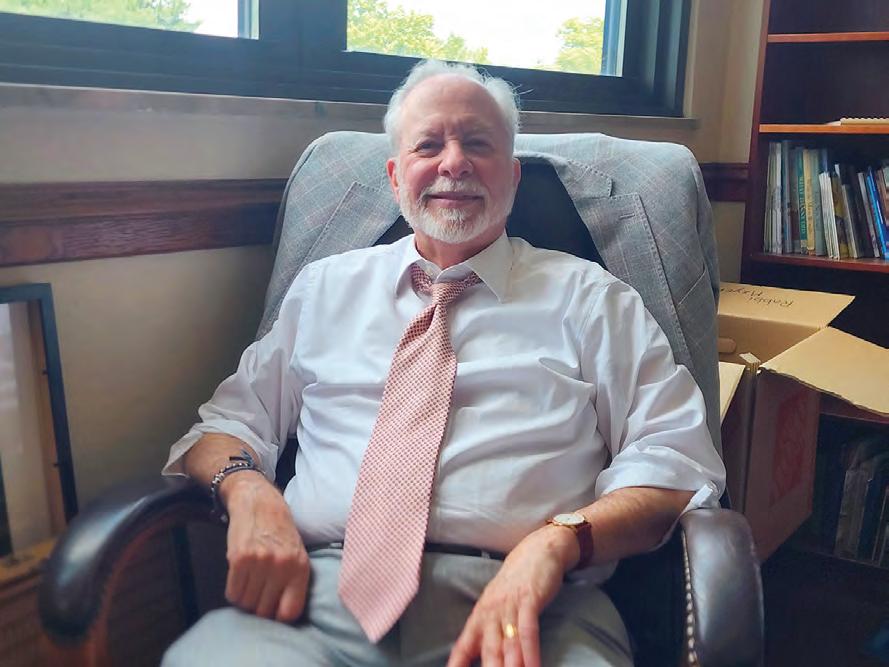


years, Myers, an ordained cantor and rabbi who began teaching Hebrew school in 1977, will not hold a professional Jewish post. Though he’ll finish out his two-year stint as president of the Cantors Assembly, Myers, 70, said the majority of his time post-retirement will be dedicated to writing a book, seeing the bimah from the pews and visiting with his 3-year-old granddaughter. Before beginning this next phase of his life, Myers spoke with the Chronicle.
This interview has been edited for length and clarity.
Congratulations on your upcoming retirement. Before we talk about the future, let’s talk about the past. Tell me about joining Tree of Life 10 years ago.
At the time I was in the process of looking for a new pulpit, and the opportunity was available here. We just began with, as I think in most congregations, exploratory conversations with leadership search committees and it just continued on. I recall saying to my wife at the time, “Pittsburgh? I have no idea what Pittsburgh is. I know it’s out there, but I have no idea.”
Until that point you’d spent your career on the East Coast. What were your initial impressions of Pittsburgh? I remember when I was picked up at the
You began working in Pittsburgh on Tisha B’Av 2016. What did you discover about the community after moving here?
I was immediately pleased that there was a communal Tisha B’Av program. It’s not as easy to have a fulsome minyan for summer observances like Tisha B’Av, and the fact that the Conservative and Reform community — collectively in Squirrel Hill — recognized that and did something about it, I thought was good. That’s not always the case in communities. I thought that’s a really great way to start. Similarly, I was really impressed by the Shavuot-o-thon [Tikkun Leil Shavuot]. Every range of the Jewish community is present. We’re able to ignore any differences we may have to gather together to study Torah — and by Torah, not just the narrow but the wide sense. That’s really impressive.
Tree of Life dates to 1864. What was your sense of the congregation?
Early on we worked to rebuild the volunteer infrastructure. That became my No. 1 priority.
By David Rullo | Senior Staff Writer
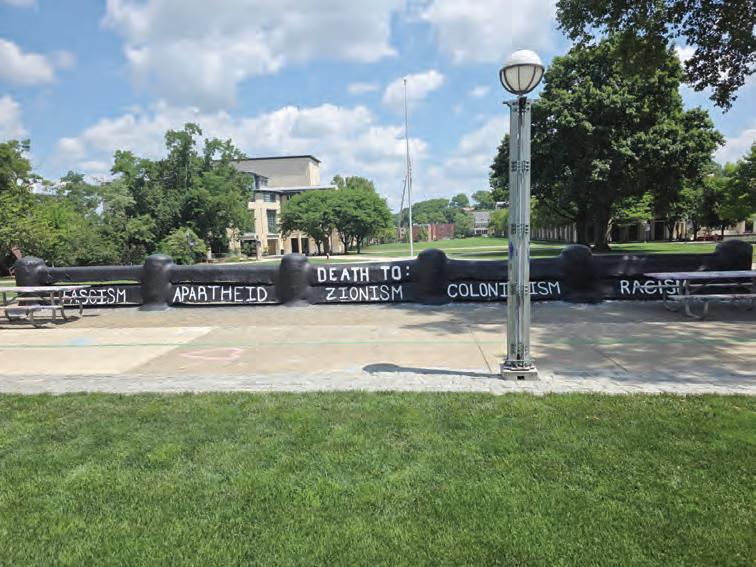
The Fence at Carnegie Mellon University is proving to be a popular spot for anti-Zionist messaging, despite the fact that is it summer and most of the university’s students are away until the fall semester begins.
New messages continued to pop-up surrounding the Independence Day holiday.
A message painted on June 30, the fourth anti-Zionist message since the latest surge began, featured the words “Stop Censoring Antizionist Jewish Voices.” On the other side of The Fence, the message read “Antizionism ≠ Antisemitism.”
On the #cmufence Instagram page — which is not affiliated with or run by the university but features photos of The Fence — those messages were attributed to “Concerned students.” The messaging followed the university’s June 28 removal of a painted message stating, “Death to Zionism.”
“Death to Zionism” was painted in Yiddish.
On the #cmufence Instagram account, the message was attributed to “A few Jewish students,” although no proof that Jewish students were involved was offered.
CMU took the unusual step of painting over the words “Death to Zionism.” University President Farnam Jahanian also sent a message to the CMU community, writing that “a call for ‘death’ violated our longstanding policy against such threats of violence, including threats based on an individual or a group’s affiliation or identity. Moving forward, we will continue to quickly remove threatening language wherever it appears on campus, fully investigate these incidents and intervene as necessary.”
CMU police, he noted, were investigating the matter.
An earlier painting of The Fence is also under investigation by university law enforcement. It contained the message “By any means necessary,” an axiom seen by many as justification for a political movement to use any means available — including violence — to achieve its goals.

section begins on page 9
By David Rullo | Senior Staff Writer
When the rebuilt Tree of Life opens, a familiar name will be attached to the restored sanctuary.
The Sylvia and Martin Snow Family Fund has given The Tree of Life a $1 million gift, supporting the redesign of the sanctuary as well as programs and initiatives focused on growing and re-engaging membership in the congregation, particularly that of young families.
Snow family representative Josh Schachter said Tree of Life Congregation has been central in his family’s lives and they are proud to “ensure it can be a source of hope and community for future generations of Jewish families.”
Michael Bernstein, chair of The Tree of Life organization’s board of directors, said there has been an ongoing dialogue with the family, who wanted to be part of the project and were waiting to find the best fit.
“They started to ask some questions around the sanctuary and the sanctuary space, which is such an important component of everything we do, because it will not only be the place where we hold all kinds of programs — Jewish and non-Jewish alike — but from a Jewish standpoint, it represents the return of Jewish life to the corner of Shady and Wilkins,” Bernstein said. “We suggested they name it as a way to honor their family’s legacy, and they loved it.”
Memorializing his grandparents through naming the sanctuary is significant, Schachter said, because the family celebrated multi-generational life cycle events

there. He looks forward to continuing that, as well as attending High Holiday services and other events there.
“That’s where I got to share those memories with my grandmother, and my grandfather [who passed away when Schachter was 10 years old].”
Sylvia and Martin Snow were lifelong Pittsburghers, who began attending services at Tree of Life Congregation in the 1980s. Their son-in-law, Barton “Bob” Schachter, served as its president in the 1990s and was the executive director of the Jewish Community Center in Squirrel Hill from 1982 to 1998.
Schachter said that after the Pittsburgh synagogue shooting on Oct. 27, 2018, which occurred in the Tree of Life building, he saw the community “was struggling with how to move forward.”
Given his family’s history with the congregation, he said he felt a sense of responsibility, not only to the community but to the legacy of his grandparents and
family, “to take a leadership role and help rebuild the congregation.”
“I’m thrilled to see my grandparents honored and memorialized in this way,” he noted. “My family is super excited, understanding that it’s taken a long time to get here.”
Schachter said he’s pleased to see the influx of young families who recently joined the congregation but noted, “We need more new families and the commitment of past members.”
“I would love for people I grew up with at the congregation to come back and be members,” he said.
Robin Friedman, Tree of Life Congregation’s president, said the gift represents “a first step” for many members, and connects to the legacy of both the congregation and the Snow family.
“We’re extremely happy in a monetary sense,” Friedman said, “but it’s more than that. It speaks to the longevity of the family at the Tree of Life. We’re happy to see them at services. It’s good that they want to continue

SUBSCRIPTIONS subscriptions@pittsburghjewishchronicle.org 412-687-1000, ext. 2
TO ADVERTISE advertising@pittsburghjewishchronicle.org 412-687-1000, ext. 1
EDITORIAL DEPARTMENT
Email: newsdesk@pittsburghjewishchronicle.org
BOARD OF TRUSTEES
Evan H. Stein, Chair
Evan Indianer, Vice Chair
Derek Smith, Treasurer
Gayle R. Kraut, Secretary
Gail Childs, Dan Droz, Malke Steinfeld Frank, Karen Gal-Or, Seth Glick, Judith Kanal, Cátia Kossovsky, Charles Saul, Lynn Zelenski
GENERAL COUNSEL
Stuart R. Kaplan, Esq.
Jim Busis, CEO and Publisher 412-228-4690 jbusis@pittsburghjewishchronicle.org
EDITORIAL Toby Tabachnick, Editor 412-228-4577 ttabachnick@pittsburghjewishchronicle.org
Adam Reinherz, Senior Staff Writer 412-687-1000 areinherz@pittsburghjewishchronicle.org
David Rullo, Senior Staff Writer 412-687-1000 drullo@pittsburghjewishchronicle.org
Octavia Liku, Staff Writer oliku@pittsburghjewishchronicle.org
ADVERTISING Amy Weiss, Account Executive (412) 613-0697 aweiss@pittsburghjewishchronicle.org
their relationship with the Tree of Life.”
Bernstein said the gift will pay dividends to the entire community and beyond.
“Imagine school children or groups coming through the museum and learning about Jewish life in America,” he said. “They’ll be able to go in and sit in the sanctuary and understand some of the ritual components of sanctuary life in such an iconic space.”
The sanctuary space, he explained, will be multi-purpose, sometimes hosting events while functioning as a state-of-the-art auditorium. As a result, some of the sanctuary’s features, like the Torah-reading tables, will be removable. Others, that harken back to the legacy of the building — the historic stained glass windows, for instance — will be permanent.
A model for how the sanctuary will function is Sixth & I in Washington, D.C., “a refurbished synagogue that’s used a cultural center but has an active synagogue,” Bernstein said.
Carole Zawatsky, CEO of The Tree of Life, called the sanctuary the “heart of the building.”
The organization, she said, is grateful for the family’s gift, which will ensure “the sacred worship space continues to welcome future generations to experience the richness of Jewish tradition and joy.”
Schachter looks forward to continuing the legacy of celebrating life cycle events in the new building, and hopes to, perhaps, mark a milestone for both his family and the congregation.
“I’m excited to potentially have my daughter’s bat mitzvah be the first bat mitzvah in the new sanctuary,” he said. PJC
David Rullo can be reached at drullo@ pittsburghjewishchronicle.org.
Beacon St., 5th Floor
PA
Main phone number: 412-687-1000 Subscriptions: 412-687-1000, ext. 2
PRODUCTION
Jeni Mann Tough
Production Manager
Carl Weigel
Art/Production Coordinator
Subscriptions
subscriptions@pittsburghjewishchronicle.org
412-687-1000, ext. 2
Published every Friday by the Pittsburgh Jewish Publication and Education Foundation 5915 Beacon St., 5th Floor Pittsburgh, PA 15217
Phone: 412-687-1000
POSTMASTER: Send address change to PITTSBURGH JEWISH CHRONICLE, 5915 BEACON ST., 5TH FLOOR PITTSBURGH, PA 15217
(PERIODICAL RATE POSTAGE PAID AT PITTSBURGH, PA AND AT ADDITIONAL MAILING OFFICES)
USPS 582-740
Manuscripts, letters, documents and photographs sent to the Pittsburgh Jewish Chronicle become the property of this publication, which is not responsible for the return or loss of such items.
The Pittsburgh Jewish Chronicle does not endorse the goods or services advertised or covered in its pages and makes no representation to the kashrut of food products and services in said advertising or articles. The publisher is not liable for damages if, for any reason whatsoever, he fails to publish an advertisement or for any error in an advertisement. Acceptance of advertisers and of ad copy is subject to the publisher’s approval. The Pittsburgh Jewish Chronicle is not responsible if ads violate applicable laws and the advertiser will indemnify, hold harmless and defend the Pittsburgh Jewish Chronicle from all claims made by governmental agencies and consumers for any reason based on ads appearing in the Pittsburgh Jewish Chronicle

By David Rullo | Senior Staff Writer
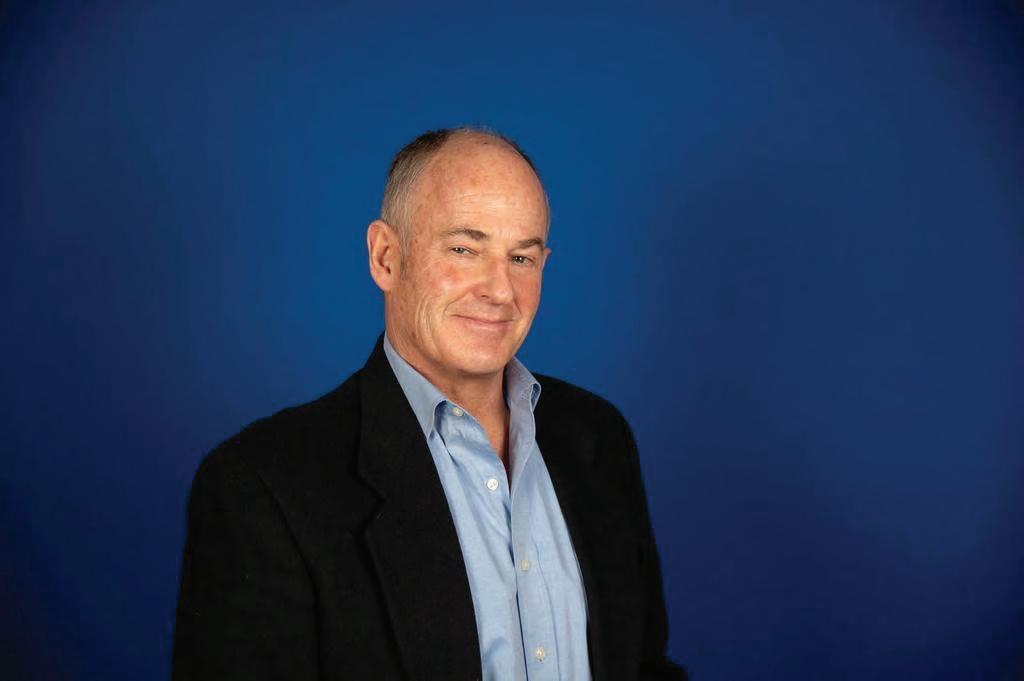
Rabbi Yaier Lehrer is excited about what Ben Wecht brings to his new position at Adat Shalom.
“He’s a real even-keeled, knowledgeable person who brings real talent to the syna gogue,” Lehrer said.
Wecht began serving as the executive director of the Fox Chapel-area congrega tion July 1. It’s a new role for Wecht, who previously served as the founding program administrator of the Cyril H. Wecht Institute of Forensic Science and Law at Duquesne University.
In addition to his time with the institute that bears his father’s name, Wecht’s byline has been seen in the Pittsburgh Quarterly, the Heinz Endowments’ h Magazine and other local publications through his work as a journalist and author.
The secular experience, however, doesn’t mean that Wecht has no history serving in Jewish communal life.
“I was on the board of the former Temple Sinai [now Beit Kulanu]. I co-chaired the Neshama Center for Jewish spirituality, created and co-edited a literary and arts journal called Kol HaNeshama — Voice of the Spirit — and I also co-created and ran in large part Folk Shabbat,” he recounted.
Wecht said his participation in congregational life informed his decision to take on the new role at Adat Shalom.
And yet, even with his volunteer experience, Wecht’s decision to become a Jewish communal professional was an evolution.
“I was looking for nonprofit and largely educational work, but I found myself circling back to the Jewish world,” he explained.
Wecht said that both the 2018 Pittsburgh synagogue shooting and Hamas’ 2023 terrorist attack in Israel, as well as the worldwide surge in antisemitism, motivated him to merge his volunteer and professional life.
Eventually, a friend told him about Adat Shalom’s search to replace its executive director and encouraged him to apply for the position.
“Initially, I resisted because I have been very active at Temple Sinai and couldn’t wrap my head around the notion of belonging to two different synagogues,” Wecht said.
After speaking with several current and former executive directors, as well as advisers and clergy members, Wecht realized dual congregational membership wasn’t unusual and that taking the job would be an important step, both for him and his family.
Wecht said he has known Lehrer for many years through various family members’ life cycle events, which provided a level of comfort even before he decided to apply for the position.
The fact that two of his three siblings — Supreme Court Justice David Wecht and Dr. Ingrid Wecht — and a cadre of friends are members of Adat Shalom made the decision to accept the position easier, even with the familiar challenges of rivers, tunnels and bridges.
“Not only am I not afraid to cross that particular river, but I’ve been heading that way since my school days with my siblings and mother,” Wecht said. “Plus, the fact that shortly after I start this job they’ll

“Every transition is an opportunity for growth and evolution."
— RABBI YAIER LEHRER
place where people want to be.”
Marshall Dayan, a past president of Adat Shalom, was involved with hiring Wecht. He said the congregation was looking for a permanent executive director after working with interim Caroline Boyce.
Wecht’s background, he said, presents opportunities with the position.
“Ben has a background in journalism; we can use the help for communications,” Dayan said. “And he’s being doing really interesting programming at the Institute of Forensic Science and Law.”
The board and search committee were impressed, not only with Wecht’s experience but his passion, as well.
“We ultimately decided he had the skill set and passion, and when you bring skills together with passion, you know you have someone who is going to do really well,” Dayan said.
Lehrer said the congregation is in a period of transition and that Wecht is the right person for this period at the synagogue.
be shutting down the Parkway right off the Commercial Street Bridge, it’s quite fortuitous.”
Wecht has already attended various meetings with board and staff members and said he’s been “amazed” at both the level of commitment from the people who serve the congregation as well as the facility itself.
“It’s on 18 acres. The basement gym, which has been used for other purposes by a tenant organization, is being refurbished as a basketball court and pickleball court for use by community clubs and organizations,” he said.
Adat Shalom, which is not affiliated with a denomination, also has what Wecht calls “a beautiful kosher kitchen” that is used by an outside organization, something which, he said, they’re hoping to expand.
Growing revenue-generating efforts is one of the immediate goals Wecht has in his new role, as well as expanding membership.
He also excited about various programming opportunities, including lectures, adult learning, musical events and “searching for innovative ways to make Adat Shalom a
“Every transition is an opportunity for growth and evolution,” Lehrer said.
The executive director position will draw on his experience and skill set, Wecht said, while continuing a lifelong family commitment to community service and Zionism.
“I think all of us inherited that from our dad and mom, who became very involved with Jewish and Israeli issues, and had a commitment to Israel and Zionism,” he said. “I’m thrilled Adat Shalom is a congregation that has a full-throated commitment to Zionism and it’s an important part of what we have to do as a congregation.”
His hope is that the synagogue will become a “third place” for the Jewish community of Fox Chapel, O’Hara Township and the surrounding area.
Adat Shalom, he said “is a space away from work and home,” that strives to become the place not only to “pray and educate our children, but to socialize, read, break bread, contemplate, make music, develop knowledge, build relationships, and much more.” PJC
David Rullo can be reached at drullo@ pittsburghjewishchronicle.org.

By Deborah Weisberg | Special to the Chronicle
Nearly 40 years after their daughter Karen was murdered in the backyard of their Squirrel Hill home, Dr. Dennis and Linda Hurwitz honored her life with a Torah dedication in Israel.
They were joined by family, including son Jeffrey Hurwitz and his partner Caitlin Smith, both of Pittsburgh, for the poignant final lettering of the Torah scroll at Yeshiva Migdal Ohz in suburban Jerusalem, and the joyous celebration that followed.
The trip began May 20 and coincided with Dennis Hurwitz’s 80th birthday, a milestone which in Judaism connotes spiritual reflection and strength.
“To be able to memorialize our child in a way that elevates her soul was so incredibly emotional, I am still trying to grasp the full meaning of it,” said Dennis Hurwitz, a retired plastic surgeon, from the home he and his wife share in Delray Beach, Florida, weeks after their return.
“Since that time many of our family and others who attended have communicated about their connection with Karen’s spirit, how her presence will forever be felt at that yeshiva and in the Torah itself.”
Linda Hurwitz, former director of the Holocaust Center of Pittsburgh and past head of Community Day School’s middle school, was moved by “the love and excitement everyone expressed.”
“It was,” she said, “such an uplifting, amazing experience.”
Yeshiva Migdal Ohz was chosen because Dennis Hurwitz’s nephew Rabbi Aharon Etrog is associate dean. Dennis Hurwitz’s brother Rabbi Shimon Hurwitz made aliyah more than 50 years ago and lives in Jerusalem. Linda Hurwitz has extended family in Israel, including a second cousin in Tel Aviv who survived the Holocaust. Linda Hurwitz is the daughter of Holocaust survivors.
She and her husband have made many trips to Israel over the years, but none as deeply meaningful as this one.
Karen was 17 when, on Oct. 27, 1989, she was strangled and stabbed with a 36-inch martial arts sword by an acquaintance, Michale Anderson, 17, who claimed to have been influenced by the movie “A Clockwork Orange.” Anderson was sentenced to life without parole; he was later re-sentenced to 50 years to life based on his age when he committed the murder.
At the Torah dedication Dennis Hurwitz spoke about his daughter’s brief but vibrant life, including her interest in social justice and helping the disadvantaged.
“She was a promising writer, an A-plus student in English, and headed for a career in writing,” he shared. “We found

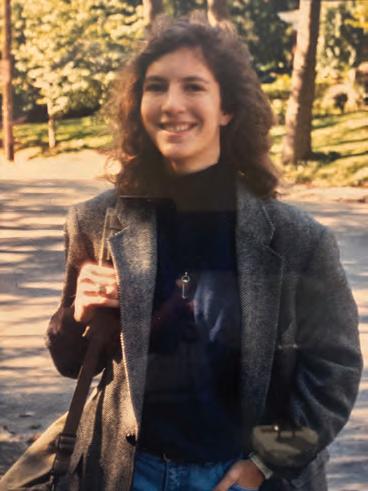
to cope. “The rituals have become more important to us.”
Retiring from his plastic surgery practice at 77, after what he calls “an incredible career,” has given Dennis Hurwitz “more time for reflection.”
The Hurwitzes keep a home in Pittsburgh, but their primary residence is in Delray Beach, chosen for its strong Jewish community, which extends to Delaire Country Club.
“South Florida is the new Jerusalem,” Dennis Hurwitz said. “Jews living there can express themselves openly and without fear, which is becoming increasingly difficult in this country.”
“The country club appears to be 90% Jewish so there’s a comfort level. It’s fun to live your life in a Jewish world around people with similar backgrounds to ours who’ve worked hard and have strong family ties.”
The Hurwitzes have been married 57 years. After Karen’s death, they focused on the best parts of their marriage, Dennis Hurwitz said, noting that many relationships don’t survive the traumatic loss of a child.
diaries and scrapbooks we didn’t know she kept, poetry she wrote, essays for college and what she wanted to accomplish in life.”
“One of the hardest things for me is the promise she represented. She was going to be a contributor to society, and Judaism in particular,” Dennis Hurwitz said. “And then she was gone.”
Linda Hurwitz recalled her daughter as “a gentle soul … and always for the underdog.”
The Torah dedication was a mitzvah that inspired others, Dennis Hurwitz said, noting that a nephew who never met Karen described feeling “a kinship with her, spiritually.”
The outdoor party that followed included a 14-piece band, and several of Israel’s leading rabbis, who were also present for the dedication of a cornerstone of the yeshiva that same day.
There were speeches, blessings, and singing and dancing past midnight.
The experience brought Dennis Hurwitz closer to his spirituality, which was challenged after Karen’s death and has since then been a journey.
“I struggled to understand why a loving God would allow such an incredible tragedy,” Dennis Hurwitz recalled, although he said he came to realize that the Jewish process of mourning, including shiva, prescribed a way for him and his wife
They also grew their family, adopting Jeffrey three months after losing Karen and a daughter, Julia, seven months later. Jeffrey, 36, is a Carnegie Mellon University graduate and chemical engineer, and Julia Silbernagel, 35, is a stay-at-home mother of two in Charleston, West Virginia.
Raising their children was a joy, Dennis Hurwitz said, adding that in all the years that Karen has been gone “she has never really left us.”
Dealing with a loss is always unfinished, he said, which means it is never too late to do something that memorializes whoever is being mourned. PJC
Deborah Weisberg is a freelance writer living in Pittsburgh.


Lifetime Achievement Award, Karen Wolk Feinstein
Outgoing president and CEO of the Jewish Healthcare Foundation
Rabbi Yisroel and Chani Altein
Co-directors of Chabad of Squirrel Hill a
Dean Aseef Shaliach at the Jewish Community Center of Greater Pittsburgh a
Michael Bernstein
The Tree of Life board chair a
Nina Butler
Director of Bikur Cholim Pittsburgh a
Debra L. Caplan
Jewish Healthcare Foundation, board of trustees and volunteer, and WHAMglobal (Women’s Health Activist Movement Global), founding chair
Avi Cohen Community volunteer a
Rebecca Elhassid Community volunteer a
Meyer “Skip” Grinberg Community volunteer a
Tsipy Gur
Classrooms Without Borders, founder and executive director a
Rachael Heisler Pittsburgh City Controller a
Jeff Herzog Community volunteer a
The Rev. Jonathon Jensen Calvary Episcopal Church a
Rona Kaufman
Associate professor at Thomas R. Kline School of Law of Duquesne University
Eric Lidji Director of the Rauh Jewish History Program & Archives at the Heinz History Center a
Fraidy and Dovie Nadoff Community volunteers a
Julie Paris
To inquire about individual or corporate sponsorship packages, placing congratulatory ads or for any other questions, please contact Amy Weiss at 412-613-0697, or aweiss@pittsburghjewishchronicle.org. Mazel tov, and thank you, to our 2026 18 Difference
Mid-Atlantic regional director of StandWithUs a
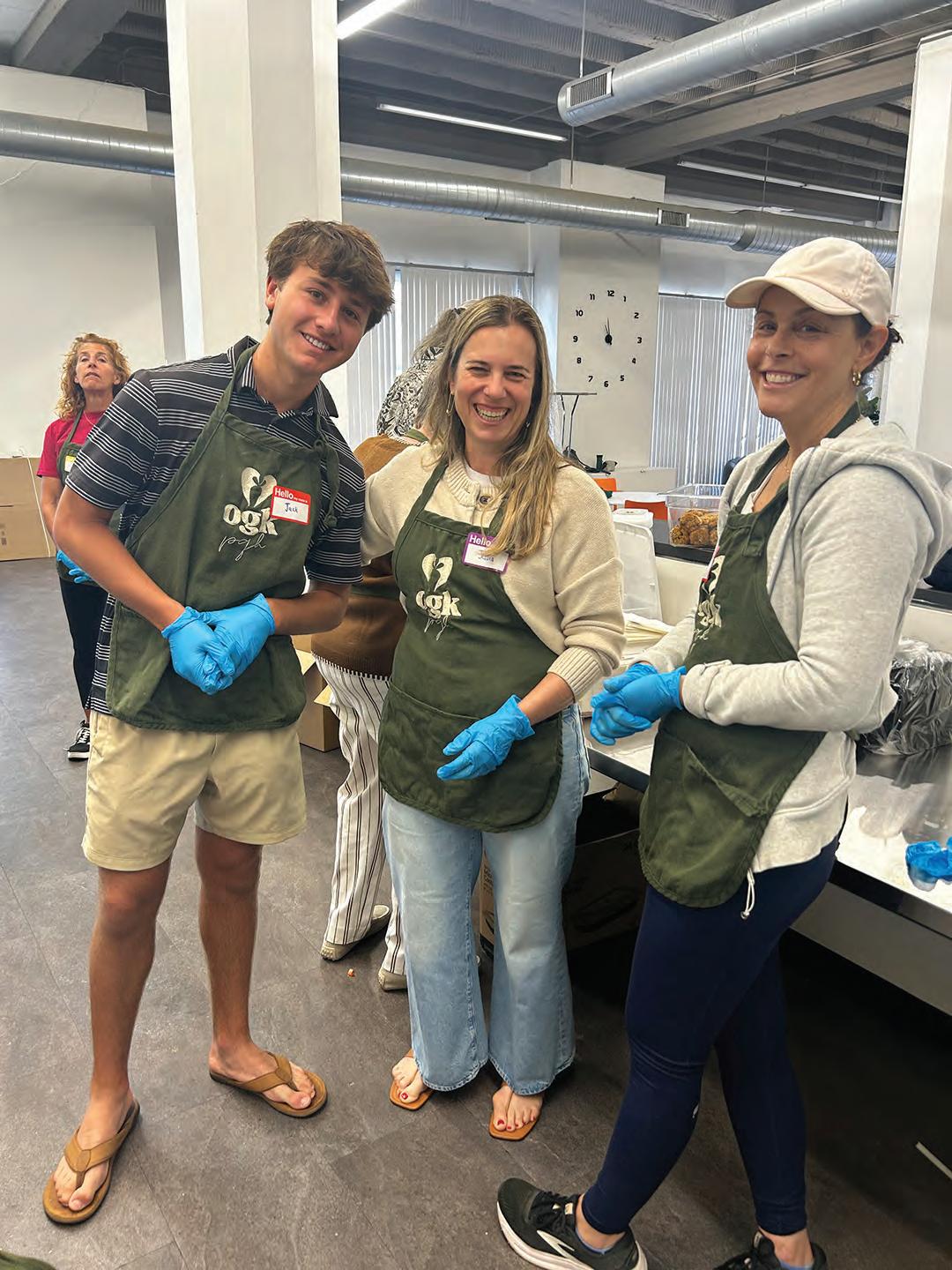
Rabbi Chezky and Bassie Rosenfeld Co-directors of Our Giving Kitchen a
Kelly Schwimer
Executive director of the Jewish Cemetery & Burial Association

Look for a special section on Sept. 4 celebrating the honorees!



Submit calendar items on the Chronicle’s website, pittsburghjewishchronicle.org. Submissions also will be included in print. Events will run in the print edition beginning one month prior to the date as space allows. The deadline for submissions is Friday, noon.
q SUNDAYS, JULY 12-26
Chabad of the South Hills presents Mommy and Me, music and movement with Hindy Rosenblum for children aged 0-3. A project of the South Hills Jewish Preschool, featuring sensory play and friends. 10:30 a.m. $5 per week/$12 for the session. chabadsh.com/baby
q SUNDAYS, JULY 12–DEC. 20
Join Chabad of Squirrel Hill for its Men’s Tefillin Club. Services and tefillin are followed by a delicious breakfast and engaging discussions on current events. 8:30 a.m. 1700 Beechwood Blvd. chabadpgh.com
Join a lay-led online Parashah study group to discuss the weekly Torah portion. No Hebrew knowledge needed. The goal is to build community while deepening understanding of the text. 8:30 p.m. For more information, visit bethshalompgh.org/online-parashah.
q MONDAYS, JULY 13–DEC. 21
Join Congregation Beth Shalom for a weekly Talmud study. 9:15 a.m. For more information, visit bethshalompgh.org.
q TUESDAYS, JULY 14–DEC. 22
Join Beth El’s Rabbi Alex Greenbaum and his Bible/Talmud Adult Education class for a thoughtprovoking weekly session of Bible and Talmudic study. This program is available both in person and virtually. Call the office at 412-561-1168 to receive the Zoom link or to make an in-person reservation. 10:30 a.m. 1900 Cochran Road. bethelcong.org
q THURSDAYS, JULY 16, AUG. 20, SEPT. 3
Rendezvous in Beit Kulanu’s Biblical Botanical Garden with drinks and hors d’oeuvres for free live musical performances. Apps start at 6:30 p.m. and music at 7 p.m. The concert is free but registration is required. 4905 Fifth Ave. BeitKulanu.org
q FRIDAY, JULY 17; SATURDAY, JULY 18
The Tree of Life Congregation is bidding farewell to Rabbi Hazzan Jeffrey Myers and his wife, Janice, as he retires. There will be a Friday night dinner (reservations are closed) plus service, followed by an Oneg Shabbat at Beit Kulanu. Saturday morning services, with kiddush luncheon to follow. Please inform the office if you are coming to Saturday’s Shabbat service/kiddush and have not already made a reservation. For more information, including times, visit treeoflifepgh.org/calendar.
q MONDAY, JULY 20
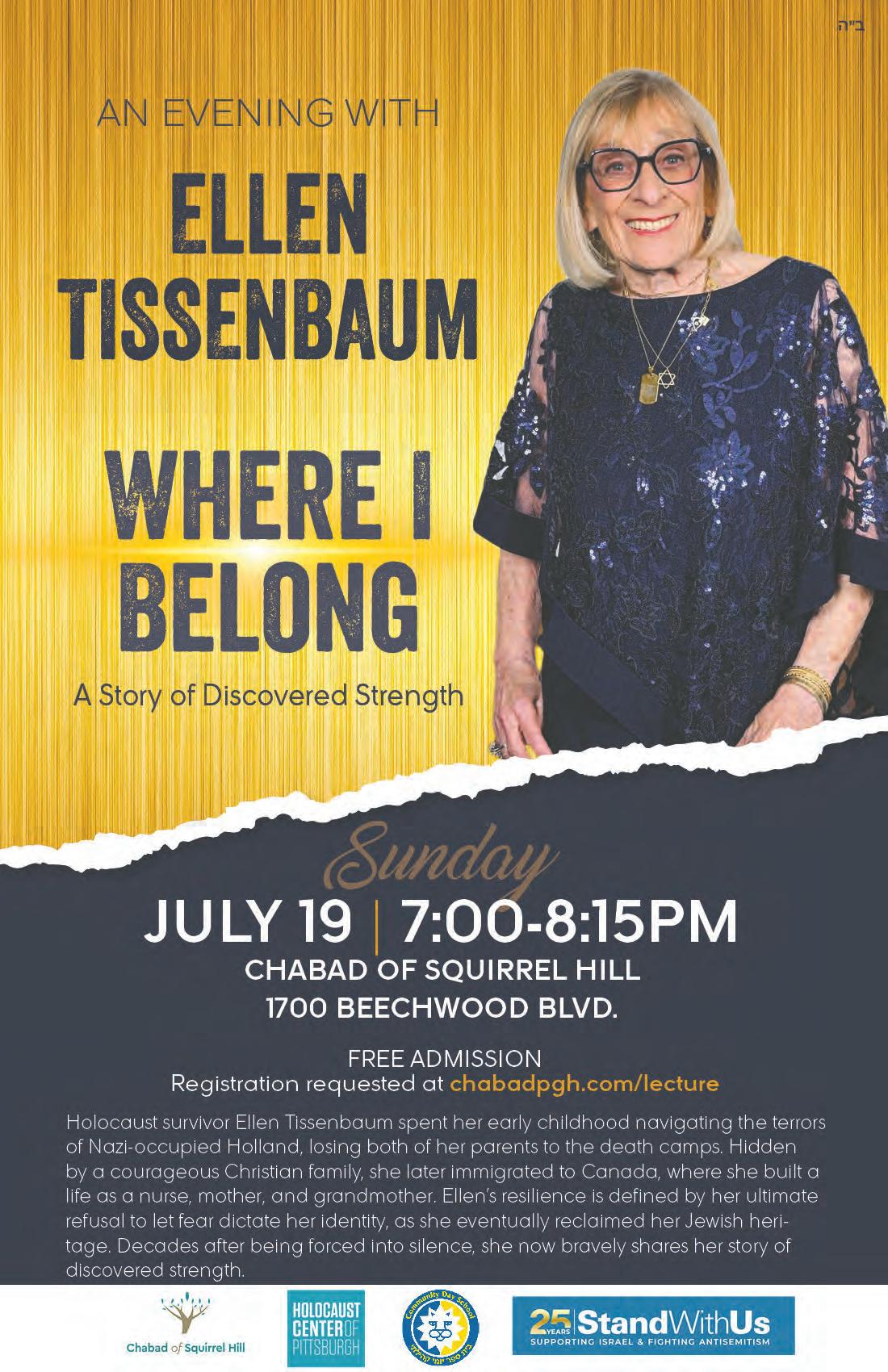
Chabad of the South Hills presents “Where I Belong,” an evening with Holocaust survivor Ellen Tissenbaum

7 p.m. Free. Address provided upon registration. chabadsh.com/lecture
q TUESDAY, JULY 21
Chabad of South Hills presents its Senior Carnival Enjoy a picnic-style lunch, laugh yoga and interactive games. Hear about home care vs. home healthcare. 1 p.m. $5 suggested donation. 1701 McFarland Road. chabadsh.com
Discover the art of quilling — turning delicate paper strips into stunning flowers, patterns, and art pieces — with Yamit Presman at Chabad of Greenfield’s Jewish Women’s Circle Quilling Workshop featuring a homemade ice cream and sorbet bar. 7:15 p.m. $18. ChabadofGreenfield.com/JWC
q SUNDAY, AUG. 2
Join Chabad of the South Hills for the 2nd Annual South Hills Jewish Festival, celebrating Jewish life and culture. Live concert with Chassidic singer Berel Faiden, cultural crafts, kosher wine tasting and food, fun zone, petting zoo. 1 p.m. Free. 1700 Bower Hill Road. chabadsh.com
q TUESDAY, AUG. 4
Join the Holocaust Center of Pittsburgh for Holocaust 101: The Fundamentals of Holocaust Education, the first program in its 2026–2027 series of teacher trainings. The training is designed for teachers across grade levels and subject areas, whether you are new to teaching the Holocaust and antisemitism or looking to deepen your
existing practice. Each session will offer practical guidance, classroom-ready resources and time to think through common challenges with other educators. Act 48 credits available. 9 a.m. Allegheny Intermediate Unit, 475 East Waterfront Drive. eventbrite.com/e/holocaust-101-the-fundamentalsof-holocaust-education-tickets-1990912143816
q WEDNESDAYS, AUG. 5, SEPT. 2
Join Beit Kulanu for Biblical Garden Open Door Tours: Free, docent-led tours of the congregation’s Biblical Botanical Garden the first Wednesday of the month. 12:15 p.m. Free. 4905 Fifth Ave. rodefshalom.org/garden
q THURSDAY, AUG. 13
Join Chabad Young Professionals for its Summer Soirée, an unforgettable evening on the rooftop featuring handcrafted cocktails, delicious cuisine, great music and the opportunity to connect with hundreds of young Jewish professionals from across the city. Slip into your favorite summer chic look, gather your friends, and join CYP for one of Pittsburgh’s signature nights. 7 p.m. $30. Rooftop Bar in Lawrenceville. cyppittsburgh.com/summer
q SUNDAY, AUG. 30
Join Chabad of South Hills for a trip to Jewish New York. Visit the Rebbe’s resting place and Chabad world headquarters; take part in a Crown Heights tour. Enjoy shopping and a meal at a delicious kosher restaurant. Fly roundtrip to New York City. 7 a.m. to 7 p.m. $125. chabadsh.com/jny PJC
The Pittsburgh Jewish Chronicle invites you to join the Chronicle Book Club for its July 12 discussion of “A Guide for the Perplexed,” by Dara Horn.
From Amazon.com: “Software prodigy Josie Ashkenazi has invented an application that records everything its users do. When she visits the Library of Alexandria as a tech consultant, she is abducted in Egypt’s postrevolutionary chaos with only a copy of the philosopher Maimonides’ famous work to anchor her, leaving her jealous sister Judith free to take over her life. A century earlier, Cambridge professor Solomon Schechter arrives in Egypt, hunting for a medieval archive hidden in a Cairo synagogue. Their stories intertwine in this spellbinding novel of how technology changes memory and how memory shapes the soul.”
Your hosts
Toby Tabachnick, Chronicle editor
David Rullo, Chronicle senior staff writer
How it works
We will meet on Zoom on Sunday, July 12, at 1 p.m.
What to do
Buy: “A Guide for the Perplexed.” It is available from online retailers, including
Amazon and Barnes & Noble, and through the Carnegie Library system.
Email: Contact us at drullo@pittsburgh jewishchronicle.org, and write “Chronicle Book Club” in the subject line. We will send you a Zoom link for the discussion meeting.
Happy reading! PJC


Hundreds of Patriot Front members march in Washington on July 4
Hundreds of people affiliated with the white supremacist group Patriot Front marched in Washington, D.C., on Saturday, in a July 4 show of force by the group founded by a veteran of a landmark 2017 far-right rally that featured an antisemitic chant, JTA reported.
The marchers in Washington wore masks and some carried Confederate flags, according to reports and video from the scene. At times, they chanted “Reclaim America!” — a rallying cry channeling the group’s nativist agenda.
While Patriot Front’s public activities mostly center on its anti-immigrant and antiLGBTQ agenda, the Anti-Defamation League has repeatedly cited the group, founded in 2017, as the largest purveyor of antisemitic materials in the United States.
One of the group’s signature slogans, which members displayed on a banner in Washington in 2023, is “No Zionists in Government.”
In a statement on Sunday, the ADL called Patriot Front “the most visible white supremacist group operating in the U.S. today” and noted that its previous public rallies had been much smaller.
“The size of the march is concerning,” the ADL said about the Saturday rally.
Patriot Front’s founder, Thomas Rousseau, was a leading participant in the 2017 Unite the Right rally in Charlottesville, Virginia, in which attendees chanted “Jews will not replace us” while carrying burning torches. The chant refers to an antisemitic conspiracy
theory positing that Jews are engineering mass immigration in order to displace white people. Rousseau later testified that he heard the chant but thought attendees might have been saying “you will not replace us.”
Adam Sandler officiates Taylor Swift-Travis Kelce wedding, fueling theories about singer’s Israel stance
A Jewish comedian who played one of cinema’s most notable Israeli characters took center stage — literally — at Taylor Swift’s wedding at Madison Square Garden on July 3, JTA reported.
Adam Sandler officiated the ceremony between Swift and Kansas City Chiefs tight end Travis Kelce, a spokesperson for Swift confirmed to media after the wedding.
Sandler’s presence fueled criticism from anti-Israel voices, who argued it was significant that someone who has described himself as “very pro-Israel” officiated the wedding. Sandler has discussed his friendship with Swift and Kelce publicly, saying that it developed through his daughters, who are Swift fans.
Sandler is not among the celebrities to engage in activism on Israel or Gaza. In fact, Sandler — whose early hits included “The Hanukkah Song” — is not known to have visited Israel, after disclosing in a 2022 interview that he had never traveled to the country of one of his signature characters. He played Zohan Dvir, an Israeli soldier who prefers partying to war, in the 2008 comedy “You Don’t Mess With the Zohan.”
Sandler made the “very pro-Israel” comment in 2015 while criticizing artists who boycott Israel during an appearance
July 13, 1941 — Songwriter Ehud
Manor is born
Israel Prize-winning singer-songwriter Ehud Manor is born in Binyamina. Manor composes about 1,200 songs, including 1978 Eurovision winner “A-Ba-Ni-Bi,” and translates 600 others into Hebrew.
on Howard Stern’s radio show. He has said little publicly about Israel since the immediate aftermath of Hamas’ Oct. 7, 2023, attack that began the war in Gaza, when he said his “heart is shattered” and signed onto an entertainment industry letter calling on then-President Joe Biden to help return the Israeli hostages taken by Hamas.
For some, the reaction to Sandler’s officiation added to a growing sense that no Jewish figure can escape being targeted by anti-Zionist activism. “You can stay silent. You can avoid politics. You can try not to get involved,” the pro-Israel influencer Ran Alkalay posted on Instagram. “For antisemites, none of that matters.”
A California man who pleaded guilty to the 2023 death of Jewish protester Paul Kessler was sentenced last week to one year in county jail and two years of felony probation, the Ventura County District Attorney announced, according to JTA.
Loay Abdel Fattah Alnaji, 54, of Moorpark, California, pleaded guilty in May to felony involuntary manslaughter and felony battery causing serious bodily injury for the death of Kessler, as part of a plea deal that was sharply criticized by local Jewish leaders.
Alnaji admitted to striking Kessler, a 69-year-old Jewish pro-Israel activist, in the head with a megaphone during dueling pro-Palestinian and pro-Israel demonstrations in a Los Angeles suburb in November 2023. Kessler later died of his injuries. His death became the first tied to U.S. demonstrations surrounding the war in Gaza.

July 10, 1957 —
Yiddish writer
Sholem Asch dies
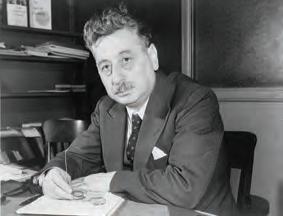
Yiddish novelist and playwright Sholem Asch, who first wrote in Hebrew, dies at 76 in London. Born in Russiancontrolled Poland in 1880, he first visited Palestine in 1908 and wrote about the Jewish connection to the land.
July 11, 1927 — Jericho earthquake kills 300-plus
A major earthquake kills 300 to 500 people and injures at least 700 others. It is known as the Jericho earthquake, although later research concludes that the epicenter is about 30 miles to the south by the Dead Sea.
July 12, 2006 — Second Lebanon War begins
Hezbollah starts the Second Lebanon War by launching rockets and mortars and ambushing an Israeli patrol across the border, killing three soldiers and abducting two others. The fighting lasts until Aug. 14.
July 14, 1555 — Paul IV orders Jews into Roman Ghetto
Pope Paul IV issues an anti-Jewish decree, Cum Nimis Absurdum.
The Jews of Rome are forced into a ghetto along the Tiber River. Jews also must wear yellow head coverings and are barred from owning property.

July 15, 1908 — Philanthropist Max Fisher is born
Max Fisher is born to Russian Jewish immigrants in Pittsburgh. His Detroit-based Aurora Gasoline grows to have more than 700 gas stations. He devotes his charity to Jewish causes, Israel and Detroit.
July 16, 1948 — Violinist Pinchas Zukerman is born
Grammy-winning classical musician and conductor Pinchas Zukerman is born in Tel Aviv. He begins playing the violin by age 8, and by 14 he is studying in New York under the sponsorship of violinist Isaac Stern. PJC
Ventura County Superior Court Judge Derek Malan said during the June 30 sentencing that he had received 132 emails from community members regarding the case, many of which advocated for a harsher sentence for Alnaji and called the case a murder or hate crime.
The Anti-Defamation League of California decried the ruling in a post on Instagram, writing that it was “little more than a slap on the wrist and not in proportion with the enormity of this crime.”
Israeli couple kidnapped together into Gaza wed
Two former hostages who were abducted together into the Gaza Strip on Oct. 7, 2023, were married on Sunday in a ceremony attended by captivity survivors and Israeli President Isaac Herzog, JNS reported.
“We prayed for your return, we were moved to tears when you came back home, and this evening we were privileged to rejoice together with you and to bless you under the chuppah [wedding canopy] on your joyous day,” Herzog tweeted, congratulating Sapir Cohen and Alexander “Sasha” Troufanov.
“May you merit building together a home filled with love, light, and joy!” the president added.
The couple was kidnapped by Gazan terrorists from Troufanov’s family home in Kibbutz Nir Oz in the northwestern Negev. Cohen was released in November 2023, and Troufanov was freed in February 2025, after spending 498 days in captivity.
He proposed to Cohen five months after his release. PJC
— Compiled by Toby Tabachnick









people have these days. We never have enough time. We always seem to have $1 here and $1 there, but time is something people just don’t have enough of. I appealed to the congregation for time. Everyone got an envelope with two red stickers, and I asked people to pledge their time by putting a sticker next to something on a list of priorities that resonated with them. That was the High Holiday sermon for the first day of Rosh Hashanah. The envelopes were all collected, they were sorted and divided up into different units. Then Oct. 27 came.
Walk me through that.
I came to realize that that’s why God sent me here. I thought after having served my first year, that it was to address what I thought were the pressing needs. What I came to realize — and I don’t think God ever really communicated to me, even though I’ve asked him why me — but this is what God wanted me to do. That doesn’t mean I didn’t, and don’t, regularly ask God, question God, look for God’s guidance; but for whatever the reasons, God wanted me to be the one here. I can’t say I enthusiastically accepted the call. I did it with much regret that that needed to be the case, but it was.
What do you mean “with much regret?”
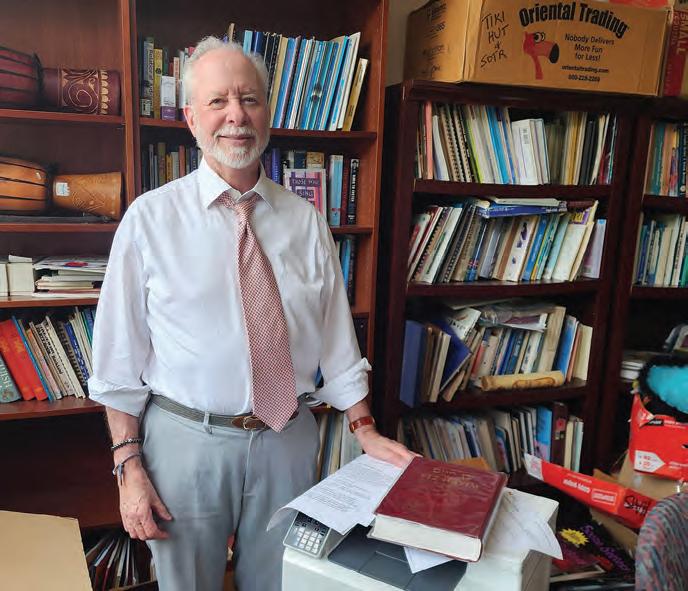
no matter where I am.
You speak pretty certainly about God’s decision-making process. Why do you think God selected you for this path?
think it ever can be. In a case like this, we will be continually healing. I’d like to think that if you look from 30,000 feet, the trajectory of healing is like on an xy-plane, it continues to go upward, but if you can put it under a microscope, it looks like an oscilloscope, peaks and leys, peaks and valleys, peaks and valleys, over the course of every single day.
Your role in the healing journey is as both a survivor and someone tasked with shepherding a community. Can we speak about that?
The unique nature of me being a survivor, and then also being called upon to pastor the congregation, is like that image of justice with the two scales: Sometimes it’ll be heavy in one direction, and then sometimes it’s in the other. The scales I think are always going up and down. There’ll be moments when I need to step back and just give attention to good self-care, and there are moments when you’re entangled in doing both simultaneously. Again, because there’s no guidebook, you just have to have faith in God and trust your instinct to do what it’s telling you to do.
You mention that there was “no guidebook.” How did you make it through the first days and what helps you now?
Manning [of Mother Emanuel AME Church in Charleston, South Carolina] on our shared journeys, because they are so similar. We’re on that same path together, but it’s not like we’re in separate cars. He and I are in the same car. We speak regularly. Our trajectories are the same. To write about that — that shared journey — to think about how do we find hope, and how might we teach America how to find hope, that’s a commodity that’s missing.
Do you feel like your work here is done?
I believe that the mission God wanted me to do has reached a conclusion. There will always be healing, but I believe we’re on a trajectory that we understand enough about it to be able to look out for each other and promote it. That doesn’t mean that there won’t be two-stepsback moments, but in the overall scheme of things I think we’re moving in a positive way to promote healing. And I think that that’s what God wanted me to do. I think that healing will still continue in the background — that switch never gets turned off — but there are other things simultaneously for Tree of Life to look into as it moves into its 163rd year, and I believe that it’s poised to continue to be a tree of life to all who hold fast to it.
That there needed to be a call for someone to be here, to serve a totally different set of needs. It’s easy, I think, for us to blame God for all the bad that happens in life. I’ve never had that attitude, so that’s never changed. We know in Pirkei Avot that everything is preordained, but there’s freedom of choice, so God does not intercede in preordination, just God knows, it’s going to happen. God’s the one we turn to — as I continue to do every day — for strength and guidance. The shooter had freedom of choice. He chose badly.
Tell me about your choices in the aftermath of the shooting. There were really two crystal clear choices for me: one was to drown my sorrows in a bottle of liquor and just fade away — and I don’t think anyone would have looked askance at me — and say ‘I can’t do this,’ and leave. I can’t tell you what drove me to not make that choice, other than God. This is why I was here. The question is what do you do with that mantle of responsibility? I accepted that God foisted that
I think only God can answer that one. I really don’t have an answer per se because there’s no — shall we say — preparation work. I like to think that the experiences lived all prior years, perhaps in some way, could offer elements of training in terms of things that you’re expected to do, that you’ve never done before, that you don’t know that you have the ability to do.
Could you tell me more?
The metaphor I’ve used is there’s a big red toolbox. You open the lid, it’s got that black tray where you pull those little parts. I have no idea what to do with them, but if you pick up the tray you see there’s the hacksaw or the spare blade. You pick it up and discover, “Wow, I got stuff in the toolbox I didn’t even know I had.”
Psychologists call that discovery post-traumatic growth, and what they mean is after you suffered a trauma like we in Pittsburgh have, the trajectory of your life beyond that is you discover things that you didn’t know that you could do, that you can do.
I found just in the overall set of years my colleagues have been so supportive, encouraging, complimentary. I’m grateful that they’ve been there to hold me up, kind of like in the Torah, when Israel’s in battle, and Moses can’t keep his arms up anymore, he gets help. Whether it’s been rabbinic and cantorial colleagues doing that, or my own congregants doing that, or communal leaders, or not even community leaders, just ordinary decent folk here in Pittsburgh — of which there are so many — all doing that. To me I think that’s the most beautiful part of Pittsburgh. What comes next for you?
We’re moving to New Jersey because we want to be near our granddaughter, who’s 3, and to be in her life. To us, the most critical thing is family. We love Pittsburgh, we would stay here, but a six-hour drive, that’s too much. I’m not moving to another pulpit, I’m retiring from the pulpit world. Does that mean I might not be engaged on a High Holiday or something like that? Anything’s possible. I’m open to what possibilities might exist. I’m also looking forward to writing a book with Pastor Eric
Rabbi Myers, thank you for your time and insights. What do you want the takeaway to be?
He tried his best.
What do you mean?
As an educator, I’ve always had the approach when it came to b’nei mitzvah training, we have this expectation of perfection, which is so unrealistic and unfair. I’ve always said to kids, if your best is an 89 and you achieve an 89 that day then I say, “Congratulations, I’m so proud of you.” As I grade myself, whatever that number is, I gave my best and I’ll let everyone else give their score. Whatever that number is, I accept it. I recognize I’m human. I make mistakes — because that’s the nature of being human — but I accept whatever that score is. As much as you want that one day not to define you, it did, so I accept it. That’s what was foisted upon me. And OK, I can only say upon reflection, I did my best. I’ll let historians determine what kind of legacy that is to be. PJC
On July 1, the group “Concerned Students” painted a new message: “Death to sexism.” That message may have been an attempt to protest the school’s removal of the message “Death to Zionism.”
Despite the phrase “Death to sexism” ostensibly championing women’s rights, most of the comments left on the #cmufence Instagram page were satirical and apparently attempting to use the anti-sexist message as a cudgel to belittle the university.
“please contact federal authorities! Being sexist is an integral part of male identity and hence, this is an obvious call to violence,” one comment read.
As for the “Antizionism ≠ Antisemitism” message, Rona Kaufman said the painters were correct — just not in the way they intended.
Kaufman is an associate professor at Duquesne University’s Thomas R. Kline School of Law and co-founder of the Center for Jewish Legal Studies.
“Both antisemitism and antizionism are forms of Jew hatred that manifest as
discrimination against Jews,” Kaufman wrote in a message to the Chronicle.
is often thought.”
“It is not a response to the war in Gaza or the State of Israel or its policies or anything Jews have done,” she wrote. “Antizionism is a distinct but related version of Jew hatred with Nazi, Soviet and Islamist roots that is more than a century old.”
Both antisemitism and anti-Zionism share core features, Kaufman explained, includingment, violence and threats. Both ideologies read Jew-hating conspiracies and claim the “path to redemption is by destroying the Jew,
“I can agree on a micro level that antizionism is not antisemitism,” she wrote, “ … but on a macro level they are the same.”
On July 3, “Concerned Students” painted The Fence with the message: “Multiple choice: Which will they censor? Death to: Fascism, Apartheid, Zionism, Colonialism, Racism.”
Adam Reinherz can be reached at areinherz@ pittsburghjewishchronicle.org.
One day later, the same group took credit for painting, “21,000 children murdered due to Zionism” and “Who are the ones inciting violence here?”
Although the Hamas-run Gaza Ministry of Health claims that 21,000 Gazan children were killed by Israel during the Hamas/ Israel war, that number has been disputed by critics who cite inaccurate date, including duplicate names, no distinctions between combatants and civilians, Hamas’ use of children as human shields, and the terror group’s prevention of Gazans from fleeing locations under attack by Israel.
In Septmeber 2025, Jahanian convened the Fence Working Group, which recently released a report with recommendations on how best to steward The Fence going forward. The Chronicle will publish a story on those findings later this month.
The latest salvo of messages painted on The Fence by anonymous activists claiming to be part of the CMU community were left intact by the university as of press time. PJC
David Rullo can be contacted at drullo@ pittsburghjewishchronicle.org.

Guest Columnist
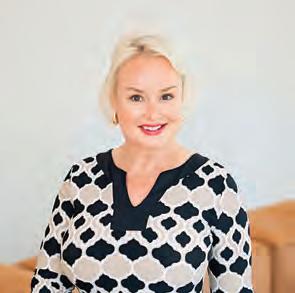
Melissa Reich
After more than two decades in real estate, I’ve learned something that might surprise people.
Most moves have very little to do with real estate.
Of course, buyers and sellers talk about interest rates, inventory levels, school districts, taxes and market conditions. Those things matter. But when I sit at kitchen tables with clients and hear the stories behind their decisions, the reason people move is almost always much more personal.
Life changes.
A new baby arrives and suddenly the charming two-bedroom home feels a little too cozy. Children leave for college and parents find themselves rattling around in rooms that no longer get used. A career opportunity presents itself. A retirement dream finally feels within reach. Aging parents need support. A marriage begins. Sometimes a chapter ends.
The home is simply where those life changes show up.
Some of the most memorable clients I’ve worked with weren’t moving because they found the perfect house. They were moving because they were ready for what came next.
I’ve worked with young couples excitedly measuring nursery walls before they’ve even unpacked their moving boxes. I’ve helped empty nesters leave homes where they raised children, hosted holidays and celebrated countless milestones. I’ve met retirees eager
to simplify life and spend less time maintaining a house and more time enjoying it. And almost every one of those moves came with mixed emotions.
That’s something people don’t talk about enough.
those growth charts during a final walkthrough and smile as they remember first days of school, family gatherings and children who are now raising families of their own. Those markings tell a story that no square footage measurement or property
Every transaction represents a new chapter for someone. A beginning. A transition. An opportunity.
Selling a home can be exciting, but it can also be emotional. Even when you’re ready to move, it’s natural to feel attached to a place that has been part of your story. I’ve watched sellers walk through a home one last time and point out where their children took their first steps, where birthday parties were held, or where family traditions began.
I’ve walked through hundreds of homes over the years, and some of the most meaningful details aren’t the gourmet kitchens or beautifully renovated bathrooms. They’re the little reminders that a life was lived there.
One of my favorites is the growth chart on a doorway or wall. Sometimes it’s tucked away in a mudroom, a pantry, or the corner of a kitchen. There, in pencil marks carefully recorded over decades, is the story of a family. Names, dates, heights and occasionally grandchildren added years later. What might look like a simple series of marks to a buyer is often a treasured timeline for the seller.
I’ve seen homeowners pause in front of
brochure ever could.
They remind us that while houses are bought and sold every day, homes are where our lives unfold.
That’s why moving is rarely just a financial decision. It’s an emotional one. People aren’t simply leaving behind walls and windows. They’re leaving behind memories, traditions and chapters of their lives that took years to write.
Buyers experience their own emotions as well. Purchasing a home is one of the largest financial decisions most people will ever make. Excitement and anxiety often travel together.
That’s why I always encourage both buyers and sellers to remember that real estate decisions shouldn’t be made solely based on headlines.
For buyers, my advice is simple: Focus on your life, not on timing the market.
If your family needs more space, if you’ve found a neighborhood you love, or if you’re ready to put down roots, those factors often
matter far more than trying to predict where mortgage rates might be six months from now. I’ve seen many people wait for the “perfect” moment, only to realize that life had already given them the answer.
For sellers, don’t underestimate the value of preparation.
The homes that generate the strongest interest are rarely the most expensive or the newest. They’re the homes that feel cared for. Fresh paint, thoughtful maintenance, decluttering and good presentation can make an enormous difference. Buyers want to envision their future there, and a well prepared home helps them do exactly that.
Most importantly, don’t lose sight of the bigger picture.
A house is a structure. A home is where life happens.
The real estate market will always fluctuate. Interest rates will rise and fall. Buyer demand will strengthen and soften. Those things are part of the cycle.
What remains constant are the people making important decisions about their futures.
That’s what I love most about this profession. Every transaction represents a new chapter for someone. A beginning. A transition. An opportunity.
When people ask me why someone is buying or selling a home, my answer is usually the same.
They’re not really moving because of real estate.
They’re moving because life is moving forward.
And sometimes, home is simply the place that helps us get there. PJC
Melissa Reich is a luxury home specialist at RE/MAX Realty Brokers.
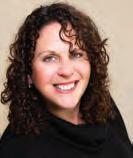
Sherri Mayer
Before we know it, many of us have lived in our homes for 30, 40, or even 50 years. The house that once buzzed with children, holiday dinners and overnight guests may now feel a little quieter — and that’s OK. As our lives evolve, it’s only natural to wonder if our home still fits the way we live today. Rightsizing isn’t about leaving behind a home you love; it’s about choosing a home that better supports your current lifestyle — whether that means less maintenance, a home that’s easier to care for, or simply more time and freedom to enjoy the people and activities that matter most.
Over the years, I’ve had the privilege of helping many families through the rightsizing process. One thing I’ve observed is that the smoothest, least stressful moves usually start long before — sometimes even years before — the “For Sale” sign is placed in the yard. With a little planning, the process can be much easier than most people expect. Here are five simple ways to make it less overwhelming and even enjoyable.
Step 1: Start preparing earlier than you think. This is the biggest step! The more
time you invest now, the less stressful your move will be. Start small — one drawer or one closet at a time. As you sort, ask yourself whether each item still serves a purpose. If you’ve forgotten you even owned it, it’s
books for yourself and your family. Add a few notes about why each item was special or the story behind it — those memories will likely mean even more to future generations than the item itself.
Rightsizing isn’t about leaving behind a home you love; it’s about choosing a home that better supports your current lifestyle — whether that means less maintenance, a home that’s easier to care for, or simply more time and freedom to enjoy the people and activities that matter most.
probably time to donate it. Eliminate duplicates — you likely don’t need three toasters, seven spatulas, or multiple sets of the same serving ware. Keep what you use and love, and if something is broken or missing pieces, let it go. The items you no longer need could become someone else’s treasure through a local charity.
Step 2: Keep memories, but not everything! Children’s artwork, school projects, sports trophies, medals and years of school papers can quickly fill boxes and closets. Instead of feeling like you have to keep everything, scan your favorite pieces, take photos of larger items and create memory
Step 3: The best time to give is now. Think about the china platter that hosted countless holiday meals, the menorah that has glowed through generations, or a quilt stitched by a grandparent. Instead of keeping these treasures tucked away, invite your family to choose the pieces that speak to them. You are passing along more than an heirloom — you’re giving them a piece of your family’s history while creating a special memory together. And who knows? You might enjoy seeing that beloved serving bowl on your grandchild’s holiday table, watching your granddaughter light those same Shabbat candles, or seeing the family kiddush cup used under the chuppah.
Step 4: Think about how you want to live. Do you want less maintenance? Do you want single floor living? How about walkability? Or, if you travel or spend months away at a time, do you want a “lock & leave” lifestyle? Maybe you’ve always wanted amenities like a pool or fitness center without having to maintain them yourself. If you’re an avid gardener, outdoor space may still be a priority. A patio, balcony, or community garden may provide just the right balance.
Step 5: Move while you have options. Making the move while you’re healthy allows you to take your time and explore your options. Do you want to relocate closer to family or make your winter home your fulltime home? Having the luxury of time puts you in charge and allows you to thoughtfully choose a home and lifestyle that best fits the way you want to live.
Rightsizing is an opportunity to create a home that fits the life you want to live today. Less time spent on maintenance or responsibility means more time for family, friends, travel, hobbies and the moments that matter most. With a little planning, the process can be surprisingly rewarding, opening the door to new experiences, new memories, and an exciting next chapter. PJC
Sherri Mayer is a Howard Hannah associate broker.
Create a cozy outdoor space with a backyard firepit
By Family Features
Afirepit can serve as a warm and inviting backyard retreat, perfect for roasting marshmallows for s’mores or stargazing while wrapped in cozy blankets. Before you can share time around the fi repit with loved ones, however, consider these tips to elevate your outdoor space.
Choosing the right design
When it comes to building a DIY firepit,
the design you choose can significantly impact the aesthetics and functionality. From classic stone pits to modern metal designs, the options are nearly endless. Think about the size and shape as well. Circular designs are traditional and encourage conversation while square or rectangular pits offer a more contemporary look.
materials and tools
Essential materials include bricks, stones or metal parts for the structure, as well as gravel or sand for the base. Fireproof materials are a must to ensure safety and


longevity. You’ll also need tools such as a shovel for digging the base, a level to ensure even construction and adhesive or mortar for binding materials together. Depending on your design, you may require a metal fire ring, grill grate or mesh cover.
Safety should be your top priority when building and using a backyard firepit. Always place your firepit at least 10 feet away from any structures, trees or flammable
materials. Make sure the area is clear of dry leaves and other debris that could catch fire. Consider installing a spark screen to prevent embers from escaping and always keep a bucket of water or fire extinguisher nearby.
Enhancing ambiance with seating and
Creating a cozy atmosphere around your firepit involves more than just the fire itself. Comfortable seating is essential for making your outdoor space inviting. Choose weather-resistant chairs, benches or DIY log stools arranged in a circle to foster conversation. Ambient lighting from string lights, lanterns or solar-powered path lights can elevate the mood and extend the usability of your firepit into the evening. Consider adding citronella candles or torches to keep insects at bay while enhancing the ambiance.
Visit eLivingtoday.com to find more ideas to enhance your living spaces. PJC





future needs
Look for flexible spaces
Seek homes that offer rooms with multiple functions. For example, an office area may be suitable for a small child’s room, or a sunroom may be converted to a laundry area down the road. Unfinished basements are also blank canvases that can be customized to meet your family’s wants and needs.
Get to know the area
The purchase of a home goes well beyond

By Family Features
For those beginning the process of home buying, there are many factors to consider. Keep these ideas in mind as you conduct your search — whether it’s online or at a series of open houses.
Because life is always evolving, it’s important to move into a home that has enough space for your family’s anticipated changes. While features and space are always prime considerations, don’t forget to, look into the area schools, day care options, parks and other kid-friendly amenities if you plan to grow your family in your next home.



the property line. Be sure to examine the neighborhood in which the house is situated. From the condition of the neighbors’ houses to highway access and the proximity of necessities like grocery stores and gas stations, be sure to take every factor into account to help ensure you’re selecting the right location.
Find more tips to aid you in your home search at eLivingtoday.com. PJC




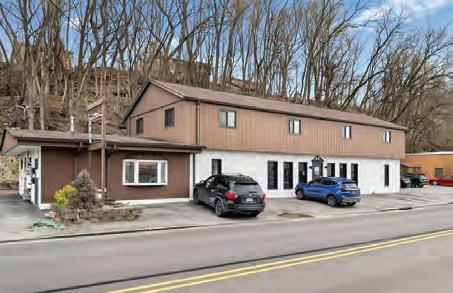


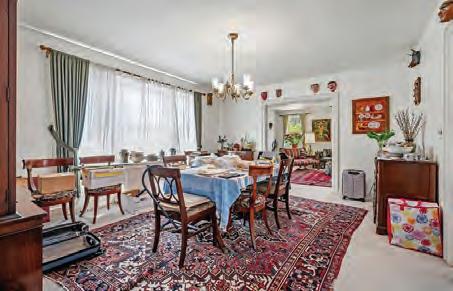
Real estate has always been about more than buying and selling homes for me— providing honest advice, clear communication, and personalized service to every client, whether they're purchasing their first home, selling a longtime family residence, searching for the perfect rental, or marketing your rental properties. Having worked throughout the Pittsburgh area for many years, I've developed a deep unaderstanding of the local market and the neighborhoods that make our community so special. My goal is to make every transaction as smooth and stress-free as possible while building lasting relationships based on trust, integrity, and results. There's nothing more rewarding than helping my clients achieve their real estate goals and knowing they'll feel confident referring me to their family and friends.
By StatePoint
When it comes to DIY moves, snafus are almost expected. Perhaps you have your own horror stories about broken furniture, last-minute cancellations or friends who mysteriously weren’t available on moving day.
But not every move has to be a nightmare. In fact, it can be one of the most positive transitions you’ll ever make. Especially if it’s tied to a relationship milestone and built on preparation, smart decisions and the right support.
In a recent nationwide survey of over 750 Americans commissioned by Mayflower, one of the most trusted full-service moving companies in the United States, and conducted by Talker Research, 48% of respondents are or have been in a long-distance relationship. For them, moving isn’t necessarily just about changing addresses. It’s about sharing a life. That added emotional weight makes getting all the details right even more important.
A third of survey respondents reported having a “moving mental breakdown” in the past. The biggest mistake people make? Treating a move like a simple task instead of a complex life event.
This is especially true among younger adults. With Millennials making up 45% of the long-distance relationships in the survey and Gen Z another 32%, many people navigating moves are doing so during high-change

budget concerns and emotional stress, and it’s easy to see how things could unravel.
Another factor: assuming moving is just about transportation. In reality, it involves logistics, planning, protection and coordination. Without someone in charge of the big picture, such as a professional moving coordinator, those seams can quickly unravel.
Moving right
A smooth move starts with a plan and tends to come from a shared understanding of priorities. Put time on your side. Create a timeline with key deadlines. Break the process into manageable steps instead of trying to tackle everything at once.
Know when to get help. The results of the



study revealed that 61% of people feel that for long-distance or out-of-state moves, hiring full-service movers is the right choice. That’s not just about convenience; it’s about reducing risk. Professional support means benefitting from experienced handling, coordinated logistics and fewer surprises.
The emotional side of moving
Moving is both physical and emotional. This is especially true when relationships are involved. The survey found that decisions about moving are increasingly based on practical considerations (such as careers) versus traditional expectations (such as gender). That’s a positive shift, but it also means both partners need to be aligned. To start your shared life on firm emotional
ground, talk through expectations before the move. Discuss how responsibilities will be shared, what the transition will look like and how you’ll support each other during the adjustment period.
Avoiding common pitfalls
If you want to stay out of nightmare territory, avoid these key mistakes:
Waiting too long to plan: Last-minute moves rarely go smoothly. Give yourself about eight weeks in advance of move day to make informed decisions.
Underestimating what you own: People often own more belongings than they realize. Take inventory early and avoid surprises.
Not organizing properly: Labeling boxes, keeping essentials accessible and maintaining a simple, step-by-step system can make a huge difference on moving day. And, you can always turn this task over to the professionals if you need support.
Doing everything alone: Even if you’re capable, support from a full-service mover can save time, energy and stress. For long-distance moves, Mayflower offers personalized services based on your needs, like packing, car shipping, storage, move protection, unpacking and debris removal. Get a quote at mayflower.com.
For couples closing the distance, settling in together can signal a fresh start. While it’s a significant step, it doesn’t have to be chaotic or unpredictable. PJC






From downsizing and relocating to






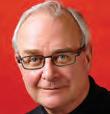

Guest Columnist
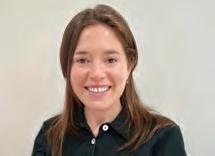
Last month, I found myself sitting in a circle with my fellow Day School Leadership Training Institute fellows, an extraordinary cohort of new heads of school participating in Prizmah’s intensive two-year leadership fellowship. Prizmah, North America’s network of Jewish day schools, brings together school leaders from across the continent to study everything from governance and finance to enrollment, curriculum and leadership.
During a session on data-driven decisionmaking, one of my colleagues paused and smiled.
“Sometimes our schools are schools,” he said. “Sometimes they’re summer camp.”
The room erupted in laughter — and not because it was funny.
Because every one of us knew exactly what he meant.
At every Jewish day school there is a team gathered around a table figuring out how many eggs are needed for the all-school challah bake. There is someone making one last run for dates before the Tu B’shvat seder. There are Shabbaton overnight schedules to finalize, Israel trip chaperones to coordinate, and kindergarten teachers rearranging the morning so 5-year-olds can proudly carry handwritten prayers to a nearby pond for tashlich. There is the painstaking process of swapping students so the Lag BaOmer color war teams are perfectly balanced. There is the all-staff email asking who can grill hundreds of kosher hot dogs. There is the quiet WhatsApp message that a new staff member has just given birth and, before anyone even asks, meals, baby clothes and support are already being organized.
None of those moments appear in a strategic plan. No dashboard captures them. No spreadsheet measures them. Yet they are, perhaps, the most important work we do.
Over the past year, I have had the privilege of visiting more than a dozen Jewish day schools from Houston to Riverdale, Cleveland and beyond. Every school has its own
traditions. Every school has its own rhythms. Every school has its own personality.
Yet I walked away from each visit with the same realization: It isn’t about which day school.
It isn’t about CDS. Or Hillel Academy. Or Yeshiva Schools (although I can say with certainty that Pittsburgh’s three Jewish day schools each weave together academics, Jewish values and community in extraordinary ways).
national research found that Jewish day schools are among the strongest predictors of lifelong Jewish engagement. Graduates are significantly more likely to remain connected to Jewish life, participate in Jewish communal organizations, affiliate with synagogues, sustain meaningful relationships with Israel and raise Jewish families of their own.
Scholar Erica Brown captures the value of day school better than perhaps anyone:
Choosing Jewish day school is not simply choosing where your child will learn. It is choosing the Jewish future you hope they will inherit.
There is a common thread that runs through all day schools.
You see it in the Israeli flags still hanging proudly weeks after Yom HaAtzmaut because no one is quite ready to take them down.
You see it in the postdoc group chats that begin with questions about bulk kosher meat orders but quickly become conversations about where to buy furniture, who has an extra crib, which pediatrician to call and where to find the best hummus in town.
You see it when a new family arrives in August and, before long, they’re hosting or attending Shabbat dinners with people who were strangers only weeks earlier.
You see it when alumni return to coach basketball, judge the science fair, speak to students, or simply stop by to thank the teachers who helped shape them.
You see it in the quiet assumption that when someone celebrates, we all celebrate. When someone grieves, we all grieve. When someone needs help, everyone asks, “What can I do?”
This is not unique to one school. It is the culture of Jewish day schools.
When families ask me why they should choose Jewish day school, I find myself giving a different answer than I would have given a year ago. You are not simply choosing a school. You are choosing the community that will help raise your family.
Research consistently reinforces what so many of us know instinctively. Prizmah’s
Enough with the AIPAC
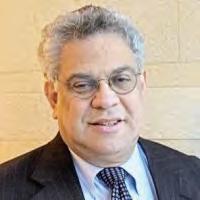
Inever thought I would utter this sentence, but Democrats need to stop bashing AIPAC.
The American Israel Public Affairs Committee has never been my political home. Over the past few decades, I have often been a fierce opponent of the vaunted pro-Israel organization. I worked for years for — and
“The best case for day school is not what it delivers in the short term. It’s the life it delivers long after graduation.”
Author Dan Senor has made a complementary argument. He believes Jewish day schools build what he calls “Jewish muscle memory,” the habits, confidence, resilience and pride that remain long after graduation and inspire alumni to stay deeply connected to the Jewish people and to Israel.
I would add one more thought.
Jewish day schools do not simply build Jewish muscle memory.
They normalize Jewish life.
Children grow up assuming that Shabbat dinners with friends are simply what weekends look like. They assume Hebrew songs echo through the hallways. They assume Jewish holidays are celebrated by an entire community. They assume that caring for one another is not extraordinary; it is expected. That normalization may be the greatest gift a Jewish day school can offer.
If we want thriving synagogues, camps, Federations, agencies, Hillels and community organizations 20 years from now, we must invest in the institutions that cultivate the next generation of Jewish families. The future of Jewish Pittsburgh depends on the strength of our three Jewish day schools.
If we do not invest boldly in our schools, we should not be surprised when our young family population begins to dwindle,
in some cases, actually helped launch — a number of organizations meant to counter the outfit’s outsized influence, including the Israel Policy Forum, J Street and the Jewish Democratic Council of America.
It has long been my conviction that AIPAC’s approach to Israel has been a disaster. AIPAC’s blank check for Israeli Prime Minister Benjamin Netanyahu has led directly to the strategic blunder of the Iran war and the moral abyss of the Gaza campaign. The venerable lobby echoes the Jewish state not wisely, but too well.
Being a Zionist does not preclude critical engagement with the Jewish state’s policies and politics. On the contrary, to
communal participation declines and fewer future leaders emerge to sustain the institutions we care so deeply about.
As heads of school, we spend enormous amounts of time discussing curriculum, technology, Hebrew proficiency, tuition, enrollment and test scores. Those conversations matter. But they are not the heart of the story.
The real product of a Jewish day school is not a transcript. It is a Jew who instinctively knows how to live in community. Someone who understands that Judaism is not simply something we believe but something we build together.
The strongest argument for Jewish day school is not that it teaches Hebrew, Torah, or academics exceptionally well.
It teaches children how to live Jewishly. Not for an hour on Sunday. Not for an occasional holiday celebration but rather for the majority of their waking hours during the most formative years of their lives.
Those are the children who, God willing, will one day lead our synagogues, our agencies, our camps, our Federations, our schools and our communities. They will in fact change the world and be leaders in any field, but they will prioritize their Jewish communities wherever they land.
The biggest lesson we offer at day school is that, in fact, our communal responsibility is a fact, it is a way of living. The greatest gift a Jewish day school offers is belonging.
Generations of day school families remain connected long after graduation because they leave with something much more enduring than an education. They leave with a community.
In an age increasingly defined by isolation, fragmentation and individualism, Jewish day schools remain among the few places intentionally cultivating relationships, responsibility, shared purpose and enduring community every single day.
Choosing Jewish day school is not simply choosing where your child will learn.
It is choosing the Jewish future you hope they will inherit.
That is why the case for Jewish day school has always been, and will always be, the case for Jewish community. PJC
Casey Weiss is head of school at Community Day School.
cherish Jerusalem as our highest joy means holding Israel’s leaders to account. I am that proud Zionist.
I have lived there with my family. My kids attended public (religious) grade school there.
And I’m a big Democrat. Yet I am disturbed at how some Democrats have begun to cast AIPAC as evil incarnate, even if no special-interest organization stands above criticism or reproach.
The anti-AIPAC vitriol has now crossed the line from partisan rough-and-tumble into antisemitic innuendo. The onslaught against such a high-profile pro-Israel organization camouflages what might simply be
a campaign against American Jews as such — against our patriotism, against our right to engage in the political process.
Consider what has happened last month in New York City, where Mayor Zohran Mamdani helped oust moderate incumbents and other party favorites in a series of congressional races.
In at least one of these primary contests, where Claire Valdez, a New York State assembly member, union organizer and Democratic Socialist who won in the primaries, prevailed over Brooklyn borough president Antonio Reynoso, the pro-Israel
Please see Rabinowitz, page 15
Last week, the Chronicle asked its readers in an online poll the following question: “What is your favorite frozen summer treat?” Of the 167 people who responded, 52% said regular ice cream; 19% said soft serve ice cream; 12% said frozen custard; 7% said frozen yogurt; 5% said frozen ice; and 5% said sorbet. Comments were submitted by 36 people. A few follow.
I have been relying upon good old fashioned DQ for decades. How can you go wrong on a hot July day by grabbing a refreshing Dairy Queen vanilla in a cone topped by chocolate?
A trip to Glen’s Custard in Springdale has always been a favorite of mine since childhood.
Rabinowitz:
Continued from page 14
outfit became a lightning rod despite the absence of an AIPAC-backed candidate.
Valdez nonetheless suggested that Reynoso was a pawn of the lobby group.
A similar dynamic was on display in the contest between former New York City Comptroller Brad Lander and Rep. Dan Goldman. The district straddles Brooklyn and Manhattan, where the banks of the Hudson River ought to matter more than the banks of the Jordan River.
But Lander, who despite being Jewish himself, shamefully wrapped his arms around Islamists and Holocaust deniers, and used Israel and AIPAC as a wedge. The campaign descended to such depths that Goldman’s office was vandalized with anti-AIPAC taunts, and a local coffee shop tried to ban him for his support for the supposed genocide in Gaza.
Then came Mamdani’s notorious speech describing AIPAC and its allies as “monsters,” accusing the organization of using dark money to preserve its power and influence.
When political organizations associated with large numbers of Jewish Americans appear assimilated to a shadowy, occult force manipulating national politics and global events, many Jews hear echoes that should concern anyone familiar with history.
You don’t have to be a supporter of AIPAC to understand why. In fact, some of Mamdani’s own Jewish allies expressed discomfort with the rhetoric, arguing that describing political opponents as “monsters” dehumanizes them rather than engages them.
What troubles me most is the double standard. Every interest group in Washington
spends money. Labor unions spend money. Env ironmental organizations spend money. Trial lawyers spend money. Crypto interests spend money. Tech billionaires spend money. Ideological groups of every imaginable persuasion spend money. And that’s not to mention the army of people working on behalf of foreign powers and registered under FARA, the Foreign Agents Registration Act.
The best ever is my homemade chocolate fudge ice cream. I also love raspberry sorbet, banana pops and frozen berries.
Homemade smoothies!
The best is from the Penn State Berkey Creamery. Try it even if you’re a Pitt sports fan.
Gelati at Rita’s, which layers soft serve ice cream with Italian ice.
I love ice cream any time of year! Any time of day!
Popsicles.
Haagen-Daz chocolate peanut butter. Yum!
involved in a race, that’s quite another.
The irony is that many of the same people who rightly condemn collective guilt in other contexts seem comfortable treating millions of American Jews as politically suspect because they support, or once supported, organizations connected to Israel.
I oppose Netanyahu. I oppose many policies of the current Israeli government. I have spent years arguing with fellow Jews about settle-
At a moment when antisemitism is rising from both the right and the left, liberals should be especially careful not to normalize language that transforms political disagreement into moral demonology
Yet few of these organizations occupy the uniquely symbolic place that AIPAC increasingly does on the progressive left. For some candidates, denouncing AIPAC has become a rite of passage, a way of demonstrating membership in the movement.
That should worry liberals.
Not because AIPAC deserves protection, but because democratic politics depends on judging organizations by what they do, not by what they symbolize.
Where AIPAC, the organization, gives money directly to a candidate, as they now sometimes do (for decades they didn’t), that’s one thing. But where they are not even
ments, democracy, religious pluralism and the future of the Israeli-Palestinian conflict.
Still, none of that requires turning AIPAC into a uniquely malevolent force in American politics.
Criticize its positions. Challenge its spending. Argue against its endorsements. That’s politics.
But stop pretending that AIPAC is somehow different from every other interest group operating in Washington.
And stop using language that edges uncomfortably close to the oldest accusations ever directed against Jews: that they wield secret power, manipulate governments
Graeter’s cookie dough ice cream is really the greatest.
Chocolate-coated frozen bananas!
Fudgesicles and Original Klondike Bars.
There isn’t a frozen treat I wouldn’t eat! PJC
— Compiled by Toby Tabachnick
Chronicle weekly poll question: Which issue do you think will have the biggest impact on American Jews over the next five years? Go to pittsburghjewish chronicle.org to respond. PJC
and corrupt democratic institutions from behind the scenes.
Most of the candidates’ campaigns and allies employing this rhetoric are not antisemites. But intentions do not erase consequences.
At a m oment when antisemitism is rising from both the right and the left, liberals should be especially careful not to normalize language that transforms political disagreement into moral demonology.
AIPAC is not above criticism. Nor is J Street.
Neither is the NRA, Planned Parenthood, the AFL-CIO, the Chamber of Commerce or any other advocacy group participating in American democracy.
The answer to speech is more speech. The answer to spending is organizing. The answer to political influence is political persuasion. The answer is not turning one Jewishaffiliated advocacy organization into the embodiment of everything wrong with American politics.
As someone who disagrees with AIPAC more often than its leaders would probably like, I never expected to be saying this.
But enough is enough. PJC
Steve Rabinowitz served as the director of design and production in the Clinton White House; worked on the national staffs of nine U.S. presidential campaigns; attended 10 presidential nominating conventions; and, for two decades, was a political and media adviser to both the Conservative and Reform movements. He is a founder of Bluelight Strategies, a public affairs firm in Washington, D.C. This article was first published on JNS.
We invite you to submit letters for publication. Letters must include name, address and daytime phone number; addresses and phone numbers will not be published. Letters may not exceed 500 words and may be edited for length and clarity; they cannot be returned.
Send letters to:letters@pittsburghjewishchronicle.org or Pittsburgh Jewish Chronicle, 5915 Beacon St., 5th Floor, Pittsburgh, PA 15217
We regret that owing to the volume of correspondence, we cannot reply to every letter.
By David Rullo | Senior Staff Writer
Andrew Paul is getting used to producing Jewish playwright David Mamet’s plays.
Paul, producing artistic director of the Kinetic Theatre Company, previously staged four of Mamet’s plays and is now preparing to open a production of “Henry Johnson.”
Produced for only the third time, following its 2023 world premiere in Los Angeles and a 2025 run in Chicago, the play features the return of Pittsburgh actor David Butler and is directed by Paul.
Paul said Kinetic Theatre’s previous Mamet productions probably helped get the rights to this show.
“He [Mamet] is aware that I’ve done a lot of his work, which I think he appreciates because after his political conversion to becoming a conservative, he got canceled by the American theater in a big way, and I think he’s loyal to the people that are still doing his work,” Paul said.
“Henry Johnson,” Paul said, is Mamet back on form, writing the kind of work the theater public expects from him.
“It feels like one of his better plays,” he said. “It’s right in his wheelhouse. It’s a hard-hitting play, but it’s got a lot of level and textures, and it has the iconic Mamet rhythms and everything.”
“Henry Johnson” gathered attention because Shia LaBeouf starred in the Los Angeles production, taking on one of the show’s four roles.
The attention may have been exactly what the storied playwright, director and screenwriter didn’t want.

“I read that Mamet didn’t want any critics to come to the play,” Paul offered. “A few people came out and wrote about it because of Shia LaBeouf, who was proud of the play and wanted people to hear about it.”
The results were sold-out audiences.
The show was also performed as part of Chicago’s Victory Gardens Theater’s 50th anniversary celebration.
Because of that run, actor Matt DeCaro, a friend of Paul’s, sent him a copy of the script saying, “We’ve got to do this new Mamet play.”
Actor Linda Kimbrough, a mutual friend of DeCaro and Paul, helped secure the rights, and DeCaro was poised to star in the Pittsburgh run.
Before production could begin, though, DeCaro had a heart attack and died.
Kimbrough and Paul believed their friend would have liked to see the play produced.
We’re dedicating it to him,” Paul said.
“It is kind of a cruel twist of fate because I can really hear DeCaro’s voice. He knows Mamet. He’s done Mamet. I’m sorry to have lost him.”
Instead, David Butler steps into the role.
The actor, now in his 70s, moved back to Pittsburgh from New York.
“This guy was in everything — City Theatre, Public Theater, the Playhouse,” Paul said.
Also starring in the four-person work is David Whalen. The actor has a long history of working with Paul.
“The first play I did with him in Pittsburgh was in 2006,” Paul said. “This is our 40th play together. We’ve done 40 plays in 20 years.”
Rounding out the cast are Cotter Smith and, in the title role, John Steffenauer.
Though the character Henry Johnson
appears in all four scenes of the play, he has the fewest lines.
“It’s a very interesting structure for a play,” Paul said.
The plot concerns corporate malfeasance involving $300,000, with Johnson ending up in prison.
Paul said Johnson is a “fish out of water,” who doesn’t look or act like a criminal but ends up in jail with a tattooed roommate sharing his cell.
“Now he’s in the system and things get worse and worse. He’s a likeable sort of lump who makes bad decisions,” Paul said.
The rehearsal process, he noted, has been interesting, as Butler and Whalen work to find the voice of the characters as they rehearse; Smith and Steffenauer, he said, come in ready to work off-book immediately.
“Henry Johnson” runs July 9-26 at the Carnegie Stage. Following its production, Kinetic Theatre is producing Agatha Christie’s “The Murder of Roger Ackroyd,” Aug. 6-30, also at the Carnegie Stage.
“It’s one of her most well-known works,” Paul said. “It’s a great piece because everyone is a suspect. There are great characters. It was a no-brainer.”
For Paul, both “Henry Johnson” and “The Murder of Roger Ackroyd” are great productions that he hopes will draw large audiences. But for now, he said, there’s intrigue and anticipation of a new Mamet work.
“People say, ‘You got a new Mamet, how the hell did you do that?’ There’s a buzz about it. It’s exciting.”
Tickets for both productions can be purchased at kinetic.showclix.com. PJC
David Rullo can be reached at drullo@ pittsburghjewishchronicle.org.
By Adam Reinherz | Senior Staff Writer
Apartnership predicated on strengthening community is affording teens new opportunities for growth. Teen Tov, a program created by Community Day School and Our Giving Kitchen, builds on nearly a year of regular programming between the organizations.
The exclusive volunteer sessions, held once a month, have enabled CDS parents and students to work alongside OGK staff, chop vegetables, season dishes and cook meals for food insecure neighbors.
Casey Weiss, CDS’ head of school, and Rabbi Chezky Rosenfeld, OGK’s co-founder and director, told the Chronicle they recognized the partnership’s value and began strategizing ways to enhance the program.
Over a series of conversations, the two Jewish professionals, along with OGK’s Bassie Rosenfeld, identified a gap in programming: Community Day School graduates and Pittsburgh-area high school students lacked an afterschool setting where they could engage in chessed, study Torah and develop advanced conversational Hebrew in one place.
There were programs that offered one or two of those opportunities, Weiss said, but nothing that brought them all together.
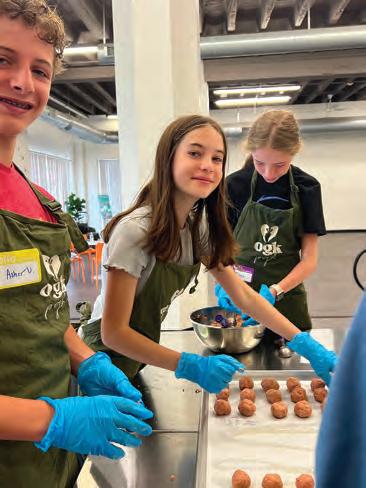
While the community offers teens meaningful ways to promote leadership, focus on Israel or give back to others — whether through Friendship Circle of Pittsburgh or Diller Teen Fellows, Rosenfeld said — Teen Tov is strategically adding to those options.
“We’re being very intentional about incorporating this piece of Jewish learning and about the partnership with Community Day and the program we’re going to put in.”
Weiss said she encourages CDS graduates to join youth groups, work at summer camps
and take part in the “amazing opportunities” already available throughout the community. Where Teen Tov fits into the puzzle is that it’s designed to meet the needs of busy teens, she added.
“It’s really hard for high schoolers to manage their coursework, and their sports, or their musical endeavors, or their instruments,” she said. “We really went back and forth a lot about what the model should be.”
With an awareness of the demographic and the demands on parents, organizers developed a plan to support teens, especially CDS graduates, Weiss said. Post-graduation, many CDS alumni are looking for ways to continue earlier practices, like speaking Hebrew, socializing and volunteering.
Given that realization, Teen Tov was created.
The Jewish learning and living experience will roll out Sept. 2, and occur every other Wednesday from 7 p.m. to 8:30 p.m. at OGK through May 19. Registration is $360. The program is open to all Jewish teens grades 9-12.
Weiss described Teen Tov as “hopefully one of many opportunities” the community offers its youth.
“Teen Tov is yet another representation of the desire in our community to experience Judaism together, to be in community, to have teens coming together, being proud, and feeling supported,” she said.

The Jewish day school leader credited parents with driving the initiative and said, “I think it’s so wonderful that they want their children to continue to be engaged.”
What the program cooks up is yet to be determined, Weiss said. In the meantime, “I think it’s going to be an absolutely beautiful experience.” PJC
Adam Reinherz can be reached at areinherz@pittsburghjewishchronicle.org.

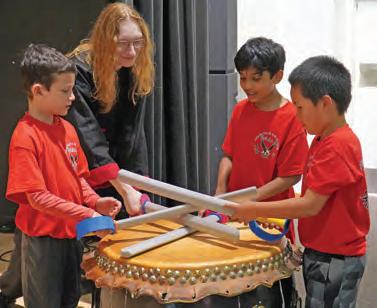



David and Rebecca Wagner of Maple, Ontario, are excited to announce the birth of their son Adam Henry on June 9, 2026. Adam joins big brothers Ari and Aaron. Proud grand parents are Jimmy and Rochelle Wagner of Squirrel Hill, and Joey and Debbie Keller of Richmond Hill, Ontario. Great-grandparents are Lee and Marcia Himmel, the late Arnold and Jacklyn Wagner, Lena (late Chaim) Markel, and the late Stanley and Joan Keller. Adam Henry (Yarden Adam) is named in loving memory of his paternal great-grandmother Jacklyn Wagner, and his maternal great-grandfather Chaim (Henry) Markel. PJC







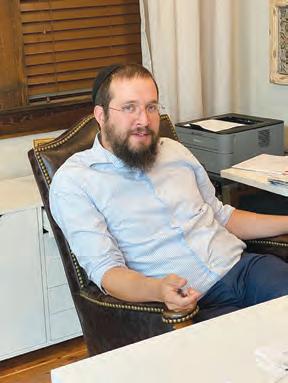


n the middle of this week’s Torah portion, the Torah does something unexpected.
After listing the Jewish people’s 42 journeys through the wilderness, it suddenly interrupts the narrative to record the passing of Aharon the High Priest: “Aharon the Kohen ascended Mount Hor... and died there.” (Numbers 33:38)
Why is Aharon’s passing inserted into what is otherwise a record of the nation’s travels?
This Shabbat also blesses and ushers in the month of Av, when we mourn the destruction of both Batei Mikdash. The Talmud teaches that the Second Temple was destroyed because of sinat chinam — baseless hatred. The Talmud shares the story that led to this.
A wealthy man planned a banquet and
Torah closer to people.
It says that he brought people closer to Torah.
Aharon never diluted Torah in order to make it more acceptable. At the same time, he never gave up on another Jew because that person fell short of Torah’s ideals. He believed that every Jew possessed a soul worth reaching, and that love, not rejection, was the way to uncover it.
That balance is not always easy.
When someone disagrees with us, or lives differently than we think they should, it is tempting to create distance. On the other hand, there is a growing tendency to assume that if Torah appears to conflict with the values of the moment, then Torah itself must change.
Aharon accepted neither approach.
His love for every Jew was unconditional. His commitment to Torah was equally unwavering.
The challenge was never to make the Torah fit the person. It was to help the person discover how deeply the Torah





Perhaps that is why the Torah pauses to mention Aharon’s passing here. The Jewish people were about to enter the Land of Israel and begin a new chapter of their history. Theyences and new pressures. More than ever, they
Every generation faces its own pressures. Ideas that were once considered self-evident are questioned. Beliefs that shaped Jewish life for thousands of years are often measured against the standards of the moment. The temptation is either to abandon people or to


Aharon’s legacy offers another path. Love people without reservation and live Torah
As we enter the month of Av and reflect on the causes of our greatest national tragedy, perhaps that is the lesson we need most. The Temple was not destroyed because Jews cared too much about Torah. It was destroyed because they forgot that Torah and love of a
The surest way to rebuild what was lost is to
Rabbi Henoch Rosenfeld is the director of Chabad Young Professionals of Pittsburgh. This column is a service of the Vaad
KATZ: Arthur J. Katz, age 94 of Mt. Lebanon, Pennsylvania, passed away on July 4, 2026, following a long battle of dementia, cared for by his beloved son Larry Katz, daughter Barrie Gayle Katz, niece Susan Kinger and sister-in-law Loretta Lundy Kinger. He was the beloved husband of the late Rhea E. Katz, married 57 years. Born in West Aliquippa, Pennsylvania, on Feb. 27, 1932, to the late Nathan and Minnie Katz. He is survived by son Larry Katz, daughter Aaron Katz, daughter Barrie Gayle Katz. Proud loving grandfather of Ian Katz, Julia Eichberg and Veronica Eichberg. Brother of the late Manuel Katz, Louis Katz, Ruth Erlich and Eleanor Cook. Also survived by many nieces and nephews. He proudly served in the United States Navy aboard the USS Cook as a captain’s clerk. Following his military service Art was a dedicated member of Beth El Congregation, in which he was a founding member. Art, a proud graduate of Penn State University, cofounded K & K Gourmet Meats, which was incorporated in 1964. Art was an entrepreneur as well as innovator. Art and his late brother Louis Katz were the creators of the original “Butter Steak.” Art, a beloved friend of the community will be dearly missed. Funeral service was held at William Slater II Funeral Service, 1650 Greentree Road, Scott Twp., 15220 (412-563-2800), on Tuesday, July 7, 2026. Interment in Shaare Torah Cemetery, 861 Stewart Avenue, Whitehall, PA 15227. slaterfuneral.com
POLLACK: Benard J. “Bernie” Pollack, on Monday, June 29, 2026, age 96. Beloved husband of 68 years to the late Jane Pollack; father of Leslie (Larry) Nudelman of Denver, Colorado, and the late Mark L. Pollack; father-in-law of Seema Pollack Gross; grandfather of Sam Pollack, Max (Marlee) Pollack, Ross (Kelly) Nudelman; great-grandfather of Kaylee and Claire Nudelman; brother of Marvin (Charlotte) Pollack. Bernie grew up in Scranton, Pennsylvania, and went on to attend Penn State University where he met the love of his life, Jane. As a young man, he served in the Navy. Always good with numbers, Bernie began his career as a CPA in Pittsburgh before deciding to start his own business. In 1955, with help from his father-in-law, Ralph Bonn, Bernie founded Ralph’s Army Surplus, an Army Navy surplus store, in Monroeville, Pennsylvania. The business continued to grow and later expanded to sell other goods, including work clothing and camping gear. Bernie’s son Mark later joined him in the business and it remained in the family until 2001. The business continued to operate under different ownership through 2024. In addition to being a successful business person, Bernie had an excellent sense of humor and was also a passionate and skilled investor. While not exactly an early adopter of technology, he was interested in technology companies and enjoyed discussing the stock market with friends and his grandchildren. Outside of business, Bernie was passionate about sports and was a lifelong fan of Pittsburgh and Penn State sports teams. He also enjoyed golfing, especially with his grandchildren. Bernie also enjoyed many winters with his family in Longboat Key, Florida. The family would like to thank all of the caregivers, especially Dorie and Bill who spent six years with Bernie, for their unwavering support. Services were held at Ralph Schugar Chapel, Inc. Interment Beth Shalom Cemetery. schugar.com
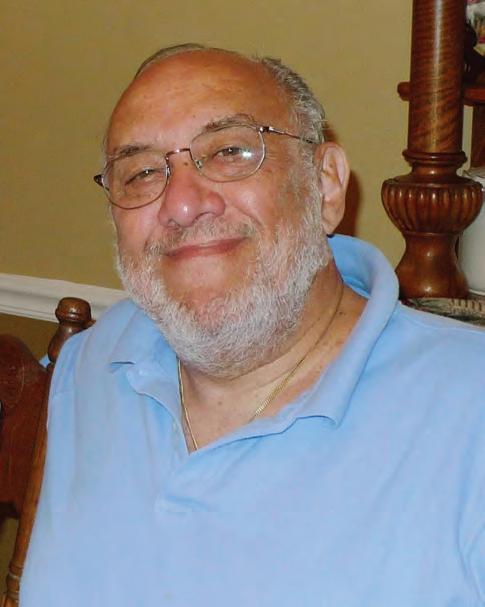
SOMERS: Sidney Somers. At 92, Sidney Somers passed away peacefully at home on June 29, surrounded by his children, grandchildren and loving caregivers. A proud lifelong Pittsburgher, Sid was the son of Louis and Leah Somers and was preceded in death by his wives, Lois Epstein Somers and Deborah Brog Somers. He is survived by his children, Keith (Debbie), Shelly (Daniel), Paula (Doug) and Beth (Ron); 15 grandchildren; one great-granddaughter; and his longtime companion, Judy Palkovitz, and her family. Sid’s greatest joys were his family and his pharmacy. For more than 30 years, he owned and operated Golden Mile Pharmacy in Monroeville, where he cared for generations of families with compassion and kindness. He took great pride in mentoring young people, helping launch countless careers, including those of several pharmacists. Sid had a remarkable gift for connecting with people. Whether through his unforgettable stories, quick wit, or infectious laugh, he made everyone feel welcome. His warmth, generosity and sense of humor left a lasting impression on all who knew him. Services were held at Beit Kulanu. Interment Homewood Cemetery. Donations in memory of Sid can be made to Weinberg Terrace (jaapgh.org) or the Squirrel Hill Food Pantry (jfcspgh.networkforgood. com). Services entrusted to Ralph Schugar Chapel, Inc. schugar.com
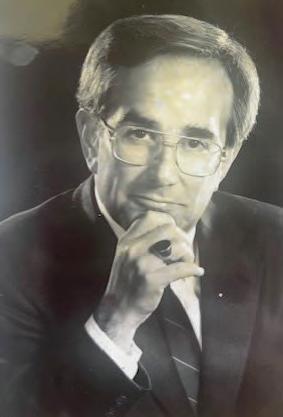
SPECTER: Howard Specter died on June 16, 2026. Loved husband of Elaine, stepfather of Dr. Joshua Blatter, grandfather of Max Blatter, a dear uncle, a friend and adviser to countless others; literally, a lawyers‘ lawyer. He was the brother of Zandra Specter. He was the son of Ben and Ethel (Gorn) Specter, now deceased. With offices in Pittsburgh, he conducted a practice that took him across the country. Asked why he enjoyed fighting for the individual against big corporations, he said, “There is something special for me about being able to see and talk to the people that I help. You can’t see or talk to a corporation or an administrative agency. Lawyers who represent those entities do important things but it’s not where Howard Specter’s head or heart is.” As a civil litigator, Specter worked in a variety of realms, including personal injury, wrongful death, product liability, medical malpractice, securities fraud, employment discrimination, antitrust and unfair competition. He was a proud past president of the organization formerly known as the Association of Trial Lawyers of America (now the American Association for Justice), the nation’s largest trial bar association. He was past president of the Academy of Trial Lawyers of Western Pennsylvania. He was co-lead counsel in the national breast implant products liability litigation. He led the team in the litigation that followed the crash of Flight 427 in Pittsburgh. He was a forerunner in gaining equal job placement and pay for women stockbrokers and in assisting women to get claims adjuster positions in the insurance industry. He fought for the rights of women and persons of color in helicopter construction, women miners in Tennessee, women medical college professors in New York. He represented liquor stores in Oklahoma against suppliers who were fixing prices. He stood for bakeries in Louisiana, who were the victims of antitrust price-fixing practices. The list could go on. And on.
ZUR: Dalia Josephine Zur, 90, passed away peacefully in her home on Friday, June 26, 2026. She was the beloved wife of the late Amram Zur and loving mother of Ilan (Lisa).
Please see Obituaries, page 20

Evan Adams
Randy & Julie Adams
Pauline Dobkin
Edward M Goldston Z"L
Irwin Goldston
Edythe Greenberg
Amy R Kamin
Sharon Galanty Knapp
Nadine Kruman . .
M Adams
Sussman
Goldston
Goldston
Greenberg
Honig
Galanty
Kruman
Linda Levine .Ella Amper
Paul Lipkind .Dora Lipkind
Dr Susan Snider & Family . .Wilma Shlakman
Sunday July 12: Gertrude M Adams, Ella Amper, Marian S Beck, Samuel H Bigler, Tillie Dentel, Harry Louis Diamond, Sidney Elinow, Celia M Elovitz, Meyer Feldman, Theresa Fried, Fannie Gross, Jacob M Hepner, Helene Rose Hyman, Harry Latterman, Samuel Lederman, Benjamin Love, L J Marks, Tillie Michaelson, Philip Recht, Samuel Sanford Rosen, Celia Schlesinger, Louis Shapira, Nathan Sniderman, Herbert Speiser, Rose Stern, Frank Sussman
Monday July 13: Yetta Burke, Anna Goldberg Cody, David M Fineman, Sigmund Fleisher, Sylvia Goldstein, Edith Lena Kaplan, Joseph Konigsberg, Harold Levy, Rose Liberman, Sylvia Weiner Markovitz, Theodore Marks, Samuel Recht, Sam Rosen, Sarah Rosenthal, Abraham Saffran, Mollie Slutsky, Isadore Sobel, Freda Tauberg, Bertha Harris Wolf
Tuesday July 14: Dr Nathan Ashinsky, Sarah L Blumenthal, Samuel J Cramer, Rae R Granowitz, Leon Robert Greenberg, Tiby M Grinberg, Louis Kitman, Milton Myer, Fannie Dvinsky Pollock, Janice Standel, Jacob Stein, Alexander Udman, Joseph H Wells, Rebecca Siegel Wilner, Mildred Marlin Wolovitz
Wednesday July 15: Leonard Barmak, Yolana Berger, Saul Cazen, Ben W Closky, Celia Cohen, Rose Freed, Mildred "Mitzie" Gold, Max Goldston, Jacob Herring, Max Levenson, Jacob Liberman, Harry Louik, Leah Miller, Abram Morgan, Essie Rogalsky Rosenfield, Samuel Ruben, Hannah Rubenson, Sidney Schwartz, Ben Shapiro, Sarah Shapiro, Wilma Shlakman, Ida Shoag, Frances Siegman, Eva Simon, Abraham B Slesnick, Edward Irving Stein, Jack Wolf

















Thursday July 16: Louis Gerson, Ruth Wein Gordon Herskovitz, Samuel Honig, Benjamin Lebby, Fay Levin, Charles Gershen Lisowitz, Florence B Perilman, Sarah Rosenberg, Manuel Siniakin, Samuel Nathan Unger, Marcus D Wedner, Louis M Witkin, Meyer Zarkin










Friday July 17: Frank Burnstein, Matel Cooper, Rae Danovitz, Charles Goldberg, Edwin Goldberg, Louis Harris, Mollie Lappin, Anna Levenson, Harry Levine, Nathan Lewis, Harry W Liebman, Sol Rosenblum, Ruth Rebecca Sherman, Meyer Silberblatt, Elizabeth Young
Saturday July 18: Norman Amper, Samuel Fargotstein, Hilda Goldstein, David Lee Greenfield, Esther F Horelick, Martin M Kramer, Jessie W Levenson, Ruth Grinberg Lincoff, Merle M Pearlman, Dorothy S Pollock, William S Winer
Obituaries:
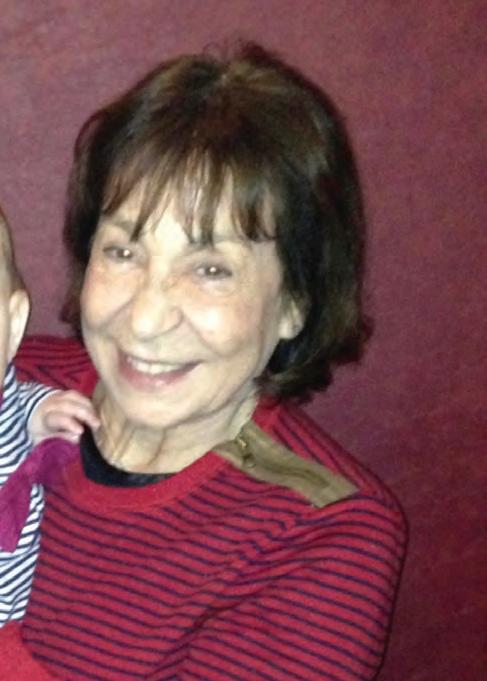
Continued from page 19
She cherished her grandchildren: Ellie, Ben and Jo. Dalia was born in Iraq in 1935. She and her siblings found refuge in Israel in the 1950s. She loved her family and looked forward to visiting them again soon. Dalia was a world traveler who lived in London, Los Angeles, and for most of her life, New York City. She was proud to become a U.S. citizen in 1985. For the past six years, Dalia lived in Squirrel Hill. During this time, she enjoyed sitting outside and watching her grandchildren play, reading, and her nightly dinners with Ilan and his family. A private graveside service was held at Mt. Pleasant Cemetery in Hawthorne, New York. Arrangements entrusted to Ralph Schugar Chapel, Inc. schugar.com PJC


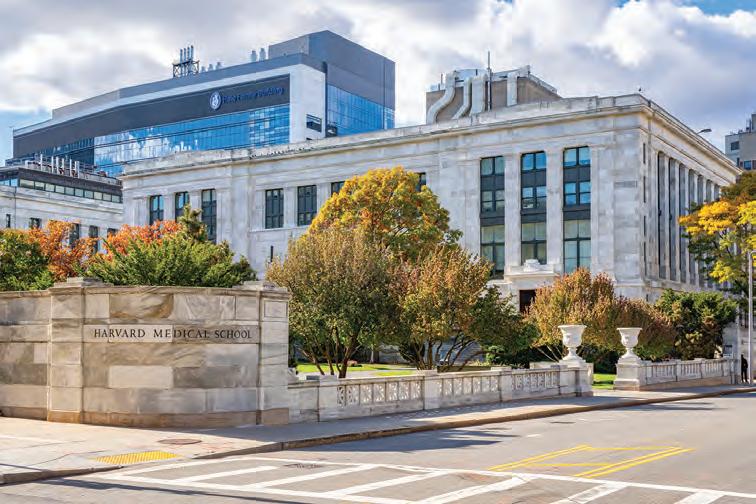
By Aaron Bandler | JNS
Dean McKay, a psychology professor at Fordham University, and Miri Bar-Halpern, a psychology lecturer at Harvard Medical School, plan to create a program to fight Jew-hatred in their field.
McKay told JNS that the initiative, which the Academic Engagement Network is supporting with a $75,000 grant over three years, will “address issues in professional training that may have antisemitic components to it, which is growing increasingly common in the profession.”
His seniority has “shielded” him more from the Jew-hatred, while his colleagues have experienced more severe instances of antisemitism, he thinks.
Bar-Halpern told JNS that the stories she has heard include a patient telling an Israeli therapist that “Hitler should have finished the job” and that a Jewish patient hoped to talk to her therapist about her friends being murdered on Oct. 7 and her fear of Jew-hatred, but was “met with political whataboutism instead of compassion.”
“Ask yourself if what you’re doing today will get you closer to where you want to be tomorrow.”
Anti-Zionism is embedded in the “decolonial psychology movement,” which teaches that Zionism is a “settler-colonial” movement and that “Zionism is associated with a lot of other social ills,” according to McKay.
“These all ignore and usually distort, if they do address it at all, what Zionism is actually about, which is, in a nutshell, that Jews have a right to a homeland in their native Israel,” he told JNS.
The movement also “ignores, usually, archaeological evidence showing that Jews have occupied that land in one way or another for millennia,” he said.
“The decolonial approach, we feel, is an applied version of what has been present in academia for many years in some of the non-applied disciplines, and it’s just made this transition now, basically into the therapy room,” McKay told JNS.
The new initiative is intended to “educate people, among our colleagues, to understand what Judaism is, what Zionism is and, of course, of what it isn’t, to dispel some very widely held misconceptions that are present in academia in general as well as in clinical psychology in particular,” McKay said.
“That would serve as the basis for beginning to help dispel this among other trainers in different programs,” he told JNS.
Both McKay and Bar-Halpern have experienced Jew-hatred in their professional circles, according to the Fordham professor.
McKay has dealt with “intimidating rhetoric online,” was “tossed off of a social media network for expressing concerns out of open requests for anti-Zionist therapists” and was subject to a protest outside of a conference he attended in November 2023, where protesters donned keffiyehs and chanted “from the river to the sea,” he said.
“Again and again, I heard the same heartbreaking message: ‘I no longer feel safe bringing all of myself into the therapy room,’” she said. “For many Jewish clinicians and patients, the deepest wound was not only antisemitism itself, it was the traumatic invalidation of having their suffering questioned, minimized or erased by the very profession entrusted with helping them heal.”
Bar-Halpern added that “the foundation of trauma-informed care is simple: Before we can help people heal, we must first help them feel seen.”
The initiative will start in doctoral programs in New York, Massachusetts and Connecticut.
“We know faculty at many of the programs in those three states, and we’re going to begin by contacting people who we are confident would be receptive to this and train them directly,” McKay said. The two would then “begin the process of spreading the word outward from that.”
“It will all include workshops, it will include both Miri and I speaking publicly to members of those programs, including people that might be more skeptical,” he told JNS.
The next steps will be for the professors involved in the program to “educate their colleagues within their respective programs,” and McKay and Bar-Halpern hope to “disseminate this and implement this more broadly,” McKay said.
“Our aim is, of course, to make it scalable with some recorded materials and also some ongoing direct contact with faculty at other institutions,” he told JNS. “Our hope is that, potentially, this would include other mental health training programs that are not in psychology, so social work and licensed clinical mental health workers.”
“Every mental health discipline is really going through this exact issue,” he added. PJC
By Adam Reinherz | Senior Staff Writer
Justice is often preserved inside a courtroom. Weeks ago, “Justice” was conserved.
The nearly 70-year-old mural, which hangs in Courtroom 711 at the CityCounty Building, received long-due repairs. Under the watchful eye of conservator and Squirrel Hill resident Chantal Bernicky, 58, “Justice” was cleaned and restored.
For days, Bernicky and conservation assistant Noah Emhurt dipped small cotton pads in a chelating agent before gently applying a salty solution to the 36-by-9foot canvas. Standing atop scaffolding, the conservationists worked their way, inch by inch, across a painting that had been damaged by a leaky ceiling and decades of pollution.
“As far as we know, it has never been cleaned,” Bernicky said.
Created by painter Harry Scheuch, with assistance from Robert Wisniewski and Peter Paul Murnack, “Justice” was supported by the Federal Art Project, a New Deal program implemented by President Franklin D. Roosevelt.
The 1940 mural has recognizably historic western Pennsylvanian cues, including a smoke billowing factory and newsbroadcasting radio announcer, along with more universal references to Death, parenting and law: a brown-hatted mother clutches a red-haired baby; a black-hooded skeleton rides a white horse; Justice holds a scale.
Though often personified by Themis, a Greek goddess known for divine law and natural order, Scheuch portrayed Justice as a gray-skinned, muscular, unblindfolded, animatronic-looking man holding a scale.
In a 1952 interview with the Pittsburgh Press, Scheuch said he chose the depiction because “That blindfold conception is hackneyed,” and added, “Judges and juries aren’t blindfolded, why blindfold Justice?”
Speaking with the Chronicle, Bernicky moved from the courtroom floor to atop the scaffolding.
She praised the mural and Scheuch’s decision to showcase early 20th-century Pittsburgh beside wider American themes of expansion, war and education.
“Everything becomes interesting when you start working on it,” she said. “As a conservator, your job is to be knowledgeable of the artist’s technique and where that piece stands in time.”
The conservator’s process, she explained,
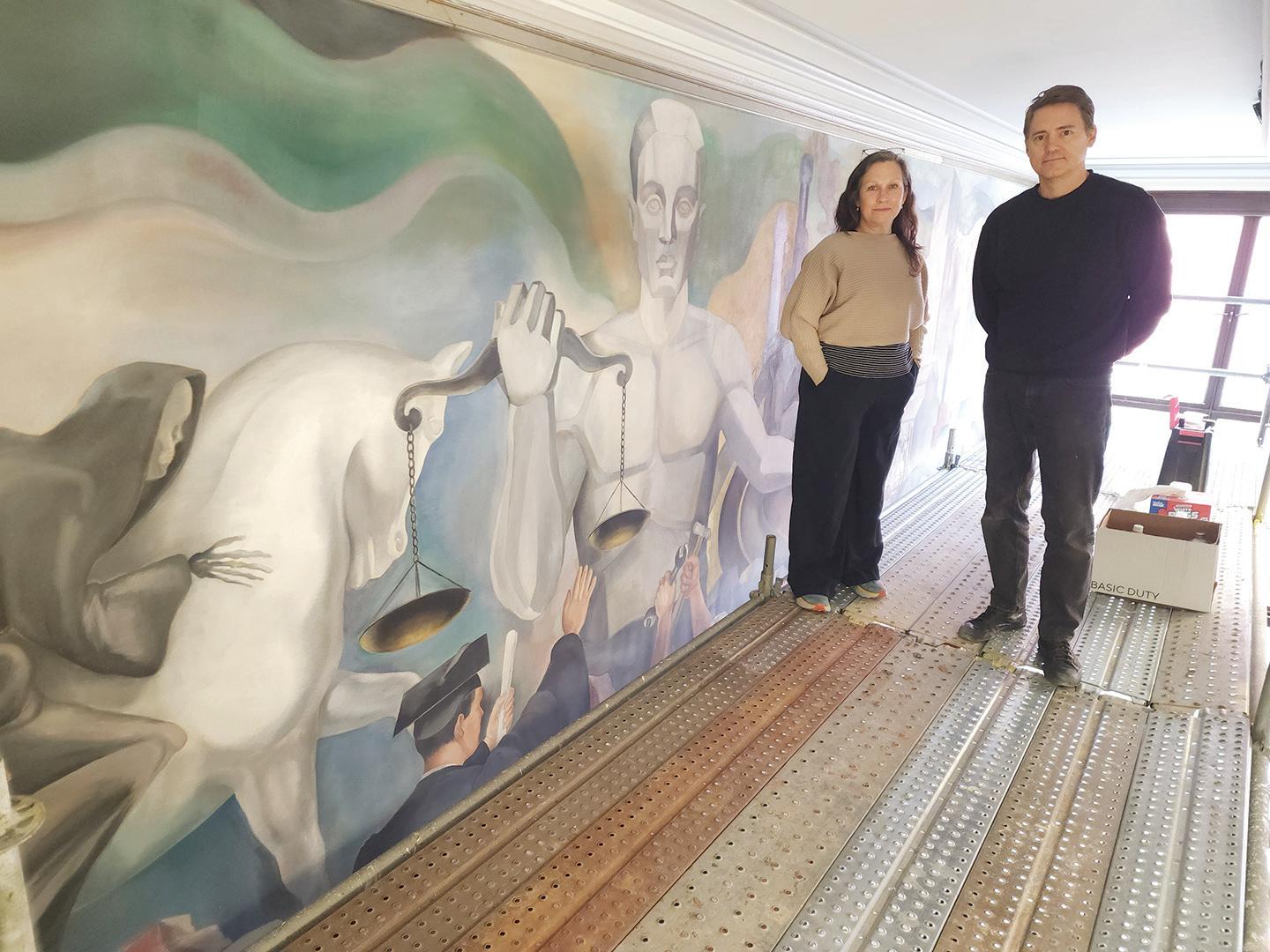
“As a conservator, your job is to be knowledgeable of the artist’s technique and where that piece stands in time.”
–CHANTAL BERNICKY
not only involves mindful labor but a transformation of perspective.
As opposed to approaching a piece with a mindset of “Wow, it’s beautiful, I don’t
have words for it,” the outlook becomes
“a little more knowledgeable,” she said. “You place it in time. And whether or not it’s the best thing I’ve ever seen in my
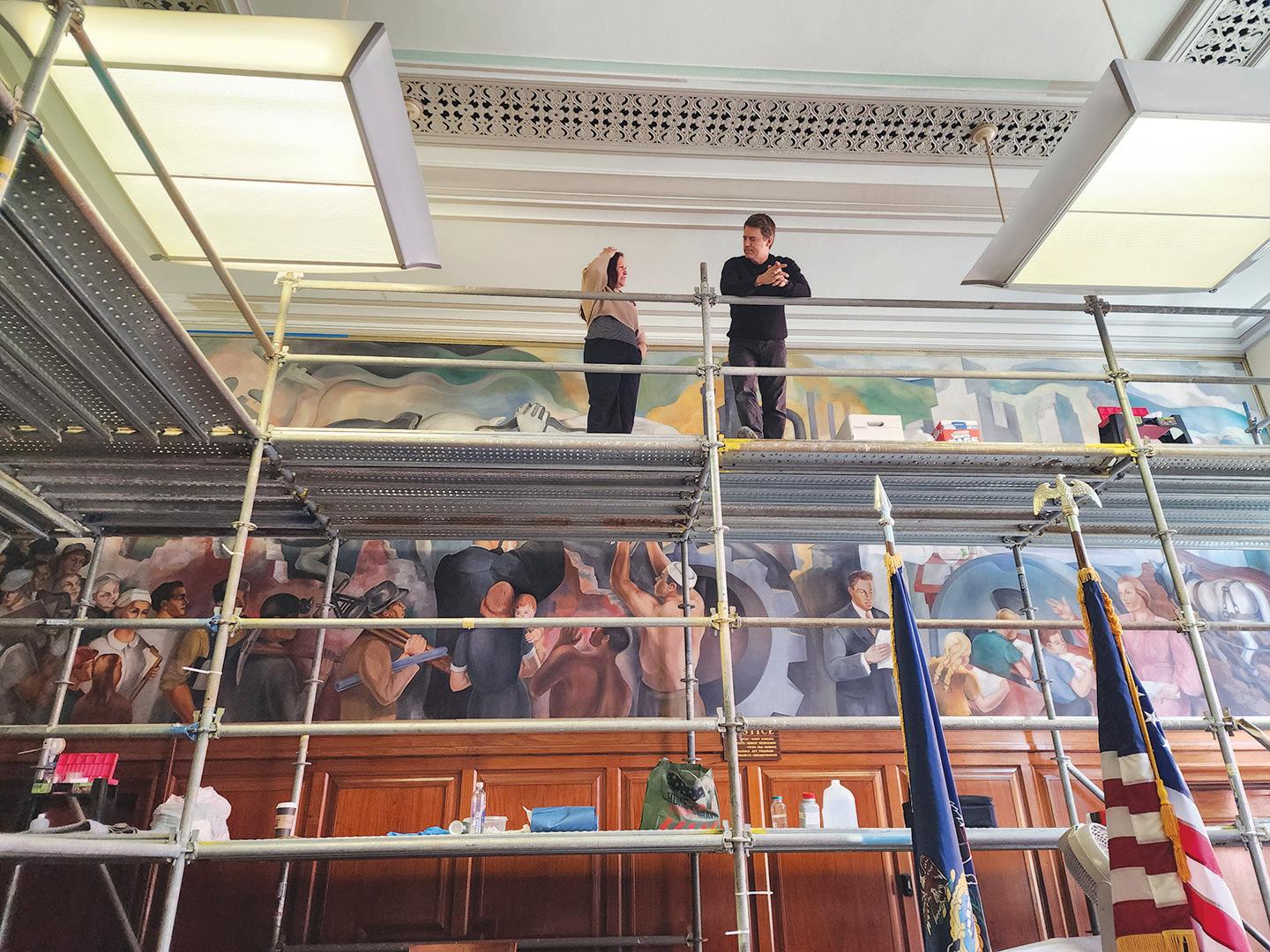
life doesn’t really matter, because it becomes relevant. So if it’s relevant, it’s interesting.”
Bernicky, a Jewish conservator who has long aided local organizations, including Chabad of Squirrel Hill, Congregation Poale Zedeck and Hillel Academy of Pittsburgh, leads Fine Art Conservation Services alongside her husband Michael Belman. She received her bachelor’s degree in art history from the Université du Québec à Montréal and a master’s degree in art conservation from Queen’s University in Kingston, Ontario, and held posts at the Museum of Fine Arts in Montreal and the Costume Institute at the Metropolitan Museum of Art in New York. Bernicky additionally worked at the Williamstown Art Conservation Center, the National Gallery of Art and the Carnegie Museum of Art.
Fine Art Conservation Services, which she and Belman opened in 2007, operates from a studio in West Homestead, with conservationists working on “everything,” Bernicky said.
Past projects included sculptures, paintings, textiles and paper conservation.
“Justice” is not the first project the group has worked on with the city, but it’s a great example of Pittsburgh’s commitment to the arts, Bernicky said.
There are numerous dedicated individuals in the city who wish to see art preserved. Judge Patrick M. Connelly is “sensitive to this because he sees it every day. The people that work with him are sensitive to this because they see it every day,” she said.
Emhurt, who carefully applied a small pad to Death, said, “This painting signifies so many things, so to see it sort of come to life again is just one of the most satisfying things of this job.”
Bernicky hopes the conservationists’ work spurs wider realization: “People have to just look into places they didn’t before and pay attention. If there’s a painting somewhere — whether you’re in City Hall or another public building, the libraries, the post offices — just look up, pay attention, and ask yourself, ‘What is this? Do I know this?’”
Those questions should prompt awareness.
“If there’s a plaque, read the plaque. People take the time to offer it to us, and it’s just for us to appreciate,” she continued. “I think the more that people do that, the more they will feel like me, like the city belongs to them.”
Standing feet from “Justice,” Bernicky paused and added, “This is part of us. We are part of the city.” PJC
Adam Reinherz can be reached at areinherz@pittsburghjewishchronicle.org.
By Octavia Liku | Staff Writer
From the nosebleeds to the stadium floor, fans wrapped every corner of PNC Park on July 3 for Noah Kahan’s so ld-out stop on “The Great Divide” tour. More than 40,000 people filled the ballpark, with crowds spilling out into the North Shore’s concourses, stairwells and sidewalk cafes.
Raised in Strafford, Vermont, Kahan has spoken about the indelible influence of his Jewish heritage on his father’s side, which has shaped his witty lyricism and sense of humor. Sardonic, confessional and woundingly earnest, Kahan’s latest album, “The Great Divide,” traverses themes of fame, loss and family dysfunction, examining the distance between the life he once knew and the one he now leads.
The show opened with “American Cars,” a vibrant and ardent melody about his older sister, who serves as the family “fixer” whenever things go awry. Throughout the night, he performed 13 tracks off his new album, including “Downfall,” a mournful duet with surprise guest singer Natalie Rose.
Highlights included “Porch Light,” during which LED wristbands enveloped the stadium in a radiant glow as Kahan, singing from

his mother’s perspective, reflected on the emotional toll his newfound fame has taken on his loved ones and well-being.
explores religious trauma and “the deep

misunderstanding” between two childhood friends, was performed against a backdrop of stained glass window panes, shrouding, and then parting to reveal an idyllic landscape. licate, cyclical guitar work that defines the track reflects producer Aaron Dessner’s influence. Dessner, who is also Jewish, strays from the major chord progressions so typical of pop music, instead favoring steady, rhythmic arrangements. He has spoken
vocals struck a chord with listeners in search of an authentic sound.
Standout performances include “Dial Drunk,” which Kahan delivered while getting mock-arrested on stage for drunk driving. “The View Between Villages” and “Orange Juice,” two of his most emotionally resonant songs, were similarly notable for their candid exploration of survivor’s guilt, addiction and regret.
Lightning pulsed through the sky above as he delivered a soaring rendition of “Maine,” the only song in the setlist from his 2020 EP “Cape Elizabeth”.
The “miserable” quality of the music, as Kahan half-jokingly described it, proved no deterrent; fans spent the night jumping, dancing and screaming-singing their way through the lyrics.
Kahan’s show coincided with Anthrocon, the world’s largest annual Furry convention. Kahan jokingly referenced the event multiple times during the event, even donning the head of a fan’s fursuit at one point.
“All of the animal kingdom is welcome tonight,” he said, laughing.
To Kahan, Pittsburgh represents more than just a single stop on his world tour.
“My mom is from Pittsburgh — I grew up watching Hines Ward and Troy Polamalu,” Kahan said to the crowd. “It was one thing my grandad and I did together. We would sit in front of the TV and scream at Mike Tomlin.”
Before selling out PNC Park, Kahan played at Carnegie Mellon’s Wiegand Gymnasium in 2022, Stage AE in 2023 and Star Lake in 2024.
“It’s just insane to me that so many people
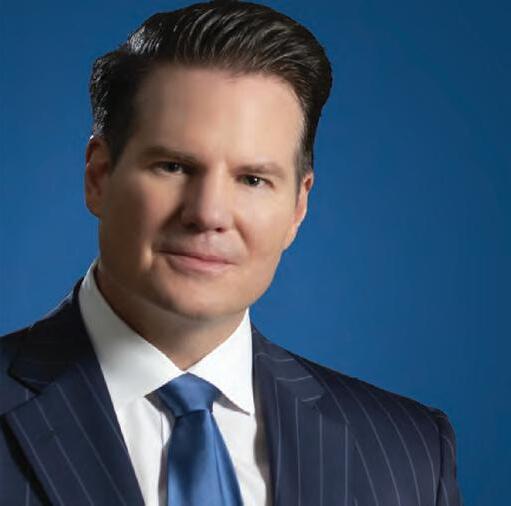






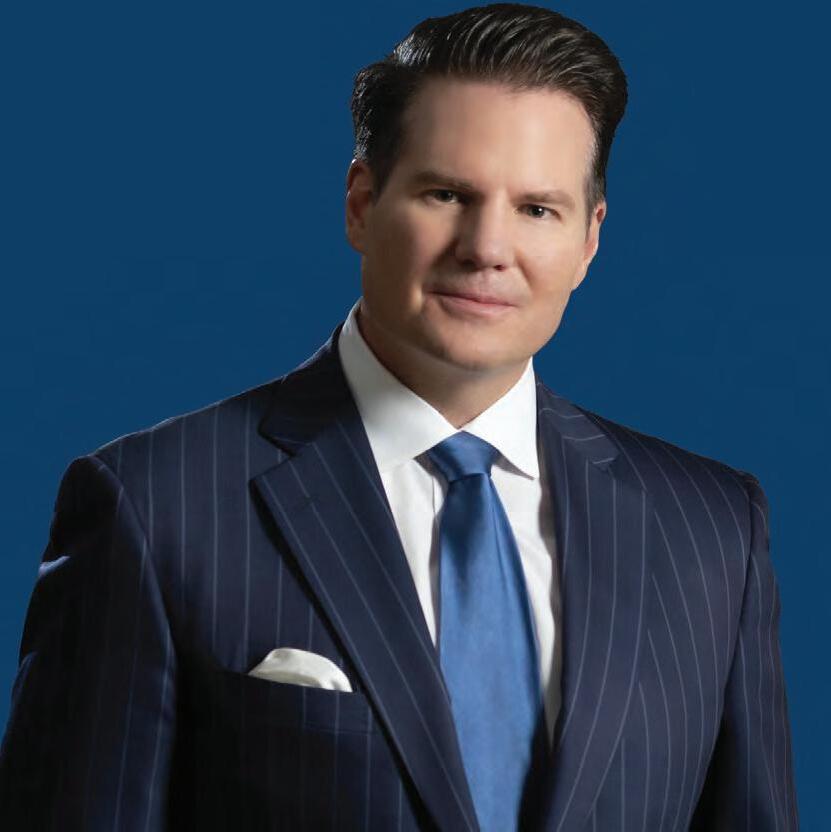


about drawing inspiration from his Jewish heritage as well, incorporating elements of liturgical melodies into his work.
While “The Great Divide” anchored much of the two-hour performance, Kahan also devoted a significant portion of the set to his 2022 breakthrough album “Stick Season.”
The record marked a dramatic shift from his hallmark pop-infused sound toward indie folk. Released as audiences emerged from the pandemic, its blunt lyricism, dry wit and raw
showed up,” Kahan said. “We played so many shows here in Pittsburgh — never this many people.”
Indie Folk artists Annabelle Dinda and Gigi Perez opened for the show. Kahan continues “The Great Divide” tour later this month with performances at Boston’s Fenway Park. PJC
Octavia Liku can be reached at oliku@ pittsburghjewishchronicle.org.
Educators from Pittsburgh’s three Jewish day schools are visiting Israel as part of a study tour with Classrooms Without Borders. The program, supported by the Jewish Federation of Greater Pittsburgh, enabled teachers to meet regularly in Pittsburgh and collaborate on pedagogy and best practices before enjoying an informative visit to the Jewish state.
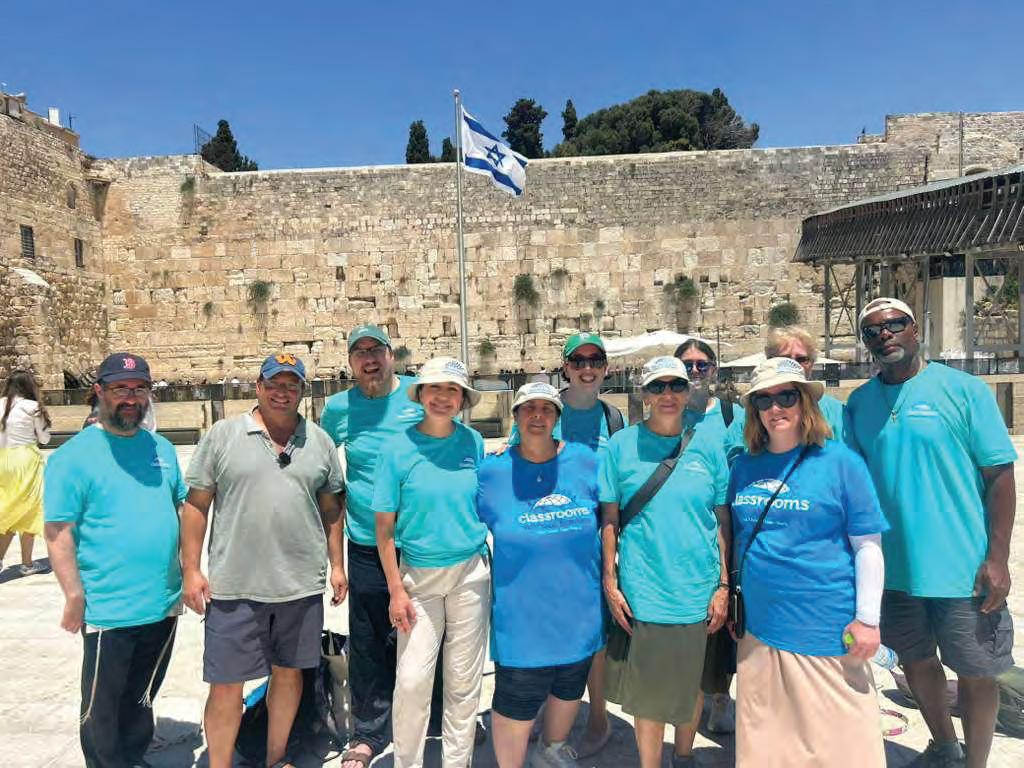
So happy to see you

With camp underway, old friends and new pals enjoyed the start of a great summer at Emma
Camp.


Season of volunteering Community members joined Our Giving Kitchen for a recent volunteering session, where participants prepared meals for food insecure neighbors.