June 26, 2026 | 11 Tammuz 5786
Candlelighting 8:36 p.m. | Havdalah 9:45 p.m. | Vol. 69, No. 26 | pittsburghjewishchronicle.org
$2
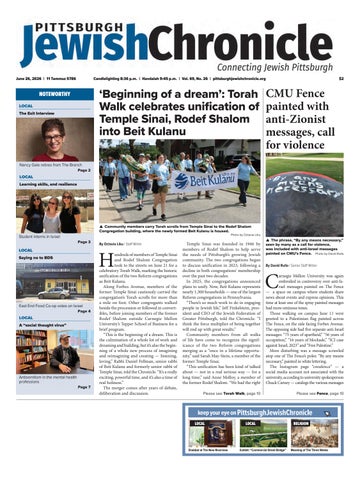
‘Beginning of a dream’: Torah CMU Fence Walk celebrates unification of painted with Temple Sinai, Rodef Shalom anti-Zionist into Beit Kulanu messages, call for violence
NOTEWORTHY LOCAL The Exit Interview
Nancy Gale retires from The Branch
Page 2
LOCAL Learning skills, and resilience
Student interns in Israel
p Community members carry Torah scrolls from Temple Sinai to the Rodef Shalom Congregation building, where the newly formed Beit Kulanu is housed.
Photo by Octavia Liku
Page 3
H
LOCAL Saying no to BDS
East End Food Co-op votes on Israel
Page 4
LOCAL A “social thought virus”
Antisemitism in the mental health professions
By Octavia Liku | Staff Writer
Page 7
undreds of members of Temple Sinai and Rodef Shalom Congregation took to the streets on June 21 for a celebratory Torah Walk, marking the historic unification of the two Reform congregations as Beit Kulanu. Along Forbes Avenue, members of the former Temple Sinai cautiously carried the congregation’s Torah scrolls for more than a mile on foot. Other congregants walked beside the procession or followed in convertibles, before joining members of the former Rodef Shalom outside Carnegie Mellon University’s Tepper School of Business for a brief program. “This is the beginning of a dream. This is the culmination of a whole lot of work and dreaming and building, but it’s also the beginning of a whole new process of imagining and reimagining and creating — listening, loving,” Rabbi Daniel Fellman, senior rabbi of Beit Kulanu and formerly senior rabbi of Temple Sinai, told the Chronicle. “It’s a really exciting, powerful time, and it’s also a time of real holiness.” The merger comes after years of debate, deliberation and discussion.
Temple Sinai was founded in 1946 by members of Rodef Shalom to help serve the needs of Pittsburgh’s growing Jewish community. The two congregations began to discuss unification in 2023, following a decline in both congregations’ membership over the past two decades. In 2025, the congregations announced plans to unify. Now, Beit Kulanu represents nearly 1,300 households — one of the largest Reform congregations in Pennsylvania. “There’s so much work to do in engaging people in Jewish life,” Jeff Finkelstein, president and CEO of the Jewish Federation of Greater Pittsburgh, told the Chronicle. “I think the force multiplier of being together will end up with great results.” Community members from all walks of life have come to recognize the significance of the two Reform congregations merging as a “once in a lifetime opportunity,” said Sarah May-Stein, a member of the former Temple Sinai. “This unification has been kind of talked about — not in a real serious way — for a long time,” said Anne Molloy, a member of the former Rodef Shalom. “We had the right
p The phrase, “By any means necessary,” seen by many as a call for violence, was included with anti-Israel messages painted on CMU’s Fence. Photo by David Rullo By David Rullo | Senior Staff Writer
C
arnegie Mellon University was again embroiled in controversy over anti-Israel messages painted on The Fence — a space on campus where students share news about events and express opinions. This time at least one of the spray painted messages had more ominous tones. Those walking on campus June 11 were greeted to a Palestinian flag painted across The Fence, on the side facing Forbes Avenue. The opposing side had five separate anti-Israel messages: “75 years of apartheid,” “56 years of occupation,” “16 years of blockade,” “ICJ case against Israel, 2023” and “Free Palestine.” More disturbing was a message scrawled atop one of The Fence’s poles: “By any means necessary,” painted in white lettering. The Instagram page “cmufence” — a social media account not associated with the university, according to university spokesperson Chuck Carney — catalogs the various messages
Please see Torah Walk, page 10
Please see Fence, page 10
keep your eye on PittsburghJewishChronicle LOCAL
Shabbat at The New Riverview
LOCAL
Exhibit: “Commercial Street Bridge”
RELIGION
Meaning of The Three Weeks
Headlines The exit interview: Nancy Gale
Several community members active with The Branch live in private residences in Squirrel Hill. Can you tell me about those spaces?
— LOCAL — By Adam Reinherz | Senior Staff Writer
U
nder Nancy Gale’s eight years of leadership, The Branch moved, rebranded and weathered Jewish Pittsburgh’s darkest moments. Having shepherded the organization, and infused private sector expertise into the nonprofit world, Gale is ready for new adventures. With her tenure as executive director of The Branch ending on June 30, Gale is looking forward to baking, gardening and contributing to the community in new ways. Before jumping into those activities, Gale spoke with the Chronicle about her career and what’s next. This interview has been edited for length and clarity.
Congratulations on your upcoming retirement. Before we talk about the future, let’s talk about the past. Tell me about joining The Branch eight years ago.
I became executive director on Oct. 10, 2018. Very shortly after I arrived it was a tumultuous time for the Jewish community — that is something that really sticks in my mind about the first few weeks that I was there. Shortly after that, we moved into this building where we are now. The [Sally and Howard Levin] Clubhouse had previously been down the street on Murray Avenue, and our administrative offices were at Rodef Shalom. So moving everything under one roof was a big change. It wasn’t too long after that the pandemic hit. I feel like my early tenure was marked by a lot of upheaval in the larger world that impacted us.
Early on in your tenure you told me about the importance of Krause Commons, a six-story supportive housing development located on the former Poli’s site in Squirrel Hill. With the Clubhouse on the first floor, and housing above, how did this project transform people’s understanding of what The Branch could offer?
p Nancy Gale has been the executive director of The Branch for the past eight years. Photo courtesy of Nancy Gale
Being right out there on Murray Avenue gave us an opportunity to help make our programs and services better known. People would go by the old Clubhouse and say, “Oh, what goes on there? Is that some kind of program for kids?” Krause Commons allowed us to be more visible. It gave us more of a platform to talk about what we do for the community, and to talk about disability inclusion in general. That was very helpful from an outward-facing point of view; but also internally, for the first time, all of our programs were under one roof. There are a lot of synergies among the different programs, and that also was something that was very important for us.
Tell me more about Krause Commons and the residential aspects of The Branch.
Krause Commons, the building that we are in, was created through a partnership with Action Housing — they build affordable housing, and are great partners. I think what a lot of people don’t understand is that the residential side of Krause Commons is owned and operated by Action Housing. It’s not our housing. We have to follow their process. We don’t have special privileges as far as placing people in those apartments. We certainly help people with the applications and work closely with Action Housing, but I think a lot of people in the community were, and are, still confused whether or not we own and operate the housing side of the building.
Those are what we refer to as community living arrangements, or CLAs — the older name for it would be a group home — and we have established three, now four, group homes for individuals who require a higher level of support. We did that with a partner because those individuals require 24/7 support, and as a small organization that’s something that’s very difficult to manage from a staffing perspective. We work with an organization called Verland that has probably 40 or 50 of these community living arrangements. Verland is the one who holds the license, does the staffing, is responsible for maintenance and the services that are provided to the people who live there. Partnering with them allowed us to create culturally Jewish homes in Squirrel Hill, which is something that hadn’t existed before. Our staff works with Verland staff to ensure that the kitchens are kosher and that residents have the opportunity to celebrate holidays and be involved in things that are going on in the Jewish community. The homes are all within walking distance to the Jewish Community Center or to local synagogues.
Much has changed in the last eight years. What are some of your biggest accomplishments at The Branch?
It’s hard to pick out just a few things, but one thing I will mention is moving into this building. It really allowed us to do a lot of things that we hadn’t been able to do before, both internally and externally. For example, we have had various kinds of programs that we partnered with Friendship Circle on, and having a space to do programming has allowed us to expand that. We have a program called Clubhouse After Hours that meets once a month and provides an opportunity for people for whom some of the Friendship Circle programs are a little bit too big and overstimulating. This is a smaller group that meets in our Clubhouse space after the work order day is complete. I would say our partnership in general with the Friendship Circle has been really important to us, and we look for other opportunities to partner with them.
Under your leadership, Jewish Residential Services became The Branch. Could you tell me about the rebranding?
This is something that had been discussed for a long time; it preceded my coming to the organization. People were confused about whether or not Jewish Residential Services offered housing. When we were doing our strategic plan, we said we’re going to take a look at this. We had focus groups and did a lot of outreach to better understand what the confusion was and what people thought our services really were. We came to the conclusion that we really needed to change the name to get the word “residential” out of it, so that people could better understand, or have an opportunity to talk about, what we actually do. That was the motivation. The other thing was that it’s very important to us to serve the Jewish community, but many of the people that we serve are not Jewish. I think in their minds there was a question of, “Am I really welcome here?” By picking a name that had more of a universal appeal, we felt that it was important to communicate to them that they were part of the services that we were trying to provide and part of our community.
Tell me about your experience in the private sector and how it impacted your work at The Branch.
Before I came here, I had a career in banking and finance. I began thinking about the things I did and whether they really made a difference in any particular individual’s life. Around the same time I was also president of Temple Sinai and had a view into how nonprofit organizations operate. I started to think maybe this is what I really want to do, and something that would be satisfying, and where my contributions could really positively impact other people and our Jewish community. I started looking around. I was familiar with JRS because I had a friend whose husband was actually involved early on when it was formed. I participated in Mitzvah Days, so when this position came open, I felt, “Wow, this is bashert. It’s something I believe in.” I had grandparents with disabilities. Doing something for people who are underserved and marginalized certainly resonated with me, and the rest is history. Please see Gale, page 11
5915 Beacon St., 5th Floor Pittsburgh, PA 15217
Main phone number: 412-687-1000
Subscriptions: 412-687-1000, ext. 2 SUBSCRIPTIONS subscriptions@pittsburghjewishchronicle.org 412-687-1000, ext. 2
Jim Busis, CEO and Publisher 412-228-4690 jbusis@pittsburghjewishchronicle.org
TO ADVERTISE advertising@pittsburghjewishchronicle.org 412-687-1000, ext. 1
EDITORIAL Toby Tabachnick, Editor 412-228-4577 ttabachnick@pittsburghjewishchronicle.org
EDITORIAL DEPARTMENT Email: newsdesk@pittsburghjewishchronicle.org BOARD OF TRUSTEES Evan H. Stein, Chair Evan Indianer, Vice Chair Derek Smith, Treasurer Gayle R. Kraut, Secretary Gail Childs, Dan Droz, Malke Steinfeld Frank, Karen Gal-Or, Seth Glick, Judith Kanal, Cátia Kossovsky, Charles Saul, Lynn Zelenski GENERAL COUNSEL Stuart R. Kaplan, Esq.
2
JUNE 26, 2026
Adam Reinherz, Senior Staff Writer 412-687-1000 areinherz@pittsburghjewishchronicle.org David Rullo, Senior Staff Writer 412-687-1000 drullo@pittsburghjewishchronicle.org Octavia Liku, Staff Writer oliku@pittsburghjewishchronicle.org ADVERTISING Amy Weiss, Account Executive (412) 613-0697 aweiss@pittsburghjewishchronicle.org
PRODUCTION Jeni Mann Tough Production Manager Carl Weigel Art/Production Coordinator Subscriptions subscriptions@pittsburghjewishchronicle.org 412-687-1000, ext. 2 Published every Friday by the Pittsburgh Jewish Publication and Education Foundation 5915 Beacon St., 5th Floor Pittsburgh, PA 15217 Phone: 412-687-1000 POSTMASTER: Send address change to PITTSBURGH JEWISH CHRONICLE, 5915 BEACON ST., 5TH FLOOR PITTSBURGH, PA 15217 (PERIODICAL RATE POSTAGE PAID AT PITTSBURGH, PA AND AT ADDITIONAL MAILING OFFICES) USPS 582-740
PITTSBURGH JEWISH CHRONICLE
Manuscripts, letters, documents and photographs sent to the Pittsburgh Jewish Chronicle become the property of this publication, which is not responsible for the return or loss of such items. The Pittsburgh Jewish Chronicle does not endorse the goods or services advertised or covered in its pages and makes no representation to the kashrut of food products and services in said advertising or articles. The publisher is not liable for damages if, for any reason whatsoever, he fails to publish an advertisement or for any error in an advertisement. Acceptance of advertisers and of ad copy is subject to the publisher’s approval. The Pittsburgh Jewish Chronicle is not responsible if ads violate applicable laws and the advertiser will indemnify, hold harmless and defend the Pittsburgh Jewish Chronicle from all claims made by governmental agencies and consumers for any reason based on ads appearing in the Pittsburgh Jewish Chronicle.
PITTSBURGHJEWISHCHRONICLE.ORG
Headlines Pittsburgh students navigate Israeli internships amid missile attacks — LOCAL — By Adam Reinherz | Senior Staff Writer
U
niversity of Pittsburgh student Yael Habari has made more than a dozen trips to Israel. Earlier this month was the first time she heard a siren. Habari, 20, is in Israel completing a real estate internship through the Birthright Israel Onward program. Speaking to the Chronicle by phone, she said that although she hoped this trip would be as uneventful as prior excursions, recent experiences proved otherwise. On June 7, Hezbollah fired rockets into northern Israel. The Israeli army retaliated by striking Beirut. Fighting escalated, according to the Institute for the Study of War, a Washington D.C.-based think tank, when Iran fired multiple ballistic missiles at Israel. Habari arrived in the Jewish state several weeks before the recent skirmishes. “Part of me hoped that the three months that I’d be here, maybe I would just get lucky again and not have to experience a siren,” she said. When chatter began regarding potential missile fire, “I kind of did start to get anxious, because it was going to be a new experience for me — hearing the sirens and going into the bomb shelter.” Before the June 7 rocket fire, Habari said, program organizers offered ample instructions, including directions to the nearest bomb shelter. After an alarm on her phone indicated rockets were en route to Tel Aviv, Habari followed the directions and made her way to the shelter. Once rocket fire ended, and Habari and others were told they could return to their hostel, a new sense of awareness arrived, she said. Work on June 8 was canceled. People spent the day hanging out near bomb shelters. On June 9, “we went back to work like normal, and it wasn’t like it never happened — because people are cautious, people are aware that it could happen, you’re never out of the uncertainty — but at the same time, it’s very much a part of life here, everyone’s aware, and everyone’s prepared.” Like Habari, fellow University of Pittsburgh student and active Hillel JUC member Noa Solomon arrived in Israel nearly a month ago as part of the Birthright Israel Onward program. Solomon, 20, said by phone she’s visited Israel before and hoped this summer she would be able to spend time with relatives as well as explore professional opportunities in the Jewish state. The Pitt student began her marketing internship on June 7. That evening rumors swelled that “there’s a chance that there would be an attack from Iran,” Solomon said. “We were already pretty much on edge.” As rocket fire lasted into the early hours of June 8, Solomon said she and several peers made their way between the bomb shelter and the hostel, hung out, listened to music and updated parents about the situation. Solomon’s marketing internship was
PITTSBURGHJEWISHCHRONICLE.ORG
p Tel Aviv and the Mediterannean coast
canceled on June 8. When she returned to the office on June 9, some individuals asked about her experience; most people, however, “kind of moved on,” she said. “It wasn’t the biggest thing for them here, obviously; it was just one morning for four hours.”
Photo by Yeshaya Dinerstein via Pexels
from people running and panicking. You realize you have a lot more time than you think you do.” At first, it’s scary to think that a shelter is a three-minute walk away and rockets may arrive four minutes later, he said. All these
p Birthright Israel Onward participants stand at the Western Wall.
Photo courtesy of Noa Solomon
The mindset, Solomon explained, was, “That’s it, you just go on about your day, you have work, and the next day we just kept going.” David, a Carnegie Mellon University student who asked that his last name be withheld, is also participating in the Birthright Israel Onward program. Speaking by phone, David said that before participating in the program and interning at a tech startup, he’d never visited Israel. In the weeks since he’s arrived in the Jewish state, he’s experienced “every emotion at once.” “I don’t know if every single aspect of it is as amazing or fairy tale as I thought it would be, but it really feels like I’m living like an authentic Jewish Israeli summer,” he said. “You go from going to the Nova festival [site] to partying in Tel Aviv on the same day. You go from living your best Tel Aviv tech startup Onward internship life to running to a shelter a few hours later.” David said he’s become “more grounded in the situation” since first heading to a bomb shelter. “You realize it’s true what they say about most of the injuries coming
thoughts run through one’s mind: “What if this, what if that? The concept of a missile is so scary, but I think once you realize the reality, you’re a lot calmer about walking there, and that actually saves lives.”
PITTSBURGH JEWISH CHRONICLE
Solomon said her Israeli summer has already delivered much of what she desired: a chance to visit family and gain perspective on living abroad. “I think the biggest thing is that the media makes it seem much scarier in the United States than it really is for people here,” she said. “While people are fearful, it’s not constant anxiety … We all go to our internships, we all go out at night, we all go to the gym and whatever normal-life things that you do anywhere.” There is a stark difference, though, between life in Israel and life in Pittsburgh, Habari said. “Realistically, there is a war going on, and you can’t take life for granted.” The reality of constant battle deeply impacts the “quality of life here,” she said. People are “losing friends to the war, so they want to make the most of their lives now, and have a good time, and live their life, and be happy and experience good things,” Habari continued. “People have more to live for here.” Back in Pittsburgh, Dan Marcus, Hillel JUC’s executive director and CEO told the Chronicle, “Birthright Israel Onward continues to be one of the most vital immersive experiences for the Hillel JUC Jewish student community. This program allows students to live and work in a meaningful and authentic way.” PJC Adam Reinherz can be reached at areinherz@pittsburghjewishchronicle.org.
JUNE 26, 2026
3
Headlines East End Food Co-op’s board rejects boycott of Israelisourced products — LOCAL — By David Rullo | Senior Staff Writer
A
t a June 15 meeting, the East End Food Co-op’s Board of Directors voted 7-0 against a boycott of Israeli-sourced products, with one abstention. The vote followed a protracted campaign by the United Electrical, Radio and Machine Workers of America Local 667, which represents the store’s employees, urging the store to divest from any entity associated with Israel. The campaign resulted from the union’s July 2024 decision to endorse the global Boycott, Divestment and Sanctions movement. In order to have the boycott considered by the board, the union had to gather signatures of 500 member-owners. It spent more than a year garnering the signatures before finally submitting its petition in November 2025. During that time, a steady flow of Jewish members left the co-op, some complaining of anti-Israeli messaging by the store’s employees. After receiving the petition, verifying the signatures and consulting with lawyers, the board took two votes in February. The first was for a binding resolution that, if passed, would have been presented to members. It failed in a 6-2 vote. A second vote, for a non-binding
p East End Food Co-op
resolution, passed with a 5-3 vote. A member-wide vote — which closed at the end of May — was taken following the board’s February vote on the non-binding resolution. Of the co-op’s more than 17,000 memberowners, only 611 votes were cast, less than 4% of the total membership. There were 308 votes cast in favor of the non-binding resolution, 298 against it, and five members who said they were unsure. The results of the member-wide vote were announced in early June. Following its June 15 vote rejecting a boycott of Israeli products, the board released a
Photo by David Rullo
statement saying, in part, that “a boycott would not be consistent with our responsibility to steward the Co-op as a shared institution that serves all members equally and remains focused on its core mission.” In further explaining its decision to reject the boycott, the board pointed to the measure’s narrow approval by member-owners and the relatively low level of voter participation. In a June 12 Instagram and Facebook post titled “We won, now what,” penned by Co-ops Against Genocide — and posted on the union’s social media pages — the group attempted to
explain away the lack of participation and closeness of the earlier member-wide vote, saying the advisory resolution was “our victory.” It called on the board to remove Israeli products from the co-op’s shelves. Co-ops Against Genocide said in the post that it would make a statement after the board’s June 15 vote “outlining our coalition’s next steps.” To date, the group has not made any public statements about the East End Food Co-op rejecting the BDS attempt. Despite the significant time and effort devoted to the boycott issue, the co-op only stocks six Israeli products: Field Day Tahini; Soom Chocolate Tahini; Manischewitz Gefilte Fish; Equal Exchange Extra Peaceful Olive Oil; Let’s Do Organic Gluten-Free Ice Cream Cones; and Four Season bell pepper varieties. Ironically, and contrary to accusations of apartheid levied by the union, Extra Peaceful Olive Oil is produced by a nonprofit organization of Arab and Jewish women in Israel that “uses fair trade to foster educational and economic opportunities and model mutual respect and collaboration between Jews and Arabs,” according to the company’s website. Julie Paris, Mid-Atlantic regional director of StandWithUs, said the co-op board was right in rejecting the attempts at BDS. Please see Co-op, page 14
Unlimited 5G Internet Faster Than a Pittsburgh Left
As Pittsburgh’s only privately owned Internet provider, Green Light Wireless is your connection to Unlimited 5G Internet and local support.
Go with Green Light
Scan here and use the code Chronicle to get your first month free GreenWiFi.com
4
JUNE 26, 2026
PITTSBURGH JEWISH CHRONICLE
| (412)228-3000
PITTSBURGHJEWISHCHRONICLE.ORG
Headlines Three Rivers Arts Festival performance marred with anti-Israel messaging — LOCAL — By David Rullo | Senior Staff Writer
A
ccording to the Three Rivers Arts Festival’s website, Mariposas Galácticas is “an eight piece Cumbia Klezmer Punk band based in Philadelphia” that combines “band members’ South American and Jewish ancestries.” When the band played the Three Rivers Arts Festival on June 13, those elements and influences were mixed with a dose of anti-Israel and anti-Zionist rhetoric. “From the river to the sea,” “Palestine will be free,” “Viva, Viva Palestina” and “No occupation” were some of the phrases the band members, who called themselves “Jewish anti-Zionists,” delivered from the stage. Julie Paris, StandWithUs’ Mid-Atlantic regional director, noted that the phrase “‘From the river to the sea’ is widely recognized as a call for the elimination of Israel and is used by terror groups like Hamas.” “In the context of anti-Zionism, which opposes Israel’s very right to exist, these slogans cross a clear line from political speech into threats and bigotry,” she said. While the statements were disturbing to some Jewish community members attending the show, they were not surprising given the band’s history and political leanings. The band previewed its anti-Israel messaging when it performed at Pittonkatonk, a festival
p Mariposas Galácticas brought anti-Israel messages to its performance at the Three Rivers Arts Festival. Photo by Eva Gelman
held in Schenley Park, in May. Eva Gelman attended that performance with her husband, Dan Gelman. “[Dan] was excited about it until he realized their platform and their messaging,” Eva Gelman said. “We ended up walking out on that.” When she heard about the band’s scheduled performance at this year’s Three Rivers Arts Festival, she contacted Paris, who spoke with the Pittsburgh Cultural Trust, the producer of the festival. Paris said she made the Trust aware of the Jewish community’s concerns based on the band’s Pittonkatonk performance and its social media postings. David Knoll, Jewish Federation of Greater Pittsburgh’s vice president of public affairs, said he spoke with a Cultural Trust representative after the event, who said the band — one of more than 300 that submitted applications to perform at the festival — billed itself only as a Jewish klezmer band that sings in Hebrew and Spanish.
“On paper it sounds great,” Knoll said. Knoll said the Cultural Trust representative told him that when the Cultural Trust was made aware of Mariposas Galácticas’ activism, it informed the band that the Three Rivers Arts Festival is a non-political event where political diatribes aren’t welcome. “The band agreed to their conditions and then put the message into the lyrics of their songs,” Knoll said. “It was a sneaky move by the band. I think the Trust got duped,” he said, noting that the Cultural Trust was “deeply apologetic” when he spoke to its representative, and pledged to review and improve its band selection process going forward. In an email to the Chronicle, the Cultural Trust confirmed that a community member shared concerns about the band’s political messages and the Cultural Trust contacted the band asking that it “refrain from political stage banter between songs.” Eva Gelman wasn’t surprised when she heard the band’s messaging from the stage. “Based on interviews and their public statements, activism is a big part of their identity and mission,” she said. “So, it wasn’t about whether they were going to say anything that we thought was inappropriate. It’s impossible to separate that from them because, ultimately, it’s who they are.” Paris called the situation “entirely foreseeable.” “Political activism sits at the very center of this band’s public identity,” she said. “This was not an unexpected political turn. It is
concerning that festival organizers failed to realize in advance that booking this act would have predictably, negatively impacted Jewish attendees at a family event.” Eva Gelman said that while the anti-Israel messages were disheartening, she feels that any political messaging at a community arts festival will disenfranchise some attendees. “It’s important to consider how activism may be experienced by different members of the audience, by different members of the community,” she said. The Cultural Trust told the Chronicle it is committed to creating a festival environment “welcoming to everyone in the community.” “We understand that some attendees, including members of the Jewish community, were offended by elements of this artist’s performance, and we regret that anyone had that experience,” a Cultural Trust spokesperson wrote in an email, adding that Mariposas Galácticas’ views do not reflect those of the Cultural Trust. “We take this feedback seriously and are reviewing our Festival application process and participation expectations moving forward.” Knoll takes the Cultural Trust at its word. “This was a mistake, but the Pittsburgh Cultural Trust did not mean any harm,” he said. “They’re so upset by this, and they’re committed to reviewing these processes as we move forward for next year and the years after.” PJC David Rullo can be reached at drullo@ pittsburghjewishchronicle.org.
ABERNETHY, HAGERMAN & MILLER SENIOR CARE CRISIS LOOMING?
Everyone needs health care and senior citizens even more so. As we age, our healthcare needs increase. Almost all elderly people have at least one chronic illness, and many of us have multiple chronic conditions. Aging itself brings the onset of various geriatric medical syndromes and complicated health issues, such as mobility limitations, cognitive decline and physical frailty. Coordinating care for these interdependent medical issues often requires managing services from multiple specialists and providers. We also sometimes end up in long-term care facilities. Even though the vast majority of American seniors remain living at home, and the percentage of seniors in nursing homes at any one moment is low, the total numbers are high. Our 15,000 or so nursing homes house about 1.2 to 1.4 million people on any given day, but with an annual total of more like 4 million admissions. Up to 35% of older Americans will require nursing care at some point in their lives. Most of us believe that our healthcare system generally is a broken mess. Though many are satisfied with their own personal care and coverage experience, most also agree that the system as a whole is failing. Costs are high, access to providers is problematic, coverage denials are maddening, and the administrative burden and hassle factor are onerous. Satisfaction actually remains highest for public Medicare and Medicaid benefit plans. The senior care crisis is occurring in multiple ways. First there is already a terrible shortage of qualified M.D. geriatricians, physicians who are trained and certified to specialize in caring for older people and their
complex medical problems. While the population of aged patients rises, the number of board-certified geriatricians is steadily falling, making the shortage worse. Second, the quality of care in nursing homes is declining across the board, but driven especially by specific segments and trends in the industry, for several identifiable reasons. There’s been great consolidation as large companies buy up smaller chains and independent facilities. Moreover, the entry of private equity firms into the marketplace, who act aggressively in pursuit of profits at the expense of others, has impacted the whole marketplace. Their predatory practices often drive nursing homes through decline and into bankruptcy while they walk away with all the money. Their unethical strategies include buying nursing homes through debt financing which is never repaid to lenders, but later discharged in bankruptcy; making inflated payments to management consultants and paying excessive rents ultimately paid to the very same owners themselves; chronic, severe understaffing; and repeated violations of patient safety and health standards as a result. Often the true owners and operators hide their identity behind complex layers of shell companies and a series of entities intended to camouflage and protect them from responsibility. Regulators are stymied in targeting sanctions. Third, there is a terrible shortage of care workers in this country as the baby boomer population surges but with insufficient workers to meet the demand. Nearly 10,000 baby boomers turn 65 every day while many care worker jobs remain unfilled. A combination of low wages, stressful working conditions and low opportunities for advancement limit the available labor force. The shortage extends to skilled caregivers, therapists, nurses, etc. as well as frontline personal care workers. President Trump’s campaign against immigrants has resulted in many care facilities losing critical numbers of caregiver staff through deportation, and others not
At Abernethy Hagerman and Miller, we help people every day with issues like these. I invite your questions and feedback. Please let me know how I can help you and your family. PITTSBURGHJEWISHCHRONICLE.ORG
PITTSBURGH JEWISH CHRONICLE
showing up from fear of the crackdown, further impacting service quality. Then care system is stressed in many other ways as well. What are some proposed solutions to these problems? Note: none are easy fixes.
Decentralized Care Delivery:
• Telemedicine consultations have become an established tool and will only grow. • Custodial care that in the past occurred in a hospital or nursing home is more often taking place in the patient’s home, with family caregivers augmented by visiting professionals, telemedicine, etc. • Expanded Medicare Advantage Benefits: a broader scope of services included under the plan helps to improve physical and emotional health of older adults
Improved Technology Applications:
• Remote monitoring and wearable sensors for early detection of problems, including AI modeling of typical healthy activities to alert to changes
Remaking the Workforce:
• Higher pay and better benefits to hire, retain and train workers • Renewing the use of foreign-born workers to perform frontline caregiving • Additional government and insurance assistance to support family caregivers and professional community care providers
mhm@a-h.law NEW FIRM MAIN OFFICE 3960 William Flinn Highway (Route 8) Allison Park, PA 15101 10 minutes closer to town! (412)486-6624 • We make house calls
JUNE 26, 2026
5
Calendar Submit calendar items on the Chronicle’s website, pittsburghjewishchronicle.org. Submissions also will be included in print. Events will run in the print edition beginning one month prior to the date as space allows. The deadline for submissions is Friday, noon. q SUNDAYS, JUNE 28–DEC. 20 Join Chabad of Squirrel Hill for its Men’s Tefillin Club. Services and tefillin are followed by a delicious breakfast and engaging discussions on current events. 8:30 a.m. 1700 Beechwood Blvd. chabadpgh.com Join a lay-led online Parashah study group to discuss the weekly Torah portion. No Hebrew
knowledge needed. The goal is to build community while deepening understanding of the text. 8:30 p.m. For more information, visit bethshalompgh.org/online-parashah. q MONDAYS, JUNE 29–DEC. 21 Join Congregation Beth Shalom for a weekly Talmud study. 9:15 a.m. For more information, visit bethshalompgh.org. q TUESDAYS, JUNE 30–DEC. 22 Join Beth El’s Rabbi Alex Greenbaum and his Bible/Talmud Adult Education class for a thoughtprovoking weekly session of Bible and Talmudic study. This program is available both in person and virtually. Call the office at 412-561-1168 to
Join the Chronicle Book Club!
T
he Pittsburgh Jewish Chronicle invites you to join the Chronicle Book Club for its July 12 discussion of “A Guide for the Perplexed,” by Dara Horn. From Amazon.com: “Software prodigy Josie Ashkenazi has invented an application that records everything its users do. When she visits the Library of Alexandria as a tech consultant, she is abducted in Egypt’s postrevolutionary chaos with only a copy of the philosopher Maimonides’ famous work to anchor her, leaving her jealous sister Judith free to take over her life. A century earlier, Cambridge professor
receive the Zoom link or to make an in-person reservation. 10:30 a.m. 1900 Cochran Road. bethelcong.org q WEDNESDAYS, JULY 1, AUG. 5, SEPT. 2 Join Beit Kulanu for Biblical Garden Open Door Tours: free, docent-led tours of the congregation’s Biblical Botanical Garden the first Wednesday of the month. 12:15 p.m. Free. 4905 Fifth Ave. rodefshalom.org/garden q SUNDAY, JULY 5 Join the Jewish Community Center to celebrate America’s 250th anniversary with American’s Potluck Picnic. This is an opportunity to unite
Solomon Schechter arrives in Egypt, hunting for a medieval archive hidden in a Cairo synagogue. Their stories intertwine in this spellbinding novel of how technology changes memory and how memory shapes the soul.”
What to do
Your hosts
Email: Contact us at drullo@pittsburghjewishchronicle.org, and write “Chronicle Book Club” in the subject line. We will send you a Zoom link for the discussion meeting.
Toby Tabachnick, Chronicle editor David Rullo, Chronicle senior staff writer
How it works
We will meet on Zoom on Sunday, July 12, at 1 p.m.
across neighborhoods and honor our diverse connections to our country. There will be yard games, a singalong and plenty to eat. 4 p.m. Free. JCC Family Park, 261 Rosecrest Drive, Monroeville, 15146. Registration strongly encouraged at jccpgh.formstack.com/forms/america_250_ potluck_rsvp q THURSDAYS, JULY 16, AUG. 20, SEPT. 3 Rendezvous in Beit Kulanu’s Biblical Botanical Garden with drinks and hors d’oeuvres for free live musical performances. Apps start at 6:30 p.m. and music at 7 p.m. The concert is free but registration is required. 4905 Fifth Ave. BeitKulanu.org PJC
Buy: “A Guide for the Perplexed.” It is available from online retailers, including Amazon and Barnes & Noble, and through the Carnegie Library system.
Happy reading! PJC
NOW MORE THAN EVER, OUR COMMUNITY NEEDS TO STAY CONNECTED.
Our summer support campaign is wrapping up! Don't miss the opportunity to double your support with our match. Thanks to the very generous Philip Chosky Charitable & Educational Foundation, every donation made to this campaign will be matched dollar for dollar up to $50,000. In a world of many voices and many paths, it’s the shared stories, values and traditions that keep us united. When we come together, we strengthen not just ourselves, but the entire Jewish future. For over 60 years, the Pittsburgh Jewish Chronicle has stood as the trusted, independent news source for Jewish Pittsburgh thanks to readers and supporters like you. We report what other media outlets do not. And we are committed to crafting local journalism based on truth, depth and insight – the ways only a true community publication should.
When you give to the Pittsburgh Jewish Chronicle, you don’t just support a news organization. You protect an essential community institution. You create informed citizens. You keep Jewish Pittsburgh strong.
We hope we can count on your support.
https://causematch.com/pjc
www.pittsburghjewishchronicle.org 6
JUNE 26, 2026
PITTSBURGH JEWISH CHRONICLE
PITTSBURGHJEWISHCHRONICLE.ORG
Headlines Mental health professionals sound alarm over antisemitism in psychology and social work — LOCAL — By Toby Tabachnick | Editor
O
n Oct. 6, 2024, a graduate student in Duquesne University’s psychology department amplified a social media post celebrating the murder, rape, mutilation and kidnapping of Israeli civilians by terrorists on Oct. 7, 2023, and calling for “greater violence.” The incendiary post, one of several on the student’s account, read, “happy Oct. 7 eve.” Other posts praised Yahya Sinwar, the Hamas architect of the Oct. 7 massacre. The sole Jewish professor in the department was horrified that a psychology student — who presumably would go on to provide community mental health services — was celebrating the terrorist attack, which left 1,200 people dead and saw more than 250 abducted to Gazan tunnels. But what was even more appalling to Alex Kranjec, a tenured psychology professor at Duquesne, was the response of his colleagues when he brought the social media posts to their attention. “The content of these statements crossed the line,” Kranjec told the Chronicle, “because it’s so vile and so obviously racist, and just sort of celebrating genocide. For any kind of reasonable person, it crosses a line.” The faculty’s “immediate” reaction to his complaint about the graduate student’s posts, Kranjec said, was “defensiveness, and to attack me for bringing it to their attention.” After raising the issue, the Jewish professor was beset by a series of indignities that he described as “retaliation.” For example, a course was created as an “alternative” to a required class taught by Kranjec without his knowledge or consultation, and counter to protocol; graduate students were encouraged to “report” him for any behavior they deemed unacceptable; and his office was “targeted in a way that sort of racialized my identity and served as a means to quiet my criticism of antisemitism in the department,” he said. Last semester, Kranjec was removed from a Jewish graduate student’s exam committee. Kranjec was told he was removed because the student is “working through his Jewish identity, and because my ‘ideology’ was inconsistent with his. I got no explanation for what that meant.” The pattern of behavior, Kranjec said, has “racialized” his identity as a Jew “in a particular way that discriminates against me, to isolate me, to remove me from academic life — to purge me from the intellectual life of the department.” Kranjec is not alone. Antisemitism, anti-Zionism and other forms of Jew-hatred have permeated the mental health professions, leaving Jewish practitioners, students and patients with feelings of isolation, marginalization and discrimination. The Duquesne student who celebrated Oct. 7 subsequently restricted access to her X account, then deleted it. But she did not deny the posts, Kranjec said. Her adviser responded to Kranjec’s complaint by indicating that the posts were within an acceptable range of opinions about the Israel/Hamas conflict. “Were I to scour social media, the social media presence of all of our students and alumni, I am pretty confident I find a range of opinions, emphases and outrage at the Hamas attacks, as well as Israel’s response,” her adviser wrote in an email to Kranjec. After receiving that response, Kranjec emailed members of the psychology department, explaining what had transpired and expressing PITTSBURGHJEWISHCHRONICLE.ORG
p Alex Kranjec
Photo courtesy of Alex Kranjec
his surprise that the graduate student’s support of terrorism was “considered a normal opinion.” Only one member of the Duquesne community sided publicly with Kranjec, former graduate student Rachel Floyd. In response to Kranjec’s email, Floyd, who graduated in 2023, wrote: “I want to echo his concern and implore the Duquesne community to publicly decry the celebration of violence in any form, whether in classroom discussions, informal conversations in the department kitchen, or on public platforms.” “Hate is a cultural trend right now, and as phenomenological–existential psychologists, we should be capable of holding a bigger-picture, deeply humane perspective. … Silence can be misinterpreted as complicity, and I hope others will join me in voicing support.” Citing privacy interests, Duquesne spokesperson Gabriel Welsch declined to comment on Kranjec’s allegations other than to say, “the University is currently looking into concerns raised by him consistent with our internal non-discrimination policies and procedures.” Welsch also noted that the university “takes proactive measures to prevent antisemitism and other discriminatory behavior and has a robust process for investigating complaints of discrimination raised by our community members.” He added that “over the past several years,” the university has offered and participated “in a variety of educational opportunities addressing antisemitism, including a workshop presented last year by the Holocaust Center of Pittsburgh.” Floyd, who is not Jewish, told the Chronicle that the Duquesne student who posted the pro-terror social media posts is “not the only one talking like this. It’s quite unbelievable. It’s a social thought virus.” That “virus” has infected many mental health spaces, and it began before Oct. 7.
The ‘social justice’ rationalization
Andrea Goldschmidt is a clinical psychologist and a professor of psychiatry at the University of Pittsburgh School of Medicine. While she has not experienced overt antisemitism or antiZionism in the workplace, she has observed it in professional organizations and on social media. “I think largely it’s because the mental health professions — the healing professions, really — increasingly, over the past couple decades, have seen it as part of their job description to fight for social justice. And I think they really see this as a social justice cause, like fighting for the oppressed. They definitely do not see Jews as an oppressed group, which probably goes without saying. But I think that’s largely where this shift has come from. And what I think is the most troubling is there is not a diversity of opinions.” While people can hold various perspectives on the Middle East and nationalism, Goldschmidt said, she has observed — particularly among
younger people — a “lack of tolerance for any viewpoint that they perceive as being aligned with oppression. And I think there’s a lot of lack of education, too, about, what Judaism is, what Israel is, what Zionism is. So I think some of it’s coming from a well-intentioned place, but clearly, is very problematic — especially, I think, for patients that are seeking care.” Many patients who support Israel, she said, feel the need to search “listservs of therapists who are Zionists, because they don’t want to be placed with an anti-Zionist therapist who might let their political views impede the therapeutic relationship. I think that’s a huge problem, too.” Goldschmidt said an anti-Israel narrative has found its way into some mental health programming for professionals. She pointed to webinars and other events hosted by professional organizations that, she said, “seem to be intentionally selecting keynote speakers who have anti-Israel platforms, and are using their speeches at these conferences to promote anti-Israel ideology.” While she is hesitant to call the organizers of these programs antisemitic, “oftentimes, what comes out of their mouth is perceived as antisemitic by Jews,” she said. “I don’t think that these are people that would overtly say, ‘I hate Jews … . They don’t think that they’re saying anything against Jews. They think they’re really, truly saying they just hate Zionists, as if the two things can be teased apart.”
Recognizing, and addressing, the problem
In 2021, Julie R. Ancis, a distinguished professor in the Department of Informatics and founding director of the Cyberpsychology Program at the New Jersey Institute of Technology, launched an organization to address the problem: Psychologists Against Antisemitism. An impetus for creating the organization, Ancis told the Chronicle, was the silence of the American Psychological Association in response to complaints about antisemitism and anti-Israel propaganda in the field. As a decades-long leader in the APA, Ancis was disturbed by the organization’s apparent indifference to Jew-hatred. There are now about 1,000 members of Psychologists Against Antisemitism, including faculty members and clinicians. The group has held several webinars on psychology and antisemitism, and in February 2025 composed a public letter to the leadership of the APA regarding its lack of attention to complaints about antisemitism on listservs and during conferences. The letter, which garnered about 4,000 signatures, noted the documentation of “extensive evidence of antisemitic discourse and concerning behavior across APA divisions,”
PITTSBURGH JEWISH CHRONICLE
including “statements from APA council members, leaders of APA divisions, and member postings on APA-hosted listservs that collectively demonstrate insensitivity toward Jews, a lack of concern regarding antisemitism, minimization of aggression towards the Jewish people, and outright hostility and prejudice toward Jews and Jewish heritage.” The APA did not respond to the letter, Ancis said. But after U.S. Rep. Richie Torres of New York wrote to the APA about the issue — thereby making it public — the House Committee on Education in the Workforce began “investigating APA for antisemitism” Ancis said. “And this is major, and really unfortunate at the same time, that we’ve had to get to this point.” The APA said it “unequivocally condemns antisemitism in all its forms” in a response to the investigation. Yet some of the discourse on APA listservs, Ancis said, has been “pro-Hamas,” while silencing Jewish voices. “There is absolutely no empathy for the victims of Oct. 7 or any subsequent antisemitic, anti-Jewish hate and violence,” she said. There are psychology professors at several universities — who also hold leadership positions within major psychological organizations — “who are pushing for boycott, divestment, sanctions, who are pushing this propaganda,” Ancis said. “These are the professors in these leadership positions who are teaching these students. So you can imagine how Jewish students who identify as Zionists are completely silenced. They can’t speak out — you know, they won’t get their letter of recommendation. They’re afraid of their grades. They’re afraid of the attitudes of their peers and being excluded. And I have friends who are Jewish and psychologists in academic programs — and some that are not Jewish, but are Zionists — and it’s really challenging for them. Faculty meetings where you have hostile colleagues, or your chair doesn’t get it.” Zionism, Ancis said, has even been equated with mental illness at some psychology conferences. “I am a Fellow of three different divisions within the APA and have contributed extensively to scholarship in the areas of diversity and multicultural competence,” she said. “I have been engaged in social justice efforts all of my life, and the silence and dismissal of Jewish concerns, as well as promotion of antisemitism, has been particularly painful.” The antisemitism in the field, she said, is “systemic,” and a change in paradigm is elusive. “I think that these organizations need to be held accountable,” Ancis said. “And unfortunately, despite the good efforts among many Jewish psychologists — including me — for a long time, we haven’t seen change. Things have only gotten worse.” Claims of antisemitism in the field of psychology have now reached a tipping point; it was announced last week that the Department of Health and Human Services has launched an investigation of the APA. “The investigation stems from several complaints by Jewish and Israeli psychologists alleging that the association has promoted or failed to discipline anti-Israel activism among some of its affinity groups,” JTA reported. “The complaints also allege that the APA has encouraged ‘decolonizing therapy’ methods that attack Zionism.” In response to an interview request from the Chronicle, APA representatives emailed a Please see Antisemitism, page 11
JUNE 26, 2026
7
Headlines At The New Riverview, residents share in spirituality on Shabbat — LOCAL — By Octavia Liku | Staff Writer
H
oward Meyerowitz takes his usual seat in the synagogue, facing the sun. In the honeyed light, he rests his oak walking stick against a chair. Ahead stands the ark, and a vast window overlooking Garetta Street. “I was just struck by this view, because every congregation I’ve been in has had windows,” he told the Chronicle. “For me windows are important, because I feel that’s what God is, as much as being in the room.” Hailing from Southington, Connecticut, Meyerowitz has been a resident at The New Riverview Apartments, a senior living Photo by Octavia Liku community, for over two years. He moved to p Synagogue space at The New Riverview Apartments Pittsburgh in the winter of 2024 to be closer to his oldest daughter and her family, who are affiliated with the Chabad community in Squirrel Hill. Meyerowitz came from one of around HOWARD MEYEROWITZ 30 Jewish families living in Southington. Finding a place to congregate and worship as a community there proved to be a challenge. of becoming the sole “spiritual leader” during described as a “beautiful balance” of “We were meeting in churches for a the Saturday morning service. Hebrew and English. while, until one church gave us use of their “Mischa, to me, is not only what he does “It doesn’t matter. Every Shabbat morning chapel on a Saturday morning,” he recalled. here for Shabbat. I can see him interacting — whatever the weather is — it’s part of the “You’re wandering — almost like Israelites with a number of residents who need some creation, God’s creation of nature,” he said. — and the concern was [that] we don’t have extra care,” Meyerowitz said. “He comes “Even if it’s dismal and rainy, the fact is it’s our own place.” here on his own volition Saturday morning almost a dramatic background to whatever As a first-generation American, he said he … with the help of Yeshiva boys who’ve liturgy we’re reading.” never takes the freedom to practice his faith been coming over.” The services, filled with prayer and song, in the United States for granted. At Riverview, Gelman said that Shabbat services offer are brief, lasting “maybe 40 or 50 minutes.” he found a shul to call his own. a “great opportunity” to “give back to the But the result, Meyerowitz said, is a community that transcends synagogue walls. “There was snow on the ground, and I heard residents.” “I help them with a lot of things, but that’s “There’s one man who comes — he said he about the minyan [at Riverview], so I got up, got dressed, washed up, had a bite, all part of my work,” Gelman said. “Here hasn’t been to synagogue since his son’s bar came down the elevator, and I walked to it’s an extra opportunity. I get to volunteer mitzvah — and he’s got to be 70. Two of our the synagogue,” he recalled. “It’s been part and help contribute to this wonderful regular attendees are Catholic, and they like of my life since” congregation.” coming because it’s the Old Testament,” he to fellow resident For some time, Riverview’s Saturday Meyerowitz also points added. “There’s a spiritual community.” morning Shabbat services were led Joanna Butler, who started her own Friday At 82, Meyerowitz has come to realize by Rabbi Dovid Small and Service afternoon service. She even put together her there is a distinction between “people cutting Representative Mischa Gelman. Over own siddur, carefully and pasting who life happens to, and those who make time, Gelman assumed the responsibility different prayers to create what Meyerowitz life happen.” He strives to be the latter,
“We found a haven here.”
Lombardo Concrete, established in 1989, Fully Insured - inWe Do All! specializes and excels all types of It residential Fully Insured We Do It All! concrete work: and decorative • Stamping • Flagstone Patios • Exposed Aggregate • Floors • Colored Staining • Foundation Masonry
• Sealing • Footers • Brick & Block Walls • Laying Stone • Dry • Sidewalks Lay
• Driveway Construction • Steps
Fully Insured - We Do It All!
finding “role models” in his fellow residents at Riverview. One, Meyerowitz noted, is a man 13 years his senior named Earl Parker, who organizes the Jewish Community Center of Greater Pittsburgh’s chorus and bakes for various community events. Upon further reflection, Meyerowitz wrote to the Chronicle that another man — George Markowitz — had a similarly indelible impact on his outlook. “For the better part of my first year here at Riverview, George Markowitz sat behind me. He walked with a walker and it was often a struggle for him to make services, but still he came to services — usually a little bit later,” he wrote. “As soon as he came to his chair he would touch my shoulder with his fingertip to let me know he was here. It was my signal that my morning would be okay. George Markowitz was a mensch.” When asked whether he had always been religiously observant, Meyerowitz laughed. “No, no. At 13 it was like, my bar mitzvah, just take a picture. I had been away from it,” he said. But he recalled the influence of his aunt on his fledgling spirituality when he was young. “When I was 6 and 7, we lived three big blocks from the synagogue, and she [his aunt] was Othodox, so I would walk with her on Shabbat. She walked with a limp, up two flights of concrete steps, and a flight of wooden steps to the women’s section every Saturday.” “Instinctively or by osmosis — and she barely spoke English, so we didn’t have long Jewish conversations — she planted the seed of Yiddishkeit in my soul.” Today, he says he sees that same sense of Yiddishkeit among congregants at Riverview. “I mean, I use a walking stick, and there’s at least two others with some kind of appliance. That’s not going to stop anybody from praying,” he said. “Whatever space you’re in on Shabbat should be the most influential, if it’s touching your heart and touching your soul. “We found a haven here.” PJC Octavia Liku can be reached at oliku@ pittsburghjewishchronicle.org.
Fully Insured - We Do It All!
Fully Fully FullyInsured Insured Insured---We We WeDo Do DoItItItAll! All! All!
Fully Insured - We Do It All!
STORIES COME TO life HERE.
Fully Insured - We Do It All!
Connect with Pittsburgh Jewish Chronicle.
In your mailbox or all the time online at pittsburghjewishchronicle.org 5915 Beacon Street, 5th Floor, Pittsburgh, PA 15217 8
JUNE 26, 2026
PITTSBURGH JEWISH CHRONICLE
PITTSBURGHJEWISHCHRONICLE.ORG
Headlines — WORLD — Alleged White House attack plot singled out officials seen as tied to pro-Israel groups, FBI says
Suspects who planned to attack the White House earlier this month sought to target lawmakers who received money from pro-Israel groups, according to federal law enforcement officials, JTA reported. Five men were charged last week for allegedly plotting to kill government officials and others attending the Ultimate Fighting Championship event at the White House on June 14, the Department of Justice said. One of the suspects, 19-year-old Tycen Proper, was part of a Christian “ultra-religious and anti-government” group online, according to an affidavit filed by an FBI agent. Proper’s mother called local police in Ohio about his recent behavior, which included communicating with the group and buying firearms. She said Proper mapped locations in the Washington, D.C., area and told her his group intended to conduct “recon” and “hit and run missions.” Proper’s family members also said that he made “concerning statements” in recent months, such as “sympathetic comments about Adolf Hitler” and “antisemitic comments on Facebook,” according to the affidavit. Proper admitted to investigators that his group planned a coordinated attack against the United States government during the UFC event. A search of his cell phone revealed that he specifically sought to attack lawmakers who received support from AIPAC, the pro-Israel lobby. Members of Proper’s group said the
United States had to be “torn down so that it could be rebuilt” and that “people who were involved with Jeffrey Epstein should not govern the country.” Proper has been charged with conspiracy to commit an offense against the United States and attempted murder of an officer or employee of the United States, among other offenses.
Toronto police say young people are being recruited online to shoot at synagogues
Police in Toronto announced last week that they believe young adults are being hired and paid online to shoot at local synagogues, JTA reported. The announcement follows a string of arrests in connection with shootings at a range of targets in the Canadian city, including multiple synagogues. “What we know is bad actors are using criminal elements in our city to carry out these dangerous incidents,” Toronto Police Service Chief Myron Demkiw said at a press conference. Demkiw said the suspects were being recruited through online networks and offered payments if they filmed themselves engaging in the shootings. The methodology and tactics being used in Toronto appear to mirror those laid out in a U.S. criminal complaint against Mohammad Baqer Saad Dawood al-Saadi, an Iraqi man charged last month in New York with orchestrating attacks on Jewish targets in multiple countries on behalf of Iran since the start of the U.S.-Israel war on Iran in late February. (He railed against the United States while pleading not guilty earlier this month.) Previously, police in Australia, too, said
Today in Israeli History — ISRAEL — Items are provided by the Center for Israel Education (israeled.org), where you can find more details.
June 26, 1944 — GOP platform supports Jewish state
The Republican National Convention follows the lead of its presidential nominee, Thomas Dewey, and for the p Republican presidential nominee first time supports Thomas Dewey’s the creation of support for a Jewish a Jewish state in state pushed both Pa lest ine. The political parties to Democrats take a support Zionism similar step in July. in their 1944 national platforms.
June 27, 1967 — Israel annexes East Jerusalem
After capturing East Jerusalem from Jordan during the war in early June, Israel annexes that area and some surrounding West Bank land — a total of 27 square miles — into an expanded, unified Jerusalem municipality.
June 28, 1919 — Poland provides legal protections for Jews
The Republic of Poland, reconstituted as an independent state after World War I, adopts its Minorities Treaty, which, in addition to general assurances, specifically mentions cultural and civil liberties for Jews. PITTSBURGHJEWISHCHRONICLE.ORG
June 29, 1946 — British round up resistance fighters
On a day that known as Black Sabbath, the British military launches Operation Agatha, a two-week effort to arrest Jewish resistance fighters. Documents and weapons are seized, and 2,700 Jews are arrested.
June 30, 1937 — Religious Kibbutz Tirat Zvi is founded
German, Polish and Russian Jews establish Kibbutz Tirat Zvi in the Beit She’an Valley as one of the first religious kibbutzim during the Tower and Stockade effort to expand the borders of a future state.
July 1, 1973 — Military attaché is killed in Maryland
Col. Yosef “Joe” Alon, a military attaché at the Israeli Embassy, is shot five times in his driveway in suburban Maryland and dies within an hour. No one is arrested in the case, which some link to Black September.
July 2, 2010 — Benayoun signs with Chelsea
Midfielder Yossi Benayoun leaves Liverpool for fellow English Premier p Yossi Benayoun, League club Chelsea, after playing in Spain owned by Russian- and England, appears Israeli billionaire with Maccabi Haifa in Roman Abramovich. 2015. He continued In 2014, Benayoun his professional career returns to the Israeli in Israel through 2019. By Botend, own work, pro league, where he CC BY-SA 4.0, via started at 16. PJC Wikimedia Commons
they believed paid criminals, possibly hired on behalf of Iran, were behind a string of non-lethal incidents targeting Jewish communities there.
UK appeals court upholds ban on Palestine Action as a terrorist organization
A British appeals court ruled last week that the government acted lawfully in banning a prominent pro-Palestinian group as a terrorist organization, JTA reported. Jewish groups welcomed the decision to maintain the ban on Palestine Action, which has staged multiple destructive attacks on military installations and weapons manufacturers in Britain. The government banned Palestine Action in July 2025 after some of its members broke into an air force base and damaged two military aircraft as part of a protest against the U.K.’s relationship to Israel during the war in Gaza. The ruling meant that anyone displaying support for the group has been subject to arrest and imprisonment. The British High Court declared the ban unlawful in February, concluding that the ban interfered with Palestine Action members’ rights to speech and assembly. Now, a fivejudge U.K. Court of Appeal panel has ruled that the group’s activities met the legal standards for terrorism and the government’s decision to ban the group was justified and proportionate. The ruling comes days after four Palestine Action-affiliated activists were sentenced to lengthy prison terms in connection with an August 2024 break-in at the headquarters of Elbit Systems UK, the British outpost of an Israeli weapons company. The activists had previously been acquitted on some charges but
were prosecuted again on others and convicted, including one on charges of striking a police officer with a sledgehammer. The group is vowing to appeal its ban yet again. “We will not stop fighting for the ban to be lifted, the end of the use of terror legislation against us, and crucially, for a free Palestine,” co-founder Huda Ammori posted on X on Monday. “I will appeal to the Supreme Court and take it up to the European Court of Human Rights, if needs be.”
Israeli drug-free nanomedicine gives fresh hope in battling aggressive breast cancer
In a breakthrough, scientists from the Technion-Israel Institute of Technology have engineered nanoparticles that treat aggressive “triple-negative” breast cancer tumors without chemotherapy or drugs, potentially paving the way for a chemical-free treatment for the deadly disease, The Times of Israel reported. In a peer-reviewed study published in the journal ACS Nano, the researchers’ lab-engineered nanoparticles were able to halt the tumors in female mice. The project was led by PhD candidate Ofri Vizenblit and assisted by Rawan Mhajne, under the supervision of Asst. Prof. Assaf Zinger, head of the Technion’s Bioinspired Nano Engineering Lab in the Wolfson Faculty of Chemical Engineering. “We managed to design nanoparticles that got the same results as some advanced immunotherapy treatments currently in use,” Zinger told The Times of Israel. Zinger said he hopes to advance the technology to human clinical trials. PJC — Compiled by Toby Tabachnick
412-421-1015 412-421-4450 FAX 412-421-4451
1916 MURRAY AVE. PITTSBURGH, PA 15217
PRICES EFFECTIVE SUNDAY, JUNE 28 – FRIDAY, JULY 3, 2026 Candle Lighting Time Friday, June 26, 2026 • 8:36 p.m. MEAT
WINE SPECIALS
BONELESS CHICKEN BREAST
BARKAN CLASSIC WINES
7
$ .99 LB .
$
9
.99 .6
12.49
750 ML
6
IMPORTED BONELESS CHUCK EYE
$
SEGAL FUSION WINE
LB
$
SALMON FILET
10
$
.39 .
6
Support Israel!
14.49
750 ML
LB
Buy Israeli Products STORE HOURS
Sunday • 8 a.m. – 6 p.m. Monday • 8 a.m. – 6 p.m. Tuesday • 8 a.m. – 6 p.m. Wednesday • 8 a.m. – 6 p.m. Thursday • 8 a.m. – 8 p.m. Friday • 8 a.m. – 3 p.m.
GROCERY
COOKED FOODS
DELI
KEDEM KIDS CEREAL BARS $ .99
VEGETABLE SOUP $ .59
EMPIRE HONEY TURKEY BREAST $ .19
BENZ'S CHOLENT BEANS $ .89
$
4
1
5.5 OZ
16 OZ
10
QT
MEAT LASAGNA .99
12
LB
11
LB
CHUMMUS
$ .09
9
LB
KEDEM SPARKLING GRAPE JUICE $ .59
CHICKEN CHOW MEIN $ .99 EA
KALAMATA OLIVES $ .99
UNGER'S GEFILTE FISH TWIN PACK $ .59
YELLOW RICE $ .99
A&H LEAN PASTRAMI $ .99
5
16
25 OZ
EA
HOMEMADE SALADS & SOUPS DELI PARTY TRAYS
PITTSBURGH JEWISH CHRONICLE
10 4
LB
8
21
LB
LB
We Prepare Trays
CATERING SPECIALISTS DELICIOUS FRIED CHICKEN
UNDER THE SUPERVISION OF VAAD OF PITTSBURGH
WE RESERVE THE RIGHT TO LIMIT QUANTITIES.
— for All Occasions —
JUNE 26, 2026
9
Headlines Torah Walk: Continued from page 1
pieces in place to have some real serious conversations. I think that Temple Sinai and Rodef Shalom have a lot more in common than we have differences. The differences are small, and the commonalities are big.” Pennsylvania state Rep. Dan Frankel, whose family was affiliated with Rodef Shalom for generations, emphasized that the unification of the two congregations represents a moment of “hope” for the Jewish community at large. “I was here as the Jewish community changed and shifted — fewer people affiliated,” Frankel said. “But [with] these two historic congregations — I think you can see the energy here today gives us a lot of hope to recreate the energy.” At the Tepper School of Business, members of the newly unified congregation joined in song and celebration, unfurling a banner with the congregation’s name — “Beit Kulanu.” To many, the name rings true to their experience within the community. Adam Wise, who is converting to Judaism, expressed his gratitude for the inclusive nature of the congregation.
p The name of the newly formed congregation Beit Kulanu is revealed on a banner outside Carnegie Mellon University’s Tepper School of Business on June 21. Photo by Octavia Liku
“I’m a few months into the conversion process. I’m glad that I’m welcome to come here, because I wasn’t really sure when I started. But I asked Rabbi Fellman, and he said, ‘Yeah, come along,’” Wise said. “I’m glad I can be part of this, because this is a once in a lifetime event.”
p The Fence at CMU was painted with anti-Israel messages earlier this month. Photo by David Rullo
Fence: Continued from page 1
painted on The Fence. The Instagram page cited the group “Antifascist Action @ CMU” as responsible for the anti-Zionist messaging, and highlighted the phrase “By any means necessary” in its post. Carney said that “Antifascist Action @ CMU” is not a recognized student group. The Instagram account was created in 2019. Painters of The Fence can fill out a form, and upload photos and information to post on the page. The phrase “By any means necessary” was first popularized by Jean-Paul Sarte in the 1948 play “Dirty Hands.” The phrase was used by Frantz Fanon in a 1960 speech titled “Why we use violence,” defending armed resistance against the colonial French as part of the Algerian War, and in his book “Alienation and Freedom.” It was later used by Malcolm X. The phrase has come to be regarded by many as justification for a political movement to use any means — including violence — to achieve its goals. CMU President Farnam Jahanian issued a response to the anti-Zionist messages on The Fence three days later. At that time, the Fence had been repainted with a message celebrating the New York Knicks’ win in the NBA Finals. 10
JUNE 26, 2026
The CMU Police Department, Jahanian said, launched an investigation that ruled out imminent danger to the community. The investigation, he said, remains “ongoing.” Jahanian said some members of CMU’s campus community, as well as “the broader Pittsburgh community,” believed the message “was antisemitic and threatened their sense of safety and belonging. Others described the phrase as inciting or supporting violence.” The university, he wrote, engaged with Student Government, which has a “longstanding role in stewardship of the Fence.” It “is categorically unacceptable for an anonymous message painted on CMU property to incite or imply support for violence, and it is equally unacceptable for members of our campus community to feel physically threatened or unsafe,” Jahanian added. By June 17, the side of The Fence closest to Forbes Avenue was again painted with a Palestinian flag. The backside had a personal message to Jahanian. “Dear Farnam, I do not owe you precise wording while precise munitions strike children. Free Palestine,” was painted on The Fence, this time without the inclusion of the phrase “by any means necessary.” That message was posted on Instagram and credited to “Antifascist Action @ CMU.” This time, the post included the message: “Dear
Religious leaders from a range of faiths and traditions attended the celebration. The Rev. Canon Natalie Hall, rector at the Episcopal Church of the Redeemer in Squirrel Hill, noted that the merger presents a “unique opportunity” for interfaith connection and collaboration.
The Rev. Liddy Barlow, executive minister of Christian Associates of Southwest Pennsylvania, emphasized the hopeful nature of the unification. “Today is such a beautiful and thoughtful opportunity to ritualize this process, to move it beyond an administrative merger and a bureaucratic transition into something that tells this ongoing and hope-filled story of this community,” Barlow said. “That makes it a wonderful day.” Dressed in a sea of blue T-shirts, members of the now unified congregation made their way to the Rodef Shalom synagogue building on Fifth Avenue — where Beit Kulanu will be housed — for a brief service led by Fellman, Rabbi David Young, who has served as Rodef Shalom’s interim rabbi for the last year, and Cantor David Reinwald, formerly cantor at Temple Sinai, now cantor of Beit Kulanu. Young led the congregation in prayer and song, before finally affixing a mezuzah to the synagogue door. “The moment the mezuzah comes up, that is the moment the house becomes a home,” Young said. “Until today, [Beit Kulanu] was a house for all. Now it is a home for all.” PJC Octavia Liku can be reached at oliku@ pittsburghjewishchronicle.org.
p CMU’s Fence was painted a second time in June with both anti-Israel messages and a personal message to the university’s president. Photo by David Rullo
Farnam: only one of the two of us is being sued for antisemitism,” an apparent reference to a case filed by former student Yael Canaan, who alleges she was subjected to “pervasive anti-Jewish discrimination” during her time at the university. David Knoll, vice president of public affairs at the Jewish Federation of Greater Pittsburgh, said CMU has a long-standing partnership with the Jewish community. He highlighted the steps taken by the university and Jahanian following the painting of the original antiZionist messages. “They immediately said, ‘This is not acceptable.’ The police got involved. The president issued a message condemning it. I don’t see how they could do better,” Knoll said, adding that he wasn’t concerned for the safety of Jewish students on campus. Julie Paris, StandWithUs’ Mid-Atlantic regional director, wrote that she appreciated the university acknowledging the harm caused by the phrase “by any means necessary” post-Oct. 7. “We strongly support free speech and peaceful protest, and we recognize the important role the Fence plays in campus expression,” Paris said. She added that she hoped campus spaces “intended for dialogue and debate do not become vehicles for rhetoric that alienates, intimidates, or targets members of any community.”
PITTSBURGH JEWISH CHRONICLE
The Fence has been a divisive issue at CMU for some time. Just days after Hamas’ Oct. 7, 2023, terror attack in Israel, during which more than 1,200 people were murdered, the messages “76 years of occupation,” and “Free Palestine” were painted on The Fence. In May 2025, the anti-Zionist and antiHindu messages “Down with Nazism, Zionism, Hindutva,” “End the capitalist empire,” and “Defend Sudan, Palestine, Kashmir and W. Sudan” were painted on the CMU landmark during commencement weekend. In July 2025, the university took the rare step of painting over a message that read “no rapists on our campus,” when President Donald Trump visited during the AI and Energy summit at CMU. The university also barred any new messages being painted for a period of time. In September 2025, Jahanian announced the formation of the Fence Working Group “dedicated to advancing conversations about the role of the Fence in campus life today and in the future,” according to the working group’s report, which was published last month. The Chronicle reached out to the “cmufence” Instagram account, but did not receive a response. PJC David Rullo can be reached at drullo@ pittsburghjewishchronicle.org. PITTSBURGHJEWISHCHRONICLE.ORG
Headlines Gale: Continued from page 2
What’s the hallmark of your tenure?
I think helping the organization to have infrastructure that it didn’t have before. There’s also moving into this building and hiring certain people. We never had a development director before. I think that’s very important, especially in this environment where government funding is so uncertain. We hired a compliance manager because
we are subject to many regulations, and it’s important to stay ahead of that and do what we need to do to maintain our licensing. We added some additional formalities in our human resources systems. I think I brought some of the structure of the corporate world with me and applied it obviously in a way that was appropriate for an organization like this, and I think it really strengthened the organization.
What are your plans for July 1 and beyond?
That’s funny because people keep saying to me, “What are you going to do?” And I keep thinking, “Do I have to do things?” I thought the point of retiring is that you didn’t have to. But of course, I’m a person who likes to be busy, so I have a long list of projects: doing some traveling, a lot of gardening, and baking and reading. There are a lot of things that I haven’t had time for that I’d really like to pursue. Of course, I still want to be involved in the community in one way or another.
Antisemitism: Continued from page 7
statement saying the organization is “continuing to cooperate with the active House Committee on Education and Workforce investigation,” and acknowledged the Department of Health and Human Services Office’s investigation. “APA’s work to combat antisemitism did not begin with these inquiries, and it will not end with them,” according to the statement. “We are cooperating with relevant oversight bodies because transparency and accountability are consistent with our values. “We will not allow hate to intimidate or create a hostile or unwelcoming environment for our members and the communities we serve. We remain committed to fostering an organization in which all 190,000 of our members feel safe, welcome, and supported.”
Social work and Jew-hatred
Similar issues have permeated the field of social work, and confronting it is “an uphill battle,” said Stefanie Small, director of clinical services at Jewish Family and Community Services in Pittsburgh. “People do not want to believe that they have antisemitic beliefs, that what they’re saying is antisemitism,” Small said. And many refuse to acknowledge that antisemitism can come from all sides of the political spectrum. “If you ask social work students where antisemitism comes from, they will tell you from the right. They would not tell you it comes from the left,” she said. “Just like if you ask a bunch of conservatives, where does antisemitism come from, it only comes from the left.” Schools of social work, she said, “have been moving towards this binary, and purity tests, where everything is black and white.” There is also an emphasis on “intersectionality, which appears to leave little to no space for Jews.” The lack of nuance, Small said, can pose a danger to the clients of mental health professionals. “If a client comes to [a mental health professional] and they see they are Israeli, they may refuse to work with them,” she said. “Or, if they’re not allowed to refuse to work with them, they’re not going to give their whole being to helping that client.” When a social worker judges a client based on their nationality — “whether that’s Israeli or Sudanese or Syrian,” she said — that professional will not be able to provide proper service. “And if you can’t recuse yourself for whatever reason — your job is to help these people — then you are now violating your ethical codes to do the best you can for your client.”
The post-Oct. 7 workplace
A local Jewish social worker, “Talia” (a pseudonym, requested to avoid possible workplace retaliation), has been affected by anti-Israel sentiment at her place of employment. After watching the documentary “October 8,” which examines anti-Jewish activity on college campuses following the Oct. 7 terror attack, Talia drafted an email to send to her work team about the film. “I’m aware that this topic is coming up in the PITTSBURGHJEWISHCHRONICLE.ORG
p One of several social media posts reposted by a Duquesne University graduate student supporting Hamas and the Oct. 7 terror attack on Israel Screenshot
therapy rooms,” she told the Chronicle, “and I felt like that film could offer perspective to therapists whose clients had concerns about antisemitism in this climate.” The timing of her email coincided with the antisemitic arson attack on Passover at Pennsylvania Gov. Josh Shapiro’s residence, which reinforced “how antisemitism affects us all, broadly,” she said. Talia sent the email to her boss before widely distributing it. Her boss told her she could not send it. “She said, ‘Well, people in the therapy rooms are also talking about Gaza,’” Talia recounted. “And I said, ‘Nothing that I’ve written here negates that. And if, if we want to provide resources for helping people get educated more on how to work with Arab clients or other folks with different perspectives, I’m comfortable with that as well, but that doesn’t mean that we shouldn’t offer this as a resource.’” Talia’s boss nonetheless prohibited her from sending the email and told her that if she did, it could “become an HR issue,” which Talia interpreted as a threat to her employment. “The irony is that these are people who are promoting the idea of tolerance and diversity and learning about others, and that it is incumbent upon all of us to take upon ourselves the work of educating ourselves about marginalized groups,” Talia said. “But these people who hold these values up are not walking the walk with relation to Jews and Zionism.”
Online attacks
Gila Wasserman-Lux, a social worker in Pittsburgh, is a member of a support group for therapists on Facebook. Following Oct.7, “some people expressed some very, very negative anti-Zionist and antiJewish views on that site,” Wasserman-Lux said. “If you said anything opposing those views, they would come after you. It was very unpleasant.” While Wasserman-Lux refrained from posting on that page, she did respond to an acquaintance’s Facebook post that praised Greta Thunberg’s flotilla to Gaza. Wasserman-Lux wrote that while she applauded Thunberg’s position on the environment, she was surprised her acquaintance — a former employee of JFCS — would rally behind Thunberg, who is not an expert in geopolitics and who was aware that
her flotilla would not be able to land in Gaza. At that point, another Facebook user began harassing Wasserman-Lux, and afterward, found Wasserman-Lux on Google and gave her a one-star review. “I’ve never seen her as a patient,” WassermanLux said. “I don’t know her from anyone, and that’s what she did.”
Responding to Anti-Zionism in the academy
Ray Engel is Jewish and was a social work professor at the University of Pittsburgh for 37 years before retiring. While he did not experience significant anti-Jewish animus at Pitt, he is concerned about its proliferation in other social work departments around the country and in national organizations. He, and others, are forming a nonprofit to “make it easier for us to get a voice with some of our national organizations than if we make complaints or make statements as individuals,” he said. The seeds for the nonprofit, called the Jewish and Israel Social Work Educators Alliance, were planted soon after Oct. 7. “Several faculty at another university got in touch with me and some other people and started basically a WhatsApp — almost support group — and through word of mouth, a good number of people have joined in,” Engel said. Various initiatives have emerged from that group, he said, including JISWEA. “We started doing research with, and studies of, faculty at different universities in social work and what their experiences were,” Engel said. The faculty support group also established the first special interest group on Jewish identity within the academic Society for Social Work and Research. “There is very little, if any, discussion about Jewish identity in the social work literature, in schools of social work,” Engel said. At Pitt, while all students must take a course called Diverse Populations, that course does not delve into Jewish identity, and fails to examine whether Jews are a race, a culture or just a religious group. “Are we misconstrued as not having problems? And are there stereotypes? None of this has really been discussed much in my school of social work at all,” Engel said. Although Engel is retired, since Oct. 7, he has been contacted by students at Pitt who
PITTSBURGH JEWISH CHRONICLE
What else do you want people to know?
It’s a tough environment for nonprofits in general, and in particular nonprofits focused on supporting people with disabilities. The work is so important to us as a community, so that everyone is included. People with disabilities have a lot to offer the community — just like anyone else. I hope that that’s a message that continues to be spread far and wide. PJC Adam Reinherz can be reached at areinherz@pittsburghjewishchronicle.org. felt ostracized among their peers due to their Jewish or Zionist identity. At least one student told Engel they lost a number of friendships because they were perceived as a “bad Jew,” i.e., one who supports Israel. A class on trauma was disrupted shortly after Oct. 7 by two students who diverted the conversation to “the genocide the Israelis are perpetrating.” “The Jewish student just sat there in silence,” Engel said. “There’s a self-censoring that goes on, but that’s been going on for a number of years, pre-Oct. 7 as well.” Amy Werman, a professor in the Columbia School of Social Work who is now retired, wrote in 2025 of “the unwelcoming and sometimes hostile climate of CSSW toward Jews and Israelis that brewed under the surface before the October 7 massacre and is now on full display,” in an article titled “Reflections of a Jewish faculty member at a School of Social Work.” She detailed what she described as a “substantial double standard” in the CSSW when it came to protecting Jewish and Israeli students. “[D]espite the Dean’s statement on the CSSW website (December 4, 2023) that an unauthorized anti-Zionist teach-in promoting the ‘centrality of revolutionary violence to antiimperialism would not go forward at CSSW,’ it did occur on December 6, 2023,” she cited as an example. “Anti-Israel social work students amassed in the lobby, calling for the liberation of Palestine through the annihilation of the Jewish state. Administrators and faculty intervened by offering umbrellas to students wishing to conceal their identities. During this event, Jewish students had to walk through the lobby to get to their classes listening to chants of “LONG LIVE THE INTIFADA!” — a call which evokes the killing of Israelis by suicide bombers. While Jewish students feared for their safety, the school prioritized the anonymity of the protestors over the welfare of the Jewish students. How do I understand this? We’re just Jews.”
‘Blind spots’
Neta Bar is a social worker in Pittsburgh who was born and raised in Israel. Many professionals in her field, she said, view “the Oct. 7 victims as representative of the state instead of as civilians, and [think] they’re not innocent. They’re dehumanized, and their trauma is framed as political consequence rather than human catastrophe. Their suffering is evaluated comparatively rather than ethically — as if acknowledging the suffering of Oct. 7 contradicts or takes anything away from the Palestinian suffering, or from criticism directed towards the Israeli government. And it does not.” The trauma Israelis have experienced, Bar said, is “being minimized and denied. And you see that everywhere, because it is assumed that acknowledging their trauma means that you have to empathize and reconsider your political loyalties.” “I know colleagues who are really good people in my fields of social work and anthropology, with really good intentions, who have humongous blind spots.” PJC Toby Tabachnick can be reached at ttabachnick@pittsburghjewishchronicle.org. JUNE 26, 2026
11
Opinion Belonging still matters: A reply Guest Columnist Rabbi Aaron Bisno
M
y friend Liron Lipinsky Salitrik recently shared in these pages a thoughtful essay entitled “Belonging matters.” In it, she describes arriving at a conclusion that is at once profoundly contemporary and remarkably old-fashioned: It’s time to join a shul. In spite of the many ways in which Jewish life can now be experienced through podcasts, social media feeds, online classes, group chats, Substacks and occasional holiday gatherings, my friend finds herself drawn back to something decidedly less trendy: synagogue membership. Why? Because, she realizes, at a moment when college campuses and social media feeds — indeed, when general public discourse — can leave Jews feeling uncomfortable, isolated or under assault, she feels a home base, or a place “where people notice when we are missing,” is, itself, missing from her life. Robert Frost, in his poem “The Death of the Hired Man,” calls home “the place where, when you have to go there, they have to take you in.” It is precisely such a home base that this proudly Jewish professional woman recognizes as valuable now that she is an adult with a deep desire to connect in real time with other members of what she calls “her tribe.” As I read and reread her cri de coeur, I found myself reflecting upon an idea I proffered in these pages in the spring of 2011. Then, too, a deep concern was the role of the synagogue in a rapidly changing world. Fifteen years ago I called for a “Courageous
Conversation” about the future of our congregational landscape. My argument then was that many — if not most — of the assumptions upon which synagogues had operated for decades were increasingly unreliable. Demographics were shifting. Patterns of affiliation were evolving. Technology was coming fast. It was clear that the challenges faced by congregations could no longer successfully be addressed by relying upon the thinking of yesteryear. Many welcomed the call for such a conversation. Others were less comfortable. Today, my call for courage seems understated. Consider what has transpired since.
landscape increasingly frightened and angry, fragmented and frayed. In the past decade and a half, as opportunities for virtual connectivity exploded, suspicion, loneliness and isolation grew exponentially. Our congregations have not been spared the ravages of these realities. It is precisely in this fractious landscape — threatened from without and divided from within — that Liron Lipinsky Salitrik’s call for congregational belonging becomes not an extra but a necessity. In 2011, I was focused on the question of how congregations must change. Fifteen years later, I appreciate Liron’s important rejoinder: what within congregations must endure. After all, as my friend points out,
Human beings need a place to belong. Jews, specifically, need a home base. Smartphones became ubiquitous, giving everyone immediate, on-demand access to the internet. Social media provided everyone with a way to share their opinions — a soapbox and a megaphone — and transformed our expectations of community. Streaming services and Zoom allowed us to experience community asynchronously and at a distance. Locally, the events of Oct. 27, 2018, transformed “Tree of Life” from the name of a neighbor congregation into shorthand for the deadliest antisemitic attack in American history; and as a result, ever since, every Jewish congregation in the country has been forced to budget for security (at the expense of spending on Judaism, itself). Five years later, Oct. 7, 2023, unleashed a new variant of Jew-hatred disguised as opposition to Israel and Zionism. And all this unfolded against the backdrop of a global pandemic, political polarization, economic uncertainty and a cultural
for all the sturm und drang about new names, dues structures, governance models and ideas for innovation, there remains an unassailable truth. Human beings need a place to belong. Jews, specifically, need a home base. Indeed, one of the great ironies of modern life is that even as we have multiplied the ways in which one can experience and express Judaism, we have not diminished Jews’ need for human connection with other Jews and Jewish-adjacent family and friends in real time. Podcasts inform us. Substacks inspire us. Online classes educate us. Streaming distracts us. Social media and Zoom connect us (kinda). But none of these ersatz ways of relating fully substitute for feeling known and seen — to say nothing of being missed when we are absent for too long. Liron describes seeking a shul, not because congregations are a panacea for life’s persistent problems, but because, she notes,
Two things can be true at the same time Guest Columnist Carolyn Frischer
“T
wo things can be true at the same time” is the second best piece of advice I ever received in therapy. I kept coming back to this truth as I served on the final Board of Trustees of Rodef Shalom Congregation as we deliberated unifying with Temple Sinai. It has been a slow process. Sitting in lengthy board meetings discussing report after report, it was hard not to think, “Enough already, let’s jump in.” And yet, it feels like a quick jump with a huge splash. Different Shabbat service times, different Torah study styles and many other shifts that feel like abrupt disruptions. It is a delicate balance of small details 12
JUNE 26, 2026
and high stakes; echoing our eagerness to innovate along with our apprehension of change. There is loss felt across the pews. It would be odd if there was not a sense of
communities, which is also what makes building a new community exciting. These past months have very much felt like we are in a dark chrysalis unable to fully envision what is to become,
Our hearts have been moved to do the work; the long meetings, the feelings of loss and excitement, the anticipation of what’s next, are all gifts to create our modern Mishkan. sadness at an end. Generations of families and newcomers alike have celebrated simchas, mourned loved ones and connected to their Jewish faith in their legacy shuls. This feeling of connection demonstrates that we care and value our
what swirls and colors will fill our wings, but knowing there is a fluttering future ahead. Everything is at once new and yet also steeped in tradition and history. It’s hard to remember that as Reform Jews, and
PITTSBURGH JEWISH CHRONICLE
Jews were never meant to experience life alone — nor, for that matter, online. Fifteen years after calling for a courageous conversation about congregations, today we see evidence of new models in our midst: independent minyanim; a unification of established entities; even an effort by families to join a congregation en masse in order to have a role in shaping its future. These courageous actions are encouraging and to the good. Every generation inherits institutions from an earlier age and then reshapes their own house (home) of worship. And we should acknowledge: The synagogues of the future will necessarily look different from synagogues of the past. And they should. But for the sake of the Jewish people, some things must never change. So long as congregations continue to welcome Jews — helping them to create spaces where they and other Jews feel seen, known and valued; allowing them to joyfully celebrate Judaism together; and encouraging them to proudly own their Judaism in the face of an often hostile world — then the future of our People, whatsoever our congregational boards or rabbis or fellow Jews look like, will remain secure. Fifteen years ago, I asked how congregations must change. Liron Lipinsky Salitrik reminds us why our congregations must endure. She is right, just as Robert Frost was right. Home is the place where, when you have to go there, they have to take you in. And in a world that offers unlimited opportunities to opt out of Jewish community while imagining we are opting in, congregations that are truly a home base for Jews will remain indispensable to the future of Jewish life. PJC Rabbi Aaron Bisno serves as the rabbi at Temple Ohav Shalom and is the Frances F. & David R. Levin rabbinic scholar at Beit Kulanu.
especially Reform Jews in Pittsburgh, we have been doing this duality of work between ancient and modern since before the steel mills. German Jewish settlers were as eager to shed their immigrant status as others but not abandon their faith; our yinzer ancestors encouraged English from the bimah and accepted treyf at the dinner table. Confirmations took the place of b’nai mitzvahs and back again. Tunes have changed; organs have gone out of fashion. How would an 1850’s congregant feel about the guitars slung across many cantors’ chests, or women on the bimah? Less far back, in March of 2001, a younger version of myself was preparing to become a bat mitzvah at a Rodeph Sholom (notably in New York City, and with a “ph” spelling). My Torah portion was a dry one for a teenage girl, Parshat T’rumah — the building of the Mishkan. It was difficult to get invested Please see Frischer, page 13
PITTSBURGHJEWISHCHRONICLE.ORG
Opinion Chronicle poll results: Is the Trump administration turning its back on Israel?
L
ast week, the Chronicle asked its readers in an online poll the following question: “Is the Trump administration turning its back on Israel?” Of the 250 people who responded, 79% said yes and 21% said no. Comments were submitted by 98 people. A few follow. No, because the Trump administration never had Israel’s back to begin with, only a political need to cozy up to the Jews, grandiose ideas about U.S. geopolitical power, and a keen interest in Mediterranean real estate. No surprises here. This administration (and the president in particular) is fickle and disloyal. While I give him credit for his support of Israel so far, it is unsurprising that he would betray that trust whenever it suits his whims. Everyone needs to just settle down and wait until this war is officially over — and
Frischer:
Continued from page 12
in cubits-by-cubits and other construction-like instructions. But as is typical of Torah, it has a way of sticking with you, revealing new interpretations and connections. In many ways, Beit Kulanu congregants
Is the Trump administration turning its back on Israel? 21% No
compliance. This is for the U.S., for Israel and for the entire Middle East. To use Israeli intelligence and firepower for the first four weeks of war, then exclude Israel from negotiations and sell out Israeli security needs, is beyond disgusting. I believe Trump is trying to end the war to win the mid-term elections at almost any cost, even if it puts Israel in a bad light.
79% Yes
Peace in the Middle East is the priority and it would benefit Israel and the Abraham Accords. Thank goodness Trump is our leader and not Kamala Harris — for Israel’s safety and the U.S. that includes completion of the ongoing negotiations with Iran. The critical element of all this is the ability to inspect and verify
The Trump administration is like the weather: It’s impossible to depend on them for anything.
are doing the same work as the Israelites in Genesis. We are building our Mishkan. Torah tells us that Moses is instructed to gather building materials from the Israelites, noting that “you shall accept gifts from every person whose heart is so moved.” (Genesis 25:2) Our gifts are neither gems nor cloth, but rather our
hearts. Our hearts have been moved to do the work; the long meetings, the feelings of loss and excitement, the anticipation of what’s next, are all gifts to create our modern Mishkan. Our hearts are in fact the building blocks. “It’s not about you” is the best piece of advice I got from therapy. Beit Kulanu
Trump has always demonstrated support for Israel — more than any other U.S. president in our history. Trump’s sole agenda is Donald Trump, not Israel or the U.S. It is not the responsibility of the U.S. government to prioritize the protection of another country, no matter how vital that ally is to our nation. I hope that it’s temporary. Let see what will happen next. PJC — Compiled by Toby Tabachnick
Chronicle weekly poll question:
Looking ahead to America’s next 250 years, what should be the nation’s highest priority? Go to pittsburghjewishchronicle.org to respond. PJC is not about me. It is about creating a place that God might dwell in for generations to come. PJC Carolyn Frischer is a congregant of Beit Kulanu. She served on Rodef Shalom Congregation’s board during the process of its unification with Temple Sinai.
— LETTERS — Iran war was a costly mistake
Sadly, Dan Perry has it exactly right in his column “The Iran war ended terribly for the US, and even worse for Israel” (June 19). It is telling that President Trump referred to Israeli Prime Minister Benjamin Netanyahu as “difficult” and “(expletive) crazy” while characterizing Iranian leaders as “rational” and “pragmatic,” and it is reasonable to conclude that it represents a rupture in AmericanIsraeli relations. Trump was desperate to end a war that had become a debacle. Although he will never admit it, it is now clear that what was to be a four- to six-week “excursion” in Iran (which grew into almost four months) was a grave error, something which has harmed and humiliated our country and inflicted economic hardship and fuel scarcity on many other nations. We were told the president’s goals were to ensure that Iran is never able to secure a nuclear weapon, to destroy its ballistic missile capability, to ensure that Iran can no longer fund terrorist proxies, and to create conditions that would enable the Iranian people to end the rule of its theocratic government. None of these objectives were achieved, nor is there anything in the Memorandum of Understanding that ensures the fulfillment of them. Instead, Iran will get relief from crippling sanctions, the ability to sell oil on the world market, and the unfreezing of billions of dollars of overseas assets. The nuclear weapon issue is the can being kicked down the road: a 60-day negotiation is prescribed to address
it. If anyone believes Iran will submit to the United States, and that a 60-day timeframe is sufficient to resolve the issue, I have some choice swampland to sell. Why would Iran capitulate? It rightfully believes it won the war. An accurate headline for Iranian newspapers would read, “We won! Trump, the weakling, blinked!” Iran will continue to control the vital Strait of Hormuz, empowered to wreak havoc upon the United States and the rest of the world by closing it whenever it pleases. This war has consumed tens of billions of our tax dollars, destroyed much of Iran, including historical artifacts, fouled its environment, killed and wounded countless people, including the deaths of 13 of our service members, and vastly increased the cost of living here and in other countries. We have severely depleted our stock of sophisticated weaponry and have caused other countries not only to see the United States as a diminished, once-great power, but we have provided reasons for much of the world to despise us. Take it from a wise Republican like Sen. Dr. Bill Cassidy of Louisiana, who no longer needs to kowtow to Trump: The Iran war was “the worst foreign policy blunder in decades”. The wisdom of President Obama in formulating the best possible deal with Iran at the time is painfully evident in examining the heavy price our country is paying and will continue to pay. Oren Spiegler Peters Township
We invite you to submit letters for publication. Letters must include name, address and daytime phone number; addresses and phone numbers will not be published. Letters may not exceed 500 words and may be edited for length and clarity; they cannot be returned. Send letters to: letters@pittsburghjewishchronicle.org or Pittsburgh Jewish Chronicle, 5915 Beacon St., 5th Floor, Pittsburgh, PA 15217 We regret that owing to the volume of correspondence, we cannot reply to every letter. PITTSBURGHJEWISHCHRONICLE.ORG
PITTSBURGH JEWISH CHRONICLE
JUNE 26, 2026
13
Life & Culture American Jewish Museum exhibit builds bridges across communities — LOCAL— By Octavia Liku | Staff Writer
A
t first glance, a bridge replacement project and a community center seem worlds apart. But a new exhibition at the American Jewish Museum contends that both pursuits are built upon the same core principles: connection, collaboration and community. On June 8, the museum, located at the Jewish Community Center of Greater Pittsburgh in Squirrel Hill, unveiled its latest exhibition: “Commercial Street Bridge: Pittsburgh’s Next Engineering Marvel.” The exhibit will run through Aug. 31. Through pointed documentation and visionary model-making, the show both interrogates and celebrates the “innovation, coordination, and skilled labor behind one of the region’s most essential yet often overlooked pieces of infrastructure.” Museum Director Melissa Hiller emphasized that the exhibit speaks to the importance of civic architecture as a “collective endeavor” that “amplifies connectivity and community.” “We have a shared investment in what infrastructure in our communities looks like, and that in itself speaks to public life,” Hiller said. “Before the original bridge was built, the Pittsburgh Jewish community didn’t have a presence in the East Hills or in the South Hills. It’s really because of infrastructure like tunnels and bridges that communities — including Jewish communities — are able to expand into different spaces and build new communities.” The City of Pittsburgh began building the Commercial Street Bridge in 1948, finalizing construction in 1951. Connecting Pittsburgh’s eastern suburbs to the downtown central business district, the bridge played a pivotal role in “making travel, access, and connection part of everyday communal life.” The bridge has undergone three major rehabilitation projects within its 75-year history. However, according to officials from the Pennsylvania Department of Transportation, the nature of the repairs needed now makes any further rehabilitation difficult. As a result, the bridge is being replaced
Co-op: Continued from page 4
“Food co-ops are meant to be spaces of cooperation, diversity and teamwork, open to everyone who walks through the door. We are grateful that this community-owned grocery store will not be co-opted by an extremist political agenda that fuels hatred and conflict, rather than building understanding and peace,” Paris said. David Knoll, the Jewish Federation of Greater Pittsburgh’s vice president of public affairs, agreed that the board made the correct decision. 14
JUNE 26, 2026
p Image of the Commercial Street Bridge, part of the exhibit “Commercial Street Bridge: Pittsburgh’s Next Engineering Marvel” Photo by Octavia Liku
“The JCC is our town square — it’s really the melting pot of where communities intersect with each other.” –FARA MARCUS through a PennDOT-led reconstruction project in partnership with Fay, S&B USA Construction, HDR Engineering and Michael Baker International. “We looked at the impact that this would have on the traveling public, you know, at 100,000 vehicles a day, and that unfortunately makes it difficult to construct a project like this,” John Myler, senior assistant construction manager at PennDOT, told the Chronicle. “We use accelerated bridge construction techniques to try and minimize the amount of impact to the traveling public. This is at that very extreme level in its scale and scope, but it’s probably not the last time we’ll need to face these types of challenges.” The exhibit carefully documents each step of the accelerated bridge construction process — a methodology that allows a new structure to be built adjacent to the original bridge before ultimately being slid in place. The bridge is set to close from July 10 to Aug. 3 for the replacement process to occur.
The JCC’s relationship with S&B USA began when the JCC hosted the 2025 Maccabi Games. From there, the partnership grew to involve other important stakeholders in the bridge’s construction and replacement. “The JCC is our town square — it’s really the melting pot of where communities intersect with each other. It seemed natural that we create some type of partnership on this project,” Fara Marcus, the JCC’s chief development and marketing officer, said. “In conversation with some people from S&B, some of our JCC leaders and [people from] PennDOT came the ‘aha’ moment. We have an amazing art space … let’s make an exhibit highlighting the history of the Commercial Street Bridge project, but also the future of what it means for the Pittsburgh community and for our JCC members.” Marcus noted that the exhibit gives the JCC community the opportunity to forge connections across generational lines.
“Our early childhood center is already learning and engaging and interacting [with the show] … the kids are curious and asking questions,” Marcus said. “It’s a great opportunity to have bridge-building conversations in the middle of looking at bridges.” On the curatorial front, Hiller said her goal in conceptualizing the exhibit was to “wrestle with questions around what makes something Jewish” while offering a robust set of “visually oriented projects that are stimulating and interesting.” “What this exhibition reveals to us is that when you are open to collaboration and collective thinking, you have an opportunity to think outside the box about what is art and what can go into what could be perceived as a traditional exhibition space,” Hiller said. “So many things are quite possible.” PJC
“Pittsburgh is not about division,” he said. “It’s about coming together and working on our differences. Dialogue and collaboration will always prevail over division.” Hope Anne Nathan is a former employee of the co-op, a former board member and a member-owner. She spoke out against the boycott at a recent board meeting. She’s glad the board voted against the ban, she said, especially considering the low memberowner voter turnout in the spring. “I think doing anything based on the majority of 4% of the membership is insane,” Nathan said. Especially given the low number of people who voted, she said, she would like
the board to adopt a broad boycott policy for any attempt to ban a product. Such a policy might even include a sign next to the product explaining that members are trying to have it banned, and why. Nathan, who lived in New York from 2010 to 2020, said she was a member of the Park Slope Food Coop, which recently voted to divest from Israeli products. “The BDS issue was brought up about a decade ago,” she said. “I thought it was done, that it had been handled — and they just voted the other way.” The effort by UE Local 667 to force the East End Food Co-op to divest from Israel is the latest BDS attempt in Pittsburgh.
The group No Appetite for Apartheid — endorsed and promoted by the Pittsburgh Chapter of the Democratic Socialists of America and the Palestine Solidarity Working Group — has recruited an anemic number of eateries, tattoo parlors and bookstores, mostly located in the city’s East End, to boycott food products produced in Israel. Previously, two referendums were defeated in court that would have attempted to force the city of Pittsburgh to divest from Israel. PJC
PITTSBURGH JEWISH CHRONICLE
Octavia Liku can be reached at oliku@ pittsburghjewishchronicle.org.
David Rullo can be reached at drullo@ pittsburghjewishchronicle.org. PITTSBURGHJEWISHCHRONICLE.ORG
Life & Culture Far-right YouTuber raises nearly $20K for Cornell student who said he was ‘not interested in working for a jew’ — NATIONAL — By Jackie Hajdenberg | JTA
A
far-right extremist YouTuber who has said he wants to see “another Hitler” has raised more than $19,000 for a Cornell University student who told a potential employer that he was “not interested in working for a jew.” The message was written by 19-year-old Austin Franco, a member of Cornell’s class of 2028, during his application process for an internship at a software company owned by two Jewish brothers, Gabe and Aiden Einhorn. The message, which Franco sent via the job application platform Handshake, went viral last week after Gabe Einhorn posted it on X. “This kid applied to our job on handshake, we accepted him, and then he responded this,” Einhorn tweeted. “He probably knows nothing about Jews accept [sic] for what they tell him in college and on social media. Sad world.” Einhorn’s tweet initially included a screenshot showing Franco’s name, but a minute after posting, he edited his tweet to obscure the name. (X allows users to view prior versions of edited posts.) Franco drew more attention to himself the next day when he responded to Einhorn to explain his comment. “I was stating why I was not interested after you had asked to interview 3 times,” Franco replied. “I found out you were Jewish after the fact. My experiences with Jews have not been pleasant, both in person and online. This is not to say I havent had positive experiences, but on the aggregate that is not the case.” Alluding to the criticism that he had received, he continued, “The reactions by your community only serves to further prove my point.” Efforts by JTA to reach Franco were unsuccessful. Franco’s comments have triggered a bias investigation by Cornell. They have also been widely condemned by antisemitism watchdogs, the university and government officials — some of whom suggested that his comments should prevent him from being hired anywhere. Leo Terrell, chair of the Department of Justice’s task force to combat antisemitism, posted dozens of times about the incident from his personal account, including one post urging the public to make Franco “permanently unemployable.” But in antisemitic corners of the internet, Franco is emerging as a heroic figure, someone seen as willing to speak truth to power and say publicly what many believe about Jews. “They’re treating him like a hero,” Gabe Einhorn told the Jewish Telegraphic Agency in an interview. “There’s these main players with millions of followers across their accounts that their job, literally all they do, is post about antisemitic stuff,” he added. “They’re kind of leading the charge there, so they’re just picking him up and dragging him along with him.” The support Franco has elicited includes the crowdfunding page created by Miles Routledge, the far-right English YouTuber PITTSBURGHJEWISHCHRONICLE.ORG
p A fundraiser for Cornell student Austin Franco, who said he was “not interested in working for a jew,” raised nearly $20,000. Screenshot via JTA
known as “Lord Miles” who last year said he hoped to see “another Hitler” by 2039. Routledge has also encouraged his followers to leave negative reviews on the Einhorns’ parents’ business page. “jews are doxxing this man and trying to ruin his career,” Routledge wrote in the post sharing the fundraiser. (Doxxing is the intentional publication of personal or identifying information about a person on the internet.) He added, “I cannot let that happen.” Comments on the donation page, which had raised more than $19,000 against a goal of $100,000 as of June 17 range from “keep up the good work” to “We must separate ourselves from the Jew and his deceitfulness and every other disgusting trait they are born with, and forge a destiny decided by US without THEM.” In another tweet about the fundraiser, Routledge wrote, “I just raised $10k for antisemitism.” GiveSendGo is a Christian crowdfunding website that the Anti-Defamation League’s Center on Extremism says has collected funds “operated by or for extremists and their causes.” The company said in a statement to JTA that it opposes antisemitism but had determined the Franco campaign was permissible under its rules. “At GiveSendGo, we do not condone antisemitism, racism, discrimination, hate speech, or violence of any kind,” a spokesperson for the platform said in a written comment to JTA. “While we understand the concerns that have been raised regarding the fundraiser you referenced, the fundraiser itself does not violate our Terms of Service, which focus on activity and behavior within our platform.” The spokesperson added, “GiveSendGo is not a place of judgment but a place of
generosity, where people can choose how they wish to respond.” The frenzy around the situation embroiled a different Austin Franco, a Dallas attorney who tweeted that he had received criticism aimed at the Cornell student. “To make matters worse, the undergraduate looks just enough like me to be confusing,” he said in a statement on X, which was accompanied by a video. “My social media (Twitter, Facebook, LinkedIn) and law firm email address are being blown up by people understandably angry at this other Austin Franco. None of the posts cross any legal lines, but unfortunately there have been comments and emails talking about me, my firm, my parents, etc,” the attorney tweeted. In the video, he said, “We do not condone or support any of the views this Austin Franco holds.” Meanwhile, at Cornell, where classes have ended for the summer, a formal investigation into the Handshake incident is in the works, the university told its student newspaper. The incident was referred to the university’s Office of Civil Rights, where it will be investigated according to university policy, a spokesperson for Cornell University told JTA in a statement. “Cornell condemns antisemitism and all forms of hatred and discrimination in the strongest possible terms,” the spokesperson said. “The university is steadfastly committed to fostering a safe, inclusive, and respectful environment for every member of our community.” Franco told the Cornell Daily Sun he learned that the Einhorn brothers were Jewish based on their “first and last name, LinkedIn, and physiognomy.” Physiognomy is the pseudoscience of determining certain behaviors or traits about a person due to their facial characteristics and is largely
PITTSBURGH JEWISH CHRONICLE
considered to be a form of scientific racism. ‘Unfortunately it’s his First Amendment right to be bigoted,” said Menachem Rosensaft, an attorney and adjunct law professor at Cornell who has advocated against antisemitism there, about Franco. “I wouldn’t be surprised to find him on Tucker Carlson or a similar program, and being made a hero of the antisemitic far right.” Indeed, Franco has also drawn support beyond Routledge, including from figures who argued that he was facing outsized approbation because he targeted Jews. The Holocaust denier and conspiracy theorist Ian Carroll shared his story and repeated his sentiments about Jews. And the journalist and Israel critic Glenn Greenwald suggested that he believed Franco’s comments were relatively tame. “As I said, people with powerful platforms say things — right here on X — infinitely worse than what this 19-year-old said in that email,” he wrote. “Yet they face no consequences — let alone DOJ threats of retributions — because their target was different.” Gabe Einhorn said he also believed Franco’s case was being handled differently from how it would have been had Franco made a bigoted comment to someone from another group — but to a different effect. “Somehow when it comes to Jewish people, it’s become a trend that if you hate Jews, you get rewarded, you get paid,” he told JTA. “People support you and got your back for you hating Jews.” In an interview with Fox News, Aiden Einhorn said it was his first instance of antisemitism in the workplace. “But as a college student, I’ve seen it on campus, in the classroom,” he said. “So it wasn’t such a surprise to me. But in our work experience, yeah, it was the first time.” PJC JUNE 26, 2026
15
Life & Culture Want to ask Einstein about Zionism? A new AI tool lets users chat with Jewish history — TECHNOLOGY — By Andrew Silow-Carroll | JTA
I
asked AI Sigmund Freud to interpret my dream this morning. All I got was some dancing dots, as if a) the great man had fallen asleep or b) my dream had broken his virtual brain. Freud is one of nine historical Jewish figures featured in “Ask Jewish Lives,” a new AI feature based on the biographies published in the Yale University Press “Jewish Lives” series. The free website also allows you to “chat” with Albert Einstein, Emma Goldman, Baruch Spinoza, Theodor Herzl, Hadassah founder Henrietta Szold, the Talmud sage Akiva, Justice Louis D. Brandeis and the prophet Elijah. Jewish Lives says the site is designed to “enrich reader exploration of the Jewish experience.” They’ve created lesson plans to help educators use Ask Jewish Lives in high school and university classrooms. “We wanted to extend the life of the books, to use AI to explore Jewish history and biography in a new way,” Rebecca Keys, managing director of Jewish Lives, told me. Keys explained that the answers are based only on the various biographies, with various “guardrails” put in place to keep the chatbot from hallucinating. I played around with it for a bit and found it to be a useful research tool if you are looking for some fast, coherent and footnoted answers to questions about the subjects. Because it has become the topic du jour, I asked “Szold” and “Einstein” about their conceptions of Zionism. Where did they fall on the spectrum between supporting Israel as a nation-state of the Jews, and Israel as a Jewish homeland sharing territory and governance with its Palestinian neighbors? I knew that both Szold and Einstein, products of the first half of the 20th century, held complicated views on these questions, and wanted to see how the bot handled them. “Szold” spoke about her support of a “single, shared land where Jews and Arabs might live together in harmony,” and how she and colleagues like Judah Magnes resisted “seeking a political majority purely for the sake of political dominance.” Similarly, “Einstein” told me “that for me, being a nation has never meant the necessity of establishing a nation-state …. I have always feared that a narrow, nationalistic focus on a particular piece of land would result in the rise of a blind chauvinism, robbing Judaism
16
JUNE 26, 2026
p Images of Albert Einstein and Emma Goldman are featured in “Ask Jewish Lives,” an AI bot that bases its conversations on the “Jewish Lives” series of biographies. Image by Dov Abramson Studio
of its moral core and leading to violence and the moral undermining of our cause.” Footnotes took me to excerpts from Francine Klagsbrun’s biography of Szold and Steven Gimbel’s biography of Einstein. Both answers reflected a period, pre-statehood, when the global Jewish community hadn’t reached consensus on what kind of Jewish “homeland” would be practical and acceptable. When I put the question to Brandeis, who in addition to serving as the first-ever Jewish Supreme Court justice was also the president of the Zionist Organization of America, the answer I got was closer to describing the shape Israel took at its birth in 1948. “My hope was for a whole, unified territory that would become a secular, majorityJewish democracy,” “Brandeis” said, drawing on Jeffrey Rosen’s biography. “In this commonwealth, the equal civil, political, and religious rights of the Arab minority would be scrupulously and constitutionally respected.” Eighty-five years after his death, that remains the aspiration for a lot of liberal and even not-so-liberal Zionists, who think Israel can remain a Jewish, democratic state if it doesn’t end up permanently controlling the lives of millions of non-citizen Arabs. Beyond such heady debates, the site reminded me of the old parlor game asking which historical figures, living or dead, you might invite to a dinner party. I always hated that game. What would we talk about?
Would Szold or Brandeis really enjoy coming to my house and getting drilled about their views on Zionism? On the other hand, how do you make small talk with Akiva or Elijah? But a bot doesn’t blush, so I did try a personal approach with Szold. I asked her about her relationship with Louis Ginzburg, the legendary Talmud scholar at the Jewish Theological Seminary. She fell head-overheels in love with Ginzburg, 13 years her junior, when she was the first woman to enroll at the Conservative movement flagship and he needed an amanuensis to translate his class notes and edit his writing. On Oct. 20, 1908, however, “my world fell apart,” she explained, when Ginzburg announced his engagement to another woman. “Did he break my heart? Yes, he broke it utterly,” she told me. (The site only includes text. No speech or talking avatars, and the first-person responses are often paraphrases of each book’s content.) But the heart’s loss was Zionism’s gain. “It was only when I stopped blaming myself and recognized how he had used my labor that the seeds of my renewal began to grow,” said “Szold.” “I emerged from that dark valley a different woman — independent, assertive, and no longer willing to be the self-effacing assistant to brilliant men.” The dream of mine that stumped Freud wasn’t particularly troubling or lurid: I was holding up a busload of people because I couldn’t manage to pack my suitcase. And
PITTSBURGH JEWISH CHRONICLE
to be fair the father of psychoanalysis eventually gave me an answer when I worded the question differently. Rather than trying to interpret my dream on the spot, he explained how he might go about it were I his patient, which struck me as sound medical practice. Keys isn’t worried that the AI tool will supplant or sully the scholarship represented by the Jewish Lives library. “It was really important to us from the beginning that this was a collaboration with our authors,” she said. “We want people to read their work.” She shared a statement from Derek Penslar, the Harvard historian and author of “Theodor Herzl: The Charismatic Leader.” “The platform is user-friendly and far more substantive and flexible than a Wikipedia entry or other,” he said. Still, publishers are frantic that AI large language models are gorging on their output to train the machines and siphon their readers. And won’t AI efforts like “Ask Jewish Lives” tempt even serious researchers to cut corners, or to export their own thinking to a machine? (Asking for a friend.) I put the question to Akiva, whose Jewish Lives biography was written by Barry Holtz. What followed was a moving sermon on the difference between “knowing” and “being” and the sanctity of intellectual labor. “If you create a machine that can write, calculate, and decide, you have built a vessel,” “Akiva” warned me. “But do not confuse the vessel with the spring.” PJC
PITTSBURGHJEWISHCHRONICLE.ORG
Life & Culture Origins of the Three Weeks — RELIGION — By Tim Miller | Special to the Chronicle
T
he period known as the Three Weeks (Bein ha-Metzarim) has for almost two millennia helped Jews prepare for Tisha B’Av, our collective mourning over the destruction of the First Temple in 586 BCE and Second Temple in 70 CE, and the exile caused by both calamities. Our source for the name of this period comes from Lamentations, the biblical book that grieves the destruction of Jerusalem and the First Temple. In Lamentations 1:3, it says that Judah’s pursuers have overtaken her bein ha-metzarim, “in the narrow places.” A fourth-century commentary on Lamentations interprets the phrase to mean “between the days of distress,” specifying that they refer to the three weeks “between the seventeenth of Tammuz and the Ninth of Av.” Corresponding in 2026 to the evening of July 2 through Tisha B’Av on the evening of July 22, the Three Weeks seem to be for Tisha B’Av what the month of Elul is for the High Holidays. That time give us the opportunity to reflect not just on other biblical and historical events that occurred on these days, but also to examine the most difficult moments in our own lives. Bounded as these weeks are by fasts, however (a minor fast on the 17th of Tammuz, and a major one on Tisha B’Av), we are not given the relief and release that comes following the Days of Awe. (It may be that we aren’t meant to fully recover, spiritually and otherwise, from the Three Weeks and Tisha B’Av, until the beginning of a new Jewish year.) The Three Weeks, then, are arguably the most difficult period on the Jewish calendar, and this may be why few continue to observe them. Because the observance of the Three Weeks began in the centuries between the time when the Mishnah and the Talmud were redacted, we can trace the origins fairly easily. Sometime around the early fourth century, for instance, the rabbis of the Talmud (Taanit 28b) were talking about the destruction of the Second Temple. One rabbi, Rava, mentions that, after four years of war and siege, the Romans breached the walls of the city on the 17th day of Tammuz. Rava’s proof for this statement goes back another century and more before his time, when the Mishnah was completed around 200 CE, bringing together stories, interpretations and practices that were already quite old. There, in Taanit 4:6, the 17th of Tammuz is connected with “five calamitous matters [that] occurred to our forefathers” on that date: “The tablets were broken by Moses when he saw that the Jews had made the golden calf (Exodus 32:19); the daily offering
p “Destruction of the Jerusalem Temple,” by Francesco Hayez
was nullified by the Roman authorities and was never sacrificed again and the city walls of Jerusalem were breached (both in 70 CE); the general Apostemos publicly burned a Torah scroll; and Manasseh placed an idol in the Sanctuary (2 Kings 21:7).” Already we can see connections made between events that took place centuries apart. Our ability to do this, even when some events require rabbinical leaps of linguistic interpretation to fit (is it just coincidence that the 17th of Tammuz falls a neat 40 days after Shavuot?), seems a particular aspect of the Jewish genius. Why remember one unfortunate event when you can remember a dozen, and pour your remembrance and some self-examination into them all during a single, intense period? Why see the worst events in history as random when, observed as a part of a continuum, they give us and our liturgy a belated sense of control over the events themselves? The haftarot read on each Shabbat of the Three Weeks are referred to as the Haftarot of Rebuke: Jeremiah 1:1-2:3, Jeremiah 2:4-28, and Isaiah 1:1-27. All of them address the impending destruction of Jerusalem and, in the words of Isaiah, scold the people of the city in no uncertain terms: “Ah, sinful nation! People laden with iniquity! Brood of evildoers! Depraved children! They have forsaken God, spurned the Holy One of Israel, turned their backs.”
The traditional view is that the institution of reading the haftarah goes back to 168 BCE (the time of the Maccabean War and the origins of Chanukah), when the Seleucid Emperor Antiochus IV forbid the reading of the Torah. In place of the weekly parashah, thematically-similar passages from the prophets, or Neviim, were recited instead. The Haftarot of Rebuke stand out, however, because they have nothing to do with the weekly parashot. The earliest reference to them comes from a source that can be dated anywhere from the fifth to sixth century. Nowadays, the Three Weeks are known because, depending on your level of observance, weddings and other public celebrations are prohibited then, as is listening to and playing music, cutting your hair or buying new clothes, or reciting Shehecheyanu. The conclusion of The Three Weeks comes during the first nine days of Av when, added to the above prohibitions, those of eating meat and drinking wine are included, among others. It is remarkable how much of this is there from the start since, in the Mishnah passage quoted above, it adds, “During the week in which the Ninth of Av occurs, it is prohibited to cut one’s hair and to launder clothes … Not only does one fast on the Ninth of Av, but from when the month of Av begins, one decreases acts of rejoicing.”
Public domain, via Wikimedia Commons
The Jewish historian Josephus, who only survived the war with Rome by going over to their side, left us a long and devastating account of what happened. He does describe the Romans breaking through two outer walls and gaining control of a third, and while none of these events seem to land exactly on the 17th of Tammuz, the last of them comes closest. The Romans were already in Jerusalem and had taken the Antonia Fortress, which lay on the northwest corner of the Temple Mount. In the middle of building earthworks and ramps to gain control of the Temple Mount and the city’s Old Wall (or First Wall) that ran perpendicular to it, the Jewish forces wouldn’t leave them alone: “Sometimes [the Romans] suffered losses through Jewish stratagems,” Josephus writes, “as their crushing superiority made them overconfident just when despair of survival made the Jews more daring than ever.” For better or worse, this could describe us at many moments throughout our history. “When despair of survival made the Jews more daring than ever” — suddenly it doesn’t sound like ancient history anymore. It’s one more thing to think about during the Three Weeks. PJC Tim Miller is a poet and writer living in Pittsburgh. He is online at wordandsilence.com.
www.pittsburghjewishchronicle.org PITTSBURGHJEWISHCHRONICLE.ORG
PITTSBURGH JEWISH CHRONICLE
JUNE 26, 2026
17
Mazel Tov! SPECIAL OCCASIONS DESERVE SPECIAL ATTENTION
What is a special occasion…a birth, a b’nai mitzvah, an engagement, a wedding, an anniversary? Absolutely! But so is a birthday, a graduation, an athletic victory, an academic achievement… anything that deserves special recognition.
And there is no better place to share your joy than in...
and delicatessen
Hours for July 4th
Open Sat 4th, 6 am-2pm Holiday brunch favorites CLOSED July 5th & 6th
Buy 6 Bagels, Get 6 Free
5885 Forbes Avenue • Squirrel Hill, PA 15217 412-521-8100 • Open Tuesday to Sunday, 6 a.m. – 3 p.m.
Beyond logic, toward holiness Rabbi Shneur Horowitz Parshat Chukat-Balak Numbers 19:1 – 25:9
T
his Shabbos we read the combined Torah portions of Chukat and Balak. Our Sages teach that there are three categories of mitzvot. The first are known as Mishpatim, commandments that are readily understood by human reason. Even without the Torah, a civilized society would recognize (we’d hope) the importance of prohibitions such as murder, theft and similar laws governing human conduct. The second category is Eidut, commandments that serve as testimony to our relationship with G-d. These include mitzvot such as observing Shabbos and the festivals, putting on tefillin and other practices that express our faith and identity as Jews.
them. Bilam understood full well that he could not act against G-d’s will, yet he persisted, motivated by hatred and the hope that he might somehow succeed, nonetheless. In the end, however, Bilam was compelled to bless the Jewish people instead, uttering some of the most beautiful and powerful blessings recorded in the Torah. This Shabbos also coincides with the 12th of Tammuz, the day the previous Lubavitcher Rebbe, Rabbi Yosef Yitzchak Schneersohn, was released from Soviet imprisonment after being arrested for his efforts to preserve and spread Jewish life under communist rule. He tirelessly established chadarim (Jewish schools) and mikvaos (ritual baths), which were outlawed by the communist regime, and many of his followers involved in this work were sent to Siberia, or killed. His courage and self-sacrifice reflected the same message embodied by Chukim: that a Jew’s commitment to Torah and mitzvos is not dependent on logic, convenience, or circum-
Even without the Torah, a civilized society would recognize (we’d hope) the importance of prohibitions such as murder, theft and similar laws governing human conduct.
bagel factory Tuesday Bagel Special!
Torah
Pittsburgh’s only fresh baked and house-made Rainbow Bagels throughout the month of June!
The third category is Chukim, from which this week’s Torah portion takes its name. These are commandments whose reasons lie beyond human understanding. Examples include the prohibition of shatnez (the mixing of wool and linen) and the laws of the Parah Adumah (Red Heifer), which are discussed at the beginning of this week’s parshah. In this mitzvah, the ashes of the Parah Adumah are mixed with water and sprinkled upon a person who became impure through contact with a dead body. The mitzvah of the Parah Adumah is particularly striking because it appears to defy logic. Those involved in preparing its ashes become ritually impure, yet those same ashes are used to purify someone who is impure. It is a mitzvah that transcends human reason and reminds us that our relationship with G-d is not limited by what we can understand. In the second parshah, Balak and Bilam also behave in a way that goes beyond reason, but in a negative sense. After witnessing the Jewish people’s miraculous victories, Balak enlisted Bilam to curse
stance, but on a deep and unwavering bond with G-d. At a time when the Soviet regime sought to uproot every trace of Jewish observance, he stood firm and refused to yield and the effects are felt until today. The connection between these themes is powerful. There is a form of transcending reason that is rooted in arrogance, stubbornness, or hatred, as seen in Balak, Bilam and the communist opponents of the Rebbe. Yet there also is a holy form of going beyond reason — one rooted in holiness, faith and submission to G-d’s will. That is the spirit of Chukah. This week’s parshah reminds us that we each possess the ability to live with that strength: to rise above obstacles, doubts and calculations, and to remain steadfast in doing what is right, deepening our connection with G-d through Torah study and the observance of mitzvos. Good Shabbos. PJC Rabbi Shneur Horowitz is the director of Chabad Lubavitch of Altoona, Pennsylvania. This column is a service of the Vaad Harabonim of Greater Pittsburgh.
Business & Professional Directory BUYING – AUTOS
ASPHALT PAVING
VEHICLES WANTED WE PAY CA$H
BUYING DOMESTIC & FOREIGN VEHICLES: CARS • TRUCKS • SUVS • VANS GOOD/WRECKED/ MECHANICAL PROBLEMS LEGAL TITLE TRANSFER PURCHASED AT YOUR LOCATION
Call Denny Offstein
724-287-7771 Auto Sales 7 Days a Week
18
JUNE 26, 2026
T&H PAVING, LLC
–ASPHALT PAVING & SEALCOATING– Driveways & Parking Lots
800-641-9055 PA HIC # 007266 50 years in Business tandhpavingllc.com
PITTSBURGH JEWISH CHRONICLE
PITTSBURGHJEWISHCHRONICLE.ORG
Obituaries FARHY: Albert Nissim Farhy. The ever-resilient Albert Nissim Farhy of Squirrel Hill passed away on June 19, 2026, after battling numerous age-related challenges. He was 97. A middle child born on May 15, 1929, in Sofia, Bulgaria, Albert was an academically-minded individual who loved learning and science of all kinds. He spoke five languages. His love of classical music, which began in Bulgaria, followed him all the way to Pittsburgh’s Heinz Hall, where he often enjoyed concerts. Albert, his parents (Nissim and Carolina), and his brothers (Moise/ Michael and David) lived in Sofia, Bulgaria, until May 1943, when the Bulgarian government ordered the deportation of Jews from the capital. Albert and his family were deported by train to Pleven, and later relocated to Shumen to be with extended family, where they remained until the end of the war. Albert frequently expressed deep appreciation to the Bulgarian government and people for protecting the lives of Bulgarian Jews. As one could understand from the way Albert spoke of his wartime experiences, he had a quintessentially positive perspective that defined his life. While it would have been easy for anyone in his circumstances to be disillusioned by what he had lost or felt was unjust, Albert consistently spoke of gratitude and the ability to find happiness even in dire circumstances. After WWII, Albert left Bulgaria as one of the first immigrants in the newly-created state of Israel. Soon after, the rest of his family joined him there. He studied chemistry at the Technion in Haifa. Afterward, he was one of the original researchers on the polio vaccine and later worked as a food chemist. Ever the caring and diligent big brother, Albert emigrated to California at his brother Michael’s request. While in California, he met and married Elinor Sussle, and the couple had two children, Carolyn and Nolan. Albert and his family later relocated to Pittsburgh, which remained his home for nearly 50 years. Most of his career he was a chemist, but he also taught science at Pittsburgh public high schools and he was a committee person for the Squirrell Hill area of Pittsburgh during the 1990s. In Pittsburgh, he often lectured at schools, synagogues and churches on his experiences during WWII and being a Holocaust survivor, and would display his yellow Star of David. Many of these talks and interviews can be viewed online on YouTube and at the United States Holocaust Memorial Museum and its website. Albert became a living voice for the struggles of war, sharing his meticulously detailed firsthand account through the United States Holocaust Memorial Museum, the Holocaust Center of Pittsburgh, the National Catholic Center for Holocaust Education, Seton Hill University and other universities, churches and schools. He fought against hate and always told people not to argue. When he wasn’t on the speaking circuit, he conducted copious research on the most beneficial herbs and natural supplements — and clearly he knew what he was doing, since he enjoyed a high quality of life until age 97. He believed in the philosophy of “letting food be your medicine.” He was also a long-time member of The Ramblers walking group for over 20 years, and thoroughly appreciated a stroll through Costco, Aldi or the Dollar Store until his final days. Of all the degrees and honors he earned, Albert was most enthusiastic about the title of Grandpa — a role he gleefully embraced for his grandson, Eitan, and for his grandnephew Calvin and grandniece Sabrina, whom he loved as his own grandchildren. As much as he enjoyed being in their company, he especially cherished sharing his love of reading and music with them, often taking them to the bookstore in search of their next great read. Albert is survived by his daughter, Carolyn Farhy; his son, Nolan Farhy; his grandson, Eitan Farhy; Calvin Farhi and Sabrina Farhi, whom he cherished as grandchildren; his nephew, Brian Farhi, and Brian’s wife, Dawn; Christina Farhy, mother of Eitan; and Elinor Sussle, the mother of his children. He also leaves behind his dear friend, Kathleen Pennock, and countless friends and acquaintances whose lives he touched. Albert was preceded in death by his beloved wife, Rose Marie Farhy, and his friend, Johanna Carlisle. He now rejoins them in eternal rest. Services were held at Ralph Schugar Chapel, Inc. Interment Beth Abraham Cemetery. Donations in Albert’s name are warmly received to any of the following charities he supported: United States Holocaust Memorial Museum, Holocaust Center of Pittsburgh, Hillel Pittsburgh at University of Pittsburgh, Nature Conservancy or Doctors Without Borders. schugar.com
The Original Our Only Location At
2145 BRIGHTON ROAD • PITTSBURGH, PA 15212 • 412-321-2235 Serving the Jewish Community Since 1924
KATZ: Clarice Katz. on Wednesday, June 18, 2026. Beloved wife of the late Robert L. Katz. Loving mother of Ann (Mickey) McDonough and Marc Katz. Sister of Hinda (Harry) Rosenbleet. Cherished grandmother of Aron Minkoff. Mama to Jodi (Eyal) Muscal and Beth (Joe) Gersten. Loved by her nieces and nephew. Clarice was born on July 11, 1932, to Joseph and Anna (Stahlberg) Mandell. She lived in the Munhall/Homestead area for most of her life. When she was 16, her mother passed away and from then on, she was a caregiver helping her father with her younger sister, Hinda, then her own family. Clarice also worked most of her life. She had many jobs but spent a long career at Mellon Bank, followed by her retirement job at Dr. Rectenwald’s office. She often ran into people she remembered from work. She married Bob in 1955 and they were happily married for 66 years before he passed in 2021. She continued living in their Park Plaza condo for a year before breaking her hip and moving to Weinberg Village. She moved to the Terrace after the Village closed and never looked back. She really enjoyed a lot of the activities and the many friends that she made. She called her daughter on the first Friday she was there and relayed how much fun she had had. We are very grateful to the staff, caregivers and residents at Weinberg Terrace for making Mom’s last years so rich. Graveside services and interment were held at Homestead Hebrew Cemetery. Contributions may be made to the Jewish Association on Aging, Leukemia and Lymphoma Society or a charity of the donor’s choice. Arrangements entrusted to Ralph Schugar Chapel, Inc. schugar.com LANG: Maxine Lang, age 83, of North Versailles, Pennsylvania, formerly of White Oak, Pennsylvania, died on Sunday, June 21, 2026. She was born in McKeesport, Pennsylvania, on Feb. 23, 1943, and was the daughter of the late Joseph and Gertrude Weinberg Rosner. She was employed by the McKeesport Area School District for many years and the Long Run Children’s Learning Center. She was a member of the Gemilas Chesed Synagogue and the McKeesport Lions Club. Maxine volunteered at UPMC McKeesport and local food banks in White Oak and the McKeesport area. She enjoyed shopping for others and spending time with her friends and family. Maxine is survived by her daughters, Hope (Jeff) Bonomo of Steubenville, Ohio; and Robin (Jeff Buterbaugh) Smart of White Oak; grandchildren, Trent Bolek of Canton, Ohio; Jesse Bolek of Steubenville, Ohio; Hannah Smart of White Oak; Justin Buterbaugh of Johnstown, Pennsylvania; Kate Bonomo of Austin, Texas; Adam Bonomo of Akron, Ohio; and Please see Obituaries, page 20
Jewish Association on Aging gratefully acknowledges contributions from the following:
A gift from ...
In memory of...
Anonymous . . . . . . . . . . . . . . . . . . . . . . . . . . . . . . . . . . . . . . . . . . . . . . . . . . . . . . . . . . . . . . . . . . Bernard Miller Anonymous . . . . . . . . . . . . . . . . . . . . . . . . . . . . . . . . . . . . . . . . . . . . . . . . . . . . . . . . . . . . . . . . . . .Audrey Huber Anonymous . . . . . . . . . . . . . . . . . . . . . . . . . . . . . . . . . . . . . . . . . . . . . . . . . . . . . . . . . . . . . .Harriet Lee Siskind Cheryl & Garry Bloch . . . . . . . . . . . . . . . . . . . . . . . . . . . . . . . . . . . . . . . . . . . . . . . . . . . . . . Eugene Barovsky Cheryl & Garry Bloch . . . . . . . . . . . . . . . . . . . . . . . . . . . . . . . . . . . . . . . . . . . . . . . . . . . . . . . . . Morris Glasser Diane Colton . . . . . . . . . . . . . . . . . . . . . . . . . . . . . . . . . . . . . . . . . . . . . . . . . . . . . . . . . . . . . . . . Samuel Weiner Joan G . Israel . . . . . . . . . . . . . . . . . . . . . . . . . . . . . . . . . . . . . . . . . . . . . . . . . . . . . . . . . . . . Genevieve H . Israel Yetta Joshowitz . . . . . . . . . . . . . . . . . . . . . . . . . . . . . . . . . . . . . . . . . . . . . . . . . . . . . . . . . . . . Isadore Joshowitz Paul Lipkind . . . . . . . . . . . . . . . . . . . . . . . . . . . . . . . . . . . . . . . . . . . . . . . . . . . . . . . . . . . . . .Pvt . Ruben Lipkind Elaine McNeill . . . . . . . . . . . . . . . . . . . . . . . . . . . . . . . . . . . . . . . . . . . . . . . . . . . . . . . . . . . . . . . . Meyer Melnick Howie & Shelley Miller . . . . . . . . . . . . . . . . . . . . . . . . . . . . . . . . . . . . . . . . . . . . . . . . . . . . . Lawrence I . Miller Richard, Mindy, & Logan Stadler . . . . . . . . . . . . . . . . . . . . . . . . . . . . . . . . . . . . . . . . . . . . . Sandra P . Rosen Karen K . Shapiro . . . . . . . . . . . . . . . . . . . . . . . . . . . . . . . . . . . . . . . . . . . . . . . . . . . . . . . . . . . Ruth Kuperstock Eileen Snider & Family . . . . . . . . . . . . . . . . . . . . . . . . . . . . . . . . . . . . . . . . . . . . . . . . . . . . . Mildred E . Snider Sharon Snider . . . . . . . . . . . . . . . . . . . . . . . . . . . . . . . . . . . . . . . . . . . . . . . . . . . . . . . . . . . . . Mildred E . Snider Dr . Susan Snider & Family . . . . . . . . . . . . . . . . . . . . . . . . . . . . . . . . . . . . . . . . . . . . . . . . . Mildred E . Snider Mitchell & Elly Toig . . . . . . . . . . . . . . . . . . . . . . . . . . . . . . . . . . . . . . . . . . . . . . . . . . . . . . . . . . . . . . . Zetta Levy Contact the Development department at 412-586-2690 or development@jaapgh.org for more information.
THIS WEEK’S YAHRZEITS — Sunday June 28: Mildred Caplan, Molvin Glantz, Harry A . Jaskol, Isadore Joshowitz, Leah Lieberman, Morris M . Markowitz, Bessie Miller, Rose C . Myers, Minnie Shapiro, Paul Sigesmund, Cyril Simon, Bernard Stern Monday June 29: Jennie Baker, Ben Foster, Saul J . Glick, Regina Goldberg, Rebecca Kaiserman, David Kaplan, Sarah Leebove, Henry Maengen, Louis Perr, Louis Roth, Harry P . Schutte, Elmer M . Sigman Tuesday June 30: Anna Barnett, Dorothy F . Caninzun, Sam Choder, Howard Roy Erenstein, Leo Finegold, Barnet Goldstein, Joseph Greenberger, Ruth Kuperstock, Hyman Martin, Bernard J . Miller, Cecile Oring, Simon A . Oskie, Sidney Posner, Daniel Pretter, David Serrins, Mildred E . Snider, Irwin M . Solow, Joseph Weinberger Wednesday July 1: Harry Finesod, Fannie Griglak, Freda Leff, Milton G . Lehman, Pvt . Ruben Lipkind, Rose Marcovsky, Marcus Benjamin Nadler, Harriet Lee Siskind, Meyer Spiro Thursday July 2: Leonard Bernstein, Minnie Bonder, Meyer Charapp, Rose Levy Ginsburg, Genevieve Harriet Israel, Ethel Kwall, Helen N . Lehman, Bessie Breman Osgood, Myer W . Singer, Anna Sarah Stern, Samuel Trachtenberg Friday July 3: Pearl I . Berdyck, Hinde Leah Davidson, J . Philip Esman, Adolph Hepps, Samuel Hilsenrath, Audrey Huber, Zetta Levy, Dora Marcus, Lawrence I . Miller, Fanny Novak, Irving Rosenberg, Bessie Finkelstein Simon, Sidney Stern, Irene Taylor, Herbert Walker Saturday July 4: Leon Becker, Eli Bonder, Rose Esther Bonn, Albert Davis, Harry (Hershel) Fisher, Alice Foreman, Oscar Grumet, Samuel Halle, Samuel Hoffman, Leonard Joel Kirsch, Anna Kirshenbaum, John Kramer, Dora Levin, Dora Lipkind, Benjamin Riesberg, Sandra Platt Rosen, Lottie Stein Rosenthal, Nettie Rothstein, Mildred Stern, Burton Hill Talenfeld, Dorothy Zelda Wein
PITTSBURGHJEWISHCHRONICLE.ORG
PITTSBURGH JEWISH CHRONICLE
JUNE 26, 2026
19
Obituaries Obituaries: Continued from page 19
Georgia Pavlic of Wintersville, Ohio. In addition to her parents, Maxine is preceded in death by her husband, Sylvan William Lang, who died on June 7, 2023; and sister, Joyce Lebowitz, who died on April 5, 2023. A graveside service was held on Monday, June 22, 2026, officiated by Rabbi Mendy Schapiro, at New Gemilas Chesed Cemetery, 193 Upper Heckman Road, North Versailles Township, PA, 15137. Arrangements were cared for by Strifflers of White Oak Cremation and Mortuary Services, Inc., 1100 Lincoln Way, White Oak, PA 15131 (Sue Striffler Galaski, supervisor, 412-678-6177). Should friends desire, memorial contribution in Maxine’s name may be made to Point Pleasant, 120 Mosside Boulevard, North Versailles, PA 15137. To share a memory or condolence, please visit strifflerfuneralhomes.com.
“If you don’t sacrifice for what you want, what you want becomes the sacrifice.”
Lee & Lisa Oleinick Reach out to Amy Weiss to advertise in our
Business Directory section! 412-613-0697
aweiss@pittsburghjewishchronicle.org
Real Estate
MARKOVITZ: Randi Ellen (Specter) Markovitz, age 69, of Jefferson Hills, Pennsylvania, passed away peacefully at home on June 17, 2026, surrounded by her loved ones. Born on May 1, 1957, in Erie, Pennsylvania, Randi was the beloved daughter of Benjamin and Shirley Specter. She graduated from Mercyhurst Preparatory School before attending the University of Pittsburgh, where she majored in social work and met her eventual husband, Jeffrey Markovitz. Together during their nearly 45 wonderful years of marriage, they built a loving family that was the center of her life. She was a cherished mother to Bryan (Alina) Markovitz, Craig (Becky) Markovitz and Elyse (Dan) Wiedemann, and most recently a proud grandmother to eight grandchildren: Brayden, Brody, Carter, Aaron, Mila, Sadie, Natalie and Garrett. For 25 years, Randi and Jeff owned and operated a family-run pharmacy, proudly serving the Mon Valley community and building lasting relationships with countless customers and employees. Her dedication, compassion and genuine care for others left a lasting impact on everyone she met. Randi had a passion for travel. She explored nearly every corner of the United States, visiting 49 of the 50 states, and traveled extensively internationally. Randi’s most recent favorite destination was to Woodloch Pines, a family resort in the Poconos, which had quickly become her favorite week of the year to spend with her whole family. Randi cherished the friendships she cultivated throughout her life and looked forward to her weekly Tuesday card games with friends. She also enjoyed participating in bowling leagues, getting lost in a good book, and keeping her mind sharp with crossword puzzles and other word games. No matter what she was doing, she approached life with a positive spirit, guided by her favorite motto: “Make every day a good day.” More than anything, Randi’s greatest pride and purpose came from her family. She was a devoted mother who offered unwavering love, endless encouragement and steadfast support through every stage of her children’s lives. Somehow, she always seemed to know exactly what was going on — proving time and again that she truly had eyes in the back of her head. This love of family was further strengthened with her role as Grandma. She rarely missed a sporting event, recital, school function, or special milestone. She delighted in hosting family dinners and holiday celebrations, planning special outings with her grandchildren, and stopping by for a visit just because. Her home was a place where family gathered, laughter was abundant and everyone knew they were deeply loved. The memories she created with her children and grandchildren will remain a lasting gift to those who were fortunate enough to call her Mom and Grandma. Services were held at Ralph Schugar Chapel, Inc. Interment B’Nai Emunoh Cemetery. The family would like to extend their deepest heartfelt gratitude to Dr. Jan Drappatz for his exceptional and empathetic care. His kindness, compassion, and unwavering support brought comfort to Randi and her family throughout her journey. In lieu of flowers, the family is requesting donations be made to the Jewish National Fund (jnf.org) to plant a tree in Randi’s memory or to St. Jude Children’s Research Hospital (stjude.org/donate/). schugar.com PJC
FOR RENT
REALTOR SERVICES
Are You Buying or Selling a Home? Let Us Guide You Through the Process! CALL THE SMITH-ROSENTHAL TEAM TODAY.
5125 Fifth Ave.
2 & 3 Bedrooms Corner of Fifth and Wilkins Spacious 1500-2250 square feet
”Finest in Shadyside”
412-661-4456
www.kaminrealty.kamin.com
Smith-Rosenthal Team
Jason A. Smith & Caryn Rosenthal Jason: 412-969-2930 | Caryn: 412-389-1695 Jasonasmith@howardhanna.com Carynrosenthal@howardhanna.com
5501 Baum Blvd. Pittsburgh PA 15232 Shadyside Office | 412-361-4000
20
JUNE 26, 2026
PITTSBURGH JEWISH CHRONICLE
Please support our advertisers, and mention that you saw their ad here.
We depend on them, and they depend on you!
PITTSBURGHJEWISHCHRONICLE.ORG
Life & Culture
$150,000
Oakland Park Plaza, 128 N Craig Street
First time offered. Park Plaza Condominium, 2 bedrooms, 2 baths, special opportunity!
WONDERFUL OPPORTUNITY!
$724,000
$1,127,000
Shadyside 5000 Fifth Avenue, Unit #101
Squirrel Hill 2778 Beechwood Blvd.
3 bedrooms, 2½ bathrooms, balcony, 2 indoor parking spaces, full-time building attendant, guest suite, exercise room, own storage room, great amenities in this luxury building.
First time offered home on a large lot with multiple balconies, patio and porches, even a mini basketball court and fenced in yard! 5 bedrooms, 3 baths, 2 half-baths, fireplaces, 2 car garage.
JILL and MARK PORTLAND
RE/MAX REALTY BROKERS 412.521.1000 EXT. 200 412.496.5600 JILL | 412.480.3110 MARK PITTSBURGHJEWISHCHRONICLE.ORG
PITTSBURGH JEWISH CHRONICLE
JUNE 26, 2026
21
Life & Culture Alan Greenspan, ‘towering’ Jewish longtime Fed chair, dies at 100 — NEWS OBITUARY — By Rikki Zagelbaum | JNS
A
lan Greenspan, a Jewish economist who was chairman of the Federal Reserve from 1987 to 2006, died on Monday, according to his wife, Andrea Mitchell, chief Washington correspondent and chief foreign affairs correspondent for NBC News. He was 100. The cause was “complications of Parkinson’s disease,” according to Mitchell. “He was a giant of a man who helped shape the U.S. economy for decades under presidents of both parties but was always honest in acknowledging his mistakes,” Mitchell told NBC. Mitchell added that her husband of 29 years had an “irrational exuberance” for “baseball, the Washington Commanders, tennis, golf and music, especially jazz.” The Federal Reserve stated that in his 18 years as chairman, he “guided the Federal Reserve through periods of significant economic expansion as well as periods of considerable stress.” “Under his leadership, the Federal Reserve achieved a sustained era of price stability that supported economic growth and helped anchor the public’s confidence in the institution,” it stated. “He brought rigorous analytical discipline to monetary policymaking and helped establish the credibility that remains one of the Federal Reserve’s most important assets.” It added that Greenspan’s legacy continues in “those he mentored directly, in the economists and public servants he inspired and in the frameworks and practices he helped shape.” Christine Lagarde, president of the European Central Bank, called him a “towering figure.” On Nov. 9, 2005, then U.S. President George W. Bush presented Greenspan with a Presidential Medal of Freedom. The former Fed chair “is one of the most admired and influential economists in our nation’s history,” Bush said at the time. “So you may be surprised to learn that Alan studied music at Juilliard. He began his career playing the saxophone and clarinet in a jazz orchestra. Even then, he showed his mathematical side — his fellow band members had him fill out their tax returns.” “He was on his way to a lifetime of achievement in the field of economics, from Wall Street to the White House, to the Board of Governors of the Federal Reserve System,” Bush said. “The era of Chairman Greenspan will always be known as one of phenomenal economic growth, high productivity and unprecedented innovation and opportunity for all our citizens.” Daniel Friedman, professor of political science at Touro University, told JNS that Greenspan “should be remembered as the economist of the American Dream.” “He believed deeply that home ownership
22
JUNE 26, 2026
p Alan Greenspan, former chair of the Federal Reserve, on June 5, 2003
Photo courtesy of the Federal Reserve.
“[Alan Greenspan’s] Jewish values were the foundation of his belief that every American deserves a fair chance to enjoy our nation’s blessings.” –DANIEL FRIEDMAN
offered ordinary Americans stability, dignity and a path to prosperity. If he made a mistake, it was one of optimism rather than cynicism,” Friedman said. “Greenspan saw expanded access to credit as a means of helping families achieve that dream and was too trusting of financial institutions that later exploited it through predatory lending and reckless practices.” “His Jewish values were the foundation of his belief that every American deserves a fair chance to enjoy our nation’s blessings,” the professor, who is also a rabbi, told JNS. Greenspan was born on March 6, 1926, to Jewish parents of Romanian and Hungarian descent in the Washington Heights neighborhood of Manhattan, according to the New York Times. He earned college and graduate degrees and a doctorate in economics at New York University. In between, he studied as a doctoral student at Columbia University under Arthur F. Burns, an economist and future Fed chair, according to NBC. He founded a consulting firm and later advised Richard Nixon’s presidential campaign in 1968 and worked on the transition team, but turned down a role in the administration, NBC reported. In 1987, President Ronald Reagan appointed him chair of the Fed — a position he held under three other presidents as well: George H.W. Bush, Bill Clinton and George W. Bush. He was affectionately called the “maestro,” per NBC.
As Fed chairman, Greenspan led the central bank during what was then the longest economic expansion in U.S. history, from 1991 to 2001, according to the New York Times. He played a central role in shaping U.S. monetary policy, steering the economy through market crashes, recessions and financial crises, including “Black Monday” in 1987. After the collapse of the “dot-com bubble” in 2000, the “economy bounced back within a year, despite the financial and psychological shock of the Sept. 11 attacks,” per the Times. “Mr. Greenspan turned aside warnings that the real estate market was becoming a bubble during the first decade of the new century and continued to keep interest rates at relatively low levels.” “By the time the mortgage market started to implode in 2007, triggering the broader crisis that led to the worst recession since the 1930s, Mr. Greenspan had left office,” it said. “He faced intense criticism that he had failed in his role as a financial regulator and that his easy monetary policy had backfired, destroying much of the wealth that it had helped to create.” Among Greenspan’s economic influences was Ayn Rand, author of “Atlas Shrugged” and “The Fountainhead” and an “objectivism” philosopher, who was famously atheist and a champion of near unfettered capitalism, according to the Times. Like Greenspan, Rand, who was born Alisa Rosenbaum in 1905 in St. Petersburg,
PITTSBURGH JEWISH CHRONICLE
Russia, came from a Jewish family. Greenspan met Rand in the early 1950s through his first wife, painter Joan Mitchell, whom he married in 1952. Mitchell introduced him to Rand, and Greenspan soon became part of Rand’s close inner circle, the Times reported. He later contributed essays to Rand’s 1966 collection “Capitalism: The Unknown Ideal,” including “Gold and Economic Freedom,” a defense of the gold standard and a critique of government deficit spending. Greenspan was known for his expressionless face and often opaque language. John J. Miller, director of the Dow program in American journalism at Hillsdale College, stated that he attended Greenspan’s “market-moving ‘irrational exuberance’ speech in 1996.” “He delivered it at the annual dinner of AEI. As he gave it, I remember thinking: ‘This is boring and incomprehensible.’ Sitting next to me was Wilcomb E. Washburn, a distinguished historian at the Smithsonian,” Miller stated. “When Greenspan finished, Washburn leaned over and said: ‘And that’s why they call it ‘the dismal science.’” “I thought it was clever. I was also heartened by the fact that a major scholar felt as I did,” Miller wrote. “The next morning, I woke up to learn that Greenspan’s speech was the biggest story in the country.” Investors, lawmakers and foreign governments scrutinized Greenspan’s choice of words for clues about the direction of interest rates. Even small shifts in his wording could move markets. He once reportedly joked that if he seemed “unduly clear,” he had probably been misunderstood, according to NBC. James Kahn, a former vice president of research at the Federal Reserve Bank of New York, told JNS that Greenspan was “famously sort of ambiguous” and cultivated that ambiguity. “I think he was aware that it was kind of a self-generating situation, because he would speak in this sort of elusive manner,” said Kahn, professor and chair of economics at Yeshiva University. “That meant every word he spoke or wrote would be interpreted or reacted to more strongly than if he had been perhaps more straightforward.” “He didn’t want to be so explicit,” Kahn told JNS. In his later years, Greenspan was widely criticized for failing to foresee the 2008 financial crisis, which was triggered by the collapse of the U.S. housing and mortgage markets. Some critics pointed to his free-market philosophy, arguing that it allowed financial markets to operate with too little oversight for too long. Others blamed the Fed’s decision to keep interest rates low in the early 2000s, saying it helped fuel the housing bubble that later burst. After retiring from the Fed in 2006, Greenspan founded Greenspan Associates, an economic consulting firm. PJC PITTSBURGHJEWISHCHRONICLE.ORG
Community Please don’t stop the music
Rabbi Yitzchok Cowen visited Kitah Aleph at Yeshiva Schools of Pittsburgh Girls School. The musician and grandfather taught students about different instruments and played some lively numbers on his trombone.
p From left: Tzofia Cowen, Rabbi Yitzchok Cowen and Noa Cowen
Photo courtesy of Yeshiva Schools of Pittsburgh
What’s up doc
Chabad Young Professionals Pittsburgh hosted a gathering for the Jewish Physicians Network. Dr. Stanley Marks spoke to Jewish healthcare professionals at the Squirrel Hill meetup.
p Three doctors and a rabbi
Photo courtesy of Chabad Young Professionals Pittsburgh
Future looks good
As Community Day School wrapped its school year, one student looked ahead.
p It’s a bird, it’s a plane, it’s bro.
Photo courtesy of Community Day School
Cash from Kyiv
Pliskovers — descendants of the shtetl of Pliskov, Ukraine — distributed scholarships to essay winners during the Pliskover Cemetery Association annual meeting.
p Essay winners Cameron Silverman and Addison Silverman join President Steve Speck. (Not pictured: Miel Feig) Photo courtesy of Honey Forman
Stay curious
What a way to celebrate
p From left, Jason Kunzman, Ahmed Fouad Alkhatib, Brig. Gen. (Res.) Nitzan Nuriel, Merris Groff and Yisrael Klitsner Photo courtesy of Jewish Community Center of Greater Pittsburgh
p Look and learn
The spring season of the JCC’s “Come Curious, Leave Wiser” series concluded June 16 with moderator Yisrael Klitsner engaging featured speakers Brig. Gen. (Res.) Nitzan Nuriel and Ahmed Fouad Alkhatib in a conversation about Israel and regional concerns.
PITTSBURGHJEWISHCHRONICLE.ORG
PITTSBURGH JEWISH CHRONICLE
While preparing for 75th anniversary celebrations at Temple Emanuel of South Hills, Board President Beth Schwartz traveled to Heinz History Center’s Rauh Jewish Archives.
Photo courtesy of Temple Emanuel of South Hills
JUNE 26, 2026
23
24
JUNE 26, 2026
PITTSBURGH JEWISH CHRONICLE
PITTSBURGHJEWISHCHRONICLE.ORG