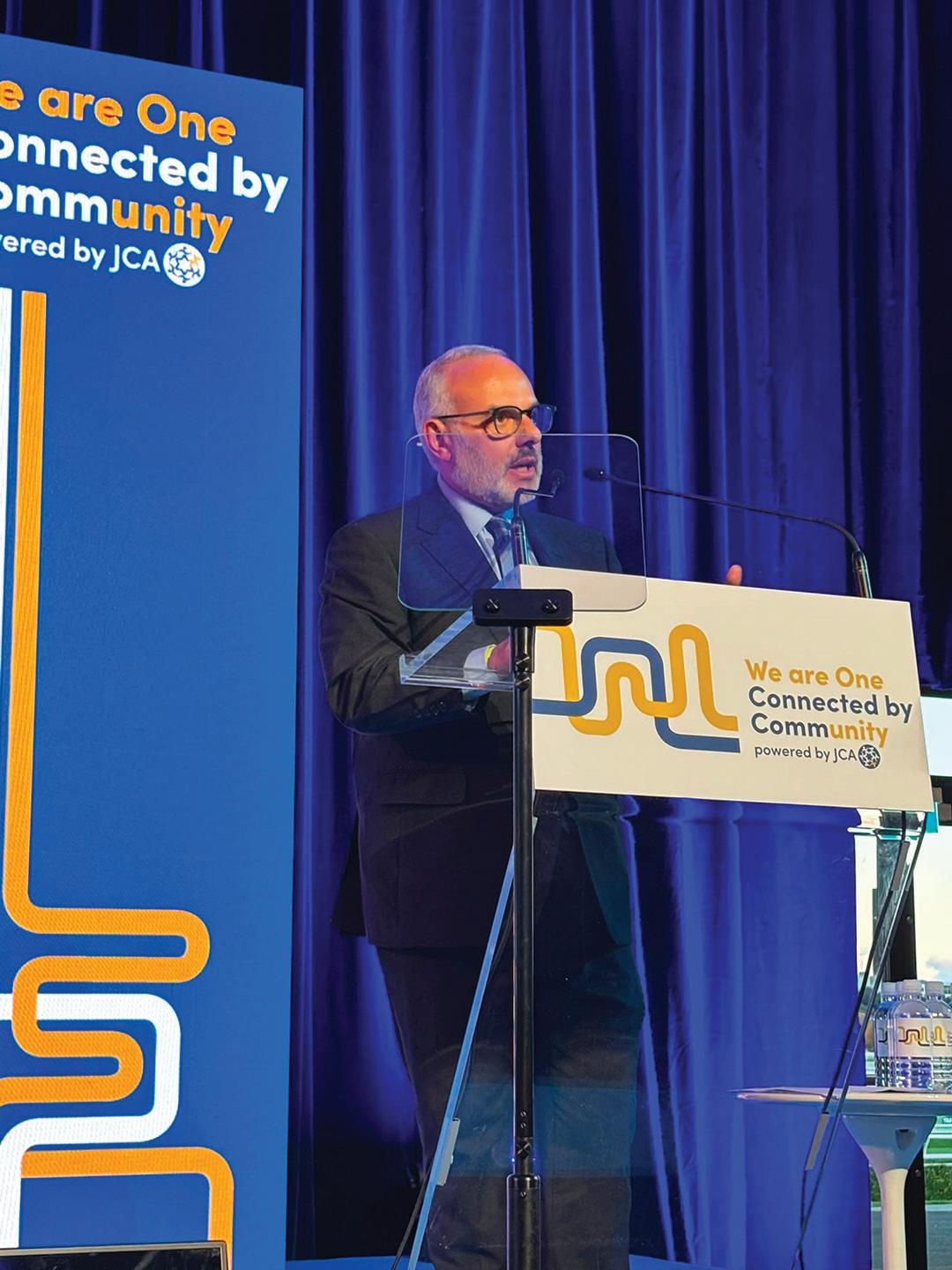
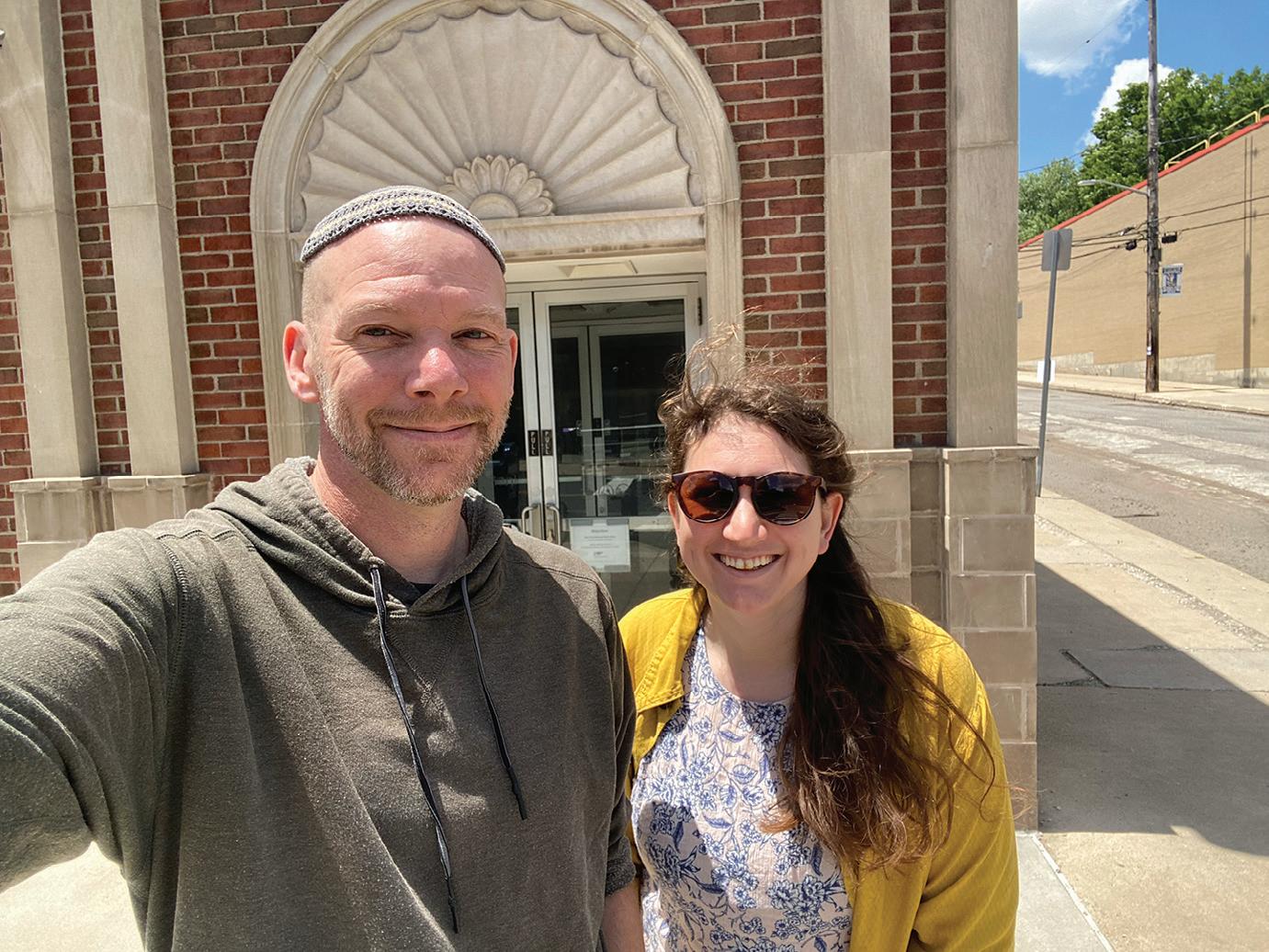
of the Jewish Federations of North America, and Alain Hasson, CEO of the Jewish Council of Australia, had been talking about a solidarity mission with Federation leadership,” Finkelstein said. “I think Alain was hoping to learn some things from our American Federation and from what’s happened here in Pittsburgh, which is why I went with Maggie Feinstein.”
After visiting The Great Synagogue in Sydney and learning about the history of the Australian Jewish community, Finkelstein said the group traveled to Bondi Beach and Archer Park, where the shooting took place.
“We were on a bridge where one of the shooters was,” he said. “We walked thatbody had congregated and gathered. We heard a survivor speak and we heard from
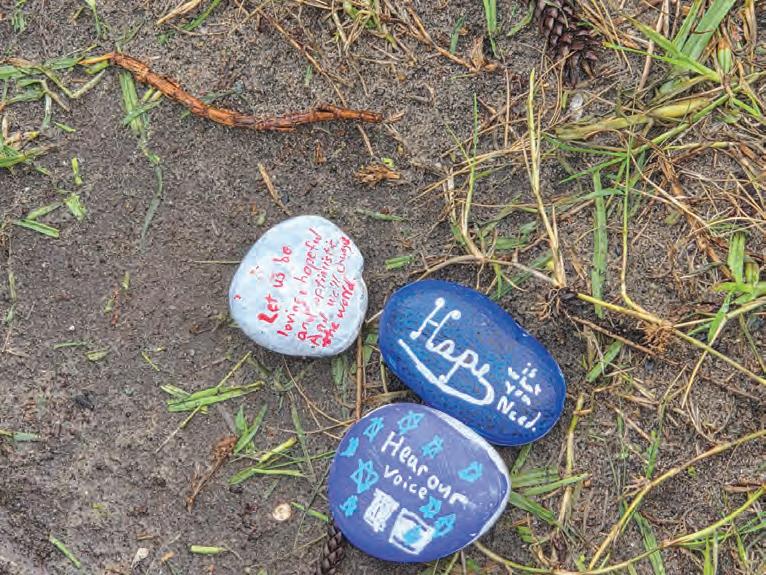
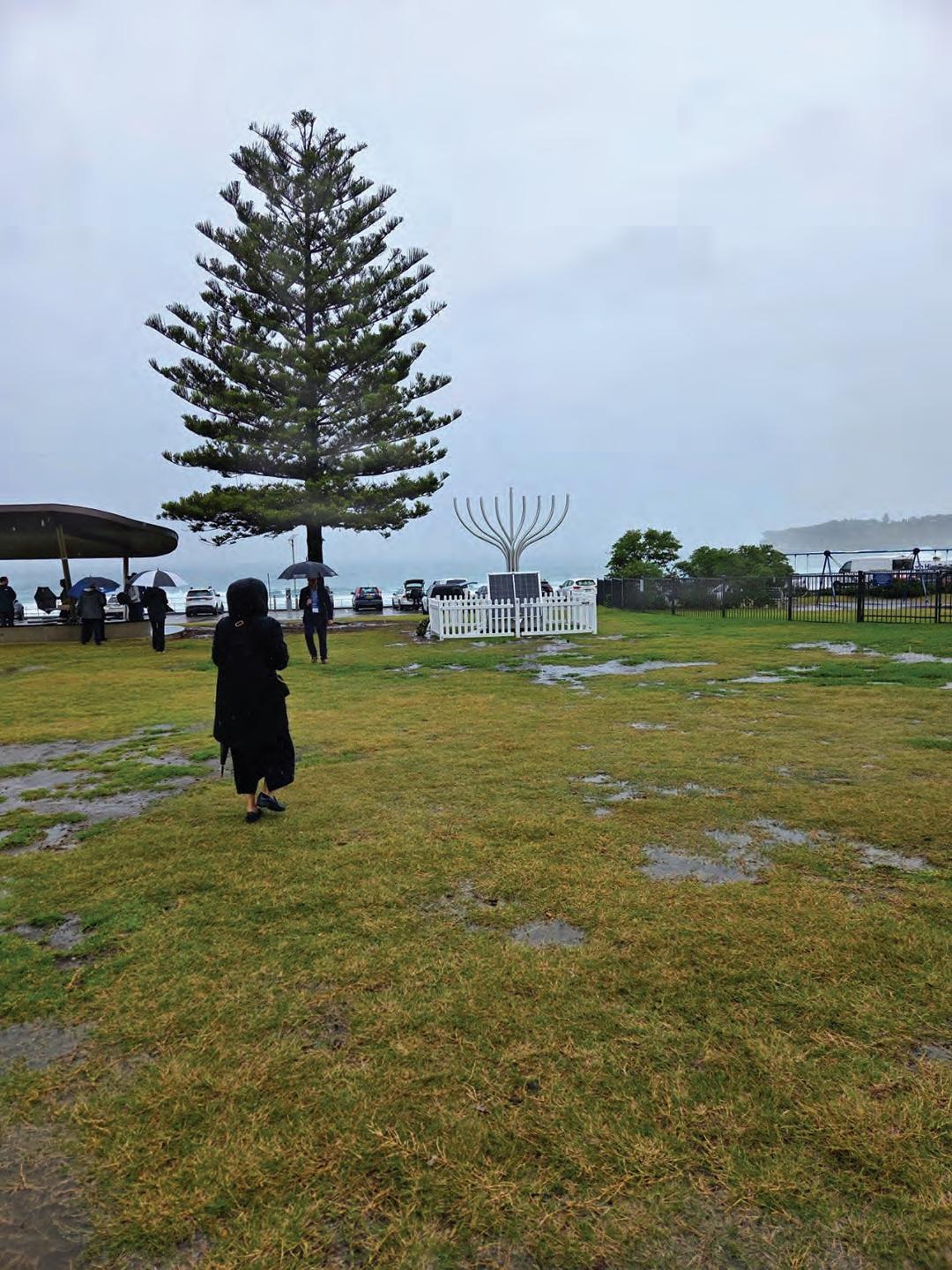
The group placed a wreath in memory of those murdered and both Finkelstein and Feinstein placed small stones painted rial — a large menorah similar to the one that was being lit at the celebration at the Finkelstein said being at the site of anothernity left him with “a mix of emotions.”
“It’s retraumatizing and triggering to be on the site where 15 attendees at the event were gunned down, because I’ve been in the Tree of Life building. It’s very triggering to see this stuff. On the other hand, it’s really empowering to be there with the community and to be able to meet the leadership of what is, frankly, one of the greatest Jewish communities in the world,” he said.
Feinstein called the cycle of mass shootings “incredibly disheartening.”
Sens. Fetterman,
Jewish Committee’s Global Forum
By David Rullo | Senior Staff Writer
Pennsylvania Sens. John Fetterman and David McCormick earned praise from American Jewish Committee CEO Ted Deutch, who called the pair “champions for the Jewish community” during the closing session of AJC’s Global Forum held last week in Washington, D.C.
The two senators, Deutch said, speak “clearly” and with “moral clarity” about Israel and antisemitism.
Deutch noted that the two senators — Fetterman, a Democrat, and McCormick, a Republican — are colleagues and friends, something which is increasingly rare.
Asked about the partisan tone of the current political climate, Fetterman noted that many in his party are critical of his efforts at bipartisanship and his friendship with McCormick.
The pair, he said, works to strengthen Pennsylvania and find common ground when possible. Any disagreement they might have shows up in votes rather than insults.
“It’s great to be up here on stage with him,” Fetterman said.
McCormick said he first met Fetterman at the fifth memorial for the Pittsburgh synagogue shooting, and that the two agreed on a principle: “We would work together in every way we can.”
That simple agreement has led to the two co-authoring bills on fentanyl, nuclear energy, farming, agriculture and antisemitism, he said.
“It’s what Pennsylvania expects — and I trust him,” McCormick said. “I trust him more than anyone in the Senate.”
Asked about why the two are outspoken advocates for Pennsylvania’s Jewish
Jewish Federation of Pittsburgh President and CEO Jeff Finkelstein addresses the Sydney Jewish community during a three-day mission six months after the Bondi
Photo courtesy of Jeff Finkelstein
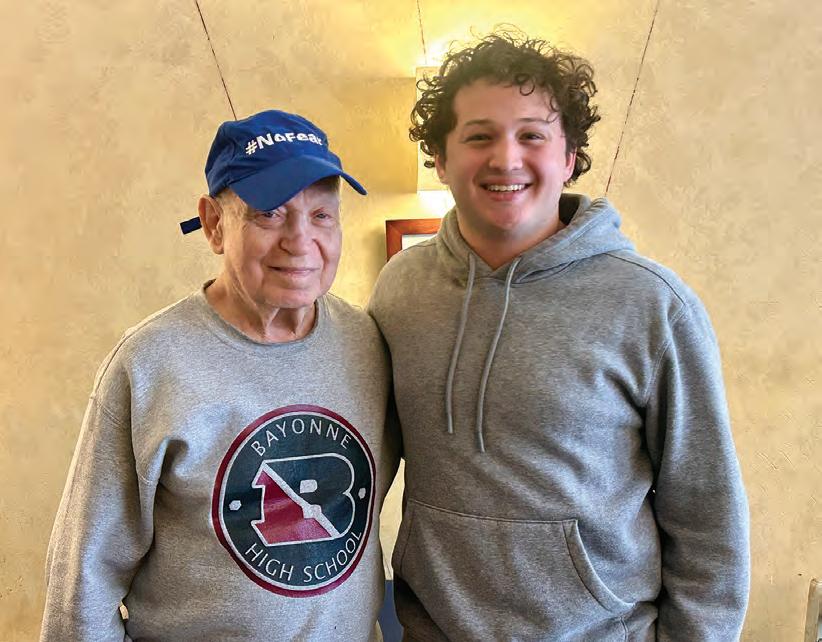
Sami Steigmann comes to Pittsburgh
Headlines
Guilty of littering, white supremacist claims ‘Jews didn’t like what was on the flyer’
By David Rullo | Senior Staff Writer
At a June 3 hearing in the Allegheny County Court of Common Pleas, Jeremy Brokaw pled guilty to five counts of littering for distributing antisemitic flyers last May in Squirrel Hill and Shadyside. He was fined a total of $1,500 plus court costs.
The sentence was agreed upon following the appeal of his conviction last September, when he was found guilty of 160 counts of littering and fined more than $50,000.
The appeal hearing was originally scheduled for May 6, 2026, but neither Brokaw nor his attorney, Joshua Smith, made an appearance. Smith claimed they were not notified of the court date. After initially ruling against the defendant, Judge Thomas E. Flaherty rescheduled the hearing.
Brokaw’s new sentence equates to a $300 fine for each of the five streets where antisemitic literature — placed in a baggie with corn seeds to keep them from blowing away — was thrown from a Dodge Durango owned by Brokaw.
Calling the case “unusual,” Flaherty asked Assistant District Attorney Michael Siegert if the fines were the maximum allowed.
Siegert said they were and, pivoting from the antisemitic nature of the flyers, said the charges against Brokaw were strictly for littering. Brokaw appeared to smile during the exchange between Siegert and the judge.
Flaherty seemed to reluctantly accept the plea after indicating he would have preferred community service to be part of the deal. But the defendant lives in Zanesville, Ohio, and
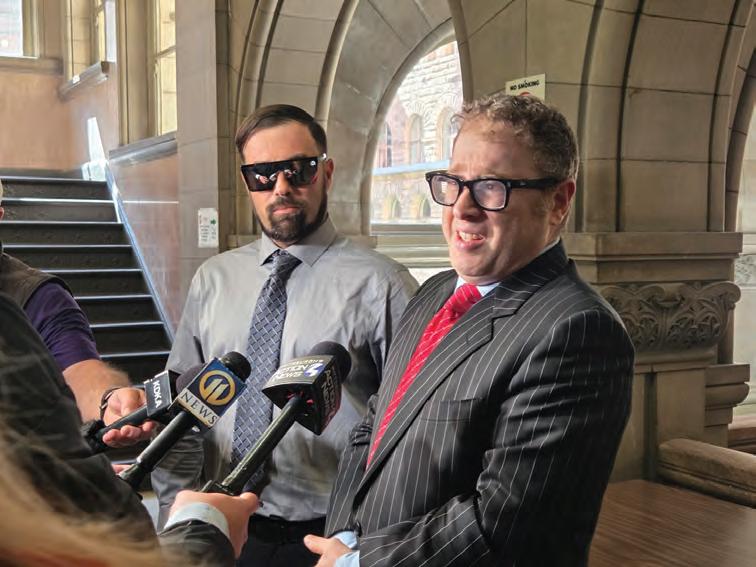
p Jeremy Brokaw (left) and his attorney, Joshua Smith, address reporters after Brokaw accepted a plea deal for littering in relation to the distribution of antisemitic flyers.
his attorney assured the judge that Brokaw wouldn’t be back to Pittsburgh, saying he had “learned his lesson.”
In a post-hearing press gaggle, Smith said the plea deal was “a reasonable offer.”
He called Brokaw’s actions a “misguided attempt at advocacy,” saying it was akin to behavior practiced in the 1960s or 1970s, before the advent of the internet.
Asked by the Chronicle if Brokaw’s behavior wasn’t more in line with lighting a cross in an African American neighborhood in the 1960s, Smith responded: “Now you’re talking about viewpoint discrimination, and you can’t do that.”
Asked what viewpoint Brokaw was advocating, Smith replied “pro-white advocacy.”
Speaking to the gathered reporters, Brokaw said that everything on the flyers
“was facts. You can fact check everything on the flyers distributed without malicious intent.”
The literature thrown from Brokaw’s vehicles was filled with conspiracy theories, antisemitic tropes and falsehoods, including “Every single aspect of the Jewish Talmud is Satanic,” and references to the “Protocols of the Learned Elders of Zion” and “The Jew’s Plan for World Domination.”
Brokaw speculated that if the content on his flyers had been different, he wouldn’t have been arrested and found guilty.
“Jews didn’t like what was on the flyer,” he said.
Asked why he didn’t advocate for white supremacy in his hometown rather than in Pittsburgh, Smith replied, “He probably hasn’t advocated for his position in Zanesville,” before Brokaw said that he had
“advocated for it all over the country.” Brokaw went on to claim that he wasn’t aware Squirrel Hill was a large Jewish neighborhood.
David Heyman, associate vice president of the Jewish Federation of Greater Pittsburgh, finds that hard to believe.
“There’s no accident that Mr. Brokaw drove from Zanesville, Ohio, to Squirrel Hill, the site of the worst antisemitic attack in U.S. history,” Heyman said, referring to the Pittsburgh synagogue shooting.
Heyman said that coming into the hearing, he believed the judge was likely to reduce the original fines.
Like the judge, he said, the Federation, reluctantly accepted the guilty plea.
Brokaw had the right to express his point of view, Heyman said, but called his actions “targeted harassment.” Heyman noted the need for stronger legislation in Pennsylvania to address that type of behavior.
Eric Kroll, the Federation’s deputy security director agreed, noting that legislation addressing actions that are hateful and targeted at a particular individual or group — rather than advancing a political opinion — has stood up in court in other circumstances.
Kroll and Heyman both thanked the district attorney, law enforcement and the community, whom they said helped to quickly identify Brokaw.
“The community spoke up,” Heyman said. “The community reported the incident. The community provided video of the car. The Pittsburgh Bureau of Police took this seriously. The prosecution took this seriously.” PJC
David Rullo can be reached at drullo@ pittsburghjewishchronicle.org.
Published every Friday by the Pittsburgh Jewish Publication and Education Foundation 5915 Beacon St., 5th Floor Pittsburgh, PA 15217
Phone: 412-687-1000
POSTMASTER: Send address change to PITTSBURGH JEWISH CHRONICLE, 5915 BEACON ST., 5TH FLOOR PITTSBURGH, PA 15217
(PERIODICAL RATE POSTAGE PAID AT PITTSBURGH, PA AND AT ADDITIONAL MAILING OFFICES) USPS 582-740
Manuscripts, letters, documents and photographs sent to the Pittsburgh Jewish Chronicle become the property of this publication, which is not responsible for the return or loss of such items.
The Pittsburgh Jewish Chronicle does not endorse the goods or services advertised or covered in its pages and makes no representation to the kashrut of food products and services in said advertising or articles. The publisher is not liable for damages if, for any reason whatsoever, he fails to publish an advertisement or for any error in an advertisement. Acceptance of advertisers and of ad copy is subject to the publisher’s approval. The Pittsburgh Jewish Chronicle is not responsible if ads violate applicable laws and the advertiser will indemnify, hold harmless and defend the Pittsburgh Jewish Chronicle from all claims made by governmental agencies and consumers for any reason based on ads appearing in the Pittsburgh Jewish Chronicle
Photo by David Rullo
Headlines
Getting to know: Elizabeth Friedman
By Adam Reinherz | Senior Staff Writer
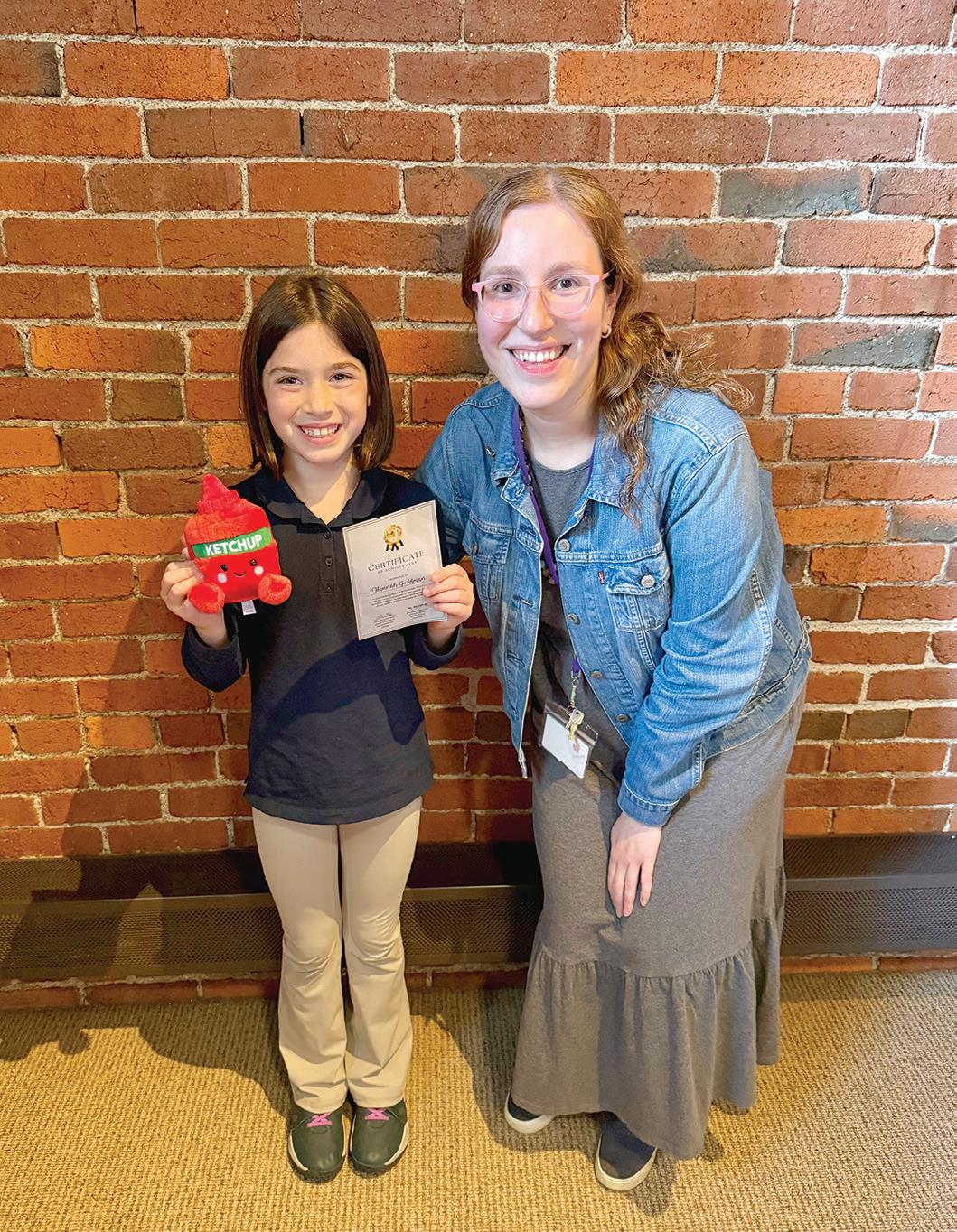
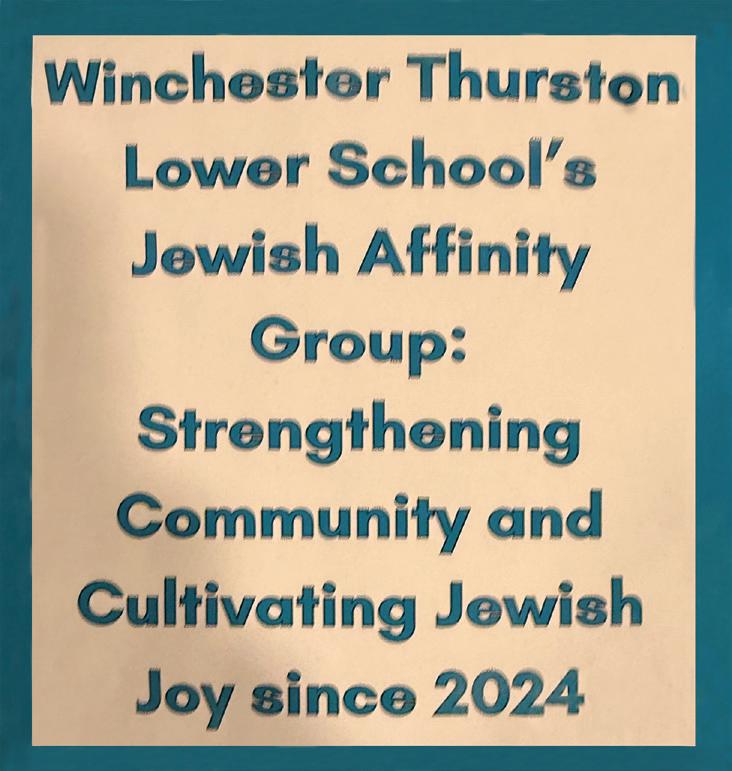
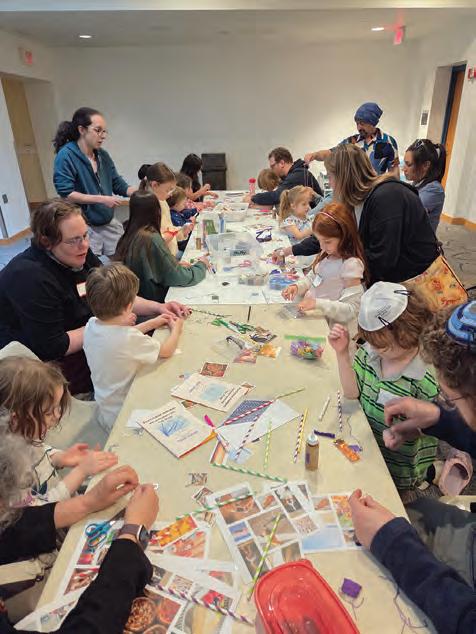
Educator Elizabeth Friedman is deep ening her ties to Winchester Thurston School by creating a stronger sense of identity for Jewish students. The first grade teacher and diversity, equity, inclu sion and belonging liaison at Winchester’s lower school started a Jewish Affinity club two years ago. Since its inception, the club has grown from about 10 students to nearly 30.
“Guided by the students’ interests,” the club enables participants to “celebrate some lesser-known holidays,” including Tu B’Shvat, create informational materials about Rosh Hashana and make a scrapbook of Jewish practices, she said.
Friedman created the club to foster greater connections.
“Having a Jewish affinity group helps to support belonging at the school, and for students to be able to come together around something that they have in common,” she said. “Feeling a sense of belonging leads to feeling confident, and feeling comfort able, and feeling safe and able to do their very best.”
Friedman credited the Shadyside-based independent school with providing space and time to develop meaningful experiences. About twice a month, students ages 3 1/2 to 10 meet for different activities. Recently, 17 members of the group traveled to the Heinz History Center and visited with Rauh Jewish Archives Director Eric Lidji.
Last year, club members also toured
“Winchester is a space where I feel comfortable and a strong sense of belonging.”
–ELIZABETH FRIEDMAN
the Biblical Botanical Garden at Rodef Shalom Congregation.
Friedman said she appreciates Winchester’s educational goals. She, her brother and her mother are all graduates of the school; and, having taught at Winchester since 2017, Friedman is proud of her lineage and ability to further the institution’s future.
“Winchester is a space where I feel comfortable and a strong sense of belonging,” she said. “Something that’s special to me is that some of my teachers, who taught me when I was in the Upper School at Winchester, are still teaching, and so they went from being my teachers to being colleagues, which has been a fantastic experience.”
Friedman grew up in Mt. Lebanon and attended Temple Emanuel of South Hills. After graduating from Winchester, she enrolled at Kenyon College.
“I thought that I wanted to become a journalist, but after my sophomore year at Kenyon, at my mom’s encouragement, I worked at Chatham Music and Arts Day Camp,” she said.
The experience proved exhilarating and exhausting. Paired with 3 ½- and 4-year-olds, Friedman found herself deeply connected to the demographic and the charge.
“After about three or four days I knew that I wanted to become an educator,” she said.
Friedman returned to Kenyon, and though the college lacked an education major she found other ways to continue learning about the field, such as working at the local elementary school. After graduating from
Kenyon, she completed a master’s degree at the University of Pennsylvania and taught
“That’s really where I think I learned how to connect with students and manage a classroom, and just try to lead always with
Friedman completed additional schooling — first a certificate in early education leadership from Harvard University, then a doctorate in educational leadership and management from Drexel University — and began teaching at Winchester. These days, apart from serving first graders and their families, Friedman enjoys playing tennis, She said she enjoys doing “a lot of things outside of school, but education is really what drives my learning, and kind of
After nine years on staff at her alma mater, Friedman said her work with the Jewish Affinity group over the past two years reinforced a guiding educational principle.
“What you focus on grows,” she said. PJC Adam Reinherz can be reached at areinherz@pittsburghjewishchronicle.org.
p Educator Elizabeth Friedman sits inside her classroom at Winchester Thurston School. Photo courtesy of Elizabeth Friedman
p A scrapbook page created by the Winchester Thurston Lower School's Jewish Affinity Group
Photo courtesy of Beth Goldstein
p Winchester student Hannah Goldman joins educator Elizabeth Friedman. Photo courtesy of Beth Goldstein
childhood in a labor camp, Steigmann never fully identified with the Holocaust survivors whose stories seemed to permeate public memory.
“I have no memory of that period of time,” Steigmann told the Chronicle. “I knew that I was [a survivor], being in a labor camp, but I tried to ignore it. At the same time, I did not feel like I belonged to the children of the Holocaust survivors because most of them were displaced people [or born] in the camps liberated by the Allies.”
In 2008, Steigmann decided to volunteer with the Museum of Jewish Heritage in Manhattan, where he was given his first assignment — to speak to a group of sixth graders.
“I never spoke publicly before,” he said. “I did not feel that I had a compelling story, but I knew that I knew more than the kids.” He decided to “just do it,” not knowing what to expect.
“They sent me 10 thank you letters, one better than the other, but one sixth grader changed my life,” he said. “She wrote ‘P.S. Your story was overwhelming and I promise I’ll pass your story on to my children.’ It made me realize that I have something very important that I must share with young people.”
Now, Steigmann travels across the country, sharing his story in an effort to educate and empower the younger generation to become “upstanders” in the face of oppression.
He was in Pittsburgh last week to speak with local students, community members and civic leaders.
Born in 1939 in Czernovitz, Bukovina, Steigmann spent the first years of his life in a Ukrainian labor camp known as
father was forced to trade his winter coat for a single loaf of bread. The bitter winter frost and dwindling resources brought Steigmann to the brink of starvation.
Steigmann was told he was saved by a local German woman who lived near the camp and routinely brought food to the SS and Ukrainian guards. Recognizing the tell-tale signs of starvation — a big head, a swollen stomach, and swollen feet — she risked her life to save him.
A bit of milk, and a quick pat on the cheeks, and his skin flushed with life.
“I do not know the name of the person,”
feeling. Each generation had different issues to deal with, and in a joking way, I was blessed because I have to deal with both of them.”
The camp was liberated by the Red Army, and Steigmann and his family returned to Romania, before eventually emigrating to Israel. There, he served in the Israeli Air Force, until moving to the United States in 1968.
“I got the visa totally unprepared — without money, without language,” he said. “After my divorce, I went back to Israel in 1983 again, because of my mother. She realized I’m more American than Israeli, because I lived here for
Steigmann to speak in Pittsburgh after hearing his “unique” testimony at a StandWithUs conference in March.
“Students can really connect with [history] when there’s someone in front of them telling them the story,” Stavchansky said. “It’s not something that you only see on YouTube, and it’s not something only on the whiteboard anymore — it’s something you can actually [hear] in person.”
Steigmann addressed students at Community Day School and teens from around Allegheny County at the JCC on June 1, as well as city officials in downtown Pittsburgh and students at Taylor Allderdice High School on June 2.
“I don’t like to lecture,” he said. “I tell the students, you can ask me any questions that you want on any subject, I will be very honest, and I’ll tell you how I feel. I am not asking you to agree with me. All I’m asking is to respect that I may have a different opinion.”
The result, he believes, is that students feel inspired to “share their own story.” At CDS earlier that morning, one child even felt emboldened to stand up during the presentation and recount his great-grandparent’s story f survival during the Holocaust.
For Steigmann, moments where students begin to “view themselves as leaders” are a testament to the power of storytelling across generational lines.
“What you have experienced right now is living history,” Steigmann said. “You are my witness.” PJC
Octavia Liku can be reached at oliku@ pittsburghjewishchronicle.org.
p Sami Steigmann and StandWithUs Kenneth Leventhal High School Intern Sam Stavchansky
Photo by Octavia Liku
p The City Controller’s office, with help from StandWithUs, hosted Sami Steigmann for an office-wide conversation.
Photo courtesy of Rachael Heisler
Headlines
Shoresh seeks to blend coffee, community and Jewish life in Greenfield
By Adam Reinherz | Senior Staff Writer
Coffee shops have a culture. Few have a minyan. Shoresh, a Greenfieldbased “well-caffeinated shtibl” wants to offer both.
Created by Rabbi Mark Asher Goodman and Frances Lasday, the new venture on the corner of Loretta Street and Murray Avenue aims to augment local Jewish life.
While larger “institutional structures of Judaism are really great for serving the masses, they often kind of miss certain niche people who don’t want that,” Goodman said. “Whether it’s newbies to Judaism, or folks who are reentering the tradition after having been disengaged for a really long time, it’s just really difficult to walk through those conventional doors.” Conversely, a coffee shop is “one of those third spaces in American society that’s really warm and welcoming and inviting, and has no pretense and no expectations upon the people who go to it.”
The idea of mixing java and Judaism has brewed in Goodman’s head for 25 years.
In rabbinical school, “I had a teacher who used to occasionally say that when he retired he wanted to move to the north shore of Maui and create a coffee shop and beit midrash,” Goodman said.
The message resonated, but the class ended; years passed and Goodman, like many of his fellow future rabbis, went from conventional job to conventional job. Six months ago, as his contract at Congregation Beth Shalom was nearing an end and the congregation he served in Erie was winding down, Goodman revisited the coffee shop idea.
He came to a realization, he told the Chronicle. “I am 49 years-old, and either I get to do the thing that I dreamt of doing when I wanted to become a rabbi, now, after having learned the ropes and paid my dues to the community for the last 20 years, or never — effectively — because in another five or 10 years I don’t know that I’ll have the energy and the drive to take on this brand new project and try and see it all the way through.”
Joining Goodman at Shoresh — the Hebrew word for root — is Lasday, an educator and community organizer who helped create a monthly pop-up minyan at the Jewish Community Center in Squirrel Hill. Goodman
said the two worked on a separate grant application years ago; and though the grant didn’t go through, Goodman realized he found something better: a partner in the coffee enterprise.
Lasday said that when Goodman asked her to join him, about six months ago, she was immediately “excited about the idea of a space that was flexible to hold lots of different community partners, and also to put on cool events.”
An added bonus, she continued, is “I’m a resident of Greenfield, and we don’t have a coffee shop here.”
Details regarding coffee suppliers, baked goods, classes, prayer services and other programs are yet to be determined. Hours, however, are set.
The coffee shop will operate Monday through Friday, from 8 a.m. to 3 p.m.
As for what a minyan looks like on Shabbat, “I think that as we are growing and developing, it will probably change over time,” Lasday said.
“I’m a pluralist. I grew up in a pluralistic youth movement, and I think there’s just so many unique ways to be engaged in Jewish life and davening (prayer). People want different things out of davening, and also, I think this town is a ‘you belong to many shuls’ kind of town.”
How that plays out, she continued, is that someone may have an idea for how to lead a different type of minyan. “Shoresh could be a space that allows that to happen in a low-risk kind of way.”
The enterprise already has chairs, siddurim (prayer books) and a Torah — both the siddurim
and Torah were donated by Brith Sholom, the Conservative synagogue in Erie where Goodman officiates. These items, Lasday said, ease the formation of new prayer communities.
“A lot of the struggles of independent minyanim are how do you have space and the materials that you need to do it in. I think Shoresh could be an opportunity just to be like, ‘OK, come, this is the space to get people together, and now we can have an independent minyan.’ It could happen once. It could happen once a month. It just depends on what people are excited about building.”
As enthusiasm for the project grows, a looming question for organizers and community members remains. Given Shoresh’s intention to serve baked goods, will the coffee shop be certified kosher by the Vaad Harabonim of Pittsburgh? Founded by Orthodox rabbis more than 50 years ago, the Vaad is led by volunteers, including Shaare Torah Congregation’s Rabbi Yitzi Genack.
According to Vaad representatives, the organization relies on halacha (Jewish law) to “strengthen and maintain the institutions of a Torah community.”
Lasday said she intends to speak with the Vaad about possibly attaining its certification.
“We want to be open to the community. We just have to have conversations about that,” she said. “We’re trying to figure out what the scope of that will be.”
Having signed the lease two weeks ago, Shoresh is grinding toward its first cup.
Goodman and Lasday are meeting with contractors, reviewing permitting details and finalizing class topics. Beginning in August, Goodman will offer classes on the Talmud, Chassidut (Jewish spirituality and mysticism) and intermediate Hebrew.
Lasday, a self-described experiential educator, plans on teaching about the Mishkan (Tabernacle) and Sabbathrelated prohibitions by enabling students to undertake crafts, including weaving and spinning, “that were based on those ritual prohibitions.”
Construction is scheduled to begin later this month. The goal is to have the coffee shop open by October or November, and a potential space for Saturday events completed by the start of 2027.
Between its classes and coffee, Shoresh aims to be a “warm, welcoming, melting pot space for anyone in the Jewish community to find both Jewish learning and community,” Goodman said.
Yet more than simply being a place to serve joe and Jewish knowledge, “I want people to feel excited to come with their ideas,” Lasday said. If someone has a topic they’d like to explore, and “they have a bunch of people who want to do it, we’d love to host them and be an open space in the community for people to make things happen.”
PJC
Adam Reinherz can be reached at areinherz@pittsburghjewishchronicle.org.
Chronicle wins 11 national Jewish press awards for outstanding work
By Toby Tabachnick | Editor
The Pittsburgh Jewish Chronicle was recognized for excellence in journalism by the American Jewish Press Association, winning 11 Rockower Awards in the weekly and biweekly newspaper division for work done in 2025. The awards were presented on June 4 during the Rockower Awards banquet at the Center for Jewish History in New York City. The awards banquet was held in conjunction with AJPA’s annual conference.
The Chronicle received first place in the category Excellence in Writing about Jewish
Heritage and Jewish Peoplehood in Europe for Senior Staff Writer Adam Reinherz’s stories: “Connecting past and present: A seminar bridges Jewish history across northern Europe”; “Observance and observations: Seminar spotlights Vilnius”; “Beneath Latvia’s soil, stories speak”; “No longer ‘Judenfrei,’ Estonia boasts future-focused model developing Jewish youth”; and “In Finland, small Jewish community seeks sizable engagement.”
The Chronicle also received first place in the category Excellence in Feature Writing for freelancer Deborah Weisberg’s story “JCLP guides congregations through sustainability, mergers and last chapters.”
The Chronicle won five second place awards: Senior Staff Writer David Rullo won in the category Excellence in Personal Essay
for “Wanted for being Jewish”; Editor Toby Tabachnick won for Excellence in Writing About Antisemitism for “Jewish students share their struggles with antisemitism at Pitt”; Reinherz won in the category Excellence in Writing about Young Families/People for “College decision process prompts pause and questions for students and parents”; the editorial staff won for Excellence in Editorial Writing for “Anti-Israel activists show true colors by targeting teenage Jewish athletes,” “Moral clarity matters: Leaders must call this what it is” and “A New Year’s call to responsibility: Suggested resolutions for 2026.”
A second place award also went to freelance writer Emma Riva for Excellence in Arts — Review/Criticism for “One Oxford Centre features photographer’s striking
landscapes of Israel.”
Reinherz received honorable mention in the category Excellence in Writing about Health Care for “JHF initiative empowers Pennsylvanians to address teen mental health”; in Excellence in Writing About Sports for “At the edge of the pool Coach Al Rose delivers perspective”; and for Excellence in Education Reporting for “With eye to future, educators aid ‘COVID kindergarteners.’”
Weisberg received an honorable mention for Excellence in Arts News and Features — Reporting for “Pittsburgh scholar studies world’s oldest synagogue paintings firsthand in Syria.” PJC
Toby Tabachnick can be reached at ttabachnick@pittsburghjewishchronicle.org.
p
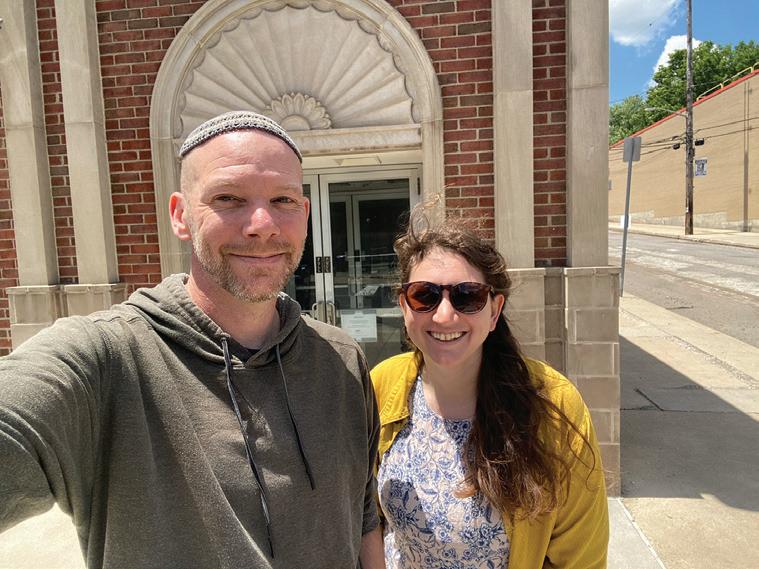
Rabbi Mark Asher Goodman and Frances Lasday stand outside the site of Shoresh. Photo courtesy of Rabbi Mark Asher Goodman
p Greenfield is getting a new coffee shop. Photo courtesy of Rabbi Mark Asher Goodman
Submit calendar items on the Chronicle’s website, pittsburghjewishchronicle.org. Submissions also will be included in print. Events will run in the print edition beginning one month prior to the date as space allows. The deadline for submissions is Friday, noon.
q SUNDAYS, JUNE 14–DEC. 20
Join Chabad of Squirrel Hill for its Men’s Tefillin Club. Services and tefillin are followed by a delicious breakfast and engaging discussions on current events. 8:30 a.m. 1700 Beechwood Blvd. chabadpgh.com
Join a lay-led online Parashah study group to discuss the weekly Torah portion. No Hebrew knowledge needed. The goal is to build
community while deepening understanding of the text. 8:30 p.m. For more information, visit bethshalompgh.org/online-parashah.
q MONDAYS, JUNE 15–DEC. 21
Join Congregation Beth Shalom for a weekly Talmud study. 9:15 a.m. For more information, visit bethshalompgh.org.
Join Temple Sinai for an evening of mahjong every Monday (except holidays). Whether you are just starting out or have years of experience, you are sure to enjoy the camaraderie and good times as you make new friends or cherish moments with long-term pals. All are welcome. Winners will be awarded Giant Eagle gift cards. All players should have their own mahjong cards. Contact Susan Cohen at
susan_k_cohen@yahoo.com if you have questions. $5. templesinaipgh.org
q TUESDAY, JUNE 16
Join the National Council of Jewish Women Pittsburgh for “Repairing Together (Tikkun Yachad): Practicing Humanity in a Time of Division,” an evening of shared meal, meaningful conversation, somatic reflection, and collective action as they explore what it means to practice humanity in this moment. Free but registration is required. 6:25 p.m. 1620 Murray Ave. act.ncjwpgh.org/a/tikkun-yachad-june
q TUESDAYS, JUNE 16–DEC. 22
Join Beth El’s Rabbi Alex Greenbaum and his Bible/Talmud Adult Education class for a thoughtprovoking weekly session of Bible and Talmudic study. This program is available both in person and
virtually. Call the office at 412-561-1168 to receive the Zoom link or to make an in-person reservation. 10:30 a.m. 1900 Cochran Road. bethelcong.org
q WEDNESDAY, JUNE 24
Join the Holocaust Center of Pittsburgh for an evening of celebration and reflection on the past year of the Reckoning with Antisemitism as Christians project. Hear from Christians who have been reckoning with antisemitism and from Jews who have taken part in their efforts. A published book of sermons written by local Christian clergy who have engaged their congregations and communities in conversations about antisemitism, from the pulpit and beyond, will also be shared. Free. 7 p.m. Beit Kulanu, 4905 Fifth Ave. eventbrite. com/e/reckoning-with-antisemitism-as-christiansreflections-at-one-year-tickets-1988560210119 PJC
By Mike Wagenheim | JNS
Israeli and Lebanese representatives huddled with U.S. officials at the State Department last week, hammering out a joint statement on a plan of action to rid southern Lebanon of Hezbollah’s control.
Across the street, victims of the terror group’s 1994 bombing of a Buenos Aires Jewish community center were memorialized.
“In the 32 years since the bombing, Argentina has transformed from a beacon where terrorism once reigned supreme to
a beacon of Jewish life,” Yehuda Kaploun, a rabbi and the State Department’s special envoy to monitor and combat antisemitism, told attendees at the U.S. Institute of Peace.
The department co-hosted the event with the House Committee on Foreign Affairs, Argentina’s embassy in Washington and the Argentine Israelite Mutual Association, or AMIA, which was bombed on July 18, 1994.
Terrorists rigged a van with explosives and drove it into the building, killing 85 people and hurting more than 300 — the deadliest terror attack in the country’s history.
A series of suspected cover-ups preceded a 2006 decision by prosecutors to accuse Hezbollah of carrying out the attack at the
direction of its benefactor, the Iranian government. An Argentine court ruled in 2024 that this was the case and characterized Iran as a terror state.
Two years before the AMIA bombing, the Israeli embassy in Buenos Aires was bombed in an attack thought to be linked to Hezbollah and Iran as well. That blast killed 29 people and hurt 242.
“Today, AMIA stands not only as a site where horror once occurred but as a living testament to the strength and vitality of the Jewish community in Argentina,” Kaploun told attendees.
He noted that the country has the sixth largest Jewish population in the world.
Gregory LoGerfo, State Department coordinator for counterterrorism, also spoke at the event, as did Reed Rubenstein, the department’s leading legal officer.
Alejandro Oxenford, Argentina’s ambassador to the United States, represented his country.
Daniel Pomerantz, executive director of AMIA and a survivor of the 1994 attack, also spoke.
“More than three decades later, their absence is still a wound in the life of my
The Pittsburgh Jewish Chronicle invites you to join the Chronicle Book Club for its July 12 discussion of “A Guide for the Perplexed,” by Dara Horn.
From Amazon.com: “Software prodigy Josie Ashkenazi has invented an application that records everything its users do. When she visits the Library of Alexandria as a tech consultant, she is abducted in Egypt’s postrevolutionary chaos with only a copy of the philosopher Maimonides’ famous work to anchor her, leaving her jealous sister Judith free to take over her life.
A century earlier, Cambridge professor Solomon Schechter arrives in Egypt, hunting for a medieval archive hidden in a Cairo synagogue. Their stories intertwine in this spellbinding novel of how technology changes memory and how memory shapes the soul.”
Your hosts
Toby Tabachnick, Chronicle editor
David Rullo, Chronicle senior staff writer
How it works
We will meet on Zoom on Sunday, July 12, at 1 p.m.
country, not a closed chapter of history but an open question we are still bound to answer,” Oxenford said, of the victims. “We remember them today one by one, because memory is the first form of justice.”
The conclusion that Hezbollah carried out the bombing at Iran’s direction is “a condition of the truth,” Oxenford said. “After 30 years of silence, evasion and cover-up, the truth itself is a form of justice.”
“The truth is not enough, and Argentina has stopped pretending that it is,” Oxenford said.
Recent Argentinian legislation provides for trials in absentia, and 10 people accused of planning the bombing have since been ordered to stand trial, even as they remain at large, the envoy said.
Earlier in the day, the Argentine embassy unveiled an artwork that states, “What is not remembered dies, and what is remembered never dies.” Oxenford asked attendees to take “instruction” from it.
“This is not a ceremony of mourning alone. It is an act of resistance against forgetting, and forgetting in matters like these is never neutral,” he said. “It is the final accomplice.” PJC
and Barnes & Noble, and through the Carnegie Library system.
Email: Contact us at drullo@pittsburghjewishchronicle.org, and write “Chronicle Book Club” in the subject line. We will send you a Zoom link for the discussion meeting.
Happy reading! PJC
What to do
Buy: “A Guide for the Perplexed.” It is available from online retailers, including Amazon
Everyday Noodles
Chow’s Kitchen
Headlines
Pennsylvania Supreme Court Justice speaks on the importance of women’s leadership at JWF event
By Octavia Liku | Staff Writer
Before she became a justice on Pennsylvania’s highest court, Christine Donohue was the daughter of a disabled coal miner and a seamstress who worked six days a week to keep her family afloat.
Donohue’s perspective — forged far from polished courtroom walls — grounded her understanding of the world around her and the legal scaffolding that underlies it.
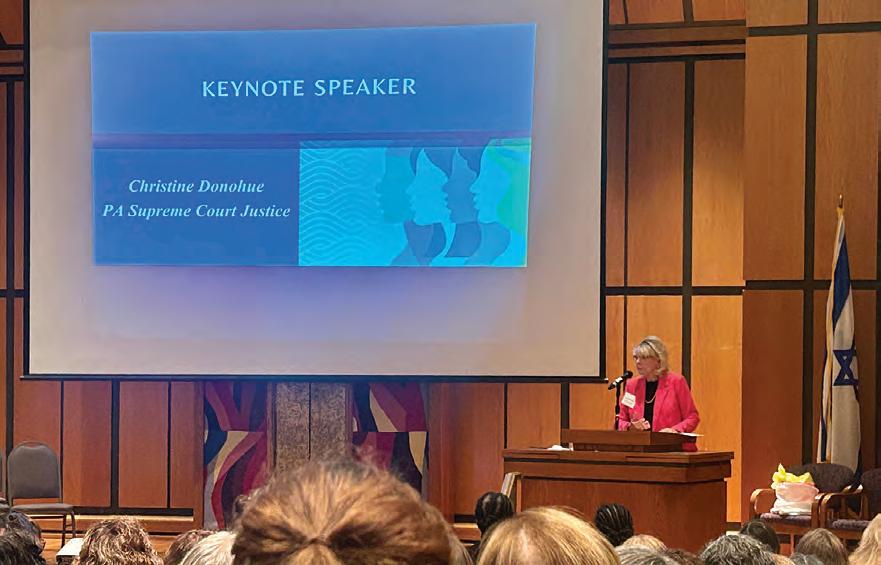
At the Jewish Women’s Foundation annual meeting on June 3 at Beit Kulanu, Donohue, the event’s keynote speaker, emphasized the importance of diverse perspectives — particularly those of women — in creating a more just society.
“What’s critical to remember for all of us who are concerned with women’s rights is that it’s important to have a woman’s perspective on [the court’s] work,” Donohue said. “Women who are active parts of the community make the community better — we want to have women serving in their ranks. The jurisprudence is better.”
Before her Supreme Ccourt appointment in 2016, Donohue spent 27 years working as a civil trial lawyer. She has been recognized as a trailblazer who has paved the way for the next generation of women in her profession, receiving Duquesne University’s Woman of the Year Award in 2023 and the Pennsylvania Bar Association’s Anne X Alpha Award in 2025.
“As a woman who has reached the highest levels of her profession while helping to create opportunities for those who follow, Justice Donohue embodies the leadership, perseverance, and commitment to advancing women that we celebrate through the work of the Jewish Women’s Foundation,” JWF trustee Carol Sikov Gross said.
Donohue grew up in a working class family in Lansford, Pennsylvania — a small borough in Carbon County. By the time she had reached grade school, her father was left disabled by black lung disease. As a result, her mother — a seamstress — took on the responsibility of supporting her family.
“She worked six days a week, and somehow she always had the time to make certain that she could sew me a new dress to wear to a dance when I was in high school, or a Halloween costume when I was a little kid,” Donohueshe recounted. “I’ve never known anyone who’s worked as hard as my mom worked.”
The first in her family to attend college, Donohue studied political science at East Stroudsburg University, before later earning her Juris Doctor at Duquesne University School of Law, now the Thomas R. Kline School of Law of Duquesne University.
Donohue focused on the contentious legalities surrounding women’s reproductive rights across the country. She walked the
audience through a brief history of abortion rights, emphasizing the nuances that define the tumultuous post-Roe legal landscape in Pennsylvania.
While Donohue noted that individuals are endowed with the constitutional right to reproductive autonomy under the Pennsylvania Constitution, she emphasized that litigation on the issue is still ongoing, and a decision will likely be made within a year to 18 months.
“We follow the law. We interpret the law based upon the language and precedents, but perspective matters,” she said. “Now the Superior Court of Pennsylvania has 15 judges, and three of them are men. The Commonwealth Board of Pennsylvania has nine members, and two are men. The Pennsylvania Supreme Court — on which I sit — there are seven of us, and three of us are women.”
The notion of women so well represented on the most powerful courts in the state was met with thunderous applause.
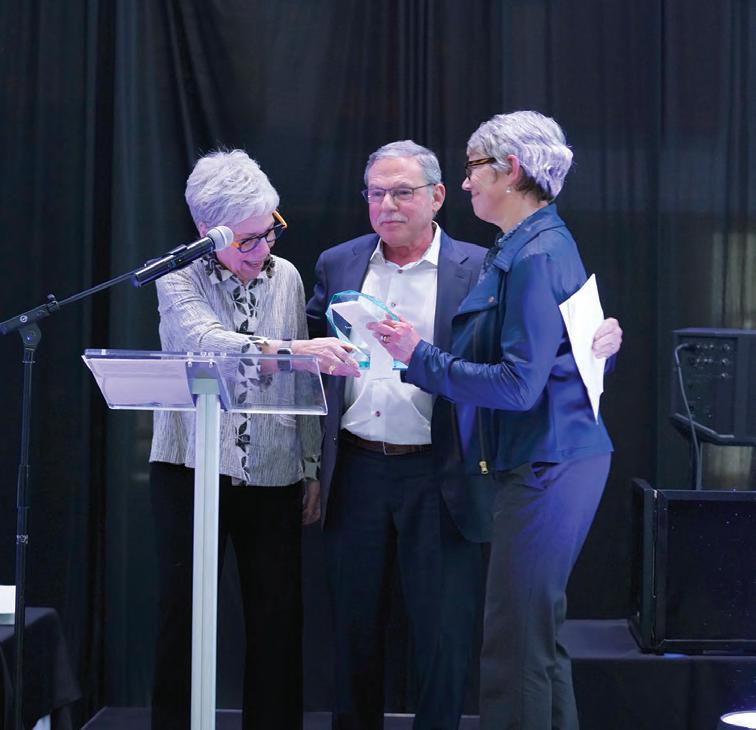
She concluded that the work the JWF accomplishes in empowering women is “seminal” in the local community. In the past year alone, the JWF has awarded $183,700 in grants to local organizations, and has welcomed 19 new trustees after instating an annual donation model.
Four grantees — Casa San Jose, Community Day School, H.O.P.E for Tomorrow, Inc. and Yeshiva Girls School — were featured for the remarkable work they accomplished with the philanthropic support of JWF.
The JWF also presented the inaugural Judith R. Roscow Young Women’s Legacy Awards. Named in honor of the organization’s cofounder who died last year, the $5,000 honor recognizes young women who are devoted to “leadership, education, community engagement and a commitment to making the world a better place.”
leadership, and entrepreneurship.” Outside the classroom, Reynolds dances at the Hill Dance Academy Theater while simultaneously managing a bustling crochet business. Between dance classes, Reynolds also teaches younger students to crochet.
Lily Sassani, a graduating senior at Burrell High School, was awarded for her unwavering commitment to “education and community leadership.” She is a member of the National Honor Society and serves as an ambassador for the Girl Scouts. In an effort to “empower kids into finding solidarity and taking action during strife,” Sassani partnered with the Holocaust Center of Pittsburgh to create the Holocaust Education Patch. She will be pursuing a Bachelor’s of Art in Visual Communication and Design at Kent State this coming fall.
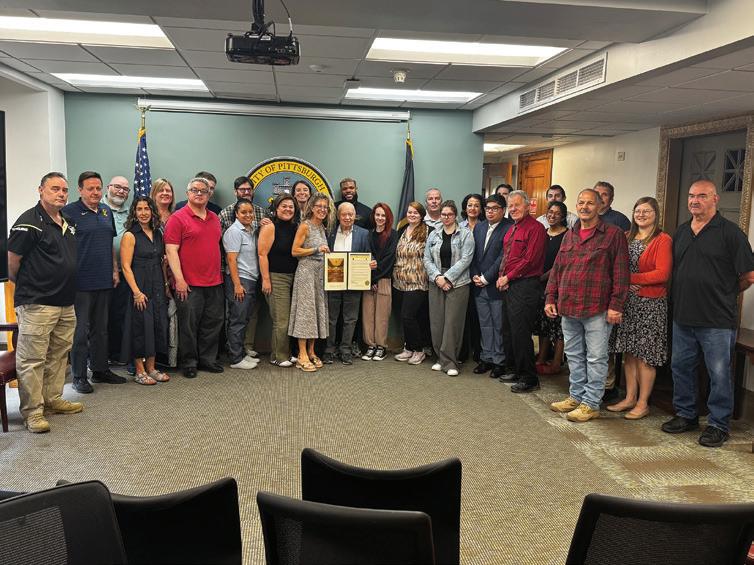
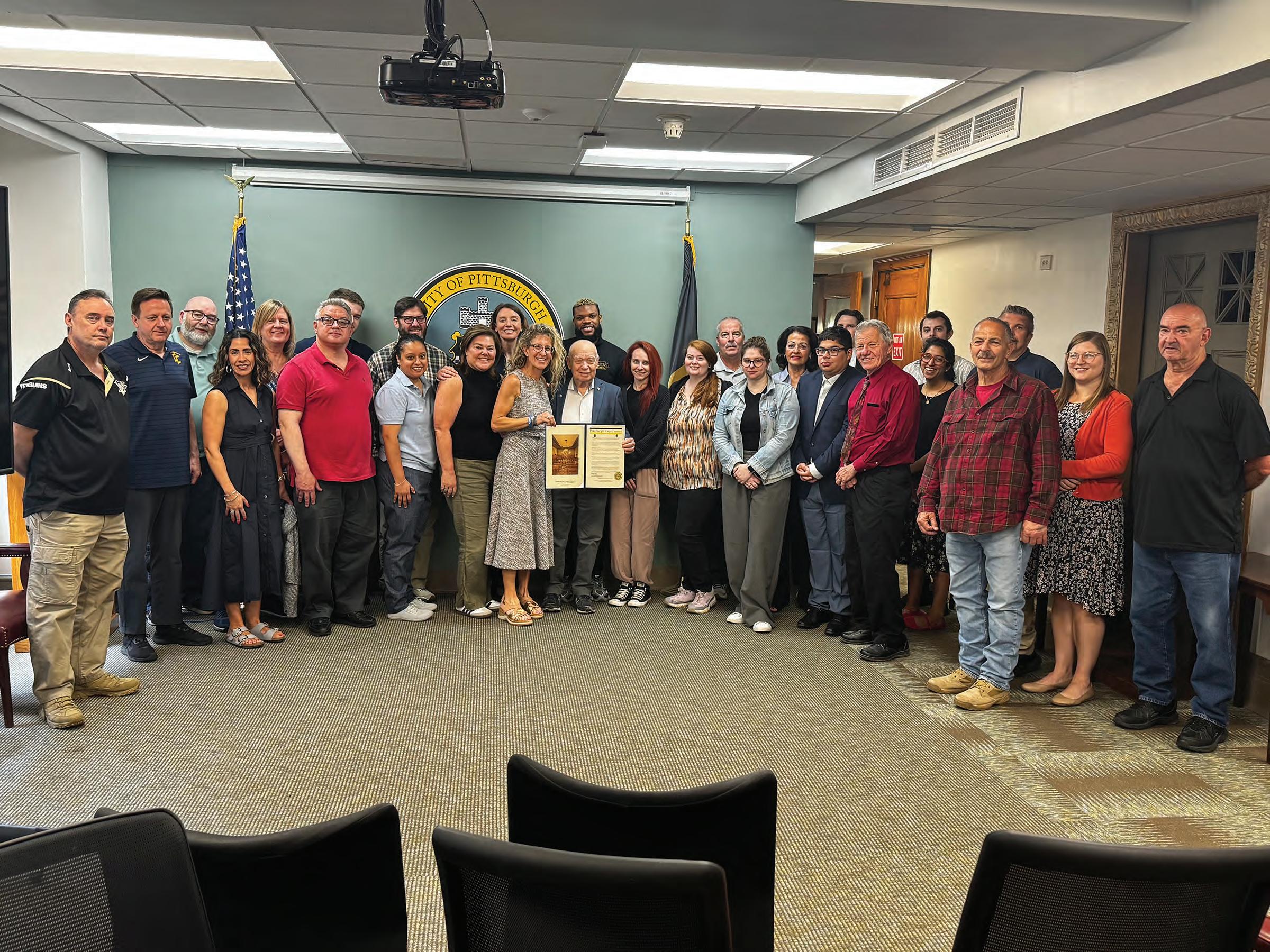
To further honor Roscow’s legacy, JWF Executive Director Judy Cohen announced that the City of Pittsburgh issued a proclamation declaring June 3 to be Judith R. Roscow Day. PJC
Octavia Liku can be reached at oliku@ pittsburghjewishchronicle.org.
LeAnn Reynolds, a rising senior at Pittsburgh Creative and Performing Arts, was recognized for her dedication to “education,
— LOCAL —
p Pennsylvania Supreme Court Justice Christine Donohue addresses the Jewish Women’s Foundation at its annual meeting on June 3 at Beit Kulanu. Photo by Octavia Liku
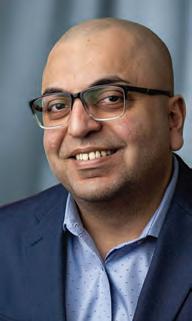
Brig. Gen. (Res.) Nitzan Nuriel is the former Director of the CounterTerrorism Bureau at Israel’s Prime Minister’s Office (2007–2012). He served in the IDF for over 30 years, primarily in the Golani Brigade, holding senior positions including Deputy Division Commander in both the West Bank and the Gaza Strip. He played key roles in Israel’s withdrawal from southern Lebanon and in operational planning along the northern border. From 2001 to 2004, he served as Military Attaché to the United States, acting as liaison between the IDF and U.S. defense agencies. For his service, he received the Legion of Merit from the U.S. President. Following his military career, he joined Israel’s National Security Council, where he led national crisis management and counter-terrorism strategy, including cyber security, border protection, and international cooperation.
AHMAD FOUAD ALKHATIB
Ahmed Fouad Alkhatib is a Palestinian American humanitarian activist and blogger. He is the founder and executive director of Project Unified Assistance, a nonprofit organization working towards the establishment of a humanitarian airport in the Gaza Strip, to be run and operated by the United Nations. He is also a senior fellow with the Atlantic Council, and the founder of the organization’s Realign For Palestine project.
YISRAEL KLITSNER, SERIES MODERATOR
Klitsner is a fellow at the Jewish People Policy Institute (JPPI) who has deep connections to our community. He and his family lived in Squirrel Hill but returned to Israel after October 7 so he could rejoin his IDF unit. Klitsner, who has served as Diaspora Affairs Advisor to Prime Minister Naftali Bennett, and worked for AIPAC in Israel, is passionate about educating and building community around the state of Israel and its relationship with the United States.
Israel’s Geopolitical Outlook
Tuesday, June 16 • 7 pm
JCC Squirrel Hill • Katz Theater
$36/person
Participants will gain valuable insights into the strategic dilemmas that Israeli decision-makers encounter, as well as the prospects for regional normalization and renewed peace efforts, alongside the challenges they face in achieving these goals.
For more info: Fara Marcus • fmarcus@jccpgh.org
NITZAN NURIEL
Headlines
After years of hostile relations with Israel, Slovenia’s new prime minister signals diplomatic reset
Less than an hour after Slovenia’s newly elected prime minister, Janez Janša, was sworn into office by the country’s parliament, he had the Palestinian flag lowered from a government building, JTA reported.
The move marked the first step in a sharp reorientation of Slovenia’s posture toward Israel under Janša. The right-leaning prime minister, who previously held office in 2022, replaced a prime minister for the liberal Freedom Movement party.
Israeli Foreign Minister Gideon Saar announced last week that Israel would open its first-ever embassy in Ljubljana, Slovenia’s capital, writing in a post on X that the move was a statement of “friendship, dialogue, and a shared belief in freedom, democracy, and security.”
Janša replied to Saar’s post, writing, “Welcome to Ljubljana. Looking forward to a new era in Slovenia-Israel relations.”
Under Slovenia’s outgoing prime minister, Robert Golob, the country voted to recognize a Palestinian state in June 2024 and became one of the few European Union countries to label Israel’s war in Gaza a “genocide,” a charge Israel firmly rejects. It was one of five nations to boycott the Eurovision song contest this year over Israel’s participation.
Last year, Slovenia also became the first EU country to impose a travel ban on Israeli Prime Minister Benjamin Netanyahu, as well as far-right ministers Itamar Ben Gvir and Bezalel Smotrich.
But now, Janša, an admirer of President Donald Trump and an ally of former Hungarian Prime Minister Viktor Orbán, appears eager to reset relations with Israel.
Colombia’s president tweets ‘Heil Hitler’ over column endorsing right-wing candidate
Colombia’s outgoing left-wing president, Gustavo Petro, on Sunday posted “Heil Hitler” in response to an op-ed column supporting the right-wing candidate in this month’s presidential runoff vote, JNS reported.
The inflammatory rhetoric was widely condemned ahead of the runoff election, where the opposition conservative candidate is the front-runner.
“The president of Colombia posted, ‘Heil Hitler.’ In 2026,” the New York-based Anti-Defamation League tweeted on X. “An elected head of state shouldn’t have to be told why posting a Nazi slogan is monstrous and unacceptable. There is no excuse for it and no context that justifies it.”
Israeli Ambassador to the United Nations Danny Danon wrote, “President of Colombia @petro gustavo, even in the situation you’re in, there are lines that aren’t crossed. Using Nazi slogans is a low that there’s no coming back from.”
The column in the Colombian daily El Espectador supported presidential candidate Abelardo de la Espriella and condemned Iván Cepeda, the candidate of the left-wing coalition backed by Petro.
Petro severed diplomatic ties with Israel in 2024 over the Gaza war triggered by the Oct. 7, 2023, Hamas-led attack and exp elled Israeli diplomats from the South American country.
Today in Israeli History
June 15, 1949 — Sharett updates Knesset on Israel’s frontiers
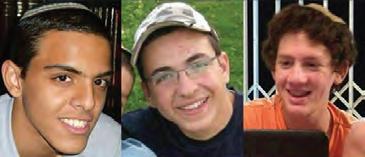
June 12, 2014 — 3 teens are abducted, killed
Three Israelis ages 16 to 19 are abducted near Alon Shvut in the West Bank and are shot dead. The two attackers are believed to be Hamas members. The bodies are found 18 days later, sparking Operation Protective Edge.
June 13, 1950 — Harari Resolution ends constitution push
The Knesset adopts the Harari Resolution, sponsored by Yizhar Harari, which stipulates that Israel will adopt a series of Basic Laws instead of crafting a single constitution as promised in the Declaration of Independence.
June 14, 2009 — Netanyahu outlines two-state solution
Prime Minister Benjamin Netanyahu lays out his vision for a two-state Israeli-Palestinian solution. It includes a demilitarized Palestinian state, no Palestinian refugee return to the state of Israel and no more Israeli settlements.
Israel seeks ‘friendly countries’ in Pacific, envoy says after Fiji embassy reopening
The reopening of Israel’s embassy in Fiji reflects a strategic decision by Jerusalem to prioritize ties with friendly nations and invest in those relationships, Ambassador to Fiji Maya Yaron told JNS.
The embassy was originally opened in 1995 and operated for about seven years before closing during the Oslo Accords era, when Israel shifted diplomatic resources toward expanding its presence in the Middle East. It was re-inaugurated on June 1, with many staff members already in place.
Although Fiji has fewer than 1 million people, it occupies a strategically important position in the Pacific and serves as a regional hub for many island nations.
Yaron, who has spent more than two decades representing Israel abroad — including postings in Dakar, Senegal; Beijing, China; and at the United Nations in Geneva — recently completed a threeyear term as Israel’s representative to Taiwan.
Yaron’s jurisdiction includes 10 Pacific island nations, including Papua New Guinea and the Republic of Nauru. Those countries play an important role in ocean and climate issues and have significance for Israel in international forums, particularly at the U.N., she noted.
“It is very important for Israel to be looking for friendly countries that support us, understand us and can also share their opinion with other countries, helping us to be more understood and accepted in the international community,” she said.
Speaking to the Knesset after armistice agreements have been signed with Egypt, Lebanon and Jordan, Foreign Minister Moshe Sharett says Israel intends to keep the territory gained during its War of Independence.
June 16, 1933 — Jewish Agency’s Chaim Arlosoroff is shot dead
Two men fatally shoot the Jewish Agency’s Chaim Arlosoroff, just back from arranging Jewish emigration from Germany, on the beach in Tel Aviv. The crime is never solved.
June 17, 2010 — Haredim are jailed in school discrimination case
Accused of anti-Sephardi discrimination, 35 Haredi fathers of girls attending a Hasidic school in Emanuel are jailed for 11 days after refusing a Supreme Court order to send their daughters to a different school.
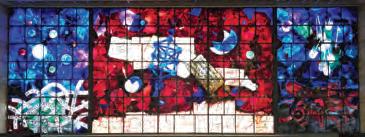
June 18, 1992 — Artist Mordecai Ardon dies Painter Mordecai Ardon, known for using religious symbolism and developing artwork from realistic to abstract, dies in Jerusalem at 95. He directed the Bezalel School of Arts and Crafts from 1940 to 1952. PJC
In first, Israeli doctors deliver gene therapy into brain of 8-month-old baby
In a medical world first, Israeli doctors have delivered gene therapy into the brain of an 8-month-old baby suffering from a rare, life-threatening form of genetic epilepsy, the Hebrew University of Jerusalem says, according to The Times of Israel.
The procedure, which replaced the missing critical gene, was performed at the Schneider Children’s Medical Center in Petah Tikva.
Professor Rami Aqeilan of the Lautenberg Center for Immunology and Cancer Research at the university’s Faculty of Medicine laid the groundwork through his research into the WWOX gene.
Children born with this severe genetic defect suffer from intractable epilepsy, profound developmental delays, and a high risk of premature death. While mutations of this gene are found worldwide, the specific catastrophic mutation treated in this case is particularly prevalent among people of Yemeni Jewish ancestry.
Dr. Naama Orenstein and Dr. Dror Kraus of Schneider Children’s Medical Center performed the surgery last month. The doctors used a single injection to deliver healthy copies of the WWOX gene directly into the child’s brain neurons.
The child has since been discharged from the hospital and is in stable condition.
“What began as a scientific effort to understand the biological function of a gene has now become a potential treatment for children suffering from one of the most severe forms of epilepsy,” says Aqeilan. PJC
— Compiled by Toby Tabachnick
Items are provided by the Center for Israel Education (israeled.org), where you can find more details.
— ISRAEL —
p (From left) Eyal Yifrach, 19, Gilad Shaar, 16, and Naftali Frenkel, 16, were abducted and killed June 12, 2014.
p Mordecai Ardon’s stained-glass triptych depicting Isaiah’s vision of peace is at the National Library of Israel. By Fuzheado, own work, CC BY-SA 3.0, via Wikimedia Commons
Headlines
Bondi:
“All you want is never again,” she said. “Never again should any family have to go through this kind of trauma and tragedy.”
She said that while each person affected is on their own journey, the Sydney Jewish community is on a “healing journey.”
“There are some similarities [to Pittsburgh] because it is an attack on the ability to gather as a Jewish community joyfully and ritualistically in a way that is meaningful to our people and religion. That’s what was attacked. So, they’re trying to figure out what that means and how do they heal. They’ve started to ask questions about how to support the victims and look at the longterm community healing.”
Finkelstein and Feinstein delivered two presentations while in Australia, something Feinstein found meaningful.
The first presentation, facilitated by Finkelstein, was centered on what happened in Pittsburgh on Oct. 27, 2018, and the community’s immediate response. The second, led by Feinstein, was about the trauma work that’s been done as a community.
She said the two were able to talk about some of the lessons learned after the Pittsburgh synagogue shooting.
“The community had a ton of questions because they knew what to ask. They knew what they’re worried about,” she said.
It’s a unique role that leaders in Pittsburgh and other cities of mass shootings can take on, Feinstein noted, especially concerning the lessons learned and how leadership looks after a tragic event like the attack in the Tree of Life building. Eleven worshippers from
Continued from page 1 Forum:
Continued from page 1
community, McCormick recounted living near the Tree of Life building, traveling to Israel following Oct. 7 and watching recorded footage of Hamas’ terror attack.
“You can’t come away from that without thinking we need to do everything we can to support Israel and that Israel has every right to defend itself,” he said.
He went on to discuss how surprised he was to see virulent antisemitism on college campuses following Oct. 7 — including the assault of one of his campaign workers on the University of Pittsburgh’s campus.
Fetterman said that as a student of history he learned that many people and societies turn their backs on the Jewish community when it’s under siege.
“I always promised I would never be a part of that,” he said.
He recalled Israeli Prime Minister Benjamin Netanyahu’s 2024 address to Congress and noted that several Democrats who were calling for a ceasefire turned their back to Netanyahu while he spoke.
Fetterman was emphatic in his support for the Jewish state.
“I’m tired of hearing questions like, ‘Should Israel exist?’ Absolutely, 100%. It’s not going anywhere and I’m always going to vote for whatever it needs — military, financial or intelligence,” he said. “It’s a miracle and a paragon of democracy.”
Asked about antisemitism in politics,
three congregations — Dor Hadash, New Light and Tree of Life — were murdered that day; six other people, including first responders, suffered serious injuries.
“We can give and share with other leaders who understand what problems and challenges there are and we can offer some tangible solutions,” she said.
Nearly 50% of Jewish students attend a Jewish day school in Sydney. Finkelstein and Feinstein visited one of those schools, which was deeply affected by the attack: Nine students lost their fathers, two students were shot, 90 students witnessed the attack, and eight staff members were at the scene of the shooting. Another 50 students were in Israel.
The Pittsburghers also visited the Chabad at Bondi, previously led by Rabbi Eli Schlanger, who organized the Chanukah event. Schlanger was killed in the attack, but the pair met his widow and father-in-law, who oversees the Chabad center.
And while it may seem like those visiting the Australian Jewish community gave more than they received, Feinstein said that wasn’t true.
“I found incredible meaning and better understanding of those directly impacted and a way to honor the Jewish lives that were taken, and a better understanding of Jewish life in Australia and a sense of shared respon sibility to protect one another,” she said.
Finkelstein and Hasson have created a stronger bond, something that began when Finkelstein emailed the JCA head just hours after the Bondi Beach shooting. After his initial email and Hasson’s reply, Finkelstein sent another email with seven points that needed to be considered in the days following the attack.
“We all have our own experiences; their experience is different from ours,” Finkelstein said. “The only thing we can do is tell them what we did really well and
“I have a whole new understanding of what Federation is beyond Pittsburgh,” she said. “I work a lot with our local Federation, but I don’t think I knew as much about the JFNA until this experience. It provided an understanding of the large work of the Federations.” PJC
David Rullo can be reached at drullo@ pittsburghjewishchronicle.org.
McCormick acknowledged its existence in the Republican Party — especially on social media and among figures such as Tucker Carlson and Candace Owens — but argued it is a growing force in the Democratic Party.
“I don’t think any people in the Republican Party that are running for office [have] Nazi tattoos,” McCormick said, apparently referencing Maine Democratic Senate candidate Graham Platner. Platner has covered up the tattoo, claiming he didn’t realize its significance when he got it.
Fetterman said that a Nazi tattoo previously would have been a non-starter for a Democratic candidate, but now it’s explained away. He recalled Platner’s resurfaced Reddit post under the name ‘P-Hustle,’ where he praised Hamas’ 2014 cross-border raid that resulted in the death of Israeli soldiers.
Fetterman also called out Pennsylvania House hopeful Chris Rabb for his antiIsrael rhetoric.
“That’s heartbreaking for me,” he said, speaking of the anti-Israel extremists in his
party. “There’s always going to be moral clarity. That’s been the easiest choice for me.” Fetterman also criticized J Street for opposing U.S. funding for missiles used by Israel’s Iron Dome defense system. Israel, he said, is America’s “special ally” and deserves respect.
“To use terms like ‘genocide,’ or to say that they’re the aggressor or anything like that — that’s a community that really understands what the term means. They’ve lived through it,” Fetterman said.
Speaking about America’s upcoming 250th anniversary, McCormick recalled the letter George Washington wrote to the Jewish community of Newport, Rhode Island, in 1790.
“He talked about a country where religious faith would be free and where the Jewish people and America would have the opportunity to prosper,” McCormick said. “If George Washington could have imagined in 1790 the America we have today — the prosperity, the incredible opportunity for all of us, including the Jewish people — he would have been staggered at how wildly successful America has been living true to his values.
“I think in this 250th we should obviously stare hard at the problems and challenges, but we should not lose sight of the miraculous opportunity and success that America has brought to all of us.” PJC
David Rullo can be reached at drullo@ pittsburghjewishchronicle.org.
p From left: AJC CEO Ted Deutch, Sen. Dave McCormick and Sen. John Fetterman in conversation at the AJC Global Forum, June 2 Photo courtesy of the American Jewish Committee
p Jeff Finkelstein and Maggie Feinstein brought rocks painted by Pittsburgh children to lay at the site of the Bondi Beach shooting. Photo courtesy of Jeff Finkelstein
p A menorah marks the spot where a Chanukah shooting took place at Bondi Beach in Australia. Photo courtesy of Jeff Finkelstein
Headlines
Canada’s new council to tackle antisemitism divides Jewish groups
By Shira Li Bartov | JTA
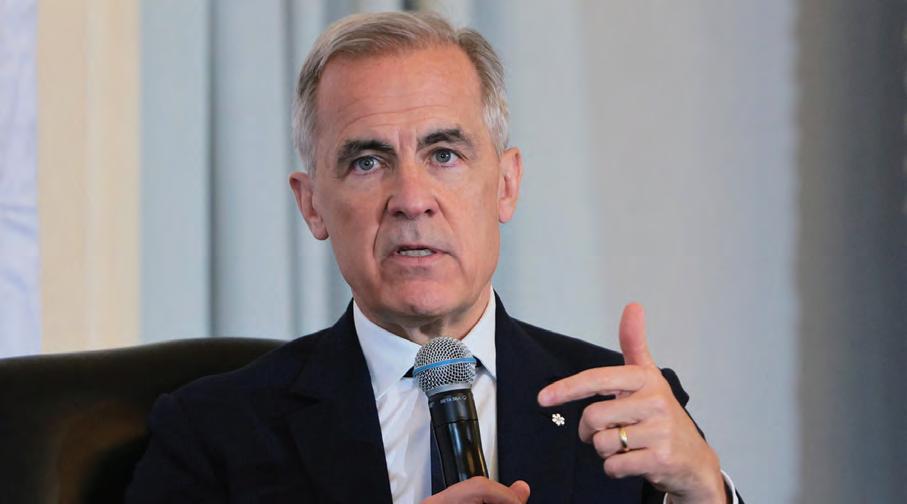
Canadian Prime Minister Mark Carney has announced a plan to fight antisem itism, but Canadian Jews are debating whether it’s enough.
Carney said on Monday that the country was “failing Jewish Canadians” as antisemitic hate crimes rose to the highest levels seen in Canada since World War II. In a speech at Toronto’s Holy Blossom Synagogue, he announced a new Ministerial Advisory Council on Rights, Equality, and Inclusion to guide the government in combating all forms of hate and racism, with the “first responsibility” of addressing antisemitism.
Pressure was mounting on Carney to stem the tide of attacks since 2023, which have included gunfire at Jewish schools and syna gogues and attacks on Jewish businesses and community centers.
Carney’s response has exposed faultlines among Canadian Jews over what tackling antisemitism should look like. Carney, the leader of Canada’s Liberal Party who recognized a Palestinian state last year, joins a growing number of left-leaning world leaders to grapple with fighting antisemitism while preserving room for Israel critics in their political tents.
Some Jewish groups are criticizing the council’s bureaucratic mandate and Carney’s general targeting of “hate,” saying his proposal is too broad and ineffective for Jews in need of urgent protection. Some Conservative politicians and Jewish leaders also targeted the makeup of the council, whose seven members include one prominent Jewish politician alongside a lawyer representing pro-Palestinian campus activists and a former Liberal Party lawmaker and ex-chair of the Canadian Arab Federation. The last especially has been criticized by some pro-Israel voices.
Other Jewish groups support Carney’s move to unite efforts against antisemitism, Islamophobia and other forms of racism under one umbrella. Liberal and progressive leaders including Maytal Kowalski, head of the group JSpaceCanada, told the Jewish Telegraphic Agency that attacks on the council’s Arab member were “rooted in racism.”
Carney said the new council will assess the nature, scale and drivers of antisemitism, align federal policies and public safety programs to confront hate, and improve data collection on hate incidents.
Those measures did not satisfy B’nai Brith Canada, the country’s oldest Jewish advocacy group, which called for stronger enforcement and prosecution.
“Absent was a clear commitment to mobilize all levels of government, law enforcement, prosecutors, security agencies, educational institutions, and civil society around a coordinated national response,” the group said in a statement.
Melissa Lantsman, a Jewish Conservative MP, said Carney showed Canadian Jews “he thinks you are stupid.”
“‘Canada’s civic compact is failing Jewish Canadians’ is an extraordinary admission,” Lantsman said on X. “It should have been followed by concrete actions and concrete consequences for those doing the failing. Didn’t happen.”
Some Jewish groups also objected to how Carney defined antisemitism. B’nai Brith Canada, which promotes Zionism and Israel, pressed him to condemn anti-Zionism as a root of the crisis.
itism have become increasingly legitimized and normalized,” said CEO Simon Wolle. “A government cannot successfully fight antisemitism while refusing to confront one of its most prevalent contemporary forms.”
The Centre for Israel and Jewish Affairs, an advocacy arm of the Jewish Federations of Canada, similarly said that Canadians “needed to hear” Carney address anti-Zionism. “It is essential to recognize anti-Zionist extremism as a driver of hostility toward Canadian Jews since the Hamas-led October 7 terrorist attacks,” the group said in a statement.
Carney acknowledged the shadow of Israel in his speech, though he never explicitly named the country. He urged Canadians not to “transpose foreign conflicts onto each other” and ensure that “no Canadian child goes to school being seen as a representative of any foreign state.”
Attacks on Canadian Jews have surged since the Hamas attack on Israel on Oct. 7, 2023, and the ensuing war in Gaza, which has deeply soured Canadian views of Israel.
Rather than identifying political ideologies, Carney pointed to a broader threat of hatred spreading “when conspiracy becomes discourse.”
That statement was applauded by Jewish leaders like Kowalski, who said that conspiratorial thinking and polarization lay at the root of dangers not only against Jews, but all minority groups.
“I think that it is a mistake to say that it is Israel or anti-Zionism, or the war in Gaza, or what is happening now in Lebanon or Iran, that is causing the rise of antisemitism,” said Kowalski, whose liberal Zionist organization, JSpaceCanada, advocates for a two-state solution to the Israeli-Palestinian conflict.
“I think, quite frankly, that’s giving antisemites too much credit. It’s saying once these things end, they will cease to be antisemitic, and that is simply not true.”
Independent Jewish Voices, a progressive group, also told JTA that it welcomed the government’s decision to “bring together the fights against antisemitism, Islamophobia and other forms of organized hate.”
The council’s makeup has been closely scrutinized by Conservative politicians and Jewish leaders.
Carney announced the appointment of Marc Gold, a lawyer and Jewish community leader who retired last year from the Senate of Canada, to join the body. The council will be chaired by Marc Miller, the minister of Canadian identity and culture. It also includes former Liberal MP Omar Alghabra, the first Syrian-born Canadian elected to the House of Commons and previous chair of the Canadian Arab Federation, and Avnish Nanda, a lawyer who is representing pro-Palestinian activists in a lawsuit against the
Conservative Leader Pierre Poilievre singled out Alghabra, telling reporters on Tuesday, “I’m not sure he’s the right guy to combat antisemitism.” He accused Alghabra of “lobbying me efore he was in politics to keep Hezbollah legal.” Poilievre did not respond to a request for more information about his allegation and Alghabra did not respond to a JTA request for comment.
During a parliamentary debate in 2016, Alghabra said that Hamas was a “terrorist organization” and called for “peaceful dialogue and consultations to reach a peaceful resolution to the two-state outcome that we would
Alghabra’s appointment was also decried by Rabbi Zolly Claman of Montreal’s Tifereth Beth David Jerusalem Congregation. Claman told Fox News on Thursday that he was “truly shocked” because Alghabra “publicly mourned the death of Yasser Arafat and remained silent when asked to condemn the attacks of Oct. 7.”
Alghabra condemned the attacks on Oct. 13, 2023, saying on X, “The terror attacks committed by Hamas against Israelis are horrific and unjustifiable.” He added, “The images of mass destruction of Gaza are horrifying. Civilians in Gaza are defenceless and Israel has obligations under international law.”
The Fox piece linked a video recorded by a member of the far-right website Rebel News, in which a videographer followed Alghabra while he walked on a street and asked whether he condemned the attack. Alghabra did not answer or acknowledge the videographer’s questions.
After the 2004 death of Arafat, the first
president of the Palestinian Authority who both oversaw terror campaigns against Israel and negotiated a framework for peace with it, Alghabra told the Globe and Mail that Arafat “played a tremendous role in highlighting the Palestinian struggle for independence and making it visible in the international arena.”
Kowalski said many critics of Alghabra’s appointment were “writing someone off because they are Arab.” She worked with Alghabra on a panel hosted by the Israeli newspaper Haaretz last year, during which she said that he contributed a “great voice” to discussions about Canada’s relationship with Israel. “It’s very upsetting to me, because he is someone who has always been a great ally to the Jewish community,” said Kowalski, who told JTA that Alghabra was not doing interviews after he did not respond to a request for comment.
Nanda is currently representing two Palestinian Canadian alumni and a Jewish American professor in a lawsuit against the University of Alberta. They allege that the school violated their freedom of expression, assembly and association by directing police to forcibly remove a pro-Palestinian encampment in May 2024, according to the CBC.
B’nai Brith has not explicitly addressed the claims made about members of the council, but has said the group “lacks the mandate and expertise to lead the fight against antisemitism in Canada.”
Kowalski argued that the stakes of combating hatred called for a diverse coalition. “If such a council were to be built for anti-Palestinian racism, I would equally hope that they would have Jews on that council,” she said. PJC
“Don’t wait for the perfect moment, take the moment and make it perfect.”
p Canadian Prime Minister Mark Carney speaks at the Economic Club Of New York in New York City, May 28, 2026.
Photo by Michael M. Santiago/Getty Images
Belonging matters: Why I’m returning to synagogue life
Guest Columnist
American Jews are stepping away from synagogue life. This is not new.
For years now, many people have drifted away from formal Jewish institutions for reasons that are both practical and personal. Membership dues are expensive. Schedules are packed. Some feel disconnected from organized religion altogether. Others believe Jewish identity can thrive perfectly well without buildings, clergy, or official membership.
BBYO as a Jewish community to help shape them. But I’ve realized I need something, too. Adulthood needs community just as much as childhood does.
the Christmas season. Tired of being the kid outside the dominant culture. At 8 years old, he already understood what it meant to feel separate.
Antisemitism no longer feels like an abstract chapter in history books or something confined to extremist corners of society.
Modern life has convinced many of us that independence is the highest form of adulthood. We move frequently. We curate friendships digitally. We substitute convenience for commitment. We consume community instead of building it.
But humans were never meant to live untethered.
We need places where people notice when we are missing. Places where our children grow up around adults who know their names. Places that exist not just for moments of crisis or holidays, but year-round.
A tribe.
And in many ways, they are right. Jewish life today is portable. We carry it in podcasts, Instagram accounts, Substacks, group chats, summer camps and occasional holiday dinners. You can feel deeply Jewish without ever walking into a sanctuary.
For a while, I understood that instinct. And yet, lately, I’ve found myself moving in the opposite direction.
I am rejoining a synagogue.
Not because I suddenly became more religiously observant. Not because it is trendy. Frankly, it is probably the least trendy thing I could do.
I am doing it because the older I get, the more convinced I become that human beings need a home base. And because Jewish children, especially, need tribes.
Someday, when my kids are old enough, I know they will have a youth group like
Over the last two-and-a-half years, many Jews have experienced something unsettling. Antisemitism no longer feels like an abstract chapter in history books or something confined to extremist corners of society. It appears casually now. In social media comment sections. On college campuses. In conversations that once would have felt unimaginable in mainstream American life.
There is something uniquely disorienting about scrolling through your phone and encountering people debating your humanity, your legitimacy, or your right to exist. It chips away at you slowly.
And it makes you ask a deeper question: Where do I actually belong?
Not online. Not theoretically. In real life.
Years ago, when I was the director of a local supplemental Jewish education program, a third grade boy told us he did not want to be Jewish anymore. It was December.
He felt different at school. Othered during
Thankfully, his parents did not let that moment define him.
They kept bringing him. They kept building Jewish life around him even when it would have been easier not to. He stayed connected to the community long enough to grow into his identity instead of running from it.
Years later, he became a high school madrich in that same program. Confident. Proud. Grounded. The kind of Jewish teenager younger kids looked up to.
I think about him often now.
Identity is fragile when children are young, and it must be cultivated deliberately. It is strengthened through repetition, relationships, memory, ritual and community. Through seeing other people who are like you. Through having somewhere to go when the world feels confusing.
A synagogue cannot solve antisemitism.
But it can offer something powerful in response to it: belonging.
And honestly, this is bigger than Judaism.
Not perfect people. Not ideological uniformity. Not agreement on everything. Just a shared sense that we are responsible for one another.
That is what I want my children to inherit. Not simply Jewish literacy, but Jewish rootedness.
I want them to know that Judaism is not only something you practice privately or defend online. It is something you live among other people. Something that holds you up when the world feels unstable. So yes, I am rejoining a synagogue. Not because I believe institutions are flawless.
But because I no longer believe that trying to do life entirely on our own is sustainable either.
Now I only need to figure out which one. PJC
Liron Lipinsky Salitrik is a Jewish educator, communal professional and mom of two. She lives in the suburbs of Pittsburgh.
When victims become suspects: The moral inversion of our time
Guest Columnist
By Kamyar Behrang
many political and media conversations, the narrative came to begin not with the massacre itself, but with Israel’s military response.
This shift is more significant than it appears. When the beginning of a story changes, so does its moral architecture.
In every major conflict, the battle over memory begins almost as quickly as the battle itself. Facts remain the same, but the starting point of the story gradually shifts. Events are reordered, context is selectively applied, and responsibility is redistributed. What begins as an argument about history eventually becomes an argument about morality.
Since the Hamas massacre of Oct. 7, 2023, this process has unfolded with remarkable speed. The deadliest mass murder of Jews since the Holocaust initially shocked the world. Civilians were slaughtered in their homes, families were executed, children were murdered and hundreds of hostages were dragged into Gaza. The brutality was documented by the perpetrators themselves. Yet as months passed, the defining event that triggered the current phase of the conflict increasingly receded from public discussion. In
and public discourse, antisemitic hostility is increasingly discussed as though it were primarily a reaction to Israeli policy. Such arguments overlook a historical reality that long predates the modern state of Israel.
Antisemitism survived kingdoms, empires, republics and revolutions. It flourished when
When the beginning of a story changes, so does its moral architecture
The focus moves from the perpetrators of violence to the conduct of those responding to it. The central question is no longer what happened on Oct. 7, but whether Israel’s reaction was proportionate, acceptable or justified. Legitimate debates about military strategy and civilian casualties become detached from the event that made those debates inevitable in the first place.
The consequences extend beyond the Israeli-Palestinian conflict. They shape how contemporary antisemitism is understood. Across parts of academia, activism
Jews were stateless and when they possessed a state. Its forms evolved, but its underlying logic remained remarkably resilient.
None of this renders criticism of Israeli policy illegitimate. Democracies require criticism. The distinction lies elsewhere. A line is crossed when the right of Jewish self-determination is treated as uniquely suspect, when standards applied to Israel are not applied elsewhere, or when violence against Jews is routinely explained through context while violence committed in their defense is stripped of context altogether. At that point,
political disagreement begins to intersect with a much older and darker tradition. What is often overlooked is that this same pattern of selective moral framing has appeared in another struggle far removed from Gaza: the Iranian fight for freedom.
For many Iranians, the phenomenon is painfully familiar.
Over the past decade, millions of citizens have repeatedly challenged the Islamic Republic through nationwide uprisings — from the protests of 2017 and 2019 to the “Woman, Life, Freedom” movement that captured international attention in 2022. Their demands have been neither revolutionary nor extremist. They have asked for accountable government, individual liberty, national sovereignty and an end to clerical authoritarianism. The response of the state has been imprisonment, torture, executions and systematic repression.
Yet the Iranian democratic movement has often encountered a peculiar hesitation abroad. Support has frequently been filtered through ideological considerations unrelated to the aspirations of the protesters themselves. Rather than focusing on the
Liron Lipinsky Salitrik
Chronicle poll results: Benjamin Netanyahu
Last week, the Chronicle asked its readers in an online poll the following question: “Is Benjamin Netanyahu the right leader for Israel at this time?” Of the 411 people who responded, 75% said no and 25% said yes. Comments were submitted by 134 people. A few follow.
Netanyahu is destroying the state of Israel internally and externally. He is attempting to dismantle democracy in Israel and empowering racist bigots. Externally he has done immeasurable damage to Israel’s standing in the world. Hopefully he can be voted out soon, but it will take a very long time to repair the damage he’s done.
I believe the security of Israel is of the utmost importance and he is not afraid to take action.
Certainly without intending to do so — or perhaps without giving it any thought — he and his even further right-wing coalition are giving ammunition and oxygen
Behrang:
Continued from page 12
victims of state violence, debates often shift toward the political identity of the opposition, the symbolism present at diaspora rallies or whether segments of the movement fit comfortably within prevailing activist frameworks. The result is a subtle but consequential inversion: the character of the victims receives greater scrutiny than the conduct of their oppressors.
The connection between these two cases is not political but methodological. In both instances, reality is filtered through ideological expectations. In both instances, solidarity becomes conditional. In both instances, foundational facts are displaced by secondary arguments. Oct. 7 is pushed to the margins of discussions about
Is Benjamin Netanyahu the right leader for Israel at this time?
to antisemites everywhere. Israel will not achieve true and lasting security this way, and Jews throughout the rest of the world will be and are imperiled by his actions.
antisemitism. The brutality of the Islamic Republic is pushed to the margins of discussions about Iran. The victims remain visible, but only after passing through an increasingly complex set of political qualifications.
This pattern is particularly dangerous because it obscures a deeper reality. The Islamic Republic is not merely another authoritarian state. It is one of the principal sponsors of the very forces that have destabilized the Middle East for decades. The regime that imprisons Iranian women, executes dissidents and crushes democratic aspirations at home is also a patron of militant movements that reject coexistence, pluralism and peace. The ideological ecosystem that fuels regional extremism abroad is inseparable from the machinery of repression that operates inside Iran.
Israel needs a new generation of leaders. Bibi is thinking and living in the past.
He is a beacon of strength for Israel.
In forming a coalition with the far right, Netanyahu has put Israel on the path to becoming a pariah state. It has been deeply painful to watch.
Netanyahu is not the problem. Iran, Hezbollah, PIJ, Hamas, PA, antisemites, anti-Zionists and their supporters and enablers are the problem. Netanyahu has been a solid, decent leader on the whole, arguably the best option, guiding the country during an extremely difficult and divisive time.
Right-wingers like him always bring death and destruction. Israel has the opportunity to be “a light unto the nations,” but that’s impossible with a right-winger in charge.
Seen from this perspective, the struggle against antisemitism and the struggle for a free Iran are not entirely separate questions. Both involve a broader contest between democratic societies and movements that reject liberal pluralism. Both reveal how easily moral clarity can be sacrificed when events are viewed through ideological lenses. And both demonstrate the dangers of confusing explanation with justification.
Historical integrity requires something remarkably simple: honesty about where a story begins.
Oct. 7 cannot be detached from any serious discussion of contemporary antisemitism. Nor can the conduct of the Islamic Republic be separated from any honest assessment of the Iranian freedom movement. When those realities are removed from the frame,
He is committed to the safety of Israelis and is actually getting something done. No other leader has been willing to do this.
A self-interested, corrupt autocrat is never the right leader for a democracy. Not in Israel, nor here in the U.S.
Netanyahu is Israel’s Trump — also corrupt and egotistical, but smarter and with a better command of the English language.
I cannot decide. It’s up to the people of Israel to decide. PJC
— Compiled by Toby Tabachnick
Chronicle weekly poll question: Do you believe AI will have a mostly positive or mostly negative impact on society over the next 10 years? Go to pittsburghjewishchronicle.org to respond. PJC
analysis gradually gives way to narrative management, accountability becomes selective and victims are transformed into subjects of suspicion.
The health of democratic discourse depends on resisting that temptation. It requires the willingness to confront terrorism without qualification, oppose antisemitism without excuses and support democratic movements without ideological litmus tests. Above all, it requires the intellectual discipline to begin with reality rather than with the conclusions we hope reality will support.
The first casualty of ideological politics is often truth. The second is solidarity with those who need it most. PJC
Kamyar Behrang is an Iranian journalist based in Washington, D.C., and serves as senior news editor at Iran International.
Show up for those who mourn
I recently attended an event hosted by The Beacon and The Friendship Circle, where Rabbi Suzanne Offit spoke to the community about how to respond to suicide loss (“Rabbi Suzanne Offit brings suicide loss support and healing message to Pittsburgh,” May 1). Support is about the community creating a safe place for the grieving family and continuing to act in meaningful ways. At first glance, this seems like an easy task, but when you dig deeper, there are so many layers to grief — and especially grief related to suicide — that we need to address before we jump in with our compassionate hearts and begin to act.
I am writing this letter as somebody who has experienced loss: My first husband died from a blood cancer.
Our Pittsburgh Jewish community is truly special and we can do extraordinary things
together; but we must be aware and careful when we reach out to others, and be deliberate with our words and actions.
Rabbi Offit explained that those who come to comfort are responsible for words of comfort, no matter how awkward it may feel. Whenever I hear someone say, “This is so sad, there are no words,” I get upset. Of course there are words! Tell the person who is grieving how you will miss their loved one, or what a wonderful person they were, or simply share a memory. It is so important to show others how you feel by showing up — to be close and present. Words are powerful. Your presence is powerful. Our community can be powerful.
Ella Zeilinger Ziff Pittsburgh
We invite you to submit letters for publication. Letters must include name, address and daytime phone number; addresses and phone numbers will not be published. Letters may not exceed 500 words and may be edited for length and clarity; they cannot be returned.
Send letters to:letters@pittsburghjewishchronicle.org or Pittsburgh Jewish Chronicle, 5915 Beacon St., 5th Floor, Pittsburgh, PA 15217
We regret that owing to the volume of correspondence, we cannot reply to every letter.
Life & Culture
‘His camera was an extension of him’: Remembering Pittsburgh photographer Hans Jonas
By Deborah Weisberg | Special to the Chronicle
Marla Jonas spends much of her time poring over photographs taken by her father, Hans Jonas, who spent close to a century documenting the people of Pittsburgh with his camera.
There are thousands of candid and portrait shots of celebrities, CEOs and socialites, as well as ordinary folks who came to Jonas Studio in Oakland for a sitting.
“My father had a special way of looking inside a person and finding a beauty they didn’t even know they had,” recalled Marla Jonas, 68. “He’d create an environment where they’d relax and engage enough that at the moment their beauty came out, he’d snap the shutter.”
Hans Jonas died May 1, four months into his 100th year, leaving a vast body of work that his daughter is cataloguing. She hopes to donate it eventually to the University of Pittsburgh.
Her father was organized, which is helping the process, Marla Jonas said, but the sheer volume of images makes the task as challenging as it is nostalgic.
Every image conjures memories, said Marla Jonas, who worked alongside her father for 35 years as a shooter and a finisher, while managing her own tutoring business.
With her father’s passing, she is looking
ahead to new pursuits that may include teaching, volunteering and travel, but she first wants to secure her family’s remarkable legacy.
“I want to be able to walk away knowing I can put a bookend of four generations of photographers and nothing will be lost.”
“There’s a lot of history there.”
One of Hans Jonas’ earliest photos was a candid shot of his Peabody High School classmate Lorin Maazel conducting the Pittsburgh Symphony Orchestra.
Maazel, a child prodigy who would grow up to become a world-renowned maestro,
Celebrations WITH A VIEW
He, his mother and sister had emigrated to Pittsburgh from their native Vienna two years earlier to flee Nazi terrorism. His father, Hermann Jonas, a photographer, lost the portrait studio his father founded nearly a century earlier to the Nazis and was sent to Dachau concentration camp, although his wife eventually secured his release and he reunited with his family in Pittsburgh, Marla Jonas said. “She had connections and a lot of chutzpa.”
The Jonases settled first in Hazelwood and eventually in Highland Park. “My grandmother was bourgeois and hated Hazelwood because of the mills,” Marla Jonas said. “It was so dirty back then.”
With money borrowed from the Hebrew Free Loan Association, Hermann Jonas set up a photography studio. “It was my father’s job to make a repayment every week,” Marla Jonas said. “The streetcar made him sick, so he’d buy ice cream and walk to Hebrew Free Loan instead.”
During his service as an Army photographer in World War II, Hans Jonas snapped a picture of President Dwight D. Eisenhower descending from a plane. “He sent a print to the White House, and he got it back with Eisenhower’s signature,” Marla Jonas said.
Hans Jonas joined his father’s studio in 1946 and was given his first important professional opportunity in 1948 when he was sent to photograph presidential hopeful Tom Dewey for 50 cents a shot.
Hans Jonas became the go-to photographer
for the annual Junior League of Pittsburgh Cinderella Ball and society weddings. But much of his work was in his studio where luminaries like Mister (Fred) Rogers, Dr. Thomas Starzl, Pittsburgh Pirates slugger Willie Stargell, and the acclaimed Irish poet Seamus Heaney, in town to give a reading, came for portraits.
When Pittsburgh Penguins great Mario Lemieux — then a rookie — arrived for a sitting, he was accompanied by an interpreter. Sessions typically lasted no longer than 20 minutes, Marla Jonas said. “After that, a person’s attention begins to wander.”
Hans Jonas and his wife, June, were world travelers. During a visit to England, Hans Jonas captured an image of Queen Elizabeth through the window of her limousine. He also photographed President Gerald Ford through a car window.
“He was always looking for something to shoot, and always ready to shoot,” Marla Jonas said. “He taught me to anticipate what comes next. He’d say, ‘You have to be present all the time.’”
“He was a great observer, and he was never without his camera.”
Because he shot film, Hans Jonas had mastered camera mechanics, chemistry and light, blending artistry with technical proficiency.
He obtained a patent for a system of lighting he called the Jonas flash director, Marla Jonas said. “The patent expired but it was a whale of a product that gave him great control with lighting in candid settings.”
Hans Jonas owned numerous cameras. While several have been sold, Marla Jonas has a couple of antiques she would like to donate to a photography museum.
Although Hans Jonas was reluctant to embrace digital technology, thinking it was a passing fancy, he eventually gave in, his daughter said. “He didn’t think it would last.”
He closed his Oakland studio in 2004 and set up shop in the Squirrel Hill home, a carriage house, he shared with his daughter, living there until his passing.
“He took his last photos when he was 99. He’d look through his archives and send prints to people with a note,” Marla Jonas said. “He never retired. He wasn’t doing it for money. It was his passion. His camera was an extension of him.” PJC
Deborah Weisberg is a freelance writer living in Pittsburgh.
p Hans Jonas Photo courtesy of the Jonas family
p Several photos by Hans Jonas, including Loren Maazel, bottom row, center Photos courtesy of Marla Jonas
Booming from Blairsville: Chamber music festival returns
Breaking Down the Walls 2026
The
Branch thanks you for helping us Break Down the Walls!
CORNERSTONE SPONSORS PROM COURT
Robert Levin and Kerry Bron, M.D.
Cindy Berger and Larry Green
The Plung Resnick Family
Andrea Solomon Eller and Andy Eller, M.D.
The Krause Family
Leonard D. Silk
Phyllis and Lawrence Wechsler, M.D.
Sheila Reicker Fine
Giant Eagle Foundation
Jewish Healthcare Foundation
The Pollon Family
Hilary Tyson and Charles Porter
The Posner Foundation of Pittsburgh
The Whitehill Family
UPMC Western Behavioral Health
Naomi Siegel and Eric Cooper
Tom and Cheryl Fogarty, Ed.D.
Havenside
HICO America
Susan Friedberg Kalson and David Kalson
Anne Witchner Levin and Michael Levin
Lorrie Rabin and Paul Pitts
Deborah Rubin
Cathy Green Samuels and Mike Samuels
Linda Simon
Strassburger McKenna Gutnick & Gefsky
Shari and Rick Sweet
The Sol and Tina P. Waxman Family Foundation
Dentons
Nancy and Larry Epstein
Nancy E. Gale
Susan and Farrel Gerber
Judy Ryave McGuire and Brian McGuire
Steve and Marla Papernick
Lisa and Lee Oleinick
David Sufrin and Diane Samuels
ACTION-Housing, Inc.
Anonymous Board Member
Beatrice S. Schutte Foundation
Cathy Reifer and Sam Braver
Judy Greenwald Cohen
Amy and Gary Dubin
Lori and Richard Guttman
H2R CPA
Teddi and David Horvitz
Sue Berman Kress and Doug Kress, M.D.
Susan and Louis Leff, M.D.
Karen J. Levin
Littles Shoes
Mark and Jane Mendlow
Mutual of America
Pittsburgh Jewish Chronicle
Rita and Andy Rabin
Theresa Greco and Reid Roberts
The Rosenberg Food Group
Rothschild Doyno Collaborative
Susan Rudzki
Laney, Daniel, Jacob, and Allie Ryave S&T Bank
Howard and Caren Sniderman
Squirrel Hill Urban Coalition
Mona and EJ Strassburger
Carol Tabas
Joyce and Harvey Tyson Verland
Wagner Agency, Inc.
Barb Ginsburg and Harry Wenkert
p Israeli violinist Roni Shitrit and Turkish pianist Izem Gurer perform at the Blairsville Chamber Music Society concert in Nov. 2025.
Photo courtesy of Blairsville Chamber Music Society.
p Blairsville Chamber Music Society founders Sarah Marshall and Avital Mazor Photo courtesy of Blairsville Chamber Music Society.
Life & Culture
Gleanings from Shabbat
By Tim Miller | Special to the Chronicle
How lucky we are every Friday night to reenact and continue the tradition first mentioned on the seventh day of creation. Of course, the only resting happening then was God’s, and it took until Exodus 23:16, after we made it through the Reed Sea — but before the revelation at Sinai — to be told that Shabbat was a gift for us: “Tomorrow is a day of rest, a holy Sabbath of God.”
The longest tractate of the Talmud is devoted to Shabbat, yet even there the day and its observances are not (and cannot) be exhausted. While we are often called a People of the Book, we could just as well be called a People of the Day. This might be why the sages say, “The Sabbath is equal in worth to the whole of the Torah.”
The sages also tell us that, “The Sabbath was last to be created, but first in God’s mind. It was the culmination of all creation. Indeed, everything exists for the sake of the Sabbath. The Sabbath is the source for all blessings.” And elsewhere: “When Jews keep the Sabbath, their souls enter the Garden of Eden.”
Many stories in the Tanakh appear to be conscious responses (with that important
last to be created, but first in God’s mind.”
Jewish twist) to tales, ideas, laws and even forms of architecture found in the ancient Near East. As Nahum Sarna writes, though, the remarkable thing about Shabbat is that it is “unparalleled in the ancient world.”
The other major units of marking time — day, month and year — “are uniformly based on the phases of the moon and the movement of the sun … the Israelite week has no such linkage and is entirely independent of the movement of celestial bodies.”
trades and apprenticeships not previously available to Jews suddenly made many of us wonder how important Shabbat was; for others, holding fast to Shabbat became more important than ever.
There are colonial American records showing that some Jewish merchants rigorously closed their businesses and kept their ships in port for Shabbat, while others became more and more lax. The agony of late 19th century arrivals to America who could only earn money right away if they would work on Shabbat, is palpable. During the 20th century it became almost impossible to avoid working at factories on Shabbat; thankfully today, at large retail and chain stories, it is perhaps easier than ever to not work on Shabbat.
Born in 1897, the great scholar of Kabbalah, Gershom Scholem, recalled growing up in Berlin in a largely assimilated environment. The Shabbat prayers were “chanted but only half understood,” and the candles were used “to light a cigarette and a cigar afterwards.” Despite the disrespect this was meant to convey, Scholem’s family never gave up even this form of observance, and we might ask why they were unable to drop it completely.
While Abraham Joshua Heschel gave us a brief and beautiful book about Shabbat, his daughter, Susannah, gave us a better gift by describing what Shabbat was like with him: Since writing is traditionally prohibited on Shabbat, she could always tell which books he had been reading on that day since they were marked with paperclips and napkins.
During the Maccabean war with the Greeks, the Maccabees and their army were willing to fight on Shabbat, where previously Jews had refrained. The Romans were never terribly curious to understand the Jews living in their empire, and the philosopher Seneca could make no sense of Shabbat: It was unprofitable, he thought, since by “introducing one day of rest in every seven, they lose in idleness almost a seventh of their lives.” We might want to talk to him about what true rest means, or sanctification, or ask what his definition of work is.
In the early Middle Ages, Jewish traders in Muslim lands arranged for their Muslim business partners to run things on Shabbat. In the 14th century, Muslim legal scholars warned their coreligionists not to refrain from certain activities on Friday and Saturday like their Jewish neighbors did (he mentions fishing, hunting and digging trenches) lest they become “seduced” by Judaism. Christians of the time had similar fears, and throughout the Middle Ages those Jews forced to convert to Christianity could show no more obvious sign of their continued allegiance to Judaism than by their reluctance to work on Saturday, or by eating certain foods on Friday night.
From the French Revolution onward, we were promised acceptance into European and American society if we were only willing to compromise our practices. Romania, for example, gave lip service to the idea of emancipating their Jews and allowing us to vote, only to make sure elections were held on Saturdays. In other countries, the possibility of agricultural work, urban
Like Judaism as a whole, Shabbat is a great cornucopia of all times and places, a great smorgasbord of words from 3,000 years ago, songs from 17th-century mystics as well as Debbie Friedman, culinary traditions from centuries or just a generation ago, and the chain of bright memories of how it was done and how it was held onto.
Shabbat always happened a few days ago, and it’s always about to happen a few days from now. In my house, nothing says Shabbat in the spring and summer like one of our neighbors always starting to cut their grass just as we are about to light candles. It’s a good reminder of everything that we don’t need to worry about or get done in the next 25 hours.
I read the story of a woman born into a Reform Jewish household who was taking steps to become Orthodox. Visiting a friend’s apartment on Shabbat, she was dismayed to be told that she couldn’t use the elevator. Climbing the stairs to the 11th floor, she said, “I thought this was supposed to be a day of rest.” Yet she kept climbing the stairs.
And if you’re reading this newspaper, chances are that you’ve kept climbing the stairs, too, in whatever way you and your family have chosen. What a command and an opportunity for our own creativity Shabbat is. I don’t know where I would be without it. PJC
Tim Miller is a poet and writer living in Pittsburgh. He is online at wordandsilence.com.
Photo by L_Shtandel via iStock
Bat Mitzvahs
Lexie Sophia Blau, daughter of Dr. Andrea Goldblum Blau and Jason Blau, will become a bat mitzvah at Beiteinu Synagogue, with Rabbi Howard Cove officiating, on Sunday, June 14, 2026. The service and celebration will take place at Normandy Farm Hotel and Conference Center in Blue Bell, Pennsylvania. Her proud grandparents are Carol and Richard Nathenson, and Hedda Blau and Gerry Blau. Lexie is named in loving memory of her grandfather Dr. Lee Jay Goldblum, of blessed
“That’s AI.”
It’s a phrase we’ve been hearing more and more over the past two or three years. Sometimes it is said as an assumption. Other times it feels almost like a complaint.
back. Keep it away from me. Give me something real.
There is a deeply meaningful lesson here.
As Jews, many parts of our lives, history and culture have changed over time. Styles have changed. Languages have changed. Communities have developed different customs. Even the way we communicate and connect with the world around us continues to evolve.
But those things are not the essence of who we are.
Leia Lucinda Mahler, daughter of Lacey Mahler and Moshe Mahler, will become a bat mitzvah at Adat Shalom during Shabbat morning services on Saturday, June 13, 2026. Her proud grandparents are Rabbi Mark Mahler and Alice Mahler, and Kathryn Acres and David Acres.
Business
Ryan Alisa Mallinger, daughter of Sarita and Rob Mallinger, and sister of Avery, will become a bat mitzvah on Saturday, June 13, 2026, at Temple Sinai. Ryan is the beloved granddaughter of Barbara and Robert Moore of Oswego, New York, and the late Nancy and Michael Mallinger of Pittsburgh. Ryan is finishing seventh grade at The Ellis School and enjoys swimming for the JCC Sailfish, playing basketball and spending time with her friends. PJC
There is no question that the technological advancements of AI are pushing the boundaries of what is possible, both in major industries and in everyday life.
Our holy Torah and its mitzvos are our essence. They do not change. They cannot change. And they have not changed for over 3,000 years.
“Generate a realistic photo of me breathing underwater,” you tell your favorite AI program. A moment later, there you are — breathing underwater.
But what is the drawback?
There are probably a few. But one that stands out is this: “That’s AI.”
Why does that person in the background have three-and-a-half eyes? Why are there so many unnecessary dashes in my essay? Yes — you know exactly what I mean.
As useful and powerful as this new technology may be, human beings still desire authenticity. We still resonate with what is real. If it looks fake, sounds fake, or feels fake, something inside us pushes
We can and should use technology, including AI, for the positive purposes it can serve. But more importantly, we should give special attention to a mitzvah we already perform — or perhaps one we have not yet begun to perform — and reflect on its eternality. Use that reflection to power boost your observance.
With this mitzvah, we are connecting to something eternal. Something unchanging. Something real. Get excited! PJC
Rabbi Dovie Kivman is executive director of Chabad of Erie County. This column is a service of the Vaad Harabonim of Greater Pittsburgh.
Rabbi Dovie Kivman Parshat Shlach
Numbers 13:1–15:41
Obituaries
EXTER: The one and only Toby Exter died June 1, immediately after saying goodbye to each of her three daughters, Rachel (David), Elizabeth (Steve) and Laura (Jack). She was predeceased by her husband, Allen, who passed in 2003. Toby was born in Brooklyn to Jewish immigrant parents, Ada Balabanov and Naphtali Gisser. She met her husband, Allen Exter, when they were students at City College of New York. They married and moved to Boston where they had two daughters. Rachel (made in New York and born in B oston) is the eldest, then 16 months later, Elizabeth was born. The family moved to Bowie, Maryland, where Toby birthed a third daughter, Laura. Family complete and after receiving a job offer from Westinghouse, Toby and Allen trekked west to Pittsburgh, with three young girls. Toby raised her family in Whitehall and became involved with activities most meaningful to her. She loved to cook, listen to music, dance, garden, support women’s rights and advocate for her favorite political issues. She worked as an office manager/bookkeeper at Ideal Specialty Shoe Company. In addition to her daughters, Toby is survived by four grandchildren, Max, Lauren, Sophie and Zoe. Her love and legacy will live on in the next generation. Graveside service and interment were held at West View Cemetery of Rodef Shalom Congregation. In lieu of flowers, please consider giving to the Alzheimer’s Association (alz.org/donate) or the ACLU (action.aclu.org/give/tribute-aclu-pa).Arrangements entrusted to Ralph Schugar Chapel, Inc. schugar.com
MANNHEIMER: On Sunday, June 7, 2026, Dr. Jack Mannheimer, 84, of Pittsburgh, passed away peacefully surrounded by his family and friends. Born the son of the late Kurt and Bessie Mannheimer. Jack was a devoted father to Alan Mannheimer (Courtney Aronowsky), Paul Mannheimer and Lori Baran (Artie Baran). Cherished Grandfather of Kurt Baran, Kylie Baran and Grady Sullivan. Brother of Bernie Mannheimer. Jack graduated from the University of Pittsburgh in 1962 and earned his medical degree from the University of Pittsburgh School of Medicine in 1966. He proudly served his country as a psychiatrist in the United States Army from 1970 to 1972. Following his military service, Jack returned to Pittsburgh, where he built a distinguished career in psychiatry for over 50 years, devoting his career and life to his patients. An avid tennis player and accomplished skier, he enjoyed staying active and spending time outdoors. He especially loved warm-weather vacations with his family. Known for his love of ice cream and outings to the movies. Jack’s greatest joy was his family. He cherished every opportunity to spend time with his grandchildren. A lifelong Pittsburgh sports fan, Steelers season ticket holder dating back to Three Rivers Stadium; Jack attended two Steeler Super Bowls. Jack even worked as a vendor at Forbes Field in his teenage years. Services were held at Temple Emanuel of South Hills. Interment Mt. Lebanon Cemetery. In lieu of flowers the family encourages donations of blood or financial contributions to support local blood banks. Arrangements
SCHWIMER: “Doc” Sidney Schwimer, DDS, an Army veteran, just shy of his 102nd birthday, passed away on June 3, 2026, surrounded by his loving family. Sid was the beloved husband of the late Charlotte Schwimer. Loving father of Dr. David Schwimer, Mark Schwimer and Dr. Charles Schwimer. Grandfather of Douglas, Elena, Levi and the late Laura Schwimer. Greatgrandfather of Braxton. Uncle of Jay, Dennis, Michael, Karen, Jennifer, Hara, Jeanie and Laura. Graveside service and interment will be held on Friday, June 5, 2026, at 10 a.m. at Homestead Hebrew Cemetery, 107 Bellwood Ave., West Mifflin, PA 15122. Contributions may be made to Congregation Beth Shalom, 5915 Beacon Street, Pittsburgh, PA 15217, or a charity of the donor’s choice. Arrangements entrusted to Ralph Schugar Chapel, Inc. schugar.com
SPATTER: Sara Spatter passed away peacefully on May 9, 2026, at the age of 87. She was the beloved wife of 27 years to the late Samuel Spatter and the loving and cherished mother to Susan Booth and Megan Finkelstein (Jay), and loving stepmother to Susan Breitenbach (David). She was the most cherished, loved and proud Grammy to Zach (Dianna), Seth and Taylor Finkelstein. Sara worked for over 45 years as an award-winning realtor, working with Equity Real Estate, Howard Hanna and finishing her career with Achieve Reality. She and Sam shared their love and passion for real estate through their many colleagues, friends and events, and loved their travels with the Pittsburgh Press food editor group, traveling to China, Peru and other “foodie” parts of the world. Sara was a lover of all animals, adoring her late Siamese cat Zoie, and Chihuahua Chi-Chi, and her cherished Chihuahua pups she leaves behind, Pablo and Pepi. Sara and Sam were active in their Mt. Washington community and loved their home, neighborhood, many friends and family. Private services were held at Beth El Congregation. Contributions may be directed to Animal Friends or a charity of one’s choice. Arrangements entrusted to Ralph Schugar Chapel, Inc. schugar.com PJC
Jewish Association on Aging gratefully acknowledges contributions from the following: A gift from ... In memory of...
Anonymous .Ben Wanetick
Harold Middleman
Frani & Milo Averbach
Paula Weiss Callis .Irene Feldman Weiss
Tibey Falk .Anne P Meyers
Sharon Galanty Knapp
Jacob Galanty
Jeffrey Kwall .Theda Rose Greenberg
Randy Malt
Jean Metzger
Bernice Meyers
Edith Flom Schneider
Freda Spiegel
Edris Weis
Renee Malt Hart
Erwin Becker
.Anne P Meyers
Max Hirsch
Sarah Greenberg
.David Howard Weis
Ruth Yahr .Barry Yahr
Contact
Sunday June 14: Celia Bergad, Rebecca Bluestone, Caroline Cooper, Tillie Gold, Shelton C Goodman, Henry E Hersh, Mollie Kramer, Celia Kweller, Martha Cohen Landy, Charlotte Leff, Helen Levin, Minnie Mendler, Morris A Robins
Monday June 15: Esther B Alman, Beatrice Helen Amper, Sarah Rosenbloom Ronay, David Scholnick, Mildred Simon, Blanche Tarlo, William Wanetick
Tuesday June 16: Sally Berger, Bessie S Bernstein, Cecelia M Fink, Jacob Galanty, Simon Gastfriend, Sarah Leah Greenberg, Sadye I Horwitz, Sylvia Herman Kahan, Betty Stern Kaplan, Abe L Kessler, Harold B Levy, Dr Ben Moresky, Henry Norell, Max Rubin, William Bernard Segal, Morry Wise
Wednesday June 17: Anna Alpern, William Brown, Ruth Tolchin Ehrenreich, Morris Finesod, Natalie Geminder, Emma E Gottlieb, Hyman Sanford Liebling, M .D , Faye Bloom Rattner, Lois Recht, Sarah Hoffman Reifman, Sidney Schatz, Irving Schiffman, Esther Solomon
Thursday June 18: Paul Braun, Samuel H Caplan, Ethel Cowen, Theda Rose Greenberg, Nathan Kaiserman, Anna Krantz, Irving Levine, Arnold Pearl, Fay Doltis Shaer, Charles B Spokane, Sam Weiner, Maurice Meyer Weisberger
Friday June 19: Nathan Ackerman, Rose Shulman Axelrod, Israel Mayer Blumenthal, Emanuel Kauf, Lillian Lookman, Max Markowitz, Edythe Markowitz Merksamer, Anne P Meyers, Matilda Neuman, Mary Pechersky, Mamie Ripp, Nathan Rosenberg, Richard Ruben, Dorothy Shakespeare, Pearl Tufshinsky, Ben Wanetick, Margaret Weinberger
Saturday June 20: Louis J Abrams, Jacob H Becker, Dr Hyman Bernstein, Harry Bluestone, Sylvia Caplan, Max Hirsch, Louis Kenner, Louis J Klein, Abraham Mallinger, Sadie Lebowitz Mittleman, Sol Louis Pearlman, Jennie Roth, Leo Saul Schwartz, Seymour Segal, Ida Mae Bloom Swartz
Life & Culture
Tribeca Festival denounces pro-Israel celebrities’ red-carpet jokes about Israeli dog rape allegations
By Jackie Hajdenberg | JTA
The Tribeca Festival has denounced jokes alluding to allegations of rape against Israeli prison guards made on the red carpet by the comedian and actor Elon Gold and pro-Israel influencer Lizzy Savetsky.
The two Jewish figures made the jokes at the world premiere of Gold’s new film “The Wedding Entertainer (The Tale of Moishe Badhan)” on June 4, and Savetsky included them in a highlights reel that she posted to Instagram on June 5.
In the reel, Gold notes that it’s signif icant that the Tribeca Festival, one of the most prestigious film festivals in the world, included a movie that was made in Israel. The implication was that at a time of surging anti-Israel sentiment, he would not have expected films with an Israeli connection to be admitted.
Then he joked about his time in Israel: “I was only raped by two Israeli dogs.”
Savetsky responded, “I thought they only raped Palestinians.”
“No,” Gold answered, laughing. “I got also a dog.”
The pair were alluding to allegations of sexual abuse by Israeli prison guards against Palestinian prisoners that the New York Times columnist Nicholas Kristof surfaced in an opinion column last month.
Real Estate
One of the most sensational claims, which Israel rejected along with all the others, was that Israeli prison guards use dogs to rape prisoners.
After the comments drew criticism online, the Tribeca Festival said in a statement Saturday that it “unequivocally condemns the offensive and unacceptable remarks” made by Savetsky and Gold.
“Sexual violence and human suffering
should never be mocked or minimized,” the festival said. “The comments do not reflect the Tribeca Festival’s values, and we regret the hurt and offense they have caused. We have not been able to reach the filmmakers.”
Pro-Israel activists have condemned the column, Kristof and the newspaper for airing the allegations against Israel, and Israeli Prime Minister Benjamin Netanyahu threatened to sue the newspaper over the claims.
In an Instagram video response to a New York Times reporter asking for comment over email, Savetsky compared the allegations made in Kristof’s column to an antisemitic blood libel.
In a comment to the Jewish Telegraphic Agency, Savetsky denied that the jokes she made on the red carpet were “about rape” as the festival alleged.
“It was a joke mocking the NYT story with a horrific blood libel,” she said in a message to JTA. “Any other interpretation is ridiculous and a deflection from the actual issue here which is irresponsible journalism meant to villainize Zionists. Comedy and the arts have always been used to address real issues—the issue here should not be dog rape, which is biologically impossible, it should be the blood libel spread by
She added, “I stand by it with no regrets. The outrage only exposes how the press and those poisoned by anti-Israel propaganda will twist anything to blame the Jews … even when it means justifying a story with zero evidence about something biologically impossible.”
Gold, who also served as executive producer on the film, did not respond to JTA’s request for comment.
“The Wedding Entertainer (The Tale of Moishe Badhan)” is an Israeli comedy about a Hasidic ex-comedian who re-enters the comedy world after a battle with addiction to earn enough money to marry off his daughter. PJC
p Lizzy Savetsky appears in New York City on May 5, 2026.
Photo by Roy Rochlin/Getty Images for Ari Ackerman
p Elon Gold appears at the Tribeca Festival, June 4, 2026.
Photo by Rob Kim/Getty Images for Tribeca Festival
Life & Culture
Pitt alum Jeff Bergman to star in Pixar’s ‘Toy Story 5’
By Octavia Liku | Staff Writer
University of Pittsburgh student Jeff Bergman paced the halls of the Oaklander Hotel, desperately trying to summon the nerve to knock on his idol’s door. Two knocks, and a murmur emerged from the cracks.
“Oh, just a jiffy,” said a breathy voice.
It was 1981 and Bergman, a speech and rhetorical communication major, had just attended a lecture given by Mel Blanc at the Pitt Student Union. Best known for his work as Bugs Bunny, Blanc’s voice had defined his generation’s childhood.
For Bergman — a young performer with a penchant for imitation — Blanc’s career as a voice actor opened a world of possibilities.
“I knew I had the right room,” Bergman told the Chronicle. “Oh my God, that’s a famous voice — that’s him.”
The door sprung open, and there stood Blanc.
“Well, are you Jewish or Italian?” Blanc asked, quizzically.
“I said, ‘I’m Jewish,’ and he looks at me for a second, and he goes, ‘All right, come on in,’ Bergman recounted. “I didn’t know it
at that moment, but maybe about a week or two later it dawned on me — ‘you just met your idol.’ I knew exactly what I wanted to do with my life.”
More than 40 years later, Bergman has followed in Blanc’s footsteps, voicing iconic roles such as Bugs Bunny, Daffy Duck and Fred Flinstone. Now, he plans to take on the role of Mr. Potato Head in the upcoming Pixar movie “Toy Story 5.”
The role of Mr. Potato Head was voiced by American comedian Don Rickles until his death in 2017. To Bergman, assuming the
role of Mr. Potato Head is about honoring a legacy that defined his upbringing.
“I remember taking my son to see the first ‘Toy Story’ 31 years ago,” he recalled. “We all loved the movie. It was the first computer generated film. We had never seen anything like it, so the impact was incredible. I immediately just connected with [Mr. Potato Head], because he was one of my favorite toys as a child … and then to hear Don Rickles’ voice come out of that — I was such a fan of his.”
When Pixar announced that “Toy Story 5” would be underway, Bergman was unsure whether the character would even make an appearance in the movie.
“I think it was my sense of wanting to preserve my childhood, and so I felt so compelled — not only for myself, but for all of the fans — to do everything I could to try to capture as much of the essence of Mr. Potato Head as possible,” he said.
“It’s a big responsibility to honor the memories that everyone has of these characters, so I’m just grateful and honored to do it.”
“Toy Story 5” will premiere in theaters across the country on June 19.
While Bergman found his calling in the heart of Oakland, he was born and raised in a Jewish family in Philadelphia. As a
child, he would mock relatives and mimic their voices. He attributes his knack for imitation to having inherited a “musical ear” from his parents.
“My mother had a terrific ear. She could play piano by ear, and my dad actually kind of tinkered around with imitating accents and things like that. I came from a really artistic family,” he said. “We all have the ability to imitate, because that’s how we learn, but with me, I just never stopped doing it.”
Beyond his work on “Toy Story 5,” Bergman, who lives in Los Angeles, recently collaborated with Six Flags Magic Mountain to bring its new attraction — Looney Tunes Land — to life. The space was unveiled on June 6.
Looking to the future, Bergman plans to collaborate with his wife and creative partner, Carla Delaney Bergman, to premiere a two-person stage show.
“It’s about a lot of experiences that I’ve had in the entertainment industry, weaved into some very funny, kind of incredible, moments that have happened along the way in my career,” Bergman said. “It’s a lifetime.” PJC
Octavia Liku can be reached at oliku@ pittsburghjewishchronicle.org.
John Lithgow wins Tony Award for portraying Roald Dahl in ‘Giant,’ about Dahl’s antisemitism
By Philissa Cramer | JTA
The actor John Lithgow won his third Tony Award on Sunday for his depiction of the writer Roald Dahl as an antisemite.
Lithgow stars as Dahl in “Giant,” which opened on Broadway in March. The play, which originated in London in 2024, depicts ultimately unsuccessful efforts to get Dahl to rein in antisemitic comments he made about the 1982 Israel-Lebanon war.
Lithgow’s award for best leading actor
in a play recognized what he has said was an effort to portray Dahl as emotionally complex, a man who had suffered grave losses and was kind to those close to him yet baldly antisemitic in his criticisms of Israel.
“Who knows where antisemitism or any bigotry comes from. In playing the role, I just looked for the damage,” Lithgow said during a March appearance on a New Yorker podcast. “To me, a person who suffered injury or carries demons, it just manifests itself in hatred of the other.”
Accepting the award, which made him, at 80, the oldest man to win a competitive Tony, Lithgow did not mention antisemitism
or Dahl specifically but said, “It’s a play about cruelty in a cruel age.” He also shouted out the play’s Jewish author, Mark Rosenblatt.
Meanwhile, multiple awards went to Jewish performers during the 79th Annual Tony Awards on Sunday, which was hosted at Radio City Music Hall in New York City by P!nk, the rock musician who has spoken publicly and with pride about her identity as a Jewish mother.
Caissie Levy won best performance for a leading actress for her appearance in “Ragtime.” Levy, who has gained renown for playing a number of Jewish roles, plays a non-Jewish character, Mother, in “Ragtime,” the revival of the musical based on E.L. Doctorow’s 1975 book portraying ties between a Black musician and Jewish immigrants in early-20th-century New York.
Alden Ehrenreich, the Jewish actor whose big break came when Stephen Spielberg saw the video he made for a friend’s bar mitzvah in Los Angeles, won best performance for a featured actor for his role in “Becky Shaw.”
Shoshana Bean, who performed “Sabbath Prayer” from “Fiddler on the Roof” at last year’s record-setting Shabbat dinner in New York City, won best performance for a featured actress in “The Lost Boys,” about a family that gets enmeshed with vampires.
And Bess Wohl, who was not raised Jewish but is raising her children Jewish, won best play for “Liberation,” which portrays a women’s consciousness-raising group in the 1970s. The play includes a Jewish character whom Wohl has said was inspired
by the many Jewish figures in the women’s liberation movement.
The ceremony also featured one pro-Palestinian demonstration, a recent hallmark of awards shows. Ali Louis Bourzgui, who won featured best actor in a musical for his performance in “The Lost Boys,” said the fantastical vampires in his show offer a lens to interpret real-life dynamics.
“Vampires represent those who have shunned their own humanity in order to achieve a non-existent sense of superiority,” he said, offering as an example: “The colonizers will never find fulfillment from the land and lives they steal.”
Bourzgui drew loud cheers as he included among the groups to which he dedicated the prize “the people of Palestine who deserve to live a fruitful life, a free life, a full life without occupation” and “Arab theatermakers and artists … so our humanity becomes undeniable, and our families can no longer be written off as merely collateral damage.” Bourzgui’s father is Moroccan.
Meanwhile, a pioneering performer who is also a prominent critic of Israel also made history at the awards. Qween Jean, a cofounder of the Black Trans Liberation Movement, drew criticism after saying at a pro-Palestinian rally in early 2024 while excoriating Democratic politicians, “We are sick and tired of being told and reminded of the events of October 7.” On Sunday, Qween Jean became the first trans performer to win a Tony, nabbing one for best costume design for a musical for “Cats: The Jellicle Ball.” PJC
p Jeff Bergman Photo courtesy of Jeff Bergman
Community
Still seeing Shavuot
Younger Pittsburghers and their families welcomed Shavuot with Tikkun Jr. The May 21 program enabled participants to study together at the Jewish Community Center in
Pittsburgh Pride Community members and Jewish Federation of Greater Pittsburgh representatives joined Pittsburgh Pride. The June 7 march
Tear down this wall
Bringing the heat
Beejhy Barhany explored stories, flavors and traditions during a May 31 program at Community Day School. The chef, author and educator used food to celebrate Ethiopian Jewish heritage and connect communities.
The Branch held its annual Breaking Down the Walls event. While celebrating inclusion and educating the community about fostering belonging for individuals with disabilities, The Branch honored Susan and David Kalson with the Seymoure and Corinne Krause Award.
Photo courtesy of Rabbi Larry Freedman
Photo courtesy of QBurgh
p Friedman, left, presents an award to David and Susan Kalson.
TEEN TOV
A collaboration between CDS and Our Giving Kitchen!
Learn, give, and grow with friends every other week through hands-on chesed, immersive modern Hebrew experiences, and enriching Torah learning.
Wednesdays, 7-8:30 PM | Sept. 2 - May 19 (every other week)