





By David Rullo | Senior Staff Writer
What will the addition of nearly 50 new young families mean for Tree of Life Congregation? The question remains open as both longtime and new members chart a path forward together.
On May 12 — Lag B’Omer — 48 families joined Tree of Life Congregation, en masse.
By David Rullo

The Tree of Life has taken another step forward in its transformation.
And while the corner of Shady and Wilkins avenues appears much the same as it has for the last several years — with the remains of the original Tree of Life synagogue still overlooking the vacant lot where ground was ceremoniously broken nearly two years ago — the interior of the building tells a different story.
Only the frame of the edifice remains, leaving behind a cavernous empty space awaiting transformation into The Tree of Life organization’s ambitious new center, designed by renowned architect Daniel Libeskind. Plans call for classrooms, a modern auditorium, and a museum and memorial dedicated to the victims of the Oct. 27, 2018, Pittsburgh synagogue shooting — the most violent antisemitic attack in United States history.
“How do you tell the story of the murder of 11 worshippers who woke on a Sabbath morning to come to their synagogue, to their community, to come together and pray and now they’re gone?” asked Carole Zawatsky. Zawatsky is the chief executive officer of The Tree of Life. She spoke at a May 14 news conference introducing the next steps
in construction at the site, as did Dunham reGroup’s Craig Dunham, who serves as the owner’s representative for the project, coordinating with the architecture and construction teams.
Dunham said the current phase of the project began in April and will continue through most of the summer, encompassing demolition and preparation of the building for upcoming work, including the removal of the bimah and floor, new utility lines and replacing a fence along a neighbor’s property line.
Construction is scheduled to begin this fall and is slated to be completed in 2028.
Libeskind was hired as the project’s architect in 2021, along with local firm Rothschild Doyno Collaborative. Last fall, it was announced the initial design plans had been scaled back and that IKM Architecture had come aboard as the local architect.
The revised building plan includes a reimagined façade; a 300-seat state-ofthe-art sanctuary/theater that will provide space for both religious and cultural programming, and will include Tree of Life Congregation’s stained glass windows; and a memorial outside the building, designed by Studio Libeskind and the Memorial Working
The genesis of the influx began last November, according to Greer Donley, one of Tree of Life’s new members, when several families with children who were beginning to think about Hebrew school began having conversations about what they were looking for in a Jewish institution. Most of those families were not affiliated with another congregation.
“There were probably 15 of us, representing 12 to 15 families,” she recalled. “The point was to see if there was some sort of vision alignment and should we do something about it.”
The group found common ground in its search for participatory services that included music. Paramount among their wishes was a Jewish home that would welcome interfaith families.
While no single congregation or model served as an all-inclusive example, Donley said she was inspired by Sixth and I in Washington, D.C., and Romemu in New York, both of which she attended before moving to Pittsburgh.
Several local options were considered, but nothing felt right until a chance meeting between Donley and Zach Schwartz, a Tree of Life board member, at Mayor Corey O’Connor’s inauguration.

By Adam Reinherz | Senior Staff Writer
In an effort to promote the development of local young Jewish athletes, the Western Pennsylvania Jewish Sports Hall of Fame distributed approximately $32,000. The funds were delivered on May 3 to represen tatives from several organizations, including Community Day School, Hillel Academy of Pittsburgh and the Jewish Community Center of Greater Pittsburgh.
Each year, the grants help cover the cost of athletic expenses such as equipment, uniforms and league fees, Hall of Fame treasurer Alan Mallinger said.

Since 1982, the volunteer-led organization has supported Jewish-related sports programs in western Pennsylvania and Israel. Along with providing financial assistance through various scholarships, the Hall of Fame has recognized hundreds of local Jewish individuals — including teens — who have bettered the region.
During the organization’s annual celebration, President Beth Goldstein described the Hall of Fame as a reflection of some of the community’s defining qualities.
“For me, this organization represents the intersection of three things I care about: Pittsburgh, being Jewish and sports. There is something really special about celebrating all three in one place, surrounded by family, friends and a community that shows up for each other,” she said. “Everyone involved in putting this evening together has given their time and energy because they care deeply about honoring Jewish athletes and preserving these stories.”
Less a chance to regale old achievements than to propel future athletic accomplishments, the organization uses its annual event and resources wisely, Goldstein explained.
If the question is whether to spend money on an elaborate dinner or to give money to beneficiaries, there’s no debate; finding more ways to support the community and athletics programs in Israel is the right choice, she said.
While several hundred attendees enjoyed kosher cheese, crackers and fruit platters, Goldstein watched as past teammates — Jordan Marks, Leah Friedman and Katie Lederman — were inducted into the Hall of Fame.
Along with fellow athlete Aaron Wilf’s induction, recognition was bestowed on the late Edmund Rosenberg, former Pittsburgh JCC CEO Brian Schreiber and City Controller Rachael Heisler.
“To be here now, recognizing their

achievements at this level, is incredibly rewarding and a reminder of just how strong and connected this community is,” Goldstein said.
Each year, the Hall of Fame celebrates area Jewish high school seniors for their accomplishments on and off the field with the Nathan H. Kaufman Scholastic Athletic Award.
Scholarships in memory of Paul Bloom, Sol Levin, Jack Morris, Bob Goldstein and Shelly Goldstein are also bestowed annually to deserving student-athletes.
The funds, which are supported by various friends and family, help young people continue their athletic and educational journeys, Mallinger said.
This year, a new fund in memory of David Pober was announced at the May 3 gathering.
Along with memorializing Pober, a Taylor Allderdice High School and University of Pittsburgh graduate, and former Hall

SUBSCRIPTIONS subscriptions@pittsburghjewishchronicle.org 412-687-1000, ext. 2
TO ADVERTISE advertising@pittsburghjewishchronicle.org 412-687-1000, ext. 1
EDITORIAL DEPARTMENT
Email: newsdesk@pittsburghjewishchronicle.org
BOARD OF TRUSTEES
Evan H. Stein, Chair
Evan Indianer, Vice Chair
Derek Smith, Treasurer
Gayle R. Kraut, Secretary
Gail Childs, Dan Droz, Malke Steinfeld Frank, Karen Gal-Or, Seth Glick, Judith Kanal, Cátia Kossovsky, Charles Saul, Lynn Zelenski
GENERAL COUNSEL
Stuart R. Kaplan, Esq.
Jim Busis, CEO and Publisher 412-228-4690 jbusis@pittsburghjewishchronicle.org
EDITORIAL Toby Tabachnick, Editor 412-228-4577 ttabachnick@pittsburghjewishchronicle.org
Adam Reinherz, Senior Staff Writer 412-687-1000 areinherz@pittsburghjewishchronicle.org
David Rullo, Senior Staff Writer 412-687-1000 drullo@pittsburghjewishchronicle.org
ADVERTISING Amy Weiss, Account Executive (412) 613-0697 aweiss@pittsburghjewishchronicle.org
PRODUCTION
Jeni Mann Tough
Production Manager
Carl Weigel
Art/Production Coordinator
of Fame board member who passionately promoted basketball, the fund will support programs for high school athletes in disadvantaged communities.
With hundreds of people attending the recent gathering, Mallinger praised community members and organizations that continue supporting the Hall of Fame’s mission.
“It shows a lot of trust in our organization, and it shows that we’re doing something right — that people want to be a part of it,” he said.
Goldstein agreed and offered special thanks to the first-timers.
“It’s great to have new people in the room each year,” she said. Their participation increases “our visibility and helps us continue our mission.” PJC
Adam Reinherz can be reached at areinherz@pittsburghjewishchronicle.org.
5915 Beacon St., 5th Floor Pittsburgh, PA 15217
Main phone number: 412-687-1000 Subscriptions: 412-687-1000, ext. 2
Subscriptions subscriptions@pittsburghjewishchronicle.org 412-687-1000, ext. 2
Published every Friday by the Pittsburgh Jewish Publication and Education Foundation 5915 Beacon St., 5th Floor Pittsburgh, PA 15217
Phone: 412-687-1000
POSTMASTER: Send address change to PITTSBURGH JEWISH CHRONICLE, 5915 BEACON ST., 5TH FLOOR PITTSBURGH, PA 15217
(PERIODICAL RATE POSTAGE PAID AT PITTSBURGH, PA AND AT ADDITIONAL MAILING OFFICES)
USPS 582-740
Manuscripts, letters, documents and photographs sent to the Pittsburgh Jewish Chronicle become the property of this publication, which is not responsible for the return or loss of such items.
The Pittsburgh Jewish Chronicle does not endorse the goods or services advertised or covered in its pages and makes no representation to the kashrut of food products and services in said advertising or articles. The publisher is not liable for damages if, for any reason whatsoever, he fails to publish an advertisement or for any error in an advertisement. Acceptance of advertisers and of ad copy is subject to the publisher’s approval. The Pittsburgh Jewish Chronicle is not responsible if ads violate applicable laws and the advertiser will indemnify, hold harmless and defend the Pittsburgh Jewish Chronicle from all claims made by governmental agencies and consumers for any reason based on ads appearing in the Pittsburgh Jewish Chronicle

By Adam Reinherz | Senior Staff Writer
In a move cementing Will Loevner’s place within Pittsburgh Marathon lore, the goat farming, agriculturally-minded, Jewish runner, outkicked Olympian Jared Ward. With 350 meters to go in a 26.2 mile race, Loevner rattled off 200 meters in about 29 seconds.
That sprint, Ward told his 26,300 Instagram followers, “really marked the end of the racing.”
Throughout the morning of May 3, Loevner, Ward and Milton Rotich seemed equally capable of victory. Over those final steps, however, with 5,023 marathoners behind him, Loevner, 28, charged down Smithfield Street.
For nearly two hours beforehand, Loevner traversed five bridges and 14 neighborhoods. The route took the Winchester Thurston graduate past his old school and training grounds, along roads filled with friends and family cheering his every step. Propelled by carbonfiber plated footwear, Loevner methodically moved toward the finish and his wife, Emma, and infant son, Finn. He turned onto the Boulevard of the Allies. Ward, the 2015 U.S. Marathon champion, was seconds behind.
“Let’s hear it for him Pittsburgh!” blasted from a speaker.
As Loevner neared the end, he raised his arms, passed under an official clock and broke the DICK’S emblazoned tape. His blistering pace of 5 minutes and 9 seconds per mile — totaling 2:14:52 — ceased. Visibly emotional, Loevner stopped his watch, and while draped in an American flag, the self-described “Pittsburgh dad” embraced Emma and Finn. Loevner turned back toward Ward, who was standing, arms raised, clapping for the champion.
Marathoning, like any sport, features competition. But those who’ve run the distance know the race is always against themselves. Loevner — a family-focused farm manager, whose running story begins more than a decade ago — described that balance when speaking with the Chronicle from his home in Indiana Township.
School-age steps
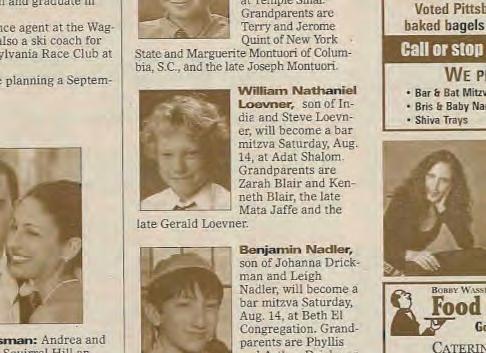
Loevner started running as a Winchester middle schooler. Back then, as depicted in a 2010 photo in the Chronicle announcing his bar mitzvah at Adat Shalom, he was a shaggy-haired, smiling kid.
Running was something “I just fell in love with,” he said. The purple cloaked cross-country team consisted of a lot of friends and a “great coach — Coach [Bruce] Frey — and we just had lots of fun.”
Given its recent PIAA Class A state cham pionships, Winchester, an independent coeducational preparatory school, is a crosscountry force; when Loevner first started running there, however, goals were different.
“We were always like, ‘Well, we’re not the fastest, but we have the most fun,’” he said. Loevner raced through middle school. As he grew older, he and his teammates evolved. New athletes joined, and in high school a similar mindset remained.
“We still have the most fun,” Loevner said. During his junior year, things “culminated,” and the boys’ cross-country team won a state title. “That was pretty exciting, because at Winchester, we weren’t really known for our athletics.”
Perhaps not, but others noticed. Around the time of his high school graduation, Loevner was recognized by the Western Pennsylvania Jewish Sports Hall of Fame with a Nathan H. Kaufman

Award for athletic and scholastic achievement. The Penn State University-bound student-athlete also received the 2016 Paul Bloom Memorial Scholarship to support his future.
At college, off trails
Penn State has a storied running tradition. Its men’s cross-country teams won NCAA national titles in 1942, 1947 and 1950. Since then, dozens of Nittany Lions have become All-Americans. Loevner arrived at the university eager to establish himself.
“I had big dreams there, but I just didn’t really accomplish all the goals that I wanted to,” he said. “I got kind of discouraged.”
Following his sophomore season, Loevner stopped running cross-country and track. When he wasn’t thinking about agriculture, he focused on nearby trails. Home to Rothrock State Forest, the area boasted ridgetop runs, rugged terrain and near endless miles for mountain biking.
Life atop a saddle represented a “new frontier,” and results were quickly noticeable, he said. “I could progress really fast week to week.”
Unlike running, where years of work shave seconds, mountain biking “was this new thing where I was learning so much,” he continued. “I was able to set my goals really big. There was nothing, nobody, telling me no. There was nothing holding me back.”
Loevner entered “Month of Mud,” a Pittsburgh-based mountain biking race, and won. From there, he went bigger. Loevner covered 300 miles at State College during a
self-supported race.
Near the 200-mile mark, Loevner crashed at night. A gas station attendant, working the graveyard shift, bandaged his arm with duct tape. With 150 miles to go, Loevner remounted, and though unable to use his hand — it was broken — kept riding.
Finishing Unbound spurred a realization, he said. “I was like, wow, I guess I’m capable of a lot more than I might have thought.”
Loevner raced again in Finale Ligure, Italy, at the 24 Hour Mountain Bike World Championships. After placing third, he followed the Great Divide Mountain Bike Route and spent 40 days with a friend riding from Banff, Canada, through the Rockies and on to Mexico.
“We ended up getting giardia at the end of the trip because we drank some bad water in the desert,” Loevner said.
The intestinal parasite wreaked havoc, and while recovering Loevner considered future goals. Five years had passed since his last run and though he thought that journey was over he registered for Tussey Mountainback, a 50K race. Loevner spent two weeks training. He finished first.
Scant preparation left him injured but with plenty of time to keep thinking. Loevner, then age 25, realized he still possessed significant speed and strength. He contacted his former high school coach and asked, “What do you think I should do next?”
His coach said to try a marathon. Loevner agreed, trained and competed at Cleveland in 2023. He won.
Philadelphia, Loevner punched his ticket with a 2:16:52. The Olympic trials were less than three months away. He prepared for the race and flew to Orlando.
“It was like 80 degrees and sunny, and I was used to training in the Pittsburgh winter,” he said. “I kind of melted, but it was a really cool experience.”
With merely a year of marathoning under his belt, Loevner had already won a race, improved his times and competed for a spot on the U.S. Olympic team. The period proved instructive and Loevner looked ahead to the 2024 Pittsburgh Marathon. He trained and finished second. He returned to Cleveland two weeks later, won, and after crossing the finish line, dropped to one knee and proposed to Emma. Months later, Loevner won the 2024 Philadelphia Marathon, running 2:16:12. That winter, Emma gave birth to Finn.
“Being a father, it’s just put everything into perspective,” Loevner said. “There’s definitely a lot more important things than racing in my life.”
In conversation, Loevner often mentions family. He knows the toll running takes on those he loves. As difficult as it is completing 26.2 miles, “these marathons are really hard for my wife too,” he said. “She’s the one standing there not knowing what’s happening — she’s just getting updates every five miles — and she doesn’t really know how I’m feeling. It’s all out of her control.”
New season, new perspective
Months after entering parenthood, Loevner lined up for the 2025 Pittsburgh Marathon. With wins in Philadelphia and Cleveland, and a second place finish at Pittsburgh one year prior, he seemed poised to win his hometown race. Loevner crossed the halfway mark at 1:08:26. About seven miles later, however, his pace dipped from 5:16 to 5:23. He finished fifth, running 2:22:22.
“The race just didn’t go how I wanted to,” he said. “I was very disappointed, but it really just made me want it even more.”
Loevner spent the summer and fall training. In December 2025, he traveled to Sacramento and posted a personal best of 2:12:59 at the California International Marathon.
“That gave me some more confidence and led me into a really good training block this spring,” he said.
Practice and belief culminated on May 3. Surrounded by competitors, friends and family, Loevner ran the Pittsburgh Marathon again. After finishing second in 2024 and fifth in 2025, Loevner simply wanted to win. When it finally happened, the best part, he said, was “just crossing the finish line and seeing my wife and son there, and giving them a big hug.”

Goats
On the morning of May 4, Loevner was back at Goat Rodeo Farm & Dairy, his family’s 130-acre farm in Indiana Township. As farm manager, Loevner knows the grind: early 100 goats require daily milking; about 3,000 pounds of milk are made into cheese each day.
There’s no stopping,” Loevner said.
Runners are masters of appreciating pace. Keeping up with family, farm-life and training, requires unparalleled discipline and expertise. “It’s a lot of time, and a lot of time I’m very tired,” he said before praising his family. He called Emma the “most supportive person,” and said post-Pittsburgh he’s looking forward to traveling to Ottawa, Canada, racing there, and having a vacation with Emma and Finn.
Please see Loevner, page 11
By Adam Reinherz | Senior Staff Writer
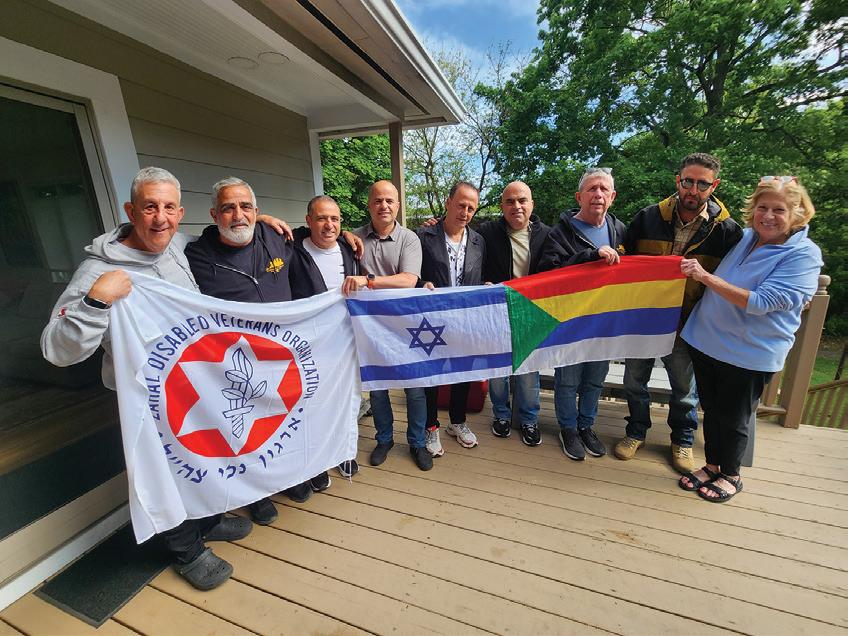
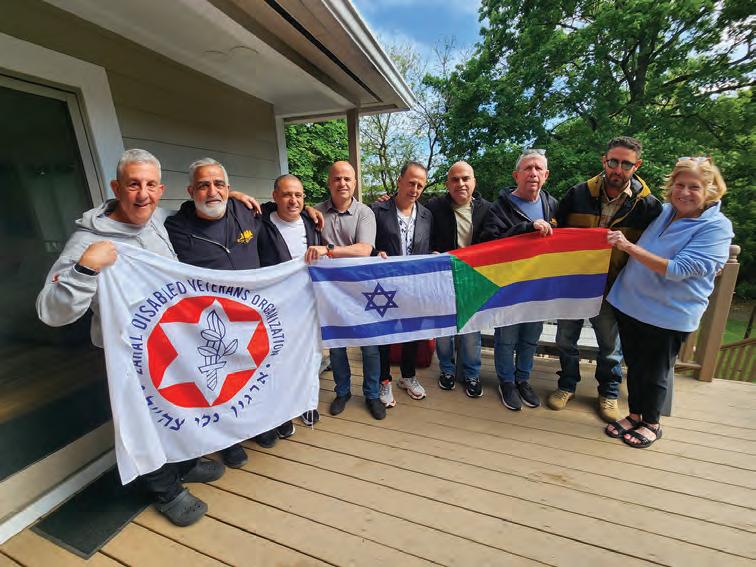
For years, delegations of wounded Israeli war veterans have visited Pittsburgh for respite. This year, they were the ones delivering comfort.
Led by Wael Ibrahim, the cohort spent two weeks traveling, eating and being pampered like previous groups — there were citywide tours, meetings with elected officials and a trip to Niagara Falls. The tone, though, was different.
Shortly after landing in Pittsburgh on May 3, Ibrahim, 48, brought fellow veterans to meet Sandy Zelekovitz. Since 2018, the Point Breeze resident and his wife, Barbara, have headed 412 Friends of Zahal, a volunteer-led group that partners with Beit Halochem, the Zahal Disabled Veterans Organization, to ensure wounded soldiers experience two weeks of Pittsburgh calm.
Zelekovitz’s ability to oversee this year’s program was impeded by illness. Still, through detailed schedules, a near endless supply of food and drinks, and the help of friends and fellow supporters, volunteers maintained a standard Zelekovitz repeatedly articulated: “Two weeks in our home. Forever in our hearts.”
This year’s cohort heard the message even before landing in Pittsburgh.
Ibrahim, who counted this as his third Pittsburgh trip, said he told his fellow vets,
“Every time I come here, I try to explain how warm the community is, and how much love they have for Israel and the soldiers and veterans who come to visit.”
Nowhere is that more clear than with Zelekovitz, Ibrahim continued. “I told them Sandy, Sandy, Sandy.”
After touching down in Pittsburgh, the vets traveled to the Zelekovitz house and met the man who tirelessly worked to achieve their relaxation.
“Everybody said to us that he was waiting to meet us,” Alon Michaeli, 51, said.
“He wanted a hug from every one of us. We felt him. He was in a very bad, bad, situation. We saw it, but he was so happy to meet us,”
Shimon Enav, 63, said.
The visit prompted introspection, Ramiz Hamdan, 53, told the Chronicle. It’s “strange”

how such a brief exchange can be so impactful, et it was: “Sitting with him just this one hour,
hen Zelekovitz died days later, “I was in shock,” Hamdan, one of two Druze members of the delegation, said. “It’s trauma.”
Without hesitation, the seven-member delegation attended Zelekovitz’s funeral.
Along with other mourners, the vets shoveled dirt into the deceased’s grave. Standing near the burial plot, the former soldiers raised their hands and offered a final salute.
Doing so was an “honor,” Shimon Enav, 63 said.
“He was a soldier of Israel. That’s how we felt, that he really was a Zionist, that his passion and love for Israel was overwhelming,” Ibrahim said.
“This delegation was his passion, and he
worked so hard to make it the best way for us: to feel comfortable, to feed us, to take us to a beautiful place,” Enav said. “All these things, I appreciate.”
Since the early 1970s, Pittsburghers have opened their homes to dozens of wounded Israelis. Started by the late Sylvia Robinson, the project, now called “412 Friends of Zahal,” was spurred by a trip to Geneva, Switzerland. Robinson noticed that despite having only 5,000 Jewish members, its community could comfortably welcome 30 Israelis. In a 1996 recording with the National Council of Jewish Women, she said there was no reason why Pittsburgh, which boasted eight times as many Jews as Geneva, couldn’t do the same.
S quirrel Hill residents Judy and Bob Danenberg have hosted vets since 2000. In the interim, during trips to Israel, the Danenbergs and their children have been happily ushered into countless vets’ homes.
“We were blown away by the reciprocation of joy and love and gratitude,” Judy Danenberg told the Chronicle while seated at a table surrounded by vets, food and a detailed schedule.
This year, the Danenbergs helped the Zelekovitzes oversee the program.
“The personal rewards that we get are immeasurable,” Judy Danenberg said. “What we give we get back in spades.” PJC
Adam Reinherz can be reached at areinherz@pittsburghjewishchronicle.org.
By Adam Reinherz | Senior Staff Writer
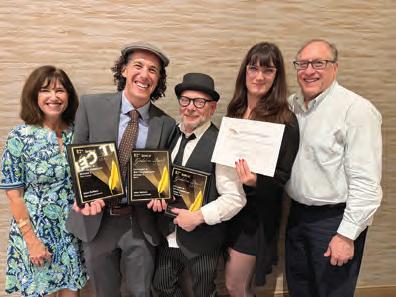
The Pittsburgh Jewish Chronicle was recognized for outstanding journalism by the Press Club of Western Pennsylvania at the Golden Quill Awards ceremony on May 18 at the Rivers Casino.
Chronicle Senior Staff Writer Adam Reinherz won the 2026 Golden Quill Award for Excellence in Written Journalism in the News Feature category for his story “Five years since pandemic hit, Pittsburghers look back and ahead.” Reinherz also won in the Sports category for his story “At the edge of the pool Coach Al Rose delivers perspective.”
Chronicle Senior Staff Writer David Rullo won in the Spot/Breaking News category for his story “Hamas sympathizer Mohamad Hamad denied bail.”
Apart from securing three wins, Chronicle reporters were finalists for nine other awards. Reinherz was a finalist in the News Feature category for his story “Shiri Bibas, and sons Ariel and Kfir, memorialized at Squirrel Hill gathering.” He was also a finalist in the Traditional Feature category for “B’nai Israel ends with dignity, extends legacy through Torah donation to CDS.” In the Medical/Health category, Reinherz was a finalist for “JHF initiative empowers Pennsylvanians to address teen mental health.” In the Education category, Reinherz was a finalist for “With eye to future, educators aid ‘COVID kindergarteners’” and “CMU architecture students design with vision for legally blind artist.”
Rullo was a finalist in the Spot/Breaking News category for his story “Rodef Shalom, Temple Sinai boards approve unification plans.” In the Public Affairs/Politics/Government category, Rullo was a finalist for “City Council introduces legislation to blunt Not on Our Dime’s BDS referendum.”
Freelance writer Emma Riva was a finalist in the History/Culture category for “Local Girl Scout creates patch honoring Holocaust resistance.”
Freelance writer Deborah Weisberg was a finalist for her story “Tree of Life and Calvary Church celebrate faith, festivals and friendship” in the Traditional Features category.
The 62nd Golden Quill Awards recognized professional and student excellence in written, photographic, design, broadcast, audio, video and digital journalism in western Pennsylvania and nearby counties in Ohio and West Virginia. Awardees were selected from more than 1,200 entries. PJC
Adam Reinherz can be reached at areinherz@pittsburghjewishchronicle.org.
By David Rullo | Senior Staff Writer
What’s the best way to teach non-Jewish students about Judaism? Student to Student thinks it has the answer.
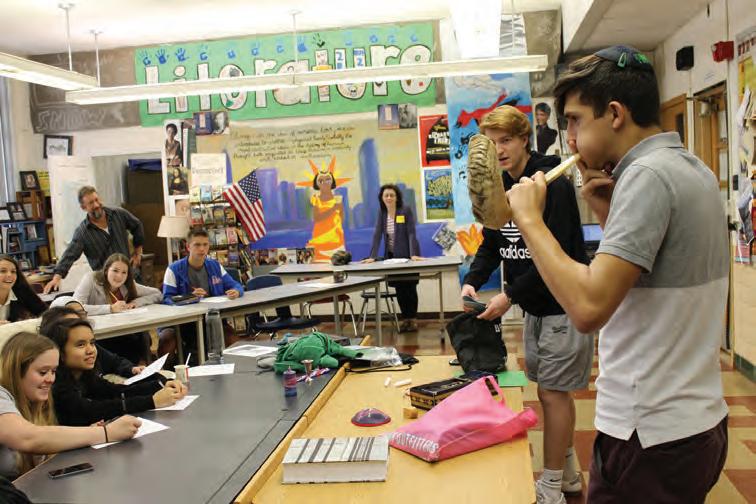
An experiential program, Student to Student brings together Jewish and non-Jewish high school students to learn about Judaism through personal storytelling.
The program sends Jewish teens into local classrooms to talk peer to peer about Jewish life, answer questions and break down stereotypes, according to Fawn Chapel, executive director of Student to Student.
“In 1992, the program was created by the former Executive Director Batya Abramson Goldstein. She was the executive director of the Jewish Community Relations Council [of St. Louis] and we asked to go to schools and talk about Judaism,” Chapel explained. “She said the kids looked so bored and she thought, ‘There has to be a different way to do this.’”
Student to Student started with a handful of students in St. Louis. It was Chapel, who Goldstein brought on board as her associate director, who decided to take the program national, starting in three cities: Washington, D.C., Indianapolis, Indiana, and Des Moines, Iowa.
“Eventually the JCRC said, ‘This isn’t really our mission,’ and they spun it off,” she explained.
The organization spent a few years as an independent entity before the Jewish Federations of North America absorbed it in 2024.
The program is now in 28 cities across the United States and two Canadian provinces, Chapel said.
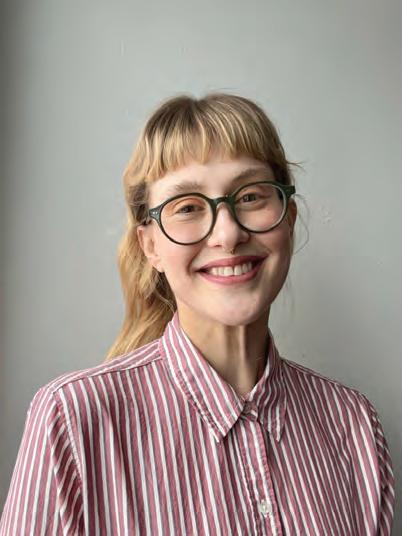
This year, the Jewish Federation of Greater Pittsburgh is bringing Student to Student to the Steel City. Rhiannon Yates is serving as the program’s coordinator.
“My academic background focused heavily on history, Holocaust studies and the way prejudice and social division developed over time,” Yates explained. She said that through her studies she developed an appreciation for education as “something transformative and not just academic.”
Yates said she is building the program with Federation from the ground up. She was hired six months ago and has spent the bulk of her time “meeting people, having coffee, getting to know people in really meaningful ways,” in preparation for Student to Student’s launch this fall.
Student to Student will be holding a series of information sessions this summer, including at both the Squirrel Hill and South Hills Jewish Community Centers.
“What’s really important to me,” Yates said, “is reaching those Jewish kids in the suburbs because more and more Jewish families are moving further outside the city.”
That means the program is even more
relevant, she explained.
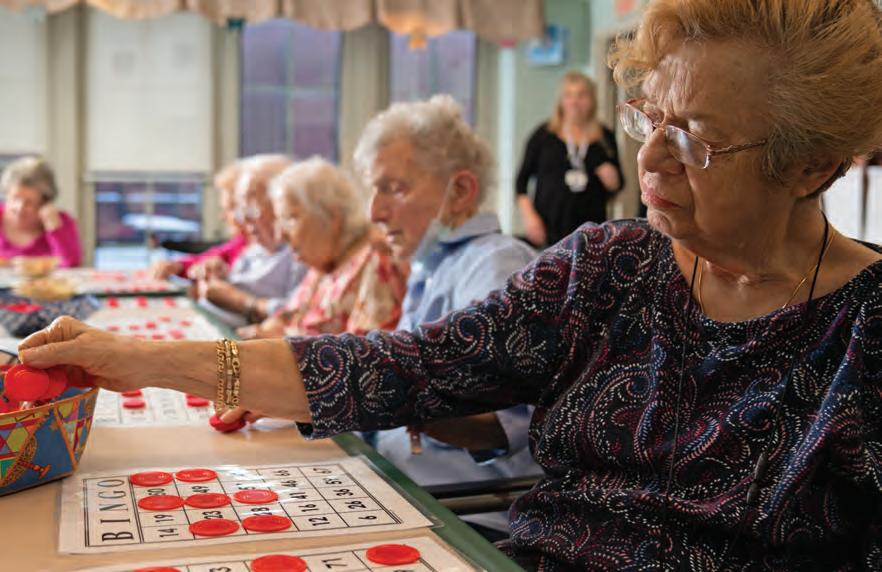
“Some of the students I talked to, they’re the only Jewish kid in their high school, so it serves a dual role: telling non-Jewish kids about Judaism and giving Jewish kids that might feel isolated a chance to have community with other Jewish kids,” she said.
The first local cohort will include 12 students — sophomores, juniors and seniors — four of whom have already been recruited. Students can apply themselves or they can be nominated by parents, friends or rabbis.
The goal, Yates said, is six presentations a semester.
Submit calendar items on the Chronicle’s website, pittsburghjewishchronicle.org. Submissions also will be included in print. Events will run in the print edition beginning one month prior to the date as space allows. The deadline for submissions is Friday, noon.
q FRIDAY, MAY 22
Join Chabad of Squirrel Hill for a Shavuot Dinner Party, including a reading of the Ten Commandments followed by a dairy dinner and ice cream bar. 5 p.m. 1700 Beechwood Blvd. chabadpgh.com/shavuotparty
q SUNDAYS, MAY 24–JULY 26
Join Chabad of Squirrel Hill for its Men’s Tefillin Club. Services and tefillin are followed by a delicious breakfast and engaging discussions on current events. 8:30 a.m. 1700 Beechwood Blvd. chabadpgh.com



Join a lay-led online Parashah study group to discuss the weekly Torah portion. No Hebrew knowledge needed. The goal is to build community while deepening understanding of the text. 8:30 p.m. For more information, visit bethshalompgh.org/online-parashah.
q MONDAYS, MAY 25–JULY 27
Join Congregation Beth Shalom for a weekly Talmud study. 9:15 a.m. For more information, visit bethshalompgh.org.
Join Temple Sinai for an evening of mahjong every Monday (except holidays). Whether you are just starting out or have years of experience, you are sure to enjoy the camaraderie and good times as you make new friends or cherish moments with long-term pals. All are welcome. Winners will be awarded Giant Eagle gift cards. All players should have their own mahjong cards. Contact Susan
LICENSED LIFE & HEALTH INSURANCE SPECIALIST
412.260.4149 (phone or text) sdvoice18@gmail.com
Serving PA and FL
Please contact Medicare.gov, 1-800-MEDICARE, or your local state health insurance program (SHIP) to get information on all of your options.
MEDICARE INDIVIDUAL PHONE NUMBER: 412-790-2881


Cohen at susan_k_cohen@yahoo.com if you have questions. $5. templesinaipgh.org
q TUESDAYS, MAY 26–JUNE 30
Join Beth El’s Rabbi Alex Greenbaum and his Bible/Talmud Adult Education class for a thoughtprovoking weekly session of Bible and Talmudic study. This program is available both in person and virtually. Call the office at 412-561-1168 to receive the Zoom link or to make an in-person reservation. 10:30 a.m. 1900 Cochran Road. bethelcong.org
q WEDNESDAYS, MAY 27–MARCH 24, 2027
Explore the hows and whys of foundational mitzvot with Rabbi Yisroel and Chani Altein at Sushi and Study, a 12-part monthly class. Join all, some, even just one. 7:30 p.m. $15 per class/$150 per year. 1700 Beechwood Blvd. chabadpgh.com/ jewishstudy
Federation:
Continued from page 5
Once students have been identified, there will be a training session led by Yates and Chapel.
“There’s a presentation outline but its not rote memorization,” she said. “The first section is about Shabbat and how we’re going to talk about how we celebrate Shabbat. We don’t lead or end with antisemitism because we don’t want that to be the first or last thing people think about.”
The important thing, she said, is that the sessions are student-led, although an adult, most likely Yates, will attend the presentations along with the students.
Identifying student ambassadors is only one side of the coin, however. Finding schools that are interested in participating is the other half — a mission Yates has been embracing.
q THURSDAY, MAY 28
View a screening of “The Chaplain & The Doctor,” the story of a 15-year relationship between an 80-year-old African American chaplain and a Jewish physician, which examines how spirituality, implicit bias and interprofessional dynamics shape patient care. A live Q&A with Betty Clark and Dr. Jessica Zitter, moderated by Michael Deem, will follow the screening. 7 p.m. Manor Theatre. reelmedicinemedia.org/events
q TUESDAY, JUNE 2
Chabad of Squirrel Hill presents The Sound of Jewish Music, an uplifting concert for women featuring music, dance and inspiration. 7 p.m. $18/$10 for student in advance; $25 at the door. Katz Performing Arts Studio, 5738 Darlington Road. soundofjewishmusic.com PJC
“I am working with suburban schools, religious schools. I had a meeting with Pittsburgh Public Schools,” she said. “In other cities, the religious community has been really interested in bringing this in. I’m hoping to bring it into one of the Catholic schools. I think that interfaith conversation is really important.”
It’s the students, though, whom Yates has met so far in her new role, who have left the largest impression.
“The teens I’ve talked to so far have surprised me over and over again,” she said. “They’re so thoughtful and they want to talk about this, and in a tough time, too. I find that pretty honorable.”
More information about the Student to Student program can be found at jewishpgh. org/info/student-to-student. PJC
David Rullo can be reached at drullo@ pittsburghjewishchronicle.org.
The Pittsburgh Jewish Chronicle invites you to join the Chronicle Book Club for its May 31 discussion of “Kaplan’s Plot,” by Jason Diamond. The author will join us for the meeting.
From Amazon.com: “Elijah Mendes was hoping for a more triumphant return to Chicago. His mother, Eve, is dying of cancer, his business flamed out, and he has nowhere else to go. So he returns to Chicago feeling listless and shattered, worried about how he’s going to help his mother despite their chilly relationship. He finds some inspiration when he discovers that their family owns a Jewish cemetery and that a man he’s never heard of, his great-uncle Solomon Kaplan, is buried in a plot there. With a new sense of purpose and an excuse to talk more deeply with his mother, Elijah begins pursuing a family mystery of extraordinary proportions.
“Elijah discovers his grandfather Yitz, Eve’s father, was a powerful gangster in the 1920s. She was ashamed and never spoke about him to Elijah. As secrets unravel, the past and present become intertwined, and Yitz’s story forces Elijah and Eve to bond in ways they never have before and begin to accept each other, not as who they wish they were but as they both are.”
Your hosts
Toby Tabachnick, Chronicle editor
David Rullo, Chronicle senior staff writer
How it works
We will meet on Zoom on Sunday, May 31, at 1 p.m.
What to do
Buy: “Kaplan’s Plot.” It is available from online retailers, including Amazon and Barnes & Noble, in local Barnes & Noble stores and through the Carnegie Library system.
Email: Contact us at drullo@pittsburghjewishchronicle.org, and write “Chronicle Book Club” in the subject line. We will send you a Zoom link for the discussion meeting.
Happy reading! PJC

By Eric Lidji | Special to the Chronicle
This is my 100th monthly column for the Chronicle, and I’m going to risk a little autobiographical reflection. If I promise not to make it a habit, I hope you’ll indulge me.
As a freshman at Pitt in the fall of 2000 into the spring of 2001, I took many night classes at Wesley W. Posvar Hall. The enormous Brutalist structure from the early 1970s had been renamed a year earlier. “Forbes Quadrangle” still adorned campus materials.
I had a routine. I would stop at the Vegeteria food truck for a massive kosher falafel with a full pickle spear nestled into the pita, and then I would head inside for class.
Coming into the building one evening, I noticed a line of bricks incongruously embedded in the sidewalk out front. I walked them like a balance beam and came upon a plaque commemorating Babe Ruth’s final homeruns at Forbes Field in 1935. The bricks continued, zigzagging charmingly down a small set of steps toward the sidewalk and then hopping the street. On the other side, they became a small section of an outfield wall. If this is the outer wall of Forbes Field, I thought, then home plate should be somewhere inside. I headed infield and entered the building. Scanning the first floor Galleria, I found a scuffed square of Plexiglas embedded in the brown herringbone tile, just outside the women’s bathroom. It framed an upside-down pentagon, a home plate speckled with cleat marks and dirt. A small bronze plaque above in time. I was standing on the ground floor of a massive concrete campus building at the dawn of the 21st century, while at the same moment I could envision myself at the home plate of a baseball stadium, staring down an opposing pitcher, surrounded by fans.
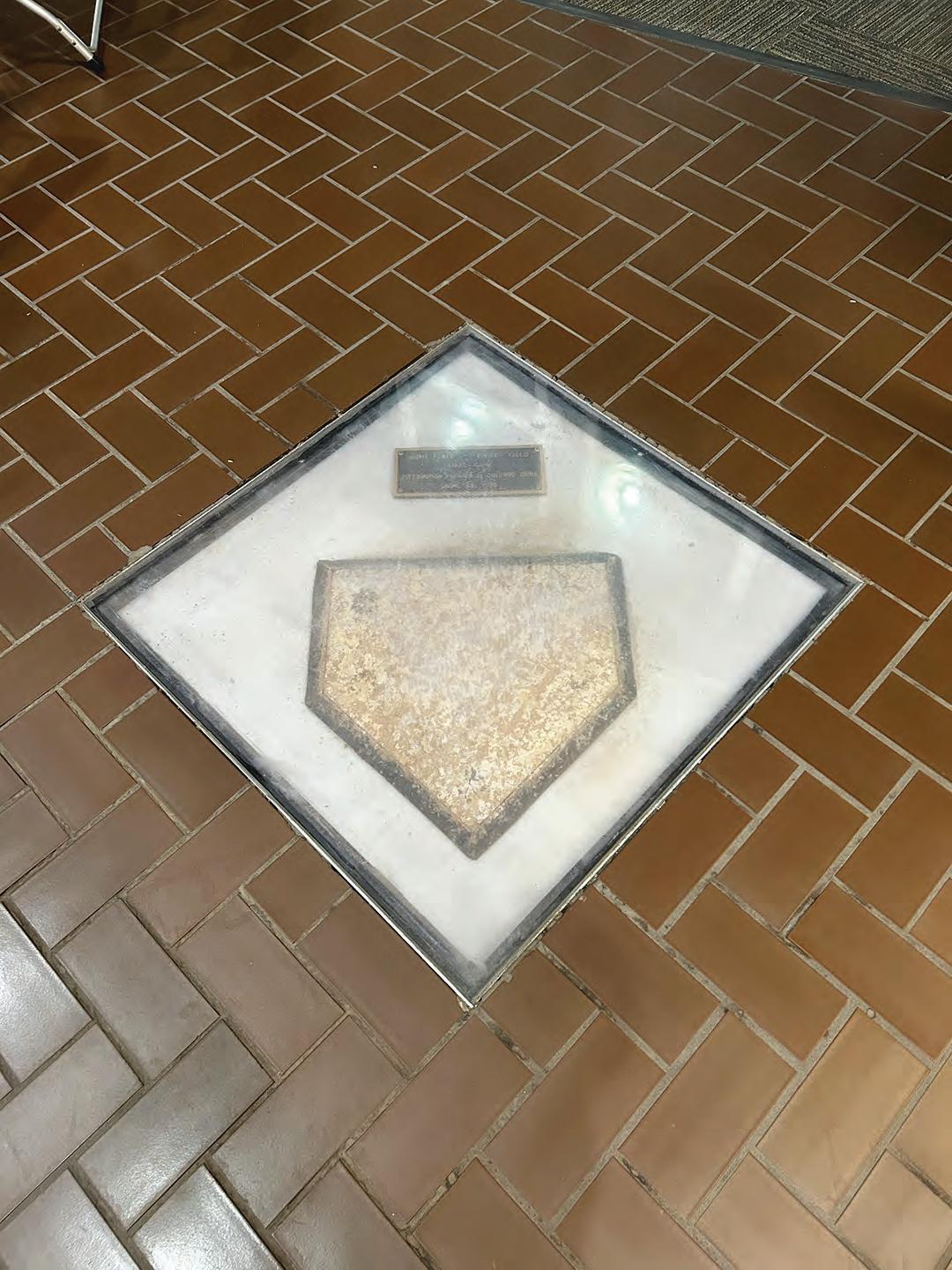
This sense of layered time was exhilarating. I spent the entire summer between my freshman
and sophomore years researching the former lives of campus buildings — the William Pitt Union, Alumni Hall and the Cathedral of Learning. I compiled all my findings into a series of articles for the Pitt News student paper in the fall of 2001.
Had I known about archives, I would have spent that summer in local reading rooms, digging through primary sources. But it would be almost a decade before I discovered archives. What I knew at that time was libraries, and so I checked out books.
I relied heavily on Robert C. Alberts’ volume
“Pitt: The Story of the University of Pittsburgh 1787-1987.” In reading about Forbes Field, I was proud to learn that a German Jew named Barney Dreyfuss had built the stadium. But some other assertion in the book hit me wrong. What it was, I no longer remember, something about the way Forbes Field had been publicly received upon its opening. I still recall the visceral compulsion to investigate. I turned to the endnotes, and I found a citation for a newspaper article.
I knew you could read old newspapers on microfilm, and so I went into Hillman Library. There was a media room in the back left corner of the main floor. You could walk in, browse hulking cabinets filled with boxes of microfilm, and take them to reading machines to view. I recall my self-satisfaction at figuring out how to thread the machine.
Scrolling through the pages, I found the article. I have a clear memory of the page. It had a giant photograph above the fold and a huge headline. I read it, and I had another profound insight: I disagreed with the book. This was the moment I understood the power of the archives. They allow anyone in the present to reassess the past.
Everyone has foundational memories. Discovering the outfield wall of Forbes Field is one of mine. It is the story I tell myself about my initial interest in archiving.
It’s been 25 years since that moment. To commemorate, I thought it would be interesting to recreate the experience, to follow my own footsteps to gauge the fidelity of my memories and to see what new insights I might
Please see Memories, page 11

By Toby Tabachnick | Editor
U.S. Rep. Summer Lee, who represents Squirrel Hill, is a cosponsor of Michigan Rep. Rashida Tlaib’s resolution “Recognizing the Ongoing Nakba and Palestinian Refugees’ Rights,” which she reintroduced in Congress on May 14.
“Nakba” is Arabic for “catastrophe” and refers to the 1948 establishment of the state of Israel.
Since Hamas’ Oct. 7, 2023, attack on Israel, Lee repeatedly has accused the Jewish state of genocide, apartheid and intentionally targeting civilian populations in Gaza. She is one of only 12 House members to cosponsor the anti-Israel resolution.
Tlaib first introduced her “Nakba” resolution in 2022, with six cosponsors.
Th e resolution alleges that in 1947, “almost immediately following the United Nations partition plan”— which would have divided the land and created two states for two peoples — “Zionist militias began a deliberate and systematic effort to expel Palestinians from their lands, a campaign which included massacres and other atrocities against civilian populations.”
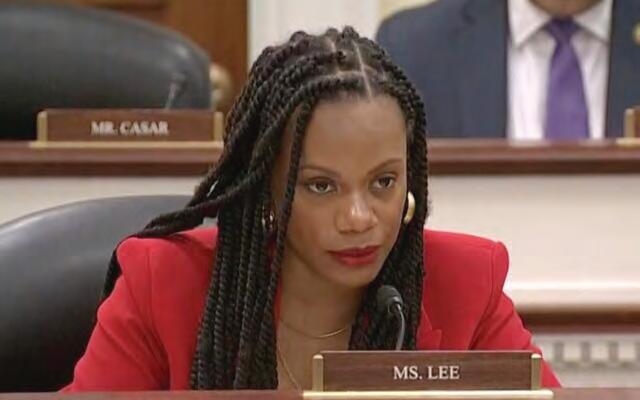
The resolution goes on to accuse Israel of apartheid, genocide of Palestinians and ethnic cleansing. It accuses the United States of being “complicit in Israel’s ongoing Nakba against the Palestinian people by providing Israel with weapons and diplomatic support even as its leaders openly announce and carry out plans to ethnically cleanse and depopulate Palestinian communities today.”
The United States, the resolution proclaims, should “commemorate the Nakba through official recognition and remembrance.”
In Tlaib’s statement issued in connection with her reintroduction of the resolution, she said: “War criminal Netanyahu and his cabinet have repeatedly threatened to ethnically cleanse the entire Palestinian population in Gaza, annex the land, and permanently occupy it. Today, they are extending these same threats towards southern Lebanon. As we mark the 78th anniversary of the Nakba, we honor all of those killed since the ethnic cleansing of Palestine began and all those who have been forced from their
homes and violently displaced from their land. This immense trauma, including the loss of their loved ones and connections to the communities they grew up in, needs to be repaired. True peace must be built on justice and the inalienable right of return for Palestinian refugees.”
The legislation is endorsed by several anti-Israel organizations, including the Pittsburgh Palestine Solidarity Committee, CODEPINK, Council on American-Islamic Relations (CAIR), Democratic Socialists of America, Friends of Sabeel North America (FOSNA), IfNotNow Movement, Jewish Voice for Peace Action and the Palestine Justice Network of the Presbyterian Church (USA).
Lee has been endorsed by PAL PAC, a new political action committee “committed to supporting champions for Palestinian rights running for Congress,” according to an email distributed by the PAC. The endorsement coincides with the withdrawal of support from JStreetPAC, a political action committee affiliated with J Street that was created in 2008 “to explicitly promote American leadership to resolve the IsraeliPalestinian conflict,” and which supported Lee in her 2022 and 2024 campaigns. PJC
Toby Tabachnick can be reached at ttabachnick@pittsburghjewishchronicle.org.
JUNE 12 & 14
Manfred Honeck, conductor
Matthais Goerne, baritone
Mendelssohn Choir of Pittsburgh Lincoln’s words and Copland’s
Israel to sue ‘New York Times’ over prison rape story
Prime Minister Benjamin Netanyahu and Foreign Minister Gideon Sa’ar announced last week the initiation of a lawsuit against The New York Times for publishing “one of the most hideous and distorted lies ever published against the State of Israel,” JNS reported.
On May 11, the Times published a story by Nicholas Kristof, an op-ed columnist, who cited Palestinians accusing Israel of “widespread Israeli sexual violence against men, women and even children — by soldiers, settlers, interrogators in the Shin Bet internal security agency and, above all, prison guards.”
Netanyahu tweeted on May 14: “They defamed the soldiers of Israel and perpetuated a blood libel about rape, trying to create a false symmetry between the genocidal terrorists of Hamas and Israel’s valiant soldiers.
“Under my leadership, Israel will not be silent. We will fight these lies in the court of public opinion and in the court of law. Truth will prevail.”
Kristof did not fact-check the sources or question their reliability. For instance, he quotes a report by Euro-Med Human Rights Monitor, a Geneva-based group that accuses Israel of employing “systematic sexual violence” that is “widely practiced as part of an organized state policy.” NGO Monitor, a Jerusalem-based watchdog group, found that key members of Euro-Med are associated with Hamas.
King Charles visits London area hit by attacks on Jews
King Charles III last week visited Golders
Green, the London neighborhood where a suspected jihadist stabbed two Jews in April, on a solidarity visit with the Jewish community following a wave of attacks on its members, JNS reported.
The king met the victims of the April 29 stabbing attack, which took place a little over a month after four ambulances belonging to the Hatzola Northwest Jewish rescue group were set on fire in a suspected terrorist attack by an Islamist group. On April 15, a London synagogue was damaged in a suspected arson attack.
British Chief Rabbi Ephraim Mirvis and Metropolitan Police Commissioner Mark Rowley joined the king on his visit. Government representatives have been booed several times recently during appearances before a heavily Jewish crowd, but Charles was not, with people calling out, “God save the King” in Golders Green, The Jewish Chronicle in London reported.
Charles also met members of the Jewish volunteer neighborhood patrol group Shomrim, who helped respond to the attacks.
Charles said that the British government would take immediate action to combat antisemitism in the country. “My government will take urgent action to tackle antisemitism and ensure all communities feel safe,” the monarch vowed in his speech at the ceremonial opening of parliament.
The total number of antisemitic incidents recorded in the United Kingdom last year — including threats, vandalism and intimidation — reached 3,700 cases, a slight increase over 2024 and the secondhighest tally on record, the Community Security Trust (CST) watchdog group said earlier this year.
May 25, 2010 — Israeli Jazz Festival opens in NYC
more details.
May 22, 1975 — Senators urge Ford to stand with Israel
After President Gerald Ford suspends economic assistance and reduces arms shipments to Israel, 76 U.S. senators sign a letter in opposition to the changes, stressing Israel’s need for enough support to deter attacks.
May 23, 1420 — Archduke orders all Austrian Jews arrested
Inspired by antisemitic religious fanaticism, Archduke Albert V issues the Wiener Gesera (Viennese Decree), ordering all Austrian Jews to be imprisoned and their possessions to be confiscated. Many Jews kill themselves.
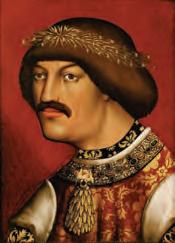
p Albert V of Austria, later king of Hungary, Croatia, Bohemia and Germany, was known as Albert the Magnanimous.
May 24, 1948 — Battle for Latrun begins
Inexperienced Israeli troops, including many newly arrived Holocaust survivors, fail to capture the Jordanian-held hilltop fortress at Latrun in an effort to relieve the siege of Jerusalem, 10 miles to the east.
Judge bars Kars4Kids from advertising in California, saying it misled donors about Orthodox Jewish mission
A California judge has ordered Kars4Kids to stop airing its ubiquitous jingle in the state unless the Jewish car-donation charity discloses that its funding is dedicated to Orthodox Jewish programs for families and adults in New York, New Jersey and Israel, JTA reported.
The ruling earlier this month by a California Superior Court judge found that Kars4Kids had violated the state’s false advertising and unfair competition laws by failing to disclose where it allocated funds from its donations.
The ruling stemmed from a lawsuit brought by a California donor, Bruce Puterbaugh, who argued that he would not have donated his vehicle to the nonprofit if he had known that the funds were “directed at a Jewish organization in New York.”
Esti Landau, the chief operating officer of Kars4Kids, testified that the nonprofit serves as the primary funding mechanism for Oorah, a Jewish outreach nonprofit that runs a summer camp in upstate New York, according to court filings. Kars4Kids is based in the heavily Orthodox city of Lakewood, New Jersey.
Landau said in the filing that Oorah’s programs include “matchmaking” for young adults as well as “gap year” trips to Israel for 17- and 18-year-olds and that the nonprofit operates no functional programs in California.
“ The failure to disclose that funds benefit adults and families — and that this support is contingent upon a specific religious affiliation — is a material omission,” Judge Gassia

New York’s first Israeli Jazz Festival, a five-day celebration of the Israeli influence on the global jazz scene, begins. Performers include bass and oud player Omer Avital and clarinet and sax player Anat Cohen.
May 26, 1924 — U.S. restricts Jewish immigration
Congress passes the 1924 Immigration Act, which cuts off most immigration from Eastern and Southern Europe. Without the United States as an immigration destination, Jews increasingly go to Palestine.
May 27, 1911 — Longtime Jerusalem
Mayor Teddy Kollek is born
Teddy Kollek, Jerusalem’s mayor from 1965 to 1993, is born in Hungary. His parents name him after Theodor Herzl. He makes aliyah in 1934 to escape Nazism. He is mentored by David Ben-Gurion, who urges him to run for mayor.
May 28, 1999 — Submarine Dakar is found after 3 decades
A U.S.-Israeli team discovers the Israeli submarine Dakar, which disappeared in January 1968, broken in half between Crete and Cyprus almost 9,800 feet beneath the surface of the Mediterranean. PJC




Apkarian said in her ruling. “A reasonable consumer donating to a ‘kids’ charity would attach importance to the fact that their donation is actually supporting adult matchmaking and general family subsidies.”
In a statement to the Jewish Telegraphic Agency, Kars4Kids denounced the decision and said it planned to appeal.
Neo-Nazi known as ‘Commander Butcher’ gets 15 years over plots targeting Jews in NYC
A Georgian neo-Nazi leader known as “Commander Butcher” was sentenced to 15 years in prison last week for soliciting hate crimes tied to plots targeting Jews and other minorities in New York City, including a scheme to poison Jewish children, according to the New York Jewish Week.
Michail Chkhikvishvili, 22, a leader of a white supremacist extremist group known as the Maniac Murder Cult, was sentenced in federal court in Brooklyn after pleading guilty last year to soliciting hate crimes and distributing instructions to make bombs and ricin.
The charges stemmed from a series of attacks plotted by Chkhikvishvili, who traveled to Brooklyn in June 2022, including a November 2023 plan to commit a mass casualty attack in New York City, and a January 2024 scheme to target Jewish schools and children with poisoned candy.
According to the Department of Justice, Chkhikvishvili incited at least two violent attacks, including a 2024 stabbing outside a mosque in Turkey and a 2025 shooting at a high school in Tennessee. PJC
— Compiled by Toby Tabachnick






Continued from page 1
Group, which is composed of victims’ family members, communal leaders and congregational representatives, according to Zawatsky.
“We were able to create, with Daniel Libeskind and his team, a spectacular building at a cost that was more in line with what felt like this project should be,” Zawatsky said. “It’s a wonderful building that has allowed us to have more outdoor space, which is a tremendous asset for the entire community.”
More than $50 million of a $60 million goal have been raised to support the construction of the building and future programming.
Zawatsky said the funding has come from a multitude of sources.
“Over 2,000 individuals have contributed, some making $18 gifts,” she said. “Those gifts are really significant for some people. … There are gifts as large as $10.6 million from the state of Pennsylvania, and we are incredibly thrilled to have that. There are gifts from Pittsburgh foundations, $3.5 million and $2 million.”
Zawatsky said it was “deeply personal” as an American and as a Jew to enter this phase of the project.


“This community will tell our story of resilience. This community will never let our narrative be told by haters and killers.”
–CAROLE ZAWATSKY
Tree of Life project erected in the congregation’s former Squirrel Hill location can’t be overstated.
Continued from page 1
Another meeting of the group occurred in another living room, this one including Schwartz, where there was excitement generated about the possibilities of what joining Tree of Life might mean.
The congregation was nearing an inflection point. Rabbi Jeffrey Myers was retiring, meaning Tree of Life was searching for a new rabbi and working to attract new members. There was a sense that a truly bashert moment had arrived.
Donley said she and others from the group started attending Tree of Life events, meeting its leaders and its members.
Ultimately, the group decided to join Tree of Life for a few reasons.
Several of the families had ties to the congregation and were aware of its demographics — a mostly older congregation still worshiping in a building not their own almost eight years after the Pittsburgh synagogue shooting.
“The thought that this synagogue, which has such an impact on American Jewish consciousness, possibly dying out over the next decade or two, it felt like we had a potential to do something about that,” she said.
Allie Droz, who held the first meeting of the group in her living room, said one of the reasons they decided to join Tree of Life — rather than establish a new congregation — was its legacy. For Droz, the idea of being rooted in a congregation that meant something generationally to her family was significant.
“My husband had his bar mitzvah at the Tree of Life. My in-laws used to belong there,” she said. “Our oldest son is going to be 10 this summer. He’s going to have a bar mitzvah in a few years, and to think about him becoming a bar mitzvah in the same sanctuary where his father became a bar mitzvah 30 years prior is just so meaningful to me.”
Dunham called his participation in the project “a highlight” of his career.
For Zawatsky, the significance of the
“This community will tell our story of resilience,” she said. “This community will never let our narrative be told by haters and killers.”
“The narrative we’re building is about bringing Jewish life back to the corner of Shady and Wilkins, which is an iconic
corner in the history of Squirrel Hill and Pittsburgh, and a symbol for the nation,” she said. PJC
David Rullo can be reached at drullo@ pittsburghjewishchronicle.org.
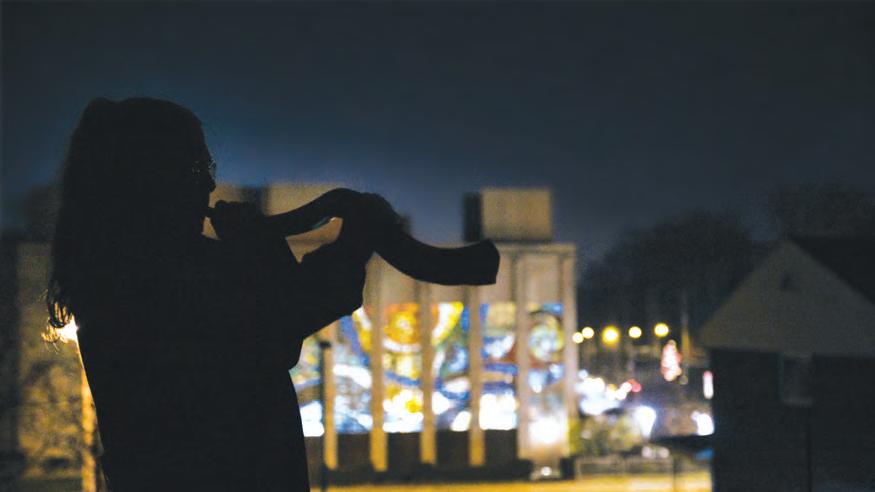
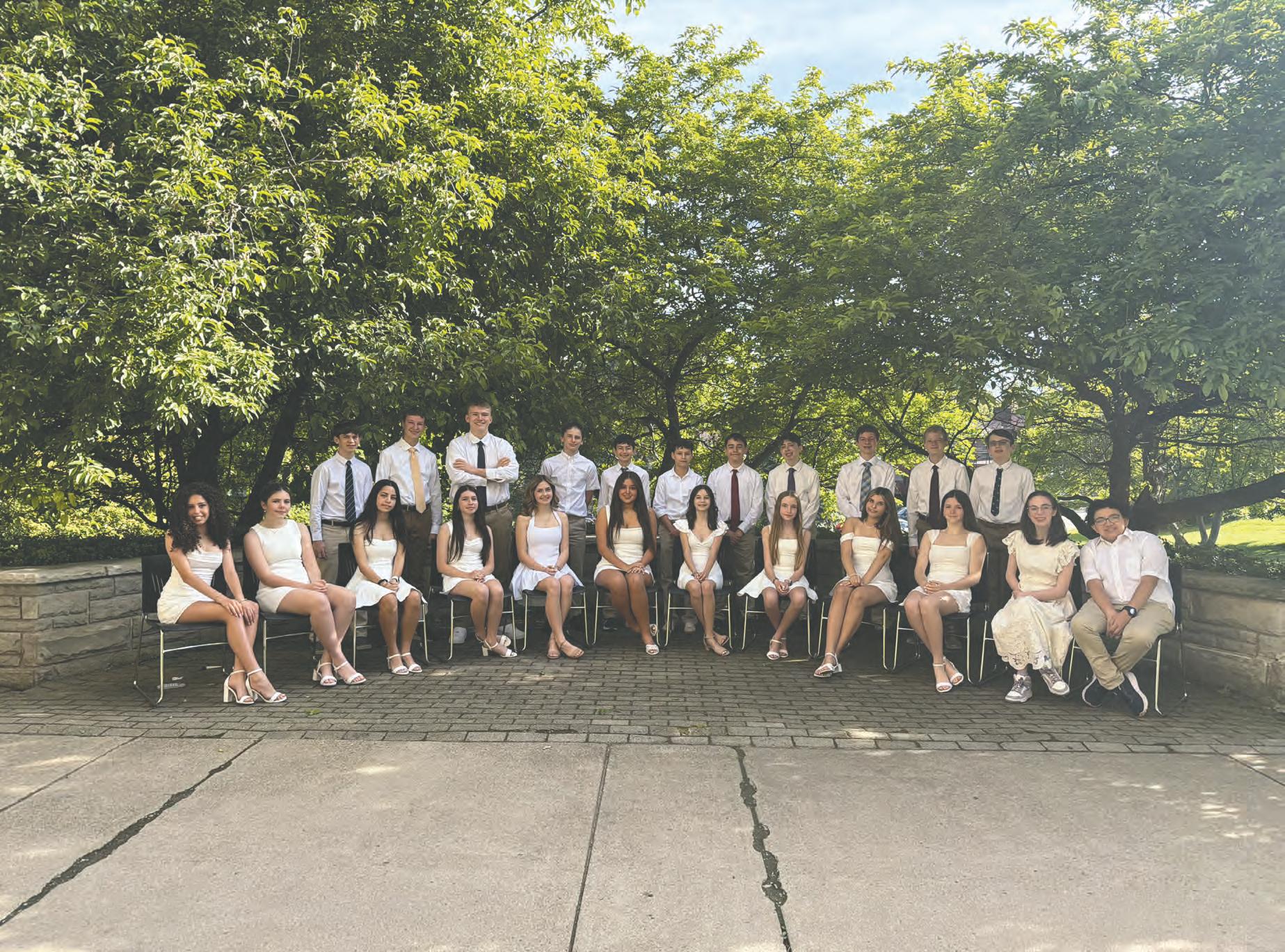
And while the group might be looking for things different than those who founded Tree of Life Congregation in 1864, and its longtime members, they have no interest in coming in and imposing their will on the congregation, Droz said.
“We’re eager to start having real conversations with the current congregation,” she said, “and to learn from them, hear their stories and get to know them.”
The group, Droz said, wants their experience to be rooted in Jewish tradition and that of Tree of Life.
“We want to do something that builds on that tradition and looks to something that speaks to us in a different way, as well,” Droz said. “We’re not trying to throw that out and build something from scratch. We want to be in real partnership with the current congregation.”
Molly Fisher, who grew up at Tree of Life but has been involved with the group Kesher Pittsburgh for the last several years, said she was looking for “a little more of a formal
synagogue environment” for her family.
Like Droz and Donley, Fisher is interested in ensuring the long-term stability of Tree of Life that the influx of new families might mean, as well as continuing the generational connection to the synagogue.
“The idea of seeing my kids on the same bimah where I was bat mitzvahed, and my parents were married, I really hope we get to see that,” she said. “And I want to help continue the tradition of Tree of Life and maybe evolve in a direction that gets more people to go.”
Tree of Life President Robin Friedman said the congregation’s leadership is happy the new families joined.
“We want to find ways to be inclusive to their needs while keeping the structure of what we have,” she said.
Friedman said that longtime members have been meeting the young families over the last few months and are “elated.”
“Everyone wants to welcome them to the congregation,” she said. “We want to be a part
of them and have them be a part of us.”
The congregation, Friedman said, is working to find ways to incorporate the new members, including introducing them to the new interim rabbi, who will be starting in July after the retirement of Myers.
“They’ve talked with the new rabbi and she is open to all kinds of stuff,” Friedman said, including exploring different types of services.
“We are very open to — not changing everything — but maybe one Saturday or Friday ou have a traditional service and the next Saturday you have a service that’s more spiritual,” she said.
nd while the topic of interfaith marriage is complicated, Tree of Life is a member of the United Synagogue of Conservative Judaism, the largest network of Conservative Jews in the world, which doesn’t permit its rabbis to officiate interfaith weddings. Friedman said it’s more important how interfaith families are treated.
“Can they go on the bimah? Can they have an aliyah? That’s more important than the actual ceremony at this moment,” she said.
Longtime Tree of Life member and former board trustee Audrey Glickman said it’s “wonderful that young families want to join the shul.”
Tree of Life, she said, has always been a strong community. She hopes the new members will take the time to discover the things that make the congregation unique.
“We would like them to come and get to know us because we do things a little differently — we always have since 1864,” Glickman said. “We’ve done things differently from other congregations. We are a Conservative congregation, and we intend to remain a Conservative congregation, but we like being different and we like being social, and we’re glad they want to join us.”
PJC
David Rullo can be reached at drullo@ pittsburghjewishchronicle.org.
Loevner:
Continued from page 3
After Loevner won Pittsburgh, Rabbi Yair Lehrer’s phone buzzed. A friend asked if it was the same Loevner who Lehrer had given bar mitzvah tutoring to 15 years ago.
Adat Shalom’s rabbi told the Chronicle he happily confirmed.
“Will is a serious-minded person who cares a lot about who he is,” Lehrer said. “We’re so proud of him.”
Since winning, Loevner’s days haven’t relented. There’s running, races, parenting, work. His calendar includes something else, too, he said. “We go to Tot Shabbat at Adat Shalom. We try to make it to a good bit of those.”
Including his siblings’ kids, five Loevner grandchildren — all under 5 years old — attend the
Memories:

p Will Loevner tastes victory on May 3. Photo courtesy of P3R
monthly Friday night family-oriented program.
“That’s where we always would go to temple, so it’s fun just seeing the next generation going there,” he said.
Field. It includes Dreyfuss but makes no mention of his Jewish identity.
Continued from page 7
have with the benefit of experience.
The other day I visited campus and walked the line of bricks. Here came my first surprise. I found one plaque memorializing Forbes Field and another marking the spot where Bill Mazeroski’s home run cleared the wall during the 1960 World Series. A state historical marker referenced Babe Ruth, but it wasn’t installed on the site until 2006, and so I couldn’t have
Coming home, I found my copy of Alberts’ book. It still had stickums marking the pages I read when I researched the series 25 years ago. The book also did not mention that Dreyfuss was Jewish, and I couldn’t find anything about the opening of Forbes Field in 1909. I reviewed the relevant footnotes, also without any recognition. So I tried a different approach. I went looking for the article, instead. In my original research, I had listed the date of the opening of
ment appears in the Aug. 12, 2010, edition of the Chronicle.
With sights set ahead, the goat farming Jewish runner knows he’s reached this point because of the roads he’s covered. Years have passed since he attended Sunday school at
nothing that matched my memory.
All this was humbling. A defining plot point of my life story was riddled with inconsistencies. I am sure I saw a footnote and made a trip to the microfilm, but perhaps it was a different book or a different subject. I suspect that I have been conflating a few experiences into one memory, a memory that neatly explains the path my life has taken.
This discovery was also delightfully validating. Archives exist because people are forgetful. We evolve, adapt and invent, and the historic record pulls us back to reality.
Adat Shalom. It’s been a decade since he and his teammates won a state title. The lore of oevner will captivate runners, but he hopes his message reaches beyond those who wear a bib.
Keep working hard, dream big, set big goals, and just keep going after it,” he said. “I think with me, like there was no Pittsburgh man who has ever won the Pittsburgh marathon, and definitely I don’t think a Jewish guy in Pittsburgh has won it. So even if your goal is something that somebody hasn’t done before — and it’s a different goal than everybody else has — if it’s really what motivates you, and you’re excited about it, just work hard every day. And even if you fail a couple times, as long as you just keep coming back, you can accomplish it.” PJC
Adam Reinherz can be reached at areinherz@pittsburghjewishchronicle.org.
history: the Joseph M. Katz Business School, sculptor Victor David Brenner’s fountain outside the Frick Fine Arts Building, the Aaronel deRoy Gruber sculpture peeking out from a corner window at Hillman Library, and the Stark Media Collection. If not for the archives, I would know nothing about any of these things.
A final note: I would like to thank the Chronicle for giving space for this column each month, and I would like to thank everyone who reads it. The world is full of enthusiasts yearning for a willing audience. I
With so many leaders of government normalizing antisemitism — whether through libelous claims of Jewish colonialism and genocide, accusations of dual loyalty, or even swastika tattoos — it is heartening when one of our elected officials takes a firm and unequivocal stance against Jew-hatred.
That’s what Pennsylvania Supreme Court Justice David Wecht did last week when he announced he was leaving the Democratic Party and registering as an independent, citing rising antisemitism within the party as the reason.
While we are not condoning or condemning any particular political affiliation, we applaud Wecht’s moral clarity in calling out antisemitic behavior in his own party. And we hope other elected officials, as well as politicians, take note and do the same — not necessarily leaving their political home, but unabashedly calling out any hatred they see within it.
Wecht, who is Jewish, has been a Democratic Party stalwart for decades. In fact, he served as Pennsylvania’s Democratic Party vice chair before he took the bench on the Superior Court and the Allegheny Court of Common Pleas. His prominent father, the late Cyril Wecht, once served as the Allegheny County Democratic Party chair.
It is therefore clear that his decision to leave
the party came only after serious reflection.
For Wecht, it is not only the overtly antisemitic acts of some Democrats which must be condemned, but the silence and acquiescence of others in response to anti-Jewish rhetoric and behaviors, some violent.
In his statement, Wecht also acknowledged the Jew-hatred that “festered on the fringe” of the right, referencing the 2018 Pittsburgh synagogue shooting as a tragic example. But, unlike so many other elected leaders, Wecht has the moral courage to unequivocally call out
“Acquiescence to Jew-hatred is now disturbingly common among activists, leaders and even many elected officials in the Democratic Party. I can no longer abide this. So I won't."
— JUSTICE DAVID WECHT
“Nazi tattoos, jihadist chants, intimidation and attacks at synagogues, and other hateful anti-Jewish invective and actions are minimized, ignored, and even coddled,” Wecht wrote in the statement he released announcing his departure from the party. “Acquiescence to Jew-hatred is now disturbingly common among activists, leaders and even many elected officials in the Democratic Party.
“I can no longer abide this,” Wecht continued. “So, I won’t.”
Jew-hatred in his own party as well. Sadly, Wecht is part of just a small group of elected officials willing to do that. Included in that group are Democrats state Rep. Dan Frankel and Pennsylvania Sen. John Fetterman.
In April, Frankel issued a statement along with state Sen. Judy Schwank, as cochairs of the PA Legislative Jewish Caucus, calling out U.S. Rep. Summer Lee for campaigning alongside Hasan Piker, “a commentator who has repeatedly trafficked in antisemitic statements.”
Alumni, aliyah and the bonds that endure
Guest Columnist
Sara Weinstein
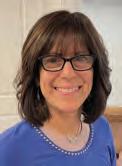
My head is still spinning from the whirlwind of emotions we experienced on our journey into the lives of campus alumni in Israel. The diversity of talents, professional experiences, personal challenges, resilient perspectives and aliyah directions were tied together by the bonds we shared at a common Shabbos table, a Torah class, or a chat on the living room sofa years ago in Pittsburgh.
My husband, Rabbi Shmuel Weinstein, and I traveled to Israel for the wedding of a Pitt
alum, Sofia Rubin, who graduated in December 2023. Three years ago, Sofia made aliyah after experiencing Palestinian protests on campus in the aftermath of Oct. 7. For her,
fulfillment from thriving in a society of vast differences —cultural and ethnic, religious and ideological — was fascinating. Day to day life in Israel is exciting. Despite
Israel is strong and its people are resilient. Their mission is to spread light in a dark world.
there was one place to go: Israel. Soon after arriving in Israel, Sofia met Etai, who also recently made aliyah, and the rest is history.
Before and after Sofia and Etai’s wedding, Shmuel and I arranged to see Chabad House alumni. Their sense of purpose and
tremendous challenges, from economics to actual physical survival, Israelis love their land and their lives there. Even the cabdriver, who showed us his gas receipt topping $200 per fill-up (which happens two to three times per week), insisted that Israel is the best place to live and he will never leave.
“At a time when Jewish communities are facing rising threats and harassment, public officials have an obligation to be unequivocal about the voices they elevate and the company they keep,” Frankel and Schank wrote.
Fetterman, an outspoken supporter of Israel and critic of antisemitism wherever it is found, responded last week to The New York Times opinion piece, which spouted the literally unbelievable claim that Jewish Israelis train dogs to rape Palestinian prisoners — which was widely speculated to have been published in order to divert attention to hard evidence of Hamas using unspeakable forms of sexual violence as tools of war. Fetterman tweeted: “Confirmed: rapists, cowards and vile deviants. Volumes of incontrovertible evidence of the depravity of Hamas. NYT preemptively dropped a grotesque op-ed with sources linked to Hamas for a beachhead of ‘bothsiderism’ Hamas defenders.”
Frankel, Fetterman, and now Wecht, have taken abuse online in response to their support of, not only Jewish people, but the truth. It takes courage and a strong sense of morality to not back down, and these leaders have not.
We call on all elected officials, Republican and Democrat, to do the same.
“It is the duty of all good people to fight this virus, and to do so before it is too late,” Wecht wrote last week in his announcement.
The time is now. PJC
We had the privilege to stay with Miri Gantshar (class of ’91) who lives in Moshav Neve Michael on the border of Judaea/Samaria. For Miri, there’s no act too big or too small in accommodating others in her beautiful country home. Miri brought her 97 year-old mother from hospice in Philadelphia this year to live with her in Israel. Needless to say, she is on call 24/7 and is loving the opportunity. In the short week we were there, Miri attended two weddings and hosted two sheva brochas festive meals for the newlyweds. The week culminated in a celebratory dinner for Pitt alumni from different generations welcoming the new couple, who recently made aliyah. The sense of purpose, of unity and of identity as one people, one family, was overwhelming. We were all just happy to be together in our land.
Please see Weinstein, page 13
Guest Columnist
Daphne Lazar Price
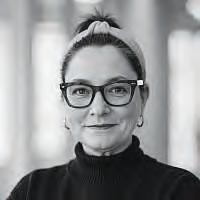
Shavuot arrives each year with a radical proposition: that wisdom is not simply acquired, but encountered. The holiday commemorates revelation at Sinai, not as an abstract historical event, but as a model for how human beings engage with sacred knowledge.
Torah, in the Jewish tradition, is not information to be downloaded. It is a covenantal relationship. That distinction feels increasingly urgent in the age of artificial intelligence. Nechama Leibowitz z”l, in “Studies in Shemot,” notes that the preparation at Sinai was not merely logistical. It was spiritual and psychological. The external acts of washing and waiting reflected an inner process: revelation demands attentiveness. Torah cannot simply be consumed; it requires presence, discipline, and humility. Sinai was not a spectacle for passive observers. It was a covenantal encounter that required the people themselves
to participate. (Nechama Leibowitz, “Studies in Shemot/Exodus,” commentary to Exodus 19.) That insight lands differently in 2026 than it did decades ago.
We now live in a world saturated with information and distraction. Information is abundant; attention is scarce. We can access libraries of Jewish texts from our phones, listen to Torah while commuting, and ask AI tools to summarize centuries of commentary in seconds. Entire tractates of Talmud can be searched in moments. A person with little formal Jewish education can instantly locate sources that once required years of training or
privileged access to elite institutions. There is something genuinely democratizing about this. As an Orthodox feminist and rabbi, I do not dismiss the revolutionary power of expanded access to Torah. Digital tools have opened doors for countless people historically excluded from advanced Jewish learning, including women. Search engines, online archives, podcasts, Sefaria, the Posen Library and now AI have helped create a generation of Jews who “search before they ask.” That is not inherently a bad thing. Curiosity, access and
Please see Price, page 13
Last week, the Chronicle asked its readers in an online poll the following question:
“Which classic Shavuot treat wins your vote?” Of the 173 people who responded, 52% said cheesecake; 24% said blintzes; 15% said kugel; 2% said bourekas; and 7% said “other,” specifying different dishes, including ice cream and lasagna. Comments were submitted by 19 people. A few follow.
The to-die-for cheesecake at the annual Tikkun Leil Shavuot at the JCC is a huge draw!
The savory taste of a fluffy cheese blintz topped with warm blueberry compote instantly takes me back to my youth.
Blintz souffle cannot be beat!
Weinstein:
Continued from page 12
When I thanked Ari Heitner (class of ’98) for making the effort to join even though his schedule was conflicting that day, he answered, “I wouldn’t miss the opportunity to get together with you!” I was constantly reminded that life in Israel is day by day. Every hour is precious. Every minute accounted for.
Menachem Genut, who came to our Chabad House from Israel while earning his PhD in 1990, drove us from our hotel in Tel Aviv to his start-up company’s site in Kibbutz Nir Am along the Gaza border. His company, YOPI, is developing a groundbreaking arm band realtime diagnostic, which monitors health and performance during rigorous physical activity,
Price:
Continued from page 12
literacy all matter. But accessibility is not the same thing as revelation, and being near Torah is not the same as standing at Sinai.
Jews are often called the “People of the Book,” but that phrase was never meant to describe passive ownership of books or proximity to texts. It describes a civilization shaped by study, argument, memory, interpretation and obligation. To be the People of the Book means we are meant to engage the books: to wrestle with them, challenge them, annotate them, teach them to our children, and allow ourselves to be shaped by them, and when necessary, to make sure they are not used as a cudgel. Torah is not decorative, it is relational.
Rejecting partisan complicity
a potentially life-saving innovation. I was amazed at how his team members were so open and interested to explain the technology. “Every Jew is responsible for another,” as it says in the Talmud (Shavuot 39a). The Gemara discusses the interconnected spiritual responsibility of the Jewish people — that one Jew’s actions affect the collective, and that Jews are obligated to care for one another materially and spiritually. Here, in Kibbutz Nir Am, it was tangible.
We felt that same sense of connectivity with other alumni who are doing cutting-edge research in subjects such as environmental anthropology, musicology and oncology. The way that each of them combine their professional goals with their dedication to the Jewish people and the land of Israel is awesome. A highlight of our trip was joining alumni Sol
AI can summarize a page of Talmud. It cannot replicate the transformation that comes from wrestling with it. It can explain a halakhic argument. It cannot model the humility of sitting before a teacher, a chevruta (study partner), or a sacred text and recognizing that wisdom demands something of you in return. AI can generate answers at astonishing speed, but Torah has never measured success by efficiency. In fact, Judaism often insists on the opposite.
Shabbat interrupts productivity, kashrut slows consumption and prayer requires regularity and intention. Torah study itself traditionally unfolds through argument, repetition, confusion, and patience. Jewish learning is not optimized for frictionless convenience because covenantal life is meant
The sweet aroma of a classic apple and cinnamon kugel always brings fond memories of my culinarily talented Nana.
Cheesecake with blueberries and a nice graham cracker crust, please!
Turtle cheesecake is the bomb.
This is such a hard question to answer! I love cheese cake, I love blintzes, I love kugel! How can I possibly choose?
My mother’s (z”l) cheesecake was the best. I have her recipe, but like all recipes we get from our mothers, it is good, but whatever she did was better! My brother says it is because of her extra ingredient: mom’s love!
and Gabi Horvitz (class of ‘06) at the Kotel to watch the induction of their nephew as an IDF paratrooper. Such pride and heroism is beyond description.
Our last day was spent meeting Professors Jen and Ilia Murtazashvili, from the School of Governance at the University of Pittsburgh, who left Pittsburgh for Ilia’s sabbatical and Jen’s Fulbright Distinguished Scholar fellowship in Tel Aviv. Their enthusiasm for life in Israel despite the 150 escapes to their maamad, or shelter, following missile sirens during the Iran war, is inspiring.
After our 38 years on campus in Pittsburgh, it was refreshing to hear Jen and Ilia’s determination to connect Israeli society with students, faculty and administrators at Pitt.
Finally, we gathered with a few alumni for
to shape character and community, not merely to transfer data.
As Rabbi Lord Jonathan Sacks, z”l wrote in “Radical Then, Radical Now”: “Judaism is the conversation between the generations.” Torah is not simply content. It is transmission. It lives not only in books but in relationships, communities, and obligations. The danger of AI is not that machines will become rabbis. The danger is that human beings will begin to mistake information for wisdom and efficiency for understanding.
This is not an argument against technology. I use AI myself. I believe these tools can deepen learning, broaden participation, and help people enter conversations that once felt inaccessible. But we should resist the temptation to confuse technological proximity to
Pennsylvania Supreme Court Justice David Wecht’s decision to leave the Democratic Party should be a profound wake-up call. When a lifelong, dedicated Democrat declares that the mainstreaming of antisemitism is the reality within his own party, the writing is on the wall.
It is deeply alarming that in New York City, a Democratic mayor allows antisemitic intimidation outside local synagogues to go unchecked and has continued to make the patently false claim that Israel commits genocide. Where is the outrage from moderate
Cheesecake with strawberries or cherries.
Cheese blintzes with sour cream. Droolworthy.
This is a hard holiday for the lactose intolerant!
We need an option for “all of the above.” It’s impossible to choose only one.
Consume in moderation. Have a good, peaceful holiday! PJC
— Compiled by Toby Tabachnick
Chronicle weekly poll question: Should an elected official be obligated to call out antisemitism within their own party? Go to pittsburghjewishchronicle.org to respond. PJC
dinner to renew old ties, catch up on the latest family news and enjoy the kosher cuisine of an outdoor cafe on Tel Aviv’s cultural center on Dizengoff Street. It’s difficult to convey the depth and breadth of conversations. There were so many messages communicated between the lines. Despite the tremendous tragedy of Oct. 7 and its aftermath, we must talk about good things and seek out the positive strengths of those around us.
Israel is strong and its people are resilient. Their mission is to spread light in a dark world. We left Israel grateful to have seen people we love knowing that we are forever connected as Am Yisrael, one nation. Am Yisrael Chai! PJC
Sara Weinstein is co-director of Chabad House on Campus in Pittsburgh.
Torah with spiritual encounter. At Sinai, the Israelites did not receive a PDF. They entered a covenant. Shavuot reminds us that revelation requires more than access. It requires attention, presence, responsibility and humility. It requires the willingness to be present enough to be changed. And perhaps that is the challenge of this moment: not whether AI can teach us Torah, but whether we still possess the patience, discipline, and seriousness to receive it. PJC
Rabba Daphne Lazar Price is an adjunct professor of Jewish law at Georgetown University Law Center and the former executive director of the Jewish Orthodox Feminist Alliance. This article was first published on The Times of Israel.
Democrats? Their silence is deafening. If party leaders refuse to draw a hard line against hatred, voters of conscience must draw it for them.
Justice Wecht has provided a shining example of action driven by clear thinking. I call on all people of conscience in Pittsburgh to follow his lead, reject partisan complicity, and register as independents. We must send an unmistakable message: Antisemitism will not be tolerated, let alone embraced, by any political party.
Marc Pomerantz Pittsburgh
We invite you to submit letters for publication. Letters must include name, address and daytime phone number; addresses and phone numbers will not be published. Letters may not exceed 500 words and may be edited for length and clarity; they cannot be returned. Send letters to:letters@pittsburghjewishchronicle.org or Pittsburgh Jewish Chronicle, 5915 Beacon St., 5th Floor, Pittsburgh, PA 15217
We regret that owing to the volume of correspondence, we cannot reply to every letter.





By Miriam Szokovski | Chabad.org
This is perfect for when you want that cheesecake taste without actually baking.







Ingredients:
Yield: 20 balls
8 ounces cream cheese, softened
¼ cup peanut butter
¼ cup sugar
2 cups graham cracker crumbs
1 cup chocolate chips (optional)
Directions:
Decide what to coat the balls with: I did half with graham cracker crumbs and half with chocolate. You can also use chopped nuts, sprinkles, or desiccated coconut. Line a baking sheet with parchment paper. Take the batter out of the fridge. Roll into small, evenly sized balls. Try to work quickly so the mixture stays cold and firm. The more you touch it, the softer it will get. Roll half in the remaining graham cracker crumbs and return to the fridge.
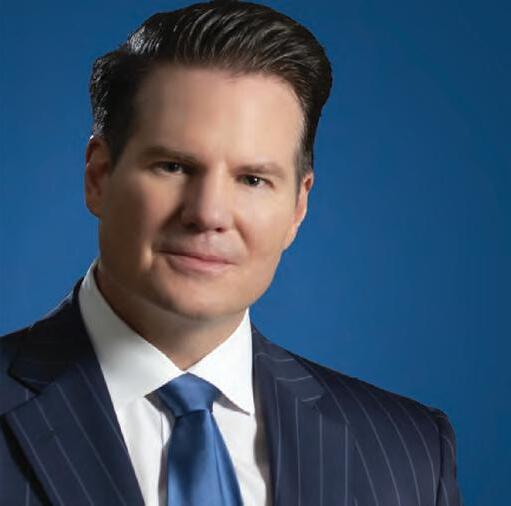





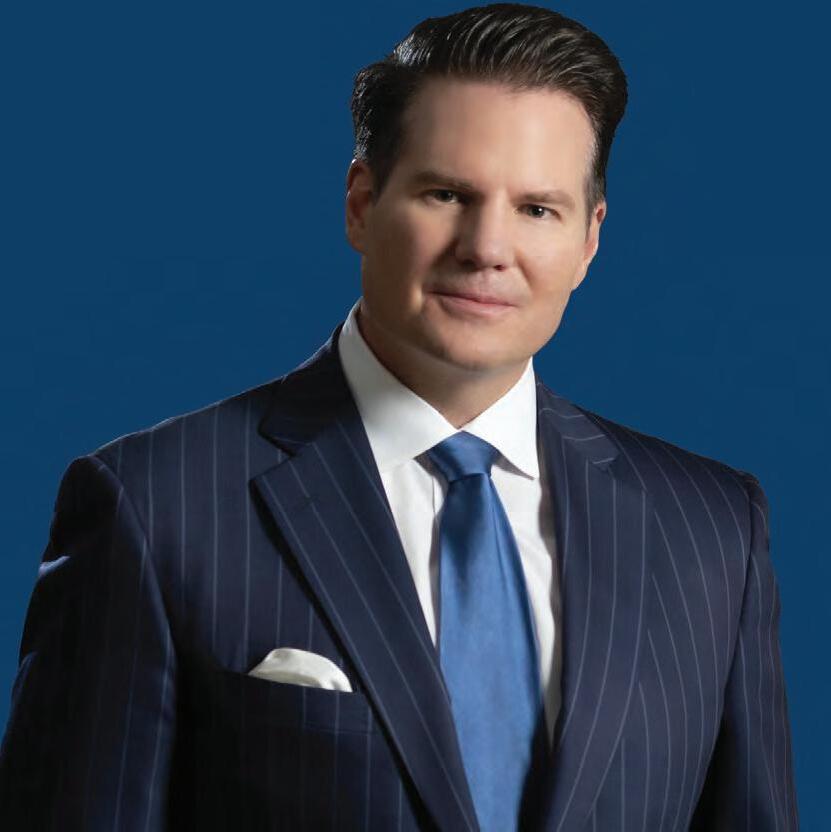
Take the cream cheese out of the fridge an hour or two before you begin, to give it time to soften.
Using an electric mixer (stand or handheld), whip the cream cheese, peanut butter and sugar until just combined with no lumps. Add 1 ⅓ cups graham cracker crumbs and mix through.
Freeze the ones that you plan to dip into chocolate for a couple of hours, so they can firm up more. Melt chocolate and quickly dip in each ball. Let as much chocolate drip off as possible, then place on a parchment paper-lined plate or tray and return to the freezer for a few minutes to let the chocolate set, then transfer to the refrigerator.
Store in the fridge until ready to serve. Make sure to let people know they contain both dairy and nuts! PJC
Miriam Szokovski is a writer, editor and member of the Chabad.org editorial team. She also shares her cooking and baking on



By Emma Riva | Special to the Chronicle
After seven weeks of reflection during the Counting of the Omer, Shavuot represents the Jewish people receiving the Ten Commandments on Mount Sinai. In the Kabbalistic interpretation, the Omer is a time for self-reflection and inner growth, and Shavuot sees us emerging from that period with new self-knowledge and a renewed commitment to learning and spirituality. There’s a tradition to eat dairy-based foods on Shavuot to symbolize the “land of milk and honey” and the nourishing quality of receiving the Torah — so think blintzes, cheesecake, kreplach and bourekas.
If the food is heavy, the wine needs to be light and sharp. For a Shavuot wine pairing, sparkling is the first, most natural choice. Koening Crémant d’Alsace ($25.99, mevushal) is a good option for a Champagnequality sparkling beverage at a fraction of the price. In fact, it’s made in a style identical to Champagne, the méthode traditionelle that involves secondary fermentation in bottles rather than in tanks.
Crémant is made not in Champagne but nearby Alsace, however, and is typically vibrant and effervescent. This particular bottle has citrus and green apple notes, with a little bit of creaminess from autolysis, the time a wine spends on the lees, the technical term for dead yeast cells that create a bready, biscuity flavor. That little bit of creaminess makes méthode traditionélle sparkling wine an excellent accompaniment to creamy foods like blintzes.
Laurent-Perrier, a premium Champagne producer, also happens to make its wine kosher for those who do want Champagne rather than simply sparkling wine from France. We have the Rabbinate of Marseille to thank for Laurent Perrier Brut Champagne ($99.99, non-mevushal) being a potential Shavuot menu item. This is a refined, delicate Champagne with notes of citrus and a hint of nuttiness — which, by the way, is sold in half-bottles at P’Vino (5726 Ellsworth Ave.), the boutique wine store in Shadyside, where you can also come talk to me about wine. For a still wine, a Georgian amber wine

could be a good complement, as Georgian food is heavy on dairy and bread and their wines stand up well to those flavors. There’s something about Georgian wine that feels appropriately stately and ancient for a holiday like Shavuot. Amber or “orange” wines sit on the skins during winemaking to produce their unique color and balanced flavor profile. GRW Rkatsiteli Qveri Collection Orange Wine ($18.99, non-mevushal) is a good kosher option.
If you want to serve a red, a lighter-bodied wine like Beaujolais will work well with the heavier food. The best Beajoulais come from the crus, or small geographic areas within the region with the most optimal specific conditions for growing the grape. Fleurie is a well-regarded cru that doesn’t break the bank, and a kosher Beaujolais Villages Fleurie ($24.99, non-mevushal) will work wonderfully with dairy-heavy dishes.

the type of cheesecake you’re eating, but a dessert wine is a safe bet. The complex flavors of honey, apricot and marmalade you get in Madame De Rayne Sauternes ($72.99, non-mevushal) will be harmonious with the sweetness of cheesecake. Likewise, Tokaj Hetszolo Tokaji Aszú 6 Puttonyos ($139.99) has citrus, apricot, cantaloupe and orange peel notes that complement cheesecake’s rich sweetness.
Both sauternes and Tokaj Aszú get their sweetness from botrytis or “noble rot,” a fungus that shrivels up the grapes in climates with humid, foggy mornings and warm, sunny afternoons. The dry afternoon keeps the rot from being too detrimental to the grape and instead balances the acid and sugar levels to a point that the flavors reach complex notes like candied nut, honey, almond and apricot. In Hungarian sweet
wines, “Puttonyos” refers to the amount of botrytized grapes used in the wine, with 6 being the highest percentage. This kind of winemaking requires a delicate balance of factors from nature and laborious hand-picking, hence their higher price point. Noble rot is just one example of the level of specifically perfect conditions that have to be in place for wine to thrive. Though it might not be apparent in the bottles you see in front of you, wine growing is a testament to life’s fragility. Grapes thrive under harsh conditions, but they need the right amount of care to survive. Just as Shavuot celebrates not just survival but thriving and growth in the face of insurmountable odds, wine itself is a celebration of survival. PJC






‘The Wanderers’ tells the story of Poland’s Holocaust survivors who fled to the Soviet Union
Like many Holocaust survivors, Daniela Gerson’s grandparents lived by the vow to “never forget, never forgive” the annihilation of their Polish Jewish hometown at the hands of the Nazis.
They took less interest in commemorating their own story of survival by leaving their beloved Zamość, Poland. Before understanding the mass extermination to come, they escaped to the Soviet Union — a route that turned into a decade of wandering exile, from Siberian labor camps to Central Asia and displaced persons camps in Austria and Germany.
Gerson, an immigration reporter and professor of journalism at California State University, grew up in Washington, D.C. Her Holocaust education detailed survivors who emerged from the concentration camps, hid in attics and forests or posed as Christians. She believed her family’s odyssey in the east was relatively rare.
Only recently did Gerson learn that her grandparents were part of the largest group of European Jews to survive the Holocaust. The Nazis killed 90% of Poland’s Jews. Most of those who survived — nearly 300,000 — fled
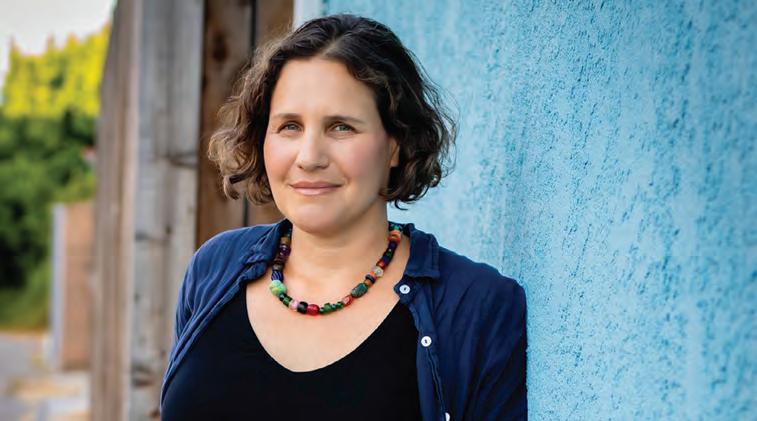
east in 1939 to the Soviet Union.
Gerson chronicles her family’s not-so-unique journey in her new book, “The Wanderers.”
This blend of memoir, history and journalism took her to Zamość, Ukraine and Uzbekistan. (The Russia-Ukraine War prevented her from visiting Siberia, where Stalin sent her grandparents to labor camps.)
“I knew that my grandparents had survived in Siberia in forced labor,” Gerson told the Jewish Telegraphic Agency. “That was their story, but I didn’t see their story anywhere.”
Her investigation of the past began with a
modern-day love story. To her own surprise, having expected to marry a nice Jewish man, she fell for a nice Jewish woman: Talia Inlender, an immigration attorney. And in perhaps as great a surprise, Gerson discovered that Inlender’s grandfather came from the same town as her own grandparents, Zamość, where their houses stood about 100 steps from each other across the town square.
Gerson was even more stunned to realize that Inlender’s family took nearly the same path as hers. Both of their grandparents made the calculation to cross the border to
the Soviet Union during a brief opening in the fall of 1939, after Stalin and Hitler carved Poland between them.
Both families became refugees at the same time in current-day Lviv in western Ukraine. They suffered from hunger and disease, which killed Mottel and Peshke Gerson’s firstborn child, Daniela Gerson’s uncle Arik. They saw other Polish citizens, accused as threats to the Soviet Union, arrested and disappeared by secret police. So when the Communists offered them a choice between Soviet citizenship and returning to Nazi-occupied Poland — not knowing what the future would hold — the Gersons and the Inlenders, like thousands of other Jews, said they wanted to go back home.
But the offer was a trick: Stalin declared that the Jews who applied to leave were traitors and security risks. In 1940, they were deported in cattle cars to the Ural Mountains, where both families found themselves in forced labor camps in the Sverdlovsk province.
A year later, their fates changed again when Hitler broke his pact with Stalin and the Nazis marched into Lviv. Behind the Gersons and the Inlenders, the Jews left in Zamość and Lviv would be systematically killed. Meanwhile, they transformed from Gulag prisoners into comrades. Britain, which housed the Polish
Please see Wanderers, page 22

We all plan constantly, shortterm and long, for better and for worse. You can plan now to save resources later, as we age, in various ways – including by saving time and energy, as well as money.
Some of my suggestions below are strictly legal, and some are also related to practical and financial goals.
Note: I am not a financial planner or advisor, and this does not constitute legal advice, and here are some ways that planning now can help later.
Step One: The Basics
First, it’s important to make sure you have your own current, basic estate planning in place – powers of attorney, for both healthcare and financial decisions, and at least a Last Will and Testament. These documents allow you to choose and appoint trusted individuals to make decisions and act on your behalf if you become unable to do so yourself. You might need such help either during your lifetime from your Agent under a Power of Attorney, or after you’re gone from your Executor. In a Will, you also get to say to whom you want to leave your property (as to property that passes under the Will, see below).
Simple Designations
Simple tools such as joint accounts, Pay on Death, Transfer on Death, and In Trust For beneficiary designations can accomplish an inheritance later while reducing or avoiding the legal paperwork otherwise needed – but sometimes they are too simple! Simply writing someone’s name on the line doesn’t let you plan for contingencies, like a named beneficiary dying before you, at the same level of detail as in a Will or Trust.
You may extend your estate planning further with more sophisticated tools such as a Revocable Trust, Irrevocable Asset Protection Trust, Charitable Trusts etc.- but again, only if it’s a good fit for you. A Trust can aid you to accomplish goals such as avoiding probate, qualifying for valuable benefits, making tax leveraged donations to charity, limiting taxes in other ways, protecting a vulnerable person or making special inheritance arrangements. (You can also achieve some of these goals through trust provisions contained in a Will.)
Often overlooked is that young adults should have basic estate planning too, even if they don’t yet own much. A surprisingly high portion of disabled adults are between ages 18 and 39. POAs can be critical in such a worst-case scenario.
If you have a disabled child, special planning for their future is imperative.
It’s crucial to make good choices as to who will help you as a “fiduciary” – someone who serves for the benefit of another - such as Agent under Power of Attorney, Healthcare Agent, Executor, Trustee, etc. For example, sometimes the oldest child isn’t the best choice to assist you.
Organize your own personal and financial records, in case someone else needs them to help you.
Insurance is a way to protect against foreseeable risks. You wouldn’t own a home or a car without homeowners or auto insurance. Life insurance can be part of a financial plan to protect your family. Most of us also insure against risks to our health and healthcare costs.
Long-term care insurance can be a good deal as we age. It used to be a “use-it-or-lose-it” proposition, but nowadays it’s often combined with life insurance, so you or
At Abernethy Hagerman and Miller, we help people every day with issues like these. I invite your questions and feedback. Please let me know how I can help you and your family.
your family get your money back one way or another, either as long term care benefits, or death benefit proceeds. The best time to buy it is said to be between the ages of about 55 to 65.
Other types of financial / legal advice can be well worth it, such as little known strategies for claiming Social Security under its many, complex rules; Medicare coverage strategies in advance of retiring; and planning with tax qualified retirement accounts and funds such as IRAs, to maximize value and limit taxes.
Debt can sap your financial stability. For burdensome credit card debt, for example, a non-profit credit counseling service – more so than a for-profit debt settlement or consolidation lender – can often assist.
As we age, the cost of long-term care looms as often as our single biggest financial risk. Actions prior to needing long-term care can lead to saving more of your own hard-earned money, but there are also effective legal steps you can take even on the doorstep of the nursing home, or even after someone is already in long term care. In other words, it’s never too late to try to protect assets with the right planning.
The key is to know that there are actions and opportunities to pursue, and to recognize when you need to start, i.e., when you first start to need long-term care .
Generally, you need to know to act whenever there’s a big life-changing event going on – birth, death, marriage, illness or disability, retirement, or big financial changes.

mhm@a-h.law
NEW FIRM MAIN OFFICE
3960 William Flinn Highway (Route 8) Allison Park, PA 15101 10 minutes closer to town! (412)486-6624 • We make house calls
deciding Mrs. Schwartz is “not really Jewish,” I tell the students to listen carefully for signs of one of the Bs. Somewhere in that patient’s life there is often a thread of Jewish belonging that can become a source of comfort, resilience, or meaning. And perhaps no biblical book illustrates the power of belonging more beautifully than the Book of Ruth.
These forms of belonging are not merely cultural accessories. They are covenantal connections; social reflexes and cultural muscle memory that bind Jews to one another across generations.
“What do you call a Jew who’s an atheist?” I ask with a grin. You could hear a pin drop. I offer the punch line after some very squirmy seconds: “A Jew.” That usually gets a lively conversation started.
We have long understood that someone may reject theology entirely and still remain deeply, unquestionably Jewish. Identity can be carried through memory, family, shared responsibility, humor, history, language, or simply the feeling of connection to our people.
That complexity can confuse even the best trained chaplains.
One of the central tasks of acute care chaplaincy is helping patients identify their spiritual and emotional resources so they can draw upon those strengths during their hospitalization. Chaplains are trained to listen for meaning, faith, hope and community.
But standard spiritual-assessment questions often fall flat with Jewish patients.
Imagine this conversation:
Chaplain Christopher: “Mrs. Schwartz, how are you doing today? I’m Christopher, the chaplain on this unit. I visit all the new patients and check in about how we might support you during your stay.”
Mrs. Schwartz: “What do you mean? I don’t need support. I’m fine, thank you.”
Christopher: “Well, could I make sure you’re receiving kosher food?”
Mrs. Schwartz: “Oh gross. Definitely not.”
Christopher: “Can I bring you a Bible?”
Mrs. Schwartz: “I don’t think I need that.”
Christopher: “Well … perhaps I could call your rabbi to let her know you’re here?”
Mrs. Schwartz: “My what?”
Christopher returns to his supervisor, puzzled, and suggests there may be an error in her chart.
“I don’t think Mrs. Schwartz is actually Jewish.”
That is when I teach about “The Three Bs”: Believing, Behaving and Belonging. It feels like this model has been part of
At its heart, Ruth is a story not about doctrine, but about covenantal connection. It begins with migration and economic desperation. A family leaves home because famine makes survival impossible. They cross borders searching for security and sustenance. It is difficult to imagine a more recognizably Jewish beginning to a story. Then tragedy compounds tragedy. Naomi loses her husband. Ruth loses hers. The family structure that once sustained them collapses completely. What remains is relationship.
A Jew may strongly identify with one of these categories, or two, or all three. Before deciding Mrs. Schwartz is “not really Jewish,” I tell the students to listen carefully for signs of one of the Bs. Somewhere in that patient’s life there is often a thread of Jewish belonging that can become a source of comfort, resilience, or meaning.
And perhaps no biblical book illustrates the power of belonging more beautifully than the Book of Ruth.







my toolbox forever, but I learned it from my teacher and friend Rabbi Dr. Naomi Kalish, who adapted it from the writings of Rabbi Mordecai Kaplan.
Before Ruth ever speaks about God, the text tells us something more subtle, but perhaps more important:
” “And Ruth clung to her.” (Ruth 1:14)
The Hebrew root d-b-k, to cling or cleave, is covenantal language used repeatedly in Deuteronomy to describe Israel “holding fast” to God: “
The Hebrew root d-b-k, to cling or cleave, is covenantal language used repeatedly in Deuteronomy to describe Israel “holding fast” to God: “
At its heart, Ruth is a story not about doctrine, but about covenantal connection. It begins with migration and economic desperation. A family leaves home because famine makes survival impossible. They cross borders searching for security and sustenance. It is difficult to imagine a more recognizably Jewish beginning to a story. Then tragedy compounds tragedy. Naomi loses her husband. Ruth loses hers. The family structure that once sustained them collapses completely.
That is why the Book of Ruth feels so deeply relevant now.

Some Jews express their Judaism primarily through Belief: belief in God, Torah, prayer, or mitzvot.
What remains is relationship.
(see Deuteronomy 10:20 and 13:5).
” (see Deuteronomy 10:20 and 13:5).
Before Ruth ever speaks about God, the text tells us something more subtle, but perhaps more important:
But in the Book of Ruth, that sacred language describes the bond between two people, between Ruth and Naomi, even as Naomi insists that Ruth’s future depends on letting her go.
Others through Behavior: lighting Chanukah candles, hosting a Passover seder, fasting on Yom Kippur, keeping kosher, attending synagogue, or studying Torah.
After this, Ruth utters her famous declaration:
But in the Book of Ruth, that sacred language describes the bond between two people, between Ruth and Naomi, even as Naomi insists that Ruth’s future depends on letting her go.
“And Ruth clung to her.” (Ruth 1:14)
The Hebrew root d-b-k, to cling or cleave, is covenantal language used repeatedly in Deuteronomy to describe Israel “holding fast” to God: “ וּבוֹ ת ק ” (see Deuteronomy 10:20 and 13:5).
“Where you go, I will go … Your people shall be my people, and your God my God.” (Ruth 1:16)
But many Jews experience Judaism primarily through Belonging: family, humor, memory, shared history, summer camp, Hadassah, mahjong groups, the speech pattern linguists describe as “high-involvement cooperative overlapping,” or just good old “Jewish geography.”
After this, Ruth utters her famous declaration: “
Ruth’s declaration has long been understood as the paradigm for Jewish conversion. But the order of these phrases is so meaningful. Before Ruth speaks about God, she binds herself to Naomi: to her people, her future and her fate.
We are living through profoundly lonely times. Many people feel untethered from institutions, neighborhoods, communities, and even their families. Increasingly, people struggle to articulate what they believe. Yet they still long desperately to belong.
But in the Book of Ruth, that sacred language describes the bond between two people, between Ruth and Naomi, even as Naomi insists that Ruth’s future depends on letting her go.
After this, Ruth utters her famous declaration:
But Jews, perhaps especially, have always understood belonging as sacred.
“Where you go, I will go … Your people shall be my people, and your God my God.”
(Ruth 1:16)
Indeed, Ruth may be the most profoundly relational book in the Bible. God barely acts directly in the narrative at all. Redemption comes instead through acts of caring: accompanying one another, feeding one another, protecting one another, refusing to abandon.
“Where you go, I will go … Your people shall be my people, and your God my God.”
(Ruth 1:16)
Many Jews who would struggle to explain their theology still know exactly where they belong.
Ruth’s declaration has long been understood as the paradigm for Jewish conversion. But the order of these phrases is so meaningful. Before Ruth speaks about God, she binds herself to Naomi: to her people, her future and her fate.
The rabbis noticed this too. In the midrash Ruth Rabbah they ask why this Megillah was included in Scripture at all:
These forms of belonging are not merely cultural accessories. They are covenantal connections — social reflexes and cultural muscle memory that bind Jews to one another across generations.
“This scroll contains no laws of purity or impurity, no prohibitions and no permissions. Why then was it written? To teach how great is the reward of those who perform acts of kindness.” (Ruth Rabbah 2:14)
Ruth’s declaration has long been understood as the paradigm for Jewish conversion. But the order of these phrases is so meaningful. Before Ruth speaks about God, she binds herself to Naomi: to her people, her future and her fate.
The Book of Ruth’s holiness emerges not through creed or legal discourse, but through covenantal loyalty and human relatedness. Through belonging. That is why the Book of Ruth feels so deeply relevant now.
A Jew may strongly identify with one of these categories, or two, or all three. Before deciding Mrs. Schwartz is “not really Jewish,” I tell the students to listen carefully for signs of one of the Bs. Somewhere in that patient’s life there is often a thread of Jewish belonging that can become a source of comfort, resilience, or meaning.
And perhaps no biblical book illustrates the power of belonging more beautifully than the Book of Ruth.
At its heart, Ruth is a story not about doctrine, but about covenantal connection. It begins with migration and economic desperation. A family leaves home because famine makes survival impossible. They cross borders searching for security and sustenance. It is difficult to imagine a more recognizably Jewish beginning to a story.
Indeed, Ruth may be the most profoundly relational book in the Bible. God barely acts directly in the narrative at all. Redemption comes instead through acts of caring: accompanying one another, feeding one another, protecting one another, refusing to abandon.
We know which losses feel personal, which melodies make us tear up, who would show up with soup after surgery, whose call you would answer at 2 a.m.
And we know which stories and memories we carry as our own.
The rabbis noticed this too. In the midrash Ruth Rabbah they ask why this Megillah was included in Scripture at all:
Indeed, Ruth may be the most profoundly relational book in the Bible. God barely acts directly in the narrative at all. Redemption comes instead through acts of caring: accompanying one another, feeding one another, protecting one another, refusing to abandon.
“This scroll contains no laws of purity or impurity, no prohibitions and no permissions. Why then was it written? To teach how great is the reward of those who perform acts of kindness.” (Ruth Rabbah 2:14)
The Book of Ruth’s holiness emerges not through creed or legal discourse, but through covenantal loyalty and human relatedness. Through belonging.
That is why the Book of Ruth feels so deeply relevant now. ”
These bonds are not secondary to Jewish life. They are themselves deep expressions of covenant, and Ruth reminds us that covenant is sustained not only through mitzvah or ritual, but through the stubborn human act of refusing to let one another go.
So perhaps, this Shavuot, we might ask ourselves about our own Three Bs.
The rabbis noticed this too. In the midrash Ruth Rabbah they ask why this Megillah was included in Scripture at all:
“This scroll contains no laws of purity or impurity, no prohibitions and no permissions. Why then was it written? To teach how great is the reward of those who perform acts of kindness.” (Ruth Rabbah 2:14)
These forms of belonging are not merely cultural accessories. They are covenantal connections; social reflexes and cultural muscle memory that bind Jews to one another across generations.
The Book of Ruth’s holiness emerges not through creed or legal discourse, but through covenantal loyalty and human relatedness. Through belonging.
A Jew may strongly identify with one of these categories, or two, or all three. Before deciding Mrs. Schwartz is “not really Jewish,” I tell the students to listen carefully for signs of one of the Bs. Somewhere in that patient’s life there is often a thread of Jewish belonging that can become a source of comfort, resilience, or meaning.
And perhaps no biblical book illustrates the power of belonging more beautifully than the Book of Ruth.
Then tragedy compounds tragedy. Naomi loses her husband. Ruth loses hers. The family structure that once sustained them collapses completely.
At its heart, Ruth is a story not about doctrine, but about covenantal connection. It begins with migration and economic desperation. A family leaves home because famine makes survival impossible. They cross borders searching for security and sustenance. It is difficult to imagine a more recognizably Jewish beginning to a story.
What remains is relationship.
What do we believe?
What Jewish behaviors are important to us?
And most importantly: Where and with whom do we belong? PJC
Rabbi Kara Tav serves as the rabbi of spiritual care at Congregation Beth Shalom, and as a chaplain at UPMC MageeWomens Hospital. This column is a service of the Greater Pittsburgh Jewish Clergy Association.
Then tragedy compounds tragedy. Naomi loses her husband. Ruth loses hers. The family structure that once sustained them collapses completely.
What remains is relationship.
Before Ruth ever speaks about God, the text tells us something more subtle, but perhaps more important:
“
“
Before Ruth ever speaks about God, the text tells us something more subtle, but perhaps more important:
הדּבּהּ ” “And Ruth clung to her.” (Ruth 1:14)
(Ruth 1:14)
” “And Ruth clung to her.”

The Hebrew root d-b-k, to cling or cleave, is covenantal language used repeatedly in Deuteronomy to describe Israel “holding fast” to God: “ ” (see Deuteronomy 10:20 and 13:5).
After this, Ruth utters her famous declaration:
On May 23, 2026, Teddy Booker, daughter of Kate and Mac; trapped between Pearl and Solomon; beloved granddaughter of Ann, Marty, Dan and the late Debby; Harry B. Davis basketball champion and descendant; admired elder cousin; fierce competitor; and clotheshorse, will become a bat mitzvah at Congregation Dor Hadash. Her Hebrew name is Miriam, and she has lived up to it. Watch for her to bring music and joy with her into adulthood.
But in the Book of Ruth, that sacred language describes the bond between two people, between Ruth and Naomi, even as Naomi insists that Ruth’s future depends on letting her go.
“Where you go, I will go … Your people shall be my people, and your God my God.” (Ruth 1:16)

Ruth’s declaration has long been understood as the paradigm for Jewish conversion. But the order of these phrases is so meaningful. Before Ruth speaks about God, she binds herself to Naomi: to her people, her future and her fate. Indeed, Ruth may be the most profoundly relational book in the Bible. God barely acts directly in the narrative at all. Redemption comes instead thro accompanying one another, feeding one another, protecting one another, refusing to


The rabbis noticed this too. In the midrash Ruth Rabbah they ask why this Megillah was included in Scripture at all:
“This scroll contains no laws of purity or impurity, no prohibitions and no permissions. Why then was it written? To teach how great is the reward of those who perform acts of kindness.” (Ruth Rabbah 2:14)
The Book of Ruth’s holiness emerges not through creed or legal discourse, but through covenantal loyalty and human relatedness. Through belonging. That is why the Book of Ruth feels so deeply relevant now.


Scott and Tracy Eichner of Portland, Maine, joyfully announce the birth of their daughter, Marley Cooper Eichner, on May 1, 2026. Proud grandparents are Elyse and Marty Eichner of Squirrel Hill, and Edward and Virginia Young of Parkville, Missouri. Marley Cooper is named in loving memory of Scott’s maternal grandmother, Claryne Cooper Berman, and Tracy’s grandfather, Edward Merle Young. Marley is the great-granddaughter of the late Claryne and Sanford Berman of Steubenville, Ohio, the late Sidney and Sally Eichner of Akron, Ohio, the late Janina and Thoedore Stoepel of Hobe Sound, Florida, and the late Nancy and Edward Young of West Orange, New Jersey. PJC
BERGER: Michael Norman Berger. We are saddened to announce that Michael Norman Berger, a visionary and generous man, born June 21, 1935, passed away peacefully on March 11, 2026. He was the devoted son of Merle and Meyer Berger, thriving in their culturally and politically stimulating environment. Michael is survived by his devoted wife, Sherle Berger, and her children and grandchildren; and by his first wife, Marsha Berger, and their children, Mark Berger and Susan Berger-Jones, and his grandson Milo; and by his sister Susan Berger Smerd and his brother-in-law Peter Smerd, and their children and grandchildren. Having graduated from Shady Side Academy and Harvard University, Michael joined his father at M. Berger Company, which sold government surplus and industrial supplies. By the early 1960s, with Michael as sales manager, the business took off with hundreds of customers around the country. During this time, his father added to the company several pieces of real estate that Michael helped to manage at a later date. Meanwhile, Michael also earned an MFA in art history from the University of Pittsburgh, embarking on a lifelong quest to bring global art to the Pittsburgh area through his exhibits and art galleries located in several Pittsburgh neighborhoods. At the time of his passing, Michael was working to develop the Diversity Museum of Art and Culture to further his commitment to cultural, societal and artistic pluralism. He deeply believed that art is not a luxury but a necessity for creating a better world where all voices may be considered, seen and heard. Michael also applied his creative energies and leadership ability to an extensive range of philanthropies. Among many beneficiaries of his generosity were the Israel Nationality Room at the University of Pittsburgh Cathedral of Learning as well as the display of artwork at the former Greater Pittsburgh Airport. Michael’s numerous undertakings enjoyed the support of beloved friends, family and associates too numerous to mention. A gathering to celebrate Michael’s life will take place on Friday, May 29, at 2 p.m. at Rodef Shalom Congregation, followed by tea and conversation. Please RSVP to Janice.Moore@mbirepgh.com. All are welcome. A
PRIVMAN: Joan Privman, resident of Las Vegas, Nevada, but with significant roots in Pittsburgh, died on May 4, 2026, at age 94. Joan was born in Pittsburgh in 1931, an only child to Maurice and Regina Margolis, and was largely raised by her beloved mother after her parents divorced when Joan was a preteen. She described her youth as being surrounded by family, as her mother was one of 11 children, so there were numerous aunts, uncles, and cousins and second cousins with whom to interact, and she kept up relationships with many of them for her entire life. She fondly recalled listening to Pittsburgh Pirates games on the radio with her mother during the summer months. They lived in Squirrel Hill, Braddock and Swissvale. Joan graduated from Swissvale High School in 1949. In her early 20s, unusual for a single woman of that era, Joan moved west to try to make a career of it in Los Angeles. At her first job, she met Irving Privman, whom she wed in 1958 and to whom she remained married until his passing in 2011. They had two children, son Jay (wife Anne), and daughter Susan (husband Adam Goldstein). They lived in the greater Los Angeles area before moving to Las Vegas upon Irving’s retirement. She and Irving traveled the world, as travel was a passion for both. Joan also enjoyed mahjong, reading, “Jeopardy,” crossword puzzles and horse racing. Joan followed Jewish customs on the High Holy Days and at Passover, and was a regular attendee at temple on those occasions until she advanced in age. Joan is survived by her children and their spouses, grandson Ari, step-grandchildren Stephanie (Ryan Kresta) and Emily (Freddie Hughes), and eight step-great-grandchildren. Services were held May 8 at Kraft-Sussman Funeral Services in Las Vegas. In lieu of flowers, please make donations to Nathan Adelson Hospice, 4141 University Center Drive, Las Vegas, NV., 89119.
ROTH: Paul F. Roth, 94, of Squirrel Hill passed away Thursday, April 30, in UPMC Mercy Hospital of complications after a fall. Born Feb. 9, 1932, to Dave and Cele Roth, he graduated from McKeesport High School in 1949. He earned a B.S. in physics (Pitt) in 1953 and an MSEE (Penn) in 1965. He married Edith Kann in Pittsburgh in 1954 and raised four children, mainly in Bryn Mawr, Pennsylvania, and Potomac, Maryland. He grew up in a large Jewish family in Pittsburgh, surrounded by scores of cousins who ran theaters, a famous carpet company and the CMU science department. Aside from inventing a computer simulation language and exporting tech for the Department of Commerce to Peru, Chile, Bolivia and Thailand, Paul was the consummate iconoclast and free thinker, casting a vote for Dick Gregory in the 1968 presidential election. An expert in Big Band music
Please see Obituaries, page 20

D’Alessandro Funeral Home and Crematory Ltd.
“Always A Higher Standard”

Dustin A. D’Alessandro, Supervisor • Daniel T. D’Alessandro, Funeral Director 4522 Butler St. • Pittsburgh, PA 15201 (412) 682-6500 • www.dalessandroltd.com


from
Marlene Alpern










• Serving the Pittsburgh Jewish Community with Traditional Jewish funerals
• Specially Developed Taharah Room with Mikva facilities for Chevra Kadisha • Accommodations for Shomer • Guaranteed advanced funeral planning
LOCALLY OWNED and OPERATED 1650 GREENTREE ROAD • PITTSBURGH, PA 15220 412.563.2800 • FAX 412.563.5347
SERVING Scott Twp., Greentree, Carnegie, Mt. Lebanon, Upper St. Clair and Bethel Park

.Sylvan Alpern
Frani & Milo Averbach .Fannie Ohringer Schachter
Phyllis Cohen . .Robert Allen Cohen
Jane Goldfarb .Samuel Serbin
Lynne Gottesman & Debra Ritt .Norman Wesoky
Libby J Israel . .Jennie R Jacobson
Marc Rice .Sylvia Gerson
Fred Rubin Martin Rubin
Bernie & Mark Shire . .Morris Borof
Charlotte & Evan Reader Abraham Jacob Kwall
Contact the Development department at 412-586-2690 or development@jaapgh.org for more information. THIS WEEK’S YAHRZEITS —
Sunday May 24: Ida Friedman, Dora Samuel Goldfarb, Mollie T Golomb, Phyllis Elaine Gutmacher, Anna B Hausman, Michael O Kohn, Sarah Koppleman, I Hyman Lerner, Charlotte Perelstine, Sarah Y Rudick, Irving Shapiro, Alex Silverman, Jacob Slome, David Soltz, Helen Tenenouser
Monday May 25: Morris Borof, Sonia Drucker, Dora Felman, Jean K Gefsky, Sarah K Gellman, Sylvia Gerson, Alvin Abe Golomb, Albert William Hertz, Albert Horn, Freda Horn, Leah Korobkin, Rochelle L Lubarsky, Tillie Marshall, Helen Ohringer, Fannie Ohringer Schachter, Nathan Silver, Rhoda Freedel Sternlight, Frances Tenor, Esther Martin Wallier
Tuesday May 26: Goldie Ackerman, Mollie Goldberg, Charlotte Haffner, Sam Kaufman, Ida R Kovacs, Irwin J Kravitz, Tobias G Lang, Clara M Leon, Naomi Levinson, Sam Match, Frank R Phillips, Ernestine L Rosenfield, Louis A Safier, David Sanes, Natalie Iris Santos, Rose Supoznick Schwartz, Jennie Raffel Silverman, Hyman Weiner, Edythe L Wolfe, Sadie Zoltan Katz
Wednesday May 27: Aaron Cohen, Rose Blockstein Fisher, Freda Kalik, Gertrude Klein, Abraham Krouse, Dr David Lipschutz, Louis Ruttenberg, Louis Sable, Theodora Helen Samuels, Morris Shapiro, David Sheffler, Margaret Katherine Stark, Rose H Weisburgh, Norman Wesoky, William H Yecies
Thursday May 28: Edward Balter, Edith Rodney Berman, Lillian Cazen, Jacob Dickman, Ethel Sofer Frankel, Fannie Gordon, Morris Oberfield, Charles Zola Pollock, Leonard Robinson, Herman Shapiro, Isadore Thomashefsky
Friday May 29: Rebecca Adler, Nellie Bricker, Anne Stein Fisher, Samuel Hankin, Albert Jacobson, Freda Miller, William Moldovan, Rose Rattner, Norma Rosenstein, Samuel Rotter, Martin Rubin, Blanche Sigel, Seward Wilson, Fannie Wolk
Saturday May 30: Sarah Lee Backal, Irving H Cohen, Robert Allen Cohen, Lena Davidson, Robert (Bob) Feinberg, David Friedman, Elsie Lichtenstul Goldbloom, Tillie Gordon, Marjorie Leff, Morris Hyman Leff, Fannye B Mermelstein, Freda Oawster, Phillip Pattak, Samuel Schneirov, Florence Sherwin, Morris Thomashefsky

Obituaries:
Continued from page 19
and the Great American Songbook, he gave lectures at CMU and the JCC. He DJed a weekly radio show in Fairfax, Virginia, an all-Big Band station at the time. He sang in a choir and played multiple instruments. He was Pittsburgh, even as he moved around the country. He authored three books showcasing 70 years of photos about railroads and industry in western Pennsylvania. He donated some of those to the Heinz History Center. He was a lifelong Pirates fan and could rattle off the starting lineup and bench of the 47 Buccos. He had letters published in the Post-Gazette on all sorts of topics. During his last few months, we fed him a steady diet of Isaly’s chipped ham, took him to German restaurants on the North Shore, commuted to the Eat’n Park at the Waterfront. He loved Ritter’s on Baum and Regis Steedle in Millvale. He is survived by his four children: Miriam (Paul Murphy), Longwood, Florida; George (Elizabeth Cowin), Solon, Ohio; Jim of Atlanta; Dan of Elkins Park, Pennsylvania; and his cherished granddaughters Olivia of Solon and Julie of Longwood. He is especially missed by his companion of 24 years and love of his life, Marilyn


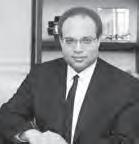



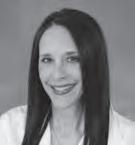


















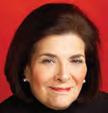
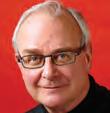

Tuesday, June 16 • 7 pm
A comprehensive analysis of Israel’s regional security landscape with Brig. Gen. (Res.) Nitzan Nuriel and Dr. Shira Efron. JCC Squirrel Hill • Katz Theater • $36/person
Brig. Gen. (Res.) Nitzan Nuriel is the former Director of the Counter-Terrorism Bureau at Israel’s Prime Minister’s Office (2007–2012). From 2001-2004, he served as Military Attaché to the United States, acting as liaison between the IDF and U.S. defense agencies. Following his military career, he joined Israel’s National Security Council, where he led national crisis management and counterterrorism strategy.
Dr. Shira Efron is the distinguished chair for Israel Policy at RAND. From 2020-2022, Dr. Efron was a consultant for the UN, specializing in Gaza and working closely with newly appointed High Commissioner under the Board of Peace, Nikolay Mladenov. She holds a doctorate and master’s degree in policy analysis from the RAND School of Public Policy.
Moderator is Yisrael Klitsner, a fellow at the Jewish People Policy Institute.

This series is made possible by generous community funders. If you would like to support our Israel Engagement efforts, please contact Fara Marcus, fmarcus@jccpgh.org

Continued from page 17
government in exile, agreed to team up with the Soviet Union on the condition that Polish prisoners were freed.
Thus began years of trekking for the Gersons and the Inlenders through the Soviet Union’s Central Asian republics. Thousands of Jews migrated through Kazakhstan, Uzbekistan and Turkmenistan. They continued to fend off hunger, illness and arrests, surviving on the black market.
At the end of the war, the Gersons and the Inlenders briefly returned to Poland, though not to Zamość. They went to western Poland, which appeared to boast a Jewish revival. That was until antisemitic pogroms pushed them west again, and they arrived in displaced persons camps in Austria and Germany.
Finally, 10 years after leaving their homes in the Zamość town square, the two families’ paths moved far apart. The Inlenders immigrated to Israel in 1949 and the Gersons to the United States in 1950.
Gerson’s and Inlender’s fathers were both born during this long limbo. Allan Gerson, who would become a lawyer bringing Nazi war criminals to justice, entered the world in an Uzbek village. Nachum Inlender, an entrepreneur, was born in an Austrian displaced persons camp. He moved to the United States to study in his 20s, setting the stage for their daughters to meet in Los Angeles decades later.
Both men also died within years of each other, Nachum Inlender in 2016 and Allan Gerson in 2019.
The twists of history that saved the families also wound up obscuring their stories. In the postwar period, the Soviet Union celebrated its victory over the Nazis and its liberation of the death camps, a narrative that left little room for Soviet persecutions of Jews. After the Soviet Union fell, Poland saw growing efforts to unearth Holocaust memory — but those were soon clouded by a nationalist rightwing government from 2015 to 2023, which advanced a version of history focused on Polish victimhood and resistance. A member of that political movement was elected president last year, once again setting back research on Polish Jewish history.
In the United States, Stalin was briefly portrayed as a heroic “Uncle Joe” in a triumph of good over evil. Then, with the advent of the Cold War, Gerson said her grandparents
sought to hide any connections to the Soviet Union.
On a personal level, Gerson said her grandparents were intent on drawing attention to those who did not survive.
“They were consumed with guilt. I saw my grandfather focus on telling the story of the relatives who were left behind in Poland and who were killed,” she said. “If they were going to do commemoration, it would be focused on those who were murdered.”
Officially, families like the Gersons and the Inlenders were not recognized for many years as Holocaust survivors at all. When Germany began to pay reparations to survivors through the Claims Conference in the 1950s, Jews who fled east did not qualify. As a result, Inlender’s grandparents lied on their documents, saying that her grandmother survived two Lublin ghettos and her grandfather escaped from Zamość to the forest.
Gerson’s grandparents also spent years lying. When a family called Blumstein abandoned their papers to enter a German displaced persons camp, the Gersons adopted their identity. It was their only way in after the United States stopped permitting new admissions to stem the flood of refugees from the east. They lived illegally as the Blumsteins in New York until 1957, when a lawyer cleared them of the trespasses.
Gerson and Inlender, who have dedicated their careers to representing the experiences of immigrants to the United States, recognized the decision to lie.
“At a time when our country has closed its border to refugees, and calls other immigrants criminals who lie — knowing that my family lied, I have a much better understanding of why people lie,” said Gerson. “And it doesn’t make them bad immigrants. It might make them actually good ones who are working so hard to keep their families safe.”
Digging through visa applications, Gerson discovered that it was common for Polish Jews who survived in the Soviet Union to bend their identities in order to continue surviving and start new lives. While she empathized with such fabrications, they also complicated the historical record, as many “wanderers” themselves did not share their exodus as a survival story.
“There were all sorts of messages that you’re not a survivor,” said Gerson. “But if you’re not a survivor, what are you? You’ve survived the Gulag, you were in the Soviet Union, your family members were killed. And do you get to consider yourself part of the Holocaust?” PJC
Plenty of plates in the tent
Rabbi Aaron Meyer and Temple Emanuel of South Hills staff served dinner at an Abraham’s Table event. Hosted at Temple Emanuel, the program invited members of
more time
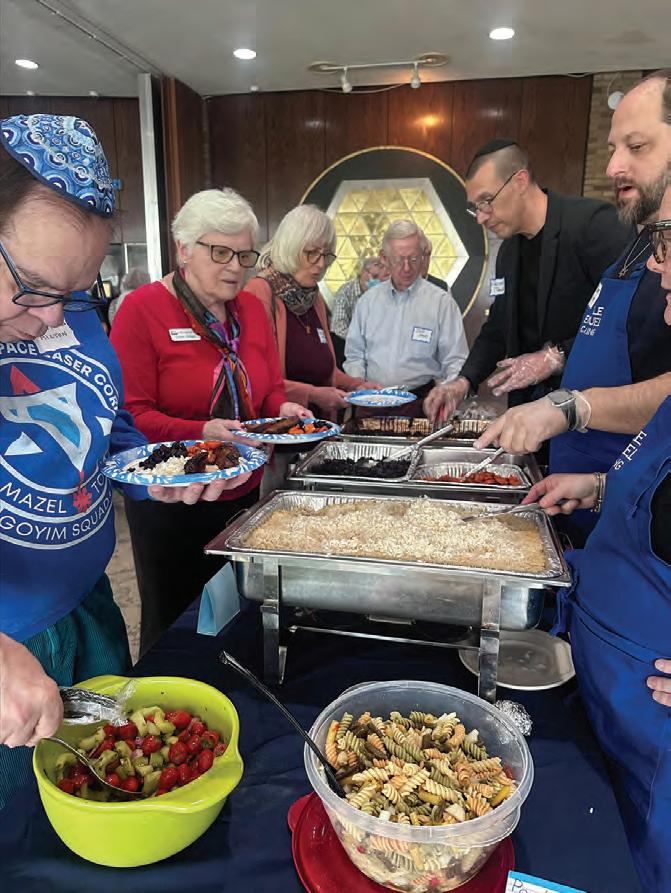
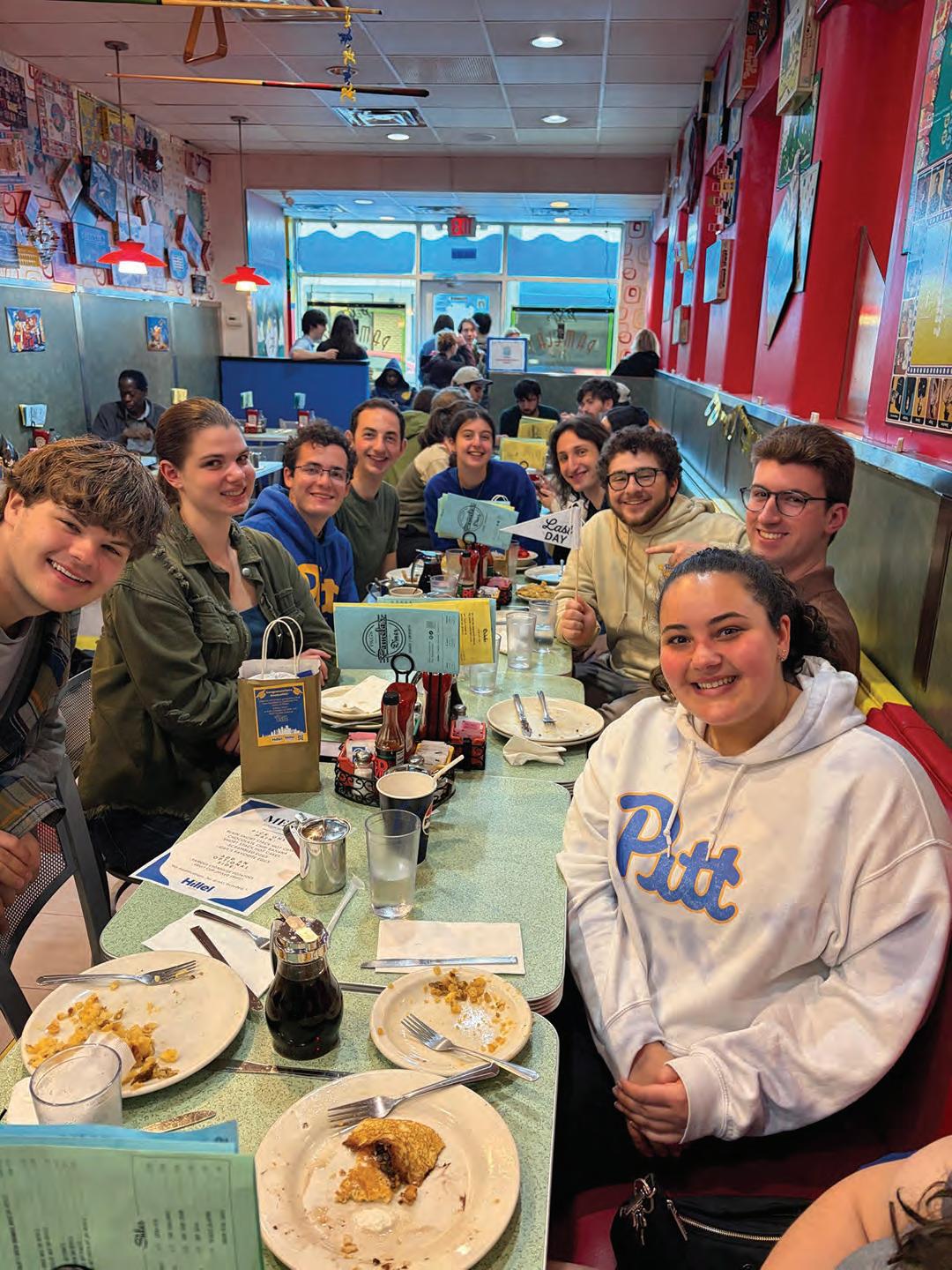
Pittsburgh pals and paleontology
As members prepared for a new congregational chapter with Beit Kulanu, a May 15 service enabled worshipers to honor the legacy of Rodef Shalom Congregation. The Friday evening program with Senior Rabbi Emerita Sharyn Henry, Rabbi David Young and Music Director Don Megahan, encouraged participants to use song and prayer to experience Shabbat with memory, gratitude and connection. Participants were also encouraged to add stories, reflections and drawings to visual memory boards.
Pre-Shavuot planting with purpose
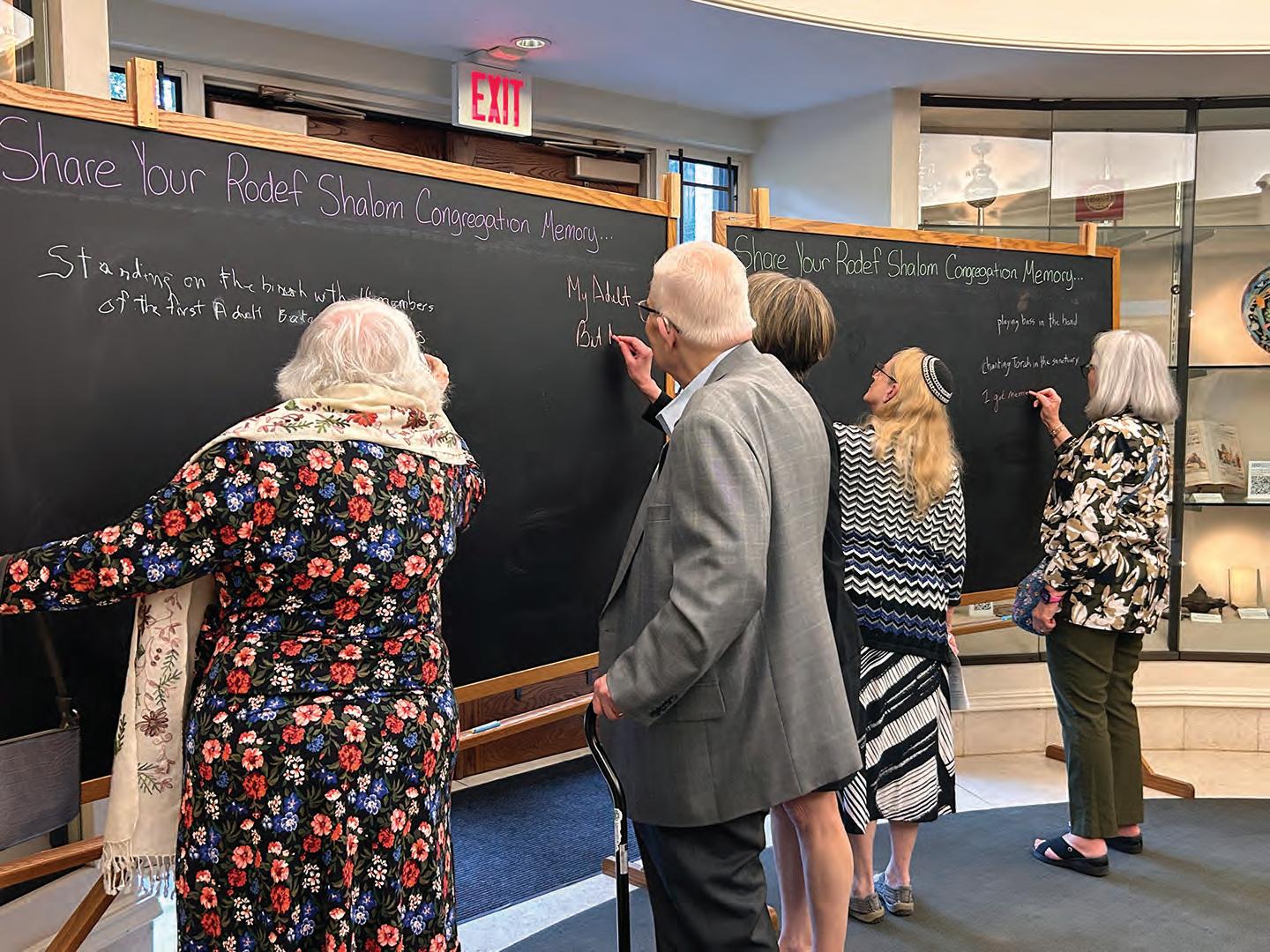
Friendship Circle of Pittsburgh teens visited the Pittsburgh Zoo & Aquarium on May 15. Teens observed “Dinosaurs!,” an exhibition introducing visitors to 186 million years of the Mesozoic Era.
Community Day School families gathered at the Jewish day school for a pre-Shavuot ice cream and planting party. The May 17 event enabled partic ipants to learn about the holiday, enjoy sweet treats from Bruster’s Ice Cream and better the earth.
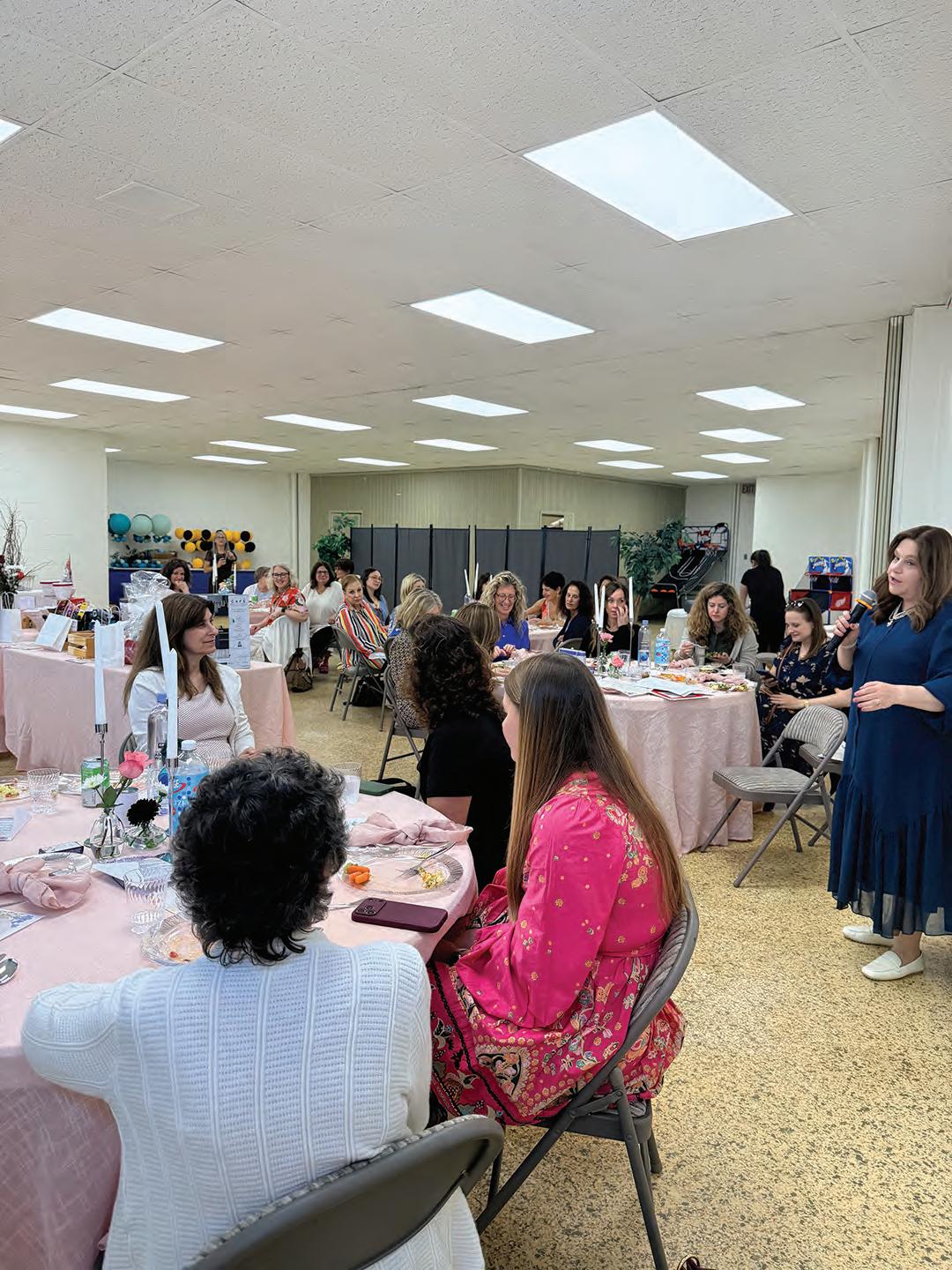
Chabad of the South Hills hosted “Spa for the Soul Ladies Spring Event.” The May 17 program enabled participants to enjoy brunch and cheesecakes. Licensed psychologist Sharon Saul served as guest speaker,


CDS Summer Clubs offer fun, engaging, and enriching activities for children and families all summer long! Register for all clubs!
Regsiter for Camp Lion (2s-4 Grade) by the week ! th