Defending democracy

On Jewish issues, where do our candidates stand?
Beacon Coalition is a non-partisan organization standing up for the rights and wellbeing of Jews in the United States.
Election Day — May 19
Beacon Coalition vets candidates for political office in three areas: combatting antisemitism, upholding democracy, and championing pluralism.
These evaluations are based on the candidates’ voting records, public statements, and interactions with the Jewish community.
Read more about these and other candidates on our website.

Pennsylvania House — District 32
Joe McAndrew- Incumbent ★
Representative Joe McAndrew has represented the 32nd Legislative District since 2025. Representative McAndrew voted in favor of a Pennsylvania House Resolution condemning the Hamas terrorist attack on October 7, 2023 and has actively engaged with the Jewish community during his time in office. When asked by Beacon about how elected officials should respond to antisemitism antizionism being voiced by colleagues, he said If there is a marginalization of the Jewish community, we should take steps to show that the party is united in pushing back against hate.” Representative McAndrew opposes the BDS movement.
Pennsylvania House — District
33
Mandy Steele- Incumbent ★
Representative Mandy Steele has served Pennsylvania’s 33rd District since 2022. She has supported resolutions condemning the October 7 Hamas attacks, voted to recognize Jewish Day Schools Week, and is a member of the Jewish Legislative Caucus. Steele has engaged with the Jewish community in her district, including attending local hostage vigils and holiday gatherings. After the Bondi Beach shooting in December 2025, she delayed her departure for a legislative session to oin her community Menorah lighting, saying It is important to me to stand with my Jewish friends as they continue to endure persecution and terror here and around the world.
Pennsylvania House — District 34
Abigail Salisbury- Incumbent ★
Representative Abigail Salisbury has served in the Pennsylvania House since 2023. She has been an active advocate on issues affecting the Jewish community, including co-sponsoring legislation creating Pennsylvania’s Jewish American Heritage Month, condemning the October 7 attacks, and advancing hate crime legislation. Salisbury has consistently spoken out against antisemitism, including engaging directly with institutions on concerns about campus climate and public discourse, writing that if Jews aren’t safe, none of us can be safe.” She is a member of the Jewish Legislative Caucus and was the primary sponsor of legislation promoting screening for aucher’s disease, which disproportionately affects Jewish infants. Her record includes advocating for the ability of all religious communities to fully participate in civic life and speaking out against rhetoric and behavior that threaten the safety and inclusion of any minority group.
Combatting antisemitism
Pennsylvania Senate — District 42
Wayne Fontana - Incumbent ★
Senator Wayne Fontana has represented Pennsylvania’s 42nd District since 2005 and currently serves as Democratic Chair of the Senate Law & Justice Committee. His legislative record includes consistent, long-term support for measures addressing antisemitism, including voting for legislation prohibiting state entities from boycotting or divesting from Israel in 2024 and cosponsoring Senate Resolution 130, which condemns the June 1, 2025 antisemitic firebombing attack in Boulder and calls for action to address rising antisemitism in Pennsylvania. Senator Fontana is consistently engaged with the Jewish community in his district. Senator Fontana also supported earlier anti-BDS legislation enacted into law in 2016.
Paul Steenkiste
Paul Steenkiste is a software engineer who has not held prior elected office. There is limited publicly available information regarding his positions or past statements, and no documented record on issues related to addressing antisemitism or other Beacon principles.
Pennsylvania House — District 23
Dan Frankel - Incumbent ★
Representative Dan Frankel has served Pennsylvania’s 23rd district since 1 . He has consistently stood up for pluralism in Pennsylvania, sponsoring a series of anti hate crime bills designed to protect residents across all races, religions, and identities. Rep. Frankel has been a leading voice opposing e tremism. He has been clear on BDS, stating that its disingenuous demands lay the groundwork to delegitimize Israel and isolate Jews everywhere.” Frankel has also spoken out when he views rhetoric as harmful to Jewish constituents, including criticizing Rep. Summer Lee’s hurtful October 7, 2024 statement and raising concern about her recent campaigning with an influencer known for antisemitic and e tremist rhetoric, warning that dehumanizing language creates an environment where hatred is emboldened and violence becomes more likely,” and urging her to withdraw from the event. He is Co-Chair of the Jewish Legislative Caucus and recently helped secure 1.3 million in security grants for local faith and community organizations.
Allegheny County Democratic Committee & Pennsylvania State Democratic Committee
These are the official local and state organizations of the Democratic party, responsible for endorsing candidates, driving voter outreach and helping with campaign efforts. The people who are elected to hold these seats have direct impact on candidate endorsements and party direction. ndorsed candidates often go on to win county and state-wide elections. It is critical that these seats are held by people who will support civic-minded, results-driven leaders - and who care about countering antisemitism and standing up for democracy and pluralism.
What can you do?
These races are local. The candidates are accessible. Before you vote, take a few minutes to learn who is on your ballot and where they stand.
View your sample ballot →
BeaconCoalition.org/sample
Headlines
Family, friends and Duquesne Kline Law celebrate the compassionate legacy of Shayna Bennett
By Deborah Weisberg | Special to the Chronicle
Shayna Maya Bennett loved children and envisioned a legal career advocating on their behalf.
“She wanted to ensure that every child had a voice,” said her mother, Jamie Bennett, of Upper St. Clair. “From the time she was little, if she saw a child not fitting in, she would befriend them.”
Shayna Bennett, 23, was one step closer to realizing her dream as a first-year student at the Duquesne University Kline School of Law when she died March 26, leaving Jamie Bennett, her father, Nathan Bennett, sisters Bailey and Eliana, extended family and numerous friends to mourn.
To honor Shayna Bennett’s vision, her mother worked with the law school to establish the Shayna Bennett Scholarship for Advocacy and Service. By early May, more than $50,000 had been raised, and more donations were “steadily coming in,” according to law school Dean April Mara Barton. The initiative is being matched dollar-for-dollar by attorney Thomas R. Kline — a 1978 graduate and for whom the law school is named — and has reached a $100,000 goal, “which allows us to fully endow the fund,” Barton said. Kline, who recalled meeting Shayna Bennett while visiting Duquesne, pledged his support from the start. “I want to do everything in our collective power to assure that there is a fitting scholarship in her name,” he said, “and that we do something truly meaningful.”
The scholarship will cover a portion of tuition for a student who is called to the same type of work as Shayna Bennett, Barton said.
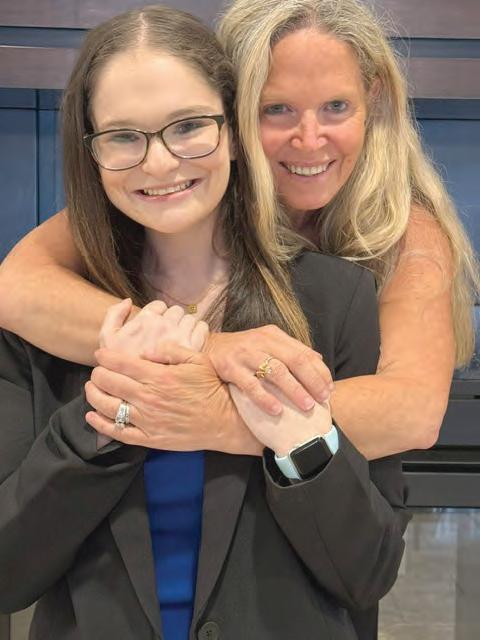
p Shayna Bennett and Jamie Bennett
“The more we can raise, the more we can give.”
That the fund reached its goal so quickly is “a testament to Shayna’s life and legacy,” Barton added. “There has been such an outpouring of love and support and commitment to this cause.”
Jamie Bennett is using social media and a vast network of people who knew her daughter to spread word of the fund. “It’s the only thing giving me any light through unbearable darkness,” she said, noting that the response has been deeply moving.
“When I emailed Mr. Kline to thank him for his generosity he told me he remembered Shayna’s enthusiasm, and infectious smile.”
Jamie Bennett has heard much the same from her daughter’s classmates and colleagues at Duquesne and from her undergraduate alma mater, Hofstra University, where she
graduated cum laude. “I received over 150 handwritten notes from students at the law school who talked about how if they were having a bad day, just looking across the room and seeing Shayna smile changed everything.”
Condolences from faculty at Hofstra referenced Shayna Bennett’s internship at Birth Justice Warriors, a maternal health equity initiative, with one professor citing her “enthusiasm to be of service,” and her “quiet, steady leadership.”
Support also has come from Amedisys Hospice where Jamie Bennett works, and Beth El Congregation of the South Hills, where the Bennett family has worshipped for four generations.
Beth El’s Rabbi Alex Greenbaum officiated at Shayna Bennett’s naming, her bat mitzvah and her funeral.
“Shayna was a bright light in a dark world; an inspiration,” Greenbaum said, recalling both her spunk and her sweetness. “She was kind. She was the best of us.”
Jamie Bennett recites Kaddish twice a day and frequently posts her daughter’s photographs on Facebook. “People tell me they never want to forget her smile,” she said.
She pores over memories of Shayna Bennett, who showed compassion and intuitiveness even as a child. She was an avid skier and swimmer who worked summers as a lifeguard and indoor activities assistant at Seven Springs, read voraciously, wrote “impeccably” and loved spending time with family, Jamie Bennett said.
The close bond she developed with her maternal grandfather, Don Selig, began about a minute after she was born, Jamie Bennett said, “when she reached up and grabbed his pinky.”
“He became one of her biggest role models. They’d have these discussions and she was so articulate, so mature he’d forget he was talking to a 12-year-old.”
A former Beth El Hebrew Religious School teacher, Selig informed his granddaughter’s deep faith and her cultural commitment to Judaism, which included joining B’nai B’rith Youth Organization, United Synagogue Youth, Hillel at Hofstra, and the Jewish Law Association at Duquesne.
“My father guided Shayna’s path in life,” Jamie Bennett said. “Judaism was so important to her.”
The debates with her grandfather helped to lay the groundwork for law school. Although Shayna Bennett aspired to become a pediatrician, she discovered just weeks into her freshman year that law was a greater calling.
“She graduated with a degree in community health, which would have given her the background she wanted for her work in the legal community,” her mother said. “That, and she could argue any point.”
The prospect of helping other young people pursue their passion is comforting to Jamie Bennett, although navigating her loss is an ongoing struggle. “Every day, I try to figure out how to put one foot in front of the other,” she said. “I’m broken … but I have to be strong for my other kids.”
Daughters Bailey, 30, and Eliana 20, live with Jamie and Nathan Bennett — “the most incredible father to all three of our children,” Jamie said — and they are helping each other through their grief.
“Our safe place is being together at home.” PJC
Deborah Weisberg is a freelance writer living in Pittsburgh.
By David Rullo | Senior Staff Writer
Pennsylvania recorded the fifth most antisemitic incidents nationwide last year, according to a new Anti-Defamation League report. New York ranked first, followed by California, New Jersey and Florida.
There were 281 antisemitic incidents in Pennsylvania in 2025, according to the ADL. More than half of those incidents — 53% — occurred in Philadelphia and Pittsburgh. Jewish institutions were the most frequently targeted sites, accounting for 63 incidents. K-12 schools, colleges and universities reported a combined 53 incidents. The remaining cases occurred in public areas (62), businesses (50), homes (27), and an “other” category (26). The report noted that incidents at businesses and Jewish K-12 schools increased in 2025 by 61% and 19%, respectively.
The number of antisemitic incidents
documented in the state was down 40% from 2024, which the ADL said was “driven partly by the fact that antisemitic bomb threats, which accounted for 31 incidents in 2024, did not occur at all in 2025.” Incidents related to Israel or Zionism also fell from 278 to 129, something the organization said was due to a lower level of antisemitic activity at rallies organized by anti-Israel groups.
According to Jewish Federation of Greater Pittsburgh records, more than 300 antisemitic incidents were reported in Pittsburgh in 2025, surpassing the number of incidents in both 2024 and 2023.
The ADL recorded 6,274 incidents nationally last year. While down by 33% from 2024, that number is still five times higher than a decade ago.
Three people were killed last year in antisemitic attacks across the United States and at least 300 people were victimized by physical assaults.
High profile antisemitic incidents in 2025 included the shooting at the Capital Jewish Museum in Washington, D.C.; a Molotov cocktail attack at a Run for Their Lives event
in Colorado; a stabbing of a Jewish man on the streets of New York; and a firebombing of Pennsylvania Gov. Josh Shapiro’s residence on Passover while the first family was inside.
Kelly Fishman, the ADL’s regional director serving Ohio, Kentucky, West Virginia







and western Pennsylvania, said the 2025 decrease in antisemitic incidents overall reflected “the hard work of our partners in law enforcement, higher education and the

We provide expert help with long term care planning, powers of attorney, wills, trusts and special needs. We help you implement legal and tax strategies to protect your wealth during your life and afterwards.


mhm@ahmpc.com
4927 William Flinn Highway Allison Park, Pennsylvania 15101 We make house calls!


Photo courtesy of Jamie Benett
Calendar
Submit calendar items on the Chronicle’s website, pittsburghjewishchronicle.org. Submissions also will be included in print. Events will run in the print edition beginning one month prior to the date as space allows. The deadline for submissions is Friday, noon.
q FRIDAY MAY 15–SATURDAY, MAY 16
Pastor Eric Manning of Mother Emanuel A.M.E. Church of Charleston, South Carolina, is sharing the weekend with Tree of Life Congregation. Thursday evening, Rabbi Jeffrey Myers will be joined by moderator Michelle Wright (former WTAE anchor) as the two discuss Black/Jewish relationships at Calvary Episcopal Church (315 Shady Ave.) Friday evening, Shabbat services will feature a sermon by Manning at Beit Kulanu’s Levy Hall. The weekend concludes with a special Torah Studio service at 9:45 a.m. treeoflifepgh.org
q SATURDAY, MAY 16
Carry Shabbat’s peace into the new week with a meditation and sound bath led by Cantor Julie Newman and Anitra Birnbaum. Havdalah Healing includes songs, Jewish ritual, and the soothing vibrations of crystal singing bowls and other instruments create a space to rest, reflect and restore. Open to all. 5 p.m. 4905 Fifth Ave., Cohen Chapel. tiferetproject.org/event/havdalah-healing
q SUNDAY, MAY 17
Join Chabad of the South Hills for Spa for the Soul Ladies Spring Event, a morning of relaxation and rejuvenation celebrating Jewish women. Brunch will be served, including a selection of cheesecakes. Sharon Saul, MS licensed psychologist, will be the special guest speaker, and the community award recipient is Julie Paris of StandWithUs. Raffle and


auction prizes. 10:30 a.m. 1700 Bower Hill Road. Chabadsh.com/Spring
q SUNDAYS, MAY 17–JULY 26
Join Chabad of Squirrel Hill for its Men’s Tefillin Club. Services and tefillin are followed by a delicious breakfast and engaging discussions on current events. 8:30 a.m. 1700 Beechwood Blvd. chabadpgh.com
Join a lay-led online Parashah study group to discuss the weekly Torah portion. No Hebrew knowledge needed. The goal is to build community while deepening understanding of the text. 8:30 p.m. For more information, visit bethshalompgh.org/ online-parashah.
q MONDAYS, MAY 18–JULY 27
Join Congregation Beth Shalom for a weekly Talmud study. 9:15 a.m. For more information, visit bethshalompgh.org.
Join Temple Sinai for an evening of mahjong every Monday (except holidays). Whether you are just starting out or have years of experience, you are sure to enjoy the camaraderie and good times as you make new friends or cherish moments with long-term pals. All are welcome. Winners will be awarded Giant Eagle gift cards. All players should have their own mahjong cards. Contact Susan Cohen at susan_k_cohen@yahoo. com if you have questions. $5. templesinaipgh.org
q TUESDAYS, MAY 19–JUNE 30
Join Beth El’s Rabbi Alex Greenbaum and his Bible/ Talmud Adult Education class for a thought-provoking weekly session of Bible and Talmudic study. This program is available both in person and virtually. Call the office at 412-561-1168 to receive the Zoom link or to make an in-person reservation. 10:30 a.m. 1900 Cochran Road. bethelcong.org
Report illegal discrimination today.
PghCHR investigates discrimination in housing, employment, public accommodations, and the delivery of city services, including the police.
q WEDNESDAY, MAY 20
Join Chabad of the South Hills for the new JLI course “Your Judaism Holds a Message the World Wants to Hear. It’s Time to unlock it.” 7:30 p.m. 1700 Bower Hill Road. chabadsh.com
q THURSDAY, MAY 21
Join your Pittsburgh community in person for a night of learning with well-known local rabbis and thinkers at Tikkun Leil Shavuot, sponsored by the Jewish Federation of Greater Pittsburgh. Free and open to the community. No registration necessary. Cheesecake and coffee; dietary laws observed. 10 p.m. to 1 a.m. Jewish Community Center of Greater Pittsburgh, Squirrel Hill, Darlington entrance. jewishpgh.org/occasion/tikkun
Join Chabad of Squirrel Hill and the Jewish Community Center of Greater Pittsburgh for all-night learning and refreshments with Rabbi Yisroel and Chani Altein. 10 p.m. at JCC, 11:30 p.m. at Chabad. chabadpgh.com
q FRIDAY, MAY 22
Join Chabad of Squirrel Hill for a Shavuot Dinner Party, including a reading of the Ten Commandments followed by a dairy dinner and ice cream bar. 5 p.m. 1700 Beechwood Blvd. chabadpgh.com/shavuotparty
q
WEDNESDAYS, MAY
27–MARCH 24, 2027
Explore the hows and whys of foundational mitzvot with Rabbi Yisroel and Chani Altein at Sushi and Study, a 12-part monthly class. Join all, some, even just one. 7:30 p.m. $15 per class/$150 per year. 1700 Beechwood Blvd. chabadpgh.com/jewishstudy
q TUESDAY, JUNE 2
Chabad of Squirrel Hill presents The Sound of Jewish Music, an uplifting concert for women featuring music, dance and inspiration. 7 p.m. $18/$10 for student in advance; $25 at the door. Katz Performing Arts Studio, 5738 Darlington Road. soundofjewishmusic.com PJC



Everyone deserves equal opportunity in Pittsburgh. Experiencing discrimination—including antisemitism— in housing, employment, or public spaces? The Pittsburgh Commission on Human Relations (PghCHR) investigates complaints, educates communities about their rights, and advances protections in City Code so every person can live, work, and thrive.
We’re here to help with:
• Discrimination investigations (including antisemitism)
• Outreach & education on your rights
• Policy recommendations for stronger protections Contact us:
412-255-2600 | human.relations@pittsburghpa.gov
Hours: Mon–Fri, 9am–5pm (closed City holidays) Please call or email to schedule—walk-ins not available. PghCHR — Promoting justice, dignity, and understanding across our city.
Headlines
The agricultural origins of Shavuot
By Tim Miller | Special to the Chronicle
While Shavuot is primarily known today for commemorating the giving of the Torah at Sinai, this aspect of the holiday is only about 2,000 years old. Nearly all of its many names, Hag-ha-Katzir (feast of the harvest), Yom ha-Bikkurim (day of first fruits), Hag-haShavuot and Pentecost (feast of weeks) refer to its origins as an agricultural festival.
As various passages in the Torah make clear — Exodus 23:14-19, Leviticus 23:9-22, Numbers 28:6, and Deuteronomy 16:9-12 and 26:1-11 — Shavuot was one of the three great agricultural pilgrimage festivals to Jerusalem. The others are Pesach and Sukkot, and the Torah ties both of these holidays to historical events in Israel’s history: Pesach to the Exodus from Egypt, and Sukkot to the wilderness years. But Shavuot is only seen in the Torah as an agricultural festival, and it would take centuries for it to be reinterpreted otherwise.
Shavuot is mentioned many times in the postbiblical writings, from the Book of Jubilees, Second Maccabees, and the historian Josephus. The longest and most vivid description of what the pilgrimage to Jerusalem was like, however, is preserved in the Mishnah (Bikkurim 1:1-3, 3:1-8), compiled around the second century CE: Directions are given for selecting first fruits from the seven specified species of wheat, barley, grapes, figs, pomegranates, olives and dates; it is said that those who lived near Jerusalem brought fresh figs and grapes, while those coming from farther away necessarily brought dried figs and raisins; leading each group into Jerusalem, and accompanied by music from a flute, was “an ox with horns bedecked with gold and with an olive crown on its head”; and when each group of pilgrims reached the Temple, “All the skilled artisans of Jerusalem would stand up before them and greet them, ‘Brethren, men of such and such a place, we are delighted to welcome you.’”
Seen in this way, we might understand why Shavuot’s focus remained for so long only on the gathering and offering of first
fruits. The day seems to have been joyous and full enough. One of the most human details of all concerns those pilgrims who stopped coming because they were unable to read the Hebrew from the required profession at Deuteronomy 26:3-10. The Mishnah tells us that, as a result, it became acceptable to repeat the words after the priest. In the century or so before the Second Temple was destroyed in 70 CE, disagreements arose between the priestly caste of the Sadducees and the more Torahcentered Pharisees. Summing up a complex topic, it seemed strange that while festivals commemorated the Exodus and the wilderness years, the same was not done for the giving of the Torah. Given Shavuot’s proximity to Pesach, it was eventually recognized as Zeman Mattan Toratenu, Season of the Giving of Our Law. Since the loaves of bread brought with the first fruit offering were symbolic of our collaboration with God in creation and sustenance, the act of Torah study and interpretation became its spiritual equivalent. And just in time, since without this additional layer of meaning, Shavuot
may well have disappeared entirely after 70 CE, now that pilgrimage, sacrifice and offerings were no longer possible. There is also an even older and unrecoverable aspect to Shavuot. “When you enter the land that I am giving to you and you reap its harvest,” Leviticus 23:9 says, “you shall bring the first sheaf of your harvest to the priest.” Exodus 23:19 says that these “choice first fruits of your soil” should be brought “to the house of the eternal your God.” Numbers 28:26 reminds the Israelites that this Feast of Weeks should be observed as “a sacred occasion: you shall not work at your occupations.”
In other words, even the earliest mentions of Shavuot presuppose a settled life in the kingdoms of Israel and Judah, and the centralization of sacrifice at the Temple in Jerusalem. It also assumes the kind of economic stability that would allow for pilgrimages and food offerings of this kind. But as tradition holds that the First Temple was built by Solomon around the 10th century BCE, we are left to imagine an even earlier time — that huge swathe covered by
the books of Judges and 1 Samuel — without a Temple or centralized worship. Was there something like Shavuot then? Were offerings of first fruits brought to the earliest local shrines, like the one at Shiloh mentioned at the beginning of Samuel? Did something like the long proclamation required with the offering and preserved in Deuteronomy 26:3-10 (“My father was a fugitive Aramean. He went down to Egypt with meager numbers and sojourned there; but there he became a great and very populous nation …. ”) originate in places and moments like these?
When I think of Shavuot, this is what I think of.
Of course, from the Middle Ages forward, and from Britain to Spain, and Russia to the Middle East, one of the most tired clichés of antisemitism said that Jews hated manual labor of all kinds. As late as the 19th century, the British journalist William Cobbett challenged anyone to “produce a Jew who ever dug, who went to the plough.” When I think about the agricultural origins of Shavuot I think about people like Cobbett, too, and the restrictions that kept Jews from owning (let alone farming) land for so long in pre-modern Europe and elsewhere.
I also think of the earliest European Jews to leave the continent for Palestine. In 1882, around 200 Romanian Jews founded a village later named Zikhron Ya’akov, and David Vital writes that for these Jews and those that followed them, “They were alert … to the historic and emotive virtues of the Land, [and] it was central to their outlook that these were indissoluble from the moral and social virtues of agriculture. Life in one and labor in the other were, they thought, the twin keys to the regeneration of the Jewish people.” Barely 70 years later, following the Shoah and the founding of Israel, Rabbi Jonathan Sacks wrote that the early kibbutzniks, “secular Israelis, re-appropriated Shavuot precisely as a celebration of the land.”
In ways that ancient Israel’s farmers and Temple priests could not have imagined, something like the earliest meaning of Shavuot had been found again. PJC
Tim Miller is a poet and writer living in Pittsburgh. He is online at wordandsilence.com.
No-show at appeal hearing leaves antisemitic flyer conviction
County Common Pleas Judge Thomas E. Flaherty and the fine stands for now.
By Toby Tabachnick | Editor
An Ohio man who was convicted in August on more than 160 littering charges related to the distribution of antisemitic flyers in Squirrel Hill and Shadyside — and who was fined more than $50,000 — was a no-show at the May 6 hearing on his appeal. His lawyer was absent as well.
The appeal was dismissed by Allegheny
But Brokaw and his attorney claimed they never got notice of the court appearance, and the appeal was reinstated by the judge. The new hearing is scheduled for June 3.
The charges stem from antisemitic literature thrown on May 18 from a Dodge Durango later determined to be owned by Jeremy Brokaw, of Zanesville, Ohio, according to Pittsburgh Police. Doorbell cameras caught the action and the vehicle’s license plate.
Brokaw was charged under two statutes:
one prohibiting the authorization of littering from a vehicle, and one prohibiting littering on “any highway, or upon any other public or private property without the consent of the owner thereof.”
The flyers thrown from Brokaw’s vehicle contained classic antisemitic conspiracy theories including, “Every single word of the Jewish Talmud is satanic” and “The Protocols of the Learned Elders of Zion: The Jew’s Plan for World Domination.”
At an August hearing, District Judge Craig Stephens found Brokaw guilty of
more than 160 counts. Each count carried a $300 fine. At the time, Brokaw’s attorney, Joshua Smith, attempted to raise First Amendment issues, arguing that police would most likely have charged Brokaw only once, or not at all, if the littered flyers didn’t contain antisemitic messages.
The judge was not swayed by that argument, and suggested the defense attorney could raise the issue if he appealed the verdict. PJC
Toby Tabachnick can be reached at ttabachnick@pittsburghjewishchronicle.org.
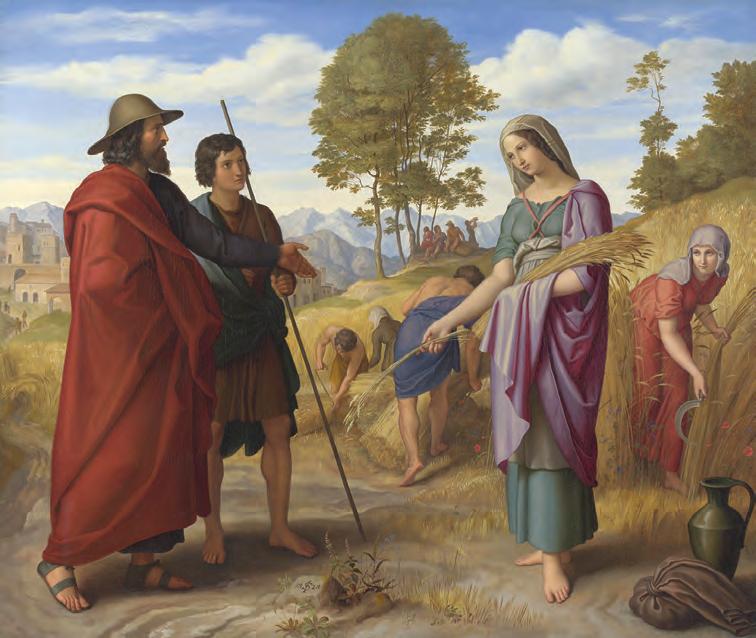
p “Ruth in Boaz’s Field,” by Julius Schnorr von Carolsfeld, oil on canvas, 1828; National Gallery, London Image in public domain
Headlines
Nonagenarian survivor takes part in March of the Living
By David Rullo | Senior Staff Writer
Ellen Tissenbaum’s life story reads more like the script of a Hollywood movie than a real-life biography.
After losing both of her parents to the Holocaust, Tissenbaum escaped from Holland to Canada and distanced herself from Judaism before eventually returning to her faith. Her story is shaped by experiences most people know only through history, culminating in an emotional visit to Auschwitz this April with the March of the Living, along with her son Allan Tissenbaum of Mt. Lebanon, his son, Jeremy Tissenbaum, and his niece Molly.
Born in 1936, Tissenbaum remembers being a happy child. Her mother and father immigrated to Holland from Germany to escape the rampant antisemitism leading up to Hitler’s rise and the Holocaust. The Netherlands maintained a stance of neutrality in the war before it was occupied by Germany in May 1940.
Tissenbaum said she still recalls airplanes flying over Amsterdam and “people in black boots, black leather coats, which I still won’t wear, and these loud noises — including dogs and whatnot — and the German soldiers marching through the town. I was petrified.”
When she was 4, she asked her mother why people were being so mean to her. Her mother’s response — “because we’re Jewish” — prompted Tissenbaum to innocently
remark, “Take it away. I don’t want to be Jewish. I want to play with the people on the other side.”
Shortly after the Nazi’s invasion, soldiers stormed Tissenbaum’s house and arrested her father. The arrest, it turned out, was a case of mistaken identity. The Germans thought he was working for the resistance. Suddenly, the country that had been a refuge became cold and dangerous. The butcher across the street from where she lived placed “No Jews Allowed” signs in his window. She was no longer able to attend school or play with children with whom she had been friends. The city’s Jews were forced into three separate zones.
“The Dutch people were very nice,”



Tissenbaum recalled. “They gave the Jews a sort of council where they could squeal on other Jews.”
Her mother had a simple solution: The family would no longer be Jewish.
“We had my father’s best friend, went to church, got baptized and figured those drops of water would fix everything. My mother dyed her hair red. No more Jewish,” she said.
Soon, Tissenbaum’s father came home, briefly. A shell of the man he was before the arrest — once jolly and gentle — he no longer spoke. He was arrested again in a sweep following a Dutch protest of the Jewish community’s treatment and was sent first to Westerbork transit camp and then Sobibor extermination camp. She never saw him again.
After his arrest in 1943, her father’s best friend collected Tissenbaum and her mother, took them to his house and hid them in a secret room.
The man had a wife and eight children, and tried to provide for everyone with meager rations that seem to diminish daily. Soon, another woman and her two children came to share the secret room.
Despite the hardships, Tissenbaum said, life was “wonderful.”
“We came out at night. Everyone was nice to us. I can think of nothing but goodness that these people did for us,” she said.
Before long, the familiar sounds of the Nazis returned.
“You could hear the trucks and the Germans and the blaring and the kicking in of the front door,” Tissenbaum recalled.
“They took my father’s best friend outside, put a gun to his head and said they would shoot him if he didn’t say where the Jews are hiding. He had no choice.”
Tissenbaum and her mother were sent to a camp. They were separated before being reunited for a train ride to Westerbork. She can’t recall how long she stayed in the work camp, but said she was “cute, blonde and little. During the day, I was able to go to the garden of the Germans and steal potatoes for me and my mother to have something to eat.”
One day, the women were taken and lined up before being separated. Tissenbaum’s mother told her, “Never become Jewish again. Those were her last words to me.”
The final image she carries of her mother is of her being forced onto a cattle car headed to Auschwitz. Her mother died shortly after the camp was liberated.
Fate played a hand in Tissenbaum’s life when her father’s best friend, the same person who hid them, managed to get papers from a doctor saying she was his illegitimate child.
S he lived for the remainder of the war with the family as a Christian, and accepted her parents’ absence without question, she recalled.
“I went to school; I went to catechism. I was really accepted as part of their family and we didn’t talk about being Jewish,” she said.
Tissenbaum became part of a three-way legal dispute between the family she was staying with, an aunt and uncle in Argentina, and another aunt and uncle in Canada. The Canadian relatives eventually gained custody.
“One day the doorbell rings, they call me to the door and there are these two strangers standing there. They tell me they are my aunt and uncle and have come to take me to Canada,” she remembered. “Where’s Canada? I don’t know what Canada is.”
Tissenbaum stayed with the family. She became a nurse working at the Jewish General Hospital in Montreal. She got married.
Eventually, she got back in touch with the family in Holland that hid her twice from the Nazis. She reestablished a connection with the family that remains to this day.
This year, just weeks before her 90th birthday, Tissenbaum traveled to Poland to take part in the March of the Living — a walk between Auschwitz and Birkenau, both death camps.
It’s something she began thinking about two years earlier when a non-Jewish friend died. While at the wake, the friend’s stepson, a pilot, recounted a story of having plane trouble in Poland forcing him to spend time in the country, where he saw Auschwitz.
“He said if everybody stood on the railroad tracks in Poland, the world would be a better place,” she recounted.
At the time, Tissenbaum was teaching at a university where American students had asked about her life and her mother.
“I wanted to honor her by doing the March,” Tissenbaum said. “I was really thinking of paying homage to her.”
She attended the march with 100 high school students, serving as bus captain.
The second day of the march — when they visited Auschwitz and went through the barracks — was particularly challenging. It wasn’t only the camp’s architecture that was difficult. While there, Tissenbaum said she was in the library at the former death camp going through “pages and pages and pages” of people who died and found her mother’s name.
The trip spurred the nonagenarian to publicly share her story, something she didn’t do in the past.
“I’ve been silent. It’s lately, in the last few years, that I’ve started to write and put it down for my grandchildren,” she said.
As for the march itself, Tissenbaum said that what she did as an homage to her mother didn’t bring closure.
“I don’t think there can ever be closure,” she said. “These are losses that you feel deep down. Every once in a while they come up. You feel your kids have been deprived, your grandchildren have been deprived. I’ve had a lot of substitute people in my life that have given me so much.”
As for her mother’s final wish that her daughter never reembrace Jewish heritage, Tissenbaum said that was the wish of a mother who didn’t want to see her child hurt again.
“I’m very vocal. I wear my Magen David. I don’t care. I’m Jewish,” she said. PJC
David Rullo can be reached at drullo@ pittsburghjewishchronicle.org.
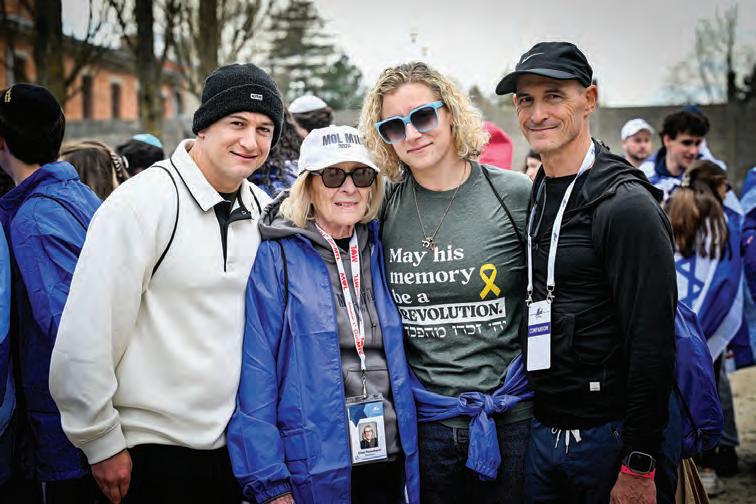
p Allan Tissenbaum (right) and his mother Ellen Tissenbaum (second from left) took part in the March of the Living in April, with Allan Tissenbaum’s son Jeremy (left) and niece Molly.
Photo by PBL Photography
Headlines
Shavuot:
Continued from page 1
“clearly in very different parts of the community spectrum, so it’s terrific to have them both, and they will bring a richness of Torah and their own approach to that material.”
With a program touting nearly 20 educators, an abundance of kosher cheesecake, coffee and a few urns of hot water, Tikkun Leil Shavuot will look familiar to past iterations.
Continued from page 1
representing various streams of Jewish thought.
Freedman, who serves as director of the religious school at Beit Kulanu, told the Chronicle he wanted to emulate the decades-old communal activity and give younger Pittsburghers a means to enjoy its fruits.
While the late-night program for adults, which begins at 10 p.m. on May 21, enables community members to connect and learn, doing so isn’t always easy for those with younger children. Often, parents’ activities and schedules mirror their children’s. By designing a program predicated on bringing together younger Pittsburghers from various walks of Jewish life, Tikun Jr. strives to afford familiar social and educational benefits,

Replication is a deliberate choice, Schiff said.
Through the years, various proposals have been raised to “change things or to somehow alter the structure or introduce innovations, and for the most part, with few exceptions, I have resisted those particular sugges tions because I am of the view that it works precisely because of the simplicity and the elegance and the deep communal interac tions that go on in the structure that we have,” he said. “We’ve been doing this for almost a couple of decades now, and still, people like you and many others come to me and say this
Freedman explained.
“The holiday gives us a reason to gather, learn and be together, and the opportu nity for parents, kids and community to all happen in one place is what makes it really special,” Speck said.
“We’re blessed with multiple organizations in Pittsburgh,” Freedman said. “We don’t all get to come together all the time, and that’s why the Tikkun Leil Shavuot has been such a hit — people that we might recognize or we’ve seen here and there, we can actually be in a program with and have a conversation and learn together. I think that’s similar to what we are doing with Tikun Jr.”
The program, which requires registration and is for children ages 1-8 and their parents, “takes people from different walks of life that maybe you saw at a school assembly, or maybe you saw here and there, or in the park, and it just gives us a chance to really sit

SHABBAT SHI’UR:
NEWS FOR JEWS
SATURDAY, MAY 16 AT 1:00 P.M. CONGREGATION BETH SHALOM 5915 BEACON ST., PITTSBURGH, PA 15217

Sinai, including the children,” he said. “All of us received the Torah — from the highborn to the low, the old to the young. We were all at Sinai. And so we all should be at Sinai, even if it needs to be much earlier in the day.”
“The Pittsburgh Jewish community is creative and has opportunities that you don’t always see in other places,” he said. “We are small and mighty.”
Come for Shabbat services and kiddush starting at 9:30 a.m. and then stay for a talk led by Jim Busis, CEO/Publisher of the Pittsburgh Jewish Chronicle. Jim will discuss Jews and the news.
Questions? Contact Shari Woldenberg at swoldenberg@bethshalompgh.org
The structure of the academic year can make engagement with Shavuot somewhat challenging, Freedman said. Because Shavuot routinely comes in late May or June, many religious schools are closed. For numerous children, this means there’s an inability to “really study Shavuot.” Tikun Jr. pushes back
ADL report:
Continued from page 5
broader community.”
“Pittsburgh is a great example of that partnership in action: When antisemitic flyers were distributed in broad daylight in the Squirrel Hill neighborhood, ADL worked alongside the Pittsburgh Jewish Federation and local law enforcement which led to the identification, apprehension and sentencing of the perpetrator,” she said.
By clinging to that communal quality and participating in Tikun Jr., Freedman continued, parents can “help bring their children a little closer to Torah and our heritage.” PJC
Adam Reinherz can be reached at areinherz@pittsburghjewishchronicle.org.
Still, Fishman noted that 281 antisemitic incidents is too many, and said that every number represents a real person “whose sense of safety was shaken.”
“Antisemitism remains a genuine and prevalent threat to Jewish Pennsylvanians, and ADL Ohio River Valley remains committed to expanding on the progress we saw in 2025,” she said. PJC
David Rullo can be reached at drullo@ pittsburghjewishchronicle.org.
Tikun Jr.:
p Nourishing children through pizza and study
Photo by Anna Shvets via Pexels




Monday, June 8
5:30-7 pm: VIP Reception
7-8:30 pm: Interview, Cooking Demo and Book Signing
JCC of Greater Pittsburgh • Squirrel Hill
$54 Admission includes a copy of Sussman’s newest cookbook, Zariz
$118 VIP intimate meet & greet with the 3 chefs featuring a special cocktail and light bites created by Adeena Sussman and Bill Fuller
For more info, contct Fara Marcus: fmarcus@jccpgh.org
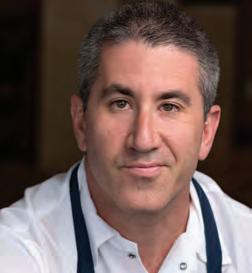
Michael Solomonov Award–winning chef and restaurateur
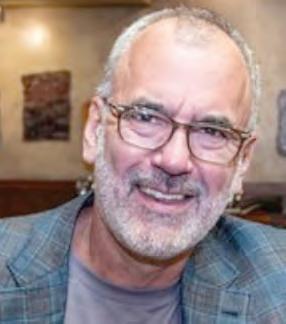
Bill Fuller (VIP Reception) President of big Burrito Restaurant Group
Adeena Sussman, cookbook author
The Palestinianization of the University of Michigan commencement address
Guest Columnists
Donna Robinson
Divine and Asaf Romirowsky
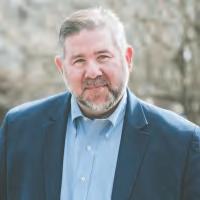
Derek Peterson, a professor of history and African studies and chair of the Faculty Senate at the University of Michigan, hit a nerve at the school’s graduation ceremony earlier this month with his praise for the “pro-Palestinian activists who have … opened our hearts to the injustice and inhumanity of Israel’s war in Gaza.”
One rarely searches for wisdom in commencement addresses, but to ignore the libels embedded in these words risks bestowing on them an academic respectability they do not merit. And the entirely predictable and programmed response from the University of Michigan president, who apologized for words causing pain during a celebration, only discloses the distance today between university activities and what should be their core mission: teaching students how to think, not what to feel.
Examining Peterson’s statement in the context of his entire speech on May 2 is even more revealing and speaks volumes of the state of the academy post-Oct. 7, 2023.
He opens his talk with a focus on the unsuccessful attempts by women to gain admission to the university. He celebrates their persistence. He moves on to note that the first Jewish professor appointed to the faculty brought Jewish students denied admission to elite Ivy League institutions on the East Coast to the university and to the Midwest.
Righteous battles to gain an education or to
expand the curriculum are enrolled as precedent for denouncing what he names as “Israel’s unjust and inhumane war in Gaza.” Without mentioning Hamas’ savagery on Oct. 7, when 1,200 men, women and children in southern Israel were slaughtered — many in their homes — by thousands of terrorists who infiltrated the border, he has effectively endorsed the idea of turning the campus into the staging ground for holding butchered Israelis responsible for the horrors perpetuated on them.
Ironically, Peterson’s views of Palestinian campus activism are more akin to the reasoning used by the university’s first president, Henry Tappen, who denied women their rights to an education because it would “disturb God’s order … and produce monstrosities.” Just as it took great courage in 1858 for Sarah Burger to apply for university admission, it now takes intellectual resilience to take on Peterson’s scurrilous remarks because they have become entrenched across so many educational institutions.
Singing for the pro-Palestinian protesters as warriors for social justice is as ludicrous as the narrative from which it emerges. Devoid of intellectual credibility, applauding these protests might be deemed, with apologies to Hannah Arendt, the banality of the algorithm.
The narrative woven around the barbarism of Oct. 7 comes adorned with corrupt political theories and fictional data. That narrative has been deconstructed by a careful collection of statistics about casualties available either in books like that of our own, "Oct. 7: The Wars over Words and Deeds." Or from recently published accounts that have, in fact, confirmed and strengthened the trends discussed in our collection.
There is ample information on the many reporters with the ranks of Hamas and on the scores of employees with the U.N. Relief Works and Agency for Palestine Refugees involved in the Oct. 7 massacre and in holding hostages for two years afterwards. UNRWA
facilities, including hospitals, served as critical headquarters for Hamas.
It is impossible to imagine any rightly ruled country not responding militarily to such brutal assaults that violated the foundational principles of government to protect citizens.
Since gaining power in Gaza, Hamas has attacked Israel many times, garnering international support and following a formulaic pattern. The terrorist organization fires missiles; Israel responds to end the murderous assaults, blunting them with the Iron Dome, bombing rocket launchers and sending troops over, but not too far over, the border. Israel is typically stopped short of achieving its strategic goals by demands from international organizations, endorsed by the United States, for a ceasefire that leaves Hamas in power with sufficient capacity to rebuild and expand its arsenal, and to continue its efforts to turn the Jewish state into Arab Palestine.
Remaking Palestine “from the river to the sea” is, however, not an achievable political aim. Pursuing it has brought Palestinians material devastation and human suffering, even if it has sustained their image as the innocent victims of a historic injustice.
That 1948 is now associated less with a military defeat than with a first cause of suffering has indelibly stamped Palestinian identity as a metaphor for displacement, alienation and indignity. It has also instilled in Palestinian Arabs the belief that they are fighting for pure and sacred goals. But that very same national narrative prevents them from acknowledging that what is promised in the struggle can never be attained.
To suppose that turning southern Israel into an abattoir can deliver Palestinians from defeat and displacement — and reset a history gone wrong in 1948 — propels a fantasy, not a historical analysis.
The critical problem with Peterson waving the banner for those who opened hearts to Palestinian suffering is that it misses the true cause of the population’s maladies. The
conviction that Palestinians cannot control their own destiny because they confront an enmity so implacable and evil in character that they will never be given the independence enjoyed by other nations is false.
Palestinians preferred to turn their confrontation with Zionism into a clash of civilizations, rejecting the many options put before them to build a state and forge their own national future. Thus did the atrocity currency of Oct. 7 have to be quickly drained in order not to complicate the familiar template of Palestinians as having no agency. The Gaza war on campus has been rewritten as a landscape of destruction filled only with Palestinian innocents washing away attention from the barbarism of Oct. 7.
This is a narrative that banishes Palestinians from their past while immersing them in its historical distortions — namely, that Palestinians have been denied the possibility of engaging in any ordinary peaceful political process. Such a perspective has closed off access to the real options available for advancing Palestinian political interests by ruling out of consideration whether total opposition to Zionism became a selffulfilling strategy for failure and subordination. Engendering fatalism about politics as the art of the possible while making an icon of the impossible may satisfy the conceit of leaders, but does nothing to improve the lives of ordinary men and women. Those entrenched in a narrative so devoid of fact and logic must be confronted — not to save Israel or Palestine, but rather, to rescue the academy. PJC
Donna Robinson Divine is the Morningstar Family professor of Jewish studies and professor of government emerita at Smith College, where she taught a variety of courses on Middle East politics. Asaf Romirowsky is the executive director of Scholars for Peace in the Middle East and the Association for the Study of the Middle East and Africa. This article was first published on JNS.
Yes, I’m worried that giving to Gaza could benefit Hamas. But Zionism today demands hope.
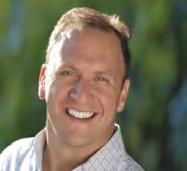
“Rabbi Greyber, you can’t hide — we charge you with genocide.”
Those were the words shouted at me in front of Hebrew school students outside my synagogue two years ago. In the months and years since Oct. 7, I have stood with my community in grief, in fear and in a fierce commitment to Israel’s right to defend itself despite the vitriol thrown my way.
And yet, after our synagogue supported a recent fundraiser for the Gaza Children’s Village, I have been asked — sometimes with genuine concern, sometimes with anger — how such a decision could possibly align with that commitment. Some of those questions have come from within my own community.
Let me begin here: My Zionism is not theoretical. It is existential.
Just a month after Oct. 7, I visited Israel with local leaders. I’ve returned three times since to express solidarity and see beleaguered family and friends. Our mid-size synagogue in Durham, North Carolina, raised $175,000 for Magen David Adom, Israel’s emergency response service. We advocated for the hostages, prayed for them week after week, and, after they were freed, brought Keith and Aviva Siegel — who have ties to our community — to share their story.
We raised tens of thousands of dollars to support the rebuilding of Kfar Aza, a kibbutz in southern Israel. And like so many Jewish communities, we have carried the ongoing pain of a war whose reverberations have not ceased — whether in the trauma of Oct. 7, the anguish of hostage families or the continued threat of Hezbollah rocket fire in Israel’s north.
That commitment has not wavered.
So when people ask whether I am concerned that money raised for Gaza could end up in the hands of Hamas, my answer is simple: Of course I am.
Hamas has systematically corrupted Gaza’s humanitarian infrastructure, diverting vast sums of aid to build tunnels, stockpile weapons and entrench its control. Anyone who cares about Palestinian life must reckon honestly with that reality.
But here is the deeper truth: If we only know how to say “no” to what is dangerous, and not “yes” to what is hopeful, we will forfeit the future we claim to seek.
The Gaza Children’s Village is one of those hopeful efforts. Guarded by the clans of southern Gaza, who are playing a security role following Israel’s battle against Hamas, it is leading a high-risk, high-reward initiative working to usher 19,000 children into a future shaped not by hatred, but by the possibility of peace with their neighbors. Rooted in Palestinian heritage, its Academies of Hope teach a new, unique
curriculum aligned with the long-term security of the region — including the stated goals of Israel’s own security establishment.
For that very reason, its teachers, staff and leadership live under constant threat. They are not aligned with Hamas, and because they are not, they risk intimidation and even fear for their lives. And yet they remain committed to a simple principle: a better life for both sides.
Beyond the Jewish moral imperative articulated by Rabbi Lord Jonathan Sacks (z”l) that “your enemy is also a human being,” supporting this project is not naïve. It is a way of strengthening those who are quietly, courageously building a different Palestinian future.
Dr. David Hasan, the organization’s founder and our neighbor in Durham, is one such person.
The Gaza Children Village has been approved by the Israeli unit responsible for implementing civilian policy in Gaza, COGAT, and recognized by Israel’s Ministry for Diaspora Affairs. Dr.
Guest Columnist
Rabbi Daniel Greyber
Chronicle poll results: Working at a Jewish nonprofit
Last week, the Chronicle asked its readers in an online poll the following question: “Have you ever worked for a Jewish nonprofit?” Of the 194 people who responded, 50% said yes and 50% said no. Comments were submitted by 48 people. A few follow.
Whether you have or have not worked for one, we can all agree that our local Jewish institutions are vital to the future of the Jewish people.
I have done many years of volunteering in my professional field. I have never had a paid position.
I was secretary to two rabbis in two different synagogues years ago. I am now retired. I would not trade the experiences for anything, and I am grateful for the knowledge I gained.
Greyber:
Continued from page 12
Hasan has been personally targeted by Hamas, in part because he sought to provide information that contributed to the rescue of Israeli hostages. And he has built an educational environment that teaches peace and does not demonize Israel — an almost unthinkable act in today’s Gaza.
At the fundraiser, Dr. Hasan made a remarkable commitment: that the funds raised would support both Israeli and Palestinian orphans. In the days that followed, he traveled to Israel to meet with families from the kibbutzes attacked on Oct. 7. He is now working to create a short experience that will bring Israeli and Palestinian children together in Italy — not to debate politics, but to encounter one another as human beings.
We should not only support people like Dr. Hasan. We should celebrate them.
Have you ever worked for a Jewish nonprofit?
It gets harder and harder to fly under a “Jewish” banner and know you are safe in the U.S. and abroad.
Because if there is to be a different future, it will be built by people who are already risking everything to create it.
Some have asked me: When have Palestinians raised money for Israelis?
The honest answer is: not often enough. But in this case, it happened.
And when something rare and good emerges in a broken system, our responsibility is not to stand back in suspicion, but to step forward in support.
It is also important to be clear about what this event was. It was not a Jewish-led initiative. It was a Palestinian fundraiser, hosted at Mediterranean Deli, Bakery & Catering by Jamil Kadoura, who is from Qalqilya, in the West Bank. Our synagogue was honored to stand with a trusted, longtime friend and support a Palestinian effort to build something better from within Palestinian society itself.
For me, this decision was not in tension with my Zionism. It was an expression of it.
Counting the Omer shouldn’t be complicated
Dovid Taub goes on and on about the different ideas connected to the Counting of the Omer, but maybe the Counting of the Omer is just simply the Counting of the Omer, counting the days until we received the Torah at Sinai when we became a unified people (“Sefirat HaOmer is too many things,” May 1). Shavuot celebrates our birth as a nation — a continuing and thriving nation — and the Counting of the Omer is the same as when each of us counts the days until our next birthday, our own individual beginning. Life is simple and beautiful; we shouldn’t make it complicated. Howard Meyerowitz Pittsburgh
A journey of history, reconciliation and hope
Thank you to the Jewish Chronicle for covering my recent trip to Germany and my participation in Days of Encounter at the site of the Langenstein-Zwieberge concentration camp (“Germany trip offers Squirrel Hill resident insights on past and future,” May 8). At a time when rising antisemitism and extremism make daily headlines, I found it heartening to witness the efforts of the residents of Halberstadt and Langenstein, Germany, who participate in an organization called Friends of the Langenstein-Zwieberge Memorial, led for many years by Hanka Rosencranz, to financially and operationally support remembrance and reconciliation. Historian Gero Fedtke, director of the Langenstein-Zwieberge Memorial, continually delves deeply into the history of the camp. For example, Dr. Fedtke did hours of research to find the family of the last known victim of a death march
Does teaching for a Jewish synagogues count? If so, then yes I have.
I would consider working for a Jewish nonprofit in retirement part time if I could find something that aligned with my skills and interests.
My wife and I both volunteer at several Jewish nonprofits. I am also a board member of a core partner of the Federation. As retirees, it feels good to give back to the Jewish community.
I love working for a Jewish nonprofit. It’s the most rewarding work a person can do!
While I haven’t been staff, I was a synagogue board member for four years (not in Pittsburgh) and it was both the honor of a lifetime and an incredibly difficult, complicated experience. I’m close with several
If we are serious about Israel’s future — not only its survival, but the kind of future it will have — then we must be serious about strengthening those who stand against Hamas and everything it represents.
The large-scale fighting in Gaza may have ebbed, but the deeper struggle has not ended. Hamas remains committed to Israel’s destruction. Israelis continue to live under threat. Military strength is necessary for Israel’s survival. But it is not sufficient for Israel’s future.
Israel can defend itself. It cannot, on its own, create the partners it will need for peace.
Those partners — Palestinian leaders and institutions capable of choosing life over death, coexistence over annihilation — are fragile. They are rare. When they appear, they must be strengthened, encouraged and yes, celebrated. And when they do not present themselves as readily as we are lucky to have had happen in Durham, they must be cultivated wherever possible.
people who have worked at Jewish nonprofits and have expressed similar feelings.
Considering all the hours I happily volunteered over the last four decades at or the JCC, Federation, ZOA, JFilm Festival, Rodef Shalom, et al., maybe I did work for a Jewish nonprofit?
These nonprofits are what makes a Jewish community; without people helping out at those, there would be far less community.
Working for a Jewish nonprofit was far from the most lucrative position that I’ve ever held, but it was by far the most satisfying. PJC
— Compiled by Toby Tabachnick
Chronicle weekly poll question: Which classic Shavuot treat wins your vote? Go to pittsburghjewishchronicle.org to respond. PJC
The Gaza Children's Village is not a solution to the conflict. It is something smaller — and, in its own way, more important.
It is a fragile seed of a different future, planted in extraordinarily difficult soil.
We did not support this effort because we are indifferent to Israel’s suffering. We supported it because we are committed to Israel’s flourishing.
To be a Zionist today is to hold more than one truth at once: to stand firmly with Israel in its need for security, and to actively seek out and lift up those on the other side who are trying to build something different.
Our task is not to pretend those people are everywhere.
Our task is to find them, to strengthen them — and to help ensure that they are not alone. PJC
from Langenstein, and that family traveled 14 hours by bus from war-torn Ukraine to attend the Days of Encounter. Gesine Daifi, also of the Memorial, plans event details connected with the camp and the annual Days of Encounter. Students in the NESHAMA project study daily with their history teacher, Hendrik Heicke, along with Dr. Fedtke and collaborate with students in France, Greece, Croatia and Poland to learn about the Holocaust, to travel together to memorial sites including Auschwitz, and to transmit this knowledge to peers. French documentary filmmaker Dorothee Martin, whose grandfather was imprisoned at Langenstein because of high-level French resistance activities, is working diligently on a film about slave labor and the tunnel in an attempt to save it as a memorial site. And, unique to this camp, an International Group of the Second Generation meets regularly under the leadership of Jean-Louis Bertrand, whose father was imprisoned in the camp. Noel March, whose father was a U.S. Army medic who evacuated and treated the Langenstein inmates, and who informed me about this event, has trained over 20,000 American police officers in a curriculum informed by the Holocaust and funded by the German government about avoiding abuses of power, and he also brings these lessons to his students at the University of Maine Augusta. I made the trip in honor of my father, one of the liberators of Langenstein-Zwieberge, and I came away enriched and inspired by the efforts of so many people to preserve history realistically and to pass on this knowledge to future generations.
Rosanne Levine Pittsburgh
We invite you to submit letters for publication. Letters must include name, address and daytime phone number; addresses and phone numbers will not be published. Letters may not exceed 500 words and may be edited for length and clarity; they cannot be returned. Send letters to:letters@pittsburghjewishchronicle.org or Pittsburgh Jewish Chronicle, 5915 Beacon St., 5th Floor, Pittsburgh, PA 15217
We regret that owing to the volume of correspondence, we cannot reply to every letter.
Rabbi Daniel Greyber is senior rabbi of Beth El Synagogue in Durham, North Carolina. This article was first published on JTA.
Life & Culture
How to make cheese blintzes
By Miriam Szokovski | Chabad.org
Cheese blintzes are an Eastern European Ashkenazi favorite, and with good reason — they are delicious! They are a bit fiddly and time consuming to make, so I save them for special occasions (and Shavuot, of course).
Crepe ingredients:
Yield: 15 blintzes (depending on the size of your frying pan)
8 eggs
⅔ cup sugar
1 ½ cups milk
½ cup water
2 cups flour
2 teaspoon vanilla extract
¼ teaspoon kosher salt
Cooking oil spray Oil for frying
Filling ingredients:
1 pound farmer cheese
8 ounces cream cheese
2 egg yolks
1 ½ teaspoon vanilla extract or 1 tablespoon lemon juice
½ cup sugar
2 tablespoons milk

Directions:
Combine all the crepe ingredients. You can whisk them together in a bowl (first the wet ingredients, then add the flour gradually) or use a blender. Let the batter sit for 10 minutes.
Heat a large skillet over medium heat. When the pan is hot, spray with a thin layer of non-stick spray and pour just enough batter in to cover the pan in a very thin layer. Cook 1-2 minutes until edges begin to pull away from the pan and darken in color. Tip the crepe out onto a piece of parchment

paper. Continue until all the batter has been fried into crepes, separating them all with a layer of parchment paper so they don’t stick together.
For the filling, mix all the ingredients together until there are no lumps.
When you’re ready to assemble the blintzes, place a generous couple of tablespoons onto each crepe, and roll up, neatly tucking the ends in as you go. Be gentle so the crepes don’t tear. Note: Either side of the crepe works, but if you put the filling on the side that was already on the pan, after it’s rolled



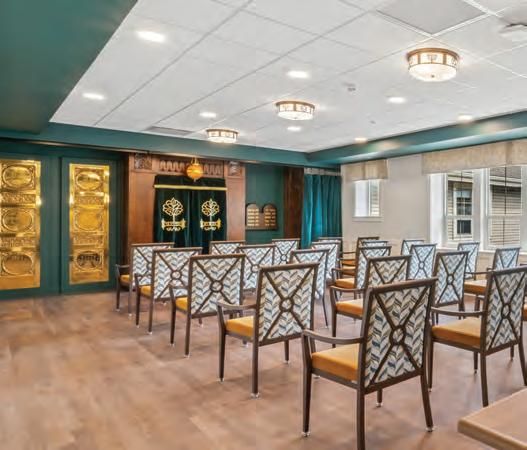
will get a chance to crisp up when you fry them before serving.
Immediately before serving, fry the blintzes over medium-low heat, flipping halfway, so that both sides are golden and the filling is warmed through. Serve plain or with a berry sauce. PJC
Miriam Szokovski is a writer, editor and member of the Chabad.org editorial team. She also shares her cooking and baking on Chabad.org/food.
p Cheese blintzes
Life & Culture
Abraham Foxman,
transformative longtime director of the
Anti-Defamation League, dies at 86
By Ron Kampeas | JTA
Abraham Foxman, the longtime leader of the Anti-Defamation League who for decades was the last word in post-Holocaust Jewish fury and forgiveness, has died at 86.
Foxman, a child survivor of the Holocaust, could be scathing and trenchant when he identified antisemitism infiltrating the public arena. But he was also an address for public figures who sought to divest t hemselves of a reputation of hostility toward Jews. And he did not spare himself, regretting crusades on behalf of Israel and Jewish communities he eventually admitted were wrongheaded.
“If you don’t believe you can change people’s hearts and minds, why bother?”

he told The New York Times in 2020, when a columnist sought insights from what she called the “pardoner of sins” about the entrenchment of an unforgiving cancel culture. “If you are not going to try and change hearts and minds, why are you in this business at all?”
Under Foxman’s leadership, the ADL transformed from a division of the Jewish organization B’nai Brith into a muscular juggernaut running anti-bias educational and training programs, monitoring antisemitism in the United States and around the world and advocating for anti-discrimination legislation out of an array of regional offices. Foxman himself became a chief arbiter of what qualified as antisemitism — and the granter of absolution when he felt it was warranted. Some jokingly called him “the Jewish pope.”
He joined the ADL as an assistant director of legal affairs in 1965 and rose through a series of positions, including head of Middle Eastern affairs and head of international affairs, before becoming national director in 1987.
“We don’t have a slow season in our business,” he told the Jewish Telegraphic Agency at the time. “What we deal with is words. We’ve learned that words have the power to kill, that words unchallenged, left in silence, words of bigotry, are part of our tradition.”
Foxman thrived for decades in a political culture where the establishment still mattered, and extremism was not considered a virtue. He granted absolution to figures as diverse as former President Jimmy Carter and right-wing broadcaster Glenn Beck and as surprising as the fashion designer John Galliano.
Foxman also knew when to despair of reforming repeat offenders.
“When you say Mr. X engaged in antisemitism, the first time that they do it you can say it’s ignorance, it’s insensitivity,” he told the Jewish Telegraphic Agency in 2007, asked about his refusal to exonerate Hollywood star and director Mel Gibson. “But when you say to them that they are engaging in antisemitism when they say the Jews control the media and the Jews control universities, and when they repeat it the second time, the third time and the fourth time, are you or are you not an antisemite?”
Foxman’s successor, ADL CEO Jonathan Greenblatt, lamented in a statement the passing of an “iconic Jewish leader.”
“America and the Jewish people have lost a moral voice, a passionate advocate for the Jewish people and the state of Israel, and a
remarkable leader,” Greenblatt said.
Greenblatt’s announcement was followed by an outpouring of memories and tributes from leaders throughout the Jewish world and in Israel. “Abe Foxman was a mentor, a guide, and a towering presence in Jewish communal life. He showed a generation of leaders that fighting antisemitism demands clarity, courage, and the willingness to stand firm under pressure,” said William Daroff, CEO of the Conference of Presidents of Major American Jewish Organizations, in one such statement.
Amid starkly growing polarization in the United States, Foxman was known for his willingness to call balls and strikes on all sides of the aisle, as well as hug across the chasm.
The complexity of individuals – the truth that heroes could commit bad acts and that villains could at times be redeemed – was seared into Foxman from childhood.
Foxman was born in Poland in 1940 and at 2 years old was left in the care of his Roman Catholic nanny in Vilnius, Lithuania, as his parents sought to escape the Germans. His nanny was his fierce protector and insulated him from the depredations of Nazis and their enablers, baptizing him and teaching him to handily hurl anti-Jewish epithets to fit in.
When his parents returned after the war, she would not give him up: It took bitter encounters in courtrooms to restore him to his family, and to the Jewish people.
Yet he could never hate her, he would often say later in life. “She risked her life,” he told the New York Times in 1991. “She saved my life.”
In 1950, four years after besting his nanny in the courts, Foxman’s parents took him with them to New York. There he attended the Yeshiva of Flatbush followed by the City College of New York and New York University Law School.
Foxman applied his exacting standards to himself, telling JTA in the same 2007 interview that he was haunted by the mistakes he had made, in one case lacerating a “60 Minutes” segment on Jerusalem only to find out the report’s criticism of the Israeli police’s use of excessive force in confronting rioters in 1990 on the Temple Mount Israel was correct. (He apologized to producer Don Hewitt and reporter Mike Wallace, and Hewitt replied “Are you for real?”)
He also told JTA in the same interview that he anguished over one of his most controversial decisions — his refusal to describe the
Ottoman massacre of Armenians in 1915 as a “genocide” — especially given the backlash his stance earned him from Jewish allies of the Armenian community.
Foxman’s reflex had been typical: defer to the Jewish community most vulnerable in a controversy, in this case the Turkish Jewish community, which feared retaliation. It was a decision that he also took at a time Turkey was one of Israel’s closest regional allies and heavily pressured Israel to oppose any U.S. efforts to recognize the killings as genocide. But Foxman acknowledged in retrospect that he had caused others pain.
“To me it was very clear, there are moral imperatives here — the moral imperative to feel somebody else’s pain, to recognize their anguish, and the moral imperative which is the safety and the security of the Jewish community,” he said.
Once Foxman had enough of someone, he truly had enough — and his sharp wit would emerge.
“My answer would be ‘Thanks but no thanks,”’ Foxman told Reuters in 2004 when Gibson said he was contemplating a film about the Maccabees, the Jewish warrior class whose stunning victory over Greek colonists is the basis of the Chanukah holiday. “The last thing we need in Jewish history is to convert our history into a Western. In his hands we may wind up losing.”
He came across at times as a curmudgeon. “Viral Hate: Containing Its Spread on the Internet,” a book he coauthored in 2013, tanked, and he told a JTA reporter he was not surprised: He was lambasting the social media machine that was shaping America, tilting at virtual windmills.
“The paradigms are changing,” he said multiple times in an interview about the book.
Thirteen years later, his distaste for the self-assuredness of tech leaders who reassured him all would be good seems prescient.
“We have been talking to the geniuses at Palo Alto,” Foxman said in the interview. “We have said to them, ‘thanks but no thanks. You developed a technology that has some wonderful things but also has unintended consequences.’ ” When Foxman retired in 2015, antisemitism appeared by many measures to be at an all-time low in the United States. Foxman hesitated to take credit for any gains but said he had appreciated the chance to build a
world animated by values very different from those that reigned during his childhood in Eastern Europe.
“I don’t take credit for it, but I’m part of the effort — not only of the American Jewish community, but of decent people in this country, to fight it,” Foxman told JTA at the time.
“To what extent did my experiences in the Shoah, the D.P. camps, my Catholicism have to do with that, I don’t know,” Foxman added. “I have been very lucky. To get up every morning and to have an opportunity to try to make a difference in both fighting hate and building love — wow. I have been very privileged.”
At a retirement party at the WaldorfAstoria Hotel in Manhattan in 2015, Foxman received accolades from Obama administration officials as well as from Tom Friedman, e New York Times columnist with whom he had repeatedly clashed on Israel policy. (Friedman revealed that Foxman had been his counselor at Herzl Camp in Wisconsin, where a highlight each year was reenacting the Dreyfus Affair.)
The party also drew an appearance by Roger Ailes, the Fox News Channel chief who had faced Foxman’s wrath over the conspiracy musings of one-time Fox personality Beck. (Years later, Foxman would defend having awarded an honor to Fox’s owner, Rupert Murdoch, even after Greenblatt said Murdoch was stoking hate with the network.)
Foxman was gregarious, surprising interlocutors by ending official meetings with a hug, and referring to Jewish media reporters as “tattele,” Yiddish for “good boy.”
“Within minutes of our first phone call I felt like family,” United Nations envoy Samantha Power said at the Waldorf-Astoria sendoff, describing their first interaction in Obama’s first term, when she was on the National Security Council. “We were yelling, interrupting one another and swearing. I think I almost ended this first phone call saying ‘Love you.’”
Nicole Mutchnik, chair of the ADL’s board, referred to Foxman’s famous warmth in a statement mourning his death.
“Abe Foxman helped build the modern liberal era of America. He was recognized across the globe as a great leader and passionate advocate for tolerance, a voice of the generation rebuilding in the shadow of the Shoah, and longtime advisor to American presidents and world leaders,” she said. “To those of us who knew him, Abe was a warm friend, advisor, spirited antagonist and hugger – all over lunch.”
In 2020, five years after retiring from the ADL, Foxman did what once was unthinkable to him. He endorsed a presidential candidate, Joe Biden. He was appalled by what he saw as President Donald Trump’s flirtations with bigotry and broadsides against democracy, the system that kept the United States from living the nightmare his parents had endured.
He also did what he had for a lifetime been reluctant to do: invoke the Nazi era as a warning signal.
“Germany did have institutions and they did have democracy and it did fall apart so, yeah, it’s not Germany, and it’s not Nazism, but our antennas are quivering,” Foxman told JTA weeks before the election.
Foxman is survived by his wife Golda; his daughter Michelle and his son Ariel; and four grandchildren. PJC
p Abe Foxman at an Anti-Defamation League event at The Beverly Hilton Hotel in Beverly Hills, California, May 8, 2014
Photo by Michael Kovac/WireImage/Getty Images
Life & Culture
In world first, Israeli scientists map digital atlas of healthy human liver
By Diana Bletter | The Times of Israel
Aresearch team led by scientists at the Weizmann Institute of Science, Sheba Medical Center, and the Mayo Clinic in Minnesota has developed the first open digital atlas of a healthy human liver.
The peer-reviewed findings, recently published in Nature, reveal that the human liver functions in eight precise zones rather than three, as was previously believed.
“The map shows the division of labor in the human liver at a resolution of two microns,” Weizmann’s Prof. Shalev Itzkovitz, the study’s lead researcher, told The Times of Israel.
To put that in perspective, the width of a human hair is about 50 microns.
Using cutting-edge single-cell RNA sequencing, the scientists analyzed the genetic activity of thousands of individual cells simultaneously. High-resolution spatial mapping enabled them to pinpoint the physical location of each cell within the liver.
With these methods, Itzkovitz said, the team was able to dispel another scientific misconception by showing that mouse and human livers do not work the same way.
“That’s a surprising discovery,” Itzkovitz said.
The atlas will allow scientists to move beyond dependence on mouse models, enabling the development of precise therapies that target specific zones to treat liver diseases, including fatty liver disease.
The human liver: A multitasker
The human liver is the body’s largest and heaviest internal organ.
Within the liver are tiny lobules, shaped like honeycomb hexagons. These filter blood, metabolize nutrients from food, and produce bile and essential proteins.
“The liver is such a central organ for human metabolism and carries out about 500 tasks,” Itzkovitz said.
However, not all liver cells perform all of these functions.
“The liver functions somewhat like an ant colony,” Itzkovitz said. “There is a divi sion of labor between cells, just as there is among ants.”
For example, some ants specialize in defense, others in food production, and still others in caring for their young.
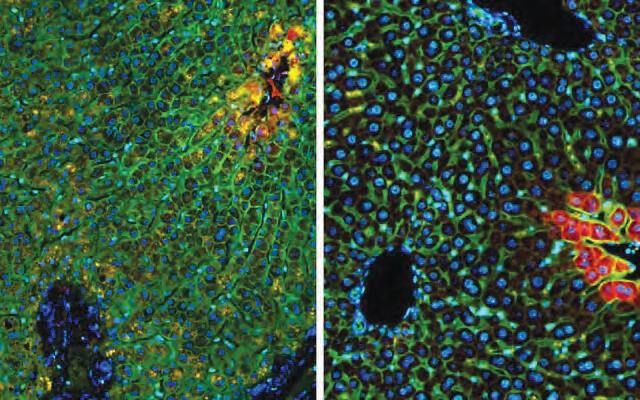
carry out different tasks in distinct locations,” Itzkovitz said.
The first in-depth study of a healthy human liver
Until now, scientists have been unable to study healthy human liver tissue from a living donor.
“Previous studies relied on tissue adjacent to disease, such as cancer,” Itzkovitz said. “When you have cancer, even outside the liver, it can completely rewire the metabolism of the liver, so it becomes very different than that of a healthy liver.”
The researchers analyzed liver samples from eight healthy donors aged 20 to 40,
“live organ donors, often donating to family members with end-stage liver disease,” Itzkovitz said. “This allowed us to establish a true baseline of the healthy human liver.”
The samples were obtained through collaborations with Sheba’s Prof. Ido Nachmany and Prof. Niv Pencovich, and with Mayo’s Dr. Timucin Taner.
The lead author, Dr. Oran Yakubovsky, is both a surgeon at Sheba and a PhD student in Itzkovitz’s lab.
The lab was struck in the Iranian missile attack on the Weizmann Institute in June 2025. Still, Itzkovitz said that the researchers were able to “salvage samples and continue
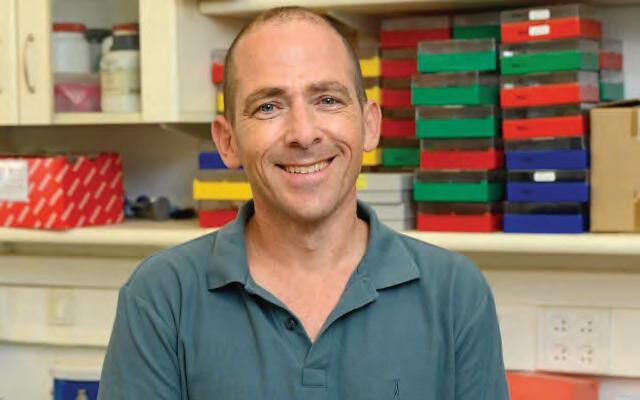
“Similarly, different subtypes of liver cells
The Pittsburgh Jewish Chronicle will be recognized for its work in 2025 with 11 Simon Rockower
Awards for Excellence in Jewish Journalism from the American Jewish Press Association.
“We’re passionate about science, and we really believe we’re trying to do something good for mankind, so it’s a big motivation,” he added
Of mice and human livers
One of the biggest surprises was how the human liver functions differently from that of mice, pigs and cows, Itzkovitz said. In the mouse liver, outer cells are more metabolically active than central cells. In humans, it is the opposite.
“This distinction has important implications,” Itzkovitz said. “Mouse models are incredibly valuable for studying liver biology, but when you want to model liver diseases, these are differences that are critical to note.”
Targeted treatment for fatty liver disease
In both mice and humans, a healthy liver builds lipids, the fatty compounds that provide storage protection and insulation, and burns them for energy. However, only the human liver performs this process in the inner lobule.
But in fatty liver disease, too much sugar and insulin levels force the cells in the human liver’s central lobule to create fat at a rate the body doesn’t need.
In the past, research was unable to pinpoint exactly where in the human liver these cells were creating the fat, and drugs were designed based on mouse models, with livers that function differently.
Researchers will now be able to develop smarter drugs that zero in on cells within the inner lobule, without damaging the rest of the organ.
“The study provides one of the clearest maps yet of how the healthy human liver is organized in space, giving scientists a far better baseline for understanding normal function and early disease,” said Natalie Porat-Shliom, head of the cell biology and imaging section at the National Cancer Institute in Maryland. Porat-Shliom was not involved in the study.
She told The Times of Israel that the study’s “greatest importance” is showing that commonly used tissue near a diseased area “is not truly healthy, and this finding could reshape how liver studies define controls and interpret disease biology.”
She added that the atlas “also provides a powerful reference for developing more accurate diagnostics and treatments.”
“With precise mapping,” Itzkovitz said, “it may become possible to develop treatments that will target the specific regions of the liver.”
York City from Tuesday, June 2, to Friday, June 5, 2026.
The exact categories and award placements will remain undisclosed until the awards banquet held in conjunction with the AJPA Annual Conference in New
The winning stories were written by Editor Toby Tabachnick, Senior Staff Writers Adam Reinherz and David Rullo, and freelance journalists Emma Riva and Deborah Weisberg.
The AJPA received more than 1,000 Rockower entries this year. PJC
— Toby Tabachnick
p Prof. Shalev Itzkovitz, Department of Molecular Cell Biology, Weizmann Institute of Science Photo courtesy of the Weizmann Institute of Science
p Weizmann Institute of Science researchers discovered that a glucose transporter protein (green) operates in the core of the liver lobule in humans (left), whereas in mice (right), it functions at the periphery. In red is a control protein expressed in the core in both humans and mice. In blue are cell nuclei.
Photo courtesy of the Weizmann Institute of Science
p Natalie Porat-Shliom, who leads the Cell Biology and Imaging Section at the National Cancer Institute’s Thoracic and Gastrointestinal Malignancies Branch
Courtesy photo via The Times of Israel
Life & Culture
This
By Olivia Haynie | Forward
“Remnants”
By Julian Voloj and Andre Deniz
FairSquare Graphics, 14 pages, $13.99
Graphic novelist Julian Voloj was walking through Manhattan’s Chinatown when he stumbled across the cemetery of the United States’ oldest Jewish community, Shearith Israel. This inspired him to write “Remnants,” an interpretation of the story of 23 Jews from Brazil who established North America’s first congregation.
When people think about Jewish immigration to New York, it usually brings to mind the waves of Eastern and Central European Jewish migrants in the early 20th century. But Remnants sheds light on the Sephardic immigration that introduced Judaism to the Americas far earlier.
These Jews were originally from the Iberian Peninsula and had fled to the Netherlands during the Portuguese and Spanish Inquisitions that lasted from around the middle of the 15th century to the 19th century. When the Dutch began occupying Recife, Brazil, in 1630, several Jews immigrated to the new South American colony and founded the first synagogue in the Americas, Kahal Zur Israel. Through the eyes of
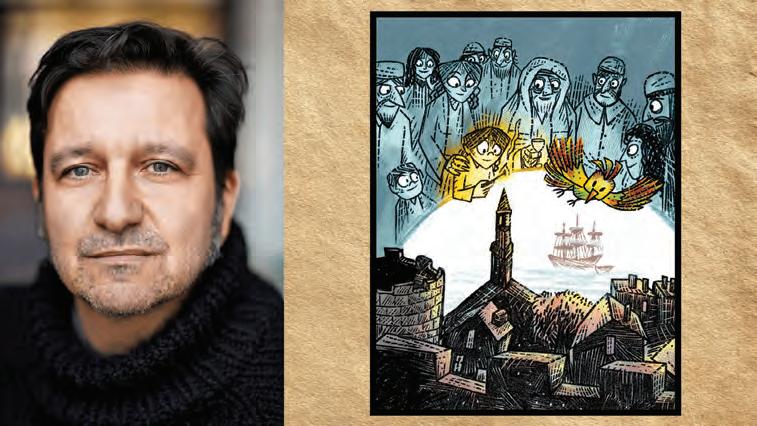
a young girl, “Remnants” recounts how they had to flee for their lives again in 1654, when Recife was seized by the Portuguese, who banished all Jewish and Dutch settlers. This group of Jews eventually arrived in New Amsterdam, now known as New York.
Voloj is used to challenging assumptions about the homogeneity of Jewish identity in his work. His graphic novel “Ghetto Brother” told the story of a Puerto-Rican gang member living in the Bronx who finds out later in life that he comes from a family of crypto-Jews.
Recently, Voloj co-created the graphic novel “Hyphen: Jewish Stories in Our Own Words,” which features a dozen personal stories from Jews from across the globe. In “Remnants,” vibrantly illustrated by Brazilian comic book creator Andre Diniz, Voloj turns his attention to the diversity of American Jewish history.
Voloj weaves together multiple Jewish stories in “Remnants.” The young female narrator is a fictionalized daughter of Asser Levy (stylized in “Remnants” as Asher Levy), America’s first kosher butcher and an early advocate for Jewish
civil liberties. (Although Levy was one of the first Jews to arrive in New Amsterdam, there are differing accounts of what ship he arrived on and it is unknown if he was on the ship with the group from Recife.) He was originally from Vilna, then part of the Polish-Lithuanian Commonwealth. Asser Levy Place, a section of Avenue A in Manhattan that spans 23rd to 25th Street, and the Asser Levy Recreation Center are both named for him.
Jacob Barsimon, another Jew who arrived in New Amsterdam a month before the group from Recife, also features prominently. In “Remnants,” he serves as the main advocate for the newly arrived Jews after they are jailed for allegedly not paying the ship that brought them to New Amsterdam. This is a slight historical liberty — it’s not known if Barsimon was directly involved with freeing the Jews from prison. But he did partner with Levy to abolish the ban on Jews serving in the military and the exemption tax imposed on them. Though their petition was refused, Levy later successfully petitioned the government of Holland as an individual and was allowed to serve as a soldier. Barsimon and other Jews later successfully appealed to Holland to overrule Governor Peter Stuyvesant’s discriminatory practices against the Jewish people. It’s not just bigotry that puts the Jews in “Remnants” in danger; during their migration
Please see Voloj, page 22
p Julian Voloj wrote the graphic novel “Remnants” about the Jews who established the first congregation in New York. Photo courtesy of Julian Voloj/collage made on Canva, via the Forward
Unity without sameness:
Ijust returned from Caracas, Venezuela, where I traveled to celebrate a family simcha, and something amusing kept happening to me.
People constantly confused me with my identical twin brother who lives there.
ome greeted me enthusiastically, convinced I was him. Others began conversations assuming they knew who I was, only to stop mid-sentence and realize they had the wrong brother. A few people even did a double take when the two of us walked into the same room.
At one point, it became almost comical.
And of course, I understand why. We look alike, we sound alike, we share the same parents, the same birthday and many of the same values.
But anyone who actually knows us understands something deeper. As much as we look the same, we are not the same person. We each have our own personality, our own strengths, our own perspective and our own unique way of interacting with the world.
One of the striking features of this week’s Torah portion, Bamidbar, is the Torah’s emphasis on the individuality of the 12 tribes of Israel.
Each tribe had its own place in the camp, its own mission, its own personality and, remarkably, its own flag.
Judah had the lion. Dan had the serpent. Zevulun had the ship.
Birth


Every tribe marched beneath its own banner, with its own symbol and identity.
At first glance, this feels surprising. Wouldn’t unity require sameness? Wouldn’t one nation function best under one flag?
Yet the Torah seems to move in the opposite direction, emphasizing distinctions and preserving differences.
But then the Torah adds one critical detail: All 12 tribes camped around one center, the Mishkan, the Tabernacle, the dwelling place of G-d.
That detail changes everything.
The Torah is teaching us that unity does not mean everybody becoming the same. Real unity comes when different people are connected to the same core values and shared purpose.
A symphony is not made from one repeated note. It’s made from different notes working together.
Maybe this is one of the biggest struggles in society today.
On the one hand, tribalism can become unhealthy. People split into camps and begin seeing anyone different from them as a threat. Disagreements quickly become hostility. Differences can quickly divide people.
But there is another problem too: the belief that unity only works if everybody thinks the same way, talks the same way and sees the world the same way.
The Torah rejects both extremes. Judaism believes deeply in individuality. Different tribes. Different personalities. Different customs. Different strengths.
But those differences were meant to serve something greater than ourselves.
That is why the Midrash says the nations of the world were amazed when they saw the Jewish people traveling through the desert with their flags. The amazing part was not that they had different banners. Every nation has banners.
The amazing part was that they stayed one people despite their differences.
And maybe this is one of the unique things about Torah.
The Talmud is filled with debates. Hillel and Shammai disagreed constantly. Different sages argued passionately with one another about law, philosophy and interpretation. Judaism never demanded that every person think identically.
On a deeper level, our sages explain that Hillel and Shammai reflected two very different spiritual personalities. Hillel was associated with chesed — kindness and openness. Shammai was associated with gevurah — discipline, restraint, and strict judgment.
And you can actually see those personalities reflected in many of their rulings throughout the Talmud.
They saw the world differently because they were different people.
Yet despite those differences, they were still part of the same Torah. The debate was never about whether they belonged to the same people or shared the same covenant. That part was understood.
There was room for different opinions because there was still a center holding everyone together.
Today, we have become increasingly uncomfortable with people who think differently from us, politically, religiously, or culturally.
The Torah’s approach is both simple and difficult at the same time.
You do not need every person to be identical. You do not need every community to look the same.
But you do need something strong enough to hold everyone together.
The Mishkan stood at the center of the camp because the Torah was teaching something fundamental: The Jewish people need a center strong enough to hold together all of our differences.
That was true then, and it remains true now.
We do not all think alike or live alike. But we remain one people through a shared connection to G-d, Torah and a common sense of purpose.
Maybe that is the deeper message of the flags in the desert.
G-d did not ask the tribes to give up their individuality. He wanted each tribe to contribute its own strengths, its own perspective and its own identity.
The goal was never for everybody to become the same.
The goal was for different people to remain connected to something greater than themselves. PJC
Rabbi Mendel Rosenblum is director of Chabad of the South Hills. This column is a service of the Vaad Harabonim of Greater Pittsburgh.
Abigail and George Parr are thrilled to announce the birth of their son, Jack Oliver, born on Dec. 18, 2025, in Pittsburgh. Proud grandparents are Amy Spear of Shadyside, and Jeffrey Spear and Sheryl Wein of New York. Great-grandparents were Gilda and Murray Reidbord, and Janet and John Spear. Jack is named after Janet and John.



, son of Justin and Audrey Kitzes, will become a bar mitzvah on Saturday, May 16, at Temple Ohav Shalom in Allison Park. Eli’s grandparents are William and Sandra Kitzes, and Richard and Elizabeth Peller.










Madelyn Daffner, daughter of Randi and Marc Daffner, will become a bat mitzvah on Saturday, May 16, at Beth El Congregation of the South Hills. Grandparents are Alva and Richard Daffner of Mt. Lebanon, and Phyllis Wiener and the late Barry Wiener of Boca Raton, PJC











Obituaries
DREYFUSS: Phyllis Dreyfuss passed away peacefully on May 9, 2026, at the age of 91. She was the beloved wife of Lester Dreyfuss and devoted mother of Michelle (John), Stephanie (William) and Dan (Karen). She was the cherished grandmother of Sam (Sammie), Ellis, Max, Lydia, Gadi, Eli, Charle, Zohi (Darren), Cami, Gadi and Neshama, and proud great-grandmother of Finley and Rowan. Phyllis and Les treasured their years living in France and shared a lifelong love of travel, exploring the world together. She devoted herself to causes she cared deeply about including the League of Women Voters, Daughters of Abraham, refugee support and public education. Her compassion and generosity impacted the lives of many of those in need. Above all, she wished for a world rooted in equality, compassion and justice. Phyllis was predeceased by her husband, Lester Dreyfuss, and her brother, Moe Coleman (Greta). Services were held at Ralph Schugar Chapel, Inc. Interment private. Donations in her memory may be made to Jewish Family and Community Services of Pittsburgh. schugar.com
GOLDFARB: Edgar Goldfarb passed peacefully on May 7, 2026. Beloved husband of the late Soralie Levin Goldfarb; they were married for 62 years. The loving father of Jane Goldfarb and Larry (Ann) Goldfarb; devoted grandfather of Daniel, Jonathan and Aashma Goldfarb; and loving uncle to nieces and nephews Joel Bloom (Mary Noe), Betsy Bloom Freed (Mark) and Emily Bloom, as well as grand-nieces and grand-nephews, Adam Buncher, Dani Buncher (Sara Strand), Allison Freed, Rob Bloom, Sam Leffe and Annie Leffe. Ed and Soralie left Pittsburgh in 2016, and Ed lived in Aventura, Florida, until age 99. He graduated from Taylor Allderdice High School, the University of Pittsburgh and the University of Pittsburgh School of Law. Ed was a World War II Navy veteran stationed at U.S. Navy Hospital, Annapolis, Maryland, as a hospital apprentice. In Annapolis he played piano on Saturday nights at the Officers’ Club with The Hospital Corp Band. He found his passion in real estate and playing the piano. He began his career at Spiro Realty and retired at age 89 from Howard Hanna in Squirrel Hill. Aside from his unconditional love for his family, Ed respected all whom he met and spoke freely and kindly to everybody — even strangers. He played piano for over 95 years, until his final days, and was a member of the Pittsburgh Musicians’ Union. Ed was part of the musical ensemble for many Pittsburgh Playhouse productions and for performances at the JCC in the 1970s. Prior to COVID (2018-2019), Ed performed numerous piano programs for the residents at The VI (assisted living in Aventura, Florida). While in Pittsburgh, he served on the board of the Steinway Society of Western PA, and on the board, as well as an active member of the Squirrel Hill Urban Coalition. He and his wife loved attending the Pittsburgh Symphony and the Y Music Society. Ed attended morning minyan regularly at Tree of Life Congregation where he and his wife were members for over 40 years. Graveside services and interment were held Beth Abraham Cemetery. Donations may be made online at thetreeoflife.org/ donate Remember. Rebuild. Renew. or checks may be mailed to: The Tree of Life, 2000 Technology Drive, Suite 220, Pittsburgh, PA 15219 schugar.com
Dan was a partner with Deloitte. He was known for his dedication, integrity and strong work ethic. He had the rare gift of explaining complicated concepts in a way that everyone could understand and comprehend. Services were held at Weil Kahn Funeral Home. 8350 Cornell Road, Cincinnati, Ohio 45249, Monday, May 11. Burial followed at United Jewish Cemetery of Loveland. In lieu of flowers, memorial contributions to The Pittsburgh Parks Conservancy or the Jewish Federation of Greater Pittsburgh would be greatly appreciated. Pittsburgh Parks Conservancy, 317 East Carson St. West Tower, Suite 230 Pittsburgh, PA 15219 412-682-7275. The Jewish Federation of Greater Pittsburgh, 2000 Technology Drive, Pittsburgh, PA 15219 412-681-8000.
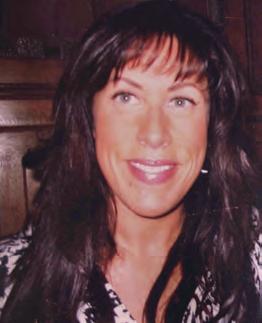
ROTH: Claudia M. Roth, PhD. It is with heavy hearts that we announce the passing of Claudia M. Roth, PhD, on May 1, 2026, following a courageous, yearslong battle with illness. She is survived by her beloved siblings, Ellen, Cliff (Stavroula) and Andrew, and was dearly cherished by her nieces, nephews, extended family and friends. She was born in Pittsburgh to Melvin and Ina Roth of blessed memory. Dr. Roth was a distinguished alumna of the University of Pittsburgh’s undergraduate, graduate and doctoral programs. She practiced as a psychologist and notably served as president and chief executive officer of Western Psychiatric Institute and Clinic, and as vice president of UPMC Behavioral Health. She was deeply committed to addressing, supporting and enhancing the mental health and well-being of all individuals. She was highly respected for her unwavering dedication to all those under her care. She will be remembered and profoundly missed by all who knew her. A private graveside service was held at Agudath Achim Cemetery. Contributions may be directed to the STAR Center at the University of Pittsburgh, the Autoimmune Association, UPMC Hillman Cancer Center, or a charity of one’s choice. Arrangements entrusted to Ralph Schugar Chapel, Inc. schugar.com
HOLTHAUS: Daniel Holthaus, 61, of Cincinnati, Ohio, passed away suddenly on May, 5, 2026. Beloved husband of Vicki Roth Holthaus. Loving and devoted father of Teddy, Claire and Sophie Holthaus, and pet Malkin. A caring brother to Chris Recker and William Holthaus. Devoted son to the late Jean and William Holthaus, and son-in-law to Judy Roth and the late Dick Roth. Dan was the happiest when he was around our family. He was an avid Pittsburgh Penguins fan and loyal to his alma mater, the UC Bearcats. Dan was the epitome of love and goodness. He was kind to everyone he met and he spent his life helping others. He lived every day by the golden rule.
Harold &
Randy
Ted Pinsker
Shapiro
The Rev Marcia A Tremmel
A Livingston




























Sunday May 17: Ruth W Braude, Lillian L Halpern, Jennie R Jacobson, Herman Lee Krouse, David Louff, Louis Mandell, Frances Simon, Dolores M Stein, Dora Stein
Monday May 18: Bessie Averbach, Saul Caplan, Helen Unger Casar, Frances Fink, Louis Aaron Gernstat, Milton M Goldstone, Sidney Harris, Mollie Greenberg Kalson, Esther Leipzig, Ben H Liepack, Saul Linder, Adele Lundy, Kathryn Friedlander Miller, Dora Weiss Nach, Joseph Price, Pearl R Regenstein, Benjamin Saunders, Bessie Srulson, Saul Waxler
Tuesday May 19: Fay Caplan, Lee Chajson, Myra Freeman, Robert Glasser, Tillie Helfant, Maurice Kramer, Elaine A Lefkowitz, Sam Moldovan, Jacob S Rush, Dora Fineberg Smith, Morris B Weiss, Lilyan Wiesenthal
Wednesday May 20: Ida Borovetz, Rose C Cody, Samuel William Corn, Louis L Edelman, David Eisenberg, Bessie Finkelstein, Eva Gold, Marsha Goldman, Lena Herr, Rose Gordon Labowitz, Sylvia A Livingston, Frank L Mandell, Julius Nydes, Jo Anne Persons, Hyman Roth, Milton M Ruttenberg, Harry Siegman, Leonard Silverblatt, Harry F Skirboll, Manuel Solomon, Yetta Spodek, Hedwig Stern, Jerome Supowitz, Abraham Swadow
Thursday May 21: Sylvan Arnold Alpern, Dr Abraham L Barbrow, Nathan Friedlander, Ben B Goldberg, Israel Haltman, David Hartstein, Moses L Hurwick, Saul S Hurwick, Adolph Katz, Sara Lisker, Minnie Mervis, Samuel A Meyer, Abraham I Miller, Morris Podolsky, Irene Scherb, Helen G Solomon, Mollie R Whiteman
Friday May 22: William Barron, Dr Samuel R Cohen, Helen Danovitz Berenfield, John Jacob Elling, David Glasser, Sam Gold, Rebecca Kaufman, Jeannette Klein, Sylvia Rita Lipkind Podolsky, Edna F Sachs, Bella Schlosser, William Schlosser, Samuel Serbin, Erma A Weinthal
Saturday May 23: Rosa Lee Minzenberg Berry, Alfred Bornstein, Louis Cohen, Leah Hansell Freedman, Howell J Friedlander, David Gould, Rashel Katkisky, Hannah Miller, Robert Moldovan, Dora Schultz, Nathan Shapiro, Daniel Shussett, Paul Stein, Dora Sussman, William F Weiss Contact the Development department at
Obituaries
Obituaries:
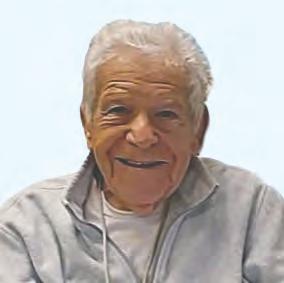
Continued from page 19
SIEGEL: Murray Jerome Siegel, age 102, of McKeesport, Pennsylvania, died on Monday, May 11, 2026. He was born in McKeesport on Dec. 5, 1923, and was the son of the late Adolf and Mollie Moltz Siegel. He began his career at Tube City Novelty Company at age 18. His only absence from the business occurred when he served in the U.S. Navy for 32 months as a storekeeper first class aboard the USS Texas. He always said he hid during gunnery practice so he wouldn’t have to shoot a gun. After his return to Tube City, Murray never left again. He boasted that he spent 84 years at “the Store” up until three weeks prior to his death. He began as a “shlepper” and moved to bookkeeper and office manager and then onto his ultimate role as senior partner. Murray loved classic American cars and his knowledge was unsurpassed. Friends and family knew that Murray’s house was the first visit after purchasing a new car. It was also known that if anyone would forget their car from the past, he would fill in the blanks. He was an avid reader of obituaries, scanning them first to make sure his name was not in them. Murray was a member of Temple B’Nai Israel from birth until the temple’s closing in 2025. Though he never had an official title, everyone knew to ask him for any type of assistance needed. For the past few years, Murray volunteered at McKeesport Candy Company as the “master shredder.” It was well documented that he burned through 16 shredders due to his diligence. His family life was his first and most enduring love. He was the husband of the late Florence Lebowitz Siegel for 55 years. She was his best friend and the love of his life. He missed her every day and wished her “good Shabbos” every Friday. He is survived by his children, Alan (Nadine Russ) Siegel of Buffalo, New York; daughter, Denise Siegel Lederman of Monroeville, Pennsylvania; grandsons, Craig Lederman and Mathew (Emily Gnatt) Lederman; and great-granddaughter, making the fourth generation, Eloise Fiona Lederman; and many beloved nieces and nephews. In addition to his parents and wife, Murray is preceded in death by his siblings, Jack (Lillian) Siegel; David (Bertha) Siegel; and Lilyan (Abe) Cohen. The family would like to thank his nighttime caregivers, Rosa, Iona, Shawn, Stephanie and Kevin, who lovingly watched over him, answering all his needs, large and small. He will be missed by many and was loved by all. Murray always said, “I’ve had the best ride ever. No one has had a ride like mine.” Graveside services took place on Wednesday, May 13, 2026, at Temple B’Nai Israel Cemetery, 731 Center Street, Versailles, PA 15132. Arrangements were cared for by Strifflers of White Oak Cremation and Mortuary Services, Inc., 1100 Lincoln Way, White Oak, PA 15131 (Sue Striffler Galaski, supervisor, 412-678-6177). Should friends desire, memorial contributions in Murray’s name may be made to a charity of your choice. To share a memory or condolence, please visit strifflerfuneralhomes.com
ZELEKOVITZ: Sandor “Sandy” (Zell) Zelekovitz — a true mensch — moved through the world like water. When he entered a room, his presence arrived all at once, filling every corner and quiet space effortlessly, the way water rushes in after a dam breaks. Powerful but never overwhelming. Gentle but impossible to ignore. People naturally drifted toward him, pulled into his current by warmth, humor, kindness and an unmistakable sense of safety. He had that rare ability to make people feel immediately known. A stranger became a friend in 10 minutes. A friend became family soon after that. And once Sandy loved you, you stayed loved for life. Born to Lou and

Sylvia (Zell) Zelekovitz, Sandy was raised in a home shaped by both survival and joy. Together, they taught Sandy perhaps the most important lesson of all: The greatest response to hatred and suffering was not bitterness, but joy. To live fully. To love deeply. To build a beautiful life anyway. And Sandy carried that lesson forward relentlessly in everything he did and in everyone he touched. As the eldest brother to Jeff and Marc, Sandy understood early that strength was not about commanding attention. Like water, Sandy found every crack where somebody needed something, anything, and gently filled it no matter what. He found joy in places others overlooked entirely. He could turn an ordinary moment into a story people would repeat for years. In speaking about nothing, he somehow taught you everything you needed to know about life. Sandy carried a deep devotion to his Jewish faith, to the Jewish people, and to the state of Israel. Together with his beloved wife, Barbara, his true partner in every sense, Sandy co-chaired 412 Friends of Zahal, helping bring wounded Israeli Defense Forces veterans to Pittsburgh each year for healing, support and connection. He also proudly served on the board of Beth Samuel Jewish Center in Ambridge, Pennsylvania, strengthening the Jewish community he loved so deeply. If you knew him, you knew this truth: Taking care of people was not simply something Sandy did; it was who he was. Sandy died on May 7, 2026, and it felt as though the tide itself had receded. But every now and then, when the trees begin to rustle, when a robin lingers a little too long on the windowsill, or when a squirrel stops and looks at you sideways for no reason at all, it becomes a little easier to believe that Sandy never really left. Sandy is survived by his beloved wife, Barbara Williams Zelekovitz; his loving children, Mitchell (Ashley) Levine, Benjamin (Rivka) Levine, Rena (Adam) Fasone, Traci Levine, Justin (Courteney) Zelekovitz and Doogie (Emily) Levine; his brothers Jeff (Sue) Zell and Marc (Janet) Zelkovitz. He was a proud and adoring grandfather of Lily, Eli, Emma, Mila, Charlie, Sloane and Nico. Sandy was also survived by nieces, nephews, cousins and many dear friends. Services and interment were private. Contributions in Sandy’s memory may be made to 412 Friends of Zahal, 6820 Juniata Place, Pittsburgh, PA 15208. Arrangements entrusted to Ralph Schugar Chapel, Inc. PJC
NOTICE OF HEARING
IN RE: PETITION OF THE CEMETERY ASSOCIATION OF CONGREGATION THORAS CHAIM, A NON-PROFIT CORPORATION TO APPROVE A FUNDAMENTAL CHANGE; Case No. 02-26-2129 in the Orphan’s Court Division of the Court of Common Pleas of Allegheny County, Pennsylvania. Notice is hereby given that the Court has set a hearing on the Petition of the Cemetery Association of Congregation Thoras Chaim to approve a Fundamental Change in the form of the transfer of the ownership and management of their cemetery located in Hampton Township, Allegheny County, Pennsylvania), and the transfer of certain funds held by them to the Jewish Cemetery and Burial Association of Greater Pittsburgh. The hearing will be held in the Orphans’ Court Division, Court of Common Pleas of Allegheny County, Pennsylvania, 437 Grant Street, 17th floor, Pittsburgh, Pennsylvania on June 4, 2026, at 11.00 A.M. before the Honorable Hugh F. McGough. Any interested person is invited to attend. Information may be obtained from Robert J. Garvin Esq., Goldberg, Kamin & Garvin LLP, 437 Grant Street, Suite 1806, Pittsburgh, Pennsylvania 15219, phone (412) 281-1119; Attorney for Petitioner.
www.pittsburghjewishchronicle.org







Life & Culture
A best-selling novelist identified a minor character as Israeli. Some fans are canceling their orders.
By Jackie Hajdenberg | JTA
Abestselling author is facing a flurry of anger from fans after advance copies of her upcoming novel identified a character as Israeli — a move that her critics say advances “normalization” of a country they oppose.
Rebecca “R. F.” Kuang, the Chinese-American author of the 2023 satirical novel “Yellowface” and “The Poppy War” trilogy, is set to publish her seventh novel, “Taipei Story,” in September. The advance version, an excerpt of which was leaked on social media last week, includes a short scene involving an Israeli musician.
The musician, a successful pianist whose performance ignites a near-religious fervor for a character in the story, is not named, and the text identifies him as “a dour-faced man who did not so much as crack a smile as we applauded.”
That was enough to trigger some readers and potential readers who said Kuang was whitewashing Israel in the wake of the war in Gaza — even as she has previously expressed support for the movement to boycott Israel.
“RF kuang had 190+ countries to choose from to write about a character’s nationality and she still chose to write about the one who’s actively committing gen0cide against Palestinians for years,” user alltoowellreads wrote on X, in one representative comment that has been shared

nearly 1,000 times that used an online version of the word “genocide” meant to evade censors.
Others railed against the excerpt on Threads, where there is a thriving community of people discussing books. Some readers said they even canceled their preorders of the book.
Kuang and her publicists did not respond to requests for comment, and she has disabled comments on her recent Instagram posts, where she has not addressed the criticism.
The backlash to Kuang’s inclusion of the Israeli character reflects a trend in the literary world, in which even minor mentions of Israel or Israelis are enough to land authors on boycott lists.

“Generosity is loudest when it pretends to be an accident.”
The trend predates the most recent war in Gaza: Casey McQuiston, the author of the 2019 romance novel “Red, White, and Royal Blue,” initially included a scene where the U.S. president jokes that an ambassador “said something idiotic about Israel, and now I have to call Netanyahu and personally apologize.” In 2021, McQuiston said they would remove the reference to Israeli Prime Minister Benjamin Netanyahu in future printings of the book.
But the trend has intensified after Oct. 7 thrust Israel into the center stage of cultural conversations. An online list titled “Is your fav author a Zionist???” that went viral in 2024 urged boycotts against authors for whom the crowd-sourced answer was yes.
Some authors landed on the list without ever commenting publicly about Israel or Gaza. Gabrielle Zevin, for example, was included in part because her 2024 hit novel about Jewish video game designers, “Tomorrow and Tomorrow and Tomorrow,” received backlash for its inclusion of an Israeli character even though he was presented unfavorably. (Zevin also drew criticism for having spoken at a Hadassah event in February 2023.)
Kuang’s silence on the dustup has left some readers to speculate about why she chose to identify the pianist as Israeli in “Taipei Story,” a work of literary fiction about a young ChineseAmerican woman on an intensive summer language program in Taiwan.
Kuang, whose work largely deals with the Asian diaspora from an anti-colonial perspective, has historically supported the Boycott, Divestment and Sanctions movement against Israel. In December, she withdrew from an appearance at a literature festival in Dubai, citing a call from the BDS movement.
That record had led some of her fans to
Continued from page 17
out of Recife, they face terror on the open waters when their ship is seized by pirates. The scene is inspired by a historical report from a Venetian rabbi, Saul Levi Morteira, although historians have debated whether or not these captured Jews were the same ones who arrived in New Amsterdam. If what Morteira wrote is accurate, the Jewish hostages were eventually saved by the French. However, in “Remnants,” the Jews find salvation in a different, unexpected source — another piece of Jewish history that Voloj has woven into the tale. But no spoilers. Although it’s a complex history, Voloj and Diniz’s illustrative approach helps make the story of America’s first Jewish congregation
argue that the Israeli character may have been included to subtly critique Israel. Others speculated without evidence that Kuang could have been paid to mention Israel in the book, while others simply expressed bafflement or anger at her choice to mention a state they believe is a colonial enterprise.
“Making your books sm about colonization but normalizing israel is insane to me idk im very disappointed,” wrote one X user who garnered 1 million views with the sentiment. (“Sm” is internet shorthand for “so much.”)
For Jews who have been keeping a close eye on trends in publishing since Oct. 7, the response to the Kuang excerpt has been worrying, even if its ultimate impact remains unclear. Meg Keene, a writer who argues that data shows a sidelining of Jewish content in new book deals, summarized the brouhaha with a deflated tweet: “This is where we are now.”
Even some Jews who do not identify as Zionists say they see something worrying in the backlash to the Kuang excerpt.
“The people canceling a preorder over [a] single mention of an Israeli pianist being booked at a concert hall in R.F. Kuang’s new book lack so much f–king nuance. There’s literally no mention of Zionism yet y’all can’t seem to differentiate,” wrote a Jewish threads user who goes by Axis of Anarchy.
After experiencing some blowback, she followed up: “Also stop with this ‘y’all’ business about normalizing Israel. This is exactly the problem and I have been very vocal on calling Zionists out on their s–t so goodness forbid, I point out when y’all are taking your s–t too far.”
Though Kuang has closed most of her recent Instagram posts to comments, her readers continue to comment on older ones that are still open, asking the author about her choice to include an Israeli character.
Some books bloggers argue that the immediate call to boycott Kuang’s latest book is akin to censorship — and distracting from literary analysis.
“Reactionary outrage like this only acts as a form of censorship, because it discourages analysis,” wrote a user who goes by emily.isliterate, accompanying a widely viewed video on the episode. “From what I can read, I think Kuang (in very few words) manages to criticize the way people treat musicians from certain places over others (namely colonizer states). Maybe people stopped reading after the word Israel or they simply can’t garner subtext and theme, but either way, I think the entire situation is troublesome.” PJC
accessible to readers of all ages. Through the optimistic perspective of Levy’s daughter, the story of Recife’s Jews is not solely about the tragedies of exile and discrimination, but a tale of strength, resilience and the occasional miracle. Although Voloj takes some liberties to bring the different historical narratives into one storyline, “Remnants” provides a well-timed look into America’s Jewish history. As the American semiquincentennial approaches, Jewish institutions across the country are creating programming about the stories of Jews in America. Remnants takes readers back to the colorful beginning. PJC
This story was originally published on the Forward. To get the Forward’s free email newsletters delivered to your inbox, go to forward.com/newsletters.
p R.F. Kuang attends the Girls Write Now Awards 2024 at DVF Studio on Oct. 10, 2024, in New York City.
Photo by JP Yim/Getty Images for Girls Write Now
Community
Cooking up a Shavuot special
Community Day School students and staff utilized the school’s kitchen to teach sustainability. With reliance on an indoor grow lab and outdoor garden, participants discussed environmental stewardship and made blintzes.
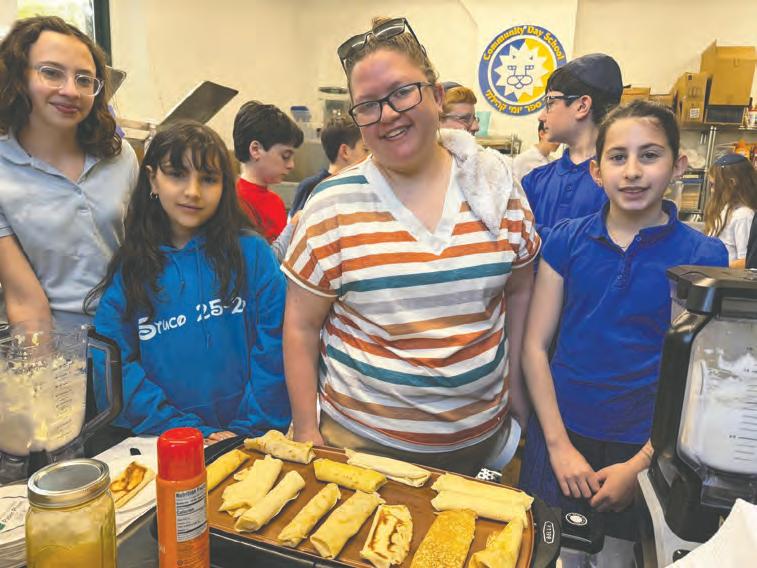
Macher and Shaker
Celebrating
with friends
The Friendship Circle celebrated Lag Ba’Omer with an under-18 community celebration in Schenley Park and a Friends on the Town celebration on Friendship Circle’s rooftop. The daylong activities included, beach ball volleyball, cornhole, a rooftop barbecue, dance party and
Emily Loeb, director of the Holocaust Center of Pittsburgh, received the 2026 Voice of Kindness Award from the Mark Schonwetter Holocaust Education Foundation on May 3 during the Foundation’s Journey For The Living Kickoff event in Livingston, New Jersey.
Loving Lag Ba’Omer together
Hundreds of Pittsburgh’s Jewish day school students gathered to celebrate Lag Ba’Omer. With representatives of Community Day School, Hillel Academy of Pittsburgh and Yeshiva Schools congregating in Squirrel Hill on May 5, the outdoor event featured singing, dancing, study and recital of Tehillim.
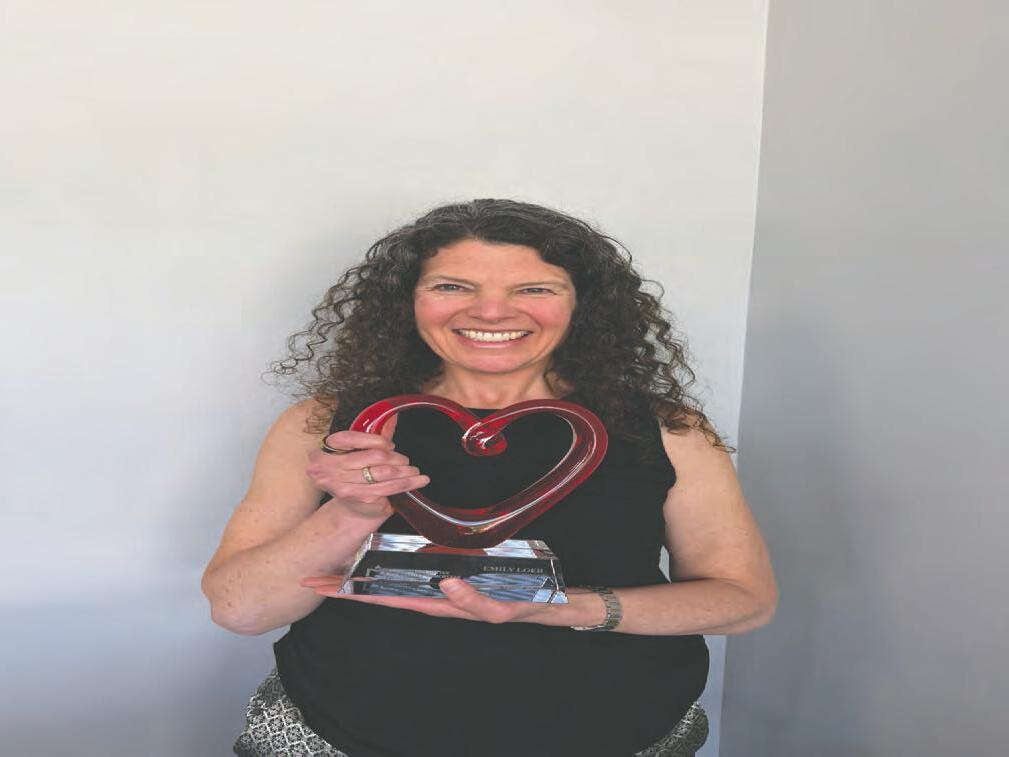
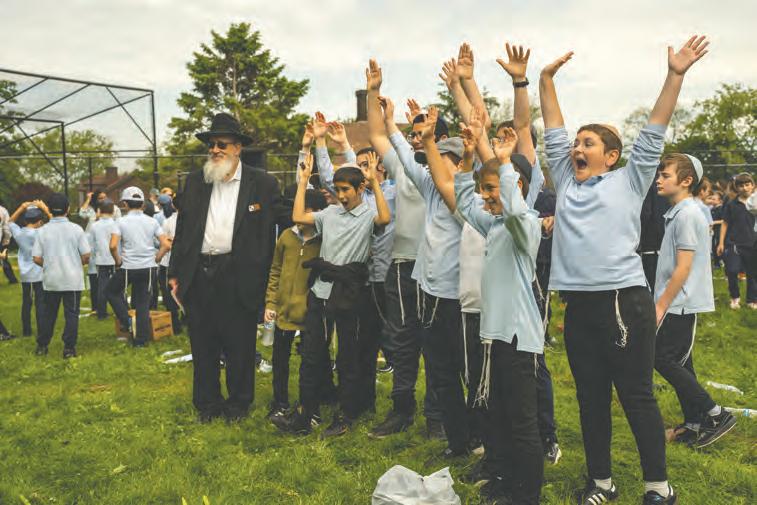
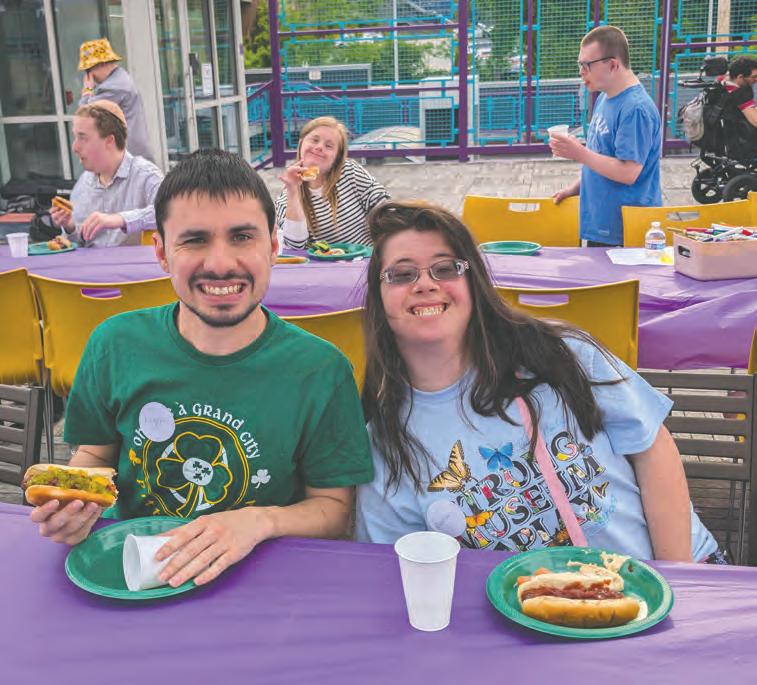
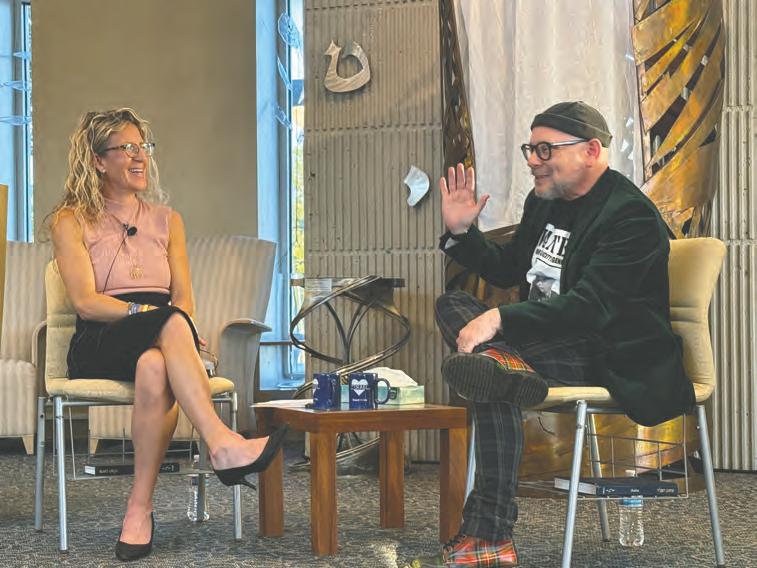
Only do two days
Chaplains from federal, state and local jails gathered for two days of training at the Aleph Institute in Pittsburgh.
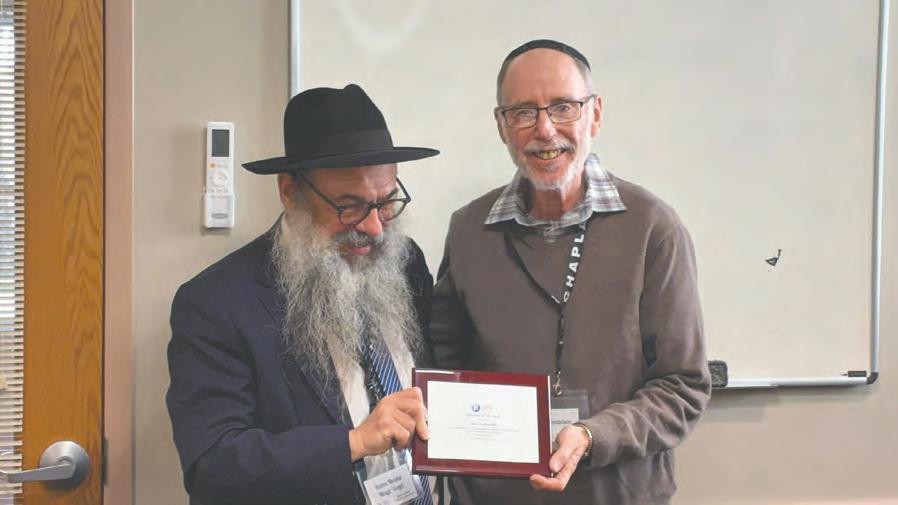
p
Photo courtesy of Friendship Circle of Pittsburgh
p
Photo courtesy of Community Day School
Sharing his story Chronicle Senior Staff Writer David Rullo described the challenges he’s faced as a Jewish jour-
p
Photo by Maureen Busis
p Rabbi Moishe Mayir Vogel congratulates Abby Mendelson on being Chaplain of the Year.
Photo courtesy of The Aleph Institute - North East Region
p Wave your hands in the air, like you don’t care.
Photo courtesy of Yeshiva Schools of Pittsburgh
p
Photo courtesy of Holocaust Center of Pittsburgh