program, led by Hillel JUC with support from the Jewish Federation of Greater Pittsburgh, will train 10 University of Pittsburgh students to become peer educators and advocates on campus.
Oakland-based workshops operated by Federation staff — which began weeks ago — are intended to equip students with the “knowledge, skills and confidence to return to their campuses and speak out against antisemitism and anti - Zionism,” David Knoll, Federation’s associate vice president of public affairs, said.
Dan Marcus, Hillel JUC’s executive director and CEO, touted the program as a “transformative and important” opportunity for students.
Though college students have multiple
“knowledge and fluency regarding Israel’s diversity, participants will return to campus strengthened in their Jewish and Zionist identities while having the practical tools to share with the Jewish and non-Jewish campus community.”
Pitt freshman Danielle Yakhnis, 18, said the training has brought together students ranging in age and background. What they share, however, is a commitment to engaging in Jewish life on campus.
“We all do activities surrounding Judaism,” she said. “I see a lot of them at Chabad. We go to Shabbat dinners together.”
Yakhnis said she was drawn to the program’s potential for delivering insight
East End Food Co-op board advances advisory vote on removing Israeli products
By David Rullo | Senior Staff Writer
The East End Food Co-op’s board of directors has approved a motion creating an advisory referendum asking its members if “Israeli sourced products” should be removed from the grocery store.
The 5-3 vote in favor of the non-binding referendum was preceded by a vote on a binding referendum asking members the same question. The motion for a binding referendum failed in a 6-2 vote. Both votes were taken at a Feb. 16 board meeting.
The board’s president, Tom Pandaleon, voted in favor of both referendums and said the board will work with a “sense of urgency” to “structure the nature of the advisory referendum.”
EEFC members, he said, “should look forward to hearing from us fairly soon,” adding that some follow-up should be expected by the next board meeting.
The Feb. 16 board meeting followed a Feb. 9 special virtual meeting of EEOC members during which five people spoke in favor of the binding resolution and five spoke against it. That meeting was not open to the public.
During the Feb. 9 meeting, Hope Anne Nathan, a member of the Jewish community, spoke against the referendum. Nathan has been a member of the co-op since the early 90s, is a former employee of the co-op and served on the store’s board of directors.
She said that despite the board’s attempts to create a welcoming atmosphere at the virtual meeting, those in favor of the referendum would “thumbs down” speakers
Jerry Guttman’s tale of resilience
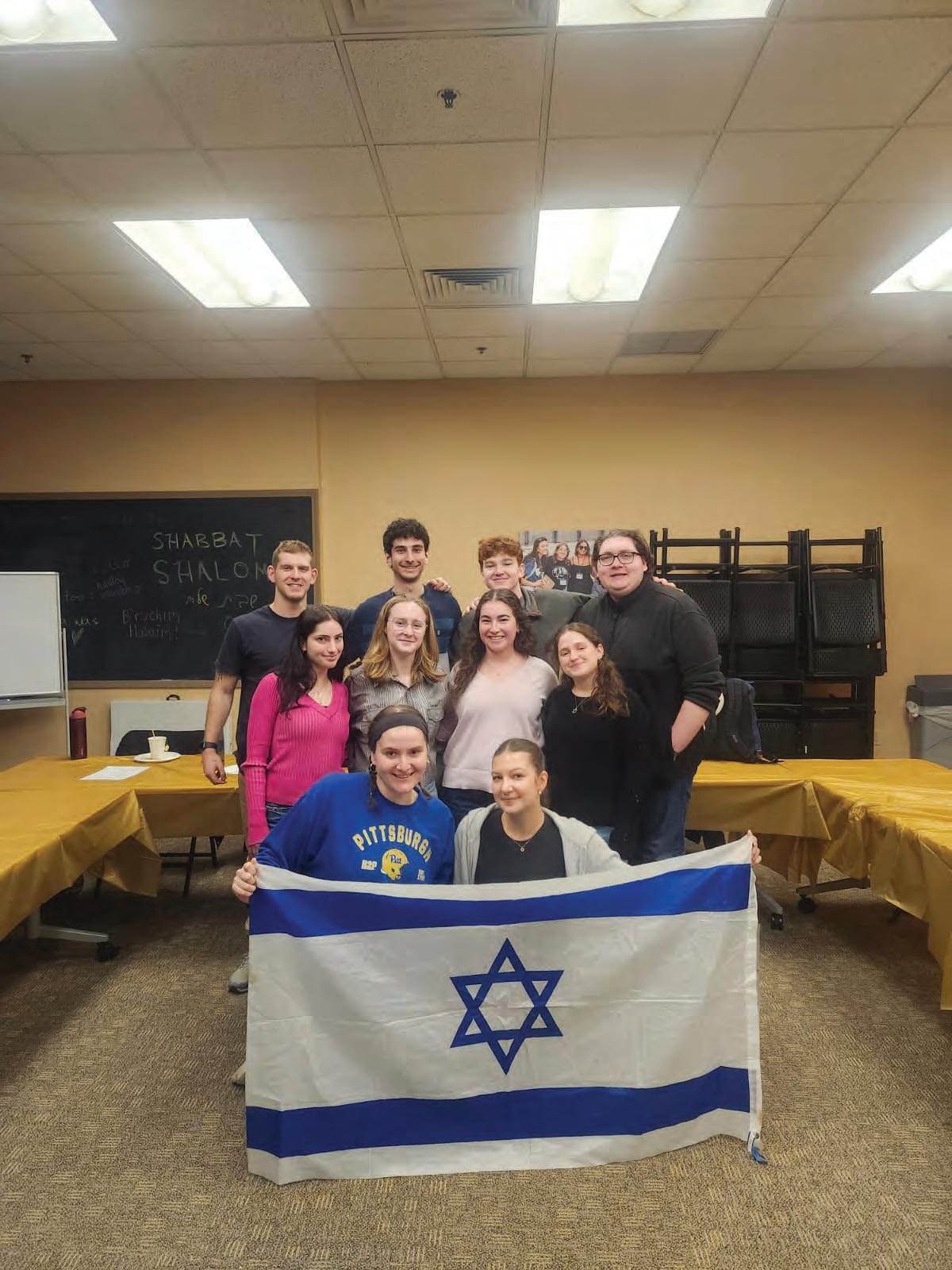
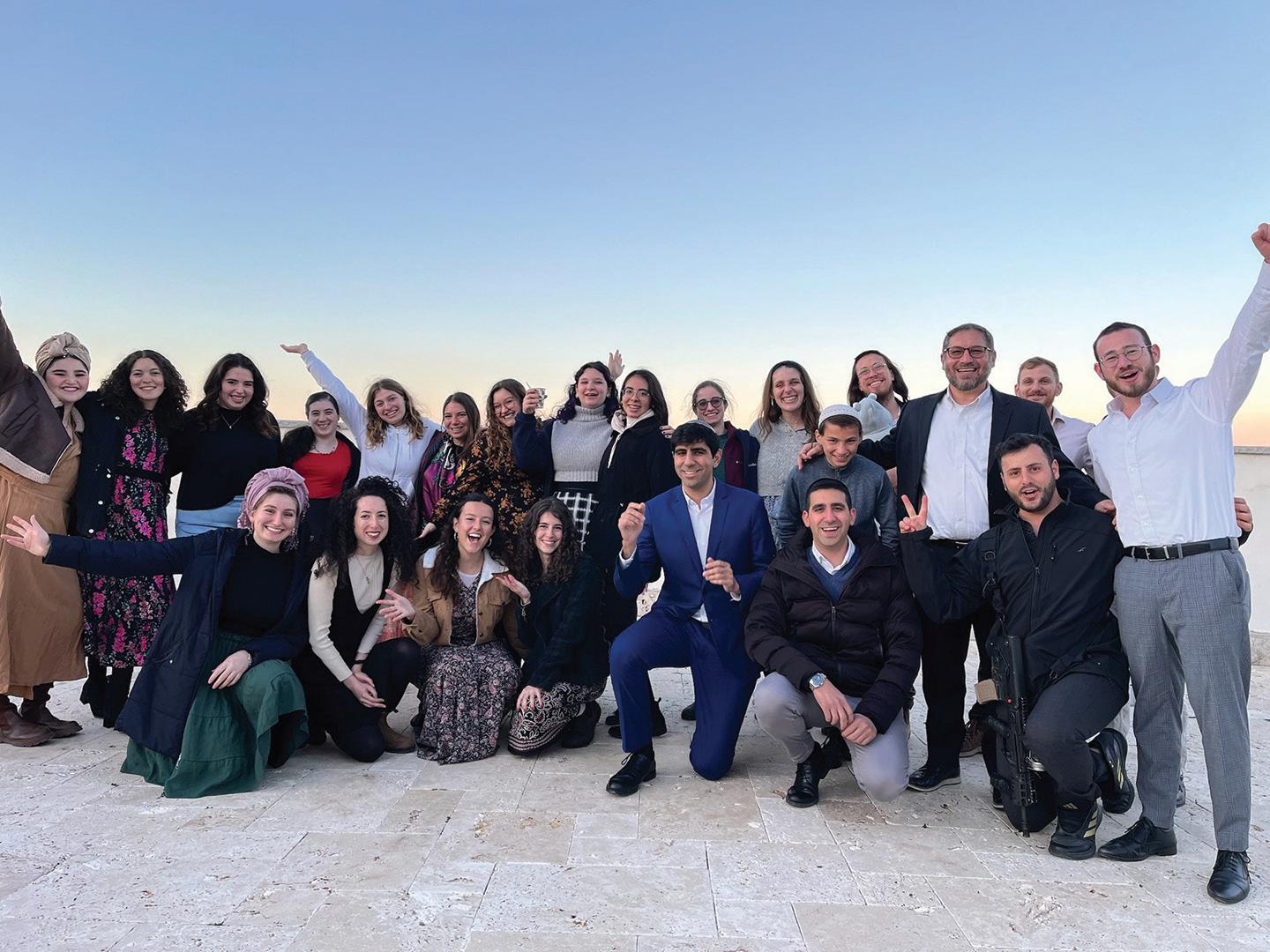
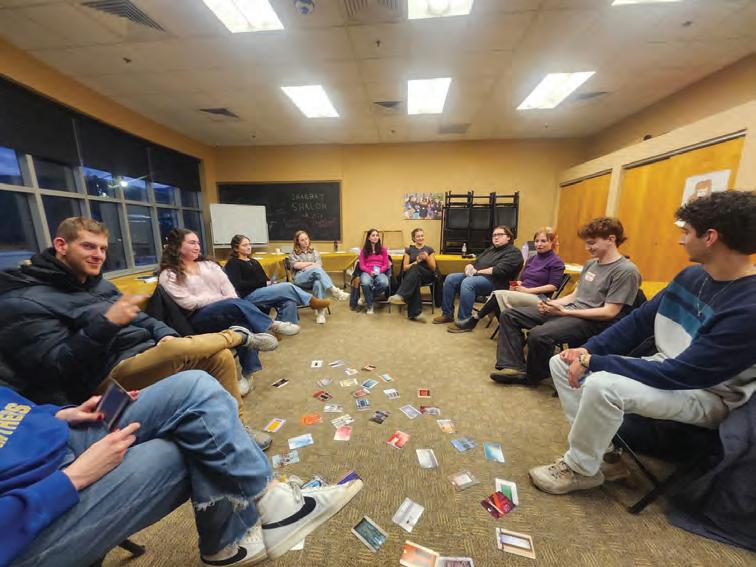
p University of Pittsburgh students gather at Hillel JUC during a Campus Ambassadors meeting.
Photo courtesy of Hillel JUC
Monroeville
Headlines
J Street’s Aidan Jelinek
brings West Bank report to Pittsburgh, urges ‘23-state solution’
By David Rullo | Senior Staff Writer
As violence continues in the West Bank and prospects for a traditional two-state solution appear increasingly remote, Aidan Jelinek argues it’s time to widen the lens. Speaking in Pittsburgh, the J Street activist said he supports a “23-state solution” — a regional framework he believes could normalize Israel’s relationship with the Arab world while laying groundwork for Palestinian statehood.
Jelinek is J Street’s assistant regional director of engagement in New Jersey, Delaware and Pennsylvania, and a 20252026 Naomi Chazan Global Activism Fellow. He spoke in Pittsburgh on Feb. 18 at the J Street program “Report Back on Israel and the West Bank,” held at the Carnegie Library in Squirrel Hill.
An Australian — born to a father from Melbourne and a mother from Detroit, Michigan, who met in the Jewish state — Jelinek spent a gap year between high school and college living on Kibbutz Ma’agan Mikha’el in northern Israel. The time there, he said, left him “obsessed with understanding what was happening — the conflict, the politics of Israel, the politics of the Arab world, all of it.”
He majored in international relations and religious studies at Monash University in Melbourne, before earning a master’s degree from the same university in international relations. His thesis was what he called a “case study” on Hamas, looking at the way the group engages in conflict, its reasons and justifications for it, how it interacts with Israel and how it uses radicalization to rally the population.
After leaving school, Jelinek was hired by J Street, becoming the organization’s West Coast coordinator, before taking his current position.
He recently visited the West Bank as part
of the New Israel Fund’s Naomi Chazan Global Activism Fellowship.
“We spoke with some politicians, as well as civil society — both Israeli and Palestinian — and met with groups that are trying to promote peace and working to promote coexistence with one another and, eventually, lead to a two-state solution,” he said.
And while Jelinek said both he and J Street support a free, democratic Jewish state alongside a Palestinian state, talk about a two-state solution is “exceptionally challenging” right now.
Instead, he said, J Street is attempting to frame the conversation as a “23-state solution.”
“This is the idea that Israel can be integrated and normalized with Arab society and the Arab world, looking at regional security deals that bring Israel into the fold with its Arab neighbors,” he said.
He noted that one of the conditions of that solution — which he said is similar to President Donald Trump’s 20-point plan — is the creation of an independent Palestinian state.
While in the West Bank, Jelinek met Rabbi Avi Dabush, executive director of Rabbis for Human Rights, who was on a kibbutz that was attacked on Oct. 7.
“He told us stories of holding his door and hearing Arabic outside,” Jelinek said. “He could speak Arabic so he could understand
the horrible things these Hamas fighters were saying. But he still works for a group that is trying to promote peace and coexistence.”
Jelinek visited Palestinian villages and Israel settlements. He noted that some of the settlements were legal and “looked like a full community.”
“What was really shocking to me, which I hadn’t seen before, were the illegal outposts, illegal even by Israeli law,” he said.
A group of settlers, he said, initially blocked his group from visiting a Palestinian village before retreating.
“Then the IDF came, but they didn’t come for any kind of support; they came to issue eviction notices to this community which was now within a firing range,” he said.
Violence in the West Bank has soared since Hamas’ attack on Israel triggered the Gaza war in October 2023. The number of attacks by extremist Jewish settlers against Palestinians and Israeli security forces in the West Bank rose by 27% in 2025 compared to the previous year, according to data recorded by the Israel Defense Forces and Shin Bet security agency.
The number of severe incidents of “nationalistic crime” by settler extremists, classified by Israeli security bodies as terrorism, also rose by over 50%, The Times of Israel reported. There are approximately 300 Jewish extremists involved in the violent attacks living in 42 illegal outposts across the West Bank, according to the news agency.
Palestinian attacks on Jews in the West Bank continued throughout 2025 as well, although there were fewer incidents than there were in 2024. Last year, there were 57 terror attacks recorded by the IDF, leading to the deaths of 20 people, The Times of Israel reported.
Despite the deepening conflicts in the West Bank, Jelinek said he believes peace is possible.
“I do feel that there’s an opportunity to go forward and create peace with a lot of the Arab states, who would be willing to normalize and deal with Israel under some
Adam Reinherz, Senior Staff Writer 412-687-1000 areinherz@pittsburghjewishchronicle.org
David Rullo, Senior Staff Writer 412-687-1000 drullo@pittsburghjewishchronicle.org
ADVERTISING
form of regional security plan, but they can’t justify it while Israel is doing what it’s doing to the Palestinians,” he said.
Jelinek acknowledged that Hamas is a “blood thirsty organization” that has controlled the Gaza Strip and no longer has a legitimate claim to power. At the same time, he opined, moderate aspects of Palestinian society have been undercut by Prime Minister Benjamin Netanyahu.
The international community, he said, must help push the extremist aspects of Palestinian society aside.
He hopes, he said, that the National Committee for the Administration of Gaza, comprised of 15 independent Palestinian technocrats and set to succeed Hamas, will work with the Palestinian Authority toward a lasting peace.
J Street Pittsburgh member Arlene Weiner said many Americans go to Israel, but not so many go to the West Bank. She noted that there’s been a lot of attention on Gaza but not as much on the West Bank and that “it’s something we really need to know about.”
“Sometimes settlers are acting in impunity in ways that I think we would want to disown,” she said.
Weiner acknowledged that the issue is divisive and “complicated.”
It’s her hope that people will learn from Jelinek’s visit and engage in honest conversations about the situation on the ground in the West Bank.
For his part, Jelinek hoped his takeaways would present an opportunity for an “open conversation”
“I think that’s the only way we can move forward,” he said. “We need to have an open and honest conversation about Israel without getting sucked into, ‘is it anti-Israel or pro-Israel,’ but being able to talk about it amongst ourselves as a community like it’s a country capable of doing very good and very bad things, just like any other country.” PJC
David Rullo can be reached at drullo@ pittsburghjewishchronicle.org.
Published every Friday by the Pittsburgh Jewish Publication and Education Foundation 5915 Beacon St., 5th Floor Pittsburgh, PA 15217
Phone: 412-687-1000
POSTMASTER: Send address change to PITTSBURGH JEWISH CHRONICLE, 5915 BEACON ST., 5TH FLOOR PITTSBURGH, PA 15217
(PERIODICAL RATE POSTAGE PAID AT PITTSBURGH, PA AND AT ADDITIONAL MAILING OFFICES)
USPS 582-740
Manuscripts, letters, documents and photographs sent to the Pittsburgh Jewish Chronicle become the property of this publication, which is not responsible for the return or loss of such items.
The Pittsburgh Jewish Chronicle does not endorse the goods or services advertised or covered in its pages and makes no representation to the kashrut of food products and services in said advertising or articles. The publisher is not liable for damages if, for any reason whatsoever, he fails to publish an advertisement or for any error in an advertisement. Acceptance of advertisers and of ad copy is subject to the publisher’s approval. The Pittsburgh Jewish Chronicle is not responsible if ads violate applicable laws and the advertiser will indemnify, hold harmless and defend the Pittsburgh Jewish Chronicle from all claims made by governmental agencies and consumers for any reason based on ads appearing in the Pittsburgh Jewish Chronicle
LOCAL—
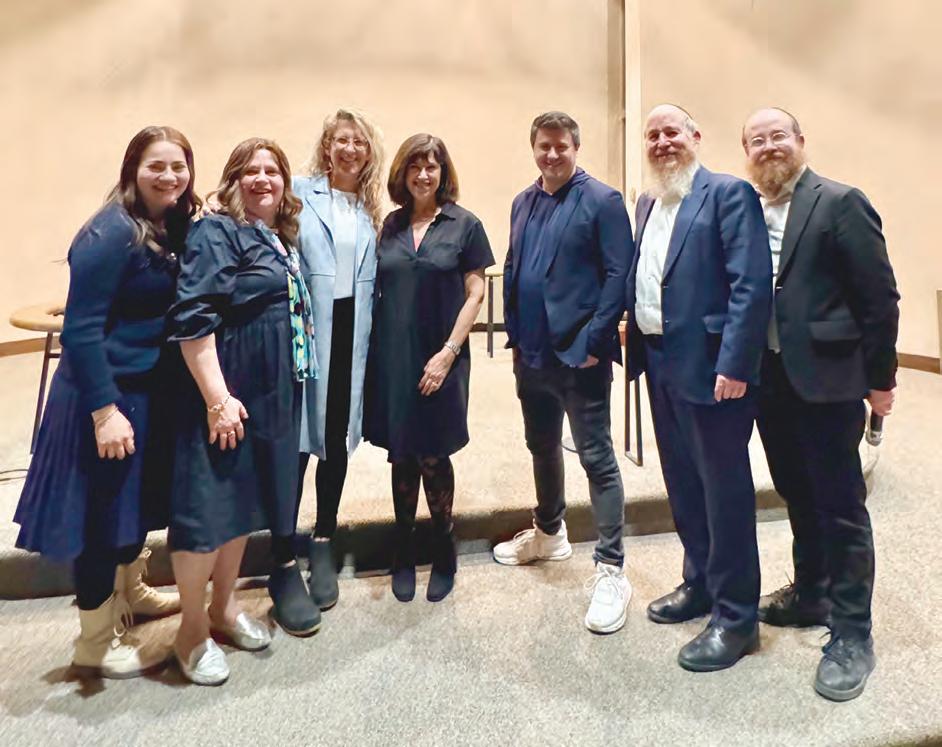
Photo courtesy of Aidan Jelinek
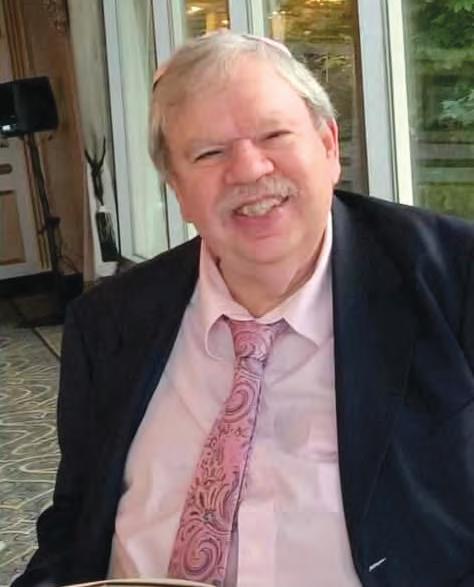
From Dresden to Tangier to Pittsburgh: Survivor Jerry Guttman tells a story of escape and resilience
By Adam Reinherz | Senior Staff Writer
AHolocaust survivor who has never publicly shared his story is set to tell his tale on stage. On Feb. 23, Squirrel Hill resident Jerry Guttman will present a 40-minute overview of his life followed by a question and answer session led by Holocaust Center of Pittsburgh Director Emily Loeb.
The program, held at Chatham University’s Eddy Theater, should encourage people to learn more and “ask their own questions,” Guttman, 93, told the Chronicle.
Born in Dresden, Germany, in 1932, Guttman said he was fortunate enough to come from a forward-thinking family.
“About a year before Hitler came to power, my parents had the presence of getting the hell out,” Guttman said. The family relocated to Italy, which “at the time, was perfectly normal in the sense that Jews were thriving in Italy.”
Until the mid-1930s, Jews had “equal status” in Italy, according to Yad Vashem.
During that period, the Italian Jewish community, which totaled close to 50,000 in 1933, was “fully integrated into Italian culture and society,” noted the U.S. Holocaust Memorial Museum.
Guttman’s family was far from the first to establish roots in Italian soil. Before the Guttmans’ arrival, Jews had called the region
home for more than 2,000 years.
In 1938, life drastically changed in Italy after passage of a series of racial laws, Guttman said. “And so again, for the second time, my parents had the presence of trying to get out.”
While leaving Italy was possible, few destinations were willing to accept Jews. Guttman’s parents identified Tangier, Morocco, and Shanghai, China, as possible spots to move the family.
“I never asked my father specifically, but I imagine that at the time, he looked at a map and Tangier made more sense than Shanghai,” Guttman said.
Guttman described Tangier as a city “ruled by several governments.” In practice, “if you wanted to mail a letter, you had a choice of the Italian post office, the Spanish post office, the French
post office, etcetera. It was truly an open city.”
Though Guttman’s father previously worked as a furrier, he abandoned the trade upon moving to Tangier and opened a café, called Tingis, “which incidentally, for the record, exists today,” Guttman said.
At the time, Tangier’s Jewish population consisted largely of refugees. Although the city lacked a synagogue, Guttman said he celebrated his bar mitzvah in a community center, and maintained a cosmopolitan upbringing filled with multiple linguistic influences.
At home, he spoke German with his parents. At school, which was run by the French government, he spoke French. In the streets, he spoke Spanish.
While living in Milan, he learned Italian and English, explaining that his English improved thanks to regular visits to the airport.
“I would take my bike and I would hang out outside of the airport, because there were tourists coming by, asking for directions, and so I was able to help them out.”
The tactic led to his getting hired as a tour guide by an American couple, who planned to spend nearly two weeks traveling through Italy.
When their trip was over, Guttman was asked if he’d like to come to the U.S.
Guttman told the couple he’d never thought about going to the U.S., and despite an American gentleman taking his information “it was the end of the story,” he said.
About nine months later, Guttman said he received a call from the American Consulate
MAHLER’S RESURRECTION
performance also features Boris Pigovat’s Yizkor, a Pittsburgh Symphony Orchestra commissioned work commemorating those
in Milan saying, ‘Please come in to work
Guttman sought advice from his parents, who said, “Look, I mean, what do you have to lose? Go ahead. If you like it, fine. If you don’t
With that guidance, at age 21, in 1953, Guttman boarded the SS Independence in Genoa and traveled by boat to New York City. A year after his arrival he was drafted into the military. Guttman served for two years and eventually became a citizen. Thanks to the GI
Please see Guttman, page 11
Jerry Guttman will tell his story on Feb. 23. Photo courtesy of Holocaust Center of Pittsburgh
p Jerry Guttman as a young man
Photo courtesy of Holocaust Center of Pittsburgh
Headlines
When
By Eric Lidji | Special to the Chronicle
Abrought chaos, chaos brought ideas
re you trying to cultivate a spirit of gratitude this year? Why not start with a challenge? It’s easy to be grateful for family and good health and dramatic sunsets. But can you summon the strength of character to be grateful for Pittsburgh traffic?
History is here to help.
As with most world-changing technology, the automobile was given to humanity without much effort to mitigate its negative consequences. The growing use of cars in Allegheny County in the late 1910s and early 1920s brought deadly chaos to local streets.
According to research from historian Joel Tarr, Allegheny County reported 182 automobile-related deaths in 1922. The total included 82 pedestrians struck by vehicles, more than half under the age of 14. By comparison, Allegheny County reported 73 automobile-related deaths in 2024, despite having exponentially more cars on the road.
As a public health intervention, Mayor William Magee formed the Better Traffic Committee in February 1925. It had seven subcommittees, including an “education and publicity committee.” While the other committees worked on municipal policy, the education and publicity committee tried to get out the word about the dangers of the automobile. The committee accepted its charge with flair, creativity and optimism.
The Better Traffic Committee survived the mayoral election that fall, when lawyer Charles H. Kline beat Magee. Kline tapped the downtown department store magnate Walter Rosenbaum in May 1926 to lead the education and publicity committee.
Rosenbaum was the general manager of Rosenbaum’s Department Store, which had been founded by his father, Max. Safety became Walter’s leading civic undertaking.
Rosenbaum started with a report on traffic fatalities since 1923. It was a useful report, and it got good press. Then, Rosenbaum got creative. He launched a contest called “Let’s Stop Auto
school children. All 78,000 students in the area would be eligible. The contest had three divisions by grade, each division getting a prompt. The contest offered prizes totaling $810, about $15,000 today. A few weeks later, the University of Pittsburgh and Duquesne University announced scholarships for some of the essay contest winners.
The contest attracted national attention. That November, national highway safety pioneer Stephen P. James described the Pittsburgh essay contest as the most ambitious competitive program ever devised by a municipality to improve public awareness of traffic safety. He encouraged every large city in the country to follow our example.
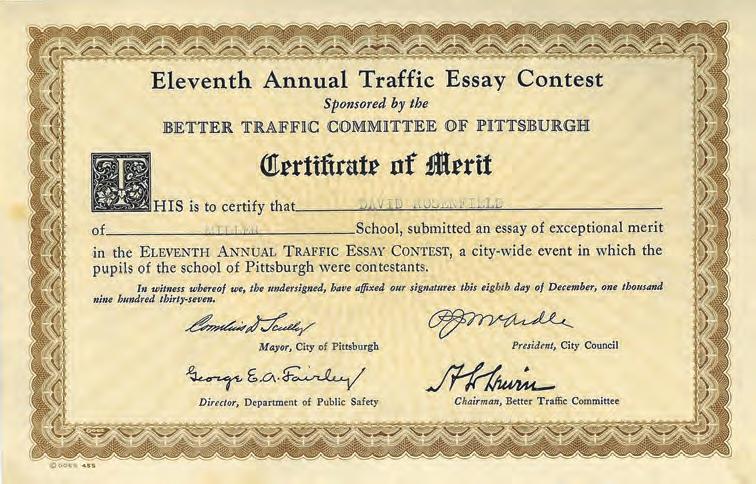
The Better Traffic Committee essay contest was a fixture of primary education in Pittsburgh throughout the 1930s. The Rauh Jewish Archives holds no less than four cer tificates awarded to Jewish children during these years, recognizing their work. If you have someone in your life that attended city schools in the 1930s, ask them about it.
Under Rosenbaum, the Better Traffic Committee devised all sorts of interesting projects. It made safety films to show as trailers before motion pictures. It designed posters to hang around town. It recorded public service announcements for the radio.
Accidents.” Anyone in the region who had witnessed a car crash firsthand could send a report to the committee. The most helpful reports got cash prizes.
With the start of the school year that fall, Rosenbaum launched an essay contest for
It held an annual “Pedestrian Week,” celebrated with communal whistle blowing at the end of the school day to warn drivers. It developed a “Court of Public Opinion.”
Headlines
By David Rullo | Senior Staff Writer
Spend a few minutes talking with Rabbi Yonatan Udren and you can’t help but feel his passion for Israel.
“It’s a very deep love affair with the country, with the physical land, with the spiritual experience of being there, with the feeling of connectivity and sense of home and being a part of the Jewish people in a way you just don’t feel outside of Israel,” Udren said.
And, while it is unremarkable for a rabbi living in a West Bank settlement to declare his love and support of Israel, dig a little deeper and you’ll find Udren’s story is far more complex than it first appears.
The son of Barb and Eric Udren, the future rabbi spent the first 11 years of his life in Monroeville, Pennsylvania, attending Reform congregation Temple David.
Udren credits his time at Florida State University and his positive experience at Hillel FSU — and his interest in a person he called “a cute young lady” (more on that later) — for sparking a greater interest in Judaism and the Jewish state.
“That drives everything, but a monthlong experience in a program called ‘Israelite in the Old City of Jerusalem’ opened me up to a more traditional sense of Judaism, which I had not been exposed to,” he said. “I caught the bug of Jewish learning. It really brought me in and continues with the work that I do.”
Udren decided to stay in Israel and study under Rabbi Shlomo Riskin, the founding chief rabbi of the Israeli settlement Efrat, which he
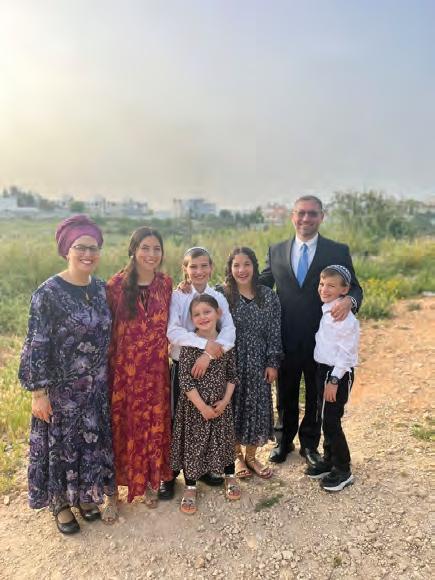
Udren now lives with his wife, Dena Udren, and five children in the West Bank community of Beit El, a settlement adjacent to the city of Ramallah.
Dena Udren, the woman the rabbi referred to as the “cute young lady,” deserves some of the credit for his desire to make a home in Israel, he said.
The rebbetzin’s path is as unique as her husband’s origin story.
She grew up in Point Breeze experiencing a typical Jewish upbringing. Her family was affiliated with the Conservative Congregation Beth Shalom. She attended Reizenstein Middle School and Taylor Allderdice High School, and spent summers at Camp Ramah in Canada.
She knew from the time of her bat mitzvah that she was going “to be more religious than my parents,” she said.
Dena Udren’s journey was gradual — she began staying home on Shabbos during high school and keeping kosher as much as possible. But it was her time at Camp Ramah and dinners shared with Orthodox families in Squirrel Hill that helped pique her interest in diving deeper into religion, she said.
“I fell in love. There was a process of going to the Carnegie Library and reading about the history of Conservative Judaism because I was a nerdy kid and wanted to understand it. And then there was USY. I was really active in it. It was an amazing outlet for me to not only learn about Judaism but to have a leadership position, as well,” she said.
By the time she was looking at colleges, Dena Udren’s priorities had shifted.
p Torah Cafe Shabbaton
Photo courtesy of Rabbi Yonatan Udren
Calendar
Submit calendar items on the Chronicle’s website, pittsburghjewishchronicle.org. Submissions also will be included in print. Events will run in the print edition beginning one month prior to the date as space allows. The deadline for submissions is Friday, noon.
q SATURDAY, FEB. 21
Get ready for Purim with Temple Ohav Shalom’s Shalom Tots: Make Some Noise for Purim. Make masks, crowns and noisemakers for Purim. Costumes are encouraged. Children aged 0-5. 10 a.m. Free. Temple Ohav Shalom, 8400 Thompson Run Road. facebook.com/search/top?q=shalom%20tots
q SUNDAY, FEB. 22
Join Chabad of Squirrel Hill for a Kids’ Hamantash Bake. Make your own hamantaschen with entertainment by juggler Howard Mincone. 2:30 p.m. $10/child. 1700 Beechwood Blvd. chabadpgh.com/kidscooking
Join Chabad of the South Hills for its Family Hamantash Bake, a sweet, hands-on Purim adventure for the whole family. 3 p.m. 1700 Bower Hill Road. chabadsh.com/hamantash
q SUNDAYS, FEB. 22–JULY 26
Join Chabad of Squirrel Hill for its Men’s Tefillin Club. Services and tefillin are followed by a delicious breakfast and engaging discussions on current events. 8:30 a.m. 1700 Beechwood Blvd. chabadpgh.com
Join a lay-led online Parashah study group to discuss the weekly Torah portion. No Hebrew knowledge needed. The goal is to build community while deepening understanding of
the text. 8:30 p.m. For more information, visit bethshalompgh.org/online-parashah.
q MONDAYS, FEB. 23–JULY 27
Join Congregation Beth Shalom for a weekly Talmud study. 9:15 a.m. For more information, visit bethshalompgh.org.
Join Temple Sinai for an evening of mahjong every Monday (except holidays). Whether you are just starting out or have years of experience, you are sure to enjoy the camaraderie and good times as you make new friends or cherish moments with long-term pals. All are welcome. Winners will be awarded Giant Eagle gift cards. All players should have their own mahjong cards. Contact Susan Cohen at susan_k_cohen@yahoo. com if you have questions. $5. templesinaipgh.org
Join Chabad of the South Hills for Lift Your Life, a Rosh Chodesh Society series. This month’s topic is “The Art of Managing Food and Munching for Meaning.” 7 p.m. 1700 Bower Hill Road. For more information or to RSVP, email batya@chabadsh.com. chabadsh.com
q TUESDAYS, FEB. 24–JUNE 30
Join Beth El’s Rabbi Alex Greenbaum and his Bible/Talmud Adult Education class for a thoughtprovoking weekly session of Bible and Talmudic study. This program is available both in person and virtually. Call the office at 412-561-1168 to receive the Zoom link or to make an in-person reservation. 10:30 a.m. 1900 Cochran Road. bethelcong.org
q WEDNESDAY, FEB. 25
Join Temple Ohav Shalom Center for Early Learning for
My Grown Up and Me, a joyful, hands-on experiences for children 18 months to 3 years of age and their grown up(s). Each class includes multi-sensory explorations, art experiences, a story and more. Come make memories, meet other families, experience the magic of our center while learning all about our programs and the Reggio Emilia approach. 9:30 a.m. $45/three-week series. Temple Ohav Shalom, 8400 Thompson Run Road. centerforearlylearning.org
Join Chabad of the South Hills for its Seniors Luncheon. This month’s topic is “Safe Driving Through the Ages.” 1 p.m. Suggested donation, $5. 1701 McFarland Road. RSVP at 412-278-2658.
q THURSDAY, FEB. 26
Join Rodef Shalom Congregation for “Understanding Online Risks for Our Kids – What Every Parent Needs to Know,” an informative and empowering session that helps parents understand the online behaviors and trends impacting today’s teens and young adults. John Pulcastro, supervisory intelligence analyst, FBI Pittsburgh, will provide a clear, accessible overview of emerging digital risks so you can better support and protect the young people in your life.
Join Temple Ohav Shalom for Purim Royale, an evening of fun, live music and community. 6 p.m. $85/ticket. Temple Ohav Shalom, 8400 Thompson Run Road. Register at templeohavshalom.org.
q MONDAY, MARCH 2
Tree of life Congregation presents “The Purim Shpiel: A Hard Night’s Megillah.” The evening service and reading of Megillat Esther will occur before the shpiel featuring the Not Ready for Purim Band and many special guests. 7 p.m. Free. Levy Hall, Rodef Shalom Congregation, 4905 Fifth Ave. treeoflifepgh.org
q TUESDAY, MARCH 3
Join Chabad of Greenfield for Purim at the Draft, a joyful experience with great food, amazing entertainment, fun for all ages and a meaningful message that stays with you long after the
The Pittsburgh Jewish Chronicle invites you to join the Chronicle Book Club for its March 1 discussion of “Snow in August,” by Pete Hamill.
From Amazon.com: “Brooklyn, 1947. The war veterans have come home. Jackie Robinson is about to become a Dodger. And in one close-knit working-class neighborhood, an eleven-year-old Irish Catholic boy named Michael Devlin has just made friends with a lonely rabbi from Prague.
“'Snow in August’ is the story of that unlikely friendship — and of how the neighborhood reacts to it. For Michael, the rabbi opens a window to ancient learning and lore that rival anything in Captain Marvel. For the rabbi, Michael illuminates the everyday mysteries of America, including the strange language of baseball. But like their hero Jackie Robinson, neither can entirely escape from the swirling prejudices of the time. Terrorized by a local gang of anti-Semitic Irish toughs, Michael and the rabbi are caught in an escalating spiral of hate for which there’s only one way out — a miracle ... .”
Your hosts
Toby Tabachnick, Chronicle editor
David Rullo, Chronicle senior staff writer
costumes come off. 5 p.m. $10 per child, $15 per adult. Chabad of Greenfield, 4315 Murray Ave. chabadofgreenfield.com/purim
Join Chabad of the South Hills for Purim at the Stadium. Enjoy halftime entertainment, a “concession stand” dinner, sports-themed fun, animated Megillah reading and more. 5:15 p.m. Adults $18/Child $12/Family max $54. 1700 Bower Hill Road. chabadsh.com/stadium
q WEDNESDAY, MARCH 4
The Second Annual De-Ice Ball supports Casa San Jose’s Bond Fund, which provides assistance to those detained by ICE in the Pittsburgh area. Sponsored by Dor Hadash, Casa San Jose, Bend the Arc Pittsburgh, Rodef Shalom, Temple Sinai and LCLAA. 6:30 p.m. $18 and up. Location given with registration. casasanjose.salsalabs.org/de-ice2026
q SATURDAY, MARCH 14
Join Congregation Beth Shalom for their Sisterhood Shabbat honoring Rhoda Judd, Barbara Kaiserman and Yvonne Stein. Erica Zabusky, a creative and effective arts and entertainment industry professional, will be the featured speaker. 9:15 a.m. 5915 Beacon St.
q MONDAY, MARCH 16
Anika Walke delivers “Memorial Complexes, Rayzebilder, Testimony: A spatial approach to Holocaust memory in Belarus,” the Third Annual Renee Sachs Memorial Lecture in Holocaust Studies. The lecture introduces works by the Yiddish writer Hirsh Reles and memorials created by architect Leonid Levin to explore how legacies of systematic violence shape the natural and built environment in the former Soviet Union. 5:15 p.m. Free. Cathedral of Learning, Room 501, Fifth Avenue. calendar.pitt. edu/event/prof-dr-anika-walke-talk
q WEDNESDAY, MARCH 25
Weaving in reflections from Jill Joshowitz’s recent trips to Syria, “Reflections on the Dura Europos Synagogue Paintings” will explore the incredible biblical subject matter in the Dura synagogue paintings and their later reception in both Damascus and Pittsburgh. 5:30 p.m. Free. Cathedral of Learning, Room 332, Fifth Avenue. PJC
How it works
We will meet on Zoom on Sunday, March 1, at 1 p.m.
What to do
Buy: “Snow in August.” It is available from online retailers, including Amazon and Barnes & Noble, and in some local Barnes & Noble stores. It is also available through the Carnegie Library system.
Email: Contact us at drullo@pittsburghjewishchronicle.org, and write “Chronicle Book Club” in the subject line. We will send you a Zoom link for the discussion meeting. Happy reading! PJC
Headlines
1 in 3 American Jews were targeted by an antisemitic incident last year, AJC survey finds
One-third of American Jews reported being the target of an antisemitic incident in 2025, according to a new survey published by the American Jewish Committee, JTA reported.
The finding marked no change over the previous year, suggesting that American Jews could be settling into a distressing new normal in the aftermath of Oct. 7.
“Things aren’t getting markedly better,” said Ted Deutch, the CEO of the AJC, in an interview. “I don’t think that we can afford to accept it as a baseline. We can’t accept that, and America shouldn’t accept that.”
Overall, 55% of American Jews reported avoiding specific behaviors in 2025 due to fear of antisemitism, including steering clear of certain events and refraining from wearing or posting things online that would identify them as Jewish.
This year’s respondents were also asked if they felt “less safe” as a result of several high-profile recent antisemitic attacks, including the arson attack on Pennsylvania Gov. Josh Shapiro’s home in April; the deadly shooting of two Israeli embassy staffers in Washington, D.C., in May; and the firebombing of a demonstration for the Israeli hostages in Boulder, Colorado, in June.
About a quarter of respondents said the attacks had made them feel “a great deal” less safe, while 31% responded “a fair amount” and 32% responded “a little.”
Overall, according to the report, two-thirds of respondents said that they believed Jews in the
United States were less secure than a year ago. Deutch said the findings of the group’s latest report should serve not only as a warning for Jews, but as a “warning sign of the cracks in the foundation of our society” for the wider public.
French, German, Jewish leaders call for resignation of UN’s Francesca Albanese over ‘common enemy’ comments
A slew of prominent voices, including the French foreign minister, have called for the resignation of United Nations Special Rapporteur Francesca Albanese over her latest comments about Israel, JTA reported.
Albanese, the U.N.’s Palestinian rights envoy, is a vocal critic of Israel who has drawn sustained rebuke from multiple U.S. administrations over comments seen as veering sharply into antisemitic territory. Last year, the Trump administration formally sanctioned her, with Secretary of State Marco Rubio accusing her of “virulent antisemitism and support for terrorism.”
This time, speaking at the Al-Jazeera Forum in Doha earlier this month, Albanese ignited rebuke from an array of world leaders when she suggested that Israel was “a common enemy” for all.
“Instead of stopping Israel, most of the world has armed, given Israel political excuses, political sheltering, economic and financial support,” she said. She continued, “We who do not control large amounts of financial capital, algorithms and weapons — we now see that we as a humanity have a common enemy.”
French Foreign Minister Jean-Noel Barrot said the comments inappropriately targeted all Israelis instead of the Israeli government.
Today in Israeli History
nominee when “Sallah Shabbati” is nominated for best foreign language film. The film loses the Academy Award but wins a pair of Golden Globes.
The German foreign minister, Johann Wadephul, called for her resignation. “I respect the system of independent rapporteurs of the UN. However, Ms. Albanese has already repeatedly failed in the past,” he tweeted. “I condemn her recent statements about Israel. She is untenable in her position.”
And Ronald Lauder, president of the World Jewish Congress, called Albanese “a dangerous figure who continues to use her position to promote discredited conspiracy theories, divisive and antisemitic narratives” and said he would petition for her removal.
International social workers group set to vote on expelling Israeli union for ‘not acting to promote peace’
The Israeli Union of Social Workers could be booted from a global federation after at least three countries called for a vote on its expulsion on allegations of ethical breaches, JTA reported.
The countries — Ireland, Spain and Greece — charged that the Israeli union should have moved to seek exemptions from military service for its members or “issue a call for peace.” Their call for an expulsion vote escalated the International Federation of Social Workers’ January 2025 censure of the Israeli union over the alleged breaches, which the federation said violated ethics rules that say social workers “should not use weapons in their professional or personal capacities against people.”
The Israeli union has called for the vote to be abandoned while signaling that it remains committed to dialogue with Palestinian colleagues.
“Expelling or suspending a social workers’ union will not promote change — rather, it will promote polarization and radicalization, which
arise in situations of isolation or perceived threat,” it said in a statement last week. “In our reality, this means that expulsion or suspension would hinder our ability to promote dialogue with our neighbors or with other countries.”
In the statement, the Israeli union also said that the demand to request Israeli social workers be granted an exemption from military service was “entirely unimaginable within Israeli society.”
The International Federation of Social Workers represents 141 national associations of social workers. The expulsion vote was set for Feb. 18 and requires a 75% majority to pass.
IDF’s first Orthodox standing battalion becomes operational
The Yonatan Battalion — the first regular service battalion of the Israel Defense Forces all-Haredi Hasmonean Brigade — is now operational after completing its first-ever battalion-level exercise last week, JNS reported.
As part of the exercise in the Golan Heights, the troops drilled “combat in open terrain, raids and urban warfare,” the IDF said. The drill “concluded the battalion’s operational certification and its preparations for operational activity.”
All courses were “adapted to their way of life and enable the battalion to operate as an organic framework,” according to the Jewish state’s army.
“We are in a historic period,” Yonatan Battalion commander Lt. Col. A., identified as a rabbi, declared in the IDF statement. “We’re cultivating God-fearing soldiers who are heroes, men of valor and men of truth.” PJC
In a nationally televised address, President Dwight Eisenhower emphasizes the need for Israel to abide by U.N. resolutions calling for its withdrawal from all of Sinai and the Gaza Strip after the 1956 war.
Feb. 21, 1852 — Pope fights Jewish emancipation Pope Pius IX protests the granting of partial emancipation to Jews under Grand Duke Leopold II of Tuscany. The pope writes of the need to keep Catholics “from having any contact with the infidels.”
Feb. 22, 1914 — Technion chooses Hebrew
The directors of the under-construction Technikum in Haifa decide that the language of instruction will be Hebrew, reversing an unpopular October decision to teach in German, and they change the name to the Technion.
Feb. 23, 1965 — ‘Sallah Shabbati’ is nominated for Oscar
The Israeli movie industry has its first Oscar
Feb. 24, 1942 — Soviet sub sinks Struma
Reportedly mistaking it for an enemy ship, a Soviet submarine sinks the refugee transport SS Struma in the Black Sea. Only one of the 769 Jewish refugees survives. The British had denied them visas to Palestine.
Feb. 25, 1928 — Tel Aviv sees first soccer derby
Maccabi Tel Aviv and Hapoel Tel Aviv hold the first match in the city’s oldest soccer rivalry, a 3-0 home victory for Maccabi. Maccabi wins the rematch on Hapoel’s home field a week later, 2-1.
In Armonk, New York, Egyptian National Security Adviser Hafez Ismail tells his U.S. counterpart, Henry Kissinger, that Egypt is willing to negotiate directly with Israel under U.S. mediation. PJC
Items are provided by the Center for Israel Education (israeled.org), where you can find more details.
p Pope Pius IX was beatified in 2000 despite Jewish protests over his overt antisemitism.
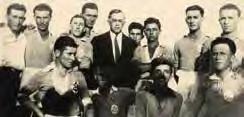
p Early Revisionist Zionism leader Ze’ev Jabotinsky poses with a British Mandateera Maccabi Tel Aviv team. Maccabi Tel Aviv
Sandra
Sybil
Philip
Marilyn
Anne
Sigo
Nancy
Constance
Barbara
Stuart
Susan
Mr. & Mrs. Anthony Fienberg
Dr. Robert Fierstein
Fine & Edwards
Lessa Finegold
Barbara A. Fisher
Charles & Diana Forgy
Karyn Frank
Malke & Ivan Frank
Wendy Freed Esther Fried
Joanne Friedman
Mark Frisch
Marilyn Galbraith Sandra R. Gallo
Jan Garcia
Peter M. Geiringer
Elaine Gelb
Barry Gerber
Laurie & Geoffrey Gerber
Susan Gerber
Kristina Gerszten
Ariel Gildengers
Rochelle Glanz
Helene & Steven Glick
Nettie Glickman
Aryeh Goldberg
Sharon & Jim Goldberg
Richard Goldberg
Carole Kaufman
Carol & Allan Golden
Jane Goldfarb
William Goldfarb
Hilda Goldhamer
Leslie Goldstein
Mark A. Goodman
Stephen & Marjorie Goodman
Sara Gorby
Benjamin Gordon
Robert & Carol Gordon
Carole & Mark Gottlieb
The Green Family
Barbara F. Greenberg
Jacob Greenberg
Mr. & Mrs. Abraham Greenberg
Mark Greenblatt
Sarah Greenwald
Edwin Grinberg
Allan Gross
Marcia Grupp
David Hamburg
Ingeborg Hamovitz Benjamin Handen
J. Robert Hanlon, Jr.
Ricki Sedaka Harbaugh
David & Linda Harinstein
Jill & Andrew Harris
Julie Harris
Sayed & Tamar Hashimi
Steve Hast
Lynn & Steven Hecht
Jan Henry
Barbara Hepner
Bruce Herschlag
Jack Hertz
Adam Hertzman
Judith Herzog
Barry Hirsch & Jean Harwick
Sandy Hirsch
Ayala & Reuven Hoch
Mark & Lynn Hochhauser
Ron & Arlene Hochhauser
Mitchell Hoffman Vicky Hoffman
Mr. & Mrs. Stanley J. Weiner
Susan & Richard Hommel
Lila Horowitz
Tom Horowitz
Bruce Horvitz
Joan Tabor Gonella
Becca Hurowitz
Richard Ilnicki
Adam Indianer
Ilana Inspektor
Yvette Isaacson
Ilene & Joel Iskoe
Alan & Debra Iszauk
Gary Ittigson
Joan Jacob
Ronald Jacobs
Patricia Florida Jimenez
Joseph Kadane
Susan & Charles Kalson
Ms. Amy Kamin
Sam & Joanie Kamin
Larry Kanterman
Mr. Kenneth H. Kantrowitz
Eva Kaplan
Dr. & Mrs. Barry M. Kart
David N. Katz
James Katz
Mrs. Janie Katz
Julia Katz
Maury Katz
Pat Katz
David Katzman
Gary E. Katzman
Jared Kaufman
Barbara & Myron Kaufman
Samuel Kayam
Richard Keitel
Bonnie Kift
Lee Kikel
Maxine Kisilinsky
Barry & Eileen Kisloff
Barbara Klein
Miriam Klein
Paula Klein
Sherry B. Klein
Honi Kleya
Donna Knupp
David & Judith Kolko
Lois & Alan Kopolow
Jan & Ed Korenman
Amy Korman & David Korman
Joel Kranich
Judith & Charles Kreiger
Alison Kresh
Benjamin Krokosky
Trudy Labovitz
Michael & Frances Lando
Debbie & Harvy Lantzman
Stephanie & Richard Lappen
Carol Lazear
Mark Lebovitz
Sally Lebowitz
Harold A. Lederman
Dr. & Mrs. Richard Leffel
Dan & Ellen Leger
Faye Leibowitz
Joyce Leifer
Jeffrey Lemberg, MD
Sheila Lenchner
Terry Lerman
Marcia Levaur
Jan & Maggie Levinson
Sally & Todd Levenson
Dr. & Mrs. Harry M. Lever
Karen Levin
Wendy Levin-Shaw
Allen & Janet Levine
Janet Levitt
Joan Levy & Debra Levy McKenney
Douglas Liebman
Richard Lincoff
Andrew Liptak
Mitchell & Ellen Livingston
Angela Locke
Aileen Louik
Harold Love
Michael & Andrea Lowenstein
Aviva Lubowsky
Cindy Lucas
Sandy & Robert Lumish
Natalie S. Lustig
Marth Luzer
Cherie Maharam
Stuart Makagon
Barbara A Mandel
Janice Mankin & Lee Levine
Ms. Beverly M. Manne
Lewis March
Ivan Marcus
Rachel Marcus
Rivka Marcus
David Maretsky
The David & Carole Maretsky
Philanthropic Fund of the JCFGP*
Dena Marizan
Jeff & Randi Markovitz
Robert Markovitz, Esq.
Elisa Marlin
Steven Mayer
M. Ursula McKenzie
Nancy McLachlan
Linda Melada
Mimi Meltzer
Robert Mendelson
Mark & Jane Mendlow
Doris Mernick
Rachel Meyers
Manny Miller
Marsha E. Mintz
Leslie Mitchell
Barry & Margy Mitnick
Karen Moellenberg
Mr. & Mrs. Michael Mokotoff
Marion Monheim
Pearl B. Moore
Shirley Moritz
Dr. & Mrs. Don Morris
Brad & Bernita Myers
Irving Nadle
Iris Nahemow
The Natelson Family
Esther Nathanson
Carol & Richard Nathenson
Edith B. Naveh
Esther & Jim Neft
Lee & Rena Neiman
Dr. Ronald D. Neufeld
Charles & Susan G. Neuman
Mr. & Mrs. Casey Neuman
Irwin H. Norvitch
Mitchell Nyer
Cathy O’Connor
Janet Ocel
Irving Oppenheim
Linda & Alexander Orbach
Fred Orlansky
Helen Orringer
Marc Oster
Rochelle Packard
Mitchell & Rae-Gayle Pakler
Wendy Panizzi
Rob & Julie Paris
Lester Parker
Ronald L. Perrin, MD
Sylvia Pilch
Jack Pincus
Jeffrey Pittler
Mark Pizov
Jonathan Plesset
Chaya & Dean Pollack
Burton Pollock
Shirley Preny
Joan Privman
Barton Rack
Ray & Debra Rasmussen
James C. Recht
Rita Reese
Sharon R. Reinherz
Reid B. Roberts
Judith Robinson
Alisa M Rodney
Toren Finkel & Beth Rosner
Sally Rogalsky
Deborah Rosen
Ross Rosen
Barbara Rosenberg
Mary Rosenberg
Ruth Rosenblatt
Rabbi Chezky Rosenfeld
Sabina & Peter Rosenfeld
Allan Rosenfield
Carol Rosenthal
Bob & Nancy Rosenthal
Charles Rosenthall
Ruth Roth
Harold B. Roth
Ellen Roth
Lori & Dan Rothschild
Judith Rothstein
Kate Rothstein
Leah Rubenstein
Dr. Fred Rubin
Sonia Leah Rubin
Edward Russakoff
Sheri Sable
Marjorie Sachs
Dr. Gerald B Sandson
Steven Sarfin
Rabbi Lenny Sarko
Erika Savitz
Stephen P. Schachner
Eric & Michele Gray-Schaffer
Barbara Sheinberg
Denise & John Schiller
Debbie Schlesinger
Eleanor Schoenberger
Neal A. Schorr
Jerry Schulhof
Robert & Carol Schutte
Mrs. Joel Schwartz
Matthew Schwartz
Robert & Ellen Schwartz
Connie Schwartz
Carole Schwartz-Cohen
C. Paul Scott
Jeffrey A. Scott
Harold Segal
Howard Segal
Jan S. Seiavitch
Richard & Denise Seidler
Linda & Allen Selig
Aviel Selkovits
Bernie Selkovits
Scott Serbin
Dianne & Murray Shapiro
Karen Shapiro
Rosalyn D. Shapiro
Mr. Don B. Sharapan
Hedda Sharapan
Stanley Shostak
Cynthia Skrzycki & David Shribman
Eleanor R. Siegal
Barb & Ed Siegel
Herchelle Siegel
Michael Siegel Ned Siegel
Diane Silberg
Jerry & Ina Silver Paul & Linda Silver James Silverman Stuart Silverman, MD Mike Silverstein
Linda And Ken Simon Mrs. Mark Simon
Anne Sirowitz
Marc Siskin
Ms. Elaine B. Siskind Eve Skirboll
Barbara Kramer
Susan & Peter Smerd Caren Smith Jeremy Smith Flo Sonnenklar Amy R. Spear Jeffrey Spear Diana Spodek Lorraine Starsky
We bring you Jewish Pittsburgh in print, in your inbox and online.It’s never too late to support the Pittsburgh Jewish Chronicle! If you have not yet donated, please visit pittsburghjewishchronicle.org or mail in the form below. Your contribution is much appreciated but not required to read the PJC in print or online. *Jewish Community Foundation of Greater Pittsburgh In addition, there were 71 anonymous donors for whose contributions we are most grateful. We regret any errors or omissions.
2026 ANNUAL APPEAL - CONTRIBUTION FORM
Kindly fill out this form, and return it with your check or credit card information Donations can also be made by major credit card by logging on to the Pittsburgh Jewish Chronicle website, ww w.pittsburghjewishchronicle.org, and selecting DONATE. We thank you, and the Pittsburgh Jewish community thanks you!
□ One-Time Gift of:
□ $72 □ $180 D Monthly Gift of:
□ $10 □ $18 □ $360 □ $30 □ $720 □ Other □ Other □ $60
□ Enclosed is my check to the Pittsburgh Jewish Chronicle for $
□ Charge my credit card the amount indicated below: Payment in full$ _ Recurring Monthly charge$ _ ___ Visa _MC
as it appears on the card
Expiration Date (mm/yy) Security Code
5915 Beacon St. Pittsburgh, PA 15217 412.687.1000
Contributions
Headlines
Continued from page 1
into Israeli life post-Oct. 7.
While visiting the Jewish state between March 5-15, Campus Ambassadors will partake in numerous conversations with local residents and policymakers.
Those experiences should shape perspectives, Marcus said. “This program delves much more deeply into the social, cultural and political realities of Israel, and affords the students the opportunity to go well beyond headlines and social media.”
Yakhnis agreed, and told the Chronicle that listening to locals recount their experiences from the past two years will “make me much better equipped at having conversations about Israel with people that know a lot about Israel and people that don’t.”
Pitt junior Sofie Tepperman, 20, said she’s looking forward to hearing more about policy and advocacy work in Israel. Having an experience that goes beyond a regular tourist trip and “being able to learn a little bit more information about all of the ins and outs is going to be really exciting,” she said.
The program is a win for Federation, Knoll said, as it advances two of the organization’s “major funding priorities:
Co-op:
engaging young adults and addressing antisemitism.”
“By developing young leaders who can educate their peers, foster constructive dialogue and counter misinformation, the program both deepens young adult engagement and strengthens campus-based responses to rising antisemitism,” he said.
Marcus credited Federation’s “support and partnership,” and said without the umbrella
Continued from page 1
they didn’t agree with and posted Palestinian flags and other pro-Palestinian emojis through the meeting’s chat function.
Nathan’s statement to the board spoke of her commitment to the co-op, her position as both a Zionist and someone opposed to the government of Israeli Prime Minister Benjamin Netanyahu, and her opposition to the referendum, calling it “vague and open to interpretation.”
Like others who spoke at both meetings, Nathan touched on the sense of solidarity and community the co-op is intended to foster, noting that a boycott targeting one group of people would chip away at that solidarity.
“Those people you drive away will be leaving because they feel Jews aren’t fully welcome here,” she said. “Is that really the image the co-op wants to project?”
Offering an alternative to the boycott, she suggested that endcaps could be created highlighting Israeli and Palestinian products the co-op carries.
organization’s assistance, “this trip would not be able to take place.”
With costs for travel, lodging and food throughout the 10-day trip covered, the investment is sizable. Federation representatives declined to disclose how much funding the organization is contributing toward Campus Ambassadors.
Yakhnis said she recognizes the significance of the opportunity and said pre-trip training
The program is a win for Federation, Knoll said, as it advances two of the organization’s “major funding priorities: engaging young adults and addressing antisemitism.”
has made clear the journey will be a “very unique trip and also a very difficult one.”
What’s been promised is that the visit will allow space to learn from “different people,” Tepperman said. While there’s much to look forward to, “I’m excited to just experience the trip away from my phone, and not really with all of the negative media consistently surrounding me.” PJC
Adam Reinherz can be reached at areinherz@pittsburghjewishchronicle.org.
Nathan told the Chronicle that if the co-op banned Israeli products, she would probably stop shopping at the store, noting that her trips there have already been reduced.
Congregation Beth Shalom Rabbi Seth Adelson also spoke at the special meeting and, like Nathan, noted the loss of community that has already taken place over the potential ban, adding that many Jewish members have already stopped shopping at the co-op due to their discomfort.
A ban on Israeli products, he said, would be “ineffective virtue signaling” and would ignore other countries involved in conflicts whose products remain on the store’s shelves.
“Let’s call this what it is: an attempt to
exclude and stigmatize Jewish people,” Adelson said.
During the Feb. 16 board meeting, more than two dozen people spoke, with at least seven people speaking in favor of the resolution. Many of those interested in passing the referendum said it would allow the members’ voices to be heard. A few fell into anti-Israel tropes, claiming the Jewish state was committing genocide.
Board member Jeremey Kahn was one of several who spoke against the binding referendum. He said that while there is no doubt that a “terrible tragedy” is occurring in the Middle East, and that passions are high on both sides of the argument, “it appears we disagree on who or what is primarily responsible for the tragedy, and
more importantly, we disagree about the role of a co-operative grocery store in Pittsburgh, Pennsylvania, in the broader effort to respond.”
He pointed out that the co-op is governed by a board and that “democratic governance does not equate to simple majoritarianism.”
The organization’s bylaws, he noted, do not require a vote on the referendum and require the board to consider the wider “legal, financial and community impacts of its decisions.”
Kahn also argued that a decision in support of the referendum would further alienate members of the store, making them feel unsafe because of their identity and that, rather than create closure, the referendum would “deeply widen division.”
Pandaleon, the board’s president, spoke in favor of both proposed referendums, saying that he looked at co-ops in other cities that have had similar discussions.
“None of them have gone out of business. They are thriving,” he offered, before saying, “I am in favor of a referendum either way.”
Pandaleon began the meeting by saying he decided to “disallow a motion for no referendum,” explaining later in the meeting that while the board doesn’t follow “Robert’s Rules of Order” — a standard manual of parliamentary procedure guiding organizations to conduct meetings fairly and orderly — he did consult the manual and said it “counseled against having motions not to do something.”
After the vote in favor of the non-binding resolution, Kahn addressed the board, saying he offered a “constructive process” that would lead to a “boycott” policy, but that he was not allowed to make the motion by Pandaleon.
The need for a boycott policy codified in the co-op’s bylaws was endorsed by other board members. In her comments, Nathan, too, said there was a need to amend the organization’s bylaws to better legislate petitions to the board.
The issue of banning Israeli products at the East End Food Co-op has been discussed since at least July 2024, when the store’s union, UE Local 667, voted to endorse the BDS movement against Israel. It spent more than a year gathering 500 signatures required by the store’s bylaws to present a petition for a referendum to the board.
It is unclear how the union will react to the rejection of a binding referendum and what the board might do if the non-binding resolution indicates those voting would prefer to ban Israeli products from the store. PJC
David Rullo can be reached at drullo@ pittsburghjewishchronicle.org.
Hillel:
p Participants discuss an upcoming Israel visit during a Campus Ambassadors gathering. Photo courtesy of Hillel JUC
p East End Food Co-op
Photo by David Rullo
Headlines
Guttman:
Continued from page 3
Bill, he said, he later attended the University of Pennsylvania. Guttman, and his late wife, Avie, lived in Philadelphia for years before moving to California. In 2021, Guttman returned to Pennsylvania to be closer to family.
The Holocaust survivor — who works out twice a week with a trainer at the Jewish Community Center in Squirrel Hill — told the
Cars:
Continued from page 4
Volunteer scolds handed out fake summonses to jaywalkers, encouraging safer behavior.
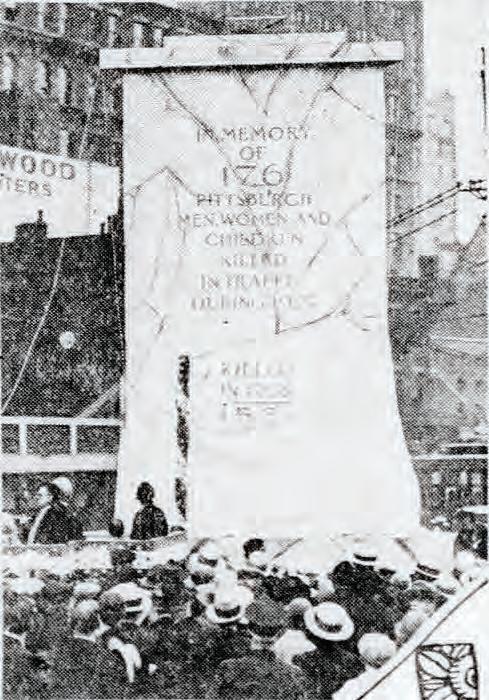
It created a “Traffic Fatality Memorial” on a downtown island, listing recent traffic fatality figures. If you’re picturing a poster display, you’re wrong. A surviving photograph shows what appears to be a 30-foot stone monument covered in carnations.
By the early 1930s, the Better Traffic Committee was seeing results. Through education and policy, Pittsburgh posted the best traffic safety numbers in the country in 1932 for American cities with more than 500,000 people, the Sun-Telegraph reported.
Even so, politics was always idling its engine. Mayor William McNair removed most of the committee in May 1936, claiming it was packed with special interests. The ousted members felt they had been fired for opposing administration traffic policy.
Under the reorganized Better Traffic Committee, Dr. Adolph L. Lewin was named chairman. Lewin was born in Germany and immigrated to the United States as a 19-year-old boy in 1880. He earned a medical degree at the University of Pittsburgh in 1892, making him among the earliest Jewish doctors trained in the city. He spent his entire medical career in Pittsburgh and became a noted civic leader throughout the city.
Udren:
Continued from page 5
“I was looking at what’s the kosher food like and what’s religious life like for an Orthodox Jew on campus,” she said. “I ended up at the University of Michigan and had a great time there.”
Dena Udren’s journey took her to an Orthodox women’s seminary in Israel — Midreshet Rachel V’Chaya — and to Hebrew University.
Eventually, though, she had to answer the question: Pittsburgh or Israel?
“I loved Pittsburgh, but I loved Israel more,” she said.
After a sojourn back in the States where Dena Udren earned her master’s degree in education from the University of Pennsylvania and spent time teaching, she returned to Israel and the women’s seminary.
Next up was finding a mate. She turned to divine intervention for help.
“I said, ‘I’m ready to get married. God, help me find my husband,’” she said.
She was dating a man named David, who was also a friend of her future husband. When Yonatan Udren expressed interest in dating Dena, David didn’t stand in the way.
“To his credit, he said, ‘I’m going out with her tonight but I think she might be more for you than me,’” she recalled.
During her last date with David, he said he wanted to set her up with his friend Yonatan.
“The last thing he said to me as we parted ways
Chronicle that two factors prompted his decision to share his story and explore the details of relocation, risk and family history.
“First of all, I think it’s interesting in general; but more specifically, I think that it shows resilience.”
For younger people, it’s important not to “take things for granted,” he continued. “You don’t have to necessarily stay where you are just because you’re there. There are opportunities. You have to take risks, and usually they work out.”
Loeb believes that this message, combined with Guttman’s story, will make for an informative and inspiring program.
“I always want to present new, and not as well known, aspects of the Holocaust to the community,” she said. “I don’t think many people know about the fact that Morocco offered refuge to people throughout the Holocaust.”
Knowledge of history is critical, but so is an appreciation for the present, she continued.
“One thing that I’m struck by is how positive Jerry is and inquisitive and willing
p The annual “Traffic Essay Contest” invited students throughout the Pittsburgh area to write about the importance of road safety. This Certificate of Merit was issued to David P. Rosenfield, who became a noted pharmacist in Pittsburgh. It was signed by committee Chairman Dr. A. L.
Lewin claimed to be one of the first doctors in Pittsburgh to make house calls by car, having graduated from a horse and buggy. Before that, he got around on a bicycle.
In the fall of 1938, Lewin expanded the popular traffic essay contest with a song contest. The committee selected 14 original compositions from students. It published a songbook, titled “Original Safety Songs,” and distributed 10,000 copies. Among the selections
was, ‘Invite me to the wedding,’” she recalled. The rest, as they say, is beshert
The pair was married by former Shaare Torah Rabbi Daniel Wasserman at Beth Shalom before making aliyah for good.
If you aren’t yet sold on the divine intervention argument, Dena Udren points out that her family lives in Beit El, the place where the Torah says Jacob had his dream. Her father’s Hebrew name is Yaakov (the Hebrew version of Jacob). Both he and the patriarch had a daughter named Dena.
“I feel incredibly blessed to be walking in the footsteps of the matriarchs and patriarchs,” she said. “Our kids are growing up in a place that’s incredible.”
As for Yonatan Udren, he, too, is thrilled with the couple’s life and the ability to work in Israel.
Following his ordination in 2010, he began working at the Rabbi Reuven Grodner Beit Midrash program at Hebrew University, a hub for Jewish learning and community for Englishspeaking students in Jerusalem.
When COVID hit, Yonatan Udren said, the program needed to shift because there weren’t many overseas students. Out of necessity, RRG created the Torah Café, a program for olim studying at Hebrew University who were looking for community and Jewish learning.
The program partnered with a lone soldier group, which allowed Torah Café to use its community center. The café began with 15 young people and by the end of the 2021
to learn new things,” she said. “I’m excited for people to meet this really remarkable man, who has had this incredibly international life and remarkable experiences, some of which were not of his choosing and others were.”
“A Conversation with Holocaust Survivor Jerry Guttman” will take place at 6 p.m. on Feb. 23 at Chatham University’s Eddy Theater. Registration is available at hcofpgh.org. PJC Adam Reinherz can be reached at areinherz@pittsburghjewishchronicle.org.
This creativity continued in July 1940, when the Better Traffic Committee started “safety towns” at area elementary schools, including Colfax and Wightman. As described in the American Jewish Outlook, each town had “street intersections, houses, apartments, a hospital, police station, fire house, school, and other buildings. Children driving toy automobiles and acting as pedestrians will be guided by miniature traffic light.”
And yet, again, politics was ready to pull the break.
The traffic essay contest appears to have quietly ended in 1939. After learning that Mayor Cornelius D. Scully had suppressed a key safety report in the summer of 1940, Lewin threated to resign. He ultimately stayed with the committee in 1940, only to be fired in early 1941. Amid these controversies, traffic fatalities increased 20%.
was a musical titled, “The Chivalrous Knights of Safety.” It was a morality play featuring “a contest between the Knights of Safety and the
more than 80.
The program expanded to include 14 different colleges and universities in Jerusalem, each one with a handful of English-speaking students and lone soldiers.
“We still have a very active base of 80 to 100 active students at Hebrew University and the downtown program brings in hundreds and hundreds of young people, somewhere around 1,600 young people since Oct. 7, who have come through the door of our Torah Café,” he said.
The students are looking for more than simply studying.
“They have a strong Zionist sense, coming and making aliyah, and are looking for something that gives that Jerusalem experience, that communal experience based on Jewish learning in an open and diverse environment, as well as Shabbat and holiday programming and to build
The Better Traffic Committee remained active through the 1960s, when it appears to have been incorporated into the Department of Public Safety. In its later postwar years, it lacked the creative energy it had demonstrated in the 1930s. In its heyday, it showed what’s possible when people stop wringing their hands and start rolling up their sleeves.
PJC
Eric Lidji is the director of the Rauh Jewish Archives at the Heinz History Center and can be reached at rjarchives@heinzhistorycenter. org or 412-454-6406.
a sense of community,” Yonatan Udren said. Oct. 7, he said, has shaped his experiences both personally and professionally.
He noted that a large percentage of the young males from Beit El have entered the IDF.
“A lot of men and boys are out there and not yet home,” he said. “So, you see a lot of fathers walking in army uniforms, even on Shabbat. There are a lot of families that are fatherless for months.”
The rabbi has attended many shivas for families that have lost sons.
The need for community in dark times hasn’t been lost on Yonatan Udren, who said it has strengthened the work he does.
If there’s a silver lining, he said, a large group of American Jews will likely come to Israel over the next few years.
“I see a line in the sand, unfortunately, in the Jewish world,” he said. “I see a rift that’s scary and challenging to me between the Israeli Jewish experience and the American Jewish experience since Oct. 7. I think those on the Israeli side of things, or at least more sympathetic to it, are going to be drawn to Israel and might find themselves making aliyah.”
In the end, he said, his role is to assist those coming to Israel find community and to be a part of the Jewish people’s future.
“My hope is that we’ll be able to be here and grow and meet what they need,” he said. PJC
David Rullo can be reached at drullo@ pittsburghjewishchronicle.org.
Lewin.
Image courtesy Rauh Jewish Archives
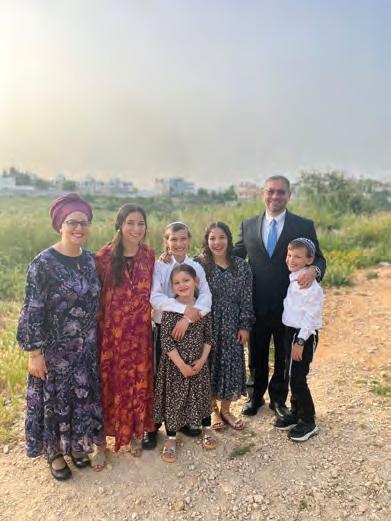
p Dena and Rabbi Yonatan Udren and their five children, Zahava, Sara, Amichai, David and Chana, in Beit El. Photo courtesy of Rabbi Yonatan Udren
We are not alone in the
fight against Holocaust denial
Guest Columnist
In Germany today, descendants of Nazi perpetrators are confronting their family histories and standing publicly against Holocaust denial and antisemitism. At a time of rising antisemitism and growing Holocaust distortion, their voices offer a deeply meaningful answer to an urgent question: When the survivors are no longer here, who will stand up and say clearly that the Holocaust did happen?
In Germany, I found an unexpected answer.
I recently attended the March of Life conference in Tübingen, Germany, a small university town that was a hotbed of Nazism 90 years ago. From this region came individuals responsible for the murder of more than 600,000 Jews during the Holocaust.
I accompanied the inspirational Holocaust survivor Irene Shashar, who came bravely, and not without fear, to speak with descendants of Nazis. Irene lost her childhood in the Holocaust. She witnessed the murder of her father, was smuggled through the sewers of the Warsaw Ghetto, and hid in closets as a terrified young child in order to survive.
Thankfully, she survived.
March of Life was founded in 2007 by Jobst and Charlotte Bittner, German Christians who felt compelled to confront the silence surrounding their nation’s past, including their own family histories. For many participants, the discoveries are devastating. Some uncover SS affiliations. Others find documentation of participation in the Wehrmacht or the Einsatzgruppen units responsible for mass shootings. Their shame is real. The guilt is heavy.
But what defines this movement is what comes next.
Members of the TOS Church speak openly
about what they have uncovered. They march publicly in cities across Germany and around the world, declaring that the Holocaust happened, that antisemitism must be confronted, and that silence is no longer acceptable. They build relationships with Jewish communities. They support Holocaust remembrance initiatives. They stand visibly with Israel.
survivors publicly opened what I call the “black boxes” of their memories. Not only did their testimonies transform their own lives. They transformed global understanding. The world began to grasp not only the scale of the crime, but the human story behind it. The perception of what it meant to be a Holocaust survivor changed forever.
For Germans, it took decades longer
When Holocaust denial grows louder, the voices that will carry unique moral authority will not only be Jewish voices.
For me, as CEO of March of the Living Israel, and as a descendant of Holocaust survivors who lost both of my great-grandfathers in Auschwitz, this was profoundly moving.
When Holocaust denial grows louder, the voices that will carry unique moral authority will not only be Jewish voices. They will also be German voices. Voices that say: The Holocaust happened. It happened to the Jewish people. And our families were part of it.
That declaration dismantles denial at its core.
The founders of March of Life often speak about breaking the “silence of the generations.” For decades after the war, many German families did not speak about what had happened. Children did not ask. Grandchildren did not probe. The past remained buried.
A similar silence existed among Holocaust survivors. For years, many did not speak of what they had endured. They buried the pain, humiliation and grief in silence, trying to rebuild their lives without reopening unbearable wounds.
That silence began to break during the Eichmann trial in 1961. For the first time,
The Tucker Carlson effect
Democratic elections often produce a familiar paradox: Candidates with extreme positions on certain issues can still win broad support because voters connect more strongly with a different, emotionally resonant message. Americans have grown accustomed to seeing this dynamic on the political left, where themes such as affordability or social justice can outweigh a candidate’s hostility toward Israel. A more unsettling question now emerges on the right: Can the same mechanism allow candidates or public figures with troubling views on Israel or Jews to gain traction among Republican voters?
Our recent survey of 561 Republicans, balanced by age and gender and conducted on Jan. 21-22, 2026, with a margin of error of plus or minus 4%, sought to explore precisely this tension. We used the popularity of Tucker Carlson as an indicator of broader Republican sentiment. Carlson is a useful case study because he has shifted from being a mainstream conservative media figure to a polarizing personality widely perceived as unsupportive of Israel and, by many observers, as promoting or tolerating antisemitic narratives. Yet despite this, he remains highly popular within the Republican electorate.
The first major finding is a clear generational divide. Across the entire sample, we found more than 45% of respondents believed Carlson is likely to run for national office, and more than 48% said they would vote for him if he did. Among Republicans under the age of 44, support was substantially higher: Over 55% saw him as a likely
to open their own “black boxes.” It was through the vision and faith of Jobst and Charlotte Bittner that a movement emerged to confront what had long been buried. These revelations, and the moral calling that followed, created what Jobst himself describes, borrowing a term from Jewish tradition, as teshuva: repentance, moral reckoning, and ultimately, action.
This does not erase the past. Nothing can. But it transforms inheritance into moral responsibility.
Standing in Tübingen, I understood something deeply hopeful: We are not alone in our mission to protect and ensure Holocaust memory.
Heavy burden
The descendants at the conference promised Irene Shashar they would carry her story forward. They committed to being active in safeguarding Holocaust memory by fighting both silence and denial. Long after Irene and other survivors are gone, they will say: The Holocaust happened. It happened to Irene, and it happened to the Jewish people. And our families were part of it.
For decades, Jewish survival has required vigilance. Our historical modus operandi
candidate, and more than 58% said they would probably vote for him.
Among Republicans aged 45 and older, enthusiasm dropped sharply, with only 38% believing he would run and 41% expressing willingness to vote for him. Carlson’s potential political appeal, in short, is significantly stronger among younger Republicans. Ours is not an “outlier” finding, as other data, especially a recent study from the Manhattan Institute think tank, show similar results.
At first glance, these numbers might be interpreted as evidence of growing anti-Israel or anti-Jewish sentiment within the Republican base. Our data suggests a more complex or nuanced reality. Perhaps counterintuitively, support for Carlson does not automatically translate into hostility toward Israel or Jews. Both age cohorts continue to show substantial support for Israel and generally positive views of Jews, although younger Republicans are consistently less supportive than their older counterparts.
has been survival. We learned not to rely on others. We became accustomed to standing alone.
But at that gathering, I felt something different.
March of the Living was founded on the belief that memory must lead to responsibility. What I witnessed in Tübingen was that responsibility can cross even the deepest historical divide. Descendants of victims and descendants of perpetrators can stand together in honest confrontation with the past.
During the conference, I spoke with many descendants about their horrific family histories, including those whose grandparents played roles in deportations, in building and managing the camps, and in carrying out mass murder.
I found myself confronting a difficult realization: Being the grandchild of a perpetrator is not necessarily easier than being the grandchild of a victim. Both inherit a heavy burden, one of guilt or grief, of shame or sorrow, of pain not personally chosen, yet deeply carried.
What began as a local initiative in Tübingen has, in less than two decades, grown into an international movement active in more than 25 nations. I hope more Germans, and others whose nations collaborated with the Nazi regime, will break the silence, open their family “black boxes”, and join this effort at the forefront against denial.
The remaining survivors need to see this movement grow within their lifetime. We have limited time left with them. They need to know that their story will be carried forward for generations to come. PJC
Revital Yakin Krakovsky is deputy CEO of the International March of the Living and CEO of March of the Living Israel, senior adviser to the Combat Antisemitism Movement, and a former senior department head in the Ministry of Strategic Affairs. This article was first published on The Times of Israel.
When asked about the importance of various foreign policy issues, younger Republicans rated support for Israel as “very important” or “extremely important” at a rate of 55%, compared with 69% among those aged 45 and above. This gap is meaningful, but it does not indicate outright opposition. Rather, for younger Republicans, Israel appears to occupy a similar priority level as other foreign policy issues, rather than standing out as uniquely significant. This suggests a broader generational shift in how international commitments are ranked, not necessarily a singular rejection of Israel.
The more troubling signal emerges when respondents were asked whether certain groups pose a threat to the “American way of life.” On immigrants and Muslims, age differences were modest, with majorities in both cohorts expressing at least moderate
Revital Yakin Krakovsky
Guest Columnist
Irwin J. Mansdorf
Chronicle poll results: Does a country’s stance on Israel influence your travel?
Last week, the Chronicle asked its readers in an online poll the following question:
“Does a foreign country’s stance on Israel affect your decision to travel there?” Of the 240 people who responded, 69% said yes and 31% said no. Comments were submitted by 80 people. A few follow.
I stand with Israel, full stop. In fact, I will be traveling to Israel in mid-April this year in a show of support and solidarity.
I am not a citizen of Israel. I have enough trouble with the actions of my own country’s government.
While I do have a bucket list of desirable eventual vacation destinations, all things being equal, I would certainly prefer to spend my money in a country that doesn’t exude anti-Zionism.
Not necessarily ... but it does cause me to be more careful about expressing my Judaism outwardly.
Mansdorf:
Continued from page 12
concern. On Jews, however, the generational gap was pronounced. The survey showed that 45% of Republicans under 44 expressed elevated concern, compared with 23% among those 45 and older.
Even though Jews were still viewed as less threatening than other groups, the fact that nearly half of younger Republicans expressed this level of concern should not be dismissed lightly. It points to a growing susceptibility to narratives that frame Jews as a societal problem, even among voters who do not consider themselves antisemitic.
How can these findings be reconciled? How can substantial support for Israel coexist with strong willingness to back a figure associated with anti-Israel rhetoric? The answer lies in political psychology. Voters frequently prioritize a candidate’s overarching message, tone, or identity over specific policy positions. Well-documented mechanisms such as motivated reasoning, the halo effect, and affect-based heuristics allow individuals to focus on what they like about a candidate while minimizing or rationalizing aspects they find troubling.
Travel to Asia or Eastern Europe removes most of the risk of trying to enjoy a trip to a country where people might attack you for being Jewish. Until the government changes in Spain take it off your list.
For some people, their “halo” glows brightly enough to blind observers from any negatives. Israel becomes unimportant and even irrelevant to political decision-making, especially for younger Americans.
I wouldn’t get too excited about France, U.K., Belgium, the Netherlands, or Norway either. Anti-Zionism is antisemitism.
Not at all. Why should it? There are so few countries that support Israel’s recent war policies in Gaza, that I wouldn’t be able to travel anywhere. Tourism in Israel, for example, is at a crisis low level as tourists are electing to go elsewhere rather than support Bibi’s war machine. The policies of Bibi and Israel are to blame for its own isolation.
It depends on their specific position, and why.
I’m not doing any travel now out of the USA.
I take no notice of foreign countries’ stance or other ignorant anti-Jewish rhetoric.
It isn’t the only factor, but it definitely enters into the decision.
fade into the background amid louder populist appeals (witness the “affordability” campaign of Zohran Mamdani).
For Israel and for American Jewish communities, the implication is clear. It is
The psychological machinery that allows voters to ignore troubling positions is already operating, and it appears to be stronger among the rising generation.
This is the core warning of our study. The principal risk to Israel and to Jewish communities may not be an immediate collapse of Republican support. Rather, it is the gradual erosion of Israel’s role as a politically decisive issue.
If Israel becomes a non-disqualifying concern, something voters are willing to overlook, then candidates with hostile or extreme positions can advance without paying a political price. We have seen this dynamic elsewhere, where once-disqualifying views
no longer sufficient to ask whether “most Republicans support Israel” in the abstract. The more important question is whether that support is strong enough to influence voter behavior when faced with a charismatic populist who offers a trade-off: cultural combat at home in exchange for indifference or hostility toward Israel.
Our findings also suggest a strategic lesson. Research shows that appealing but flawed candidates can lose their aura when a single negative trait is clearly and repeatedly
It is important that we all put ourselves in the position of learning from anti-Zionists what motivates them and inform them of our truth. Travel gives us an excellent opportunity to achieve this.
If I weren’t already living in the U.S., our support of Israel would definitely make me not want to come here.
It’s difficult to find any country that is not antisemitic.
The existence of the Jewish people is tied to the existence of Israel. Why then would any Jew support those who wish to harm Israel? PJC
Compiled by Toby Tabachnick
Chronicle weekly poll question: Do you defend Israel on social media or in traditional media? Go to pittsburghjewishchronicle.org to respond. PJC
highlighted, a phenomenon known as the “horn effect.” This does not mean reckless attacks or caricature. It means honest, focused and consistent scrutiny that exposes the real consequences of a candidate’s views. Those who care about the future of the U.S.Israel relationship may need to confront popular figures early and directly, before favorable impressions harden.
There is good news in our data. Republican support for Israel has not collapsed, and younger Republicans are not uniformly anti-Israel or anti-Jewish. But there is also bad news. The psychological machinery that allows voters to ignore troubling positions is already operating, and it appears to be stronger among the rising generation.
The critical question is not whether Israel still matters to Republican voters in principle, but whether it will matter enough when it truly counts. The task is moving from the halo to the horns. PJC
Irwin J. (Yitzchak) Mansdorf, PhD, is a fellow at the Jerusalem Center for Public Affairs specializing in political psychology. Dr. Charles Jacobs, president of the Jewish Leadership Project, co-authored this piece, which first appeared on The Times of Israel.
We invite you to submit letters for publication. Letters must include name, address and daytime phone number; addresses and phone numbers will not be published. Letters may not exceed 500 words and may be edited for length and clarity; they cannot be returned. Send letters to:
We regret that owing to the volume of correspondence, we cannot reply to every letter.
Life & Culture
Meat-stuffed potatoes
By Miriam Szokovski | Chabad.org
I’ve been wanting to make something stuffed for a while. I kept thinking about peppers, but they’re so good raw I couldn’t bring myself to “waste” them like that. And zucchini can be tricky because it gets soft so quickly and expels a lot of liquid. But I had a bunch of red potatoes sitting on my counter that I bought for no particular reason, and after one started to rot and expel that foul-smelling rotten potato liquid (if you know you know!), I decided to put them to good use.
Important: It seems counterintuitive to hollow out the potatoes when raw. You’d think it would be easier once they’re cooked. But once cooked, they are more likely to fall apart if you start trying to scoop out the centers. I tried it both ways, and by hollowing it out raw (using a spoon), they cooked well and held their shape.
I used red potatoes because they are waxy and hold their shape well when cooked (and they taste good). My next option would be a Yukon Gold potato, but you need to be very careful when par-boiling them, because they get soft so quickly.
Because potato size varies so greatly, it’s hard to get the ratio of potatoes to filling
exactly right. If you have extra potatoes, you can use the extras to make smashed potatoes. If you have extra filling, save it and serve it over rice, couscous, pasta, or mashed potatoes.
Add a fresh salad and you have a complete crowd-pleasing meal.
Ingredients:
10-12 red potatoes
1 pound ground beef
1 small onion, diced
1 green bell pepper, diced ½ teaspoon smoked paprika ¼ teaspoon cumin
¼ teaspoon chili powder
½ teaspoon kosher salt
4 tablespoons tomato paste
½ cup tomato sauce
½ cup water
Optional: flavored panko crumbs
Remove potatoes and let cool.
For the filling, use a large frying pan. Heat the pan over medium-high heat. Add the ground beef and brown well. Add the onion and let it cook with the meat for about 5 minutes. Then add the green pepper, spices and tomato paste. Mix well and when it smells fragrant, add the tomato sauce and water and turn the flame down to medium. Cook for about 10-15 minutes more. Meat should be soft and flavorful. Taste and adjust seasoning as needed.
Directions:
To prepare the potatoes, you need to hollow them out to create “cups” for the meat filling. For smaller potatoes, just cut off the top. For large potatoes, cut them in half, to create two cups. Use a spoon to hollow out the inside. You want to leave enough potato to a) eat, b) make sure it is strong enough to hold up.
Boil the hollowed potatoes in salted water until just tender, but not soft — a little bit harder than you would want to eat. If they’re too soft, they will fall apart, plus we are going to bake them after they are filled.
To assemble, fill the hollowed out potatoes with the meat mixture and place in a baking dish. Optional: Sprinkle panko crumbs lightly over the tops. Bake at 400 F for 20 minutes. Remove from oven, let cool for 10 minutes, then serve. Reheats well in the oven or microwave.
Save any leftover filling (or intentionally make extra!) and serve with rice or couscous (as I have been doing all week … ). PJC
Miriam Szokovski is a writer, editor and member of the Chabad.org editorial team. She also shares her cooking and baking on Chabad.org/food.
p Meat-stuffed potatoes
Photo courtesy of Chabad.org
Life & Culture
Through image and word, Judith Robinson continues exploring life’s meaning in ‘The Painted Poem’
By Adam Reinherz | Senior Staff Writer
Poet Judith Robinson would no doubt find a more graceful turn of phrase than a simple platitude, but in the truest sense, the Oakland resident’s latest work proves she has saved the best for last.
“The Painted Poem,” published Dec. 22, represents the Pittsburgher’s latest artistic endeavor. Long regarded for both her painting and writing, Robinson has once again paired the two by featuring vivid images and rich text on alternating pages.
Early in the 78-page book, a colorful portrayal of Pittsburgh’s skyline is placed near a poem (titled “Pittsburgh”) whose opening stanza reads:
What land is this, what city?
Aren’t other places as precious to those who dwell within them?
Probably they are. Well, perhaps.
Later in the work, a blue and yellow school of fish rests near the closing lines to “Into the Depths of the Sea,” a poem about the annual Tashlich service performed on Rosh Hashanah, which reads:
We pray we pray we pray
One more year one more year one more year.
Robinson, an award-winning poet, said there’s no pattern to whether she paints before she composes; both practices, she continued, reflect a desire the late writer John Updike best articulated: “The itch to make dark marks on a white surface is shared by writers and artists.”
Whether one first takes a pen or brush to hand doesn’t matter, Robinson said. “It all begins in your mind. It’s your imagination. And I think a lot depends on where you are and what’s available to you at the moment.”
Throughout her life, Robinson has concentrated on familiar subjects, including Pittsburgh and Judaism.
“I love this city. I always have,” she said. “I don’t think there is any place else that’s as little as we are, but as blessed as we are with all the wonderful attributes of a much bigger city. And we also have this fascinating history.”
“We all feel the need to express evidence of existence, to declare that yes, I have observed, I have felt, I have imagined this or that: I have lived.”
–JUDITH ROBINSON
Not just in a city-specific or regional sense, she said, but “so much of the history of this country starts right here. In World
War II, all that manufacturing that went on to help save the world from Hitler happened around Pittsburgh, in the mills
around here.”
By 1942, Pittsburgh had become the world’s leading steel producer, according to the National Park Service. Among warrelated materials, 20% of landing ships, tank fleet were made in Pittsburgh along with sub chasers and other transport craft.
Although most of the steel mills eventually closed and residents left, those individuals “took Pittsburgh with them,” Robinson said.
That affection for the city and its way of life remains whether one walks the streets of Squirrel Hill or hundreds of miles beyond the local limits, she added.
Like her earlier works, “The Painted Poem” signals Robinson’s love of Judaism.
“I’m very much a Jewish poet and painter. It’s just my sensibility. It’s just who I am and what I care about,” she said. “I care so much about our people.”
Speaking with the Chronicle, Robinson, a self-described “100% Zionist,” didn’t shy from sharing political views; however, the purpose of her work, she said, is less to ignite conversations about geopolitics than to ignite an understanding.
“The beauty of this life — the fact that it’s worth living — there is a lot to celebrate, there’s a lot to think about and a lot to celebrate,” she said. “We’re here for a finite amount of time, and to have lived is a privilege. What matters, finally, is what you leave behind, and if it is something that stirs someone or something that gives someone comfort, or something that someone remembers, then you’ve made something of yourself and your life.”
That sentiment, Robinson said, is somewhat paraphrased from a recent writing.
“I believe that I, as do we all, feel an urge to say something, to show something, to share something. So we who can paint and write do it this way. Other humans build, buy, sell, endow, teach, race, electrify, compete, compose, procreate, and/or find meaning in multitudes of other ways,” Robinson noted in the afterword of her newest book. “We all feel the need to express evidence of existence, to declare that yes, I have observed, I have felt, I have imagined this or that: I have lived.” PJC
Adam Reinherz can be reached at areinherz@pittsburghjewishchronicle.org.
Image courtesy of Judith Robinson
p “Pittsburgh”
Image courtesy of Judith Robinson
Life & Culture
Photographing Lower East Side convinced Bill Aron to focus on Jewish subjects
By Anna Rahmanan | JNS
On a recent Thursday, JNS previewed a retrospective of Bill Aron’s photographs at the American Jewish Historical Society in Manhattan with the 84-year-old artist.
“It was difficult to trim it down to 52 photos,” the octogenarian, clad in black trousers, a black shirt and red sneakers, told JNS. “I started with 90, and I wanted all the aspects of my career represented.”
Aron, who lives in Los Angeles with his wife, Isa, with whom he has two sons, curated the retrospective, “The World in Front of Me,” with the society. The show is on view until June 4.
The Philadelphia native’s work has been shown at the Museum of Fine Arts Boston, Museum of Modern Art (New York), Art Institute of Chicago, Jewish Museum (New York) and the Israel Museum in Jerusalem, according to Pucker Gallery, in Boston, which has represented him since 1976.
Aron teaches at the New Community Jewish High School in West Hills, California, according to Pucker, and the photographer states on his website that he has “come to be known as the ‘dean’ of American Jewish photographers.”
The American Jewish Historical Society show is organized thematically: early black and white images from Cuba and other international Jewish communities (including the former Soviet Union), his work in New York, exploration of Jewish life in the American South, portraits from Israel and of Holocaust survivors and of cancer survivors.
Looking at a photograph in the first section, which related to his first book, “From the Corners of the Earth,” Aron told JNS that he was with a group of about 10 people in a synagogue, and everyone spoke different languages and couldn’t communicate.
“We were all looking for a common language, and I had spent four years in Turkey with the State Department and Peace Corps,” he recalled. “I just threw out Turkish as a joke, and this woman’s face dropped and she said, ‘Do you speak Turkish? I’m from Turkey.’”
“It was like finding family,” he said.
A focus of the show is Jewish life in New York in the 1970s. “My first portfolio was taken on the Lower East Side, and it became the first place where I did actual series photography,” Aron said. “That’s when I realized I wanted to
A defining image from that period was “To 16th Street, New York City (Chassid in Subway),” which he took in 1976.
“I had one frame left when I got on the subway platform on the uptown side, and the subject was on the other side of the platform,” he said. “I took my camera out, and he turned around giving me his back as soon as the other gentleman walked into the frame.”
He thinks that “Rabbi Eisenbach: Scribe, the Lower East Side” is one of his bestknown photographs.
“Every week, while Rabbi Eisenbach was working on the scroll in this photograph, I would enter his store, ask questions about his work and seek permission to take his picture,” Aron recalled. “He always answered my questions but refused to grant permission for the photograph.
“On the first warm day of spring, I happened to be leading a youth group on a tour of the Lower East Side. We stopped at Rabbi Eisenbach’s door, which was open, and I explained as much of the scribe’s work as I could,” the photographer added. “As I was about to walk away, I saw the photograph that I wanted to take. My camera was around my neck, and so, with only the slightest hesitation, I took advantage of the situation.”
The rabbi “raised his eyes over his glasses while I quickly left the scene,” Aron said. “Several weeks after the incident, I entered his store to show and give him a print, holding my
breath, of course. He looked at it for a very long moment and then smiled and said, ‘It’s very nice, Thank you.’”
The rabbi’s son, who was also his apprentice, also saw the image and “asked me to photograph him, as well,” the photographer added.
Aron told JNS about his connection to the Havurah movement, a grassroots, egalitarian Jewish fellowship in the 1960s and 70s that embraced informal prayer and song. That influenced his work.
“Havurah was a generationally unique and unrepeatable moment that was incredibly formative for my life,” he said.
Aron noted what he sees as the complexity of Jewish identity in his New York imagery.
“There was a gradual shift in my thinking to wanting to photograph Jews who didn’t look like Jews and express something,” he said. “The Jewish community is much more complex than just the Orthodox look.”
His photographic exploration of Jewish communities in the American South, a project that occupied much of the 1990s, forms one section of the show.
“Before I was introduced to this project I had no idea there were Jews in the South, and I had no concept of the geography of how everything was far from each other,” he said. “It took most of the 1990s to shoot the series — about 10 different trips.”
Leading JNS through that section, Aron laughed as he reflected on a kitchen scene.
“Best chopped liver, I’m told, in the world but I don’t know, because my mother’s was pretty good,” he said. “My mom had the same chopper and the wooden bowl.”
The picture “Joe Martin Erber, a USPS Postman, and his Uncle, Meyer Gelman, Greenwood, Mississippi” comes from Aron’s work in the American South.
Erber, wearing a U.S. Postal Service cap, and Gelman hold Torah scrolls in front of the ark at Congregation Ahavath Rayim, the last Orthodox synagogue in Mississippi, according to the photographer.
“Until recently, Greenwood had both Orthodox and Reform congregations, each with their own building. Now there is only the Orthodox synagogue with very few members remaining,” he states.
Erber told him about the state governor speaking at the funeral of one of the synagogue’s members. “He pounded his fist and remarked, ‘There was never a finer Christian gentleman than …. ,’” Erber told the photographer. “And of course the funeral was held in the synagogue.”
“The point is that Southerners rarely connect ‘Christian’ with being a ‘Christ follower.’ It doesn’t necessarily mean anything to refer to a good Jew as a ‘Christian person,’” the photographer was told. “In the same vein, most local people call our place of worship a ‘church.’”
Sarah Hopley, who curated the exhibit,
p Rabbi Eisenbach: Scribe, the Lower East Side” by photographer Bill Aron
Photo courtesy of American Jewish Historical Society
p “My Version of the American Jewish Gothic, Happy” by photographer Bill Aron
Photo courtesy of American Jewish Historical Society
p The photographer Bill Aron Photo courtesy of American Jewish Historical Society
p
“Holocaust Survivor Couple” by photographer Bill Aron Photo courtesy of American Jewish Historical Society
Life & Culture
Israel’s bobsled team is chasing more than medals in its first Olympic outing in Milan
By Jacob Gurvis | JTA
No matter what happens when Israel’s bobsled team hits the ice this week at the 2026 Winter Olympics, team captain Adam “AJ” Edelman has already had a year for the history books.
The 34-year-old Brookline, Massachusetts, native is the first Orthodox Jewish athlete to compete at the Winter Olympics, and now the first Israeli to qualify for the Games in two sports. He placed 28th in skeleton at the 2018 Olympics in PyeongChang, South Korea.
But for Edelman, the 12-year journey that culminated in Israel’s first-ever Olympic bobsled appearance — which he has nicknamed “Shul Runnings,” a spin on the 1993 movie about Jamaica’s bobsled team — is about more than success on the track.
“The Olympics were never a goal,” Edelman told the Jewish Telegraphic Agency in an interview prior to the Games. “The Olympics were the tool, or the stepping stone, to get to the goal, which was to fundamentally redefine, or change, how our community — both the Israeli and the Jewish one — view investment into and the role of sport.”
Edelman’s journey began in 2013, when Israel attempted to recruit him to play for its national hockey team. Hockey had been Edelman’s first sport, which he played through college at the Massachusetts Institute of Technology, where he was the first Shabbat-observant player in program history.
Edelman discussed the idea with the long-time alumni director of his Jewish day school, Brookline’s Maimonides School. Mike Rosenberg pointed something out to Edelman that ultimately sparked a calling.
“AJ, no one from this school has ever gotten to the level of sport beyond high school that you’ve gotten to that didn’t go to, let’s say, [Yeshiva University] or Brandeis,” Edelman recalls Rosenberg, who died last year, telling him about the two historically Jewish colleges.
Edelman couldn’t believe that. Out of thousands of Maimonides alumni (including his older brother, Emmy award-winning comedian Alex Edelman), only Edelman — who called himself “not a very gifted athlete” — had reached that level? He had a theory as to why that might be.
“I came to the conclusion that it had to be a self-selection process,” Edelman explained. “That people were selecting out of sport as a journey before they got to that level. And why were they doing it? Because there was no priority placed on sport. It wasn’t something people in our community aspired to do or invest in.”
Edelman said the lack of investment in sports led to a lack of infrastructure and a dearth of role models for Jewish kids to look up to. He set out to change that — to “be the change.”
“The only way to do that was a certificate, so to speak, of excellence in sport, and that’s the Games,” he said. “The Games are essentially
Aron:
the certificate of, ‘you did something.’ So in that way, the Olympics became very, very much the tool for which I wanted to make the change.”
Edelman began training in skeleton after graduating from MIT in 2014. His initial scouting report was not promising: he was told he was “not athletic, would never make the Olympics, and would never be competitive in sliding sport.”
That did not deter him. Edelman moved to Israel in 2016, where he kept training, teaching himself the sport on YouTube when he couldn’t afford a coach. He ultimately clinched Israel’s first sliding sport Olympic appearance in 2018. Then the pandemic hit. Edelman was pursuing an MBA at Yale University when classes were suspended. Edelman was visiting Jordana Balsam, a close friend who is an attorney in New York City, when the Olympics came up.
“He was telling me about his history with skeleton, and how he competed in the 2018 Games, and how he was actually really intrigued by bobsled,” Balsam recalled. “And in an offhand comment, I’m like, ‘Well, why don’t you pursue that, since you have this time off from Yale?’ And I guess something clicked in his brain, where he was just like, ‘Yes, I’m gonna do that.’ And the rest is history.”
Edelman began working toward bringing Israel to the Olympics in bobsled. Again, there were hurdles. He had to recruit a team from scratch. Israel’s own athletic authorities were skeptical — its Olympic committee almost didn’t accept an invitation to the 2026 Games. Funding was practically non-existent. Still, the team continued training, ultimately missing out on Olympic qualification for the 2022 Games by 0.1 second.
Then came Oct. 7, 2023, and the subsequent Gaza war, in which five members of the team were called into combat and multiple team sponsors backed out. Still, Edelman kept his eye trained on the 2026 Games. He used Instagram DMs to recruit a new team — most of whom play other sports and had never been in a bobsled — which also features Israel’s first Druze Olympian, Ward Farwasy.
Israel ultimately qualified in late January at an event in Lake Placid, the same location where Edelman had been told 12 years ago that he’d never make it. The team often trains there,
as well as in Park City, Utah, British Columbia and elsewhere. Edelman said he is rarely in the same place for more than a few weeks at a time.
“Once he had something in his head — an idea, a concept, a goal that he has — he dives into it 200%, and it’s something that I admire greatly,” Balsam said. “I’ve never seen anyone so dedicated to their craft, to their sport, to their goal. It really is inspirational.”
But even qualifying for the Games didn’t end the obstacles. Due to Olympic security, Edelman said his team’s training time in Cortina was limited. Then the team’s apartment in the Czech Republic, where they were training prior to leaving for Italy, was robbed on Feb. 7. Edelman said thousands of dollars in personal belongings, including passports, were stolen.
Throughout the process, Edelman said the wave of support, particularly from American Jews, has been “pleasantly surprising” — especially compared to the reaction after he qualified in 2018, which he called more of a “blip.”
That support has manifested through donations and merchandise sales, with Edelman fundraising to support the team’s Olympic costs. There has also been ample news and social media coverage, inside the Jewish and Israeli communities and out. U.S. Ambassador to Israel Mike Huckabee has given the team a shoutout, too.
Edelman said the positive response has been all the validation he needed.
“There was a constant question of, at the end of the road, you’re doing this for a reason, right?” he said. “
And the only reason to do this is for the goal, the goal of making a change. Of people caring about sport. Of being the change. So if the change doesn’t come and it doesn’t make an impact, then all of it is irrelevant… I think that, from what we’ve seen in the last [several weeks], the answer is an unequivocal yes. It was 100% worth it.”
In Israel, sports fans are proud of the historic nature of the bobsled team’s Olympic appearance, but the story has not broken through to the same extent, according to David Wiseman, who lives in Jerusalem and runs the popular “Follow Team Israel” Facebook page that tracks Israeli sports.
“The media are very football [soccer] and basketball-centric, so they get all the headlines,”
Wiseman said. “Someone like Deni Avdija gets significantly more coverage. They know of him being the first Israeli to play in the [NBA] All-Star game far more so than this. They think it’s cool that [Edelman] made it, but they don’t devote any more thought to it. Independent of Israel, bobsled is a niche, niche sport.”
Still, Edelman and some of his supporters have seized on the narrative draw of Israel’s underdog bobsled story — not to mention the apartment break-in and other obstacles — to amplify an almost muscular form of pro-Israel advocacy. Edelman commonly uses the phrase “victors, not victims,” in reference to his team and to Israel’s spirit more broadly.
Jared Firestone, who is representing Israel in skeleton in Italy, said there was “no chance I’d be here without AJ’s guidance.” Edelman helped coach Firestone in skeleton after he made aliyah in 2019, and the pair co-founded the nonprofit Advancing Jewish Athletes to support other Jews in sports.
“I think it means so much to Israelis and to the Jewish community at large to see, with a little investment, how much can be accomplished,” Firestone said. “Unfortunately for me and AJ, we’ve had to dedicate so much of our time that could’ve gone to training and progressing on the ice to fundraising, but hopefully we’ll be inspiring people who could help to create that infrastructure so the next AJ and Jared could just focus on sport and being even better than we are.”
Balsam, who also serves as a director of Advancing Jewish Athletes, said it’s hard to articulate how meaningful Edelman’s achievement of making the Olympics is to him, and to her.
“AJ has been very, very passionate about trying to cultivate the idea that sports can be a career path for Jewish kids,” she said. “He wanted to make it to the Olympics. He wanted to show that this is possible. So for him to combine both of his passions and achieve his dream, I think is something that he can’t put into words, that I can’t put into words, but it’s just immense pride.”
Now comes the actual tournament. Israel will compete in the two-man races on Feb. 16 and 17 and in four-man on Feb. 21 and 22, with Edelman piloting the sleds. His Shiba Inu Lulu, the team’s mascot, is staying with Balsam in New York, where they’ll be cheering him on. But no matter where Israel places, Edelman has one more box to check to fully accomplish his mission to change Israeli sports.
“There is one thing that I wish beyond anything, and it’s that I’m not the only one to do it,” he said. “
What I really wanted to accomplish through it was that someone else saw it and decided to do it themselves. That they saw that pathway opened by someone who was less than stellar, who was not, like, a God-gifted athlete, and went, ‘You know what? I’m pretty good at what I do. I can do that.’
“You have to leave it better than you found it, and it has to be for a purpose, and that purpose is always going to be to inspire someone to do it better than you did.” PJC
Continued from page 16
told JNS that Aron “shows the joy in everyday life, so I really wanted photos that showed joy.”
Later galleries in the show include portraits of Holocaust survivors and, after Aron’s cancer diagnosis at age 50, people afflicted with that disease.
life because of the reckoning with his mortality, and I started asking around and it’s not an uncommon perspective.”
“I am a cancer survivor and at a support group, someone said, ‘It’s the best thing that happened to me.’ And I said that ‘cancer was the worst thing that happened to me,’” he told JNS. “He told me of the changes he made in his
“The cancer survivors and Holocaust survivors were my teachers, really,” he said. “I’m 84, and these people were a part of me.”
He said that if he were living in New York City, he would have found a way to explore Oct. 7 more.
“I have not done anything with the idea of Oct. 7, although it’s an interesting idea,” he said. “I don’t know what I would do.” PJC
Aron said he got his first camera after winning a round of roulette in Atlantic City. It was a trip he took with his mother after his father died.
p (L-R): AJ Edelman, Alex Edelman and Austin Edelman pose at the opening night of the new one man show “Alex Edelman Just for Us” at The Hudson Theatre on June 26, 2023 in New York City.
Photo by Bruce Glikas/WireImage
Bar Mitzvah
Jonah Ryan Albert, son of Rachel and Steven Albert, will be called to the Torah as bar mitzvah on Feb. 21, 2026, at Congregation Beth Shalom. Jonah is in seventh grade at Community Day School where he plays basketball and ulti mate frisbee. His main passion is baseball. He plays for Squirrel Hill and 14th Ward. Jonah is a devoted and loyal fan of all Pittsburgh sports — the Steelers, Penguins, Pirates and Pitt Panthers. Proud grandparents are Cookie Elbling and Julian Elbling, and Ann and Bob Albert. Jonah has a younger sister, Olivia, who always looks up to him. PJC
One of the most revealing ways economists have measured long-term human progress is by examining the cost of producing light. This approach was developed most influentially by William Nordhaus, the Nobel Prize-winning economist whose work reshaped how economic growth is measured over time. Among the insights for which he was awarded the Nobel Prize was the observation that, for most of human history, light was among the most expensive goods people could produce. Even modest illumination required substantial labor, and sustained illumination required enormous effort. Only very recently did the cost of light collapse.
That insight helps recover something that is otherwise very hard for a modern reader to see.
In the context of Parshat Terumah, where the Torah details the construction and service of the Mishkan, the commandment of collecting or producing “shemen la’maor,” a continuous supply of high quality oil for illumination, can sound like a minor technical detail. Today, light is ambient and inexpensive. We leave it on without noticing. Against that backdrop, the requirement of a steady flow of pure oil for the Mishkan’s lighting can easily be underestimated.
But that intuition is misleading.
labor. The Torah’s decision to mandate an extraordinarily costly form of illumination, sustained day after day, indicates that this expense was not incidental. The cost itself defines priority. Shemen la’maor is a case where the Torah legislates an obligation whose seriousness is inseparable from its expense.
Seen this way, the commandment does not stand alone. It sets a pattern that reappears deliberately in later halachah.
Both nerot Shabbat and nerot Chanukah are treated as unusually serious obligations. They are not optional enhancements, and they are not limited to those for whom they are financially convenient. On the contrary, halachic sources address these mitzvot explicitly in the language of real cost.
With regard to Shabbat candles, the Talmud rules that ner Shabbat takes precedence even over kiddush because of shalom bayit (Shabbat 23b), a ruling codified in the Shulchan Aruch. Lighting is not presented as an aesthetic choice, but as an obligation with economic priority. With regard to Chanukah, the standard is even sharper. Mishneh Torah famously rules that a person who lacks funds must beg or even sell clothing in order to obtain oil and wicks for the mitzvah.
Those rulings only make sense in a world where light is expensive.
Mazel Tov!
If one applies Nordhaus’ framework to the menorah described in Exodus 25, the scale becomes clearer. A straightforward calculation of the menorah’s annual light output, translated into the labor required to produce that amount of light in the ancient world, yields many thousands and plausibly tens of thousands of hours of work per year. Expressed in modern terms, that places the annual cost of shemen la’maor on the order of something close to a million dollars per year in today’s wages. The exact figure depends on the assumptions one makes, but the order of magnitude is unmistakable.
What emerges is a clear continuity. The menorah represents a national commitment to sustaining an extraordinarily costly form of light in the Mishkan. Shabbat and Chanukah candles relocate that same logic into the home. The scale is smaller, but the principle is unchanged. These mitzvot are taken seriously precisely because they demand expenditure even when that expenditure is felt.
Once that scale is restored, the commandment looks very different. This was not symbolic lighting. It was not decorative. It was a permanent, recurring and highly visible allocation of real resources.
That observation leads to a deeper point. From an economic perspective, light is discretionary. It does not feed anyone. It does not clothe anyone. It does not extend productive
The Torah’s insistence on light is not about illumination itself, but about a willingness to bear real costs for what a society chooses to sanctify. In Parshat Terumah, that commitment takes the form of a national obligation to sustain the menorah’s light in the Mishkan, even at great expense, as a standing declaration of what stands at the center of communal life. Later, in the home, Shabbat and Chanukah lights ask each family to reenact that same choice in miniature, turning ordinary oil and flame into a concrete statement of what they are prepared to sacrifice for the sake of God, memory and peace. PJC
Rabbi Yitzi Genack is the rabbi of Shaare Torah Congregation. This column is a service of the Vaad Harabonim of Greater Pittsburgh.
Julian Schwartz. Zey Zey of Lydia Schwartz. Brother of Ferne (Kenny) Oskie, Amy (David) Stangel and Andrew (Mary) Schwartz. Marty was a loving husband, son, dad, brother, uncle, Zey Zey, cousin and friend. He had a career spanning from night auditor, to the Skinny Dip Ice Cream shop owner to his own accounting business, Martin D. Schwartz & Associates. A proud alum of Robert Morris, Marty also had a love of cars, listening to his friends play in the band Acoustic Daze, and old TV shows, including a ring tone with the “Leave It to Beaver” theme. He loved his food and would drive hours to Cleveland for his corned beef brisket sandwich and matzo ball soup or to Squirrel Hill for his Mineo’s pizza with mushrooms, green peppers and onions. Funeral service was held at William Slater II Funeral Service. Interment in Temple Beth Israel in Hermitage, Pennsylvania. In lieu of flowers, contributions may be sent to Just Harvest, 317 East Carson St. Suite 153, Pgh., PA 15219. slaterfuneral.com PJC
Jocelyn D
Carl Krasik
Carl Krasik
Linda
Susan and Mark Orringer
Susan and Mark Orringer
Rita Reese
Linda & Jeffrey Reisner and Family
Richard, Mindy, & Logan Stadler
Silverman
Sunday February 22: Abe P Bennett, Molly D Bloch, Esther Gardner, Lou Ann Krouse, Ella Levy, Harry Levy, Dr Yale S Lewine, Louis Luterman, Alyce H Mandelblatt, Benjamin D Miller, Esther Rudkin, Dorothy Schwartz, Max Shapiro, Frances B Sigal, Isaac W Solomon, Samuel Veinegar, Harry Zalevsky
Monday February 23: Harry J Benjamin, Joseph Canter, Alec W Chinn, Gertrude Chizeck, Sara F Cohen, Florence Farkas, David H Goldberg, Rose M Hausman, Marvin Klein, Eugene Light, Sophia Podolney Krasik, Isaac L Rosenfeld, Charles Schwartz, David Stern, Raye Supowitz, Helen Weinberger
Tuesday February 24: Conrad Irving Adler, Bernard Berkman, Albert Farber, Samuel Farbstein, Frances A Feinberg, Dr Abraham Finegold, Israel Fireman, Fred Kalson, Harriett W Kopp, Charles Korobkin, Morris S Levine, Tillie Lippock, Joseph Miller, Harry B Orringer, M .D , Harold B Pollack, Ruth Shatum, Myer N Shipkovitz, Harvey Simon, Phillip Weinberger
Wednesday February 25: Ella Alpern, Sarah Baker, Samuel J Burke, Ruth Chell, Isadore Fleegler, Emil Glick, Bernard Golanty, Edward Green, Meyer Hart, Rosella B Horvitz, Harold Levine, Bessie R Levinson, Jay Calvin Miller, Abe Rader, Stanley E Rosenbloom, M .D , Dorothy Rubin, Max Wikes, Rose Ziff, Shirley Zionts
Thursday February 26: Frances A Barniker, Libby Berlow, Esther R Broad, Samuel Cushner, Mary J Darling, Maurice Firestone, Anne Davis Ginsberg, Rebecca Goldstein, Joseph Horvitz, Marion H Jacobson, Gertrude Judd, Louis Katz, Marvin L Kaufman, Lily Lakey Malt, Ethel Mallinger, Emanuel Mervis, Mildred Platt, Emanuel Ripp, Harvey James Roth, Azriel Mayer Sachs, Bernard Weiss, Isaac Young
Friday February 27: Tillie Berenfield, Shirley L Borcover, Louis C Burstin, Hyman Cahen, Dora Cohen, Morris Gilbert Davidson, Pauline Davis, William Davis, Charles Glick, Eleanor Granowitz, Jack Greenfield, Julius L Gusky, Sondra Hansell, Florence L Hochhauser, Samuel Hodes, Mollie Koss, Esther Mandel, Thelma Marder, Jacob Marks, Max A Moses, Estelle S Nernberg, Fannie Orlansky, Nat Rubin, Rebecca Rubin, Max Seltman, Markus Sherman, Fannye Taper, Israel Whiteman, Samuel Williams, Josephine Olbum Zinman
Saturday February 28: Minnie Abelson, Frank B Bortz, Ethel Chesterpal, William Davis, Eva Fox, Harvey N Goldstein, Minnie Herring, Isadore S Levin, Oscar Levine, Joel Litman, Sophia S Meyers, Dorothy Morantz, Sadie Pearlstein, Abe Platt, Lester Poser, Julius Rosenberg, Louis S Rosenthal, Freda Rubin, Jean G Semins, Ida Shieff, Ethel Simon, Goldie Simon, Harry Uram
Award-winning ‘Tehran’ producer found dead in Athens hotel room
By Jessica Steinberg/ToI Staff | The Times of Israel
Dana Eden, 52, a producer and creator of the Israeli drama series
“Tehran,” died suddenly in Athens on Sunday, during filming of the show’s fourth season in Greece, Kan, the Israeli public broadcaster, said.
According to Hebrew media, Eden was found lifeless in an Athens hotel on Sunday by her brother, who began searching for her after she failed to respond to messages.
Local police issued an autopsy order to determine the cause of death and began collecting security camera footage and testimony from hotel staff. Reuters, quoting police officials, said the police were investigating the death as suicide, based on evidence and testimonies, and that Greek investigators found pills at the scene. It also reported, however, that a coroner found bruises on Eden’s neck.
Corporation published a statement mourning Eden’s passing.
The Israeli Public Broadcasting
“We mourn the passing of our colleague and partner in a long line of productions, series, and programs at the Israeli Public
“Don’t be pushed by your problems; be led by your dreams.”
Broadcasting Corporation – Dana Eden,” said the statement. “Dana was among the senior figures in Israel’s television industry and played a central role in creating and leading some of the corporation’s most prominent and influential productions. Her professional and personal legacy will continue to shape Israeli television for many years to come.”
The statement said that Eden had traveled to Greece to closely oversee filming of the fourth season.
The production company behind “Tehran” said there was no evidence of criminal or nationalistic involvement in the death of Eden, amid rampant rumors on social media that
she may have been killed by Iranian agents.
“The production company wants to make it clear that the rumors of the death being criminal or nationalistic are not true and baseless,” Donna and Shula Productions said in the statement.
“We call on the media and the public not to publish unfounded theories and to act with responsibility and sensitivity. This is a moment of immense pain for the family, friends, and colleagues,” it added. “We want to preserve Dana’s dignity and her privacy.
The award-winning show, recipient of the International Emmy Award and screened on Apple TV, was written and created by Moshe Zonder, Eden and Maor Kohn.
The decision to use sections of the Greek capital, Athens, as a stand-in for Tehran was made after Eden visited the European country on a family vacation and was struck by the visual similarities between the two cities.
Israelis are banned from visiting Iran.
Eden’s professional partner was producer Shula Spiegel, the other half of Donna and Shula Productions, through which “Tehran” and many of Eden’s other works were produced.
Eden and Spiegel have collectively produced more than 40 TV series and films in both scripted and documentary formats, including “Five Men and a Wedding,” “Dan & Muzly,” “The Magpie,” “The Stylist” and CBS pilot “Mother’s Day,” as well as multiple seasons of the hit children’s series “Shakshouka,” and documentary series “Saving the Wild Animals.” PJC
Francis M. Yesko, Deceased May 14, 2025, of Pittsburgh, Pennsylvania No. 02-25-05118
FrancineA.Yesko, Executrix; 794 Hazelwood Ave., Apt. 2, Pittsburgh, PA 15217 or to Bruce S. Gelman, Esquire, Gelman & Reisman, P.C., Law & Finance Bldg., 429 Fourth Avenue, Suite 1203, Pittsburgh, PA 15219
NOTICE OF HEARING
IN RE: PETITION OF THE JEWISH CEMETERY & BURIAL ASSOCIATION OF GREATER PITTSBURGH; Case No. 02-25-7599 in the Orphan’s Court Division of the Court of Common Pleas of Allegheny County, Pennsylvania.
Notice is hereby given that the Court has set a hearing on the Petition of The Jewish Cemetery & Burial Association of Greater Pittsburgh to Quiet Title in the form of the transfer of the ownership and management of the following cemeteries located in Allegheny County, Pennsylvania: (1) The Cemetery Association of Congregation of Agudath Achim of Pittsburgh; (2) Congregation Beth Abraham; (3) The Chesed Shel Emeth Cemeteries; (4) Congregation Machsikei HaDas; (5) Congregation Shaare Zedeck; (6) The Workman’s Circle Branch 45 Cemetery; and (7) Workman’s Circle Branch 932/975 Cemetery. The hearing will be held in the Orphans’ Court Division, Court of Common Pleas of Allegheny County, Pennsylvania, 437 Grant Street, 17th Floor, Pittsburgh, Pennsylvania on March 12, 2026, at 10:30 A.M., before the Honorable Michael Marmo. Any interested person is invited to attend. Information may be obtained from Robert J. Garvin Esq., Goldberg, Kamin & Garvin LLP, 437 Grant Street, Suite 1806, Pittsburgh, Pennsylvania 15219, phone (412) 281-1119; Attorney for Petitioner.
www.pittsburghjewishchronicle.org
p Dana Eden attends Kan’s “Tehran” premiere in Israel
Photo by Avishag Shaar-Yashuv via The Times of Israel
Real Estate
Contact me today to discuss all of your real estate needs!
Arare stone vessel workshop dating to the late Second Temple period some 2,000 years ago was recently discovered on the eastern slope of Mount Scopus in Jerusalem, the Israel Antiquities Authority said on Monday.
The production site was uncovered last month by IAA Theft Prevention Unit inspectors during a sting operation against antiquity looters operating in the area, which is in East Jerusalem.
According to Eitan Klein, deputy director of the Theft Prevention Unit, the discovery helps color in a vivid picture of religious Jewish life in the last decades of the Second Temple, which was destroyed in 70 CE.
Jews at the time followed detailed strictures regarding ritual purity laws, including the idea that stone, unlike pottery, could not transmit ritual impurity, making stone cups, bowls or other utensils the preferred choice for pilgrims approaching the holy city.
The site is located in a cave, standing on what at the time was the main road leading to Jerusalem from the east, which would have been traversed by visitors approaching from Jericho, the Jordan Valley and the Dead Sea.
“A few months ago, we detected an illegal
p A roughly 2,000-year-old stone vessel factory producing artifacts not susceptible to impurity under Jewish law was unearthed on the eastern slope of Mt. Scopus in Jerusalem, in a discovery announced on Feb. 16, 2026.
excavation on a site in the east of Mt. Scopus, and we started to monitor it, until one night we caught five people digging, likely to find antiquities to sell on the black market,” Klein told The Times of Israel by telephone Monday.
The capture of the suspected looters led the unit to several other wildcat excavations in the area, which were surveyed more fully the next morning.
“We were shocked because in one of the
GUARDIANSHIP, SUPPORTED DECISION MAKING AND THE PRACTICAL TOOL
Helping others can be difficult, a balancing act between assisting versus controlling. People who need help because they’re not capable of making their own decisions sometimes become subject to Guardianship proceedings brought against them in a court proceeding to appoint a Guardian of their Estate and/or of their Person. A Guardian will control, manage and make decisions for them financially and/or personally. This often happens to the elderly and people with disabilities.
Court-appointed Guardianships have pros and cons. The advantage is that when someone really can’t take care of their own finances and daily living activities, a Guardian will make decisions to protect and help with these tasks. The negatives are that the process costs resources such as time, energy and money.
The biggest negative for the person subject to a Guardianship is the loss of their individual freedom, autonomy and independence, to a government appointed surrogate. By 1960, the Supreme Court ruled that government action which infringes upon individual rights must do so using the least restrictive alternative available.
Pennsylvania guardianship law requires that a Guardian can be appointed only if there are no less restrictive alternatives available to adequately assist or support a dependent person. Furthermore, it requires that a courtappointed Guardianship must be restricted to just the scope of activities and decisions that are necessary for the “incapacitated person,” and must be individually tailored and fashioned for them to retain as many specific actions under their own control as possible – a “Limited Guardianship.”
But this is a burden for the Court and the Guardian to fashion and enforce on a case-by-case basis. Despite such laws, a 2007 study found (and ad hoc observations reaffirm) that courts ordered only Limited Guardianship in very few cases.
caves that [the looters] excavated, we found more than 100 pieces of stone vessels from the Second Temple period,” Klein said. “Only Jews used those tools to observe the purity laws.”
The site was especially suitable for producing the vessels because it provided easy access to soft limestone, also known as chalk, which is easy to quarry and shape into bowls, cups, and pitchers.
A handful of similar workshops have been discovered in other areas surrounding Jerusalem.
The vast majority of the time the court orders a “Plenary (or complete) Guardianship,” giving the Guardian full control.
Vulnerable seniors and other at-risk individuals may be placed under guardianship due to circumstances such as cognitive decline associated with dementia; financial exploitation; involuntary mental health commitments; family conflicts over care or living arrangements; housing instability including foreclosure or eviction; the absence of a legally authorized decision-maker during hospitalization; or discharge practices by nursing facilities, including so-called “patient dumping,” where a resident is sent to a hospital and not accepted back.
Specific tools for less restrictive alternatives may include: Powers of Attorney, a Social Security representative payee, a VA benefits fiduciary payee, Healthcare POA and representatives, a bank account co-signer, family helpers, or a trust arrangement.
(Note that guardianship for children with disabilities when they become adults at age 18 are more uniformly necessary and positive helping steps in comparison. ) trend based on the concept of least restrictive alternative is Supported Decision-Making. It’s not a specific tool or action. It’s more like a model, a concept, a mindset, or a purposeful approach - a shift in perception by someone planning to aid a dependent person. It’s focused more on what the individual wants and can do themselves.
It’s a commitment to use the specific tools in the most personalized, creative, effective manner possible, involving all medical, social service, legal and financial professionals, banks, housing folks and all other advisors.
The American Bar Association (“ABA”) and other organizations have developed a tool with specific steps that anyone can use to implement this approach, and that illustrates the concepts in greater detail.
The tool is called Practical, or P.R.A.C.T.I.C.A.L, as an acronym for the following.
P - PRESUME that Guardianship is not needed and organize less restrictive alternatives.
R - REASONS – clearly identify the reasons for concern and the decisions for which help is actually needed.
The archaeologists dated the site to around 2,000 years ago based on the typology of the items found there, which were unique to that time period, and identified the site as a workshop based on byproducts from the production process found in the cave. They believe the vessels were likely made there and then sold in Jerusalem.
In the past, archaeologists also uncovered a Jewish ritual bath in the vicinity, another sign of adherence to purity laws.
According to Klein, the road was likely used by pilgrims traveling to Jerusalem to visit the Temple.
“Probably, Jews who went to the Temple were passing through this road, and just on the entrance to Jerusalem, they needed a ritual bath in order to become pure, so that they could come to Jerusalem in a state of purity,” he said.
The vessels from the site are currently on display at the IAA’s Jay and Jeanie Schottenstein National Campus for the Archaeology of Israel in Jerusalem, along with dozens of other illegally excavated or traded artifacts as part of a new exhibition on looting and prevention.
According to Klein, the suspected looters face charges of illegal excavation and damage to an antiquities site.
He said more extensive excavations could be conducted in the area in the future. PJC
A - ASK if the causes of the triggering concerns may be temporary or reversible, rather than permanent. Examples of temporary or correctable causes include acute illness or delirium, medication side effects, stress, grief or depression.
C – COMMUNITY - can the concerns be met by connecting the individual to family or community resources such as in-home care, adult daycare, financial counseling, SNAP or prescription benefits, or a supportive residential facility?
T – TEAM - what team members are present or needed in the effort to assist, either professionals, or friends or family?
I – IDENTIFY the individual’s abilities and strengths as well as limitations in decision-making.
C - CHALLENGES – what barriers or obstacles will impede access to the planned supports, such as eligibility, cost, timing, location, or risk of abuse, neglect or exploitation?
A- APPOINT others to be legally authorized to help, consistent with the person’s values and preferences, through Powers of Attorney etc.
L – LIMIT any court Guardianship Petition and Order if still needed, e.g. to specific financial decisions and specific personal/ healthcare decisions and say how the plan’s effectiveness will be reassessed periodically for modification or restoration of rights.
I suggest that the concepts of Supported Decision Making and the PRACTICAL tool and concepts can be used as broadly as possible, in any assistance situation, for any dependent individual or person who needs help. This tool and a Resource Guide are available for free at www.ambar. org/practicaltool.
Photo by Emil Aladjem/Israel Antiquities Authority
Community
Gathering for a laugh
Making music together
Community Day School welcomed the Ibeji Drum Ensemble, a Pittsburgh-based group dedicated to performing, teaching and preserving West African drumming and dance traditions, for a jam session.
Hillel Academy of Pittsburgh Girls Varsity Basketball players Tamar Isenberg and Bella Reinherz were named to the SWPAA Eastern Division Girls All League team. Ninth graders Isenberg and Reinherz were voted to the eight-member