October 30, 2026 | 19 Cheshvan 5787
Candlelighting 6:01 p.m. | Havdalah 7:00 p.m. | Vol. 69, No. 44 | pittsburghjewishchronicle.org
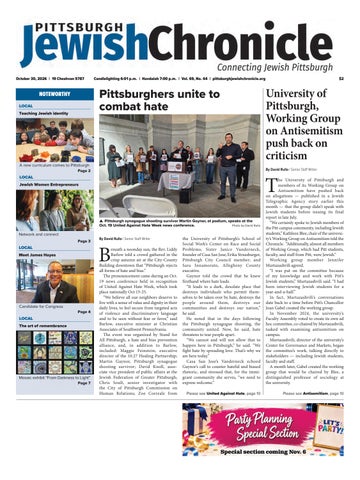
Pittsburghers unite to combat hate
NOTEWORTHY LOCAL Teaching Jewish identity
A new curriculum comes to Pittsburgh
T
LOCAL
the University of Pittsburgh’s School of Social Work’s Center on Race and Social Problems; Sister Janice Vanderneck, founder of Casa San Jose; Erika Strassburger, Pittsburgh City Council member; and Sara Innamorato, Allegheny County executive. Gaynor told the crowd that he knew firsthand where hate leads. “It leads to a dark, desolate place that destroys individuals who permit themselves to be taken over by hate, destroys the people around them, destroys our communities and destroys our nation,” he said. He noted that in the days following the Pittsburgh synagogue shooting, the community united. Now, he said, hate threatens to tear people apart. “We cannot and will not allow that to happen here in Pittsburgh,” he said. “We fight hate by spreading love. That’s why we are here today.” Casa San Jose’s Vanderneck echoed Gaynor’s call to counter hateful and biased rhetoric, and stressed that, for the immigrant community she serves, “we need to express welcome.”
he University of Pittsburgh and members of its Working Group on Antisemitism have pushed back on allegations — published in a Jewish Telegraphic Agency story earlier this month — that the group didn’t speak with Jewish students before issuing its final report in late July. “We certainly spoke to Jewish members of the Pitt campus community, including Jewish students,” Kathleen Blee, chair of the university’s Working Group on Antisemitism told the Chronicle. “Additionally, almost all members of Working Group, which had Pitt students, faculty, and staff from Pitt, were Jewish.” Working group member Jennifer Murtazashvili agreed. “I was put on the committee because of my knowledge and work with Pitt’s Jewish students,” Murtazashvili said. “I had been interviewing Jewish students for a year-and-a-half.” In fact, Murtazashvili’s conversations date back to a time before Pitt’s Chancellor Joan Gabel created the working group. In November 2024, the university’s Faculty Assembly voted to create its own ad hoc committee, co-chaired by Murtazashvili, tasked with examining antisemitism on campus. Murtazashvili, director of the university’s Center for Governance and Markets, began the committee’s work, talking directly to stakeholders — including Jewish students, faculty and staff. A month later, Gabel created the working group that would be chaired by Blee, a distinguished professor of sociology at the university.
Please see United Against Hate, page 10
Please see Antisemitism, page 10
Jewish Women Entrepreneurs
p Pittsburgh synagogue shooting survivor Martin Gaynor, at podium, speaks at the Oct. 19 United Against Hate Week news conference. Photo by David Rullo Page 3
LOCAL Meet James Hayes
Candidate for Congress
Page 4
LOCAL The art of remembrance
Mosaic exhibit “From Darkness to Light”
Page 7
University of Pittsburgh, Working Group on Antisemitism push back on criticism By David Rullo | Senior Staff Writer
Page 2
Network and connect
$2
By David Rullo | Senior Staff Writer
B
eneath a noonday sun, the Rev. Liddy Barlow told a crowd gathered in the crisp autumn air at the City-County Building downtown that “Pittsburgh rejects all forms of hate and bias.” The pronouncement came during an Oct. 19 news conference held in recognition of United Against Hate Week, which took place nationally Oct 15-25. “We believe all our neighbors deserve to live with a sense of value and dignity in their daily lives, to feel secure from targeted acts of violence and discriminatory language and to be seen without fear or favor,” said Barlow, executive minister at Christian Associates of Southwest Pennsylvania. The event was organized by Stand for All Pittsburgh, a hate and bias prevention alliance, and, in addition to Barlow, included: Maggie Feinstein, executive director of the 10.27 Healing Partnership; Martin Gaynor, Pittsburgh synagogue shooting survivor; David Knoll, associate vice president of public affairs at the Jewish Federation of Greater Pittsburgh; Chris Soult, senior investigator with the City of Pittsburgh Commission on Human Relations; Zoe Correale from
Headlines Unified Religious School brings Dara Horn’s teachings on Jewish identity to students — LOCAL— By Adam Reinherz | Senior Staff Writer
B
eit Kulanu’s Rabbi Dan Fellman returned to Pittsburgh inspired by last spring’s Re-CHARGING Reform Judaism Conference in New York City. A major source of that inspiration, Fellman said, was the opportunity to hear from author Dara Horn. The novelist, whose non-fiction work “People Love Dead Jews” received the 2021 National Jewish Book Award in the Contemporary Jewish Life and Practice category, delivered the conference’s keynote address. In her remarks, Horn described how individuals and groups routinely invoke a fictitious trope about Jews. “The big lie against the Jewish people is always the same,” she said. “The big lie is that Jews are destroying what your society values the most.” Although that lie has persisted across generations, she explained, by reframing the Jewish story, and teaching about the basics of Jewish civilization and its commitment to nonconformity, change is possible. Both at the conference and in her writing, Horn — whose new book on responding to antisemitism is titled “The Final Solution to the Jewish Question: A Love Story for the Living” — described that change and what “the moment demands of us.” “Our responsibility, not only as Jews but as members of the liberal West descended from Jewish civilization, is to make people curious about that dramatic story to which we owe our world,” she wrote in Sapir, a magazine exploring the future of the American Jewish community. “Jews are among the first groups in history to stand up to tyranny, and to this day they continue to do so. No one can defuse the lie of antisemitism without understanding that story, because it explains how people who
p Unified Religious School students pose with 3-D printed sukkahs.
want to dominate need that lie as a tool to stop curiosity and crush dissent.” Further conveying these ideas is The Tell Institute, a group founded and directed by Horn, which creates curricula. After hearing about the institute and its resources, Fellman spoke with Rabbi Larry Freedman about bringing the curricula to the Unified Religious School — an afterschool and Sunday morning learning program for students from Beit Kulanu and Congregation Beth Shalom. Freedman, the religious school director, reviewed the materials and found them thought-provoking. What’s particularly interesting is the premise that Jews are a “tiny countercultural group whose groundbreaking ideas shape world history,” Freedman told the Chronicle, while flipping through the materials. “I think there’s a lot of Jews who are not triumphalists, and we might be a little embarrassed to have such a grand concept.” Freedman said he received training from The Tell Institute and further warmed to Horn’s ideas. “It’s kind of true — maybe those
File photo
countercultural ideas really are things that stick in the craw of others.” Rabbi Seth Adelson, Beth Shalom’s senior rabbi and an educator at URS, joined Freedman in reviewing the curriculum and completing the training. “It is essential for the Jewish future that our young people are prepared for the range of falsehoods that are being told about the Jewish people online and in other unfriendly places,” Adelson said. “This curriculum is designed to help our students understand who the Jewish people are and what we stand for, and to help inoculate them against those who promulgate what Dara Horn refers to as ‘the Big Lie,’ that is, that the Jews are trying to destroy whatever it is that you value the most.” What the curriculum makes clear, Freedman said, is “what Jews writ-large have stood for and that these things are a threat to whatever the ruling party is of the day.” Depending on where Jews live, “we’re either rapacious capitalists or we are godless communists. We’re always the thing that people hate the most.” By weaving that concept through millennia
of Jewish life, it actually helps middle schoolers and teens appreciate “why we’re in this mess right now,” he added. URS has about 200 students ranging from K-12. Amid rising antisemitism and growing online discourse about Zionism and anti-Zionism, Fellman said he is eager to introduce new teachings. What this curriculum and the religious school’s other offerings reiterate is an “understanding of our identity through the positive aspects of who we are and what we stand for,” he said. Along with grasping how to live a “life of Jewish observance and Jewish practice,” it’s imperative for young learners to reckon with the questions of “Why be Jewish? Why is it important to be Jewish? What are the blessings that come from being Jewish?” Both for teens, parents and others — Beit Kulanu will offer related classes for adults during its Monday Meetups series — it’s crucial to “help the current generation recognize and understand what’s happening and to see how our Jewish identities can help us build and respond to all of this stuff from a position of pride, and joy and blessing, and not from hate and distrust and fear,” Fellman said. As much as school is a place for sharing information, education can bolster identity, Freedman said. “Maybe it would be nice if our seventh graders, our high school students, sort of got a little bit of a little shot in the arm. Like, I am part of this group of people that has historically stood up to tyrants wherever they are … that it’s not some other guy, but my people don’t bow down. My people argue about reality and text. My people don’t just take whatever’s fed to us. My people have stood for something important.” That realization transforms academic exercises into personal values. The goal, he continued, is for students to leave the classroom “feeling aware and empowered.” PJC
Adam Reinherz can be reached at areinherz@pittsburghjewishchronicle.org.
5915 Beacon St., 5th Floor Pittsburgh, PA 15217
Main phone number: 412-687-1000
Subscriptions: 412-687-1000, ext. 2 SUBSCRIPTIONS subscriptions@pittsburghjewishchronicle.org 412-687-1000, ext. 2
Jim Busis, CEO and Publisher 412-228-4690 jbusis@pittsburghjewishchronicle.org
TO ADVERTISE advertising@pittsburghjewishchronicle.org 412-687-1000, ext. 1
EDITORIAL Toby Tabachnick, Editor 412-228-4577 ttabachnick@pittsburghjewishchronicle.org
EDITORIAL DEPARTMENT Email: newsdesk@pittsburghjewishchronicle.org BOARD OF TRUSTEES Evan H. Stein, Chair Evan Indianer, Vice Chair Derek Smith, Treasurer Gayle R. Kraut, Secretary Gail Childs, Dan Droz, Malke Steinfeld Frank, Karen Gal-Or, Seth Glick, Cátia Kossovsky, Charles Saul, Lynn Zelenski
Adam Reinherz, Senior Staff Writer 412-687-1000 areinherz@pittsburghjewishchronicle.org David Rullo, Senior Staff Writer 412-687-1000 drullo@pittsburghjewishchronicle.org ADVERTISING Amy Weiss, Account Executive (412) 613-0697 aweiss@pittsburghjewishchronicle.org
PRODUCTION Jeni Mann Tough Production Manager Carl Weigel Art/Production Coordinator Subscriptions subscriptions@pittsburghjewishchronicle.org 412-687-1000, ext. 2 Published every Friday by the Pittsburgh Jewish Publication and Education Foundation 5915 Beacon St., 5th Floor Pittsburgh, PA 15217 Phone: 412-687-1000 POSTMASTER: Send address change to PITTSBURGH JEWISH CHRONICLE, 5915 BEACON ST., 5TH FLOOR PITTSBURGH, PA 15217 (PERIODICAL RATE POSTAGE PAID AT PITTSBURGH, PA AND AT ADDITIONAL MAILING OFFICES) USPS 582-740
Manuscripts, letters, documents and photographs sent to the Pittsburgh Jewish Chronicle become the property of this publication, which is not responsible for the return or loss of such items. The Pittsburgh Jewish Chronicle does not endorse the goods or services advertised or covered in its pages and makes no representation to the kashrut of food products and services in said advertising or articles. The publisher is not liable for damages if, for any reason whatsoever, he fails to publish an advertisement or for any error in an advertisement. Acceptance of advertisers and of ad copy is subject to the publisher’s approval. The Pittsburgh Jewish Chronicle is not responsible if ads violate applicable laws and the advertiser will indemnify, hold harmless and defend the Pittsburgh Jewish Chronicle from all claims made by governmental agencies and consumers for any reason based on ads appearing in the Pittsburgh Jewish Chronicle.
GENERAL COUNSEL Stuart R. Kaplan, Esq.
2
OCTOBER 30, 2026
PITTSBURGH JEWISH CHRONICLE
PITTSBURGHJEWISHCHRONICLE.ORG
Headlines Jewish women entrepreneurs create group with intent to connect and grow — LOCAL — By Adam Reinherz | Senior Staff Writer
A
n enterprising effort is underway to promote local Jewish women entrepreneurs. For months, Greenfield resident Hayli Firtell-Elgarten has worked to bring The Jewish Woman Entrepreneur, a national network, to Pittsburgh. On Nov. 11, Firtell-Elgarten’s efforts will come to fruition as she welcomes executives and businesswomen to the launch of The JWE’s Pittsburgh City Pod. The local group, Firtell-Elgarten said, is for Jewish women seeking to network, grow their businesses and learn. “My vision is to create a community for these women, and really to have a village.” Whether someone is seeking an importer, supplier or simply advice from a fellow Jewish woman in business, the group should be a resource, she continued. “This is just an all-inclusive community that supports women in business and women who are executives.” More than 8,000 women have participated in JWE programs since 2010, according to the organization. With branches in several cities, including Paris, Dallas, Cleveland and Monsey, New York, JWE regularly hosts networking events, skill-building workshops and guest speakers.
p An upcoming event will help local businesswomen create community.
Photo by jacoblund via iStock
Pittsburgh is ripe for related programming, and local residents are eager to learn, Firtell-Elgarten said. Since announcing the upcoming event, the Greenfield resident, who runs the online boutique Debbie’s Room Jewelry with her husband, Yossi Elgarten, has received numerous messages from women seeking more information, she said. In fact, more than 50 women are now on a related WhatsApp group, she added. Shari Zatman, owner of Perfectly Planned by Shari, and founder of Signature Slipcovers,
plans to attend the event. With both of her businesses serving as sponsors, Zatman said she’s delighted to support other Jewish women in business. “That’s really important to me,” she said. “I’ve been an entrepreneur pretty much my entire career.” Interacting with others who work in Pittsburgh and own businesses here is an opportunity for women to “benefit and share from each other.” Zatman knows attendees will range in age and experience. Some women will arrive with decades of leadership behind
them. Other attendees will come to the event at what’s basically the start of their careers. Regardless of where someone is on their professional journey, it’s important to support each other, Zatman said. There’s an opportunity here — given the group’s freshness — that participants can not only benefit from other like-minded women but help create a collective, she continued. “The more people that go, the more we can build a strong community.” The Nov. 11 kickoff event, which is being held at 7:30 p.m. at The Highline in the city’s South Side neighborhood, will feature opportunities to connect, enjoy light refreshments and receive new professional headshots; it’s also a chance to give back, Firtell-Elgarten said. In partnership with GIFT, event attendees will pack holiday kits for later distribution to local residents. Firtell-Elgarten said she hopes readers register and attend. An easy way to approach this, she said, is to “think of it as self-care for your business.” Everyone is “so busy,” she continued. It’s important to “just take the time for yourself.” The Jewish Women’s Entrepreneurs Launch Event will occur Nov. 11 at 7:30 p.m. at The Highline. Tickets start at $36. Registration is available at thejwe.com/etn/ pittsburgh-launch-event. PJC Adam Reinherz can be reached at areinherz@pittsburghjewishchronicle.org.
Friendship Circle encourages teens and parents to talk about drugs — and to continue talking — LOCAL — By Adam Reinherz | Senior Staff Writer
D
ialogue around drug use isn’t just about saying “no.” Medical professionals and researchers told teens and parents that healthy communities, and beneficial relationships, require something more: conversation. Seated inside the Friendship Circle of Pittsburgh on Oct. 21, nearly 40 teens, parents, physicians and other medical professionals discussed the realities of teen drug use and how communication can not only yield safer outcomes but deeper bonds. Guiding the discussion was Pittsburgh Allderdice student Chayim Massart, 17. For nearly an hour, the Friendship Circle member and teen leader encouraged participants to share experiences and advice. Dr. Rachel Friedman, an emergency medicine physician at Allegheny Valley Hospital who has treated overdoses and alcohol withdrawals, said drug use largely “comes down to an access issue.” Alcohol, nicotine and prescriptions found at home are often “easiest for kids to get their hands on,” she said. Harder drugs likely require not only money but the need to “go out and seek them.” When people do purchase drugs, it’s usually unclear what’s actually being PITTSBURGHJEWISHCHRONICLE.ORG
p Participants observe how to administer Narcan during an Oct. 21 program at Friendship Circle of Pittsburgh. Photo by Adam Reinherz
acquired, Christa Kirk, an assistant professor of pharmacy at Duquesne School of Pharmacy, said. Kirk pointed to research regarding fentanyl, a synthetic opioid, and xylazine, a sedative approved for veterinary use, and said that given xylazine’s frequency of being added to other drugs, such as fentanyl, it is often ingested without knowledge.
Mixing xylazine and fentanyl places users at a “higher risk of suffering a fatal drug poisoning,” the U.S. Drug Enforcement Administration reported. In Philadelphia, fentanyl was detected in 94% of all opioid-related overdose deaths, according to the city’s health department. Pointing to a collection of neatly wrapped gift bags resting on the Friendship Circle
PITTSBURGH JEWISH CHRONICLE
stage, Kirk encouraged teens and parents to take home testing strips designed to determine whether drugs contain fentanyl. Also inside the bags were boxes of Narcan, a medication that reverses opioid overdoses. Imagine a scenario where there’s a party, and “everybody’s been doing something, they’ve been drinking, and you don’t know what’s happened,” Kirk said. An individual is seemingly unconscious on the floor, and “you can assume that maybe they took something that’s very bad for them.” Try administering Narcan, she said, as “it doesn’t have a negative effect. You can use Narcan on really anybody.” With help from a teen volunteer, Kirk then inserted the nasal spray into a person’s nostril. Several teens credited the demonstration and discussion with providing practical insight on a taboo topic. “For me, heading into high school, just kind of learning about how you encounter it at a party with one of your friends, or when you see someone unconscious, is very helpful,” Rooney Kirk, 14, said. Often when it comes to drug use, “you can’t really stop other people from doing it, but you can help them if they are in need,” Owen Clark, 14 told the Chronicle. Throughout the evening, participants swapped stories and statistics regarding drug use. Please see Friendship Circle, page 11
OCTOBER 30, 2026
3
Headlines James Hayes sees a path to victory in District 12 — LOCAL — By David Rullo | Senior Staff Writer
U
.S. House candidate James Hayes believes he can beat incumbent Summer Lee in the Nov. 3 election for Pennsylvania’s District 12, partly because of the results of the 2024 election. Lee won, but Hayes sees a story in the numbers. “In the last election we did a poll that said I would only get 28% of the vote. I ended up getting 44% of the vote, so I substantially outperformed the polls,” Hayes said. “I substantially outperformed Donald Trump. I even outperformed David McCormick by four points in the district. I got 181,000 votes last time. In Summer Lee’s first run [in 2022] she only got 141,000 votes.” The Republican hopeful, who said he doesn’t like to quit, credited his business background with teaching him to see challenges rather than problems. Defeating Lee is a challenge he thinks he can overcome. “We’re going to work hard,” he said. “I believe that we have a path to victory.” To help forge that path, Hayes employed a new strategy this election cycle. “I realized how hard it is to raise funds,
p Republican challenger James Hayes believes he can unseat Rep. Summer Lee in Pennsylvania’s 12 District. Photo by David Rullo
so I contracted with a group that talked about a low-budget strategy focused on social media,” he said. “There are new technologies that we didn’t have five years ago.” As an example, Hayes pointed to an ad run he purchased during the governor’s debate that targeted only the ZIP codes in District 12. He believes that if he could have used
the same technology in the last race, he would have won. And while he understands the need for new techniques, Hayes hasn’t abandoned the tried and tested ways of building a coalition through community. He said he’s been working hard in the Jewish, Indian and Black communities, and believes the Black community shares commonalities with traditional Republicans.
“They’re churchgoing, family-oriented and have the same social values,” he noted. He’s done outreach to Democratic voters as well. In fact, he was recently approached by a group of Democrats who asked him to create a “Democrats for James Hayes” presence. He now has corresponding signs available for those interested. “I believe that at the core, most of us agree on 80% of the values,” Hayes said. “There might be a few areas in which we differ, but if you compare it to the Democrat Socialists it’s going to be flipped. You might agree with 20% of what they say and disagree with 80%.” Because of that, Hayes hopes people ignore party labels and, instead, vote for the candidate most closely aligned with their values and traditions, and who they believe will be the best fit for the region. And while there’s been a lot of talk about the expected blue wave, Hayes isn’t so sure it will manifest next week. “There are a lot of Democrats that don’t appreciate the fact that the Democratic Socialists of America have hijacked their party,” he noted. “If JFK were alive today, he would most likely be a liberal Republican.” The House hopeful argued that some factors driving the anticipated blue wave, Please see Hayes, page 11
“Don’t be pushed by your problems; be led by your dreams.”
Contact Amy Weiss: 412-613-0697
aweiss@pittsburghjewishchronicle.org
Lee & Lisa Oleinick 4
OCTOBER 30, 2026
PITTSBURGH JEWISH CHRONICLE
PITTSBURGHJEWISHCHRONICLE.ORG
THE RESULTS ARE IN. LET’S TALK ABOUT IT. Monday, November 2 • 7 pm Registration Required Moshe Koppel
Founding Chairman of the Kohelet Policy Forum
Dr. Dahlia Scheindlin
Political Strategist and Public Opinion Researcher
Yisrael Klitsner
Series Moderator
JCC Squirrel Hill
Katz Theater • $36/person For more info: Fara Marcus, fmarcus@jccpgh.org
JCCPGH ISRAEL ENGAGEMENT SERIES • SESSION 4 PITTSBURGHJEWISHCHRONICLE.ORG
PITTSBURGH JEWISH CHRONICLE
OCTOBER 30, 2026
5
Calendar Submit calendar items on the Chronicle’s website, pittsburghjewishchronicle.org. Submissions also will be included in print. Events will run in the print edition beginning one month prior to the date as space allows. The deadline for submissions is Friday, noon.
Judaism actually says about everything, from familiar Torah stories and Jewish traditions to angels, demons and some of life’s biggest questions. 7:45 p.m. $36. CYP Loft. To register and to learn more about the topics, visit cyppittsburgh.com/facts.
q SUNDAYS, NOV. 1–NOV. 22 Chabad of Squirrel Hill presents Jewish Art Camp, fun Jewish learning through the arts for ages 0 to Grade 3. $10/class; $50 or $75/semester. 1700 Beechwood Blvd. chabadpgh.com/art
q MONDAYS, NOV. 2–FEB. 15 Chabad of the Souths Hills presents Kitchen of Kindness Junior Chefs Club, where kids cook, learn and give back. Grades K-8; teen volunteers welcome. Three five-week sessions. 5 p.m. For more information and to register, visit chabadsh.com/jrchef.
q SUNDAYS, NOV. 1–DEC. 20 Join Chabad of Squirrel Hill for its Men’s Tefillin Club. Services and tefillin are followed by a delicious breakfast and engaging discussions on current events. 8:30 a.m. 1700 Beechwood Blvd. chabadpgh.com Join a lay-led online Parashah study group to discuss the weekly Torah portion. No Hebrew knowledge needed. The goal is to build community while deepening understanding of the text. 8:30 p.m. For more information, visit bethshalompgh.org/online-parashah. q MONDAY, NOV. 2 Join the JCC of Pittsburgh for Part 4 of the six-part Israel series, “Come Curious. Leave Wiser – Israeli Elections: Fear, Identity and Hope in a Polarized World.” This session will explore the deep societal trends shaping Israeli society in light of the election results, including the ongoing tension between Israel’s identity as a Jewish state and its commitment to democratic principles. 7 p.m. $36. 5738 Forbes Ave. Katz Auditorium, Robinson Building. donate.jccpgh.org/event/ the-wild-west-settlements-two-voices-one-land/e855168 q MONDAYS, NOV. 2, NOV. 9 Join Chabad Young Professionals for CYP Academy – Fascinating Facts, a four-part series exploring the myths and mysteries of Judaism taught by Rabbi Henoch Rosenfeld. Go beyond the basics to discover what
q TUESDAY, NOV. 3 Chabad of the South Hills presents an inspirational evening of stories and song with Leibel Lazaroff, survivor of the Bondi Beach attack. 7 p.m. 1700 Bower Hill Road. chabadsh.com/bondi q TUESDAYS, NOV. 3–DEC. 22 Join Beth El’s Rabbi Alex Greenbaum and his Bible/ Talmud Adult Education class for a thought-provoking weekly session of Bible and Talmudic study. This program is available both in person and virtually. Call the office at 412-561-1168 to receive the Zoom link or to make an in-person reservation. 10:30 a.m. 1900 Cochran Road. bethelcong.org q WEDNESDAYS, NOV. 4, NOV. 11 Join Hazzan Barbara Barnett as she leads a multi-week Shabbat davening class. Whether you want to follow along with confidence, sing every niggun with the kahal, or step up to lead Kabbalat Shabbat, Shacharit, Torah service or Musaf yourself — this class builds the skills for it. Work through Friday night and Shabbat morning davening, piece by piece. 7:30 p.m. Congregation Beth Shalom, 5915 Beacon Street. bethshalompgh.org/ shabbat-davening-class q WEDNESDAYS, NOV. 4–DEC. 2 Chabad of Squirrel Hill presents the new six-week JLI course, Kabbalah and The Hidden Architecture of
You. 7:30 p.m. $99. 1700 Beechwood Blvd. chabadpgh. com/jlicourse q WEDNESDAYS, NOV. 4–DEC. 2 Chabad of the South Hills presents the new six-part JLI Course, “Kabbalah and the Hidden Architecture of You.” Wednesdays, 7:30 p.m; Sundays 10:30 a.m. $125, limited scholarships available. 1700 Bower Hill Road. Email rabbi@chabadsh.com to register. q WEDNESDAYS, NOV. 4–DEC. 23 Explore the weekly Torah portion with the mystical and interpersonal lens of the Hassidic rabbis with Rabbi Mark Asher Goodman. Hassidut for the People is a fun and engaging class taught online and in person meant to help learners find deeper meaning in Torah and in themselves. All levels welcome. 10 a.m. $5. Shoresh PGH, 4300 Murray Ave. Contact rabbimark@shoreshpgh.org for more information. shoreshpgh.org/class-schedule-and-events q SUNDAY, NOV. 8 Join the Holocaust Center of Pittsburgh for “Kristallnacht: The 1938 Reich’s Pogroms,” a talk by Holocaust scholar and historian Michael Berenbaum. Berenbaum is a writer, lecturer and teacher consulting in the conceptual development of museums and the development of historical films. He is director of the Sigi Ziering Institute: Exploring the Ethical and Religious Implications of the Holocaust at the American Jewish University (formerly the University of Judaism), where he is also a distinguished professor of Jewish studies. Free. 4 p.m. Beit Kulanu, 4905 Fifth Ave. hc-kristallnacht2026. eventbrite.com q WEDNESDAY, NOV. 11 Join Chabad of Squirrel Hill for a Ladies’ Lunch and Learn. Enjoy a delicious lunch while exploring timeless wisdom for the month of Kislev. Noon. $18. 1700 Beechwood Blvd. chabadpgh.com/lunch Israeli novelist Ayelet Tsabari joins the Jewish Studies Program at the University of Pittsburgh to discuss her novel “Songs for the Brokenhearted,” with novelist and Pitt professor Irina Reyn. 5:15 p.m. Cathedral of Learning Room 501, 4200 Fifth Ave. calendar.pitt.edu/event/ songs-for-the-brokenhearted
q TUESDAY, NOV. 17 Suppression and Expression: A Concert Exploring Art, Mental Health, and Intergenerational Trauma by The REgenerate Music Project presents pieces resonating with the artwork of Norman Klenicki, a selftaught artist and son of Holocaust survivors. Klenicki uses his visual art to express and address the symptoms of his bipolar disorder triggered by the legacy of injuries his mother incurred at Auschwitz. Klenicki’s work is exhibited this fall in the University of Pittsburgh Scaife Hall gallery space. The concert and parking are free. Registration is requested. 7 p.m. 1103 Woodland Road, Pittsburgh, PA 15232. eventbrite.com/e/suppression-andexpression-tickets-2002739829743?aff=oddtdtcreator q THURSDAY, NOV. 19 Chabad of the South Hills presents Rosh Chodesh Society’s NEXT GENesis, a seven-part series of classes for women. Explore the early narratives of Genesis, not as distant beginnings but as a living reflection of the human soul. Through stories of longing and choice, fracture and renewal, discover a more intimate understanding of yourself, your purpose and the path unfolding before you. 1:30 p.m. or 7 p.m. 1700 Bower Hill Road. chabadsh.com/rcs q SUNDAY, NOV. 22 Chabad of Squirrel Hill presents Teen Cooking Club, a fun hour of baking delicious desserts that will be shared with local seniors in our community. 3 p.m. 1700 Beechwood Blvd. chabadpgh.com/desserts q TUESDAY, DEC. 1 The Beacon and The Friendship Circle present “Let’s Talk About It: The Conversations Every Family Is Having … or Avoiding,” a parent and teen conversation series. Join other parents and teens for honest conversations about today’s biggest challenges. Teens hold an active role in planning and co-facilitating the conversations. Free. 7 p.m. 1922 Murray Ave. For more information, including topics, visit eventbrite.com/e/lets-talk-about-it-theconversations-every-family-is-havingor-avoiding-tickets1998932272236?aff=oddtdtcreator. PJC
Author Nicholas Lemann to join the Chronicle Book Club
T
he Pittsburgh Jewish Chronicle invites you to join the Chronicle Book Club for its Nov. 1 discussion of “Returning: A Search for Home Across Three Centuries,” by Nicholas Lemann. The author will join us for the meeting. From Amazon.com: “Nicholas Lemann, a veteran New Yorker correspondent, grew up in New Orleans, the son of German Jews in a world of gilded privilege. Yet in contrast to his parents’ generation, which always sought to downplay their religious background, Lemann was intrigued by his roots, thinking he wanted to be like Jack Burden, the ever-curious reporter in Robert Penn Warren’s 'All the King’s Men.' “And like his fictional hero, who gets drawn into a web of Southern political intrigue, Lemann in ‘Returning’ delves deeply into the family story from their arrival in the 1830s as peddlers from Germany, to their becoming plantation owners and department store owners after the Civil War, to their emergence as aspirants in the aristocratic world of New Orleans, where they could never quite belong.”
What to do
Buy: “Returning: A Search for Home Across Three Centuries.” It is available from online retailers, including Amazon and Barnes & Noble, and in some local Barnes & Noble stores. It is also available through the Carnegie Library system. Email: Contact us at drullo@pittsburgh jewishchronicle.org, and write “Chronicle Book Club” in the subject line. We will send you a Zoom link for the discussion meeting. Happy reading! PJC
Your hosts
Toby Tabachnick, Chronicle editor David Rullo, Chronicle senior staff writer
How it works
We will meet on Zoom on Sunday, Nov. 1, at 1 p.m. 6
OCTOBER 30, 2026
PITTSBURGH JEWISH CHRONICLE
PITTSBURGHJEWISHCHRONICLE.ORG
Headlines Mosaic exhibition honors Pittsburgh shooting victims and brings message of hope
p Mosaic tiles exhibited in “From Darkness to Light: Expressing Hope through Mosaic Art”
— LOCAL — By Deborah Weisberg | Special to the Chronicle
A
n art exhibition honoring the victims of the Pittsburgh synagogue shooting — and decrying hate — is now at Congregation Beth Shalom in Squirrel Hill, its latest stop on a national tour. “From Darkness to Light: Expressing Hope through Mosaic Art” includes 36 tiles by artists from around the world, each created in response to the 2018 shooting that claimed 11 lives. The museum-style display has traveled to nearly a dozen venues since its genesis in 2020 by Susan Ribnick, a prominent mosaic artist in Austin, Texas, and other artists she engaged in the project. “When I saw the level of workmanship and craftsmanship and creativity, I knew something special was brewing,” said Ribnick, who vetted every piece. “When people feel strongly about an issue, they dig deep and do great work.” Pittsburgh-based Stevo Sadvary contributed “Coming Together in Peace,” a stained glass mosaic that merges several distinct patterns into a harmonious whole. “I’m always working with patterns, sometimes flowing patterns that meet in the middle,” said Sadvary, whose portfolio includes several public mosaic installations. “For this tile, the patterns represent different communities and how they should come together to get along.” Using a frame sent to him from Ribnick, Sadvary leaned on his recollection of the morning of the shootings, which occurred so close to home. “I was teaching a mosaic workshop in Mt. Lebanon, and my phone started lighting
PITTSBURGHJEWISHCHRONICLE.ORG
up,” he said. “People were calling me and texting me because my studio is a mile from the synagogue.” Contributing to the project, he said, provided an opportunity to show the power of art to confront religious persecution. “If the pieces spark thought and emotion, that is always a positive.”
from ceramic and glass to beads, stones, and folded paper, and included written messages with their work. “Each tile tells a story,” said Shari Woldenberg, Beth Shalom’s Derekh (pathways) program coordinator. “There are so many layers besides the visual impact of the tiles.”
“Each tile tells a story. There are so many layers besides the visual impact of the tiles.” –SHARI WOLDENBERG
The collection’s dedication panel, created by Ribnick and members of the Austin Mosaic Guild, features glass leaves etched with the names of the 11 victims on a gradient green background. Other pieces use symbols, such as the Star of David, or more abstract designs to inspire optimism in challenging times. While the project originated from the Pittsburgh synagogue shooting, it speaks to bigotry of all kinds, and to gun violence, Ribnick said, noting that a mosaic by Rachel Davies also memorializes 16 school children and a teacher killed in a shooting in 1996 in Dunblane, Scotland, where Davies works. Her mosaic depicts snowdrops, which were in bloom when the massacre occurred and became a symbol of the will to triumph over tragedy. Artists worked with a variety of materials,
She noted that because the exhibition is coming to Beth Shalom “during a very, very polarizing time,” she hopes it can encourage “strength and hopefulness.” Robin Friedman, president of Tree of Life Congregation, notes the significance of artists with no connection to Pittsburgh and who aren’t necessarily Jewish uniting to deliver a message “that we have to stand against antisemitism and hate and that we can do it without being harsh.” David Kalla, a member of Tree of Life Congregation, is the keeper of the exhibition, volunteering his time to coordinate its journey, and providing support through the Barb and Dave Kalla Charitable Trust. “I was very moved that people so far away, in Texas, were thinking of us and organizing to do something,” he recalled,
PITTSBURGH JEWISH CHRONICLE
Photo courtesy of David Kalla
noting that he wanted to help ensure the mosaics would remain in the public eye. He and Ribnick worked with Abby Schwartz, then-director of the Cincinnati Skirball Museum on the mosaics’ first institutional showing, Kalla said. “The project started at the grassroots and Abby turned it into a polished exhibition.” Since then, it has traveled to venues ranging from Michigan’s Art Center of Battle Creek to Penn State University to Montclair State University in New Jersey. Local places have included the Seton Hill University Arts Center, Southern Alleghenies Museum of Art, and Duquesne University. While Kalla is working to schedule more stops, he is encountering reluctance from some prospective hosts, despite the collection’s deep social value and uplifting message. “We’re reached out to a lot of people, but some campuses are very unsure of how to promote this, to advertise something Jewish,” he said. “It’s a shame.” He also is seeking a permanent home for the collection and believes the new Tree of Life Center for Humanity, now under construction, is an ideal candidate. “This was a beautiful gift to our congregation,” he said. “My hope is that, along with the many other beautiful gifts we received, at least some of the tiles can be viewed on the outside walls of the sanctuary.” From “Darkness to Light: Expressing Hope through Mosaic Art” runs until May 5, 2027. Admission is free and by appointment through Shari Woldenberg at swoldenberg@bethshalom.org. PJC Deborah Weisberg is a freelance writer living in Pittsburgh. OCTOBER 30, 2026
7
8
OCTOBER 30, 2026
PITTSBURGH JEWISH CHRONICLE
PITTSBURGHJEWISHCHRONICLE.ORG
Headlines — WORLD— Pennsylvania bill would add Gaucher disease to newborn screening panel
Pennsylvania House Bill 1652 — which would add Gaucher disease to the list of conditions tested for on Pennsylvania’s newborn screening panel — achieved final passage in Pennsylvania’s House and Senate and is headed to Gov. Josh Shapiro to sign the bill into law, according to a news release from Rep. Dan Frankel. The bill was sponsored by Rep. Abigail Salisbury. At remarks before the House in early October, Frankel noted: “Gaucher is the most prevalent inherited genetic disorder among people of Ashkenazi Jewish descent. A disease that disproportionately affects one population can be hard to diagnose, and diagnosis too often depends on someone thinking of looking for it. Experts who treat Gaucher say early identification can make a significant difference for families, and a newborn screen would give families and their doctors that information before symptoms appear.” Gaucher does not currently meet the criteria for inclusion under the process created by the state’s 2020 newborn screening law, so legislation was needed to add it. “This bill exists because of parents,” Frankel said. “Families who have lived with this disease have fought for it, hoping to spare future families the struggles they went through.” Missouri, New Jersey, Tennessee, Oregon, New Mexico and Illinois have already added Gaucher to their newborn screening panels. House Bill 1652 would add Pennsylvania to that list.
AIPAC to halt direct campaign contributions and candidate endorsements
The American Israel Political Affairs Committee announced that it will no longer
make direct campaign contributions or endorse candidates, instead focusing on mobilizing individual donors, JTA reported. The pro-Israel lobby disclosed the change in a letter to its members on Oct. 21. The letter stated that the lobby would still operate its super PAC, the United Democracy Project, which was launched alongside AIPAC’s PAC in 2021, ahead of the 2022 midterms. The strategy shift occurred in an increasingly tense environment in which AIPAC has become a boogeyman among many progressive politicians — particularly among members of the Democratic Socialists of America in their Democratic congressional campaigns. “We will prioritize increasing direct, organized contributions from individual Americans to candidates — expanding upon our current efforts — and maximizing the emerging political fundraising tools,” the AIPAC letter stated. “Endorsements, direct PAC contributions, and earmarking will no longer be part of our approach so we can expand individual giving and utilize new tools to help our friends win,” the lobby added. The letter detailed the lobby’s accomplishments in this political cycle, saying it helped 290 pro-Israel candidates secure election wins nationwide and prevented 29 “detractors” from winning. Looking ahead, the letter noted that “the 2028 cycle will demand an even stronger commitment by our activists to pro-Israel politics.” As a result, the lobby said it would be important to adopt new fundraising strategies and ensure that individual member contributions are being used as effectively as possible.
Vance declines to endorse Netanyahu, a day after Trump backs prime minister
Vice President JD Vance refused to endorse Prime Minister Benjamin Netanyahu, just a day after President Donald Trump announced
Today in Israeli History — ISRAEL — Items are provided by the Center for Israel Education (israeled.org), where you can find more details.
Oct. 30, 1957 — Violinist Shlomo Mintz is born
Shlomo Mintz, a violinist and conductor, is born in Moscow. When he is 2, his family moves to Israel, and he begins to learn the violin at 3½. By 18, he is touring Europe and building his capacity as a conductor.
Nov. 2, 1955 — Ben-Gurion regains premiership
Israel’s first prime minister, David Ben-Gurion, regains the post, replacing his successor, Moshe Sharett. Ben-Gurion largely retired in 1953, but he returned to the government as the defense minister Feb. 17, 1955.
Nov. 3, 1878 — Petah Tikvah is founded p Shlomo Mintz conducts the Jerusalem Symphony Orchestra during the 50th anniversary celebration of Yad Vashem in September 2003.
By Avi Ohayon, Israeli Government Press Office, CC BY-SA 3.0
Oct. 31, 1917 — Australians capture Beersheba
Supported by three British divisions, the Australian 4th Light Horse Brigade surprises the Turkish defenders and captures Beersheba in a single day, breaking the Ottoman defensive line near Gaza.
Nov. 1, 1945 — Jewish Resistance blows up rails across Palestine
The Jewish Resistance Movement sets off explosions at more than 150 sites along the railway system of Mandatory Palestine and blows up three British gunboats in the Jaffa and Haifa harbors on the Night of the Trains. PITTSBURGHJEWISHCHRONICLE.ORG
Religious Jews determined to start an agricultural settlement leave Jerusalem and establish Petah Tikvah (“Gateway of Hope”). They purchase 3,400 dunams (840 acres) from a Greek owner near the Yarkon River.
Nov. 4, 1966 — Syria, Egypt sign defense treaty
Egypt and Syria sign a mutual defense treaty and create a joint military command amid constant, low-level violence on the Israeli-Syrian border. U.S. intelligence reports suggest that the Soviets are behind the treaty.
Nov. 5, 1990 — Meir Kahane is killed
Rabbi Meir Kahane, 58, is fatally shot by Egyptian-American El Sayyid Nosair in a Manhattan hotel. Kahane was elected to the Knesset in 1984 as the head of Kach, but the party was banned from later elections. PJC
his support for the incumbent Israeli leader, JTA reported. “I’m not anti-endorsing. I’m not pro-endorsing,” Vance told journalist Mark Halperin in an interview. “I’m not getting involved in the Israeli elections.” “I endorse American candidates,” the vice president added, noting that he is focused on the U.S. midterms. Trump declared his support for Netanyahu, who is running for reelection, in a Truth Social post in which he deemed the Israeli leader “a Great Warrior Prime Minister” and a vital partner in removing the Iranian threat. Recent polls showed Netanyahu closely trailing former IDF chief-of-staff Gadi Eisenkot in the election, scheduled for Oct. 27. While Vance declined to endorse the Israeli prime minister, he has previously involved himself in international elections. In April Vance joined Trump in backing then Prime Minister Viktor Orbán in Hungary, although that support did not end in victory.
Review finds nearly 3 in 5 Jewish students in England report antisemitism
Almost three in five Jewish students in English schools say they have experienced antisemitism, and one in five of all students say they have witnessed it, according to an independent review commissioned by the British government published last week, The Times of Israel reported. The report identified widespread underreporting of incidents, inconsistent responses by educational institutions and a lack of staff training as major obstacles to tackling the problem. It also calls for a more comprehensive approach to teaching about Jewish life and contemporary antisemitism, rather than
By Ya’acov Sa’ar, Israeli Government Press Office, CC BY-SA 3.0
— Compiled by Toby Tabachnick
412-421-1015 412-421-4450 FAX 412-421-4451
1916 MURRAY AVE. PITTSBURGH, PA 15217
PRICES EFFECTIVE SUNDAY, NOVEMBER 1 – FRIDAY, NOVEMBER 6, 2026 Candle Lighting Time Friday, October 30, 2026 • 6:01 p.m. THANKSGIVING DAY SPECIALS
WINE SPECIALS
SERVES 6 NO SUBSTITUTIONS
CHATELEUF ROUGE $
HALF TURKEY WHOLE TURKEY WITH NATURAL GRAVY STUFFING CANDIED FRESH YAMS STIR FRY VEGETABLES CRANBERRY SAUCE DINNER ROLLS & PUMPKIN PIE
Order Your
13.39
750 ML
NETOFA TEL QUASAR RED OR WHITE
37.69
$
750 ML
Fresh Turkeys Now! STORE HOURS
Sunday • 8 a.m. – 6 p.m. Monday • 8 a.m. – 6 p.m. Tuesday • 8 a.m. – 6 p.m. Wednesday • 8 a.m. – 6 p.m. Thursday • 8 a.m. – 8 p.m. Friday • 8 a.m. – 3 p.m.
GROCERY
COOKED FOODS
DELI
UNGAR'S FROZEN GEFILTE FISH $ .89
BEEF VEGETABLE SOUP $ .99
SPANISH EGGPLANT $ .19
MANISCHEWITZ EGG NOODLES 4 VARIETIES $ .79
PASTRAMI CHICKEN $ .99
A&H LEAN PASTRAMI $ .79
LIEBER'S SNACKERS $ .89
APPLE CRISP $ .99
PEREG MEXICAN BREAD CRUMBS $ .89
COOKED BRISKET $ .99
8
2
p Meir Kahane addresses fellow Knesset members in August 1988.
relying primarily on Holocaust education. Recommendations include encouraging all schools and colleges to adopt the International Holocaust Remembrance Alliance’s working definition of antisemitism, strengthening safeguarding guidance and explicitly incorporating antisemitism into professional standards for teachers. The report was based on a survey of more than 5,000 English students aged 16-19, including 92 who identified as Jewish. The low sample size of Jewish students “should be treated with caution,” even as they provide insight into students’ experience of antisemitism, the report said. Among those identifying as Jewish, 59% said they experienced antisemitism. Of the general population, 20% said they had witnessed antisemitism, including 2% who experienced it directly. Responses showed that antisemitism was most likely to occur in social areas (68%), online or on social media (44%) and in lessons or classrooms (38%). Jokes, stereotypes and comments about Jewish people were the main forms of antisemitism, identified by 85% of those who experienced or witnessed it. Roughly half of respondents who witnessed or experienced antisemitism said they didn’t report the incidents, mainly because they did not think they were serious enough or that it would be taken seriously. Of the 19% of respondents who said the incident was reported by themselves or someone else, one in four (27%) believed the school or college’s response was ineffective. Overall, 12% of respondents believed antisemitism was an issue at their school or college, compared with 46% of Jewish respondents. PJC
5
3
20 OZ
12 OZ
13 OZ
12 OZ
HOMEMADE SALADS & SOUPS DELI PARTY TRAYS
PITTSBURGH JEWISH CHRONICLE
11
15 5
27
QT
LB
LB
LB
9
17
LB
LB
MEAL MART BOLOGNA $ .89
10
LB
PRETZEL SCHNITZEL MEAL WITH COLESLAW & CHIPS $ .99
11
EA
We Prepare Trays
CATERING SPECIALISTS DELICIOUS FRIED CHICKEN
UNDER THE SUPERVISION OF VAAD OF PITTSBURGH
WE RESERVE THE RIGHT TO LIMIT QUANTITIES.
— for All Occasions —
OCTOBER 30, 2026
9
Headlines United Against Hate: Continued from page 1
“Remember that most of our faith traditions call on us to remember that we were exiled in a land not our own,” she said. Innamorato spoke to the ways in which the community can combat hate. “It requires us to stand up for one another,” she said. “It means creating spaces where people from different backgrounds can come together, learn from one another and build relationships across differences. It means supporting organizations that help people respond to hate and bias.” Innamorato said the All In Allegheny Action Plan — which includes 91 steps to deliver on community priorities — is “rooted” in the belief that everyone
deserves the opportunity to thrive. “That means working towards communities where people aren’t just present, but they are genuinely welcomed. Where
Hill, said that hate “has a way of creeping into our communities.” She urged people to break down silos and gather with those of different backgrounds.
“There’s not one of us that is responsible for the change; every single one of us has the power.” –MAGGIE FEINSTEIN
differences are respected and where everyone can participate fully in civic life without fear or harassments,” she said. Strassburger, who represents Pittsburgh’s District 8, which includes part of Squirrel
“There’s so many ways that we can build community while doing good things in the community,” she said. “There are big forces that we’re working against. There are big forces in our country and world that
Antisemitism: Continued from page 1
The report produced by the group contains a list of recommendations for the university. What it didn’t include was a list of individuals or groups with whom group members spoke. Blee said the group agreed to keep its workings confidential. Part of the reason for not releasing data produced by the group was to keep the focus on antisemitism that occurred on the campus and how that was experienced by the students, faculty and staff, Murtazashvili said. She noted that the group looked at other universities’ working groups and spoke with numerous organizations, including the American Jewish Committee, which provided guidance to the group and suggested it focus on the experience of students on campus. Three Jewish Pitt students were attacked in 2024 in two separate incidents, each attack containing elements of antisemitism, and the university has seen much anti-Israel activity, including an encampment that lasted several days, which led to the arrest of several participants, some of whom were not affiliated with the university. Rather than focus on Israel or the political headwinds blowing, the Working Group said in its report that it covered, “procedures, programs, and support systems related to combating antisemitism and … options for improving their development, implementation, or enforcement, if necessary.” The recommendations fell into five broad categories: institutional capacity to respond to antisemitism; institutional policies; training, education and contextual understanding; incident response and enforcement mechanisms; and external events and off-campus influences. More than a month after the release of the report some Pitt faculty members criticized it, citing worries over shared
p The University of Pittsburgh’s Cathedral of Learning
Photo by Crazypaco via Wikimedia Commons
“Faculty members are entitled to speak and write as private citizens, free from institutional censorship or discipline, but as scholars and educators they should at all times be accurate, exercise appropriate restraint, and show respect for the opinions of others … ” –FROM THE UNIVERSITY OF PITTSBURGH’S FACULTY COLLECTIVE BARGAINING AGREEMENT governance and academic freedom as their primary concerns. Blee said she doesn’t share those concerns. She noted that academic freedom is addressed four times in the report, including adopting language for “all relevant faculty modeled after the University of Pittsburgh’s Faculty Collective Bargaining Agreement,”
that states, “Faculty members are entitled to speak and write as private citizens, free from institutional censorship or discipline, but as scholars and educators they should at all times be accurate, exercise appropriate restraint, and show respect for the opinions of others … ” In a video released on social media,
benefit monetarily by spreading hate.” She said combating those forces begins with conversations across differences and participation in initiatives such as United Against Hate Week. Barlow’s co-steering committee member Feinstein, of the 10.27 Healing Partnership, said that those representing Stand for All Pittsburgh and United Against Hate were a coalition. “It’s a remarkable opportunity,” she said. “There’s not one of us that is responsible for the change; every single one of us has the power.” She urged those in attendance to join the initiative and to continue to combat hate after the week is over. “This is an opportunity to remember our shared humanity,” she said. PJC David Rullo can be reached at drullo@ pittsburghjewishchronicle.org. Chadad House on Campus at Pitt Director Rabbi Shmuel Rothstein took issue with the JTA story. Rothstein said he is in contact with almost all Working Group members and noted that both he and his board of Jewish students took umbrage with the story. The rabbi bemoaned the fact that the JTA story was shared by other news sources. His recommendation was simple: “Do better,” he said. The university also has taken issue with the JTA story, calling it “categorically false” to assert “that Jewish members of our Pitt community — and especially Jewish students — did not have their perspectives included as part of the Working Group on Antisemitism’s process and final report.” “To the contrary, the Working Group worked to ensure that a wide spectrum of voices, perspectives, and lived experiences, including those of undergraduate, graduate, and professional students on campus, were represented in the recommendations of the final report. We firmly stand by the report’s recommendations and the Working Group’s process, and we are disappointed by any reports or assertions that misrepresent the group’s hard work,” Pitt spokesperson Jared Stonesifer told the Chronicle in an email. Several days after the initial story, JTA published a follow-up article, writing that, “A spokesman for the University of Pittsburgh now says the school’s campus antisemitism working group did speak to at least some Jewish students and community members beyond those in the group itself before issuing its recommendations.” In fact, Stonesifer told the JTA that “the working group included two Jewish students. One of those students, however, graduated prior to the report’s release, and their name does not appear on the finished report.” Pitt’s Working Group on Antisemitism’s final report can be read at Report-Workin gGroupOnAntisemitism-7-20-26.pdf. PJC David Rullo can be reached at drullo@ pittsburghjewishchronicle.org.
www.pittsburghjewishchronicle.org 10
OCTOBER 30, 2026
PITTSBURGH JEWISH CHRONICLE
PITTSBURGHJEWISHCHRONICLE.ORG
Headlines Friendship Circle: Continued from page 3
“Teens are interested not only in this topic, but, just in general, learning more and educating themselves on topics that actually matter,” Chayim said. As a lead-up to the Oct. 21 event, Chayim spent months working with Friendship Circle staff to create a three-part series titled, “Let’s Talk About It.” Kicked off in September, the program, which is supported in part by the Jewish Healthcare Foundation, concludes Dec. 1 with a discussion titled, “Social Media, Body Image and Building Healthy Identity: Scroll, Compare, Repeat?” Squirrel Hill resident Cara Shuckett attended Friendship Circle’s Oct. 21 program with her family. She described it as a “conversation starter.” “You’re all hearing the same thing, and it makes these conversations less crazy,” Shuckett said. “There is so much information out there on how to be a parent, how to be a teen, what things are good for you, what things are bad for you, and making decisions is incredibly difficult,” photographer and public health researcher Lindsey Palmer said. “If we don’t
Hayes: Continued from page 4
including high gas prices, are actually consequences of Democratic policies. He said the war with Iran has produced pressure on gas prices but noted that California closed three oil refineries in the last year. “We’re producing crude. What we can’t do is produce the distillates — gasoline and diesel fuel,” he said. “If you put the Iranian supply back on the market tomorrow, it wouldn’t bring the prices down because we don’t have the refining capacity.” As to another hot topic this election, data centers and AI, Hayes believes there’s a middle ground to be reached. AI, he said, has great promise for the region, likening it to a hammer — a useful tool that can build a house or be used for violence. The goal, he said, is to ensure AI it’s being used for good. Data centers, too, can be used for the good of society. Hayes thinks requiring them to create their own power plants — mini nuclear reactors, for instance, that would be required to produce excess power to be fed into the existing power grid — would be a benefit for the region. He has an idea of where they should be located as well, suggesting brown fields
PITTSBURGHJEWISHCHRONICLE.ORG
p Gift bags contain testing strips, Narcan and substance use support resources.
Photo by Adam Reinherz
allow ourselves to have conversations that just feel normal and casual, everything is going to feel like a big secret.” The problem with keeping topics bottled up, she continued, is “that’s where fear
comes in. You’re afraid of saying the wrong thing. You’re afraid of exposing your kids to something too soon, when in reality, kids as young as tweens are getting experience with this on social media.”
— former industrial sites. “There are ways to do this logically and responsibly, but let’s not stop growth,” he said. “Let’s embrace it. Let’s bring in this great tax base. The property taxes and income taxes they pay will help relieve everybody else’s property taxes and income taxes.”
issues with the agency. “People who are creating this drama are fighting law enforcement,” he said. “That’s not how you keep communities safe. You don’t escalate. You go with law enforcement and trust in what I believe is an extremely fair court system.” It was public safety that originally inspired
In the lead-up to the election, Hayes plans to do what he has done since he announced his candidacy: meet with people across the district and explain why he believes he should be elected. While his opponent has made news over the last few months by attempting to visit ICE detention centers, Hayes said he has a more pragmatic approach. ICE is a law enforcement agency, he stressed, noting there are courts available to adjudicate any
Hayes to seek public office after his son was fatally shot in 2022. “That was my ‘John Wick’ moment, if you will — when I lost my son,” Hayes told the Chronicle in 2024. “That’s really why I’m in the race.”
PITTSBURGH JEWISH CHRONICLE
Chayim and fellow organizers were intentional about titling the program, “Drugs Today: Facts, Safety and Conversations That Matter.” Following the discussion, Squirrel Hill resident Rachel Clark credited Friendship Circle with enabling participants to do something daunting. “Sometimes it’s just really hard to have conversations with your teenagers where they’re actually listening and engaging with you,” she said. “At a certain age they’re past the point of listening to you for information, and they seek information from other places like the internet and social media.” By creating opportunities for people of all ages to engage in meaningful conversations, teens and parents can learn from “trusted sources, and then we can talk about it,” Clark added. Continuing the conversation is key, several teens told the Chronicle. “There’s always ways to help other people,” Owen said. “There are ways to help, and there are ways to find things out,” Rooney echoed. “You’re never blind in these situations.” PJC Adam Reinherz can be reached at areinherz@pittsburghjewishchronicle.org. Another issue on which Lee and Hayes diverge is Israel. He lamented that Jews have been “scapegoated, going back thousands of years.” Antisemitism and racism, he said, go hand-in-hand — and there are many who want it to continue. “Because if we start to work together then we can focus on growth,” he said. “If it’s ‘divide, divide, divide,’ then they can focus on power and dividing and conquering.” Israel, he said, is one of America’s strongest allies and has earned our support. He’s also clear that he doesn’t believe Israel is committing a genocide. Israel’s response to the murder of 1,200 of its citizens in a single day, he said, has been “way more accommodative than most countries’” would have been. In the lead-up to the election, Hayes plans to do what he has done since he announced his candidacy: meet with people across the district and explain why he believes he should be elected. In the end, he thinks voters will elect the right candidate. “I believe I can win,” he said. Lee did not respond to multiple interview requests from the Chronicle. PJC David Rullo can be reached at drullo@ pittsburghjewishchronicle.org.
OCTOBER 30, 2026
11
Opinion Eight years after Pittsburgh synagogue shooting: Remembering means protecting the future Guest Columnists Jeff Finkelstein and Michael Masters
O
n Oct. 27, 2018, 11 Jewish worshippers were murdered during Shabbat morning services in Pittsburgh. They came together to pray, to be with friends and family, and to carry out the traditions that had united their community for generations. Instead, they became victims of the deadliest antisemitic attack in American history. For the Jewish community, Oct. 27 is more than just a date on the calendar. It is a time of remembrance, grief and reflection. Eight years later, the pain remains, as does our responsibility to honor the lives lost and ensure that the lessons of that day are never forgotten.
The lesson is clear: Protecting lives means preparing for threats. In Pittsburgh, that responsibility has brought the Jewish Federation of Greater Pittsburgh and the Secure Community Network together in a partnership focused on protecting Jewish life and ensuring that our community can continue to gather, worship and celebrate safely. The preparation began before Oct. 27, 2018. In the years preceding the attack, Pittsburgh’s Jewish community, through the Federation, had invested in security assessments, emergency preparedness, and training. More than 6,000 community members participated in over 130 training sessions, and more than 45 facilities underwent security assessments. Those investments helped save lives. Survivors have credited their training with helping them make life-saving decisions. Steve Weiss, a member of the Tree of Life Congregation, recalled how his training helped him recognize the danger of remaining in place. He escaped the building and survived. No amount of preparation can undo the tragedy of that day. But preparation does save lives, and the lessons from Pittsburgh have helped influence how Jewish communities across the country approach security. In the eight years since, the threats facing Jewish communities have gotten worse. Threats that begin online can quickly become
violent, making it more important than ever to recognize warning signs, share information, and coordinate with law enforcement before an attack occurs. During the 2023 trial of the shooter, the Federation and SCN established a temporary command post alongside the Federation’s security team to monitor potential threats connected to the proceedings. This collaboration helped identify a threat that ultimately led to an arrest. Another tragedy was averted. Last year, our partnership expanded with the launch of SCN’s Embedded Analyst Program, designed to provide the Federation with a dedicated analyst to identify and manage potential threats to Pittsburgh’s Jewish community. But identifying threats is only one part of the equation. Training remains just as important. More than 50,000 Pittsburgh-area residents have now received security training through the Federation, helping them recognize suspicious activity, respond to emergencies, and protect themselves and those around them. That level of preparedness does not happen by accident. It requires sustained investment, coordination, and a commitment to making security a priority. Security is an investment in protecting lives, strengthening our communities, and ensuring
‘Do not let my world grow old around me’ Guest Columnist Rabbi Stephen Steindel
I
t was erev Shabbat Noach. Earlier that week I went to Giant Eagle for my annual flu shot. The store, the customers and the pharmacy staff all seemed unchanged from previous visits. What made this year different was the form I was handed to fill out. There on the very first line
was my age, typed in as 79! My father did not live to be 79, nor did either of my grandfathers. Here I was on an otherwise ordinary day staring into the ninth decade of my existence, scheduled to commence with my birthday next June. It kept my attention for the better part of the day, far more than the easy physical response to the injection. I was reminded of echoes of many years ago, rooted in my childhood impressions of the High Holidays. Perhaps the most poignant is the plea in Sh’ma Kolenu by the senior members of the congregation: “al tashlichaynu le’et zikna ...” — translated as “Cast
us not away in old age; when strength ebbs forget us not.” It is a powerful and personal appeal. Today, decades later, I find myself much closer to the literal parameters of those words. I too might understand this verse as a request to put up a hand of “Halt!” to the normal process of aging and decay, of slowing of limb and ebbing of energy, of declining strength and diminishing life forces: loss of energy, loss of hair, loss of hearing. But I offer a new reading of these familiar words, perhaps because the literal interpretation is so scary as it looms ever closer. Let us read the verse we see as, “Cast
that Jewish life can continue without fear. Its success is measured not only by the incidents we respond to, but by the tragedies that never happen and the names we never have to learn. That commitment is also reflected in SCN’s Standing With Strength initiative, which preserves survivor testimonies, including those from Pittsburgh, to help future generations understand the importance of preparedness. Eight years later, Pittsburgh’s Jewish community continues to demonstrate what resilience means. Synagogues remain open. Families continue to gather. Traditions continue to be passed from one generation to the next. On this anniversary, we remember the 11 lives taken from us and honor the survivors, their families, and a community forever changed. The most meaningful way to carry forward the lessons of Oct. 27 is not only to remember what happened but to help ensure that future generations can live, worship and build their communities safely. PJC Jeff Finkelstein is the president and CEO of the Jewish Federation of Greater Pittsburgh. Michael Masters is the national director and CEO of the Secure Community Network, the official safety and security organization for the Jewish community in North America.
me not off in time of old age,” as “Do not let my world grow old around me.” Do not let the values and priorities of my life lose their place in the world. Do not let things change so much that I am like a cast-off on my own private island; a stranger on my own property; a foreigner on my own turf. Let me after all these years be at home among my people and comfortable in their midst. Then I’ll take every flu shot they permit me. PJC Rabbi Stephen Steindel is rabbi emeritus of Congregation Beth Shalom.
My relative defined ‘genocide.’ Honoring him means scrutinizing Navi Pillay’s Israel findings. Guest Columnist Joseph Lemkin
W
hen I see the word “genocide” in a headline, I read it with a particular sense of responsibility. Raphael Lemkin, the Polish Jewish lawyer who coined the term and fought to establish it as a crime under international law, was my relative. His name gives me no special authority to decide a legal case. It does give me a responsibility to insist that a word created to protect human beings remain anchored in evidence and law. That is why Navi Pillay’s appeal to defend international justice deserves a serious response. In an Oct. 12 interview with The
12
OCTOBER 30, 2026
Associated Press, the newly named Nobel Peace Prize winner urged support for the international legal system. She also chaired the U.N. commission that concluded Israel committed genocide in Gaza, a conclusion Israel rejects. I agree that international law needs defending. But defending it requires scrutiny of those who invoke its authority. A Nobel Prize cannot settle a disputed legal conclusion. Neither can a government’s denial. Raphael Lemkin helped give the destruction of human groups a name and build a framework to prevent and punish it. The Genocide Convention adopted in 1948 protects national, ethnic, racial and religious groups. Its protections belong to everyone. That universality depends on precision. Genocide requires evidence of prohibited acts committed with the intent to destroy a protected group, in whole or in part, as such. The definition encompasses more than killing.
It includes serious bodily or mental harm and deliberately imposed conditions of life calculated to bring about a group’s physical destruction, among other acts. Intent is essential. It can be established through evidence of conduct and circumstances; perpetrators need not leave a written confession. But devastation alone does not automatically establish the particular intent genocide requires. Nor does a declared military objective automatically disprove it. Pillay’s commission says it found that intent. A serious challenge to its conclusion must engage its evidence and reasoning. The questions are how the evidence establishes an intent to destroy Palestinians as a group, how competing explanations were assessed and how statements by officials were connected to decisions and conduct. These are questions about the basis for a grave conclusion. Asking them is part of
PITTSBURGH JEWISH CHRONICLE
taking international law seriously. The distinction between a commission’s finding and a court’s judgment also matters. An investigative report can document atrocities and contribute important evidence. It is not interchangeable with a judicial determination. The world deserves to know who reached a conclusion, through what process and under what standard. That distinction does not mean the world must wait for a final judgment before recognizing danger or acting to prevent atrocities. A convention dedicated to prevention cannot become an instruction to intervene only after the destruction is complete. For Jewish readers, this debate reaches far beyond legal terminology. The Holocaust gives it a particular resonance for Jews, but the convention’s protection was never intended Please see Lemkin, page 13
PITTSBURGHJEWISHCHRONICLE.ORG
Opinion Chronicle poll results: Participation in events commemorating the Pittsburgh synagogue shooting
L
ast week, the Chronicle asked its readers in an online poll the following question: “Will you be participating in any events commemorating eight years since the Pittsburgh synagogue shooting?” Of the 151 people who responded, 38% said yes and 62% said no. Comments were submitted by 40 people. A few follow.
We will be joining our community at the memorial service being held at the JCC.
Will you be participating in any events commemorating eight years since the Pittsburgh synagogue shooting?
As long as there are commemoration events, I will continue to attend them. It is too painful. I remember my friends in my heart.
38% Yes
Lemkin: Continued from page 12
to belong to us alone. Our history also makes us alert to the danger of collective blame. An accusation against a government must not become an accusation against a people. Jews everywhere must not be made collectively answerable for Israel’s conduct. Palestinians must not be made collectively answerable for Hamas. That principle obliges us to look directly at Palestinian suffering. A child’s death does not become less terrible because its legal classification is disputed. Families deprived of food, shelter or medical care do not have to win a terminology debate before their lives matter.
I plan to make a charitable contribution in memory of the 11 victims. Also I intend to study Torah with a New York City rabbi, as well as to drive to Wilkins and Shady avenues in order to recite Mourner’s Kaddish. I would love to attend a commemoration service at the rebuilt Tree of Life where I grew up attending bar/bat mitzvahs and other simchas — yet eight years later and millions raised and our community has nothing to show at the corner of Wilkins and Shady avenues.
62% No
I’d be grateful if there were something on Zoom because I no longer live in Pittsburgh. I live half a block away from the site, so I already commemorate/relive the tragedy on a daily basis.
Thanks to the 10.27 Healing Partnership, supporting anyone affected directly or indirectly by the 2018 Pittsburgh synagogue attack, providing healing programs, resources and community-building activities, our community is well supported and cared for.
It seems like yesterday and it’s hard to believe eight years have passed.
I will be reciting an original poem and reading the names/ages of the 11 from the
Protecting civilians, allowing and facilitating humanitarian relief, and investigating alleged crimes cannot wait for agreement on a label. Challenging a genocide accusation does not require declaring every military action lawful. Recognizing civilian suffering does not require accepting every accusation made in its name. War crimes and crimes against humanity are grave crimes in their own right. Genocide is not a measure of whose suffering matters most. There is danger in both directions. Using the term carelessly can turn it into an instrument of political condemnation. Refusing to consider it when the evidence warrants consideration can abandon people the convention was designed to protect. A faithful defense of Lemkin’s legacy must confront both. The same discipline must apply
whether the accused is an enemy, an ally or our own government. I want institutions that investigate allegations rigorously, explain their reasoning clearly and apply standards consistently, including when doing so angers powerful governments. I also want institutions whose conclusions can be questioned without every critic being branded an enemy of international justice. Public confidence must be earned through evidence, fairness and a willingness to answer difficult questions. Governments cannot claim immunity from that scrutiny. International institutions cannot claim immunity from it, either. Pillay is right that international law needs defenders. Those defenders should insist that no country is above scrutiny and no
bimah at my synagogue before saying kaddish when we observe the yahrzeit during Shabbat services Friday evening, Oct. 30. I will be participating in a discussion of the anti-immigrant hysteria that motivated the shooter. I’ll be spending my time learning Torah in memory of the Kedoshim. Keep the 11 in your heart along with their families and friends. The three congregations continue to suffer from PTSD. Always remember. Never forget. PJC — Compiled by Toby Tabachnick
Chronicle weekly poll question: Should the Israeli government be doing more to crack down on settler violence? Go to pittsburghjewishchronicle.org to respond. PJC
institution is beyond it. My relative helped give the world a word it desperately needed. Our responsibility is to honor both the word and the obligation it created: to recognize genocide when the evidence establishes it, to resist using the accusation as a substitute for evidence and to protect civilians whether or not that legal threshold is met. PJC Joseph Lemkin is a New Jersey attorney and a partner with Stark & Stark. He is the founding president of the Jewish Bar Association of New Jersey. He is a cousin of Raphael Lemkin, who coined the term enocide and was instrumental in the passage of the Genocide Convention. This article was first published on JTA.
— LETTERS — More on Jewish Amsterdam
I enjoyed reading Tim Miller’s article about Jewish Amsterdam (“A trip to Jewish Amsterdam,” Sept. 25), and would like to add my perspective as a Jewish Pittsburgher who has recently spent considerable time in Amsterdam. My wife and I have experienced a vibrant Jewish community with representation of Jewish communities from around the world. It includes the Liberal Jewish synagogue that we attend, which has over 1,000 family memberships, many additional synagogues, kosher markets and restaurants, youth and adult educational programs, and other communal institutions. In the aggregate, they reflect an impressive “rebirth” of this community. I also want to mention the Resistance Museum. It offers an excellent overview of the Nazi and post-war periods, including discussions of people who collaborated with the Nazis, those who did not but tried to ignore the death and trauma surrounding them, and those individuals who actively resisted. There are many meaningful memorials and extensive activities to see in Jewish Amsterdam, and I encourage readers to plan a visit if they have not already seen it. As with most places, staying outside the usual tourist areas allows a better view of the authentic city. James Schuster Pittsburgh
Stronger than hate
In the Chronicle’s Oct. 23 edition, Yedidya Harush explained what drove him to run toward danger when Hamas attacked Israel in October 2023: “This is what we were taught as children … We were brought up with the values of loving your brothers, neighbors, friends, and even those who you don’t know” ( “Oct. 7 survivor and IDF reservist brings story of heroism to Pittsburgh”). This beautiful statement reminded me of an essay written in July 2014 by Dan Gordon in reaction to a previous Hamas war. “In the Company of Heroes” highlights an address to young soldiers by Maj. Gen. Avigdor Kahalani, a war hero “as close as Israel has to Patton or
MacArthur.” Because the country was so united behind its soldiers, they had high morale and did not need a pep talk. Instead, Kahalani told them something “extraordinary”: “We never taught you to hate … not this army, not the Israel Defense Forces. … And there are armies in the world who do that. And I don’t know, maybe it works to a degree, maybe by hating the enemy, you are a fiercer fighter. … But we never taught you that. … You know why you’re here. It’s not to hate anybody. It’s to defend your people, your homes, and your families. Each of you holds that fate in your hands. But it’s not about hatred.” In words that seem eerily to describe the later attack in 2023, Capt. Gordon then addresses the people of Gaza: Despite a cruel and vicious war forced upon us by Hamas, “we don’t hate you. We don’t wish you ill. We want only to live in peace side by side with you. … Ask yourselves why Hamas never built you any shelters to protect you. They’re great at digging tunnels. … They’ve dug them under our border, intending to murder as many of our civilians as possible … not soldiers, not warriors, but our women and children and old people." To Palestinians, he further says: “We’re not going anywhere. You won’t defeat us. You won’t destroy us. … We won’t withdraw from the Middle East. Because we live here. Our religion wasn’t born in Poland. It was born here. Our language wasn’t born in Russia or America or France or Ethiopia or Yemen or Morocco. It was born here. And I promise you, we won’t become war-weary. We can’t afford to. Just stop trying to kill us. Because we don’t hate you. We don’t teach our children or our soldiers to hate you. ... The only thing we want [as we proclaim in our national anthem], is “to be a free people … in our land ... the land of Zion, Jerusalem.” In memory of the precious lives lost at Tree of Life in October 2018 and of all the lives lost in Israel since October 2023. Andrea Chester Pittsburgh
We invite you to submit letters for publication. Letters must include name, address and daytime phone number; addresses and phone numbers will not be published. Letters may not exceed 500 words and may be edited for length and clarity; they cannot be returned. Send letters to: letters@pittsburghjewishchronicle.org or Pittsburgh Jewish Chronicle, 5915 Beacon St., 5th Floor, Pittsburgh, PA 15217 We regret that owing to the volume of correspondence, we cannot reply to every letter. PITTSBURGHJEWISHCHRONICLE.ORG
PITTSBURGH JEWISH CHRONICLE
OCTOBER 30, 2026
13
Life & Culture Christiane Amanpour exits CNN with a legacy shaped by the debate over Israel — MEDIA— By Andrew Silow-Carroll | JTA
C
hristiane Amanpour, CNN’s chief international anchor, is leaving the network after 43 years, closing a chapter in a career that made her one of television journalism’s most celebrated war correspondents — and one of its most controversial figures among Jewish and pro-Israel viewers. For many viewers, Amanpour’s legacy is that of a fearless correspondent who brought the human costs of war into American living rooms, from the first Gulf War to Bosnia, Rwanda and Ukraine. But her coverage of Israel and the Palestinians has long drawn sharp criticism from some Jewish viewers, who accused her of giving insufficient weight to Israeli security concerns, mischaracterizing events and disproportionately presenting Israeli religious nationalism in an especially unflattering light. Amanpour, 68, announced last week that she will wind down her CNN International program early next year, conclude its weekly successor in May and leave the network in June 2027. Her PBS program, “Amanpour & Company,” will end at the close of this year. However, she will continue her podcast, “The Ex Files,” with her ex-husband, Jamie Rubin, a former State Department official. Amanpour did not give a specific reason for her departure, which comes as CNN enters a new era under Paramount Skydance ownership. “Always be truthful, not neutral,” Amanpour wrote in her farewell message, summing up a philosophy that has animated her reporting — and helped make her a polarizing figure. Amanpour’s admirers would argue that the same qualities that make her coverage uncomfortable for some Jewish viewers — skepticism toward official accounts, attention to civilian suffering and willingness to challenge powerful governments — are essential to journalism. When the National Press Foundation honored her in 2025 with its Sol Taishoff Award for Excellence in Broadcast Journalism, its judges called her “a gold standard for international broadcast journalism” and praised her tough questioning of world leaders. The Committee to Protect Journalists, which honored her in 2016, likewise celebrated her commitment to press freedom. Amanpour, who was raised in Iran and England by her Iranian Muslim father and British Roman Catholic mother, joined CNN in 1983 as a desk assistant and rose through the ranks to become one of its most prominent correspondents. Her reporting from the Bosnian war in the 1990s helped establish her reputation for confronting officials and challenging the language governments use to justify military action. Some of the sharpest criticism of her work came in 2007, when Amanpour hosted “God’s Jewish Warriors,” the opening installment of a three-part CNN documentary series examining the role of religion in politics and conflict. Andrea Levin, president of the Committee for Accuracy in Middle East Reporting and Analysis, or CAMERA, condemned the program as a biased portrayal of Jewish religious life and Israeli settlers. A 2010 Jewish 14
OCTOBER 30, 2026
p CNN’s Christiane Amanpour said during a broadcast on April 3, 2019, that Haifa is located in the West Bank. Photo by Frederick M. Brown/Getty Images
Telegraphic Agency commentary revisited the controversy, with Ron Kampeas noting that “the only explicitly religious people she interviewed were ultranationalist settlers,” and that Amanpour ignored religious Jews who opposed the settlements. Kampeas also said the program’s treatment of the pro-Israel lobby in Washington exaggerated the power of groups like AIPAC and downplayed the shared strategic and moral imperatives that drove the U.S.-Israel alliance. “God’s Jewish Warriors” became Exhibit A in the case against Amanpour’s work. Legitimate criticism of Israeli policy, her detractors asserted, was framed in a way that left Jewish viewers feeling that Jewish religious identity, political advocacy or national aspirations were inherently suspect. Reporting from Lebanon during the 2006 war between Israel and Hezbollah, Amanpour was part of a CNN team whose work rekindled a longstanding debate over how journalists should cover conflicts in which a state military fights an armed group embedded in civilian areas. Even as Amanpour at times acknowledged the difficulty of covering such “asymmetrical warfare,” Israeli officials and supporters argued at the time that images of destruction and civilian suffering in Lebanon obscured Hezbollah’s role in initiating and sustaining the conflict. Those objections anticipated similar complaints, aimed at CNN and other outlets, over coverage of Israel’s devastating war in Gaza after the Hamas attacks of Oct. 7, 2023. Critics have continued to document what they see as a pattern. CAMERA has maintained a collection of complaints about Amanpour’s reporting, while HonestReporting, another pro-Israel media-monitoring organization, has accused her of repeated anti-Israel distortions. Although both organizations have a clear advocacy perspective, they often provide specific examples of errors, and often extract corrections. One example came in April 2023, when Amanpour described the killing of Israeli Lucy Dee and her daughters Maia and Rina in a Hamas-linked West Bank terrorist attack as a “shootout.” The women were driving on a highway when Palestinian gunmen opened fire on their vehicle. Amanpour subsequently apologized on air for her inaccurate characterization.
In 2024, Amanpour also drew criticism for a social media post about Marwan Barghouti, the imprisoned Palestinian political leader convicted by an Israeli court of involvement in deadly attacks. “To many Israelis, he’s a terrorist. To many Palestinians, he’s their Mandela,” she wrote. The comparison accurately captured Barghouti’s sharply different reputations among Israelis and Palestinians, but critics argued that it risked reducing the gravity of the attacks for which he was convicted. Complaints about CNN’s Gaza coverage gained a striking new dimension in February 2024, when Amanpour reportedly joined CNN colleagues in accusing the network of a pro-Israel bias in its coverage of the Israel-Hamas war. According to reporting by The Intercept and The Guardian, journalists at an internal CNN meeting raised concerns that the network’s editorial procedures were favoring official Israeli narratives and making it harder to convey Palestinian perspectives. CNN’s process required coverage of the conflict to pass through its Jerusalem bureau; Amanpour was heard on tape saying that the process led to “changing copy, double standards, and all the rest.” At the same time, some pro-Israel viewers saw CNN and Amanpour as too willing to accept Palestinian claims and too quick to foreground Gaza’s devastation. In response to the reports, CNN defended its coverage of the conflict. “We remain absolutely committed to reporting all sides of this immensely challenging, complex and emotive story,” it said in a statement. “We absolutely reject the notion that any of our journalists treat Israeli officials differently to other officials.” Amanpour again apologized on air in October 2025 for having said that surviving Israeli hostages released from Hamas captivity were “probably being treated better than the average Gazan, because they are the pawns and the chips that Hamas had.” Following backlash from political figures and organizations, Amanpour retracted the statement, calling her remarks “insensitive and wrong.” Last month, in a rare long-form interview about her career with the podcaster Sam Fragoso, Amanpour discussed CNN’s coverage of the Gaza war. In the immediate aftermath of the Oct. 7 attacks, she said, the
PITTSBURGH JEWISH CHRONICLE
network was “practically wall to wall with horrendous stories from the victims in Israel. I mean, just horrendous.” But as Israel’s military response ground on, “the story flipped,” she said. “As the destruction of Gaza took place and the bodies piled up, most particularly the women and the children, the tone of the coverage reflected the reality.” At the February 2024 meeting with CNN executives, she said, her colleagues expressed frustration that the network took too long to cover the Palestinian side. In the same interview, Amanpour also walked back an apology she made in 2020 — not about CNN’s Mideast coverage, but for a commentary on the 82nd anniversary of the Kristallnacht attacks. In that segment, she juxtaposed the Nazis’ anti-Jewish pogrom with what she called President Donald Trump’s “attacks on history, facts, knowledge and truth.” After Jewish groups, including the American Jewish Committee, complained that she had “instrumentalized” the Holocaust with a faulty comparison, Amanpour said on air that she regretted any pain her statement may have caused. Speaking last month with Fragoso, Amanpour said that she stands by her assertion that Kristallnacht demonstrated how quickly “democratic values can slowly slip away.” She also suggested that her employers had bowed to outside pressure and instructed her to apologize. “There were people, you know, in various communities in regard of this,” she said, referring to her critics, “who decided that I need to be slapped around and pull[ed] down a peg. But I think that’s just because some people are afraid of the truth.” Amanpour’s departure comes at a moment of uncertainty about CNN’s future under its new corporate owner. Paramount Skydance’s $110 billion merger with Warner Bros. Discovery, CNN’s parent company, has raised concerns among journalists about political influence and editorial independence, particularly given new owner David Ellison’s ties to Trump and the changes he has overseen at CBS News. Amanpour herself expressed concern in May about what she called an “ideological realignment” at CBS News under its new leadership. “So clearly, obviously, I’m concerned,” she said, speaking at an investigative journalism conference in London. “I would like to think that we would have the very basic, which is editorial independence. I’m hoping for that. I know many of us at CNN are incredibly — including leadership — are very, very committed to that, clearly.” For some Jewish and pro-Israel observers, however, the same changes have raised hopes that CNN’s coverage of Israel might become more favorable. Bari Weiss, who became CBS News editor in chief after Paramount acquired her strongly pro-Israel publication, The Free Press, has long argued that mainstream news organizations have mishandled Israel and antisemitism. Amanpour didn’t mention the merger in her announcement. But she noted how her background shaped her perspective. “Because of my upbringing — I’m halfIranian and half-British — I’ve had the great privilege of being able to see the world from two very distinct perspectives,” she said. “I’ve always spoken out about the need to bridge gaps. I know we can live in a world that’s not 100% tribalized.” PJC PITTSBURGHJEWISHCHRONICLE.ORG
PITTSBURGHJEWISHCHRONICLE.ORG
PITTSBURGH JEWISH CHRONICLE
OCTOBER 30, 2026
15
16
OCTOBER 30, 2026
PITTSBURGH JEWISH CHRONICLE
PITTSBURGHJEWISHCHRONICLE.ORG
Celebrations Bat Mitzvah
Birth
Tatum Sara Baron was called to the Torah on Saturday, Oct. 24, 2026, at the Jewish Community Center of Greater Pittsburgh, joined in celebration by her proud parents, Adam and Liza, older brother, Brett, grandparents Madelon Edelstone, Daniel Edelstone (Dodi), Annelyn and Rick Baron, and loving family and friends. Tatum is earnest, soulful and heart-centered, always seeking to build deep connections with those around her. A loyal friend, inquisitive student and fearlessly emotive performer, she relentlessly tackles hard things. Tatum’s passion for dance, musical theater, all things Ohio State and care for her community is a testament to the trusted adults she learns from and is inspired by. Mazel tov to our forever Tater Tot.
Weddings
With immense joy, Cheryl Moore, of Squirrel Hill, announces the marriage of her son, Antonio Satryan, to Chelsie Galo, daughter of Dr. Napoleon Galo Jordan and Dr. Farida Galo Chevez, of El Progresso, Honduras. Tony is the grandson of Pearl Moore. Tony and Chelsie were also cherished by many other grandparents before their deaths. Tony earned a bachelor’s degree from Indiana University-Bloomington and a master’s degree from Johns Hopkins University, and is employed by the JCC of Rochester, New York, as the director of development at Camp Seneca Lake. Chelsie earned a bachelor’s and a master’s degree from The Ohio State University and is a doctor of veterinary medicine student at the National Autonomous University of Mexico, in Mexico City. The couple were married at Phipps Conservatory and Botanical Gardens, on Oct. 17, 2026. Tony’s lifelong best friend, Rabbi Sam Rheins, officiated and the couple were joyfully joined by friends and family from six countries and 19 states. Deborah Moss and Keith Somers are delighted to announce the marriage of their son, Adam Somers, to Rebecca Lubar, daughter of Sara and David Lubar. Adam and Rebecca were married at Bella Sera Villa in Pittsburgh in the fall of 2025. Friends and family joined the celebration including Adam’s grandfather, Sidney Somers z”l. Adam and Rebecca live in Madison, Wisconsin. PJC
Joshua and Ariel Yahr are happy to announce the birth of their daughter, Emerson Hope. Emerson is named for her maternal great-grandfather Michael Bloxberg and her maternal great-grandmother Hope Soloff. Grandparents are Janie and Chuck Yahr of Squirrel Hill; Cheryl Bloxberg; and Roger and Ann Bloxberg of Los Angeles. Emmy lives with her big fur brother Enzo in Los Angeles.
bagel factory and delicatessen
Stop in for Fall Favorites, pumpkin, pecan sweet breads and more!
Stop in and enjoy Pittsburgh’s #1 destination for mouthwatering corned beef, pastrami, roasted turkey, and delicious fall favorites!
Proudly voted the city’s #1 Lox Sandwich for 20 years running!
5885 Forbes Avenue • Squirrel Hill, PA 15217 412-521-8100 • Open Tuesday to Sunday, 6 a.m. – 3 p.m.
Buy 6 Bagels, Get 6 Free Every Tuesday
Is ‘Nobody Wants This’ Season 3 kosher to watch after Adam Brody’s genocide comments? — STREAMING — By Yael Buechler | JTA
W
hen the final two words of a television pilot are “a shiksa,” delivered with unmistakable disdain by a Jewish mother, you know you’re in for something different. For the past two years, “Nobody Wants This” has given us that: a sitcom about a rabbi. Starring Adam Brody as Rabbi Noah and Kristen Bell as Joanne, his non-Jewish girlfriend, the hit Netflix series has made Judaism central to its storyline, from Shabbat dinners to synagogue politics to the complicated question of conversion. The show’s debut in September 2024, nearly a year after Oct. 7, 2023, was particularly significant. At a moment when so much of the public conversation surrounding Jewish identity was difficult and painful, a mainstream television series celebrated the lighter side of Jewish life, even as it raised questions about interfaith relationships and, for some, stereotypes about Jewish women. For many viewers, myself included, it offered a much-needed escape from the discourse around antisemitism, insecurity and the polarization over Israel. But just weeks before the premiere of its third season, the conversation surrounding the show took an unexpected turn. In an interview with GQ, Brody, who is himself Jewish, said of Israel’s war in Gaza, “Put me down as thinking it’s a genocide. Put me down as wanting a free Palestine.” Brody’s comments drew widespread criticism PITTSBURGHJEWISHCHRONICLE.ORG
p Adam Brody and Kristen Bell star in Season 3 of “Nobody Wants This,” a romantic comedy about a rabbi and his Jewish-curious girlfriend.
Photo courtesy of Netflix
that extended beyond the pro-Israel community, reigniting broader conversations about actors speaking out on political issues and whether their views should influence how audiences engage with their work. Among those weighing in was Rabbi Steve Leder, who served as a consultant on the show’s first season. Leder’s response was pointed: “If you know nothing about something, you should say nothing about it.” The backlash raised questions about whether viewers would boycott the new season or quietly tune in, and what that might mean for the show’s chances of a fourth season. For those of us eagerly anticipating its return, the question was more personal: Was the show still kosher to watch? There’s a certain cognitive dissonance that comes with becoming invested in a television character portrayed by an actor whose public statements conflict with one’s own beliefs. It’s especially complicated when that character is a rabbi. I could understand why some viewers might
choose to sit this season out. But I still wanted to see where Noah and Joanne’s story would go, particularly given the show’s role in shaping how mainstream audiences understand American Jewish life. Then there was Joanne’s Jewish journey. After two seasons in which her education barely progressed beyond asking “What is Shabbat?” and marveling at how shiny challah is, would the series finally offer something more substantial? To my surprise, Season 3 delivered. Joanne’s conversion classes bring some welcome new faces to the series. Rabbi Eden (Sarah Silverman) has a wonderfully dry sense of humor, but my favorite newcomer is Joanne’s classmate Sebastien, played by Andrew Rannells, whose sharp-tongued commentary makes him the perfect foil for Joanne. When Joanne explains that she’s drawn to Judaism’s “close-knit community” and “cozy vibes,” Sebastien sarcastically asks whether cozy vibes are mentioned in the Torah. It’s a fair question. His skepticism raises something the series has sometimes glossed over: What does Joanne actually understand about Judaism beyond its warm family gatherings and welcoming traditions? And how much of that understanding is the show willing to explore? This time, though, the series goes beyond the usual Jewish references, casually incorporating terms like chanukat habayit (home dedication) and Erev Rosh Hashanah (Rosh HaShanah eve) while taking a more thoughtful look at what conversion to Judaism involves. We even hear complete Hebrew blessings recited on screen. The bar for authentic Jewish representation on television isn’t particularly high, but
PITTSBURGH JEWISH CHRONICLE
Season 3 manages to raise it. Now, if only Noah could pronounce rugelach! Even the show’s settings caught my attention this season. Los Angeles’s Sinai Temple serves as the filming location for the fictional synagogue, Temple Chai. The camera lingers on the building’s triangular windows and towering bronze sculpture depicting hands passing a Torah from one generation to the next. And it’s not just the camera taking a closer look at Judaism. Joanne, who once described shalom as the “Jewish aloha,” has come a long way herself. At one point, she speaks about Judaism with the same passion she usually brings to her podcast, and with a depth I found genuinely moving. Tovah Feldshuh also remains a delight as Noah’s mother, Bina, whose effortless Jewishness, fierce maternal love and sharp wit make her one of the show’s most entertaining characters. As for Rabbi Noah, I found myself captivated by Brody’s portrayal all over again. Noah’s warmth, humor and unwavering support for Joanne drew me back into the character’s world, even if my feelings about Brody’s public statements remained unchanged. While the show occasionally veers into overthe-top romantic comedy territory, Season 3 reminds me what I loved about “Nobody Wants This” in the first place: It makes room for Jewish life to be funny, meaningful and beautifully imperfect. Without giving too much away, let’s just say that one Jewish ritual gets the full Hollywood treatment. For once, I mean that as a compliment. But even that doesn’t settle the question hanging over the show’s third season: Is the show still kosher to watch? That’s for each person to decide. But I’m glad I tuned in. PJC OCTOBER 30, 2026
17
Torah The imperative of fostering spiritual well-being Rabbi Moishe Mayir Vogel Parshat Vayera Genesis 18:1–22:24
I
magine a person who has everything he needs. He has food on the table, a roof over his head, medical care when he needs it and enough money to live comfortably. But he has no sense of purpose. He doesn’t know why he is here, what his life is supposed to accomplish, or what G-d expects of him. Is that person truly well? We Jews understand that a human being is more than a physical body. The Torah tells us that when G-d created Adam, He breathed into his nostrils the breath of life. As the Zohar explains, one who breathes into another is imparting something of himself. The soul is a spark of G-dliness, and the body is its home in this world. That means a person has physical needs, but he also has spiritual needs. He needs food for his body, but he needs Torah for his soul. He needs a place to live, but he also needs a reason to live. And if we are serious about caring for people, we must take both kinds of needs seriously. Think about how much time, money and energy our society devotes to physical welfare. We build hospitals, establish food banks, provide financial assistance and create entire systems to help people survive and thrive. And thank G-d that we do! The Torah itself commands us to care for the poor, visit the sick and provide for those in need. But where is that same sense of urgency when it comes to spiritual welfare? Where is the recognition that a Jewish child needs a Jewish education? That a Jewish adult needs opportunities to study Torah? That a family needs Shabbat, a connection to its heritage and a community that helps it grow? That every Jew deserves the opportunity to discover the extraordinary purpose of being created in the image of G-d? We would never tell a hungry person that food is available if he wants to find it. We recognize that if someone needs food, we have a responsibility to help provide it. Yet when it comes to spiritual nourishment, we often take an entirely different approach. We assume that Judaism is something people
18
OCTOBER 30, 2026
can pursue if they happen to be interested. We leave spiritual growth to personal initiative, as though it were a hobby rather than a fundamental human need. That is not the Jewish approach. * Consider our forefather Abraham. The Torah describes Abraham as the great practitioner of chesed, lovingkindness. He opened his tent to travelers, welcomed strangers and made sure they had food and drink. According to our Sages, his tent was open on all four sides so that guests could approach from any direction. Abraham didn’t wait for people to come to him. He went looking for people who needed help. But Abraham’s kindness had a purpose beyond hospitality. The Torah tells us that Abraham planted an eshel (tamarisk tree) in Be’er Sheva and there proclaimed the name of G-d. Our Sages explain that Abraham would feed his guests and then encourage them to bless the One who had provided their food. Think about that for a moment. Abraham could have been satisfied that he had fed another hungry traveler. He could have considered his obligation fulfilled once the guest had eaten, rested and gone on his way. But Abraham understood that a full stomach was not the ultimate goal. He wanted people to recognize their Creator. He wanted them to understand that the world has a Master, that life has meaning and that every human being has a responsibility to live in accordance with G-d’s will. He cared about their physical welfare, and he cared about their spiritual welfare. And for Abraham, these were not competing responsibilities. They were two expressions of the same love for another human being. This is one of the foundations of the Jewish understanding of chesed. We don’t simply ask what someone needs to get through the day. We ask what we can do to help that person live a better, more meaningful, more G-dly life. A meal is a mitzvah. Teaching someone Torah is a mitzvah. Helping a Jew put on tefillin, light Shabbat candles, attend a Torah class, or reconnect with his Jewish identity is also a mitzvah. Why should we be passionate about
one form of kindness and indifferent to another? * The Jewish people have always understood that our survival depends on more than our physical security. For thousands of years, Jews invested in Torah education even when they had very little else. Our ancestors built schools, supported teachers, established synagogues and made sacrifices to ensure that the next generation would know who they were and what G-d expected of them. They understood something profound: A Jewish child who is physically comfortable but spiritually disconnected has not received everything he needs. The Torah commands us, “And you shall teach them diligently to your children” (Deuteronomy 6:7). Jewish education is not an optional enrichment activity. It is a fundamental responsibility, passed from one generation to the next. And the responsibility does not end with childhood. Every Jew, regardless of age, background, or level of observance, has a soul that needs nourishment. Every Jew can grow in Torah, deepen his relationship with G-d, and discover new ways to fulfill the purpose for which he was created. Some people need financial assistance. Some need medical care. Some need a welcoming Jewish community. Some need to discover the beauty of Shabbat or the meaning of a mitzvah they have never experienced. A truly caring Jewish community makes room for all these needs. This is especially important because spiritual welfare is not merely about what happens after death. Judaism teaches that Torah and mitzvot are meant to transform our lives here and now. A life connected to G-d can be a life of greater meaning, responsibility, gratitude, and purpose. When a person understands that he was created by G-d for a reason, that his actions matter and that he has a unique contribution to make to the world, he gains a perspective that material success alone cannot provide. Money can buy comfort. It cannot tell you what your life is for. And that is why spiritual welfare deserves a place at the center of our communal priorities. * Imagine if we applied Abraham’s model to the way we organize Jewish communal life. When we raise money to feed the hungry, we would also ask how we can nourish Jewish souls. When we provide assistance to families in need, we would also ensure that their children have access to Jewish education. When we invest in the physical well-being of our community, we would give equally serious thought to its spiritual well-being. Not instead of physical care. Alongside it. Imagine if we considered a Torah class, a Hebrew school, a Shabbat experience, or a program that helps a Jew perform a mitzvah to be essential community services rather than optional extras. Imagine if we recognized that a rabbi, a Jewish educator, and a Chabad House are not simply providers of religious programming.
PITTSBURGH JEWISH CHRONICLE
They are part of the infrastructure that sustains Jewish life, just as hospitals and social services are part of the infrastructure that sustains physical life. We would never suggest that a community should stop caring for the sick because people can take responsibility for their own health. Why, then, should we assume that people must navigate their spiritual lives entirely on their own? Of course, every person has free choice. We cannot force someone to develop a relationship with G-d. But we can make Torah accessible. We can welcome people without judgment. We can provide opportunities to learn, grow and experience Jewish life. We can make sure that no Jew is deprived of spiritual nourishment simply because nobody thought it was important enough to provide. That is a communal responsibility. * The Rebbe, Rabbi Menachem Mendel Schneerson, devoted his life to the principle that every Jew matters and that every mitzvah matters. His vision inspired the establishment of Chabad Houses around the world, bringing Jewish learning, practice and community to places where Jews might otherwise have had little access to them. The underlying idea is simple: If a Jew needs something spiritually, we should care enough to help provide it. We should not wait for people to come looking for Judaism. Like Abraham, we should go looking for people. We should welcome them, nourish them and help them discover the extraordinary gift of being Jewish. And we should invest in this work with the same seriousness with which we approach other essential human needs. Because the purpose of a Jewish community is not merely to keep Jews alive. It is to help Jews live as Jews — to build homes filled with Torah and mitzvot, raise children with Jewish values, bring holiness into everyday life and make this world a dwelling place for G-d. Abraham understood that caring for another person means caring about the whole person. He fed the body, and he sought to awaken the soul. That is our inheritance. That is our responsibility. So the next time we discuss the welfare of our community, let us ask ourselves one additional question: What are we doing to ensure that the souls of our fellow Jews receive the nourishment they need? We know that people need bread. We know that they need shelter and medical care. Judaism insists that we take those needs seriously. But we must also remember that man does not live by bread alone. As the Torah teaches, a human being lives by the word of G-d (Deuteronomy 8:3). It is time we gave that truth the practical attention it deserves. Because every Jew deserves more than the opportunity to survive. Every Jew deserves the opportunity to discover why he is alive. PJC Rabbi Moishe Mayir Vogel is executive director of The Aleph Institute – North East Region. This column is a service of the Vaad Harabonim of Greater Pittsburgh. PITTSBURGHJEWISHCHRONICLE.ORG
Obituaries Jewish Association on Aging gratefully acknowledges contributions from the following:
A gift from ...
Contact the Development department at 412-586-2690 or development@jaapgh.org for more information.
THIS WEEK’S YAHRZEITS —
Sunday November 1: Dr . Max A . Antis, Frank Cohen, Rose Feigenbaum, Bernard Aaron Feldman, William L . Fogel, Rose Glick, Blanche Moskowitz Gould, Saul Kopelson, Rachel Lazarus, Celia Meyers, Harold L . Roth, Sarah Safier, Theodore Sokoler, David Volkin, Lena Wesoky Monday November 2: Robert Scott Ackerman, Emery J . Feldman, Linda Goldston, Nathan Israel, Paul Kimball, Morris B . Kirschenbaum, Mary Mannheimer, Saul I . Perilman, Rosalyn Serrins, Mitchell Shulman, Rose Stern, Paul Emanuel Tauberg, Samuel Viess, Clara Weiner, Martha Weis, Louis Zweig Tuesday November 3: Bernard Berkovitz, Dorothy M . Brill, James Cohen, Sidney H . Eger, Ephraim Farber, Howard Joseph Green, Charlotte R . Greenfield, Julius Gusky, Samuel Hackman, Max Hoffman, Arthur Kalson, Mike Leebov, Albert S . Mar, Frances Turk, Edward Witt Wednesday November 4: Meyer R . Bochner, Elliot Borofsky, J . Jay Eger, Annie Chotiner Ellovich, Olga Engel, Mildred Flanick, Mildred Hahn, Morris Bernard Marcus, Freda Miller, Richard S . Rosenfeld, Sarah Schwartz Rudick, Milton E . Steinfeld, Abraham Stevenson Thursday November 5: Mayme Altman, Selma Berger, Esther L . Carver, Sally Chudacoff, Eva Dizenfeld, Jack A . Eckert, Max Feinberg, Stanley Glasser, Max Horovitz, Louis A . Levin, Julia Moses, Helene Mueller, Israel J . Rudoy, Bernard Samuels, Sam Seminofsky Friday November 6: Doris Libby Bennett, Joseph Bilder, Max Cohen, Herman A . Donofsky, Leah Firestone, Phillip Friedman, Morris Glassman, Betty Grayer, Jennie Iskowich, Harry Jacobs, Bertha Klein, Leon Morris, Polina Novak, Meyer Seiavitch, Irwin Sidler, Fannie G . Skirboll, Sidney Stein, Sam Stern, Sam Stone, Marvin Tachna, Joseph Thompson, Mildred Weinberger, Milton Zakowitz Saturday November 7: Bessie Lottie Azen, Sylvia Braun, Harry Cukerbaum, Anne Firestone, Julia Goldstein, Louis Greenberg, Zelda Gutmacher, Isaac Klein, William Levy, Joseph Lustig, Jacob S . Miller, Gertrude R . Nachman, Ruben Nadler, Miriam S . Nydes, Max Perr, Philip Rubenstein, Shana Sergie, Ida Sussman, Nettie Touber, Rose Wolovitz
ERD: Alvin J. Erd, on Saturday, Oct. 17, 2026. Beloved son of the late Eva and Harry Erd. Brother of Philip M. Erd and the late Howard Erd. Uncle of Ronald (Bobbie) Erd and Steven Erd. Great-uncle to Matthew, Benjamin, Joshua and Maya Erd. Graveside service and interment were held at Poale Zedeck MemoriaI Park. In lieu of flowers, memorial contributions may be made to the charity of the donor’s choice. Arrangements entrusted to Ralph Schugar Chapel, Inc. schugar.com
PITTSBURGHJEWISHCHRONICLE.ORG
The Original Our Only Location At
2145 BRIGHTON ROAD • PITTSBURGH, PA 15212 • 412-321-2235 Serving the Jewish Community Since 1924
Bringing you the best of Jewish Pittsburgh in print, in your inbox, and online
PITTSBURGH JEWISH CHRONICLE
December 5, 2025
| 15 Kislev 5786
GOOD NEWS. BAD NEWS. your viewS. Candlelighting
4:35 p.m. | Havdalah
5:38 p.m. | Vol.
68, No. 49 | pittsburghjew
ishchronicle.o
rg
$2
$2
February 14, 2025
| 16 Shevat 5785
NOTEWORTHY LOCAL
Pitt tamps down
on anti-Israel group
Candlelighting 5:37
p.m. | Havdalah
6:37 p.m.
hronicle.org
pittsburghjewishc | Vol. 68, No. 7 |
keep JFCS pledges to urgh’s working for Pittsb rant refugee and immig community
Gainey declines to sign one of two City Council anti-BDS referendums By David Rullo | Senior
Staff Writer
T
The Pittsburg h Jewish Chro nicle Needs Your
is one step he city of Pittsburgh the type of BDS closer to stopping On Our Dime referendum that Not September 20 added to the May 19, 2025 | 26 Elul 5785 is attempting to have Page 2 would prohibit Sanctioning misconduct ballot. That referendum business with Israel the city from doing LOCAL business in NOTEWORT HY leaders or any entity conducting Strengthening emerging the Jewish state. has signed Ed GaineyLOCAL Pittsburgh Mayor that City a referendum Rabbis referprepare for High ordinance 1425, Holidays last week. If the Council approved vote in May, it will endum passes a ballot Rule Charter to prohibit amend the Home the basis of race, religion, discrimination “on gender age, orientation, ancestry, sex, sexual disability, place of identity or expression, or association or affilvisit birth, national origin state in Chabad Young Professionals foreign or nation iation with any Crown Heights Page 3 of the City.” is conducting business in Pittsburgh. JFCS referthe other signWords gather after arriving of inspiration family, despite a The mayor did not the Aponte Ortiz Aponte Ortiz family week JFCS LOCAL Photo courtesy of Members of the with refugees and immigrants like City Council last endum passed by if the hate continuing to work which asks voters order. Fighting identity-based Page 3 LOCAL — ordinance 1426, to federal stop work should be amended agencies, including different government Investigation, the Home Rule Charter Rule Charter A message of use of the Home Staff Writer from an ally the Federal Bureau of prohibit “the By David Rullo | Senior to add duties or obliand the Department Amendment process the Department of State lawful scope of Tarfon famously gations beyond the Homeland Security. n Pirkei Avot, Rabbi responsibility to the U.S. with the status city’s authority.” “People who enter wrote, “It is not your are not free to that the intent behind you most vetted individuals While Gainey said of refugee are the finish the task, yet Golin said. “The commendable, “serious ordinance 1426 is were allowed into the country,” withdraw from it.” years.” learned well. about its legal soundness typically takes several concerns process email It’s a lesson JFCS has an States In the United deliberations.” service organizajoin Tree of Life raised in Council’s When they reach shared The Pittsburgh social national refugee Antisemitism experts the mayor said he with JFCS, or another about 10 tion is one of only the and start working already begun ticking. to the Chronicle,and, as a result, returned council Page 5 that contract with Rachael Heisler these concerns agency, the clock has resettlement agencies intensive to unsigned. refugees of speak council days bring at the 90 Ohav Shalom of State to ordinance 1426 to Refugees are given U.S. Department is not the same FOOD from an agency like “Returning a bill unsignedbill to take effect assistance — someone into the country. them the Page 4 a form of protection JFCS meets them at the airport, finds LOCAL veto and will allow Meal on a budget file Refugee status is by the children in as a for the City Clerk to who are designated to live, enrolls their after 10 days, in time granted to people Elections Chronicle return a place the County and student adults find employment the referendum with unable to stay or school, helps the United Nations as the votersadvocates honored because of fear of they have health insurance. Division and have it placed before to their home country or and ensures that also provide cultural on political affiliation in May,” Gainey said. The assistance agencies prosecution based Hill resident and acceptable behavioral JFCS President and Julie Paris, a Squirrel orientation to teach demographic criteria, refuregional director, differ from the explained. StandWithUs Mid-Atlantic norms that might CEO Jordan Golin he said, detergees’ home country. The United States, page 13 Please see Gainey, people with refugee mines how many page 13 into the country. Please see Immigrants, salad status will be admitted Poor man's niçoise Page 16 is conducted by several Extensive screening
Candlelighting
7:04 p.m. | Havdalah
To Build on
I
8:00 p.m. | Vol.
68, No. 38 | pittsburghjew
Support
ishchronicle.o
rg
the Award-W inning New s We
To Inform, Con nect and Eng age
Stock
ROKASKY: Debra Landau Rokasky, on Sunday, Oct.18, 2026. Beloved wife of Frederick J. Rokasky for 54 years. Loving mother of Bennett Rokasky of Bridgeville, Pennsylvania, and Jennifer Katherine Rokasky of Woodbridge, Virginia. Cherished sister of Maxine Darpkin of Las Vegas and Diane Landau of Las Vegas. Also survived by a niece. Debra was a devoted wife and mother. She also enjoyed movies with her favorites being “Witness for the Prosecution” and “Rear Window.” A memorial service was held at Ralph Schugar Chapel, Inc. Interment private. schugar.com PJC
In memory of...
Anonymous . . . . . . . . . . . . . . . . . . . . . . . . . . . . . . . . . . . . . . . . . . . . . . . . . . . . . . . . . . . . . . . . . . . . . . J . Jay Eger Anonymous . . . . . . . . . . . . . . . . . . . . . . . . . . . . . . . . . . . . . . . . . . . . . . . . . . . . . . . . . . . . . . . . . . . Nathan Israel Stewart Barmen . . . . . . . . . . . . . . . . . . . . . . . . . . . . . . . . . . . . . . . . . . . . . . . . . . . . . . . . . . . . . . . . Francis Turk Howard Berger . . . . . . . . . . . . . . . . . . . . . . . . . . . . . . . . . . . . . . . . . . . . . . . . . . . . . . . . . . . . . . . . Selma Berger Bruce Goldberg Family . . . . . . . . . . . . . . . . . . . . . . . . . . . . . . . . . . . . . . . . . . . . . . . . . . . . . . . . . Harold Roth Marlene Goldstein . . . . . . . . . . . . . . . . . . . . . . . . . . . . . . . . . . . . . . . . . . . . . . . . . . . . . . . . . . . Sarah S . Rudick Edward M . Goldston Z"L . . . . . . . . . . . . . . . . . . . . . . . . . . . . . . . . . . . . . . . . . . . . . . . . . . . . . Linda Goldston Edward M . Goldston Z"L . . . . . . . . . . . . . . . . . . . . . . . . . . . . . . . . . . . . . . . . . . . . . . . . . . . . . . . .Mike Leebov Shirley L . Hirsch . . . . . . . . . . . . . . . . . . . . . . . . . . . . . . . . . . . . . . . . . . . . . . . . . . . . . . . . . . . . . . . Max I . Levine Shirley L . Hirsch . . . . . . . . . . . . . . . . . . . . . . . . . . . . . . . . . . . . . . . . . . . . . . . . . . . . . . . . . . .Raschel G . Levine Shirley L . Hirsch . . . . . . . . . . . . . . . . . . . . . . . . . . . . . . . . . . . . . . . . . . . . . . . . . . . . . . . . . . . . Edward J . Levine Sharon Snider . . . . . . . . . . . . . . . . . . . . . . . . . . . . . . . . . . . . . . . . . . . . . . . . . . . . . . . . . . . . . . . . . Nettie Touber Sharon Knapp . . . . . . . . . . . . . . . . . . . . . . . . . . . . . . . . . . . . . . . . . . . . . . . . . . . . . . . . . Ida Sadowsky Frankel Sharon Knapp . . . . . . . . . . . . . . . . . . . . . . . . . . . . . . . . . . . . . . . . . . . . . . . . . . . . . . . . . . . . . . .Anna Sadowsky Ronald Tepper . . . . . . . . . . . . . . . . . . . . . . . . . . . . . . . . . . . . . . . . . . . . . . . . . . . . . . . . . . . . . . . . . Harry Tepper Edris Weis . . . . . . . . . . . . . . . . . . . . . . . . . . . . . . . . . . . . . . . . . . . . . . . . . . . . . . . . . . . . . . . . . . . . . Martha Weis
Robert Kneschke/Adobe
DIAMOND: Dr. Howard Ian Diamond, beloved son of the late Isabel and Ben Diamond, passed away peacefully in Pittsburgh. His loving sister Lois Bron (the late Dr. Klaus Bron), his devoted niece Kerry Bron (Robert Levin), and his adoring nephew William Bron were by his side. Howard, who lived a life defined by dedication, curiosity and an enduring interest in people, graduated first in his class from the Rosalind Franklin University of Medicine and Science in Chicago. After completing his residency in foot and ankle surgery at the Cleveland Foot Clinic, he eagerly returned home to Pittsburgh to open his practice on Mount Washington. His patients cherished his kindness, his skill, his friendship and the unique gift of his house calls. At UPMC Southside and Saint Francis Central hospitals, Howard was granted full foot and ankle surgical privileges and was proud to be regarded as a doctor’s doctor, caring for many members of the medical and surgical community and their families. Later in his career he was invited to participate in a balance medicine fellowship focused on dizziness and gait disorders. Many of his patients who had difficulty walking benefited from his expertise in this field. For more than 50 years he cared for generations of families with a devotion that made him not only a respected physician but also a beloved presence in the community. He will be deeply missed by his patients, colleagues, and friends on Mount Washington and beyond. Throughout his life Howard was immersed in the joy of music. He studied violin from childhood through high school and served as concertmaster of both his high school orchestra and the Pittsburgh All-City Orchestra. His interests also included dancing, reading, movies, Broadway shows and traveling throughout Europe, the Caribbean islands, and the United States. Despite his many travels, he always said that his favorite hotel was the Traymore in Atlantic City and his favorite city was Pittsburgh. Howard was a devoted Pittsburgh Pirates fan, especially of the teams of the 1950s. He treasured sitting in box seats with his father along the third-base line at Forbes Field for every home game. After having the privilege of witnessing Bill Mazeroski’s legendary home run in Game 7 of the 1960 World Series, he celebrated the unforgettable victory with his father, sister and the team at the Pirates’ post-game party at the Webster Hall Hotel. Howard’s life was filled with love, laughter, fun, creative ideas and lifelong learning. He gave generously of himself to his family, his friends, his patients and his community, and leaves behind a legacy of kindness that will continue to ripple outward for years to come. He had heartfelt gratitude for the compassionate care of Linda, Bonnie, Rick, Aja, Earl, Antoine and Andrea. His memory will be a blessing to all who knew him. Donations may be made to a charity of one’s choice. Funeral services were private. Arrangements entrusted to Ralph Schugar Chapel, Inc. schugar.com
Help Us Contin ue to Deliver
$2
Provide
Our Commun ity. High Quality
News For You.
2025 Summer Camps Begins on p.8 StandWithUs' community
reception Page 8
FOOD Honeycomb pull
A special holiday
apart challah
recipe Page 20
L S̓ hana Tova!
OCTOBER 30, 2026
19
Real Estate
Life & Culture FOR RENT
REALTOR SERVICES
For Rent
2524 Beechwood Blvd. 2nd Floor
Spacious 3-bedroom, 1-bath duplex featuring: • Central air conditioning Refrigerator, range & dishwasher • Indoor garage • Water included • No pets • $1,850/month
For more information, call 412-421-7774
5125 Fifth Ave.
2 & 3 Bedrooms Corner of Fifth and Wilkins Spacious 1500-2250 square feet
”Finest in Shadyside”
www.pittsburghjewishchronicle.org
412-661-4456
www.kaminrealty.kamin.com
220 N. DITHRIDGE•PITTSBURGH, PA 15213
SALE PRICE $325,000
‘I try to represent well,’ says Israeli professional pickleball player Dekel Bar — SPORTS — By Bill Motchan | JNS
D
ekel Bar wears a blue-and-white wristband. For Bar, a professional pickleball player with a No. 32 world ranking, the wristband is functional but also sends a message: that he is a proud Israeli. “Ever since Oct. 7, I’ve been wearing it,” Bar, 33, told JNS. “It’s my way of showing support wherever I am playing, and a lot of people like that. I get a lot of good comments about it. I’m sure there’s a lot of people that don’t like it, but I feel like we should always do what we think is right and show support to our people.” Bar will be among the competitors vying for the top title at the national Pickleball World Championships beginning on Nov. 2 in Dallas. He made the finals of the tournament two years ago, and he has claimed three other titles in his professional career. His last win came in mixed doubles at the PPA Tour Red Rock Open in 2025. When he strides onto the court, he won’t be surprised to hear cheers from fans waving Israeli flags. “That has happened a few times,” he said. “The Jewish community has shown a lot of support wherever I go, which is very cool. There’s a little community in each place that we’ve gone to, and it’s always nice to see. And people come up to me after a match to chat. I have a lot of fans because of my Israeli heritage.” More than 24 million Americans play pickleball, according to a 2026 Sports & Fitness Industry Association report. It is now the fastest-growing sport in the United States, a title it has held for five consecutive years. The sport is also experiencing global growth, including in Israel.
‘There are different rules’
“The Dithridge House”, a bright and spacious condo with an open floor plan including 2 bedrooms and 2 baths with a balcony and ample closet space. Enjoy the exceptional full-service lifestyle with 24-hour security, valet parking, guest parking, an indoor swimming pool, two fitness centers with sauna, residents lounge, library, outdoor patio and large storage locker. Pam D’Alessandro TEAM LEADER 724.933.6300 ext.408 (direct) 412.537.8564 (cell) pamd5515@yahoo.com
That wasn’t the case when Bar grew up in Haifa. He took up tennis when he was 9. “I played tennis professionally until I was 23,” he said. “Then I had some abdominal injuries, and I was out for a year-and-a-half and decided to stop. I started studying at IDC Herzliya University. I already knew about pickleball because I traveled with Collin Johns on the ATP Tennis Tour.” ATP is the premier worldwide professional tennis circuit. Collin Johns (world ranking No. 28) and his brother Ben Johns (world ranking
ASPHALT PAVING
T&H PAVING, LLC 800-641-9055 PA HIC # 007266 50 years in Business tandhpavingllc.com
OCTOBER 30, 2026
‘It’s so much more social’
“Getting into pickleball after tennis, it was so much more social,” he said. “You immediately have a lot of friends. People in the community were very welcoming. And I do like the fact that you have a partner. You have travel buddies or friends that you’re training with. You have meals with them. And you get to know people on a more personal level.” Like tennis and golf, pickleball touring pros must cover their own travel, lodging, equipment and entry fees. Bar helps offset those expenses with two other businesses he runs, Pickleball 360, an instructional video subscription service, and Pickleball Getaways. “I started Pickleball Getaways together with Ben Johns,” Bar said. “We have trips all over the world. Now, we’re up to about 20 trips a year. It’s a full-time gig, and it’s very, very fun.” The popularity of pickleball, Bar told JNS, is due largely to it being available to players of all abilities. Age is not a barrier, nor is physical condition. Good hand-eye coordination is definitely a plus. Bar has that skill and, at 6-foot-3-inches, has a commanding presence. After injuries sidelined his tennis career, he didn’t initially think he would have a second chance at playing a professional sport competitively. He relishes the wins, the training, and even being recognized by fans at airports while traveling. “I’m very blessed,” Bar said. “I don’t take it lightly, and I try to represent well.” He told JNS that “it’s very cool that pickleball has grown so much, and to be in a position where kids and adults and people come and say how much they appreciate what I do, and to represent the country of Israel. I’ve been very, very lucky with pickleball.” PJC
Business & Professional Directory
–ASPHALT PAVING & SEALCOATING– Driveways & Parking Lots
20
No. 1) also achieved success after transitioning from tennis to pickleball. Bar went all in on pickleball in 2020. His tennis skills came in handy, but there was still a learning curve. “There are a lot of different shots in pickleball and a lot of different tactics, but tennis was a good background and base to start with,” he said. “In pickleball, there are different rules. I had to learn a lot of new shots and new techniques. You eventually understand the patterns of the game and how to win more points.” He also enjoyed the camaraderie of the professional pickleball community, which is far different than the nomadic life of a touring tennis pro.
PITTSBURGH JEWISH CHRONICLE
BUYING – AUTOS
TRANSPORTATION
VEHICLES WANTED WE PAY CA$H
HELP WANTED – PART-TIME DRIVER
BUYING DOMESTIC & FOREIGN VEHICLES: CARS • TRUCKS • SUVS • VANS GOOD/WRECKED/ MECHANICAL PROBLEMS LEGAL TITLE TRANSFER PURCHASED AT YOUR LOCATION
Private car service seeking a reliable driver for airport transportation to/from Oakland, Fox Chapel, and Squirrel Hill. Requirements: Must be 25 or older Clean driving record Available on short notice
724-287-7771
412-508-5380
Call Denny Offstein
Auto Sales 7 Days a Week
CALL DANNY
PITTSBURGHJEWISHCHRONICLE.ORG
PRI
D
UCE
ED CE R
Imperial House
$274,500
D
UCE
ED CE R
PRI
$399,999
5600 Munhall Rd. #201
2840 Shady Avenue Squirrel Hill
Beautifully maintained 2-bedroom, 2-bath in the heart of Squirrel Hill. Unit 201 offers spacious, light-filled living areas, updated finishes, and the convenience of single-level living. Located in the desirable Imperial House ‒ a secure, well-appointed building in a premier location.
Charming brick townhouse on Shady Ave. Welcoming front porch, light-filled living room with decorative fireplace and hardwood floors throughout. Chef's kitchen dazzles with granite counters & stainless steel appliances. Primary suite with versatile bonus room.
NE
ING
IST WL
$848,000
5000 Fifth Avenue Pittsburgh, PA
This highly desired end unit features an open floor plan, living area, 3 bedrooms, 2 ½ baths, indoor parking, rare private deck and garden area. Prime Location in the Shadyside area. Move-in ready. For showings call Etta Golomb at 412-725-6524.
JILL AND MARK PORTLAND RE/MAX REALTY BROKERS 412.521.1000 EXT. 200 412.496.5600 JILL | 412.480.3110 MARK
PITTSBURGHJEWISHCHRONICLE.ORG
PITTSBURGH JEWISH CHRONICLE
OCTOBER 30, 2026
21
Life & Culture Hollywood stars gather at UCLA for celebration of Jewish ties to Israel — CULTURE — By Ryan Torok | JTA
L
OS ANGELES, California — Dustin Hoffman, Gene Simmons, Jon Voight and Bob Odenkirk were among the Hollywood names who gathered at UCLA’s Royce Hall on Oct. 19 for “Letters, Light and Love,” a theatrical production celebrating the centuries-old connection between the Jewish people and Israel through letters written by historical figures and ordinary people. The sold-out event, organized by the Jewish Federation Los Angeles, blended readings, music and storytelling to trace that relationship across generations, from Maimonides and Julius Caesar to Golda Meir, Albert Einstein and Leonard Bernstein. The evening also featured personal accounts of people whose lives and families have been intertwined with Israel. All ticket proceeds benefited the Sha’ar HaNegev Resilience Center, which provides emotional and therapeutic support to individuals and families in southern Israel as they work to recover and rebuild after the Oct. 7, 2023, Hamas attack. For Rabbi Noah Farkas, president and CEO of the Jewish Federation Los Angeles, the event carried particular significance because of its setting. Less than three years ago, UCLA was the site of a pro-Palestinian encampment where Jewish students reported feeling unsafe. The campus became a flashpoint in the national debate over antisemitism and anti-Israel activism, with buildings and property damaged during the demonstrations. “This place [Royce Hall] was inundated with protesters during the encampment,” Farkas told the Jewish Telegraphic Agency. “It was boarded up. Its windows were broken. There was graffiti everywhere.” On Oct. 19, the hall had been restored as a gathering place, with UCLA Chancellor
p Actor Dustin Hoffman attends the “Tuner” New York Premiere at AMC Lincoln Square 13 on May 20, 2026, in New York City. Photo by Cindy Ord/WireImage
“The fight for Israel, for the right of a Jewish homeland, is connected to the rights of Jews everywhere to live openly and safely in the countries they call home. A Jew should be able to live safely in Tel Aviv, London, Los Angeles, Paris or Sydney.” –ZIV ABOUD Julio Frenk and his wife, Felicia Knaul, among those attending and participating in the staged readings. “The fact that the chancellor himself is here tonight is, I think, really restorative,” Farkas said. “It’s almost like teshuvah for the campus.” The evening’s celebrity readings offered moments of humor alongside more solemn reflections on Jewish history and the enduring ties to Israel.
Simmons, the KISS co-founder who was born in Israel, introduced himself with a joke that played on the name of the late television personality Richard Simmons. “Hello, my name is Gene Simmons. I know some of you were expecting Richard Simmons,” he said, before adding, “And I’m a Jew. I was born in Israel, but more importantly, I’m a human being.” Simmons later sang Leonard Cohen’s “Hallelujah” and read a letter by Rabbi
PLAN AHEAD:
Protect Yourself and Your Loved Ones – Your Way We provide expert help with long term care planning, powers of attorney, wills, trusts and special needs. We help you implement legal and tax strategies to protect your wealth during your life and afterwards. 3960 William Flinn Highway (Route 8) Allison Park, PA 15101 (412)364-5000 • mhm@a-h.law We make house calls
Jonathan Sacks, the late British chief rabbi. Jon Lovitz drew laughs with his comic delivery of a letter written by David Ben-Gurion recounting his arrival as a young adult on the shores of Jaffa. Bob Odenkirk, whose wife is Jewish and whose children are being raised Jewish, read a letter by Bernstein, the conductor, about performing in Israel. The celebrity appearances brought an element of Hollywood spectacle to the production, but the evening’s most emotional moment came when Eliya Cohen, a former hostage who spent 505 days in captivity, appeared alongside his new bride, Ziv Aboud, a survivor of the October 7 Nova music festival massacre. The appearance of the two 29-year-olds drew the night’s only standing ovation. Aboud — who traveled the world lobbying for Cohen’s release while he was held in Gaza — highlighted the shared struggle facing Jews in Israel and those living in the Diaspora. “Our story is different, our challenges are different, but we are not separate stories,” she said at Royce Hall. “The fight for Israel, for the right of a Jewish homeland, is connected to the rights of Jews everywhere to live openly and safely in the countries they call home. A Jew should be able to live safely in Tel Aviv, London, Los Angeles, Paris or Sydney.” Musical performances reinforced the production’s themes of Jewish identity, resilience and hope. Distant Cousins performed Bob Dylan’s “Neighborhood Bully,” a song widely interpreted as addressing the international criticism directed at Israel, before closing the show with Matisyahu’s “One Day.” Produced by Michal Noé and Sarah Sultman, with Lawrence Bender and County District Attorney Nathan Hochman as co-producers, the Los Angeles presentation followed productions at London’s Theatre Royal Haymarket in 2024 and New York’s Carnegie Hall in February. PJC
Please support our advertisers,
and mention that you saw their ad here.
We depend on them, and they depend on you!
www.pittsburghjewishchronicle.org 22
OCTOBER 30, 2026
PITTSBURGH JEWISH CHRONICLE
PITTSBURGHJEWISHCHRONICLE.ORG
Community Scenes from a celebration
Between Oct. 18-25, community members and authors conversed about life and literature at the Pittsburgh Jewish Book Festival. The annual program, hosted by Congregation Beth Shalom, celebrated Jewish culture and traditions while promoting civil discourse. Local authors, and national figures, treated attendees to a week of insights, inscriptions and enjoyment.
p Anita Wyzanski Robboy discusses her book “A Force for Good.”
p James Loeffler, author of “Exceptional Hatred,” (left) speaks with Classrooms Without Borders scholar-in-residence Avi Ben Hur. Photos courtesy of Congregation Beth Shalom
Rewards from readers
Consequential conversation
The Pittsburgh Jewish Book Festival recognized authors Barbara Burstin and Joan Nathan with lifetime awards on Oct. 18. Burstin is the author of several works, including “Steel City Jews” and “After the Holocaust: The Migration of Polish Jews and Christians to Pittsburgh.” Nathan is the author of several books, including “Jewish Cooking in America” and “My Life in Recipes: Food, Family and Memories.”
On the closing night of the Pittsburgh Jewish Book Festival, New Yorker staff writer Nicholas Lemann joined Pittsburgh Jewish Chronicle Senior Staff Writer Adam Reinherz to discuss “Returning: A Search for Home Across Three Centuries.” Lemann’s book follows his own family’s nearly 200-year history in the United States and how generational relationships to Judaism have reflected societal pressures, evolved and created new meaning.
p Jewish Book Festival lifetime awardees Barbara Burstin (left) and Joan Nathan
p New Yorker staff writer Nicolas Lemann (left) joins Pittsburgh Jewish Chronicle Senior Staff Writer Adam Reinherz for a meaningful chat on Oct. 25. Photo by Jim Busis
Saluting speed with a shirt
Sisterly support
Photo courtesy of Congregation Beth Shalom
Hillel Academy of Pittsburgh 10th grader Miri Shaw placed first with a time of 20:18.15 at the 2026 TSTCA Cross Country Championship Meet. Sponsored by P3R, the Oct. 22 event at White Oak Park in White Oak, Pennsylvania, welcomed 80 runners for the 1A Girls 5,000-meter run.
Hillel JUC partnered with Alpha Epsilon Phi at Pitt for Sharsheret. The annual event enabled AEPHi sisters to enjoy brunch on the lawn of the Cathedral of Learning and make cards for women fighting breast cancer at UPMC Magee-Womens Hospital.
p Miri Shaw holds her first-place finisher tee.
Photo by Adam Reinherz
p Creating community with care
PITTSBURGHJEWISHCHRONICLE.ORG
PITTSBURGH JEWISH CHRONICLE
Photo courtesy of Hillel JUC
OCTOBER 30, 2026
23
For more information or to make your pledge, contact: Sara Rhoades, Director of Development 412-697-3510 or srhoades@jccpgh.org
24
OCTOBER 30, 2026
PITTSBURGH JEWISH CHRONICLE
PITTSBURGHJEWISHCHRONICLE.ORG