January 16, 2026 | 27 Tevet 5786
Candlelighting 5:01 p.m. | Havdalah 6:04 p.m. | Vol. 69, No. 3 | pittsburghjewishchronicle.org
$2
Community reacts to announced Gov. Josh closure of Pittsburgh Post-Gazette Shapiro announces reelection bid
NOTEWORTHY LOCAL Finding meaning in Israel
By David Rullo | Senior Staff Writer
P
In 2021, the Post-Gazette cut its print edition to just two days a week, moving to a digital-first model. That followed a 2018 decision by the Blocks to stop publishing on Tuesdays and Saturday, and a 2019 decision by the owners to slash two more issues, leaving only three daily editions a week. Although print editions were reduced over the years, the Post-Gazette continued to publish a print facsimile online daily. The company will continue to own the Toledo Blade. The announced closure of the Post-Gazette comes at a time of shrinking local media nationwide. According to a 2025 report from Medill at Northwestern University, the number of newspapers published in the U.S. dropped from 7,325 in 2005 to 4,490 now. There are fewer than 1,000 dailies remaining in the U.S. The Newspaper Guild blasted the announcement in a statement, saying that Block Communications “couldn’t bust the union, so they shut down the paper,” accusing the owners of “wasting millions of dollars losing court battles in attempts to deny their workers’ basic rights,” before announcing the paper’s closure. Andrew Goldstein, president of the Guild, told the Chronicle that after losing at the Supreme Court, the Blocks “decided to pull the plug, to take their ball and go home.”
ennsylvania Gov. Josh Shapiro launched his reelection campaign in Pittsburgh Jan. 8 at an afternoon rally at the Carpenters Union Local 432. The announcement was made amid a steady lineup of speakers — politicians, union leaders and community advocates — who each emphasized Shapiro’s record in western Pennsylvania and across the state. The theme of the news conference, “GSD”— short for either “get stuff done” or “get sh-t” done, depending on the speaker — was repeated in each of the speeches. It’s a theme Shapiro amplified, using the off-color version of the phrase on X in a post that contained a red, white and blue campaign sign with the same declaration. Steve Mazza, a representative of the East Atlantic States Regional Council of Carpenters, opened the rally by highlighting Shapiro’s support of the building trades and construction in the region. “His administration has made clear that construction and downtown conversion projects should create family-sustaining union jobs, not race to the bottom like a lot of other developers and elected officials,” he said. Mazza pointed to the Shapiro administration’s expansion of apprenticeship and pre-apprenticeship programs, which he said are the backbone of union trades like carpentry. “Since taking office the Shapiro administration has enrolled almost 18,000 new apprentices and more than 3,000 additional students enrolled in CTE [career and technical education] programs and VO tech programs,” he said. Mazza drew attention to Shapiro’s 10-year plan for downtown Pittsburgh, the governor’s support of the Montgomery lock and dam improvement project, the Redevelopment Assistance Capital Program and his support of the Esplanade Project on the city’s North Shore, among other things. State Democrat Party Chair Eugene Depasquale spoke of working with Shapiro in the state’s general assembly, when they both served on the budget and judiciary committees.
Please see Closure, page 12
Please see Shapiro, page 12
Bonds built on Birthright LOCAL
Page 2
An interview with Rabbi Angela Buchdahl
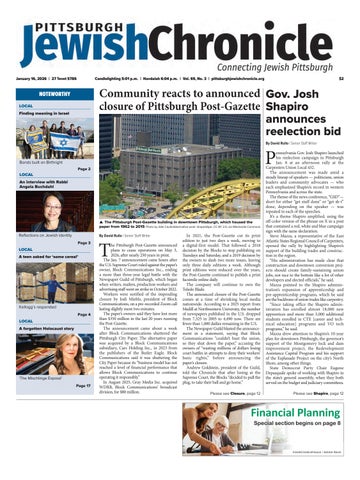
p The Pittsburgh Post-Gazette building in downtown Pittsburgh, which housed the paper from 1962 to 2015 Photo by Allie Caufieldderivative work: GrapedApe, CC BY 2.0, via Wikimedia Commons
Reflections on Jewish identity
By David Rullo | Senior Staff Writer
Page 3
LOCAL A teen asked for ‘some cereal’
Kellogg’s responded Page 4
LOCAL A forgotten Holocaust story
‘The Mischlinge Exposé’ Page 17
T
he Pittsburgh Post-Gazette announced plans to cease operations on May 3, 2026, after nearly 250 years in print. The Jan. 7 announcement came hours after the U.S. Supreme Court ruled against the paper’s owner, Block Communications Inc., ending a more than three-year legal battle with the Newspaper Guild of Pittsburgh, which began when writers, mailers, production workers and advertising staff went on strike in October 2022. Workers were notified of the impending closure by Jodi Miehls, president of Block Communications, on a pre-recorded Zoom call lasting slightly more two minutes. The paper’s owners said they have lost more than $350 million in the last 20 years running the Post-Gazette. The announcement came about a week after Block Communications shuttered the Pittsburgh City Paper. The alternative paper was acquired by a Block Communications subsidiary, Cars Holding Inc., in 2023 from the publishers of the Butler Eagle. Block Communications said it was shuttering the City Paper because its “business model has not reached a level of financial performance that allows Block Communications to continue operating it responsibly.” In August 2025, Gray Media Inc. acquired WDRB, Block Communications’ broadcast division, for $80 million.
Financial Planning
Special section begins on page 8
InsideCreativeHouse / Adobe Stock
Headlines Hillel JUC students return from Birthright Israel emboldened and connected — LOCAL— By Adam Reinherz | Senior Staff Writer
U
niversity of Pittsburgh student Owen Bauer intended to go to Israel two years ago. But when Hillel JUC’s Birthright Israel trip was canceled due to the Israel-Hamas war, Bauer, 21, had to wait. Since then, that sense of wanting to “meet new people, learn about the culture, the history and ultimately feel a lot more connected to my Jewish heritage,” remained, he said. Weeks ago, along with other Hillel JUC students, Bauer finally got the chance to go. Joining Bauer was Hannah Jarvis, 21, who said she also previously planned to travel with Birthright, but the trip was canceled because of the war. Jarvis, unlike Bauer, had been to Israel before — first on an eighth grade trip with her Philadelphia Jewish day school and later with her parents, she said. Returning as a college senior provided a different perspective. “I wanted to see Israel through more of a grown-up person’s eyes,” she said. Returning was also an “opportunity to reconnect with my Judaism.” An eclectic itinerary — including insights into history, exposure to hiking areas, an ability to volunteer and lots of eating — delighted participants, but Jarvis said she particularly enjoyed dancing in the streets of Tel Aviv. “It was probably the highlight of my trip.” Dancing runs in Jarvis’ family, “especially Israeli dancing,” she said. “My mom
p University of Pittsburgh students show their pride while visiting Israel.
Photo courtesy of Hillel JUC
introduced it to me when I was young. My aunt and I like to do it as well.” Moving through Tel Aviv’s open air gave Jarvis a feeling of “family connection that this is something that is true to my Jewish identity, and is a true connection between me and my Judaism, me and my family, and me and Israel,” she said. “It was a very special experience.” For Bauer, time in the Jewish state offered new insight. “You truly can’t fully understand a place, an event, a chain of events, unless you’re actually there in the moment, talking to people and connecting with people,” he said. “For me, one of the most rewarding parts of the trip was just connecting with Israelis
my age.” Hearing their stories and sharing his own created a sense of “common ground.” Now back from Israel, the college students are eager to share their experiences and takeaways. Safety concerns precluded an ability to go to Israel two years ago, however, “it’s never too late to do the things that you want to do,” Jarvis said. “There’s always room for building connections to the places that you love and the people that you love.” Creating engagement is a continual process, Bauer explained. What happens now, he said, “is just having conversations with friends, with family, with people that care about me and that I care about, to kind of tell them,
‘Hey, I had this amazing experience. I want to tell you about it.’” Bauer is eager to talk about what he learned, he said, “kind of the good and bad that I drew from it, and just share that with other people. I think that’s kind of the best place to start with these kinds of things.” “It’s difficult to read news headlines and try to put together everything that’s happening when you’re kind of far removed from it,” he said. “I think being able to go there and see for myself how the war has impacted the country, and also being able to see the country, and a lot of its good qualities, really just stuck with me. I feel like I can take that experience and kind of have a much fuller perspective of what Israel is like, what it’s going through, what the people are like, and have better awareness and perspective.” Dan Marcus, Hillel JUC’s executive director and CEO, called Birthright “one of the most transformative experiences a Jewish student can participate in.” When students spend time in Israel it “allows them to connect with their heritage, culture and identity in the most experiential way.” Birthright was founded in 1999 to provide free trips to Israel for young Jewish adults. To date the organization has provided more than 900,000 trips to the Jewish state. A Birthright trip doesn’t only impact a participating student — it impacts the broader community as well, Marcus said. “They come back to campus more enthused, more educated and strengthened in their Jewish identity.” PJC Adam Reinherz can be reached at areinherz@pittsburghjewishchronicle.org.
5915 Beacon St., 5th Floor Pittsburgh, PA 15217
Main phone number: 412-687-1000
Subscriptions: 412-687-1000, ext. 2 SUBSCRIPTIONS subscriptions@pittsburghjewishchronicle.org 412-687-1000, ext. 2 TO ADVERTISE advertising@pittsburghjewishchronicle.org 412-687-1000, ext. 1 EDITORIAL DEPARTMENT Email: newsdesk@pittsburghjewishchronicle.org BOARD OF TRUSTEES Evan H. Stein, Chair Evan Indianer, Vice Chair Derek Smith, Treasurer Gayle R. Kraut, Secretary Gail Childs, Dan Droz, Malke Steinfeld Frank, Karen Gal-Or, Seth Glick, Judith Kanal, Cátia Kossovsky, Charles Saul, Lynn Zelenski GENERAL COUNSEL Stuart R. Kaplan, Esq.
2
JANUARY 16, 2026
Jim Busis, CEO and Publisher 412-228-4690 jbusis@pittsburghjewishchronicle.org EDITORIAL Toby Tabachnick, Editor 412-228-4577 ttabachnick@pittsburghjewishchronicle.org Adam Reinherz, Senior Staff Writer 412-687-1000 areinherz@pittsburghjewishchronicle.org David Rullo, Senior Staff Writer 412-687-1000 drullo@pittsburghjewishchronicle.org ADVERTISING Amy Weiss, Account Executive (412) 613-0697 aweiss@pittsburghjewishchronicle.org
PRODUCTION Jeni Mann Tough Production Manager Carl Weigel Art/Production Coordinator Subscriptions subscriptions@pittsburghjewishchronicle.org 412-687-1000, ext. 2 Published every Friday by the Pittsburgh Jewish Publication and Education Foundation 5915 Beacon St., 5th Floor Pittsburgh, PA 15217 Phone: 412-687-1000 POSTMASTER: Send address change to PITTSBURGH JEWISH CHRONICLE, 5915 BEACON ST., 5TH FLOOR PITTSBURGH, PA 15217 (PERIODICAL RATE POSTAGE PAID AT PITTSBURGH, PA AND AT ADDITIONAL MAILING OFFICES) USPS 582-740
PITTSBURGH JEWISH CHRONICLE
Manuscripts, letters, documents and photographs sent to the Pittsburgh Jewish Chronicle become the property of this publication, which is not responsible for the return or loss of such items. The Pittsburgh Jewish Chronicle does not endorse the goods or services advertised or covered in its pages and makes no representation to the kashrut of food products and services in said advertising or articles. The publisher is not liable for damages if, for any reason whatsoever, he fails to publish an advertisement or for any error in an advertisement. Acceptance of advertisers and of ad copy is subject to the publisher’s approval. The Pittsburgh Jewish Chronicle is not responsible if ads violate applicable laws and the advertiser will indemnify, hold harmless and defend the Pittsburgh Jewish Chronicle from all claims made by governmental agencies and consumers for any reason based on ads appearing in the Pittsburgh Jewish Chronicle.
PITTSBURGHJEWISHCHRONICLE.ORG
Headlines Rabbi Angela Buchdahl on visiting Pittsburgh, NYC mayoral election and American Jewry — LOCAL — By Adam Reinherz | Senior Staff Writer
F
or more than a decade, Rabbi Angela Buchdahl has been nationally recognized as a leading rabbinic figure. As senior rabbi of New York City’s Central Synagogue, she has been featured in numerous media outlets, including NPR, PBS and The New York Times. Her memoir, “Heart of a Stranger,” was released several months ago, and she will visit the Jewish Community Center of Greater Pittsburgh on Jan. 25 to discuss the book. Ahead of her appearance, Buchdahl spoke with the Chronicle about her New York Times bestselling memoir, her groundbreaking career and the state of American Jewry. This interview, which was conducted over email, has been edited for clarity and length.
You’re often described as one of the most well-known American rabbis and religious leaders. What do you want Pittsburghers to know about you?
I think my path to the rabbinate is both really unlikely, as a biracial Korean immigrant with interfaith parents, and that the many incredible rabbis, Jewish educators, Jewish camp counselors, song leaders and friends played such an important role in helping raise me as a Jew. I know that the Pittsburgh Jewish community has a long and rich history, with its share of joys and hardships and I have met many wonderful people who credit the Pittsburgh Jewish community and its synagogues and camps for helping raise them as Jews also.
Your upcoming Pittsburgh talk aims to welcome a diverse audience. What do you plan on addressing, and what do you hope the takeaway is, during your time in Pittsburgh?
I hope the talk will address some of the themes of my book, which include how we talk about Jewish identity and who gets to belong, mining some of the spiritual wisdom of our rich Jewish tradition in a way that feels accessible and relevant, and talking about faith in a time when it sometimes feels challenged.
Within “Heart of a Stranger” you talk about discovering how a rabbi’s “real routine” doesn’t often align with what you initially imagined: studying ancient texts and talking about God or the meaning of life. Along these lines, what have you discovered about congregants and the Jewish people that’s different from what you initially imagined?
I love the Jewish community and it is
p Book cover
both unique and different than other communities — and I have found that it also reflects some of the same societal issues that exist in the wider culture, including overcoming traditional gender roles, racial biases, issues of equality. When we can create the vibrant, inclusive and just communities in our Jewish community, we can better learn how to impact our wider society as well.
Later in your memoir you describe a beautiful story involving a 15th-century vase your mother had given you. After the vase broke, you had it repaired. You write that the process offered you a “small but cosmic tikkun.” Imagine you’re similar to a kintsugi artisan. What fractures do you see in the Jewish community? What process and materials will you employ to achieve a similar “golden repair?”
There is no simple fix for the fractures that exist in our community. But I do think the first thing we can do is to listen across lines of difference with the goal of understanding, not just changing minds. Our tradition teaches us to approach others by giving “the benefit of the doubt,” and with a good measure of humility. We don’t have to always agree, Jews rarely do, but we can remember that there is more that unites us than divides.
One source of division involved the recent NYC mayoral election. During your sabbatical you returned to the pulpit on parsha Lecha Lecha and addressed the election. Within your sermon you mentioned, “Mayoral candidate Zohran Mamdani has contributed to a mainstreaming of some of the most abhorrent antisemitism.”
p Rabbi Angela Buchdahl
Have you been in contact with the newly elected mayor since your sermon? If so, what did you discuss? If not, what would you like to convey to the mayor?
I am heartened by the NYC mayor’s many efforts to connect with the Jewish community and to listen to concerns. I would certainly welcome engagement with the mayor on issues of importance to our community in the future.
When asked about your statements as a lead-up to the election, you’ve cited the Johnson amendment, and Central Synagogue’s policy of non-endorsement, while noting their importance for “the health of our country, our faith and this congregation.” What is your sense of the health of our country, our faith and not only the health of Central Synagogue but American Reform Judaism? And similarly, while a political endorsement may be akin to a “rabbi’s thumb on the scale,” how does refraining from endorsements not also tip the scale?
Buchdahl declined to answer the question over email but said she is “willing to answer” during the Jan. 25 talk at the JCC.
Years ago you adapted a sermon for the Forward in which you describe fielding two cell phone calls from Congregation Beth Israel in Colleyville, Texas, in 2022, where a British gunman had taken a rabbi and three congregants hostage.
Photo courtesy of Central Synagogue
After describing your sense of that experience, you end the piece with a prayer: “Blessed are you, God, who makes us captives — of hope.” Obviously much has changed in the 2500 years since the prophet Zechriah uttered the words — — and certainly in the four years since the Colleyville event. Are the Jewish people still “captives of hope” and what blessing is coming to mind now?
The past two years have been especially challenging for the Jewish community, the hardest in my lifetime. But in the scope of Jewish history, we have lived and thrived through even more difficult times. We have wisdom for addressing crises and for growing through them. I am confident we will do so again. And yes — we remain “captives of hope,” sometimes despite ourselves.
Thanks for sharing your wisdom with us. What else do you want readers to know?
I am very much looking forward to spending time with the Pittsburgh Jewish community! Registration for Rabbi Angela Buchdahl’s Jan. 25 conversation with WTAE’s Shannon Perrine is available at jccpgh.org. The $36 fee includes a copy of the book to be picked up at the event. The program is slated to run from 2 to 3:30 p.m. at the JCC’s Katz Theater in Squirrel Hill. PJC Adam Reinherz can be reached at areinherz@pittsburghjewishchronicle.org.
www.pittsburghjewishchronicle.org PITTSBURGHJEWISHCHRONICLE.ORG
PITTSBURGH JEWISH CHRONICLE
JANUARY 16, 2026
3
Headlines It didn’t hurt to ask: A teen’s letter brings 19,000 pounds of food to local pantries — LOCAL — By Adam Reinherz | Senior Staff Writer
W
ords from a child yielded 19,000 pounds of change. After Ender Lin, 13, wrote a letter to Kellogg’s on Nov. 23 seeking a donation of “some cereal” for the JFCS Squirrel Hill Food Pantry, Ender, 13, was informed that a truckload would be delivered. On Jan. 7, Ender, his mother Claire Topal and representatives of the Food Pantry and Greater Pittsburgh Community Food Bank stood inside a delivery area in Duquesne while a forklift carried 43 pallets containing 1,869 cases of Kellogg’s products. Given the quantity of food, more than 30 minutes were required to transfer items from the truck’s trailer to the warehouse. When Ender, a Community Day School student who participated in a Visions of Peace Fellowship through the Jewish Community Center of Greater Pittsburgh, sent his letter to Kellogg’s executives six weeks ago, he had little idea whether he’d even receive a response. Ender undertook a similar project for his bar mitzvah, asking spice companies to donate items to the Food Pantry. “Just like cereal, spices can really help people. They make food more flavorful, and can, like, remind people of their home,” he said. The eighth grader’s bar mitzvah request resulted in donations of containers of salt, cumin and garlic. When Ender’s JCC fellowship neared completion in November, and participants were tasked with a capstone project, he decided to build on his earlier approach. “You might be asking why cereal,” Ender wrote to Kellogg’s executives. “Cereal is important because it helps people start their day. It is part of people’s breakfast routines, and it’s good to be able to keep your routine, especially when you are struggling with finances and feeding your family.”
Meeting needs
Speaking with the Chronicle, Ender referenced Maslow’s Hierarchy of Needs, an 83-year-old theory introduced by psychologist Abraham Maslow, positing individuals adopt a bottom-up approach to meeting human needs. As for how that theory relates to a teen fellowship where participants read and discuss Jewish conceptions of peace, Ender said, “Before people can negotiate or make their lives better, they want to have food in their stomach.” It’s not just Maslow’s theory, or the communal need for food, that he learned from his mother — a JFCS board member — Ender said. It’s the idea of “helping people.” Years before the cereal arrived in Duquesne — where it will be distributed to 11 county service areas — Ender and his family opened their doors to strangers. After Russia invaded Ukraine in February 2022, Topal and her husband, Robert Lin, welcomed a family of Ukrainian parolees through Uniting for Ukraine, a program launched by then-President Joe Biden on April 21, 2022, offering up to 100,000 fleeing Ukrainians a “safe and orderly” means of entering the United States. A Jan. 20, 2025, 4
JANUARY 16, 2026
p Ender Lin stands in front of 43 pallets of donated food.
executive order from President Donald Trump paused acceptance of paperwork required to aid the program. Ender said he remembers housing the Ukrainian family. “It was really cool. They were so grateful. It was great helping them, and I liked having them around. They were so fun,” he said. Welcoming strangers, educating children or supporting food pantries doesn’t happen in a vacuum, Topal explained. “My immediate thought is Pittsburgh is just this place where things come together and things connect,” she said. “Especially the Jewish community. It’s not about a Jewish community serving the Jewish community, it’s Jewish community serving everyone.”
Young teachers
Before the first palette entered the Food Bank’s Duquesne warehouse on Jan. 7, Jesse Sharrard, director of the Food Pantry, told the Chronicle, “We realized in November that our supply of kosher cereal was starting to dwindle, and we put out a couple calls to the community asking if anybody could donate some kosher cereal, maybe some corn flakes or something like that.” Ender contacted JFCS and asked if he could reach out to different manufacturers. “I said, ‘absolutely,’ and I didn’t hear
Photo by Adam Reinherz
anything for weeks, and then all of a sudden, last week, I got a call from the Food Bank that Kellogg’s had donated an entire truckload of cereal on our behalf,” Sherrard said. Ender’s actions are “motivating,” Sherrard continued. “He is trying to figure out what he can do to help others, and how he might do things a little bit differently than others.” The adolescent’s approach is “inspiring and helps us make sure that we’re always considering new ways that we can meet the needs of the people who rely on us.” Within Allegheny County, approximately 159,700 people — one in eight residents — are food insecure, according to the Food Bank. Needs have dramatically increased, according to representatives of the organization, as prior to the recent government shutdown and a lapse in SNAP benefits, the Food Bank had never distributed a million pounds of food in one week. Since November, however, the Food Bank has distributed that amount four times. Ender’s efforts will go toward meeting growing needs; still, the Food Bank expects the 19,000 pounds of Kellogg’s products to be consumed within two to three weeks.
and arts at the JCC, oversaw the Visions of Peace Fellowship and said she was incredibly proud, not only of Ender’s accomplishment, but of his growing sense of autonomy. “Even though teens don’t have a huge amount of agency in their lives — they can’t stop a war or something like that — they can do small things that might ultimately help peace,” she said. The fellowship helped Ender appreciate that “peace is not just about not-war,” Topal said. “If you’re hungry, if you don’t have shelter, you can’t think about anything else. You can’t worry about peace until those basic needs are met.” Topal credited numerous parties for enabling such a sizable donation and called it “pretty amazing” that her son not only used his voice for others but that Kellogg’s “read a letter from a 13-year-old and responded in this way.” Before the last of the 43 palettes were transferred, Ender told the Chronicle that the lesson of it all is something most teenagers already know. “It doesn’t hurt to ask,” he said. “You never know what could happen. It could always turn out good.” PJC
Familiar next steps
Adam Reinherz can be reached at areinherz@pittsburghjewishchronicle.org.
Maria Carson, director of Jewish education
p Claire Topal and her son Ender Lin welcome 19,000 pounds of Kellogg's products to the Greater Pittsburgh Food Bank on Jan. 7. Photo by Adam Reinherz
PITTSBURGH JEWISH CHRONICLE
p Community Day School student Ender Lin and Squirrel Hill Food Pantry Director Jesse Sharrard await transport of donated food in Duquesne.
Photo courtesy of Jewish Community Center of Greater Pittsburgh
PITTSBURGHJEWISHCHRONICLE.ORG
Headlines Defendant pleads guilty to threatening Pittsburgh public official, lying to FBI — LOCAL — By David Rullo | Senior Staff Writer
E
dward Arthur Owens Jr. pled guilty in federal court to transmitting an interstate threat and making false statements to a government official. His charges stem from a May 20 incident in which he threatened an unnamed Pittsburgh public official through the Facebook messenger app. “We’re coming for you [emoji of person raising right hand] [German flag emoji] be afraid. Go back to Israel or better yet, exterminate yourself and save us the trouble. 109 countries for a reason. We will not stop until your kind is nonexistent,” Owens wrote to the official using the alias Casey Jones. The number 109 is based on an antisemitic conspiracy theory that Jews have been expelled from 109 countries. He separately sent a text to a friend asking if he was ready to “hunt down Jews for extermination.” When the FBI searched Owens’ phone, they found searches related to antisemitism as well as a search for the term “Pittsburgh Jews.” When questioned by the FBI, Owens told agents he wasn’t violent but had been “rage baited” to send the threats to the official, whom
Photo courtesy of iStock
he assumed was Jewish because of their support for the Jewish community. FBI agents asked Owens about different weapons he owned. Assistant United States Attorney Carl J. Spindler said the defendant lied about the location of his guns and his access to them, saying they were all at his mother’s home; however, when police searched his truck, they found a 9 mm pistol and hundreds of rounds of ammunition. Owens’ ex-girlfriend testified that he became angrier with Jews over time, telling her that “Jews control everything” and “Jews control the news.” The Jan.12 plea before U.S. District Judge Nora Barry Fischer came during a nearly 90-minute hearing that began with Fischer asking Owens questions about his background
and time in prison. He has been detained since his arrest. Wearing an orange prison uniform, his legs shackled, Owens said that he was 30, graduated high school in Virginia and attended vocational school studying diesel engines. Owens said he moved to Butler, Pennsylvania, to take care of his ailing grandparents before moving to Elizabeth, Pennsylvania, to live with his now ex-girlfriend. While there, Owens said that he was employed as a motorcycle salesman. The defendant told Fischer he had never attended Alcoholics Anonymous or Narcotics Anonymous, nor had he been in any form of drug or alcohol rehabilitation program. And while Owens said he did not take any anxiety medication before being arrested,
since being in prison he said he was prescribed Vistaril, an antihistamine used to treat anxiety and tension. Asked by the judge how he spent his time in prison, Owens said he had been doing “a lot of reflecting,” recounting three movements in various prison pods, sharing a cell at times with a Catholic, a Muslim and a Jewish prisoner who had been extradited from Israel. Owens said he also did the necessary background work to join the prison’s IGNITE (Inmate Growth Naturally and Intentionally Through Education) program. And while Owens wasn’t a member of NA or AA before his arrest, he said while confined he participated in informal 12-step programs organized by the prisoners. Fischer next went through a series of questions ensuring that Owens understood the charges against him and that he and his lawyer, Samir Sarna, had discussed the relevant information. As part of his plea deal, Owens agreed to forfeit all his guns, as well as two iPhones and an iPad. He is required to pay restitution, $200 in fees and serve a maximum of 27 to 33 months in prison if the deal is approved by Fischer. Owens will remain in custody pending an April 13 sentencing hearing. PJC David Rullo can be reached at drullo@ pittsburghjewishchronicle.org.
Man charged with setting fire to Mississippi synagogue targeted it due to its ‘Jewish ties,’ FBI says — NATIONAL — By Grace Gilson | JTA
T
he suspect arrested for allegedly setting fire to a Mississippi synagogue on Saturday confessed to the FBI that he had targeted the congregation due to its “Jewish ties.” Stephen Spencer Pittman was charged on Monday with maliciously damaging or destroying a building by means of fire or an explosive, according to an affidavit filed in U.S. District Court in Mississippi. The blaze, which tore through the Beth Israel Congregation, the only synagogue in Jackson, Mississippi, early Saturday morning, destroyed two of the synagogue’s Torahs as well as its library and offices. Several other Torahs belonging to the congregation were damaged, though no injuries were reported. During an interview with the FBI and local law enforcement on Saturday, Pittman confessed that he had set fire to the synagogue, which he referred to as a “synagogue of Satan,” according to the affidavit. According to social media accounts that appeared to belong to Pittman, he is originally from Madison, Mississippi, and is a baseball player at Coahoma Community College. (A student athlete profile for Pittman has since been deleted from the school’s athletics page.) An X account that appeared to belong to Pittman featured a link to a website that PITTSBURGHJEWISHCHRONICLE.ORG
p Extensive damage to the Beth Israel Congregation synagogue after an arson attack in Jackson, Mississippi, Jan. 10, 2026 Photo courtesy of Beth Israel Congregation
promotes “Scripture-backed fitness” as well as a Bible quote that read, “In all circumstances give thanks, for this is the will of God for you in Christ Jesus.” Pittman told the FBI that he had stopped at a gas station on his way to the synagogue to purchase the gas used in the fire, removed his license plates, broken a window in the building with an ax to gain entry and used a torch lighter to start the fire. The FBI discovered a cell phone and hand torch believed to belong to Pittman at the scene. Zach Shemper, the president of Beth Israel Congregation, told CNN on Monday that he had been told by law enforcement that “the
perpetrator had been posting antisemitic comments on social media.” On Saturday, Pittman’s father reported his son’s alleged arson to police after his son texted him photos of the building along with messages including, “There’s a furnace in the back,” “Btw my plate is off,” “Hoodie is on,” and “And they have the best cameras.” After Pittman’s father pleaded with him to return home, Pittman replied that he was due for “a home run” and “I did my research.” The following morning, Pittman allegedly laughed as he told his father about the arson attack and said “he finally got them,” according to the affidavit.
PITTSBURGH JEWISH CHRONICLE
Surveillance footage obtained by the FBI from within the synagogue showed the suspect appearing to pour the contents of a gas container on its floor before setting the building ablaze, according to the affidavit. Prior to the affidavit’s publication, several Jewish leaders and politicians were quick to label the arson attack as antisemitic. “A historic synagogue was burned. Sacred Torahs destroyed. We are thankful no one was injured, but this wasn’t random vandalism — it was a deliberate, targeted attack on the Jewish community,” wrote Jonathan Greenblatt, the CEO of the Anti-Defamation League, in a post on X Sunday. “An attack on any synagogue is an attack on all Jews. We will not be intimidated. We will not be silent.” Deborah Lipstadt, the U.S. special envoy to monitor and combat antisemitism under President Joe Biden, wrote in a post on X that the incident was a “major tragedy,” adding, “But it’s more than that. It’s an arson attack and another step in the globalization of the intifada.” Other politicians and Jewish leaders who labeled the attack as antisemitic included New York City Mayor Zohran Mamdani, former NYC mayor Eric Adams, New York Jewish Sen. Chuck Schumer, Florida Republican Sen. Rick Scott and Israeli Ambassador to the United Nation Danny Danon. Pittman was scheduled to make an initial court appearance this week. If convicted, he faces five to 20 years in federal prison. PJC JANUARY 16, 2026
5
Calendar Submit calendar items on the Chronicle’s website, pittsburghjewishchronicle.org. Submissions also will be included in print. Events will run in the print edition beginning one month prior to the date as space allows. The deadline for submissions is Friday, noon. q SATURDAY, JAN. 17 Music at Third presents “Under the Same Sky,” a concert for voice, piano, oboe and English horn interweaving tangos and theater music in Yiddish with fragments from the writings of Dutch Jewish diarist Etty Hillesum, featuring Raquel Winnica Young (voice/creator), Lenny Young (oboe/English horn) and Douglas Levine (piano/arrangements). 7:30 p.m. Free-will donation. Third Presbyterian Church, 5701 Fifth Ave. thirdchurch.org/musicthird q SATURDAY, JAN. 17–SUNDAY JAN. 18 In celebration of the birthday of Rev. Dr. Martin Luther King Jr., Ebenezer Baptist Church and Tree of Life Congregation will worship together on Unity Weekend. Saturday, Jan. 17 worship will take place at 9:45 a.m. at Rodef Shalom, 4905 Fifth Avenue, in Levy Hall. Sunday, Jan. 18 worship will happen at Ebenezer Baptist Church, 2001 Wylie Avenue, at 11 a.m.
$65/semester. 10:30 a.m. 1700 Beechwood Blvd. chabadpgh.com/art q SUNDAYS, JAN. 18–JULY 26 Join Chabad of Squirrel Hill for its Men’s Tefillin Club. Services and tefillin are followed by a delicious breakfast and engaging discussions on current events. 8:30 a.m. 1700 Beechwood Blvd. chabadpgh.com Join a lay-led online Parashah study group to discuss the weekly Torah portion. No Hebrew knowledge needed. The goal is to build community while deepening understanding of the text. 8:30 p.m. For more information, visit bethshalompgh.org/online-parashah. q MONDAYS, JAN. 19–JULY 27 Join Congregation Beth Shalom for a weekly Talmud study. 9:15 a.m. For more information, visit bethshalompgh.org.
q SUNDAY, JAN. 18 Join Chabad of the South Hills for Torah Tot Adventures, a monthly Jewish story hour and craft. Ages 0-5, siblings welcome. 3:45 p.m. Free, registration appreciated. 1700 Bower Hill Road. chabadsh.com/story
Join Temple Sinai for an evening of mahjong every Monday (except holidays). Whether you are just starting out or have years of experience, you are sure to enjoy the camaraderie and good times as you make new friends or cherish moments with long-term pals. All are welcome. Winners will be awarded Giant Eagle gift cards. All players should have their own mahjong cards. Contact Susan Cohen at susan_k_ cohen@yahoo.com if you have questions. $5. templesinaipgh.org
q SUNDAYS, JAN. 18–FEB. 1 Jewish Art Camp: Fun Jewish learning through the arts for ages 0 to third grade. Mommy and Me (0 to 3-year-olds and their moms), Mini Makers (4 to 5-year-olds), Master Makers (grades 1-3). Ages 0 to 5: $40/semester; grades 1-3:
Join Chabad of the South Hills for Lift Your Life, a Rosh Chodesh Society series. This month’s topic is “The Art of Managing Food and Munching for Meaning.” 7 p.m. 1700 Bower Hill Road. For more information or RSVP batya@chabadsh.com. chabadsh.com
1-800-GET-PHIL
q TUESDAYS, JAN. 20–JUNE 30 Join Beth El’s Rabbi Alex Greenbaum and his Bible/ Talmud Adult Education class for a thoughtprovoking weekly session of Bible and Talmudic study. This program is available both in person and virtually. Call the office at 412-561-1168 to receive the Zoom link or to make an in-person reservation. 10:30 a.m. 1900 Cochran Rd. bethelcong.org q WEDNESDAYS, JAN. 21–FEB. 18 Join Chabad of South Hills for its new JLI course, Captivating Cases in Rabbinic Responsa, a sixweek course on the real-life questions Jews asked sages across history. 7:30 p.m. In person or online. 1700 Bower Hill Road. chabadsh.com Join Chabad of Squirrel Hill for its new JLI course, Captivating Cases in Rabbinic Responsa, a six-week course on the real-life questions Jews asked sages across history. 7:30 p.m. $90. 1700 Beechwood Blvd. chabadpgh.com q FRIDAY, JAN. 23 Celebrate Shabbat with Chabad of the South Hills’ Mommy and Me. Celebrate Shabbat with movement, music, shape and challah. Age 0-3. 10:30 a.m. Free. 1700 Bower Hill Road. chabadsh. com/mommyandme q SATURDAY, JAN. 24 Come in your cozy pajamas for Chabad of the South Hills’ Family Havdalah PJ Party. Make your own havdalah kit, enjoy a musical havdalah featuring a s’mores and hot cocoa bar and family game show. 6:45 p.m. $5 per child. 1700 Bower Hill Road. chabadsh.com/havdalah q THURSDAY, FEB. 5 Join Rabbi Amy Greenbaum and the Beth El community for the all-virtual Beth El’s Virtual Hope and Healing
Program on the first Thursday of the month. This is a safe space to chant, breathe, pray for healing and seek peace. Feel free to keep your camera off and just listen. Call the office at 412-561-1168 to receive the Zoom link. 5:30 p.m. Free. bethelcong.org q SATURDAY, FEB. 7 Join Congregation Beth Shalom for Clues and Schmooze (with some booze), a fun trivia event, including an open bar and snacks. There will be a 50/50 raffle, so bring cash to participate. Trivia will be played with teams of three to six. Bring your own team or be matched up at the door. Must be 21 or older to participate. 7 p.m. $30. 5915 Beacon St. bethshalompgh.org/clues-and-schmooze-2026 q SUNDAY, FEB. 15 Chabad of the South Hills presents Jewish Comedy Night with Ami Kozak. Kozak’s show will blend stand-up, spot-on impressions and music. 7 p.m. $54, early bird pricing, $45 until Jan. 15. Address provided upon RSVP. Sponsored by Chabad of the South Hills, Jewish Federation of Greater Pittsburgh, StandWithUs and the Pittsburgh Jewish Chronicle. Chabadsh.com/comedy q THURSDAY, FEB. 26 Join Rodef Shalom Congregation for “Understanding Online Risks for Our Kids – What Every Parent Needs to Know,” an informative and empowering session that helps parents understand the online behaviors and trends impacting today’s teens and young adults. John Pulcastro, supervisory intelligence analyst, FBI Pittsburgh, will provide a clear, accessible overview of emerging digital risks so you can better support and protect the young people in your life. 7 p.m. Free. Rodef Shalom Congregation, 4905 Fifth Ave. jewishpgh.org/event/ understanding-online-risks-for-our-kids-what-everyparent-needs-to-know PJC
Join the Chronicle Book Club!
T
he Pittsburgh Jewish Chronicle invites you to join the Chronicle Book Club for its Jan. 18 discussion of “Unveiled,” by Jonathan Harounoff. The author will join us for the meeting. “‘Unveiled’ takes us inside the ‘Woman, Life, Freedom’ movement, sparked by the slaying of a young woman for wearing a loose hijab, in what became the most serious challenge the [Iranian] regime has faced in forty-six years. Harounoff has given us a nonfiction drama replete with heroines and villains, one that is sure to captivate readers.” –Peter Kann, Pulitzer Prize-winning foreign correspondent and former publisher, The Wall Street Journal.
Email: Contact us at drullo@pittsburghjewishchronicle.org, and write “Chronicle Book Club” in the subject line. We will send you a Zoom link for the discussion meeting. PJC — Toby Tabachnick
Your hosts
Toby Tabachnick, Chronicle editor David Rullo, Chronicle senior staff writer
How it works
We will meet on Zoom on Sunday, Jan. 18, at 1 p.m.
What to do Pittsburgh, PA
AUTO ACCIDENTS PRELIMINARY HEARINGS CRIMINAL DEFENSE, DUI 6
JANUARY 16, 2026
Buy: “Unveiled.” It is available from online retailers, including Amazon and Barnes & Noble. It is also available through the Carnegie Library system.
www.pittsburghjewishchronicle.org
PITTSBURGH JEWISH CHRONICLE
PITTSBURGHJEWISHCHRONICLE.ORG
Headlines — WORLD — Senate passes resolution decrying attacks on Jews in Boulder, Harrisburg, DC
A resolution condemning last year’s violent antisemitic attacks in Pennsylvania, Colorado and the nation’s capital passed the U.S. Senate without opposition last week, JNS reported. The measure also called on “elected officials, community leaders and civil society to speak out against antisemitism and politically motivated violence in all forms,” while reaffirming a “commitment to protecting the rights of all individuals in the United States to assemble peacefully and practice their faith without fear of violence.” “Protecting my friends and neighbors, and all Jewish people across the country, must be a national priority,” stated Sen. Dave McCormick of Pennsylvania. McCormick and Pennsylvania’s senior Sen. John Fetterman introduced the measure in June after a firebomb that month against participants at a rally in Boulder, Colorado, calling for the release of Israeli hostages captured by Hamas on Oct. 7, 2023; the shooting deaths of two Israeli embassy staffers in Washington in May outside the Capital Jewish Museum; and an arson attack in April, during Passover, at Pennsylvania Gov. Josh Shapiro’s residence in Harrisburg. “These appalling attacks on our Jewish communities are not isolated events,” Fetterman stated at the time. Pennsylvania’s senators were joined by 39 Senate colleagues, who co-sponsored S. Res. 288.
Qatar is biggest foreign funder of US colleges, per Education Department
Qatar has been the largest source of foreign funding for U.S. higher education institutions, according to data displayed in a new U.S Department of Education portal, JNS reported. The portal, which went live on Jan. 2, explains that, under Section 117 of the Higher Education Act of 1965, federally funded universities are required to disclose, twice annually, any gifts and contracts from a foreign source that are worth at least $250,000 in a calendar year. Rep. Tim Walberg (R-Mich.), chair of the House Education and Workforce Committee, told JNS that “our college campuses are being flooded with foreign cash, but every single dollar given by our adversaries comes with strings attached.” “America’s adversaries exploit these financial ties to steal research, spread divisive propaganda, push indoctrination and undermine free speech,” Walberg said. According to the dashboard, Qatar was the source of around $6.6 billion to U.S. universities, followed by Germany ($4.4 billion), England ($4.3 billion), China ($4.1 billion), Canada ($4 billion) and Saudi Arabia ($3.9 billion). Of the schools that received funds from Qatar, Cornell University topped the list with $2.3 billion, followed by Carnegie Mellon University ($1 billion), Texas A&M University ($992.8 million) and Georgetown University ($971.1 million). “In particular, this portal already shows huge amounts coming in from Qatar,” Marcus told JNS. “It is hard to imagine that this amount of money doesn’t imply some amount of influence, and it’s fair to ask what kind of influence Qatar is obtaining in exchange for its money.”
Today in Israeli History — ISRAEL — Items are provided by the Center for Israel Education (israeled.org), where you can find more details.
Jan. 16, 1948 — Arab troops kill convoy of 35
All 35 Haganah soldiers in a convoy bringing supplies on foot to the blockaded Gush Etzion settlements are killed in a day of fighting with Arab troops. Nearby British troops choose not to intervene.
Jan. 17, 1986 — Israel, Spain establish diplomatic ties
Spain becomes the last Western European nation to open formal diplomatic relations with Israel, a condition for Spain to gain admission to the European Community, the precursor to the European Union.
Jan. 18, 1974 — Egypt, Israel separate forces with U.S. guarantees Israel and Egypt sign a U.S.-brokered and -guaranteed agreement to create a U.N. buffer zone between their forces in the Sinai Peninsula. Israel and the United States sign a related memorandum of understanding.
p IDF Chief of Staff David Elazar addresses the media at the signing ceremony for the disengagement agreement Jan. 18, 1974.
By Ya’acov Sa’ar, Israeli Government Press Office, CC BY-SA 3.0
PITTSBURGHJEWISHCHRONICLE.ORG
Jan. 19, 1990 — Resolution 242 author Arthur Goldberg dies
Arthur Goldberg dies in Washington at 81. He left the U.S. Supreme Court to become the ambassador to the United Nations in 1965 and helped draft Security Council Resolution 242 after the June 1967 war.
Jan. 20, 1942 — Nazis plan “Final Solution” at Wannsee
Convened by Gestapo head Reinhard Heydrich in the Berlin suburb of Wannsee, Nazis draft the plans for the “Final Solution” to European Jewry through deportation to deadly labor camps and mass murder.
Jan. 21, 1882 — BILU founding launches First Aliyah
BILU, whose name comes from Isaiah’s “Beit Yaakov lekhu venelkha” (“House of Jacob, let us go”), is founded by 30 students in Ukraine, setting the groundwork for the First Aliyah of Zionist immigration.
Jan. 22, 2013 — 19th Knesset is elected After the dissolution of the Knesset over a budget dispute in October, Israel votes for the 19th Knesset. The right wing loses seats, largely to the new Yesh Atid, but Prime Minister Benjamin Netanyahu remains in power. PJC
Overall, the data shows that the value of contracts and gifts from all foreign countries has been $62.4 billion to 527 U.S. colleges and universities.
Cooper Union settles Title VI antisemitism case with 10 Jewish students who were barricaded in library after Oct. 7
The Cooper Union has settled a Title VI case of antisemitic discrimination dating back to a highly publicized incident in which Jewish students were trapped in a school library by protesters after the Oct. 7, 2023, attacks, JTA reported. The Manhattan engineering college agreed to pay an unspecified sum to 10 affected Jewish students, create a Title VI coordinator position who will monitor cases “including discrimination or harassment based on antisemitism or anti-Zionism,” and ban masks at protests. “This landmark settlement is the result of the extraordinary courage of the students who came forward to demand accountability from Cooper Union,” Ziporah Reich, an attorney with the pro-Israel legal group The Lawfare Project, said in a statement announcing the settlement. The Lawfare Project sued the school on behalf of the Jewish students. In a statement, Cooper Union’s president Steven W. McLaughlin said the settlement “reflects our ongoing commitment to maintaining a campus where every student in our community feels respected, safe, and included.” In the immediate weeks after Oct. 7, The Cooper Union was one of the first colleges thrust into the national spotlight for alleged antisemitic behavior on campus. Viral video showed Jewish students having barricaded themselves in the campus library for 20
In honor of Hebrew Language Day, Israel’s Academy of the Hebrew Language conducted its “Word of the Year” survey, with the Hebrew word habayta (“homeward”) coming out on top, JNS reported. Hundreds of suggestions were submitted in advance, from which 10 words were selected to compete for the title, according to the Academy. Thousands voted on the Academy’s website, choosing “Homeward” as the most deserving Hebrew word of the year. The word “symbolizes for many the return of most of the hostages to their homes — after two harrowing years of pain and waiting,” wrote the Academy. “Throughout this period, the word surfaced repeatedly in public discourse and even stirred hearts in a song that became one of the symbols of the struggle and the hope,” it continued. It also “represents the return — and the aspiration to return — to the communities of the Gaza border region and to the northern communities,” according to the statement. “Artificial intelligence” (bina melachutit) came in second place, followed by “hope” (tikvah). PJC — Compiled by Toby Tabachnick
412-421-1015 412-421-4450 FAX 412-421-4451
PRICES EFFECTIVE SUNDAY, JANUARY 18 – FRIDAY, JANUARY 23, 2026 Candle Lighting Time Friday, January 16, 2026 • 5:01 p.m. MEAT
WINE SPECIALS
RAW DECKLE PASTRAMI
BARON HERZOG WINE
$
9
.79 .6
LB
MEAL MART CHICKEN NUGGETS
21.99 4 LB
$
.6
HOURS
10.99
Check Out Our Instagram Account!
TEPERBERG IMPRESSION WINE
STORE HOURS
$
750 ML
17.99
Sunday • 8 a.m. – 6 p.m. Monday • 8 a.m. – 6 p.m. Tuesday • 8 a.m. – 6 p.m. Wednesday • 8 a.m. – 6 p.m. Thursday • 8 a.m. – 8 p.m. Friday • 8 a.m. – 3 p.m.
GROCERY
COOKED FOODS
DELI
LIEBER'S PASTA PIZZA SAUCES $ .99
SPLIT PEA SOUP $ .99
SPANISH EGGPLANT $ .99
LIEBER'S MILK CHOCOLATE RICE CAKES $ .79
GARLIC MEATBALLS $ .19
A&H LEAN CORNED BEEF $ .19
SPAGHETTI
KALAMATA OLIVES $ .29
STIR FRY STRIPS
$
13
.39
3
1
4
By Kobi Gideon, Israeli Government Press Office, CC BY-SA 3.0
Israelis vote ‘homeward’ Word of the Year amid hostages’ return
1916 MURRAY AVE. PITTSBURGH, PA 15217
.6
LB
EA
1 OZ
REKO PIZZELLE ASSORTED VARIETIES $ .49 p Likud supporters in Tel Aviv await election results Jan. 22, 2013.
minutes while pro-Palestinian protesters pounded on the doors and shouted slogans. Under President Joe Biden, the Department of Education opened a Title VI civil rights investigation into the school. The Jewish students separately sued the school over their treatment, a suit The Cooper Union attempted to have thrown out. Last year a judge ruled the lawsuit could continue.
5.25 OZ
KOSHER TASTE CRUSHED GARLIC CUBES $ .79
2
16 OZ HOMEMADE SALADS & SOUPS DELI PARTY TRAYS
PITTSBURGH JEWISH CHRONICLE
$
750 ML
9
11
$ .99
5
QT
LB
LB
FRIED CHICKEN THIGHS & DRUMSTICKS $ .99
7
LB
7
LB
20 8
$
LB
LB
NOVA .99
31
LB
We Prepare Trays for All Occasions
CATERING SPECIALISTS DELICIOUS FRIED CHICKEN
UNDER THE SUPERVISION OF VAAD OF PITTSBURGH
WE RESERVE THE RIGHT TO LIMIT QUANTITIES.
JANUARY 16, 2026
7
Financial Planning Liquidity strategy for 2026 and beyond Guest Columnist Lee Oleinick
A
s equity markets continue to hover near record levels, many investors and families are feeling a sense of optimism about their financial outlook. While that optimism may be warranted, the importance of maintaining a thoughtful liquidity strategy in addition to an investment portfolio should not be overlooked. For those who may not have a strategy already in place, recent market strength may be an opportunity to build liquidity for 2026 and beyond. A liquidity strategy is a pool of easily accessible and generally low-risk assets, intended to serve as a practical buffer, enabling individuals and families to maintain their lifestyle and meet expenses through life’s transitions. By setting aside resources to cover both anticipated and unanticipated expenses, investors can create a cushion that allows them to navigate changes with greater confidence. Liquidity strategies are not intended to maximize returns; rather, they should provide stability and access to funds when needed, ensuring that decisions can be
made thoughtfully rather than under pressure. Outlined below are some of the major components and considerations of a well-executed liquidity strategy:
spending, such as travel or home improvements. Conversely, be prepared to delay or reduce certain expenses when prudent, helping to preserve other investment assets for the long term.
For those in their working years
Regular review and updates
• Emergency fund: Maintain an emergency fund covering six to 12 months of expenses to provide reassurance during unforeseen events. • Major expenditures: If you anticipate significant expenses — such as a home purchase — consider earmarking additional funds to cover these needs.
For those approaching or in retirement
• Liquidity buffer: Set aside three to five years of planned portfolio withdrawals. This helps support spending needs without requiring adjustments to your investment strategy in response to short-term market movements.
Building and maintaining your liquidity strategy
• Asset selection: Prioritize capital preservation. Savings accounts, money market funds, certificates of deposit (CDs), high-quality bonds, and access to low-interest borrowing can all play a role in providing necessary stability. • Flexibility: When markets are strong and your financial plan supports it, consider setting aside additional funds for discretionary
To ensure your liquidity strategy remains aligned with your goals and circumstances, follow these steps: • Review annually: Set a reminder to review your liquidity strategy at least once a year. • Update after major life events: Reassess your needs after significant changes, such as a new job, retirement, or major purchases. • Checklist for review: o Are your spending plans up to date? o Have you anticipated any major expenses in the coming year? o Does your liquidity buffer still cover the recommended period (six to 12 months for working individuals, three to five years for retirees)? o Are your assets still appropriate for capital preservation? • Family and advisor discussions: Open discussions with family members and your financial advisor can offer valuable perspective and support ongoing adaptation as circumstances change. A well-considered liquidity strategy is less about predicting the future or reacting to the
current market environment, and more about being prepared for any outcome. Through sound planning and regular review, you can help ensure your financial security and maintain the freedom to pursue your goals — regardless of what the market brings in 2026 and beyond. PJC Lee Oleinick is a financial advisor with UBS Financial Services Inc., a subsidiary of UBS Group AG. Member FINRA/SIPC in 600 Grant Street, Suite 4650 Pittsburgh, PA 15219. The information contained in this article is not a solicitation to purchase or sell investments. Any information presented is general in nature and not intended to provide individually tailored investment advice. The strategies and/or investments referenced may not be suitable for all investors as the appropriateness of a particular investment or strategy will depend on an investor’s individual circumstances and objectives. Investing involves risks and there is always the potential of losing money when you invest. The views expressed herein are those of the author and may not necessarily reflect the views of UBS Financial Services Inc. Neither UBS Financial Services Inc. nor its employees (including its financial advisors) provide tax or legal advice. You should consult with your legal counsel and/or your accountant or tax professional regarding the legal or tax implications of a particular suggestion, strategy or investment, including any estate planning strategies, before you invest or implement.
Hebrew Free Loan Association of Pittsburgh To Visit Our Website & Apply click the QR code
The Hebrew Free Loan Association of Pittsburgh is a nonprofit that supports financial stability and advances opportunities for people in our region by providing nonsectarian, interest-free loans.
HFLA is a special financial resource for our community that provides interest-free loans up to $10,000. If you live in Allegheny or a surrounding county, have an income that is less than twice the area median income, and need a hand-up with an interest-free loan in one of the following areas, please apply!
8
Small business
Home related
Life cycle events
Vehicle related
Tuition & daycare
Legal or taxes
Health & wellness
Credit card debt
...And more!
JANUARY 16, 2026
PITTSBURGH JEWISH CHRONICLE
Shani Lasin
Amanda Hirsh
Board President
Executive Director
We are thrilled to introduce our full-time Program and Loan Coordinator who is ready to help! Visit our website or contact her to get started!
Maureen Quinn 412-422-8868 hflapgh.org PITTSBURGHJEWISHCHRONICLE.ORG
We Prepare & E-File Your Federal, State & Local Tax Returns:
PROFESSIONAL INCOME TAX PREPARATION SERVICE
• Individuals • Estates In-Person or Virtual
• Partnerships • Self-Employed
Stephen Cohen Keystone By Design
412-421-3999
NOTEWORTHY LOCAL
Safety skills
for seniors
Self-defense
in the South
LOCAL
Celebrating
9:09 p.m.
| Vol. 68, No.
org hjewishchronicle.
32 | pittsburg
utes e shared, trib Jewish prid Maccabi Campus paid at JCC ng Ceremonies Games Openi
Candlelighting
14 Av 5785
Hills
culture and
8:08 p.m.
| Havdalah
We Help Maximize The New Tip & Overtime Deductions
taxpreparationpittsburgh.com stevec@keystonebydesign.com
Get the news.
Then get the full story.
$2
| August 8, 2025
• Cryptocurrency • PA Rent/Property Tax Rebate
Pittsburgh e rabbi’s hom targeted by anti-Israel vandal
For home delivery, call 412-687-1000, ext. 2
Page 2
tradition sign in support Fellman’s ed. In the Rabbi Daniel the sign recently vandaliz of Israel was he’s had to replace stolen. after it was last two years, dozen timescourtesy of Daniel Fellman Photo nearly two
Israel Day
WORLD
at EKC Page 3
writer | Senior Staff Aug. 4 By David Rullo dance on Tucker to Reinherz surprised r Montana Photo by Adam Fellman wasn’t media influence Campus Games. abbi Daniel With Israel” join social JCC Maccabi “We Stand of teen athletes ies of the to find his again.” Jewish ed the morning who dance Opening Ceremon inside the sign vandaliz a frequent target of we are people during the , delivered Events Writer has been Tucker’s remarks h’s Petersen | Senior Staff July 31. It ty of Pittsburg the By Adam Reinherz were among
R
Universi yard since on Aug. 4, more attacks. had that sign in the ended in dance. Center in Oakland terrorist imploring “We’ve Oct. 7, 2023, speeches night of speeches 2,000 teenage nearly a series of to both promote first rally (after Hamas’ Fellman, senior rabbi Maccabi the By design, participants said two at the JCC the spirit of than 3,000 attack in Israel),” “That was almost Jewish athletes promise of joy and embrace it 20 Sinai. fulfilled the upon Jewish Games. n of Temple and we’ve had to replace Campus Games Mia Schem, who North America ago, Maccabi in 1982 as a the years declared, “We former hostage a vandal Established competition, to 25 times.” Hamas captivity first time, though, -style sporting are the signature g a release from This was the on Olympic one displayin again.” Games with inked dance athletes, sign will JCC Maccabi which Schem switched the young Jewish Those words, date Oct. 7, 2023, were summer event for president a new, Hermann, er the different message. David recently placed at the her arm with social media influenc to according to Barak Association of North said he had 4 hostage Evyatar looked on Fellman he Page by JCC Update address his yard. When the morning referenc ed CEO of the during her clean sign in ies of and the door Montana Tucker Opening Ceremon nearly 500,000 sign on his way out America. the his fresh, unsoiled he inception, its noticed EDUCATION sign. Games, he attendees of Games. Since Campus ted in the of July 31, for an older, dingy had have participa who fought the JCC Maccabi replaced with Back to School Maccabees t sign was the word “Israel,” someone e,” ago, to youth “From the s of years of vice presiden “Genocid said. place senior read thousand In the that Cohen, survived With our freedom d her own taped a piece of paper Samantha ”We Stand rents who you , describe tennis sign to read, our grandpa every single one of of JCC Maccabi ago as a British altering the to Maccabi of us in here experience 25 years Holocaust, tonight, all Genocide.” on her first said. embarking spirit,” she standing here page 16 so player Vandalism, proof of that are doing ce. Please see are living come here and experien 16 who’ve connect to Those Maccabi, page compete, but Please see world that “not just to to show the that celebrate and stronger than ever, and Page 8 is Special section Jewish spirit
'A shell of
himself'
A
SPONSORED CONTENT
Preview Fall gArts August 22 Comin
ABERNETHY, HAGERMAN & MILLER Alina / Adobe
Stock
NOTE: NEW SQUIRREL HILL OFFICE LOCATION TO BE ANNOUNCED SOON!
TIPS AND TRICKS FOR SMALL ESTATES When someone has died leaving behind assets to go to others, we call that property an estate, along with the process of transferring that property to whoever is going to get it next. Sometimes, especially for larger estates, the process involves probate estate filings and official legal paperwork. For some small estates, with the right know-how, it can be easier to transfer the property without that legal paperwork. Assets that are left behind with a named beneficiary or surviving co-owner, are called nonprobate assets. They can go directly to the named beneficiary or survivor, without any probate court paperwork, because of the signed written instructions made by the decedent during their lifetime. That’s easier.
People often think of trying for the most efficient future transition by getting their kids’ names, or someone else’s names on everything that they own, so it goes to them automatically. (Not everything has its title written down somewhere. The “stuff” in my house has no title registered in Harrisburg or downtown.) Sometimes that works great, sometimes it’s not a good idea. For example, if my kid is in trouble, insolvent, or in jail, I don’t want their name on my property. If I have 12 kids, I can’t really put 13 different names on everything. Assets that are left behind without any named beneficiary or surviving co-owner – owned in the name of the decedent only – require some legal PITTSBURGHJEWISHCHRONICLE.ORG
paperwork in order to transfer and access that property. That’s because there are no such signed written instructions by the decedent, attached to that property, to say who it should go to. We call those probate assets and they go through the clerical, legal paperwork process that we call probate. As I’ve written before in this space, probate’s not a horror or a nightmare, it’s just paperwork. Nonetheless, it’s easier if you can avoid it and not have to do it.
How about when there’s only a smaller estate, and a smaller amount of value involved? For example, sometimes a check arrives payable to the decedent, that you can’t easily deposit or cash. Two tips: if there’s still a joint account open with the decedent’s name on it, you can often successfully deposit it there. Or you can ask the payor to reissue the check to the survivor(s).
If there is less than between $10,000-$20,000, we can sometimes use the simplest of all approaches with the least amount of paperwork and hassle. If there’s less than a certain amount on deposit in a bank or similar institution, you can go in with the death certificate and a paid or unpaid funeral bill, and the bank is supposed to release the money to family members, starting with the closest relatives. That maximum amount is about to change, in late January, from $10,000 up to $20,000 total on deposit at that bank. I say the bank is “supposed to” release the money, because there is often a gray area in terms of how each bank interprets the requirements as to, e.g. an unpaid funeral bill. But that limit is unchanged in trying to claim wages or employee benefits, or the balance of a patient care account, both at up to $10,000, or life insurance, still limited to up to $11,000. PITTSBURGH JEWISH CHRONICLE
Pennsylvania unclaimed property can be claimed this way and that limit is also going up from $11,000 to $20,000. Effective dates vary for each of these different changes. But what if there’s more than the allowable limit? If there’s still less than $50,000 in probate property with no beneficiary and no real estate, we can use the tool called “Petition for Settlement of a Small Estate.” It involves preparing a Petition or written request to a Judge in court, that explains the circumstances and asks for an Order of Court to the bank or whoever is holding the money or property, to release it to the proper recipients. It can still be a substantial undertaking. but in my experience it usually saves a little bit of resources, i.e. time, energy and money, compared to a fullscale probate and appointment of an Executor or Administrator.
Finally, what if there is even more than $50,000 of probate assets without any beneficiary, or real estate involved, too? Then we are required to open a regular probate estate, with the appointment of an Executor or Administrator to be in charge of all the decisions, filings, etc, That’s when the vast majority of people choose to hire an attorney to help guide them through these unfamiliar legal procedures.
mhm@a-h.law NEW FIRM MAIN OFFICE 3960 William Flinn Highway (Route 8) Allison Park, PA 15101 10 minutes closer to town! (412)486-6624 • We make house calls JANUARY 16, 2026
9
Financial Planning Because ‘I’ll deal with it later’ isn’t a strategy: 10 money moves for the New Year Guest Columnist Ari Goldberg
A
new year means two things: (1) We promise to improve our lives, and (2) we pretend we’ll actually stick to those promises this time. Don’t worry, you’re not alone. So, pour a hot coffee, find a comfy seat and enjoy these lighthearted but genuinely helpful financial planning resolutions for the year ahead.
1. Revisit your financial plan
You know that folder marked “Important Documents”? The one sitting under three PTA notices, a stack of kids’ drawings and a fundraising letter you swear you’ll respond to? That one. It’s time to open it. Life doesn’t stay still. Kids grow, jobs change, markets zig when you expect them to zag. Reviewing your financial plan annually keeps everything aligned and gives you peace of mind. Even a quick check-in helps ensure your goals, risk level and cash flow still make sense for your actual life today. If you don’t have a financial plan, well then it might be time you reach out to a professional who can help you develop one.
2. Build an emergency fund
Protect your data with Veeam & Wasabi Protect your business from threats like ransomware and hardware failures. Veeam backs up your servers, while Wasabi keeps those backups in reliable cloud storage. FSA Consulting configures and manages it all, so your data stays accessible and recoverable when you need it most.
Contact Us
fsaconsulting.us | (412) 228-3100
10
JANUARY 16, 2026
Every family needs a cushion for the unexpected — like when the water heater quits, the car starts making “that noise” again, or your kid announces he needs 12 poster boards for a project due tomorrow. The classic goal is three to six months of expenses. If that feels about as achievable as running a marathon, start small. Even $25 or $50 a month matters. In Judaism, we value gradual improvement — it’s why we light one candle on the first night of Chanukah and work our way up. Financial progress works the same way.
3. Track your spending
Most people don’t blow money in huge, dramatic ways. Instead, spending leaks out in tiny drips: forgotten subscriptions, impulse buys, the extra items that sneak into your Costco cart when you’re not looking, etc. A quick spending review can reveal where your money is actually going versus where you think it’s going. No guilt required. Look at your recent credit card statement and see if you can identify some routine charges that are no longer serving you. The point isn’t perfection — it’s awareness.
4. Increase retirement contributions
The limits usually rise each year, which makes January the perfect time to bump up your 401(k) or IRA contributions — even by 1%. It’s painless, barely noticeable in the moment and surprisingly significant in the long run. While you’re at it, revisit your investment allocation. If your portfolio still reflects whatever you chose during onboarding 12
PITTSBURGH JEWISH CHRONICLE
years ago because someone promised free lunch, it might be time for an update.
5. Get ahead on taxes
There’s no spiritual benefit to waiting until April 14 to frantically look for documents in a shoebox. Real tax planning happens early. Review your withholding, charitable giving strategy, expected deductions and whether moves like tax loss harvesting or Roth conversions make sense this year. Your future self — sitting calmly in April instead of muttering “why didn’t I do this earlier?” — will appreciate it.
6. Review insurance coverage (chicken soup for your finances)
Insurance isn’t glamorous, but it’s essential. Think of it as financial chicken soup: comforting, practical, not exciting, but absolutely what you want when life gets unpredictable. Life, disability, home, auto, liability — give them all a once over. And check your beneficiaries, especially if your family has grown (or if you’d prefer certain relatives not to benefit).
7. Make a plan for debt
Whether you’re using the “snowball” method, the “highest interest first” method, or the more traditional “look at the bill and sigh dramatically” method, having a plan matters. Even one extra payment a year helps.
8. Update your estate plan
Estate planning isn’t about being morbid — it’s about being organized. Wills, powers of attorney, health care directives: These documents make life easier for the people you care about. Think of it like labeling everything before a big family meal. Everyone knows what’s what, and things run smoothly without arguments.
9. Keep learning about money
Commit to a bit of ongoing financial education. Nothing intense — just articles, podcasts, workshops, or conversations with a trusted adviser who offers coffee. Understanding your finances builds confidence, and confidence makes everything easier.
10. Align your money with your values
In the end, money isn’t just math — it’s meaning. Does your spending reflect your priorities? Your family’s needs? Your identity and values? If yes, yasher koach. If not, this new year is the perfect opportunity to realign. I hope you found these resolutions at least somewhat helpful and entertaining. If there are any that resonate with you and you don’t know where to begin, then feel free to reach out. I’ll provide the coffee. Best wishes in the new year! PJC Ari Goldberg is a financial adviser with Baird and specializes in financial planning for individuals, families and small businesses. He can be reached at 412-633-1739 or ALGoldberg@rwbaird.com. PITTSBURGHJEWISHCHRONICLE.ORG
How do I retire the way I want? Confidence starts with a plan A longer life expectancy and rising healthcare costs could jeopardize the retirement you always imagined. We can help you be more confident you’re on track for the retirement you want, through a clear plan that we create, together. For some of life’s questions, you’re not alone. Together we can find an answer.
Walnut Wealth Management Group UBS Financial Services Inc. 600 Grant Street Suite 4650 Pittsburgh, PA 15219-2709 412-665-9914 800-633-1245
Lee Oleinick Managing Director Financial Advisor 412-665-9914 lee.oleinick@ubs.com
Chris Butsko Senior Vice President Financial Advisor 412-665-9918 christopher.butsko@ubs.com
Jack Greenberg, CFP®, CEPA® Vice President Financial Advisor 412-665-9911 Jacob.greenberg@ubs.com
Andrew Oleinick, CFP® Financial Advisor 412-665-9902 andrew.oleinick@ubs.com
advisors.ubs.com/walnut As a firm providing wealth management services to clients, UBS Financial Services Inc. offers investment advisory services in its capacity as an SEC-registered investment adviser and brokerage services in its capacity as an SEC-registered broker-dealer. Investment advisory services and brokerage services are separate and distinct, differ in material ways and are governed by different laws and separate arrangements. It is important that you understand the ways in which we conduct business, and that you carefully read the agreements and disclosures that we provide to you about the products or services we offer. For more information, please review the client relationship summary provided at ubs.com/relationshipsummary, or ask your UBS Financial Advisor for a copy. For designation disclosures visit ubs.com/us/en/designation-disclosures.html. © UBS 2026. All rights reserved. UBS Financial Services Inc. is a subsidiary of UBS Group AG. Member FINRA/SIPC. D-UBS-449424BF
PITTSBURGHJEWISHCHRONICLE.ORG
PITTSBURGH JEWISH CHRONICLE
JANUARY 16, 2026
11
Headlines Closure: Continued from page 1
He called the decision “pure retaliation,” saying that it will “punish dozens of local journalists and news workers, as well as the city of Pittsburgh and all of western Pennsylvania.” The paper’s closure, Goldstein said, was just the latest in a string of poor decisions by the Blocks, including “running a racist editorial on MLK Day in 2016, declaring an impasse and changing our health care in the middle of COVID, taking health care from the production unions that caused the strike to happen. Time and again, they’ve made the worst decisions possible.” The closure will leave the city, ranked 27 in the United States for its media market size, without a daily newspaper. Andrew Conte, director of Point Park University’s Center for Media Innovation and author of “Death of the Daily News: How Citizen Gatekeepers Can Save Local Journalism,” called the announcement a “seismic event” for the city. “It’s the disruption of local news that we’ve seen over the last 10 years that has had an impact, not just in the way people interact with information but the ways they connect with one another,” he said. Conte said the region was still grappling with the loss of the City Paper when the Post-Gazette announcement was made. The area’s other large newspaper, the Tribune-Review, based in Westmoreland Conty, recently announced it was cutting its print edition from seven to five days a week, he noted. The Post-Gazette’s announcement and the current atmosphere for print publications, Conte said, shows that even in a competitive environment, there’s value in publications collaborating. “News organizations realize that it’s better for themselves to work with other news organization,” he said. “More importantly, it’s better for the community.” The Southwestern Pennsylvania chapter of Press Forward, a national initiative that works to strengthen communities by supporting local news, said the impending
p Cover of the Jan. 8 issue of the Pittsburgh Post-Gazette
closure of the Post-Gazette is “disheartening,” and “underscores the fact that supporting local news matters.” “Strong communities depend on strong local news,” Press Forward said in news release. “Local news connects neighbors, holds leaders accountable, and gives people the information they need to make informed decisions. At a time when trust in many institutions is eroding, local news remains a unifying source of reliable community information.” Ann Belser is the publisher of Print, a community newspaper focused on the city’s East End. She worked at the Post-Gazette for 24 years, beginning in 1994. She said that the paper’s demise will have a ripple effect on media in the region. “TV has depended on newspapers for many years,” she said. “A reliable local newspaper gives us all a base of facts to work from.” Pittsburgh, Belser said, has always been a “media city,” but the way people get information has changed over the last few years, leading to disruptions in newspaper publishing. As a former employee, the paper’s demise, Belser said, feels like receiving news that an ex-spouse has a terminal disease. “I’m not really in touch with the P-G. I’m not
Screenshot
reliant on it for anything. It’s not in my everyday life, but I remember the good times,” she said. Another former Post-Gazette employee, Chuck Finder, said in an email that the paper’s announced closure should “sadden any Pittsburgher, any reader of Western Pennsylvania-related news, anyone with a history in this region that the Pittsburgh PostGazette may soon cease.” “To the Jewish community,” Finder said, the Post-Gazette was “an independent voice that was respectful, if not a friend, for so long.” Finder pointed to the paper’s headline following the Pittsburgh synagogue shooting as a moment when the Post-Gazette embraced the community in a meaningful way — it printed the first four words of the Mourner’s Kaddish in Hebrew on its front page following the funeral for the massacre’s last victim. “That Kaddish banner headline for the Pittsburgh synagogue shooting made every Jew and Hebrew-reader weep who saw it,” Finder said. “Still does it to me.” The paper earned its third Pulitzer Prize for its coverage of the shooting. Pittsburgh attorney Jeff Pollock said his relationship with the paper began in elementary school, when he would read it cover to cover.
Shapiro: Continued from page 1
He highlighted Shapiro’s investment in public education while governor and his work in public safety. “We have a lot of work to do,” Depasquale said. “We have a chance to expand our state house majority, flip the state senate and make Donald Trump a lame duck.” Pittsburgh Mayor Corey O’Connor emphasized the new Pittsburgh International Airport and Shapiro’s support as the city prepares to host the NFL draft — including Market Square’s redevelopment, the creation of Arts Landing and work at Point State Park. “He’s a great leader and a great partner,” O’Connor said. Allegheny County Executive Sara Innamorato spoke of the assistance provided by the governor when Allegheny County experienced power outages due to windstorms. “He really unlocked resources to make sure that we could rebuild and that we could care for our neighbors in need,” she said. The governor, Innamorato said, showed up after the explosion at the U.S. Steel plant in Clairton when two workers were killed. “He met with the families, he met with the workers,” she said. “He offered condolences and comfort at a really difficult time.” The county executive said Shapiro also supported job creation, helping the region 12
JANUARY 16, 2026
p Gov. Josh Shapiro
Photo courtesy of shapriodavis.org
transform to a “new clean tech economy.” Lieutenant Gov. Austin Davis, a McKeesport native, was the penultimate speaker. He spoke of his relationship with the governor and also announced his intention to seek a second term. While speaking of divisions across the country, Davis said Pennsylvania has sought a different path. “We put progress over partisanship, compassion over division and solutions that work above all else,” he said. “We’ve shown leadership that expands opportunity instead of restricting it, leadership that fights with hope not fear, leadership that gets sh-t done.”
Shapiro, who is Jewish, is widely regarded as a potential candidate in the 2028 presidential primary. He and his family were targeted in an antisemitic arson attack at his residence in April 2025, carried out by an anti-Israel activist after a Passover seder. The governor supported Israel during its war against Hamas but has been critical of the Jewish state’s Prime Minister Bejamin Netanyahu. Shapiro said that residents of Pennsylvania share more similarities than differences. “Most Pennsylvanians want the same few things,” he said. “They want good schools for
PITTSBURGH JEWISH CHRONICLE
“It helped my vocabulary skills, kept me apprised of all the latest news about my favorite sports teams, gave me chuckles from the comics, and always allowed me to be up to date with current events in the local section,” he said. Pollock continues to cut out cartoons or clip other items from the paper he wants to share with a friend, he said, viewing it as more personal than forwarding an attachment in an email. “An educated person is a person who keeps abreast of the topics du jour from multiple viewpoints,” he said. “I have been disappointed with the bias and poor grammar of journalism over the recent past, but I could not have become a moderate, well-informed, balanced, involved citizen without it.” Cheryl Moore said she was “shocked, but I think that I probably shouldn’t be.” She noted that the paper’s demise has been a “logical progression.” Moore questioned how a “major” city could have “innovation, discovery, creativity, vitality,” without a newspaper of record, noting the importance of the Post Gazette’s investigative journalism holding officials accountable, as well as its government, arts, real estate and sports reporting. “Embarrassing. Sad. Foreboding,” she concluded. Goldstein said he isn’t sure what will happen to the paper now that its closure has been announced. “We’re not taking this lying down,” he said. “I’m not giving up hope just yet and I don’t think anyone should. We are working on our own to find potential solutions outside of the Block media company. We are exploring legal options, as well.” And while the paper’s announced closure has left a hole in the media landscape that will be discussed by media pundits and those interested in what the loss of “the first newspaper west of the Allegheny Mountains” will mean for the region, for others the absence is more basic. “How will I find out about obits that aren’t Jewish?” Post-Gazette reader Marcy Grupp asked. “How about daily TV listings?” PJC David Rullo can be reached at drullo@ pittsburghjewishchronicle.org. their kids and grandkids, safe communities, economic opportunities where they can get ahead. They want to dream big dreams and be able to live in affordable communities they love. They want their rights and their freedoms protected.” He went on to list what he considered his administration’s accomplishments, including an increase in mental heath counselors at schools; making universal free school breakfasts the law; funding nearly 2,000 additional law enforcement officers; and, expanding school programs and violence intervention programs meant to mitigate gun violence and violent crime. The governor mentioned several times that Pennsylvania’s unemployment rate has remained at or below the national average for “30 straight months.” He pointed to more than $35 billion in private investments made during his time in office, which he said led to the creation of 18,000 jobs across the state. Shapiro said that during his term, 400,000 seniors and 219,000 families received tax cuts. “The good people of Pennsylvania, y’all have been my North Star,” he said. “So, I came back here today to say thank you. Thank you for the opportunity to listen and serve you. I’m here to say we’ve only just begun. We’ve got more stuff to do.” PJC David Rullo can be reached at drullo@ pittsburghjewishchronicle.org. PITTSBURGHJEWISHCHRONICLE.ORG
Headlines Knesset advances bill establishing military tribunal to try Oct. 7 perpetrators — ISRAEL — By Times of Israel Staff
T
he Knesset approved in a first reading 19-0 late Monday night a bill that would establish a special military tribunal to try perpetrators of Hamas’ Oct. 7, 2023, massacre. The bill will now move for further discussion to the Knesset Constitution Law and Justice Committee, before returning to the full plenum for the second and third votes needed to pass it into law. The legislation, which was submitted jointly by Religious Zionism MK Simcha Rothman, of the coalition, and Yisrael Beytenu MK Yulia Malinovsky, of the opposition, would see the establishment of a special court within the military justice system to try those who took part in the massacre. As well as genocide charges, the special tribunal would be able to try suspects on charges of crimes against humanity, harm to state sovereignty, causing war, terrorism, murder, rape and hostage taking. The tribunal will be able to try the dozens of Gazans captured in Israel between Oct. 7 and Oct. 14, 2023, suspected of being Hamas operatives for crimes listed under Israel’s 1950 Law for the Prevention of Genocide, which is based on the 1948 Genocide Convention and can carry a death sentence. The legislation also states that suspects indicted or convicted by the tribunals could not be included in any future prisoner release deals. The tribunal would be staffed by a total of 15 judges who are either qualified to serve on Israel’s Supreme Court or are international jurists whom the justice minister, in consultation with the foreign minister, deems have the appropriate qualifications to sit on such a panel. An individual case would be heard by three judges — one of whom would be a retired district court judge — while a five-judge panel would hear proceedings involving multiple indictees. Appeals would be heard by all 15 judges. The text of the legislation calls for civil court rules of procedure to be applied to the hearings, but to establish “exceptions to be detailed in an appendix,” with the court authorized to deviate from standard procedures “in exceptional cases.” The hearings would be open to the public and broadcast live, the bill says. “The unique scope and severity of the atrocities pose an unprecedented challenge to the Israeli justice system,” the bill’s authors wrote in its explanatory notes. “The investigation of the events is complex and exceptional in scale, inter
p Hamas terrorists attack an army base next to the Erez Crossing, on Oct. 7, 2023, in footage released by the terror group. Screenshot from Telegram, via The Times of Israel
alia due to the multiplicity of crime scenes, the large number of suspects, the large number of victims, and the manner of evidence collection, particularly during wartime.” The establishment of the tribunal, they wrote, is designed to “allow for an efficient and appropriate criminal process, while safeguarding the interests of the victims and the public at large, and at the same time ensuring the conduct of a proper and fair legal proceeding.” Speaking to the Knesset ahead of the vote early Tuesday morning, Rothman said that the funding of the attorneys who will be appointed to defend the suspects will be deducted from taxes that Israel collects on behalf of the Palestinian Authority. Writing on X after the bill passed its initial reading, Malinovsky said that this marked “another step toward opening the Oct. 7 trials, which will be broadcast to the entire world and will send the terrorists to the gallows.” “The State of Israel will hold every participant in the massacre to account,” she added. Justice Minister Yariv Levin stated in October, days after the release of the final living hostages in Gaza, that legislators could now advance the bill without concerns that doing so would risk the lives of the remaining captives. On Oct. 7, 2023, Hamas led an invasion of southern Israel in which 1,200 people were massacred. The thousands of terrorists who burst into the country also abducted 251 people as hostages to the Gaza Strip. Terror operatives committed numerous atrocities during the savage invasion, many of which were documented by the terrorists themselves on bodycams they wore during the attack.
The IDF estimated that it killed more than 1,600 terrorists during the onslaught in Israel, and captured 149, who
have been held in Israeli prisons and detention centers since. Levin said last year that intensive work had been conducted since the Hamas invasion by the State Attorney’s Office, the police and the Shin Bet, which carried out comprehensive investigations into the terrorist operatives detained in Israel between Oct. 7 and 14, and gathered “unprecedented volumes of evidence” against them. This includes thousands of hours of video footage and thousands of hours of testimony, he stated. Draft indictments have now been produced for the alleged terrorist operatives based on this evidence. But due to the large number of cases and the special circumstances of the crimes they are alleged to have committed, Levin said that a need arose to make a number of legislative amendments “to ensure that the legal process is conducted efficiently and that justice is both done and seen.” PJC Jeremy Sharon contributed to this report.
www.pittsburghjewishchronicle.org PITTSBURGHJEWISHCHRONICLE.ORG
PITTSBURGH JEWISH CHRONICLE
JANUARY 16, 2026
13
Opinion Keeping local news alive — EDITORIAL —
T
he news that the owners of the Pittsburgh Post-Gazette plan to cease publishing in May hit us hard. We are concerned by what this means for the journalists and other workers at the storied paper, by what this means for the paper’s readers, and by what this means for our community at large. After the news broke of the paper’s imminent closure, many of our readers reached out to ask what it means for the Chronicle as well. While our staff and board continue to assess the implications of the end of the city’s only daily newspaper, there are a couple immediate takeaways. Written news media is an endangered species. The rise of the internet, and especially social media, have led to a significant drop in subscribers. Advertising has plummeted and production costs have increased. For many publishers, running a print paper is not financially sustainable. And dropping the print paper
to publish online only is not a panacea because digital editions are costly as well, with most ad revenue going to tech companies and not to news publishers. Nearly 3,500 newspapers and more than 270,000 newspaper jobs have been lost since 2005 in the United States, according to a recent study by Northwestern University’s Medill School of Journalism. Those closures resulted in 50 million people living in “news deserts,” areas defined as having limited or no access to reliable local news. This is a communal tragedy. In 2023, professors at the Harvard Kennedy School sounded the alarm over the demise of local news. “It harms the civic health of the community on virtually every dimension,” said Professor Thomas Patterson of the Shorenstein Center on Media, Politics and Public Policy. “Social trust goes down. Party polarization goes up. Voting locally declines. Accountability of local officials goes away.” If the Post-Gazette shuts down, Pittsburgh will be the largest U.S. city without a daily
newspaper. In the absence of the PostGazette, the responsibility of the remaining media outlets will swell. Some of those outlets are reliable news sources, but some are not, particularly when it comes to coverage of issues related to Jews and Israel. Aside from the Chronicle, the Post-Gazette delivers the most complete reporting on our local Jewish community. Although some readers find the Post-Gazette’s coverage of Israel, antisemitism and other issues important to the Jewish community lacking at times, no other mainstream outlet has been as thorough or as fair overall. While there have been some inflammatory opinion pieces and occasional unbalanced stories, the Post-Gazette has remained largely objective. If the Post-Gazette shutters, the voices of other local media outlets will be amplified out of necessity. We should be wary. Some of those outlets pride themselves on what they call “advocacy journalism.” That’s not journalism, though. It’s advocacy.
So, the Chronicle’s role will become even more vital if and when the Post-Gazette ceases production. In the face of shrinking mainstream coverage, the Chronicle must and will continue to be the definitive source for local Jewish news. We take this responsibility seriously. And we hope we will be around for years to come to carry it out. One more takeaway from the potential closure of the Post-Gazette: If you want a paper to survive, you must support it. While the Post-Gazette is a for-profit publication solely dependent on subscriptions and advertising, the Chronicle is a nonprofit. We are free to our Jewish community and are sustained by advertising and donations. We welcome your philanthropic support and encourage you to support our advertisers as well. We are realistic. We know the Chronicle cannot take the place of Pittsburgh’s daily paper. But we will fill in the gaps where we can. We will do it with integrity and reliability. And, with your support, we will ensure the stories of Pittsburgh’s Jewish community continue to be heard. PJC
16 years in Venezuela: A Jewish story of faith amid fear Guest Columnist Yafa Negrete
M
y two brothers and I were born in Mexico City. My older brother, Yair, was born in 1972; I followed in 1981, and our younger brother, Dany, was born in 1983. In 1991, when I was 10 years old, Yair made a decision that would shape the rest of his life: He made aliyah to Israel. There, he became a rabbi, built a family and put down roots. He married in 1999, and in 2001 he welcomed his first child, his daughter Miriam. I later made my own journey north. In 2016, I moved to Pittsburgh with my husband, who came to pursue a doctorate at Carnegie Mellon
University. Recently, I had a long and intimate conversation with Yair. An Israeli citizen at the time, he spent 16 years serving as a rabbi in Caracas, Venezuela, from 2005 to 2021. As he spoke, his memories unfolded into a portrait of Jewish life in Venezuela and of a country in the midst of profound collapse. He left Venezuela during the COVID outbreak and now lives in Netivot, Israel, but carries with him the meaning of those years. The main Sephardic community in Venezuela is the Asociación Israelita de Venezuela, and the main Ashkenazi community is the Unión Israelita de Caracas. Other smaller communities include Maguen David (Orthodox), Bet Shmuel, Or Torah (serving Syrian, Halevi Jews) and Bet El. My brother was part of the Maguen David synagogue. Together, these communities maintained a network of institutions, traditions and mutual support that sustained people even in the most
difficult moments. But the country’s overall situation was devastating. According to my brother, the government turned into an authoritarian regime, changed laws to remain in power indefinitely, repressed protests, imprisoned opponents and generated fear. Government officials took opponents to subterranean jails; nobody knew what happened there. There were open expressions of antisemitism: invasions of synagogues, hateful graffiti and symbolic acts of aggression against the Jewish community. Meanwhile, those in power lived in luxury, while ordinary people survived by standing in endless lines just to obtain basic goods. Some people, including those who supported the government, died of starvation, while others died in hospitals because there was not enough medicine available. Insecurity also shaped daily life. Caracas became one of the most dangerous cities in the
world. Many buildings installed electric fences, the sound of gunshots became common and violence was constant. My brother often heard shootings very close to his home; fear became part of his everyday routine. Yair’s second son, Abraham, was born in Israel in 2003, but when he was 18 months old, the family moved to Venezuela. Israel’s embassy in Venezuela ended operations in 2009 when then-President Hugo Chávez expelled the Israeli ambassador and diplomatic staff, severing diplomatic relations. For a time, there was an Israeli consulate inside the Canadian embassy, which provided a certain sense of security. However, during the pandemic the consulate was also shut down. Abraham’s passport needed to be renewed, but traveling to Colombia or another country was impossible because the borders were closed. Eventually, Please see Negrete, page 15
In the throes of real revolution Guest Columnist Sarah N. Stern
T
he situation in Iran has become a moving story; demonstrations have spread throughout all 31 provinces. Streets are ablaze. Hungry to overthrow the suffocating Islamic Republic and desperate for a better life, protesters have been out for two weeks now. What began in the marketplace with the immense devaluation of the rial, coupled with restrictions on water due to mismanagement and drought, quickly spread throughout the entire population. It soon took on a serious, almost desperate, ideological tone. The Shi’ite dystopian empire, with its repressive Islamic Revolutionary Guard
14
JANUARY 16, 2026
Corps, armed police officers and thugs of the Basij, has been firing weapons straight into the crowds of defiant marchers. The wounded and dead have been taken to overcrowded hospitals. Despite the heavyhanded crackdown, protests have continued to grow in size and intensity. Their resilience in the face of such brutal repression has drawn international attention and condemnation of the regime’s actions. Somehow, although the internet has been cut off (which indicates that the regime wants to hide its hideous brutality), many Iranian dissidents have been able to release dramatic images, showing thousands upon thousands of people out on the streets. It is impossible to know the full extent of the Islamic Republic’s coercive repression. Protesters have been chanting, “Death, death to the dictator!” Many have shouted, “Forget Hamas! Forget Hezbollah! My life for a (liberated) Iran!” and “Iranians, raise
your voice, shout out for your rights!” Some even exclaim, “This is the final battle! Pahlavi will return.” A few photos showed demonstrators displaying and dancing with an unfurled Israeli flag. One man brought down the flag of the Islamic Republic, while another raised the former Persian flag with the sun rising and a lion. Crowds toppled and burned statues of U.S.-slain IRGC commander Qassam Soleimani; Ruhollah Khomeini, the ayatollah who ruled following the Islamic Revolution in 1979; and the current ayatollah, 86-year-old Ali Khamenei. Eyewitness accounts describe chaotic and harrowing scenes, with sirens blaring and smoke rising above city squares as security forces attempt to quell the unrest. There is burning not only in Tehran, the government capital, but throughout the streets. Demonstrators have recently been brutally met with live fire and machine guns.
PITTSBURGH JEWISH CHRONICLE
Despite the escalating violence, protesters continue to chant slogans demanding freedom and reform, expressing a unified resolve against the regime’s oppressive measures. The atmosphere is tense and uncertain, with many fearing further escalation but refusing to back down in their pursuit of change. This population is risking everything they have, including their lives. The people are defiant, albeit scared and intimidated. Yet they keep pouring onto the streets. These displays of defiance highlight a deep-seated frustration and desire for change among the Iranian population. Restrictions notwithstanding, social media has played a crucial role in amplifying the voices of Iranians and sharing their message with the world. International observers continue to monitor the situation closely, Please see Stern, page 15
PITTSBURGHJEWISHCHRONICLE.ORG
Opinion Chronicle poll results: Removing Nicolás Maduro from power
L
ast week, the Chronicle asked its readers in an online poll the following question: “Do you support the decision to remove Nicolás Maduro from power in Venezuela?” Of the 253 people who responded, 50% said no, 39% said yes and 11% said they weren’t sure. Comments were submitted by 77 people. A few follow. We have no right interfering with another country’s sovereignty. Trump is breaking the law — and doesn’t care.
Do you support the decision to remove Nicolás Maduro from power in Venezuela? 11%
Not sure
39% Yes
50% No
Leaders of both parties and past presidents all called for his removal. Expat Venezuelans are happy he is gone. Without sounding too cynical or paranoid, I support whatever is better for the Jews and Israel. Drugs are only a pretext to invade a country and take hold of its resources. This is like Iran/Contra in reverse. Perhaps we got it right this time: Stop Venezuelan oil from supporting Iranian murderers.
Negrete: Continued from page 14
the passport was renewed at the Israeli embassy in Panama and arrangements were made for someone to send a clothing package from Panama, hiding Abraham’s passport inside the box. After that, the family returned to Israel. It was a period filled with anxiety and uncertainty. Yair’s third son, Aharon, was born in Venezuela in 2006. In 2013, I visited my brother with my husband and my mother. Taxi drivers wouldn’t speak about the government for fear of being investigated. There were houses with broken windows and damaged furniture; people didn’t have enough money to repair them. Grocery store shelves were half empty and dusty, as if the items had been sitting there for a long time. In the banks, signs indicated that dollars could only be exchanged on certain days of the week, so people ended up exchanging their dollars “under the table.” On the other hand, people were warm and kind, both Jews and non-Jews, though they seemed sad and stressed. The beaches and natural areas were beautiful, and
Stern: Continued from page 14
as calls for solidarity and support for the Iranian people’s struggle grow louder. The world has not seen an uprising of this scale in the Islamic Republic, at least not in contemporary times. Movement against the mullahs was seen in 2003, 2009, 20112012, 2017-2018, 2019-2020, 2021-2022
Maduro was an awful dictator — but if the U.S. wanted to invade another country, we needed to do it in a way that supports the rule-based international order that has maintained relative peace since WWII. Also, who benefits? Oil corporations, their owners and the politicians to whom they donate — not the U.S. people. We are just the fodder to create the corporate owners’ profits.
Yes. One less antisemitic, anti-Israel, Hezbollah-supporting dictator. The world is a better place. Maduro is an unelected authoritarian thug, but the U.S. has no legitimate interest in starting a Constitution-violating war. For those who think it’s OK because Maduro is a bad guy, how will you react if Iran removes Trump from power for the same reasons? You’d feel violated even if you hate Trump, wouldn’t you? In theory I support his removal. The way it was executed, and the unstated but obvious agenda, represent breaking of international laws. I have many differences with Trump, but he is the best foreign policy president we have ever had and the best friend Israel has ever had. Wonderful for the people of Venezuela and all of the region. Congratulations to President Trump for having the courage to take this action, when previous presidents
At the same time, two realities coexisted: extreme insecurity and a deeply supportive community. the weather was warm and humid, somewhat similar to Pittsburgh in the summer. People tried to lift their spirits with lively night parties featuring loud Afro-Latin American music, with everyone dancing despite their hardships. I didn’t attend those parties since I was staying with my Orthodox brother, but I could hear the music and the people. The community had to create its own protection systems. After a certain hour, it was dangerous to go out; people organized in groups, and there was coordination with Israeli security specialists to accompany those going to and from the synagogue, especially on Shabbat. At the same time, two realities coexisted: extreme insecurity and a deeply supportive community. Weddings, bar mitzvahs, brit milot
and classes continued to take place. There was support, warmth and chesed. However, poverty reached terrible levels. My brother saw entire families eating from garbage bins — painful scenes that gradually became commonplace. Part of the community organized aid efforts, distributing food whenever possible. My brother said that one day he saw a girl who looked like a university student and was welldressed; she was looking for food in a garbage bin, and he gave her a plate of food. After Shabbat, people in his synagogue put their Shabbat leftovers on plates to give to the people on the streets. The Jewish community was shrinking dramatically. Many families emigrated to Miami, Panama, Argentina, Mexico, Israel and Spain. From nearly 20,000 Jews at one
and 2022-2023, sparked by elections, economic hardship and social issues. But not on this level Ali Larijani, secretary of Iran’s Supreme National Security Council, stressed the need for “a more severe crackdown against elements stoking insecurity and damaging people and public property amid riots in the country.” Khamenei said that his government “will not back down.” Iranian President Masoud Pezeshkian claimed
that the United States and Israel have been directing rioters to destabilize Iran, saying “armed groups linked to foreign forces are killing civilians.” Accustomed to their usual habits of displacing the Islamic Republic’s blame on others, Iranian Parliament Speaker Mohammed Bagher Ghalibaf stated on Sunday that both the United States and Israel are fair game. That, of course, came as a result of threats by U.S. President
continually created substantial rewards for his arrest but never did anything about it. It’s an invasion of another country and that is not acceptable. Trump has been positioning every move he makes on “America First,” seeming to mean that we tend to our country first. This move turns “America First” into “America Rules,” ugly and selfish either way. We do not need to own the world, nor are we absolved of trying to improve the world. This move just keeps the “what’s-in-it-for-me” crowd in control of the earth, and they generally do not care about improvement in any regard. The question we should be asking is: How do the Venezuelans feel about it? PJC — Compiled by Toby Tabachnick
Chronicle weekly poll question: Are you in favor of abolishing ICE (United States Immigration and Customs Enforcement)? Go to pittsburghjewish chronicle.org to respond. PJC
point, by 2021 — when my brother finally left Venezuela — only around 2,000 remained. Even so, community life never disappeared entirely: synagogues, schools, religious activities and social support continued to function. The government promised prosperity through oil, but that promise was never fulfilled. Some individuals managed to get by thanks to income in dollars, but overall, the population lived in severe hardship. In my brother’s words regarding the capture of Nicolás Maduro: “What President Trump did was a mitzvah, an empathy for humanity.” Today, Venezuela still has Jewish institutions and community life, although much smaller. What is clear from my brother’s account is that Venezuelan people are warm, kind and dignified; the suffering came from a system of government that led the country into a tragic situation. PJC Yafa Negrete is a graphic designer and visual artist whose work explores identity, migration and Jewish experience through drawing and design. She lives in Pittsburgh. Donald Trump if more blood was shed in Iranian streets. It is a wait-and-see moment. But it has never seemed more real. PJC Sarah N. Stern is the founder and president of the Endowment for Middle East Truth, a think tank that specializes in the Middle East. She is the author of “Saudi Arabia and the Global Terrorist Network.” This article was first published on JNS.
We invite you to submit letters for publication. Letters must include name, address and daytime phone number; addresses and phone numbers will not be published. Letters may not exceed 500 words and may be edited for length and clarity; they cannot be returned. Send letters to:letters@pittsburghjewishchronicle.org or Pittsburgh Jewish Chronicle, 5915 Beacon St., 5th Floor, Pittsburgh, PA 15217 We regret that owing to the volume of correspondence, we cannot reply to every letter. PITTSBURGHJEWISHCHRONICLE.ORG
PITTSBURGH JEWISH CHRONICLE
JANUARY 16, 2026
15
Life & Culture How to make traditional Hungarian-Jewish shlishkes at home — FOOD — By Miriam Szokovski | Chabad.org
I
f you grew up with shlishkes, you know what they are: buttery morsels of potatoey deliciousness! If you’re unfamiliar, they’re soft potato dumplings rolled in toasted breadcrumbs, popular with Ashkenazi Jews of Hungarian descent. This is definitely a recipe to save for when you aren’t in a rush, and have time and patience to clean up afterward. But the results are worth it.
Ingredients: Serves 6
2 pounds russet potatoes (approximately 4 medium potatoes) 1 egg 1 ½ cups all-purpose flour 1 ½ teaspoon kosher salt 1 stick (8 tablespoons) butter (replace with 1/2 cup olive oil for a pareve version) 1 cup plain breadcrumbs
Directions:
Step 1 - Cook the potatoes: Keep the potatoes whole and unpeeled. Wash off loose dirt. Poke some holes in each potato with a fork. Place the potatoes in a pot and
p Hungarian-Jewish shlishkes
cover with cold water. Boil until a knife slides through each potato easily. Step 2 - Make the dough: While the potatoes are still hot, peel them and transfer to a bowl. Mash well (or use a ricer), while still hot. You want the potatoes to be as smooth as possible. Beat the egg and add to the bowl, along with the salt and flour. Use your hands to gently knead the
WINTER DINNER Special for Two January 20th to March 26th
Tuesdays, Wednesdays and Thursdays only
Photo courtesy of Chabad.org
mixture into a cohesive but soft ball of dough. Set aside for 10 minutes. Step 3 - Make the dumplings: Divide the dough into four pieces. Use a wooden board, if you have one. If not, the counter is fine. Sprinkle some flour on your surface. Roll the first piece of dough into a long rope. Cut into approximately ¾-inch sized pieces (it’s OK if they’re uneven). Repeat
— FOOD — By Miriam Szokovski | Chabad.org
T
he best thing about these — or second best actually, after the taste — is how incredible your house will smell while they’re baking. All those Middle Eastern spices in the meat, along with the dates themselves … it’s a beautiful cacophony of aromas. Also a great option for Tu Bishvat (Feb. 2), when we eat the seven fruits of Israel, including dates.
Yields: 20-25 stuffed dates
Reservations at 412-431-3100 x1 LeMontPittsburgh.com 16
JANUARY 16, 2026
Miriam Szokovski is a writer, editor and member of the Chabad.org editorial team. She also shares her cooking and baking on Chabad.org/food.
Middle Eastern stuffed dates
Ingredients:
$99 Prix Fixe Dinner for two (2) people (plus tax & gratuity).
with remaining dough until all dough has been used. Step 4 - Cook the dumplings: Bring a pot of salted water to a boil. When the water is at a rolling boil, gently tip some of the dumplings into the pot. They will sink to the bottom. Keep uncovered and watch closely. As soon as the dumplings float to the top of the water (1-2 minutes) they are ready. Remove from the water using a slotted spoon or sieve. Shake gently to remove excess liquid, and place carefully into a bowl or platter. Add a smidgen of butter or oil and shake gently to coat so they don’t stick while you’re cooking the rest of the dumplings. Repeat until all dumplings have been cooked. Step 5 - Toast the breadcrumbs: Heat the butter in a large skillet. Add the breadcrumbs and mix until breadcrumbs have a sandy texture. Over mediumhigh heat, toast the breadcrumbs, stirring frequently, until they are golden and fragrant. Step 6 - Assemble: Add the cooked dumplings to the skillet and toss gently to coat. Fry together for a few minutes, then serve warm. PJC
20-25 medjool dates ½ pound ground beef or lamb 2 cloves garlic, crushed ½ teaspoon kosher salt ¼ teaspoon cumin ¼ teaspoon allspice ¼ teaspoon coriander ¼ teaspoon cinnamon 1 tablespoon pine nuts ½ heaping tablespoon medium-heat harissa paste 3 tablespoons very finely diced or minced onion ⅛ cup chopped parsley
Directions:
Preheat the oven to 400 F. Slit the dates open and remove the pits. Set aside.
PITTSBURGH JEWISH CHRONICLE
p Middle Eastern stuffed dates
Photo courtesy of Chabad.org
Mix the ground beef with the rest of the ingredients. Take small amounts of the ground beef mixture, approximately 1 heaping tablespoon at a time (depending on the size of your date), and roll into a small ball. Press into the date and spread out so it fills the date. Keep in mind, the meat will shrink when cooked, so don’t skimp on the filling. Bake for 10-12 minutes at 400 F. Cut one open to make sure they are cooked through. Serve warm, with tahini sauce (tahini paste mixed with water, lemon juice, salt and garlic) on the side or drizzled on top. PJC Miriam Szokovski is a writer, editor and member of the Chabad.org editorial team. She also shares her cooking and baking on Chabad.org/food. PITTSBURGHJEWISHCHRONICLE.ORG
Life & Culture Uncovering a forgotten Holocaust story, one note at a time — MUSIC — By Deborah Weisberg | Special to the Chronicle
A
s the daughter of a Holocaust survivor, Carolyn Enger struggled to know more about the experiences her father had endured as a non-practicing half-Jew — a Mischling — sent to forced labor camps. Mischlinge is the derogatory legal term Nazis gave to Germans like Horace Enger, who were further classified as first-degree or second-degree Mischlinge based on their number of Jewish grandparents. Although Carolyn Enger and her four siblings grew up comfortably in Tenafly, New Jersey, her father’s traumatic past, which he was reluctant to discuss, spurred an all-consuming quest for understanding. While developing her career as a concert pianist, she immersed herself in learning all she could about the Holocaust and German history. Following her father’s death in 2013, her journey of discovery led her to create “The Mischlinge Exposé,” a multimedia program about the persecution of part-Jews in Germany during World War II. Enger will present “The Mischlinge Exposé” at the Eddy Theatre at Chatham University on International Holocaust Remembrance Day Jan. 27. Sponsored by the Holocaust Center of Pittsburgh, it is free and open to the public with advance registration. “My father’s reticence and silence drove the project,” said Enger, 67, from her Englewood, New Jersey, home. “I wanted to understand him better and feel closer to him in some way. I wanted to understand his moods. “It was also about the overarching puzzle of ‘How could this have happened?’ although that is a question you can never get to the bottom of.” In her program, Enger provides live accompaniment to an hour-long documentary that includes Holocaust images, the testimony of her father and godmother, and the work of poets and writers, all of whom shared mixed Jewish identities. Enger plays the compositions of Felix Mendelssohn, a Jew raised as a Christian who struggled with his ambiguous heritage. “The thing I wanted to explore is identity, and is there some sort of inner anxiety about having a foot in two different camps — of ‘not this and not that?’” Enger said. She is herself the product of a mixed marriage, since her mother was a Scotch-Irish Philadelphian who was
PITTSBURGHJEWISHCHRONICLE.ORG
p Carolyn Enger
Photo by J Henry Fair
In her program, Enger provides live accompaniment to an hour-long documentary that includes Holocaust images, the testimony of her father and godmother, and the work of poets and writers, all of whom shared mixed Jewish identities. born Protestant but later embraced the Methodist faith. Although Enger is today a practicing Orthodox Jew, she was raised and baptized in the Methodist church. Her father, who had not identified as a Jew growing up, remained agnostic. “He believed in God but thought all religions were political,” Enger said, noting that in Europe there was little separation of church and state. Her conversion to Judaism occurred not once but twice. The first was in a Reform temple and against her father’s wishes. “He did not want me to be Jewish,” she said. After his death, she considered making aliyah and formally transitioned to Orthodox Judaism. Fate intervened in the anticipated move to Israel when Enger met and married a Syrian Jew. They live in what she calls “a very lovely shtetl” filled with members of the same synagogue. She has performed “The Mischlinge
Exposé” all over the world since 2016 and is “always so grateful to come home,” she said, “because there is strength in such a tightknit community.”
Because of the 2018 synagogue shooting at the Tree of Life building, Enger said bringing her program to Pittsburgh will have an especially deep meaning. On a visit to the site during a prior trip she recalled her father’s prescient words: “He said that what happened in Germany can happen again, although I had no fear that it would. But he was right. He understood that antisemitism doesn’t go away.” In 1939, 72,000 first-degree Mischlinge and 39,000 second-degree Mischlinge were living in Germany, according to Yad Vashem, the World Holocaust Remembrance Center in Jerusalem. First-degree was defined as having two Jewish grandparents, and second-degree meant having one Jewish grandparent. Their plight and that of countless others elsewhere in Nazi-occupied eastern Europe is an underexplored aspect of the Holocaust, and a compelling subject for Holocaust Remembrance Day, said Emily Loeb, director of programs and education at the Holocaust Center of Pittsburgh. “We are part of a national network of Holocaust centers and get emails about people doing all kinds of programs,” Loeb said. “Carolyn’s stood out because it is so different in how it sheds light on a particular part of our history and connects us to it.” Loeb believes it will resonate with a broad audience because, she said, “a lot of people’s lineages are a combination of various cultures and identities.” Registration for the event can be found at hcofpgh.org/event/pianist-carolyn-engers-the-mischlinge-expose. PJC Deborah Weisberg is a freelance writer living in Pittsburgh.
THE WHOLE MIGILLA Bubbies, Pastrami, Midrash & Shtick WRITING JEWISH (Zoom Workshop)
Poetry • Short Memoirs • Stories Explore the full spectrum of Jewish experience—worldly, cultural, sacred—through readings by Jewish poets and authors. 5 Weeks | Limited to 12 | $200 Wednesdays 6:30–8:00 PM February 25th • March 4th, 11th, 18th & 25th
Dr. Philip Terman
Award-winning poet & former co-director, Chautauqua Writers Festival; longtime Pittsburgh Jewish Chronicle Poetry Contest judge. Info/Register: termanp1@gmail.com
PITTSBURGH JEWISH CHRONICLE
Details: https://philipterman.my.canva.site
JANUARY 16, 2026
17
Celebrations
Torah
Bat Mitzvah
Va’era, teshuva and the courage to admit mistakes
Maggie Whelan and Drew Feiner are excited to announce that their daughter, Caroline Millicent Feiner, will become a bat mitzvah on Jan. 17, 2026, at Congregation Beth Shalom. She is a big sister to Penny and Leo, and the granddaughter of Margaret and Frederick Whelan, and Charlene and Richard Feiner, both of Pittsburgh. Caroline is a student at Community Day School where she enjoys science fair, the soccer team and her wonderful group of friends. She plays even more soccer outside of school and somehow finds time to play the violin and spend quality time with her younger siblings. Congratulations, Caroline.
Engagement It is with great joy that Jay and Sarah Luzer announce the engagement of their son, Moshe Luzer, to Liba Tenenbaum. They celebrate along with Liba’s parents, Zusha and Shulamis Tenenbaum of Miami, Florida. PJC
SPECIAL OF THE MONTH!
bagel factory and delicatessen
*Buy 2 quarts of 5885 Forbes Avenue • Squirrel Hill, PA 15217 our homemade Open 6 days a week (Tuesday-Sunday) • 412-521-8100 matzo ball soup, and Buy six, get six receive a FREE bag Sweeten your Valentine’s Day—grab your goodies today! of our homemade Dig into homemade, steaming matzo ball soup at Bagel Factory — then treat FREE every your Valentine to pastries that are almost too pretty to share (almost!) Tuesday! bagel chips
Mazel Tov! Mazel Tov! STEPHANIE DAVIS
LICENSED LIFE & HEALTH INSURANCE SPECIALIST
412.260.4149 (phone or text)
sdvoice18@gmail.com
Please support our advertisers,
and mention that you saw their ad here.
We depend Please contact Medicare.gov, 1-800-MEDICARE, on them, and or your local state health insurance program SPECIAL OCCASIONS DESERVE SPECIAL ATTENTION they depend (SHIP) to get information on all of your options. But soSPECIAL is a birthday,ATTENTION a graduation, What is a specialOCCASIONS occasion…a birth,DESERVE SPECIAL on you! MEDICARE INDIVIDUAL PHONE NUMBER: an athletic victory, an academic a b’nai mitzvah, an engagement, Serving PA and FL
Rabbi Larry Freedman Parshat Va’era Exodus 6:2 – 9:35
“I
have heard the wail of the Israelites whom the Egyptians have enslaved and I remembered my covenant.” This is God’s comment in the opening of Parshat Va’era and it starts off the greatest story always told. The Israelites are suffering in slavery, crying out and God leads them to Moses and 10 plagues and the splitting of the sea. Yay. But, hold on, I don’t mean to be ungrateful
and figure out how not to do it again. In anticipation of our country’s 250th birthday the U.S. Mint has worked for years to come up with commemorative quarters. Among the moments originally proposed to be recognized were abolition of slavery, women’s suffrage and the Civil Rights Movement. The current administration scrapped those in favor of images of the Mayflower, 18th-century presidents and the Gettysburg Address. The current administration is purging any corner of American history that is uncomfortable or presents us as less than perfect. This is not the Jewish way. The Jewish approach would be to accept the discomfort and acknowledge we are
We have an entire day to be honest about our mistakes and do our best to make up for it and figure out how not to do it again. but this pasuk seems to suggest that God had not heard our groans and God had not, in fact, remembered the Covenant before this. God forgot the Covenant with Israel? We should remember that for around half the time they were in Egypt the Israelites did not groan. The Israelites seemed perfectly content living in Goshen. And who knows just how tightly they were maintaining their end of the Covenant? Maybe God figured that this arrangement didn’t work out as hoped for. There is a commentary that God finally heard them because they finally cried out. You cannot rescue a people that does not want to be rescued. But that doesn’t answer the question about God forgetting the Covenant itself. That seems really bad. Would you like to know the greatest ethical moment in Judaism? It’s Yom Kippur. Not the length of the day or the liturgy or any of that. It is the singularly focused message that you will screw up and it is OK. You will make mistakes, sometimes really big ones, and here is a path to set it right. We have an entire day to be honest about our mistakes and do our best to make up for it
not perfect. Yes, we had slavery, we thought women shouldn’t vote and we were happy enough to discriminate against so many types of people in so many ways. That wasn’t great but let’s acknowledge it, admit it was wrong and make a plan never to do it again. And we can mint some coins to demonstrate our teshuva. It’s OK to make mistakes if we are willing to admit them and do better. I think that is what happened in our parsha. God sort of, you know, forgot about us. God didn’t hear us and God didn’t remember the Covenant. But then God did hear us and did remember the Covenant and made teshuva, so it worked out. People forget. God forgets. The important part is what you do when you remember. In the end God splits the sea for us and redeems us all and gives us the Torah. I think that more than makes up for temporarily forgetting. PJC Rabbi Larry Freedman is the director of the unified religious school of Beth Shalom, Temple Sinai and Rodef Shalom. This column is a service of the Greater Pittsburgh Jewish Clergy Association.
But so is a birthday, a graduation, What is a special occasion…a birth, 412-790-2881 achievement…anything that deserves a an anniversary? an athletic victory, an academic a wedding, b’nai mitzvah, an engagement, special recognition. Absolutely! achievement…anything that deserves a wedding, an anniversary? specialSPECIAL recognition.ATTENTION Absolutely! SPECIAL OCCASIONS DESERVE
Mazel Tov! And there is no better place share your joy But so isto a birthday, a graduation, an athletic victory, an academic And there is no better to share your joy thanplace in... achievement…anything that deserves than in... special recognition.
What is a special occasion…a birth, a b’nai mitzvah, an engagement, a wedding, an anniversary? Absolutely!
And there is no better place to share your joy than in... The more you celebrate in life… more youiscelebrate in life… theThe more there in life to celebrate! the more there is in life to celebrate! SEND YOUR CELEBRATIONS, MAZEL TOVS, AND PHOTOS TO: announcements@pittsburghjewishchronicle.org SEND YOUR CELEBRATIONS, MAZEL TOVS, AND PHOTOS TO: announcements@pittsburghjewishchronicle.org The more you celebrate in life…
18
the more thereDESERVE is in lifeSPECIAL to celebrate! JANUARY 16, 2026 PITTSBURGH JEWISH CHRONICLE SPECIAL OCCASIONS ATTENTION But soTOVS, is a birthday, a graduation, What is a special birth, SEND YOURoccasion…a CELEBRATIONS, MAZEL AND PHOTOS TO:
PITTSBURGHJEWISHCHRONICLE.ORG
Obituaries DRUCKER: Vivian G. Drucker (Simon), 78, passed away peacefully on Jan. 11, 2026, surrounded by love and family. Vivian was recently preceded in death by her husband of 51 years, Dennis. She is survived by her son, Steven (Casey); her daughter, Sharon; her cherished grandchildren, Aiden, Isaac and Sophie; brother Leslie (Susan), and nephew Richard. Born in Queens, New York, Vivian went on to earn her bachelor’s degree in education from Long Island University. She began her professional life in early childhood education and later transitioned into the insurance industry. Vivian met her beloved husband, Dennis, when she was a customer at the pharmacy where he worked. The two married in 1974 and raised their family in Dix Hills, New York. In retirement, they moved to Boynton Beach, Florida, where Vivian embraced an active social life and community involvement. She proudly served as president of the Valencia Pointe Snowbirds Club and formed many enduring friendships. Vivian was deeply engaged in community and charitable organizations. She served as president of a Hadassah chapter in Long Island, New York, and was an enthusiastic member of the Red Hat Society. Her hobbies — mahjong, bridge and golf — were sources of joy and connection throughout her life. In her later years, Vivian moved to Pittsburgh, where she spent her remaining time surrounded by family. Services and interment were private. In lieu of flowers, the family requests that donations be made to the Jewish Assistance Fund (jewishassistancefund.org). Arrangements entrusted to Ralph Schugar Chapel, Inc. schugar.com SMITH: Arlene K. Smith, a lifelong resident of the Pittsburgh area, passed away following a brief illness. Born in Pittsburgh, she made her home in Churchill and Wilkins Township, Pennsylvania, where she spent the majority of her life. Arlene was preceded in death by her beloved husband, Howard Smith of Churchill. She is survived by her daughter, Cheryl Desch; her son, Dr. Kevin Smith; her stepdaughter, attorney Debra Smith; and her stepson, Joel Smith. She also leaves behind five cherished grandchildren: Jennifer, Emily, Katelyn, Alexander and Daniel. A private graveside service was held on Wednesday, Jan. 7, 2026, at 2 p.m. Arrangements entrusted to Ralph Schugar Chapel, Inc. schugar.com
STERN: Marsha Joan Stern, on Wednesday, Jan. 7, 2026. Sister of the late Barry Sadowsky (Florine). Aunt of Eileen Sadowsky (David Klapholz) and Jill Sadowsky. Mother of Larry Stern. Also survived by great-nieces and -nephews. Marsha was a lifelong member of National Council of Jewish Women. She spent time as an usher at Pittsburgh Cultural Trust and Pittsburgh Public Theater. She also enjoyed taking classes at the Osher Lifelong Learning Institute at Carnegie Mellon University. Graveside services and interment were held at Beth Abraham Cemetery. Contributions may be made to the Jewish Cemetery and Burial Association, (jcbapgh.org), or Congregation Dor Hadash, (dorhadash.net). schugar.com PJC
news JEWS CAN USE. Every Friday in the and all the time online @pittsburghjewishchronicle.org. For home delivery, call 412-687-1000, ext. 2. PITTSBURGHJEWISHCHRONICLE.ORG
PITTSBU RGH NEWEST ’S FUNERA L HOME
• Serving the Pittsburgh Jewish Community with Traditional Jewish funerals • Specially Developed Taharah Room with Mikva facilities for Chevra Kadisha • Accommodations for Shomer • Guaranteed advanced funeral planning LOCALLY OWNED and OPERATED
DEBORAH S. PRISE Licensed Jewish Funeral Director
1650 GREENTREE ROAD • PITTSBURGH, PA 15220 412.563.2800 • FAX 412.563.5347
SERVING Scott Twp., Greentree, Carnegie, Mt. Lebanon, Upper St. Clair and Bethel Park
D’Alessandro Funeral Home and Crematory Ltd. “Always A Higher Standard”
Dustin A. D’Alessandro, Supervisor • Daniel T. D’Alessandro, Funeral Director
4522 Butler St. • Pittsburgh, PA 15201 (412) 682-6500 • www.dalessandroltd.com
Jewish Association on Aging gratefully acknowledges contributions from the following:
A gift from ...
In memory of...
Marc M. Bilder. . . . . . . . . . . . . . . . . . . . . . . . . . . . . . . . . . . . . . . . . . . . . . . . . . . . . . . . . Anne Bilder Mallinger Sharon Knapp . . . . . . . . . . . . . . . . . . . . . . . . . . . . . . . . . . . . . . . . . . . . . . . . . . . . . . . . . . . . . . . . Nettie Galanty Carl Krasik . . . . . . . . . . . . . . . . . . . . . . . . . . . . . . . . . . . . . . . . . . . . . . . . . . . . . . . . . . . . . . . . . .Henry Goldberg Nadine Kruman . . . . . . . . . . . . . . . . . . . . . . . . . . . . . . . . . . . . . . . . . . . . . . . . . . . . . . . . . Gertrude Berenfield Harold & Cindy Lebenson . . . . . . . . . . . . . . . . . . . . . . . . . . . . . . . . . . . . . . . . . . . . . . . . . . . . . . .Phillip Harris Rushie Leff . . . . . . . . . . . . . . . . . . . . . . . . . . . . . . . . . . . . . . . . . . . . . . . . . . . . . . . . . . . . . . . . . . . . . . .James Leff Michael Levin . . . . . . . . . . . . . . . . . . . . . . . . . . . . . . . . . . . . . . . . . . . . . . . . . . . . . . . . Gertrude Shakespeare The Love and Rutman Families . . . . . . . . . . . . . . . . . . . . . . . . . . . . . . . . The Love and Rutman Families Lori Sisson and Jay Silberblatt . . . . . . . . . . . . . . . . . . . . . . . . . . . . . . . . . . . . . . . . . . . . . . Chiam Silberblatt Lori Sisson and Jay Silberblatt . . . . . . . . . . . . . . . . . . . . . . . . . . . . . . . . . . . . . . . . . . . . . Pauline Silberblatt Freda Spiegel . . . . . . . . . . . . . . . . . . . . . . . . . . . . . . . . . . . . . . . . . . . . . . . . . . . . . . . . . . . . . . . . . Lena Spiegel Linda & Martin L. Supowitz . . . . . . . . . . . . . . . . . . . . . . . . . . . . . . . . . . . . . . . . . . . . . . . .Albert J. Supowitz Contact the Development department at 412-586-2690 or development@jaapgh.org for more information.
THIS WEEK’S YAHRZEITS — Sunday January 18: Blanche Stein Banov, Matilda Barnett, Irene Bloom, Florence Ravick Fishkin, Goldie Friedman, Herman Friedman, Harry B. Harris, Jennie Hoffman, Albert Lebovitz, James Leff, Mathilda Lindner, Ilene Grossman Mattock, Bernard Peris, Leah Rosenfeld, Beatrice Rita Weil Ruben, Esther Sadowsky, Anna L. Saville, Max Schlessinger, Gertrude Shakespeare, William Solomon, William Spokane, Morton Stein, Rose Wedner, Mary Sulkes Wolk Monday January 19: Sylvia S. Berger, Frances Levenson Carey, Ruth H. Cohen, Fanny Eisenfeld, Harry T. Feinberg, Nochim Gelman, Henry Goldberg, Philip Goldblum, Samuel E. Klein, Norma Marks Klein, Samuel Levine, Estelle E. Martin, Jacob Alex Miller, Harold J. Pasekoff, Dr. George Raffel, Anna Shapiro, Sophie Shapiro, Anna Sigesmund, Chaim Silberblatt, Yetta Singer, Henry Solomon, Elder H. Stein, Albert J. Supowitz, Rose Tabor, Louis Tenenouser, John D. Whiteman, Goldie H. Zacks Tuesday January 20: Isabelle Pitler Backer, Mollie Beck, Samuel Darling, Sidney H. Green, Florence Hiedovitz, Paul Ibe, Max M. Jacobson, Fannie Klein, Rose Klein, Regina Kossman, Geraldine Lerner, Blanche L. Schwartz, Bernice Semins, Russell Tanur Wednesday January 21: JSamuel Baem, Harry N. Bailiss, Sara T. Davidson, George J. Fairman, Joseph Gray, Dr. John J. Horwitz, Sara R. Jacobson, Sam Kaufman, Max Kweller, Fannie Kwalwasser Lazar, Morris Levy, Harry Meyer, Mary Myers, Lt. Louis Newman, Harry Pretter, Mollie Samuel, Florence Stone, Pauline Strauss, Jennie Walk, Victoria Zimmer Thursday January 22: Gertrude Berenfield, Nathan Bilder, Paul Carpe, Joel David Cohen, Lillian Cook, Minnie Farber, Morris Fleshman, Samuel J Frankel, Paul Freedman, Jennie Glick, Sanford K. Greenberg, Lipa Haimovitz, Edward Hertz, Anna Harr Krause, Harry Lautman, Madelyn Platt, Dorothy Rosenthal, Dr.Eugene J. Schachter, Gertrude Silberman, Jacob W. Simon, Alvin Weinberger, Esther Pakler Weiss Friday January 23: Irving E. Cohen, Nettie Galanty, Phillip Harris, Edith Lazear, Rheba Markley, E.Harry Mazervo, Oscar Robbins, Rebecca Rosenfeld, Gertrude Schugar, Pauline Silberblatt, Abraham Ulanoff Saturday January 24: Rebecca Broudy, Rubin Davidson, Leonard A Fleegler, Raymond Goldstein, Jacob Graff, William Randall Greene, Anna Grossman, Sarah Haimovitz, Tina Kaminsky, Anna Kart, Rose Klein, Betty Kuperstock, Anne Bilder Mallinger, Joseph Cliff Ruben, Ida Seminofsky, Sherman Shore, Jack C. Siegel, Al W. Wolf, Rose Blattner Zionts
PITTSBURGH JEWISH CHRONICLE
JANUARY 16, 2026
19
Life & Culture A Jewish baby became the face of Nazi Aryan propaganda. Her life story outlasted the lie. — HISTORY — By Grace Gilson | JTA
H
essy Levinsons Taft, a Jewish woman whose baby photo was selected in a competition to represent the Aryan race in Nazi Germany, died on Jan. 1 at 91. Born in Berlin in 1934 to Latvian Jewish parents Jacob and Polin Levinson, Taft was photographed when she was 6 months old by a German photographer, Hans Ballin. Unbeknownst to the family, Ballin later submitted her photo to a national competition overseen by Joseph Goebbels, the Nazi propaganda minister, to depict the ideal Aryan baby. After winning the competition, Taft’s image was displayed on the cover of the Nazi magazine Sonne ins Haus, meaning Sunshine in the House, where she was identified by the family’s housekeeper. After being confronted by Taft’s parents, Ballin told the family that he had “deliberately wanted to slip in the little Jewess” as a joke, according to The Times. Taft’s parents then confined her indoors for fear that she would be recognized, according to Reuters. Taft first revealed the story behind
p At the archives of the Yad Vashem Holocaust memorial museum, the front page of the original issue of the Nazi family magazine Sonnie ins Hous (Sunshine in the House) shows baby Hessy Taft as the ideal German Aryan baby.
Photo by GALI TIBBON/AFP via Getty Images
the photo publicly in 1987 in the book “Muted Voices: Jewish Survivors of Latvia Remember” by Gertrude Schneider. “It is the story of a Jewish baby selected by loyal Nazis to serve as an archetypal example of the Aryan race, the theory which the Nazis’ leadership seized every opportunity to promote,” Taft wrote, according to The New York Times. “I was that baby.”
p Hessy Levinsons Taft is interviewed by the United States Holocaust Memorial Museum on Feb. 15, 1990.
When asked by Yad Vashem what she would say to Ballin for submitting the image in 2014, she said, “I would tell him, good for you for having the courage.” In 1938, Taft’s family fled from Germany to Paris, eventually escaping France in 1941 through Spain and Portugal to find safety in Cuba. In 1949, her family immigrated from Cuba to the United States where Taft studied at Barnard College and
Screenshot/United Stated Holocaust Memorial Museum
received a master’s degree in biochemistry at Columbia University. In 1959, Taft married Earl Taft with whom she had two children and four grandchildren. She taught as a professor of chemistry at St. John’s University. After donating a copy of Sonne ins Haus to Yad Vashem in 2014, Taft told the Holocaust center, “I feel a sense of revenge, good revenge.” PJC
‘Nova House’ to be inaugurated in forest near Netanya
“The first step to getting anywhere is deciding you are no longer willing to stay where you are.”
Lee & Lisa Oleinick 20
JANUARY 16, 2026
p The site of the Nova music festival in southern Israel, where 364 people were slaughtered on Oct. 7, 2023, by Hamas and Palestinian terrorists who infiltrated the border with the Gaza Strip, Sept. 24, 2024 Photo by Israel Hadari/Flash90.
— ISRAEL — By JNS Staff
A
center for survivors of the Nova music festival massacre offering long-term recovery programs, cultural and sports activities will be unveiled on Wednesday in a forest near the Israeli coastal city of Netanya. The $3.2 million project, primarily funded by UJA-Federation of New York donors, seeks to be a place for recovery, support and remembrance benefiting thousands of survivors of the Oct. 7, 2023, Hamas-led attack on the southern Israel music festival, where nearly 400 Israelis were killed.
PITTSBURGH JEWISH CHRONICLE
The Nova House, located in the Ilanot Forest approximately 8 miles southeast of Netanya, will offer community programs, training workshops, recovery activities, access to treatment and an education and commemoration center. The public unveiling and ribbon-cutting ceremony will include remarks from a Nova survivor, a returned hostage, a bereaved family member as well as UJA leaders. “The UJA New York Nova House stands as a symbol of hope, resilience, and the enduring strength of the Nova community,” said Eric Goldstein, CEO of UJA-Federation of New York. “True to the Nova slogan, ‘We will dance again,’ this House will provide opportunities for healing, growth, and community connection.” PJC PITTSBURGHJEWISHCHRONICLE.ORG
Real Estate
1024 SUMMERSET DRIVE
REALTOR SERVICES
FOR RENT
Are You Buying or Selling a Home? Let Us Guide You Through the Process!
5125 Fifth Ave.
CALL THE SMITH-ROSENTHAL TEAM TODAY.
1243 PARKVIEW BLVD
1696 SHELBURNE LANE
2 & 3 Bedrooms Corner of Fifth and Wilkins Spacious 1500-2250 square feet
”Finest in Shadyside”
412-661-4456 THEwww.kaminrealty.kamin.com BEST OF THE
Exceptional Homes Deserve Exceptional Representation.
h
Smith-Rosenthal Team
Jason A. Smith & Caryn Rosenthal Jason: 412-969-2930 | Caryn: 412-389-1695 Jasonasmith@howardhanna.com Carynrosenthal@howardhanna.com
THE BEST OF THE
INTHE YOUR EMAIL BEST OF THE
h
5501 Baum Blvd. Pittsburgh PA 15232 Shadyside Office | 412-361-4000
INBOX h
With over 21 years of luxury
THE BEST OF THE
Pittsburgh’s East End, my
IN YOUR EMAIL IN YOUR EMAIL INBOX 5 TIMES A WEEK. INBOX
real estate experience in
TIMES 5 5TIMES WEEK. h AAWEEK.
clients trust me to turn
IN YOUR EMAIL INBOX
“JUST LISTED” into “SOLD”.
5 TIMES A WEEK.
Contact me today to discuss all of your real estate needs!
Is your home next?
Sign up on the right hand side
Sherri Mayer, Realtor
of our homepage.
Sign up on
Squirrel Hill Office C: 412-760-0412 O: 412-421-9121x225 sherrimayer@howardhanna.com HowardHanna.com
Sign up on
Sign up on side pittsburghjewishchronicle.org the right hand the right hand side
our homepage. of our homepage. theofright hand side pittsburghjewishchronicle.org ofpittsburghjewishchronicle.org our homepage.
SHOWCASE YOUR PROPERTIES EVERY WEEK IN THE PITTSBURGH JEWISH CHRONICLE
MELISSA REICH REALTOR® | GREEN | SRES 412-215-8056 MOBILE 412-521-1000 OFFICE
pittsburghjewishchronicle.org
F O R S A LE
GREAT PRICE SHADYSIDE • $840,000
Contact Amy Weiss to schedule your advertising aweiss@pittsburghjewishchronicle.org 412-613-0697 advertising@pittsburghjewishchronicle.org
5000 Fifth Ave, Unit #101
3 bedrooms, 2½ bathrooms, balcony, 2 indoor parking spaces, full-time building attendant, guest suite, exercise room, own storage room, great amenities in this luxury building.
PENDING SHADYSIDE BAYARD • $645,000
First time offered 3 bedroom home
OF THE h AIL FIVE TIMES A WEEK. PITTSBURGHJEWISHCHRONICLE.ORG
PITTSBURGH JEWISH CHRONICLE
JILL and MARK PORTLAND
RE/MAX REALTY BROKERS 412.521.1000 EXT. 200 412.496.5600 JILL | 412.480.3110 MARK JANUARY 16, 2026
21
Life & Culture Israeli team pioneers bacteria ‘factories’ to produce medicine inside the body — SCIENCE — By Diana Bletter | The Times of Israel
I
sraeli researchers have developed an innovative method that enables medicine to be manufactured within the body itself. The pioneering approach, not yet tested on humans, uses live, harmless bacteria that act like tiny factories, producing therapeutic proteins inside the body, exactly where they are needed. “We are accustomed to thinking that to introduce a drug into the body, it must be manufactured in a factory and then delivered via a capsule or an injection,” said professor Boaz Mizrahi of the TechnionIsrael Institute of Technology’s lab for biomaterials in the Faculty of Biotechnology and Food Engineering. “This could be a turning point in the world of pharmaceuticals, and a new paradigm for both drug production and consumption,” he added. Mizrahi recently spoke with The Times of Israel in a joint interview with Dr. Adi Gross, the study’s lead researcher. Proteins are used in a variety of medicines, Mizrahi said. One example of a medical protein is insulin, used to help control blood sugar. Another hormone helps people with kidney disease make red blood cells. There are also antibodies and growth hormones made with proteins. However, “proteins are very fragile, and their configuration is critical,” Mizrahi explained. If they are swallowed, for example, the stomach and intestines treat them like food and break them down, so they are ineffective. The researchers’ novel method enables bacteria to produce and release perfectly configured, ready-for-use proteins within the body. After testing on mice, the approach was written up in a peer-reviewed study which appeared in the journal Advanced Healthcare Materials. The research was co-directed by doctoral student Caroline Hali Alperovitz and supported by the Israel Science Foundation and the Russell Berrie Nanotechnology Institute at the Technion. The technique “opens the door to a new kind of treatment,” Mizrahi said, including therapeutics for severe burns, war wounds, diabetes wounds and inflammatory skin diseases such as psoriasis.
The importance of bacteria
Mizrahi said his lab is “inspired by nature, using knowledge collected by nature for centuries.” He explained that for the past several years, scientists worldwide have been exploring the use of engineered bacterial therapies. The bacteria, which are genetically modified, can then deliver medicines
p Professor Boaz Mizrahi of the Technion-Israel Institute of Technology’s Faculty of Biotechnology and Food Engineering
Photo courtesy of Technion Spokesperson’s Office
and therapeutics to treat cancer, metabolic disorders, and inflammatory bowel disease. In their earlier research, the scientists were able to use what Mizrahi called this “living materials” approach with a microneedle patch system that produced useful polymers, or large molecules, inside the skin. The method formed the basis for the current research. “We needed something that can both synthesize and secrete in situ, within a specific place in the body, giving it the best condition, to produce and release therapeutic agents,” Mizrahi said. For their study, the Israeli scientists used a harmless bacterium, Bacillus paralicheniformis, and engineered it to produce the protein γ-PGA (gamma-PGA). This protein plays a vital role in the healing of severe wounds and in reducing inflammation. They then used a microneedle patch, which the scientists designed and manufactured, to deliver the bacteria. “This is the simplest patch that you can think of,” Mizrahi said. “It’s like a Band-Aid.” Once the patch is applied to the skin, the microneedles penetrate the inner layer of the skin and then dissolve. They do not harm nerves or blood vessels. Inside the body, the bacteria act as a “factory,” exactly where they are needed, according to Gross. This “allows the bacteria to start producing and releasing the therapeutic protein right at the treatment site,” Gross said.
The researchers used detailed chemical analysis to confirm that the bacteria produced a “pure and active therapeutic substance.” Treating mice in the lab, the scientists found that their skin remained healthy. The patch dissolved within just two hours, with
p Illustrative: a bacterium (in light blue) serving as a miniature drug factory that produces the active compound in the target area, the skin
Image courtesy of Technion-Israel Institute of Technology
no signs of inflammation or tissue trauma. In the future, Mizrahi envisioned patients being able to use the patch “like a sticker.” “It causes zero pain, and unlike an injection, it doesn’t require medical staff,” he said.
‘Huge benefit’
The new technology offers several advantages to traditional medicines. “The diseased organ will always get freshly-produced proteins because they’re produced inside the body,” Mizrahi said. “That’s a huge benefit.” Since some proteins are unable to be absorbed into the body, and others are sensitive to exposure to air, this approach circumvents those issues. Because the bacteria multiply within the tissue, the researchers said, a single dose of bacteria introduced into the target organ can be sufficient for days, thereby reducing treatment costs. For example, insulin is a protein hormone that a healthy body makes in the pancreas. Diabetes patients, who are unable to produce their own insulin, are given insulin, mostly by injection. “In the future, we could treat patients using this ‘living’ system,” Mizrahi said. Currently, the researchers are experimenting with different bacteria to release other proteins. Asked if they were surprised by the success of their experiment, Mizrahi said, “We never know if it’s going to work. That’s part of the excitement.” PJC
www.pittsburghjewishchronicle.org 22
JANUARY 16, 2026
PITTSBURGH JEWISH CHRONICLE
PITTSBURGHJEWISHCHRONICLE.ORG
Community New sound about past days
Pittsburgh Jewish Chronicle Senior Staff Writer David Rullo kicked off the live recording of his podcast “Gen X Pgh” at Potomac Station Coffeehouse on Jan. 6. Rullo’s podcast, which is hosted alongside Valerie Gatchell-Christofel, welcomed Scott Kramer, co-founder of the Beehive.
p From left: David Rullo, Valerie Gatchell-Christofel and Scott Kramer
Photo by Adam Reinherz
Creating connections and cards
Women+ of Temple Emanuel welcomed participants for a Chanukah card-making event. The group consists of members, including those who are born Jewish, Jews by choice and non-Jewish members of Jewish families.
p Pasting together kinship
Photo courtesy of Temple Emanuel of South Hills
Hi from Ohio
Community Day School seventh and eighth graders spent Shabbat with students from the Joseph and Florence Mandel Jewish Day School in Cleveland, Ohio. Along with schlepping sleeping bags, CDS students prayed, ate and enjoyed multiple activities with fellow Jewish day school students.
p Asher Usdan and Rooney Kirk ready for the Buckeye State
Socializing before the sauna
Members enjoy the women’s centerfit platinum locker room at the Jewish Community Center in Squirrel Hill. The newly opened space, according to representatives, boasts more privacy, less crowding, towels, locks, coffee and other locker and spa facilities.
p Catching up in a quiet space
Keeping it cool in the cold
Boys Mesivta students from Yeshiva Schools of Pittsburgh visited Niagara Falls. The winter getaway featured fun activities and time together outside of a classroom.
p No coats needed at Niagara
PITTSBURGHJEWISHCHRONICLE.ORG
Photo courtesy of Community Day School
Photo courtesy of Yeshiva Schools of Pittsburgh
PITTSBURGH JEWISH CHRONICLE
Photo courtesy of Jewish Community Center of Greater Pittsburgh
Standing with the Mayor
Lynda Heyman, part of Parkway Jewish Center’s leadership team and national vice president of Hadassah, joined Mayor Corey O’Connor at his swearing-in ceremony.
p Lynda Heyman and Mayor Corey O’Connor
Photo courtesy of Rick Sternberg
JANUARY 16, 2026
23
Tickets on sale now It’s not too late to become a sponsor! For more information, contact Sara Rhoades, srhoades@jccpgh.org
24
JANUARY 16, 2026
PITTSBURGH JEWISH CHRONICLE
PITTSBURGHJEWISHCHRONICLE.ORG