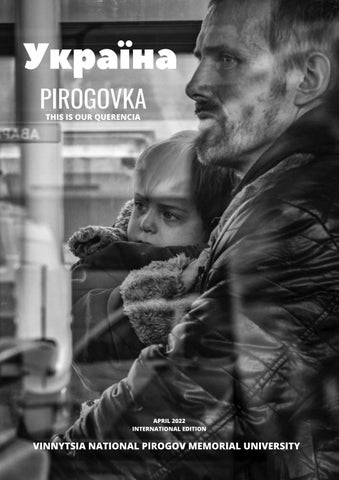
Україна PIROGOVKA THIS IS OUR QUERENCIA
APRIL 2022 INTERNATIONAL EDITION
VINNYTSIA NATIONAL PIROGOV MEMORIAL UNIVERSITY
“The day the power of love overrules the love of power, the world will know peace.” This edition is very different from our previous issues because of the utterly unprecedented scenario we see unfolding before us. As students who have spent years trying to understand and incorporate the customs of a foreign nation, we are heartbroken to see the devastation that is being inflicted upon a place we used to call home till very recently. Thus, our April edition is dedicated to Ukraine and to all those bravehearts who are fighting everyday in numerous ways to ensure peace and good sense prevail in the minds of those whose decisions matter. We pray for peace to those souls who have departed as well as those who feel hopeless right now. May God be with all those who are pure of heart. Amen. Above all, “Raise your love, raise it high. Don't let the world and its circumstances make you hate.” Sending prayers, The Pirogovka.
CONTENTS 1 .FROM THE EDITOR’S DESK 2. THE ARDUOUS JOURNEY TO A NEW VISION- LANGUAGE 3. NEFARIOUS INTENTIONS 4. THE CAPE OF HOPE 5. TO UKRAINE FROM YOUR BIGGEST FANS- STUDENTS 6. A SOLEMN PROMISE. A LEADER IS BORN. 7. CONFLICT IN UKRAINE- BY RAJA MENON 8. THE WORLD SALUTES YOU 9. UKRAINE’S WONDER WOMEN 10. CAPED CRUSADERS 11. HELPING HANDS 12. SOS ALERT- LET’S TRY TO HELP 13. MOVIES TO WATCH 14. BOOKS TO READ 15. A PICTURE IS WORTH A THOUSAND WORDS
1-2 3-7 8-13 14-18 19-22 23-25 26 27-28 29-32 33-34 35-36 37-40 41 42 43-46
FROM THE EDITOR’S DESK My mind is a dangerous place nowadays. My heart heals during the day. However, every morning I wake up and turn to the newspaper, it breaks all over again.
The only questions that bugger me all day long are Why? And Why now?
The twentieth century was supposed to be the era of flying cars and commercialized space travel. Why are we stuck rehashing the same arguments and more importantly the same mistakes which just end up as sparks igniting conflagrations around the whole world.
A person does not lose land or prestige in a war. The only loser in war is humanity.
How else would you explain the loss of babies who have not even started crawling yet? Or the young minds with hopes and dreams now lying forgotten beneath tons of rubble? Or even the wise grandparents who refused to leave their childhood homes full of memories believing that their presence alone would be enough to save it? Alas.
If War brings out the monsters from the deepest abyss of our hearts, it also provides the battleground for avenging angels who seek to mete out justice in favour of the wronged. We see ordinary people who rise above their means to just stand up and say “No!”
NO, to ruthlessly undermining another’s right to exist, NO to letting someone trample all over you, NO to dying when it seems inevitable and NO to giving up anything which can be fought for. One thing common to all of them is the determination you can see in the set of their jaw; their eyes sparkling with unshed tears yet shining bright against the shadows of uncertainty that threaten to enshroud this light.
I see courage. A woman giving birth in a shelter, an elderly man taking up arms, a sixteen year old boy in a trench, a fierce lady commanding troops and a pilot risen from the supposed dead to continue terrorizing the enemy aircraft.
I see compassion. A woman rushing to collect orphans near her in the short time she has got to escape from her tormentors, foreigners opening up their homes and hearts to suddenly homeless citizens traveling miles on foot, a grandfather who feeds all the stray animals that he comes across and the blind boy who keeps singing in shelters trying to bring comfort to crying children.
None of this gives me a convincing answer to my questions. Why? Why is the human race so bent upon self- destruction when Mother Nature is surely gearing up to do away with us very soon? Why are so many children torn from those who had planned an entire future for them? Why are people greeted with flags instead of the smiling faces of their beloved? What is the point of a situation where the best you can expect to get, is a bleak future and the worst, death?
Many want change but only few are daring enough to fight for it. We want a world without judgment, without divide, with peace and happiness for everyone. But would you be willing to die for it?
Most would not.
However there are many who act differently.
Officers, soldiers as well as every single person who stands at our borders (be it at the city, state or country level), hold the lives of millions in their hands. However, they too, are only pawns in a game of chess played by those who live under the tightest security imaginable, facing dangers of their own making. But they are not whom we shall question.
My questions are directed to those who run towards danger instead of away from it. They too have families, people who care about them. Do they not fear for their lives?
They do. It is just that their love for life is not greater than their love for their motherland. I may be a tad bit sentimental, but one thing that staying away from your country teaches you is to appreciate the beauty in every single thing about your nation. I cannot comprehend their exact reasons but I can formulate an idea of what keeps them motivated. They believe in a cause. In better times. In laying down their lives for people like you and me.
This kind of single- minded belief in our worth as humans, forces us to be better people. We try to wake up and do things that will benefit others, to live each day to the fullest, to respect those who love us. However, a human mind is inherently fickle. We forget.
Once the stimulus for an action disappears from our vision, it vanishes from our consciousness as well. We become complacent in our daily lives doing the same things repeatedly and dismissing the misfortune of others as simply bad luck. Nothing bad could ever happen to us and if it did, then it is someone else’s responsibility to fix it.
I truly believe it is time. Time you take up the mantle of your life and start making changes. For better or worse, a situation like this is meant to be the push which forces you to wake up. Instead of passively letting life happen to you, take up the reins and participate in decisions which determine your fate
The saddest thing for a person pursuing medicine is to see someone suffering and not being able to do a thing about it. Not because we do not want to, but because we cannot be sure if our interference will cause more good or harm. Several times over the past few months I have been sorely tempted to take up another easier path, being so hopelessly disillusioned about what is to happen to us now. Not anymore. When the first instinct you have on seeing someone hurt is to try and help them, you know that you are made for one thing only and that you will do anything to achieve it.
Thus, all we can do is pray. Pray for peace. Work hard to ensure that those martyred will have believed in only the brightest future. A future where Sci-fi inventions would become reality, Geographic borders mean nothing, Language just a means of communication and History remembered but never repeated. It is the burden of survivors of apocalypses to condone harmony and not hate. An extremely difficult task but the most crucial nonetheless.
At the end of it all, take pride in your nation. Where else will you feel this sense of belonging? Be proud of your warriors. Who else do they die for? Always be pure and true of heart. Is there another way to be?
Hoping for peace, Mihika.
THE ARDUOUS JOURNEY TO A NEW VISION - LANGUAGE.
A language is a roadmap to a culture and its impact completely depends on how we wield it.
I was in my second Ukrainian language class and I had not yet got a proper hold of the Ukrainian alphabets or their pronunciations. I was quite confused since many alphabets were similar to those of English and pronounced the same way, but a few looked the same but were pronounced differently. I asked my teacher to explain the roots of their language. “I am not much of a historian myself, but I can tell you few things about the creation and diversification of the Ukrainian language,” she said.
“The Ukrainian language is a Slavic language which belongs to the IndoEuropean family which is a descendent of the Protoslavic language. When Kyivan Rus accepted Christianity, the Ukrainian Script had many Greek words. Cyrillic alphabets were based on the Greek alphabet. Close contact with the Steppe Nomads gave Ukrainian its Turkish touch. Relations with Crimean Tartars intensified this language and large cities often adapted Latin as well. The Ukrainian language has borrowed a few words from Yiddish as well (For example: Borscht in Yiddish is pronounced and written the same as in Ukrainian). You can also find its essence in Polish, German, Romanian and Hungarian.”
Researching further, I could not let go of the facts I uncovered. So, let me take you on a short historical trip to understand how this language diversified and transformed over the years:
“Language is power, life and the instrument of culture, the instrument of domination and liberation.” — Angela Carter
Late 16th CE:
Late 11th – mid 12th CE:
The Ukrainian language has already been formed as a distinct system. The question now was, how should it be spoken? Kyivan-Rus was the biggest state in Eastern Europe; present day Kyiv being its centre. Then, there were two written languages: (1) the Church Slavonic- mainly spoken for religious purposes and (2) the Old east Slavic (old Ukrainian)spoken for secular and cultural processes.
Linguist Laurentius Zyzani, compiled a dictionary where Slavic church terms were described in common Ukrainian language. Another Linguist Meletius Smotrytsky introduced the letter ґ , which is an element of the Protoslavic Language. After this period, the language became the language of the people and became more précised and versatile as it evolved.
THE REIGN OF THE RUSSIAN EMPIRE Not everybody liked the growing popularity of the language and they now threatened its very existence.
Beginning of the 18th CE Present day Ukraine was occupied by the Russian Empire. Tsar Peter I banned the Church Slavonic language, Ukrainian books, Literature and destroyed public works. 9 years after that, Tsar Peter II ordered his linguists to convert every public as well as administrative documents into Russian language. In 1763, Catherine II prohibited the language at the Aacademies.
Mid 19th CE Censorships and sanctions were imposed on the Ukrainian language and it was given a new name, “Little Russian”, while the actual Russian was called “Great Russian”. The Valuev Decree banned the publishing of Ukrainian books and often gave a statement, “There cannot be another Russian Language!”. The Ems Decree banned the Ukrainian language in schools and churches. Moreover, Parents could not give Ukrainian names to their babies. Translation of Russian literary works into Ukrainian was prohibited and Ukrainian texts with musical scores were banned as well.
Late 18th CE Many Ukrainian linguists gave back the Ukrainian language its lost shape. The last prominent writer of the Old Kyivan language was Gregory Skovoroda whose elements are still present in the modern day language. The two most well known in poetry and literature were Ivan Kotlyarevski and Taras Shevchenko. Kotlyareveski’s book “Eneida” contained every new element of the Ukrainian language and 42 years after that Shevchenko’s “Kobzar” was published. Both of these books became bestsellers and were a befitting answer to those who said that Ukrainian cannot be used as an official language.
USSR OCCUPATION OF UKRAINE In USSR occupied Ukraine, Bolsheviks considered Ukrainian speakers as the enemy and often executed them!
The period of Ukrainization
This period is considered to be the most surprising period in the history of the USSR. The Soviet Union came up with this Idea of “Ukrainization” or “Nativisation”. The locals and the natives were made government employees, most of whom were Ukrainian speakers. The Ukrainian language was readopted in schools as a mode of education and as a subject. Three volumes of a Russian to Ukrainian dictionary were made by Ahatanhela Krymski and Sergei Yefremov. Many historians say that “Ukrainization was a means not a process”, because Communist leaders needed the support of Ukrainians for their political benefits.
The 20th century marked a dramatic turn in the history of the Russian Empire. WW1 and the Russian Revolution broke out and this gave an impetus to the “Independence movement” in those lands where Ukrainian was still considered as the language of the people.
The Repression When the Soviets started believing that Ukrainians were now loyal to them, they no longer needed their policy so they started to destroy everything they had promoted to grow. Many linguists, grammarians, and stage directors were imprisoned or executed. Books and libraries were destroyed and Ukrainian was no longer the language of the state. Soviets considered that there was an artificial barrier between Ukrainian and Russian. To avoid these “barriers”, they removed all the Ukrainian words which did not sound like Russian words and kept those words which were similar to Russian ones.
THE PERIOD OF RESTORATION When the Ukrainian people became aware of the Soviets’ intentions, they protested and demanded the restoration of the Ukrainian language in schools and other government sectors. They were afraid that losing their language would be a loss of their culture. In 1967-70, the letter “Ґ” was restored. When Ukraine gained its independence from the USSR, the Ukrainian language became the only state language. School and University entrance exams were taken in Ukrainian and it was made a compulsory subject at schools. School books were completely published in the Ukrainian language but 300 years of “Russification” had its own effects. People still considered that Russian was a language of higher culture. They preferred the least expensive books imported from Russia, Russian pop music and Russian artists on TV.
Modern Ukrainization Some changes were seen after the Orange Revolution when the government ordered broadcasting channels and radios to air in the Ukrainian language only. Foreign movies had to be dubbed only in Ukrainian or at least have subtitles in Ukrainian. In 2010, a pro-Russian government was elected.
Previous achievements were close to being reversed. This time, the People protested fearlessly and the “Language Maidan” movement broke out. The Presidency ended after the “The Revolution of Dignity” and Modern Ukrainization started. The Ukrainian Culture Foundation, the Ukrainian Book Institute and the Ukrainian Institute were made. The Ukrainian Language was again regarded as the only state language.
Present day scenario Now people speak Ukrainian in the major part of the nation. It has 3 dialects (Polish, South western and South Eastern) and these dialects have further 15 sub dialects. But after getting through so many ups and downs like Communization, Russification, and Modernisation new forms of the language have arisen. For example, Calca is a combination of the Ukrainian and the Russian Language.
Mayank Kumar
Nefarious Intentions
FEBRUARY 24th: Ukraine woke up to the worst news imaginable—if it had managed to sleep at all. Rumours had trickled out the night before, that this time, the longpredicted Russian invasion of Ukraine would finally come to pass. At 4.30am, came the spine-chilling announcement from Vladimir Putin; Russia’s president, that his plan to “Denazify” Ukraine was under way. Missiles almost immediately hit Boryspil airport on Kyiv’s outskirts, and air-raid sirens rang out at dawn. War has been a fixture of life for Ukraine since Mr Putin’s first invasion in 2014, but it had been largely confined to the South-East. That old reality had vanished. Taking its place was a new kind of war: national and all-consuming, setting off the worst conflict in Europe in decades, killing thousands of people, driving millions more from their homes, shaking the post-Cold War geopolitical order and roiling global markets. This is a look back on some pivotal moments in the nation’s turbulent history leading up to the shattered ruins of overturned fates. DECEMBER 1, 1991 UKRAINE BECOMES INDEPENDENT Amid the dissolution of the Soviet Union, Ukraine votes for independence in a referendum, with 92 percent of Ukrainians supporting Independence, and elects Leonid Kravchuk as the President. Ukraine has the second-largest population and economy out of the fifteen Soviet republics. DECEMBER 5, 1994 THE BUDAPEST MEMORANDUM Ukraine transfers all nuclear weapons to Russia, in return for the country’s promise to ‘respect the independence and sovereignty and the existing borders of Ukraine’. NOVEMBER – DECEMBER 2004 THE ORANGE REVOLUTION A presidential election between pro-West Viktor Yushchenko and pro-Russia Viktor Yanukovych creates a massive controversy. Yushchenko is mysteriously poisoned before the election – but makes a full recovery – and so victory is declared in favour of Yanukovych.Ukrainians take to the street wearing orange, which is Yushchenko’s campaign color.By December, the protestors trigger a re-vote, resulting in a victory for Yushchenko.
2005 EYES ON EU AND NATO MEMBERSHIP Yushchenko takes power with promises to lead Ukraine out of the Kremlin’s orbit, towards NATO and the EU.These are the first moves in a bid to protect Ukraine from Russia. APRIL 3, 2008 RUSSIA FIGHTS UKRAINIAN NATO MEMBERSHIP NATO looks at expanding its Membership Action Plan (MAP) to Ukraine. Putin makes his opposition to Ukrainian membership known to NATO leaders; at one point allegedly telling US President George W. Bush that Ukraine is ‘not even a real nation-state.’ NATO does not offer Ukraine a MAP. FEBRUARY 22, 2014 YANUKOVYCH OUSTED Ukrainian President Yanukovych suspends all trade and talks with the EU in an attempt to revive their relationship with Moscow. This begins months of protests in Kyiv, which include bloodshed, leading to parliament voting for his removal. MARCH 26, 2014 CRIMEA ANNEXED Russia invades in February and subsequently annexes the Crimean Peninsula from the state of Ukraine in March.
APRIL 29, 2019 VOLODYMYR ZELENSKYY BECOMES PRESIDENT Former comic actor Volodymyr Zelensky, best known for starring in Servant Of The People, is elected president.
JANUARY 2021 US APPEAL Zelensky appeals to US President Joe Biden to let Ukraine join the NATO.
FEBRUARY 2021 CUT OFF THE KREMLIN Zelensky’s government freezes the assets of opposition leader Viktor Medvedchuk, the Kremlin’s most prominent ally in Ukraine.
SPRING 2021 RUSSIAN TROOPS ON THE BORDER Russia begins amassing troops near Ukraine’s borders in what it says are “training exercises.” Putin publishes an article claiming that Russians and Ukrainians are ‘one people’. He then issues demands to NATO and the United States. Among these demands is that Ukraine never be admitted to NATO – a request rejected by the Biden administration. NOVEMBER 2021 RUSSIAN FORCES BUILD UP Satellite images taken by Maxar Technologies show ongoing buildup of Russian forces near Ukraine with estimates soon surpassing 100,000 troops deployed. JANUARY 24, 2022 NATO ON STANDBY NATO puts forces on standby and reinforces eastern Europe with more ships and fighter jets. FEBRUARY 16 DAY OF UNITY Ukraine celebrates the National Day of Unity to consolidate people amid the looming crisis in the country. “We are all united by one desire: to live in peace, happily, as one family, with children, with parents. And we have every right to all this. Because we are at home, we are in Ukraine,”- Zelensky. FEBRUARY 21 RUSSIAN TROOPS SENT TO DONETSK AND LUHANSK Russian troops are also deployed as ‘peacekeepers’ in Donetsk and Luhansk. These regions broke away from Ukraine in 2014. Putin announces that Russia recognises Donetsk and Luhansk as independent states.
FEBRUARY 22 FIRST SANCTIONS The UK, US, and their allies sanction Russian parliament members, banks and other assets. Germany halts the Nord Stream 2 gas pipeline project.
FEBRUARY 24 RUSSIAN ATTACK ON UKRAINE BEGINS Putin orders a full-scale attack on Ukraine. The invasion begins in the eastern Ukrainian territory of Donbas. Zelensky declares martial law in Ukraine and officially breaks diplomatic ties with Russia. The President calls on all Ukrainians who are ready to defend their country to come forward. FEBRUARY 28 FIRST CEASEFIRE TALKS After days of fighting, Russia and Ukraine hold their first ceasefire talk at the Belarusian border. This ends without an agreement after five hours. Russia continues to attack Ukraine’s second biggest city Kharkiv. MARCH 1 CITIES AND PEOPLE UNDER ATTACK A 40 mile-long convoy of the Russian army is spotted on the outskirts of Kyiv while Kharkiv and Mariupol are also under threat from troops. Russia is accused of war crimes after allegedly using devastating vacuum bombs and cluster ammunition.
MARCH 2 KHERSON, FIRST CITY FALLS Overnight, Russian forces capture Kherson by the Black Sea.
MARCH 7 HUMANITARIAN CORRIDORS FAIL Kyiv and Moscow agree to open humanitarian corridors to allow civilians to escape the war. However, many attempts are abandoned as the temporary ceasefire fails.
MARCH 15 REFUGEE NUMBERS INCREASE Unicef announces that Ukrainian refugee numbers are over three million, with many others being displaced internally. It is estimated that one Ukrainian child becomes a refugee every second.
MARCH 18 PUTIN’S CRIMEA RALLY Moscow’s Luzhniki stadium is packed as Putin and crowds celebrate the anniversary of the 2014 annexation of Crimea. Putin also speaks to the cheering crowds about the Ukraine war, insisting the main purpose of the war is to ‘save people from suffering and genocide’.
MARCH 21 UKRAINE REJECTS RUSSIAN DEMAND TO SURRENDER Ukraine defies a Russian ultimatum for its forces to lay down their weapons and surrender the besieged city of Mariupol.
MARCH 29 RUSSIA ‘CUTS BACK’ KYIV ATTACK Russia’s military confirms it will partially pull out of Kyiv – while the Kremlin recasts the purpose of the invasion as the ‘liberation of the Donbas’ in eastern Ukraine. MARCH 31 RUSSIAN TROOPS ‘FALL ILL’ AT CHERNOBYL Russian troops withdrawn from the nuclear power site at Chernobyl are rushed across the border to Belarus with ‘acute radiation sickness’ after which they start to pull out of the region. APRIL 1 HORRORS IN BUCHA EMERGE After Russian troops begin withdrawing from Bucha, near Kyiv, on March 30 – images emerged of a civilian massacre left behind, with countless bodies lying in the streets, many killed “execution style.” APRIL 5 VOLODYMYR ZELENSKY VISITS BUCHA Ukraine’s president witnesses the devastation, and accuses Russia of ‘genocide’ and ‘war crimes’. Russia denies involvement, calling Bucha killings ‘fake’ and ‘staged’. APRIL 8 UNLIKELY ALLIES Hacker collective “Anonymous” after having officially declared cyber war against Russia on 25th Feb, continues to publish 28 GB worth of data from the Russian Central Bank detailing secret agreements and client information. They have also allegedly taken over the state broadcasters to print anti-war messages.
APRIL 12 RUSSIA REACTS AS FINLAND DISCUSSES NATO MEMBERSHIP Russia reportedly moves military equipment towards its border with Finland – after Prime Minister Sanna Marin said possible NATO membership would be discussed ‘within the coming weeks’. APRIL 13 REPORTS SAY SWEDEN TO JOIN NATO A Swedish media outlet reports that Sweden ‘is ready’ to join military alliance NATO in the summer – after neighbouring Finland said it was also discussing the possibility of joining.
APRIL 14 CRITICAL FIGHTING IN MARIUPOL Ukrainian soldiers continue to cling on in parts of the besieged southern port city but Russia’s slow advance continues. Russia claims it has captured 1,000 Ukrainian soldiers, a claim deemed false by one expert group. APRIL 14 RUSSIAN THREAT OVER BALTIC NUCLEAR DEFENCES If either Sweden or Finland were to join NATO, former Russia president Dmitry Medvedev says there would be ‘no more talk of a nuclear free Baltic, as the balance must be restored’. He adds: ‘If our hand is forced, well… take note it wasn’t us who proposed this.’ APRIL 15 ‘WORLD WAR THREE HAS STARTED’ On the 50th day of the war, Russian state TV says World War Three has already started after the sinking of the Moskva. The propagandists also claimed that the West thinks ‘Russians should simply be wiped off the face of the earth’.
This timeline is all about a series of dynamic and fluid eventualities, and as such may never satisfy criteria of entirety . An attempt has been made to clue up the readers in a well-informed expedition of a nation whose people have inspired the world with their courage, their resilience and their fierce love for their country, while they still gear up to build immortal stories of nationalism to the very end.
- Devanshi Bhardwaj
The Cape of Hope Disclaimer - This part of the story is prominently inspired by factual episodes of happenings which began in the Ukrainian territory since the untoward morning of February 24, 2022. Therefore, it is to be understood that several episodes may bear resemblance to real characters and their experiences. The narration is not meant to hurt the sentiments of any individual or community, or project any entity in bad light. Recap – Amber came across a girl named Vamika in his flight to Ukraine to study medicine, as arranged by his grandfather. They had a conversation, shared things about themselves and the journey ended well. While de-boarding, Amber learnt that Vamika had lied to him about her assigned seat number, possibly to initiate a conversation with him.
Chapter 3.1. Arrived to Depart Waiting in front of the luggage-conveyer belt no.1 of the Boryspil International Airport of Kyiv, Amber heard a high-pitched alarm buzz. He couldn’t however decipher much of it, until an attendant walked towards him with bated breath. “Inconvenience regretted, Sir! There’s been an emergency! The airport is closing right away. Please rush towards the exit immediately!” “But… but… my luggage?” managed Amber. “Are you out of your mind, Sir? There’s extreme impending threat as of now, and we have to shut down in a jiffy!” The attendant uttered the latter words with marked authority. Amber looked around for Vamika, but in vain. She was nowhere to be seen. He proceeded towards the main exit indignantly, wondering what all this was about. He needed answers but found anxious, enquiring faces everywhere he looked. He was three steps away from the exit gate of the airport, when everyone around him was taken aback by an unanticipated thud. It reminded him of the sound of blasts he had heard in movies, while savouring his tub of popcorn. The only difference was that this was much closer, and felt like peril to everyone around. Somehow the booming thud seemed to trigger the guard standing at the exit gate, who began shoving people out with brute force, to hasten the evacuation. Amber landed on the ground on all fours, owing to the guard’s added assistance. He had never been so perplexed and afraid before. His heart-rate set off to a mountainous ascent.
He was moments away from crying out loud, when his eyes fell on the only dose of relief he had around him; Vamika. In that moment, his heart encountered a dilemma of a strange kind. It had to choose whether to keep pumping faster owing to the intense situation around, or slow down things and stretch the moments to pursue the newly-found gaze. Had his heart preferred indifference that day, an entirely dissimilar future would have manifested as he flipped through some of the most exhilarating pages of his life. However, his heart chose to come back to the baseline state, and let other feelings manifest instead.
Chapter 3.2. The Sad Truth Upon reaching the office of the Indian Embassy to Ukraine alongside Vamika, with limitless questions and no knowledge of the local language, Amber learnt from the staff, “Early in the morning today, Russian forces have begun invading Ukrainian territory. The situation is tense, and hence the airspace has been completely shut down for commercial flights. There have been missile strikes in and around the city of Kyiv as well…” “How do we get out of here then?” Vamika asked the official. “As of now, we’ll be communicating with the authorities and passing on any information we receive. It might take days to arrange something, and you need a place to be until then.” With these exact words, the officials escorted them, and several others like them to a nearby primary-school corridor. A pack of boiled noodles was provided to each one of them too, smelling of an egg mixed punctiliously with salt-water. They were given blankets, as the temperature would drop down significantly at night. “What’s going to happen to us?” Amber wanted to know, sliding under the blanket at night. “We’ll make it out of here safely.” reassured Vamika. “What if these people fail to evacuate us from here? It’s nearly impossible to gain access to a live war zone to rescue people!” “Have faith in the people. Have patience.” “But… what if… they can’t get us out of here at all?” Amber insisted with anxiety speckled all over his face. “Then we will get ourselves out.”
Chapter 3.3. The Escape Ten days and twenty seven air strikes later, Vamika’s words resounded in Amber’s mind. “Then we get ourselves out.” They had been without food for the last forty-eight hours, and managed drinking water by melting the snow set outdoors, which would settle after a night’s fall. The constant clamour of gunfire and bombardment from all directions now seemed like the approaching feet of programmed death.
It was the first time since their acquaintance that Amber clutched Vamika’s hand as tightly as he could, and exclaimed, “I don’t want to die here.” And then, it was as if Vamika had had an onset of purpose. A purpose to live for, or dutifully die for. Under the clear night sky, they snuck out with a bottle of melted snow and the trivial belongings they had. They walked and enhanced their speed of motion as they spotted decimated residential buildings, offices and other landmarks. As they reached the main road, Vamika waved fervently to stop a speeding car. The car screeched to a halt. The annoyed owner blurted out something in Ukrainian, incomprehensible to Amber. “Dopomozhit’ nam bud’laska; nam terminovo potribna vasha dopomoha!” managed Vamika much to Amber’s delightful shock, which translated as ‘help us please; we need your help urgently!’ The owner of the car asked them to get in after a brief conversation with the mother-to-be of Amber’s children. “What did he say?” asked Amber immediately after taking a seat inside the Mitsubishi. “He’s going towards the Romanian border. His family is already in a village neighbouring the border. He can take us there.” “And then?” “Once we cross the border and reach the other side, we’ll contact the Indian Embassy to Romania. They will arrange for our transport to the nearest airport. And we’ll take the next flight back home. Here are the contact details of the officers-in-charge. Once we get to Romania, they’ll take care of things.” Albeit Amber remained silent, he internally let out a sigh of hope and relief. He was feeling emotions thumping against his vessel walls, swimming through the blood and enjoying a ride on his erythrocytes. “Is it because of Vamika?” He asked himself. He accessed the archived thought of his three daughters-to-be playing in the lawn of their house, as he surreptitiously plants a soft kiss on Vamika’s left cheek from behind. On the other hand, something inside her made Vamika feel that a burst of energy will be needed soon, so she resorted to sleeping instead.
Chapter 3.4. The Last Encounter Fifteen kilometres away from the Romanian border, the car’s tyres broke down. “V chomu problema?” Vamika asked the car owner Ivan, enquiring why the car had stopped suddenly. Ivan unbolted the door and got off to inspect. A moment of silence inside the car was followed by Amber’s question, “How do you know Ukrainian so well?” Vamika stammered, “I… I’ve been looking it up on the internet… I’m not fluent, but isn’t it good that I can manage to communicate with the locals?” “A little too well for a beginner…” added Amber. He continued without pausing for her response, “And why did you lie to me about your seat number when we met?” Vamika sat wooden for a moment. “What is it that you’re hiding from me? What is all of this about? Something’s not right somewhere… you were speaking of my family as if you know them well… do you know my grandfather somehow?” They were inhospitably interrupted by a string of bullets. Ivan had been shot multiple times, as he realised nails had been strewn all over the deserted road. Vamika pulled Amber down, who was positioned to her left. More bullets were fired at the car. Vamika observed that the shelling was from the right side. She abruptly slid the left door of the car open on Amber’s side. “We have to get out of the car and run away to our left.” “They’re shooting at us!” cried Amber. Vamika kicked him out. Amber slipped through the bushes on the left, and landed behind a row of plantation. He could see an armed soldier approaching the car, with others providing him due back-up. He was looking for better cover, when he heard three more gunshots in succession. He could feel his body turning into stone. He could barely move a limb, as the shock of what had happened was too colossal for him to process. He stood behind a rock without moving a feather. Minutes later, he heard the soldiers retreating and laughing amongst themselves. This was shortly followed by the rustling of a few leaves beside him. He turned reflexively and regained his composure. It was Vamika; breathing and still very alive. He hugged her with all his strength and motive. “For a moment, I thought…” Amber began. “I’m here for you. With you!” reassured Vamika. The sun was by now convinced to rise and sprinkle its glory.
They reached a small roadside store in a while, who offered them some free supplies. They learnt that the border was still 8-9 km far, and they were not left with any choice but to cover the distance on foot. Dog-tired and almost willing to give up, they reached the border. It was chaos. Every one or two hours, the border guards would open the gates and let fourteen odd people out, while a crowd of more than fivehundred stood huddled, trying to manoeuvre themselves to the other side. It took them another twelve-hours of hustling, to successfully reach the other side.
Chapter 3.4. The Last Encounter Sitting beside each other in front of their boarding gate at Henri Coandă International Airport, Bucharest, Romania, both Amber and Vamika experienced an air of ungainliness. They had loads to speak but the silence seemed immovable. While Vamika silently reflected on everything that had just passed by, Amber paid attention to the chubby little girl in front, who held her father’s hand. They were standing in the priority boarding queue for the executive passengers, populated by none except the father, the apparent mother and the child gazing back at Amber. I need to achieve a lot before our children come. He thought to himself, aspiring to fly executive someday. Vamika interjected his thought-trail. “The questions you were asking back in the car… I’ve been thinking…” “Thinking as in...?” Amber followed. “Some things are better left unsaid at certain times. It requires mettle on my part to come out clean. And you’ll need equal courage, if not more, to hear me say it.” “I’m all ears…!” “As of now, we’re both in the pink of health, returning home after episodic encounters we’ll remember for the rest of our lives. Acknowledging what has just happened needs strength as well.” Amber refrained from further comment, but he kept his gaze fixed at Vamika. “Let’s keep it archived for when we come back. We will continue from where we’re leaving it off right now.” “And will we come back?” Amber demanded. “We will. This is the only flicker of hope that will help me get through the long wait until we are back.” “I want to come back… to you, to Ukraine.” Amber declared with a tone of hesitation. It was his way of implying what he felt without actually using the three magical words, popularised by movies. Vamika affirmed with a grin, “If that will stays strong for long, then there might just be a way round the corner!”
TO BE CONTINUED… (HOPEFULLY!)
Sayan Bhattacharya
A SOLEMN PROMISE. A LEADER IS BORN.
A
long time ago, there lived two great contemporary kings from Kashi and Kosala, who got themselves into a conflict over who is a better ruler among them. When they did not reach any result, they decided to visit each other's kingdoms and see. During their visit to Kashi, a soldier was commanded by the king to take off his clothes and kneel down in front of him. In no time, the soldier, following the orders of the king, sat down , naked, in his helplessness. The king of Kashi , boasting about his superiority said, "Look! How the people of my kingdom are ready to do anything to please me. I am undoubtedly the greatest ruler!" Then both of them went to Kosala. Now it was time for the king of Kosala to call on his people. He chose a farmer and asked him to strip down as per the orders. The farmer immediately grabbed his axe, stood before the king and said, "I will not let you harm my honour. I will protect it to the very end!" The king of Kashi was surprised, "Even a small farmer refused to follow your orders. Are you even a king?" The king of Kosala turned to him with a smile and said, "You rule over people who are so miserable and timid that they helplessly depend on you to protect their pride, and I am the king of people who have the potential to do this on their own."
In the streets of war-rattled country, amidst all the misery and agitation a similar leader was born as a ray of hope. Volodymyr Zelensky, the President of Ukraine, the man of the hour, fits the same “Don’t rule but lead” picture. Much is made of Zelensky’s former career as a comedian and an actor playing a president on TV, no less , but these wartime weeks have showcased a leader who appears remarkably skilled, even from a distance of thousands of miles. He has an everyman’s earnestness about him and a charisma that pops, beleaguered but not bowed. He was born on January 25, 1978, to Jewish parents in the industrial metropolis of Kryvyy Rih in southern Ukraine. He graduated in 2000 from the local campus of Kyiv National Economic University with a degree in Law. In 2014, his country’s government was toppled after months of popular protests. The next year, a TV show cast him as a history teacher who becomes a viral internet sensation after delivering an address against official corruption. The show was a massive hit. Five years later, he entered the race for President. His campaign eschewed detailed policy statements and press conferences in favor of short speeches or comedy routines posted to YouTube and Instagram. In this case, what Ukrainians saw in this lonely figure banging on the window; themselves, embattled; trying to hold on to their national identity amid growing threats to their independence. April 21, 2019, he was elected president of Ukraine with 73 percent of the vote. By the time he came to power, Ukraine had been at war with Russia for more than five years. But as the Russian bombs began to fall on Ukrainian cities and troops moved to surround the capital, the President underwent a transformation. Clad in olive drab, seemingly paler than the day before, unruly facial stubble thickening into a goatee, and with his country’s familiar cerulean-and-yellow banner by his side, he launched into his latest appeal for help in the lopsided war against Russia. When America offered him a passage to safety, he chose to stay. “The fight is here! I need ammunition, not a ride!” The man the Ukrainian people chose as their president in 2019 because of his starring role in a television series called “Servant of the People” had in real life become a servant to his people. Being Ukrainian is not rooted in a particular territorial claim, or a certain ethnic background, or an allegiance to a particular state and its institutions, or the profession of a given faith. It is instead about an ability to come together when you feel that you need to and to get things done. It is a way of depending on eachother, rather than on institutions or hierarchies, whether over cold nights of winter protest or when pelting tanks with Molotov cocktails.
Zelensky is not trying to run the country so much as letting the country run itself. When you lead, you are no longer holding a command but representing each and every person who has given you the authority to do so. “The first thing that I understood,” he said in an interview, “is that ‘we’ the people have agency. People are the real leaders'' and he was right. He wears khaki but he is leaving the battle-plans to Ukraine’s generals. Valery Zaluzhnyi, a charismatic 48-year-old, enjoys free rein as commander-in-chief. Feb. 25, the second night of the invasion. he walked outside his office into the winter air, surrounded by his closest aides, and filmed a simple message on his phone: “We are all here.” Things will never change by your opinion but by your example. In the same way, he has appealed to the Russian people who have protested against the fratricidal war that is being waged in their name: “Stop those who lie to you, who lie to us, who lie to the whole world.”
“We will be defending our country, because our weapon is truth, and our truth is that this is our land, our country, our children, and we will defend all of this.”, “It's not about being brave,” he says. “I have to act the way I do. If you don’t know how to do something this way or that way, be honest and that’s it. You have to be honest, so that people believe you. You don’t need to try. You need to be yourself…And it’s important not to show that you are better than who you are.” Vasily Grossman in his novel says: “Human history is not the battle of good struggling to overcome evil, it is a battle fought by a great evil struggling to crush a small kernel of human kindness. But if what is human in human beings has not been destroyed even now, then evil will never conquer.”
Hence, quoting Rudyard Kipling, “If you can keep your head when all about you Are losing theirs and blaming it on you; If you can trust yourself when all men doubt you, But make allowance for their doubting too. If you can wait and not be tired by waiting, Or, being lied about, don’t deal in lies, Or being hated don’t give way to hating, And yet don’t look too good, nor talk too wise; If you can fill the unforgiving minute With sixty seconds’ worth of distance run, Yours is the Earth and everything that’s in it, And which is more: you’ll be a Man, my son!”
DEVANSHI BHARDWAJ
Book Review Conflict in Ukraine - The Unwinding of the Post–Cold War Order By Rajan Menon and Eugene B. Rumer
Truth may well be the first victim of war, and in the current crisis provoked by events in Ukraine, fair-minded and dispassionate accounts are rare. In this regard, Conflict in Ukraine: The Unwinding of the Post–Cold War Order by Rajan Menon and Eugene Rumer is all the more to be welcomed. Conflict in Ukraine is an excellent account of some of the main threads which have combined to bring the world to the brink of one of the most dangerous confrontations of the post-war era, and reflects many of the lacunae and limitations of standard Western interpretations of how we have moved towards the edge of the abyss. Above all, the authors note that, after the Cold War, Europe faced a number of fundamental strategic choices about how to create a mechanism to overcome the logic of conflict on the continent. Any lessons learned on how to reconcile a former adversary were forgotten at the end of the Cold War. Russia remained an uncomfortable partner outside the core structures of the postCold War order. A ‘hedging’ strategy was adopted, strengthening and extending NATO in case Russia reverted to what was perceived to be a certain innate aggressiveness. But this very strategy provoked the reaction which it intended to avert. The obvious dangers of this strategic blindness was that, unlike post-war Germany and Japan, Russia was in no mood to ‘embrace defeat’ in the ultimately futile contest that we now call the Cold War. This situation gave rise to what has been called the ‘cold peace’, the fool’s paradise in which we have lived for the last quarter century, and which is now slipping into something akin to a new Cold War and maybe a Hot War. The European Union was enlarged as part of a ‘wider European’ project. Thus, with the accession of a number of former communist countries to NATO and the European Union, instead of transcending the logic of conflict on the continent, in practice that logic was intensified. All this might be said to have led to the utterly predictable confrontation over Ukraine. Ukraine was clearly a pluralistic and multinational state. It was the failure to provide a capacious constitutional settlement to encompass this diversity, and to give voice to the many people making up the modern Ukrainian state, which had provoked this crisis. The circumstances of Yanukovych’s overthrow – described as an unconstitutional coup d’état by Russia, and the overthrow of a tyrant by the insurgents and their Western backers – has, perhaps, threatened the very basis of Ukrainian statehood. The Russo-Georgian war of 2008 was in effect the first war to halt NATO enlargement, and it became clear that Ukraine would be the second. However, at the end the reader is left dissatisfied. What were the drivers within Ukraine that allowed a legally elected president to be chased out by a popular movement, with the support of the world’s remaining superpower? Why did Russia feel excluded and marginalised for the quarter of a century after the fall of the Berlin Wall – since it is clear that the resentment was not Vladimir Putin’s invention? It was, after all, Boris Yeltsin who first used the term ‘cold peace’ in 1994; Prime Minister Yevgeny Primakov turned back his plane on the way to America when the bombing of Serbia began in March 1999. Mihika Gupta, Sayan Bhattacharya
CAPED CRUSADERS Hard times don’t create heroes. It is during hard times when the hero in us is revealed. We are aware of the catastrophe which has befallen our beloved Ukraine but in this barbarous situation, we have witnessed how the brave hearts of Ukraine have come forth to aid their motherland.
Kondor Yuri Yuriovich He is an Assistant at the Department of Anatomy in VNMU. After joining the Army, he provided medical aid to the soldiers, who are injured, giving emergency medical aid and treating wounded soldiers . "As an asset to us, all students can help us in whatever way possible. It is your second home that is asking you for help.”
Serhiy Prytula
Serhiy Dmytrovych Prytula is a Ukrainian TV presenter, actor, author and coproducer of the folk sketch show "Faina Yukraina” He is a well-known public figure in Ukraine and he is working day and night to provide every possible help. He is providing vehicles to the military as transportation is essential now. He is also raising funds to buy expensive yet essential equipment such as Drones and modern combat goods.
NOVA UKRAINE Nova Ukraine is a nonprofit organization dedicated to providing humanitarian aid to the people of Ukraine and raising awareness about Ukraine in the rest of the world. Through your generous donations, we fund a variety of efforts to help the people of Ukraine and to strengthen Ukraine's democratic society. The Nova Ukraine team and volunteers have been working tirelessly around the clock helping people in need You've heard of all our stories of heroes now let us tell you about those who we are closest to. People who are shivering in bunkers but are steady while explaining concepts. They take breaks for air alarms and then plunge right in! They regale us with the reality of what's happening and then once we have heard what we can help with we move on to tests. Never has such courage and determination been seen and never again will it be seen. One such account out of innumerable ones is presented here : Obertynska Oksana (Propadeutics to Internal Medicine Professor at VNMU):
“Until February 24, 2022, my family was completely happy. Everything changed suddenly and unexpectedly. All my family: husband, children, parents, brother decided to stay in Vinnytsia. We volunteered to help migrants from the east of Ukraine with food and other things. Despite the fact that our city Vinnytsia is relatively safe, since it is located in the center of Ukraine, far from the borders, we are still under the influence of possible danger and in fear of air strikes. There is also a constant emotional tension. It is very difficult to realise how many people have died, especially children. Till April 14, 2022 at least 200. But most of all, we are afraid of losing our country and falling under the influence of Russia. So we will fight for victory! We have no other choice!"
I would say that it has helped me to distract myself from the ongoing situation. But things are different now. My computer desk is near window, so once during lessons, I hear strange sounds and when I look out of the window, I see military aircraft flying very close to our building and the ground. Even students could hear the rumble. I was only relieved to know that it was a Ukrainian Plane. I hope that the war will end soon and students will be able to return to their offline studies. I wish peace for all and everyone around the world.”
Mayank Kumar • Divya Kaushik • Sowjanya Ganesan
The list doesn't end here, Students of VNMU are also working as Volunteers, Scan this QR code to read about their contributions and their message for us.
Helping hands
United States of America USA has announced an additional $800 million in security assistance to Ukraine along with modern weapons and Humanitarian Aid.
Germany Boosted the military aid budget to €2 billions, Receiving refugees and accommodating them.
France United Kingdom UK has helped with around €400 million, Providing Anti tank missiles and other essential weapons
Poland Supplying weapons and Ammunition, Receiving refugees and providing them essential goods.
Provided materials to shore up Ukrainian defenses, including MILAN anti-tank weapons and protective equipment
Netherland Providing emergency aid funds, medicine and air defense system, supporting human rights, raising €20million for war victims
Belgium Sending weapons to Ukraine which is more than 400 tons of ammunition, 5000 antitank , helmets body shields, and tents. They are also providing humanitarian aid.
India India has sent the first tranche of humanitarian aid comprising medicines, medical equipment and other relief materials to war-torn Ukraine via Poland
Romania Volunteered in every possible way to help Ukraine, accommodating a large amount of refugees, and helping them financially.
Czech Republic Continuously providing medical and other humanitarian aid through rails and trucks, valued around €2234176.
Canada Providing defense systems to Ukraine, more than $1000 million in aid, including development, humanitarian and financial assistance
DIVYA KAUSHIK • MAYANK KUMAR
The UNHCR (the UN’s refugee agency) has a data tracker monitoring the Ukraine refugee situation. As of April 4, it was at 4.2 million but it shows no sign of stopping. Nearly 60% of refugees have arrived in Poland. Over 400,000 went to Romania, 300,000 to Moldova, almost 300,000 to Hungary, and 220,000 to Slovakia.
LET'S TRY
TO HELP!
As students, we are often confined by financial restrictions in the course of our survival, learning in the process to stumble across the month-end to fresh beginnings, adorning our faces once more with reassuring smiles. Therefore, it is striking to note for the philanthropist thriving in us, that all it takes is a little less than a dollar in order to provide three meals a day to a person in need, along with a shelter having basic amenities. No matter how small our contribution be, it will always be destined to eradicate suffering, and unleash its potential in due course. This is a wee effort to curate and present before you all the pocketfriendly and authentic options accessible – to help create a noticeable, favourable impact in the lives of those affected. Go through these with the image of the person you love the most smiling at you, inside your head. Not just that one important person in your life, but the faces of a thousand innocent souls might lighten up with a smile too, for gratitude is both the foundation and the fuel of love that leads to joy.
1) Save Ukraine Now Foundation (https://www.saveuanow.foundation/en/home/)
To immediately support Ukrainians who need help during the war, Ukrainian mayors, Ukrainian philanthropists and friends of Ukraine from all around the world decided to establish the Save Ukraine Now International Charitable Foundation with the participation of the world’s largest companies, including but not confined to Clear Energy Group, KARA Energy Systems, BES Bollman, Grynerga and also the law firm Legal Consulting Center. The main purpose of the Foundation is to directly support the people who remained in the zone of active hostilities, with food, medicine, evacuation, including medical, transport.
2) Privat 24 Bank App If you have an account with Privat Bank (Ukraine), then donating via their official mobile banking app Privat 24 is a piece of cake. In the homepage, simply go to the “donate” icon and make a donation of any amount via your cards saved in the app. This method is especially pertinent and convenient for students. In case you do not have an account with Privat Bank, you can freely choose any of the other available options.
3) Save The Children (https://www.savethechildren.org/us/where-wework/ukraine Ukraine’s children are caught in the crossfire of this adult war. Save the Children has been operating in Ukraine since 2014, delivering essential humanitarian aid to children and their families. Your donation to the Children's Emergency Fund can help provide children and families impacted by the conflict in Ukraine and around the world with immediate aid, such as food, water, hygiene kits, psychosocial support and cash assistance. Together, we can protect children in crisis.
4) Vostok SOS (https://vostok-sos.org/) The volunteer-run, Ukraine-based organization Vostok SOS has partnered with the Swiss-German nonprofit Libereco to help people flee the country and set them up with provisions once they’ve gotten out. It also provides trauma support to those dealing with the aftermath of shelling.
4) Razom for Ukraine (https://razomforukraine.org/) The non-profit organization Razom for Ukraine is working with several Ukraine-centred non-profit organisations, including Nova Ukraine, United Help Ukraine, Sunflower of Peace, Euromaidan-Warszawa, and Revived Soldiers Ukraine, to bring emergency medical supplies and other forms of humanitarian aid to the front lines.
Share The Meal (https://sharethemeal.org/) This particular initiative aims to eradicate global hunger in the simplest of ways. They have dedicated teams for providing help and food assistance at the ground level, and a super enthusiastic core team. The minimum amount you can donate is around 90 cents, which can help provide food to one individual for an entire day. After that, the greater the contribution, the bigger the smile! J You can also use their mobile app, which goes by the same name, and is quite user-friendly and opportune to use.
Cheers to spreading smiles and wiping tears, while hoping for a happier, brighter future where loves happiness and love prevail unabashed!
- Sayan Bhattacharya
MOVIES TO WATCH
WINTER ON FIRE
ATLANTIS
REFLECTION
DONBASS
BAD ROADS
CYBORGS
HOMEWARD
BOOKS TO READ
THE GATES OF EUROPE
GREY BEES
BABI YAR
RED FAMINE
THE ORPHANAGE
A PICTURE IS WORTH A THOUSAND WORDS Disclaimer: All the photographs and information mentioned below are the sole work of 0lga.art on Instagram. We have not personally verified the sources but hope the owner of this account has done so. There are many more stories worth telling and those who have suffered worse. This is not a comprehensive account in any way. This content might be triggering for some so please use your discretion.
Under the rubble of the Kharkiv regional administration, near which the Russian missile exploded on March 1, a young Kharkiv resident Yulia Zdanovska died. This girl a talented mathematician - was known around the world. She was a patriot of Ukraine, volunteer, winner of the European Mathematical Olympiad, teacher of computer science and mathematics at 21 years of age. With the beginning of the invasion, she returned to her hometown and immediately started volunteering. She was helping people till the end.
Every living being suffers in war. Animals in shelters and farms in occupied territories are massively dying from lack of food and water or after shelling.
The soldiers who died in Mykolaiv on March 18. Russian troops fired missiles at their barracks while they slept. His last message to his sister - Thank you, sunshine for your care, we will rest and go back to work tomorrow.
Alyona Kushnir - senior sergeant, medic, mother, Ukrainian… Died while rescuing and defending ukrainian soldiers in Mariupol.
My grandmother Nina from Mariupol. She was 86 y.o. She survived World War II and was the kindest and brightest person in the world. I have been living with my grandmother for so many years and I can't remember a single quarrel. She was loved by all. On March 1, I lost connection with her, as did all the people in Mariupol with their loved ones. Later we managed to get in touch with a neighbor, who told us that on March 24 my grandmother died in a basement and her son buried her in the yard, near our house. I'm afraid to imagine what she had to go through. We will always remember and love her.
The brave pilot Dmytro Chumachenko died near Zhytomyr, taking his plane from the village to the forest and saving many lives. Quote from the wife's post: She had asked him on a call: . - How to eject? - You have a handle, that you need to pull. - What about a plane? - You're thrown out and the plane crashes. - Wow… - But first of all it’s necessary to think not about ejection. - Then about what ?? - Our task is to save people, if possible - a plane. First of all, I have to direct the plane to a place where there are no houses and only then - think about myself. - But you may not have time to eject… He did not have time, but he saved hundreds of lives.
Oleg Ivanov was pouring tea for everyone when a Russian missile hit the Kramatorsk railway station. He was helping to evacuate 4,000 people, who wanted to flee the war that day. From the very beginning and before the war, he has been taking care of the inhabitants of his city:. He had insisted on repairing sirens, arranging bomb shelters. He left behind his wife, 25-year-old daughter and 8-year-old son.
Defending Ukraine from Russian occupiers, on March 20, 2022, the officer of the Ukrainian Air Defense Forces Sushkov Viktor Oleksandrovych died. He gave his life, closing the sky over Ukrainian peaceful cities. He managed to shoot down a deadly rocket and save dozens and maybe hundreds of lives of Ukrainians. He left behind his wife, with whom he had a wedding last June. .
We have Easter today. Ukraine and Russia are both Orthodox and have Easter today. But instead of greetings, easter cakes and eggs, Russia sent 7 cruise missiles to Odessa. Some of them hit a house and killed a 3-month old child, her mother and grandmother.
Somalia imports about 90% of its wheat from Ukraine and Russia, and the war has all but halted those shipments over the past two months. After three consecutive years of almost no rain, the East African country of Somalia is in the grip of its worst drought in more than 40 years, according to an analysis by the United Nations. Experts say conditions are so dire for the nation’s 16 million residents that a famine threatening millions of people is fast approaching.
On the afternoon of 16th March, a Russian aircraft dropped a super-powerful bomb on the drama theater in the center of Mariupol. About a thousand residents were living there and were using it as a bomb shelter. Satellite images clearly show that in front of and behind the building there were big white signs in capital letters spelled "CHILDREN" for aviation pilots to avoid this place.
Head of the Luhansk regional military administration Serhiy Haidai made a short report. On March 11, Russian occupiers fired from a tank at a nursing home in Kreminna. They put a panzer in front of the house and started firing. Those who had lived till old age in this house - 56 people died on the spot. 15 people, who survived were abducted by the occupiers and taken to the occupied territories.
Illya died on a military mission at the age of 27 between Bucha and Vorzel. He was Belarusian, who arrived to defend Ukraine in 2014. He was 19 years old. He believed in Valhalla and Valkyrie, who take the martyred soldiers from battlefields.
Big thanks to railways workers. They continue to work, saving thousands lives, while risking their own. This is train conductor Natalia Babicheva. For two weeks, her evacuation train rescued people from all over Ukraine. It came under fire when it was going to Lyman to pick up a group of children. She died of shrapnel. Her daughter says she wants to be like her mother. Since the beginning of the war, Укрзалізниця - @ukrainianrailways has transported more than 3.5 million people by evacuation trains and delivered hundreds of thousands of tons of humanitarian goods.
Ukraine in our minds. Happy, prosperous and beautiful. Forever.
In the village of Novoselivka, located near Chernihiv, storks are returning to a damaged village after the russian occupiers left and have already started building nests. The stork has always been considered a good sign.
A 23-year-old nurse from Lysychansk, who had both legs torn off during an enemy mine explosion, got married in Lviv. Oksana is undergoing rehabilitation and preparing for prosthetics. She and her chosen one decided to have a wedding. The couple celebrated their holiday in the hospital ward.
Grandpa Valentyn Mykhailovych protects granddaughter’s Isabella sleep in refugee shelter in Zaporizhzhia.
Since the war began, Jacek Poliewski has supported Ukrainians, but when he saw ruined Bucha, he decided to go over there. He drove from Poznan to Bucha with his son and friend. They brought 500 kg flour from Poland and bought additional 600 in Lviv. The bakery in Bucha managed to survive under bombs by miracle. “I want to bake whole wheat sourdough bread here. Whole wheat military bread that can stay fresh 2-3 weeks” – Jacek says.
Please scan this QR code if you want to see more beautiful artwork on Olga's page. Keep praying
EDITORIAL BOARD IVANNA BYDLOVSKA : Chairwoman of the <<PIROGOVKA>> Committee, Editor- In- Chief MIHIKA GUPTA : Deputy Editor-in- Chief KANISHKA SINGH : Cover Designer ANKIT GAJBHIYE : Chairman of the Committee on International Affairs OLEG YEFYMENKO : Chairman of the Student SelfGovernment (STUDRADA) HUSAM ALSHOUGRAN ADITYA ANUPAM DEVANSHI BHARDWAJ SAYAN BHATTACHARYA ANASTASIA CHURKINA SOWJANYA GANESAN SUSAN JOHNSON DIVYA KAUSHIK MAYANK KUMAR <<PIROGOVKA>> Magazine is the official journalistic publication and intellectual property of the Student SelfGovernment (STUDRADA). Copying textual material, photographs and design without the consent of the Editorial Board and the relevant reference violates the copyright and intellectual property rights provided by the Legislation of Ukraine.
VINNYTSIA 2022