Online Access to Prescription Medicines: The Wild Frontier?
ICH E6(R3) Implications for Adverse Event Reporting in Clinical Trials
The Relevance of AI in Medical Information: Transforming Communication, Compliance, and Care



Online Access to Prescription Medicines: The Wild Frontier?
ICH E6(R3) Implications for Adverse Event Reporting in Clinical Trials
The Relevance of AI in Medical Information: Transforming Communication, Compliance, and Care
By Dr James Walmsley
03 04 06 10 12 Welcome Online Access to Prescription Medicines: The Wild Frontier?
ICH E6(R3) Implications for Adverse Event Reporting in Clinical Trials
By Jo Burmester
The Relevance of AI in Medical Information: Transforming Communication, Compliance, and Care
By Kirsty Bryant
Regulatory Updates
As always, feedback from the membership is welcomed and we encourage you to interact with us and the wider PIPA membership via our online platforms below:
Official PIPA Website: https://www.pipaonline.org/
LinkedIn: https://www.linkedin.com/company/pipa-pharmaceutical-information-and-pharmacovigilance-association/
We hope to see you online at one of our events in the near future. If there is anything you would like to see PIPA get involved with or do, please do get in touch at pipa@pipaonline.org
We encourage our members to contribute to µPIPELINE and make suggestions on topics for articles. Please contact us at journaleditor@pipaonline.org if you would like to contribute or make suggestions for the next edition.
Welcome to the October 2025
of µPIPELINE. With crisp misty mornings giving way to still warm Autumnal sunshine showcasing the mellow russet and amber of the leaves, it’s nice to enjoy a slow transition out of summer into winter.
For PIPA, the season was kick-started by our much-anticipated annual conference, held on 10th & 11th September in Guildford. Our diverse conference programme included presentations from experienced industry speakers, consultants and service providers. We were also delighted to welcome representatives from the EMA and MHRA, enhancing the programme with insights from leading regulatory bodies.
The increasing use of AI in the pharmaceutical industry was a theme on both days of conference, with panel discussions and user-case presentations prompting discussion and debate around the evolution and applications of this technology in the fields of medical information and pharmacovigilance. Understandably, the ongoing debate around AI evokes a mix of excitement and concern among members - with some embracing the change and others feeling apprehensive.
Recognising this, PIPA have launched a dedicated workstream focused on the role of AI in MI and PV. Our goal is to develop clear, best-practice guidance for the use of AI within these functions. We are setting up a section on the PIPA website which will serve as a hub for relevant resources - including position papers, webinars, and training events - designed to inform and support members interested in learning more about AI.
More information will be shared soon – so please do keep an eye out for our eNews communications and announcements on our LinkedIn page.
Finally, if you’d like to contribute to µPIPELINE, or suggest articles you’d like us to include, please do reach out via journaleditor@pipaonline.org




The rapid rise of the private online market for prescriptiononly medicines (POMs) marks a significant change in how POMs are being accessed. The traditional model of industry promoting drugs to prescribers is shifting towards a market where online pharmacies are advertising and essentially retailing POMs to consumers.
This article covers the evolution of the online POM market in the UK, sometimes referred to as “ePommerce”, discusses the regulatory framework and considers some of the important implications.
What is ePommerce?
Imagine you’re walking down your local high street. Your attention is grabbed by posters in the pharmacy window advertising a range of prescription medicines. Some of them are on special discount. Tempted, you walk in and see shelves stacked with an array of POMs, sitting next to familiar over the counter products. Selecting a well-known brand of injectable weight loss drug, you pick up a pack and take it to the pharmacy counter. You’re asked a few questions by the pharmacist, and once you’ve paid, your medicine is handed over and you walk home.
Although this scenario sounds far-fetched, it is essentially what is happening online. A wide range of POMs can be found through online searches, either through organic search or sponsored search ads run by online pharmacies. Searchers are directed to website landing pages, often containing promotional information on specific prescribed medicines. Individual POMs can then be selected, based on a price list, before completing an eligibility questionnaire and making payment. Unseen to the consumer, a prescriber signs an electronic prescription, the product is dispensed and usually dispatched by next-day delivery. In most cases, there is no real or virtual dialogue between consumer and prescriber.
Welcome to the world of ePommerce.
The basic mechanism of supplying POMs based on private prescriptions is entirely legal, as long as there is a valid prescription and the medicine is dispensed by a registered pharmacist. The rise in online pharmacies and pharmacist independent prescribers has simply moved the market from private clinics to the online space.
Although it is legal to supply POMs privately, the Human Medicines Regulations 2012 prohibit any advertising activity to the public which is likely to lead to the use of a POM. MHRA guidance is very clear that companies may advertise relevant services to the public, but may not advertise POMs. Despite this, more than 80%
of advertising investigations undertaken by the MHRA in the last six years relate to companies unlawfully advertising POMs.
How has the market evolved?
It is difficult to get accurate figures on the size of the market, but it’s clear that ePommerce rapidly evolved into a huge market in which illegal and unsafe practices were built in and necessary for its very existence. Key drivers for the growth of the market include advertising, an explosion in social media content and an overworked and underfunded NHS.
Injected weight-loss drugs have captured most of the headlines, and it’s estimated that up to 1.5 million people in the UK are now using GLP-1 analogues with the vast majority obtaining them online. However, many other prescribed medicines are also routinely advertised and can be very easily obtained online, including menopausal hormone replacement therapy, testosterone replacement, hair loss treatments, high-dose steroids and medicinal cannabis. A high proportion of online prescribing is off-label and companies often advertise and supply unauthorised medicines such as “specials”.
What are the pros and cons of ePommerce?
Having easy online access to prescribed medicines provides the ultimate convenience for the consumer, and given the unprecedented challenges faced by the NHS, ePommerce could be seen as helping to fill an important gap.
However, this extra convenience for consumers has come at a cost, with significant public health concerns raised by doctors and coroners alike. Remote prescribing by questionnaire, coupled with a high-volume transactional approach has inevitably resulted in many cases of inappropriate prescribing.
Wider concerns also exist around the importance of maintaining the fundamental distinction between the various legal categories of medicines. The existence of the POM category is wholly based on ensuring appropriate prescriber oversight, yet obtaining POMs online has been reduced to little more than a retail transaction. Essentially, ePommerce has become the new frontier of consumer healthcare.
How have regulators responded?
Faced with a rapidly evolving market that has been likened to the “wild west”, regulators initially appeared slow to respond. However, ongoing concerns and multiple headline news stories have now resulted in a state of heightened awareness among the three relevant regulatory bodies – the MHRA, the Advertising Standards Authority (ASA) and the General Pharmaceutical Council (GPhC).

As the statutory regulator for medicines advertising, the MHRA has legal powers to impose significant sanctions on companies unlawfully advertising POMs. The MHRA has asked numerous companies to amend their advertising and has also issued enforcement notices. However, to date, the MHRA has chosen not to employ meaningful sanctions, even against repeat offenders.
The ASA oversees consumer advertising in the UK, and the prohibition on advertising POMs to the public is reflected in the consumer advertising codes. The ASA has fewer powers than the MHRA but has made the issue of POM advertising a key priority, proactively monitoring online and social media advertising for breaches. Faced with continued widespread non-compliance, despite issuing what amounts to a final warning for companies advertising prescription weight-loss medicines, the ASA is now starting to publish upheld complaints against repeat offenders and has threatened stronger action.
As the professional pharmacy regulator, GPhC registers and inspects pharmacies and maintains the register of pharmacists legally allowed to practise. GPhC issued updated guidance to online pharmacies early in 2025, emphasising the importance of validating patient information and communicating with the primary care team. High-risk categories of medicines were also identified (including GLP-1 analogues) which are now deemed inappropriate for questionnaire-based prescribing. With only 55% online pharmacies meeting inspection standards, and a disproportionate number of fitness to practise cases against pharmacists working online, GPhC continues to ramp up inspection and enforcement activities.
The societal, economic and organisational drivers of ePommerce are likely to intensify, and while there is consumer demand and profits to be made, the market will continue to grow.
Ongoing focus on safety and non-compliance has already led to co-ordinated action between the three key regulatory bodies, and it’s likely that continued failure to uphold standards will result in more significant professional or corporate sanctions in the future.
Meanwhile, it will be interesting to see what role, if any, pharmaceutical companies will seek to play in the online market.
1. https://www.bmj.com/content/383/bmj.p2919
2. https://www.the-pda.org/gphc-issue-warning-about-onlineprescribing-practice/#:~:text=We%20are%20reminding%20 pharmacy%20owners,basis%20of%20an%20online%20 questionnaire
3. https://www.pharmacyregulation.org/about-us/news-and-updates/ online-pharmacies-strengthen-safeguards-prevent-unsafe-supplymedicines
4. https://www.asa.org.uk/news/how-we-re-trimming-down-problemads-for-weight-loss-prescription-only-medicines.html
5. https://www.medrxiv.org/ content/10.1101/2025.06.06.25329114v1
6. https://www.theguardian.com/business/2025/jul/12/mi crodosingweight-loss-jabs-off-label-glp-1-mountjaro
7. https://www.thepharmacist.co.uk/clinical/cardiovascular/around-15-million-uk-citizens-used-weight-loss-jabs-in-march-2025/
8. https://www.gov.uk/government/collections/advertisinginvestigations-by-mhra
9. https://assets.pharmacyregulation.org/files/2025-08/ Insights%20from%20online%20pharmacies%20 cases%20webinar,%2031%20July%202025. pdf?VersionId=zA0dKHuFVybpyAfSvBMZiNXJXy33JVOw

The long-awaited update to the Good Clinical Practice guideline ICH E6(R3) was finalised in January 2025. It has already come into effect in the European Union and is due to be implemented in the UK in April 2026. It has long been touted as introducing significant changes in how we conduct clinical trials, but what does this mean for safety reporting in this context? This article will summarise the main changes relating to this area, focusing on Annex 1 of the guideline which provides guidance for the conduct of clinical trials.
The main changes to the document are designed to allow a risk based, flexible approach to achieve:
• Facilitation of innovation as technology advances
• Feasibility and Practicality – Quality by Design, Critical to Quality Factors and Risk Proportionality
• Transparency – particularly regarding public accessibility of clinical trials and their results
• Improved informed consent.
The changes most relevant to safety reporting come under the headings of Investigator Responsibilities, Sponsor Responsibilities and Data Governance.
Investigator Responsibilities
There is more emphasis on Investigator Responsibility and the need to maintain oversight of activities delegated to site staff. One added responsibility is the need to review and explain important protocol deviations to the sponsor, and this includes any issues with adverse event (AE) reporting as per the protocol.
There is also an update to the safety reporting period to align with standard practice in many countries and allow the protocol to require collection of all AEs from the point of consent, rather than administration of the Investigational Medicinal Product.
There are also many updates to the requirements for essential records and data. The Investigator is responsible for all the data and records for their site, including the Investigator Site File and the Case Report Forms for their participants, which will also
include all safety reporting for their participants. The Investigator should review and endorse all data and data queries and should have control of all their records. The sponsor should not have sole control of any Investigator records and should not be able to make any changes to these without the investigator’s endorsement.
In addition, the Investigator should manage computerised systems used at the site for the purposes of the clinical trial, including management of access to systems and reporting to the sponsor of any incidents which could affect data integrity. The investigator should also manage any systems providing Patient Reported Outcomes, such as electronic patient diaries, to ensure the patients are appropriately trained in using the systems and ensuring traceability of the data.
Sponsors should employ a Quality by Design approach to trial design, which includes the collection and reporting of safety information. This ensures that the Drug Safety group can provide input into protocol design to ensure the right approach.
The sponsor should have fit for purpose oversight measures, including Quality Assurance (Standard Procedures, Audit Plans and Issue Management processes) and Quality Control (Monitoring, Data Management, Adverse Event database reconciliation).
There is also some information in the updated guidelines on the management of committees, applying to Safety Committees, which requires clarity on the purpose of the committee, the data they need to fulfil their purpose and the expertise required. There is also an emphasis on the protection of blinding which would be relevant not only for the Safety Committee, but also for Suspected Unexpected Serious Adverse Reaction (SUSAR) reporting, when unblinding is performed as part of the assessment process.
When it comes to management of data and records, there are requirements for Quality Control measures to focus on critical data, which always includes Adverse Event reports. Data collection tools should be fit for purpose, and any unblinding should be appropriately controlled and documented.
While safety reporting is critical data, there is provision for a risk proportionate approach to collection of adverse events, so that for post market, low risk clinical trials, the protocol could allow for reduced safety reporting requirements where justified.
There is a whole new section on data governance which sets out the responsibilities of the sponsor and investigators. The data flow has been mapped out, as per figure 1.
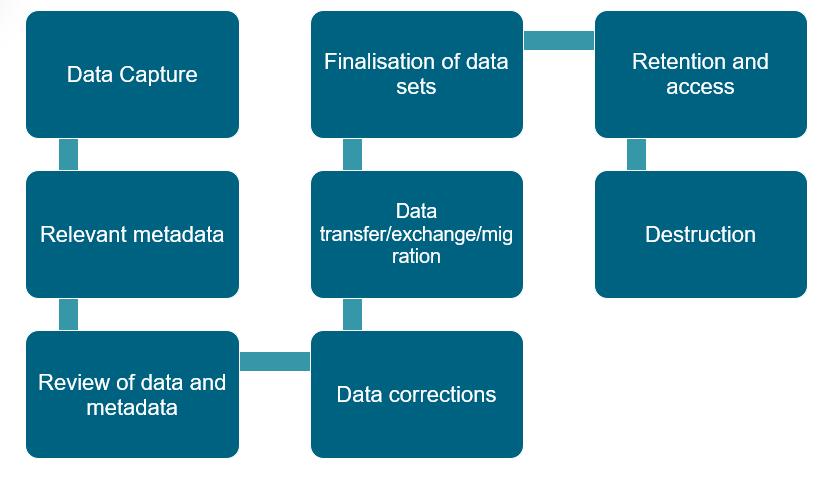
My advice for all critical data in clinical trials (which always includes safety data) is that the sponsor should map the data flow and identify risks for each step so they can mitigate and manage those risks to ensure data integrity.
How do we do this? By ensuring that the system used to collect the information is fit for purpose and has been appropriately validated, and then to put in place processes and procedures which mean that the system is secure, is used correctly and that data integrity is maintained and can be demonstrated.
Data Integrity should follow ALCOA++ principles
• Attributable
• Legible
• Contemporaneous
• Original
• Accurate
• Complete
• Consistent
• Enduring
• Available.
Processes should be supported by training, QC and QA. Systems should be built to support the data lifecycle, with appropriate validation, a fit-for-purpose audit trail and contingency plans for issues or failures. User management is also critical to ensure that only those who need access to the system have it, and that accountability for all accounts in the systems is robust and documented.
The next section of the updated version of ICH GCP which I would like to touch on is the glossary. The terms for safety reporting have been consolidated and updated, and the term ‘Suspected
Unexpected Serious Adverse Reaction’ (SUSAR) has been added. Another addition is the definition of Reference Safety Information (RSI) which has been included as the mechanism for assessment of expectedness for SUSAR reporting and the annual Development Safety Update Report (DSUR).
RSI has also now been added as a section in the Investigator’s Brochure. It’s not a mandatory requirement in ICH GCP although it is a regulatory requirement in both the European Union and the UK.
There is more guidance to come in the next year or two with this addition to the document, which will cover adaptation of GCP responsibilities for different types of clinical trial – those with Decentralised or Pragmatic elements, and also the use of Real World Data in the clinical trial setting.
For more information, please contact Jo at jo@joburmester.com





Artificial intelligence (AI) is rapidly reshaping the landscape of Medical Information (MI), offering transformative potential across communication, content generation, compliance, and customer service. As organisations strive to deliver timely, accurate, and personalised information to patients and healthcare professionals (HCPs), AI is emerging not just as a tool, but as a strategic partner.
One of the most promising uses of AI in MI is its ability to reduce response times. AI-assisted content search and automated response generation enable faster, more consistent answers to medical queries. Looking ahead, one of the greatest opportunities lies in personalised MI response generation. By analysing historical customer interactions, AI could identify frequently asked questions, generate key content themes, and even draft tailored responses for human review.
The hope is AI can unlock deeper insights, by mining call transcripts and enquiry summaries, supporting organisations to identify trends, and make data-driven decisions that improve customer service and business strategy.
AI could also be applied to enhance quality assurance by automating the identification of adverse events (AEs) and product quality complaints (PQCs), mapping decision trees to ensure correct processes are followed, and performing quality assurance review with speech to text software.
Linked closely to both quality and insights is sentiment analysis, where AI can notify management of calls where anger, frustration or even gratitude are detected, driving improvement through positive feedback and identifying potential gaps in training or processes.
Navigating Regulation and Compliance and Ensuring Accuracy, Ethics, and Oversight
Despite its potential, AI adoption in MI faces several hurdles.
As AI becomes more embedded in our industry, these tools are bringing new regulatory challenges, so ensuring the accuracy and reliability of its outputs is crucial. Clinical nuances, language complexities, and context are difficult for machines to grasp fully, making human oversight essential. Transparent AI systems that explain their decision-making processes, combined with an AI design that addresses the potential for bias in training data and “human-in-the-loop” workflows, are vital to maintaining compliance and fairness.
Organisations must uphold data privacy standards (e.g., GDPR), pharmacovigilance requirements, and ethical safeguards for patient and HCP facing applications. Building and understanding these guardrails early balances innovation with safety and caution.
With an ongoing focus around sustainability and carbon footprint, responsible use of AI remains at the forefront, with organisations evaluating the benefits of AI use with environmental impact.
Healthcare is deeply personal and the need to have a human delivering a customer service that has a personal connection based around empathy and emotional intelligence is something AI cannot currently simulate.
It is natural, as humans, to fear that which is unfamiliar. With this in mind, to embed AI successfully, leaders must invest in education to overcome employee hesitance and fear of job displacement. Change management strategies should include transparent communication, so all involved understand AI’s capabilities, limitations, and implications, identifying key promoters within to deliver hands-on training, and provide opportunities for staff to shape AI projects. Empowering teams to see AI as an augmentation not a replacement can foster a culture of innovation and will likely see adoption accelerate.
A constant evaluation of whether to develop AI solutions in house or to work with a partner will be something organisations are facing more and more. If the vendor path is chosen, look for partners with a strong market presence, ensuring they can operate within regulatory frameworks and demonstrate transparency in their algorithms and data handling practices. Trust is built not just on technology, but on shared values and accountability
In the short term, AI will primarily augment MI functions, driving efficiencies and taking on repetitive low-risk tasks. AI adoption in even a portion of day-to-day work supports MI professionals by complementing expertise and allowing focus to engage more meaningfully with customers and positively impact healthcare outcomes.
Whilst human oversight remains essential in data input, training, and on high-risk outputs (such as medical responses), some low-risk tasks may eventually be fully automated.
AI is changing rapidly, and we already see generations where AI tools are consulted before a doctor, driving change in how health information is accessed. Whilst there are currently barriers to overcome, it is unknown what regulations will look like in the future. It is possible we could see increased reliance by healthcare professionals on AI in terms of research, diagnostics, and treatment which would shift the industry landscape as we know it.
As we look ahead, it is impossible to predict how AI may affect the state of any industry, let alone MI, but we remain both cautious and excited for what the future holds in elevating human potential and shaping the future of healthcare.
For further information, please contact Kirsty Bryant at kirsty.bryant@propharmagroup.com.

In our regular feature, we highlight some of the most recent regulatory intelligence updates affecting medical information and pharmacovigilance.
• Risk Minimisation Measures (RMMs):
Following the publication of revision 3 of the EMA GVP Module XVI on Risk Minimisation Measures (RMMs) in August 2024, the EMA has now published the final Addendum I on Risk Minimisation Measures for medicinal products with embryo-fetal risks. The final addendum which was published on 28-Aug-2025 is a revision of the former Addendum III on Pregnancy Prevention Programmes (PPPs) and other pregnancy-specific RMMs (i.e, it has been renumbered from Addendum III (the number it carried as the draft version for public consultation) to Addendum I (the number of this final version)).
The GVP Introductory Cover Note has been updated accordingly (on 28-Aug-2025) to include a summary of the key changes made to the module which include clarifications on the actions and tools to avoid becoming pregnant.
Good pharmacovigilance practices (GVP) | European Medicines Agency (EMA)
• MHRA Medical device Guidance on the Standardised format for the post market surveillance report:
On 05-Sep-2025, the MHRA published a new guidance on Medical devices: Standardised format for the post market surveillance report which gives information and recommendations for manufacturers on the preparation and presentation of a post market surveillance report (PMSR). The guidance is intended to guide manufacturers on what data to include within a Post market surveillance report (PMSR). It is not mandatory to include sections which do not apply, and data may be displayed in an alternative form if appropriate
Medical devices: Standardised format for the post market surveillance report - GOV.UK
• EU Variation Regulation: Final Guidelines:
On 22-Sep-2025, the European Commission published the final version of the new Variations Guidelines defining the detailed rules for pharmaceutical companies for modifying and updating their marketing authorisations. The new guidelines will help streamline the lifecycle management of medicines to adapt to scientific and technical advancements. The revision of the Variations Guidelines is the final step of the revision of the variation framework of medicines. The Guidelines will take effect as of 15 January 2026 and will replace the current guidelines.
New variations guidelines to streamline lifecycle management of medicines | European Medicines Agency (EMA )
• ICH E2D (R1) Guideline on Post-Approval Safety Data:
ICH published the final revision of the E2D (R1) Guideline on Post-Approval Safety Data on 24-Sep-2025. The guideline reached Step 4 of the ICH process on 15 September and entered the implementation phase at Step 5 of the ICH Process. This extensive revision of the 2003 guideline provides updated recommendations for managing postapproval safety data, ensuring that they are more in line with current practices and available safety data sources. The recommendations captured within the guideline are harmonised to the extent possible given differences in postmarket safety reporting requirements among ICH regions. Extensive updates have also been made to the literature section and a new section has been added on Important Safety Findings.
In addition to the revised guideline, ICH published an Introductory Training Presentation, providing an overview of the main updates and changes to the original ICH E2D Guideline from 2003.
ICH Official web site : ICH
• FDA Draft Guidance: Advanced Therapies:
On 25-Sep-2025, the FDA announced availability of a new draft guidance entitled “Post-approval Methods to Capture Safety and Efficacy Data for Cell and Gene Therapy Products” for consultation and requested comments by 24-Dec-2025. This draft guidance is one of the three guidance documents released by the FDA on the development of Advanced Therapies. It discusses the methods and approaches for capturing post-approval safety and efficacy data for cell and gene therapy (CGT) products. Given the potential for longlasting effects of CGT products, and the generally limited number of participants treated in clinical trials, the collection of post-approval study data for CGT products is important for gathering data on product safety and effectiveness over time. For reference, the other two guidance documents are entitled “Innovative Designs for Clinical Trials of Cellular and Gene Therapy Products in Small Populations” and “Expedited Programs for Regenerative Medicine Therapies for Serious Conditions”.
Federal Register :: Postapproval Methods To Capture Safety and Efficacy Data for Cell and Gene Therapy Products; Draft Guidance for Industry; Availability
• EMA Reflection Paper: Patient Experience Data:
On 29-Sep-2025, the EMA published a draft reflection paper on patient experience data for public consultation. These are data directly reflecting patients’ experience or preferences on treatments or outcomes, without any interpretation by a clinician or anyone else. The reflection paper responds to a request from stakeholders asking for clarity on the value that the Agency sees in these types of data, reflected in a workshop held in 2022. The last date to submit comments on the reflection aper is 31-Jan-2026.
A path to better include patients’ perspectives in the regulation of medicines | European Medicines Agency (EMA)
• Information on the Member States requirement for the nomination of a pharmacovigilance (PhV) contact person at national level – Human medicines requirements
This document was updated on 13th August 2025. https://www.ema.europa.eu/en/documents/other/ information-member-states-requirement-nominationpharmacovigilance-phv-contact-person-national-level_ en.pdf
Please note that this list has been compiled by the PIPA Committe and should not be relied upon as a definitive list of all industry-relevant regulatory intelligence updates.