Pine Street Life The Newsletter of Pine Street Presbyterian Church
︱Harrisburg, PA
Winter 2026
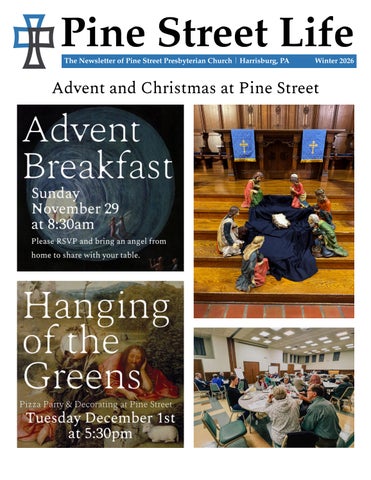
Advent and Christmas at Pine Street
Also In This Edition Advent and Christmas at Pine Street Christmas Giving Tree dfdfd
Advent and Christmas at Pine Street (Continued)
2026 Christmas Giving Tree
The Pine Street Christmas Giving Tree returns with opportunities for everyone to share Christ’s light with our neighbors through our local mission partners. Items purchased for the Giving Tree can be left at the Giving Tree table in the Gathering Place from Sunday November 29 to Sunday December 20.
Gifts for Our Students at Camp Curtin Academy We have received the names of 15 students from Camp Curtin Academy in the Harrisburg School District. Gia Johnson who many of you have met is now the point of contact for the District’s Homeless & Foster Care students and provided us with information for these students. The list is comprised of female and male students in the 6th, 7th and 8th grades at Camp Curtin Academy. Their teachers in conjunction with the parents and students have sent individual information for each student who will be granted a Need and a Wish by our Giving Tree. The Mission Committee suggested that their requests remain in the $100 range or less with a Need and a Wish each be valued at approximately $50. The students’ sizes, sex and grades have also been provided. Contact Alicelyn Sleber with any questions or help with shopping. Feel free to wrap any of the gifts or not. Please know that the students’ gifts will be placed in a large individual gift bag, tied with a bow and a name tag for delivery to the school. Delivery date is planned for December 21st or 22nd.
Sweet Treats for Guests at Downtown Daily Bread For those who love to bake up a storm around the holidays, why not whip up an extra batch of Christmas cookies and bring them to the Giving Tree? They’ll be packaged for delivery to Downtown Daily Bread, providing our food disadvantaged neighbors with a tasty Christmas treat.
Helping Our Neighbors Stay Warm This season of giving, Pine Street’s Giving Tree is once again partnering with HELP Ministries of Christian Churches United to assist Harrisburg-area residents who need help purchasing home heating oil during the winter. With heating oil costs placing an especially heavy burden on households this year, our gifts can provide much-needed relief to neighbors facing the difficult task of keeping their homes warm. HELP Ministries processes applications and works to ensure recipients have first exhausted other available assistance, including Pennsylvania’s Low-Income Home Energy Assistance Program, or LIHEAP. Those wishing to participate may make a check payable to Pine Street Presbyterian Church, 310 N. 3rd St., Harrisburg, PA 17101, or directly to CCU/HELP Ministries, 413 S. 19th St., Harrisburg, PA 17104. In either case, please write “Oil Heating Program” on the memo line. If donating through Pine Street, please also complete the sign-up sheet at the Giving Tree table in the Gathering Place. Pine Street will combine our individual gifts into one collective donation to HELP Ministries. Together, our Giving Tree can help provide something especially precious this holiday season: the warmth and security of home.
Remembering our Homeless Veterans This Christmas, Pine Street’s Giving Tree will once again remember homeless veterans in the Harrisburg area with a simple gift that can make a meaningful difference. We are collecting $10 Dollar Tree gift cards for distribution to veterans in need. These gift cards allow each veteran to select everyday necessities based on individual needs while also providing something equally important: the dignity and independence of making those choices personally. Please bring your $10 Dollar Tree gift cards to the Giving Tree collection area during this year’s drive. It is a small and simple gift, but one carrying a much larger message to veterans experiencing homelessness in our community: You are remembered. Your service matters. And your neighbors at Pine Street care and will never forget.
Welcoming Refugee Families We are asking members of the congregation to consider donating $50 Giant Food gift cards to help newly arrived refugee families purchase essential groceries during their first days and weeks in our community. While $50 is a suggested giving amount, donations and gift cards in other monetary amounts are also warmly welcomed. Every contribution, large or small, can make an extraordinary difference to a family beginning again in a new country. For families who have traveled thousands of miles to escape hardship and begin a new life, even a modest gift can provide meaningful help. Your generosity not only puts food on their tables but offers something equally important: a sense of welcome, dignity, compassion and hope as these families take their first steps toward self-sufficiency.
When the angels visit Mary and Joseph to tell them of Christ’s coming birth, these words come first: “do not be afraid.” These angels produce terror. No wonder, when you look at artistic renderings of “biblically-accurate angels.” So the angels say, do not be afraid. It’s of the clearest instructions in the whole Bible. But right up there with it is the often-repeated instruction to fear God, to have “the fear of the Lord.”
Now, I don’t think we tend to see that as a contradiction—fear of God clearly means something like worship or reverence, something totally different than fear of lesser earthly dangers or threats. Fear can make us do some crazy things, or fear can lead us to do nothing at all—two extremes of frantic desperation and timid caution. But no matter which, the very thing you fear most often has a way of happening.
The angel didn’t say “you have nothing to be afraid of.” There are certainly things that these Bible characters and the early Christ-followers had to be afraid of. When the Bible says not be afraid, it’s always addressed to specific people facing specific threats, whether it’s an approaching rival army, or the dire possibility of thirst and starvation, or a compromising pregnancy that threatens banishment or worse. The Bible recognized the foothold that fear has in human life. It acknowledges that there are things to be afraid of, even as it instructs God’s people to not be afraid. I’m not sure we do the same today. In our ostensibly developed, progressive age of safety, we’re not often under threat. In the words of FDR, the only thing we have left to fear is fear itself. Fear without a specific reference point is something more like dread—not a common threat, but an individual problem we have to process on our own. It’s fair to say that, today, we are much more alone in our fear. Fear without a specific reference point is something more like dread—fear isn’t something we share in the face a common threat. Instead, it’s an individual problem we’re supposed to process on our own. It’s fair to say that, today, we are more alone in our fear. Looking at the unusual nightmare scenes painted by the 16th century Dutch master Hieronymous Bosch (see below), scholar Charles Taylor imagines how they must have been seen at the time:
“Those nightmare scenarios of possession, of evil spirits, of captivation in monstrous animal forms; we can imagine that these were not “theories” in any sense in the lived experience in that age. They were objects of real fear, of such compelling fear, that it wasn’t possible to entertain seriously the idea that they might be unreal. You or people you knew had experienced them. And perhaps no one in your milieu ever got around to suggesting their unreality.”
The same, Taylor says, for the people of biblical times. When a Judean saw someone possessed by an evil spirit, they “were too immediately at grips with the real suffering of this condition, in a neighbor, or a loved one, to be able to entertain the idea that this was an interesting explanation for a psychological condition.” Our culture takes us out of the world of fear: of demons, spirits, monsters, giants, and more. But we have to admit that we aren’t any less afraid. As Taylor puts it, we might not fear the dead, but we still fear death. Of course, many people on society’s margins still have plenty to be afraid of. Fear continues to gain a foothold in our collective imagination, in our public discourse, and around our dining room tables. We still fear the “other” and we’re afraid of failing the ones we love. We are afraid of saying the wrong thing at the wrong time and we’re afraid of being shunned or “canceled.” We fear decline or getting left behind and we fear change and even progress. We are afraid of death and, if we dig a little deeper, we might find we’re afraid of what God will or won’t do when the time comes. In times of turmoil and change, Toni Morrison writes, “this is precisely the time when artists go to work. There is no time for despair, no place for self-pity, no need for silence, no room for fear. We speak, we write, we do language. That is how civilizations heal. I know the world is bruised and bleeding, and though it is important not to ignore its pain, it is also critical to refuse to succumb to its malevolence. Like failure, chaos contains information that can lead to knowledge—even wisdom. Like art.” So, in this Advent season before the birth, before we put out all the pieces in the Nativity sets, we will explore what God’s revelation has to say about fear. Just as we acknowledge what we have to be afraid of, we can find wisdom from the chaos of God’s kingdom breaking into this weary world: we do not need to be afraid. Because where fear occupies all the rooms of the inn and our hearts, we can trust that the Spirit goes ahead to make room for Christ. Because in God’s kingdom, there’s no room for fear. Advent Blessings, Stuart, Pastor
“So do not fear, for I am with you; do not be dismayed, for I am your God.” (Isaiah 41:10)
More Friend than Servant – Mike Putt Fear has been with us from the very beginning. After Adam's temptation with the apple, his first response is, “I heard the sound of you in the garden, and I was afraid...and I hid myself”. Signaling the first alienation from God, it is also a biological survival mechanism.It then moves into a broader sense of fear from environmental enemies, scarce resources, suffering and death. So it continues until later thought and writings begin to change the narrative.We see in both Proverbs and Ecclesiastes the turn to the fear of the Lord. It is “the beginning of knowledge” and the whole duty of humanity. As Jesus came to give us life, he affirms the idea of the fear of God being the way to live and conduct ones life. This is probably most succinctly written in 1 John 4:18, “There is no fear in love, but perfect love casts out fear.” Now, because of the cross and resurrection, we have no more fear of divine judgment. While we remain in reverential awe, dread of condemnation is now gone as we take our place in God's family. We now become more friend than servant.
This good news is that we can now live as friends of Christ, with all the intimacy, maturity, risk, confidence, strength, and joy that implies. To experience friendship with God is to celebrate our freedom in Christ – freedom from fear into strength, freedom from cowering into confidence that our insights, likes, dislikes, ideas, and experiences are valued. We can experience unconditional acceptance by God. -Sabbath as Release, Don Postema, CRC Publications, 1997
from the Belgic Confession (Dutch Reformation, 1561) We believe that our good God, by marvelous divine wisdom and goodness, seeing that Adam and Eve had plunged themselves in this manner into both physical and spiritual death and made themselves completely miserable, set out to find them, though they, trembling all over, were fleeing from God. And God comforted them, promising to give them his Son, born of a woman, to crush the head of the serpent, and to make them blessed.
That is enough to cover all our sins and to make us confident, freeing the conscience from the fear, dread, and terror of God’s approach, without doing what our first parents, Adam and Eve, did, who trembled as they tried to cover themselves with fig leaves.
Knowing Where to Turn – Joanne Book-Coles Proverbs 31:30 “Charm is deceitful, and beauty is vain: but a woman who fears the Lord is to be praised.” Isaiah 41:10 “Do not fear, for I am with you; do not be afraid, for I am your God; I will strengthen you, I will help you, I will uphold you with my victorious right hand.” When my maternal Grandma died, my aunt read Proverbs 31 at her funeral. The last verse of that chapter stuck with me, as young as I was, for what it said about fear. It was different than the many verses in the Bible telling us not to be afraid. Proverbs 31:30 tells us that a woman who fears the Lord is worthy of praise, and Isaiah and many other verses tell us not to fear. This seemed so contradictory to me. But as I grew I realized that the Proverbs 31:30 fear of the Lord meant to trust in Him and know that He is greater than any fear or challenge we face. Having faith doesn’t mean we never feel afraid. It means that we know where to turn when fear comes. I was blessed with my Grandma, my parents, and other family members who were examples of living with faith and the fear of the Lord described in Proverbs 31:30 with the confidence of the promises in Isaiah 41:10. During Advent, my thoughts often turn to Christmases past with them on earth, sadness at being separated from them now and, because of the gift of Jesus, the expectation that I will see them again in heaven. Advent is a season of expectation, looking forward to celebrating the birth of Jesus and the hope, peace, and promise that came into the world through Him. But Advent is also a season of waiting and change. Life is full of changes and not all of them are exciting. Change and uncertainty can bring fear, sadness and the desire to hold on tight to the past. We grow older, we face new challenges, our families change and we are separated from those we love.It is during these times that Isaiah 41:10 offers such comfort. God doesn’t promise we will never experience difficult seasons. But He promises His presence to strengthen us, help us, and hold us up when we feel afraid and uncertain. The birth of Jesus was a time of change and uncertainty. Mary, Joseph and the shepherds were all afraid when their futures and lives took completely unexpected turns. But they trusted God and God was with them. Like them, we may not know what the next season of our lives will bring, but we can trust that we will not face it alone. Prayer Dear God, during this Advent season, teach us to fear You with hearts filled with reverence, love, and trust. Help us to be confident in Your promises. When we are afraid, remind us that You do not change and You are with us to strengthen and uphold us. As we prepare to celebrate the birth of Jesus, may we remember the greatest promise of Christmas: Emmanuel, God with us. In Jesus’ name, Amen.
Fear, Bravery, and Trust in God – Elyse Rogers What does fear mean if you are a woman? When Pastor Stuart selected “no room for fear” as the theme for Advent, my first thought was not of Mary. Mary’s fear, and her trust in God, is well known to us. She was a young woman – a girl even - betrothed but not married, pregnant in a culture that dealt harshly with such women. But God blessed her, and through her, all of us, with our Lord Jesus Christ. My first thought was of Hagar, the slave of Sarah. Hagar had no agency over her body – or her life. At the whim of Sarah, she becomes a concubine to Abraham. Sarah was not kind to her, and she ran away while pregnant. Genesis 16:13 says God spoke to her. She is amazed. She is brave enough to name God, who sees her. “Have I really seen God and remained alive after seeing him?”At the behest of God, she returns and submits to Sarah. Ishmael is born, and Sarah remains unkind to Hagar and Ishmael. Abraham, a coward, casts them out into the wilderness when instructed to do so by Sarah. But Genesis 21 tells us that Abraham, while greatly distressed, trusts God’s word that a nation will come forward from Ishmael. Notice that Abraham’s concern was for Ishmael, not for Hagar.
Back to Hagar – she is wandering in the desert with some bread and water, which quickly runs out. She is certain death will come to her child, and to her. She is in despair, and afraid. God comes to her again, through an angel, and tells her not to be afraid. The angel tells Hagar to lift up the boy and hold him fast. God opens Hagar’s eyes, and she sees a water well. Restored by hope, trusting in God, Hagar and Ishmael do not perish. Ishmael does indeed become the father of a nation.
While women generally take a back seat to men in the Bible, those women whose acts are recorded acted bravely. They must have been afraid, but they trusted and acted on that trust. Think of Rahab’s bravery in Joshua 2, and how it saved her family. Deborah leading Joshua against King Jabin, and Jael’s bravery in killing Sisera in Judges 4. Jephthah’s unnamed daughter in Judges 11, who accepted and mourned her upcoming death. Tamar’s resourcefulness and bravery in the face of her father-in-law Judah’s dereliction of duty in Genesis 38. Ruth, whose story follows Judges. I am quite sure that every woman of Pine Street – in the church present and in the church triumphant – has a personal story of fear, bravery, and trust in God.
Think also, of how many of these women whose stories are recorded were foreigners. That status alone would be cause for fear; to say nothing of being both a woman and a foreigner. While the Bible tells us that God made a special covenant with Israel, God clearly spoke to those who were not Israelites and gave them reason for hope in the face of fear. God is not just the god of one people or nation – God is the god of all nations and peoples, of men and women. Hagar Dismissed as a slave Even so, God sees you God speaks to you Not once, but at least twice And Tells you not to be afraid Resourceful, brave, trusting Attentive to God’s instructions Mother of nations.
Creative Response Looking at the “nightmare scenarios” Hieronymous Bosch painted to show the fears of his time, draw or describe a scene of the fears we face today.
12
God is our Refuge and Strength – Carol Putt Psalm 46 has been my favorite Bible passage since childhood. I was always afraid of getting lost or separated from my parents. If friends didn’t come to play when I asked them, I was afraid I had done something to make them angry. I wanted everyone I met to be my friend and I tried to please everyone so they would like me. As I got older, I learned that wasn’t possible! So when I started reading the Bible in Sunday School and learning that God is always with me and I didn’t need to be afraid of those things or pleasing those people to be liked, Psalm 46 reminded me that God would be my strength through all those stressful situations. “Therefore we will not fear though the earth give way, and the mountains fall into the heart of the sea, though its waters roar and foam and the mountains quake with their surging” (Ps. 46:2-3 NIV). It has always been a curse that I do worry at times, too. I’m not too great in high places where I am near the edge. News stories do sometimes feed my fear of physical harm, too. Even though I have outgrown the childhood fears, I still have to remind myself that the anxiety that I experience when the adult ones creep in can be mitigated by reading or remembering Psalm 46. “He says, Be still and know that I am God.” It seems that when I remember God’s promises to be with me and protect me, the fear subsides and I can rely on God’s strength when mine is not enough.
from “September 1, 1939” by W.H. Auden Faces along the bar All I have is a voice Cling to their average day: To undo the folded lie, The lights must never go The romantic lie in the brain out, The music must always play, Of the sensual man-in-the-street And the lie of Authority All the conventions conspire Whose buildings grope the sky: To make this fort assume There is no such thing as the The furniture of home; State Lest we should see where we And no one exists alone; are, Hunger allows no choice Lost in a haunted wood, To the citizen or the police; Children afraid of the night Who have never been happy We must love one another or die. or good.
13
Defenceless under the night Our world in stupor lies; Yet, dotted everywhere, Ironic points of light Flash out wherever the Just Exchange their messages: May I, composed like them Of Eros and of dust, Beleaguered by the same Negation and despair, Show an affirming flame.
Plenty to Be Afraid Of – Scott Miller, Parish Associate Back in the day, I used to love reading the Sunday comics. While my dad was perusing the latest news headlines, I was catching up on the latest escapades of Beetle Bailey and Broomhilda. One of my favorite comic strips was The Family Circus by Bil Keane, in which he describes the joys and challenges of family life. One strip in particular has stayed with me over the years. In it Dad is awakened by the cries of his young son Jeffy, who apparently is having a nightmare. Dad rushes to his son’s bedroom and asks, “Jeffy, what’s wrong?”“Daddy, Daddy,” the boy cries out, “there are monsters under my bed!” “Don’t be afraid, Jeffy,” his dad replies in his most reassuring voice, “there are no monsters under your bed. Now go back to sleep.” As Dad makes his way back to his own bed, all kinds of “monsters” begin popping into his head: burglars, kidnappers, drug dealers, school shooters, etc. Don’t be afraid? Whom was he kidding? Jeffy’s dad suddenly realizes that there is plenty to be afraid of in this world. “Don’t be afraid.” As Pastor Stuart has noted in his introduction, these words of assurance reverberate throughout all of Scripture. God speaks them through prophets (e.g., Isaiah 43:1), through angels (e.g., Luke 1:30), and though Jesus himself (e.g., John 14:27).Unfortunately, we all too often assume that the reason God speaks these words is because we have nothing to be afraid of. God knows better, however. God does not dismiss our fears. On the contrary, God knows we have plenty to be afraid of. Whether it’s a recent cancer diagnosis, the latest round of lay-offs at work, or severe weather patterns due to climate change – God is well aware of the many real dangers that threaten our own lives and the lives of those we love. No, the reason God says “Don’t be afraid” is not because we have nothing to be afraid of. We most certainly do. Rather, it’s because God has promised to be with us. Recall the familiar words of Psalm 23: “Even though I walk through the valley of the shadow of death, I will fear no evil. For you are with me . . . .” It is God’s presence that transforms the most terrifying situation and encourages us to face our fears knowing that we are not alone – that God is with us. And we as God’s people, are called to be – in the words of Henri Nouwen – “living reminders of God’s presence” to one another. Think back to that comic strip by Bil Keane. Imagine what would have happened if instead of leaving Jeffy to face his fears alone, his dad had stayed with him and said, “I know you’re afraid, Jeffy, but don’t worry. Daddy is here. And I’m not leaving until you feel safe and can go back to sleep.” I have no doubt that the father’s abiding presence and steadfast love would have made all the difference in the world to his frightened son. I also have no doubt the same holds true for us. In the realm of God, there is no room for fear, because God in Christ has promised to be with us come what may and to love us with a perfect love that “casts out fear” (I John 4:18). Thanks be to God!
Waiting for Answers – David Colestock Mark 5:35-43 and Luke 8:40-56 Reading the scripture story about the synagogue leader with the sick daughter reminded me of my own recent experience. The religious leader sought help from Jesus to heal his dying daughter, and others told him it is too late, that she was already dead. But Jesus said, “Do not be afraid. Believe and she will be saved.” When Jesus went to the leader’s home, Jesus said that the child was not dead, that she was sleeping. He took her hand, told her to get up, and she began to walk. All were amazed at what they had seen. My recent trip to the emergency room was a result of joint pain and swelling. I woke in the middle of the night to find my knee swollen and painful to a point where I could not walk. The swelling and pain had come so quickly that I was terrified. What was causing this to happen? Would the pain spread to other joints? The ER doctors were able to relieve the pain and inflammation, but they could not identify the cause. Blood tests, vitals, and x-rays could only tell part of the story. They referred me to my family doctor and to other specialists for follow-up. While I wait for answers, I’m hoping and praying that the pain and swelling does not return. Or am I? I’m hoping that the doctors will be able to allay my fears, to figure out what happened, that they can reassure me that this was a fluke, or that with the right treatment or medication, we can reduce the likelihood of the condition returning. But am I praying? Am I facing this medical concern by asking God to help me to not be afraid, to trust in God and the doctors who are caring for me and treating whatever the outcome may be? Prayer Gracious God, give me the strength to face fears and challenges, to put my faith in your hands and the hands of others that serve you. Amen.
Creative Response Like the DUH-duh... DUH-duh... DUH-duh signalling the approach of Jaws, music can heighten our sense of terror. But it goes without saying that music can uplift us, comfort us, and make us feel less alone in our fear – and not just sacred music! Take a few minutes to listen carefully to some of the songs (secular or sacred) you turn to when you’re afraid or overwhelmed. You can even make a playlist! What do these songs make you feel and how do they do it? Is it the lyrics, the melody, the beat, or something else?
Henry Ossawa Tanner - The Annunciation (1898).