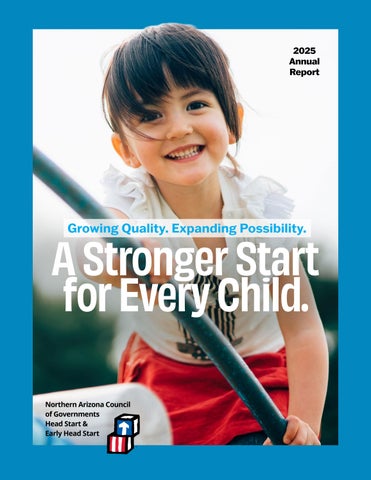
2025 Annual Report
Growing Quality. Expanding Possibility.
A Stronger Start for Every Child. Northern Arizona Council of Governments Head Start & Early Head Start
Head Start Community Impact
$26,679,915 added to regional economy
346 employed by Head Start/ Early Head Start
787 children, pregnant women served
659 received crisis intervention
722 families benefited from family services
161 unhoused families served
51 unhoused families acquired homes
Strong Foundations. Lasting Impact. Across four vast and diverse northern Arizona counties, NACOG Head Start meets children and families where they are—with a consistent commitment to quality, opportunity, and school readiness. From rural communities and tribal lands to the urban center of Flagstaff, NACOG Head Start served 787 children and pregnant women and 734 families during the 2024–25 program year.
Every child arrives at Head Start with unique social, emotional, and developmental needs. Yet every child, regardless of circumstances, deserves the opportunity to succeed in school and in life. Our programs use evidence-based curricula and best practices across center-based, home base, and locally designed options. Head Start emphasizes whole-child health and school
readiness skills for children ages three to five, while Early Head Start focuses on the healthy development of infants and toddlers including prenatal care. Head Start’s two-generation model engages parents as equal partners with the child’s teacher, and families receive comprehensive services from counseling and crisis intervention to goal setting, job training, and education.
NACOG Head Start nurtures every child and family—preparing them to grow, thrive and succeed in school and in life. 1
A Message from our Director As we present the NACOG Head Start Annual Report, we hope the words “Growing Quality, Expanding Possibility” come to life on every page. You will see the value of our Glows and Grows monitoring tool in helping teachers plan for and deliver individualized early education. Shifting from a time-consuming assessment model to the E-LAP direct assessment approach resulted in another leap forward for evaluating educational progress and instructional proficiency. Throughout the program, our commitment to teaching and modeling Pyramid principles helped to foster secure attachments in nurturing environments, reduce challenging behaviors, and decrease discipline inequities. Our commitment to maximize resources and develop workable solutions that meet specific needs provides a regional and statewide model for moving people out of poverty by aligning them with life-changing resources and opportunities. Continually reaching toward program excellence requires ongoing assessment and improvement in every aspect of the program, from better nutritional options and value-added recruitment strategies to our partnership with Balance mental health professionals. Monitoring also occurred independently through the Office of Head Start’s Focus Area 2 review, which identified two deficiencies and prompted the implementation of strengthened management and health/ safety practices and procedures. These efforts are all part of NACOG’s ongoing commitment to continuous quality improvement. Our deepest appreciation goes to the individuals, organizations and communities who make this work possible—from our dedicated staff and volunteers to our community partners, advocates, leaders, and governance. Their generosity, expertise, and commitment help NACOG Head Start meet the complex needs of children and families across Northern Arizona. Above all, we celebrate our Head Start parents who bring love, courage, and extraordinary determination to build better lives for their children. We are honored to walk alongside them, opening doors to opportunity and helping families turn possibility into progress. Together, we are inspiring change through opportunity. Sincerely,
Chris Fetzer
NACOG Head Start
2
928-774-9504
nacoghs@nacog.org
The Needs Are Evident. So Is the Response.
NACOG Head Start Snapshot
787 477 296 14 total Head Start/EHS enrollment
preschool enrollment (402 funded)
total EHS EHS enrolled pregnant children women (246 funded)
100 167
38
percent fully funded/ monthly enrollment
foster children
unhoused children
NACOG’s 2024 Community Needs Assessment paints a clear picture of life across Northern Arizona: Families are navigating overlapping challenges in housing, food security, utilities, employment, childcare, and healthcare. For families living at or below the poverty line, these needs can have far-reaching impact on a child’s health, development, and readiness to learn. The assessment confirms what NACOG Head Start sees every day: Early childhood success depends on family stability. And Head Start programs play a vital, ongoing role in the community’s response. Housing and Economic Stability: Nearly one in five residents lives below the poverty line. Housing was identified as a significant need by 86% respondents, while 88% identified paying utilities as a major concern. Housing instability, low wages, limited rental inventory, and utility costs can make it difficult for families to
establish the stability children need for healthy development.
behind many children in need of disability services.
Food and basic needs: Food insecurity ranked among the region’s highest priority concerns, with 87% of respondents identifying it as significant. NACOG Head Start connects families with food, nutrition resources, and other supports that help address immediate needs while strengthening family stability.
Health and family well-being: More than half of respondents identified healthcare access as a significant need, with cost among the barriers. NACOG Head Start helps families navigate health, nutrition, mental health, and other community resources—because supporting a child means supporting the whole family.
Childcare, education, and disability services: Childcare is a significant unmet need as identified by 66% of respondents, yet thousands of young children in the region are estimated to be eligible for Head Start programs if sufficient program funding were available. Of the 5,095 children under the age of 5 identified as living in poverty, NACOG Head Start served 787 or 15%. NACOG Head Start provides comprehensive early learning, developmental screening, and family engagement, special needs support —which also limits access to early intervention, leaving
NACOG’s 2024 Community Needs Assessment confirms what NACOG Head Start sees every day: Early childhood success depends on family stability. And Head Start programs play a vital, ongoing role in the community’s response. 3
Beyond the Classroom: Learning Begins with Relationships.
School readiness is about more than knowing letters and numbers. Children are ready for school when they have the skills, confidence, relationships, and curiosity to engage in learning— and when the adults around them are prepared to support that learning. Head Start recog-
4
nizes parents and guardians as the child’s first and most important teachers, building education around strong partnerships among children, staff, parents, and families. Our programs emphasize the importance of fathers in a child’s early development and the way engagement by male
caregivers fosters independence, confidence, and emotional security. Of the 372 two-parent families enrolled in NACOG Head Start in 2025, 285 fathers were actively involved in their child’s educational process, while 24 assumed roles in father engagement.
NACOG Head Start supports the whole child through research-based teaching and social-emotional practices that help children recognize and express emotions, develop self-regulation, build positive relationships, and approach learning with confidence. Families are active partners in this process, sharing their knowledge of their children and learning ways to extend classroom experiences into everyday life. Parents enrolled in the home base option learn how simple routines such as reading, singing, and playing become opportunities for learning and connection. Together, teachers, home-based visitors, and families use children’s individual strengths and developmental needs to guide learning. These relationships help ensure that every child—across every setting and community—has the support to grow, learn, and enter school ready to succeed.
Kindergarten Readiness and Child Outcomes 70.0
Social/Emotional Self Help
74.8
Gross Motor Language
64.1 29.8
47.0
0%
53.7
48.5 43.6
24.2
Math
FALL 2024
55.8
40.8 28%
82.9
32.9
Cognitive Fine Motor
89.7
46%
62%
SPRING 2025
82%
100%
5
Every Child Seen. Every Child Supported. Every child entering Head Start, regardless of age, begins with an individual assessment of their strengths and needs. Within 45 days of enrollment, staff completes basic screenings to identify concerns that may require further evaluation or specialized services. NACOG Head Start works closely with Arizona IDEA (Disabilities Education Act) agencies and community service providers to connect children with the services they need and ensure that children with disabilities are fully included in their classrooms and learning communities. During the 2024-25 academic year, 25 Early Head Start infants and toddlers received support through an IFSP (Individualized Family Service Plan), enabling staff and parents to take full advantage of the critical window of rapid brain development in the first 36 months. Forty-five Head Start children had an IEP (Individualized Education Program). Within this group, 25 were diagnosed with speech or language impairment, which is an area where early identification and intervention can make a meaningful difference.
45 25 preschool children with IEP
infants/ toddlers with IFSP
Every Language is an Asset. Children bring their home languages and cultures with them to Head Start—and those strengths are part of their learning journey. NACOG supports dual-language learners with strategies and tools designed to build English language development while strengthening bilingual communication and early literacy skills. During the 2024-25 academic year, 228 dual-language learners participated in the 6
program, supported by 22 staff members with proficiency in a language other than English. Home languages other than English included Spanish (96), European/Slavic (2) and one Unspecified. By recognizing and building children’s existing language skills, Head Start helps dual-language learners develop the communication and literacy skills they need for success in school and life while valuing the languages they bring from home.
89 Early Head Start dual language learners
139 Head Start dual language learners
22 staff with proficiency in a language other than English
Individualized Instruction. High-Quality Standards. NACOG Head Start and Early Head Start use the Creative Curriculum, developed by Teaching Strategies, Inc., to support children’s learning and development. Each year, the curriculum is presented to parents and approved by the Parent Policy Council. Children’s progress is measured using the E-LAP (Early Learning Accomplishment Profile), a direct assessment system aligned with the Head Start Early Learning Outcomes Framework. At each checkpoint, teachers and homebased visitors spend two weeks observing and assessing children’s age-appropriate skills across developmental domains. Between checkpoints, they continue to monitor emerging skills and adjust instruction accordingly. The Glows and Grows monitoring system specifically links child-outcome data to lesson planning and program improvement. Teaching teams, homebased visitors, and management use the data to identify areas for
improvement and target training and technical assistance, turning assessment results into informed action. Introducing the Glows and Grows system in 2022 revealed a challenge: Teachers and homebased visitors were struggling to individualize lesson plans and differentiate instruction based on developmental needs rather than age. By 2023, 80% of teachers and home-based visitors were planning to meet individual developmental needs through the Glows and Grows process, but overall results still fell short of expectations. Only 39% could complete the hundreds of anecdotal entries required within the specified timeframe using the traditional TSG (Teaching Strategies® GOLD) observation-based assessment system. Adopting the E-LAP (Learning Accomplishment Profile) direct assessment system changed the picture dramatically. During the 2024-25 academic year, timely assessment completion rose
to 87% while the percentage of teachers and home-based visitors planning and teaching to individual developmental needs remained strong at 75%.
“Wherever you access NACOG Head Start services in our vast, geographically diverse and largely rural region, our commitment to providing highquality early care and education programs remains the same.” Maegan Van Wyck Education and Child Development Manager
7
Building the Foundation for Learning. Since 2021, NACOG Head Start has been a regional and statewide leader in integrating the Pyramid Model to strengthen children’s social-emotional development and prevent challenging behaviors. The approach recognizes that children learn best when they feel safe, connected, and supported—and that social-emotional skills provide a foundation for success across every other area of development. The Pyramid Model gives educators and families practical, relationship-centered strategies for helping children recognize emotions, develop self-regulation, build positive relationships, and navigate challenging behaviors.
It also creates a framework for adults to reflect on their own practices, solve problems together, and respond to children in ways that are constructive, inclusive, and developmentally appropriate. The approach aligns with the Head Start Early Learning Outcomes Framework and supports NACOG’s commitment to high-quality learning environments for every child. During 2024–25, NACOG continued to build on this investment by embedding Pyramid practices across the organization. The result is more than a curriculum or set of strategies—it is an organizational culture in which relationships, emotional well-being,
and positive behavior are understood as essential to learning. The strength of our investment in social-emotional development is reflected in the 2025 CLASS* scores, where NACOG Head Start earned an exceptional 6.4 out of 7 in Emotional Support, exceeding the quality threshold of 6.0. This score reflects the strength of teacher-child interactions and the supportive classroom environments created through years of Pyramid Model implementation. *CLASS® and Classroom Assessment Scoring System® are registered trademarks of Teachstone Training, LLC.
2024-25 CLASS Score
6.4 7 OUT OF
for Emotional Support
8
Nurturing a Culture of Support for Mental Health & Wellness.
NACOG Head Start recognizes that supporting children and families also means supporting the adults who care for and teach them. In keeping with the National Head Start model of serving children, families, and communities through a continuum of services, leadership, and advocacy, NACOG has made mental health and wellness an integral part of its community partnerships and support network. Our partnership with Balance Mental Health and Wellness in 2025 provided an important layer of support for Head Start staff, children, and families. Having Balance professionals on-site made
conversations about emotional well-being more comfortable, accessible, and free of stigma. Staff and families could access three initial counseling sessions at no cost, with continued services available through insurance. The value of partnership extended well beyond individual counseling. Balance counselors maintained a regular presence at every NACOG Head Start and Early Head Start center, building relationships with staff and creating a trusted space to talk about stress, communication, conflict, team dynamics, and other challenges. Counselors became familiar faces, so staff felt more comfortable
seeking support and guidance. If on-site trauma support was required, Balance professionals worked with staff and others affected by an event to address immediate concerns and develop individualized plans for continued support. This combination of prevention, relationship-building, accessible counseling, and rapid response reflected the best of community partnership: mental health support was not treated as something separate from Head Start’s work, but as part of creating safe, healthy environments in which children, families, and staff can thrive.
9
Building a Crisis Intervention Network. For families already living on the edge, even a small crisis can threaten housing, food security, health, and family stability. In 2025, 90% of the 734 families enrolled in NACOG Head Start and Early Head Start required crisis intervention for critical needs like food, clothing, shelter, or other essentials. The depth of these needs underscores why Head Start’s role extends well beyond early childhood education. For families facing housing instability or homelessness, timely support is especially crucial. Unhoused children face increased risks to their emotional, behavioral, and physical well-being. In 2025, NACOG Head Start services reached 161 families experiencing homelessness and 51 families secured housing by year-end. These outcomes represent more than a change in circumstances—they reflect the importance of having trusted professionals who can help families navigate complex systems and take practical steps toward stability. Our commitment to meeting basic family needs includes participation in the Diaper Distribution Demonstration and Research Pilot (DDDRP). This collaborative grant initiative recognizes that diapers can be a significant financial burden for struggling families, but they are also essential to family health and required by childcare providers. Through the DDDRP grant and strong local partnerships, NACOG Head Start provides access to diapers and other essential supplies while connecting families with broader family-support and economic-mobility resources like Wrapped in Love and Wildfire AZ. At NACOG Head Start, crisis intervention goes beyond responding to families at a breaking point. Our goal is to recognize vulnerability, address immediate needs, and work closely with families in creating pathways toward stability.
161 unhoused families served 51 families secured housing by year-end
10
Caring for the Whole Child.
Head Start’s commitment to school readiness begins with a simple understanding: children learn best when their whole well-being is supported. NACOG Head Start’s whole-child approach addresses health, safety, nutrition, relationships, and emotional well-being that enable children to grow and thrive. Each child undergoes hearing, vision, and behavioral screenings, and families are supported in scheduling and completing medical and dental examinations. Staff work closely with families to ensure ongoing access to primary and dental care, up-to-date immunizations, and individualized care plans for children who have been diagnosed with special health or medical needs. Healthy development also happens through everyday experiences. At every center, children have opportunities for active
indoor and outdoor play and receive nutritious meals and snacks designed to support growing bodies and developing minds. Health and hygiene are woven into the daily routine, from handwashing to brushing teeth after meals and snacks. The integration
of health, nutrition, movement, safety, and nurturing relationships makes Head Start more than an early education program. It creates an environment in which children are healthy enough to learn, secure enough to explore, and sufficiently supported to thrive.
EHS Year-End Health Profile • 38% up-to-date preventative/primary healthcare • 62% completed dental exam • 98% children with health insurance • 94% up-to-date on possible immunizations or exempt • 99% with access to continuing healthcare source • 86% with access to continuing dental care source • 100% pregnant women with access to continuing healthcare source Head Start Year-End Health Profile • 64% up-to-date preventative/primary healthcare • 50% completed dental exam • 92% children with health insurance • 99% up-to-date on possible immunizations or exempt • 93% with access to continuing healthcare source • 92% with access to continuing dental care source
11
Building a Better Table: Nourishing Tomorrow’s Future Today.
We didn’t just say nutrition matters. We built kitchens.
Good nutrition is an essential part of school readiness, and NACOG Head Start is investing in the infrastructure needed to put more fresh, nutritious food on children’s tables. Our Culinary Kitchen program continues its transition from catered food service to self-operated kitchens—a significant undertaking designed to give staff greater control over the quality, freshness, and variety of meals and snacks. In 2025, 52% of NACOG Head Start kitchens were equipped to prepare food on site, marking an important step toward a more flexible and responsive food service model. Converting a program center to on-site food preparation is far more complicated than installing a stove. Each kitchen requires in12
spections, thoughtful layout and design, new equipment, delivery and installation, coordination with local health departments, and extensive staff training. The result is a food service system built around the needs of the children and families that NACOG Head Start serves. Lessons learned from conversion projects to date will help us expand self-operated kitchens to rural communities in the years ahead. The goal is simple: healthier food, fresher ingredients, and increased nutritional value for the children we serve. By building the capacity to prepare meals where children learn and grow, we are making health and nutrition an even more intentional part of the Head Start experience.
“Every kitchen our team creates is an investment in the health of the children we serve. Fresh food, greater appeal, and increased nutritional value are more than menu improvements—they are building blocks for healthy development, school readiness, and lifelong well-being.” —The Health, Nutrition, and Safety Team
Building a Scaffold of Whole Family Support. Head Start prepares children for school, but its impact reaches far beyond the classroom. NACOG Head Start uses an evidence-based, two-generation approach that recognizes a simple truth: children thrive when their families have the support, stability, and opportunities they need to thrive, too. For 659 families this year, that support began with crisis intervention for basic needs like food, shelter, and clothing. Once immediate needs are addressed, family support specialists work alongside parents to identify goals, build confidence, and create pathways toward greater stability and self-sufficiency. Each year, NACOG Head Start parents take meaningful steps forward, including employment and further education, that strengthen their own futures and create new possibilities for their children. The scaffold extends into the home, where parents learn strategies for creating healthy, nurturing, and stable environments. The Pyramid Model practices modeled and taught by NACOG Head Start staff help parents respond constructively to intense emotions and behavioral challenges, building lasting skills that support stronger relationships and positive child development. From crisis intervention to educational advancement, from parenting support to emotional regulation, NACOG Head Start connects the crucial pieces of family life. Each layer reinforces the others, creating a stronger foundation for children—and helping families build the confidence, skills, and stability to move forward together.
722
22
638
used at least one family service
staff with proficiency in a language other than English
completed preventative healthcare education
409
619
633
26
research-based parenting curricula
participated in nutrition education
involved in the child’s assessment/ progress
attended ESL classes
455
75
supported transitions between programs
received education or job training support
Head Start Family Services Snapshot
13
A Parent’s Journey: The Hand She Needed to Keep Moving Forward. For parents, partners, and families with little or no outside support, Head Start can be far more than an early learning program. Katrina Montero’s story reinforces the life-changing difference that Head Start programs can make in helping parents assess their strengths, create strategies for growth, set realistic goals, and keep their eye on the prize of a brighter future. I grew up as a foster kid with little family support yet always wanted a family of my own. When I became pregnant, the situation was completely unplanned and not ideal, but keeping my baby was one of the best decisions of my life. The same goes for each one of my three perfect children. Having them alongside me gave me a reason to live again and encouraged me to become a better, stronger version of myself. I leaned on First Things First* home visits to support my child’s personal growth and development and for help in finding resources like Head Start. As a single mother of three, Head Start gave me hope for the future. They encouraged me to continue working toward the NREMT* certification I needed to follow my dream of helping others as an EMT and to make a financial plan for myself and my children. I am currently attending Yavapai College to further expand my dream of making the world a brighter place and to show my children and my community that anything is possible. I don’t know where I would be without Head Start, and words can’t express my gratitude. Head Start deserves even more funding so it can help young parents struggling with little or no family support to continue changing lives. I refused to give up, but Head Start gave me the hand I needed to keep moving through every hardship and challenge.
—Katrina Montero
Sometimes, changing a child’s future begins with giving parents the support to change their own. * First Things First: Arizona’s early childhood agency * NREMT: National Registry of Emergency Medical Technicians, the national certification organization for emergency medical professionals
14
Stronger Familes, Stronger Futures. Families are essential partners in preparing children for success—not only in school, but throughout life. Head Start welcomes parents and caregivers into the program in meaningful ways, grounded in trust, respect, and sensitivity to each family’s culture and language. Families are encouraged to become active participants in their child’s learning by visiting the classroom, volunteering, shaping program decisions, and serving in governance roles. Throughout the year, NACOG Head Start creates opportunities for children and their families to come together to learn, create, play, and simply enjoy time together. These events support developmental areas like health and nutrition, literacy, physical activity, and our social-emotional curriculum. Our unique Family Engagement Toolkit provides staff with a framework of learning
activities in kid-friendly themes like Pizza Night, How to be a Super Friend, and Dr. Seuss. One of the most highly successful and well-attended family engagement events is Kindergarten Transitions Night, where parents can meet with and learn support strategies from guest teachers and administrators at local elementary schools. Family engagement at NACOG Head Start is about more than bringing families through the door. It is about making parents true partners—and recognizing that they are their children’s first and most important teachers. Whether sharing a meal, learning a new parenting strategy, participating in governance, or preparing for the transition to kindergarten, families are building the knowledge, relationships, and confidence to advocate for their children at every stage.
2024 –2025 Family Profile
284
372
Early Head Start families
two-parent families
450
362
Head Start preschool families
single-parent families
734
606
Total NACOG Head Start families
with at least one parent employed, in training, or school
15
Growing Our Early Childhood Workforce. 2024-25 Program Staff Summary
311
58
72
total program staff
EHS infant /toddler
11
170
preschool teachers/ assistant teachers
EHS home visitor staff
Head Start preschool staff
Sustaining a high-quality early childhood program begins with a strong, supported workforce. In a field facing persistent staffing shortages and turnover, NACOG Head Start invests in the people who make quality early education possible. Staff who are pursuing required degrees and credentials can receive free tuition. A comprehensive onboarding process and continuous professional development support new and experienced employees in building the knowledge, skills, and confidence to grow in their careers. 16
NACOG Head Start partners with Northland Pioneer College, Yavapai College, Coconino Community College, Northern Arizona University, and Teachstone® to expand pathways into early childhood education. Staff can pursue degrees and credentials—including an online Child Development Associate credential—and receive additional NACOG Head Start support for coursework, exams, assessment, and professional portfolios. Perhaps the most powerful workforce pipeline is the one
NACOG Head Start grows from within its own community. Of 922 volunteers serving EHS and Head Start programs, 751 are current or former Head Start parents. During the 2024–25 academic year, 124 current or former Head Start parents were valuable staff contributors on our infant/toddler and preschool teams. They came to Head Start to help their own child—and discovered the many career pathways available to help every child learn, grow, and thrive.
One of Thousands of Stories: What Head Start Set in Motion. For the Johnson family, Head Start became a family tradition, a career path and a foundation for the next generation. Travis Johnson knows the value of Head Start from several perspectives: as a parent, a leader, an employee, and the father of four Head Start alumni. The family’s frequent moves also provided the unique experience of affirming NACOG Head Start’s commitment to high-quality programs at every center, in every community. Travis’ program involvement grew slowly from parent meetings and family engagement to leadership positions on the Head Start Policy Council. At the same time, Head Start became his career path. After several promotions and further education, he has ultimately served as center director at two NACOG Head Start locations. Along the way, Travis watched his own children grow. Karson forged his own path of personal growth, leadership, and achievement. In high school, he excelled in sports, achieved perfect attendance, and took on student leadership roles. Beyond supporting existing programs, Karson helped establish, organize, and implement a new junior-senior mentoring program for incoming freshmen. After graduation, Karson set his sights on an even bigger challenge: the Warrior-to-Inspector (WAR2IN) Non-Destructive Testing (NDT) Program in Bellemont, Arizona. Completing five testing certifications in addition to the NDT Inspector certification, Karson proudly accepted his diploma along with a contract from his new employer—with a six-figure salary for the first year. For the Johnson’s, Karson’s success is yet another chapter in a family story of growth and achievement that began with four small children entering Head Start—a story of parents becoming leaders, children discovering their potential, and one generation helping prepare the next.
For the Johnson family, Head Start became more than a preschool program—it grew into a family tradition, a career path, and a foundation for leadership and achievement across generations.
17
The Positive Ripple Effect of Head Start. NACOG Head Start programs stimulate economic growth, employing 311 people and adding $26,679,915 to the regional economy in the 2024-25 year. The entire community thrives from top to bottom when more residents are gainfully employed and find new business opportunities. Head Start programs support economic growth in another crucial way: Access to trusted, safe quality childcare and early education allows parents and caregivers to pursue job training, education, and careers. High-quality early learning can lead to long-term savings through better public health outcomes and more stable adult employment. Especially in rural areas, Head Start centers often serve as the primary access point for critical social and health services. Head Start provides a strong model of family advocacy and leadership, where parents hold key roles in Head Start and Early Head Start programs. Programs support family stability and encourage personal growth through decision-making opportunities, classes, and connections to community resources. Bringing together representatives from our four-county service area, the NACOG Head Start Policy Council determines policy and ensures compliant, quality programs. In addition to program planning, this governing board reviews and approves funding applications, enrollment and recruitment plans, and self-assessment process results.
NACOG Head Start fueled regional economic growth in 2024–25—employing 311 people and contributing nearly $26.7 million to the local economy.
18
NACOG Head Start Funding Funding Totals by Source
2025-2026 Projected Budget
$12,724,619 $9,572,308 $22,296,927 $523,260 $3,849,728
Head Start Preschool Fund Early Head Start Fund Federal Public Funds Total (Dept. of HHS, ACF, Office of Head Start) State Public (USDA, Arizona Dept. of Educ. Child Nutrition Program, CACFP) In-Kind (Local and Public Donations)
$12,675,591 Head Start Preschool Fund $8,419,827 Early Head Start Fund $5,273,855 Local Donations $608,526 State Public (USDA, AZDOE/CNP, CACFP)
$26,669,915
Total Monies
NACOG Independent Audit Results Heinfeld, Meech & Co., P.C. Certified Public Accountants are currently auditing the Fiscal Year 2024-2025 audit period that ended June 30, 2025. The independent Audit report will be formally presented to the NACOG Regional Council Governing Board in February 2025 for approval.
19
NACOG Head Start Locations Apache County
Navajo County
Round Valley 940 East Maricopa Drive Springerville 928-551-6696 Preschool Center Base EHS Center/Home Base
Blue Ridge 1200 W. White Mountain Blvd Lakeside 928-358-5274 Preschool Center Base EHS Center Base
St. Johns 610 West Cleveland St. Johns 928-337-4211 EHS Center Base
Clear Creek 1400 East Third Street Winslow 928-421-4202 x5240 Preschool Center Base
Coconino County
Holbrook 165 West Arizona Holbrook 928-524-6831 Preschool Center Base EHS Center/Home Base
Flagstaff Early Head Start 4000 N. Cummings Street Flagstaff 928-214-8461 EHS Center/Home Base Page 11 Cameron Road Page 928-645-8080 Birth to Five Home Base Ponderosa 2500 N. 1st Street Flagstaff 928-779-3244 Preschool Center Base EHS Center Base Puente de Hozho 3401 N. Fourth Street Flagstaff 928-900-5675 Preschool Center Base Siler 3581 North Fanning Flagstaff 928-526-1069 Preschool Center Base Sunnyside 1825 N. Main Street Flagstaff 928-773-7970 EHS Center/Home Base Williams 310 W. Sherman Williams 928-635-4273 Preschool Center Base EHS Center Base
20
Show Low Head Start 20 North 6th Street Show Low 928-537-7716 Preschool Center Base EHS Home Base Neighborhood Learning Wheels Snowflake 928-622-0768 Birth to Five Home Base Snowflake 680 West 4th South Snowflake 928-536-7330 Preschool Center Base EHS Home Base Winslow Old Country Club/Airport Rd. Winslow 928-289-2651 Preschool Center Base Winslow Early Head Start 710 N. Apache Avenue Winslow 928-289-2122 EHS Center/Home Base Yavapai County Ash Fork 450 West Lewis Ash Fork 928-637-1027 Birth to Five Home Base
Beaver Creek 4810 E. Beaver Creek Road Rimrock 928-567-4631 x1002 Preschool Center Base Camp Verde 353 W. Apache Trail Camp Verde 928-567-3182 Preschool Center Base EHS Center Base Chino Valley 1985 N. Road 1 West Chino Valley 928-636-1076 Preschool Center Base EHS Center/Home Base Cottonwood 270 East Mingus Cottonwood 928-634-8236 Preschool Center Base Glassford 6901 Panther Path Prescott Valley 928-588-3204 x4500 Preschool Center Base Liberty 3300 North Lake Valley Road Prescott Valley 928-777-9778 Preschool Center Base Nye Child and Family Development Center 8623 E. Spouse Drive Prescott Valley 928-237-5119 EHS Center Base Panther Path 6955 A Panther Path Prescott Valley 928-772-7726 Preschool Center Base Prescott Valley EHS 3045 North Tani Road Prescott Valley 928-772-7274 EHS Center/Home Base Yavapai Early Head Start 601 Black Hills Drive Clarkdale 928-634-8308 EHS Center/Home Base
NACOG Head Start
928-774-9504
nacoghs@nacog.org