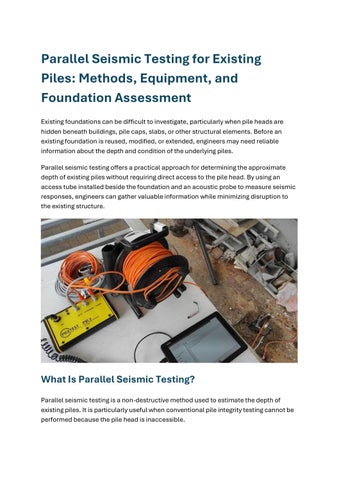
Parallel Seismic Testing for Existing Piles: Methods, Equipment, and Foundation Assessment Existing foundations can be difficult to investigate, particularly when pile heads are hidden beneath buildings, pile caps, slabs, or other structural elements. Before an existing foundation is reused, modified, or extended, engineers may need reliable information about the depth and condition of the underlying piles. Parallel seismic testing offers a practical approach for determining the approximate depth of existing piles without requiring direct access to the pile head. By using an access tube installed beside the foundation and an acoustic probe to measure seismic responses, engineers can gather valuable information while minimizing disruption to the existing structure.
What Is Parallel Seismic Testing? Parallel seismic testing is a non-destructive method used to estimate the depth of existing piles. It is particularly useful when conventional pile integrity testing cannot be performed because the pile head is inaccessible.
The method involves installing a plastic tube in a borehole close to the pile being investigated. The tube extends below the expected pile toe and is filled with water. An acoustic probe is then lowered through the tube while an impact is applied to the structure above the foundation. The resulting seismic signals travel through the pile and surrounding ground before reaching the probe. By recording these signals at different depths, engineers can analyze changes in arrival time and identify the approximate depth of the pile toe.
Why Assess Existing Pile Depth? Foundation information is essential when planning structural modifications. Older buildings and infrastructure may have incomplete construction records, making it difficult to determine the exact dimensions and depth of their foundations. Knowing the approximate pile depth can help engineers evaluate an existing foundation before: • • • • •
Building an extension Increasing structural loads Renovating an existing structure Modifying a bridge or infrastructure facility Investigating historical foundations
•
Planning additional foundation work
Direct excavation may be expensive, disruptive, or impractical. Parallel seismic testing can provide useful foundation information without requiring extensive exposure of the pile itself.
How Does the Parallel Seismic Method Work? The parallel seismic method uses measurements collected at different depths alongside the existing pile. The testing arrangement generally includes an access tube, acoustic probe, impact source, depth measurement system, and data acquisition equipment. The basic procedure consists of several stages.
Preparing the Access Borehole A borehole is drilled parallel to the existing pile. The access tube is installed as close to the pile as practical and extends below the expected foundation depth. The distance between the tube and pile is an important consideration because it can influence signal strength and interpretation.
Installing the Access Tube A suitable plastic tube is placed inside the borehole. Depending on the ground conditions, the tube may need to be grouted to establish appropriate coupling with the surrounding material. The tube should extend sufficiently below the expected pile toe to allow the testing team to identify the transition from pile-supported signal behaviour to surroundingground response.
Filling the Tube With Water Water provides the acoustic coupling required for the probe to detect seismic impulses. The tube is filled before the probe is lowered into position. Proper preparation of the tube can help improve signal consistency throughout the test.
Lowering the Acoustic Probe The acoustic probe is positioned at a known depth inside the access tube. Measurements are taken at multiple depths as the probe moves downward. A digital depth measurement system can help associate each recorded signal with its corresponding position.
Generating the Seismic Impulse A controlled impact is applied to the structure or foundation using an appropriate hammer. The resulting impulse travels through the foundation and surrounding soil. The acoustic probe detects the signal, and the testing instrument records the response.
Analyzing the Measurements The recorded signals are plotted against probe depth. Engineers examine the resulting pattern for a characteristic change in response that can indicate the approximate location of the pile toe.
Understanding the Acoustic Probe The acoustic probe is an important component of a parallel seismic testing system. It detects seismic impulses transmitted through the ground and foundation while positioned inside the access tube. As the probe moves through different depths, the recorded response changes depending on its position relative to the pile. The resulting measurements provide the data required to estimate the foundation depth. Accurate depth measurement is therefore essential. If the probe position is incorrectly recorded, the resulting interpretation may be affected. Testing personnel should also ensure that the probe can move smoothly through the access tube and that the tube provides suitable conditions for signal detection.
Using a Digital Depth Measurement System A digital depth meter can improve the consistency of parallel seismic testing by providing an accurate record of probe position.
During testing, each acoustic measurement needs to be associated with a specific depth. The recorded data can then be plotted to show how signal behaviour changes as the probe moves downward. A reliable depth measurement system helps testing teams produce clearer graphs and supports more accurate interpretation of the pile toe location.
Interpreting Parallel Seismic Results The primary objective of the test is to identify the approximate depth of the existing pile. Engineers review the recorded seismic responses and compare them across different probe positions. A characteristic change in the plotted signal response may indicate that the probe has moved below the pile toe. This transition provides information that can be used to estimate the pile length. However, the interpretation can be influenced by several factors, including: • • • • •
Distance between the pile and access tube Alignment of the access tube Soil conditions Pile geometry Probe positioning
• • •
Signal quality Impact conditions Background vibration
For this reason, results should be interpreted by experienced testing professionals rather than relying on a single measurement.
When Is Parallel Seismic Testing Useful? One of the biggest advantages of this method is its ability to investigate foundations where direct access is difficult. It can be particularly useful for existing structures where the pile heads are: • •
Covered by pile caps Beneath concrete slabs
• •
Located below floors or basements Integrated into an existing structure
•
Inaccessible because of operational requirements
Instead of exposing the pile head, engineers can use a nearby borehole and access tube to collect information about the foundation. This can reduce disruption and make foundation investigation more practical in occupied or operational buildings.
Advantages of PSI-Based Foundation Investigation A dedicated parallel seismic instrument can simplify the process of collecting and analyzing data. Systems designed for this application typically combine the acoustic probe, impact source, depth measurement, and data acquisition functions. The main benefits include: • • • • • • • •
Non-destructive investigation No direct access to the pile head required Useful for existing foundations Approximate pile-depth estimation Digital data collection Depth-based signal analysis Reduced structural disruption Support for engineering foundation investigations
The method is particularly valuable when conventional testing techniques are not practical because of existing structural conditions.
Factors That Affect Test Quality Good field preparation is essential for obtaining useful parallel seismic data. The access tube should be installed appropriately and positioned close enough to the pile for effective signal detection. The borehole should also extend sufficiently below the expected pile toe. Poor coupling, excessive distance between the pile and tube, or unsuitable soil conditions can affect the recorded signals. The impact source should be consistent, and the acoustic probe should be positioned accurately at each measurement depth.
Experienced testing personnel can pile shaft length measurement identify poorquality measurements and determine whether additional readings are required.
Parallel Seismic Testing and Engineering Decisions The results of a parallel seismic investigation can contribute to broader foundation assessments. Engineers may combine the estimated pile depth with construction drawings, historical records, geotechnical information, and other testing results. The test does not independently determine the load-bearing capacity of a pile. Instead, it provides information about the foundation’s approximate depth and supports further engineering evaluation. If the results are uncertain or additional information is required, engineers may recommend complementary investigation methods.
Conclusion Parallel seismic testing provides an effective method for investigating existing piles when direct access to the foundation head is unavailable. By installing an access tube beside the pile, lowering an acoustic probe through the tube, and recording seismic responses at different depths, engineers can estimate the approximate location of the pile toe. The method is particularly valuable for renovation, extension, rehabilitation, and investigation projects where excavation or direct pile-head access would be disruptive. Accurate depth measurement, suitable equipment, proper access-tube installation, and experienced interpretation are essential for obtaining meaningful results. When incorporated into a broader engineering investigation, parallel seismic testing can provide valuable information about existing deep foundations while helping minimize disruption to the structures they support.