A FIRST AMENDMENT PUBLICATION @roundupnews
Vol. 145, Issue 1
Wednesday, Sept. 16, 2026
Game over for those who came to play
Students scramble after the Pierce football program was placed on hiatus By Zamourad Iqbal, Calvin Henry Editor-in-Chief, Managing Editor
Pierce College announced on Aug. 6, 2026, that it will place its football program on hiatus for the 2026 fall semester because of a low roster count and safety concerns for student-athletes. Before making a final decision, Pierce President Ara Aguiar said that she consulted officials across campuses, including the Southern California Football Association (SCFA) commissioner, who told her that a low roster count can increase players' injury risk. “I told the commissioner I was not going to move forward and that I was going to take a year to look at ourselves and see what we needed to do,” Aguiar said. The current “form one” roster – a special document sent to the SCFA for eligibility to participate – did not meet the minimum recommendation of 60 students, according to Aguiar. Pierce College had 50 students participating in its football program, but the number shrunk to 41 students days before the roster needed to be submitted. Aguiar said that she met with the athletics director, vice president of student services, and the coaches to inform
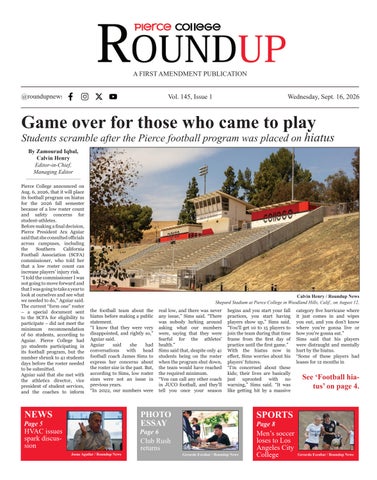
Calvin Henry / Roundup News Shepard Stadium at Pierce College in Woodland Hills, Calif., on August 12, the football team about the hiatus before making a public statement. “I know that they were very disappointed, and rightly so,” Aguiar said. Aguiar said she had conversations with head football coach James Sims to express her concerns about the roster size in the past. But, according to Sims, low roster sizes were not an issue in previous years. “In 2022, our numbers were
NEWS
real low, and there was never any issue,” Sims said. “There was nobody lurking around asking what our numbers were, saying that they were fearful for the athletes' health.” Sims said that, despite only 41 students being on the roster when the program shut down, the team would have reached the required minimum. “You can call any other coach in JUCO football, and they'll tell you once your season
begins and you start your fall practices, you start having players show up,” Sims said. “You'll get 10 to 15 players to join the team during that time frame from the first day of practice until the first game.” With the hiatus now in effect, Sims worries about his players’ futures. “I'm concerned about these kids; their lives are basically just uprooted with no warning,” Sims said. “It was like getting hit by a massive
HVAC issues spark discussion
Page 8
Page 6 Josue Aguilar / Roundup News
Club Rush returns
See ‘Football hiatus’ on page 4.
SPORTS
PHOTO ESSAY
Page 5
category five hurricane where it just comes in and wipes you out, and you don't know where you're gonna live or how you're gonna eat.” Sims said that his players were distraught and mentally hurt by the hiatus. “Some of these players had leases for 12 months in
Gerardo Escobar / Roundup News
Men’s soccer loses to Los Angeles City Gerardo Escobar / Roundup News College
2 Opinion
theroundupnews.com
On the cover:
6201 Winnetka Ave. Woodland Hills, CA 91371 Room: Pierce College Village 8211 Website: www.theroundupnews.com Email: newsroom.roundupnews@gmail. com
Singer Cedrice Webber performs for Pierce students and faculty during the Black History music event at Pierce College in Woodland Hills, Calif. on Feb. 24, 2026.
Editorial: From the desk of the Roundup
Workshops could help ease financial strain Editor-in-Chief.........Zamourad Iqbal Managing Editor..............Calvin Henry Opinion Editor............James Mondares News Editor...............Natalie Baharian Copy Editor.....................Emily Garcia Photo Editor....................Josue Aguilar Campus Life Editor.........Gisele Donan Campus Life Assistant Editor......Cesar Baneulos Soto Entertainment Editor..Viviana Morales Sports Editor................Lesa Greenfield Social Media Editor......Natallia Padilla Newsletter Editor...................Elizabeth Santana-Zavala Reporters Abraham Elizalde Valeria Estevez Mizel Hernandez Isaiah Johnson Mac Kupka Photographers Ali Bigdeli Sebastian Berrospid Gutierrez Nateli Bush Gerardo Escobar Kameron Fricks Grace Furman Akarai Jackson Tyler Miller Danial Mohamed Taryn Robinson Moises Rodriguez Daniel Shamash Advisers Jill Connelly Jeff Favre Tracie Savage Morgan Keith
For advertising, call: (818)710-2960 Corrections? Email us at newsroom. roundupnews@gmail.com
Scan the QR code below to subscribe to our weekly newsletter
C
ollege students face increasing financial strain from rising cost of living and school expenses. Trellis Strategies’ Student Financial Wellness Survey reported that “65% of students exhausted their available funds at least once in 2025.” Trellis also reported that 49% of students had difficulty concentrating on schoolwork because of their financial situation. Pierce College should host a Skills and Services Exchange Day to help students experiencing financial insecurity.
The event would bring together students and community members to trade skills or services. For example, if a student needed their bike repaired, they could offer to teach someone how to swing dance for an hour. Art, photography or sewing are just a few things students can trade. No money would be involved, just students helping each other. According to PBS, bartering was a traditional form of currency. Even as metal money and coins came onto the scene, many people still used trading to live. Today, many versions of these exchanges exist
around the country and in universities. The city of Portland used to host Fix-it Fairs and a Repair Café run by Repair PDX. The fairs offered workshops and seminars on various health topics as well as solutions for issues around your home. Repair Cafes, still active today, aim to reduce waste through low-cost or free repairs. Volunteers from Repair PDX fix household appliances, jewelry and toys. Students at the University of Michigan host a Repair Café. The Planet Blue Student Leaders club invites students to bring clothes, toys and electronics for a free repair.
Time Banks is an organization that facilitates service exchanges. Time Banks believes that a community can grow and succeed by working together to find solutions. For one hour of work, a member will earn an hour of service they could use to “purchase” something they need or want. A Skills and Services Exchange Day would not only support financially stressed students but also build community and reduce waste.
Column: The challenges of returning to school
T
wo years ago, I stood in front of my photography class during my first critique and cried. I had returned to college after spending more than 20 years working in film production. I told the class I didn’t know who I was anymore. I didn’t know what my photographic style was, whether my work was any good or if I had made a huge mistake giving up my career to do this. It wasn’t my first attempt at college. I started community college when I was younger, when I was more interested in partying than studying and struggling with undiagnosed ADHD and other mental health issues. Eventually, I was accepted to the School of Visual Arts in New York based on my photography portfolio and studied photography and film. I wanted to become a
cinematographer, but I started working in film production and figured I could always go back to school and photography later. Later turned into more than 20 years. I built a successful career and had experiences I’m incredibly grateful for, but I wasn’t doing anything creative. I had become good at a career I never intended to have. When I lost my job three years ago, I thought with all my experience I could easily get another production job. The industry in Los Angeles was already struggling and everyone was out of work. After months of job hunting and some freelance work, I decided to take one class, History of Photography, just to see how I felt about being back in school. When I decided to go back full time, that’s when I got scared. I worried about being the older student in classes filled mostly with people
much younger than me. I also wondered if I was actually smart enough to do well in school this time. Two years later, I don’t really think about the age difference anymore. I’ve made some really good friends since I’ve been back, some my age and some much younger. Most people don’t even realize how much older I am at first. Maybe it’s because I don’t act my age. I mean, I love trap music. Journalism wasn’t even part of my plan when I came back to school. A journalism professor came to one of my photography classes and told us to take Journalism 101. He said it would help us write better captions and that what we learned would be useful outside of journalism too. I ended up taking it, and while I was shooting sports for the Roundup, they needed someone to write the story for one of the games. They asked me if I would do it and I said yes, but that I was definitely
going to need help. Then they asked me to write two more, so I guess the first one didn’t suck. The weird part is I ended up loving it. Now I can produce, shoot, edit and write my own stories. Two years after wondering if I was even smart enough to do this, I have a 4.0 and I’m the Sports Editor of the Roundup. But there is one thing about returning to college later in life that I struggle with. I wish I had done this sooner. I’m proud of my old career and the life I lived, but I still wonder where I would be if I had stayed with photography and cinematography 25 years ago. Seeing younger students with their whole lives ahead of them can be hard because I wish I had that much time left to do all of this. I know now that I could have done it all along. I just wish I had known that 20 years ago. I can’t change that, but I’m definitely not done yet.
Opinion 3
Wednesday, Sept. 16, 2026
Should LACCD Enforce an AI Ban on Canvas PRO: Students lose important skills by using AI
CON: AI is here to stay and can be useful
By Abraham Elizalde Reporter
W
ith Canvas being one of the most used learning management systems across college campuses, banning the use of artificial intelligence will reinforce better habits within students and professors by leading them into a better learning flow. Many companies and websites started integrating the tool to help its users and be more convenient for use. A program used by approximately 53% of college campuses reports it is vital that AI should be steered away so students and professors do not fall into the tanglement of poor workflow, academic integrity and misinformation, according to Axiom Flow. While AI can be used as a useful tool to help you manage a steady workflow and keep up with scheduling, in most cases it is the opposite. A study by Edscoop found that 5.1 cases every 1000 students have been caught cheating with AI in the 2024 school year, compared to the 1.6 the year prior. A report by The Atlantic states that 93% of students who have used AI against instruction say they have never been caught. The convenience of AI has made it easier than ever to cheat and plagiarize assignments, compromising the learning of students and getting into bad habits that can later lead to more severe punishments in the work force.
Although students have been facing consequences of using AI in their assignments, professors have also used the tool in their workflow, which can influence their students to use it. A study from College Board found that 77% of college faculty have used AI in their roles, spanning from aid for scheduling to using AI to write their syllabuses and assignment posts. Banning AI in Canvas will force professors and students to go back to being original with their assignments. Encouraging AI in the classroom can take away from the student’s ability to learn by offering immediate solutions to the questions on their assignments, and not grasp the important material that will be useful to them when time permits like exams. Even with AI conveniently answering all of your problems with a simple text, it can also provide misinformation that can knock a student’s points off an assignment or a professor spreading lies to their students. The University of Maryland states that AI tools often spread misinformation due to the program guessing missing facts, hallucinate data and cave in to repeat false statements from users. With a program as big as Canvas banning the use of AI can encourage many college students and professors to better habits and prepare the younger generation in their future lives.
By Isaiah J. Johnson Reporter
A
s AI becomes an everyday part of modern education, the Los Angeles Community College District shouldn’t slap a district-wide ban on AI across Canvas. A one-size-fits-all rule hurts nontraditional students and takes away professors’ freedom to teach real world skills. Instead of pushing a ban that nobody can actually enforce, LACCD needs to leave AI guidelines up to individual colleges and professors who know their classrooms and their students. According to research published by EDUCAUSE, colleges that rush to put bans on new tech often do so without looking at how these tools help students with disabilities or support universal learning designs. Banning AI cuts an essential lifeline for students who are trying to make sense of complex coursework when traditional campus help isn’t available. Instead of fostering trust, a blanket rule forces instructors to act like cyber cops relying on notoriously broken software to catch cheaters. According to a study by Stanford University, popular AI detection programs routinely generate false positives and show severe bias against non-native English writers. Using AI as an organizational scaffold to help outline chaotic thoughts or break down an overwhelming prompt isn’t cheating.
It’s working smart to keep from getting buried under cognitive overload. Treating every student who opens a digital assistant like an academic fraud ignores the grind it takes to be here in the first place. Instead of a top-down mandate across nine colleges, the district needs to step back and let faculty do what they are hired to do. A coding lab, an auto tech course and a creative writing seminar don’t operate under the same reality. In guidance on classroom policies, EdTech Magazine noted that standardized, one size fits all AI rules are unsustainable and universities must give instructors wide latitude to set their own subject specific expectations. Higher education is supposed to prepare students for the modern workforce, not isolate them in the past. Banning AI across Canvas won’t stop technological progress, it will only penalize self-driven learners fighting for a better future. LACCD leadership needs to ditch the districtwide ban, trust individual professors to guide their classrooms, and let students use every legitimate tool available to graduate, compete, and succeed.
What’s one goal you have for this semester?
“One goal I have is to figure out how to study because I have a really hard time sitting down and even bothering to look at my notes. Tommy Rupp— Undecided
“One goal I have for this semester is just to get all the applications done for the UCs and the CSUs and start the process on the Ivy League applications as well.”
“I want to do as much school activities as I can, like be involved as much as I can in extra credit or clubs because in high school I did not do that.”
Isaac Rodriguez — Political Science
Jaylin Lester— Anthropology
Interviews by Calvin Henry Photos by Daniel Shamash
“My goal is to basically just get better at my language skills, get better at studying Japanese specifically. I want to become more fluent with both reading and writing.” Kyle Kelman— Language Student
4 News
theroundupnews.com
Senate discusses financial aid delays and affordable textbooks Lesa Greenfield Sports Editor Concerns about financial aid delays and student access to affordable textbooks were discussed at the Academic Senate meeting on Monday, Sept. 14, in Building 600. During her student services report, Acting Vice President of Student Services Carmen Dones said that student services had done quite a bit of enrollment-related work over the summer. According to Dones, Pierce had the highest number of College Promise students in the district, as well as a high rate of financial aid completion among those students. Following Dones’ report, the senate floor opened for questions. Senators’ concerns regarding students who were still waiting on financial aid and unable to afford required textbooks several weeks into the semester quickly became a larger discussion. Dones said the amount of time students wait can vary
and depends on individual circumstances. “It can take a while because it depends on the parents and getting the taxes, or if the students are dependent or not dependent. It just depends on the state, and that could take a while, at least a few weeks to a month,” Dones said. The financial aid discussion led to questions concerning how students can access costly required textbooks while they wait for their aid to come through. Health and kinesiology professor Sabrina Prieur said financial aid delays can create additional challenges for students who depend on it to purchase their textbooks. “When you add to that their inability to purchase books, the issue is further complicated because not all books are digitized and students will still have to ‘fight’ with peers to obtain the library copy for short-term use,” Prieur said. Prieur added that delays can also cause students to fall behind in classes. “Taking a chemistry class without the book is akin to
failing if you can’t afford to purchase it until a month into the semester,” Prieur said. Prieur also mentioned that there are a few resources that students can use to access textbooks and other course materials while waiting for financial aid. Some professors provide desk copies of textbooks to the library for short-term use and students can also look for previous editions online or use Open Educational Resources and other zero-cost materials. “What I have found in my 19 years of teaching both at the four-year and community college levels is that students oftentimes are not aware of the resources available to them, even if emails are sent out,” Prieur said. During the meeting, Pierce librarian Lisa Valdez said the library can digitize books that instructors place on reserve, offering students another way to access required textbooks. The senate moved on to other agenda items, including a report from newly elected Associated Student Organization (ASO) President Ardavan Abbaszadeh.
Football on hiatus Continue ‘Football hiatus’ from page 1.
apartments that they had just signed, and now there's no football program,” Sims said. “But they're stuck in 12-month leases, and their parents are stuck with that, and now they're trying to transfer to other teams that are in different cities, but they're restricted to an apartment in Woodland Hills. Communications major Brandon Woods played on Pierce’s team in the spring semester but is currently staying in Seattle, Washington, for the fall semester. Woods said that the hiatus was an unfortunate event for many of his teammates. “I was sad for my men,” Woods said. “I had to call a lot of people, check on some guys,
make sure they’re straight, but adversity builds toughness, so that's where we're at right now.” According to Sims, he helped the student-athletes by calling coaches at other colleges, such as Glendale and Pasadena, to recruit Pierce football athletes. Former Pierce studentathlete Julian Ramirez, who transferred to Glendale College, spoke about the hardest part of processing the news about the football hiatus. “I just signed another lease in the area, and I had just got a job in the area to fit the Pierce schedule. So as soon as I heard that, like a lot of things kind of went through my head,” Ramirez said. “It was like, how am I gonna work now? I gotta transfer to a different school, and their practice times are
different? Like I already had all my classes, school already started.” After transferring to a different school and a new shift in the program, Ramirez misses playing for the Brahmas. “Being at a new school is nice, it's a new program, staff, and everything, so it's like a fresh start, but it's like every day I practice, it doesn't feel right,” Ramirez said. “I feel like I should be on Shepard Stadium coming out of the locker room to go to practice, or to be wearing the Brahmas jerseys, and having Coach Sims there and some of the school staff supporting us.”
Akarai Jackson / Roundup News Wendy Dass speaks to senate members during the academic senate meeting in Building 600 at Pierce College in the Woodland Hills, Calif., on Monday, Sept. 14, 2026. Abbaszadeh discussed the semester's first Club Rush, which was held Sept. 9 and 10. “It went really well. We had about 60 clubs present. A lot of clubs are still in need of advisers, so on our
ASO website we do have a club adviser interest list,” Abbaszadeh said. The next Academic Senate meeting will be held Monday, Sept. 21, from 2:15 p.m. to 3:45 p.m. in Building 600.
a
Brahm Crime Log
Blotter
Compiled by Zamourad Iqbal
Arrest made on criminal threat made on Sept. 11. Sheriff is still investigating The crime log is made publicly available at the Pierce College Sheriff’s Office. Pierce College Sheriff’s Office General Information 818-719-6450 — Emergency 818-710-4311 Photo by Calvin Henry
News 5
Wednesday, Sept. 16, 2026
HVAC issues spark heated debate across campus
Josue Aguilar / Roundup News Vice President of Admistrative Services Rolf Schleicher discusses the HVAC issues in a conference room at Pierce College in Woodland Hills, Calif. on Sept.14, 2026.
By Calvin Henry Managing Editor
S
everal Pierce College classes were relocated as the fall semester kicked off due to concerns about the air conditioning in multiple buildings across campus. Cinema professor Kenneth Windrum said that his Business 3200 classroom felt stuffy in the spring semester, and he had to move his summer class to the Elm building. “You walk into Elm, it immediately hits you with a blast of cold air,” Windrum said. “Like you know, ‘I’m in air conditioning. This is air-conditioned. Whereas,
when you go into the business [building], well, it’s not unbearable, but it just isn’t sufficient, especially with air circulation.” Windrum said that all of his classes were relocated this semester because he was unsure if the air conditioning problem in the Business 3200 classroom would be fixed. “The week before this semester started, it was still the same,” Windrum said. “I don’t know what they had done, but it needs some more serious repairs.” As air conditioning issues persist inside classrooms, Pierce only has one HVAC technician on staff to maintain the Central Plant, according to head of plant facilities Angel Hernandez.
“Internally, he can’t even keep up,” Hernandez said. Vice President of Administrative Services Rolf Schleicher said that Pierce lost three of the four qualified technicians to handle the HVAC systems due to a district-wide Supplemental Retirement Plan. “Our issues were severe enough that we brought outside talent and expertise to not only diagnose [the HVAC systems], but also to fill in some of the gaps because we didn’t have the personnel,” Schleicher said. According to Schleicher, Pierce has the capacity to relocate classrooms to different spaces if needed, but the challenge is getting people to use the rooms
that are optimal for high temperatures. “If I can’t fix that classroom because it’s 50 years old and I can’t get the parts or can’t get the technician in there, then go to a classroom that’s cool, and you can operate in here the same way because all you need is a screen and the ability to show your information, and the students will come to those desks and work,” Schleicher said. Since enrolling two years ago, cognitive science major Christopher Sullivan said that his experience with the air conditioning on campus has been “terrible”, and that his current math class had to be relocated three times due to AC issues in the original classroom. “We as a class are now almost a whole week behind,”
“When you go into the business [building], well, it’s not unbearable, but it just isn’t sufficient, especially with air circulation.” Ken Windrum Professor
Sullivan said. “People were rolling in like super, super late because they didn’t know
where they were supposed to go.” Sullivan recalled a fourhour computer science class he took in a previous semester and said that the classroom was “unbearably hot” because of the heat emitted by the workstations, a large number of students and a lack of air circulation. “I thought I was gonna die,” Sullivan said. “I couldn’t believe anyone could take that class.” Sullivan said he asked more than a dozen Pierce professors to contact plant facilities about the HVAC systems, and that he believes they did not follow through. “I wish that teachers would team up and try to get to the bottom of this because they have a more powerful voice than the students do,” Sullivan said. Pierce’s general fund – which pays for instruction of classes – goes to HVAC fixes, but most of the time, high enrollment takes priority so courses don’t get cut, according to Schleicher. Schleicher said that he’s also experienced the heat in his office due to the problems with HVAC, and he is focused on addressing the situation. “We hear [student’s] concerns, we’re trying to address them, we understand how problematic it is,” Schleicher said. “No one’s neglecting their interests. It’s just that we’re almost limited and we prioritize the best we can.”
Brief: Students housing on hold By Gisele Donan Campus Life Editor Student housing plans came to a halt at Pierce College on Sept. 2 after questions over the fairness of the bidding competition emerged. In March, the District allotted $75 million in Measure LA Bond funds toward student housing to both Pierce and Los Angeles City College to develop affordable
resources for low-income and unhoused students. LACCD was expected to reserve 20% of its units for students in foster care. Developers were initially evaluated using a pointbased system that considered financial stability and company history. Months after the proposals were reviewed and finalists were interviewed, the original criteria was changed on
Aug. 20. Each contender’s proposal would be ranked, and Chancellor Alberto J. Román would make a recommendation for the District to enter negotiations with the highest ranking developer. The amended criteria would require finalists to present to the board, which was not the rule for the original process. Six days later, Román picked the company CTI
Housing as the most advantageous choice for the District. Recommendations to the board were set in place to negotiate an agreement and a starting point for housing. A former contender, Michael Student Living, had an attorney write two letters to the LACCD Board of Trustees, one that alleged the changes were unjust and conflicted with the initial expectations and another detailing the
concern for the District and for answers. In response to the growing concerns, the District officially retracted the selected finalist and the bidding process. Although a new date has not been announced, LACCD plans to continue with a new competition for the student housing project.
6 Photo Essay
theroundupnews.com
Something for everyone: Club Rush craze hits campus Top left: (Left to right) Gregory Gilbert, Alex Poepke, Vorrapon Pornchavarat and Joshua Cervantes enjoy a game of chess during Club Rush at Pierce College Mall in Woodland Hills, Calif., on Sept. 09, 2026. Photo by Taryn Robinson.
Bottom Left:Custom sign made by the Paint and Sip Club at their booth at Pierce College Mall in Woodland Hills, Calif., on September 6th, 2026. Photo by Moises Rodriguez
Bottom Right: (Left to Right) Isabella Vang explains the Women in Business organization to Nika Rostami as she accesses the club’s digital information on the Pierce College Mall on Wednesday, Sept. 9, 2026. Photo by Sabastian Berrospid.
Photo Essay 7
Wednesday, Sept. 16, 2026
Nateli Bush / Roundup News Students walk along The Mall and look at booths set up by different campus clubs during the Club Rush at Pierce College in Woodland Hills, Calif., on Sep. 9, 2026. Participating clubs included Chess Club, the Paint and Sip Club, and Boxing Club.
Sabastian Berrospid / Roundup News
Daniel Shamash / Roundup News
(Left to Right) Elias Thorne and Julian Vance staff the Math Club and Mu Alpha Theta booth, offering donuts to passing students during Club Rush at the Pierce College Mall in Woodland Hills, Calif., on Wednesday, Sept. 9, 2026.
(Left to Right) LAPC Boxing Club president Kenneth Tellez and Automotive major Kana Herrera discuss the club at Club Rush at the Pierce College Mallzzz in Woodland Hills, Calif. on September 9, 2026.
8 Sports
theroundupnews.com
Brahmas men’s soccer team returns with confidence By Valeria Estevez Reporter
B
rahmas men’s soccer team returns with confidence The Brahmas persevered after a loss to the Cubs of Los Angeles City College (LACC) at Shepard Stadium; the Brahmas lost 1-0. Both halves highlighted each team’s athleticism and sportsmanship, as well as the Cubs’ persistence and the Brahmas resilience. Despite the loss, the Brahmas remain optimistic and are looking forward to the new season. Cubs forward Michael Freeman (26) scored the first goal of the night in the second half. “Just because we scored one goal doesn’t mean the game is over; we got to keep pushing,” Freeman said. This gave the Brahmas the motivation to stay resilient with their offense and defense. Brahmas’ head coach Julio Castillo believes in his players' resilience. “They don’t give up; we make a mistake here and there and work towards improvement,” Castillo said.
“We create opportunities to score. We focus on both defense and offense; we play with our midfielders so they can create an opportunity for our forwards.” The Brahmas charged at the Cubs, giving them a challenge. Even though the Brahmas lost, they did not lose trust or confidence in each other while facing LACC, according to forward Dylan Villavicencio (11). “If we make mistakes, we tell ourselves that we have the next practice and game to do better in,” said Villavicencio. The Cubs' scoring did not discourage the Brahmas. They went toe-to-toe against the Cubs and showcased teamwork and perseverance throughout their second half. “Sometimes the ball scores; sometimes it doesn’t. We’re trying to work on our mental toughness to make sure it doesn't affect us,” Castillo said. He also believes the core fundamentals for a strong team are chemistry and trust. If the team has no chemistry, they cannot rely on each other during plays. To Castillo, it does not matter what player scores; he wants his team to
Abraham Elizalde / Roundup Pierce College defenses Brandon Cancino (#5) and Alan Sepulveda (#4) defends Los Angeles City College defense Michael Freeman (#26) during their match at the Shepard Stadium in Pierce College in Woodland Hills, Calif., on Sept. 8, 2026. Photo by Abraham Elizalde. collectively all make that shot by working together. “Chemistry and trust, you have to have the ability to make the right play so the team can score,” Castillo said Castillo prioritizes his team’s mental health and
wants to instill confidence in his players. “My biggest concern right now is that they remain confident; that they don’t give up, and they don’t put their heads down,” Castillo said. “We’re working on
confidence. That confidence rolls over onto shooting and scoring the first goal, which is what we need.” The Brahmas’ next game is set to be played against Los Angeles Harbor College on Friday, Sept. 18.
Women’s soccer scores last-minute goal to salvage a draw By Lesa Greenfield Sports Editor
T
he Pierce College Brahmas played to a draw against MiraCosta College Spartans, 2-2, on Tuesday, Sept. 8, at John Shepard Stadium. For most of the game, the match was one-sided, with MiraCosta dominating. The ball rarely left the Brahmas’ home half of the pitch. It wasn’t until the second half, when Emily Diaz (14) scored the Brahmas’ first goal to tie the game, that the momentum shifted. Pierce then had two oneon-one scoring chances against the Spartans’ goalie, but missed both. Midfielder Vanessa Cuellar (18) shared that scoring is not as easy as it looks. “The two we missed, it’s a lot of pressure. I started as a striker, and from the outside, it looks really easy, but they had a really big goalie. I give her props. She was good,” Cuellar said. The Spartans continued to hammer the Brahmas with goal attempts, but goalie Angie Cardona (25) answered with four saves. However,
MiraCosta was able to get past Cardona to score one more goal late in the second half, which put them ahead 2-1. As the match went into stoppage time, things were looking bleak for Pierce College until midfielder Angelinne Mazariegos (11) scored the equalizer to tie the game 2-2. Mazariegos expressed the team remained confident despite trailing late. “Nobody gave up, and everybody was just confident with the ball and just going forward. I feel like we didn't want to lose this game, so everybody was up and trying to create chances,” Mazariegos said. After losing to MiraCosta last season in the opening round of the California Community College Athletic Association (CCCAA) playoffs, the Brahmas didn’t let that loss affect their mindset going into the rematch. Head coach Adolfo Perez shared a similar outlook regarding Pierce’s loss against MiraCosta. “We had a lot of injuries last season, and yet we're so proud of these kids because we never give up, which speaks about the resilience of this group,”
Gerardo Escobar / Roundup Brahma Forward/Midfielder Angelinne Mazariegos (#11) gets double-teamed by MiraCosta players Amslee Mikichi (#13) and Malia Patterson (#8) during a match at Shepard Stadium at Pierce College in Woodland Hills, Calif., on Sep. 8, 2026. Perez said. Only four games into the season, Perez also said facing strong teams early will help the Brahmas improve. “Every team that we play is
good. That's how we are. We schedule all these games. I schedule them, and they're going to make us better,” Perez said. The Brahmas’ next home
game is Tuesday, Sept. 22 at 6 p.m. against Los Angeles Harbor College.