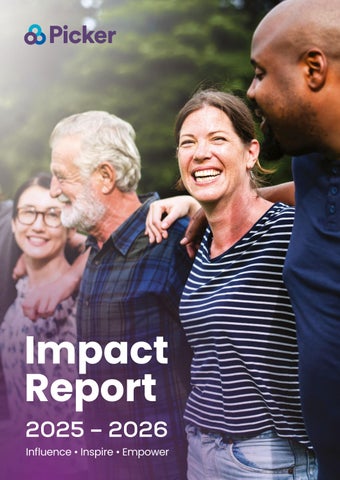
Impact Report 2025 – 2026
Influence • Inspire • Empower
Our Picker Principles Our eight Picker Principles of Person Centred Care underpin everything we do, providing a consistent, evidence-based framework for our work around the globe. The Principles outline what matters most to those who use care services, and specify the eight key elements which should remain non-negotiable when delivering care.
2
Fast access to reliable healthcare advice
Effective treatment by trusted professionals
Continuity of care and smooth transitions
Involvement and support for family and carers
Clear information, communication and support for self-care
Involvement in decisions and respect for preferences
Attention to physical & environmental needs
Emotional support, empathy and respect
Picker Impact Report
Contents Picker Principles
2
Reflections from the Chair
5
The power of individual experience
8
Improving care begins with understanding what matters to each individual
14
Measuring what matters
18
Building capability to improve experience of care
20
Shaping system direction
28
Closing thoughts from our Group CEO, Chris Graham
31
4
Picker Impact Report
Reflections from the Chair This past year has once again underlined the importance of keeping people at the heart of health and care. Across the UK and internationally, health systems continue to face considerable pressures. In England, major structural reforms, including changes to NHS England, the development of the NHS Ten Year Plan, and continuing financial constraints, are reshaping the environment in which services operate. When systems change, it becomes even more important that the experiences and needs of patients, families, and staff help guide the way forward. In this context, Picker’s work has never been more relevant. We have extended our reach and impact by supporting health and care leaders to measure and improve experiences. Our work spans international studies of cancer care, evaluations of major quality improvement initiatives such as the Q Community programme across the UK and Ireland, and partnerships with organisations including the NHS Confederation and the Care Quality Commission. Through this work, we contribute independent evidence and practical insight to discussions about the future of care. It has also been encouraging to see Picker’s growing international presence, with engagement across the Gulf region, Europe and the Asia-Pacific. The continued development of the PICKER EXPERIENCE NETWORK AWARDS, alongside the wider adoption of our measurement and improvement approaches, demonstrates a strong appetite for work that places experience firmly at the centre of care quality. Picker’s role continues to evolve as we help bridge the gap between research and practice. The addition of the Point of Care Foundation’s learning and development portfolio to the Picker ecosystem marks a crucial step in strengthening our ability to share knowledge, develop capability, and support improvement across systems and sectors. Finally, the importance of community remains central to Picker’s mission. Initiatives such as the Independent Sector Leaders Network, the International Benchmarking Forum, and the growing Picker Alumni Network demonstrate the value of bringing people together to share learning and experience. New initiatives, including a Chief Nursing Officer Forum launching in 2026, will further strengthen these connections. At a time of significant change across health and care systems, the need for organisations that can listen carefully, bring people together, and translate insight into action is clear. Picker’s work over the past year illustrates what can be achieved when experience is recognised as a vital source of knowledge for improving care. I remain confident that this approach will become even more important in the years ahead.
Angela Coulter Chair of the Board of Trustees
Influence • Inspire • Empower
5
6
Picker Impact Report
Picker’s work over the past year illustrates what can be achieved when experience is recognised as a vital source of knowledge for improving care.
Influence • Inspire • Empower
7
The power of the individual experience In 2024, we met Freya Williams as the winner of the student category at the Picker Experience Network Awards. A newly qualified paediatric nurse, Freya also lives with Ehlers-Danlos Syndrome, a long-term genetic condition that has shaped her experience of care from both sides, as a patient and a professional. From the moment we met her, her determination and clarity of purpose stood out. In 2025, we were proud to welcome her back as a keynote speaker.
When life changes without warning Freya was 17 when the life she knew changed suddenly. A severe allergic reaction left her paralysed and unable to walk. One moment she was planning exams, friendships, and her future. The next, she was in hospital, facing uncertainty, loss of independence, and a reality she had no way of preparing for. “I thought I understood the world,” she reflects. “But nothing prepares you for losing your independence in an instant.”
Navigating uncertainty What followed was not a single episode of care, but years of treatment, rehabilitation, and repeated admissions. Alongside the physical impact came something less visible: the emotional weight of navigating uncertainty, loss, and the feeling that life had shifted beyond her control. Experiences like this are not rare. They sit at the heart of health and care, often unseen, but shaping how people understand the care they receive.
“They didn’t just treat me. They stood beside me. They fought for me until I could fight for myself.”
And yet, when Freya speaks about care, she does not begin with the treatment she received. Freya begins with people.
8
Picker Impact Report
“Nothing prepares you for losing your independence in an instant.”
•
A nurse who explained what was happening, step-by-step.
•
A doctor who chose to sit down next to her, rather than stand over her.
•
Times where someone stayed, listened, and took the time to understand.
These are the moments where care becomes more than clinical. They are where trust is built, where fear is reduced, and where people begin to feel safe again.
Small, human acts Two individuals in particular, Veronica and Phoebe, changed the course of her experience. “They didn’t just treat me. They stood beside me. They fought for me until I could fight for myself.”
It was within these moments that Freya’s future began to take shape. If care could feel like this - grounded in dignity, compassion, and partnership - then she wanted to be part of it. She decided to become the nurse she once needed. Her path was not straightforward. During her training, her health deteriorated again. She balanced hospital admissions with clinical placements, often questioning whether she would be able to continue. Then one moment changed how she saw herself. “One day, a little girl pointed at me while I was wearing an NG tube and said, ‘Mummy, that nurse looks like me.’” In that moment, she realised that being visible, being present, and being understood matters - not just for the individual, but for everyone who comes into contact with care.
These were not extraordinary interventions. They were small, human acts. But in moments of vulnerability, they made a profound difference.
Influence • Inspire • Empower
9
Moments beyond performance metrics Freya qualified as a nurse. But shortly afterwards, her health took another serious turn. In January 2024, she was admitted to hospital critically unwell and went into septic shock. She nearly lost her life. She spent four months in hospital, including Christmas Day on the ward, before beginning her recovery. Again, what stayed with her was not only what was done, but how it was done. In the midst of chaos, staff spent time explaining. They held her hands. They reassured her family. They stayed with her.
“It was made bearable by the team around me, who explained everything they were doing and stayed with me through it.” These moments do not appear in performance metrics. But they shape how care is experienced: and, often, how effective it is.
From patient to paediatric nurse Today, Freya has returned to work as a paediatric nurse in the same hospital where she was once a patient. “The hospital that first knew me as a frightened teenager now knows me as a colleague.” Her journey is her own. But the moments she describes will be familiar to many. Care is experienced in small, often quiet interactions. In whether someone takes the time to explain. In whether someone listens. In whether someone sees the person, not just the condition. “The small things are not small at all. They make a huge difference.” In systems under pressure, these moments can be overlooked. But they are not optional. They are fundamental to safe, effective and equitable care. Freya’s story shows what person centred care looks like in practice. Not as a concept, but as something lived, felt and remembered. And it highlights something more. If care is experienced in these moments, then improving care begins with understanding them. Listening to the people who experience those moments, and learning from them. Because it is these individual experiences that, when understood and acted on, have the power to shape care far beyond any one person.
10
Picker Impact Report
Influence • Inspire • Empower
11
Freya’s story shows what person centred care looks like in practice. It is shaped through everyday interactions - in how people are treated, listened to, and involved in decisions about their care. These moments and experiences define quality and drive improvement in person centred care.
12
Picker Impact Report
Influence • Inspire • Empower
13
Improving care begins with understanding what matters to each individual Every experience, whether in a single interaction or across a lifetime of care, provides insight into how services are delivered and how they can be improved. When these experiences are brought together across conditions, pathways, and systems, they reveal patterns that would otherwise remain unseen. This year, more than one million experiences of care have been captured across over 80 countries by Picker, providing a depth and breadth of experience insight that connects individual moments to system-wide understanding. What emerges consistently is that how care is delivered is inseparable from the outcomes it achieves.
How communication affects outcomes International research by Picker, based on responses from over 5,000 people living with leukaemia in more than 40 countries, shows a clear link between communication and outcomes. Patients who felt listened to, informed and
14
involved in decisions about their care reported significantly better quality of life. The quality of interaction between patients and professionals is not an added dimension of care: it is a crucial factor in how people experience their health and recovery. At a global level, this approach is reflected in insights developed by Picker in partnership with the Lymphoma Coalition, through one of the largest international patient experience programmes of its kind. Drawing on over 11,000 patient and caregiver responses, gathered in collaboration with more than 90 organisations across 55 countries, the survey highlights variation in access, communication, and support across health systems. By bringing these experiences together within a consistent, validated framework based on the Picker Principles of Person Centred Care, it becomes possible to identify shared challenges, understand differences between systems, and prioritise action at scale.
Picker Impact Report
Insights into system‑wide pressures
The pattern is clear
At a national level, insights developed through the NHS Staff Survey, the largest workforce survey of its kind globally, capture the experiences of hundreds of thousands of staff each year. Findings from the latest survey highlight increasing pressure on staffing levels, alongside challenges in wellbeing and engagement. These insights are critical not only in their own right, but in understanding the direct relationship between staff experience and the quality and safety of patient care. For people living with rare conditions, insights developed in partnership with the Marfan Trust, based on a national survey of nearly 400 individuals, reveal persistent delays in diagnosis, fragmented care pathways, and limited access to specialist services. These findings highlight systemic challenges: issues that are often experienced in isolation, but that become visible and actionable - when brought together.
Individual experiences are fundamental to understanding what quality care looks like in practice. When these insights are systematically and routinely brought together through structured, validated approaches, they reveal how care is delivered across pathways and systems, and where it can be improved. This creates the conditions for organisations to improve care in a more consistent, informed, and effective way. By connecting individual experiences across populations, and systems, Picker continues to develop tools, frameworks, and models that support organisations to act. These approaches ensure that what matters to each person is reflected reliably in how care is designed, delivered, and improved.
In this way, person centred care is not lost as systems scale. It is sustained, strengthened and embedded, so that the quality of care experienced by one individual can be delivered consistently for many.
Influence • Inspire • Empower
15
Our research shows that how care is delivered is inseperable from the outcomes it achieves.
16
Picker Impact Report
Influence • Inspire • Empower
17
Measuring what matters Picker’s experience measurement tools and services continue to play a pivotal role in shaping healthcare systems worldwide. By providing robust, evidence-based insights into people’s experiences, these tools have influenced care delivery at every level, from individual patient interactions to national health policies.
The global adoption of these methodologies underscores their effectiveness in identifying gaps in care, driving systemic improvements, and promoting person centred approaches across diverse healthcare contexts.
Programmes of work in over
85 countries
18
Picker Impact Report
Supporting over
300
organisations to understand, measure and improve care experiences
Developing care quality insights by providing over
1.9 million opportunities to understand, measure, and act on people’s experiences of care
Influence • Inspire • Empower
19
Building capability to improve experience of care Understanding experience is essential. But improvement depends on the ability to act on it. Across health and care systems, there is no shortage of insight. The challenge is translating that insight into consistent, day-to-day practice. This requires capability, confidence. and the right structures to support change. This year marked a significant step in strengthening that capability, with the integration of the Point of Care Foundation’s Experiences of Care programme into Picker’s portfolio. This brought together a well-established body of work in co-design, quality improvement, and person centred practice, extending the ability to support organisations not only to understand experience, but to improve it. At the core of this approach is a simple principle: improvement is most effective when it is developed in partnership with the people who experience and deliver care. As Naomi Stockley, Learning and Development Programme Lead, reflects:
“This work is about giving people the confidence to do things differently. Not just understanding experience, but using it to redesign services in partnership with patients, families and staff. That is where meaningful change begins.” 20
Supporting improvement through co‑design
Through approaches such as Experience-Based Co-Design (EBCD), patients, families, and staff work together to identify priorities, understand challenges, and develop solutions grounded in real experience. This moves improvement beyond assumption, ensuring that changes reflect what matters most in practice. Over the past year, more than 300 participants have engaged in structured learning programmes, supported through a combination of courses, bespoke organisational delivery and open-access sessions. Alongside this, a community of practice with over 180 members continues to connect individuals and organisations working to improve care - creating space for shared learning and reflection. Access to practical tools remains central to enabling change. Over 1,400 individuals have accessed freely available toolkits, supporting teams to apply structured co-design approaches within their own services. The impact of this approach is seen most clearly in how it changes practice. In one EBCD project, patients and staff identified communication at discharge as a key source of anxiety and confusion: •
Before: patients described feeling uncertain about next steps, and unsupported once they left hospital.
•
After: redesigned discharge processes, developed in partnership with patients, led to clearer communication, improved confidence in self-care, and a measurable reduction in follow-up queries and unplanned contacts.
As one member of staff reflected: “For the first time, it felt like improvement was being done with us, not to us. The changes made a real difference to how supported people felt.”
Picker Impact Report
Reflecting a broader shift
When insight is combined with capability, improvement becomes more than a oneoff initiative. It becomes part of how care is delivered, shaped by those who experience it, and sustained by those who provide it. This is a core and growing part of Picker’s work. The continued development of learning and capability, including the integration of internationally recognised approaches such as Experience-Based Co-Design, reflects a longterm commitment to supporting organisations to deliver person centred care in practice, not just in principle. The reach of this work is increasingly international. Participants, communities, and organisations span multiple countries and care settings, with approaches already adapted to reflect different cultures, health systems and local contexts.
Influence • Inspire • Empower
This ensures that person centred care is not applied as a static framework or figurative model, but as a consistent set of principles that can be meaningfully implemented across diverse environments, driving the highest quality person centred care for all, always.
21
Community and recognition: amplifying improvement
22
Picker Impact Report
Influence • Inspire • Empower
23
Improving care rarely happens in isolation. It develops through shared learning, connection, and the visibility of what works in practice The Picker Experience Network Awards play a central role in this. More than recognition, they provide an independent, trusted space where organisations can share practice openly, learn from one another, and accelerate improvement. This year’s awards brought together over 350 attendees from multiple countries, with 88 judges assessing submissions across 18 categories, culminating in 110 shortlisted finalists. Together, they reflect the scale, diversity, and ambition of experience-led improvement taking place across health and care. The introduction of expanded international and independent sector categories allows the awards to showcase best practice in person centred care from a far wider community. The principles are consistent, but their application must adapt across different contexts. Bringing these perspectives together creates a powerful environment for shared learning across boundaries that are often experienced as separate.
24
How ideas move beyond recognition into practice A clear example of the impact of this approach is the Patient Experience Monitor (PEM), developed by the Dutch Federation of University Medical Centres. Recognised within the international category, PEM delivered a simple but ambitious goal: to ensure that every patient, across all Dutch University Medical Centres, has a structured opportunity to share their experience, and that this insight is used in real time to shape care. The result is a nationally coordinated, person centred system that has now captured over 1.5 million patient experiences. Real-time dashboards enable clinicians and leaders to identify patterns as they emerge, while advanced analysis of patient feedback reveals themes that would otherwise remain hidden. Transparency is central, with results publicly available, supporting accountability and shared learning across the system. What distinguishes PEM is not only its scale, but its adoption. The approach has now been implemented across all eight Dutch University Medical Centres, with similar models extending into wider hospital settings. This reflects a broader shift from isolated innovation to systemwide change.
Picker Impact Report
It also reflects something more fundamental. When structured listening, co-design, and benchmarking are brought together, person centred care becomes embedded in how systems operate, not just how individual teams work. This is the role of the awards: the recognition of excellence, shared by design to optimise learning. In this way they make improvement more visible, transferable, and scalable.
Establishing new networks Alongside the awards, our communities provide the structure through which this learning is sustained. New networks established this year include the International Inpatient Experience Benchmarking Forum, which brings together organisations across countries to share comparative insight and learn from variation in care. Similarly, the Independent Sector Leaders’ Forum provides a dedicated space for providers to address shared challenges and opportunities.
This enables learning to move beyond individual initiatives, informing wider practice and supporting more consistent, person centred approaches to care across different settings and geographies.
In this way, collective learning becomes a driver of system change, ensuring that as models of care evolve, they remain grounded in what matters most to the people who experience them.
Within learning and development, an alumni network continues to connect participants beyond individual programmes, supporting ongoing exchange as organisations embed person centred approaches in practice.
Launching a Chief Nursing Officer Forum Looking ahead, we will continue to expand our forums. Launching in 2026, will further strengthen the connection between system leadership and experience-led improvement. There is also increasing focus on international benchmarking, enabling organisations to understand their performance in context and learn from peers globally. In a period of significant change, shaped by health system reform, rapid advances in digital and technology-enabled care, the evolving needs of populations, and the ability to connect insight, shared learning and leadership is becoming central to how care is shaped. Picker’s communities provide a structured, independent space where experience-led insight is compared, challenged and applied across organisations and systems.
Influence • Inspire • Empower
25
This year’s awards brought together over 350 attendees from multiple countries, with 88 judges assessing submissions across 18 categories, culminating in 110 shortlisted finalists.
26
Picker Impact Report
Influence • Inspire • Empower
27
Shaping system direction Experience of care does not sit alongside policy: it shapes it
As health systems evolve, through national reform, digital transformation, and changing population needs, decisions about how care is designed and delivered are becoming increasingly complex. Ensuring that these decisions remain grounded in what matters to people is critical. Across the UK, this is reflected in ongoing engagement with policy development, including the new NHS Ten Year Plan and changes to system operating models. Evidence drawn from large-scale survey programmes, including over one million responses across national patient and staff surveys, continues to inform discussions around access, workforce, quality, and service design . This contribution is further strengthened through the development of major evidence-led publications, including Picker’s State of Person Centred Care report. Drawing together insight across pathways and populations, it provides a structured view of where person centred care is working, where it is not, and what this means for system priorities and reform. In doing so, it supports policymakers to move beyond aspiration towards more grounded, actionable understanding.
This influence is not limited to a single system
Internationally, experience-led insight is increasingly recognised as a critical component of health system transformation. Work across Europe, global survey programmes, and partnerships with international organisations has contributed to a growing evidence base that informs how care is measured, compared, and improved across countries.
In the Gulf region, this is reflected in engagement with health system transformation aligned to national strategies such as Vision 2030, where experience of care is becoming a central component of quality, performance, and system reform. Here, the integration of measurement, capability building and benchmarking is supporting a more structured approach to embedding person centred care at scale.
Across these contexts, the role remains consistent
Experience provides a form of evidence that connects policy to practice. It brings visibility to how care is delivered, highlights variation, and ensures that system-level decisions are informed by the realities of those who use and deliver services.
Picker’s role is to ensure that this evidence is robust, comparable and actionable, and that it is used to inform not only how care is improved, but how it is defined. As systems continue to evolve, the opportunity is clear: to continue work with policymakers, system leaders and partners to ensure that person centred care is not an aspiration, but a foundation for how care is designed, delivered, and improved.
This has been supported by a growing international presence, with contributions to conferences and forums across four continents over the past year. These engagements are not standalone moments, but part of developing ongoing relationships with system leaders, policymakers and partners, supporting the exchange of insight and the application of person centred approaches in different contexts.
28
Picker Impact Report
Influence • Inspire • Empower
29
Chris Graham Group CEO
“Looking ahead, we are entering a new phase in our development. We will continue to strengthen how we define, evidence, and support excellence in person centred care.” 30
Picker Impact Report
Closing thoughts from our Group CEO, Chris Graham At Picker, we are guided by our commitment to person centred care: the idea that people who use health and care services should be partners in their treatment, and that their voices and experiences should be important in judging service quality. The patient perspective is particularly important in the context of a world and health care systems that are undergoing rapid change. Health systems are evolving, expectations are rising, and new models of care are emerging. In this environment, the need for a consistent, evidence-based approach to person centred care has never been greater. Understanding what matters to people, and acting on it, is not an optional addition to quality. It is fundamental to it. In this report, we show what is possible when people’s experiences are understood, valued, and used to shape care in practice, from individual moments through to system-wide improvement.
This is collective work. It depends on openness, shared learning and a willingness to work differently. We are grateful for the trust placed in Picker, and for the contribution of those who continue to shape and strengthen this work with us. Looking ahead, we are entering a new phase in our development. We will continue to strengthen how we define, evidence, and support excellence in person centred care - extending our reach, developing our partnerships, and building on the foundations set out in this report. Change brings with it the opportunity to create new approaches that embody our vision – systems that provide the highest quality person centred care for all, always – and we look forward to using our knowledge and experience to make this a reality.
What has been achieved this year has been possible through the commitment of our colleagues, partners, and the many organisations we work alongside.
Influence • Inspire • Empower
31
Address
Contact details
Picker Group Suite 6, Fountain House 1200 Parkway Court John Smith Drive Oxford OX4 2JY
+44 (0)1865 208100 picker.org pickereurope.bsky.social picker-institute-europe pickereurope
Registered Charity in England and Wales: 1081688 Registered Charity in Scotland: SC045048 Registered Company Limited by Guarantee: 0390816