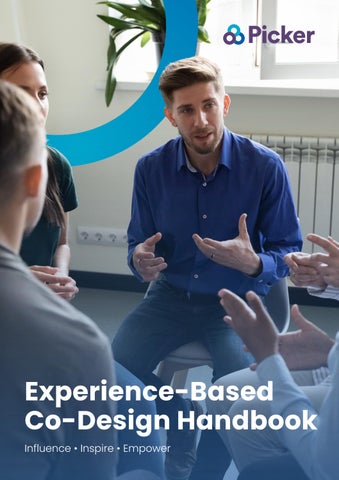
Experience-Based Co-Design Handbook Influence • Inspire • Empower
Contents Introduction
4
About Picker
5
Worksheet ç Getting Started
6
Worksheet ¡ç Staff Event
7
Worksheet ¢ç Patient Event
8
Worksheet £ç Joint Event
9
Worksheet ¤ç Co Design Working Groups
11
Facilitation Techniques
14
Exerciseç Spreading Ideas
18
Long Term Success Tool
19
Observation Recording Sheet
24
Resources
27
Further Reading
28
3
EBCD Handbook
Introduction Experience based co design ÷EBCDø is an approach that has been used in healthcare organisations since ¡ ¤ to enable staff and patients ÷or other service usersø to co design services andòor care pathwaysæ together in partnershipå Further case studiesæ resources to watch and download as well as tips from those who have led EBCD projects can be found on the EBCD toolkit on the Picker websiteç httpsçòòpickeråorgòlearning developòebcd experience based co design toolkitò
celebration event
setting up
patients at the heart of quality improvement effort but not forgetting staff small co design teams
a focus on designing experiences not just systems or processes
engaging staff and gathering experiences
where staff and patients participate alongside one another to co design services co design meeting
4
engaging patients and gathering experiences
EBCD Handbook
About Picker Picker is an independent charity working across health and care systems to make person centred care a realityå From shaping national policy to designing global experience measuresæ our impact is built on evidenceæ empathyæ and the belief that care should always be shaped by what matters mostå
Learning and Development Our Learning and Development programme offers training and support in person centred improvement across health and social careå Through our open access coursesæ participants can develop practical skills and gain formal accredited professional qualificationså We also design bespoke training for teams and organisations seeking tailored learning and developmentå Our courses in person centred careæ quality improvement and co design help staff step into patients shoes and see care through their eyeså Using proven tools and experiential techniquesæ we enable people to get as close as possible to experiencing the patient s journeyå
The future of healthcare will depend on our ability to listenæ collaborateæ and actå Health and care are team pursuitsç no single organisation can succeed in driving meaningfulæ sustainable change aloneå It takes shared commitmentæ partnership working across sectorsæ and a collective focus on ensuring that care is not only effective but also appropriateæ equitableæ and compassionateå As we look aheadæ we will continue to be guided by our vision of the highest quality person centred care for allæ alwayså By working togetheræ valuing diversityæ embracing innovationæ and retaining a focus on people as partners in careæ we can create a future where every experience has the potential to inspire meaningful changeå 5
Chris Graham Group CEO
EBCD Handbook
Worksheet 1: Getting Started
Getting your project up and running åWhat is the scope of your projectì ÷Which serviceòteamòpatient pathway etcåø
¡åWhat is the context of this work for the staffì ÷eågå any historyè other current projectsè financialè staffing changesæ etcåø
¢åWhat ÷range ofø staff are involvedì ÷eågå which nursesæ doctorsæ AHPsæ receptionistsæ etcåø ûTipç think beyond the organisation structure to the patient s view of the serviceü
£åWho will facilitate the eventsì
¤åWho are your key enthusiastsì
¥åWho are your key influencersì
¦åWho is the project championì ÷iåeå the person who will unstuck things if you get stuckø
§åWho will help you recruit patientsì ûTipç someone with direct previous contact with patientsæ eågå receptionistsæ doctorsæ nursesü
¨åWho will be on your steering groupì
åHowæ when and where will you introduce the projectì
åHowæ when and where will you update people about the projectì
6
EBCD Handbook
Worksheet 2: Staff Ev ent Running a staff event
åWhat day and time would enable maximum attendanceì ÷Guided by observations in practiceø
¡åWhat venue would be most suitableì ÷Away from the shop floor è informally formalè IT requirementsè refreshmentsø
¢åWho are your key influencersòenthusiasts who can invite attendeesì ÷Influential team membersæ eågå manageræ medical leadæ nursing leadæ CNSø
£åWho will present the staff feedbackì ÷Needs to be someone who works in and leads the service to demonstrate engagement and ownership of projectòadept at inspiring commitmentø
¤åWhat voting method will you choose to assist in selection of the projectsì ÷Consensus is key think carefully about the pressure of group conformityæ particularly if senior staff are presentø
¥åWhat method will you adopt to spread and disseminate agreed staff prioritiesì
7
EBCD Handbook
Worksheet 3: Patient Ev ent The patient event
åWhen will you hold your patient eventì ÷Usually within about a week of the staff feedback eventø ¡åWhat time of the day will be best for the patientsì
¢åHow many patients would you like to be thereì What will you do to encourage people to comeì £åWill you invite carersæ if so are they there to support and accompany patientsæ or are you interested in their experiences tooì ¤åHow long will the event beì ûTipç allow an extra half hour at the beginning and endæ above the time allocated for activitiesü ¥åWhere will you hold the eventì ûTipç hospital locations may put some people offæ so think about community venuesü ¦åHow will you pay for any expensesì ÷eågå venueæ refreshmentsæ travelæ childcareæ etcåø §åWho will invite people and howì How will you confirm attendanceì ¨åHow will you plan for an unexpectedly high or low number of attendeesì åWho will be the point of contact on the day for patients with last minute queriesì åWho will welcome people to the eventì ¡åWhat will you do if the discussion causes distress or tension among participantsì
8
EBCD Handbook
Worksheet 4: Joint Ev ent The joint event
ûTipç refer to your plans for the patient and staff eventsæ as some of the answers will overlapü åWhen will you hold the joint eventì ÷Usually within about a fortnight of the patient and staff feedback eventsø
¡åWhat day and time would enable maximum attendanceì ûGuided by patient and staff needsü
¢åHow many people would you like to be thereì What kind of balance in numbers between patients ÷and carersø and staffì
£åHow long will the event beì ûTipç allow an extra half hour at the beginning and end for patients to arrive and leave and think about the amount of time staff will commit toü
¤åWhere will you hold the eventì ûTipç hospital locations may put some patients offæ but this needs to be balanced with convenience for staff to encourage their attendanceü
¥åWho will invite people and howì How will you confirm attendanceì ÷You can remind people at the previous event but do think about those people who were unable to come beforeø
9
EBCD Handbook
¦åWho will present the staff event feedbackì
§åHow will you decide which patient will introduce the patient filmì
¨åWhat method will you choose to assist in selection of projectsì ÷Consensus is key think carefully about the pressure of group conformityæ particularly if senior staff are presentø
åWhat method will you choose to get people to sign up to working on projectsì
åWhat method will you adopt to spread and disseminate agreed prioritiesì
¡åHow will you plan for an unexpectedly high or low number of attendees on the dayì
¢åWho will be the point of contact on the day for people with last minute queriesì
£åWho will welcome people to the eventì
¤åWhat will you do if the discussion causes distress or tension among participantsì ÷Staff andòor patientsø
¥åAny other thoughtsì
10
EBCD Handbook
Worksheet 5: Co-design working groups Co- design working groups 1.Who is going to facilitate and organise each working group? (One person may facilitate all of the groups, or separate ‘co-leaders’ may run each group, overseen by a central facilitator)
2.What techniques/activities will the facilitator use to help encourage the patients, carers and staff to work well together? (Brainstorming; SMART (specific, measurable, attainable, relevant, time bound); quality circles; voting systems, etc.)
3.Will you invite other patients and staff to join the working groups as necessary? How will you recruit them?
4.Will you use service design techniques to help the groups to move quickly to potential solutions they can test and try out? (e.g. prototyping; ideation tools; scenarios; personas, etc.)
5.Will you use a professional service designer to help facilitate the ‘hands on’ work of the groups?
11
EBCD Handbook
¥åHow are you going to record what happens in each group and keep track of progressì ÷and make sure different groups aren t tackling similar issues without talking to one anotherêø ÷eågå maintain a log detailing each area of improvementæ activities taken or plannedæ timeframesæ barriers to implementation and what will happen nextæ and update it after each meetingø
¦åWhat support mechanisms will you have in place in case ofæ for exampleæ a patient having had a negative experience of a particular staff memberæ or may associate a part of the hospital or a process with a traumatic life eventì
§åWhat refreshments will be provided and what travel expenses will be reimbursedì
¨åAt what time of day and where will co design groups meetì
åHow regularly and to which key stakeholders are you going to report on progress of the various working groupsì
12
EBCD Handbook
‘There were a few of us in the room and when it was done, I turned around away from the screen and I said ‘wow, we are actually going to do something here, we are actually going to be a part of something that has real impact.’ - EBCD Project Staff Participant 13
EBCD Handbook
Facilitation Techniques Questioning There are a number of questioning techniques which can be useful when you want to draw out a response and encourage people to explain their ideaså
Open Questions This is the most basic kind of useful questionå An open question obliges the other person to respond with a sentence or phrase rather than a simple Yes or Noå For exampleæ asking a closed question such as Have you finished what you want to sayì invites a very different response from an open version What else would you like to sayì The essential words here areç Whatåååì Whenåååì Whereåååì Howåååì Whyåååì What and How are the most powerful of the open question beginnings because they draw out a fuller response than Where or When or Why æ which can be a bit interrogative and make people defensiveå Other useful phrases to draw people out includeç Tell meååå Could you say more aboutåååì How do you feel aboutåååì Is there anything else you would like to sayì
14
EBCD Handbook
Real Listening Real listening is an active process which cannot be fakedå It means listening without feeling the need to criticiseæ adviseæ argueæ persuade or colludeå Your aim when really listening is to achieve empathyæ a non judgemental state that aims to understand the other person÷sø and what they feel and thinkå To achieve it you have to listen with deep attentionå
Active Listening Maintain eye contact Reinforce with noddingòparaphrasing Lean slightly forward Clarify by asking questions But... if you ask the right question and you are committed to understanding the other person s experience then you will do all of these things quite naturallyå
Maintaining a Group Conversation In any group conversation there are certain patterns that you can predictç The more confident people will tend to talk more Ping pong dialogues can develop typically between the facilitator and one or two other members of the group The person sitting directly in your line of sight will have the most encouragement to speak and the people sitting immediately to your right and left will have the worst eye contact so will tend to say the leastå You can best manage these common phenomena byç Being aware of them Breaking up the ping pong where you see it developing by saying something likeæ I think this is 15
EBCD Handbook
getting to be too much of a dialogue hereå Let s see who else would like to speak å Where the ping pong involves youæ make a point of not replying and leaving a pause so that another member of the group can speak insteadå Alternativelyæ say What do other people think hereì and look around the groupå Moving the seating
People who are very quiet You need to distinguish between people who would like to join in but are not succeedingæ and people who are quiet by choiceå To invite people with known expertise to contributeæ it is better to do this with a general rather than specific invitation ÷iåeå would anyone who knows something about X like to say something hereì rather than Juliaæ you re an expert on Xæ what do you thinkì øå Looking in someone s direction and pausing expectantly might encourage them to contributeæ as might encouraging the with nods and smileså Encourage under contributors when they do speak by saying that sounds interestingæ could you tell us some more about thatì
People who (in your view) are talking too much It is dangerous to speculate why people talk too much in a groupå Reasons might includeç Knowing more than others and wanting to share what they know Seeking recognition from others in the group wanting prominence Making a bid for control seeking dominance There is not one solutionæ but you might tryç Interrupting long speeches at a pause for breath and saying something like Janeæ I am aware that David is trying to get into the conversationæ can we come back to you laterì Acknowledging with a nod of the head when others in the group indicate they wish to make a contribution and saying something like Let s hear from Johnæ then Sallyæ thenååå Subtly shutting them out by turning away from them and towards someone else to bring that person inå
16
‘The benefits that have come out of this project are fantastic. Services have changed, the patient experience has changed and the team has changed. All of that is very positive.’
- EBCD Project Participant
Exercise: Spreading Ideas Key attributes of spreading/likelihood of others adopting an idea: åRelative advantage of the proposed idea ¡åCompatibility with current valuesæ practices and structures ¢åSimplicity of the change and transition £åTestability of the idea ¤åAbility to observe the change and its impact ¥åHow easy it is to reinvent the idea to suit local circumstances
Exercise Think of an idea or an aspect of good practice from your own projectå This may be something that you are putting in place in one service which might be able to spread to other serviceså Working in pairsæ consider each of your ideas using a simple scoring system of ¤ ÷where is weak and ¤ is strongø to judge each attributeå Add up each score to form a total score out of ¢ å This will help you to judge the likelihood of others adopting this ideaòof the idea spreadingå Attributes
Score
Relative advantage of the proposed idea ¡
Compatibility with current valuesæ practices and structures
¢
Simplicity of the change and transition
£
Testability of idea
¤
Ability to observe the change and its impact
¥
How easy it is to reinvent the idea to suit local circumstances Total score:
Sourceç based on an activity created by Sarah Wå Fraser
18 16
¡ ¡¤ Picker Impact Report EBCD¡ ¡£ Handbook
Long Term Success Tool This tool aims to aid you in planning for long term success of your workå You will be asked to rate ¡ factors that have been identified to impact long term success from current literature and evidenceå Each rating should represent an overall impression of how you believe the project is doingå Please use the boxes to highlight any comments or actions needed to address the factorså A. Please specify which project you are completing the form for:
B. Please rate the project on the following factors: åCommitment to the improvement My team understands what the project is trying to achieve and believe this work will lead to improved processes and outcomeså Very Good
Good
Fair
Poor
Very Poor
No Opinion
Don t Know
Comments and actionsç
¡åInvolvement aø I have the opportunity to input into the project and I feel a sense of ownership towards the workå I am able to express my ideas freely which are openly considered by the teamå Very Good
Good
Comments and actionsç
19 16
Fair
Poor
Very Poor
No Opinion
Don t Know
bø There is wide breadth of involvement from stakeholders including patients and members of the public who regularly feed into the projectå Very Good
Good
Fair
Poor
Very Poor
No Opinion
Don t Know
Comments and actionsç
¢åSkills and capabilities Staff have the necessary skills to deliver the improvementå Training and development opportunities are available to all staffæ volunteers and other people involvedå Very Good
Good
Fair
Poor
Very Poor
No Opinion
Don t Know
Comments and actionsç
£åLeadership My project has supportive and respected leaders andòor champions who advocate for the improvementæ communicate the vision and effectively manage the processå Very Good
Good
Fair
Poor
Very Poor
No Opinion
Don t Know
Comments and actionsç
¤åTeam functioning My project team is working well togetherå There are clear responsibilities for individuals and the work is shared across the team and does not rely on particular individualså Very Good
Good
Fair
Comments and actions ÷overleaføç
20 16
Poor
Very Poor
No Opinion
Don t Know
¥åResources in place My project has financial support that will allow the improvement to achieve long term successå We have the necessary staffæ material and equipmentå I am given sufficient time to dedicate to the improvementå Very Good
Good
Fair
Poor
Very Poor
No Opinion
Don t Know
Comments and actionsç
¦åProgress monitored for feedback and learning There is a monitoring system in place that allows the team to collectæ manage and regularly review dataå Feedback from the project is shared with me and other stakeholders on a regular basiså Very Good
Good
Fair
Poor
Very Poor
No Opinion
Don t Know
Comments and actionsç
§åEvidence of benefits There is evidence of benefits emerging from the project and this evidence is regularly communicated and visible to staff and patientså Very Good
Good
Comments and actionsç
21 16
Fair
Poor
Very Poor
No Opinion
Don t Know
¨åRobust and adaptable processes There is the opportunity to adapt the project to reflect local needsæ setting and emerging evidenceå Adaptations are documented and the successes and failures of changes are reportedå Very Good
Good
Fair
Poor
Very Poor
No Opinion
Don t Know
Comments and actionsç
åAlignment with organisational culture and priorities The improvement my project is trying to achieve is aligned with the strategic aims and priorities of the organisation÷sø we work within and our work contributes to these aimså Our work is supported by the policies and procedures within the organisationå Very Good
Good
Fair
Poor
Very Poor
No Opinion
Don t Know
Comments and actionsç
åSupport for improvement There are values and beliefs in my organisation÷sø that emphasise the need to improveå Staff and management are supportive of improvement initiatives and continuous improvement is a priority for the organisationæ staff and patientså Very Good
Good
Comments and actionsç
22 16
Fair
Poor
Very Poor
No Opinion
Don t Know
¡åAlignment with the political and financial environment My project exists in a supportive economic and political environmentå My team is aware of external pressures and incentives that may influence the projectå Very Good
Good
Fair
Poor
Very Poor
No Opinion
Don t Know
Comments and actionsç
Thank you for your time The tool was created by Lauren Lennox as part of the following paperç Lennox Læ Doyle Cæ Reed JEæ et alå What makes a sustainability tool valuableæ practical and useful in realworld healthcare practiceì A mixed methods study on the development of the Long Term Success Tool in Northwest Londonå BMJ Open ¡ ¦è¦çe ££ ¦ådoiç å ¢¥òbmjopen ¡ ¥ ££ ¦
23 16
Observation Recording Sheet 1.Before you start: Question
Comment
Does the ward smell fresh? Do patients appear clean, well groomed, and comfortable? Is the ward well lit and clutter free? Is the ward temperature comfortable? Are water jugs, patient call bells and mobility aids (if required) within easy reach of patients? Are personal items (eg. reading glasses and reading items) within easy reach of patients?
2.Quality of Interaction Schedule (QUIS) Time
Interaction Description
Code*
Verbal/Nonverbal
1
Between?
Consensus? Yes/no
1 With thanks to Prof Jackie Bridges, University of Southampton, and Healthcare Improvement Scotland
24 16
– 2025 Picker Impact Report EBCD2024 Handbook
ðCodes A , Positive social interactions ÷interactions that are warmæ respectfulæ sensitive or enablingç Enhance feelings of significance and securityø B , Basic care or neutral ÷interactions that get the job done but without any positive social featuresç Neither enhance or undermine older peopleø C, Negative ÷interactions that are coldæ insensitiveæ or disrespectful and can be disempoweringç Undermine feelings of significance and securityø
Prompts Positive Social Interactions ÷Aø These interactionsç Show warmthæ are respectful and enabling Provide older people with a feeling of safety and significance Are sensitive and assist individuals to make choices and be in control Examplesç Giving encouragement during care tasks and recognising achievements Giving options and respecting choice Explaining and tailoring information to the individualæ checking their understanding Checking proactively to see if anything is needed ÷and respond accordinglyø Smilingæ laughing together the human touch Showing interest in and knowledge of the older patient as a person Welcoming visitors into the ward Responding warmly to visitors questions Recognising and responding to older patient and visitor emotions
Basic Care or Neutral Interactions ÷Bø These interactionsç Neither undermine nor enhance people Are either part of carrying out care tasks adequately in order to get the job doneæ or Involve a requestæ suggestion or information exchange without any of the features of positive social interactions
216 5
P ic k e r Im p a c tEBCD R e p o¡ ¡£ rHandbook t ¡ ¡¤
Examplesç Perfunctory completion of care tasks such as checking findingsæ filling in charts without any verbal or non verbal contact Offering brief verbal explanations and some encouragementæ but only that necessary to complete the care task Speaking to someone in a manner that lacks empathyæ but is not necessarily rude or disrespectful Telling someone what is going to happen without offering choice or the opportunity to ask questions Actively avoiding conversation Giving minimal response to visitor questions
Negative Interactions ÷Cø These interactionsç Lack warmth or respect Undermine feelings of safety and significance Are insensitive and can be disempowering Examplesç Ignoring or talking over an older person during conversations Telling someone they can t have something without good reason or explanation Telling or instructing an older person to do something without discussion or offering assistance Treating an older person in a child like or disapproving way Not allowing an older person to use their abilities or make choices ÷even if said with kindness ø Being rudeæ short or unfriendly to older patients or visitors Being angry with or scolding older patients
¢åEvent You can also record one off eventsæ where there is not necessarily an interactionæ such as an older person calling for attention without a responseæ or an older person being left inadequately clothedå Time
26 16
Event
¡ ¡¤ Picker Impact Report EBCD¡ ¡£ Handbook
Resources We have included a range of sources and references for further reading belowç åExperience Based Co Design Toolkit httpsçòòpickeråorgòlearning developòebcd experience based co design toolkitò ¡åThe Field Guide to Human Centered Design A step-by-step guide that will get you solving problems like a designer. httpçòòwwwådesignkitåorgòresourcesò ¢åTrigger films for service improvement to be used in accelerated EBCD projects httpçòòwwwåhealthtalkåorgòpeoples experiencesòimproving health careòtrigger films service improvementòtopics £åService Design Tools Communication methods supporting design processes httpçòòwwwåhealthtalkåorgòpeoples experiencesòimproving health careòtrigger films service improvementòtopics ¤åNesta guide to prototyping httpsçòòwwwånestaåorgåukòsitesòdefaultòfilesòprototyping frameworkåpdf ¥åA short video documenting the cardboard hospital prototyping workshops held at Aalto University School of Artsæ Design and Architecture httpsçòòvimeoåcomò£¥§ ¡¨¥£ ¦åBarnet prototyping video on developing a new community service for families with complex needs httpsçòòvimeoåcomò¡ §¡¢¥§¥ §åFour short films made by Professor Glenn Robert in late ¡ ¦ for a Masters programme thatç introduce the EBCD approachæ discuss the methodæ describe staff and patient experiences of taking part and review the evidence base What is Experience Based Co Design What is the Evidence Base for Co Design How do Patients and Staff Experience Co Design Patients and Staff as Co Designers of Healthcare Services ¨åThe Journal of Health Design recent examples of published EBCD projects httpsçòòwwwåjournalofhealthdesignåcomòJHDòissueòviewò¨
27 16
¡ ¡¤ Picker Impact Report EBCD¡ ¡£ Handbook
Further Reading If you are not able to access any of these papersæ please contact us at learninganddevelopmentLpickereuropeåacåuk to request a copyå Adams Mæ Maben J and Robert G ÷¡ £ø Improving Patient Centred Care through Experience based Co design ÷EBCDøç an Evaluation of the Sustainability and Spread of EBCD in a Cancer Centreå Final Executive Reportå National Nursing Research Unitæ King s College London Bate Pæ Robert G ÷¡ ¥øå Experience based designç from redesigning the system around the patient to co designing services with the patientå Quality and Safety in Health Care vol ¤ ÷¤øæ pp ¢ ¦ Bate Pæ Robertæ G ÷¡ ¦aøå Bringing User Experience to Healthcare Improvementç The conceptsæ methods and practices of experience based designå Oxfordç Radcliffe Publishing Brady Gæ Goodrich Jæ Roe J ÷¡ ¨ø Using experience based co design to improve the pretreatment care pathway for people diagnosed with head and neck cancer Supportive Care in Cancer httpsçòòdoiåorgò å ¦òs ¤¡ ¨ £§¦¦ ~ Clarke Dæ Jones Fæ Harris R et alå ÷¡ ¦ø What outcomes are associated with developing and implementing co produced interventions in acute healthcare settingsì A rapid evidence synthesiså BMJ Open ¡ ¦è¦ httpçòòbmjopenåbmjåcomòcontentò¦ò¦òe £¥¤ Donetto Sæ Pierri Pæ Tsianakas V M Robert G ÷¡ ¤øå Experience based Co design and Healthcare Improvementç Reali~ing Participatory Design in the Public Sector æ The Design Journalæ §ç¡æ ¡¡¦ ¡£§ Robert Gæ Cornwell J Locock L Puroshotham Aæ Sturmey Gæ Gager M ÷¡ ¤ø Patients and staff as codesigners of healthcare serviceså BMJ February ÷BMJ ¡ ¤è¢¤ çg¦¦ £ ø httpsçòòwwwåbmjåcomòcontentò¢¤ òbmjåg¦¦ £ Locock Læ Robert Gæ Boa~ Aæ Vougioukalou Sæ Shuldham Cæ Fielden J et al ÷¡ £øå Using a national archive of patient experience narratives to promote local patient centred quality improvementç an ethnographic process evaluation of accelerated Experience based Codesign å Journal of Health Services Research and Policyå First published on May ¨æ ¡ £ as doiç å ¦¦ò ¢¤¤§ ¨¥ £¤¢ ¤¥¤å
28 16
¡ ¡¤ Picker Impact Report EBCD¡ ¡£ Handbook
Maben Jæ Taylor Cæ Dawson Jæ Leamy Mæ McCarthy Iæ Reynolds Eæ et alå A realist informed mixed methods evaluation of Schwart~ Center RoundsQ
in Englandå Health Serv Deliv
Res ¡ §è¥÷¢¦ø Springham Næ Robert G ÷¡ ¤øå Experience based co design reduces formal complaints on an acute mental health ward å BMJ Quality Improvement vol £ ÷ øæ pp £å httpsçòòbmjopenqualityåbmjåcomòcontentò£ò òu¡ ¨ ¤¢åw¢¨¦ Tsianakas Væ Robert Gæ Maben Jæ Richardson Aæ Dale Cæ Wisemanæ T ÷¡ ¡øå Implementing patient centred cancer careç using experience based co design to improve patient experience in breast and lung cancer services å Supportive Care in Cancer vol ¡ æ pp ¡¥¢¨£¦å Van Deventer Cæ Robert Gæ Wright A ÷¡ ¥ø Improving childhood nutrition and wellness in South Africaç involving mothersòcaregivers of malnourished or HIV positive children and health care workers as co designers to enhance a local quality improvement interventionå BMC Health Services Research ¥ç¢¤§
28 16
¡ ¡¤ Picker Impact Report EBCD¡ ¡£ Handbook
Address
Picker Group Suite ¥æ Fountain House ¡ Parkway Court John Smith Drive Oxford OX£ ¡JY
Contact details (££ ÷ ø §¥¤ ¡ § pickeråorg pickereuropeåbskyåsocial picker institute europe pickereurope
Registered Charity in England and Walesç § ¥§§ Registered Charity in Scotlandç SC £¤ £§ Registered Company Limited by Guaranteeç ¢¨ § ¥