-"'''''---'-mHE A,RROW-.--;oJOO"',,-
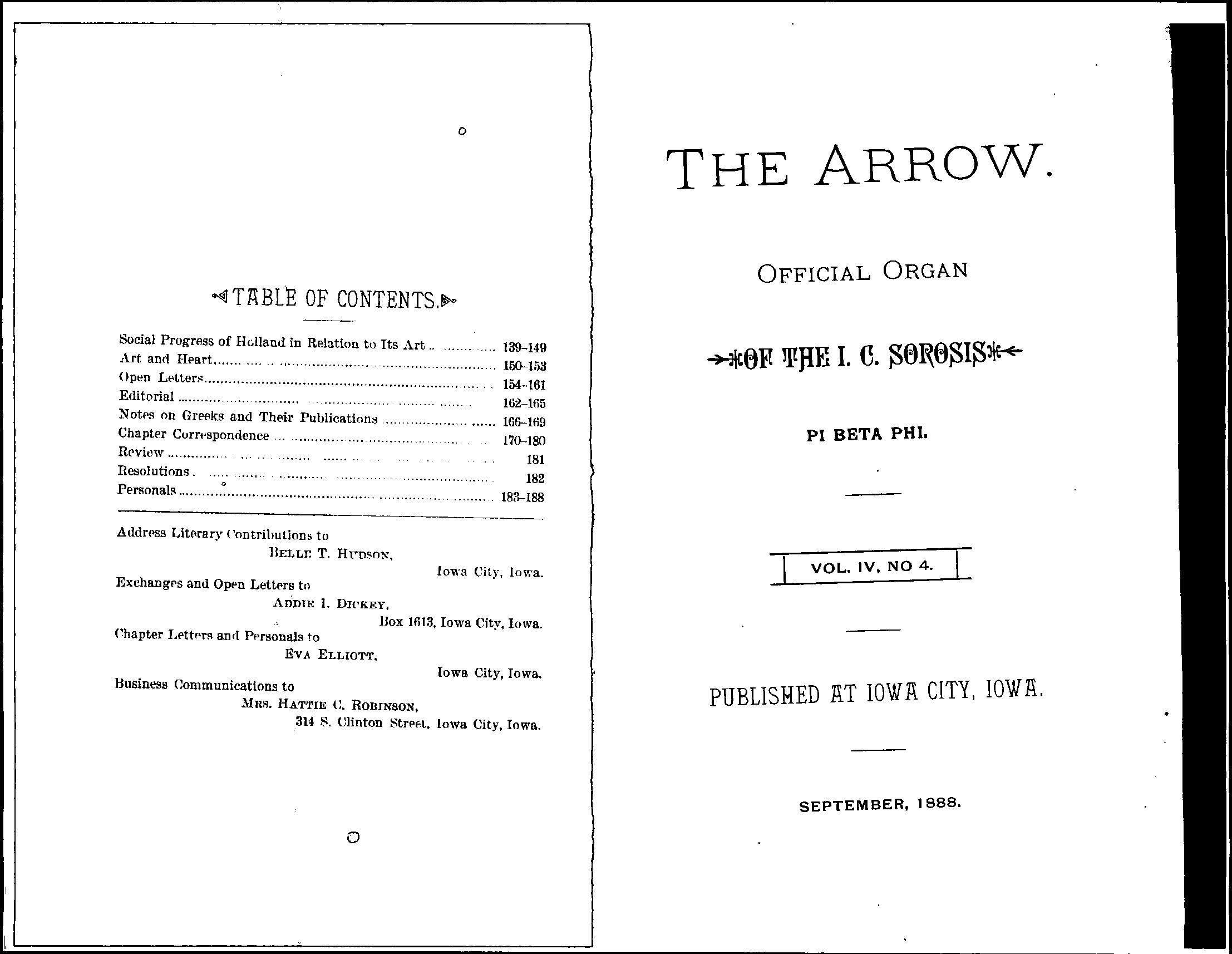
PUBLISHED AT IOWA CITY, IOWA, QUARTERLY DURING THE SCHOOL YEAR. •
TERMS.
".00 PER YEAR. SINBLE COPIES 26 CENTS.
EDITORIAL
STAFF OF ARROW.
EDITOR IN OHIEF T. HUDSON .
AssoaiATE EDITORS.
.. . Iowa City. Iowa
ADDIE I. DWKEY ....................... . ... Iowa 'Uity, Iowa
EVA ELLWT'l' . . .. ................ . ........... Iow8 City. Iowa
BUSINESS MANAGER.
HATTIE C. ROlliNSON, '84, S. U. 1.. ..... I?wa City. Iowa 314 S. Clinton Street.
OFFICERS OF I. C. SOROSIS.
G-ltANlJ ,L It. M R ........ ns. . A. SMALL ....... : ... Blue Islant! III
UltAND n. t' ........ MISS ELVA PL r • _, , AN1\. ......... Bloomfield, Iowa
GRAND MIlS. HELLE H. LEECH Mt PI Jowa
GRAND (IUAE8'l'0IL MISS LIZZIE FLAGLEP , Ottum wa, Iowa
THE SOCIAL PROGRESS OF HOLLAND IN RELATION TO ITS ART.
SUSANNE F. TYNDALE, BROOKLINE, MASS.
(Qoneluded from June number.)
Throughout the course of the 14th and isth centuI"ies, when patriotism and commerce were the traditions dear to' the Hollander's heart, the ground-work of their culture and the direction of their intellect is the same. The traditions of the middle ages, the legends 01 the church, hold them in subjection longer than the surrounding nations. Religion, art and government were im· ported from abroad and easily accepted, so long as their individual freedom was not abridged.
After the Hanseatic League had heen formed in Germany, the Netherlands became the most important emporium between the North and South (Schiller). The principal towns offered commodious harbors and formed a place of resort for different nations and for a center of commerce. The products of the world were at their door. The princes of the country, acquainted with their true interests, encouraged the merchants by important immunitit!s, and protected their commerce by advantageous treaties with foreign powers.
The fifteenth century saw several provinces united under one rule; their separate interests reconciled, their petty wars likewise ceased. A long peace gave opportunities for gratifying the tastes 01 the affiuent. Rruges was at this time thR most wealthy and splendid city in Flanders. It was the
. Ihe Arrow.
favorite residence of the free·handed, despotic prince and art patron, Duke Philippe Ie Bon. The court of the Burgun· clians was famous as the most voluptuous and magnificent in Europe, Italy not excepted. The costly dresses of the higher classes set the fashion for Spain, and eventually for Austria. A French traveller of the day tells us that in both sexes the pomp and vanity of dress was carried to an extravagance, and the luxury of the table had never reached so great a height among any other people. All this is incompatible with ascetic and regime. Man begins to enjoy life-takes pride in his physical well-being, and thinks less of the final judgment.
Fantasy displays itself in the new order of architecture called Gothic, which the Flemish horrowed from France. Handsome cathedrals, with airy pinnacles, delicate lace·work and flying buttresses, embodying the life, thought and activity of the Christian faith. The Church was the great book of the middle ages in which the complexity of the new life • asserts itself, but it is the Roman Cathulic, and not the Protestant idea of Christianity. Montalembert says: "When we enter an old Cathedral, we hardly feel any longer the exterior stone-work symbolism. Only the general impression strikes immedi<ltely the soul. We here feel the elevation of spirit and the prostration of the flesh. The interior of the cathedral is itself a hollow cross, and we here walk on the very instrument of martyrdom. The variegated windows cast their red lights upon us like drops of blood, funeral hymns are trembling around us: under our feet are tombstones and corruption, and the spirit struggles with the col· ossal pillars towards Heaven, painfully tearing itself asunder from the body, which drops like a worn garment to the ground."
.When one is constructing a theory, how happy is be when warrantable facts are found to bear him out! So I am pleased to notice that the Dlttcl, Gothic sacrifices beight and
Soc/," Progress '!f Holla1ld.
Silblimity to breadth. and grandeur of dimensions. An adheaviness is gained by the use of brick as a building material; while for the lofty vaultings in which ·the eye loses itself, is substituted a flat wooden ceiling. Evidently the soul of the people is not identified with religious mysticism and ecstacy. . . .
Rationalism and Intellectualism stand for emotIon III tht! Dutch soul. The infallibility of the people is like to take place of the heretofore received infallibility of lhe Pope. doctrinaJ and speculative factor, as contrasted WIth and practical in religion, harmonize with the material condItion of the Netherland burghers, and we have, of necessIty, Calvanistic Christianity, an elect few chosen to eternal feliciey, the mass of humanity condemned to the eternal damnation.
The Gothic town and guild halls, which occur so Iy, are of far greater interest than the churches. As ear!y as the twelfth century, every town capable of defending Itself was provided with a helfryor large tower, from which the citizens were of the outbreak of a fire or the approach of an enemy. ,:"ith or indepen?ent of these lOwers were frequently extensIve Hal1s, destined for the reception of the products of Flemish industry, while principal square was usually adorned WIth a. hotel VIlle having a rich Gothic fagade, and beautIfied tn the Intenor with paintings and sculpture.
"The exchange was the true center of the religion of Am· ftt:rdam," says Mr. Heath, in an article on the" Rise and Fall of Amsterdam." Hardy were the representatives of the two sub,idiary forces in the life of the city-Politics and Cal· vanistic Christi;mity. The stadthuis was an enormous structure. The forest of piles necessary fpr its foundation had cost £100.000 sterling. Its floors, walls, pillars and ceiling, were incased in marble. The palace at Versailles cost £800,000, the Escurial £r,ooo,ooo, but the burgher govern·
The A,·row.
ment of Amsterdam spent £3,OOO,cx>o on the shrine· of its making it fit emblem of their policy-hard, superticlal and stupIdly wastefuL * In its vaults Were the tn:asures of their famous balik, to all appearance an infinite hoard of wealth, -gold and silver in bars, plate and bags of specie Innumerable. Which wealth will be seen later to d • , 0 . Its part In fostering- the arts.
A still further exhibit of Dutch characteristics is given in their lofty and narrow, constructed of red bnck and lined with white cement; with projecting gables: festoons and heraldric carvings, that gave a charming to the cities, while the homely wit and proverbIal phIlosophy of the burgher, who found his paradlse wIthm, was displayed in wise saws or in length titles, of the sentiments of the proprietor breathlllg' a SpIrIt of comfort and satisfaction.
Amsterdam was the first city in Holland, and its free and multiform life, the found much to attract him. In the Jews' {!Uarler were to be Seen spoils from every part of the Brought by the crusaders from Syria, by the from and by the sailors from everywhele. And h.ere Wert! likeWIse found those inspirations for the the shrivelled, ghastly alcl.lenllst In the midst of his retorts, concocting mixtures WllH:.h would confer everlasting youth and convert all metals into gold or .silver.
"" e behold tht:m again in Rembrandt's pictures, half seen dreamy. splendors, turbaned wizard heads, pale with forbIdden studIes, keen with the of avarice and furrowed with an eternity of years.t
Here, by of the fancy we see symbolized, th,e Optnulsm, ever at wQrk firing men's fancies \\,Ith Idea of a constant expansion of the human powers' :::":1. new revelation of truth; and a new office for the imagin:
*1I.:lath. tSee Mrs. -!ameson.
Social Progress of Ifollalld.
ation. And we feel certain that to this fundamental prmciple of Liberalism, we owe the democratic upheaval which developed a liberal movement in politics, shook accredited dogmas, and dissolved all received traditions,
During centuries the elements were working in the social alt:!mbic, to materialize at last in tht:! fact of the seventeenth century.
Behold a proud and vigorous nation, fresh from a desperate but victorious struggle for liberty, no a party in the State, but a . new and independent State. No more a people in bondage, serving foreign gods. but the peculiar people of the one mighty Jehovah,-the conservators of the only living truth.
But the narrow Hmits of the Nttherlands now embrace two entirely diflerent worlds. In tbe Spanish Low Countries, politics and religion maintain their old allegiance, while in the States General of Holland is established a new federal form of government, new political and economic views and a new form of, religion.
The characteristic utterance of these two worlds is found in the two phases of art as represented in Rubens and Rembrandt, while Teniers perhaps is a good example of the growth of which these are the blossom and the fruiL
The art of Rubens is chiefly devoted to the .exaltation of the old government and the old faith, yet we can guess from his treatment of scriptural subjects, that he paints (in so far as we take the literal interpretation of his pictures), that which he does not believe at, all, for people whQ do not believe in it much. "For just as the soul is pitched, the eye is pleased."
And as Addison prided himself on having "brought philosophy out of closets and libraries, schools and colleges, to dwell .at clubs and assemblies, at the tea table and in cofiee houses," so the great Flemish master brought art down from Olympus
The Arrow.
and out of the Medireval realms of Heaven, Hell and Purgatory, to sympathize .with the thoughts of men in evhy day hfe, and to dlgmty to the home, the market, the shop; thus reftecttng the new traditions of social order.
"Rubens represents the new joy. in life which glorifies the senses, .the of youth, the delight in bodily activity. Allegones, real hfe, classic mythology and Roman legends all subserve the same purpose to this Pagan genius,-that vast play of human life, which more than 1,500 pictu"es did not suffice to exhaust. As bold in its poetic beauty as the sea that heat upon the ramparts; as deep and mellow as the colours tbat play upon the landscape-expressive in its license of the gnlnd principles of truth and liberty of which this seventeenth century was the chosen guardian.
Several comparisons have indicated to me the strongresemblance between the spirit of English literature at the close of the seventeenth and the beginning of the eighteenth centufles a.nd the spirit of Hollanil's art in the soventeenth century. I subjOin a sketch from Mrs. 1ameson in illustration.
"Rubens is just such a painter as Dryden is a poet. His Dry'den '8 women are grm:;s, exaggerated, unre· nned ammals; hIS men grand, thinking, acting animals. Like .?rydcn. he clothe his genius in thunder, dip his pencil tn the ltghtmg and the sunbeam of heaven and rush fearlessly I:1pon a subject. which others had trembled to approach. In both we see a smgular and extraordinary combination of the plamest, coarsest realities of life with the loltiest imagery moSt luxurious tints of poetry. Both had the same pas: slOn for allegory. It is the blending of the plain reasoning WIth creative powers:-of wonderful fertility of ConceptIOn WIth more wonderful facility of execution· it is th.e combination of truth and grandeur and masculine WIth a general coarseness which may be said to characterize both these Inen."
SoC/cd Progress of Hollmzd: '45
The works of Rubens, while from his own will and individual sympathies, yet gave voice to the prefer· ences of the southt::-n provinces, and to that largeness of life everywhere at home in this century; so that even during his life time, many of his pictures found their way to England, to Paris, to Munich, Madrid and St. Petersburg.
The art of the Northern provinces is more individually Dutch, and hence its best examples are to h.., found in their home galleries-inseparable from the native soil.
The Dutch of the new generation (1616), in the enjoyment of the peace and freedom for which they had fought so long and so hard, were men of strong individuality of character not a little self-conscious. They had not much of the spiritual, but they had shrewdness, a keen sense of humor and a mighty belief in themselves. If an artist wanted to interest them, let him represent them and their doings. If he could make them amusing so much the better; men who have capacity and self confidence can afford to laugh at themseh·es.*
In Belgium a painter could still find an avenue to fame in the pursuit of religious art. In Holland, the Reformed Church eschewed all the pomp and vanities of decorations, and that aventie was entirely closed. Under such circumstances, artists naturally turned to p01traits and genre, each branch supplementing and strengthening the other in its in· terpretation of the time.
Modest unassuming citizens had been converted by the war into brave soldiers, and even heroes. Necessity had made statesmen. stood for much in those times as now. We wish to remember and hon·or foreve·r the man whose eloquence has thrilled us or whose courage has made us freemen and we commission the artist with the largest brain and most cunning hand to fashion for us a statute or make him live again on canvas. The Dutch were fond of -;:soo Head's life of Franz Hals.
Arrow.
seeiog the faces of those they admired reproduced by skillful brush, and all phases of truthful portraiture are to be seen in Flemish galleries, from that which seizes the accidents of the physical form, painting to the life the mole on the nose, making the satin look like real satin, the fllr like real fur, to that which gives the stamp of the soul, which pierces beneath out ward shbw of hypocrisy or habit and sets before us the depths .and mysteries of the man himself. "For truth's sake" would have been the fitting motto of those Dutch painlt.'fs whose- names and fame have come down to our Own century because they seemed to "have no respect for centuries but painted human nature honestly and fully as the passing day revealed it te them. The result is they have often caught and perpetuated what is universally true.
Among the most notable works of this school are the historical groups on a large scale representing the dignitarit's and civic corporations of the towns in groups of a dozen or more, life size or nearly so. The Civic Guards drinking their annual glass of wine with the magistrates was a favorite suhject. Rembrandt's biographer tells us that· the Civic Guards had been painted a hundred times before seated in a row behind a tablt.. , or marching- along stiffly in singh: file: but Rumbrandt first conceived the idea of catching them as they hurried ant pete-mele at the sound of the drum to practice.
The heads of the Surgeon's Guild want their portraits painted, and Rem brandt groups them around the famous profe::;sor of anatomy, Dr. Tulp, and the group is immortal. There is nu fear of his l1")t making a picture of artistic and historical inttrest even though some of the dignitaries feel insulted at being put in half lights.
It would be an interesting study to trace some elements of portraiture in the genre painting of Teniers and others in their faithful representations of village life,market days,
Soc"d Progrc" of I-Iol/ulld.
'rou s of merry-makers at fairs, at inlls, and the \\'iwic range g p ",. nd SOITOWS in which the humble and the of domesttc JOYS ,I . d oar have their places by the side of the and the p ,ou it is life, depicted often in the coarsest reahsm., It !: hfe f I · I tl I'dea" Aristocracy has been clnnmated. rom W llC 1 le <
Chivalric conceptions of life went out with the change In . I'd Such '111 age could not have found adequate SOCia 01 er. ' f' . . th m)'sticism of medireval art-they ace nature expn:!sslOn 10 e . boldly and paint it as they see It. . .
Yet, underlying all this realism of the so I . d' lely positive that we to call It CI C<ltlVt'., WdS P Y ,111 sO I. III tbe . f I' I' 11 hud its imagmatlve ll11pU se a pOt:lIC ee to" W lIC . . ) Anaba tist creed in the North, and to which lIl.t H:! '. Pf't 'tl··n1"nt Rembrandt gives the best expresSIOn. punty a I s sen ...
Proscribed and exiled for their faith, called upon to make d bl 1 tl . Dutch peasants and sat:rifices of treasure an ooe, lese.. :, . If . .' tal'n their Inincil11cs untltndllngly, con!)ohn b arlIsans mam, I' . h 1 b zealous devotion to the memory of t lei!" pi 0t emse ves y TI . I f hith . s in the Old Testament history. H! tna so . . tot} pe .. , f Joseph the mate ... al of Abraham, the carnal temptatIOns 0 . " • d f MOI'de"ai and Esther, the lOtt:::gnty of mor,li rewar so.... I . .
. T b't f the Apocrypha are repeatec tn m,IIlY character III 0 I 0 '..
. h' I" . nd. form suhiects upon which the genIUs of t ell' own lves a J • B t 'tl f' R 'mbrandt shines with lummous mtenslty. II WI 1 a ,I . le love and veneration is the life of Jesus treated: The especHt , f' I f tl oar' I I . 'qua'lnted with "Tid, the nenc 0 le p ow y man <lC tt .' £ the first to the last day in the wonderful story IS tntel ' rom . NIger wnh the symbolic reted over and over agaIn. .1. 0 on . sticism of early Christian art, nor yet with the pride and y . I I 'ficatl'on of the latter Church mIlitant. But the materia g on . b 11 . . told with the strongest realism, touchmg ut se ( am story IS .. I t velop u on those circumstances of a mysteriouS C larae er, ,en . itg with a purely national spirit the parts of the hfe of J e· sus that can have' a mterest.
q8 TI,e Arrow.
"The Carpenter's Home," Remhrandt, one of the artistic treasures of the louvre, represents the home of a Dutcb artisan of his own day, bathed in the peaceful sunshine of a brig-ht afternoon. Jos,eph is hard at work planing a board, his glass of beer suggestively near at hand in the window sill. And the group of mother, babe and grandmother, which partly engages his attention, is altogether Dutch III type, and very modern in thought. Noticeably the grand. mother, who has taken oIl' her spectacles and let her Bible drop upon her knees' while she shields the child from a draught.
A picture of Jesus discussing with the learned doctors, is equally characteristic. Their Council·chamber is a cobbler's stall in Amsterdam, and the eheif rabbi is the putty cobbler himself, probably one of the fanatical preachers of the Anabaptist sect.
Rembrandt's biographers all remark upon the singular knowledge he shows of the text of the scriptures. But it is evident that he read it with a very liberal construction, 'not depending on the official authority of the Church, but voic.. iog always, the sentiments of hearts unacquainted, perhaps with theology. Numerous other examples might be given, in which Rembrandt's strong dramatic genius is in vivifying religious ideas to men of his day, and at the same time preserving to after generations the visible history of their emotions.
I have sought to trace hurriedly the social progress of Holland along various threads of its existence, to where they intermingle to form the hrilliant tapestry of ther7th centu. ry. Here one may read in its rich and varied hues, the his. tory of the people's thought for the day and generation, and on looking more closely, we become aware that a common purpose runs through and unites the various phases into a wqole, binding the present to all the generations of the past.
Soc;al Proa-ress of Holland . .,
It only remains to be said, that the glory of Holland is as well as hers. It has become a part of the common he •• tage of the race. •
Books referred to in writing the above "Sketches of Art, Literatnre and ,!=!', .. . th Netherlands" and "The Ideal In Art; SchIller, HISIII n e It f th: Netherlands'" Huskin, .. Modern Painters; I' tory evo 0 c" 1-1" t Baedeker's .. Guide·book to Holland;" Brit., IS. d L 't ." Lord R. Gower, .. Figure PaInters of Holland, Rendall an I., KttURb "JW Head, .. Vandyke and 14'rank HaIs;" ehas. e, u ens; . . Mollett," Rembrandt."
The Ar,·ow.
ART AND HEART.
(Michigan Alpha tiends the following as a literary contribution from their chapter. It a prize oration delivered at L. L .. U. contest, Feb. 29, '88].
Ruskin has said, " Art is the work of the whole spirit of man, and as the spirit, so is the deed of it." Through all the broad land are minds seeking to find expression through art. Many are toiling for fortune, and many nrc striving for fame; but those who would give up fortune, fame and life itself in this search are those who become the true artists. Art is a glorious thing; it is to be sought after, admired and attained, hut art is not the ultimatum; it should he the means, not the end. Art is the machinery, heart the power that puts it in m'?tion, and he who would be a faithful disciple of art must be an earnest cultivator of heart; for art is the medium of expression through which the personality manifests itself, and only as that personality is beautified and ennobled by the heart of mnn can art reach its highest purpose.
In the art of painting-, the noblest achievements have been in the treatment of Christian suhjects; and hy the reproduction of the facts of Christian history, painting has become the hand-maid of religion. Some of the med;reval painters were evangelist", eloquent Baxters and Bunyans; relating to the eye what these men spoke to the ear. [t is said of Fra Angelico that he never took up his pencil till he had gone to the pure Castilian fount, whence came aU his inspirations. HI
Art alld Hem·t.
can paint best," he said, "after prayer." And well his pictures show these communings! Landscape leads the student into an apartment of natural theology"n whIch the undevout painter can have no success. He views nature from a human stand point, and his picture is only a shadow of that of the Christia,i. Noone can study nature with success, catch its myriad forms and colors. if he is not in· sympathy with the Author of Nature, the great Landscape Painter.
Michael Angelo was a det"p, broad, earnest Christian man, and it was the Christ in him that enabled him to paint with such wonderful skill his noted "Last Judgment." In Raphael's "Transfiguration," the head, face and whole figure of the Savior are unequalled. It stands in the art, "the divinegt image of- beauty and divinity pervading humanity." Art alone is not capable of anything so giland and truly Christian, and only the heart of a Raphael could have produced it. Rosa Bonheur, the acknowledged mistress of her art, gathers her inspiration from the great heart of nature. She has the creative touch that makes alive; her horses! one can hear their very breathing. U 'The mission of Rosa Bonheur," says Monsieur Lapdle," is to decipher the sublime poetry of rural nature, and to translate to us the works of God."
is not the poet's song, though sweeter than sweet bells chiming, which thrills us through and through, but the heart whicl; beats under the rhyming." Poetry may please by its rhythm, or its beautiful measure, but it leaves us unmoved unless there is heart within the rhyming. It is not tht: chi;ne and flow of words that blends \vith the current of the soul; it is the feeling, that mysterious something which brinj.(s man into closer sympathy with his brother man. This is not displayed in the studied phrases and lahored sentences of one whose nature is cold and indift't!rent, but it
The Arrow.
breaks fresh from the fount of feeling, and mingles with that of. a kin.dred heart. Many a poet gifted with genius, has tOIled apel day for the praise of the people, but no one listened to his songs, because they were empty words. Afterwards, when sorrow and suffering led him to ease the g-rief. of his own heart by writing for others' sorrows, the has knelt in homage, because his songs were written m .tears: Among the first of heart poets is Mrs. Browning, skIlled In the mechanism of words, she dips her pen in the human fount, and from the height and depth and breadth of her own noble nature, she bleqds the grand, the beautiful, and the tender into a strain that touches the heart of human ity. The same may be said of Adelaide Proctor, Alice Carey, and scores of others whose soul-light sheds a halo over simplest ve;se. Truly, poetry without heart is like a day WIthout sunshme; we know that it is day but there is no brightness in it.
As the soul is the life of man, so is it also of music which . ' not seen, but felt. It comes like the wind and passes by, Its effects only remaining. It has a language of its own at aile time thrilling and rousing to action, at another to repose, and only he who has entered into its spirit can under'tand and feel its power. The singing of one without heart though it be faultless in other respecls, leaves us cold and in: diilerent, when through the soul expression of another, noble feelIngs are aroused which afterwards crystalize into action. Think you that our loved" Home Sweet Home" would have re-echoed thr?ugh every land, and have been sung in every tongue, thrlllmg the hearlS of lhe nations, had it not been lill:d ,,:ith the lonely heart yearnings of its desolate composer?
1\ IS SaId of Jenny Lind, the Swedish when she sang "1 that My Redeemer she proved by every IntonatIOn that she knew the blessed truth better than the song; and as her silvery voice rose higher and higher, and swelled fuller and clearer, she seemed vieing with the
Art and Heart.
angels in her praise, swaying the hearts of the thousands, until they were ready to bow the knee to the God whom she so grandly worshipped.
We all are artists, and life is the canvas upon which we spread our colors, the great book in which is written the poetry and prose, the grand key-board touched by humanity. Not only to the few who have shown some marked aptitude in certain directions is the great world of art open, but to all. In every department of labor must the soul of the worker he imprinted upon his work; and as God has implanted in every human soul a love of something of the beautiful, so also has he given to each some means of gratifying it.
Art may be the luxury of the rich, but it is the necessity of the poor. No matter how lowly the surroundings, an earnest purpose and a loving heart will create beauty as by magic. A rude cabin may be the true artist home, while the palatial mansion may be simply a house. By looking at the world without we set! the great heart of its life beating within; we see that its loveliness is but the outward mouldinO' of the . " eternal and indwelling beauty which so sustains it. True art seeks for the "touch of nature that makes the whole world kin," and they who would find it must drink from the life-giving fountain, must receive their inspiration from the Divine Artist, whose heart of hearts has left its impress upon humanity, has brought light out of darkness, poetry out of prose, song and rejoicing out of misery and woe.
The Arrow.
OPEN LEITERS.
A INVITATION.
The.re are a few words .J want to say to all the chapters, and wIll take thIs way to do it. I am asked about rates to the Convention. In regard to this subject, I will say that I have seen the agents of the different'railreads here and asked about .a reduction. They tell me they are sure th'at one and fare can be obtained; however, they are to ascer.and let me know as soon possible.· I suppose, however, It wIll he too late for this issue; therefore, I will say that as soon I do hear, I will let each chapter know by letter. There IS lIttle doubt that the rate can be obtained.
For .the benefit of those who wish to spend one day with us dunng the Convention, we waIit to tell you that our plans are: ?n Tue.sday we want to have a sup?er and an I. C. JollIficatIOn-thIs IS to be strictly I. C.'s; and on Thursday evening a public reception will be given, so that our hus.bands, brothers and sweethearts mayfbe given the opportumty to meet our honored guests.
We have one request to make of each chapter: Please send US, as soon as you possibly can, the greatest number who will come from your chapter; you see, we ask for more than one delegate-we want visitors too. Let us know how. many will come from your chapter. Don't be afraid of sendlOg too many; we want you all, and can easily take care of you. Will each chapter please send me, as soon as you can, the number of achve members and cost of sending your delegate? Yours in IT n $, Ott"uin1ou, [owa.
Lizzie Flagler, Grand Qua'>tQI'
Open Leiters. ISS
PROVINCE ORGANIZATION.
So much force is lost through ill working plans, that at this time, with the convening of the Grand Alpha so near, two questions present themselves with force-What are our aims? Have we the best organization possible for gaining them? If IT B hearts are able to comprehend the breadth of the encomium, "She hath chosen that good part that shall not be taken from her;" if they can measure the influence of a noble womanhood through all these years; ·if they can tell the tenderness wrapt up in that one word "sister,"-they have broadened their lives to the breadth of the Society'S aims. To me they are as yet beyond conception. While I love to dream of these lofty ideals and to study them, when clothed in all the splendor of beauti! ullanguage as they appear .in preamble or constitution, I must confess to sympathy with the critic when he asks· for visible results of the good being gained.
I may be too practical, but my life is too busy to give thought to the spiritual that does not have a reflex action on the life of every day, rendering that noble, pure and true; strong in influence for the right. Have we the best organization for gaining and making/practical these spiritual aims? We recognize that we must work by the method implied in Meredith's beautiful lines-"N a life can be pure in its purpose, and strong in its striie, and all life not be purer and strongerthereby." Since then, each life must be a distinctive part, the whole must be a thorough democracy; and that is good, for "the best that modern science has done is to promote the democratic tendency everywhere."
Julia Ward Howe says-"In order to have a perfect organization, eternal vigilance under three conditions is necessary."
1. We must be loya!" to the name in which we associate.
2. We must make matters In our immediate neighborhoo,d conform to it.
The Arrow.
3. We must assure ourselves of the character and ability of those who assume to represent it and ourselves.
II B can truly say Aye! Aye! to the first and third condi· tions, but I fear we are weak as to the second.
To the fraternity (I presume I may use the term in this connection) the life of her own immediate chapter is of aU importance; it is there she works out the problems of fraternity life; learns of her place as an educated woman in the world's great sisterhood; gains the strength from the beautiful friendships with true, tried friends. Carlyle has said-"The history of a nation is b\lt the history of the individuals making up that nation." The remark is as truly applicable to that of a fraternity, and of each chapter. As the life of each member is varied, each with its different needs, mental, moral and material, so each chapter takes on a life peculiar to itself; moulded as the united influence of the varied lives making it up alone can mould it.
. Each chapter is a fraternity world in itself, working dIrectly toward the aims set forth in constitution; dependent on nothing for its stimulus, that being found within itself. If the chapter be not of prime importance, we surely are failing to gain good sufficient for the effort being put forth, for as we are now organized, the Biennial Convention and quarterly appearing ARROW are the only means for helpfulness in the interchange of ideas, and how far they fail of supplying the needs; but very few can ever attend conventions, and many topics of vital importance to fraternity life can not be touched upon in the ARROW.
But more-beside each chapter being different in itself, geographical position is moulding alike, sets of chapters. The same force is at work in church, state and society, the same results accruing. Geographical position made actual an East, a South, a West; the conservative, polished Yankee, a hospitable, graceful Southerner, the brusq\le, practic'al Westerner. The cases .are parallel, and we, an orgal)iza-
upen Letters, I57
tion much smaller, are shaped, resist though we may, by the same force that works in all its power through the three great divisions of human thought. The colleges of the Mississippi Valley are different in their needs and manners of working for colleges West or those of the East. Does it not follow then, that the chapters of these sections, though each distinct from every other, will have needs in common not shared by the different sections?
So far we have been at fault in that we have not taken ad· vantage of the inevitahle and turned it to our own good. Would we not gain immeasurably if hy constitution or bylaw we make the union, already existing by the nature of things, a fraternity fact and bring into more immediate intercourse and helpfulness the chapters one in interest though now dwelling apart 1
The details of organization cannot be presented here, on ly the needs brought to mind. We feel sure that if the Sorosis be determined to remedy the existing evils, Grand Alpha will manage all intricacies of details to the entire satisfaction of all.
Through Baird's Manual we learn that almost without exception fraternities commenced their work with an organization similar to the one in practice originally with us; but as progress crowned their efiorts better plans were adopted, until now many of the male fraternities are "organizations of formidable influence." Many of them are governed hy the combined efforts of Judicial Board composed of alumni, an Executive Council and the Province government, but all secondary to the various Conventions.
We want no organization so vast and intricate that in its workin"s the whole becomes a machine, but we do need an organiz';.tion conforming to the order of things, and in harmony with all thoughts of progress.
The advaptages of province organization to the grand oflkers cannot be estimated. In the attempt to bring them
The Arrow.
into direct intercourse with the chapters themselves, we lost:! sight of the fact that the officers come from widely separated colleges, and from lack of personal knowledge with the colleges and chapters in question, they must fail to give the advice and sympathy desired. We can scarcely estimate the attention to general principles demanded of grand officers, and the attention to our I"elation with other national societies, and I fear we forget that each grand officer has a busy life entirely "separateJrom fraternity work." How much better the work might be done with the aid of province officers; the grand officers be aided in their work [OC knowing I us, by intercourse with the many through the one. We, be aided to know more of them and their since we the many , , apply to the one, and perhaps most and best of all, we of a section be aided to a higher plane of fraternity life through a common g-uardianship. Are we too small for such a ment? Numbers play a very little part as to forming a thorough organization. Let me ask, is not Rhode Island organized as thoroughly as New York? and does it not stand in the same relation to the national government? To effect a change for the better in our organization is a serious question, and we may profit much by studying the history of college societies as given in Baird's Manual. We do not want to other organizations, but the saying is true as well as tnte-"Fools learn from their Own experience. Wise men from the experience of others."
And' with all these thoughts for dear II B $ let us think ot a pl.an. for and with a chapter life apprecIatIve of Its Importance; a province life successfully organized, we need nut fear for the success of the national life; for "Now comes the, power of truth over human hearts. If your central principle is genuine, it will command the currents of conviction'from northern to southern extremity."
Emma Harper ·Turner.
THE I. C. CONVgNTION.
The I. C. Convention will convene October 16, 1888, at Ottumwa, Iowa. The business sessions will be held Tues· day, Wednesday and Thursday from 8 A. M. to twelve, noon; the afternoon sessions from two to six. Tuesday and Thursday will be given up so:ial intercourse. . Wed· tiesday evening a business sessIOn WIll be held from eIght to ten.' '.
Should there be important business unfinished, after'the last business session on Thursday, then Friday or such part of that day as may be needed, will be devoted to the completion of such business.
As this is the last number of THE ARROW, before the con· vention, I wish through its pages. to urge .that the of every I. C. chapter give speCIal attentIOn to each tOpIC specfiied in theconventio1l call, be able to instruct your delegate so that she may mtelhgently represent the voice of your chapter.
Much enthusiasm is manifested by all with whom I have communicated with regard to the convention. It is to be hoped all the :Vork which is rightfully expected will produce good results. Of this I ha ve no doubt, prOVIded each chapter does its part.
A careful reading of the I. C. Constitution will, perhaps, go further towards aiding chapters to learn if they have or have not lived up to its laws. Should any chapter find that it has not done its whole duty, I advise such to correct any neglected obligation, otherwise the equilibrium of sweet peace may be disturbed. I would urge that each fail not to have a delegate sent, well and unselfishly 10structed and that she attend every session of the convention. Should' any delegate disappoint you, have her place filled even at the last moment's notice. By all means send a deleRAINIE A. SMALL (}rand I. R. of I. C. Sorosis. gate.
Shall THE ARROW be a fraternity magazine? Is the Pi Beta Phi a literary organization?
A reference to the opening of our constitution will answer the latter question. We are ·not pril1ul1'ily a literary hody. The question should be answered by Grand Alpha at her next session.
It was not strange that,· with simply ar:::t experimental knowledge of "how to run a paper," THE ARROW has drifted into a sort of literary "hit-or-miss rag-carpet," in appearance, dear to all I. C. '8 because of its very homeliness. But let us strive to look at the familiar blue-covered pages with the eye of a critic. Shall we not,find sume errors for which we can find an immediate and effectual remedy?
Since OUf object is not Primarily literary, the official organ of our Sorosis must not be primarily literary, in the rt:strict. ive use of the wurd. What we must be, first and last of all, is - fraternal in a true sisterly manner, if I am permitted the apparent contradiction. To gain in fraternal strength, there must be a hearty co-operative chapter support. Chapter leltess must be enthusiastic; they must come from every chapter, and at every issue. They. must contain, if possible, the chapter's views on fraternity needs, as far as those needs can be made public property.
The leading articles must be on topics. Our pages in the past have alternated strong papers on woman's rights with tenderly feminine productions which must have come from some sister who fondly berated the strong-mindedness of some of her I. C. sisters.
We cannot, as a fraternity, be individual upon such subjects, but we can agree upon wishing the best for our dear Sorosis. Nothing will so far further this good as well-written articles bearing upon fraternity topics and fraternity relations. Let the exchange editor be an absorber as well as a critic, and n:ad other journals with an eye single to how this or that .would help II $.
Opell Letiers. 161
And"now, dear sisters, this is all in the loving spmt that "hurts to heal," and from the pen of an editor who has broken all the editorial commandments and whose sins of omission and commission are too numerous to mention, but' whose love for 1I B and THE ARROW is great.
The Arrow.
in the June ARROW should have been credited to Miss Lillie M. Selby, of Hastings, Neb.
We have on file June 1887, Dec. 1887\ June 1888, March 1888, ARROWS if anyone wishes back numbers.
Some worthy literary material sent in by sister chapters has been crowded out of this issue by other matter which pertains to subjects of general interest to Pi Beta Phi.
This issue of THE ARROW finishes the article contributed upon Holland Art. It is with pleasure we read the favorable criticisms given it in the columns of our best exchanges,
Who can resist the hospitality of our Ottumwa sisters? Let every chapter send not only one delegate, but several girls who shall have the one needful credential, that is, that she bt.:: a true 1. C.
The excellent article on Province Organization commends itself to the consideration of every thoughtful II B $. We are much indebted to our sister for expressing so well our own sentiments on a subject of importance to the Sorosis. It is centralization of force which is the success of every organized body.
Editorial.
Whatever of success the ARROW has achieved is not due to anyone person or anyone chapter; but we take this opportunity to express our gratdul thank. to those who have been associated with us on THE ARROW, realizing that it has been a "labor of love" that can have no return but the ext::rcise of the same rare commodity.
We have been fortunate enough to have had a verbal report of the L. K. G's Convention, which st:ems, at least socially, to have been a mighty success. Full dress banquels and other gayeties occupied evenings, while the days were given to convention work proper. The next tion is to convene at Bloomington, Ill.
Can there not be something invented that shail take the place of "spiking?" Is there no "wooing of maidens" that can take its place? If the different societies in any certain institution could agree to do away with the customary rushing of the callow freshmen and give both the chapter and the individual better opportuuity to use calm reasoning er than being dizzily drawn into something they know not what. Is the present system open to the popular objection to hasty marriages, where both parties "marry in haste and repent at leisure?"
***
Who shall go to Convention? What shall we do at Convention? What shall we bring away with us? These are some of the questions that should and doubtless do confront our chapters as the time draws near for the October Conven. tion. Is it not possible to so fit our delegates that they can intelligently present their chapter's views on the nlOst important matters which are to come before Grand Alpha? May the few days spent in earnest labor at Ottumwa leave L C. Sorosis a more consistent, closely bound and loving body of Pi Beta PMs.
The Arrow.
Where shall we establish new chapters? Shall it not be in the east? Where shall we find older, more reliable schools and colleges? If we ,trewestern let us take our westernism to an eastern market. They need us. Not into small colleges and second rate universities but into the best institutions. Let us be bold and develop that latent push which surely must be one of our hidden characteristics. Let each newly organized chapter in eastern states fill our need and their responsibility and let the cry be not westward but eastward, Ho!
Of all dull aflairs, a valedictory is certainly the very dullest. Who has not suffered with the annual "And now dear class-mates, the time has come, etc." Well, the time has come, and sad as it is to sever the vital connections which have existed between our different chapters and the editorial corps, there is a certain sense of relief in the thought that the Grand Alpha will put THE ARROW into safer hands another year. Surely in a fraternity rich in talented members, there is some one whom bright destiny has fitted to be a good Exchanga Editor. For we assure you, dear successor, "There's the Rub." We freely acknowledge after a year's faithful but unsuccessful trial that it is quite impossible to fill this position creditahly without a paper-knife. Almost any kind of a paper-knife will do; but we do seriously recommend one of some description. We have labored under a great disadvantage in not being,the possessor of such an article. It has been a most difficult task to obtain a perfectly fair estimate of the ponderous pages of X. Y. Z., or A. B. C., when our eyes were at a sharp focus peering in between the uncut pages in a vain search for the one digestible plum which the Exchange Column might and might not contain for us. And so, dear successor, we advise you to get one. Do not upon further thought be satisfied with any kind of a one; but let it be strong, yet with an
edge can cut with precision all kinds of -material from the "daintily feminine" page of a sister enemy to the toughest and most masculine one of some brother fraternity. When you have found such an instrument wield it with force in every issue and you will have fulfilled one of the many requirements necessary to make a perfect editor.
NOTES ON GREEKS AND THEIR PUBLICATIONS.
The Kappa Kappa Gammas held convtntion at Minneapolis, Minn., the 21st, 22d and 23d of August. Kappa chose a charmed spot in which to plan schemes for vanquishing her foes.
We have the Kappa Alpha 'jorm,al for May hefore us. The 'journal has been on our exchange list but a short time. We find it ver), beautifully gotttn up and altogether very readahle. The Kappa Alphas are a strong southern society, and we regrt:t that she is 110t met with in the northern states.
The Delta Taus seem in doubt as to whether Clevelann or Cincinnati shall he their next convention ground. The following from the Symposium speaks a warning word to all of us: "Delta Tau Delta is as secret as 'the average Amer· ican fraternity. To ameliorate her condition, she must be made much more so; in this respect we should be second to none. The most secret fraternity is the most successful, and, since the athorities of colleges no longer look upon the fraternities as whiten sepulchers, this will be more true in years to follow. But even if I were able to write a philosophical treatise upon secrecy, it wouln be out of place in this symposium. I ask for a word on one matter. Let tIle c!Ulpter hall be secret. There shoHld be an unwritten law in every chapter saying, "Let none hut the initiated enter herein." No college community is devoid of facilities for entertainment infinitely superior to those of a chapter hall. There are three classes of people who can be entertained in a chapter hall: non.college people, harbs and rivals, and candidates for initiation. To entertain non-college people is the
Notes on Greeks a"d Their Publications.
least compromlsmg. They have a vague idea of having been in a suite of rooms more or less elegantly furnished. Candidates for initiation see more, but are unable to grasp the situation, and are enabled to appreciate to some extent the mystery that surrounds it all. But why entertain him in the chapter' hall? Is it not an easy task to convince him that the hall is a much more important place, by never showing it to him? Nothing escapes the eyes of the rival and the barb. The one looks to see how little there is, the other to see what it is that inspires so much awt: in the mind of the outsider. The one looks to ridicule what displeases and to imitate what pleases, the other to wonder if it be worth all the trouble and expense necessary to be one of The Chosen."
"If we credi the correspondence contained in the June Issue of the ARROW, Delta Tau Delta stands high in the graces of the sisters of the 1. C. Sorosis. There are references to "Delta Tau receptions';' and invitations to other gatherings are noticed as restricted to. Delta Tau. Where. fore this boycotting of Delta Tau's rivals, fair sisters? The Iowa Eta contributes an item concerning certain presentations that doubtless afford much satisfaction to the masculine appendages of that branch of the Sorosis. The issue before us contains a plea for the adoption of the Greek II B $ in pl.ace of old name, "1. C. Sorosis," and pays a deserved trIbute to the high standing of Greek·letter fraternities. The literary articles, however, do not appear to have any direct bearing upon questions of fraternity interest. The present issue records the recent founding of a new chrpter of II n at the University of Michigan."
The foregoing .comments on THE ARROW in the the July Delta Upsilon !!<,.uarterly provides us with food for reflection and texts for utterance. If there is a tendency in Pi Beta Phi to show a preference to Delta Tau, it is for the simple reason that we know and meet Delta Tau, that Delta has been, in fact, "a brother to us, - has helped LIS to estahlish
r68 the Arrow.
chapters, and shown us in many Such fraternal courtesy will always receive a gracIous appreciation from the Sorosis.
Secondly, the article upon was read at a meding of the Hastings, Neb., chapter, by Selby, and was published at the special request of the edltonal Grand Alpha agreed, at her last session, to publish a certam amount of literary material in each issue of THE ARROW; it will be practicable to do so another year IS a questIOn which Grand Alpha will decide for us in October. * * The following statistics should revive a waning interest fraternity may have in its official .. A fraterUlty IS something more than a luxury; It 18 a necessity.
"In the thirty-three years, from [839 to IS72, Beta Theta Pi had built up a chapter. roll of twenty-four. In the fifteen years, from 1872 to 1887, during which time the journal has been published, she has added twenty-four new chapters to her roll. Phi Delta Theta was founded 10 rS4S. Her journal was founded in rS&,. In twenty-eight years, a journal, Phi Delta Theta bad m twenty-seven colleges. In eleven years, a she has founded thirty-eight new chapters. Sigma Chi was founded in rSSS. Her journal began publication in rS.81. In twenty-six years, without a journal, she a chapter-roll of twenty· three. In six years, With a Journal, she has added fifteen new chapters. Phi Gamma Delta was established in 1S48. She first issued her journal in thirty-one years without a journal, estabhshe 10 seventeen colleges. In eight years, with a Journal, she has established fifteen chapters. Alpha Tau Omega was founded in rS6S. She commenced to publish her journal in 1880. In fifteen years, without a journal, she had built up a roll of nine chapters, In seven years, with a journal, she has added eighteen new chapters. That this rapid was not produced in any of these cases because of any perIOd of
Notes 011 Greeks aild Their Publicatio1ls.
general fraleJ"IJity activity, is evident from the facl that the journals were founded at widely different times. Delta Tau Delta shows a record equally remarkable. In eighteen years previous to the establishment of the fraternity organ, she had added to her list twenty-four chapters, nine of which have since had their charters withdrawn. In the ten years succeeding the of the journal, sixteen chapters have been added."
Several of our worthy exchanges have failed to put in a prompt appearance with a midsummer number. We acknowledge the receipt of both the Delta Upsl!o" ancl Chi Phi quarterlies, and have found the fortunate leisure to read and enjoy their pages.
There is often merit in a frank confession of inability. We have endeavored, in reviewing other publications, to stay somewhat modestly within bounds. It has not been our desire to imit<llt! the famous Mrs. Partington who made vigorous but entirely ineffectual efforts to stay the tide of the Atlantic Ocean with her domestic mop. We are certain that THE ARROW has done little justice to its exchange list; but it has made an effort not to "Enter in where nngds dare not tread." When an exchange presented the heavy appearance of the North Americall Revicw we have taken refuge in a studious silence. And with this we end the first lesson.
The Arrow.
CHIlPTER CORRESPONDENCE.
IOWA ALPHA.
A summer letter to the ARROW must in some respects be a quiet one. There has been little gen.eral ment during this summer, but In OUT. CIrcle we have kept up a lively interest both In our SOCIals and the more important features of the II B
We have elected our delegate; have discussed constitution and connmtion, we have gone over the past and reached the future till we believe we know what we need and deSIre.
And we will welcome the day when our delegate returns from the scene of action, and we can plan and execute new successes. What a pleasing feature in the last ARROW was the letter from Michigan Beta. We mark'the day in white that we made Ann Arbor girls one with us in B II
Our last social was at the home of Cora Panabaker. After an hour of games and jokes we were ushered the. feast by a "picked nine," singing the .Pickle song, whIch IS the production of the fertile brain of sIster GeorgIa Pearce. We are taxing each member a song, but so far but few have been touched by the muse. .
For the second time in many years death has entered our midst. This time to claim our dear sister Sallie Brady. Only those who knew her best can tell how great a void has been made. We all miss her, and will never forget her gentle voice, her quiet ways, her christian example, and their influence will be with us to help to uplift.
In the next ARROW new names will appear with our chapter letters, And we who have toiled for ideas and thought
Chapter Correspondence.
in vain for somdhing new or strange or progressive, will lean back in our rockers, if not on our laurels, and calmly read what others produce in vexation of spirit by the midnight oil. With confidence in the future success of we resign our place.
Em"fPutnam. Aft. Pleasant, Iowa.
IOWA BETA.
The "melancholic" days have come and gone and most of the girls have returned from their summer campaigning.
II B prospects for the coming year are very good. A large attendance is expected at the college, and of course we will profit by it.
Convention time is almost here. How glad we will be to meet the girls once more. I hope our new chapters will all be represented for we long to take the sisters by the hand and give them a hearty grip.
We hardly know yet what our active force will be at the beginning of the term for some of the girls have not informed what their plans are.
A very pleasant meeting was held at Stella and Ida Hartman's a short time ago in honor of Hattie Poynur of Newton who has been visiting here.
A matrimonial boom has struck Indianola, and it is rumored, will carry off one of our charter members. One by one they leave us.
Kate B. Miller. Indianola, Iowa.
IOWA GAMMA.
Once more through the pages of THE ARROW we greet our sister chapters, and take this opportunity to introduce to you three new sisters, Misses NellieJohnson, Ada Mills and
Tlw Arrow.
Georgia Porter, who have .recently joined our ranks. Owing to the early hour at. which we admitted them, we departed from the usual custom and celehrated the occasion by an inhiation breakfast.
We anticipate a most pleasant and profitable term in the workings of our sorosis.
The question of changing our pins seems to be uppermost in the minds of the memb ..rs of all the chapters. Our belief is, that the change to the Greek letters is a desirable one, and this might be done with but little alteration of the present form. We are heartily in favor of everything that will further the interests of our sisterhood.
The monogram is just what we need and very much desire. We have dected Florence Weatherby as our delegate to the convention.
Nmwie E. Waugh. Ames, Iowa.
IOWA ZETA AND KAPPA .•
The few members of' Zeta and Kappa chapters who reo mained in Iowa City during- the summer, have spent a quiet hut pleasant time. We have held no regular meetings; hut have met only in the ddightful, friendly way peculiar to our Our Kappa chapter will be quite broken up by the removal of members from the city, but there will be a few to keep the interests of the Sorosis, and we expect much of our younger sisters.
A very pleasant evening came to several I. C.'s last month OUf sister, Lou Ham Westover was visiting at her old home and was entertaining several cousins, two of them being I. C's. One evening, a call was made by neighbors and their, visitors who were I. C's, Mrs. ,,7 m Danner and Miss Rutled;,:e of the Mt. Pleasant chapter. The delight of having five I. C's, representing three chapters was· great. An im-
Chapter CorrespOlllfellce.
promptu concert was given in which each number was roundly encored. Much ability was displayed, but that is not to be wondered at when we remember that five of the performers wore the tiny golden arrow. It was a happy company and all were sorry when the time·piece told the hour for parting, for we were loath to cease with our merrymaking. The pleasure derived fro,n such unexpected meetin/{s show how strong are the bonds which bind us together. It was an hour of social converse whose remembrance will continue in our minds and tend to cast a halo over some of the un pleasant places in life.
The crowning event of pleasure and recreation for us was our camping trip. We were so delighted with the joys of camp life last summer that we decided to repeat the trip this year. During the festivities of Commencement the thing was talked up, and immediately after the wave of Com· ment had subsided, meetings were held, plans were made and on Thursday, June 25, we started for camp at one of the boat houses on the Iowa river about two and a half miles north of the city. Our party of ten was soon settled. Our kitchen and stores were put in the boat-house, hammocks were hung, 'were arranged in groups betokening sociability, the boats were unlocked, the first meal prepared and eaten, and we began to feel, that we were ready for the joys of cump life. The close of the first day found us with an important question to be decided-our camp must have a name. While we were silently meditating over it around the evening camp-fire, out of the tree-top came the answeras "Whip-poor ·will, Whip-poor-will" sounded on the evening air. With one accord, the name Camp Whip-poor-will was given.
The following days were so full of the delights of camplife that it would be a long task to tell of all. We read, lounged, talked, fished, hoated in fullest measure. The Iowa river is not fitted in the best degree for sailing, yet
Thc Arrow.
when one day the wind rose, the sail was unfurled and our boat went careening. With the swiftness of a bird we sped along, unaware that disaster awaited us. A sharp gust of wind seized the boat, carried it upon a hidden sandbar, the boat gave a lurch and over we went. . Bravely we clung to the boat, until we realized that we were standing in shallow water. The surprise of the party, so suddenly did it all happen, was intense. Nothing daunted, we tried it again and with better success, having a delightful sail about four miles up the river;
Our "bathing beach," a fine sand-bar, was visited often by the crowd and always with satisfactory results, both in pleasure and in acquiring skill in swimming.
The glorious Fourth was celebrated in proper style. Friends from the city picniced with us, making a large and jolly crowd.
The fame of Camp Whip·poor-will went abroad and daily visitors drove out from the city to visit us.
Let the days be full of gayeties, it was the evenings that brought the greatest pleasure. Each evening while the rays of the setting sun glorified the world and the bosom of the water was placid and still, we took a row. Then it was that we appreciated most deeply the beauty of our out-door life amid the glories of nature. Returning, we spent happy moments around the camp-fire, while our guardian angel, the Whip-poor-will, sang his evening lay in a tree near by.
But at last a day came when we realized that all things, even the most pleasant, must end. Lingeringly we prepared for departure but finally the last "act" was done and we were en route for home, a tanned, and sunburned, but happy crowd. The days and deeds of Camp Whip-poor will are past but to all members of the party their memory still clings bright and joyous, and intermingled with the remembrance is a desire to repeat the trip next year,
Chapter Correspom/cllec. o 175
Why cannot a crowd of I. C's rent a cottage at one of the lakes next summer and spend several weeks together? Let us try and work it up. Yours sincerely
Ella M. Ham. Iowa Ctty, Ia., Sept. 1888.
IOWA THETA.
We know nothing and think of nothing but our coming convention. We thought to have the program of the convention for this letter but we have not heard from Mrs. Small our G. 1. R. We are planning and working for it leaving our other work entirely alone.
We gave a Lawn Fete at the home of Miss LettIe Baker and it was very successful. The large lawn was beautifully decorated with chinese lanterns and headlights. Three large tents were erected and a dancing platform laid. We had dancing, fortune telling, refreshments, etc., for entertainment. At our last meeting a very pleasant letter from Mrs . Leech was read relative to convention. The I. R. also reo ceived a letter from G. R. S., Miss Plank about convention. In fact, dear sisters, as I have said, we can't think or talk of anything but convention.
We hope to make it pleasant for yon and extend to all our sisters a cordial invitation, not only to the delegates but to any of the girls who can come to visit us.
Haltie Tisdale. Ottumwa, Iotoa
ILLINOIS DELTA.
We are sorry to say our ranks are not filled entirely with the bright happy faces of one year ago. Although we lost no members by graduation, a few of the sisters have found it impossible to be in the charmed circle as of yore: only in spirit.arc they nQw among us.
The Arrow. •
Quite a novel entertainment was given this summer In several towns of centraI Illinois by an amateur opera company composed in the g-reater part of I. C. girls and their friends. The company was called "The Doctor of Alcontara Opera Co." Their success was unaoubted, and the young folks returned to their homes after a trip of three weeks duration joyful countenance and their pockt:ts heavily weighted with gold and silver coin. Miss Violet Phelps figured as the star, and we can say we are most proud of the ability of our newly pledi-(ed member of dear I. C.
Miss Emily Brooks spent part of her vacation with her 1. C. sister, Miss Griswold at the house of the latter in Hamilton. The many pleasant rides <llong the beautiful Mississippi will long be remembered with delig-ht. Picnics, moonlight rides, and pleasant parties were the order of the day.
We are looking forward to the time of the convention when we hope to derive much strength from Ollr sisters and to learn much that will give us the needed help for the year's work.
We are going, we hope to an 1. C. convention for the last time. The next une we sincerely trust will be illumined by the beacon lig"ht "n II q, now alldjorcvcr."
We have [elt the need of this change for so long. Our Greek (?) friends use the matter of our name as an argument of right it} new members, and we can't stand this insult much longer.
We hope to make our ranks much increased in number this year. \\' e have a rival society now and this will bring all of our energies into play, but we hope with the desired result. With much love.
({ale:.,lmJ'!I, Ill.
COLORADO ALPHA.
'Rah for vacation and a feebler one for school! Now is the time when the new girl should "assume a virtue if sh.e has
Chapter Correspolldellce. 177
it not," put on her company behaviour and struggle to be a successful candidate for initiation, lest perchance her freshman days should be passed as a "barh."
This fall will mark many improvements in the University of Colorado," hut as school has not yet hegun I can give them more fully in my next. I believe this fall will also mark great advancement to Pi Beta Phi if the important work of the coming convention is well done. Let us this year work more for the whole sorosis, contribute more to THE AHR"OW. and carryon a steady correspondence betweell the chapters,' then there are less liable to be chapters so absorbed in their own chapter work, interests and government, that they neglect the sorosis at larg-e, and thus become no hetter than local organizations. Weare so anxiuus tu see our A RHOW making greater strides toward literary eminence, and the power to raise its standard lies with the chapters, nut with the already overburdened editors. If our enthusiasm on this point remains in its present stale of eflervcscencc, 'THE ARROW threatens to become an organ of monupoly, devoted to the interests, views and hobbies of the Boulder chapler. I hear you exclaiming, "Angels and ministers of grace defend us!" Now girls, defend yourselves by sending in such superior matter that part of ours will" he crowdud alit. Wouldn't it be a good plan if we would all take one or more fraternity magazines besides our own. It would make us more intelligent and broader minded in fraternity matters, and increase our interests.
Commencement this year was quite bl'illiant, and the ft!stlvll1es were numerous. We led oft' by entertaining our friends at sister Sternberg'S spacious rural home. All the guests said it was a very swell affair, and we accepted their praises with becoming hesitancy, Then the Delta Ga)1lma girls entertained all the same crowd at a very pleasant lawn party given on the University grounds. July 27th, we gave a lawn fete, which the Herald reported as follows: "The •
7he Arrow.
lawn fete at Captain Rowland's last evening, given by the Pi Beta Phi ladies was a very pleasant affair. The large lawn was beautifully and artistically lighted with Chinese lanterns, lamps, and a locomotive headlight. There were various attractions about the lawn aside from the charming young ladies. The re!feshments were elegant and the music good. The evening passed off to the satisfaction of visitors and to the financial success of the society."
Lelia R. Peabody. Boulder, Col.
KANSAS ALPHA.
A few more days, and we shall be greeting old friends, and we hope laying the foundations of new intimacies. Af· ter our summer's rest we anticipate a year of helpful earnest work, varied occasionally by helpful wholesome play.
So many of our girls remained in Lawrence this summer that the chapter has not been broken up for vacation. • Oc· casional meetings and semi-occasional "grubs" have kept the interest alive, and when the birds of passage return, they will not find the chapter work disorganized. As already stated, our plans for next year include both business and hm. We start in with a strong chapter, anel can afford to consider long before making any additions. However, all the girl societies are bound by solemn pledge not to hurry this year.
We are sorry to find the girls talking about changing the pin; we have always taken such comfort iIi the quiet elegance of our badge, which we consider "neat but not gaudy." Several of our friends, whose approbation we value most highly, have expressed their pleasure at the good taste of the society in avoiding all display and chance for ri,·alry. Besides many of us do not consider that the proposed changes would be in the direction of beauty. The p,;esent
Chapter c.;orreSpOlldCllce.
shape and size of the pin would not admit of jewels being effectively applied, and we are too much attached to the arrow with its attendant traditions to welcome any alterations.
For the last time, girls, good-by. Hoping that my successor will be better able to do justice to her office than I have done.
Mary Manly. Lawrence, K an.
MICHIGAN BETA.
lt will be impossible to write an exclusively chapter letter this time as Michigan Beta is so widely separated, so I will confine myself to vacation notes, and convention matters.
As our sisters know, one of the largest chapters of the sorority is located here. "A Grub" was given at Cora Panabaker's last Monday evening, but the scribe will do that full justice, so I must not give particulars.
As to the time of the convention in the future. Would it not be far better to have them during vacation? There are only three alumnre chapters and their delegates could leave at aoy time, while it is difficult for college girls to drop their work for a week, and then have tu make up the difterent studies by themsdves without the aid of the teachers.
. Another point that ought to he discussed is, What constitutes honorary membership, and what ought to be the qualifications of "would be" sisters.
In order to be on the same level with other Greek letter societies, we cannot be too careful in investigating the colleges, and the applicants where the new chapters are to he located.
We have been thinking of the pin considerably, and think that the design would be very pretty, if the Greek letters were put on the feather, Pi· Phi occupying the space of I. C. Beta, raised and put on the shaft making a small monogram,
then I. C. could be attached to the wing by a small choin for a guard pin. - It coukl be jeweled or not just as anyone saw fit.
The prospect of Michig-an Beta's looks very good, although she is young yet she is a healthy child. We had the pleasure of initiating Miss Sadie Paine cf Saginaw .City just hefore college closed She was very ohedient and always did just as she was told. We expect' to go through the same mysteries as soon dS college opens, as one young lady promised to wear the arrow before leaving for home in June.
The family of one of dear sister, Lulu Parktrs, was visited by death, and a brother was borne away. He was away from home and that made the blow all ihe 'harder to bear. They received the sympal hy of all friends near and far.
"W . 1 " lb' I' I I d' II C gll"::I U\VI;! een, al( In g t!ac 1 ot H::r l an hnil y concluded that a circulating letter was the thing with which to while away hut days. It has proved a great succt:ss with us, and we recommend it to all.
lIzilllllC /£. Nezvhy.
Anu Arbor. Midi.
Review.
THE PA8SlON OF LIFE. Hy JESSIE WILSON MANNING. Cincinnati: Robert Clarke & Co.; 51. Jessie Wilson Manning, Chariton, Iowa.
To tell a story, yet not tell it, sa\'e at intervals, leaving much to the suggestions of imagination, and finally producing on the reader's mind the efiect of completeness, entire satisfaction - this is a high attainment, a triumph of art. And this is accomplished in "The Passion of Life."
"The Passion of Life" is a poem in five parts, and a volume of seven! y·five pages. Luve l:onslitutes the "passion."
Interesting and true throughout, often deeply thoughtful, often doquent, ever sweet, tender, pure and beautiful, the little work must be welcome to all gentle hearts and contemplative minds.
We feel an especial admiration for the verses following: "And oh, for her who trie5 to live alone, No mighty arm of love to shield-to bless; The very silence seems reproach to own; There dwells a heart-ache in her loneliness. She yearns for tender word-for mute caress, }l'or sympathy's unfailing cup of life; :3he longs for one who would not love her legs, Though all the world with scorn and hate were rife, Who holds har first and best-his cherish ell, honored WifH.
"Ay! talk of friendship as we may, but when She finds that "man who is not passion's slave," Loyal to noblest principles of men, To woman gentle as he may be brave, Her heart, though buried deep as the deep grave, Will heat responsive to him soon or late, And Love rise, Phwnix-like, her soul to save From self-sufficient gloom and lonely fate, And all her world with happiness re-create,"
These lines, like many in the volume, show the extraordinary power of the poetess, and must introduce her favorably lo exalted souls - though sub-Iunary.- Hfnshington (D. C.) National RcpttbliClln.
Tlte Arrow. RESOLUTIONS.
ADOPTED BY IOWA ALPHA.
WHEREAS, Our Heavenly Father has seen fit to remove from our midst :Sallie Brady, a loved memher of the I. C. Sorosis, be it
Resolved, That we cherish the memory of her quiet Christian life; and that we bow in submission to the mandate of Him who doeth all things well. It has pleased His all-wise providence to break the' golden chain of friendship here, and while mourning the missing link we recognize it forms a part of that great chain above, which can never be severed, And be it .
Resolved. That we deeply sympathize with the sorrowing ones in their hour of need. And be it further
Resolved, That a copy of these resolutions be presented to the bereaved family; to the city papers and THE ARROW for publication.
CORA P ANABAKER, ANNA CRANE,
LIZZIE
PERRY, Comm#tee.
IOWA ALPHA.
YT. PLEASANT: Miss Minnie Newby. a member of Michigan Bets has been spending the summer with her cousin, Cora Panabaker. I
Miss Amy Hatch and her Rister Laura are visit-ing their old home at Boston, but will return in Sept., where Amy will resume her studies in
Miss Kate Corkhill was at Bluff Park for the summer, and was correspondent for the Register and Hawkeye.
Misses Lulu and Bessie Sawyer, who have been completing their course in music at the Conservatory, have returned to their hOIne at Eugene City, Oregon.
Misses Mattie and Bessie Stearns are among the summer resters at Colfax Springs and Chicago.
The State Agassiz Convention was held in our city last week. An elegant reception was given the delegates at the home of Sister Lollie Crane.
Miss Ida Powell and mother have returned from a pleasa.nt visit at York, Neb.
Miss Lucy Silke, of Chicago. has been spending her vacation with her friend, Cora Panabaker. She returns this week to resume her position in the Pullman schools.
Miss Sed Taylor, 'one of the charter members of lows Alpha. has ae.. cepted a position in the office of her brother-in-law, J. O. Philippi, Agent Union Pacific R. R., at Omaha.
Miss Rena Reynolds, after spending her vacation at her home in this city, will resnme position in the Des Moines schools.
We are glad to know that Mrs. Mary McFarland, '69, will be with us at least three years more. Dr. McFarland haying been re-elected for a period ofthree years to the Preside"Dcy oCthe 1. W. U.
Miss Rose Andrews bas beeD quite ill with fever, bllt is now steadily improving.
Mis." Fhra HUll.-;el ha:i hel.lu spcudiug·the Sllmmer at York, and WyDlore, Nebraska, with her Vinnie Harrison and Alta K. Winter.
Nellie Wallbank has decided to spend this ytlsr in school at Cedar Falls. . .' . d
Miss Lou Ambler is spending the summer with relatives lD OhIO an Pennsyl vania.
Miss Jessie Brenhollz has returned from her visit with sisters Anna. and Carrie Murphy at Winterset., la. .
Miss Anna Saunders is visiting with her sistel',Ona Porter, at LIDcoin, Neb No. 601, Cor. 12th & K Sts.
Personal.
Doll Kern will be in school again this fall.
Clara Buxton is in Des Moines taking painting.
A nna Emerson, '84 , is teaching in Sioux Fulls . ISS
:Mr. and Mrs.E. B. Osborne, of Red rejoice over the hirth of a Bon and heir.
We commend our sister, Groves, of Afton, to the loving care and fellowship of Iowa Alpha.
Anna McLaughlin will be in the Conservatory of Music this year.
'i' r' '-, ',tl I"ft 'IS in June for her Ile\y home at Creston, la.
J..V ISS ':lIn I v •
'£he names of .nlr sister::;, Anna Kurt.z r.nd Mattie added to the list of our liehoul teacherfi.
Miss Kate Lang is visiting her I. C. sister, Etta McDonalU ChIpman, at Knlamm:o(l, Micb.
Misa Lulu Satt.erthwait. is spending the snmmel' wit.h her sister, Myra Benedid, at Pl.\SMUena, California, She reports by let.ter a glontime.
Mf\l'ried-At NOI't.h Wichita, Kansas, bept. n, 1888, Miss Harne Li"ht, and John.1. Vance. Fntllre resblence, Wymore, Neb.
Dr. and Mrs. MeGregor hll.ve locat.ollnt Atlulltie, Ia. We rye sorry to lose Mary from our cirele.
MI'8. Mary Taylor Philippi, '74, of Omaha, Neb. is visit.ing parents and friends in our city.
On Saturday Aug, 2-lth, occurred the mnrriolge of our sister, LllelhL Waller with MI'. W. L. Leo, at New LOllUOll, Ia.
We df!cply tha.t l)Ilr sister Mrs. Libbie De l.ong will be viti 1\>1 Jli>l ,'ear, Pruf. De Long a<:ccpted a professorslll}) at \ - 'It t' 1 M 0 Long a warm BOlliclel' City, Col. Our Boulder sisters WI lilt rs. e • active Wl,Jrkel' for. It 11 ,I>.
IOWA BETA.
INOIANOl.A: LOll 1'lLlHllJlll'ey is visiting in Nebrask!l.
Ida Hartman will spenu a few months in Southern Ca.lifornia. ElIlllUl spent the Humlller in Black Foot, Idaho.
Lut:y CI:1.I'k, ,)f 'vIl)ine8, druppt!d ,in on the f,)r a few Ilays Hattie :;pmy, in W. H. Berry's law office. spent her vacatioll in Mary Hall will winter ill Kansas.
IOWA GAMMA.
AMES: We regret that Gertrude McClure, Edna Wade and Zelma Farwell are not with us this term.
Marion Watrous expeets to enter npon a course of study at Ann Arbor this fall.
Emma Ca.sey, '87, made nsa short \'isit recently.
\Ve are much pleased to Lave Esther Crawford with nS,and are glad to know she if! to remain until the dose of the college year.
IOWA ZETA.
IOWA r.IT\,: Marie Congdon is delighted wit,h her home in Louisville Kentucky.
Mrs. Hattie Robinson spent a month this SUlllmer in Pierre, Dak.
Mina Selb.\' spent the summer in Hast-ings, Neb., with her sister Lillie. She will return to De Fuinak Springs, Fla.
Kate B. Reed spent sc\'eral week8 at Lake Minnetonka and Minneapolis.
Belle Hndson will teach in the Charleh City High School tllis year.
Libbie Evans will teach in Newton, Ia., t.he coming year.
Mr. and Mrs. F. L. Breed have been maki[]g quite an extended trip through Colorado. Mrs. Breed will be remembert'd as Miss Rynearson.
M1'8. LOll Ham Westover, of Boston, Mass" is visiting at her home near Iowa City.
Cora Rynearson Waf! elected teacher of science in the MarshaIlt.own High School.
The Arrow.
Lillian Le\\""is will teach at her home in West Liberty, Ia. We eDjoyed a short visit from her while camping out.
Hortense McCrory spent her vacation at her home near Iowa City. She will return to Minneapolis, Minn. .
Miss Emma Fordyce. of Cedar Rapids, and MisA Elizabeth Webb, of Penusylvania, vifited their cousin, Ella Ham.
The Misses Kate Hudson. Gertrude Dawley, aod Minnie Ely will teach in Sioux City this year.
IOWA THETA.
OTI1JMWA: Misses Lou Inskeep and Adine spent Borne weeks at Lake Minnetonka.
Miss Sallie Scott is spending the 8ummer with Miss Jessie Chaney in :rliolleapolis.
Miss Lettie Baker is going to spend the fa.ll and part of the winter in Chicago.
Married-June 18, at St. Mary's Episcopal church, Miss Edith Mills, of Ottumwa, to I. D.Corniul't, of Des Moines.
Mrs. Herm Merrill is spending tbe month of August in the White Mountains. ,
Miss Carrie Flagler spent some weeks in Moberly, Mo., this summer.
Mrs. Bertha is visiting friends at Clear Lake.
Mrs. Mollie (Millisack) Dissmore,of Des Moines, and Miss Jessie Chaney, of Minneapolis, afe expected to be with us during cJnvention.
COLORADO ALPHA.
BOULDEU: Miss Mae Peabody spent the summer vacation at her home in Boulder.
Miss He85ie Scudder has returned from New York, having been offer· ed a position in the Boulder public schools.
Miss Bessie Everts is stenographer and type-writer in the Denver office of the Continental Oil Co. She made a long visit to her Colorado Alpha sisters early in the summer.
Mrs. C. H. Wells makes Hying visits to her Pi Beta Phi sisters frequently.
Miss Bessie (Julver spent part of vacation in the southern part of the State.
Perso1lals.
Miss Emma Sternber,R: spent a couple of weeks at Steamboat Springs.
Miss Georgiana Rowland will teach school at White Rock for four before returning to the University. We hope the young idea WIll shoot t::Illccessfully under her tutelage.
ILLINOIS DELTA.
Miss Minnie Day will not return this year' she will reat her home in Binnfield, Ill. '
. Blanch Smith Bpent two weeks with her roommate, Miss Da lD Bmnfield. y
Miss Margarett ,Lisson has been enjoying a visit from her cousin this We hear that he bas done noblt' service as her scribe durin g
Misses Violet and Margarett Phelps and Miss Hattie Brockw fid' II "D ay g ure JD Ie octOI' of Alcontora/' and report a pleasant as well f. itable trip. . 88 pro -
Miss Mamie Barbero visited at Elmwood this summer. She will not attend college regularly this year, bnt wi11 take elocutionary drill t,wice a week.
The lest of our old girls will be found at their old places in school at Galesburg.
Miss Anna Hoover spent a few weeks in Chicap:o, s€'eing sights. Our college has added a llew observatory to the numerous buildings, a[)d a new professor Df astronomy to the corps of professors.
Miss Hattie Brockway" paren'" mov" t G I b ., "" v 0 a es urg, thus taking her from the Seminary.
KANSAS ALPHA.
Mamie Pugh, a member of some vears back, returns to sch091 thiS fall. All her old friends will rejoice.
Daisy Cockins is at' Los Angelos Cal where she will . time. ' " remam some
Alice Penfield and Clara Coffin visited in Lawrence during the summer.
Sallie Buckingham attended the Chatauqua Assembly at Otta wa.
MargIe spent most of the summer in Iowa.
Gertrude Crotty remained in Lawrence nearly two month d' cial work ill anatomy. s, Olllg spe_