.Mrs! 'flue)' Pttrkcr - ". TElnis:
.Mrs! 'flue)' Pttrkcr - ". TElnis:
Volume X, .No.1.
OCTOBER. 1893.
f:dited by Beta, Univer8ity of Michigan, Ann Arbor.
Volume X, .No. I.
OCTOBER. 1893.
/<;dited by Michigan Beta, University of Michigan, Ann Arbor.
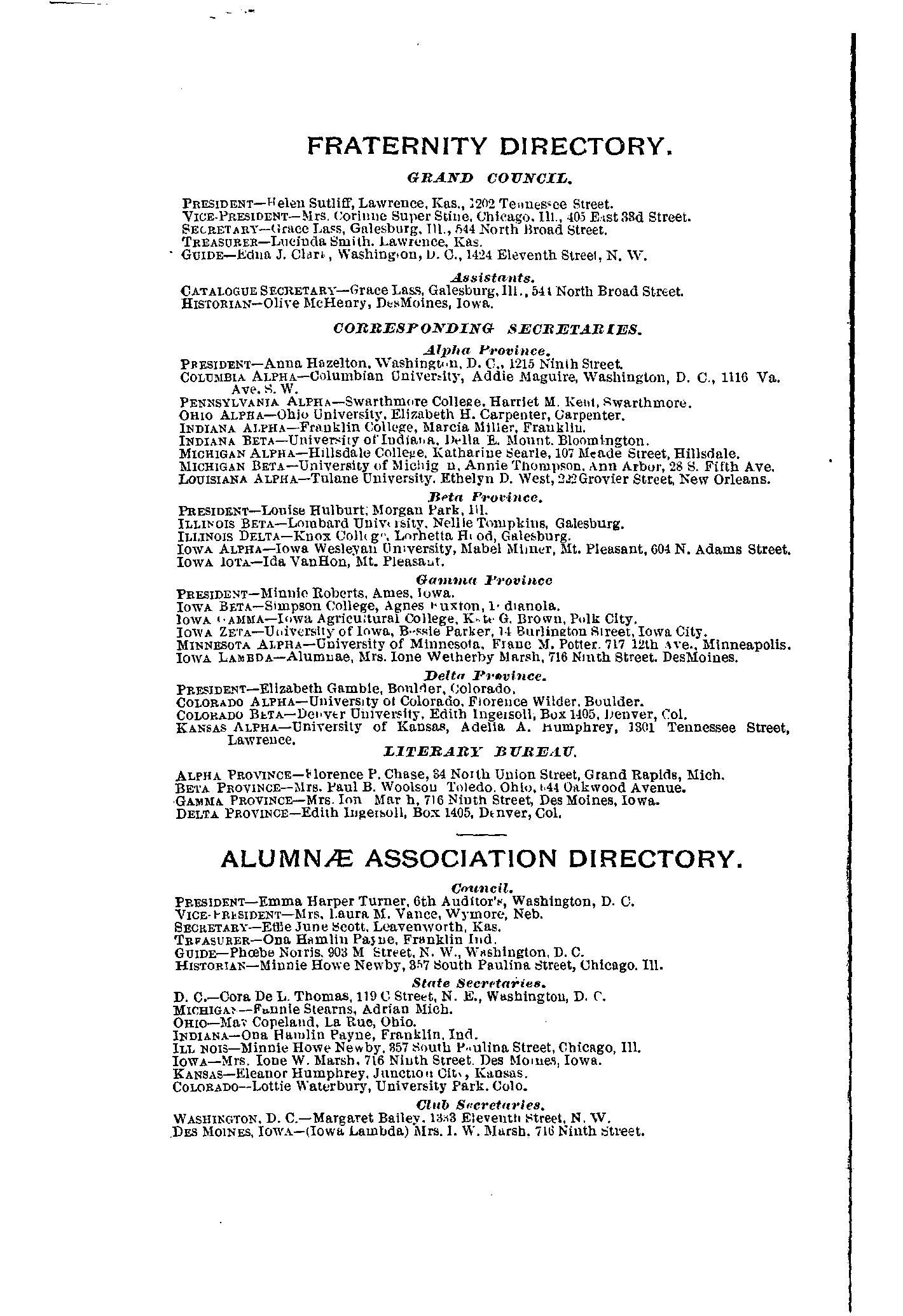
PRESIDENT-Helen Sutliff, Lawrence, Kas., }202 Street.
VICE.PRESIDENT-Mrs. Corillllc Super Stille. Chicago. Ill., 405 E..lst3Sd Street.
SECRETAnY-UraCc Las:s, Galesburg, 111., ,1')44 North Broad Street.
TREASURER-L'lciuda Smith. Lawrence, Kas. GUIDE-.b:dllo. J. OldTI" Washington, lJ. 0., 1424 Stree1, N. \V. Assista'uts.
CATALOGUE SEcnETARY-Grttce Las.-;;, Galesburg, III .• 541 North Broad StI'€et.
HISTORIAN-Olive McHenry, Iowa.
A11')lIa P,,·ovince.
PJlESID'ENT-Anna Hnzelton. \Vashingtt,n, D. C •• 1215 Ninth Street
COLUMBIA ALPHA-Columbian Addie .i\laguire, \Vashington, D. C., 1116 Va. Ave-.B.W.
PEN:NSYLVANJA ALPHA-Swarthmore Collef!e. Harriet M. Keht. OHIO ALPHA-Ohio Univer!'its. Elizabeth H. Carpenter, Carpenter. INDIANA ALPHA-FrtlUklin Col1l'g'e, Marcia Miller, Fraukliu. INDIANA EETA-Univer.-ity of Iudifl,l,R. J>dla R. Mount. Bloomington.
MICHIGAN ALPHA-Hillsdale College. Katbarine !:learIe, 107 Mende Street, Hillsdale. 'MICHIGAN BETA-Unh'ersity uf Michig n, Annie 'f110IDlIl'on. Ann Arbor, 28 B. Fifth Ave.
LoUISIANA ALPHA-Tulane University. Ethelyn D. West, :].r2Grovier Street, New Orleans. Rpta P'l·Qc·incc.
PRESIDENT-Louise Hulburt; Morgall Park, Ill. BETA-Lombard Univt liility. N{'Ule Tnmpki1l8, Galesburg.
ILI.INOIS DELTA-Knox Col\( g''. Lorhettn. Hl od, IOWA ALPHA-Iowa Wesleyan UnIversity, Mabel !lit. Pleasant, 604. N. Adams Street. IOWA I01'A-Ida VanHoll, Mt. Pleasaut. Guuuna Roberts. Ames. luwa.
IOWA BETA-SImpson College, Agnes uxtou, 1· dlfmole..
IOWA ('AJoIMA-ltlwa Agricu:tural College. K tt· G, BrO\vn, PHlk CIty. IOWA ZETA-U.oivt:rsl1y of Iowa, B Parker, H Burline:ton PoJreet, Iown. City. MINNESOTA AJ,PHA-Uuiversity of Minnesota. Frallc )1. Potter. 717 12th ·\ye.• Minneapolis. IOWA Mrs. lone Wetherby Marsh, 716 Nmth Street. DesMoiues. Delta Gamble, Bonl<1er, Colora.do.
COLORADO ALPHA-UniverSIty 01 Colorado. Florence Wilder. Buulder. COLORADO BUA-DCI,vtf UlllVel'sity. Editb Ingelsoll, Box 1405, Heuver, Col.
KANSAS ALPHA-Unl"ersity of Kansas, Adelia A. humphrey, ]301 Tennessee Street, Lawrence.
BUBE,lU,
ALPHA 'PROVINCE-Horence P. Chase, S4 North Union Street, Grand Rapids, Mich.
BETA PROVINCE-plrs.l'aul B. WoolsQU Toledo. Ohl(). t.4-t OltkwQod Avenue. ,GAMMA. PROVINCE-Mrs. Ion Mar h. 716 Ninth Street, Des Moines, Iowa. DELTA PROVINCE-Edith Iugelboll, Box 1405, Col.
CO'ttucil.
PRESIDENT-Emma Harper Turner. 6th Auditor'!', Washington, D. C. VICE' t-Rl<.SIDENT-Mrs. Lauffl.. M. Vance, Wymore, Neb.
8ECRETARY-Eille Leavenworth, 1(a8.
TRFASLTRER-Ona Hilmlill Pa}l.IC. Fr8nklin Iud. GUIDE-Phcebe Nonis. 90a M Etrt'et. N. 'V., WlIshington, D. C. HISTORIAN-Minnie Howe Newby, Sf!7 tlouth Paulina Street, Ohicago. IU. Stnte
D. C.-Cora De L. Thomas. 119 C Stred, N. E., Wl:I.sbingtoll, D. C. MICHIGA.-:--Ft1.Dllte Stearns. Adrian Mich. ORIO-'1Io:.' Copeland, La Rue, Ohio.
I:NDIA.NA.-Ona Hamlin Payne, Franklin. Ina. ILL 1I0l5-'Minnie Howe Newby. 357 ::-\outh P .• ulina Street, Chicago, Ill. IOWA-Mrs. lone W. Marsh. 716 Niuth Street. Des MOille.'!, Iowa.. KANSAs-Eleanor Humphrey. JnnCtlo!t Cit" KaDsas. COLORADO--Lottie Waterbury, University Park. Colo. Club Sflcretlu·lea. WASllINGTON. D. C.-MargaTet Bailey. EJeventtll-'treet, N. 'V . DES MOINES, IowA-(Iowa Lambda) Mrs. 1. W.l\lll.csb. ill; Ninth titl'eet.
VOL. X.
OCTOBER, 1893.
No. 1.
In a reccnt IlUtnber of the ARROW there appeared an able discussion of thc differences betwecn clubs and fraternities, wherein the fnnd:uncntnl prillciple for organization was found to be the sameself-culture ill the hroadest sense; the club develops its membel's intellectually, socially, spiritually, bringing into the routine of daily life influences fr0111 the busy world outside that lift. it above the commonplaces ,md trivialities that are the lot of but too many in this pt'actical age.
The fl':\tcrnit.y was seen to do all this anclmore. 'Vhile it supplcmclIts the intellectual college training by bringing into close relntionship women or kinch'ed aims nnd aspirations, it does this in man)' ways more effectually tLnn the club can do, becnuse tbe frntemity influences are begun and the interests held when the women are YOllngcl', free frolll outside duties, and more open to inspiration and amenable to influence than those of riper years and wider eXpel'lCllce.
The fraternit.y aims to gather up the scattered threads of college lifc and II'caye them into a compact whole. With its purpose of working for some common end, it believes that in eo-operation lics its strengt.h and thnt the power that the individual has alone, will bc increascd ton fold by a union of this power with others. No studellt CUll exist for herself alune; directly 01' indirectly she must influcnce those about her and her little world will be the richer or tho poorcr for her ]>ro;;ence.
A fratcmity girl feels ::t deep responsibility resting upon her, in that llot oul), her oll'n reputation, but thnt of her chapter, and,
ARROW.
fnrthm', that of her organization rests in a measure upon her. Her successes in the class room stimulate her sisters to greater efforts; her honors are shal'ed hy them and her failUl'es reflect upon them.
An organization must be known hy its members; but the intellectual side is not the only one that a fraternity holds deal'. A well rounded womau must know how to adapt herself to all circumstances; must excel in the drawing room and bnsiness world as well as in the leetnre hall, if she would command that influence that is her due.
All these phases the fraternity offers most abundantly; the old adage of "all work and no play makes Jack a dull buy," was never so true as iiI the busy college life, when the swiftly flying days seem all too short in which to acoomplish what the mind desires. That student will be all the better mathematician, linguist, 01' scientist who, for some little time each week, each day, lays aside her books and in the companionship of congenial friends, forgets for the time being, the vexing problems, troublesome roots and inflections, long fOl'lnulre and experiments. The subject of mental waste and economy is a much m(>oted oue to-day.
Nowhere in all her busy life can this true student find greater relaxation and at the same time greater stimulus to renewed effort than in the fratel'llity hall, where Greek meets Greek, for though she may be friendly with many, she can be a friend of but a few and those few will be the most congenial With these points in view, how shall the chapter life be lived and so indirectly the life of the greater organization of which it is a part, be broadened and increased?
First of all let the fraternity meetings be alive; let them be promptly called and when the business of the hour is done, as promptly adjourned. Promptness in business matters is a 8ine qua non of the masculine world and just as surely of the feminine; ouly in this way will the details of the fraternity be kept alive, and on a successful business management depends largely the success of auy undertaking, be it literary, philanthropic, or financial.
If ill carrying out the intellectual phase of fraternity life, programs. are _them be can'ied out briskly, vigorously,
brilliantly. A slIccessful womun, be she teacher, society woman, in the h.-(,nd sense of culture, not frivolity, professional woman, or wife, will be she who has u wider knowledge than is necessary for the actuul performunce of her duties, for in this way will she keep her sensibilities alert, her mind active und her soul above routine. Thcrefore in the fraternity meetings, let the progmms, if there be uny, be planued on subjects outside the college curriculum, the execution of some hobby, if you will, unything to keep ulive the spirit of inquiry und investigation.
Further on the purely sociul side, let the pleusnre be pleasure while it lasts; let riyal Greeks meet in perfect harmony, und for the time heilig, the ri,'uh'!, will be laid aside with the knowledge that though their methods may he different, the central purpose is the same, and they are not this fruteruity or that, but the whole Greek wodd.
So much for the college chapter. Each year an active member goes uwuy; the college comse is over, the degree won, and she goes forth like longing for more worlds to conquer. 'Vill she forget her fraternity life? In a year or so the badge may be laid aside, the girlish enthusiaslll llIay be lost, but is tbat the end? ,Vhere is the interest for the fraternity as a whole? She is known as an Alumna and her chapter is proud of her, her successes and her t.riumphs. Just here lies another practical uim of the college chapt.er, -keep the Alumnoo in touch with the chapter life-by COl'respondence, hy requests for contributions to the fraternity organ, by reunions, by personal acquaintance with the everchanging memby a thousand little wuys that friendship and intel'est in a COllllllon organization can suggest.
'Vhat. ·though fraternities are decried by III any , though the argument of cliques und hostility to rival Greeks be urged, if the fraternity but carry out its lJ1l1'1Jose, but keep its standard high a11el ever aim higher and higher, critics will be silenced, arguments will be founel useless to oppose, and like all true and noble causes, the fmternity will prove its own excuse for being..
Mary Clark lo[ich. BetcL
To those who IHwe never shured a college girl's home, it lUay seem almost ubsurd to thiuk of suying anything pleasant al)out her home life, und especially about tile home life of the girl at the University of Michigan, which is thought t.o be essentially lacking in all the refining elements of the home. It. is true th'lt her home life is far different from the one she has left; but it is also true, that the new home develops qualities in her nature which the family life failed to bring out.
Nearly e\'ery girl at the University has a room-mate, or chulll, as she is frequently called, and upon the congeniality of the 1.1'"0 girls rests in n great. degree the happiness of their home life. Though room-mutes are usually dear friends who have long plnnned a college course together, it is not uncommon for two girls who are total strangers to room together, and as a l'esult life-long friendships are often formed. Sometimes there is apparently nothiug iu common between room-mates as fnr us tastes and temperanlent are concerned, and yet the girls live harmoniously, for there is so much in their lives to make them dependent on each ot.her. The girl who rooms alone is to be pitied, for unless she is exceptionally situated, her life is lonely, nnd haviug no one to call out her sympathies, she is apt to grow a little selfish.
The girl II"ho goes out room-hunting has u large number of pleasunt rooms from which to select, as nearly everyone in Ann AI'bor rents rooms to students, the houses being built with suites t.o accommodate students.
Girls rooming together can get a very pleasant suite of rooms cousisting of sitting-room, bed-room and closet, heated, for from three dollars and fifty ceuts to four dollars a week. Board is usually obtained at houses convenieutly nenr, this plan giving satisfaction on accouut 'of the regular exercise thereby afforded. In some homes the girls are given the use of the family parlors for entertaiuiug, though this is seldom, there being little familiarity
hct.ween the people of the hou.,c aud their roomers. Because of this, the giJ"ls look upon theil· two rooms as home, and try ill every way to make them eomfortablc and invitinl(. The wise girl in prepm·ing for college gives as much thought to the furnishing of her rooms as to her own wardrohe, and packs her trunks lind hoxes, not ouly with gowns Gnd hooks hut pretty little omaments for her room us well.
That wo may gain an idea of a student's rooms, let us visit one of them. It is study e,-ening and the girls arc at work, so we will Hot disturb them, hut jnst look nt"ound to see what the college girl's home is really like. The prevailing idea seems to he that of comfort. Pninful neatness which makes one ill at ease is totally lacking. There (\re three or four ensy chairs, n couch, and a goodly number of cushions thrown nbont on couch and floor. An etching, one or two paintings in wnter color or oil, nnd perhaps n portmit study, fUl"llish the conventional wall decomtions, prominent place being given to photographs, kodak pictmes, ennes, invitations, progmms, souvenirs of nil kinds, and the dninty little ornaments which only a girl knows how to make.
The librnry is composed of standard works in litemture, text books and note hooks. Dainty volumes nre scattered nbout on the inbles. A guitar is lenning agnillst the hook case and one spies a mandolin under the couch. A little ten table set with china cups and saucers gives the room a cosy nnd homelike look. The room is a happy combination of pnrlor, libmry nnd sitting-room.
The girls often care for their own rooms, but instead of this being n tnsk, it nfl'ords a pleasant diversion from study. They are usually systematic in their work and combine harmoniously the student and housewifely duties, hut ,,"hen there is to be n written quiz in Psychology nnd the home duties nre in consequence slighted, they are Inter on painfully reminded of their neglect when the young man, who is makiug his first cnll, smilingly bids them goodnight in the fast fnding light of the Inmp, which they forgot to fill.
College work occupies the girls' time during five days of the week nnd at lenst four evenings. Some of the girls study in their
THE ARROW.
ownl"Ooms, while others prefer the large pleasant reading-room in the library. Few girls cOlilmence work immediately aitel' tea; there are the home letters to read, the newspaper to look over, the day's experi. ences to recount or perhaps a few songs to be sung in the twilight. In the autumn and spring days the girls have a way of doing solid work in a short time, for the beautiful walks and drives in and about Ann Arbor eutice the lllOst book-loving girl from her work. Tennis is a favol'ite game with the girls and one which is steadily increasing in popularity.
On Friday evening work is not even to he thought of. Calls, spl'eads, parties, concerts and lectures are all in order, each girl spending the evening as her tastes incline. Roolll-mates entertain their callers together and help each other in many little ways, thus making the receiving of callers a pleasant pastime. They are fond of serving tea or cocoa out of their tin)' little cups or providing other light refreshments. The arrival of a box from home is the signal for a spread and everything else is laid aside to do justice to its contents. A colloge spread is one of the most unconventional and delightful feasts in the world. All that is needed is a jolly crowd, something good to eat, plenty of it, and-nothing to eat it off from. One spoon, two knives and a plate have been found to be almost a. superfluity of dishes for ten people. Chairs are abandoned on account 'of their limited number, and cushions placed on the floor are used instead. When there is no more meat left on the turkey and the last olive has been speared out of the l;lOttle with a hat pin, the mandolin and guitar are brought out and the evening ends with a round of college songs.
Every week brings some rare treat in the music or line. It is an education in itself to be able to hear the foremost talent in our country which yearly comes to Ann Arbor.
Nearly every fraternity gives at least one house party during the year, which, with the Junior hop, Senior reception, Sophomore hop and Freshman spread, for the society lover a succession of parties which are often more elegant than those given in large cities. Soon after the opening of college the Sophomore girls give
the Freshman spread in honor of the new girls. ThB junior and senior girls escort the freshman girls to the hall and the evening is devoted to dancing and getting acquainted.
The fmtemity girls who live in their .chapter houses enjoy the privileges of a home, more than the girls do who rent suites. They have a better opportunity for entertaining and know intimately a larger number of girls. The friendships formed during college dre the truest and best in a girl's life, and the fraternity girl more than any other, has these friendships placed within' her grasp.
A spirit of freedom and independeltce pervades the entire life of the girl at the University of Michigan. She selects her home; arranges her hours of study and recreation, und chooses her friends as these things seem best to fill her wants. Many people feel that she has too much freedom, and that the independence which her surroundings require of her, has a tendency to detract somewhat from her womanly instincts. But the girls at the University ought to be, and most of them are. girls only in name,-they are women, who have learned in their own homes the principles governing action, and who are now capable of applying those principles. It is true that she must be strong and capable of choosing wisely, in othe1' words, she must be independent, but it is untrue that this makes her any the less womanly. It only adds to her true womanliness for she not only realizes her own capabilities, but becomes capable of streugthening her weaker sisters.
Life at the U ni versity of Michigan does indeed present serious problems-problems much like those met in active life, and because of these it is unwise to send a very young girl there, unless she has definite ideas of what she wants, and even then a girl's school would be a better choice for a year at least. Then let her come and drink deep at this fountain of learning.
It is just here that the fraternity, so helpful to all college girls, is especially so to the girls at the University of Michigan. Itafl'ords to the girls the refining influences of a horne life, thus combining what is best in a woman's college with unexcelled educational advantages. The girl who goes out from the University of Michigan goes
THE ARROW.
well equipped for the bat.tle of life; if she be It fraternit.y girl, she has, ill addit.ion t.o her fine educution, the friendship of her strong and helpful sisters and the ideals of her fraternity, urging her on to· a perfect womanhood. Lois B. Rowe, illicit. Betet.
WELLESLEY COLI.EGE.
Turn, ye students of co-educational institutions, with your col_ lege buildings on a small campus, your rooms in boarding houses or fraternity halls, YOtu· life u part of the busy life of a city, turn for u moment to the broad acres, the cottages, and the small yillage of 'Wellesley, Massachusetts, where lives one of the greatest colleges' for girls in this broad land.
Somewhat west of Boston, in a park of ubont four hundred alld fifty acres, which forms the college grounds, one might travel far before finding u spot to ri val in beauty the surroundings of '\Vellesley. Hill and vulley, lake and fountuin, woodland and ple!1SU r e ground, these and more form the features of '''" ellesley Parle Over_ looking-Luke '\"" aban stunds the ". College Beautiful," in a region famous in Ip.gendary lore, for near by was captured Chief '\V itb an and tukeu into Eliot's band of .. converted Indians; here is the local_ ity famed in 1111'3. Stowe's "Old Town Folks," und not far itWay are Concord of Revolutionury fame, and Cambridge, home of the· poets.
Entering College Hall one stands in u wide corridor open in the center to the roof, in which tropical plauts ever flourish and where balconies rising tier above tier to the lighted roof, give a " South European effect, recalling Spanish days to those who have seen the Alhambra." Scuttered over the grounds are violets iJJ wild· profusion, the reel, reel Columbine, honey-suckle, the famed New Englanc1rhododenc1ron, and all the varieties of flowers known t.o the woodland. Across Lake Waban are the beautifnl Italian gardens, ever green and fresh, where orchids grow und abundance. re . tropical plants l' In
To the question what do the students do, the the sume in part as we would give for any college.
unswer I1lll ,t be The day begins
ARROW, 9
with chapel at. half past. eight; from then till five the student attends lectures, works in the lahom(ory, reads in the well filled libl'''!')', studici' in her own room, 01' in the sunny days of fall and spring, unrler the spreading trees, 01' cons her French verbs by the enehanted Tupelo point. If she believes in the maxim "'IW1l8 sana in C01'j,O)'e sa.no," she takes an hour for brisk walking, rowing, tennis, skating, coasting, 01' gymnasiulIl, as season and weat.her permit, "'hat student of '" ellesley can forget the walks on the" south porch," the run before breakfast to the secluded dell where the wild flowers groll', the dance in the gYlIlnasium after the late diuner, the clectioneering for class officer;; whon party spirit mn high, and it was days before the president was ehosen?
The details from day to day are ever the same, wearisome it 1IlIl,'- he, but what daily duties taken in themselves are not weariSOllle aud monotonous? It is the spirit that animates them all, and the fact (,hat their lives are broadening and deepening as the weeks go by, that lends (:he charm, Then too the student, if she is a true nno, will h,we lnuny friends, will belong to one of the muny societies, where she will have a chance
" To hold debate on mind and art, Ancllabor and the changing mart, And all the frame work of the land,"
On Monday, the college holiday, she will go to Boston, Newt.on, Auburnclale 01' Cambridge, and after a day spent in sightseeing, 01' Ineeting 01<1 acquaintance,3, will I'eturn wear)' in body, but refreshed in mind to elljoy the COllcert 01' lecture and hosts of visitors that eaeh Monda," night calls forth,
For the favored Freshman there is the ever ready Junior to tide hOI' over rough places and give her a reception on Hallowe'en; the Sophomore, too, befriends her lonely state and welcomes her right gla(lly with a reception in her honor, For Seniors, Juniors and invited guests, there are the Junior promenade and Senior reception when no uuderclassman cau be seen and wheu halls and grounds arc hright with flowers, lights, gaily dressed maidens and handsome
THE ARIlOW.
youths. There is Float Day when the crews, long trained for the occasion, appear for the first time together to row out into the lake, rally at some central point and float gently hack, while merry songs make glad the air around. Then is the Senior boat surrendered to the Sophomores of the corning year and as the shadows fall, the crews depart, the guests are gone and one of the prettiest of the gala days is done.
On Tree Day the freshmen carry out their long established custom of adding yet another sapling to the many graceful trees that beautify the grounds, when each class wears a garb symbolic of her color, flower aud motto, when Senior farewells are spoken to the Alma Mater they so loug have loved, and Freshmen make ready to enter upon the Sophomoric dignity that so well becomes their second year of college life. This is the last of the fete days before commencement. Space forbids more than a passing mention of the many friendships that are formed, the unappoilltecl meetings in some favorite rooms, the feasts at night, the gatherings in Senior parlor, the expeditions to new and old retreats, the callers and the concerts in the city that make the life of a Wellesley girl's four years.
In the midst of it all there is much hard work, much pleasure, some mishaps, but by it all the "noble womau nobly planned" stands at last at her Commencement Day, stronger, tnler, broader, for her foUl' years at Wellesley, for the experience she has gained, the battles she has won, the friendships she has made, and she is ready to take her part, as others have done before, in increasing the glory and adding to the fame of her loved Alma Mater.
Would you like an essay? Then draw up hefore the open grate and see what Hamilton Wright Mabie says on "My Study Fire" or, if the coals burn too briskly, pick up his" Under the Trees and Elsewhere," or 'Walter Pater's
01' Story's "Conversations in a Studio," or Mrs. Bates' "Old Salem," with its quaint .shops, dame-school, and bewitching china closets.
In "The Blue Grass Region of Kentucky' , James Lane Allen shows you Uncle Tom at home and takes YOII to the old Kentucky fail' "uel through the Cumberland gap 011 horseback. . Then there is Lafcadio Heam's "Two Years iu the French 'Vest Indies," Schliemann'8 "Excavations: an Archreological and Historical Study," and Gibsou's "Sharp Eyes: a Rambler's Caleudar of Fifty-Two 'Yeeks among Insects, Birds, and Flowers." Fiske's " Critical Period of American History," aud Parkman's "France and England in Amel'ica," are as interesting as any novel.
There is 'Yalter Patel' again with his "Plato and Platonism," no1' should Mellie Muriel Dowie's "A Girl in the Karpathians " be forgotten. Brandes'" Eminent Authors of the Nineteenth Centmy" gives a short sketch of the lives and works of a few of the old world's writers who receive so warm a welcome from their American readers.
Eliza Chester's" Unmarried Woman" is a book any woman 1V0uid enjoy, be she married or single, and it is well for every girl to }'ead Annie Payson Call's "Power through Repose."
Has one of the girls flown from out the chapter nest across to the old world? and would you like to accompany her on one of her morning strolls down Loudon's Piccadilly Or old Berlin's Unter den Linden? If so, there is "The Great Streets of the World," but before you visit any of the art galleries you may pass on your way be sure to read Van Dyke's" How to Judge of a Picture. "
Who does not enjoy love letters eveu if they be "The Love Letters of a Portuguese N uu," Marianna Alcaforado, written in 16G8? Next to the love letters come the novels, and here it is hard to choose. Barrie with his "Little Minister," "AuldLichtIdylls" and "Auld Licht Manse," Crawford's "'Yitch of Prague" and " Mnrzio's Crucifix," the stories of Amelia Barr, Imogen Clark's
THE ARROW.
pathetic little tale, "The Las' Day," and "'A Cathedral Comtship" by Kate Douglas 'Wiggin are only It fel\" from the legion. '£olstoi's ",\\The1'e Love is there God is;" and Drulllmond's "Pax Vobiscllm" are a hahn for melancholy dars while James "Thitcomb Riley, who with hands in pockets, paces through his home whistling out his "Afterwhiles," drives "the blues" away. Space will not permit of the ment.ion of more. These are only tI few stray crumbs scattered from the host of hooks published within the last three or four years, hut. it is hoped a palatable morsel may be found for each and all.
Florence Putn(t)1l Chose.
Given, limited means,-perhaps self·earned at great slwrifice-is it advisable for a young woman to take two yem's at some prominent institution, or a full four year's course at a small unknown college, though good.
These are busy times with me, just at the opening of oUl' school, hut I can not from saying a word on the suhject you ,;ffer. It is this, however hard earned the means, and at Mrs. Haddock. whatever sacrifice, if" a young woman is am bi tious fOl; real knowledge rather than that which is merely aS81lmed, by the holding of a diploma, then go for the two years to some prominent college or university, where the equipment is good. Suppose for instance that the young woman has a taste for the Natural Sciences, what can she learn where there are no laboratories, liO 11luselUU, no herbarium, no geological collect.ions, etc.? If her taste is in the direction of the liberal arts, the laboratory or work shop in that department is the library, hence the necessity of access to a large library, which no small unknown college possesses, however good their corps of teachers. Mr idea is simply this; a hright intelligent young woman will do more in two
years in a school where there is plenty of illustrative working appuratus than she will in foul' years where such material is wanting, and text books alone the limit of work.
The young woman who has been under the necessity of earning the money which is to support her during her college course will, it
Effie J. Scott. may be assumed, be under the same necessity or self-support after her departure from college. Her choice of institutions would then, I take it, be largely influenced by her choice of professions.
The teacher's profession is the only one in which a degree, in and of itself, has weight. A college position she could hardly hope to obtain without further study after either of the supposed courses. In public school work,-putting aside for the sake of argument the question of personality, I am inclined to thiuk that the young womau with foul' years at a small but good college would stand a hettor chance for a good position than one with two years at a noted institution.
For literary 01' newspaper work of any kind, 01' for any general culture end, the bright girl might perhaps absorb more during two years in the more inspiring atmosphere of a great university, than in fuur years at a narrow institution.
For the professions which require special preparation, she 1V0uid of COUl'se do well to seek a technical school; getting at the same time all the general culture which she can possibly afford.
The answer varies so, according to individual needs and capaLiilities, that it is impossible to give any general reply .
The younger the woman the more necessary the longer time of preparation and gathering of culture in quiet undisturbed study. Susanne F. But if already so far advanced as to be ready for a Tynda'e. specictlty then two years at a prominent college is more advantageous. There is always a certain amount of eclat and
THE ARROW,
prestige gained in having one's name associated with a large institution, There are also opportunities for knowing men and women who have made their mark in the world,
On the ,,-hole, I should say, if a young woman must earn her means for an education it were advisable to press as much as possible into a short time and get at the main work of her life.
In most of the women's colleges of our land is not the mind educated at the expense of the body? I believe thoroughly in The Greatest higher education for 1V0men, and believe that it is Need of possible to bring about such an education so that the Collego Girl.. whole woman will be strengthened and uplifted, but have we hit upon just the right method yet? As my own experience goes, the college woman is in a state of continual hurry and nervous tension. And who can wonder IV hen one knows all the things she does? If she is ambitious, and most college girls are, she wishes to do some thorough work in at least one subject, and must also become sufficiently familiar with enough other subjects to keep her from beiug narrow. Every girl must. now know °the elements, at least, of political economy, political philosophy, and ethics. She will have from fourteen to eighteen hours per week of recitations and it will take from ten to twelve hours of each day to attend and prepare these.
Besides this regular college work social duties make demands on every college girl, even if she is not a society lover. She must attend certain college events, to say nothing of calling upon her friends, and enjoying various gayeties dear to all college girls. Then almost every week a concert or lecture calls the student from her books one evening, and another evening is taken by the meeting of some society or other to which nearly every college student belongs. If the girl be at all religious she is sure to do f1owermission work, or prayer-meeting work, or have a Sunday-school
Now let us see wbat we have-eleven hours of work per day means from 8 A. M. to 10 P. M., allowing an hour for dinner and
of the things which no American can accept as an impl·ovement over our own methods. Tl;te canvassing in the country from cottage to cottage he can understand; that seems possible enough. It takes the form of a polite visit to tenants, and the real object is cloaked with a few vague inquiries about the health of the children or the condition of the crops, and the tractlike distribution of campaign documents. But in town it is different The invasion of bachelor apartments by young Primrose Dames is embarrassing and unwise, and is the sort of thing we would not allow our sisters to do.
"The English, as a rule, think we allow our women to do pretty much as they please, and it is true that they do in many things enjoy more freedom than their British cousins, but the men in this country are not so anxious to get into office, greedy as they al·e after it, as to allow their wives, in order to obtain that end, to be even subject to annoyance, certainly not to be stoned and hustled off their feet or splattered with the mud of the mile-end road. I have seen women of the best class struck by stones and eggs and dead fish, and the game did not seem to me to be worth the candle. A seat in the House would hardly repay a candidate for the IOS8 of one of. his wife's eyes, or all of his sister's front teeth, and thongh that is putting it brutally, it is putting it fairly. It is only right to remember that from the days of the Duchess of Devonshire's sentimental canvass to the present, English women have taken a part in general elections; that there is a precedent for it, and when you have said that of anything English you have justified it for all time to come. The young American girl who would not think it proper to address men from a platform and give them a chance to throw things at her must remember that the English girl would not give the man she knew a cup of tea in the afternoon unless her mother wm·e in the room to take care of her."
A scathing article appears in the Canadian Magazine on the "Displacement of Young Men." The author claims that most young women who are earning their own living do so not of neces-. sity, hut that they may enjoy luxuries and keep up an appearance
TRE ARROW.
of wealth. He says: "No girl should work who does not need to. If this rule were observed it would create an opening-for at least two hundred young men in this cit.yof Ottawa alone; for there are at least that number ill the capital who have no other excuse for work. ing than comes from considerations of pride, cupidity and selfishness. I know something of the circumstances of at least fifty girls who earn their living, and it is the simple truth to say that thirty of them should be at home. Young women must realize these two things in chief: First, that in working, if they do not need to, they take the places properly belonging to young men; and secondly, that modern notions 9.bout the independence of women coupled with extravagant ways of living, are partly responsible for the conditions which al'e bringing about a steadily declining marriage rate on the part of young men."
lIIiss Lucia Jones, of Jamestown, N. Y., is a successful ticket. broker. She has a comfortable office near the Erie station, aud here she condncts her business as easily and in as womauly a way as if it were a fancy work shop.-lVoman's Journal.
Ahout two years ago Mlle. Felicie Mendelssohn, a Jewish lady, who holds the diploma of the Medical Faculty of Paris, established herself at Cairo. Recently she was called to attend the mother of tbe Khedive, and so excellent was her treatment that she has been appointed doctor to the palace.
Smith College opened September 15 with a class of 270, being 50 more than the class of last year. The whole number ot students is 800. The examinations were unnsually severe and many failed to pass.
Dr. Warner, owner of the great corset factory of Bridgeport, Conn .• has provided for the feeding of his 1,000 women employes, or as many of them as are destitute of homes aBd the means of sup. port, during the runuing of his factory on half time. The meals are given at the Seaside Institute which is the home of hundreds of
girls who nre furnished with board at the cost of the lHateriul.JVo III (tlI ' 8 JOH'i'lIa1.
Eight of the one hundred and ten womeu lawyers in the United States haw, by practicing three years at the bUl' withou t a flaw iu their career, earned the right to prnctice before the SUJlreme COUl't.
- H'''''l'er' 8 B«Z«"'I·.
A graduate and teacher in a wOlllan's college who has lately left the profc2sor's chair for the smaller but equally b.usy sphere of home life, has endeavored to assist in solving the vexed question of domestic sen ice by carrying ou a little experiment in her own household.
The plan is that of bringing together into closer harmony mistress and sen'ants, of establishing common interest and of holding uJl an ideal of mutual helpfulness. The basis of the system is household co-operation and the sharing of responsibilities. At the heginning of each month a certain sum of mouey is set aside for the table and kitchen expenses exclusive of fnel, l'ent and wages. The amount of the sum is confided to the cook, an intelligent Irish girl. Once a week the mistress and the cook sit down together and plan the menu for the week as accurately as possible. After that the cook tukes full chal'ge of the marketing, as well as the preparing of the food for the table.
At the end of the month the mistress pays all the bills, and if any balance remains she divides it equally between the cook and herself. The more the cook is able to ecouomize in making her purchases the larger will be her reward t'lt the end of the month.
The success of the plan is almost a surprise to its originator, who has watched with pleasure the mental growth of the cook uuder the responsibility of her position.-Detroit Free p.ress.
Twenty-three countries and sixteen languages are represented in the seven thousand volumes comprised in the 'Vomen's Library at Chicago. This will form a nucleus for the collection of the liter-
ary work of women ill the future, as it will be placed in the permauent Women's Memorial Building to be erected in Chicago. Along with the library catalogue soon to be issued will be published a complete bibliography of women's writings up to the present time. -Harper'8 Bazaar.
Mrs. Tyack, an English lady who has explored what were hitherto deemed inaccessible parts of the Himalayas, is an ardent sportswoman and has accumulated a great number of bear, leopard and tiger skins as trophies of her skill
•
Forty thousand dollars is said to be the sum for which Maclame Patti has consented to give forty concerts in another "farewell tour" through the United States this fall and winter.-Harper's Bazaar.
Rev. Carolyn Maude Anderson, who graduated from St. Lawrence University at Canton, N. Y., laJlt June, is settled as pastor of the Universalist Church at Marshfield, Vt.-Wom,an's Journal.
Miss Bertha Lamme, of Springfield, Ohio, recently received a degree of electrical engineer at Ohio State University. She already has a position in the Westinghouse Electric Company at Pittsburg. Edison says women are especially fitted for electrical work on account of their delicacy of touch.
Mary Dickinson in Harper'8 Bazaar asks the following search. ing questions of our present method of education:
" How many young girls find in their school course that which teaches them how to use fully the faculties of their own minds? How many are taught by the school training any habit of persistent application? How many go out from school with any orderly ideas , as to the application of their mental forces to anything they may meet outside the school-room? How many young girls of twenty understand how·to conduct a little parlor meeting, or how gracefully to preside over a little company of friends, or how to carryon an intelligent conversation upon the common topics of the day?"
Miss Lena Aronson, of Hot Springs, Ark., a highly educated and prominent teacher and a young and beautiful girl as well, has entered a Hebrew convent in Cincinnati and is preparing herself to become a rabbi.
The University of Michigan will publish a funny paper this year modelled after L'je.
In the recent assignment of general fellowships by the Chicago University, young women got so disproportionate a share of the spoils as to scandalize the authorities. Ten women passed the Cambridge Mathematical Tripos this year, and two of them came out wranglers. Three women took honors at Oxford, at which university also honor examinations were this year opened to women in three new courses. At London University, Miss Ogilvie, a prodigy of erudition from Aberdeen, passed with the highest credit the examination for the degree of Doctor of Science.-Harper'8 Weekly.
A more enthusiastic advocate of cycling cannot be found than Mrs. Mary Sargent Hopkins, of Wilmington, Mass. She is now doing what may be termed missionary work among women in the New England states, and is lecturing to them on the advantages of cycling.
The Queen of Greece is deeply interested in the reformation of criminals, personally visiting prisoners, as well as acting as president of a sisterhood devoted to reclaiming this particular class of sinners. -Harper's Bazaar.
" Do you know that the old fraternity grows higher and nobler to me every year? My' fraternity experience grows richer and richer to me though it be dead to all outward show. How the touch of time has softened even the irregularities of those days into a quiet beautyI" *
* Scroll. I!.. e.
THE ARROW.
"Experimental legislation is constantly endea yoring to hridge the gap and bring the Alumni meml)ership int,o closer ullion with the fraternity. It is right at this ·point that the door is open for the fraternities to achieve their greatest and best, resnlts. In other w01'(ls let the cbief end of fraternity membership he fonnd in the associations of the gl'ilduate and let the llndergl'ilduate years be, in a sellse, preparatory §
proposing, to keep a scattered fl'ilternity constituency in touch with each other and with the organization; proposing to maintain the relationships of acti\'e college life-may well be added to the list of " legislations" referred to above, but Pi Beta Phi makes the experi, ment prompted by a conviction that the college fraternity idea will admit of greater development than that witnessed so far; that it is full of pl'ilctical possibilities for alumnm life and that the membership of an nndergrltdllate is but the first principle of fl'ilternity life on a college basis.
'What then do we hope from the Alulllnm Association?
---'To retain an intimate knowledge of and association with onr college friends. How much of life would have been lost with ont them? How much will be gained if it be possible to enjoy their inspiration through all the years?
---'To promote fraternity among women. NOlie lIeed it more. As women, we are openly charged with a lack of sympathy, interest, or kindliness for women-everything that goes to make lip unselfishness. To quote a recent editorial by Edward Bok: There is altogether too little loyalty among women. If there existed more the sex would be stronger for it. Men stand and fall by each other; women are intoleral.!t of the very weaknesses in others which they possess themselves. All the higher edllcation that will ever be acquired by woman will not do her one-tenth as much good as the fuller development of patience and charity for each other's faults. The kind of education which women want to-day is not so much the higher education as some good, strong doses of lower education. Before we endeavor to strengthen a mind
§ The
let us first see that the heart is right. Let a woman make a misstep nowadays, and the least mercy shown her cOllles from her own sex. Let sorrow come to her, and ofttimes the sinceritr of her grief is questioned hy other womeu. Let great jor eome to some woman, and envy, instead of pleasure, takes possession of the natures of frequelltly her best friends. This is not true of all women, you say. No, thank God; it is not, but it is true of all too many. It should be true of fewer.
'Yhere first and best may we begin the good work, if not among women who (we able to work together harmoniously? It will not end there, for no bouuds can limit such a work and none will be desired where the workers are college womell.
---To direct and influence the college membership. Alumnoo are indebted to the undergrad uates in a peculiar manner; not in the sense of a return for benefits reeei,"ed, but for all they, as Alumnoo, are able to do for younger mem beril. Alumnoo opinions are respected, their words hung upon, their sympathy full of deepest meaning, their advice a guide for action. And why? BeeauseAlumnoo and undergraduate wear the same badge, are bound by the same pledges, use the same grip, work for the same organization and are zealous to maintain the same standards of fratemity honor. Where is a more promising field for Allllnnoo effort? Every college fratemity woman is to he a woman of influence, and with the allegiance of such women won to any cause what results might not be expected from it?
'Yillnot the intJ'oduction of this new force into fratemity life radically change the whole organization?
It may be, and yet if creating a plan for Alumnoo effort is an idea carrying any suggestion of disastrous results to the organization s"urely a radical change is necessary or many Alumna! must acknowledge much time and effort spent in fraternity work as practically wasted.
The prosperity of this new association will depend upon the personal responsibility assumed by each Alumna. Ultimate suc"cess is never doubted by those who have felt the fraternity pulse" for the four years past, nor by those who had part in the meeting of
THE ARROW.
July 18th. What a Mecca in memory will ever be that beautiful little club room of the Isabella; there we began to know something of the influence of fraternity life,-of the mauy eager, earnest, cultured women among our Alumnre whom we were privileged to know' in Pi Beta Phi.
Miss Nannie Reese Pugh, of Kansas Alpha, has been given the European fellowship of the Association of Collegiate Alumnre, and will pursue her studies in Paris another year.
Miss Esther Friedlander, 1\1. A., of Minnesota Alpha, has been' given a fellowship at Bryn Mawr College.
Miss Frances Stearns, of Michigan Beta, teaches Botany and ZoOlogy at Ad,·ian College.
Married-Sept. 20, Carrie E. Rutledge to Lincoln E. Park .. At home after Nov. 1 at Waterloo, Iowa. Mrs. Park is remembered'. as the poetess of the Galesburgh Convention of 1890.
The Alumnre Association work has not progressed sufficiently yet. to enable us to put the Alumnre Department in its permanent form, so we have but hinted at the work and possibilities of the organization Mary Clark Bancker, of Michigan Beta, will hereafter have charge of the department. Attention is called to the Alumnre Directory., The State Secretaries are being appointed as rapidly as practicable and the national organization put on a working basis.
Explanations, instructions, Constitutions and all printed matter' will be supplied at an early date.
Alumnre are urged to report to their respective Secretaries and thus facilitate the state organization.
A constitution of the general fraternity and the ARROW are' indispensable to successful Alumnre work. For the former apply to, the Grand Treasurer, Lucinda Smith, Lawrence, Kas., and for the, latter to the ARROW editor, Mary B. Thompson, 197 South Union, Street, Grand}:tapids,
Here we are back at college again. In spite of the delightful vacations which we all enjoyed we were glad to }'eturn to the pleasures and duties of our college life. We have started in with the definite purpose of making the most of our opportunities this year and especially of puttinl; fOl-th our best efforts for the cause of our beloved Pi Phi. Several attractive bright girls have entered the University and we anticipate many pleasant friendships and perhaps the closer relations of fraternity.
Two of our number have left us. Miss Edna A. Clark, who graduated in June, and Miss Margaret H. Brewer, who was compelled to leave college on account of illness, though on the point of graduation. Yet we shall 1I0t lose sight of them, for they will remain in the cit)' and be connected with the Alumnre Chapter to which we hold a close relation.
Miss Clark has been honored by her appointment as teacher in the Business High School of Washington.
Our delegate comes home with glowing accounts of the glorious convention at Chicago, and especially of the delightful girls she met while there.
Weare now looking forward to the time when we shall have you with us in Washington in '96.
Since last our Chapter met three months have passed. Where have they gone? In a few days we shall be together again, all but one, Dora A. Gilbert, who is now an Alumna.
. Never have we looked forward with brighter hopes for a successful year than now. Everything seems to be in our favor, and we should grasp and appreciate the glorious opportunities which lie open to us as a Chapter and also individually.
For many of us the summer has glided by as a stream with no
THE ARROW.
ripple to mar its calm enjoyment. To others it hils been sad and some will return with calmer, more quiet, and more dignified beur. ing, all owing to their during the few short weeks of separation.
Our last ARROW ,ms a ycry interesting one and ·mHny of us have read the important resolutions adopted at the CIJIlYentioll with much true pleasure, and feel that we can now be more loyal sisters than ever befure if that is possible. 'Ye have noticed the remarks on the chapter letters and wiII try to profit by them, but as Swarth. more College has not yet opened we know of nothing of interest to tell you this time.
Pennsylvania Alpha wishes all of her sister chapters the highest Sllccess during the com ing year.
Vacation is over, and the college bell once more calls llS to work. Although this rest from studies has been enjoyed perhaps more than former ones, on account of the privilege of visiting the W orId's Fair, of which most of Ollr girls availed themselves, yet all are glad to meet again in our ne,\' hall ancr are ready and willing to take hold of the work, Aspecially that which pertains to Pi Phi. We are proud of our new hall since it is the only hall in this st.ate which is owned by a woman's fraternity.
The college spirit is rapidly increasing, and, as a result, Frank. lin College will read this week the first issue of a college paper which will, we know, be a success, for it has been placed under the best of management, and is heartily supported by the students.
Our first meeting was very encouraging with thirteen active members, all made enthusiastic by the report of the convention given by our delegate, Elsie Holman.
Gertrude Miller, who attended college at Oxford, Ohio, last year, is again in our. Chapter.
Dming vacation one of our girls saw fit to change her name, so we welcome back Mrs. Daniel Dunkin, fornierly Jessie Smith. Bertha Flet..:her and Nannie Drybread aloe "school marms" this year.
Jessie Means is studyiug music iu Indianapolis. Helen Stanton remains at her home in Madison.
After a summer vacation, which we hope has beeu a pleasant one for all, we again greet our sister chapters.
College did not open until September 26, but the fraternity girls are already making wonderful plans for our year's work.
Only foul' of our girls were able to be in Chicago during convention, but we came home filled with an enthusiasm before nndl'eUlned of.
",Ve begin our new year of college life with eight members, hut hope to be able to introduce several new sisters to you before its close.
Our patronesses have each moved into lovely new homes and expect to do much for us this year.
Indiana Beta extends to all her best wishes for a pleasant year.
Our college commenced only last Tuesday, September 12, so we have held no chapter meetings. To begin with we number eight. Our sister, Ana Closson, we welcome to her fraternity home after an absence of a year.
"r e are rejoicing in the opportunity of introducing to you four Pi Phi brides. Wednesday, August 30, at!l A. M., May B. Austin was married to Samuel E. Kelly in this city. The evening of the same day Grace P. Higby and Charles Mark were married at Marion, Ind. The following Tuesday and Wednesday, Sept. 5 and 6, witnessed the marriages of Frances Milan with Dixon J. Churchill at Detroit, l\1iell., and Etta C. Squire with J. F. Seley at Marion, Ind. The last two couples are well-known in musical circles. Mr. Churchill is professor of vocal music in the college. Mr. and Mrs. Seley are connected with the Adrian School of Music.
The new students upon entering the town were helped very much by a league consisting of Y. I'll. and Y. ",V. C. A. workers.
The members of the league came a few days before school opened, and ascertained all the places where roomers and boarders were taken. Then some of them met each train as it came in, and in this way helped all strangers to find their new homes. There are many bright and intelligent new faces and we look forward with mnch interest to the coming campaign.
Onr college opens in a very prosperous condition. The members of the faculty of last year are still with us, and many of our former students have returned.
We have a new Chapter hall this year which is larger and more elegant than our former one.
Pi Beta Phi was not without its share of honors in commencement festivities, for three of our members received prizes in the contests.
We have a rival organization this year with which we must contend. It was organized last spring, and though only a local fraternity, spurs us on to greater effort for Pi Beta Phi.
To-night, Septembel· 15, occurs our first ball of the term.· It is given especially for the new students in order that they may become better acquainted with the college. We always have such jolly times, and of course this will be no exception. The Faculty smiles upon this festivity and some of the members may attend.
We received visits this week from two of our Alumnre of last year, Misses Daisy Wiswell and Ethel Tompkins. We also had a call from Miss Grace Harsh, '92, our ex-Province President of Beta Province.
Sincerest wishes for the prosperity of our sister Chapters.
After a very happy and eventful vacation Illinois Delta has once more united her forces, and like her many sister chapters is planning work for what we hope will be a most successful year. Surely after such a grand reunion as most of our girls were able to
attend where the purpose and object for which we are all working was shown so clearly, and the love and sympathy we feel, made so much mOre close' and deal', only the best results can be in store for us.
Knox College opened this term with an exceptionally large enrollment. A new era of our college history also began with this yeal' when our new President, John H. Finley, conducted chapel services on the first morning. The inauguration ceremonies of President Finley were held at the close of Commencement week last June, which was made a grand occasion.
New instructors have also been added to the faculty and all things indicate a new growth for the college.
Pi Beta Phi proudly starts with a chapter roll of ten, and our chapter is in every way in such fine condition we will probably take in very few new members.
A treaty has been adopted for the first time this term between the ladies' fraternities, promising to receive no pledge till Oct. 13, from any young woman for the first time entering college. In this way we hope to do away as much as is possible with the disagreeable " rushing" that we all have experienced more or less.
We send loving greetings to all who live true to the symbols of our ARROW.
After the long and delightful vacation we are united again by a renewal of college interests and the friendships of our fraternity.
We met for organization Sept. 19, and feel very much encouraged with the outlook for the coming year. Our chapter numbers twelve.
The report of our delegate to G. A. was very carefully given, and we think will serve as a stimulus to the chapter the entire year.
We are glad' to welcome Miss Olive Gass who spent the latter part of last year in travel, and Miss Daisy Deane Dukes, of Chari. ton, to our circle.
A great many new girls entered college this year, but as our
very large to be sure, but full of hope and enthusiasm. We lose two of our Alunllue workers this year. Friedlander who took her M. A. degree last spring, has been offered a fellowship ill Bryli Mawr College, and left for there Octobel' 1. She hopes to Illeet some of the girls of our Chapter at Swarthmore College, as she will be oIlly a short distance from thelll.
Fanny Rutherford will no be an active member of OUI' chapter, but will help as an Alumua worker.
Carrie M"Kuight Hughes, '96, is to study at the Cooper Art Institute in New York Cit.y this winter.
Com Johnson, ex-'94, who taught last year, is in the city, hilt will not be in school until after the holidays.
'Ve arc glad to have as one of our Alumnre this year Thyrza McUlure, of Michigan Beta, who is teaching in the city_ We find her a very enthusiastic Pi Phi girl and wish we might meet ot.her, of our sisters.
On the afternoon of September 25 we gave a reception at the home of the Misses McKusick. There were about thirty young ladies present beside 0111' own girls. The house, with curtains drawn and gas lighted, was very prettily decorated with cut flowers. Two lady friends of 0111' entertained us with readings and yocal oolos. Refreshments were served late in the afternoon.
'Ve are to hold onr meetings this year every Tuesday afternoon from five to six: o'clock; we are so busy with University work that we feel I\'e can hardly spend more time, though we wonld like to.
As yet we have not decided what line of work to take up ill our meetings this year and we would like very much to' receive sugge8tions from sister Chapters.
COLORADO ALPHA.-COLORADO UNIVERSITY.
The State University of Colorado opens with a much larger attendance than was expected on account of the prevailing "hard times," and with her faculty strengthened by the addition of several professors who are all specialists in their respective lines, and by the 3
ARROW.
return of Dr. C. S. Palmer, who has been in Leipsic on a leave of absence of one year, continuing advanced work in Chemistry. The outlook is unusually bright, and all anticipate a very successful year. As no agreement exists, as last year between the fraternities, to refrain from rushing and early pledging, these amusements have been indulged in to a greater extent than ever before, and as Colorado Alpha will have seven new sisters to introduce by t.he time this ARROW is published it is evident t.hat we Pi Phis have not" I'ushed " in vain, nor have we I'isked inviting strange girls, with whom we weI'e but slightly acquainted, to join us, as six of the seven invited were former students entering college this year, and the seventh, graduated from the High School at her home as the valedictorian of her class and comes to us highly recommended by friends of ours as well as by a fraternity sister.
On the 7th of September we initiated Blanche M. Squires and Susie Shotwell who have been loyal pledges for three years, and we take pleasure in introducing them to all wearers of ·the wine and blue. Onr next initiation is to be on the twenty-third if possible, and you will hear of it later. Colorado Alpha is delighted to welcome here a lovable sister intheperson of Frances Vineyard Clark, formerly of Knox, and hopes to have her an active member this winter. Susie Andrews, who graduated with high honors as a B. A. in '93, has eutered again to take post-gradnate work. Our convention delegate, Elizabeth Smith, has not ye't returned to college, nor are our plans for the ensuing year arranged, so it seems a little early for the first ARROW letter, but as the last numher places September • 15 as the limit of time, we shall submit this epistle to the mercy of the editor, as it is, begging indulgence from, and sending greetings to all Pi Beta Phis.
UNIVERSITY.
Beta sends warmest greetiugs to our sister Chapters and wishes them a· very happy and successful year. The opening of college finds only three of us here,-our two graduates of last June, who continue in active memhership, and the corresponding secretary,
who writes this. But by tbe first week of October our number for this term, seven, will be complete. Miss Foucar, our senior, will have arrived f!'Om her Massachusetts home, and our three freshmen from the preparatory depal·tment will have been initiated.
Miss McFarland, our delegate to G. A., wiIlrelllaiu at Longmount this year and not attend college. Sbe will, however, be present at our initiation, and in other ways keep in tonch witb the fraternity.
We wonder whether any other chapter nsed the same jolly method of letter writing during the summer months as we did. One member wrote a letter to the sister living nearest her; the latter also wrote one and enclosed it with the one sent to her and sent them both to the next in line until each active member had received the budget containing news from all the others.
Last spring we girls were surprised, on talking it over, to find how m[Lny alumnre Pi Pbi's there were whom we knew to be living in town, and we decided to lllake out and keep in order a list of resident alnIDnre, with their addresses, to nse in making calls and in sending invitations. 'Ve hope to give some sort of a tea or reception this year, when we can all meet these elder sisters, and when tbey can meet each other, but slender purses will keep us from entertaining as much as we would like to.
Letters fl'om our sister Cbapters are always very welcome, and we hope to receive some very soon.
September has once more overtaken us in the midst of our .vacation pleasures, and sent us hurrying back to the university to exchange summer experiences, arrange puzzling courses of study. talk Fair, and keep our fmternity eye open.
Thus far our search among the new girls has resulted in the ad clition to our charmed circle of one very fine girl, May Gardner, who has pledged her best efforts for Pi Beta Phi.
'Ve have already indulged the social side of our natnres a little; our festivities consisting in a dancing party at the home of
"'HE ARROW.
Lucinda Sillith, 011 Moullt Oread, ami a dinner at Mrs. Hamilton'".
Eleven of our gil'ls wem at the Exposition during cOIwent.iou wcek and we nil grently enjoyed meet.ing so IIInuy delightful young women who shared our zeal alld interest in Pi .Beta Phi and its futl11'e.
We feel very proud indeed that one of our own numher should have been chosen to fill the high office which Helen Sutliff uow holds. Her executive ability hus mlll'y times heen shown in directing the nffairs of our chapter.
Foul' of our girls did not return this yeur: Edna Jones, .Tosephine Berry, Pearl Arnold and Eleanor Humphrey, but we still have a chapter roll of fourteen and hope to he able to introduce. i;fJllle others Intel'.
Kansas Alpha wishes for ull sister chapters the and good fortune which have attended her own career.
It is noticeable th.lt the walls of Jericho uever fall unless some one shouts long and lustily. No one would claim that the shouting actnally accomplishes the work, but it cannot be Call to Work. denied that there is a quality in a chef\ry, ringing ;;llOut which encourages the heart, strengthens the weary hands, and makes the achievement of the hard work easier. So those of us who have no talents except a lusty pail' of lungs and a cheery voice, need not put. ourselves entirely in the background. Even such 01'dinary qualities un'ce made the stones of a mighty wall tremble and topple over, you remember. The herald in Xenophon's Anabasis has come down to us through the ages for no other reason except that he had the loudest and strongest voice of the men of that time. Drummer boys and bngle sounders have this same ethical significance
Now the editor cannot he in the thick of the fight, but she wishes to do something, so she proposes to 8hout. 'Vould that she might seud forth such It clarion uote as ,"ould reach every active
THE ARROW.
changing fads, and multiplicity of interests. We elo so mnny things aud do them so hurriedly, how can we do any Due of them well? It is the old story of the great river of which Cyrus broke the strength, turning its grent current into hundreds of powerless little rills. This is the secret of the apparent fruitlessness of many a busy life.
The college student is particularly liable to temptations of this sort. Besides study and reading, society, athletics, fraternity, college journalism all make demands upon his time. Which shall he choose f 'Ve cannot pretend to counsel, but we do urge that when you have made your choice, work for it with vigor and earnestness, and do not dissipate your energies and accomplish nothing.
If yon helieve sufficiently in the principles of fraternity to join one, and take its name upon you, pnt some of yonr heart into its work, and do not desert it for a later fad.
So the editor shouts "vigor, enthnsiasm, earuestness I" watchwords for the year.
Have yon noticed the page in this issne entitled " What to. Read?" 'Ve hope that the suggestions given will he as helpful as What to Read. the compiler intended. There is scarcely an educated woman from whom the hitter lament does not go up, "Oh, if I hut had more time to read-to keep up with the literature of to-day I"
Many busy women .and college girls have no more than au hour n day which they can devote to reading, pure and simple.
If the woman is thonghtful nnd wishes to read as profitably as possible she must spend some of this precious time in consulting book-reviews, puhlisher's lists, aud perhaps librarians, in order to know just whnt to read. If she be less methodical, she reads any book she may pick up, and possibly wastes her time over something worthless. Either of these methods consumes precious time before jllst the right book is found. Now it is to economize time in the lives of its busy members that the suggestions for reading are puo)ished in the ARROW,
The suggestions have been written by one who has a wide know. ledge of the world of books, and who, having been a college girl herself, and now a practical woman of the world, may be expected to understand the intellectual wants of the college women who read the ARROW. We believe that ber judgment may be trusted, and that from tbe feast of good things presented to the book-lover she has selected the best.
The ARROW wishes to take its stand for everything definite, specific and practical in fraternity journalism as opposed to the genAims.flho eral, vague and abstract. "With this aim, it willmore Arr.w. frequently present articles on definite, practical subjects than ethical or general discussions. It aims especially to be of actual val ue to the college girl and to form a practical link between the Alumnre and her college and fraternity life. Therefore articles on different colleges and different phases of college life, sketches of Alumure members, opinioDs of prominent members on practicltl sub .. jects, etc., are freely employed. The ARROW means b.eside to keep its readers in touch with all college aud fraternity life, and to give :l general review of woman's work of all kinds, Dot merely educa .. tiona!.
Above all, the ARROW wishes to be an exponent of that culture and womanhood which makes the college girl a power tu-day.
'Ve take pleasure in announcing tbe addition of two Chapters to our roll. California Alpba at Lelaud Stanford, organized Sep. tember 13 by Miss Hynes, of Kansas Alpba, and Miss Now Ch.pt.... Peery, of Iowa Zeta. Wisconsin Alpha at University of Wisconsin, by Miss Lass, of Illinois Delta. We welcome these newcomers to onr sisterhood, and hope that the they will leltrn in fraternity will strengthen their womanhood,
ARROW.
The October issue of thc Ke!J might be called a World's Fair II11lllher, so full of enthusiasm is it for the uuexpected meetings between Kappas which took place in Chicago. From the variou's lu'ticles on Kappa amI the inir we cannot forbear to quote:
Could the little key speak, it might tell of lIlallY happy meetings that it brought about iu Chicago. It was (.0 a Turkish woman (,hat a westeru and nu eastern Kappa owed a few minutes of pleas.
ant. chat at the Fair. One evening a jolly party was admiring the dehcute and the gorgeous articles at u booth, when a Turkish attendant said to oue of two girls before her, "Are you and that lady ,isters?" As the two looked at each other in wonder, she added, ;, YOH have on pins that are alike." Then each girl found upon the other t,he mate t.o her pin; and explaining briefly to the Turk the reason for the similarity of the jewels, they rejoiced in their .
She come out of the Midwav Plaisance as 1 was .tbout to euter: I do not know how she looked, o-r what she wore, save that she hud on a stloauge society pin.· The meeting was suddeu and we both hesitated, then there was a half smile in recognition of our common I,hough.t Had that half smile been completed I should feel that I: had fast hold of the intiH':fraternity spirit.
However, my visit in Chicago during Pan-Helhenic week has helped on that spirit, as every meeting with strange Greeks does, and it has made clearer the answer to the question certain serious Phis tlsed to ask themselves and oue another: must the fraternity in practice be selfish?
When it is discovere,1 how much sympathy one has, uot only for Kappas, but for other Greeks and for men and women everywhere, the doubt ends iu gratefulness for that habit of brotherhood fOl'lned in the chapter and in the knowledge that the narrowness of the circle has ha,l much to ,1" with the strength of the influence.
Nevertheless, the feeliug of universal friendship is a pleaslIllt line. aud to no one does it come more forcibly than to the fraternity "Iember. The Kappa from Iowa who has seen another Kappa frolll Calif'oJ'JJia clasp hands heartily with a third from Boston whom she has never set eyes ou before, but who returns the greeting with ,,,pHIl Wl\l'lllth, has a new iden of what it mealls to be a Kappa. She
knows that it is not for fuur years of college hut for life. The evidence that Kappas really are sisters, and sisters who are willing and eager to acknowledge their sisterhood, must strengthen loyalty and impress the conviction t.hat there is a deep and true meaning behind thc college circle.
An editurial in the Key discussei! whether alulIllloo tneniber" should consider 'it a duty to wear the fraternity badge.
Each alumna must anSwer to her own conscience liS to her COli· tinued faithfnlness. But as far as our observation goes, there IIrc many whose iuterest iu the fraternity remains, whose dearest friends are still tho.e that they fouud in the chapter circle,-and yet the little key iR lint, as it useo to be "in the <,ld times," an invariable orname.;t of their attire. With one sucb alumna we were speaking a few weeks ago of this very matter. Sbe suggested what is no doubt a partial explanation. Among fraternity men, she said, there is often a sense that to wear the bauge after graunation is rather pedantic, an unnecessary display of college relations. This view was a startlingly novel one to us. We had continued to wear thc key, withuut a suspicion of impropriety, and indeed had felt disturbed when our older sisters were seen unadorned. But as if ill <!onfirmation of their way, came the recollectiou of certaiu college people, more commonly undergraduates, who really do flaunt their college associations most disagt'eeably in the faces of innocent perSOilS who have not enjoyed the same advantages. A fell' such we have had the misfortune to behold, yuung men ur WOUlen with whom, no tuatter iu what company, evet·y subject led tu tal"8 of " college" as infallibly as every road ill ancient days led to Rome. Now there are a goon many people yet. remaining in the world who have not had It college education. SOll1e of them jeer a little at those who have, when the latter show an unhappy lack of address ill later life. But others. regret sincerely that the opportunity was tlenied them, and are only tou ready to fancy that those who have heen more fortunate are looking down on them half-contemptously from the sumlllit of some sort of intellectual superiority. The fraternity alumlli who refuse tu make It practice of wearing the badge have discovered very likely that the questions that it called forth put them apparently in the attitude of those tou-uplifted collegians before-mentioned; a position most undesirable. The fraternity woman, likewise, as she goes among various kinds of her fellow-beings after Commencement, llIay find that a badge gives her the air of one who is unduly qualified ill her own estimation by her rank as a college woman. Our own persuasion is thl\t ah\tllnre llIay well I' a fraternity pin
THE ARROW.
without giving offence. There is no need to make our college life a stumbling block in any person's way, even if the key does not fasten our collars. But the questiun is: Ought alumnle, as a matter of duty, to make a practice of wearing the badge? Are the active members right in expecting it, and in feeling disappointment and some disapproval when they find that the badge, except for special occasions, has been laid aside?
Kappa Alpha Journal has some suggestive words about society and college life.
It seems patent that there is a decided yearly increase in the prominence which is accorded the Junior hop, the "spreads," club houses, and the innnmerable athletic fetes, which are easily the most conspicuous features of college life; in the importance which is attached to assuming and muintaining·fashionuble social connections, with all the attendunt fopperies, and in the prevalence of fads only possible with the rich. And on the other hand, there is a noticeable decline in the respect, which in some particulars has almost reached disdain, for those solid qualities, which, while sometimes accompanied- with unnecessary severity and a goot! deal of sweat, havE' been generally regarded as the foundations of manhood and a successfll1 career. The drawback of. his youth, and the few characteristics -which tampering with books imposes upon him, are all that save the modern student from being a full-fledged mall of the world. His language is no longer full of classical quotations and mythological allusions; his head, of saws of metaphysics and logic, nor is the regeneration of the universe any longer his avowed object in life. 'Vhether this transition is desirable 01' not is, perhaps, one of those questions of like and dislike, as to which argument is nseless There is no abstract principle nearer absolute truth than the law of compensation, so wonderfnlly expounded by Emerson. Tested in all the lights which the mind can shed upon it, it seems immutably true, while experieuce is its constant witness. Life is a long series of alternatives, in wh ich we are addressed with the never ceasing admonition, "Choose ye !" You cannot be all things you would like to he or that it lVould be good to be. Hyde and Jeykll "eemecl for awhile to harllloniously blend, but there came a time when one character had to be su preme. De Rastignac, in "Pere Goriot," vacillated for months between his boyish ideals and the splendors of Paris, seeking to have both. It was a futile struggle. And so in the formative period of life, under the forcing influences of edncation, there must be a choice between tIll) vanities of au existence a .la. mode. _and the sterner occupations· and the loftier_
ideals which are the foundation of all genuine success and happiness. Tast.e, a reverence for beaut.y and the cultiYflt.ion of all the amenities of polite life-none of these are inconsistent with the utmost nobility of character. On the other hand a devotion to fashion and luxury nre. There is not a single respect in which YOIl can acknowledge the diginity of fashion's god withont an ohlation of a corresponding amount of the blood which vivifies magnanimity and intellect.
The Go liege Fraternity presents a more pretentious name and form to its readers this year. We welcome it heartily as the Univer8ity Review. It speaks as follows concerning its metamorphosis . and some of the departments it proposes to maintain.
Thel'e remaius but one cougress to chronicle, the general one, of eollege and universit.y st.udents. Naturally bnt little was accomplished or elncidated by it. One suhject set for discussion, however, seemed to have a definite result in v!ew-namely, the establishment of an International University Magaziue. The beginning of such a magazine, like the origin of our greatest institutions of learning, should be in fulfilling a silllple yet evident need, and in enlarging its sphere as demands are made upon it. The" Iuternational" character will come in time. A start is made in this direction in the Review in its notes upon foreign lllliYersities. The article upon" The Sorbollne" is the first of It sel'ies upon such institutions. The College Fraternity from which the present review is a development, had the still more limited field of one single phase or adjunct of college life-the Greek-letter societies. The development of these organizations is an object lesson to him who would study the growth of the American university. At first they were under the ban of college authorities as antagonistic to scholarship. For this the societies themselves were often to blume, making the social feature one of opposition to college work and authority, instead of relief therefrom. In time, just as athletic, art and glee clubs, once frowned upon by faculties as affording opportunities for idleness and incentives to rebellion, \Vere fouud to be Blost valuable adjuncts tu college work and absolute essentials to well-ronnded university life, and so made intrinsic parts-and even departments-of the university, so it has been fonud that the college frateruity has aided in solving lUany a difficult problem in the institutions where they prevail. They have llurtured athletics, debate, art, oratory and jourualism, in Illany a barren field of dry scholasticism.
TilE ARROW.
By their Chapter houses they lire placing inst.itutions with ina . . deqnate endowment on It level with those possessing thnt prime requisite to genuine college life - a dormitory sYi'tem. In the new form of the magazine it is intended toretnin all this fraternity interest hnt to relegate it to a department.
In the fraternity department of this issue is giveu the program of the Fratemities' Congress, and the paper read by Mrs. Black welder, Pi Beta Phi, before that Congresi'.
Kappa Alpha Theta held it; convention ill Chicago at the Hot.el South Shore, July 26-29.
Important changes were lllade in the constitution on the follow. ing subjects:
1. The powers of the Urand Council.
2. Division of the fraternity into district.-.
3. The financial organization.
4. Pledging System.
The Chicago Herald notices the c011velltiou a" "ollows:
The biennial convention of the Greek letter fraternity Kappa Alpha Theta dosed yesterday at the Hotel South Shol'e, Seventy. third street and Bond uvenue. One hunth'ed young WOluen dele· gates have been in atteildunc'3 upon the convention,·the sessions of which have been marked by all the ellthusiasTll of young collegiam; away on a vacation. The organization was formed in 1870 at. De Pauw university and is one of the oldest of women's Greek letter societies. Prominent among the alumnre present were Mrs. Bettie Locke Hamilton of the origiual chapter at De Pallw, who designed the hadge of the organization; the Rev. Anna Dow11ey, Mrs. Mary Smith, once dean of Wellesley college; the Rey. Anna Shaw, ;tnd Mrs. Alice Freeman Palmer. Wednesday afternoon the delegates were entertained at an afternoIJn tea at the house of a member of' the organization in Evanston, and Thursday night It banquet WHi; given. Friday night niue young women from Ann Arbor were ini· tiated into the mysteries of the order and constituted the "baby" chapter of the fraternity. A revisiou of the constitution has been effected and the society incorporated. The national chal'acter of t.he organization was shown by t.he presence of delegates from the U 11i· versity of Vermont in the and Lela.nd Stanford unh·ersity in the west.
The gratitude of the editor of Kappa Alpha Theln for provi. sions made by the convention for the (l,ua.rtm·'!! is eXl'rei;i;ed in t.his wise. --
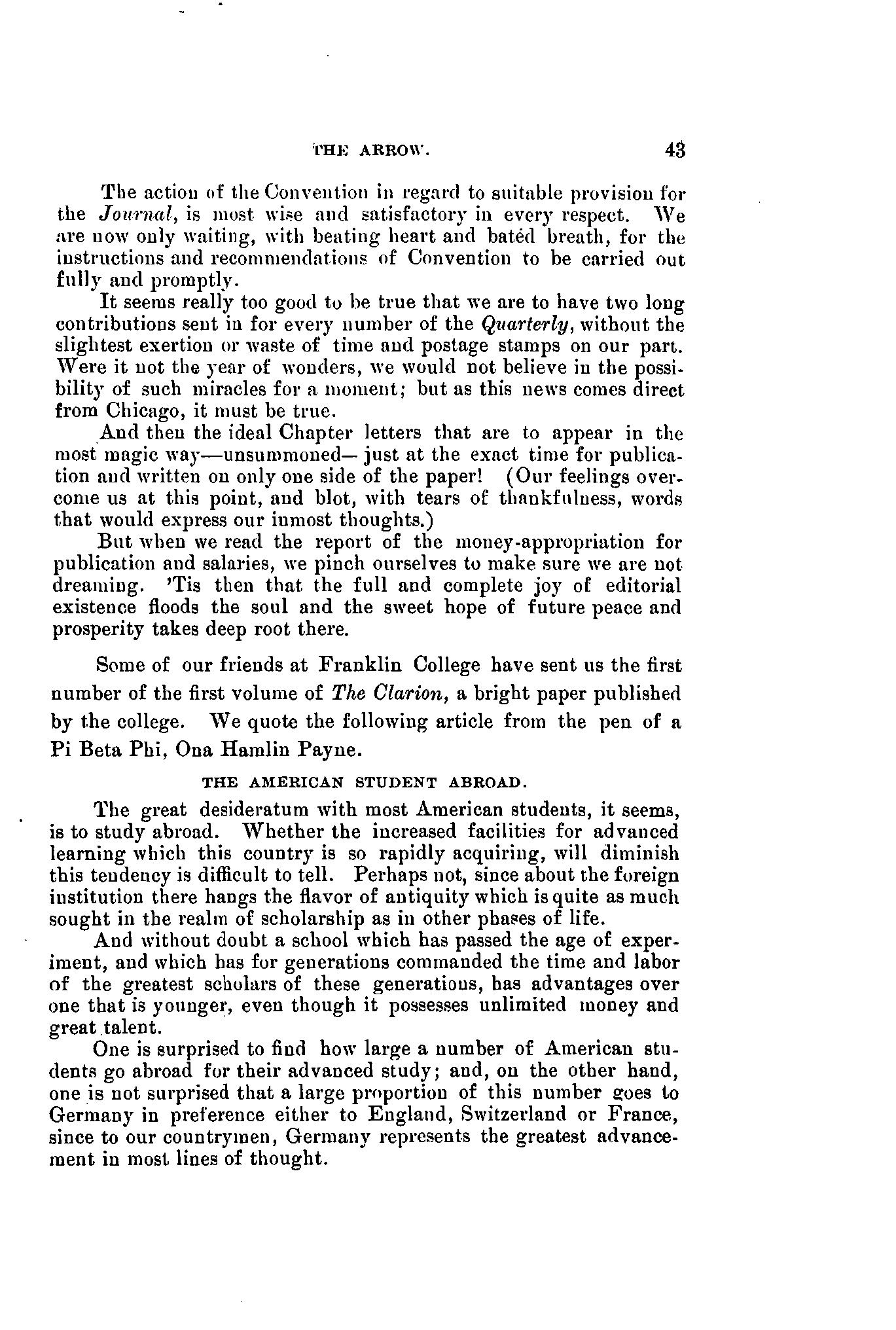
'L'HE ARROW.
The action of the Convention in regard to suitable provision for the Jom'luLI, is must wi"e and satisfactory in every respect. '" e nre now only waiting, with beating heart and bated breath, for the instructions and recommendations of Convention to be carried out fully and promptly.
It seems really too good to he true that we are to have two long contributions sent iu for every nnmber of the Quarterly, without the slightest exertion or waste of time and postage stamps on OUr part. ,V ere it uot tht< year of wouders, we would not believe in the possibilityof such miracles for a moment; but as this uews comes direct from Chicago, it must be true.
And theu the ideal Chapter letters that are to appear in the most magic way-unsummoned- just at the exact time for publication and written on only one side of the paper! (Onr feelings overcome us at this point, and blot, with tears of thankfulness, words that would express our inmost thoughts.)
But when we read the report of the money-appropriation for publication and salaries, we pinch ourselves to make sure we are not dreaming. 'Tis then that the full and complete joy of editorial existence floods the soul and the sweet hope of future peace and prosperity takes deep root there.
Some of our friends at Franklin College have sent us the first number of the first volume of The Olarion, a bright paper published by the college. We quote the following article from the pen of a Pi Beta Phi, Oua Hamlin Payne.
The great desideratum with most American students, it seems, is to study abroad. Whether the increased facilities for ad vanced learning which this country is so rapidly acqniring, will diminish this tendency is difficult to tell. Perhaps not, since about the foreign institntion there hangs t.he flavor of antiquity which is quite as much sought in the realm of scholarship as in other of life.
And without doubt a school which has passed the age of experiment, and which has for generations commanded the time and labor of the greatest scholars of these generatious, has advantages over one that is younger, even though it possesses unlimited money and great .talent.
One is surprised to find how large a number of American students go abroad for their advanced study; and, on the other hand, one is not surprised that a large proportion of this number goes to Germany in preference either to England, Switzerland or France, since to our countrymen, Germany represent.s the greatest advancement in most lines of thought.
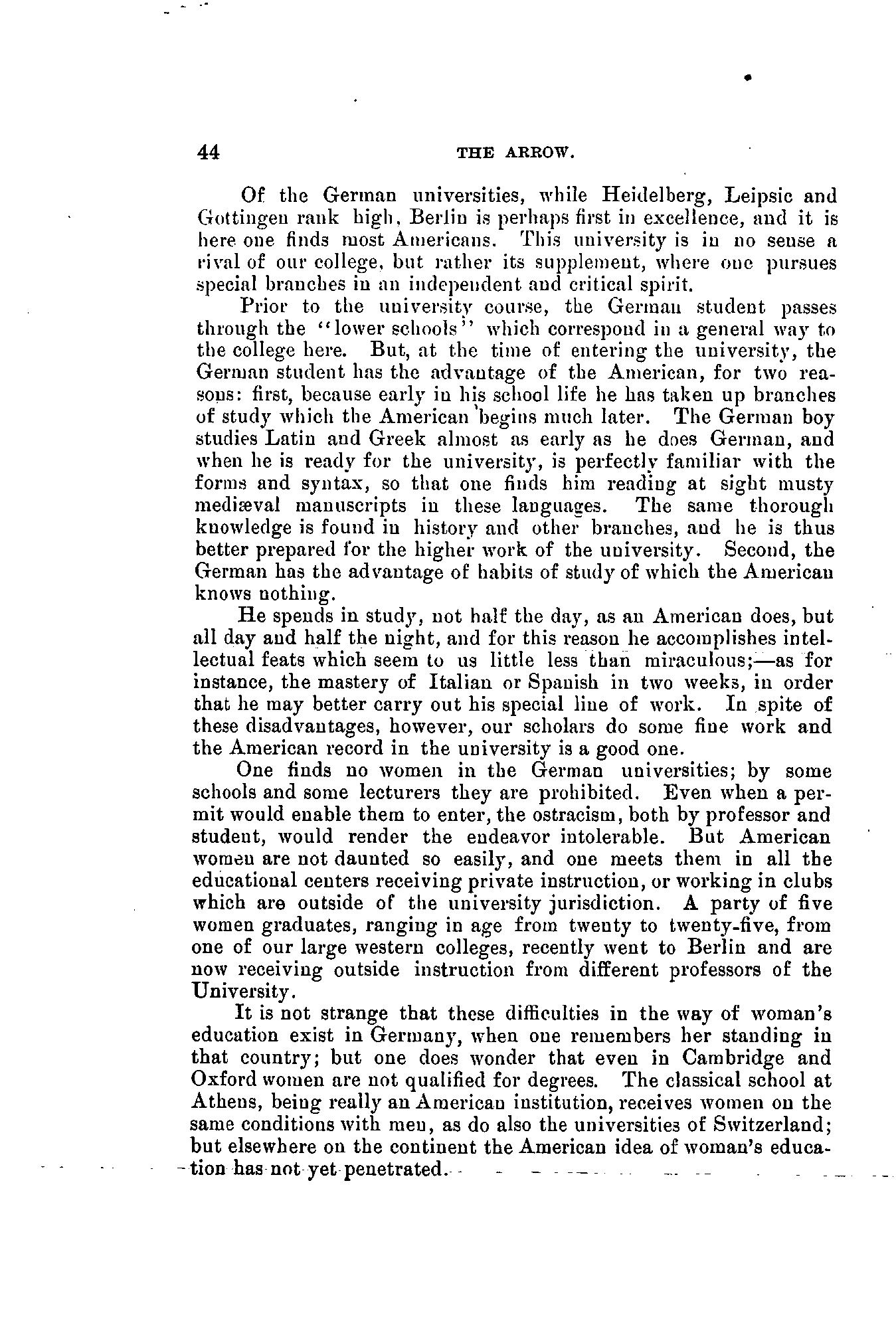
Of the German universities, while Heidelberg, Leipsic and Gottingen rank high. Berlin is perhaps first ill excellence, >lnd it is here one finds most Americans. This university is in 110 sense a "i"alof our college. but rather its supplement, where Ol1e pursues special branches in nn indcpelldent and cl'itical spirit.
Priolo to the university course, the German student passes through the "lower sehools" which correspond in a genernl way to tbe college here. But, at the time of entering tbe university, the German student has thc advantage of the American, for two l'easons: first, becanse early in his school life he has taken up branches of stndy which the American 'begins much later. The German boy studies Latin and Greek almost as early as he does German, and when he is ready for the nniversity, is perfectly familiar with the forms and syntax, so that one finds him reading at sight mnsty medireval manuscripts in these languages. The same thorongh knowledge is found in history and other branches, and he is thus better prepared for the higher work of the university. Second, the German has the advantage of habits of study of which tbe American k110WS nothiug.
He spends in stndy, not half the day, as an American does, bnt all day and half the night, and for this reasou he accomplishes intellectual feats which seem to us little less than miraculous ;-as for instance, the mastery of Italian or Spanish in two weeks, in order that he may better carry out his special liue of work. In spite of these disadvantages, however, onr scholars do some fine work and the American record in the nniversity is a good one.
One finds no women in tbe German universities; by some schools and some lectnrers they are prohibited. Even when a permit would enable them to enter, the ostracism, both by professor and stndent, wonld render the endeavor intolerable. But American womeu are not daunted so easily, and one meets them in all tbe edncational ceuters receiving private instruction, or working in clubs which are outside of the university jurisdiction. A party of five women graduates, ranging in age from twenty to twenty-five, from one of our large western colleges, recently went to Berlin and are now receiving outside instruction from different professors of the University.
It is not strange that these diffir.ulties in the way of woman's education exist in Germany, when one remembers her standing in that country; but one does wonder that even in Cam bridge and Oxford women are not qualified for degrees. The classical school at Athens, being really an Americau institution, receives women Oil the same conditions with meu, as do also the universities of Switzerland; but elsewhere on the continent the American idea of woman's ednca- tionhas not yet penetrated.
FINE STftTIONBRY ftND ENGRftVING HOUSE, 1121 Chesnut Street. Philadelphia. College luvitations, Class Statiol1ery. Society Stationery, Programmes, Badges, Wedding Invitations, Visitil'\g Cards, Banquet Menus, Diplomas 81'\d Medals.
STEEL PLATE ENGRAVINGS FOR FRATERNITIES. CLASSES AND COLLEGE ANNUALS.
All work is executed In the 11111:h"r the supervision of Mr. Dreka. aud only in the best IlUUlllt.'r. Unequalt'u facilities alld long practical experience enable liS to produce t.he newest styles and most artistic effects, while our reputation Is gU31"'.l.utee or tbe quaUty of the prodUCtions or this house.
DEALER IN Furniture, Drapery, Carpets, Oil Cloths and Shades
Good Goods. Low Prices and onest Dealing.
THIS IN YOUR 1I1ElIIORY.
We have the Most Beautiful Store. the Finest Gbocolatt's, and the Most Prompt t:;ervlce to be found In Aun Arbor.
HAVEN'T You FOUND IT SO?
Our Drugs are Just 88 Pure as our Oboc· a Ittes are Nice. Calkins' Pharmacy, S-1 80. State St.
Hf.'adqua.rters for aDd aU UNIVERSITY DENTAL'
TEXT-BOOKS.
Bargains tn Stationery. Blank Books and MHthi mflt ,al IHstrumt'nts. The Best FOliNTA1N PEN in the City tor fl.flO. STORES South M.ale sDd ]llaln I!!'tret't. upp. (;ourt Hoube
I adles are Cordially Invlttd to VialL MILLINERY PARLORS
When In Want or Fashionable and Tasteful Millinery.
30 Eftst Huron Street.
Poor Ones are dear at Any Price. If you have difficulty in getting just what you want, try Our Gloves.
Chaumont, 5 Hook, $1.00. Fountaine Veal Kid, 5 Hook, $1.00 Chaumont, 7 Hook, $1.25. Fountaine Veal Kid, 7 Hook, $1.75 Fountaine Mousquetaire Sued , $1.50 Blarritz, The Best for Ordinary Wear, .98 A.11 Shades, all Sizes, all Warranted. Sent by mail on receipt of Price.
E. F. MILLS & CO., Ann Arbor, Mich.
.. NEW YOHIC Official Jeweler TOTHE Pi Beta
I desire to call attention to Illy uew patterns of Pi Beta Phi Badges, "which for SOLIDITY fiucI actual ARTISTIC and INTRINSIC value excel anytbing in this line. A greater variety in finish and jeweling is allowahle thr.mgb t.he special manner of mnking with INTERCHANGEABLE DIES.
CORRESPONDENCE WITH SOLICU'fm. J. F. Newman. :1.9 J"OHN STREET.
Having been autlwrizea'to manufactu1'e the pin8 of" the Pi Beta 'I am p1;epat'ed to jU1'ni8k a ,line of pins supe1'ior in ·t/Jorkmanskip, and design.
Send for .Illustrated PrIoe LIst. '''COLUMBUS, OHIO.