NEWCOMB MElIIORIAL COLLEGE.
contented themselves with the superficial knowledge gained from elementary school-books, supplemented by general reading, but the results of college training were sadly wanting.
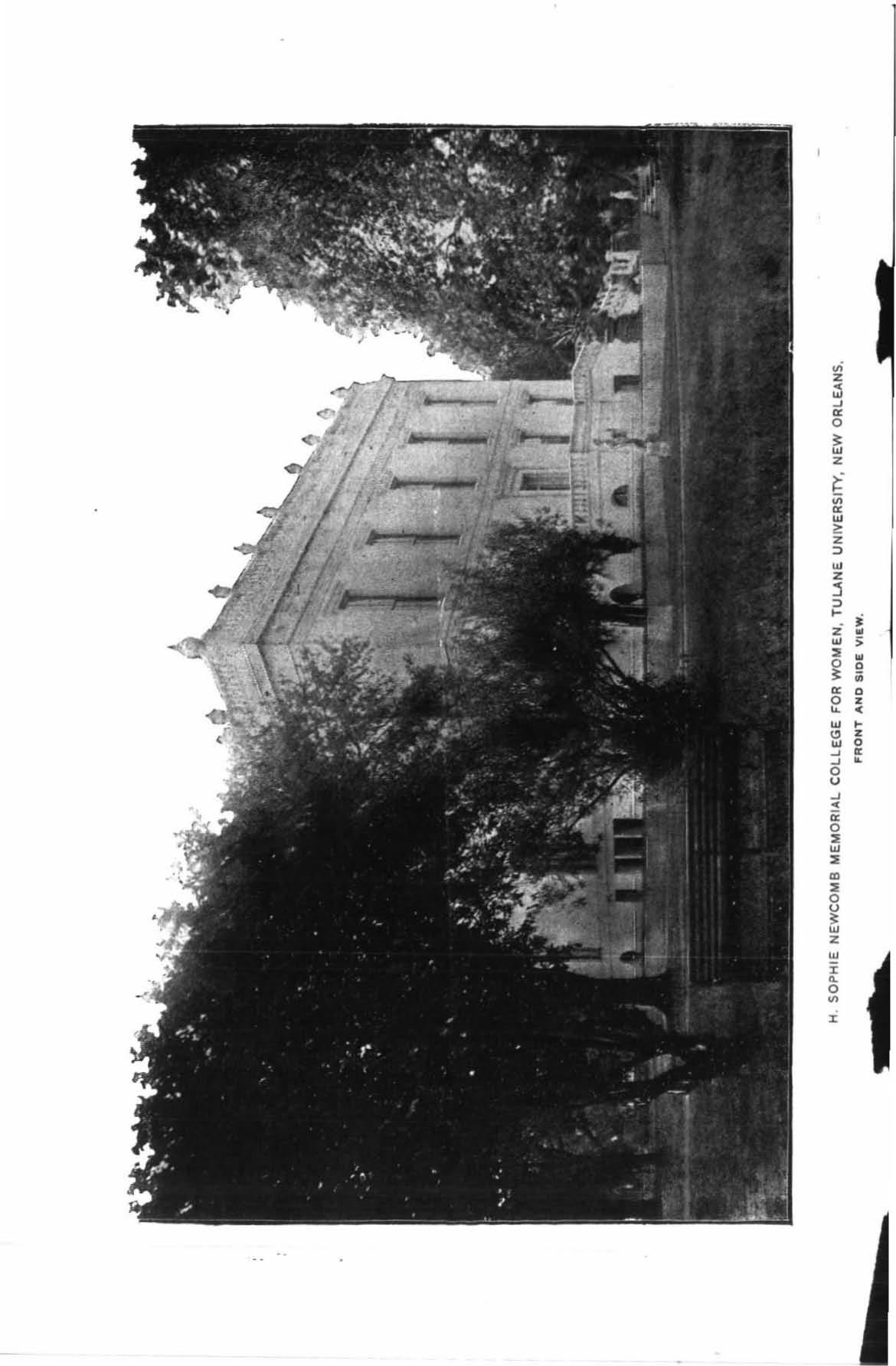
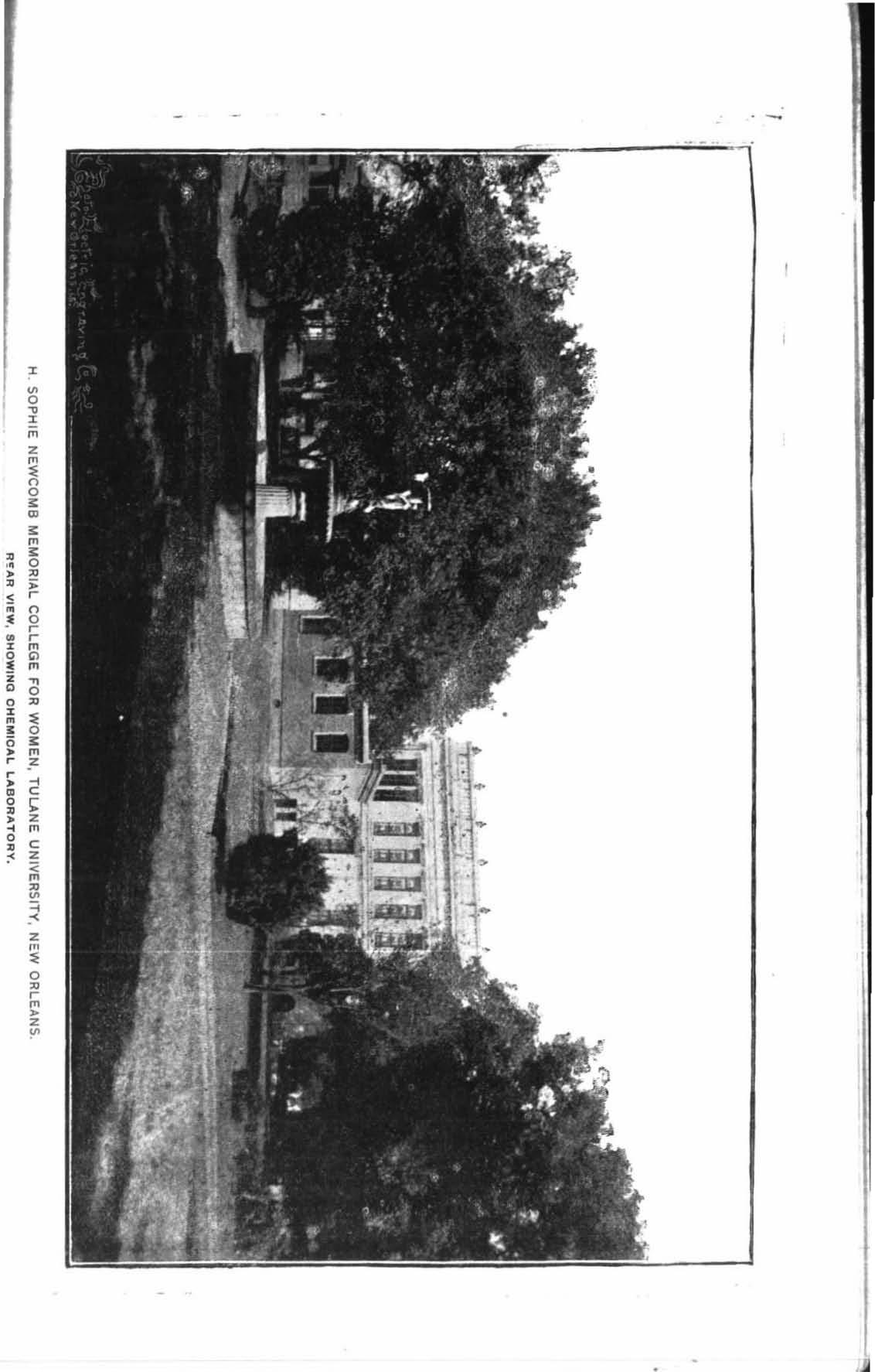
Owing to the fact that nearly all the Southern academies were differently graded, the fir.t two years saw no regular college classes at Newcomb, and thi, want of preparatory school, led to the establishment of an academical department, by means of which alone was t:,ere any hope of reducing to order the chaotic mass of applicants for admission with their numerous irregularities of grade. The Newcomb opened with comparatively few students and a faculty correepondingly small in numbers. Since then each year hruz seen new professorships establie:.hed, and last session ODe hundred and seventy-eight students were registered; the grade of requirements for admission has been continually raised; in fact, the advance made by the college will compare favorably with the work done in that direction by the most noted women's colleges during the first few years of their existence, and it will probably not be long before we shall have attained to the highest rank. President Dixon, who is a graduate of Curnell University, has carefully chosen a corps of excellent professors, to whose unremitting zeal and personal interest ill each pupil is due our present remarkable success and the promise of an even brighter future.
As to the life of a Newcomb student, it differs little from that of auy other collegian. At nine, each morning, the bell calls to our pretty chappl, when, after a short service, class room work begins; lectures, recitations, anrl study hours occupy the day until three or four p. m., by which time mosL of the studeutsleave the college for their homes ur boarding places, for the Newcomb supports no dormi. tory system and sturlents who do not live in the city find board in private families. There could be chosen for a women's college no bettt'r site than New Orleans, because in this southern city, almost surrounded by water, we rarely experience the extremes of heat or cold; in fact it is during hut a small portion of the year that we are prevented from enjoying out.door exercise for which our beautiful college ground, present mo,t delightful opportunities. New Orleans being more cosmopolitan than any part of the South, Newcomb is less characterized by a tone of provinciality than would be the case if it were not in touch with elements as various as those which COInpose the city. The hygienic influences of the location are excellent;
4 "'liE .\!tHO\\'.
though a great. llIuny, the,\' who wCl'e lJe\'cr here, 'hnve ,'err erroneous. impressionH cOlleerning the hcalt.hfulne:-:s uf the pluce. To one who seeks a thorough educatiun, which cannot· be obtained from text.-books nlone, New Orleullfo! offers opportuuities unequalled in any southern city; fo1' here the student: has the advantages of lnrge libraries, of nrt. galleries, of music ami the drama, and of French opera, such as nre f(lund no where else in America. I ha,te menLioned before that sprcinl pl'omillencf' is given to art. a certain amonnt of which, indeed, is required of all students taking u regular collegiate course, and for one who seeks to learn painting or druwillg thol'_oughly., the.N cwcom b NormaLArt SchtJoLt,ffel's_ulleq Ilulled.llpportu--nittes. No where in the United Stated will olle fiud IIIlIre tellipting bits of scenery than in OUl' old Fl'e:IC!.·A'lIcric,Ul city and its environs. T,le fllCiliticd fol' leurning Fl'en!:h are su well-known us to require no mention. The l!YlllllllSiulll of Newcomb is ill ('mlH'yo; for, fu!: yet very little npp:tmtus hils bJeu bought; however, on increase in this departlllf'nt will probably be one of the next inq)l'o\'emcnts. The pride which our students take in their Alma Muter and the earnestness of their desire for its ndvnllcemellt are potent factors in· the forces which are furthering its developments. "Cullege spirit" and class feelillgare intensifying each year. Thc camaraderie which exists between girls who wear he sUllie colors aud fluwer, udds to the pleasure of our students' with the charm of a friencJly sentiment. No regular paper puhlished by the Newcomb girls though the senior class of each year generally cdits n small sheet of local however the TlIlane Colleginn, managed entirely by the young men of our sister college permits, or rather solicits contributions frum the !Students ut. Newcomb. A literary club which was est.ablished last year, may develop into something worthy of notice, for there is excellent material here. Louisiana Alpha of Pi Beta Phi (nee Alpha Beta Gnmmn) is, ns yet the only chapter of a Greek Letter Fraternity in t.he college; however the manifold advantages which fraternity girls possess hy reason of the hond of sympathy and common iuterest which makes them so strong a body will probHhly lead to the format.ion of rival chapter!':, This feature of college life menus much to us at In our frnternity dass distinctioIlH tHe forgotten aLHl timid freshmen, reckless sophsf':nsihle juniors and haught:' sellinrs meet 011 equul termt;.
t.hough a great. mUlly. they who were IIc\'cr 'lulVe ,-err erroneons the hcalt,hfl1lnc:o:s of the pluce. To one who seeks n thorough education, which cnnllot. be obtained from t.ext-books alone, New Orleans offers opportunities unequalled in nny southern city; for hel'e the student: has the advantages uf lnrge lihraries, of urt. galleries, of mllsic nno the drama, aud of French opera, snch as nre found 110 where else in America. I have menLioned before that spC'cinl prominence is givel} to nrt. a certain amount. of which, indeed, is required of all tuking a regular colleginte course, and for one who seeks to learn painting or drawing thol'oughl):, the,Newcolllb Nornml,Art Sclwotuifcl's _ulleqllulled nities, No where ill thc United will olle find lIIore tempting bits of scenel,)" than ill OtH' Hhl city and ils environs. T;le f,lcilitics for lcarilill8 FI'enl!h tU'C so wt·lI-known uS to require 110 mention, The of Newcomb is ill (,mlu-yo; for, a:; yet vcry little npp:lI'IHlIil has bought; however, an increase in this department will probably bc olle of the ncxt impro\'ements. The pride which our students take in their Alma Muter alld the earnestness of their desire for its ndvnDcemelit are potent fHctors in· the forces which arc furthering its developments. "College spirit" and class feelil,g are intensifying each year. The cUlllllradl'rie which exists between girls who weal' t.he sUllie colors and flower, adds to the pleasure of our students' with the charm of a friendly sentiment. No regular paper is published by the Newcolllb girls though the senior class of each yem' generully edits a small sheet of local however the Tllhwe Colleghm, managed entirely by t.he young men of our sist.er college permits, or rather so1icits contributions from the students at Newcomb. A literary club which was est.ablished last year, may develop into something wortbyof notice, for there is excellent material here. Louisiana Alpha of Pi Beta Phi (nee Alpha Betn Gnmmn) is, ns ret the ollly chapter of a Greek Letter Fraternity in the college; however the manifold. which fraternity girls possess by reason of the bond of sympathy and common interest which makes them strong a body, will probHhly lead to t.hf'. formation of rivnl chnpt.el'!'l. This feature of college life means much to Ui; at. In uur fmternity hall,. das8 lU'e forgottell aud timid freshmen, sophomore:"!, fH',nsihle juniors and sellinl':;: Illeet 011 Clluu1
IN MEMORIAM. - OF INTEREST TO ALL WOMEN.
and when Louisiana Alpha takes a day's outing, the upper class women loy a.cside their assumption of dignity amI join the I< te1'8 " in n jO,YOUf! yell of:
Ra, Ra, Ra, Sis, Ra, Bum, Ra, RaJ Ra, Sophie Newcomb!
Alice Boarman '91. (LOUISIANA ALPHA.) H. Eopble Newcomb College.
IN MEMORrAM.
Died, at her ho:ne in CtJIlst:mtine, Mich., September 7, 1892, Nellie Gilbelt.
,V
RESOLUTJONS.
IIERE.\B, It has plcru;ecl Gnd to take from liS our beloved sister ill Pi B !tll Pili, Ndlie Gilb,!!·t; be it
Resolved, That in he!' death we realize n gl'eat misfortune to our f!'l1teruity, and thnt we exleud tu her fumil"r 1)111' heartfelt sympathy.
Michigan Alpha Chaptel", Pi Beta Phi.
OF INTEREST TO ALL WOMEN.
It is said there are one thousand American girls studying art in Paris.
There are thirty.seven thousand women telegraph operators in the United States.
The Pennsylvania, Ohio and Ann Arbor Dental colleges are the only ones that admit women,
It is estimated that there are now six thousand three hundred and thirty.five postmistresses in this country.
Lady Henry Somerset says American women llurlerstand puhlic affairs much better than rlo t.he women of .England,
Last year nine hundred girls were sent away on vacations of two weeks each hy the \Vol'king Girls' V",cation Society, of New
Tng ARROW.
York City, and over 4,000 tickets were gi"cll to girls who coulo leave the city hut for n oily.
Bret Harte's daughter, ,Jc8sumy, has Illade her litemr), dehut, und her w(lrk shows marked literary ability.
Snrn Bernhardt will contribute n painting to the women's gal. lery of pictures at the Columbian Exposition.
Mrs. C. C. Candy has accom}Jlished the descent of Pike's Peak' on a bicycle in less than four hours and a quarter.
Asheville, North Carolillfl, }>,ns a woman embalmer; she has practiced tllp. art nine years and has become very profic.icllt in it.
-The-Icelandic 'nntion, mt-mbers people, is governed by representatives elected by the men ,and women.
HOl"pitals for women hnve 'been established by women physicians ill Philadelphia, New York, Buston, Chicago, San Francisco and Minne8P?lis.
The Queen of the Sandwich Islands is so ardent a temperance advocate that she will have no wines or Fpiriwus liquors at her din. ners and rel'eptions.
1\1rs. Olive Harris, M. D., of Iowa, is medical missionary nt Sierra Leone, ",.- est Africa, and fol' severa] months couductt·d the work entirely alone.
Princess Louise has had a papier maclle model of herself made and so avoids the loss of time and temper involved ill stunding to have her dresses fitted.
St. Paul, is tbe fil'st city in the northwest, if not ill the United States, to decide that its teachers shllll receive the same salaries as the men teachers for the same work.
Mis8 Florence Nightingale, though an illvalid,.8tilJ directs the Chief Training School for Nurses, ill London. There are twenty thousand truined in England. Ireland and Scotland.
Katherine Tupper Prescott, who has attained enviable success in executing medallion portraits in is now at work on a life-size bas-relief of Potter Pulmer, which will be placed in thp Woman's Building at the C(llurubian Exposition.
Dr. Emily Kempin, fOlluder of the law courses for women in New York city, has been installed assistant professor at the University of Zurich. Miss Kempill has the honor of being the first
OF INTEREST TO ALL WOllfEN. i
regular lecturer on English and American law in the German uni. versities, 8.8 it. has hitherto been taught. only in the mercantile department.
About five hundred women are elllployed ill the administration of railways in France; in Dublin the ticket agents are Dearly all women; while Holland employs women as tenders at railway switches.
The Catholic women of the world are to have an exhibition of their wurk at the World's Fair. This project ha., t.he appruval of p"pe Leo XIll, and the plan was bruught abont by Mrs. Putter Pal. mer 'and Bishop Ireland._
Few writers of magazine literature have been longer or more favorably known than the late Ruse Terry Cooke, and it is said thnt with all her talent she was not able to make much more than pin money frolU her literary lubors.
Illinuis has fifty-three r('gistered women pharmacists and fifty assistants. The \Vo:llen's Pharmaceutical uf that State has been orgriniz('d and (:hartcl"cd for the purpose of mutual benefit and to arrange for an exhibit ut the \Vurld's Fair.
The Arena for Allgust contains the most illlp'.>rtnnt sY'lIpmzium 011 wo:n:m',s club3 ever T:le subj:!ct is treateJ 011 all its sides by ele\'en womell of UIIJOlIg them, 1\11'8. LiveI'. more, Louise Chandler l\Iolllton, May \Vright S·.-wall ami Ellen M. Mitchell.
Miss Jessie Ludlow, a seventeen year olu girl of South Caro. lina, has won the prize offered by the Times of Manchest.er, England, for the best composition on U The Best Book, aud \Vhy I Like It." Competition was open to the world. Aiisa Ludlow's subject was" Ivanhoe."
Mrs. Ellen Mitchell, the well·known philanthropist who died recently, was a sister-in-law of the late Mtlrin Mitchell. Mrs. Mitchell served three years on the Cbicago Board of EJucntion and took great interest ill manual training for children. Her life was devot4?d t.o work among out.cast women.
Tbe Tempprnnce Temple, the national building of the \V. C. T. V., situated in Chicago, is the most beautiful office structure ill the city and ma.ny claim it to be t.he most beautiful structure of its kind in the world. It is thil'teen stories high with a frontage of 190
THE ARROW.
feet. The architectllre is French-gothic; the first two being of granite, the rest of brick and terra cottn. The roof breaks iuto Gothie turrets, from the center of which rises a flieclte of gold bronze, crownerl by the figure of n woman in t,he attitude of invoking n blessing' 011 the great city at her feet. The building will be dedicated sometime during- the 'Vor1cF:5 Fair.
Among the fine fne:lIlty the Chicago University is securing for itself will 'he :Murthn Foote Crow, who has been recalled from Oxford, Euglnud, to take the chair of English literature, and Marion Tulbot, n member of the BmU'd of Visitors and Iustl'uctors of 'Vellesley__ Colleget_who_has_been. appointed .u8:5istant-professol'-in the department of socinl ficience.-Harper'8 Bazal'.
1\[iss Zelia Nuttall, of San who is cloing remarkable work in Aruerictlll unthrupology, is considered authority on every thing relating to Mexicau nrchreology fiud history. Mi::!s Nuttall surrounds herself with Aztec ntmoi3phere; her library, ODe of the richest in :Mexicftll works ill existell..:e, is encased in pieces of furniture whose forms nucl decoratiolls are drawn frum Mexican architecture.
Lieutenant Peary's wife, who has just returned from the arctic regions with the rest of her husband's party, was the first woman who ever bra\"ecl the rigors of Gret!Dlulld. She showed uo ill effects from her· winter nenr the pole, uucI is reported to have battled through it with as much ellergy as uny of the'men of the purty. To her the men owed Ulliny of the comfurts that made the dreary wintertime eodurable.-Harpel"tt Bazar.
The University of St. Andrews. which dates hack to the fourteenth centuf);, and which for five hundred years hl18 been the center of learning in Scotland, has opened its doors to women, More eminent men ha.ve been connected with the institution as students and professors than with any other Brit,i:sh university of its size, and it is but fitting that this ancient seat or learning should add to its hiHtoric interest by tok ing this radical step of progress.
Germany. the last, stronghold which woman hns to attack, looks as if it might soon yield til her cnruest entreaty and open the doors of its universities to he 1'. Prof, Herhert, Grimm, who represents. the University of Berlin, in n recent article in a German magazine, advocates strongly the nrlmission of wOlllen to e'llial I'ights with men
WHA'l' A FRATERNIT¥ THINKS. 9 at the universitie:.:. The wOlllen of Germany have belie,'ed t.hem. sehes t.o he intellect.nally inferior to llIen .. and as Prof. GJ'imllI admits are illcapahle of taking the place ill science and lit-emtul'e that lllodern society delluwds of thelll. Let. Germany gh'e her daughters the privilege t1ley desire. and will not complain of their incapability.
American girli! who go to tu 1:itlldy art. lIl'malJy club together alld set lip hOllsekeeping ill a simple hOllleJike wuy. Lh'ing in Paris is flll' easier than ill New York, as and llIeats Iliay he bought alreudy cooked, and poultl'.\· is sent. h(Jrne daint.ily broiled' or !'Ousted. Gus stoves IlIny be I'ent('(lut fifty cel.ts a mOllth, and the wages uf a maid of all work, to sweep, seoul', make beds, etc., are very low, and t.he maid is paid by the hout'. In the art schools equal advantages are afforded to wumen as to mell.-Hnl'pel"x Bazal'.
The shown the Freshmllll clnss of women's colleges, in marked .with the treatment of the Freshmall ill men's colleges, is ver." prettily illustmted at BrYII "Mawr. III adJition to caHs, aud au attit.ude of cordial welcome frolll the older students, it is the cHstom· of the Sophomores each year to give the Freshmen a piny ill the gymllasium. The pluy selected last year was one of Haus AnJer.sen's fairy tnles drtlmatized. Some months later the Freshmen gave a play, !lud the invitations to the Sophomores requested them to occupy the front seats at the entertainment. 'Yhell the curtaiu rose, the Freslllllt:ll forwurd with baskets of roses, which were scattered ovet· the astoni.shed and delighted Sophomores. They had chosen this pretty way to make public acknowledgment of the kind and generolls treatment received at the hands of the 8ophomores.-·HaJ'jJe1·'a Bazu·l',
WHAT A FRATERKlTY GIRL THIKKS.
The opposition of many high-principled, and other well broadminded people aga.inst fraternities is the result of their belief that From the the fraternity fosters a tendency toward aristocracy Other Side. I I·· I I I d an( exc lIS1VJSIU, an( t lut sue 1 a ten ency has no place in the deulOcrat.ic atmosphere of an American college. They claim that a few congenial spirits, united in the bonds of a fraternity, with the ready-made frienrlflhips at hand,
ARROW.
employ themselves in having a good time together, indifferent to all outside the magic circle. The result is a narrow, self-centered clique. At least so it looks to outsiders, from whose point of view we wish now to consider fraternities so that we may know just how we look from the side." A TeC?ent fraternity journal quotes a clergyman os saying, "The conservative, selecth'e element in coll('ge fraternitips is n hinrlran('e toward the df'yel. opment of the broad, 'universnl Chl'istian fading which should exist among colle'goe students as a who}p, and nwillg to this the frater. nity is d(·tr:inH·11tal to the genera.L_l!O!'<L:. This critic.ifZtn_has J;O. - 'v(·ight - IIgniJlst. -the prillciples of which tll'e fouudet! ou th€' I.ighest cOlHmlllld ill the law nncl the pm. phets-Iove thy neighbor as universul hrotl,erhot.cl. Frum the very mHlle whil'il we bcar-frutl'rnity-w(' must believe in the bl'Uthel'hood of humanilY, and ill the of harmony and peace'. And 8S fratel'llitics we nre doillg SOIlIetlling, at lesst, towurrl this id(,ul. 'Ve believe we ha\'e malle friencl:;hips a little depper and stronger, sympathies a little 1II0re susceptible nJld uctive,. and natures more social ano humane. And what man, c1erllymno {.r otherwh:e, whose ioenl is universal brotherhof,d, can make his ideal real in any otht'l' way? No mao can love the whole worlrl, he nlUst learn universal luve by loving thi8 man and that man, by doing gnod to thi8 friend and to that friend. Fraternities do just this. No furtber justification for their existence is needed.
Nevertheless, let us remember that fratcl'IIities must work out as- well as in, that they have 8 duty to outsiders too.
Let them surround themselves with an atmosphere of friendship and good will, being ready to extend the helping hand to those ontside the b:>[)d"J ramembering that it is only when fricnd3hip is COI1fined to the inside that the foregoing criticism has weight. We need to stop once in a while and reflect how we look from the other side.
How many of us in our school days ever go any deeper into the meaning of life thnn to touch upon the things we like or dislike, the
Where Ha"pplnees Is Found
things we desire or do not desire? 'Ve often realize what a superficial plan of life this is when we meet with some such definition as Lord 'Velling_ ton's, whose ideal of life was II To dare nobly, to will strongly, and never to hesitate in sublime devotion to duty. " In the face
of such words as this from a man who filled the whole English army with his 8pirit, how paltry, how disgraceful it seems to hear Borne ODe say, "But I don't want to do it, and I shall not do it," thus making persunsl pleasure the criterion of nction. QlJe whose words nre always full of wisdom, answered my question thus, " Why nre we put into this strange world of ours? Plainly not to be huppy alone, fur even the child will tell you ago,ill aud again that he is not happy. In fact, we are not expected to be anything but to act, (0 form for ourse] ves a character for which the all Father gives opportunities from time to time, for the use or misuse of which we are respollsible."
Surely we can all find murh to think upon in these wordl'l, not only abstractly allll philosnphicaJly, hut personal1y searching to find if OUI' hearts ack"owledge the truth of them, or we strive not to listen, excusing ourselves and blinding conscience with lIIore or less success. The soldier is often tukeu as a type of de,·otion to duty, and the first requisite ill a good sHldier is obedience. Nu one is fit to command who does not know how to obey. NUL ulone ubedience upon cOllviction, for anyone but a wilIrul fool will do what he is convinced is best and right; but the obedience that Corned from confi. dence and trust, that obedience stunds not far from satisfied duty, and contentment holds out both hands to welcome it, for content_ ment is the only happiness, and contentment lies deep in the heart. H the polished mirror of the heart reflect the rays of duty only, not of vain and idle impulses-then like the pictures in the magic glass, contentment will slowly form upon the brilliant surface until it fills it from brim to brim. Then do Dot fret at what seem foolish rules, stupid regulations, meaningless forms; by and by you will see more clearly, and if now you search only for duty you will soon under. stand the wide reach of conventions that have slowly crystaHized from centuries of man's intercourse with his brothers. It is not necessary to remiud anyone of that pretty old proverh that tells of the immediate personal results of doing an unpleasant duty, for everyone knows that a sense of duty performed makes a rainbow. iu the soul.
E. B . Allen.
12 'rHB ARROW.
1 bave been irritated rlllring the SUlIIIlH::1' by the cUllstnutly reclIrring 'Vila!. nre you going to do with your college education after so much time 011 it? And, "Thut use will your higher mathC'lUutic.s, your Greek and YOUf science, be to you after nil? In these (lllC'stions there waf; always un uudertone
A
Plea for More" '" weetness and Light."
uf unbelief in higher education except. fl8 n lIIolley-mnking invest· ment, as a matter (If dullars n.1<1 ceuts. It sadllellfl. me that such a sordid, money-gmsping spirit is abroad ill our land. As fol' llle, I Rill glad to lift up my voice and proclailll that I dOll't cure it I never earll-aaoHai-oy lily ciillege educnt ion 'that-l"'could-not- 'have -cornedwithout it. It is strange that. college presidents hu\'e to keep ing for higher education, hnyc to keep insisting that its vlline CHmlot he reckoned in dullars aud .\re the people all dead· who believe thllt there is 80mething h:;:tter in life thall and faille, and the tangible these bring; tllllt lire ranll;lt b:! I'educrd to a dullar und c:!nt calculation? I wish to pletlfl fur a nwment for t.he higher, the more the more subtle eblllents or life. There is such 1\ need ill this sad W,)rk.,l.t!.lY wurl,l f,n' highel' id ·nls, fo,' fi"mcr principles, for keener illkllectn:ll develop:ncnt, fol' a PH: er and lIobler inlier life. These are, after all, what make life worth living. It is our iuner life that endures. Beauty, virtue and truth nrc the only realities.
COLLEGE AND FRATERNITY NOTES.
'l'wenty chapters of Phi Kappa P8i occupy rented chapter houses. -Delta Upsilon Quarterly.
Leland Stanford, Juuior, is uoW the only American college where tuition is free in all its hranches.-The Shield.
nlis8 Mary Graham, n grurluate of "'eslcynll, and 1\liss .Mnry Scot, a Vassar ·graduate, are the first women to receive feHowships of Yale.
The Phi Delta Theta fraternity hUri granted n charter for Princeton College. This will be the first chapter of any fraternity to . establish there.--l1Iia}JIl. Student.
The University of Pennsylvnniu. 11[u'3 ovened a graduate department. fol' women. The flepartment will start with u force of
thirty-three professors, and will grant to women the degrees of M. A., M. S. and Ph. D.
Eleven Chapter Houses are owned hy Psi Upsilon Chapters, and the twelfth is now building.-The Shield.
Of the three hundred and sixty-five colleges in the United States, two bundred and four are co.educational.
Miss Mary Story, of Tyrone County, Ireland, has been appointed assistant examiner in French to the Royal University of Ireland, a post hitherto held only by men.
The first rllmors of a grand convention of all tbe '93 men of American colleges, to be held at the World's Fair, are floating about in the air.-University Cynic.
In a German university a student's matriculation card shields him from arrest, admits hi:n at half price to theaters, and takes him free to art galleries.- University Cynic.
One of the corridors in Mammoth Cave is known as Fraternity Hall. It contains pyramids of stones representing fourteen different fraternities. Each visitor adds one stone to the pile representing his fraternity.-Z A E Record.
One-third of the univf'rsity students of Europe die prematurely from the effects of had habits ncquir(>;II in cullegei one-third die prematurely from the effect of close confinement at their studies; and the other third gO\'ern Eurupe.-Gu.izot.
The 'Vnmen'd College of Baltimore is the first colleg'e in the world to make physical trainin,!! a Full department with pro. feslmrs and All students are required to take tbe course as an important branch of the curriculum.
Miss Louis.a MacDonald, the recently electerl principal of the new University College for wnmetl, Ilt Syrlney, New Suuth \Vales, is only thirty-three ypnrs olel, but ha.'J a fine record as a classical scbolar, and a reputation as an archaeologist.
Presi<1ent Harper of the Univers.ity announces that the UnivPTsity is to be in nil reflpccts a cO-f'ducational inst.itution. Further, it is stated that women are to be on the faculty and are to share in the work of the University just as men.-Bo8ion Journal.
The shield of Theta Delta Chi has the following admonition at the head of the chapter letter department: Charge editors are again
THE ARROW.
requested to write only on one side of the paper, to assume a style somewhat more expansive than a telegraphic communication.
The Psi Upsilon and D. K. E., the two leading Yale junior societies, adopted resolutions to-night which will prevent the possibility of a recurrence of the Rustin accident. The resolutions were that taking the oath and assenting to the constitution of the societies, and nothing more, shall fulfill initiation obligations.-Ex.
Arrangements are being perfected for the publication of a monthly magazine called The College Fraternity, to be commenced next October. Eugene H. L. Randolph (Phi Delta Theta), P.O. Box 1398, New York, will be editor,.and. Frederick.M.Orossett (DeltaUpSilon),"P: O. New York, will be the manager. Its aims will be to publish timely and cogent articles of general interest to fraternity men, to reproduce the best editorial and other matter of the regular official organs of the fraternities, to cover the field of fraternity news in all its branches, and to bring into closer touch with each other, and into mutual co-operation, the members of the different fraternities. The objects are laudable, and tbe enterprise not only deserves to succeed, but will be of great benefit to all of the fraternities of the United States, if it does succeed.The Sigma Chi Quarterly.
The Scroll of Phi Delta Theta has sent out the folluwing emphatic circular, hettrled in large ctlpitals.
U DO YOU GRADUATE?
U Do you quit college this yrar? If so, pub::cribe for the Scrol now. Why? You hove b,en illtJ«sLe:1 in and worked for'" <1 8 through Y"UT college course. You have been inquiring how we are to retain the interest of .our alumni. You have promised yourself, no doubt, that you will not forget'" <1 8 in after life. Now you are about to withdraw from college, and the question to the Fraternity is, are we to have your continued interest as promised, or Rfe you to become lost to us? The alumnus, if he would retain interest in .d 8, must know what is going on in the Fraternity. This means that be must read the Scroll. If you expect to take The Scroll at all, subscribe for it for if you wait awhile, the probabilities are, that you will never suhscribe.
"If you once get out of touch with the Fraternity you are likely to remail! so, and the active membership will be wonder-
ALUMN..E
ing how much sincerity was in the loyalty you avowed when in college.
"We want the Phis of '92 to keep alive the memories of ifJ 4 8, and to have their names to a man on our mailing list.
"The Convention authorized any member to retain 25 cents on every new subscription obtained by him. His name, address, and 75 cents, will entitle any Phi retiring from college this year to Volume XVII, entire. Phis not expecting to have a permanent address, can have it changed promptly on our mailing list as often as notices are given.
". Do not neglect this, but enroll yourself among those who are to remain interested and loyal Phis. "
ALUMNE DEPARTMENT.
PI BETA pm ALUMNJE ASSOCIATIONS.
There is no better plan for keeping Alumnre in working order than the formation of Alumnre Associations wherever sufficient material exists. This applies especially to large cities, in some of which there is surely a good number of Pi Beta Phis. In Chicago the number is abundantly large to form a strong organization. Steps have already been taken toward the formation of a Pi Phi Alumnre Association in Chicago, and in order to hasten this work let every chapter send to the ARROW the name and addresses of its Chicago Alumnre. Strong city associations.add materially to the strength of any fraternity. They centralize and define wander. iug fraternity spirit, creating a unity of interest and effort which would otherwise be scattered and fruitless.
THE FRATERNITY AFTER OR.-lDUA'I'ION.
Judging from my own expe:r:ience, fraternity spirit has three phases. In my early college dnys it was mainly enthusiasm for my own chapter, aud an intense, ullreasonillg, girlish loyalty to every. thing that concemed Pi Beta Plii. I loved the girls of my own cbapter devotedly, and felt s Jre that I could love every Pi Bela Phi just ns sincerely, even at first sight. I constructed a romantic ideal of fraternity friendsllip, Bnd con::cit::lItiously bdieved in the possi. bility of having sisterly relations with all who were within the boud
THE ARROW.
of the same organization. This sentimental phase of the fraternity spirit is very common among undergraduates of all fraternities, especially where chapter life is harmonious, and the members are of an idenlizing turn of mind. This cannot be said to be the highest form of the fraternity spirit, yet it does not merit the unqualified disapproval and ridicule it so often gets. Even the most sensitive and worldly of us bas a due amount of sentiment and emotion, and sentiment turned in the direction of idealizing friendship is Burely an error on the right side.
The second pbase comes after college life is ended. Fraternity . jllurnals ,haye .the_habit.of writing abouLthe inactivity of_Alumni,_ taking it as a matter of course that they shonld lapse into indifference. In nine cases out of ten the Alumni will of course do just what is expected of them. Very often after a certain amount of with the TE'S" world, there comes to the Alumna the realiza. tion of the impossibility of such ideal friendships with unknown sisters 8S !he dreamed of ill cullege duya aud a revulsiflu comes. She comes tn believe thnt all her fraternity meant after all was carefully nurtured and highly sensitive friendship for a few congenial girls. She lnoks upon it all as a delightful ideal of girlhood of which she hae learned the imprt\cticability. It W8-i well enough in its place but its place is nnt in th,e lire of a busy Thus she mentally severs her with her fraternity.
Every bro•• I_minded Alumna should come at last to the third and best phase of the fraternity spirit, which is devotion to the fraternity as an urganization standing for the highest socilll ideals and interests ill OUT American cnlleg£-s. All social, educational and reli. giuus llIovements take the form of organizations. 'Vork in any lioe caD be best accompJished hy joining 'one's self to men banded together for a like purpose, and pursuing a co-operative method of action. The school, the college, the U uiversity stand for education, tbe 'church for practical morality and philanthropy. W.·rk for either of t.hese purposes is most effective when done in such an organizatiou with the help and inspiration of others having the same end in view. The frateruity.stands for social ideas particularly. Founded as it is on friendship-that closest bond among men-it cannot help but develope those social graces that follow in the train of many and intimate companionships, if regulated by high idea.ls. If you belong to a fraternity, and are interested in the growth of a
ALUMNlE DEPARTMENT.
better and higher social life among the American people, give your present support to that organization which aims to develope such social life in our culleges.
The ohject of this article is to show that fraternities are not mere sentiment, ruere local and personal affairs, but organizations that represent a grand idea. As such they are worthy of every member's life.long support.
FROM THE HISTORY OF KANSAS ALPITA.
The University of Kansas, which to·day supports nine fraternitiea, completed eight years of its existence without a Greek within its halls.
All thought of college organizations centered in the literary societies which enjoyed a Gulden Age in consequence, admitting to membership both young men and young wumen and carrryillg out the true idea of their co-educational Alma Mater. The young women seemed content with the debates and exercises of these societies and for the time kept the even tenor of their way, but Dot so with the youllg meo, who in lS'i2 opened a correspondence with B /J 11 of ·M,nmouth College luoking toward the establishment of that fraternity in Kansas State University.
The waters thus troubled were not easily stilled, and the student community thought long aud much on the fraternity idea and the Greek letter fraternity .ystem.
As a result, and acting upon the advice of n /J U, eight young women made application for charter to the Grand Chapter of I C., then located at Monmouth, and on April 1, 1873, very shortly after the organization of B /J II, first fraternity at Kansas State University, the Kappa Chapter of 1. C. was founded with charter members: Hannah Oli ver J Clara Morris, Lizzie Yeagley J ViDa Lambert, trude Boughton, Flora, May and Alma Richardson. Being witbout rivals, there was no haste whatever in the selection of members and chapter growth was confined wholly to the most staid and dignified young women of the University. Chapter work followed the line of literary society work, which evidently was deemed essential.
The first 1. C. cookey sbine occurred in June, 1873, and from that day to this has been enthusiastically maintaiued, even to its homely name. What'. in a name t
THE ARROW.
In this one there is everything suggestive of reunion when fraternity rules supreme; when the nlumure indulge in' memories of those first years and tell again the story or their trials and their joys; when we compare the then and now and with pride over our rapidly developing organization Rud thoroughly enjoy having the nlumnre tell us, oj Yes, but yuur friendships al'e Dot sweeter."
In J 881 a rival fraternity appeared in the organization of Kappa Alpha Theta, and a different lille of action was forced upon Pi Beta Phi, but if true with other organizations that rivalry is necessary to keep out of ruts, so with fraternity chapters, Rnd the State lhliversity w!ls decidedJy_ beneficial. In 1883, Kappa Kappa Gamma entered the University and the rivalry became more intense. But withal, pleasant relations have always existed among the three chapters, as the records of Pan Hellenic parties, banquets and the interchange of fraternity courtesies bear witness.
The tbree fraternities thus established, Kappa Alpha Theta, Kappa Kappa Gamma and Pi Beta Phi, have maintained strong chapters from their very foundation, the scale inclining sometimes in favor of one, dometirues in favor of the other.
Kansas Alpha boasts of having now more than her share of college honors.
Five of the chapter's membership have at different times held positions in the U nivel'sity faculty: Gertrude Boughton Black. welder, ,Mrs. Perkins, Mary Miller, Hannah Oliver and Miss Crotty, and in but one other instance have the rival chapters been represented in the faculty of Kansas State University. With but one exception, and that exceptiun not a fraternity woman, the only women who have had the distinction of delivering Masters' Orations have been Pi Beta Phis. We boast also that Pi Beta Phi is the only woman's fraternity at Kansas State University from whose ranks / Phi Beta Kappas have been chosen, as well as the only one from which election has been made to the honorary scientific society Sigma Xi.
FRlENDBmP .--cHAPTER LE"rJ'ERB.
FRIENDSHIP.
A ruddy drop of manly blood
Tbe surging sea outweighs; The world uncertain comes and goes, The lover rooted stays. I funcied he was fled, And after many a year, Glo\\'eu unexhuustcd kindliness
Like daily sunrise there.
1\ly careful heart WM free o frlend, my bosom said, Through thee aloue tbe sky i8 arched, Thruugh thee the rose is red, All tbings through thee take nobler form And look beyond the earth, The mill-round of our fate appears A sun-path in thy worth.
Me too tby nobleness has taught To master my despair, The fountains of my hidden life Are through thy friendship fair.
Ralph Waldo Emerson.
CHAPTER LETTERS.
omo ALPHA--omO UNIVERSITY.
The Ohio University began its work quietly and vigorously. Ohio Alpha can do little more in the way of a chapter letter t!)an extend greetings to the sister chapters and wish them every possible success throughout the year.
Two of our girls, Corinne Super and Carrie Mathews, graduated in the class of '92; only one of these is lost to us this year.
With the opening of the term we lose four girls, Annette and Elizabeth Higgins, Carrie Mathews and Carrie Sowers. The latter will attend the Art School at New York, the otbers will teach.
Also we add to our members by the return of a helpful worker, Elizabeth Foster, who has been teaching for the past two years.
·THF. ARROW.
?tfost of the girls p;pend their vac3.tinll away from u. d lnve now returned to their college work with fl:!neWeU strength and vigor.
Curinne E. Super, '92, p;pellt her vacation in travelling; being at Cleveland, Neiv York, Philadelphia It.nd Lake PlI.rk:
Grnce Grosvenor, '93, a part, of her vacatiun at Spring Lake. N. J. alld W Il>billgtoll City.
Our sYllIpathil's are with Bertha Brown, for the loss of her ratber. whu died ill July.
Carrie Mathews, '92. goes to 'Viuamac, Ind., where she bas the principalshipof the·schools.
J. Norton, '91, bas accepted a position as teacher in the public schuols of Athells.
Bertba Hoover Wll.'l with friend. at M.... i1on. during the summer.
Bertha W. McVay. who has been teaching at Nephi. Utah during the past year is again in the chapter.
Alberta Worton spent a few weeks visiting friends at Chillicothe. Ohio.
INDIANA ALPHA-FRANKLIN COLLEGE.
Indiana Alpha begins the new school year with ten active members. Last spring the chapter numbered the largest membership in its history. but the fall finds vacant places in Pi Phi circles. Three are teaching: Miss Gorby. at Frankfort; Miss Fletcher. at Hopewell; Miss Abbot. at Jamesville.
College opened with an unusually good attendance. which at once suggested possibilities for chapter growth. The opening address was given by Prof. James M. Coulter. President of Indiana State University. 011 "The College Spirit." and was worthy the man and the occasion.
Enlarged facilities for college work meet us on every hand.
Students in the Science Department are delighted with the new Gorby collection. which is conceded to be the finest in the Central States, and Franklin is extremely fortunate in securing it. Mr. Gorby. State Geologist and donor of the collection. is the father of Miss Gorby. Ind. A.
Completing the 850.000 endowment fund secures the 810.000. Rockafeller gift.
CHAPTER LETTERS.
The ]If.lthematical Department is enriched hy the Jacohs' tele· scope, a.gift of the late Mr. O. P. Jacohs, of Indianapolis. Though a business man, Mr ..Jacobs was an enthusiast on astronomy and found his recreation iu its study. He was also a deeply earnest and zealous Christian worker, identified with all Baptist interests. One call faiutly underdtaud what beauty and satisfaction such 8 man must have found in the Psalruist's words, "The heavens declare the glory of God, the firmament ,howeth hi, handiwork; day unto unto day uttereth speech, and night unto night showeth knowl. edge."
Iu faculty work, Mi.. Teppenfeld a ..umes the full chair -of Modern Languages, and I"diana Alpha shares in the glory. Miss Teppenfeld Rpent the past sum Iller studying French, Germau and Italian at tbe Savner school, Exeter, N. H.
MICHIGAN ALPHA-HILLSDALE COLLEGE.
The remnant of Michigan Alpha joyfully greets you all once more through the ARROW.
We are strong in energy J hut weak in numbers, only six out of the fifteen active members returning
However, one of our charter members, Minta Morgan, has returned, and we unexperienced girls expect a great deal from her.
Twice this summer, the chime of happy marriage hells has reached us-once from Lincoln, Nebraska, where Kittie Closson was married to J. U. Green, a professor of Keuka College, N. Y.-Mr. Green is a member of the Phi Delta Theta fraternity. Augu,t 24, at Coldwater, Mich., I.ouella Treat waS married to Arthur Hoi. hrook.
For the first time since the founding of Michigan Alpha, each of its members is wearing a little bow of crepe in memory of our sweet and patient friend, Nellie Gilbert, whom God has relieved of her sufferings and taken to himself.
So with mingled feelings of joy and sadness we begin our work of the fall term.
So many bright and intelligent new faces surround us, that we feel sure we shall be able to swell the number of Pi Phi hefore we greet you all again.
Succ... to all.
THE ARROW.
MICHIGAN BETA-UNIVERBl'ry OF MICIDGAN.
The University of Michigan opened the first of October with its usual large attendance. For so large an institution few changes have taken place.
The law building, which has' been enlarged and improved, and the slowly rising Waterman gymnasium made tlie only noticeable difference in the Campus.
At the University of Michigan the lot of the freshman young woman is by no meaDS the unenviable one which is decreed to, the
of so"many colleges;--'-The-Women
tion of all the women of the University, for the purpose of promoting social unity, and leveling class distinctions, makes it its business to give a cordial welcome to all new girls. Not a welcome of mere words, but practical assistance in securing rooms, room mates, arranging work and learning the ways of the college. Under these conditions no girl can feel· utterly friendless and alone. She instinctively feels that there is a spirit of help and sympathy abroad.
Indeed, there seems to be a tendency here to break down the barriers which usually stand between fraternity and non-fraternity women, and to create an atmosphere of general good will.
Pi Beta Phi bas publictly indicated her attitude toward this movement by entertaining the Women's League at an afternoon tea, thue being the first fraternity here to extend its hospitality to all the women of the University.
Michigan Beta begins the year with twelve active members, of these, ten occupy a rented chapter house, thus (orming.a fraternity home. Such a home is invaluable for social purposes, and for giv. ing dignity and importance to the fraternity as well as for deepening chapter friendships.
There is no compact between the six societies this year in regard to rusbing and pledging, since Delta Gamma refused to enter into any agreement, so our discretion and sense of honor are our only guides in the matter.
Michigan Beta sends greetings to all cbapters and best wishes for a happy college year.
CHAPTER LE'ITERB.
LOUISIANA ALPHA-H. SOPHIE NEWCO!IB MEMORIAL COLLEGE.
Louisiana Alpha can send a short greeting only, for as yet the members have not returned from their aUDual peregrinations, and n;,thing of interest appertaining to our chapter life has occurred since la...,t we wrote. N t!wcomb ClIlIege will reopen 011 the first of October, and not before then shall we resume our fraternity duties. This is the season of the year when so many of us make those not.to.be.kept resolutions of studying very much during the ensuing session; it is now that we are taking down our text·books from the highest shelf in our closets and opening those "tomes of forgotten lore," thinking with a long.drawn sigh of a vacation spent more pleasantly than profitably and knowing that "soon, too soon" we must earnestly apply ourselves to study. The dol.. far nien!. of the past few months, though it was sweet in possession I has become much dearer in reminiscence now tha.t we are forced to realize the truth of what H the poet sings that a sorrow's crown of sorrow is remembering happier things." We send cordial greetings.
ILLINOIS BETA-LOMBARD UIHVERBITY.
After the proverbially short vacation, Illinois Beta sends greet. ings to all Pi Phis.
We sadly miss three good workers, Grace Harsh, Lissie Seeley and Alice Durston, who left us with the graduating class of last June.
We also regret that Cora Perkins is not with us. She will pursue her studies in elocution at Quincy.
Elice Crissey is with us again after several years' absence. During the summer occurred two marriages in which Pi Beta Phis will be interested. At Ventura, Cal., July 15, 1892, Mildred F. Woods was married to Bret H. Brigham. August 10, 1892, at Abnigon, Ill., LizzieV. Wigle was married to Claude N. Anderson.
We were delightfully surprised upon our return to see the many improvements at Lombard. The building is more than attractive in its new coat of paint, with its newly papered walls, new steam heaters, and new fixtures for gas.
The University also now rejoices in asplendidly equipped Chemi. cal Laboratory;-but perhaps what pleases us most is the new wait.. ing room for the young women, so ccmfortably furnished is it as to
THE ARROW.
be a constant suggestion of cosy cbats and lazy balf hours or improlllPtu therttricals with the dramatis personre composed of funloving eollege girls.
'Vhat a rendezvous such a room becomes. What secrets its wulls are hearillg. Wl,at tales they wight tell.
Perhaps, IUClre than any other, it will be the Ecene of our reminiscing in years to come.
Not only are there cloangrs in the building but in the faculty as well. Three of last year's instructors have resigned, and a llew President occupies the chair . .. _ For.itself, IlIillois.Beta boasts. a chapt... haiLpleasantlylocated,. toward the furnishiugs (If which all our thoughts are tUJ'Hing, sod visiolls of wille aud blue ill curtaiu and portieres, of warm looking rugs, big rockers Dud suft cushiulls and of the tea cosy, now fill the mea.:-ure of our dreams, aud we promise a year's good work make the dreaming a being.
ILLINOIS DELTA-KNOX COLLEGE.
All have heard, in other words perhaps, that if a soul is kindled with love some one must catch the sparks that fly. Illinois Delta has once more drawn in the lines that all summer have been stretched by wandering sisters, and as we once mure organize for loving work, we hope that the sparks that fly to you from us will be vital burning ones, and that you will feel the sympathy that we extend to all who are to be coOperators with us in this year's work. As in social science we trace the welfare of the community to the work done by the individual, so we know that honor given to a sister bringa honor to the fraternity. Illinois Delta has been greatly honored this past year hoth by the College Faculty and by the students. Three of our chapter while yet actively at work on their college COUfse, were appointed as assistant instructors in their special lines of proficiency: Charlotte Stetson, '93, assistant in mathematics; Mary Frost, '92, assistant in Latin and literature; Grace Lass, '92, 88Sistant in the elocutionary department. Such action is unprecedented in the history of Knox. Six Pi Phis were members of '92. Mary Frost received second honors of the class. Out of four places given to women on the class day programme, three were given to Pj Phis: Anna Robson, class marshaiess; Grace Lass, class poem; Elizabeth Boggs, address to juniors. On the ladies'
contest Illinois Delta had two representatives, Margaret Tnit and Elizabetb Boggs. Margaret Tait WaB given second prize. We bave very selfisbly taken ahout all tbat was offered and are very proud of the record. Now a new year is opening, and although we delight to linger on deeds well done, we do not forget the old Oriental maxim, "All things pass away," and this year we strive to carve tbe cbapter name still one notcb higher.
Since our last letter we have admitted to the inner circle four members: Madeline Masters, Mary Root, Nida Hopkins and Lulu Fisk.
Lovin/( sympnthy goes out to our sister Margaret Tnil, of Illinois Delta, who 80 soon after completing a successful college course hOI been brought to mourn the death of her mother.
Eliznbeth Boggs, '92, spent the summer in the E,st. She will take up work in one of the photographic art firms of the city.
Marl!"aret Tait, '92, has entered the book world under Francis Carey. one of the largest dealer. in the city.
Della Robbins, '95, visited in Ann Arbor soon after Commencement.
Mrs. May Phimister-Comstock, '91, has eutered the CODserva· tory for a full Amy Smith, '92. visited the chapter at the opening of college to assist in opening the chapter's campaign.
IOWA ALPHA-IOWA. WE8LEYA'N UNIVERSITY.
IOW8- Alpha sends J!reetings. Ten of our circle have returned for wf)rk, the long vacation. Several of our members are teaching. Sf) that Ollr Dumber is sadly reduced. 'Ve lost. three of our membE"rs by graduation IMt June. Laura Peterson took the degree B. S., wbile Cora Libby and MalDe Smith took the degree B.M.
Laura Peterson is teaching in Gettings Seminary, La Harpe, Illinois.
Laura Crane, of '93, has returned after a year spent in public school work.
THE ARROW.
Myra Hope, formerly of Iowa Iomta, is DOW a member of our own chapter.
As yet fraternity life is scarcely begun, for college has just opened.
IOWA" BETA-SIMPSON COLLEGE.
Again the members of Iowa Beta are in the old familiar halls, meeting old friends and making Dew ones,
We have looked forward witb great hopes to this year, hoping and planning that it might be our best, and DOW the time is here we ._ .must.to work with,a will._
All of last year's members are back and indeed it seems good to be together, to talk over our work, our plaos and hopes.
School opens with a very encouraging outlook. The attendance is much larger than usual, and our Dew President brings an enthusiasm to his work that bodes well for the future of old Simpson College.
Greetings, we seud for the new year.
IOWA EPSILON-BLOOMFIELD.
Miss Cora McGowen and Sena Swift have recently returned from an extended tour through the east, having visited Niagara, New York City, BostlJD, Portland, White Mountains and other places of intere8t.
Mrs. Clara Gish, Mrs. Bella Johnson, Mrs. H. C. Evans, Mrs. IAllie Freth, and Mrs. Anna Ferral have each spent a few days this last summer with frit'uds and relatives at the old home.
Etta Spencer is in Washington, D. C. McGowen is studying at Oberlin.
Elva Plank will 'pend the year at Sionx City, Iowa., with her sister, Lillie Freth.
Martha Greenleaf spent several weeks with friends at Iowa City and Davenport, Iowa.
Ruby Foote and Olive Saunders are teaching at Centerville, Iowa.
Kate Linaberry will spend the winter at Fort Scot, with her sister, Mrs. Joda Campbell.
Mary Alle9der is teaching at West Grove, Iowa.
CHAPTER LETTERS.
IOWA ZETA A.ND KAPPA-IOWA UNIVERSITY.
We have no intention of letting the "dead pagt bury its dead," when said defunct pagt .hows honors for Pi Beta Phi, so graduation news, though stale, will be served first.
We had two seniors, Julia Rogers and Bertha Nelson, the for mer stood sixth in a elMs of 50 and was olle of the six commencement speakers chosen by the Faculty. Her oration, original in thought and treatment, was called, "Noblesse Oblige." Our other graduate stood ninth on the honor. roll, and Wag awarded the HoI. brook prize,-a prize of twenty.five dollars in gold, offered for the best literary production on anyone of a given series of Bubjects. The topic chosen Wag "Modern Philanthropy." This is the third year the prize hag been offered, and the second year Pi Beta Phi hag won it.
Each graduate also reports herself the proud possessor of a certain dainty souvenir spoon with n lJ engraved on the handle.
We parted for the summer, our several ways, Borne to rusticate, and not a few to replenish diminished purses, for an unusual proportion of our girls are "paying their own way," Borne from choice, some from necessity.
But the summer hagtened away and the leaves flaunting the S. U. I. yellow, beckoned us again t"gether. Many are missing.
Jessie Speer is recuperating health and strength at her Missouri home.
Je"ie Whinery deserted at the last moment, and concluded to remain at her home in Marshalltown, this year.
Another Jessie, however, is with us, Jessie Johnson, and right loyally she wears the arrow and serves the wine and blue.
Nellie Peery is a senior Law and was chosen President for the ensuing year.
Bessie Parker is with us again and is President of the "Tabarrl,"-a select literary club of the school,-and is also on the editorial staff of the Quill.
Beth Wilson is taking post graduale work.
We miss Julia Rogers who is now assistant principal in a Minnesota school.
Bertha Horak is still teaching in the city schools, but meets with us and brings ber camera.
TIJE ARROW.
Kappa chapter is small but more zealous than ever and con. stantly re.enforced by those coming and going. Never did a year open more auspiciously. W. are filled with fraternity spirit and determined to do all in our power to make Iowa Zeta and Kappa an example of that ideal orgauization, well rounded intellectually, and socially_ We already made a beginning in our social activity for the year. An especially delightful occasion was a picnic at Emma Haddock's, at which our grand President, Miss Turner, was present, appearing mysteriously like a mushroom in the night. That evening Miss Turner presided at an earnest meeting, _ and ,new__ .impetus w88_giveu.,to our .fraternity_zeal. -_
On the Sabbath Iowa Zeta and Kappa with the grand President attended church in a body.
COLORADO ALPHA-COLORADO UNIVERSITY.
Our chapter looks forward to a successful year, although onr ranks are somewhat depleted by the absence of three of our most efficient members, Emma Sternberg, Helen and Marie Maxwell, "ho are now in Leipsic, where they will pursue their studies the coming year.
The University opened with a marked increase in attenrlance, due largely to the wise planning and untiring efforts of President Baker.
The chair of History and Political Economy, left vacant two years ago by the death of Dr. Bell, is now ably filled by Dr. Lindley M. Keasby_
A Law Department has been added to the University, with J Hallett as Dean, and some of tbe ablest lawyers of the wpst as lecturers. The department opened with twenty stuilents enrollet\.
The large increase in the college departments has necessitated the moving of the first year of the Preparatory School down town, &n<l as soon as practicable the entire school will be separated from the University_
Owing to the inter-fraternity agreement wbich was made between the Ddta Gammas and Pi Phis last spring, we are doing 110 "rushing," but on the last Friday of October will issue invitations to those we wish to join our sisterhood.
We were all very happy at our first meeting after the long vacatioo, to greet and offer congratulations to Jeannette Bennett, who
CHAPTER LETTERS.
returned to us as the wife of Maurice E. Dunham, our Professor of Greek, and to find that Mrs. Charlotte Farnsworth has completely recovered from ber long and tedious illness.
We purpose doing Borne earnest work this year in a study of History of Painting and Painters, and hope at the end of the year to possess a collection of photograpbs of famous paintings, both ancient and modt'Tn.
Warmest greeting to all the chapters.
COLORADO BETA-DENVER UNIVERSITY,
Coloraoo Beta sends greeting to her sister chapters. We received much benefit from the report given of Grand Alpha, and enter upon fraternity work with grf'ater zeal. We hope to do quite 8. little in a social way this year, and are already making preparation for a public reception.
We have just pledged Addie Miller, and we are proud to see ber wearing the wine and the blue.
We lose a number of active members this year. Miss Elsie Mayhalll enters Smith College, Miss Louise Hopkins enters Lake Forest Seminary, while Miss Edith Ingersoll is compelled to give up college work by ill health. Miss Lilian Pike has accepted the posi. tion of Superintendent of Elocution and Physical Culture in the North Denver High School.
KANSAS ALPHA -UNIVERSITY OF KANSAS.
The college year opened in September with a prosperous outlook for Pi Beta Phi. We have no inter.fraternity pledge this year, 80 we are at liberty to ask new girls whenever we choose, without the three months of waiting. Three new girls have donned the wine and blue-Miss Rohe, Miss Plumb and Miss Johnson. Soon after the opening of College a dainty luncheon was given to Pi Beta Phi girls at University Place. This was our first reunion this year and was enjoyed in thorough school-girl fashion.
Our literary plans for the year are not yet decided on.
Nannie Pugh, Pi Beta Phi and Phi Beta Kappa, has been appointed instructor in French at Wellesley. She is traveling in Enrope at present.
Effie Scott/9i, is again at to take a post-graduate course in the University.
B
THE ARROW.
Grace Brewster, after a year's absence in J apall, has returned to her studies.
Gertrude Crotty, formerly instructor in the University, is taking a post-graduate course at Harvard Annex.
THE WORLD'S FAIR EXHIBIT.
" This meeting- recommends to all American college and societies"tbat their-·exr.ibits at the. Colum biun Exposition consist.among other things of their catalogues. magazines, bajge8 J flags, banners and souvenirs of particular chapters, escutcbeOD8, coats of arms, and whatever is of iuterest in showing their history and present status, and that provision be made for registry of all members of fraternities who visit the exhibit, and that each fraternity appoint a delegate with fuB power to act for· it, evidenced by credentials, in the ruatter of representation at the World's Columbian Exposition."
This report of the Pan-Hellenic seems to pretty well cover the ground, notwithstanding the implied suggestion of more in the words I. among other things." The list of items given means work, and it also indicates failure unless there be a prompt concert of action on the part of the more than thirty fraternities which will endeavor to show to the world what they are and what they aspire to be. Mr. HawlP.y, Theta Delta Chi's representative at the con· vention, writes;
"This exhibit would be of interest to many who are not fraternity men. It would interest foreigners, to whom the American Greek letter fraternity is unique. We would interest all young men and women about to enter college, and ought to interest their parents. It will prove a veritable revelation to many a college ooufrat. man w,ho knows little or nothing of the fraternity system. Last but not least, there will 'be a register for each frateruity in which visiting members can register, and in "the crowds that will attend surely many old graduates will be found'in wbose hearts tbere still lingers a' spark that can be fanned into a flame by the sight of the old familiar symbols; and ruany a correction to cata· logue. will be one result of this exhibit. There are many other reasons for making an exbibit which will suggest themselves. "
WORLD'S FAIR EXHiBIT.
The cause has been so well argued by editors of excbanges that their words· seem better than onr:). Sigma Chi Quarterly gives us the following:
FRATERNITIES AND THE WORLD'S
'C When official representatives of of the leading college fraternities of tbe United States met at the Graud Pacific Hotel in Chicago, on June 9, to consider the feasibility of a joint exhibit at the World's ColulIlhian Exposition, the questions were asked: 'What is to be gained by such an exbibit 1: and' What can the frat.ernities exhibit, anyhow?'
leThe first question was quickly answered by several speakers, who dearly showed that such an exhibit would be of great interest and value in enabling the members of all the fraternities to gain a clearer knowledge of the history and stntus of their own organizations. This knowledge would be not ouly absolute as concerning their own fraternitit's, but would be relative, because it would show the advantages and needs of each frateruity as c01npared with every other. But the value of fluch an exhibit to fraternity men themselves, great as it will be, will be no less as concerns the worM at large. Tbere is to.day a decided opposition to the fraternity system in tbe minds of many people, wbicb could be dislodged by such an exbibit. Would not tbe pictures of the many alumni of all fraternities who have become leaders of our national life be a silent but most effective tribute to the .usefulness and power of the fraternity system 1 Tbe' Independents' of many a college wbo oppose fraternities on principle (1) will look witb eager eyes on this exbibit. Then again, the fraternities constitute an absolutely unique feature in American college life, and an exhibition of our educational institutions would be incomplete without including them. Foreigners will be greatly interested in seeing tbe pictures of thousRnds of dollars worth of property, owned by student organizations, of which most of them never heard.
THE COLLEGE FRATERNITIES' CONGRESS.
'c Definite action has now been taken also concerning the holding of a great Pan-Hellenic meeting under the auspices of the World's Congress Auxiliary, an organization authorized and supported by tbe Exposition Corporation for the purpose of bringing
THE ARROW.
about a series of world's cOllventions of the leaders in the various departments of human advancement during the summer season of The fourteent.h subdivision under its Department of Educa·tion is that entitled The College Fraternities' Congress.' "
The certain forced activity ill fraternity life f?T the next year ought to work greut results in the progress for which fraternities stund. Committees aTe everywhere organized aud getting their work under full headway. The time is limited but sufficiently abundant for the carrying 'out of all reasonable plans if any mem----'-_ to-work ·into the hauds·of _committees._ - --"
.Si!!"ma Chi expresses her faith iu the succesS of both exhihit and Congress, in a way thnt confidence.
"The College Fraternities' Congress will srange R Pau·HeBenic demonstration which will be in every way n. worthy concomitant to the exhibit of the college fraternities' which will appear in the department of Liberal Arts. These two important distinct opportunities-the Congress and the Exhibit-will be wisely and vigorously used to demoustrate to the whole world the great power and the exalted mission of Greek·letter fraternities in American college aud graduate life."
Alpha Phi's dignity has the floor on the question of a World's Fair Exhibit. The following is a clipping from the quarterly for August.
"There will be a disadvantage in some ways to d. fraternity that prides itself nn the conservatism of the chapter roll, in placing an exhibit by the side of fraternities whose roll includes everything that boasts of the name of college and seminary, and some of the best societies whose principles are much like our own have refused to enter the scheme, on the ground that there would. be no advan. tage gained in any way, that the exhibit would be a nondescript medley in which they would not care to be mixed. The A. <P. dele· gate was appointed in response to a .request from the fraternities originating the idea, and without' knowledge as to whether our fraternity would be interested in the collective exhibit. Any sug. gestions or questions may be sent to our member of the council."
.Extreme conservatism like this could hardly be more out of place than in connection with the democratic World's Fair, which aims to represent all mankind in one way or another. Shall we refuse to he represented at all because someone a little inferior to us
EDITORIAL. 33
takes part in the same exhibit? To maintain such a position as this is to show plainly one's narrow mindedness. It teils as loudly as if proclaimed by the blow of the trumpet, that any organization that holds such is enveloped and cramped by a garment of narrow personal pride, too thick to allow the entrance even of grand and democratic ideas.
Half-hearted indifference is sure death. The only way to make the exhibit and the congreEs successful is to work with that end in view. It can be that of which we may all feel proud. 'Ve cannot all make the best exhibit, but we can each do that which will be creditable and let every Pi Phi heartily leud a hand.
jIira Troth.
EDITORIAL.
THIS issue of the A Trow will come into the hands or many who, since the last publicatioll, have ceased to become active members of Pi Beta Phi and have taken theil" places among the AlumnEC. With this new relation to the fruternity have come new relations to life and the world in ge;,eral, and with these changing conditions of 'ife, it may see'lIl that there is no longer that need which the fraternity filled. It is perhnps Ilatu:al that when college graduates get iuto the busy world, and away from the tangible realities of fraternity life that they should feel tllnt for them the fraternity has COIU'pleted its work and that. they should subside into iudifference. But there is certainly a duty which they owe to the organization, which was once so helpful to them. They owe it their support and lJfelong interest.
For the newly-made almunre of Pi we have a message. Ouly last year you were nsking with us, " How shull we interest our Almunre?" Well, for you at least, the question is easy to answer. It is personal, How am I going to help my fraternity? First, subscribe for the ARROW and rend it e\-el'Y word. It will keep you in touch with college and fraternity life. Second, keep up a correspondence with your own chapter. beginning nOl1l before you have had time to grow away from it. Though college days have passed away, the memory of them, unless you have made a sad mistake, is worthy to be be kept alive and green. There is no better way keep the Bweet aroma of such days thau by keeping cloBe to those
THE ARROW.
who are still living in them. Keep ill touch wit.h your fraternity; you will be amply repaid in the recurrence of pleasant memories, and in the sense that you are keeping a youthful heart in your breast. Let it be said of us, then, a Pi Beta Phi, always a Pi Beta Phi.
THIS question has Rnother side ,"vhich occasions a word of caution to the chapters. At your first meetings this year, when the sense of loss of last year's graduates is still fresh, make some definite plan of corresponding with them, and of keeping up their interest. It is much easier Dot to lose your bold all those who have just left you, than to awaken the jllterest of those who have been out of active touch with the fratemity so long. Remember that all you do this fall toward keeping your alumnre interested and in harmony with fraternity work will he just-as truly a source of strength to Pi Beta Phi as your success in initiating new members.
THE season has corne when it behooves us to consider the ethics of pledging and rushing. In t'nthusinsm for their fraternity, and in their eager desire to get as many desirable members as possible. fraternity girls sometimes lose their Ji.:::!el'etion and draw down on them. selves the just contempt of outsiders. It is a lamentable result of fraternity relations as they at preloent exist that makes such a process apparently necessary to secure initiates. The conditiuns demand some system of inter-frahm,lity courtesy. We are well aware that in some co11eges inter-fraternity compacts not to pledge members before a certain date hav_e been tried and have miserably failed. And indeed, uu]esfS such compacts are carried out according to a high of honor, theyarr worse than useless. Yet we stoutly maintain that such inter-fraternity compacts are lIot impracticable, and that some such system will be adopted, when fraternities realize wbat follies are involved in hasty plcdgillgs und iuitiations. It is to be hoped that tbe Pan-Hellenic convention will take decisive action on this matter. The ARROW. wishes to condemn basty pledging and' the whole system summed up in the word rusbing, and begs every chapter to win its new members by means above reproach. If fraternities mean anything they mean friendship aud this CRnnot be assured without thorough acquaintance before initiation. We can alford to lose any advantage ruther than stain the honor of our fair name.
NOTICES.
Attention is called to changes in the Constitution, Article XI, Section 21. Article XIII.
Address of the Vice-President until December will be lRIO R. St., N. W., WMbington, D. C.
Contributiolls and subjects for discussion "for the ARROW are desirt·d from an chapters.
Chapter letters and nIl other contributions lUust be written on one side of the paper only. lflanuscript written on both sides will receive no uttent-ion from the Editor.
Song pamphlets, constitutions, guides, and all fraternity matter on sale will henceforth be in the hands of the Grann Treasurer, Helen Sutliff, Lawrence, Kansas, to whom all applications for same should be made.
Hereafter the ARROW will be sent to subscribers until they order it discontinued, and the subscriber \vill of course be chargenble for all numbers thus sent. Please seud subscription fees promptly, as bills must be met contiuually and there is no fund to draw Oll.
Let every chapter give the A RROW its hearty co-operation and assistance. Systematic work must be done imm'ediately toward get. ting subscriptions from Almunre. Give some member of your chapter this ef::1peciul work. It is iutl·nded to seud a sample copy of the AltHow aud a request for subscription to every living member of Pi Beta Phi.
The collection of R Pi Beta Phi exhihit for the 'Vorld's Fair will be no eusy tu!:!k, and only by the hearty co-operation of every member cun anything' like success. bl' assured. Corresponding Secretaries mugt answer promptly all conpullnications relating to this work, and alumore llre 'lI'rged to do likewise. Most encouraging reports come from all quarters and indications point to a satisfactory exhibit and the largest fI /I '" gathering yet on record.
The exchange of chapter photogruphs suggested by G. A. is being inaugurated by several chapters with the be8t of results. Few things are more effective in arousing interest- and enthusiasm than photographs of fraternity groups, and few are better for acquainting chapters with each other. E'lch chapter should by all means posse" a photograph of Pi Beta Phi founders, of its charte,'
THE ARROW.
members, and as complete a chapter album fiS possible. One chapter has collected cabinet photographs of Alull1nre, these will be grouped and Olle large negative taken, from which the members may order at will. Excellent idea.
AMONG THE GREEKS.
THE'VALUE OF FHATERXITY JOURNALS.
Kappa Alpha J o".-nal makes use of the following lauguage:
" 'An entertaining, inspiring, well.edited paper is worth more to - n- fratel'llitrthan"its -ritual-or constitution. ---It- cannot made toogood. I think the bnoyance of our own Order (Kappa Alpha) during the past few yeRl's has been lllmost entirely due to the unusual excellence of our magazine."
"There seems to be a field for tllP fraternity journal in the economy of a successful society which can be filled by 110 other medium. The present decade will probably witness a change in the relative standing of many soci6ties which will in a large measure be due to the Rilent iufluence of the Greek press. At the beginning of the last decade few journals existed. Duriug the eighty's many new ODes sprang up and a few old ones were revived_ The Greek press entered the nineties dem,8nding national recognition which was speedily accorded. We pre<!ict that the next decade will witness the decline of numerous societies now enjoying a fine degree of prosperity unless they haye sufficient strengtb to establish and maintain a publication. We are certai9 of the fact that nothing has done so much for Theta Delta Chi as the Shidd. The changes which have been brought during the last five years almost marvellous. Some can be directly traced to influences set in motion by the Shield. The greatest benefit has been the new life instilled into the graduates. The Shield comes to .them regularly with its account of the doings of the active charges, and the changes taking place among the graduates. They learn what other societies are doing, and are kept in touch with the fraternity. Fraternity journals contribute to the outside world their only knowledge of the important part which the Greek societies play in college life. Recent evidences go to show that much of the interest aroused among the students who have applied to us for charters can be directly traced to the Shield. So long therefore as the journal is the true exponent of the principles of Theta Delta Chi, it is the duty of every graduate to support the journal. He owes it to the fraternity. He should be a subscriber and induce others who are not to contribute their mite. It is also his priveIege to criticise the statements and opinions of the journal. They will be quite as welcome to the editor as his subscription.-The Shield.
The importance of supporting its journal cannot be too emphatically urged upon the members of any fraternity. It would be' hard to tell in which capacity a fraternity publication is the more important, whether as a medium of communication between its members, or as a representative of the fraternity and its work to outsiders. All that many members know about general fraternity matters is what they read in the publication of their own fraternity, and the best opportunity we have of making a good appearance before the world is by means of our fraternity journal. As its standard is raised, the fraternity ranks higher; 'When its pages bear witness to
cial-it Illay be known that the fraternity is uuited and in harmony. In ah rt, a good jomnal is almost sure to indicate a prosperous and smoothly-running fratel'11ity, for a fe\\; editors, however able and ell(>rgetic, can hardly fill the void made by hundreds of inactive and unresponsive members. Let Pi Bda Phis make the ARROW strong-, and Pi Beta Phi will be sU"l'e to be a strong fraternity.
We quote tbe following from tbe oration of Hon. W. E. Patterson, published in the Chi Phi Chakett:
" If I were askerl to define what influence will most surely. shape the destiny of this country, I would Harne the college-trained intellect of its sons. Aud if I were asked to indicate the power behind the throne, the kiug-maker whose mig-hty arm" shall place the crown of sovereignty on whichever line of thought it lists, I would select the Greek letter societies, which, like the haughty barons of old, if they preserve their vassalage to all that is great in the past, yet yield to the tyranny of naught that is unworthy in the present."
The Shield, of Theta Delta Chi, has the following upon fraternity journalism among young women: '
"We have always been impressed with the publications which emanate from our sisterhood societies. " Somehow the girls have such a pleasant way of writing, often making something out of nothing, and then as a rule they exhibit such good taste in the externals. Whether it is because printers like to please the young ladies and suggest the best ideas they have, or that the managers are imbued with such high ideas we wot not, but the fact remains that the Soroses excel in their journals. A more notable point is that every ladies' society, so far as we know, whether large or small, has a representative periodical. This ought to weigh heavily on the minds of some of our old line societies which do not seem to have enough of energy or public spirit to issue any sort of a periodical. We take a special delight in reviewing the feminine journals, and regret that fLll of p.ot regular visitors."
THE CURRENCY QUESTION AMONG THE GREEKS.
"The college boy is the type of impecuniosity; and, conse. quently, no matter how rhetorical the dtua) of his fraternity may be, he will DOt be an enthusiastic member of an order which keeps him always broke. Hence, dues should be at a minimum. The financial department of the fraternity in general and of the chapter should be conducted on the basis of rigid economy. Indeed, Poor Richard's sayings are the best philosophy for the Lord of the treasury, whether he is to run ,R government, a fraternity, or himself. Taxes should be proportioned to expenditures, we should have no surpluses. We have recently had a stupendous illustration that an overplus is a temptation to extravagance and folly which ordinary mortals'can uot'resist'. -'It 'is sure-to be--' blown -like-the rest'ofa fellow's month's salary after his debts are all paid (and sometimes before) ....
"It will pay any orga1Jization which has any real purpose to accomplish to pay its officers and to pay them well. The time of a man who will be worth anything to his fraternity as aD officer is always a marketable commodity. Anel shoving a pen for a corporation with a Greek name strongly resembles the same performance when done for a corporation, 'with any other sort of a name. Two of the officel'8 of Kappa Alpha are properly provided for. The work that is being done f()l; us by the present ineullIbC'nts of the other two offices we would find it adequately to com pen. sate without materially illcr(,flsing our resources. But hereafter we msy not find others so charitably uisposC'd Nothing is flO cnlculntf'rl to'rlnlupen the ardor wbich has been created by the illitiute's reception into a chapter as the treasurer's reque8t for his dues. As I baid, money is alwuys a disagreeable thing, especially when we . have to part ,with it. It would be a better plan if the extra hUl'den were placed on members of long standing. The truly equitable method, however, is for each melllber to benr an <,qual share of the expenses.
" A and just accn:5atioll brought against fraternities is that membership in them· is too ('ostiy. The great inroads which are too often made on the pockets of the mem bers are t.he result of extravagence in chapter expenses. At ODe college it may cost in all ten doUat'S to belong to a fraternity, and at another fifty dollars rnny be the price of membership in the same organization. I suppose it is the universal custom to allow chapters to fix their own expenditures and to make assessments to meet them as they please. This certainly should be the case .... It is not right to decoy a man who has figured out what his year's schooling will cost him, and prepared his resources accordingly, into a perfectly innocent looking organization and then bleed him first and last for fifteen or twenty dollars. But to the applicant for membership it should be said: 'What we offer
you here will cost you so many dollars; the money, however, will yield you no tangible result; but it will bring you joys and benefits which, though not as Illaterial as books or as clothes, are yet unique, profound and memorable.' "-I(appa Alpha Jo'ltrnaJ.
Extract from a letter recently received from an alumnus: "Keep on hammering at them [the chapters] till you get them to understand the necessity of electing their best. man as correspondent to The Shield. A chapter letter should be the finished work of an artist, and not the pract.ice of an amateur. "-Phi Kappa Psi Shield.
We heartily endorse the following sentiment from a chapter letter from Swarthmore College, published in the .Phi Kappa Psi Shield. The Jack of activity and of life in many a fraternity is due to the fact that many of its members never get beyond their own chapters in the fraternity idea:
"It seems almost imposr-ible for us to grasp the real breadth and significance of our frnternity by merely being active members for a few years at a collf'ge, even with the' broadening and instructive influence of The Shield. 'Ve require some such occasion as our last G. A. C., which brings together Phi Psis from all corners of the United States to discuss the position of our fraternity and advance thoughts and plans for furthering her .canse, to make us realize our real greatneEti, and to s.ee morc clearly aud appreciate bptter the underlying sentiments and ennobling principles of our fraternity."
H But the fratPTllit,V idea is not new. To tell its beginning one must know, when, in the evolution of the hUlllon 80ul, love first breathed divinely upon !URn and the hlossoms (If affection and hope blew their perfume iuto his duily Hfe."-The Rainbow.
"The recent sad accidellt at Yale that resulted in the death of Mr. Rustin, shows us that we need to develop this truer and nobler manhood. It is a keen reflection OIl n phase of fraternity life that lingers in the midst. of so much that is praiseworthy and good. That the accident occurred during t.he initiations of a particular fraternity, signifies in reality very Jittlej that it might have occurred in the initiatiun of almost any impart.'! a great deal. The mere fact of leading alDan blindfoldeu across a city street is hardly a culpable deed. We venture to say that nearly every fraternity yearly performs acts in its initiatory rites far more likely to result in injury. For a member of any other fruteruity to criticise Delta Kappa. Epsilon for the performance of this act is equivalent to condemning his own chapter in its initiations. To sympathize with her ip. her t<;> be chfuitable, to exert an'influence to anni-
hilate these always stupid and sometimes fatal farces is the duty of every frat.ernity man. The main burdell of flccomplishillg this result rests upon the undergraduates. It would seem that the recent sad outcome Hf their boyish foolishness would be a to all, and that the childish frivolity would forever be laid aside. We trust this may be so. : .. 'V hen you gather at your cOllventions, at your reunions and meetings and dwell in fond recollection upon the results nnd accomplishments of the flying terms or past years, do you linger on the silly folly 0'£ il1itiations as a worthy element ill the force8 that have elevated your mental thought and strengthened your character for the emergencies and action of life? Rather thaD this, does it not seem a blot upon the fair escutcheon of your fra-temity life-? --. . - -
"It is time that this elerilent be banished from our .organizations aud we prove to the world thnt we are bunded together for serious and manly purposes. In thisfappeal we address all fraternities, for we know Delta Kappa not more culpable than any other, and milch uS these frnternities'lllay seek to conceal their initiatory rites, their general methods mid'perforll1ances are always kuown to the avernge college man who 'keep_s his eyes open "'Ve received from a our chapter an earnest letter evoked by the late misfortuune at Yale. firm yet kindly manner he protests agninst this evil. He also Sl1Js: '( The Fraternity owes to itselr thaUinitiatiolls shall be uniform in all its chapters, and that it,shall be sih!ple and dignified." This is the keynote of a reform that time .(\vill bring. We trust it will ,come speedily. Let every active.meinber ponder this question thoughtfully and _ well. Shall this '1lement that -properly belongs to the realm of the harlequin and ihe clown linger in the halls of our orders? If it does not add to t!le usefulness of fraternity life, ought we to spend our time on it? surely if it positively detracts from the good name of 'our /ffaternities we must not tolerate it. This is a field in which graduate members can work a needed reform; but we hope to see the challge spring from the active members because they have a sincere conviction that these farces have no place in a system that shonld have for its underlying principles rules of action that are fair and gentlemanly and dignified. We have said little of the particular tragedy that calls forth this appeal. Its own sad story is too powerful to need comment. We desire reform not only to make impossible such grievances and pitiable calamities, but also to destroy a feature that retards our progress and militates against our avowed 'aim, namely, to elevate the t.rue social life in American Colleges and d€.velop a pure and magnanimous manhood. -Editorial in Delta Kappa Ep,ilon Qt!aTteTly.