VOLUME XIII, NO.1.
NOVEMBER, 1896.
Edited by Wisconsin Alplta, University of Wisconsin, Madison.
PREsIDENT-Grace Lass, 1018 North Broad Street, Galesburg, Ill.
VrcE·PRESIDENT-Grace Grosvenor, Athens, Ohio.
SEORETARy-Florence P. Ohase, 221 E. Street, N. W., Washington, D. O.
TREASURER-Lucinda Smith, 21 E. Lee Street, Lawrence, Kas
GUIDE-Edith Ingersoll, University Park, Colo.
ASSISTANTS.
CATALOGUE SEORETARy-Grace Lass, 1018 North Broad St., Galesburg, Ill.
HISTORIAN-Susan Lewis, 5605 Madison A venue, Ohicago, Ill.
CHAIRMAN-Miriam Prindle, 1622 Wesley Ave ., Evanston, Ill.
DELTA PROVINCE-Elizabeth K . Oulver, 2339 North Oalvert Street, Baltimore, Md.
ALPHA PROVINOE-Mary Bartol, 28 Packard Street, Ann Arbor, Mich.
BETA PROVINoE-Mrs. Mary Oopeland Reynold., 721 Main Street, Kaneas Oity, Mo.
GAMMA PROVINOE-Esther Friedlander, 2301 Second A ve., South Mi a neapolis, Minn.
COUNCIL.
P RESIDENT-Emma Harper Turner, 6th Auditor's, Washington, D. O.
VrcE·P RESIDENT-Florence P . Ohase, 221 E . Street, N . W . , Washington, D .O.
SEORETARy-Dr Phebe R. Norris, 613 F l orida Ave , N. W , Washington, D . O.
T REASuRER-Sarah M. Sterret, 1320 Oorcoran St., Washington, D. O
MARsHAL-SarahF. Sparks, 1120 New York Ave., N . W . , Wash ington, D. O.
CITY SECRETARIES.
NEW YORK-Emma Hutch i nson, 311 West 84th St.
OHICAGO-MrS Mary B. Reid, box 323, Harvey, Ill.
BALTIMORE-Hetty L Cox, 1109 Madison Ave.
CINCINNATI-MrS. Emma B. Davidson, 5 Whittier St., W. Walnut Hills. INDIANAPoLIS-MrS. Lelia Kennedy Galpin, 618 Broadway.
LITTLE ROCK-Anna Lena Lewis, 1600 La. St.
SAN FRANCIsco-Dr. Alice M. Goss, 74-1 Sutter St.
SEATTLE, W ASH.-Lucy Edith Hammond, 2720 2nd St.
CORRESPONDING SECRETARIES.
Alpha Province.
PRESIDENT-Anna Hazelton, 1215 Ninth Street, Washington, D. C.
VERMONT ALPHA- Middlebury College, Fanny Marva Sutton, 21 Court St., Middlebury, Vt.
COLUMBIA ALPHA-Columbian University, Florence L. Bingham, l233 Massachusette Ave., N. W., Washington, D. C.
PENNSYLVANIA ALPHA-Swarthmore College, Edna H. Richards, Swarthmore College, Pa.
PENNSYLVANIA BETA-Bucknell University, Grace Slifer, Lewisburg, Pa.
OHIO ALPHA-Ohio University, Grace Reah, box 233, Athens, Ohio.
OHIO BETA-Ohio State University, Rita Sutherland, 1076 Neil Ave., Columbus, Ohio.
NEW YORK ALPHA-Syracuse University, Leora E. Sherwood, 1514 Mulberry St., Symcuse, N. Y.
MASSACHUSETrS ALPHA-Boston University, Lucy A. Gardiner, 16 Hancock St., Boston, Mass.
Beta P rovinc e .
PRESIDENT-Loretta Hood, 433 North Prairie Ave., Galesburg, Ill.
ILLINOIS BETA-Lombard University, Loetta E. Boyd, 846 E. Knox St., Galesburg, 111.
ILLINOIS DELTA-Knox College, Kathrine Bartleson, Whiting Hall, Galesburg, Ill.
ILLINOIS EpSILON-Northwestern University, Lucille Fitch, 227 Seminary Ave., Chicago, Ill.
ILLINOIS ZETA-Illinois State University, Edith M. Weaver, 1006 Green St., Urbana, Ill.
INDIANA ALPHA-Franklin College, Laura Lukens, Franklin, Ind.
INDIANA BETA-University of Indiana, Maude Martin, 404 N. Walnut St., Bloomington, Ind.
M,CHIGAN ALPHA-Hillsdale College, Effie Brown, 231 Hillsdale St., Hillsdale, Mich.
MICHIGAN BETA-University of Michigan, Mary Bartol, 28 Packard St., Ann Arbor, Mich
Gamma Pro vi nce.
Gertrude OJark Sober, 23 Mendota Court, Madison,Wis.
IOWA ALPHA-Iowa Wesleyan University, Eva Freeman, Mt Pleasant, Ia.
IOWA BETA-Simpson College, Myrtle Reid, Indianola, Ia.
lowA ZETA- U niversi ty of Iowa, Mittie Pile, 24 Van Buren St., Iowa City, Ia.
IOWA LAMBDA-Alumnm, Mrs. lone Wetherby Marsh, 1009 Ninth St . , Des Moines,la.
WISCONSIN ALPHA-University of Wisconsin, Lucretia F. Hinckley, 148 W. Gilman St., Madison, Wis.
De lta Province
PRESIDENT-Mrs Jeanette B. Dunham, 1217 Spruce St., Boulder, Col.
LomSIAN A ALPHA-Clara A. Matthews, 2929 Prytania St , New Or leans, La.
KANSAS ALPHA-University of Kansas, Mary M. Snuw, Lawrence, Kas.
NEBRASKA BETA-University of Nebraska, Ada M. Quaintance, 442 North 12th St., Lincoln, Neb.
COLORADO ALPHA-University of Colorado, Mabel Martin, box 417, Boulder, Col.
COLORADO BETA-Denver University, Martha Nutter Kimball, 222 20th Ave., Denver, Col.
CALIFORNIA ALPHA-Leland Stanford University, Helen M. Williams, Stanford Univl'rsity, Cal.
VoL xm. NOVElVIBER, l896. No. l.
no more beautiful residence town can be found in Michigan than Hillsdale, situated on the Lake Shore & Michigan Southern railroad. one hundred and eighty miles east of Chicago. The broad, clean streets, bordered by stately maples, the green, velvety lawns surrounding tasteful homes, present a most pleasing picture, seeming to say to the home lover, "If thou seekest a beautiful abiding place, behold it here."
Within a few minutes' drive of the city, just far enough away for a delightful spin over the fine road on one's wheel, is Bau Beese Lake, the source of the St. Joe river. This lovely little sheet of water. nestled among green groves and hills. is becoming quite a favorite summer resort, as the number of cottages springing up upon its shores bear evidence, while it is ever enticing away from books and study, the boys and girls of the College on the Hill.
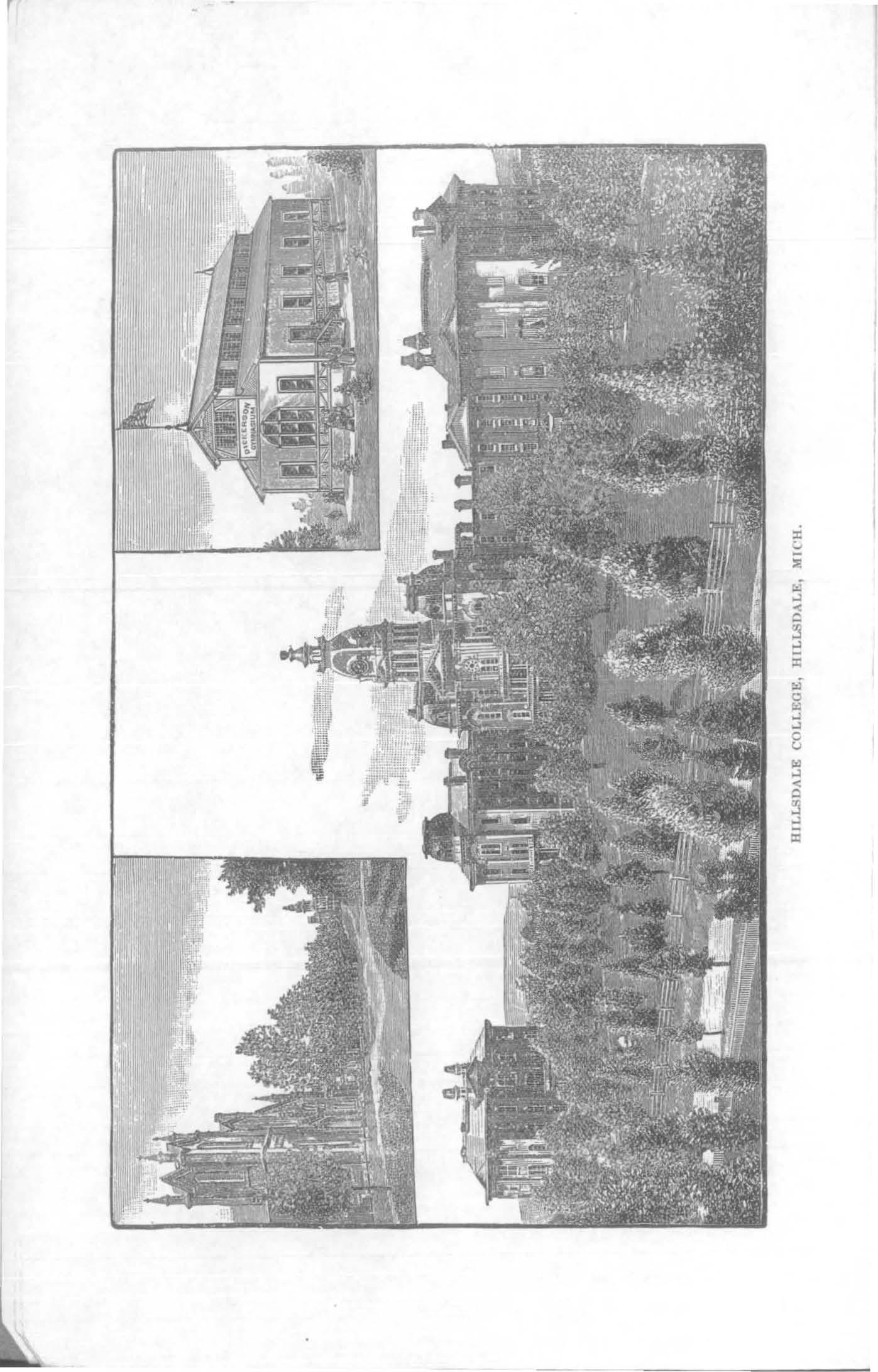
"Beautiful for situation" is Hillsdale College, standing on an eminence commanding a view of the surrounding country, crowning with its six fine buildings the loveliest hill of the many (for Hillsdale is rightly named) encircling the city. The twenty-five acres of the campus, afford ample room for fine groves, tennis-courts and athletic grounds, while, in the winter, the base ball grounds are converted into a skating park, where student and professor meet in that most delightful recreation. A beautiful fountain, the gift of one enthusiastic class, adds much to the beauty of the campus, as does also a fine piece of
ARROW.
bronze statuary e rected in ' 95 by the A. K. P. Socie t y in memory of their soldier brothers.
With this brief glance at its surroundings we com e to the institution itself , which began its existence. as Hillsdale College, in 1856, at which time it was removed to Hillsdale from Spring Arbor , having existed there under the name of the Michigan Central College. It was established b y the Free Baptist denomination, under whose control it still reo mains. The College embraces five departments, viz.: the Academic. Theological, Music, Art and Elocution. The instruction in each is most thorough, the professors being up·to·date men and women who bring to their work enthu· siasm, efficiency and consecration.
A prominent feature of the College is the five literary societies, each of which has a fine hall with suitable ap· pointments. These societies, which are sustained entirely by the students, hold weekly public meetings, also annual literary contests, and anniversaries, all of WhICh are a source of much pleasure and profit to the members. Some years ago these societies united in an effort to bring to Hillsdale some first· class entertainments. The result was "The Students' Lecture Course. " one of the best, if not the best lecture course, in southern Michigan.
A deeply religious sentiment has ever characterized the institution and but few have gone out from its influence without yielding their lives to divine guidance. The Y. W. and the Y. M. C. A, are potent factors for good, the members being thoroughly alive to the grand opportunities for christian work given them. The missionary spirit has aJso been remarkably active in the college, over forty of its students having been engaged in missionary work. Africa, China, India, Jamaica and the colored schools of the south have been their chosen fields.
It can hardly be expected that in a co·educational insti· tution the social element would be ignored. Receptions and sociaJs are of common occurrence, the President ' s home especially, being a sort of social center where each
Y'HE ARROW.
term the students meet at many pleasant receptions. Another pleasant feature of the college is the Quinquennial Reunion of the Alumni and literary societies to which large numbers of old time students return to greet again their Alma Mater and renew the friendships formed in the school days of Auld Lang Syne. Hillsdale College points with pride to her Alumni-a noble band of sons and daughters 850 strong, who in their respective callings are doing effective work. ., Hillsdale College has been a pioneer in the :educational reforms of the age. From the first it has given the same advantages to the colored race as to the white. It was the first college in the state to admit young women to the rights and privileges enjoyed by young men. It was the first in the state to establish a gymnasium for physical culture. It was also the first college in Michigan having a theological department conferring degrees. The work of the college in instilling the true scholarly spirit into its students is well shown by the number of those who after graduation take post· graduate courses in the various professions. "
The Greeks are represented in Hillsdale College by three fraternities, Alpha Tau Omega, Delta Tau Delta and Phi Delta Theta, and by two Sororities, Kappa Kappa Gamma. and our own chapter. But one family of Greeks is housed. Alpha Tau Omega controlling a prettily furnished and roomy house near the college. Michigan Alpha of Pi Beta Phi was established in '87 with seven charter members, among whom was Mrs. May Copeland Reynolds, always prominent in fraternity work. Among our initiates of '90 we find enrolled the name of Florence P. Chase. Grand Secretary, and Vice-President of the Alumnae Council. The chapter here has been a most earnest and faithful one in its endeavor to. honor II B cp and while we have never had large chapter memberships, (believing that true Fraternity aims can be best fostered among a few congenial spirits), we· have striven to make our membership represent the best. in our college life. MICHIGAN ALPHA.
college woman! How the name would have startled \" our grandmothers! Yes, even our mothers might have cried out, "What sort of nondescript, hybrid, unwomanly and yet not manly creature may that be!"
But the college woman has now become a delightful reality, along with all the other new and marvelous things of this end of the century; and we find she is no strange monster, but simply our own bright, loyal, loving, most beloved daughter, sister, sweetheart. Yes, here she is, and we rejoice in her; in her brightness; in her truly American ability to grasp the situation. We wouldn't part with ber now if we could, and- to be quite frank-we couldn't if we would!
Yet, we loved the dear old-fashioned girl, too, so well, that we cannot, must not, lose her either, and how to combine the two seems sometimes a problem. The dear oldfashioned girl, who was not so very much wiser than her mother, who had not outgrown an old-time habit of reverence, who did not use slang, who studied her Latin at home and only entered college halls to shyly rejoice over her brother when he carried off the honors - honors it could never enter her mind she would one day stand there to receive.
And now the whirlwind of success that attends the college woman almost sweeps away our breath, and can we wonder if young heads are sometimes made giddy by itwhich is only to say that sudden elevation into a new atmosphere often makes the head light, and self'poise is lost.
Now this freedom that comes to college girls can only become a blessing as it is accepted with a recognition of added responsibility. True, it gives one the use of all tools with which to carve out beautiful characters, but often they are two-edged, and seized rashly or handled carelessly they mar and deface the symmetry of the work.
To a,Ccept freedom and refuse responsibility would be rke divorcing left hand from right, or brain from heart. ';he attempt to do so would indicate ignorance and must end in lawlessness and anarchy. Only the,ignorant and untrained mind can imagine the one without the other. That poor oppressed race of the South are learning through bitter struggles that when freedom released them from bondage, responsibility became their task master.
We often complain because the poor foreigner who comes to our happy land, in his eagerness for freedom, carries himself too aggressively, and so proves his ignorant mind by the constant assertion of equality .
This is in some measure the danger that threatens college girls; a danger of asserting their freedom too loudly; of feeling that to become equal to their brothers they must be like them. There is danger in the life of so many young people together, in the loss of the family relations during these most impressionable years. "Keep near to the seller of perfumes if you would be fragrant," is a wise old proverb of the Arabs, and what can take the place of the constant, unconscious restraint of life in the family circle, whose infiuence as surely and silently enters into life and development as sunshine into the plants, and which again exhales from the whole being as sweet and intangible a something as the perfume from a fiower ?
This is no plea. for the dainty miss, who screams at a mouse and would rather be helpless and "interesting" than go to college. Her species is almost extinct and we do not regret her.
All honor to the bicycle girl, who studies a road map and knows how to use a monkey wrench or mend her .. punctuated" tire. But character to be beautiful must be symmetrical, and life is made up of little things, and this is a plea for just these little things, that the girl in her eagerness and earnestness for college, and amid the intoxication and freedom of her new life may forget. "Little things
we call them, and yet we know that in building, the slightest variation at first froIJ;l the plumb line, makes all the difference between a symmetrical and an unsymmetrical, II> safe and an unsafe, edifice.
And yet infinitely more precious than any edifice is the character of which each one of us is the architect, and "our strength is measured by our plastic power." From . the same materials one man builds palaces, another hovels. Bricks and mortar are but bricks and mortar until the architect can make them something else; thus it is that in the same family, one man rears a stately edifice, while another lives all his life amid ruins.
There is always danger in new conditions. In a new' civilization, onl.r the necessities of life are first striven for, so in this new life, so freely opened to women, there is fear that what seem the supreme needs - the intellectualshall be sought, to the exclusion of the spiritual graces and those refinements that all ages have united to honor as womanly; without which there can be no true culture, and education becomes a very one sided affair_ It would be most unfortunate shoUld we lose sight of this truth now, when the beauty of life is emphasized as never before. Never were there such possibilities as now. We are thinking more of what we shall be than of what we shall do; more of forming noble character than of formulating creeds.
We are learning that it makes little difference what we profess to be. " Don't say things," said a wise man. "W hat you are, stands over you all the while and thunders so that I cannot hear to the contrary."
Only to see the danger and to feel the inevitable responsibilit;v-this is all our bdght young college-woman needs. The tree grows by adding each year a ring, building its new growth constantly upon the old; and when the young woman enters with reverent spirit these "fresh woods and pastures new," determined to build these new opportunities upon the old culture, then we shall hear no more of "Daisy
Miller," either in life or literature , but she will become in truth that rare and radiant queen of life we fondly term the American girl.
HONTAS PEABODY DANIELLS, Patr onC8! of lVtsconsin Alp ha.
mos'r of the girls who will read this article are either struggling through an over crowded curriculum or have taken up the more responsible work of raising the standard of culture and morals in some community through the leaven of their lives as teachers, physicians, librarians or home· makers. I realize keenly what this means in curtailed reading privileges, especially for the college girl. For this reason I shall interpret the word "new" to mean anything published ,within the past year, and a few within the last three years. The list will include not those necessarily most talked about, but those which are worthy to stand as permanent types of good literature in years to come,-whose thoughts and dress, like the life and words of a broad· souled friend, unconsciously mould our ideals day by day after their own breadth and freedom.
The titles have been selected from the tentative supplement to the A. L. A. catalogue under advisement by a · special committee of the American Library Association. The selection includes nothing which I have not read and cannot speak of from personal knowledge. Doubtless a wholly different list could be made up equally valuable and worthy, but these I know to be worth reading,-books whose authors are likely to grow better with longer association.
Next to knowing a man in person, the richest experience is to know him from his letters, a style of biography hap· pily coming more into favor. One of the very best of recent outputs is that of Mat.thew Arnold ' s Letters, a two-
volume collection covering the last forty years of his life, compiled from familiar letters to members of his family. The earlier letters are rather monotonous, but the later are all that could be desired as sidelights upon the manifold public activities and the beautiful, gentle spirit in the home life of this apostle of sweetness and light.
Stevenson's 'Vailima Letters' written to Sidney Colvin from the Samoan home need no words of introduction to those who have read his' Amateur Emigrant' and' David Balfour.' Stevenson was one of the few letter·writers who could reveal himself and his work without a suggestion of egotism,- a characteristic which to me makes him more interesting as a letter·writer than Arnold.
If one would know the source of much of that calm sanity, that abiding quiet strength of clear intellect and high principles, that gr ,acious yet unswerving demand for purity in American letters and politics from 1855 to 1895, let him read Cary's life of George William Curtis, pub· lished as one of the series of American men of letters. But first let him read one or two of Curtis' 'Easy Chair' series and some selections from his 'Orations and Speeches,' notably his address on • The Duty of the American SCNoiar to Politics and the Times,' and his addresses as president of the Civil Service Reform League. William Winter's eulogy on Curtis is one of the examples in American literature of a finely appreciative analysis of a singularly beautiful, gracious and noble character.
I need but mention the two volume collection of O. W. Holmes' Letters, edited by J. T. Morse, Jr., to bespeak the desire to read them.
The Letters of G. J. Romanes are the best history needed to give one a grasp upon the radical change in the world ' s thought effected by the doctrines of evolution. They are -equally interesting in their revelation of that poetic imago ination and tenderness of affection which never failed him in the long struggle of soul through the search for truth.
Closely:allied to the interest in single lives is that one feels for the associated lives of humanity expressed in their social)tructure. The belief in altruism as the basic principle development is set forth in Drummond's 'Ascent of Man.' The relation of the Roman Catholic Church to socialistic movements is described by Prof. Nitti in his 'Catholic Socialism' with remarkable breadth, fairness and scholarly ability. The modern tendency toward democracy, with government by the many instead of by the best, its advantages and inherent dangers, is most clearly and forcibly discussed by Lecky in 'Democracy and Liberty,' one of the very few books which will survive a.s a classic in political science. Probably the very best thing yet written for popular education on the all important sub· ject of city control consists of Albert Shaw's two books, 'Municipal Government in Continental Europe' and' Municipal Government in Great Britain.' The publications of the last year in popular economics have been of a high order, but mention of anything more than the foregoing types would be out of place here.
The tendency to study social problems has colored all the more pretentious works of travel of late years and the newer books show no decrease in that symptom. Perhaps the most striking and able examples are Norman's 'Peoples and Politics of the far East' and Curzon's 'Problems of the far East,' both written by men whose opportunities for diplomatic study have been unusually rare. A charming companion book which pictures the inner little-known life of the common people of Japan is Lefcadio Hearn's 'Glimpses of Unfamiliar Japan,' with his later work 'Kokoro. ' One may forgive him the lack of judicial spirit because of his revelations of life among the lower classes
A very pleasing change from the weightier element in travel is always found in Richard Harding Davis' sketches, notably' About Paris' and' Our English Cousins.' He bas a happy faculty of touching upon the salient feature of a
ARROW.
national character in a clever. racy style which is always refreshing, provided one is able to counteract the unpleas · ant residuum of egotism and snobbishness. The latter elements have no play in his fiction, which form in consequence some of the most charming of recent American work of a passing nature. 'Princess Alene ' is particularly good in its portrayal of the elevating type of American character.
What Davis has done for foreign travel, Julian Ralph and Frederic Remington are doing for various sections of .Qur own country, the former in 'Dixie' and 'Our Great West,' the latter in 'Pony Tracks.'
A class of books on the borderland between travel and natural history finds most beautiful expression in John Muir's' Mountains of Oalifornia' and Bradford Torrey's • Spring Notes in Tennessee.' To those of us prairie folk who may travel in mind only, Muir's work is next best to reality; every page speaks of the fascinating wonders and beauties of the Sierras and their wild life, with the scientific accuracy and unconscious eloquence that comes only with years of her.mitage in their remote valleys and heights. The book brings that sense of restfulness which comes into lives that lose their smaller selves in the larger life found only at the heart of nature.
The transition is natural from Muir to Oharles O. Abbott and John Burroughs, neither happier than in 'Notes of the Night' by the one and 'Riverby' by the other. To these must be added Henry Van Dyke ' s' Little Rivers.'
To you who have not yet formed his acquaintance, let me convince you of such loss that you will at once make every effort to cultivate the knowledge of one of the very best of our later American essayists and critics, Hamilton W. Mabie. His' Essays on Nature and Oulture' collected largely from unsigned contributions to 'The Outlook,' are models of simple, concise, and pure style. But above any considerations of literary form, their subject matter strikes so straight to the heart of things, with such quiet
force and clear, direct precision and sympathy that the everyday walks and duties of life seem illuminated thereby and set into dignified , beautiful and rational relations with the other work in the world.
The lovers of Eugene Field (may their tribe increase) will hail with joy and many hoarded savings the Thistle Edition of his complete works to be issued soon from the De Vinne press. III the realm of American poetry the best issues of the past year are R. W. Gilder ' s' Fi ve Books of Song ' and Celia Thaxter's 'Stories and Poems for Chilo dren.'
The world of dumb life has never had more able, elo· quent or sympathetic interpreters for the popular ear than during the two years past. Plant life speaks through Mrs. Dana's 'How Plants Grow' and W. H. Gibson's 'Our Edible 'l'oadstools.' Scudder's' Frail Children of the Air' is an intensely interesting and thoroughly scientific popu· lar treatise on the habits of butterflies Birdcraft has added to its already voluminous literature by popular works from Mrs. Miller, M O. Wright, Frank Bolles, C. C. Abbott, Chapman and others.
In fine arts the best contributions in America have been from J. C. Van Dyke, notably his' Old Dutch and Flemish Masters,' a series of critical essays to accompany T. Cole's engravings which came out in the Century Magazine duro ing 1893-94.
The reading of history is controlled so largely by one's special taste or local surroundings that I have included only two authors as equally desirable for all. Grace King's , New Orleans' should be set upon a pinnacle as a charm· ing example of how history may be told by a graceful, facile and well·poised writer. Mrs. Latimer's works on 19th century history, while in no sense anything more than clever compilations, are nevertheless wisely gotten up, and put into compact and very readable form a vast amount of information upon the national policies and
movements which have shaped the world 's history during the present century in Europe and Africa.
More or less running acquaintance with fiction is main· tained through the leading magazines, but I should be loth to recommend even the half which appears there as worth reading. Much of it is clever no doubt, written in good English and passable as works of literary composition; but unmistakably written to sell and saturated with the pseudo· art of ultra realism and pessimism. From the enormous flood of stuff good, bad and indifferent, I have picked out a few stories which personal reading warrants me in recommending as thoroughly sane and normal, sweetly healthful, vigorous and withal with a fine flavor of humor which, like the salt of the earth, leaves a clean taste in the mouth.
James Lane Allen's 'Kentucky Cardinal' and its sequel 'Aftermath' are real gems. But his most recent work is disappointing; the beautiful delicacy of sentiment running through his works has been prostituted to unworthy ideals.
Jane Barlow's 'Irish Idylls ' and its second series 'Strangers at Lisconnel' are doing for Ireland in a very superior manner what Watson is doing for Scotland.
Howell's 'Traveler in Altruria' is well worth reading as embodying the latest convictions of several years' earnest thought on the social problem from our most representa.tive American novelist. By the way, you will find a most able, keen and just criticism of Howell's literary art in J. M. Robertson's 'Essays toward a Critical Method.'
Kipling's Jungle books need no word sa.id for them. They speak for themselves as classics of the future.
S. Weir Mitchell's 'When all the Woods are Green' will always take rank in my affections beside 'Prue and I,' not because of any inherent similarity in the books, but in the beautifully educating effect of both upon my feelings and tastes.
F. Hopkinson Smith's 'Gentleman Vagabond' and 'Tom
Groga.n' will be no disappointment to those who found such serene delight in 'Colonel Carter.'
Octave Thanet's 'Stories of a Western Town' are quite as true to western life and much less one·sided than Hamlin Garland's sketches have been.
Watson's 'Kate Carnegie' just completed as a seria.l in The Outlook and The Bookman promises to be the best of his studies of Scotch life. The reaction against the unhealthy realism in fiction seem3 very promising indeed when booksellers and librarians report one of the most popular books of the past season to be Watson's • Beside the Bonnie Brier Bush', in which there is not a shadow of romance and every page is dialect.
Let us join hands to help on the good work.
ESTHER
CRAWFoRD-lao r., A. A. Dayton, Ohio.
n ALIFORNIA Alpha we requested to send a letter to Reunion giving details of their chapter house management, finances, life, etc. They complied with a report so thoroughly enjoyable we give it to the whole fraternity, hoping any chapter debating the house question, .. Seeing may take heart again. "
THE CHAPTER HOUSE.
Perhaps there is no stronger factor than the chapter house for making the fraternity interesting to the college community and a power unto itself.
After one year's experience in co·operative house-keep. ing are we wise enough to speak oracularly on the subject? Perhaps so, for we are not so firmly established that we have forgotten the hard things - the mistakes, and the ways out of them.
Our chapter house is a mile from the University quad. rangle, in a grove of pine trees. It is a square, old·fashAB:aow 2.
ioned, well built house. We call it ours though we merely rent it. When we build, we shall be nearer the campus.
We pay thirty dollars a month for our unfurnished house. For convenience, however, we pay the entire year's rent during the nine months of the school year, making forty dollars a month during those nine months. We are especially fourtunate in having one of our girls living near_ Her mother gladly became our cbaperone and brought much of her furniture and one of the girls furnished her own room, besides bringing a piano and book-cases.
So with much management, by hook and crook we furnished our rooms, bought a stove and kitchen utensils and a carpet or two.
We have hired two servants - Japanese both of them. One, our cook, received twenty-five dollars a month. The other, a Jap student in the University, waited upon the table at breakfast and dinner, gave us an hour at morning and evening cleaning t and all day Saturday. He received ten dollars a month, and roomed elsewhere.
. Our whole expense a month amounted to twenty dollars a piece. There were ten of us during most of the year. Perhaps you think we could do this because we live in California. Coal, however, is the only difference that makes. Our coal bill from November to April averaged fifteen dollars a month. Vegetables and fruits the year around are extremely cheap, but meat is expensive.
Our chaperone had nothing whatever to do with our domestic management. This was in the hands of two different girls each month. One, the house president, ordered the meals, kept the table and table linen, saw that the house was kept in order and that the expenses were not running too high.
The house treasurer collected the money from each of us, gave receipts for everything, paid our house bills and kept the account books carefully.
Perhaps it is a good plan to appoint one girl house
ARROW. 19 manager for the year, letting her receive pay for it, although we have not tried it. We have not had a member who desired to undertake it, nor one who did not wish to try it for a short tIme.
Several of the men's fraternities have tried the plan; sometimes, when the manager was a good one, they made money; sometimes, when he was careless, debts a{lcumulated.
By our plan there was a. complete settling at the end of each month before affairs went into another girl's hands, and each girl vied with her predecessors to make her month best at the least expense.
One month when we had to buy a stove and furnish a room for our cook it seemed a large debt would be upon us. But we put our best housekeeper in charge, and by rigid watchfulness that all needless lamps were extinguished, all fires put out when useless, that salads were made without olive oil, etc., our expenses died down again. That girl has won for herself lasting renown, as great indeed as that of the charter members.
When we invite individual guests we report to the house president and pay fifteen cents. This extra money furnishes a little nicer dessert when several come at once.
There was one occasion when our cook was very unruly, and had to be dismissed with great dignity. Once a fire broke out in one of the rooms and all our Fiji neighbors had to come to our rescue. But these things passed away and we can laugh at them now.
Our chapter house is a home for us. Here we throw off the burden of work and worry. Here we have our monthly .. At Homes," and an occasional party. Here on Saturday morning we hold our meetings and the girls who live elsewhere stay here and have luncheon with us. Here we entertain our friends. Our pa.rents can visit us here, and the professors and wives can be entertained at dinner.
There is ODe danger to consider. I! many of the girls
ARROW.
leave at the end of one term, it may be difficult to manage the house with only a few at the beginning of the next term. Although a. few enthusiastic Pi Phis may build up the chapter, the home can not be kept out of debt with less than eight girls, and in a college where a pledge exists not to initiate or pledge girls for six weeks, the first two months are ha.rd for the inmates of the house.
Still a chapter house is not an impossibility; it is a necessity, in fact, for very many chapters. We would not like to think of chapter life without one.
HELEN WILLIAMS, Oal'l/ornia A l pha.
This question, I take it, a.nticipates that in the different chapters of our fraternity there may be two tendencies at Howlarshould work which will give direction to the choice of social qualities . be consIdered new members. One of these 1S the tendency to when selecting new members? let the social element as a qualification outweigh the studious element, and the other is the tendency to reverse this order.
Now there is necessarily so wide a difference between the "personnel" of different chapters, and indeed between that of the same chapters in successive years that the question of how much weight should be given to social qualifications in new members can be answered only relatively.
We have always taken a pardonable pride in the standard of scholarship our fraternity has established for itself, and this high standard it is not our purpose to lower, but neither is it our purpose to maintain it at the expense of the social side of our development. The studious and the social side of our development we consider of equal importance one with the other; in the world of books and the world of our fellow creatures we desire to hold equal
shares, and we would not cultivate one to a hindrance or even to a slight impediment of our progress in the other. To be well-rounded as individuals, as chapters, and as a national body is our aim. This is the goal of each of our chapters, but each cannot attain to it by pursuing the same course. It is in the mapping out of the courses of the several chapters that prudence and a discriminating judgment can secure the happiest results.
At the beginning of each year, then, let the commanding officer of the chapter hold an inspection to ascertain in what condition the exodus of the late commencement has left the ranks. If it is found that those are in the majority who have been students first of all and socially inclined only at the earnest solicitations of a less scholarly sister, then it may be the policy of the chapter-and advisedly so - to allow in its new members a greater latitude in a liking for things purely social. With this element in the new members the more sluggishly-social member, if this is a pardonable term, will find herself impelled to take a new interest in the world outside her books. On the other hand, the new member will find a most helpful example in her older sister's studiousness, which will furnish the requisite equipoise to her natural inclinations. The benefits of such a course will not only accrue to the members of the chapter, but will help to make appreciated the importance of the chapter as a factor of college life. If on the contrary, the inspection reveals a condition the reverse of the foregoing, it is of course necessary to exercise equal judgment in adjusting the balance between the two tendencies.
Pi Beta Phi ' s course, then, should strive to preserve a happy mean. The chapter should hesitate to invite to membership the girl who cares too exclusively for her books to be attracted by the living issues of her fellows, and should avoid equally the girl in whose eyes social prominence is more to be desired than recognized merit illL
THE ARRO W
the class room. In surveying the fi e ld of po s sible memo bers, that chapter will be the wisest, which, other things being equal in the condition of the chapter, gi v es equal consideration to the studious and the social qualifications in the candidates, and which selects those who are broad enough to sacrifice neither factor to th e o t her, but rather to .. maintain th e m on a parity ."
L U CINDA M. SMITH, I("anlJ A. , A A.
The question of social qualifications as a necessary quality for membership in our fraternity confronts us to day Social quallll· and demands our consideration. It is with cations for membership. pardonable pride that we claim that Pi Beta Phi holds a high standard of scholarship before the Greek world,-- her reputation is one for earnestness and sinceI" ity. But there is a danger possibly that by much emphasis of this important and too often neglected phase of fraternity life, we may drift into becoming purely scholarly and intellectual, neglecting the heart culture for that of the head.
Someone has said that the saddest epithet which a man can have attached to his name is that of scholar, and understanding this in its deepest significance we find much truth. He who buries himself in books instead of living heart to heart with people, absorbed in dead facts rather than warm realities, who lives entirely in the past and knows nothing of the active, throbbing world around him, inevitably draws into his shell, shutting out all the sweet influence gained from association with his kind, grows exclusive, selfish, dead. The man who is most successful in the world, who most affects the conditions around him, is he who comes sympathetically in touch with the most people,-and sympathy is the outgrowth of common experience and mutual interests.
So, underlying this limited fraternity que-stion is a larger, deeper one of life. The lasting popularity of a college chapter in the little world bound in by the wans of the university, shows characteristics which are going to make those members influential factors in the larger world out· side; so we rightly wish to be popular-not from any sel· fish, superficial reason, but because it means that we are cultivating those powers which will most surely aid us in becoming the helpful, the ennobling, the lovable woman which it is the ideal of our fraternity to send forth.
Very often we take into membership girls of high intellectual abilities but reserved and unattractive, thinking that under the influence and through the expressed desire of the chapter they will develope the social side of their nature. It is quite as justifiable and advisable to invite girls to membership who art! open·hearted, attractive and a success socially (although never lowering our requirement of a high moral character) and trust to inspire in them more earnestness and more studiousness.
Of course it would be ideal to always find the golden mean, but very often the development of one side of our character is at the expense of the other. I would not part with the reputation of high scholarship which as a fraternity we have gained and of which, as I have said, we may be justly proud. But I very earnestly wish to have it realized that social powers are not an exterior, superficial accomplishment-probably good "for the sake of the frat" to attain- but one of the fundamental qualities which will make our lives larger, our influence over the lives of others more potent, more far-reaching ; that it is one beautiful part of the great stupendous whole of a perfectly rounded life, and that its cultiva,tion shows our recognition of our love for our fellow· men and our indebtedness to God.
EMMA S. HUTCHINSON, Pa. A., A. A.
ARROW.
Our girls should consider more carefully the value of chapter letters in their active fraternity life. Not only are A note on they the means of binding Chapter to Chapter, chapter correspondence. and the Fratermty as a whole, but It IS a. happy social feature which will prove of lasting value. But put· ting aside the selfish feature of Ohapter letters it is a duty undertaken, and as such, should be promptly, cheerfully and correctly performed. Do not leave your letters until the end of you time, or until you have more leisure, or a desire to write them, but begin now and with method you will soon find your letters written and the much sought for replies coming back to you. Remember that duty reluctantly performed at the last minute will not carry with it the same welcome and cheer, and above all things avoid excuses. For the ARROW letter it is a wise plan to jot down an event you intend noting shortly after it occurs while it is fresh in mind, and when the time comes for your manuscript to be sent to the editor, copy in regular form. The extra work will repay you and add to the pleasure of your readers. An ARROW letter should be too important in the estimation of every correspondent to receive careless, thoughtless, hurried attention.
E. A. H.
€ngllsb for £bapttr StudV.
Whatever else a student may learn at college, she is expected by her friends at home to have learned to use correctly her mother-tongue. When she returns with the same old errors in her speech, people at once feel that something is wrong with the college. So long, however has the college failed to do its duty in this respect, that we have almost ceased to hope for a student's improvement in English; and we helplessly feel that the training of her childhood and the early provincialisms must always
a.bide with her. But let us raise an energetic protest on this point. Although no training is so lasting as that reo ceived in the early years at home, it is possible by unremitting effort and attention, to rid our speech of all error and local coloring, and to use the English language in a.ll its purity and bea.uty.
The two essentials to this most desirable end are the ones just mentioned - unremitting effort and attention. First on the part of the student herself; second on the part of every teacher and instructor, whatever his department may be. The professor of English has the greatest opportunity, but a correction of one's English by the professor of mathe· matics, of physics, or of Latin, will never be forgotten. Teachers should remember that they not only teach subjects, but men and women who may accomplish much in the world some day. These should not be handicapped in their greatest means of intercourse with their fellow·men. A. teacher should see to it, first of all, that his own English is pure and correct. In the next place, an error, whether his own or a students. should never be passed over in si· lence. I remember with gratitude an English professor who found it necessary in her class to explain the error in "he don't," and who one day interrupted a student who had begun, "Well, Chaucer:wrote -" by saying, "I prefer to say 'well' when you ;have finished." And another professor of mathematics I remember for her fearless correction of all mistakes, whether in geometry or trigonometry, in speech or in manners. And another teacher of English I remember with a smile and a touch of contempt, who used to say-" Now girls, do not go without you have permission" She opened to us wide fields in English literature, but the paths of practical English by which she led us were anything but smooth.
But after all, purity of speech is emphatically a matter of self-culture. Unless the student is alive to the importance of using pure English, all corrections will either be entirely
disregarded, or received with indifference and even vexation. The student must keep her English in mind. She must be eager and anxious for corrections from any source whatever. When this attitude on her part is known, help will come in many an unexpected way.
But corrections from others is not the only source of improvement. In intercourse with others, both the critical and the imitative faculty must be on the alert. On the one hand we must learn to detect and avoid the errors of others - on the other, let us imitate freely and gladly what we know to be correct. To imitate the errors of speech of some one we may chance to admire is as foolish as to reo fuse to adopt the correct expression of an individual through a week or stubborn fear of imitation. Let us be careful not toO take up the .. idear " of the New Englander, because we admire his more correct use of English.
But not only in intercourse with others must these two faculties be used. In our reading they are equally import· ant. Not everyone who comes into print, comes clothed -in white array. We must learn here, too, to detect errors as well as excellencies. I remember once in reading over a list of "errors and corrections" to have found this puz· zling sentence, "A gang-plank was left down in the middle of the room." Needless to say tbe writer was a Pennsylvanian. Yet a Pennsylvanian might well be amused by our Hoosier expression, .. I didn't get to go. "
It is well in reading to observe the use of some word or expression which we have found truuo1esome, and to adopt its use by classic writers as our own. And let us not neglect the constant reference to a standard dictionary for the settlement of all questionable points.
The use of slang has probably more to do with our limited vocabularies than anyone thing else. The slang term or adjective of the day is an easy and a lazy way of saying what we wish, without the trouble of putting it into exact ,or eloquent English. It would often puzzle the uninitiated
to know what we mean, and we ourselves would sometimes be amused if our words were taken literally. Although Brander Matthews has given an odor of reo spectability to slang by calling it "the virile stock from which our language is refreshed," it is well to apply Pope ' s ad vice to words as to dress:
" Be not the first by whom the new are tried, Nor yet the last to lay the old aside."
There is then no reason why our college graduates, through care upon the part of their teachers, by constant vigilance on their own part, and by avoiding the use of slang, may not speak a pure and accurate English, which would be a delight to all their hearers.
ELIZA.BETH C. EDDEHMAN.-Ind. A., A. A.
The old Romans showed great wisdom upon many $UU,jects, so great in fact that often we of the present day can do no beUer than agree with them in spite of oill' much boasted progress. For certain intangible yet powerful forces are unaffected by any of the marvelous discoveries in the fields of mechanics. Was it not Pliny who said of the education of children that "It is of the greatest importance what slaves be entrusted with the care of them while young, so that they may acquire an accurate and pleasing manner of speech." This is sadly true, for many an educated and cultivated person has lamented the unconscious habits of childhood to which one involuntarily returns in moments of excitement, enthusiasm or embarrassment. I hear the tiny children of my friends say "rogging share" and "flo'" with the purest Swede or African accent, and marvel that their attentive mothers should not realize the danger. Those whose children attend the public schools in certain districts run a danger only second to that of illiterate nurses. O'est Ie p1'emier pas qui coute.
ETHEL B. ALLEN.-Kans. A., A. A.
In what way can we as a Fraternity create a desire for aknowledge of good English, and a determination to acquire it?
The growing carelessness in the use of English is to be deplored, and we are, to a certain extent, responsible. Then let us hasten to mend our ways.
But how? This question was quite thoroughly discussed at our recent Reunion and left for further consideration.
Much of the English is arbitrary; much is usage. First, then, let us learn the fundamental rules of English Grammar, and afterward follow them in our daily speech.
Of the several methods which have suggested themselves to me, the most practical for our active Chapters seems to be the formation of a protective league in each against carelessness in the use of language. This would only dema.nd of the busy college girl care in speaking.
As in our families we desire the best for each, so it is in our chapters, and if we form a league in which each one ' shall be under obligation not only to watch her own speech, but kindly to correct a slip in another, we have instituted a reform which will be limitless in its influence ' and of untold value to ourselves.
Much may be reasoned from the use-much acquired from translations from other tongues. Those of us who .do not care for Greek and Latin, are studying some one or more of the modern languages, and if we translate each sentence into the best English possible, we are constantly adding to our knowledge of English.
There is, then, no valid excuse for us. It is our duty as well as pleasure to speak good English.
It is said that Daniel Webster obtained his large vocabulary by patient study of the dictionary. Three words daily were carefully learned, and then he sought early opportunity to use them.
Horace tells us that "Use is the law of language;" then will not our active chapters take up the question at the ·commencement of this college year, and, if no better plan be offered, form a league?
If we live up to the high plane of our motto, we shall desire to be "daughters polished after the similitude of a palace." This is to be not only learned in book·lore but also polished in speech.
It is easy to speak stirring words on grand subjects, but who shall be eloquent on a commonplace topic! Yet there are some commonplace subjects- such as a reform in spelling and English - upon which much eloquence is needed, else there be some among us who will "die in our sins.
It seems almost impossible that college bred girls should commit such atrocities of spelling and grammar as appear in chapter letters and fraternity correspondence. Yet this feeling is by no means peculiar to our fraternity, as many an editorial wail bears witness. Just how wide· spread it is, we can see from the following clipping from a late magazine:
"What young American children acquire al ways has the air of lying on the surface. * * * When one sees Vassar students writing letters that an English girl brought up by a resident governess - and never within gun-shot of the higher studies - would disdain, and Harvard professors complaining that much of the four years which should be given to those higher studies are wasted by them in teaching the elements of rhetoric and composition:to insufficiently trained youths, that fact recurs to one, and makes one pensive. "
Is it not disgraceful, and shall we not make an extra effort that the reproach may not apply to us? It may be true that correct spellers, like poets, are born and not made, yet it is possible, with infinite pains and much consulting of the dictionary to guard our written words from errors.
THE ARROW.
Have you ever thought how it hurts your chapter for your corresponding secretary to send to the editor of the ARROW or the grand officers, a letter full of bad spelling and grammatical errors? How can they help thinking you. all as ignorant and underbred?
Will you not then see to it that your secretaries make no· such blunders, or better yet, that they are girls of such thorough training in English composition that no such mistakes are possible?
Who would not shrink from being called "sister" by one who is so ignorant as to sign herself "yours fraturnally, " instead of "fraternally," as has actually occurred in the correspondence of one of our members within the last three months? It also seems to be necessary to inform some of our members that stationery (paper) is not spelled "stationary. "
But why multiply examples? Now that we have called attention to the evil let us devote ourselves to reforming it. Shall we not wage a vigorous crusade against bad spelling and poor English, and see to it that our chapter is not disgraced by its correspondence?
MARY B. REID.-Mich B., A. A.
first reunion of Indiana alumnae, II f3 <1>, occurred at \".. Indianapolis, Tuesday, September 15, 1896.
The meeting was brought about mainly through the efforts of Mrs. Lelia Kennedy Galpin, now a resident of Indianapolis, and an alumna of Michigan Beta. This was the first attempt at a reunion, and as there are but two chapters in the state, an attendance of fifteen was considered quite satisfactory.
The visitors met at Broad Ripple at one o ' clock for a luncheon and this occasion served the purpose of making acquaintance and giving an opportunity for an informal discussion of Indiana alumnae interests.
In the evening at 7 :30, Mrs. Galpin gave a delightful dinner at her home on Broadway.
After the dinner a business meeting was held, and a permanent organization effected, with Mrs. Galpin, President, Miss Fox, Treasurer, and Devona Hamlin Payne, Secretary.
A reunion will be held annually, beginning with next March, and an effort made to have the alumnae of the state well organized before that time.
" A pretty carnation dinner was gIven last night by Mrs. W. R. Galpin at her home, 618 Broadway, the guests being the members of the Pi Beta Phi fraternity, who are here attending the state reunion. The scarlet of the decorations made an effective contrast with the delicate blue in which the walls of the dinning-room are tinted. Blue candles lighted the tables. The cards at each plate were in the form of folders, the outside bearing several carnations done in water-colors; and in the center the letters" P. B. P." Miss Ona H. Payne, of Franklin was toastmistress. The toasts given were: "Our Association," Miss Herriott Palmer, of Franklin; "Our Creed." Miss SteUa Fox, of Bloomington; "Our Chapter in California," Miss Winnifred Harper, of Leland Stanford. The others present were Mrs. Alvin Neal, Miss Lizzie Payne, Miss Minnie Weil and Miss Jeffries of Franklin, Miss Hines of Jeffersonville, Miss Bertha Martin of Lebanon, Miss Kate and Miss Anna Stewart of Greensburg, Miss Pierce of Farmland, and of Indianapolis, Miss Holland, Miss Snyder, Miss McCoy and Miss Coyner. The same company took luncheon at noon yesterday at Mrs. Brenneman's, in Broad Ripple."-Indianapolis Paper.
"PI BETA PHI - First Biennial National Reunion -First Alpha Province Convention-Washington, D.O., July 9 and 10, 1896. Program -July 9th, Thursday evening; at Oolumbian University. 7-8 Informal reception. 8-9 Opening of the Reunion, the Grand President presiding. 9-10 Organization of Alpha Province Oonvention, the Province President presiding. July 10th, Friday; at Columbian University. 9 a. m. Alpha Province Convention. 12:30 p. m. Adjournment. 2 p. m. Meeting at Colum-
bian University for trip to Glen Echo. 3 p. m. Reunion at Glen Echo. 7 p. m. Dinner at the hotel of historic Cabin John's Bridge - near Glen Echo. Headquarters - Columbian University - S. E. corner of 15th and and H. streets, N. W. All meetings in the city will be held at this building. Here will be found a II. B. !P. register and some one in attend· ance to furnish information. The University building will be open daily from 9 a. m. to 8 p. m."- " From announcement circular."
THE Reunion was held as authorized by the Boston can· vention providing for such in the intervening years of national conventions. The province convention was the result of that growing, deepening desire for homogeneity in province and fraternity, for better acquaintance and con· sultation on common needs and aims.
The dates July 9 and 10 gave advantage of the Christian Endeavor rates, and nineteen visitors together, with the large representation from Col. A. active and Alumnae brought the attendance up to thirty·eight, this including seven national officers, the Grand President, Grand Secretary, Province President and Alumnae council. With one exception all the chapters of Alpha Province were repre· sented by a delegate.
Both meetings were experiments; both proved unqauli· fied successes. A fraternity convention and reunion: what magic in the very words. The charm, the delight, the en· thusiasm of it all! For us the glad time was ushered in by the coming of the Grand President and the informal reception on Thursday evening when introductions were in order, a warm greeting in every heart and every lip, nor did the interest flag for a moment until the last good·byes were said, the cars watched out of sight and waving kerchiefs lost to view.
The program was followed closely, the Grand President opening with a stirring address on "The duties of the hour in Pi Beta Phi. " While no legislation was possible, opinion found concrete form in resolution and request which will surely tell on fraternity development a.nd the coming convention.
The principa.l topics considered were as follows:
The Arrow" It must and shall be improved; " chapter work and study. archives. history, register; affiliations, chapter halls. " The Arrow" was the burning topic and unless we mistake very seriously will still be at Denver. Did notye editor hear the cheering call, feel the earnestness, catch the inspiration and take heart again? It came in no uncertain sound; Resolved, That grand council be requested to legislate requiring: contributions in addidition to chapter letters; proper names in copy to be printed; and chapters fined for submitting letters written on more than one side of the paper. " All of which means in very plain English there is a time when forbearance ceases to be a virtue, which you may have heard before.
"Once a Pi Phi - always a Pi Phi!" How it warmed the older hearts to hear the sentiment ringing clear and true from these younger girls, this on affiliations and yet the other side was not forgotten, and the privilege of choice by chapters in affiliate as well as prospective number was recognized. Far from us be the day when trouble arises from this source or legislation be necessary; rather let us cautlOn and remind, caution the affiliate to let a fine appreciation direct her course; remind the chapters of the free spirit in Pi Beta Phi.
A memorial was presented urging the chapters as such to study English or Letter writing as an art, and suggesting certain methods, though leaving chapters free to adopt others as conditions or expediency might warrant. Much discussion followed! Alumnae urged, chapters hesitated. Probably they do not rea.lize the need or appreciate their opportunity as they will in days to come; for them to relinquish cherished chapter plans and substitute something new, and be pledged to a definite, specific work - all this darkened the future perceptibly, but certain thoughts they will at least carry home and ponder, we hope. "The old methods in home, school and college have failed to secure ARnow 3.
THE ARROW.
good English, why then hesitate to try new plans. " If there be no time for new work though it be important, as all agree, why not make time by leaving undone some of the less important things over which so much time is now frittered away. As chapters, as a fraternity might we not often appropriate the prayer, "We have done those things which we ought not to have done, and left undone those things which we ought to have done."
But whatever the topic the same spirit, earnestness and desire permeated it all-the welfare of Pi Beta Phi.
Friday noon the Washington Alumnae Club added materially to Reunion comfort and pleasure by serving luncheon at the University, thus giving an additional hour for acquaintance and keeping us together for the trip to Glen Echo.
Glen Echo! What beautiful memories your name recalls. "The foot-hills of the Blue Ridge mountains hurry down to the Potomac at Glen Echo, and there pause in high plateau overlooking the long descent of the majestic river_ Bold and precipitous they drop to the murmuring edge of the waters under the shade of giant trees and luxuriant foliage.
"A ravine comes down from the northern hills, deep, wild, craggy, circuitous, and from subterranean chambers, steal voiceful rivulets to the windings of the gorge; then a. mountain brook, in music and wild laughter, tumbles over its rocky bed to the serious waters of the Potomac.
"As the glen nears the river it widens, ampitheatre-like, deepens and becomes more picturesque and formidable of crag, jutting rock and lofty trees. Here a great ampitheatre rises out of the gorge, a mountain of stone roofed over by an acre of iron '-the Glen Echo forum, capable of seating 6,000 people. We seemed but a mere handful as we met in that vast building for the last business session on Friday afternoon and a hush, a quietness took possession of us all; it may have been the beauty of the Glen, or the
vastness of the forum and a new appreciation of our own little part in so large, so serious a world, or it may have been-some thought of a last meeting. We shall not soon forget the beauty and sweetness that stole in upon us that Friday afternoon when together - with nature so beautiful about us, we found new meaning in the beautiful things of life.
That the whole fraternity might enjoy a convention at Glen Echo was, is, the hope of all attending the Reunion.
But the banquet - rather dinner - for hungrier girls would be hard to find after a day so full of convention work. Most of you must know of Cabin John's Bridge, a grand, beautiful structure, the largest single·arch span in the world, bridging tbe stream of Cabin John seven miles west of Washington. "John" for whom stream and bridge are named belongs to the mythological age, the only recorded history being here given-
.. In the year 1825 the following lines were found under a dilapidated grain-bin in an old mill located on the banks of the Cabin of John:
"John of the Cabin -a curious wightSprang out of the river one dark, stormy night; He built a warm hut in a lonely retreat, And lived many years upon fishes and meat.
When the last lone raccoon on the creek he had slain, It is said he jumped into the river again. As no name to the creek by the ancients was given, It was called" Cabin John" after John went to Heaven."
But not even such a history, such a fate could detract one whit from the evening's enjoyment- so callous do we grow, and with a rousing Ho, Hippi Hi," dinner was served. With the Grand President as toast mistress the following responses were given:
Our Visitors - Cora De L. Thomas, Colorado Alpha.
Our Hostesses-Flora A. S. Sigle, Pennsylvania Beta.
Alpha Province - Anna S. Harleton, Colorado Alpha.
A Loy al Alumna - Emma Haeper Turner, Col orad o Alpha . The Outlook - Flor enc e Putnam Ohase, Michigan Alpha. The Goat-Nan Kelton, Oolorado Alpha.
A Oooky Shine-Josephine McDowe ll, P ennsylvania Alpha.
The Babies - Olive Gilchrist, Massachusetts Alpha.
A Fraternity Presc ription-Dr. Phebe R. Norris, Colorado Alpha, and with impromptu rema.rks from all visitors and the home girls as well, the official program was ended, "Ra Ro Arrow Pi Beta Phi."
Greetings to the reunion were received from Mrs. Helmick, Mich. A., Miss Brewer. Col. A., Miss Culver, Colo. A.
The reception on Thursday evening was highly honored by a call from Dr. Whitman. president of the University, who passing through the city at that time made opportunity for paying his respects to t he fraternity represen ted among Columbian women and of which Mrs. Whitman, is a patroness. Needless to say. Dr. Whitman is phenomenally popular and justly so, and through many such beautiful little courtesies has endeared himself to all and shown how the truly great man may have time and thought for the things of life and dignify them all.
After luncheon on Friday the Reunion was photographed on the Shoreham steps by the prince of photographers, and that rare result secured a splendid group picture.
No account of these meetings would be complete without mentioning the committee of arrangements, and especially Miss Bingham, the marshal to whose skillful management and to the thoughtfulness and care of all much of reunion success may be attributed.
Vive la committee; vive la Colorado Alpha.
The year 1896 will go down in fraternity history as the Year of Reunions:
First Beta Province Convention at Chicago.
First State Reunion of Colorado.
First State Reunion of Indiana.
First Alpha Province Convention and First Biennial National Reunion at Washington.
So do we mark development.
ALUMNA, A. A.
With this issue of the ARROW definite effort for Alumnae co· operation is renewed, and we sound the call for active help in the way of contributed articles by the Alumnae. We aim to make the department not merely one of personal intelligence but one of positive help to the under-graduates, full of wise suggestions and loving advice. To this end we ask that anything which you have found strengthening and helpful to yourselves, anything which you see is a vital question in the world of women, anything socially, educationally, or spiritually helpful, which may affect the lives of your younger sisters, you will give to them through the Arrow with open hearts. The fact that the use of the ARROW as a medium will strengthen it is not one of the least benefits which will follow. Articles for the present may be sent to
EMMA S. HUTCHINSON,
Acting Alum. Ed., Chappaqua Mt. Institute, Chappaqua, New York.
:alumna: :association . CHANGES AND ADDITIONS.
Libbey, Mrs. Fannie W Monmouth. Red Wing, Minn.
Kilgore, Mrs. Emma B Monmouth Monmouth, Ill.
Hutchinson, Mrs. A. P ...................................... Monmouth .. Monmouth, Ill.
Wallace, Mrs. R. S Monmouth. Salem, Ore.
Helmick, Mrs. Eli A Mich. A.
Jamestown, R. I.
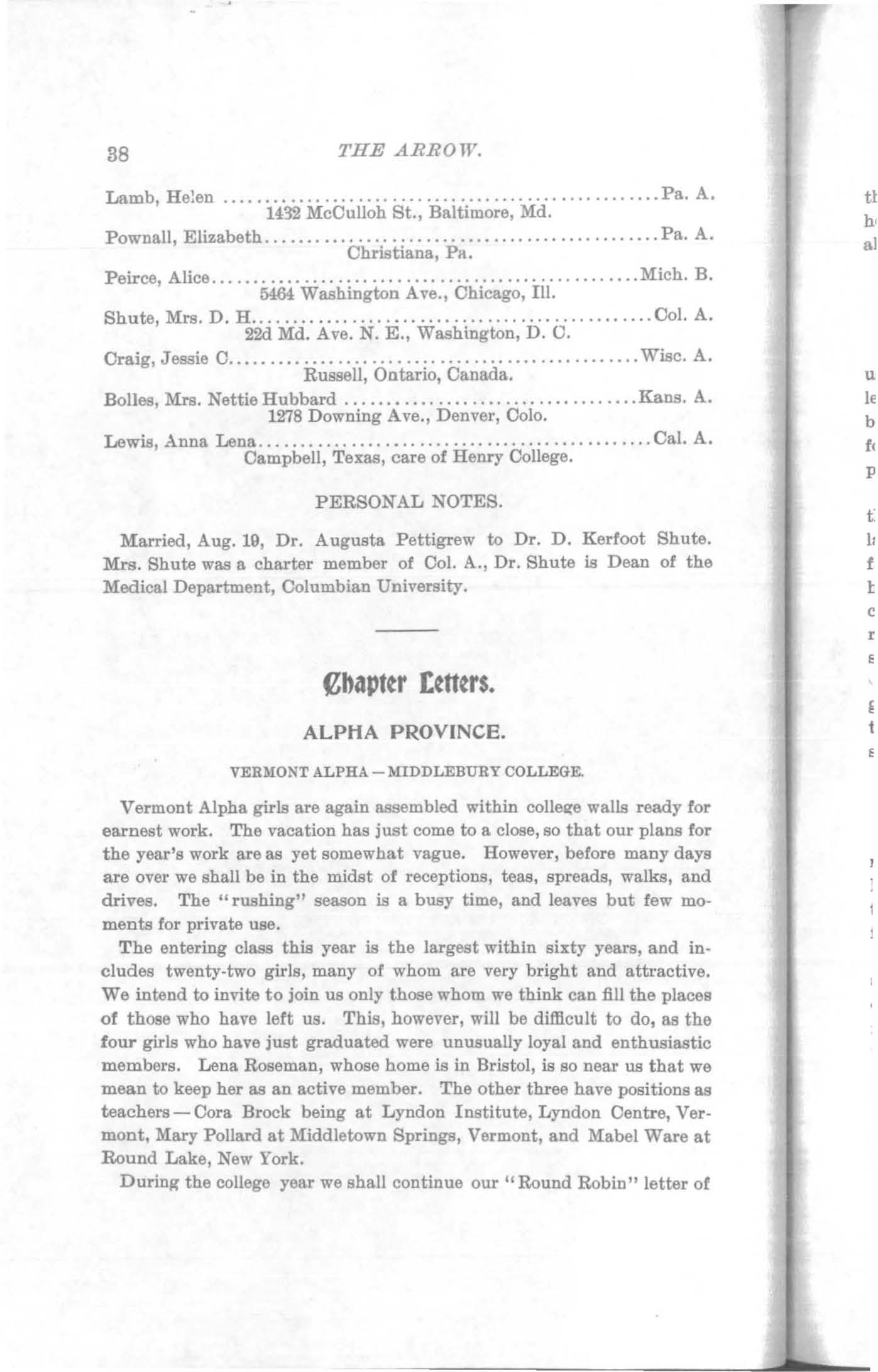
Lamb, Helen Pa. A. 1432 McCulloh St., Baltimore, Md.
Pownall, Elizabeth · .Pa. A. Christiana, Pa.
Peirce, Alice Mich. B. 5464 Washington Ave., Chicago, Ill.
Shute, Mrs. D. HOo .................................. ·· ....... ... Col. A. 22d Md. Ave. N. E., Washington, D. O.
Craig, Jessie C ................................................. Wisc. A. Russell, Ontario, Canada.
Bolles , Mrs. Nettie Hubbard ................................... Kans. A. 1278 Downing Ave., Denver, Colo.
Lewis, Anna Lena Cal. A. Campbell, Texas, care of Henry College.
Married, Aug. 19, Dr. Augusta Pettigrew to Dr. D. Kerfoot Shute. Mrs. Shute was a charter member of Col. A., Dr. Shute is Dean of the Medical Department, Columbian University.
VERMONT ALPHA - MIDDLEBURY
Vermont Alpha girls are again assembled within college walls ready for earnest work. The vacation has just come to a close, so that our plans for the year's work are as yet somewhat vague. However, before many days are over we shall be in the midst of receptions, teas, spreads, walks, and drives. The" rushing" season is a busy time, and leaves but few moments for private use.
The entering class this year is the largest within sixty years, and includes twenty-two girls, many of whom are very bright and attractive. We intend to invite to join us only those whom we think can fill the places of those who have left us. This, however, will be difficult to do, as the four girls who have just graduated were unusually loyal and enthusiastic members. Lena Roseman, whose home is in Bristol, is so neal' us that we mean to keep her as an active member. The other three have positions as teachers-Cora Brock being at Lyndon Institute, Lyndon Centre, Vermont, Mary Pollard at Middletown Springs, Vermont, and Mabel Ware at Round Lake, New York.
During the college year we shall continue our" Round Robin" letter of
the summer and shall circulate it among our alumnm. By this means we hope to keep well informed in regard to the plans of our graduates, and also to give them some idea of our movements.
HARRIET DUPRE GEROLD.
By this time, no doubt, most of our chapters have met again in their usual places and are once more dlScussmg plans and prospects for the college year. The members of Oolumbia Alpha are still scattered, as Oolumbian does not open until the thirtieth of September, when we shall be ready for the work which will be necessary for the realization of our hopes for a prosperous and happy year.
We received much encouragement and many helpful suggestions from those who attended the Province Convention and the reunion held here last July, and we intend to work upon and carry out those suggestions as far as possible. It is to be hoped that more province conventions will be held, now that a start has been made, for aside from the actual work done chapters are enabled to interchange ideas to an extent that cannot be reached by correspondence alone, and the memory of the enthusiasm which such meetings always bring out, acts as an inspiration long afterward. , Although the convention was largely attended, we should have been glad to meet a great many more. However we hope to meet you all some time, and also that an opportunity will soon come to renew the friendships so happily begun last July.
MARY S. HrNMAN.
Once again the students of Swarthmore Oollege have gathered together ready for the work of a new year. During the summer Pennsylvania.Alpha has been widely scattered, but we have learned much of ea.ch other's doings through a circulating letter, which no one was allowed to keep more than forty-eight hours.
Six alumnae and three active members attended the II. B. <fl. Reunion and the Alpha Province Oonvention in Washington on the 10th and 11th of July, and they have brought home with them fresh enthusiasm for the fraternity and inspiration for the year's wOl·k. It makes those of us who were unable to go, quite envious to hear of the delightful times which the girls had, but we hope that they can pass on tf) us what they learned by their contact with Pi Beta Phis of other chapters.
During a week in August a large number of Pennsylvania Alpha Pi Phis, both undergraduates and alumnae, were at Swarthmore and we spent some very happy times together.
Esther L. Cox '94, and Mary S. McDowell '96 , the winner of the Lucretia Mott Fellowship, will sail for England on the nineteenth of September, to study at Oxford.
There are nine of us to begin the new year's work, ready to do our best for II. B. rP. It will be delightful to be together again. We hope tb at we may hear from the other chapters frequently and learn of their trials and tribulations during the fall and of the girls whom they pledge.
A truly happy and prosperous year to you all.
SARAH BANCROFT.
Another school year has begun for US and each girl is busy with her new work. It has been a rather sorrowful coming back for our chapter because we have lost so many of our old members; Mary Wolfe '96, Flora Sigel '98, and Mary Wilson, Ex. '98, are going to Ann Arbor, while Clarissa Fowler, '99, goes to Vassar, and Alice Lillibridge, also of '99, to a Woman's Medi· cal College, in Philadelphia.
Happily, however, our feelings of regret are mingled with pleasure for if the year has taken away some of the girls we love it has brought some very desirable new ones whom every Pi Beta Phi may be pleased to call sisters .
The attendance at Bucknell is larger this year than ever before and at present there are not accommodati ons for all the new students Many im· provements have been made within the buildings and the inner room of the library is being fitted up for a girls' study greatly to the delight of the day students who wIll especially derive benefit from this arrangement.
The rushing season has begun and the fraternities are very active. II (j rP being the only woman's fraternity a(Bucknell, can be, quite deliber· ate in her choosing, but among the men ' sfraternities there is the greatest rivalry.
Pennsylvania Beta sends to all Pi Beta Phis best wishes for a pleasant and profitable school year .
GRACE SLIFER.
The fall term opens with unusually bright prospects for Ohio University. In "ur last ARROW letter the recent appropriation was mentioned, also our plans for another building.
Our new president, Dr. Crook, comes to us from Nebraska Wesleyan and we look to him for much energy and enthusiasm. The chair of Psychology and Pedagogy vacated by Dr. Gordy has been filled by Dr. Arthur Allin, a graduate of Victoria University and also of Berlin University. Miss Christine Breden, for some years connected with St. Bartholomew's of Cincinnati, and a prominent member of the Woman's Art Club of that city, will add greatly to the strength of our Art Department.
Ohio Alpha begins the year with seven girls. Although we are few in number we propose to be strong in these few, and we may have some new sisters to present in the near future. Our chapter room is now in Ladies' Hall, and we are very cozy in our new quarters.
Florence Creig '98, represents us on the" Mirror" board this year.
GRAOE REAR.
Through the medium of the' ARROW' Ohio Beta sends best wishes to a.ll members of II B if? for a most successful year.
And why should we not make this the most progressive year in the history of our fraternity. It was at the first convention of Alpha Province that it was so deeply impressed upon the writer how great our organization is and how much more powerful for good we might make it by individual effort. We gained much from the convention and hope that others will be held soon.
The majority of the members of Ohio Beta have come back refreshed a.fter pleasant summer outings, and are enthusiastic and ready to resume their work. We start out with nine active members and one pledge. We lost three girls: Gertrude Plimmer, by graduation; Helen Geren who is obliged to remain at home on account of ill health, and Masie Zeller, who is to take up advanced musical study. Still, they are all with us in the city and will help us in many ways. The prospects are that our number will shortly be increased. September nineteenth our customary reception in honor of the new girls was given at May Smith's. This is to be followed by several informal parties. Of course this is all in preparation for greater things which we hope to achieve.
Leona Humphrey, one of our girls who graduated with ninety-five, is teaching Latin in the high school at Plain City, Ohio.
RUTH HOUSEMAN.
New York Alpha has entered upon her second year in Pi Beta Phi with bright prospects, and consequent enthusiasm.
Syracuse University opened September 22 with a large attendance, and our chapter has been by no means inactive in the matter of "rushing." Before college opened we had two girls pledged. Then a Pi Beta Phi, who entered the medical college, is to become an active member of our chapter. In our next letter we shall introduce to you several new Pi Phis.
For the first time New York Alpha has been represented in one of our fraternity conventions and the chapter cannot fail to be greatly benefited by it.
The pleasant reunion of Beta Province will also long be remembered by
-those who attended it. We are all anticipating the biennial convention next summer.
During vacation our university suffered a great loss in the death of Dr. Vernon, Dean of the College of the Fine Arts. He will be mourned by all the students, for he was a general favorite.
This summer our chapter has greatly enjoyed a circulating letter. By means of it we were quite closely associated with one another.
One of our girls, Fannie Beattie, has accepted a position in the Claverack Institute, Claverack, N. Y. We were all very sorry to lose her, but we hope to have her with us next year.
We wish you all a happy and successful year.
LEORA E. SHERWOOD.
We hope that all our Pi Phi sisters have had as pleasant a summer as fell to the lot of Massachusetts Alpha! A Round Robin letter kept our girls in touch with one another through the vacation months, and now we are experiencing the pleasures of the first reunion. The opening days of the college year never before seemed half so delightful.
The first break in our chapter occurs this fall, through the absence of Bessie Marshall, whom we initiated in May, and who is teaching this year in West Ford, Massachusetts.
We find that great changes have taken place in the college building during our absence. The law school has moved into new quarters, and as the building which it formerly occupied joins our own, it has been added to 'the college of Liberal Arts, thus giving us several new rooms which were sadly needed.
Our chapter is tasting for the first time the bitter sweets of the "rushing" season, but as only three days have passed thus far, we can judge nothing of what the results may be.
We are very glad to learn that Miss Bennett has been elected to the Snow Professorship of Elocution and Oratory at B. U., and is also to teach Oratory at Wellesley College.
Lucy ALLEN GARDINER.
Another school year has ope'led, promising new prosperity to Lombard .and to Pi Beta Phi.
Only three of our girls returned this year, but we have not been idle, and now have eight newly pledged members besides two who were pledged last year.
On the evening of the twelfth of September we held our pledging ceremony at the home of Miss Edna Dow. This was followed by a cooky shine, to which the Phi Delta Thetas were invited.
The Phi Delta Thetas and Pi Beta Phis held a small party at the Phi Delta Theta chapter house, September seventeenth, after which we went to the station to see Bryan.
One of our alumnae, Miss Mabel Dow, has been taking private work under Edna Ohaffee Noble at the Detroit School of Oratory. She is now in the east and has lately given, at Weirs, New Hampshire, two readings before the National Convention of Universalist Ministers; she also gave two readings before the Sullivan Musical Oonvention, at Newport, N. H. She has been very successful in her work.
Miss Nina Harris, another of our girls, has been appointed to represent the young ladies of the college in the Septemvirate this term.
Our Ladies' Hall has been completed and with all its modern conveniences and pleasant surroundings, it is a beautifnl home.
Last spring Professor Lee was called to St. Lawrence University to act as its president . In his place we have two new professors. We also have two other new professors, one in the department of mnsic and the other in that of elocution.
LOE'ITA F. BOYD.
As our college year opens we take pleasure in telling you that we greet four new professors, a new teacher in oratory and also a new Dean of Whiting Hall. The prospects for the college year are brighter than the,y have been for years, and the eill'ollment at Whiting Hall shows our home to be larger than ever before. We now have ninety-nine girls and when the hundredth one comes, which will be next week, we expect to celebrate by having a century banquet .
T hough there are only two societies at Knox the rivalry is great, and we, Pi Beta Phis, pride ourselves very much upon the victory which won for us Laura Price of '97. We have succeeded in making a treaty with Delta Delta Delta, which prevents either society from pledging- preparatory students, which has previously been customary, or college girls until Christmas. We feel that this will be a very great help to the fraternity, for in rushing girls we are not apt to give them a really correct idea of ourselves, and true friendship can ?nly be attained by a thorough knowledge of one another. And also, it is only iustice to the girl herself to allow her time to consider the question of fraternities and then make the choice for herself.
Since our college has just opened, there has been no chance for anything in the Bocial line, except the reception given to all the college students the
first Friday evening of the term by the Christian Associations. This was very successful and in spite of the fact that the night was stormy, the parlors of Whiting Hall were filled with a merry crowd of young people.
Illinois Delta sends best wishes for the coming year.
KATHRlNE BARTLESON.
Another college year opened at Northwestern Septamber 15th, and bright faces and cheerful greetings from all quarters tell us that the return to college has been looked forward to for many weeks, and that all are ready to take up their studies again.
Illinois Epsilon has one member who has not yet been presented to her wide circle of Pi Phi sisters. During the last week of the spring term we imtiated Penelope Osterhout, of Pennsylvania. It is with great disappointment that we learn that she is one of those who will not return to college this fall, although we shall have her with us again in January.
This summer we girls have had a circulating letter which has just about made the rounds. We intend to keep it going throughout the year, to bring us news from our alumnae.
The biennial national convention of Kappa Kappa Gamma was held in Evanston a few weeks ago, lasting one week. Delegates from about thirty different colleges were present.
A few changes have been made in our faculty this fall. Dr. Hatfield, head of the department of German, spends the year in Europe, but will return to Northwestern next September.
A new building for the Music department is being erected near Woman's Hall, where the department has been housed for some time, much to the discomfort of most of the inmates. The young women will soon enjoy peace and quiet again
Northwestern is exceedingly proud of the excellent work in tennis done in Chicago last week, by one of her students, Miss Jennie Craven, of Evanston. Having defeated her opponents in the Windermere and Kenwood tournaments, she now holds the western championship.
We hear that the University of Chicago has two new Pi Phis. If the faculty could only he won over from their very unfavorable opinion of sororities. we might have a very prosperous chapter there, for those of us who attended the reumon at the Lewis home last .March, know that the girls are most enthusiastic Pi Phis. However, let us urge them not to despair; there may yet he hope.
With very best wishes to all for a successful and pleasant year, MARJORm LUOILLE FITCH.
At the time of the writing of this letter, Michigan Beta girls are still enjoying vacation. Very soon, however, they will be together again and work will begin in earnest, both in college and in fraternity cirel6-q.
Michigan Beta will welcome back one of her former members, Mary Pyle Davoli. Mr. and Mrs. Davoli have been occupying the chapter house during the summer, and will continue their residence in Ann Arbor throughout the ensuing year.
Miss Sabin has been taking an extended trip on the Lakes this vacation. She is now filling the position at Fort Wayne, Ind., left vacant by thQ resignatien of Mrs. DavolI.
The Misses Sigel, Wilson and Wolfe, all of Pennsylvania Beta Chapter, expect to enter the University of Michigan this fall. They may be assured of a hearty welcome from the Pi Phis of Ann Arbor .
We shall be sorry to lose Miss Coolidge this year. She now intends to enter Dr. Sargent's School of Physical Training.
One of Michlgan Beta's alumnae, Miss Lois Rowe, was married at Highlands, Mich., July thirtieth, to Mr. Lewis and will be "at home" after September sixteenth at Bangor, Wales.
Miss Edith Purdum has been spending the summer at Arden Park, North Carolina. She writes most delightfully of her mountain walks and drives. On the fourteenth of September, she will resume her duties as teacher of English in the Ann Arbor High School.
Through the ARROW we wish to thank the alumnae who have so generously contributed toward refurnishing the parlors in our fraternity home. It satisfies a long felt need, and secures to the chapter a greater independence than it has formerly enjoyed.
PAULINE TEMPLE.
With the beginning of another college year Illinois Zeta sends greetings to all sister chapters with the hope that the ensuing year may prove the most satisfactory in the history of the fraternity.
A Round Robin letter, which has reached each active member twice during the summer, has proved a most efficient means of keeping the girls in touch with one another.
It has been the good fortune of the corresponding secretary during the past year to meet men from Ann Arbor, Boston University, University of Wisconsin and the universities of Ohio and Kansas, all of whom have spoken in most flattering terms of the high standing of our fraternity and favorable prospects for good material when "spiking time" comes. In the spring our chapter made an agreement with K. A. B. not to pledge
girls until the first Wednesday after Thanksgiving and it is hoped the scheme will prove successful.
Among other summer reading I came across the paper written by Dr. Anna Brown to college women, entitled "What is Worth While," reo viewed in the April ARROW, and it is fairly overflowing with good things. Every girl who can possibly get it should do so and give it to others also to read.
In the recent discussions of fraternity matters the question of calling women's organizarions " fraternities" has been up frequently and no argu· mente seemed to convince others that it was proper to do so. Might it not be a good plan to have the ARROW discuss the matter?
AMELIA DARLING ALPINER.
The advent of September causes us to turn our thoughts to college interests, for the middle of September marks the close of our vacation.
Indiana Alpha has already begun work with a view to victory in the strife · which will soon begin with Alpha Gamma Alpha.
We begin the year with ten active members and shall initiate Miss Lucilla Oarr on September the nineteenth.
Ethel and Marcia Miller will spend the winter in Boston, where they are to continue the course of study entered upon here.
Alice Oope will not be in college this year but will come here every Thursday to study music.
Olive Moore and Lillian WeVI will teach in the Tipton schools this winter.
Four II B .p's, M.amie Drybread, Nellie Graves, Alva Gorley and Bertha Fletcher, teach in the Franklin Public Schools
One of the most interesting events of the summer will be a II B .p reunion at Indianapolis on the fifteenth of September. All business will be transacted at an afternoon session and there will be a dinner served at seven o'clock. Our chapter will be represented by Miss Palmer.
We are already making preparations for our annual afternoon reception to all the college girls. We hold a fraternity meeting to make all arrangements before college opens .
Indiana Alpha sends greetings to all her sister chapters and extends best wishes for a successful year.
AnnA M. MYRICH
Indiana Beta is looking forward to a glorious campaign this fall. It seems that our outlook is brighter than ever before. Perhaps we think this because of just returning from our first Indiana state convention which has revived within us new vigor and enthusiasm for our coming work.
It was greatly owing to the efforts of Mrs. Lelia Kennedy Galpin, of Michigan Beta, that our first reunion was so great a success. On the morning of the fifteenth of September eleven of us started for Broadripple, which is at a distance of perhaps eight miles from the city. After lunching there we returned about three o'clock, and seven o'clock found us at the cheerful home of Mrs. Galpin, who had prepared dinner for us.
It would be useless to try to describe what a delightful time each one had, but at a late hour each left feeling that our first reunion had baen a success, but hoping that our next might find more girls present . Indiana University adds to her faculty this coming year, Judge George L. Reinhard of the Appellate Court of Indiana, as professor of law, and Mr . E . E. Griffiths, associate professor of English, besides other teachers who have returned after absence for the purpose of study. A new course in Fine Arts and Drawing and one in History of Architecture will be offered by Mr. Alfred M. Brooks of Harvard.
Mr. H. W B. Barnes, a graduate of the Cincinnati Conservatory of Music, has been selected to take charge of the department of music for the coming year. The course in elocution will be re-established by Mr. Bescott.
MAUDE E. MARTIN.
MICHIGAN ALPHA-HILLSDALE COLLEGE.
The summer mon ths have passed rapidly and a few days ago found Hillsdale awakening from its annual sleep and now the campus is again full of life.
So many of our girls graduated in June that it does not leave us with a large number, but those who are here are enthusiastic and fraternity interests are already receiving considerable attention.
We entertained some of the other girls at Etha Smith's in September. They were for the most part new studente and we are told we helped to drive away the homesickness of some of them.
Some changes have been made in the faculty this year . Prof. Harvey has charge of the German and Miss Sloan is the new lady principal. Both have already won the hearts and cooperation of the students.
J'.frs. Helmick has gone to Oklahoma. In her place we bave secured Mrs. F. M. Stewart, graduate of the and an earnest, helpful woman, as patroness.
It was with much sorrow that the fraternity at large and Michigan Alpha especially, learned of the death of C. R. Reynolds, husband of Mary Copeland Reynolds. It was a comfort to her friends to feel that through all her sorrow she could say: "Thy will not mine be done_"
Blanche Spencer was married to J. S. Davenport, June thirtieth. Their home is now at Garfield, New Jersey.
,48
Lulu Alvord also was married to C. W. Barrett, of Chicago, and all Pi Phis will be welcomed by her at 518 Adams St. W.
Grace Higber '96, is principal of the high school at Dayton, N. Y., and her sisters, Juva and Viva, class of '90, are teaching music at their home, Gowanda, N. Y.
Elizabeth Robinson '96, is traveling in the interest of the woman's commission of the college.
Zoa Leonard '96, is at home in La Rue, Ohio, and Gertrude Branch .is also at home in Omaha, Neb. Addie Melton '96, has just reached San Fernado, Cal., where she will spend the winter.
Ana Closson, '95, is principal of the high school in Vicksbury, Michigan.
BERTHA MYERS.
NEBRASKA BETA - UNIVERSITY OF NEBRASKA.
We are just at the beginning of the year's work. Tomorrow the University opens for registration and entrance examinations. Already ever changing groups of students may be seen wandering about or sitting under the trees of the campus, which has seemed so lonely and deserted all summer, talking'-politics, of course . All this week is taken up with examinations and registration but next Monday the regular class work begins.
Though the" hard times" do seem to press heavily upon us, yet Nebraska does not overlook the fact that her sons and daughters must first of all be educated, and the prospects are that the enrollment will be as large as in preceding years.
With very few exceptions our faculty will be the same as last year. The great changes this year lie in the courses of instruction. Some very marked improvements have been made in this line with the object of raising the institution to a higher grade. One of the important changes to be noted is the establishment of a post graduate school, and as advanced work is introduced the elementary is cut out. After this year the State University of Nebraska will not support a regular l,reparatory course .
All during vacation we have been having very pleasant times among our'selves. Miss Gertrude Branch, from Michigan Alpha, visited with us nearly a week in July. During her stay we gave a moonlight sail and hop at Burlington Beach and a trolly ride, besides having a number of other gay times together.
A few weeks later a house party was given by Miss Anna Lytel, of Greenwood, one of our girls, to those of us who were fortunate enough to >be in town at the time and we had a most delightful time.
During the summer we had our circulating letter and a chapter that does not enjoy this surely loses something very enjoyable.
We begin the year with sixteen very enthusiastic active members and expect to initiate Miss Waneta Bunting very soon.
In our last letter we had our patron to tell you about and now you must allow us to be just a little proud of the great honor that has come to our patroness Mrs. William Jennings Bryan.
ADALINE M. QUANITANCE.
The University of Kansas opened for enrollment Wednesday, September the ninth, but the formal opening did not take place until Friday morning when the annual address of welcome was delivered by Dr. Oordley of the Lawrence Congregational church. The real work of the current school year began the following Monday. when the electric bells summoned the students to eight o'clock recitations.
There have been no important changes made in the faculty this year. Prof. Dunlap, after more than a year spent abroad, resumes the chair of English Literature with a large number of enthusiastic students in his classes.
Our chapter roll will be quite materially changed this year, although we begin with ten active members. Of our four seniors of '96, Helen Perry, Frances Moon and Alice Robe will remain at home this year. Grace Brewster will teach Latin and French in the Hiawatha High School. Of the undergraduates. Maude Knapp, Charlotte Cutter and Martha White will also be at home. Elizabeth Ayres expects to spend the winter with relatives in Brooklyn, N. Y. Frances Kellogg will teach school in Dodge City, Kansas. Mary Snow has been spending the summer with relatives in the East, and will not return until the last of October. Berdena Crandell is studying with Cortesi in Florence, Italy, where she remains until next September. Edith Snow will not be in school, but will nevertheless be active in fraternity work. Edith Thacher, a pledged member, having made Lawrence her home, will resume work on the hill.
Our social gatherings this fall have been unusually pleasant ones, possibly this was due to our breaking the ice by a cooky shine, the delightful informality of which can only be appreciated by the participants.
On the evening after the formal opening Mrs. Sinclair placed her home at or disposal, for the purpose of entertaining some of the new girls at tea.
The rushing season began simultaneously with the opening of school, and as our share of the harvest reaped this fall, we have six pledged members - Gertrude Hill, Zilla Smith, Lucy Van Hoesen, Amy Reudiger, Madge Bullene and Winslow Hutchinson.
InA GREELEY SMITH. ARROW'.
The Pi Phis of this chapter, although they are loooking forward with great pleasure to the reunion in the fall, cannot but regret that the delightful holidays with soon be over.
As we were not represented in the class of '96, we hope that no member will be absent at the opening of college, and also that in our next letter we shall be able to introduce to you several new sisters.
There have been a great many plans made for the fraternity during the coming year and we sincerely hope that, unlike most resolutions, they may be faithfully carried out.
A number of changes were made during vacation in the buildings and on the campus. The Josephine Louise House, our dormitory, which was very badly damaged by fire last April. has been rebuilt and a great many improvements added. Also, :two of the college buildings are being connected by a beautiful stone arch.
Louisiana Alpha hoped to discuss political questions at its meetings, but as the chapter is unaminously in favor of "sound money" this will be im possible.
Wishing success to your chapter and victory for the only proper standard - gold, we are your sisters from Louisiana.
LILY
LOGAN.
The University of Oolorado opened September eighth, and we found it a little hard to settle down to work again after a pleasant vacation. Everything is fairly started now, however, and the prospects are}avorable for a prosperous year in every respect.
Already we hear some talk about the foot-ball team. Harry Gamble was elected captain to take the place of Mr. Oaley, who has gone to Ann Arbor.
In addition to the regular glee club an attempt is being made to organize a ladies' glee club.
On the afternoon of September eleventh the Y. W. O. A. gave a reception to the young women of the university at the home of Mrs. Baker, and on that evening the Y. M. O. A. received the young men in the chapel.
In fraternity circles affairs have been no less exciting than is usual at this time of year. There have been a number of receptions, spreads and tally-ho parties given for the new girls, but as yet no initiations have taken place.
We began the year with ten active members. With the exceptions of Elizabeth Gamble and Mary Dunham our number is complete. In July Miss Gamble sailed for Europe, where she expects to spend two years.
Besides her regular college work Sue Shotwell has the position of substitute teacher in the Boulder schools.
Miss Blanche Sq uires spent the summer on the Atlantic coast.
MABEL MARTIN.
On the ninth of September college opened with a goodly number of maidens and youths assembled from mountains and plains. Indeed, it seems that throughout the state high school graduates are beginning to think more seriously of higher education and to avail themselves of the excellent opportunities atl'orded them in this respect in Colorado. It is a most encouraging sign of the times.
The Christian associations try to arrange for their receptions to take place very soon after school has be!l'un; for all devote themselves to becoming acquainted with their neighbors, and the sooner the ice is broken, the better for everyone. This fall the joint receptions occurred on the evening of September the eleventh; and if in the obstreperous breast of any Pi Phi there arose the thought that any certain young woman - it need not be said, you all know what it is -she stifled the rebellious emotion, and humbly sought to behave in a disinterested Christian manner toward all the world.
Several of the older Pi Phis who have been away for some time have co me back to us. Lottie Waterbury '93, and Louise Foucar '9;1, are now living at University Park, and Lucy Hammond, contrary to her expectations, is back in college.
We have two weddings to chronicle:-
On the eighth of September, in Brooklyn, New York, Luella Stroeter was married to Mr. John Nuelson, a professor in the theological school at Warrenton, Missouri, and on the tenth of September, in Chicago, Viola Collins was married to Mr. Arthur M. Edwards, B e II., U. of D. '92, of Denver.
Those of us who have passed our twenty-first birthday are much interested in politics, as every Oolorado woman may have a presidential vote this fall. The ARROW must be kept non-partisan, but if the silver state should go-one way or another, remember, the Pi Phis may have helped it along.
MARTHA NUTTER KIMBALL.
Stanford has opened its doors this fall with an emollment of nine hundred members.
It is hopeful, for this year again it is free from financial worry, and government suits, and speculative rumors about its "doors having to be closed. "
THE ARROW.
We are all proud of the honor bestowed upon our president, Dr. Jordan, in his appointment on the Behring Sea Commission. and are anticipating his return to the University with increased enthusiam.
Another year finds California Alpha back for work once more, again in the chapter house as last year, although we are few in numbers, and courage is a necessity. Again with an eagerness for work, although we sadly miss our workers.
We have, this fall, a contract with J( J( rand J( A e not to pledge freshmen girls for six weeks. So rushing does not begin with all ite violence at once.
Miss Frances Rand was married during the summer, and came back to us the bride of Dr. James Perrin Smith of the geology department.
As a welcome, we threw open our house in a formal reception to our faculty and student friends. For we greet with pleasure our first representative in the faculty.
Several of our members have not returned this year. Two are teaching, one is studying elocution, and two, Miss Jane Shepard and Miss Grace Williams, are attending Chicago University.
We mourn the sad death of Mabel Lowe, one of our charter members. Pi Beta Phi was always dear to her heart; and plans for the fraternity among her tenderest thoughts. We count ourselves happy to have known so true a girl as a sister.
HELEN WILLIAMS.
IOWA ALPHA-IOWA WESLEYAN UNIVERSITY.
Iowa Alpha sends hearty graatings to all her sister chapters, and espacially to her new sisters who are just entering Pi Beta Phi life.
We have ten ill our chapter this fall, after having lost four girls last June, and we feal that this is a good beginning.
Blanche Swan, one of our girls who graduated last year, has returned this fall and is taking the business course in the university. We feel very much elated over the prospect of having her with us another year.
Elizabeth Sawyers, formerly teacher in the Conservatory of Music, was examined before the College of Musicians this summer. She not only received very flattering standings, but was the youngest lady who had ever taken the examination. She accepts a position as musical director at De Pauw University this year, and Iowa Alpha loses an enthusiastic member from the chapter.
We hope all Pi Phis begin this year's work with as pleasing prospects as do our girls. We must all help to make this one of the most prosperous years in the history or Pi Beta Phi.
There two Pi Phis who have not yet been introduced to their sisters through the ARROW - Martha Robinson and Katherine Lungren were both initiated into Pi Beta Phi June fifteenth.
OLIVIA AMBLER.
Our vacation is over - all too soon for some of us, and halls and campus, practically deserted for the past three months, are again alive with students. We have two new professors in the Art and the Oratory departments, and Prof. F. E. Barrows, director of the Music School, has returned from a two years' absence in Germany to resume his work among us. He has added two instructors to the conservatory faculty-Prof. Boyden, of Oberlin College, Ohio, and Miss Michener, violin instructor.
Another year has been added to the course of study, and because of this fact some of our II !P alumnae have returned for post-graduate work. We are glad to have them with us, and expect much benefit from their larger experience in fraternity life. The outlook for Pi Beta Phi is very bright this year, due in part, no doubt, to the presence of an unusually large number of freshmen. We held our first meeting last Saturday night, and a pleasant one it was, for two of our pledged members, Florence Hatfield and May Sedgwick, were initiated into II B !P. We have our eyes open and may have more of such news to report later_
Rorie Stewart, '99, represents us on the Simpsonian staff, and the II ip girls claim their share of offices in the various literary societies.
NETTIE M. ERICKSON.
IOWA ZETA- UNIVERSITY OF IOWA.
Iowa Zeta has again come together for a year of work and we hope for a year of success. Some of our girls have not returned to the University this fall, but we still have twelve enthusiastic girls to work for Pi Beta. Phi.
We are fortunate in having one of our last year's graduates with us again. Mary Collson has returned for post graduate work and we are hoping she will take au active part in fraternity work.
Just now the three girls' fraternities are comparatively quiet for there is an inter-fraternity pledge that they shall give no parties for two weeks. Of course that does not hinder us from being friendly to the new girls.
So far there has been but one reception, that given by the y_ W. C. A. to the college girls. Invitations have been issued to a reception given by the Y. M. and Y. W. C. A.
All of our girls report a most pleasant time during vacation. Some of of us became acquainted with Pi Phis from other chapters and have thus been brought into closer relations with our fraternity sisters_
May Henry, who graduated last year, will teach in Colorado during the
THE ARROW.
coming year. Our other graduate, Eva Glass, will remain at her home in Mason City. We shall miss them very much in our fraternity circle.
Florence Zerwekle, who attended the University three years ago, has returned and will graduate with this year's class.
We have not had time to do much so far, as college has only been in session three days, but we hope that when it is time for our next letter we shall have something more interesting to tell.
Iowa Zeta sends greeting to all the other chapters of Pi Beta Phi, and wishes them a most prosperous and happy year.
MrITIE M. PILE.
We are writing this chapter letter on the eve of returning to take up another year's work at Madison, a year that promises brightly for Pi Beta Phi.
Commencement this year at the University of Wisconsin was a happy time in that we had Nell McGregor and Bessie Steenberg, who has been at Bryn Mawr this year, back with us; but we were sad too in the consciousness that three of our sisters were members of the graduating class and that this fall we should miss from our number the girls we had most looked up to during the last year. Of our graduates, Jessie Craig, our ARROW editor, will continue in that position at her home in Russel, Ontario, and so we feel that we shall keep in close touch with her although she is so far away. I va Welsh is already teaching in Washburne and Elizabeth Smith will teach in Madison.
Several of our undergraduates have also left us. Jane Evans goes to fill the position of director of physical training in our new State Normal School at Superior She writes us of the splendid new gymnasium with its running track and swimming tank. Swimming will be one of the branches taught and Miss Evans took lessons in this art during a six: weeks' stay in Milwaukee this summer. She writes that her pupils number 150.
It is hard not to make a chapter letter written in vacation a bit personal, for in spite of a Round Robin letter we have kept going this summer, the girls are so separated.
Mrs. Sober stopped a few hours with us Milwaukee girls on her way home from a summer spent in Michigan. Commencement week she was with the Pi Beta Phis in Ann Arbor.
The girls have discovered a married lady here, Mrs. Fay Martin, whose mother for years kept house for the Pi Phis in Vermont, so you see Vermont Alpha, we can shake hands with the delightful feeling of having a common friend.
We are to have a very pretty new fiat in Madison this year, including the fraternity parlors, and we have been busy this summer sofa pil-
lows, etc., to make our nest as cozy as possible. Of our old chapter, numbering nineteen, fourteen will return, and we have a new pledge, Eunice Welsh, of Madison.
How the new-fledged sophomores are looking forward to their first rushing only a sophomore can tell. With active chapters of Kappa Kappa Gamma, Kappa Alpha Theta, Gamma Phi and Del ta Gamma in Madison rushing is both exciting and serious.
Wisconsin Alpha sends especial greeting to the l.ew chapter at Syracuse and wishes all Pi Beta Phis a profitable year.
LUCRETIA HINKLEY.
The chapter letter being still open, we are very glad to have an opportunity to tell you of a visit which we received from Miss Lass, our Grand President.
Miss Lass visited with us for two weeks at the opening of the University just at the time when we could mostly appreciate having her with us, for in the rushing season our Grand President is a perfect host in herself.
During her visit here we gave a reception in her honor to the local chapters of the sororities represented here, at which we were assisted by Miss Mabel Bartlett, who was a Pi Beta Phi at Minnesota and Miss Elizabeth Wiley of Michigan Beta, who is directing a private kindergarten in Madison. When we thus meet Pi Phis from different colleges we feel that Pi Phis are alike the world over for we have never failed to find our visiting sisters perfectly congenial.
LUCRETIA HINCKLEY.
WE TAKE great pleasure in announcing the decision of the Alummoo Association to co-operate with the editors in ARROW work, and the appointment of Miss Hutchinson to take charge of the department. It is the intention of the Alummoo Association to deal not in matters of interest to Alummoo only, but rather in subjects of general fraternity interest. For this issue the letters A. A., after a writer's name, indicate that the article has been secured by the Alummoo Association. * * *
ALTHOUGH fraternities have existed for over half a century, it was not until coeducation was tolerated that the
necessity for sororities made itself felt. The dormitory life in women's colleges seems to supply the place of fraternities in part at least, but co-education and women's fraternities have gone hand in hand. With the eastward spread of co-education the need of the sorority has been created in the east and chapters have sprung up in the eastern colleges and universities. Monmouth, nl., the west, to eastern people, was, however, the center from which the idea of the sorority first emanated. Thirty years ago seven girls. students at Monmouth College, conceived the plan of organizing a woman's fraternity, similar to those already in existence among their brother students. The result was the society called I. C., which afterward became Pi Beta Phi.
The present year is therefore of marked significance to all Greek women, and particularly to those of Pi Beta Phi as the thirtieth anniversary of the founding of the first college women's secret society. It is but fitting that each of us should review these thirty years of progress, in the course of which the work of the sorority has claimed and found recognit.ion as a factor in the social and moral development of the college woman, and now its influence equals that of the fraternity upon the college man.
To this end it is hoped that a historical sketch, now in course of preparation, may appear in the next issue of the ARROW. In the meantime each chapter should be anticipating Founders' Day with a view to the appropriate celebration of the anniversary.
DURING the early part of the college year the time-worn subject of rushing almost inevitably thrusts itself upon our attention. While there can lJe but little doubt in fraternity circles that rushing is not an unmitigated evil, to outsiders it certainly must sometimes appear so. To the initiated it it patent that the successes s.nd the failures of the season alike tend to bind the members of the chapter more closely together, that the rehearsal of the aims and ideas of the
fraternity, the summing·up of tbe benefits to be derived from tbe association. and even the necessity of always presenting to others the best front possible, must result in good. On the other hand , however , if great care be not taken rusbing is apt to be very undignified and fraternities are judged accordingly by those outside the charmed circle. We therefore wish to impr ess upon all Pi Beta Pbis the necessity of maintaining the dignity of their fraternity even under the many trying circumstances to which rush· ing gives rise. Let us not monopolize the time of the freshman. making it impossible for her to do the work for which she has especially come to college and also preventing her from becoming acquainted with the members of the other fraternities there. The latter is fair neither to the freshman nor to tae Pi Beta Phi, for i.E she be likely to find more congenial companions elsewhere we surely do not want ber in our ranks. Then it has always seemed absurd to us to see an organization witb the prestige of Pi Beta. Phi metaphorically down on all fours, begging the unsophisticated freshman to join it. Why do we strive to make it seem to the aforesaid freshman that she will be doing us a great favor if she will but consent to cast in her lot with us? Why not rather lay the sense of being honored upon her, and having given her in so far as possible some conception of the purposes and ideals of our fraternity, of the history of thirty years of honorable life and growth, and due opportunity to become acquainted with the various members of the individual chapter, let her choose for herself. We do not speak of stooping to acts under the protection of the organization which the individual as such would not do; such action is so far from the Pi Beta Phi ideals that it scarcely seems necessary to mention it here, but we do urge most earnestly that the dignity as well as the honor of our fraternity be preserved.
* '* *
To go a little beyond this stage; when the desirable girls have been initiated and the excitement of the rushing
season has subsided is there not often danger of the initiate being left too much to herself. She has been led to hope for much of friendly advice and of sympathy from the upper·classman and has expected to profit by the lar.ger experience of her elder sister. But the latter is so much absorbed in her work or in friends of longer standing that there seems to be no place in her life for the freshman, and the result is disenchantment before the initiate has become thoroughly fired with enthusiasm for the fraternity ideals. Let us guard against this by giving to the freshman more of our time. aid and sympathy and .avoiding all hm'sh criticism, thus making fraternity something very real to her.
* * *
THE Province Convention can certainly no longer be regarded as an experiment; from all sides come favorable reports of successful meetings of this kind. We wish to emphasize here the statement made more than once before in the pages of the ARROW that it is not so much the actual business transacted that marks the success of the province convention as the opportunity which it affords for becom'ing acquainted with the "personnel" of the various chapters of the province, for the informal discussion of various matters for which there is not time at the biennial convention, and for the free interchange of ideas as to the best methods of fulfilling the purposes of the fraternity. The province convention should also provide excellent preparation for the thirty-second biennial convention, and the few remain· ing provinces which have not yet tasted the sweets of this delightful experience should make haste to do so.
* * *
Mlss GRACE GROSVENOR, Athens, Ohio, has been appointed to the office of Grand Vice-President, left vacant by the resignation of Miss Gamble previous to her departure for travel in Europe.
COPIES of the constitution may be procured from Miss Lucinda Smith. 21 E. Lee St., Lawrence, Kansas. Correspondents are requested to note the change of address of Miss Florence P. Chase, Grand Secretary. to 221 E Street N. W. Washington. D. C.
* *" *
ATTENTION is called to the recent decision of the Grand Council that each chapter shall henceforth be held responsible for one special article for the ARROW per year. subject to thirty·five days' notice from the editor.
* * *
THE present arrangement for receiving the chapter letters has been found to afford but scant opportunity for the effective wielding of the blue pencil, and it has therefore been decided that the chapter letters shall henceforth be due on the first of the month preceding that of the date of issue instead of on the twentieth as heretofore.
* * *
WE have been authorized to announce the appointment of Miss Miriam Elizabeth Prindle, 1622 Wesley A ,Tenue, Evanston, Illinois, as chairman of the Literary Bureau.
The best demonstration of the worth and originality of a Fraternity magazine is found in the frequency with which it is quoted by its esteemed contemporaries. This test the Kappa Alpha Journal stands as well as any other magazine which we know. If it has faults, lack of ideas is not one of them, and we never open its pages without finding something of general Fraternity interest, as well as much that pertains to Kappa Alpha alone.
The idea of chapter balance is so good that more than one chapter that we know might well make it food for reo flection:
The average chapter considers itself" in fine trim" when its numerical strength has reached what it considers average proportions. How many
are aware of the fact that a dozen regular four-year men is a more substantial and in every way more desirable body, than twenty-five regulars, irregulars and professionals? In the first place, the regular student is identified with the body proper of the institution; secondly, he is in the chapter twice as long: hence his enthusiasm is much more mature and profound. We seriously question whether one man in fifty can acquire a sufficient depth of zeal to make him a "life member" in a two-years' membership. Then, too, the average professional student is not actively identified with the college body politic, and is calculated to be lukewarm and a block to that unity of interest so essential. To anticipate substantial success, every chapter should look to building itself upon the four-year departments, and should avoid the initiation of outsiders except in extraordinary cases. At least five good freshmen should be taken annually, who should be encouraged and coached by the older members into realizing the importance of pursuing a regular course of study with a degree in view.
A "balanced" chapter then, is an harmonious adroingliug of the most desirable material, and without a predominant element. Too much" sporting blood," too much athletics, a superfluity of ultra Y. M. C. A., or an overplus of "the grind," makes a one-sided affair, and a strongly predominant faction is likely at any time to assert itself at the expense of harmony. Have your chapter properly seasoned with every legitimate leaven in college life, but be equally as sure to keep them balanced.
The midsummer number of the Alpha Phi Quarterly is in many ways the most interesting issue of that excellent journal that has come under our notice. A very readable paper is that on Bryn Mawr, in the series "Our Sister Colleges," while the Alummre department furnishes some excellent thoughts on the ever living question of woman's work and wages, from which we quote the following:
It is a serious question, my literal friend, especially brought to our attention in these hard financial straits, whether women shall drive men from their positions on account of the cheapness of woman's labor or whether' the struggling woman herself shall be paid on a par with men; it is a question that none can settle to-day, a knot that only time can untie, as it has many a harder. If this agitation result in making woman more capable, it will be a good thing; if it should drive men to far-off, needy places where their skill and energy is most needed and where women would be of little use, it would be a good thing.
But one word of warning to our college woman. Because you have til college education and are well-trained is a noble reason for your independent work, but if by reason of that training you are as well fitted for some
little humbler life, it is a still nobler rellBon for quiet, unassuming endeavor. There are many homes made brighter by the trained girl who knew it her duty and found it her pleasure to stay perhaps quietly at home and make life happy by sweet, small deeds.
By far the most suggestive paper in the Quarterly, however, from the standpoint of the Fraternity woman, is a sort of unofficial report from the .. visiting delegate" whose duty it is to inspect personally each chapter, and whose generalizations, therefore, are based on data gained from actual observation:
The remarks regarding treatment of new chapters in particular must commend themselves to every reader.
My experience has taught me that no chapter should be founded, and then left to itself. We are too large an order and too thoroughly organized to be able to teach in one day or one week all we oxpect our new sisters to know. When one visits a distant chapter that has been founded and then left to work out its own salvation, the solution of the problems that have troubled the officers when young chapters have failed to assume fraternity obligations to support the Quarterly, to collect necessary taxes, to comprehend in any way that they are as important a part of the chain as is any other link, and must bear their part of the burden -this, I say, is easily comprehended.
The chapter when founded immediately begins a struggle for existence, and all the energy, money and time are centered by its members upon themselves, forgetful of the fact that had there been no fraternity there could have been no Beta, Delta, or Zeta chapters. The young chapters live only for the present and the future, they have no past and feel no obligations save of the hour and themselves. The older chapters possess what the younger ones lack, and that is, the benefit of tradition and precedent. So many times girls said to me, "Now what does Alpha or Beta do in such a case? " or, "What would we not give for alumnre to tell us what has been the custom in former years!" One of the chief benefits of having a delegate go from chapter to chapter is that the fact that we are a united whole, each responsible for the reputation, the weal or woe of the general fraternity is impressed upon the chapters. Some things cannot be communicated by telegraph or mail; this is one of them .
We are glad that somebody has at last presented the reverse side of the alumnre question. Too often have our hearts been saddened by the picture of alumnre grown in-
ARROW.
different, alieniated from Fraternity life and interests, neglecting to subscribe for the Fraternity journal, refusing to contribute to chapter·house furnishing, omitting even to send change of name, address or occapation to the longsuffering catalogue secretary. Observation convinces us that the alumnae, particularly those living in a college town, have some cause for complaint on their side, and that the Kappa Key is doing good service by calling attention to the matter:
So much has been written about the alumnre and their relation to the chapter, that it seems a threadbare subject. Yet we should like to put in a little plea for our alumnre. We do not fuUy realize how much our alumnre think of us, and often sit down and wait thinking that they must do all the giving and we all the receiving. They welcome us into Kappa bonds, into their homes and their hearts, and we return their welcome with neglect. Is not this too often the truth, sad though it be? They invite us to their homes for our meetings, and we all know how pleasant such meetings are and how much we enjoy ourselves. Later we paBS them in the street with merely a nod. We forget, or are too busy to call on them unless something is offered by way of inducement. This is entirely too one-sided. The bonds that bind us to them are but little less sacred than those which bind us to the girls in the active chapter. Would we think for a moment of passing one of them with a Bet smile? Surely not. Would we allow one of the girls in the active chapter to live in our own town for months without calling on her? No, indeed. Then let us bring to the alumnre some of the joy and gladn8BS of our chapter life, which she knows so well and sorely misses. Let us show her that we are glad to see her and that she is still a part of us.
A national convention is a perfect godsend to the hardworked editor of a Fraternity magazine, often at his wits' end for copy. Not only may one whole issue be filled with the sayings and doings of the convention, but its echoes, judiciously managed, may bR made to vibrate through two or three numbers more.
The October B eta Th e. ta Pi is full of last summer's convention at White Sulphur Springs, and while it is full of inspiration to Betas, there is less that is of general Fraternity interest.
From the eloquent address of Hon. John S. Wise of Virginia we gladly quote the following which shows how strong an element the Fraternity may be in national unity:
With the return of peace I ceased to be a soldier, and once more became a boy, resuming my studies at the University of Virginia. Shortly after my arrival I was initiated as a member of the Omicron chapter of this fraternity. the chapter was organised, it was little more or little less than a squad of ex-Confederate soldiers, who felt as if they had not a friend north of the Potomac. It was not long, however, before, to our great astonishment, a letter came through the mails, addressed to the Omicron chapter of Beta Theta Pi. If I remember rightly, it was from the Miami University. It was filled with every tender sentiment of fraternity which a generous boy can express to a distant brother. It asked us to write and tell them what had become of the old members; which of us were alive; what we needed; how they could help us; and made many other suggestions of uninterrupted fraternity and kindness, without one allusion to the bitter separation which had existed for the whole period of war. The letter was a revelation to the men who heard it. The voices of the great leaders had failed to touch a responsive chord in our hearts. Although we had laid down our arms, our hearts were sullen toward our former adversaries; we had refused to recognize the restored condition of things; but the college boy, speaking to the college boy, had touched the feelings which had been silent under much more powerful pleas.
The relation of the Fraternity to the college, particularly as regards participation in college politics, is a subject which, we are glad to see, is being quite generally discussed by late issues of the Fraternity magazines. Perhaps the Phi Psi Shield has said what may be considered the last word on the subject, and the right·minded Fraternity man or woman cannot do better than practice what is here preached:
The Fraternity reaches its highest ideal which works in the interests of the institution which fosters its members. A chapter of a fraternity should unselfishly and willingly give its best men, its best thought, and its highest endeavor toward elevating the scholarly tone, the athletic standing, and the social atmosphere of the college under the shadow of which it falls. This means non-interference in college politics. By this we do not mean that a chapter should not support its man for a college office, especially if he be the right man for the right place, but it has reference to the low, debasing habit of forming miserable scheming cliques; it
THE ARROW.
opposes the midnight caucus and the purchase of votes. We want to raise our voice and our pen against any of the mean, petty things in the college world that savor of pothouse politics.
The growing tendency to hold Fraternity secrets lightly has been commented upon by more than one of the late journals . Whether or no the secrets be of incalculable importance and value, yet the taking and keeping of a pledge forbids making known that which of itself may seem to some members trifling.
Every Fraternity woman who feels any doubt on this matter should read the following extract from the Kappa Key :
At Convention some one asserted that the Kappa Kappa Gamma grip was well known outside of the fraternity. If true, this is not surprising. Most fraternity grips are known among outsiders. Individuals have been found who prided themselves upon possessing a collection of fraternity grips just as some chapter houses boast of having a collection of the constitutions of different fraternities. Ohaoun d Bon gout!
We do not believe that any girl has deliberately been a traitor to her fraternity and disclosed our grip but we want to remind every Kappa who regards the fraternity secrets lightly, that whatever may be her personal attitude toward them, the secrets of the fraternity are not her own property. They belong to her but they belong to every other girl in the fraternity as well, and she has no right to betray the secrets of others.
From" Some Local Customs in Fraternity Life," in tile June Delta Tau Delta Rainbow, concerning Williams College, Mass., which the author considers typical of New England, we learn that every fraternity has a house and its own table; and that every fraternity man has a pin and it is very seldom that he is seen without it, no matter what may be his dress. The average number of freshmen initiated is said to be about seven. It is customary to wear crepe beneath the pin upon the death of an active member or a distinguished alumnus; fraternity yells are said to be unknown and fraternity songs are used only in chapter houses . In summing up the situation in the East, the author says: .. In general it may be said that the fraternity chapters of the East tend to a large though not a loose democracy of membership and to a rather strict conversatism as to open customs." In these institutions chapters average about thirty members.
The custom of wearing your pin, nO matter what your dress, seems in the main a good one, but there comes irresistibly before our mental retina the group picture of a
champion varsity crew five of whose eight members belonged to the same athletically inclined chapter, as the pins, conspicuously attached to their meagre boating costume abundantly testified. It was impossible to help remembering the South Sea Island gallant, whose ceremonial costume consisted of a Dolly Varden overskirt and a pair of ear-rings.
The pluck and ingenuity of the young man mentioned in the following clipping are in no wise to be considered less commendable because the inscription turns out to be of the time of Hadrian and at best no particular contribution to knowledge:
Mr. E. P. Andrews, who has suddenly found himself famous by deciphering the inscription on the architrave of the East side of the Parthenon, is a graduate of Oornell and a member of A. T. O. In carrying out this undertaking, which was accomplished by taking impreBSions of the different characters by means of a rope ladder, Mr. Andrews has solved what has for years bafiled the ingenuity of leading archeologists.
I HAVE JUST PERFECTED AN ENTIRELY NEW LINE OF II B. <1> BADGES.
GREATEST VARIETY IN JEWEL.ING. BEAUTIFUL. AND ART/ST/O DESIGNS.
HIGHEST GRADE AND FINEST WORKMANSHIP.
Price List and Illustrations will be sent on application through the Chapter.
JI. JI. JI. 19 John Street, NEW YORK.
To be beautiful must be artistically made Our Anow Pins are beautiful because they are gracefully proportionecl ancl of the Finest workmanship.
We also guarantee the quality of all precious stones mountecl in our Pi Beta Phi pins.
OORRESPONDENOE INVITED.
TRASK & PLAIN, MANUFACTURING JEWELERS,
2 MAIN STREET, GALESBURG, ILL.
Having recently bun appointed OFFICIAL JEWELERS to the Pi Beta Phi Fraternity we would call attention to our new line of
Samples of which we sba.ll be pleased to send the members upon application of the Chaptet Secretary
616 Chestnut Street, 611-613 Sansom Street, Philadelphia, Pa.
We should be pleasecl to estimate on Oass Rings, Pins, Prizes, and will send our Catalogue of Sterling Silverware on application.
Having been authorized to manufacture the pins of the rpi !J3eta rphi Fraternity, I am prepared to fur= nish a line of pins superior in work= manship and design. 4a 4a