THE ARRO\V.
OFFICIAL ORGAN
PI BETA PHI.
I VOL. IV, NO 3.
PUBLISHED AT IOWA CITY, IOWA.
JUNE, 1888.
PUBLISHED AT IOWA CITY, IOWA, QUARTERLY, DURING THE SCHOOL YEAR.
TERMS.
'7.00 PER YEAR. 81NoLE COPIE8 26 CENT8.
EDITORIAL STAFF OF ARROW.
I eOITOR IN OHIEF.
BELLI!: T. HUDSON Iowa City, Iowa
ASSOOIATE EOITORS.
ADDIE I. DIOKEY _ Iowa City, Iowa
EVA ELLIOTT Iowa City, Iowa
BUSINESS MANAGER.
MIU;. HATTIE C. ROBINSON, '84, S. U. I ............. Iowa City, Iowa 314 S. Clinton Street.
OFFICER.S OF I. C. SOROSIS.
GllAND 1. R ......... MRS. R. A. SMALL ........... Blue Island, Ill.
GltAND U. ::; MIss ELVA PLANK Bloomfield, Iow8
GRAND SCRIBE ...... MRS. BELLE R. LEECH ... Mt. Pleasant, Iow8
GRAND QUAESTOR MISS LIZZIE FLAGLER Ottumw8, Iowa
MY WEB.
Out of each day's occupation, We weave a web. What makes the surface uneven ? A broken thread.
It snapped off just as I uttered A careless word, 'Which rankled long in the bosom Of one who heard.
I gathered the ends, and tied them Into a knot.
A kiss, and the word was forgiven But not forgot.
A darker shade, and I wonder In what I fail.
It blackened as I repeated A slanderous tale.
An open space where the filling 1s not worked in; My sin of omission hastened Another's sin.
A golden thread in the weaving Shines brightly through, Only an act of kindness, We all can do.
A broader strip 'of the sunshine Is woven here.
It when I smoothed for aItOther pathway drear.
So, out of each day's occupation, A web we weave, And only God's mercy can whiten The stains we lea ve, -Kate B. Reed.
THE SOCIAL PROGRESS OF HOLLAND IN RELATION TO ITS ART.
BY MRS. S. F. TYNDALE, BROOKLINE, MAss.
The stamp which the nineteenth century puts upon all its work is the ha?it. of looking at every art in its bearing upon hfe. The habIt, 10 fact, of regarding all human activities as forming a continuous whole of organic power; looking at poetry, politics and religion as elements in the resultant comprehensive organism, which we call social life.
A great deal of superficiality, it is true, has been displayed by following the various movements of an era to an arbitrary issue, existing it may be, in the brain of the would-behistorian But withont some such method, history is a wIlderness, 10 whose dark and intricate mazes the perplexed understanding searches in vain a 'clue.
What profound scholarship laboriously acquires in one generation, the next glibly and parrot-like, rehearses as a native possession. But human life is too short for universal knowledge, and we go on with our shallow generalizations letting interest in our work be OUT only apology. ' thIS be my excuse for hammering "one golden grain of WIt IOto a sheet of infinite platitude."
In the progress of Europe we learn,. that the intellectual leadership passed from one country to another each bv its individual modifying and moulding the th;ught of the w.hole contment. In the sixteenth century Spain and Italy Impressed themselves in politics and art on northern
Social Progress of Holland. 101
Europe: in the seventeenth century it was England and Holland: in the eighteenth France, and now, we are told, it is Germany who sets the tone in thought.
Man learns to know himself by looking at the past, so without the arrogance of pretending to sit in judgment upon the revolution of the sixteenth and seven teeth centuries, I trust to prove myself justifiable in turning my attention at this late day to certain aspects of social progress in Holland as exhibited in its art.
Art is simply one way the human spirit has of uttering itself. And, as a reflection of natural life, must be regarded as subject to the same causes that determined tbe cOurse of the history of the people. And painting, being more or less an imitative art, will be such an interpretation of life as will manifest the essential character of the period in which it is the spontaneous language. In which the impulse to paint is swift aud strong, and the life presented in color or line, is vivid and dramatic.
Shelley acknowledged the resemblance between all the writers of any age, as a resemblance not depending upon their will. "They cannot escape," he says, "from subjection to a common influence which out of an infinite combination of. circumstances belonging to the times in which they live, though each is, in a degree, the author of the very intluence by which his heing is thus pervaded."
He illustrates by referring to the tragic poets of the age of Pericles: tha Italian reviewers of ancient learning, mighty intelle,s of the Elizabethan age, and adds: "Th,s IS an intluence from which neither the meanest scribbler nor the sublimest genius of any era can escape and which I have not attem;>ted to escape."
To understand, then, the works of the masters, they must not be regarded as mere isolated conceptions of individua I minds. Neither are sensibility, imagination and a quick perception of form and color all that is necessary to the
appreciation of a work of art. We must be able to look through the artist's eyes upon the world surrounding him, before we can have a knowledge of his meaning or can comprehend his object. For the talent and task of the painter chan.ge and sentiments of the people.
HIstOrIans dIvIde modern man into two groups, the Latin or .Latinized people and the Germanic people-as representatives, each of a peculiar element in modern civilization: The f?rmer, showing a'taste for a permanent order of things for umty and symmetry: and for beauty of form' the latter f . ' preferring confusion to monotony, dIverSIty to fiXIty, free mquiry to tradition.
This showed itself in .the sphere by an exaggerated regard, in the former, for the authortty of the empire and the sacrifice of the individual to the state; in "eligion, for the church of Rome with its senuous externalities; and in art for classic traditions. '
On the other hand the Germanic nations became the exponents of the Democratic principle; were protestants in religion, subordinating outward to inward worship; and in art the of individuality of interpretation and the inability t; conceIve of the past otherwise than in the garb of the present, stand forth as leading characteristics cif the modern German.
These inherent tendencies and special 'faculties are illustrated with particular clearness in the Dutch of the sixteenth and seventeenth centuries. I shall seek to emphasize one phase of it particularly-the art phase-showing how 'the craving for liberty affected the imaginative nature of man' touching but incidentally upon that. enfranchisement of intellect which was the chief work of the Retlissance, and that moral regeneration which has been th"subject of so much learned discussion already.
. Since Buckle wrote his brilliant "History of Civilization" It has become the fashion, in elucidating the growth and
Social Progress if Holland. !O3
achievements of a people, to grasp at the principles underlying its destinies.
Regarding the Dutch in this passive relation, we learn that there is no country in Europe in which the character of the territory has exercised so great an influence on the inhabitants, as in the Netherlands, and on the other hand, that no people has so extensively modified the condition of its territory as the Dutch.
We cannot here take time to consider Holland as an object of natural history. But let us take the period when the lordship of man began to be felt.
We find the land a prey to the great water-spirit. The rivers and the seas, tides, billows and inundations doing what they can to destroy the little spot now famous in history.
But man has come to stay; he recognizes his own, and at his command the waters know their bounds. Dykes are formed to prevent inundations, and behind the connected system of earthen ramparts, the country lies secure, while hundreds of thousands of acres of fertile land have been recovered from the sea. Different industries arise corresponding to the varying character of the coast.
Trade, navigation and fisheries bring prosperity and along the countless streams which fret the interior, strips of fruitful verdure are called into life, which in turn, give birth to populous villages connected by a network of canals, offering these interior towns communication with one another and with the sea. •
Inland lakes of great beauty abound in fish, and extensive beds of peat furnish an inexpensive fuel. The acquisition and cultivation of new lands make room for the growing population, a variety of industries afford facilities for ea rning subsistence, and the great number of large towns form congenial homes for men of all nationalities; Portugese and German Jews, Englishmen and ·Scandinavians, Frenchmen and Spaniards.have all proved the advantages of Dutch soil and enterprtse.
The Arrow.
And who is the native Dutcliman, that he could accom. plish such subjection of land and wave, making them slaves forever? '
As we know him to-day so has he shown himsell in history in the past. Of indefatigable patience, tireless in research, persistent to stubbornness, regular to the perfection of an automaton. Common sense and reason predominate in the acts of the individual as in the enterprises of the community. Useful and and substantial are the attributes the Dutchman appreciates in his surroundings. A low temperature and a capricious climate emphasize the charms of an indoor life. As householders, sentiments of duty and respect easily prevail and, the prosperous individual becomes a person of importance. He interests himself in politics to maintain his well-being, to protect his interests, not because he likes to talk or to manage men. Schiller calls the Dutch , "a peaceful people, less than usually capable of heroic actions." But harmless, commercial people as they were, their abundance and their from the narrow circle of immediate wants, left them time to thirst after higher gratifications, and the accompanying spirit of independence led them to examine the authority of antiquated opinions.
At the outset, we find Belgium and Holland were republics and so maintained themselves in spite of their feudal suzerains.; and here nature favored them in offering no strongholds for the nobles to intrench themselves behind, on these sandy plains_
Taine says, "to act in a body is a wholly Germanic talen!."
At all events we find in: Holland and Belgium an infinity of corporations in every town and the towns themselves banded together for commercial enterprise and support, and thtis united, asserting their supremacy over the North Sea.
A keen sense of reality in the external order of nature and of human society, causes men to disregard the spiritual wants of the individual, and accordingly we find the more
Social Progress 0/ Holland_ 10$
passive temperaments and grosser appetites of the Dutch little diverted from the amelioration of outward things_
Up to the close of the thirteenth century, the Dutch in language, in common with all European tongues, placed them, selves at the service of the aristocratic and monastic orders, flattering the traditions of chivalry and religion, but scarcely finding anything to say to the bulk of the people. Popular instruction was necessarily in the first instance, exclusively of a religious character_ The object being to spread a knowledge of the scriptures and the catechisms, the result being to make Bible-readers and Protestants_
In the early days, as in other countries, the religious drama took a prominent part; but here the theatrical companies form the germ for chambers of Rhetoric, which united' within themselves all the literary movements during the fifteenth and sixteenth centuries, exercising their influence in almost every little town a social direction. No festival of the church and no civic procession could take place unless they patronized it. Through their censorship they managed t.o exclude the Greek and Latin poetry which at the heginning of the sixteenth century so materially affected the national literature of England. No great creative genius represents their literature. In Taine's words, "They have left to neighboring nations the part filled by the contemplative Mary at the feet of Jesus, ,choosing for themselves that of Martha."
They pr.ovide pulpits for French Protestants preachers, editors and printers for English books, and markets for a world of literature not their own. A homely and utilitarian spirit shows itself in their poetry from the first and it never rises above a grave and sensible didacticism, or the chanting of the praise of hie and family enjoyment. Among such a people the spiri alizations of a Wordsworth, the ideality of a SheIley, the bstract contemplation of a Tennyson are unknown and inc ceivable. A perfectly healthy ciyilization nevertheless we must aIlow it to be. Unable to subsist for a
moment on empty generalizations, unqualified to comprehend or prize the ideal, we must seek for its germ in the strong ties which bind us to the world about us, and in our involuntary yearnings after whatever powerfully and directly reminds us of it. ,
Such a disposition among the Dutch and Flemish made them especially adapted to painting, whose force and effectiveness is spoiled by too much thought and emotion.
(To be Continued)
IVANHOE-A REVIEW.
This story occupies a few days in the latter part of the 12th century, during the reign of Richard First of England, commonly known as Richard the Lion Heart. This mono arch, more adapted ·to military feats than gO\'ernment, has gone on a crusade to the Holy Land, leaving his kingdom in charge of his hrother, Prince John, who is now on the eve of usurping the throne, believing that at this time the king is safely imprisoned in Germany. We must bear in mind the social condition of England at this time, the hostilities be· tween the Saxon and Norman races, and the hatred and persecution of the Jews. The principal characters, besides the princes already mentioned, are Ivanhoe, a young Saxon follower of Richard, who has been banished by his father, Cedric the Saxon, on account 9f an attachment between him and the beautiful Rowena, ward of Cedric, whose hand he has designed for Athelstane of Conigsburgh, by which union of royal blood Cedric hopes to rally a party strong enough to regain possession of the throne; Isaac, the Jew, and his handsome daughter Rebeccp, representatives of this class of the mixed inhabitants of England; Prior Aymer, of Jorvaulx Abbey, and the jolly clerk of Copmanhurst,' representing the degenerate condition of the priesthood; Brian de Bois Guilbert, showing the degradation of the order of Knights Templar, and the most skilful warrior in England at that time, Richard and 1vanhoe absent; also the chief of the outlaws, known by the na of Locksley, the Robin Hood of our childhood tales. No hould we omit Wamba, the jester, the fool to whose wisdo the actors are so often indebted for
roS The Arrow.
their safety; Gurth, the faithful swineherd; Ulrica, the Saxon hag, Front de .Breuf, Waldemar and De Bracy, unprincipled Norman followers of John.
The opening scene is a grand tourney at Ashby, participated in hy the knights of the land, both Norman and Saxon, and presided over by Prince John. Five Norman knights, among whom is Guilbert, the Invincible, challenge all coinbatants. Lot after Ipt are unhorsed, wounded, or slain, until all are defeated except one stranger knight, known only as the • Disinherited, who boldly rides forth alone and touches the shield of Guilbert himself. Suddenly the tide of battle turns, the Disinherited knight defeats the five champions in turn, and is acknowledged the victor of the day. Upon the victor now devolves the delicate task of choosing from among the ladies present the one who shall be the Queen of Beality and Love, and from whom the victorious knight, on the following day, shall receive his crown of laurel. Rowena is, of course, chosen; for the Disinherited Knight is no other than Ivanhoe, secretly returned from the crusade, but not daring to brave the displeasure of his father by a disclosure. He is again victorious on the following day, hut only after the timely interference of a knight in black armor, who disappears immediately after securing the championship to Ivanhoe. This is, of course, Richard, not yet ready to avow himself. His arrival has, however, become noised abroad, and hefore the tournament is concluded, it has been whispered to John. John therefore hastily breaks up the tournament, and he and his followers repair at once to York for the purpose of assuming the reins of government and organizing his forces before Richard's arrival becomes known and his followers collected. This attempt is, however, foiled, as later events show.
On their way from the tournament, while travelling through the woods in their primitive fashion, Cedric and Athelstane, with their trains, together with the Jew and his daughter and the wounded Ivanhoe, are captured by the
Iva'llIICle.
small force of Guilbert and De Bracy, in the disguise of outlaws, and carried to the castle of Reginald Front de Beeuf. From this perilous situation, where they are threatened, the men with death, and the women with worse than death, they are finally rescued, after a desperate struggle, by a hand of outlaws. This is brought about through thee!lorts of Wamba and Gurth, who had escaped when the others were captured. It is here that the touching devotion of Wamba to his master is shown. He enters the castle disguised as a priest, and exchanges clothes with his master Cedric, who is thus set at liherty. Under his leadership, and that 01 Locksley and the Black Knight, who has accidentally fallen in with the force, the castle is stormed and entered, and at the same ti.ne fired from within by the Saxon Ulrica; and the Nor.man chief, wounded and helpless perishes in the flames. All the prisoners, however, are rescued except Athelstane, believed to have been slain, and Rebecca, who is carried off hy the dissolute Templar, Guilbert, and restrained in the I:'receptory of his order. Here, owin/{ to the nnexpected return of the Grand Master, who has come" with his fan "in his hand,:' the many irregularities of the kni!{hts are detected and punished. When he finds that the beautiful Jewess is harbored within the very walls of the Preceptory, his astonishment and anger know no bounds. But, in order to shield the knight, it is charged that the Jewess is a sorceress and has hewitched Guilbert. Then comes the thrilling scene of the trial of Rebecca, her nublu and dignified defense, the efiorts of Guilbert to save her, and the final permission to allow the matter to be settled by a contest at arms, Rebecca to appear by a champion. The third day arrives and the time for the contest to take place, but no champion appears. At the last moment, howel' Ivanhoe rushes in, wounded aE he is, and scarce able to r his armor, and holdly engages Guilbert who has heen ompelled to fight in behalf of the order. Ivanhoe is save rom certain defeat, and Rebecca is rescued
from a martyr's death, by the sudden death of Guilbert, destroyed by the violence of his own emotions.
At the same time with these proceedings is occurring elsewhere the romantic attack upon Richard travelling alone with Wamba through the woods, by the followers of John, his gallant defense, and the defeaat of attacking party. Then come the elaborate Saxon funeral ceremonies of Athelstane at his castle, the startling resurrection of Athelstane, who appears on the scene in his grave clothes and renounces all claim to the hand of Rowena as well as the throne of England. Upon this, Cedric gives up all hope of bringing the Saxons again to the throne, acknowledges his allegiance to Richard, becomes reconciled to Ivanhoe and his marriage to Rowena. And so, with the necessary finishing touches, the story closes.
To judge 'fairly of this celebrated production, we must bear in mind that it is a purely historical novel; that it is not a character sketch; and so we must expect to find the characters drawn so that they most fairly represent the manners and customs of the age, rather than human nature in general. Richard and John, of course, are made to correspond with their characters as we have them in history;Richard, generous, openhearted, and a favorite with his people, but caring little for government or the arts of peace, reckless of his personal safety, preferring to wage wars for the recovery of Jerusalem, or exhibit his skill and prowess in some daring feat of arms, ruther than be burdened with the cares of his needy kingdom. John is shown as quite the opposite,-ambitious, crafty, jealous of his courtiers, insolent to his subjects, unscrupulous in his efforts to supplant Richard, and yet too much a prey to his own evil disposition to gain strength by taking measures to conciliate the opposing elements among his people.
Ivanhoe, although giving title to the book, cannot be considered the hero. Inde"ed, there is nothing characteristic
Ivanhoe. III
about him, either as a man or a Saxon. He is a favorite, however, with the Saxons, and so wonderfully skilled in arms that he is several times made to turn the whole current of the story, save lives, and do all such gallant, brilliant things, which give the reader a feeling of satisfaction as he goes along.
Isaac the Jew is a typical miser, and is very aptly used to illustrate the intense feeling existing against the Jews in England at that time (and afterward, until they were finally banished), and yet the forced tolerance of them on account of thdr great wealth, and the sore need of the Norman nobles of the financial assistance rendered by them. Our pity and indignation are aroused by the treatment shown Isaac and his daughter throughout the work, as well as our disgust at the craven humility of Isaac, and his almost inhuman passion for gold. On the other hand, we cannot but admire the strength and womanliness of Rebecca. In the female characters, especially, are we impressed with the fact that this is "a historical lesson book rather than a liie drama. In neither Rebecca nor Rowena has the author developed a distinct personal character; but in Rebecca we have a condensation of all the excellences of her race and sex, and in Rowena the ideal of a Saxon noble woman, both remarkable for beauty and influence, and yet no essential difference in their individuality. Indeed, all through we are impressed with the fact that the characters are used merely 2.S tools for the development of the story, rather than that the story serves as a background for tbe presentation of the characters. With this view, there is little in any of the personages of the play to hold our interest. We might make an exception in of Wamba, the fool, who is about the only one in the book who says anything original or worth remembering.
This brings us to where Athelstane appears in a colorso entirely foreign to his previously manifested disposition that it seems open to the criticism of inconsistency. While all"
along he is shown as an indolent, gluttonous dullard, incapa., ble of being aroused to any feeling by the most urgent demands, and, even in the dangers of their imprison.ment, not knowing at what hour death awaited them, and while Cedric was using every inducement in his power to awake him to a realization of the situation, Athelstane's only thought and wish was for food, and plenty of it. But now he suddenly takes the part of an insulted nohle, replying to the taunts and threats of his captors with all the majesty and authority of a prince. We cannot remember him in this fa· vorable light, however, for after his long. imprisonment in the tomb, his only complaint is that he was compelled to live on bread and water.
With Cedric, in his passionate desire to See the Saxons restored to power, we sympathize most heartily, and admire the dignity, patience and patriotism of this last of the Saxons. But his was the misfortune of his country; and though here and there a few such brave, loyal souls stirred among the degenerate Saxons, yet their race was doomed as the weaker" race, and no one man, or several, could turn the tide of fortune.
. We must not omit the hag Ulrica, the most natural character of the book, and almost the only one not primarily designed to teach a historical lesson. The only wonder is that a human being-a woman could live such a life of crime and remorse without becoming more of a fiend than she. The thrilling scene at the death bed of Front de Breuf holds us spellbound, and we can hardly help exulting with VI rica 10 her grim triumph, horrible as it is. .
The famous class known as outlaws play an important part in the development of this tale. V nder their chief, the celebrated Robinhood, whose command is their only law, they live a life of unrestrained lawlessness. It is by these brave yeoman friends of the Saxon Cedric that the Narman's castle is stormed and the prisoners rescued; and it is their
Ivanhoe. 1'3
timely aid that foils the ambush laid for Richard by the ambitious followers af John.
Although the story abounds in striking and extraordinary events, and is hardly more probable than a veritable fairy tale, yet in one or two cases the artistic taste is offended hv the desperate expedients to which the author resorts ta carr}' out his plot. For instance, it would seem that there milrht <have hem some more probable way of settling the fate of Rehecca than by having Guilbert fall dead simply from the violence of his own passions; and, again, where Athelst:me is madt! to rist! from the tomb and rush in upon the solemn and impressive scene between Ivanhoe nnd his father, l}efort: the assembled friends and mourners, sputtering his grovel. ling complaints about hard treatment and poor fare. This is apparently meant to be an impressive climax to the Scene In reality, it is ludicrous and grotesque in the extreme.
The author has in a note made a lame excuse for this exaggeration to the eflect that his publisher was inconsolable at the death of Athelstane. This seems to be a case where a poor excuse is not hetter than none.
But taking into consideration the age of which the author wrote, and the purpose for which he wrote, we will, I think, find few flaws and many POlllts of excellence, which entitle this work to the place it has always occupied; that is, one of the best of Scott's historical novels. The plot is skillfully sustained throughout, "od the interest is held to the last. The characters, as -a rule, are representative and consistent, and the manners and customs of the time faithfully portrayed. Scott wrote 1van hoe after his reputation' had been made as the author of the Waverly novels, all his works lip to this time having dealt with Scottish themes. Henct", the theme for this book was an entirely new one for himself as well :IS his readers, and in giving this work to the public ht! felt very doubtful of its Success until its warm reception pro\'ed the
1'4 TI,e Arrow.
wisdom of his choice. Although he hos refrained from imitatmg the languag-c of the 12th century (for which we owrht be thankful!, there is en.ough in the forms of expt:sSlOn used ,to g-Ive It a truly naval'; and, un the whole, we made feel that the glimpse we thus g-ain of the domestic and SOCIal customs of six I· h . ..... i. I S a (f0 IS aut entlc; u?d we rise from the reading of Ivanhoe the sense of haVIng taken an effective dose of history, diluted and sugar·coated.
Ojell Letters.
OPEN LETTERS.
WASHINGTON, D. C., ]\'1ay, '88.
Washington is at its best in this lovely month of Mayresplendent in its Parks, it seems the of some beautiful landscape, some dreamt:d of Utopia-the [rag-ranee o[ flowers is borne to the very dour of the Capitol, while the beautiful foliage of trees hrought (rom every clime lovin:;ly calls the tired statesman from his work in the Com. Room. Perhaps these numberless parks, squ(trcs, and triang-ular open spaces, more than any thing dse makt:: the beautiful city it 18. A tourist is, ready to exclaim, "Rightly is it named 'City of Magnificent Distances.'" The husy seasun of Congress is now fairly 'on-so much must be accompli'hed before the adjournment. How these Repre.c"tatives find time to manage political campaigns outside of al hours is a mystery. Why the mail of the meekest Cun gressmen is more than that of hundreds of our Post ulliees. The society season'is at an end but exodus to the seaside has not yet fairly commenced. To use a cummon expression the 'fad' of society people at present is horse·back riding. The Riding School can scarcely accommodate the I applicants, but in keeping with the prevailing fashions every thing must be done in English style. It is qUIte amushi:; to one truly American to see American girls riding horses with tails bobbed English fashion, and followed by a fuollllan .dressed in the English costume of white pants tucked in the long boot tops of tan lip to 1305h! .
rr6
The Arrow.
Almost the tirst imprt!ssion one receives of Washington is the apparently unsettled st,\te of its residents. Very few seem to have taken upthe duties of real home life. The common ai.n seems to be pleasure and all possible opportunitie.s .for are oflered. The city is constantly full uf VIsitors, and so many of its residents are only transient th:1t perhap.s it would be impossiblt: for matters to be other. wise. Very few have allY cOllccptilUi o[ the amount of work required to carryon the Government until they see the clerks at work or see them pouring out of the o·ffices at 4 P. M. accuracy with which the smallest accounts are kept is marvellous. Statements pass from one set of hands to another until it is almost impossible for a mistake to pass through uncorrected. A recent letter to the World sa'ys there are -4,CXXJ women in the Departments. What an exam. pIe of woman's ability to take care of herself. The time has been when it was a reproach upon the character of any woman to find her in office, but to-day Sou will lind among the clerks the purest, best educated and most refined of all women.
Emma Harper Turl1er. Indiana Alpha.
l Extracts from a private letter of Mrs. Hattie Gassuer Torrence missionary to l'eftiia, residing at Tf'heran, formerly a member of cha.pter at. Mt. Pleasant, Iowa.J
or. * A couple of weeks ago we spent an afternoon in the Shalismuseum, and I thought I might tell you of some WhICIi would interest you. The Shah himself carries the key in his pocket. so it is only on rare occasions that pea. pie have the pleasure of gazing at these treasures. We saw so many things that from out the confused memory I can only choose a few of which to speak. The royal crown was there and I no remembrance except that it was large and massl ve, thIckly studded with jewels. What is that line
Open Letters.
"uneasy rests the head that wears a crown." I don't believe I have that just right, but at any rate I concluded that if I had to wear that long, I'd haveconsiderahle of an ache. 'vVc. saw the throne of Feti Ali Shah, and the far·famed Peacock throne, which came I believe from Ddhi. \Vc saw a case about two feet square filled to a clepth of from five to seven inches with pearls. There must have been it peck or more of them, and varying in size from a large hazelnut to il pinhead. There were strings and festoons of pearls the .size of peas, rows of tassels of seed pearls beside embrocleries and pearls scattered around indiscriminatdy; [ hclkvc there Ill\l:,t have been a bushel altogether. There were g-Iass jars full of cut jewels of every sort, diamonds of wonderflll a globe about two feet in diameter made of jewels set in guld. The seas were in emeralds in size from a pea upward; t noticed on'.1 fully an inch by two. The lands were set in ruhies and Persia in diamonds, while the name of each country is written in small diamonds. In the bottom of a small cClt'e holding this, are a quantily of gold pieces worth I presume about twenty dollars each, maybe mOlt:!. We also saw some plates of filigree work done ill silver and gold; they looked like the most exquisite lace. The museum in onr usual lise of the word consisted of two or three bottles containing a lizard a tarantula' a horned lizard, and a large snake skin, and a few saw fish saws. The is really a trea!')\ll"e room. There were also a number of painting'S, vases, plates, and a miscellaneous collection of other thing'S, and among them some horribly bad. There were tables, vases, clocks, etc:, in green malachile from Russia I presume. But the rubies! oh, and the turquoises and all other kinds of jewels. We :also saw in the womt:n's apartments two piel.:cs oE T'lJwstry. (Gobelin I heard some one say) which wcre4fbout :';XI2 feet .and I thought them paintings until I examined them. They could not be Gobelin though, I feel sure for there were Persian words at the bottom of them. There was a set of
lI8 The An·mo.
raised maps which I almost coveted, only I'd i)ave to !)Uild a special room for them if I had them. I expect to .wnte to the papers sometimes. I had an article started and Just then I read Mr. Benjaman's in the April Cent,..-y, and as he.covered the same ground I stopped. That article ?n a tnp to Sar valley is finely written. By all means read It. I was one of the party and can vouch for the trtlth of he says.
Chapt,,· Correspondel1ce.
CHAPTER CORRESPONDENCE.
IOWA ALPHA.
So constantly we cry Pi Beta Phi.
At this date S,) many questions of deep interest are filling Our minds that I find it diAicult to put my thoughts on paper. The convention is the nucleus of OUf interest, and chief among our thoughts comes, bring into more prominence our Greek characters.
Greek we are in spirit and in truth: Greek we must be to the casual ohserver as well as to us whose understandings have been enlightened.
Next comes the removal of the monogram stamp, that OUf Jetter as well as our li\Tes hear the imprint of Pi Phi. Then comes precious stones. Already our Ann Arbor sis. ters shine in Diamonds and Pearls. If we all gem our pins would not OUf colors in garnets and amethysts (or sapphire) be appropriate? The ad visibility of amendments claim our attention. At one meeting our literary consisted of a general discussion of the constitution as far Art. V.
Since the appearance of that most excellent article in the editorial of the March ARROW, relative to convention, COnstituting choice of delegates, etc., we have 'been thinking deep-
ly, "lid talking freely on the subject and believe good results will follow. Pi Beta Phi means more every day: we intend to make it still more, not only to the members but to all whom its influence may reach. As a chapter we art: happy, harmonious, and And letters from sister chapters 8how that the Pi Phi heart is true and earnest where'er" it is found.
We anticipate an unusual interest at the coming cqnventiun. The culminating- point has been reached. Two or three points must be decided definitely. We believe their future is alrt:ady mapped out by a general desire, and hut the furm of adopting them is needed. At our last meeting gentlemen friends were invited to the literary hour, followed by a pleasant hour of social talk.
E"u,y
Putllam. Mt. Ple(Uju-nt, lowu.
IOWA BETA.
The Pi Beta':; have been pursu1I1g- the e\"en tennr of their way and nothing extraordinary has olxurred to disturb thdr peace. The fraternities have all been quiet this time, not having many new students there has been "gTallll rush."
We all enjoyed Mrs. Chapman's lecture very much, and the g-irls were with her personally, wishing- they cuuld know her better.
The Lamhda girls given the Sorosis a g'ood opportunity to procure a tine monogram, and we hope sOlllething de· cisive will be done about it at the convention as well as the change in the pin. We have thoug-ht of a pretty way ot adding to it without changing the present form to any great extent. .
ellaptcr CorrcspolldeJlce. IZI
There are not very many of us in school this term, but we never did think that a large chaptt:r membership was necessary to accomplish the greatest results.
There an: but two ladies in the graduating class this year. One is an I. C., Leota Kennedy. The other W:1S an L. F· V., but for reasons best known to herself and the Sorosis, she is one no longer. We are very sorry to lose Leota from our chapter, for she has always been a loyal and active I. C.
We are talking of a "cookey shine" in the near future before we rushed with commencement afi1lirs.
Mary Hall, one of our most lovable girls, graduates from the Conservatory of Music this year, but as her home is hen: we shall not lose her.
Ida Hartman, aJunior in the Music Department, graduates from the High School the 10th of May, and took Iirst honors in a class of 28.
Our delegate has not yet been elected, but we will elect her before the close of the term.
Eatd B. Mille!'. ludiauula. [owa..
IOWA GAMMA.
Our colors are waving merrily this term. \Ve have rein-" forced Ollr ranks by five new memht:rs, whom I know you would heartily welcome with a sister's g-rip. jf YOll kue\Y them. We now number thirteen <Ino defy the unlucky omen since chance so ohell ordains it that \Vi:! art! thus aroulld the festal bo,ud.
We have six seniors three junior::; ano four sophomores. Our sessions are held on Friday evenings, as the Literary
Tile An·otv.
Societies meet Saturday nights. We find our meetings ways interesting and ?rofitable.
A Delta Tau Delta reception is to occupy an evening this week, and a pleasant time is anticipated. Iowa Gamma sends greetings to alL ./<701·e1lce E. Wealilerly.
Ames, Iowa.
IOWA ZETA
We have been so hllSY during short term with our school work that we have hMl little time to devote to any thing else. But we have held our meetings regularly and have spent some pleasant evenings together. A treat, not intellectual, is anticipated next week.
An in\'t>stigation of our ,university is taking place. which we trust will result in an increased interest in the welfare of the schooL
A reception is to be given to all the collt!ge fraternities by the Phi Delta Theta, Phi Kappa Psi <lnd Beta Theta Pi fraternities next Thursday evening. Miss Bessie Peery one of the :·mccessful eight who will appear in the final declamatory contest in Sune, which eight were chosen at a preliminary contest, in which t\'1.'O members £rol11 all four classes took part.
Commencement is drawing near and we are reminded that with it we will lose three of our most worthy sisters. tha Williams will represent us among the commt::ncement speakers. We will mi" them sadly next year.
In a few weeks the long vacation will be here. How shalt we spend it-resting after our study and merely gathering force by rest, or shall we by work combined with rest not
Clmpler Correspolldellce. 12 3
strengthen ourselves more for the tug of war of next year?
Let us all report a profitable as well as a pleasant summer. With friendly greetings from Zeta.
Eva M. Elliott.
IOWA ETA.
Dear Sister: A. we have had no chapter letter for two ARROWS, I shall not attempt to describe the most interesting sessions of our "wise and learned body" for the past six months. Strange as it may seem we ha ve our largest attendance at "initiations" and "grubs." Indeed our greatest difficulty is to secure a e01lti11uO'US interest on the part of all the members. However .we average good meetings as we npw have a membership of fifteen. We should be thankful for any suggestions upon this point, for, although we are in a' flourishing condition, there is yet room for improvement. •
"We girls" are all looking forward to the convention with great pleasure. Since it is so near we expect to attend in a body. Ottumwa girls will please take notice and prepare themselves accordingly. Visions of that Indianola goat float through our minds and we long to perch ourselves just one little moment upon his back.
Two of our oldest members Mrs. Annie Whitham and Mrs. Maggie Vorhies each presented their husbands with a fine baby boy within the last week. They will probably hi! regular attendants at all L C. until they learn to . talk, when the cry will be: "The babies must go."
Miss Emma Boyd rdurned to her home recently, after spending tbe winter in Leadville, Col.
Flora .Ale Gan. Fairfield, Iowa.
The Arrow.
IOWA THETA.
We have had some truly delightful meetings this spring. We are studying Victor Hugo and enjoy it very much. We have had a review of his "Les Miserables," essays on his life, character, wurk:-;, selected portions from Les Miserables, and animated and beneficial discussions- of each subject. One of the Jatl! additions to our program has been "Current E\'cnts," which idea we got from our Mt. Pleasant sisters. Thanks :ire due them for a profitable addition.
We received a letter' the Boulder chapter and enjoyed it very lUuch. They want to know our views on changing tht:: name of our sorosis. We wish more of the chapters wotdd writt: us or the ARROW their idea on this SUbject. For we are very anxious to know what questions are liable to come bdore the convention this fall. At onr April tion all uur old oflicers were re-elected except two. Miss Hattie Tisdale IS now associate editor Mrs. Bertha Sar• geant censor.
We send a greeting to our sisters and wish them all happy and enjoyable. vacations.
Carrie C. Flaglcr. Ottumwa, Iowa
INDIANA ALPHA.
After our last chapter letter was written, the girls urged me to state in the next how anxious we are, that the coming cOllventiori of the fraternity will the old appellation of I. C., and adopt fI D <I' e:..:clusi'lJc!Y. All must recognize the high standard of Greek fratel nities, and the enviable reputation which they have won, and for this reason, if there were no other, it would certainly seem best to assume the Greek
Ghaptc,· C01·rcspol1dellce. I25
name. We have been especially enjoying our fraternity work for the last few weeks, as we hava had a regular meet· ing each week. This is ta be continued until school closes in June; th·en in the fall we shall resume the old time of meetings.
We are studying our constitution, and are alsa taking a course of reading in Shakespeare,'\vhich' we find very pleasant. We are to entertain our friends for the first time, the second week in June; the .eception is to be held at the home of one of our girls; after which cOmes a banquet at the parlors in town. We have arranged. for all the appointments to be novel and pretty, and anticipate a very pleasant time.
Our ARROW is greatly enjoyed, and we are glad to hear from our II B.p sisters, to whOin we send a 011a Hamlin PaYllc.
F'l'anklin, Ind.
COLORADO ALPHA.
To me this time falls the pleasant task of talking to you all the pages of the ARROW.
As anolher year draws to a close and the time approaches we will part, at least for the summer; we cling together very closely and are doubly thankful for this bond· of fellowship which will do so much toward bringing us t.:r again.
Colorado Alpha is very busy now with Commencement rush. We are talking and planning to as much pleasure as possible from this commencement, but our "bete noir" poverty, continually stares us in the face. We have a fraternity conundrnm,-"If you W}tnt a hun that costs two cents, and havn't g-ot the two cents, how are you to get.the bun 1" It is sadly applicable. Our commencement party
The Arrow.
we hope to make gay at least and to have it lead off the festivities. It is to be at the home of sister Emma Sternberg two miles in the country. Will invite only the Delta Gammas and Delta Taus. Dancing, charades, bean bags, chumps, music and tableaux for entertainment.
I feel as though we have said by private correspondence about all we dare to say of business. We will now refrain from our usual war cry, but can't we take the matter of Pi Phi songs in hand at once so that the convention can make a final decision upon them. When conventions only meet once in two years there must be a great deal of preparation beforehand and every delegate must know her own mind and the minds she represents. We are following the suggestions of the ARROW regarding the constitution, and delegates are doing a deal of thinking, which we hope may do our part for the
"Weal and good
Of our own cherished sisterhood:'
We gay fully greet our baby chapter-Michigan Beta, especially as we have the same planks in our platforms. Te saluta11lus-May you live long and prosper! Let our aim be the [,<litre welfare of Pi Beta Phi anci let us remember that "In union there is strength" which applies especially to fraternities, I think. Yours in the gnp.
Bessie Cltlver. Boulder, Culorado.
KANSAS ALPHA.
Once more through the pages of the ARROW we greet our friends and sisters. The school year is very near its close and among our many' good-byes for the summer we must not forget the "hail and farewell" to those whom, though unseen, we yet ponder over and cherish. It had to of us however, thaI \hi§ wa§ IQO apt
Chapter Correspondence.
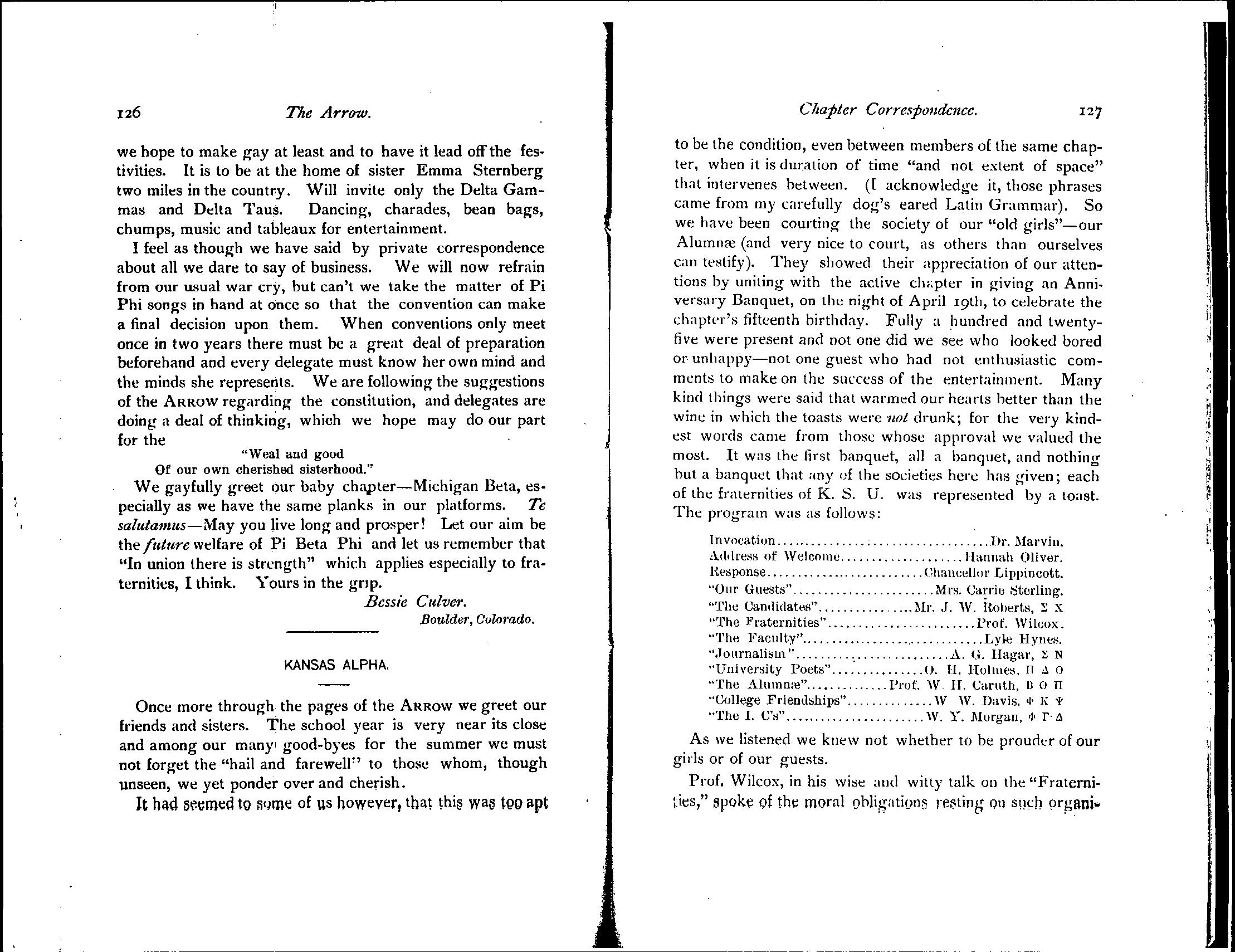
to be the condition, even between members of the same chapter, when it is duration of time "and not extent of space" that intervenes hetween. ([ acknowledge it, those phrases came from my carefully dog's eared Latin Grammar). So we have been courting the society of our "old girls"-our Alumnre (and very nice to court, as others than ourselves can te"tify). They showed their appreciation of our attentions by uniting with the active ch,;ptcr in giving an Anni. Banquet, on the night of April 19th, to celebrate the chapter's fifteenth birthday. Fully a hundred and twentyfive were present and not one did we see who looked bored or· unhappy-not one guest who had not enthusiastic comments to make on the success of the entertainment. Many kind things were said that warmed our hearts hetter than the wine in which the toasts were 1lot drunk; for the very kindest words came from thost.:! whose approval we valued the most. It was the first hanquet, all a banquet, and nothing hut a banquet that any d the societies here has g-iven; each of the fraternities of K. S. U. was represented by a toast. The program was as follows:
Invocation ............... :... . ....... .Hr. Marvin.
Address of Welcome........ . ... Ilannah Olivtlr. l{,e:;ponse .......................... Chancellor Lippincott.
"Our Guest.s" ......... , ............. Mrs. Carrie :-:itcrling. "The Can.lidateti" ................ MI'. J. 'V. itohert.s. X
"The ....................... Prof. Wileox.
"The :Faculty" ............................... Lyl-e HYllc.s . ...Tournalhnll"........ . ......... A. O. Hagar, N "University Poet!;" ............... 0. H. Holmes, n j, 0
"The Alumll:e" Prof. \V. H. Caruth. IJ 0 IT "College Frienllships"... 'V W. lJavis. il' 1\ i'
"The I. C'l;" , 'V. Y. l\lurgan, 'I' r· d
As we listened we knew not whether to be prouder of our girls or of OUf guests.
Prof. Wilcox, in his wise and winy talk on the "Fraternities," of moral reMing ()n snc!>
zations. Our girls have been doing- some earnest thinking and have come to the conclusion that the practice of "rushing" is morally wrong; therefore we have sent letters to the other girl's societies here, suggesting that we enter into a mutual compact not to girls until they have "attended the University a stated time, and they have responded heartily. h is hut just to say that"the K II H'S some months ago, lished a to the effect that none were eligihle to membership who had not done a prescribed amount of work here-Let the good work go on. Two of our girls ale this year-Jo Gilmore and Clara Wilson. Jo has invited us to her house for a "gruh" on Thursday, 1\1011' 31St, but the fun we are g-oing to have must keep till next year. Our latest pledged member, Margie Brown, will hdp to fill up the vacant places in our circle.
frIary frI",,!cy.
LalOH:nr;e, Kan.
MICHIGAN BETA.
As this is Michigan Beta's first appearance in print, I trust that all of our sisters will pardon any glaring mistakes.
On Saturday evening April 7, '88, the University of Michigan was called upon to admit another secret society in her folds. Two of our sislers from Hillsdale, Misses May Copeland and Jessie C. Sheldon, came to participate in the mysteries, and how much they aided my pen can not tell. 0, girls if you could have seen the goat, it of courSe was the best of its kind. We only had five charter members; concluded that it was much better to start with a few, and then increase slowly, but surely. Our happy family includes Misses Statia Pritchard, Franc Arnold, Lucy A. Parker, Fanny K. Read and Minnie H. Newby. There is no jealous)' among us, (or each one has an office, and some have two.
Gllaptcr Corl'espoudCllcc.
In a very short time we may have the pleasure of introducing another young lady to the members of n n
We meet every Saturday evening immediately after supper. Most of our time so far has been spent in discussing the constitution, and we find that in one or two cases, we loan read between the lines. What does Section I of Article VII
We most earnestly desire that n n .. should be put on an equal basis with 1. C. and that it should be attached to pillS. What is the use of having Greek letters at all if no one seco them, except on the title page of the AI<Row? To be sllre we appreciate the difference, but our friends and rivals do nOI, and so long as they are not in plain sight, they will not be heeded.
Like the Boulder chapter, we feel the need of a fraternity seal and a steel cut to be used in University publications. We hope that the other chapters "'ill discuss these matters before the Convention, and come to some decisiun about them.
The seal made of colors wonld not be nearly sO pretty, according to our ideas, as a simple steel cut.
Dreka of Philadelphia made a design for our sorosily, the cost of which was five dollars. Aftt!r this is done, any amount of paper could be printed at a slight cost.
There are three other girls' societies here, and all seem to bt: in a flourishing condition. We hope that we have 1I0t tired you with this long, but it is almost the last one bef"re the grand Alpha Convention next fall, and we felt that so much had to be said and done.
.Best wishes and greetings to all sisters of n n'I'.
Milluie J-I. Newby.
______ ..-111-1' kruut, jJ1iu!l/:YUH.
ILLINOIS DELTA.
Since. out' last letter to the ARROW, very little of impor-lance has happened to Illinois Delta. One thing, however,
may be considered of importance, and that is that WI:! have a rival, the Kappa Beta Thda (local), with seven mem!;>ers. We extend to them cOI1gratulations and best wishes. They are local, but will probably not long remain so. Hitherto we have fought the fight alone, and it has been a fight, too, for in ollr college of about five hundred students there is a very strong anti-fraternity dement. This opposition has a climax now in the publication of two Annals-one by the fratt!rnities called the Gale, in honor of the founder of Knox College; the ,other by the college students, which means "anti-frat," called the Pantlwon. As far as one can judge now, the frat'ernity annal will be much the superIOr.
The active membership of the Greek-letter fraternities at Knox is as follows:
oJ> .6 fl, tlftcen; cP r .:l, ten; 10 H II (local), nine; 4' U 'r (local), ten; n n 4>, twelve; K H 0 seven.
Wishing our sister chapters succ\!ss and prosperity, we say "Farewell," hoping to meet with the circle unbroken next September.
flfarg'wct W. P Ild}s.
(/ttlt}1'jblt1'fh llUnu[.8.
RESOLUTIONS.
ADOPTED BY IOWA THETA MAR. 24, 1888.
vVHEREAS, God, in his mysterious but all-merciful providence, has, by death, taken from the home of our dear sister, Hettie Dana, her beloved father, be it Resolved, that we recognize the sadness of her bereavement, and that we sympathize with her in her loss; and Resolved, that this resolution be sent to our sister, and that a copy thereof be published in the ARROW.
MEMBERS OF I. C. AT OTTUMWA, IOWA.
CARRIE E. WALTON, LILLIAN Ross, ADINE EDGERLY, Committee \
Tlte Arrow.
"THE SLINGS AND ARR0WS OF OUTRAGEOUS FORTUNE" AND SOME PLEASANTER THINGS.
"They say" we are pale blue and consumptive, defiant, spiteful, would·he sarcastic. How can we answer the Well, we are not bilious-green at any rate, and as to the rest we can find but one word which exactly fits and that is not our own; indeed it is from a very creditable literary is UA Liliputian thrust!"
But by the way, since from another quarter we are termed "daintily feminine" we are constrained to believe ourselves that popular thing of the day -a "composite". For be it known at least olle fraternit), magazine is composed of odds and ends of personality and as we cannot all be equally brilliant, even in a vcry womanly way, so we, THE ARROW, are quite willing to be considered a very average composite, fraternity girl.
A matter of fraternity interest in Iowa to-day is the recent dilTIculty at A'lles. There is evidently a strong "frat" and "anti·frat" spirit in the Agricultural College. And this spirit has recently been made quite visible hy an insulting attack which the "barbs" marle upon a Greek letter banquet. May the right prevail. The matter is. we believe, to receive thorough investigation.
Our exchanges are good, nay excellent. They are above reproach, so please pardon us this time if we content ourselves and you with simply this observation.
*"*
Some one perhaps has mentioned to you that cornmencement is near at hand, and that we are are soon to part for the summer to our respective homes. Well, then it would be better not repeat nil that sentiment again wouldn't it? * *"
The coming convention will certainly he one of vital interest to all 1. e's. as well' as every Pi Beta Phi. We are glad the waters are being agitated so long before hand. It is the best kind of economy for Our chapters to instruct themselves, and then their delegate in due season. It will save cross feelings, tears, and any amount of "tired" and will also give a better opportunity to enjoy that royal hospitality which Ottumwa has so kindly held out to us.
* *"
The following clipping from our college paper, the Videlte-Reporter, may let new light on the Ames 1rouhle: "The latest we can get with respect to the fracas at Ames is that there is an inclination on the part of collel4e and civil authorities to let the whole matter drop. Recent developments do not place the 'anti's' in so unfavorable light as before. There seems to be two sides to the question. Still the disturbance is not held at all justifiable by any parties."
" **
And this is the most ,,"kindest cut of all. That our only real live heroine should be doubted. We beg leave to correct the gentleman; we do not know that Minnie Freeman has a lover who would fabricate a hlizzard story-a Nebras· ka snow storm seldom arrives' later than February, and never in July. There were thirteell because' we saw a picture of it.
'Fhe A,·ro'lii.
Once more we greet you with much in Our hearts hu( little in our mouths to say.
The commencement bids fair to be a gay one Fair frivolities are already beginning. Among the brightest, best conducted receptions of the season was that given June 7th by.the Beta Theta Pi, Phi Delta Theta and Phi Kappa Psi's of Iowa City. It was given as a return courtesy to the Delta Tau Ddtas although all frats were entertained. Pi Beta Phi among the numher. Pres. Schaeffer and other members of the faculty were present. The former responded to the toast "College Fraternities."
The menu was elegant,in every detail and the costuming very fair to look upon. Dancing was indulged in till a late hour and so closed a decidedly pleasant evening. Our girls are in receipt of cards of Minnie Rynearson and Fred Breed. The wedding occurred at the residence of the bride's parents, Red Oak, la. They go to Seward, Neb., where Dr. Breed has already established a fine practice. Minnie is a much beloved 1. C. from thIS chapter. The hearty congratulations and good wishes of her sisters follow her to their new home.
The alumn", chapter and the remaining members of the school chapter have already begun to layout plans for a camping expedition, for the Summer vacation. By the next issue of the ARROW vacations will b , a thing of the past. With a hope that it may prove a happy past and with greetings to sister chapters. We are yours truly,
YE EDITOR.
IOWA
ALPHA.
MT. PLEASANT: Mrs. Myra. Satterthwait Bonedict rut' PwmdClla, California, is in the city visiting parents and fritl!l(iM.
Mrs. Prude (Kiltuen) Murphy 'fig of li'ort Scott, Kansas, ami little daughter Edith are in the city.
Miss Ella Penn has returned from her l"lorida Carlls have been received of the marriage of Miss Etta McDonald of Oxford, Nebraska (formerly of this city), with Mr. D. C. ChiplUan of Kalamazoo, Mich., in which. city thoy will ruake their home.
Mrs. John W. Jlalm attenlled the wedding of our sister l.oruna Waller and Judge A. W. Kinkead at New Lonuon, Wednesday. May 3li. We are glad Mr. anll Mrs. Kinkead will make their hOllle In our city.
Lulu (Woods) Hedrick was with us a few days before removing to her new home at Portland, Oregon.
IOWA BETA.
INDIANOLA,lo\\rA: Prince5f:I.F'egity did not return:to schuol thitl term but is teaching in Story City, la.
Carrie Buffington will visIt 118 soon anll remain until after COOlmencement.
Ulara Buxton made a flying visit to the giris.
Evelyn Hodge will spend the HUlIllller ill the west.
Mollie Clapp will remove to Southern California, soon.
Bess Guyer ha.'i returned from Le MarH, where she bas been for some time.
Mrs. Dowell and Mrs. Lurney of De:; Moines 'Iroppe<! in upon us for a few days.
Tile Arrow.
Lucy Clark has been elected to a position in the Des Moines schools.
Emma Co:lier will spend the in Montana.
Ka.tie Miller expeds to vhiit 1.'lorence t::ilusser in Minneapolis summer.
IOWA GAMMA
Norma Hainer, '87, i:; spending the summer at Burlington. Mis::; Etta McDonahl.has been vi::;iting her sisters, Mrs. Prof. Stan. ton and Mrs. reof. Knapp.
:::5tatia Pritchard is taking 3 literary course at Ann Arbor. We a.re glad to hear of the new chapter tht-lre of which l;;ho is a chartered Ulember. •
Marion Q. Watrous was with liS at Ollf last initiation. We regret th.at she is not in llchoul thi:; term.
Mis8CS Evaline Allen 'and Luta. Puineer made a ::Ihort vi:;it at the 1. A. <.J. recently.
During "'the winter three of our sisters were married-Minnie Knapp, May Brodhead and Gertie IJoinecr.
IOWA THETA.
1lrs. D. P. Varl.lle, nee Miss Anna Harden, of LoubwiUe, Ky., sptmt four weeks visiting her pa.rents and 1. C. sisters anti other frienus, this l:ipring. Miss Clara Harden returnp..d, to Loui8ville with her.
Miss Etlith Mills expects to leave in June for California to make her home. 'Ve regret to lose another of our workers.
Miss Hattie Ti::Hlale ill teaching a spring term in the country. She has our "sYlllpathy."
Miss Hattie of Keokuk visited us this spring and left a very lJleasant remcllll.lrance with us.
Miss Alice Beaman will leave us aLout June 1st to lUake her home in Colorado. We hate to lose our girls this way Lut suppose .it cannot be helped. We shall hope for Alice's return ere lllany months.