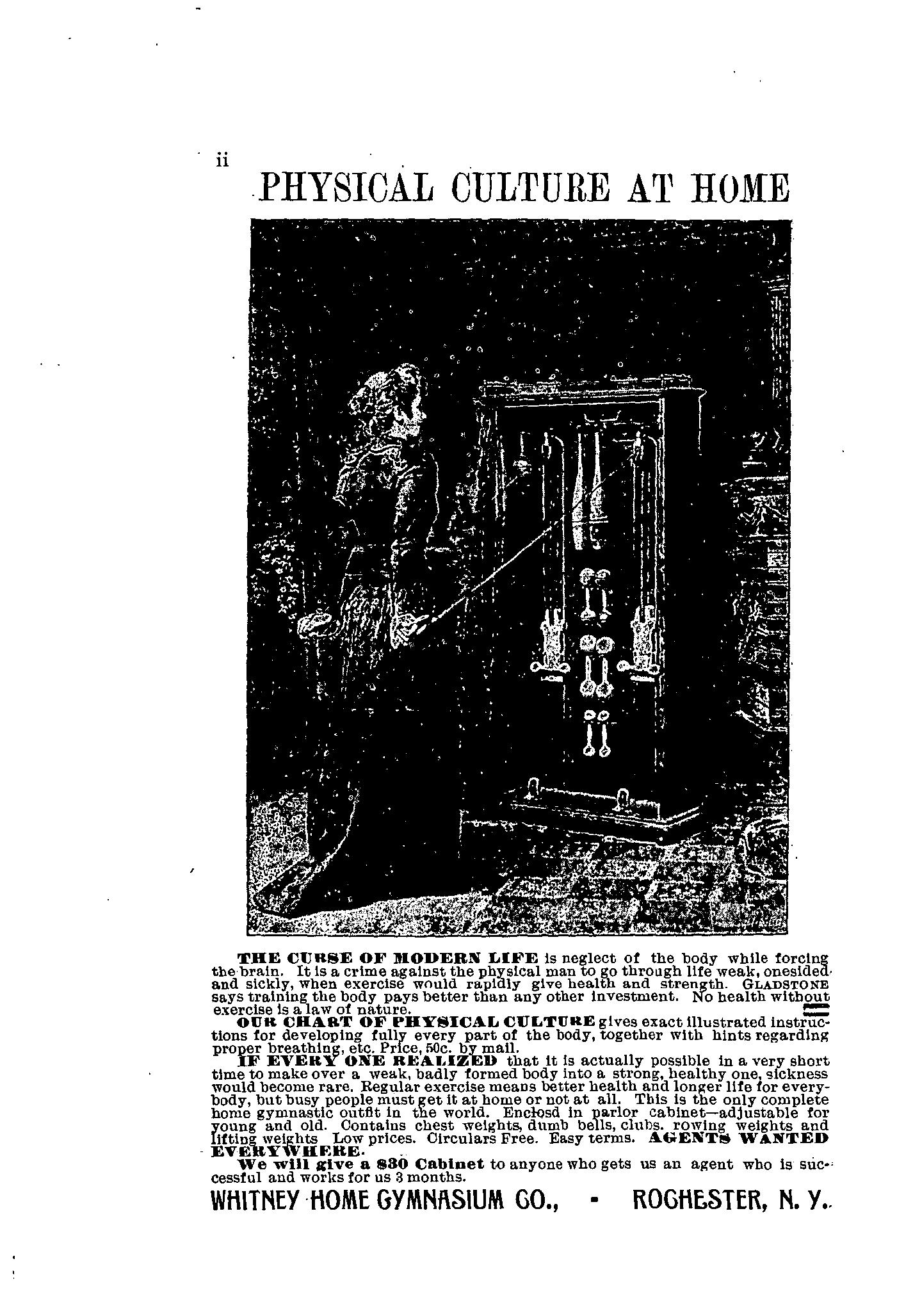
PHYSICAL CULTURE AT HOME
THE C1JRSE OF 1I10DERN LIFE Is neglect of the body while forcing the'brain. It Is a crime against the physical man to go through life weak, onesided· and sickly, when exercise would rapialy give health and GLADSTONE says training the body pays better than any other investment. No health without exercise Is a law of nature.
OUR CHA.BT OF PHYSICA.L CULTURE gives exact Illustrated Instructions for developing fully every part of the body, together with hints regarding proper breathing, etc. Price, Me. by mail.
IF EVERY ONE that it is actually possible in a very short time to make over a weak, badly formed body into a strong. bealthy One, sickness would become rare, Regular exercise means better health and longer life for every- body, but busy people must get it at borne or not at all. This is tbe only complete home gymnastic outfit in tbe world. Enclosd in pa.rlor cabinet-adjustable for young and old. Contains cbest weights, dumb bells, clubs. rowing weights and lifting Low prices. 01rculars Free. Ea.sy terms. AGENT!!t W.&NTED EVEKYWHF.RE.
We will give a S30 Cabinet to anyone who gets us an agent who is suc·' cessful and worlrs for us 3 months.
THE ARROW •.
to rea(1 the classics in the original-to do all this l'ather than to be equipped to meet the serious demands of life. Then, by fOl'ce of conditions, but the smallest portion of our people was touched by college influences, and this was especially tme in our great West. Yet this was no reproach, for might we not say the West had not yet recovered from the struggle whereby a contiuent was wrested from wild native luxuriance and made tribute to the neces'sities of a great people?
To·day, changed conditions confront us : from Golden Gate to Atlantic seaboard college influences are felt; the experiment of the higher education of woman has proved an unqualified success, and women throng our college d.oors ; magnificent institutions have been equipped for them alone, and diplomas from them are of equal value with those from the 'older institutions for men. But. greatest and best of all is tlle change in public sentiment in appreciation of college education, and consequently the change in college methods. This age demands of every man and woman that they be parts, not of a past, however glorio)ls, but parts more or less potential of the great living To-day; it demands of the college that the young and women in its training shall be fitted for whatever makes up the life and work of to· day. And so it is, through the development of these years we have come to value not the college meiliod that would make a student merely a passive receptacle, but rather only the method that draws him out, that stimulates original research and develops the latent power within him-in truth, only those methods that in the very getting make ilie thing acquired a part of the student, and that stndent a fully equipped and potential factor of the living to-day.
And out of all these conditions there have grown into college life the great college philanthropies, the thought of sharing college government between faculty and students, political and economical societies, and perhaps not least of all the consideration of social relations, in which we are most interested to-night.
The question for us to-night is, Have fraternity methods kept pace with the progress in college methods? This is a vital ques-
tion, for if fraternities are a relic of early college days, and not a necessary factor in college and university life of to-day, then we can no longer work for them and give them the support of eamest women.
Have we kept in step with the progress of the age? Are fraternit.ies a part of the actual living Present?
The answer to these questions is two-fold, yes and no. Yes, in that much progress has been made; no, in that fraternities have not done all that needs to be done. Pi Beta .Phi has served its first years following only lines of class-room work; it has made a reputation of being helpful under all circnmstances, and all the way has added bright spots to life's gray; has given assistance and encouragement; has bound its circle of women still closer and closer together for good, and has taught each something more of the nobility that lies in every other.
But is it filling the largest possible place in the work of To-day? Has it quite realized that it must touch the life of To-day, be something positive, definite, practical, or relinquish the assumption of progress?
The woman's college fraternity occupies a peculiar position among women's societies. It is designed to secure the fellowship of women carrying on definite lines of work.
It is peculiar, first, because it is founded on a college basis, which of itself indicates qualifications in the entire membership which promise untold possibilities. Second, it is an organization of COllege friends, and who will gainsay me that there is no ch?rd on all the heart's strings which may be struck to sweeter harmonies? Third, by its very organization it is free-remarkably free-from the petty jealousies and strife for social preferment that permeate and actuate far too many clUbs. Its successes, its honors, are shared by all and enjoyed by all. There is no social world to which one member mayor can press her way over injured or ignored fellow members. And how many heartaches do we know of as the result of this shallow social warfare among women? Fourth, its work has not been specialized; its horizon cannot be narrowed to
THE ARROW,
but one line of work, excluding everything that.goes for othel' qualities,
And so I repeat, the college fraternity, an organization of .college women with certain definite yet broad qualifications, organized primarily for positive heart service, is above all orgimizations fitted to do .loving work among the women of To-day, And is it not incumbent upon us at this time to see that the horizon of fraternity work is broadened to the needs of To-day, and that Pi Beta Phi becomes all it is capablc of being, a potent factor in the progress of womankind, and thus of all humsnity_ Somewhere I have I'ead: "To do what needs to be done but will not be done unless you do it, that is your duty,"
What means this call to us?
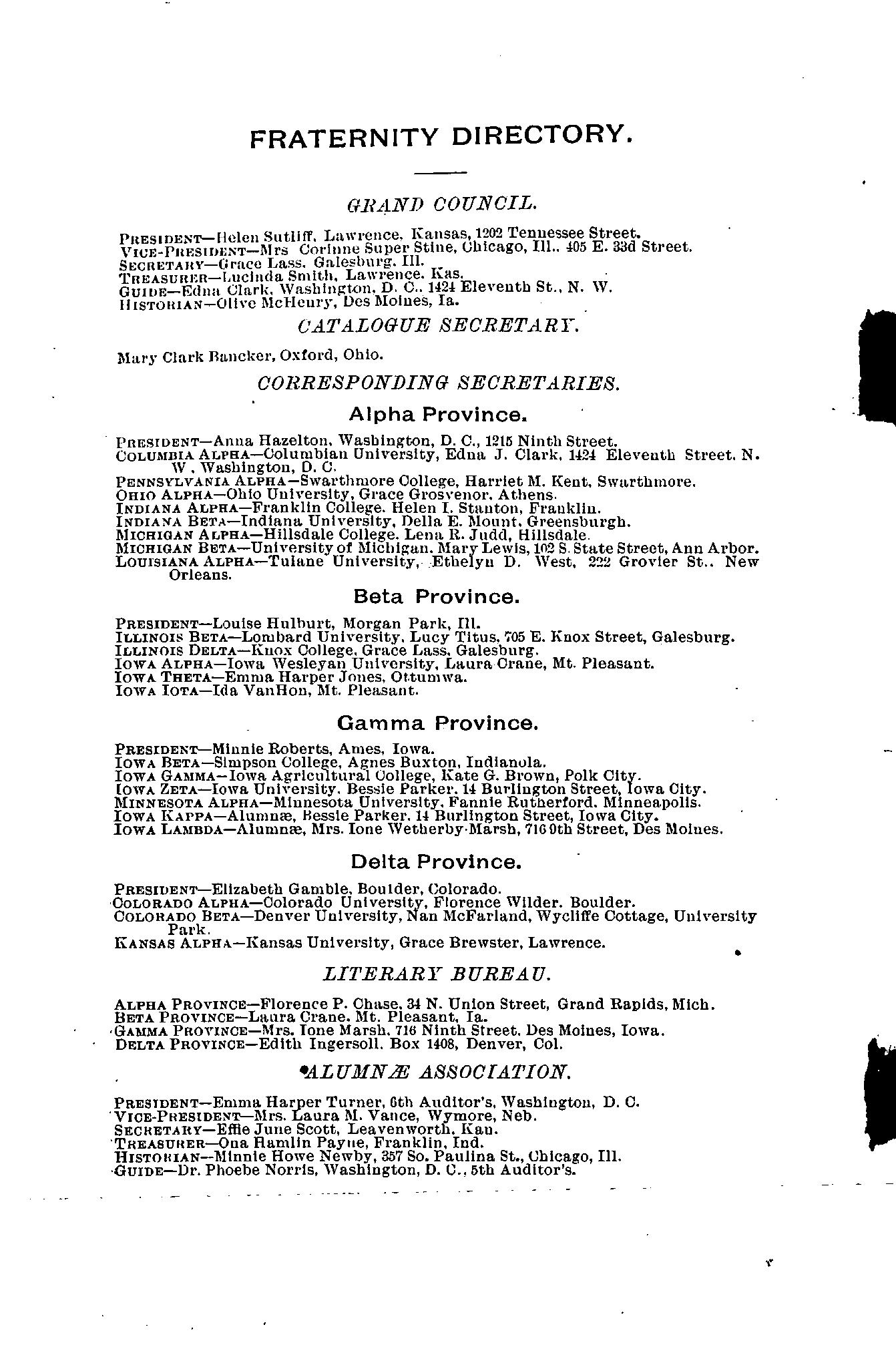
Emma H a'''pm' TU1'I1e1',
THE ETHICAL INFLUENOE OF FRATERNITIES_
[Delivered before the Congress of Women's Fraternities In Chicago, 111., July 20, 1893.]
A great deal is being said of late in regard to the short comings of our colleges and nniversities; indeed the whole American . , educational system is now upon. the rack of criticism, just and nnjust, .To its door are laid all the evils, social, economic and political, of our complex civilization,
It is claimed by the educational pessimist that the ethical side of our natures has not been specially developed during the two generations of popular educatiOli; that political corruption is increasing, that society does not tend toward greater equality of condition, but the reverse, that nations have not learned to avoid' war, or at least the necessity for expensive armaments, that instead of fidelity and mutual respect between employer and employee being the result of the schooling of the masses, that dishonesty, disloyalty and general discontent have developed; in short, that' present scholastic methods do not lay the necessary moral foundation for the proper understanding and treatment of the vital problems of our age,
While this may be an exaggemted view of the subject, still .we must admit that our college training, at least that of the older . graduates, did not help us much in detecting sophistry, in finding the difference between the real and the apparent, between show and truth. We learned logic in the old medieval way, in no wise differing from the teachings of the fourteenth century, except that we did not have to sit upon the floor while reciting the. old mnemonic lines: "Barbara, celarent, Darii, Ferioque," etc. Ethics, the science of duty and of morals, is so closely allied to logic, the science of thought, that the latter should be modified so that it may fit the conditions of modern life.
Now as fraternities are supposed to supplement in certain directions, mo"tly social, the work of the institutions under whose shadow they exist, can they not take upon themselves the labor of demanding certain reforms in the curriculum. Let them ask that the next generation of college youth be taught those things which will form a bulwark against bigotry, sophistry and immorality.
The old literary society, where we used to solve, in flights of burning eloquence, the questions of the age, has, I am told, passed away, and we must look for the present college organizlltions to IISsume a somewhllt brollder .rMe than that of fostering the social side ·of our nature. A great work is awaiting them in the form of organized effort towllrd the evolution and guidance of the moral side of our being. This is a work peculiarly belonging to women's fraternities. Women are already the moral guides of the young; not only from circumstllnce, being the mothers lind the tellchers, but 1I1so because of their peculiar ability to discern right from wrong, of their instinctive shrinking from the immoral in life. Buckle trlily ·SIlYS that the influence of women "has softened the violence of men; it has improved their mllnners; it has lessened their cruelty."
Ulln we not see the mission of our societies in this thought f .Little liS I know of the IIctulIl doings of women's frllternities today, not hllving attended II meeting for twenty years, I am encouraged to believe that they have in some measure outgrown their primitive .purpose, laudable though it is, of building up social intercourse and
THE ARROW.
college friendships, and the less admirable habit of plans for capturing class. honors. It is gratifying to learn that nobler aims are now in vogue. It is just what we might expect after twenty years of pioneer work. of experiments and mistakes, of successes and failnres. If the alumni have not had a hand in this change, it is greatly to tlieir discredit. For no undergraduate can judge of his duty, of his best course of action as he can a score of years later. The gathered experience of our alumni chapters' should begin to bear fruit, althongh we all know how loth the young are to profit by the advice their elders are so ready to give.
A white-haired saint of a man was once reproving his grandson fOl' his wild conduct. " But, Grandpa," said the youth, "did you not do these very things when you were young ?" "Yes, my boy, but I have lived to see the folly of my ways." "Ab," quickly replied the other, "and I expect to live to see the folly of mine."
And so it is with our dear young girls who see in fraternity life only a chance for· displaying pretty dresses, for attending gay parties and afternoon teas, and (shall I say it?) for indulging in idle gossip. I have talked with some of these fascinating creatures with a view of suggesting something more worth living for than these things at a time wheilthe treasuries of the past, the discoveries of the present are lying at their feet. And I fear they thought me an antiquated, cross-grained old woman who could no longer enter into the spirit of the young, when in fact I was trying to show them a newer and better fashion, knowing as I did that the· time would surely come when they would suffer the bitterness of regret for their " lost, lost hours."
We have heard that one aim of the frater.nity system is to " fost.er the social side of our nature." I do not believe that the· social side of the average girl's nature needs any fostering. In many cases it needs a little curbing. Can we not each one of us, call to mind some brilliant girl who literally threw to the winds her advantages for literary and scientific work because of her love for social pleasures? To me there seems but one watchword for the college student; work-work.
The young woman who ent91's college should be in the very prime of youthful strength and vigor. Childhood with its weakness and' disease is past: the cares of bread-winning have not yet descended like a cloud upon her life. It is the time for gaining learning and wisdom, for building up character strong and true. Our sororities are made up of picked women. The brightest and best, not, I hope, the wealthiest and most gay, are gathered together in bonds of close fellowship. What a weapon for good or for evil is in your hands. What a power you may exert over the yOlmg men of your college. To discountenance that which is doubtful or dangerous' in conduct, to keep yourselves bound to the highest ideals in manners, in dress, in all habits of life, is plainly your duty. Here lies the chance for ethical influence. The example of one student, who is faithful, pure, strong to resist temptation, but at the same time hearty and winsome counts for much, but multiply that one by thirty or forty and you have a force capable of deciding the character of a college.
A few nights ago there was a discussion in one of these halls on co-education. Efforts had been made to secure speakers for both sides, but when the hour came no one was willing to take the negative. Evidently public sentiment is in favor of educating men and women together. Co-instruction .is also growing in favor, and the next step should be t,he formation of college societies where both sexes are admitted. If you must have secrets, and I beheve they do no harm but rather tend to make us self-reliant, to teach us to· hold our tongues, why not let men and women have the same? Ruskin tells us that the "mission" and the "rights" of. woman can never be separate from the mission and rights of man, that they arenot creatures of independent right and irreconcilable claim. Woman's place is beside man, not above or below him, and I cannot imagine any relation in life where man is not the better for having the presence of women, or women the stronger and braver for having the men to look after. The fraternity began long before women had stepped up into the paths of higher education. Their presence there is now recognized by the noblest of all Greek letter
ARROW.
societies, though not a secret one, :fhi Beta Kappa. I may be a very Cassandra of a prophetess, whom no one believes, but I do look forward to the time when in our great co· educational institutions, a union will be made between a fI"aternity and a sorOl'ity; and that from this union will flow that moral support, that, "ethical influence" which cannot exist under present conditions.
Ge,·t,."de B. Blcwkweldel', Kansas Alpha.
IMPRESSIONS OF CONVENTION.
I have no idea of giving an official account of the proceedings Df the Fourteenth Biennial Convention of Pi Beta Phi. You will learn of them from the reports of the delegates and the official minutes of convention. It is the unrecorded part of convention of which I want to give a glimpse-its heart-beats rather than its brain work. Each of us who went stored up a score of impressions and memories which will be a part- of our lives in the after years. Can we not share th('m wit,h those who did not go?
For me, convention began with the first strange Pi Beta Phi whom I met on the train at Chicago. Her dark eyes and sweet face will always be a symbol to me of all my unknown friends who wear the arrow.
The excitement and sweetness of making the acquaintance of one to whom we are attracted has been tasted by most of us. We ponder their words and treasure up their glances; we reveal more of ourselves than we dreamed we could. This rare experience of really getting acquainted came often during those convention days.
One of my first deep impressions came the ,night convention opened, We were gathered informally in the parlors of the hotel, busily trying to leal'll each other's names and faces lind chllpters, when silence was enjoined upon us by our president, lind a white-
haired sweet-faced old lady I'ose and addressed us. The whisper wen.t I'ound that it was I\'lrs. Hooker, a sister of Harriet Beecher Stowe, and a member of the Lady Board of Managers of the Worlc1's Oolumbiau Exposition. The key note of her words was the unity and progress of woman's work. We felt that om' fraternity was but a part of a larger whole, aud that our convention was the outward sign of but one phase of the work being carried on by women. She made us feel that we are women as well as fraternity women.
One of the good things of convention was the chlipter reunions. Through the thoughtfulness of the Graud Secretary, both the active and alumnre members of the different chapters had rooms in the hotel together, thus giving opportunity for the reunion of many old friends. Many were the friendships renewed and the confidences exchanged between those who had been separated for years! It was almost like going back tci Alma Mater.
The possibilities of friendship revealed by convention were amazing. It restored one's confidence in human nature to find that there are so. many people worth knowing in the world. It is only miles that prevent many pleasant friendships.
As the wearers of the arrow clasped hands and looked into faces strange yet friendly, there came a new understanding of the meaning of fraternity. New lives had touched OUl'S, and possibilities of friendship and fraternity hitherto unsuspected opened upon our view.
The girl I met at convention! What a crowd of memories rush in upon us at these words. But can we tind a type among all these faces and figures that throng our memories? I tried to find some priuciple of unity in the Pi Beta Phis present at I scanned faces and studied character as closely as a few days would permit in the hope of finding the distinguishing mark of a Pi Beta Phi. I can hardly say I succeeded, but I learned many interesting things
about us. As a whole, we have not been chosen for qualities of wealth or social gayety, but for something deeper and better, I hope. Many of us have our own way to make in the world, and must have something substantial in us to begin with. The faces I saw were bright and earnest and refined, and perhaps these are our distinguishing traits.
This convention differed from others in several ways. In the first place we were not the guests of any chapter, and thus missed the pleasure of seeing the school and social life of our friends in other collegEls. There could also be none of that hospitality and gratitude that comes from the relation of hostess and guest. Also by reason of th!l many attractions that invited our. attention during fraternity week at the Fair, many of the pretty externals of convention had to be dispensed with. But to the convention ses8ions themselves came t.hat quicken'/g of life which usually comes when we dispense with externals. Every moment was well used, and a great. deal of business transacted in a short time.
We are.constantly having occasion to remember that among the great things of liEe are the little things. It is the little leaven that leaveneth the whole loaf. So the' pleasantness of convention was mainly due to a little extra thoughtfulness here and there on the part of our grand officers, a little promptness in attendance at convention .sessions, and a little of ·the spirit of good nature and charity in the actions of the members. So, all, it was to these little impalpable details to which we owe the good time and lasting bene.tit we derived from the fourteelith convention of Pi Beta Phi:
THE ARROW.
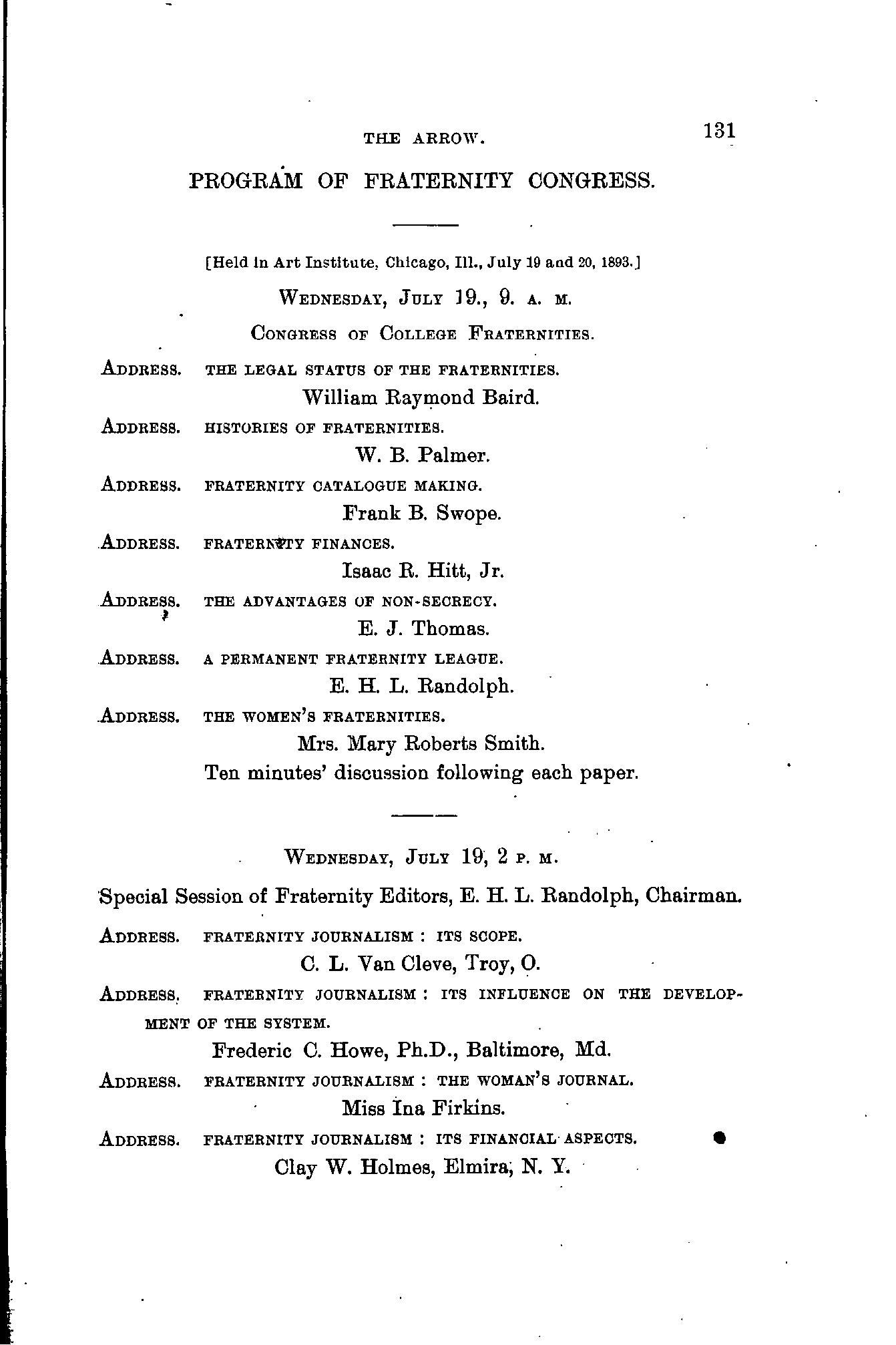
PROGRAM OF FRATERNITY CONGRESS.
[Held In Art Institute, Chicago, Ill., July 19 and 20, 1893.J
WEDNESDAY, JULY ]9., 9. A. M. CONGRESS OF COLLEGE FRATERNITIES.
AnDRESS. THE LEGAL STATUS OF THE FRATERNITIES. William Raymond Baird.
AnDRESS. HISTORIES OF FRATERNITIES.
W. B. Palmer.
ADDRESS. FRATERNITY CATALOGUE MAKING. Frank B. Swope .
AnDRESS. FINANCES.
AnDRESS. 1
ADDRESS.
Isaac R. Hitt, Jr. THE ADVANTAGES OF NON·SEORECY.
E. J. Thomas . A PERMANENT FRATERNITY LEAGUE. E. H. L. Randolph . .ADDRESS. THE WOMEN'S FRATERNITIES.
MI·S. Mary Roberts Smith. Ten minutes' discussion following each paper.
WEDNESDAY, JULY 19, 2 P. M.
Special Session of Fraternity Editors, E. H. L. Randolph, Chairman. .ADDRESS. FRATERNITY JOURNALISM: ITS SCOPE.
C. L. Van Cleve, Troy, O.
ADDRESS, FRATERNITY JOURNALISM: ITS INFLUENCE ON THE DEVELOp· MENT OF THE SYSTEM.
Frederic C. Howe, Ph.D., Baltimore, Md.
AnDRESS. FRATERNITY JOURNALISM: THE WOMAN'S JOURNAL. Miss Ina Firkins.
ADDRESS. FRATERNITY JOURNALISM: ITS FINANOIAL' ASPEOTS. • Clay W. Holmes, Elmira; N. Y.
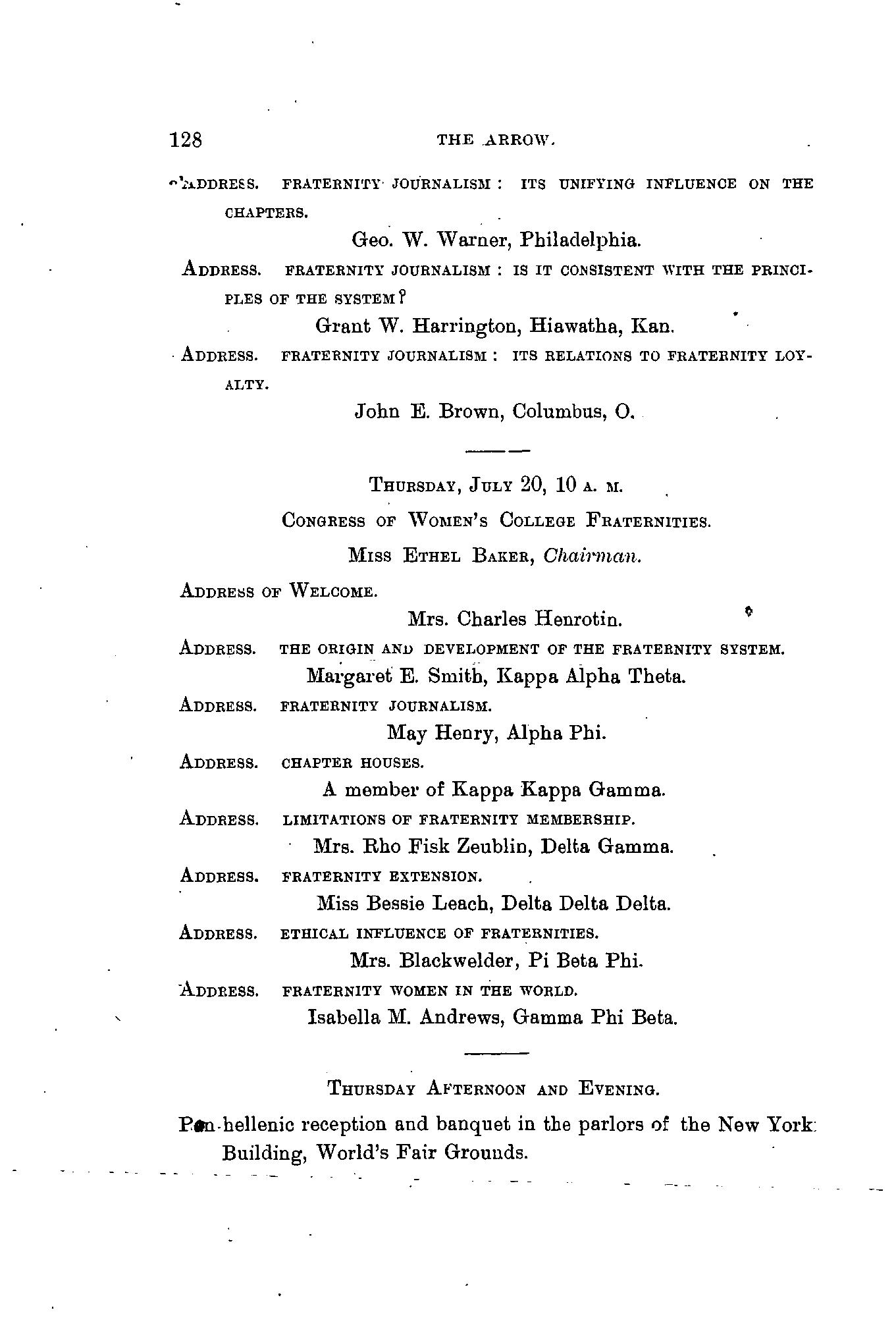
THE .ARROW
.... "...l.DDRESS. FRATERNI'.ry· JOURNALISl\I: ITS UNIFYING INFLUENCE ON THE CHAPTERS.
Geo. W. Warner, Philadelphia.
ADDRESS. FRATERNITY JOURNALISM: IS IT WITH THE PRINCI· PLES OF THE SYSTEM?
Grant W. Harrington, Hiawatha, Kan
ADDRESS. FRATERNITY JOURNALISM: ITS RELATIONS TO FRATERNITY LOY· ALTY.
John E. Brown, Columbus, O.
THURSDAY, JULY 20, 10 A. M.
CONGRESS OF ,VOMEN'S COLLEGE FRATERNITIES.
MISS ETHEL BAKER, Chairman.
AnDRE"S OF WELCOME.
Mrs. Charles Henrotin.
ADDRESS. THE ORIGIN AND DEVELOPMENT OF THE FRATERNITY SYSTEM.
Mal:garet E. Smith, Kappa Alpha Theta.
ADDRESS. FRATERNITY JOURNALISM.
May Henry, Alpha Phi.
ADDRESS. CHAPTER HOUSES.
A member of Kappa Kappa Gamma.
ADDRESS. LIMITATIONS OF FRATERNITY MEMBERSHIP.
Mrs. Rho Fisk Zeublin, Delta Gamma.
ADDRESS. FRATERNITY EXTENSION.
Miss Bessie Leach, Delta Delta Delta.
ADDRESS. ETHICAL INFLUENCE OF FRATERNITIES.
Mrs. Blackwelder, Pi Beta Phi.
ADDRESS. FRATERNITY WOMEN IN THE WORLD.
Isabella M. Andrews, Gamma Phi Beta.
THURSDAY AFTERNOON AND EVENING.
P4In.hellenic reception aud bauquet in the parlors of the New YOl'k: Building, World's Fair Grounds.
THE ALUMNAE ASSOCIATION OJ!' PI BETA PHI.
The burning question in the fraternity world to· day is how to keep the alumni a vital, active part of the fraternity. Various plans have been tried, but the stubborn fact remains that college graduates have other interests and other duties which make the u'aternity seem triviaL
Early this spring the thought took shape in the minds of our Grand Council: and has since been expressed in' an editorial in the College Fraternity, that the indifference of alumnoo is not the fault of the alumnoo themselves, but of the fraternity. If it was the fault of the alumnre, then some fraternity would certaiuly have been able to solve the problem and to train its alumure to life-long loyalty. But every fraternity experiences the same difficulty, so we are forced to conclude that the fault lies in the organization of the fraternity itself. And this fault is easily discoverable. As fraternities are organized now "their work is for undergraduates alone, and even 1£ an alumna is more willing than not to keep up her interest in her fraternity, the only work she can do is to work outside the circle of her own life,-work centering solely in undergraduate life. Such work touches her life at no vital point, and sooner or later must be neglected for more important interests. Few of us indeed ever have time to attempt such forced work. 'l'he business of most of our lives is too serious, our duties too imperative, to allow us to do anything that does not need to be done.
It is clear that the only remedy for such a condition is to extend or reorganize the fraternity in such a way that it will touch the life of the alumna at some vital point, that its work will be worth while for her to do, will even be work which it will be for her pleasure and uplifting to do.
It was with such a plan in mind that the Grand President of Pi Beta Phi sent out the following circular through the fraternity last May:
Resolved." That Pi Beta Phi, a college woman's fraternity, is capable of development for great good because of-
1. Its personnel: Every member having been chosen by reason of superior qualities of mind and heart.
2. The very spirit of the fraternity organization; the common loyalty to a cause; and hence the influence of member upon member.
3. a.-All that needs being done for woman.
b.--The need for college bred women as leadel·S.
c.-The training, other than class-room, necessary to the de- . velopment of these leaders.
Resolved: That this influence possible can never be exerted until Alumme and college members together are actively engaged in promoting that' object; and since the general fraternity organization does not provide full opportunity for the desired Alumme work, therefore
Pj'oposed: An Alumnre Association of Pi Beta Phi be formed with a . membership composed a.-Alumnre chapters and clubs.
b.-Alumnre correspondiug members.
The object of the Association to be the development of Pi Beta Phi. To that end-suggested-
1. Effort toward a fratemity of reputation and recognixed stand· ing; a fraternity that shall incite Alumnre to oontinuous study and college members to best efforts ..
2. a.-Recognition of all deserving attainments of members.
b.-A system of conferring honors.
The maintanance of an Alumnre Department in THE ARROW which shall be a "Review of Reviews" on the higher education of women. At present such information must be gleaned from various magazines and women's pages of the papers, Few Alumnre are able financially to keep supplied with several leading magazines, while still a smaller number have the time to search through many papers; consequently many Alumnre are unable to keep informed on woman's work in the colleges, and
too aften this inability means the gradual severance of connection with college life and finally the loss of college ambitions. If by any means we can keep Alumnoo in touch with current progressive college life and their own college days, i5 it not worth the while?
This circular stimulated thought on this throughout the fraternity, and prepared the way for the organization effected during convention.
On Tuesday evening, July 18, -the question of Alumnoo organization was submitted to the Alumnoo of Pi Beta Phi present at the convention.
The question was a serious one and involved many vital considerations. One of th"l most important was, Do we, as earnest women, believe that there is a place il). the world for such work liS the organized Alumnoo of Pi Beta Phi could do? There is undoubtedly work that needs to be done by college women, and if so, it is so much easier to do it "taking hold of hands." We differ from other orgllnizations-and therefore our work would differ from the work of other organizations-in that they make the work first, while we make the woman first. We do not bar out women on IInyexternlll or artificial bllsis-our basis is charllcter.
There is no doubt but that such an organization of Alumnre would have II great influence on the undergradulltes of the frllternity. Besides inspiring them by their example, the IIssociation of older women in fraternity work would give a dignity and weight to fraternities which can never belong to merely college societies.
The meeting resulted in the formlltion of lin Al umnoo Associlltion of Pi Beta Phi. A constitution has been drawn up, and officers elected as follows:
President-Emma Hllrper Turner.
Vice-President-Mrs. Laura M. Vllnce.
Secretllry-Effie June Scott.
Treasurer-Ona Hllmlin Pllyne.
Historian-Minnie Howe Newby.
Guide-Dr. Phoebe Norris.
ARROW.
We believe that the foundation of this Alumnoo Association marks a long step forward in the progress of Pi Beta Phi. We have not only extended the work of fraternity, but we have deepened its meaning. We have doubled the strength of our organization if we can count on our Alumnoo as active workers. It must be remembered that this organization did not spring from mere momentary convention enthusillsm, but is the result of thought that has been unfolding in the fraternity for months past.
President Gilman, of the Johns Hopkins University, has announced that the new medical school for men and women to be connected with the great Johns Hopkins hospital will be opened nex:t October. The course of instruction will continue through four years.-The Shield
The Randolph-Macon Women's ·College, with an endowment of one hundred t,housand dollars, will be opened at Lynchburg in September_ This college for women will have the same course as Vassar and Wellesley, and will fill a long-felt want for such an institution in the South_-The Scroll.
The much talked of Greek play to be rendered by the students of Vassar College took place on Friday evening, May 26th, at the Opera House in Poughkeepsie, and a matinee performance was given on the following Saturday afternoon. The play was the "Antigone of Sophol)les," and all the parts were taken by Vassar students. The entire play was given in Greek, and the Opera House was altered to conform as much as pos.ible to the conditions of an open Greek stage_ The setting of the stage was in accordance with the most recent discoveries, and classical students and Greek professors from all over the country were prE:lsent.
The performance was under the charge of Miss Abby Leach, Professor of Greek at Vassar_ Professor Franklin H. Sargent, of New York, had the training of the cast. The training of the
in tbe bands of Mat Dessauer, of New Haven, who led the •. and the scenery and costumes were designed by William Day, of New York.-The College F,-afemity.
The new Gymnasium will be fnlly equipped and raady for use the luiddle of September, and from the proportions that it has -:ireadY assumed, it goes without saying that it will be the finest in the South. The cost of the building will be $30,000, and it will contain . 11 modern impl'Ovements and appliances.-University of Vi"ginia 8 _ correspondent tn SCI·oll.
- "VaSsar Verse" is the title of a volume containing the best verse by Vassar students during the last four or five years.-The sideld.
Cornell UniversHy will try, for a year, the plan presented by the students for the_ prevention of fraud at examinations. Each stu· dent must, to make his valid, sign the following form: "I have neither given nor received aid in this examination." J urisdiction, in case of fraud, will be vested in a court composed of the president of the university and ten under. graduates, this court referring their decisions to the faculty for final action.-- The Shield. Brown, after over a hundred years of nneventful prosperity, has, -according to all reports, reached a crisis in her history. It remains to be seen whether we continue as the staid old conservative college or develop into the larger, more modern and more useful university. President Andrews has need of one million dollars, to be used in furthering the interests of the university. A mass meet· ing of the students was called in Manning Hall to show that they were in sympathy with the President and to take some means of causing the public at large to realize that their help was needed. It was finally voted to have the true state of the financial condition of Brown printed in every influential newspaper.-Brown CorresjJondent in Shield.
Buchtel has taken one step forward this year in doing away with the Commencement Day Class Day exercises take their place and an especial efiort is being made-to make this day one long to be remembered with joy and pride in our old alma mater.
ARROW.
The exercises will consist of such class articles as the poems, the prophecy, the history, the laying of the corner stone in the new Science Hall, etc.-The Key.
There has been a departure from the routine of college life in the organization of the Dramatic Club. Naturally all interested in the college have watched its work and progress during the past month and have felt proud of the success it achieved in the production of "The Rivals." 'What was to ·us an innovation, though the eastern colleges have for some time followed the practice, was the idea of having the woman's parts sustained by men. The Opera House WM draped with the colors of ail the fraternities of the University while the boxes were occupied by their representatives.Ohio University Correspondent in Key.
The famous old University of Dorpat, in the eastern provinces of Russia, which has been for centuries the .pride of the subjects of the Czar with German blood in their veins, will soon be only a mem0ry. A few years ago, owing to Pan-Slavic influence, the crusade was begun agaiust the German influences which surround the great seat of learning. At first it was decreed that instruction should no longer be given exclusively in German, but in both German and Russian. Several months later five or six professorships held by men with German names or of German birth were abolished. Then came the decree directing all lectures and instruction' to be given in Russian alone. Many of the professors resigned their places at the time, rather than follow the commands of His Majesty. A few . weeks ago the Russification of the University was completed by a ukase changing its name and the name of the village from Dorpat to Jurjeff. 'Dorpat was for decades the only institution in Russia carried on along the same lines as the great German universities.The College Fmternity.
"A Few Words on Fraternities" is the title of a neat and attractive little book of 18 pp., issued by four of the ladies' fraternities at'the UnivBl·sity. of Minnesota. The volume is evidently for the enlightenment of new-comers in the student body. The nature of fraternities and "their closs union and consequent
far·reaching inflnence" are briefly set forth in the opening paragraphs. "Regarding class·room work, of which some may thonghtlessly say that it is beyond the reach of fraternity inflnence, there are two views:
"1. That fraternity distracts thought and encroaches upon time due to college work.
"2. That on its social side it gives the needed reaction from mental labor, and that in a fraternity aiming at high scholarship the individual is spnrred on to additional effort.
"Wherever fraternity becomes an end in itself, the former of these two statements is likely to be true. Where it is properly snbordinated, however, the second view is the true one. The joining of a fraternity is not an end to be attained, but only a means-though a very beautiful and helpful one-towards the true aims of a college life-scholarship, culture, character."
The significance of "Preparatory Pledging" is pointed out and its influence on the pledged member clearly set forth. The advantage of delaying a decision until the new student is able the better to judge of the merits and st.anding of the various societies is urged. Finally, the four ladies' societies issuing the pamphlet agree "to invite no girl to join our respective fraternities until they shall have become duly registered students of the University of Minnesota." We understand that the publicat,ion has already had a mar ked effect on all the fraternities at this institution in their "rushing" and "pledging" endeavors.-The College Fraternity.
Is not the fact that everyone who can takes a vacation during the hot summer a slight indication that the American procession of Vacation business and money-getting is not inclined to hurry Thoughts. and jostle quite so much as formerly? We have no wish to decry American industry, and progress, and money-making. In fact we have a great reRpect for money when translated into such
ARR'OW.
s'Olid substautiall'ealities as bDDks, pictures, aud f'Oreign travel. It is 'Only when the march 'Of s'O-called pr'Ogress bec'Omes an undignified gallDp, and active and_business life a distracting whirl 'Of engagements and duties, that we feel like stepping aside and 1'O'Oking f'Or better and quieter things. And we can usually fiud them in friendship, 'Or bD'Oks, 'Or home duties.
S'O it was that when we 'Once heard fraternities classed as part 'Of the bric-a-brac 'Of cDllege life, the term did nDt seriDusly 'Offend us. We have such a respect fDr the use 'Of bric-a-brac and everything 'Ornamental and artistic in this wDrld. Life is S'O 'Often SD plain and SD dark that we need tD put 'On a great deal 'Of trimming. Bread and butter is very gDDd, but we like a little sauce, tDD, if YDU please.
SD, if fraternities d'O n'Ot belDng t'O the bread and butter part 'Of cDllege life, they certainly have a very deep and sweet place in the life 'Of many 'Of us. We hDpe they are a part 'Of the" sweetness and light" which Matthew ArnDld pleads fDr.
But tD CDme back tD summer vacatiDns, frDm which we have .sadly strayed. All 'Of us WhD are cDllege girls have tw'O Dr three moIiths at 'Our disposal. What shall we dDwitli - them, and' hDW shall we make them c'Ount fDr 'Ourselves and 'Our fratel'nity? TheDphilus KnDwitall pDnders: "Time is a g'ODd deal like a bag-it dDes nDt amDunt tD much unless sDmething is put intD it. I kn'Ow 'Of a man WhD is fDrty years 'Old, and his sDul is 'Only ab'Out ten. One has DutgrDwn the 'Other. MDst peDple are mDre Dr less DvergrDwn in this way. A man's time is what he is and dDes. CIDcks have nDthing tD dD with it."
Shall we suggest what tD put intD the bag this summer? DDn't try tD cram it fnll 'Of hard wDrk and heavy reading. A IDng rest wDnld go well at the b'OttDm, and then mem'Ories 'Of pleasant friendships and thDUghts frDm the bDDks we have been wanting tD read SD l'Ong. YDU are filling up YDur time in the best pDssible way and trnly wDrking fDr YDur fraternity if YDU always seek the highest and truest plane 'Of life. In truth the bric:a-brac 'Of life is a str'Ong fact'Or in keeping the bDdy frDm 'Overgr'Owing the sDuI.
A woman's club has been organized in New Orleans for the suppression of prize fights.
Mrs. Amelia Barr is said to make from $10,000 to $14,000 a year from her literary work.
Over 25,000 women in this country are engaged in the decora· tion of different kinds of china and pottery.
. The grave of George Eliot at Highgate, near London, is said to be in a -sad state of neglect.
Mrs. Mary A. Livermore is on the program of the World's Fair for no less than thirteen papers and addresses.
Queen Victoria is said to know the names of all her household servants, although there are 125 of them.
Mark Twain's eldest daughter, Miss Clara. Clemens, not yet twenty years of age, has written a play of an allegorical character which is said to be charming and clever .
. Miss Roalfe Cox, of the English Folklore Society, announces that t)1e story of Cinderella is found in the most ancient literature of India and Egypt, and has been told in 345 different ways.
Madame Modjeska, it is said, intends to study Sanscrit in order that she may read the poetry of that language. She is already an accomplished linguist, speaking English, German, French and Italian as well as her native language.
Mrs. Arthur Stannard (John Strange Winter) has been elected a fellow of the Royal Society of Literature, the first time the honor ·has been conferred on a woman since the society was founded in 1823.
Mrs. Isabella Bird Bishop, the well known traveler and writer of books of travel, iA the first woman to deliver an address before the British Honse of Commons. She was summoned there to tell what she had seen of the Christians in Turkish Koordistan.
Chicago leads New York in the employment of women in business. There is scarcely an office or store in which women lire not employed. It is sllid that women who wish to support themselves
ARROW.
are more favored in Chicago than else where, for since the dreadful fire of twenty years ago, which made so many women homeless, the business men have shown an inclination to help every woman who wants to help herself.
Writing in the Nineteenth Century, Canon' Browne suggests the foundation of an imperial university for women in which the cUl'l'iculum would be adapted ,to the requirements of women and open up a career for them in connection with the higher education "comparable iu honor and emolument with that open to men." At Oxford and Cambridge women are not qualified for degrees. The writer doubts whether the best educational course for men is, in any case, the best educational course for women. His ideal university would have a central council-a senate with degrees, fellowships, etc.; and women holding the degrees of this university would have some share in its management.
A comparison of the expenses of the college girl at the leading colleges for women shows the following: At Mount _Holyoke the cost in round numbers for board and tuition, without extras and incidentals, is $200_a year; at _ the Woman's College in Baltimore $300; at Wellesley, $350; at Smith, $350; at Vassar, $400 ; and, at Bryn-Mawr, $475. To this outlay the student has in addition the extra expenses of her toilet, traveling expenses, expenses for music and painting, for attendance on certain extra lectures, the fee for membership in college societies, and usually a share of the cost of the class entertainments given during the year. The expenses may be decided by the young woman herself, as may also the cost of the petty extras lor comfort or decoration that she adds to her room.
Mrs. Edmund Russell, the disciple of Delsarte, said at the dress symposium of the National Council of Women, "When I see gems flashing in the ears of a woman, robbing her of her brightness and stealing the radiance of her teeth and eyes, I think what a saint that woman must be to be so generous to a diamond I"
Margout Houghery of New Orleans, an Irish peasant girl honored throughout that region for her deeds of charity, is the only to ",hom been_ in
Not alone Michigan Alpha, but also the fraternity, lost a true and loyal sister May 31st, when Julia Walter died at Middlebury, Indiana, the honse whel'e she had passed her babyhood, girlhood, and young womanhood. With the fraternity pin which she asked to have placed on her dress, and with carnations on her casket, the mortar J nlia was buried from our sight. •
She was young to die, -in her twenty-third year. A graduate of the high school of her village, a member of Hillsdale college, the years seem uneventful, but we who knew her, know how often a little act of thoughtfulness from her lightened. another's load. The keynote to her .character was to do for others,-to make others happy.
When the grand rally of Pi Beta Phis is in Chicago, convention week, Julia will not be one of us, as she was hoping to be, but may the lesson of helpfnlness that her life has taught, tarry with us.
Died, at Tucson, Al'izona, April 5th, 1893, of consumption, Edith Archibald Grubb, aged eighteen years and ten months.
Last fall Edith, who had been ill for some months, went to Colorado and thence to Arizona in the hope that a change of climate would prove beneficial. But she grew daily weaker and finally word came to us at school that she had passed away that morning.
She had been an active worker in Kansas Alpha until she left home and her standing as a student had made her recognized as one of our brightest members. Though so young, she was chosen to represent the chapter at the convention a year ago, and her fraternity sisters were proud of their delegate.
This is the first break in the chapter for many years 'and our hearts are heavy with grief.
Kansas Alpha.
ARROW.
PENNSYLVANIA
ALPHA-SWARTHMORE COLLEGE.
Now, as almost never before, is the importance of cal'etul, eal'll,est study on the part of every student individually, felt, and especially by Pi Beta Phis, for with'the thought of failure·for themselves comes the dreaded idea of the dishonor in greater or less degree.hanglllg over the fraternity. We are, very busy. Since our last letter we have added to our number Emma S. Hutchinson, of New York City, one who has made herself beloved by all of us, and an honor to the fraternity. Many honors have been won by her, ,and among them was that she was chosen as the representative in <>ratory by the class of ninety-six to contest for the College championship, who in turn would take part in the Pennsylvania collegiate Otatorical Contest, held in Philadelphia the twentieth of May. Owing to serious illness in the family, she was unable to be present.
Our chapter gives a tea and dance on Saturday evening, June 3d, at the house of 'Miss Frances Darlington.
Everything is moving along quietly and pleasantly, ' but we are sorry to find the end of our first year as Pi Beta Phis closing so 1loon, and it is hard to realize that less than four weeks from now we will be separated. Let ns hope that the parting will not be for lOIig. We wish yon all success and a most delightful vacation.
OHIO ALPHA-OHIO UNIVERSITY.
Commencement is past and the members of Ohio Alpha have scattered to mountains, sea-shore and lake to find health and recreation until the clanging college bell calls them once more to work. Three of ns will never again respond to the call, for we have joined the ranks of Alnmnae, and while we may pursne college work, it -can never be the same to ns.
Our ranks have been further decreased by the marriage of two ()f our of aIlot!,er a distant State.
143:
We must deeply l'egl'et the irreparable loss to the chapter of Miss Corinne Elizabeth Super, who was inanied June 10th to 'Wilbur Monis Stine, formerly a professor here, now a member of the faculty of Armour Institute, Chicago.
On June 29th, Miss Eudora May Hoffman was married to Prof. H. E. Cbapin, a member of the faculty of Ohio University. Several of our girls will attend the convention and are looking forward eagerly to meeting very many of you.
To all we wish a pleasant vacation.
INDIANA ALPHA-FRANKLIN COLLEGE.
Another school year is over and our gids in theil' val'ious homes are enjoying the vacation .. This has been a prosperous year for our chapter, we have added seven new members, are established in much pleasanter quarters and the work is running smoothly.
Miss Elsie Holman was elected our delegate to the convention. Several of our girls expect to be present as all who possibly can will attend the Fair at that time.
We entertained but twice last term. One evening the mens' fraternities visited us in our hall, an(l during commencement week we entertained our friends at a lawn fete given at the home of Nannie Drybread. The decorations of Chinese lanterns made a very pretty appearance. Refreshments were served and the evening was considered quite a success.
Miss Jeannette Zeppenfeld, a Pi Phi, has been re-elected instructor of modern languages, the same position she has so successfully filled the past three years.
Mrs. Emma Ellis Monroe and Sophie Tanner Deer were among the visitors of commencement week.
Though not represented among the graduates this year, two of our number, Ethel Mi.ller and Jessie Smith, were chosen to deliver orations at the inter-society entertainment. Miss Miller represented the Periclesian, Miss Smith the Athenian society and their efforts ranked among the best of the evening.
Indiana Alpha sends greeting and best wishes to all Pi Phis.
ARROW.
INDIANA BETA-INDIANA STATE UNIVERSITY.
Indiana Beta comes for the first time, asking a little place within the charmed circle of Pi Beta Phi correspondents.
On the evening of April 13th, seven young ladies of Indiana University were initiated into the mysteries of Pi Beta Phi by Elizabeth Middleton and seven other Indiana Alphas, Misses Holman, Weyl, Payne, Ward, Means, Miller and Drybread. Miss May Burton, of Mitchell, an Indiana Alpha Alumna, was also present. After the initiation, our patronesses, Mrs. Prof. Baillot and Mrs. Chas. Simmons, arrived and spent the remainder of the evening becoming acquainted with the girls to be under their care, arid our visitors. The girls from Indiana Alpha remained over the next day with us, and in the evening Mrs. Prof. Baillot gave an informal reception for us. Thus was our litt.le craft launched on the Greek sea.
We have received a most cordial greeting from the other fra·ternitiesat Indiana University, ten in number. They are-Phi Delta Theta, Phi Kappa Psi, Phi Gamma Delta, Beta Theta Pi, Delta Tau Delta, Sigma Chi,Sigma Nu,Kappa Alpha Theta, Kappa Kappa Gamma and Alpha Zeta Beta, a local fraternity.
We have initiated one new member since our organization. Pearl Neeld, of Bloomington, and Miss Elizabeth Middleton has been transferred from' Indiana Alpha to us, so we now ilUmber nine.
We feel that we have as yet accomplished little in our chapter, but I am sure that each one of us is stronger and happier for the little taste we have had of fraternity life. We are yet so young -only the baby-and we feel very greatly the need of help and instruction. We expect to get much good from convention.
We wish to express our thanks to our sister chapters for the earnest welcome we .have received from them and we hope ere they see this, to have met ·them in Chicago, and ·to have exchanged the grip of our dear Pi Beta Phi with them.
MICHIGAN ALPHA-HILLSDALE COLLEGE.
Once again does Michigan Alpha send greetings to her sisters.
Since our last chapter letter, we have done but little in the way ·of literary or social wOl'k, the litel'ary societies of the colIege filling the needs of the former, and the commencement festivities, of the latter.
Only one graduate have we this year, Lena Judd, but sh\'l brought much honor to us as welI as to herself, by carrying off the mathematical prize.
Kate King of '92 has spent the spring term with us, taking an .advance course in music. Retta Kempton is instructor of elocution in the colIege.
One new sister we have to introduce to you-May Austin, and ·one sister has been taken from us-Julia Walter who died the last day of May.
Returning from the convention where we had nine representa. tives, full of enthusiasm and loyalty for the fraternity, we wish you ·a pleasant, restful vacation and bid you all good-bye till fall.
row A BETA-SIMPSON COLLEGE.
This letter finds us near the close of an enjoyable and welI spent term and we are now looking forward to an end of our work and a pleasant vacation. Though we have no new members to swell our numbers we are strong enough to keep a good fraternity spirit alive among us.
The evening of May 3rd, Effie Busselle gave a musical recital in the college chapel reflecting great dredit on Pi Beta .l:'hi.
Mrs. Ollie Park entflrtained both the alumnae and college members at her pleasant home, May 5th.
A number of our girls were royally entertained by Delta Tau Delta, April 29.
Misses Bradford, '91, and Leota Kennedy, '87, will visit us Commencement.
Miss Kate Miller will spend three months vacation at her home in the city.
Miss Ethel Gilbert will represent our chapter at the convention. Blanche Rose has returned to finish her musical course
ARROW.
Mrs. Lou Vanscoy and little daughter are spending a few weeks at her old home.
Iowa Beta sends greetings to her Pi Beta Phi sisters.
IOWA KAPPA AND ZETA-IOWA STATE UNIVERSITY.
Iowa Kappa and Zeta keep on making interesting history but the chapter of this spring term is headed "Oamp Quiet." Early in May, Bertha Wilson, one of our .most enthusiastic . girls, left us to join the party of S. U. I. students and professors who are studying the fauna and flora of the Bahama Islands and thereabouts, and we miss her from our circle very much. Before her departure we had a very successful sittiug for a large group picture.
We have done nothing more stirring than to indulge in some very comfortable little "spreads" and other equally innocent festivities this· term, but we have some very aggressive plans for the fall campaign.
We have two seniors this year, Bessie Parker graduates from the collegiate department and Nelly. Perry, Ph. B., finishes the law course
. As a college we are just _ now stirred up over our success in athletics for S. U. I. took the cup at the state Field meeting at Des Moines last Friday. There was a greater demonstration made than Iowa Oity has seen for years from her students.
Mira Troth left for Chicago this week where she will visit the World's Fair.
Iowa Kappa and Zeta send kindliest greetings to all Pi Beta Phis and we hope that this school year has been as rich in congenial companionship and profitable intercourse for all chapters as it has. been for us.
MINNESOTA ALPHA-UNIVERSITY OF MINNESOTA.
From our cosy summer homes, in our beautiful Minnesota, we· send greetings to all our sisters with many wishes for a happy vaca· tion. Our work has been over since the first of June, and we are enjoying our long summer's rest, which lasts until September 12th,.
ARROW.
147
when the university year begins. Not more than half of us return to school. Many of us a1'e to be scattered far and wide' over the cOllUtry, some to return after a year, others never.
We introduce to Pi Phis a new sister, Mabel Bartlett, who was initiated March 18th. .We regret to say that since her initiation she has been in ill-health and may not be able to return next year.
On the 18th of April May Colburn was married to Will Francis Walker at BelVidere, Ill.
We were llUable to celebrate Alumnre Day on the 28th of April, but on the following evening we, together with a number of the alumnre, met at Elizabeth Foss' and thoroughly enjoyed an informal gathering.
On the first day of June Esther Friedlander and Franc Potter graduated, Esther, to receive her M. A. degree and Franc as a B. A. Franc graduated with ,honors and will return next year for post-graduate work.
On the third of June our chapter was three years old; but, as we were all worn out with commencement festivities, we chose the following Saturday, the 10th, for our celebration and picniced at Minne-ha-ha. The Falls and all the surrounding country at that· time were in all their fresh, green beauty.
COLORADO BETA-DENVER UNIVERSITY.
Commencement is almost upon us and for the past week the weather has been so warm that none of us regret it, excepting for the fact that'we lose two of our girls-Miss Beggs and Miss Waterbury--'who graduate. We have only three weeks more of this year, which has been with UR a very happy and snccessful one. This is the first year we have had: a rival, and it has done us much good. Our number has been of necessity small, as our university is small; but our hearts are large, and our love and zeal for Pi Beta Phi knows no limit. Our fraternity spirit grows also with the presence of a rival in our midst.
We have had many pleasant social events during the year and a regular meeting every Wednesday. One of the customs we have
ARROW.
adopted is to give each girl of the chapter a spread on her birthday.
We are looking forward to the convention in Chicago with much enthnsiasm, as it will be possible' for several of us to be present. Nan McFarland will be our regulaI' delegate, but Edith Ingersoll, Elsie Mayham, Gertrude Beggs and Lilian Pike also hope to be in Chicago at that time and attend the sessions of Grand Alpha. Also some of our old members expect to be present.
By an inter-fraternity reception, which we girls gave in March, we created a milder spirit of fraternity rivalry and many pleasant plans for commencement week are the outcome.
Colorado Beta sends warmest greetings to her sister chapters, and especially to her " baby sisters," with t·he hope of meeting and knowing many of you in Chicago.
COLORADO ALPHA-COLORADO UNIVERSITY:
Colorado Alpha sends greetings to all Pi Phis and hopes that this last year has proven as successful a one for all other chapters 'as it has-for us. Under the direction of our last president, Mrs. Farnsworth, the literary work has really been work, and therefore .all the more enjoyable when accomplished. and we feel well satisfied with our progress in painting and painters, besides having strengthened our chapter by the acquisition of four worthy girls. We all sincerely regret that 80 few of our number can be present at Chicago this summer, but notwithstanding our ardent desil'es to attend con:vention, it seemed quite impossible for maIlY of us to go from Colorado.
We had intended to celebrate our fraternity holiday here this year, and were especially anxious to entertain Colorado Beta, after having been so royally entertained at Denver by' them. But on the '20th of AprU, Beta Kappa Chapter of Delta Tau Delta gave an .elegant reception and dancing party at the University, which SUI'passes any entertainment which has ever been given here. The Delta Taus invited members ·from the ladies' fraiernities to assist in :receiving the guests,and we·all·enjoyed th'e party' more than·words
THE ARROW.
149
can tell. Toward the close of the year we were ourselves very qUiet socially, owing to our chapter being broken up so much about that time. One of our new sisters, Katherine Perry, was taken seriously ill and Was obliged to leave college and we regret to say she is still in ill health. Mrs. Dunham was.called home to New York, owing to the death of her father, Dr. Bennett. Nan Earhart spent several months visiting in the east, and Elizabeth Gamble took a pleasure trip with friends, to and through California, but we hope to have all our friends and sisters with us again, when the University opens in the fall.
Last year we had an agreement with our rival fraternity to prevent hasty rushing and pledging, but as it did not prove quite satisfactory to either fraternity, and was on trial for one year only, some other plan will probably be decided on next year, though we think the time of having preparatory pledges here is past. Heartiest greetings to all, especially to those new in the bonds.
The fourteenth bi-ennial convention of Pi Beta Phi has come and gone. We feel sure that it will make a lasting impression upon Pi Beta Phi. We are proud of the action which the fraternity has taken on various· important points, but above all did we like the Bpirit of convention. While convention feeling and girlish enthusiasm were prominent, yet most impressive of all was the earnestness of each delegate in doing what she believed to be for the interest and advancement of Pi Beta Phi. So we feel that we may truthfully say that the spirit of this convention was the spirit of earnestness. We wish that those who decry fraternities as trivial and shallow, could have looked into the bright, earnest faces of the representatives of Pi Beta Phi.. After studying the characters depicted thereon, we do not believe anyone could honestly say that thought such women would give their time and loyalty to an organization of mere sentiment or girlish frivolity. To see such a
ARROW.
company of earnest, enthusiastic women, to hear them express their ideas, was to feel more deeply t,han ever the meaning of fraternity, and to believe more firmly in all college women.
The inspiration and broadening of ideas that comes to chapter life from convention make such meetings of the fraternity well worth a sacrifice to attend them.
There we first learn what a great organization we are. There we realize what stuff we, as a fraternity, are made 'of, and what strong material we have to work with. We get outside the narrow circle of our own lives for a few days, and come in contact with women from other states who live under different con,ditions; thus are onr ideas of fraternity work broadened and local prejudices_ worn away. Once in a while perhaps we clasp hands just for an instant, with one whom we feel to be a real friend, even though we have never seen her before, and the changing fate of our lives will soon hurry us apart for - ever. Even such a shadow of frieudship does one good.
In short, convention brings us into wider relations, and makes ns feel that we are parts of a larger whole. We feel ourselves fac. tors, even though small, in all fraternity work and all college education. - Such influences do much to broaden our lives.
But the best of convention, after -all, refuses to be conveyed _throngh the medium of pen and paper. And we fear that it cannot be read in the minutes, nor embodied in the reports of the delegates. For it was the subtle influence that came from the contact of mind with mind and heart with heart.
We wish to call particnlar attention to two resolutions adopted by convention. They need no comment or explanation.
1. Since mock initiations tend to detract from the solelrniity and impressiveness of the real ceremony, and since they do not fairly represent the true spirit and high purpose of Pi Beta Phi, Resolved, that we earnestly desire and recommend that such initiations be dispensed with. _. __
2. Since there exists a great deal of prejndice against us by the opprobrium that has become attached to the word secrecy, Resolved, that we insist that the word secrecy as used by us be understooq merely in the sense of privacy, such as prevails in the highest types of .that sacred institution, the family.
The Shield of Theta Delta Chi" makes the fOllowing comment: " The Key of Kappa Kappa Gamma is fairly redolent with enthusiasm for that broad culture which makes the college girl what she is to-day." In the name of all frat.ernity wOe are proud of the standard of our sister journal. We believe that a fraternity journal should be something more than a medium of communication between the chapters. While we are not at all in favor of burdening fraternity publications with literary articles, yet there is a middle course, in which the frate1'llity journal may stand for all that is best in college and fraternity life.
If our fraternity work is to broaden until it embraces everything inclnded in the name of sisterhood, fraternity journalism must extend its scope likewise.
If we are sometimes troubled for worthy material, and feel that oUr contributions to college and fraternity literature are too small, we can at least keep the tone of our journal high. We can refrain from all petty fault-finding and caustic criticism of sister publications, and make it felt on every page that we are taking our stand for that "broad culture which makes the college girl what she is to-day."
Yes, we must bring up that chapter letter again! We know that the subject is trite, and we shall utter no useless generalities, but we wish to give one or two positive hints as to its construction. Attempt, first of all, to give the atmosphere of the COllege in which your chapter is located. Life at your college is sure to be different from life at other colleges, and an account of it cannot fail to be of interest to other college girls. Tell us of all important col-
•
THE ARROW.
lege events, what goes on on the campus and the athletic field, and in the social world. This will form the very best setting for the account of your chapter life, beside giving us interesting infor· mation.
Secondly, do not leave your chapter letter until the last moment, and then scratch off a mere hasty note, leaving all the pol. ishing for the editor. You are guilty of serious unfaithfulness to your fraternity in allowing such a letter to be published as representative of your chapter. A little more time put upon chapterJetters by the writers would remedy all the defects we find in them:
We wish again to solicit contributions for the ARROW. We have met with unusual success with those from whom we have asked articles, but we should like more voluntary contributions. We request short discussions' for "What A Fraternity Girl Thinks," biographies of Alumnre members, personal items, etc. We also request college publications, newspaper items, and all college and fraternity news as sources of supply for College aud Fraternity Notes.
Do not fail to send chapter letters for the October ARROW by Sept. 15.
There is a reception room and register for fraternity girls in the Woman's Building, World's Fair Grounds.
We select the following from an article entitled" Wherein Fraternities Fail," by Charles N. Ironside, Chi Phi:
The influence of the fraternity upon the individual perceptibly lessens, when, having taken his diploma, he passes for the last time through the college gate and finds himself, without occupation, experience or acquaintance. standing on the threshold of that world upon which he has heretofore looked through a colored glass. The
contrast between the mimic world he leaves and that he is about to enter wellnigh tmnel-ves him. He turns first toward his fl'aternity friends, and through the means afforded by their connection is enabled to form a circle of acquaintances generally of the better class. Yet there is a lack of breadth in the fraternity sy stem which is necessary to permanently interest the man who has passed into the activities of life. The struggle for existence. the cares of the family, plans for making a fortune, and schemes of ambition, fill his mind to the exclusion of the purely social claims of the fraternity. It does not rise to the plane of active life; it fills its place in the restricted sphere of the college, but it is not elastic enough for the future. Its practical benefit ceases with the departure from college, and to interest the practical man something practical must be set before him, or his interest will wane proportionately to the time that has elapsed since graduation.
To the student the busiuess of the fraternity is real. To the man it is trivial. .Many do not enthuse .beyond· the limits of the chapter. The student depends upon his fraternity, the man is forced to depend upon himself; the student looks upon life as through a gl!lss, the man faces it 'as a grim reality. The field of the fraternities is too narrow to fill the broader requirements of active life, their ceremonies are fOl'gotten, their meetings seldom held at such times and places as permit regular attendance of alumni, who, having no active work to perform and no vote in chapter meetings, do not attend. Advancing years and broader experiences make frateruity work diminish in importance in their eyes, and the interest, once active, becomes passive, then declines. Associations of students in chapters are very close and have a common end. In the world at large other associations thrust themselves into life, other scenes come before us, men we meet are often unfamiliar with college life and totally ignorant of fraternity connections. Then, when the student sometimes tries to throw responsibility upon the alumnus without compensating advantage, the end of fraternity influence has been reached.
The editorial in the College Fraternity commenting upon this article is as follows :
POST-GRADUATE MEMBERSHIP.
Mr. Ironside, in his article-" Wherein Fraternities Fail"which is published in this issue, calls attention to the fraternities' loss of influence over its graduate members and the corresponding loss of interest in .the fraternities by the graduates thems"lves. The relationship existing between students and alumni members and between alumni members and the general organization is a source of constant solicitude. Experimental legislation is constantly en-
ARROW.
deavOl'ing to bridge the gap and bring the alullllli membership into closer union with the fraternity. It is right at this point that the door is open for the fraternities to achieve their greatest and best res,vlts. If t·he homogeneity and closeness of union which is the chief characteristic of the college chapter could be maintained .th1'Oughout the alumni membership, the fraternities would be in a position to wield an influence in the largar world of life far more potent and beneficial than they have ever yet been able to do. l\fr. Ironside is unquestionably right in his assertion that while the business of the fraternity is apt to seem of deep importance to the undergraduate, to the gI'aduate it becomes trivial. Uen who have been most active and enthusiastic members while students seem, in many C8ses, to withdraw themselves entirely from all fraternityassociations immediately on graduation, and not infrequently ally themselves with other associations, and there expend the energy and enthusiasm that would be of such value to the fraternity they have, for all practical purposes, quitted. And why? Simply for this l'eason, that the chief end of fraternity existence seems very largely to be sought in the college chapter: When the alumnus is disposed to keep alive his fraternity affiliations it is to be accomplished in most cases by bringing himself down to the level of the college boy. To expect a satisfactory issue to the 'alumni question' while such conditions exist is to expect the impossible.
Greek-letter men in active life taken one with another and in comparison with all are one of the ver;y best and most valued elements in society. There is' no boast or vain-glol'y in this assertion; Greek-letter men are first and foremost gentlemen; they are men of education, culture and refinement; they are men of ideas and sound views. As a class among men they are the best, not in the sense that none are so good, but emphatically in the sense that none are better. What might not be the position, what the influence of Greek-letter societies if the same closeness of union could be maintained among the alumni membership that characterizes the active chapter t We believe that a solution to the perplexing 'alullllli question' can be found in a simple reversal of the conditions. Instead of expecting men of the world, men wllOse thoughts and hours are bound up in considerations of business and professional duties, instead of expecting the older men to come down to the level of the boys, let the boys rise to the level of the men. In other words, let the chief end of fraternity membership be found in the associations of the graduate, and let the undergraduate years be, in a sense, preparatory years. The idea of different" degrees" in fraternity membership as in Masonry has been frequently discussed and as often condemned.' No other course would have been consistent with the Greek-letter idea. The plan here sug-
gested has been tried and has proven successful, and we think its development and general adoption will prove a "'onderful step forward in Greek.letter fraternity interests. The undergraduate should look forward with pleasant anticipation to the days of his graduate membership. It should not be that the chief fraternity experience of the graduate is his recollection of college days. The fraternity club is a factor which has arisen and developed within the last few years. It has proven the, most effectual and the only practical way of uniting and holding the alumni. In a few notable cases it has taken rank with the larger and more exclusive clubs of metropolitan centres. There seems to be no doubt that fraternity clubs will multiply and prosper in the larger cities fu'st, and that they will be extended to smaHel' places as fast as ruay be feasible. The prosperity of the alumni club will draw the graduate close to and identify him with the intel'ests of the fraternity; it will be a guarantee of the welfare of the chapters, because it will have to 10Qk to them for its futme maintenance. Its interest in the undergraduate will be quickened by a sense of parental responsibility and cease to be merely reminiscent and valueless. We think that the growth of the fraternity club will exel-t a powerful influence in overcoming the difficulty and bridging the chasm the existence of which is clearly pointed out by Mr. Ironside.
A corresponden't in the Key discusses the Chapter House question as follows :
Beta Delta has lately been seriously considering the question of a chapter house, and has been much advised, both pro and con. Many of her friends, whose opinions she highly l'espects, consider chapter houses a detriment, believing that the attendant inflnences are not conducive to good scholarship. They think that the girls will be almost 8m.e to infringe on one another's time, and that the care and responsibility necessarily involved in the possession of a house make too heavy a bmden for students whose, time is already fully occupied. Another argument is that there is likely to be a lack of sufficient restraint, and that some girls, with the most innocent motives, are likely to make mistakes and do imprudent things. Still another reason is found in the fact that the distinctions between fraternity girls and their independent friends are more keenly felt when the former live in a houRe exclusively their own. On the other hand, there seem to us to be strong arguments in favor of the chapter house. First, a house gives its chapter individuality. Second, every college girl feels the need of more homelike surroundings than are to be found in an ordinary boarding
ARROW.
house; and such, we think, are to be found in a well. regulated chap. tel' house, where each one has perfect freedom, yet at the same time feels some responsibility as to the welfare .of her associates and the prosperous management of her house. Moreover, with such a com· mon center of interest the chapter must become more united and hence stronger. Under minor advantages, we realize the conven· ience of having a place in which the chapter may entertain its friends, and a regular place for. its fraternity meetings.
Beta Delta would like to hear the experiences of her sister chapters, and will gladly receive any suggestions on this perplexing theme.
THE BEST BIDE OF FRATERNrry LIFE.
When the songs of Delta Gamma ring in our ears and make us strong in our loyalty; when, at reo union time, the enthusiasm of the alumilre members is joined to our own, or when some freshman for whom we have worked and waited at last pledges herself, we are stirred with the same kind of emotion which the soldier feels, when, after hearing some stirring appeal. to his patriotism, he volunteers to risk his life for his country. But this emotion-this feeling that fills his heart to overflowing-what would it be worth if .it were not proved by the dreary marches, the lonely nights nnder the stars, and the hard fighting?
So after _all, in fraternity life it is not the reunion nor the song w"hiah are wOl·thmost and bring out the best side of fraternity life. It is the everyday life with its trials and disappointments, as well as its victories, w4ich proves whether we are sisters and friends in ac· tion and heart as well as in name, and whether we are living up to the high standard of fraternity life. Delta Gamma Anchora.
We cull the following extracts from an enthusiastic article in the Kappa Alpha Journal. We have never been able to make quite so great claims for fraternities ourselves, but we are glad to· see and have others see the opinion which an enthusiastic fraternity man may hold. <Earnestness and enthusiasm are good in themselves:
THE HIGHER AIMS.
It is not necessary to ask whether, in the beginning, fraternities were established for higher purposes than social intercourse and the building up of college friendships. It is sufficient that the develop. ment of the past half century has brought forth other aims than these, which, for lack of better name, are called higher aims, and it
is safe to say that in the minds of the majority of fraternity men of' the present period, these higher aims predominate. Men ate not accustomen to inquire whether the poet began his poem with the· divine. inspiration to breathe some immortal truth; they are satisfied if he did breathe snch truth. Thus it is that the poet lives in· what he did mther than what he first intended to do. Men estimate· men rather by achievement than by purpose. So' it is true, no matter for what fraternities originally were begun, we are to.day confronted with them, scattered over the American college world, striving fO!' higher things than mere social pleasure, and urging men to nobler efforts than the gathering of so·called college honors by well organized schemes and plot.s. The men who stand close enough tosuch organizations to know their purposes, are all agreed that there· is struggling the desire which becomes effort to make broadminded, high·souled, great. hearted men.
No matter what the name, the form of words that holds the· creed, it is safe to say that the majority of all fraternities are strivmg for the same end, battling for the same victory, running to the same goal.
It is but right to give the outside world some tangible informa' tion as to these aims. The outside world niay have no right to know, but withholding such knowledge from this outside world gives them the right to doubt our purpose. Doubt once come, it is a repetition of every principle of human nature that ill is believed rather than good. .
In the first place, the fraternity cherishes, fosters, and keeps before the members an ideal friendship. Holding that friendship up in the best light before all and pressing it into the heart. of every member. This is no idle thing. .He who goes through life without experiencing such an ideal friendship has not learned one of the· sweetest and one of the most ennobling lessons that men ever learn. This friendship rises higher than gay associat·ion that makes brighter the hours spent together and thrills the being with hilarity at the banquet board. This friendship takes hold upon the' heart, and in loneliness, sorrow, and disappointment, it fulfills its best mission . and rises to its highest office. This friendship brings the man into· the heart, in prosperity or adversity; in peace or tumult; in joy or sorrow; in youth or age. The foundation of 'this friendship is con· geniality.
1'he fraternities not only deal with individual qualities, but they deal in generalities. The fraternity man is. taught that strength should protect weakness; to set truth and honor up as the models of life. The fraternities are gradually drifting into a great school which teaches the superiority of mind, soul, and heart over that. which is gross and material. The uplifting of the nature, and gaz-
ARROW.
ing Up at the pure and the sublime until thm'e comes a desire to reach' it inspires effort; and effort brillgs at least some attainment. No doubt individuals can reach the same end, can have the same purpose;· yet thel'eis something in being united in a great pursuit. Men banded together, striving together, receive streugth from the stl'ength of each other. It is a weH settled principle that thel'e is a certain definite strength that comes from the pl'oper combination of stIoength, and it is well settled that when this combi nation is not made this strength is lost and wasted.
The hatemities teach philanthropy in its broadest sense. They strive to inculcate the brotherhood of all mankind. This may sound quite great, and many may laugh at such a boast. The laugh is the laugh of the ignorant-those who have never known the influence of a real college fratel'llity. Oftentimes the principle of the brotherhood of man that takes root is small; and often it is large; but, large or small, it grows and bears fruit. It is the aim of fratemities to teach this brothel'hood, to live this brothel'llOod. The recognition of the brotherhood of man and the practical application of it is the only sure solution to the many vexed problems that present themselves to· day. Everything that tends to imbue men with this principle, and to urge them to apply it, is noble in itself.
_ These are a few of the higher aims of the college fraternities, not to mention the urging forward to scholarship and high pOsition among the student body. The ideal fraternity man is a scholar and broad-minded man. He values things correctly, and seeks the most valuable. All over the continent little bands of men are stl'iving to reach the ideal life, to fit themselves for the great struggle with the world, looking up to that which i, sublime and beautiful until it is photographed upon their souls. Reverencing dnty, justice and truth and holding fast to friendship's loving ties, carrying the sweet incense of youthful associations through the great chancel of life, at last to swing the censer at the great altar, death, to sweeten the earth side of that dividing line.
No system in college has been so discountenanced, and yet no system has so successfully survived and triumphed. Only a few institutions hold out against it. 'I.'o-day we must overcome opposition by worth rather than revolt. The sub "osa chapter is a thing -of the past; an implement inexcusable in this day of strength, and regard for rules and rights.
By upright conduct, by a steady zeal in striving to achieve the right, by always performing a student's part and urging others so to do, by rising upon petty rivalries and unbecoming bickerings, by cultivating all that is pure and noble in man and putting virtue. into practice can the f1'8ternities live down all criticism and become universally recognized as instruments of good in fashioning the charac:ter of mankind.
SFEOI-AL
NOTIOEl
WILSEyJS MUSIC ROOMS
Are at NO. 34 SOUTH STATE ST., (over Calkins' Drng Store). All goods exactly liS represented and PRICES LOW. Eve1'y effort mnele to please customers. Violin, Guitar anel Banjo Strin gs a specialty.
ALVIN \iVILSEY.
MARTIN HALLER,
DEALER IN
FURNITURE, DRAPERY, OARPETS, OIL-OLOTHS AND SHADES.
GOOD GOODS, LOW PRICES AND HONEST DEALING.
Clagsical Text Books, French nnd German Books, or. any book published in EUrope or America, sent by mail on receipt of price. of LADIES' FINE STATIONERY mailed to any address upon application.
iv THE ARROW.
WE. WANT YOUR TRADE.
If courteous treatment, an excellent store and low prices will ,obtain it.
THE ANN ARBOR ORGAN CO., General Music Dealers, 51 S. Main St., Ann Arbor, Mich. Pianos to rent.
ANN ARBOR, MICHlCAN
Where all kinds of Fin'e Book and Job Printing may be obtained on short notice. If you have something in this line, send to us for estimates. OUR
W AHR'S ,BOOK STORE.
Headquarters for Law, Medical, Dpntal and all University Text-Books.
Bargains in Stationery and Blank Books, Mathematical Instruments.
The Best Fountain Pen in the City for $1.50.
\TORES SOUTH STATE ST. and • MAIN ST., OPPOSITE COURT HOUSE.
CALKINS' PHARMACY
,Can supply all your wants in AMATEUR PHOTO. SUPPLIES, , as well as Drugs. _ 34 SOUTH STATE ST., ANN ARBOR, MICH.
Ladies are cordially invited to visit
THE ARROW. v
U-RU8-I-CLEAN I
If you put just a HtUe of OUf tooth cream on your tooth-brush, dip both tnto luke.warm water and then rub your teeth, you will clean them perfectly. Because of this fact we have named it URUBICLEA..N. It is put up in the cOllvenient form of collapsible tubes. is as fragrant as the sweetest flowers and entirely free from Injurious Bubstances. One trial proves Us superiority. Price 25 ceuts8er tube by mall to any address.
DR. HENSON & 0 .• Sole ProprIetors, South Bend, Ind.
COUSINS & HALL,
GROWERS OF ALL KINDS OF