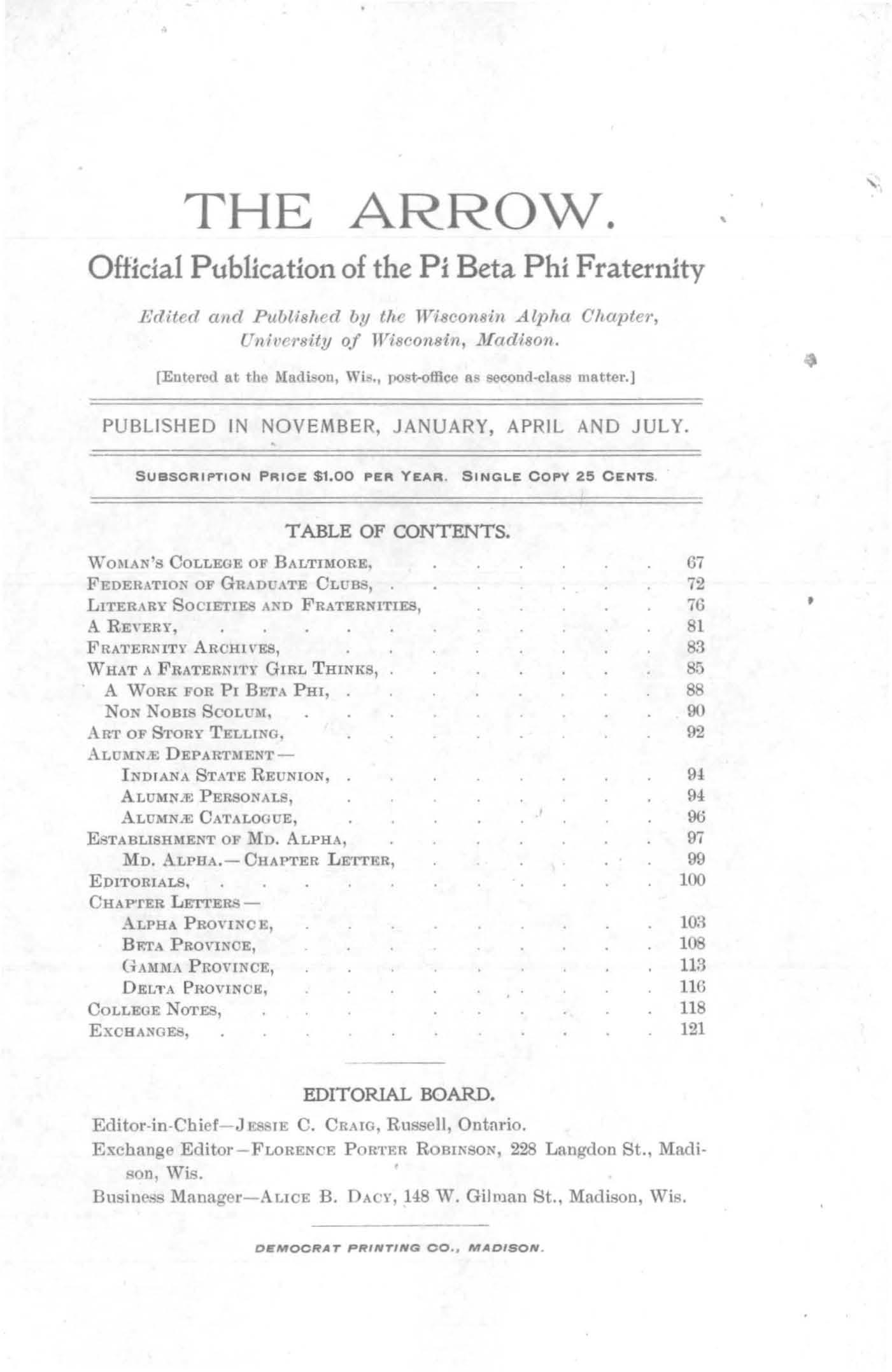
Edited and Published by the Wisconsin Alpha Chapte,', University of lVisconsin,
[EDtercd at the Madisoll, \Vi a., po$t-Qffice QS second clQ88 matter.]
PUBLISHED I N NOVEMBER, JANUARY, APR I L AND JULY.
SUBSCRI PTION PRICE $1.00 PER YEAR SINGLE COp y 25 CENTS
WOMAN'S COLLEGE OF BALTIMORE, FEDERATION OF GRADUATE CLUBS, . LITERARY SOCIETIES AND FRATERNITIES, A RE"ERY, FRA'l'ERN I TY ARCHI VEB, W HAT A FRATERNll'Y GIRL T HINKS, A WORK EOR PI BETA PHI, NON NOBIS SCOLUM, ART OF STORY TELLING.
D EPARTliIENTI ND r ANA STATE REUNION, ALUMl'i'£ PERSON/\ LS, ALUMNJE CATALOGUE, ESTABLISHMENT OF MD ALPHA, MD. ALPaA.- OHAPTER L ETTER, ED ITORIA LS, CHAP'rER L ETTERSALPHA PROVINCE, B RTA PRO\'INOE, GAMMA P ROVINCE, D ELT A P ROV I NCE, COLLEGE NOTES, EXCHANGES,
EDITORIAL BOARD.
Editor-in-Chief - JEssIE C. CRAIG, Russell, Ontnrio.
Exchange Editor-FLoRENCE PORTER ROBINSON, 228 Langdon St., Madison, Wi,;,
Manager-ALICE B. DACY, 148 \V. Gilman St., Madison, Wis.
, ,
VOLUME XIII. NO.2.
JANUARY, 1897.
Edited by Wisconsin Alp/la, University of Wisconsin, Madison.
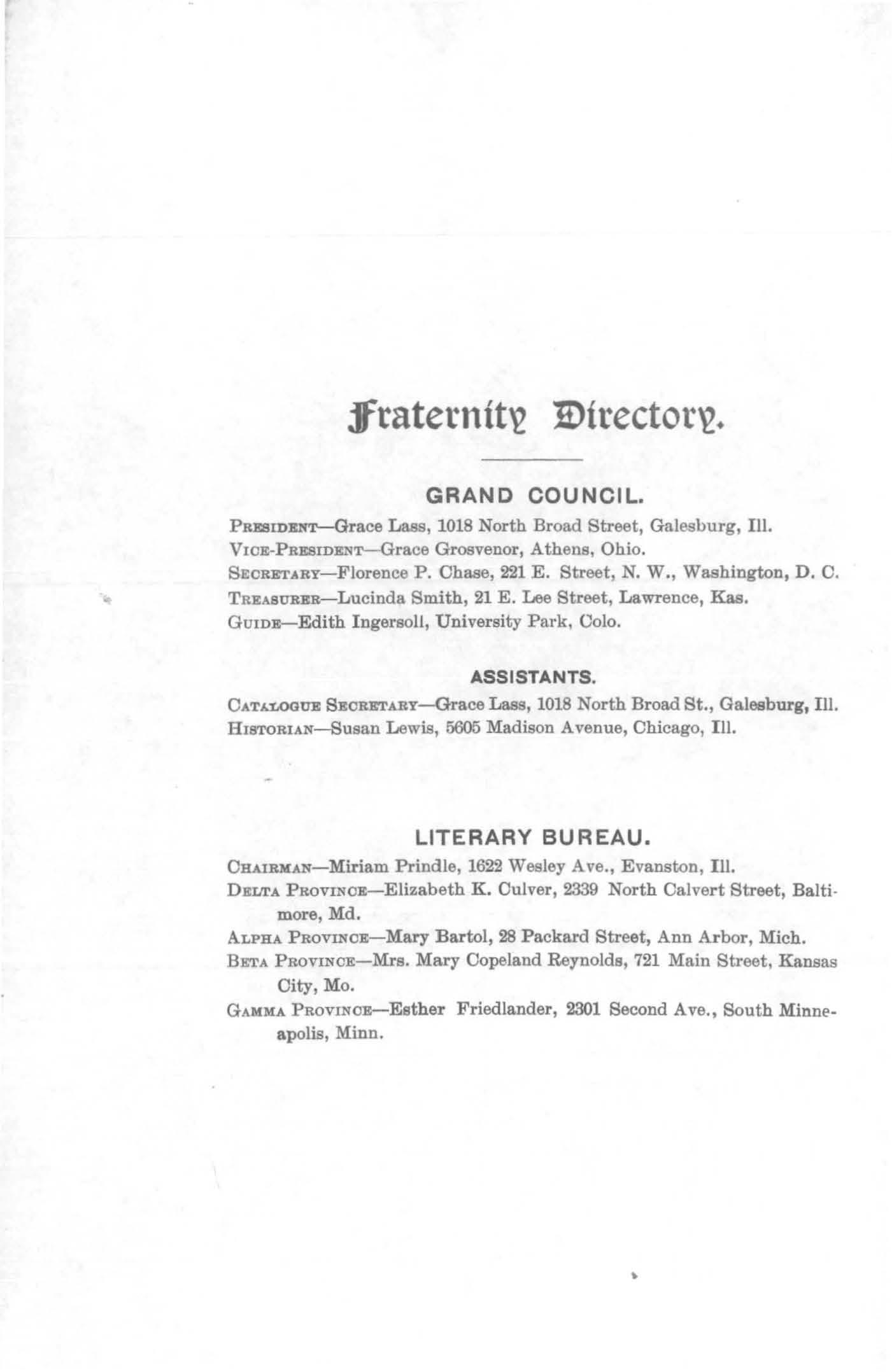
PRI!8IDEl<'l'-Grace Lass, 1018 North Broad Street, Galesburg, Ill.
VIOE-PRI!8IDItN'l'-Grace Groevenor, Athens, Ohio.
SECRJlTARy-Florence P. Chase, 221 E. Street, N. W., Washington, D. C.
TREASURER-Lucinda Smith, 21 E. Lee Street, Lawrence, Kas.
GUIDB-Edith Ingersoll, University Park, 0010.
CATALOGUE SBCRJlTARy-Grace Lass, 1018 North Broad St., Galesburg, Ill.
HISTCRIAN-8usan Lewis, 5605 Madison Avenue, Chicago, Ill.
CHAIRMAN-Miriam Prindle, 1622 Wesley Ave., Evanston, Ill.
DELTA PROVINCE-Elizabeth K. Culver, 2339 North Calvert Street, Balti · more, Md.
ALPHA PRoVINCE-Mary Bartol, 28 Packard Street, Ann Arbor, Mich.
BETA PROVINCE-MrS. Mary Copeland Reynolds, 721 Main Street, Kansas City, Mo.
GAMMA PROVINCB-Esther Friedlander, 2301 Second Ave., South Minneapolis, Minn.
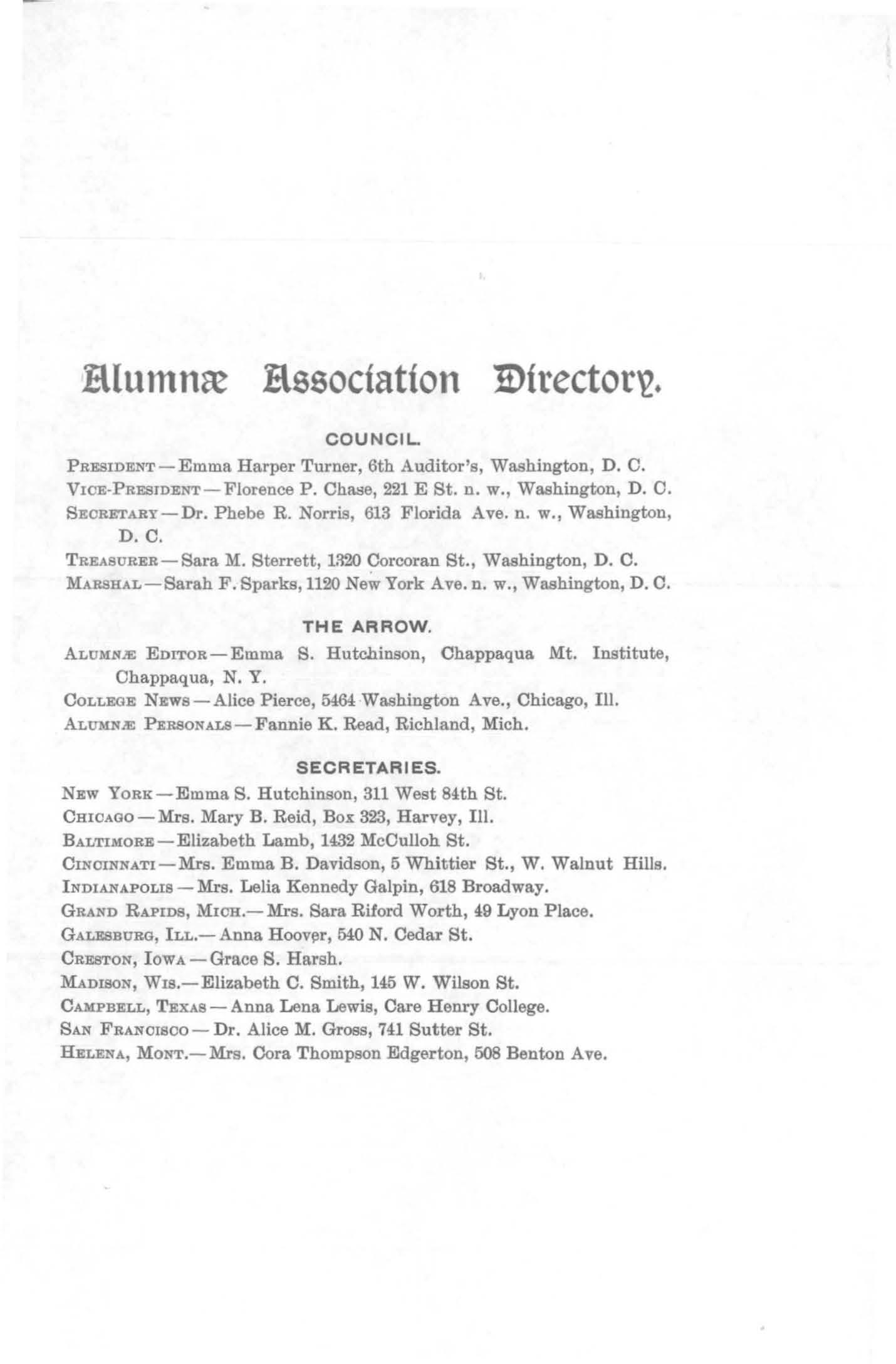
PRESIDENT-Emma Harper Turner, 6th Auditor's, Washington, D. C.
VICE·PRESIDENT-Florence P. Chase, 221 ESt. n. w., Washington, D. C.
SECRETARy-Dr. Phebe R. Norris, 613 Florida Ave. n w., Washington, D.C.
TREASURER-Sara M. Sterrett, 11l2O Corcoran St., Washington, D. C.
MARSHAL-Sarah F. Sparks, 1120 New York Ave. n. w., Washington, D. C.
T H E ARROW.
ALUM".E EDITOR-Emma S. Hutchinson, Chappaqua Mt. Institute, Chappaqua, N Y.
COLLEGE NRws-Alice Pierce, 5464 Washington Ave., Chicago, Ill.
ALUMN.E PERSONALS-Fannie K. Read, Richland, Mich.
NRw YORK-Emma S. Hutchinson, 311 West 84th St. CHICAGO-MrS . Mary B . Reid, Box 323, Harvey, Ill.
BALTIMORE-Elizabeth Lamb, 1432 McCulloh St.
CINCINNATI-MrS. Emma B. Davidson, 5 Whittier St., W. Walnut Hills. INDIANAPOLIS-Mrs. Lelia Kennedy Galpin, 618 Broadway.
GRAND RAPIDS, MrCH.- Mrs. Sara Riford Worth, 49 Lyon Place. GALRBBURG, ILL.- Anna Hoovllr, 540 N. Cedar St. CRESTON, IOwA-Grace S. Harsh.
MADISON, WIs.-Elizabeth C. Smith, 145 W. Wilson St. CAlIlPBRLL, TEXAS - Anna Lena Lewis, Care Henry College. SAN FRANOISCO- Dr. Alice M. Gross, 741 Sutter St.
HELENA, MONT.-Mrs. Cora Thompson Edgerton, 508 Benton Ave.
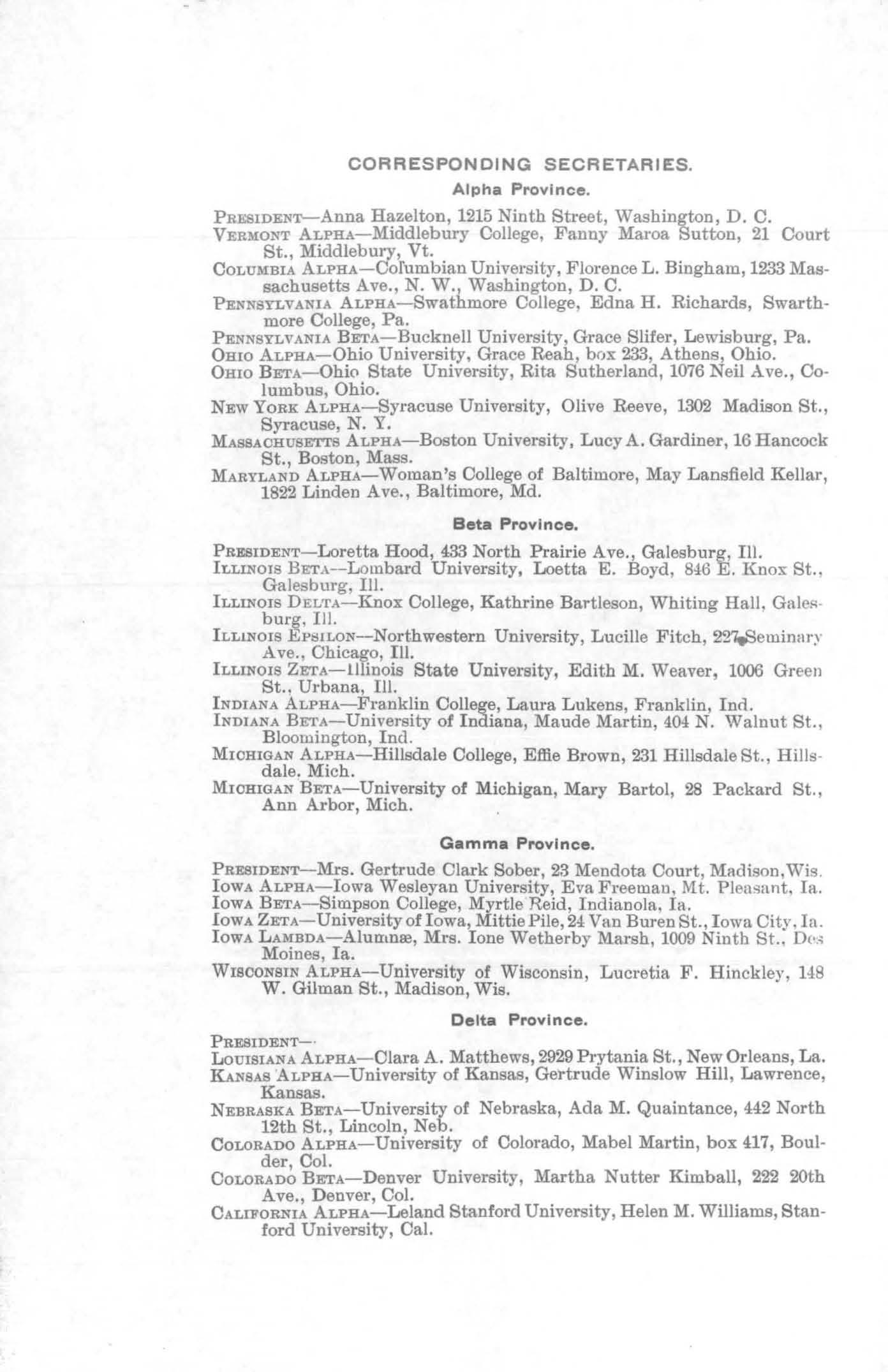
CORRESPONDING SECRETARIES.
Alpha Province.
PRESIDENT-Anna Hazelton, 1215 Ninth Street, Washington, D. C.
VERMONT ALPHA-Middlebury College, Fanny Maroa Sutton, 21 Court St., Middlebury, Vt.
COLUMBIA ALPHA-Cofumbian University, Florence L. Bingham, 1233 Massachusetts Ave., N. W., Washington, D. C.
PENNSYLVANIA ALPHA-Swathmore College, Edna H. Richards, Swarthmore College, Pa.
PENNSYLVANIA BETA-Bucknell University, Grace Slifer, Lewisburg, Pa.
OHlO ALPHA-Ohio University, Grace Reah, box 233, Athens, Ohio.
OHIO BETA-Ohio State University, Rita Sutherland, 1076 Neil Ave., Co· lumbus , Ohio.
NEW YORK ALPHA-Sy,·acuse University, Olive Reeve, 1302 Madison St., Syracuse, N. Y.
MASSAOHUSETrS ALPHA-Boston University. Lucy A Gardiner, 16 Hancock St., Boston, Mass.
MARYLAND ALPHA-Woman's College of Baltimore, May Lan.field Kellar, 1822 Linden Ave., Baltimore, Md.
Beta Province
PBESIDENT-Loretta Hood, 433 North Prairie Ave., Galesburg, Ill.
ILLINOIS BETA-Lombard University, Loetta E. Boyd, 846 E. Knox St., Galesburg, Ill.
ILLINOIS DEvrA-Knox Oollege, Kathrine Bartleson, Whiting Hall, GaieR · burg, III.
ILLINOIS EpSILON-Northwestern University, Lucille Fitch,227eS eminaJT Ave . , Chicago, Ill. .
ILLINOIS ZETA-lIlinois State University, Edith M. Weaver, 1006 Greell St ., Urbana, III.
INDIANA ALPHA-Franklin College, Laura Lukens, Franklin, Ind.
INDIANA BETA-University of Indiana, Maude Martin, 4.04 N. Walnut St., Bloomington, Ind.
MIOHIOAN ALPHA-Hillsdale College, Effie Brown, 231 Hillsdale St., Hills · dale. Mich.
MrOHlGAN BETA-University of Michigan, Mary Bartol, 28 Packard St., Ann Arbor, Mich.
Gamma Province.
PRESIDENT-MrS. Gertrude Clark Sober, 23 Mendota Oourt, Madison,Wis.
IOWA ALPHA-Iowa Wesleyan University, Eva Freeman, Mt. PlelBant, Ia. IOWA BETA-S impson Oollege, Myrtle Reid, Indianola, Ia.
IOWA ZETA-University of Iowa, Mittie Pile, 24 Van Buren St., Iowa City, Ia. IOWA LAAIBDA-Alumnre, Mrs. lone Wetherby Marsh, 1009 Ninth St., D(·" Moines,Ia.
W,SCONSIN ALPHA-Unive r sity of Wisconsin, Lucretia F. Hinckley, 148 W. Gilman St., Madison, Wis.
Delta Province.
PRESIDENT-LOUISIANA ALPHA-Clara A . Matthews, 2929 Prytania St., New Orleans, La.
KANSAS ALPHA-University of Kansas, Gertrnde Winslow Hill , Lawrence, Kansas.
NEBRASKA BETA-University of Nebraska, Ada M. Quaintance, 442 North 12th St., Lincoln, Neb.
COLORADO ALPHA-University of Colorado, Mabel Martin, box 417, Bonlder, Col.
COLORADO BETA-Denver University, Martha Nutter Kimball, 222 20th Ave . , Denver, Col.
CALIl!ORNIA ALPHA-Leland Stanford University, Helen M. Williams, Stanford University, Cal.
Vol. XlII. JANUARY, t897. No.2.
tHE Woman's College of Baltimore ranks with our five great colleges for women, although it is by many years the junior of Vassar, Wellesley, Smith and Bryn Mawr. It was projected by the centennial conference of the Methodist Episcopal church, as a fitting memorial to a century's progress in Methodism. Although non-sectarian in its teachings, it is under the fostering care of the Methodist church. The doors of the college were first opened to students in September, 1888.
Although only in her babyhood, the growth of the Woman's College has been phenomenal, and we are reminded of the classic stories of Minerva, springing into being in all the glory of womanhood, fully equipped for the battle of life .
There are at present two hundred and forty students regularly enrolled; of this number five are graduate students, two hundred and twenty· eight candidates for the degree Bachelor of Arts, and seven are pursuing work without reference to a degree. Although the college has had but eight birthdays, she has nine t y-one freshmen as hostages to fortune. The faculty is composed of specialists in the various departments, who bring to their work not only zeal and experience, but the culture and training of the best universities of our own and foreign lands. Baltimore is well fitted for the home of such an institution. Although it is south of the " scholastic parallel," it has the benefit of the fine lecture courses of the Johns Hopkins University, the lectures and concerts of the Pea-
body Institute, the Peabody and Walters galleries of art, recourse to the fine public libraries, the Enoch Pratt and the Peabody; it has a mild and healthful climate and is within a forty-five minutes ride of the national capital, with its wealth of educational interest; all these things are influential in making Baltimore an educational center.
The college, although easily accessible to the business portions of the city, is within a few minutes walk of natural woods and country roads.
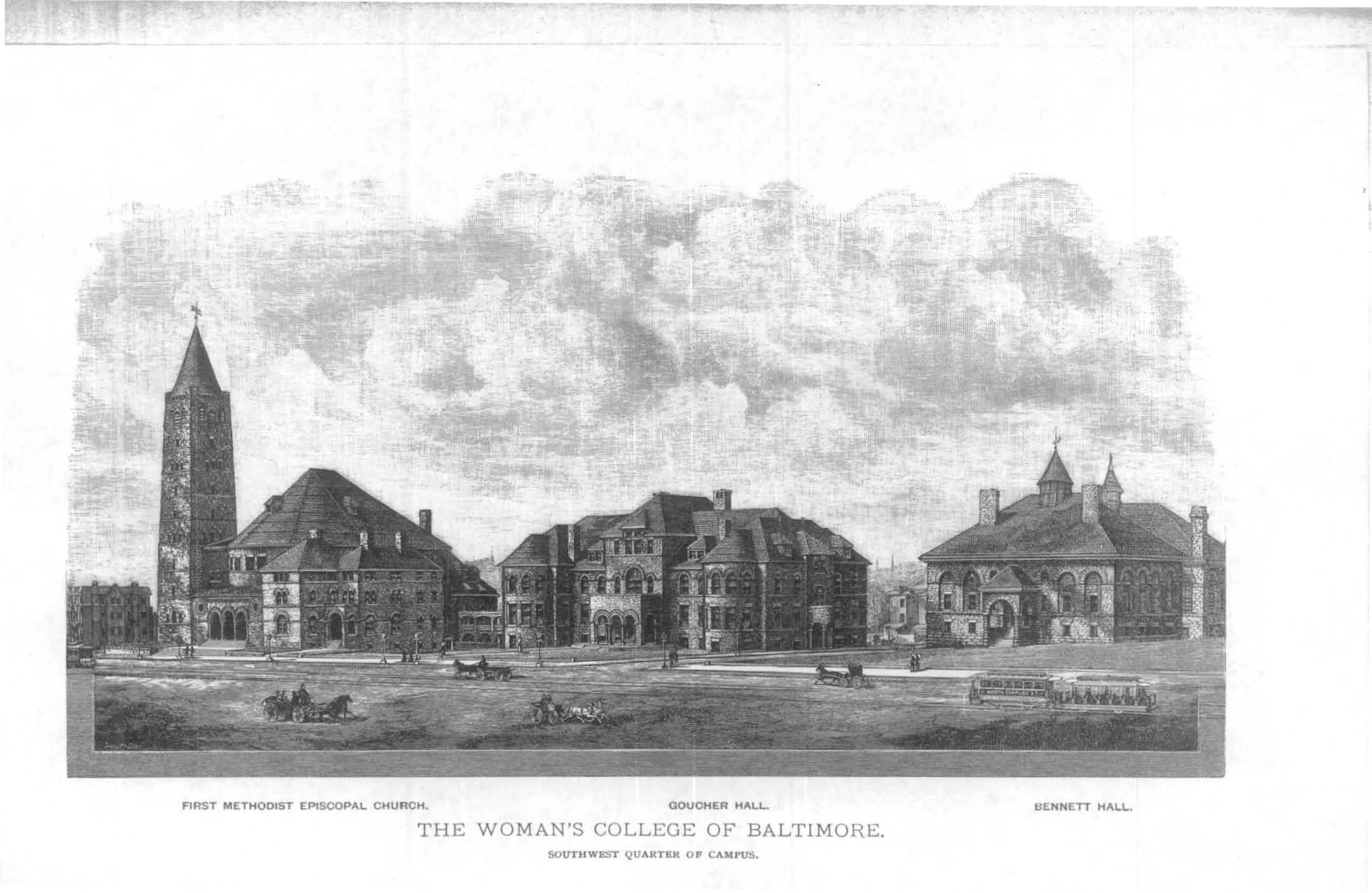
The college buildings form an imposing pile. They are built of dark uncut stone, surmounted by Roman red tiles. 'rhey are built in the Romanesque style of architecture in the Lombard variety. Architecturally a member of the group is the First Methodist Episcopal Church, occupying one cornel' of the block of main buildings. Its tower is a.lmost an exact reproduction of a campanile just outside the ancient city of Ravenna. The chapel attached at the back of the church is a gem in itself; it is semi·circular with a seating capacity of five or six hundred. The arc forming the outer wa.ll is divided into alcoves over which extends a gallery with supporting pillars. The gallery is furnished with theatre seats. Besides the daily chapel exercises, lectures and class day programs are given here.
Goucher Hall, the main building of the college, was the first erected. The building cost $140,000, and is handsomely finished in natural woods. The style of architectecture is massive and plain, and gives an idea of permanence.
The main halls are in the form of a Greek cross and very spacious. Here are reading desks covered with newspapers and periodicals, and cozy nooks for catching a few minutes study between recitations or the moment's tete-a· tete so dear to girlish hearts. Here the light sheds its softened rays through stained glass windows, upon palms, marble buslis and old paintings, so that the first glimpse of college halls, which traditionally strike
terror to the heart of the candidate may here yield some· thing of its foreboding in the cheerful. genial scene. This hall is used for the reception of gue sts in all large social gatherings. Goucher Hall. together with the ground sur· rounding it. was the gift of President John F. Goucher. to whose unceasing liberality and untiring devotion the insti· tution is so deeply indebted.
Bennett Hall. the gymnasium, is the special pride of the student,s. It is a model of its kind. The first floor is taken up with a fine swimming pool with its accessories, dressing rooms, shower baths Il,nd bath tubs and by a bowling alley. On the second floor and two stories in height is the main exercise room fitted with ropes, ladders, bars, headless horses, measuring ropes and spring-boards for practice in jumping and vaulting, and all the best devices for physical development. Here too is apparatus for the correction and alleviation of incipient deformities . The physical training is presided over by an experienced physician, who is also a member of the faculty . The Swedish system of instruction is used, the instructors being all graduates of the Royal Central Institute of Stockholm, Sweden . Every student undergoes a careful physical examination at the beginning and middle of each school year; her case is recorded and all improvement noted, or if by chance there is no improvement the remedy is sought . The results a,g shown b.y the records of different years are noteworthy. Class work in the gymnasium is required during the entire collegiate course. The main exercise hall is surrounded by a gallery upon which is a padded running track and Zander machines for special muscular development. Adjoining the gymnasium proper and connected with it by a passage modelled after the Bridge of Sighs, is the annex or biological hall, on the second floor of which is a smaller exercise room devoted to basket ball.
There are four large new boarding halls, each accommodating at present sixty students - one of these is used
for the students pursuing work at the Latin school, a school preparatory to the college. The Latin school is also under the supervision of the Methodist church, and its handsome building, built in the same style as the college buildings, will one day come into the possession of the college, when the local preparatory schools shall have raised their standards to the requirements of the college. The homes are of brick and terra cotta, the interior finished in oak with polished flool's. The rooms are daintily furnished. Every girl has her own mantle bed with pretty curtain, a bureau, washstand and closet, whether she is alone or has a room-mate. Added to these the books, photographs, screens, cushins and tea-tables, which every girl collects around her, give the rooms a charming studio effect. Besides the large handsomely furnished reception room on the first floor of each home, every floor has its smaller social hall where the more intimat e belongings of the girls find place. Here it is that the magazines and new books find their way. The kitchen, dining room and laundry, are on tile fourth floor, thus avoiding the odors and noises that must occasionally permeate a house with basement or first floor culinary departments. A well regulated elevator equalizes the desirability of the different floors.
Life in the college homes has few of the evils usually attending dormitory life, and the students greatly prefer it to boarding outside in the city. A cheerful home atmosphere pervades the buildings, and the students have a feel· ing of proprietorship and pride in all its concerns. Each hollie is presided over by a matron, who is a woman of culti"ation and experience.
The social life of the college is confined mostly to the students themselves. There are occasional formal receptions in Goucher Hall, and also in the homes, to which outsiders are invited, but teas, club meetings, amateur theatricals, tennis tournaments and basket-ball contests, glee and
banjo club cOllcerts, are never wanting to fill each idle hour. The professor of German opens his home once a fortnight to a social club composed of the upper German classes and alumnae. There the language of the evening is German. Both German and French departments have given very creditable reproductions of dramas in their originals.
One of the social features always eagerly anticipated is the long happy day each year at Altodale with President and Mrs. Goucher in their beautiful country home. Teachers and students lay aside the work·a·da,y cares, take the special cars awaiting them at the college doors, and after a devious course through busy thoroughfares, the noise, dust and smoke of the city gives place to the freshness of fields and the odors of May flowers. The hours are spent mostly on the broad lawns under the spreading trees, for even the weather clerk is a party to the plans and always sends
" One of the charmed days When the genius of God doth flow. "
The students wear the academic gown and mortar board cap whenever they appear about the class rooms. These are graceful and becoming and the uniformity is much more pleasing to the eye than the heterogeneous mass of color. There is also a greater change and consequent rest when the students don the lighter, airier garments, as the custom is for the evening dinner.
The curriculum has received scanty mention here, as it is the social aspect of Maryland Alpha's home we are in· troducing. Briefly, however, we would add that the course of study is modelled on the group system first in· troduced at Johns Hopkins University for undergraduate use, which, while it gives a broad general culture, is especially adapted for specialist post·graduate work. There are a number of scholarships already in progress and several more that are endowed to take effect soon.
Among the latter are two foreign scholarships to be first granted to members of the class of ninety-eight. These provide for graduate study iu foreign universities, one in England, the other on the continent.
Maryland Alpha meets in the Woman's college five other representative fraternities, Delta Gamma, Alphi Phi, Gamma Phi Beta, Kappa Alpha Theta and Tau Kappa Pi. The last named is little known in the fraternity world, as this is its only chapter as yet. The welcome giveu us by the other Greeks has beeu hearty and sincere as well as graceful and generous.
second annual convention of the Federation of \.. Graduate Clubs of America, was held in Baltimore, December 29 and 30, 1 896, in McCoy Hall of Johns Hop· kins University, under the auspices of the Johns Hopkins Graduate Club.
The origin and growth of the Federation, as well as of the Graduate Clubs, is comparatively recent. In April, 1893, a convention of affiliated Graduate Clubs was held in New York City, at which representatives from some of the leading American Universities were present. Out of this convention, largely through the efforts of Mr. Charles E. Duniway, of Harvard, the Federation of Graduate Clubs was effected. Its first convention was held in Houston Hall, Philadelphia, in January, 1896, with the graduate Club of the University of Pennsylvania. The Graduate Clubs of Barnard, Brown, Bryn Mawr, California, Chicago, Clark, Columbia, Columbian, Cornell, Harvard, Indiana, Johns Hopkins, Michigan, Minnesota, Missouri, New York, Northwestern, Pennsylvania, Princeton, Radcliffe, Stanford, Tulane, Vanderbilt, Wellesley, Western Reserve, Wisconsin and Yale, constitute the Federation of Graduate
Clubs. The aim is to aid the development of graduate study in America.
The matters under consideration at the recent convention were the means by which the Ph. D. degree might be guarded, which of course includes the disapproval of the conierring of honorary degrees; the means by which interuniversity migrations might be facilitated; and the publication of the Handbook of Graduate Oourses.·
With regard to the means for guarding the Ph. D. degree, Dr. H. T. Lukens, formerly of Olark, and now of Bryn Mawr, as chairman of the committee, submitted a report. He had sent out circulars to the twenty-four colleges and universities then represented in the Federation, and to those colleges which had reported to the Bureau of Education that they had conferred honorary degrees in 1894. Out of the 144 colleges to which these circulars had been sent, he had received replies from 96. Of the institutions represented in the Federation, Bryn Mawr, Olark, Ohicago, Oornell, Johns Hopkins, Leland Stanford, Minnesota, Vanderbilt and Wellesley, reported that they conferred no honorary degrees. In answer to the question, "Are you in favor of conferring honorary degrees?" eighty-five out of the ninety-six say no, and eleven say yes with some qualification. The committee also submitted a series of resolutions of which the following were adopted by the convention of the Federation:
Resolved, That it is the sense of this convention:
First, That it is inexpedient for the same institution to confer the same degree hono'ris causa as upon examination. Second, That the reasons for conferring an honorary degree should be stated upon the commencement programs and in the annual catalogue of the institution conferring the degree, and the Department of Education should also receive reports of such conferments and the reasons for the same.
Third, That Bachelor's degrees are inappropriate for
honorary degrees and should be made to signify the completion of required work of a certain character.
Fourth, That the Master's degree should never be granted except for resident graduate study of at least one year's duration, tested by adequate examinations.
Fifth, That the minimum requirements for the degree of Ph. D. should be:
a. The previous attainment of a Bachelor's degree or its equivalent.
b. The completion of at least two years of resident graduate study; not more than one year, however, should be required in residence at the institution conferring the degree.
Co Adequate examinations and a thesis embodying the results of original research, bearing the approval of the professor in charge, together with the vita of the candidate.
Sixth, That the degrees Doctor of Philosophy, Doctor of Medicine, Doctor of Science and Doctor of Pedagogy should never be given hono?-is causa or in absentia, and that the degrees Doctor of Humanities, Doctor of Divinity, Doctor of Sacred Theology. Doctor of Laws, Doctor of Civil Laws and Doctor of Music should be recognized as purely honorary degrees.
Seventh, That the editor-in-chief of the Handbook of Graduate Courses should be directed to publish each year in the Handbook the list of the recipients of regular Ph. D's in American universities, together with the titles of their theses and the names of the professors approving them.
The official organ of the Federation is the Handbook of Graduate Courses. This attempts to outline the graduate courses of study in the twenty-four leading colleges of the United States, showing the relative strength of the individual umversities in the various courses along the lines of graduate study. At this convention the Federation also decided to undertake in connection with the publication of
·the Handbook the printing of a list of all the dissertations for the Ph. D. degree hitherto written and accepted in American universities, together with the names of the authors and of the approving professors. This, then, marks the commencement of the publication of a catalogue of American dissertations, similar in scope to the lists of German theses which have been published under the authority of the German government for the past ten years. This is to be supplemented by additional annual lists to be printed in the Handbook in order to keep the lists up 10 date. a work will be a valuable contribution to bibliography.
In writing of the convention of the Federation I must not fail to mention the opportunity for social intercourse afforded by the kindness of the Johns Hopkins Club in tendering us a reception. The opportunity of meeting some of the well-known professors of Johns Hopkins and of an informal interchange of ideas in this representative group of graduate students was appreciated. In this connection I might speak of the three addresses delivered before the convention - the addresses of President Gilman, Professor Bloomfield and Professor Remsen. It seems to me rather a noteworthy coincidence that these three men, all representatives of Johns Hopkins, should have spoken of the same phase of the same subject, which President Gilman and Professor Bloomfield termed "Greater University Freedom," and what Professor Remsen called "Akademische Freiheit." In brief, the spirit of the Federation cannot better be expressed than by those three words, "greater university freedom."
MARY BARTOL, Michigan Beta.
TN ORDER to discover how much truth theTe is in the statement that fraternities are destructive to literary societies, I have sent a list of questions to the corresponding secretaries of each of the chapters of Pi Beta Phi with a. view to obtaining information in regard to the literary societies of the college or university to which she belongs. As I have recei ved information concerning twenty -three colleges and universities varying greatly in size and character and scattered all over the United States, it seems reasonable to suppose that any conclusions reached from the facts thus obtained will be a fair statement of the relation of fraternities to literary societies in the institutions of this country.
Four questions were asked, and after stating each question I shall endeavor to give the results I have obtained:
1. A?'e the litem1,?! societies in your college in a flourishing condition? In fourteen of the twenty-three colleges and universities they are in a flourishing or at least healthy condition; in one of the remaining colleges there are no literary societies at all; in another the societies did not flourish during the past year owing to the resignation from the university of two interested professors; in another, the girls' society is doing excellent work while those of the boys are sl:uggish. Although the societies in the remaining six colleges are not flourishing, nevertheless, from the tone of the letters, I judge that some interest is still taken in them and that there is no fear of their being discon· tinued.
2. Do j?'aternities harm the societies in any way? Do they help them? From the answers received I have learned of eight or nine societies that have died out. One society succumbed to the strife between fraternity and non-fraternity members at elections. It was believed that the nonexistence of four others was not brought about by frater-
nities and in the other cases no reason was known. In eight of the twenty-two colleges where societies exist the writers of the letters know of no harm done to the literary societies by the fraternities. In two cases the fraternities work some evil to the societies by their scheming and struggling for honors, yet some of the writers consider that this is evidence of great interest in the societies caused partly by fraternities. In three cases it was thought that possibly the fraternities did harm by leaving the members too little time for good literary work. In two cases it was thought that societies would be more numerous without fraternities. One letter makes this encouraging statement: "To my knowledge in our society there is absolutely no fraternity spirit, by this I mean that the girls stand absolutely on their own merits and are elected to offices and other positions of honor without discrimination between 'Barbs' and 'Greeks'."
3. Do j'rateTnity membm's take great inte?'est in the societies, and do they take a p?'ominent paTt 'in them? In one college, fraternity members are not allowed in societies. and strong society members resign to join fraternities. In five cases it was thought that the interest of fraternity members in the society was lessened, because their fraternity interest was stronger than that evinced in their society. No other harmful effects of fraternities upon literary societies were specified. In six cases it was thought that the broadening effect of the fraternity upon character, and fraternity rivalry stimulated the societies. In eight institutions all the fraternity members belong to societies, take great interest in them, and many of the fraternity members hold prominent positions. In seven, only a small percentage of them belong, but, as a rule, are active workers Some very interesting answers were obtained to the third question. One girl writes: "There are always one or two fraternity men who take great interest in the societies and take a prominent part,
but the average prominent member is non-fraternity." In reference to the women's society she says: " The Zeta was suggested by a fraternity girl in fraternity meeting, but was organized by the College Girls' Association, and fraternity feeling has been ca?'e,fulty kept out. It is a common interest to college girls. The fraternity is outside that and has no influence upon it. The fraternity girls have as a rule been leaders in the advancement of the Zeta, but it has been because they are girls who do earnest work everywhere, and in a college where there are few girls I can say without chapter egotism that the most prominent are iraterni ty girls.
Another writer says: "In the girls' societies there is no regulation in regard to fraternities, but one of the men's,and so far they have succeeded in carrying off the majority of the honors,- refuses to admit fraternity men as members. In the other societies the best and most prominent workers are fraternity people. Among the girls' fraternities an attempt is made to do literary work in the chapters, so their best efforts in that line are given to the college societies. The difficulties we have found are to keep the girls divided so that each fraternity may be well represented in both of our societies and thus avoid anti·fraternity feeling and avoid fraternity 'rushing' in the society. It rarely happens that a fraternity member does not belong to a literary society."
A third glrl says: "The literary society.-for there is but one in which women are interested-the Alethenai, is supposed to supply the want of some democratic organization in the university and any girl, who is a member of the university is eligible to membership. The number of active members during the past year was forty-six out of one hundred and seventy-five girls enrolled in the university. Of the forty·six members thirteen were fraternity girls, Pi Beta Phis and Kappa Alpha Thetas, and there were no other girls who took so active a part If the fra-
ternitics do not help they certainly do not harm the society. I have reason to believe that during the coming year the number of fraternity girls in Alethenai society will be incraased since it is -the only place and time when all the university girls moet on an equal footing, and the desire seems to be to meet with all the girls and establish a sort of general friendship."
4. If you have no literary societies, or if any have died out, did the existence oj fraternities assi8t in causing such a 1·esult? It is generally in the large universities that the least interest is taken in literary societies. From this information I think we may conclude that, although fraternities are apt to harm literary societies somewhat, they can hardly be called destructive to them, for almost no societies have died out because of fraternities, and most of those now existing are in good conditioll. It must be confessed that to some extent fraternities take the place of literary societies, for in one college there are no societies at all, and in two universities there would be many more societies did fraternities not exist, nevertheless the fact that, in a majority of the colleges and universities (sixteen out of twenty-throe) some fraternity members belong to and take prominent part in the literary societies, seems to show that in most cases from the literary societies benefits are derived that are not derived from fraternities. While a fraternity meeting may be literary, it has other aims, and is not so well adapted to thorough literary work and does not give such discipline and training as may be gained in a less private literary organization. Besides, many fraternity chapters do little or no literary work. Thus it appears that in most colleges literary societies still play an im· pOl·tant part and are advantageous to all students. We must then conclude that literary societies are generally valuable and that we should give them our hearty sup· port.
We find the evil effects of fraternities upon literary
THE ARROW.
societies due mainly to the electioneering or fraternity members and especially to their lessened time for work in the literary societies. Only a limited amount of time can be given to work outside the college curriculum and, when a stuuent belongs both to a literary society and to a frateI" nity, his interest must be divided between the two and he can give less time than if he were a non-fraternity man to the work of the literary society. One girl in speaking of the influence of the fraternity in the literary society says;"! think we fraternity girls sometimes let our joy be too great when a fraternity girl wins, and I think too that we sometimes neglect the non· fraternity girl in society. So it seems to me the farther away from society we keep our fraternity-cIs ajratej'nity-the better for both." Another one remarks: "As I look upon it. the evidence is all against the 'Greeks.' We need a little stirring up on the subject." I think we must be glad to hear the following information in regard to a Pi Phi chapter, and it would be well if every chapter, placed in a similar situation, could say the same thing: "Nevel' in a case of college politics do we act or vote collectively. but individually. The votes of the Pi Phi girls in oratorical or athletic meetings cannot be counted upon as a whole. A Pi Beta Phi may have her individual preferences and acts accordingly without advice from her sisters." In Simpson College where the struggles were formerly very fierce, little or no fraternity spirit is now shown in the societies. Although something has been accomplished in this line, it appears that much more can be done by inaugurating a vigorous crusade against fraternity electioneering.
We should make the literary work in our chapters very light, and as different as possible from the society work. Then the fraternity member who is eager to gain all he can from his college course will feel the need of the vigor· ous literary work offered by a literary society. The writer of one of the letters thougbt that fraternity members
should be excluded from literary societies in order to let the non-fraternity students have something which they could run themselves." In two universities fraternity members are excluded from the societies, and they are not allowed in some societies in other institutions. In Indiana University this arrangement is successful and the literary societies are strong and take the place of fraternities to their members . In order that the plan of excluding fraternity men and women from the societies may be successful there must be an adequate number of strong non-fraternity students to carryon the societies.
It is a question lor a fraternity member to settle, if the method of exclusion is not adopted in his college or university, whether he needs the drill of a literary society and whether he should not give his support to so important a college organization. If he decides in the affirmative, let him become an energetic sociel.y worker, giving to this interest as to all others, the inspiration and power which he gains from his fraternity friendships.
MARY STONE McDOWELL. Pa. A.
thinking and my thoughts wove themselves thus: A man traveled over all the world seeking the fl.ower of happiness. In many climes and countries he went, finding wealth and power and beauty and grandeur, but the little fl.ower for which he sought was nowhere to be found. Ov e r hills and valleys, across seas and rivers, he ' still wandered and was growing old and weary. The world was only a desert place to him. for he found not the object of his desire. But one day he came upon a little child playing with the p e bbles by the brook-side and he asked the child as he had asked so many times before - had he seen a pure white flower which when plucked brought joy to the fiuder. The child looked upon him; then pointed to a
little sunny nook among the grass and leaves at the strano ger's very feet. With a cry of joyful expectation the stranger stooped and picked the flower - two dainty little bells growing from one root- but to his despair. the world looked just as gloomy as it had before - his heart was just as heavy. " It is false" he cried. But the child held out his hand and said, "Give half to me." The stranger hesitated-" Would he lose all hope by sharing?" And then with a sudden yearning for the wistful, loving, blue eyes of the child he separated the flower from its stem and gave it to him. And immediat.ely a great happiness filled his heart, the birds sang loving messages to him, the brook babbled merrily, the breezes caressed him and the whole world wad full of beauty_ And to his heart came the words of the poet, "He who seeks joy must share it; happiness was born a twin."
As a refrain the words repeated themselves: "He who seeks joy must share it; happiness was born a twin,"- and my thoughts still wandered on. It is the old, old doctrine of renunciation, the demand which a soul feels to sacrifice, to suffer; the unrest which drove men to endure solitary lives in dreary caves or on loft.y pillars, to do penance with scourge and sack -cloth It is the more tender doctrine of " love thy neighbor as thyself," the Golden Rule of the later days. It means that we can only hold eternally what we are willing to share with all. I thought of those things I held dear and the old question came to me: "Is fraternal life a selfish one and hence inevitably self·destructive?" The words of our creed, the professions and aspirations of our ritual came to me, and I knew that in and of itself the organization was organic - it had the germs of true life. If the opinion of the many was true then, the fault lay in the members of the fraternities - they cou1d not be faithful to the principles they professed. Judgment had proved that for the development of these professions certain methods seemed necessary - as secrecy and restriction of member·
ship, but if excluslveness and selfishness result we defeat our own ends, the foundation is clogged and our existence as a power in the world is ended. There is a danger that such might be, that fraternitiea might outlive their usefulnessbut it need not be. The source of the fountain is pure and sweet, its passage must be kept open, and the world will receive the blessing. Give. give, give, is the watchword of life and growth. Let our light shine. " He who seeks joy must share it; happiness was born a twin."
E. S. H. P A. ALPHA, A. A.
IT IS said that when Washington was first elected president of the United States, he hesitated to accept the office, knowing the grave responsibilities which would follow our inaugurating a new and untried system of government. He realized that he could rely upon the experience of no one, but that he would and must establish precedents which would work for good or i.ll in after years.
It is this same feeling of responsibility which falls upon the first members of a new chapter. They have no experience of their own to guide them, and although others ma.y and do advise freely and willingly, the success or failure of their chapter depends upon them. Some of this experience is handed down from year to year by word of mouth, but anything which is of importance, or which might be a help in after years, is worthy of more thought and of a better means of preservation. A well-kept chapter history, beginning with the very founding of that individual chapter, ought to be of interest not only to those who took a.n active part in its forma.tion. but to every member in all its future. It must necessarily be a series of successes and failures, for a cbapter is too full of human life to have its history otherwise. But these very successes and failures A.RBow2.
should serve to form a closer bond the members of the present and those of the past, in that they will show that all are and were working for one common end - the good of the society; or better still, the good of the members through the medium of this social union.
Do not let this history become dull and dry, but have it full of interest to all and "up·to date." In order to obtain this result, ca,re must be taken to have the choice of a historian fall upon a ready writer and one gifted in the art of recording homely events in a pleasing manner.
Then occasionally, the Press notes the existence of the :society. It may be a short notice of a convention, a reunion, a social event of our own, or some sister chapter, or better still, the news that the wOl'k of some member has been deemed worthy of public notice. Do not be content with simply keeping such clippings, but have a book especially for them; have them pasted in, leaving, if possible, a place for the insertion of any personal recollections in connection with the person or event noticed.
Then. should the notice refer to one of your own members, past or present, have the photograph album in readiness so that the face and name may be linked together in the minds of the new members. Try to have each member leave behind him a likeness properly labeled for this same album. The groups, too - do not forget the pleasure there is in looking over old group pictures, either large or small. Remember posterity when ordering a certain number.
And the souvenirs - what is done with them? Does each member carefully preserve her own to remind her of the many happy college days, leaving nothing in the way of suggestions to those who may follow, or is each chapter carefully collecting its sou venirs?
In short, let every chapter place among its archives a thoroughly instructive and helpful history to show what obstacles to avoid and what precedeILts to follow; a well kept book of clippings to remind us that we are living in
a world both large and small; a photograph album, containing the photograph of each of its members to link the new with the old, and souvenirs to serve as suggestions for the social life.
A. A.
Proposed: The Ohapters of II B if! establish and maintain "Loan Ptmds " Jor use in the i,' "eBpective colleges - amount, manner oj loan, and all detailB to be dete"mined by the chapte,' indi·vidually.
Shall we as a Fraternity support a Loan Fund Association? It is a most interesting subject and so much can be' said in favor of assisting a struggling student that I regret having time only to add a little personal experience to the weight of evidence. I have found, and the experience of others has coincided with my own, that lending to students has always seemed to act as a stimulus toward getting work in vacations and after graduation in order the sooner to be free from debt, and I have never met with loss while helping them when in need. Mrs. Eben Tourgee says in reference to the working of the Loan Fund plan in the New England Conservatory of Music: "We have found it a very encouraging work and only good resulting therefrom. We have found it best for us as our means are so limited to make only small loans to each student so as in as far as possible, to assist wit.hout burdening with too great a debt; and we always allow two years before asking a return, although often our Beneficiaries have begun to repay during the first year after leaving the Institution. "Some are much more prompt and anxious to cancel their debt than others, and of course there will be some who never repay, but by far the larger number do pay in time, .according as they have prospered, and are always very
grateful for the timely assistance." By the report of their Society I see that for this year they were able to help twelve pupils with sums of from twenty to thirty-five dollars per term. The Fund is created by Life Subscriptions and Annual Membership fees as well as by Benefit Concerts, Fairs, Donations and Loans returned, and amounted for the first year to $1,434.23.
This creation of a Loan Fund in the Fraternity is a very noble ambition, but it requires wealth and influence to back it and is not so feasible a project, in the present status of the Fraternity, as the raising of a few scholarships, because more machinery is needed to run the Loan Enterprise, whereas in a scholarship, there are fewer avenues of distribution to watch and guard.
SUSANNE F. TYNDALE, A. A. Recent ProJesso1' oj Eng. Lit. at Iowa State Univenity.
The more I think of it the less am I in sympathy with the proposition. I believe no dispensation of charity a suitable fraternity work. I would answer "No" to each question of the proposition. My idea of a fraternity is an organization of girls binding them so closely together as to take the place of the home ties, which by attending college they must temporarily give up. In the chapter, the girls meet, for counsel and advice, for sympathy and comfort in trouble, for various social pleasures, and for mutual improvement, both mental and moral. I believe the raising of a fund for charitable purposes, or even the es· tablishment of a scholarship, is entirely outside the province of a fraternity. If the fund were raised for the erection of a chapter house or other fraternity use, I would heartily favor it, though even then there are many difficulties to overcome. How great would be the disappointment if, after years of patient working and waiting, until perhaps a thousand dollars were raised, the-
entire sum should be lost through a poor investment! And how easy for such an accident to happen! But it seems to me a chapter with several resident alumnre who are good business women, or who have fathers, brothers or husbands who are good business men, and are willing to take charge of the money and keep it safely loaned at a good rate of interest, such a chapter could soon be the proud possessor of a home, if the members would worktax themselves a certain amount each year, and solicit aid from alumnre.
My experience in fraternity life has been that each girl has, in her own immediate needs, all the expense she feels she can carry. If the chapter has extra money it is needed for some social function which the girls greatly desire and deem necessary to maintain the standard of the fraternity. Not more than three or four girls feel they can afford to give toward the support of those who are to make up the chapter in years to come. The others are not close or selfish, but really in straightened circumstances; perhaps have taught school for part of the money to take them through college, and have borrowed the rest from relatives who will wait patiently for them to earn the money to repay it. But I believe it is well to investigate the financial standing of a girl before inviting her to join the fraternity. This seems hard on the poor unfortunate girl, who would otherwise make a suitable member, but there are many other things she must do without, and if keeping pace with the demands of the fraternity be too great an expense, she hali better put her money where it will do her more good, and not prove a drawback to the members of the fraternity.
I should be glad to see as many chapters as possible 10' cated in homes of their own, and the rest of the chapters working ha.rd for a house, determined to succeed.
NELLY PEERY PRlCE, A. A.
The problem of the establishment of a loan fund is so many· sided that I can not hope to have compassed it all or to offer a solution. I will only mention some of the possibilities and difficulties I see in it.
If the chapter were in position to offer financial aid to its members it could perhaps hold girls whose resources were exhausted before they finished their college course, and girls who hesitate to add to their college expenses the burden of fraternity dues.
Such a scheme would require the support of alumnre whose fraternity interest reaches their pocket-books, as well as the co-operation of the active chapter. I believe II B could support such a fund if the need of establishment were a real one.
Aside from the practical difficulties of raising a fund large enough to be of any real assistance, is the chapter with its shifting membership, an organization stable enough to take upon itself the financial responsibility of the guardianship of such a fund? In many ways I think the fraternity as a whole better suited to establish and control such a fund.
Another feature deserves attention, and I think it fundamental. If we lend girls money we assume that when they leave school they will become wage-earners. Is this what our schools prepare for? Does II B wish to encourage even indirectly the spirit which has led and is leading so many American girls to abandon the responsibilities and privileges of home to become wage earners?
FRANCES STEARNS, A. A.
The numerous duties of the college woman are, as a rule, so conscientiously performed, and her manifold privileges
A work for PI SO gladly embraced, that it seems almost heartBeta Phi less to call attention to her one serious shortcoming rather than to dwell upon her many shining virtues.
However, it is not by the contemplation of our virtues but by the realization of our faults, be they one or many, that we are trained to that eternal vigilance and spurred to that tireless effort which alone can make us what we ought to be, earnest, capable, progressive women.
A duty which we all neglect, a privilege which we all Iail to appreciate is the work of the literary society, and that it is both a duty and a privilege I think we would all agree.
In this day of sororities, clubs and federations, to one or more of which almost every woman belongs, it is just as needful that we be able to take an active intelligent part in their proceedings, as that we be able to perform the ordinary social duties from which no one of us seeks to excuse herself. Every woman, especially every collegebred woman, should be able to preside over a meeting without violating or allowing to be violated the common rules of parliamentary law; she should be able to write clearly and interestingly upon any subject relating to literature, history or current events that may be assigned to her; she should, moreover, be able to speak extemporaneously upon questions under discussion, or when asked to give an informal talk or respond to an impromptu roast, a compliment which too often results in utter confusion for the speaker, and in positive distress for those who witness her embarrassment. We cannot., of course, all do these things equally well, even with the same training, but it is true that those who fail most miserably at first improve almost incredibly with constant practice. And when and where ought we to obtain this practice? Assuredly before we leave college, and in the place which best affords it. the literary society.
We all admire, perhaps envy, women who write and speak with ease and self-possession, expressing their thoughts in clear forcible English, which brings satisfaction alike to themselves and to their hearers; yet how
many of us are willing to undergo the training which e:ffects this result?
Almost the only complaint made against women's fraternities by college faculties is that enthusiastic fraternity women are so seldom enthusiastic workers in the literary societies. The complaint is a just one, and ought to be consider&d by every chapter of each woman's fraternity. We pride ourselves upon taking the best grades and upon being social leaders in our various college circles, but how many chapters can take equal pride in the excellence of their work in the literary societies? Far, far too few.
As fraternity women wishing to have Pi Beta Phi stand first in all good things we should no longer let this charge be against us.
For the honor of Pi Beta Phi let us be foremost in this reform. Let us show that our fraternity zeal makes us not less but more zealous to fulfill all the duties devolving upon progressive college women. Let us take up this work earnestly and vigorously. Let us write and speak and study parliamentary usage with the same energy with which we dig Greek roots and struggle with the problems of trigonometry.
And our reward will not be long in coming. I can see now the joy of our grand president when a:t the next convention she presides over a model assembly, where business is dispatched with the greatest expedition and in the most correct manner, where delegates speak well and to the point. where committees make brief and accurate reports, and all things are done in order.
CAROLINE SCHWEFEL,
Ohio Alpha.
To every loyal fraternity girl there is an earnest desire to bring honor and distinction to her Fraternity and Chapter. She realizes that she cannot stand alone but that everything which touches her personally influences
in a great measure the standing of the Fraternity to which she belongs.
There is surely no Pi Beta Phi who does not long to show in every way the love she feels for the "Wine and the Blue." We are all working for class honors and college honors; and some are even hoping for social distinction. We are not, however, all able to attain brilliant scholar· ship, and few of us will gain peculiar social honor; but we can all show, in the little opportunities that come to us daily, of saying some cheering word, of doing some kindly act; that the girl who wears the "Arrow" is one who thinks not so much of herself as of others.
I wish we might all take to ourselves the beautifullesson of these lines:
" True worth lies in being, not seeming, In doing, each day tbat goes by, Some little g09d, not in dreaming Of great things to do bye and bye."
In the hurry of each day's study we often forget that even in College Halls are sorrowful hearts and troubled lives. As fraternity girls, too, we have special opportuni· ties for helping those about us.
The Fraternities, as a wbole, are beginning to realize more and more that tbe barrier which has surely sprung up between the Fraternity and the non·Fraternity girl must be broken down. In no other way can tbis be accomplished than by earnest, individual effort. In no better way can every girl serve her Chapter and Frater · nity than by showing, because she has realized the blessing of such whole-hearted friendships, a spirit of love and friendship to those about her. And in so doing she will find that not only has sbe helped some one else, but she has also gained a blesRing for herself that will aid in making her a more loyal and a more useful Fraternity girl.
Thus, in our zeal to uplift and ennoble Pi Beta Phi, shall we not seek to gain those inner virtues that will make us
THE ARROW.
better able to work for the good of our Fraternity? May not every girl who wears the "Arrow" be characterized as one who lives not for herself alone, but for the good of those about her?
WINIFRED G. HILL, illassachusetts Alpha.
SOMUCH has been said and written upon the art of conversation. and so discouraging have been the results of reform, that I hesitate to renew the subject. Certain it it is that in this art we expect immediate results. But why should we look for perfection in this, to be acquired in a few months or years when the other arts, music or painting, require the constant study of a lifetime. Genius and talent, too. play no less a part in this art than in the others. It is well to keep in mind and be inspired by the ideal salons of Madame de Ramboulliet and the reign of Louis XIV., that golden era of conversation. Yet this was not attained in a day; it was the result of freedom of thought, of a revival of literature and learning. of the development of art in its broadest sense. and the combination of all these conditions perfected tile art. To attain this result we must begin at the beginning as in the other arts, and so with the children I plead for the story. Although it took a genius to compose ,Die Walkyrie. it takes only time and study to play it, so to write a good story belongs to the realm of genius, but to tell that story lies within the power of all, provided time and study be given it.
Who as a child has not listened with rapt attention and delight to the time-worn nursery and fairy tales. who even now does not enjoy a good novel or even a simple child's . story if well written; what afternoon gathering or evening social could not be interested and entertained by some bright story teller? And what a relief it would be from
the usual polite inanities and gossip and chat of bonnets and babies.
This art of story telling is as much an accomplishment as music or painting, and a far more satisfactory one. For it needs not as much time and application to acquire it, nor do the duties and responsibilities of ma.turer age crowd out the opportunities of using it, but quite the contrary. Nor is the advantage and charm to the listener alone. If only one-fifth of the time usually devoted to H practicing " would be given to this accomplishment, it would yield great results. It would give ease of speech and manner, fluency, enlarged vocabulary and a fine choice of words; it would give the power of expressing one's thoughts and IICtions, and the incidents of everyday life , in an interesting manner. It would give the habit of reading thoughtfully, of remembering spicy remarks and humorous situa· tions, and store the mind with a host of anecdotes, which suggested apropos, give sparkle and animation to a conversation. For when we consider the greater part of the remarks of the brightest and most entertaining conversationalists is in quotation marks, and the thoughts, expressed indeed in their own charming and effective way, a.re but the thoughts of others.
And I would suggest the chapter meetings as an excellent field for this accomplishment. Let one Dumber on the program or even the whole program, be a review of some new book, or perhaps of some good story from the back number of a maga.zine, or some unnoticed book. For, often worn out and discouraged with the week's studies and per· plexities, too weary to perform well the part assigned, often too tired even to listen to others, a cozy divan or a spacious rocker and an interesting story prettily told, usually affords the needed relaxation and recreation, lionel makes life brighter, friends dearer and our fraternity nearer.
LOUISE FOUCAR, Colo. B.
state re·unionof Indiana Pi Beta Phis was celebrated " Friday evening, January 15, 1897,ata dinner given at the Propylaeum in Indianapolis to thirty-five loyal Pi Phis. Among the guests were Mrs. E. E. Griffith, one of the patronesses of Indiana Beta, and Miss Mary Dunham, of Colorado Alpha.
The arrangements for the dinner were in charge of Mrs. Lelia Kennedy Galpin, and Miss Stella R. Fox of Indianapolis, and Miss Levona Payne of Franklin. The table was tastefully decorated with carnations and wine and blue rib· bons. 'rhe following toasts were responded to, Miss Payne acting as toastmistress: The Active Chapter and its Alma Mater-Jeanette Zeppenfield, Ind. Alpha; The Masculine Co.-Ed. -Winifred Harper, Cal. Alpha; A Broader Fraternity Spirit-Mrs. Jessie Traylor Grimes, Ind. Beta; The Tonic and Dominant Seventh Chords of Life - Elizabeth Sawyers, Iowa Alpha; Pi Beta Phi Infants-Jeanette Martin, Ind. Alpha; Spikes - Mabel Fertich, Ind. Beta.
At the business meeting the officers elected were: Presi· dent, Mrs. Lelia K. Galpin, Mich. Beta; I::)ecretary, Miss Levona Payne. Ind. Alpha; Treasurer, Miss Maude Martin, Ind. Beta.
The Indiana sisters have thus far displayed so much interest in these re-unions that it is the intention of the organization to continue them each year.
INDIANA BETA.-On November eleventh Miss Jessie Traylor was married to Mr. Luther Grimes at her home in Jasper, Indiana. They will make their home in Bloomington.
Miss Edith Bramhall has had her fellowship in Pennsylvania University renewed for another year.
Miss Stella Fox is teaching in Indianapolis, Miss Pearl Grimes in loomington and Miss Lura Grimes in Oxford.
MI CHIGAN BXTA.-Joanna K. Hempsted, '96, is teaching in the Detroit !igh School.
Lelia Coolidge, '97, is spending the year in Cambridge, Massachusetts, h ere she is taking work in physical culture under the direction of Dr. argent, of Harvard.
Julia Soule is teaching in the Grand Haven High School.
.TESSIE L. GAYNOR.-IA. Z.
Songs for people who love singing and to whom all that is beautiful in .ture appeals are those written by Jessie L. Gaynor, a composer of whom 1e New World can well boast as a bright example of feminine originality, ,d who moreover has found Boston tuition sufficient to attain success ithout rushing abroad to be musically educated.
Jessie L. Gaynor was born at St. Louis, Mo., of Scotch and American .rentage and is one of three sisters who have all achieved distinction, oe in particular, Susan Fenimore Tyndale, being at one time professor f English literature at the State University of Iowa and afterward ,cturer at Wellesley College . Having made considerable suocess she at length settled in St. Joseph, [0., where she organized a musical club and directed a large chorus, and lrough her efforts the town made immense strides in musical endeavor. 'his experience waH of lasting benefit to Mrs. Gaynor, and, coming to the )nclusion that a wider field was necessary, she ultimately went to Chiago.
Since Mrs. Gaynor went to Chicago she has done her best work. She lanages to steer clear of the unsingable rubbish that is continually sent ) her, and only chooses words which are worthy of her delightful musical ltting It is her contention that true art is not dependent upon the ugly nd uncouth side of life and that nature can supply all the subjects necesory.
This composer possesses the art of developing a complete musical picture rom a musical thought.
Mrs. Gaynor now has in course of pUblication a volume of songs to be ung by children which are absolutely perfect for the purpose intended writing for children has been too much neglected, and these songs nil come as a blessing in homes where the love of music reigns, but where here has been difficulty in obtaining music for children which does not ouch upon the kindergarten music. Hitherto there has been little beween nursery rhymes and kindergarten to choose from, but Jessie GaylOr has succeeded in prociucing what has been so long needed.-Mu8ic al ouri e ?',
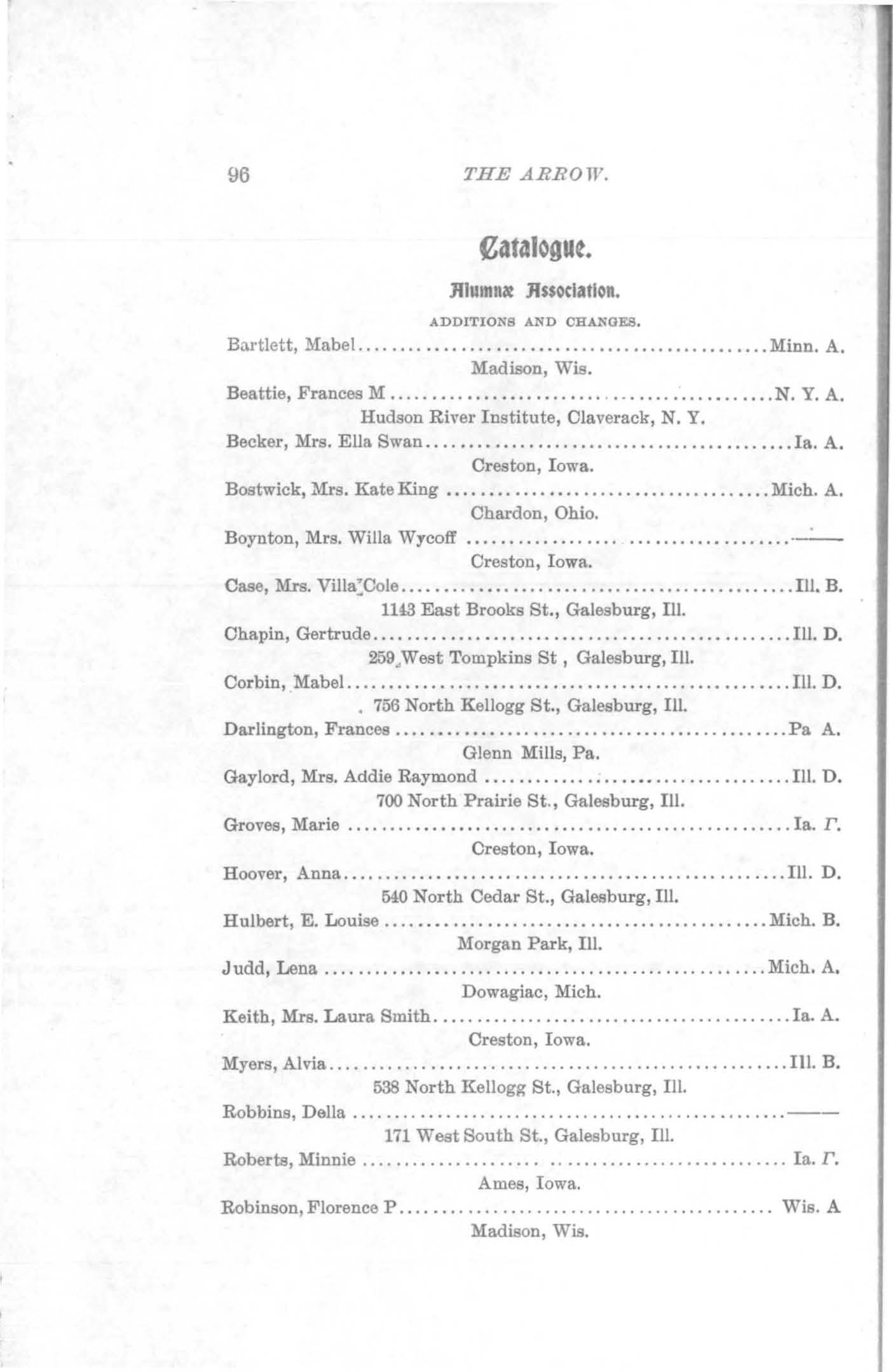
Jllumnlll Jls$odatlon. ADDITIONS AND CHANGES.
Bartlett, !I{abeJ. Minn. A. Madison, Wis.
Beattie, Frances M N. Y. A.
Hudson River Institute, Olaverack, N. Y.
Becker, Mrs. Ella Swan ........................................... Ia. A. Creston, Iowa.
Bostwick, Mrs. Kate King Mich. A. Chardon, Ohio.
Boynton, Mrs. Willa Wycoff _Creston, Iowa.
Case, Mrs. Villa:Cole
Ill. B. 1143 East Brooks St., Galesburg, Ill.
Chapin, Gertrude .................................................
Corbin, Mabel
259.West Tompkins St , Galesburg, Ill.
• 756 North Kellogg St., Galesburg, Ill.
Ill. D.
Ill. D .
Darlington, Frances Pa A. Glenn Mills, Pa.
Gaylord, Mrs. Addie Raymond ....................................
Ill. D. 700 North Prairie St., Galesburg, Ill.
Groves, Marie .................................................... Ia. r. Creston, Iowa.
Hoover, Anna .................................................... Ill. D. 540 North Cedar St., Galesburg, Ill.
Hulbert, E. Louise Mich. B. Morgan Park, Ill.
Judd, Lena .................................................... Mich. A.
Dowagiac, Mich.
Keith, Mrs. Laura Smith , Ia. A. Creston, Iowa.
Myers, Alvia ......................................................
Robbins, Della
Roberte, Minnie .
Ill. B. 538 North Kellogg St., Galesburg, Ill.
171 West South St., Galesburg, Ill.
............... Ia. r. Ames, Iowa.
Robinson, Florence P Wis. A Madison, Wis.
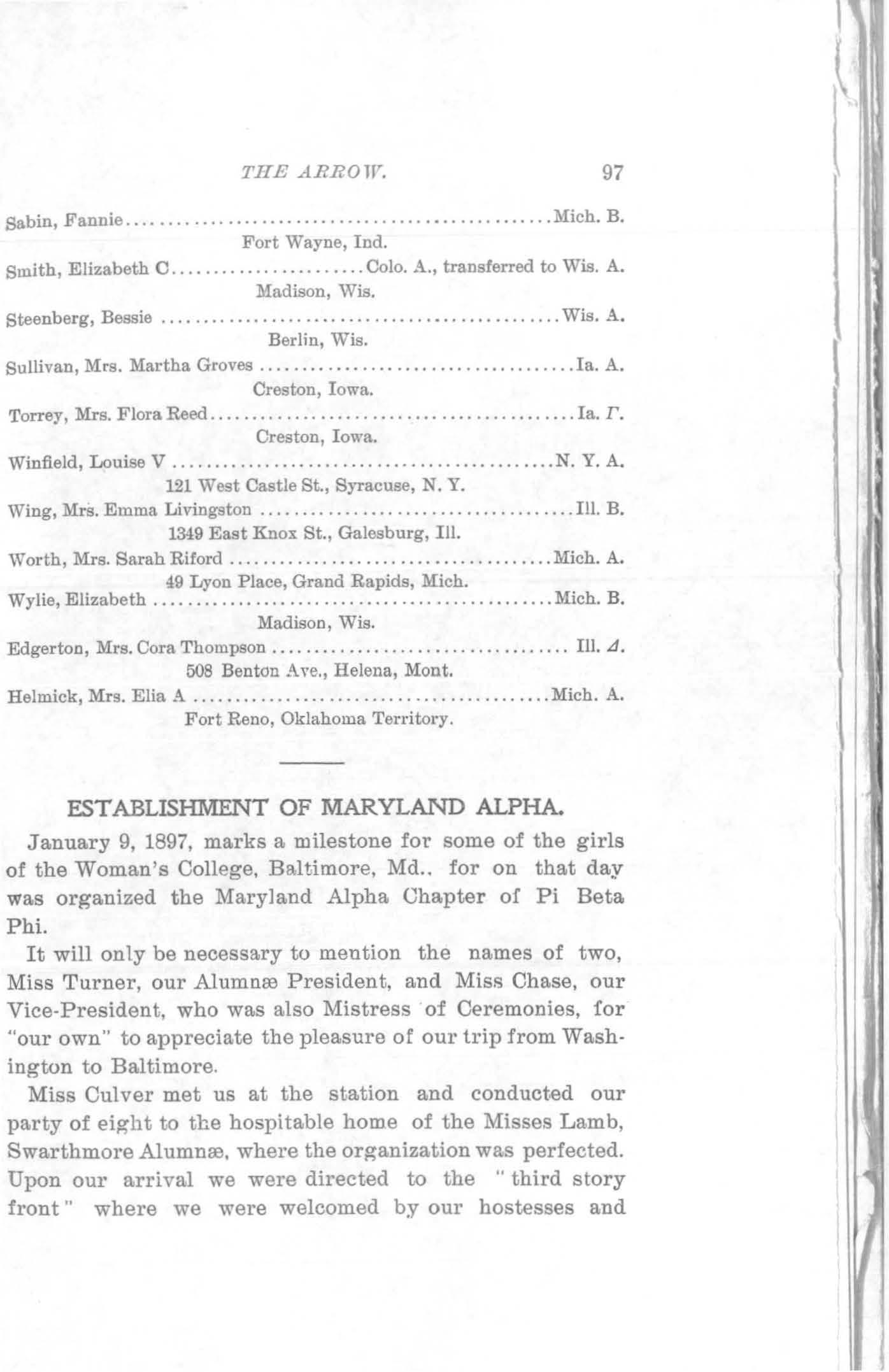
Sabin, Fannie Mi c h. B. Fort Wayne, Ind.
Smith, Elizabeth O , Colo. A., transferred to Wis. A. Madison, Wis.
Steenberg, Bessie Wis A. Berlin, Wis.
Sullivan, Mrs. Martha Groves ......... . ............
. ..... . . Ia. A. Creston, Iowa.
Torrey, Mrs. Flora Reed . . .................
. .................. la. r. Creston, Iowa.
Winfield, Louise V ............
121 West Castle St. , Syracuse, N. Y
N . Y . A.
Wing, Mrs. Emma Livingston . .............................. . ..... Ill. B. 1349 East Knox St., Galesburg, Ill.
Worth, Mrs. Sarah Riford Mich. A 49 Lyon Place, Grand Rapids, Mich.
Wylie, Elizabeth Mich. B Madison, Wis.
Edgerton, Mrs. Cora Thompson Ill ,d 508 Ben t on Ave., Helena, Mont. Helmick, Mrs. Elia A ...... .. .......... . ....................... Mich. A. Fort Reno, Oklahoma Territory.
January 9, 1897, marks a milestone for some of the girls of the Woman's College, Baltimore, Md .. for on that day was organized the Maryland Alpha Chapter of Pi Beta P h i.
It will only be necessary to mention the names of two, Miss Turner, our Alumnre President, and Miss Chase, ou r Vice-President, who was also Mistress ' of Ceremonies, fo r "our own" to appreciate the pleasure of our trip from Washington to Baltimore
Miss Culver met us at the station and conduct ed our party of eight to the hospitable home of the Misses Lamb, Swarthmore Alumnre, where the organization was perfected. Upon our arrival we were directed to the .. third story front" where we were welcomed by our hostesses and
several other girls from Swarthmore, already gowned in their Greek robes.
For a little there was scurrying of feet, high glee, in· cessant chatter; then we too were transformed into Greek maidens, and the fateful hour had come.
How can I picture for you that drawing room? Nothing has so touched me for years. The dais at the far end was draped in white; while across the front canopy swung our arrow, and down either side with the drapery, fell long festoons of smilax, caught with our colors in ribbons. On each side palms were banked, entirely filling in that end of the room. At the left of the dais a Greek lamp revealed a ta.ble upon which rested our constitution. Burning in· cense and music, carnations and roses everywhere, divans for chairs, and eighteen Greek maidens; all this revealed by the light from candles shaded in wine! Can you imagine it?
Through the long ceremony, which lasted three hours, there was no pause in the low accompaniment of music. It required no stretch of imagination to feel that we were Greeks indeed and this Ionia.
We wondered, a little, what each girl thought as she was conducted through the line, but Miss Chase with her ever gracious manner banished any trace of embarrassment, and scarcely had the initiate received the pin ere she felt her· self so entirely one with us as to forget that she had not always been a Pi Beta Phi.
At seven o'clock we were ushered into the dining room where a repast fit for Greek Goddesses" was spread before us; everywhere color and brightness - even the sand wiches were tied with the wine and bb.e!
After we were seated Miss Culver. the Presidin g GeniuB of the hour. with Miss Lamb. slipped over the heads of each of the initiates long loops of ribbon. wine and blue, to which was attached a tiny goat with a bell around his neck.
Over our coffee Miss Culver toasted Our Hostesses in her inimitable style; followed by Miss Turner in her usual happy vein on what it is to be a Pi Beta Phi, and Miss, Chase with a timel.v word of good· will and a lel ,ter from. Miss Hazelton, our Providence President, who was unable' to be present. Miss Hartshorn responded for the initiates in a delightful speech.
Our cups were empty; the hour of parting had come; the new chapter" slipped away to the home of Miss Culver to pledge two new members, and we donned our street dresses, bade farewell to the giTls into whose eyes we had looked for the first time that da.y, as well as old friends, and boarded the train for home.
All success to Maryland Alpha. May her charter members ever keep in close touch with the new members as the years go by.,
DELA MATYR THOMAS, Columbia Alpha.
Baltimore, the home of the Johns Hopkins University and of the Woman's College, now enjoys the honor of having a Pi Beta Phi chapter in her midst duly organized and in successful working order. It is therefore with no small degree of pleasure 'that Maryland Alpha sends for the first time greetings to her sister chapter with assurances of her loyalty to the interests, the purpoRes, and the object of Pi Beta Phi.
After a period of suspense and anxiety, the Maryland chapter was finally organized January 9, 1897, through the persistent energy and unceasing efforts of Misses Elizabeth Culver, Loe M. Ware, Elizabeth Lamb, and Helen Lamb.
Our initiation day marks a memorable date for ail of the members, and the remembrance of the kindness and cordi· AB.ROW 3.
ARROW.
ality of the friends whom we met on that important occasion will ever be a most delightful one to us all. There were with us at that time Miss Chase, Miss Turner. and .others from Washington, and from Swarthmore College, who gave us a hearty welcome into the fraternity, and inspired in us feelings of satisfaction and pleasure in being members of Pi Beta Phi.
The other fraternities of the Woman's College have expressed their kindest greetings, and have given us, moreover, the warmest assurance of their interest and welcome. On the 15th inst., the Kappa Alpha Thetas gave a tea in {lur honor, a courtesy to the chapter, and a compliment to ,the fraternity which we all thoroughly appreciated.
In addition to the active members there are four other Pi Beta Phis in the cit,y who have cordially offered to us their valued assistance and the benefit of their experience . We have also three patronesses who are in hearty sympathy with our work, and two pledged members.
As yet we are but few in number. but compensating for our numerical deficiency by enthusiasm, earnestness, and loyalty we hope that, by striving to attain unto the high ideals of Pi Beta Phi, prosperity and success will crown the efforts of Maryland Alpha.
MAY L. KELLAR.
WHILE the establishment of a "Loan Fund" for the aid of needy students may, in itself. be a very worthy project, we should not favor the adoption of such a scheme as a part of fraternity work. There seems to be a constant casting about for some specific work for the fraternity, for something that will demonstrate the practical value of such organizations. Is this necessary? Firm upon the basis of friendship the fraternity is reaching up toward the ideal of true womanhood, perfect character.
Its acknowledged raison d'etre is to help to be rather than to do. When we lift it out of this sphere we burden it wi t h greater weight than the unstable college:organization can well support. Then why not accept the fraternity as an aid in the moulding of character, as something which gives us true friends and teaches us the value of friend· ship, which imposes upon us a gentle spirit of toleration and kindliness to all, thus malting us individual philanthro' pists? If our fraternity accomplishes all this is it not tlnough?
*
To MARYLAND Alpha we cordially extend the right hand of good·fellowship. Having already adopted the ideals of Pi Beta Phi she will, we feel assured, speedily make the interests of the fraternity at large her own. The new chapter had the good fortune to have with her, upon the occasion of her initiation, some of Pi Beta Phi's best known and most loyal workers. The inspiration given by these will surely live long in the memories of the initiates and help them the more bravely to meet the difficulties with which all new chapters have to contend. We extend to them our best wishes for the realization of the great possibilities of their fraternity life. Welcome, Maryland Alpha!
ALTHOUGH we agree with the views, expressed else where in the ARRow, in regard to the value of the training received in the literary societies of our colleges, we still sympathize with those who find it impossible to spare the time requisite for the work involved by membership in these societies. Many of our girls, giving much of their time to the fraternity and to the social interests of college life, find that their regular studies would suffer if more work were undertaken. Nor are these by any means the least desirable of our members. What then remains to be done? Must these bright society gil'ls leave college feel-
ing themselves incapable of successfully conducting a meeting or taking charge of a literary program? Surely some responsibility rests upon the chapters. Sha.ll we not then rather strive to give them some of the training which might otherwise be received in the literary society? Why not be more methodical in our chapter meetings and con· duct them with more business·like methods? In order to accomplish this, each member of the chapter should have an easy and self· defined knowledge of parliamentary rules, and the president should rigidly enforce them. The entire meeting should be conducted with strict adherence to these rules and all conversation foreign to the business on hand, or diversions from the subject under discussion be prohibited. Each member can assist the president by observing the regulations and giving her undivided attention to a.ll business transacted. By familiarizing them with the best manner of conCiucting a meeting, ihe discipline of the well conducted business-like chapter meeting would be of great value to those who cannot avail themselves of the more thorough training of the literary society; and the expedition with which business would be dispatched would leave more time for a litera.ry program, the discussion of current events or whatever the chapter should deem of most importance.
* * *
CORRESPONDING secretaries are again requested to notice the change of date upon which the chapter-letters fall due. Owing to the tardy appearance of the November ARROW, it was scarcely possible for some of the chapters to comply with the new regulations but we hope that in future the chapter letters will be received promptly March 1, June 1, September 1, and December 1.
* of< *
AFTER the consideration and personal investigation by the Grand President it has seemed best to withdraw the chapter from Minnesota Alpha. There is therefore no longer a chapter of Pi Beta Phi at Minneapolis. It was due to an
oversight that the withdrawal Minnesota Alpha's charter in November, 1896, was not announced in the November Arrow.
THE annual message of the Grand President has just been issued, Alumore desirous of securing copies will do so upon application to Miss Lass.
VERMONT ALPHA - MIDDLEBURY COLLEGE.
We are rejoicing over the results of the rushing season; a short time ago assisted by two of our Alumnre, Misses Pollard and Roseman, and by Miss Hurlburt, Ex '97, and Miss Nichols, Ex '99, we initiated five girls, Rena Isabel Bisbee, Bertha Ruth Collins, Dorothy May Graves, Florence May Hemenway, and Sara Vincent Mann.
The second time our freshmen met with us as fully-fledged sisters we gave the literary program into their charge for one evening. They lent to the occasion the enthusiasm and the new ideas of freshmen, and the program was very unique and entertaming. Vermont Alpha advises all those chapters that have not yet tried this plan to do so as soon as possible.
We were delighted to hear from the Song Book committee and hope, ere this is published, to send our contributions. Some of the girls are now trying to conrt the shy Euterpe, and others are listening for strains of new Pi Beta Phi music.
At the convention in Boston, also at the Alpha Province convention in Washington, the chapter letter. were criticised. Vermont Alpha is mystified and scarcely knows what to write or what to omit. "Do not be too personal" was one of the injunctions, but what is the limit to the personaltIes? We are eager to improve, did we but know how. Would it not be well to have a short article published in the ARROW indicating the general style desired, and even giving a model ARROW letter if need be?
Vermont Alpha sends greetings to all her sisters.
FANNY lliROA SUTl'ON.
COLUMBIA ALPHA - COLUMBIA UNIVERSITY.
At present we are all absorbed in our" ologies " and" ometries." The mysteries of psychology and trigonometry are being unfolded to us, together with the intricacies of Greek and Latin; while French and German
are regarded by us in the nature of" snaps." With all these to occupy onr thoughts by clay and our dreams by night, we are glad to welcome once more into our college life the ARROW, so attired in her new dress that, like the little girl in the nursery rhyme, our" Hallelujah! Hallelujah!" might very well be mistaken for" Hardly knew yon! Hardly knew you! "
We have as yet pledged bnt one new member, Miss Sherman, 1900, whom we hope to initiate in the near iu ture.
We have founu that while our chapter meetings are always profitable, and while it is a good thing to adhere closely to business, still a little diversion is never out of place. Instead of meeting in the afternoon during some interval between recitations for one day and study for the next, some of our girls have opened their homes to us for the evening, when, the usual rontiue ended, we have devoted ourselves to having a good time.
Elsie Bradford entertained us one evening with a remarkable game which developed onr guessing powers. Another time Miss Ohase and Miss Turner were with us.
We are more than delighted that we are to have a chapter so near us as the one in Baltimore will be. Washington and Baltimore are sister cities, so how fitting it that the II if! tie should bind them. Many of the Alnmn", clnb and of our own chapter are going over for the initiation, when we will have an opportunity to meet all the new girls.
The new year and the Baltimore chapter will be twins. May they both see mnch happiness.
FLORENCE LORRAINE BINGHAM.
PENNSYLVANIA ALPHA -SWARTHMORE COLLEGE.
Pennsylvania Alpha has added two strong fraternity workers to her number this fall, Lucy Bancroft and Margaret Kyle, and has another pledged.
Owing to illness, Lydia Rakestraw, '98, and Lillian McDowell, '99, were obliged to leave college in October. We hope to have them with us again after the Ohristmas vacation.
We have had many merry feasts together this year, most of them impromptu affairs.
On the twelfth of October we gave a tea to our Alumn", and were so fortnnate as to have Ruth Sprague of Pennsylvania Beta and Emily Hulne of Kansas Alpha partake of our cup of good cheer.
Frances Darlington, '96, gave UB, a party a few weeks ago at her home in Glen Mills. We danced and sang, ate, drank and were merry until the time-table and our chaperone both demanded a hasty "Auf Wiedersehen. "
All Swarthmore is now rustling with excitement over Shakespeare evening, which is to be held on the seventeenth of December. It is one of the
"Events" among us, is always eagerly anticipated and the realization thoroughly enjoyed.
We have had very few lectures given in the college this year, but the girls of the Somerville Literary Society were intensely interested in a lecture delivered before them on "The Political Rank of Women in England." It is an open question whether we could profitably follow the example of these women, but as an important department in the activity of cultivated women it was, of course, interesting to all Pi Beta Phis.
In the words of Sheik Ilderim, "Unto you and yours, peace."
EDNA H. RICHARDS.
The letters of this issue, no doubt, will introduce many new initiates into our Greek world. Pennsylvania Beta is glad to share in this pleasant duty. We have taken in five, Mary and Gertrude Stephens and Bertha Watkin, of the class of '99, and Grace Woodard and Genevieve White of 1900. The work of increasing the chapter is not completed yet, however, and we shall soon claim a few more as Pi Beta Phis.
Heretofore we have held our meetings every other week on Friday evening, now we hold them weekly, alternating the business and social evenings. We have been enjoying a great many good times along with our hard work. One of these was a Hallowe'en party given by Miss Eddleman, an Alumnm of Indiana Alpha, who is a teacher in Bucknell Institute. Another was "A Colonial Evening" given during the Thanksgiving recess by Zeta Literary Society, to which most of our girls belong. The majority of those present were in old-fashioned costume, and all seemed to have a thoroughly enjoyable time.
Both the Basket Ball Team and the Glee Club have been hard at work for several weeks. A match game was played with the Institute Nov. 24, in the Tustin Gymnasium. The result was a score of 20-11 in favor of the college girls. Basket ball bas been played by the girls of Bucknell for only two years but it is quite popular.
The College Girls' Glee Olub has reorganized with Kate Goddard and Rose Hartley, two of our own girls, as leaders, and is preparing for its first concert to be given in Williamsport, Oonnecticut, December 19, under the auspices of the Y. M O A. of that city. With the exception of two members the glee club is composed er. .rely of Pi Beta Phis.
On Tuesday evening, December 8, we had the pleasure of hearing a lecture by Dr. Kerr Boyce Tupper, of Philadelphia. His talk given before the students on the following morning, after the chapel services, was also highly appreciated.
The corresponding secretary failed to mention in the last chapter letter the marriage of one of our charter members, Mary R. Eddleman, to R. Lippincott Saunders, Alexandria, Ind., in September.
GRACE SLIFER.
OHIO ALPHA -OHIO UNlVEliBITY.
Ohio Alpha sends warm greetings to her sister chapters, and hopes that all of them may have had as pleasant and successful a term as she.
Our number has been materially increased since our last letter to the ARROW. We are very proud indeed to present to you our three charming patronesses, Mrs. James D. Brown, Mrs. David Moore and Mrs. Dr. Super. Mrs. Super is the wife of the former president of the University, and the mother of our late grand vice president, Corinne Super Stine. On October 31st we received the ladies of the faculty at the home of Mrs. George Reynolds, in honor of our patronesses. Mrs. Reynolds' home was very prettily decorated and all the ladies present congratulated Pi Beta Phi heartily upon her acquisition. In the latter part of September we gave a picnic, "rushing" several of the new
On October lst we initiated Virginia Houston, Lyllian Casto and Ellen Wood, and pledged Mamie O'Bleness and May Raah. We held this initiation at the home of Bertha Hoover, and it was one of the most enjoyable affairs of the kind we have ever held. We again made use of the" Cat" on December 12th to initiate Linna Hill and pledge Mary Robbins and Elizabeth Shaw. Miss Shaw is the adopted daughter of our new pJ·esident and a very accomplished girl.
The chair of chemistry in the college vacated by Dr. Bauman has been ably filled by Dr. Walter Fay, a graduate of Berlin University.
We have had especially good chapter meetings this year and have been taking up a systematic study of Shakespeare, ·reading on an average one act from" play at each meeting.
GRACE REAR.
The Ohio State University is constantly gaining students, 80 that this year we have more than ever before. The increase in the number of girls is especially noticeable. .
Ohio Beta has three new Pi Phis to introduce to you: Cora E. Conklin, Nan Costigan and Laura A. Weisman, all members of the class of 1900. Our initiation was held on November 7th, at the homes of Mary Porter and Ruth Housman
The rushing season was very short here this year, and the four sororities made use of pledge-pins, something which they had never before done to any great extent.
The Pi Phis hold office in three out of the four classes in the university: Anna H. Blakiston is class prophet and Mona Fay, vice president of '97, Rita Sutherland is secretary of '98, and Laura A. Weisman of 1900, or the " naughty naughts" as we call them. May Smith of '97 is our representative on the" Scarlet and Gray" Board.
On October 29th, during the absence of President Canfield, the freshmen and sophomores had a rush; but neither side gained a decisive victory, nor
THE ARROW.
was anyone badly hurt. This is the first rush that has occurred in O. S. U. Bince the cane rush when the members of '97 were freshmen, so it created quite a stir, and very few students attended recitations that after· noon.
We have entertained the new girls of the university three times this year, on September 19th at a reception, on September 24th at a progressive pedro party, and again on October 3rd at a musicale, so you Bee we combine pleasure with business.
RITA SUTHERLAND.
NEW YORK ALPHA - SYRACUSE UNIVERSITY.
Since our last letter was sent to the" Arrow" we have grown much stronger and wiBer. New York Alpha has successfully passed through her first rushing Beason, and can boast of twelve new sisters . Rushing becomes quite an art when several fraternities are engaged in that very interesting pursuit at the same time, each endeavoring to obtain the best girls. We have succeeded even better than we had dared to hope, it being our first experience in that direction. We recently gave an informal party in honor of our freshmen.
We have our '96 girls in the city, and although they are not all in {lollege, still we often have them with us in the chapter meeting and at other Pi Beta Phi gatherings; we should be at a loss without them.
Since the opening of college, a chapter of the Delta Delta Delta fraternity has been established here, making in all six woroAn's fraternities at Syracuse University
No doubt all the chapters are looking forward to the appearance of the new song book. Let us make it a fine representation of the fraternity.
With all the advantages that we have as a fraternity, why may this year not mark a decided advancement towards attaining our ideal in Pi Beta Phi. New York Alpha will do her part.
OLIVE REEVE_
Massachusetts Alpha has graduated from babyhood; and is proud and happy to relinquish to Maryland Alpha the honor and of being the youngest.
The fall term has been a busy one for us here at B. U. Both the school work and the rushing have been absorbing; and receptions and" rushing parties" have followed upon one another so closely that \Ve w ere fain to cry with The Virgin Queen-" All my possessions for a moment of time! "
A pleasant reception was given in November in honor of Prof. and Mrs. Butler and Prof. and Mrs. Warren. Prof. Butler, who is a graduate of the UniverSity , has lately come from the Woman's College at Baltimore,
to fill the chair of English literature left vacant by Dr. Dorchester last year.
Through the kindness of Mrs. Tyndale, one of our patronesses, we have all enjoyed a visit to the Boston Art Olub, during an informal exhibit by its al·tist members.
Four of the five women's fraternities represented at Boston University have been trying this year the experiment of having a common pledge-day, before which time no invitations to membership were to be extended. The experiment has not proved an unqualified success, but we all feel that it has been a step in the right direction; and if we profit by this year's mistakes, the compact may well be made successful another year.
At last we have had a cooky-shine, and needless to say, the experience is one which we are eager to repeat at the earliest opportunity. Our guest of the afternoon was Mrs. Helmich of Michigan Alpha, who was making us the visit,-all tooshort,-to which we had looked forward since the opening of the year.
We wish to present to all Pi Phis our two new sisters, Helen Eldridge and Martha Luther, whom we initiated November seventh, at the home of Winifred Hill, in Watertown, Mass. The initiation was heartily enjoyed by us all,- the initiates sustained the trying ordeal admirably, and were able to do justice to the banquet which followed the ceremony, and to join with a will in the Pi Phi songs and the ring, ching, ching 1 with which on our way to the cal', we disturbed the slumbers of the peaceful village.
The occasion was rendered especially delightful to us, through the presence of Mrs. Trndale, I. 0 ., Miss Ooolidge of Michigan Beta, and Miss Ethelwyn Miller and Miss Marcia Miller of Indiana Alpha.
We count it a great privilege to have so many from the other chapters near us. Not only can we profit by their wider experience in the fraternity world, but through them we seem to come into closer touch with the chapters which they represent, and we realize perhaps more keenly than we otherwise should, that all who wear the arrow are sisters indeed, with all implied in that word.
Lucy ALLEN GARDINER.
ILLINOIS ZETA - UNIVERSITY OF ILLINOIS.
This term has been a very busy one for the II B of the University of Illinois , and as a result of our work there are four girls wearing the wineand blue of whom we are very proud. About one thousand students areattending the university this year, and of thid number one hundred and senventy-five are young women. There is some prospect of a cottage-
'stem fDr the accDmmodatiDn ef the lat ter Sheuld this be ebtained the ;tendance ef ye ung WDmen weuld prebably b e greatly increas ed. We shall hav e twelve members when Dur pledges have been initiated. ur pelicy has been te ke ep eur chapter small and to have its members mgenial to each ether. Our number has never exceeded feurteen, and Le result has been a very happy ene. The question whether this is best ,1' the welfare ef the fraternity at large has been discussed. But does )t our strength lie in the individual interest displayed in the fraternity, ther than in numbers?
In a social way, the University ef Illineis is very active and II B iJ! has )t been remiss in her duties, having given several very enjeyable parties. Illineis Zeta sends best wishes to all.
EDITH M. WEAVER.
This veal' Knex has had exceptienally fine oppertunities te hear the oted men ef the day; feremest among these was Ian MacLaren who ctured en "Drumtechty." 'Twas an excellent address that he delivered Id I wish that all of yeu ceuld have shared the pleasure ef hearing the lmous Scetchman.
Whiting Hall was at that time just ferming a reading circle with the 'lb· ct of keeping in tDuch with the medern pepular literature. This circle as christened by Dr. Watson" The Circle of the White Rose." Our Dean ,d invited him to Whiting Hall to perform the ceremony and he gave a est charming little talk to the girls. In token ef his noted "Bennieriel' Bush" we had placed a large jardinier of white reses on the table ,fore him of which he took netice immediately upDn entering the reem .nce his departure we have receivbd a number ef kindly messages from Ie reverend gentleman, of which we feel preud to be the recipients. On the seventh ef October Hen. Chauncey Depew delivered an address ; Knox Cellege in hDner ef the anniversaJy ef the fameus Linceln-Deugs debate of 1857. On the same day the Hens. Jehn M. Palmer and Robt . . Linceln, alSD S. S. McClure, addressed the students. All the gil'ls ef 'hiting Hall were, exclusively, given the privilege ef meeting personally lese nDtewerthy men.
During the political campaign ef this fall Robert Ingersoll visited Galesurg and delivered a very able pelitical address. The secial circles of Knox have been fairly alive during the past term, It the winter term premises some exceedingly bright times. The Pi Beta hi girls ef the active chapter, with the alumnre, have laid extensive plans a large party to be given early in February, and fell owing soon after lat, cDmes the annual premenade.
KATHERINE BARTLEseN.
ILLINOIS EPSILON - NORTHWESTERN UNIVERSrFY.
The New Year's greetings to all our Pi Beta Phi sisters, for by the time this letter reaches you the new year will be well ou its way, bring",{I' golden opportunities to every Pi Bets Phi.
We girls of l11inois Epsilon are in the midst of our fall term examinations which will last until the Wednesday before Ohristmas. By that time the " college town" will seem almost deserted.
Yesterday we closed our fraternity work for the term with a reception to the other sororities. Perhaps we should not say fraternity wO"k, for the pleasure that comes with it always far more than rewards us for Our efforts, however great.
As a result of our fall campaign we introduce to you three new sisters: Belle Reynolds, '98, and Mabel Stebbings and Laura O'Brien, two "Naughty Naughts."
Early this fall Miss Lass, our Grand President, paid us a short visit on her way home from Madison. How glad we all were to see her again and to hear her encouraging words and helpful suggestions.
Miss Alpiner of Illinois Zeta also spent a day with us in September. Mll'..JORIll LUCILLE FITOH.
ILLINOIS BETA-LOMBARD
We have entered upon our second term's work with renewed interest and a worthy addition to our chapter. On the evening of October 16th, we initiated six girls: Helen McKay, Lora Townsend, Josephine Coolidge, Hortense Cowen, Jesse Farmer, and Ruth Nash, our president's daughter. Several of our alumn... aS9isted in the initiation ceremony, after which we enjoyed a cooky -shine" at the home of Frances White, to which the pledged members were invited. The latter carefully examined the initiates to discover if they bore marks of violence and were quite reassured when none appeared. Our chapter now numbers twelve, two of our former members having returned this term.
So many changes have been made in the university within the last year that we have scarcely become accustomed to the new arrangements and very little has been done socially. On the 30th of October occurred the formal opening of Ladies' hall. The guests were received by the faculty and light refreshments were served in the dining room, which was beautifully decorated with flowers. December 12th, the Phi Delta Thetas gave a dance at their chapter house. Recitals, etc., in which Pi Beta Phi is always represented, are given every two weeks by the departments of elocution and music.
We recently received a call from our grand president, Miss Lass, who gave us an interesting talk on fraternities in general.
LoETTA F.
BOYD.
MICHIGAN ALPHA - HILLSDALE COLLEGE.
Michigan Alpha sends to all her sisters greetings and good wishes for '97. Our fall term has passed very pleasantly and our Saturday evening meetngs have contributed no small part to the happiness of our college life. We are glad to introduce to you through the ARROW five new Pi Beta Phis: Belle Oass, Lulu Oallow, Frances French, Lora Marsh and Lutio Ifyers. In ushering these initiates into Pi Beta Phi we followed the model nitiation which was introduced at the last convention; we think this cerenony very beautiful and impressive.
The students' lecture course was opened Thanksgiving evening by Robert r. Burdett, who lectured on "Good Medicine."
Alpha Tau Omega will give an informal reception at the beginning of ;he winter term; several Pi Phis are invited.
During the entire fall term there has been the kindliest spirit manifested )etween our fraternity and the local chapter of Kappa Kappa Gamma. Clne fine evening the Kappa" serenaded us and we invited them to spend :he rest of the evening with us. So we and our rivals had a jolly informal :ime such as college girls can have.
EFFIE BROWNE.
INDIANA ALPHA FRANKLIN COLLEGE.
We introduce to you two girls-Luna Taylor and Jeannette Martin. Ne are to initiate Edith Stott, our president's daughter, next term. Indiana Alpha is looking forward to our second state reunion, to be held .t Indianapolis the second week in January, with great interest. The first me was a great success and we regret more representatives from Indiana !l.lpha could not be present. We shall make a special effort to have every ctiTe member present if possible. Pi Beta Phi entertained some young lIlen with a buckboard ride to the home of one of her alumnre, Harriet Jeffrey, who lives five miles in the country.
Ethel McOollough gave a delightful" At Home," Tuesday eveningDecember first.
LAURA LUKENS.
INDIANA BETA- UNIVERSITY OB INDIANA.
Indiana Beta hopes that every chapter has had as great success as has come to her. We gladly introduce to you all our new sisters,-Frances Whitely, Bertha Holland, Nelle Protsman, Laurel Thayer, Edith Hill, Grace Griffith, Lillian Clewell and Rousseau McOlellan. We also have two girls pledged whom we will be very glad to introduce to you in our next letter. We haven't so far lost a single spike and now our chapter numbers twenty-one.
ARROW.
We feel very much elated over our for we are the youngest ladies' fraternity in college and have three rivals, against whom we must firmly hold our arrows. Tn the words of one of our rival sisters, we have made the other fraternities walk, and in the words of one of our own sisters, " we hope next term to make them run."
We have ilad the first wedding among our own girls. Jessie Traylor was married to Luther Grimes on the eleventh of November. It was a private wedding, only the most intimate friends attending. They have built a beautiful hOl)1e here and we are very happy to have them with us. We entertained in honor of Mrs. Grimes on the twenty-first of November. We expect to entertain the gentlemen of the college at an open meeting on the fifth of December.
Several of our girls are teaching this year and others are spending the winter at home with their mothers.
Our football team took the championship this year. This is the first year they have ever accomplished much in this line and we are all very proud of them. The Alumni of the University have recently purchased magnificent oil pictures of five of the grand old professors of our college. They now hang in our library and in our spare moments, we can study their faces and become inspired to nobler living.
A new chapel is being erected on our campus. We hope to attend the first concert in it on December eighteenth.
We have this year for the first time taken on the mock initiation and Greek robes and we find them both very pleasurable. Our goat looks well and indeed acts his part nobly.
CAROLINE CLARK.
Since the opening of the university last October Michigan Beta has been busy rushing, and now takes pleasure in introducing to the fraternity at large Misses Grace Robertson of Detroit, Gertrude Edwards of Adrian, and Alma Zevert of Saginaw, who were initiated into Pi Beta Phi Decem· ber 12th.
Two Pennsylvania Beta girls who are in attendance at the university, Misees Flora Sigel of Hamburg, New York, and Mary Wilson of Lewisburg, Pa., have become affiliated with us.
During the Thanksgiving vacation Fannie Sabin, '95, who is now teaching Latin in the high school at Fort Wayne, Indiana, made us a short visit.
Mary Bartol was appointed by the Graduate Club of the University of Michigan its delegate to the convention of the Federation of Graduate Clubs to be held in Baltimore December 29 and 30.
We were delighted to have with us at our semi-annual initiation Decem-
or 12, two of our old girls, Miss Dora Elmer and Miss Madge Sibley, bedes our two resident alumnre , lIirs. Lucy Parker-Huber and Mrs. Mary yle-DavoH, and Miss Mary Wolfe of Pennsylvania Beta, Miss Olive Foggy , Iowa Alpha and Miss Louise Winfield of New York Alpha.
The chapter spent a delightful evening with Miss Winfield, of New York Ipha, at the home of her cousin, Mrs. Henry Brown of Ann Arbor.
Three of the Michigan annuals, the Castalian, Palladium and Res -est..., have combined, and only one annual will be issued by the senior asses of the literary, law and engineering departments. The name of Le new publication will be The Michiganensian, and it will be published v a board of twelve editors, fonr of whom will be chosen from each of the .rmSl' organizations"
On the afternoon of December twelfth the Women's League gave a very lCcessfulleap year party in Waterman gymnasium for the benefit of the oman's gymnasium. A number of the regents and professors of the uni"sity acted as chaperones.
The second choral union concert of this season took place on the seven,enth of December. Handel's lIfessiah was given and given well, by the 10ral union of the university consisting of 300 voices.
MARY BARTOL.
IOWA. ALPHA-IOWA WESLEYAN UNIVERSITY.
The girls of Iowa Alpha are iust now very busy reviewing, preparing r the examinations so near at hand. This has been an unusually busy Jar for all the Pi Phis. The elective system was introduced into the colge the first time, and some of us had difficulty in getting our work ,tisfactorily arranged.
We gave a cooky-shine for the new girls at the beginning of the school ,ar, and the college mandolin club, having kindly offered to play for us 1 that occasion, rendered some delightful music.
We wish to introduce to you through the ARROW two new Pi Beta his. May Hills. '99, and Ella Woods, a senior in the Conservatory of :usic. After the initiation, which was held at the country home of one our members, we announced the event by serenading some of our iends.
We regret that two of our members, Alma Law and Mary Crane, have ,en compelled to leave school on account of death in their homes and ley will probably not return this year.
On the seventeenth of November occurred the marriage of Alice Hughes, Ie of our alumnre, and Dr. Clyde Payne, an alumnus of Phi D elta Theta aternity.
EVA FREEMAN.
IOWA BETA - SIMPSON COLLEGE.
Since our last ARROW letter we have initiated Daisy Dent, Blanche Vanscoy and Alice Trent. We celebrated the occasion of their initiation with a cooky-shine.
On Hallowe'en, according to custom, we convened with the elves and fairies and 90me of our friends. The amusements of the evening were a mock Pi Beta Phi meeting and a search for prizes at the end of the rainbow .
Last Saturday evening the Pi Phis, together with a number of their friends, were right royally entertained by Miss Maud Anderson, who is soon to leave for Mississippi, where she will spend the winter.
Next Saturday evening we shall hold a meeting in honor of our patronesses.
We are heartily in sympathy with the idea of "English for chapter study," advocated in the November ARROW, and are hoping to adopt it soon.
MYRTLE REID.
We can scarcely realize that the 10ngeHt term of the college year is past. For us it has been a quiet one, and yet we have had some good times together and have also entertained our friends. The first entertainment after the expiration ofthe inter-fraternity pledge was a reception tendered to the new girls, at the home of Mrs. Estelle Ball, one of our "sorores in u r be." We decorated the house with autumn leaves, and carnations . Then at the table each one received a carnation for a favor. This was the most elaborate affair that we gave during the term.
Later we gave a breakfast. This mode of entertainment here we claim as distinctly Pi Beta Phi. It was an innovation of ours and the other fraternities have never trespassed. As a result we were rewarded by having two girls, Mabel Hanson and Lada Pinkham, put on our pledge-pin. They are to be initiated early next term.
Two of our seniors will be unable to attend the university for the remainderof the year. One on account of illness and the other because of trouble with her eyes. We also lose another of our number,- Mary Coleson - who graduated last June but his been with us this fall doing graduate work. She now goes to Meadville, Penn., where she will pur_ sue a theologicial course. The last gathering we had last term was a farewell meeting for Miss Coleson, at the home of Miss Ham.
That this New Year may be the happiest that has ever yet come to all Pi Beta Phis, is Iowa Zeta's most earnest desire.
MAME G. CARROLL.
WISCONSIN ALPHA - U. OF WISCONSIN.
The semester which is just c losing at our Univers ity has been a pleasant and profitable one for ns in many ways.
Our pretty new fraternity home has ? een a bond which has dr awn us closer together in the common pride we have in it, and the pleasure we have taken in making it homelike. At th e holiday time Mrs. Sober conceived the idea of a "Christmas tree for the Parlm's " and we had one at her house where each g irl contributod some picture, vase. or other ornament for the parlors.
We were fortunate in having Miss Lass with us during the first part of the year . A reception was given in her honor to the sororities in the college. This was the first of a series of receptions which we have given this year, including a reception to the local fraternities, to the Woman's League and to our Faculty.
The Woman's League is in a flourishing condition this year. Its membership includes ladies of th e faculty and most of the university girls. Mrs. Slaughter, the wife of our new professor in Latin, is a Bryn Mawr graduate and at the last meeting of the League she delivered a very intersting address on Eastern College Life.
The local Choral Union closed their semester's work with an especially fine rendition of Handel's Oratorio, The Messiah. Soloists from abroad were secured and our large gymnasium seating 5,000 people was crowded to the doors the evening of the concert.
The local fraternities have been increased by two new chapters this fall, Iota of Alpha Phi, and Alpha of Phi Kappa Psi having been established here under most favorable circumstances.
A unique gathering was held in the University last month. It is seldom that one sees eleven prominent college presidents at once, but such a sight was presented to us in the gymnasium about four weeks ago. The college presidents of all the surrounding states gathered here for some mysterio us the results of which have never been made public. The day before their departure the students had the pleasure of listening to a five minutes address by each of the "eleven," as one of their number facetiously styled the conference. It was a pleasure and an inspiration to hear everyone of these broad, cultured men. President Angel of Ann Arbor opened the meeting, President Strong of Minnesota following. President Canfield of Ohio seemed to be the favorite speaker, for he mingled wit with wisdom in a delightful way. The presidents of Missouri, Kansas, Nebraska, Iowa, Indiana, Perdue and our President Adams made interesting remarks.
We must not close our letter without introducing to you our six new freshmen. They are Caroline Briere, Livia Seiler, Eunice Welsh, Rebecca Almow 4.
Frasir, Miriam Reed and Jessie Davis. Florence Robinson is with US this year as she is teaching history in the Madison High School. Elizabeth Wylie of Michigan Beta is conducting a private kindergarten here and several of our girls assisted her recently in an At Home for her Mothers' Class.
Ladies' Hall was remodeled this snmmer and in it we have now a finely equipped gymnasium for the girls of the University.
With best wishes to you all from Wisconsin Alpha.
LUORETIA F. HINKLEY.
KANSAS ALPHA - UNIVERSITY OF KANSAS.
Since our last letter we have received two new sisters whom we are glad to introduce to you, Maud Beatrice Maxwell and Batie Taylor. They were initiated Hallowe'en, together with five others of onr pledged sisters. We had a very lively and jolly initiation, there being present thirty-five Pi Phis, old and young. After the initiation we entertained a very appreciative audieuce with a little farce which we had localized and adapted to university life. The week after the initiation we gave an informal hop in honor of the new girls at the home of Edith Thacher. We are very proud of our new girls and feel that they are a great source of strength to the chapter. We expect to lose five active girls this year by graduation.
Just now the University is very much interested in a fair that i. being held for the benefit of our Pipe Organ Fund. We expect to have a very fine pipe organ in the chapel next commencement and the students are helping to put it there by means of this fair. All of the diJferent organizations in the University have some part in it. Onr chapter has the candybooth and we are making a gl'eat success of it. One of the leading featnres of the fair is the dime mu.eum conducted by the boys of Phi Kappa Psi. It creates a great deal of merriment. Th e fair promises to be a success both socially and financially.
We are very glad to have Mary Snow with us again. She returned from her visit in the East, December fourth.
Kansas Alpha sends best wishes for the new year to all her sisters .
ELIZABETH W ANNEN.
NEBRASKA BET.! - UNIVERSITY OF NEBRASKA.
There has been no inter-fraternity pledging day at the University of Nebraska this year, and consequently the initiations have taken place much earlier than last year. The rushing season is over now and Nebraska Beta looks back upon it with great satisfaction.
ARROW.
We have initiated five girls, Waneta Bunting, who was pledged to us all last year, Derleeu Woodward, Ada Waugh, Phoebe Doty and Bertha Quaintance.
Through all the excitements of the ru,hing seag)n we did not lose sight of our chapter work. Though we realize the need of a house we cannot feel that we are without a chapter home, for Miss Mary McGahey has kindly offered her home to us for our regular chapter meetings. Just now we are very busy with letters pertaining to the Junior Annual.
December 17th the Dairymen's association gave a banquet in the new building iust completed for the dairy school, formally opened on that day.
OOLORADO ALPHA - UNIVERSITY OF OOLORADO.
Colorado Alpha writes her chapter letter with a feeling of sadness, for she has lost one of her most prominent and loyal members, Jeannette Bennett Dunham, who was also president of Delta Province Mrs. Dunham died early Christmas morning, and her death cast a gloom over the otherwise beautifni holiday season. Further notice of her death occurs else· where in the ARROW.
Good news is heal"d of Elizabeth Gamble, who is studying in Paris and enioying the music and art of that city.
Emma Sternberg, who has been studying in Germany the last four years, has returned to her home in Boulder, and was warmly welcomed by new and old Pi Beta Phis Also Myrtle Zeimer is visiting her alma mater, and has brought us pleasant reports of the chapter in Madison.
T he new organization among the women of the college is proving a success in bringing the ladies of the faculty and the students nearer together. J ust before the holidays a reception was given by Mrs. Far nsworth. Mrs . Baker, the wife of the president of the university, Miss Cleveland, thepresident of the organizati on, and some of the college ladies assisted in receiving On New Year's day a number of the Pi Phi gU'ls were invited to keep open house with several of the town ladies.
COLORADO BETA - UNIVERSITY OF DENVER.
Colorado Beta has added two more names to her chapter roll this fall Miss May Miller spiked from the U. of D. Preps. last year, and Miss Nanaruth Taggart from the Ashland High school, '96, Denver We have in addition four lively young spikes, but their time is not yet. The initiation ceremony, always beautiful, seems to make a deeper impression upon us with every repetition, and to draw closer th03e mystic ties of our dear sisterhood.
We have had a little gaiety along with our our work. The Sigma Alp ha
Epsilon boys first entertained us very pleasantly at the home of one of their members; then followed the annual Hallowe'en party given by the Beta Theta Pis, which was also a great success. Our chapter has given in return an informal party to each fraternity, and as we always like to talk out ourselves, we'll tell you what we did. For one we had a progressive sewing party, instructing our noble young friends in the truly gentle accomplishments of "sewing a fine seam," making button-holes, patching and the like. For the others' edification selections" from the poets" were illustrated by shadow pictures. The audience was much affected, especially by the ducklets driven to the water by Clementine, and the tears which her afflicted lover shed over her grave.
We had a very enjoyable time at a cooky-shine, given at the home of Gertrude Beggs, a few weeks ago.
At a recent meeting of the local oratorical association. Lucy Hammond, one of our members, was unanimously elected president of that organization for ensuring year.
NUTTER KIMBALL.
YALE has graduated ninety-two college presidents.
THE first college paper was started at Dartmouth with Daniel Webster as its editor.
AT Williams and Amherst attendance at nine-tenths of the college services is required.
THERE are three women on the Board of Trustees of the American University at Washington.
THE University 01 California offers three courses in the Chinese language for the ensuing year.
THE University of Chicago has received since May, 1889, more than $14,000,000 in donations.
THE value of property owned by Greek letter fraternities at Cornell is said to be nearly one million of dollars.
YALE is the first American University to have a symphony orchestra. It has been lately organized and is backed by the faculty.
THE University of Illinois recently laid the corner stone a fine library hall. The new building will, when cometed, have space for 150,000 volumes.
THE largest institution of learning in the world is the niversity of Berlin. There are about 80,000 students en.Hed, one-fourth of whom are Americans.
BILLS have been introduced into the legislatures of issouri and Georgia making it a misdemeanor to play otball wi.thin the limits of the respective states.
CAMBRIDGE University has passed a statute by which it .ay deprive a graduate of his dcagree and privileges of the niversity in case of misconduct.-Allumni Princetonia.
THE Yerkes telescope for the University of Chicago is )w completed. The lenses are the largest in the world. he tube and machinery were seen at the World's Fair.
Two American women, Miss Alice Luce and Miss Ida J. :yde, have recently received the degree of Ph. D., each agna cum laude, from the University of Heidelberg.hicago Tribune.
STUDENT government is becoming more and more popu.1' every month. The latest one to follow Rutgers, Corell, Princeton and University of Virginia is Troy Polylchnic Institute.-Oberlin Review.
CALCUTTA, India, is a great educational center, one of :J.e greatest in the world. It has twenty colleges with 1ree thousand students and forty high schools with two 10usand students.-Collegian H erald.
IN England one man in every five thousand attends col1ge; in Scotland one in every five hundred and twenty; in lermany one in every two hundred and thirteen; in the rnited States one in every two thousand.
ONE of the most distinctive features of college life is the Jollege paper. This is more especially true in Amer-
120 THE ARROW.
ican colleges than elsewhere, as in America there are over 200 college papers published, while in Great Britain there is only one.-Universit y Beacon.
CHAPEL assemblies are held four times a week at the University of Chicago. Junior College students, known in other universities as Sophomores and Freshmen, are required to be present on Monda.y, and Senior College students on Tuesday. The other two days are left to the Graduate and Divinity schools, although attendance is not required of them.
BURMESE women are educated along three lines: cooking, sewing and weaving, and polite manners. As the food eaten in Burma is very simple, the art of cooking is easily mastered. The next branch, that of sewing and weaving, is more difficult since most exquisite embroidery is expected of every woman. Education in polite manners consists largely in learning how to act in the presence of men.
DURING the last summer semester the attendance of women at the University of Berlin decreased from 60 to 35. This is not strange in view of the difficulties. A woman seeking admission must secure permission (1) from the Ministers of Education, (2) from the Rector of the University, (3) from the teachers with whom she wishes to study. This process must be repeated every semester.The Madisonensis.
JOHN E. COLBURN in the American University Magazine, says of the University of Vermont: "The fraternity in this college is unusually fruitful of good results. In many cases the work of the college is efficiently supplemented by work done in the fraternity hall, and the broadening of the circle of friendship and the consequent increase of the benefits always arising from the close contact of man with man, form a feature scarcely less valuable than the training of the college itself."
The Alpha Phi Qtw,1·te1·ly has just come out in a new dress, daintily graceful and feminine. We are glad to note the disappearance of the stellar representation of the "Big Dipper" which graced the old cover, and which we shrewdly suspected was a hint, less modest than obscure, of the in· tention of Alpha Phi to "scoop the universe."
This is Convention Number of the Qttarterly, and its pages are largely given over to reports of the meeting at . Minneapolis. There are, however, the usual excellent editorial and exchange columns, and the Alumnre depart· ment contributes a thoughtful article on tha.t old but not thread·bare theme, "The College Woman and her Friend· ships." We have long been or the opinion that the nineteenth century woman, young and old, thinks too much about herself, and certainly talks too much about herself; but if we cannot get rid of this self· consciousness, it is at least the mission of the college woman to turn it out of the channels of self-glorification and sentimental twaddle, and into those of good common sense. It is with a good deal of pleasure, therefore, that we quote the following, feeling that it touches the key -note of the difference in training and development between the woman's and co-educational colleges:
I have heard at least one woman's college criticized because of the superabundant sentiment, better sentimentality, which pervaded it. The Eleanors and Elizabeths are quite as fond as maids of former days, but in a soulful Emersonian style, while flowers, and verses, real attempts at poetry with" wind-swept space" and" azure wastes," are laid around the pedestals on which the modern goddesses are supposed to stand. The meek little friendships of our mothers with their tin-type pictures and simple secrets sink into insignificance behind these lofty college affinities. Girls are often harmed by such unstinted admiration; they read themselves, like Don Quixote, into a pleasing romance, and after a college course of heroine posing, real life is disappointing, one's family commonplace, and most people as foolishly vulgar as Sancho Panza.
This is but one type of a college, and but one type of a girl, who, it is to be hoped, emerges soon from the mist of nineteenth century woman's chivalry. In co-educational colleges, on the other hand, there is often too great a lack of sentiment, a looking ill wonder on anything not wholly utilitarian or scholarly. The contact in the classes with men of clay, and occasional dullness, takes away the glamor of dress suit and the brilliancy of conversation on some bewildering business matter, while the keen insight of certain girlish critics into cause and effect keeps ever alive a merry contempt of many gentle follies.
There are certain important things in life that must be ours if we would be good and happy; and after success and learning and social charm there comes to us the conviction that honest affection toward one another has a price above all else. The girl who thinks herself unappreciated in her home, and looks backward to college ad ula tion, and forward to marriage for soul-sympathy, usually does not understand the first letter in the word love.
Along with the desire of belonging to a "really, truly eastern" fraternity, a desire shown by Wisconsin Phi Psi's persistent wooing of Psi Upsilon, and Leland Stanford Phi Gamma Delta's recent flirtation with Alpha Delta Phi, there has gone the hankering for a "really, truly eas tern" initiation, with such cheerful concomitants as carrying parasols and school-bags, kissing strange babies, accosting strange young ladieF, and similarly dignified performances_
That such initiations are of recent date, and that they have reversed young Lochinvar's line of progression and "come out of the east," the writer believes when she recalls that it is not more than five years since she, a westerner, and not wholly unacquainted with college ways and doings, spent her first winter in an eastern university town. Sue remembers her thrill of surprised horror at hearing how one initiate was branded with a cigar, and her amazement when she discovered that the shabby, woebegone young man who had sold her Christmas cards at the front door was another candidate for honors in the same fraternity.
Since then the custom has grown so well-nigh universal,
ARROW.
that already there is a strong reaction against it. On the side of this reaction the writer now wishes to subscribe herself, and to the subjoined sentiment from the Shie/cl of the Phi Kappa Psi she echoes a hearty amen:
A fraternity initiation should carry with it all the dignity and solemnity that the human brain can conceive. A fraternity initiation should be of such an impressive character that the initiate will carry away with him noble thoughts and lofty ambitions.
Imagine how a candidate for fraternity honors feels when he is being buried neck-deep in a field some miles away from the college, or what fun is there in making a fellow-student walk knee-deep upon glass flower-beds, the breaking glass of which at auy moment may cut an artery or bloodvessel and the victim bleed to death before help could be summoned? Where is the humor in fastening a rope about a young man's neck and making him run five miles behind a carriage, through mud puddles and in the rain? We confess we do not see it.
We hope that no chapter of Phi Kappa Psi will introduce public "horseplay" into its initiatory ceremonies. We deprecate it most vehemently, and trust that the time will soon come when" rough work" and antics of all sorts will be relegated to the rear, at least in college fraternity initiations, and that they will not be made the leading pru:t in such ceremonies.
In closing we wish to quote, in support of what we have said, two clippings from the pens of eminent fraternity editorial writers.
However sternly the fraternity man or woman may curb the natural tendency to "slop over" and gush about the "fine fellows" or the "dear, darling girls j" however conscientiously they may dam the swelling fount of enthusi.asm that wells up in the cODvention oration; however rigorously we of the quill and scissors may prune chapter letter and editorial, there is one place where "tommy rot" still reigns supreme. A great part of the versification that appears in the fraternity magazines can be characterized only by that uncomplimentary epithet, "sappy "
It is with a sense of relief, therefore, that we quote from the Delta Gamma Ancho1"a the following effusion, whose author evidently belongs to the so·called practical school of poetry:
I'm to sing you a song of a sticker, I'm to prattle or prate of a pricker, I'm asked to amuse you, To move you-enthuse you, By preaching of pledge and of picker.
Instead of a sermon on sinning I will give you some pointers on pinning. I'll tell you the uses, Perhaps the abuses Of pins with a Lambda beginning.
Point one: Let the times be propitious. Point two: And the pinners ambitious. Point three and point four And a dozen points more Refer to the pledgling delicious .
Select her with care and then nab her, Beware lest your enemies grab her, In case they begin Be on hand with your pin, Walk up to the maid and just stab her.
Strike deep. 'Tis the suitor faint hearted Who from the fair lady is parted, With your little gold dart Feel around for her heart, Yes indeed-that's the way to get started.
Feel around for her heart, when you find it Take a cord with a Greek knot to bind it, Tie it fast to the frat And then after that I think she'll not care to unwind it.
Instead of a sermon on "inning Please take these few pointers on pinning. I've tried to amuse you, To move you, enthuse you And it's time some one else was beginning.
The next excerpt from the Kappa Alpha Theta conta.ins a. dose of wholesome sarcasm that some of the overworked undergraduates, as well as the idle and frivolous alumnre may :find palatable and beneficial:
NOVEL BUT NOT NEW.
" Let the Alumnre write, We have too much to dol" The cry comes up from a thousand throats, As each Journal comes out anew.
ARROW.
" Yes, we ha ve to o mu ch to d o , There are rushing and s win g s , y ou kn ow , And chapter meeting whi ch alwa ys counts, And the spreads wher e we must g o .
Oh, th ey ar e an awful bore, These duti es ar e irksom e q uite: But we couldn't shirk a s ingle one , So we haven't the time t o write.
But let the Alumna write, She hasn't a thing to do; As fo r teaching school and earning her bread, I shouldn't mind that, would you? "
:t is a good thing, perhaps, to be reminded once in a lile of our duties towards those other girls who are not privileged as we, and if the Kappa and Delta Gamma rls are not models of conscientious friendliness, it is not r want of a timely nudge from their respective magales.
'The greatest objection to fraternities is that they draw lines among , girls to a certain extent, and to the girls outside the division seems later than it really is. The fraternity girls should try to show the rest It because they have a few friendship" closer than any others, it does interfere with friendships ther may have outside. We are favored :l. we can not help but feel it, but we are not keeping up to Kappa mdards if we do not try to make the less favored feel that they are not out. It is said that some girls go through their whole college course thout making many acquaintances, and having almost no social lasures. It seems as if such a state of things must be partly the fault the girls themselves, but it is none the less to be regretted and we who ve more advantages through our fraternity, should be glad to share th others . That is one way of showing our love for and gratitude to our .ar fraternity."
Quite as much to the point, if less ' sentimental, is the nchora:
This brings me to a kindred matter, really an addition to my last lought. I mean the advisability of keeping the fraternal spirit as quiet possible. We are all proud of our fr!lternity and love to do honor to and we forget somet imes to make the situation as easy as we might t hose less favored beings known as ·"barbs." Of course it is hard for lem to have the fact brought home that they do not belong to one of
those oharmingly exclnsive circles, and we who do belong onght to Le especially careful not to hurt them They w :ll respect us more, depend upon it, and have .. more kindly feeling toward us than they sometimes have.
The Delta of Sigma Nu stands high among its contemporaries for excellence of editing and careful workmanship, but contains little that is of general Fraternity significance. The "Brief History of Fraternities" is of more interest to our brothers than to us, but we are glad to clip the following, at least, since the women's fraternities, although, perhaps, not a direct evolution of the men's, have at least sprung from a common ancestry:
College Greek-letter societies are instItutions strictly American. They are without doubt the highest development in the evolution of the "club," being directly devoted to the cultivation among those of congenial tastes of good fellowship for its own sake. The original organization among college men bearing a Greek-letter title was Phi Beta Kappa, which was conceived by students of William and Mary College in Virginia, in 1776. Branches were established at Yale in 1780; Harvard, 1781; Dartmouth, 1787, and elsewhere. It was secret in nature, stood for the promotion of social and literary purposes, and held stated meetings. After a while, however, the social feature was abolished, and the organization became eventually purely honorary, anderists as such to-day. The real progenitor of the system as we have it to-day, originated at Union College, New York, in 1825, and .took the name of Kappa Alpba. This new fraternity was an obvious imitation of Phi Beta Kappa, but departed from its general plan of operation by adopting a more limited and select membership and basing qualifications more upon congeniality and similarity of tastes. Hence Union is the field that really nourished the germ which has proved itself peculiarly adaptable to American college soil regardless of section.
The Delta seems to be having a hard time with its chapter letters, if the following is a criterion:
Despite the most insistent requests the Delta goes to its readers without letters from eight good chapters, which renders this issue incomplete, much to our ,egret. "But the best laid plans of mice and men," etc, etc.
In order that the Delta may be a perfect reflector of the workings of the Fraternity, it must contain letters from the chapters-and it is manifest that these must be supplied by somebody outside of the Grand Recorder's office. Brethren, it is time that system and order be brought out of chaos, or else there may be a peualty fixed for such negligence not unlike that
hich stares delinquent chapters in the face. Send in your reports, letters !ld remittances now.
The fundamental law contemplated no such laxity in the performance f duty, and, unfortunately, attaches no penalty for dereliction. But lere is one person who feels keenly the wilful abandonment and neglect n the part of many chapters, and he proposes to publish their names, if ne evil continues, since no other alternative remains to bring them to a ense of their duty.
Poor dear Sigma Nu! We feel for you. We have been n your place ourselves, and don't blame you for threatenng to resort to extreme measures.
We of th'e woman's fraternities know little experimentlIly of the class and professional fraternities which are growing to be so much a feature of the life of young men in our larger universities. Nevertheless some of us have opportunity to observe their workings from the standpoint of the outsider, and have grown to suspect that there was much to be said against them and very little in their favor. It is with great interest then that we notice the attitude of the Oaduceus of Kappa Sigma, a journal which can be relied upon to take a temperate and clear-headed view of most matters of fraternity interest.
A second matter' of importance which was freely discussed at the conclave was the attitude of [( ;E toward general class and professional fraternities It is a hobby of the editor that they should be put completely under the ban, and some months ago he advocated such a course in these pages, but the conclave was unwilling to go thus far. However, a resolution was passed giving to the chapters the power to prohibit a member from uniting with one of these fraternities whenever the chapter deemed it against the best interest of K;E. This is a step in the right direction and may prepare the way for stronger action at the next conclave. It is hoped that in the meantime the full force of the resolution will be appreciated by every undergraduate K ;E and that he will govern himself in accordance therewith.
We are so glad to observe that" we girls" are not to have a monopoly of the business of reformmg the world, beginning with the chapter. We have often been told that we
ARROW.
took our fraternity life. too seriously, and have "sassed back" with a sort of half-heartedness, bred of the sneaking suspicion that there was at least a grain of truth in the accusation. Hereafter we shall point to the noble masculine exemplar of Kappa Alpha, and plead with redoubled vigor for a dignified chapter meeting, conscious of the moral support of at least one energetic contemporary: With the multifarious connections and afll.liatious of the average college man of to-day, there is a tendency to slight the more substantial benefits offered by fraternities, and as a result the fraternity meeting is not of as "Substantial and serious a nature as of yore. A complete chapter meeting comprises exercises calculated to conduce to a fraternal feeling which will of necessity be instructive rather than merely amusing. As intimated, the keystone of the fraternity is the chapter meeting, and if such become aimless or flippaut farces, decay will at once set in. The task of presenting at each meeting an appropriate programme, combining variety and originality, is no easy matter, and the chief ofll.cer of every chapter should be conscientiously at work with eve.-y member as an ally to concoct exercises calculated to produce desired results. With the decline of literary societies there is a fruitful field for fraternities in the cultivation of impromptu speaking, not on the arid lines of the litera.-y society, but on current subjects, and particularly matters of interest to college and fraternity men. Some topic, previously announced, should be discussed at each meeting, and every member should become posted thereon and express himself. In the opinion of the writer the spirit of the times which threatens to sidetrack fraternities can only be counteracted by laying especial stress on the chapter meeting.
The Kappa Alpha.
The Shield of Theta Delta Chi is largely devoted to Convention business. It contains one of the most stirring Convention addresses that it has ever been my pleasure to read.
Dear brother Alpha Tau Omega, we think the Palm is a model of its kind, but its kind is so purely devoted to your interests and so little to those of Fraternities in general, that we find it hard to quote you. Please do not feel hurt at our seeming neglect.
The Ka.ppa. Alpha Journal is brave in tasteful new cover. We always feel tha.t there is a. special charm and significance in the cover designed by a member of the Fra.ternity, and this one is no exception.
[NOTE.-We regret sincerely that the chapter letters of Louisiana Alpha and California Alpha were mislaid and do not appear in this issue.]
I IfAVE JUST PERFECTED AN ENTIRELY NEW LINE OF II. B. 4>. BADGES.
GREATEST VARIETY IN JEWELING.
BEAUTIFUL AND ART/STIO DESIGNS. HIGHEST GRADE AND FINEST WORKMANSHIP.
Price List and Illustrations will be sent on application through the Chapter• .;t. .;t. .;t. J9 John Street, NEW YORK.
To be beautiful must be artistically made. Our &row Pffis are beautiful because they are gracefully proportioned ana of the Finest workmanship.
We also guarantee the quality of all preciousstones mountea in our Pi Beta Phi 'Pins.
OORRESPONDENOE INVITED.
MANUFACTURING
2 MAIN STREET, GALESBURG, ILL
Having recently bun appointed OFFICIAL JEWELERS to the Pi Beta Phi Fraternity we would call attention to our new lin. of
Sampl.. of which we shall be pleased to send the members upon application of the Chapter Secretary
616 Chestnut Strut, 611-613 Sansom Street, Philadelphia, Pa.
w. should be pleased to tstimate on Class Rings, Pins, Prizes, and will send our Catalogue of Sterling Silverware on application•
Having been autJwrized to manufacture the pins of the !Pi rJ3eta !Phi Fraternity, I am prepared to nish a line of pins superior in manship and design.
SENO FOR IL.L.USTRATl!O PRICl! L.IST. D.
19 S. Pinckney St., Madison , Wis.