THE A·RROW.
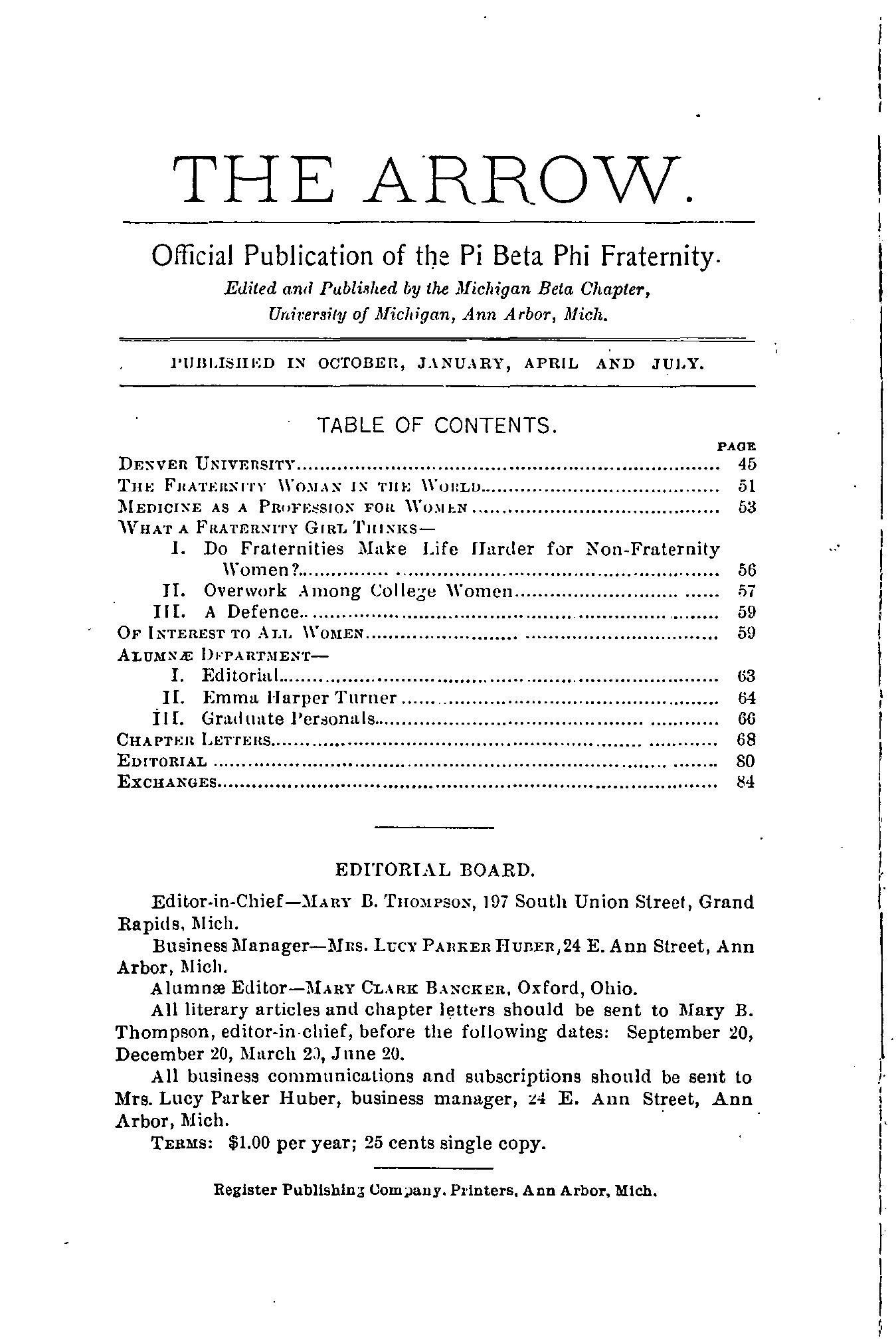
Official Publication of Pi Beta Phi Fraternity.
Edited a.nil Publi.,hed by the ,1Iicldgan Beta Chapter, Unit"rsity oj Aficldgan, Ann Arbor, Mich.
PUBI.ISHED DI OCTOBER, J.\NU.\RY, APRIL AND JUI.Y.
EDITORIAL BOARD.
Editor.in·Chief-1[ARY B. TIIO)lPSO,,", 197 South Union Street, Grand Rapids,
Business Manager-MRs. LeCY PAIlRER HURER,24 E. Ann Street, Ann Arbor,
Alllmnre Ellitor-MARY CLARK BA,,"CKER. Oxford, Ohio.
All literary articles ami chapter letters ShOllld be sent to Mary B. Thompson, editor·in·chief, before the following dates: September 20, December 20, Mtlrch 2J, Jnne 20.
All bllsiness communications and snbscriptions should be sent to Mrs. Lucy Parker Huber, business manager, E. Ann Street, Ann Arbor, Mich.
TERMS; $1.00 per year; 25 cents single copy.
Register Publ1shln:o; (Jom;.lallY. PI'inters. ADn Arbor. Mich.
THE ARROW.
Volume X) NO.2.
JANUARY. 1894.
Edited by Beta, Univer8ity of .!Jfichigan, Ann Arbor.
FRATERNITY DIRECTORY.
GRAND COUNCIL.
PRESIDENT-Helen Sutliff. Lawrence. KRS .• Teones"ee Strept. VICE-PRESIDENT-Mrs. Corinlle Super Stine. IlL, 40) Kist gEd Street. SECRETARy-Grace LR$s, Galesburg, Ill., Mol North Broad Street. TREASURER-Lucinda Smith. Lawrence, Kas. GUIDE-Edna A. Clt1r". WashinglOn, D, C., 1424 Eleventh Street, N. W. Allsutants.
CATALOGUE SECRETARy-nra.ce Lass, Galesburg, 111.,541 North Broad Street. HISTORIAN-Olive .McHenry. Iowa.
CORRESPONDING RECRET.ARCES.
Alpha ProvinCR. PPESIDENT-Anna Hazelton. \Vwhingt.'n D. C .• lit5 Nimh Slrpet.
VERMONT AI.PHA-Middl£>bnry c;ollt'g't', Mt1llld H. Ware, BILttp.J Hall, Middlebury, Vt. COLUMBIA 'ALPHA-Columbiau Addie Maguire, \Vashingtoll, D. C., 1116 Va. W.
l'ENNSYLY ANIA AI.PHA-Swarthmore ColleJ!:e. Harriet M. Kent, Rwarthmore. OHIO ALPHA-Ohio Univendty. Elizabeth H. Carpenter, Oarpenter.
INDIANA ALPHA-Franklin College, Marcia Miller, Frankliu.
INDIANA BETA-Uulver.-iIY ofIndlana. Dt'lla E. Mount. Bloomington.
MICHIGAN ALPHA-Hillsdale Colle,Ke. Katharine !:learle, 107 Slreet. H1llsdale.
MICHIGAN BETA-University of Michigall, Annie Ann Arbor, 28 S. Fifth Ave. LoUISIANA ALPHA-Tulane University, Ethelyn D. West, 212Grovier Street, New Orleans
.Bt'ta Prot'iJlCe. PRESIDENT-Ethel Tompldns, Avon, III.
ILLIl"OIS BETA-Lombard Unlvtrsity. Nellie Tornpkius. Galesburg.
ILLINOIS DELTA-Knox College. Lorhelta Hvod, Gale:sburg.
IOWA ALPH -IoW8 Wesleyan University, Mabel Mt. Pleasant, 604. N. Adams Street. IOWA IOTA-Ida. VanHon. Mt. Pleasaut. Gatnma Prottincc PRESIDENT-Minnie Hoberts, Ames, Iowa.
IOWA HETA-Slmpgon Collt>ge, Edith c..::orkhiU. Indianola. IOWA GAMMA-Ihwa Agricultural Collegl:!. Kale G. Brown. Polk City. IO",,'A ZETA-UniversITy of lowa, BtloAAie Parker. 14 Hlreet, Iowa City. MINNESOTA ALPHA-Univer:sity of Minnesota. Flanc )1, Potier, 717 1:J.lh Ave., B. E. Minneapolis.
IOWA LArtlBoA-Alumnae. Mrs. lone Wetherby Marsh, 716 Ninth Street. DesMoines, Deltn p,'.vlnce. B. Dnnham, 1217 $pruce Street. Boulder. COlorado, COLORADO ALPHA-Ullivefluty 01 Colorado. UaifiY Davi8. Bllulder. COLORADO Bt.TA-Dellver University, Edith Ingersoll. Box: 1405, Denver, ('01. KANSAS ALPHA-Ulliversity of Kans8.!l, Adelia A. oumphrey, 130! Tennessee Street, Lawrence.
CALIFORNIA ALPHA-Leland Stanford University, J. June Peery, Roble Hall, Palo Alto, Cal. J.JTERARY BUREIlU.
ALPHA PROVINCE-Florf'DCe P. Chase, S4 North Union Street. Grand Rapidll, Mich. BETA PROVINCE-Mrs. Paul B. Woolson Toledo. Ohio, t'44 Oakwood Avenue -GAMMA. PROVINCE-Mrs. lone Marsh, 716 Ninth Street, Des Moines, Iowa. DELTA PnovlNcE-Edith lDJtersoll, Box 1405, Dl'nver, Col.
ALUMNIE ASSOCIATION DIRECTORY.
Council.
PRESIDENT-Emma Harper Turner, 6th Auditor'fI, Washington, D. C. VICE·l'R£SIDENT-Mrs. Laura M. Vance, Wymore, Neb. SECRETARy-Effie June ,CIcott, Leavenworth, Ka.s. 'l'REAsuRER-Ona Hamlin Payne, Franklin Ind. GUIDE-l'bcebe Norris, 903 M Street, N. W.• Washington. D. C. HISTORIAN-Alts. Minnie Newby Ricketts, 234 W. 4th Street, Cincinnati, Ohio. Stllt.. Secrl't.ari ••• D. C.-Cors. De L. Thoma.s, 119 C Street, N. E., Wtlshington, D. C. MICHIGAN-Fb.nnte Stearns. Adrian Mich. OHlo-Ms.v Copeland. La Rue, Ohio. INDIANA-Ona. Hamlin Payne, Franklin, Ind. ILLINOIs-Minnie Ne"" by Ricketts, 234 W. 4th Street, Cinrinnati, Ohio. IOWA-Mrs. lone W. Marsh, 716 Ninth Street. Des Momes, Iowa. KANSAs-Eleanor Humphrey, Junction City, Ka.nsas. COLORADO-Lottie WaterbUry, University Park. Colo. Club S.cret.aries. WASHINGTON, D. C.-Margaret. Bayley, 1333 Eleventh l::!treet, N. W. DES MOINES,low.A.-(Iowa Lambda) Mrs. I. W. Marsh, 716 Ninth Street.
UN I \'j·;W::,J'rY
THE ARROW.
VOL. X.
JANUARY, 1894. No.2.
THE UNIVERSITY OF DENVER.
U-U-U-of-D
Den-ver- Ver.si- ty
Kai-Gar- TVah- Who
Trip-Eoom-D- U.
IV est ward ho! scarcely two score years ago the prairie schooner, winding their trackless way through the far west found a count.r}', lonely aud bare, peopled only by the coyote and the cottontail; 1I0\\' t.he train brings YOll to a city, populolls and beautiful, Denver, tI", marvel of all who have ever seen it. In a night it seems to have up \vith its wide streets, its fine churches, and its massive hlocks and buildings; scie:::lCe and art have left nothing undone, Nllt only is this so of the city, but also of its institutions, notwith"t.anding the conservative idea that "time and age" are the main rac;tors of success of both.
In the early sixties when was contending in civil strng: gleH and the west was developing the California gold fields, Denver t.onk Iocr first step toward higher education by the founding of the o'!lIlillary of Colorado. Foremost in this as in every other progresnnd philanthropic movement was John Evans, then Governor "I' t.he Territory of Colorado. For years the institntion flonrished, hilt. at. length yielding to the pressure of financial difficulties, it w,".!,1 have fonndered had it not been for the generous and timely ,,"sist.all"c of its benefactor, who cancelled the entire debt, In 1878 Dr. Moore took charge of the institntion, and by his nntiringefforts IIl1d dc\'otioll organized the University of Denver from the Colorado S"millllry, and Denver, proud of her institution, has given her
THE ARROW.
unfailing support both to the College of Liberal Arts aud the professional departments. Eleven years later, in 1889, 'Ym. F. McDowell was chosen Chancellor, who still bolds and bonors the position; during the past four years he has introduced many beneficial changes; the college department bas almost doubled the number of its students; the curriculum has been greatly improved by adding electives and by raising the general standard of required work so that we now stand second to none.
The fame of the climate of Colorado has become almost nniversal, no need to mentiou the dry atmosphere and the perpetual sunshine-a very Utopia to all in poor health. 'Yell do I remember the day of my arrival at University Park; I had left Boston during a drizzling" northeaster," passing tbrough New York, that too was deluged, and all the way to Chicago the storm raged, but here Italian sky, the flooding sunshine and balmy but exhilarating atmosphere! But more wonderful was the view that stretched before me; -at my feet lay Denver, enveloped in a haze of smoke; away to the west, as far north and south as the eye can see extended the Rocky Mountains, nature's mighty battlements bristling with a hundred· peaks and majestic snow capped mountain tops, towering up as grim sentinels keeping their eternal watch.
In the very heart of Denver, within easy access to all parts of the city are the professional departments of the University; the Schools of Law, Pharmacy and Dentistry, and the Colleges of Music and Fine Arts. To all these departments women are admitted, and in everyone they have ranked among the first in ability. The Law School was opened last year with an attendance of fifty.three students, and the great increase this year gives promise that this branch will Boon be one of the most important of the University. Since occupying an entire building, the Art School has become very popular; a fnll equipment of models and casts, and life classes afford ample opportunity for the study of the human figure, so essential to ·an artist.
University Park, a suburb six miles south of Denver, where the College of Liberal Arts, the Chamberlin Observatory, and the
But enough of description, for a University does not consist of its buildings simply; a vital part is the faculty and especially so in a slllall college. 'When the classes are limited, ·the teacher and student come into closer contact, and to the teacher comes the greater responsihility of his direct influence; so especial care has been taken to provide us not only with excellent professors, but also with excellent types of manhood and womanhood.
Particularly I would mention our Chancellor, still in the prime of life, not too far removed from his own school days to be forgetful of the needs and natnre of students; a cultured, progressive man brilliantly vel'satile, sympathetic, who wins at once the respect, admiration and love of the students. An enthnsiast in field sports, a memher of the athletic and tennis clubs, he identifies himself with the outside interests of the student and thus keeps in tonch with them. This is not only true of the Chancellor but of the greater part of the faculty.
Another essential part of a college is its curriculum, and in this we do not differ much from e!tstern colleges. The entrance requirements are the same as those of Harvard, and the course is hroad and comprehensive. There are three courses, classical, literary and scientific, each leading to a degree. For. the M. A. and Ph. D. degrees, attendance at the University is not compulsory except at the final examinations.
Our location not only favors the study of Astronomy but also for within an hour's ride we are at the foot-hills of the Rocky ]\fountains, where is recorded the history of the world from the archean to the present age. For the study of Mineralogy there is abundant material within easy access; and the wild flowers of Colorado furnish the botanist with rare and new specimens, indeed their beanty and brilliancy are a constant inspiration to this delightful study.
In all the departments of the University there are about 900 stndents, of which number 150 are college and preparatory. The students come from all parts of the United States, but of course the majority are from Denver and Colorado; however a rapidly illcreas-
proMcposi'1' of ding k so iversnnnber trlUg too here mosme; .the )cky dred· ts of the , ,USIC and Law stumch linee opnford .1 to here the ., r , ,
THE ARROW.
Iliff School of Theology are located, is a strictly college community. Besides the professors' residcnces are clubs and boarding houses for students, and the homes of many families who have availed themselves of the edncational advantages for their children; here too is the young ladies' boarding department, always the center of attraction to students. The electric street railway service is excellent, so that without nny inconvenience we Illay enjoy the advantages of a large city, such as lectures, readings and music, of which Denver has a goodly share.
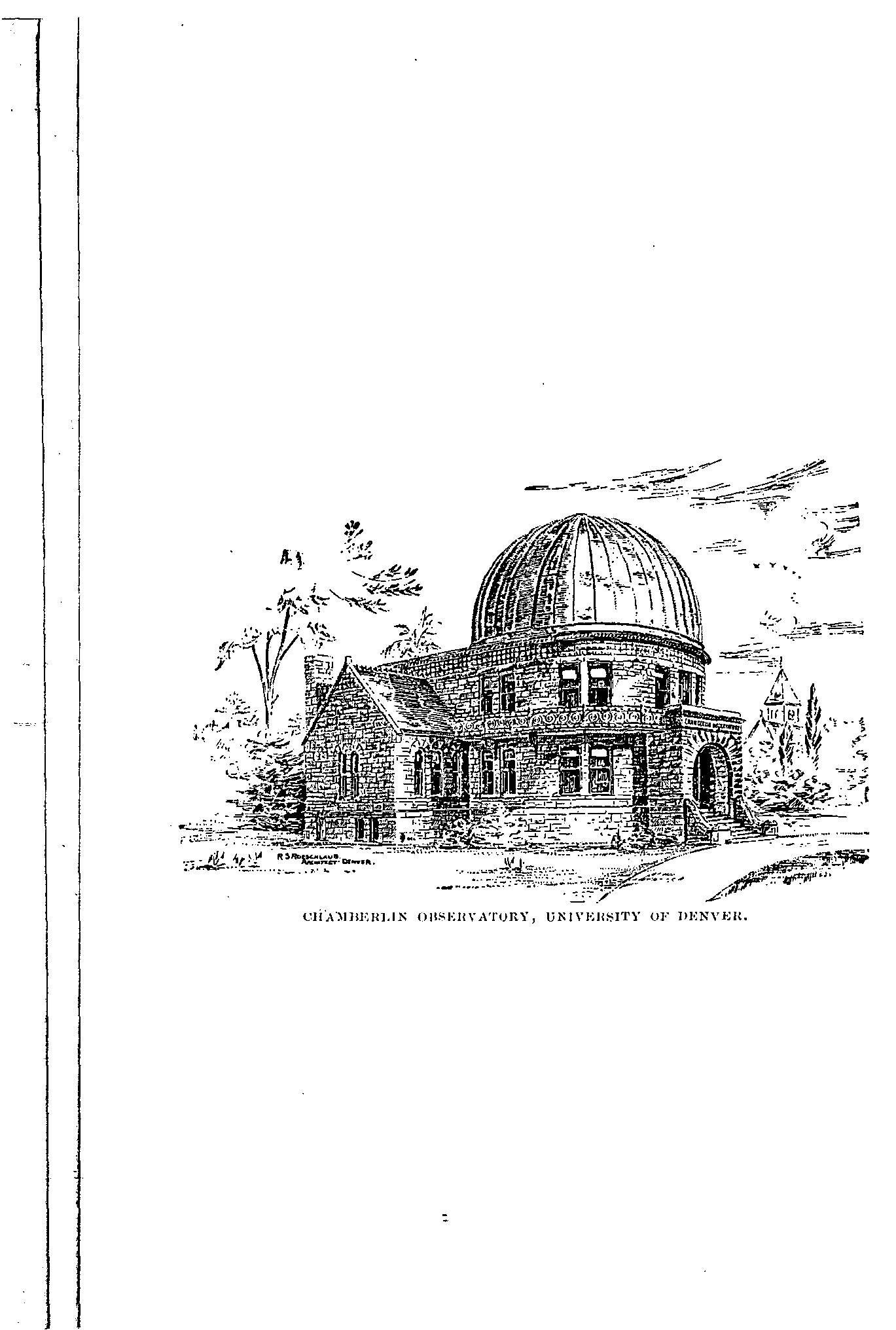
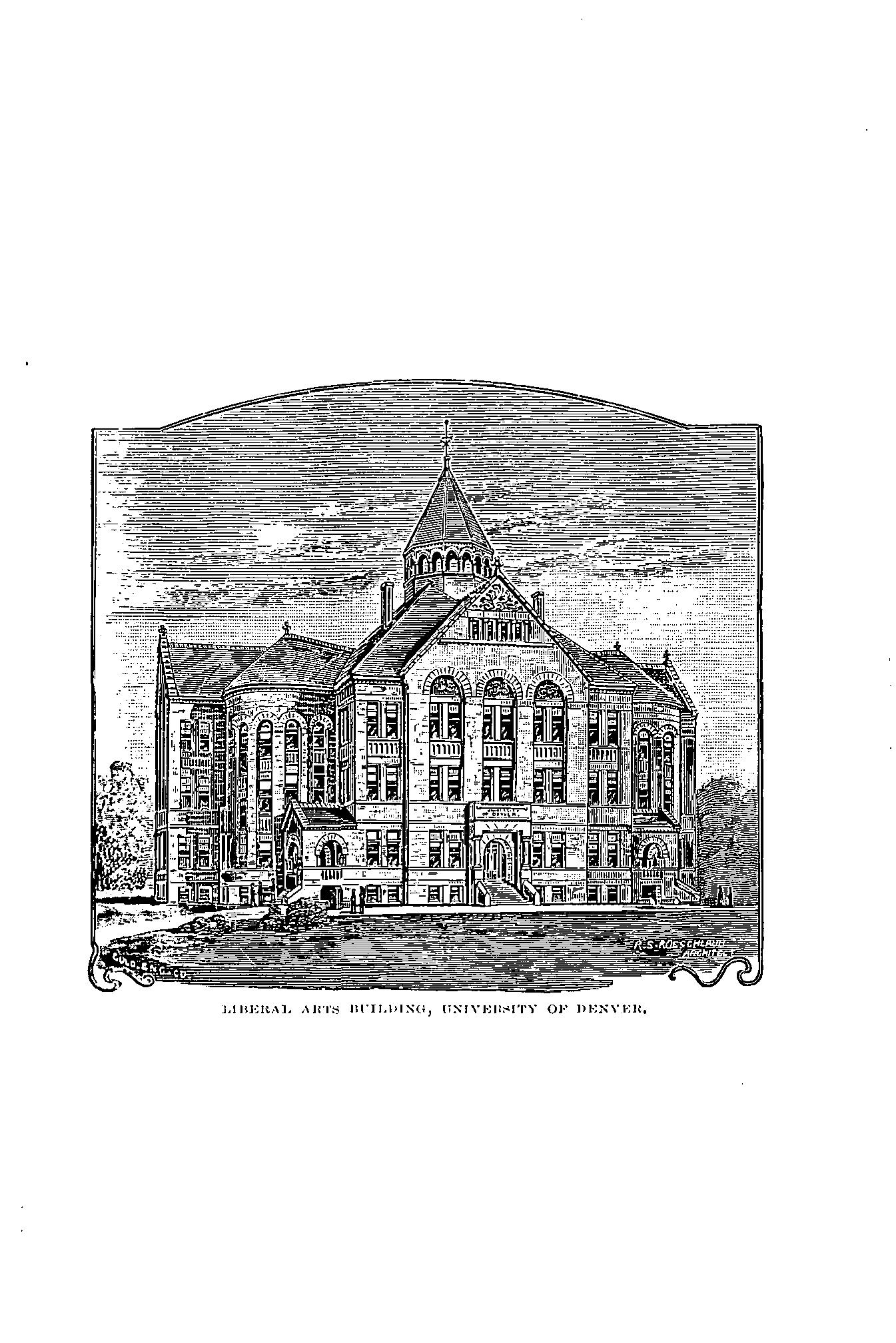
At the entrance of the Campus is the University Hall facing n quadrllllgle around which in time all the buildings will be grouped. The Hall contains the chapel, library, parlors, offices, society rooms, laboratories and recitation rooms; these Intter are large nnd airy, with a senting capacity of two hundred. As this building has been erected only three years, the lighting, heating and ventilating have been arranged according to the latest improvements. This fall the Iliff School of Theology threw open its doors to the band of Di vinity students, which was organized last year. This building, as also the Observatories, is build of red sandstone; its interior is yery complete with a chapel, library, oratorical and recitation rooms; the floors are polished and the walls delicately tinted, and in every l'espect is this the most complete Theological building in the country. At some distance from the campus is the Chamberlin Observatory, a gift from Mr. Chamberlin of Denver. The twenty inch equatorial refractor, the seventh largest in the world, wi!! soon be placed in l)Osition under the dome; the meridian circle in the east wing of the building is of the most approved pattern, and is being used for the detection of the perturhation of the axes due to the mobility of tbe oceans; this also furnishes the correct time to Den_ ver. A slllall observatory ncar by, also the gift of Mr. Chamberlin, is arranged for the use of students, and the astronomy classes of the public high schools are frequent visitors. The cloudless heavens and the clear rarified atmosphere of this locality, together with the excellent instrulllents offer an unusual opportnnity for the study of the heavens.
ing proportion is coming from eastern schools and colleges, who on account of ill health are unable there to pursue their studies, but find that here they can do so, and at the same time regain their lost health. There is no doubt that in a few years we shall be essentially an eastern college in a western country and in a perfect climate.
The ron tine of school work is yaried by the enthusiasm and rivalry which usually attend prize contests. The prizes are $25 and upwards for essays, debates, oratious and work of similar nature. The winning of these prizes is considered almost more a society or fraternity honor than a personal one; so that the party feeling runs high and w"xes hot until the awarding of the prize, when the winning party escort their successful candidate to the nearest hotel and there" eat his health" in oysters; and the defeated ones console their candidate hy lamenting the unfairness of the judges. But the most important one of all the year, is the state, and in case of success, the interstate oratorical contcst. This is a school affair, and party feeling is put aside, for the honor of the college is at stake. Great preparations are made by all, especially at the place where the contest is to he held. The guests fluttering with ribbons, colors of their respective schools, come in special trains likewise decorated. The host meets them, and reception, entertainment and banquet follow in quick succession until the great event, the contest, claims the attention of all; the excitement ana suspense is extreme, and finally amidst the silence the winner's name is spoken, the pent "l' feelings are unrestrained, and mingled joy and disappointment greet the victor.
In social life the Literary societies take an active part. There arc three of these societies; one strictly.collegiate and two admitting preparatory students. At the opening of the school year the rivalry hctween them runs very high, and great are the efforts to secure the new students. Usually a reception is given by each of the societies at which they introduce the new comers to their alumnre members, and socially impress them. After a month or two the "rushing scason " is over and all settle down to the duties and routine of the yeur.
Nor do the Literary societies absorb all the attention of the IV new student, for foot-ball, base-ball and tennis, COllle in for their I,: share, and preparations are made for match games, challenges given '" and received, and all the members begin a system of practice for '" their oftentimes destructive work. Tennis is by far the most popu- " Jar sport and the tennis courts are filled every day with players ;Illd 1', spectators; and a tournament before the Christmas holidays is the '" gram1 finale of the fall term. In this as well as in tbe Chess Club ", which meets e\'ery Satmday evening, the professors take enthusias- II tic part, thus narrowing the distance which oftentimes exists between " Faculty and students. The Y. M. am1 Y. "r. C. A. are both largely Ii represented here and are doing a good work: a reception at the open- ,,' ing of school introduccs the new comers, and the weekly meetings :I tend to keep the students more closely unitcd.
The Fraternities here as at other colleges play no mean part: ", The Beta Theta Pi and the Sigma Alpha Epsilon are rivals among " the boys, and among the girls is a local society and a chapter of II Pi Beta Phi. This chapter "'as founded in 1885, with Frances Car- " penter, Mary Carpenter (S"dtler), Belle Anderson, Hattie Ritz, II Mary (Smith), and Elizabeth Tuttle (Kingman) as charter Ii members, initiated by Addie Sutliff, Lawrence, Kansas. All these :years our growth has been steady until noll' ,ye number forty-one. At school "we are seven." I'
And now I will try to gi\'e you a glimpse of life here at the " Park. The majority of the girls live either at home or board with friends or relatives in Dcnver, and with their outside duties and interests, they can not be said to live a strictly "college life"; so I am eOlllpellcd to confine myself to the Park. And here naturally the great center is "the cottage," (which by the way is only a cottage in name). Of a necessity our life here is more regulated than in private homes; the morning is spent in study and recitation, and usually an hour or two after lunch, then books are thrown aside and each one follows the bent of hcr own inclinations. Some play tennis, others rcceive or visit their friends residing at the Park, some take long jaunts and others stroll about, '\'atching tennis for a little
e whilc, swinging or see-sawing for a merry half hour, watching the
r hall team when they practice or perhaps visit the large green-houses
1 Ilcar hy. Often a " straw-ride" on a hright afternoon or a clenr
I' ",oon-light night, shakes us up with jolts amI laughter. 'Yhen six o'clock comes, the exercise and air have given us a keen appetite
! f()r dinner. Then we spend a half hour around the piano singing
J college songs, and such Illerry sings as we do have! or now and then Home jolly game amuses us, or sometimes we read aloud (this term wc have read the "Prince of India.' ') Then we go to our books until 9 :30, when for twenty minutes we have another frolic; sometimes it is a little spread, a cookie-shine, or often just a little gathering, blending the serious and sunny thoughts of the day, and then are the Good Nights-and the lights are out.
Friday evenings we have "society" or calls, or gatherings of some kind arc planned, candy pulls and POP-COl'll never lose their charm; in fact there is no sport which the human mind can invent, which we have not tried. Saturday moming we spend in "cleaning up," mending, doing the hundred little things that are always waiting to be dOlle. Sometimes we go shopping or callillg, or perhaps read a longed-for book or make up lost lessons. Then comes .Sunday wit.h its sermon in the moming, its home letters and vespcrs, and in the evening a song and a reading, and so the week ends. But time speeds 011 aud all too soon the year closes and our merry school days at the D. U. will he but a thing of the past. Louise FOHCal', Colo. Beta.
THE FRATERNITY WOl\JAN IN THE WORLD.
The fraternity woman occupies a position in the world differing from that of other women, 8ince thc environment and training of the formativc period of her lifc have been different.. And in proportion as her advantages have greater than those of many other WOlllen, does she owe more to the 1I'0rld, and does the world justly demand Illore frolll her.
The position of the fraternity woman is a responsible one:First, because of her education, which has enlarged the field of hervision, strengthened her judgment, and developed her mind and character. Second, because of her fraternity relation, which has. directed her energies, taught her to estimate character truly, and shown her the real aims and real dnties of life. The woman who· has been thus fortun"te, is fitted to comprehend the needs and conditions of life, and to employ her energies and talents in the promotion of the welfare of others. And if her character is one which responds to the good influences to which she has been subject, sh" isready to take life seriollsly, and to perform conscientiously whateverwork she may choose. The most marked defects of women in general are levity and want of purpose; the fraternity woman, then, needs to cultivate seriousness in viewing life, and stendfastness of purpose in carrying out her chosen vocation. Her duties may bedomestic, or social, or intellectual, and some women have the energy' and ambition to undertake all three.
The first, the domestic pbase of life, is the one perhaps, which the greatest uumber of women enter upon, and in which the fewestsucceed. Culture and brains nowhere count more than in the· ordering of a house, and the sensible, energetic woman, who makes. her domestic regime a business, and conducts it systematically and intelligeutly, who masters the problems of domestic enconomy, instead of being mastered by them, is a pleasant contrast to thedrudging, ploddiug housewife who is the. slave of domestic duties and conditions.
The soci'll field is one in which the fraternity woman, in what-· ever grade of society she may find herself, has the opportunity to do much. It is not wise for her to avoid society as useless and frivolous; rather, let her eudeavor to make at least her own circle what she herself wishes to be. Let her make culture and good sense theconstituent elements of society, uot mere wealth and display. Let. her demand morality and real 'yorth as the passports, and theu social: intercourse will become a real factor in life, and not the foam onthe surface. Ouly when 1V0men of intelligence and cbaracter mold_
TilE ARROW.
"",iety, insteau of following its uictates, will tbe proper tone per-· mole the entire social world.
The intellectual phase of life offers to the fraternity womanwell educated, her character well disciplined, her energies well in hand,-a field of action almost without limit. She has prepared herself with the suppositiou that she is able to cope intellectually with any combatant, and now she has the opportunity to try her' powers. Few privileges are withheld her, and few prejudices stand in the way of her progress; she needs only a clearly defined purI",se, persistence and industry to lead her to success. \Vith her' intellectuality she combines refinement and culture, and seeks to· attract attention neither by boldness nor eccentricities.
Such a woman, in whatever path of life she may be, is the trne' r fraternity woman; such a woman her opportunities make it obligal- tory upon her to he. A well-rounded, strong character is the source "I' her ability to do well anything she undertakes; and to keep· ahreast with the spirit of this, "the end of the century," she must. firm, intelligent and persevering in and in intellectual life. domestic duties, in society,. Ona Hamlin Payne.
MEDICINE AS A PROFESSION FOR WOMEN.
Oh, that women conld realize how much happier and better' Ihey would be if they were engaged in some sy stematic work. It. lIIatters not what, so long as it gives them an aim in life, something' 10 work for, and worthy of their highest efforts. One of the most. hopeful signs of the times is the fact that maDY women are awakenillg to an appreciation of their great need. They are everywhere· looking about them, seeking the line of work in which they believe· they can accomplish the most. In very Illany cases it is necessary Ihat the work chosen be a source of incollle; and among the profes-. "ions which have been entered by women, medicine is rapidly grow-· iug in popularity, and where there is a taste for it, offers ample· >cope for all the energies. It is only fifty years since Dr. Hunt and.
Dr. Blackwell compelled the doors of our medical colleges to opeu to women,-and there are now 3,500 women iu America who are legally qualified to practice thc healing art.
Certainly wOlllan is by nature eminently fitted for the work. Her gentleness, her sympathy, her refinement, her neatness. her keen observation, her quickness to think and act; the instinct with which she is credited, are all essential to the popular physician. Her knowledge and experience as a house.keeper ancl nurse, all that enters into the trainiug of a Wom,lll in the ordinary home life is of inestimable value to her here. Certainly there is one braneh of practice which should be confined to women, I refer to the treatment of diseases peculiar to her sex. That it should not be so, is, indeed, a grave reflection upon the refinement and morality of our nine· teenth century civilization. And to it can be traced the ruin of many an innocent victim. The woman physician on the contrary is a missionary, guiding the wayward daughter, leading back the erring wife, 01' restraining her who would commit evil deeds. In another and not unimportant way the wOlllan physician is helping her fellow beings. Until her coming a knowlerlge of the laws of health and hygiene was confined almost exclusively to the profession. The people had only the most crude ideas Oll the sub· ject, mingled with much positively hurtful superstition. But, in conformity with her reputation, she was unable, or unwilling to keep even a professional secret. Ancl we find her invariably acting as a center for the radiation of a knowledge of these laws, and doing much for the prevention of disease aUlI ruined constitutions. Her sisters find her much more approachable than a "regular doctor," and will often come to her for advice and information when they would not employ her as a physician. And this is one of the penal. ties she must pay for being a woman, her services often fail to receive a Illoney valuation. She is also often calmly informecl that she was sent for because with a woman doctor they would- not need a nurse. To bathe her patient and prepare the special food she reqnires is frequently unavoidable. If the patient is a poor WOIllan with small children the sympathetic doctor extends her sen'ices to
illelude (,he whole family. And if sbe fails to do so she is liable to 10" ""vercly censured. Of course 11 man would not be expected to II'IIsh thc baby's face 01' give it its breakfast, but tbat does not t:Xt:\ISC her;
No woman lllust enter upon the work of a physician without I't;Hlllving to consecrate her life to it, and to besitate 11t no sacrifice however great. It necessit11tes a partial if not complete withdraw111 [mill society and social ple11sures; it interferes to a greater or less extent witb domestic duties. This is true of any profession, but especially so of medicine. Its demands are so importull11te, so incap"Ide of control, 11nd so unreasonable in time tbat they C11n not be foreseen and arranged for. 'With a specialist it is easier. The work can be brought within the hours of daylight and the cases do not usually require such immelliate attention. Bnt ill medicine as elsewhere much depends upon the person. Many women meet the demands of a large practice, give their children the C11re and attention necessary to make noble men und women, und still find some time for their friends. But they are thoroughly methodical 11nd cndeavor to make tbe most of every moment, not omitting to t11ke time for rest.
It is a repeatcdly proven fact that the study and practice of medicine are on the whole favorable to woman's health, mental and physical. One woman of my' acquaintance bas been delicate from cbildhood, yet she at one time managed a large charity practice in Chicago, and for several years was 11 medical missionary to India. Her rule was to eliminate from her life every thing not directly connected with bel' work that could make any demand on her strength, and three times 11 d11Y to lie down for ten minutes' sleep. If more women appreci11ted tbe value of a few moment's absolute rest in a recumbent position, there would be fewer invalids among' them.
Many physicians make 11 mistake by locating in a city because of the advantages it offers. If one wishes to study or to be a specialist there are great inducements. But tbe demand is alre11dy more than supplied, and if self-snpport is necessary one must go to tbe smaller
THE ARROW.
towns where she will have the field to herself. There is in all them a small band of noble women who will feel that it is a pri' ·€ge and a duty to rally to her support and give her the encourai ment and assistance she so much needs, and help her to endure a -overcome the hardest thing she has to face,-the prejudice of j people. In spite of independence and high resolves she will ofj falter and almost sink under the criticism and rudeness of those w -consider she is out of her sphere; especially when these come fn women,-those who should feel that they owe her a debt of gratituc Here as in other learned professions the stress of competition, t rivalries, the disappointments and hazards make it a severe trial .a sensitive woman. But taken all in all, a woman who is thorough adapted and well prepared for the work will find the disadvantag she encounters quite as easily overcome as those a man meets in tl same profession, and not much greater than those she must conte! against in allY other. And for one whose heart is ill the work the are compensations which far outweigh all else.
Bessie E. Pee"Y, JI. D.
J lldging from what I have seen of college life, I should sa: Do I',.t.,niti •• M.k. Lif. that fraternities do not make life harder fo 'Harder for the Non-F raternity Woman? the non-fraternity girl, and especially, tha they do not "promote the estahlishment of unnecessary cliques.' The formation of societies, or groups of girls of some kind, necessary and inevitable. There is an instinct common to all mel and women, which leads them to form societies and cluhs. OutsidE of college, there are whist clubs, literary clubs, women's clubs ane ·dramatic· clubs. In colleges where fraternities are forbidden, WE find either members of the various dormitories banded together, 01 local literary clubs. And in the majority of colleges we find frater. nities, and also societies formed of students who are not members of
57 fratcmities. Even those who belong to no society of any kind, are 'g:ilhcrc,] into little groups of special friends, who come together for \\'o,'k or good times .
.If then, associations of college girls are inevitable, is a frater. lIity \\'orse than any other group of girls? I think not. It has, to I", an organization and a national character, and, as it lives on fr"'" )'c"r to year, it gains a certain social standing, all of which are ",I\,,,"tages to its members. But do these things in any way make lif" harder for a non.fraternity girl? On the contrary, I think if rightly used they may her college life more pleasant.
As far as I know, the fraternity girls in college are not in the '''''jurit.y, so no one who is not a member of one, need feel left out ill thc cold. Certainly the whole spirit of a fraternity is against I!SCillsiveness.
I hope no girl will ever have occasion to say, that her life at ""liege was made harder, because our fmternity had a chapter there; 111101 1 helieve that if the spirit of the fraternity is lived up to lllany II girl will be able to say, that much pleasure was introduced into I",r college life by members of our fraternity. S. TV. L.
The request of E. 1. C. in the October ARROW for others' Overwork Among College experience in regard to statistics of c;)llege Women. work, leads me to give these few observatiolls of my own.
Great educators teach that primarily "Education consists in a h"rllJOIlious development of all the powers of mind and body." 011" is left to wonder many times if college professors realize the filII llIeaning of that definition which they so ardently labor to i"'press upon their pupils.
The writer's experience covers four years of college work-part "I","t in oue college, the remainder in another, and in each one the "cry principles meant to be inculcated in the stndent were violated II.\' their inculcators. The majority of the students carried fi ve stndies -many even six or seveu-each term. These reqnired five
hours recitatiou per day, beginning at 7 or 7 :30 A. M. and closing at noou. They required at the very lowest calculation, ten hours preparation, sometimes louger. Add one-halE hour of gymnasium work and two hours for meals, then how lUuch is left for necessary rest and recreation, and the "harmonious development of the powers of the body?"
this, there were the college prayer meetings one evening each week-the fraternity meeting another evening-the literary society anothe -afternoon or evening, to say nothing of the time spent in preparing the literary articles for the Society. The Christian organizations which enter into every wel! ordered life among students, claim another evening each week. Lectures or concerts demand another, various committee meetings and occasional social duties steal many precious hours.
Amidst all this nervous strain tho students were exhorted t(} haunt tbe library and reading rooms lest perchance in their pnrsnit of learning, the world (}utrun them and they become nnITowand bound to their text books. Various papers upon various subjects are required in lllany recitations, this too, with little or no diminution of the regular lesson. Occasionally a holiday (?) is givenwith tasks dou bled for the ensuing day. Pray, where can time for tbe necessary mending, shopping and keeping one's room in order be found?
I have seen students so utterly exhausted from the l(}llg continued strain, that they were keeping up by sheer force of will. True, many endure to the end and have comparatively good health, bnt might they not be rar greater, rar more powerful for life's struggle, had their nel·vous force been more carefully husbanded? Nature is sure to bring retribution sooner or later.
This is a true picture of the work of huudreds in the two col_ leges which the writer attended. Physically, many of good, even better thun ordinary abilities, have gone out almost wrecks.
Harmoniously developed! And onr most noted instructors (not teachers) are blind to tbe ruin they are making, and go on, defeating the very principle of tbe end for which they strive. Is it
IIot. t.ime that we call a halt and use our utmost influence for" Tem"crance in all things?" M.E.E.
The suggestive ideas of E. r. C. iu the October ARROW have set. IIle t.hiuking, and I should like to give my interpretation of certain facts of college life mentioned by E. r. C. There is A Dere e. assuredly no doubt that the college woman leads a busy lire. Numerous duties and interests claim hcr time and attention. Hilt has not this fact been somewhat misunderstood? The work is IIot all of one kind; study and the entertaining of friends; fraternity ,,,"1 lectures or concerts; these united with gymnasium practice and various social duties, certainly make up a life of divers interests. :\ lid do not these various interests, instead of exhausting one's powers, ","cate just that change and recreation necessary to a healthful life ? Would not the sanle amount of study he more hurtful if it were not illterspersed with activities of other kinds, which seem drains on one's time and energies, hut really seryc for recreation and relaxation? Again it is seldom that '"wd ,"ork is harmful. Anxiety and worry over work, late hours, and a disregard of the commonest sanit.ary laws are what hreak down health-not study, but what are orten made the accompaniments of study by unwise students. The. young woman ,,"ho regards these comlllon sanitary laws and remem-· hers to keep a balance between the activities of mind and body, may work many hours a day and fill up every min ute she has left with other duties, and the result will be not exhausting b!!t a healthful life in which every moment counts. Jntere()t to
As a fact of permanent importance nothing else in the election was more noteworthy than the adoption of an umendment to the constitution of Colorado extending the right of suffrage to women on equal terms with men. The women of Colorado are, to an unnsual '1 2
extent, readers and thinkers, who show an intelligent interest in public and social affairs. The actual working of woman suffrage in Colorado will not fail t9 attract the attention of the world. Meanwhile the news from England is to the effect that the bill pending in Parliament to establish local elective governments, somewhat on our township and village plans, in the minor divisions of Great Britain, may very possibly be so amended as to give women the same electoral status as men. In the British colonies the woman suffrage moveIllent is making progress, and upon the whole there is now a comparatively encouraging outlook for a cause that had until lately seemed somewhat to languish. The death of Mrs. Lucy Stone has cost the suffmge movement one of its ablest and noblest leaders. She spent her life in the attempt to seCllre practical recognition of what she considered to be woman's inherent right to participate in a government that professes to be based On the consent of the governed.-Review of Reviews.
Miss Louise Stockton, of Philadelphia, who bas for some years had in the New Centnry Club a Literary Committee that has never fallen below two hundred, has started a plan for telling people what they wish to read and where they may find it. This new enterprise is entirely her own, and she has given it the attractive title of the Round Robin Reading Club. The members, who pay a modest fee, will read by Sll bjects, and these subjects are suggested by the Direction after being informed by the readers of their resources, the time they have at their commaud, and their intellectual taste. They are given intelligent and sympathetic supervision, and the schemes for the preparation of papers ana the formation of classes bestow more benefit than could be possibly gained by any course of reading pursued alone. Miss Stockton is connected with the Browning Club and the W"est Philadelphia University Extension, and has been a member of the New Century Club for fourteen years.-Harper's Bazar.
It was a German woman, Mme. Emma Seiler, who first discovered the mechanism of head notes, the highest tones in the female
"<>Ice. .she devoted herself to the study of the larynx at the disHeding table, and was rewarded by finding two small cartilages in thc vocal chords which produce these sounds.
r The daughter of the late Professor 'Vindscheid, the famous German authority on Roman law, has been graduated from the UniI \'"r8ityof Heidelberg with the degree of Ph. D. She is the first woman to be admitted to the old seat of learning with the privilege "I' taking her degree. She passed a brilliant examination.
Miss Katharine Davis, who had charge of the model home at I,he 'Vorlel's Fair, where the experiment was made to show how far j;iiOO a year would go toward providing for a family of five, is nOlV nt, the head of the College Settlement of Philadelphia. She is giving a course of lectures on Household Economics at the Philadelphia Seminary. This school teaches the girls the fundamentals ,)l' housekeeping, not merely cooking, but all that concerns the house nlld its hygienic requirements.-lVoman's Journal.
An enthusiastic mass meetiug was held at 'Vellesley College to <:elehrate the adoption of the woman suffrage amendment in Colorado. Out of 622 college girls interviewed 506 declared themselves ill favor of woman suffrage. A telegram was at once sent to the Womau Suffrage Association 'of Colorado, "Five hundred WellesIcy women rejoicc in the grantiug of suffrage to the women of Colorado.' ,
Miss Grace Chisholm, of Cambridge University, Miss Maltby, formerly of 'Vellesley College, and Miss Mary 'Winston, of Chicago, have received special permission from 'the German government to enter the Uuiversity of Gottingen with the same privileges which t.he men enjoy. Miss'Vinston and Miss Chisholm are in the departHlent of Mathematics, and Miss Maltby in that of Physics.Woman's Journal.
: The students of Minnesota University are agitating the subject i'of dress reform, and much enthusiasm is manifested.
Miss I1Iary Smith, an English woman, has been studying to. provide inexpensive but healthy find pleasant homes for women of small incomes. She has established in Gloucestershire a number of . small cottages, with all the picturesqueness of the thatched-cottage period, find the sanitary improvements of later days. They are ten- . anted, find the scheme seems likely to prove successful. Among these inexpensive homes for gentlewomen are some small furnished cottfiges rented as low as five shillings a week.- JV01nCtn' s JOjt'·'1CtZ.
Miss M. Carey Thomas, Ph. D., dean of the faculty of Bryn Mawr college, has been elected president of the college in place of Dr . James E. Rhoads resigned.
In addition to being well paid, at Siegel & Cooper's big establishment, Chicago, the cash girls have a pretty reception room, carpeted, with rocking-chairs, cases filled with books and magazines, and a big table with writing materials thereon.
Katharine De Forest, writing in the November Sc,·ibne,.'s On "Edncation for Girls in France," draws some interesting compm'isons between the French ;nethod of education and our own. "Education" she says, "aims to preserve their individuality of sex; to develop to the highest degree their intelligence and capacity, bnt never at the expense of the feminine side of their natures; and as it is as marricd women that it is considered they will best fulfill the purposes of their existence, its primary object is to fit them to be wives and mothers. * * '" Education includes manners, breeding, customs, conduct, habits, ideas, and auyamount of learning without this education, in their sense of the word, means nothing to them at all."
"The cost of a high class boarding-schoo] in Paris is about half what the same thing would be in New York. A convent costs $250 per year. The nuns are superior women, the convents are beautifully kept, and the food is excellent, but if one can afford anything better, the life is too narrow to give one the best of Paris or French thought." \ (
The trustees of Smith College have voted to build a !lew $25,lion dormitory on the college campus as soon as the weathe;· will IH:l'Illit. This will accommodate fifty students. For the first time ill its history the stucients have issued a college paper tbis term.Chiu"[jo 1ntcj· Ocean.
A statistical writer has it that in this country 2,500 women are practicing medicine, 2i5 preaching the gospel, more than 6,000 IIll1llaging Postoflices, and over 3,000,000 earning indepencient int:1I III es. 1880 tbe Patent Office has granted over 2,500 patents 10 women, and in New York City 27,000 women support their hushands.
From all sirles come calls to make the Almow interesting to alumllm. Tell us what the alUmll[B arc doing, where they are, what they have llone. These are excellent suggestions. The alUlllllm editor sits at her desk and ponders, she looks from her st.udy wi1ll10w and pOlltlers again. 'Vhat are the alumllm doillg? It is easy to say ,,,here they are, for they are scattered from New Hampshire to California; from Alllorica to Australia. They are busy WOlllon, for they are Pi Beta Phis and knew, whell they donned the wine :tnd bluG, that there was to hc a JlUl'Jlose in life, that there was a goal t.o he roached by constant eflort.
The Alulllll<C Association has been forlllcd, its officers haye been appointed and the work of uniting Pi Bela Phi Alulllnm is going steadily on. But just here the editor IllUst stop. From the yantage ground of her position she can look out ovcr the whole field and see what might be done. The editorial "we" kindly covers bel' with a cloak of allt.hority whellce shc may issue requests, nay almost demands fur data, but that done, she must stol) until tbe data are forthcoming. She Illay add her yoice to the editor·in-chief and shout, though never so lustily, but unless the alulllllre thelllse!ycs -assist bel', her requests und her shouting are in vain.
Most emphatically does the" prosperity of the AluDlnre department depend upon the personal responsihility of each alumnre," and if each will feel this responsibility and respond promptly to letters and requests for information, the work can grandly go on and the ARROW will indeed "form a practical link between the alumnfe, their college, and their fratel'llity life."
FRATERNITY CALLS.
During their travels members of Pi Beta Phi often pass through cities where chapters are located, or where individual Pi Beta Phis are living, hut from ignorance of their residence fail to meet them. If by chance the resiuent Pi Beta Phi learns of the new comer's arrival, slle may spend hours and even days trying to find her and then not succeed. Thus a golden opportunity is lost. All this might be obviated to a great extent, if traveling Pi Beta Phis will send cm'ds to the resident members, stating that they are in the city and will be at home at a given time. Much mutual pleasure and even profit may thus be gained, and some of the questions as to wI,at Pi Bela Phis are doing might be answered.
HARl'ER TURNER.
Emma Harper Turner assumed official relations with Pi Beta Phi in the year 1887, when she was elected Grand Vice-President by tI,e convcntion which met at Ottumwa, Iowa. 'Vhile serving the fraternity in this capacity, Miss Turner evinced such interestand activity, and showed herself so l11uch alive to the needs of the organization, that the next convention, at Galesburg, made her Grand President, upon the resignation of Mrs. Small. This office she held for four years, and when she resigned at the Chicago con_ vention was elected President of the Alnmnre.
The movement of cataloguing and organizing the alul11nre was taken up during Miss TUl'ller's term of .office as president, and was conducted under her direction. Perhaps this measure, of all those with which she was connected, will be productive of most important results; hut many others were put into execution, and much work was done in the line of increasing the chapter roll. Pennsylvania.
Alpha, Incliana Beta, Minneoota Alpha, Louisiana Alpha, Iowa Ltun bch and Ohio Alpha II-ere organized, and work was begull III other places, the outgrowt.h of whieh Pi Beta Phi may continue to for some tim'e.
lIliss Tumor is a graduate of Franklin College, Indiana, and in t.he year 1886 rcpre,cn(ell lImt school in the Statc Oratorical Cout.est, taking second place, and since that time has done important 1I"0rk among the Alumn", of the collcge_ She with the assistallce of lIlrs_ lIlartha Noble Carter established ill this school a local fraternity, which li\-cd throllgh several years, and finally, by their efforts, was received into Pi Beta Phi.
lIiiss Turner is 110\\- at the head of a movement which promises to show what WOmen of clIltllre can do in prrrctical philanthrophy. She is Presi(\ent of a King's Daughter'S League at her hOllle in 'Vnshingtun, which cmbrap,cs nIl denominatiolls, and is organized with the primary purpose of IIplifting and plncing wit.hin the reach of its inflllonee those who do not. hear the Gospel preached in the churches_ The Loague h,,, :l cluh room, where there arc in operat.ion classes in music and physical training, children's classes, a Sunday school, bOY'8 club [tlHI mother's Illeetings_
Several things might be mentioned as dominant influences in j.he success of Miss Turner in fraternit.y work. Her Illost striking "haracteristic is an optimism which believcs there is no limit to what a frntel'llity woman can l10, and-Illoreo\'er,-will do; and helieving this, she inspires those with whom she is associated to do (,he Illost and the best.
Ad,! to this optimism a tireless energy, and the ability to hold in mind the countless details of planning and organizing and supervising, and there is seen much of what gives her the power of general:;hip in nn organization like Pi Beta Phi.
In addition lIliss Turner's purpose always has been to develop the broadest phase of fraternity life, and to lead it outside of nny "elfish or narrow lines_ She is enthusiastic on the subject of woman and her work, and believes thut Pi Beta Phi has the opportunity to do much, and promises to do much for the education of wornau and
the direction of her energies. Progressiye as is Pi Beta Phi Miss Turner is even more progressive in her ideas as to the promise and responsibilities of the fraternity, and Pi Beta Phi has ruany steps yet to take in a social, educational and philanthropic direction, before she reaches the ultimatum which her Alulllnm President holds . before her. Ona Ifamlin Payne.
GRADUATE BETA.
Ricketts-Newby-Tuesday, November 28, 1893, Minnie Howe Newby, '89, was manied in Chicago to George Hicketts of the 'Vagner Palace Car Company. Mr. and l\Irs. Hicketts are at home at 234 'V. Fourth st., Cinciunati, Ohio.
Sober-Clark-November, 1892, Gertrude Clark, '92, was married in Northville, Michigan, to !\I,.. H. A. Sober, instructor in Latin in Michigan University. MI'. and Mrs. Sobel' removed
After liying in Ann Arbor a year, to Madison, IYiscQnsin, where Mr. Sobel' had been appointed professor of Latin in the State University.
Tyler-Preston-October, 1892, huelJ Preston, '92, was married in IYilmington, Delawarc, to Mr. 'YilJiam 1. Tyler, a physician of Niles, Michigan, where they now reside.
Huber-Parker-]\fay, 1893, Lucy Parker, student in the University, '88-'89, was married to Dr. G. C. Huber, Assistant Professor of Histology in the University of Michigau. They are still liying in Ann Arbor.
Chaddock-Arnohl-"Tedncsday, June 21, 1893, Franc Arnold, '90, was lll"nied to ]\fl'. 'Yillilllll H. Chaddock, of 36 Glen Park Place, Cleveland, Ohio.
Fannie K. Read, '90, is teaching in Saginaw, Michigan.
Mary Braley'Thompsoll, '93, is te,whing in the High Sehool at Grand Hapids, Michigan.
Frances Stearns, '93, is teaching Botan), and Zoology in Adrian College, Ad"ian, Michigan.
Mrs. Statia Pritehard Quesler, '88, is at home in Odebolt, Towa.
Mary Clark Bancker, '91, is teachinr; English 1Il Oxford College, Oxford, Ohio.
The following were Pi Beta Phis at Ann Arbor, but did not --graduate:
Sadie A. Paine, '87-'90, at home in Guthrie, Oklahoma.
Nina M. Tobey, '88-'90, is teaching in Battle Creek, Michigan.
Ada Bennett, '88-'90, is teaching in Montana.
Mary and Susan Lewis, '92-'93, are studying in Uniyersity of 'Chicago.
Alice Pierce, '92-'93, at home 5464 ,Yashington Avenue, ·Chicago.
Thyrza McClure, '92-'93, is teaching in Minneapolis, Minn.
Louise Hulbert '91-'93, is studying in Chicago UniYersity.
Florence ,Yolfenden, '91-'93, is in Melbourne, Victoria, Aus.j.nilia.
Lelia Kennedy; '92'-93, is studying art in Cinciunati, Ohio.
Elizabeth ,Yiley, '91-'92, is tcachillg in Saginaw, Michigan.
Ea ttie Lee Hasty, , 91-'93, is teaching in Lansing, lIfichigan.
Lois B. Rowe, '91-'93, is teaching at Crystal Falls, Michigan.
MICHIGAN ALPHA.
E. Josephine Graham, '91, at home in Hudson, Michigan.
Aclah F. Brown, '91, is teaching in Addison, Michigan.
Minta A. Morgan, '88, is teaching music, Hillsdale, Michigan.
Mrs. Mary Austin Keely, '92, at home in Hillsdale, Michigan.
Mrs. Anna Burgoyne Stebbills, is teachillg in Lansing, Mich-
CutheI'ine Smith, '92, student at Oberlin College, Ohio.
Lena R. Judd, '93, at home in Dowagiac, Michigan.
The following were students at Hillsdale, but did not graduate: Juli,t A. Soule, '92, is teaching music at Grand Haven, -Michigan.
lIIrs. Louella Treat Holbrook, '92, at home in Coldwater, MichJgan.
Mrs. Leila Lane Smith, '92, at home in Grayling, Michigan.
Retta lIf. Kempton, '89, is teaching Elocution at Hillsdale" Michigan.
Mrs. Etta Squier Seley, '92, is teaching music at Adrian, Michigan.
Mary L. Kew, is teaching at Grand Rapids, Michigan.
Sarah Riford, '85, is at Benton Harbor, Michigan. '
Edith McDougal, is teaching at Litchfield, Michigan.
Lulu Alvord, '91, at home, Hillsdale, Michigan.
Mary E. Soule, '92, is teaching music at Grand Haven, Mich.
Florence P. Chase, '95, is Cataloguer of Public Library at Grand Rapids, Michigan. igan.
Kate Isabelle King, '91, is teaching at Hillsdale.
VERMONT ALPHA-MIDDLEBURY COLLEGE.
Our Pi Phi sisters may be assured that it is with pleasure we, write our first chapter letter. Although we have but recently come, into the possession of the rites and mysteries of Pi Beta Phi, yet we know our advent is not unwelcome or our responses without fervor.
Our chapter numbers nine. Two maintain the dignity befitting' seniors, fonr are sophomores, and three from the class of '97. 'Ve have spent considerable time and pleasure fitting up our Chapter Hall, and we think with our means and time we have Illade it very attractive and home-like-a place where we all shall delight to spend hours in fraternity work. In all our arrangements we have striven for harmony of colors and symmetry and picturesqueness of effect.
'Ve wish we might tell you of the pleasure we received from the visit of Miss Jeunie Sutliff, of Kansas Alpha. She came to us 'Vednesday nigh t of Than'ksgsving week and the few days following'
THE ARROW.
were most delightful ones. Among our other blessings we did not forget to be thankful for the newly found ones. Our initiation took place Friday evening, and after Miss Sutliff had entrusted to us the secrets of Pi Beta Phi and welcomed us as sisters in the truest sense of the word, the remainder of the evening-or should we say morning-was spent in feasting and carrying out the literary programme previously arranged.
Several have the fratel'llity pins and we hope that the holidays may bring to us our Arrows. Our plans for the future are not fully matured yet but we trust that our friendships formed in college life may result in self culture, intellectually, socially and spiritually.
PENNSYLVANIA ALPHA-SWARTHMORE COLLEGE.
Ol,r chapter was quite small at the beginning of the term, and we felt very mllch discouraged for a while, but we made up our minds that the prosperity of the chapter rested with us, and to build up our chapter we must work hard.
N ow we are fecling very much encouraged by the good results of our united efforts, and we are proud to introduce to you five new members; tbree of whom, IlL Elizabeth Lamb, Helen P. Lamb, and Hettie L. Cox, are seniors, one a sophomore, Mary S.lIIcDowell, and one a freshman, Mabel A. Harris. "r e have also pledged Annie Parrish, a member of the sub-collegiate clnss, and we hope to take her in as soon as she becomes a freshman; for we all love her dearly and feel she will be a great addition to the fraternity.
On the ]5th of November we gave a tea to the chapter of Kappa Kappa Gamma which was established here late last spring. As far as we kuow it was a great success, and we hope the Gamma girls enjoyed it 11S much as we did; for then our main object, that of increasing the good feeling which always has existed between us, will be realized. They were much amused by the initiation song which we sang for them. Then after they had sung one of their songs to the tune of "My Country 'Tis of Thee" for us, we sang ours to the same tune for them. On the whole we spent a delight-
fnl afternoon. 'Ve seemed really more like one large chapter of the sallie fraternity rather than two of rival fmternitie;;.
This year we miss Dora Gilbert, our member of last year's graduating class, very much; and IHwe to content QurselYes with an occasional short visit from her, as she is now busily engaged in her position of teacher in her father's school in Chester.
There are few changes in our college life this year. 'Ve have the same professors with one or two exeeptiolls, and almost the same course of study, although we have less prescribed and more electi,-e • work, which is a decided henefit.
Although our college is a Friend's inst.itution, we are allowed to have all kinds of musicnl instruments but pianos. lYe have a !Llandolin club, a banjo club, and two glee clubs, one among the young ladies allll one alUong the young men, and we are often entertained by these at lectures and entertainments in the collection hall.
E,-cry 'Vednesday evening all the students are in vi ted into the reception parlor to participate in the singing of college songs, and on Sunday night of hymns. Thcse are to Illany of the students the lllost pleasant evellings of the wee.k, for the sillging is yerr good with so Illany among liS who have good voices, and with ll'Irs. Bond, our Dean, for It leader.
lYe are vcry llluch interested in this year's fraternity work, as we want to make it especially beneficial to those now IHembers who ·can enjoy the active fraternity life for one year only, and we shollld be grateflll for any slIggestions for ollr bettcr development.
OHIO ALPHA-OHIO UNIVERsr£v.
During the present year we have already had three valuable . accessions to Ollr chapter, whom we gladly intruduce to you, Nelle Cobh, Jessie Tresham and Grace Gist-all young ladieo who will add to the influcnce of our frateroity. 'Ve hope before another letter to present sevcral morc new Pi Phi's. 'Ve now number . twelve and hope to make this one of the most pleasant and prosper:ous years both in social and literary work since the organization of ·{)llr chapter.
Grnce Grosvenor recently spent two weeks visiting our si,,('cr chapter iu Bloomingtou, Iud., where she was pleasautly entertained.
Delta Tau Delta was the first of our gentleman friends to entertain thi" year. The greater number of our girls were present. 'Ve are no'" enjoying a visit from Mrs. Corinne Super Stine, of Cbicngo. She will remain here until after the holidays.
INDL\NA
First of all we wish to make you acquainted with our two new sisters who h,we joined us in frntcl'llity work since our last letter, Frnncis Slnith, '\)4, amI Elizabeth Noble, '97, both well worthy of our love.
Cupid's bow is never unstrung nnd tbe mrows dart swift and sure from Phi Delta Theta to Pi Beta Phi; the wounded this time. being Miss Elsie C. Holman nnd Mr. Ah'a O. Neal, the marriage of whom occul'l'ec1 No,'. 8th, a beautiful wedding indeed, in which Pi Phi was well represented by fourteen gay girls, .Miss l\Iay Burton, of Mitchell, and Miss .Jessie Means froll! Shelbyville, atteudlIlg. l\1r. Neal holds the position of assistaut principal of our High School. "Te nre consoled only by the thought that it is not that she loves Pi Beta Phi less but-a Phi Delta Theta more.
Sigma Alpha Epsilon entertailled Pi Beta Phi one evening last month.
During the first of the term we spent a pleasant afternoon in our hall, meeting the girls of the college over the chocolate cups. "\T e have fount! these little socials a great help to our work.
Our rhetorical work in college last year was varied once a month by chapellectmes froll! each member of the faculty; tbis yenr presidents of other colleges will address us, the initial address, however, was given by our own president, Dr. Stott. Next'Vednesday we sl.lalllisten to Dr. 'Voodburn, of the State University.
INDIANA BETA-INDIANA UNIVERSITY.
"Teare just now closing om fall term; it has been a very pleasallt one for us. 'Ve began work witb eight old members, and on Halloween, we initiated four girls. "Te are very glad to introduce
THE ARROW.
them to you; Misses Edith Bramhall, Florence Province, Celestene Protsman and Jessie Donnell. Miss Margaret IVaite will be initiated at the beginning of next term. IVe enjoyed very mnch a visit from Miss Grace Grosvenur of Ohio Alpha. She spent a week with us and assisted in onr initiation ceremonies. We gave two informal receptions for her.
One of 0111' patronesses, Mrs. Chas. Simmons, entertained us in a very delightful manner scveral weeks ago. Last week, at our last meeting for the term, we enjoyed a delightful evening with two of ,our girls, who have a lovely home just at the edge of towu. We were very agreeably surprised when the sandwiches, cookies, and fnIits were hrought in, and all proceeded to have a genuine good time.
IVe have adopted the programme presented by the Literary Bureau, and expect to gain Illuch by onr reading.
MICHIGAN ALPHA-HILLSDALE COLLEGE.
Michigan Alpha in her snowy winter home is hard at work both with studies and pleasures.
Last week we celebrated a visit from an old Pi Phi, Julia Soule, by entertaining Oll!' Alumna! and the members of Phi Delta Theta.
IVe feel strung now in numbers, there being twelve active and five Alumna! members here.
'Ve have put our best efforts toward having a Chapter Hall this term, and have succeeded. In one of the houses where two of our girls room there is a pretty room which we now call our "home." There we can sing, read and enjoy our spreads to our heart's content, knowing we will not be disturbed in the sacredness {)f our own home.
The Y. IV. and Y. l\L C. A's. here have been doing good work this winter. Hardly an evening has passed withont a prayer meeting, from 6 to 7 or from 6 to 6:30 o'clock, led by one of thtl professors. They have been well attended, and will surely result in great good to all the students.
Our numbers have been increased by four bright girls, Bertha Myers, Florence Alvord, Mayme Fuller, and Isabel Bentley, who join with us in a cordial greeting to all in the bonds of our frater_ nity.
MICHIGAN BETA-UNIVERSITY OF MICHIGAN.
Michigan, like mauy other colleges, opened with a slight decrease jn attendance, but yet five hundred and four girls seems no small number! The usual rushing season has been rather quiet, owing to can inter-sorority agreement made last spring. It is the first trial, and no one I think was dissatisfied with it. We have had opportunity to meet and know more freshman girls without the prompting of a selfish motive, while the spirit towards other sororities has been Qne of general good will.
The Women's League, the ray of light to poor bewildered freshman girls, has worked nobly all the Fall, making all new girls feel that they have a place among us, and has yet many plans for the winter.
Students returning from the vacation were met by few changes, the most important one being the promising appearance of the fou"ndation of a new Administration Buildiug, which is now well under way. We have also welcomed. new friends to fraternity circles. Kappa Alpha Theta has introduced a chapter to us giving Michigan call six Greek Letter
The Fall event, the time-honored "Freshman Spread," given by the Sophomore girls to thOSE) of the incoming class and to which all girls are invited was uuusually successful. One who has never attended one of these parties can not fully realize how beautiful they are.
Spreads have crept in throughout the Autumn, but no rushing on the campus lias been aone. pi Beta Phi settled forever the destinies of a score or more of maidens on Hallowe'en, and some time after their industrious as well as lingual genius was shown at a thimble party for unsuspecting Freshmen.
We are so few in number this year! Only six, but we have already three pledges and are eagerly awaiting the decision of other ,
girls. Our old girls are scattered throughout Michigan and "Tis. consin, severnl have been wooed and won by Chicago, while one is· even in Australia.
lYe mourn the loss of :Mrs. Sober, one of our members, whose hushand the Latin department of Madison (,Wis.) University, has spil'ited away. But we also deeply rejoice at the returu .of one of our honorary members to our midst, Mrs. Kelsey, who Ims passed the last year in Europe.
This summer, the girls of last year kept up a circulating letter, and enjoyed it so much. ,Yorels from Maine anel New Hampshire to Chicago and points nearer home maele a most delightful anel inter. esting budget.
LOUISIAXA ALPHA-TULANE UNIVERSITY.
LouisimHl Alpha senels greetings to all Pi Phis, and regrets that ,t misunderstanding should have preventeel her taking her accustomed place in the October Amww. In the near distance examinations loom up and are even now tinging our thoughts with sadness. lYe have taken in no new mcmbers this year, but expect to do so in the near future. Seven of our girls graduated Inst year. One of these is studying at ,Yellesley and another is in Dresden. The other five make their elebut.s this wint.er in our gay Southeru cit.y. It would seem that seven of our members would he an almost ineparable loss, but we have had to give up three others. One of these Vim Boarman is in ,Yellesley, Mass. The other two, Mary Matthews anel Leila Hardy, are at school in New York. 'We have no fraternity room and are therefore at a great elisadvantage in accomplishing our work, but we hope that this need will soon be supplied.
ILLINOIS
BETA-LOMBARD UNIVERSITY.
Since our last letter to the ARROW our chapter has growu, and now we feel quite strong with seventeen active lIIclIIbers. 'Ye have had four initiations. At our first, one of our teaehcl's, Miss Sarah Y. De N ormandie and Misses Lina 1I[orris and L ueile Connable were added to 0\11' band.. Soon after this Cor"e1ia ,Vlml was ini.
75 tiated at flYe o'clccl, in the morning, and thc cllnpter bl'c::kfasted nt the on 1:liis IHCH1uITlblc (by. F:1nnie Gingrich joined ns n few \reeks nJLcl' thif':. ..\ time ngo, Bllothe1' of our teachel'S, Miss Alllm Wal'll Chappelle l\"nil iilitinted, ,Ye feel quite fortunate in (:s nlel!:bc-l's or ri Phi, t,yO of our ll..t u rcgular Elect.ing llut lOllg 8ince we entertained 0111' of Illinois Delta, "Iso of Galesb\ll'g. A cooky-shinc 1'ollo\\'ed Olll' llleetillg, :nul it :.:0 g"uot1 to 11:1YO so mnny Pi toget.her.
On 1-[aJ}o\rG'cn ,YC ent(ll'tnined our fl'iew.ls or Phi Deltn. Theta at onr elwptel' l!:l.lL DEring the were il..!dul2,·ct1 ill :.lIH.ll'efl'C"':.:hmcnts y,,-m"e served. or ench pel'f.!on's futul'c waS JOl'ctuld ill n, Hllmber of such as by ·the perfect or imperfect cai' of by :L fishilJg pou(l, also hy fortunes written 011 little "lips of papel' enclo.sccl iu peallut shells amI tic(1 wit.h ,rbiLc, WillC blue the eolol's 0-[ OUl' frat.ernities.
II,LIXOTS
COr.,LEGE .
..Auother terlll or sehool \':(Il'k is almost oyer' ,lilt! soon we shall he in the midst of the 1'leasnre.s which the Christ-mils :::e:1SOll brillgs.
Onc c\'clling to ,,,hicl! '.'.'e luok bade lI'ith " great (leal of pleasure, is the Ol1e whicll we 1,yith our of Bet.a chapter ill thcil' bculltifnl llell' hall.
After the of the fOl'mnll11ecting we indulged in a spl'e:ul nlld S:\lJ 6"our Pi Phi in a t.rue loyal Pi Phi spirit. The meetiug was all ili.<::pil'at-iull to us nIl :incl we hope we mny become bette!' ncqllnintNl with OU1' Beta who live so l1car liS.
The 28th of NO\'(!i:dKl" \rc gayc n fOI"I1l:l11'crept.ioll to our gentlemen friends at the home of Miss Fl'nnciii Al'Ilold. Ollr patroncsses wel'e Jlll·s. John Finley, t.he wire of the president of Olll' college, Mrs. Gco. Ch lli'ehill amI :\II'8. Freel Sea cord; all nrc womcn '1'811 known in the cit.y and 11'0 lI'el'o YCiT gl'ateful for their patronage.
The decomtions I\'cre white anrl greon, mostly clll'llnt.ions nnd cbrysantholl111JllS. The catol'er sel'\'eel dainty refreshments in the dining-room w here all 1I'8re greoteLl by the Sll'ect strains of the mnndolin ol'ehestra coming from an ndjoinillg room. 3
'Ve have not initiated any new members lately. nnmbers sixteen and we feel that it is qnite large effective work.
IOWA BETA-SHIPSON COLLEGE.
Our chapter enough to do
'Ve cannot greet yon this time with any new members but hope to do so soon.
That weird and mysterious night-All-Hallowe'en was duly celebrated by us with a taffy-pull at the home of Effie Busselle. It is needless to say that all enjoyed a very pleasant evening.
On the evening of the 16th of October occurred the marriage of Clara B. Buxton to Mr. Robert Nickelson, of Des Moines, Ia. The marriage was solemnized at the home of the bride's parents and the wedding was very pretty. They are now making their home in Des Moines, and thus we lose a sister. Although she had not been active for several years still we shall miss her very much.
But in with the sweet must bc mingled the bitter. During this term our sister Sara Eickenberry has suffered the loss of her father. In this, her time of sorrow, we all extend our heartfelt sympathy.
The Y. 1\1. C. A. and Y. "T. C. A. of Simpson have secured a very good lecture course, to be given during the winter, which we think will be very profitable as well as pleasant.
IOWA ALPHA-IOWA WESLEYAN UNIVERSITY.
Though we have the names of no new members to record, we are strong enough to be very enthusiastic, and have very pleasant times together.
'Ve have been very quiet in a social way, indulging in no lligher order of festivities than "spreads." The first was given at the home of Miss Ollie Foggy, to which a number of new girls were invited, and later on a "girls party," at the home of Miss Alta Dutton. A very enjoyable evening was spent in music and gallles. Here we had the pleasure of greeting Miss Bee Simpson, of Aurora, Ill.
ARROW.
Iowa Iota gave a very pleasant reception at the house of lVIiss Lillian Saunders iu honor of some of her visiting members to which the girls of our chapter were invited.
IV c hcwe become very enthusiastic over the practice of Pi Phi Eongs, [lnd arc preparing to go out serenading next term.
,Ve greatly enjoyed u visit from Miss Lillian Kendig, of Knoxville, the past week.
Mrs. Laum Crane ,Voolson, of Toledo, Ohio, is expected home this week to spend vacation with her I\ft. Pleasant friends.
I\lrs. Guy, formerly Miss Mattie Andrews, and her husbuud, sailed for Japan ill October, where they go as missionaries.
COLORADO BETA-DENVER UNIYERSI1'Y.
Colomclo Beta extends a cordial greeting to all her sister chapters, especially California Alpha. Thinking of the home of this youngest sister "'c realize what a splendid environment she has, for Stanford lTIJiversity is imlec<l the" gem and crown" of her state.
'Ve give a little sigh as we think how much our Own dear Alma !\:Iater needs lIlore builclings aud endowment, but yet in other respects "'e have much to be proud of. If, as has been said, the personnel of the faculty determines the chamcter of a college, Denver University is onc of the strongcst and best in the land. Onr professors are not ollly able instructors, but also active Christian workers, so that they are a constant inspiration to us to be whatever is cultured and Christian.
Just now Olll' students and faculty are excited over the first tournament of the University Tennis Club organized at the beginning of the term. The Club has the nse of very pleasant grounds, so at the close of the daily session many of us gather to watch the contestants and clap their good strokes with great impurtiality. Chancellor McDowell is a most enthusiastic player, so you see that tennis is ill high favor.
Since our last ARROW letter was dispatched we have initiated five new girls instead of three as we had expected at the beginning of the year. ,Ve had no mock ceremony and one of our numher
THE ARROW.
introrluced to the goat in '92 thinks sndly on the revenge she meant to take on these innocents, hut on the whole we like the change. At the next meeting after initiation Miss McFarland gave her report of convention. 'Yc-should like to go to our next convention in a body, and if we do YOll Illay expect to heal' us talk politics long and loud for we shall all be able to vote at the next presidential election held tbat fall, since there is now "no sex in citizenship" in Colorado.
Our meetings will he held every week thi, year and for a while we shall usc one of the parlors in the 'YyclifIe Cottage, the girl's boarding home. Once a month we expect to have a meeting of general interest and invite all the resident Pi Phis. Altogether we anticipate a pleasant and profitable winter and wish you all the same.
KANSAS ALPHA-KANSAS STATE UNIVERSITY.
Another season has rolled hy making another chapter letter in order. Of this we arc truly glad for we have sundry little affairs of our o\\'n to tell ahout, and we are very anxious to bring to your minds a full realization of the interesting character of maidens residing iu the land of the festive populist and next door to our distinguished, honored and revered 11'11'8. Mary E. Lease.
The marriage of one of our girls, Nan Love, to Mr. Bryce Crawford, of Omaha, Nebraska, took place at the home of the bride's father in this city on the twenty-fifth of October. The house was beautifully decoruted in green and wbite, and made a most clHuming hackground for a lovely hride. The many elegant wedding girts testified to the reganl in which Mrs. Crawford is held by Lawrence people.
'Ve of Kansas Alpha have been so successful in our agitation of the patroness question that we now rejoice in the possession of four charming and efficient patronesses, Mrs. Paul R. Brooks, Mrs. James 'Yoods Green, wife of the Dean of the Law School, Mrs. Arthur D. \Veaver and Mrs. Peter Emery. Several weeks ago Mrs. Green delightfully entertained us with an afternoon at progressive whist.
'rilE .ua:OIY,
Lift: nt J":. IT. not ns merl'Y nnd light-heal'tell ns ll:3Ua1. on accollllt of del'eats. whieh OUL' te:1!ll-cl':::t.\\"hiJe the ,: recently But. t1!e propel' spirit of pt'C'\T1Hll's the whole :lIltI we t11<1111;;: OlE ltH:1.;:y that we tlon't, belong to 01' Io,ya-fol' eyel.l 0/1;' tcnm hC'nt t/wi-J'.::.'
Pi B8i":1 Pili ha.s ]lut beeu bnekwn!'d in U'.,::. tt) .ini:) her rush line. Since ou!' In:!t lettel' we have uF Ot-taw:l, I-Ie]211 Per!'}' of Chicago, .8hil'c or Len ',(;;n;-n:'th, Clal'a Time-her of T'ollcka, nIHIl-Iar. :riet of IJ:l\\Tellec.
III OtrOlkl' \\'8 h3](1 OllJ..' initintion r.t the home of Emm:l 'Ybite, illtrudllcing :!\i:ty G'<ll'dnel', Beth Lillgnnl alld liclcn Ferry, into the iillw}" L:ii'cl(.'. .A ,-::pre:ld {o]lo\\,cI.1 the (,,('1'(:lllUIlY :lilo.1 :lll p:lI'tuok unsp:11'ringly it needle:..; to f-!ily. EJeallul' I-llllilph!'cy I)f .Jl:net.!!)J} City and i\liss .:a:lttic L\\,() of (jl;i' .:\}lllllllrB lllCl1lhc\',:! \rith 118.
C.\.LH }JC\"l,\ U::\IYE1:SiTY.
senti.'! g"t'cctillg'i-i to all her -;-all(l j:Jy ..,:11..1 };appine:::s like. tll:lt '.rl:ieh CTO\\-llCtl h::r life.
C.dii'o;'dia (1.!tes h(;1' birt.h from C\'cnillg' bi::t. c,' I !" '" 1 I 1 ' .., n I I i::'Pl'lIlg ',r ];:"'11 .1\'\,:1: s were gat lCl'C'( III vIle or tile e rooms .:1:,,1 bCg<ill tv OpCll tu cach her ill l'e s'::.nl to It. \\'<1:; 1'C:11 ('Hil;ci.:lencc, Each (\JlC of t.ile fin; had t.honght it oycr t"tlOllC :lIHl t,ile ot,llCl' fuul' :UE t.1lOse whom ,site tlesiJ'etl to eOlltid.": lllaltc kilO' .... n it secmed to all th'Jugh it. luu.1 beeil \rurki!lg it.self out to the I.lc,":il'ej cud.
'1"\\'0 w(-ck:: 1.h:!f()i'C f:chool elosed our \\'as to :::ix. l-Io\\' hnppy \\'e wcre \\'hen \"e could lJGnst OIlO plcllgcdlllClllbcl'l bu-c ',,'e ,,!!:lHnot foua fOI',;"ct with what fear nn(1 trembling \\"e broached the fn bjed!
.J \1st befure we sepal'atcll for Ollr summGl' vacatiOll letter reached '" [rOlll ilIrs, Fal"ll,worth sayillg she hoped that the Fall
ARROW.
term would find a chapter at Stanford. That letter made ns so happy, hut we had to keep Ollt· jubilee in secret lest att.ention should be drawn to us.
This is our Inst year's history. All waited patiently through the summer months for some final word, but none came until we were back in Stanford. A letter came from lIIiss Hynes, of Los Angeles, saying she had been appointed to visit us and would be at Stanford in a week.
lYe have initi'ited thrce nelV girls, Miss Nadine Hartshorn, of Conneaut, Ohio, Miss Anna '" eaveI', of Logansport, Indiana, whom ,re had pledged before we knew that her Illother had been a pledged 1. C. at Oxford, Ohio, but had to leave school on account of sick. ness before she was initiated, andllIiss Frances Hand, of lIIanitouco, 'Yisconsin. 'Ve congratulate ourselves npon our success in winning these bright girls. lYe are proud of them and fcel that they have the interest of Pi Beta Phi decply at heart.
Kappa Alpha Theta and Kappa Kappa Gamma entcrtained us royally at the Theta House October 14th.
By the time this al'pears in print we shall have launched our boat on the social sea of Stanford. lYe are planning to give a reception Deccmber flth. In the afte1'll0on we shall entertain the Kappas and Thetas, and in the evening some of the gentlemen from different fraternities.
Califol'llin Alpha desires to eXJlress again her kindliest wishes . for the prosperity of her sisters-to thank them too for the letters which hnve arrived to wish her success. Although sh" is the " baby chapter" her love for Pi Beta Phi and all Pi Phis is strong and deep.
<BMtoriae.
Are we lnying too much stress on fraternities? Are we trying to make a principle ont of nn isolated fact of college life? It is
A F t '1' well that we should ask these questions ocensionally, re
leI Worth Wh;I.? ami that they shonld be answered definitely and decisively, so that we may be able to say clearly wby we belong to a
and hnm tern to n and of
ical the in t we yea No nit] sha 1naJ sup Wet bOll tiOl our org fe" f1'i. baE AI' of to COl see fa<
a fraternity, amI lIlly we think it worth while to give it om work aIHI even Ion.
As the fraternit,y sy;;tcm has developed there has come to be an illlmense amonnt of boor invulnd in its management. Most fmtemities have definite organizations which require money and bmins to manage them. Unquestionably these are both precious articles awl should not he nnneeess,,,·il)' expcnded. Beside the gelleral work of the fraternity, in which is include(l the maintenance of a periodical, the preparation for an(l expense of a regular convelltion, and the framing and calTyillg out of a frnternity policy, we IllUst count in the work of in(lividual mcmbers for their respectivc chapters. If we werc at all stat.istically inclined we might reckon up how lllallY years the combined timc >pent ill [rat.emity work would amonnt to. No douht the figures WOHld sUl"]wise us.
And llOW we arc clldcaYol'ing to extcnd the proyincc of frater. nit.y st.ill farther anrlmake it incllltlc alllmnaJ activity. Now how shall we I"·o,·e that the gallic is worth the candle? Clearly, by maintaining t.hat the J1,·inc·iple llll(lerlying the system is worth our support and labor--by emphasizing the fraternity i,lca. If this idea· ,,·ere merely local in its charactcr, and incapahle of uniting in its bonds the members of (litferellt colleges, t.hen no geneml organization would be wise or evon possible. Does not the very fact that our organizatiou has become so definite and complex prove that this organization was necessary, or it would never have been eyolyed?
Fraternities do mean something more t.han frienchhip with a few congenial girls. There is behind them a high ideal of college friendship and life. IVh)' should we not have organizations on the basis of f"iendship and character, as well as on other p,·inciples? Are not organizations of the hc((.rt ns important as those distinctively of the rcason? And have we not a(1<1e(1 a new and deeper element to friendship as soon as Oul" -Feient! and oUl"selves are members of a common fraternity? IVhy should the i(lea of organized frielldship scem trh-ial?
That frateruities are not merely local in character, mere isolated facts iu college life has been abundantly proved by their past. No
ARIWW.
influence perhaps tenels lIlore to bring us into wieleI' relations college worlel. 'Ve belong not lIlerely to one college, but to ternity which brings us into contact with other colleges. interests are thus broaelened and intensified. III the a fraCollege
'Ve believe ill supporting frateruities, nut on account of the pleaslll'es we Illay have derived from them, nut for the individuals whose friendships uur fmternity lIlay have given us, for no accidental or personal accompaniments 01' benefits of fraternity life, but because we believe in the principle which underlies them. This principle is friendship. 'Vhat shall we not accomplish in its name?
IVe lltwe always asserteel and still stoutly maintain that fraternities m'e actually working out the idea of uuiversal brotherhood. This ielea can have no meaning tu us when we are bidden to love the whole world. The only way to learn universal brotherhood is to love this person and that person. The fraternity circle certainly gives our friendship a wider range than it otherwise would have. Fraternity thus makes dcfiuite and practical an ot.herwise vague and general idea. If fraternities have made friendships closer and more unselfish, our sympathies readier and more active, we could surely ask for no further of their principle or result.
"To take the other view of things," says Elizabeth Stuart Phelps, "is the. hardest and latest of life's To look at things frOI11 any point of view except our own is The Other S;de. I d . f h d . 1 11ft I!lC ee n pIece o· roa· 1llIlle c( ness we (0 not 0 en see. IVe hardly '"top to think 1.llnt there are two sirles to every question, tbat onr ndvalltnge may be some one's ·elsc disadvantage, our pleasure some one's else pain, our gain some one's else loss. Can it be possible then that all the advantages ot our fraternity are but one-sided advautages after all, and that fraternity life creates an exclusivism, and prejudices which make life harder for the nonfraternity woman?
This question has already been discussed in another part of the ARROW, but its importance leads US to speak of it still further.
As far as principles arc concern eel we do not see why i'rntel'llities any more than an)' other societies, shoulll he partieubrly liable to the -charge of CX:Clllsiyism and of creating false social (listiuetiolls. ..A.ll)" society feels at liberty to bar out membcrs whom it fecls to be undesirable anel this is scarcely a p1"00f of nmTOWllCSS. Any societyeyen any of friends without orgauizalivll-·t.ellds Lo JIlake n, little world for ibelf nnd dwell therein. ,Ve' positiycl)' cannot see allY hal'lll ill slich soeial ;';l'onps. Unlloubtcllly in single instances fraternitie.s have tried to form fill [tl'istocraey, but f-311l'cly in such cases the origillal purpose of the fratemity has been subverted nnll they have llegcncrateel iuto mere ",rheJ'c llli.:mil)cl':;liip is de.sil'c(l 011 :lC-COllut of eertnill social prestigc conferred hy it. Anll certainly when wc acconl social position OIl allY othcl' grollw.1 than pcrsonal merit, ::l1l(1 ,,-hen we be6'iu to look dowll Oil Olll' neighbors bccau:-Je we something which they 110 not., then we lUay be accused of W\lTQ,ync.'.S amI Sllohb]"hncss. But we do not believe this to he the goneral attitude of fmtcrnities toward outsitlers. In truth, as fal' as we have becn able to oh;;crve, the bitterness allt[ prejudice are generally on the part of the out,idcrs. Fmtcrnit.)· menlher;; havc little of that fecling of superiority, llIorely because they belong t.o a fmtemity, with ,,·hieh they al'e charged, nud tho line of sepal'atioll is drawll mnch luore sharply by ti:e inllepcllllcnts.
Now we claim that fraternities are no IUOrG liable to the charge of IUllTowneSS and snohbishness than any other socict.youtside of collcgc or ill, ,rbich is ol'6':luized for a purpuse and \rauts as members only persons 'rho will contrihute hest to this purpose.
But we, ns fraternities, hnYlJ certainly often been chargecl ..,ith giving plCflSlll'CS which nre a cOl'respondiJlg pr.in to ot.hel's, nnd it. is Olll' duty by a declaration of om principles, find by the at.titude of our individual chapters toward lion-members, to rcmoye this stain.
,Ve do not believe t.hat the rfinge of finy college girl's friend.ship should be bounded by the fraternity circle, nor that college social life should be a strictly fraternity Illutter. Our fraternity should be
ARROW.
but one of out" interests, not the sale one. A broad life is possible in a fraternity as well as anywhere else. Chapters should, we believe, consider earnestly this phase of fraternity life. Is the social acti,·ity which your chapter creates of the highest and broadest t.ype, or is. it belittling, and in any way making life less pleasant for non-fraternit.y women? If so, it is not the fault of fraternity as such, but the result of persoualnarrowness and prejudice.
Very few of the chapter letters are received ou time. 'Ve ask corresponding secretaries to notice on the inside of the cover Notices. f o the Anno,,", when the chapter letters are due. By reason of a misunderstanding, an incorrect announcement ,,·as made in the last ARnow. The applicauts for a charter at 'Visconsin University refused, so 'Viscollsin Alpha has never existed.
·We wish to again call the attention of Annow readers to the fact that the Annow cannot be successful without the help of every member or Pi Beta Phi. Promptness in sending in suhscriptions, cheerfulness in preparing articles requested and voluntary contributions are all needed in order to have a thoroughly good Annow. For all these the responsibility rests not on the editor, but on you.
One of our esteemed contemporaries, the Exchange Editor of Kappa Alpha Journal, laments the decline of fratemity journalism. He is kind enough, however, not to includc fraternity journalism as conducted, by the vilrious women '8 societies. "The sororities," he· says, "h,wc just reason to be proud of their magizines." In spite of this complimentary sentence, however, we notice a little levity of tone in his criticism of the journals of the sororities, which is distasteful to ,,·omen who wish their work to be praised on account of its merit only, and not because it happens to be rather good for a. W07nan. mus1 zine! scop and jour searl too ( Jour abol lege: rath frat, pub: thall ness puh iIlg hay, tiou wee resp qua: hav, taki TI101' *the not ong one calll The yen SOC 1
THE ARROW.
",Ve have thought, however, as our tahle has become heaped "·ith the various fraternity publications, that fraternity journalism must have received a new this year. Many of the magazines appear in new and more elegant covers, and are enlarging their scope so as to include more matter of general interest.
The Delta Upsilon Quarterly has perhaps as little crudeness and appearance of an amateur publication as any of the fraternity journals. It contams much of general interest, but one would scarcely look upon it as a fraternity organ. Its tone is too general, too cold, and it lacks the warmth and kindly spirit which some other journals, less faultless, perhaps, have. Chapter letters have .been abolished and instead is a department headed "News from the Colleges." The editorials, 'too, are on educational and general matter, rather than fraternity interests. ",Ve quote the following editorial:' ",Ye shall horrify some of our self.admiring contemporaries in fraternity joul'llalism by expressing the opinion that the sororities' publications are much more vigorous fro III a mental point of view than are the organs of men's fraternities. This is despite the heavil1ess which one or two editresses (a timely word here) impart to their publications by having so many long essays prominent in the reading matter. But, as a rule, the repositories of female gray matter have a vital quality, which is eutirely lacking in Illany more ambitious magazines of the class.
That old and ever-recurring question, "How small colleges shall we enter?" is discussed as follows: * * * But when the question of the college's standing in respect to quality is answered to one's satisfaction, the question of quautity becomes almost a cipher. ",Ye have no business to ask, have you 500 or 5,000 students? If fraternities do not crowd either, taking all the desirable men, the 500-student college may be worth more for Delta Upsilon purposes than the one with 5,000 students. * * * If the question of comparative enthusiasm and loyalty to the fraternity is to be raised, the chapters in the Blllall colleges will not yield to their brethren of the universities. Surpass the thorongh.going, hearty interest in the fraternity's welfare that obtains in one of our typical country chapters-Colby, Middlebury, Marietta-you. cannot. There are reasons as plenty as blackberries why this is so. The country college has, first of all, less distractions than a city uni: versity 01· even One in the country. The chapter, as a means of social recreation, to say nothing more, is a valuable adjunct to the·
.college curriculul1l. On its literary side it often supplies much that is lacking in one's studies. The chapter hall becomes for the nonce a recitation room in which he leal'lls, perhaps, the most yaluable les'sons obtained in his foul' year's course.
The enthusiasm of our ulliyersity chapter" is not to he decried. To do so would be to illsult chapters whose life i" of the most yigorous quality, breeding most lo)'al sons. Dut cxistence in a lnrge institution is of itself no warrant of perfect sympathy and closeness of touch with the fmtcl'llil,)'. Reekoned on scient.ific principle" the ·chances are more in favor of a chapter in a small collegc rcac!ling .those ideals.
Love and worship of bigness is an vice. The shrine of King 1I1aml1l0th is oYerl'llli with eagcr indol:lters. Turn where I\'e will, we find things measured by t.he hugest stundards and pla·carded, "hig," " bigger," "biggest," till that little Anglo-Saxoll word gets the load of a Goliath.
Digness in a Iratel'llity will not nHlrry goodncss. The idea of an organization, all size and no chameter, ofIelHls evcn our least cx.acting ideals. Dut. higness of thc parts may be 111) leos offensive than bigucos of thc ",hole. Let t.his llot be forgotten ",hell considcring the qualificatiolls of a ",ouhl,bc chapter. Let rejections he the re.sult of iuferior quality of chapter or college, not of insufficient quantity in the latter. So shall we make the frate1'llity an 3rtist.ic and harmonious union that rcprescnts in its chapters all clnsses of high grade institutions in America.
The alumni have Leen used to hearing from the chapt.ers in t\\'o ways, chieHy; OllO a recital ill Sophomore rhetoric of hOllors the -chapter has been heapillg upon itself; and, two, an appeal for a contribuLioll to help alollg the" hou"e fund," or to help" l'erul'llish the hall. A genuinc, hearty, bona fide invitation to >pond a social evening with thc chapter as its guest, t.o join with it in speech, song and at the table, is a cOll1'tes), that lI'ili be appreciatcd and remelllbered. And those chaptcrs who are elldeavoring to lengthen -chapter-house subscription lists ",ill find that they can enlist the sympathy and aid of members by this means that they could not "eacu throug-h the direct appeal for financial help alone.-Scl'oll of Phi Delta Theta.
The above preaches a very evident sermon to all fraternities in to their treatment of alumni. lYe Illllst see that the fraternity can give tbem something worth their while, before we call ask for their work and interest.
ARROW.
It is 11"ell for us to kll011" hoth sides of every question, so we 'luote from The Shielc1 ,Ii' Phi Kappa Psi an article which discusses the alumni prohlem, although its conclusion is different fmlll the policy of Pi Beta Phi as llIanifested in the organization of its alullInre· association.
'rJIE ALUMNI 'l'HE CUAI'TER.
Greek.lcttol' socicties al'e thc pl'ide of the college man. Their development helongs to Lhc undcl'.:;radunte. Thc .",ccc"s 01' faill\l'e of thc chnptcl' ,bpell(lo ]}ot Oll thc alulll]}i, he t.hc), illustrious 01' othWi8C, who in t.illlC past have jealollsly guarded the chapter interestf;, but 1Il'ou the lI]}dC";':Taclllatc hrother;;. This is cxelllplified hy look· ing over a catalog,tlc of pl'ominent lIallIeS, alulllni of chapters which nrc at. pl'esent not in existence.
This is ao it oholll,\ hc. Thc hrothcrhoml, althollp;h it bclongs to nlnlllni and <lcti1'c members alike, is so mnch the closer while 1\'e arc collcge llIen; for then we are throwll into active fraternal contact ",ith othcl' \I"C:'I'C!'8 of the shiehl daily-ycs, hOllrly, ,\Vit.h the nhlllllllls it is diirc:'cnt.. lIe le:1\"es t.lle col1e.ge wal1s mill enters the lists us "breu'].\rilI118r. It is I1cce,,,,,ry that he sovor his old relaalld Illake lIew acquaiutances, llew friends, and lIaturally, if he be nctiyc a1Hl nggrCi3Hjvc, new cllemies, too. I-Ie finds a difrcl'· cut otUt.llS of nIIair", dilferent sl)einll'elntions arollnd hilll, ,,"d fortllnate is he if ""lOn6' them all he finds ouc wearcr at his heloved pin an,! colc)]·s. ?,[ore I'roh"bly, within a radills of t1rcnty.fil'e miles he will not fin(l ollc·h:tlf ,luzon frutel'llity brothers; and from them will he be sepul'lltcd, ill his llOW life, by cliJrereucc of years, position as rcg:mls the issnes of the dar, anel intcrcst. He will somctimes finel his most severc op]lonent--separatcd hOlll him by interest. aud amhition-t.o bc as nile a Greek ns he is himsel f.
Theil' wnys hnve digl'cf3scd. Theil' paths hnyc cnrl'ied them in diJfercnt directions, and new alliances havc j'<lstencd their bonds upon thClll, nel\, chuins of fratel'llal love hol,1 them, ncw family associations SlllTOillHI them. From the theorist., t.hey bccome practical. 1<'ron1 the c1reUlnor, they are becoming thillkors. Each has \rit.biu himself t.he samc mind, heart and soul which in college days so closely allied him with his Greek brothol's. TillIe has not effaced tbat hut has broadened it, The worlll has become thcir field of <lction, instead of the campus of their alma mater. Their love for thcir college fmternity has not lessened, but iustead of the one absorbing qncstion, as of old, they leave it in charge of the generations 11'ho are to follow.
Do not think your <llulllni have forgotten YOll. Such is not the case. Othcr interests no11' hold their attention find t.heir time. But in tbe most pleasunt reveries of each, his mind drifts back to his
chapter, and his heart heats faster and lighter as familiar names and faces pass before him in a happy group. Not among them all is there one who does not bring back some smile of sweet rememhrance, some happy college affair. Then it is his mind drifts on to thoughts Df the chapter of to-day. And if she be successful, these thoughts are with conscious pride; while if adverse circumstances surround her, though regret cOJlles to his heart, he loves· her too dearly and with too honorable a love not to be willing to make sacrifices to assist her in regaining the place to which she rightfully belonged. <P 1l If'· has stood the shock of a civil war and lived. She has withstood the rude shock of parties and partisanship and survived. Her alumni are proud of her and love her. Her control and management belong to the undergraduates. To them is due her future, be it a success or failure. Take it throughout the Greek-letter world, and such, we helieve, will be found to be the universal alumni standing; such will be tbe position of every alu!llnus with regard to his chapter.
Volumes have been written on this subject, all of which-that I have been fortunate enough to read-I believe were founded on false premises. They assumed that something is wrong in the position of the alumni and the chapter. This I do not believe. I believethey now occupy their natural position, and should any change be made in their present relations, it would be from a natural to an unnatural one.
In this connection we also quote from the pen of the editor of Delta Gamma Anchora, the first from an· article on "Duties of Alumnle. "
.. The alumnle do not forget holY serious the questions Df fraternity policy once seemed, but they learn with experience that most of the difficulties are fictitious, and that a very few years. are sometimes sufficient to work a revolution in the character and standing of any given chapter. They do not forget how sincere the active members always are in their desire to further the prosperity of the organization, and if they feel a certain sense of relief that the exciting duty of rushing is no longer theirs, they are none the less glad when the conquests are made.
If a fraternity approaches tu the realization of its ideals, its influence does not cease with college drys; but though its inflnence does not cease, it necessarily changes. To' the alnmnle it comes indirectly, and nsually as a memory, rather than as a potent formative force to be felt in daily life. However tender the feeling of the allllnnle may be for the fraternity, they realize that thongh its advancement may in a measure depend upon them and their loyalty
to its principles, its importance lies in its influence upon the uUllerl!raduates. For thom it has done its chief work.
If this viell" of the case seems harsh to the active members, let thelll postpnnc their judgment for a few years, and in the llleantime try to believe that if their niulllnfC are doing carllest work in the world, seeking ever the highcst culture and prop:l'ess, they are daily lllanifesting their loyalty to the bond, even though direct connection with the chapter bc severed.
The second quotation is a COlUlllent upon nil editorial in the Key, as to why alnlllnre do not wear the fraternity pin.
Pcrhaps t.he ab,,,-e is a minor reason for t.he nOll-appearance of frateruity pins upon alnlllnfC, but the real reason is the one that Greeks schlulll admit with anything hut relnctance. In furty.nine cases of fifty, the alUlllnfC who do not wear their pius habitually, fail to do it, lIot frolll any specific reason, but simply and solely because they do not think about it.. AlullllllC do 1I0t, ns a rule, leae! a life that is only reminiscent of their college ,by;;; they nl'C usually engngecl in business or social duties, anu in spite of pOjlular opinion to t.he cOlltrar)" there is occasionally one who mal'l'ics and occupies herself with houschold cares, College days and even fratel'llity, t.hen, seem very far a\l'ay, and the little pin is forgot.ten except when ODe revisits allllllum mater, or is thrown again college people. This is not disloyalty; it is necessity, The human lllind cloes not keep up nctive and ardent interests in the same things fore\'er, and fmt.emit)' WOlllen should be the last to wish to check the progress autl development of their lllembers, that their interest.s Illight remain ceutered in the sorority. Love for the frateruit.y is not mauifested by wearing outside visible signs of loyalt.y, but by the lives its members lead, mal evcry one who becomes an eamest nnd lovable woman clocs morc for the honor of her onler than fifty could do by the mere display of fratel'llity pins.
CLUB LIST OF PERIODICALS.
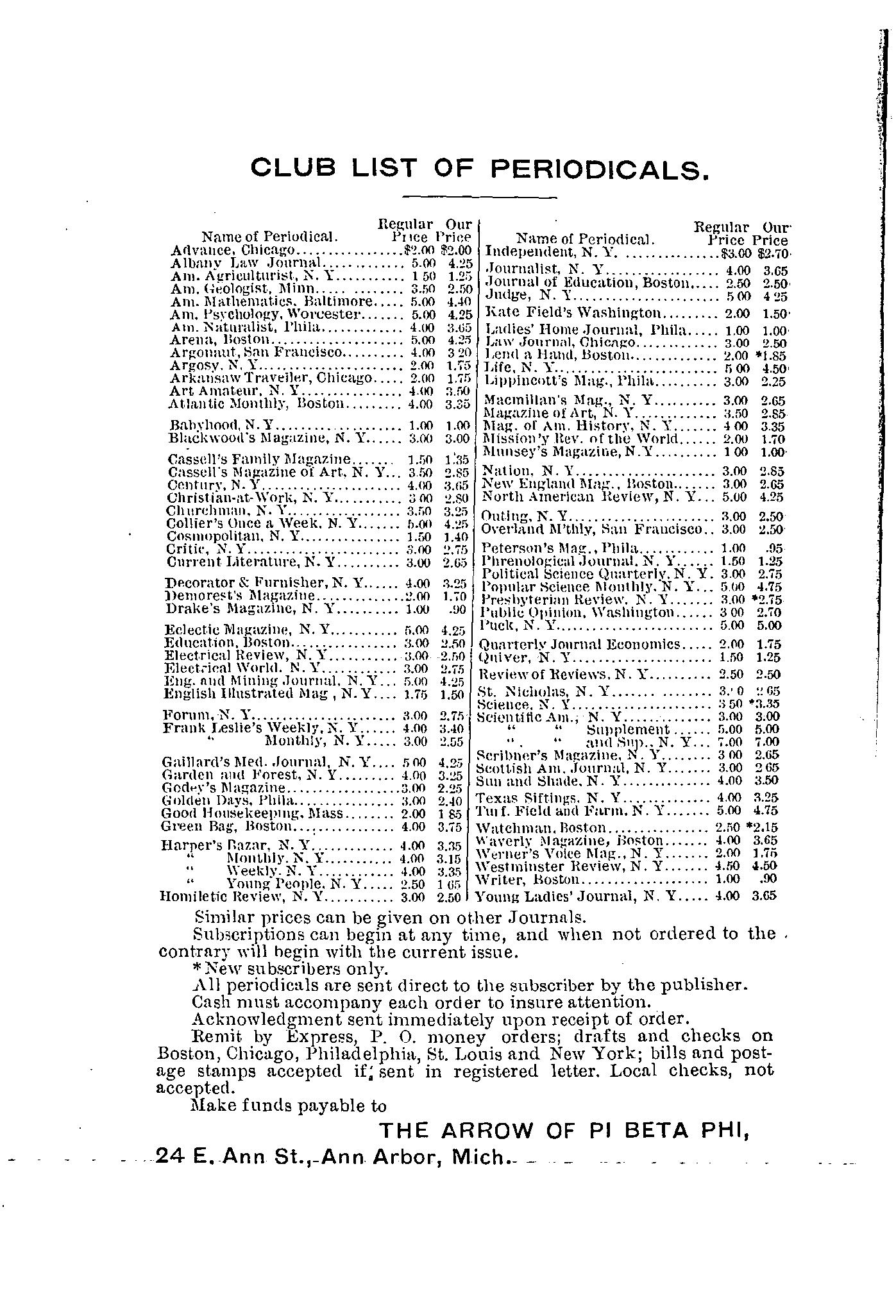
No Y
Furnls.her, N. Y 4.00 ) )em 0 t 's l\IHg-azill e , :.'.00
Review, N. Y Wurld. N. Y , :tOO nud Mining .Iotlmal. N. Y f).on Illustrated Mag, N. Y 1.71) Ii'orum.-N. Y Frank Leslie's Weeklj'.l'. Y " Monthly, N. Y 3.00 4.00 3,00
a.ti5 :!.SO
:t50 Godt'y's l\Iagazine __ :;'00 Goldell nays.
Shl1ilnr prices can be given on ot.her .J ournals.
Subscriptions can begin at any time, and when not ordered to the cont,rarr will hegin with the current issue.
* New subscribers only.
All periodiCl,ls Itre sent direct to the subscriber by the pUblisher. Cash D1USt accornpany each order to insure attention.
Acknowledgment sent immediately upon receipt of oreler.
Remit by Express, P, 0, money orders; dmfts and checks on Boston, Chicago, Philadelphilt, St, Lonis and New York; bills and postage stamps accepted if; sent in registered letter. Local checks, not accepted.
l\lake funds payable to
'DREKA
FINE STftTIONE.RY ftND ENGRftVING HOUSE, 1121 Chesnut Street, Philadelphia. College Invitations, Class Stationery. Society Stationery, Programmes, Badges, Wedding Invitations,Visiting Cards, Banquet Menus, Diplomas a'ld Medals.
STEEL PLATE ENGRAVINGS FOR FRATERNITIES, CLASSES AND COLLEGE ANNUALS.
MARTIN HALLER,
DEALER IN Furniture, Drapery, Carpets, Oil Cloths and Shades.
Oood Coods, Low PrIces and r-Ionest Dealing.
piN
THIS I
IN YOUR
We have the Most Beautiful SlOre. the Flotst Ohocola1es, and tbe Most Prompt Service to be found In Ann Arbor.
HAVEN'T You FOUND IT SO?
Our Drugs are just as PUre as Our Ohoe· o ates are Nice.
Calkins' Pharmacy, 34 So. State St.
WAHR'S BOOK STORE.
Beadqua.rtel'8 for and all UNIVERSITY
DENTAL'
TEXT-BOOKS.
Bargatns In Stationery, Blank Books and Matht'matlc'al Instruments. The Best FOONTAIN PEN In the City lor SUO.
STORES
South !iI.a.e .nd lIlaln upp. {,ourt House.
. i adie8 are Cordially Invited to Visit.
MILLIN.ERY PARLORS
When in Want of Fashionable and Tasteful MU1lnery.
30 East Horon I!!5treet.
GOOD KID GLOVES GIVE
PLEASURE , TO TH E WEARER.
Poor Ones are d!lar at Any Price. If yon have difficulty in getting Jnst what you want, try Our Gloves.
Chaumont, 5Hook, $.00. Fontaine Real Kid 5 Hook $1.50 Chaumont,7 Hook, $.25. Fontaine Real Kid' 7 Hook' $1.75 Fontaine Mousquetaire Suede, - -' -' $1.50 Biarritz, The Best for Ordinary Wear, .98 all Shades, all Sizes, all Warranted. Sent by mail on receipt of Price. E. F. MILLS &. CO •• Ann Arbor, MiCh.
J.F.NEWMAN,
19 .JOHN ST .. NEW YORK.
Official Jeweler TO THE Pi Beta Phi Fraternity.
I desire to call attention to Illy nelV patterns of Pi Beta Phi Badges, \\'hich for SOLIDITY and actual AH'l'ISTIC and INTRINSIC excel anything in this line. A greater variety in finish and jeweling is allowable thr'>l1gh the special manner of making with IN'fERCHANGEABLE DIES.
CORRESPONDENCE WITH MEMBERS SOLICI'l'ED.
Ann Arbor, Does Fine Job and Book Printing. None better in the State. Book Bindery in connection.
PI BETA PHI PINS.
llllvinglHen allthorized to rnanufactu1'e the pin8 of' the Pi Bda Fki f/,oler'"ity, I am prepared to fUl'71i8h a line oj pins 811pe1'ior '/,71 'workman.IMp and design.
Send for Illustrated Prioe LiRt.
NORTH HIGH ST. COLUMBUS, OHIO.