PUBLIBHBD
PUBLIBHBD
Otfidal Publication of the Pi Beta Phi Fraternity.
IMiini and liN 1//1 .1Iirh:!Jtr/l Beta Chapter, r"i!·'rlil.IJ ilf MirhigulI, An,t Arbol', JJirh.
1't:B1ARIU!O IN OC1'Oln:R. MARCil AND JULY.
TAdLE OF CONTEN1S.
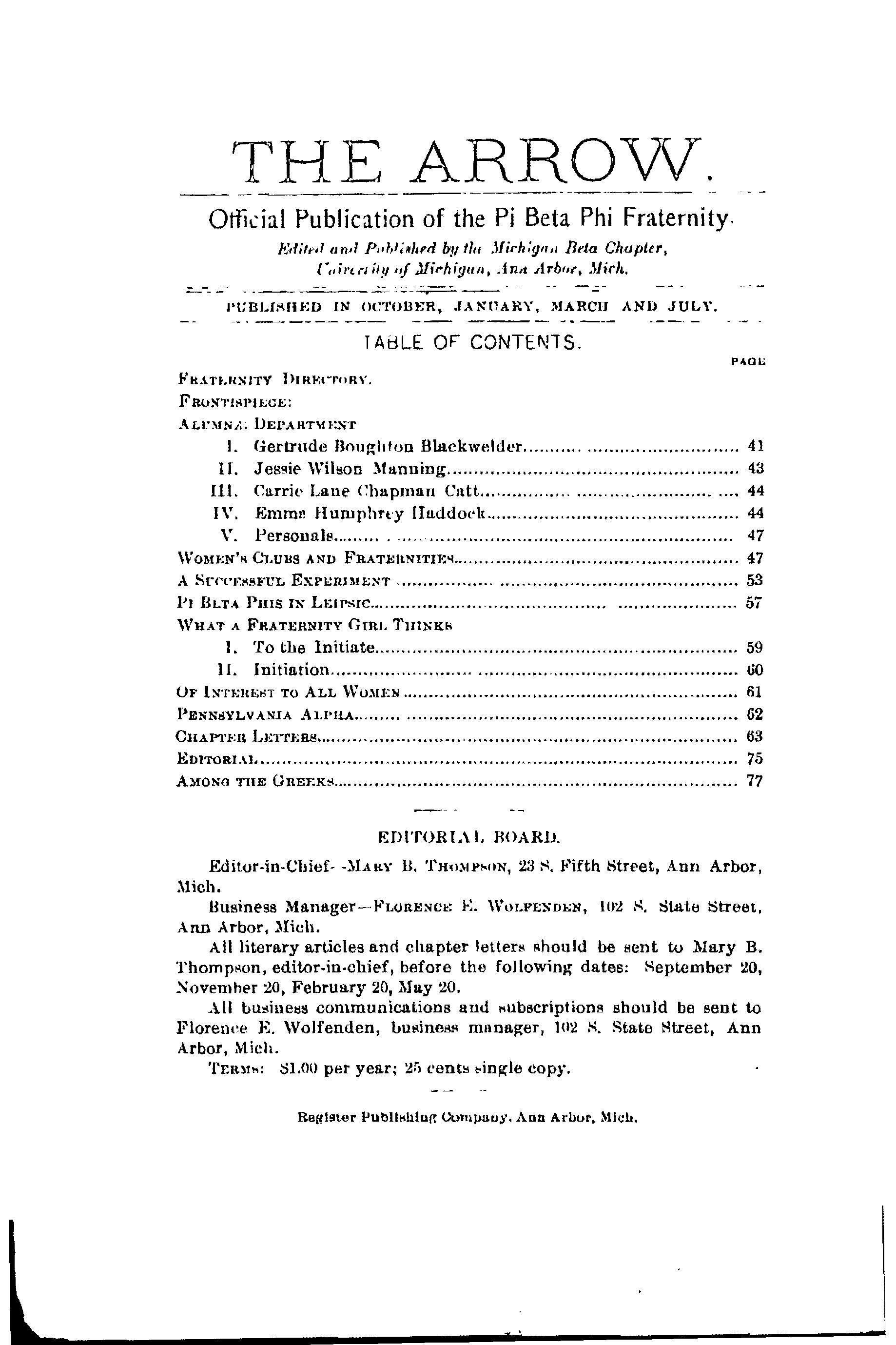
EDITORL\L HOARD.
Editor-in-Chief- -llAltY ll. THmIF",oN, Jt'ifth Street, Ann Arbor, .Mich.
llusiness Managel'-I"I,oRENCI-: E. Wu I •.FEN Dll:N. 102 K :;t.ate :Street. Ann Arbor. lIich.
Alilitel'ary a-rticles and chapter letters should be tolent to Ma-ry B. editor-in-chief, before the foJlowing dates: Keptember 20, 20, February 20, :Mu.y 20
•\.lJ communications aud l'Iubscriptions should be sent to li'lorenee :K Wolfenden, bUtllnes!'l manager, 102 S. Rtate Htreet, Ann Arbor, Mich.
'rERl!"': $1.00 per year; 21", t-ingle copy.
Reglgter PubllKhluft ()olllpauy. Ann Arhor. Mich.
Volume IX) .NO.2.
J/\NUI\RY. 1893.
Edited Michigan Beta, of Miehiga,n, Ann Arbor.
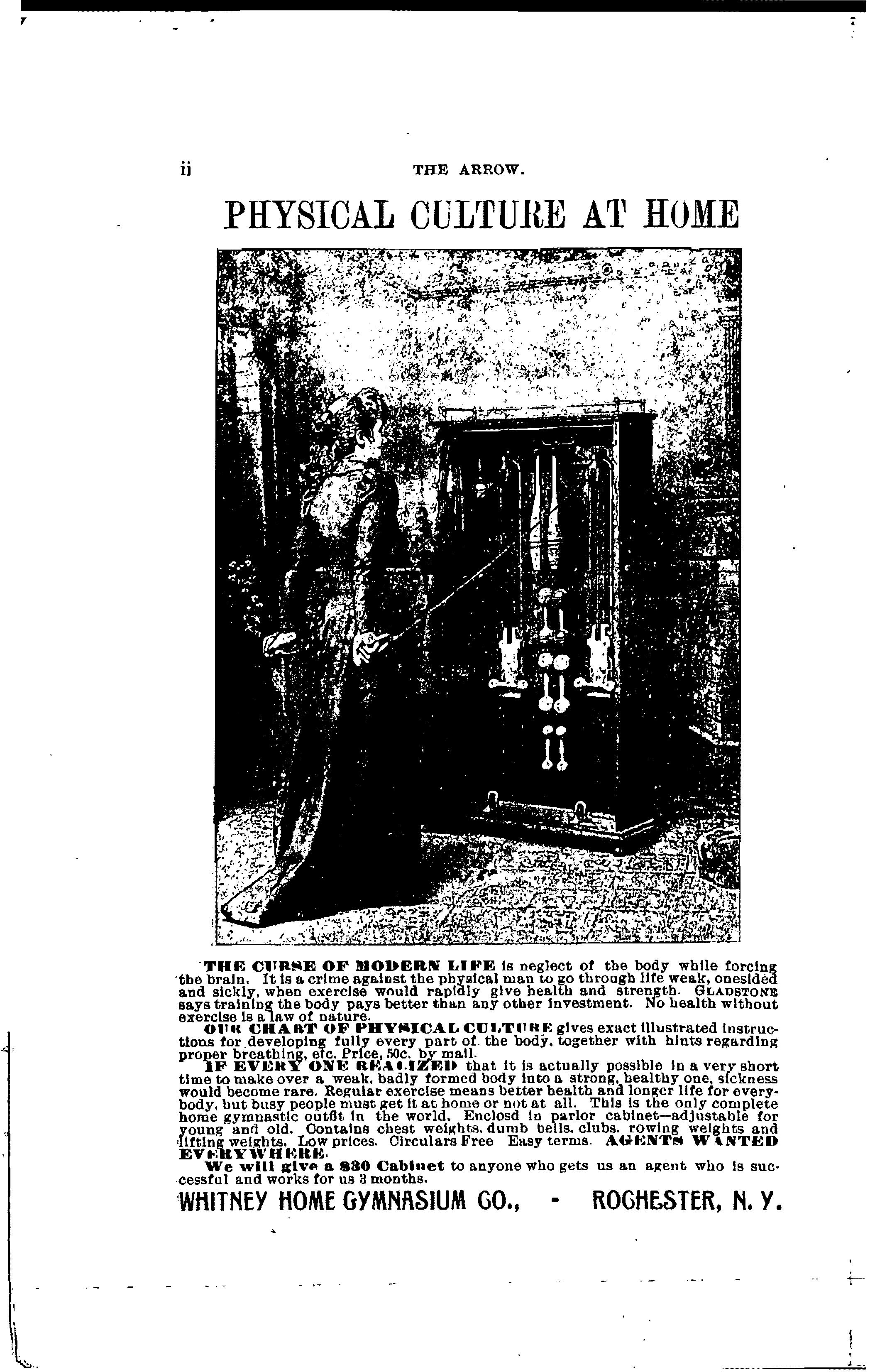
C1TRME OF MODERN LI PE is neglect of the body while forcing 'the brain. It Is a crime against the physical man to go through Ufe weak. oneslded and sickly. when exercise would rapidly give health and GLADSTONE says training the body pays better than any other Investment. No health without exercise Is a, law of nature.
Ol'H eRA-aT OF PHYMICAL gives exact 11lustl"ated instructions for developing fuUy every part of the body, together with hInts regardIng pro:per breathing. etc. Price, !lOc. man.
IF EVERY ONE RII:r\ 1 •• ZEn that it is actually possible in a very short time to make over a weak. badly formed body into a strong. healthy one, sfckness would become rare. Regulat: exercise meaDS better bealtb and longer life for every· body. but busy people must get It at borne or not at all. ThIs Is the only complete home outfit In the world. Enclosd In pa.rlor cabinet-adjustable for young and old. Oontalns chest dumb bells. clubs. rowing welghts and :Jitting weights. Low prices. Circulars Free Easy terms. AGI<':NTlI4 W ,", NTED
We will ClvCll a 8aO Cabinet to anyone who gets us an a.gent who 1s sue· ·cesstul and works for us a months.
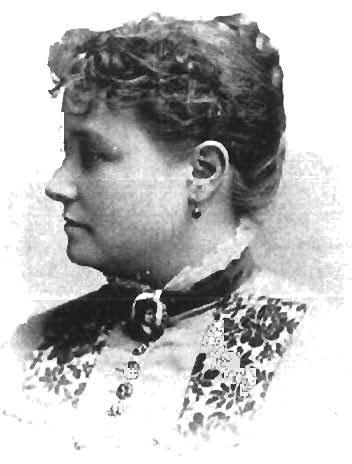


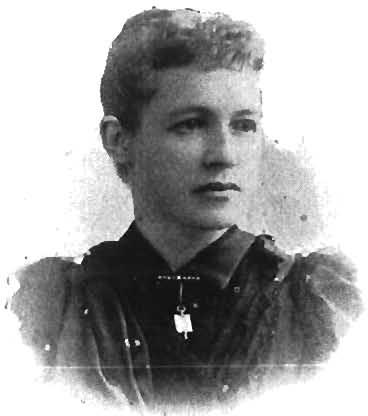
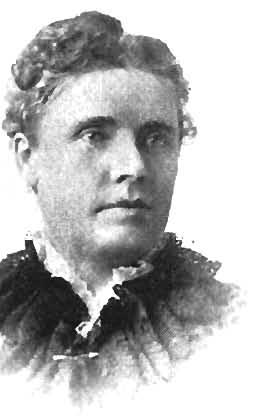
In the days when so much is said about the position of college women in their homes and daily life, it is l'efreshing to turu to ODe who has combined both home and literary duties with honor to herself and to the wOI'ld, and who with Inany others has proved conclusively that a woman is all the better house-keepel', mother and social leader. fOl' her college education and fot, her interest in literary pursuits. Such a woman is Mrs. Gertrude Boughton Black welder'.
Alice Gertrude Boughton was born Dec. 5, 1853, in vVestern New York. rather, a Baptist minister, was always deeply interested in educationalluatters and served several years as superintendent of schools in Cayuga County. Her early education Miss Boughton owed almost entirely to him and to her habit of continually 'poring over books. As novels were not allowed in the family, and as it was before the days of modern juvenile books, the works she read were usually quite in advance of her years. At ten years of age she was sent to an academy at Moravia, three miles fl'OIU home, where she began Latin, and struggled with home sickness wlIile trying to master the old Andrew's and Stoddard's grammar. Here she studied Natura"t Philosophy and was whisked at a rapid' rate from arithmetic to algebra in a way that ever after made mathematics a bugbear to her. At the age of fifteen the subject of better schooling was dis .. cllssed, though as she says, there was not much choice .in those days.
V 8ssal· had but just begun; Oberlin was considered with favor, also Elmit'a Female College, when an invitation came fI'om a sister in Lawrence, Kansas, to spend a year with her and attend the State University. Thither she went and entered with enthusiasm into the work, hampered though t.he students were, by the lack of the l)roper equipments for a college.
During her life there Miss Boughtoll hecame a charter member of Pi Beta Phi, then l)laiu'I. C. The' 'young university grew with the young vigorous state and having once breathed the ail' of the broad prairies, she had no wish to ]'eturn to the eilst for permanent residence. Year after year went by, until six had passet:1 (two preparatory and four collegiate necessnry for graduation). I{ansas had becoille her home and after graduating in 1875, she began teaching in the University, the first Alumnre to be appointed on the faculty. Miss Boughton was chosen member of Phi Beta Kappa, an honor she appreciated, as Inembership depends solely upon schol. arship. In 1890 she was given the Master's degl'ee by the University.
In 1877, she married Mr. Blackwelder and went to Chicago, where she has since resided. Hel'e in the midst of her household duties and with the training of her two bright boys, l\irs. Blackwelder has yet he en able to do more or less studying and especially has she kept up her interest in music. Moreover, she' was President of the Chicago Association of Collegiate AlulUnoo for three
In 1890, she delivered the Alumni address before Kansas State University on the subject of "An Island Literature," in which she is deeply interested. Mrs. Blackwelder is an authority on the of Icelandic life and literature, haviug thoroughly studied the subject, and written various papers concerning it for magazines.
Mrs. a. happy, _life, py all that an educated woman holds dear; music, books and a charming home. In all her relations, social, domestic, and literary is felt the influence of her college life and the iinpetus thus given to a mind naturally alive to the foremost interests of the day.
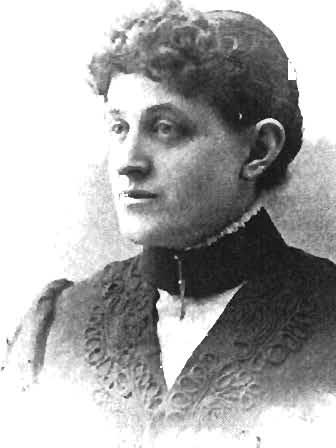
l\irs. ,Tessie 'Vilson l\iaulling was hOI'1I nt Pleasant, Iowa, where her childhood and youth were passed. The father of 1\11'8. Manning, l\ir. Robert 'Vilson, was a man of marked individuality and scholady taste.
l\1iss \Vilson grad uated fit the Iowa 'VesleYflll U ni vel'sity at the age Qf eigbteen and has ne,'er relillq uirEhe? the habits of study formed during those eftl'1y years. Throughout her college cuurse she enjoyed especially science and literature, and after she became an Alumna. she took a long nnd course in modern philosophy under her father's supenrision, while more recently she has devoted hel'self to historical research and belles-lett-re.9.
For five yenrs after graduatioll l\Iiss \VilSOll Inade a business of platform work. Though her lectures were mainly on topics of tinles she never lost au opportunity to speak for temperance, coeducation, ahd for the practical traiuing of girls with a view to financial independence. The comments of the pt'ess were certainly gratifying to au ambitious \\-'oman.
Ou N ovem bel' 21, 1889, Miss 'Vilson became the wife of Mr. Eli Manning, of Chariton, Iowa, t1; luan well known in the political and business circles of Southern Iowa.
Since Mrs. Manning's marriage she has devoted herself. to her home. Three SOllS now belong to the family circle, yet Mrs. Man. ning's interest in the intellectual pursuits of her choice still lives. She has found time to write a IOl1g poem ell titled "The Passion of Life," besides many stray verses which have appeared from time to time in uewspapers and magazines, reviews in local papers, R,nd a few stories, while she now has ready for pu blication a second volume of verse. Since going. to Chariton to live Ml's. has founded a sluall club of WOIuen for the study of history, which has been in successful operation for seven years. Liberal in her means and broad in her sympathies, Mrs. Manuing's watch"ord is progressprogress for the individual and for the world- and the blessings she would desire Joost to see young women achieve are first, educationthe best and broadest possible-second, financial independence, with the ability to use both money and education for the development of a still nobler womanhood.
'fHE
ARROW.
Carrie Lane ChuplllUn. the name hy which she is best known to the pll blic, W3:oE 'horn .J au uary 4, 1859. She spent t.he grenter part of her childhood mal early womauhood on a farm in Northern Iowa. After graduating from the Charles City High School she entered Iown Agricultural College at Ames and recei,'ed the degree of B. S. with, t.he of 1880. 'Vbile there she. became member of Pi BetA Phi.
In Lalle WfiS engaged a8 teacher in t.he l\{asoll City High School und of t.he city schools for two years. 'Vhile thu:i; employed she formed the acquuintnnce of l\:[r. Leo editor of the Mason City Republicnu, and hecllIlle his wife. After her marriage she shared her husban(rs journalistic labors and itt the snme time was to hecome a. lecturer. The business in l\fason City was disposed of and plans. were being pel'fected for the same kind of lUutual wO.l'k in San Francisco when Ohapman died. Ohn.pman spent the following yeal' ill California., busying with journalism and in luaking it careful study of iSU bjects U pOll which she had determined to talk. It was here and at this time thnt. the material WtlS collected for her lecture "Aluel'ica for dealing largply wit.h the Chinese questioil.
Since 1887 lin:'! been ill the lecture field, devoting as luuch time as possible to careful study of the work in hand. Mrs. Chapman has a pleasing presence and n forcible manner which gives a wholesome earnest to all of her pleas for woman's advancement ..
In 1890, 1\:[1's. Chapman became Mrs. G: 'V. -Catt, since which time her home has heen in New York.
Emma Humphre)' Haddo-ck thl'ough her parents, has a right to all the stul'dy qualities that the state of Connecticut has e\1"er been said to confer on her children. From this nursery of educated Inen of every class 1\11'. and l\frs. Hunlphrey moved first to Ohio, then to
Iowa, in CeduJ' County. where Emma WHi! h01'1I alld ,rllel'C the fatlH ..... t· as a pioneer min isteJ' of the l\'lethodist c.hurclI : s)lOwe(1 him::elf to be a man of ahility and marked character.
It is clear that in the interests Hnd anxieties of wC8tern farm life the love of studr and intellect.nal pursuit.s "W.l, not absent. J\fiss Emma- Humphrey em'Iy finished the course of the High School in her native town and reacbed out for the advantuges of the State University at where she graduated wit.h the degree of Bachelor of Didactics in Juue of 1865.
Two mouths latel", 7th, 181):): occul'red the marriage of l\Iiss Emma Humphrey with 1\11'. 'Vm .•J Haddock, an event which usually puts un end to all intellectua 1 activity on the part of a wom311. But it was not so in t hi::; C:lse. 1\11'. Haddock, always" n Juan ()f prollolillced liberality 4 d' opill ion, n compan ion und inspires' of intellectual act.ivity I and mude it fo1' the favorite career of teaching to engnge Mrs. interest for two yenrB. Eight yen.rs more of domestic life served to enl'ich the charaeter and love of study thnt was constantly being nourished by superior COIll-
Under the encouragement of her husband .l\fl'R. Haddock entel'ed the Lnw Department. of the State (Tni\"el'sity, in September, 1874, and graduated J"l1UC, 1875, one of ten out of a cla:;s of neady one hundreli, to represent the class on commencement ,day. An advanced Jaw class of seven W8S graduated in 1877 and here again Mrs. Haddock was chosen as representative anel honored with a certificate of special ability ill the law. 'Vben in the fall of 1877, Judge .J. F. Dillon admillistere(l the oath that admitted Mr8. Haddock to practice in the United Circuit and District COUl'ts, it meant. much more than the same fact would mean to-day in anr State of the lTnion. She was the first to gnin this distinction in her State, for which all women owe her a debt of gratitude. No WOlllan enters a new field of activity that she does not open up the whole unexplored region for her entire sex, unbarring adoor "t.hat- is never to be closed again. "-
It is a courageous step to take the chances of one's future in one's own hands, instead of following the beaten "path of convention-
ARROW.
alit)', But fortunate is a womau whose husband is the leadet, and inspiration of such n step!
1\fl's. Ruddock's \'igorolls intelJigellce and criticdl acumen soon marked her for public usefulness and fot' tlll'ee cOl1secuti,Te ,'ears Bupl'eme Court appointed hel' examiner of the law class.
There is n COllI't\ge born of ignorance and a courage born of reckless disregard of but the courage which rules the wol'1d is it coul'ft.ge born of know ledge, of niature deliberation, of fixedness of purpose, and that purpose is born of high faith and Godgiven powe!':;, This we judge was the true process of education with Mrs, Haddock, It was the drawing ou.t of power from within, an evolut.ion of character, not a gl'owth ft'om accretion. 80 that whatever service was required of Mt's, Haddock in the wo}"ld's W01'k1 we always find her life hat'monious1y adjusted to it. She brings to her management of domestic affnil's the Same strength and intelligence that characterizes her life, 'Vhen in the COUl'se of the lust ten 01' fifteen years literary clubs hl'ough t to women new fields of labor with increased facilities for study, no one showed herself more ready to gl'upple with, historical aud literary problems, or evinced a keener relish for getting at the bottom of a question than Mrs. Haddock, and for executive ability, no one showed in the government. of her club mot'e wisdom or tolerance.
Reputation gained at home was not endangered abl'oad, for Mrs, Haddock not only held her own but was a valuable member to the "Association for the Ad va,llcemellt of 'V omen," and her paper on "'Vomeo as Lnndholders in the West," I'ead before the \Voman's Congress in 188G was greeted with marked I should be drawing the portrait of a . cold, one-sided nature should I forget the large element of synlpnthy that makes of this talented WOlllau the helpful friend and neighbor.
·-·To her.:f.riends she .is.,always the sYJ.!lpol of .tl)e gh-ded loins and lighted lamp. Yet this singleness of eye which makes t.he accurate business woman, this steadfa:;tness of plan \vbich never distorts the moral order of things, does not dwarf the sympathetic iutel'est in the world of men and \\:omeli. Auel to come into directly personal rela-
'I'HE ARROW.
tions with .'rflrs. Haddock is to enjoy the friendship of a most womanly woman and to be stimulated to some produc.tive activity, the best office' a friend can perform for us.
8u8a.nne Smith Tyndale.
1\1188 MAY ROBERTS, Iowa Gamma, is doing special work in lnathematics at Cornell. LVIiss Roberts had the honor of being chosen by Professor Stanton, head of the Depa1·tluent, as Ids assistant, immediately upon graduation.
l\'IRs. Lu OSBORNE-FERSON, Iowa Beta, of Council Bluffs, Ia., is a member of the vVorld's Fair Board of Lady Managers for Iowa. Mrs. Ferdon is un en.thusiastic Pi Beta Phi and took time to meet several of the Des Moines alumnre while eu ruute to the dedication ·ceremonies.
THE DES MOINES Pi Beta Phi Alumnre Associatioll meets bi-weekly, and has applied for an alulllnoo charter. The1'e are thirty Pi Beta Phis resident in Des l\'Ioines and an alumnoo chapter could do much g'ood f01' them and for the fraternity. At a recent meeting the following program was carried out: "The Broad Pn,th of Life" from Bjornaen, read by Miss Ella Cummings 1 Iowa Alpha.. A ·description "Landscapes in Norway," l\fiss Olive McHan,)" Iowa ,Alpha. "History of Mrs. lone 'V. Marsh, Iowa Ga.lllllla.
Whatever lives, in this busy day must have a strong ra.,ison ·d'ltf'B. It must fill SOlue pressing need, supply some vacancy, or, in the rush of our numerous interests,'it is pushed to the wall. Alnong .social I3.nd reform survive, which prove they are the fittest to sUl'vi ve by serving a distinct purpose and meeting a strong demand. The purpose ruay not always be the highest nor the demand the best; but these two factors existing, 'whatever lneets them will live until the conditions are changed.
'I'HE
AHROW.
The origin and steady growth of wome:. '8 cluos nnd fraternities in the last quarter of a century, indicates plainly that alllong women all over the COUlltl'y, North, South, East, 'Vest, without (listinction of class or creed, there was a. crying need which these organizutions filled. And I wish to show that it} this case the purpose served is the highest, a nel the demand one whose resul tS are the most beneficial.
-Among 'women 'S-Clll bs', Sorosis is the-oldest-, -having=-been"organized in 1868; between that time and the present, tuany such ?l'ganizations sprang up, in cities and towns, until it hemune patent that SODle co-operation and connection between them was needed. In 1869, the year when Sorosis attained its majority, it took the initiative and called a convention at New York City. There c,ame to t.his convention, representatives from ninety-three clubs; aims and methods of work were discussed, correspondence instituted, and steps tftken leading to formal organization. This was effected in 1890, when the General Federation of Women's Clubs was formed, sixtythree ltuxiJIia,ries, representing eighteen states, being incorporated. How great an impetus was given to club spirit and work by this union, is shown by the fact that the COllvention of the Federation held in Chicago this year, numbered one hundred and ninety-two delegates from thirty-two states.
The object of all women '8 clubs, I take it, is, pritnarily, self. culture; to supplement the lack of early higher education; to eounteract the dwarfing influence of the routine of domestic duties, to bring WOluen into contaot with othel' minds and other Ii ves in intelligellt activity. They are made up of women of literary, scientific or artistic tastes; of WOlnen who are desirous of increasing their general intelligence, and keeping abreast with the tilnes. But since anything which quickens and strengthens the intellect to develop every other faculty of the individual, the influence of club ceases to be limited to the intellect alone, and becomes selfin the sense----th-at is, of th'e 1l1Tnd,-" "t-he heart, the soul. So it seems to me the advantages of club life nlay be considered very logically under three heads; the intellectual, the social, the spiritual.
The intellectual phase of club life is developed in many ways, but its results are similar. Some line of work is followed which stimulates serious thought and scholarly research. Be it history, science, literature, art, philosophy, politics, what you will-it presses every individual into service, compelling her to contribute her quota to the fund of geneI'al information, and thus teaching her, not only to express' herself clearly and forcibly, but also to investigate Jllost carefully and accurately, knowing hel' statements will be questioned and criticised.
I have known one club which studied Dante very diligently through one winter; and how much poetry they found, both in sentiment and expression; how much science, and art; how many literary and historical references to he investigated j UOW much leading to a study of the religion, the politics, the society of the times! U ntH this one literary study, taken up for a few hours of each week, deepened into ever widening circles, and gave a wonderful impetus to the pursuit of these several branches of learning in a hundred homes. And this brings me to mentiun of the greatest benefit, perhaps, which is derived from the intellectual side of club life. It awakens an interest in many departments of learning, which otherwise would he disregarded, and stimulates a woman to pursue their study a)one.. No bright wonlan can read Shakespeare carefully and not become interested in English History; Moliere and not wish to know the country and the times for which " he wrote; Coleridge or Wordsworth, and not wish. to know something of his philosophy. Clubs give to many women the first dl'aught, which engenders an etel'nal thirst.
Aud last, but far from least important, this feature of club life brings to women the great advantage of systematic and orderly study. Her multitudinous interests constitute the great bane of woman's life; it is, of necessity, an hour at this occupation and an hour at that, until there is much danger .of cultiva.ting unsystematic habits. But if she is expected at a certain time to be prepared in a certain work, she finds the very mental discipline whicli she needs.
In this sense the club has the imperative character which the . school room has for younger women, but lacks "all the formality of
reoitations; it is a Democracy of the intellect, where all stand on nn equality, and there is thus produced in intellectual life that independence, and strength and self reliance which we believe Democraoy produces in national life.
The 80eial phase of club life does sOlnething, which, it seems tome, no other social factor is able to do; it discards all externalities, all that is exoteric, the distinctions of wealth, of position, of reputation" and 11 uites the Inem bel'S on the sofe ground of womanhood. It reveals. the fact that they are women, having in the last analysis, the same. elnotiolls, the same desires, the same aspirations, and Ineeting with the same purpose of cultivating mind and heart. One of the leaders of club work in this country well expressed this tendeu'cy thus:"Here, as a class, society women first discovered that women who puraue serious subjects do not thereby forfeit their social qualities; and serious WOlllen first learned that they do not monopolize sel'iousness." How luuch this meeting on an equal footing, this social side which is given to intellectual work does to tear down the spirit of class of is not generally appreciated. N or is this result confined to the women of the individual clubs, but extends through the entire Federatio.n; the knowledge of common plans and work, of mutual sympathy and help, acquaintance through correspondence, association in Con\"entions, has already done much, and will do more to destroy differences, and bl'idge over the chasm existing between the North and in politics, the East Rnd 'Vest in prejudice.
'fhe spiritual development of club life is one which, perhaps, t a superficial observer would scarcely expect. Yet it is there, and is a normal tendency in such organizations. She is a scholar who dcres not understand the great purpose of all scholarship; she is afflicted with spiritual blindness who does not discern the trend of all true investigation and study, Club life expands woman's nature, increases-her .,.diminishes= her :prejudices. -Hel' contact with other women of other lives, enlarges her charity, broadens her sYlnpathy, 'lessens her sectal'ianism. And there is many a club in this country which can testify J that, having begun its work as an organization purely intellectual in its pllrposp, the acme or its U8e-
'rHE ARROW.
fulness, both to its luemoers und to society, was renched, when it embraced charitable and philanthropic work as well.
'Vomeu's Greek letter fratel'oities are all that women's clubs are-aud 11101'e.
The oldest, Pi Beta Phi, antedates Sorosis by one year, while the other nine have been organized at interva)s from that time unti1 1890. While they are known as secret the secrecy is only as to their workings; theil' purpose may be known to nIl the world. This is to supplement the intellectual tI'aining of college by the most ennobling social l'e1atiollships and thus to fur. nish thnt sympathy and friendship which college women so much need.
Though this purpose resembles that of women's clubs, yet the scope of the fraternity, it seerns to me, is broader· and its opportunities greater. And, since the TIlaterial and the work of clubs alld fraternities are SQ dissimiln.l', l)el'haps I can best pI'ove that this is tl'Lle by noticing in what the fraternity differs frOIll the chib.
The fl'aternity differs from the (Huh in that' its work is begln? at a time when a woman is more to influence. The years spent by a woman' in college, ranging from the eighteenth to the twenty-fifth, are the yeal"S when all her faculties are unfolding, her tastes developing and her purposes At this age she is more open to con,victions; her actual experience with' the world is not great, and she is Dot yet embittered by disappointment, .nor hardened' by difficulties. is ambitious for the 'is usually possesed of good health and spirits, and is unfettered, as a rule, by family cares. At this point, a little influence of'the proper char; acter, may bring forth results wllich in later years, much greater pressure would be unable to effect. For this reaSon, I think the power of the fraternity for good is greater than that of the club.
'Vhile the object for which the club and the fraternity strive, is, ultJmately, much, the th_e employed in attaining this object must be entirely different. In t.he one, the tendency must he stimulative, in the other, restraining.
The one is composed of women, who, however cultured they may h:::. lnck t1lC which
'I'HE AUROW.
the young women of today are enjoying, These women, too, have reached an age when they are settled in their habits, aud nlore COll.servative in their opinions. They are not so ready to take any new line of work; they Inay be a little loth, even, to I'enew the habit of actual study, which they. dropped years ago. All these crystallizing tendencies the club must overcome; it must excite their interest in intellectual workj it must stimulate them to study, it must induce them-to emerge, for a certain lengtb of time, from the 'routine of domestic life.
With young women how different! They are buoyant in I5piloit, full of energy, possessed oftentimes with more zeal than judgment, more enthusiasm than prudence, ready to be carried away ,yith whatever engages their attention. What they need is a restraining and guiding hand. This is what the' fraternity furnishes, and it is just here that it does Hs most efficient work, It has a restraining influence on its members: - First, because it gives a proper outlet for their energies. Their young minds must have something besides mere study on which to bestow their interest and their activity and these, if properly bestowed and directed, accomplish much j if not, they lead into channels often prove dangerous and destructive. The fraternity gives them lines of work and of study, which have been formed by those older and wiser, in the pursuit of which they find the exercise and discipline they need. Second, the traternity exerts a restraining influence in the fact that it brings into the most intimate relationship, girls of varied talents and tastes. In the ten, twenty or thirty girls in the chapter, all sorts of natures and dispositions will be represented. This heterogeneous collection of girls, the fratel'nity, by I'eason of their mutual restraint on each other develops into well rounded women, teaching them to be scholars without being pedants, learned without being unattractive, gay without being fritro]ous: It docs this by bringing thenl into the closest association; the\r follow the same lines of work, and with the study ,-'they read --togetller, ;I-}(i in lUany cases live together, 'Vho will- say that each does not imbibe the spirit of the other? That abnormal tendencies and idiosyncrasies are not lessened; that eXC1'escences are not. diminished,
and deficiencies not filled up? That the whole influence, far fl'om eraging individuality, does not tend toward the formation of a "per. fect womao, nobly plo.nned?"
The fraternity differs from the club in that it assumes more authority. In the latter, there is intellectual comradeship, there is the affection and the sympathy, which springs from association; but there are barriers which club women do not feel free to overstep. The fraternity, on the contrary, em braces the broader idea of friend-: ship-nay more-of sisterhood, and the relations existing between fraternity women, are sisterly relations. It is the province of the fraternity to advise and encourage its Inembers; to help them in whatever direction help is needed, to admonish and reprove, if reproof be necessary, And few realize the number of girls who have been influenced by their timely words of friendship and warning. This is what the fraternity does for a girl while ·in college.; after graduation it receives her into alumnre chapters and associations, where the same advantages· are offered.
The benefits of the fraternity system have long been but owing to the incl'eH-sed strength and numbers of organizations, the future will rev"eal more clearly than the past the work which they accomplish. If I mistake not, the present generation of young women will do honor to the good influence which they have felt, and will devolop lives of such sYlnmetry and strength, that it cannot be said of them, as of one of the great English poets, that they were individuals of magnificent beginnings. The deflection from the old time prejudice and standards is well begun, and when .the solstice of women shall be rea.ched, let the Greek letter fraternity receive its share of the honor.
Ona H. Payne.
Many years ago, Matthew Vassar confided to- a distinguished Englishman his plans for the advancement of education for worn ell. He was. earnestly advised by his conservative friend to give up a wild and visionary, and, instead of trying to develop the
mental power of woman, to turn his charitable attention to the tt·a.ining of idiots a.nd feeble minded children. Happily 1\11'. 'Tas· sar was firrn in his PUl"pOSe, and to-day the college founded by hiIu is not only first in point of time, but also leads in usefulness the American Colleges for women. Similar stories are related fl bout our admission into co-educational institutions. was besieged for years and finally yielded with reluctance, regarding t.he iunovn,tiOll as an ex})eriment Inoreo!' lessperHous and· ·impracticahle. So with the world in general the new lllovcruent known as the' 'Higher Education for 'V omen " was looked upon· as an experiment. It may be confidently expected thftt an e.tperintent of any kind must eventually come to an end, by proving or disproving the thing it was designed to investigate. .After thirty years of tdal, during which time nearly three thousand women have experienced college training, we Juay begin to considel' the results of this nineteenth century" experiment
These women, or girls, have keenly felt that the eyes of the world Wel"e upon tllem, but they have gone their ways serenely, growing stl'ong in the luental developlnent that comes from regular and judicious training. They stand ready to be jl1dged. The incredu· lous are invited to select from any class; the illarl'ied or the single, the teacher or the philanthropist, the business woman or the housekeeper. He who foresaw the ph.ysical breakdown WhICh was to be an inevitab1e result of a college course, may read the health statistics gathered by the Association of Collegiate Alumnre and find there a cOlnplete refutation of his theories. Let him note _the observations i-eceutly made by a correspondeD t of Science in regard to different qualities of blood_ He says: " The .richest colot" was in the blood of a girl 26 years of age, a graduate of Vassar College. "
'Ve who, twenty years ago, read Dr. Clarke's" Lex ill Education" almost with consternation, may now reread it as a Inel"e " of literature." It has ceased to be a bugbear.
As teachers, we find coilege women filling pos-itions hithel:-to closed to them. They are pressing out of the ranks of primary instruction and 8:fter studying in both and EUrOpe..lll 'Universities, are becoming professors, deans and presidents of col-
1ege::;. Those whose hearts are touched by the suffering and ignorance existing in our lower classes are leal'uing the old fields of l)hilanthropy and entering ul)on tpore practical lines. The college settlements in New York and Chicago, where there is dil'ect and personnl contact between the pure, noble lives and their untidy, improvident neighbors, are in the bands of women; not lnen as is the case in Loudon. The continual object-lesson of an attl'active, spotless, well-ordered home, the patient teaching of young and old, are yielding gratifying returns for the labour and self-sacrifice of the generous women who giyc their lives to this work.
It is useless to take up the subject of the ,occupations now open to educated wonlen. The list is increasing with such rapidity that \ve are forced to believe that soon no branch of business will be managed solely by men.
Now we come to the housekeepel's. Next to the health scare, the great cry has been that college work would tend to unfit women fo1' the duties of a ,vife and mother, that they would not love the home. Perhaps this error has prevailed to a greater extent tluin any other, for we still hear echoes of its argument.s.
T have yet to meet a married alumna who is not a good housekeeper, a.nd a wise mother, if she has children. Education is worth little if it does not in some degree fit the individual for whatever avocation may be entered upon. It is absurd to claim that the broadening effect of a liberal education does not extend to the home .circle. That this domestic influence is Inore general alnong WOlnen than. lnen is of course to be expected. It is also trne, taking all things iuto consideration, that women reap Inore lasting benefits from a college course than mel). Many a young man entel'S college with indiffet'ence if not with actual reluctance, simply because he is sent there; while a young, woman usually takes up college work with au earnest purpose, either to fit herself for. special work, or' because she has a thirst for knowledge born of long abstinence Again the college man who enters -business ,relinquishes gradualJy' the ,"arious branches of study he has worked at for foul' years, and' finds his grammar school arithluetic with its "partial payments,. insurance and average," the one book that "stays by him. ". On.
the other hand, the WOlllan graduate keeps up her (freek, reads the French and Gernlan literature of the day in the original, helps het' boys with their Trigonometry, shows her little girls the strncture of plants and how to classify their butterflies. She directs her house with intelligence, treats her domestic employees with fairness and carries her experimental knowledge of chemistry into the kitchen. The .sanitary condition of the. home is carefully looked after and not left in the merciless and incompetent hands of the plumber.
The science of sanitation, by the way, is it thing horn of college training for women. I believe it is true that 'Vellesley college . is the first to organize a department for iustruction in that line. The University of Chicago in taking from the founder of that work, has carried out its usual})olicy, l)rocl1t-ing the best in any line,-and that "best" lIa ppened to be a rollege woman, Miss Marion Talbot.
'Ve nlight go through the Yal'iOllS activi des of Ollr complex American life, singling out the college womell and discovering with what strength, with what fine judgment they are promoting the great philanthropic and educational of the day. It would be of 'interest to know in what relation our fraternity girls stand to all these things. We want to helie\'c that the pleasant social intel'·course of the young women who are banded together during college yeal's has sweetened their Ii ves t made them more noble and chadtable, that it has not in any war na.1Towed their minds or engendered prejudice. If our societies ha\'e lofty ideals, if they aim at pure and noble thoughts, if they look aoove the ephemeral pleasures of a symposium or nn afternoon tea, and awaken in the mind SOlne ideas for which the world shall be better, then are they a bles.sing to the student and to the college. 'r'hat they can and will be all this, and t:noi'e, is the hope and prophecy of one who was a "fraternity gil-l " twenty years ago_
Gedrude Boughton BlackweldeJ'. Morgan Park, lll.
LEIPSIC, SAXONY, Oct. 30th, 1892.
'Ve, the :Leipsic contingent of ColOl'ado Alpha, send greetings to OUl' sisters of Pi Beta Phi on the other side of the blue. We follow fraternity movements with interest and long to add our mite of help; belie\·jug this to be an epoch requiring the best efforts of every loyal sister. 'Ve expected five in OUl' delegation but one of our members wa,vel'cd at tbe last.
Leipsic we al'e llOW beginning to takp. in in earnest; the first two months were spent mostly in hunting up old and interesting corners, seeing new types of people and practicing our execrable German on the good natured Teutons. Now Inusic fills the hours, with occasional rests from instrumental to vocal and to German guttul·als. The unmusical members are beginning work in the Univel'sity.
As yet we've seen very little of the University) its students or customs. As you know, women Rre not regularly admitted as students, are here on sufferance and feel always as though they were pursuing their work under protest. We are addressed collectively as "Meine Herren," go to lectures, concerts, theatres, etc. on tickets labelled "Herren Studenten," for which we make our bow and thankfully take the gifts the gods allow-at half prige. Last year some of our thoughtless country women made our course somewhat difficult and endangered the position of all women in the ,University. As a result the rules are stricter tbis year and it is harder to gain admittance and impossible in some cases. We called upon the professors whose lectures we wished to hear" armed with our best introductions nnd our meekest bearing and in every case were treated in the most friendly manner. 'Ve enter the class rooms with as little ostentation as possible, keep our eyes on the professor or our note books and are utterly oblivious to everything and everybody except the dead ,heroes of literature. Later 011 we mean to be more observing, to tell you sombthing of the German student Vereine, which luean to us at present rather pl'etty caps of the brightest of blue; red and green, with fine and too often terribly scarred faces underneath,
'Ve h!lve ,passed and signaled a golden key of I{appa l{appa Gan1111a and a l{appa Alpha Theta kite 'besides several. l'epresentatives of men's Amel'ican fratel'llities ..
The old University prison was open to visitOl'S for a few days before it was tOl'n down; the place where unruly students for generations have been incal'cerated, There were eIght or ten l'ooms, ancl the garret of an J..J, and they say that in its palmy days the rooms were_ full, a_ud the days of its prosperity held out to the last. The walls were literally covered two or three coats deep, with marks of the various talents of the prisoners,-some showed a goocl deal of training in sketching and coloring. Then doggerel in every tongue and every metre was there; parodies on classical German poetry was the favOl'ite theme. Flags of nlRny nations done mostly in colored crayons decorated the walls; one of the stars and stripe.s particularly well done and with position conspicuously chosen, we viewed with conflicting emotions; it showed at least that as a nation we nre everywhere conspicuous.
This is all past history now, as the 1110st of the Augustemn-the literary building-has been torn down to tnnke room £01' a. new one better fitted to the needs of a gl'eat University" 'Ve asked a bright young German girl to go with us to this ploison. 'Ve had heard her express a wish to see it and as our professor and pl'o£essol'in were going, she would be amply chaperoned; but she was not perJnitted to go, and we 1earned that not only was it very bad form to study in classes with men, but that all places frequented by students or that eVel" had beell, were known by well bred young ladies only to be avoided. It seems impossible for us to understand these customs and restrictions: doubtless we are even IUOt'e problematic to the people about us, as without our influences and surroundiIlgs we lnust seem enormities, Does one nation ever ]eal'u quite to understand another?
Never before have the EngliSh been our countl:ymen, 'Ve are now brothers sisters great race. We sing "Alnerica" with "God save the Queen" as a last verse,
We greet 'yith joy the recent admittance of WOlllen to two,of the German Universities-G5ttingen and Halle. The wol'l<1 does move
even in though not with the speed of Nancy It has seetned· to lIS so barbarous that German women should not enjoy the splendid au vantages of such a U nivE'l'sity as this, where fi,ne lectures are given hourly by wOl'ld renowned men, and in the pUI'est speech of their mothet' tongue. 'Ve couldn't resist trying to do a little missionary work by ail-ing some of our demoCl'atic ideas; but we were treated in such fl dignifieq and frozen mauner for, our pains by the women themselves that we shall never venture again to suggest that women mar have taste and ability for advanced study even though they may not have the strength to carry a musket through a campaign against the Fl'ench.
KOn1crpla.tz 81, Leipzio ,sachse-no
EUza.beth K.
It is to be presumed that none of the new members which the fall has brought to Pi Beta Phi have entered into the sisterhood
To The unthinkingly. They were fully awake to the fact that (nltate. joining any organization briugs new duties. A word from an old lllmnber lURY not be fuuiss to you who have just entered our fraternity. As you stand on the threshold of fraternity life, new duties born of your new relations and pl'ivi1eges confront youindeed the other half of every privilege is a duty, and it is by this very increase of duties that life broadens.
Your inuuediate duties to the lnembers of your own chapter need not be touched ·upon. It is not necessary to exhort you to give t.he kindHest sympathy, youi' interest, and your loyalty to YOUl' friends iu Pi Beta Phi. Your friendship bids you do that. But there is a duty which needs to be brought home to every fraternity girl, or old, and that is duty of maintaining cordial, friendly relations to those outside the bonds. Do not commit the mistake of thinking that in joining a fraternity you have severed all outside friendships. The closeness and sweetness of fraternity friendships should nlake you more appreciative of all friendshil). So far as
there is any stain on the fair natne of fl'atel'uity, it has been caused by just this fact; fratel'nity has so often been but anothel' name for an exc1usi,'e clique, of indifferent, bearing to all outsiders. Every fraternity girl should exert herself to remove th is stain, and after all it can be nothing but thoughtlessness that has given ground to the accusation. Let everyone see that the lessons in friendship you have learneil in fratel'nity life luake you more friendly to all: that the fraternity of -keeping. you as' an exclusi've possession for itself, gives you back 'to the world more kind and more helpful.
Let your chaptel' be cal'efu) to maintain good will and friendly relations with everyone; entertain independent girls, and have f.'e· quent open meetings £01: YOUI' friends and acquaintances. In short) by your universally friendly and cordial be:u;ng show to everyone, that in the fraternity you have begun to leaI'll that world-long Jesson, which is the essence of fraternity spirit-love thy neighbor as thyself.
At this season the init.iation is an important part of fraternity work, and the question rises, what is the best plan for an initiation?
Shall we follow the time honored custom of fraterInitiation. llities and put onr victim in a coffin, toss him in a blanket, and play various practical jokes at his expense?
Mystic circles and signs and mottoes, mysterious clasps and figures and voices, thrice-secret oaths and stringent catechisms have for years been associated with initiations into secret societies,
But the tendency to do away with all this mock-mystery and practical joking is every day growing stronger,' and fraternities al'e beginning to think it below the dignity of a serious organization to indulge in such child's play',
The initiatioll ceremony should be as beautiful and impl'essive as. it cnn be made. Then, of all times shou1d our order appear in its utmost beauty and dignity. =Above-all- things- the ritual should 'be spoken and not read-.the pledges lUade from the heart and not ft'OlD a book. The initiation should be made beautiful and so impressive,that the memory of the solelull pledges taken and the lofty ideals professed at that time, will never fade from the mind of the initiate.
Galician women have petitioned the Emperol' of Austria for permission to serve as soldiers.
Recent statistics show that women average two inches taller than they did twenty-five years ago.
The Royal Geographical Society of England has unanimously voted to admit women as Fellows on the same terms as men,
The Sargent prize at Harvard has again been won by a young lady, Miss Margaret Herrick, a special stude.nt at the annex:
It is computed that there are fifteen thousand women typev'friters between Canal street and the Battery in New York City,
The New York University has arranged for free law lectures for wOInen and at the end of the year will award certificates to students for theil' proficiency.
Out of every hundred teachet,s in the various grades in England, seventy-seven pupil teachers, seventy-seven assistant teachers and sixty certificated teachers are women.
Miss Annie M. Robbills is stenographer to the Board of Police for the city of Boston. Miss Robbins is a gntduate of the Mt. Holyoke Seminary and is well fitted to fiP her responsible. position.
It is said that woman's labor is more used in Finland than anywhere else. There women compete with men as clerks, managers of limited companies, doctors, dentists, house builders and bank cash. iers, in which latter capacity they are found more honest than men.
The census of 1890 shows that in the United States there are about twelve times as many men as women criminals, and that the domestic and house-keeping women furnish the large proportion of transgressors.
Mrs. Oliphant and_herson are writing of the Age of English Literature. It is said that this prolific writer does all her work at night, never touching her pen in the day in ol'der to to be free from the interru 11tion that is inevitable for a luistress of a house.
'l'HE ARROW.
Princess l\{al'ie Bibesco lately succeeded in swimming the lespont-Dardanelles Strait-from the European to the Asiatic shore, nnd thus puts her name alongside of those of the classic Leander and the poetic BYl'Oll.
The Executive B081'd of the National COllllcil of 'V omen of the United States consisting of the general officers of the Council and the President of each association, held a meeeting in pecember in Chicago for the purpose of deciding- many important lllatters ing to the 'Vorld's Congl'ess of Representative'Voluen,
Besides l\{iss Talbot and l\{l'S. Crow there are in the faculty of the Chicago University three other women: in the English depal'.Jnent, l\fiss Harriet Hnluilton who has studied at COl'nell; in psychology and political econOlny, l\fiss Caroline l\iiles, Ph. D., of Michigan Uni,"ersity, and in Greek, lVIiss Elizabeth Slater, A. B. of ,V ellesle\r . '
The Pi Beta Phi Fraternity added another chapter to its roll on October twelfth, when Pennsylvania Alpha was organized at Swarthmore college.
This institution is unuer the cOlltro1 and lnanagement of the Friends, and is situated at a. short distance from Philadell)hia. It has grown steadily in the n umber of its students: the course of instruction has been extended; and the l'equiI'elnents are fully up to the standard. It l'anks alUong the best colleges of the East.
Pi Beta Phi was the second wOJUttn's fraternity to enter here. Kappa· Alpha Theta has been the only fraternity in the field f01' some tilne.
The initiation took place at the residence of Ol1e of the pledged gil']s. Two members of Michigan Beta Chapter introduced into the ___ ri J91lowillg young women: Dora A. Gilbert, l\farion D. Perkins, Harriet l\L Kent, l\L Elizabeth Pownall, Elizheth M. Bailey, Laurett.a T. Smedley and Fannie Darlington.
The new chapter was welcomed by the I{appa Alpha Theta
fraternity. This courtesy was acknowledged by an afternoon tea, given by Pennsylvania Alpha.
This new chaptel' adds another to the I'oll of our Eastern chaptel'S and helps to luake Pi Beta. Phi more truly national and to .eq ualize her strength in the East and 'Vest.
Two months have now passed since the college year began, yet the time has seemed very short.
'Ve are all hard at work with College and duties, yet we find time to miss the two of our IHunber who left us last JuneAnna S. Hazelton who is now teaching mathematics at Norwood Institute, it large girls' school in this city, and Florence Shipman who teaches Greek and Latin in the high school.
Miss Shipman at our last commencement won two nledals pl'e.sented by the college, one for excellence in Latin, the otbel' £01' pl'O.ficiency in Greek.
l\IallY changes hu.ve been luade among our profeSSOl'9 this year.
Dr. E. T. Fristoe, our late professor of chemistl,y, who died sud·denly last August, is sadly missed, as he held a warm place in our hearts. 'Ve can hardly realize that he is gone from us, and as .James 'Vhitcomb Riley so beautifully, feel that It He has wandered into an unknown land.
And left us dreaming how very fair.
It needs nlust be since he lingers there/'
In his place we have Professol' O. E. Munroe, recently chemist .at Newport Torpedo Station, who has done much towal'd giving the world a smokeless gunpowder.
Dr, J. ],Iacbride Sterrett, newly appointed to the chair of Ethics, Psychology ana Political EconOluy, is a luember of Phi Kappa Psi, and the first fraternity l11an among our faculty.
November 11, our chapter gave a tea to all the women of the U ni versity and a few outside friends.
Such an occnsion is of great benefit from n soeiul point of \tiew, creating n fee1ing of goo(l fe)lowship muong us :IS f)'iend::; anfl fellowstudents. \Ve were ulso enabled ill this way to extend ollr courtesy to the lIew gi 1'15 of the Un i ,'el'sity '. and to become better aeq llni u ted with them, We see in. them good mntel'inl for buildillg up OUI" chapter. \Ve have nh'endy pledg(:d one member for Pi Beta Phi. I\,jndly greetiugs to niL
Fot' the first time we as Pellllsyh'ania Alpha, step into the Greek world, into Pi Beta Phi and stretch forth our hands in greeting to· the loving friends on every side.
'Ve realize. the honor and responsibility placed upon us and in every way possible are we determined to prove our love nnd loyalty to the fraternity. Although we do' not believe in eXCllses yet for' this .once may our youth and inexperience plead for a lenient criticism of this, our first ARROW letter.
And nf)W for a bit of our chapter hi&tory. We were initiated on the evening of October 12, by Miss Lucy Maris and Mrs. Tyler, nee Miss ZueH Preston, women whom we have learned to· respect and love. \Ve immediately went to work. Many loving notes of greeting have reached us in answer to the announcement of' our advent and \ve feel very grateful for the interest manifested in us. Our meetings have been the source of an unlimited amount of true pleasure and good, each seeming to bring us so much nearer to· each other and to what we hold most dear; and to each Ineeting we look forward with joy. 'Ve are now seven btl t before another publication of THE ·ARROW we hope to number ten or
On October 29, we gave a }'eception and afternoon tea to· the Alpha Be'ta Chapter of the Kappa Alpha Theta Fl'atel'nity at. Swarthmore College. By ·a little extra exertion on our part, we all had our Greek gowns.made and-.came-out in.them on that much to the surprise of the Thetas. The time passed most pleasantly and we feel sure the tea was enjoyed by all.
Our pin has been greatly admired and we are always proud to· show it to enquiring friends.
Not lUnch, as yet, has been done that call really be told, but we feel that we have accomplished a great deal for oUI'selves, and our aim is and shall ever be, to attain to a noble, perf.ect womanhood and to aid OUI' friends in Pi Beta Phi to a like attainment.
Pi Beta Phi is worthy of our 1110st earnest work, let us see to it that we are worthy of its love and protection.
OHIO ALPHA - OHIO UNIVERSITY.
Ohio extends greetings to the Swarthmore Oha-pter.
Carrie Sowers, an associate member of our chapter, who had charge of the Art Department of Ohio University last year, is this year studying with the League in New York City.
Two of our gjrls, Miss Norton and Miss Yay t have entertained delightfully this term. In gellel'al we have had work and less social 'pleasure this fall. 'Ve hope to carry out the qolumbiau progl·am. It is commendable in execution and in t.he object it will attain for us.
Fl'aternity spirit and courtesy flourish here, as the \'arious social entertainments on the part of the fl'aternities bear witness. Many Pi Beta Phis received such courtesy from the Delta Tau Deltas, and pronounce thew royal hosts.
Miss Turner's visit though short was a seaSOll -of pleasure to us. Every Pi Beta. Phi will testil'y to the hel pfnl, womanly ideas she brings with her, and to the zeal and enthu.siasm she always inspires.
We had planned for a reception in order that the members of Beta Theta Pi, Phi Delta Theta aud Delta Tau Delta might meet our Grand President, but it seemed kinder to her after her two weeks of travel to al,low her to spend a quiet evening with the chapter. We were especially interested in her talk on the World's Fair Exhibit.
Ohio Alpha is preparing the circulars, the part assigned us to prepare for the exhibit at the Columbian Exposition. These circulars will be sent to every member of the fraternity. We wish to urge upon you -the importance" of prompt reply_ It" will be" an immense amount of work at best, but would be hindered much "if members delay answering. We wish to be punctual in all business with other chaptel's and hope the same quality will characterize their dealings.We hope to meet all in Chicago in the sum mer.
Indiana Alpha now numbers eleven active Inembers, one Nan-nie Drybread, a luemher of the junior class, having been admitted to the sisterhood since the last letter.
'Ve have this term devoted lllOl'e time than usual to social duties. Believing the fraternity spirit ought to be cultivated to n grea.ter extent than formerly, we have instituted fl· series of' open meetings. The fitst was held ill our hall where we welcomed the Phi :pelta Theta. and Sigma Alpha Epsilon fraternities. The thne passed very pleasantly and the experiment was considered quite a success. The other fraternities have taken it up which proves that the plan was satisfactol'y to all.
'V are luaking an effort to refurnish our llall. The girls are enthusiastic ove)' it and we have a yel'y fraternity hOllle " in imagination" as we hope t·o have in reality.
The latter paI't of October the Pi Phis gave a reception at the hOllle of Elsie Holman. Qne llundred guests were present including all our fraternity friends as well as u n umbel' of others, The house was artistically decorated with vines, palms and blooming' crysanthenUIIDS, dainty refreshments were served in the dining room whel'e each received a carnatioD). Olll' best loved flower. All agreed that it was one of the pleasautest. entertainments ever given here,
We were happy to receive a short visit from our gl'and Presi.dent last She came with many helpful suggestions and plans for the future, and left us all just a little prouder of being Pi Phis· than we were before, and with the determination to work more for our o,vn chapter and the fraternity as a whole.
We are looking forwal'd to a visit from two of our old members· next week, M,abel who i.s teaching at and May one of our graduates.
Indiana Alpha sends greeting and best wishes to all Pi Beta. Phis.
The term is l'apidly drawing to a close, and the luembel's of l\Iichigan Alpha al'e more elltlHlsinstic than ever.
Our Province President, Franc Arnold, made us a flying visit, N ovelubar 9, rOllsing our girls to a deeper sense of duty than anything e]se could have done.
The f"iendly between I{appa I{appa Gamma and Pi Beta Phi has been brief this full, and we are happy to say that in conseq uence of our victory, we can introduce three new Ine111bers-:-Grace Higby, Zoa \Leonard and Lizzie Robinson.
'Ve are busy watching the progress of preparations for the 'Vol'ld '8 Fail' Exhibit and hope to lueet many Pi Beta Phis at Chicago in '93, which will be the 1110st glorious summer American fraternities have ever seen.
Michignll Beta sends greetings to all Pi Pris. Although you luay not think a mere greeting a great favor, perhaps you would if you knew that we hnve all been so busy this' fall that we have scarcely had time to stop to speak to one Rnother. \ Ott luust not take this too 1iteral1y however, for we have had many good times together. We who live in the house often find time between supper and study hours to chat or dance together for a few moments.
Our chapter house we enjoy yery luuch. It is so convenient. for meetings and especially f01' spreads, as we have had reason to several times this fall. The great event of the season was, of COUI'se, initiation, when five girls joined our circle. We are sure you will all welcome thell1 heartily to OU1' ranks as does our chapter. OU)' two hOlloral'Y luem bers and our two b.'ides were present to add dignity to the occasion. Some excellent toasts were giyeu during the evening. In one of them, one of oqr ladies expressed some excellent wishes, which we repeat as being worthy to becOlue the IStandard of Pi Beta Phi. She 'said she hoped we all would be such good students that being a Pi Beta Phi would be synonymous with having a hjgh standing in college, and that we
would brenk down all unkind feelings between other fraternities and ours, and independents and ourselves and prove to unbelievers that fl'aternities are good and helpful.
October 20th, at hel' home in Wilmington, Delaware, Zuell PI'eston was married to Dr. Wnl. I. Tyler, of Novelnber 22d, Gertrude Clarke was married to Hiram A. Sober, Instructol' in the University of . We have been fortunate in having had visits from each of the three graduates who left us last June.
Best wishes for a "Happy New Yeat'."
Again we lue gathet'ed ,,; beneAth t.he classic shades of Alma Mater," all of us except one, who now finds a home in Louisville, Kentucky. Since the reopening of college, Louisiana Alpha has been increased by two; Cora SchrieYer, of Orleans, and Fanny Fry, of Mubile, Alabama, ul'e Ollr llew sisters. The last initiation was undoubtedly the best we have evel' held; on 110 forlner occasion did Pi Phi goat prove so frisky and never before did our ritual seem to us so beautiful and impressive. After the mystical ceremony was over, SOI11e of our young men friends came in a body and spent, the rest of the evening with us in dancing.
Great excitement prevailed ill this city several weeks ago. The general strike which so checked commerce and caused untold inconvenience, even to those not in the business world threatened to provoke a war; one can easily imagine the' suspense in which we were when the news reached us that the militia was ordered to be held ill readiness; for the companies comprise the brothel's and "nearer ones, dearer ones yet," of many of our girls, Notwith. standing the deplo:rable condition of our city, even the distress has a side; _ruy pen would fail to picture the ludicrous presented by some of the vehicles used this occasion in lieu of horse-cars; and, too, it was not altogether an unpleasant experience to feel, when one retired and extinguished her candle, that the house and streets were in utter darkness; however, the trOll bie was
amicably settled; our boys were not shot by the strikers and our girls were spared their tears.
'Ve have decided to follow some of the suggestions made by the Literary Bureau; hereafter we shall assenlble once a month at the homes of the different members; these meetings. are to be held at night, and during them, our time will be spent in some alnuse· ment as profitable as pleasant. Several beautiful gifts have been lately presented to the fraternity; and we take grent deal of pride in oul' neatly furnished room, in as much as nearly every article, ornament or useful, which it contains, is a token of friendly l'egard. Louisiana Alpha now resigns her babyship in favor of her Pennsylvania sister, ,vishing to the chapter as happy a life in Pi Beta Phi as ours has been, is and ever shall be.
'Ve have six new members to introduce to our Pi Phi friends. On October 10th, we added to our list Mary Townsend,. 'Tada Wiswell, Lucy Conger, Nellie. Tompkins, Della Myers and Grace Conlee.
On the following evening we were delightfully entertained by our Kuox sisters at the home of Elizabeth Bogg"fl. We went with the expectation of seeing our Grand President but were disappointed: However, some of us had the pleasure of meeting her the next after .. noon. Grace Harsh was with us a short time this term, and we were sorloy that we could not keep her longer. visiting at Yorkville, she was called here by the death of her aunt, Mrs. Judd. Her Pi Phi friends extend to her the lnost loving sympathy.
Lissie Seeley visited us this fall and brought with her a most enjoyable treat.
Saturday evening, Novelnber 5th, we celebrated our twentieth anniversary by spending the evening in our Chapter Hall. The room was tastefully draped in wine and blue, and a bountifully spread table was attractive with the dainty menu.cards and toast programs. About nine o'clock we. seated ourselves at the table, and a Dlerrier band could scarcely be found. Ethel Tompkins announced the following toasts: "Our New Girls," Daisy Wis-
,veIl; "THE ARROW," l\iargaret Titus; "Our Chapter Home,tt Mary Townsend; "Beta's Future," Elice Crissey; "Pi Phi Alumnae," Villa Cole.
Alice C. Dursto:Q" is teaching at the public schools at Waterloo, Iowa. Lissie Seeley, '92; is teaching at Saleln, Iowa. Glenn Taylor has recovered from her serious illness.
Lizzie DUl"ston, '90, is attending the Columbia School of Oratory at Chicago.
ILLINOIS DEV1'A-KNOX COLLEGE.
Another three months of hard work and delightful experience· have passed since our last letter. Our College increased its roll so. large1y this term that the. Pi Beta Phi girls found a glorious field open to them for the fall harvest work. The result of our careful gleaning is six new Inembers for Pi Beta Phi-Eva Chandler, Mabel Ayleswol-th, Frances Arnold, Addie Ruth and Margal'et our chapter now number seventeen.
Our initiations, you all see have not been few, we have made very beautiful and impressive' ceremonies. We believe that a Pi Beta Phi should enjoy herself thoroughly, and so we do our best to provide pleasant for the girls. III October, we had an to the beautiful home of one of our members, about ten miles from here. In the pleasant fields of the country, with only haystacks for audience we felt we could give our jolly Pi Phi yell wi.thout reproof. Since we have been entertained at the home of Anna Sisson. Ori Hallowe'en, we gave a party suited to the spirit of the night.
Miss Turner's visit was a perfect inspiration to us. We feel sorry for those chapters who could not have ber with them.
\Varmest greetings to all within the bonds.
IOWA ALPHA-IOWA 'VESLEYAN UNIVERSITY.
Fraternity "life in 1. W. U. has been very quiet eo far- year,. yet, while qui.et, the Pi Phis have not been idle. Besides our regular business meetings, we once a-week with the Alumnre Chapter in a literary and social meeting.
Current literature and general current events have been our study during the last two 1uonths and will continue to be until after Christmas. These lueetings are not secret ,so the girls are £1'ee to hr.ing any friends whom they may desire to'meet their Pi Beta Phi friends. The new Chapel and Science Hall, of the University, are now fully completed and the appearance of the new buildings is a sou rce of pride to us all. The Chapel has a seating capacity of twel ve hundI'ed and is the largest auditorium in the city.
The building has been greatly needed, as our number of students has increased until there was scarcely room to acconlmodate them,
'Ve 100ked forward with pleasure not unmixed with curiosity to the first issue of ·THE ARROW under its new management, and we certainly have no reason to be disappointed. We find the reading while the views of the homes of our Sonthern sisters are truly pleasing. This month we gl'eet you with two new Pi Phis: Ethel Cook and Mrs. Conser, the vocal instructor in our college. We find in them earnest workers for Pi Beta Phi. We loecently enjoyed a visit from Lydia Bradel'ick t an alumna of the Ames Chapter. The goat played an important part ill one of our Ineetings. Some one, evidently thinking it. tIme for an initiation, badged a goat with the letters of three of our fraternities and opening the door allowed it to enter the august pl'esence of Pi Beta Phi, where it conducted itself as became a "frat" goat. 0,:11" program for the winter will be an instructive reading at each meeting. At our last uleeting we read an article concerning "the life uf our incoming President.
"r e extend Ollr greetings to all Pi Phis.
IOWA KAPPA AND ZETA-IOWA UNIVERSI1'Y.
Iowa Kappa and Zeta have but a few minutes to chat, but roo-se tell you of theil' reception given Octobel' 8th to the other women's fraternities-Kappa Kappa Gamma and Delta Gamma. It was. held at the home of Ella and Annie HanL A lawn, lighted w:ith
'.fHE ARROW.
quaint. slu\})ed and gay colored lanterns greeted the guests. This reception waS a llew venture in the social Hne, being semi-literary. 'Ve had usked each ot the other Fraternities to present a representative who would give us a ten minute 'address on subjects of mutual fratel'uity interest. V\T e hope that our primary object was in some wise accomplished-the breaking down of the petty bal'riers raised by rivalry, and the creating of a feeling of unity, of harmony -and of -friendship, throughout the whole Greek world, November 18tb,we had an "Evening with ])fothers Rnd Friends" at the home of Jessie Remley and Eva GJass. This also was semiliterary and the object was to irnbue the mothers and pfttronesses of the girls with interest in the purposes and methods of Pi Betn. Phi. This was a unique and also-to us at least-a delightful evening. Miss Troth is back with us after her long residence in tIle East. Hattie Cochran Dayton will be with us until .summer.
As a college we are enthusiastic over the 'ory of S. IT, 1. -0 vel' Cornell, OU1' rival in athletics, ,
l\IINNESO T A ALPHA-UNIVERSITY OF MINNESOTA.
If all Pi Phis have been enjoyin g school and society as luuch as we in Minnesota AJpha they In U 8t be very happy and busy. 'Ve send -warmest gl'eetings to all and hope for a very sllccessful winter for every Pi Ph i.
We opened the season ill September with a reception to-tIle new girls at the home of Clara Bailey. On the 8th of October, we held our first initiation at Esther Fried1ander's with Frances "r ells and Emma Rosger as the victims. little later, on the 29th, we intro- . duced Elvtt l\{cI{usick to Pi Beta Phi. Saturday, November 5th, we held an afternoon reception at Fanny Rutherford's and with thirty present had an enjoyable time. The same evening after the departure of the guests, we initiated l\Iay McKusick and Emma Hart, so that we now present to Pi Beta Phis fiye new members. Front the 10th -to the---12th, we wel'e maae -happy by a visit from Francet; Randolph, of Michigan Alpha, who was bere from Parker College attending the Baptist Convention. 'Ve gave au afternoon reception in hel' honor and were joined by several of the alumnre. Many of
QUI' membel's fire gone, 80me finally and sonle until next year. Three of our members have grad}Jatec1 while Bird Lucy has gone to teach in I\:.eal'ney, N ebl'aska. Clara Bailey and Esther ure back for post gt"uduate work, A va Sum bardo is at home with her invalid mothel'. Cora Johnson is teaching at G1encoe and Mildred Rosger fit St. Louis Pal'k, Minnesota.
Clara Bailey, Olle of our charter members, a post graduate student, who carried off second honors last cOl1nnenCenlent, has been bOllored by being made one of the members in our University Chapter of the 01dest honorary fratel'nity in the It nited States t tbe Phi Beta I{appa.
'Ve have our business Ineetings once in two weeks on Friday afternoon, and .our literary lneetings Quce in three weeks ill the evening. 'Ve regret to say that our president, May Colburn, left us on Decenlber 17th, to return £01' good to her bonle in Algona, Iowa.
COLORADO ALPHA-COLORADO UNIVERSITY.
Since our last letter the University of Colorado has sustained a great loss in the death of the senior member of the faculty, Dr. Isaac C. Dennett, Professor of Latin.
Columbia Day, we had tbe pleasure of entertaining our friends of Colorado Beta, who came to attend the banquet tendered by Sigma Alpha Epsilon to their initiates and to Pi Chapter of Delta Gamma and Colorado Alpha and Beta Cbapters of Pi Beta Phi. Toasts were happily responded to; Miss Gertrude Beggs responded for Colorado Beta and Mrs. Maurice E. Dunham, for Colorado Alpha. It was a . most enjoyable event for the Greeks.
Hallowe'en the founding of our Chapter was celebrated by a pleasant gathering of the Pi Phis and their friends at Miss Georgiana Rowland's.
12tb, we initiated three young ladies into the mysteries of Pi Beta Phi: Katherine Perry, Elizabeth C. Smith and Nellie Fish. We have now ten members to work in the ,interests of the fraternity., Colorado Alpha sends greetings to all Chapters.
Colorado Beta is looking for,vard to a pl'osperous year. N .. ember finds the girls hard at work but with interest in Pi Phi warmer than ever.
Although there are not very many new college girls this year, we have taken some valuable pledges from the students who enter college next year.
-Through the kindness of "the Boulder (Colorado) chaptel' of Sigma Alpha Epsilon, our chapter of Pi Beta Phi was invited to an inter-fl'atel'nity banquet at the State University. Our friends of Colorado Alpha entertained us in their homes and we caIne back mOl'e delighted with fraternity work and relations than ever befol·e.
OUl' University has opened this year with a finer faculty and more students than last year, and by this time we al'e feeling at home in OUl' new buildings at University Park.
In the Senior class of this year are two Pi Beta Phi girls and the lady representative from that class to the college senate is a loyal wearer of the wine and blue. Two of the girls expect to enter the Oratorical Contest this year with hopes of winning honors for our fraternity,
Weare hoping to make the relations a,mong the fl'aternities in our college a little closer this year.
Best greetings to our sister chapters .
We enjoyed very much Miss Turner's visit to us, short though it was. Her suggestion regarding a series of Columbian entertainments have decided to follow, but have made no definite plans as yet,
We have lately added to our ranks a new member-Pearl Arnold.
At-the last meeting it was decided that two girls be appointed each week; one as news reporter, the other to review some interesting magazine articles. This will add greatly to the interest and profit of the meetings.
'Ve are very ellthusiMtic about our foot ball eleven. They are cballlpiolls of Denver, Iowa, and Nebraska, and have been beaten only once this year.
President Jordan of Leland Stanford University gave us a vel'Y interesting lecttue on Agassiz this "reek.
Pi Beta Phi luay well be proud of the distinguished women whose faces appear in this issue of THE ARROW. The short sketches of their lives offer many suggestions to the college girl of to-day, cannot help but inspire them with a desire to lnake their own lives as great an honor to the fraternity. We hope too, that it may not seem pretentious to believe .that Pi Beta Phi supplied some of that helped form the character of these women.
The long discussion by the authorities of the Chicago U sity, whether fraternities shall be allowed in that institution, brings up the old question of the advantage or harln of the fraternity system. Despite its detI-actors, it has continued to grow steadily, so that to-day fraternities are a powerful and important factor in college and uoi versity life. We do not .purpose an exhaustive discussion of the nlerits of the fraternity systenl, but wish merely to refute some of the charges often made against it. The first great charge is against its secrecy_ Now every collegian knows that the secrecy 0-£ so·called secret societies conceals very little. Their object may be, and is, to 8; great extent, known to all the world-it is but the details' of the organization, which, as a matter of fact, concerll no one outside of the nlembers, that are not told. The secrecy ·serves to add zest -and flavor t'o 'the goo'ci fellowship. And 80 long as the object of the fraternity is known to be praiseworthy and unobjectionable, why .should it be grudged a private password or grip or motto? The so-called secrecy is but of the means taken
'raE
ARROW.
by the fratel'nity to secure a nearer and dearer relationship between its lllenlbere. The sense of something 'in COmJllOn, unknowu to the world general, gives enthusiasm and closeness"to the tie of friendship. J U8t as the family has plans which would lose their charm if the whole world were in the secret, and hosts of purely private and personal affairs go toward giving the fnmily a 1ife and individuality of its own, so the secrecy of fraternities is but a bit. of machinery to give to .the fraternity a life which has in itself a means to bind togethel' its men)bers by making their friendship closer and more strictly pel'sonal.
The second charge often urged against fraternities is that they form cliques. 'Ve saw this objection well met in one of the Chicago daily papers:
" It 1116Y be said that in a lal'ge body of students there wil1 be cliques, as there will be in any association of young people. Boys of like impulse, sympathies, hopes and ambitions will be drawn together, and there is no possible way to prevent it. If they gather in recognized societies they have the honor of the to preserve as well as theil' tastes to gratify, and they have, as well, the standing and honor of their own society to nlaintain . None of these powerful incentives or restraints is present when students meet simply for the purpose of good fellowship. Again, it will be argued by that the faculty can more easily influence and control the students if they al'e gathered in societies than if it has to deal with th"eln as illdividu,als.
:But there is still a more importa.nt feature of society life than ,either of them. The best and m'ost comp1ete ,course of instruction and study that ever was or ever will be devised will not be so extensive as to leave nothing luore to be desired; and this deficiency, small as it may be, is often filled by the best societies.' A graduate of one of the best eastern colleges, now in professional life, said recently: "I received more real and substantial preparation for my 1iterary life from -my fraternity than from IUY alma mater."
The Oollege Fraternity, published monthly in the interest of the Alnerican College Fraternity System, fills a long felt want in the field of fraternity journalism. Hitherto fraternity journals have labored under the disadvantage of ha.ving too broad a field to co,,-er. The necessity of devoting so large a part of the jourual to chapter letters anel matters of interest chiefly to the Inembers of the several fraternities, leaves but little space for general fraternity news and discussions of subjects of interest to the whole fraternity world. But now the latter field .is well covered by the College FraternUy. It comprises an article of fraternity or educational interest, an ecleotive department, consisting of tntic1es selected from the several fraternity journa1s, selected editornls, l'eviews, general fraternity news, etc.
Every chapter of Pi Beta Phi and every member, if possible t should subscribe to this pu blicatioll. There is no hetter way to keep in touch with the whole Greek world.
The tidalll}OVement of fraternities upon tbe new Chicago Uni. versity has 111et with a coast in the shape of some faculty opposition. President Harper was opposed to fraternities altogether and favored societies fashioned after the Whig and Olio societies of Princeton. Athletic Director A. A. Stagg was active in opposition claiming that fraternities interfered with athletic interests. A number of the faculty favored them without any restriction whatever. As the result of fong discussion of subject, it has been voted to permit their establishlnent under the followillg conditions:
U1. Each chapter organized must subnlit its house rules to the faculty for their approval.
2. Each must appoint a representative with whom tbe faculty may confer at such times as may be desirable.
S. lfembership in the societies must be restricted to students of the second year, academic colleges and students of the university colleges
4. The University reserves the right to withdraw from chapters. permission to exist in the University. The faculty is authorized to add any regulations which it thinks wise in consistency with the above!'
\Ve believe that the rules also require that perlllission to establish the chapter must be first secured from the faculty. Paragraph three of the rules excludes all first year mell, or freshmen, from membership. It is not known what effect this will have upon the
THE ARROW,
chnptel'a of "J/8H and WIt"If!" already established, both of which are composed almost wholly of freshmen. It hft-s put quite a damper upon tbe 11l0Veme!lts of other fraternities who had men pledged. -TIle 8c'rol[.
'<One .of the 11108t important questions that arise in the organization nnd goVel'llluent of college fraternities regards the policy and principle to be followe'd in the establishment of new chapters. The history of American College Fraternities·shows that tnany varieties and shades of opinion on this subject have been held by the different-organizations, -some- throwing- open the' doors to" 'any- applicant who comes clothed in the all-too-variable garb of a 'college,' while others, after establishing themselyes in H. limited uunlber of first-rate institutions, hav"e a.pparently barl'ed the against late Between these two extremes lit'S a middle ground occupied by a few, and those the best college fraternities,
" Again I would not wish to argue that one college is inferior to another simply because it is smaller. As a rule, however, especially when colleges are thickly planted, they attract students in proportion to the breadth of their foundations and curricula. Hence in perhaps the lllajority of cases a college remains small because it is inferior to others that attl'act the better and abler instructors and 'students. "
The college is then defined by its curriculum. small are good and worthy the name, while others even larger are , not entitled to any rank as American Colleges. Hobart and I{enyon are examples of two small ,which rank high as colleges. At such institutions the students aloe of a good class although nevel' wealthy. They become fanlons after graduating. They have therefore the elements which Dlake thenl good fraternity lnen. Another point of pal'aUloullt importance the fact that being few in numbers surrounded by 110 lal'ge town or city to attl'act, they become intimate cOlllpanious and thus enjoy to its fullest extent the privileges arising from fraternity connection. It was the writer's fortune to be a nlember of a small college, having sixty-six students when he was 11 ft'eshman and one hundred nud twenty when a senior. An intimate acquaintance existed between all classes. Taking status of our own fraternity into consideration we find that some of our smallest charges have been our best. No inference should be drawn from this that'the charges in large institutions are not good, because they are, but relatively speaking the smallest ones are the best. The charges in small illstitutions nUln bering froln eight to twelve , men ':are" very "str()ngly un'ited""and--moveca,s one -fnalL" =-=Ther ·possess the true spirit of fraternity life and Inake loyal, enthusiastic alulnui. 'Ve therefore feel that the legitimate so-called ":;;n1all college" has a place in the ed ucational and fraternity economy aud that it would be a suicidal for any first class fratel'nity to ostracise any institution simply because it is a "small college" .-The Sh.ield.
THE WORLD'S FAIR EXHIBI'f.
The late issues of nearly an fraternity journals devote some 'little space to the subject of the College Fratet'uities' Exhibit at the World's Fail'. The movelnen t is 'being taken up with general enthusiasm, and the fraternities a·re at work on their several exhibits. The following clippings from the various journals give an idea. of the projec;t up to date:
As no doubt the Inemhers of the fraternity are aware, there are two projects for bringing the American College Fraternity Systeln to the notice of visitors to the World's Columbian Exposition next year. One of these is through a fraternity exhibit in the educational section of the Depal'tment of Liberal Arts, and the other is through a Pan-Hellenic Congress, to be held under the auspices of the "r orld '8 Congress Auxiliary.
In the general fraternity exhibit, it is proposed to show the great extent of the college. fraternity system in this country, and to exhibit a general list of the 1110St prOluinent membei's of the various . societies. A large map will show the distribution of fraternities in the various institutions of learning th roughout the country) and on ·one chal't will be given. a list of all the colleges containing chapters of Greek letter fraternities, with the names and chapter designations of the fraternities represented, while another chart wilt give a list of the fraternities, with a list of the colleges in which each has chapters,
In the space assigned to the fraternities, it is pl'oposed to have a section for the general fraternities, a section for women '8 Greek letter societies, a section for the societies of the professional schools -as of law, medicine, engineering, etc., and a section for the purely Greek letter societies,-Phi Ga,1wma Delta Quartierly.
The movement inaugurated by Beta Theta Pi for a general collective exhibit of all college fraternities in the Departlne.Jt of Liberal Arts of the Exposition has resulted in securing cOlnmodious space for a general college fraternity court, and nearly evel'Y fraternity of note, eastern, western and southern, is now actively at work preparing for participation. The court extends about forty feet upon one of the m.ain aisles of the Exposition, frolll which it is to be separated by a brass railing with an ornamental entl'ance in the center. The other three sides of the court al'e surrounded by ten to twelve feet high, and at right angles to these walls, pl'ojecting eight feet into the court, are SCl'eens ten feet high, di viding a pOl'tion of the space into I'oomy alcoves. Upon these walls and screens the different fraternities are alloted panels, varying froln three to ten feet wide, to be decorated with such distinctive . exhibits as they may \vish, Certain general features, however, are
insisted upon to secure effective harmony. Ah()\"c each panel will be displnyed n handsome representatioll of the frntel'llity's badge and uame. In the central portion of t.he space, which is nineteen deep, tables will be pro,rided for regi:;try books, fraternity publications, and slich other exhibits as may be chosen to illustrate the general features of the system ,-Beta Theta, P1',
It has been decided to hold the Fraternities' Congl'ess during the week beginning July 17th, 1893. Sever.ll fraternities have already arranged reunions in Chicago that week, and it is hoped that all contemplated meetings will be set for that time. The \Vorld '5 Congress Auxiliary will undertake to furnish meeting places gratuitously for all fraternities from J lily 17th to 22d, inclusive, in the great building where the congresses are to be held. The pla.n suggested is for representatives of the college fraternities to meet at Chicago in July, 1893, during the educational and allied congresses, and to devote one or two days to a great union congress under the auxiliary. Probably 10 per cent. of the membership of all the fraternities will naturally be in Chicago at that time, and this percentage alone would insure an assemblage of over 10,000 fraternity men. Among the subjects which might properly be considered, the following have been suggested: "The Origin of Fraternities," "The Development of the System," "The Ideal Fraternity-Its Government and the Relations of its Alumni," "The Right of Fraternities to Exist," "The Limits of. Fraternal Rivalry," "The Secloecy of the Fraternities," Their Moral and Politinal Relations and Their Relati9ns with the College Faculties," "'Vhat Inter-fraternity Laws are Advisable and Practicable for Common Advancement and Protection?" "Honorary Membership and Preparatory Students," "The Legal Status of the Fraternities," "Fraternity Journalism." These questions and others may be discussed by the officers and leaders of the fraternities, their best known lawyers, statesmen, college officials and others of prominence selected from the organizations participating.
COlnmittee of the World's Congress Auxiliary on a col1ege fraternities' congress! Ricbard Lee Fearn, General Chairlnan; Charles Alling, Jr., Vice Chairman; Charles M. Kurtz; Edward M. Winston. Woman's Committee on a college fraternities' congress: Gertrude E. Small, Chairman; Ethel Baker, Vice Chairman; Minnie Howe_ Newby.-Plti Gamma J)elta Quarterly.
Are at NO. 34 SOUTH STATE ST. (over Calkins' Drug Store). All goods exactly as represented and PRICES LO'V. Every effort made to please customers. ,'jolin, Guitar arid Banjo Strings a specialty. .
GOOD GOODS, LOW PRICES AND HONEST DEALING.
S'HEEHAN
CO ... Whs Uniusrsity IaookssIIsrs
ANN ARBOR .. _ MICH.
Classical Text Books, French and German Books, or any book published in Europe or America, sent by mail on receipt of price Samples of LADIES' FINE STATIONERY mailed to any address upon application.

If courteous treatment, an excellent store and low prices wilL obtain it.
THE ANN ARBOR ORGAN CO., General Dealers, 51 S. r.iain at., Ann Arbor, Mich Pianos to rent.
ANN ARBOR, MICHICAN
Where all kinds of Fine Book and Job Printing may be obtained on short. notice. If you have something in this line, send.to us for estimates.
Headquarters for Law, Medical, Dental and all University Text-Books.
Bargains in Stationery and Blank Books, l\iathematical . Instruments. The Best Fountain Pen in the City for $1.50. l TORES
SOUTH STATE HT. and . MAIN 8'1'., OPPOSITE COUnT HOUSE.
Can supply all your wants in AMATEUR PHOTO. SUPPLIES,. as well as Drugs. 34 SOUTH STATE ST., ANN ARBOR, MICH.
Ladies are cordially invited to visit RandaU' Millinery Parlors
When in want of Fashionable and Tasteful Millinery.
30 EAST HURON ST ..
THE ARROW.
U-RU8-I-CLEAN!
If you put just a little or our tooth cream on your tooth-brush, dill both Into lukewarm water aud then rub your teeth.yoll will clean them perfect,ly. Because of this fact we ba.ve named It URUHICLEAN. IL Is put liP In the convenient form of cullapslble tubes. 1s as fragrant as the sweetest flowers and entir"ly free from Injul'lous substances. One trlallJroves Us superiority. Price 25 cents per tube by ma.iI t.o any addrE'ss.
DH. HENSON & (;0., Sole Proprietors. South Bend. Ind.
GUOWERS OF ALL KINDS OF
Cut Flowers and Floral Designs a Specialty. All orders by mail or telegraph will receive pronlpt attention.
Greenhouses Cor. S. University Ave. and Twelfth St., Telephone Connection. ANN ARBOR, lfIICH•.
'··urnlsber,
Garden aud Fort'!it, N. Y ....•.... 4,00 Gol41en Da.ys, Pbila 3.00 2.40 Good HousekeepHlg. Ma.ss 2.00 215 Green Bag. B08t011 3 00 ,5 Harper's Bazar,
Subscriptions can begin at any tinle, and when not ordered to the contrary. will begin with the current issue. * New Bubsoribers only.
All periodicals are sent direct to the subscriber by t}1e publisher. to insure attention.
ACKnowledgment sent immediately upon receipt of order.
Rernit by .J£xpress, P. 0: money orders; drafts and checks on Boston, Chicago, Philadelphia, St. Louis and New York; bills and post. age stanlps accepted if Bent in registered letter. Local checks, exclusive of the New England and AHddle States not accepted. A-Iake funds payable to THE ARROW OF PI BETA PHI, 102 S. State St .. , Ann Arbor, Mich.