Edited and Publi8hed by the Wisconsin" fla Chapter, Univer8ity oj 1Vi8co"sil1, .;Jadi?
[Entered at the Madison, Wis., post-office as second-cl,8. toor.]
PUBLISHED IN NOVEMBER, JANUARY, APRIL AND JULY.
SUBSORIPTION PRICE $1.00 PER YEAR. SINGLE COpy 25 CENTS.
TABLE OF CONTENTS.
KANSAS STATE UNIVERSITY, THE FOONDING OF P, BETA PH', WHY I A'I A D. A. R., . A TRIBUTE TO JEANETTE BENNETT DUNHAM, Two P, PHIS AT O""FORD, MEDITA'l'IONS BY THE WAY, PHYSICA'L CULTURE AND 1'1'8 VALUE, WHAT A FRA'l'ERNITY GIRL THINKSTBE COLLEGE. FRATERNITY, To INITIATES, WOMANLINESS VS. GIRLISHNEE'S, ALUMNjE DEPARTMENT-
ALUMNlE NOTES, 159 PERSONALS, 160 BRIEF NOTES CONCERNING THOSE WHO HAVE BEEN CON\'B:NTION DELEGATES, CATALOGUE, EDITORIAL, CHAPTER LETrERSPROVINCE, BETA PROVINCE, GAMMA PROVINCE, DELTA PROYINCE, COLLEGE EXCHANGES,
EDITORIAL BOARD.
Editor·in-Chief-JEssIE C. CRAIG, Russell, Ontario.
Exchange Editor-FLoRENCE PORTER ROBINSON, 228 Langdon St., Madi· SOD, 'Vis.
Business Manager-ALICE B. DACY, 148 W. Gilman St., Madison, Wis.
DEMOCRAT_ PRINTING co., MADISON.
0 V,) z = 0 V,) -' = :::> = '" = z LL.
"" a ::;: >fV,) = u...J ::;;0 = ::::::>
VOLUME XIII, NO.3.
APRIL, 1897.
Edited by Wisconsill Alpha, Univers#y oj Wisconsin, 111adison.
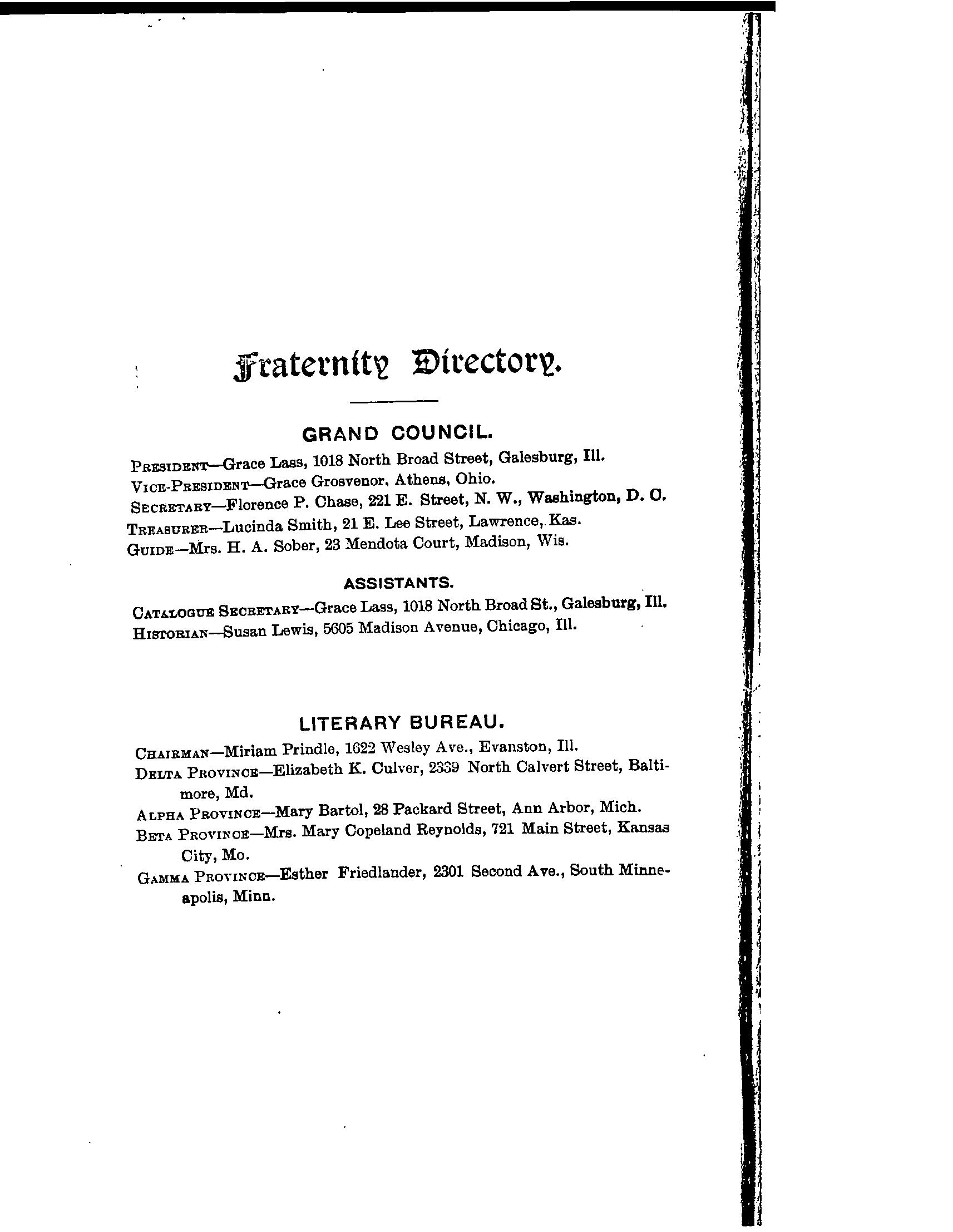
PRESIDENT-Grace Lass, 1018 North Broad Street, Galesburg, Ill.
VICE-PRESIDEN'i'-Grace Grosvenor, Athens, Ohio.
SECRETARy-Florence P. Chase, 221 E. Street, N. W., Washington, D. O.
TREASURER-Lucinda Smith, 21 E. Lee Street, Lawrence,.Kas.
GUIDE-MrS. H. A. Sober, 23 Mendota Court, Madison, Wis.
ASSISTANTS.
CAT,u,oGUE SEcRETARy-Grace Lass, 1018 North Broad St., Galesburg, Ill.
HISTORIAN-Susan Lewis, 5605 Madison Avenue, Chicago, Ill.
CHAIRMAN-Miriam Prindle, Wesley Ave., Evanston, Ill.
DELTA PROVINCE-Elizabeth K. Culver, 2339 North Calvert Street, Baltimore, Md.
ALPHA PROVINCE-Mary Bartol, 28 Packard Street, Ann Arbor, Mich.
BETA PROVINCE-Mre. Mary Copeland Reynolds, 721 Main Street, Kansas City, Mo.
GAMMA PROVlNCR-Esther Friedlander, 2301 Second Ave., South Minneapolis, Minn.
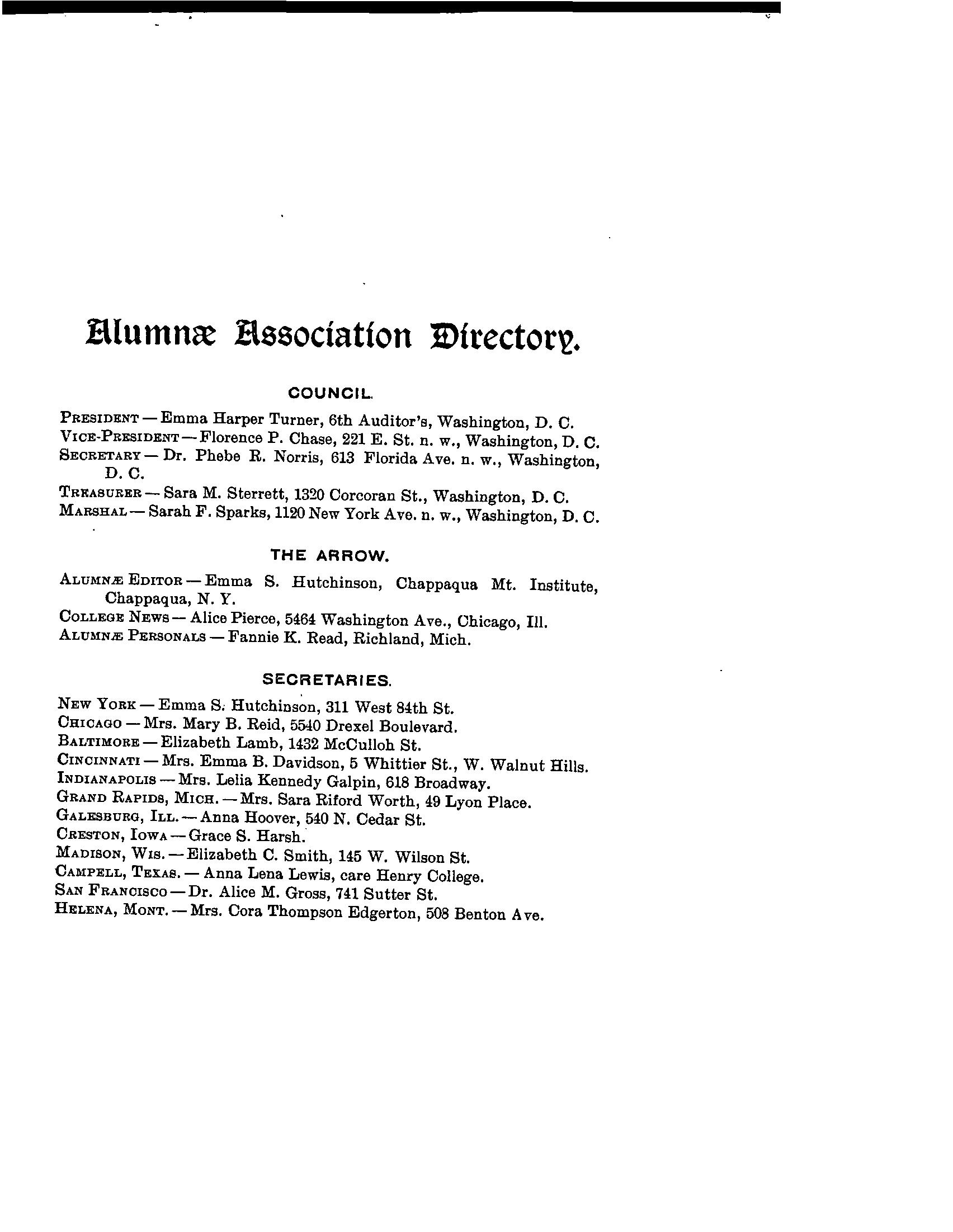
PRESIDENT-Emma Harper Turner, 6th Auditor's, Washington, D. C.
VICE·PRESIDENT-Florence P. Chase, 221 E. St. n. w., Washington, D. C.
8ECRETARY- Dr. Phebe R. Norris, 613 Florida Ave. n. w., Washington, D.C.
TREASURER- Sara M. Sterrett, 1320 Corcoran St., Washington, D. C.
MARSHAL- Sarah F. Sparks, 1120 New York Ave. n. w., Washington, D. C.
ALUMNlE EDIToR-Emma S. Hutchinson, Chappaqua Mt. Institute, Chappaqua, N. Y.
COLLEGE NEWS- Alice Pierce, 5464 Washington Ave., Chicago, Ill. ALUMNlE PERSONALS - Fannie K. Read, Richland, Mich.
NEW YORK-Emma S; Hutchinson, 311 West 84th St. CHICAGO - Mrs. Mary B. Reid, 5540 Drexel Boulevard. BALTIMORE - Elizabeth Lamb, 1432 McCulloh St.
CINCINNATI-Mrs. Emma B. Davidson, 5 Whittier St., W. Walnut Hills. INDIANAPOLIS - Mrs. Lelia Kennedy Galpin, 618 Broadway. GRAND RAPIDS, MICH. -Mrs. Sara Riford Worth, 49 Lyon Place. GALESBURG, ILL.-Anna Hoover, 540 N. Cedar St. CRESTON, IowA-Grace S. Harsh. MADISON, WIs.-Elizabeth C. Smith, 145 W. Wilson St. CAMPELL, TEXAS. - Anna Lena Lewis, care Henry College. SAN FRANOIsco-Dr. Alice M. Gross, 741 Sutter St. HELENA, MONT. - Mrs. Cora Thompson Edgerton, 508 Benton Ave.
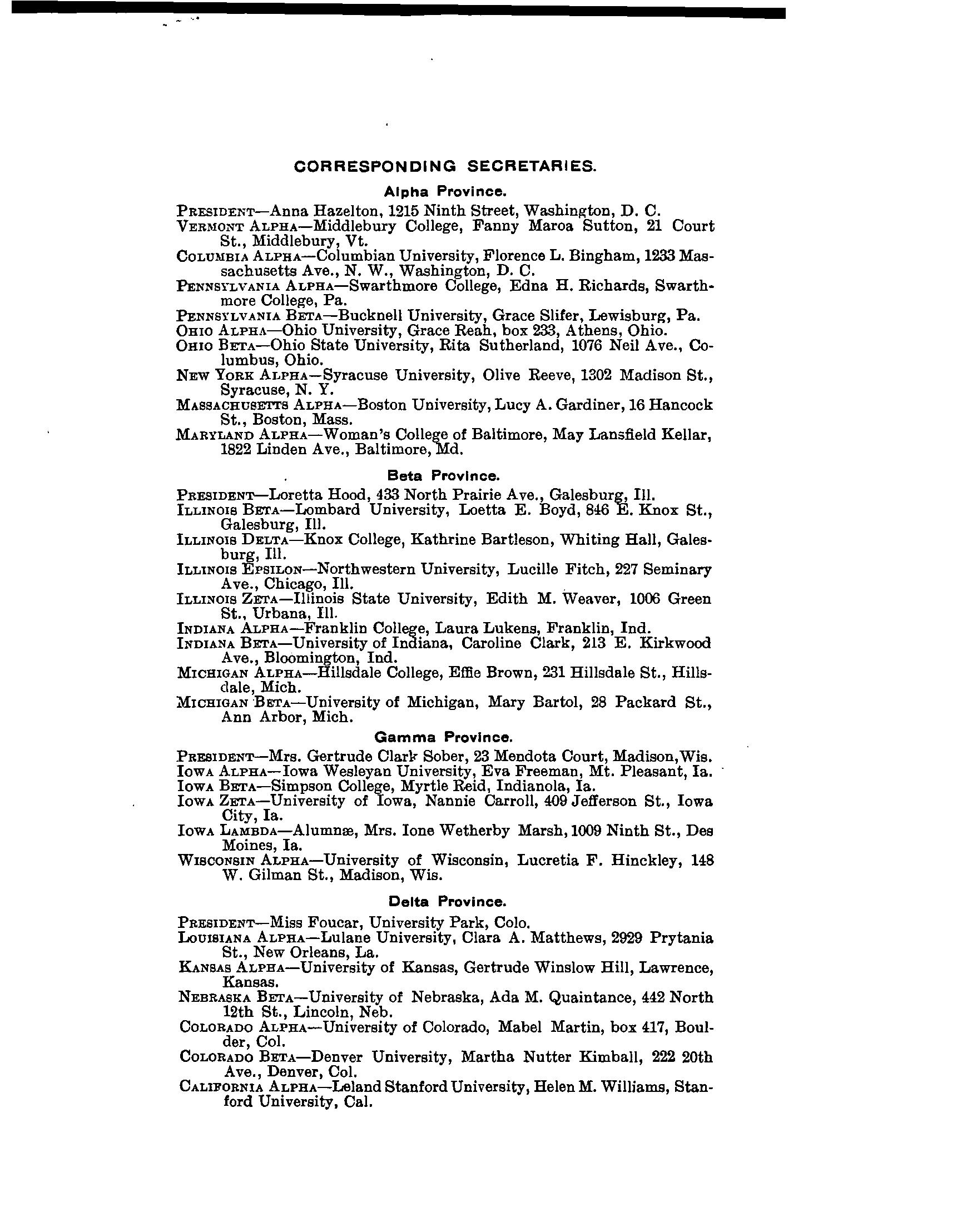
CORRESPONDING SECRETARIES.
Alpha Province.
PRESIDENT-Anna Hazelton, 1215 Ninth Street, Washington, D. C.
VERMONT ALPHA-Middlebury College, Fanny Maroa Sutton, 21 Court St., Middlebury, Vt.
COLUMBIA ALPHA-Columbian University, Florence L. Bingham, 1233 Massachusetts Ave., N. W., Washington, D. C.
PENNSYLVANIA ALPHA-Swarthmore College, Edna H. Richards, Swarthmore College, Pa.
PENNSYLVANIA BETA-Bucknell University, Grace Slifer, Lewisburg, Pa.
OHro ALPHA-Ohio University, Grace Reah, box 233, Athens, Ohio.
OHro BETA-Ohio State University, Rita Sutherland, 1076 Neil Ave., Columbus, Ohio.
NEW YORK ALPHA-Syracuse University, Olive Reeve, 1302 Madison St., Syracuse, N. Y.
MASSACHUSETTS ALPHA-Boston University, Lucy A. Gardiner, 16 Hancock St., Boston, Mass.
MARYLAND ALPHA-Woman's College of Baltimore, May Lansfield Kellar, 1822 Linden Ave., Baltimore, Md.
Beta Province.
PRESIDENT-Loretta Hood, 433 North Prairie Ave., Galesburg, III.
ILLINOIS BETA-Lombard University, Loetta E. Boyd, 846 E. Knox St., Galesburg, Ill.
ILLINOIS DELTA-Knox College, Kathrine Bartleson, Whiting Hall, Galesburg, Ill.
ILLINOIS EpSILoN-Northwestern University, Lucille Fitch, 227 Seminary Ave., Chicago, Ill.
ILLINOIS ZETA-Illinois State University, Edith M. Weaver, lO06 Green St., Urbana, III.
INDIANA ALpHA-Franklin College, Laura Lukens, Franklin, Ind.
INDIANA BETA-University of Indiana, Caroline Clark, 213 E. Kirkwood Ave., Bloomington, Ind.
MICHIGAN ALPHA-Hillsdale College, Effie Brown, 231 Hillsdale St., Hillsdale, Mich.
MICHIGAN ·BIITA-University of Michigan, Mary Bartol, 28 Packard St., Ann Arbor, Mich.
Gamma Province.
PRESIDENT-Mrs. Gertrude Clarl< Sober, 23 Mendota Court, Madison,Wis.
IOWA ALPHA-Iowa Wesleyan University, Eva Freeman, Mt. Pleasant, Ia.
IOWA BETA-Simpson College, Myrtle Reid, Indianola, Ia.
IOWA ZETA-University of Iowa, Nannie Carroll, 409 Jefferson St., Iowa City, Ia.
IOWA LAMBDA-Alumnre, Mrs. lone Wetherby Marsh, lO09 Ninth St., Des MoiDes,la.
W,SCONSIN ALPHA-University of Wisconsin, Lucretia F. Hinckley, 148 W. Gilman St., Madison, Wis.
Delta Province.
PRESIDENT-Miss Foucar, University Park, Colo.
LoUISIANA ALPHA-Lulane University, Clara A. Matthews, 2929 Prytania St., New Orleans, La.
KANSAS ALPHA-University of Kansas, Gertrude Winslow HilI, Lawrence, Kansas.
NEBRASKA BETA-University of Nebraska, Ada M. Quaintance, 442 North 12th St., Lincoln, Neb.
COLORADO ALPHA-University of Colorado, Mabel Martin, box 417, Boulder, Col.
COLORADO BETA-Denver University, Martha Nutter Kimball, 222 20th Ave., Denver, Col.
CALIFORNIA ALPHA-Leland Stanford University, Helen M. Williams, Stanford U ni versi ty. Cal.
Vol. xm. APRIL, J897. No.3.
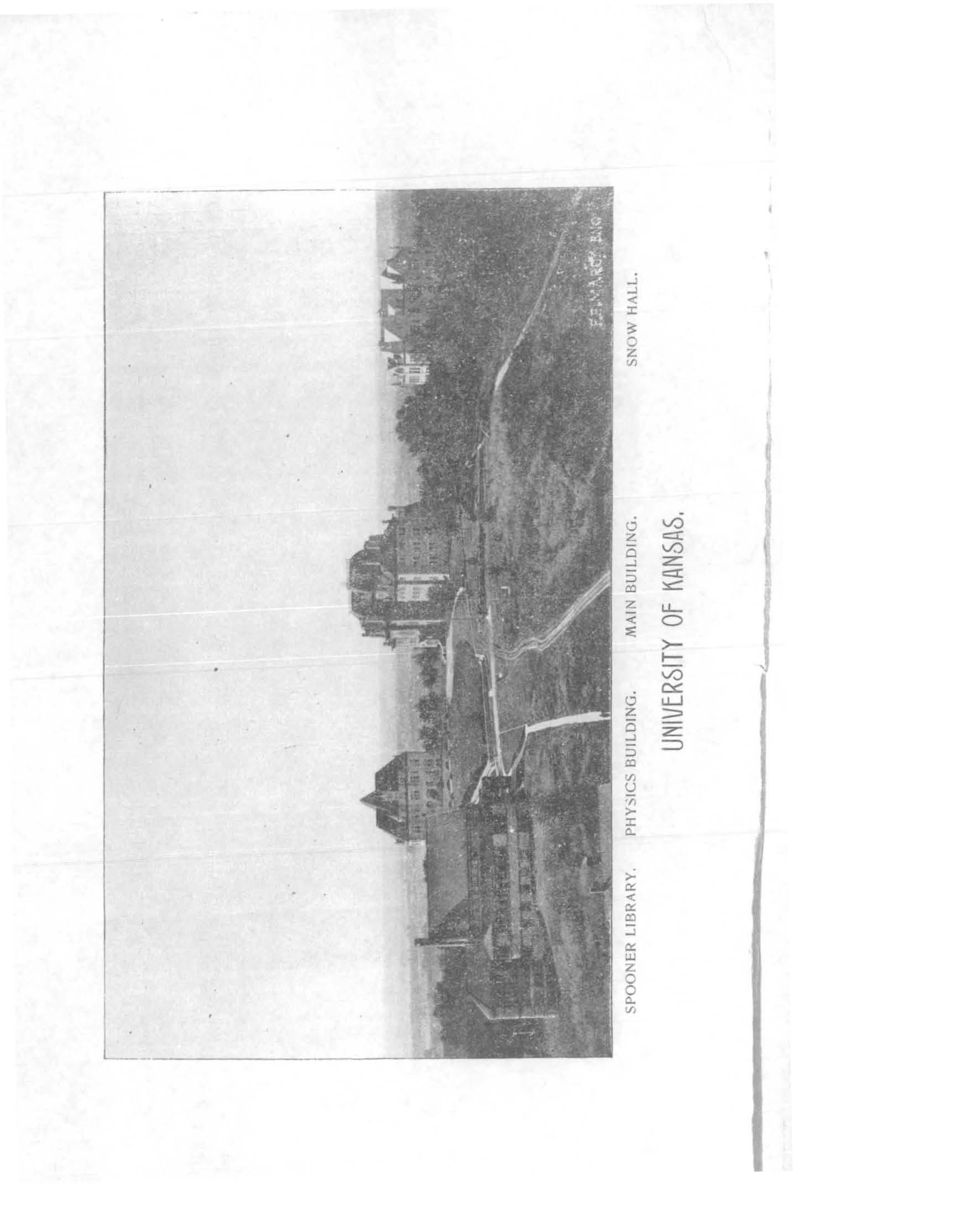
IF IN the year '97, Kansas Alpha were to welcome again the delegates from other chapters of Pi Beta Phi, how the changes would strike those few of us who would remember the convention of 1892! For the fraternity, the change would be mainly of a broadened horizon, of strength gained by our extended chapter roll, and a closer bond between our individual chapters and the national fraternity.
But to those few of us who took part in the convention of '92, perhaps the most striking of all changes 'would have taken place in our own chapter, and in the University of Kansas. Not one girl whose name was on our active chapter list in '92 could find it there ill 1897. The growth of the University during the last five years has been especially noticeable, and that not alone in the number of students and members of the faculty, but in the broader scope, and wider field of instruction; in the advanced and more scientific methods used; in the expansion of museums and library, and in the erection of new buildings.
Kansas University is peculiarly situated among State Universitiel>. As it was the first to adopt co·education as an article of creed, so it is the only University in this country, or in fact, in any country, to claim freedom from fees of any sort, with the exception of the five dollars graduation fee, and the small tuition fee asked of those students who come from other states than Kansas. With no income from fees or endowment, this University, so entirely dependent for its maintenance and growth upon
appropriations made by the state legislature, has kept on, through all these years of alternating prosperity and hard times, with a steady active growth; reaching out in new directions, ever gaining wisdom with its years, until Kan· sas University stands now among the first institutions of its kind in this country.
No finer location for a college could have been found than the crest of this Mount Oread on which the University stands, and about the foot of which the town of Law· renee has settled itself, in a very comfortable and leisurely fashion, in a way so unlike that of other western towns, that a stranger is apt to be reminded of New England, which is not wholly to be wondered at when we remember that most of the early settlers were from the New England states.
The student, hurrying from one building to another, can hardly resist the temptation to pause for a moment and let her gaze wander over the beautiful and varied country, stretching away to the almost unbroken horizon in the east and south, and to the ,north, where a line of purple hills are met farther to the west by a curving arm of Mount Ore ad hill itself, topped by an old windmill, as quaint as any in Holland. Bayard Taylor spoke in the early days of " A further hill where a great windmill slowly turned its sails ... And Mount Oread where there is a lovely view of Wakarusa Valley." It is, indeed, a lovely view; a view so overwhelming at the first sight that a new comer is apt to lose his breath entirely if he has not already lost it in his walk up the hill. Many a student has gone away forever from Mount Oread with the belief that more of his inspira· tion at college was deriv.ed from that view than from any or all of his familiar text books.
Looking down past the new Spooner library building, where one's glance must linger for a moment with a feeling of pride, past the athletic grounds, and down to where the river shows itself brokenly in blue or silver patches, or
ARROlV.
where:the more pretentious houses of the town look out from among a seeming forest of trees,-looking down on this bit of town below, and then back to the old North college, where the university spent its infant days, one is inclined to let his memory call up to him the stories of the University's early struggle. Over in that North college where the foot-ball men have their training table in these later days, the University prepared its first class for graduation,- a class of four.
The Kansas University was, in those days, hardly more than a high school. This year, just twenty-three years later than the first graduation, the senior class will number one hundred and sixty-nine from five departments or schools: The School of Arts, conferring the degree of A. B., and the Schools of Law, Pharmacy, Engineering and the Fine Arts. Beside this senior class are graduate students, working for degrees of M. A. and Ph. D., or for higher degrees in other departments. There are no honorary degrees offered by the University. In 1866 the University completed its first year with twenty-two students, and today our catalogue shows a student roll of nine hundred and sixty and a faculty of fifty-two members.
In 1873 Beta Theta Pi, the first of the six men's fraternities to be represented at K; S. U., made its appearance, and April 1st of the same year, seven golden arrows, marked. with the letters I. C., announced the advent of a sorority. For eight years there was DO woman's fraternity to rival Pi Beta Phi. Our older members seem to take delight in telling of those early, historic days. In 1881 a. charter was granted to Kappa Alpha Theta, and in 1883 to Kappa. Kappa Gamma, and by this time four more men's fraternities had been established.
Our library is said to have started with a hope. In 1873 the library contained less than a thousand volumes. Today we have still but a modest, if well selected, beginning, but we regard the collection of more than twenty-five
thousand volumes as the nucleus of our library that is to be. The library building, the gift of Mr. Wm. B. Spooner of Boston, is admirably adapted to serve its purpose, for beside a large and thoroughly appointed reading room, are smaller seminary rooms where one always finds sets of enthusiastic workers. In Library Hall, above the reading room, general receptions to the students are given by the Chancellor at the beginning of each term, and this hall is the scene of t,he Alumni banquet at commencement. and of , many other festive gaiherings. In the basement of the building is a room appropriated to the use of the girls, and cosily fitted up for their comfort by the Women's League, where a tired girl may find a comfortable divan and a quiet place t{) rest.
The Women's League has done much toward bringing the young women students into pleasant relations with each other and with the professors' wives. The six afternoon receptions given through the year, to which the girls the University are invited, are always delightful occasions, with music, or a talk from some interesting woman as a part of the afternoon's enjoyment.
Athletics started with evident reluctance in Kansas University, and it was not until 1891 that we became thoroughly aware that our foot· ball team could lay claim to the title of "invincible." Since then, what student has not shouted himself hoarse with Rock Chalk! Jay Hawk! K. U.! when we meet the eleven from Missouri on Thanksgiving Day. And what student is there who cannot recount the number of times we have won the pennant or have gained a victory over Missourl.
As we thus glance over her thirty years of life, we pick out 1873 as memorable in the history of the State University of Kansas, not only as the year of the first commencement, but because that year witnessed the birth of Kansas Alpha Chapter of Pi Beta Phi.
EDITH HUNTINGTON SNOW.
Long ago in Monmouth College, On one bright, glad April day, Met a band of seven maidens Bent on work and bent on play.
One a fair and earnest lassie With great eyes of honest blue, Spoke of dear and lasting friendships, And her words were pure and true.
"We have come together, sisters. With a purpose strong and pure Now to form a lasting friendship That forever shall endure.
For our emblem let us take A golden arrow that shall show Cupid piercing each one's heart With one sure and sudden blow.
To tie the knot of friendship Take wine and silver blue; And thus our bark will always run In channel deep and true.
From gardens fair, of flowers Choose now the sweetest there, Carnations bright and spicy Of fragrance rich and rare.
Above all things, dear sisters, Our aim shall ever be To treat each other now and aye With love and charity."
Thus was formed in Monmouth College On that day so long gone by The sorosis I. C. called Now beloved Pi Beta Phi.
Let us try then, dearest sisters, Spread o'er all of this broad land, To follow in our founders' foot-steps A truly pure and noble band.
RrrA SUTHERLAND, Ohio Beta.
DURING the three years since I became a Daughter of the American Revolution, one question has constantly been put to me, in various forms, ranging from "Why are you a daughter 1" and "Why should I join?" to the essentially fin de siecle spirit that asks, "What is there in the Society for me?" To these latter I feel inclined not to answer with a list of the social pleasures and individual delights that often arise from membership, but instead to reply impatiently in this fashion, "Absolutely nothing. my dear madam, and we shall be very glad if you will make no effort to enter the society and introduce into the largest . body of thoroughly organized women in the world, your wretched spirit of buying and selling, your mania for measuring your actions by the mercantile results. Fortunately these questions form but a small number among the many asked by those who really wish to learn of this rapidly growing society. To these serious people my answer must be very like the responsibility of man as set forth in the catechism, "my duty toward God, and my duty toward my neighbor." The very motto of the society, "For Home and Country" shows this, since to our country also can we rightly give the disinterested, continuous, and often secret devotion, that we owe our God. There is a. fashion nowadays, especially prevalent with those to whom has been given a more facile flow of words than of thoughts, to consider bombastic and mouthing braggadocio as a display of patriotism. Alas, true patriotism would close the lips and silence the voice of such a speaker. True patriotism may be represented at the feet of history, learning not alone of our own past, why and how we are the nation which we have become, but also of the past of other peoples, ready to learn from their errors and profit by their experience. A child is called very foolish when he-
THE ARR01V.
141 refuses to learn from others, must try for himself every experiment that strikes his fancy, and refuses to profit by the experience of father or elder brother, because, forsooth, he is taller or heavier than are they. And the childhood of nations is very like that of people. Because we were right in 1775, are we to become infallible?
Were the men in public life today as thoughtful, prudent and judicious as were the owners of the names that glitter in the galaxy of Revolutionary days, the women of this country would be justified in devoting themselves to the modern prototypes of spinning and weaving. But since the boy who is the father of the man is largely influenced by mother and sisters and sometimes even by maiden aunts, is it not the duty of the mothers, sisters and maiden aunts to keep alive the memory of the men to whom we owe our statehood to make plain the simple and lofty aims that actuated them and in every way to make them living forces, actual realizations, not a legend and a dream. There are far too many people to who:n Washington is as dead as Moses, and who have read much more of the writings of Julius Caesar than of Benjamin Franklin. Fortunately the Grand Army of the Republic has done much to keep alive the symbols and signs of outward patriotism in placing the flag and a few historic portraits before the eyes of all the school children in the land and seeing to it that these little people do not continue in the scandalous ignorance of national songs and anthems to be found among their elders. I am, alas, quite within bounds when I make the assertion that, outside the ranks of the Daughters, not one woman in a hundred, who has passed the age of twenty-five can repeat the words of the Star Spangled Banner, or Columbia the Gem of the Ocean, or even sing all the stanzas of America. I firmly believe that this shameful ignorance is true of no civilized land save our own.
If we owe to our country of the present day a lively
interest in its early years, still more do we owe to the children of the present day a knowledge of their ancestors who were part and parcel of those early days. Science has unfolded before us the doubts, the possibilities and the terrors of heredity with its variant of atavism. What an inheritance we should have from those far off days, of patience, endurance, of suffering of mind and body. Those times when father and son driven by the pitiless scourge of conscience, .not only espoused different beliefs, but were forced to denounce each other as dangerous to the welfare of the state, when mothers sent their only sons to certain privation and possible death with much the same feeling as did the mothers in Sparta. The almost limitless possibilities of our beloved land were all unknown to those brave men who led a forlorn hope and might have said with that eariier heroic spirit "Here I stand, I cannot do otherwise". Can the men of the present day do better than prove their inheritance of this unselfish tenacity of conscience in defiance of private profit?
But the duties of the men and women of today do not stop with our neighbors of the present. We owe a sacred debt to such of our ancestors as may have acted nobly and bravely in those far away times, to keep their memories green and to make as true as possible the lines so often engraven above their graves,
" The sweet remembrance of the just, Shall blossom when they are but dust."
An intelligent and understanding knowledge of their deeds, homely as well as conspicuous, is the only tribute we of today can bring to those to whom we owe country, laws and most intimate of all, our very lives and our individ uali ties.
The SOciety of the Daughters of the American Revolution has in view all these points to which I have called attention. One effect 01 this society and of the kindred, though far smaller societies of Sons and Dames can be
plainly seen in the largely increasing number of books, ranging from the historical storiette and the more serious historical novel to the monographs and volumes of the thoughtful historical student. In New York city, the local chapter of Daughters has founded a Chair of American History, and many generations of eager students will bless their patriotic generosity. Other chapters have marked historic spots wit,h perIl1anent memorials after such careful study as proves the authenticity of the sites beyond a. question. Other chapters in towns with but little, if any, history of t.hose stirring days connected with their territories, have turned their attention to the public library of the place and secured for it a full collection of books, valuable for local as well as national history.
But I have not touched upon the even pleasanter side of the Society life, the delightful intercourse between the members of one chapter and between different cha.pters. Where other literary clubs do not abound, the local chapter of Daught(jrs studies with grea.t zeal and does not follow the lead of the school histories in marking the story of the country by battles only. One interesting and pleasing fact brought into unexpected prominence by the routine work of the Society is the very large proportion of our cultivated citizens who can boast many lines of ancestry with two hundred years residence on this continent, many of of them with no single stra.in of more recent immigration. In short, the Daughters of the American Revolution are remarkably pure Americans, and cannot be surpassed in that regard by any other body, unless we except the abo riginal Americans, now principally resident in the Indian Territory.
After thus outlining the reasons for joining the Daughters, may I ask for space enough to give a "thumbnail" history of the Society. Organized October 11, 1890, in Washington, where are situated the present headquarters, the society now numbers over sixteen thousand members,
largely organized into chapters from the Atlantic to the Pacific, and from the Gulf to the Great Lakes. Any woman of more than eighteen years of age, personally acceptable to the Society, and who is lineally descended from a man or woman who with unfailing loyalty rendered material aid to the cause of Independence; from a recognized patriot, a soldier or sailor, or civil officer in one of the several colonies or states, or of the United Colonies or States".
Article II of the constitution gives the objects of the Society as follows:
(1) To perpetuate the memory and the spirit of the men and women who achieved American Independence by the acquisition and protection of historical spots and the erection of monuments; by the encouragement of historical research in relation to the Revolution and the publication of its results; by the preservation of documents and relics, and of the records of the individual. services of Revolutionary soldiers and patriots, and by the promotion of celebrations of all patriotic anniversaries.
(2) To carry out the. injunction of Washington in his farewell address to the - American people, "To promote, as an object of primary importance, institutions for the general diffusion of knowledge," thus developing an enlightened public opinion, and affording to young and old such advantages ·as shall develop in them the largest capacity for performing the duties of American citizens.
(3) To cherish, maintain, and extend the institutions of American freedom, to foster true patriotism and love of country, and to aid in secnring for mankind all the blessings of liberty.
ETHEL B. ALLEN, A. A.
[Received too late for insertion in January Arrow.]
IT IS with sorrow that we record the death of our beloved sister, Jeanette Bennett Dunham; a sorrow which is deeply felt not only by Colorado Alpha, but by all the chapters that had learned to know this loyal, enthusiastic Pi Beta Phi.
Jeanette Bennett Dunham was born at Lima, New York. From early youth she gave evidence of intellectual preco-
THE ARROW. 145 ciousness. At the age of seventeen she graduated with honors from the Genesee Wesleyan Seminary. Later she spent a year at Madame Reed's school, New York.
In 1891 she came to Boulder, Colorado, as a guest of Dr. Hale, then president of the University. Being benefited by the climate she remained to take a course of study in college. Here she met Maurice E. Dunham, Professor of Greek in the University, and in the summer of 18\)2 they were married. After her marriage she took up the study of law, and was the first woman to graduate in the Department of Law of the University of Colorado.
Soon after entering the University she became a member of Colorado Alpha of Pi Beta Phi. She held the office of president of the chapter at several different times, and in 1894 was elected province president of Delta Province, which office she held at the time of her death.
In Jeanette Bennett Dunham were found all of those traits of character which go to make up true womanhood. She loved that which was true and despised deceit; she was one in whom confidence and truth might· always be reposed. Always happy and bright. she shed sunshine about her wherever she went.
Her heart leaned especially toward those who were strangers and far away from home, and many a one testifies to hospitality cordially extended in her happy home. Besides contributing largely to social affairs she was a.lwa.ys actively engaged in literary pursuits.
"Now that thou hast gone away, What is left of one to say Who was open as the day?
Save with kindly voices none Speak thy name beneath the sun.
Safe thou art on every side, Frienilship nothing finds to hide Love's demand is satisfied.
COLORADO ALPHA.
WHATcollege girl has not dreamed of going abroad some time in the dim future to pursue a favorite study in one of the famous universities,hallowed by associations with so many great and noble men? We who have been so fortunate as to have our dreams realized wish to assure you that we are not disappointed. We have gained so much that we desire to encourage you to follow our example, promising you that even the dire possibilities of a stormy sea voyage are nothing compared to the great amount of pleasure and profit that is your certain reward.
But your purpose in going to Oxford or Cambridge should not be to become wise merely in book learning, for that result can be attained as well in our own country, while with only this object in view the particular advantage of the English universities will be largely overlooked. In coming abroad one should be on the alert to learn from everything. And much knowledge and breadth of mind will surely be gained.
Let it not be supposed, however, that Oxford does not afford excellent opportunities to women for a high grade of work. Women are not granted a degree; but through the aid of the" Association for the Education of Women" they have the same opportunities for study as the men. Connected with the association are four halls for women, whe the students and also some of the women tutors live. The women may attend almost all of 'the university lectures held for the men in the various colleges, and they have besides the advantages of classes in various branches, arranged especially for them by the Association. Each girl is assigned a tutor, as are the men, who advises and helps her as much as possible, and generally coaches her privately. The women may take all the examinations of the men and receive a certificate showing that they have passed. If j I I
you study for the examinations, .. or go in for the school". it is of course necessary to take a particular prescribed line of work, but if a degree is not the object any course of study may be chosen. It is this latter method which it is most advantageous for an American college graduate to pursue.
As it is necessary for the most efficient working of the mind that it should be refreshed by some kind of diversion, there is no lack of means for amusement in Oxford. The tIme between lunch and tea, which is generally between four and five o'clock, is always reserved for recreation of some kind, whether it be rowing on the river, tennis, bi• cycling. or hockey, afavorite game here. All these sports are entered into with great zeal throughout the winter. Rain is no hindrance at all in playing hockey, unless the mud becomes so deep that it is impossible to run. Many beautiful walks may be taken in the country round about Oxford. and it is pleasant to walk in the town itself. The new part is very attractive with its many trees and pretty homes, and the university parks have most charming walks along the banks of the Thames and the Cherwell.
Amusements such as these may be enjoyed in our own country, but Oxford offers many pleasures and advantages that cannot be attained at home. Even the university boat races, the debates of the Union, the performances of the dramatic society. have been carried on for so many years, have been participated in by so many well-known men, that they themsel ves have become historical.
One of the greatest advantages derived in coming to Oxford is that of becoming acquainted with English people and their customs. Though they do speak the same language as we, they differ from us in many respects, both in their private life and in their puhlic institutions. These differences cannot be fully appreciated until they are seen and experienced; and when we do understand English methods, we have a broader standard by which to measure ARROW 2.
our own. After living in England we can enter into the Englishman's view of our country and understand his opinions of us.
Although English people are, as a rule, somewhat more reserved and harder to get acquainted with than are our countrymen, yet in Oxford they are very kind and hospitable. The town is so full of people connected with the university that the society is very cultured and even learned. At afternoon teas one meets many pleasant people who are all intellectual, and some well·known men who are authorities in their especial lines of research. There is inspiration in association with such people.
Among the more strictly educational advantages of Oxford may be mentioned the use of the Bodleian library. This is one of the finest and largest libraries in the world, containing, besides almost all the books in the English language, many valuable manuscripts_ On account of the large number of people in Oxford who are thirsting for knowledge, there are many good lectures delivered that are not a part of the regular university work. Last term, for instance, among many others was a free course of six lectures on the life of Cromwell by the well-known writer and authority in English history, Prof. S. R. Gardiner.
In Oxford we learn to appreciate and reverence what is old. There is not hing old inour country and it is a striking contrast on arriving in Oxford to be surrounded on all sides by relics of the past. When we saw for the first time some of the colleges and old buildings, our principal thought was" How very black and gloomy these buildings are!" We now overlook the more recent buildings and gaze fondly on the old weather-beaten ones, which already seem beautiful to us. Besides the glow that is given them from age and association, we have discovered a real beauty in the walls that are crumbling and stained with such rich tints.
It requires a long time to see Oxford thoroughly and to
149 appreciate it fully, for each of the twenty-one colleges is interesting for its beauty and its architecture, its individual history, and its list of eminent men who have lived within its walls. Besides the chapels and .. quads," the libraries and dining halls of all of the colleges, many of them have special attractions. New College, for instance, has a part of the old city wall in its garden and the famous Sir Joshua Reynolds' window in its chapel; Christ Church has, besides many other interesting things, a fine large kitchen fitted up in ancient style, with a gridiron that belonged to Wolsey; Exeter has a famous tapestry; Trinity has a beautiful walk of lime trees. In visiting these colleges the stately old walls about us place us involuntarily three or four centuries back in the past, and we see the monks as they walk up and down the cloisters engaged in learned converse, or we think of the famous men, Shelley or Wesley or Addison, who have trod these halls so .often. Oxford is rich, too, in historical associa_ tions, for here it was that the Bishops Ridley and Latimer and Archbishop Cramner were burned at the stake for their faith; here it was that Charles I was besieged by the Roundheads under Cromwell, and it was here that several early English sovereigns were born and passed much of their time. When we knoW" Oxford, these events in history, these great and learned men, poets, scholars. archbishops, live again for us as they never could without the inspiration of these venerable gray walls.
M. S. McD., P A. ALPHA A. A.
It has always seemed to me that the Fraternity. like beauty" is its own excuse for being," and that it is quite unnecessary for it to lay claim to any special mission in the world, beyond that which all fraternities profess, the promoting of wise, helpful and permanent friendships among
college women. If the fraternity fulfills this end it ha.s a sufficient object and a sufficient recompense, and need apologize to no one for its existence. The idea, advanced from time to time, that the general fraternity or chapter take up some special line of activity, educational, philanthropiC or sociological, seems to those who view the subject most wisely, I think, both superfluous and unsuitable. The college girl has work enough, lines enough already provided along which her activities may and ought to spend themselves, and such alien interests should be left till college days are over.
To the undergraduate, the further mission of the fraternity is to create an atmosphere, to furnish a substitute, imperfect though it be, for the home life and home sympathy which she has left behind, and to provide the background, as it were, which she would have in her father's house, and which insures for her a certain and instant recognition. To the young girl cast, a lonely entity, into the chaos of college life, this background, this recognition, is of a real practical value, aside from all considerations of sentiment. Even in the alumnae chapters and clubs, I doubt whether it is advisable to take up a definite line of outside work. Alumnae, as a rule, are busy people, some impressions to the contrary notwithstanding, and on the none too frequent occasions when they can come together they want to enjoy each other, to talk over the dear old college and chapter. to discuss what each is doing rather than to do anything more.
In deference, however, to those who feel the need of something definite to do, one may suggest that there are many practical lessons which come to the fraternity girl by the way, which ought by no means to be shirked. The fraternity is not a training school per se, ,any more than matrimony is, but some valuable disciplinary results may be gained from both. Leaving out the effect on character of the constant rubbing against other lives, of mutual
THE ARROW.
151
bearing and forbearing, of help given and received, of generous encouragement and kindly censure - there are a good many tangible practical lessons which the ordinary course of fraternity life brings us, and which are by no . means to be despised because they do not take the form of a definite "object."
For instance just the other day the following weary plaint was brought to my notice:
"Why do women make such a bustling in their assemblages?" said a club woman to me not long ago. "The other day," she continued, "it became necessary for me to be late at the meeting of my club; and slipping in as quietly as possible, I took a back seat. It is a large club, and at this session there was a good attendance. No sooner was I seated than I began to realize the murmur of unrest. Some one opened a window and some one' else closed it. That was not so bad. for such a movement might be required in any assemblage, but two-thirds of the women turned a little to see how both :things were accomplished, which made a little creaking of chairs and a little swishing of silk-lined skirts; then over in a corner, some one, not quite ,comfortably settled, moved her chair, which grated a little on the floor, As it became a little warm in the room there was considerable fluttering of fans. half of which probably flapped a little. A woman just in front of me, of informing temperament, gave her neighbor a second edition of the proceedings from the platform in a whisper that was meant to be subdued, but was really penetrating, moving her head at every transference to get a little nearer to the recipient, and thereby obstructing my view and hindering the voice of the speaker. And so on to the end of the chapter; till really before the session was ended, undoubtedlya little too nervous myself, I got into such a fidget that it seemed as if noise and general unrest only had possessed the meeting. Men in the same class of intelligence do not fuss in this way, and pray tell me why women should? One sees it to some extent in church, and in fact in all assemblages where women are."
Now I am afraid there is more than a grain of truth in that accusation. We may as well own up that it is ours which has earned the title of the fidgety sex. And since I
the fraternity girl of today is the club woman of tomorrow, it occurs to me that the chapter meeting would .be a good place to cultivate that repose of manner which was the greatest charm of that sweetly impossible gentlewoman of the old school as it is the greatest lack of her busier, brighter sister of today.
That is one of the little lessons that the fraternity girl may learn .. by the way."' Others could be mentioned, plenty of them,-but in all probability each chapter can supply them from its own experience or some other girl can make suggestions. I have had my turn, for this is not a sermon but simply the disjointed meditations of one fraternity girl.
WISCONSIN ALPHA.
tHE gong sounds! A hurry and scurry of feet! Cries from the distant dressing rooms, 0, dear, I can't open my locker!" "Where is my other shoe?" .. These aren't my bloomers!" and after much trouble and confusion blouse, shoe, bloomer and girl have managed to become one, and at last at the command" Fall in!" the line is ready for work. Here we find the muscular, the awkward, the timid, the weak, alike ready and anxious for the exercises of the gymnasium hour.
There is a place of refuge where the petty trials of the day are forgotten, where mental vigor through the train· ing of the body is restored to its normal condition, ready a.gain to take up its work with renewed energy and de· termination. It is a constant source of delight. Its running track, horse, parallel bars, clubs, and last but not least, the basket ball, allures the timid one to the trial of her strength, makes the weak ambitious, and urges the already active girl to a further development of her muscular powers.
Here we learn how to walk and breathe properly, how to utilize the physical force already present to the best advantages and to understand the meaning of physical training in its broadest sense.
Let us look at the members of the class as they stand in rank. The heads are forward, the chests inclined to be fiat, the shoulders doubled, the a.bdomen prominent. Fine, full chests and an easy, graceful carriage are rare.
We do not look for results at once, but with patience and the regular proper exercise given for these preval!'lnt deficiencies the stubborn shoulder takes its correct position, the hips are thrown back, the chest raised forward, the head held erect, until all feel within them possibilities of which they have never dreamed.
Perfect character consists of the symetrical development of the triune powers of man, the mental, the moral, and the physical. Do we realize how closely these powers are intertwined, how the whole structure of man is in combination of this trinity? Can we think clearly with unprejudiced mind if our bodies are weak? Are not our minds then necessarily crippled?
.. The erroneous belief obtains with many that the mind only need be cultivated and all other culture will follow; but the thought originates in the brain, the brain acts upon the nerves, the nerves upon the muscles, the muscles upon the bones, and only after all these processes is physical action possible. What avails the most intellectual let· ter if there is no mossenger to convey it to the desired place? This is the office of physical gymnastics."
This physical training is too often neglected and we expect to ripen into fine substantial fruit without God's rain and sunshine. We must train the body in harmony with the mind, the soul.
It is the home of the spirit. Let us make it a beautiful one. Let us treab it as the most delicate machinery God has ever made. Let us give it a thorough cleaning daily,
THE ARROW.
oil it carefully, keep the dust from it, gauge the steam at the proper temperature; let its beat be not sluggish, neither fast nor pulsating, but let the entire human organism speak fully of strength and beauty,. of a power and loveli· ness beneath.
"Form as well as face should reveal the cultivated soul; attitude, more than speech, expresses the man of culture; bearing, not dress, betrays the character of woman. "
Let every woman be as nearly as possible, a living em· bodiment of all that is beautiful and thank God that he has made her "a perfect woman, nobly planned."
JANE COLEMAN EVANS, A. A., Physical Culture Instructor, Superior Normal School.
The college fraternity is unique among social organiza· tions. In order to be a vital body and of practical value
The College to the individual and to the institution it must Fraternity. have a definite end in view, and a distinct policy. The legitimate ends of the college fraternity are training, friendship, and the pleasure in after life of knowing, intimately, some of the leaders in the world's work. Fraternities seldom make choice of the first and lose sight of the third in making up their membership. It is only when these three elements are made objects of pursuit in a thoroughly organized fraternity that it can become strong, conservative and helpful.
A fraternity is not a family, a church, or a club, and yet some of the ruling ideas of each must be woven into its structure. Just after he has left home, the fraternity appeals strongly to the student. It furnishes his college home life. The loyalty and obedience of home must be found in the fraternity. These two cardinal virtues of the family circle must be the foundations of the college order.
ARROW.
Without them the fraternity will degenerate into a social club or an association for merely literary or political ends. It is true that the spiritual element of the church has no place, 1Jer se, in the formation of the society scheme, but it is also true that a code of fraternity ethics is absolutely necessary to the position of the chapter in the university or college, and the well being of its members. A student must be, morally, safer within the circle which gives the grip, than in the open field of college life. These two points being well established, the social, the club life, of the fraternity gives a great opportunity for individual development. It is here that the student obtains her first view of that all round competition which is to be met in after life, a competition, too, which is well guided by the .sentiment of a body of students to which she is devoted.
The government and discipline of the fraternity are commonly more loosely considered than any other phases of its life. As of the structure, so of the government, we can say what it is not,. It is not a republic, a limited mon.archy, or a despotism, and yet it is all three. Perhaps the old Teutonic clan approaches most nearly to the ideas which should rule in the body politic. Personal freedom united to unswerving loyalty and obedience to the clan and its elected chief. This is the ideal government of a strong college fraternity. The authority of the seniors should be unquestioned, and the training of each class ·delegation should be thorough, and have a character clearly its own. Thus the student so develops in social strength and helpfulness that the senior year finds her ready to assume the responsibilitIes, the proper meeting of which will determine the position of her fraternity in the college community.
COLORADO ALPHA.
It is a fact beyond dispute that a girl by affiliating herself with a fraternity receives many and lasting benefits.
To It is equally true that the initiate is under certain InItiate.. obligations to the fraternity which she joins.
A fraternity girl stands in a three-fold relation to the college life about her, first, toward the non-fraternity students from whom she has just departed, secondly, to her Greek sisters, and third towa.rds the rival fraternities.
Nearly all non-members are to a greater or less extent hostile toward the fraternities; they are always rea,dy with arguments against them, watching the conduct of the newly initiated for facts to strengthen their arguments.
Nor are the non-members always at fault. It is due to the thoughtlessness of the neophyte that these prejudices arise. In her joy over her recently found friends, her fraternity sisters, she is apt to slight her former companions.
Some initiates think they can best show their loyalty to their new friends by disregarding their old ones. This is often carried to such an extent that they will walk to and from college, or sit in chapel only with one of their Greek sisters.
Then, her scholarship is an important factor for or against her raternity. If she does poor work after joining, this fact is seized upon by fraternity enemies in favor of their arguments. The head of the initiate is apt to be turned at first by the attentions which she receives on joining a fraternity, and she will allow her lessons to take a secondary place, instead of the primary one, which they should hold, and non· members will falsely maintain that fraternity life is detrimental to studies.
Then, too, a girl will try to show her loyalty, not only by disregarding the non-members, but by detecting errors in those belonging to other fraternities, prejudicing herself against them, so that fraternity life is said to foster an unchristian spirit.
So you see, initia.tes, the responsibility which rests upon ; ,.
you, the:obligations under which you stand to your fraternity. Say initiates, for I think it is the newly-fledged Greeks who need this advice most, after a girl has been a member for some time, these things right themselves. She will see that in acting kindly to all, Greek or non-Greek, treating them as sisters whether bound by fraternity vows or not, in excelling in scholarship, in careful actions at all times, in acknowledging the good qualities of her rivals and trying to emulate them, she is not only benefiting herself, but is obeying the principles of her fraternity, and is helping to do away with the prejudices existing against fraternities today. .
CLARA G. HOOKWAY, New York Alpha.
As regards the meetings of Pi Beta Phi, and the conduct of its members therein which element of their characters W II should predominate, the woman or the girl? oman ness VII.
OIrllsbnes.. Is the college girl to throw aside all cares and vexations. free herself from all restraint, and enter the meetings with a careless, girlish air; or is she to pull herself, her older self, together, leave the girl behind and come into the rooms surrounded by an atmosphere of the woman? These are the few points about which I wish to write and these are the very points upon which rest the entire success or the disgusting failure of the girls' fraternity meeting. If you have never heard the management sneered at, then probably you have come in contact only with those who knew .you were a member, and so refrained from giving their unbiased opinion in the matter. But it is true, nevertheless, that the meetings of college girls and their methods of procedure have too often been the subject of joke and ridicule. There is cause for it, and, to destroy the cause, should be our object.
There is" A time to weep and a time to laugh; a time to mourn and a time to dance." There may be a half hour after each meeting for social enjoyment. when jokes may be cracked, when lessons may be spoken of and when each member may be free to speak to others, but what we want is the dividing line, the high board fence between the business meetJng and the social gathering.
In order that the meeting may be methodical and well conducted, each member, and the leader in particular, should have a good working knowledge of parliamentary law. The latter should conduct the entire business meeting with strict adherence to these rules and principles. allowing no break, no conversational intercourse to mar the harmony and continuity of the meeting. The leader must have, or cultivate, force; she must necessarily be strict in keeping to the point in question. Then if each member. at toe same time, maintains her own dignity and displays her familiarity with the principles of a well conducted business meeting, the leader will have little occasion to give instruction or call the meeting to order.
This strict observance of general principles will be, in the highest degree, advantageous to the college graduate. So I urge you to consider these facts, not only as they may aid you now, but as they will be of. service to you in the years that are to come. If each girl acquires the habit of maintaining a certain reserve, and conforming to set rules and principles it will eventually become a part of herself. Habit is strong, and it is with difficulty that we break its tightly woven threads.
SARA V. MANN, Vermont
Alpha.
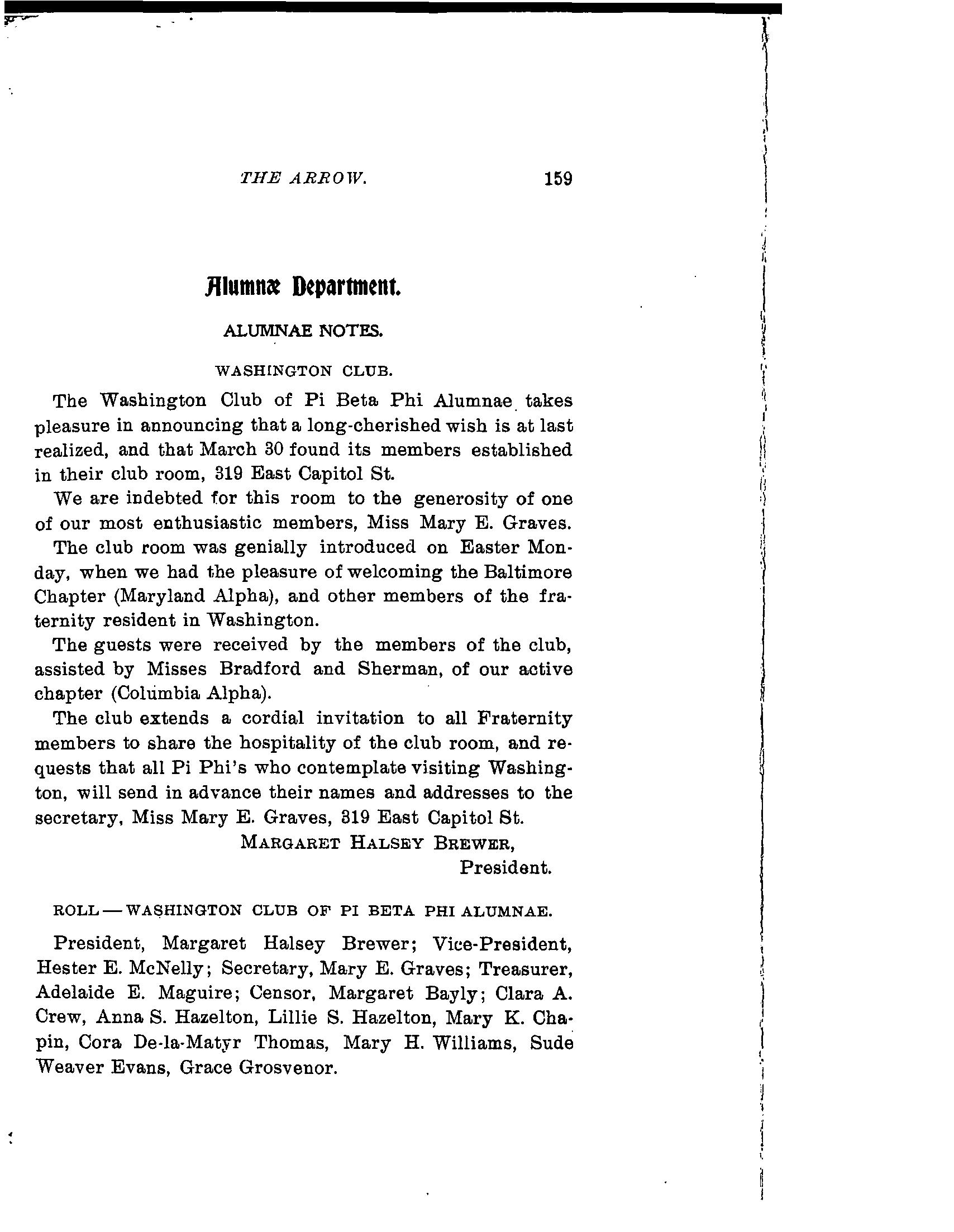
ALUMNAE NOTES.
WASHINGTON CLUB.
The Washington Club of Pi Beta Phi Alumnae. takes pleasure in announcing that a long-cherished wish is at last realized, and that March 30 found its members established in their club room, 319 East Capitol St.
We are indebted for this room to the generosity of one of our most enthusiastic members, Miss Mary E. Graves.
The club room was genially introduced on Easter Monday, when we had the pleasure of welcoming the Baltimore Chapter (Maryland Alpha), and other members of the fraternity resident in Washington.
The guests were received by the members of the club, assisted by Misses Bradford and Sherman, of our active chapter (Columbia Alpha).
The club extends a cordial invitation to all Fraternity members to share the hospitality of the club room, and reo quests that all Pi Phi's who contemplate visiting Washington, will send in advance their names and addresses to the secretary, Miss Mary E. Graves, 319 East Capitol St. MARGARET HALSEY BREWER, President.
ROLL-WASHINGTON CLUB OF PI BETA PHI ALUMNAE.
President, Margaret Halsey Brewer; Vice-President, Hester E. McNelly; Secretary, Mary E. Graves; Treasurer, Adelaide E. Maguire; Censor, Margaret Bayly; Clara A. Crew, Anna S. Hazelton, Lillie S. Hazelton, Mary K. Chapin, Cora De-la-Matyr Thomas, Mary H. Williams, Sude Weaver Evans, Grace Grosvenor.
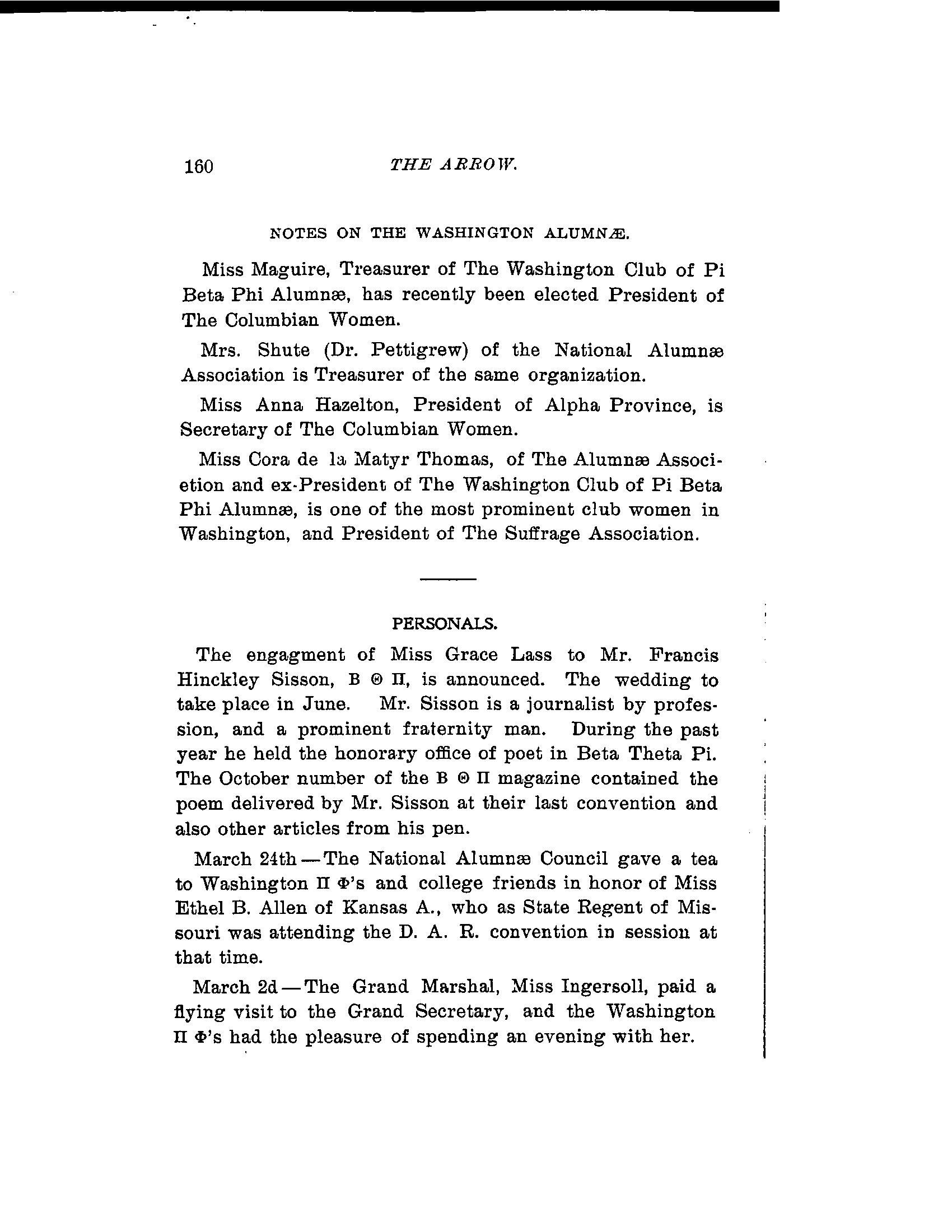
NOTES ON THE WASHINGTON ALUMNA!:.
Miss Maguire, Treasurer of The Washington Club of Pi Beta Phi Alumnre, has recently been elected President of The Columbian Women.
Mrs. Shute (Dr. Pettigrew) of the National Alumnre Association is Treasurer of the same organization.
Miss Anna Hazelton, President of Alpha Province, is Secretary of The Columbian Women.
Miss Cora de la Matyr Thomas, of The Alumnre Associetion and ex·President of The Washington Club of Pi Beta Phi Alumnre, is one of the most prominent club women in Washington, and President of The Suffrage Association.
The engagment of Miss Grace Lass to Mr. Francis Hinckley Sisson, B ® II, is announced. The wedding to take place in June. Mr. Sisson is a journalist by profession, and a prominent fraternity man. During the past year he held the honorary office of poet in Beta Theta Pi.
The October number of the B ® II magazine contained the poem delivered by Mr. Sisson at their last convention and also other articles from his pen.
March 24th-The National Alumnre Council gave a tea to Washington II <l>'s and college friends in honor of Miss Ethel B. Allen of Kansas A., who as State Regent of Missouri was attending the D. A. R. convention in session at that time.
March 2d - The Grand Marshal, Miss Ingersoll, paid a flying visit to the Grand Secretary, and the Washington II <l>'s had the pleasure of spending an evening with her.
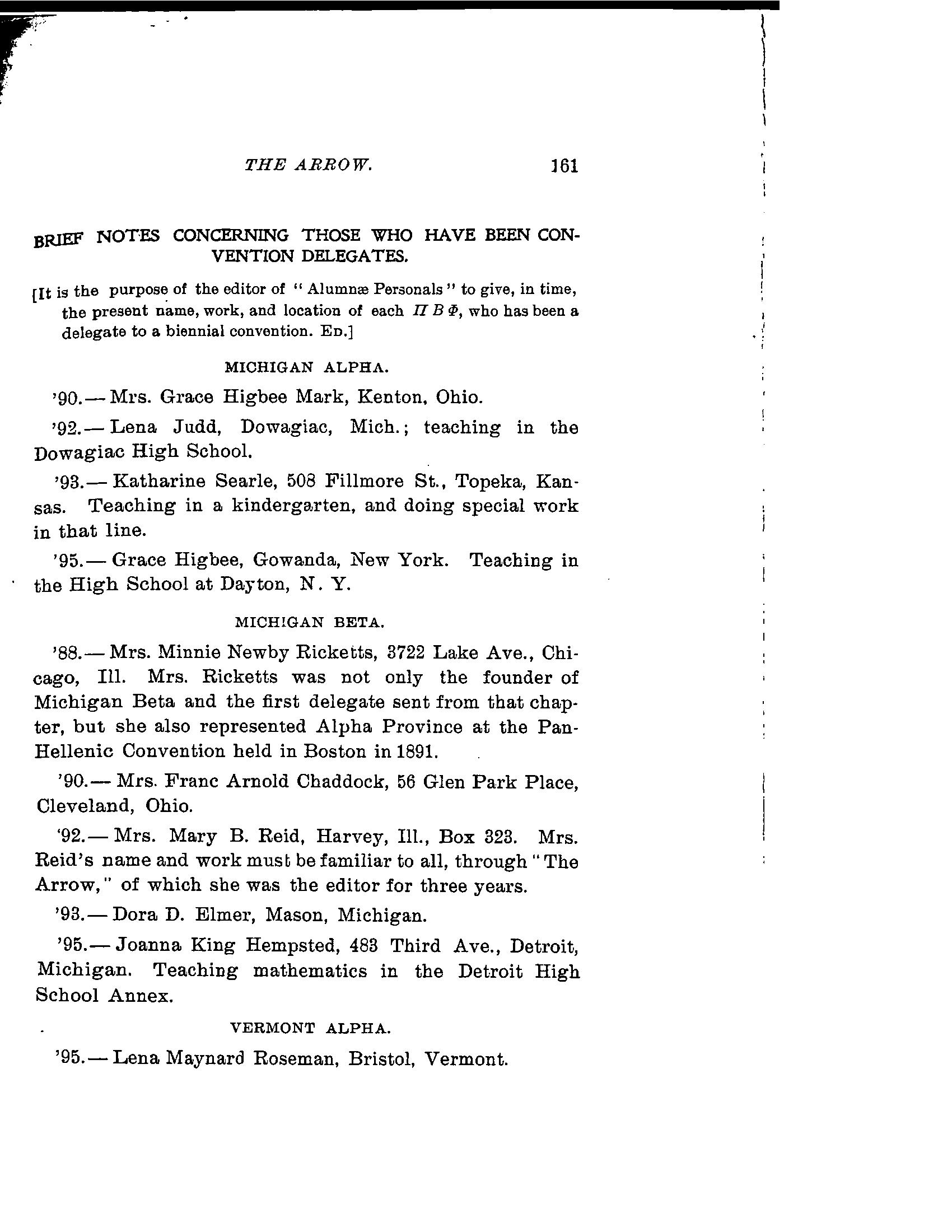
BRIEF NOTES CONCERNING THOSE WHO HAVE BEEN CONVENTION DELEGATES.
[It is the purpose of the editor of "Alumnre Personals" to give, in time, the present name, work, and location of each II B P, who has been a delegate to a biennial convention. En.]
MICHIGAN ALPHA.
'90.- Mrs. Grace Higbee Mark, Kenton, Ohio.
'92.- Lena Judd, Dowagiac, Mich.; teaching in the Dowagiac High School.
'93.- Katharine Searle, 508 Fillmore St., Topeka, Kansas. Teaching in a kinderga,rten, and doing special work in that line.
'95.- Grace Higbee, Gowanda, New York. Teaching in the High School at Dayton, N. Y.
MICHIGAN BETA.
'88.- Mrs. Minnie Newby Ricketts, 3722 Lake Ave., Chicago, Ill. Mrs. Ricketts was not only the founder of Michigan Beta and the first delegate sent from that chapter, but she also represented Alpha Province at the PanHellenic Convention held in Boston in 1891.
'90.- Mrs. Franc Arnold Chaddock, 56 Glen Park Place, Cleveland, Ohio.
'92.- Mrs. Mary B. Reid, Harvey, Ill., Box 323. Mrs. Reid's name and work must be familiar to all, through" The Arrow," of which she was the editor for three years.
'93.- Dora D. Elmer, Mason, Michigan.
'95.- Joanna King Hempsted, 483 Third Ave., Detroit, Michigan. Teaching mathematics in the Detroit High School Annex.
VERMONT ALPHA.
'95.- Lena Maynard Roseman, Bristol, Vermont.
NAME. SCHOOL.
1. Mrs. Mary Miller Barnesl,...... Kansas University ....... .
2. Mrs. Lulu Ambler Officer ... " .. Iowa Weslayan Uuiversity
3. Mrs. Lulu Penn Ingersoll........ Iown University
4. Mrs. Ida Winnie Ballentine. University of Denver
5. Dora Winnie Merritt............ University of Denver
6. Miss Gertrude H. Beggs......... University of Denver." ..
7. Miss Clara Batchelder .......... University of Donver .... .
8. Miss Louise Fornar University of Denver. '"
9. Miss Nun McFarland 2 .,.... •••• University of Denver
10. Miss Edith Ingersoll............ University of Denver .... .
11. Miss Lottie Waterbury......... University of Donver .... .
12. Mrs. Nottie Hubbard 'Bolles..... Kansas University
1::1. Miss Frances Carpenter' University of Denver
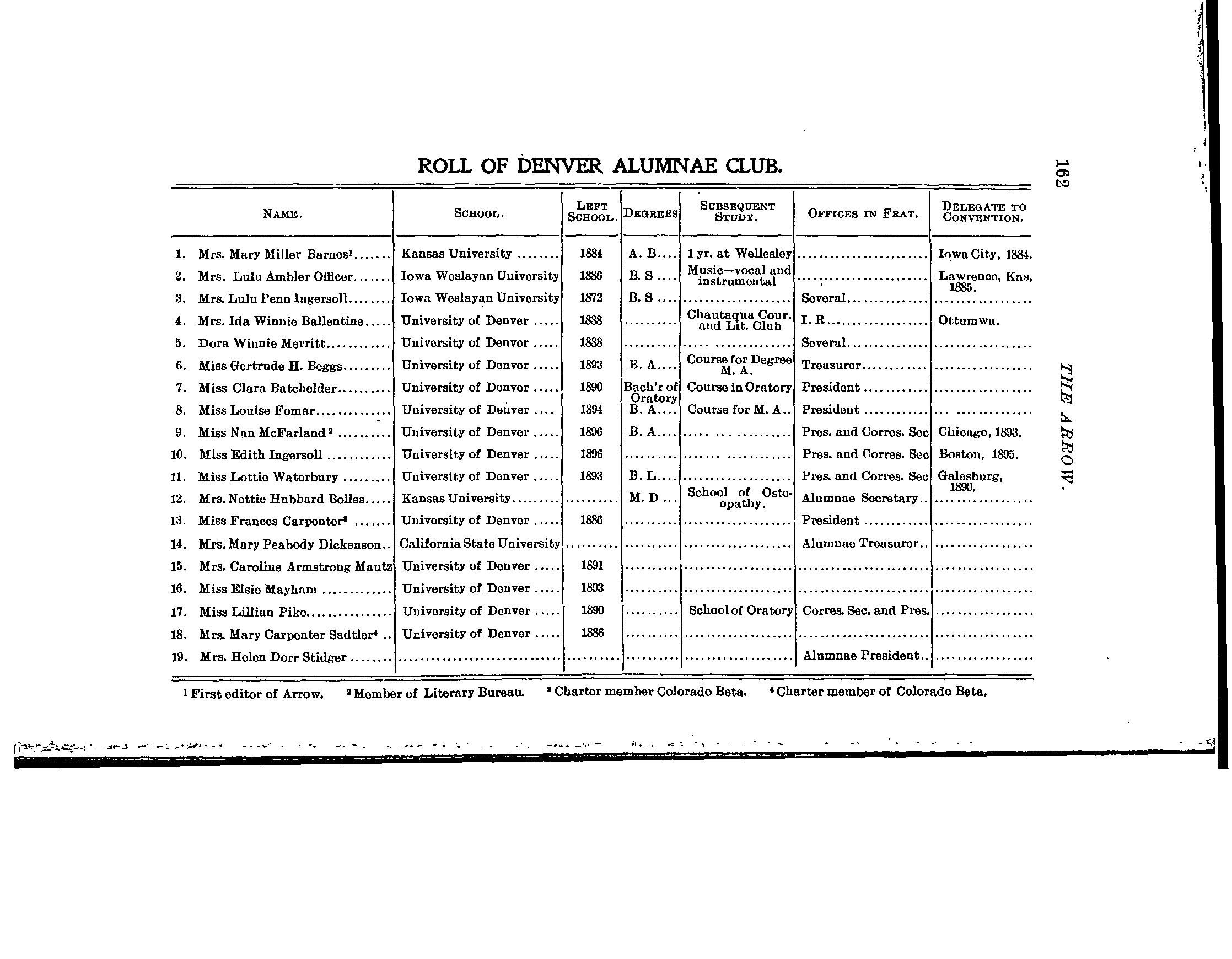
TO CONVENTION.
A. B .... ll yr. at W.llesl.yl ........................ 1 I'lwaCity. 18!!4. B. S .".! Instrumentaland I···· B.B .•...................... Several Lawrence, Kns. 1885. ChautaquaCCjoubr.! I. R 1 Ottumwa. and LIt. u Several .............. . 1 Course
Pres. and Corres. Sec! Chicago, 1893.
Pres. nnd Corres. Soc Boston. 1895.
Pres. and Corres. Sec! Galosburg, 1890. I School of 08to-1 Alumnae Secretary .. M. D .. . opathy. President
14. Mrs. Mary Peabody Dickenson I California State University Alumnae Treasurer
15. Mrs. Caroline Armstrong Mautz University of Denver .... .
16. Miss Elsie Mayhnm ............. University of Donver ... ..
17. Miss Lillian Pike ................ Univorsityof Denver .... .
18. Mrs. Mary Carpenter Sadtlerf.. Udversityof Donver .... .
19. Mrs. Helon Dorr Stidger
Alumnae President I First editor of Arrow. 1I Member of Literary Bureau.
Charter member Colorado Beta.
Charter member of Colorado Beu.
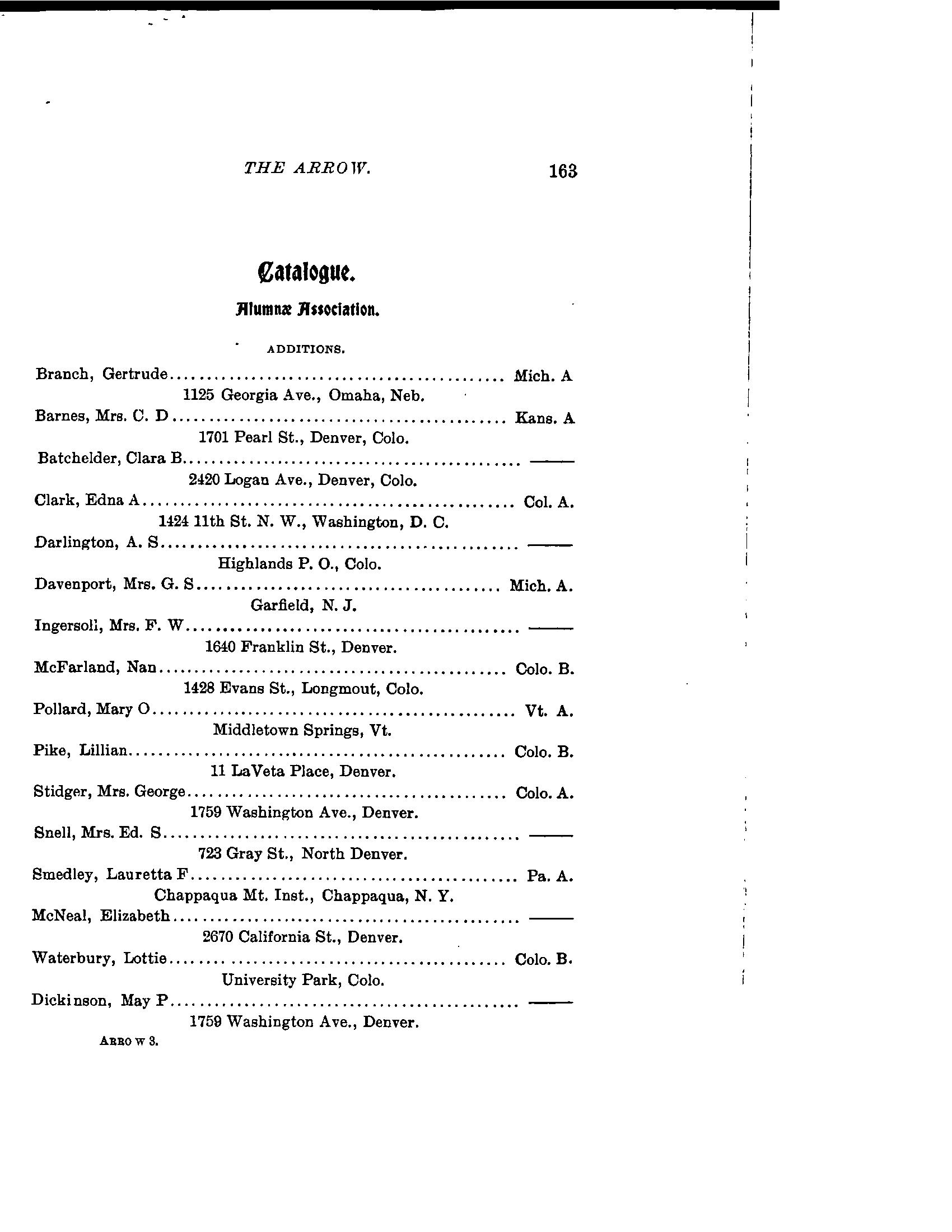
JllumllA! Jlssociatlon.
ADDITIONS.
Branch, Gertrude............................................. Mich. A 1125 Georgia Ave., Omaha, Neb.
Barnes, Mrs. C. D ............................................. Kans. A
1701 Pearl St., Denver, Colo.
Batchelder, Clara B .............................................. __
2420 Logan Ave., Denver, Colo.
Clark, Edna A Col. A.
1424 11th St. N. W., Washington, D. C.
Darlington, A. S __
Highlands P.O., Colo.
Davenport, Mrs. G. S Mich. A. Garfield, N. J.
Ingersoll, Mrs. F. W __
1640 Franklin St., Denver. McFarland, Nan
Colo. B. 1428 Evans St., Longmout, Colo.
Pollard, Mary 0 Vt. A.
Middletown Springs, Vt. Pike, Lillian Colo. B. 11 LaVeta Place, Denver.
Stidger, Mrs. George
Colo. A. 1759 Washington Ave., Denver. Snell, Mrs. Ed. S 723 Gray St., North Denver.
Smedley, Lauretta F Pa. A.
Chappaqua Mt. Inst., Chappaqua, N. Y. McNeal, Elizabeth ...............................................
2670 California St., Denver. Waterbury, Lottie ............................................. Colo. B.
University Park, Colo. Dickinson, May P 1759 Washington Ave., Denver. ARROW 3.
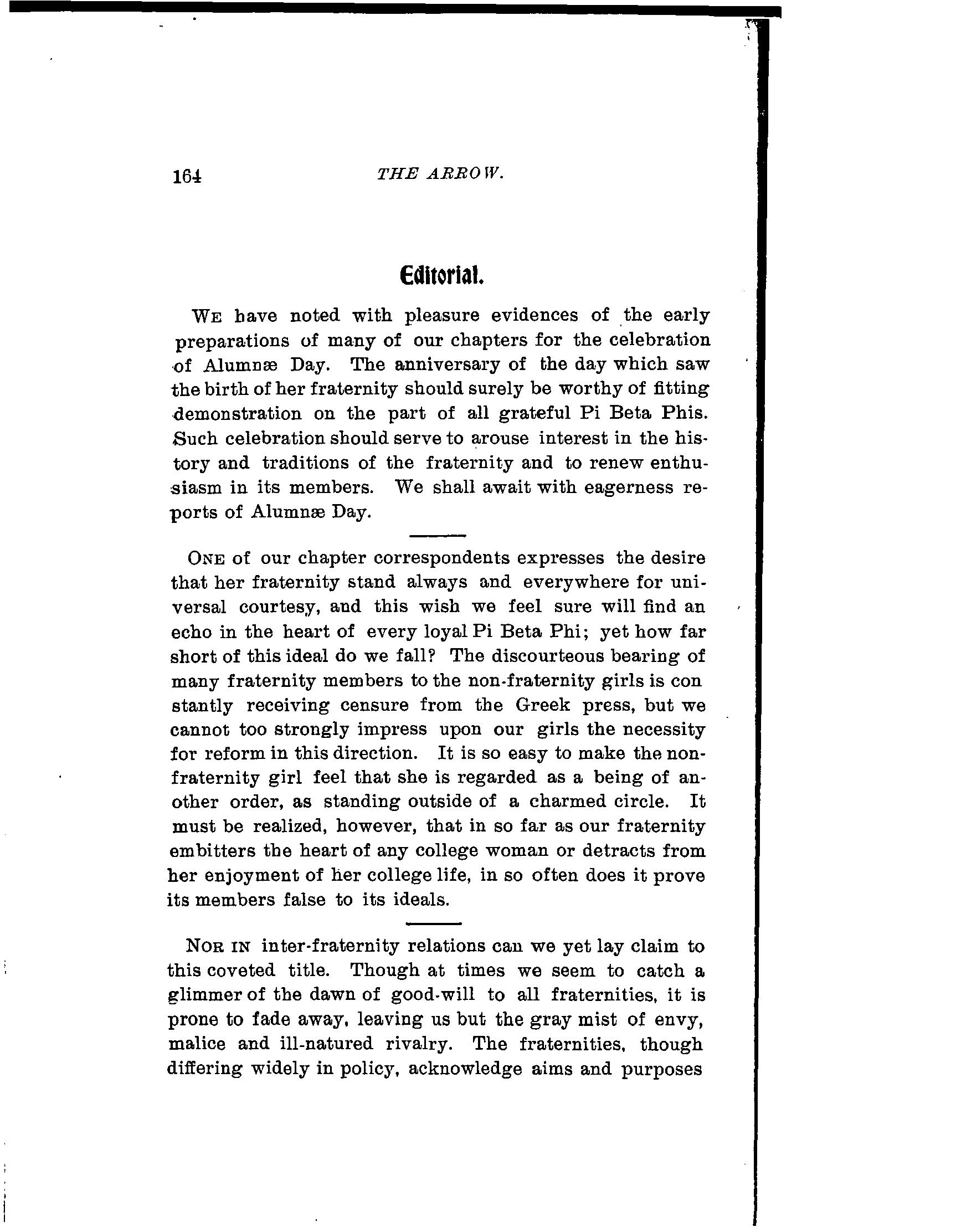
WE have noted with pleasure evidences of .the early preparations of many of our chapters for the celebration -of Alumme Day. The anniversary of the day which saw the birth of her fraternity should surely be worthy of fitting demonstration on the part of all grateful Pi Beta Phis. Such celebration should serve to arouse interest in the his· tory and traditions of the fraternity and to renew enthusiasm in its members. We shall await with eagerness reports of Alumnre Day.
ONE of our chapter correspondents expresses the desire that her fraternity stand always and everywhere for universal courtesy, and this wish we feel sure will find an echo in the heart of every loyal Pi Beta Phi; yet how far short of this ideal do we fall? The discourteous bearing of many fraternity members to the non-fraternity girls is con stantly receiving censure from the Greek press, but we cannot too strongly impress upon our girls the necessity for reform in this direction. It is so easy to make the nonfraternity girl feel that she is regarded as a being of another order, as standing outside of a charmed circle. It must be realized, however, that in so far as our fraternity embitters the heart of any college woman or detracts from her enjoyment of her college life, in so often does it prove its members false to its ideals.
NOR IN inter-fraternity relations can we yet lay claim to this coveted title. Though at times we seem to catch a glimmer of the dawn of good·will to all fraternities, it is prone to fade away. leaving us but the gray mist of envy, malice and ill-natured rivalry. The fraternities. though differing widely in policy, acknowledge aims and purposes
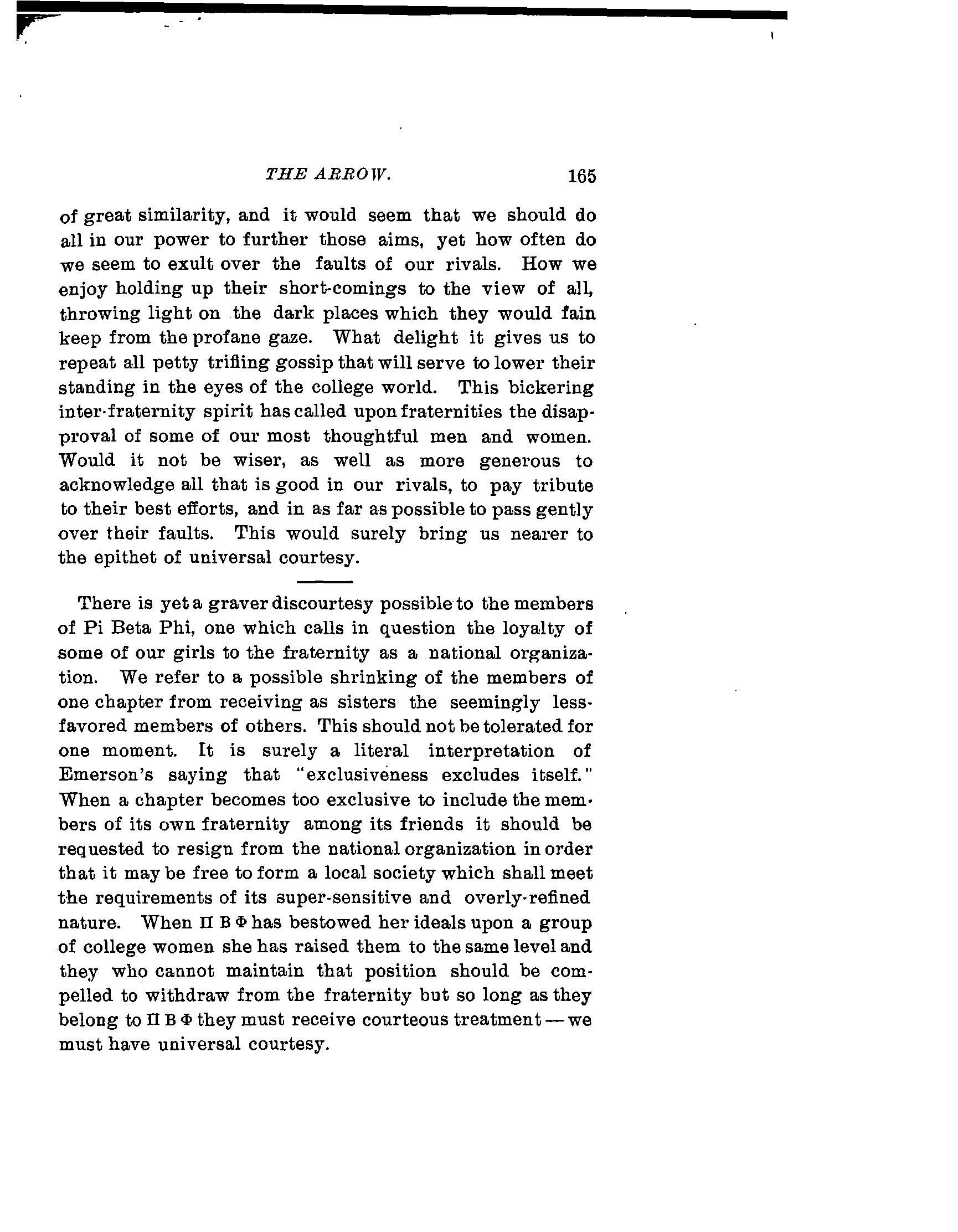
of great similarity, and it would seem that we should do all in our power to further those aims, yet how often do we seem to exult over the faults of our rivals. How we enjoy holding up their short-comings to the view of all, throwing light on the dark places which they would fain keep from the profane gaze. What delight it gives us to repeat all petty trifling gossip that will serve to lower their standing in the eyes of the college world. This bickering inter·fraternity spirit has called upon fraternities the disapproval of some of our most thoughtful men and women. Would it not be wiser, as well as more generous to acknowledge all that is good in our rivals, to pay tribute to their best efforts, and in as far as possible to pass gently over their faults. This would surely bring us nearer to the epithet of universal courtesy.
There is yet a graver discourtesy possible to the members of Pi Beta Phi, one which calls in question the loyalty of some of our girls to the fraternity as a national organization. We refer to a possible shrinking of the members of one chapter from receiving as sisters the seemingly lessfavored members of others. This should not be tolerated for one moment. It is surely a literal interpretation of Emerson's saying that "exclusiveness excludes itself." When a chapter becomes too exclusive to include the members of its own fraternity among its friends it should be req uested to resign from the national organization in order that it may be free to form a local society which shall meet the requirements of its super-sensitive and overly-refined nature. When II B cP has bestowed her ideals upon a group of college women she has raised them to the same level and they who cannot maintain that position should be compelled to withdraw from tbe fraternity but so long as they belong to II B cP they must receive courteous treatmen t - we must have universal courtesy.
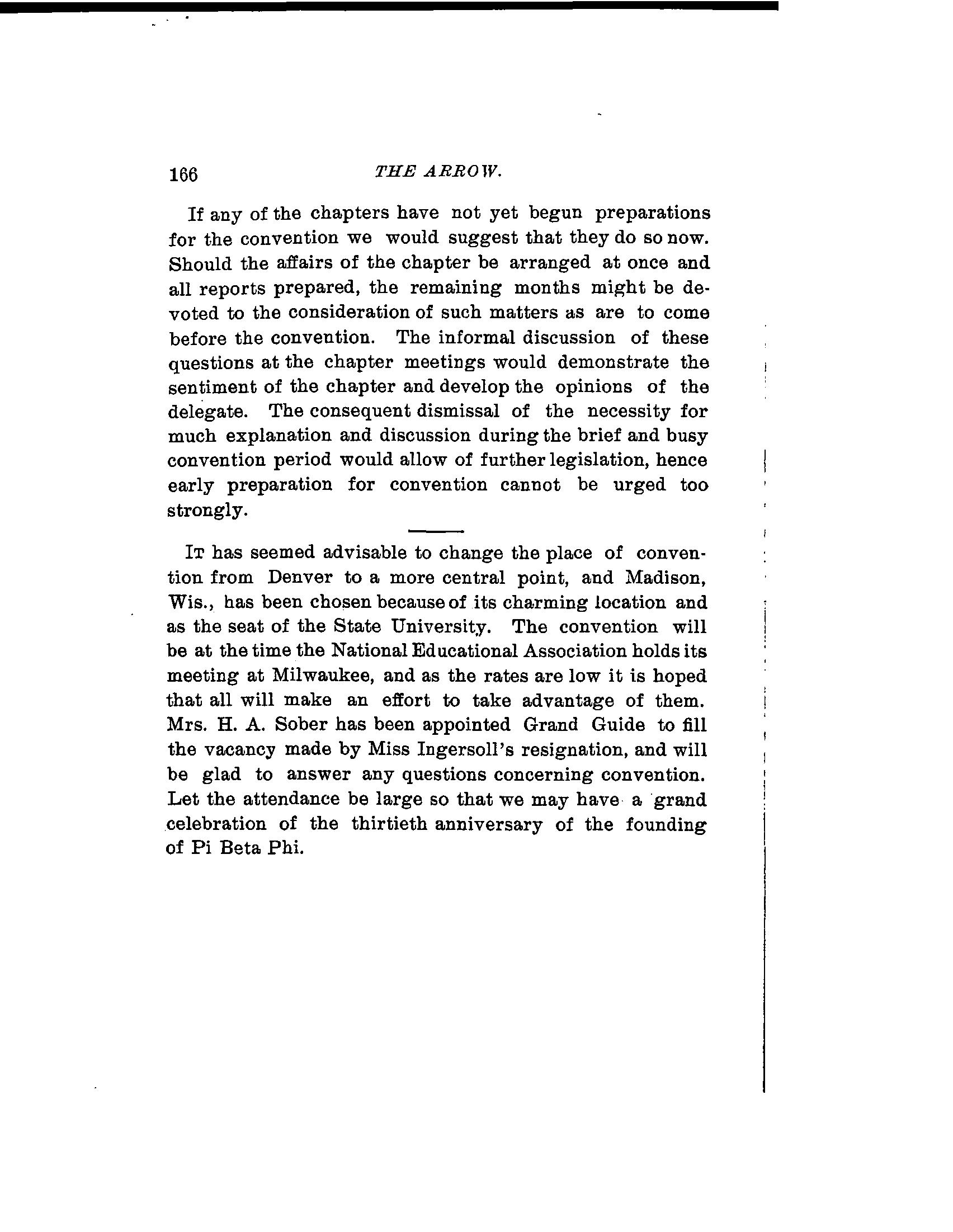
If any of the chapters have not yet begun preparations for the convention we would suggest that they do so now. Should the affairs of the chapter be arranged at once and all reports prepared, the remaining months might be devoted to the consideration of such matters as are to come before the convention. The informal discussion of these questions at the chapter meetings would demonstrate the sentiment of the chapter and develop the opinions of the delegate. The consequent dismissal of the necessity for much explanation and discussion during the brief and busy convention period would allow of further legislation, hence early preparation for convention cannot be urged too strongly.
IT has seemed advisable to change the place of convention from Denver to a more central point, and Madison, Wis., has been chosen because of its charming location and as the seat of the State University. The convention will be at the time the National Educational Association holds its meeting at Milwaukee, and as the rates are low it is hoped that all will make an effort to take advantage of them. Mrs. H. A. Sober has been appointed Grand Guide to fill the vacancy made by Miss Ingersoll's resignation, and will be glad to answer any questions concerning convention. Let the attendance be large so that we may have a grand celebration of the thirtieth anniversary of the founding of Pi Beta Phi.
For Vermont Alpha the winter season has been comparatively quiet, but with the student body festive occasions have been many and enjoyable The jingling bells and merry voices of sleighing parties, skating, dances, and all that a grim Vermont winter brings in its train, have been rife among us. Before long the II B iP girls hope to entertain the faculty, and are now diligently practising their songs in anticipation of that event.
At the close of last fall term the Junior Class gave a play followed by a promenade. Both were very successful, not only in the enjoyment that they afforded, but also in the amount by which the treasurer's bag was distended. As the class wished to get out a college souvenir, the latter was an item not to be despised. The winter term will close with the Junior Exhibition, in which two of our girls take part. The junior honor appointments have not yet been made.
Our Senior Class have adopted cap and gown, and we expect soon to see the campus dotted with black figures.
We are looking forward to the summer convention with eager anticipations. Whether it be in Colorado or in Illinois we know it will be well worth making much personal and chapter sacrifice, if necessary, to attend. We expect that some of our chapter will have that privilege.
FANNY MAROA SU=ON.
COLUMBIA ALPHA - COLUMBIAN UNIVERSITY.
Columbia Alpha has just passed through the somewhat toilsome period marking the close of the first half of our year's work and now feels like celebrating Thanksgiving all over again.
It is hardly fair to tell about the initiation of Baltimore Alpha since she is here now to speak for herself, but surely we may be permitted to mention the enthusiasm which the infant aroused among her Washington sisters. A large delegation went over and brought back a glowing account of the proceedings to their less fortunate sisters who had to stay at home. Everything was in the superlative. The ceremony was the finest, the decorations were the prettiest, the flowers were the sweetest, the supper was the daintiest, and as foe the girls, not even a double superlative was sufficiently expressive.
We have been duly notified that the IIiP's are to have the opportunity of showing their ability to foster the muse of song. Up to this time we never
dreamed that she dwelt among us, but it has been hinted that a search was about to be made for her haunts. At any rate we await the publica· tion of the new song book with great interest. No one would join with greater fervor in singing something new than we. Success to the new song book is the heartfelt wish of Columbia Alpha.
FLORENCE LORRAINE BINGHAM.
PENNSYLVANIA ALPHA-BW ARTBMORE COLLEGE.
Pennsylvania Alpha, since her last letter to the" Arrow" has led rather a quiet life but a very happy one. The rushing season over, we have been simply enjoying our work and each other, and other people, for our chapter is making an earnest effort to wear the "Fraternity smile" in the presence of all this year.
In a college of this size, where each one comes so often in contact with everyone else; where we are, aB it were, ODe large family, difference in our manner of treating the girls is very noticeable, and is fraught with proba· bilities of heartaches. There is no other reputation which we should so much like our fraternity to possess as that of universal courtesy.
The contest for college orator occurred Feb. 16th, and we are very glad to say that Sarah Bancroft, one of our seniors, won the first prize, which entitles her to represent the College in the Inter·Collegiate State Contest to be ,held at Allentown, March 12th. We are all awaiting the result with much interest.
The enthusiasm over oratory is very great here, especially is excitement shown at the Sophomore·Freshman contests, when College and Class feeling run high. The prize of fifty dollars is awarded to the victorious class, and is always expended in something that will beautify the College in the line of pictures or statuary. Consequently every class is eager to lea ve as many trophies as possible upon the walls cf her Alma Mater.
With sincere springtime wishes from the II <1>'s of Swarthmore for their sisters everywhere.
EDNA HARRIET RICHARDS, PENNSYLVANIA BETA-BUCKNELL UNIVERSITY.
The winter's snow has gone, and now and again as we climb the hill from the chapel to the college building, we hear a blue bird singing. Spring is always joyously welcomed at Bucknell for then our campus becomes very bright and beautiful.
We have had some very pleasant times this term and in common with all the rest of the chapters one rather disagreeable one - the examination. However as the bitter ever goes with the sweet, Penn. Beta has courageously taken the bitter, thanking the fates meanwhile that it was so liberally sugar-coated.
May Reah has been obliged to leave college this term on account of ill health.
The report is pretty well authenticated that several of our students are endeavoring to obtain a charter from the Sigma Nu Fraternity; we have now only four men's fraternities here, Phi Delta Theta, Beta Theta Pi and Delta Tau Delta, and there should be plenty oJf good material ,for another.
About fifty men are now busily engaged on our new university building which is expected to be quite an addition to the college. We are looking forward with a great deal of pleasure to holding the state oratorical contest next year in the auditorium which is to be included in the new building.
GRACE REAH.
We have just entered upon our second semester's work. The school year for the College of Arts, Philosophy and Science has for the first time been divided into two semesters instead.of according to the old plan of three terms. The latter arrangement still exists in the engineering courses.
In our last letter we neglected to tell you of .our new chapel. which was dedicated on December first. It is a great contrast to our first chapel, erected twenty-five years ag.o, which contained only one hundred chairs. That number, however, was more than sufficient at that time, for the Ohio State University then enrolled only fifty-one students. Our present chapel, or auditorium, has the largest seating capacity of any building in the city.
Honors have been conferred upon two of our professors recently: Dr. Orton, the first president of our university, has been made president of the Geological Society of America, succeeding Professor Joseph LeCrute; and Professor Ames received the one hundred dollar prize offered by the American Historical Society, for the article which should be considered the greatest addition to history.
We held our second initiation of this year on January ninth at the home of Blanche D. Mickey, and at that time Ora K. Blake, 1900, and Mary G. Redick, '98, became members of Pi Beta Phi. We have at present a larger active membership than we have had at any previous time since the founding of our chapter; it now numbers fifteen. February 19th we gave a dancing party at the home of May Smith.
The faculty of the university has arranged a free lecture course for the benefit of the students. A lecture, one hour in length, is delivered every Monday evening. They are very interesting and profitable, and the students attend in large numbers.
RITA SUTHERLAND.
were present and the whole college was thrown open to receive them. The halls and libraries were prettily decorated with palms and festoons of evergreen. Onr own interest centered chiefly in Convocation Hall, where the Juniors received their friends, and where Helen Eldridge, one of our girls, acted as one of the hostesses, and presided (,ver a dainty refreshmenttable.
A very successful French play has just been given at the college under the auspices of the Philomathean Society. The play was entitled" Le Te8tament de :Madame Paturel," and was given by members of the Freshman and Sophomore classes.
Our chapter has recently been entertained in a most charming manner by Mrs. Taylor, one of our patronesses, at her home in Cambridge. Each girl was asked to come around with a joke, a conundrum, and a "fearful ghost story," and in the telling of them, the evening passed merrily away. An elaborate" spread" was waiting to revive our spirits from the effects of the ghostly tales, and was served in a dining-room prettily decorated with carnations and the fraternity colors, and lighted with candles and' colored Ian terns.
And now, alasl The next number on our programme is term examinations,- which means that gaiety must give way to hard work.
Lucy ALLEN GARDINER.
MARYLAND ALPHA - WOMAN'S COLLEGE OF BALTIMORE.
Although Maryland Alpha is but a few weeks old, she feels very much older; for so many and varied have been her experiences during the weekS' just past, that it seems impossible that such a short time has elapsed since her members donned the" Wine and Blue."
All the college fraternities have entertained us most delightfully. Immediately after the charming tea tendered to us by the Kappa Alpha Thetas, we were honored with "At Homes" by the Alpha Phi, Gamma, Phi Beta, and Tau Kappa Pi fraternities. The Delta Gammas, with an eye to future teas and spreads, sent us "beautiful and substantial token of good fellowship in the shape of a brass kettle, prized by us very highly as our first gift.
On Saturday, Feb. 13th, occurred an event of great importance to usour first initiation. It was held at the home of Miss Elizabeth Culver, whose home is always open to us, and whose kindness and practical experience have been of inestimable service and advantage. On that occasion three girls, Blanche Reisinger, '98, Alice Wood, '99, M. Estelle Martin, 1900, were initiated into the mysteries of Pi Beta Phi. They are girls who, we' feel sure, will prove valuable assistants in our chapter work.
A rather pleasing innovation has been made by us - novel, indeed, to' the other fraternities in our college, but not, perhaps, to Pi Beta Phis else-
THE ARROW.
173-
where - that of having every fourth meeting a purely social gathering The only open meeting we have held as yet was at the home of Helen Doll_ The first part of the evening was devoted to five·minute talks on assigned. topics, and later refreshments were served. We were pleased to have with nS on that occasion Miss Ethel Allen of Kansas Alpha. She spent Saturday and Sunday with us, and it was a matter of special regret to us all' that she could not remain longer in the city.
On February 27th Miss Ingersoll spent a few hours in Baltimore. She went through the college buildings, taking time on her way to christen onesingularly charming nook the Pi Phi corner, and to witness an exciting game of basket ball. We enjoyed her visit greatly and hope to have herwith us soon again.
Music and athletics are at present absorbing the time and attention of many of the students. The girls are very busy preparing for the GleeClnb concert which is to be given on the 19th of March.
Basket ball also claims attention, and the teams are industriously practicing for the contest, booked for "Field Day," which is to decide the college championship.
But with it all, entertainments, athletics and examinations, we still find time for our duties to Pi Beta Phi, and regard as most delightful and profitable the regular meetings and the informal gatherings of Maryland Alpha. MAY L. KELLAR.
ILLINOIS BETA- LOMBARD UNIVERSITY.
Examinations are over, and the freshmen, of whom the chapter is largely - composed, feel that a great weight has been lifted from their shoulders.
Among the most pleasant social events of the year, was the Pan·Helienic banquet in which the four local chapters of the college fratsrnities represented at Lombard participated. For the time, all partisan spirit was ab_sent, and, naturally, kindlier relations have been established among the Greeks.
One of our pledged members, a short time since, entertained a few of the students. Refreshments were served in the college colors - olive and gold.
Our president, Dr. Nash, has openeli his home to the students on the first and third Friday evenings of each month. At these gatherings, the students chat, play games, and those desiring have ample room in which to dance. Dr. Nash and his wife are delightful entertainers, and these Friday evenings have proved a source of genuine enjoyment to all.
Our girls, who have attended, have read with pleasure an account of the
ARROW.
readings given at Tufts College by Miss Elice Crissey, '96. Already, Illi nois Beta regards her with pride, and, as she is a young woman of natural ability ana of intense earnestness, we feel sure that Pi Beta Phi also, will have good reason to be proud of her.
LOETrA F. BOYD. March 1st, 1897.
ILLINOIS DELTA - KNOX COLLEGE.
As we approrch the close of the school year, let us look back and see how we have improved the time. Have we come any nearer to the Pi Phi ideal? Have we done, in everything, the very best we could? It is our duty to make the most of life and we can best do that by living every day the life of a true Pi Phi.
Our college has had a very successful year, and it is through the untiring efforts of President Finley that it is advancing to the front and taking its stand with the foremost of all western colleges.
The social life at Knox has been regulated by the faculty, during the last term, and as it stands now, each fraternity is allowed to give only one informal party each month. This has checked gaiety to quite an extent, for previously always one and freq uen tly two parties were held each Friday evening.
All the literary societies in the college seem to be flourishing at present. Each has held open meetings which might have been considered a credit to any society. The members of the L. M. 1., the only literary society for girls at Knox, gave a very successful program, the principal features being the representation of Gibson's pictures. This was quite unique and very entertaining.
Prof. Starr, of Chicago University, delivered a course of lectures. which was very interesting, upon the Aztecs, before the students during the early spring.
KATHRINE BARTLESON.
ILLINOIS EPSILON - NORTHWESTERN UNIVERSITY.
Only eleven weeks more of our college year, for the spring term has just opened. It seems hardly possible that so many weeks have already passed and we must now look' ahead to our plans for the summer. Of course the convention is uppermost in our minds just now, and we hope that if the place for convening be changed, it will be to where many of us can attend.
This term we are to adopt a new plan for our chapter meetings. We have been meeting every Monday afternoon, but find that we can accomplish much more by meeting regularly once in two weeks, devoting the latter part of the afternoon to business and spending the evening socially together.
We have adopted a pledge-pin this year. It consists of two little silver hearts pierced by an arrow.
Illinois Epsilon's secretary has just returned from a visit to Madison, and to the Wisconsin Alpha Pi Phis, hy whom she was most kindly received. We hope to have some of them visit us this spring.
In "College and Fraternity Notes," in the April "Key," we find Kappa Alpha Theta mentioned as "the oldest of Greek letter societies for women." We have also been directly informed to that effect by a Theta. All respect and friendly feeling to the Thetas, but Pi Beta Phi must claim as her own this honor of the oldest society. We were very much surprised to find a mistake of that kind in a fraternity magazine.
The young women of Women's Hall, recently gave a very original enter· tainment for the benefit of the University settlement. They took possession of all the "finds" that had been accumulating for months in the Registrar's 01llce, and sold them to the highest bidder. It was a queer collection of knives, gloves, umbrellas, and a few "ponies," warranted in good condition. The entertainment proved a great success.
MARJORIE LUCILLE F,TCH.
INDIANA ALPHA-FRANKLIN COLLEGE.
We take pleasnre in introducing to the fraternity our new patronesses Mrs. Julie Monroe, Mrs. I. W. Ragsdale and Mrs. R. V. Ditmars. They were recently presented to the college people as patronesses of Indiana Alpha at an open meeting.
Each of the two men's fraternities has furnished a suite of rooms. The :s A E's opened theirs a few weeks ago to their friends,:a:nd the iJi.d e's last night entertained about one hundred guests in a very pleasant manner.
The state reunion held at Indianapolis was enjoyed very much by Our girls, and all returned very enthusiastic. There were seventeen repre. sentatives, alumnae and active members, from our chapter.
We were glad to receive the announcement of the founding of Maryland Alpha, and we most heartily welcome her into the fraternity.
One of our girls of last year, Bertha Martine, is visiting us, and we ex. pect Esther Howard soon.
LAURA LUKENS.
INDIANA BETA-UNIVERSITY OF INDIANA.
Let us first introduce to you our initiates, Hattie Haas, Sadie Leopold and Helen Shirk. As but few girls enter college in the winter term, we do not add many names to our chapter roll.
It is with sorrow that we record the death of Mrs. Hanna, who had re-
THE ARROW.
<cently become a patroness of Indiana Beta. She was a sister of our own Grace Pierce, and a loyal supporter of Pi Beta Phi.
Mrs. Griffith has consented this term to be our patroness, and we intend ,to entertain in honor of our four patronesses soon.
We have done but little in the way of entertaining this year. We held ,one open weeting, to which our men friends were invited, and ga,e several informal affairs at our pariors after our meetings.
ILLINOIS ZETA - ILLINOrs STATE UNIVERSITY.
Our University Glee Club has iust returned from a tour in the Land of the Orange Blossom, where they met with many successes.
An audience of about one thousand people recently assembled to hear "Queen Esther." The oratorio was given by the singers of the college and of the city under the leadership of our musical·director, Mr. Hasseler.
We were greatly disappointed that our college did not receive the desired appropriation of thirty thousand dollars to build a chapel. We are meeting, at present, in the men's gymnasium and although it is large ,enough to accommodate the students we should Ilrefer to have a chapel used only_ for lectures llUd_entertainments.
We have had a fine lecture course here this winter and the students taking advantage of their opportunities usually attend the lectures in large numbers.
The Freshmen and the Sophomores have had several scraps, but by the twenty-second of February they had become so friendly that the latter did not even try to harm Horace and both classes pledged themsel ves to do all in their power to abolish this custom.
Our girls are all very anxious that the convention be held at Chicago. Many who could not go to Denver think that they would.be able to attend ;at Chicago.
We send greetings to Maryland Alpha and wish for her a bright future.
CAROLINE CLARK.
MICHIGAN ALPHA - HILLSDALE COLLEGE.
The term has passed ,ery rapidly and already our short spring vacation is near. We have had very pleasant times at our chapter meetings, especially since we have passed the fraternity examination.
The seniors have held their election and we are to be represented Class Day by Clara Hughes, who will give the class history.
The Phi Delta Thetas have a new chapter house; at the beginning of the term they gave a reception to the Greeks and a number of others. They have a pleasant home and the reception was very enjoyable.
The fraternities of our college made good use of the sleighing while it
THE ARROW.
177
lasted. Delta Tau Delta, Alpha Tau Omega and our own chapter each gave a sleighing party. We drove to the home of one af our members, Florence Alvord, who lives several miles from here. We are planning to give a reception to all the Hillsdale Greeks at the home of our patroness, Mrs. F. M. Stewart, on Alumnre Day.
EFFIE BROWN.
MICHIGAN BETA- UNIVERSITY OF MICHIGAN.
A few weeks ago we II B iP girls spent a very pleasant afternoon at the home of Dr. Eliza M. Mosher, the new Dean of the women.
February seventh Florence Richards entertained us with our resident alumnre at a farewell party gh·en in honor of Faith Gilbert, who completed her college work at the close of the first semester, and has since returned to her home in Detroit.
For the months of March and April, Professor A. A. Stanley has arranged special vesper services. The series of programs and recitals, which is growing very delightful and has proved as successfnl, is intended to illustrate the development of sacred music.
The memorial decided upon by the class of '96, a cast of the Arch 0 f Trojan, which stands upon the Appian Way at Beneventum, has been sent from Italy, and the cases containing the cast. are expected to arrive soon.
Charles A. Dana of the New York Sun gave an interesting lecture in University Hall January 21 on Socialistic Mm·ements in America, speaking particularly of the Brook Farm experiment.
A few weeks ago we spent a very enjoyable afternoon as the guests of Mrs. Mary Pyle-Davoli, one of our resident alnmnre.
Miriam Dunbar writes that she is teaching mathematics in Oxford College, Oxford, Ohio.
Since the Gpening of the second semester Michigan Beta has been rush ing, and hopes in the next issue of the" Arrow" to present the results to the fraternity.
MARY BARTOL.
IOWA ALPHA - IOWA WESLEYAN UNIVERSITY.
The new year began most auspiciously for 1. W. U. An nnusually large number of new students were registered. Our new mechanical depart_ ment began work this term with a good enrollment. Although this is an entirely new department some very creditable custom work has already been done.
As this has been an unusually busy term for everyone, very few entertainments of a social character have been given, but there has been an unusually large number of lectures and concerts. Of the lectures, one by Prof. French, director of the Chicago Art Institute, on the" Wit and Wisdom of the Crayon," and another by Eli Perkins on "The Philosophy of Wit," proved most enjoyable.
On the evening of the 9th of February, at the home of our patroness, Mrs. McCoid, the Pi Phis gave their annual reception to about one hundred and fifty guests. A short musical program was given, after which refreshments were served in dining-room, which was artistically decorated with wine and blue ribbons, carnations and smilax. At present we are planning a reception to be given soon in the Phi Delta Theta parlors, that fraternity having tendered U3 the use of their hall for the evening Invitations are out for the annual reception and banquet of the Beta Theta Pi fraternity, and the Pi Phis are among those honored with invitations. In the state oratorical contest held at Oskalo,?sa, our orator, Mr. Thomas Osborn, took first place in delivery and second in the contest.
EVA FREEMAN.
IOWA BETA - SIMPSON- COLLEGE.
The winter months have passed rapidly, and we find ourselves enjoying the vacation, which was so welcome to all weary workers.
The department in music at Simpson College is doing especially fine work this year. The instructors, Prof. Barrows, Prof. Boyden, Misses Mitchener and O'Fling are certainly appreciated as thorough and competent musical professors.
The work in the other departments is also very good. Each professor is highly respected and loved by the students.
. The school year thus far has been prosperous to Iowa Beta chapter. Our girls have been working hard and have accomplisned much. We were sorry to lose May Sedgwick, who has moved to Des Moines, where she will resume her studies.
Last week we gave a "March Bluster" at the home of Inez Henderson. Various amusements were provided and dainty refreshments were served. Our guests reported a very good time.
Florence Hatfield is enjoying an extensive tour of the west.
Iowa Beta sends to all members of Pi Beta Phi cordial greetings and best wishes.
MYRTLE REID.
Though in the midst of term examinations, the girls of Iowa Zeta pause from "cramming" to send greetings to their sister chapters.
This term has been a very pleasant one. Through the efforts of the lecture bureau we have been enabled to hear such prominent speakers as "Bob Burdette," Bishop Fowler and Robert McIntyre. All who have heard these men know what a treat we have enjoyed.
Then there was the concert given by our Glee and Mandolin clubs. This was their first concert, but it was a success in every respect. Later concerts were given at Grinnell and at Cedar Rapids, and at both places our clubs made a most favorable impression. Next term the Grinnell Glee and and Mandolin clubs appear here, and at that time S. U. I. students will have an opportunity of returning the enthusiastic reception given to our boys by the wearers of the scarlet and black. With the military hop and other dances, besides informal gatherings, which are always so pleasant, time has not hung heavily on our hands.
Last term the two women's literary societies of the university took up a new movement, that of inter·collegiate debates. Accordingly we sent a challenge to Madison, which we were sorry to learn Was not accepted. The Pi Phi girls felt this refusal especially since we had two representatives from one society and one from the other for the preliminary. Debates probably have a greater interest for us since S. U. I. has been so fortunate in all her contests with other colleges, the last victory being the one over Chicago University.
As a fraternity we have had several social gatherings. In January, Leda Pinkham entertained our girls at a whist party. The souvenirs were specimens of sea·weed, which our hostess had collected and mounted while at the Atlantic coast last summer. Later we entertained our men friends at Mabel Foster's. i'here were about thirty present. Most of the games for the evening were original with our girls.
Nor have spreads and cooky-shines been neglected. We have an arrange_ ment for business and social· gatherings, which we find very enjoyable. We meet once every week - one week on Saturday afternoon which is the regular business meeting - the next week on Wednesday evening, when we have a spread or other informal social gathering.
Iowa Zeta has had conferred upon her an honor of 'which she is justly. proud, for of the seven girls who are fortnnate enongh to be in the highest one-third of the senior class, the only ones who are entitled to compete for commencement honors, are four Pi Phis.
At the recent election of the '99 Annual board two of our girls were elected to assist in the preparation of the humorous department. The rest ARnow 4.
of us accordingly are very careful what we say or do, for the humorous editors spare no one.
We have initiated three girls this term- Lida Pinkham and Mabel Hanson, whom we have introduced to you all before, and Lulu Graff, a sophomore. Both initiations were very impressive and were followed by the customary banquet.
One of our girls, Berth Remley, who has not been at college for a year, will be with us for the spring term. while on the other hand we will lose Clyde Cobb, whose ill health will not permit her to finish the year. We .shall still have fifteen active girls in our chapter.
MITTIE M. P,LE.
Wisconsin Alpha has little news for her chapter letter this quarter. There is always a lull from the first semester examinations to the Easter recess, which begins on April 15th. The monotony has been somewhat enlivened by the session of the state legislature. Bills of all kinds, from university appropriation bills to bills for the prevention of theatre hats, seem to interest the students and the gallery of the assembly chamber is frequently crowded with young men and maidens taking practical 19ssons in law·making. Last evening the assembly ball was held in the large gymnasium and the students here again manifested their interest in such a way that one could hardly pick out a legislator for the crowd of students.
In about two weeks "The Badger," the college annual, will be issued and the sophomore class will elect their Badger board for the ensuing year. Already distant mutterings of the customary fight between the fraternity and non·fraternity faction reach our ears.
Mrs. Slaughter, wife of our Latin professor, entertained our girls one afternoon last month with many pleasant reminiscences of a summer spent in Germany and Greece, and her collection of beautiful photographs added vividness to the scenes she described. We enjoyed a delightful evening last week hearing a most interesting paper on "The Women of Shakespeare " by Mrs. Adams, wife of our president.
Wi.consin Alpha hopes that she is not too premature in congratulating herself on her prospects for next fall. We expect to have four of our old girls back in college, Marjorie Fitch of Northwestern is to enter the U. of W., we have two pledges and all the present chapter expect to return. We have also a pledge, Miss Alice Friend, whom we hope to introduce to you in the next" Arrow" as a duly initiated member of Pi Beta Phi. Miss Fitch spent several days of her vacation in Madison. 'Ve are sorry for you, Ill. Epsilon, in losing her next year, but we can not help being selfishly happy in the prospect of having her with us.
With best wishes from Wis. Alpha, LUCRETIA FRE:iCH HINKLEY.
LOUISIANA ALPHA-NEWCOMB UNIVERSITY.
We all send greetings and hope that the other chapters enjoyed the winter as much as we. All the members of our chapter are very much elated at present over the triumph of Miss Lydia Finley, who was Queen of Momus, one of the carnival balls.
The seniors and juniors in the gymnasium are preparing for their first public contest in the game of Newcomb. Newcomb was originated by our gymnastic professor, and is greatly enjoyed by the students.
Miss Anna B. Grant, our former corresponding secretary, has been elected Newcomb editor of "Jambalaya" our college annual.
Every Monday we have a luncheon in our fraternity room which is in Main Hall, and every alternate week we have a fraternity meeting after luncheon.
We are glad to welcome the new chapter at the Woman's College of Baltimore and we wish them success in everything they undertake.
At this time, the city is crowded with strangers, who have come down for the carnival. How we wish that some Pi Beta Phis were among them. All the houses along the route of the processions are decorated with purple, yellow and green, the colors of his Majesty Rex; and the club galleries are a mass of lights and lovely faces waiting patiently for the p(lrade to pass. Would that I could describe our Mardi Gras to you, but that is impossible as one must see it in order to obtain any conception of its splendor. On the night of March 1st, "Proteus" selected the picturesque poem of "Orlando Furioso" as the subject of its illustration. It proved to be a happy choice for with its dragons, fairies, giants and monsters, the tableaux, were, as intended, genuine pictures of fairyland. We hope that some day all of you may be fortunate enough to enjoy this lovely scene.
CLARA MATrHEWS.
KANSAS ALPHA - UNIVERSITY OF KANSAS.
Since our last "Arrow" letter was written we have made an addition to our chapter membership, Florence Parrott, class of '95, was initiated February thirteenth. She is teaching Latin in the city high school, and our invitation was simply a renewal of the one that had been extended to her when she was in the university. She is a Phi Beta Kappa and most desirable as a fraternity girl. The initiation took place at the country home of one of our girls, and was a very enjoyable affair. It was doubly appreciated by the freshmen, inasmuch as it was the first initiation in which they had participated otherwise than as victims. After the cookyshine one of the girls took a series of flash-light pictures of the girls.
The pipe organ fair which was spoken of in our last letter, was quite the success it gave promise of being. Our candy booth was artistic in its color scheme of crimson and dark green. A handsome clock was awarded us as a prize for having brought in the largest receipts of any other attraction at the fair. As we have no chapter house we added the clock to the furnishings of the Women's League room in the library building.
Society was very gay here for a few weeks just before Lent. Five fraternity parties, a theatre party given by the Kappa Kappa Gamma, and an amateur presentation of "The Rivals," followed one another in rapid succession. The gaieties will begin again after Easter, as the girls' fraternities will have their parties then. We expect to entertain April twenty-third.
Anna Shire, one of our seniors, is wearing the Phi Beta Kappa badge. We are very proud of her, particularly as only three girls received the honor of an invitation to join that society this year, and she is the one fraternity girl among them.
We are glad to have with us again Bessie Ayers and Charlotte Cutter, ,two of last year's initiates, who have resumed their college work.
GERTRUDE W,NSLOW H,LL.
BETA - UNIVERSITY OF NEBRASKA.
'Ne have passed through the week of examinations which marks the close of the first semester. Quite a radical change has been made this year in some of our cOurses of instruction. Classes have been arranged so that students may enter at the beginning of the second semester and take up work that in other years has been offered only at the beginning of the first semester.
Our senior girls have adopted cap and gown this year, and presented a dignified appearance as they entered chapel en ma88e this morning.
We had a delightful "cooky-shine" at the home of Miss Anna Lytle, just before going home for the holidays. Upon our return from our vacation wEi began preparations for the initiation of Miss Persa Morris. This took place at the home of Anna and Lennie Stuart. Gertrude Branch, of Michigan Alpha,-came down from Omaha, for the initiation, after which she spent several days with us. A large number of the alumnoo from various chapters are living here in the city; this initiation was somewhat unique in as much as it was the first time that the alumnoo were invited to be present. Quite a number of them were able to be with us that night; among them Mrs. W. Q. Bell, a member of the Monmouth chapter. We spent the following evening with Miss Darleen Woodward.
We have Jennie Barber and Amy Robinson with us again this semester, but regret that on account of ill health Phoebe Doty was obliged to give
up her University work. Her home is not far from Lincoln and we hope to see her often.
The' Ladies Faculty club gave a reception to the students on the evening of the 30th of January, in the Art Rooms. Refreshments were served by representatives of each of the girls' fraternities.
" Company B," gave their annual "hop" last Friday, and the Junior Promenade is to take place next week.
February 15th is Charter Day, and the University is planning to celebrate it in the usual delightful manner. This year, for various reasons, the ceremonies will begin on the night of Charter Day, and the day following will be our reception day.
KATE SNOW WALKER.
COLORADO ALPHA - UNIVERSITY OF COLORADO.
Friday afteruoon, March nineteenth, the Pi Phis gave a reception to all the college women and the wives of the facnlty. The Delta Tau Delta fraternity kindly threw open its adjoining rooms. In the evening there was an informal party, with cards and chafing dishes for amusement.
Emma Steruberg gave us a very interesting talk one afternoon about her life abroad. We have changed our weekly meetings from Saturday to Wednesday afternoon and all find it more convenient to have one day in the week without regular engagements.
The chapter at Denver university has invited us to celebrate Founders' Day this year with them May first. A number of us are looking forward to going down to Denver.
In matters of general college interest the state oratorical contest which is held each year between Oolorado Springs, Denver University and the University of Colorado this year took place in Boulder and two of our men carried off the honors.
The Glee Banjo and Mandolin clubs, numbering some thirty members, have just given a very successful concert which was followed by an informal reception and dance. The faculty ladies acted as patronesses.
The matter of most absorbing interest now is the amount of the appropriation which the state legislature will make for the university. As this is a state institution it is dependent on the legislature for funds, and every two years the question has to be decided anew.
CHARLOTTE FARNSWORTH.
COLORADO BEI'A - UNIVERSITY OF DENVER.
Colorado Beta is pursuing the even tenor of her way. Influences are at work, if they are quiet. Since Christmas we have been holding a little quiz on fraternity government at the beginning of each meeting, and we have found it very profitable as weil as interesting. We also have a bri!-
Iiant little scheme (so the corresponding secretary thinks) for writing our annual letters to the different Chapters. Every girl is given some college where a Pi Beta Phi Chapter exists, on which to report at our meetings. She is to gather as much information as possible about the College and especially the Chapter, which we have there. After thus becoming somewhat familIar with that Chapter she writes the" Annual" to it.
We cannot refrain from mentioning a most delightful cooky-shine which we had during the Christmas holidays in conjunction with Colorado Alpha. Six members of Colorado Alpha we found were to spend their vacation in Denver, so with those of our own number who were in the city, we had quite a respectable gathering. This time the cooky-shine was conducted a la Colorado Beta, but as the minor traditions and details of the "shines" are never the same in different Chapters, in the Easter vacation we shall see how Colorado Alpha makes her cookies shine. The remark of a disinterested auditor that there seemed to be considerable monkey-shines about a cooky-shine, will readily be understood by the initiated.
Our girls have been turning what superfluity of wits they may possess toward the writing of poetry for the song book; though, if the truth were known, we sadly fear that the "rhyme-lists" in the back of the dictionary were more than once consulted. However, we have the satisfaction of having done our feeble best, and as a reward of our virtue we have made the discovery that poets are born, not made. With this trite observation we close, at the risk of leaving with our readers the impression that in Colorado Beta there is nothing original but" original sin."
MARTHA NUTTER KIMBALL.
CALIFORNIA ALPHA-LELAND ST ANFQRD UNIVERSITY.
The convention ahead of us will bring many benefits to the chapters individually, we feel sure. California Alpha is interested in the decision of place-Chicago or Denver. It has been offered as a suggestion that one excellent plan might be to make the place for holding convention permanent-a central point, and change the reunion from year to year.
The resnlts obtained in the comparison of Literary Societies and Fraternities were interesting as showing the growth of Universities into something other than a mere disciplinary and training school. Such a tendency we have marked in our own university.
The emphasis laid upon Chapter Histories is a move in the right direction. The younger Chapters, I am sure, envy the long histories and records, and the interesting memorials of an older Chapter.
We introduce to you through" The Arrow" Miss Mary Thompson, '99, of Milwaukee.
Owing to our smaIler numbers we are not in the house as last year, five of us are together at Prof. Pease's house on the Campus for this present semester.
We have welcomed int<l our midst Upsilon Chapter of Delta Gamma, making the fourth Women's Fraternity at Stanford.
The Pan-Hellenic Association is planning to make its annual gathering a welcome to our new sister fraternity.
HELEN WILLIAMS•
.. CORNELL has abolished the degrees of Ph. B., B. S., and B. L., and has coalesced the four general. courses into one leading to the degree of A. B. All work in that course is to be made elective during the entire Iour years. 00- William's Weekly
.. PROFESSOR Bailey, of Cornell, has been awarded the Veitchfan medal for distinguished work in horticulture. The medals are given annually by the Veitch Horticultural Company of London. Professor Bailey is the second American to receive the medal. 00- The Targum.
STATISTICS from the largest universities in the United States show that the graduate departments are increasing more rapidly than the college departments.
, THE students of Hobart College recently petitioned the trustees of that institution asking that no professor be allowed to join a secret fraternity. The petition was granted, and an order to that effect has been issued.
THE University of Michigan is to offer a six years' course in the literary department. In the first four years special attention will be given to history and economics, and the last two years will be devoted entirely to law.
A BILL prohibiting .. Greek letter fraternities or similar organizations" in any institution of learning supported in whole or in part by public funds has passed its second
reading in the South Carolina house almost without debate. Its author. Representative' Gains, explained that it had been decided "for good reasons" not to discuss it.-' Amherst Student.
THE library of Johns Hopkins University is said to contain the most efficient library of political science in America or England - the Dillman library of 5,000 volumes, originally belonging to the eminent Biblical scholar, Prolessor Dillman, of Berlin.
THE oldest American college is the Mexican University, which is fifty years older than Harvard.-Baylor Literary.
PENNSYLVANIA will hold a series of relay races on April 24th. similar to those held last year. Over a hundred colleges and preparatory schools will be invited to send teams.
"THE FACTOTUM," a new publication of the University of Berlin. is said to be the first college paper in Eur()pe. It is published by the students, and sent free to all students and to the faculty.
THE wives of the married students of Harvard have.organized and will hold fortnightly meetings of a social nature. They will be known as "The Harvard Dames."
NEBRASKA University has another fraternity, the Kappa Sigma. The new chapter has eight charter members.
EVERY student of the Kansas Wesleyan Univerisity is obliged to subscribe to the college paper.
THE University of Wisconsin is probably the only college in the United States that has no chapel services.
TORONTO University has been recently affiliated with the universities of Oxford and Cambridge. This privilege is enjoyed by no other college in America.
IT is said that Mr. M. Taylor Pyne. a graduate of Princeton. has· donated to that institution the sum of $600,000 for the erection of a new library building.
ACCORDING to the latest report of United States Commissioner of Education Harris, there are in this country 481 colleges and universities. These received during the last year a total income of $16,783,638, employed 8,459 instructors, and enrolled 63,402 undergraduates and 4.273 graduate students.
THE following officials have been chosen for the YaleHarvard debate to be held in Saunders' theater, Cambridge, March 26th; presiding officer, Governor Roger Wolcott; judges, Professor D. R. Dewey of the Massachusetts Institute of Technology; Professor F. H. Giddings of Columbia and Judge E. A. Aldrich of the United States court.
PROFESSOR Edmund J. James of the University of Chicago, after special investigation along the line of courses suitable for high schools, has formulated a curriculum which is highly praised by educators. The course covers foul' years, and EngliSh and German are studied throughout the entire time. Stenography, bookkeeping, business forms and customs, banking and economics are all prescribed courses. Greek is not offered as an elective in the last two years. In the second, third and fourth years an option of French or Spanish is given the pupil. This curriculum will be first employed in the New York high Schools.
CONDITIONS for the competition for the William Wirt Winchester prize of $1,500 have been determined by the Yale Art School faculty. The prize is the largest of its kind given in the United States, and the winner will be enabled to spend two years in study abroad, receiving the income from an endowment of $15.000 for that time. The final decision respecting the award will be left to three artists who are not members of the Yale faculty.
The February issue of the Sigma Chi Quarte1'ly is unusually full of interest both to Fraternities in general and even to those outside Fraternities. The first number is an exceptionally clear and well written account of the university of Chicago, that Jack's bean stalk among colleges, which seemed at first to be a sort of miraculous fungus growth, but which has shown a healthy development of root and leaf that augurs well for continued vigor.
We are glad to note that the editor of the Quarterly has ranged himself squarely on the side of the dignified initiation. Our own opinions on this subject have been aired before this, but we hail with delight each Greek ally. Therefore when we read the following we are far from pitying the editor for what he calls" the humilation of a public confession," but on the contrary feel more like performing whatever may be the feminine equivalent of toss-ing up our hats and exclaiming, Good for the Sigma Chi Quarterly-! "
The editor has recently witnessed an excellent example of the perverted conception which he fears may be prevalent among undergraduates as to the uses, objects and forms of initiations, an example which spoke most eloquently of what an initiation ought to be. We deprecate the thought that these words are to be seen and read by representatives of the Greek world. But what are we-to do? Is Sigma Chi to live forever under the system doubtlessly in vogue in too many of our chapters? There must be a reform in this thing, and the humiliation of a public confession is far preferable to the continuation of a baneful perversion our initiatory ceremony. During the month of October, 1895, the editor, with others, was invited to be present at a certain initiation. He attended and witnessed a performance which can be properly qualified by only one word - repellant. He returned to Chicago and entered his protest in an editorial. At variouS' times since, the Quarterly has contained communications and editorials on this subject; the fraternity magazines have quite generally approved the editor's sentiments; and a great many active and alumni members have expresed their approbation, while the chapter referred to, so far
ARROW.
as its opinion has been made known, has been in accord with the editorial mentioned. But a year afterward that same chapter invites a number of persons to be present at an initiation and regales them with a spectacle which would have been grotesquely absurd if it had not been offensive and positively cruel. Where in the world did that chapter get its theory of an initiation into Sigma Chi? Its alumni members present were the most unsparing of all in their condemnation of the exhibition. We do not wish to be understood as criticising the individuals who compose that chapter and who conducted these several initiations. They are but the victims of a pernicious system from which it is our duty to rescue them.
Every respectable educational institution in the land is making unmitigated efforts to free itself from hazing. And yet in the secrecyofthe halls and houses of the chapters of the various Greek letter societies are doubtless enacted" jokes" as inhuman as those of the rattle-brained hazer. The" tests" to which a candidate must submit are often not only cruel, but positively dangerous, and if the Greek letter societies cannot eliminate this element from their initiations then it is to be hoped that the faculties' of the various institutions will take the matter in hand themselves and exercise a salutary supervision over these ceremonies. It might seem that the editor has gone far in his assertions, and one unacquainted with the usual initiation might receive the impression that it is a terrible ordeal. But it is not intended to charge that the dangerous. and cruel form of initiation is prevalent; the more common error is the ridiculous and absurd, which is equally harmful in its effect. From the performance witnessed by the editor not long since he sees and fears that the possible chance is undoubtedly sometimes realized. What is the remedy? There is only one, viz.: Let the ritual prescribe the :details of the ceremony. We ought not allow such a broad discretion to each chapter. The character of an initiation now depends on the chapter. We should have a common form and enforce compliance. By so doing we will cast a dignity around the ceremony and assure a proper appreciation by the candidate of the situation.
Delta Gamma is to hold her biennial convention this month, and the April Anchora contains, as its first number, the president's message relative to the coming event, and an able editorial on the same subject. As Pi Beta Phi is to hold her convention this summer, the following excerpts seem to us both pertinent and valuable, and we therefore recommend them to the careful consideration of our own chapters.
Remember that the chapter is judged, largely, by its delegate. I have known more than one instance in which an erroneous impression of a chapter has been gained by an injudicious selection of a delegate by that chapter. I do not mean this to be construed as a reflection upon any girl who wears the anchor, still less as an advocacy of the policy of putting the biggest strawberries on the top of the box. She need not be the prettiest girl, the best dressed girl, nor the best dancer. She may be all of these things, but she must be a girl of some degree of business ability and of good judgment. Let her be a girl with ideas, who will do something more than move to adjourn -a girl who will make the convention realize that she and her chapter are no mean part of the fraternity. She must be able to pres,!lnt forcibly all arguments for or against any question that she may bring up for her own chapter. She must be thoroughly familiar with the constitution-a state of affairs, unfortunately, all too rare among fraternity girls-as well as with the minutes of the last convention. A few hours systematically spent will serve to master both, and any extra time can be profitably spent on Robert'8 Rule8 of Order.
In regard to the instructions given a delegate by her chapter, it is difficult to advise, but in a general way, we would say, do not make them too explicit. The spirit of the Convention, the opinion of other chapters, often throws new light upon subjects in regard to which, particular delegates have received most definite orders from their chapter, and between the delegate's desire to act in accordance with the wishes of' her chapter and her desire to vote conscientiously, she is sometimes much embarrassed. The chapters should not place their representatives in this pOSition. Thoroughly discuss important questions which you are sure will be considered by the Convention, in chapter meetings, and the delegate will perceive the prevailing sentiment. See that your delegate is informed with regard to the chapter's opinion and wishes, but leave her free to exercise her judgment, when the matter comes to a vote in the Convention.
The following will doubtless wake a sypathetic chord in the breast of many a perplexed and distracted cbapter correspondent:
Who ever read a chapter letter without feeling that the writer might have been a little more entertaining, and a little less stilted in style; that she might have written more news and fewer platitudes, with satisfactory results? Who ever writes a chapter letter except at the most inauspicious moment? Last term one imagined it such an easy thing to do, and the editor's suggestions and criticism seemed very much to the point, then - when some one else wrote the letter. Now, they seem a little sarcastic and really, in rather poor taste. Of course one does not like
191
to write a poor letter, but when one is busy and has nothing to write about (it is queer how many things do not happen in three months), a hurried letter, with an apology, ought to be excused, when one happens. oneself, to be the associate editor. Of course the other correspondents have more leisure and they write more readily, and anyway, one hasty letter will not be observed among a dozen delightful ones. The associate editor remembers how she felt, when the last ANCHORA came out, and her letter, singularly enough, was the most conspicuous article therein. Then she wished that the journal would not always open at that page, and wondered if in the course of a long life this humiliation could be lived down. She then resolved to write a letter for the next issue which should be a revelation to her friends, a reproach to other correspondents. and an example to future generations. But this is not the next time.
We have never been an advocate of that order of fraternity journal which is a mere bulletin board of fraternity business, a compendium of uninspiring facts. We have felt that the ideal magazine should embrace within its covers anything which can add inspiration or interest to our fraternity life-bits of experience, advice' from alumnre, kindly criticism or suggestion, even a little sentiment or sophomoric rhapsodizing now and then, if it does not degenerate into the flabbiness of mere gush. We have believed, too, that the fraternity magazine should be interesting and suggestive not only to our own order. but to the fraternity world in general. We have advocated adding to our table of contents anything of especial interest to us as fraternity women, as college women or even as participants of that larger realm of womanly interests which lies be· yond our college years. Even fraternity poetry, execrable as most of it is, is not lJe?' se inappropriate to the fraternity magazine.
There is, however, a limit to that which is appropriate and fitting, which if not definable by foot rule and square, is measured by the somewhat elusive canons of good taste, which whisper, "Thus far shalt thou go and no farther." It seems to us that the fraternity storiette is unquestionably a step beyond that border, that it is inappropriate. use-
ARROW.
less, and in poor taste. We are sorry to see that several -of our exchanges have lately given space to that form of literary exercise. The Beta Theta Pi not long ago published one, the SMeld of Phi Kappa Psi another, and now .(Jomes the February Kappa Alpha Theta with two. Is this a sign of decadence, like the purple-haired porter girl, 01' is it a merely temporary transgression of the laws of fitness, a sort of fiction measles in the fraternity press? Let us hope the latter.
The discussion of the ethics of intercourse between fraternity and non-fraternity people is growing a bit wearisome to the reader of the recen t Greek press. The changes are sung up and down, backward and forward wiih the persist·ent iteration of an old-fashioned fugue tune. We must admit in fairness, however. that the Rainbow of Delta Tau Delta has hit upon a real help to the solution of the question, by levying contributions from non-fraternity men, who in explaining the difficulties of intercourse from their point of view, make it by so much the easier for both sides to bridge the gap. The first extract is by way of advice:
My first suggestion would be that fraternity men avoid any unnecessary appearance of secrecy. Doubtless the average fraternity man has fewer ·real secrets than his non-fraternity brother often imagines. Yet it is easy for fraternity men to congregate together outside of their hall and talk in whispers, when perhaps the subiect of discussion is one that they would willingly announce to all the world. The natural curiosity of the human heart chafes under the notice of these subdued conversations. Thus if the public parade of secrecy could be diminished or eliminated, it would be a great stride toward the goal of harmony.
Then, too, I would suggest that fraternity men should avoid the appear.ance of narrowed sympathy. vVhere men are bound together by obligations and congenial companionship in secret organizations they are very apt tb lose much of their interest in those outside of their circle. Even men by nature of broad sympathies soon find themselves yielding to this tendency. Non-fraternity men notice this very quickly. I recall more than a few instances where men were admired by all because of their broad sympathies, yet on entering a fraternity a marked change came over them in this regard. These, however, were exceptional cases; yet, in general, fraternity men should show a wider sociability.
The last two touch on some causes of awkwardness, if not of soreness.
Rightly or wrongly,- in many cases, it must have been the latter,there was always the feeling, a sort of sub·consciousness ne,'er fairly put into words and admitted to myself, that these men looked upon me as one below their standard. I felt, too, that if I were not careful they would think I was anxious for an invitation to join. The fraternity seemed to constitute a sort of college aristocracy, and while the standards of admission were as diverse as the poles, one fraternity always recognized members of another as fellow aristocrats. I now recognize that this must have been grossly unjust to many, perhaps to most of the fraternity men; yet the feeling was very real to me and to others.
At the university which I have especially in thought, the greatest em· barrassment comes to the non·member on class-day, when he realizes that he has no place to take his mother, his sister, or his fiancee. His guests do not understand what it means not to be a fraternity man, and quite naturally they ask him why he does not take them to the grand-stands or into the social gatherings. What can he say? To the writer it would seem that no greater opportunity offers itself for fraternities to close the gap that exists, than to arrange their class-day festivities so that every college man may have a share in them and thus be allowed that happy satisfaction of feeling himself not ostracised but admitted to the best that there is. As it now is only a few non-members attend the receptions the greater number not being invited. Why could not the various chapters agree upon some plan whereby each member of the college should receive two tickets for at least one spread? Some such little courtesy shown by the societies would do a great deal toward putting an end to campus feuds and make Greek-letter fraternities popular among non-fraternity men.
The Kappa Alpha Theta for February maintains its usual high standard of mechanical workmanship, but the contents contain much with which we must take issue. For instance, the contributor of the criticism on the use of fra· ternHy slang, under the caption .. If the coat fits, put it on", objects most strenuously to the use of such expres· sions as .. Frat" for Fraternity, .. spike" for invite, and bid" and swing" to express similar ideas. The writer then goes on to emphasize her point by quoting, or rather misquoting, the following chorus of a popular song;" We're not the only ones, Oh dear no, We're not the only ones."
and facilities, perhaps, but where the students are divided by no social lines, where the and insolence of wealth is not contrasted with the industry and humility of poverty, where brains and character are the sole standards of quality, where the students are taught by the professors and not by tutors, and where the time and attention of the students is not wholly given to forms of athletic pUblicity.
The Alpha Tau Omega Palm maintains its usual excellent character. Its pages are largely occupied with reports of the late convention at Cleveland, which must have been a good one, if we may trust the P4lm. We note with interest that Alpha Tau Omega has forty·two active chapters and thirteen alumnae associations, and that its territory covers not less than nineteen states.
The Oosmopolitan for April contains an eight·page article on College Fraternities, including woman's law and class fraternities. The paper is well illustrated by representations of the various pins and badges, and while we notice some inaccuracies of statement, it .is the best and most _ comprehensive popular presentation of the subject. we have ever happened to notice, not excepting that which appeared in the Century some years ago.
19 S. Pinckney St., Madison, Wis.
liS NORTH PINCKNSY ST ,MADISON. WIS.
Pioneer BIk.., East Main St., MADISON, WIS.