THEARROW OF PI BETA PHI
FIRST ANNUAL INFORMATION NUMBER (SECRET) 1913
Subscribers are requested to keep this issue under lock and key or destroy as soon as read. See page 1.
Subscribers are requested to keep this issue under lock and key or destroy as soon as read. See page 1.
VOLUME XXX
SARAH GERTRUDE POMEROY, Editor
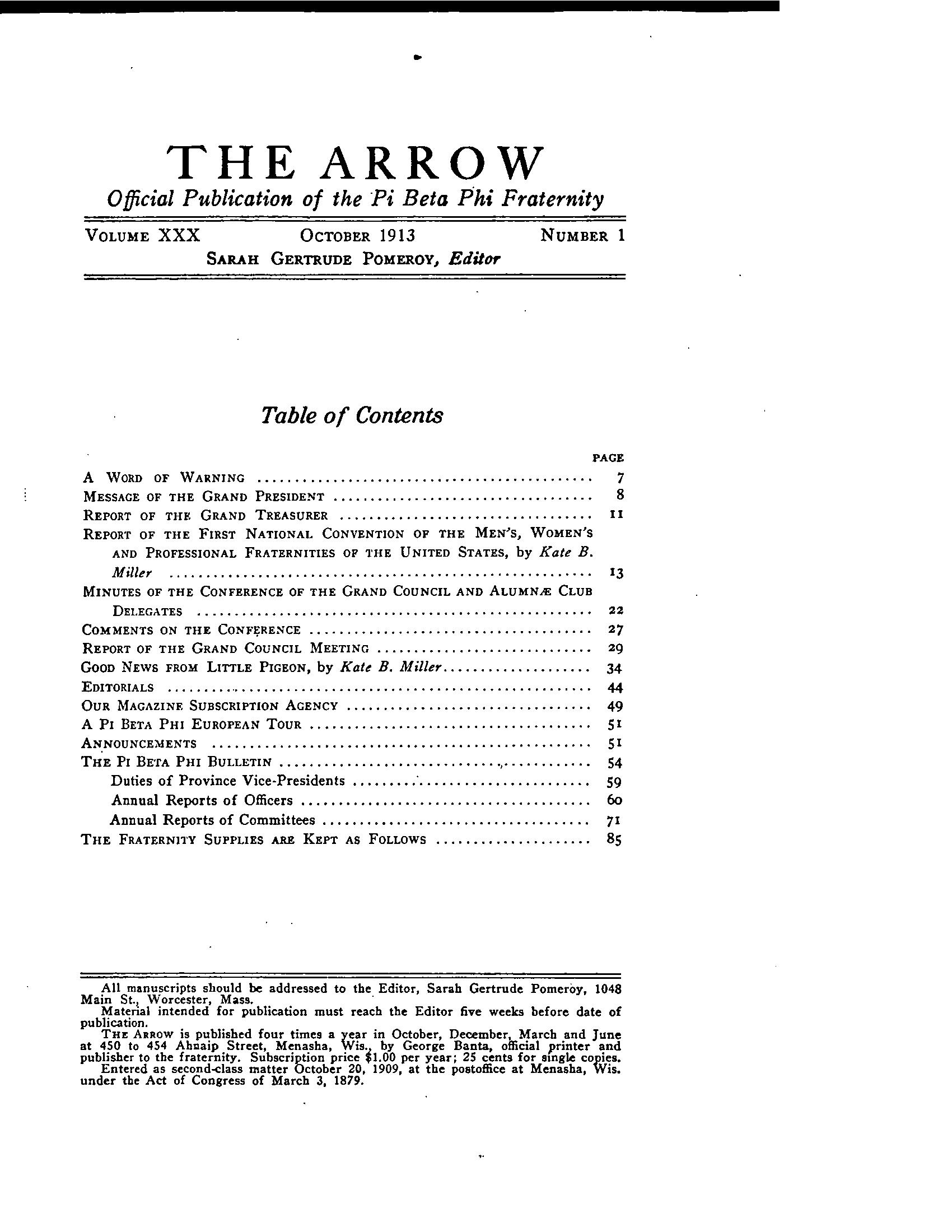
NUMBER
All manuscripts should be addressed to the Editor, Sarah Gertrude Pomeroy, 1048 Main St.t Worcester, Mass. " Matenal intended for publication must reach the Editor five weeks before date of publication. THE ARROW is published four times a ye:ar in October. December, March and June at 450 to 454 Abuaip Street, Menasha, Wis. by George Banta, official printer and publisher to the fraternity. price $1.00 per year; 25 cents for amgle cOJ!i,es. Entered as second-class matter October 20, 1909, at the poatoffice at Menasha, Wis. under the Act of Congress of March 3, 1879.
VOLUME XXX OCTOBER
SARAH GERTRUDE POMEROY, Editor
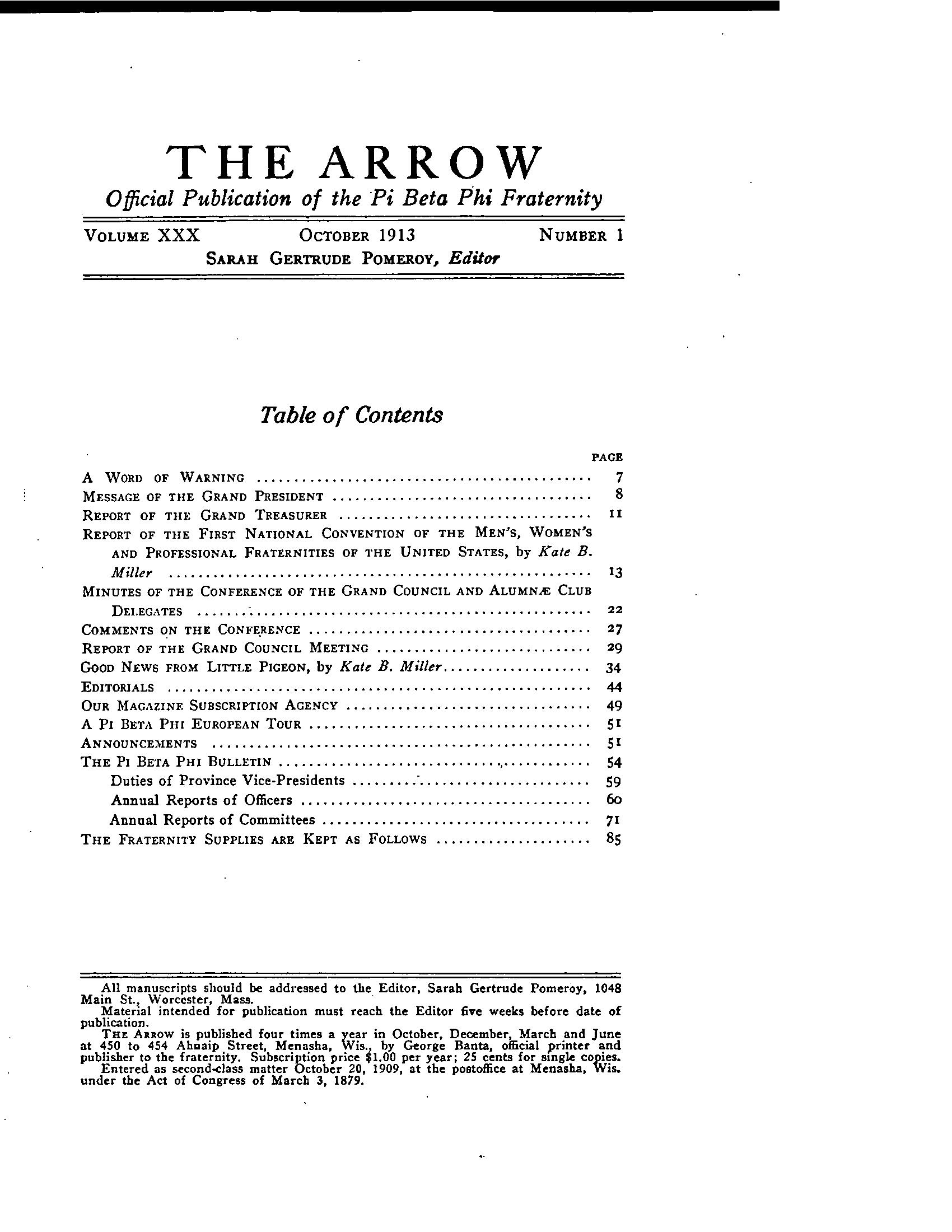
NUMBER
All manuscripts should be addressed to the Editor, Sarah Gertrude Pomeroy. 1048 Main St.t Worcester, Mass. Matenal intended for publication must reach the Editor five weeks before date of publication. THE Anow is publisbed four times a in October. December, March and June at 450 to 454 AhlJaip Street, Menasha, Wis. by George Banta, official printer and pubJisher to the fraternity. Subscription price $1.00 per year; 2S cents for smgle copi_es. Entered as second-class matter October 20, 1909, at the pOBtoffice at Menasha, Wis. under the Act of Congress of March 3, 1879.
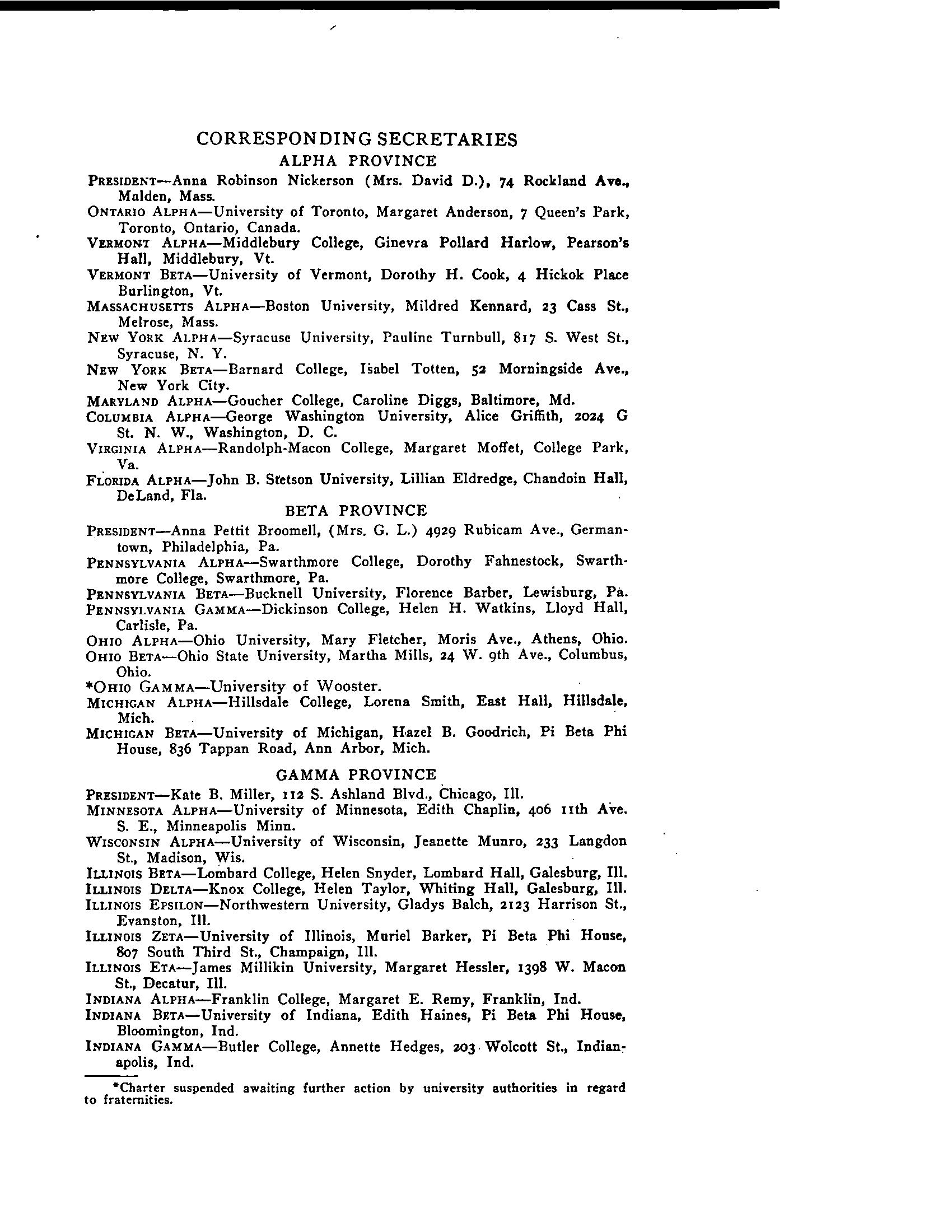
ALPHA PROVINCE
PRESIDENT-Anna Robinson Nickerson (Mrs. David D.), 74 Rockland Malden, Mass.
ONTARIO ALPHA-University of Toronto, Margaret Anderson, 7 Queen's Park, Toronto, Ontario, Canada.
VERMONT ALPHA-Middlebury College, Ginevra Pollard Harlow, Pearson'. Hall, Middlebury, Vt.
VERMONT BETA-University of Vermont, Dorothy H. Cook, 4 Hickok Pl""e Burlington, Vt.
MASSACHUSETTS ALPHA-Boston University, Mildred Kennard, 23 Cass St., Melrose, Mass.
NEW YORK ALPHA-Syracuse University, Pauline Turnbull, 817 S. West St., Syracuse, N. Y.
NEW YORK BETA-Barnard College, ISabel Totten, S2 Morningside Ave., New York City.
MARYLAND ALPHA-Goucher College, Caroline Diggs, Baltimore, Md.
COLUMBIA ALPHA-George Washington University, Alice Griffith, 2024 G St. N. W., Washington, D. C.
VIRGINIA ALPHA-Randolph-Macon College, Margaret Moffet, College Park, Va.
FLORIDA ALPHA-John B. Sretson University, Lillian Eldredge, Chandoin Hall, DeLand, Fla.
PRESIDENT-Anna Pettit Broomell, (Mrs. G. L.) 4929 Rubicam Ave., Germantown, Philadelphia, Pa.
PENNSYLVANIA ALPHA-Swarthmore College, Dorothy Fahnestock, more College, Swarthmore, Pa.
PENNSYLVANIA BETA-Bucknell University, Florence Barber, Lewisburg, Pa.
PENNSYLVANIA GAMMA-Dickinson College, Helen H. Watkins, Lloyd Hall, Carlisle, Pa.
OHIO ALPHA-Ohio University, Mary Fletcher, Moris Ave., Athens, Ohio.
OHIO BETA-Ohio State University, Martha Mills, 24 W. 9th Ave., Columbus, Ohio.
*OHIO GAMMA-University of Wooster.
MICHIGAN ALPHA-Hillsdale College, Lorena Smith, East Hall, Hillsdale, Mich.
MICHIGAN BETA-University of Michigan, Hazel B. Goodrich, Pi Beta Phi House, 836 Tappan Road, Ann Arbor, Mich.
GAMMA PROVINCE
PRESIDENT-Kate B. Miller, 112 S. Ashland Blvd., Chicago, III.
MINNESOTA ALPHA-University of Minnesota, Edith Chaplin, 406 lIth Ave. S. E., Minneapolis Minn.
WISCONSIN ALPHA-University of Wisconsin, Jeanette Munro, 233 Langdon St., Madison, Wis.
ILLINOIS BETA-Lombard College, Helen Snyder, Lombard Hall, Galesburg, III.
ILLINOIS DELTA-Knox College, Helen Taylor, Whiting Hall, Galesburg, III.
ILLINOIS EpSILON-Northwestern University, Gladys Balch, 2123 Harrison St., Evanston, Ill.
ILLINOIS ZETA-University of Illinois, Muriel Barker, Pi Beta Pbi House, 807 South Third St., Champaign, III.
ILLINOIS ETA-James Millikin University, Margaret Hessler, 1398 W. Macon St., Decatur, III.
INDIANA ALPHA-Franklin College, Margaret E. Remy, Franklin, Ind.
INDIANA BETA-University of Indiana, Edith Haines, Pi Beta Phi House, Bloomington, Ind.
INDIANA GAMMA-Butler College, Annette Hedges, 203· Wolcott St., Indian, apolis, Ind.
-Charter suspended awaiting further action by university authorities in regard to fraternities.
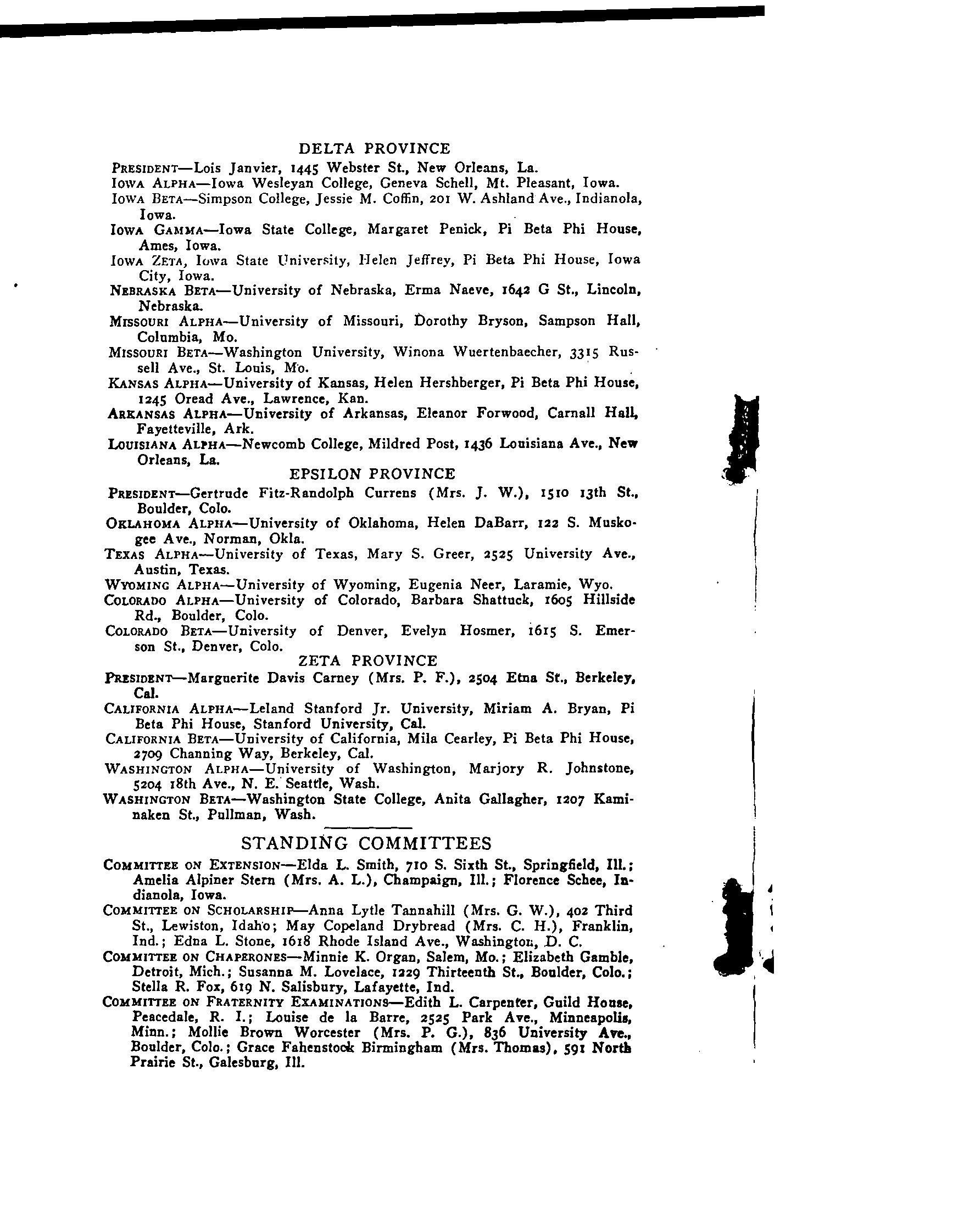
DELTA PROVINCE
PRESIDENT-Lois Janvier, 1445 Webster St, New Orleans, La.
IOWA ALPHA-Iowa Wesleyan College, Geneva Schell, Mt. Pleasant, Iowa.
IOWA BETA-Simpson College, Jessie M. Coffin, 201 W. Ashland Ave., Indianola, Iowa.
IOWA GAMMA-Iowa State College, Margaret Penick, Pi Beta Phi House, Ames, Iowa.
IOWA ZETA, Iowa State Vniver!'ity, Helen Jeffrey, Pi Beta Phi House, Iowa City, Iowa.
NEBRASKA BETA-University of Nebraska, Erma Naeve, 1642 G St., Lincoln. Nebraska.
MrsSOURI ALPHA-University of Missouri, Dorothy Bryson, Sampson Hall, Columbia, Mo.
MISSOURI BETA-Washington University, Winona Wuertenbaecher, 3315 Russell Ave., St. Louis, M'o. '
KANSAS ALPHA-University of Kansas, Helen Hershberger, Pi Beta Phi House, 1245 Oread Ave., Lawrence, Kan.
ARKANSAS ALPHA-University of Arkansas, Eleanor Forwood, Cam all Hall, Fayetteville, Ark.
LoUISIANA ALPHA-Newcomb College, Mildred Post, 1436 Louisiana Ave., New Orleans, La.
EPSILON PROVINCE
PRESIDENT-Gertrude Fitz-Randolph Currens (Mrs. J. W.), 1510 13th St., Boulder, Colo.
OKLAHOMA ALPHA-University of Oklahoma, Helen DaBarr, 122 S. Musko· gee Ave., Norman, Okla.
TEXAS ALPHA-University of Texas, Mary S. Greer, 2525 University Ave., A us tin, Texas.
WYOMING ALPHA-University of Wyoming, Eugenia NeeT, Laramie, Wyo.
COLORADO ALPHA-University of Colorado, Barbara Shattuck, 1605 Hillside Rd., Boulder, Colo.
COLORADO BETA-University of Denver, Evelyn Hosmer, i6rS S. Emerson St., Denver, Colo.
ZETA PROVINCE
PRESIDENT-Marguerite Davis Carney (Mrs. P. F.), 2504 Etna St., Berkeley, Cal.
CALIFORNIA ALPHA-Leland Stanford Jr. University, Miriam A. Bryan, Pi Beta Phi House, Stanford University, Cal.
CALIFORNIA BETA-University of California, Mila Cearley, Pi Beta Phi House, 2709 Channing Way, Berkeley, Cal.
WASHINGTON ALPHA-University of Washington, Marjory R. Johnstone, 5204 18th Ave., N. E.' Seattle, Wash.
WASHINGTON BETA-Washington State College, Anita Gallagher, 1207 Kami· naken St., Pullman, Wash.
COMMITTEE ON EXTENSION-Elda L. Smith, 710 S. Sixth St., Springfield, Ill.; Amelia Alpiner Stern (Mrs. A. L.), Champaign, Ill.; Florence Schee, Indianola, Iowa.
COMMITTEE ON SCHOLARSHIP-Anna Lytle Tannahill (Mrs. G. W.), 402 Third St., Lewiston, Idab'o; May Copeland Drybread (Mrs. C. H.), Franklin, Ind.; Edna L. Stone, 1618 Rhode Island Ave., Washington, D. C.
COMMITTEE ON CHAPERONES-Minnie K. Organ, Salem, Mo.; Elizabeth Gamhle, Detroit, Mich.; Susanna M. Lovelace, 1229 Thirteenth St., Boulder, Colo.; Stella R. Fox, 619 N. Salisbury, Lafayette, Ind.
COMMITTEE ON FRATERNITY EXAMINATIONS-Edith L. Carpenter, Guild Hoa , Peacedale, R. I.; Louise de 1a Barre, 2525 Park Ave., Minneapolis, Minn.; MoWe Brown Worcester (Mrs. P. G.), 836 University Ave., Boulder, Colo.; Grace Fahenstoac Birmingham (Mrs. Thomas), 591 North Prairie St., Galesburg, Ill.
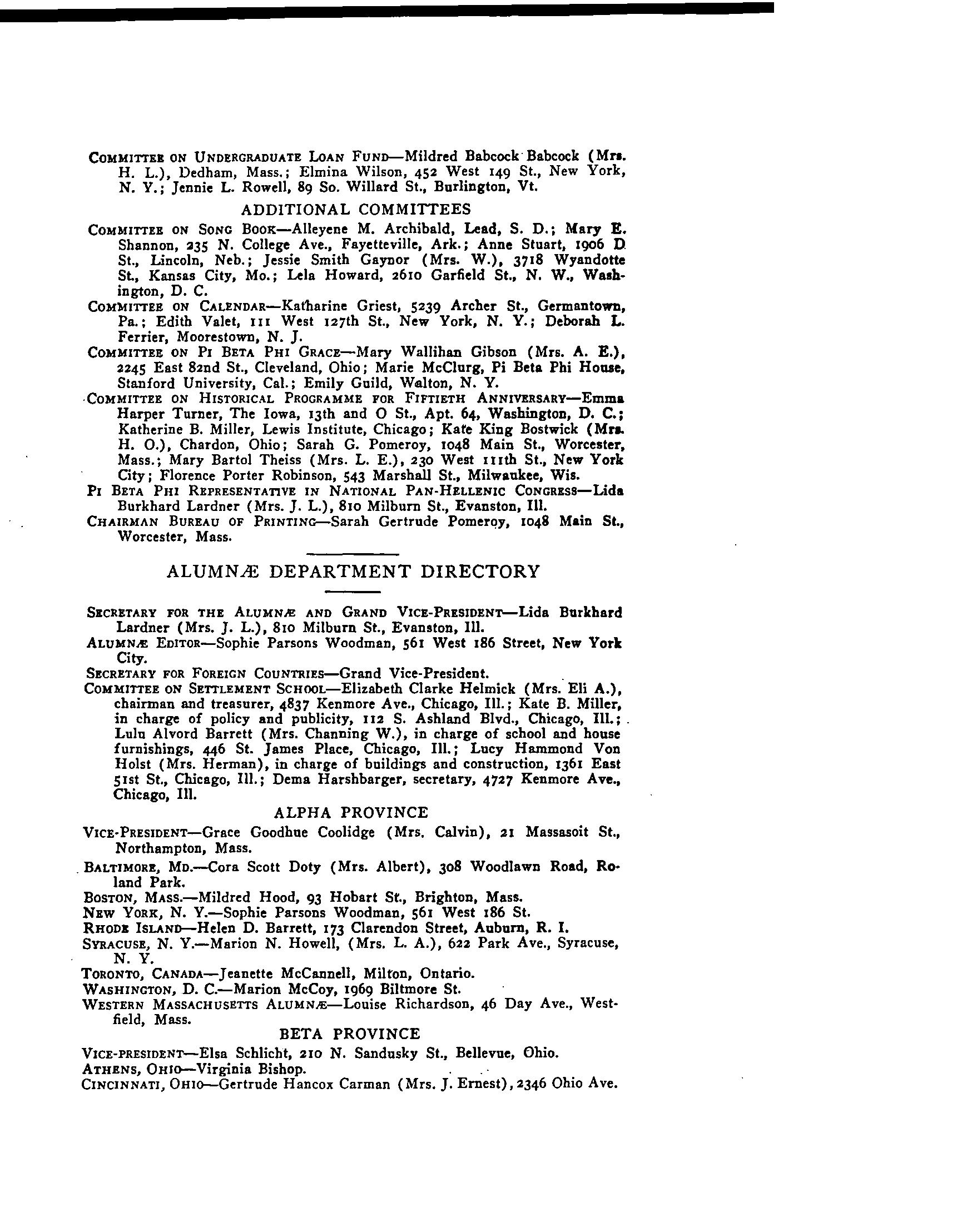
COMMITTE!! ON UNDERGRADUATE LoAN FUND-Mildred Babcock· Babcock (Mn. H. L.), Dedham, Mass.; Elmina Wilson, 452 West 149 St., New York, N. Y.; Jennie L. Rowell, 89 So. Willard St., Burlington, Vt.
COMMITTEE ON SONG BooK-Alleyene M. Archibald, Lead, S. D.; Mary E. Shannon, '35 N. College Ave., Fayetteville, Ark.; Anne Stuart, 1906 D St., Lincoln, Neb.; Jessie Smith Gaynor (Mrs. W.), 3718 Wyandotte St, Kansas City, Mo.; Lela Howard, 2610 Garfield St., N. W., Washington, D. C.
COH)UTTEB ON CALENDAR-Katharine Griest, 5239 Archer St., Germantown, Pa.; Edith Valet, III West 127th St., New York, N. Y.; Deborah L. Ferrier, Moorestown, N. J.
COMMITTEE ON PI BETA PHI GRACE-Mary Wallihan Gibson (Mrs. A. E.), 2245 East 82nd St., Cleveland, Ohio; Marie McClurg, Pi Beta Phi House, Stanford University, Ca\.; Emily Guild, Walton, N. Y.
-COMMITTEE ON HISTORICAL PROGRAMME FOR FIFTIETH ANNIVERSARy-Emma Harper Turner, The Iowa, 13th and 0 St., Apt. 64, Washington, D. C.; Katherine B. Miller, Lewis Institute, Chicago; Kate King Bostwick (M ... H. 0.), Chardon, Ohio; Sarah G. Pomeroy, 1048 Main St., Worce.ter, Mass.; Mary Bartol Theiss (Mrs. L. E.), 230 West lII1h St., New York City; Florence Porter Robinson, 543 Marshall St., Milwankee, Wis. PI BETA PHI REPRESENTATIVE IN NATIONAL PAN·HELLENIC CONGRESS-Lida Burkhard Lardner (Mrs. J. L.), 810 Milburn St., Evanston, Ill.
CHAIRMAN BUREAU OF PRINTING--Sarah Gertrude Pomerqy, 1048 Main St., Worcester, Mass.
ALUMNJE DEPARTMENT DIRECTORY
SECRETARY FOR THE ALUMNJE AND GRAND VICE-PRESIDENT-Lida Burkhard Lardner (Mrs. J. L.), 810 Milburn St., Evanston, Ill.
ALUMNJE EDITOR-Sophie Parsons Woodman, 561 West 186 Street, New York City.
SECRETARY FOR FOREIGN COUNTRIEs-Grand Vice-President. CO .... ITTEE ON SETTLEMENT SCHOOL-Elizabeth Clarke Helmick (Mrs. Eli A.), chairman and treasurer, 4837 Kenmore Ave" Chicago, Ill.; Kate B. Miller, in charge of policy and publicity, 112 S. Ashland Blvd., Cbicago, Ill.; Lulu Alvord Barrett (Mrs. Channing W.), in charge of school and house furnishings, 446 St. James Place, Cbicago, Ill.; Lucy Hammond Von Holst (Mrs. Herman), in charge of buildings and construction, 1361 East 51St St., Chicago, Ill.; Dema Harshbarger, secretary. 4727 Kenmore Ave., Cbicago, Ill.
ALPHA PROVINCE
VICE,PRESIDENT-Grace Goodbue Coolidge (Mrs. Calvin), 21 Massasoit St., Northampton, Mass
BALTI ORE, MD.-Cora Scott Doty (Mrs. Albert), 308 Woodlawn Road, Roland Park.
BOSTON, MASS.-Mildred Hood, 93 Hobart St., Brighton, Mass. NEW YORK, N. Y.-Sophie Parsons Woodman, 561 West 186 St. RHODl< ISLAND-Helen D. Barrett, 173 Clarendon Street, Auburn, R. I. SYRACUSE, N. Y.-Marion N. Howell, (Mrs. L. A.), 622 Park Ave., Syracuse, N. Y.
TORONTO, CANADA-Jeanette McCannell, Milton, Ontario. WASHINGTON, D. C.-Marion McCoy, 1969 Biltmore St. WESTERN MASSACHUSETTS ALUMNJE-Louise Richardson, 46 Day Ave., West· field, Mass.
BETA PROVINCE
VICE-PRESIDENT-Elsa Schlicht, 210 N. Sandusky St., Bellevue, Ohio. ATHENS, OHl<>-Virginia Bishop. . CINCINNATI, OHI<>-Gertrude Hancox Carman (Mrs. J. Ernest), 2346 Ohio Ave.
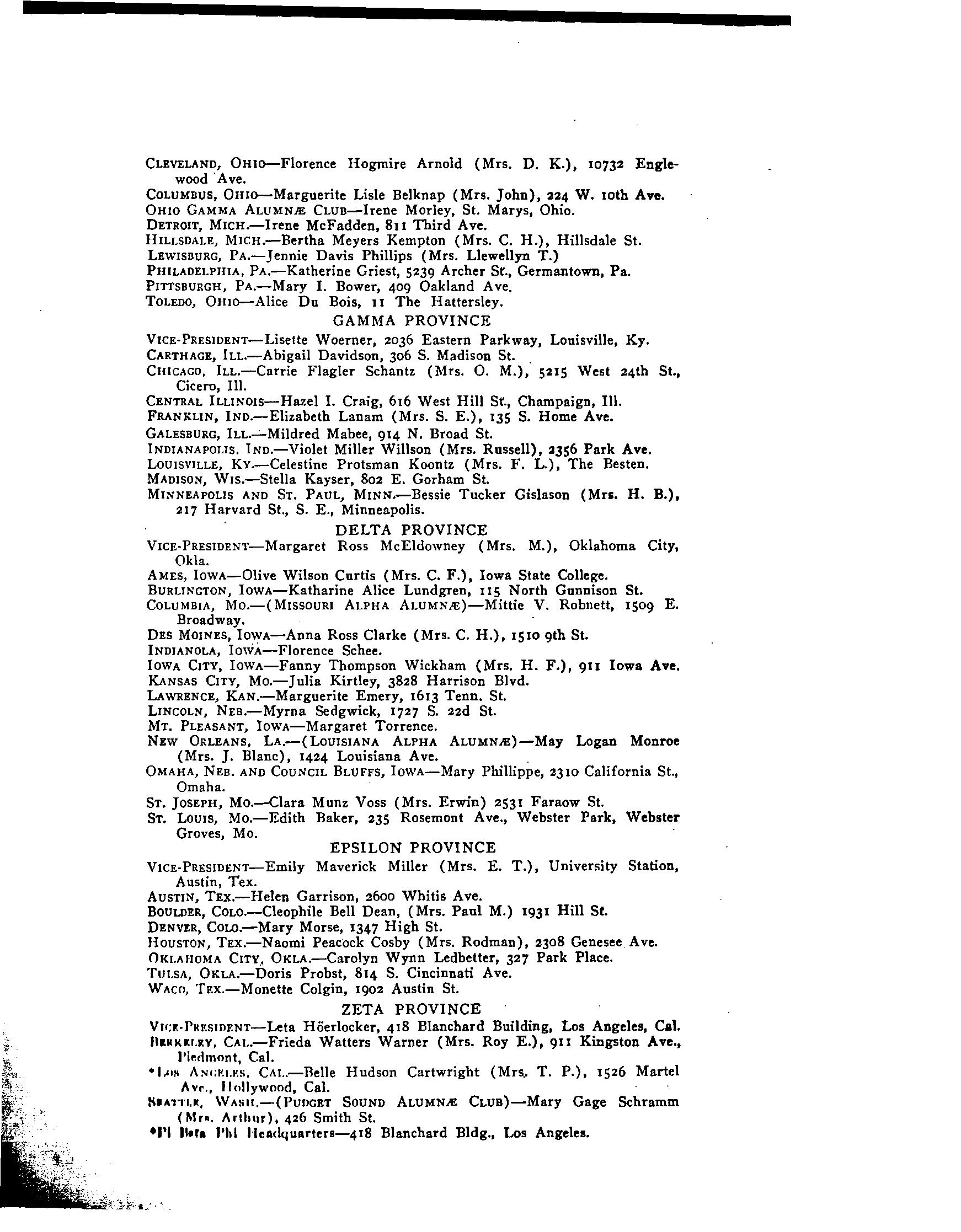
CLEVELAND, OHIO-Florence Hogmire Arnold (Mrs. D. K.), 10732 Englewood "Ave.
COLUMBUS, OHIo-Marguerite Lisle Belknap (Mrs. John), "4 W. loth Ave. OHIO GAMMA ALUMNJE CLUB-Irene Morley, St. Marys, Ohio.
DETROIT, MICH.-Irene McFadden, 811 Third Ave.
HILLSDALE, MICH.-Bertha Meyers Kempton (Mrs. C. H.), Hillsdale St. LEWISBURG, PA.-Jennie Davis Phillips (Mrs. Llewellyn T.)
PHILADELPHIA, PA.-Katherine Griest, 5239 Archer Sr., Germantown, Pa. PITTSBURGH, PA.-Mary I. Bower, 409 Oakland Ave.
TOLEDO, OHIo-Alice Du Bois, II The Hattersley.
GAMMA PROVINCE
VICE-PRESIDENT-Lisette Woerner, 2036 Eastern Parkway, Louisville, Ky.
CARTHAGE, ILL.-Abigail Davidson, 306 S. Madison St. . CHICAGO. ILL.-Carrie Flagler Schantz (Mrs. O. M.), 5215 West 24th St., Cicero, Ill.
CENTRAL ILLINOis-Hazel I. Craig, 616 West Hill Sr., Champaign, Ill. FRANKLIN, IND.-Elizabeth Lanam (Mrs. S. E.), 135 S. Home Ave. GALESBURG, ILL.-'-Mildred Mabee, 914 N. Broad St.
INDIANAPOLIS. IND.-Violet Miller Willson (Mrs. Rossell), '356 Park Ave. LOUISVILLE, KY.-Celestine Protsman Koontz (Mrs. F. L), The Besten. MADISON, WIs.-Stella Kayser, 802 E. Gorham St.
MINNEAPOLIS AND ST. PAUL, MINN.-Bessie Tucker Gislason (Mrs. H. B.). 217 Harvard St., S. E., Minneapolis.
DELTA PROVINCE
VICE·PRESIDENT-Margaret Ross McEldowney (Mrs. M.), Oklahoma City, Okla.
AMES, IOWA-Olive Wilson Curtis (Mrs. C. F.), Iowa State College. BURLINGTON, IOWA-Katharine Alice Lundgren, liS North Gunnison St. COLUMBIA, Mo.-(MISSOURI ALPHA ALUMNAl)-Mittie V. Robnett, 1509 E. Broadway.
DES MOINES, IOWA-Anna Ross Clarke (Mrs. C. H.), 1510 9th St. INDIANOLA, JmvA-Florence Schee. IOWA CITY, IOWA-Fanny Thompson Wickham (Mrs. H. F.), 911 Iowa Ave. KANSAS CITY, Mo.-Julia Kirtley, 3828 Harrison Blvd. LAWRENCE, KAN.-Marguerite Emery, 1613 Tenn. S1. LINCOLN, NEB.-Myrna Sedgwick, 1727 S. 22d St. ?t.IT. PLEASANT, IOWA-Margaret Torrence.
NEW ORLEANS, LA.-(LaUISIANA ALPHA ALUMNA!)-May Logan Monroe (Mrs. J. Blanc), '424 Louisiana Ave. OMAHA, NEB. AND COUNCIL BLUFFS, IOWA-Mary Phillippe, 2310 California St., Omaha.
ST. JOSEPH, Mo.-Clara Munz Voss (Mrs. Erwin) 2531 Faraow St. ST. LoUIS, Mo.-Edith Baker, 235 Rosemont Ave., Webster Park, Webster Groves, Mo.
EPSILON PROVINCE
VICE· PRESIDENT-Emily Maverick Miller (Mrs. E. T.), University Station, Austin, Tex.
AUSTIN, TEx.-Helen Garrison, 2600 Whitis Ave. BOULDER, COLO.-Cleophile Bell Dean, (Mrs. Paul M.) 1931 Hi1I St. DENnR, COLO.-Mary Morse, 1347 High St. HOUSTON, TEx.-Naomi Peacock Cosby (Mrs. Rodman), 2308 Genesee, Ave. OKl.AHOMA CITY. OKLA.-Carolyn Wynn Ledbetter, 327 Park Place. TULSA, OKLA.-Doris Probst, 814 S. Cincinnati Ave. WACO, TEx.-Monette Colgin, 1902 Austin St. ZETA PROVINCE
V,,;o·rKESlDF.NT-Leta Hiierlocker, 418 Blanchard Building, Los Angeles, Cal. "IMKll..V, CAt..-Frieda Watters Warner (Mrs. Roy E.), 911 Kingston Ave., J'if!flmont, Cal.
-I,," AN" •. 1. S. CAt..-Belle Hudson Cartwright T. P.), 1526 Martel Avr., lIollywood, Cal.
K.. n"o. WASII.-(PUDGET SOUND ALUMNA! CLUB)-Mary Gage Schramm (M". Arlhur), 4.6 Smith St. 0"1 .Ior. "hl lloAdquDrlers-4I8 Blanchard Bldg., Los Angeles.
VOLUME XXX
OCTOBER 1913 NUMBER 1
The reason for the appearance of a secret number of THE ARROW at this time is explained in The Message of the Grand President. The contents of this number are of an intimate nature and should be regarded in the nature of family secrets. In order to secure privacy, all subscribers who cannot keep this number away from the public are asked to destroy it, as soon as read but provision should be made to keep several copies in a safe place for reference when needed in each alumnre club and each active chapter! This is necessary because *at least five questions in the next fraternity examination will be based upon the information given in this number. For this reason, several copies should be kept in the archives of each chapter but they should never be read outside of the chapter room and should not be allowed in public rooms of any kind whether in dormitory or chapter house.· Every word printed in this number is of interest to every Pi Phi; especially, all are urged to to read the Message of the Grand President and the editorials and every alumna should read the report of the Alumnre Club Conference and the report of the Alumnre Editor.
This number of THE ARROW is being sent to all those whose subscription actually expired with the June issue. As most of the clubs are not in running order as early 8S October first it was thought wise to do this because back numbers can not be guaranteed to those whose renewals come in late. It is hoped that all whose wrappers say "13" or "13N" will appreciate this fact.
*See page 83.
For many years the annual letters of the Grand President and Grand Vice-President have heen supposed to supply information of such a nature as was deemed too personal for publication in THE ARROW to members of both alumnre clubs and active chapters. With the growth of the fraternity, however, and the expansion of the work along so many different lines, these annual messages have failed to meet all requirements and many additional bulletins have been needed. And still the cry has continued, "More information"! In consequence of this demand it was decided at the recent Grand Council meeting to publish for the next two years a secret issue of THE ARROW early in the fall, which should contain a more detailed account of the plans and policies of the fraternity than would be possible in an open issue, and which should combine the various messages and bulletins in more compact form than has been the custom heretofore.
The Grand Vice- President's letter will take up the suggestions, which have been the outgrowth of the Alumnre Conference in Chicago, but this message will deal with some of the resolutions affecting active chapters, which were acted upon at this Conference and sent as recommendations to the Grand Council for final consideration. As the Grand Council has made several changes in the constitution as the result of these recommendations every member of IT B 4> is strongly urged to read the new constitution and to note carefully the changes.
As many alumnre and active members seem much disturbed over extension and have even criticised the judgment of the Grand Council in its extension policy-(usually when adequate information was lacking, however) the opinion of the delegates to the first Alumnre Conference may carry weight. After long and serious debate the decision was unanimously in favor of judicious extension. As a matter of fact the entire fraternity system is on' trial. for its 1i fe, a wave of democracy is sweeping the country and the fraterniiy question is up before several state legislatures, the fight is lost at Woostcr, and the Barnard chapter is suspended for three years. 0" May 30 and 31, a mass meeting of all fraternities was called at Ihe Blackstone Hotel in Chicago to consider the situation. Fifty-
five fraternities responded to the call, and Mr. Shepardson, University of Chicago, voiced the sentiment of the meeting when he said: "The fraternities themselves are largely to blame for this condition of affairs; they are doomed in several of the state universities, and they must be more democratic or go to the wall." He advocated in strongest terms extension into colleges as well as state universities, thereby strengthening alumni influence in the state, and the taking in of larger groups of men and women: He also urged cooperation everywhere and united Pan-Hellenic action. In another section wiil be found a full account of the founding, of a cooperative Fraternity Bureau of Statistics, and other items of interest pertaining to this conference. The groups at Drury College and St. Lawrence University are still petitioning, and a group at Kansas State Agricultural College, Manhattan, is anxious to petition but the college does not yet meet our requirements. Other petitions received have been from colleges below the required standing.
The death of Mr. Severance, the trustee so opposed to fraternities at Wooster, puts a new aspect upon the situation, and the men's fraternities still hope for favorable action of some description, which will restore fraternities to Wooster. At Barnard fraternities have been suspended for three years. No united action has been attempted by the fraternities represented, and no definite policy will be adopted before the opening of the college in the fall. The faculty of Barnard hope by this means to check effectually all secret societies and to organize a system of locals under faculty control. Secrecy seems to be the greatest objection raised against the system by the commission.
I. After much discussion the plan of publishing the annual letters under the supervision of the cataloguer has been abandoned, and a return has been made to the former custom of having each· chapter print its own letter before July first each year. Although it may appear so at first sight this step is not retrogressive, the reason for the change being that while theoretically the plan is admirable, practically it has been a failure. <I> r a, <I> a ® and others have had a similar experience and abandoned the idea as impractical. It has been expensive, many chapters have felt that the tax was too
heavy, and have complained of the added burden, claiming that the printing could be done more cheaply in their own home towns. Furthermore it has been felt by many that the annual letter is but a resurne of the four chapter letters, which appear in THE ARROW and reach nearly all alumnae. The list of alumnre, which is of great importance, with names, degrees, and addresses will .be published by the cataloguer in the form of a supplement as heretofore. This year, realizing that the annual letters have been long overdue, the Grand Council has decided to pay the bills from the Grand Treasury, but owing to the size of the bill (about $800) and the depleted state of the treasury, a small tax will have to be levied on each chapter, while the fraternity pays the greater portion of the bill.
2. Feeiing that greater cooperation between alumnre and active members was desirable, the Grand Council have decided that each chapter shall have an Alumnre Advisory Committee, consisting of five members, three of whom are to be elected by the active chapter, and two to be appointed by the nearest alumnre club. There shall be a chairman of this committee whose duty it shall be to call together the committee whenever necessary, and also to furnish, by October 15, both Grand President and Grand Vice-President with a fun list of her committee. The duties of the committee are stated in *Statutes IV, Sec. 15, and Statutes V, Sec. 8, of the new edition of the consti tu tion.
3. A fine of $10 will be imposed for failure to take annual examination, unless a satisfactory excuse is sent to some member of the examining committee.
4. Due to the fact that the July issue of THE ARROW with cuts of chapter pictures costs the fraternity treasury over $1000, it has been deemed expedient to enforce the requirement that each chapter iurnish $5 worth of advertising, or send $5 in cash to pay for the picture.
5. Pi Beta Phi is sending as a recommendation to the Pan-Hellenic Conference the following, which all Pi Phis should note: "After September, 1915, no girl, who shall accept or retain membership in a high school fraternity, shall be initiated into Pi Beta Phi." This is done with the direct object of breaking up high school fraternities.
The President also wishes to announce to all members of (::IIllIll:l. Province the appointment of Miss Kate Miller of Chicago,
• S.'" Pl'. in this number of THE ARROW.
as Province President, in place of Miss Abbie Langmaid, who resigned to become head of the Settlement School at Gatlinburg. In response to the letter sent out last spring concerning the raising of the annual dues $1 per semester in order to meet the expenses of a convention in California, only four chapters voted un' favorably. Several chapters failed to reply, but the matter was decided in favor of a coast convention by an overwhelming majority. It may be well also to call attention to the fact that the initiation dues in the future will be $16 instead of $11, due to the raising of life membership subscription to THE ARROW from $5 to $10. Appended to this letter will be a financial statement from the Grand Treasurer, showing the present condition of the three funds, and the need for changes in our financial policy.
With the hope that the coming year may be one of great success and prosperity for all our alumnre clubs and active chapters, and with cordial greetings to all Pi Phis, Fraternally yours, MAY LANSFIELD KELLER
for the year I9 I2 - I 9I3
ARROW FUND RECEIPTS
Chapter Dues , , " , $
Alumnae Subscriptions
Four Year Arrow Fund
Chapter ARROW File
Delinquent Dues Advertisements
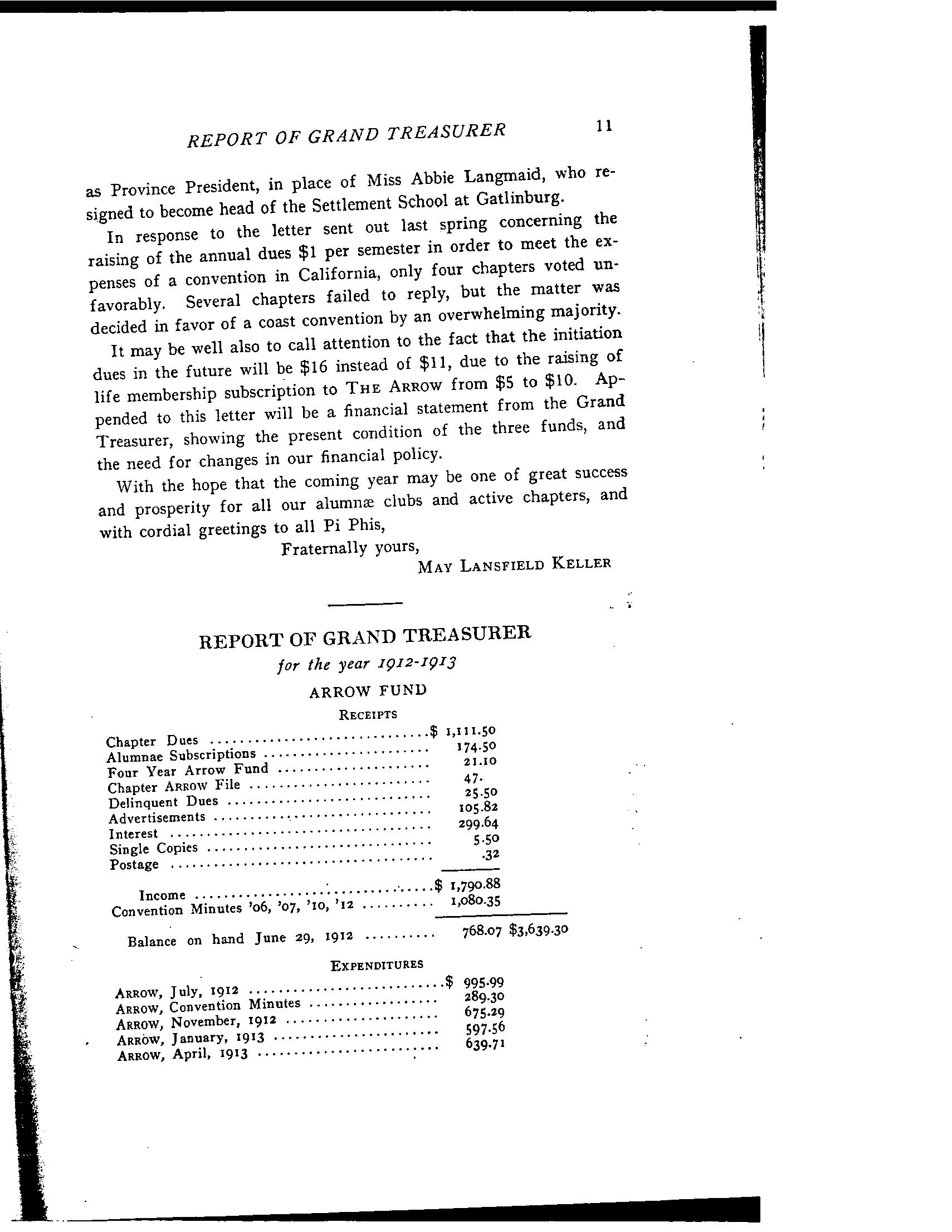
Balance on hand June 29, 19 12 ......... .
ARROW, July, 19 12 $ ARROW, Convention Minutes .....
ARROW, November, 19 12 ............•........
ARROW, JaDuary, 19 13 ......................
ARROW, April, 19 13 ........................
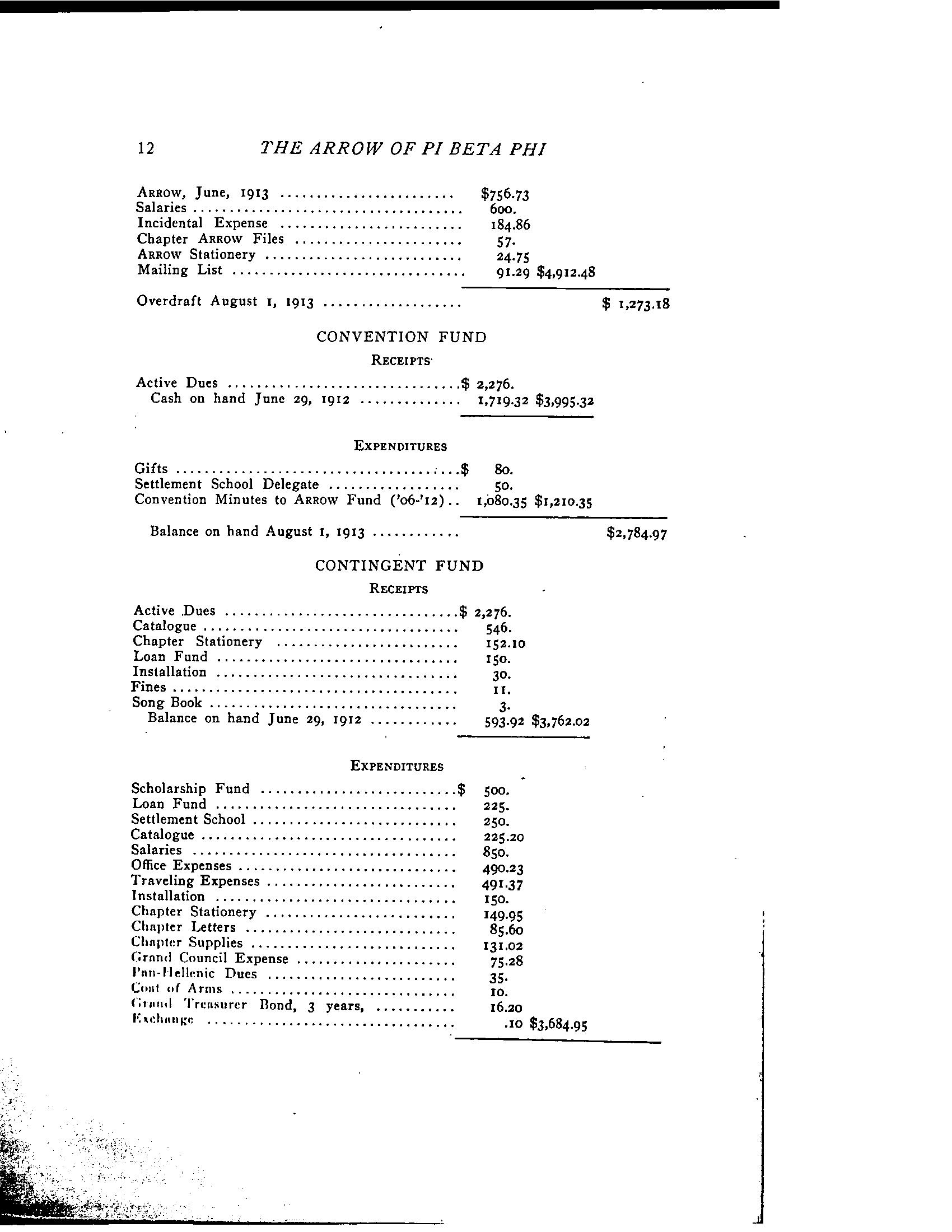
Chnl1tc:r Supplies
Cc.nl elf Arnls
Cnllld
OF CONVENTION OF FRATERNITIES 13
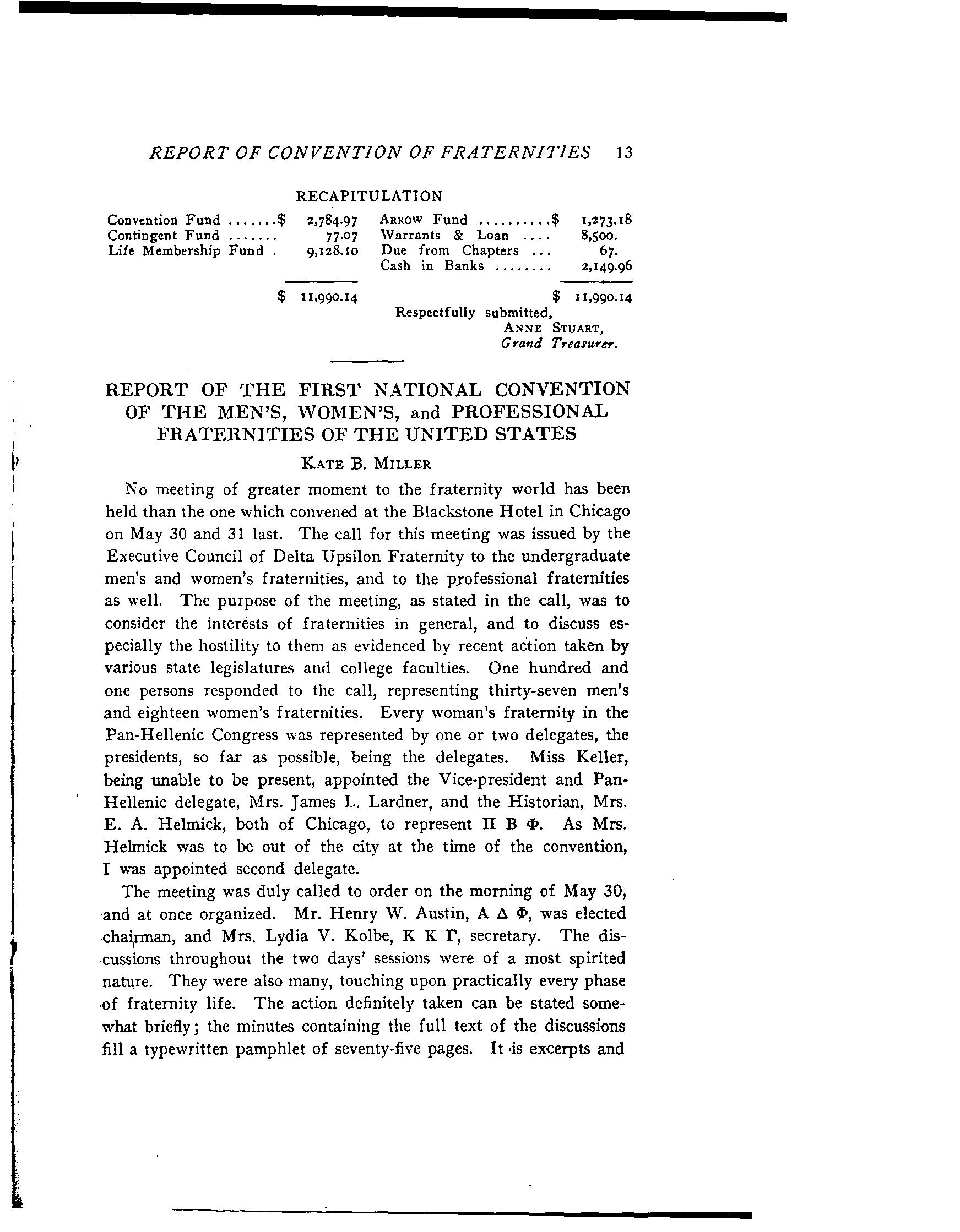
Convention Fund $ Contingent Fund ...... . Life Membership Fund
2,7 84.97 770 0 7 9,128.10
ARROW Fund $ \Varrants & Loan Due from Chapters Cash in Banks
1,273. 18 8,500. 67. 2,149.9 6
$ 11,990. 14 $ 11,990 14
Respectfully submitted, ANNE STUART, G rand Treasurer.
KATE B. MILLER
No meeting of greater moment to the fraternity world has been held than the one which convened at the Blackstone Hotel in Chicago on May 30 and 31 last. The call for this meeting was issued by the Executive Council of Delta Upsilon Fraternity to the undergraduate men's and women's fraternities, and to the p.rofessional fraternities as well. The purpose of the meeting, as stated in the call, was to consider the interests of fraternities in general, and to discuss especially the hostility to them as evidenced by recent action taken by various state legislatures and college faculties. One hundred and one persons responded to the call, representing thirty-seven men's and eighteen women's fraternities. Every woman's fraternity in the Pan- Hellenic Congress was represented by one or two delegates, the presidents, so far as possible, being the delegates. Miss Keller, being unable to be present, appointed the Vice-president and PanHellenic delegate, Mrs. James L. Lardner, and the Historian, Mrs. E. A. Helmick, both of Chicago, to represent II B.p. As Mrs. Helmick was to be out of the city at the time of the convention, I was appointed second delegate.
The meeting was duly called to order on the morning of May 30, and at once organized. Mr. Henry W. Austin, A .p, was elected .chai,rman, and Mrs. Lydia V. Kolbe, K K r, secretary. The dis·cussions throughout the two days' sessions were of a most spirited nature. They were also many, touching upon practically every phase ·of fraternity life. The action definitely taken can be stated somewhat briefly; the minutes containing the full text of the discussions ·fill a typewritten pamphlet of seventy-five pages. It ·is excerpts and
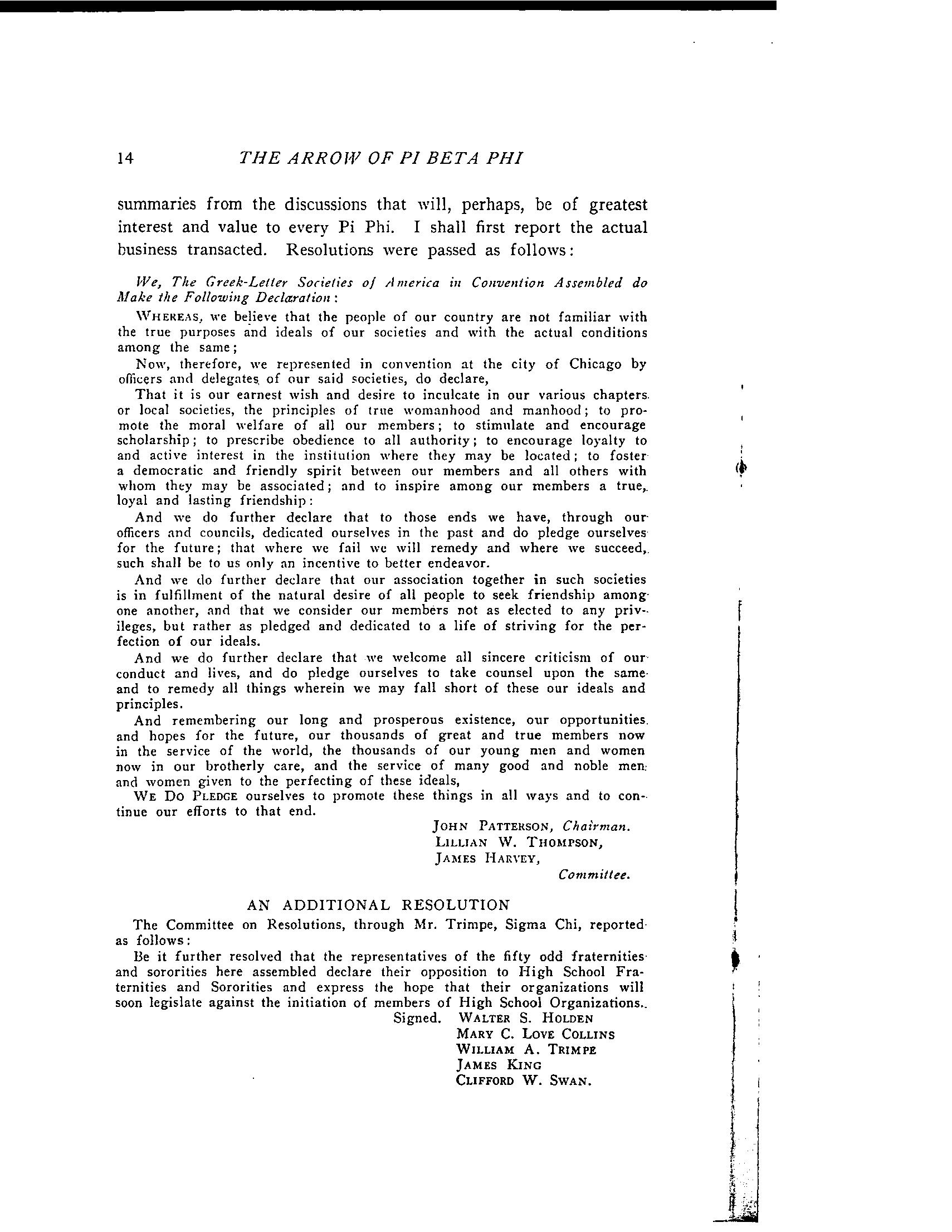
summaries from the discussions that will, perhaps, be of greatest interest and value to every Pi Phi. I shall first report the actual business transacted. Resolutions were passed as follows:
Tlte Greek-Lefler Societies 0/ America ill Convention Assembled do Afake the Following Declaralion:
\VHEKE:\S, we believe that the people of our country are not familiar with the true purposes and ideals of our societies and with the actual conditions among the same j
Now, thertfore, we represented in convention at the city of Chicago by officers and delegates, of our said societies, do declare,
That it is our earnest wish and desire to inculcate in our various chapters. or local societies, the principles of true womanhood and manhood; to promote the moral welfare of all our members; to stimulate and encourage scholarship; to prescribe obedience to all authority; to encourage loyalty to and active interest in the institution where they may be located; to foster a democratic and friendly spirit between our members and all others with whom they may be associated; and to inspire among our members a true,. loyal and lasting friendship:
And we do further declare that to those ends we have, through ourofficers and councils. dedicated ourselves in the past and do pledge ourselves for the future; that where we fail \VC will remedy and where we succeed •. such shall be to us only an incentive to better endeavor.
And we do further declare that our association together in such societies is in fulfillment of the natural desire of all people to seek friendship amongone another, and that we consider our members not as elected to any priv-ileges, but rather as pledged and dedicated to a life of striving for the perfection of our ideals.
And we do further declare that we welcome all sincere criticism of our· conduct and lives, and do pledge ourselves to take counsel upon the sameand to remedy all things wherein we may fall short of these our ideals and principles.
And remembering our long and prosperous existence, our opportunities_ and hopes for the future. our thousands of great and true members now in the service of the world, the thousands of our young men and women now in our brotherly care, and the service of many good and noble men: and women given to the perfecting of these ideals,
WE Do PLEDGE ourselves to promote these things in all ways and to con-tinue our efforts to that end.
JOHN PATTERSON. Cha:'rman. LILLIAN \V. THOMPSON, JAMES HARYEY. Committee.
The Committee on Resolutions, through Mr. Trimpe, Sigma Chi, reportedas follows:
Be it further resolved that the representatives of the fifty odd fraternitiesand sororities here assembled declare their opposition to High School Fraternities and Sororities and express the hope that their organizations will soon legislate against the initiation of members of High School Organizations
Signed. WALTER S. HOLDEN
MARY C. LOVE COLLINS
WILLIAM A. TRIMPE
JAMES KING
CLIFFORD W. SWAN.
A National Executive Conunittee was elected to serve for an indefinite time, with power to fill vacancies in its membership, to call another meeting of ·all the fraternities when necessary, and to establish a Reference Bureau in Chicago. The resolutions 'establishing the Bureau are as follows:
WHEREAS, there has recently been threatened legislation hostile to fraternities in some states, and anti-fraternity action by faculties in some American colleges and universities;
And, whereas, there is need for combined action on the part of the fraternities to combat the enactment of such hostile laws and regulations i and,
Whereas, action looking to this end ought to be initiated in the shortest, quickest and most effective way j
Therefore, be it resolved, by the representatives of the fifty-five fraternities represented at this conference that there be established as soon as practicable a Bureau of Information at Chicago, Illinois, to be maintained by intercollegiate fraternities of the United States, to be known as The College Fraternity Bureau.
It shall be the duty of this Bureau:
(a) To collect and maintain a reference library containing all accessible data concerning fraternities, with reference to pending or threatened antifraternity action by legislatures or faculties.
(b) To furnish such data to the local organizations of various universities and colleges as these organizations may find such data necessary.
(c) To conduct in such manner as may seem best, a campaign of publicity calculated to disseminate knowledge concerning fraternities among the American people, and particularly in those states where the fraternities have been, or are likely to be, attacked, that will tend to explain fairly the aims and purposes of fraternities and to eradicate and overcome false statements and impressions.
Such Bureau shall be managed and controlled by an Executive Committee of ten members of whom not less than three shall be members of sororities and at least one of whom shall be n member of a professional fraternity. Such Executive Committee shall be selected in such manner as this conference shall determine.
The adoption of this report shall not obligate or bind any fraternty in any manner whatsoever to support said Bureau, but if this report is adopted by a majority vote, the roll of fraternities represented shall be called and those whose delegates are authorized to do so, may pledge themselves to support such Bureau and to pay their proportionate cost thereof. Those delegates who are not authorized to act for their respective fraternities are urged to place 'the matter before their fraternities to the end that such fraternities shall take definite action upon the matter as soon as practicable.
In case this resolution shall be adopted, all intercollegiate fraternities not here represented, including all professional intercollegiate fraternities, shall be advised of the action taken and cordially invited to co-operate in the majntenance of said Bureau.
The National Executive Committee elected by the Convention is composed of the following Greeks:
Henry W. Austin, A I:>. <1>, Chicago, Ill.
William C. Levere, A E, Evanston, Ill.
John Calvin H!inna, B €I II, Oak Park, Ill.
Ralph M. Jackman, A Y, Madison, Wis.
Wells Cook, <I> Kl, Chicago, Ill.
Emmett A. Donnelly, <I> A <1>, Milwaukee, Wis.
Dr. Charles Humes, <I> X, Indianapolis, Ind.
Mrs. J. H. McElroy, A <1>, Chicago, IiI.
Mrs. J. L. Lardner, II B <1>, Evanston, Ill.
Mrs. P. R. Kolbe, K K r, Akron, Ohio.
The work is to be financed by an annual contribution of $25.0(} from each fraternity. While all the delegates present were not authorized to bind their fraternities, yet enough were to insure the· support of the Bureau. The other delegates promised to recommend such payment to their various fraternities. The committee at the· close of the convention at once organized under the name of "The· College Fraternity Reference Bureau" with the following officers:: Chairman, Henry W. Austin; Vice-chairmen, Mrs. James L. Lardner, Wells M. Cook; Secretary and Treasurer, William C. Levere,. Box 254, Evanston, Illinois.
This action was not taken with the convention in a quiescent state;: every man seemed to have come for the purpose of saying something,. and he said it several times. The women spoke but seldom; they· held the balance of power. Representatives from the Pan-HellenicCongress had met a few days before, formulated recommendations,. and decided upon their course of action. They could afford, therefore, to listen, interestedly but quietly, to what, at the beginning of· the convention, seemed like a big, rushing stunt of some sort. There might be faults in other fraternities, but in the speakers', there· were, of course, none. However, after a few guns had been fired by some truly broad-minded and widely experienced men, most of the· megalomaniacs were brought low, and when they rose again, it was. not to speak in laudatory terms of their own fraternities, but, now recognizing the common fraternity bond, to seek the means of serving. I he common good. From this time on, though there were wrangles which showed rivalry, the only serious differences which arose were· d i IT ... r"nces of opinion as to the best way of ineeting the urgent nccci of some action. There was need of enlightenment of the· 1'"I,Jic as 10 what fraternities really were, of opposition to hostile· I"': i:<1 "I ;"". :111<1, far more important than all else, of remedies for· wh"I<'I''''' (,,"Ils lay within the fraternities themselves.
'I'h,"" oJ; lIe ":lIces fOllnd expression in a majority and a minority-
report offered by the Resolutions Committee. The discussions upon the two reports showed all the assembled men and women that it was harder to secure cooperation among the men than among the women. The women have their Pan-Hellenic Congress, whose members have very full power to bind their fraternities in Pan-Hellenic matters; the members of the men's organization, the Interfraternity Conference, have such limited power to bind their fraternities that the Conference can not be considered much .of a factor in Pan-Hellenic matters. It has not yet grown up sufficiently to be credited by its sponsors with wisdom to act on its own initiate. All matters of importance have to be referred back to the various fraternities for their sanction before any action of the Interfraternity Conference can be binding upon its corporate membership. The resolution which passed was the minority one. The majority resolution referred all handling of the need of the fraternity world in this crisis to the Interfraternity Conference and th'e Pan-Hellenic Congress. The latter could act at once, the next day, but the former could do nothing immediately, as I have shown. I make this statement concerning the power of that body because of the uncertainty of its own officers as to its powers. The president and secretary were both present, and said that to the best of their "memory" the Interfraternity Conference could act, though they could not say very definitely what that action could be. But the Convention felt so uncertain of obtaining immediate action from them, that the minority resolution was passed by a vote of thirty-one to twelve.
Another factor which entered into this vote was that professional fraternities, not represented in the Interfraternity Conference, though threatened as were other fraternities, and present at this convention, would have no voice in deliberations which would affect them. They of course voted against the majority report. The women's fraternities, were with four exceptions, I believe, opposed to excluding any group of men or women who were assailed by our common enemy. Further, their spirit of fairness was aroused when Mr. Baker, <I> .I!. <1>, a law fraternity, spoke of the situation in Wisconsin during the past year. Mr. Jackman, A Y, had given, so far as he could, a full and lucid account of the trouble in the Wisconsin legislature and the work that had been required to defeat the bill against fraternities. But Mr. Baker made clear the exact influence which had killed the bill. He said that it could have been passed with an
:IIIH:Ilc1ment permitting the continued existence of professiollal fraterllilie>, but that the professional fraternities themselves decided that they would stand or fall with the whole fraternity system, and had directed their efforts towards saving not merely their own lives but the lives of their brothers as well.
I now come to what must be to a1l the most vital good of this Convention: the frank recognition that there must be some fire to produce the amount of smoke which threatens to smother us, however unenlightened the public is as to the merits of the fraternity system, however maligned that system is by enemies venting their personal pique. Since this is to appear in a secret issue of THE ARROW, and since most of the time of the average fraternity boy and girl is given to dwelling upon the benefits of fraternity life in general and his own in particular, I shall omit the laurels which these older men and women semi-occasionally placed upon the fraternities' brow. I shall attempt to state by summary and direct quotation what various thinking men, deeply devoted to their fraternities, considered some of the causes of this hostility and upon whom they placed the responability for their removal. They recognized that not all the faults enumerate;] were those of anyone fraternity Or chapter, but that it was hardly possible to find a chapter or fraternity free from all fault. It was urged that every delegate present go back to his own fraternity in turn to urge a frank recognition of faults to the end that they shall be corrected for the good of each chapter and fraternity, and eopecially for the setting right of the whole fraternity "ystem in the eyes of the misinformed as well as the uninformed.
Mr. Shepardson, B ® II, professor of American History at the University of Chicago, a writer of note, and general secretary of his fraternity for over twenty years, I believe, spoke with such suppressed feeling that his words stirred us to the depths. I wish that his whole speech could be given here, but I must quote and summarize as briefly as possible. He traced just a bit of fraternity history. The period which gave birth to the American college fraternity (1816I R.10) was one in which "democracy", which had been bound down SOl long, began to assert itself. Then the dominant thought in Americall life was interest in the individual citizen. Societies for the help of I he individual were springing up all over the country. Just "I Ihis 1110111<:111, some college boys thought, why could they not organ-
ize little fraternites with the idea of improving the individuals who made up those bodies? The whole history of American fraternity life starts right back there. . Every single constitution and ritual that is represented here today expresses lofty thoughts for the benefit of the individual members. And all during these years, American democracy has been going forward
The opposition to fraternities now is not to be downed by a $25.00 subscription, or by fighting in Wisconsin. It is a part of the fight of American democracy against privilege, the right of the individual, and we, who stood for democracy, the right of the individual, in the first place, now find ourselves allied with the forces of privilege. We have gone over there in our costly fraternity houses; are living in luxury in college towns; we have been charged with things, which as a fraternity administrative officer, I know are absolutely true. I have on my desk statistics from many colleges. Seventy-two, to be exact, in nearly everyone of which the fraternities stand lower in scholarship than the average student.
I tell you, my friends, it doesn't make much difference whether B ® II holds its chapter at Wisconsin or not, but it does make a mighty sight of difference whether the tender things that have been cherished all these years, the warm friendships, are to go. I would hate to have them go; yet I confess to you, if I, as an officer of a fraternity, were asking, having presented to me even such evidence as I have on my desk, "What is the use of you?" I would have nothing to say.
Now, as a Pi Phi, I nt.ust emphasize here, that our active girls, may not forget it, that Mr. Shepardson was speaking a truth not any more applicable.to his fraternity than to e,.ery otker one, men's or
He continued to say: we have got to get down to our fraternities and our sororities at Once and see that they work in harmony. If . we are snobbish, we have no place in a democracy; if fraternity means poor scholarship, then find out whether fraternity is. at the bottom of it, or whether student or social activities are. We must prove the charge false or get to work and make our boys and girls study so the public can't make that charge against us. No interfraternity or Pan-Hellenic organization will amount to anything unless with united purpose, with dedicated years, with souls absolutely saturated with the notion that we have got to uplift these institutions of ours, we go to work. Unless we can turn out of our fraternity and sorority
houses grand, pure-minded boys and girls who will go back to their home towns and prove that their education has made them of some value to their kind, the fraternities must justly rest under the ban of condemnation.
Mr. Swift X >It, Michigan, opposed some of Mr. Shepardson's statements. He asserted that the conditions were better than they were thirty or forty years ago. He said that he did not mean to say that every man or woman that goes into a fraternity is an angel; some of them do things they shouldn't; certain things are done that bring discredit, and it is these individual actions that are magnified.
Mr. Holden, <I> K >It said that certainly it must be for the good of all of us to come together in this general way where all of our jealous feelings are out of sight and confess these faults and try to impress upon our respective fraternities the absolute necessity, if we propose to continue to exist, of getting rid of those faults. I tell you, he said, that in my own university (l\fichigan) within the past six or eight weeks, the faculty has practically placed every fraternity in that institution upon probation. Now that didn't happen in your day (turning to Mr. Swift), or mine and it indicates to my mind that there is a shortcoming down there, a lack of scholarship, and it may be, a lack of temperate habits among fraternity men. Dr. Shepardson is right about this matter, and he ought to be commended for pointing out these grave faults. He concluded: The most important thing is to bring about reforms from within. When we bring about better internal conditions, I think that the opposition will pass away.
It is certainly evident from these speeches that a strong feeling prevailed for the need of reform from within. There was an instance given of snobbishness in the treatment of a non-fraternity girl, by fraternity girls. She sat at the dormitory table with them but was not introduced to their guests, being carefully excluded. Her father is a member of the Kansas State Legislature. There will be no doubt in his mind as to how he will vote when an anti-fraternity· bill is presented. It was repprted that in some universities fraternity men and women make it a rule to invite only fraternity men and women to their social affairs. These matters may seem insignificant, hut they were emphasized as showing why so many members of legislatures and members of college faculties call fraternity men lI11d wOlllen undemocratic. The young men and women now in the
active chapters need to be aroused to the bearing of their thoughtless acts upon the existence of fraternities.
Though reform in the active chapters was felt by all to be of utmost importance, other remedies were suggested. If fraternities are good institutions for us, a sufficient number of fraternities to meet the desires of all the students should be in every college and university. Then, too, chapters should be larger than they often are. The spirit of exclusiveness, if it exists, must be killed.
Another weapon used against fraternities is one furnished by themselves in their rushing seasons. Reference was not made just here to the extravagance of the social life, the neglect of scholarship, or the injury. to health, often prevalent during such seasons, but to the attitude of fraternities toward each other. A letter from Mr. Holderness, president of A E, was read by Mr. Levere, ::s A E, that genial gentleman whose kindly humor saved many a situation. He wrote that as a rule the fraternity man conducts himself properly toward the non-fraternity man, and thinks well of his rival fraternities, but in his intermittent attitudes of excessive rivalry, he holds the other man's fraternity up to scorn, forgetting that he thereby discredits his own. And by so doing he permits the public to acquire an opInIOn. When we shall become honest with ourselves, and Greek true to Greek, then it must follow, as the night the day, we cannot be false to the uninitiated world.
The delegates to this convention were either general officers of their fraternities, or other older alumni deeply interested in fraternity problems. While they put much blame upon the undergraduates for their unconsidered acts, they placed the responsibility for these acts and for their remedying upon the alumni. While I wish that every fraternity undergraduate could have been in the convention, I wish just as ardently that every alumnus could have been there too. The local alumni, from indifference sometimes, sometimes from lack of courage, and more often from ignorance, are not in close enough relation with the active chapters to inspire them, guide them, and, in an emergency, compel them to live up to the ideals of their fraternity. Some alumni, away from colleges and universities, by thoughtless and sometimes untrue remarks injure something they once loved, if that love must be put in the past tense. By their acts many local and distant aluImli refute this as a universal charge, of course. Renewed effort
on their part and revived interest from the others will go far towards remedying the evils.
This report might indicate that the WODlen on the floor of the beautiful crystal ball room of the Blackstone Hotel, where, by the courtesy of the manager, a fraternity man, the sessions were held, were not so active as they usually are on such floors. A thick carpet and many comfortable chairs kept their feet still; wonder at their brothers' lack of parliamentary law knowledge, interest in the discussion" lack of interest in the early rivalry among the fraternities, and a recognition that they knew very well what they wanted and that, as they held the balance of power, they were likely to get it-all these things kept their tongues fairly still, too. What they did say, however, was much to the point, and their perfect organization won for them heartiest appreciation in this, the first meeting together of men's and women's fraternities. Many men said that the women delegates had given them the best argument for women's suffrage they had ever known. The manner of some who expressed this opinion indicated that they were not yet fully convinced, however, and they were all college men, too.
The place of IT B .p on this extremely important National Committee should be noted. IT.p should know that, although their second delegate was on the nominating committee, she did not nominate a member of her own fraternity. When Miss Safford, A 0 IT, the other woman on this committee, and I presented our report to the men, one of the latter, objecting especially because the women proposed were not all residents of Chicago, himself proposed the name of Mrs. Lardner. The IT <I> delegate, like Barkis, was "will in".
The editor of THE ARROW set me no limits for this report. It has, however, become too long, I fear, for the interest of Pi Phi readers. It is hard not to report everything that occurred in that momentous meeting, but I will not, now.
Fine Arts Building, Chicago, It",e I9-2I, I9I3
FIRST SESSION, JUNE 19, 2 :30 P. M.
Conference was opened by the Grand Vice-President, who I'r,· scntcd the reasons for calling the conference. This was fall"",,·" by roll call, and seating of the delegates.
The following officers and delegates were present:
Grand President-May L. Keller.
Grand Vice-President-Lida Burkhard-Lardner.
Grand Secretary-Amy B. Onken.
Grand Treasurer-Anne Stuart.
ARROW Editor-Sarah G. Pomeroy.
Historian-Elizabeth Clarke-Helmick.
Gamma Province President-Abbie Bailey Langmaid.
Ames-Julia Wentch-Stanton.
Baltimore--May L. Keller.
Boston-Sarah G. Pomeroy.
Boulder-,-Grace M. Fairweather.
Chicago-Esther Orr-Spry.
Denver-Isadore Van Gilder.
Des Moines-Mary Broadhead-Wallace.
Detroit-Leila Lane-Smith.
Franklin-Susannah Ott. Galesburg-Lois Potter.
Hillsdale--Bess Chapman-March.
Indianola-Anna Wright-Dowell.
Iowa City-Frances Gardner-Abbott. Lewisburg-Bertha Watkins-Bridge.
Lincoln-Nina Harris-Wade.
Minneapolis & St. Paul-Bessie Tucker-Gislason.
Mt. Pleasant-Nellie B. Wallbank.
Omaha-Mary Philippi.
St. Joseph-Hilda Kirk White.
Central Illinois-Ethel Lendrum.
I'll rs. Spry, president of the Chicago Alumnre Club, welcomed the delegates, and Mrs. Stanton, of Ames responded in their behalf.
Nominations for a secretary of the conference were received and Mrs. H. B. Gislason was appointed.
Greetings from the Grand Council and alumnre club delegates in conference assembled were conveyed in person by Miss Keller and Mrs. Spry to the Convention of A q, sorority in session in Chicago.
A most complete and interesting report of the First National Convention of the Men's, Women's and Professional Fraternities of the United States, which met May 30 and 31 in Chicago, and which resulted in ·the establishment of the College Fraternity Bureau of
In format ion was given by Kate B. Miller. A report of the work already being done was given by Mrs. Lardner, vice-chairman of the Bureau.
A Publicity Committee, consisting of Mrs. Dowell and Miss Pomeroy was appointed.
Conference adjourned.
SECOND SESSION, JUNE 20, 9 :30 A. M.
Meeting opened by Grand Vice-President, followed by roll-call. Minutes read and approved.
Committee on Recommendations appointed as follows: Mrs. Stanton, Miss Wallbank, Miss Keller, Miss Miller and Mrs. Wallace.
Reports were heard from the following clubs, by delegates or by letter: Ames, Baltimore, Boston, Boulder, Denver, Des Moines, Detroit, Franklin, Hillsdale, Minneapolis & St. Paul, and Mt. Pleasant.. Recommendations in writing, from various clubs were put in the hands of the Committee on Recommendations.
Adjournment for luncheon in rooms of Chicago College Club.
THIRD SESSION, FRIDAY, JUNE 20, 2 :30 P. M.
Reports of Clubs continued as follows: New York, Indianapolis, Indianola, Lincoln, Omaha, St. Joseph, Washington, Western Massachusetts, Central Illinois, Lewisburg, Philadelphia and Chicago, and other clubs, informally, by visitors and delegates from other clubs.
Moved, by Mrs. Dowell that a committee be appointed to draft a model constitution for Alumna; Clubs.
*Grand Vice-President asked clubs to send names of available chaperones to the committee on chaperones.
Adjournment to attend reception.
FOURTH SESSION, JUNE 21, 9 :30 O'CLOCK
Roll Call. Minutes read and accepted.
Reports heard from Galesburg and Iowa City Clubs.
Informal discussion about an annual national tax for alumna; club mcmhers, also alumna; organization.
Remainder of the session was devoted to the Pi Beta Phi SettlenWllt School, Gatlinburg, Tenn. Mrs. Helmick gave an historical skeleh of Ihe school; Mrs. Barrett spoke of the needs in furnishings; is,; ill ilkr related interesting incidents about the life of the people °1" '·"III..-,-li"l1 rt',\I} report of Committee on Chaperones, pp. 75.76.
of Gatlinburg, and Miss Langmaid, who had just returned from a visit to the Hindman, Ky., Settlement School, told of the work of that school and outlined her wishes for the Pi Beta Phi School. Mrs. Helmick asked the delegates to remind their clubs that Miss Blanche G. Reisinger, 235 E. Lafayette Ave., Baltimore, was taking subscriptions for aU magazines in behalf of the Settlement School fund.
Adjournment for luncheon in rooms of Chicago CoUege Club.
FIFTH SESSION, JUNE 21, 2 :30 P. M.
Secretary was empowered to write a note of thanks to .Il. .Il. for the lovely II <I> carnations sent the conference.
The Grand Treasurer gave the financial report of the publication of THE ARROW.
Miss Pomeroy outlined her plans for future members of THE ARROW, and asked that clubs notify their members to send their subscriptions addressed to the Alumnre Editor, Sophie P. Woodman, 56] West ]86 St., New York.
Committee on recommendations submitted the folJowing report:
I t is recommended to the Grand Council:
1st, That a conservative extension policy be maintained j
2d, That Province Alumnre Conferences shall be called by the Province Vice·Presidents as, often as they deem it advisable; 3d, That the ARROW Editor be given the cordial support of the alumnre in a forthcoming issue of THE ARROW, which shall deal with social conditions affecting college girls;
4th, That the Grand Vice· President in her next communication to the clubs recommend that the club year extend from April to April, and that the election of officers take place before the first of April;
5th, That the Grand Council in its extension policy, take into consideration the attitude of the First Interfraternity and Sorority Conference, concerning the effect of extension upon the whole fraternity situation;
6th, That ways and means be devised for keeping the active chapters informed concerning all matters of general fraternity interest j
7th, That chapter houses, for living purposes, be encouraged only when the universities and colleges do not provide proper houses for women j 8th, That the Grand Council amend the Statutes of the Constitution fa read as follows:
(a) That for each active chapter there shall be an advisory committee of five from the nearest chartered alumnre club, three of such members to be elected by the active chapter and two by the said alumnre club;
(b) That this advisory committee, in all matters, cooperate with the province presidents and active chapters in supervising:
(I) The scholarship, (2) House Management, (3) General s'odal conditions, especially urging simplicity in social life and cooperation on the part of the men's fraternities in the betterment of social conditions j
(4) The publication of such fraternity news in the local papers as will truly represent fraternity life and spirit.
(5) The Pan·Hellenic situation.
9th, That no girl shall be initiated into Pi Beta Phi who shall join or retain membership in a high school sorority after Sept., 1915.
loth, It is recommended that a committee be appointed which shall consider the following sugges.{ions relating to the Alumnre Department;
(a) That each member of a chartered alumnre club pay annual dues to the amount of fifty cents; such dues to be collected by the club treasurer, and forwarded by her to the Grand Treasurer not later than Nov. 15. These dues shall constitute an alumn.e fund to defray the expenses of the alumnre department j (b) That a plan for representation of alumnre clubs in Convention be devised;
(c) That upon change of residence of a member of an alumna! club, the corresponding secretary of said club shall notify the corresponding secretary of the alumnre club nearest her new residence of such change, and shall also notify the Alumnre Editor of THE ARROW j
(d) That an alumnre club shall not admit a woman to membership until it has made sure that she is a member in good standing by conferring with the chapter info which she was initiated;
(e) That ways and means be devised for keeping the alumnae clubs informed concerning all matters of general fraternity interest;
(f) That an alumnre club which wishes to join a city federation of clubs shall confer with the Grand President and Grand Vice-President;
(g) That the alumme clubs provide for a systematic study of the following:
(1) The Constitution.
(2) The Historical documents,
(3) The yearly examinations.
(h) That every alumn:e club begin a "campaign of education, not obvious, to exert as wise an influence as possible through the public press and other avenues" by "the definite appointment of a duly authorized press agency with the special suggestion that efforts be made to define truly the fraternity life and spirit of today".
This report was 'read as a whole, and the recommendations accepted, with the exceptions of recommendations I and 2.
Moved by Miss KeHer, seconded and carried that committee be appointed to look after the mimeographing of the minutes and reports of this conference. Moved by Miss Keller, seconded by Miss Stuart and carried that the Alumnre Department of the Fraternity meet the deficit in the expense of this Conference.
A rising vote of thanks was given the Grand Vice-President, the Chicago Alumnre Club and the secretary of the Conference.
Adjournment.
BESSIE TUCKER GISLASON, Secretary of Conference.
The Conference of Alumnre Club delegates was the outcome of a growing desire among our older members for a closer and more intimate knowledge of fraternity, and especially Pi Beta Phi Fraternity matters. The visiting delegates were the guests of the Chicago Alumnre Club, and the meetings were held in their club rooms. The traveling expenses of the delegates were defrayed by herself or her club.
It is interesting to note ·that half of the delegates were women with families; four were initiated previous to 1887, the Indianola delegate having been a Pi Phi over thirty years, the Mt. Pleasant twenty-nine years, the Ames twenty-eight and the Des Moines twenty-seven years, and that none were more alert and keenly alive to the business and needs of the day than these four elder sisters.
The reports from the clubs occupied two full sessions and a small part of a third, they were full of interest and profit, and were inspiring.
The conference, not being vested with legislative power, could make recommendations only. All questions of reform or amendments were referred to the committee on recommendations, which made a complete and concise report. These recommendations were voted upon separately and by a conference vote, submitted to the Grand Council which met shortly after conference adjourned, for action by that body.
An active and general discussion in regard to the status of the alumnre of the fraternity, their relation to the members of the active chapters and facts brought out by the Interfraternity Conference of May 30-3\, resulted in the recommendation that a committee be named to consider the proposition that each alumna pay the sum of fifty cents per year into the Grand Treasury to meet expenses of the Alumnre Department; also to draft a model and uniform constitution for all alumnre clubs, also to plan for better and larger representation of alumnre in the biennial conventions.
The management of THE ARROW was liberally commended, and the editor had the unanimous support of all delegates in her outline for future development.
It was shown that by having the club elections take place before April 1, a uniformity in the club organizations would be established
which would simplify and unify many general matters, which, under the present system, are confusing and annoying.
A unanimous desire was expressed for a more liberal and intimate education in fraternity matters, for both the alumnre and active members, and it is hoped that means would be devised for keeping active chapters and alumnre clubs alike better informed upon matters of general fraternity interest, and special attention was directed to the systematic study of our constitution, history and yearly examinations. The Convention of Men's, Women's and Professional Fraternities of the United States, which met in Chicago, May 30 and 31, confirmed the opinion of those who have been making a study of the fraternity situation over the country that the time was ripe, when our alumnre, as the backbone and elder-sister of the active organization should have a closer oversight and greater feeling of responsibility for the younger members. The impression growing, or being exploited in the press more extensively lately, that the college fraternity is an exclusive, snobbish and undemocratic organization, must be refuted and shown to be without foundation by our active girls by their own example and life. Less extravagance and greater simplicity in dress and social affairs were earnestly urged, also more rational and charitable rushing procedure.
The conference, after a general discussion, went on record with the recommendation to the Grand Council that no girl shall be admitted into II B <I> who has joined or retained membership in a high school sorosis after Sept. 191 S.
The recommendation to the Grand Council that the Statutes of the constitution be amended, so as to authorize an advisory committee, to be appointed from the nearest chartered alumnre club, was a step in the right direction towards providing for the oversight of our active members. This committee, composed of three alumnre to be selected hy the active girls and two by the alumnre club, will be advisory only, ant! it is believed will be a great influence for good and a moral support which our girls will appreciate:
The spirit of the conference was remarkable for its warm fellowship ,,,,,I charllling spirit of unity and concord. It was the unanill",," rcding that the meetings were fraught with great benefits to Ih.: ,,"Iil"<: chapters, to the alumnre clubs, to the Settlement School and to Ih" i"ciil'iciual members present. Many social affairs were enjoyed
between the sessions, and it is hoped these C{)nferences of club delegates may become an annual event in our alumnre club life.
E. A. H.
Many recommendations and constitutional changes of vital importance were adopted by the Grand Council at the meeting held in Springfield, Ill., June 23-27. The recent anti-fraternity agitation and legislation in colleges where Pi Beta Phi has chapters received serious consideration. The action of the College Fraternity Conference was discussed and the Grand Treasurer was authorized to pay the twenty-five dollar ($25) annual tax for work of the committee on publicity, appointed by this conference. In· the specific case of Barnard, the Grand Council decided that the fraternity should retain the N ew York B chapter if possible.
The reports of the Committee on Loan Fund (see page 76) and the Chairman of the Committee on Extension (see page 73) were read and approved. The extension policy of the fraternity was discussed and the petitions of M u Beta of Drury College and Omega Gamma Sigma of St. Lawrence University were considered. The Grand Council favored judicious expansion especially in the western universities and colleges.
The recommendations to the Grand Council from the Alumnre Club Conference, which met in Chicago June 19-21, were presented and the resulting constitutional changes and additions were authorized:
STATUTES IV. SEC. 15. CHAPTER ADVISORY COMMITTEE
Each chapter shall have a Chapter Advisory Committee of five alurnnre from the nearest alumnre club; three of such members shall be elected by the active chapter, and two by the alumnre club.
STATUTES V. SEC. 8. DUTIES OF CHAPTER ADVISORY COMMITTEE
a. The duty of the Chapter Advisory Committee shall be to C{)operate with the Province President and the active chapter in supervising (1) The Scholarship. (2) The House Management. (3) General Social Conditions. (4) The Pan-Hellenic Situation.
b. The chairman of the committee shall notify the Grand President, the Grand Vice-President, and the Province President con-
cerned of the personnel of her committee immediately upon the appointment of this committee at the opening of the college year.
Membership in the Alumna; Department shall be given upon payment of annual dues of fifty cents: said dues to be forwarded to the Grand Treasurer not later than November 15.
The annual alumna; dues shall constitute an Alumna; Department Fund.
STATUTES IX, ,SEC. 2, b was changed to read:
Every alumna; club shall hold at least three meetings a year, one of which shall be devoted to the interests of the nearest chapter or chapters one to the study of the Constitution, the historical documents, and· the yearly examination, and one to the observance of Founders' Day.
STATUTES IX. SEC. 2, f and g were changed to g and hand SEC. 2, f was incorporated as follows:
Every alumna; club president shall send annually to .the Grand Vice-President a letter covering the more intimate points of club work.
The discussion of the Chapter Advisory Committee led to the following recommendations:
The Grand Council recommends to the active chapters that whenever possible the local Pan-Hellenic alumna; delegate be a member . of the Chapter Advisory Committee.
The Grand Council recommends to the Chapter Advisory Committee
a. The publication in the local papers of such fraternity news as will truly represent fraternity life and spirit.
b. The urging of cooperation on the part of the men's fraternities in the betterment of social conditions.
Because of the desire of the National Pan-Hellenic Congress that Pi Beta Phi should not be the only fraternity to hold out against the lapsing of a pledge after one year,· the Grand Council decided that Pi Beta Phi should agree on the condition that her chapters be allowed the privilege of repledging for an additional four months.
The feeling of the Grand Council that the annual chapter letter
as published during the past few years has been most unsatis[ar:lory and has failed in its original purpose led to the revoking of ST" TUTES IV. SEC. 5, a, and STATl'TES VIII. SEC. 10, d, and to the adoption of the following recommendation:
The Grand Council recommends to the active chapters that each chapter send an annual letter to all alumnre, form and date of issuing to be left to the discretion of the chapter.
It was further decided that because of unavoidable delay in the publication of the chapter letters for 1911-12, the fraternity treasury defray all expenses connected with their publication.
Since it was the conviction not only of the Grand Council but of alumnre and active Pi Beta Phis that the fraternity should have some method of imparting intimate details of fraternity work to its members, the following constitutional change was made.
STATUTES VII. SEC. 3.
THE ARROW shall be published four times a year; the first issue in each volume shall be a secret number.
Upon the recommendation of the Committee on Examination, the following clause was incorporated in the Constitution:
STATUTES VIII. SEC. d.
For failure to take the annual fraternity examination without excuse acceptable to the Committee on Examinati9n-a fine of $10.00 per capita. It was also recommended that there be a definite date for the taking of the examination: the same date for all chapters if possible. The selection of such a date was left to the Committee on Examination.
For the assistance of the Grand Officers concerned the following constitutional changes were made:
IV. SEC. 9.
All chapter archives shall consist of copies of all printed matter in the Archives, a permanent file of fraternity correspondence, copies of all Convention and other reports, Constitutions, Rituals, Secret Cipher, Historical Sketch, Study of Pi Beta Phi, ARROW File, Record Book, Bible, secretaries' and treasurers' books, file of fraternity examination questions, national and local Pan-Hellenic reports, Baird's Manual, The Sorority Hand Book, Approved pattern for initiation robe, and other documents of permanent chapter interest.
No member not active nationally shaH be active 10caHy in any chapter.
The duties of the chapter vice-president shall be:
d. To send to the Grand Vice-President and the Alumnre Editor at the opening of the college year a list including:
1. Graduates of the preceding year.
2. Non-graduates of the preceding year who have become inactive.
The duties of the chapter corresponding secretary shall be:
b. To send at the opening of the college year and at the beginning of the second semester to the Grand Secretary, the Grand Treasurer, and the Alumnre Editor a list of active members.
The duties of the chapter treasurer shall be:.
d. To send the semi-annual chapter dues to the Grand Treasurer by October 15 and March 15.
Since the publishing of the chapter group in THE ARROW has become such a drain upon the ARROW Fund, it was the decision of the Grand Council that chapters who wish their annual pictures to appear in THE ARROW must send annually to THE ARROW Editor either $5.00 in advertising for the ARROW or the cash equivalent. This ruling is practically the same as the one made several years ago but not recently enforced requiring $5.00 worth of advertising for the ARROW from each chapter.
The Grand Council authorized the sending of the following recommendation to the Pan:Hellenic Congress:
Pi Beta Phi recommends to the 12th National Pan-Hellenic Congress that:
After September 1915, no person who shall accept or retain membership in a high school fraternity shaH be initiated into any fraternity which is a member of the National Pan-Hellenic Congress.
The social side of this Grand Council Meeting was particularly 1'] <::IS:l1I I. Those Pi Phis' who have known Elda Smith as Province
President, Grand Secretary, or Convention Guide will know what a splendid time the Grand. Council had meeting with her and her sister Elberta in Springfield, Illinois (June 23-27). The intervals between discussions were filled with varied attractions b1 these thoughtful hostesses.
On the afternoon of June 25 the Grand Council were the very late guests at a reception given by Miss Florence Stickel for a Springfield bride, and on Wednesday evening, the Smith girls entertained the Pi Phis of the city in honor of the Council. It was just like a real chapter supper except that there were eleven chapters represented. Mrs. Clendening who was an 1. C. at Monmouth told about the early days of Pi Phi and Miss Keller, Mrs. Lardner. and Miss Pomeroy spoke of the work of the fraternity at present and of its· plans for the future. Not even Pi Phi songs were missing to make it a real cooky-shine and a very pleasant one, too, fm Miss Stuart played for the singing of the familiar songs and sang new ones besides.
In addition to the Grand Council and the hostesses the following Pi Beta Phis were present: Mrs. H. W. Clendening (Mary Morey, Illinois A, '74); Mrs. Frank E. Baker (Florence Myers, Michigan A, '07); Certrude Harusbcrg2r (Illinois Z, 'IS); the following members of Illinois.ll., Mrs. F. D. Thomson (Gertrude Chapin, '85) ; Mrs. R. L. Slocum (Elizabeth Gard, '10) Ma:rguerite Sell, '12 (also Wisconsin A) ; Mabel Bowers, '12; the following members of Illinois, H, Mrs. Lloyd Patch (Fannie Johnston, ex-' 15,) Edith Bawyer '16 Virginia Bowyer, '15.
When the Grand Council separated on Friday morning, it was with sincere gratitude to their hostesses for a week of many pleasant associations.
AMY BURNHAM ONKEN, Grand Secretary.
KATE B. MILLER
[Since much of the recent history of our Settlement School while interesting to us was of too personal a nature to be published in a regular number of THE ARROW, Miss Miller has kindly prepared this intimate account of current history in addition to the formal report of the Chairman and Treasurer of the Settlement School Committee which will be found in the section devoted to reports of committees.-EDlTOR.]
The Pi Beta Phi Settlement School Committee of the Chicago Alumnre Club is very happy to announce to the fraternity that a permanent home for the school has been secured. On Monday, July 21, the committee sent Mrs. Helmick and me to Tennessee to make the final adjustment of the land question. March 13, Mrs. Helmick had written to the County Superintendent of Public Schools, Mr. J. R. Keeble, of Sevierville, asking permission to use the new school house the next year. On June 26, she wrote again, telling him of the selection of teachers for the new year and of her determination to secure land when she went down in July. She wrote, saying, in substance, that we were leaving Chicago on July 21, for Gatlinburg, to prepare for the opening of school on August 4. She also wrote to E. E. Ogle, 1. L. Maples, and A. J. Huff of Gatlinburg that we were coming, and that if the school were established permanently in Gatlinburg, the community would need to give the fraternity a tract of land. She further wrote that the E. E. Ogle tract on which the cottage was situated would be acceptable. She had no response from any of these gentlemen. But knowing the habits of the mountain people, she attached no special significance to their failure to answer letters.
We arrived in Sevierville on Tuesday afternoon after a hot journey from Chicago. After supper, Mr. Keeble called upon us at the Snapp House. He told us that our school had been very much the best one that Gatlinburg had ever had, that everyone in the community, with one or two exceptions, wanted us to conduct the school in the public school house again this year, and wanted our school to be permanent, but that Dr. Montgomery, the member of the County School Board for the large school district in which Gatlinburg is situated, was opposed to it. When we had somewhat recovered from the surprise occasioned by this last statement, we
sought explanations. That our surprise Illay he understood, it should be stated that last year we had cooperated with the public school and used the public school building only at the earnest re'Juest of Mr. Keeble and with his oral and written promise that the whole school situation in Gatlinburg district would this year he given into our hands. He had promised Mrs. Helmick and me per,onally that the money used for school purposes there, amounting to $300 Illore or less, annually, would be given to us. 'Ve had acted upon tbis request and promise. He now said that he was as surprised as we were to learn of Dr. Montgomery's opposition, but that there was nothing he, Mr. Keeble, could do more than he had done in trying to influence the school director. We might perhaps be able to influence him before the next Saturday, when the scbool board would meet in Sevierville and officially appoint the teachers for the coming year, thus putting the seal upon whatever the various school directors should then recommend.
We had beard that Dr. Montgomery's children had been the terror of all previous school teachers, but that the Pi Phi teacher last year had disciplined one of them and that they had then either stayed at home or been tractable. In revenge for Pi Phi's not recognizing the privileges of the children of the arbiter of the school destinies of Civil District II of Sevier County, Dr. and Mrs. Montgomery had said that "them wimmen" should not teach their school again. This statement was riveted to a promise to one of the native teachers Mr. Fillmore McMahan, that he should have the school. Mr. Keeble assured us Gf his support, but said that he had no·real power in such cases, that each school director was practically absolute ruler of the school situation in his own district. Then the County Superintendent further disheartened us by saying that though he knew the Gatlinburg families, with the exception noted, were our loyal friends, he did not think that the men would give us land.
This latter statement disturbed us more that the other, concerning the opposition of the school director, for we knew that it was the result of personal pique and political ambition. As the superintendent hinted-the women teachers had no vote, and the native men teachers who did were complaining of the "foreign labor" that was taking their jobs. We felt that perhaps such politics might be diplomatically handled, but that if the community refused to give
us land, we should be compelled at once to seek another field for our work. Mrs. Helmick and the committee, after much correspondence with men and women experienced in such work as ours, and after personal investigation, had come to the conclusion that the community in which the school was located must, for the best interests of both community and fraternity, cooperate with us to the extent of giving land for school purposes.
We had left Chicago this time instructed not to return without a deed to land in Gatlinburg or in some other suitable and needy place. The members of the Committee of Ten, who first selected a place for the school, are best fitted to understand the consternation in our hearts when it seemed probable that we should have a similar task to perform.
Our calls in Sevierville on the president of the school board, Mr. Rawlings, the former president, Mr. Ballard, also vice-president of the Seiverville Bank, and Mr. Drinnen, former County Superintendent and a prominent lawyer, made us realize that we were again in the land of uncertain information, for they all told us that they knew Dr. Montgomery well, and that they were sure there was no opposition to us whatever. They thought that the director from the eleventh district would not think of "turning down" an eight months' school conducted by competent teachers for a four or five months' school with a native teacher in charge, that he would not dare to do it in the face of the sentiment of the community. With these conflicting statements we left Sevierville for our fate on the Little Pigeon.
Mrs. Helmick and I have written of the ride over the rough mountain roads in September and in November. The beauty of the mountains in another season we had eagerly anticipated, but their beauty for us this morning was clouded by something other than the alluring haze which always envelops the ranges of the Great Smoky Mountains.
I have made this long preliminary explanation in order that the situation which confronted us may be understood .. The temptation before me in writing this report has been to announce to the fraternity only the results of our final crossing of Pi Phi's Little Pigeon Rubicon. I feel, however, that even though these details may be tiresome, they are essential to a satisfactory understanding
of the results. And the miracle which happened would not be a miracle to the one who did not know them.
It seemed to us like getting home after a long ahsence when we had forded Little Pigeon for the last time and approached the ford to Roaring Book, at the foot of the school house hill By those we met we were greeted with impassive cordiality, and, it seemed, latent wonder as to what we would do. Please note the italicized we at this stage of the story. We crossed Roaring Brook and drove on beside the winding Little Pigeon into the heart of Gatlinburg, greeted the people in the scattered houses who came to their doorways to see us, and then turned up Baskin's Creek to Mrs. Andrew Huff's, where we were to have dinner, the invitation having been given by telephone to us in Sevierville. Mrs. Huff's greeting had none of the mountain reserve with which outsiders are met. She was genuinely glad to see us and received us as if we were her "own folks". We learned from her that "everybody" "anted us to have the public school on the hill, and she reiterated Mr. Keeble's praises of our school work, and added that her children had learned more under "Miss Dell's" teaching than they had learned during all their previous schooling, that she and "Andy" would not send their children to school at all unless we taught, and that most of the people had said the same thing.
After dinner we went up to the hill to the Pi Phi Cottage, and made it as habitable as we could for a stay of possibly only a few days. Visitors at once began to arrive and to talk in their hesitant but always friendly fashion. From the moment of our arrival, we were deeply touched by their conviction of their own helplessness in the situation and by their hope that the "wimmen", meaning. us, could in some way straighten out the tangle. As this day and other days wore away, we had to grip hard our own conviction that the fraternity interests and those of the community, too, demanded our departure if the people could not be roused to give land. All that they would now talk of, however, was our securing control of the public school, or, if we failed in that, our opening an independent school in the ramshackle, abandoned one-room building on the same tract with the cottage, the desired E. E. Ogle tract, which the men said could be "fixed up" at slight expense and used until we could erect our own building. They still hoped, however, that the
County Board might be moved to act according to the public opinion of Gatlinburg.
On Saturday morning early, Mr. Huff came to drive Mrs. Helmick to Sevierville for the Board meeting. We had been unable to see the all important Dr. Montgomery. He is a physician for a lumber camp many miles away in the mountains, and comes home only for the week end. He had been expected at home the preceding Friday night, as he would of course have to be at the Board meeting on Saturday. We had gone to the Montgomery home to see him and waited until after dark, but he did not come. We afterwards learned that the native teachers had stopped him on his way home and kept him until we "nad left his house. This, you see, was their tribute to the persuasive powers of Mrs. Helmick. We could not see him that night, but Mrs. Helmick was determined to see him early the next morning. However, when she stopped on the way to SevierviJIe, she found that two of the young men had gone home with him for the night, and all had left before daylight. So her first encounter with our friend, the enemy, was in the Board meeting. I hope you may all hear her tell of that meeting. If there had not been an obligation very binding, the vote would certainly have been in our favor. As it was, the Board gave the public school for the year to Mr. McMahan, but, the President of the Board said, voted" that after Christmas, the public school building should be given us for our use, and that another year we should have the whole school situation in our hands. Mrs. Helmick had "convinced them that we were in earnest; Dr. Montgomery had intimated that we were not.
N ow" we were face to face with the really important land question. After a very great deal of talking, Mr. Huff said that the men might be able to get us the Steve Whaley tract, worth about $600. But it was not desirable land for our purposes. The men did not think that E. E. Ogle would selJ his land, even if the money could be raised. But it seemed t<;> alJ of us that the Ogle tract was the only one acceptable, and that with proper suasion Mr. Ogle would part with it. They wanted us to try to get the money and also to persuade Mr. Ogle.
Tuesday morning, Mrs. Helmick went down to Mr. Ogle's store h"ping (0 influence him to sell his tract for $1200. He refused this, 1.111 "tiel that he would sell for $1800. So if the fraternity would put ill $r.till "lid the men $1200, the land could no doubt be secured. This
ultimatum was therefore given on Tuesday morning: if this Ogle land were not secured for us (we contributing $600) by Wednesday noon, we should go elsewhere and establish a school where land would be given us. We now wondered what they would do. They were at last convinced that "those wimmen" meant what they said. We packed our trunks, began to get the household things ready to leave until we should have them sent elsewhere, ordered the hack from Sevierville to come for us the next day, and wondered what the next twenty-four hours would bring forth. Mr. Huff was sent for from his lumber camp eight miles away; everyone gave up his business and those that had no business gave that up, all more deeply excited than they had ever been. We were now to see the miracle: these mountain men and women, moved by their very strong desire to keep the fraternity school, forgot their reserve, threw off their easy-going ways, and went to work for a community enterprise. Never before had they cooperated for any public affair. They said that there was no one to go ahead, but the necessity for a leader developed one, and Mr. Huff was drawn forth. As I think back over the stirring weeks, it seems to me that nothing which came out of them will be of greater good to these men and women than this: the knowledge that they can do things themselves. Tuesday evening we had many callers, three of the women staying until after dark. They said they' just couldn't let us go, that they knew the men would try their best, but that perhaps they couldn't raise enough money. For women in the mountains to stay out after dark was a violation of their social code, but they were forgetting even their rigid social customs now.
The next morning while we were at breakfast, Mr. Huff and Mr. Whaley came to get us to draw up a subscription paper. Mrs. Helmick wrote the heading for one, putting Pi Beta Phi down for $600. Mr. Huff put down $250 and Mr. Whaley $250. Then they started off saying that the hack would not take us back. Later Mrs. Huff came and told us her dream, which must be another story. When she had told it to her husband that morning, she had said, "Andy, you must keep them wimmen here, if it takes everything you've got." "Andy," we found out afterwards, had said that he would give a thousand dollars if that were necessary, but shrewd man that he was, he thought that he would first get others to give as much as they would, and then he would make up the deficit. We
again sat on our front porch and wondered and watched the excited groups around the store at the foot of the hill. Bulletins were given us from time to time, but as the morning wore on towards noon, and '""eral hundred dollars were still lacking, we, the people and the three of us on the Pi Beta Phi veranda, were all at such a tension that, if some relief did not come immediately, it seemed we should break. Just before noon Mr. E. E. Ogle came up to say that he had decided to sell the tract if the money could be raised. As he had said that he would give as much as anyone towards the purchase price,. the men were counting on him for $250, though he had not yet put his name down. He was a very staunch friend of the school and had made up his mind that he would rather have the school than his land-provided he could get a fair price for the land. His neighbors said that if "Eph" had wanted to sell to anyone else, he could have gotten $2000. The mountaineers like to own land, something tangible, that cannot be eaten up or worn out. They understand the value of land, but they do not understand the value of money-except as it will buy more land; they are therefore not eager to sell. Furthermore, this particular tract of land had come by original' grant, to an ancestor of E. E. Ogle. All this Mr. Ogle had balanced against the school, and the school won. But how can we make clear that even now his shrewdness in a land trade was not in abeyance! He came to us to ask if we would care if 'he should put a new store building, which he expected to erect soon, on a corner of this tract. When he was asked if he wished to rent or lease the land, his gray eyes twinkled as he said no, he guessed he meant that he would just reserve that when he made the deed. But he respected the business sense of the fraternity's representatives all the more when they refused him.
The last stage of the transaction was at hand. The hack fromSevierville now arrived and raised the excitement to a fever heat. Soon after its arrival, word was sent us that we were wanted at the store. Mrs. Helmick must sometime picture for you the scene :tt the store. Men were crowding around outside the building, on t ht: steps, in the doors, were standing inside and sitting on the counters. We found Mr. Ogle busy writing a title bond to be held hy I\S t ill the deed could be made and sworn to. Almost all the ""I1I:y.ha<1 heen subscribed and Mr. Huff and Mr. Maple had agreed Ie) \!lake up any final deficit. When the terms were finally and satis-
factorily embodied in this preliminary instrument, it was signed and given to Mrs. Helmick. The wave of relaxation that passed through that assemblage was almost. audible. Charlie Ogle, the son of Mr. E. E. Ogle, collected all the fire-crackers remaining from the Fourth, and fired them off in front of the store, thus announcing to any few who were not at the store that "them wimmen" were not going back to Sevierville in the hack.
All that happened after this seemed to us at the time an anticlimax, but intrinsically it was not. Word was sent to Miss Helen Bryan (New York Beta), who had written from Asheville, North Carolina, asking if she could be of any help, that she could, and trunks were unpacked. Preparatiolls were made for rendering what was now our own ramshackle school house habitable until something better could be had. The men straightened some of the elevations in the floor, put another rock or so in the foundation, closed up a few air spaces, while the women vigorously scrubbed away the accumulations of months.
On Monday, August 4, at eight a. m. Miss Langmaid opened the school while Mrs. Helmick assisted the surveyor in his travels over the Pi Beta Phi lands, and I trailed after them. The next day Mrs. Helmick transacted necessary business, kept house, and entertained visitors, while Miss Langmaid and I taught school. There were thirty-three scholars to begin with,· ranging from the kindergarten grade to the sixth grade, all that the two of us could possibly take care of in one room.
Pending the arrival of Miss Ledbetter or Miss Bryan, thisarrangement held. Both Mrs. Helmick and I had already stayed beyond the leave of absence our families had given us, but Miss Langmaid felt, as we did, too, of course, that we could not go until some one came. But on Saturday, August 9, Mrs. Helmick felt compelled to leave. Before she left Sevierville, however, on that last Saturday, she saw the deed signed, and it is now in her possession. A copy of it is appended to this report.
Miss Bryan arrived Monday noon, August 11. She went at once into the school, and took charge of the eighteen kindergartners, "primarians" and first graders, while I prepared to go back with the driver that brought her.
After our departure Miss Ledbetter arrived. She found, however, that she was not strong enough for the very busy life of the teachers,
having been ill this summer. Much to our disappoinbnent, she has been compelled to go home. So now, at this writing, August 22, Miss Bryan, who came to visit, is the only resident besides Miss Langmaid, resident in charge.
Our own building is to be erected just as soon as Mr. Huff can get out the lumber. He will begin doing this when the sap ceases to run; he says in September. Then the lumber is to be put in dry· kilns and the seasoning hastened as much as is possible.. Conditions at Gatlinburg are ripe for everything we can possibly do. (Mrs. Helmick will in her report make clear the pressing needs of the school.) If we could but let you look into the crystal of our past three weeks' experience, no plea from the committee would be necessary ...
For the consideration of eighteen hundred and no hundredths dollars to us in band paid, the receipt of which is hereby acknowledged, we, E. E. Ogle. and wife, Alice Ogle, of Gatlinburg, Sevier County, Tennessee. do hereby sell. transfer. 'and convey in fee simple, to Elizabeth A. Helmick and Kate B. Mi1ler•.Trustees. in trust for the use and benefit of Pi Beta Phi Settlement Scbool, of Gatlinburg, Sevier County, Tennessee. of the Pi Beta Phi Fraternity, incorporated under the laws of the State of Illinois. the following described real estate. to wit: a tract of land of thirty.five and 23/40 acres, more or less, lying, in the 11 civil district of said __ county_-=,of Sevier, _on_ the= WesL Little Pigeon, __ adjoining the_lands of I. L. Maples, A. J. Ogle, R. R. Ogle, and perhaps others, and more particularly ,bounded and described as follows: Beginning on a stake at the edge of the river at 'the mouth of a ditch, South 16 East. 15 poles and ten links, with the center of the ditch to a stake; N ortb 71 East 11 poles and 4 links to a stake on the A. J. Ogle line; 'South 28 East, 13 to a poplar; South 24 East 28 poles to a sourwood: South 41 East 11 poles to a white oak; South 50 East 11 poles to a pine: South 74 East 12-1/2 poles to a dogwood; South 79 East. 12 poles to a pine; North 81 East, 13-1/2 poles'to a black gum; South 74 East. 7 poles to an oak: South 34 East 10 poles to a chestnut: South 16 East, 10 poles to an oak, corner to Stephen Whaley; South 68 West. 9 poles to a chestnut: South 54 West 10 poles to a chestnut; West 18 poles to a hickory; South 57 West, 15-1/2 to ani oak: Soutb 71 West, 18-1/4 poles to a hemlock, corner to Stephen Whaley: Nortb 1 East, 6 potes to a dogwood: North 38 West, 9 poles to an ironwood; North 28 West, 7 poles to a maple; Nortb 15 West, 27 poles to a stake; Nortb 9 West, 19 poles and 15 links to a stake; Soutb, 87 West. 50 poles to a stake in Baskins' Creek: with said Creek, North 20 East, 22 poles to a stake; with the same North 14 East, 18 poles to an oak; with tbe same. Nortb 29 West, 8 poles to "a stake, at the river; with the river, North 82 East, 28 poles to the beginning.
And we covenant with the bargainees aforesaid, that we are lawfully seized in fee simple of said real estate, have a good right to the same that the same is not encumbered, and that we will warrant and forever defend the title to same, to the bargainees and their successora forever.. '
The parties of the second part, being the bargainees herein, have. and do hereby agree and promise to establish a school for general educational purposes on said premises and property, and to maintain and conduct 'the same for the term of ten years, in consideration whereof the persons. named bere have contributed and paid a part of the purchase price aforesaid to wit: each one bas paid tbe amount aet or after his to wit: A. J. Huff, $250.00; Stepben Whaley, $250.00; Fred E. Ogle, $25.00; D. \... Maples, $5'0.00; C. C. and Luther Reagan, $25.00; J. W. Bohanon. $25.00; R. E. Ogle, $25.00; A. J. Ogle, $25.00; Dr. Jobn Ogle. $15.00; 1. L. Maples. $100.00; R. D. Mauball, $25.00; J. R. $25.00; E L. Reagen. 125.00; A. T. Householder, $5.00; E. E. Ogle. $100.00; N. H. Trentban, $25.00; . • M. $10.00; John Robertson. T. C. Drinnen, $10.00; C. H. Hearon, 10.00; Harmon Proffitt. $5.00; R. H. ShIelds. $10.00; James L. Wayland, $5.00; A. T. Marshall, $10.00; K. Rawlings, $10.00; I. N. Kerr, $5.00; B. B. Montgomery, '50.00; A. l- Huff and I. L. Maples, $75.00. '. Nnw it IS bereby agreed and unaerstood by and hetween all parties hereto and with the laid subscribers who have so paid as shown above a part: of the said purt"hA.e price of said property that in the event the grantees or their SUCCessors Iban fill to e.tabli.h and maintain and conduct a school an said property as above .pedft.d Ind proyided. for a period of ten years, each subscriber shall receive
and be paid the amount so paid by him without interest, and the same is and shall remain during said time a lien aforesaid, but this is not to be understood as creating any personal liability of or on the parties to this conveyance. But if tbe grantees herein or their successors shall prefer not to pay the money back. they may sell or allow the property aforesaid, to be sold, and in case of such a sale and in the event of the property failing to sell for e"nough not to pay back and reimburse all the purchase money aforesaid, each of tbe said subscribers shall receive his pro rata part thereof to the whole of the purchase money as shown herein above August 11, 1913. (Signed) • E. E. OGLE ALICE OGLE.
Sworn to before J. R. Maples, Notary Public, August 11, 1913. Registered bf James L. Wayland, Register for Sevier County, Tenn. August 12. 1913. Register's Fee
$1.25 (donated) State Tax
$1.80 Clerk's Fee
$1.95 (donated)
The purpose of the first Annual Infonnation Number of THE ARROW has been clearly explained in *The Message of the Grand l're,ident, but the Editor may be allowed a word of comment. The inauguration of a new idea is always attended with difficulties and having the best intentions in the world to give all desired information, the Editor has found, sometimes, that it was rather difficult to extract it. There is an obvious lack of uniformity in the style of the reports but this is readily explained by the fact that they were not called for until midsummer, no specific instructions were given and, in several cases, they were written hastily and under stress of circumstances. So the Editor has only words of thanks to all the workers of our organization who have with her.
It has been suggested that, perhaps, the best means of giving information would be through a Question Box. So, next time, we will add this feature and all Pi Phis who have questions concerning policy, history and general fraternity matters which they would like to have. answered authorifa:tively are asked to - send them to the· Editor during the year, marked "For Question Box". She will ask those best fitted to write the answers and they will be published in the Second Annual In/ormation Number in October, 1914. Any other plans or suggestions will be welcomed. This is your ARROW- you can make it what you wish.
The Reports are all Full of Interest and suggestions. One of the most pertinent comes from Epsilon Province President when she refers to the twise provisions made by the Greeks at the University of Wyoming for possible anti-fraternity legislation. After reading Miss Miller's report and our Grand President's reference to the anti-fraternity agitation, it would seem as if the Greeks in every college and university would wish to follow the example of Wyoming. All those who are impressed with this fact should heed the notice on page 52.
Vital truth is voiced by Beta Province President when she says: "On the whole there is entirely too much· money spent on rushing and entertaining. Undergraduates would do well to take thought
·See pp. 8-11.
tSee p. 70.
upon this matter for it is one of the most just of the accusations brought against fraternities." Everyone agrees that this is true and that it is time a reform was instituted. Indeed, unless a reform begins at once the very life of our whole organization is threatened. Pi Beta Phi has been a leader in many things, why cannot she be a leader in this most vital matter? In the last analysis "rushing" is a method of choosing friends for it is the selection of congenial spirits who are expected to dwell together in rare friendship. Is a real friend attracted to us by a vulgar display of money or the luxuries money can buy? Does the expensive dance or formal party give the best opportunity to judge a girl's real character? Is it safe to choose a girl for your life-long friend because she looks stunning in a ball-gown or because she is attractive to the men? Yet these very reasons for electing a girl to membership in a chapter have been· given more than once. Think on these things, girls, discuss them with your alumnae and in chapter meeting and then, *in the December ARROW, tell us frankly and freely how you can best safeguard your friendships and our organization by reforming your rushing methods. Rushing evils are mOre prevalent in some places than in others but they are to be met everywhere. Study your own particular problem and tell us how you are going to meet it.
tThe Alumnae Editor's report represents the expenditure of much time and patience and it should be read by every Pi Phi but particularly by every alumna. It will be a revelation to many that so small a percentage of our older women subscribe to THE ARROW .. During the past two years there has been a great renewal of interest in the fraternity on the part of our older alumnae . This is due, undoubtedly, to our Settlement School. Noone can read the reports from alumnae clubs or the letters from individual alumnae without realizing that this splendid project is indeed proving a blessing to us in this respect. At the conference of Alumnre Clubs in Chicago a great deal was said about alumnae representation in Convention and a committee was appointed to make some recommendations in regard to this.
If a wise scheme can be devised, the method of joint legislation between active and alumnae representatives would be ideal, but this drastic change ought not to be made until our older alumnae are
*]n What a Fraternity Girl Thinks--See p. 57.
tSee pp. 60·67.
. thoroughly -conversant with all the problems of the active fraternity organization today. These problems are many and the fact is shown clearly over and over again that the majority of our older women whose' personal interests and family cares have 'occupied all their time for the past few years are lamentably ignorant of the problems, opportunities and perplexities of our active chapters of the present day.
Let us get them in touch again and how can we do it? Only by reading THE ARROW which is the only means we have of reo viewing all our work. Think on these things, you dear elder . sisters, and then help the active girls of your chapter to get the older alumnre on their subscription roll. If we can coine to the 1915 Convention with sixty per cent of our members (initiated before January I, 1908) on the life subscription list of THE ARROW, then we -can safely. and sanely consider alumnre representation, for it will mean that two thirds of our total membership is in close touch with our problems and will always be in close touch, so long as they live. Isn't it worth working for? Will you help?
Let Life Subscriptions for Older Alumnae Be the Watchword in Every Active Chapter and Alumnae Club D.uring the N ext Two Years.
So many letters have come to the Editor in regard to the illustrations for THE ARROW, that it seems best to give a full explanation here. At the Convention held in Boulder in 1899, it was decided that each chapter should secure an advertisement worth $5 for THE ARROW and that the money thus secured shouid'be used to publish the annual chapter groups. This decision has never been reconsidered but during the last few years, although the number of chapters has increased, the proportion of them furnishing the required amount of advertising has grown smaller and smaller until the income from this source has amounted to less than $50 when it should have been over $200. At the same time the cost of printing and engraving has increased until the publication of the annual chapter groups has. become a heavy drain on. THE ARROW fund. Last year the Grand President and Grand Treasurer agreed that we could not afford to publish them again under existing financial conditions, so the pictures were omitted. By reading the *Message of the Grand
·See pp. 8-11.
President the *Minutes of the Grand Council Meeting you will see the provisions which have been made for publishing the pictures in the future. The Editor, after consultation with the publisher has found it necessary to make the following rules concerning chapter groups:
I. A II chapters intending to have chapter groups published in the June number of THE ARROW must 'have the photographs or the plate in THE HANDS OF THE EDITOR by April 25. None can be accepted after that date.
2. Chapters sending photographs m'Ust send $5 with the photograph unless they have already contributed $5 worth Of advertising during the college year. Plates made from these photographs will be given to the chapter after the publication of the JUNE ARRow, if a written request is sent when the photograph is submitted.
3. If the chapter owns a plate made during the current year not larger than 4x6Y, inches it can be used. In this case $2 should be sent with the plate unless $5 worth of advertising has been conln'buted during the college year. This amount is necessary to .ove" packing and transportation between Editor and publisher and back to the chapter.
4. If photographs are sent, THEY SHOULD BE UNMOUNTED AND OF GLOSSY FINISH. The name of each girl, properly indicated, should be PRINTED on an attached sheet of paper. If individual picturer are sent, they should be unmounted, have a glossy finish and should be numbered plainly to cOr'respond with the PRINTED list of numbered names accompanying them.
5. If plates are sent, the PRINTED LIST of names should be written to correspond with the picture as it appears when printed.
The editor is always glad to use as many illustrations as possible for they surely add to the attractiveness of the magazine. Under the present financial conditions, however, she cannot use pictures which are not of general interest and cannot accept any (except of chapter homes) for the Chapter Letter section. Pictures of deceased members are always published at chapter expense.
The question of advertising is one of prime importance in connection with a fraternity magazine. THE ARROW Editor has been
·See pp. 29·33.
glvmg particular attention to this question and some special information in regard to it will be sent to each active chapter and alumnre club in the near future. Please give it thoughtful consideration and cooperate with her, if possible.
*The question of the annual letter is now settled. Every chapter should immediately plan to issue such a letter at the close of this college year. Some of the newer chapters will be able to use the typewriter until their alumn:e list becomes so long that a printed letter is essential. But one uniform requirement is made and that is that whether the letter is printed or typewritten, the page used shall· be (6x9) the size used in the letters already issued. This is necessary in order that officers' files can be bound.
tOur 1915 Coast Convention is assured. Plans are already on foot to make it "the best ever." In the meantime, it is very desirable that every opportunity for bridging the long interim between conventions be encouraged. Epsilon Province has already started the ball rolling, this year, with its successful house-party. Let all provinces and chapters plan as many interchapter visits and houseparties as possible to promote intimacy between chapters. The § Pi Beta Phi European tour offers one opportunity for delightful intercourse. It would of course be impossible to ha:ve each chapter represented, for the party must be limited in size, but it certainly would be ideal to have each province represented. Think about it!
Pi Beta Phi Calendar for 1914 is now ready for distribution. The edition is limited. Send your order at once.
·See pp. 9·10 and 31.
fSee p. 11.
§See p. 51.
*See pp. 53 and 84.
[Notices of this project appeared in each number of THE ARROW for last year. This work gives an opportunity for each one to help the Settlement School with the expenditure of only a little time and effort in writing Miss Reisinger. Read the details of the plan as, she has described it and see if it isn't a good one.-EDITOR.]
Last fall, when ways and, means were being considered to increase the Settlement School Fund, the magazine subscription plan was suggested as one way by which every Pi Phi, without extra cost to herself, could help. Miss Keller and Mrs. Helmick were in favor of giving this plan a trial and I was asked to undertake it.
The plan is simply this: to ask all Pi Phis to send their magazine subscriptions to me, the sum realized on commissions to be given to the fund. It was thought that a general letter sent to all alumnre clubs would be the best way to notify the alumnre and that all active members could be reached through an announcement in THE ARROW.
For several issues THE ARROW published such an announcement; Mrs. Helmick sent out circulars describing the plan, and a letter written by Miss Keller was sent to every alumnre club secretary, asking her to notify club members. About three hundred personal letters were sent to the Grand Council, the chairman and members of committees and other Pi Phis. This effort brought a few orders, but more replies, stating that subscriptions had been renewed, promises for future orders, and, of course, there were many letters not answered.
We realize' that we were late in starting the work last year and that it took some time to make it known, but this year, with the plan known to many, if not all Pi Phis, with this chance to remind you of it through the splendid medium of our secret ARROW and with better knowledge on my part of methods of procedure, we hope for large results.
Any magazine or combination of magazines may be ordered through me, at the lowest possible rate and prices quoted by any reputable agency will be duplicated. The magazines may be ordered at any time but the order should be entered at least two weeks before the subscription is to begin. Subscriptions may be new or renewals. It, is important, however, to state which are new and which renewals.
Of course, no order can be filled unless remittance is included, and check or money order is the safest form.
We cannot afford to advertise extensively as the regular agencies do, nor to bombard you with premium offers, but all the usual clubbing offers can be taken advantage of and such orders and all for single subscriptions will be promptly filled.
Needless to say, the success of this plan depends upon the number of subscriptions received, so let us all cooperate, and by combined effort make it succeed.
There is no finer work for college women than to help in the education of others less fortunate than themselves and that is the work of our Settlement School. It is worthy of our best effort in its behalf.
BLANCHE G. REISINGER.
Address:
235 East Lafayette Ave., Baltimore, Maryland.
Every alumn<e club secretary is asked to secure a copy of the new of the constitution from the Grand Treasurer at once. The price is twenty-five cents. All old copies should" be returned, when the new copy is ordeted.
Every alumn<e club secretary is responsible for the collection of the fifty cent tax from eych member of her club. She should send the money with the list of names and addresses of members, paying the tax to the vice-president of her,province who will forward the money to the Grand Treasurer.
Would you like to see the beauties of the Old World and enjoy the companionship of a group of Pi Phis at the same time? Several members of the fraternity have suggested that a Pi Beta Phi European trip would be welcome and the idea was discussed at the last meeting of the Grand Council. During the summer of 1911, sixteen members of Kappa Kappa Gamma toured Europe together under the leadership of their Grand President. In the last two summers, other fraternities have adopted a similar plan, so that this proposition is not original with us. For this reason, no attempt will be made to give it publicity or to advertise it widely in the remaining numbers of THE ARROW, this year, but more complete information will be furnished those who are interested, privately. If any Pi Phi who is thinking of a European trip next summer and would like more definite plans about this one, will send her name and address to the ARROW Editor before January 1, fuller particulars will be sent her at that time. The party must be limited in number so that it would be well to place your name on the list of applicants at an early date. If a sufficient number are interested, details of itinerary, expense etc., will be published. Address all correspondence to the ARROW Editor, Miss Sarah G. Pomeroy, 1048 Main St., Worcester, Mass.
The first number of The Pi Beta Phi Bulletin which is designed to be published four times a year between the issues of THE ARROW was issued in September, 1912. Throughout the year, only a very limited edition was printed. One copy, for filing, was sent to each officer and to the chairmen of committees. Two copies were sent to each active chapter, one for filing and one for use by the corresponding secretary. One copy was sent to the secretary of each alumnre club who was expected to read to her club everything in The Bulletin of particular interest to the alumnre and then file the copy among the club's private papers. While largely devoted to instructions to corresponding secretaries, The Bulletin occasionally contains notices of general interest and brief references to private matters which cannot be published in a regular ARROW open to our exchanges. The Editor of THE ARROW has a limited number of
extra copies of each edition and she will gladly send one to any Pi Phi not on the regular Bulletin mailing list (as outlined above) who will send her ten cents in stamps to cover expense of mailing for the balance of the year. In order that every member of the fraternity may become familiar with this little publication, the *first number of volume two is incorporated in this secret issue of THE ARROW. The second number will be issued early in January.
The Minutes of the Chicago Fraternity Conference have been revised, edited and published in an attractive pamphlet which contains all that is apropos of the great meeting of the fraternities for self preservation. All those who are interested in **Miss Miller's personal account of this meeting and wish fuller information can secure a copy by sending to Mr. William C. Levere, Box 254, Evanston, Illinois. The price is thirty-five cents and the edition is limited. Every-one should read this for it contains information of· interest to all.
Every subscriber should read the following Rule of the Post Office concerning the forwarding.of Second Class Matter
If you move and do not leave your new address the Post Office destroys the magazine addressed to you at once. If your correct address is known, the magazine is forwarded to you IF YOU STILL LIVE IN THE SAME CITY. A notice, known as a "nixie" is sent the publisher to inform him so he may corl;ect his mai'iing list. (In the case of THE- ARROW the publisher sends these "nixies" to the alumnre editor, who has charge of the· mailing list.) If you have removed to another city, the Post Office holds the magazine for fourteen days and in the meantime sends a nixie to the publisher giving your new address and sends to you a notice that you may obtain your copy upon remitting the postage named to the Post Office to which the magazine is addressed. If you do not comply, a second, and sometimes a third "nixie" is sent the publisher, and, after fourteen days the magazine is destroyed.
All this is the rule and we know what a wonderful branch of Uncle Sam's service we rely on for our business and pleasure, but
• pp. 54-59. "See pp. J3·22.
are many slips. Subscribers are therefore urged to give a rmanent address wizen possible and Izave tlze family, or some friend ,eive tlze magazine and forward. After the JUli.e issue 158 "nixies" :re returned to the publisher, sixty of which gave the new address d ninety nine of which did not.
*Please read carefully, the editorials on the subjects of advering and illustrating THE ARROW. They are most important.
If chapters are unable to obtain patterns for the initiation robe lutterick No. 4478) from local dealers, they may address the main ice in New York, enclosing fifteen cents. If this fails, write Miss oodman who has some extra copies.
The edition of THE ARROW for last June is exhausted. Will apters please receive and forward (for this October issue) ARROWS dressed to the girls who left college in Jund as the lists of new dresses have not been received at the time of going to press and, ere fore, many girls might fail to receive this important number.
Be sure and Imy a Pi Beta Phi calendar for 1914. They are now ady for distribution. The price is $.60. See special notice on, .ge 84.
Copies of the revised edition of the Constitution are now ready for stribution and may be secured from the Grand Treasurer at 25 nts each. Chapters will please advise the Grand Treasurer how any copies they will need and forward remittance for same with e order.
* See pp. 46-48.
tSee p. 58.
You are urged to read the following prospectus for the forthcoming volume of THE ARROW, and then write to the Editor any suggestions that you may have for the special numbers there outlined. A tentative table of contents has already been drawn up for each number, but the Editor is open to suggestions. She is particularly anxious to secure the names of all Pi Phis who have entered the fields of social service or philanthropy or who are professional musicians. THE ARROW is your magazine, it is the mouthpiece of the fraternity. The editor will gladly carry out your ideas, when it is possible, and use any material you can send her. Perhaps you have just the bit of information which she needs as the basis of an attractive feature. She will appreciate any word you can send her. She is particularly anxious to obtain suggestions and informatioI) from alumnre. The number proposed for March was discussed and sanctioned by the women present at the Conference of Alumnre Clubs held in Chicago in June. Any suggestions from those present who understand the scope and interest of this issue will be especially welcomed.
OCTOBER-First Annual Information Number.
In connection with this announcement please read the Editorial on the subject, p. 44.
DECEMBER-A Pan-Hellenic Number.
Almost 'every other women's fraternity publication has devoted at least one entire issue to Pan-Hellenic interests. THE ARROW has devoted many pages to the subject but this will be the first strictly Pan-Hellenic number. It will contain much valuable information which you cannot afford to miss. Subscribe at once, if your subscription has expired, so as not to miss it.
This will be the second number devoted to subjects of universal interest to women. The cordial welcome given the Equal Suffrage number, last April makes the Editor feel that this number will be the most widely-read and discussed issue of the year. Watch for it.
This number will have special articles dealing with our musicians and will be planned on lines similar to those followed in the issue for last June which was devoted to our Authors and Journalists. It will also contain the special features always included in the final issue of the college year.
Standing Instr·uctions to Corresponding Secretaries of Active chapters.
The new plan of devoting the first number of each volume to special information about the policy and current history of our organization lightens the work of the corresponding secretaries, because they are now expected to contribute only to three issues, where, formerly, they were expected to send contributions four times a year. It is all the more important that their work should be done promptly and thoroughly. THE ARROW will, in future, be published on the first of October, December, March and June. Material for the three issues for which you are responsible should be in the hands of the editor on the following dates:
For the December number, October 25.
For the March number, January 24.
For the June number, April 15.
(In this connection read The Making of THE ARROW pp. 72-76 in THE ARROW for November, 1912 and when you remember that the editor lives two days' journey from the publisher and that all their work has to be done by mail, you will realize how much depends on your promptness.)
Special ·instructions for your work for the December number follow in this BULLETIN. No further instructions will be sent for this issue but special instructions for future issues will be sent early in January and April. The following standing instructions apply to your work throughout the year.
I. For all contributions use official ARROW paper, read the in-
structions on reverse side of sheet and follow them carefully. Have work type'written wilh a double spacing, if possible. If work is not rule one inch margins on each side of the pap.er, leave broad spaces between the lines, write legibly and. print proper names. Fold the paper only twice and mail in a long envelope, with sufficient postage. This last instruction is essential.
The official paper should be used carefully and nol wasted. Answer any questions or make any notes which are not to be published on ordinary note-paper.
2. Chapter letters should average 300-500 words in length and should be designed to interest first, the fraternity at large j second, your own alumnre. Long and detailed descriptions of social affairs or decorative schemes should be omitted. At the beginning of every chapter letter give information about girls initiated since the last letter, using the following form:
(date of initiation)
N ames of girls with class numerals-home address. (This should always be printed)
3. A lU1llna personals should be arranged as printed in THE ARROW for 1912-13. Study this form carefully. They should include
(a) Marriages, deaths, births.
(1) In reporting marriages, give full name of husband, college, ternity, occupation, and address as well as date of marriage.
(2) In reporting deaths, give full name, cause, and date of death, together with class year and chapter of deceased.
(b) Occupations and changes of address.
(e) Names of alumnre studying in other colleges or who were enrolled in a summer school.
(d) Titles of hooks, magazine articles or newspaper articles written by Pi Phis.
Always give the class numerals of everyone you mention. You can supply them by looking them up in the catalogue.
In mentioning an unmarried woman, do not use the prefix "Miss."
I n mentioning a married woman, use the prefix, as: Mrs. Sydney Smith (Rosa Hall, '02).
I f one of your members has written a book, write and ask her to ha,'" the publishers send a copy to THE ARROW for review
.1. I f a death occurs among your members, either active or alumnre, yo" sho"ld Ilotify the editor at once and tell her what arrangements
you have made to have a life sketch of the deceased prepared for the In Memoriam section.
Your interest and cooperation will be greatly appreciated and will help to make TilE ARROW the kind of magazine we all want it to be.
In preparation for your work read THE STANDING INSTRUCTIONS published 011 the 1'recedillg page, the passages in the cOllstitution' which refer to the work of the corresponding secretary and 1'1'. 85- 8 9 in the November ARROW fOlr I9I2. You will find your work easier because you have this information.
I. Copy for December ARROW must be ill the hOllds of the editor, October 25.
2. If you have not already reported to the alumnre editor the -correct mailing lists for the college year, for all active members, do so at once.
3. If you have not already reported to the Grand Vice-President the present correct addresses for all members graduating or leaving· college in June, 1913, do so at once and send a copy of this list to the alumnre editor and to your province vice-president.
4. Your chapter letter should average 300 to 500 words in length. I n addition to any changes in college or chapter home this year, speak especially of Pan-Hellenic and Y. W. C. A. in your college. (Read standing instructions in regard to chapter letters.)
If you have a new house or room, or if your chapter home is not already pictured in THE ARROW send a photograph, post card size, glossy finish, of your chapter house or of the interior of your chapter room, "cozy ,corner," or apartment.
5. For What a Fraternity Girl Thinks contribute a paragraph on either of the two following subjects:
(a) The Ideal Method of Rushing.
(b) The Best Way to Choose a Friend.
Before writing this have the editorial on rushing, p. 45 read and discussed in chapter meeting. This paragraph can be assigned to
some other member of the chapter but you are responsible for its prompt delivery, whether you write it or not.
6. Read over the Standing Instructions in regard to alumnre personals and then get all the girls to help you collect every item of interest which has happened since last April, when the last alumnre items were sent in.
7. Send a list of the names and addresses of all of your alumnre who are particularly interested in charitable, settlement, or philanthropic work of any sort, especially those who are professionally engaged in such work.
8. A goodly supply of official ARROW paper was sent your predecessor in office, last November-where this has been reported exhausted, a new supply has been sent. Use this paper, if it is available, if not, do r.ot delay your -letter, but for this one time, use any paper (80 x 13 in.) and notify the editor of your lack of official paper. She will send you a new supply, the first of January.
Please make a great effort to have your work typewritten, if you cannot do it yourself, try and get another Pi Phi or some friend of the chapter to do it for you. Be sure to write only on olle side of the paper.
The alumnre editor requests you to see that the active chapters kindly accept the copies of THE ARROW belonging to the girls who are not returning to college this fall and forward same. It will be necessary to make such an arrangement with the local Post Office, otherwise the copies will be held until the routine has been gone through, Dr the copies will he destroyed. See other notice on p. 53.
9. Address your letter plainly and send it in ample time to reach the editor at the following address, not later than October 25.
Fraternally yours,
SARAH G. POMEROY.
1048 Main St., Worcester, Mass.
STANDING INSTRUCTIONS FOR ALUMNlE CLUB SECRETARIES.
Tile duties of the alumnre club secretaries in regard to THE ARROW ",-,; ("ree·fold.
( I) (a) She should see that the address of the secretary of 1,1"1" ,;1111> is ,;orrect in THE ARROW directory and report any change ill lilt: sal1u: to the "alulllnre editor.
(b) She should send a copy of the programme of the year for her club to the alumnre editor, as soon as it is prepared, all changes of name and address of club members and all subscriptions she can.
(2) She should send all the items she can collect for the alumnae personal section of THE ARROW to the alumnre editor, *five weeks before the publication of an issue.
(3) She should send the alumnae editor a detailed report of dub work for publication in the June ARROW.
A letter of special instructions in regard to this annual report will be sent her in April. In regard to the alumnae personals it will be helpful, if the secretary reall the instructions to active corresponding secretaries on this puint (p. 56.) Rememher that the alumnre editor depends very greatly on the personals sent in by the club secretaries to supplement the personals sent in by the chapters. They often give information about far away or older members whom the active girls do not know. In grouping these items, follow the arrangement used in THE ARROW last year: Place all items referring to one chapter together with the oldest class first, note changes of address and marriages accurately and always include class numerals and maiden names in brackets, when possible.
Please be particular about giving names and addresses of people who have left or entered a community. Remember that no items have been sent since last April and you should have a large number to send by October 25, to Miss Sophie Parsons \Voodman, 561 West 186 St., New York City.
As the duties of these new officers have been considerably developed since the creation of the new offi·ce at the Evanston Convention, the following extract from the new edition of the Constitution is given here in order that the fraternity at large may have a better understanding of these new officers.
SECTION 14. DUTIES OF PROVINCE
The duties of Province Vice-Presidents shall be:
n. To keep in touch with the Grand Vice-President and to develop Province Alumnre worl< in whatever way indicated by her.
*Follow schedule of dates given on p. 55.
b. To keep a card catalogue of aH alumnre in province; the cards to note: J. Alumnre Department Membership, 2. Alumnre Club Membership, 3. ARROW Subscription.
c. To send duplicate lists of alumnre department members in province to Grand Vice-President and Grand Treasurer.
d. To collect ARROW subscriptions and send same to Alumnre Editor.
e. To send Alumnre personals to the Alumna: Editor for each issue of THE ARROW.
f. To collect Alumnx Department dues from "members in province and to forward same to Grand Treasurer.
g. To notify Alumnre Editor immediately upon decease of any alumna: in the province.
h. To make a detailed report of work done to Grand Vice-President and to the Alumna! Editor at the close of each year.
i. To make a detailed report to Convention.
REPORT OF THE ALUMNJE EDITOR
July I9I2-August I, 1913
The Alumnre Editor begs leave to submit the foHowing report of her work which, fa11ing into two distinct departments, receives treatment under separate heads, below.
EDITORIAL
The duties of the alumnre editor as regards the magazine are practically what they have been for a number of years. As the work is the same the details may be omitted, it be-ing merely stated that, for each issue, she has entire charge of the Alumna: Personals and for the June number is responsible for the "Reports of Alumn::e Clubs."* Other duties fall to her share according to the plans and needs of the Editor.
CIRCULA TION
As the me-thod of getting THE ARROW from the publisher, Mr. Banta, in Menasha, Wis., to the 3700 odd subscribers, exchanges, libraries and advertisers all over the country is radically different from what it was before the Evanston Convention, it may be well to explain it fully. It would save the writer much time and needless correspondence if all subscribers would remember that there are "many slips twixt the cup and the lip" and would try to lessen the possibilities of mistakes. Reflect that there are, along the line, the individual or the club secretary; at least two post offices and letter-carriers; the alumna! editor j the mails again; the publisher and once more Uncle Sam, who makes remarkable endeavors, sometimes successful, to locate the Pi Phi who has moved and perhaps changed her name since she sent in her subscription! Now, if she does not receive her copy of THE ARROW whose fault is it?
The alumna: editor keeps a card catalogue which is arranged geogra.phically hy slates and alphabetically by states, towns and persons under each state. cards contain a full record of the individual. Formerly, the Editor paid some cUlt: to address wrappers from these cards but when, last fall, it became to comply with the regulations of the Post Office Department and
.:\ (It"!" in !-omc cases 3 requests, 42 reports were collected last June. out of a pOIl:oit.k t,o.
out the magazine according to geographical and alphabetical distributi'on it was found advisable to have the publishers prepare the wrappers for the magazines. Therefore, the names of all subscribers were set up last September and printed. according to both map and alphabet. in a long list. This is known as the "galley mailing lise' and is now an unwieldy affair consisting of 68 sheets each 26 inches long. This list is sent to the printer ten days before each issue of THE ARROW. When the alumna! editor receives a subscription she looks up a card in the "expired" drawer of the catalogue. If the person is a former subscriber the card is properly fixed and put in its place, geographically ano alphabetically, among the regular I f no card can be found, One is made. The name is then entered under the correct state, town and in alphabetical place under the town, on the galley mailing list. Formerly, all subscription money passed through several ll:lnds; now it is all sent directly to the alumnre editor. This money must be noted and sent to the Grand Treasurer and finally, if the subscription has been received between issues of the magazine, a special order is sent Mr. Banta so that the person will not have to wait for her copy. If club secretaries and individuals would always (I) give maiden and married name with husband's initials; (2) state whether an old or new subscriber, and most important (3) state to what address THE ARROW was formerly sent, it would save much cost in duplication and time in poring over the catalogue.
Very few Pi Phis notify the alumnre editor of change in name or address. Wherever possible changes are made from the Personals---chapters, please be detailed and accurate - but there were about 100 changes for each issue of which the writer knew nothing until the "nixies" began to come in. A "nixie" is a notification from the Post Office sent to the publisher who forwards them to the alumnre editor. About 50 of these give the new address; about 50 do not. As the Post Office destroys all magazines upon which the address is incorrect. after a few hours, this means that about 100 subscribers fail to receive THE ARROW, usually through their own carelessness.* "Usually" is a fair word hecause sometimes, the change reaches the writer too late to be available for that issue; sometimes a "nixie·" is returned marked "not found" when the is actually correct. The 50 odd "nixies" which do not give the address are sent to the respective chapters with the request that the chapters supply the address and send same to the alumna! editor. Some chapters do this promptly and accurately showing that they keep up with their alumna! and want them to receive the magazine. However, there are some of the younger girls who have not received an ARROW since last November because their chapters either do not know their whereabouts or do not care.
Last fall 2300 circulars. in nature of a prospectus, were sent to all whose subscriptions had lapsed in the last four years. In February each chapter was asked to send to every alumna a circular similar to one enclosed as a model. Each chapter was also requested in April to send to every alumna a copy of "The Grand Council Message," Finally, the writer sent a statement to aU Pi Beta Phis who left college in 1909, 1910 or 1911. All these circulars called attention to the duty of every loyal fraternity woman to inform herself of the needs of the whole fraternity world and of the special work of Pi Beta Phi and stated that the former rate of twenty-five cents a. year or five dollars for life subscription would be discontinued on July I, 1913, and that the annual subscription for the new year, volume XXX would be $1, with life, $1O.t So many girls S.eem ignorant as to how they subscribe for THE ARROW that it might be worth while to state that all members of the fraternity initiated since January I, 1908, (New Orleans Convention) are life subscribers
·For explanation of this regulation, see notice on page 52.
tThe blue slips which appeared in some of the Annual Chapter Letters were: a mistake and were applicable only to 1912 not to 1913.
to the magazine.' There are still a good number of girls initiated before this date, who have not been out of college four years. These girls paid, upon leaving college, one dollar for which they receive THE ARROW for four years. Those who graduated, or left college, in 1909 ha,'e thus. received their last copy unless they have become life subscribers.*
The results of this, publicity have warranted the expense and time expended. The table, giving the number of life subscriptions accredited to each chapter, during the past year, shows Michigan A the winner of the prize. Of course the large number of life subscribers is due partly to the fact that a systematic effort has been made to secure them but largely because the price was to be raised. In fact, so worth while has been the response this year that a new competition, which is announced elsewhere, will be held during 1913-'14.
Last fall each subscriber was asked to notice the Ukey" number on the wrapper of THE ARROW. These numerals denote the year when the subscription expires. If there is any mistake notify the alumna! editor at once. There has been much correspondence all the year, with girls who say they are life subscribers. In most cases the cards contain no record, but the' matter has always been referred to the Grand Treasurer and she, after hours of labor, has usually found record of the payment. When neither the cards, nor the Grand Treasurer's books, nor the chapter records contain any mention of the payment, and when the girl does not have a receipt, life subscription cannot, of course, be granted.
Although there has been a great increase in life subscriptions' there has been a falling off of forty-two annual subscriptions. This is doubtless· due to necessary reorganization and adjustment in other branches of the alumna! department. The following figures, taken from the Grand Treasurer's report for 19JO-1911 show 862 almunl subscribers. and i life subscribers; and for 19101911 show 538 annual subscribers and 6 life subscribers; and for 1912-1913 there are 496 annual subscribers apd 340 life subscribers. There should be. if the active girls "heIp, as many annual subscribers next year at $1 as there were last, at twenty-five cents.
The following figures, showing the number of divided to show when their respective expire, may prove interesting. On July IS. there were on the gaJley mailing list 3539 names, as follows: , ThiS mc1udes annual subscnbers ** Life 2603 { .
and girts who left college in 1909.
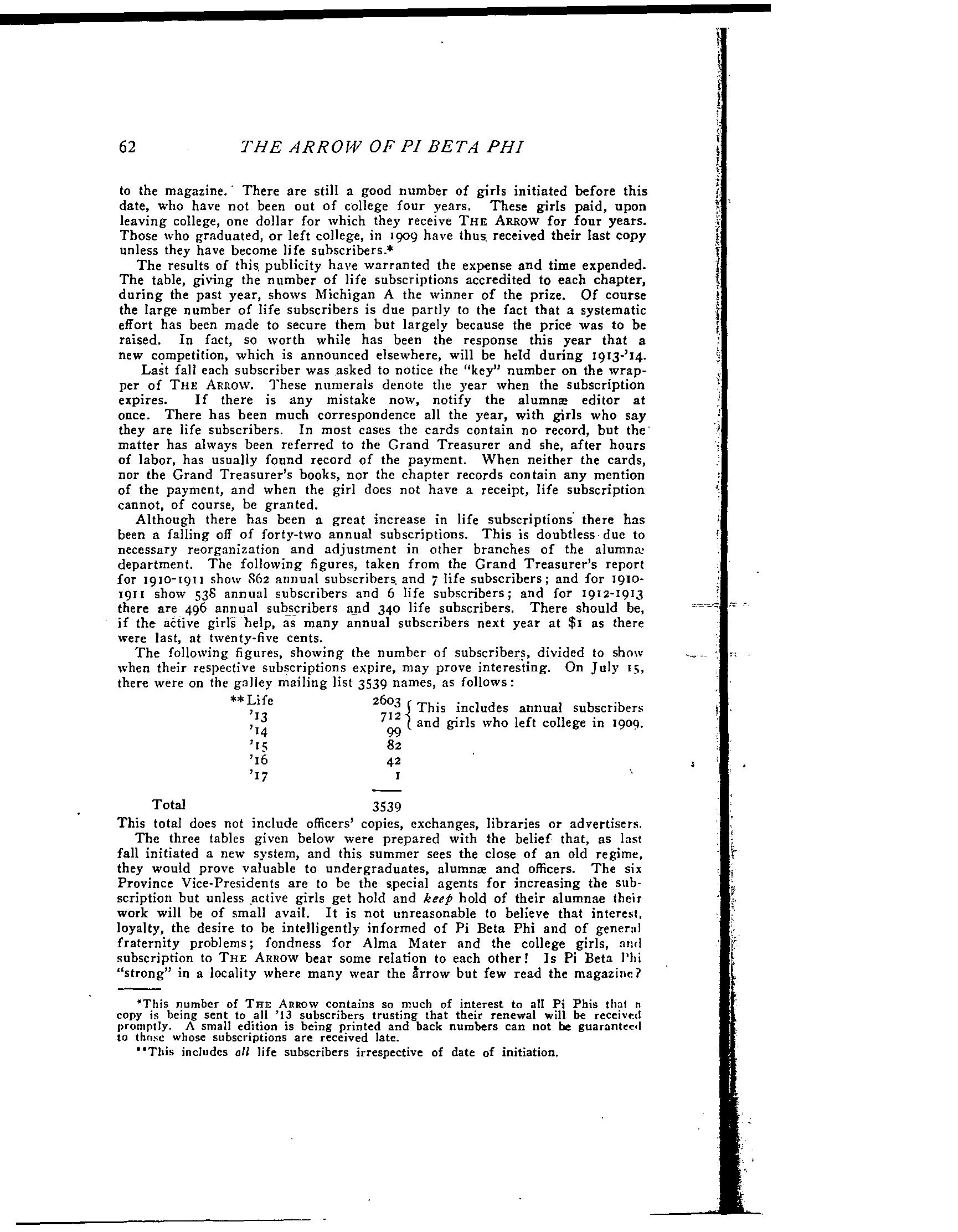
This total does not include officers' copies, exchanges, libraries or advertisers. The three tables given below were prepared with the' belief. that, as last fall initiated a new system, and this summer sees the close of an old regime. they would prove valuable to undergraduates, alumnre and officers. The six Province Vice-Presidents are to be the s.pecial agents for increasing the subscription but unless .active girls get hold and keep hold of their alumnae their work will be of small avail. It is not unreasonable to believe that interest. loyalty, the desire to be intelligently informed of Pi Beta Phi and of general fraternity problems; fondness for Alma Mater and the college girls, mHI subscription to THE ARROW bear some relation to each other! Is Pi Beta Phi "strong" in a locality where many wear the llrrow but few read the magazine?
*This number of THE ARROW contains so much of interest to all Pi Phis that tt copy is being sent to all '13 subscribers trusting that their renewal will be receivr.d promptly. A small edition is being printed and back numbers can not be to thnse whose subscriptions are received late.
--This includes all life subscribers irrespective of date of initiation.
Is :1 chapter "strong)' where only fourteen per cent of its members subscribe to the magazine? If the alumn.e want repregcntation in convention more of them should be informed upon the life of the fraternity. If the next convention is to be a success more Pi Beta Phis in the coast states should read THE ARROW.
A few remarks may be permitted explanat'ory of each table.
TABLE A. This includes all suhscribers not active this past year. By these figures the following facts are brought out:
I. The relative "strength" of v!lrious ·parts of the country. Per capita enthusiasm seems to be far greater in gome states than in others.
2. Most subscribers aTC life gnbscribcrs and hence most of the readers of THE ARROW are young girls, initiated since ]908 or, initiated before then !lut who have not yet been out of four years. This is a great weakness in the fraternity. \Ve need the intelligent interest and council of older women.
3. Owing to our constitutional arrangement the number of subscribers will never grow materially less. The initiates will, in some degree, balance each year what may be lost in :mnual subscriptions. There are about 500 initiates each year so eventually, if there were no annual subscribers, the' list would still grow. This stale of affairs is due to the foresight of a former Grand Treasurer and Grand Council, not to the loyalty nor interest of alumnre.
TABLE B. Subscribers of defunct chapters are here included but it was not thought necessary to count the number of initiates. Members of these chapters offer a good field for the Province Vice-Presidents.
The true meaning of these is not always clear. For instance, one chapter has a percentage of 85 but that is because most of the alumnre are still in the four-year-after-leaving-col1ege class, and hence are, ipso fac.to, subscribers. Again, in another chapter where the percentage is 3] this is also true. All but the 5 out of 25 who subscribe are life or are thus receiving THE ARROW, Only 5 out of 80 make any effort to receive it. The secretary of one chapter where the percentage is only 14, writes that she does not know what is the matter with the alumnre.
TABLE C. This table needs no explano.tion. Thanks are due the hard working secretaries who were able to make the good showings and congratulations to those chapters whose alumnre maintain an active interest. Many of the subscriptions did not pass through the respective chapters but carne direct to the alumnre editor. In each case they were credited to the proper chapter and, where they were known, transfers counted for both chapters.
Another contest will be open this year to close June 1, 1914. The prize is now $10. Will one of the chapters, so nearly winning this year, come out ahead, or will the prize go to --? Well, "let's see!"
The tables follow. Respectfully submitted,
Sophie Parsons Woodman,
lumnm Ed£tor.
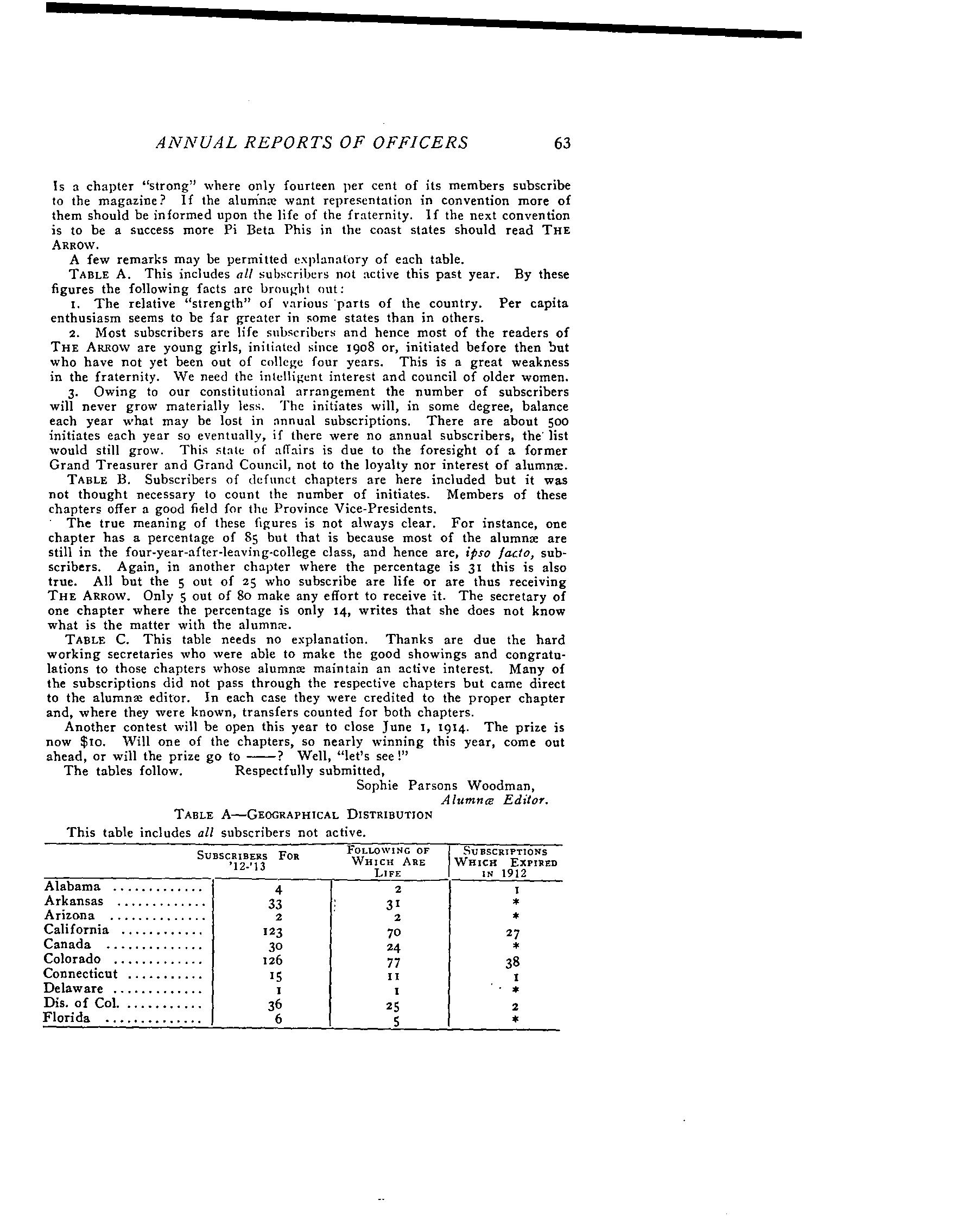
TABLE A-GEOGRAPHICAL DISTRIBUTION
This table includes all subscribers not active.
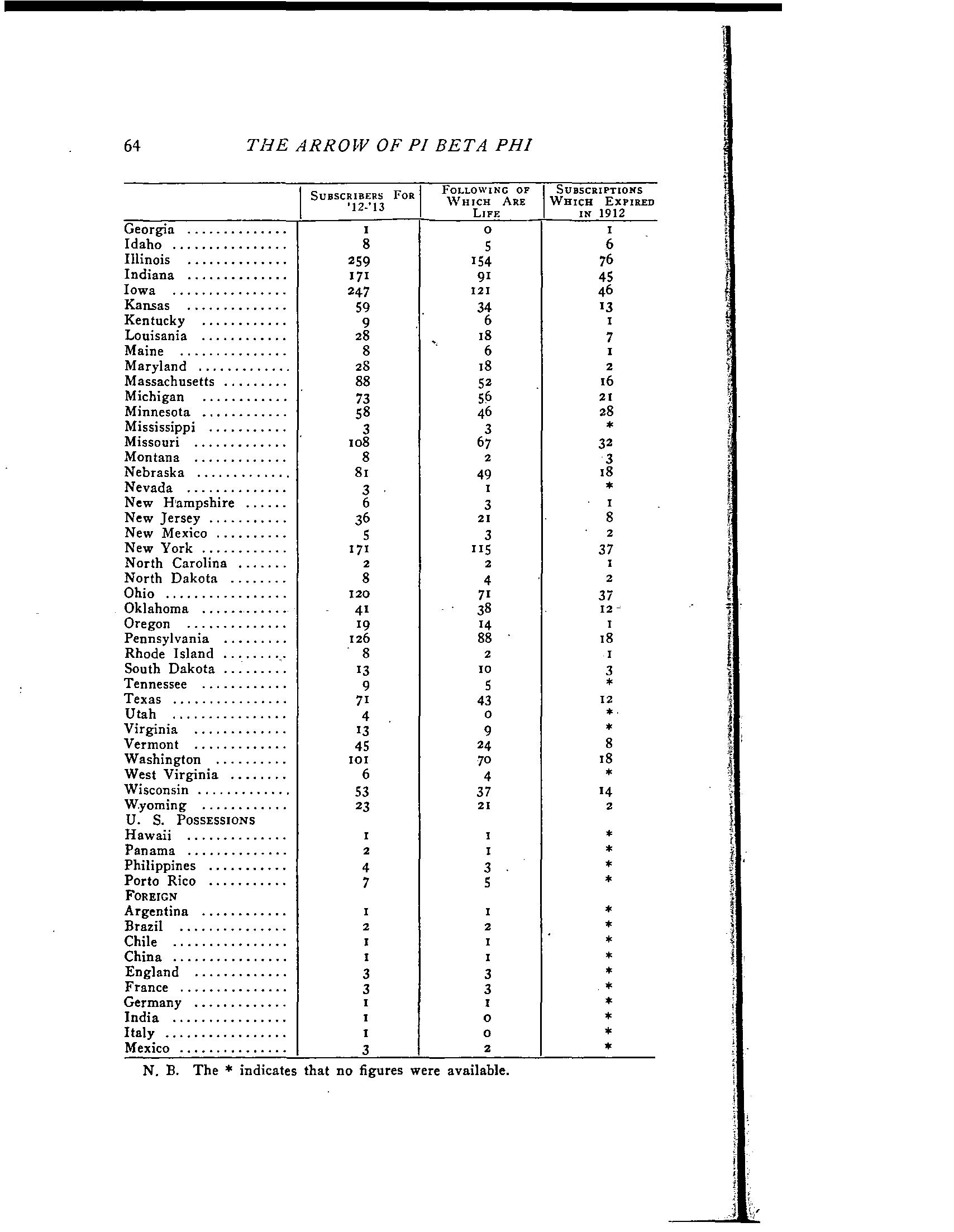
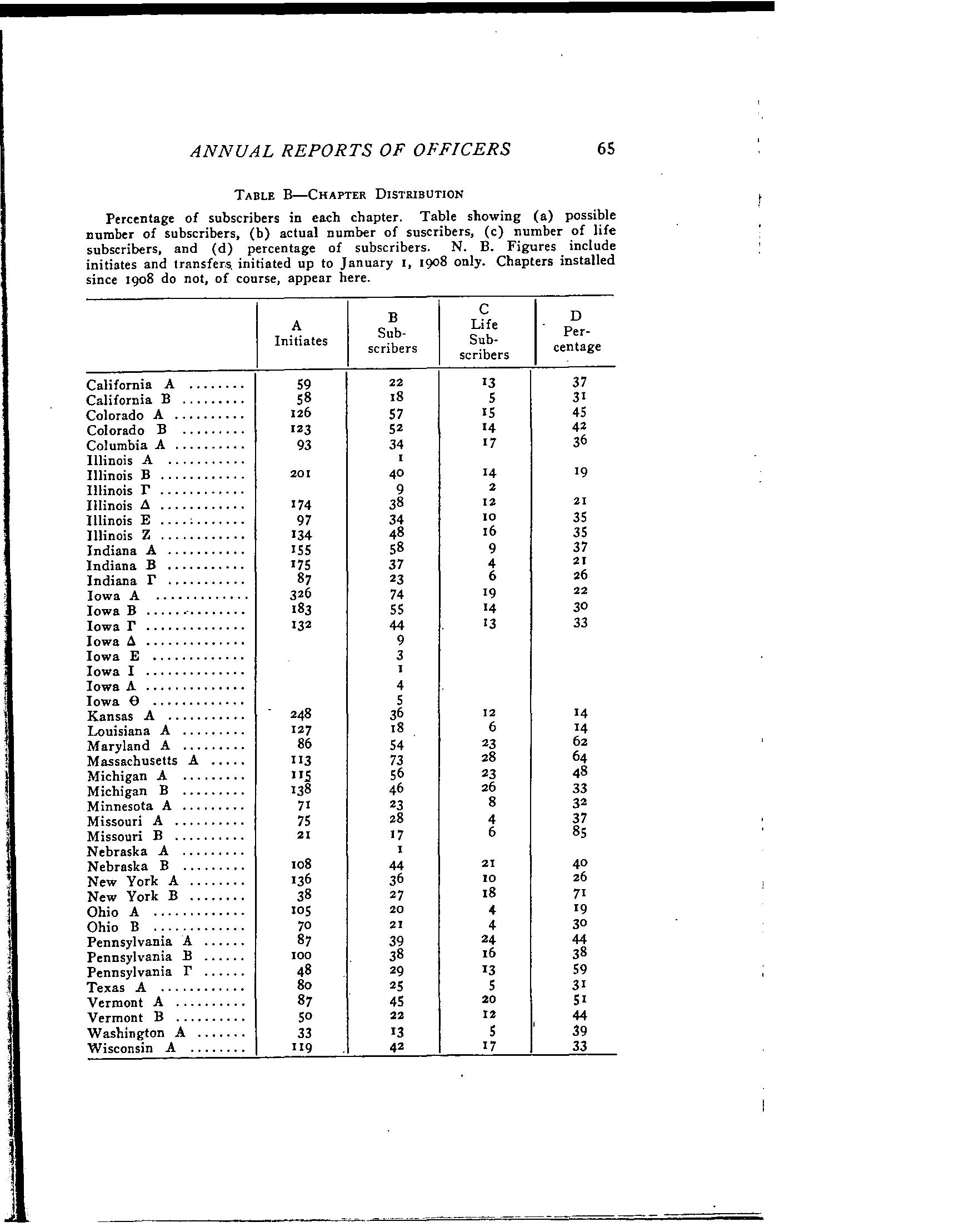
B-CHAPTER
Percentage of subscribers in each chapter. Table showing (a) possible number of subscribers, (b) actual Dumber of suscribers, (c) number of life subscribers, and (d) percentage of subscribers. N. B. Figures include initiates and transfer.s, initiated up to January I, 1<)08 only. Chapters installed since 1<)08 do not, of course, appear here.
TABLE C. Results of Contest for Life Subscription by Chapters.
California
Columbia
Illinois
Illinois
Illinois
Indiana
Indiana
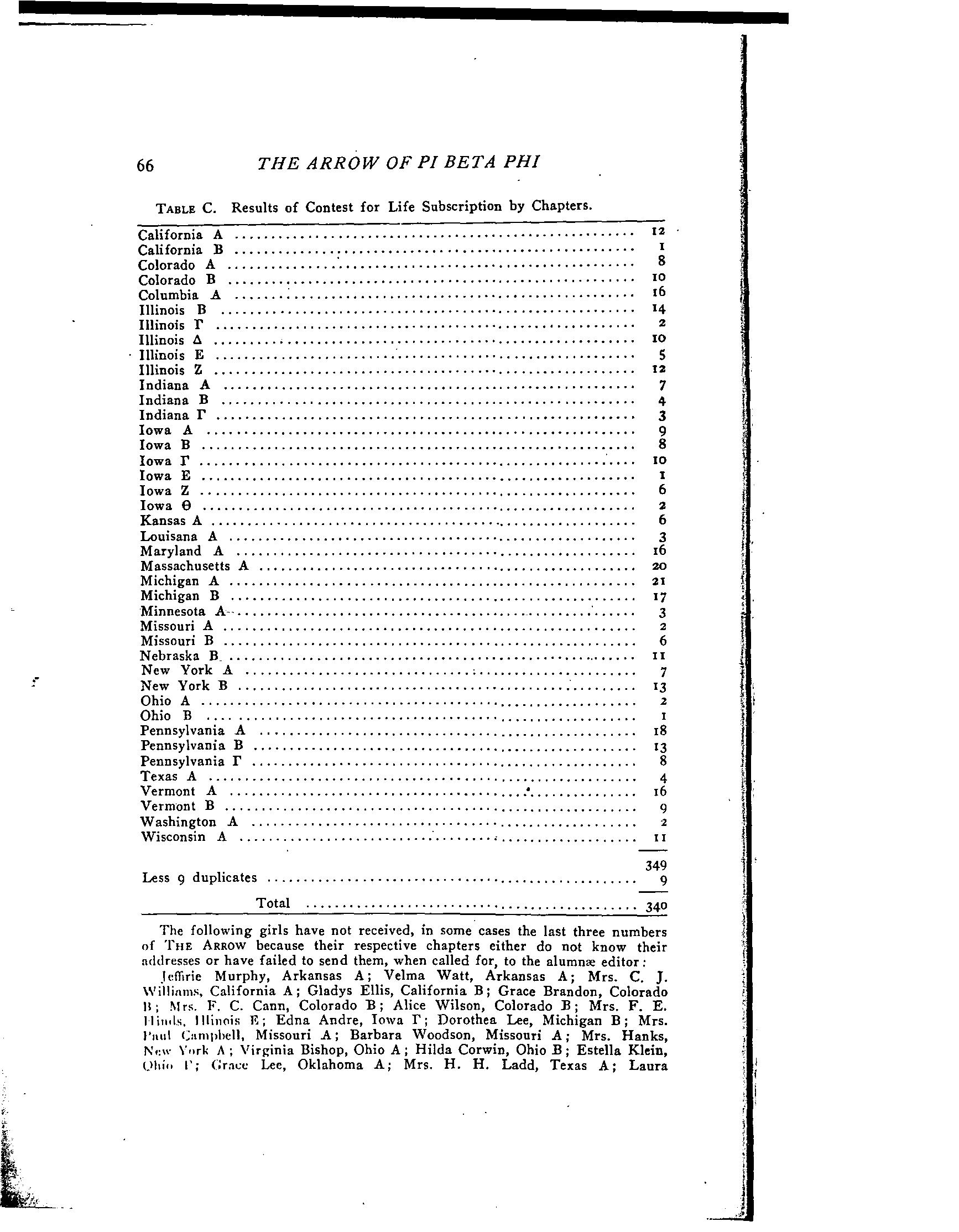
The following girls have not received, in some cases the last three numbers of THE ARROW because their respective chapters either do Dot know their addresses or have failed to send them, when called fOf, to the alumnre editor: Murphy, Arkansas Aj Velma Watt, Arkansas Aj Mrs. C. J. California A j Gladys Ellis, California B j Grace Brandon, Colorado B; Mrs. F, C. Cann, Colorado "B j Alice Wilson, Colorado .B j Mrs. F. E. H ind.s. IlIin(liR R; Edna Andre, Iowa r j Dorothea Lee, Michigan B j Mrs. l'I\nl Camphell, Missouri A j Barbara Woodson, Missouri A; Mrs. Hanks, N,:\\' York A; Virg-inia Bishop, Ohio A; Hilda Corwin, Ohio B j Estella Klein, Uhio I' j Grat.:c Lee. Oklahoma A; Mrs. H. H. Ladd, Texas A; Laura
Randall, Texas A; Margaret Ralston, Texas A j Anita Schlemmer, Texas A; Ruth Anderson, Washington A j Dorothy West, \Vashington A j Mrs. G. H. Young, Wisconsin A.
July, 1912 to luly, 1913
Alpha Province President submits the following report to the Grand Council of Pi Beta Phi:
The duties of Province Presidents were compiled upon request of the Grand President and edited with great care and copies sent to all the other other Province Presidents. The chapters were watched carefully during rushing season and two new chapters, Florida A and Virginia A, were given detailed instructions. Informal reports of visits were made to Grand President and formal reports to Grand Council. Circular letters kept chapters informed of news of the province and in. touch with things of national concern. Interchange of visits has been encouraged and reports of ARROW reading required. Several days were given to Pan·Hellenic difficulties in Boston University and St. Lawrence petitioners, now endorsed by New York B, were advised and instructed frequently.
Chapter annual reports show that second semester and sophomore pledging are on the increase, that there are mOre town members, especially in Maryland A, Vermont B, and Ontario A. that of the invitations issued very few were lost to rivals but many gained from them, that with two exceptions the scholarship is improved, chapters having a fair share of cP B K that Columbia A had a very successful year, and that the University of Vermont has now lOS women students, a fitting number for three fraternities.
Visits were made to four chapters in October and November:
VERMONT A. II by far the strongest; conditions pleasing; general improvement; n cp foremost in good works; K entered, Pan· Hellenic formed.
VERMONT B. A bit stronger in town. Splendid reputation with faculty. Pan-Hellenic conditions strained. but II <P is surely gaining strength. National spirit particularly noticeable.
ONTARIO A. This chapter has splendid material and could get more if it had help in the rushing season. Needs more confidence for this. Attempted expensive chapter house for first year and succeeded in spite of vicissitudes.
NEW YORK A. All round improvement-much to commend-increased spirit, business·1ike meetings. well·managed house. Pan·Hellenic conditions, as usual. poor.
In March, at chapter's request, visited Ontario A, and at Grand President's request, visited New York B to make special arrangements for apartment and Pan·Hellenic conditions. Prepared defense of fraternities to present to committee on fraternity affairs but was not allowed to appear before commission because not connected with Barnard. Addressed Pan· Hellenic, trying to stir it to concerted action. Announcement of action of faculty. in May that will probably result in death of fraternities at Barnard in three years, was given in last ARROW.
Correspondence and filing carried on as usual.
Respectfully submitted, ANNA ROBINSON NICKERSON, Alpha Province President.
July, I912 to July, I913
Beta Province President submits the following report to The Grand Council of Pi Beta Phi:
The president of Beta province held a position which made it impossible
for her to visit mOTe than one chapter. She can therefore m.a.ke only a statistical report based upon data submitted by the corresponding secretaries and reports from two Pi Beta Phis who acted as her representatives.
Because. of her inability personally to corne in touch with the undergraduates, she planned to appoint an alumn:.e advisory committee for each chapter. This committee aside from special duties incident to individual chapters was to have oversight of rushing and scholarship, t-o keep in close touch with the undergraduates, and to inform the province president of CODditions and needs. \Vith several chapters this plan was successfully carried out but in some instances it was found impossible to appoint such a committee.
Mrs. Charles F. Branson, Pennsylvania A, visited Ohi'o B. She found the scholarship standard of the fraternities at Ohio State University was very low and with the cooperation of the faculty and members of· Ohio B was influential in passing Pan-Hellenic resolutions which are at present raising the standard of the whole university.
Mrs. Eli Helmick, Michigan A, visited the Michigan chapter. Those who know Mrs. Helmick will realize what an inspiration it must have been to have her as "acting province president."
*The circumstances attending the withdrawal of Ohio r are well known to all of us. \Vhile we deeply regret the loss of a strong, new undergraduate chapter, we are very thankful that the Ohio alumnre are still active workers for n B 4>.
The following statistics may prove of interest:
The number of students enrolled in the college and universities in Beta province ran.ges from 416 to 5150. The average number is 1788. The percentage of women in this enrollment is 35. The number of the faculty varies from 25 to 5 iO. The average size of the II B 4- chapters is 19; that of their rivals is also 19.
The scholarship for the province averages about 79%. Only ODe cit B K was reported. The average grade for the fraternity examination was 91.6
All chapters report that business meetings are held once a week. Two chapters report pledge day in November, one in February, one in March and three failed to report. One chapter lives in a house owned by the alumnre j five chapters rent a room or rooms. Three chapters report that Pan-Hellenic decreases and two that it increases rushing.
No average of the amount of dues can be computed because some chapters have no extra taxes and some have large assessments. On the whole there is entirely too much money spent on rushing and entertaining. Undergraduates would do well to take thought upon this matter for it is one of the most just of the accusations brought against fraternities.
All chapters have patronesses, varying in number from 3 to 14.
The average number of resident is 16, of resident undergraduates,S.
All chapters report that they keep in clos.e touch with 'their alumna:. Pennsylvania l' is the only one that doe.s, not have an alumnre club.
Beta province president is looking forward with much preasure to visiting all of the chapters in the province early in the fall.
Respectfully submitted, ANN A PETTIT BROOM'ELL. Bela Province President.
JulYJ 1912 to July, .1913
Gamma Province President submits the following report to the Grand Council of Pi Beta Phi:
Only a beginning was made in the work of Gamma Province, for the chap· ters, with one exception, are too far from Minnesota for individual visits and
·See reference in Message of the Grand President, p. 9.
settlement work in Minneapolis occupied all the President's time until the middle of May. It had been her intention to visit Wisconsin A, all the Indiana and Illinois chapters just after the close of the .settlement year. But previous to that time came her engagement as head president of the Pi Phi Settlement School.
As the plan of the Settlement School Committee included a visit, early in June, to the wonderful Settlement School at Hindman, Ky., the chapter visits had to be given up.
Minnesota A, only a short distance from Pillsbury House, claimed much of the President's interest and afforded her much pleasure throughout the year. She wishes she might have known and enj'oyed all the girls of the other chapters as well as she knew and enjoyed those of Minnesota A.
It was with deep regret that Gamma Province President resigned feeling that only a fleeting glimpse had been obtained of all the delightful intercourse with the girls of various chapters which might have fallen to herttot.
Respectfully submitted, .•
ABBIE BAILEY LANGMAID, Gamma Province President.
July, 1912 to July, 1913
Delta Province President submits the following report to the Grand Council of Pi Beta Phi:
The following conclusions have been reached after a series of visits to the chapters:
There are in Delta Province ten chapters and two actively petitioning groups. Delta Province comprises the states of the middle west where the youthful energy of our' country is so strongly kept alive.
The colleges in this Province are wide awake and active and II B cJ. has a firm hold in nearly all of the largest institutions in this section. In four of the ten colleges whe're IT B cf> has chapters she leads the entire college in scholarship and in three others n cJ. leads all fraternities in scholarship. Five chapters have fraternity houses, only one is owned by the chapter, four have chapter rooms and one has no room at all.
The college spirit in II B is good and is improving all the time. The local Pan-Hellenics are not in most colleges. This is due largely to the little and short rushing seasons.
Our strongest rival is K. K r and next K A 9.
The loyal and sincere fraternity spirit in each chapter is growing deeper and stronger. Our fraternity stands well in the eyes of the faculties in Delta Province and, with one exception, has kept to the Pan-Hellenic ruling better than any other fraternity.
Rushing has been most successful in the past year, especially, and the number of girls won by II B <I> over other fraternities is more than double the number she has lost.
Delta Province desires above all things to stand for: Scholnrship, College Spirit, Loyal to each other.
Respectfully submitted,
LOlS J ANVlE•. Delta Province President.
July) 1912 to July) 1913
Epsilon Province President submits the following report to the Grand Council of Pi Beta Phi:
Epsilon Province has been visited this year from a to z, Cia" being Wyoming A and liZ" being Texas A.
It is a pleasure to mark the progress of the two chapters Wyoming A and Oklahoma A which were ins,talled the same year.
At Wyoming the Greek world has formed itself into a club; including fraternity men and women on the faculty. Their motto is: "In times of peace 'prepare for war," and their purpose is to be ready to meet a hostile faculty or legislature if the necessity should arise.
Texas A, together with all Greeks in Texas University under faculty inquisition and legislative probing, is nevertheless continuing to prove herself a help to the faculty and an asset to the university.
Colorado B has open rushing to face this fall, and Colorado A a very short rushing season. They are doing some splendid rushing this summer conjointly' and with the help of the alumnre of both chapters.
The two Colorado chapters were hostesses of our Province reunion. *All the chapters were well represented with the exception of Texas which was handicapped by distance, the imminence of finals and six school days a week. The gathering was most successful from several angles of vision but best of all in convincing the girls that they belong to something more than a local chapter. It has broadened the horizon to the extent of the Province at least, and has brought about thought and consultation and deliberation on the fraternity situation. Each has come to know what other chapters are like and to realize the influence of each on every other. The interchange of ideas and ideals was helpful and the social side very delightful. It was so decidedly worth while that we wish to repeat it every year in the interim of conventions.
Respectfully submitted.
GERTRUDE FITZ-RANDOLPH CURRENS, Delta Province President.
July, I9I2 to July, I9I3
Zeta Province President submits the following report to the Grand Council of ·Pi Beta Phi:
Our chapters on the western coast have peculiar needs. They are so far away from the center of activity that they, at times, feel segregated and alone and find it rather difficult to understand the relationship which ought to exist between themselves and their national organization and between themselves and their alumnre clubs.
Chief among these needs are:
1St. That the active chapters meet and work with their alumnre clubs.
2nd. That the active chapters set aside an hour once a month at their meetings for a talk from some member of their alumnre club.
3f<1. That in some way we might give an added incentive for working lnwnrd a scholarship.
4th. That each chapter of Zeta Province might own its own home. That each alumna might become a life to ARROW.
hlh. That the girls might learn how to choose the best, most substantial rnnlr.rilli.
Durilll( the past year Zeta Province President has been able only to lay filii " plan for this work but she finds among the active and alumnre I
•• All illtilltrlltrd account of this Province reunion will appear in the next ARROW.
girls everywhere an eagerness and desire for cooperation along the lines of development.
The first of these points means that the active girls will realize that their alumnre stand for the real head of their chapter organization. The second means, that if the alumnre can be persuaded to go into the active chapters and give a vital talk once a month on character building or a live talk on our national organization, it will bring both active and alumnre members into closer touch and make the alumnre feel that they, at last, have some real work to do for their fraternity. This plan has been tried with splendid results in one chapter and it is hoped that it may be tried in nil in Zeta Province.
The third point was partially met by offering a B K. loving cup to each Zeta chapter. Stanford won the cup, last spring, and as two of the chapters are not eligible to iJl B K, other scholarship honors in these universities are to be investigated and some adequate offer made to the girls there.
The fourth need seems a very vital one on the Pacific Coast where R K r and K A e have been established so much longer than II B 4». The building of a home means that a chapter has become an established, substantial, fixed factor in the college community and California B is profiting by this and with Miss Elma Korbell at its head is building a beautiful home which will place II B tJlo in a better position to cope with the older, established f'l'aternities in Berkeley.
Miss Korbell has shown infinite patience tact and wisdom in her work and has demonstrated to the active girls what it means to have the substantial backing of a real live alumnre club.
The fifth point is very important for all our western alumna! in particular need to become informed about the present aims and progress of the fraternity in preparation for a Pacific Coast Convention.
The sixth point again brings up the ideas of cooperation between the active and alumnre members all over the state because the older women have mature judgment and can help the girls choose proper material so that each chapter may each year graduate its proper proportion of fine strong girls.
It will take time to reach all these needs in the individual chapters and it can only be accomplished by the close cooperation of all members in the work but the work is started and the way is opening for many wonderful things in the future.
Respectfully submitted,
DAISY D. CARNEY, Zeta Province President.
July, 1912 10 July, 1913
The chairman and treasurer of the committee on Set_tlement School begs leave to submit the following report:
The financial condition of the Settlement School was never more satisfactory than at the present time. The keen interest among Pi Phis over the country has been a great stimulus, overbalancing disappointments and failures. If we hadn't had the deep conviction of our Pi Phi duty, in this self-imposed labor of love and service, the discouragements in the early part of our recent visit to the Little Pigeon would have caused Ollr capitulation, and we would have added another tragedy to the lamentable situation in the mountains there.
The following is a report of the finances of the Pi Beta Phi Settlement School, at the end of the School year, March 31, 1913:
From Mrs. Anna J. Branson, treasurer
Beta Pmvincet.,. after Convention
Alumnae
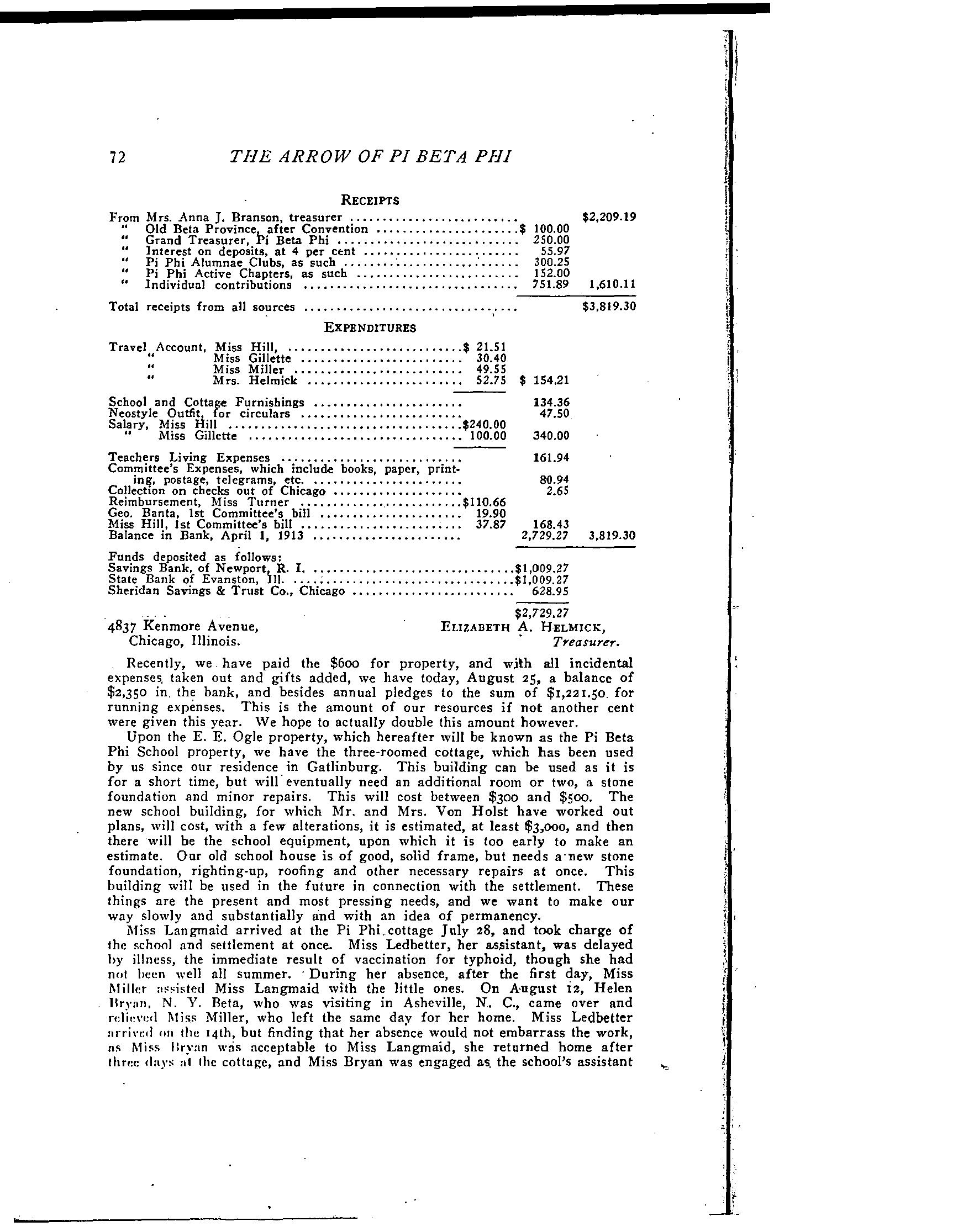
and Cottage Furnishings
Neostyle Outfi.!L for circulars
-4837 Chicago, Illinois.
$2,729,27
ELIZABETH A. HELMICK, Treasurer.
Recently, we. have paid the $600 for property, and w.ith all incidental expenses. taken out and gifts added, we have today, August 25, a balance of $2,350 in. the bank, and besides annual pledges to the sum of $1,221.50. for running expenses. This is the amount of our resources if not another cent were given this year. \Ve hope to actually double this amount however.
Upon the E. E. Ogle property, which hereafter will be known as the Pi Beta Phi School property, we have the three·roomed cottage, which has been used by us since our residence in Gatlinburg. This building can be used as it is for a short time, but will- eventually need an additionnl room or two, :l stone foundation and minor repairs. This will cost between $300 and $500. The new school building, for which Mr. nnd Mrs. Von Holst have worked out plans, will cost, with a few alterations, it is at least and then there 'will be the school equipment, upon which it is too early to make an estimate. Our old school house is of good, solid frame, but needs a-new stone foundation, righting·up, roofing and other necessary repairs at once. This building will be used in the future in connection with the settlement. These things are the present and most pressing needs, and we want to make our way slowly and substantially and with an idea of permanency.
Miss Langmaid arrived at the Pi PhLcottage July 28, and took charge of the school and settlement at once. Miss Ledbetter, her a.ssistant, was delayed hy the immedi3te result of vaccination for typhoid, though she had nol heen well alI summer. - During her absence, after the first day, Miss Mill(:r Miss Langmaid with the }jttle ones. On A,ugust iz, Helen Bryan. N. Y. Beta, who was visiting in Asheville, N,. C., came over and ,.din'eel Mi5,S Mi11er, who left the same day for her home. Miss Ledbetter nrri\'ed 011 the 14th, but finding that her would not embarrass the work, Miss IIry:m w:is acceptable to Miss Langmaid, she returned home after thn:c day=, III the cottngc, and Miss Bryan was engaged a.s. the school's assistant
for the coming year, and has proven herself fa be an' invaluable, loyal Pi Phi worker.
Next, I am obJiged to announce to you the resignation of Miss Langroaid, which took effect October first.
Mary O. Pollard, Vermont Alpha, succeeds Miss Langmaid. Miss Pollard is a well earnest, talented Pi Phi, big of heart and sympathies, zealous and self'sacrificing, lind I feel that we can entrust this important mission to her with perfect confidence that she will also carry with her a lofty, spiritual and Christian grace into the atmosphere of the school, the cottage and Gatlinburg.
As this goes to press, Miss Langmaid writes that the ground for the basement of the new school building will be broken on September 23, and that she had given orders for the lumber to be so that it may be stacked and dried-out for the building. The building will be pushed as fast as possible, and we hope to get into it before the cold blasts of the mountain winter overtake us. We plan for a plain, but substantial and comfortable building.
We shall need volunteer teachers after Christmas, when our school will probably increase to over a hundred pupils. Will not each Pi Phi take this appeal to herself and help the committee W·e would be happy if we could make each Pi Phi feel that this school her work; we ask you to write us if you want information of any kind regarding it j we would be glad of suggestions or recommendations, or even your criticisms, if for the good of. the school.
We are very much in need of funds for equipment and repairs that should be made, and are anxious to aronse in our affluent Pi Pais an interest and pride which will ·prompt tp.em tQ give liberally i.n sums. to this splendid work which the alumnre have shouldered and pledged themselves to carryon. No purely altruistic work of this kind has ever been undertaken by any fraternity before, and the splendid money support shown by the Gatlinburg people, in their extravagant giving us this fine piece of land, is sufficient evidence of their need and appreciation. It was prompted by the crying nee4 which the people keenly realized since our school had opened their eyes and given them a vision of the better life within their reach through
Finally, .we own thirty-five acres of land-real Pi PAi teacher's cottage, and old but useful school building, a barn, a store, several storage and smaller buildings, and an immense amount of faith in the generous support and good will of Pi Phis everywhere.
Respectfully submitted, ELIZABETH A. HELMICK Chairman.
July, to 1913
The chairman of the committee on fraternity extension begs leave to submit the following report:
I. No correspondence has been carried on with petitioning groups in Stetson University, Drury College, or S1. Lawrence University, which had applied before this committee was inaugurated.
2. Preliminary preparations were ma.de for the group in Randolph-Macon Woman's College to petition for a charter.
3. Letters of inquiry have been received from a group at Adelphi College, Brooldyn, N. Y., and from the President of Brenau College, Gainesville, Ga., but no effort was made by them to petition the fraternity.
4. Gamma Phi of the University of Utah and a group, Eta Pi, in Normal College of New York City wrote several letters. Both were sent discouraging
the former had previously been discouraged because of religious conditions in that state, and the latter is in reality a normal school with a small C:lll1euinte department. This committee does not believe itself empowered to definitely refuse "either group as requirements in regard to annual income and numher of students were met and the scholarship requirements at present are vague. Consequently the replies, while very discouraging, promised publicity and n fair chance if the groups cared to proceed farther. Nothing more has been heard from either group.
5. Recently correspondence has been opened with Phi Kappa Phi of Kansas State College, Manhattan, Kansas. This group is enthusiastic and working. Until next September their school cannot be considered as at that 1ime it inaugurates as a requirement for entrance to the college a four years' high school course. They claim to have the support of Kansas A, and, when the school is thoroughly established on a collegiate basis, may be considered. The Grand Council is requested to decide whether such a group could" be considered before all students in the college shall have met the higher entrance requirement.
6. A group in West Virginia Wesleyan College, Buchanon, W. Va., writes for instructions concerning a petition. The catalogue shows that the sch'ool is small but the curriculum includes instruction in classical courses. The committee recommends that the fraternity consider this group.
Your committee chairman introduces two questions for the consideration of the Grand Council:
1. Any judgment on the standing of colleges by this committee is presuming, unless their catalogues show glaring weaknesses. The Carnegie Foundation would seem authoritative but has not inspected all schools. Does the "Grand COl
women, preferably Pi Phis, who are willing to serve as chaperones and who are capable, cultured women.
This is a matter which should and doubtless does interest the alumnre for a capable, refined Pi Phi as chaperone in each chapter house would be of inestimable value in strengthening our chapters, training our younger girls to become moral, social and intellectual forces in their communities and helping them to be loyal and true to their chapter and fraternity.
Respectfully submitted,
MINNIE K. ORGAN.
The chairman of the Committee on Loan Fund begs leave to submit the following report:
Received
June I, JI2. Available from Grand Treas,ury .. , ........ , ....... $200.00
Dec. 7, Cash receh'ed from 1912 loan ., .. : ,..................... 50.00
Feb. 17, ']3. Private loan , ,.............. 25.00
April 21. Cash received from 19I1 loan 75.00
Paid
Sept. 4. '12. L"oan .............................................. $100.00
Sept. 10, '12. Loan 100.00
Feb. 10, '12. 25.qo
Dec. 7. '12. Grand Treasurer (1912 Loan) 50.00
April 28, '13. Grand Treasurer (191 I Loan)
It will be readily seen from the above statement, that three loans were granted by the committee during the past year, the last one being made possible by a private loan; that the first loan granted in 19I1 was paid in full; and that one made in 1912 was half cancelled.
There were two other letters received asking for information, to both of which replies were sent with the application blanks, but althou2'h the committee promised to attempt to secure the money from other sources, the blanks were not returned and no further attempt to solicit money was made.
\Vith the consent of the Grand President we sent letters to the alumna:: clubs of Beta province asking for loans or gifts of $10 each, in order that we might assist the third applicant for the year who was a member of that province. Only one answer was received from these clubs, that one regretting their inability to help, but stating that their efforts must go to the Settlement School. It seemed wisest. in view of this result, to make no more appeals to the alumnre clubs, especially as we did not wish to hinder the efficiency of the school committee, and too much soliciting would injure both causes, By means of the private loan, then, we were able to help this applicant to the extent of $25 only.
To date 74 letters have been written by the chairman of this committee, giving information sending blanks and circulars and on committee work.
One loan of $75 has been granted for next year, leaving a balance of $125 for future applicants.
Two notices have appeared in THE ARROW} one an appeal to interest clubs in the work, the other a statement of next year's available. funds.
The committee has decided not to send circulars to the corresponding sl:crdnrics of each chapter, this year, inasmuch as the blanks are lost, and inh:lldillJ.!' applicrmts nearly always write for blanks and information. Instead, we will puhlish information in THE ARROW and The Bulletin.
Alpha Gamma Delta wrote concerning the Loan Fund work, and was sent a copy of OUT circular and application blank.
Miss Stuart and YOUT chairman have agreed upon a definite method of procedure in regard to paying loans, and hereafter no money will be paid by Miss Stuart, except on receipt of a properly signed note.
The committee awaits suggestions on new plans which the Grand Council would recommend.
Respectfully submitted,
MILDRED F. BABCOCK. Ch.airman.
July, 1913.
The Chairman of the Committee on Fraternity Examinations begs leave to submit the following report:
Prior to the Convention of 1912 at Evanston, the work of preparing the questions for the annual fraternity examination, and of correcting and grading the papers had been done by the presiden ts of the various provinces, in addition to their other duties. After this convention, the Grand Council decided to place in the hands of a committee the work of preparing and conducting the annual examinations until the next convention should meet in 1915. It is this examination committee which now makes report of its first year's work.
It is of course difficult for a committee situated in different parts of the country, and entirely unfamiliar with the problems which confront it, to begin its work, but, thanks to the unbounded enthusiasm and hearty support of all the members of the committee, and to the ever ready word of advice and assistance from those who had formerly carried on this work, the first year of the new committee has passed very pleasantly. The cordial relations with the chapters have also helped greatly, as also the evident desire on the part of the majority of the active girls to do their very best, as a matter of personal pride, and for the honor of their chapter.
At this particular time, when there is so much anti-fraternity talk and legislation, it is the more important that every fraternity woman, and certainly every true Pi Phi, should be well informed on the broad questions of fraternity life, and be alert to find the wisest solutions of the problems confronting the different groups in their varied surroundings. It is the willingness to subordinate the personal preference to the good of the many which the fraternity spirit should foster, and, in the main, this is the spirit which has been shown in the replies in the last examination.
The first work of the committee was to prepare a Supplement to. the Study already in the hands of the chapters for their assistance in preparation for the examinations. This Supplement was based on recent ARROW articles, and on the work of the Evanston convention, as given in the Convention r,eport. Copies were furnished to the chapters, and as usual, each chapter was allowed to choose its own time for taking the examination between .December 3'- March 31.
As there were but four members of the committee, and six: provinces, ac· cording to the new division made at Evanston, each member of the committee was obliged to have charge of more than one province. The attempt was made to so allot the work that each member should have as nearly possible the same number of papers to correct and grade. This attempt to arrive at an equitable division was fairly successful, as the following figures will show.
Miss Carpenter
Mrs. Birmingham
Miss de la Barre
Mrs. \Vorcester
237 papers
214 papers
224 papers
225 papers
The first figure includes the new chapter, Florida A, which was not in existence at the time the allotment was made.
The next task for the committee was the preparation of the examination paper itself, which was made up of questions from the Study, the Supplement to the Study and the recent history of the fraternity, as well as questions to the upper class girls on problems of chapter government and fraternity development. I attach hereto the list of questions, and the grades of the papers 85 corrected and marked· by the member of the committee in charge of the various chapters, arranged according to
This examination is conducted by the Examination Committee. Active member is expected to participate. Send answers to the member Committee designated in letter of Instructions.
Every of the
4·
A II members will please answer questions I to inclusive.
Give chapter roll by provinces, naming chapter, college, city and state. Name chapters established since Jan. I, 1912.
What is the fraternity magazine? How many issues are published dur. ing the college year? When is the last number to be published in the future?
Give names of present members of Grand Council, and of the other Grand officers, not members of the Grand Council.
Tell when and where last convention was held. Which founder was present? When and where will next convention probably be held? What occurs in 19I7?
Describe recognition pin. Coat of arms. Give heraldic blazoning and explain symbolism involved.
Give Pi Beta Phi Symphony and name author.
FRESHMEN
5· Give number" of founders, and name four of them. Where and when was Pi Beta Phi founded? What is this day called? How is it celebrated?
6. Name eight national fraternities for women. Describe the badge of Pi Beta Phi. Give the creed. What was the origin of Cooky-shine?
What is the oldest chapter of Pi Beta Phi now in existence?
7. Give the words of two Pi Beta Phi songs. ,
8. What is the annual tax? When is it payable? How distributed?
9· Wh"at is a motion? . An amendment? State different forms in which an amendment may be made.
How is Pi Beta Phi governed? Name officers of a chapter.
Give duties of a chapter censor,
[0. Name three notable alumnre of Pi Beta Phi, and state the field in which each is eminent.
II. ALL MEMBERS EXCEPT FRESHMEN
Discu,ss briefly the Settlement School, giving reason for undertaking thiS work; the committee now in charge; the provision made for the work from the national treasury,
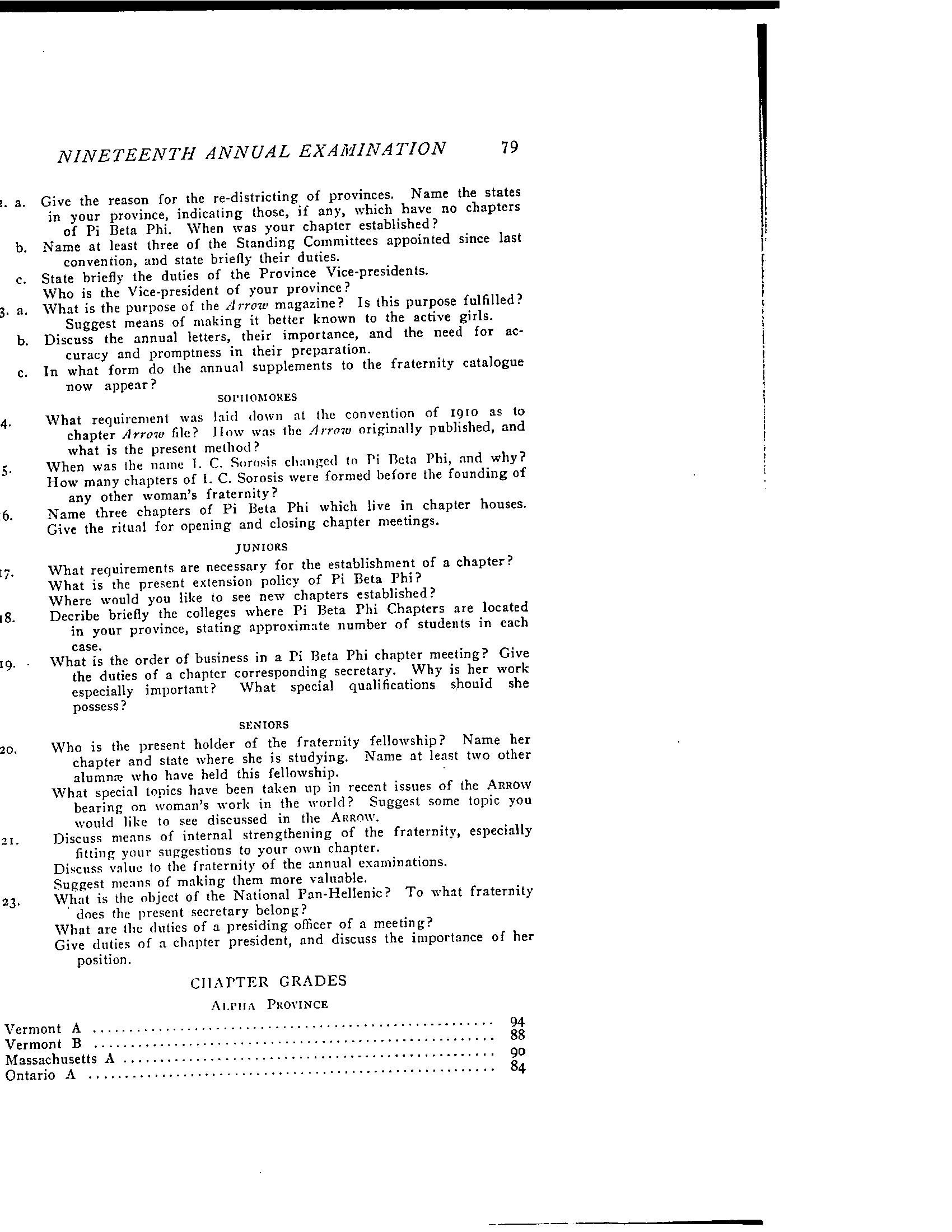
Give the reason for the re-districting of provinces. Name the states in your province. indicating those, if any, which have no chapters of Pi Beta Phi. \Vhen was your chapter established?
Name at least three of the Standing Committees appointed since last convention, and state briefly their duties.
State briefly the duties of the Province Vice-presidents.
\Vho is the Vice-president of your province?
\Vhal is the purpose of the A rr071.' magazine? Is this purpose fulfilled? Suggest means of making it better known to the active girls. Discuss the annual letters, their importance, and the need for accuracy and promptness in their preparation.
In what form do the annual supplements to the fraternity catalogue now appear?
SQI'1I0MOHES
\Vhat requirement was laid down at the convention of I9IO as to chapter Arro7l' file? IInw was the Arrmv published, and what is the present method?
When was the name 1. C. chang-NI 10 "Pi Beta Phi, and why?
How many chapters of 1. C. Sorosis were formed before the founding of any other woman's fraternity?
Name three chapters of Pi Beta Phi which live in chapter houses. Give the ritual for opening and closing chapter meetings.
JUNIORS
\Vhat requirements are necessary for the establishment of a chapter?
\Vhat is the present extension policy of Pi Beta Phi?
Where would you like to see new chapters established?
Decribe briefly the colleges where Pi Beta Phi Chapters are located in your province, stating approximate number of students in each case.
\Vhat is the order of business in a Pi Beta Phi chapter meeting? Give the duties of a chapter corresponding secretary. Why is her work especially important? What special qualifications s,hould she possess?
SENIORS
\-Vho is the present holder of the fraternity fellowship? Name her chapter and state ,,,,here she is studying. Name at least two other alumnre who have held this fellowship.
\Vhat special topics have been taken up in recent issues of the ARROW bearing on woman's work in the world? Suggeiit some topic you would to see discussed in the ARR(lW.
Discuss mC:lns of intern:ll strengthening of the fraternity, especially fitting your suggestions to your own chapter. value to the fraternity of the annual examinations. Suggest means of making them more valunble.
\Vhnt is the object of the National Pan-Hellenic? To what fraternity , does the present secretary belong?
'Vhat nrc the duties of 3. presiding oBicer of a meetin g?
Give duties of a chnpter president, and discuss the importance of her position.
C"APTER GRADES
AU'II:\ PIWVINCE
New
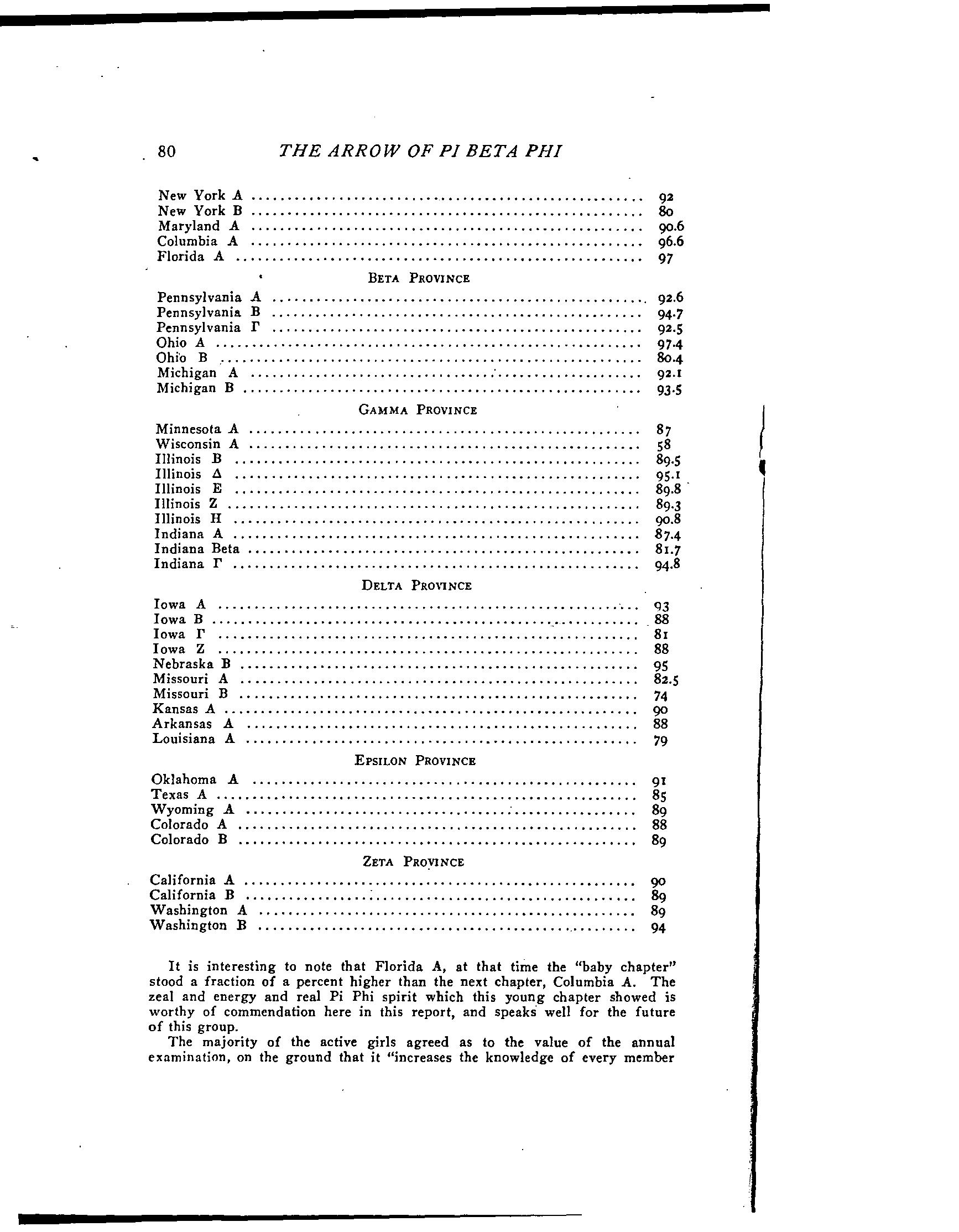
It is interesting to note that Florida A, at that time the "baby chapter" stood a fraction of a percent higher than the next chapter, Columbia A. The zeal and energy and real Pi Phi spirit which this young chapter showed is worthy of commendation here in this report, and speaks' well for the future of this group.
The majority of the active girls agreed as to the value of the annual examination, on the ground that it "increases the knowledge of every member
concerning the fraternity, thereby )lutting- 1111: wllnk frall:rnily nil a Ii rlllr. I' basis," One suggestion was that "it \vould be iHOre \'nlullhlr: i r tlppr.r classmen would hold classes during the year for the tllltierdll!'o!'oIl1r.n."
Another girl says: "The fraternity examination is n l:\'il, n temporary burden which reaps ample reward. hrill).! of \'lIlne to the girls themselves in forcing them to learn some thing's which Ihry (l1I..:hl to know, and which, under other circumstances, they would neg-Irel, Ihl" examination enables the women who manage the national organil.nlillll III ).!rl the student viewpoint, and to detect the weaknesses of the orgnni1.ntioll. 1n doing this, they discover where to expend their efforts in strengthening thr. organization."
One good suggestion follows: "One way to make it (the examination) more valuable would be to have the questions gone over and discussed in chapter meetings after the examination was over." This would certainly be n. most excellent way of fixing douotful points in the minds of the members, :tnd would make the next year's examination much easier.
One suggestion was that "two shorter tests should be given by the committee during the year instead of the one long test." The labor and time involved in preparing for the one e:xarnination and the correcting and grading of the papers is all that the present committee feels able to undertake!
One very general criticism of the examination of the past year was its great length. The committee hopes, to make the test of the coming year less of a tax upon the active girls in the matter of time s.pent in writing the answers.
In the midst of the splendid answers received, it is rather amusing, and sometimes distressing, to note the lack of knowledge in some instances. Still, when a girl regrets her inability to reply correctly, her case is hopeful. In one instance, a girl had failed dismally in her effort to give the list of chapters. Later she waxed eloquent over the Settlement Scho'ol project, and said, in an apologetic parenthesis, "Although _ I did not know my chapter roll, I am much interested in the Settlement School, and want to do what I can for it."
Again, one girl stated gravely that the charge of the president of the university! our files would not be so lacking.
archives of the chapter were in the Perhaps, If that were true, some of
Still another declared that the name of L C. was changed to II B cfJ in 18[6!
Some of the suggestive and helpful replies to the question as to Internal Strengthening of the chapters are given here, with the hope that the chapters may find in them ideas which may be adopted, and put to practical use.
CloseT intimacy of the chapters of each province, when possible, will bring about internal strengthening.
By coming in closer contact with our alumna:! we may also be strengthened.
We have adopted frequent chapter parties this year, and find them a great success.
A picnic, etc_ is a very good means in which we can take a little vacation, and discuss fraternity plans. This we carried out last year with a Founders' Day picnic, and each girl told what she thought would benefit our chapter most.
Our chapter should be internally strengthened through better and more systematized plans for rushing, and. further, by more careful and better training of the freshman girls in matters of n B <1'>.
The freshmen should be made to feel a stronger love for n 4'. They should fcel that the more you put into a chapter, the more you get out of it, and also that the best freshmen make the best seniors.
More should be known about the fraternity constitution, and the national organization_ We need visits from our Grand Officers.
A sense of duty to each other individually is needed_ The spirit, "she is a n cz, and therefore my sister" is not prevalent enough. The conception of the fraternity is often too limited, and it too often confines itself to a feeling for the girls in one chapter.
To bave a strong chapter there should be:
1. A small crowd of congenial girls, all pulling together with ideas of college spirit and fraternity uplift.
2. Girls from all cla.sses represented_
3. Several girls capable of being leaden.
4. A chaperone at the head with strict ideas who will lend dignity to the fraternity and uphold her position.
S. Interested alumnz.
r An members should put aside their own selfish interests and have a common airn--that of advancing the standing of their own chapter, both in scholarship and liocial cirdes. All must work together; none can afford to shirk.
Internal strengthening of local chapter can orty developed careful ch,oosing of material, and then by real development which 15 too often Ignored. This can only. be secured when the junior and senior feel responsible for the training of the younger girls and are fitted for it. We that encouraging the girls to college loyalty bas done more to develop n loyalty and developed womanhood than any other onc thing.
.
New York A tells of their custom of meeting at the chapter bouse Sunday nights. "All the city girls, and others who do not live at the house gather at the chapter house and have lunch there. The girls take turns in preparing tbe lunch, and tbe freshmen wash the dishes and build the fire in the large fireplace. After lunch all the girls entertain their callers together, and a11 sing the n 4'0 songs, and have a general good time. This custom which has been in vogue for two years now, has done much to encourage that feeling of cooperation which co'nstitutes internal strength." ' ,.
This same chapter also has a system of critics. "The critic is selected, when possible. from the junior class. and she has as her su1rcritics a member from each of the other three classes. It is the business of the critic to help the girls find the one thing or more for which they are best adapted, and then to see that they put their effort into these lines of effort. Since in taking in new members, we strive to find girls of all types, we succeed by means of our critic system in baving n 4t well represented in all the fields of college activities."
Each initiate should have a fraternity mother chosen 'from upper classes, preferably seniors.
Forgetfulness of self in the needs of the chapter would help to strengthen it internally. Less reliance on our national reputation and more dependence upon our· selves would help, as also a more serious view of the requirements of fraternity women and their responsibility. .'
Each province should hold a convention in the year between the national conventions.
Other suggestions were: Interclass parties; interchapter visits; after-Commence·.nent house rarties; a Round Robin-a frank, frequent. bright and intimate glimpse given by a gifted letter writer in each chapter to the other chapters of the province; the estabHshment of a special fund in each chapter to be kept 'exclusively for convention purposes. "It seems highly desirable that each chapter should send at its own expense, or with'- the help -of neighboring alumnre._ a sophomore to convention The enthusiasm would be more than doubled if two girls went and could carry along their enthusiasm together."
Province house-parties and province newspapers would aid greatly in the internal strengthening of the province and so the whole fraternity.
Closer regard to the pledging of girls who have not been able to secure a recommendation from a chapter in a college formerly attended; and a feeling of greater fellowship encouraged within the chapter and with the national organization. '
The closer interests, sympathy and cooperation of alumnre and active girls is of vital importance. If there are any places where there are no clubs. but there are a few scattered alumn;e near the _active girls. they should meet together frequently. It would mean that the active girls would increase their own enthusiasm as they kept awake the interest of the alumnre. The alumna: should have something to work for actively. unselfishly and yet enthusiastically. The Settlement School seems to offer a good Common ground on which to work and through which to draw more closely together. .
In answer to the question as to how THE ARROW could be better known by the active girls, all agreed that the best way to bring this about was to have frequent discussions in chapter meetings of articles which appeared in our magazine; to have the alumna! or appointed active members conduct quizus based on THE ARROW and, in general, in similar ways to become thoroughly acquainted with. its contents, so that every active member nU1Y be intelligent and well-informed on matters of our current history. If every chapter would carry out these suggestions, what might not be accomplished for II B
Replies to the question concerning possible fields for extension for II B brought out numerous suggestions, even from those who insisted that II 4' !'hould be very conservative in the matter of granting charters. I' mention a few of the suggestions, especially where there were definite groups mentioned compoj;ed of girls of fine sterling quality, worthy to wear the arrow.
McGill University, Montreal, Canada.
Rochoster University, Rochester, N. Y.
St. Lawrence University, St. Lawrence, N. Y.
Drury College, Springfield, Mo.
Wnl'hburn College, Topeka, Kansas.
Drake University. Des Moines, Iowa.
Miami University, and the state universities of North Dak'ota, South Dakota, Oregon, Montana, Idaho, West Virginia and Nevada.
It seems strange that it should be necessary to say that, in some cases. the papers handed in were written in a careless manner, in pencil, covering both sides of the page, with occasional erasures, and frequent errors in grammar and spelling, but such is the fact. Does this mean that some of the active girls think that it makes no difference about the appearance of their papers in the fraternity examination? Surely n'ot, for the "capacity for taking infinite pains" may well extend even here. Perhaps the girl who does not take pains does not realize that she is, by this very failure to do her best, falling short of her high calling as a member of n B 4>. There were, however, many papers, splendid in appearance, with clenr and well·expressed thoughts and fine fraternity spirit breathing through them. May their tribe increase!
The number of active girls who were excused from taking the examination was small this past year, but it is to be regretted that, in some cases, there have been those wh'o have gladly paid the small fine imposed for not taking the annual examination, rather than spend the time to prepare for and take this test.
As the whole object and aim of the annual examination is to educate the underclass girls in the lore of n B <P, and to impress upon the upperclass girls that upon them rests the responsibility of building the chapter foundations wise and strong, and to bring them into the ranks of fraternity alumnre wellinformed, and eager to help in the greater work which awaits all loyal alumnre, this matter of paying a fine rather than take the examination seemed of sufficient importance to be referred to the Grand Council at their meeting in *Chicago in June. Their decision, which appears elsewhere, was that a fine of ten dollars ($10) should hereafter be imposed upon an active girl who, with'out good and sufficient reason, shall fail to take the annual examination. I hope that this fine may never need to be imposed.
The question of a uniform date on which all chapters shall take the examination was also brought to the attention of the Grand Council, with the result. that the Grand Council has given permission to the Examination Committee t6 set a uniform date for this purpose. This date will be announced definitely later, but present indications are that it will be the first Saturday of March. This uniform date ·will greatly simplify the work of the committee, and will, we hope and believe, not increase greatly the difficulties for the chapters.
It is the purpose of the committee this coming year to prepare a series of questions which shall be sent to each chapter early in the fall for their study. These will cover the Study, the Supplement and the recent hist"ory of the fraternity. For instance, twenty questions may be asked from which five will be asked in the regular examination, the other five to be based upon the present secret issue of THE ARROW, and the current history of the fraternity as shown in the recent issues of THE ARROW. The upperclass girls may also be called upon to answer questions as to chapter management and fraternity problems, as in the examination of the past year.
The committee desires to extend its thanks to those officers who have been so helpful with assistance and advice gathered from their own experience. May I mention especially our Grand President, whose patience is unceasing j the President of Alpha Province, Mrs. Nickerson, whose words of wisdom and keen judgment are ever at the command of those in need j and the former President of the old Gamma Province, our present Grand Treasurer, At:lne Stuart, ever ready with helpful ideas and words of cheer. With these to guide our steps, the way of the committee has been made much easier.
In closing, I wish to express for the whole committee my appreciation of the splendid work done by the majority of the active members in their wellwritten, thoughtful papers. Some of the papers from the upperclass girls, especially, would seem to indicate that many splendid workers were this year
*See pp. 10 and 31.
"utning Ihe ranks of the aiumnre, where they will find abundant opportunity 10 prove their continued loyalty.
To my co-workers in the committee I wish to express my thanks for their luyal a.ssistance at all times, and for their unbounded enthusbsm and desire 10 do all in their power to make this part of our fraternity work count mightily for the growth and upbuilding of OUT dear II B tP.
Respectfully submitted, EDITH L. CARPENTER.
The chairman of the Committee on Calendar begs leave to submit the following report:
The committee for the 1913 Calendar, consisted of Katharine Griest, Pennsylvania A, chairman; Edith M. Valet, New York B, and Deborah L. Ferrier, Pennsylvania A. The latter resigned and no one was appointed to take her place.
At the 19I2 convention, Miss Valet and a committee of which she was chairman, secured pledges for the calendar and by October, 1912, 600 had been secured. This ensured the fi:ryrmcial success of the calendar, although all these pledges were not redeemed.
The calendar quotations were furnished by Mrs. Helmick and the committee feels much indebted to her for so generously supplying them. 300 calendars with'out the II ,n cP items, were printed for Mrs. Helmick, for St. Mary's Guild of Chicago, and sold by members of the Guild for its benefit.
The calendars were published by \Valter H. Jenkins, Philadelphia, who also published the 1911 and 1912 calendars, 650 ,,,ere printed for the fraternity at $.38 apiece. These were sold at $.60 apiece. The account is as follows:
-604
$ 67.37
This balance is deposited in the Logan Trust Company of Phibdelphia. The committee thought it best to keep the money on hand to start things for the 1914 calendar. This calendar is now in "process of construction" and ,viII probably be ready for distribution by the time this report is in print. It is different from the calendars of former years, in that it has a small page for every day, mounted on a larger cardboard, bearing an artistic carnation sign. The cost will be greater than last year's so we hope the entire number will be subscribed for. Orders will be received by Edith M. Valet, 111 West 127th St., New York, N. Y., price $.60.
The calendars will be finished the last of October so there will be no trying delay in sending them off. 650 does not seem like a large number for a membership the size of ours, does it?
Respectfully submitted, KATHARINE GRIEST.
*1917
now shall we celebrate the Fiftieth Anniversary of Pi Beta Phi?
Every chapter, every alumnre club or .member is hereby invited to submit replies to this question that the Programme Committee may have the benefit of fhe largest possible general expression on the subject.
The anniversary is significant both as to the past and the future of II B cI» :llId it also suggests all sorts of splendid opportunities for beautiful w:lrllling reunions.
Thl' Committee desires to cover all these demands in its suggested programme
"Tilt" Committee on Historical Programme for Fiftieth Anniversary is to report ,,, thr Convention-but this notice is inserted at the request of the chairman.
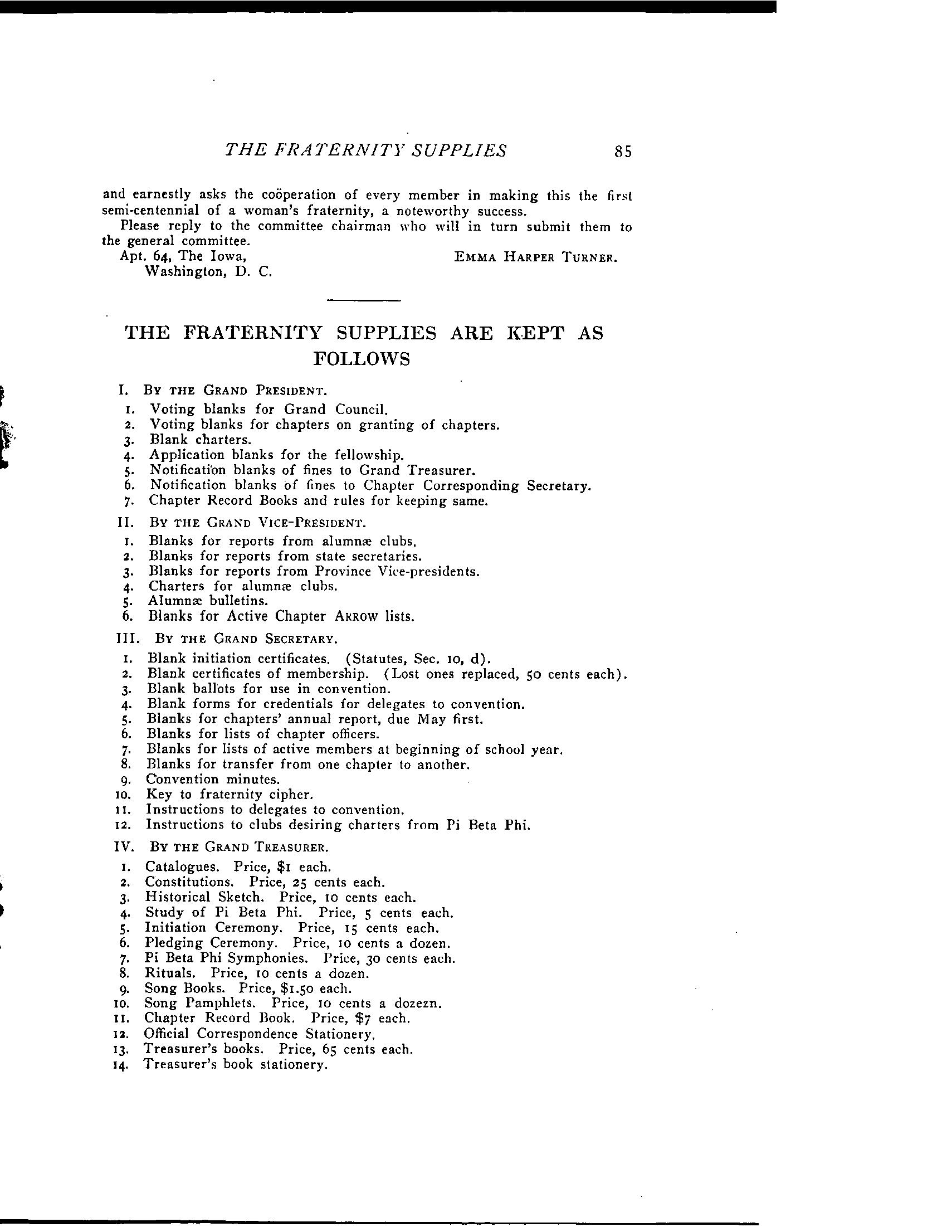
and earnestly asks the cooperation of every member in making this the fi rst semi-centennial of a woman's fraternity, a noteworthy success.
Please reply to the committee chairman who will in turn submit them to the general committee.
Apt. 64, The Iowa, EMMA HARPER TURNER. Washington, D. C.
1. By THE GRAND PRESIDENT.
I. Voting blanks for Grand Council.
2. Voting blanks for chapters on granting of chapters.
3. Blank charters.
4. Application blanks for the fellowship.
5. Notificati'on blanks of fines to Grand Treasurer.
6. Notification blanks of fines to Chapter Corresponding Secretary.
7. Chapter Record Books and rules for keeping same.
II. By THE GRAND VICE-PRESIDENT.
J. Blanks for reports from alumnre clubs.
2. Blanks for reports from state secretaries.
3. Blanks for reports from Province Vice-presidents.
4. Charters faT alumnre cluhs.
5. Alumnre bulletins.
6. Blanks for Active Chapter A'ROW lists.
III. By THE GRAND SECRETARY.
I. Blank initiation certificates. (Statutes, Sec. IO, d).
2. Blank certificates of membership. (Lost ones replaced, 50 cents each).
3. Blank ballots for use in convention.
4. Blank forms for credentials for delegates to convention.
5. Blanks for chapters' annual report, due May first.
6. Blanks for lists of chapter officers.
7. Blanks for lists of active members at beginning of school year.
8. Blanks for transfer from one chapter to another.
9. Convention minutes.
10. Key to fraternity cipher.
11. Instructions to delegates to convention.
12. Instructions to clubs desiring charters from Pi Beta Phi.
IV. By THE GRAND TREASURER.
I. Catalogues. Price, $1 each.
2. Constitutions. Price, 25 cents each.
3. Historical Sketch. Price, IO cents each.
4. Study of Pi Beta Phi. Price, 5 cents each.
S. Initiation Ceremony. Price, 15 cents each.
6. Pledging Ceremony. Price, 10 cents a dozen.
7. Pi Beta Phi Symphonies. Price, 30 cents each.
8. Rituals. Price, 10 cents a dozen.
9. Song Books. Price, $1.50 each.
10. Song Pamphlets. Price, 10 cents a dozezn.
I I. Chapter Record Book. Price, $7 each.
n. Official Correspondence Stationery.
13. Treasurer's books. Price, 65 cents each.
14. Treasurer's book stationery.
By TilE ARROW EDITOR.
Blanks for chapteT statistics for July ARROW. Paper on which corresponding secretaries send in ARROW contributions. Duplicate copies of back numbers of the ARROW.
By THE ALUMNAE EDITOR.
Blanks for chapter ARROW lists;. Pattern for model initiation gown.
By THE CATALOGUER.
Blanks for catalogue supplements. Supplements to catalogues.
VIII. By THE PROVINCE PRESIDENTS.
J. Blanks for chapter reports to Grand Council and to Province Presidents