THE ARROW of PI BETA PHI
HISTORY NUMBER 1867,1936
FEBRUARY 1 9 3 6
HISTORY NUMBER 1867,1936
FEBRUARY 1 9 3 6
1867 - 1936
AGNES W RIGHT SPruNG, Wy omiflg A National Hi st oria n D i re ct ed By
ADELE T AY LO R A LFORD, D .C.A. Arrow Ed itor FEBRUARY · 1936
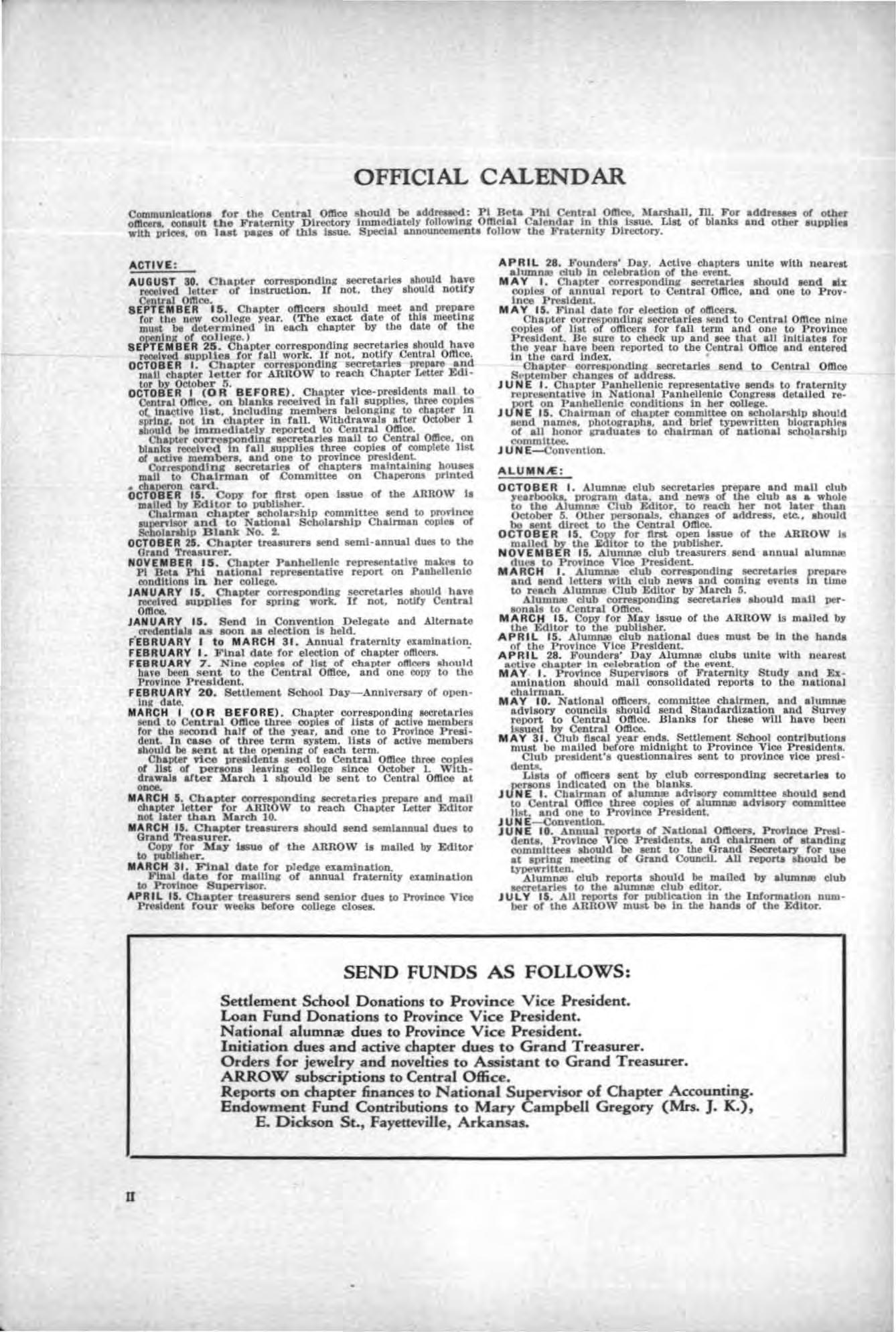
ACTIYE:
AUGUST SO. Chapter oort"Mpo ndln l IIIould bar. lelLer o r instruction. If DOt, they .boUld DOury Chapter om oen Ibould mee t and prepare t or th e Dew co llege year. (The Had. date of th l, IDMtL n IllIUt bI 4 eLe rmlned In Udl chapter by t h e d.U of lb e .trrJ.a'BfR oorre8po ndln l secmarln flhould have
JRAU chapUr l etter for ARnOW to reach Cbapte r Letter E<lI lOr by October
Ibould be InunedJaW,. reported to CMtral OI'lloe.
tJI accJft JDemben and one to prorince pre&lcknL
CotnlllPOGdln. of eta_pUn malntalnl,.. hou_ lUll to Cba.lnnan ot Committee on Cblpr.rou urtole<! dll()e!'On eard.
OCTOBER 15 Cow f o r ftm open iMue of lbe AlmD W I, milled IJ)' ):4lto'l' to pUbUsher. Chairman clllpter .cboll"-hlp a)mmlttee to prOrinoe Scbolanhlp Chalruan ooplel of aCTO SIR 21. Chapter .end semi-annual d..- \0 Lbe Or.nd Tre&aurer.
HOVIMBIII 15 Chapter P anbellenJe I"I!preeenWi" mufOS \0
PI Bela Pbi nat ional I"tpreeentatill"e I"I!pon on Panh ell e nlO tIODllltlOM In. ber co ll er&.
JANUARY II. Chapter ooneaPODdln, aecretariet Jbould hall"e rectlftld IUpplt. (or .prin, _oR. lr not, not1tJ Cmtral om..
JANUARY II. Bond In Co n.,enUo n DeIea:ate and Alternate endflDtial MJoOn e1ect.10D Is beld (tSRUARY I to MARCH 31. Annual (ratemJt.7 eu mlnatl o n
FEBRUARY I. Jrlnal date for e:lect loD or eIl.pter otncera. • rEBRUARY 7 Ntn. eor>' 01 II. 06 eh.J)IlO!!" .holilil hue been sent to the Central Omoe. and o ne OOP1 to Lb e 1'l"O'I'lnce J'l"ealdenL
FEBRUARY 20. Settlement 8cbool n. y-AnnlreflU1 of openI n dato.
fOf the IfiOO nd hal f of the year. and one to J>roorI.Qce 1-,.1denL In C&ee of t h ree tenn I)'ltem. Il Ita of actIffI memben abould be le n t at th e Ol)l!llin. of each term 01
dr..ala alter Jolareh 1 ldio uld be &e nt to Cent ral Ofnoe at .-
Dot later than March 10.
MARCH II Chapter t.reuut'en abould w.mIanoIW du" to Or.nd 'l'rH.aul"U. for lo1a7 t.ue of th e ARROW I. malJed bJ' EdItor to publllbu_
MAIlCH II. 1M D.l date f Ol' pledn uamtnatlon. IMBaJ daLe for mallllll Of annu.a.l fraternll1 eumlnaUon to APRIL II ChallWr lreNuren .wi_lor dllft t.O Prot'laoe VIClI f"roeIldMt four weea Wore coUeen clOlltL
Settlement School DonatiON to Province Vice President. Loan Fund Donations to Province Vice President. National aJumnz due. to Province Vice President. Initiation dues and actin chapter dues to Grand Treaaurer. Orders for jewelry and novelties to Assistant to Grand Treasurer. ARROW subscriptions to Ce:ntral Office. Reports on chapter finances to National Supervisor of Chapter Accounting. Endowment Fund ContributioWi to Mary Campbell Gregory (Mrs. J. K.), E. Dicbon St., Fayetteville, Arkansu.
MARGARET CAMPBELL
LIBBIE BROOK GADDIS
ADA BRU EN GRIER
CLARA BROWNLE E HUTCHINSON
EMMA BROWNLEE KILGORE
FANNIE WH ITENACK LIBBEY
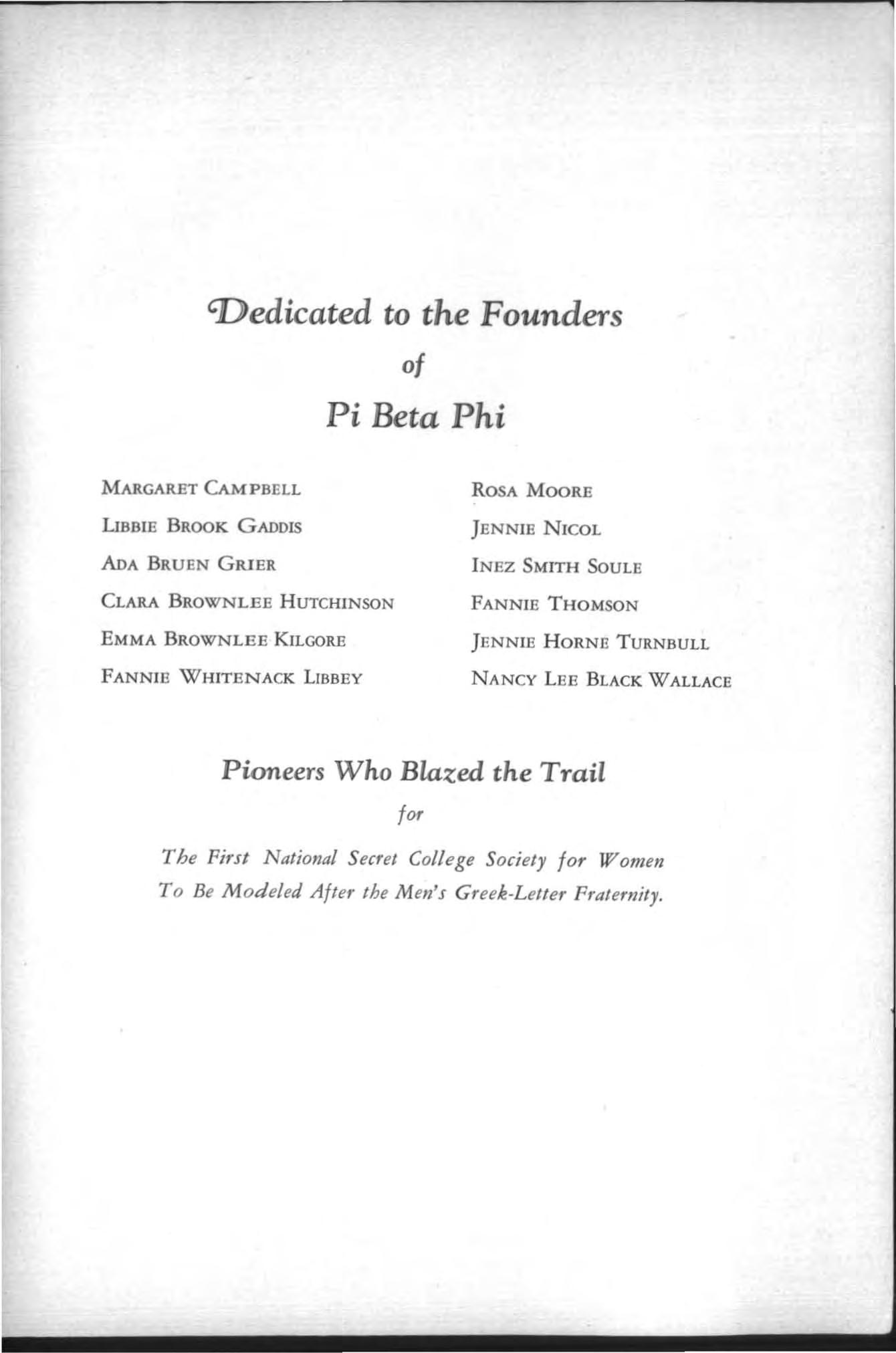
ROSA MOORE
JENNI E NICOL
IN EZ SMITH SOULE
FANNIE THOMSON
JENNIE HORNE TURNBULL
NANCY LEE BLACK WALLACE
The Fi,st Natiollal Secr et CoJlege Society fo, W omm
T o Be M odeled Afte, the Mm's G, eek- L ette, Frat ernity.
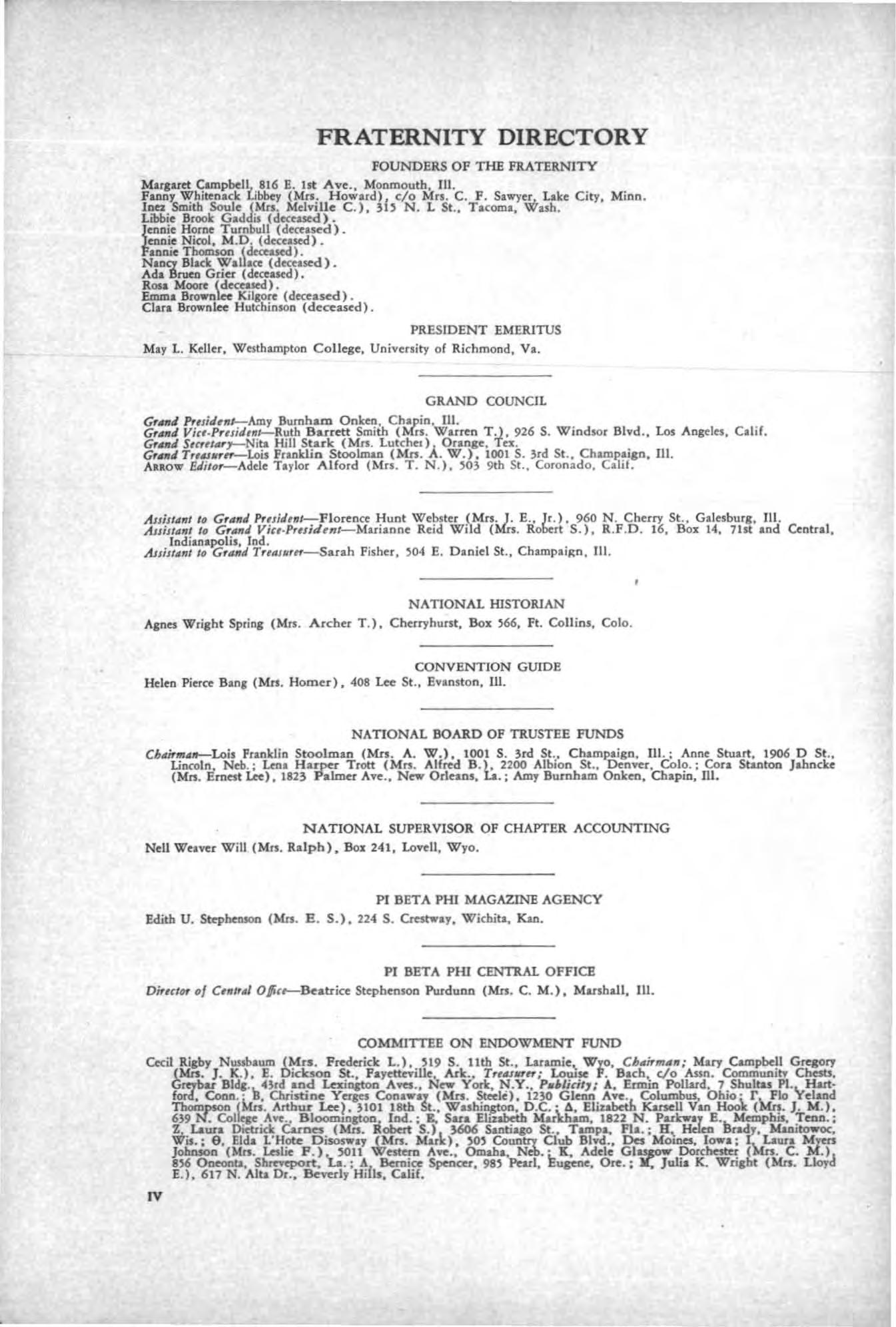
FOUNDERS OF THE FRATERNITY
Margard: Campbell 816 E. 1st Ave., M onmouth, III
Ina Smith Soule JMn. Melville C.), lU N. L St .• Tacoma, wash.
Pannr Whitena ck. Ubbey (Mrs. How ard), clo Mrs. C. P. Lake City, M inn.
Libbie Brook Gad is (deceased). Horne Turnbull (deceued).
moie Nicol. M D (deceased).
annie Thomson (dtaued).
NIDCJ Black Wallace (deceased).
Ad, Bruen Grier (d«eucd).
ROIl Moore \dKeaxd).
Emma Brown ee Kjlaore (deerased).
Clan Brownlee Hutch inJOo (decea.scd)
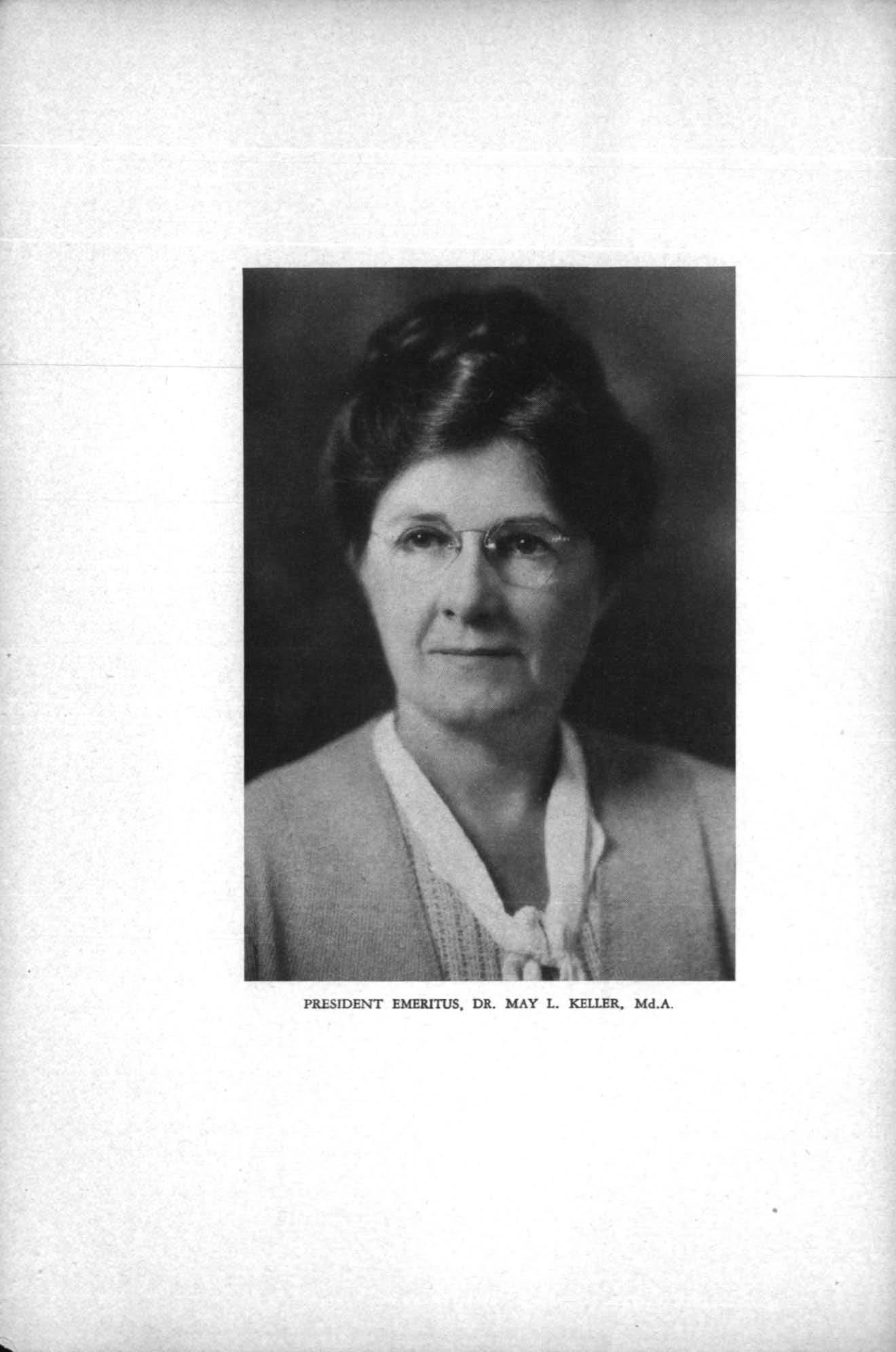
May L Kellcr. WnlhllTlpton College. University of Richm ond Va.
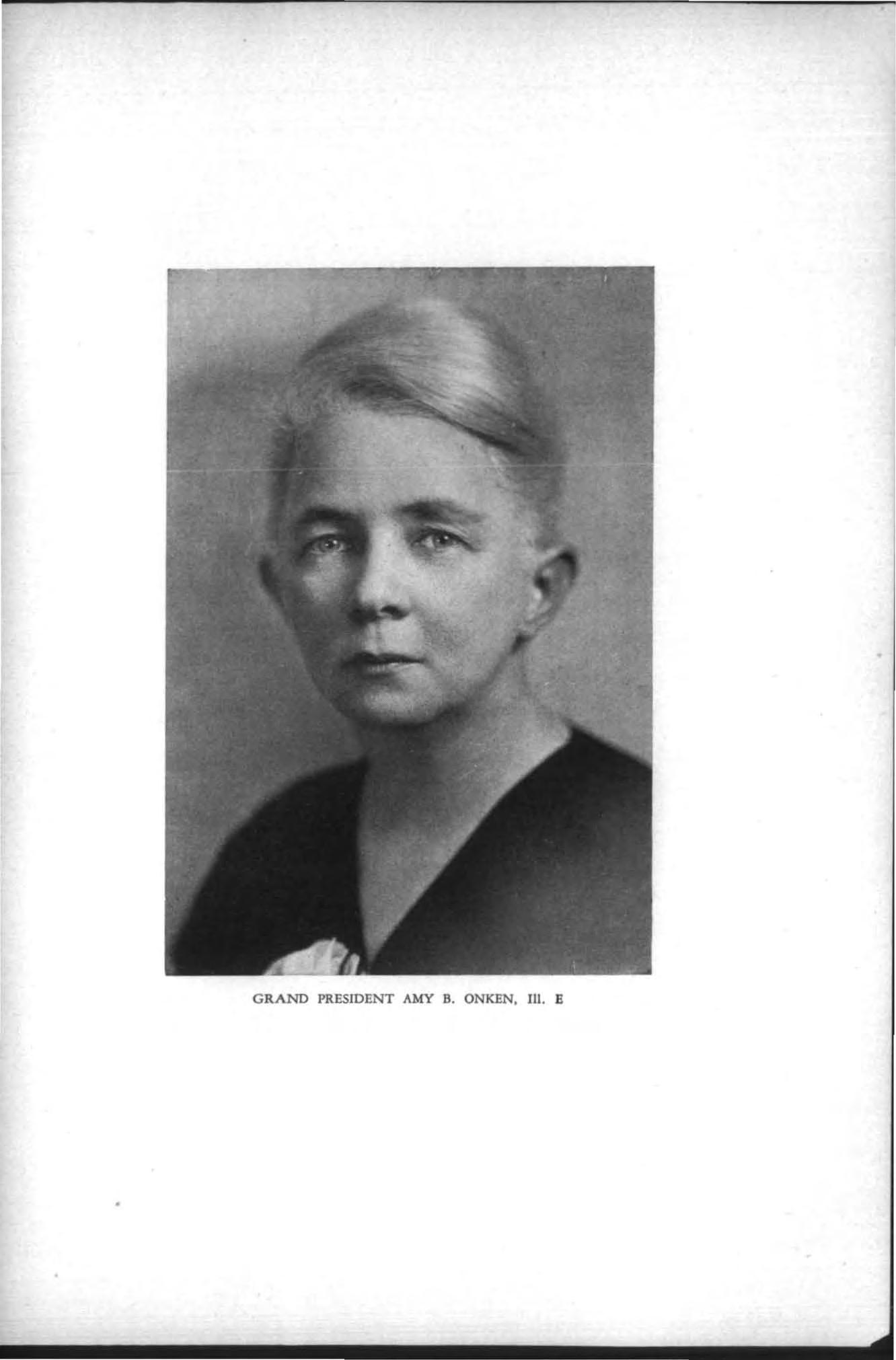
G, ,,,,J Pwhle"t-Am, Burnham Onken. Ill.
G,_J Virt·PrlJiJ,,,I-Ruth Barrett Smith (Mrs. Warren T.>. 926 S. Windsor Blvd., Los Angeles. e'lif Grn" Sm,tM,7"-Nita Hill Stlde (Mrs. Lutchcl) Orlnge. T o:.
G,,,,,tI T".s ,n--Lois Franklin Stoolman (Mn. A. W.). 1001 S. 3rd St , Champailo, III.
A o &littlr-Adele Taylor Alford ( M rs. T. N ), '03 9th St., Coronado, Calif.
AII;II"nllo Gr"n' Pru;'",t-Plort:n cc Hunt (Mrs. J E., Jr .), 960 N. St ., Galesburg, III. AII;u"nt 10 Gr",,' Reid wild (Mrs. Robe rt 5.), R.F O. 16, Bol: 1", 71st and Central, Ind Anill.n/to Gr/lJftl TrtllJ",,,-Sarah ,().4 E. St., Champaign, III.
NATIONAL HlSTORJAN
AJnes WriJht Spri ng (Mrs. T.). Cht'Jryhuut, Box '66, Ft Collins, Colo
CONVENTION GUIDE
Hden Pierce Ban, (Mn Homc..r) , "08 l.ff St., Ev.nston, Ill .
NATIONAL BOARD OF TRUSTEE FUNDS
Chil6",• .-.Lois Franklin Stoolman (Mrs. A W l, lOOt S 3nl St., Champ:aiIJ o , Ill.: Anne Stuart, 1906 D St .• Liocoll!.o Ncb ; Leo. Trott (Mrs. Alfred B .), 2200 Albion St .• Denver. Colo ; Cora Stanton jahncke (Mrs r.mest Lee), 1823 P.lmer ATe ., New Orleans, u.; Amy Burnham Onken, Ch a pin, 111.
NATIONAL SUPERVISOR OF CHAPTER ACCOUNTING
We,ver Will (Mrs. Ralpb) , Bol: 2"1, Lovell. Wyo ,
PI BETA PHI MAGAZINE AGENCY
Edith U StcphalJon (Mrs. E. S .l. 22" S. Ctcstway. Wichita. KaD.
PI BETA PHI CENTRAL OFFICE
D;,trl",o/ C,,,I1.J O#r,......Bc.trice Purdunn (Mrs . C. M .l, Mar shal l , Ill.
COMMITI'EE ON ENDOWMENT FUND
Cedi Rigby Nussbaum Prt:dttick L .).. '19 S. 11th St .• Laramie Wyo, Ch";,,,,,, ,,; M.". Campbc!1 Grqory (MiS. J. K.l, E, OlCkson St ., TrttUllur ; Louue F c/o Assn. Communi" Chests. Gm-bar Bldi.\. <CJrd and Laiocton A'f'CS ., New rork N.Y., PdJicil10 A. ErouD Pollard. 7 Shultas PI , ,, Hattford. Coon .' H, Christine Yaan Cona.ay (Mrs, Sttdc). 1230 Glc:nn ATe Columbus Ohio' r flo rdand Thompsoa (Md. Arthur- kc). JIOI 18th St., Karsell Van Hook j M l , 6J9 N. Ind .; E. Sara MatkDam , 1822 N Punay E."Mcmphli. :reno .; Z Laura Diitno: I...It"DeS (Mis. Robert S .l I Sanbl.lO St .• Tamp •• Fl •. ; H ., Hdec orad...1, Muutowoc, Wis .: e. Elda L'H?H: Oisoswa, (Mo. Mant) , '0' Country Club BI-id., Des MOlDes. Iowa: I".uun johnsoo (Mrs. Lalle P ) )o1l Wt'Sttto Ave., Omab, __ Ntb .i., K, Adele Glasaow Dorchester (Mn C. M ')d ' Oaeonta, Shn:ftport, La.; A, Bernia Spcnar, 98) rearl, r.usenc. Ore.; )(, Julia K Wria&t (Mrs. Lloy E .). 617 N. Alts Dr- , Hi !s, Calif.
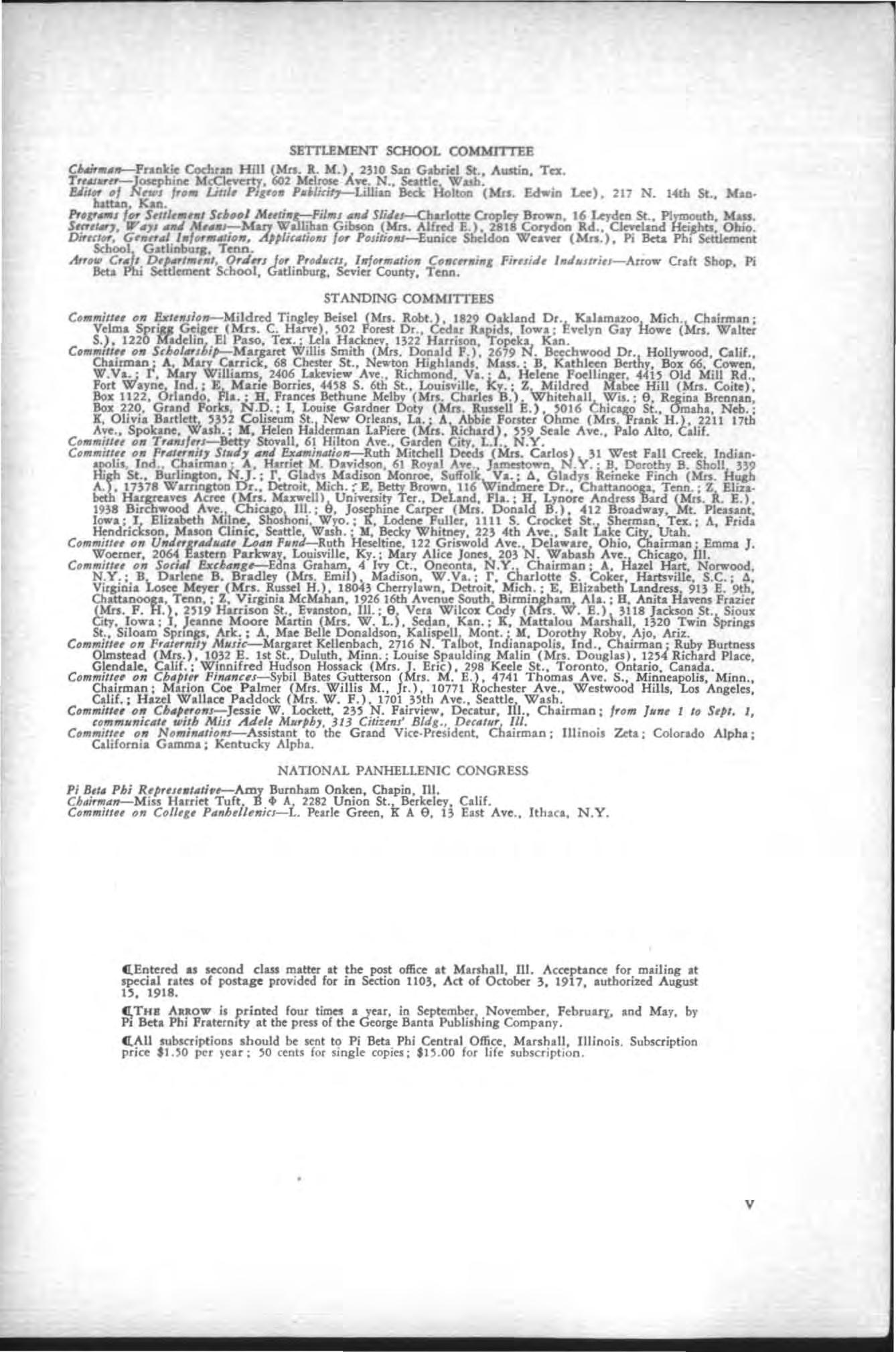
C.6Mr•• _Fr.nltie Cochran Hill (MIs. R. M.) 2310 San Gabriel St•• Austin , Ta. T,t..,.trw-JOICphine 602 MdCOfe "ft. N., Snttle. Wash. Uil", _/ lintls /,•• uili. PI,t•• PdJicir,-.LiUiao Bed: Holton (Mrs. Edwin Lee). 217 N. l"th St., Mao. hattan Kan. Pr.,,4M11M S",I,.,./ Seh •• 1 Mttli"rFiI., .". SIiJ,.,--Ch.,lottc Cropley Brown, 16 St .• Plymouth, M Sm'II" "'.,, ••• Al,...,.......Marr Walliban Gibsoa (lin. AJfrcd E.), 2816 Corydon Rd., CItTt:land HeiJhts. Ohio. Diru,tW. G'"nM Anli,.tius/tw PositioN-Eunice Sbcldoo Weuu (Mn.), Pi Beta Ph. SUtietMnt School G.Uitthwa. Tenn. krtHI D",.,I",,,,', 0,4nl 'fir PrDt/.tu. Itq(lf ••ti.tf C••,""i", Fi,tsiJ, /II'/'III,ilS-/urow Craft Shop, Pi Bd. Phi Settlement School, G.clinbWJ. SeYitt County, Tmn.
C••",ju" 1m &wuiott--Mildttd Tin&ler Beisel (Mrs. Robt .), 1829 Oakl and Or Ka.lamuoo,.Mich'1. Chairman; Vtlma Spril'l Gel,er (Mrs. C. '02 Forest Or., cedar Rapid •• I owa: J::vclyn Ga,. Howe (Mrt. Walter S ), 1220 Midelin EI Paso, Ta · Lela Hackney 022 Harrison, Topeka Kan C•• .,III!' tU, Willis Smith (Mil. P.), 2679 N. Beechwood pr: 1 HoU.,...ood , Calif•• Chairman..: A, Mary Camdt, 68 CMstet St .• Newton Hl,hland. , Mast .; B, Kathleen DCtUIf, BOx 66, Cowen. W.Va.' l, Mary Williams, 2406 Laknit:W Ave., Richmond, Va. ' 4, Helene Poellinger, 44U Old Mill Rd ., Fort WaYD!t Ind. : E"I". MUle Borrio:, ""8 S. 6th St., Louinille, ZI.....Mildred M abee Hill (Mrs. Coite) , Box 1122. vrlando. I'la .; H. Frances J;kthune (Mrs. Charles D .) •. ; 9, Bemnan, Box 220, Grand Porb, N D .: I, louise Gardner voty (Mrs. Ruuell E.), '016 hlClI9 St., Omaha. Neb.: K Olivia ,,'2 Coliseum St' l Nrw Orlrans 4,.; A Abbie Porstu Ohme (Mrs. Frank H .), 2211 17th Ave , Spokane, wash : M, Helm Ha dmnan laPiere (Mfl. Kichard), :5:59 Seale Ave., Palo Alto, Calif. C.",.ill" ." Tr."s/ns-Betty StoYall, 61 Hilt on An., Garden City. L r., N.Y. C.",.,ill" •• Frllln.il1 SIIIII:/ .IIJ b i". li o_Ruth M itche ll Ot:td. (Mrs. Carl os) ,,}I West Fan Cr«kl Indian · &pOlis, Ind ., Chairman' A. Harriet M D",·jcboo. 61 Royal An. Jamestown N T.· B. Doroth,. B. Sn01l "9 b St., Butlinctoo, N.J.; r, Monroe, Sufl'ol',-,-:,a.: 4, Gladys Reineke PinCh (Mn. Huah A. , 17378 Wuranaton Or., [kttcut, MJch .• E, Betty Brown" 116 wJnclmeie Dr., Chattaoooga, Tenn.; Z.I. Eliza· Hu&teaYU Acree (Mrs. Maxwell) UniTmity 'ter.• DeLand, Pia. ; H Andreu Bard (Mrs. K E.), 19J8 ATe ' j ChiCiIO e, Josephine Carper (Mn. Donald B.), "12 Broadwa,., Mt Pleasaflt, JO'Wa; II Ehubctb Miinel ShMhODI. Wyo.: K. Lodene Puller, 1111 S. Crockt:t St.,1 ShermlD'uTa.: A, P"d a HendrickSOn, Muon CliniC, Seattle, Wash.' ll, Bcdcy Whi","" 12' 4th Ave., Salt u.ke Gtr, tab. C••",i"" •• U"J"A,,uI.tII, Lo.1I F."J-Ruth Htseltint:. 122 GriJWold An ."J)elaware, Ohio. CbairmlD j' Emma J . Woerner, 2064 Eastun Parkway, Louin·ille. Ky.; Mary Alice Jones. 20, N. Wab.,h An Chicago, 11. C•• ",i"" •• &_Edna 4 .• Oneonta, N'Y' h Ch.irman; A, Hud Norwood, N.Y.: BI. P_arlene B. Bradley (Mrs. Eall ). MadlSOD , W.Va.: r. C arlotte S Coker, Hlrt:n'ille, S.C.: 4, Vir,ioia J.A)ICt Meyer (Mrs. Ruue.l H .), 1804J Chmylawn, Detroit. Mich .; E, Elizabeth Landrus 9U E. 9th, Chattanooga, Tenn .; Z. V;it&inia ldcMaJian, 1926 16th AYenue.South.l Ala.: H. Anita tl aftD. (Mrs. P. H .), 1H9 Hunson St., Ennston, Ill.; 9( Vera Wilcox \..Oa,. (Mrs. w. E')h'118lacbon St.,. SIOUX City. Iowa: i, Jeanne Moore Martin (Mrs. W. L.J, Sedan. Kan.: K, Mattalou Mars all, I 20 Twio St., Siloam SpnDB', Ark. : A, Belle Donaldson. Mont .· II, Dorothy Rob,., Ajo, Ariz Co",,,,i,,,, 0" Fr.'".111 M.sit'-M ar, aret Kdlenb ach, 2716 N T.lbot Indianapolis, Ind ., Chairman; Ruby Burtness Olmstead (Mn.), Ion E. lst St'l Duluth. Minn,.; Louise Splulding Malin (Mrs. Douglas). 12' Richard Place, Glendale. Calir ; HUdson Hossack (Mrs I. Eriel, 298 Keele St., Tor o nto, Ontario. Caoadl. Com",iller 1m Cb.pln Battl JMn M. E.), 4741 Thorn Ave. S.• Minnrapolis, Minn., Chairman; Marion Cot: Palmer (Mrs. Willis M • r .). 10771 Ave., Westwood Hills, 1.0. Angeles, Calif.: Hazel WaUace Paddock (Mr•. W. P.), 1701 J'th Ave ., Seattle Wash. C• .,millll •• Ch.,nOfts-Jessie W. Lockett, H' N. Pairtiew, Dtcatur, lit, Chairman: from /1111' 1 10 S"I. I, ."ilh Mill Adtl, "'.r,h" 313 Ciliu"s' BIll•. , DU.I", III C• .,,,ullet •• No.bu,io"s-Assisunt to the Grand Vice·President. Ch.irman; Illin ois Zeta; Colorado Alpha: CaJifomia Gamma; Kentucky Alpha.
NATIONAL PANHELLENIC CONGRESS
Pi B,t. Phi Burnham Onken. Chapin. Ill. Cb.ur"'<If_Mi" Harriet Tuft
B.A 2282 Union St. Berkeley, Calif. C.",,,,;tt,, tm Col/", P."h,/Ie" iu-i. Pearle Grtttl. k A 9, 13 East Ave ., Ith aca, N.Y.
«t Entered It:CQnd class matter at the post office at Manhall III. Acceptance ror m.iling at .pecial lites or postage prov idtd ror in section 1103. Act of October l, 1917. authorized August n, 1918.
!f,TH. A..ow i. printed four times a in Septemherl November . Pebru afl, and Ma,., b,. PI Beta Phi Praternrty at the press or the Banta Publisning Company.
«tAil subscription. should be 10 Pi Beta Phi Centra l Office. M ars h.lI IIIin o i•. Subscription price $1 .'0 lear; )0 (tnu for copitl; $1'.00 for lift subscriptIon.
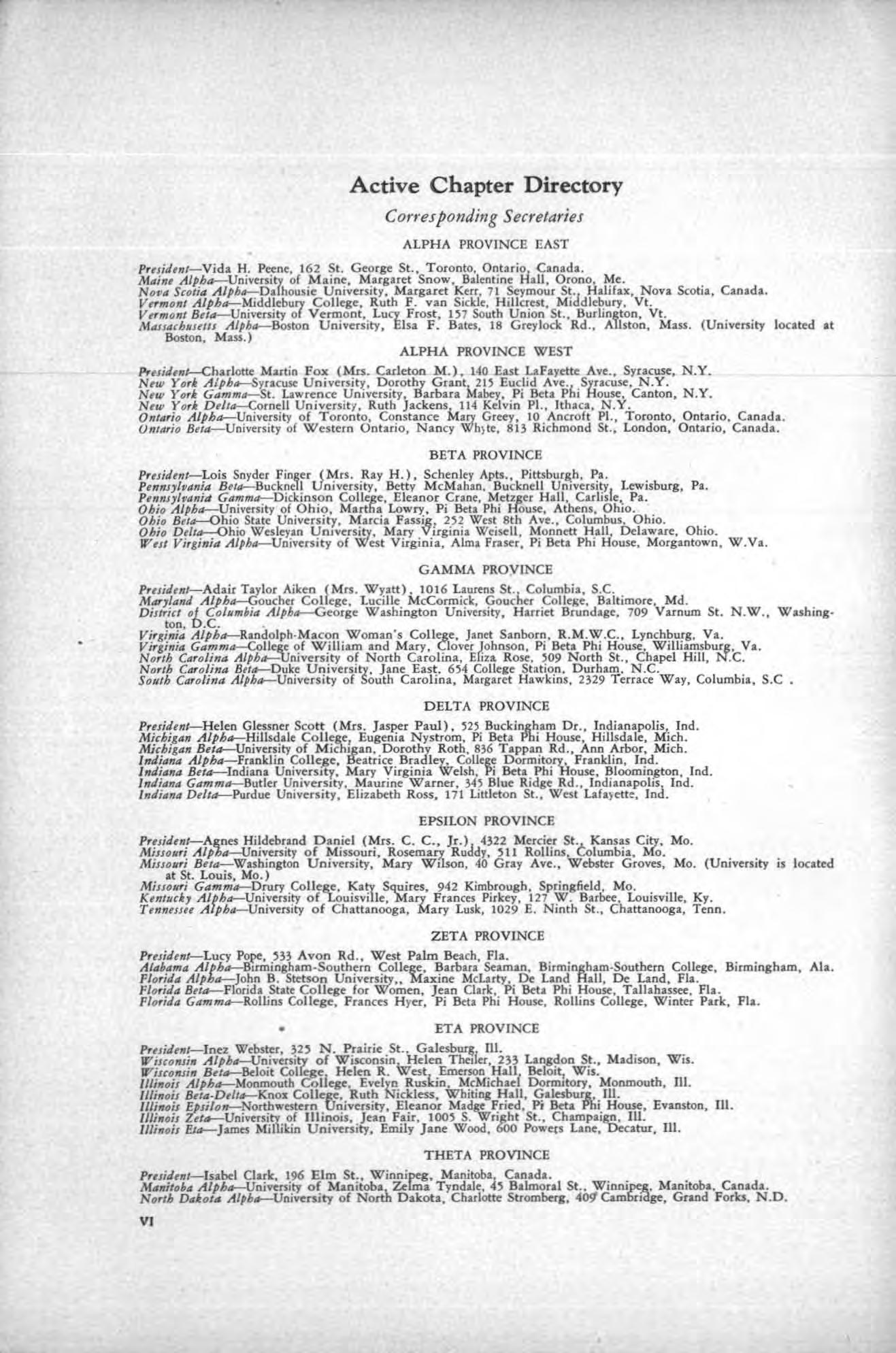
ALPHA PROVINCE EAST
Pruid t nl- Vid. H. Pcene, 162 St. Georat St., Toronto, Ontario Canad., Mllif" AJph-tlnive:rsit)' of Maine, Margaret Snow, Balent ine H a ll, Orono, Me.
No"" Salli. A/ph_Dalh ousi e University, Margaret Kerr , 71 St,/ Halifax. NovI Scotia, Canad •. VnmDnl A/ph_Middlebury College. Ruth F van Sickit, Hillcrest , VI Vtrmont Btl_Univcuity of Verm o nt, Lucy Frost, n7 South Union 51., Burlington, VI.
MltI slu hJlutIs A/ph_Boston University. Elsa F. Bates. 18 Grt'ylock Rd ., Allst on. Mass. (University located .t Boston , Mus .)
ALPHA PROVINCE WEST
p,.,si.l",l--Ch.r1ottc Martin Fox (Mrs. Carleton M ) , 140 East laFayette Ave ., Syracuse. N Y. New Dorot!:ly Grant,}" Euclid Ave ., N.Y. Ntw Yo,! G",mJPIa-St. La rence University, Barbara Mabey, Pi Beta Pni House, Canton, N.Y Ntw YD1'i D t lta-Cotnell Universit1, Ruth jackens, 114 Kelvin PI., Ithaca , N.Y.
O",,,,i o Alph __University of Toronto, Constance Mary Greey, 10 Ancroft PI., Toronto, Ontario , Canada. U",,,,i o BnA-U niversity of Western Ontario, Nancy Wh I te, 813 Richmond St., London, Ontario, Canada.
BETA PROV I NCE
Prtsidmf-Lois Snyder FingerJMrs. Ray H.), Schenley Apts., Pittsburgh, Pa.
PII""J,III/mia Btt_ Bu ckndl niversity, EkUy McMahan, Bucknell Unlversit Yj lewisburg, Pa.
P""IJ,I ""id Ga.."..,,_Oi clr:inson College, Eleanor Crane, Met.zger Hall, Carlis e, Pa.
Ohio Alih_Univt:nity of Ohio, Martha Lowry, Pi Beta Phi House, Athens, Ohio. Ohio Bn--ohio State University, Marcia Fassig, n2 West 8th Ave ., Columbus. Ohio. Ohio Dtlt--ohio We5leyan Umversity, Mary Virginia Weisel!, Mo nnett Hall [klaware, Ohio. Wnt Virli"id Alph -University of Wes t Virginia , Alma Fraser. Pi Bet a Phi House , Morgant own, W Va.
GAMMA PROYINCE
Pruidt",-Adair Ta.yl o r Aiken IMrs Wyatt) , 1016 Lurens St. Columbia, S.C. M.,la"d AlphA-Goucher Col ege, Lucille McCormi ck , Goucher College, Baltimore, Md . of Cohltdia Alph--Gcorge Washington University, Harriet Brundage, 709 Varnum St. N W .• Washing ton, t>.c. Vi " i"i" Alpha-Randolph Macon Woman's College, janet Sanborn, R.M.W.C., Lynchburg, Va. Vir,i"ia Gammot-College_of William and Mary, Clover Jo hnson, Pi Beta Phi Williamsburg, Va N orth GlroJi"", of North Carolina, Erin Rose, )09 North St., I...-hapel Hill, N C. North ClUolin", Btlll-Duke University, jane East, 6)4 College Station, Durham, N.C. SOllth C.,oJi"d Alphll-University of South Carolina, Margar e t Hawkins, 2329 Terrace Way, Columbia, S.C
DELTA PROVINCE
P r uid,,,,-Helen Glessner Scott (Mrs. jasper Paul), )2) Buckingham Dr., Indianapo ll! Ind. Mhhi,." AJph_Hillsdale Co ll ege, Eugenia Nystrom, Pi Beta Phi House, Hillsdale, Mich. Btl__University of Michigan, Dorothy Roth, 836 Tappan Rd., Ann Arbor, Mich J"di."" Alphd-Franklin Colle.se, Beatri ce BradIey, College Dormitory, _ Pr.nklin, Ind.
I "di "", Btld-I ndiana UniversIty, Mary Vitainia Welsh Pi Dda Phi House, Bloomin,&ton, Ind. I"tli " G",mm_Butler UniversIty. Maurine Wuner, Blue Ridge Rd ., Indianapolrs l Ind I"di "" Ddl __ Purdue University, El izabeth Ross, 171 Littleton St., West Laf a}et t e, Ina.
EPSILON PROVINCE
PrtJid"ft-Agnes Hildebrand Daniel (Mrs. C. C , jr.) I 4322 Mercier St Kansas City, Mo. MislolI,i Alph,,-Univenity of Missouri, Ruadr, )11 Rollins u>lumbia, Mo. MisJo.ri BIt.-Washington University, Mary Wilson, 40 Gray Ave" Webster Groves, Mo. (University is located at St. louis, Mo.)
Miuo",i GAm",_Drury College, Katv &lUires, 942 Kimbrough, Springfield, Mo.
K,ntlld, Alph_Univenity of Louisville, Mary Frances Pirkey, 127 W Barbee , Louisville, Ky. Tt""tlltt A/ph,,- Univers ity of Chattanooga, Mary Lusk, 1029 E. Ninth St., Chattanooga, Tenn.
ZETA PROV I NCE
PrtJid,1It- Luq H3 Avon Rd ., West Palm Eka ch , Fla.
Al.b"m. AJ,tIh_Blrmingham ·Southern College:, Barbara Seaman. B i rmingham ·Southern College, Birmingham, Florid. Alph_john B Stetson University Maxine Mclarty, De land Hall, De land. Fla Florid. Btld-Florida State College for W ome n, jean Qark, Pi Beta Phi House, Tallahassee, Fla Flo,ida Gamm_Rollinl Collcle, Frances H ),e r, Pi Beb Phi House, Roll i ns College, Winter Park:, Pia
ETA PROVINCE
PrtJid",t-Inez Webster, }U N. Prair ie St., GaJesburt III. fPm otui" Alph.-Unlvenity of Wisconsin,,-Helen Thelier, 23) unadon St., Mad ison, Wis JP';u(J1I!'" 8,.,_Beloit CoJrege R. Welt Emerson Hall Beloit, Wis. lI/i"o;J Alph_Monmouth eotleac, Evely!). Rusftjn, McMichael DormItory, Monmouth, lIl. 1II,,,oiJ Btt.-Dtlt_Knox Ruth Nickless, Wbiblll HaU, Galesbur.&, 111. 1l1,"oiJ University, Eleanor Madge _Fried, P, Beta Phi House , Evanston, IlJillQll Z"d-UOlversity of Illinois, jean Fair, 100) S. Wrilht St., Champaign, HI. lI/i",iJ EI__james Millikin Umversity, Emily Jane Wood , 600 Powen Lane, Decatur, Ill.
III.
THETA PROVINCE
Prtlid,.t-lsabel Clark, 196 Elm St • Winnipeg , Manitoba, Canada. MII"ito!" Alph-tJniversity of Manitoba\ Zelma Tyndale, 4) Balmord St., Winnipeg, Manitoba, Canada. ND1'th D.iol. of Norm Dakota Charlotte Strombaa', 40'/ Cambridge, Grand Forb N D
VI Ala.
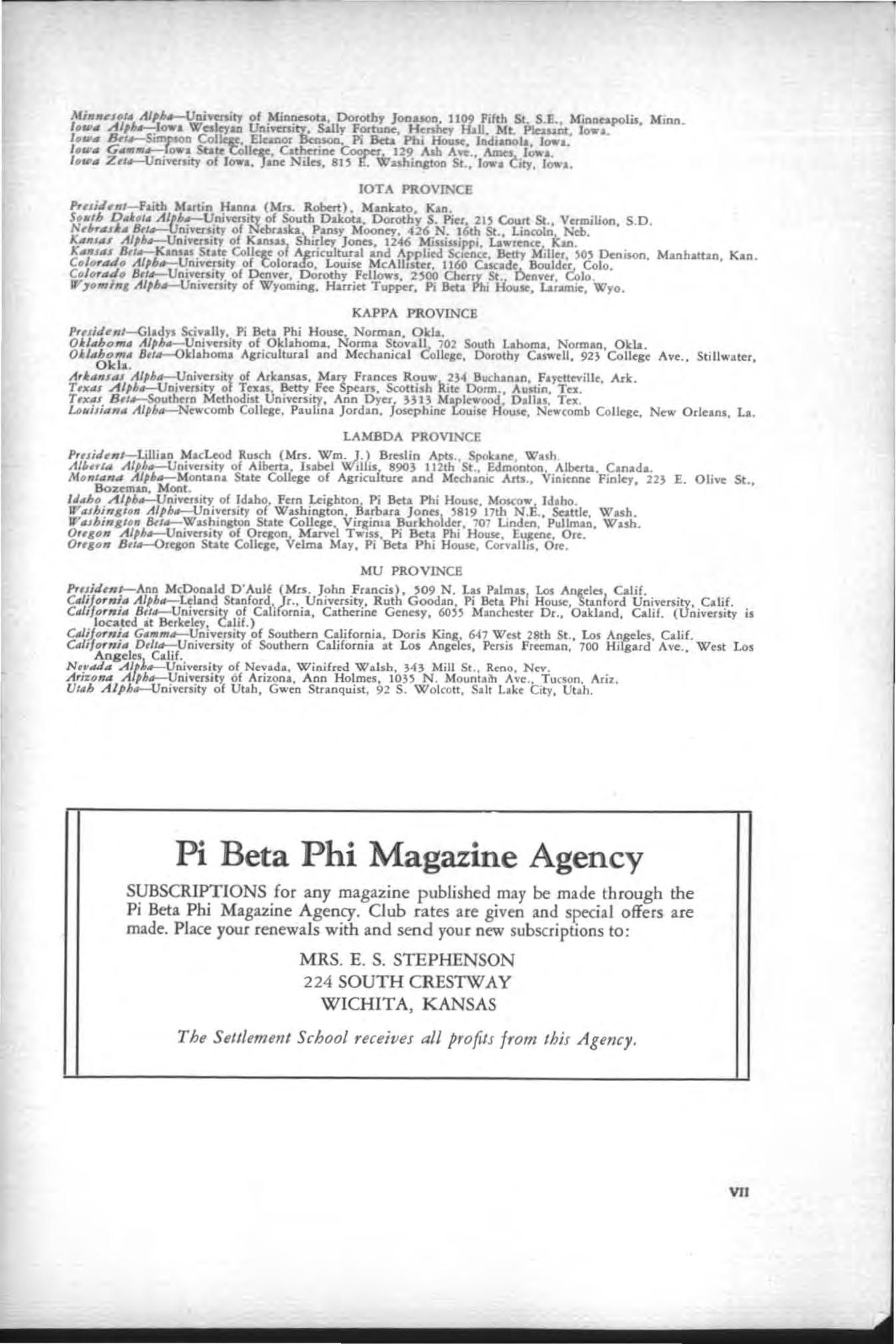
Mj""'IOI4 AlIH-Uniftrlity of MiIlDC5OtI Dorothy }onlson, 1109 Fifth St. S.E., MionHpoliJ Minn. t ••• Wesleyan UoiftfSity, Sally Fortune, H C'nhey Hill, Nt Pkuant. lowi • I • ..,. &i-simJ*)D Colkft, Eluooc &osoa. Pi Beta Piu Houa, lod ooll, low •. I,ug,. C ..-Io.u State t:OlIqe. Catherine Cooocr 129 Ash AYe , Ama lowl l otll. Zltlr-Univrrllty of 'OWI , Jane NIIc:S, 81' It Washington St.. JOWl City, JOWl.
IOTA PROVINCE
PusiJ,.,- F.ich Martin HanRs (Mrs. Robert). Mankato. Xan Sulh Did.,. AI,h_University of South DuO! S. Pier,. 2U Court St., Ve:rmjlion, S.D. of Nmrub. Pans,. MoonC'y. 426 N. 10th St. Lincoln, Ncb. K."StIU AI,"--UniVttSlfJ of Kansas Shirley Jones 12-46 Miui"ipp i. ta'wrnu Jean , K_JU &r_Kansas,Sllce Collqe of Agriculhl!21 and Applied Sm'nce. IkI:ty Mill". so, Manhattan, Ku. C.'.f'.J. Af'h UnlW:n'tr of Colorado, louise McAlIuter, 1160 Cascade.... Bouldt!,o Colo. C. /"f"lu/. of Denver, DOrothy Fellows, 2'00 St. uenVtr , 1..010
F,.""", Allh-UDlvenitr of Wyoming, Tupper, Pi Bda Phi HouJe, Wyo.
KAPPA PROVINCE
PrlJiJ ,,,/-Gbdys Sci Il" Pi Bda Phi House. Norman, Okla. Oi/"ho",,, Allh_Univer sity oC Oklahoma. Norma Stovall 702 South uhoma. Norman, Okla OjWo",,, B,t----Oklahoma Alticulrur.al and M«hanical Dototh, Cuwell, Collele Ave ., Stillwater. Okl •.
A,jll"r.r Allb_Univeuitr of Arkansas. Mary fran ces ROu Buchanan. Fayetteville, Ark. Allb_Univcrsity of TauU Betty Fee Spears, Scottish Kite Dorm Austin. Tex. BII_Southern Methodist niverain'. Ann HI} Maplewood, Oall u, Tex !Allisi""" Alllt_Newcomb Colltle. Paulina Jordan, Louise: H ouse, Newcomb Cotlele, New Orleans , La
LAMBDA PROVINCE
P,uiJ,,,,-Lillian MacLeod Ru sch (Mrs. Wm. J) Breslin ApU Spokane , Wuh
A"",,,, Allh-University oC Alberta Isabel WilJJSt 890) 112th St.• Edmonton. Albtrla, Clnada.
M."I"nA Allb_Montana Statc Coliele of A,rieu tufe and M KhlnJC Arts ., ViDicDOC Finler, E. Olive St .• 8oz.cmlJl. Mont
U"htl AI,h-tlnivc.rs ity of IdlhD , Fern Leighton Pi Beta Phi House. MOKOW Jdll)O. W"rh",gltlll Alph_University of Wuhington, alrbara J ones l ,819 17th N.E., xltllc, Wash. W"shing/o. BtI_Wuhifll;ton Statc Callelc. Vir.ima Bu r kh o dcr. 707 Lnden, Pullman. Wash. Or"o" AI,h.-lJnivcrsity or Oreaon, Marvel TwISS, Pi Ikta Phi H ouse, E':!IeDe, Ore. 0",011 8t1......oreaon Stale Collc,c, Velma May, Pi Beta Phi Houte, CorvallIS, Ore.
MU PROVINCE
PruiJenl- Ann McDooald O ' Aull ?,MrS. John Francis), '09 N. Lu Palmas, Los Ana.cles Calif. Allh....-Le:land StanCord. r., University, Ruth Goodan, Pi Beta Phi House , Stlnlord Un iversity. Cllif. C"lIjo,,,h, BtI_Uni,crsity of Cali orDia, Catherine: Genesy, 60" Man chcstcr Dr .• Oakland, Calif. (Un.ivcrsity is locatcd It Berkeleyl Calif.)
G"lIrm_Unlversity of SoutMro California, Dori King, 647 West 28th St " Los An,Aelcs, Calif.
D,II-Univenity of California It Los Angeles. Peuis 700 Hillard Avc .• West Los Angeles Calif, N,,,",, AI;l_Univtlsity 01 Nevada, Winifred Walsh, 343 Mill St., Nev. Arno"" AI;h_Univeuity Of Ariaonl Ann Holmes, 1O}, N. Mou nta1h A,·c .• Tu cso n Ari a UI"h A/ph_University 01 Utah, Stranquist, 92 S. Wolcott, Sal! Lake City, Utlh.
SUBSCRIPTIONS for any magazine published may be made through the Pi Beta Phi Magazine Agency. Club rates are given and special offers are made. Place your renewals with and send your new subscriptions to:
MRS. E. S. STEPHENSON
224 SOUTH CRESTWAY
WICHITA, KANSAS
The SeIIlement School receives all profits from this Ag."cy.
o ry
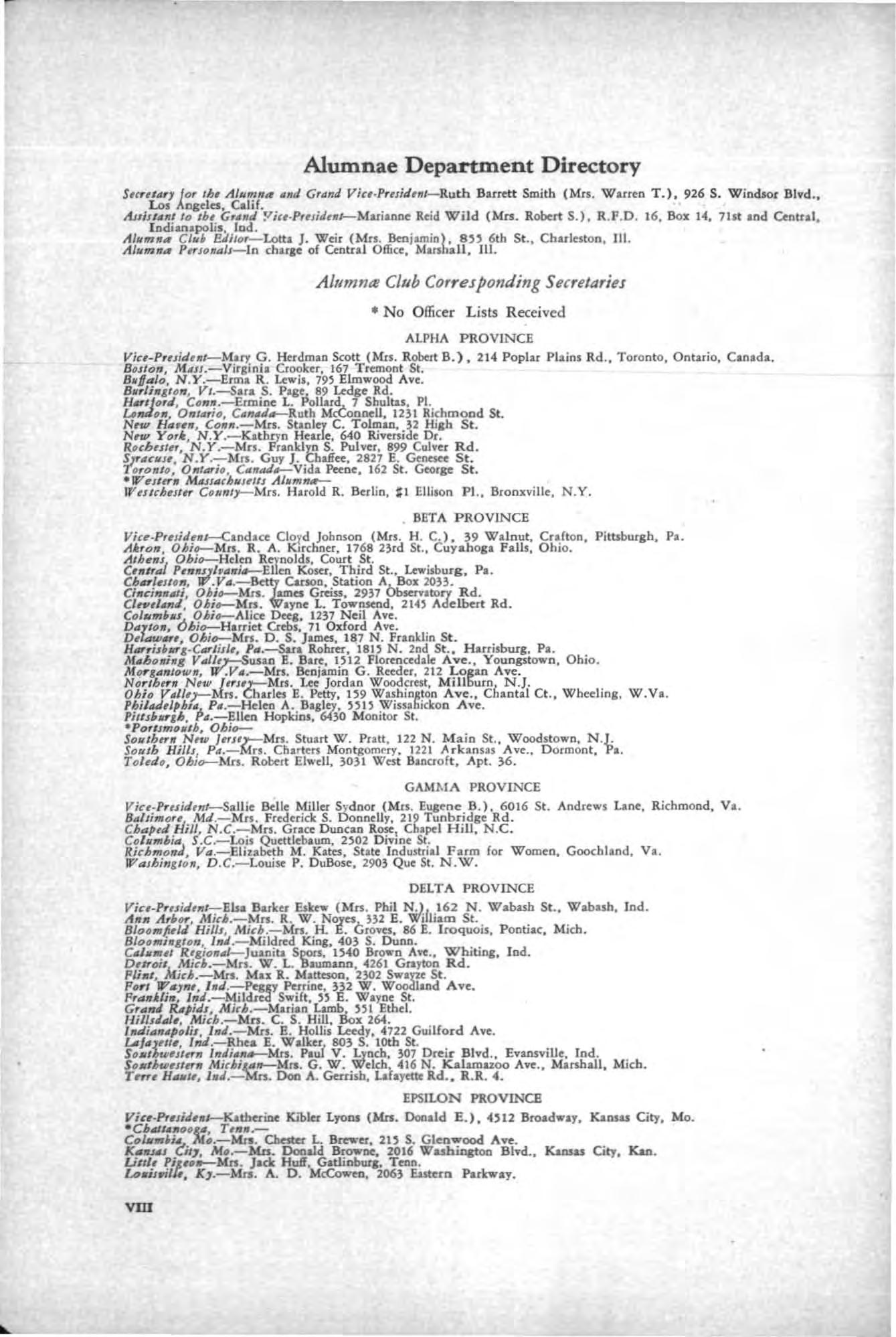
SUrt/Il" for ,h, AI"",,,. t",d GrllnJ Viu·PrtJill,,,t-Ruth B.nett Smith (Mrs. Warrtn T.). 926 S Windsor Blvd .• Los Angeles. Calif. Al,is l ,,,,'lo ,b, G,1I114 Reid Wild (Mrs. Robut S ) , R F D 16, Box 71st .nd untnl, Indianlpllis, lad Iflllm" Clit. J . Weir (Mrs. 8enjamio). 8" 6th St•• Charleston. JlI. Alu",,,. P".,,,.4I,-ln char,c of Central Office, Mush.ll. Ill.
AI1Im"", Club CorreJponding SeereJar;"
• No Officec Lists Received ALPHA PROVINCE
Viu-P ruiJ",t-Mary G. Herdman Scott (Mrs. Robert B.). 21" Poplar Plains Rd., Toronto, Ontario. Canad., BIISton, M.,I.-Vlr,inia Crooker, 167 Tremont St. B.llllo, N, Y.-Erma R. Lewis, 79' E l mwood Ave. S. ,li",'II" , y,.----.s.r. S. Page 89 uda.e Rd. H,,"tml. Co" -Ermine L. Pollard f Shult PI. u"Jo.".. 0",41;0, McCooocll, 1231 Richmond St. Nnv nil"", C""".-Mr•. Stanley C. Tolman, 32 Hi,b St. N,w Y", , N.Y.-KathrYn 6-40 Dr. R.,huJn. N.Y.-Mrs. fi'ranldrn S. Pulver, 899 Cuiftr Rd. S,,"ClIJ', N.Y.-Mrs Guy J. Chaffee, 2827 E Gmaee St. To,,,,,,o. O",."i. , C."MI_Vida 162 St. George St• • W'JII , ,, AI.",,,_ WlJuh'J'" CunJy--Mrs. Harold R. Berl in. #1 Ellison PI., Bronxville , N.Y BETA PROVINCE
ViC".·PrwliJ,,,/--Candaa Cloyd Johnson (Mrs H C.). 39 Walnut. Crafton, Pittsburah. PI.. A , ,,,,, Obi_Mrs. R. A. Klfchner. 1768 23rd St , Cuyahoga PaUs, Ohio Alb."J Ohio-Helen Reynold., Court St Cn " aJ P","Jll#""i_EUen Koser , Third St., Lewisburg. PI.. Cb.,J.JI.", Station A)...Box 2033. Ci"d"".li, Obi..-Mrs ames Gmu. 2937 VD$et'Htory Rd Cl",,,,,,,tI. Obi Mrs. ayne L. TowoJeOd, nO Adelbert Rd. Coll.I1"Ju.A Obi Alia DeC,. 1237 Neil Ave. V''' ''''', uhi_Harriet Cub•• 71 Oxford Ave. D, tIUI.rl. Ohio-Mn. D. S. James, 187 N. Franklin St. H." " iJb",.C.,,/iJl,. P •. -Sara Rohrer, t8U N. 2nd St., H.nisbura:. PI.. M"ho"i.8 V.LI,,...;,susan E. Bare, UI2 Flormcedale Younptown, Ohio. Mo ".,,,,,Jow •• W"".V••-Mn. Beojamin G. Reeder. 212 Logan Ave. No" , h",." N"p / "'J':r-Mrs. Lee Jordan Woodcrest, M illburn N. J Oh i o V.U,;t-Mrs. Charles E. Pdt}', 1'9 WashinAton Chantal Ct., Wheding , W.V •. Phi l """,.6 / .;.. P •.-Helen A. Bagley, "I) WiSSIhickoll PiJl.J.Mr,h, ,..•. -Ellen Hopkins, 6ot}0 Monitor St. "Po r lJ",fI. , h, OhioS"IIlh",1I NIU Stuart W. Pratt , 122 N Main St., WoodstolVn, N J. SOll,b H i/h i P •. -Mrs. Charters 1221 !lrk.n sn Ave., Dormont. "pl.. Ohl_Mes Robe rt Elwell, lOll WC$t. Bancroft. Apt 36.
GAMMA PROVINCE
Belle Miller Sydnor (Mrs Eu,enc B.). 6016 St. Andrews Lane, Richmond Va. Blllli1lltJ'iI' MtI .-NIS. Frederick S. Donnelly, 219 Tunbridse Rd. Cbap,,1 ill. N.C .-MIS Grace Duncan Rose l Chapel Hill, N.C. CtJ l .,dia S .C.-Lois Que:ttlebaum. 2,02 St Rkbmofl"J Va -ElilJ.be:th M. Kates, State Industrial Farm for Women. Goochland , Va W4lhinglDff, D .C.- Louise P. DuBose, 2903 Que St. N.W.
DELTA PROVINCE
Vin·Prtsid,,,,-Eha Barker Eskew (Mn. Pbil N ' )r 162 N Wabash St ., Wabash, Ind. If"" Ar.tIf', Mit'.6.-Mn R W. Noyes H2 E. Wi liam St Hills , H. E Grovn, 86 E. Iroquois , Pontiac, Mich. Blo#""."D" , l..t.-Mildred Kina. <t03 S. Dunn. C,ull." R"i,,"J- Juan ita Span, 1).40 Brown Aft., Whitina, Ind. O,Ir,,;I'I!tfich.-Mri. W. L Baumann, .261 Gn , con Rd Pli." Mid.-Mrs Max R Matteson, 2302 S pe St. PO f' 1 Fill,,,,, ltul.-PcU'/ H2 W. Woodland Ave Fr.d li '!t l Swift, " E. Wayne St KAJid! Mieb.-Muian '" Ethel. H,llsllll,. Muh.-Mn. C. S. HIU. DO:X 264 l1fdi""III/lOJis, J"J.-Mn. B. Hollis l«d" .722 Guilford Ave. LAj.1"", lntl.-Rbea E. Walker 803 S. 10th St SOlllbw'JI"" l i""..-Mrs. Pa;;i V. Lynch, 307 Blvd ., Ennsville, Ind SDII, bl41,JI"" Mie.6i,• .-Mrs. G. W . Welch .• 16 N. Kalamuoo Marshall. Mich. Tn.,., HUll_ I -Mn. Don A Gcrmb. LafayctU Rd., R R •. EPSILON PROVINCE Vi,,·Pr,liJ,..,-Katberrne )(jbler Lyons (Mrs. Donald E.), .H2 Broadw.y. Kansas City , Mo • T,,,II .C,d !i" N •. -Mrs. Chester L Brewa, 2U S. Glenwood A..,c. K,.1JSiII.J !:j'7. M ••-.Mrs. Donald BfOWDe, 2016 Wa.shinaton BI't'd., Kansas City, Kan Li'II, Pi" • .-Mn. Jade HuH. GatliDburg, TCGD lA.is";IJ,. KJ.-MrS A D Mc:<:owul, 2063 Eastero Parkway.
""".,131$, r"'lf -Eliubetb
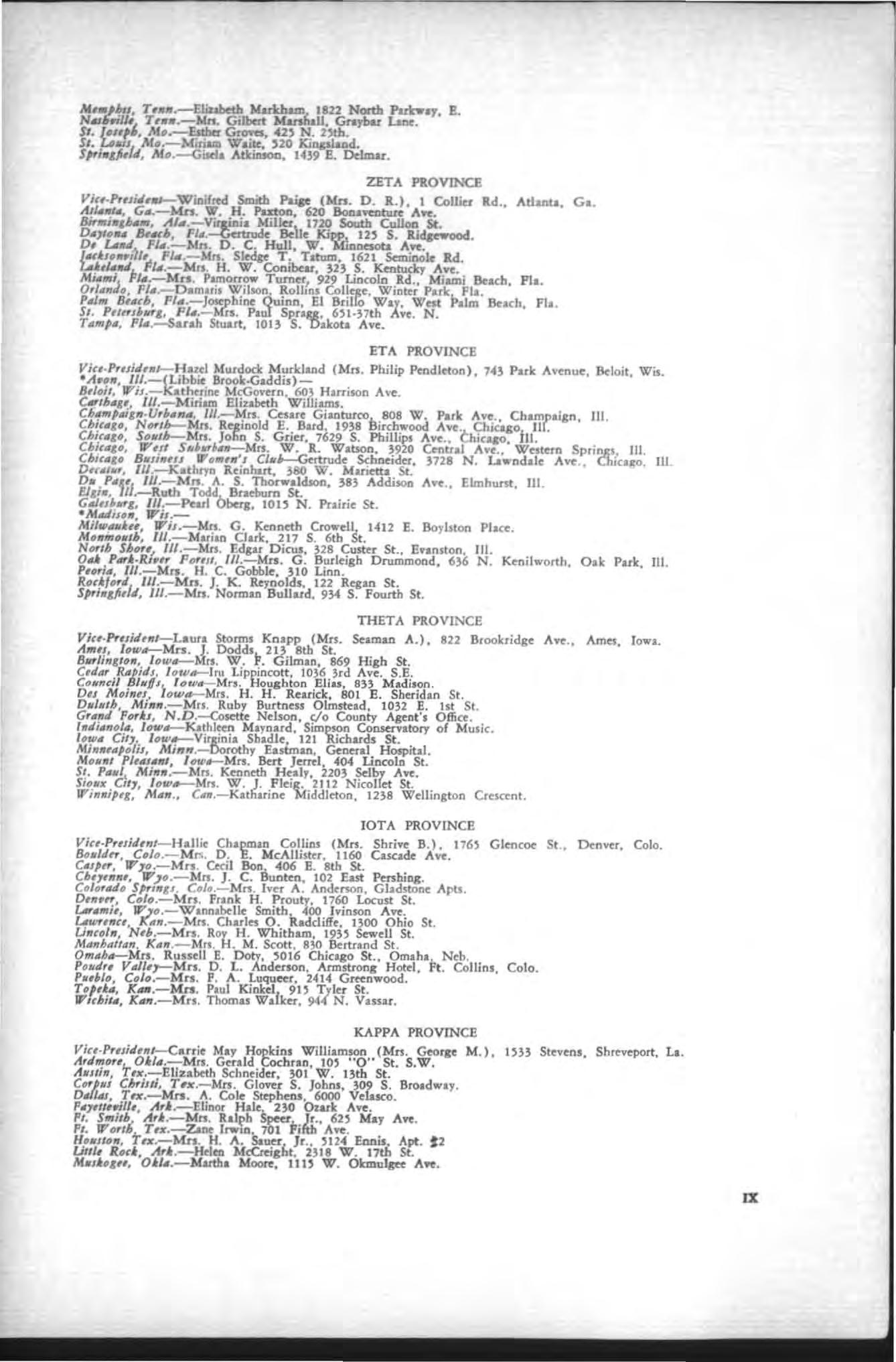
North Parkw.Y. E r -Mn. Gilbert JIIUISllUI, Graybar Lanr St. I.s,,/'. M",-&thu Grans, 42, N 2,th SI. 1, IS, M ••-Nirilal Waite, '20 Kiogslaod. Stri_tJ"II, Mo -GiJd. Atkin.Ioo H}9 E. Dt:lmu
ZETA PROVINCE
Vi" P,tsili.IIJ-Wil1 i fred Smith Paiae (Mrs. D It ) 1 Colliu Rd .• Atl an ta , G a, AIt."I4. G -Mn W. H. Pauoo. 620 Booumtuft Aft. BinI;_,b..,. AI• •-Vir.&iru. Millet" 1720 South CuUoa St. D.",," &MII, FI" -Gcrtrvde Beue KiWI 11' S. 01 r... FIA -Mn O. C Hull, W. Minnesota Aft. l«jso_III, PI• - Mrs T Tatum, 1621 Seminole Rd. "Uj,141N1 rlll -Mn H. W. Conibear. 323 S , KcntuPtr A.e Mi"",; FI4.-Mra. Pamorrow Turner, 929 Liaealn Rd , Miami Beach, Pl. , Orl.,,;}. , PI -Oamui Wil so n Ro llins Co llege, Winter Parle" P ia. PAl", PI• •-Josephine Quinn, El Brilro Wa y. Wert t"alm Beac h PI •• S, P,,,rshrr , FI - Mrs Paul 6'1 37th A,.e N T."". , FI• Stuart 1013 S Dakota Ave
Viu ·P,tJ;.,.,- H au l Murdock Mutlda nd (Mrs Philip Pendleto n). 7"3 Pa rk Avenue, Beloi t , W is. ·A,•• , 1II.-(Libbie Brook-Gaddis)Be/ojl Wh .-katherine McG onrn. 603 Har rison A ve C.,b"" //I -Miriam Eliubdh WiUiams. Ch""'PIII,,, , U".n., 1JJ.-Mr • Cesare G ianturro,- 808 W. P.rk Ave Ch ampai,n , 111 • • NM,b-Mn Reainold E. Bud 1938 Hir chwood .A\'e Chi u ,o 111. Chir",o S".,h-Mn Jolin S Grier, 7629 S Phillips Avc .• C h ic aao, fll W,rt SlIt.,t".-Mrs W. R. Watson 3920 Centr 1 Ave.• Weste r n S p ri nAs , III ChIC", 8./;'un "'• • ,,,./ CJ.J.-..Gcrtrude Scbneider, 372 8 N la,.,od le A ve .• Ch lC.go. 111 D ,uI.,. IlJ -K thryn Re inhart , 380 W . Manett. St . 0" P""I //I.- Mrs A S Tborwalcbon, 38 3 Add i50D Ave ., Elmhurst. III fl , i" 11 -Ruth T od d Bneburn St GiIlest"" , 101' N Pr air ie St ·/tfMli/.", Jl'isMiJw".J" Wis -Mrs G. Kennetb 1"12 E Bo ylst on P latt. M".",,,w,b, IlJ. - Mar ia n Cluk, 217 S 6th M NMlb SbM'1 Ill .-Ms s. Edgar Dicus 328 Custer St .• Ennst on III Od P",J·Ri," P",III, 1Il -MI: • • G B urlei&h Drummond. 6 36 N Ke nil wo rth O a k Park 111. P,,,,i,, , 1lJ.-Mra H C. Gobble, 310 Linn 1II.-Mn J. K Reynold •• 122 Rqao. St III.-Mrs Norman BuUard 9 }4 S Fourth St
THETA PROVI NC E Vir, Pnli."II- Laura Storms Kn.pp (Mrs. Seaman A ), 8 22 Broo kridge Aye , Ames. Jow•. A",,,. low_Mr•. 1. Dodds 213 8th St B",Jir"/u, l"w_Mrs W iI. Gilman. 869 Hi&h St C,d,., RII/Ji.l , Intl_lro Lippincott. 1036 lrd Ave. S.E C,,,urriJ BIIIII) low Mr, Hou&:hton Elias. 8:n M.di,on Oil Moi"es.. ow_Mrs H. H. Rearick, 801 E. Sherid.n St OM/Mlh, M,,,,, -M u. Ruby Burtness Olm,te.d. t032 E 1st St G,.". PMJ/, N.D -COsette Nelson, c/o County Agent'. Offier '".i.""I", /"wII-Kathleen M.ynard. Simpson Coo.sen.tolJ' or Mu sic. low" Cit" l w_Virg ini. Sh.dle, 121 Richards St. ",fi".e.,,,UI, Minn .-Dorothy Easbn.n General M" II'" PJellJ"",. l"w_Mrs Bert Jeml. "04 lincoln St St P"MI, /tfi"" .-Mn . Kenneth He.I ,., 2203 Selby Ave Siowx Cit, l"w_Mn W J Fleig 2112 N ico trd St JIl i"";" , , M"" , C." .-K lt l1ar i ne M i ddlet o n 1238 Well ingto n C resern t
Viu P,e/U,nl- H llic Ch pm n C o llins (Mrs ShriYe B. ), 176 , Glen coe St Den ve r, Co lo. &wltln, Co/".-M r,(. D E McAllister , 1160 Cue.de Ave: CU,", lI"'J:o. - Mr•. Ctcil Boo "06 E. 8th St Ch",,,.,, lP'.Jo .- M rs. J C BUllten, 102 East Pershing Co /(JttUlo S",,, ,I. Col•.- Mrs IYe r A An derson, G ls dst o nc Apts. D,,,,,,, , C"I" .-Mrs Prank H Prout}'. 1760 Locust St LM"",i" Smith "00 t.inson Ave uwr,,,,",, X"" .-Mrs Ch.rles O ihdcliJJe noo Ohio St N'•.-Mrs Roy_ H Whitham. 19" Sewell St M""h"ltil" K." .-Mrs. H M Scott 8 30 Bertrand St Omtth_Mrs. Russell E 00tJ. ,016 Chicl80 St ., Om ah. Neb POliti" V"U'1"""-:.Mrs D 1 Anderson , Armstrong Hotel. Ft . Collins Colo Pw,"". Co/" -Mr•. P A Luqueer, 2"14 Green ood. TO/'!", X_.-Mn. P.ul Kinkel 91' T y ler St Fuhi,,,, K." -Mrs Tbomu Walker. 94" N VasSal
PROVINCE
VI" P,eli.,,,,-C.,rie M.y Hopkin. WilJi.mson (Mrs. George M ) nn Stevens. Shreveport. L• Art/more/- O.H. -Mrs Gerdd Cochrao, 10, "0" St. S.W. AWllilt, l,,r.-Elinbeth Schneider. 301 W. 13th St CorpwI eMilli rlNt -Mrs Glover S. Johns , 309 S Broad,.,ay O"fJlIJ, T,x.-M,. A Cole • • 6000 Veluco p",,,,,,,;Il,, A,..I .-Elinor Hale 230 Ozark Ave PI S",ilh Ar" -Mrs Ra.J{)h Speu- Jr •• 62' May An Pt. W""" T'lI".-Zane 1",,111. 701 Fifth AYe HUIIOlt , Tnr -Mn H A. Sauerl Jr .• '12" Eooi! Apt 12 VIII, Roc!, A," -Helm McCreisnt, 2318 W 17m st. Mwd.,,,. O!I4.-ldartha Moore, lin W 01cmu..I,ee Aft
NIII1 L.. .-Mrt Fwl Ogdtn. 1229 Second St Ntff",_. OJ •. -Mrs lucille Bonodun.
OllllhDmll Cil'j Oi/•. - Mn. W. B Jr • 1003 N W. 3'th. O.",d,U, Oj JII,-Mrs. Evcrdt R. Cur 1213 E 9th. SabiJU MIS. Tomm; Hughes, Onnge, Tex 516ft Ant onio Ttx. - Mrs, G. E. Goodloe 419 E Shr"t/or', lA,-Mrs. F. A Ellis, 739 Dudley Dr SliJlwllln, O.l•. - Mr •. D. C. Mdnt osh. 71 Co ll ege Circle. TIIII." O.el• -Mrt Paxton Howard. 1262 E 27th St. T:!I" _ T,x .-Mn H . A . Baker. 606 W. Dobbs . W .:"", T,• •- Mrs Goodhue Sm i th, 1023 ColumbUJ St
V;u·P"siJu/-SUJie Belle W inton Flttc her (Mrs H owud G ) 2(0) H td Avc S ., Seattle, WJ.sh
B(Jist IJ.h tl- Mrs Currie TCfi! , 11 6 St
C.JKIITJ, Alu, C.",-Lo i, Latimer. 3007 6th St ., West CO,.III1U , O" .-Mn. Marion OLiVft, 2o, N 21st St &I"'(I1Il o'!t. C." .-Mn R. B. Sandin, UniYcrsity of Alberta EM!"". U"".- Mr '. LH l ic L Lewis 2008 Onvx St Portllmd, O,.,..- Mrs Char les Chick. 8031 S W 37th St M ultnom.h Orc Sall'"" Or". (N"" ' 1 .B1.d Wallart e ll,b) - Mrs 'rhomu E. M ay. 1240 N 2 1st St. Stttltlt , Wllih .-Mr s D.lIas Donnan.! 6 16 38th Ave 5pokant , W.tJh .-Ruth Sw.nn 920 r. 16th.
T"lo",a, W.fJ h. (1"' 6 S",ith SOlil t e/d) - Mrs Jamcs A Chisho lm 1708 S 7th St 'WtnlllrlJ U, W ' ..uh .-Mrs Walker Pi ckens Anjou La nt. East Wenat chee Wash Ydi",II, W IIrb ( PII",,;, Whi tt".d li' ."Y O d )-Jul i Shadbolt. 106 S 11th Ave
Vi u· Pr"iJ I'If /- Ethtl Lunsford FroK (Mn J ). 1021 N Virginia S t , Ren o NC"f Nt ., Roy Grah am BOx '18 R F D 2.
B,.,.l.tltl, e ll/i/ .-Mr • Welch 900 Rosemount Rd' ., Oakland Ca lif
EJ PIUO, T'" .-Mn J oe J: Breas 904 Maple St Pr".o , ell/if .-Mn J.de l.uther 1038 Pcdora Ave GII'"diJ" C,dil .-Mn Doug las Malin 12,4 Richard Place H,nullii-Mn C . Wilson, c/o United Press\ The Advertiser. H o no l u l u . T . H . Lo", 8,,,ch , CIIUt. - Mrs. W E long ,2, R o .wrl St LDr Angliu, ellIlJ .-Mr •. Keith 1. Moshie r 100 S Crescent H ghts Blvd N".tUlll AI.",,, _Mrs 1. A. Ferris. 16 Thoma St • Reno, Nev p,tlo Alto, CIIUJ .-Mn 1. C H insey, Tenn yson Ave P.,""'''. e.I;r.- Mrs 't'eroon Chatnley, 100 7 Columbi St. , South Pasadena. C.li f. Pho'ni", Arn .-Mn James GiJand, W. Mo rel nd S.." D;,,! o; c"m.-Mrs P D. Harbaugh. -4940 Canterbury Dr S." Fr""nsro CIIIH. - Mrs J. H McFarl.nd 710 -47th Avc 51111 l Oll , c,,'I/.-Mn Ruth "Smale Emory 5.",. 8",.",11, c.J;J .- M rs C. C Christ iansen 22 28 Hollister 5",,1. M O,,;( II , C./if.-Mrs. Joc M 1281 W ood ruff Ave , West Los AnJt:les , C.lif. TMfI(JIf Ariz.- Mrs Thea. Bushnell 1648 c 7th St Ulilb AI.",,, c/.I>- Mrs Ric h.r d W Lam bo urne. 4 24 -4th Ave ., S 1t La ke Ci ty. Ut a h
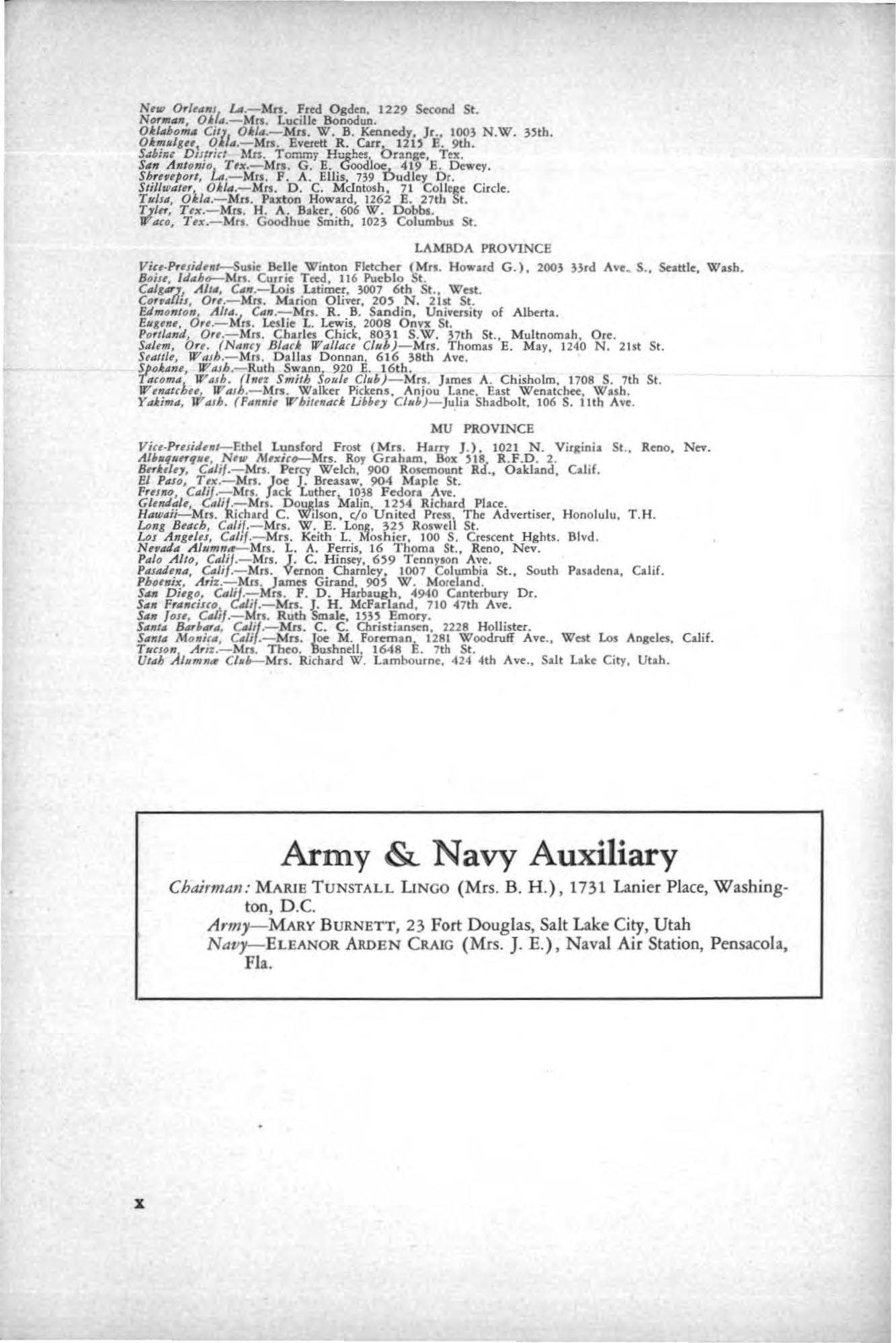
Chairman: M ARIE T UNSTALL LI NGO (Mrs. B. H.). 1731 Lan ier Place, Washin gton , D .C.
A, my-MARY BURN ETT, 23 Fort Douglas, Salt Lake City, Utah Navy-ELEANOR ARDEN CRAIG (Mrs. J. E.), Naval Air Station, Pensaco l a, Fla.
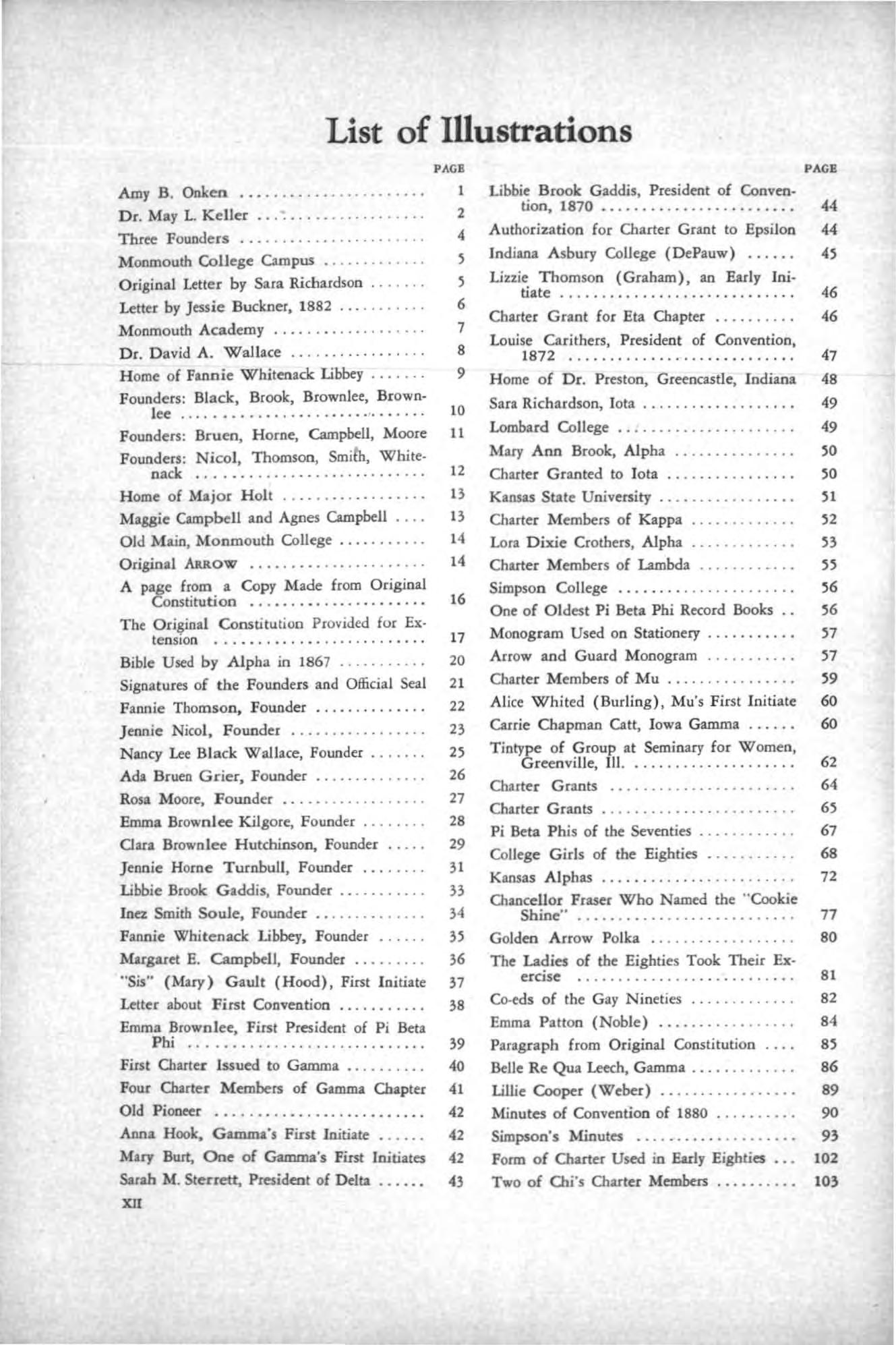
Amy B Onken ......•••• •...........
Dr. May L. Keller
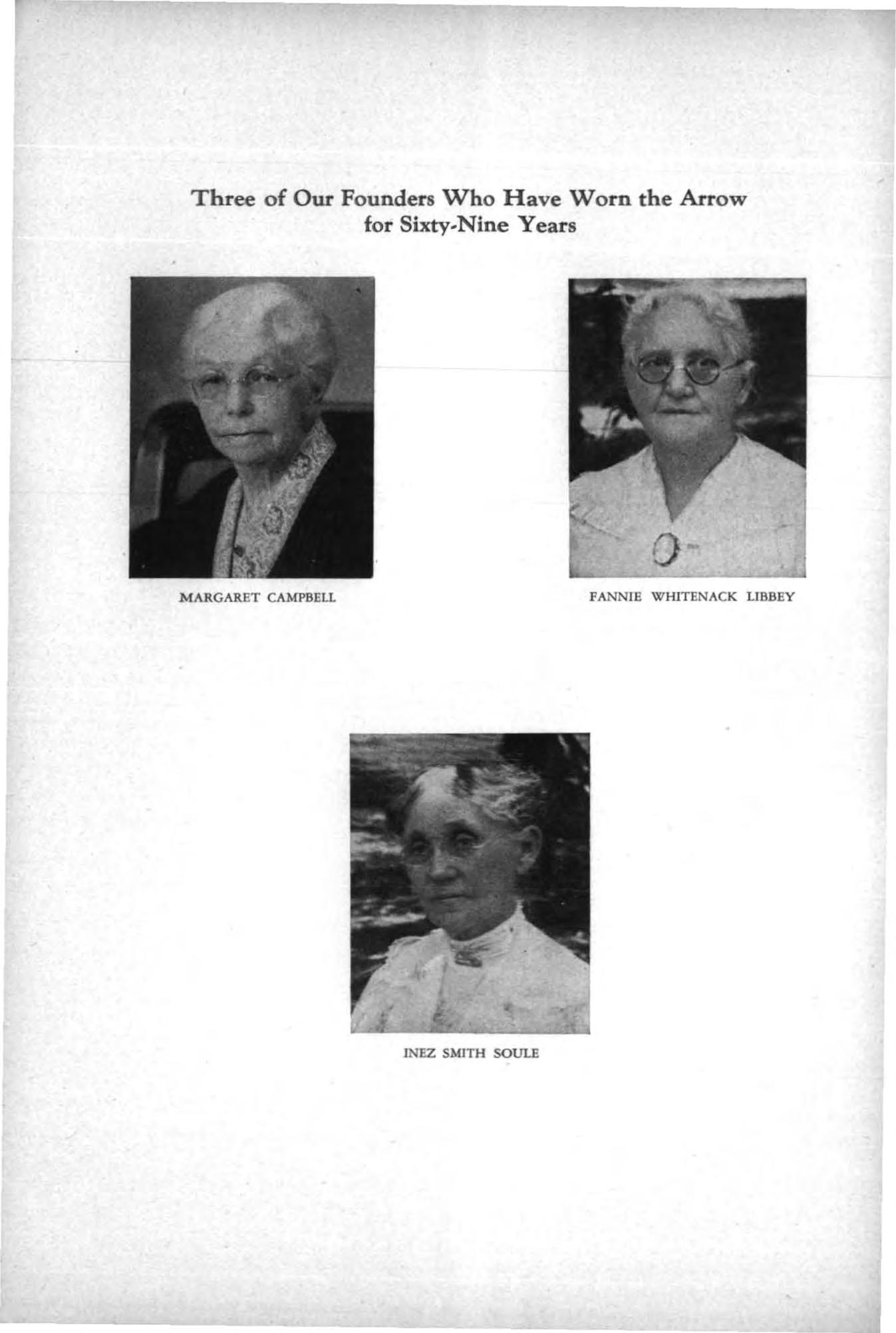
Three Founders . .. ....... . ... .
M onmouth ColJege Campus -
Original Letter by Sara Richardson ."
Letter by Jessie Buckner. 1882
M onmouth Academy
Dc . David A. Wallace . . ..... . ..... . .. .
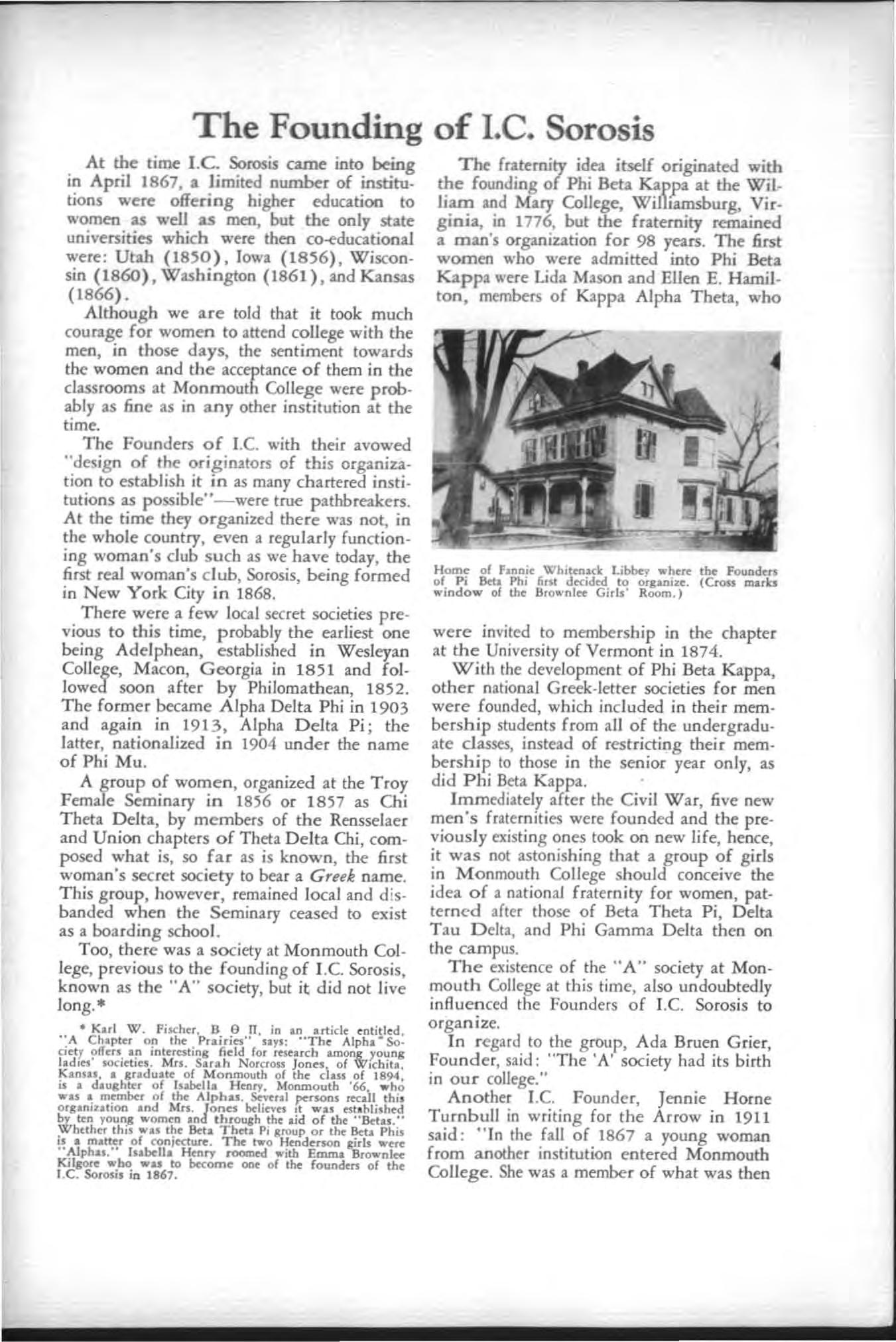
H ome of Fannie Whitenack: ribbey ...... .
Founders : Black, Brook, Brownl ee , Brownke
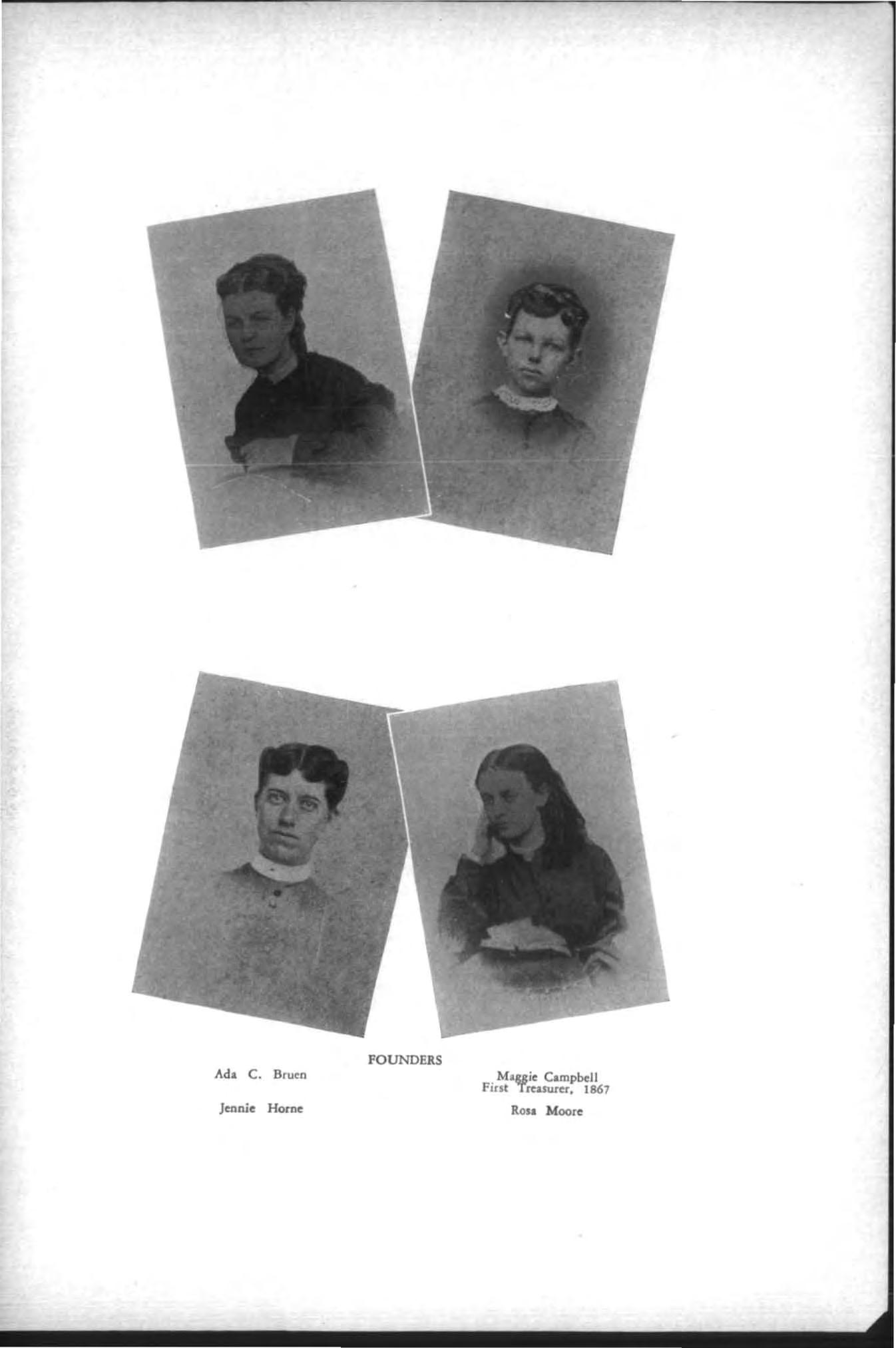
Founders : Bruen, Horne, Campbcl1, Moore
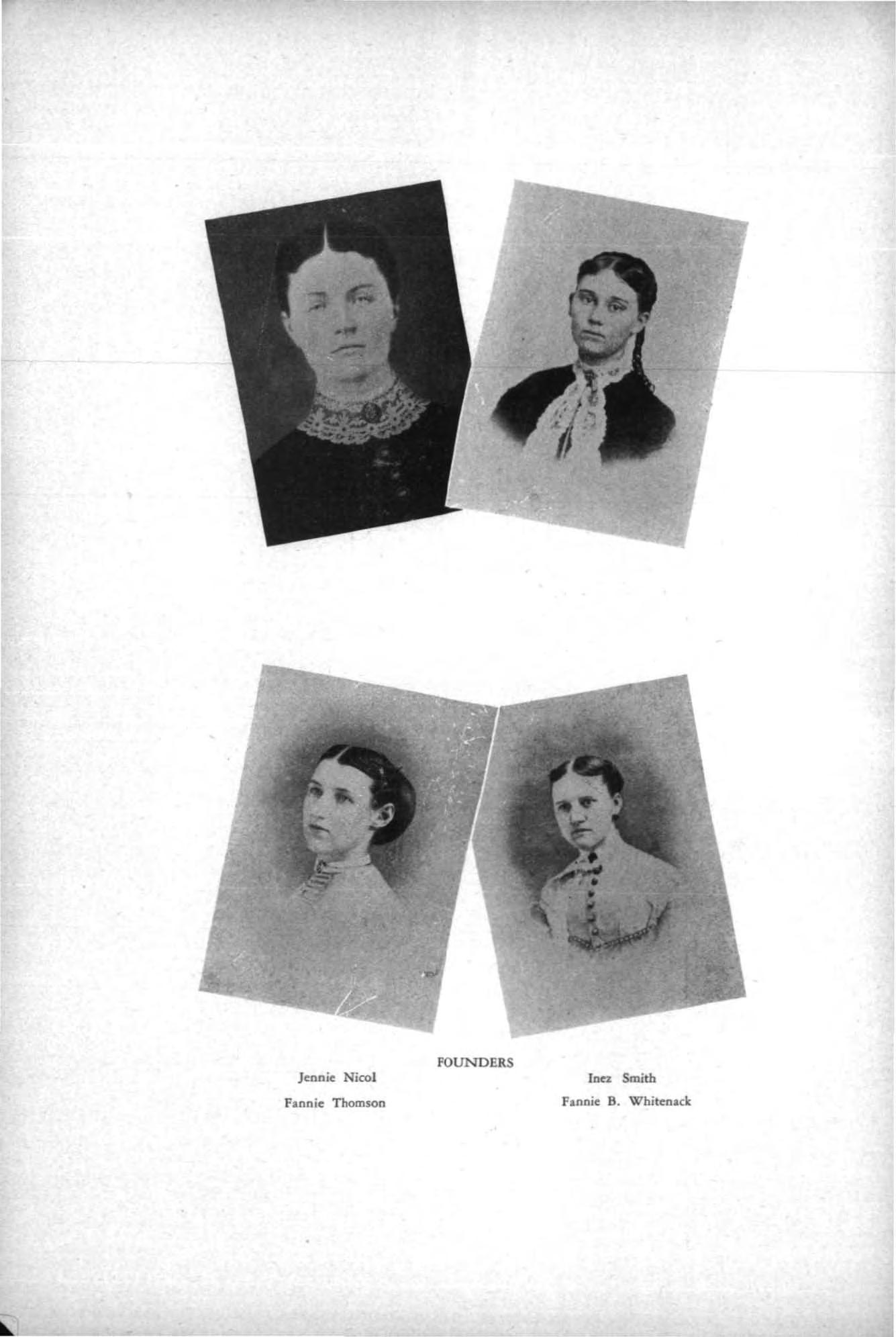
Founders : Nicol, Thomson , Smith. Whitenack
Home of Major Holt -
Ma88ie Campbell and Agnes Campbell
Old Main, }.(onmouth College .......... .
Original ARRow
A . .
The Ori$inal Constitution Provided for Ex.tenSion ..•
Bible Used by Alph a in 1867
Signatures of the Founders and Official Seal
Fannie Th omso n, Founder
J ennie Founder
Nancy Lee Black Wallace. Founder "
Ada Bruen Grier. Founder
Rosa M oore. Founder
Emma Brow nlee Kilgore, Founder
Qua Brown lee Hutchinson. Founder
Jennie H oene Turnbull, Founder
Libbie Brook: Gaddis, Founder ,
Inez. Smith Soule, Founder
Fannie Whitenack Libbey. Founder
Margaret E. Campbell, F ounder , "Sis" (Mary) Gault (Hood), First I ni(iate
Letter about First Convention
Emma Brownlee, Fiest President of Pi Beta Pbi ..........................
First Charter Issued to Gamma .. ....... .
Four Curter Members of Gamma Cbapter Old Pioneer
Anna Hoole. Gamma's First Initiate
Mary Burt, One of Gamma's First Initiates
Sarah M Stenett, President of XII
Libbie Broolc Gaddi s, President of Conven. tion, 1870 •..... . ..............•..
Authorization for Otarter Grant to Epsilon
Indiana A sbury College (DePauw)
Lizzie Thom so n (G.raham), an Early Ini· tiate ., , ,
Charter Grant for Eta Chapter
Louise Carithers, President of Convention, 1872
Home of Dr. Preston, Greencastle, Indiana
Sara Richardson, Iota . ....... .. ........ .
Lombard College •
Mary Ann Broole, Alph a •...
Charter Granted to Iota ...........• •
Kansas State University
Charter Members of Kappa .....•...••.
Lora Dixie Crothers, AJpha .......•.•...
Charter of Lambda ........•...
Simpson College .. . .................. .
One of Oldest Pi Beta Phi Record Books
Mon ogram Used on Stationery
Arr ow and Guard Monogram
Charter of Mu ............... .
Ali ce Whited (Burling). Mu 's First I nitiate
Carrie Chapman Catt, I owa G amma ..... ,
Charter Grants
Charter Grants .................•.....
Pi Beta Phi s of the Seventies
College Gi.rJs of the Eighties
Kansas Alphas ,
Chancellor Fraser Who Named the " Cookie Sbine"
Golden Arrow Po lka
The Ladies of the Eighties Took Their Ex· eeose , Co--eds of the Gay Nineties
Emma Patton (Noble)
Paragraph from Origioal Constitution
Belle Re Qua Leech. Gamma
Lillie Cooper (Weber) • Minutes of Convention of 1880 ,
Simpson's Minutes
Porm of Charter Used in Early Eighties
Two of Chi's Charter Members ,
Dr Grace Raymond Hebard, Iowa Zeta
First Alumne o,apter Grant . ...... . .. .
Julia Ferris (Hubbs)
Cora Pao.abaker 105
Program Cover of Kappa 108
Order Issued by Alpha 110
Fo rm of Charter Used by Mt. Pl easant 11 2
Some of Sigma Chapter aarter Members 114
Library at York, Nebrask a 116
Some Cha.rter Members of Illinois [Rita 117
Knox College 118
Colorado State University, Boulder 119
Charter Members of Col orado Alpha 120
Charter Grant to Alpha of Col o rado ... .
Nell Custer Swishtr
Covers of Early Allows
Postal Permit for THE ARROW
Charter Members of Colorado Beta
Denver University
Call to Convention, 1885
Elva Plank . .................. .
Proposed Guard for Pin
Mira Troth .. ................ .
Rainie Adamson Small
Michigan Alpha, 1887
Hillsdale College ....
New Form of Charter Ad opted in 1888 . . ..
Indiana Alpha in 1889
Michigan Beta
University of Michigan
Convention Delegates, 1888
A Comparison in Size of Pins
Application for Incorporation, 1889
Monogram Designed by Kansas Alpha Convention of 1890 ...... .
Emma Harper Turner
Anna S. Hazelton
Convention Banquet Programs .. .
Founders in Their College Days
Helen Sutliff
Florence P. Qlase Ca ss
Initiation Certificate
Grace Lass Sisson
Miriam Prindle (Waller)
Elise Bradford
Grand Seal of Pi Bda Phi
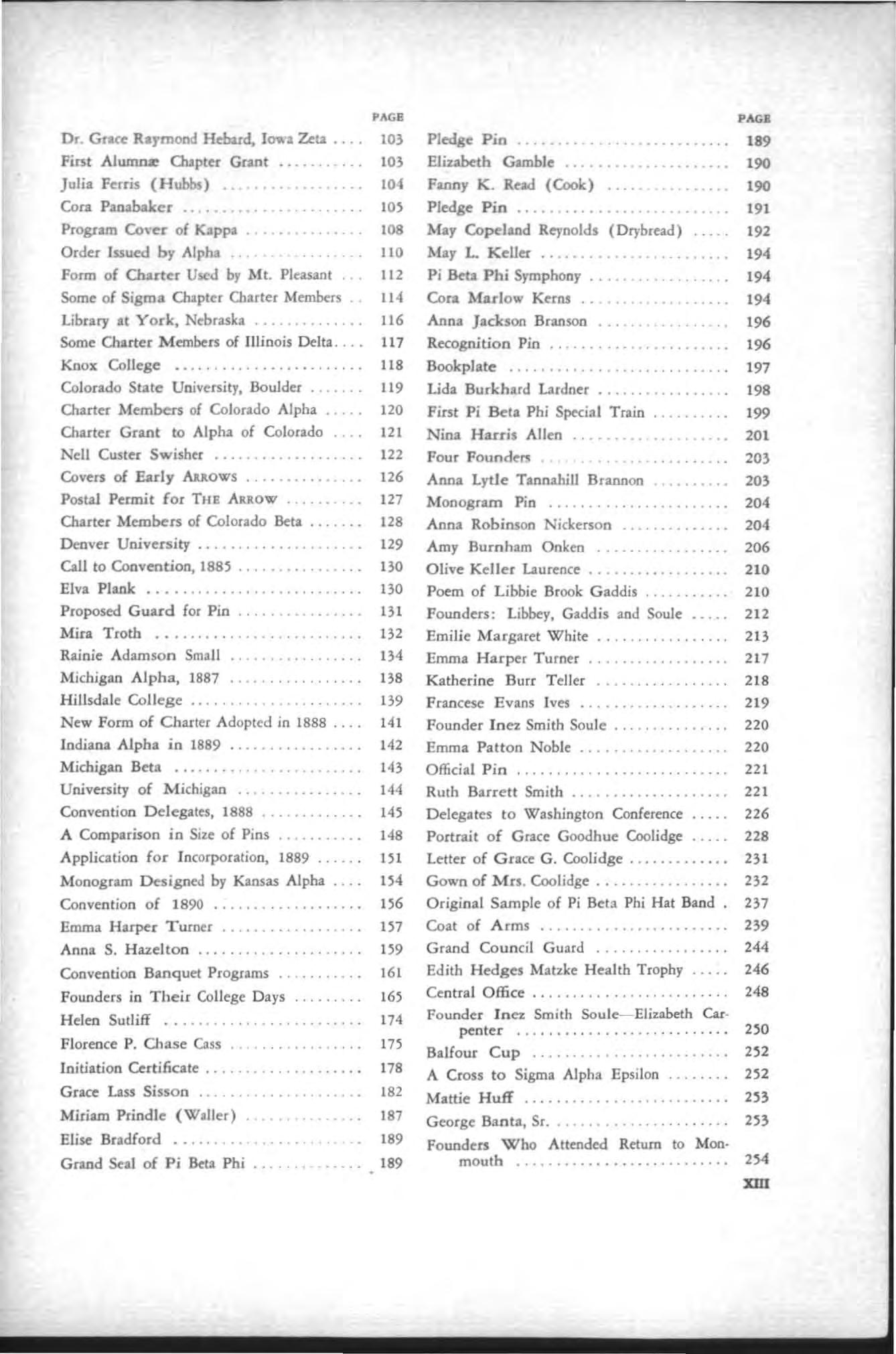
Pledge Pin
Elizab<th Gamble
Fanny K Read (Cook)
Pledge Pin
May Copeland Reyn o lds (D<ybr.ad)
May L. KelJer
Pi Beta Phi Symphony
Cora Marlow KerM .. ..
Anna Jackson Branson
Recognition Pin
Bookplate
Lida Burkhard Lardner
First Pi Beta Phi Special Train
Nina Hacris Allen
Four Founden
Anna Lytle Tannahill Brann on
Monogram Pin ........ .
Anna Robinson Ni ckers o n
Amy Burnham Onken
Olive Keller Laurence
Poem of Libbie Brook Gaddis
Founders: Libbey, Gaddis a nd Soule
Emilie Margaret White .. . .
Emma Harper Turner ..•......
Katherine Burr Teller
Francese Evans IVe!
Founder In ez Smith Soule
Emma Patton Noble
Official Pin
Ruth Barrett Smith
Delegates to Washington Conference
Portrait of Grace Goodhue Coolidge .... .
Letter of Grace G. Coolidge
Gown of Mrs Coolidge
Original Sample of Pi Beta Phi Hat Band
Coat of Arms
Grand Council Guard
Edith Hedges Matzke Health Trophy
Central Office
Founder In ez Smith Soul e- Elizabeth Cupenter .
Balfour Cup ...... .
A Cross to Sigma Alpha Epsilon
Mattie Huff ..
George Banta, Sr.
Founders Who Attended Return to Mon·
Settlement School
Typi(..al Old School House
Typical Mountain Home Near Gatlinburg .
First Teachers' Cottage 261
Miss Hill and the First Pi Beta Phi School . 262
School Building: Used in 1912, 1913 , 1914 264
Dell Gillette
Mary O . Pollard _
New School House _
The Looms Are Put to Work
The Children Have Learned to Smile
Three Cottages .. ... .
Miss Evelyn _
Aunt Lizzie Reagan
Basktt Makers _
Miss PhyJlis _
A Class of Midwives
Jennie Nicol Memorial Hospital _ ..
Arrowcraft Treasures
Art Work . " _
MoJJie Moore at Her loom
Fireside Products
New Weaving Room
Children Walking to Schoo l
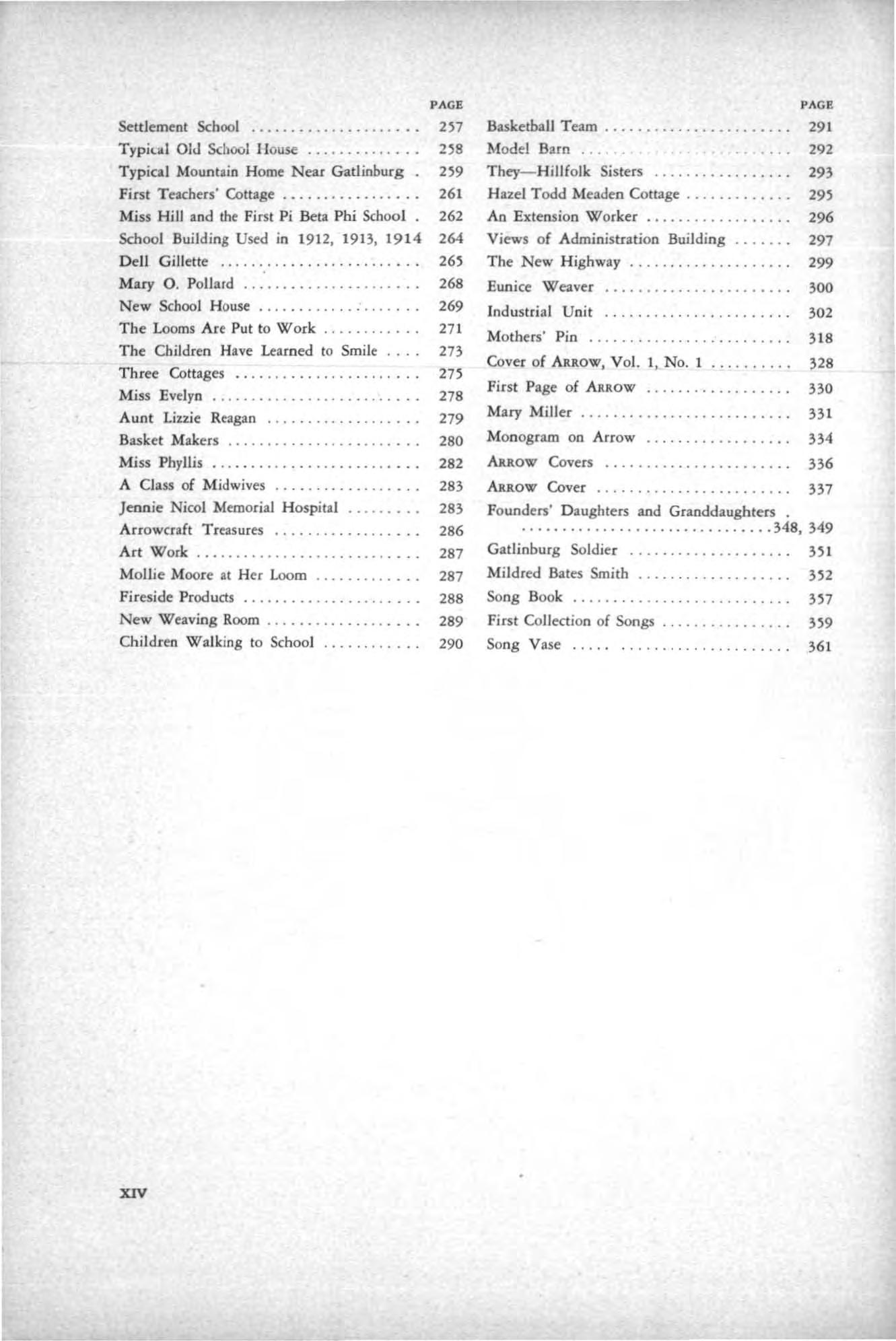
Hazel Todd Meaden Cottage .
The New Highway
Eunice Weaver
Indu stria l Unit
Mothers' Pin
Cover of ARROW, Vol. I, No.1
First Page of ARROW
Mary Miller
Monogram on Arrow
ARRow Covers
ARROW Cover ....
Founders' Daughters and Granddaughters
First Collecti on of Songs So ng Vase
FBBRUARY, 1936
VOLUMB
NUMBER 3, PART 1
Historians of Pi Beta Phi began the systematic collection of source material as early as 1889, resulting in the publication of two pamphlets: Historical Paper Number One, A Sketch of Pi Beta Phi, 1899, and Historical Paper Number Two, Rkume of Salient Points in the History of Pi Beta Phi, 1910
In 19U, there was published a 272 page book entitled: ''The History of Pi Beta Phi Fraternity," compiled by Historian Elizabeth Allen ClarkeHelmick of Michigan Alpha. This was a splendid piee< of work, arranged according to subjects, and has been the chief historical reference work of the fraternity for twenty years.
Now, however, after sixty -nine years of history making for Pi Beta Phi, it is deemed advisable to write a new History of the Fraternity, following to some extent a chronological scheme.
When the Mother Chapter at Monmouth College was forced out of existence in 1884 , through co ntinued opposition to secret societies on the part of the college authorities, practically all of the early records of Alpha were destroyed, with the exception of a few papers and letters . Hence, much valuable material was lost.
Therefore, in order to write chronologically the Historian has had to piece together the story of the progress of the fraternity step by step, putting the facts together lik e parts of a jigsaw puzzle, searching for the missing data in old letters, old albums , scrapbooks, manuscripts, original charters ansJ minutes, and interviewing or writing to innumerable individuals, clubs, and chapters. The complete file of THE ARROW in the Historian ' s Archives has proven invaluable and much material has been taken word for word from the magazine.
With this chronological method there necessarily comes some repetitioDworking forward and then dropping back to pick up the loose threads to weave them into a finished pattern.
The names of Kansas At Iowa At Iowa Bt Iowa T, and IUinois B appear many times for the reason that the minutes and early records of these chapters have been available to the Historian.
In gathering photographs and data for this new History of Pi Beta Phi, the Historian has found the response from our Founders, our National Officers, our chapters, dubs and individuals-in every state and Canadaevc:n in Europe-most gratifyi ng! Would that space permitted the listing of the names of all the individuals who have so loyally assisted in making the manuscript as complete as possible. To Grand President Amy B. Onken, whose amazing grasp of details relative to Pi Beta Phi's growth and progress has been of invaluable assistance, and to ARROW Editor Adele Taylor Alford, who has personally supervised the publication-I am deeply grateful Both have worked arduously in assisting to bring the History of Pi Beta Phi into printed form.
AGNES WRIGHT SPRING HiItorian
Pi Beta Phi Fraternity was founded in Monmouth College, Monmouth , III. , on April 28, 1867 as I .e. Sorosis,-the first national secret coJIege society of women to be modded after the men 's Greek-letter fraternity .
Although the Society did not bear a Greek name in the beginning, its grip was acco mpanied by three carefully chosen Greek words beginning with the letters Pi, Beta , and Phi and its chapters were named accord · ing to the Greek alphabet. The word Sorosis, itself. was derived from the Greek root mean · ing: "Aggregation." According to Emma Brownlee Kilgore, Founder, .. 'Sorosis' was selected because we thought it the word for women's society the same as fraternity for men "
The present Constitution , Initiation Vows, and Intern al Organization of Pi Beta Phi are basically the same and in many places identi cal with those used at the time of the founding of I.e. Sorosis in 1867, changes and additions having been made, of cou rse, as the result of existing conditions or due to the natural growth of the organization.
Three chapters of I.e. Sorosis had been established: one at Monmouth College (1867) ; one at Iowa Wesleyan University (1869) ; and one at Mt . Pleasant Seminary (1869), before the founding of the lirst woman's national fraternity to bear a Greek letter name, Kappa Alpha Theta, at Asbury University, Greencastle, Indiana, January 27, 1870. And another chapter of I.e., founded in September 1870 at Asbury University, brought the total roll to four, just a month before the official presentation at Monmouth College of Kappa Kappa Gamma· in October of that year.
• Altbough Kappa Kappa Gamma did not
It is difficult now to comp rehend fully the g reat secrecy which ve iled the early days of I.e. Socosis . Not even its closest rivals knew where the Mother Chapter was . This was co nsidered by I .e. members as a real triumph!
According to Fannie Whitenack Libbey,
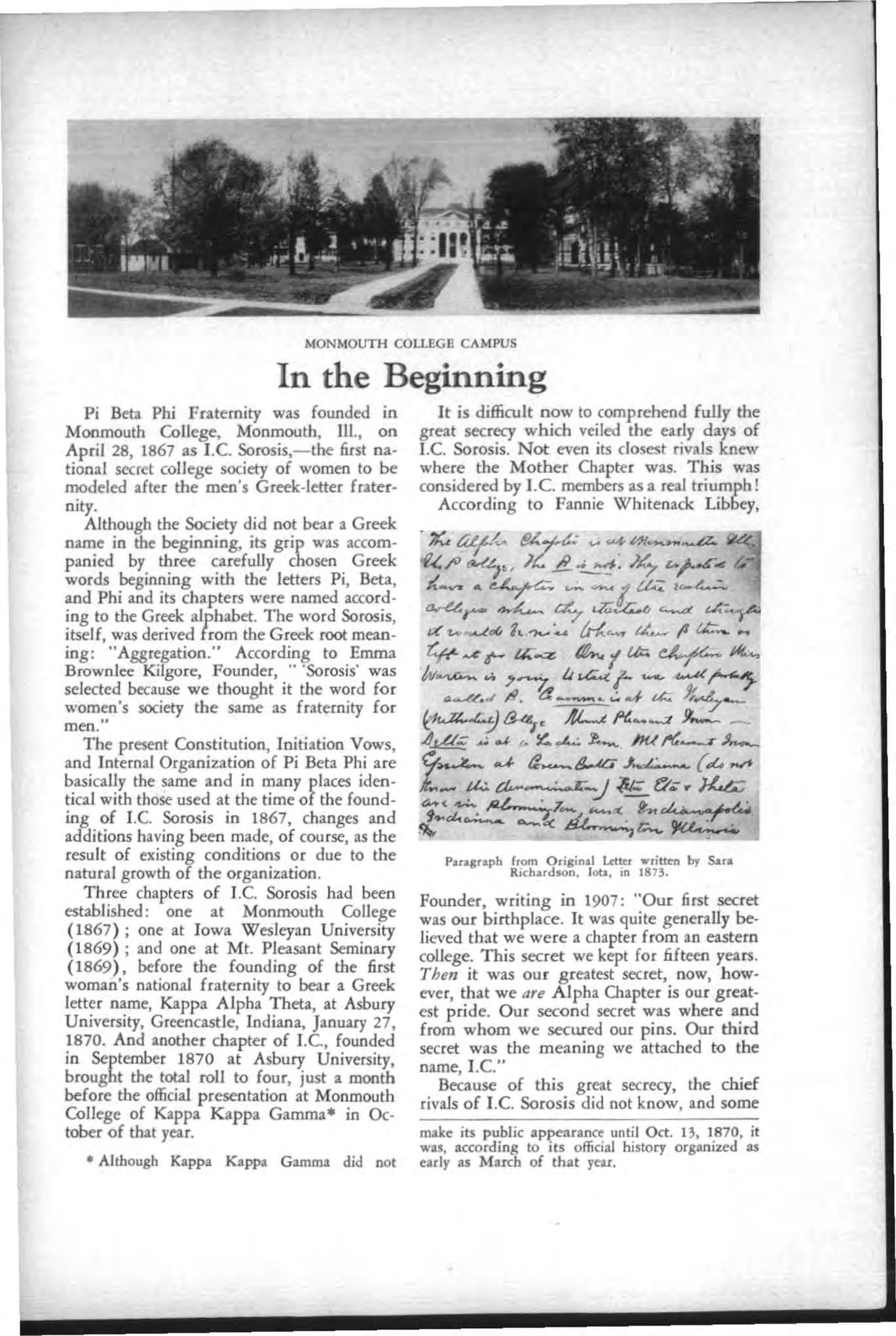
PaN-lr.ph (rom Original Letter br Sara Richardson, l ot., in 1873.
Founder, writing in 1907 : "Our first secret was our birthplace . It was quite generally be· lieved that we were a chapter from an eastern college. This secret we kept for lifteen years. Then it was OUf greatest secret, now, however, that we are Alpha Chapter is OUf greatest pride. Our second secret was where and from whom we seemed our pins. Our third secret was the meaning we attached to the name, I .e."
Because of this great secrecy, the chief rivals of I.e. Sorosis did not know, and some make its pubJic appearance until Oct . 13, 1870 , it was, acco rding to its official hi story organized as early 3$ March o f that yur.
do not know even to this day , the real history of the organization which , in 1888, took its Greek motto for its name: "Pi Beta Phi. "
Additional proof of the great secrecy surrounding the earlier days of Pi Beta Phi is cont>.ined in many letters and old manuscri!'ts in the Historian' s Archives In a letter of 10structions to the new chapter , Kappa (now Kansas A) , at Kansas State University, Sara Richardson , president of Iota ch apter at Lombard College, Galesburg, JlI., wrote on April
6, 1873: " The Alph a Chapter is at Moomouth, 111., United Presbyterian College, the B t ltt if n OI. Tbey expected to bave a chapter in one of the eastern coUeges when they started and thought it would be nice to have their Beta there for that ... We do not tell the names of the chapters as the Alphas do oot wish it to be known that they are Alpba till we get enough cbapters to bave a catalogue published None of the chapters have even had the letters put on their pins yet as they do not wish the names of the chapters known:'
Tbe second chapter founded by I e. Sorosis in December 18 68 was called "Gamma" in· stead of Beta . For a number of yea<s the Alpbas referred to themselves as members of the " Beta" chapter in order to conceal the real birthplace of I.e. and thus keep their greatest secret.
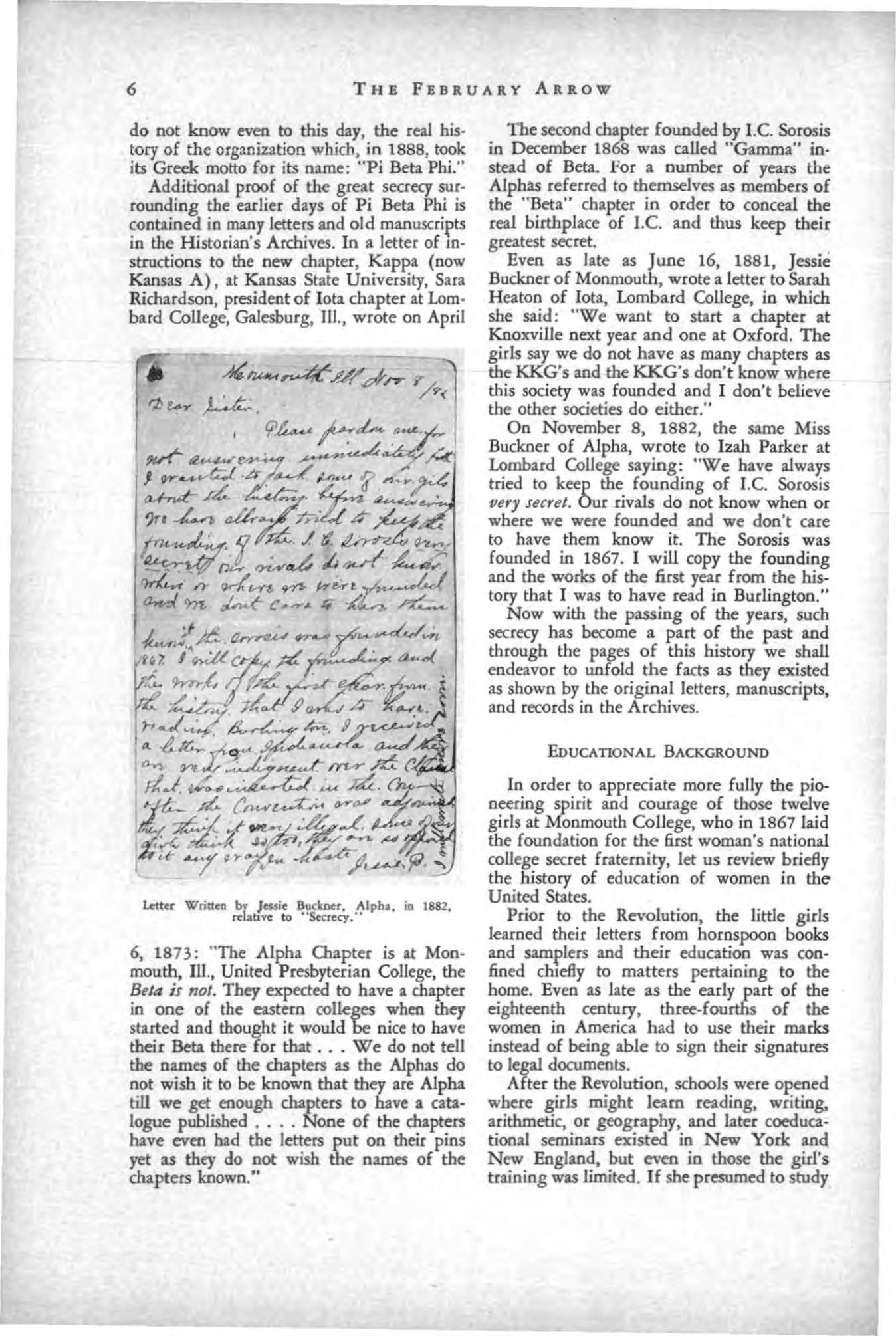
Even as late as June 16, 1881, Jessie Buckner of Monmouth, wrote a letter to Sarah Heaton of Iota, Lombard College, in which sbe said: "We want to start a chapter at Knoxville next year and one at Oxford. Tbe girls say we do not have as many chapters as the KKG ' s and the KKG's don ' t know wh ere this society was founded and I don't believe the other societies do either."
On November 8, 188 2, the same Miss Buckner of Alpha , wrote to Izah Parker at Lombard Coll ege saying: "We have always tried to keep the founding of I.e. Soros is very Jeer el Our rivals do not know when or where we were founded and we don 't care to have them know it. The Sorosis was founded in 1867. I will copy the founding and the works of the first year from the history that I was to have read in Burlington."
Now with the passing of the yeus, such secrecy has become a part of the past and through the pages of this history we shall e ndeavor to unfold the facts as they existed as shown by the orig inal letters, manuscripts, and records in the Archives.
In order to appreciate more fully the pioneering spirit and courage of those twelve girls at Monmouth College, who in 1867 laid the foundation for the first woman's national college secret fraternity, let us review briefly the history of education of women in the United States
Prior to th e Revolution , the little girls learned their letters from hornspoon books and saID!,lers and their educatioo was conlined chIefly to matters pertaining to the home. Even as late as the early part of the eig hteenth century, three -fourths of the women in America had to use their marks instead of being able to sig n their signatures to legal documents .
After the Revolution , schools were opened wbere girls might learn reading, writing, arithmetic, or geography, and later coeducatiooal seminars existed in New York anq New England, but even in those the girl's train ing was limited . If she presumed to study
Gttek she did so at the risk of social disapprobation _
Although these seminars afforded educational opportunities to the girls almost equal to those which the boys received, there was a great lack of preparatory schools which would give the girls sullicient background to enable them to compete with the men, upon entering college _
A plan for improving female eduCltion which was outlined in 1818 in an address to the public, written by Mrs. Emma Hart Wi!lard, wife of a Middlebury College professor, was considered absurd by many. There were some men , however, who endorsed the plan and in 1821 the Emma Willard Seminary for women was established in the City of Troy, New York.
Elizabeth ACldemy, established by the Methodists in 1818 at Old Washington, Mis.s , and chartered as a college two years later, claims to have been the lirst in the United States to provide college training for women. Georgia Female College of Macon, Georgia, also claims this distinction_
After the establishment of the first two or three institutions of this type, far-seeing pea,!'le began to think seriously of woman ' s higher education and there followed through the next thi rty years the opening of colleges to women including : Mount Holyoke, 1837; Monticello, 1838; Rockford , 1840; Elmira, 1855, and Vassar in 1865.
This period from 1830 to 1865 during which these colleges were being founded, was marked by many new ideas in the United States. inc1uding westward expansion, cendentalism in literature ana thought," the antislavery agitation, and the early women's rights movements. The higher education of women was undoubtedly an outgrowth of other beliefs considered then of much more importance.
During the Civil War, the development of higher education was checked temporarily. Women toolc their places, practically for the lirst time, in the school room as teachers and performed their duties so splendidly that they co ntinued in educational work. Many of these teachers were lilIed with a desire for higher education.
Never in the history of the country were colleges so sought for as in the settlement of the $reat MississiP!.'i Valley. The "various religzous denominations, all eager to secure 'strategic points' were ready to meet the demand_ Some times it happened that two or
three 'universities' were started simultaoe· ousJy in the same town ... •
In this newly opened Middle West both the spirit and material demands of pioneer life fostered co-eduCltion and women there were undoubtedly received in the class-rooms by the men with less resentment than in many other localities.
The Oberlin Collegiate Institute which opened in 1833, at Oberlin, Ohio, changing its name to Oberlin College in 1850, offered a curriculum which was said to compare favorably with that of Yale_ It was co-educational from the start_ Many women attended Oberlin. By 1865, seventy-nine women had received the B .A . degree from that institution.
Another outstanding co-educational institution was Antioch College, Antioch, Ohio which opened in 1853 with Horace Mann as president. Its standing was especially high ror the times.
Monmouth College, loated at Monmouth, Warren County, Illinois, was co*educational
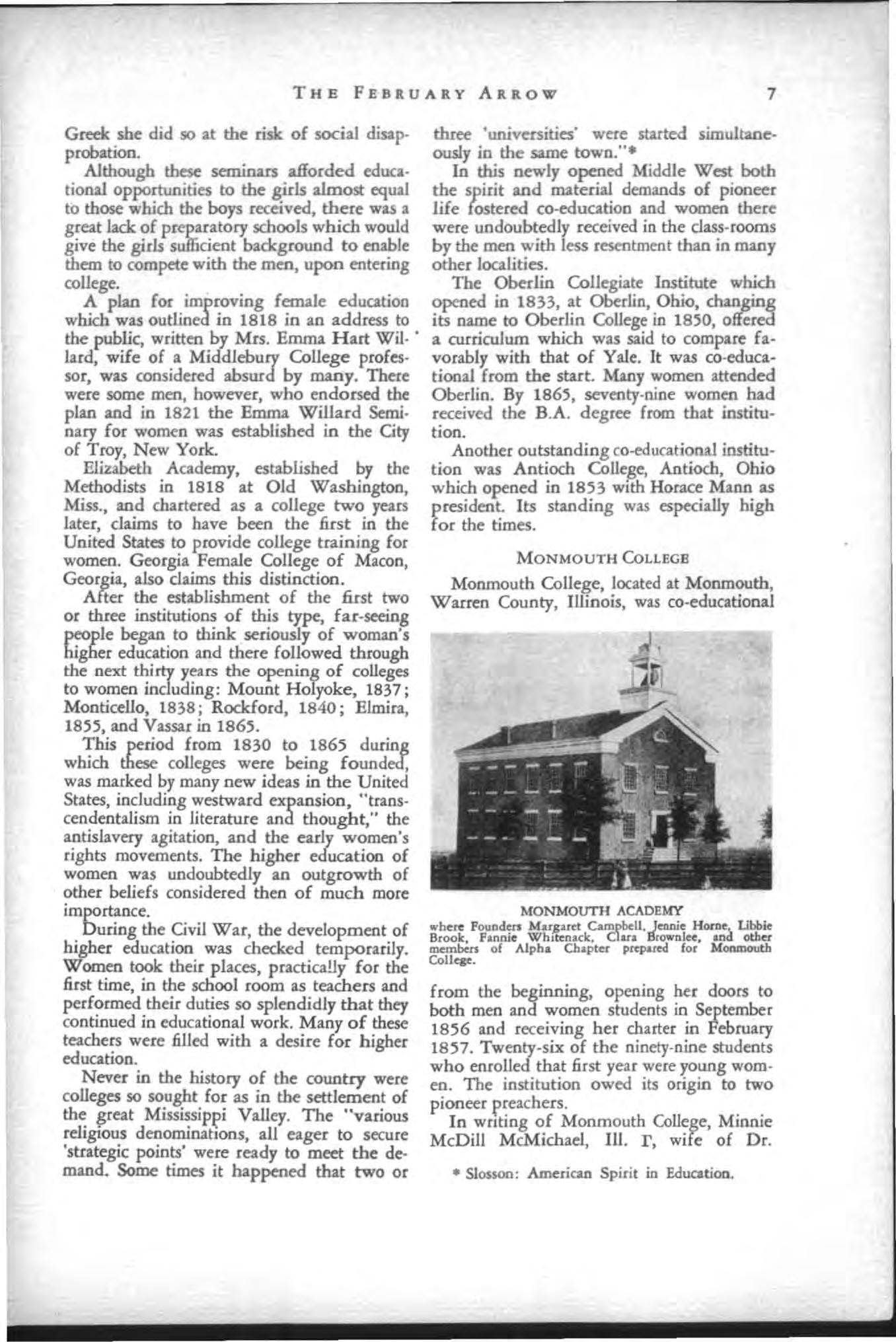
from the beginning, opening her doors to both men and women students in September 1856 and receiving ber charter in February 1857. Twenty-six of the ninety-nine students who enrolled that lirst year were young women. The institution owed its origin to two pioneer preachers.
In Writing of Monmouth College, Minnie McDill McMichael , III. r, wife of Dr
• Slossoo: American Spirit in Education.
Thomas H McMichael , President of Monmouth College, and herself a graduate of Monmouth in the dass of 1886 , said:
"It was sometime in the early part of the year 1852 that Rev. Robert Ross of South Henderson, Associate Reformed
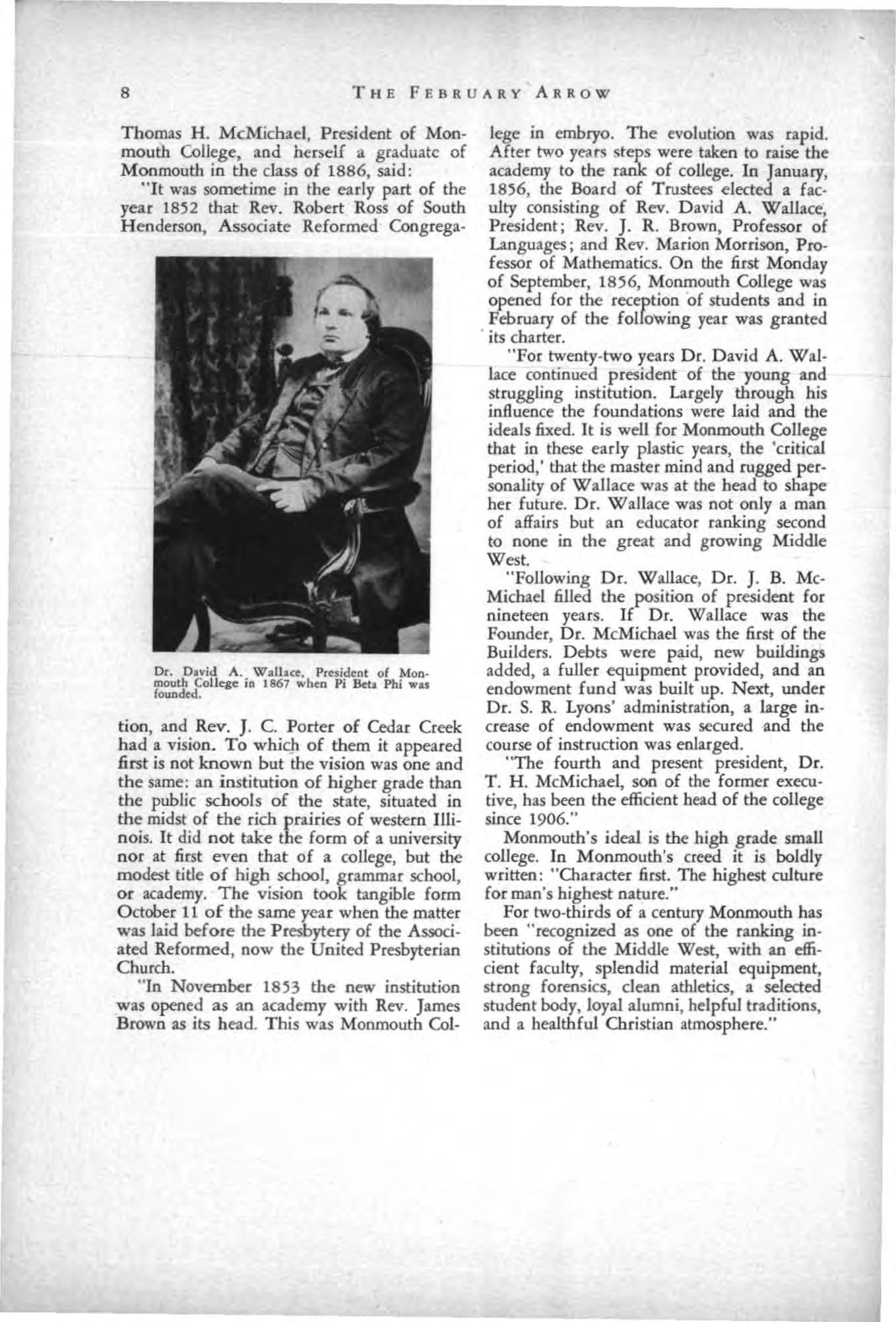
Or. Oavid A Wallace Pres ident of MODmouth College in 1867 ... hen Pi Beta Phi was founded .
tion , and Rev. J. C. Porter of Cedar Creek had a vision. To whig, of them it appeared .first is not known but the vision was one and the same : an institution of higher grade than the public schools of the state, situated in the midst of the rich prairies of western Illinois . It did not take the form of a university nor at lirst even that of a coUege, but the modest title of high school, grammar school , or academy. The vision took tangible form October 11 of the same year when the matter was laid before the Presbytery of the Associated Reformed , now the United Presbyterian Church .
" In November 1853 the new institution was opened as an academy with Rev . James Brown as its head . This was Monmouth CoI-
lege in embryo The evolution was rapid. After two years steps were taken to raise the academy to the ranlc of coUege. In January, 1856, the Board of Trustees elected a faculty consisting of Rev. David A WaUace, President ; Rev. J. R . Brown , Professor of Languages; and Rev . Marion Morrison. Professor of Mathematics . On the lirst Monday of September, 1856, Monmouth College was opened for the reception of students and in February of the folfowing year was granted . its charter.
" For twenty-two years Dr . David A. Wallace continued president of the young and struggling institution. Largely through his influen ce the foundations were laid and the ideals fixed. It is well for Monmouth College that in these early plastic years, the 'critical period: that the master mind and rugged personality of Wallace was at the head to shape her future. Dr. Wallace was not only a man of affairs but an educator ranking second to none iD the great and g rowing Middle West.
"Following Dr Wallace, Dr J B McMichael 1iI1ed the position of president for nineteen years. If Dr. Wallace was the Founder, Dr McMichael was the first of the Builders Debts were paid , new buildings added, a fuller equipmeDt provided, and an endowment fund was built up. Next, under Dr. S. R. Lyons ' administration, a large increase of endowment was secured -and the course of instruction was enlarged .
"The fourth and present president, Dr . T. H. McMichael, son of the former executive, has been the efficient head of the college since 1906."
Monmouth's ideal is the high grade small college In Monmouth 's creed it is boldly written: "Character lirst. The highest culture for man's highest nature."
For two-thirds of a century Monmouth has been " recognized as one of the ranking institutions of the Middle West, with aD efficient faculty, splendid material equipment, strong forensics, clean athletics, a selected student body, loyal alumni , helpful traditions , and a healthful Christian atmosp here."
At the time I.e. Sorosis came into being in April 1867, a limited number of institutions were offering higher education to women as well as men, but the only state universities which were then co-educatio nal were: Utah (1 8'0 ) , Iowa (18'6), Wi sconsin (1860) , Washington (1861) , and K ansas (1866) _
Althou g h we are told that it took mu ch courage for women to atte nd college with the men, in those days, the se ntiment towards the women and the acceptance of them in the classrooms at Monmouth College were probably as fine as in a ny other institution at the time
The Founders of I. e. with their avowed "des ign of the originators of this organization to establish it in as many ch arte red in stitutions as possible"-we re true pathbreakers At the time they organized there was not, in the whole cou ntry , even a regu larly functioning woman's club suc h as we have today, th e fir st real woman 's club, Sorosis, being formed in N ew York City in 1868_
There were a few l ocal secret societ ies pre· vious to this time , probably the earliest one bein g Ad e lphean , established in Wesleyan College, Maco n, Georg ia in 18n and followed soon after by Philomathean , 18'2 _ The former became Alpha Delta Phi in 1903 and again in 19 1 3, Alpha Delta Pi; the latter, nation a lized in 1904 under the n ame of Phi Mu.
A g roup of women, organized at the Troy Female Seminary in 18'6 or 185 7 as Chi Theta Delt a, by members of the Rens selaer and Union c hapt e rs of Theta Delta Chi, composed what is. SO far as is known , the first woman's secret society to bear a Gre ek name This group, however rem ai ned l oca l and dis· banded when th e Seminary ceased to exist as a boarding schooL
Too , there was a society at Monmouth Col· lege, previous to the foundin g of I.e. Sorosis, known as the " A ·· society, but it did not live long.-
• Kul W PiKher, Ben, in an article en t itl ed, " A Chapter on th e Prairies " lIyl: "The Alpha · So. ciety offers an interesting field for research among young l adles' societies. M rs. Sarah Norcross Jones of WIchit a , K ansas, a graduate of M onmouth of the dan of 1894 is a daughter of Isabella H enry, Monm o uth '66. who was ': of the Alphas , Sc,veul persons recall this orga nI zatIon nd Mrs J o nes believes It was est a blished by ten you n.l women.n throUih the .id o f the "Betas," Wheth e r thiS was the Beta Theta P, group or the Beta Phis is • m atter of co nj«ture , The two Henderson lirh were " Alphas ," Isabella Henry roomed witb Emma13r own lcc Kilaore wbo lras to become ODe of the founders of the I.e Sorosis in 1867
The fraternity idea itself originated with the founding o( Phi Beta Kappa at the Wil, liam and M ary CoUege, Williamsburg, Virginia, in 1776, but the fraternity remained a man's organization for 98 years. The first women who were adm itted into Phi Beta Kapp a were Lida Mason and Ellen E Hamilto n , members of K appa Alpha Theta, who
were invited to membership in th e chapter at the University of Vermont in 1874 . With t he development of Phi Beta Kappa , other nat io nal Greek lette r societies for men were founded, which includ ed in their m em · bership stude nts from a ll of th e undergraduate classes, instead of rest rictin g their mem · bership to those in the se ni o r yea r only, as did Phi Beta K appa. -
Imm ediately af te r the Civil War, five new men's fr ate rn it ies were founded and the pre · viously ex isti ng ones took on n ew life, hence, it was not astonis hin g that a grou p of girls in M onmout h College s hould co nceive the idea of a national fraternity for women, patterned after those of Beta Th eta Pi, Delta T au D elta, a nd Phi Gamma Delta then on the ca mpu s.
The existe nce of the " A " society at Monmouth College at this time , a lso undoubtedly influenced the Founders o f I.e. Sorosis to organize
In r ega rd to the group, Ada Bruen Grier, Founder, sa id : ·'The 'N society h ad its birth in our college."
Anoth er I. e. Fou nder, Jennie Horne Turnbull in writing for the Arrow in 1911 sa id : " In t he fall of 1867 a young woman from another institution e nter ed Monmouth Co llege. She was a member of what was then
Nancy Bl.cle Pirst 5Kretary 1867
Libbic Brook Praicknt 1170
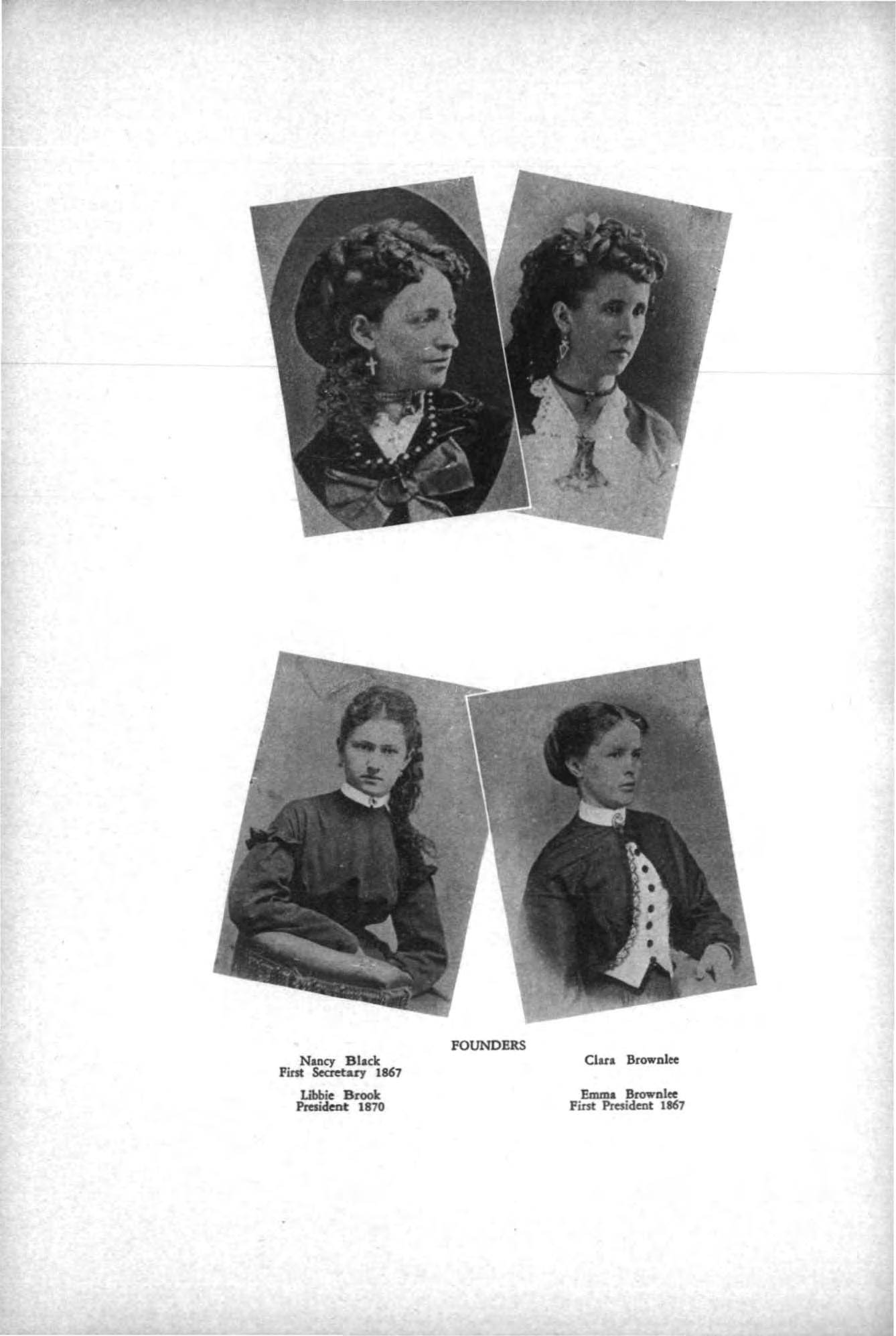
Clara Brownlee
Emma Brownlee Pirst President 1167
known as the ' A' society. The badge was a simple square black pin with the letter 'A' in gold upon it. At the b<ginning of the winter term of college in that year she undertook to get some girls to become membe of the society Two joined, and all the winter she and they urged others of us to unite. Early in the spring we decided that the only way to avoid their entreaties without being rude was to form a dub of our own."
To quote Founder Emma Brownlee Kilgore: " There existed in Monmouth in 1867 a group of girls who called themselves the 'A's' and who seemed to have a great many secrets and just bushels of fun."
It was while discussing this group of girls that the decision was reached by the Founders of I.C. Sorosis to start a national fraternity for women.
Emma Brownlee Kilgore , in writing in 1880 of the beginning of I .e. Sorosis said:
" On the evening of April 22, 1867 , Libbie Brook and Ada Bruen , both students in Mo nmouth College, called upon Fannie Whitenack, and the three girls spent the evening with Clara and Emma Brownlee, who were boarding at Mr. Whitenack's. While in the room of the Brownlee girls we were talking of some school girls who wore a little black pin with a gold letter upon it. The members were very anxious to impress upon the girls the great importance of a secret society and the advantages derived there from. We had no desire to unite with this g roup but did desire a sisterhood of our own. We never knew what the ' A' meant nor its history It was soon gone. We wanted something better. The Betas and Delta Tau Deltas already had chapters at Monmouth , and the question was suddenly asked: ' Why can not college girls have a fraternity?'
" 'Just the thing!' Libbie Brook answered.
"We thought that if young men gained help in this way, young women surely might also. The idea of a secret society· among women was novel but we decided to make the effort."
Before the girls left the Whitenack home that evening they had decided to ask seven other college girls to join them in organizing a secret society at a meeting to be held a week later. When recitations were over the next day they met in one of the College rooms in Old Main and there quietly talked things over.
• In the early days all fraternities were reo fereed to as "sKret
All of the seven girls interviewed promised to join.
There is evidence that two of the Founders,
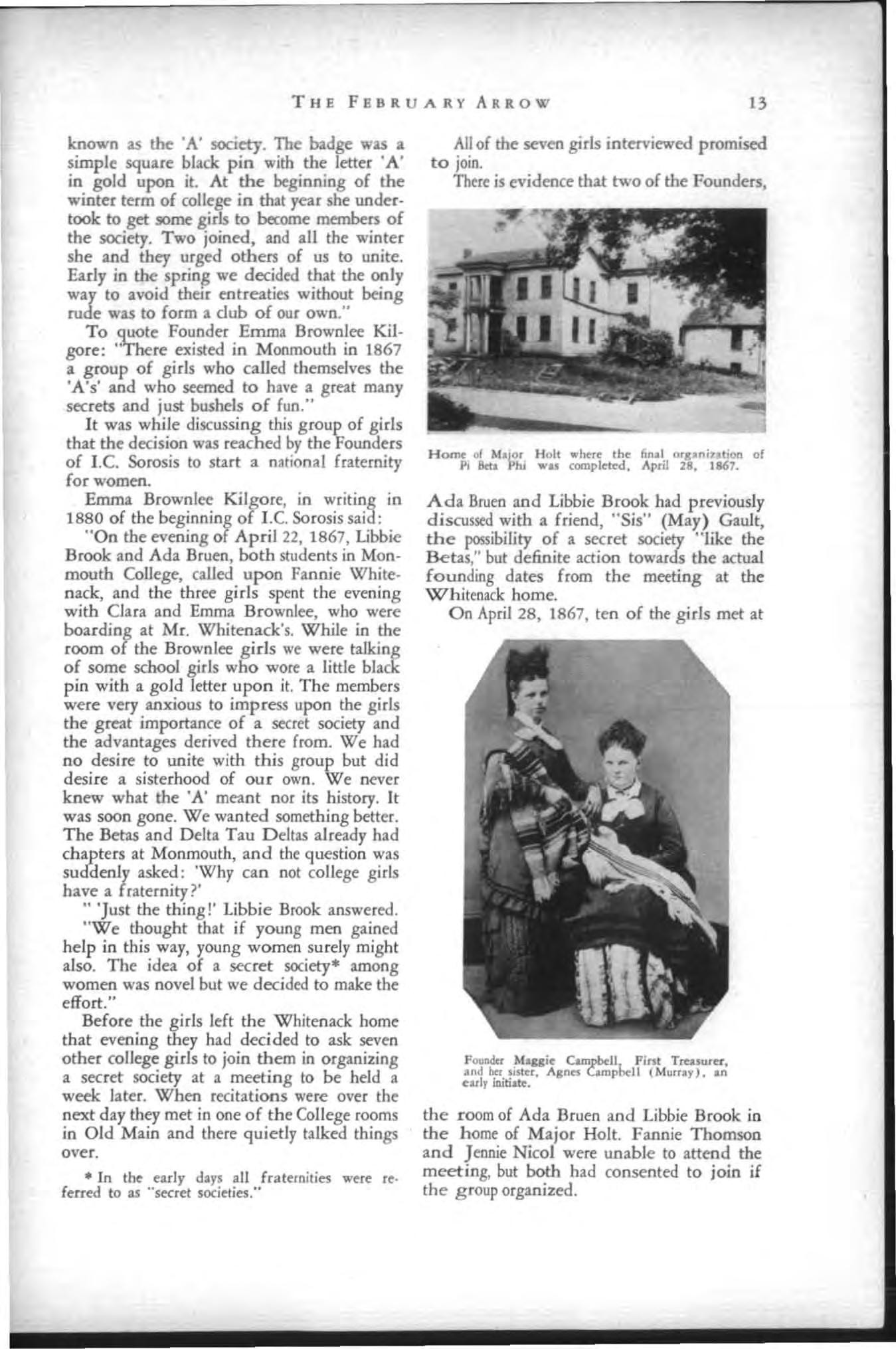
Ada Bruen and Libbie Brook had previously discussed with a friend, "Sis" (May) Gault, the possibility of a secret society "like the Betas," but definite action towards the actual founding dates from the meeting at the Whitenack home.
On April 28, 1867, ten of the girls met at
f oundtt Mauie Campbell Pint Tre.suru, and 00 SISter, "8nH C.mpbdl (Murr.y), In carl, initiate .
the room of Ada Bruen and Libbie Brook in the hom e of Major Holt. Fannie Thomson and Jennie Nicol were unable to attend the meeting, but both had consented to join if the group organized.
Emma Brownlee presided as temporary chairman with Nannte Black as secretary.
The group immediately voted to organize and then a aecision was made that they would "always conceal and never reveal'" how they had become members and always would keep secret the meaning of the name I.e. Sorosis.
Committees were appointed to draft a Constitution and to nominate officers
11. grip was decided upon , to be accompanied by three Greek words beginning with
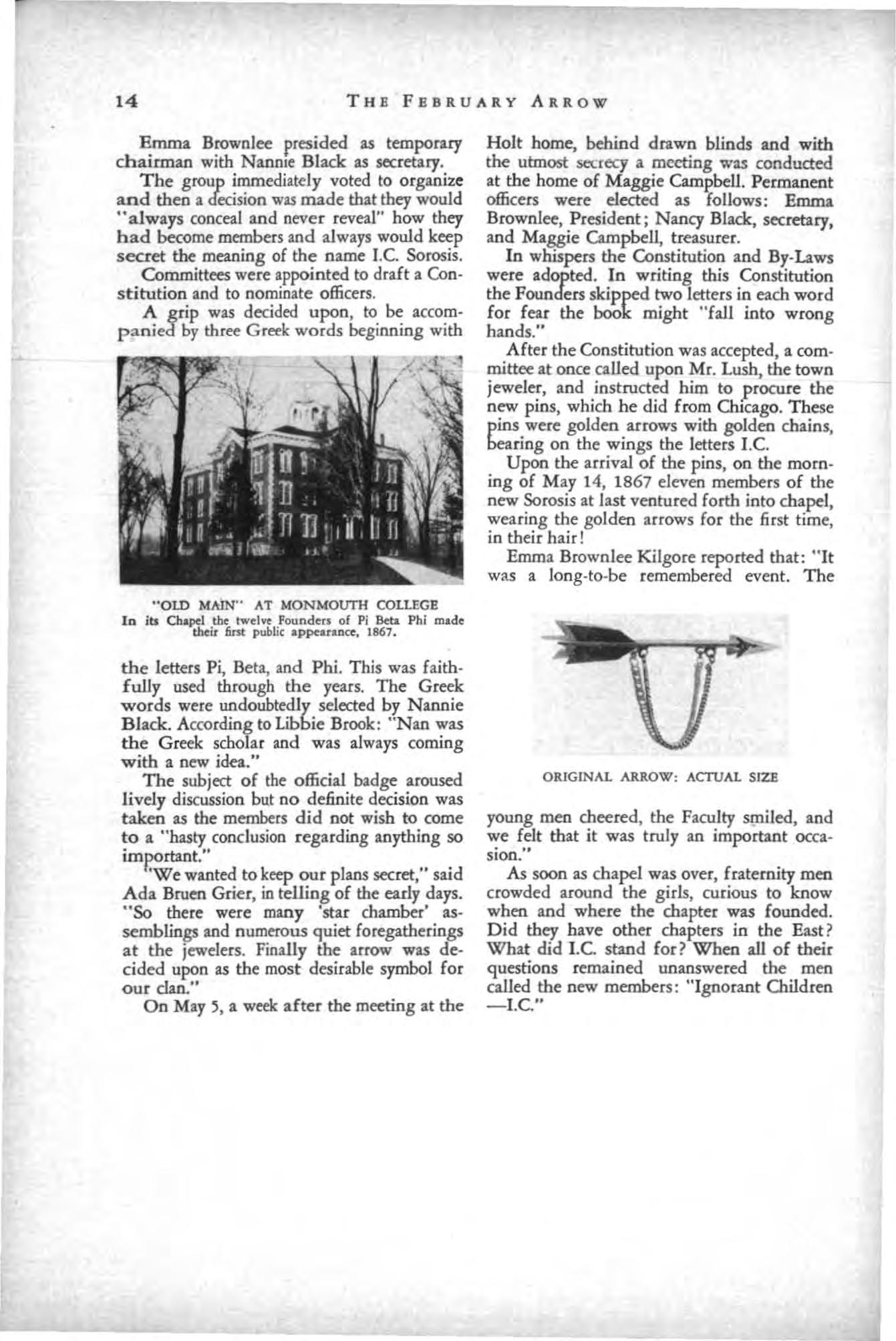
Holt home, behind drawn blinds and with the utmost secrecy a meeting was conducted at the home of Maggie Campbell. Permanent officers were elected as follows: Emma Brownlee, President; Nancy Black, secretary, and Maggie Campbell, treasurer.
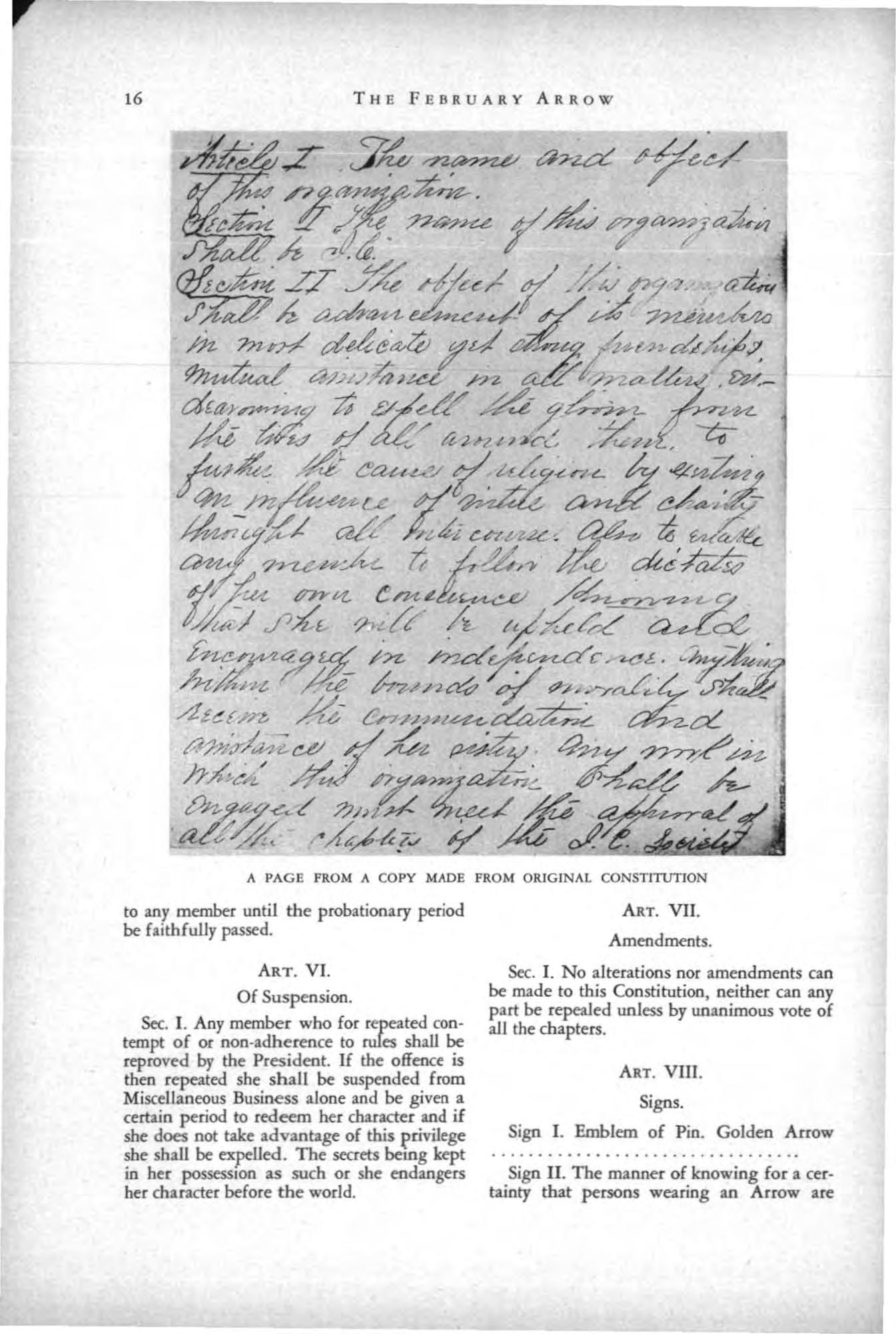
In whispers the Constitution and By-Laws were adopted. In writing this Constitution the Founders skipped two letters in each word for fear the book might "fall into wrong hands."
After the Constitution was accepted, a committee at once caUed upon Mr. Lush, the town jeweler, and instructed him to procure the new pins, which he did from Chicago. These pins were golden arrows with golden chains, bearing on the wings the letters I.e.
Upon the arrival of the pins , on the morning of May 14, 1867 eleven members of the new Sorosis at last ventured forth into chapel, wearing the golden arrows for the /irst time, in their hair!
Emma Brownlee Kilgore reported that: "It was a long-to-be remembered event. The
the letters Pi, Beta , and Phi. This was faith· fully used through the years. The Greek words were undoubtedly selected by Nannie Black According to Libbie Brook: "Nan was the Greek scholar and was always coming with a new idea."
The subject nf the official badge aroused lively discussion but no definite decision was taken as the members did not wish to come to a "hasty conclusion regarding anything SO im rtant."
wanted to keep our plans secret," said Ada Bruen Grier, in telling of the early days. "So there were many 'star chamber ' assemblings and numerous quiet foregatherings at the jewelers. Finally the arrow was decided upon as the most desirable symbol for our clan,"
On May), a week after the meeting at the
young men cheered , the Faculty smiled, and we felt that it was truly an important occasion, "
As soon as chapel was over, fraternity men crowded around the girls, curious to know when aod where the chapter was founded. Did they have other chapters in the East? What did I.e. staod for? When all of their questions remained unanswered the men called the new members: "Ignorant Children -I.C. "
The original copy of the Constitution in which two letters in each word were omitted, was evideotIy destroyed with most of Alpha's records, but fortunately copies bad been made from it and had been sent with charters to each new chapter. A copy of this original remained in the Archives of Iowa Alpha at Mt. Pleasant for many years.
Too, the parts of a copy of this original Constitution which were rescued by Emma Brownlee Kilgore , are in the Historian's Archives, hence, it is possible to reproduce the Constitution and By-Laws which were in use in those very early days.
and By -Laws of the I.C Sorosis P"amble
Whereas, it was deemed necessary in order to cultivate si ncer e friendship, establish the real object of life and promote the happiness of humanity,
We, the undersigned ladies of Monmouth College do ordain and establish the following Constitution,
Signed
Ada C. Bruen
Oara Brownlee
Emma Brownlee
Nannie J. Black
M. Libbie Brook
Maggie E . Campbell
M. Rosella Moore
Jennie M . Horne
Inez B Smith
Fannie B. Whitenack
Fannie A . Thomson
(Non: Although Jennie Nicol was as one of the original group she was not present at the signing of the first Constitution.)
ART . I.
The Name and Object of this Organization
Sec. I. The Name of this organization shall be "I.C"
Sec. II . The Object of this organization shall be the advancement of its members in the most delicate yet strong friendship, mental assistance in all matters, endeavoring to dispel the g loom from the lives of all around them,
to further the cause of religion by exerting an inJluence of virtue and charity throughout aU intercourse, also to enable any member to follow the dictates of her own conscience knowing that she will be upheld and encou raged in independence. Anything within the bounds of Morality shall receive the commendation of her sisters.
Any work in which this organization shall be engaged must meet the approval of the chapters of the "I.C" Sorosis.
ART. II.
Sec I It shall be the duty of the President to preside at all meetings of the Society. Open the same with devotional exercises, enforce strict observance of all laws, put all motions before the house, give the castmg vote in case of a tie, fill all vacancies by appointment and with the consent of the society she shall impose all fines . She shall be aware of all documents and papers belonging to the society, also kttp in her possession the Constitution.
Sec. II. It shall be the duty of the VicePresident in absence of the President to perform the duties laid down in Art III. Sec. I.
Sec. III. It shall be the duty of the Corresponding Secretary to conduct her respective corresponden ce of the organization and report the same. She is also required to write at least once in two months.
Sec. N. It shall be the duty of the Recording Secretary to call the roll and prepare minutes of each previous meeting.
Sec. V. It shall be the duty of the Treasurer to conduct the financial affairs of the organization, report the same quarterly or whenever called upon , if two weeks' notice be given.
Sec I. All officers shall be elected by ballot.
Sec. II. Election of Officers shall take place on the 1st of November, unless otherwise provided for. The President, Vice-President, Corresponding Secretaries and Treasurer holding office for one year, the Recording Secretary for six months.
The Reading of the Constitution.
Sec. I. The Constitution shall not be read
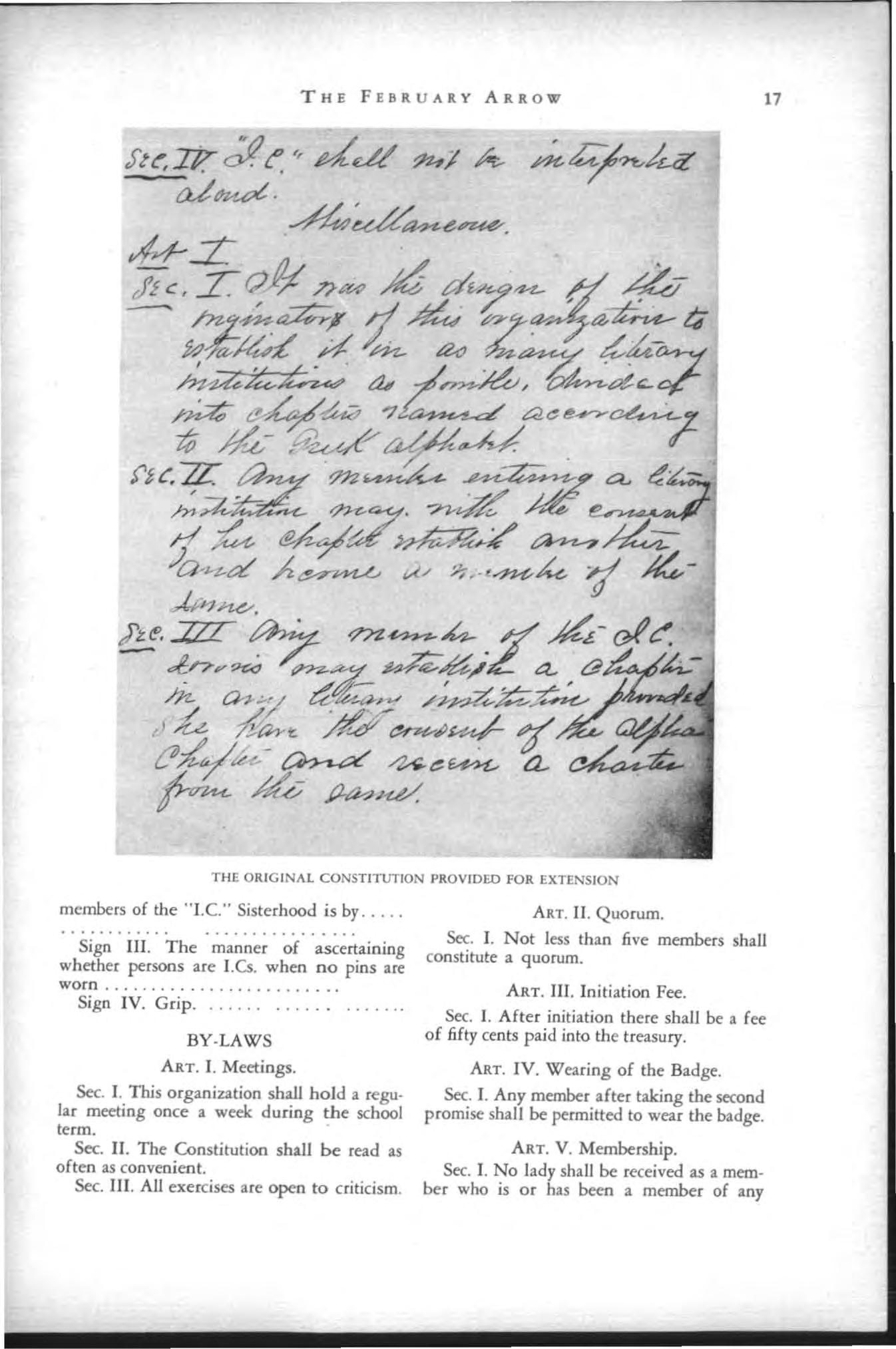
A PAGE PROM A COpy MADE FROM ORIGINAL CONSTITUTION to any member until the probationary period be faithfully passed
ART. VI.
S«. I. Any member who for repeated contempt of or non -adherence to rules shall be reproved by the President. If the offence is then repeated she shall be suspended from Miscellaneous Business alone and be given a certain period to redeem ber character and if she does not take advantage of this J?rivilege she shall be ""J"'lled. The secrets being kept in her possessIOn as such or she endangers her character before the world .
ART VlI.
Amendments .
Sec . I. No alterations nor amendments can be made to this Constitution, neither can any part be repealed unless by unanimous vote of all the chapters
ART. YIlI . Signs.
Sign I. Emblem of Pin. Golden Arrow
Sign II. The manner of knowing for a certainty that persons wearing an Arrow are
THE OR IGINAL CONSTITUTION PROVIDED FOR EXTENSION members of the "I.e." Sisterhood is by .....
Sign III. The manner of ascertaining whether persons are I.Cs. when no pins are worn .............. . ... . ... . _.
Sign IV. Grip.
BY ·LAWS
ART. I. Meetings
Sec. I . This organization shall hold a regu· lar meeting once a week during the school term.
Sec. II. The Constitution shall be read as often as convenient.
Sec. III. All exercises are open to criticism .
ART II. Quorum.
Sec I. Not less than five members shall constitute a quorum.
ART III. Initiation Fee.
Sec. I. After initiation there shall be a fee of fifty cents paid into the treasury.
Sec . I. Any member after taking the second promise shall be permitted to wear the badge.
Sec. I. No lady shall be received as a member who is or has been a member of any
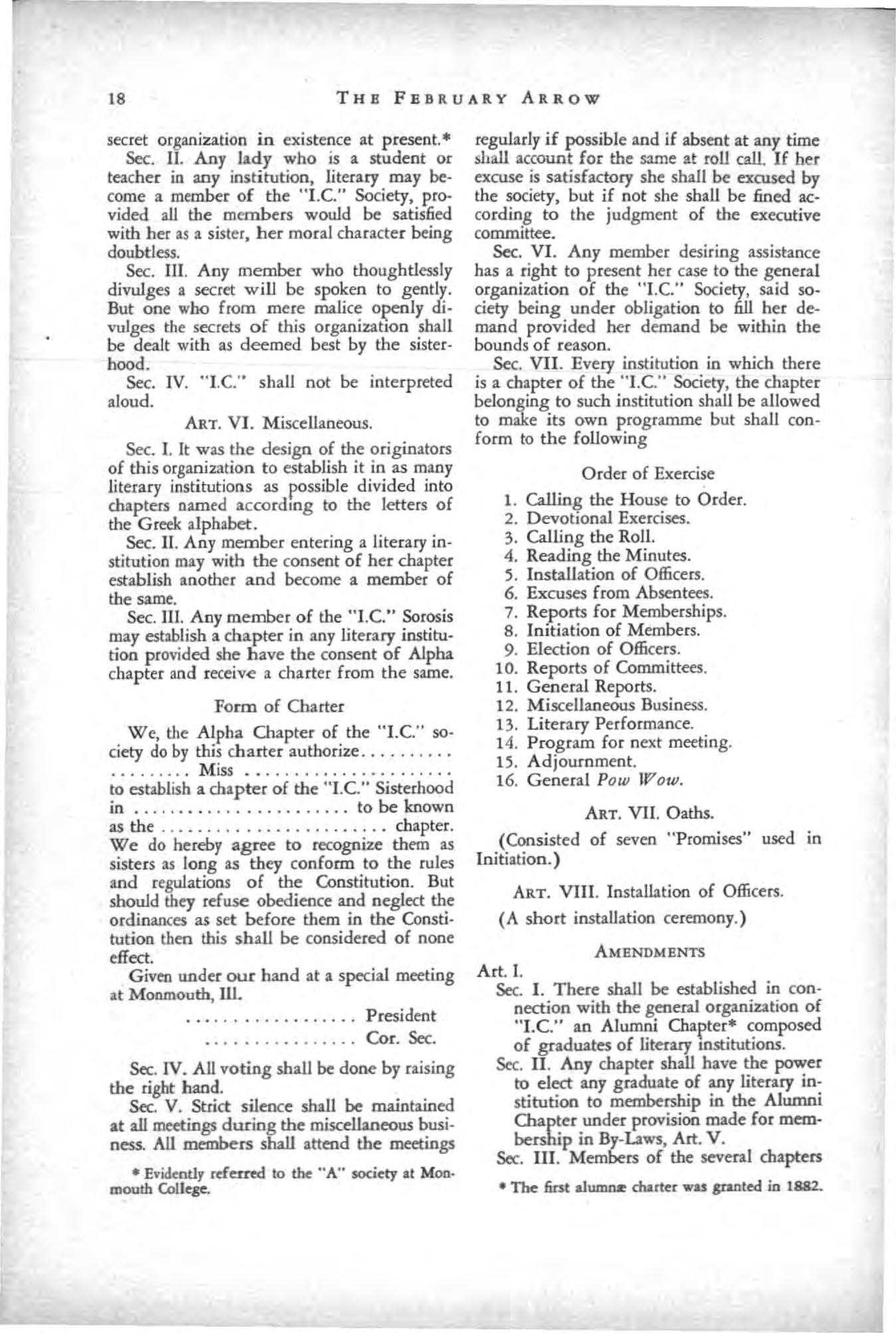
secret organization in existence at present. *
Sec . n. Any lady who is a student or teacher in any institution, literary may become a member of the "I.e." Society, provided all the members would be satisfied with her as a her moral character being doubtless
Sec . III . Any member who thoughtlessly divulges a secret will be spoken to gently. But one who from mere mali ce 0Fly divulge s th e secrets of this organization shaH be dealt with as deemed best by the sisterbood.
Sec. IV. "I.e. " shall not be interpreted aloud.
Sec. I . It was the d esign of the originators of this organization to establish it in as many literary institutions as possible divided into chapters named a c co rding to the letters of the Greek alphabet.
Sec. II. Any member entering a literary institution may with the consent of her chapter establish anoth er and become a member of the same.
Sec. III. Any member of the "I.e." $orosis may establish a chapter in any literary institution provided she have the consent of Alpha chapter and receive a charte r from the same.
We, the Alpba Chapter of the "I.e:' society do by this charter authorize ... ...... . Miss __ to establish a chapter of the " I.e." Sisterhood in _ to be known as the , , _ chapter We do hereby aBree to recognize th= as sisters as long as they conform to the rules and resuJations of the Constitution . But sbould they refuse obedience and neglect the ordinances as s et before them in the Constitution then this sh all be considered of none effect.
Given under our hand at a spec ial meeting at Monmouth , Ill.
. President _ Cor. Sec
Sec IV_ All voting shall be done by raisin g the right hand.
Sec. V. Strict silence shall be maintained at all meetings during the miscellaneous bus iness All members shall attend the meetings
• referced to the "A" society at Monmouth College.
regularly if possible and if absent at any time shall account for the same at roll call If her excuse is satisfactory she shaU be excused by the society, but if not she shall be fined according to the judg m ent of the executive committee.
Sec. VI. Any member desiring assi stan ce has a rigbt to present ber case to the general organization of the " I.e." Society, said society being under oblig ation to filJ ber demand provided ber d emand be within the hounds of reason.
Sec. VII Every inst,itution in which there is a chapter of the " I.e. " Society, the chapter belonging to such institution sb aU be aUowed to make its own progr amme but shall conform to the following
Order of Exercise
1. Calling the House to Order.
2. Devotional Ex ercises .
3 Calling the Roll.
4 Reading the Minutes
5. Installation of Officers
6. Excuses from Absentees.
7. Reports for Memberships.
B. Initiation of Members.
9. Election of Officers
10 Reports of Committees
11. General Reports
12. MisceUaneous Busin ess.
13. Litera ry Performance
14 Program for next meeting.
15 . Adjournment.
16. General Po w IV o w.
ART. VII. Oaths.
(Consisted of seven "Promises" used 10 Initiation )
ART_ VIII. InstalJation of Officers . (A short installation ceremony.)
Art I.
Sec. I There sball be established in connection with the general organization of " I.e." an Alumni Chapter· composed of graduates of lite rary IDstitutions .
Sec. II . Any chapter shall bave the power to elect any g.raduate of any literary institution to membership in the Alumni Chapter under provision made for membership in By-Laws , Art V
Sec. III. Members of the several chapters
• The first alU1llO.lr charter was granted in 1882.
shall on gra duation become members of the Alumni Chapter but shall retain their conn ectio n with their former chapter
Sec IV This Alumni Chapter shall not have power to transact any business.
Sec V This Chapter shall be numbered by the last letttr of the Greek Alphabet (Omega) and this letttr shall be placed upon the pin of any becoming members of such chapter. In connection with the numerical letter of the original chapter.
Sec. VI Any becoming members of the Alumni who have not been members of any chapter, shall have the letter Omega only on their pins
In an old edition of Ba ird's Manual an in( orrec t sta te ment was made that three kinds of chapters were at first provided by I.e. Sorosis. The author was either mJSloformed or misunderstood the information . Provision was made in the Constitution for only two kinds of Ch apters : CoUege and " Alumni. "
In writing of the early days, Nancy Lee Black Wallace , Founder, said in 1898: "Selfreliance was not considered in those days an important element in women's character and one had to maintain a sort of 'Sorosis' air to keep one's courage up. The new woman spirit was generally discouraged and disparaged. Some of the Founders were more decided upon the question of Woman ' s Suffrage then, than even now. Young men winced before argument and paled at the mere mention of such possibilities . ... The origin of the name 'I.e: seemed to be the outcome of a Jecture given by our dear President who was always ready to give us practical talks 00 plain every day subjects. He did not approve of the prevalent. cust",:, of permanent gentlemen escorts--m urglOg a departure from this he suggested that in case there was no one to act as chaperone, why not be 'independent and with lantern in hand go alone.' A few evenings later some of the I.e. Founders led a small company, called the Lantern Bri$ade, marching to and from the building· WIth a heroism worthy a better
• Old Main.
cause V wisely, too, these lights were securely locked in one nf the Literary halls, and the mischievous young men failed to discover them. But from this hour we felt we had announced our principles and entered upon a career of indeprodence."
" The career of independence" is an apt phrase, as all of the early days of the Founders demonstrated cOIDl?lete indeprodence In founding I.e. $oroSlS, these twelve college girls, althou$h they endeavored to pattern their organization after the men's Greek letter chapters, asked no advice of the men In fact, they went to the other extreme and were part of the great women 's movement then developing
According to Fannie Whitenack Libbey. Founder, ''To give us prestige we wrote to Elizabeth Cady Stanton , telling her of our aspirations . We begged her to permit us to make her an hooorary member . This she did, writing us a very encouraging letter, causing us to feel that we were conferring the honor upon her."
Founder Libbie Brook Gaddis is authority for this statement: "In that first year we elected Susan B. Anthony an honorary member and I had the pleasure of writing her of the honor I.C. was conferring upon her."
In speaking further of the beginning, Libbie Brook Gaddis said, We desired to perpetuate our attachments, and. to form, develop and strengthen other fnendshlps; for whire there are deeper and holier relations than that of I.C or Pi Beta Phi , still nothing much purer or lovelier graces the name of friendship . In that day women's dubs were in an embryonic state, and women's coUege fraternities were not known. The thought of women's dubs may have been in the air; if it was, we were among the first to breathe it. Believing that young women of other colleges would favor the idea we were encouraged to present it to them. The idea was more por.ular than we had hoped for, and we builded better than we knew. Our first thought was that I.C would become na· tional."
"Long ago in Monmouth College, on a bright, glad, April day, Md: Ii band of twel ve fair maidens, bent 00 work and bent on play.
Goe a fair light-hearted lassie, with great eyes of earnest blue
Sweetly spoke of love unfading, told her dream of friendship true.
We have come dear girls together, with a purpose high and pure.
Come to pledge an earnest friendship, that forever shall endure.
Let OUI emblem be the arrOw, deftly shot from Cupid's bow, GoJdenowiog 'd with virtue, honor ; speeding love where 'cr it go."
-MARGARET SUTHERLAND-FLYNN, Ohio B
In Pi Beta Phi Songbook
Pi Beta Phi has been truly fortunate in having had and in sti JI having the inspiration,
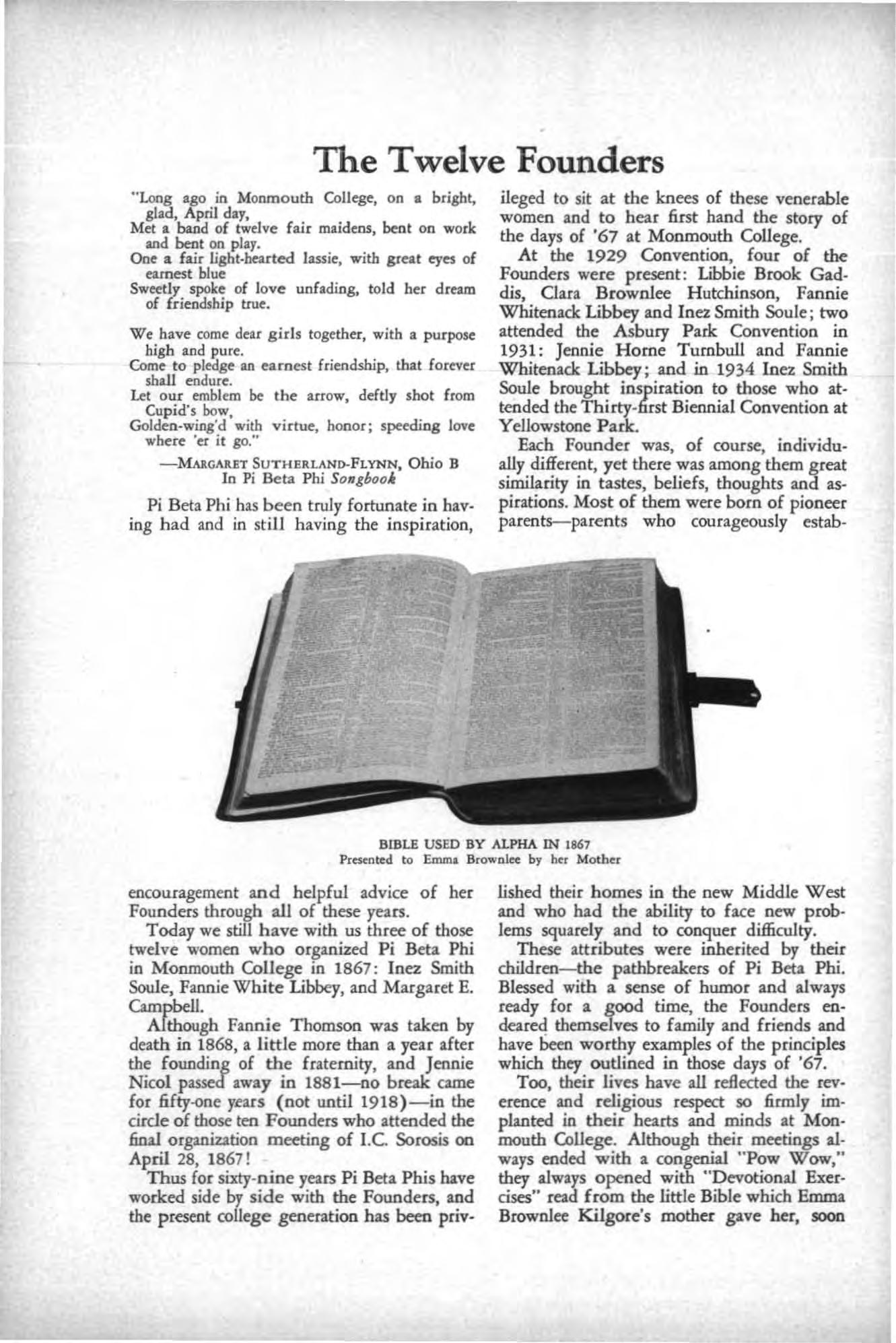
encouragement and helpful advice of her Founders through all of these years.
Today we still have with us three of those twelve women who organized Pi B eta Phi in Monmouth College in 1867: Inez Smith Soule, Fannie White libbey, and Margaret E. Campbell.
Although Fannie Thomson was taken by death in 1868, a little more than a year after the founding of the fraternity, and Jennie Nicol passed away in 1881-no break carne for fifty-one (not until 1918)-in the ciede of those ten Founders who attended the final organization meeting of I.e. Sorosis 00 April 28, 1867!
Thus for sixty-nine years Pi Beta Phis have worked side by side with the Founders, and the present college generation has been priv-
i1eged to sit at the knees of these venerable women and to hear first hand the story of the days of '67 at Monmouth College.
At the 1929 Convention, four of the Founders were present: Libbie Brook Gaddis, Clara Brownlee Hutchinson , Fannie Whitenack Libbey and Inez Smith Soule; two attended the Asbury Park Convention in 1931: Jennie Horne Turnbull and Fannie Whitenack Libbey; and in 193 4 Inez Smith Soule brought inspiration to those who attended the Thirty-first Biennial Convention at Yellowstone Park.
Each Founder was, of course, individually different, yet there was arnong them great similarity in tastes, beliefs, thoughts and aspirations. Most of them were born of pioneer parents-parents who courageously estab-
lished their homes in the new Middle West and who had the ability to face new problems squarely and to conquer difficulty. These attributes were inherited by their children-the pathbreakers of Pi Beta Phi. Blessed with a sense of humor a nd always ready for a good time, the Founders endeared themselves to family and friends and have been worthy examples of the principles which they outlined in those days of '67. Too, their lives have all reBected the reverence and religious respect so firmly implanted in their hearts and minds at Monmouth College. Although their meetings always ended with a congenial "Pow Wow, " they always opened with " Devotional Exercises" read from the little Bible which Emma Brownlee Kilgore's mother gave her, soon
after the founding of the fraternity (This Bible is today in the Historian ·s Archives, presented by Mrs L. E Barnum of Monmouth, Ill., a life-long friend of Mrs Kilgore.)
The families of the Founders were men the equality of women and did everything possible to give their daughters the advantages of a higher education, a rather rare privilege in those early days According to Jennie Home Turnbull: "Having a desire for better educational advantages than could be
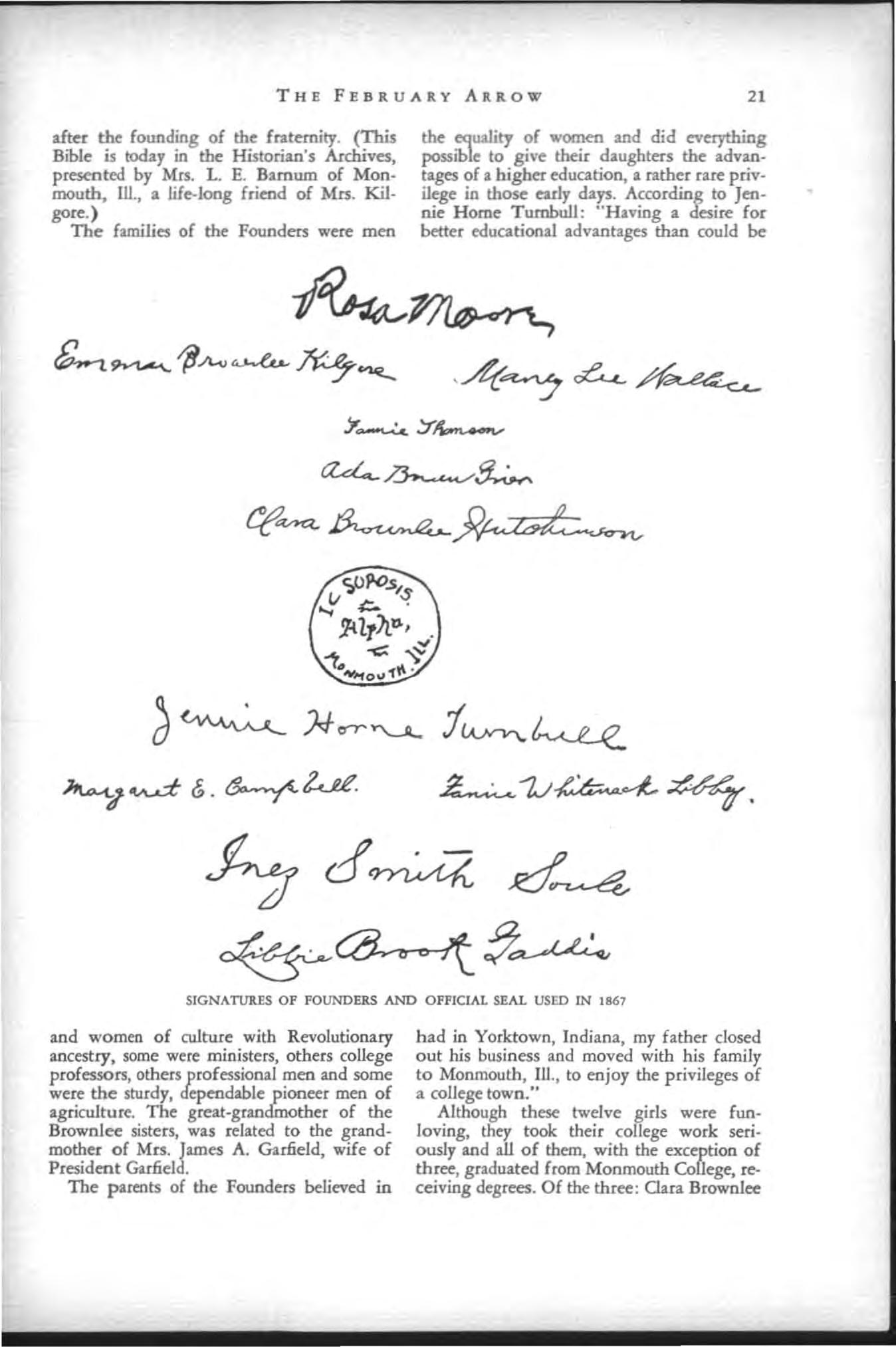
SIGNATURES OF FOUNDERS AND OFFICIAL SEAL USED IN 1867
and women of culture with Revolutionary ancestry, some were ministers, others college professors, others professional men and some were the sturdy, dependable pioneer men of agriculture. The great-grandmother of the Brownlee sisters, was related to the grandmother of Mrs. James A. Garfield, wife of President Garfield.
The parents of the Founders believed in
had in Yorktown, Indiana, my father closed out his business and moved with his family to Monmouth, Ill., to enjoy the privileges of a college town."
Although these twelve girls were funloving, they took their college work seriously and all of them, with the exception of three, graduated from Monmouth College, receiving degrees. Of the three: Oara Brownlee
Hutchinson, would have graduated, but had to leave school in her senior year to care for an invalid mother; Rosa Moore left Monmouth College as a junior and returned to her home in the east; Fannie Thomson left college to teach, so that her sister might attend school, and died before graduation.
According to record the Founders of Pi Beta Phi received the following degrees:
Nancy Lee Black (Wallace), B.L., '67
Margaret E. Caml'bell, B.S., '67
Emma Brownlee (Kilgore), B.S., '68
Jean Morton Horne (Turnbull), B .S., '68
Fannie Whitenack (Libbey), B.S., '68
Rachel J. Nicol, B.S., ' 68 , M.D., '79 (Woman's Medical College of Pennsylvania)
Inez Smith (Soule), B.L., '68
Margaret Elizabeth Brook (Gaddis), B.S., '70
Ada Bruen (Grier), B.S., '70
1848·1868
Fannie (Frances Ann) Thomson was barn in Jefferson County, Ohio, November 23,
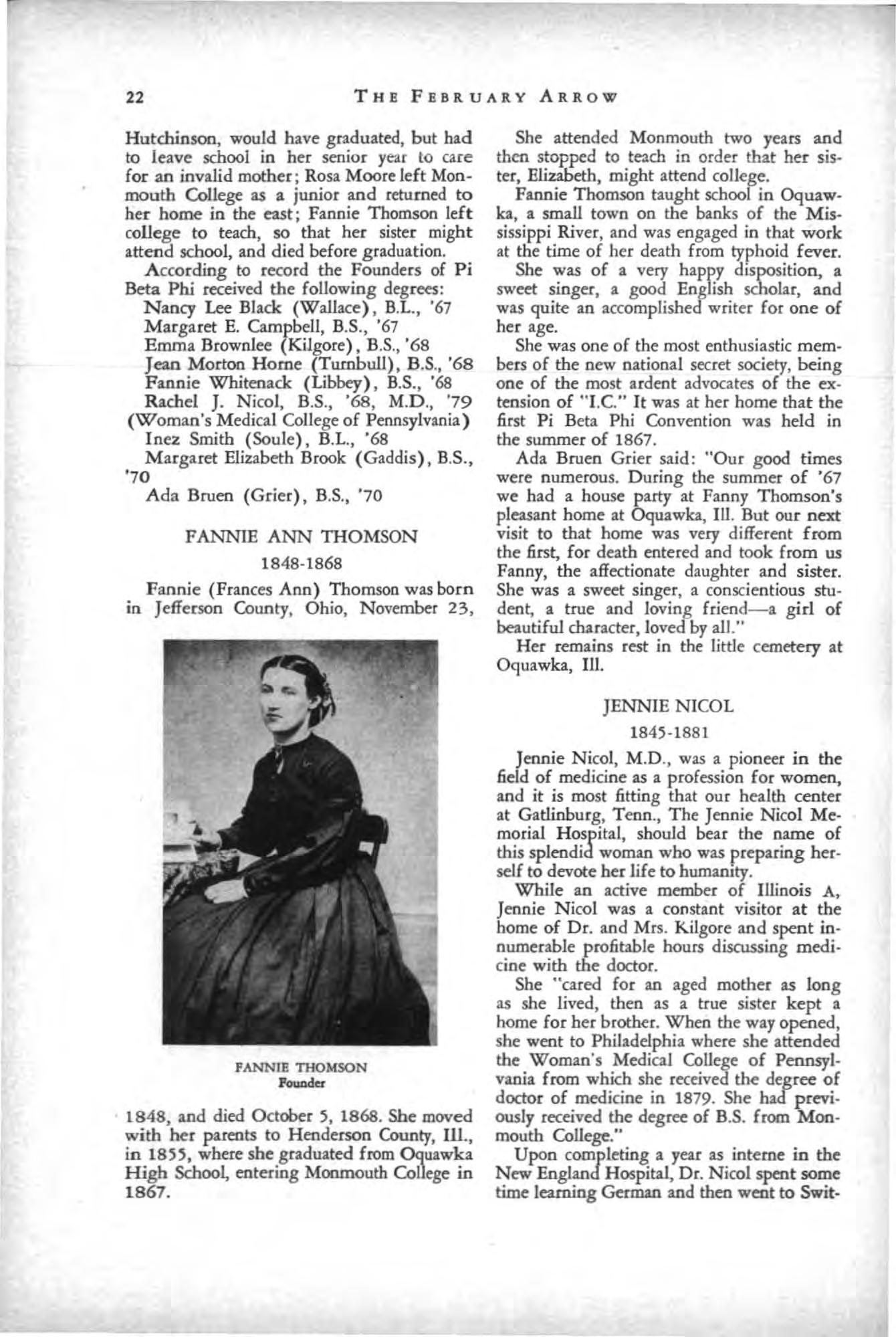
1848, and died October 1868. She moved with her parents to Henderson County, Ill., in where she graduated from Oquawka High entering Monmouth College in 1867.
She attended Monmouth two years and then stopped to teach in order that her sis· ter, Elizabeth, might attend college.
Faooie Thomson taught school in Oquawka, a small town on the banks of the Mis· sissippi River , and was engaged in that work at the time of her death from typhoid fever.
She was of a very happy disposition, a sweet singer, a good English scholar, and was quite an accomplished writer for one of her age.
She was one of the most enthusiastic members of the new national secret society, being one of the most ardent advocates of the oxtension of "I.e." It was at her home that the lirst Pi Beta Phi Convention was held in the summer of 1867
Ada Bruen Grier said: "Our good times were numerous. During the summer of '67 we had a house parly at Fanny Thomson's pleasant home at Oquawka, Ill . But our next visit to that home was very different from the lirst, for death eDtered and took from us Fanny, the affectionate daughter and sister. She was a swed: singer, a conscientious stua true and loving friend -a girl of beautiful character, loved by all."
Her remains rest in the litt1e cemetery at Oquawka, III.
Jennie Nicol, M .D ., was a pioneer in the field of medicine as a profession for women, and it is most litting that our health ceoter at Gatlinburg, Tenn., The Jennie Nicol Memorial Hospital, should bear the name of this splendid woman who was preparing her· self to devote het life to humaruty.
While an active member of Illinois A, Jennie Nicol was a constant visitor at the home of Dr. and Mrs . Kilgore and spent in· numerable prolitable hours discussing medi · cine with the doctor .
She "cared for an aged mother as long as she lived, then as a true sister kept a home for her brother. When the way opened, she went to Philadelphia where she attended the Woman ' s Medical College of Pennsyl· vania from which she received the degree of doctor of medicine in 1879 She had previously received the degree of B S from Monmouth College."
Upon completing a year as interne in the New England Hospital, Dr. Nicol spent some time learning German and then went to Swit-
:.erIaod to take advanced wode in the Uni· versity of Zurich. It was her intention then to retum to Illinois to practice, but on March 28, 1881 , after an illness of a few days she died of meningitis. Her body was brought back to America and lies among the friends o f her youth in Cedar Creek churchyard , near Little York, Ill.
Of her, Emma Brownlee Kilgore wrote: "I knew Rachel all my life I have called
of her brothe.. in the profession . She used to say, 'I think we should have women physidans and I have an ambition to show the men wbat a woman can do.' She came to Dr. Kilgore, borrowed some books, and told him her desire to enter the profession He was helpful , encouraged ber to commence the .tuay, and then go to Philaddphia- which she did . When she went to Philaddphia, .be and Dr. Kilgore wanted me to study medi-
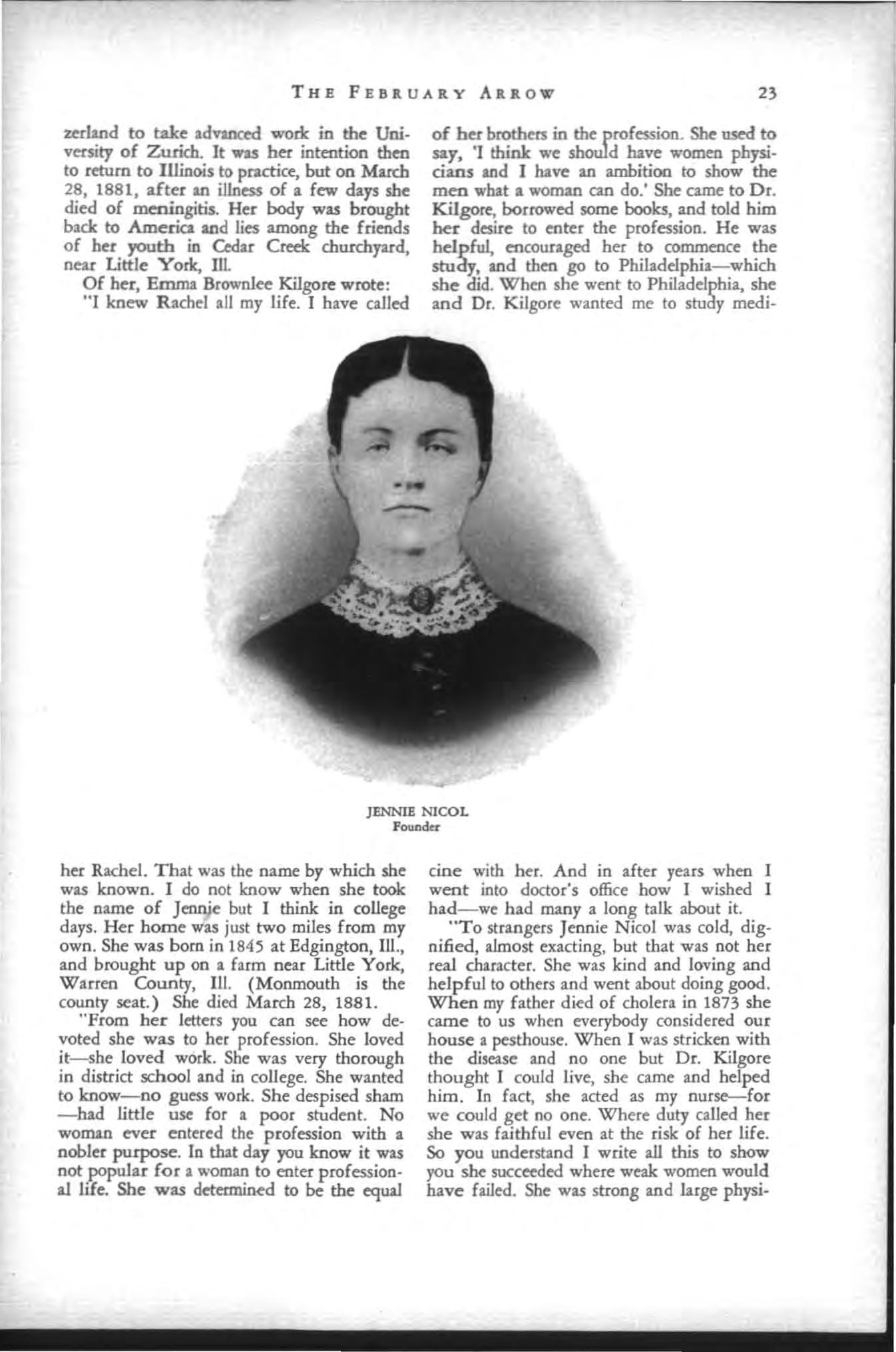
JENNLE NICOL Pounder
her Rachel. That was the name by which she was known. I do not know when she took the name of Jennje but I think in college days. Her home was just two miles from my own . She was born in at Edgington, III., and brought up on a farm near Little YOlk, Warren County, III. (Monmouth is the county seat.) She died March 28, 188l.
From her letters you can see how de· voted sbe was to her profession. She loved it-she loved work . She was very thorough in district school and in college. She wanted to know-no guess work. She despised sham -had little use for a poor student. No woman ever entered the profession with a nobler purpose. In that day you know it was not popular for a woman to enter profession. aI life. She was determined to be the equal
cine with her. And in after years when I went into doctor's office how I wished I had - we had many a long talk about it.
"To strangers Jennie Nicol was cold, dignified, almost exacting, but that was not her real character. She was kind and loving and helpful to others and went about doing good. When my father died of cholera in 1873 she came to us when everybody considered our house a pesthouse. When I was stricken with the disease and no one but Dr. Kilgore thought I could live, she came and belped him. In fact, she acted as my nurse-for we could get no one. Wh e re duty called her she was faithful even at the risk of her life. So you understand I write all this to sbow you she succeeded where weak women would bave failed. Sbe was strong and large pbysi-
cally, she was strong and large intellectually, she was strong and large spiritually.
"She was a very earnest church worker. teaching in Sabbath School a class of young ladies and gentlemen. Her pastor thought her an excellent teacher. He laughingly said, 'She makes them dig up Bible truth.'
"She was not in town at our first I.e. meeting'. She was very proud of her arrow and was a faithful member. I think it meant much to her-she had no real sister. She wore her I.e. pin the night she started for Philadelphia. Laughingly she said, 'I wonder if they will know in the East what I.e. means.'
"Though she was disappointed in her realization of her life service for which she had prepared herself, yet she lives today in our hearts, an inspiration to efficient work unto us of this generation. Strength continually has gone forth from her."
The following is a letter written by Jennie Nicol to Mrs. Kilgore, dated October 21, 1876, three weeks after she arrived in Philadelphia and became a student at the Women's Medical College_
1412 Bouvier St., Phila ., Oct. 21st, 1876
Dear Emma:
1 have at length b«ome sufficiently settled to devote a part of my time to other than the affairs which for three weeks past have demanded my immediate attention. We arrived in Philadelphia the Saturday morning following the day we left Monmouth, stopping only at Niagara Falls about two hours. We spent the day of our arrival seeing the sights in the city . [ visited the Centennial on the Monday and Tuesday following and have not been there since. The exercises at the Medical College began Thursday the '5th inst. of a week later as I had thought. _ I am highly pleased with the Med. Coil. so far as matters have come within the range of my comprehension. Some of the professors make themselves quite intelligible and others have given five or six lectures, without using a single word by means of which we could gain the slightest clue to enable us to guess what they were talking about and all this after being told the subject of the lectures. The professor in Physiology, alter the quiz on yesterday, complimented the class on the amount of information acquired, saying we might consider ourselves fortunate, if in all this time we had been able to grasp a single idea. also adding that ideas were very scarce---a statement which I was not slow to believe. But after manifesting to their seeming satisfaction the.ir ability to handle the isms and elogies of the day they (the professors) are gliding down to a plane in which such befogAed beings as myself can now and then catch a familiar word. The most absurd of all things is the coming away here to attend a Woman's Medical College and then attend clinics with five or six taUow-brained. dough-faced specimens of the genus homo. from Jefferson College . I fail to Stt in what way fifty or a hundred would be worse than five . I
have taken such a fancy to surgery that you need not be surprised to hear of my making that branch of the profession a specialty. Write immediately and give me a detailed account of all that has occurred in Monmouth and vicinity. I had almost forgotten to tell you the woman who made that butter bust is from Kansas.
Love to yourself, your spouse, and all inquiring friends. Yours as ever.
R. ]. Nicol.
Nancy Lee Black (Wallace), Founder, installed the third chapter of Pi Beta Phi, Delta Chapter at the Seminary in Mount Pleas.nt, Iowa, October 1869, and was always an enthusiastic extensionist.
For many years she was located far from any local group of Pi Beta Phis, but her interest in the fraternity continued throughout her life.
For the semi-centennial celebration of the Founding of Pi Beta Phi, Mrs. Wallace wrote for THE ARROW, June 1917 as follows:
"I was born in New Athens, Ohio When a child, my father was called to a professorship of languages in Westminster College, New Wilmington, Pa., and later to fiJI a chair in Monmouth College, Monmouth, Ill. There I received my education, graduating in the academic course. Later I was married to Mr. Robert Stewart Wallace of the same place.
"Mr. Wallace went into business in Chi· cago, where we resided until 1885, then we moved to this coast, locating in Salem, Oregon, the capital of the state. Harper's M4gazine was responsible in a measure for the change. The Willamette Valley was written up as 'a land Bowing with milk and honey,' and the Chicago climate was not the best. We have always felt that it was a wise move. To reduce a forest of three hundred acres to a state of cultivation was none too great a task for a Chicago business man. In its place now there is a fine pear and apple orchard. Mr. Wallace also had a part in the good-roads movement at an early day, and demonstrated. that one may as well travel over a macadamjzed road as through the mud (this much for Chicago push and energy). During the World's Fa" at Chicago, in the absence of the regular appointee, I served as judge for Oregon.
"Of my family of four sons, one is still living . . He is a graduate of Princeton University in the class of 1902 and is manager of our estate and active in all civic interests. As a member of the Oregon National Guard, he served on the border for three months
last summer (1916) and left a week ago as Commissary Sergeant in Company M, Oregon Third My daughter, Mrs W S. Lambie, lives in Schenectady, New York, and I have a little granddaughter, Ruth Lee Lambie.
"During the years while my children were being educated, I lived in Sewickley, a suburb of Pittsburgh, Pa ., where I served four years
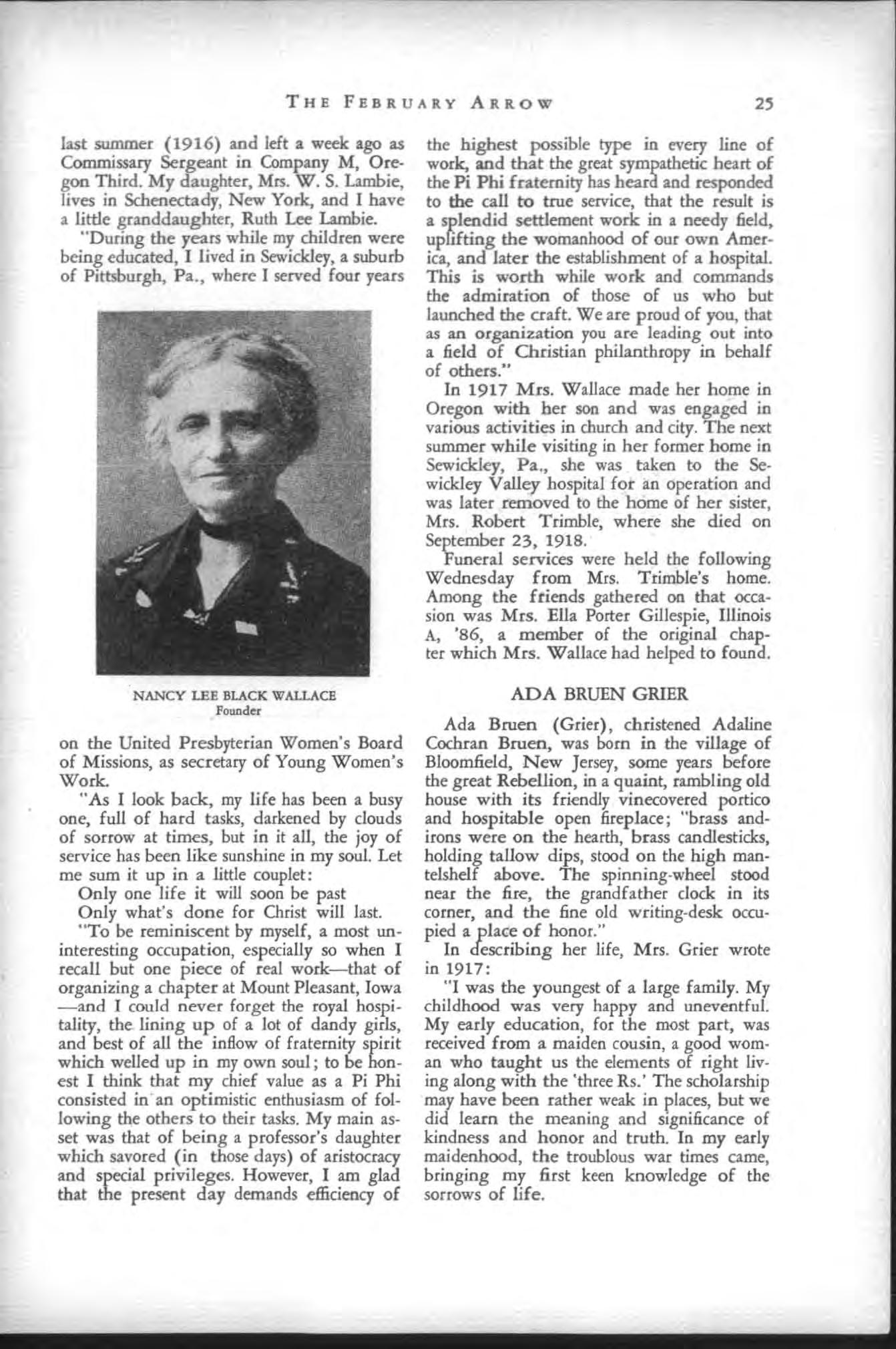
NANCY LEE BLACK WALLACE Founder
on the United Presbyterian Women' s Board of Missions, as secretary of Young Women's Work.
"As I look back, my life has been a busy one, full of hard tasks, darkened by clouds of sorrow at times, but in it all, the joy of service has been like sunshine in my soul. Let me sum it up in a little couplet :
Only one life it will soon be past
Only what's done for Christ will last.
"To be reminiscent by myself, a most uninteresting occupation, especially so when I recall but one piece of real work-that of organizing a chapter at Mount Pleasant, Iowa -and I could never forget the royal hospitality, the. lining up of a lot of dandy girls , and best of all the inflow of fraternity spirit which welled up in my own soul; to be honest I think that my chief value as a Pi Phi consisted in ' an optimistic enthusiasm of following the others to their tasks. My main asset was that of being a professor's daughter which savored (in those days) of aristocracy and special privileges. However, I am glad that the present day demands efficiency of
th e highest possible type in every line of work, and that the great sympathetic heart of the Pi Phi fraternity has he.ara and responded to tbe call to true service, that the result is a splendid settlement work in a needy field, uplifting the womanhood of our own America, and later the establishment of a hospital. This is worth while work and commands the admiration of those of us who but launched the craft. We are proud of you, that as an organization you are leading out into a field of Christian philanthropy in behalf of others."
In 1917 Mrs. Wallace made her home in Oregon with her son and was engaged in various activities in church and city. The next summer while visiting in her former home in Sewickley, Pa., she was taken to the Sewickley Valley hospital for an operation and was later removed to the home of ber sister, Mrs . Robert Trimble, where she died on September 23, 1918
Funeral services were held the following Wednesday from Mrs Trimble's home. Among the friends gathered on that occasion was Mrs. Ella Porter Gillespie, Illinois A, '86, a member of the original chapter which Mrs. Wallace had helped to found.
Ada Bruen (Grier), christened Adaline Cochran Bruen, was born in the village of Bloomfield, New Jersey, some ye.ars before the great Rebellion, in a quaint, rambling old house with its friendly vinecovered portico and hospitable open fireplace; "brass andirons were on the hearth, brass candlesticks, holdinf tallow dips, stood on the high mantelshel above. The spinning -wheel stood near the fire, the grandfather clock in its corner, and the fine old writing-desk occupied a place of honor:'
In describing her life, Mrs. Grier wrote in 1917:
"I was the youngest of a large family. My childhood was very happy and uneventful. My early education, for the most part, was received from a maiden cousin, a good woman who taught us the de.ments of right living along with the ·three Rs.' The scholarship may have been rather weak in places, hut we did learn the meaning and SIgnificance of kindness and honor and truth. In my early maidenhood, the troublous war times came, bringing my first keen knowledge of the sorrows of life.
"Before the close of the war we went to Illinois on a visit, a very happy visit. Shortly afterward our famiJy left New Jersey, and found a new home in Illinois.
"About that time when I was sixteen years old, I had my first experience as a teacher. What teaching it was! Some of my pupils were older than I; many of them
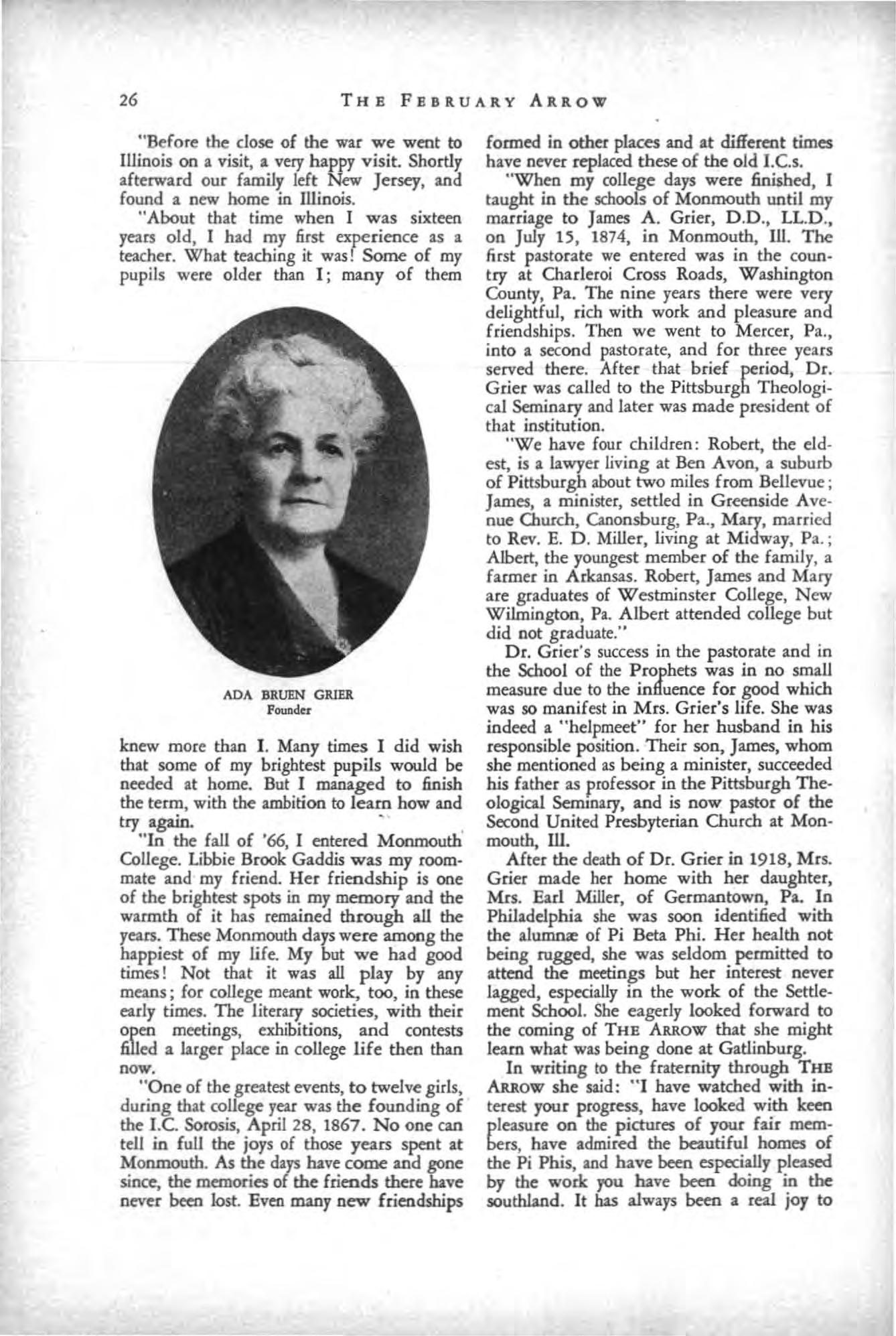
knew mOre than I. Many times I did wish that some of my brightest pupils would be needed at home. But I managed to finish the term, with the ambition to learn how and try again. '.
" In the faJI of '66, I entered Monmouth College. Libbie Brook Gaddis was my room· mate and my friend. Her friendship is one of the brightest spots in my memory and the warmth of it has remained through all the years. These Monmouth days were among the happiest of my life. My but we had good times! Not that it was all play by any means; for college meant work, too, in these early times. The litenry societies, with their open meetings, exhibitions, and contests liIled a larger place in college life then than now.
"One of the greatest events, to twelve girls, during that college year was the founding of the I.c. Sorosis, April 28, 1867. No one can tell in full the joys of those years spent at Monmouth. As the days have come and gone since, the memories of the friends there have never been lost. Even many new friendships
formed in other places and at different times have never replaced these of the o ld I.c.s.
"When my college days were finished, I taught in the schools of Monmouth until my marriage to James A. Grier, D.D ., LL.D., on July 15, 1874, in Monmouth, Ill. Tbe first pastorate we entered was in the country at Charleroi Cross Roads, Washington County, Pa. The nine years there were very delightful, rich with work and pleasure and friendships. Then we went to Mercer, Pa., into a second pastorate, and for three years served there. After that brief period, Dr. Grier was called to the Pittsburgh Theological Seminary and later was made president of that institution.
"We have four children: Robert, the eld· est, is a lawyer living at Ben Avon, a suburb of Pittsburgh shou t two miles from Bellevue; James, a minister, settled in Greenside Avenue Church, Canonsburg, Pa . , Mary, married to Rev. E. D . Miller, living at Midway, Pa.; Albert, the youogest member of the family, a farmer in Arkansas. Robert, James and Mary are graduates of Westminster CoUege, New Wilmington, Pa. Albert attended college but did not graduate."
Dr. Grier 's success in the pastorate and in the School of the Prophets was in no smaJI measure due to the inlIuence for good which was SO manifest in Mrs. Grier's life. She was indeed a "helpmeet" for her husband in his responsible position. Their son, James, whom she mentioned as being a minister, succeeded his father as professor in the Pittsburgh Theological Seminary, aod is now pastor of the Second United Presbyterian Church at Monmouth, Ill.
After the death of Dr Grier in 1918, Mrs. Grier made her home with her daughter, Mrs. Earl Miller, of Germantown, Pa. In Philadelphia she was soon identified with the al= of Pi Beta Phi. Her health not being rugged, sbe was seldom permitted to attend the meetings but her interest never lagged, especially in the work of the Settle· ment School. Sbe eagerly looked forward to the coming of THB ARROW that she might learn what was being done at Gatlinburg.
In writing to the fraternity through THE ARRow she said: " I have watched with interest your progress, have looked with keen pleasure on the pictures of your fair members, have admired the beautiful homes of the Pi Phis, aod have been especia1ly pleased hy the work you have been doing in the southland. It has always been a real joy to
m<o that I lad • little part in the founding of Pi Beta Phi , and I wish for you all cootinued prosperity and success in all the work undertaken ...
After a long illness, Mrs. Gritr died 00 Tuesday, March 1924, at the home of her daughter and her body was taken to Pittsburgh, her former home, and laid to rest in the Uniondale Cemetery beside that of her beloved husband
Upon the death of Mrs. Grier, Libbie Brook Gaddis wrote: "The last letter I received from her had in it a message I will not forget : 'Libbi<>-you are the best friend I ever had!' This best expressed our deep friendship."
Rosa Moore, born on the Moore homestead near Mechanicsburg, Pa ., on July I , 184 9, was the only Founder of Pi Beta Phi whose parents were not living in or near Monmouth, III ., in 1867. Rosa Moore had come to Monmouth to visit an Aunt, and in her short stay in Illinois was a great favorite with her intimate friends and entered whole-heartedly into the founding of the new society.
Soon after the organization of I.e. Sorosis, she returned to her home in Pennsylvania and about five years later went to New York City where she did social service work and newspaper work for many years. Her out · standing trait was her generosity, which showed keenly in the following message sent to the m<ombers of Pi Beta Phi on the occasion of the semi<mtennial :
"The one word out of my heart to every other heart is-give all that you are and have, and this consecration will restore all. that has been lost to you, to others, and the world-forevermore."
There came to Pi Beta Phi the splendid opportunity of acknowledging her debt of gratitude to Miss Moore, as one of the Founders, by caring for her during the last years of her life. The Grand Council appointed Mrs. Berton L. Maxfield, Massachusetts A, as its official representative in supervising this care and through Mrs Maxfield's splendid services, so willingly given to Pi Beta Phi, Rosa Moore' s last days were spent peacefully in a New York Gty hospital.
Rosa Moore passed away on July 4, 1924, and was hnried on July 8 in tbe little cemetery about two mil.,. west of Meclanicsburg,
Cumberl:md County, P a. The funeral services were conducted from the Myers Undertaking Parlors where relatives and Pi Beta Phis had gathe red Flormce Gum Temple, Pennsylvania B, who represented the fraternity officially described the funeral as follows:
" None of the relatives had seen Miss Moore in more than thirty years, except E1iz -
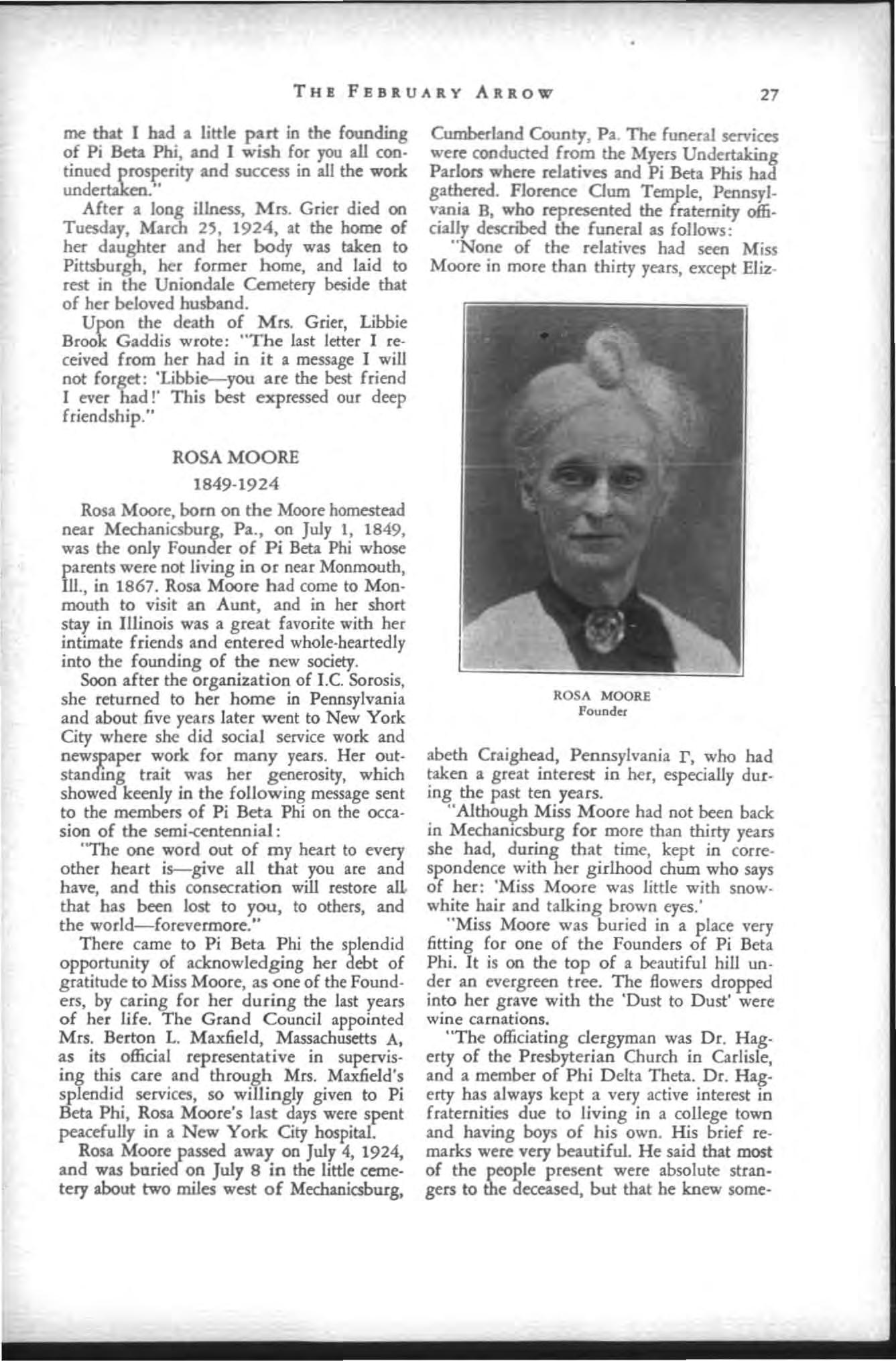
abeth Craighead, Pennsylvania r, wbo lad taken a great interest in her, especially during the past ten years.
" Although Miss Moore had not been back in Mechanicsburg for more than thirty years she had, during that time, kept in correspondence with her girlhood chum who says of her: 'Miss Moore was little with snowwhite hair and tallcing brown eyes:
"Miss Moore was buried in a place very fitting for one of the Founders of Pi Beta Phi. It is on the top of a beautiful hill under an evergreen tree The Bowers dropped into her grave with the 'Dust to Dust' were wine carnations.
"The officiating clergyman was Dr. Hagerty of the Presbyterian Church in Carlisle, and a member of Phi Delta Theta. Dr Hagerty has always kept a very active interest in fraternities due to living in a college town and having boys of his own. His brief remarks were very beautiful. He said that most of the people present were absolute strangers to the aeceased , but that he knew some-
thing about her which was far finer than anything she could have written with a pen. Then he expanded the idea of the value of college fratern ities and what they mean to their members . No one could have paid such tribute to a Founder, exceJ;>t someone who knew as much about fraterOlties as did Dr Ha gerty.
"At the dose of the service the Pi Beta Phis present recited the Creed, which never had had more meaning to anyone of them than at that time."
As its last tribute to this Founder, Pi Beta Phi erected a small, yet fitting , granite marker simply marked with:
"Rosa Moore 1849- 1924"
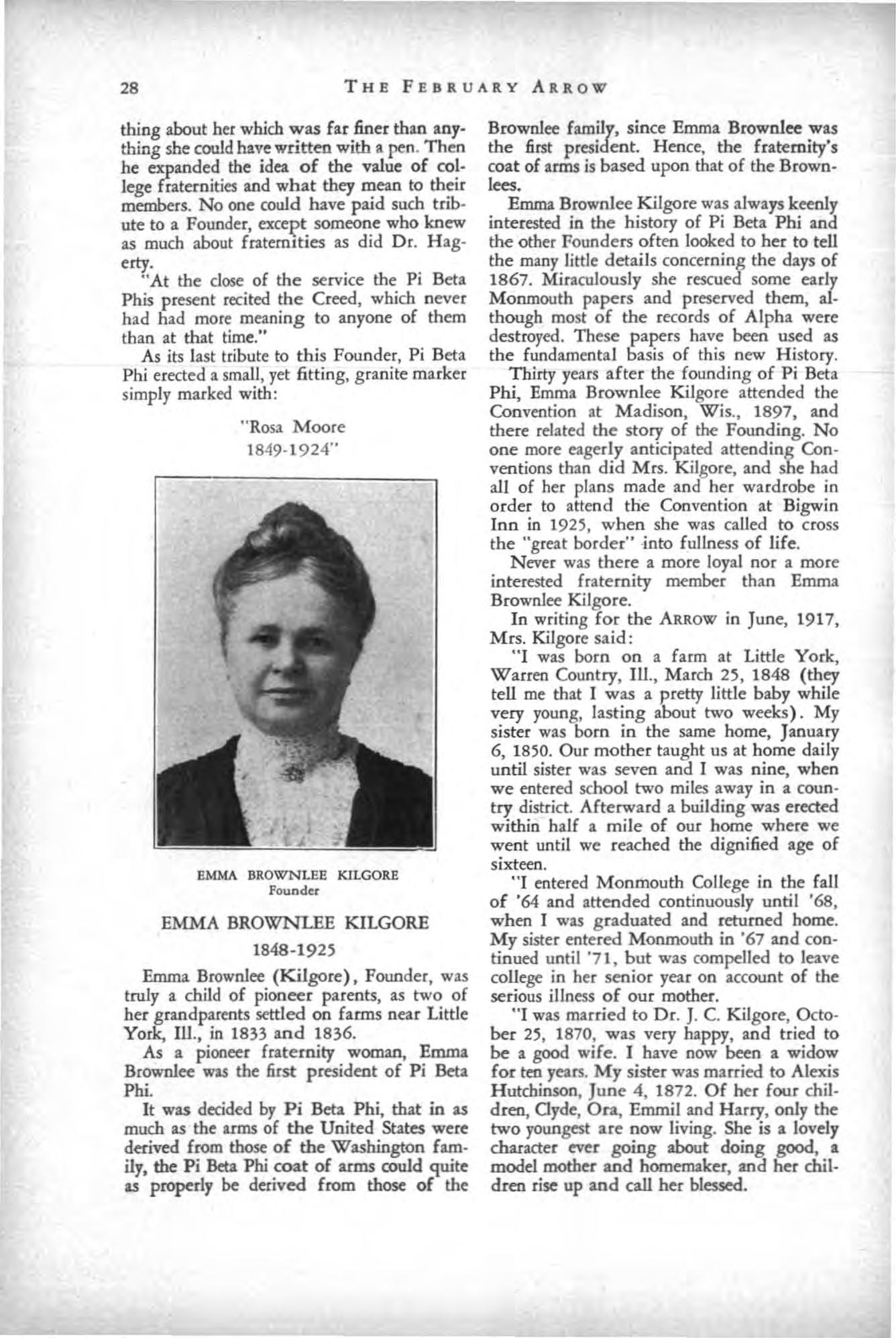
EMMA BROWNLEE KILGORE Pounder
EMMA. BROWNLEE KILGORE 1848-1925
Emma Brownlee (Kilgore), Founder , was truly a child of pioneer parents, as two of her grandparents settled on farms near Little York, IlI., in 1833 and 1836
As a pioneer fraternity woman, Emma Brownlee was the first president of Pi Beta Phi.
It was decided by Pi Beta Phi, that in as much as the arms of the United States were derived from those of the Washington family, the Pi Beta Pbi coat of arms could quite as properly be derived from those of the
Brownlee family, since Emma Brownlee was the first president. Hence, the frateroity's coat of arms is based upon that of the Brownlees.
Emma Brownlee Kilgore was always keenly interested in the history of Pi Beta Phi and the other Founders often looked to her to tell the many little details concerning the days of 1867. Miraculously she rescued some early Monmou th papers and preserved them, although most of the records of Alpha were destroyed . These papers have been used as the fundament al basis of this new Hi story.
Thirty years after the founding of Pi Beta Phi, Emma Brownlee Kilgore attended the Convention at Madison , Wis., 1897, and there related the story of the Founding. No one more eagerly anticipated a ttending Conventions than did Mrs . Kilgore, and she had all of her plans made and her wardrobe in order to attend the Convention at Bigwin Inn in when she was called to cross the "great border" ·into fullness of life.
Never w as there a more loyal nor a more interested fraternity member than Emma Brownlee Kilgore.
In writing for the ARROW in June, 1917, Mrs. Kilgore said:
" I was born on a farm at Little York, Warren Country, Ill., March 25 , 1848 (they tell me that 1 was a pretty little baby while very young, lasting about two weeks). My sister was born in the same home, January 6, 1850. Our mother taught us at home daily until sister was seven and I was nine, when we entered school two miles away in a coun · try district. Afterward a building was erected within half a mile of our home where we went until we reached the dignified age of sixteen.
"I entered Monmouth College in the fall of '64 and attended continuously until '68, when 1 was grad uated and returned home My sister entered Monmouth in '67 and continued until '71, but was compelled to leave co llege in her senior year on account of the serious illness of our mother.
"I was married to Dr J. C. Kilgore, October 25, 1870, was very happy, and tried to be a good wife 1 have now been a widow for ten years My sister was married to Alexis Hutchinson , June 4, 1872. Of her four children, Oyde, Ora, Emmil and Harry, only the two youngest are now liviog. She is a lovely character ever going about doing good, a model mother and homemaker, and her children rise up and call her blessed.
'We are both members of the United Presbyterian Church and interested in tem · perance and civk work. I am something of a 'joine r; temperance and missionary societies, D .A .R ., various dubs. I enjoy them and think I got the start from Pi Phi.
" You can tell the Pi Phis that the Brown· lee sisters have spent their lives in Warren County and at the present time live only a few blocks apart in Monmouth, Ill. They were never separated but one year during their lives and have learned to depend each on her only sister.
"They do not claim to have done anything remarkable but they always speak with fride when they tell the younger generation, ' was one of the Founders of Pi Beta Phi: and we think the Brownlee Eagle on our coat of· arms must ever spread its protecting wings over every Pi Phi. That is our wish."
The Rev. Paul Arnold Peterson, pastor of the United Presbyterian Church, Monmouth , Ill., in the funeral service of Mrs. Kilgore spoke of her United Presbyterian rearing , which inlluenced her entire life; her youthful spirit, always buoyant and refreshing; her de · votion, expressed in her family life and in her loyalty to her town and coUege and her church; her boundless- energy; her inlluence, never destructively critical, always graciously helpful.
Clara Brownlee (Hutchinson), a student at the academy of Monmouth College in 1867, was the next to the youngest member of the group of twelve girls who founded Pi Beta PhI. She was born on January 6, 1850, on a farm at Little York, Warren County, III.
When she was .seven, Oaea Brownlee attended a district school and later entered the academy in Monmouth. She was married in 1872 to Mr. Alexis Hutchinson, who died in 1920.
An article in THE ARROW, written at the time of Mrs. Hutchinson ' s death in 1931, gives a beautiful perspective of her life:
"Knowing her maae it easy to believe in God. " Nothing can add to this evaluation of the life of Clara Brownlee Hutchinson: we can only speak of the attributes and char· acteristics which made such a tribute possi. ble. Those of us in Pi Beta Phi, who knew and loved her and who found inspiration
in each contact with ber, will not lose the memory of her unfailing gentleness, ber spirit of "over·flowing ministry," her keen 2est in each new experience, ber youthful spirit and her sympathetic understanding of youth, her unfaltenng adherence to conviction, her " queenly grace" which meant that she never antagonized even when she questioned or dis· approved, and ber true loveliness. Sbe lived the ideals of splendid womanhood which she
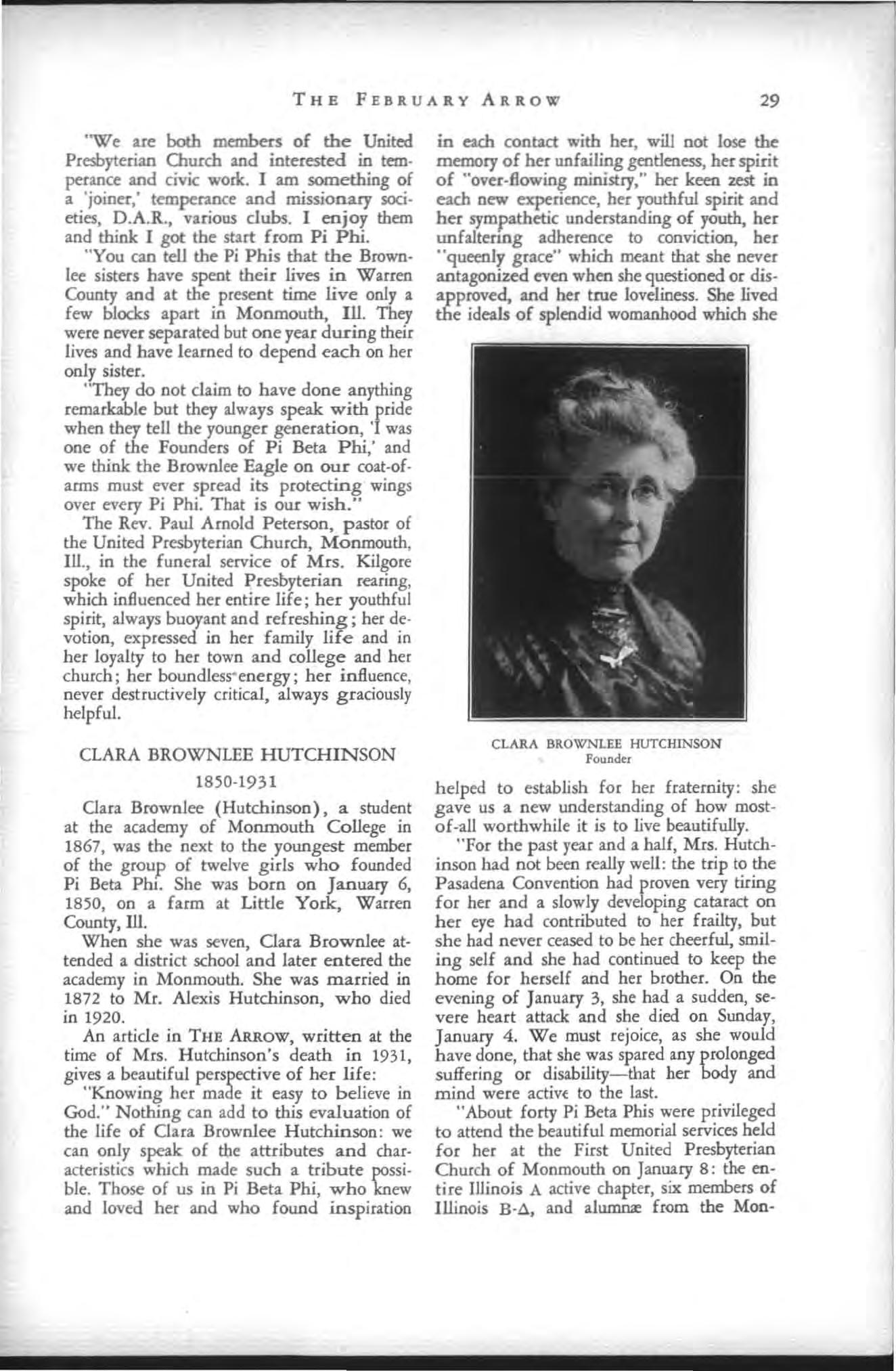
helped to establish for her fraternity: she gave us a new understanding of how mostof·aU worthwhile it is to live beautifully.
"For the past year and a half, Mrs. Hutchinson had not been really well: the trip to the Pasadena Convention had proven very tiring for her and a slowly developing cataract on her eye had contributed to her frailty, but she had never ceased to be her cheerful, smiling self and she had continued to keep the home for herself and her brother. On the evening of January 3, she had a sudden, se· vere heart attack and she died on Sunday, January 4. We must rejoice, as she would have done, that she was spared any prolonged suffering or disability-that her body and mind were activ( to the last.
"About forty Pi Beta Phis were privileged to attend the beautiful memorial services held for her at the First United Presbyterian Church of Monmouth on January 8: the entire Illinois A active chapter, six members of Illinois B·.6., and al= from the Mon-
mouth, Burlington, Carthage, and Spring.field alum= clubs were in attenaance. An exquisite spray of Easter liIIies, sent by the fraternity nationally, together with lovely deep roses from the family covered the casket.
"'rhe Monmouth Pi Beta Phis had ke,pt a large basket of beautiful dark red carnabons, with a bow of blue tulle, ot Mrs. Hutchinson's head from the time of her death until the funeral, following which it was placed at the head of herJrave. Fraternity members sat in a roserv seetion of the church and formed an aisle from the church to the hearse through which the casket was carried, following the services.
"Rarely beautiful tributes to Mrs Hutchinson were paid by Dr. N. J. Calhoun, her pastor, by Dr. T. H McMichael,!resident of Monmouth College and endeare to the fraternity through many relationships, and by Dr. J. H. Grier, son of Ada Bruen Grier, Founder. The Monmouth alumnre, who had been unfailing in their devotion to Mrs. Hutchinson, gave their last loving service to her in their care of the lovely Bowers, many of which had been sent by Pi Beta Phi chapters and allltllOre clubs.
"Mrs. Hutchinson, a student at the academyof Monmouth College in 1867, was hom on January 6, 1850, and preparations for the celebration of her eighty-first birthday had been made by the local Pi Beta Phis.
"Mrs. Hutchinson is survived by two children and four grandchildren. Fraternity members who attended the Pasadena Convention will not soon forget the tender devotion of her grandson, Oyde, who accompanied her there. The year 1931 had given Mrs Hutchinson 0 very great happiness because it brought her grand-daughter, Marion Jane Tornquist of Montana, to Monmouth College as a freshman: surely the loving spirit of the grandmother must have seemed very near on January 31 when this charming girl was pledged to Illinois A in the ceremony which Mrs. Hutchinson had so anticipated seeing and sharing! Mrs. Hutchinson's loyalty to the fraternity which she helped to found never failed to express itself in service to it. Her keen interest in every phase of the fraternity, her understanding of its problems and organization, and her pride m its accomplishments were made evident by her support of its projects: her pride in the Settlement School was not greater than her loyalty in contributing to its support and her abiding interest and belief in the future of
the fraternity are attested by her generous gift to the Pi Beta Phi Endowment
''The many Pi Beta Phis who knew Oara Brownlee Hutchinson in her home or whose most cherished convention memories center around their contacts there with our beloved Founders, will never forget the inspiration which they gained from Mrs. Hutchinson nor lose the love for her which association with hee made inevitable. In the truest sense of the words, she was a Pi Beta Phi!"
In reply to a letter of sympathy written to Oaro Brownlee Hutchinson upon the death of her sister, Emma Brownlee Kilgore, Mrs. Hutchinson wrote: "Oh, how my thoughts turn to the many long years we were together and my prayer is that I may face the future and go brave·hearted to the sunset, as she did."
itT0 Jill. i" hearlS we leav, b.hi"d Is "01 10 di •."
Truly can this be spoken of Jennie Horne Turnbull. Those who knew her loved her for her quiet charm, her gentleness of character, her serenity of bearing, her sympathetic understanding, and her womanly grace. She exhihited the qualities of indomitable strength, characteristic of the West which gave her birth, and the tireless energy of the East which for many yea" she called her home. Besides devoting much attention to her home and her Church, Mrs. Turnbull attended regularly the meetings of the Philadelphia NlltIlOre Oub of Pi Beta Phi, taking an active part in all local enterprises.
She attended the Asbury Park Convention in 1931, and though in ponr health at the time, displayed keen interest in the affairs of the fraternity and followed closely its work. The death of her son in February 1932, and of her husband, Dr. Thomas Turnbull on July 14, 1932, and the subsequent changes brought to her already frail constitution an additional shock, from which she never recovered. While on a visit to her son in Belle· vue, Pennsylvania, the end carne calmly and peacefully on November 4, 1932. Several Pi Beta Phis were ahle to attend the funeral services which were held at Bellevue.
In for THE ARRow in 1917, Mrs. Turnbull satd:
"My birthplace was Moorefield, Indiana. When I was three years of age my father moved to Yorktown, Indiana, where we lived
until I had finished grammar school. Having a desire for better educational advantages than could be had in this place, my father, rather than send his children away from home, dosed out his business aod moved with his family to Monmouth, Illinois, to eojoy the privileges of a college town. In the fall of 1864 I eotered the academic departmeot of Monmouth O>Uege and one year later was adroitted to the coUege proper. Having chosen the scientific course, I was graduated with the degree B S. in June 1868.
In the spring of 1867 a number of us college girls began to agitate the founding of a fraternity and after several meetings for discussion, we met on April 28, 1867 and founded what was then called the I.e. So· cosis, choosing for our badge the beautiful gold arrow. Twelve girls constituted the first ch'!ter. We met frequently in mysterious an exciting surrounded with secrecy, yet meetings wherein sisterly love and harmony prevailed, and never a company of girls had better , happier times.
On April, 24, 1874, I was united in mar· riage to Rev . Thomas B . Turnbull, D .D., our dear old coUege president, David A. Wal· lace, officiating. One week later, as pastor's wife, with my husband I eotered our first field of lahor at the beautiful town (now city) of Aledo, Illinois, almost under the shadow of Alma Mater. Here eleven happy years were spent. During these years five of our children were born. The first-born was called home when seven years of age and her ashes rest in the beautiful cenoetery in the outskirts of the city. In 1884 my husband accepted a call to the pastorate of the United Presbyterian Church of Argyle, New York. This was our home for fifteen years. Our youngest son was born here. With a house full of children and the duties belonging to the wife of a pastor, my life was not an idle one.
Hece, not being within reach of any college where our fraternity had a chapter, I felt somewhat out of touch with Pi Beta Phi work and I can assure you that THE ARRow was a welcome visitor. In 1900 we moved to Philadelphia, Pa. Soon after coming to the city, I learned that an al= dub of Pi Beta Phi was being organized. Seeding my name in as applying for membership I received a note expressing great pleasure that one of the Founaers was to be a member of the club While I have not attended regularly the meetings held once and some·
times twice a month , yet I have thoroughly enjoyed again getting in touch with Pi Beta Phis and Pi Beta Phi work. I still wear my original I e. pin and this is a great curio oslty, especialfy to the younger members of the fraternity."
Mrs Turnbull engaged actively in all types of church work, being especially interested in Missions. She served as president of the
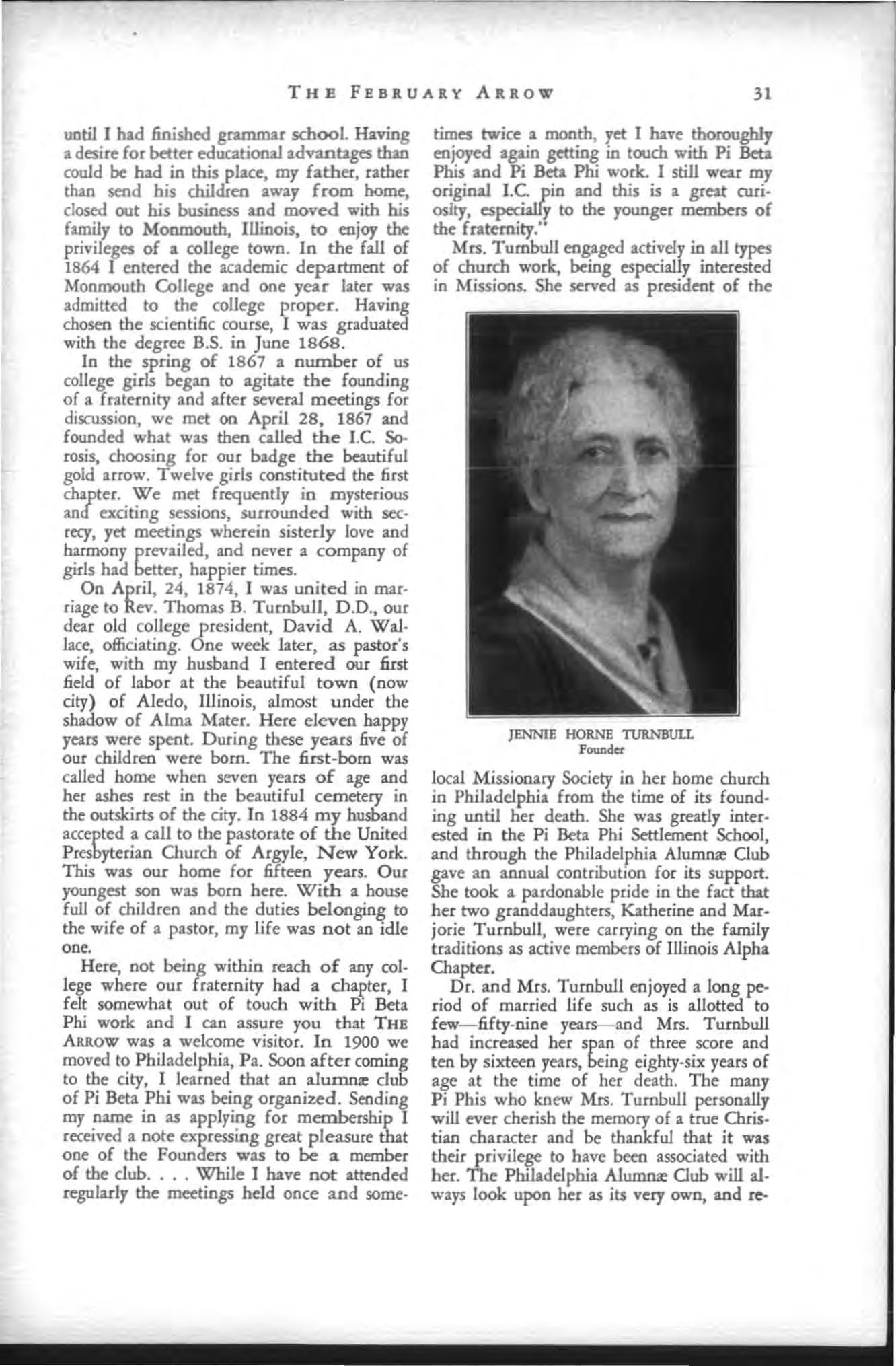
local Missionary Society in her home church in Philadelphia from the time of its found· ing until her death She was greatly interested in the Pi Beta Phi Settlemeot School, and through the Philadelphia AlUIIlIlZ Gub 8ave an annual contributIOn for its support. She took a pardonable pride in the fact that her two granddaughters, Katherine and Marjorie Turnbull, were carrying on the family traditions as active members of Illinois Alpha Chapter.
Dr. and Mrs. Turnbull enjoyed a long period of married life such as is allotted to few- fifty nine years-and Mrs. Turnbull had increased her span of three score and ten by sixteen years, being eighty·six years of age at the time of her death. The many Pi Phis who knew Mrs Turnbull personally will ever cherish the memory of a true Chris· tian character and be thankful that it was their privilel!e to have beeo associated with her The Philadelphia AlUIIlIlZ Gub will al· ways look upon her as its very own, and Ie-
call with pleasu re the many years it could call her counsellor, comrade and friend. Through the pages of the history of our Fraternity, her life will ever speak eloquently to us all, and be an inspiration to every member of Pi Beta Phi.
After the funeral service at Bellevue, Pa., Mrs. Turnbull's remains were taken to Monmouth, Ill , by her son, Dr. Will Turnbull, and her daughter and son-in-law, Mr. and Mrs. Will Crowe, all of Pa A group of Pi Beta Phis were at the station to meet them and accompanied them to the cemetery, where simple services were cooducted.
"Rev. N. J Calhoun read the scripture and Dr. W. C Williamson, a life-long friend of Mrs. Turnbul!"s husband, offered the prayer.
" Rep resentatives of the Knox and Monmouth chapters, including the president of each chapter, and members of the aJumnre clubs of both Galesburg and Monmouth were present. Represe nting the fraternity officially were the Grand President, Amy B. Onken, and Eta Province President, Florence Hunt Webster.
"Founder Margaret Campbell, her sister, Mrs. Agnes Murray, and Inez Webster, AR · ROW File Custodia n , were in the lines formed by the Pi Phis present, through which the casket was carried t<.. the grave. Several chapters and alumn", clubs sent beautiful Bowers. On the casket was the spray of orchid and white chrysanthemums which the fra ternity had sent. Present at the services also, was Dr . James H. Grier, son of Ada Bruen Grier, Founder. The privilege of attending this most appropriate service was augmented by the fact that both the son and daughter of Mrs Turnbull mentioned how much their mother had loved the Fraternity and how much happiness it had given her."
1850·1933
Libbie Brook (Gaddis) possessed something of the spirit of her pioneer parents, and although she was the youngest of the twelve Founders, it was she who first carried the banner of Pi Beta Phi into a new fieldin 1868. In her junior year she set out to do some pioneering of her own and leaving Monmouth College, entered Iowa Wesleyan University at Mt. Pleasant, Iowa, that she might establis; of Pi Beta Phi there. Margaret · Brook was born on
March 7, 1850 on a farm near Olena, Henderson County, Ill Her parents were Isaiah John Brook, who went to Illinois in about 1830 from Zanesville, Ohio, and Jane Thompson Marshall-Brook, who went from Winsborough, S C, to Henderson County, Ill., about the same time.
In writing to THE ARRow in 1917, Libbie Brook Gaddis said:
" I am of Scotch-Irish descent. We went to a district school. Few of the teachers of that period equalled the most ordinary teacher of today-but there were two teachers who were very good. One was a Catholic priest, who had been dismissed from the church for some irregularity. He had been educated at the Queen's University in Cork, and he was one of the most scholarly persons who ever lived in that part of Illinois . He taught Latin in our little 'Stone School house' and had private pupils in Latin and Greek in the evening. He taught history orally, that is, he told us the story, dates, etc., one day and we recited from memory the next day. The other teacher was a lady from Paterson, New Jersey. We learned a great deal from her by personal contact. Being a lady of refinement, and culture we learned not only our 'books' but she inspired us with a desire for knowledge, and gave us a taste for things better than we had known. I spent two or three years or more in an academy-attending but a term or two each year and in the college year 1866 -1867 I entered Monmouth College as 'sub-junior:
"In the sr.ring of '67 I.C was founded. In October, 67, I was compelled to postpone college work 00 account of ophthalmia. In September '68, my sister, Mary A . Brook, and I entered Iowa Wesleyan University at Mt. Pleasant, Iowa . Although it was a small college as compared with colleges of today, in some things it was in advance of its age
"In college spirit it certainly was up to date. This school had ' Self-Government before the year of 1869! During my stay in 'I. W .U : I succeeded in organizing a chapter of I.C, tlhe first in tbe history of its expansion. Before Christmas 1868, we had five of the best girls in the institution initiated into the ranks of I.C and on New Year's eve we our arrows for the first time to the Beta Banquet Many compliments were paid to tlhe choice spirits that composed our chapter.
"But there was good material left and accordingly tlhe P .E. O. formed their first chap-
tee there soon after. The girls were of line type and ri val ed the selected I.Cs . P .E.O . flourished as a college organization for some time but it is now a charitable institution , still ranking high as a sisterhood This bit of history is inserted to sbow how we ' provoked ' others to good works
" The college year 1869· 1870, found US back at Monmouth, I in the graduating class of 1870, receiving 'second honors' in the class, which earned the degree of B .S. My sister, Mary Brook organized the chapter at Galesburg, Ill., in 1872 We both remember with pride the part we bad in the extension of I.e. After leaving coUege I speat a year and a half in California teaching and sight seeing and a year in Kansas teaching in the public schools Then for three or four years I taught in Illinois.
" I was married to John H. Gaddis on February 24, 1880, and we 'settled' on a farm near Avon in Fulton County, IUinois . Here my three children were born and grew up to college age. Later we moved to Gales· burg, Ill., where my two daughters and one son attended Knox coUege. Both daughters: Annie Lowrie Gaddis (Anderson) of Den· ver, and Jessie Marie Gaddis of Avon, lli ., are members of Illinois Delta."
In 1928 Mrs. Gaddis was very happy to witness the Ie-establishment of IllinOIS A at Monmouth CoUege.
In 1929, she with her daughter, Mrs . Anderson, attended the initiation of her granddaughter, Margaret Elizabeth Anderson, into Colorado A, of Pi Beta Phi. She was very fond of ber three fine grandsons, John, Martin and Charles Anderson.
A few years ago the Pi Phis of Avon and neighboring towns organized the Libbie Brook Gaddis Alum"", Club and after Mrs Gaddis became unable to attend meetings elsewhere, several pleasant ones were held in her home.
Mrs. Gaddis attended many Conventions, where she endeared herself and was an inspiration to younger and older fraternity members alike Her first Convention was the one at St. Louis, Mo. , in 1904.
After the Evanston, Ill., Convention in 1912, Mrs. Gaddis wrote to THE ARROW:
''The Convention is over and I am glad everything passed off so pleasantly. It was a great convention and was I suppose, numerically, the greatest in the history of Pi Beta Pbi. I could not help being impressed with the spirit which pervaded the Cooven-
tion , or being charmed with the ability of the delegates and prompt n ess with which they met the difficult situations and responded to the business of the Convention . Wasn't the Grand Council Grand? And how delighted we aU were with Miss Emma Harper Tumer's report of the Settlement School Her enthusiasm seemed to be contagious, and with ber at the bead and the women that do things to assist her it is no
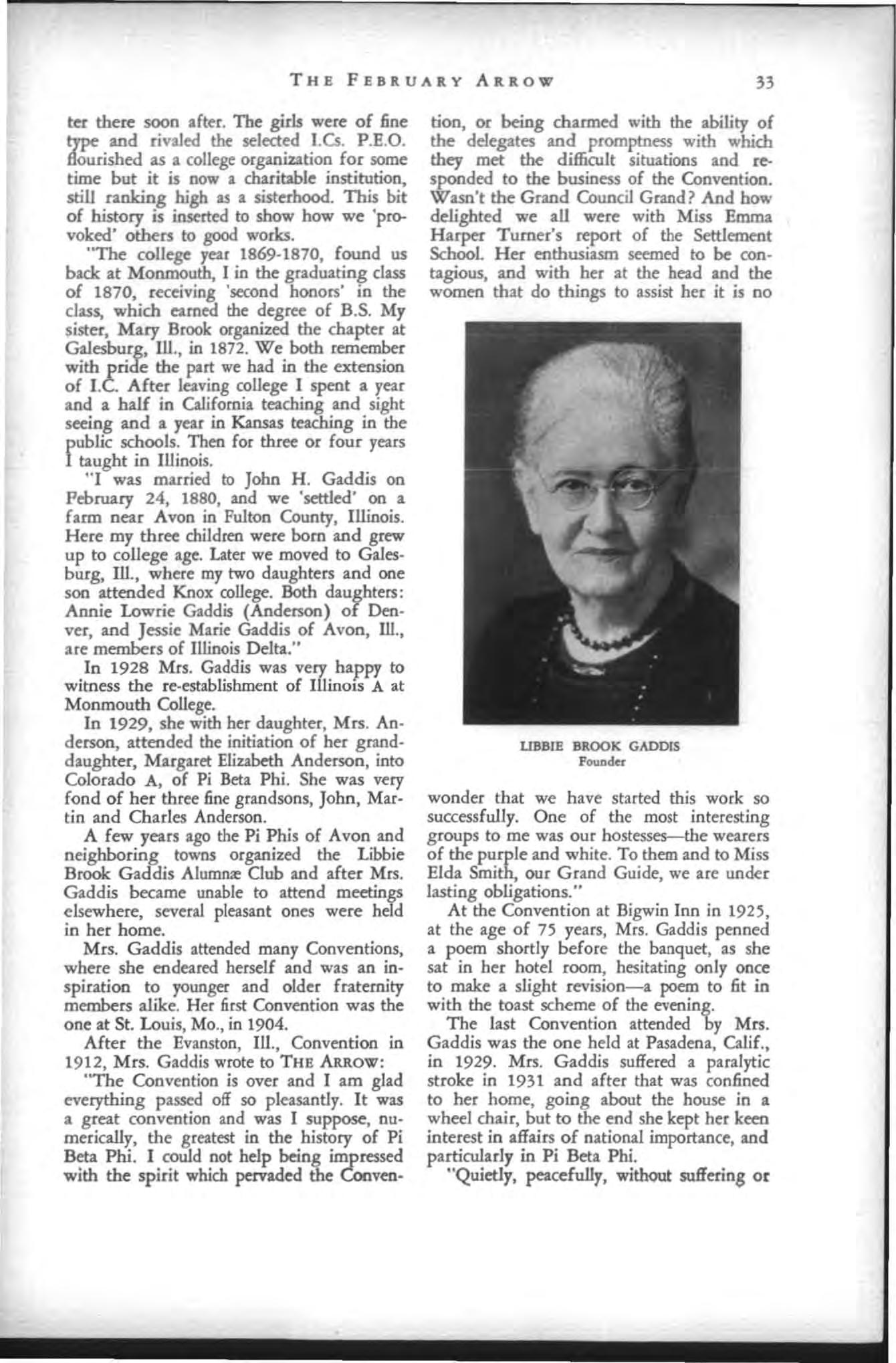
wonder that we have started this work SO successfully. One of the most interesting groups to me was our hostesses-the wearers of the purple and white To thero and to Miss Elda Smith, our Grand Guide, we are under lasting obligations."
At the Convention at Bigwin Inn in 1925, at the age of 75 years , Mrs Gaddis penned a poem shortly before the banquet, as she sat in her hotel room, hesitating only once to malee a slight revision- a poem to fit in with the toast scheme of the evening.
The last Convention attended by Mr• . Gaddis was the one held at Pasadena, Calif., in 1929. Mrs. Gaddis suffered a paralytic stroke in 1931 and after that was confined to her home, going about the house in a wheel chair, but to the end she kept her keen interest in affairs of national importance, and particularly in Pi Beta Phi.
"Quietly, peacefully, witbout sulfeein8 or
warning, she passed away as darkness was falling Christmas eve, 1933. Since it must come to all, it was a beautiful time for death to come to her for she was of a deeply spiritual nature and He whose birth was abOut to be commemorated was very dear to her. One feels that it was much as she would have wished A quiet, beautiful ending to a quiet, beautiful life, yet how far the loveliness of that life has extended, and how many other lives have been just a little different because of hers!
"On December 27, 1933 , a brief service was held at the Gaddis home in Avon, Ill ., from which the funeral party proceeded to the Presbyterian Church in Praltie City, Ill., where Mrs . Gaddis had been a faithful member for more than fifty years . In the lines through which the cas ket passed, followed by the family , were the Grand President, Amy B Onken, and Pi Beta Phis from Peoria, Bushnell , Prairie City, and Avon As the procession neared the Bower covered altar, Mts . Carrie Chain of Bushnell sang: ' Speed Thee My Arrow ,' which was followed by the 'Pi Beta Phi Anthem,' played by Miss Edith Crissey of Avon.
"The service was lovely in its simplicity and was in charge of the Rev. Edward J . Sabin, Mrs. Gaddis's pastor . The sermon was delivered , as Mrs. Gaddis had wished, by the Rev. John U. Brush, her nephew.
"Interment was in the Avon Mausoleum beside her husband who passed away in February, 1923. The fraternity's Creed, which was Mrs . Gaddis's favorite passage of scripture, was read at the mausoleum and was a part of the scripture reading at the church ."
Inez Smith Soule was born July 26, 1846 , in Monmouth , Ill ., and was named Inez Bell. Her father, William F. Smith , and her mother, Margaret Bell, were Virginians who had come to Illinois prior to the advent of the railroad. Mr Smith was among Monmouth's most progressive and respected citizens, and his wife was descended from a line of Presbyterian ministers .
Inez Smith was educated in the public schools of Monmouth and entered college in graduating with the class of 1868 . It was during her junior year in college that the twelve girls, now known as the Founders, laid the foundation of I.e. Sorosis-now Pi Beta Phi.
On April 12, 1869, Inez Bell Smith and
Melville Cox Soule were united in marriage and to this union were born eight children: Edward O. Soule, Francis J. Soule, Melville Glenn Soule, Twins : Earle A Soule and Ella Soule, Aleta Soule Morrow, Myrta Soule Brown, and Cleane H . Soule. One daughter died in early childhood . Two sons are alumni of Monmouth College: one of these became a member of Delta Kappa Epsilon at DePauw University and the other is a physician . The
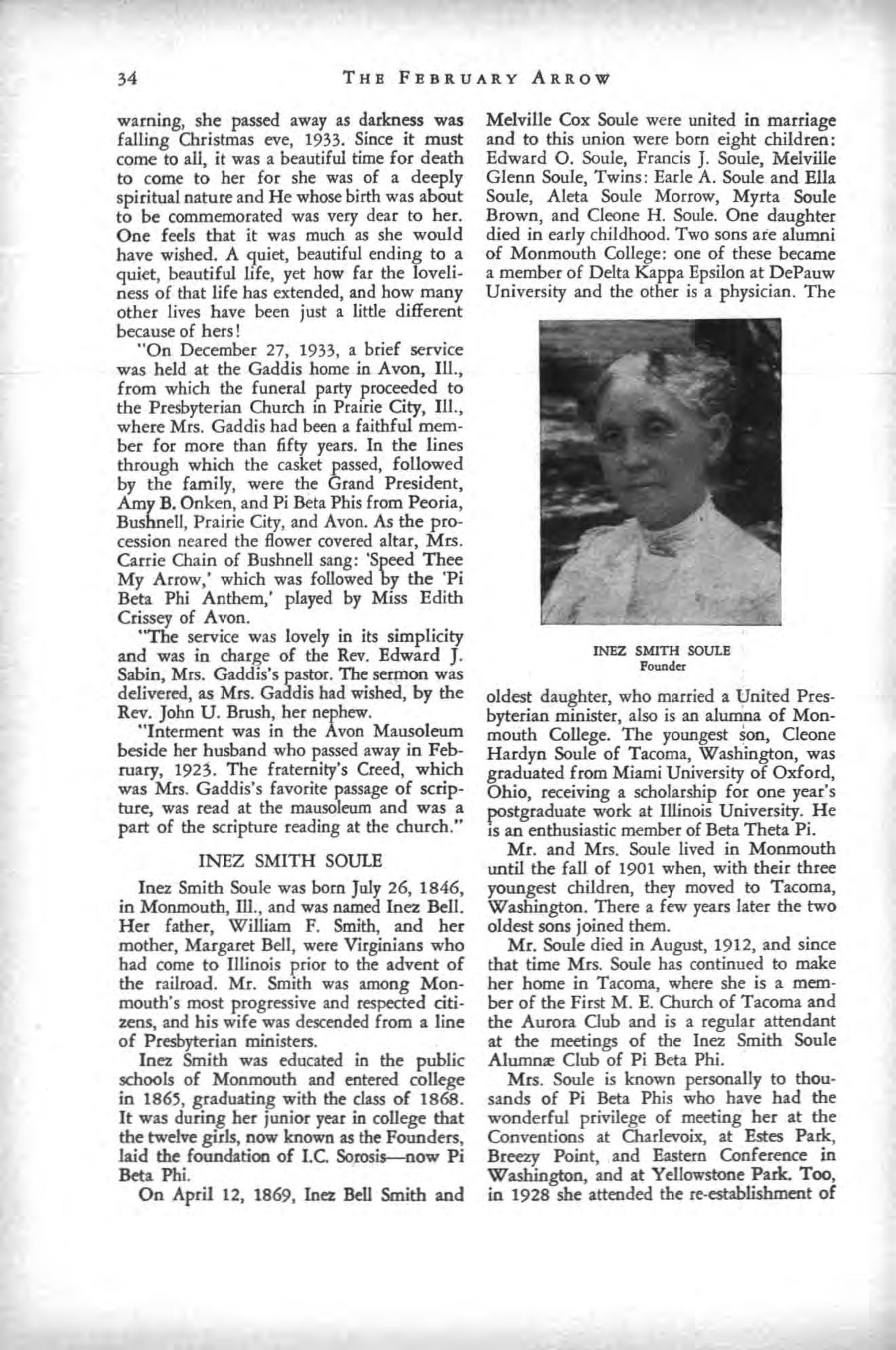
oldest daughter, who married a l!nited Pres· byterian minister, also is an alumna of Monmouth College. The youngest Son, Cleane Hardyn Soule of Tacoma , Washington, was graduated from Miami University of Oxford, Ohio, receiving a scholarship for one year's postgraduate work at Illinois University He IS an enthusiastic member of Beta Theta Pi.
Mr . and Mrs . Soule lived in Monmouth until the fall of 1901 when, with their three youngest children, they moved to Tacoma , Washington There a few years later the two oldest sons joined them.
Mr. Soule died in August, 1912, and since that time Mrs Soule has co ntinued to make her home in Tacoma , where she is a member of the First M E. Church of Tacoma and the Aurora Club and is a regular attendant at the meetings of the Inez Smith Soule Alumnz Club of Pi Beta Phi .
Mrs Soule is known personally to thousands of Pi Beta Ph is who have had the wonderful privilege of meeting her at the Conventions at Otarlevoix, at Estes Park , Breezy Point, and Eastern Conference in Washington, and at Yellowstone Park Too, in 1928 she attended the re-establishment of
Illinois A at Monmouth College.
She is a tiny person, scarcely more than five feet tall with lovely marceled gray hair and sparkling eyes. According to one of the other Founders, "Inez was the most beauti· ful girl of all the Founders when we were at Monmouth."
Mrs Soule has always been the embodi· meot of that thing which was so dear to the hearts of the Founder5--lndependence. She maintains her own apartment where she greets her friends with her ever ready wit and friendliness. She has unconsciously "set a standard of loyalty, independence, interest, friendship and activity" worthy to be fol· lowed by every Pi Beta Phi.
Perhaps the most outstanding characteris· tic of Inez Smith Soule is her cheeriness and her ever ready willingness to be of service to others. Her greatest happiness lies in the op· portunity to help her {nends and neighbors
To have had Mrs Soule's advice and in · spiration through these sixty.nine years has been a remarkable privilege of Pi Beta Phi.
Fannie Whitenack Libbey, whose cheery presence and womanly graces have endeared her to Pi Beta Phis allover the land who have been privileged to meet her at Conventions, was born in Berwick, March 31, 1848. When she was sixteen her parents moved to Monmouth, Ill., so that she could attend college and still be at home.
In for ARROW several years ago, Mrs Libbey satd:
"If you look carefully on the map of II· linois you will find the little village of Ber· wick, to me the dearest spot on earth. as it is there that the memories of my childhood cling. It is in this little village that my school days started. When l was through the grades my father moved to Monmouth , and there I attended the academy and college, and there formed friendships that are still very dear to me. One .(>leasant evening in my junior year, several gIrls were sitting on my father's porch. Then, there came our first vision of I.e. and Pi Beta Phi as it is today. It seems at times like only yesterday, and yet when I think of its wonderful growth, its entrance into many states and into Canada, I know it must be years.
"When in Monmouth College I was a menober of the A B.L. literary society and very much interested in it. On October 9, 1871, I was married to Mr. Howard Libbey
aod we made our first home on his farm near Coffeyville, Kansas, where we lived happily for two years. Then we moved to Red Wing, Minnesota, Mr Libbey' s boyhood home, where we lived until his death in August, 1908.
"We had seven children: Joanna, Lyda, Gertrude, S William, Charles Howard, Ruth and Helen . Five are living: three daughters and two sons. They all attended Hamline
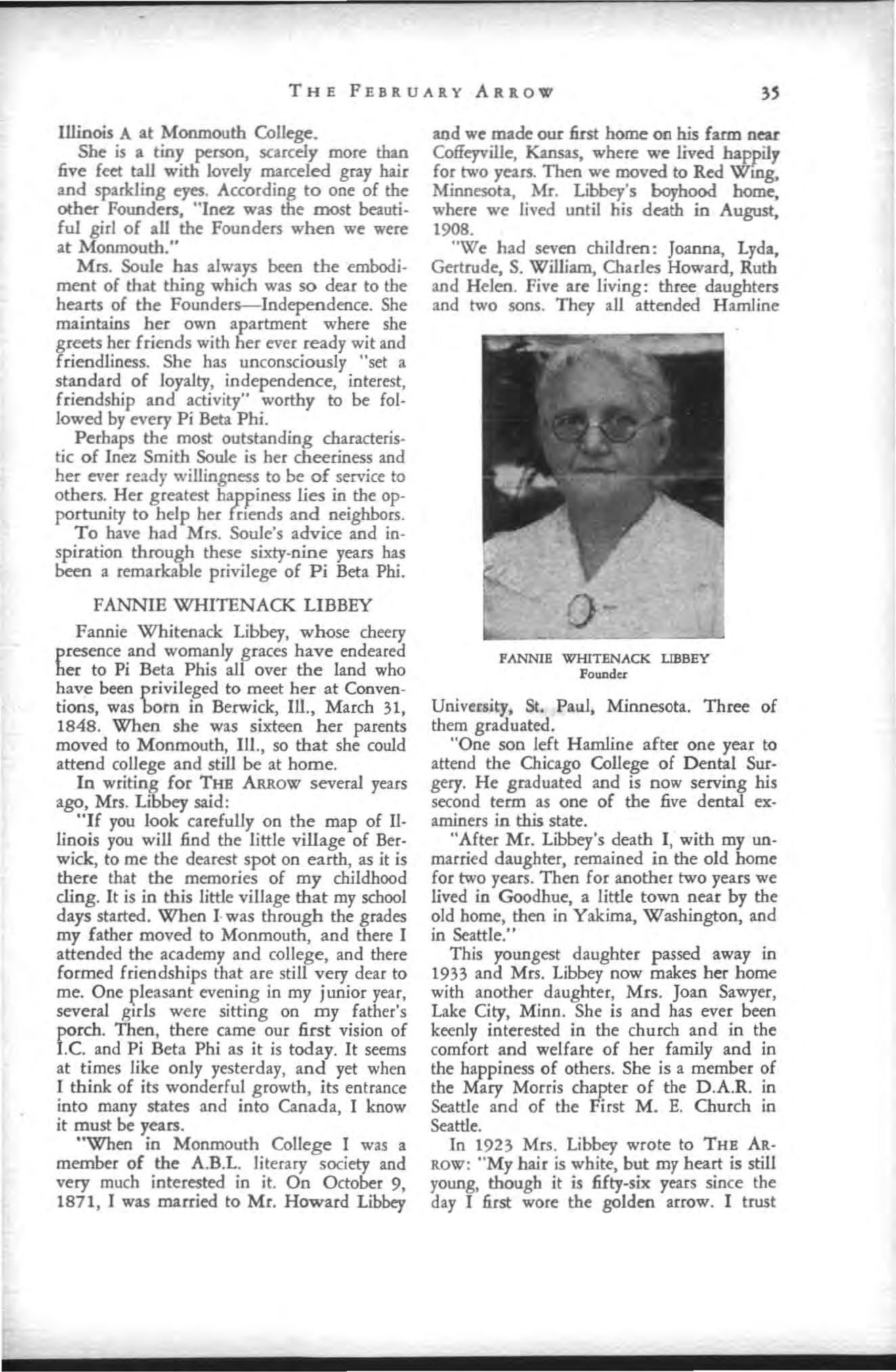
FANNIE WHITENACK UBBEY Founder
University, St. Paul, Minnesota. Three of them graduated.
"One son left Hamline after one year to attend the Chicago College 01 Dental Sur· gery. He graduated and is now serving his second term as one of the five dental ex· aminers in this state.
"After Mr. Libbey's death I, with my un· married daughter, remained in the old home for two years . Then for another two years we lived in Goodhue, a little town near by the old home, then in Yakima, Washington, and in Seattle."
This youngest daughter passed away in 1933 and Mrs Libbey now makes her home with another daughter, Mrs. Joan Sawyer, Lake City, Minn. She is and has ever been keenly interested in the church and in the comfort and welfare of her family and in the happiness of others. She is a member of the Mary Morris chapter of the D.A.R. in Seattle and of the First M. E. Church in Seattle.
In 1923 Mrs . Libbey wrote to THE AR· ROW: " My hair is white, but my heart is still young, though it is fifty.six years since the day I first wore the golden arrow. I trust
that the companionship and friendships formed in your college may prove as sweet and lasting as those of us girls of 1867. A tie that will bind you dose together and be an inspiration to each of you to achieve the highest and best in life."
Mrs. Libbey suffered a broken arm in 1932 and through her suffering displayed her usual cheeriness, writing to THE ARROW as fol· lows:
"Through THE ARROW I wish to express my appreciation and thanks to the dear girls from whom (since my accident) I have received such sweet letters. It gave me a thrill to be just so remembered and to learn of your activiti.. and of the splendid new pledges I wish I might write each one of you but trust you will accept this as your personal answer. I am glad that I can report of myself that I am now quite comfortable and think my arm is mending satisfactorily. The girls here in Seattle are kindly in so many ways. All this and your dear letters have shortened the hours for me. I almost think they have lessened the pain.
"Life without wo uld be a dreary day Gcop'ing 'long 'lone forever and for aye; But LIfe with friends is full of joy and charm E'en when one suHers with a broken ann,"
Mrs Libbey was one of the five Founders who attended the re-establishment of the Mother chapter at Monmouth College in 1928.
She has attended the Conventions in St. Louis, Charlevoix (2), Bigwin Inn, Breezy Point, Pasadena, and Asbury Park, and she is now completing plans to be with us in Chicago this spring .
Margaret E. Campbell, living as she does about two blocks from the campus of Moomouth College, is the only Founder who is so situated that she can and does enjoy the contact of the actives of her own chapter, Illinois A. It was Miss Campl:>ell's pleasure, too, to attend the re-establtshment of the chapter at Monmouth in May 1928.
Miss Campbell was born in West Newton, Penn , on November 7, 1846 She was the sixth of a family of ten children. The family moved to Monmouth, Ill., when Margaret was ten years old, where she attended the grammar schools then Monmouth Academy, and was graduated from Monmouth College in 1867.
After teaching a year in a country school near Monmouth , she devoted the next thirty years to helping run the family home.
In 1903 she went to Chase City, Virginia, where she spent twenty-one years, two of these in teaching domestic science in Thyne Institute, a United Presbyterian Mission School for negroes, and nineteen years as matron of the same school. This service Miss
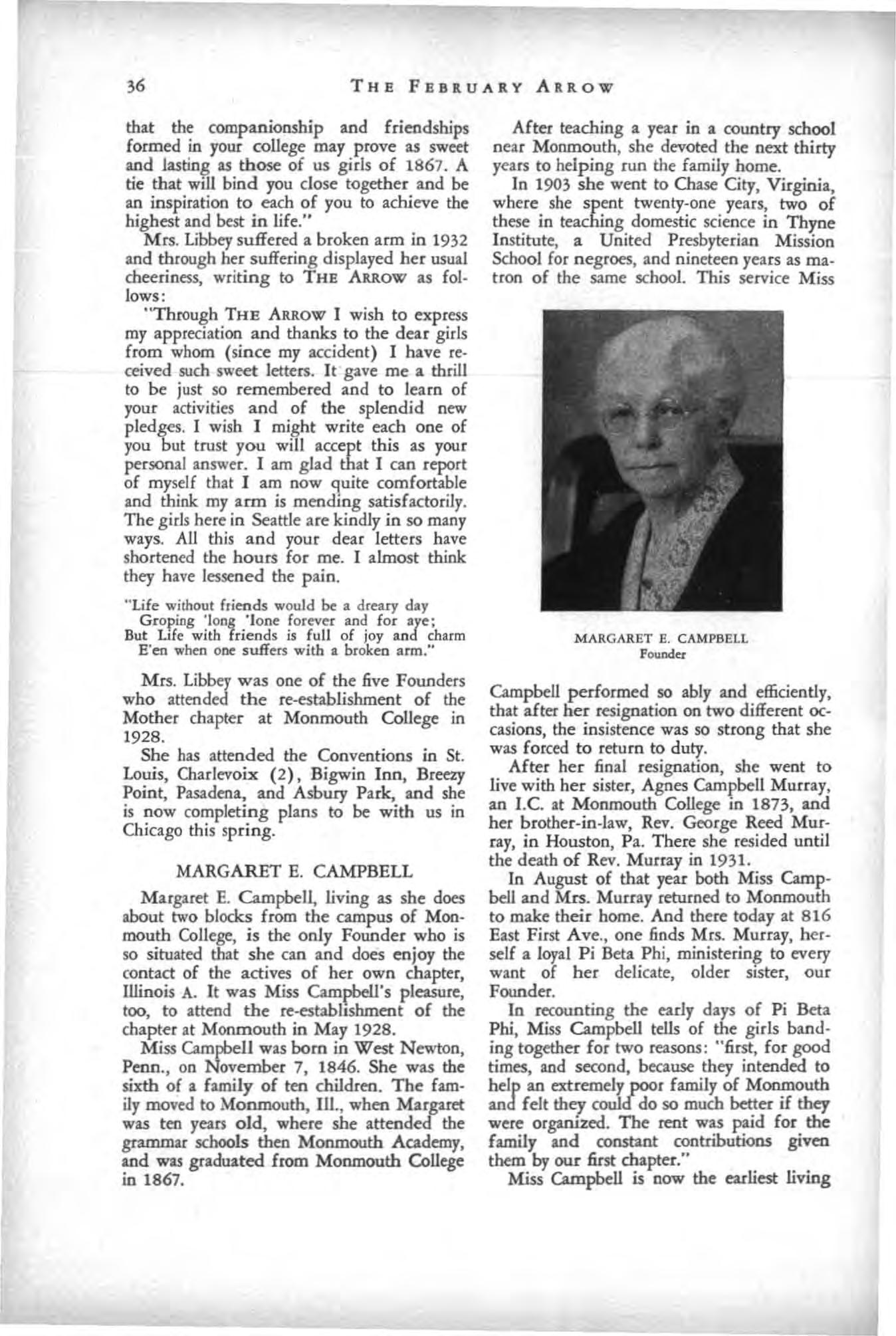
Campbell performed so ably and efficiently, that after her resignation on two different occasions, the insistence was so strong that she was forced to return to duty.
Mter her finaJ resignation, she went to live with her sister, Agnes Campbell Murray, an I.e. at Monmouth College in 1873, and her brother-in-law, Rev. George Reed Murray, in Houston, Pa. There she resided until the death of Rev. Murray in 1931.
In August of that year both Miss Campbell and Mrs. Murray returned to Monmouth to make their home .And there today at 816 East First Ave. , one finds Mrs. Murray, herself a loyal Pi Beta Phi, ministerin$ to every want of her delicate, older SIster, our Founder.
In recountin g the early days of Pi Beta Phi, Miss Campbell tells of the girls banding together for two reasons : "first, for good times, and second, because they intended to held an extremely poor family of Monmouth an felt they coula do so much better if they were organized. The rent was paid for the family and constant contributions given them by our first chapter."
Miss Campbell is now the earliest living
graduate of Monmouth and the oo1y one still living of htt clus, 1867.
Miss Campbell atteoded the college exercises in June 1934, wben Monmouth CoI-
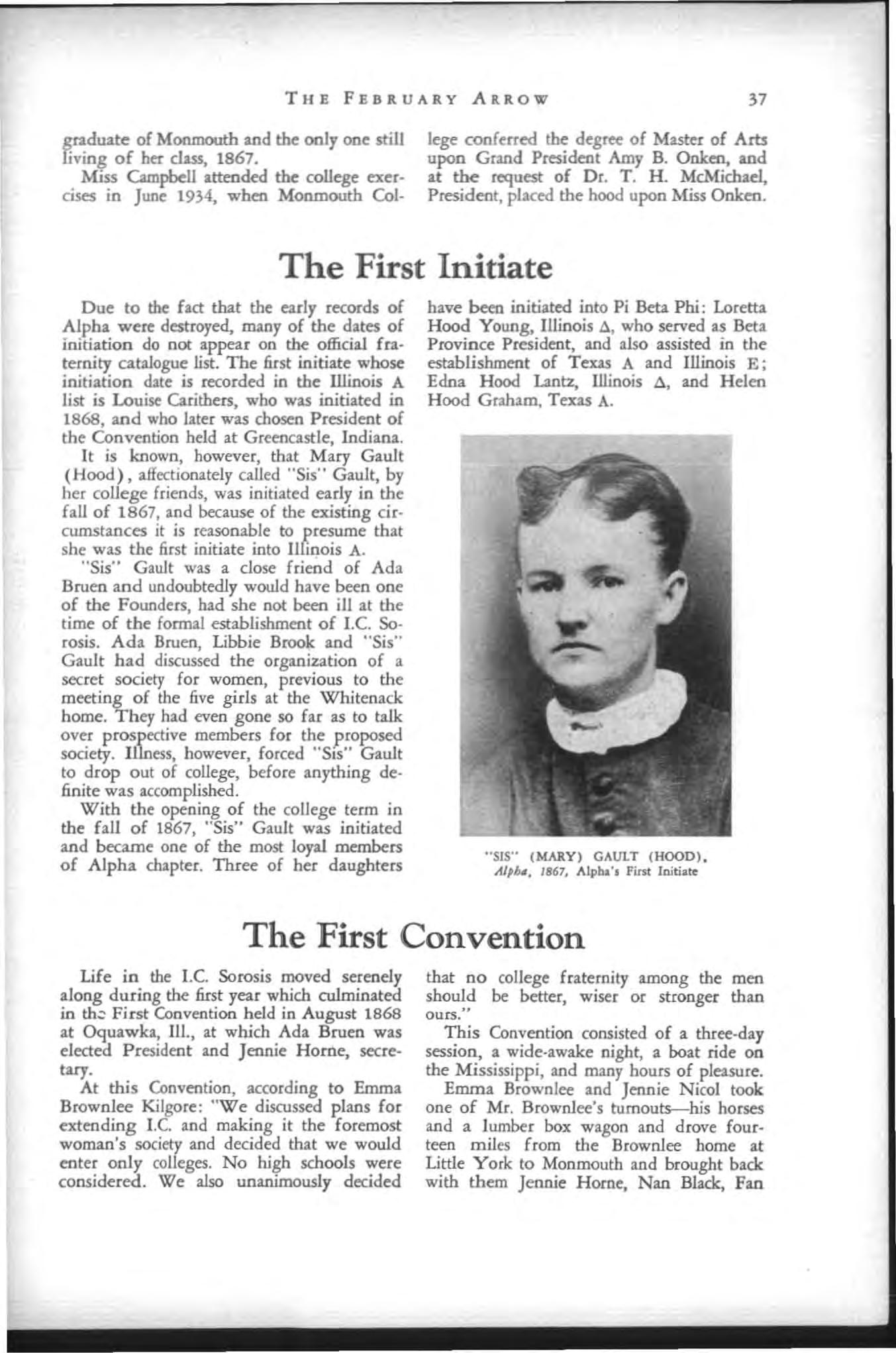
lege conferred the degree of Master of Arts upon Grand President Amy B. Onken, and at the request of Dr. T. H. McMichael, President, placed the hood upon Miss Onken
Due to the fact that the early records of Alpha were destroyed, many of the dates of initiation do not appear on the official fraternity catalogue list. Tbe first initiate whose initiation date is recorded in the Illinois A list is Louist Carithers, who was initiated in 1868 , and who later was chosen President of the Convention held at Greencastle, Indiana .
It is known, however, that Mary Gault (Hood), affectionately called "Sis' Gault, by her college friends, was initiated eady in the fall of 1867 , and because of the existing circumstances it is reasonable to presume that she was the first initiate into IlGnois A.
"Sis" Gault was a dose friend of Ada Bruen and undoubtedly would have been one of the Founders, had sbe not been ill at the time of the formal establishment of I.e. Sorosis. Ada Bruen, Libbie Brook and " Sis" Gault had discussed the organization of a secret society for women, previous to the meeting of the five girls at the Wbitenack home. They had even gone so far as to talk over prospective members for the proposed society. Illness, however, forced "Sis" Gault to drop out of college, before anything definite was accomplished.
With the opening of the college term in the fall of 1867, "Sis" Gault was initiated and became one of the most loyal members of Alpha chapter. Three of ber daugbters
have been initiated into Pi Beta Phi: Loretta Hood Young, Illinois a, who served as Beta Province President, and also assisted in the establishment of Texas A and Illinois E; Edna Hood Lantz, Illinois a, and Helen Hood Graham, Texas A
Life in the I.e. Sorosis moved serenely along during the first year which culminated in First Convention held in August 1868 at Oquawka, Ill., at which Ada Bruen was elected President and Jennie Horne, secretary.
At this Convention, according to Emma Brownlee Kilgore: "We discussed plans for extending I.e. and making it the foremost woman's society and decided that we would enter only colleges. No high schools were considered. We also unanimously decided
that no college fraternity acoong the men should be better, wiser or stronger than ours,"
This Convention consisted of a three-day session, a wide-awake night, a boat ride on the Mississippi, and many hours of pleasure. Emma Brownlee and Jennie Nicol took one of Mr, Brownlee 's turnouts-his horses and a lumber box wagon and drove fourteen miles from the Brownlee home at Little York to Monmouth and brought back with them Jennie Horne, Nan Black, Fan
A lctte:r writttn by Fouodtt Emma Ihownlce J(jjg ore
Whitenack, Maggie Campbell and Inez Smith.
One day was spent at the Brownlee count'}' home, where Clara Brownlee had joined them, then the following day the girls visited Jennie Nicol's home. On the third day they drove twelve miles to Oquawka to visit Fannie Thomson at whose home they were met by Ltbbie Brook and Ada Bruen who had come from Young America.
At this third day's session all Founders
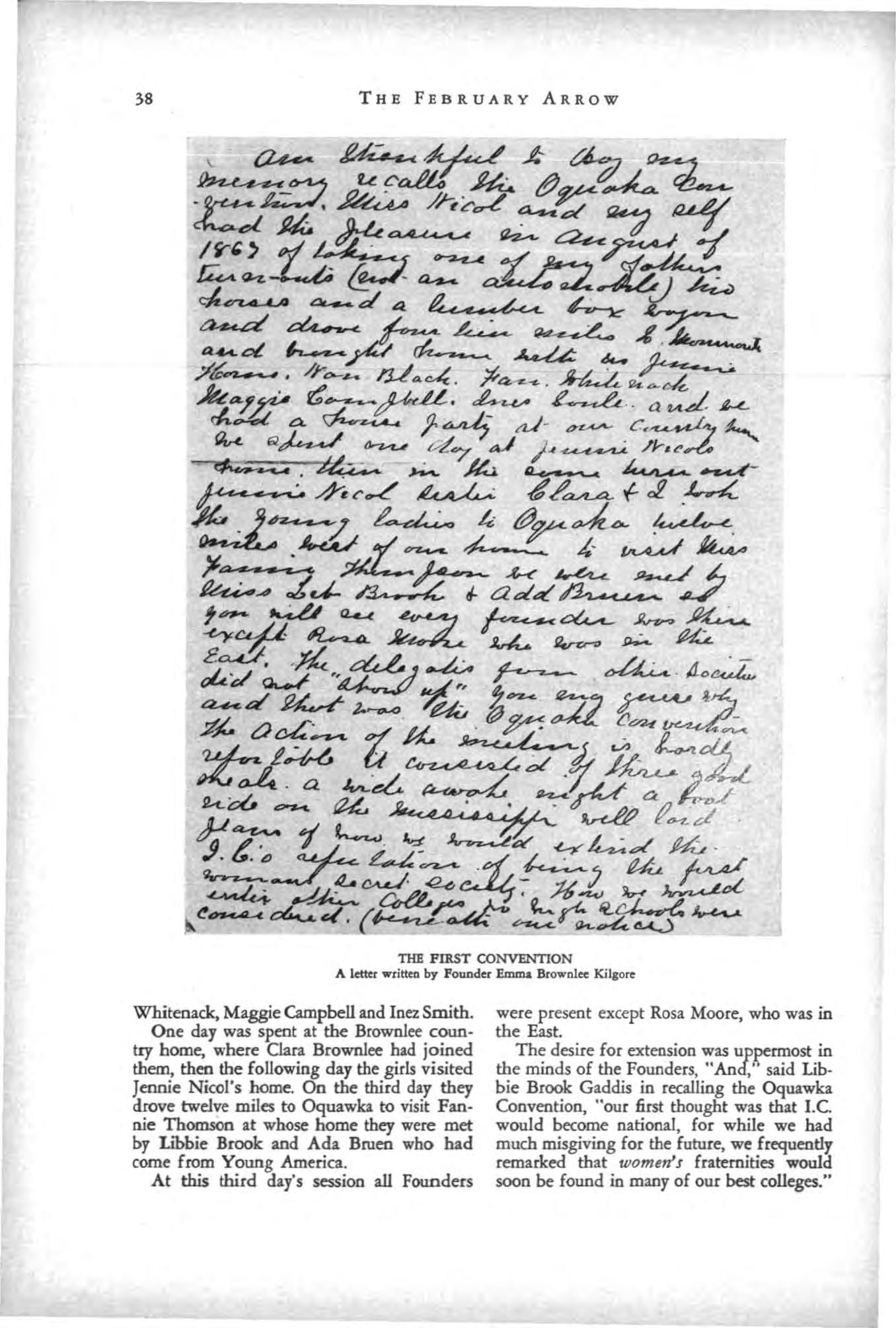
were present except Rosa Moore, who was in the East.
The desire for extension was uppermost in the minds of the Founders, "Ana," said Lib· bie Brook Gaddis in recalling the Oquawka Convention, " our /irst thought was that I.e. would become national, for while we had much misgiving for the future, we frequently remarked that womtn' J fraternities would soon be found in many of our best colleges."
To Libbie Brook Gaddis came the privilege of establishing the second chapter of I .e. Sorosis Writing in 1890, Mrs Gaddis said:
"In the autumn of 1867 my eyes failed and I left school for a year. During the summer of 1868 I persuaded my parents to allow me to go to another college. Believing that I could accomplish more in a school where I was not acquainted and where there would be no social demands on my time, and with the menIal reu,.valion that il might mean Ih. exttnJion of I C ., I accordingfy entered in the fall of 1868, Iowa Wesleyan University. I lived as quietly as possible and for a while did not even wear my pin. When I did put it on, the girls all admired it, and learning that it was a fraternity badge, they asked me to organize a chapter there and also asked to become members of the organization! No girl would ask such a question today-which goes to show how innocent they were of the f ratemity idea, although there was a good strong chapter of Beta Theta Pi there, scholarly, manly fellows, respected by all.
"F ive girls became I.e.s and on New Year's Day, 1869, we WOre our pins for the first time as Gamma chapter at a Beta banquet. These girls were very promising and each excelled in some way, some in music, some in art, while several were on the college honor roll. .And today those of them who are living are among the most respected of the daughters of Iowa Wesleyan. All honor to Iowa Alpha!"
(Now Iowa Alpha)
A form of charter had been provided for in the Constitution and accordi ngly the following cha rter was issued to the new chapter:
We, the AJpha Chapter of the " I.e." sisterhood. do by this charter, authorize Miss Libbie Brook to establish a chapter of this sisterhood in Mt. Pleasant, Iowa to be known as the Gamma chapter.
We do hereby agree to recosnize as sis. ten as long as they conform to the rules and regu. lations of the Constitution. But should they refuse obedience and neglect the ordinances set before them in the Coll5litutioo, then this shall be con. sidertd of none dfert.
Given under our hand, at a special meeting of the AJpha chapter at Monmouth , lilioois. 0«. 21st 1868.
S;gned
Addie Bruen, Pres. Jennie Home, Cor. Sec.
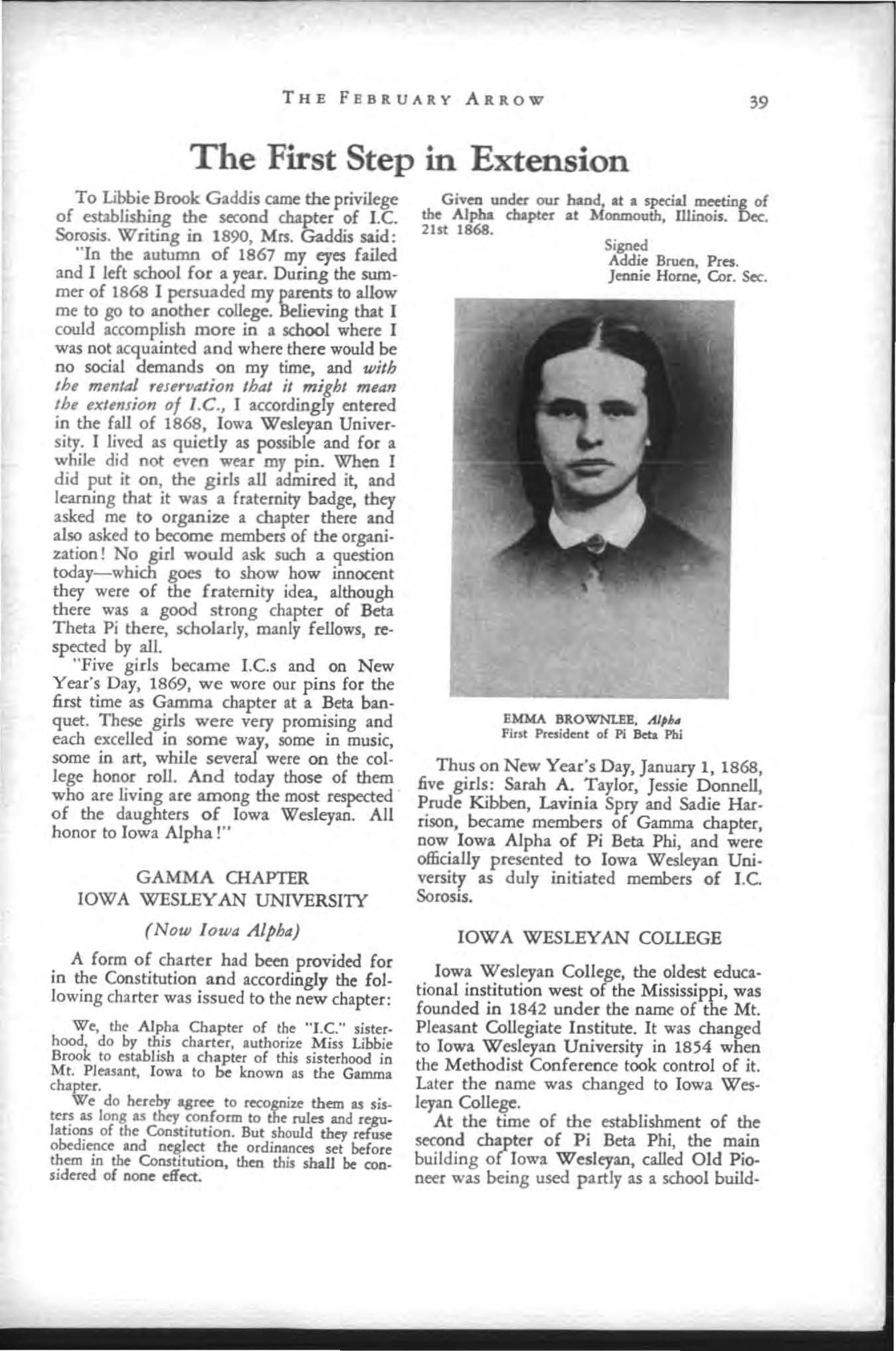
EMMA BROWNLEE. Al,j. Pint President of Pi Beta Phi
Thus on New Year's Day, January 1, 1868, five girls: Sarah A_ Taylor, Jessie Donnell, Prude IGbben, Lavinia Spry and Sadie Harrison, became members of Gamma chapter, now Iowa .Alpha of Pi Beta Phi, and were officially presented to Iowa Wesleyan Uoiversil]' as duly initiated members of I.e. SorcSIS.
Iowa Wesleyan College, the oldest educational institution west of the Mississippi, was founded in 1842 under the name of the Mt. Pleasant Collegiate Institute. It was changed to Iowa Wesleyan University in 1854 wben the Methodist Conference took control of it. Later the name was changed to Iowa Wesleyan College
At the time of the establishment of the second chapter of Pi Beta Phi , the main building onawa Wesleyan, called Old Pioneer was being used partly as a school build-
A COPY MADE FROM FIRST CHARTER ISSUED BY PI BET A PHI TO GAMMA. IOWA WESLEYAN UNIVERSITY, MT. PLEASANT, IOWA. DECEMBER 21. 1868
ing and partly for the president's residence. It was lirst occupied in 1844 and is said to have been the lirst college building erected west of the Mississippi.
In describing the founding of Gamma Oupter, one of the Charter members, Jessie Donnell (Thomas) wrote:
"It was just before the old coUege bell sounded-<lne day in the very last month of the year '68-<alling all to chapel above, when tibbie Brook, slipping her arm about my w';st said: 'Jessie, will you be one of
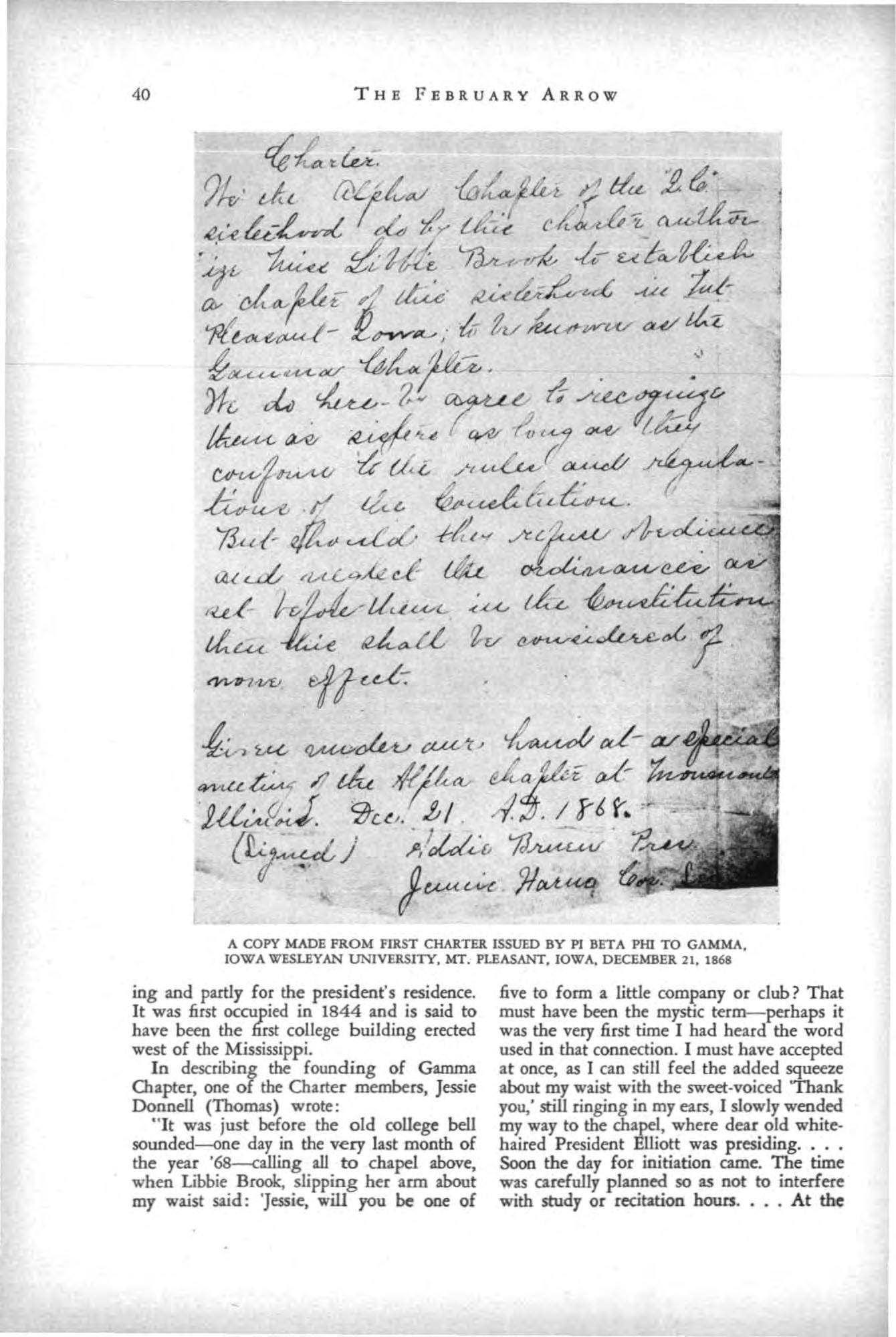
live to form a little company or dub? That must have been the mystic term-perhaps it was the very lirst time I had heard the word used in that connection. I must have accepted at once, as I can still feel the added squeeze about my w';st with the sweet-voiced 'Thank you; still ringing in my ears, I slowly wended my way to the chapel, where dear old whitehaired President Elliott was presiding... . Soon the day for initiation came. The time was carefully planned SO as not to interfere with study or recitation hows. • . . At the
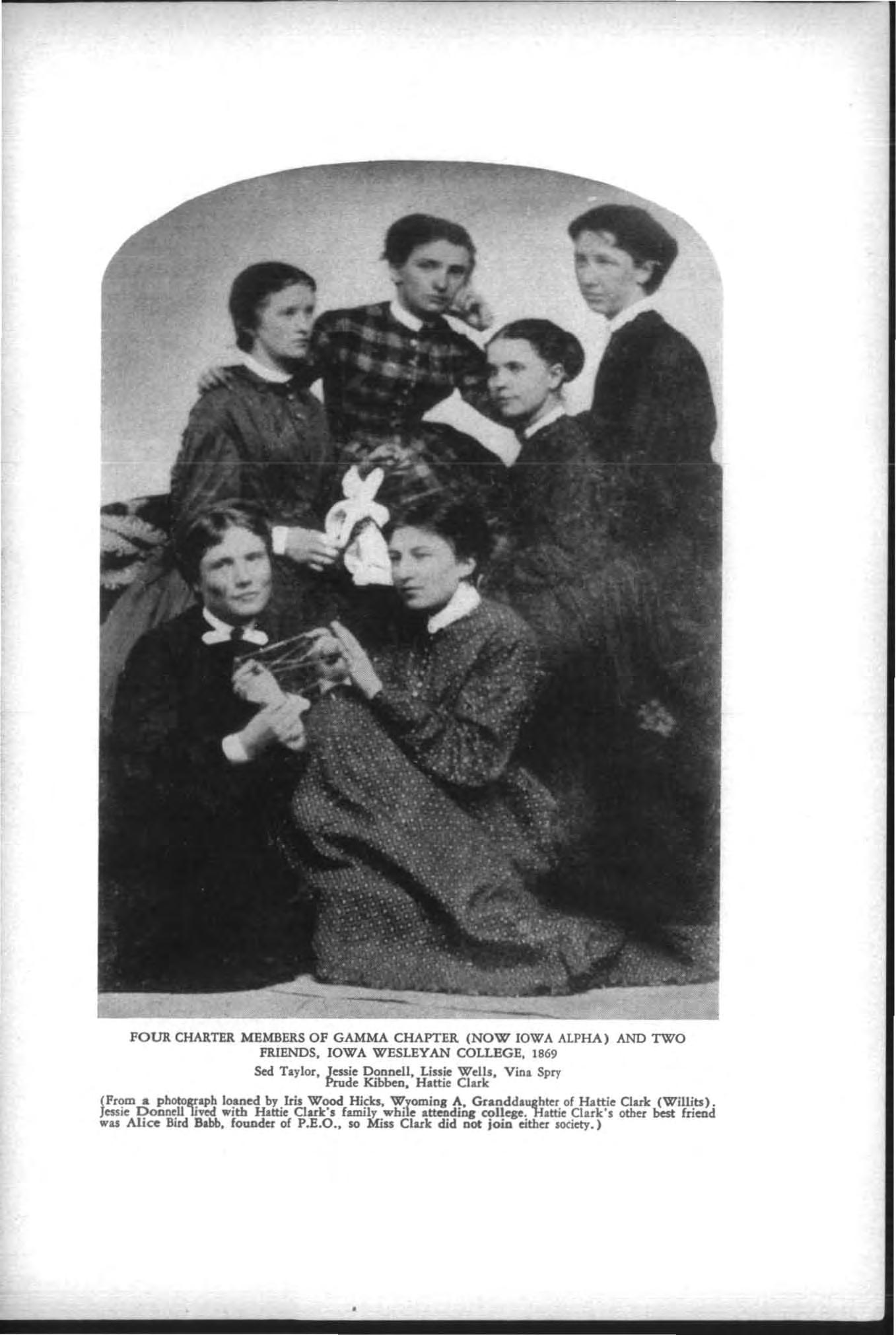
FOUR CHARTER MEMBERS OF GAMMA CHAPTER (NOW IOWA ALPHA) AND TWO FRIENDS, IOWA WESLEYAN COLLEGE. 1869
Sed Taylor, Jessie Donnell, Lissie Wells. Vin. Spry Prude KibbeD. Hattie Clark
j Prom pbotovaph loaned by Iris Wood Hicb. Wyomjol A, GranddlUl;hkr of Hattie Cluk (Willits). essie DonneD 1iftd with Hattie aark's family while atttDdina collqe. Hattie Clark', other best frieod wu Alice Bird Bibb, founder of P.E.O •• SO Miss Clark: did DOt join either socitty.)
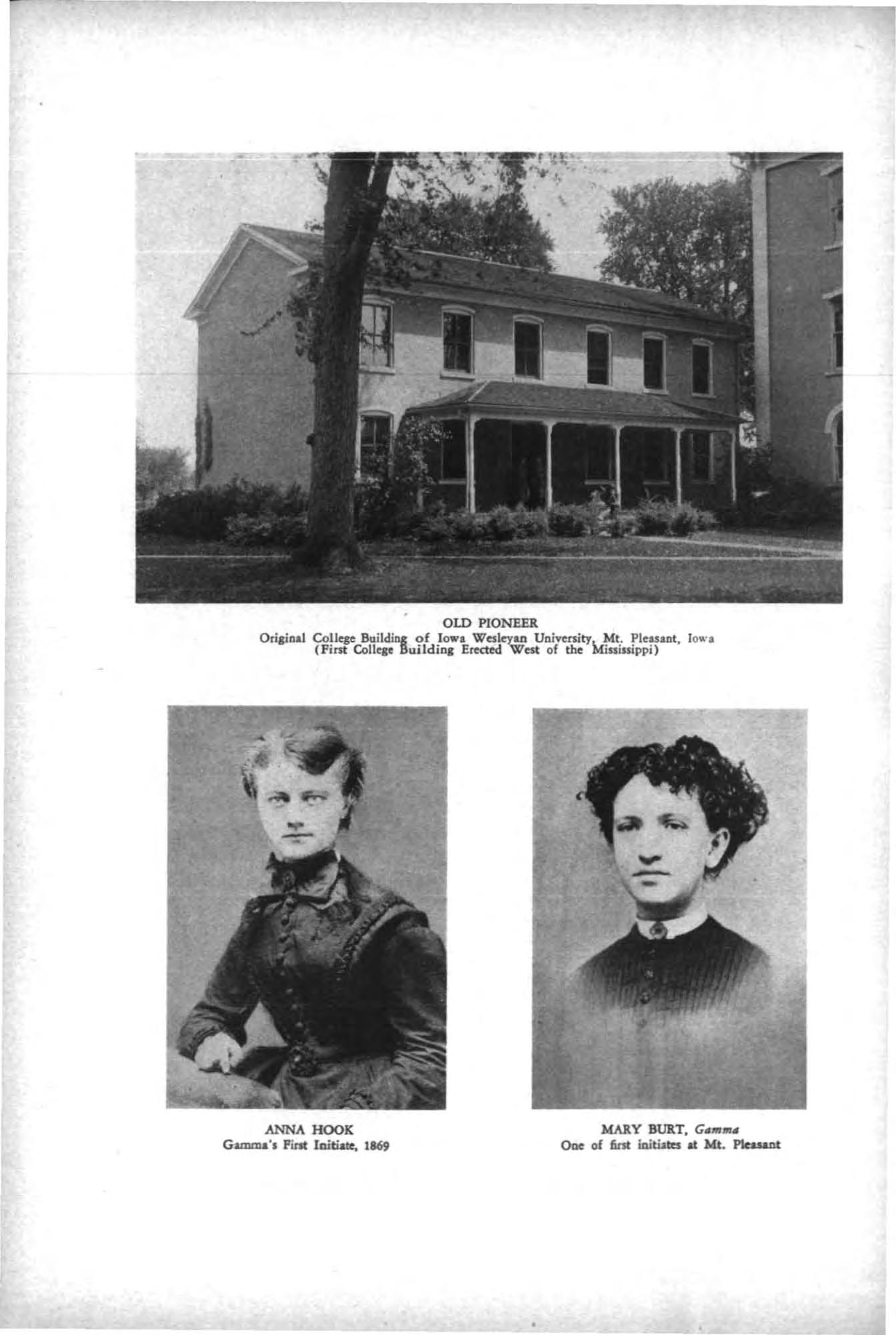
appointed time, six. willing. expectant girls met at the home of Vina Spry. The curtains were carefully drawn, the Ilghts turned low, a nd when our hand was placed on the 'Book of Books' and the few words slowly and qu ietly spoken that made and declared us rcs a thrill passed through our souls Let me introduce to you these live charter members . " First to the tallest: Sed Taylor, fairhaired, positive and distinct, as many of you have known her in after years. Next, Prude Kibben (Murphy), quick in temper, clear in thought, always reaay to be counted on the right side Third, Sade Harrison (Knight), a brunette, perhaps a little more vivacious and progressive than the others-ready to enter mto whatever was he lpful to others. Then, Vina Spry (Lisle) who was perhaps the most loved of all the group ; hers was a buoyant, hopeful disposition and added to rhis was a beautiful voice and she was known as Vina, • The live charter members and tibbie Brook .
the sweet singer. And last, Jessie Donnell (Thomas), the youngest and smallest of the group was looked upon as a dear little girl, having and holding the f riendsbip of all those about ber."
Three of these charter members: Sed Tay· lor, Prude Kibben, and Jessie Donnell were members of the class of '69.
Gamma, this second chapter of I.e. So· rosis became one of the most outstanding chapters, being a leader in fraternity affairs from its instaiJation.
Gamma's first initiate was Anna O. Hook (Mrs. Anna Carpenter Farris), a member of the class of 1870.
Almost at once after the arrow appeared at I\{t. Pleasant, a group of girls at Iowa Wesleyan College, who had not been invited to join I .C. Sorosis, made haste in organiz. ing a society called P.E.O., and as a result the two chapters became bitter rivals and reo mained so for years, as will be explained later in this volume.
In November 1869, a third chapter of I.e. Sorosis was installed at the Mt. Pleasant Female Seminary in Mt. Pleasant, Iowa. According to record, Sarah M. Sterrett. who was attending the Seminary, was a cousin of Thomas H . Macbride, a student at Monmouth College. Her cousin approached her in behalf of the I.e.s at Monmouth regarding the establishment of a new chapter of I.e. The idea was favorably received, the requisite number of associates found and with the assistance of Nancy Lee Black (Wallace) of Monmouth College, and Prude Kibben (Murphy) of Iowa Wesleyan University, the Delta Chapter of I.e. Sorosis was installer! with the following charter members:
Nannie Fitzgerald (Wharton) , Mary Crane, Elizabeth MacIlIbiney, Ella Wright (Maples), Anna Wallace (Hoffman), Ken Knapp (Stoddard), Mary Wright (Peary), and Sarah M. Sterrett.
Sarah M. Sterrett was elected the lirst president of the chapter and was its guiding spirit. The chapter, however, was short-lived. Owing to the serious disapproval of all secret organizations on the part of the Faculty, this group surrendered its cbarter and became
• Sarah M. Sterrett became National TCea5ucer of the Alumnz Association in
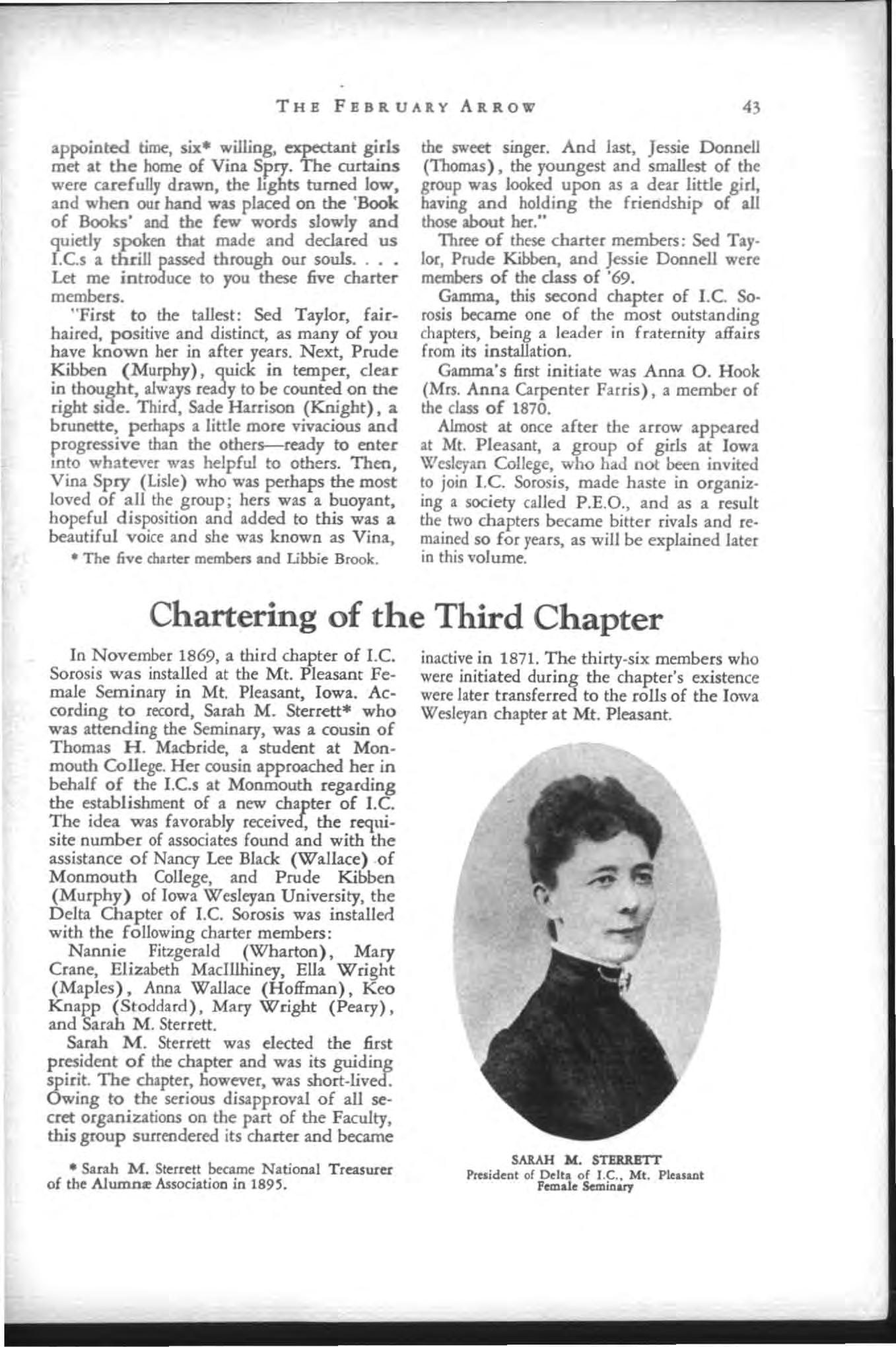
inactive in 1871. The thirty·six members who were initiated during the chapter's existence were later transferred to the rolls of the Iowa Wesleyan chapter at Mt. Pleasant.
The Second Convention of I.e. Sorosis was held in 1870 at Mt. Pleasant, Iowa witll Libbie Brook (Gaddis) presiding. Three chapters were active and represented: Monmouth College, Iowa Wesfeyan University, and Mt. Pleasant Female Seminary.
In writing of the two delegates who at· tended this Convention from Monmout:l, Emma Brownlee Kilgore said: " If I remem· ber rightly my sister, Clara Brownlee (Hutch · inson) and Sally Porter were the delegates from Alpha Chapter. I know they were ver), anxious to make a good impression and had to have Some new drygoocfs, ribbons, curls, and wondered what wonderful things they could tell the new chapters."
Amendments to the Constitution and ex tension comJ;'rised the' principal business of this ConventIOn.
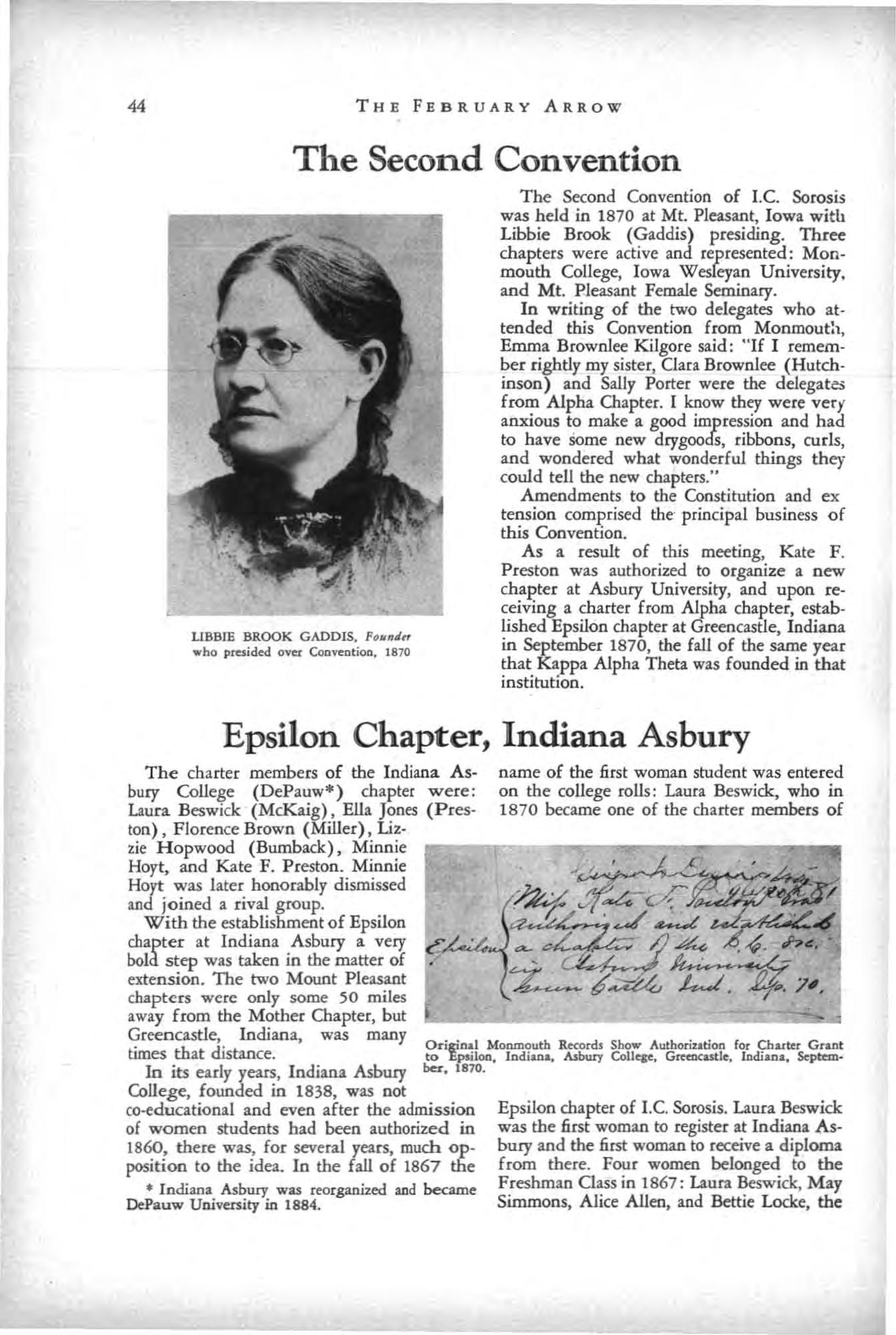
L1BBIE BROOK GADDIS, FOllntln who prHided over Cooventioo, 1870
As a result of this meeting, Kate F. Preston was authorized to organize a new chapter at A sbury University, and upon reo ceiving a charter from Alpha chapter, estab· lished Epsilon chapter at Greencastle, Indiana in September 1870, the fall of the same year that Kappa Alpha Theta was founded in that institution.
The charter members of the Indiana As· bury College (DePauw.) chapter were: Laura Beswick (McKaig), Ella Jones (Pres· ton), Florence Brown (Miller), Liz· zie Hopwood (Bumback), Minnie Hoyt, and Kate F. Preston. Minnie Hoyt was later honorably dismissed and joined a rival group.
name of the first woman student was entered on the college rolls: Laura Beswick, who in 1870 became one of the charter members of
With the establis hment of Epsilon chapter at Indian a Asbury a very bold step was taken in the matter of extension. The two Mount Pleasant chapters were only some 50 miles away from the Mother Chapter, but Greencastle. Indiana, was many Original Monmouth Records Show Authorization for Charter Grant times that distance. to Epsilon, Indiana, Asbury Colle&:e. GreccuUe. Indiana. Septcm. In its early years, Indiana Asbury bet, 1870. College, founded in 1838, was not co·educational and even after the admission of women students had been authorized in 1860, the,re was , for several years , much op. position to the idea 10 the fall of 1867 the • Indiana Asbury was reorganized and became DePauw University in 1884.
Epsilon chapter of I.C Sorosis. Laura Beswick was the first woman to register at Indiana As· bury and the first woman to receive a diploma from there. Four women belonged to the Freshman Class in 1867: Laura Beswick, May Simmons, Alice Allen, and Bettie Locke, the
last three becoming Founders of Kapp a Alpha Theta in 18 70.
In writing of her college days , Laura Beswick (McKaig) said some years later : "Our life was so strenuous and I was SO weary the last year that some way I have forgotten all the details But I have alwlyS been glad for the Mother who insisted upon my entering College when a little girl Just fifteen and who encouraged me and helped me every way she could, when I, with the three others who first entered in 1867 would have given up time and again because the opposition of the students and faculty was so fierce it seemed as though we could not go through. Old Dr the German Professor , used to pray for 'the over three hundred young men and the few young women ' and we four felt rather few and unwelcome."
In 1907, Laura Beswick McKaig wrote to the Historian of Pi Beta Phi : "In looking over some old letters and papers in my garret this summer , I found an old journal I had in college and among other things I found the names of the charter members of our old I.e. There were nine of us and we felt very proud when we marched down the chapel aisle the morning we put o n our little badges: Carrie Lucas, lou Parsons, Kate F. Preston, Lizzie Hopwood, Julia Springe r, Flo rence B rown, Ella Jones, Allie Ames, and Laura Beswick."
One record states that Agnes R osabelle Rankin and Lou Rankin were also I.e.s at Asbury. They both received the degree of B.S. in 1872 and Master's Degrees in 1876. Rose Rankin and Ella Jones were active leaders in the Philomathean Literary Society of the University Martha Pierson ( Terrell) and Louise Parks ( R ichards ) were initiated into the chapter in 1870, also . Epsilon chapter was enthusiastic a n d active in its first years. It sponsored the Third Convention of I .e. Sorosis held at Greencastle, I ndiana, in 1872 and made a real
succ... of it, as will be recorded later.
With the graduation of its charter members, however, the chapter declined, due perhaps to some extent to the fact that it was SO far removed from the Mother chapter and
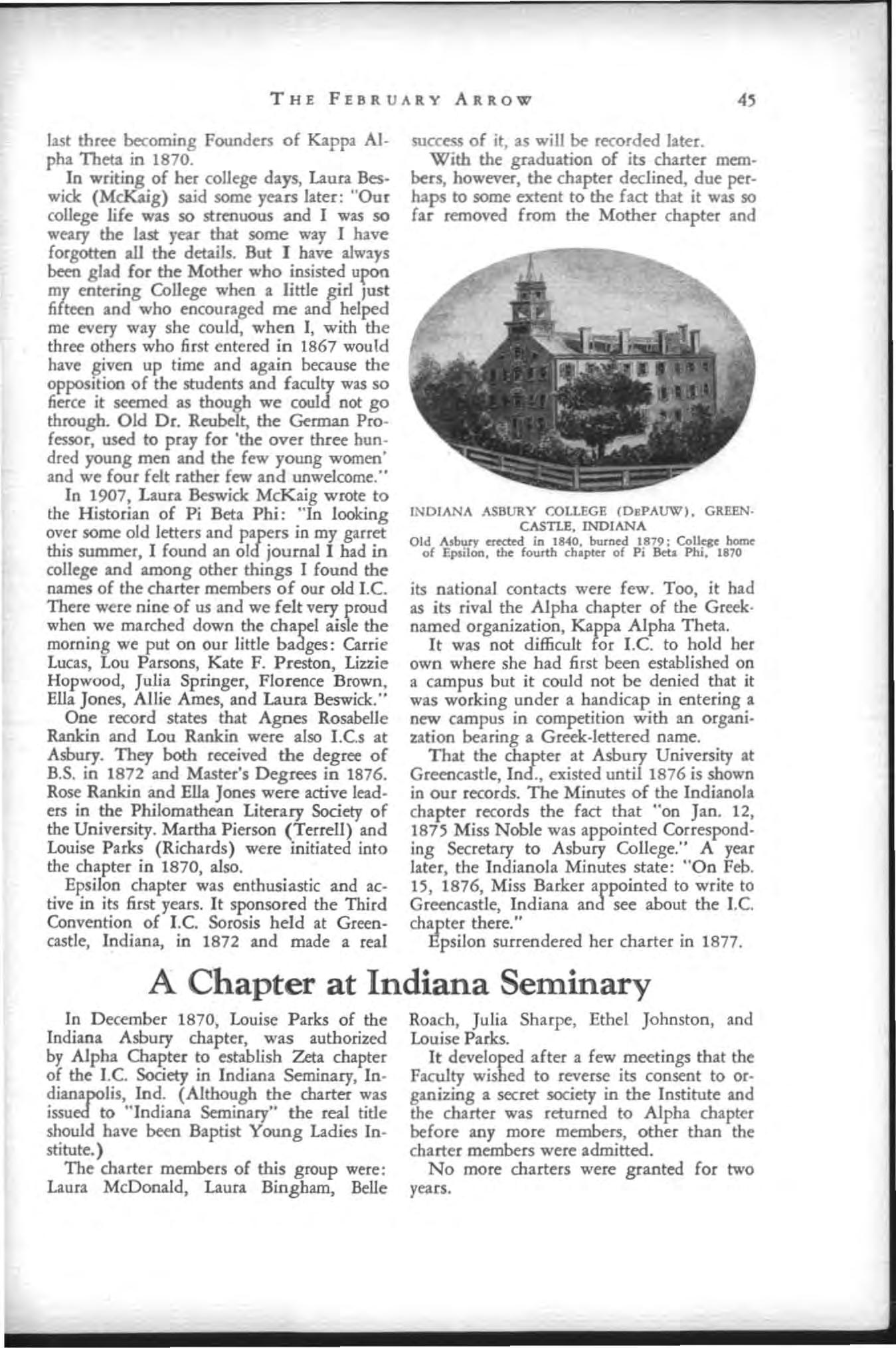
Old Asbury ereckd in 1879 ; CoUqe home of Epsilon, the fourth chapter of Pi Dda Phi, 1870
its national contacts were few . Too, it had as its rival the Alpha chapter of the Greek· named organization, Kappa Alpha Theta It was not difficult for I.e. to hold her own where she had first been established on a campus but it could not be denied that it was working under a handicap in entering a new campus in competition with an organization bearing a Greek-lettered name.
That the chapter at Asbury University at Greencastle, Ind ., existed until 18 76 is shown in our records. The Minutes of the Indianola chapter records the fact that "on Jan. 12 , 18n Miss Noble was appointed Corresponding Secretary to Asbury College." A year later, the Indianola Minutes state: "On Feb . n , 1876, Miss Barker appointed to write to Greencastle, Indiana and see about the I e. chapter there."
Epsilon surrendered her charter in 1877 .
I n December 1870, Louise Pa rks of the Indiana Asbury chapter, was authorized by Alpha Chapter to establish Zeta chapter of the I e. Society in Indiana Seminary, Indianapolis, Ind . (Although the charter was issued to "Indiana Seminary" the real title should have been Baptist Young Ladies Institute.)
The charter members of this group were: Laura McDonald, Laura Bingham, Belle
Roach , Julia Sharpe, Ethel Johnston, and Louise Parks.
It developed after a few meetings that the Faculty wished to reverse its consent to org anizing a secret society in the Institute and the charter was returned to Alpha chapte r before any more members, other than the charter members were admitted.
No more charters were granted for two years
According to Emma Brownlee (Kilgore) writing in 1882: "The years of '71 and '72 were spent mostly in waging warfare over elections in class and society, securing members and many smaller matters, with the so-
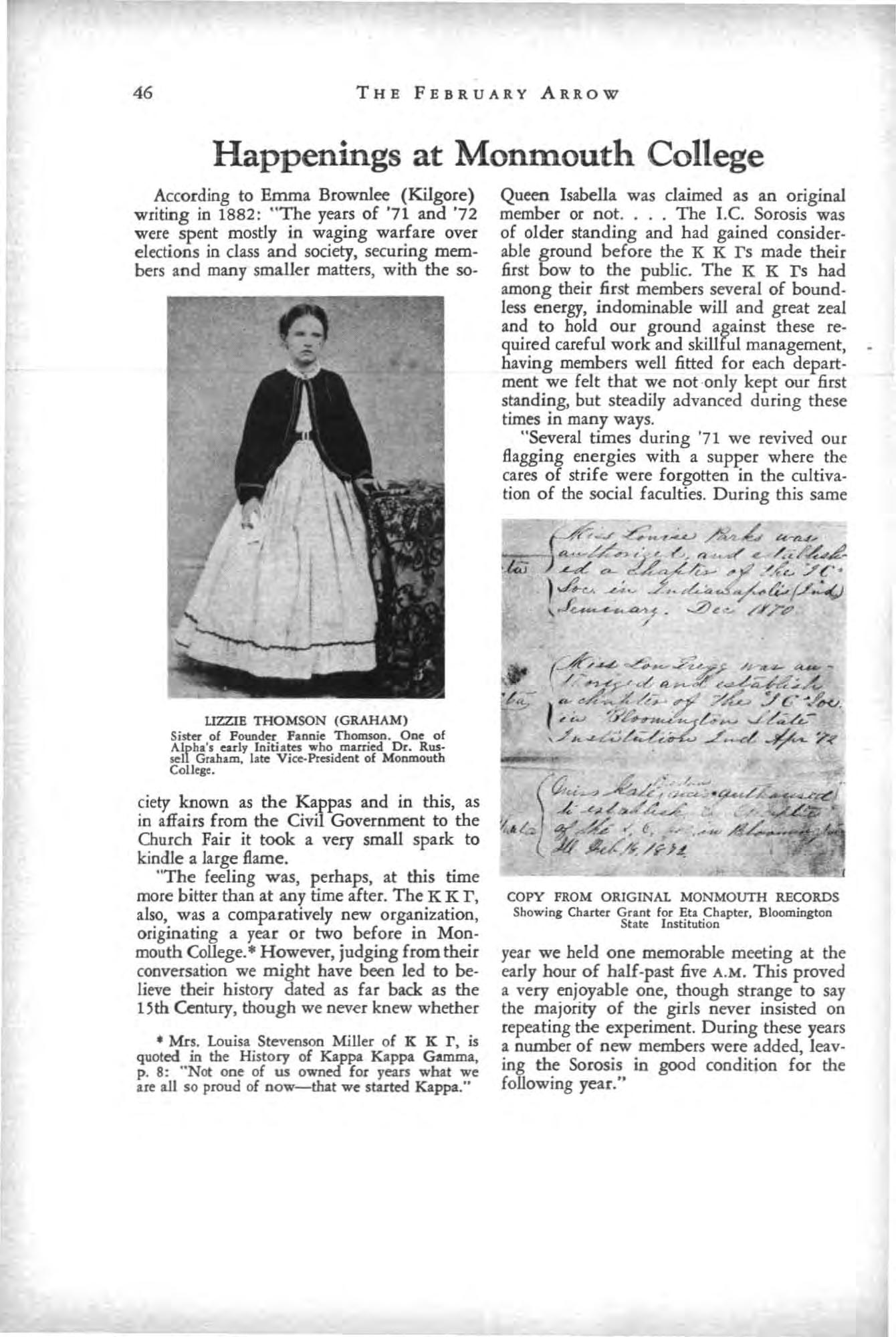
eiety known as the KafPas and in this, as in affairs from the Civi Government to the Church Fair it took a very small spark to kindle a large flame_
"The feeling was, perhaps, at this time more bitter than at any time after. The K K r, also, was a comparatively new organization, originating a year or two before in Monmouth CoUege. * However, judging from their conversation we might have been led to believe their bistory dated as far back as the Ilth Century, though we never knew whether
• Mrs . Louisa Stevenson Miller o f K K r , is quoted in the Histo ry of Kappa Kappa Gamma. p. 8: "Not one of w owned for years what we are aU so proud of Do w-that we started Kappa ."
Queen Isabella was claimed as an original member or not. . .. The I.C. Sorosis was of older standing and had gained considerable ground before the K K rs made their first bow to the public. The K K rs had among their first members several of boundless energy, indominahle will and grea t zeal and to bold our ground against these required careful work and skillful management, having members well fitted for each department we felt that we not only kept our first standing, hut steadily advanced during these times in many ways.
"Several times during '7 1 we revived our flagging energies with a supper where the cares of strife were in the cultivation of the social facultIes. During this same
year we beld one memorable meeting at the early bour of half-past five A M. This proved a very enjoyable one, though strange to say the majority of the girls never insisted on repeating the experiment. During these years a number of new members were added , leaving the Sorosis in good condition for the following year. "
The Monmouth records show that "Miss Lou Gregg was authorized and established a chapter of the I.C Soc. in Bloomington State Institution, Ind., Apr. '72 "
Thus far no records have been discovered which show how many were initiated into the chapter, nOr how long it existed. That it was established, however, is proven by some data recently sent to the HIS torian by Mr. Karl W. Fischer, Beta Theta Pi, an authority on Indiana University history.
The ratalogue of the Indiana University lists Louisa S. as a Sophomore in 187172 and as a senior 10 1873 - 18 74.
A program of the Hesperian Society, taken from Mr. Fischer 's scrapbook, announces the performance of Oct. 28, 1873 as including a "Declamation-The Famine, by Louise Gregg, Columbia City."
Pronf of the establishment of the Pi Beta Phi chapter ap),ears in a copy of a humorous take-off on a literary society program-probably that of the Hesperian, owned by Mr. Fischer. These humorous take-offs or boguses,
clandestinely written, were published and thrown about Bloomington from 1869-1880 In the one entitled, "An Evening With the Illustrious Dead ," we lind a paragraph which reads:
"Stumpy Hiner will leap from his Braying Steed and assist Flat Footed Gregg in such a manner as to exhibit her new pinted arrow to the expecting audience, when the charter members of I See will join in the glad refrain: 'Thetas Behold.' "
According to the Alumni Catalogue of the University of Indiana, Lon Gregg married Stephen Godfrey Babcock.
( Further re#:uch o n Eta Chapter is heinS carried on )
Through the influence of Kate Preston, of Indiana Asbury, the Alpha Chapter authorized the establishment of Theta Chapter on Feb. 18, 1872 at Illinois Wesleyan -College, Bloomington, Ill. AIl of the of this chapter were destroyed, the charter being withdrawn soon after it was granted.
In June 1872, the Third National Convention of I.e. Sorosis was held at Greencastle, Ind iana, with the Asbury College chapter as hostess .
At this Convention, Louise Carithers. and May (Mary) A. Sterrett represented Alpha, Louise Carithers being elected President of the Convention and Emma Madden, Alpha, secretary.
Delegates also attended from Mount Pleasant, but the names have not been recorded .
Mary A. Sterrett writing in 1907 said: "The Convention at Greencastle was held in June of 1872. The Monmouth chapter sent
• Louise Carithers, the lirst initiate of Alpha whose initiation date is recorded, 1868, lived in Ipava, Ill. After leaving college she married John H. Morri son, Attorney, and moved to Oswego. Kansas, where Mr. Morr ison died in 189', Mrs . M orrison was the mother of two children: Maud Margaret Morrison (Sweet) and Ralph W . Morrison of Las Cruces, New Mexico, who was Grand Praetor of Iowa and Nebraska f o r Sigma Chi fraternity, and latc['" as Grand Tcwtee of his fraternity. Mrs. Morrison away at Las eru. New Mexico, on 9, 1935
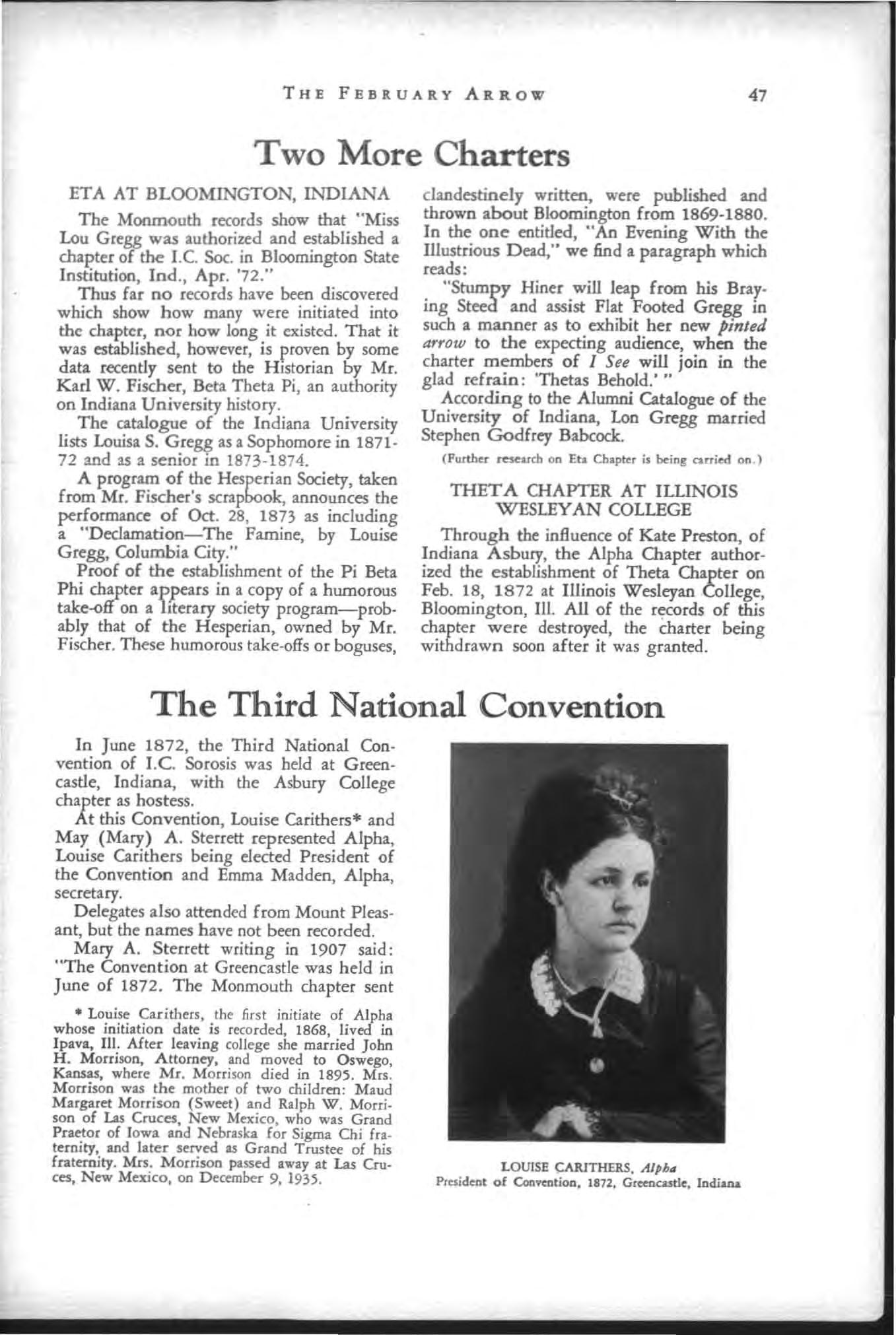
LOUISE CARlTHERS. AJphil of eoo"totiOD, 1872, GrteQcasUe, Indiana
two delegates: Louise Carithers and myself. We both attended. The delegates were entertained at the homes of the local members. There was a banquet given in honor of the visiting delegates at which both gentlemen and ladies were present. There were toasts and responses. Louise Carithers responded to a toast to Alpha Chapter, I think. Now it is dreadful to remember the banquet and en-
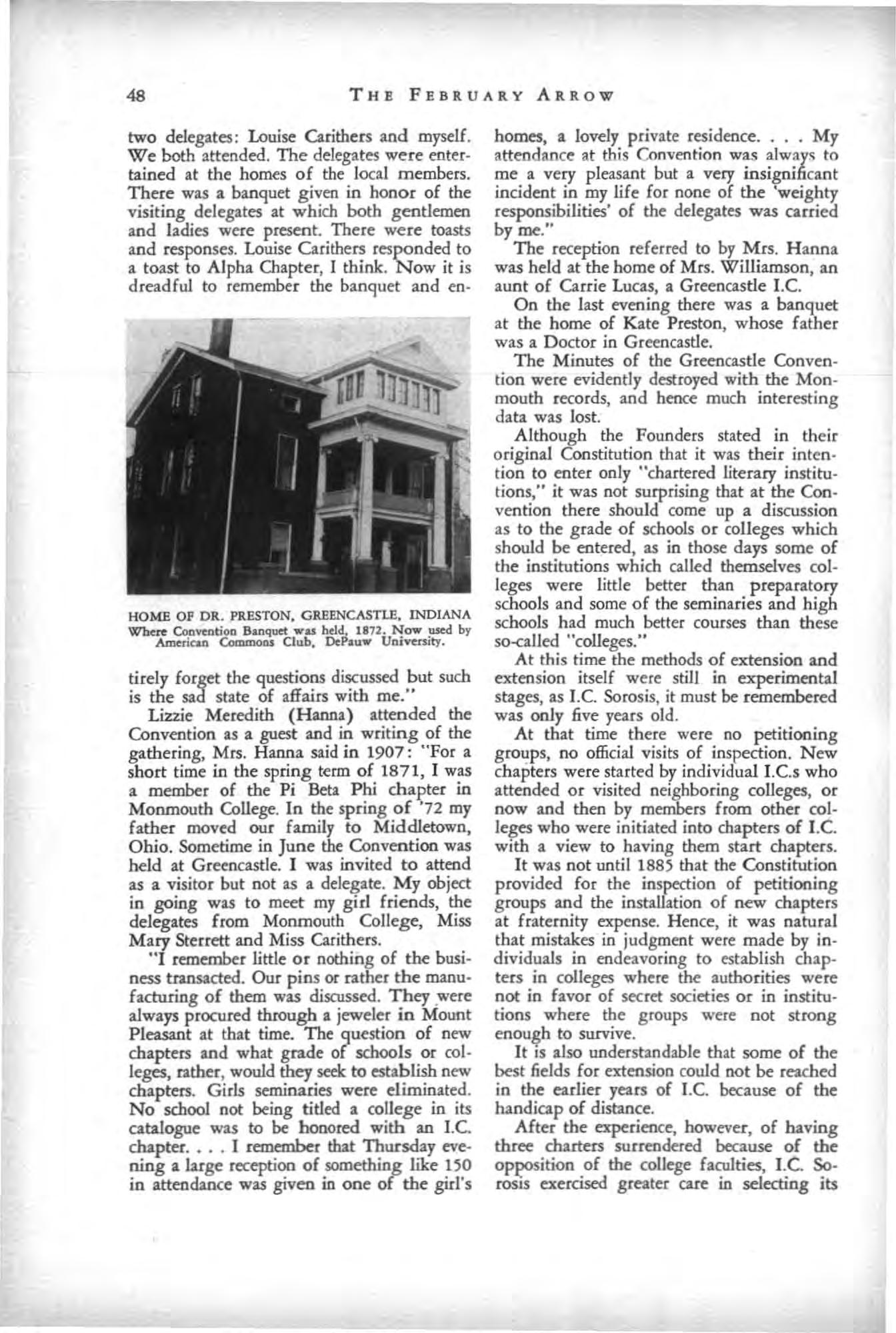
tirely forget the questions discussed but such is the sad state of affairs with me_"
Lizzie Meredith (Hanna) attended the Convention as a guest and in writing of the gathering, Mrs. H an n a said in 1907: "For a short time in the spring term of 1871, , was a member of the Pi Beta Phi chapter in Monmouth College In the spring of '72 my father moved our family to Middletown, Ohio. Sometime in June the Conventioo was held at Greencastle. , was invited to attend as a visitor but not as a delegate. My object in going was to meet my girl friends, the delegates from Monmouth College, Miss Mary Sterrett and Miss Carithers.
'" remember little or nothing of the business transacted. Our pins or rather the manufacturing of them was discussed. They .were always procured through a jeweler in Mount Pleasant at that time. The question of new chapters and what grade of schools or colleges, rather, would they seek to establish new chapters. Girls seminaries were eliminated No school not being titled a college in its catalogue was to be honored with an I.e. chapter. _ I remember that Thursday evening a large reception of something like 150 in attendance was given in one of the girl's
homes, a lovely private residence My attendance at this Convention was always to me a very pleasant but a very insignificant incident in my life for none of the 'weighty responsibilities' of the delegates was carried byrne."
The reception referred to by Mrs . H anna was held at the home of Mrs. Williamson, an aunt of Carrie Lucas, a Greencastle I.e.
On the last evening there was a banquet at the home of Kate Preston, whose father was a Doctor in Greencastle.
The Minutes of the Greencastle Convention were evidently destroyed with the Monmouth records, and hence much interesting data was lost.
Although the Founders stated in their original Constitution that it was their intention to enter only "chartered literary institutions," it was not surprising that at the Convention there should come up a discussion as to the grade of schools or colleges which should be entered, as in those days some of the institutions which called themselves colleges were little better than preparatory schools and some of the seminaries and high schools had much better courses than these so-<alJed "colleges."
At this time the methods of ""tension and extension itself were still in experimental stages , as I.e. Sorosis, it must be remembered was only five years old .
At that time there were no petitioning no official visits of inspection. New chapters we re started by individual I. e.s who attended or visited neighboring colleges, or now and then by members from other colleges who were initiated into chapters of I.e. with a view to having them start chapters .
It was not until 188) that the Constitution provided for the inspection of petitioning groups and the installation of new chapters at fraternity expense. Hence, it was natural that mistakes in judgment were made by individuals in endeavoring to establish chapters in colleges where the authorities were not in favor of secret societies or in institutions where the groups were not strong to survive .
It IS also understand ab le that some of the best fields for extension coul d not be reached in the earlier years of I.e. because of the handicap of distance
After the experience, however, of having three charters surrendered because of the opposition of the college facuIties, I.e. Sorosis exercised greater care in selecting its
next chapter homes and there soon came into existence three chapters which became outstanding in the national organization: one at Lombard College, Galesburg, ill., one at Kansas State University, Lawrence, Kansas,
and one at Simpson Centenary College, Indianola, Iowa. All three of these chapters became hostesses to national coovmttoas and worked diUgently in every way for the steady progress of Pi Beta Phi.
In the spring of 1872, the Beta Theta Pi men of Monmouth College learned that their fraternity "would probably soon have a new chapter in the young but promising institution of Kansas State University. The friendly Betas of Monmouth informed the I.e. girls of the same institution of the existence of this way -aut-west school, whose students were, as yet, in lamentable ignorance of the mysteries of any secret society. The girls determined to act upon the suggestion of the Betas and a letter was written in April by Alpha to Flo.ra Rirhardson, then a member
"Flora Richardson accordingly replied to Monmouth that K.S.U. was not quite ready for the establishment of a ladies' secret society but suggested that a chapter could probably be formed at Lombard University, Galesburg,
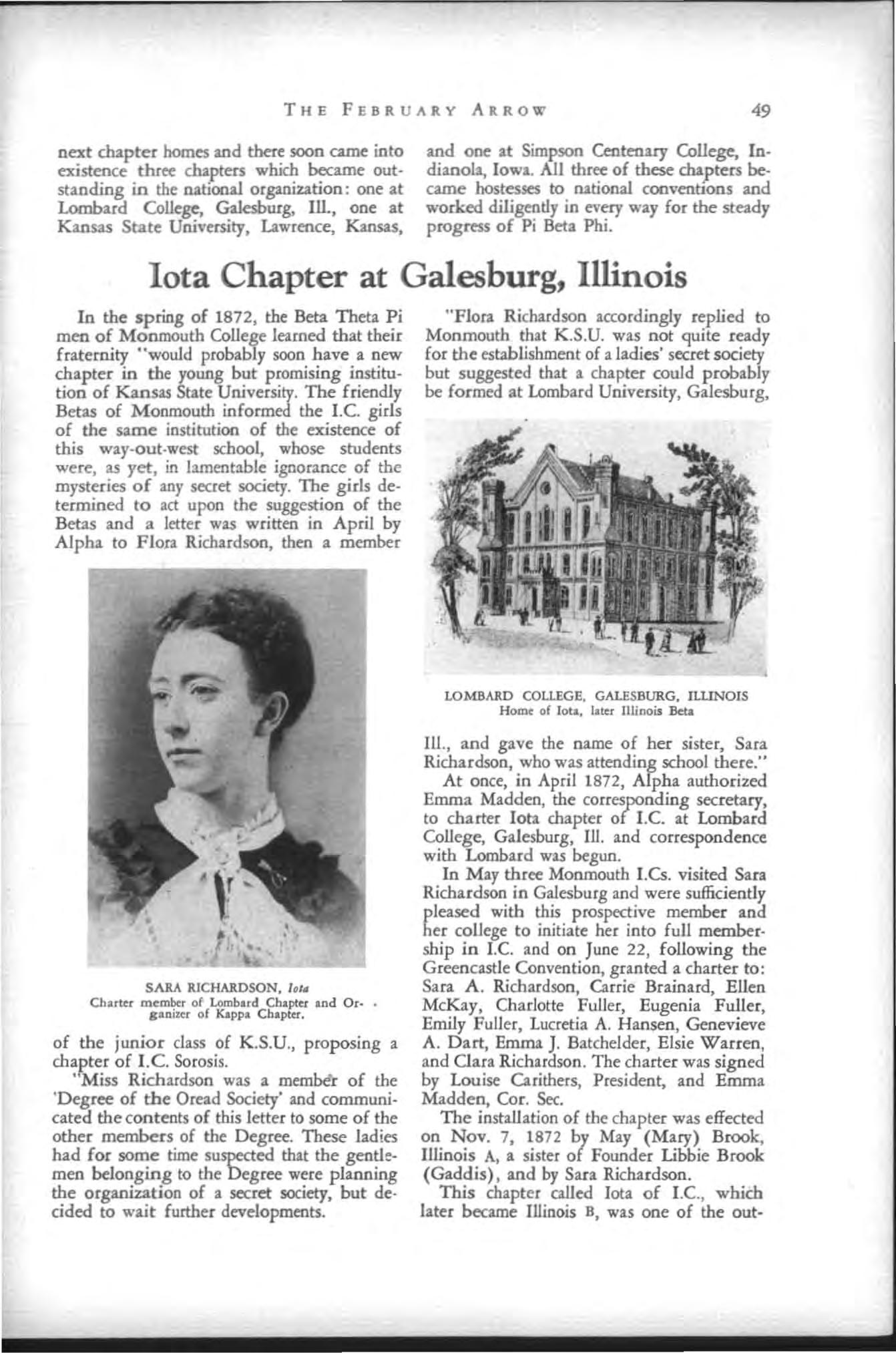
SARA RICHARDSON, ,.,.
Charter member of Lombard Chapttt lnd Or. ganizer of Kappa Chaptet.
of the junior class of K.S.U., proposing a chaRter of I. e. Sorosis.
'Miss Richardson was a memb<!r of the 'Degree of the Oread Society' and communicated the contents of this letter to some of the other members of the Degree. These lad ies had for some time suspected that the gentIomen belonging to the begree were planning the organization of a secret society, but de· cided to wait further developments.
Home of Iota, later Illinois Beta
III., and gave the name of her sister, Sara Richardson, who was attending school there."
At once, in April 1872, Alpha authorized Emma Madden, the corresponding secretary, to charter Iota chapter of I.e. at Lombard College, Galesburg, III. and correspon dence with Lombard was begun.
In May three Monmouth I.Cs visited Sara Richardson in Galesburg and were suflic ientIy pleased with this prospective membe r and her coUege to initiate her into full membership in I.e. and on June 22, fo ll owi ng the Greencastle Convention, granted a charter to: Sara A. Richardson, Carrie Brainard, Ellen MCKay, Charlotte Fuller, Eugenia F ul l er, Emily Fuller, lucretia A. H ansen, Genevieve A. Dart, Emma J. Batchelder, Elsie Warren, and Oara Richardso n . The chacter was signed by Louise Carithers, President, and Emma Madden, Cor. Sec.
The installation of the chapter was effected on Nov. 7, 1872 by May (Mary) Brook, Illinois A, a sister of Founder Libbie Brook (Gaddis), and by Sara Richardson
This chapter called Iota of I.e. , which later b«ame Illinois B, was one of the out·
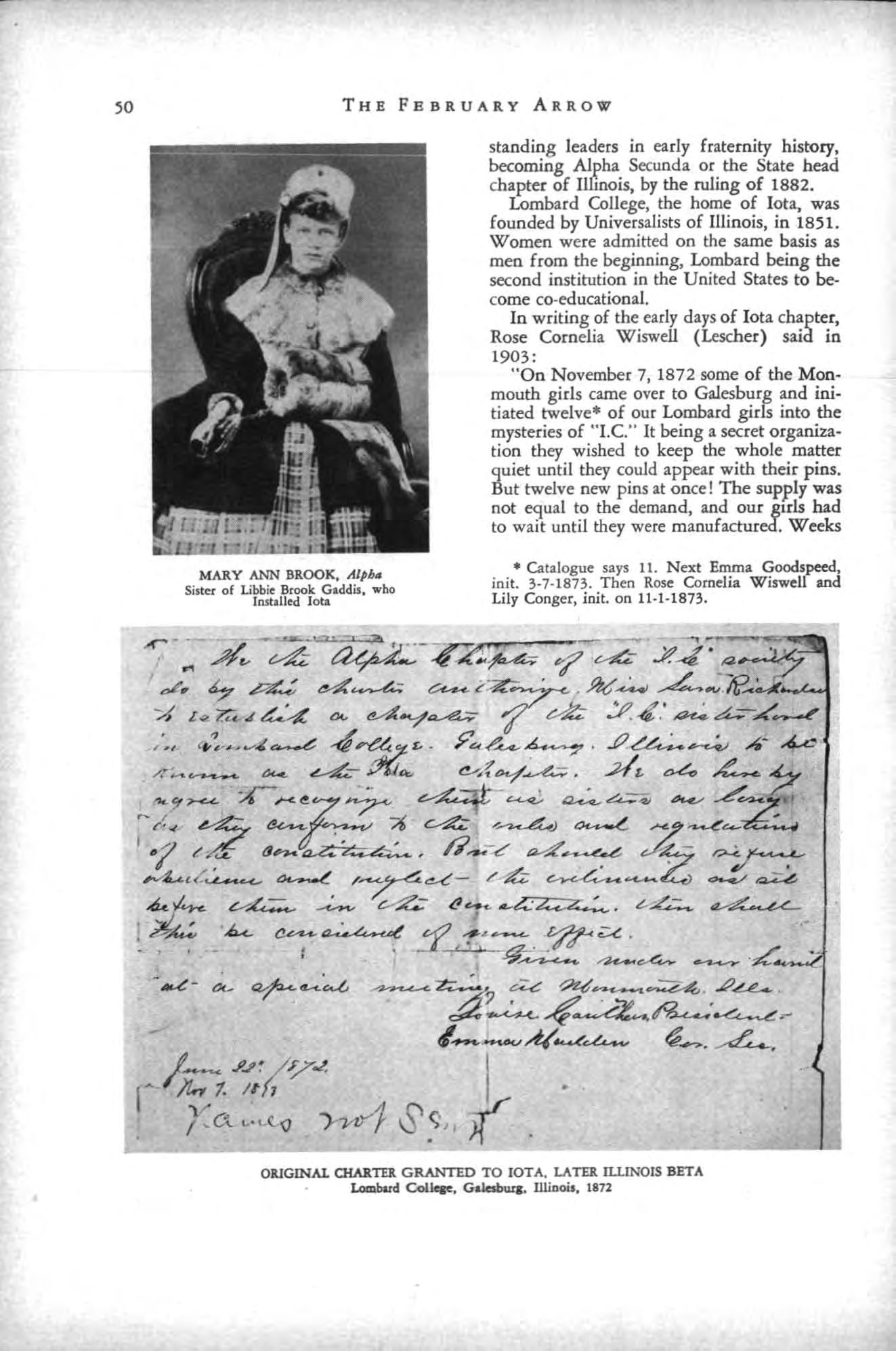
standing leaders in early fraternity history, becoming Alrha Secunda or the State head chapter of Illinois, by the ruling of 1882.
Lombard College, the home of Iota, was founded by Universalists of Illinois, in 185l. Women w ere admitted on the same basis as men from the beginning, Lombard being the second institution in the United States to become co-educational.
In writing of the early days of Iota chapte r, Rose Cornelia Wiswell (Lescher) said in 1903:
"On November 7, 1872 some of the Mon· mouth girls came over to Galesburg and ini· liated twelve" of our Lombard girls into the mysteries of "I.e. " It being a secret organiza. tion they wished to keep the whole matter quiet until they could appear with their pins. But twelve new pins at once! The supply was not equal to the demand, and our girls had to wait until they were manufactured . Weeks
.. Catalogue says 11 . Next Emma Goodspeed. init. 3-7 - 1873. Then Rose Cornelia Wiswell and Lily Conger, init. on 11-1-1873 .
grew into months before the pins were forth · coming. In the meantime the secret leaked out. A few gOl hold of it, and , for a joke, two girls hunted the town over for arrow pins. Finally they found some black ones about three inches lon81 at a millinery store. These they took to a hardware store and had chains and gilding put on . They appeared next morning in chapel wearing the pins Of courS<! consternation reigned among
the 'I.e: girls. Others were eurious to know why they were wearing sucb pins, but they kept their secret and had rhe ir fun to them · selves. Ho"' well I remember the day the girl. did appear with their twelve new pins shlnio.'! so brightly They kept their origJOal number for about tffi months, and at that time a par· tieular friend of mine and I were the first to join their ranks. Our chapter was then called Iota."
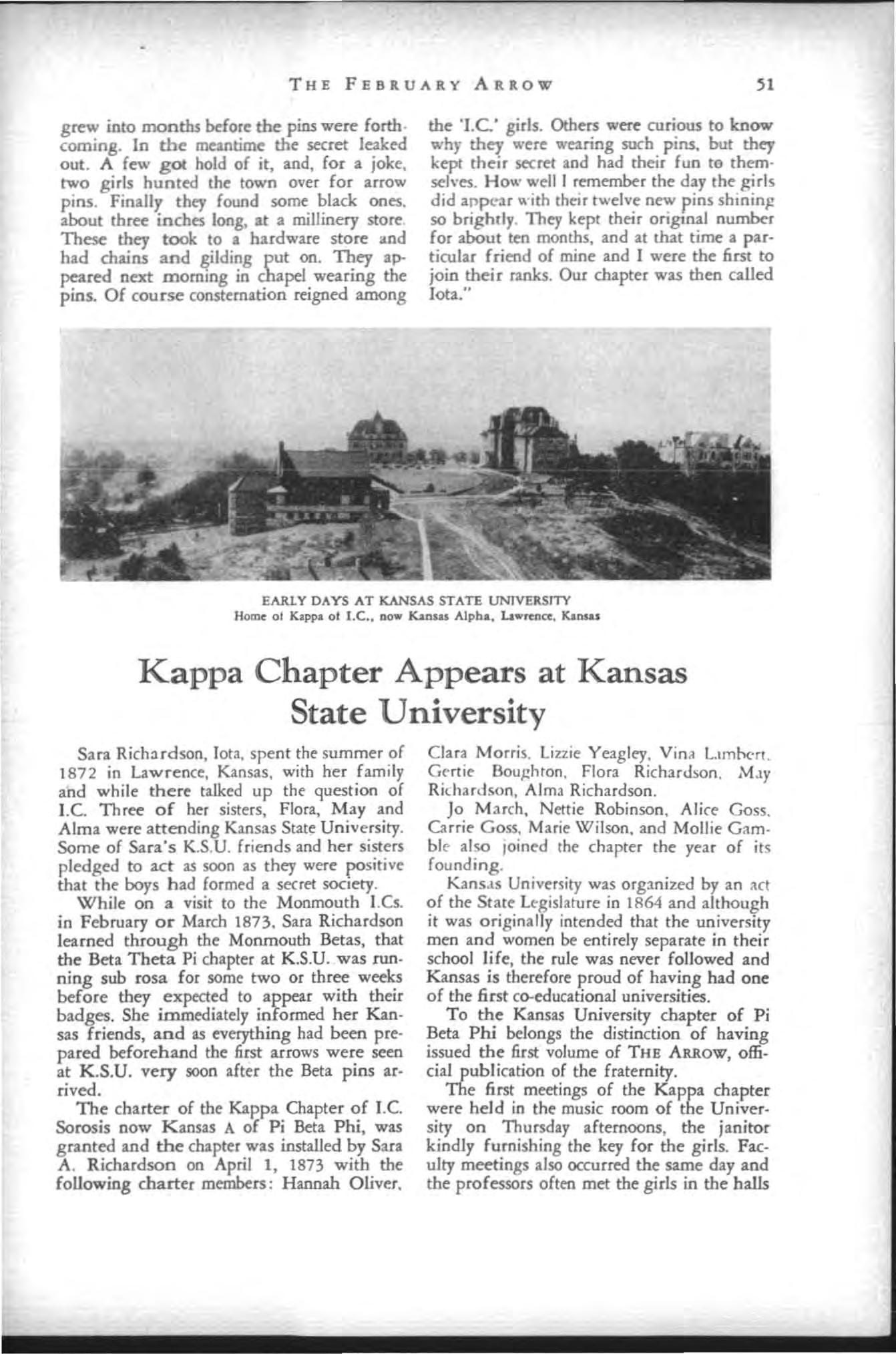
Sara Richardson , Iota, spent the summer of 1872 in Lawrence , Kansas , with her family and while there talked up the question of I.e. Three of her sisters, Flora, M a y and Alma were attending Kansas State University . Some of Sara's K .S.U . friends and her sisters pledged to act as soon as they were positive that the boys had formed a secret SOCIety
While on a visit to the Monmouth l.Cs . in February or March 1873. Sara Richardson learned through the Monmouth Betas, that the Beta Theta Pi chapter at K.S.U . was run· ning sub rosa for some two or three weeks before they exp<cted to appear with their badges. She immediately informed her Kan· sas friends, and as everything had been prepared beforehand the first arrows were seen at K.S.U. very soon after the Beta pins arrived.
The charter of the Kappa Chapter of I.e. Sorosis DOW Kansas A of Pi Beta Phi, was granted and the chapter was installed by Sara A . Richardson on April 1, 1873 with the following charter members : Hannah Oliver.
Clara Morris . liz zie Yeaglt'f. Vind L.lmtx.'rr. Gertie Bou,chton. Flora Richardson . ,,'vi .I Y Rid13rdson, Alma Richardson.
)0 March, Nettie Robinson , Alice GOS5 . Carrie Goss. Marie Wilson, and Mollie Gambl e:- also Joined the chapter the year of its founding .
Kans .IS University was orglnized by an itet of the State Log is lature in 1864 and although it was originally intended that the university men and women be entirely separate in their school life, the rule was never followed and Kansas is therefore proud of having had one of the first co-educati onal universities.
To the Kansas University chapter of Pi Beta Phi belongs the distinction of having issued the first volume of THE ARROW, official publication of the fraternity.
The first meetings of the Kappa chapter were held in the music room of the University on Thursday afternoons, the janitor kindly furnish ing the key for the girls Faculty meetings also occurred the same day and the professors often met the girls in the balls
VEN OF THE EIGHT CHARTER MEMBERS OF
or on the hill, but looked on either with unsuspecting or purposely blind eyes . The first members of any organization are usually fired with a great enthusiasm and abundant energy and the Kansas University I .e. girls were no exception to the rule. Moreover the students did not then have SO many social affairs to distract their attention from the.ir studies , and the weekly meetings of the secret and literary societies were the only dissipations in which they indulged and were aoHdpated with much pleasure. Some of the
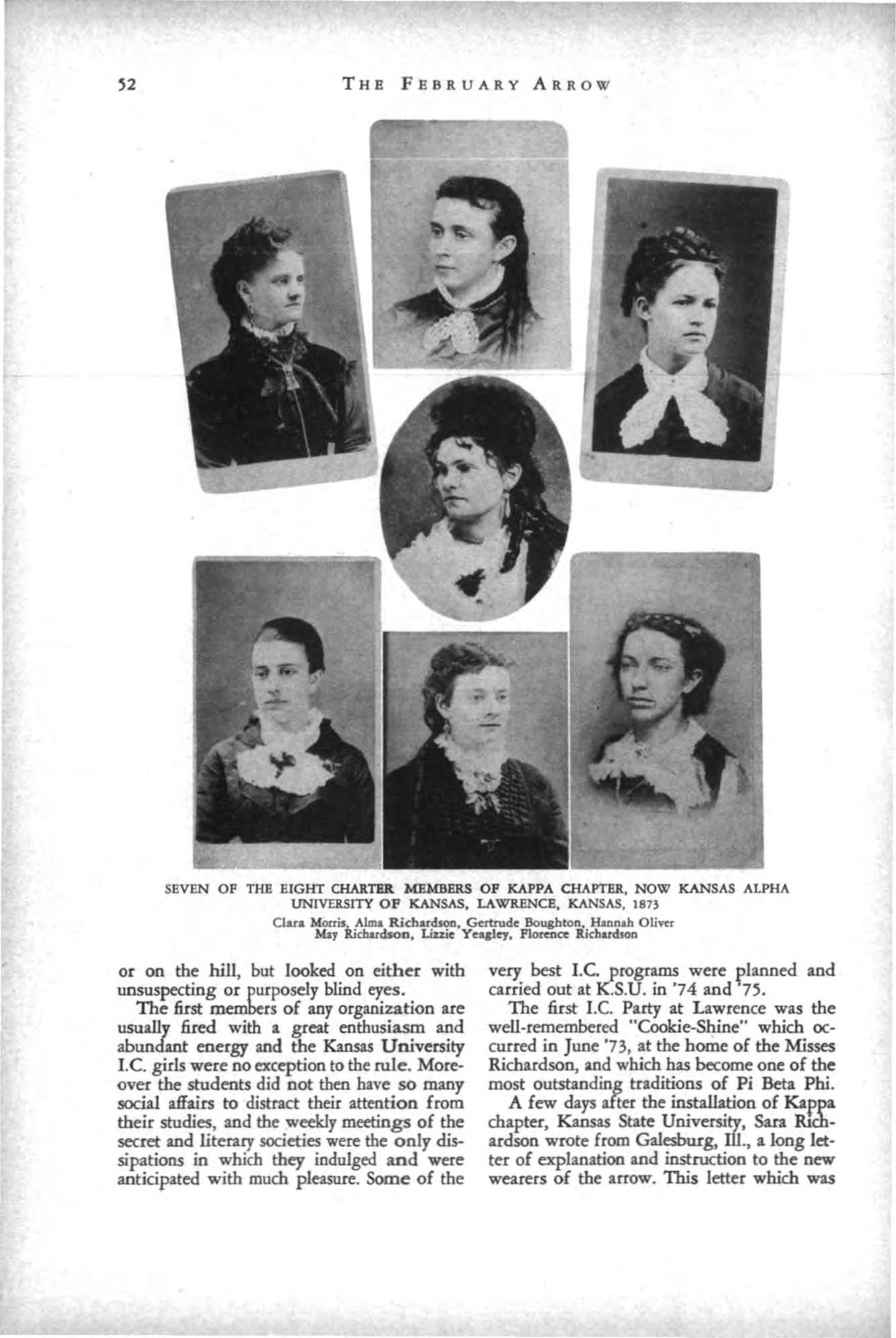
NOW
very best I e. programs were r.lanned aod carried out at ICS U. in ' 74 aod 75.
The first I.e. party at Lawrence was the well-remembered "Cookie-Shine" which occurred in June '73, at the home of the Misses Richardson, and which has become one of the most outstanding traditions of Pi Beta Phi .
A few days after the installation of Kappa chapter, Kansas State University, Sara RiChardson wrote from Galesburg, III., a long letter of explanation and instruction to the new wearers of the arrow. This letter which was
addressed to Hannah Oliver and Flo Richardson, was recently discovered in an old scrapbook belonging to Kansas A, and <inee it contains information not found elsewhere in the fraternity Archives, it is quoted in full. In this letter Miss Richardson explains why there is no Beta chapter in I.C Sorosis:
Galesburg, April 6th, 1873
My dear Sisters
Hannah & Fl o-
t was very much rejoiced indeed to get your letter last night and the Oaths. You afC now valid I .Cs. and permitted to wear the badge Give Meb and Alma the first oaths immroiately if you have not already done 50. ]t is better to wait till the three weeks expires but we have not always done 50, and in this case I think you would be justified in only waiting a week or two, or since it is necessary that you get in running order before Co mmencement you might make them full memo bers at once. I believe r would wait a week after the first promise though
The Constitution docs say we shall meet every week but we canno t always do it, 1 believe we met every week last term. We generally meet at the Fullers' room. We do not have l iterary exercises every time and so far have made them. voluntary, those who had the most time getting them up. The SO cents initiation fee is all the money that the Constitution requir es. If you want more f o r your books or any other purpose you are to raise it by a tax. We spent most of ours getting grub for our 5pree. You do not pay the Alpha ch apter any. thing As we arc all together up here except Clar we manage to get together nearly every night. We t old some of the boys in answer to their questions that we only meet once a day. We generally tell them that we meet at half past twelve Sunday nights on the roof of the University for i"isialiolt J and if any of them wish to join to present thon. selves there.
Each chapter has a President and all the Correspondi ng Secretaries etc. We have only elected Corresponding Secretaries for the chapters that have written to us I am President of I ota Chapter, Gen Dart, Secretary, (recording), Lou Hansen was Treasu.cer Gen Dart is Corresponding Secretary for the Epsilo n chapter at Greencastle, Indiana. Nell McKay for the Alpha Chapter at Monmouth, Gen Fuller for the Delta Chapter at Mt. Pleasant, Iowa, and I have acted as Corresponding Secretary foe the Gamma Chapter at Mt. Pleasant, Iowa.
According to the Constitution I conduct the Devotional exercises I read a chapter in the Bible and usually read a prayer from the Episcopalian book of Common Prayer as I do not feel mr.self competent to make a prayer ex tempore. We ave never used balls foe votmg Art. IV. Sec. 1. says "All officers shall be elected by ballot" and we have always used paper ballots. In Miscellaneous Art. I. Sec. IV. it says: "All voting shall be done by raising the right hand," and our members have been voted in that way. The vote mwt be unani. mous to admit any member
I suppose the Art. I. Sec. IV. includes all vat· ing unless it be the election of Officers and perhaps that. I do not think the other chapters use balls. It takes five members to constitute a quorum.
1u soon as you get live you must elect OfiiCt'IS Pro tem , to serve till Nov. 9th, 1873 when the annual electio n in aU ellapters will occur. In Art. III Sec. I, the 8th line does read "She shall be aware of the documents and papers of the society."
There is nothjng in the Oaths to prevent your changing pins with the Beta Theta Pis but the Monmouth girls do not do it and we do not. The gids wear the boys pins but won't let them have thtirs Em Fuller Jet Watson wear hers to school
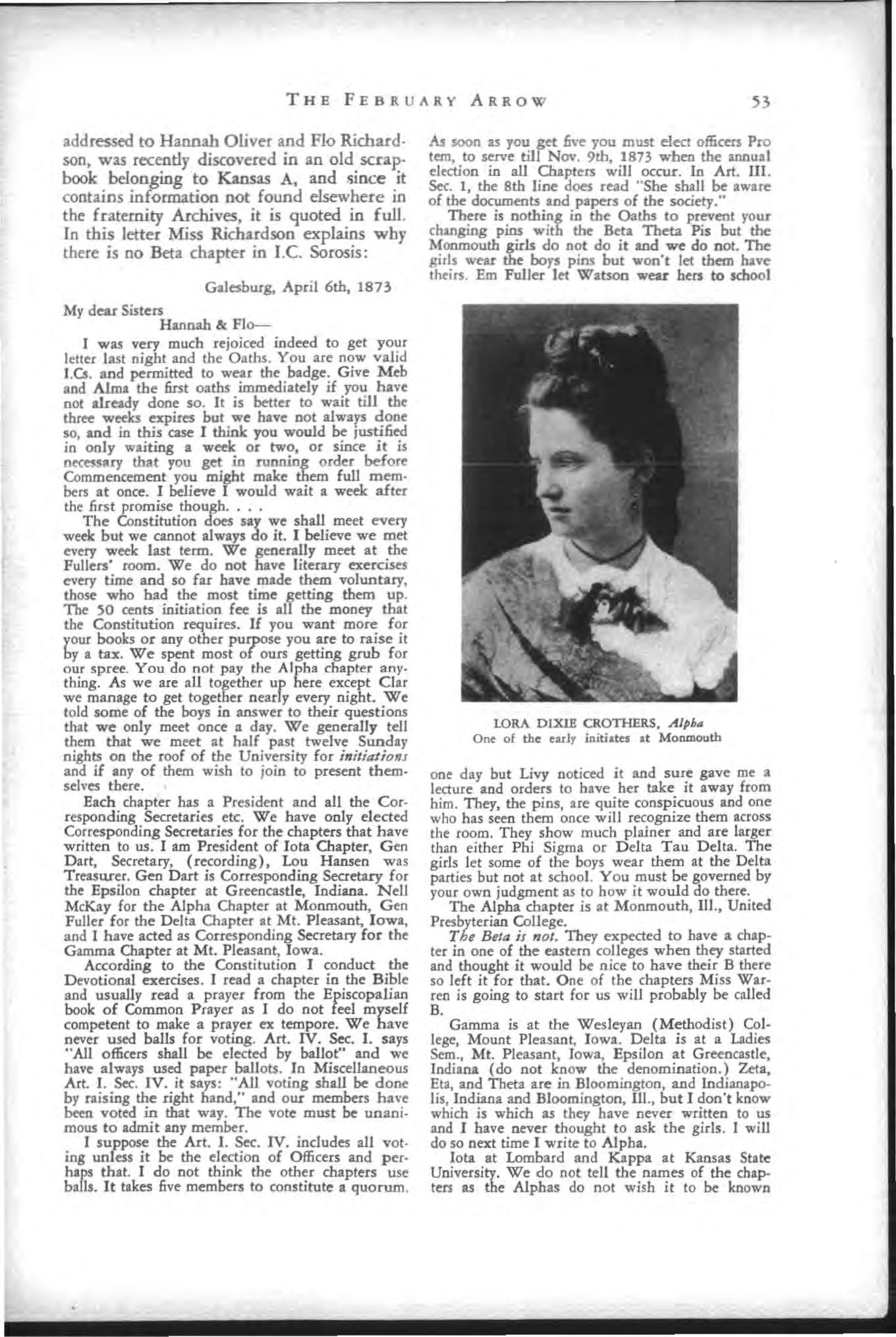
one day but Livy noticed it and sure gave me a lecture and orders to have her take it away from him. They. the pins, are quite conspicuous and one who has seen them once will recognize them across the loom. They show much plainer and are larger than either Phi Sigma or Delta Tau Delta. The girls let some of the boys wear them at the Delta parti es but not at school. You must be governed by your ow n judgment as to how it would do there.
The Alpha chapter is at 111.. United Presbyterian College.
The Bela iJ nOI. They expected to have a chapter in one of the eastern colleges when they started and thought it would be nice to have their B there so left it for that. One of the chapters Miss Warren is going to start (or us will probably be called B.
Gamma is at the Wes leyan (Methodist) College, Mount Pleasant, I owa. Delta is at a Ladies Sem., Mt Pleasant , Iowa, Epsil o n at Greencastle Indiana (do not know the denomination.) Zeta, Eta, and Theta are in Bloomington, and Indianapolis, Indiana and Bloomington, IlL, but I don't know which is which as they have never written to us and I have never thought to ask the girls. I will do so next time I write to Alpha.
Iota at Lombard and Kappa at Kansas State University. We do not tell the names of the chap.. ten as the Alphas do not wish it to be known
that they are Alpha till we get enough chapters to have a cataJogue published. While at Monmouth I saw the Catalogue of Theta Pi, they must have as many aJ chapters. Their Alpha Chapter WaJ at Miami where Toch used to go to school. It is dead I believe. They have gone clear thr ough the Alphabet and now name their chapters "M" or " 8S" (or B prime &) when a chapter dies they name a new chapter after it with the word prime attached, as after Alpha died they called a new o ne "Alpha Pr-ime." The Monmouth Chapter of B is "AA:' the Galesburg Chapter is Xi J believe the Bs have only two member! in Knox now, one of them is the S. P Dunlap that spoke at the contest. Among [hose who used to belong I saw the names o( George Churchill (Prof.). Cooke. Jim Parks, and lots of others. The Lawrence chapter was ont down there so I do not know its name. The boys will quiz you to know the name of your ch lptef when you come out but you h3d not better tell The Phi have their Alpha here and it is the only ooe they have now, too. The Delta Tau Delta chapter is umbda.
"I.e." mean s but the name is used.
We just have good times generally at "Pow Wow," talk, laut:;h, eat. si ng. turn "summersets." play ltap fr og, stand on our heads, or do any other ridiculous thinlt we happen to want to do. Gen Fuller and [ usually wind up with a waltz I dun ' t think you would be required to sit up with an I.e. if she had the smallpox.
We usually meet Friday or S3turday nights, sometimes Thursd ay nights The Monmouth g ir ls meet Tu esday nil;ht. You must suit your own con· venience there. We do. The President installs the officers and the Secretary the President. th e first Pres ident. I suppose. that is the way we did. None of the chapters have even had the letters put on their pins yet as they d o n ot wish the names of the chapters known , I was real disappointed at first when I found they did not have them on. They said if we choose we cou ld have "Iota" put on OUB but the Omega they think some of and having a charm on the chain in place of It and therefore do n ot wish that to be placed on any
of the pins , We had ours like the others, with· out any letters at all. The Mt. Plea.s:tnt Ch:lpter orders aU the pins and no one knows where they are made except that chapter, The pins are made to ordelj but I am going to write today and order one tor Clar and one for Em. Godspeed and will tell Lillie Cooper about you and teU her you will probably want , soon so she can have them on hand and you wont have to wait six months like we did. Will also request Alpha, Gamma and Delta chapters to write to you. If you are anxious abou t your pins you can address Miss lillie Coop· ee, Mount Pleasant, Iowa. El iza Patterson. ooe of the Monmouth gltls is the sweetest girl I ever saw. Lora Crothers looks a little like Celestia Miller only she is pretty and Celestia wasn ' t. She is one of the gayest $:irls I ever saw. Still I like her , Dr. W:lllace deSCribed her well when he told her she wu tht' most irrespressible girl he ever saw She is always n oisy and hungry and can talk ten times faster than I can.
Ella Fleming is shorter than Clar, red·headed, lisp and i5 real cute and sweet. Co Smith is un. like- their I like her better than J did, her folks are wealthy, live in a ni ce house and Co is rather ari .. toeratic. I am not much acquainted with (he other M onmouth girls. Hav e met them all but Flo Sterrett. You better not tell Tach what J have told you about Beta Theta Pi , The I.e. Sids ding to,ltether much better than I expected thq would We have taken " Batch" right away from the downtown folks and have serious intentions o n Genie Edwards Mrs. Liver. more is a member of the EriJon Chapter. What does Miss Leonard think a secret societies? Or wou ld you rather not have a teacher in so you can play all the pranks you want t o, Miss Warren makes a nice member. She is as ;olty as Iny of the girls. Don't let the boys know anything about it till you get your pins and write soon.
Sara
Ask any questions you wish and inquire about everything you don't understand Remember the oath about "documents &c" and keep my l etter where o nl y " I.Cs ," will get it.
Lambda chapter of I.e. $orosis, now Iowa Beta of Pi Beta Phi, was chartered on October 13, 1874 by Alpha a..pter and was installed by Estella E. Walters at Simpson Centenary College, Indianola, Iowa with the following charter members: Fannie Andrtw (Noble), Kate Barker (McCune), Ella Todhunter (Richey), Estella Walters (Ball), Ida Cheshire (Barker), Marie Morrison (Samson) , Louise Noble (Curtis) , Emma Patton (Noble), Elizabeth Cooke (Martin), Bessie Guyer (Linn) . The first initiate of the chapter was Clara
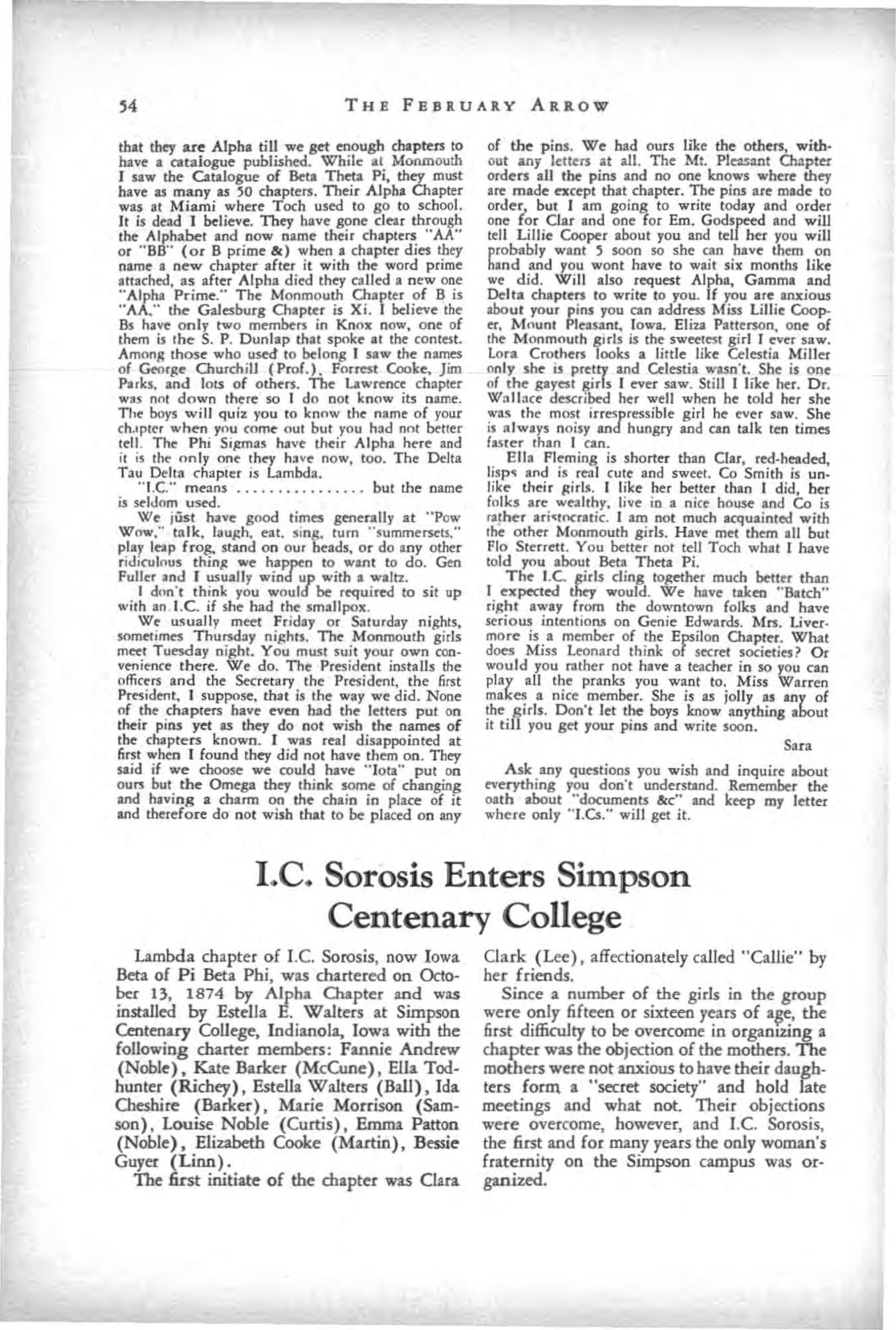
Clark (Lee), affectio nately called "Callie" by her friends.
Since a number of the girls in the group were only fift<en or sixteen years of a$e, the first difficulty to be overcome in orgaDlzing a chapter was the objection of the mothers. The mothers were not anxious to have their daugh ters form a "secret society" and hold late meetings and what not Their objections were overcome, however, and I.e. Sorosis the first and for many years the only woman', fraternity on the Simpson campus was ocganized.
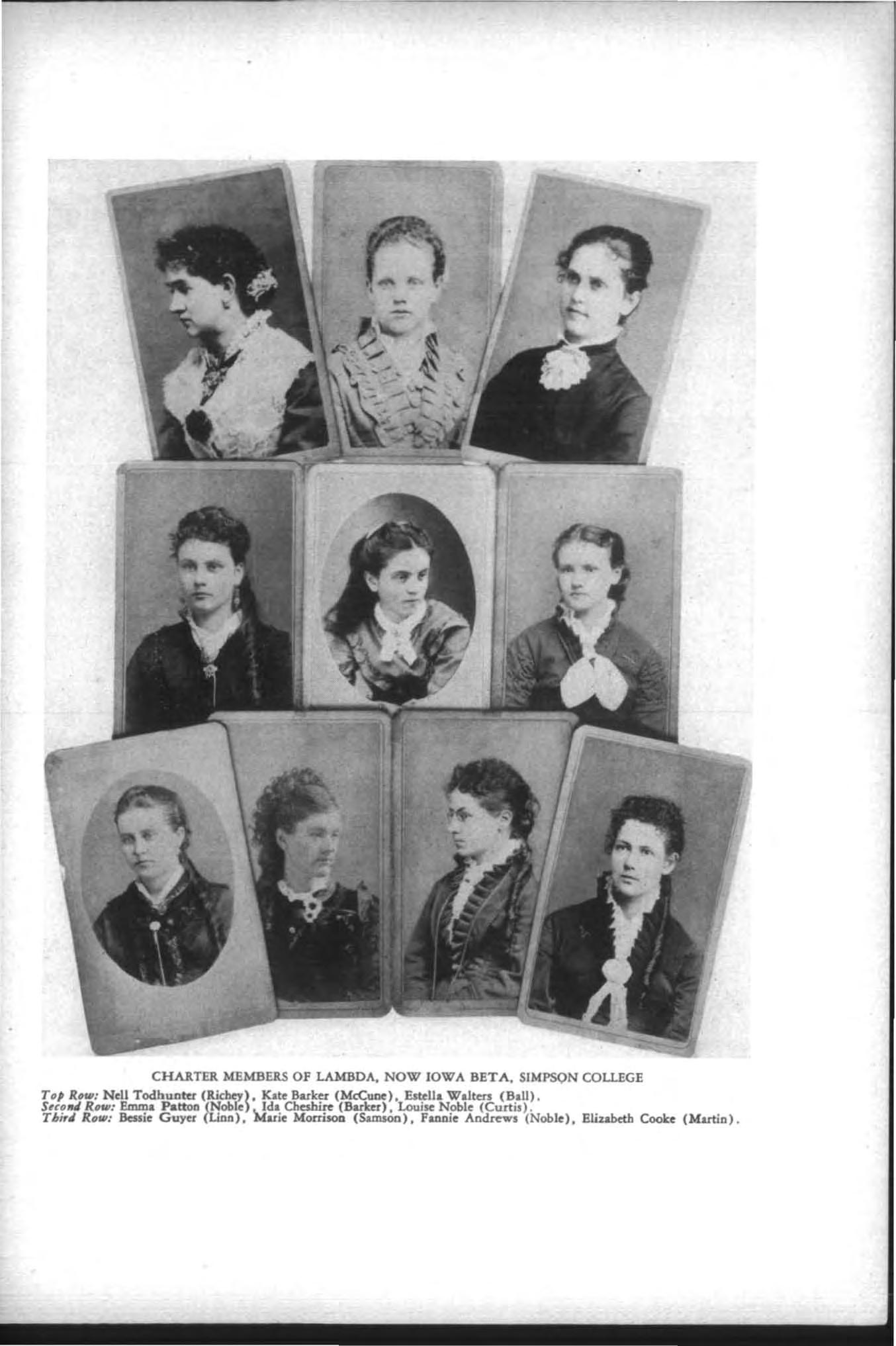
CHARTER MEMBERS OF LAMBDA NOW IOWA BETA. SIMPSON COllEGE
Ttl' It •• ,' Nell Todbuotu (Richey), Kate Barktt Este:lla Walten (Ball). SrultU It.tII : Emma Patton (Noble) Ida Cheshire (Bunr). LouiR Noble (Curtis) TbffJ R.w: Beuie Gu),er (Unn), Marie MorriJoo (SamiOo). Fannie Andrews (Noble). Bliubeth Cooke (Martin)
In writing of the founding of the chapter, Ida Cheshire Barker said:
"During the fall of 1874, when I was a sophomore, 1 received a letter from Anna Porter of Monmouth , Ill., who was an officer, asking me to get together ten girls and or· ganize an I. C chapter in Simpson College. I talked with Kate Barker and we chose eight more g irls who came to my home one eve-
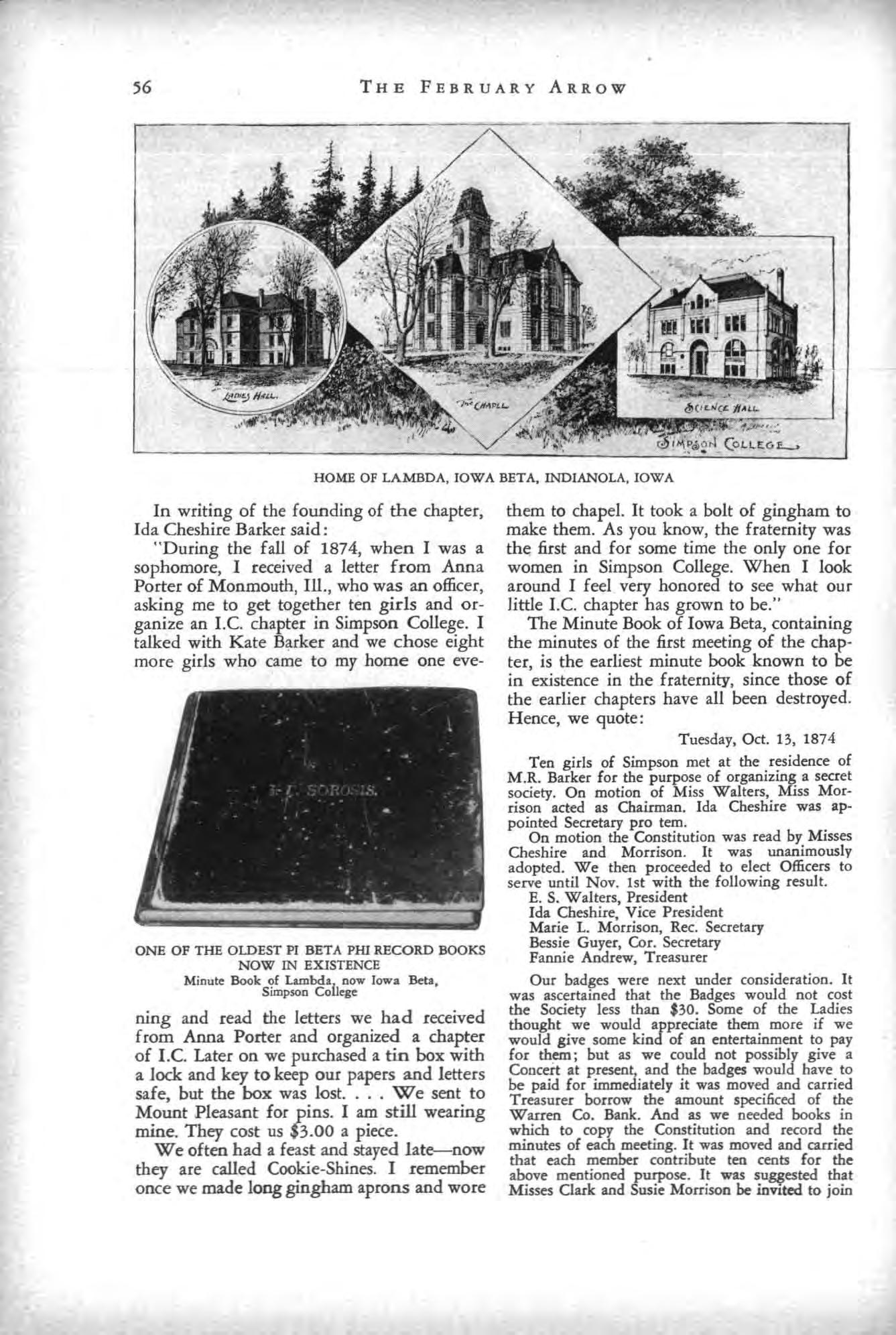
ONE OF THE OLDEST PI BET A PHI RECORD BOOKS NOW IN EXISTENCE
Minute Book of Lambda, DOW' Iowa Bda, Simpson Co lese
ning and read the letters we had received from Anna Porter and organized a chapter of I.C Later on we purchased a tin box with a lock and key to keep our papers and letters safe, but the box was lost. ... We sent to Mount Pleasant for pins . I am still wearing mine. They cost us $3.00 a piece.
We often had a feast and stayed late-now they are called Cookie·Shines I remember once we made long gingham aprons and wore
them to chapel. It took a bolt of gingham to make them. As you know, the fraternity was the first and for some time the only one for women in Simpson College. When I look around I feel very honored to see what our little I.C chapter has grown to be."
The Minute Book of Iowa Beta, containing the minutes of the first meeting of the chap· ter, is the earliest minute book known to be in existence in the fraternity, since those of the earlier chapters have all heen destroyed. Hence, we quote:
Tuesday, Oct. 13, 1874
Ten girls of Simpson met at the residence of M.R. Barker for the purpose of organizing a secret society. On motion of Miss Walters, Miss Morrison acted as Chairman. Ida Cheshire was appointed Secretary pro tern .
On motion the Constitution was read by Misses Ches hire and Morrison. It was unanimously adopted. We then proceeded to elect Officers to serve until Nov. 1st with the following result .
E. S. Walters, President
Ida Cheshire. Vice President
Marie L. Morrison , Rec. Secretary
Bessie Guyer, Cor. Secretary
Fannie Andrew, Treasurer
Our badges were next under consideration. It was ascertained that the Badges would Dot cost the Society less than $30. Some of the Ladies thought we would appreciate them more if we would give some lcind of an entertainment to pay for them; but as we could not possibly give a Concert at present, and the badges would have to be paid for immediately it was moved. and carried Treasurer borrow the amount specificed. of the Warren Co. Bank. And as we needed books in which to copy the Constitution and record the minutes of each meeting. It was moved and carried that each member contribute ten cents for the above mentioned purpose. It was sU8$ested that Misses Clark and Susie Morrison be inVited to join
this SorQ$ls As there was 00 farther business, we passed to general Pow Wow , then adjourned to meet in one wedc: . Ida Cheshire . Rec. Sec. pro tern.
Oct. 28, 1874
Society met at the residence of Jobn Cheshire and wu called to order by the President. Mter reading a portion of Scripture. Roll call omittM. Three absentees were marked, viz. T odhunter, An. drew and Morrison. Executive Committee was then appointed, consisting of Misses Cook. Barker and Noble. As the Constitution was unfamiliar with the Ladies, on motion two retired to another room and read it ove r. On the return of the ladies M iss Clark was taken in on probation .
The Simpson College chapter carried on well organized, systematic and loyal fraternity
as members of the sisterhood at present.
At a meeting in December 1874, " The Commi ttee to find out the poor in the town and to see if they need assistance reported that nn such were found."
The expense of buying pins caused much discussion after the organization of the chap . ter and it was finally " D ec ided at next m eet· ing that those who could pay for their badge s do so and that the others borrow, someone was to see a banker about getting $20."
In order to raise money for the chapter treasury: "Lambda decided to give a supper instead of to have a Festival a nd to charlle 10 cents admittance. Refreshments to conSist
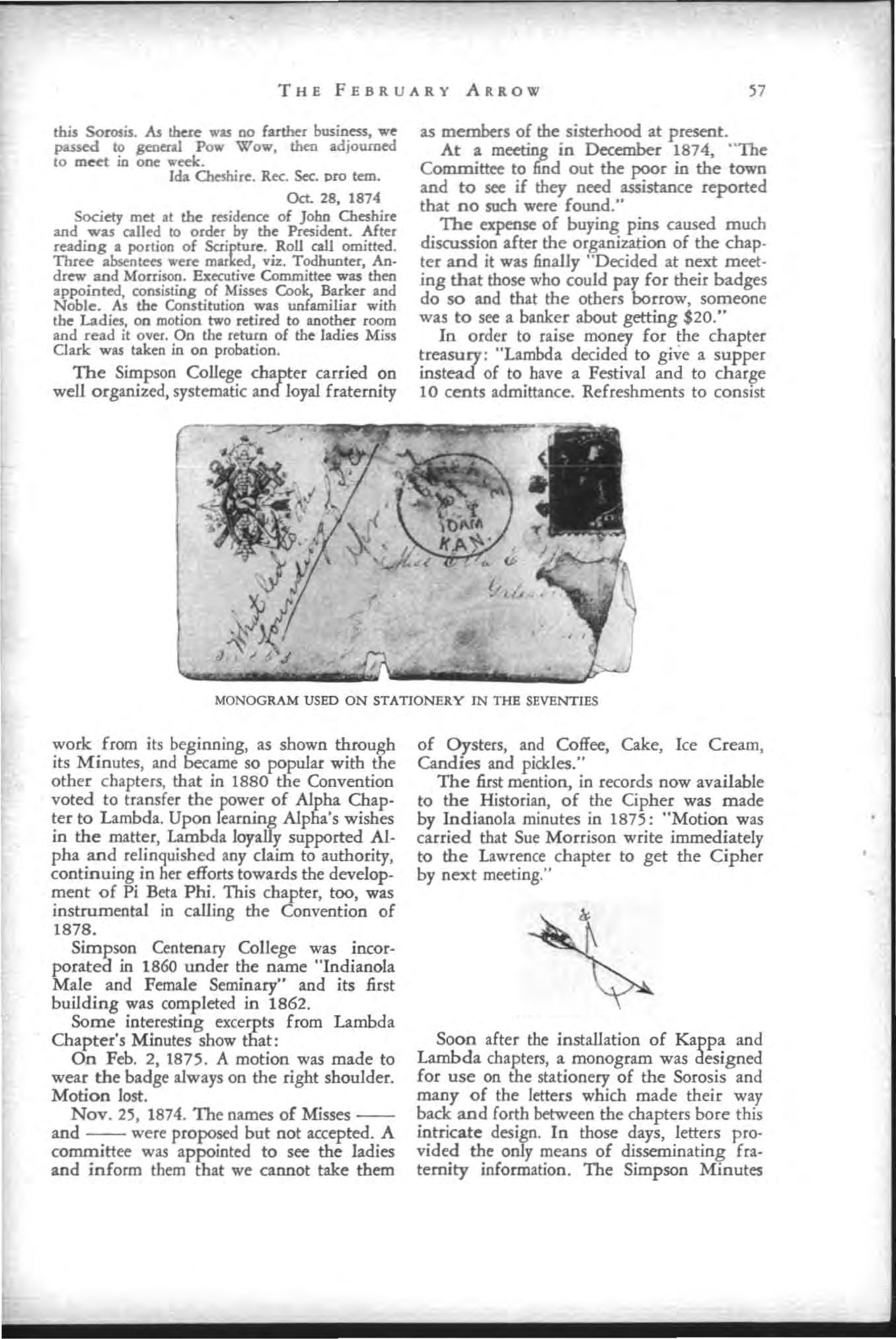
work from its begi nning, as shown through its Minutes , and became so popular with the other c hapters, th at in 1880 the Convention voted to transfer th e power of Alpha Chapter to Lambda . Upon fe arning Alpfia's wishes in the matter, Lambda loyally supported AI· pha and relinquished any claim to authority, continuing in her efforts towards the development of Pi Beta Phi. This chapter, too, was instrumentaJ in calling the Convention of 1878.
Simpson Centenary College was incor· porated in 1860 under the name "Indianola Male and Female Seminary" and its first building was completed in 1862 . Some interesting excerpts from Lambda Chapter's Minutes show that:
On Feb 2, 1875. A motion was made to wear the badge always on the ri g ht shoulder. Motion lost.
Nov . 2', 1874. The names of Misses and were proposed but not accepted. A committee was appointed to see the ladies and inform them that we cannot take them
of Oysters, and Coffee, Cake, Ice Cream , Candies and pickles."
The first mention, in records now available to the Historian , of the Cipher was made by Indianola minutes in 187': "Motion w as carried that Sue Morrison write immediately to the Lawrence chapter to get the Cipher by next meeting :'
Soon after the installation of Kappa and Lambda chapters, a monogram was designed for use on the stationery of the Sorosis and many of the letters which made their way back and forth between the chapters bore this intricate design. In those days , letters pro· vided the only means of dissemin at ing fra· ternity information. The Simpson Minutes
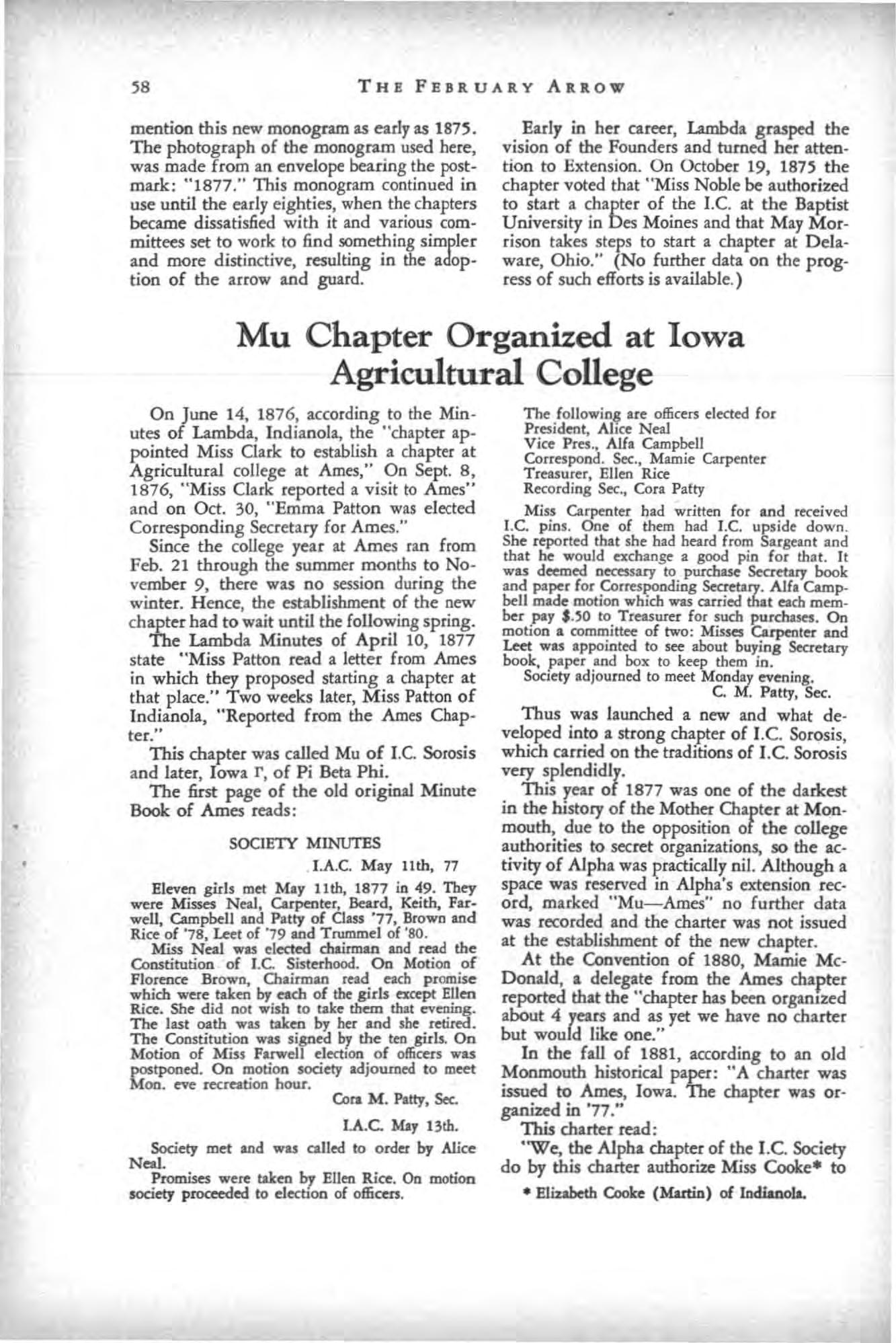
mention this new monogram as eady as 1875. The photograph of the monogram used here, was made from an envelope bearing the postmark: "1877." This monogram continued in use until the early eighties, when the chapters became dissatisfied with it and various committees set to work to find something simpler and more distinctive, resulting in the adoption of the arrow and guard.
Early in her career, Lambda grasped the vision of the Founders and turned her atten· tion to Extension. On October 19, 1875 the chapter voted that "Miss Noble be authorized to start a chapter of the I.C at the Baptist University in Des Moines and that May Mor· rison takes steps to start a chapter at Del.· ware, Ohio " (No further data on the prog· ress of such efforts is available )
On lune 14, 1876, according to the Min· utes 0 Lambda , Indianola, the "chapter appointed Miss Clark to establish a chapter at Agricultural college at Ames,' · On Sept. 8, 1876, ··Miss Clark reported a visit to Ames" a nd on Oct. 30, "Emma Patton was elected Co rresponding Secretary for Ames ."
Since the coUege year at Ames ran from Feb. 21 through the summer months to No· vember 9. there was 00 session during the winter. Hence, the establishment of the new chapter had to wait until the following spring.
The Lambda Minutes of April 10, 1877 state "Miss Patton read a letter from Ames in which they proposed starting a chapter at that place." Two weeks later, Miss Patton of Ind,!a nola, "Reported from the Ames Chap· ter.
This chapter was called Mu of I .e. $orosis and later, Iowa r, of Pi Beta Phi.
The first page of the old original Minute Book of Ames reads :
lAC. May 11th, 77
girb met May 11th, Ian in 49 . They were Misses Neal, Carpenter, Beard, Keith . Farwell, Campbell and Patty of Class '77, Brown and Rice of '78, l.cet of '79 and Tcummel of 'so.
Miss Nffi was elected chairman and read the Constitution of I.e. Sisterhood On Moti on of Florence Brown, Chairman rtad each promise which were taken by each of the girls accpt Ellen Ricc . She did n o t wish to take them that evening. TIle last oath was taken by her and sbe retired . The Constitution was sired by the ten girls. On Motion of Miss FarweI cJectton of officers was postponed . On motion society adjourned to meet Mon. eve recreation hour.
Cor. M. Patty, Sec.
lAC. May 13th.
Society met and was called to order by Alice Neal.
Promises were taken by Ellen Rice. On motion society proceccled to election of officers.
The follow in$" arc officers elected for President, AlI ce Neal
Vice Pres ., Alia Campbell
Correspond Sec., Mamie Carpenter
Treasurer, Ellen Rice
Recording Sec., Cora Pafty
Miss Carpenter had written for Ilnd received I.e. pins . One of them had I.e . upside down . She reported that she had heard from Sargeant and that he would exchange a good pin for that . It was deemed necessary to purchase book and paper for Cormiponding Secretary. Alf. CampbeU made motion wbich was carried that each member pay '.'0 to Treasurer for such purchases . On motion & committee of two : Misses Carpenter and Leet was appointed to see about buying Secretary book. paper and box to keep them in.
SocIety adjourned to meet Monday evening.
C. M. Patty, Sec
Thus was launched a new and what de· veloped into a strong chapter of I.C Sorosis , which carried on the traditions of I.C Sorosis very splendidl;.
This year 0 1877 was one of the darkest in the history of the Mother Charter at Mon· mouth, due to the opposition 0 the college authorities to secret organizations, SO the activity of Alpha was practically nil. Although a space was reserved in Alpha's extension record, marked "Mu- Ames" no further data was recorded and the charter was not issued at the establishment of the new chapter.
At the Convention of 1880, Mamie Me· Donald, a delegate from the Ames chapter reported that the "chapter has been organtzed about 4 years and as yet we have no charter but would like one."
In the fall of 1881 , according to an old Monmouth historical paper: "A charter was issued to Ames, Iowa . The chapter was organized in '77."
This charter read:
'We, the Alpha chapter of the I.C Society do by this charter authorize Miss Cooke- to • Elizabeth Coolce (Martin) of Iodianola.
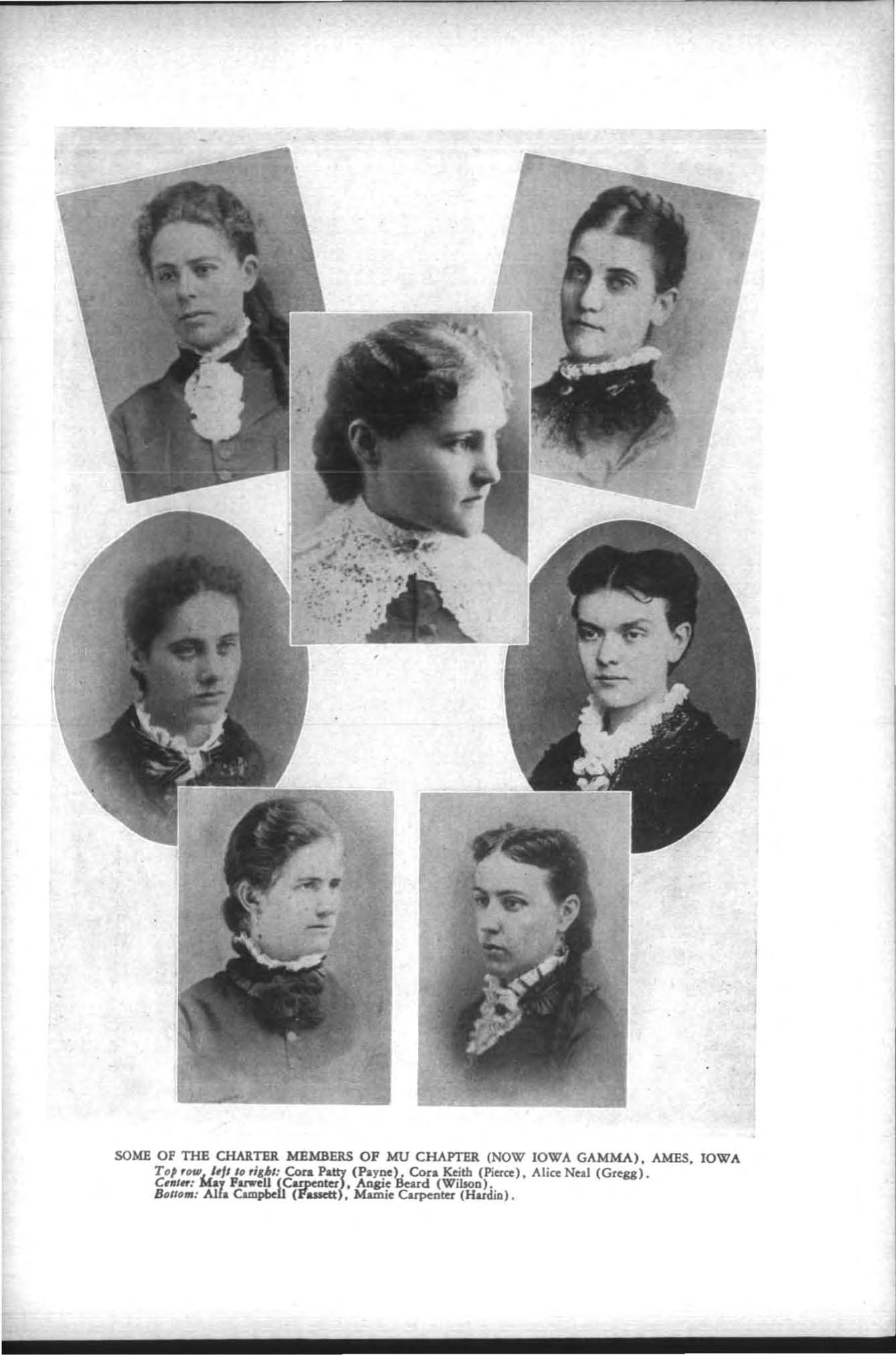
establJSh a chapter of the I.e. sisterhood in the Iowa Agricultural College, Ames, Iowa, to be known as the Mu chapter. We do hereby agree to recognize them as sisters as long as they conform to the rules and regulations of the Constitution. But should they refuse obedience and neglect the ordinances as set before them in the Constitution then this shall be considered of none effect. Given under our hand at a speciaJ meeting at Monmouth, Ills.
(Signed) Nettie e. Braiden. Pres . Georgina J . Burlingin Cor. Sec."
The full names of those listed in th e Minute Book under Roll call on May II , 1877 were : Alice Neal (Gregg), Cora Patty (Payne), Cora Keith (Pierce) , Mary Farwell (Carpent«), Angie Beard (Wilson). Florence Brown (Martin), Mamie Carpenter (Hardin), Emma G. Trummel (Sibley) , Ellen Rice (Robbins) , Jennie Lee! (Wattles) , and A1fa Campbell (Fassett)
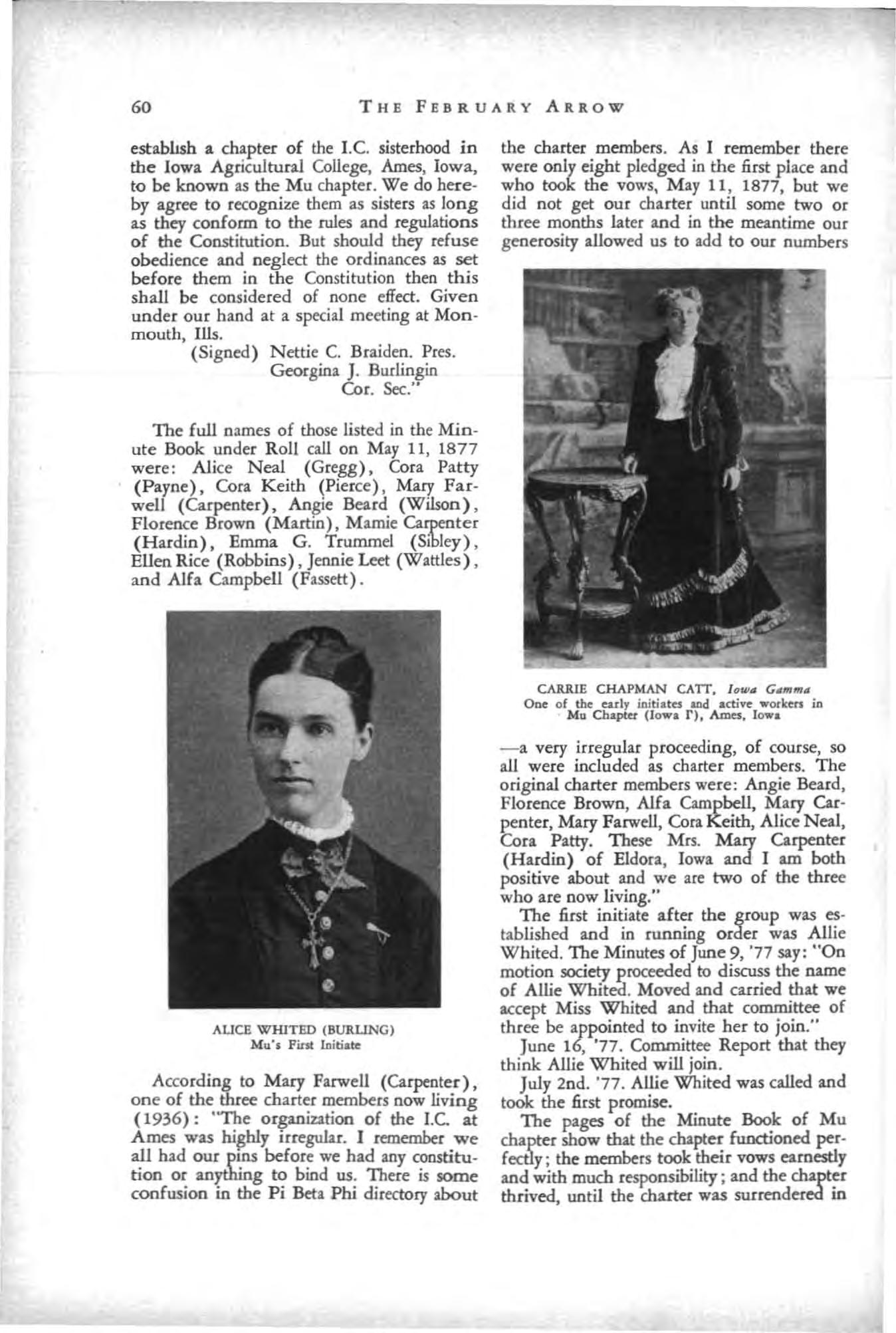
AUCE WHITED (BURLING) Mu's First Initiate
According to Mary Farwell (Carpenter). one of the three charter members now living (193 6): '"The organization of the I.e. at Ames was hil!h1y irregular. I remecnber we all had our PIOS before we had any constitution or anything to bind us. There is some confusion in the Pi Beta Phi directory about
the charter members. As I remember there were only eight pledged in the lirst place and who took the vows, May II , 1877, but we did not get our charter until some two or three months later and in the meantime our ge nerosity allowed us to add to our numbers
CHAPMAN CAIT , I DWII Gil",,,,. of the cui, an d actiff worken in Mu Cb aptu (lowl r), Ames, JOWl
- a very irregular proceeding, of course, so all were included as charter members. The original charter members were : Angie Beard, Florence Brown, A1fa Campbell, Mary Carpenter, Mary Farwdl, Cora Keith, Alice Neal, Cora Patty. These Mrs . Mary Carpenter (Hardin) of Eldora , Iowa and I am both positive about and we are two of the three who are now living."
The lirst initiate after the group was established and in running order was Allie Whited . The Minutes of June 9 , ' 77 say: "On motion society proceeded to discuss the name of Allie Whited. Moved and carried that we accept Miss Whited and that committee of three be appointed to invite her to join."
June 16, '77 Committee Report that they think Allie Whited will join.
July 2nd. '77 Allie Whited was called and took the lirst promise.
The pages of the Minute Book of Mu chapter show that the chapter functioned perfectly ; the members took their vows earnestly and with much responsibility; and the thrived, until the charter was surrendered 10
1894' due to anti ·fraternity laws in the col· lege. Later in 1906 the chapter was re-established.
The Iowa Agricultural CoUege (Iowa State College) was opened in 1868 and was coeducational from the beginning. The school terms wtee during the summer for two rea· sons: first, since there were no (or few) laboratories, the summer gave the students an opportunity for carrying on practical ex-
• Some records give the date when the antifraternity legislation was passed as 1891. Due. however, to a court appea l carried on by one o f the men's fraternities, Mu did not surreodu her charter 10 Grand Council until June 6, 1894.
periment. in agriculture, etc.; in the second place, the long winter vacation made it possible for many students to finance themselves by teaching the winter term in country schools. The college motto is: " Science with practice" and the college was one of the pioneers in develot'ing education along the Jines of applied SCIence, rather than confin· ing itself to classical fields In the early years, the students had daily tasks as well as thar studies. Of course this was modified as the numbers increased. but the winter graduating class lasted down to the fall of 1900. The fall beginning of the school year cacne a few years before that.
While the new chal'ters of the fraternity were flourishing, the situation at Monmouth College, the home of Alpha, had become very critical For some time there had been an undercurrent of unrest due to the feeling that the governing body did not approve of secret societies and fdt that donations might be given to the endowment fund, if the societies were forbidden.
President Wallace, who was himself a member of Beta Theta Pi, and had a son in the Beta chapter at Monmouth, was sympathetic to college fraternities, but some sections of the United Presbyterian church used pressure, and at a meeting of the Senate of Monmouth College in June 1874, the following statute was passed:
It shaJJ be unlawful for aoy student of the college hereafter to Mcome a member of any secret colJege fraternity or to connect with any chapter of any such fraternity, and also for an active member of such fraternity to be admitted as a student in the college.
The available Pi Beta Phi records do not give detailed data on the following two years at Monmouth. A letter , however, written by Alice Pillsbury of Alpha of Kappa Kappa Gamma at Monmouth , to Ida WOOdburn at Indiana University, gives an excellent picture of the si.tuation, and undoubtedly reBeets the ideas of the I.Cs. wbo were at Monmouth at this time. We quote from the History of Kappa Kappa Gamma:
June 21, 1874
.. And now I have some very serious an d melancholy news to cdate, something that we bave been expecting for some time. The col· lege senate has made a law that after this,
students on entering college must sign an agreement not to join a secret society while in schooL Do you think this is going to finish us? Do you think we are going to sub· side? Not by any means! It only puts us to the trouble of taking in our members before they enter college. The initiations yesterday were part of this plan. This of course will make a change necessary in one article of the constitu· tion, so that we may initiate persons who not only 'are or have been in attendance, etc.' but also those who will be. We know you will grant this in sympathy for our troubles. But the two girls initiated yesterday have attended the college here, though not last yea r. I guess I won't take time to explain how it came about this time,-my letter is already so long. It will cause us mnch trouble no doubt, but trust us to face it , and never give up."
And again on July 13, 1874, acco rding to the Kappa Kappa Gamma History, Alice Pillsbury, Monmouth, '73, wrote to Ida Woodburn:
"None of the fraternities here think that senate law is going to hurt anybody. There's nothing against those who are already mem o bers, and they do not have to sign it until the junior year, SO it leaves a pretty good chance. We shall begin the year with seven members which is more than we have started the year with before, so don't feel much troubled .... "
There is a difference of opinion among some of the Members of Alpha of I.e. as to the events in the middle seventies. Leonora S. Bosworth states: "I think it was in my senior year, '7' when the sororities and fraternities were required to give up their charters. Anna Glenn and I were the two called up before
REPRODUcrlON Of A TINTYPE OF GROUP TAKEN AT SEMINARY fOR WOMEN GREENVILLE. IllINOIS
Kate Ridaey, Jessie Buckner. Annie Banub.cb lUll Lessie Buck, Lrid. Kendall
Rill. Cur, Hdea Beat, Pan Wricht
Jessie Buckner. Rill, Cur. Leuie Buck and fan Wri&btA. I.e. ., lelt Monmouth CoUqe .nd ....ent to Grttn.lIle as the resu.1t of Azlti·Fratttnity Houbles at Monmouth In 1876.
the faculty as representatives of I.e. to promise that I.e. would not run sub rosa and I.e. never broke its word."
Some of the fraternity chapters at Monmouth may not bave considered they were continuing "sub-rosa" but they did continue to e:rist, although in a precarious fashion. Records show the initiations of members of
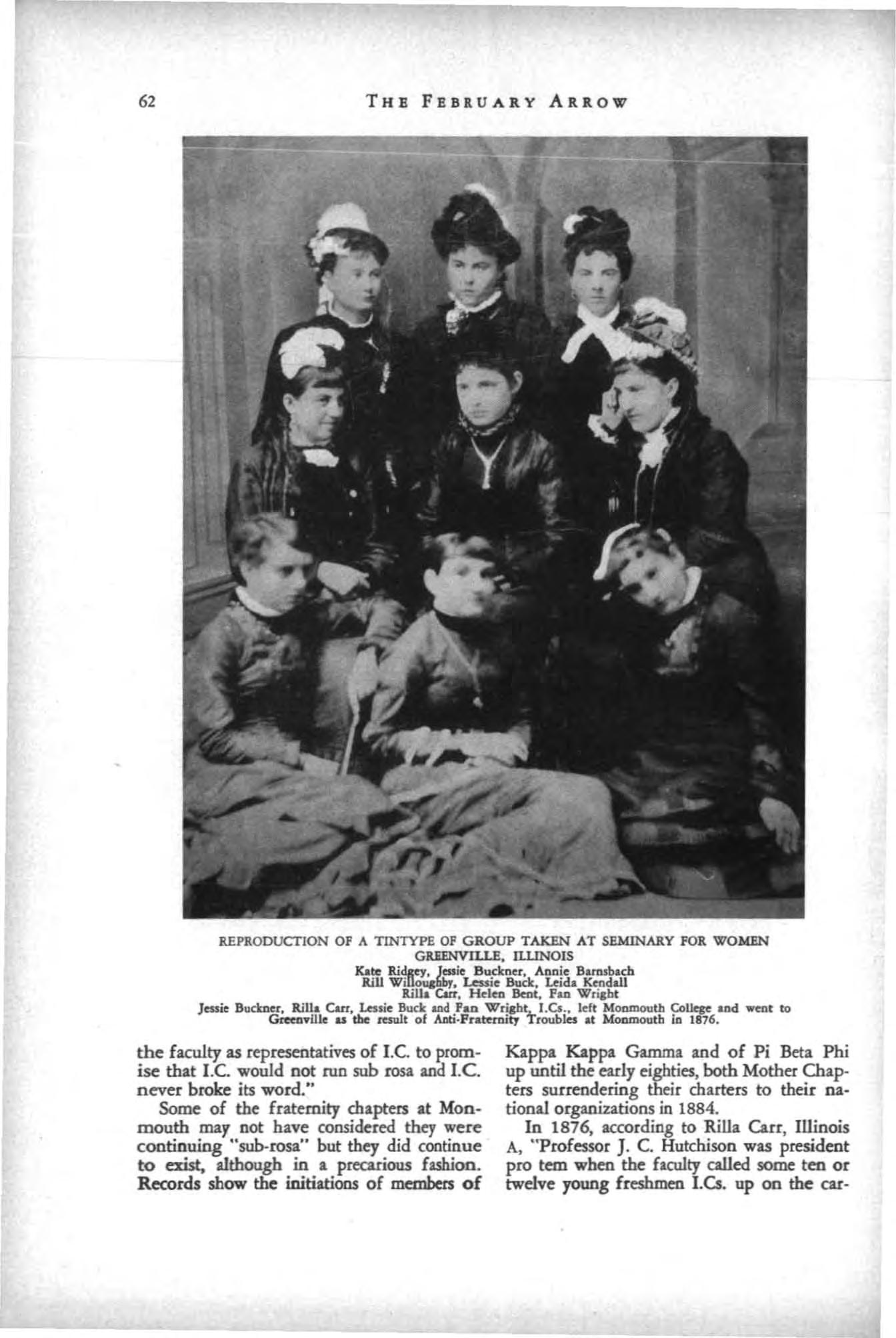
Kappa Kappa Gamma and of Pi Beta Phi up until the early eighties, both Mother Chap. ters surrendering their charters to their national organizations in 1884.
In 1876, according to Rilla Carr, Illinois A, " Professor J. e. Hutchison was president pro tem when the farulty called some ten or twelve young freshmen I.u. up on the car·
pet. While the authorities were fairly certain as to the identity of the rest of the I.Cs. they directed their attack just upon these freshmen . The girls felt that it was not quite right that all the wrath should descend upon them, so at a special meeting of I.e. they took the matter up with their older sisters. It was decided that all of the girls in I.e. should show their badges at chapel The Betas agreed to show their badges with them . There was such an uproar at this bold flaunting of pins that dasses were discontinued for five days.
"Those who had defied the college ruling against secret societies were told either to leave their society or to leave the institution."
The I.Cs. contended that the only way to leave their society was to be put out of it-a dishonorable discharge. So, refusing to take such a discharge, Lessie Buck (MacDill), Jessie Buckner, Fannie Wright (Graham) and Rilla Caer left Monmouth College and went to attend the Seminary for Women at Greenville, Illinois.
Many of the girls, however, were unable to go away to school and were forced to fioish their education at Monmouth.
Corroborating Miss Carr's statement is a letter which appeared in the official magazine of Beta Theta Pi in March 1878 and which was requoted recently by Karl W Fische r, n e n, in an article entitled, "A Chapter on the Prairies." We Quote:
"Alpha Alpha has yielded to the inevitable. In 1874 the Senate of Monmouth College passed a law prohibiting fraternities, but the cha pter has flourished nevertheless. Being compelled to enforce the law, the Faculty recently set upon several young ladies who had unwisely shown their badges, and the Betas gallantly showed their badges and a willingness to be crucified with the fair ones.
"With the alternative of leaving their societies or the institution, some withdrew and others left for other colleges. Al p!,. Alpha decided to disband for the present until the June meeting of the Senate when a strong effort will be made to rescind the anti.society law . Her present members are William Wallace, son of ex-president; Edgar MacDill, son of Professor MacDill ; Frank Quinby, son of one of the trustees of the college, McCo y, M. L. Evans, W E. Nicbol and J Reynolds."
"There was no change in the status of the rule in June and the records of Alpha Alpha were surrendered. Frank Quinby transferred to the Univ. of Michigan Several members
of the Monmouth Phi Kappa Psi char,ter transferred to the University of Chicago '
Although this open warfare disrupted fraternity affairs for a time, the Alpha chapters of Kappa Kappa Gamma and Pi Beta Phi evidently contlOued to exist as the History of Kappa Kappa Gamma shows that members were initiated into the Alpha chapter as late as 1882, making the total membership about 40. The records of Pi Beta Phi show that members were initiated into Alpha chapter every year from 1867 to 1883 inclusive, with a total membership of 85. The various chapter records show official letters received from Monmouth at various times during the years: 1875, 1877, 1880, 1881, 1882, 1883, 1884.
There would be long lapses with no word from the Mother Chapter and then at times when vital events took place in the fraternity, demanding action, Alpha would revive and be very much alive. Her negligence in the matter of correspondence though was most disheartening to the chapters.
That the membership of the I.e. $roup was a secret is evidenced by a letter written June 16, 1882 by Jessie Buckner, Alpha, to Sarah Heaton , Iota , as foUows:
"Miss Patterson (lida Patterson '74) has not said anything to us yet but she told Pres McMichael that Georgie Burlingin (one of the se niors) was an I.e. Wasn't that the meanest thing? I think she ought to have a dishonorable dismissal for it."
During the spring of 1883 in fact on April 11, 1883, Rilla Carr of Monmouth wrote a letter to Galesburg in which sbe said: "You will lind on the next page a list of our active members: Fannie Wright, Ella Porter, Jessie Bu ckner, Mrs. Hattie Joel, Nannien Thompson, Fannie Marshall, Anna Martin, Jennie Hardin, Minnie Babcock, Jessie Babcock, Rilla Carr "
Stella H. Osborn, one of the last of the Illinois Alpha initiates wrote to the Historian on June 11, 1935:
I graduated from Monmouth College in 1886. Must have been initiated in 1883 or 1884. It was all very secretly done. If the Faculty of Monmouth College found out, we expected to be expelled and were constantly on the anxious seat. We did not even divulge what I.e. stood for to even ourselves. I cannot remember who the other girls were joining at same time. Ella Porter (Gillespie) and Nan Thompson (lord) were at the head of things and I think Minnie McDill (Mc-
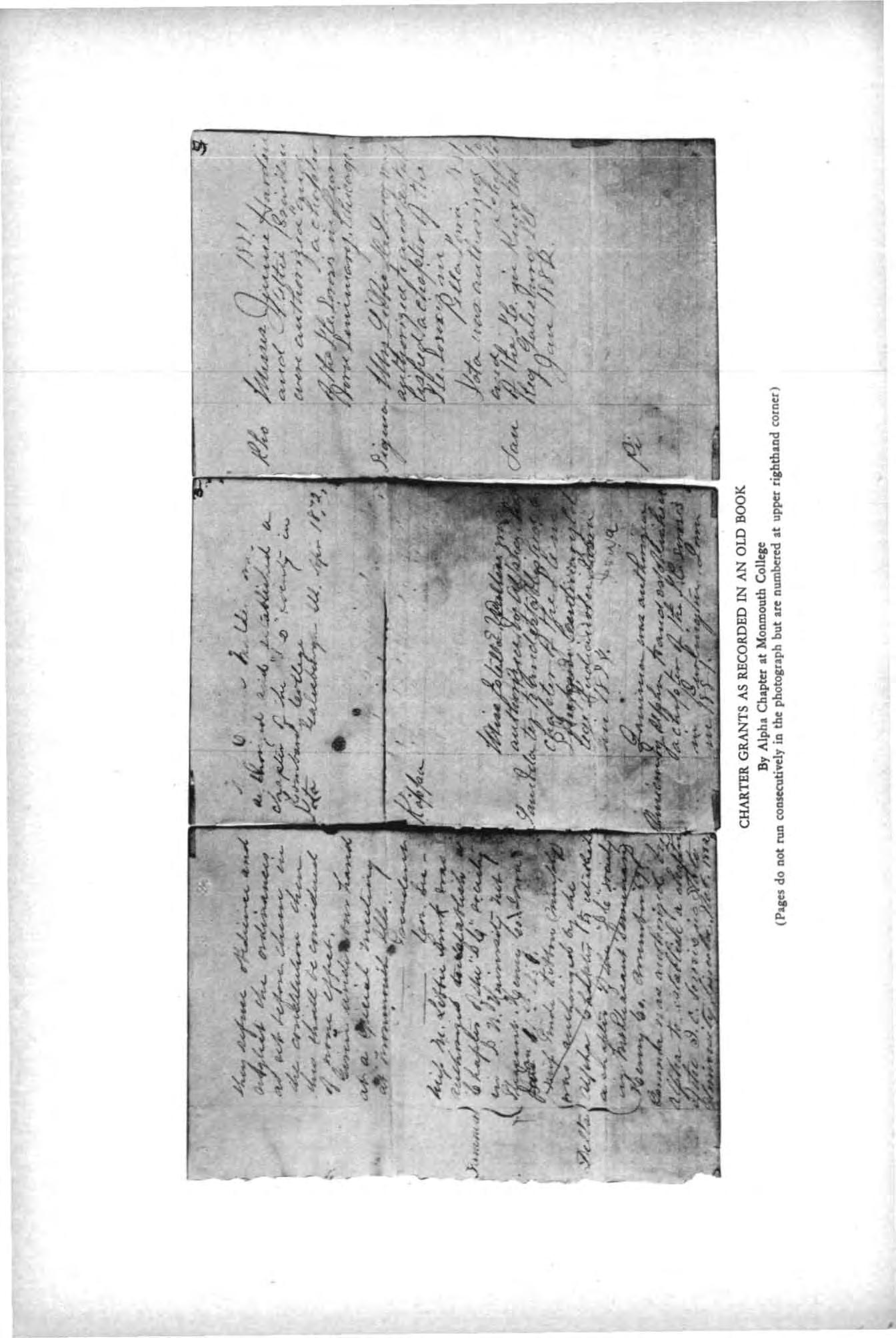
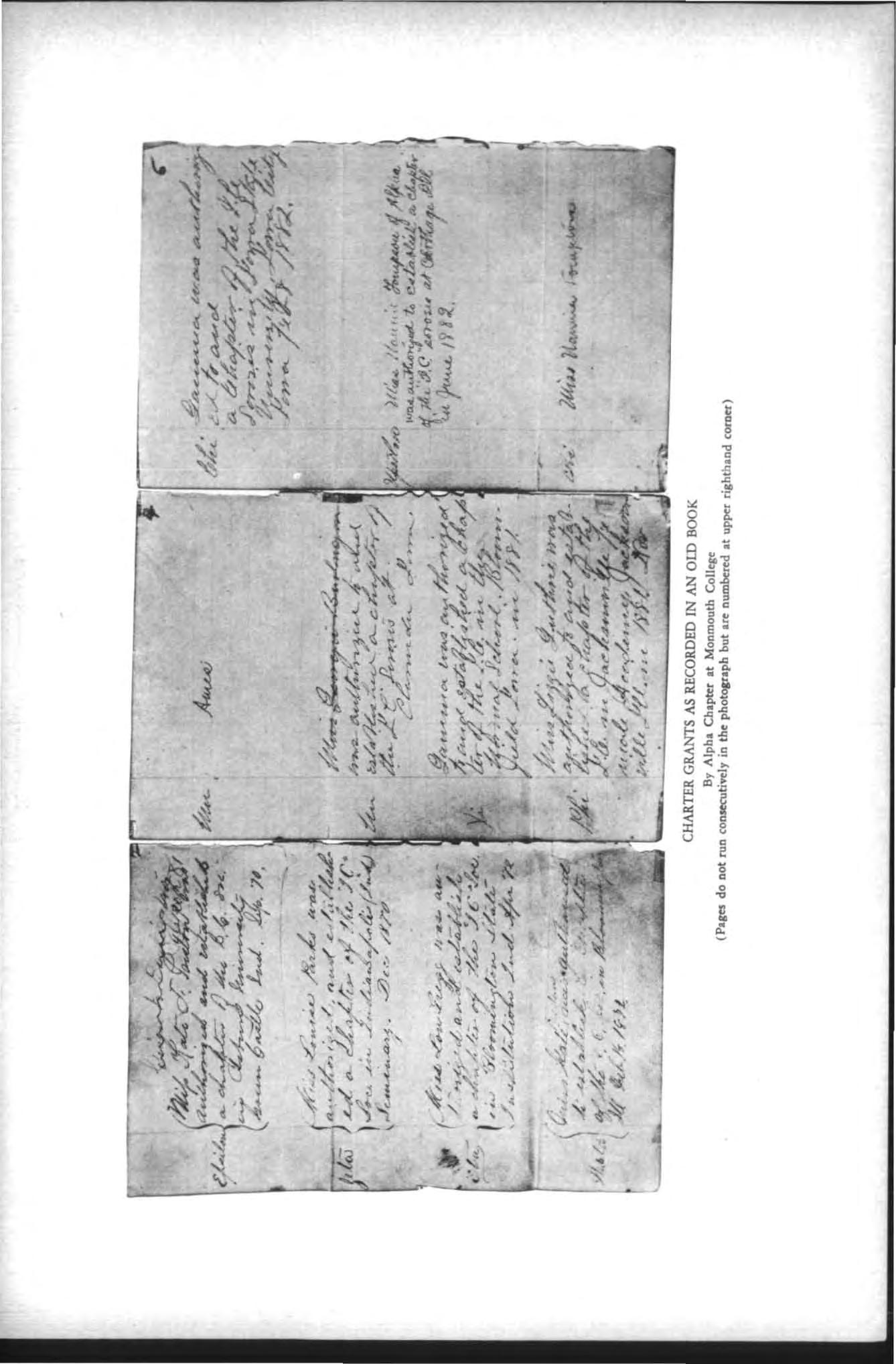
Michael) • and Lizzie Brown were two of the girls initiated with me. We were in the same class. We wore no pins on the campus and did not dare to carry on openly. It was truly a 'Secret Society'."
With the Mother Chapter existing under such trying circumstances, records were not preserved as they might otherwise have been and only a few original records are available showing what transpired at Monmouth during those "sub·rosa" years-most of these are letters.
The history of these early days has been pieced together bit by bit like fitting parts of a jig saw puzzle, from old letters in chapter Archives, from chapter Minute Books, Constitutions, Convention Minutes and from some old papers sent to the national Archives in 1910 by Emma Brownlee Kilgore, Founder, who wrote: "When the faculty was after the I.Cs. they destroyed the books-they should have given them to me, but here ace the oldest papers I have. I laugh ed when I read the Preamble. It sounds just like Nan Bla ck. I feel sure she is the author."
Among Mrs. Kilgore's papers were some pages torn from a record book which contained part of the Constitution of I.C . Sorosis and what IS most valuable-the list of the ea rly c harter grants. just as they were entered in the book, in the various
• Minn i( McDill h:'l.d heen initio atN into Illin'lis r. CJrthagt" Collt",.:c before gomg til l!.lonmtlurh
handwritings of the members of Alpha. These charter grants show the names of chapters, dates and persons establishing the chapters.
Alpha struggled for existence until the Convention of 1884 asked her to give up her power. Even then she continued to carry on after a fashion until somewhere around 1888.
Apparently all outward fraternity activity ceased at Monmouth in 1884. Some locals sprang up in 1889 but were discontinued again in 1910, being re-establi shed in 1922.
National fraternities were permitted to return to Monmouth College in 1925 In 1928 Pi Beta Phi re ·established the Mother Chapter by chartering a local petitioning group as Illinois A.
It is truly remarkable that the chapters were able to keep up their national interest in I.e. Sorosis in the face of the fact that the Mother Chapter, being so handicapped, functioned only spasmodically.
There came periods of silence and nonactivity on the part of Alpha and at such times the c hap ters tried to go forward to the best of their ab ility. It was natural that they should resent in a way, Alpha's insistence, whenever she revived , that she retain the leadership in fr aternity affairs, because some of the chapters felt that she was laboring under too great a handicap in the face of the anti-secret society opposition on the part of Monmouth College authorities. The chapters did, however. remain loyal to Al p ha to the end.
A panoramic glimpse of the details of chapter life during the first fifteen or twenty years in the history of Pi Beta Phi will undoubtedly lead to a betrer comprehension of the various steps in the development of the fraternity.
In the beginn in g , tile ch.lpter meeting was the chief interest of rhe members . There were then few or no activ iti es-n o co llege annuals to be edited. few athletic events to attend . no college papers rC9uireJ re po rting -in fact, the girls looked forward to the ch3pler meetings with real pleas ure as actual diversion from college work.
These early chapters were, for the most part, in colleges where, save for the chapters themselves and the men's organizations, the
fraternity idea was unknown . The I.Cs . were without fraternity literature, there being no fraternity magazine as yet, and the only way of exchanging ideas with other chapters was through letters or an occasional convention. Visits to other chapters were rare and the gi rls eagerly welcomed all visitors wearing arro ws and feasted on fraternity news.
For example, in a letter from Sophie H. Timmerman of Mt. Plrosant to the Dearborn chapte r in Chicago she said : "We are anxious for Sister Cora's return that she may tell us all about you. How many have black eyes, how many blue? Whether you wear bangs or Saratoga waves?"
The girls did meet in Convention in 1868, 1870 and 1872 but not again until 1878. The
chapters agitated a Convention in Ian but due to the aJso poor transportatioo facilities, the Idea wa.s abandoned.
It must be remembered that no regular chapter visits were made by the Grand President until about 1889.
Chapters often took the initiative in working up regalia, symbols, a rap, the monogram, etc. Indianola recorded a new "rap" in ber minutes of 1876, and Ames, one in 1878. Otanges in legislative I?rocedure and amendments to the ConstitutIOn were of vital importance to each chapter and each fought with fierce determination for the principles which it believed right.
This tendency to be concerned over everything which related to the $orosis is shown in the detailed and interesting chapter Minutes of the earlier years Later, as Pi Beta Phi grew and the responsibility of government was taken over by national officers and the Conventions, the chapter minutes became brief and more stereotyped, devoid of the human interest so prtvaleot during the more formative years.
The matter of looking after a new and growi ng organization was not the only concern of these early I.Cs. for just to enter college and to compete in the same classes with men during the sixties, seventies and eighties took stamina, in view of the fact that the higher education of women was just beginning to be an established fact.
Even as late as 1890 there appeared an editorial article in THE ARROW stating: "Eastern colleges, heretofore open only to men, are gradually awakening to the fact that in order to keep pace with the rapidly-devel. oping demand for an equal chance in the intelfectual race, they must arrange for the admission of young ladies."
In 1887 the editor of Phi Kappa Psi commented: "About theSt modern colleges, there is too much rustle of silks aod glimmer of apron strings."
The girls who belong to our early chapters were for the most part serious·minded, versatile, and attended co llege with a pur· pose. One is astonished to find how many of them obtained degrees , followed careers and became physicians, lawyers, professional musicians, missionaries, lecturers. and teach · ers of special subjects. A great number of them traveled extensively and studied in Europe, as shown by persooals in THE ARRow.
Due to the earnestness with which they
pursued their studies they were often compelled to leave school on account of "delicate health" and the dread disease of tuberculosis took its toll among these "co-eds."
The chapters were often small with sometimes only five or six members and seldom did an active group have more than ten or twelve members at one time. One of the early
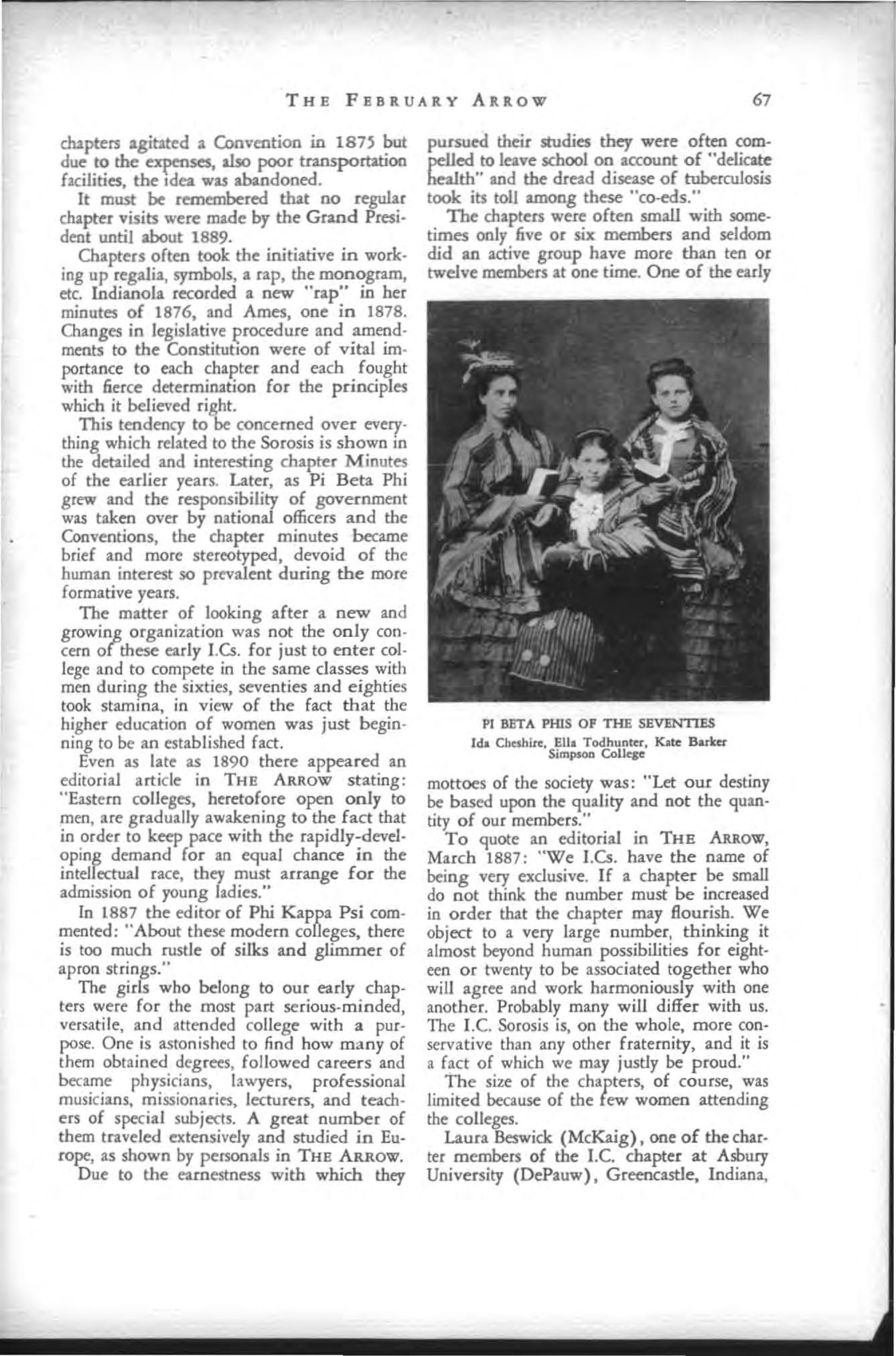
mottoes of the society was: "Let our destiny be based upon the quality and not the quantity of our members."
To quote an editorial in THE ARRow, March 1887: "We I.Cs have the name of being very exclusive. If a chapter be small do not think the number must be increased in order that the chapter may flourish. We object to a very large number, thinking it almost beyond human possibilities for eighteen or twenty to be associated together who will agree and work harmoniously with one another. Probably many will differ with us. The I.e. Sorosis is, on the whole, more can· servative than any other fraternity, and it is a fact of which we may justly be proud."
The size of the chapters, of course, was limited because of the few women attending the colleges.
Laura Beswick (McKaig), ooe of the charter members of the I.e. chapter at Asbury University (DePauw), Greencastle, Indian a,
was the first woman to receive a diploma from DePauw. In her class there were only four women freshmen registered in 1867-1868 and their college life was very strenuous.
In 1874, Meb Richardson, charter member of Kansas A, was the only woman in the sophomore class at the University of Kansas. In one of her letters to the chapter at Galesburg she said: "My beloved brethren called their meeting and formed their org.ni-
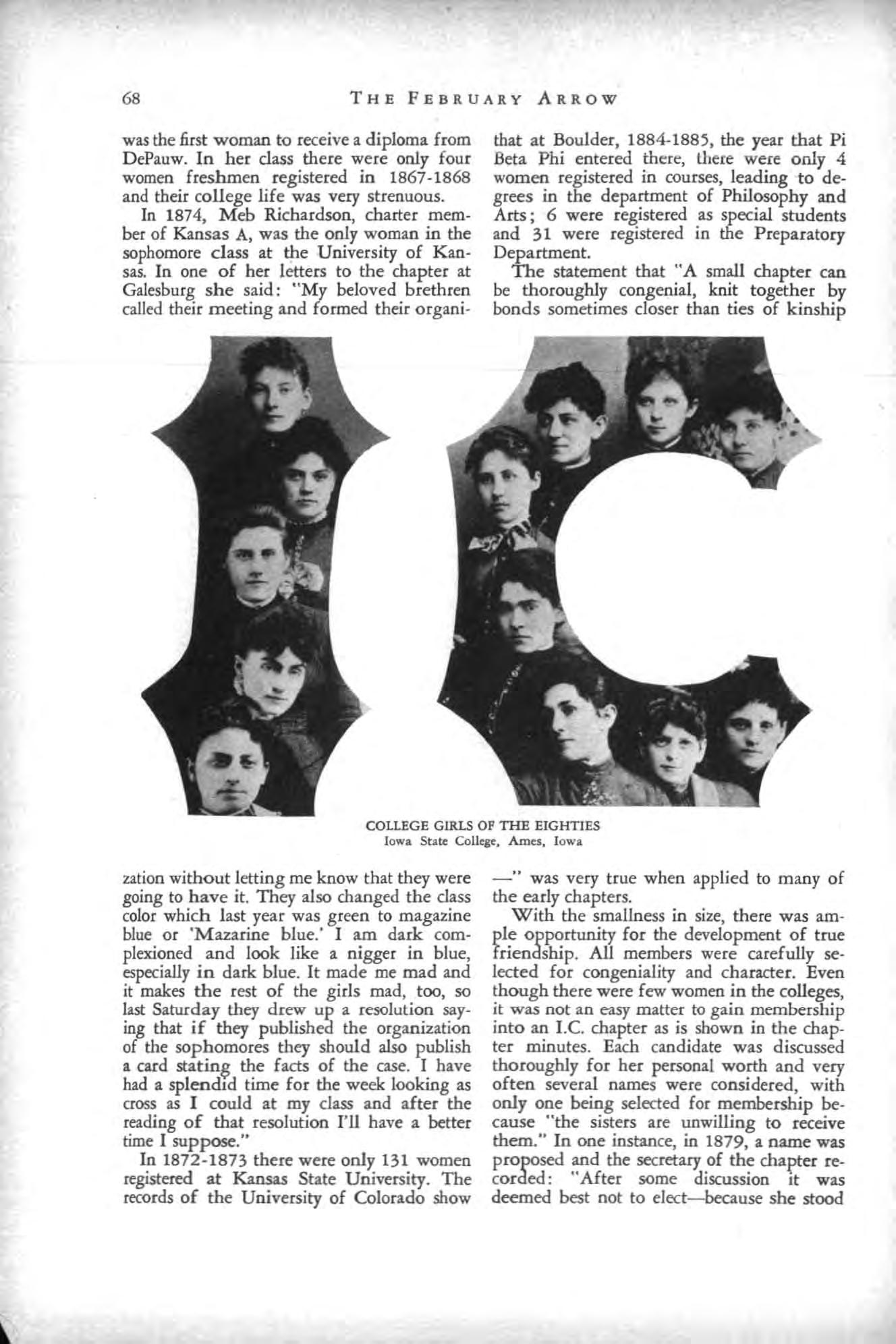
zation without letting me know that they were going to have it. They also changed the class color which last year was green to magazine blue or 'Mazarine blue.' I am dark complexioned and look like a nigger in blue, especially in dark blue. It made me mad and it makes the rest of the girls mad , too, so last Saturday tiley drew up a resolution saying that if they published the organization of the sophomores they should also publish a card stating the facts of the case . I have had a splendid time for the week looking as cross as I could at my class and after the reading of that resolution I'll have a better time I suppose "
In 1872-1873 there were only 131 women registered at Kansas State University. The records of the University of Colorado show
that at Boulder, 1884-1885, the year that Pi Beta Phi entered there, tilere were only 4 women registered in courses, leading to degrees in the department of Philosophy and Arts; 6 were registered as special students and 31 were registered in the Preparatory Department.
The statement that "A small chapter can be thoroughly congenial, knit together by bonds sometimes closer than ties of kinship
-" was very true when applied to many of the early chapters.
With the smallness in sizel there was ample opportunity for the development of true friendship. All members were carefully selected for congeniality and character . Even though there were few women in the colleges, it was not an easy matter to gain membership into an I.e. chapter as is shown in the chapter minutes . Each candidate was discussed thoroughly for her personal worth and very often several names were considered , with only one being selected for membership because "the sisters are unwilling to receive them." In one instan ce, in 1879, a name was proposed and the secretary of the chai*er recorded : "After some discussion It was deemed best not to elect-because she stood
in such a differ<nt relation to us from what we did to each other that sbe probably would not feel that interest in us that members should feel for us ."
The girls were real friends, interested in each others' families and friends. They took their oaths and fraternity responsibility most seriously and if a "sis ter" was in need of help, did everything in their power to be of real assistance. They believed thoroughly in the words which had been repeated to them in the Welcome after the Initiation Cere· mooy: "In this chapter all stand upon a com· mon level. There are no degrees, no ranks, no officialjriviJeges. Members are members for life an all work hand in band for a co m· mon good.
The Minutes of one cba pter for 1877 show that "It was rumored that A owned marks on record that she had not earned, marks in Physi cs and Chemistry and that one oration of hers had been co pied . All this she denied but from very reliable sources came testimony as to its truth. She was consulted and advised to withdraw from Sisterhood Society met, beard and accepted her resigna· tion. A was confined to her room sev· eral days undergoing an anguish that only those who saw coulcf understand. She at last decided to confess her faults. At a meeting of the class of '77 she nobly confessed that her marks were not deserved and that her oration was copied. Her penitence was deep and sincere. She was very weak in struggles to do better and the Sisters felt it to be a duty as well as great pleasure to help her."
At a called meeting, A 's letter was read as follows:
"Band of Sisters I.Cs . I humbly beg the pardon of each for the great wrong I did you each as well as myself when I stood, and with you took those solemn vows before God and each other to love each one as a sister. I knew at the time that you did not and could not feel as sisters should feel , toward me and I knew I was doing wrong to stand before you and cause you to do so. Yet as I have been all the year I was then too weak and afraid of public opinion to tell you so. Blot my name from your number as one not worthy to be a member of so noble a society. I believe my resignation is accepted. Can you cross my name off without being present, if so do. Send for me and I will give the necessary promise before I can go. I will never do anything to injure the society or the good cause for which you are working .
You may rest assured God helping me, I will do nearer the right and try to follow his footsteps as near as I can. Will you each and aU pray for me
Humbly and sadly, --A----
"On motion the society reconsidered A's resignation a.nd it was not accepted. It was with tears of joy that she was welcomed back to the Sisterhood. After her noble con· fession the Sisters felt that she would not disgrace the Sisterhood that if she were de· termined to be a true noble woman she would honor it. They felt, too , that she needed all the sympathy all the help they could possibly give."
Dismissals were rare, but when a chapter fdt such action necessary it insisted upon withdrawal or expulsion.
Whether there was an "I.e." type it is difficult to say, but one of the members of Lambda stated that she felt that: " I.Cs. have a marked individuality and a strong personal resemblance of character that seems to permeate the whole Sorosis, and has frequently at· tracted attention from even outsiders. To this resemblance we ascribe our unit of action and our freedom from internal dissentions."
Real sisters could not have been closer than were many of the members of I.e. A death in the chapter ranks was the cause of deep and sincere grief and not from mere form, but from true sorrow, the members wore the prescribed crepe for departed members for the 2l days to the 30 days, according to Constitutional provision. Too, they tenderly supervised the placing of an arrow on the tombstone of tbe deceased , with the permission of the relatives.
The chapter meetings themselves were businesslike and numerous fines were collected for non -a ttendance, for lateness and for inattention. The Meetings followed the Order of Exercise as outlined by the Founders and the conversation and fun were saved for the Pow Wow.
Much of the business of the chapters consisted in the proposals of names, the giving of the first and second oaths and initiation, the discussion of some altruistic project, discussions of changes in the Constitution, plans for Convention, literary performances or plans for parties.
There were no set dates for Initiation and usually from nine to ten initiations were held during each year, averaging about one a month.
Since food was an indispensable part of the Pow Wow and all other frateroity functions, the early Minutes of the chapters are generously interspersed with discussions of the "Bill of Fare, " the ladies "expatiating upon banqueting," the assignment of committees to procure: "Silver and cocoanut
cakes, I.e. Cakes, jelly cake, white cake, white Mountain cake, marble cake, peaches, pickles and cheese, strawberries and cream , crackers and candy, gingersnaps and crullers ." Later in the "gay nineties" the words were changed to "potato chips, fruit saJad'lressed chicken, pickles, olives, lemon ice, an cake."
Great secrecy surrounded these early chapter meetings and each group did its part to increase the air of mystery. Never voluntarily did they allude to their fraternity, and for an outsider to mention the subject would have been an impertinence, the height of bad form. No one was supposed to know or even to suspect when ana where meetings were held-rushing, pledging and the mock initiations were carried on in strictest sedu· sion. OoIy the pin, conspicuous on the basque or polonaise, proclaimed to tbe college world that its wearer was a partaker in some deep and sacred mysteries.
In the Ames Minutes we find: "Mamie was excused to go for 'our Box : It being the still hours of the nigbt by unanimous consent we had decided it should be' removed from the residence of Prof. Stanton to repose in a secreted place within Room '9: '
In writing from one chapter to another instructions from Monmouth were: "Please place nothing more than necessary on the envelope."
On May 6, 1877, Indianola describes in a letter to Iota the "initiation of Miss Cary, our l'receptress ,-she wished to keep ber connection with our society a secret for therresent, lest it might produce a feeling a un· pleasantness among tbe other students not connected with us. Of course we agreed, but I fear it will be difficult to keep it a secret. The night of our last meeting was a bright moonlight night and the Ddt. Tau Ddtas were on the alert. As Miss Cary was being escorted to our place of meeting by two oT our girls they met some of those ramblers, and recogni.ed them. Whether or not the boys recognized Miss Cary I do not know. We have heard nothing about it since . They were around the bouse quite awhile. We placed guards at the gate so they (the boys) were defeated somewbat, I think. You would have laughed had you seen us as we wer e going horne. We were so afraid Miss Cary woufd be recognized . But we did not meet any Deltas, but we saw some of the town
gentlemen We tried to keep together so she would not be known and it was funny to see us all in a string tramping through the square. I rather think the Deltas feel a little sold over their failure as they have not mentioned the meeting."
Meetings were not held in a regular chapter hall, such being unknown then. Usually the grouys met in college buildings or in the homes 0 the various members, the time and place of the next meeting usually being decided upon at the dose of each business session. One record states: "Adjourned to meet in Mrs. Stanton's sf-are bedroom next Friday at Recreation hour.
It was sort of a game with the boys to try to discover wbere the meetings were to be held. Indianola records the "Boys usually say something to the girls when they know when and where the next meeting 15 to be held."
hccording to the Ames Minutes for one meeting: "Before we were called to order the Deltas sent down an air line with an apple tied to it."
It was not always easy to find convenient meeting places and sometimes the were disrupted, for instance, at Ames In 1878: "We moved and seconded that we adjourn to meet in this room Friday (We met but Miss Geavor very unceremonIously ran in upon us and we immediately disbanded.) "
One of the Lambda meetings is headed : "Aug. 11, 18n: On the sidewalk in front nf Public School. After meeting half over the Sorosis considered this too'lublic a place for meeting so they proceede to the borne of Sister Ida Cheshire."
Owing to sickness and crowded time and the inconvenience of finding suit.ble surroundings for meetings they were not always held regularly according to the By-Laws . Some chapters were able to meet every week, others every two weeks, and some every three weeks.
Regular chapter halls and rooms were not
co mmon until about 1887 , in which year Boulder, Mt. Pleasant, Ottumwa, and Iowa City reported chapter rooms and the senti· ment was expressed in THE ARRow: "Z-uy the days be not far distant when we may all enjoy Chapter Halls."
The secretary of Iow a in 1888 wrote: " The Pi Beta Phi Sorosis can boast of being the only sorosis in the S U I. that owns a 'Home of its own.' ..
Colorado B, Denver, reported in that year that the chapter had made pla ns to rent a room in the new Manual Training School which the University was erecting. Michigan A reported a regular room in 1889 and in that same year Michigan B advocated the es· tablishment of a National Loan Fund to help chapters finance house building . This interest on the part of Michigan B was aroused, un · doubtedly, by the renting of a chapter house at Ann Arbor by the Delta Gammas
Probably the first chapter house to be erected by a woman's Greek letter organiza. tion was that of the Alpha chapter of Alpha Phi at Syracuse University, Syracuse, New York in 1888.
In 1890, Colorado A , Boulder, reported that for the beDefit of the future Colorado A1J?has the chapter had bouliht a share in the BUIlding and Loan Association "as a nucleus for the building fund of our chapter houseour castle in the air."
This is the lirst recorded step of that kind in Pi Beta Phi.
Although the fraternity men in some of the colleges, added zest to the meetings of the girls by trying to discover their meeting places or in trying to carry off refreshments for a spread, they were otherwise very friendly and cooperated with the women's secret societies
When an I.e. Convention was held on a campus, the men's fraternities loaned their chapter halls or houses, gave dances and reo ceptions, presented elaborate Boral pieces to the girls and in one case, that of Phi Delta Theta at Galesburg, !!ave the local girls a present of $75 to ass.st in entertaining the Convention guests.
In the real early days I.e. held combination meetinJSs with various fraternities. At Ames one jOlOt session with the "Delta" Society carried a program as follows :
E55ay
Otation
Qumelle
Valedictory
According to the I.e. Minutes, "the 0 T D suggtsted that we invite the Faculty aod also that they pay for the printed programmes Suggestions rejected ."
In 1881 Ames recorded: "Deltas p'roposed a joint session but I .e. rejected it.' Report later said: "Deltas very, very sorry." Two years later this chapter, however, held another joint session with the Delta Tau Deltas
Other instances of fraternity attentions are found in numerow chapter letters, Convention Minutes and chapter Minutes, some of which follow:
Colorado B: Betas sereoaded the Denver University chapter during initiation
Lombard: Delta Thetas presented us with a beautiful volume of poems entitled: "The English Poets, " a collection of the best work of all the poets of England.
Iowa University : Delta Tau Delta gave a very elegant reception . Chapter sent Pi Beta Phi in violets and carnations.
Iowa Wesleyan University: Had a Parlor Picnic. Phi Delta society sent a Shield and Dag,ger joined by a chain of smilax. Betas , a tmngular basket bearing at the comers, Pi Beta Phi.
Michigan A: Phi Delta Theta gave a han · quet (1888). All Pi Phis invited
Relative to these "brotherly" manifesta · tions, the editor of Della Upsilon Quarterly commented in his maliazine: "If we credit the correspondence contamed in the June issue of THE ARROW, Delta Tau Delta stands high in the graces of the sisters of I.e. Sorosis . Wherefore the boycotting of Delta Tau's rivals. fair sisters r'
THE ARROW Editor answered: "If there is a tendency in Pi Beta Phi to show a prefer. ence to Delta Tau, it is for the simple reason that we know and meet Delta Tau , that Del ta has been in fact, 'a brother to us' -has helped to establish chapters, and shown us in many instances a fraternal interest. Such fraternal courtesy will always receive a gracious appre· ciation from the Sorosis ."
Fraternity information was slow in getting about and the chapters often knew little about the fraternities not represented on their own campuses. Often in writing of other fcater · nities mistakes were made in the use of the
Greek letters. Panhellenic organizations changed this state of affairs.
Colorado A at the University of Colorado, was on a campus for many years with only Delta Tau Delta and Delta Gamma and the three organizations always maintained the most friendly relationships. There being few women in Pi Beta Phi and Delta Gamma , the Delta Tau Deltas always entertained the two women's organizations at all of their parties.
Columbia A reported a meeting with a com· mittee from Phi Kappa Psi to make arrange· ments for joint open meetings.
At Mt. Pleasant, as in other places, memo bers of fraternity chapters to which the bride. groom belonged attended I ,e. weddings in a body.
The following letter from Beta Theta Pi, taken from the Scrapbook of Kansas A, at· tests the gift of a banner from Pi Beta Phi.
March 5, 1886
Hall of Alpha Nu Chapter of Beta Theta Pi
To the I.e. Sorosis , Greeting:
The A.N. chapter of Beta Theta Pi was greatly honored by the receipt of your emblematic banner, last Saturday evening. As we sit in our hall with the pink and blue constantly before our eyes and the recollec· tions of the makers increasingly in our minds, we will ever have an incentive for greater exertioos to merit the courtesy and friend · ship that I.e. has extended to Beta Theta Pi .
May that friendship that has existed un· broken between the two senior societies of
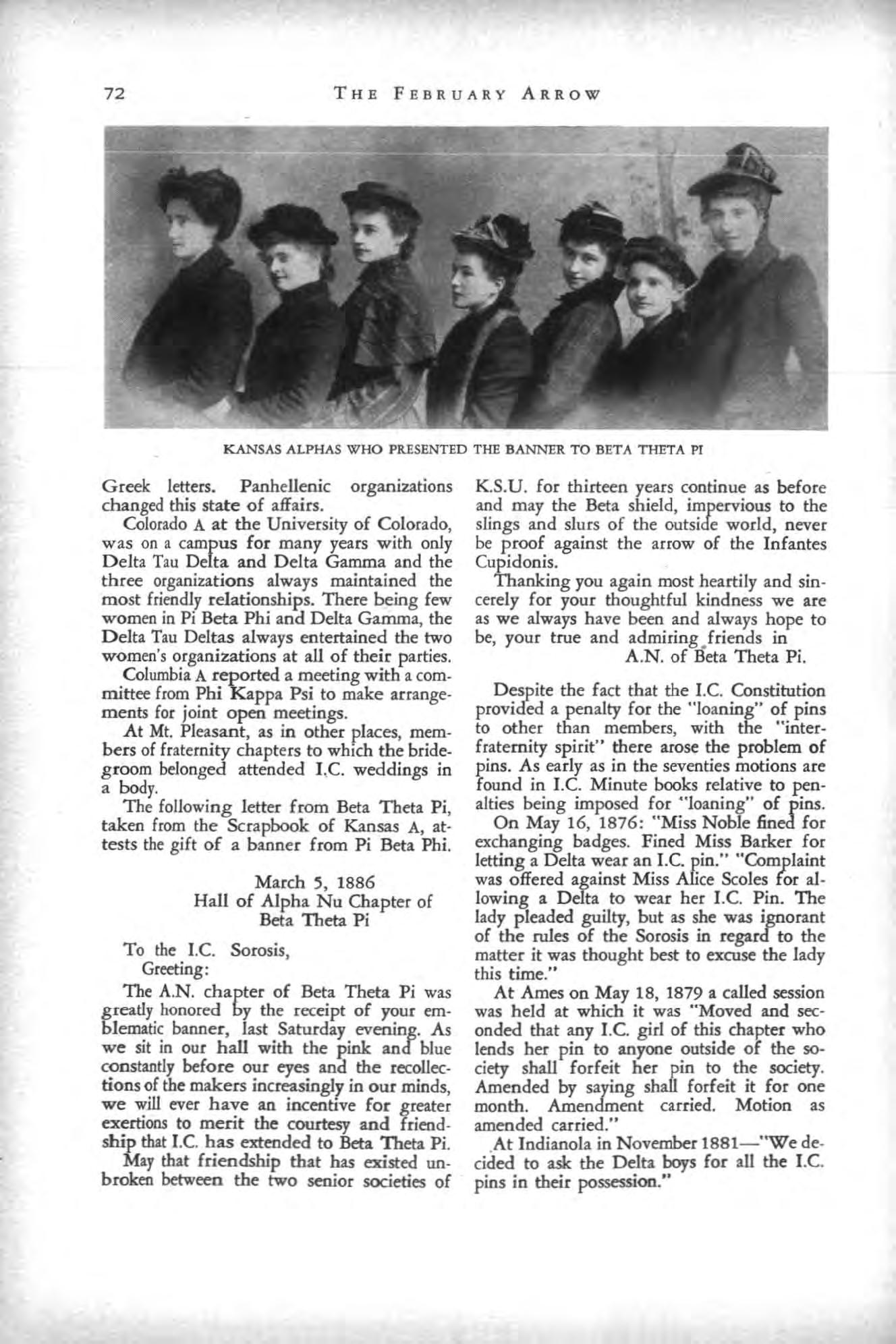
K S.U. for thirteen years continue as before and may the Beta shield, impervious to the slings and slurs of the outside world, never be proof against the arrow of the Infantes Cupidonis.
Thanking you again most heartily and sincerely for your thoughtful kindness we are as we always have been and always hope to be, your true and admiring friends in
A N. of Beta Theta Pi
Despite the fact that the I.e. Constitution provided a penalty for the "loaning" of pins to other than members, with the "interfraternity spirit" there arose the problem of pins. As early as in the seventies motions are found in I.e. Minute books relative to pen· alties being imposed for "loaning" ofJios.
On May 16, 1876: "Miss Noble fin for exchanging badges. Fined Miss Barker for letting a Delta wear an I.e. pin." "Complaint was offered against Miss Alice Scoles for allowing a Delta to wear her I.e. Pin. The lady pleaded guilty, but as she was ignorant of the rules of the Sorosis in regard to the matter it was thought best to excuse the lady this time."
At Ames on May 18, 1879 a called session was held at which it was "Moved and seconded that any I.e. girl of this chapter who lends her pin to anyone outside of the s0ciety shall forfeit her pin to the society Amended by saying shall forfeit it for one month. Amendment carried. Motion as amended carried ."
At Indianola in November 1881-"We decided to ask the Delta boys for all the I e. pins in their possession."
From the beginning, the I.Cs. were interested in altruistic work.
Among the things recorded by the chapters in their efforts to do good were: Alpha: "That first winter we bought the coal and paid the rent for a poor man's family. "
From oth<r chapters: the "distributing of $5 among the poor"; the raising of "funds to complete the science room"; the giving of benefits for charitable purposes; benefit performances for local library funds; sewing bees to Jill barrels with good clothing; a charity fair in which $119 was cleared for the city relief committee; the subscription of $25.00 for the relief of the poor; a concert for the poor in which $100 was raised; a benefit [or the Ladies' Library Association, etc. The most pretentious work of this sort
attempted by any of the groups was that of Chi cbapter at York, Nebraska, at the Nebraska Methodist College This chapter gave a Mikado entertainment realizing $100.00 with which it started a library. This library was maintained by the Pi Beta Phis in York for ten years, and was then presented to the city to become the nucleus of the library.
The following note which accompanied a donation to the Home Relief Society of Bloomfield, is typical of the work which the cha£ters considered a part of their program:
. We, the I.C . Socosis, deeming it necessary and well to assist in the relief of the poor and suffering, do tender the within to the Relief Society to use as their judgment may dictate ."
The original Constitution of the fraternity. in addition to the other regular features of the chapter meeting, called for a Literary Performance, which was usually planned by the Executive Committee. Such "Pe rfonnan ce" varied from year to year according to the individual desires of the chapters.
In 1876 and 1877, four of the chapters: Gamma, Lambda, Mu and Kappa elected to write an "I.e. Book" or "Novel" for their regular meetings. Members wrote a chapter for each meeting, each writer being allowed to introduce at least one new character. The results were described as "most entertaining," and the next installment was usually, "shrouded in deep mystery."
At some of the meetinfs there were: "Serapbago-rare intellectua feasts of wit and mirth ."
There were essays on the Early Greeks, a study of Greek geography, a study of "Les Miserables," a study o[ the writings of Ru skin, Ieving, George Elliott, Sir Walter Scott, Hawthorne and Thackeray or of H. G HoIland's "Lessons in Life." Too, the current magazines were discussed and courses taken up in the art of reading or in the study of both primative and dassic art .
One chapter reported the study of Vola-
puk. an international language, and said it did so "with a view to founding a chapter in Honolulu or Singapore!"
Many had Conversational Notes in which "each remember something interesting or instructive which we have read."
Some had committees to bring in all slang phrases, "ungrammatical errors" and personal criticisms, and report the guilty ones who were suhject to fines.
In 1884 the subject suggested at Convention for all chapters to study during the year was: "Woman and her Work. With the subheads : Woman, Moral History of; Education of Woman, Social Duties, Caste Among Women, Charities of Wom en, Women in Business, Women as Architects, Women in Secret Societies and Oubs, Portraiture of Women in Poetry, Wom en in the Pulpit and the Church , Women in Art, Women in Medicine, Women in Law, Suffrage for Women , Social and Politi cal Dependence of Women."
It was in the early eighties, however, that the chapters began to omit the literary work from their meetings. Many felt that they had enough literary work in their literary societies. Indianola writing in 1884 said: "We have no literary program at all. It seems as though we have so much else to see to we
C, 1.. S.noa, Prufd.nlt t!.I IIw B'Nn"'l1 INVOCATION .
JlC'IIC ,_.
OSOPKrLl&Jf
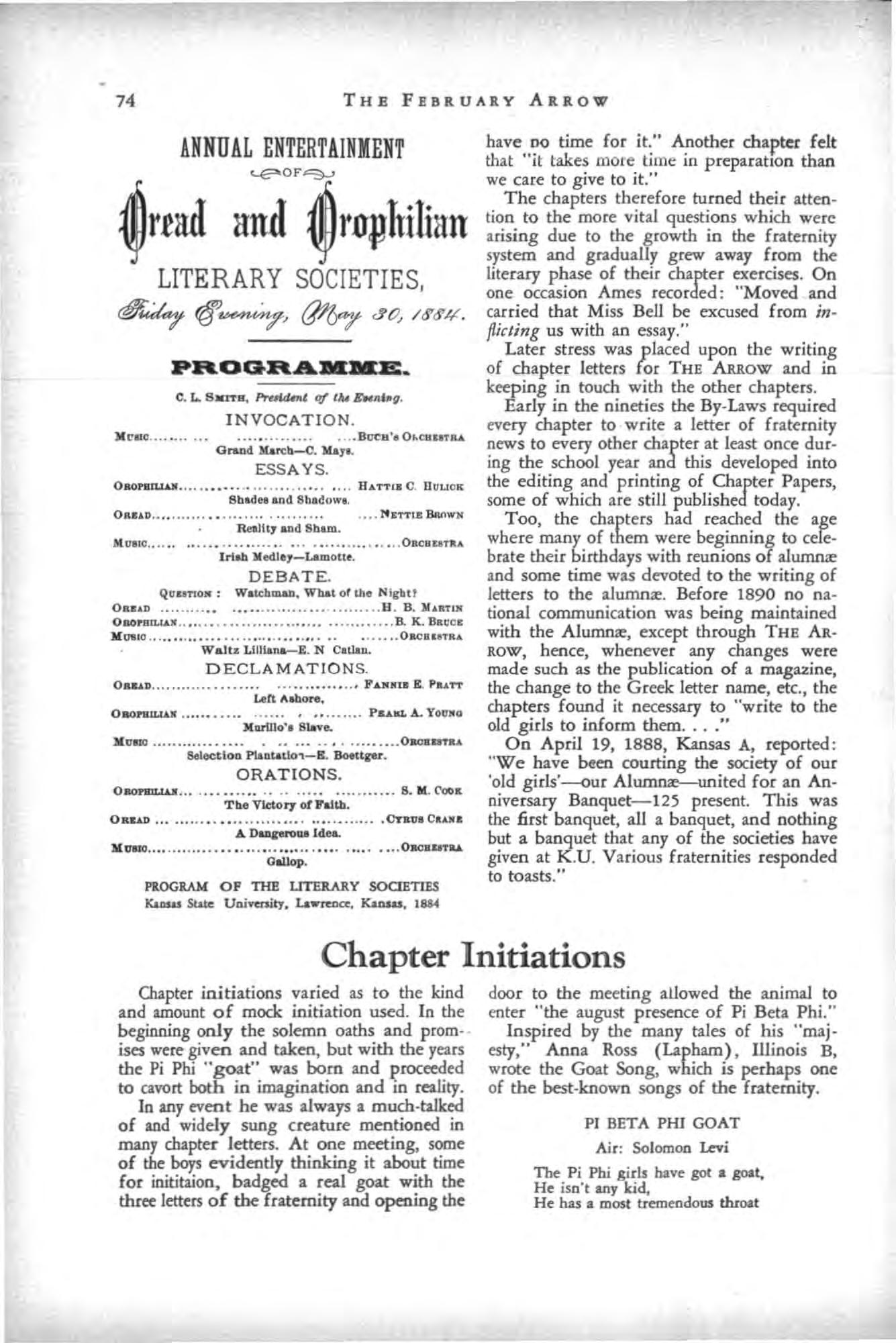
• BUCll'. OkCK&lTa.. Graod Kareb-C }bll ESSAYS.
•.. B TTI.C D OLI OK 8badel and 8ba(!ow, Oa D
M.UII O•
M KTTIB BAoWN Reallt, and Sbam
• , Oacll u TJtA. Irlab Medle1-lAimottt DEBATE
QOunON: Wat.chm.aJl Wha t of the Ni,bt t 0&11:111)
D B )fJoIlTUf
have 00 time for it." Another chapter felt that " it takes more lime in preparatIon than we care to give to it."
The chapters therefore turned their attention to the more vita! questions which were arising due to the g rowth in the fraternity sys tem and graduaJJy grew away from the literary phase of their chapter exercises On one occas ion Ames recorded : "Moved and ca rried that Miss Bell be excused from inflicling us with an essay."
Later stress was placed upon the writing of chapter letters for THE ARR o w and in keeping in touch with the other chapters.
Early in the nineti es the By-Laws required eve ry chapter to write a letter of fraternity news to every other chapter at least on ce during the school year and this developed into the editing and printing of Chapter Papers, some of which are still published today
OSOPBIloU lf
, •. B K BaCCE )(0.1 0 ,_ , _ ..• OacHI I Ta
Walt a Umana-E N CUlan
DECLAMATION S. , _, .•
• F.lIIlua K Ph". Lett Aabo r e ,
P&..A.ILI. A... YOUIfG
Oao!'lllLld ,
110m
Xllrlllo'a st....e.
Selection Plaoutlo,-B: Boettze;r
ORA T IONS
Oaa.aTu
OIlOP1IlLUa", ' • ' 8. 1l1li CooK
The V1cto,.,. of F aUh ORUD
A Daqeroaa Id ea.
Ilv.ro
CT.va CIAJfa
Ol&(la&nU Gallop
PROGRAM Of THE UTERARY SOCIETIES
KUlas Stue Un iYU1ity , LawruJC:e, Kansa, 1884
Too, the ch apters had reached the age where many of them were beginnin g to celebrate their birthdays with reunions of a1= and some time wa s devoted to the writing of letters to the a1umn", . Before 1890 no national communication was being maintained with the A l umna!, exce pt through THE ARROW , hence, whenever any changes were made such as the publication of a magazine, the change to the Greek letter name, etc., the chapters found it n ecessary to "write to the old girls to inform them "
O n April 19, 1888, Kansas A, reported : " We have been courti ng the society of our ' old girls'--our Alumrue-united for an Anniversary Banquet-125 present. This was the first banquet, all a banquet, and nothing but a banquet that any of the societies have given at K U Variou s fraternities responded to toasts ."
Chapter initiations varied as to the kind and amount of mock initi at io n used . In the beginning only the solemn oaths and promises were gi ven and taken , but with the years the Pi Phi " goat" was born and I.'roceeded to cavort both i n imagination and 10 reality. In any event he was always a much-talked of and widely sung creature mentioned in many chapter letters. At one meeting, some of the boys evidently thinking it about time for inititaion. badged a real goat with the three letters of the fratemity and opening the
doo r to the meetin g allowed the animal to ente r "the augus t presence of Pi B eta Phi ."
Inspired by the many tales of hi s "majesty, " Anna Ross (Lapham) , Illinois B, wrote the Goat Song, which is perhaps one of the best-known songs of the fratemity
PI BETA PHI GOAT
Air : Solomon Levi
The Pi Pbi girls have go t a goat. He isn't any kid , He has a most tremendous throat
And he eats just what he's bid, From old tin cans and shingle nails To bread and cake and pie. For be's an active Of our Pi Beta Phi .
Oh little goatie, tta la la la ]a la la Dear littJe goatie, tta la la la la la la Our goat's a Joyal Pi Phi, He's trustrd and he's true, He Dever fails to pay bis dues And he wears the wine and blue, He always tries to do his part To help the cause along, And for that very reason We sing of him this song. His hair is white and glossy too His horns are long and sharp, His voice is very musical Like an Aeolian harp; He helps us sing our Pi Phi songs For he's a Pi Phi true; He wears an anow shining bright And a bow of wine and blue.
A chapter letter from Mt. Pleasant publisbed in THE ARROW in 1887 tells of the initiation at a joint meeting of the two chapters of two candidates for Iowa A a, "Sister Julia and Miss Grumbling" . . . "We lead forth the real live goat, bristling with arrows, which had been in our possession under the special control of Sister lOll Ambler since the Convention at Lawrence. Only an I.e. can fully appreciate the shouts of joy which always greet this lively little creature. It seemed to enjoy the 'bay and grass' which was soon provided for it."
In 1880, Indianola reported: "At our last meeting we took in three members. We had 'sham' performances and the poor victims were badly scared. After the candidates had been administered the second promise the ladies were conducted to another room, while the members collected butcher knives and swords. Surrounded by these formidable weapons the new members were united in tbe boly bond of matrimony to the I.C Sorosis. The I.C Devil officiating."
At Lombard at one initiation "seven girls rode the goat." Said the Illinois B corresfOndent: "He badn't been driven since HarrISon was elected, and it took several girls to bring him up from the pasture. At last each in tum rode up and down (?) amid the roar and din of trumpet and fire-cracker. We are satislied that they will never forget the antics of our gray (?) goat."
A newspaper account of a Kansas A initiation mentioned the fact that the "mock ini-
tiation was beld in the old brewery wbere the dark and subterranean apartments offered unusual opportunities for the grewsome ceremonies."
A "series of mysteries" was mentioned in a Denvtr University letter and Iowa Z, Iowa City, declared that "Two girls were initiated recently. Our sisters can tell of embarrassing questions, of difficult promises, of unending stairs, unsurmountable barriers, of labyrinthian passages, of unearthly groans. One sister says she was put in a band box and tbe lid put on. As the sister weighs one hundred and lifty, we ask can it be? If so, then in initiations all tbings are possible."
At one initiation Colorado B said: "The candidates admitted were Miss Bertha Brooks and Miss Lottie Waterbury and all the rest being so bapl'Y' we had not the heart to make them mISerable, so the goat and other domestic animals of Pi Beta Phi were left unmolested ...
Perhaps one of the most embarrassing forms of "Mock Initiation" was that reo ported by Indianola in 1878. Four Scribes were appointed to propound questions to the candidates and then they compared notes and decided whether the ladies should be admitted into tbe Society. The Scribes reported that, "notwithstanding the ladies had replied to some of the questions with evident reluctance, especially those in regard to gentlemen company, and one lady bonestly confessed ber indulgence of snuff, we nevertheless thougbt it best to take them in."
There were many pros and cons relative to the question of Mock Initiation. Some felt that most initiates expected the comic or mock initiation and were disappointed if they did not receive it. They felt that the variety of the mock initiation gave individuality to the initiations. Other members were utterly opposed to it, the major objection being that the mock initiation destroyed the solemnity of the true ceremony.
Tbe question was discussed by the national fratemity at the Convention in 1893 and the following Resolution was adopted which quieted the subject for a few years:
"Since mock initiations tend to detract from the solemnity and impressiveness of the real ceremony, and since they do not fairly represent the true spirit and bigh purpose of Pi Beta Phi, Resolved, that we earnestly desire and recommend that such initiation be dispensed with."
Perhaps the three most outstanding traditions of early Pi Phidom were: the Pow Wow, the Hallowe'en Celebration and the Cookie Shine.
The Pow Wow was the regular informal "after meeting " gathering provided for by the Founders under the Order of Exercise in the original Constitution. At the Pow Wow the girls visited, cut up high jinks and usually consumed mountains of cake and peaches, strawberries and cream, bananas and peanuts, ginger snaps, pickles, etc., while relating thrilling adventures, and "devising new ways for the promotion of fun ."
The Pow Wows usually were made more thrilling by faces at the windows, which usually proved to be those of friendly but prying Delta Tau Deltas, Betas , Phi Gams or Phi Delts
All "get togethers" eventually came to be called Pow Wows.
With the passing of the years, as the lives of the students were IiIled with many nevi responsibilities and their attention was demanded by numer-ous college activities, the girls gradually grew away from the little congenial gatherings after the meetings. In other words, according to chapter Minutes of 1884: "Too busy for a 'bum'. Decided each to take 10¢ and go to restaurant and get ice cream and cake-to be our bum for the spring." Later: "The bum was a failure."
A very important I.e. celebration was that of Hallowe·en. The yearly observance of this evening apparently originated with Lambda at Simpson College where the cha!?ter passed a motion on Oct. 10, 1876: "Motion carried to celebrate Hallowe'en from year to year with a general jolliJication. Motion made to bring anything to eat we could."
In the beginning this may have been Lambda's chapter founder's day celebration, since the chapter was installed in October. At any rate the custom of making this a real event in I.e. annals spread rapidly to all of the chapters.
The Hallowe'en Song written by Lambda has been preserved in the chapter's oldest Minute book:
We I.Cs are to be seen
On this pleasant Hallowe'en
And we all are proud to greet you with a song
We've an ax we wish to grind
M you gents soon will find
We will wake you (rom your slumbers by and by.
Chorus. Hum. mum, mum
Is now the watchword
Pumpkin pies are all the rage, Y ou all like them to a man
Fisk wiU even steal the pan
We shall have a quarter section by and by.
We're a gay and happy crew
As you gents e'er knew
And we wear the cutest badges (ull in view
There is magic in our pin
It has taken hundreds in
Don't you wish you spying gents only knew,
Now we trust you'll not (orget
When the L.P,V. we met
When you Deltas marched along in single file
How we fooled you in the (og
Was enough to kill a dog
Or to make a little wooden Indian smile.
You may 6nd it quite a task
Since we all appear in mask
To select the Mary Ann you like the best Take yOUI girl and march ahead
For the festal board is spread
You will all be feeling better by and by.
On Hallowe'en the gi rls usually "dove for apples" and the tell-tale water soon disclosed whose "ban gs" were n aturally curly, and whose were not, The girls pulled taffy, cracked nuts , roasted chestnuts, tried mirror and sat around the fireplace to toasts, reading fates and having a good time generally.
Sometimes on Hallo we'en there were M as· querades when each member some other member or there were' Old Maid Shindigs" when they "spoke to the Marshal and had several watches around the bouse."
After one particularly hilarious celebration money had to be appropriated from the chapter treasury "to ray for the window glass broken Hallowe'en.'
Indianola records: "Miss Dore, Emerson and McClure were appointed to steal a turkey for Hallowe'en.' The success of the expedition is not known
That the Hallowe'en celebration was one observed throughout the fraternity is evi-
denced by the following extracts from letters , dated in the eighties :
Carthage: " Of course all I.Cs had their Hallowe'en frolic. We held ours at the home of Lelia Carlton and feasted and read our fates, etc."
Iowa City : "Hallowe'en bas always been a red letter in the calendar of Iowa K aod z, and was duly celebrated this year.... There were the usual chestnuts , apples, fortune tell· ing nf various kinds A few brave girls did the cellae stairs act and were evidently satisfied with the results."
Lawrence, Kansas: "The dramas enacted at the Hallowe'en parties enabled the girls to develop capabilities in dramatization and per· sonation which had been entirely unappre· ciated . The difficulty which they experienced in holding these meetings unobserved , and the untimely interruptions which they en · dured, obliged them to practice the virtue of patience and led them to develop great fa· cility in the use of stratagem. But success crowned their efforts and they have reason to believe that the Betas went home every time sadder but not wiser men."
Some of the chapters invited m= to cele· brate Hallowe'en with them in the later days. Franklin, Indiana reported in 1890: '"Hal· lowe'en Party-In response to brown paper invitations, the men wore brown paper shirt fronts , and cuffs. The men entered into all of the fun."
FoU( candJes in a square upon the Boor
Are vaguely lighting every girlish face . Neglecting not a one inside the door But binding all within this qwet space, The magic circle, weaving round each maid Its spell of sisterhood and faith and love This perfect bond. the words of which have bad e .. Us all to look for truth and hold above The outer world our sisters singing here. Soft-eyed and tenderhearted when our woe Would bear us down they bring us succor dear & we on paths of high endeavor go. Sing loved o nes , friend ship blessed does bind us fast;
This spell, this dream, through all oue lives will Jast.
-Patty
J..ee
Smith, Oklahoma A
Tbe "Cookie Shine" which is distinctly a Pi Beta Phi institution bad its origin at the first I.e. party given by Kappa Chapter, now Kansas A, at Lawrence, Kansas in June 1873, at the home of the Misses Flora and Alma Richardson, who were entertaining in honor of their sister Sara, a Pi Phi from Lombard College.
Chancellor John Fraser, the Robin Good Fellow of each and every student of the university, chanced to be present at the party "Cookie shine'"was his own individual name for any kind of an informal social company brought together by accident or design and when the girls began to lay their spread of good things, the Chancellor dubbed the feast a ··Cookie Shine:'
The word so pleased the girls that they immediately adopted it for their own, and
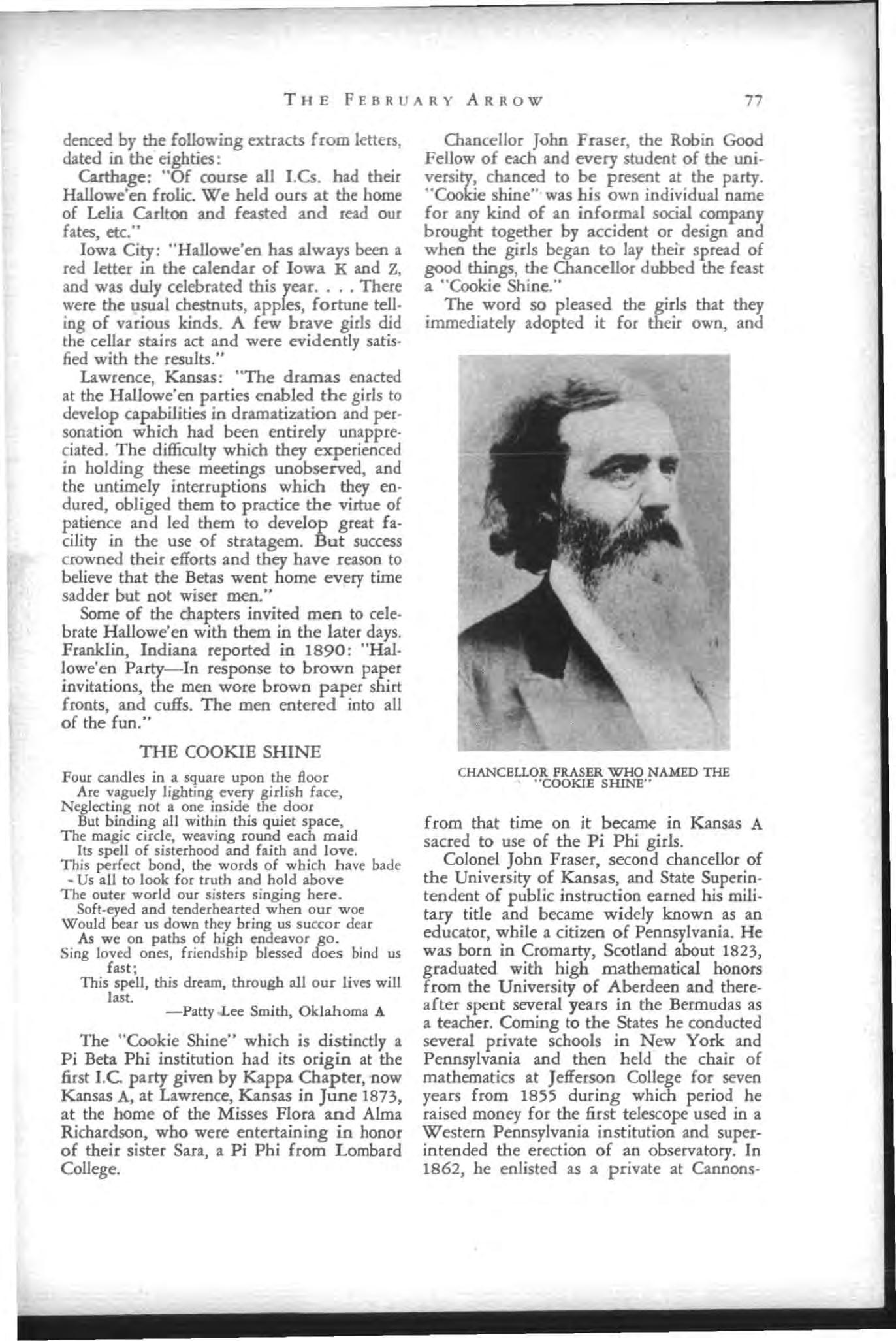
CHANCEllOR FRASER WHO NAMED THE "CooKlE SHINE"
from that time on it in Kansas A sacred to use of the Pi Phi girls.
Colonel John Fraser, second chancellor of the University of Kansas, and State Superintendent of public instruction earned his military title and became widely known as an educator, while a citizen of Pennsylvania. He was born in Cramarty. Scotland about 1823, graduated with high mathematical honors from the University of Aberdeen and thereafter spent several years in the Bermudas as a teacher. Coming to the States he conducted several private schools in New York and Pennsylvania and then held the chair of mathematics at Jefferson College for seven years from 1855 during which period he raised money for the first telescope used in a Western Pennsylvania institution and superintended the erection of an observatory. In 1862, he enlisted as a private at Cannons -
burg and fought for the North throughout the Civil War. He won the rank of Captain of the 140th Penn volunteers in AU5t 1862 and became lieutenant colonel intember. In July of the next year he was rna e Colonel. In 186' he became President of the State College at Bellefontaine, Pa
On June 17, 1868, Professor Fraser became the second Chancellor of the University of Kansas, succeeding Robert W . Oliver. The university building which bears his narne was erected during his term of service which ended in 1874. During his connection with the university, he served as state superintendent of public instruction . His last position was in the Western University of Pennsylvania and he died at Allegheny, Pa., of smallpox, in June, 1878.
According to Helen Bay Raymond , Kansas A, " At the spreads, or cookie-shines, held not oftener than once in three weeks, the refreshments, except on the very care occasion of an oyster supper, were limited to one contribution from each girl , brought as often as not in a brown paper bag. The various contributions were placed on a large sheet, which, spread upon the floor, served as a table, around which we sat, devouring ravenously, and with much merriment, such sleepdestroyers as peanuts, cheese, gingersnaps, crackers, pickles, bananas and apples These feasts were not nearly SO orderly or pleasant as the dainty, well-observed spreads of today, and their only redeeming feature, ease of preparation , was hardly redeeming, because colfege life should not lead a girl to spare effort in her social undertakings any more than in her intellectual work."
Lucinda Smith Buchan writing for THE ARRow in 1902 said:
"Although an entire evening com,P"sed of an initiation ceremony, music , danCing. card games and other diversions was often spoken of as a 'cookie-shine' the formal 'cookieshine' was really the supper itself spread upon a tablecloth (or sheet) on the Boor, eve - g from bot biscuits , veal loaf and chi en, through a long line of scattered chips, olives, pieldes, nuts, fruits and cookies, to the most conventionally served ice cream and coffee."
"If there was only time to pass the word around that there will be a 'cookie-shine' tonight or tomorrow afternoon, every one brings her own donation, with the single injunction that nothing must be brought which will call for napkins, or plates, knives, forks
or spoons for the serving of it. Then everyone comes bearing a paper parcel, or a small bas· ket, and when the time arrives for refresh· ments, the large tablecloth or sheet is spread in the middle of the Boor, and the contributions thrown here and there upon it, and the girls sit on the Boor, Turk fashion , amid laughter, singing and merrymaking, and time vanishes with the pickles and cake. One of the beauties of the cookie shine is that, when the party is over, the festive board is quickly cleared by gathering up the four comers of the sheet or cloth, and dispatching the fragments unceremoniously, leaving the room as if by magic clear again.
" In line weather, the cookie shine supper is often spread on the grass. Very often some special features of entertainment will be prepared for the cookie shine. These are usually conceived and executed by a few of the girls, without the knowledge of the others , so that there is always a $reater or less air of expectancy. Farces, etther original or adapted to the chapter's use, are a very popular feature of the programs, impersonations of ridiculous characters, another. In the presentation of these features much skill is often manifested that before was unknown, or under·estimated, so that these chance occasions not seldom prove to be of more than transitory interest."
From Kansas the cookie shine was carried to other chapters, until the "te rm itself, and the occasion for which it stands, has become an inseparable part of the social life of our Fratercuty."
For a number of years the cookie shine was a regular convention shmt, "until at the Bos · ton Convention in 189' there was scarcely a chapter unacquainted with the narne." In writing of the Convention of 1885 one of the delegates said : " How can an I.e. he strange to an I.e. ' Cookie Shine'- as a cookie shine is only an Iowa Pow Wow . As we sat in true I.e. style on \he festal Boor our travel weariness vanished like the pickles and cake." Today it is a favorite entertainment at the Province gatherings at national Con · ventions,-especially in the wee hours of the morning.
In general the cookie shine is the same, whether celebrated in Canada or in California but there are many local va ri ations. Snme of the chapters in the earlier days kept the cookie shine very secret, while others mvited thei, gentlemen friends. Snme made it purely informal and no one knew what the other perSOD was going to bring _ A chapter letter trom
The cookie shine will always be beld in unquestioned regard by the members of Pi Beta Pbi.
Colorado A in 1887 says: ' 'The Cookie turned out to be a 'pidele shine' ," Iowa E: "Gave a cookie shine, which continues to hold sway as a source of where informality certainly and truly exists " On one occasion Iowa B: "Voted to have a 'bum' and call it a 'cookie shine.' Committee to get all shapes and sizes and kinds of cookies, pickles and coffee. '·
"What <)uaint customs in my time?" writes Lillian Ltwis. former Grand Scribe, in reply to a query from the Historian in 1935 . "There were none! It is you who have them today."
Miss Lewis does, bowever, state that ber sister, " Dora Ball went to the University of Iowa during th e Civil War, a girl of fourteen The University passed a decree that the boys should not talce the girls sleigh ridingtoo expensive. so the girls took the boys."
Among the early traditions at Monmouth College were the ringing of the old bell wben a baby was born to a faculty member; and the presentation of turkeys by the classes, with long speeches to each professor at the class hour in order to get out of recitation. Louise R Campbell, llIinois A, recalls that her father received seven turkeys one year, of which were stolen from their by rival class members to present to another professor.
In writing of the Literary Societies at Monmouth in the early days, Leonora Snyder Bosworth, Illinois A, '7'. says:
"The A1etheorian and A.B L. (Amateurs des BeUes Lettres) of the coUege women had similar programs to those of the Philos and Ecriterian, men's societies,-essays , orations and debates The girls opened their sessions with reading of the Scripture and frayer. Men visitors were not acfi:nitted unti after the religious exercises were over. Once when two of the boys were admitted too early, by mistake, as we aU knelt in prayer, the young lady leading in the Lord's Prayer, forgot it entirely. My impression is the Aletheorians had all the I. Cs. and the A.B.Ls. all the Kappas. I do not think at that time there were more than ten or twelve I.Cs . in college and probably no more than that many Kappas, if so many."
Fannie Whitenack Libbey, Founder, writes that sbe was a member of A B L. Sbe belonged before the founding of Kappa Kappa Gamma, so I.Cs. at that time eVIdently belonged to both Literary Societies . It is understood, however, that after the founding of
Kappa Kappa Gamma, membership in the Literary SocIeties was restricted to those belonging either to one or the other "secret society."
CDntests between the A B.Ls and the Aletbeorians were outstanding events in the Monmouth town hall.
The graduations in the early days at Monmouth . we are told , were long drawn out affairs , lasting aU day, as the size of the classes grew . Every member of the class gave an essay or oration. By 1875 187 6 and on, the graduations were held down town in Union HaU, sort of an opera house. Unfortunately none of the "orations" of the Founders have been preserved.
According to Mrs Boswoth , "If at a class social we ventured to dan ce in the home to the music of the piano, dear old Dr Wallace next day in his lecture on Ethics, would exclaim that he could not understand 'why educated young people must shake fun from the ends of their toes'."
College life in the sixties, seventies and early eighties lacked the intricacies of later days. Fraternity social events took the place of the rush and the hum and the "rob, rah" which came as the years progressed. The words, "Rah, Rah ," so typical of coUege life now, were only beginning to be heard beyond the Mississippi in 1890!
Bear witness : Lou E. Westover, Iowa Z, who was visiting in Boston in March 1888 wrote a letter to THE ARROW in which she said : " When we were in Cambridge the last time, we saw a football game between the Harvards and the Princetons . It was very ex· citing, but I was more interested in the Harvard cheer than in the game It is the lasr syllable of hurrah-rah, rah, rah, they yell, giving it sharply and quickly so that it sounds exactly like a pack of dogs barking."
Space does not permit detailed descril,'tions of all of the social customs and activities of the early I.Cs. but the following words, phrases or sentences selected from numerous descriptions of the good times mentioned in
• I. C. SOROSIS . , •
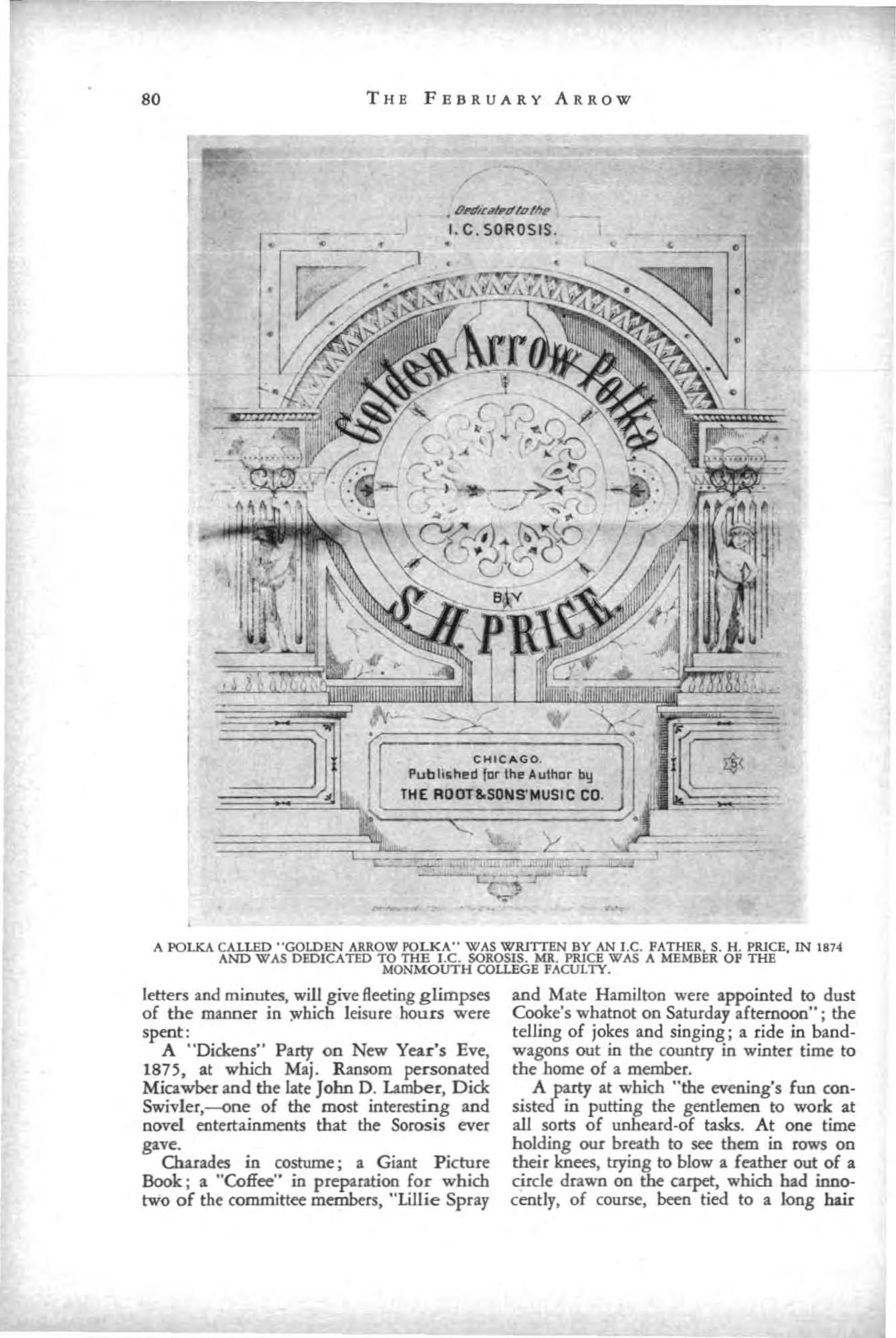
CMICAGO Pub lis;hed for Author by THE ROOTIoSONS'IiUSIC CO
A POLKA CALLED "GOLDEN ARROW POLKA" WAS WRlTIEN BY AN I.e . PATHERj..§' H PRICE, IN 187-4 AND WAS DEDICATED TO THE I .e. SOROSIS. MR . PRlCE WAS A MEMB.t.1\ OF THE MONMOUTH COLLEGE PACut TV.
letters and minut , will give Beeting glimpses of the manner in :which l eisu re hours were spent:
A " Dickens" Party on New Year's Eve, 1875, at which Maj. Ransom personated Micawber and the late John D. Lamber, Dick Swivler,-one of the most interesting and novel entertainments that the Sorosis ever gave.
Charades in costume; a Giant Picture Book; a "u,lfee" in preparation for which two of the committee members, "Lillie Spray
and Mate Hamilton were appointed to dust UJoke's whatnot on Saturday afternoon"; the telling of jokes and singing; a ride in bandwagons out in the country in winter time to the home of a member.
A party at which "the evening's fun consisted' in putting the gentlemen to work at all sorts of unheard-of tasks At one time holding our breath to see them in rows on their knees , trying to blow a feather out of a ciccle drawn on the carpet, which had innocently, of course, been tied to a long hair
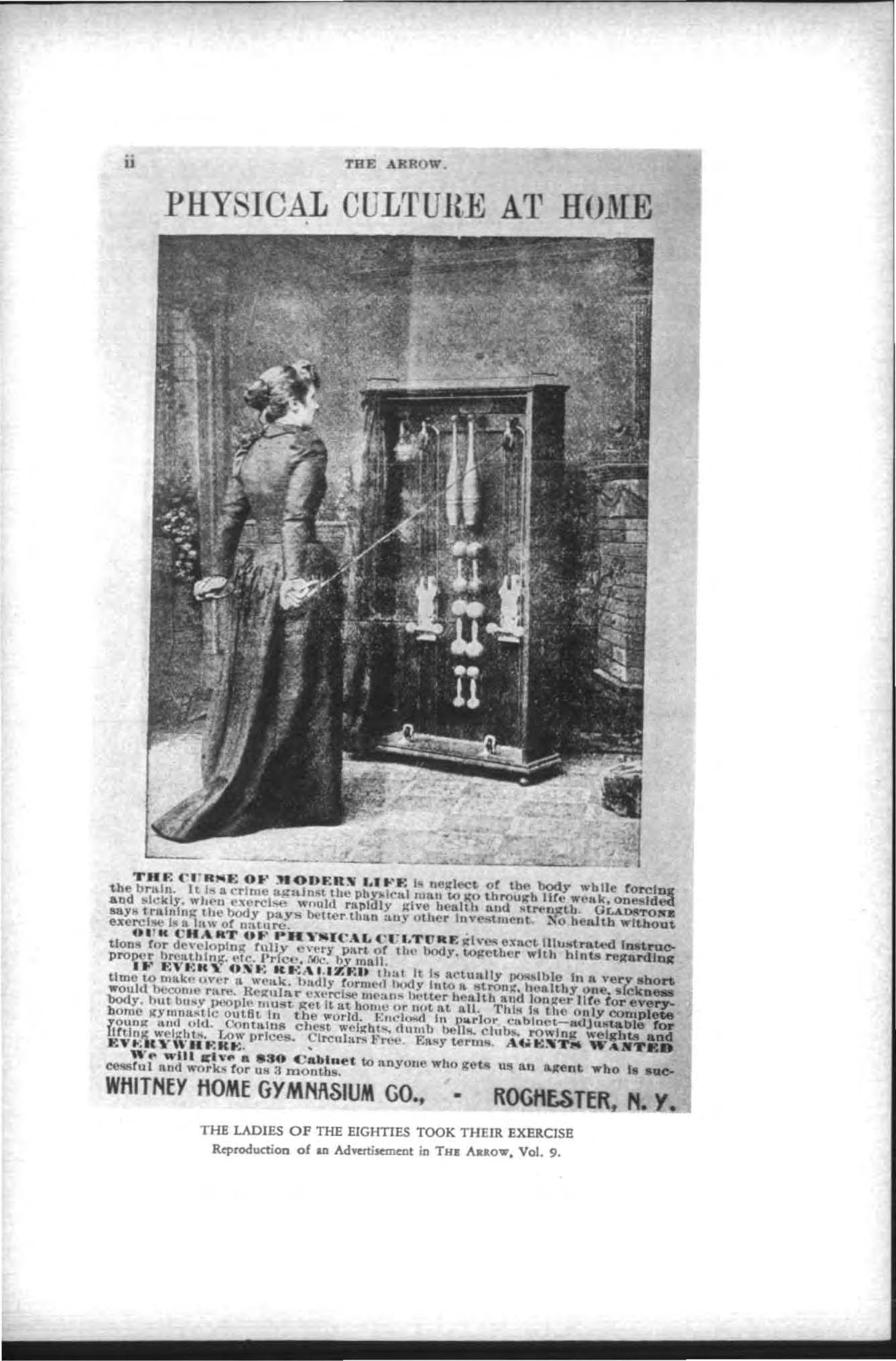
THF. t:','RJOi!E 0.'
L • : 19 oe.lee" Or tbe body wblle tOl'ClnC the br.ln. It I a nlme alluln!U. the pbPlcallllall to go lhroultb weak, ooeslde4 and filckly. wht'n would rapidly give bealth and "lteIlKlb. Or...A08TOa. lays training the body pa.ys better tbll.D any other InvesllU('nt. No health wtLhoul. exercl..e ,'I" law of llI'ture.
Ol ' k (:HART 01-' ".,' MICAL C(;I.TI1Il£ Jt'lv exact.IlIUtttrat..ed , true;> tJODfI t or de\'eloplng rully C\'('r y par' or tbt' body. \OKct.ber with blnta re rdlq proJ)('1' I;'lc. PrlC<'.l'IOc by mall. '1" ON.: K.!A' IZt: U Ihat It IOf &(,Lually p()IUlble In verv abon time to make OVN a wt'Mk. badly torme·d hod,. Into a "trong. healtby one. sfck-ae. "ould bt.."COnie rttroe. Rt-Ilula.r exerciSE" 111(>:&11'< better bealth and lo"ster life tor eYer'J'body. hut. busy l,)t.'Oplf' must. at. botJl u or nllt. ft,t, all. Thl8 I" t.he o nly eotnplMie h ome Kymna!4tlc outfit. In the "orld. In pw.rlor Cllblllec.-adJu.8ta ble tor " OUIII( and uld. Co ntalus chen welKhl' dUlllb beU,,- clubs.. rOwing Wf>labUi aDd (ttlllg Low prlccs. ClreulaN F'N.:oc. Euy t.erhl!l. AG .':!lWT8 W EV ;aCY"' H t : Kt: , W will «Iv a 8:S0 Cabillet to I\nyone who getA us fln &,;ent who I ••.,. ce98ful and 'lVork8 tor U8 3 months.
WHITNEY HOME GYMNIISIUM GO., ROGHf.STER, PI.
THE LADIES OF THE EIGHTIES TOOK THEIR EXERCIse Reproduction of III in TH. A •• ow Vol. 9.
and !?inned to the carpet; and then again laughing till our sides ached to see them attem!?t to thread a needle seated on a round jar, WIth but one foot touching the floor."
Fortune telling; Rhyming , with pennies as forfeits; Mother Hubbard Masquerade ; "Grub suppers"; "Apron socials"; oyster suppers; A New Year's reception that was aIr "pure tone" ; an evening spent in blowing the frail and airy soap.bubble; a kettJe-drum
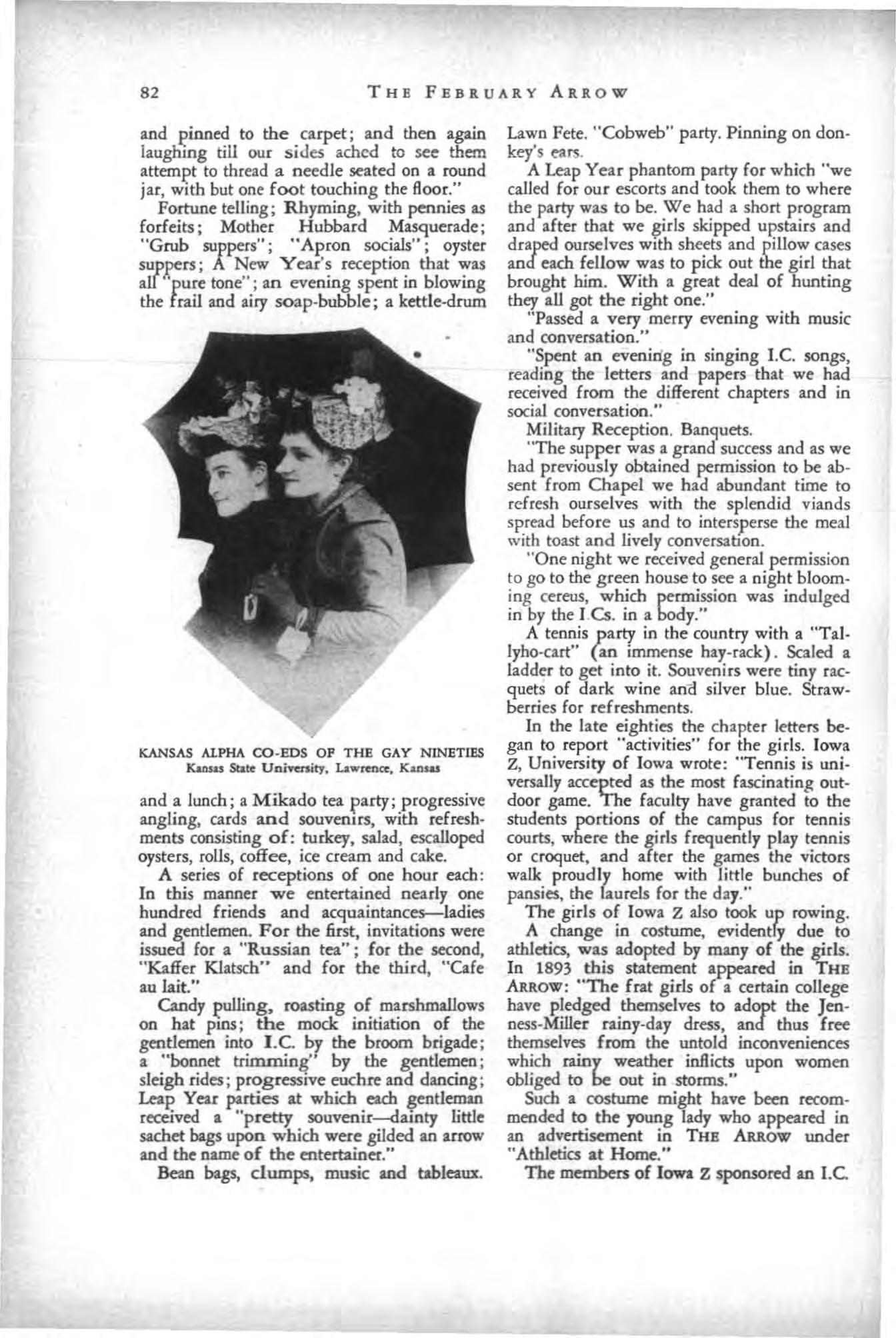
KANSAS AlPHA CO-EDS OP THE GAY NINETIES
Katw.s State UnifttSity, Lawrence, Kan
and a lunch ; a Mikado tea party; progressive angling, cards and souvenIrS, with refreshments consisting of: turkey, salad, escalloped oysters, rolls, coffee, ice cream and cake.
A series of receptions of one hour each: In this manner we entertained nearly one hundred friends and acquaintances-ladies and gentlemen. For the first, invitations were issued for a "Russian tea"; for the second, " Kaffer Klatsch" and for the third, "Cafe au Jait."
Candy !?ulling, roasting of marshmallows on hat plOS; the mock initiation of the gentlemen into I.e. by the broom brigade; a "bonnet trimming" by the gentlemen; sleigh rides; progressive euchre and dancing; Leap Year parties at which each gentleman received a "pretty souvenir-dainty little sachet bags upon which were gilded an arrow and the name of the entertainer."
Bean bags, dumps, music and tableaux.
Lawn Fete " Cobweb " party. Pinning on donkey's ears
A Leap Year phantom party for which "we called for our escorts and took them to where the party was tn he We had a short prog ram and after that we $irls skipped upstairs and draped ourselves WIth sheets and pillow cases and each fellow was to pick out the girl that brought him. With a great deal of hunting they all got the right one."
"Passed a very merry evening with music and conversation."
"Spent an evening in singing I e. songs , reading the letters and papers that we had received from the different chapters and in social conversation ."
Military Reception . Banquets.
'The supper was a grand success and as we had previously obtained permission to he absent from Chapel we had abundant time to refresh ourselves with the splendid viands s pread before us and to inters'perse the meal with toast and lively conversation .
"One night we received general permission to go to the green house to see a night blooming ce reus , which permission was indulge d in by the I.Cs . in a body."
A tennis 'party in the country with a "Tallyho-cart" (an immense hay-rack) Scaled a ladder to get into, it. were tiny racquets of dark wine ana Silver blue. Strawberries for refreshments.
In the late eighties the chapter letters hegan to report "activi ties" for the girls. Iowa Z, University of Iowa wrote: "Tennis is universally accepted as the most fascinating outdoor game. The faculty have granted to the students portions of the campus for tennis courts, where the girls frequently play tennis or croquet, and after the games the victors walk proudly home with little bunches of pansies. the laurels for the da y.'·
The girls of Iowa Z also took up rowing.
A change in costume, evidentry due to athletics, was adopted by many of the girls. In 1893 this statement appeared in TH E ARRow: "The frat gi.rls of a certain college have pledged themselves to adopt the Jenness -Miller rainy -day dress , and thus free themselves from the untold inconveniences which rainy weather inflicts upon women obliged to he out in storms."
Such a costume might have been recommended to the young lady who appeared in an advertisement in THE ARRow under "Athletics at Home."
The members of Iowa Z sponsored an I.e.
Camp C 'mp Whip Poor Wiu on the Iowa River about two and one·half miles north of Iowa City wb<re, during the summer vaca· tioo, the girls enjoyed swimming, canoeing, and fishing, etc., for an entire week in 1887. This camp was so successful for two seasons that plans were considered Cor making it a general Pi Beta Phi encampment, but the plans were not ceali:zed. This summer camp was a forerunner of the Prov ince Conventions and the State Gatheriogs which originated in the nineties.
To resume the Chronological HistoryThe Indianola chapter recorded early in July 1875: "The different chapters have been agio tating the question of having a Convention to which each chapter sends a delegate. And as such a Convention would necessarily cause an additional expense to our already ex· hausted treasury, the question very properly arose-'Prom whence shall our money come?' It was moved and seconded we have a Festival next Tuesday Evening, July '75, pro · viding Dr Burrs is willing. Half the proceeds to go for college chairs."
Nothing delinite seems to bave resulted from this "agitation" of '75. Two years later, the minutes of Lambda, Indianola, record that "A Convention was called by Mt . Pleas· ant for May 23, 1877." Lambda elected two delegates, Misses Clark and Morrison, the former resigned and Kate Barker was elected in place of Miss Clark. "A committee was appointed to suggest deficiencies in the Con· stitution."
For some reason this Convention did not materialize. The Minutes of Mu Chapter, Ames, show on Nov. 13, 1877: "Report by Miss Whited that there was no Convention at Mt. Pleasant."
It mwt be remembered that jwt at this time Alpha was in the midst of anti·fraternity trouble at Monmouth and was practically in· active.
On Sept. 18, 1877 Lambda recorded: "Mo· tion prevailed that the regular correspondents of the different chapters agitate the question of bolding a Convention some time dueing November,"
On this same 18, 1877, there appears on the Minute Book of Lambda the name of Sub Royal Lady instead of Vice President, and on November 17, an e1ectioo was held at Simpson College at which the officers were designated as: Right Royal Lady, Sub Royal Lady, Right Royal Scribe, Treas· urer, and Scribe. Later these names were used in the Constitution proposed and adopted at the 1878 Convention and appear in chapter
minutes until 18BO when they were changed to IIIustra Regina (Noble Queen), Regina Secunda, etc.
No data is available as to the exact origin of these new names for fraternity officers. Since they appear first in Lambda's book and not in the other chapter minute books of that date, it is reasonable to suppose that Lambda's Committee on the revision of the Constitution originated them.
Up to this time, the matter of calling Con. ventions had been regulated by Alpha Chap. ter and previous to 1876 all Convention officers had been chosen from the Mother chapter.
In accordance with this system, Lambda chapter on March 2, 1878 discussed "The propriety of having a Conventioo of I C chapters Miss Florence Andrew was in structed to write to Miss Mortimer of the Alpha Chapter, concerning the holding of a Convention sometime during the present term,"
The desired permission was granted by ahd 00 March 26, 1878, Indianola after about two hours talk" decided "we hold a Convention of I.e sisterhood the lirst Friday in May 1878, i.e., if all the Societies agree,"
Later minutes of Lambda record many plans for the Convention and the postpone. ment of the date by one week.
A Committee on the General Aceange. ments was appointed consisting of: Marie Moceison, Elizabeth Cooke, Kate Backer, Hattie Speay and Bessie Guyer.
The Convention publicity consisted in the sending out of letters to the various I.C chapt<rs which read:
Much 28, 1878. At the last m«ting o f our chapter we considered the matter of a Convention --doubtless a subject to you girls--and 3l we had recei"ed from the Alpha chapter to have it here we ace very anxious it should meet with approval aJl around. What do you say to it? Can you send a delegate? We thought better to have it as soon as possible so as to help those of
our girls who arc in trouble. a nd U't the time a5 the third of May. Our chapter, also the one at Ames, feel as though we some cha nges made jn our Constitution. And if we could have say two delegates from each chapter we could become better acquainted and feel more like sisters. I wish you would please us hear from you as soon as possible on the subject.
At this Fourth Convention of Pi Beta Phi, which was held the second week in May at
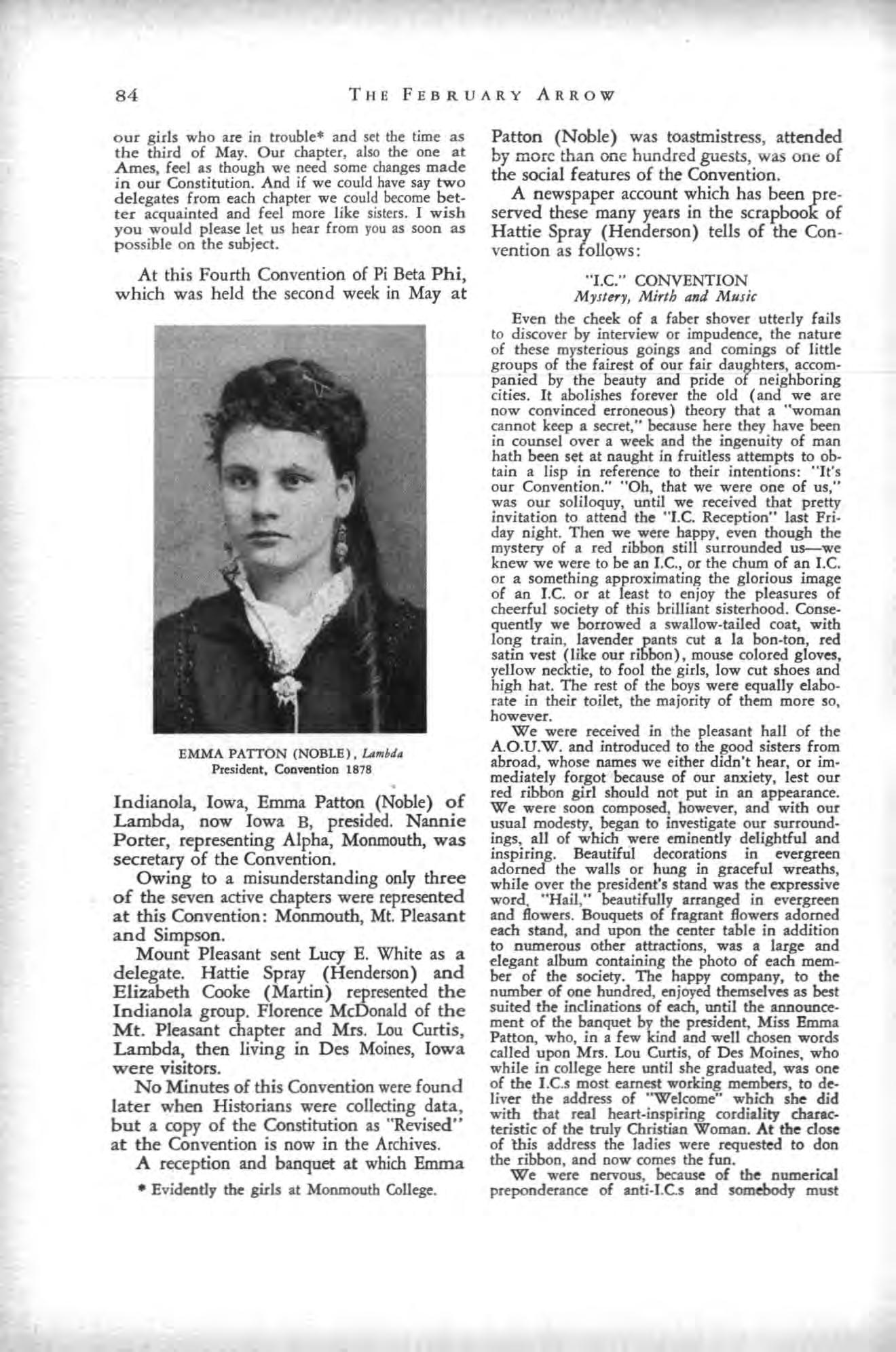
Indianola, Iowa, Emma Patton (Noble) of Lambda, now Iowa B, presided. Nannie Po r ter, representing Alpha, Monmouth, was secretary of the Convention.
Owing to a misunderstanding only three of the seven active chapters were represented at this Convention: Monmouth, Mt. Pleasant and Simpson.
Mount Pleasant sent Lucy E White as a delegate. Hattie Spray (Henderson) and Elizabeth Cooke (Martin) represented the Indianola group. Florence McDonald of the Mt. Pleasant chapter and Mrs . Lou Curtis, Lambda, then living in Des Moines, Iowa were visitors.
No Minutes of tbis Convention were found later when Historians were coUecting data, but a copy of the Constitution as "Revised" at the Convention is now in the Archives.
A reception and banquet at which Emma
• Evidently the girls at Monmouth College.
Patton (Noble) was toastmistress , attended by morc than one hundred guests, was one of the social features of the Convention.
A newspaper account which has been preserved these many years in the scrapbook of Hattie Spray (Henderson) tells of the Convention as follqws:
MYJltr" Mirlh and MUJic
Even the cheek of a faber shover utterly fails to discover by interview or impudence, the nature of these mysterious goings and comings of little groups of the fairest of our fair daughters, accompanied by the beauty and pride of neighboring cities It aboli,shes forever the old (and we are now convinced erroneous) theory that a "woman cannot keep a secret," because here they have been in counsel over a week and the ingenuity of man hath been set at naught in fruitless attempts to obtain a lisp in reference to their intentions: "It's our Convention." "Oh, that we were one of us," was our soliloquy, until we received that pretty invitation to att end the "I.e. Reception" last Friday night. Then we were happy, even though the mystery of a red ribbon still surrounded us-we knew we were to be an I.e.. or the chum of an I.C. or a something apr,roxirnatin g the glorious image of an I e. or at east to enjoy the pleasures of cheerful society of this brilliant sisterhood. Consequently we borrowed a swallow-tailed coat. with long train , lavender pants cut a la bon-too, red satin vest (like our ribbon), mouse colored gloves. yellow necktie, to fool the girls, low cut shoes and high hat. The rest of the boys were equally elaborate in their toilet, the majority of them more so, however.
We were received in the pleasant hall of the A O U.W. and introduced to the good sisters from abroad, whose names we either didn't hear. or immediately forgot because of our anxiety, lest our red ribbon girl should not put in an appearance. We were soon composed, however, and with our usual modesty, began to investigate our surroundings. all of which were eminently delightful and inspiring. Beautiful decorations in evergreen adorned the walls or hung in graceful wreaths. while over the president's stand was the apressive word. "Hail ," beautifully arranged in evergreen and Bowers , Bouquets of fragrant Bowers adorned each stand, and upon the center table in addition to numerous other attractions, was a large and elegant album containing the photo of each member of the society. The happy company. to the number of one hundred , enjoyed themsdves as best suited the inclinations of each, until the announccment of the banquet by the president. Miss Emma Patton , who, in a few lcind and well chosen words called upon Mrs . Lou Curtis , of Des Moines, who while in college here until she graduated, was one of the I.e.s most earnest wor1cing members, to deliver the address of '''Welcome'' which she did with that real heart-inspiring cordiality characteristic of the truly Christian Woman At the dose of this address the ladies were requested to don the ribbon, and now comes the fun.
We were nervous , because of the numeriaJ preponderance of anti-I.e.s and somebody must
needs get left, upon establishing our claim to a companion. we 'proceeded to the banquet ball, where a feast of $ood things too numerous and delicious for dcscrtptioo, loaded the table. At the dose of the (east the president uose and proposed • toast to the Ddta Tau Delta Society, alling upon Ira De Long for a roponse. Then we were deWe could laugh at the boys and pity the glr1S who were called upon to respond to toasts too numerous to mention, because we knew ou! name would Dever be called in that list.
Toast No.2, given by Miss Elizabeth Cooke, "The Citizms of Ind ianola. urge-hearted and Gene rous"; response by U. S. Brown. No.3, The I.e., of Mt. Pleasant; respon se by Miss Lou E. White of that city. No.4, The Lawym. witty and n imble tongued; response by W. F. Powell. No.
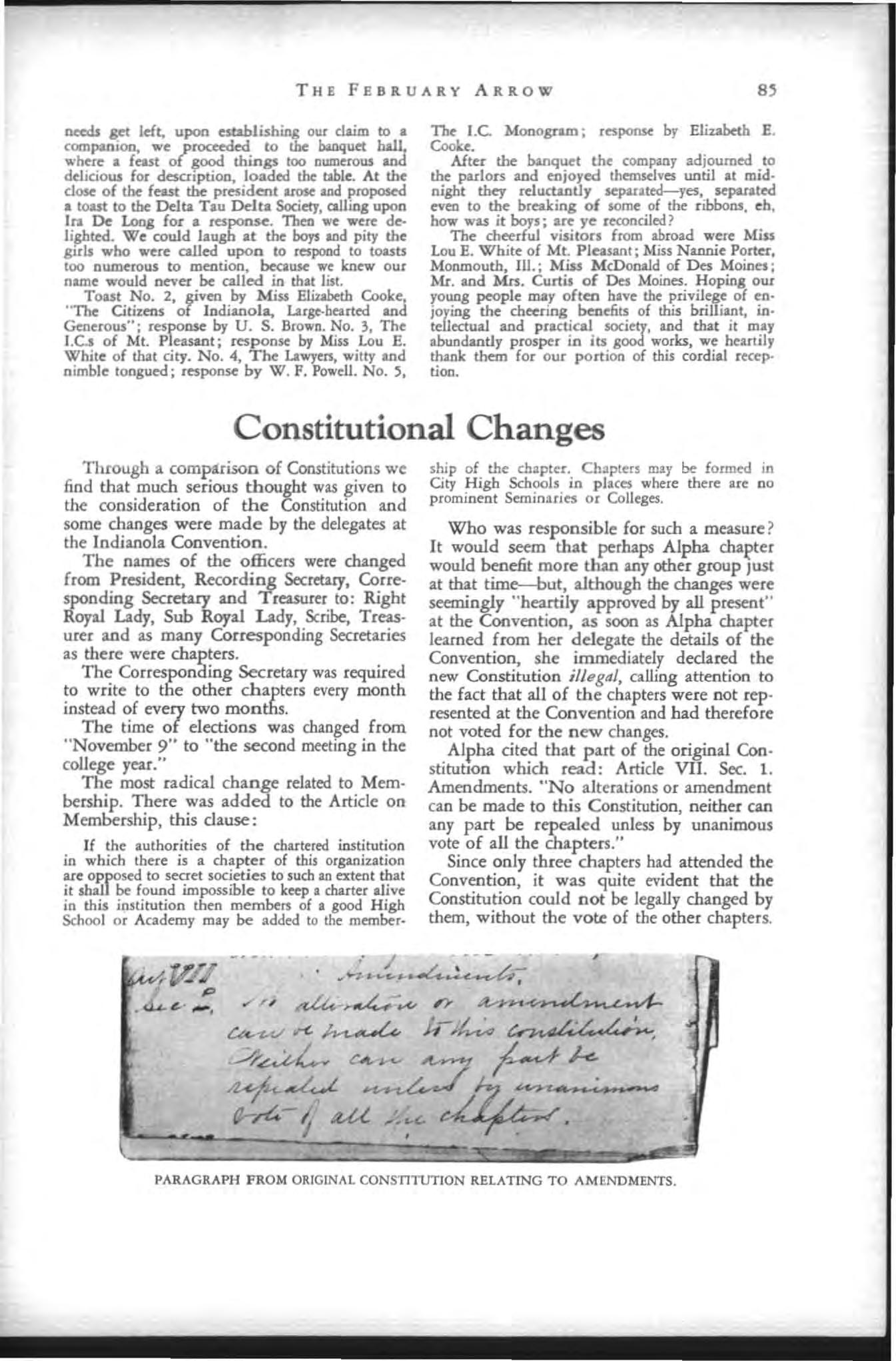
The I.e. Monogram; response by EUzab<th E. Cooke.
Alter the banquet the company adjourned to the parlors and enjoyed until .t mid· night they rel\lcta.otly separated-yes. separated even to the breaking of some of the ribbons, eh how was it boys; ace ye reconciled?
The chttrful visitors from abroad were Miss Lou E. White of Mt Pl easant; Miss Nannie Porter, M onmo uth, Ill.; Miss McDooa1d of Des M oines; Mr. and Mrs . Curtis of Des Moines. H oping o W' young people may often hive the privilege of en· joying the cheering benefits of this brill iant, intellectual and practical society, and that it may abundan tly prosper in its good works, we heartily thank them for our portion of this cordial reception.
Through a compariso n of Constitutions we find that much serious thought was given to the consideration of the Constitution and some changes were made by the delegates at the Indianola Convention .
The names of the officers were changed from President, Recording Secretary, Corre· sponding Secretary and Treasurer to: Right Royal Lady, Sub Royal Lady, Scribe, Treas· urer and as many Corresponding Secretaries as there were chapters.
The Correspo naing Secretary was required to write to the other chapters every month instead of every two montns.
The time of elections was changed from " November 9" to " the second meeting in the college year."
The most rad ica l change related to Mem · bership. There was added to the Article on Membership , this clause:
If the authorities o f the chartered instituti o n in which there is a chapter of this o rganization are opposed to secret societies to such an extent that it shaH be found impossible to keep • charter alive in this institution then members of a good High Schoo l or A cademy may be added to the member-
shi p o f the chapter. Chapters may be formed. in City High Schools in pla ces where there are no promi nent Seminaries or Colleges.
Who was responsible for such a measure ? It would seem that perhaps Alpha chal.'ter would benefit more than any other group Just at that time-but, although the changes were s=n.ingly " heartily approved by all present " at the Convention, as soon as Alpha chapter Jearned from her delegate the details of the Convention, she immediately declared the new Constitution ill egal, ca lling attention to the fact that all of the chapters were not rep · resented at the Convention and had therefore not voted for the new changes.
AJpha cited that part of the original Con · s titutton which read: Article VII. Sec. l. Amendments. "No alterations or amendment can be made to this Constitution, neither can any part be repealed unless by unanimous vote of all the chapters "
Since only three chapters had attended the Co nvention , it was quite eviden t that the Constitution could not be legally changed by them , without the vote of the other chapters
Although the addition to the Constitution of a which would have permitted the membership of high school students, seemingly would have benefited Alpha Chapter, it was Alph a who led the fight against such a ruling in the years following, and Gamma chapter who favored it.
Due to a very peculiar situation existing at Iowa Wesleyan University, Mt. Pleasant ,
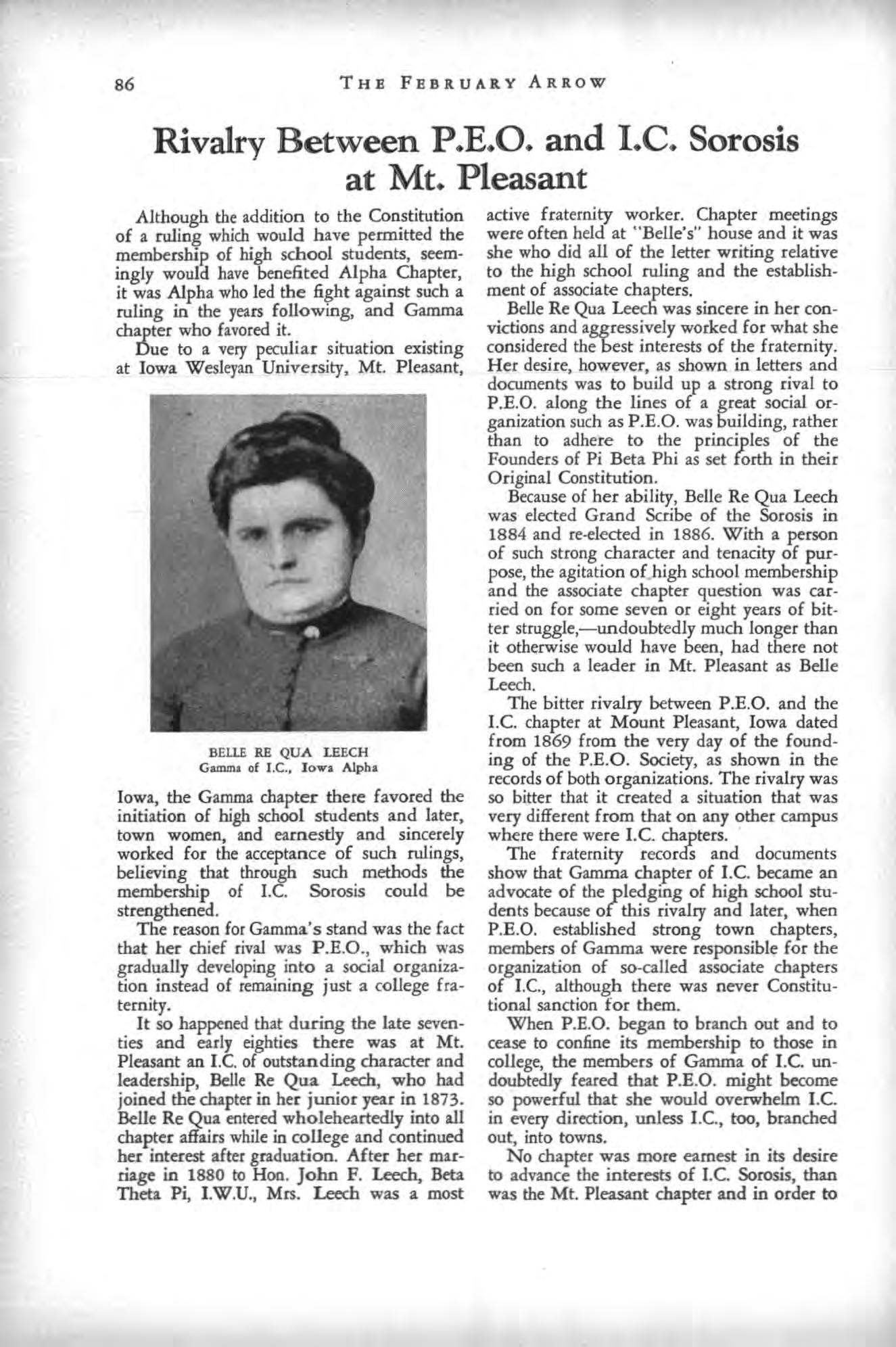
B ELLE RE QUA LEECH
Gamma of I.e , I owa Mph •
Iowa, the Gamma chapter there favored the initiation of high school students and later, town women, and earnestly and sincerely worked for the acceptance of such rulings, believing that through such methods the membership of I.C. Sorosis could be strengthened .
The reason for Gamma' 5 stand was the fact that her chief rival was P E O., which was gradually developing into a social organization instead of remaining just a college fraternity.
It so happened that during the late seventies and early eighties there was at Mt. Pleasant an I.C of outstanding character and leadership, Belle Re Qua Leech, who had joined the chapter in her junior year in 1873. Belle Re Qua entered wholebeartedly into all chapter affairs while in college and continued her interest after graduation . After her marriage in 1880 to Hon John F. Leech, Beta Theta Pi, I.W U., Mrs Leech was a most
active fraternity worker. Chapter meetings were often held at " Belle's" house and it was she who did all of the letter writing relative to the high school ruling and the establishment of associate chapters.
Belle Re Qua Leech was sincere in her convictions and aggressively worked for what she considered the best interests of the fraternity. Her desire, however. as shown in letters and documents was to build up a strong rival to P.E.O. along the lines of a great social organization such as P.E.O. was building, rather than to adhere to the principles of the Founders of Pi Beta Phi as set forth in their Original Constitution
Because of her ability, Belle Re Qua Leech was elected Grand Scribe of the Sorosis in 1884 and re -elected in 1886. With a person of such strong character and tenacity of purpose, the agitation of high school membership and the associate chapter question was carried on for some seven or eight years of bitter struggle,-undoubtedly much longer than it otherwise would have been, had there not been such a leader in Mt. Pleasant as Belle Leech
The bitter rivalry between P.E.O. and the I.e. chapter at Mount Pleasant, Iowa dated from 1869 from the very day of the founding of the P.E.O. Society, as shown in the records of both organizations. The rivalry was so bitter that it created a situation that was very different from that on any other cam pus where there were I.e . chapters .
The fr aternity recoras and documents show that Gamma chapter of I.e. herame an advocate of the pledging of high school students because or this rivalry and later, when P.E.O. established strong town chapters, members of Gamma were responsible for the organization of so-called associate chapters of I.C , although there was never Constitutiona! sanction for them.
When P .E.O. began to branch out and to cease to confine its membership to those in college, the members of Gamma of I.e. undoubtedly feared that P.E.O. might berome so powerful that she would overwhelm I.e. in every direction, unless I .C, too, branched out, into towns.
No chapter was more earnest in its desire to advance the interests of I.e. Sorosis, than was the Mt. Pleasant chapter and in order to
understand her viewpoint more fully, let us quote from "The Story of P .E.O." written by Winona Evans Reeves , Editor of the P E O. Record since 1918, and consider additiooal information supplied by Mrs. Bess B. Grier, * a prominent P .E.O., who is also
• Mrs . Grier's husband's aunt was Ada Bruen Grier, Founder, and MIs. Grier's mother was an in·
a member of Pi Beta Phi. Too, let us inspect carefully the contents of letters written by Belle Re Qua Uecb.
lImate friend of Mrs . Inez Smith Soule. Mrs . Grier was a Sunday School pupil of Emma Brownlee Kilgore so she has an unusual Pi Dds Ph i background in addi tion to an officer of P E.O.
"The incident which hastened the organization of the P.E.O ., stimulated its growth and strengthened the bond among its members was a rival society." At a fraternity party in Mount Pleasant one nigbt three girls disdosed gleaming golden arrows on their bodices. In this crowd these pins could mean but one thing, " that Libbie Brook from Monmouth has done just what she said she was going to do; she's started an I.e. chapter."
The very next morning two girls sat on a stile talking it over, finally one said: "Let's have a society of our own." They hurried across the campus and told their plan to five other friends; there was not a dissenting vote, all were eager to carry out the plan. "That afternoon they met in the music room during a vacant period and rlanned their society behind dosed doors, al in deepest secrecy. One said, 'What shall we call it?' They thought a moment and then was suggested the name which that day bound the hearts of seven girls and which today cements the friendship of many thousand women. They chose the star for their emblem. The seven took the oath, the same pledge which all P.E. Os have taken since," and thus was organized the first chapter of P.E.D. on Janu ary 21, 1869.
"The spirit of rivalry whIch prompted the starting of their society at just this tune was further disclosed in subsequent school girl incidents. 'When the P.E.Os. had heard that the I.Cs were going to march into chapel wearing blue calico dresses all made after the same fashion, they met that afternoon and worked like mad making aprons of white calico with a black star. The aprons had a ruBle all around them and were made with a bib, fastened on the left shoulder with the shining P.E D star. The I.Cs, SO the P .E.Os discovered. were to meet in one of the literary halls and the P.E.Os went aloog before chapel time and crowded into a little dosetlike room used by the janitor, very near the chapel door. At the last stroke of the bell,
just as the I.Cs started out of the door farther down the hall, the P.E.Os stepped in front of them and proudly appeared 6rst in chapel." This was the lirst time the pins were worn in public.
"The "P.E.Ds and I.Cs were for years mortal foes yet each respected the steel of the other, for the societies were made up of much the same type of girls. In Iowa Wesleyan they couldn't even belong to the same literary society; they had two societies in later years. The two boys ' fraternities had to be very careful in the way they divided their dates and their attentions." This marked rivalry apparently lasted up to the time when I.e. Sorosis became Pi Beta Phi fraternity and until the college chapter of P.E .O . was merged into the city chapter_ The horizons of bothJroups of girls was then notably extend ; one group to that of a nationwide fraternity, the other to that of an ever expanding alumnae inBuence which eventually became dominant when P E.O. left the campus.
"In the beginning P.E.O. was a college chapter but as the members grew older and passed out of college they still retained their membership and until some time in the 80' s both the town women and the college girls belonged to the same chapter." This did not prove a happy arrangement for various rea· sons, so the college girls asked for and were given a charter for their own chapter. This college chapter was in many ways a law unto itself. The girls did what was exrdient for they had to compete with Gree letter societies whose laws were made to fit college needs. The P.E.O laws had come to be such as 6tted the needs of city chapters. This meant that the college girls had to be granted special privileges as to membership and initiation, which plan did not work very well for by this time there were chapters in several towns and these chapters in 1883 had voted to have a central governing body called the
Grand Chapter In 1902 the girls of Iowa Wesleyan surrendered their charter, their P.E .O. membership went back to Chapter Original A, the Founders' chapter . Since then many gi,ts have been happy to join both Pi Phi anti P .E .O . A chap ter of Alpha Xi Delta ca me into Iowa Wesleyan to take the place of the P .E.O. chapter." There are now In (193') 184) chapters of P.E .O. with a membership of ahout 60,000
Tbe feding towards P .E O which existed at Mt. Pleasant, was evidently carried in a small measure to Indianola and on Jan 12, 1876, the Minutes of the Simpson chapter read: " Moti on carried that Miss Oark write to the Mt. Pleasant chapter of P E.O and tell them that we know the meaning of it."
Many expressions of friendliness, however, were found in other quarters . Fairfield , Iowa in May 188) wrote to THE ARROW: " The P.E.Os. here outnumber I.e., but there is no feeling of rivalry between us , as the two so· cieties are formed on quite a different basis ."
From Bloomfield, Iowa in the same year came this: "There is a P.E O sisterhood in our city also, and I am thankful to say that there has never been ought but the most friendly feelings between us. We have a pi cnic together in July "
By 1890, too , Mount Pleasant, Iow a wrote to TH E ARR OW: " Both college and alumnae chapters, by invitation , enjoyed a very pleasant evening with the P.E.Os. in their hall during this term ."
Although the High School membership ruling was pl ace d in the I. e. Constitution by delegates at the Conventions in 1878 and 1880 and was "written in" by a committee after the Convention of 1882 , it was each time declared unconstitutional by A1l;'ha Chapter and was stricken from the ConstItution, for the lirst two times because all of the chapters had not voted on it, and for the third time, because Alpha dainned that it was " written into" the Constitution by the Committee after the Convention closed , and was not voted upon by the delegates .
The Minutes of Gamma (Mt. Pleasant) of Oct. 29, 1879 show , that despite Alpha's ruling against high school membership, the chapter at Iow a Wesleyan passed this motion: " Moved to take ladies Dot members of college. Carried unaninaously." (It must be noted that this ruling was passed by Gamma at a meeting when both the President and Vice-president were absent and it may not have represented the sentiment of the entire chapter . )
Although Gamma did put this ruling into her local minutes, she strove to have it legalized by the national fraternity.
The minutes of the 1884 Convention do not show that this matter was discussed but a lette r written by Belle R. Q. Leech to Galesburg in 1885 would indicate that it had again been brought up . The letter says in part:
"We ask a special favor of your chapter to vo te for the clause we need so much and
cannot do without. Your delegate would not help us last year, but won't she this? It is this, Whenever a chapter feels it would be to their interest and advancement. members or graduates of Gty High Schools , having a high course of study may be admitted to membership : We take it that this adds more than half to our chapters, for we save the choice town girls for the college chapters . The chapters that do not need this, neea not use it, but they well know it is helping others and I think we should work and vote for the general interest. We hope to gain this point or give up in desrai r and we sincerely hope your delegate wi! support us "
Agai n on Nov 2, 1885, Belle Leech wrote to Iota: "I am anxious to hear whether your chapter was sisterly enough to favor us. I beheve if I could talk with you and explain to you what we have to contend with here and why we want it. We do not want chapters in High School, we only ask you to vote for our clause allowing us to admit members of H.S. to our A1= or College chapters . You say you want to raise the standard. so do we and have never done anythin$ to lower it. We are worki ng hard now to gam a chapter for you in an eastern schoof, then why would you not help us in our local chapter We feel we have enough rivals to contend with and look to our sister chapters for support. Our college chapter could not wait for the H S girls to enter college, they would all be P E Os Thi s society held their co nvention
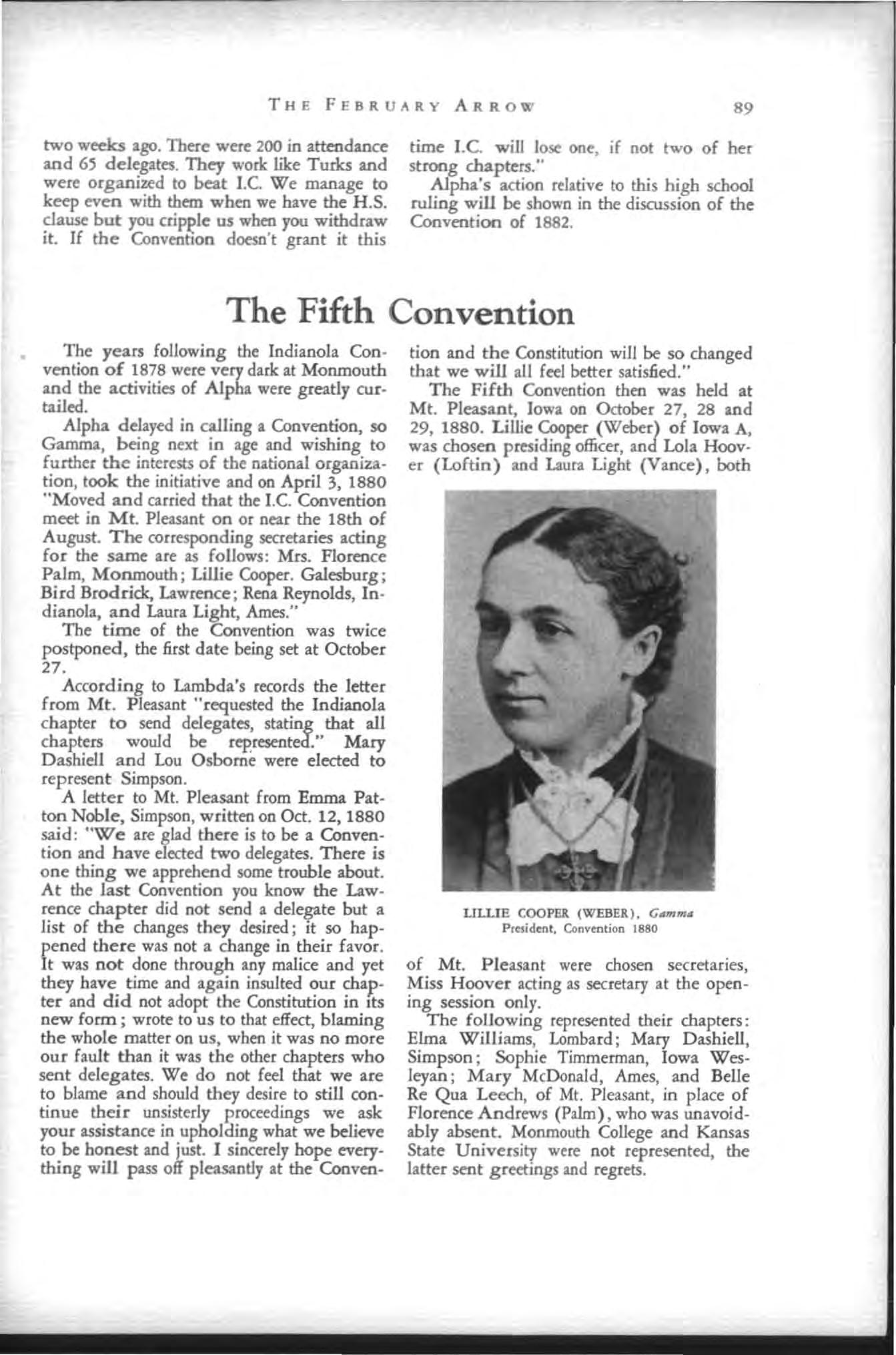
Alpha's action ttl.tive to this high school ruling will be shown in the discussion of the Convention of 1882
two weeks ago. There were 200 in attendance and delegates . They wod: like Twks and were organized to beat I.C We manage to keep even with them when we have the H.S. clause but you cripple U5 when you withdraw it. If the Convention doesn't grant it this time I.e. will lose one, if not two of her strong chapters."
The years following the Indianola Convention of 1878 were very dark at Monmouth and the activities of Alpha were greatly curtailed.
Alpha delayed in calling a Convention, so Gamma, being next in age and wishing to further the interests of the national organization, took the initiative and on April 3, 1880 "Moved and carried that the I.C Convention meet in Mt. Pleasant on or near the 18th of August. The corresponding secretaries acting for the same are as follows: Mrs. Florence Palm, Monmouth; Lillie Cooper. Galesburg; Bird Brodrick, Lawrence; Rena Reynolds, Indianola, and Laura Light, Ames."
The time of the Convention was twice postponed, the first date being set at October 27.
Acco rding to Lambda's records the letter from Mt. Pleasant "requested the Indianola chap ter to send delegates, stating that all chapters would be represented." Mary Dashiell and Lou Osborne were elected to represent Simpson.
A letter to Mt. Pleasant from Emma Patton Noble, Simpson, written on Oct. 12,1880 said: "We are glad there is to be a Convention and have elected two delegates. There is one thing we apprehend some trouble about. At the last Convention you know the Lawrence chapter did not send a but a list of the changes they desired; It so happened there was not a change in their favor . It was not done through any malice and yet they have time and again insulted our chapter and did not adopt the Constitution in Its new foan; wrote to us to that effect, blaming the whole matter on us, when it was no more our fault than it was the other chapters who sent delegates. We do not feel that we are to blame and should they desire to still continue their unsisterly proceedings we ask your assistance in upholding what we believe to be honest and just. I sincerely hope everything will pass off pleasantly at the Conven-
tion and the Constitution will be so changed that we will all feel better satisfied."
The Fifth Convention then was held at Mt. Pleasant, Iowa on October 27, 28 and 29, 1880. Lillie Cooper (Weber) of Iowa A, was chosen presiding officer, and Lola Hoover (Loftin) and Laura Light (Vance), both
of Mt. Pleasant were chosen secretaries, Miss Hoover acting as secretary at the opening session only.
The following represented their chapters: Elma Williams , Lombard; Mary DashieU , Simpson; Sophie Timmerman, Iowa Wesleyan; Mary McDonald, Ames, and Belle Re Qua Leech, of Mt. Pleasant, in place of Florence Andrews (Palm), who was unavoidably absent. Monmouth College and Kansas State University were not represented. the latter sent greetings and regrets.
MINUTES OF CONVENTION OF 1880
The Eulint Minutes Which Have Been Preserved MINUTES OF THE CONVENTION
Wednesday 9 A W.
I .Cs. convened at the home of Sister Lillie Coope.r. House called to order by President ' of Gamma chapter. Miss Cooper, who read a portion of scriptu<e PnfC! by Miss ugh, and soog by MW T i tterington.
Miss Anna Lawson of Gamma chapter then d e· livered an Address of Welcome to the delegates and visitors.
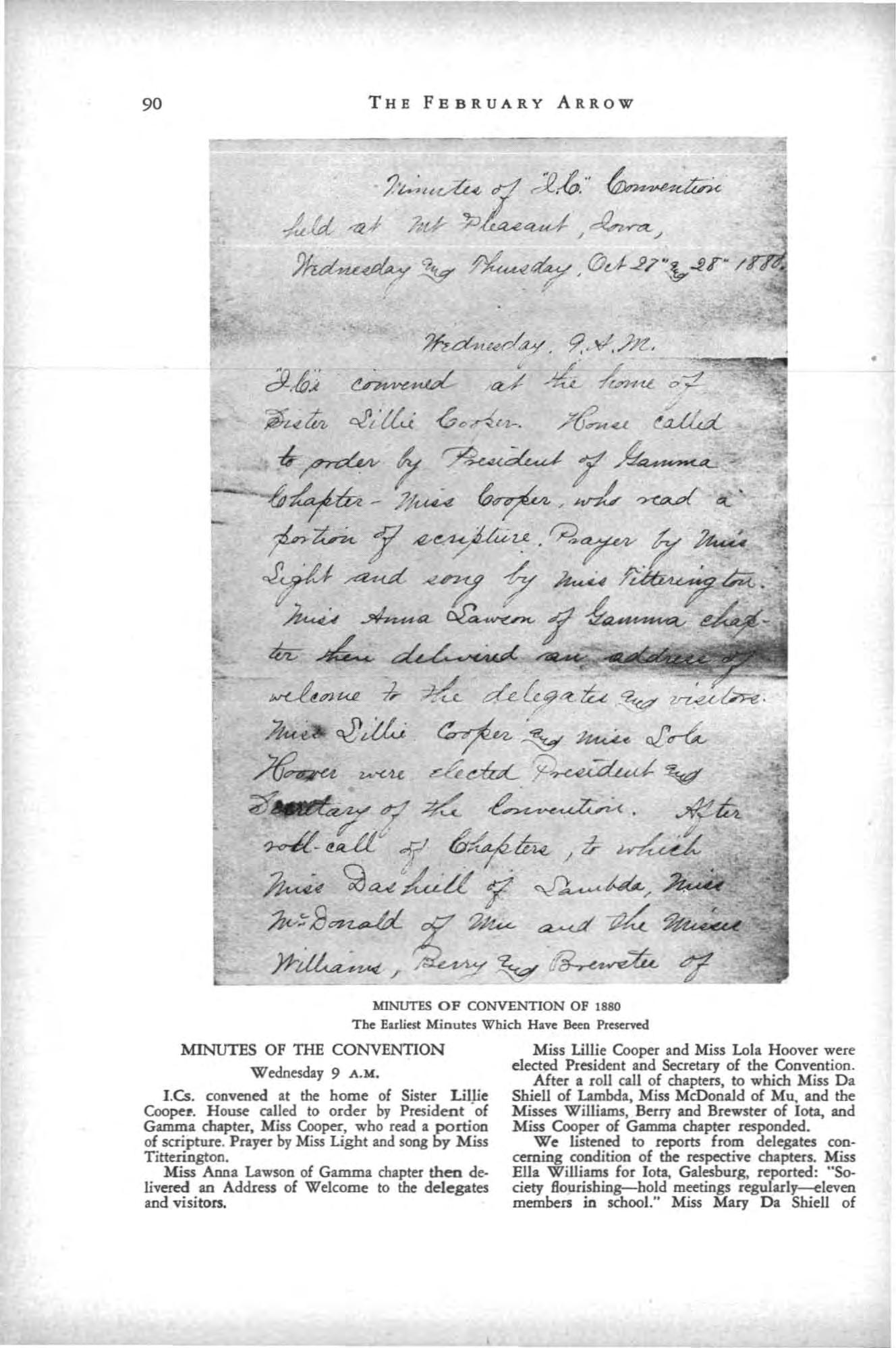
Miss Lillie Cooper and Miss Lola Hoover were elected President and Secretary of the Convention
After a r oll caIJ of chapters, to which Miss Da Shiell of Lambda. Miss McDonald of Mu, and the Misses Williams, Berry and Brewster of Iota, and Miss Cooper of Gamma chapter responded. We listened to reports from delegates concerning condition of the respective chapters Miss Ella W illiams for Iota, Galesburg, reported: " Society flourishing-bold meetings regularly-etevco members in school. " Miss Mary Da Shiell of
l..ambda. Indianola, reported that their chapter numbered fifty members-seventeen in school at present-wCft doiog good work and thought some changes in the Constitution and By-laws advisable. Miss Sophia Timmennan appointed delegate from Gamma in place of Miss Snyder a.bseot. Sbe reported Gamma chapter as doing good work now, about twenty·four in town, sixty·two in chapter, onJ)' two in University, one in high school, two teacben in city public school.
Miss Mamie McDonaJd for Mu (Ames) chapter reported that the chapter had been organized about four Jcar5 and as yet they have no charter. but waul like one; also want changes in the Consti. tutjon; have thineen active memben.
Miss Da Shiell then read their constitution a.s it had been revised at Indianola Convention, May 1878, which revision was of no e8t(t since it was not unanimously adopted by all the chapten.
Coovention then adjourned until 1 P.W:.
Wednesday 1 P.W.
House called to order by the President. Miss Light was appointed secretary in place of Miss Hoover. who had resigned Convention proceeded immediately to the revision of the Constitution. which occupied the time of the afternoon session.
Mrs. BeUe Leech was appointed delegate from Gamma in place of Mrs. Florence Palm who was absent.
Moved. seconded, and carried that the motion for revision of Art. 2. Sec I be tabled until tomorrow. Adjourned until 6 P.M.
Wednesday 6:30 P.M.
Convention work for this evening consisted in revision of Constitution and amendments to the same.
A letter from Kappa (Lawrence) chapter was read stating their inability to send a delegate as they had intended and setting forth their objections and wishes in regard to Convention work.
Adj ourned to meet Thursday 9 A.M.
A tteeption io honor of our visitors was given at the home of s.ister Hattie Ketcham.
Thunday 9 A
Convention continued its work 00 Constitution amendments and By-Laws and amendments.
Motion to take from the table question relating to Art . 2, Sec. 1 was carried.
Under Miscellaneous Business it was moved, seconded, and carried that we transfer the power of Alpha ch.pter to some chapter more prosperous and therefore more fitted to perform those duties, and that. vote be taken with nominations in order to select the chapter best adapted to the work. Vote resulted, Lambda 7. Gamma 3. Iota 2. Lambda having received the majority of all votes cast was declared to be the lucky chapter.
(Each chapter is allowed three votes, three being the highest number of delegates fr om any o ne chapter.)
Adjourned to meet at 6 : 30 P.M.
EVENING
Mo ved and carried that names of o8icen be I.R. (llJustta Regilu) , R S. (Regina Secunda), Scribe, T rca5urer Censors and Corresponding Scribes.
Moved and curied th.t the Iota chapter work up In interest in regard to an I.e. Catalogue.
The Constitution as revised was read by the secretary and adopted by the unanimous vote of the Convention.
Adl ourDed to meet in two years from this fall at Ga csbu rg.
General Pow Wow
Lillie Cooper, Pres. Laura Sccy.
This new Constitution provided for many small changes. In it, too, were two very important changes: ooe, transference of pow« from Alpha Chapter to some other chapt<r "more prosp<rous and therefore more fitted to perform those duties"; and the other, the same High School ruling which had previously been proposed in 1878.
The other changes included a provision that three delegates from each chapter io good standing should be allowed to vote in Coovention; that the IIIustra Regina should "assign a. corresponding scribe for each sister chapter"; that the duty of each Corresponding Scribe sbould be "to conduct the respective correspondence of the organization and to report the same and be required to write at least once a month."
That the Censors should assign the literary programme; assess all fines; reprove members lor grave misdemeanors; and present candidates to the lUustra Regina for initiation.
That the dues or tax p<r term be ra ised from 15c to 25c.
That any person having been expelled or having withdrawn from the $orosis could never be readmitted.
That tbe Alumni Chapter sbould bave power to transact any business which does not conBict with the workings of general organization.
That Lambda Chapter be authorized to keep a register of all the chapters. And that eaen chapter sbould keep a register of all its members.
That no ooe should be initiated wbo had belonged to any other secret organization.
There was evidently some doubt in the minds of the delegates as to how Alpha Chapter would feel about the new rulings of the Convention, especially about the one transferring the power from Alpha to Lambda_
In a lett" written by Mary Da Shiell, Indianola, a delegate, to Ella E _ Williams of Galesburg she said:
"I arrived at Indianola at six o'clock Fri· day evening Several of the I.e. girls were at the depot, anxio usly awaiting the news of the Convention. That evening we had a 'frolic' at the house of A lice Scoles, when I attempted to rela te thelroceedings of the Convention They seeme well pleased indeed and left much better satisfied with the Constitution . I do wish we had decided upon the matter of 'Regalia'.' Our girls were very anxious about that matter. We have never heard from Lawrence as yet, would like very much to know how they were pleased with the pre>ceedings, etc. Neither have we heard fiom Alpha . If they were pleased or displeased with the change of power ... ."
That Alpha was diJpleaJed is seen in an old history paper written in Monmouth about 1885. It states: "The next Convention was held at Mt. Pleasant, Io wa. All power was transferred from Alpha to Lambda and many other important changes were made. Since Alpha was not notified of this Convention , therefore not represented, we knew nothing of proceedings of said Convention until we re<:eived the revised Constitution, which of course we did not accept."
Mt. Pleasant claimed that she thought Monmouth had been notiJied of the Convention The Minutes of Mt. Pleasant show the "appointment of a Cor. Secy to notify Monmouth of the Convention." They also show the receipt of letters from Monmouth on May 8, 1880 and on October 9, 1880 Nothing, however, is said in the Minutes about Monmouth referring to the Convention, while the reports of the receipt of letters from Lawrence, Galesburg and Indi anola state"letters were received onceming Convention,"
At any rate, .Alpha insisted that she had • Ames, too, reported on Ap ril 10, 'SO, the receipt of • letter from Mt . Pleasant aslcing for the chapter's opinion as to baving "an I.e. costume:' It WIS , however. not until 1888 that Pi Beta Phi officially vott'd to accept "a collar as regalia."
not been notified, that she had not granted permission for the holding of the Convention and that she had not had a delegate in attendance,-therefore she de<:lared th e Constitution void-for the second time.
In the meantime, Lambda chapter, thinking that she held the supreme power of the fraternity, granted authority for a charter and authorized KaPe.a at Lawrence, to organize a chapter at St. Joseph, Mo.
But as soon as Monmouth wrote to Lambda about the Convention and declared it illegal , Lambda chapter bowed to the wishes of the Mother Chapter, and acknowledging the fact that the change of power was made without Alpha's vote, restored amicable relations.
The Indianola Minutes of March 19, 18 8 L record:
Letter on March 19 from Miss Braiden of Monmouth stating that Monmouth had not been notifittl o f the Convention and was not willing to have Alpha power vcstttl in o ur chapter, and dedarttl the charter DuH and void. In Convers ational Notes, this was fully discussed and it was decidttl that if M onmouth did not consent the power of course was not ours .
Amy H . Kern of Lambda mentioned the matter of the St Joseph charter in a letter written on April 17, 1881 to the I .Cs. at Galesburg as follows: "We want to organize some new chapters soon- want chapters at Mt. Vernon , Iowa City, and one in Michigan . We granted a charter to the Lawrence /lirls for St. Joseph, Mo ., but just after grantlDg, the Monmouth girls wrote declaring the charter null and void. Of course since they do not consent, the power is not ours to grant charters. We 6lame Monmouth for not letting us know sooner. I do not think we could send a delegate should the I.Cs. bave a Can· vention as Monmouth wrote-tO
In another letter written by Bessie Guyer, Lambda, to Ella Williams, Galesburg on Oct. 16, 1881, the Monmouth situation was discussed: Miss Guyer wrote:
Dear Sister I.e. Y our letter of the nth addressed to Mary Oa ShieH was read last night at our meeting and four humble servant appointed to repl y. We think It quite desirable that we have a Convention-Provided each chapIn can be represented in the Convention and will pledge themselves to send at least one delegate. A.J to the time you mentioned next month-we think. that most too soon u it would not give us time coough to work. it up effectually.
Then, too , our chapter could not .Hord to send a delegate at that time. We have had some little
extra apen.ses to mm and the funds in oue trcaswy are rather "skase" and we think it im· possible for us to respond to your call before sometime during the foUowing year.
You speak of our Sorosis having "two Executive h<2ds" that MiZhl have been the cue had we unmindful of Alph. Iccepted the honor which the last Convmtioo thought best to confer upon w
But as sooo u we heard from Monmouth and learned that the "old Lody" was not d,ad but merely "slumbering" and also their indignation at the worle of the Convention without their having a
can SOld a delegate. Verstahen Sic? We understand we have thrtt new chaptttS--OOC' at Burlingtoo---anotMr at St. Joe-cod also one at OariDda -all in this state. 00 you correspond with In, of them?
It was evidently rather a shock to Alpha Chapter to lind that the Convention had voted to transfer the po wer, and for a time she struggled valiantly to maintain her position at the head of affairs. That she was sensitive
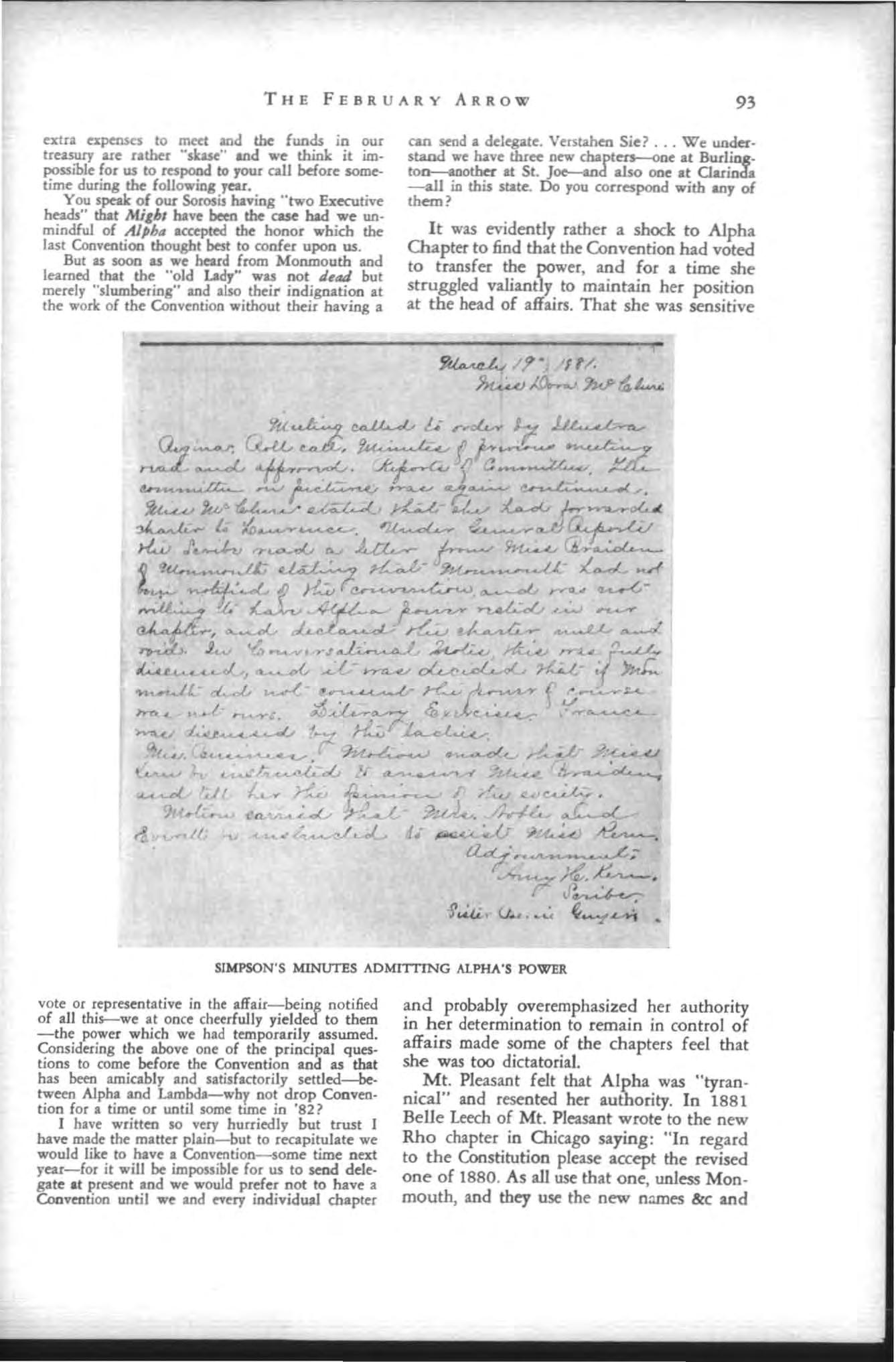
ADMl1TJNG
vote or representative in th e .Hair- being notified of all this--we at once ch«rfully yielded to thcn - the power which we had temporarily assumed. Considering the above one of the principal questions to come before the Convention and as that has bem amicab ly and satisfactorily settled---between AJpha and Lambda-why no t drop Convention for a time o r until some time in '82?
I have writtm so vc.ry hurriedly but trwt I have made the matter plain-but to recapitulate we would like to have a Conventi on-some time next yeat-for it will be impossible for w to send ddegate at prtsent and we would prefer not to have a Coavmtion until we and "ery individm chapter
and probably overemphasized h er authority in her determination to remain in control of affairs made some of the chapter s feel that she was too di ctatorial
Mt. Pleasant felt that Alpha was "tyrannicaI" and resented her authority. In 1881 Bell e Leech of Mt Pleasant wrote to the new Rho chapter in Olicago saying : "In regard to the Constitution please accept the revised one of 1880 As all use that one, unless Monmouth , and they use the new n:unes &c and
they cannot well accept part of it, but must tak e it as a whole, as it was the work of th e Conven tion and ca nnot weU be disputed by anyone member, or anyone chapter for that matter . So do not let Miss B . . . . .. disturb you ."
The Constitution which was sent to Rho and u sed by the chapter, however, was the one issued and approved by Alpha, without the changes maae at the Convention. This Constitution is now in th e Historian's Ar· chives and i s id e nti ca l with the Constitution in use previous to 1876.
On October 24, 188 1, Rilla Carr, Rec. &ribe of Alpha, wrote to Iota at Galesburg asking the chapter to "send us the iUegal Constitution to be destroyed thus recognizing our authority. . . . You state in your letter that some of 'our chapters ' ente rtained a 'doubt' as to the suprem acy of Alpha over Lambda. We know of only your chapter that entertained a doubt in th e matte r. If th e Constitution is read before your chapte r as ofte n as should be we thinlc your 'doubt' would be removed.
"We correspond with all the Chapters on the same old footing. However, if you know of any other chapter entertaining the aforem e ntioned 'doubt' please inform us imme· diately. Your first Constitution told you that no other Constitution could be made except by the consent of all the chapters. Alpfia never consented to the one drawn up last fall, so the Constitution you are at present sailing under is illegal as you must have known .. You should have stood by Alpha as your legal constitution told you.
"In reference to our acknowledged power , we quote the following from Lambda received March 1881 : 'We are glad to hear from you at this late day and that you will retain the power: Their letter is one of their friendly good style and on the old footing If you will send us the illegal Constitution to be destroyed thus recogniz ing our authority we will try to cultivate a more int im ate fnend· ship with you than has exi sted b e fore . By your so domg one of the important reasons for calling a Convention will be removed . If Lawrence sends us the illegal charter the other important reason will also be removed ."
It was very evident that the chapters had deep respect for the Moth er Chapter and had not tried to rob her of authority but were merely struggling for better organizationfor stroog leadership
Kappa, at Lawrence, wrote to Rilla Carr, Monmouth, 00 Nov 5, 1881:
Dear Sister I. C,:
I trust you will pardon my apparent neglect in attending to your letter which was qui te a su rprise to us to say the least. Y es, I asked for and re(eived a cha rter from Lambda f or a chapter at St. Joe, when lambda requested me to ho ld the charter I did so and soon received word f com St. Joe that it would be impossible to establish a chapter there on account of the strict discipline of the school. The charter has been in my possession ever since and 1 will, according to reques t, enclose it in this lette r to you.
K appa feels so rry, indeed , to kn ow of trouble nnd misunderstandi ng in the 50r05is. While we have alwa ys been opposed to the plan o f transferring the power of Alpha to Lambda unde r ordinary circumstances yet we thought that, jf Alpha chapter was so small as reported, it might be better to co nsent to the change and it was for this reason alone that we consented and upon condi ti on that Alpha felt it best to do so.
I am very sorry I cou ld not comply with yow request and write sooner but it seemed imp oss ibl e.
In regard to ou r chapter I can say that we have a fine set of girls nOW, took in one new member today We ha ve five members in schoo l and ten o r twe lve members living here most of whom attend quite regu larly . We have an opposi tio n society in the Kapp a Alpha Thetas . We are going to have a party next Friday night for the Phi Kappa Psi boys . Of co urse we antitcipate a grand good time and we are very eager for th e time to come. I can not write more toni ght. H oping to he ar from you soon and that all will soon be settled. I remain
Sincerely yours in the bonds of 1.Gsm R M Hadley
In the same month, Kappa wrote to Iota saying: "We were very grad to hear that Monmouth has had her power restored. Please answer soon as we haven't a very comprehensive understanding of how things stand."
Evidently the chapters feU into line, returning to the use of the old Constitution, or correcting the new ones to conform to Alpha's instructions.
Bella Love of Lawrence wrote to Galesburg on Jan. 22, 1882 as foJlows:
Dear Sister: W e were very g lad indeed to hear that the difficulties were settled amicab ly at last. We made the sam e changes in the Constitution that you did . Hope you succeeded in establishing that chapter in Kn ox Coll ege. W e had a le tter read at the meeting yesterday from Alpha. Say they have estab lished several new chapters, aski ng for the names o f our officers, &c. H as your society any songs and if so wouldn't you l ike to exchange? We have one, especi all y the Foundat ion Song wri tten by one of o ur members this year. It is quite "too, too." If yo u have any please send them and say what tunes you sing to them.
Our society though not so large as it has been is very industrious. Th ere are three other secret societies in ou r school two gentlemen 's the Beta Theta Pi and Phi Kappa Psi and one other girl's-Kappa Alpha Theta a new society started last year. We meet every Saturday and have been so very
busy entertaining the other societies that we have not done very much in the literary line. We have begun to cud Bryant's History of the U.S. in connection with all the references we can find.
In regard to the songs we think it would be pleasant to all sing the same ones.
Could you give us some names in the Bl oomfield chapte r.
P.S. Ans . Soon. Your I .e. friend, Iklla Love
POUNDING OF THE I.e. SOCIETY
Would you knoW' the story
Of the found ing of I. e.?
Then listen closely 10 this song
Of bow it came t o be
While walking in the gudeo
Bdoft the IUn was UP .
A maid found Cupid Jleepinl With in. Lill,'s cup.
She m.,., 'twas Cupid by the bow And arrow at his 'ide;
And as she dosed the lel-YCS 10 "hite. His eyes be opened wide, And qUlddy then be promised If &he would Itt him 10 An urow be wOtl,ld lin her, Its S«fct she should know .
To make it speed the faster. And tou ch a hel rt , if cold. He made the little 'NOW' All ou t of shining l old ; He put the Ictttr on it, One OIl either band, it stands.
To show that he had yidded Unto the maiden's power, He hung a tin y cha in across To mind us of Ihat hour
Then is there any wonder
We'(C as happ y as can be, Whm Cupid was the founder
Of our dear old I.C .?
Soon after the Convention at Mt . Pleasant in October 1880 , there came into b e ing the fir st of three associate chapters, sponsored by members of Gamma, - the formation of which resulted in internal dissension in the fr aternity and disparagement on the part of rival organizations of Pi Beta Phi. Too, because of the precedent set by the establishment of these associate chapters several other active and alumnae chapters later grew into associate chapters .
The first one of these chapters, Nu at Clarinda, Iowa was declared unconstitutional and its charter was taken away by the Convention of 1884; the second one, at Burlington , Iowa asked to become inactive in 1885 because it felt that Pi Beta Phi was a "school society" and not suited to its needs ; the third one, at Ottumwa, Iowa, was refused a charter by the 1885 Convention, later receiving an alumnae charter.
There was nothing in the Constitution providing for an associate chapter-one formed outside of a college, not consisting of graduates of a college-they simply came into being without legal sanction . The Convention of 1885 ruled definitely that no more should be established and the Convention of 1890 I'rohibited the initiation of new members mto the associate chapters then in existence, which resulted in the charters being surrendered and the solution of this very critical problem in the fratemity_
The story of the birth , life and death of the Associate Chapters is a tragic one Their
whole existence was contrary to the intent and constitution of Pi Beta Phi at the time the fir st one was organized .
Many of the girls init ia ted into these chapters had graduated from some university and others had attended good schools and were loyal fraternity women . A number of them became active national officers and when their chapters were disbanded by fraternity legislation, remained loyal Pi Beta Phis , despite their great disappointment in having to give up their charters.
It is a significant fact that these Associate Chapters existed only in the state of Iowa, geographically close to Gamma chapter whose members sponsored these groups, undoubtedly believing that Pi Beta Phi should adopt extension methods similar to those of P E O. Although they were sincere in their efforts to strengthen the fraternity perhaps their own immediate needs overshadowed the vision of the Founders of Pi Beta Phi, for it was nev the intent of the Founders to maintain active chapters other than in college homes or through a membership of college alumnae. The 0 Iftcial Constitution has never provided otherwIse.
That the intent of the Constitution was clearly understood in the early days is evidenced by the Minutes of Lambda , Indianola which stated on Oct . 7, 1875: "The names of Misses Hayden and Cary were proposed. It was decided that Miss Hayden could not join as she was not a student or a graduate."
According to Alice Clement (Lundy) , a charter member of the Clarinda chapter, "Miss Emma Tomlinson had a friend who was an I.C from Mount Pleasant visiting her in Clarinda and she sent and got a permit to the chapter. We met in the attic of M,ss Tomlinson's home."
Since this chapter was established sometime late in 1880 or early in 1881 soon after the Convention, it is reasonable to suppose that the "vis iting friend from Mount Pleasant" thought that the new ruling relatin g to the taking of high school girls was in effect.
No date appears in the Monmouth records showing just when the charter was issued. The record merely states: "Nu. Miss Georgie Burlingin was authorized to and established a chapter at Clarinda , Iowa."
Since Georgia Burlingin was the Secretary of Alpha at that time, her share in the establishment of the chapter was evidently in issuing the charter .
In view of the strenuous opposition which Alpha waged against the high school ruling, the granting of this charter to Clarinda was most inconsistent.
There is a possibility that the application for a charter (or the Clarinda group reached Alpha at about the same time that she discovered that her power had heen voted to Lambda, and she may have granted the charter, wishing to keep peace with Mt_ Pleasant.
There are no definite records as to the exact circumstances, all of the records having been destroyed about 1885.
The chapter which was called Nu , initiated ten charter members: Kate Rickey (Harlowe), Dora Rickey, Emma Cozier (Shaver) , Minnie Chamberlaine (Russell) , Minnie Hinman (Welch) , Anna McPherrin (Frazier) , Alice Clement (Lundy), Laura Calhoon (McGuire) , Ada Calhoon (Holmes), and Emma Tomlinson (Morris)
Some of the members were married shortly after the installation, others moved away and few new members were taken in.
At the State Convention of Iowa Chapter held in November 1883 in Mt. Pleasant, the Clarinda chapter was declared illegal The Indianola minutes of Dec. 4 , 1883 record : "The Simpson delegate, Dora McClure, reported that the name Lambda had been changed to Iowa Beta and that Clarinda had been declared an illegal chapter." Leota Ken-
nedy of the Indianola chapter "was authorized by Iow a Beta to write to find all that she could about the chapter at Clarinda ."
The Convention of 1884 directed : Leota Kennedy of Indi ano la "to obtain the papers from Clarinda, Iowa" and the order was given in writing.
Miss Kennedy in telling of the incident in after years said that the "chapter refused to give up its charter and records but promised to destroy them and to cease to exist as a chapter and the members kept their word SO far as ceasing to have meetmgs was con· cemed. Their answer was pathetic and I cried when I read it. .. . They were organized just as a society of young ladies in the town, without being co nnected in any way with a college. I do not know whose mistake it was, but think it m ust have been either a mistake of the Grand chapter or of some college memher wbo did not know that the society should not be organized outside of colleges."
According to Emma Tomlinson Morris , she destroyed the charter and records, hen ce we have no complete record of the membership roll of Nu. Although the charter was recalled, the members who had been initiated were retained by the fraternity as members in good standing, and they have always remained most loyal Pi Beta Phis.
No detailed explanation of the facts concerning the temporary existence of these few associate chapters, nor a statement as to Alpha's stand against them and her loyal fight against the high .p,ool ruling, were made public by Pi Beta Phi , due chieBy to the policy of secrecy held so sacred by I.e. memhers . This serecy which veiled the first fifteen years of the fraternity 's life, therefore prevented many who were not members of I .e. from becoming familiar with the fact that the society was founded strictly on the basis of a regular college fraternity and had existed as such, with the exception of a few years during which there was the internal disorganization due to the lack of strong leadership.
Tt is quite understandable then , that uninformed of the true facts, some rivals began in the eighties and continued through the years to try to discredit Pi Beta Phi because of the mistakes made by a few individuals during this brief period of temporary internal strife.
A careful study of the histories of other national fraternities will reveal similar difficulties experieoced by them, also. Foe instance, as late as 1890 a fraternity quarrel occurred at Atheos, Georgia as the result of tbe initiation of young meo not members of the university. According to record, Kappa Alpha, Sigma Alpha Epsilon, Phi Gamma Delta and Alpha Tau Omeso initiated "Noocollegians wbo bad never beeo. or could not for some years be, students of the University, some being from the grammar schools of the city."
It is not dear wby the State Convention held under Alpha Secunda of Iowa at Mt. Pleasant in 1883 declared the Oarinda chapter illegal and did not indude the chapter at Iowa, which had been established as OmIcron chapter of I .e. by members of the Mt. Pleasant chapter on August 3, 1881, as it was also an Associate chapter.
According to the minutes of Gamma chapter, foue delegates were sent to Burlington with the following action taking place:
Burlington . Iowa, Aug. 3, 1881.
Miss Libbie Wolverton's. House caUed to order by I. R. Devotional aercises conducted by the same. Mwic by Miss Ollie Buttles. Initiation of membcn came next and we took into full membershlp the following young ladies: Misses Minnie Bryan, Nellie Sansoo, Ollie Buttles and Cora Widick. The address of "Welcome" written by Rena, who was unable to be present was read by BeJle as there were no general reports we passed on to the Literary exercises which consisted in reading the Constitution. which duty WaJ; performed by Flora.
The charter sent from Alpha was then read. Conversational notes were quite interesting. Moved and carried that Miss Libbie be appointed to see Miss Spencer and ask her to be an I.e. Criticisms. None.
Place for next meeting the following Tuesday
afternoon at Mr. Bryan's GalJery on Jefferson St. Adjournment
I.R. Sophia Timmerman
S. Lola Hoover
All of MI P
According to the minutes "a charter was sent by Alpha. " Surely the Mother Chapter must bave realized that this chapter at Burlington was not connnected with a college, but probably realizing that a precedent had been started in chartering Clannd., hesitated to refuse Gamma's request. A letter from Monmouth to Galesburg in the fall of 1881 indicates that Alpha was merely biding her time, hoping to have many matters readjusted and settled at the next Convention.
Four years after its establishment, Burling · ton asked the Lawrence Convention to permit it to become "inactive," stating that "aue to the membership restrictions the chapter siders Pi Beta Phi a school society, not suited to use outside of college."
Burlington had been a very active, industrious chapter with intensely interested memo bers, so the Conveotion of 1886 invited the chapter to become active again, but the chap. ter refused, (ontinuing to remain inactive and in 1890 surrendered its charter.
The third chapter to be organized as an Associate chapter was the one at Ottumwa, established by members of Gamma in 1884, after Alpha had practically ceased to function. The Ottumwa members were initiated by Mt. Pleasant in August, with the expectation that a charter would be granted oy the Convention which met the following October. The Convention, however, refused the charter.
Following the Convention, Belle Re Qua Leech, Gamma, sent petitions to the various chapters asking them to a,Pprave a rhaeter for Ottumwa. The letter whIch accompanied th e petitions read:
Miss bah Parker, Dear Sister
Mt. Pleasant. Iowa Dec. I, 1884
We are very much troubled over the Convention refusing to grant a charter for the Ottumwa chapter, a nd think they surely did not understand how very necessary it is. Our girls organized an alumnr chapter. there that they are very proud of. When they first talked of it, they wrote Iowa City for a charter--did not hear for some time but organized in the meantime, thinking of course it would be sent soon. We received a Jetter and Iowa City fused to grant it and said they would leave it until
• The members were all "graduates"-graduates of colleges and high schools--but there was no provision in the Constitution for a chapter of high school graduates. unless registered at a college.
Convention met, and we understand it was not granted then. Well now this seems like standing in our own Hgb[, the chapter is in a nourishing condition they have 2, excellent members and have all the secrets of I.e. It is a reflection on us as well as them to still refuse to grant them a charter. It misht be made very unpleasant for us.
Under the existing circumstances we ask you to aid us by signing a petition asking Iowa City to grant a charter for Ottumwa chapter. They feel very much hurt over it and we think Mt. Pleasant too old and reliable a chapter to be treated in this way. She has seemed capable of organizing a majority of the chapters and organized the one that now takes the liberty through a little power to insult us. We fet! it and ask the other chapters to stand by us, if you will do so, please copy the enclosed petition and have it signed by your J.R. and and oblige. Gamma chapter.
YOw> in "I.e"
BeUe R. Leech
A copy of the unsigned petition, is in the Historian's Archives and reads as follows:
We, Iota chapter of the I.e. $orosis request that a charter be granted by Iowa A for an alumnI! chapter at Ottumwa, Iowa.
Signed I. R. Scribe
(Please send to US as soon as possible.)
There is no indication that the petition was sent on by Iota.
Iowa Beta's records show that on Jan. 2, 1885: "A letter from Mt. Pleasant was read
by Sister Carrie B. asking us to sign a petition to grant a charter for Ottumwa. MOhon carried that we refuse to sign this petition."
Later, however, the Iowa City chapter, the ruling chapter, did issue an Alumnae Chapter charter authorizing "Gamma chapter to estab· Iish an Alumnae Chapter in Ottumwa to be known as Theta Omega chapter." This char· ter, signed by Grand L R. Nell G. Custer, provided only for the initiation of college graduates. This charter was the only kind that could be issued legally for a city chapter.
Full credit must be given to the Burling. ton and Ottumwa chapters and to the other chapters which grew wto Associate groups. Both Burlington and Ottumwa entertained the national fraternity at Conventions and their members were leaders in national affairs and were very loyal. It was with great depth of feeling that they later surrendered their charters.
With the demise of Alpha Chapter at Mon· mouth, Iowa Z or Chi chapter at Iowa City, became outstanding in her crusade to prevent the establishment of more associate cliapters, and at the Convention of 1885 the future policy of Pi Beta Phi was definitely decided with the vote that "No chapter shall exist unless situated in a University or college."
To return to the matter of extension,-as ha.s hem previously mentioned, .Alpha granted no charters from 1874 until 1880. Lambda, thouRh, was constantly endeavoring to seek good ilelds for new chapters.
At the same time that the Ames chapter was suggested by Indianola, on June 14, 1876, the chapter voted that "Miss Ida In· galls establish a chapter at Iowa City and motion was also maoe to establish a chapter at Cornell College, Mt. Vernon."
On Oct. 30, '76, "Miss Noble was in· structed to start a char.ter at Mt. Vernon."
On Nov. 14, '76, ' Miss Noble related her success in seeing about establishing a chapter at Cornell."
After supervising the establishment of the chapter at Ames in the spring of '77, the lnwanola group on May 12, 1877 moved "that Miss Houghtaling write to Wellesley College to see what prospects there are for organizing a chapter there."
At a called meeting 00 July 2, 1877 the Simpson chapter moved that "Sister Emma
Patton be allowed to start a chapter wherever she thought proper. Motion carried that Miss Cary be instructed to endeavor to start a chap· ter at Evanston. Motion carried that all the sisters be allowed to start a chapter wherever they thought proEr."
On Dec. 16, 77, the chapter "appointed Amy Kern and ·Rebecca Black to write to Miss Effie Clark at Grinnell, Mrs. Libbie De Long at Pella and Mr. G. A. Kern at California concerning the establishment of chapters at each place."
At the next meeting a letter was read from Effie Clark in respect to starting a chapter at Mt. Vernon, Iowa. "Miss aark seemed very much in favor. Motion carried that the Cor· responding Secretary be requested to write to Monmouth and ask their consent to Miss Cark's establishing a chapter at aforesaid place (Mt. Vernon) and if willing to write her immediately."
In January 1880 a committee was appointed at Simpson "to see Mr. Parks and get rrom him some names of reliable ladies at
Evanston and then write to them about starting a chapter at that place."
On Oct. 19 , 1880, the Simpson Minutes show: "Motion carried that we organize a chapter in the Calinan Institution in Des Momes where Lena Dow is. Motion prevailed that a committee of ooe be appointed to write to Mrs . Ball in regard to establishing a chapter in Iowa City. Eva Meek was ap· pointed, with instructions to wait until tile constitution had been revised." Again in Dec 1880, " Miss Drabelle was appointed to write to Mrs. Estella Ball in regard to founding a chapter in Iowa City."
00 Sept. 22, 1881. A "committee was appointed to write to Hillsdale, Mich., to obtain names of girls."
On Jan 9, 1882 Simpso n held a "called meeting to see about establishing a chapter at Iowa City. Motion carried to open communication with Miss Ham of Iowa City in regard to founding a chapter at that place."
On Dec. 4, 1883 Eva Meek Hodge "ap·
pointed tn write to Topeka, Kans , concernIng a chapter at that place "
As to the fruitfulness of these efforts: a charter was issued by Alpha to Central University, Pella, Iowa, under the name of Sigma Chapter of I.e. and was sent to Elizabeth De Long who had eight girls in mind for the chapter. Mrs. De Long reported that the girls were very enthusiastic abOut I.e. $orosis, but ooe of the girls, Ida Dunn -Kruzer (who later joined Iowa E), the daughter of the president of the University, found that there was a clause in the constitution of the University which forbade the establishment of any fraternities so oothing more was done about it. Mrs. De Long returned the charter to Indianola.
The chapter at CalIanan College was authorized by the Convention of 1886; the chapter at Iowa City came into being io 1882 ; Michigan A at Hillsdale was installed in 1887; but it was 1894 before Pi Beta Phi entered Northwestern University at Evanston.
Of the actual charter grants in the early eighties we find on the old extension record of Monmouth, that authority was granted to Gamma for the establishment of Xi in the Normal School (Southem Iowa Normal), Bloomfield, Iowa, in 1881.
This chapter was established on October 17, 1881, through the influence of Sadie Young (Jooes) and Alice Johnson (Steele) of Iowa A. It was Xi Chapter until 1882, then Nu Chapter until then Omega until 1886, and Iowa Epsilon in 1887.
The charter members were: Sude Weaver (Evans), Saidee Good ing (Hathaway), Elva Plank; Della Greenleaf (Sowers), Hattie Trimble (Stanbro) and Rena GaJoway (Summers).
Alice Johnson Or "Allie, " as she was cilled by her friends, wrote to Galesburg on November 20, 1881: "Yours of the 13th is at hand and in behalf of Xi I thank you most sincerely for the kindly welcome you extend to us . We are proud of the honor of belonging to such an organization and ace san-
guine as to the results of the same. The dear girls in Mt. Pleasant made me a member of Gamma only last wioter, yet I was so impressed when the oaths were given that from the first I am sure I was imbued with the true I.e. spirit. Our girls are thoroughly in eamest and progressing as well as could be expected in so short a time We number 37 members.... "
This chapter at Bloomfield in June 1887, through its letter to THE ARROW, reported seven graduates from the college and music school and in October 1888 reported 14 active members. In March 1889, the chapte r letter stated that "Meetings are not so regular because our girls are busy in other directions."
As the members of this group married and left school, the chapter gradually changed in character to that of an associate chapter and its charter was surrendered in 1892 as the result of Convention action. The last letter from "Iowa E" appeared in THE ARRow in October 1892.
In November 1881, Lizzie Guthrie (Pardoe) of Monmouth established Phi Chapter of I.e. at the Jacksonville Female Academy (later incorponted with Illinois College), Jacksonville, Illinois, with the foUowiog charter members: Mae Curry, Jane &holfield, Oara Rentschler, Nellie Bullard, -Cora Rodgers, Ellen L. Carey, Lid. Dulaney, Lillian Best, Emma Ewing, Bella Stilson and Lizzie Guthrie_
The boarding school atmospbere, especially in an institution where the faculty aid not favor secret societies, was not conducive to extensive growth.
On January 4, Lizzie Guthrie wrote to Annie Brewster of Galesburg, saying that they had ten members in the chapter and that "one 'new girl' came in school since the holidays who we think, will malee a very good I.e. after a time. ... Do the girls of your chapter all seem interested and work bard? If they do, I wish you would give us your recipe for we do everything by fits and starts."
Later the same spring, Miss Guthrie wrote another letter to Galesburg as follows:
J .P.!.. Jacksonville, 111. March 17, 1883
Miss Nellie lapham, Dear i.e. Sister:
J am sorey I have not answered your letter sooner-but this is such a busy place and we have been having such hard times that I have to spend al1 my extra time in fighting for I .C.
Bouding school is not the place for a "[rat," I think. We have too few and then there is no place to have a meeting without frequent interruptions. Besides, i( we have our meeting openly every girl in the building who is Dot a member thinlcS it her duty to be angry. I don't know why but they seem to Stt a reaaon . And then our preceptress is very much opposed to all such and you can imagine how bard it is to do anythlOg.
We are much disrouraged and think sometimes of asking the $orosis to take back our charter. TheJ:e is such a very poor prospect for next year, only two o( the girls aped: to be back: and they are not ooes to worle anything up unless thae a.re plenty to he1p.
We who are memben do not want to lose our
membership. but 00 consideration think it would be best not to leave anything so important in such • condition. We are so disappointed. What will we do-please advise us. How nice it must be to be • member o( your chapter where everyone works and is so interested. We have l ost the list of corre..sponding scribes we sent your chapter once--a.nd as Mt. Pleasant-A .S. of Iowa scnt to us for our list, we thought it best to make out a new one and send it to both, Galesburg and Mt. P. I wiIJ send it inclosed in this.
You ask if we ever get homesick-Oh, if you were in this prison abOut one week you would not need to ask. The Seniors gave a dress reception to the girls last night. We had quite a pleasant time. We have done very little out of regular order. We read Shakespeare and usually end up with (casu after the gas bell. 'Tis lots of fun slipping oEI to some girls room in the dade and crowdiog together to have a feast Sometimes we have to stuff comforts, blankets &c down our throats to keep from laughing, too loud-for then we would be caught. Write and advise me. YoW'S in I.e.
Lizzie Guthrie
After graduating in June 1883, Lizzie Guthrie returned to ber home at Sparta, Ill., and in November she wrote to hah Parker at Galesburg, stating that "a great part" of the girls in her chapter had graduated and that although they took in more girls who they thought would be workers-none of the girls had returned to school that fall.
"So wh.t .re we to do?" she asked. " I have our copy of the Constitution and would ask Convention what to do with that. We tried to get some of the Jacksonville girls to take it up but the P .E.Os. are very strong there and all the girls we care to have belonged to them . I think it was a mistake now to start a chapter in a school of that kind. We had no privileges whatever, never got out without teachers---besides haviog every girl in the building not an I.e. opposed to us, as was all the Faculty except the Priocipal."
About a year later, on August II, 1884, Miss Guthrie returned the charter and documents of the Jacksonville chapter to lzah Parker through Miss Alma Devore. The charter is now in the Historian's files .
In the same month that Xi Chapter was established at Bloomfield , came the diartering of Rho Ch ap ter at Dearborn Seminary, Chicago, Ill., October, 1881, through the efforts of J enni e Hardin (Disney) of Monmouth College, and Nettie e. Bra iden (M cCla nahan) of Monmouth with Celia Hefter, Rebecca H efter, Allie Sill«, * Eugenia Hegan and J ul ia Tierney as Charter Members.
The charter was signed by Lessie C. Buck , S.R.L. and Rill a Carr, Cor. Sc ri be.
Nine members in all were initiated i nto the ch apter but it ceased to thriv e when the founders and enthusiastic members left the Seminary at the end of th e schoo l year in 1882, and the fall term found only one or two members back in school.
Ha vi ng regular meetings in a city the size o f Chicago was a difficult matter since the gi rl s Jived in various localities. They wrote regularly to the sister chapters and waited very patiently for word of events in I.e. Sorosis. Especially did they feas t upon the reports of the Convention held at Burlington in 1882, to which they sent Allie Silke as their delegate.
Before returning to Chicago after the Convention, Miss Silke visited the Mt. Pleasant chapter and wrote to Rho as follows:
My spirit is at present engaged in seeking out kindred spirits amid the shapeless mass of I.Cs . P . E.Os. and A.B.u. which com prise nearly the whole o f M ount Pl easa nt population: and I mwt .)ay as f ar as I have seen the l.Cs ate vastly in the
• All ie Silke had previously been initiated by Gamma chapte r at Mt. Pleasant, Io wa.
ascendant. I am continually astonished at the power and majesty of Gamma chapter, and am fiUed with enthusiasm about our own "Mrs. Belle" (Mrs . BcJJe R. l.ttch). Mrs. Belle I like exceedi ngly and I wish you could all know her, she is full of Jife and fun and I .e. interests and has Jent ber pin to me to wear, which I do, in my hat. She says an I.C girl from Bloomfield is staying in Chicago. They are all very much more formaJ here than we are, and quite abso rbed in I .C. affairs. W e can 't be, of course, scatte red as we are, but we must put o n our best bibs and tuckers when com pan y comes, and get up all our enthusiasm for their bene6t.
A year later, in N ovember 1883, Celia Hefter reported to Nelli e Lampham of Galesburg that: "I called a meeting for tonight but we had only four and one resignation . After considerable pro and co n we have decided to disband. It is a mockery, the girls say, to keep up this chapter in name only , so we would like to know what we are to do with our documents and papers."
These documents, which are now in the Historian's files , show the cos t of the pins-$2.50 each. The resignation mentioned was that of Julia Tierney, who resigned on November 22, 1883, because she felt "compelled to give my time and attention to other duties."
Another resignation in the group was that of Susan Cowan, charter member, who asked for honorable dismissal due to the objection of her father confessor (Roman Catholic) to secret societies.
Rho chapter disbanded on November 27, 1883 , and the charter was returned in January 1884.
Alpha Chapter was particularly anxious that a chapter be established at Knox College and authorized Iota, Galesburg, to see to such establishment since the two colleges were in the same city .
In October 1881, Alpha issued a charter for "Tau" Chapter at Knox College. This charter, signed by Fannie Wright, Lessie Buck and Rilla Carr was no/ used , the chapter not being established until three years later, the name Tau later was given to another chapter Knox became Upsilon. At the time of issuing the charter to Knox
in 1881 , Monmouth wrote to Iota: "We are unable to understand your silence in regard to establishing that chapter at Knox . Two weeks have passed since we sent a committee to arrange t1lis matter. We hope it is no lack of interest on your part that this has passed unnoticed."
Because of the Anti-Secret Society movem ent at Knox just at that time, the Lombard ch apter did not deem it wise to establish the new chapter and reported so to Alpha It was not until March 7, 1884 that the Knox chapter entered the fraternity .
This iJ the chutu &nOted to Knm: Collqe .. Tau Chapter wbich wu Dot wed because of Anti-Seaet Society .,.itatio n at the time
Three charters were granted by Alpha during 1882: Chi chapter at Iowa State University, Iowa City, F<bruary 8, 1882; Upsilon chapter at Carthage College, Carthage, nt, in June 1882; and Omega. in May 1882, at Des Moines, Iowa.
Omega was the first chapter to be granted
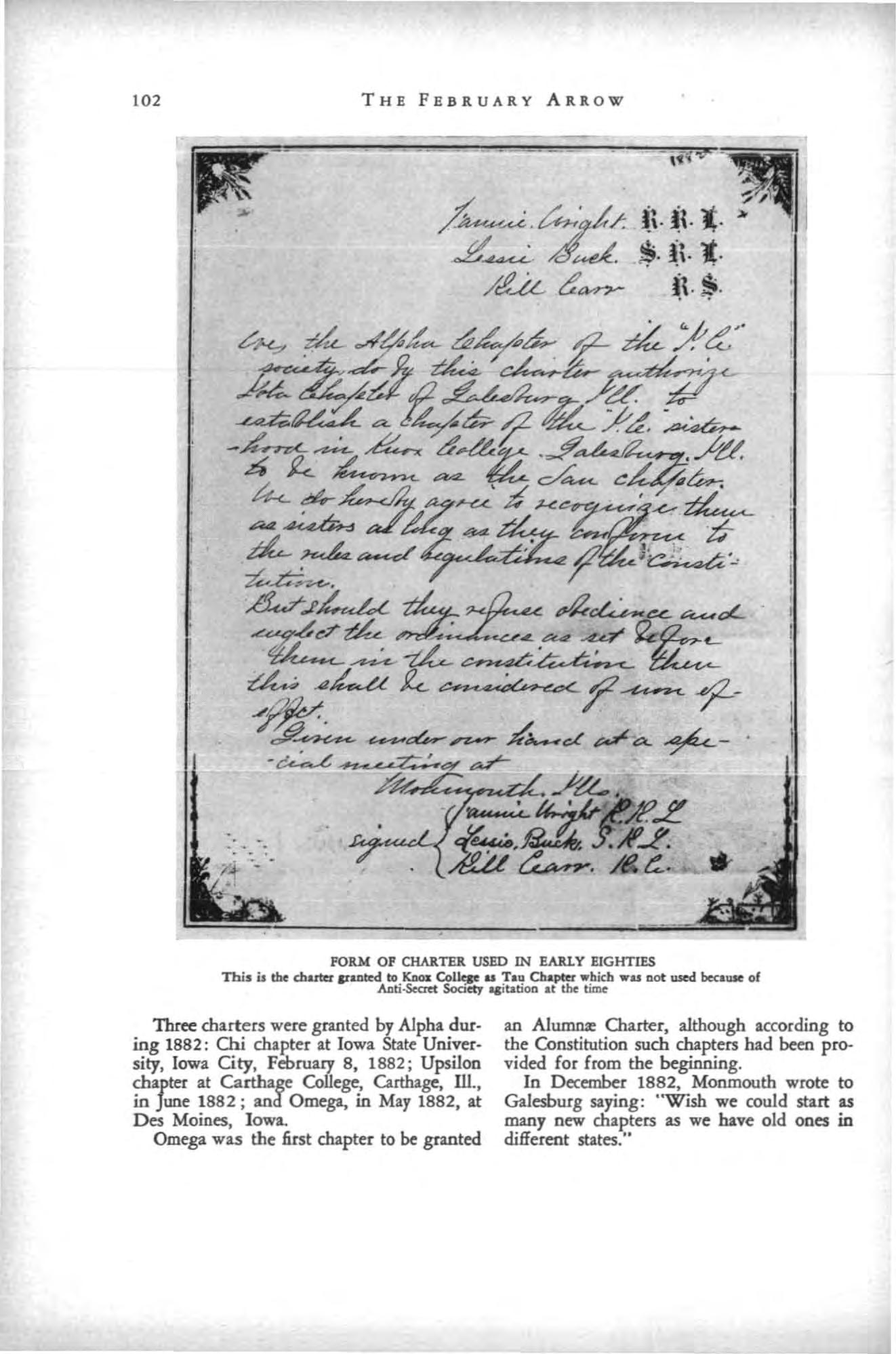
an NlUIlDZ Charter, although according to the Constitution such chapters had been provided for from the beginning
In December 1882, Monmouth wrote to Galesburg saying : "WiSh we could start a.s many new chapters as we have old ones in different states."
Chi, now Jowa Z, Jowa State University, Jowa City, Jowa , was chartered by Alpha on February 8, 188 2, and although the Simp . son chapter had been active in trying to es · tablish a chapter at Jowa City, the authority was granted to Gamma at Mt. Pleasant for the actual establishment of the new group.
The installation was effected by Rena Rey . nolds (Howard) of Mt. Pleasant, and Estella Walters Ball, o(Jndianola, with the following charter members : Estella Walters Ball, Em ·
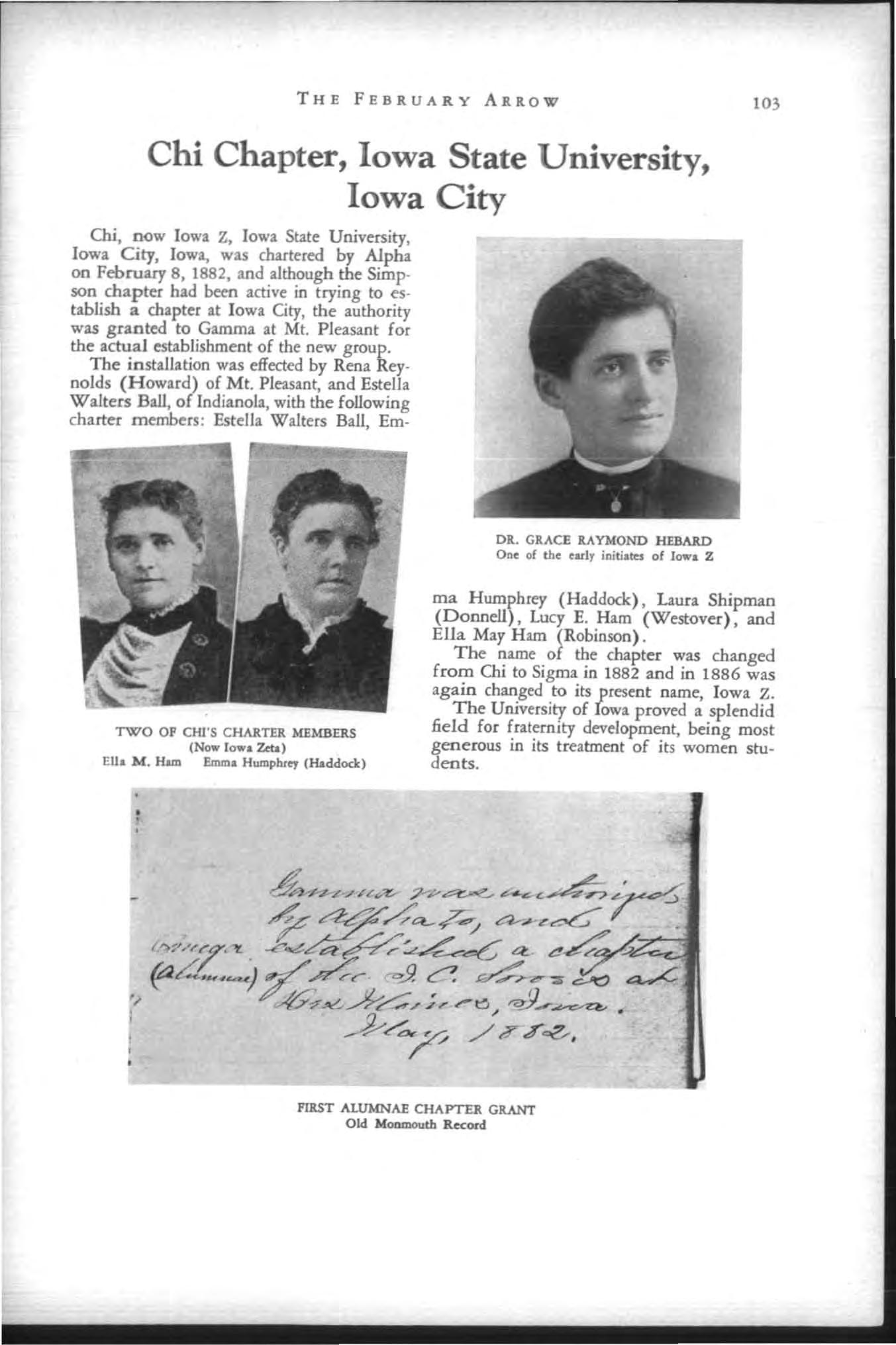
ma Humphrey (Haddock), Laura Shipman (Donnell), Lucy E. Ham (Westover), and Ella May Ham (Robinson).
The narne of the chapter was changed from Chi to Sigma in 1882 and in 1886 was again changed to its present name, Iowa Z.
The University of Iowa proved a splendid field for fraternIty development, being most generous in its treatment of its women students.
The Monmouth record shows that a charter was issued to Nannie Thompson of Alpha , in June 1882 for the establishment of a chapter at Carthage College, Carthage, Ill ., to be known as Upsilon Chapter. The installation
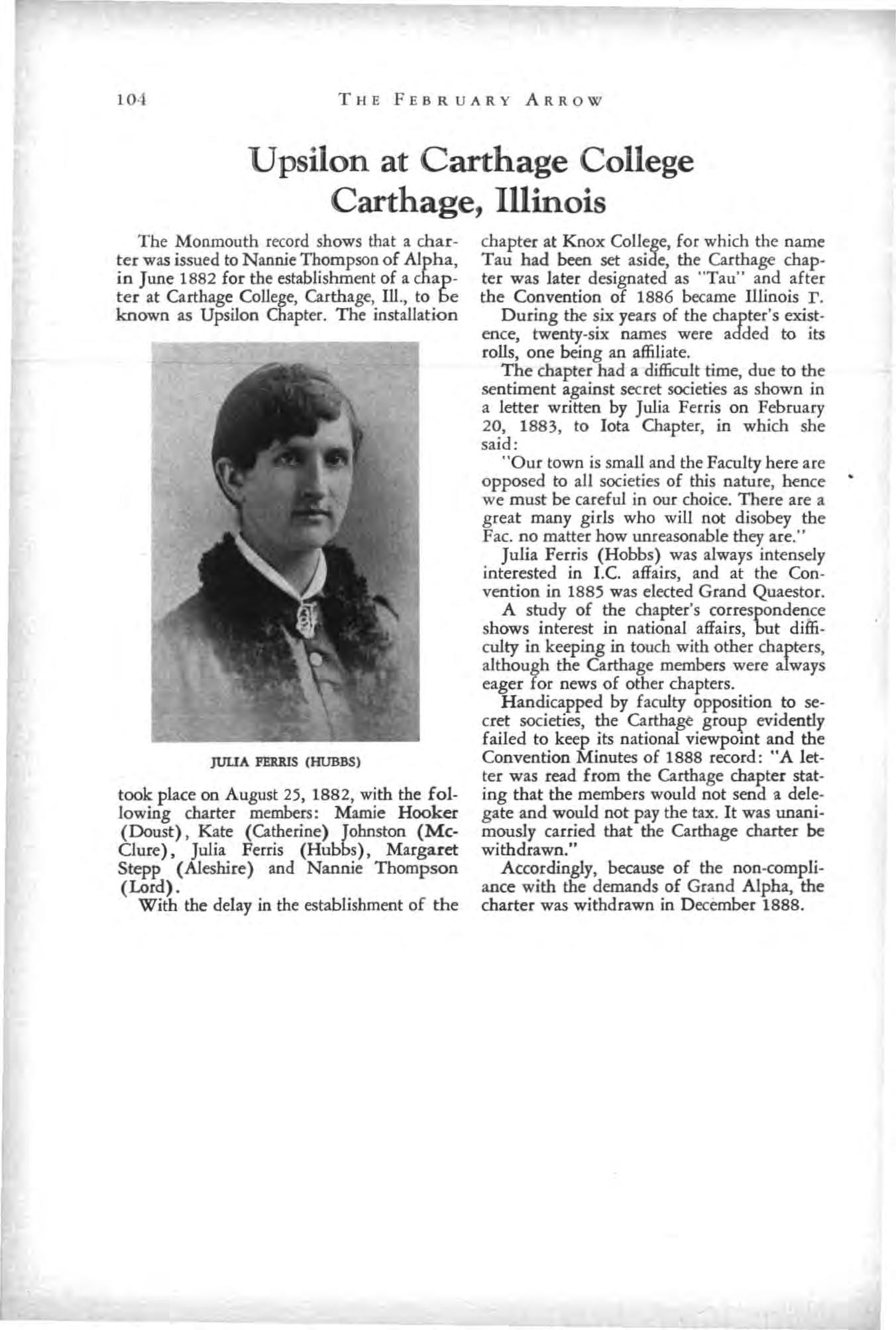
JULIA PI!RlUS (HUBBS)
took place on August 25, 1882, with the following charter members: Mamie Hooker (Doust) , Kate (Catherine) Johnsto n (McClure), Julia Ferris (Hubbs), Margaret Stepp (Aleshire) and Nannie Thompson (Lord)_
With the delay in the establishment of the
chapter at Kn ox College, for which the name Tau had been set aside, the Carthage chapter was Jater designated as " Tau " and after the Convention of 1886 became Illinois r.
During the six years of the chapter's existence, twenty -s ix names were added to its rolls, one being an affiliate.
The chapter had a difficult time, due to th e sentiment against secret societies as shown in a letter written by Juli a F erris on February 20, 188 3, to Iota Chapter, in which she said:
"Our town is small and th e Faculty here are opposed to all soc iet ies of this nature, hen ce we mu st be careful in our choice. There are a grea t many girls wh o will not disobey the Fac. no matter how unreasonable they are. "
Julia Ferris (Hobbs) was always intensely interested in I.e. afi'aiIs, and at the Convention in 1885 was elected Grand Quaestor.
A study of the chapter's correspondence shows interest in national affairs, but difficulty in keeping in touch with other chapters, although the Carthage members were always eager for news of other chapters.
Handicapped by faculty opposition to secret soc ieties, the Carthage evidently failed to keep its national viewpolOt and the Convention Minutes of 1888 record: "A letter was read from the Carthage chapter stating that the members would not send a delega te and would not pay the tax It was unanimously carried that the Carthage charter be withdrawn."
Accordingly, because of the non-compliance with the demands of Grand Alpha, the charter was withdrawn in D ecember 1888.
Although Alpha was at the helm of fraternity aJfairs in 1882, she was unable to do the follow-up work so necessary for the enlightenment and progress of the new chapters.
It is very gratifying to find that the new chapters thrived, despite the lack of needed supervision. There was then no fraternity magazine and the only information which the chapters received was from the one or two members who installed them , and from the letters which came from other chapters Alpha was often slow in sending charters and Constitutions to the new groups
In the of the very thorough presentday methOdS it is interesting to read the following letter from Addie I. Dickey of the new Chi Chapter at Iowa City, written to Izah Parker, Iota, on September 16, 1882, soon after the chapter's installation :
In writing to you it wiJl be necessary to introduce myself as a member of Ch.i chapter of I.e. at Iowa City. I received a letter from Mt. Pleasant the other dar saying there was going to be • Convention held at Burlington, Oct. l1, 12 and 13. You, of course, know that a Convention was appointed to be held at Des Moines during the State Fair. We are a new chapter and do not know the workings of the society as well a5 you older chap· ters and we are writing to get information so my letter will be principally questions. In which chapter is the chief power and have they full authority to call a Convention without consulting the other chapters? Docs AJpha .send any word before oBi· oalJy n otifying us there will be a Convention held at a certain place? Are subjects for papers given to chapters without asking their preference or do they have some choice? Is each chapter to appoint a committee to look over the Constitution and sug· gest any improvements? Do we send to get the society paper and how does it come?
The Convention to be held in Des Moines, which was mentioned in Miss Dickey's letter was one which had been promoted by the Arnes chapter. Ames had written to other char.ters urging that they hold a Convention ear y in September durin.\: the State Fair. Although other chapters , meluding Indianola, approved the plan, it developed that only eight girls met at Des Moines: 4 from Indianola and 4 from Ames, so the meeting turned out to be only a pleasant social gathtring.
The Convention of 1880 had "adjourned to meet in two years at Galesburg, Ill .," but when the time set drew near, Monmouth investigated and found that the Galesburg girl>
could not accommodate the delegates, having so ftw/ members living in town , and since Burlington was anxious to have the Convention there, Monmouth suggested that the chapttrs convene in Burlington, if coDvmient for them. The chapters were agreeable to the suggestion and on September 15, 1882, A1fha sent out letters announcing that "the .C
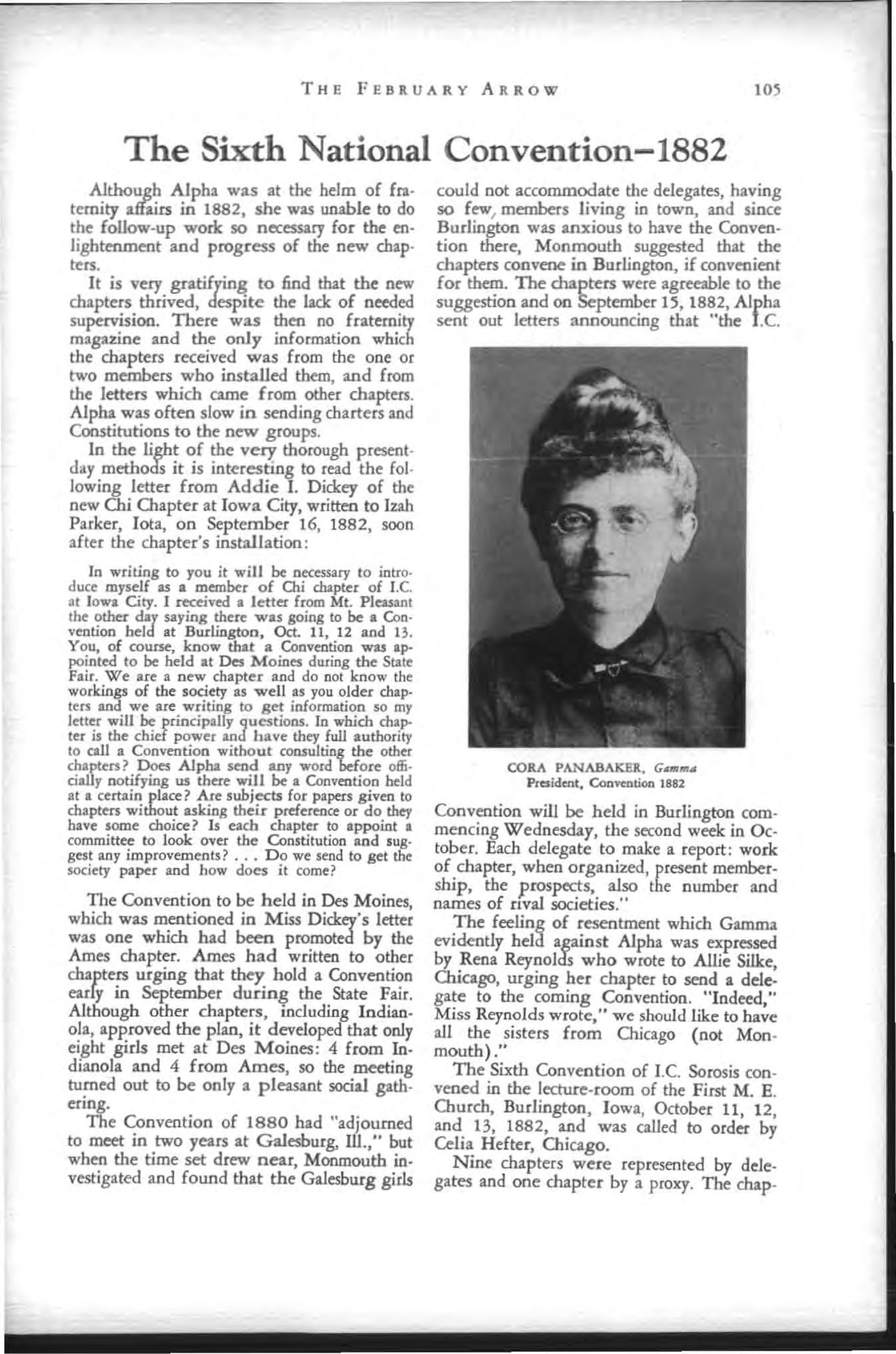
Convention will be held in Burlington commencing Wednesday, the second week in October. Each delegate to make a report: work of chapter, when organized , present membership, the prospects, also the number and names of t1val societies."
The feeling of resentment which Gamma evidently held against Alpha was expressed by Rena ReynOlds who wrote to Allie Silke, Chicago, urging her chapter to send a delegate to the coming Convention. "Indeed," Miss Reynolds wrote." we should like to have all the sisters from Chicago (not Monmouth) ."
The Sixth Convention of I.C Sorosis convened in the lecture-room of the First M. E Church, Burlington , Iowa , October 11, 12, and 13, 1882, and was called to order by Celia Hefter, Chicago_
Nine chapters were represented by delegates and one chapter by a proxy. The chap -
ters delegates were: Burlington, Iowa, Minme Burt; Iowa City, Iowa, Ella Ham; Monmouth, 111., Jessie Buckner; Mt. Pleasant, Iowa, Cora Panabaker, (Proxy), Flora Housel; Lawrence, Kan., Jennie Sutliff; Indianola, Iowa, Anna Emerson; Ames, Iowa, Sarah Smith; Galesburg, Ill , Izah Parker; Bloomfield, Iowa, Clara McCann; Chicago, ill., Allie Silke_ Jacksonville, 111., was represented by a proxy, Jessie Buckner.
Cora Panabaker, of Mt. Pleasant, was chosen president, and Celia Hefter, of Chicago, recording secretary of the Convention.
-The opening exercise consisted of the Lord ' s Prayer by the Sorosis; a song, "The Maid of Dundee," by Kate Hutchinson; an address of welcome, by Perle Hayden of Burlington; a response, by Izah Parker of Galesburg.
After a report of the chapters, Ella Ham of Iowa City, gave a declamation entitled, "Kentucky Belle."
The first piece of business bn)ught up for consideration was of vital importance to the fraternity since it related to a change in Art. VII, Sec. 1 of the Constitution, that section which provided that "no alteration or amendment can be made to the Constitution without the unanimous consent of the chapters,"
1ms was the section by which Alpna had declared the Constitutions illegal which had been adopted at the Conventions of 1878 and 1880, and had thus preserved the original Constitution, preventing the adoption of the high school ruling.
Allie Sillce, Rho, moved that the section be changed to read: "No alteration, or amendment can be made to the Constitution, nor can part be repealed, except by three- fourths vote of all the chapters."
Belle Re Qua Leech, Gamma, amended the motion to read: " Two-thirds" intstead of ·'Three-fourths.'·
There was considerable discussion, but since all of the delegates were not yet present and since no change could be made without the unanimous vote, the motion and amendment were for the present dropped.
]0 considering the matter of t.onstitutional revision, the Convention decided to use as a basis for discussion the Constitution as revised at the Mount Pleasant Convention in 1880.
Then followed a paper on the "Plan for Organization" by Cora Panabaker of Gamma, describing a plan for General and State Organizations,
According to the Convention program, papers were to have been read oy Sarah Smith, Ames; Ella Ham, Iowa City; and Allie Sill«, Chicago, the subject assigned to the latter being: "Benefits Derived from the Society to Your Chapter." These delegates however, reported that the notices had reached them too late for proper preparation, so they were excused.
An informal session followed, during which the two plans for proposed changes in the Constitution, those of Chicago and of Mt. Pleasant, were read and discussed,
The first evening was delightfully spent at the home of the Misses Jessie and Perfe Hayden.
All delegates attended the session the next morning except Clara McCann of Bloomfield and Alice Johnson of that chapter was appointed to serve until Miss McCann appeared.
bah Parker, Iota, read some sefections from "Robert's Rules of Order" relating to Convention and then for the second time a motion was made relative to changing of Art. VII, Sec, 1 of the Constitution.
This motion, put by Flora Housel, Mt. Pleasant, and seconded by Allie Silke, Chicago, read: "No alteration or amendment can be made to the Constitution, nor can any fart be repealed, except by two-thirds v.ote 0 aU the chapters." The motion was carried.
At last, the delegates were released from the "unanimous" clause and proceeded at once to the work of revising the Constitution.
A slight cbange was made in the Preamble and the "Object" was revised to read:
The Object of the organization shall be the formation of a Sisterhood for the mutual encouragement and assistance of its members in all that pertains to truth, virtue, and sisterly love; that the harmonious union of oroest hearts , in a. common sympathy, an influence of cheerful usefulness may be established and widened.
The Organization was divided into two divisions to be "known as the General and the State Organizations and shall consist of chapters already formed and sucb as may hereafter be established in Chartered Institutions."
It was further provided that,
All chapters of the Sorosis shall form the General Organization of which Grand AJpha sball be bead
All chapters in each state shall form the State Organization of which Alpha Secunda shall be head.
Grand Alpha was the term accepted to designate the General Convention and Alpha Grand was the title given to the chapter which should head the General Organization during the interim of Convention•.
The power of Alpha Grand was defined as follows: "To call the general Convention. Its duty shalI be to keep a general register of names, to create and manage a gene ral fund for Convention purposes and for the publication of a society catalogue; to publish, when funds will permit, a magazine devoted to literary purposes and the interests of the society; to derive all the information possible concerning the conditions of the chapters in each state."
In selecting the Alpha Grand chapter the lirst vote stood : Gamma (Mt. Pleasant) 5, Alpha, (Monmouth) 3.
Later in the session Miss Ham moved and Miss Parker seconded the motion that they reconsider the matter of the selection of Alpha Grand chapter.
Miss Silke, Rho, Chicago, then moved and Miss Burt, Burlington, seconded that Alpha, the Mother Chapter, be made Alpha Grand. The secretary was instructed to cast the unanimous vote of the Convention for Alpha . Thus, loyalty of the chapters to Alpha kept her at the head of the national organization
To each Alpha Secunda went the power "to grant printed charters and to call the state conventions; to keep a register of all chapters and members within the state; to forward the names of corresponding scribes to the respective chapters immediately up''" receipt of them; to see that all duties laId down 10 the constitution are ful.6.l1ed by the chapters; and to give time and dili$ence in the establishment of new chapters 10 the state."
The secretary was IOstructed to cast the vote of Illinois for Iota , Galesburg, as Alpha Secunda or State Alpha; of Kansas, for Lawrence; and of Iowa, for Mount Pleasant.
It was voted that the State Alpha Secunda and the several chapters have power to make their own By-Laws and rules of order.
As to extension outside of the states where there were Alpha Secundas, it was moved that "Any member of I.e. may establish a chapter in a new state after obtaining a charter from Grand Alpha."
The system of naming chapters was changed and it was provided that "General chapters shall be named according to the letters of the Greek Alphabet; each state having an Alpha, Beta, &c."
The provision for AIU1Illlre Chapters remained the same as before, members to be gradualtJ of chartered institutions. These chapters were to be named in order with the general chapters, bearing in connection with the names of their chapter the last letter of the Greek Alphabet, Omega, to designate their character.
Heretofore the AJ= Chapters had no power to transact business, but under a new provision they could "transact any business that does not conflict with the working of the state organization_"
Members of the chapters upon graduation could become members of their alumn", chapters, but "shall retain their relation with their former chapter."
Each chapter was required to keep a register containing the addresses of its members, provide for the times and places of meeting, and was required to meet at least once in three weeks and to write to Alpha Secunda at least once a month, etc.
The Order of Exercise was changed somewhat though it contained approximately the same headings as formerly.
The names of the officers were designated as the lllustra Regina, or presiding officer; Royal &ribe, Quaestor and two Censors and as many Corresponding &ribes "as there are sister chapters in each state."
The manner of electing officers remained the same and the regular election was set for the lirst meeting in October, unless otherwise provided for, all officers holding their positions for one year. *
The duties of all officers were prescribed and were practically the same as heretofore, except that the Corresponding Scribes were reqwred to write at Jeast once a month.
Requiretn<nts for membership remained the same, that is, "Any lady who is a student or teacher in a chartered institution may become a member of I .e. S. provided all the members would be satislied with her as a sister. . _ . No lady shall be received as a member who is or has been a member of any school secret ocsanization existing at present."
(Following the membership paragraph the clause: "Whenever any chapter feels it would be for her advancement, members of a gnod High School or Academy may be admitted to membership," was written in by the Com-
• This ruling had to be elastic to cover the situation at Ames, where the school terms were during the spring and summer.
mittee after Conyention )
The method of Extension remained the same, any member being permitted to estab· lish a "cha/?ter in any chartered institution, after obtainmg a charter from her State AI· pha" and "any member may establish a chap.
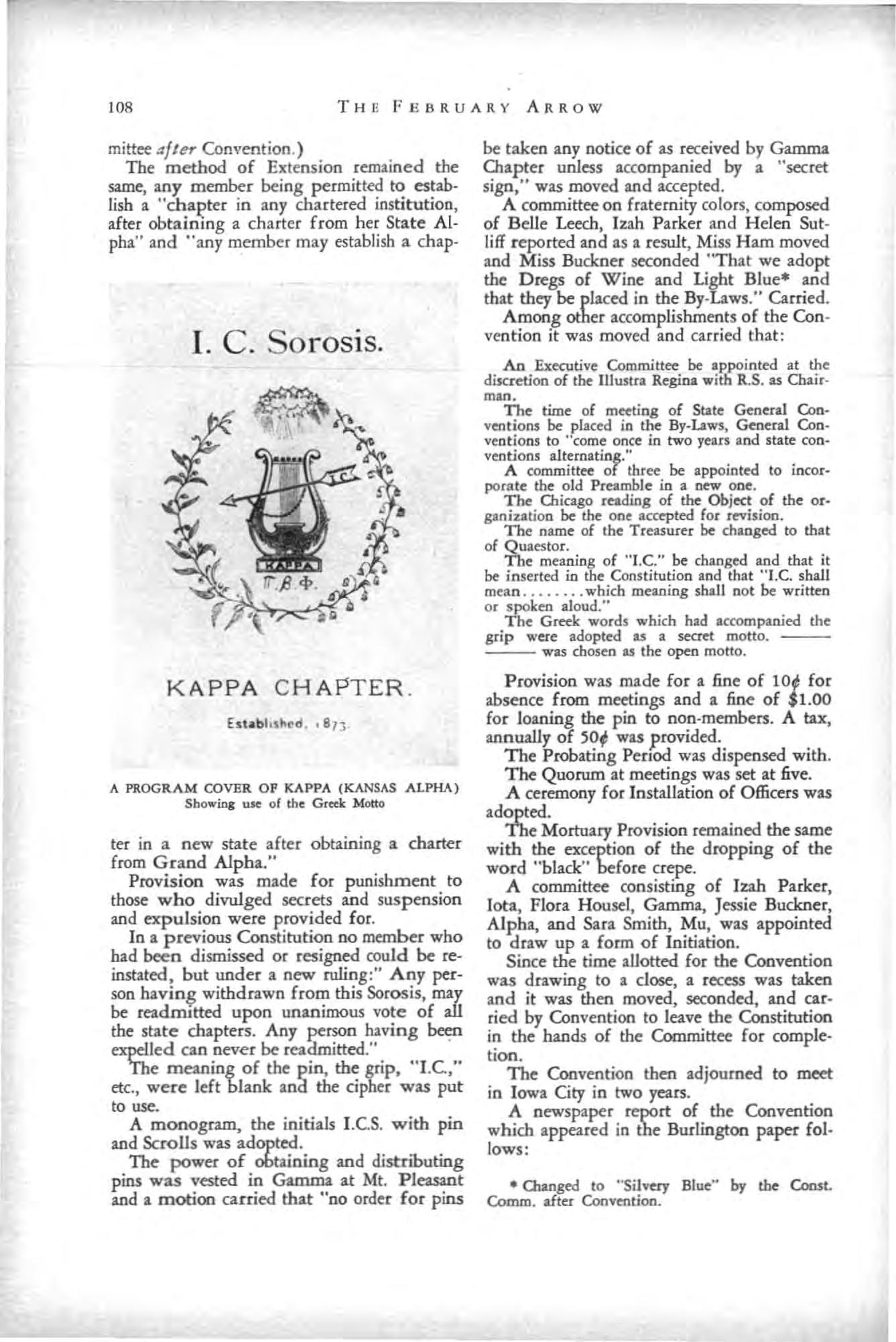
Estabhs,",cd 1 8 73
A PROGRAM COVER OP KAPPA (KANSAS ALPHA)
Showing UR of the Greek Motto
tee in a new state after obtaining a charter from Grand Alpha ."
Provision was made for punishment to those who divulged secrets and suspension and expulsion were provided for.
In a previous Constitution no member who bad heen dismissed or resigned could be reo instated, but under a new ruling:" Any per· son havin$ withdrawn from this Sorosis, may be readmitted upon unanimous vote of all the state chapters. Any person having expelled can never be readmitted ."
'rhe meaning of the pin, the grip, "I.C," etc., were left blank ana the cipher was put to use.
A monogram, the initials I.CS with pin and &colis was adopted
The power of obtaining and distributing pins was vested in Gamma at Mt. Pleasant and a motion carried that "no order for pins
be taken any notice of as received by Gamma Chapter unless accompanied by a "sec ret sign," was moved and accepted.
A committee on fraternity colors, composed of Belle Leech, hah Parker and Helen Sut· Iiff reported and as a result, Miss Ham moved and Miss Buckner seconded " That we adopt the Dregs of Wine and Light Blue. and that they be placed in the By. Laws." Carried.
Among other accomplishments of the Con· vention it was moved and carried that:
An Executive Committee be appointed. at the discretion of the IlIwtra Regina with R.S . as Olairman.
The time o f meeting of State General Conventions be placed in the By-Laws, General Conventions to "come once in two years and state conve ntions alternating."
A committee of three be appointed to incorporate the old Pr6mbJe in a new one .
The Qicago reading of the Object of the organization be the one accepted for revision.
The name of the Treasurer be changed to that o f Quaes tor.
The meaning of "I.e." be changed and that it be inserted in the Constitution and that "I.e. shall mean . which meaning shaH not be written o r spoken aloud "
The Greek words which had accompanied the grip were adopted as a secret motto.was chosen as the open motto .
Provision was made for a fine of lO¢ for absence from meetings and a nne of $1.00 for loaning the pin to non·members A tax, annually of '0; was ,Provided .
The Probating Penoo was dispensed with.
The Quorum at meetings was set at nve.
A ceremony for Installation of Officers was adopted.
The Mortuary Provision remained the same with the exception of the dropping of the word "black" before crepe.
A committee consisting of Izah Parker, Iota , Flora Housel , Gamma, Jessie Buckner, Alpha, and Sara Smith, Mu, was appointed to draw up a form of Initiation.
Since the time allotted for the Convention was drawing to a dose, a recess was taken and it was then moved, seconded, and carried by Convention to leave the Constitution in the bands of the Committee for comple. tion.
The Convention then adjourned to meet in Iowa City in two years.
A newspaper report of the Convention which appeared in the Burlington paper fol· lows:
• Olanged to "Silvery Blue" by the Corut. Comm. after Convention.
The Convention of the I.e sisterhood was held a t the rust M.E. Church of this city 00 the 11th, 12th and 13th iost. This socidy has been in C'J[+ istence for the past fifteen years and has grown so rapidly in that time that it flourishes in truee states. and it bas become an important element in rromoting the litera.ry and social advanccnent 0 its members. Delegates from all the sister chapters were present" and each gave m couraging reports of the ir respective chapters The Convention has been carried on in good order and the result far ceeds their most sanguine anticipations . During the Convention the delegates were handsomely entertained by the Burlington chapter. Thursday evening a coffee was given for the young ladies by the Buclington chapter at the home of Misses Perle and Jessie Hayden . Owing to the exceptional ability o f the hostesses to entertain, and the bountiful repast. aU exprcsstd thonselvcs as weIJ pleased The only thing which marred the fleasure of the evening was the absence of one 0 the local members . At six o'clock a strange silence came over all as it was announced that an I e. member, the sister, was linking ber life with another. All expressed the hope that the chain which binds them as lasting as the chain of friendship whtch blOds her to ber numerous sisters. The Burlington chapter is proud o f its sister chapters and at any time in the future will gladly them. to this. city. They adjourned Friday, afte r an eventog sessIOn
The following delegates and visiting members were in attendance:
Ella Ham, Iowa City
Clara McCann, Sude Weaver, Allie Johnson, Bloomfield
Allie Silke, Celia Hefter. Chicago
Cora Panabaker, May Coate, Flora Housel, Mrs. Belle Leech, Mt, Pleasant
Jennie Sutliff, lawrence, Kan .
Jessie Buckner, Jennie Harden , Anna Martin, of Monmouth
Izah Parker, Galesburg. Ill.
Anna Emerson, Indianola, Iowa
Sarah Smith, Ames, Iowa
The Convention dosed in perfect harmony - but a storm was soon to follow. The Minutes show that in Convention sessions the Constitution was taken up section by section, and then at the end because of the pressure of time, "It was moved, seconded, and carried by the Convention to leave the Constitution in the hands of the Committee for completion-" evidently for the purpose of proper arransement, etc.
Two of the members on this Committee were Izah Parker, Iota, and Belle Re Qua Leech, Gamma. It is not of record if there were others.
No mention was made in the minutes of the Convention concerning a discussion of the Honorary Members (associate chapters) nor of the High School ruling which Gamma
had been so anxious to have legalized and hence, it is reasonable to suppose that they were not hrought up for if they had been discussed, surely A1pba would have opposed the measures openly,
Two clauses were evidently "written into" the Constitution by the Committee after Convention dosed. They follow:
WhMcver any chapter feels it would be for her advancement, members of a good High School or may be adm itted to membt-rship . and,
A chapter may elect any lady of high social and lOteJJectual culture to honorary mcnbership. Honorary me':Dbers may wear the pin but are exempt from vouog . Each chapter of five years standing shall have power of electing to honoral)' mem· bt-rship such ladies not graduates or members of institutions as shall be deemed qualified for membership in the Sorosis.
According to the agreement of the Convention, the Constitution, when completed by the CommIttee was submItted to the various Alpha Secundas: Galesburg, Mt. Pleasant and Lawrence.
On November B, Jessie Buckner of Monmouth wrote to bah Parker at Galesburg: "Dear Sister: I received a letter from Indianola and they are very indignant over the clause that was inserted in the Constitution after Convention was adjourned . They think it very illegal. Some of our girls think so, too, they are so opposed to it anyway."
Several months elapsed while the Constitution was "going the rounds" to the various Alpha Secundas and when it at last reached Alpha Grand, Monmouth, in its final form, Alpha took action at once . She felt that the Committee had had no ri$ht to add anything to the Constitution whIch had not been brought up on the Boor of Conventionthat the Committee was supposed merely to put the artides, as adopted, into readable shape.
Accordingly, the Mother Chapter sent letters to the various chapters commanding them to strike out from their Constitutions imme. diately the very objectionable clauses which had been written in, relative to the taking of High School students and Honorary Members,
A copy of this order which was sent by Alpha to Iota and presumably to all of the other chapters foUows:
We, Grand Alpha of tbe I.e. Sorosis have struck 0l!t fr0rI? the Constitution, and do Iota, Hke· W15e stnke out from your copy 0 it, the clause o n 9. 5«. JlI, beginning "Whenever .ny
chaptec feels it would be [or its advancement:' and also the clause on Page 6, Art III , Sec. 1, beginning "Each chapter of five years standing." Nothing is valid done by dcJegates when the Convention is oot in Session.
Given under our hand and seal, at Monmouth, Ill., this 30th day of March, in the year of our Lord, 1883.
Signed, Jessie Buckner, I R.
Rilla
Carr, R S
With this order to Iota there went a letter from Monmouth which read in part :
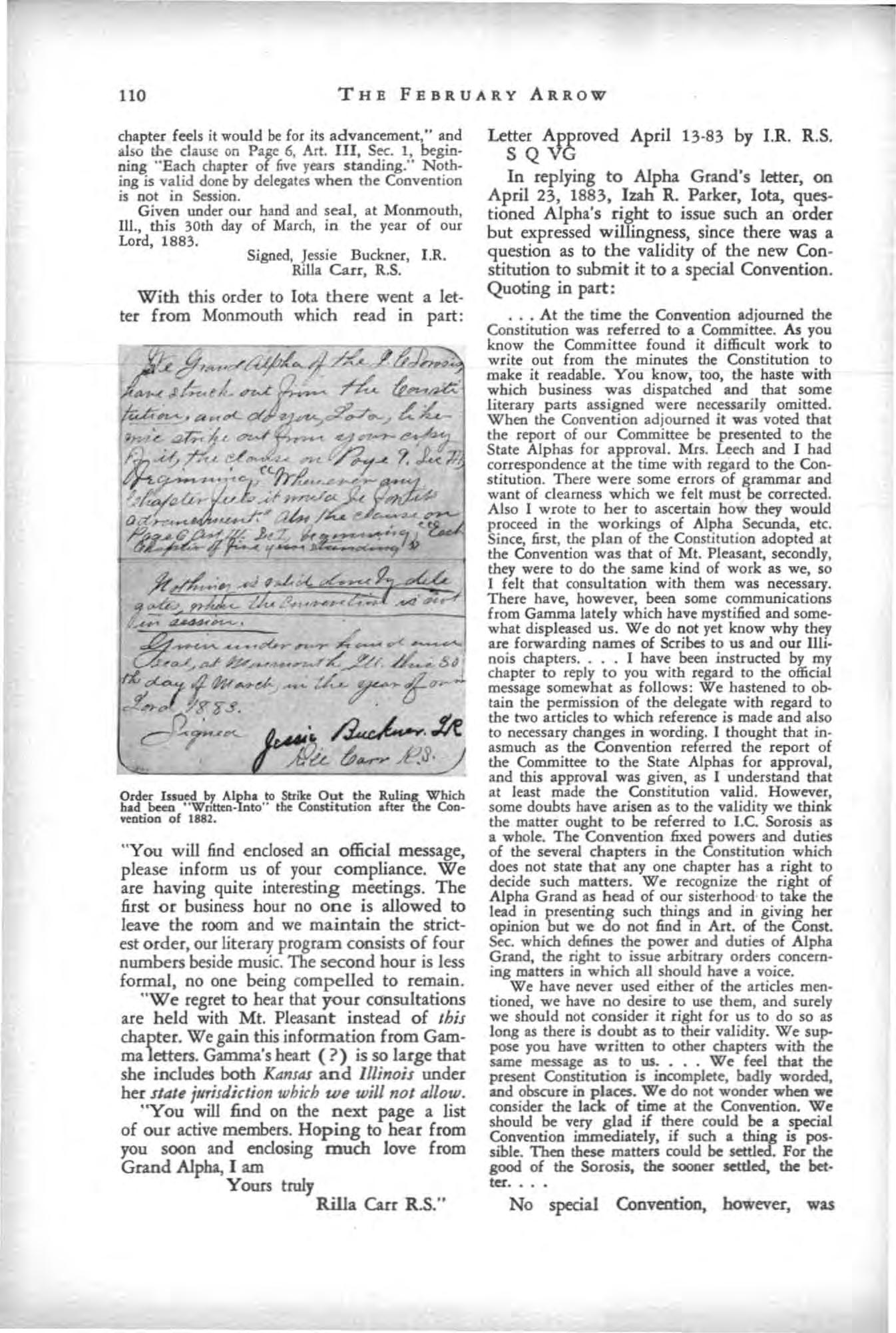
Order b.ue'd by Alpha to Strike Out the Ruling Wh ich had been "Wntten-Into" the CoOStitutiOD after the Coottntioo of 1882.
" You will find enclosed an official message, please inform us of your compliance. We are having quite interesting meetings. The first or business hour no one is allowed to leave the room and we maintain the strictest order, our li terary program consists of four numbers beside music. The second hour is less formal. no one being compe lled to remain.
" We regret to hear that your consultations are held with Mt. Pleasant instead of Ihis chapter. We gain this information from Gamma letters Gamma's heart (?) is so large that she includes both Kansas and Illinois und<r her sial. ;lIrisdiclion which w. will nol allow.
"You will find on the next page a list of our active m<rnbers. Hoping to hear from you soon and enclosing much love from Grand Alpha, I am Yours truly
Rilla Carr
R .S."
April 13-83 by I.R. R .S.
In replying to Alpha Grand's letter, on April 23. 1883, Izah R. Parker, Iota, questioned Alpha's right to issue such an order but expressed willingness, since there was a question as to the validity of the new Constitution to submit it to a special Convention . Quoting in part:
At the time the Convention adjourned. the Constitution was referred to a Committee. & you know the Committee found it difficult work to w rite out from the minutes the Constitution to make it readable. You know, too, the haste with which busineu was dispatched and that some literary parts assigned were necessarily omitted. When the Convention adjourned it was voted that the report of our Committee be presented t o the State Alph as for approval. Mrs. Leech and ] had co rrespondenc e at the time with regard to the Con. stitution. There wefe some errors o f grammar and want of clearness which we felt must be corrected. Also I wrote to her to ascertain how they would proceed in the workings of Alpha 5«unda. etc. Since, first, the plan of the Constitution adopted at the Convention was that of Mt. Pleasant, secondly, they were to do the same kind of work as we, so I felt that consultation with them was necessary. There have, however, been some communications from Gamma lately which have mystified and somewhat displeased us . We do DOt yet know why they are forwarding names of Scribes to us and our illinois chapters I have been instructed by my chapter to reply to you with regaId t o the official message somewhat as follows: We hastened to obtain the of the delegate with regard to the two articles to which reference is made and also to necessary changes in wording. I thought that in· asmuch as the Convention referred the report o f the Committee to the State Alphas for approval, and this approval was given, as I understand that at least made the Constitution valid. However, some doubts have arisen as to the validity we think the matter ought to be referred to I.C Sorosis as a whole. The Convention fixed powers and duties o f the sevem chapters in the Constitution which does not state that any o ne chapter has a right to decide such mattCJ'S We recognize the right of Alpha Grand as head of our sisterhood to taIce the lead in such and in giving her opinion but we do not lind In Art. of the Const Sec. which defines the power and duties of Alpha Grand, the r ight to issue arbitrary orders concern· ing matters in which all should have a voice.
We have never used either of the articles mentioned, we have n o desire to use them, and surely we should not consider it right for US to do so as long as there is doubt as to their validity. We suppose you have written to other chapters with the same message as to us We fec i that the present Constitution is incomplete, badly worded, and obscure io places. We do oot wonder when we consider the tade of time at the Convention. We should be very glad if there could be a special Convention immediately, if such a thioS is pos. sible. Then these matters could be settled. Por the good of the SOr05.... the soooer settled, the better•..
No special Convention, however. W1S
called and all available documentary evidence shows that the chapters did strike out from their new Constitutions the objectionable clauses, according to Alpha Grand's demands and peace was restored:
Nu chapter at Ames was much opposed to the clauses and in instructing a delegate to the 1884 Convention was "of the unaoimous opinion that no old ladies and few High School students were desirable."
The form of initiation, included in the new Constitution, as suggested by the spe· ciaJ committee on Initiation, was basically the same as previously used. It was elaborated in places but the "Promises" or Oaths remained almost word for word the same as those written by the Founders.
A "Welcome" by the R .S. was added, it having been written by Rena Reynolds of Gamma . Mt. Pleasa nt c hapter was especially anxious to have a more perfect initiation and installation. Too, this chapter was responsible for the suggestion that the meanings of the symbols, grip, etc., be omitted from the writ· ten Constitution, believing that they could not be entirely secret if written.
In the beginning, the Initiation consisted
chiefly in the taking of the various promises, a most solemn proceeding. From time to time, the different chapters added to these oaths.
As early as April 24, 1877, Indianola ap· pointed a committee to suggest some "regalia and signs and symbols."
In 1881, Rilla Carr, Alpha, wrote to Iub Parker, Iota : ' "Do you have skull and cross hones? Robes for IlIustra Regina and Crown, Robe for Regina Secunda, Chaplain's Robe, etc. Do your girls robe in sheets and colored dominoes of cambric, have candles, salt, and alcohol as we do?"
The new Injtiation service, sponsored by Mt. Pleasant, {'roved satisfactory to the chap. ters for the time being.
With the Convention' s re-organization of the fraternity'S government and the division of power by States, the Lombard chapter at Ga[esburg, headed the Illinois chapters as Alpha Secuoda, but the results of the new arrangement evidently were not as productive of results as had been anticipated.
In adopting the new arrangement it had been argued that with the state government, the chapters could be brought into closer con· tact with each other.
On D ecember 29, 1882, Allie Silke of Chi· cago, wrote to Iota, that it had been considerably more than a month since her chap· ter, Rho, h ad sent an official letter to t.he State Alpha but had received no reply:
We have waited, (sbe wrote) patientfy though anxiow ly for the desired names and addresses of the Scribes but have received no word of any kind in reply ,nd now at this cheerful Holiday season when we would so gladly send grmiogs to our far away I.e. Sisters we are constrained to leave the messages unwritten and unsent for lack of that answer. The Chicago chapter is & small one IJld exists under such unfavorable circumstances as to reader active life an uncertainty from meeting to meeting We stand therefore, in the greatest need of encouragement and counsel. Was it not for this purpose that the change in organization was made?
th lt the powers of AJpha being divided, the duties might be more thoroughly performed and communications be mocc frequ e nt? Perhaps it may be possible (or you to send us the l ist of Scribes in time (or the New Year
The next fall Iota tried to arrange for a State Convention to be held in Galesburg and on November 16, 1883, sent letters to the Illinois chapters The one to Rho read:
To the Rho chapter, I.e. Sorosis, Chicago, Ill We. the Alpha Secunda o( lIlinois by the authority with which we are invested do hereby call together an assembly of the State chapters to be held at Galesburg. Ill ., Friday and Saturday, Nov. 30Dec. I, 1883. Each chapter is entitled to one delegate.
(Sign<d) Jennie B Conger, LR. Emma Livingston, R.S. hah T. Puker, Scribe.
Monmouth answered saying : "We hope to send one or two girls."
Carthage sent word to Galesburg that the "Letter came too late announcing the Convention. Had we known some weeks before we might have made arrangements ."
Rho at Chicago had voted on November
F R OM THE
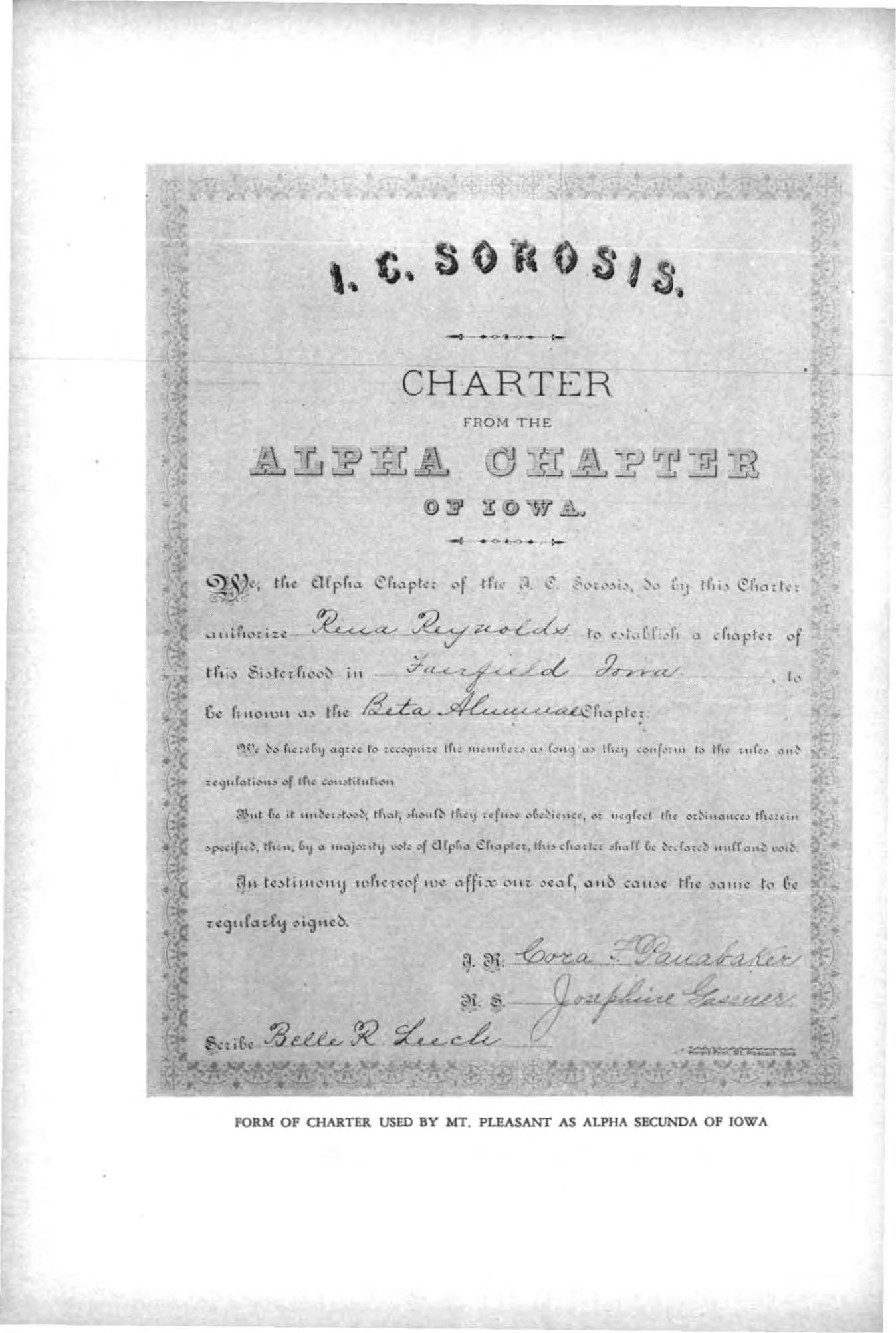
tru., ill <. c/ oe;, c97 .rY l:<./
tX flItOU.)ll U tfll! !
27, to disband so was evidently slow in reply . ing to Alpha Secunda ' s invitation On No· vember 29, Nellie Lapham of Iota sent a telegram to Celia Hefter saying: "Come or send member immediately. Answer what train."
The IUinois State Convention failed to rna· terialize and in her report to the next National Convention, the Iota delegate said: "A State Convention was called for November 30-December I, 1883. There was no response. A Convention was again called for February 23, 1884." The rest of this report is missing so it is not known what the delegate's comment was.
The second caU was evidently also without results as Ella F. Porter of Monmouth in writing to Lulu Burt at Galesburg on March 4, 1884, said:
"So sorry you girls were disappointed again about the Convention. There will be so much
going on this week the Military reception and aU, that Fan and I will not be aole to go to Galesburg but will go sometime this month. What about that Pbi Delta banquet that you spoke of? Wonder if any of us I.Cs. are to be invited now since all our boys have left. We were all out to the Frantz Paine recc;ption Friday night and had a spleadid time:
If the lateness in getting out the announcements of the State Conventions was the cause of the failure of the chapters to respond, Iota or Alpha Secunda of Illinois, may in a way be excused because Iota chapter's work was carried on at that time, chiefly by active (01girls whose hours were already crowded WIth college responsibilities, so that although Iota did endeavor to perform her required duties she was not as successful a state leader in Illinois as was Gamma in Iowa.
Gamma, Iowa Wesleyan University, Mount Pleasant, Iowa, as Alpha Secunda had the support of many town al=. Mrs. Belle R e Qua Leech, then an a l umna, conti n ued to l ead the active chapter and the alum.,., and had a most loyal following as her interest and enthusiasm for I.e. aifairs, which began in her undergraduate days, increased with the years.
Gamma now headed the strongest group of chapters i n the Sorosis, incl u ding, In d Ianola, Ames, Iowa City, Bloomfield, Burlington, FairefiJd, Des Moines, etc.
These chapters responded to Gamma's caU to a State Convention and assembled at Mt. Pleasant November 20 , 21 and 22, 1883.
Flora Smith, Gamma, Scribe to Rho, in writ ing of this Convention o n Decembe r 5, 1883, said:
During our State Convention in November the generaJ complaint was that they did not hear from the other chapters; and it was generally understood that we shouJd write hereafter, the lirst week of each month . We had our state Con. vention in Mt. Pleasant two weeks ago. The weather wu very disagreeable but nevertheless we had quite a pleasant Convention. We entertained live delegates and several visitors. They remained. with us three days and on the last evening we gave a tea party It one of the girl 's homes where we all
enjoyed ourselves very much indeed. J think most of the chapters in the state have their meetings every two weeks but we do not meet quite 50 often. Our regular meetinBs are every three weeks. Some of the chapters I learned during the Convention, have a literacy course they ace punuing. They do not have a regular course but have a literary pro· gram at each meeting. Have 3' active memberS. Chapter is composed of 10 Have two or three so· cials every college term and abo ut one party a year . Sometimes have a taffy puJl when we want a great deal of fun . We have one rival society in the college, the P.E.O.
As has been previously mentioned Dora McClure, the Simpson delegate, reported to her chapter that the name of Lambda bad been changed to Iowa Beta and tha t Clari nda had been declared an illegal chapter.
During the i nterim of N ation al Conven· tion s, Gamma, as Alpha Secunda of I owa, was responsib l e for the establishment o f the followi ng chapters:
Beta Omega of I.e. at Fairneld, Iowa, on October 12, 1882; Chi Chapter of I. e. o n July', 1884, at Nebraska Methodist College, York, Neb ; Gamma Omega in Septembe r, 1884, at Mt. Pleasant, Iowa; Lambda Chapter of I.e. at Cae College, Cedar Rapids, Iowa; and Zeta Omega (Iowa Theta) at Ottumwa, in August , 1884 .
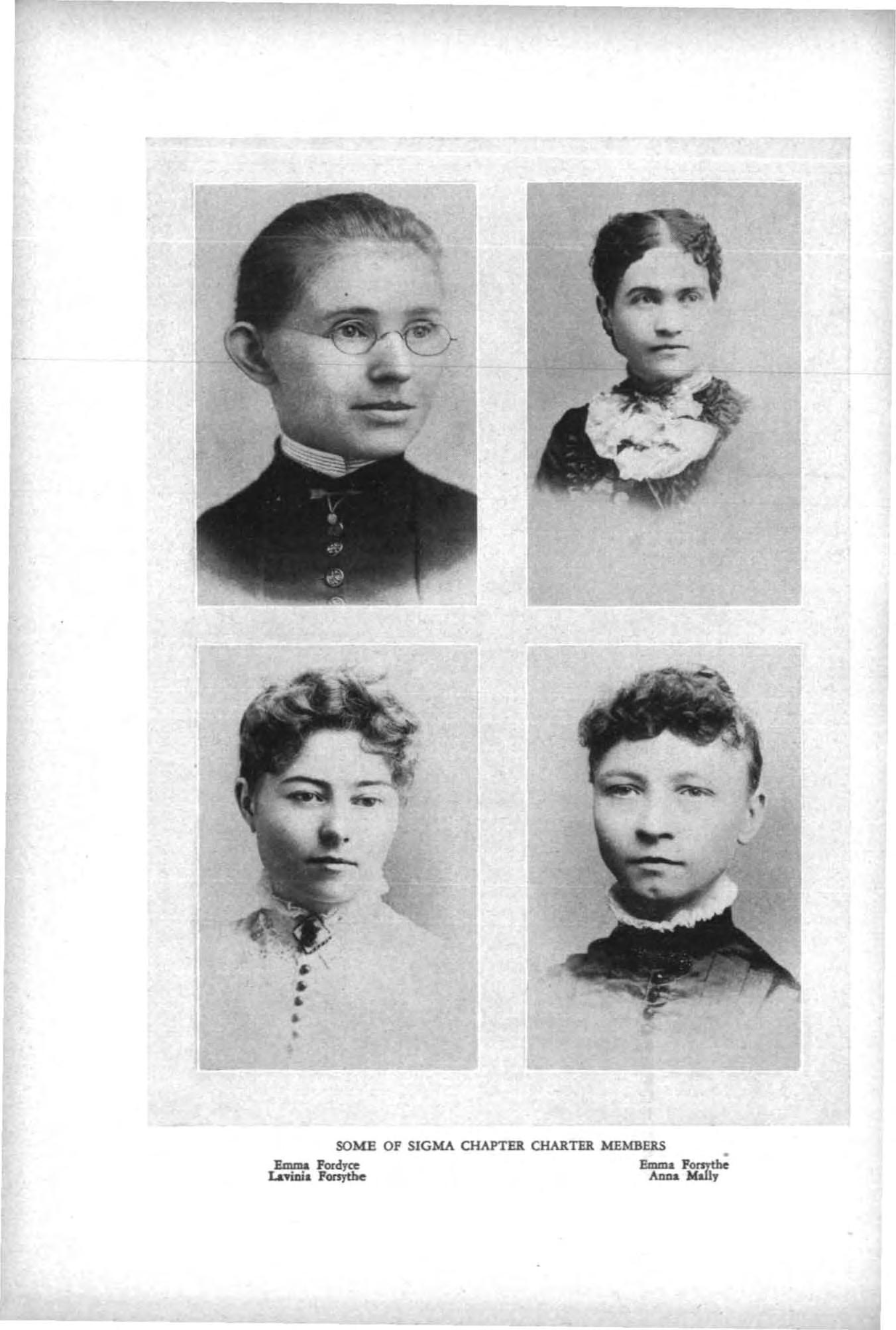
SOME OP SIGMA CHAPTER CHARTER MEMBERS
The third Alpha Secunda-Kappa Chapter at Kansas State University- the bead of the State of Kansas , had no other chapters under
her supervision and did not endeavor to establish any others in the state during her period of control.
Beta Omega, an alumnre chapter, was established at Fairfidd, Iowa, on October 12, 1882. The charter for the chapter was issued by Iowa Alpha and was signed by I.R. Cora F. Panabaker, R.S. Josephine Gassner and &ribe Belle R. Leech, all of Mt. Pleasant.
The chapter was installed by Rena Reynolds, Gamma, and was always in dose touch with Mt. Pleasant, receiving many visits from members of that chapter.
Elizabeth MacIllhiney, a charter member of Delta of I.e. , the Mt. Pleasant Female Seminary, transferred to Beta Omega and became one of its most active workers.
Thirty-nine members were initiated into this group during its eight years of existence
One of the members of this chaeter, Rebecca Tyler Petty (Mrs H G.), still wears her original arrow and is one of the most active and loyal members of the Poudre Valley Alum"", Club of Pi Beta Phi at Fort Collins, Colo Mrs Petty recalls how industriously her chapter worked in order to raise funds to send the delegate, Mary Campbell Ball, to the Lawrence Convention in 1885 . Although Beta Omega was established as an Alumnae Chapter, it soon became an Associate Chapter and after 1886 was known as Iowa Eta. After the Convention ruling in 1890 restricting membership, Iowa Eta surrendered its charter.
The next chapter to be chartered by Gamma was called Iowa Sigma, at Cedar Rapids, Iowa. This chapter was organized in the autumn of 1884 as an alumn", group among the teachers of the city but soon became an Associate Chapter with the initiation of high school graduates and seniors.
According to the original Minutes, the ocganization was effected- as follows:
"The house was called to order by Sophia Timmerman, I.R. Members present, Mrs. Hood of Monmouth chapter, Miss Campbell of Ames, Emma Webber and Sophia 'rim-
merman of Mt. Pleasant.
A charter was read, granted by Gamma Chapter, giving authority for the formation of SIgma Chapter in Cedar Rapids. Initiatory services were administered to the folJowing: Misses Carrie and Emma Fordyce, Miss Anna Mally, Miss Clara Holt, Misses Emma and Lavinia Forsythe."
The group flourished until about 1886 when it surrendered its charter.
Twenty-two names are recorded on its rolls .
Chi Chapter of I.e. Sorosis was established by Flora Bowman (McCloud) of Iowa Alpha, and Flora Housd (McDowell), Iowa A, at Nebraska Methodist College, York, Nebraska, on July 5, 1884, with the following charter members : Vinnie Harrison (Cowell), Callie L. Ham (Daggy), Belle Dickey (Hunter), Louise Woodruff (Jerome), Flora S.
Bowman (McCloud) , Mary L. Baldwin (Wyckoff), and Anna Harrison (Bentley).
In 1886 the chapter's name was changed to Nebraska Alpha.
The original charter grant for this chapter bears the date June 26, 1884 , and is signed by Fannie E Wright, I R , Annie G. Kibbe, Scribe, of Monmouth who "Authorized Gam -
ma Chapter to establish Alpha' Chapter of I.e. in the city of York, County of York, State of Nebraska in York M.E. College."
Nebraska A flourished until 1888 when the doors of the college at York were closed and the institution moved to Lincoln, Neb. In the Convention Report in THE ARROW, December, 1888, we find: "Nebraska A,
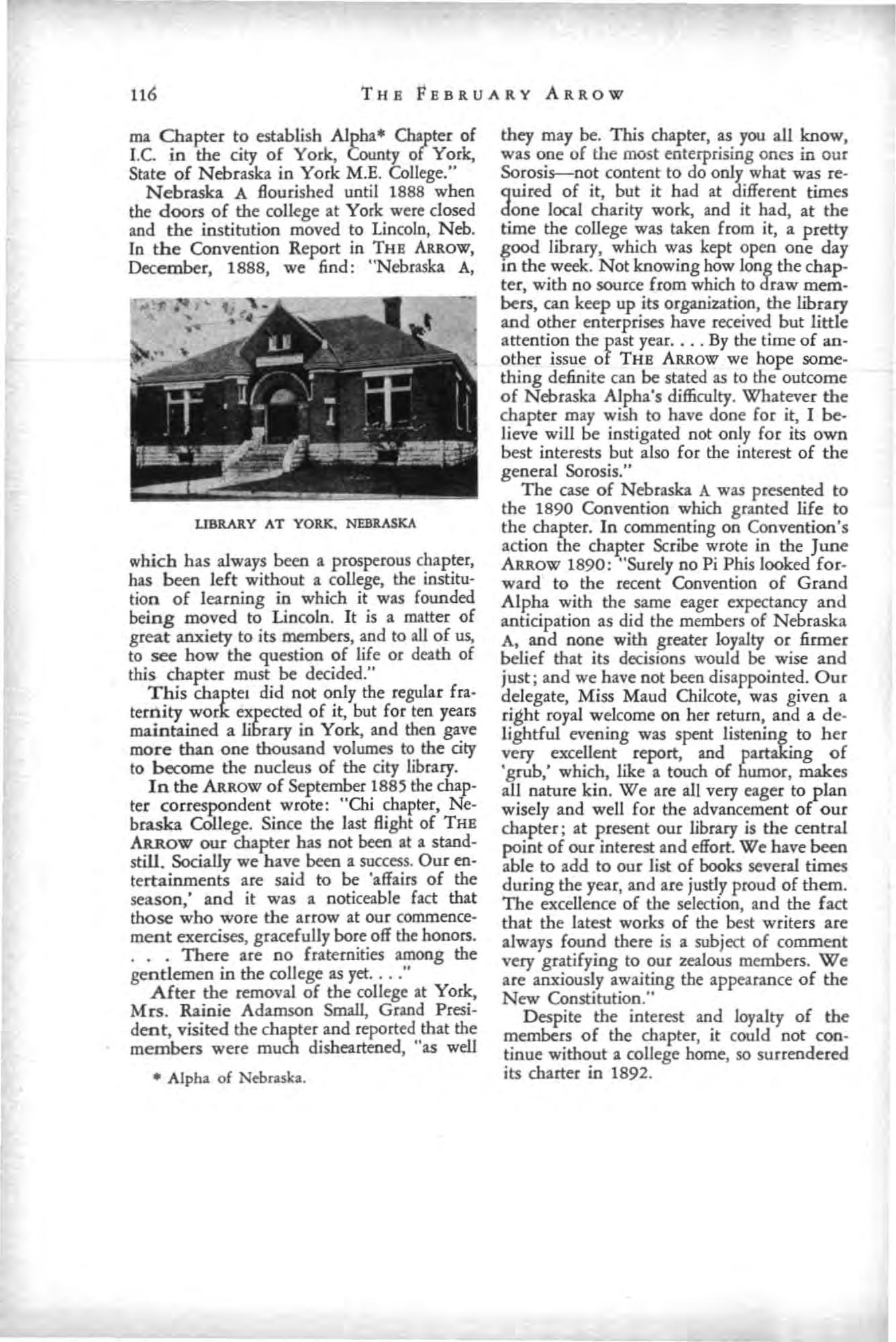
which has always been a prosperous chapter, has been left without a college, the institu· tion of learning in which it was founded being moved to Lincoln. It is a matter of great anxiety to its members, and to all of us, to see how the question of life or death of this chapter must be decided."
This chaptet did not only the regular fraternity work expected of it, but for ten years maintained a library in York, and then gave more than one thousand volumes to the city to become the nucleu s of the city library.
In the ARRow of September 1885 the chap. ter correspondent wrote: "Chi chapter, Nebraska Co1lege. Since the last flight of THE ARRow our chapter has not been at a stand· still. Socially we have been a success. Our entertainments are said to be 'affairs of the season; and it was a noticeable fact that those who wore the arrow at our commencement exercises, gracefully bore off the honors.
. There are no fraternities among the gentlemen in the college as yet "
After the removal of the college at York, Mrs. Rainie Adamson Small , Grand President, visited the chapter and reported that the members were much disheartened, "as welJ
• Alpha of Nebraska.
they may be. This chapter, as you all know, was one of the most enterprising ones in our Sorosis--not content to do only what was required of it, but it had at different times done local charity work, and it had, at the time the college was taken from it, a pretty !!ood library, which was kept open one day In the week. Not knowing how long the chapter, with no source from which to draw members, can keep up its organization, the library and other enterprises have received but little attention the fast year . By the time of other issue 0 THE ARROW we hope some· thing definite can be stated as to the outcome of Nebraska Alpha's difficulty. Whatever the chapter may wish to have done for it, I be· lieve will be instigated not only for its own best interests but also for the interest of the general Sorosis."
The case of Nebraska A was presented to the 1890 Convention which granted life to the chapter. In commenting on Conve ntion ' s action the chapter Scribe wrote in the June ARROW 1890: "Surciy no Pi Phis looked forward to the recent Convention of Grand Alpha with the same eager expectanry and anticipation as did the members of Nebraska A, and none with greater loyalty or firmer belief that its decisions would be wise and just ; and we have not been disappointed. Our delegate, Miss Maud Chilcote, was given a right royal welcome on her return, and a de· lightful evening was spent listening to her very excellent report, and partaking of 'grub: which, like a touch of humor, makes all nature kin. We are all very eager to plan wisely and well for the advancement of our chapter; at present our library is the central point of our interest and effort. We have been able to add to our list of books several times during the year, and are justly proud of them. The excellence of the selection, and the fact that the latest works of the best writers are always found there is a subject of comme nt very gratifying to our zealous members. We are anxiously awaiting the appearance of the New Constitution "
Despite the interest and loyalty of the members of the chapter, it could not continue without a college home, so surrendered its charter in 1892 .
An AlUllltlre Chapter designated as Gamma Omega was established at Mt. Pleasant, in September 1884 by Gamma, and after the Convention of 1886 became Iowa I.
A report from the active chapter at Mt. Pleasant in 1885 slated that: "We decided to have two chapters known as College and a1wnrur chapters. We meet together occasion· ally and expect to hold business meetings separately, but have joint meetings once a month for literary and other work:·
The chapter thrived for several years but grew into an Associate Chapter and hence came under the Convention ruling in 1892 preventing such groups from initiating new members.
For a time the chapter was undecided as to what it wished to do, but on March 26, 1894 , wrote to the Grand President, Miss Helen Sutliff, as follows:
I expect you think Iowa I is a long time deciding the question whether it shall be active or notthe question ha5 discussed from .11 sides and the vote taken, at the meeting when it was voted
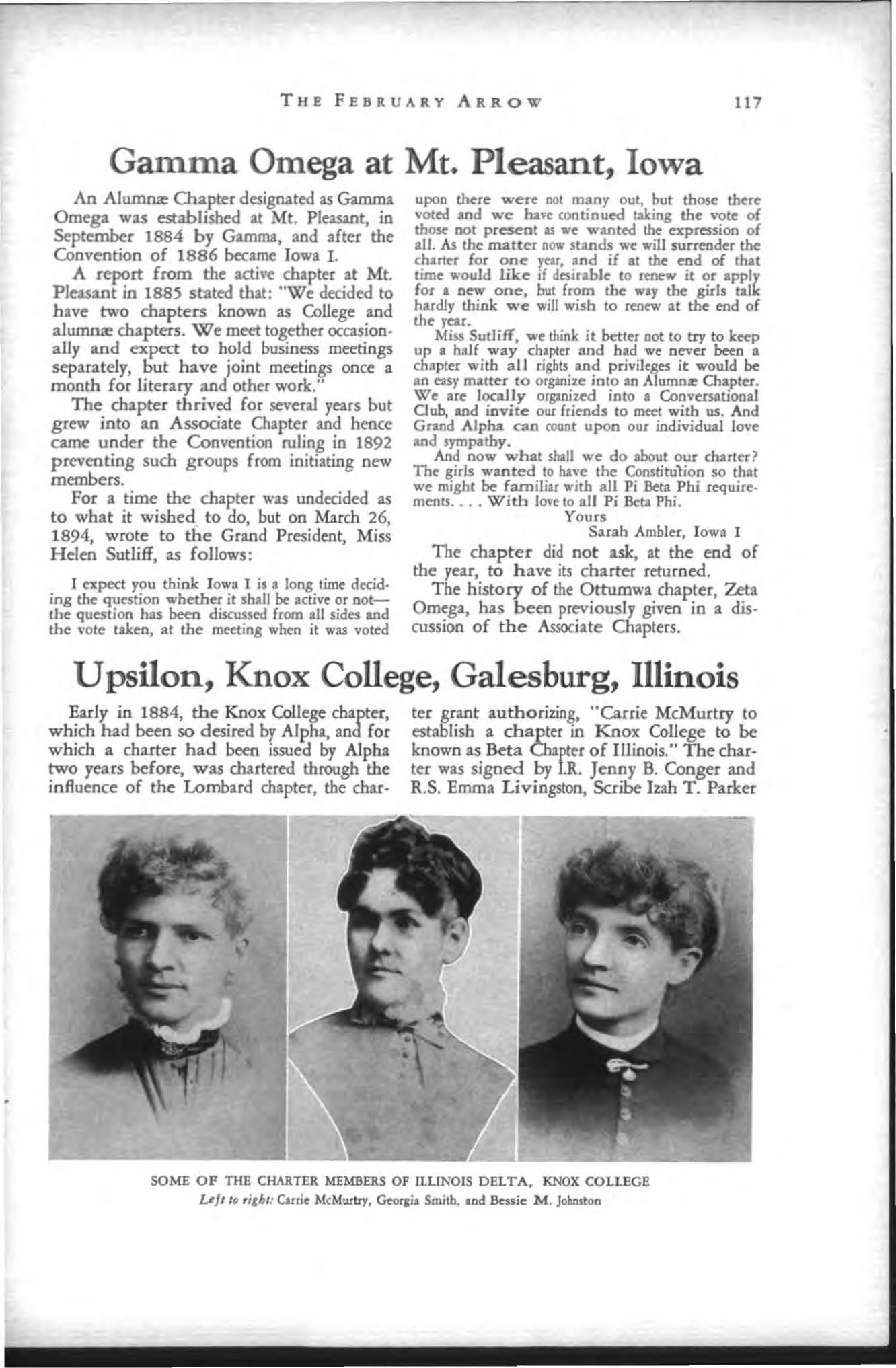
upon there were not many out, but those there voted and we have continued taking the vote of those not present 15 we wanted the expression of all. AJ the mattcr now stands we will the charter for one year, and if at the end of that time wouJd like if desinbJe to (mew it or apply (or I new one, but (com the 91., the girls talk hardly think we will wish to fent'W at the end of the yn.r.
Miss Sutliff. we think it better not to try to keep up a half way chapter and had we never been a chapter with all righu and privileges it would be an easy matter to organize ioto an Alumnae o,apter . We are localJy orpnizeci into. Conversational Oub, l.Dd invite our friends to meet with us. And Grand Alpha can count upon our individual love and sympathy.
And now what shall we do .bout our charter? The girls wanted to have the Constitulion 50 that we might be familiar with all Pi Beta Phi require· menU With love to a11 Pi Beta Phi.
Yours
Sarah Ambler, Iowa I
The chapter did oat ask, at the end of the year, to have its charter returned.
The history of the Ottumwa chapter, Zeta Omega, has been previously given in a dis· cussion of the Associate Chapters.
Early in 1884, the Knox College chapter, which had been so desired by Alpha, and for which a charter had been issued by Alpha two years before, was chartered through the influence of the Lombard chapter, the char-
ter grant authorizing, "Carrie McMurtry to establish a chapter io Knox College to be known as Beta Cufter of Illinois." The charter was sigoed by R Jenny B. Conger and R S Emma Livingston, Scribe Itah T. Parker
KNOX COllEGE
Home of Upsilon (Illinois Ddt.), Gal6bul" Illinois
and bore the seal of Alph a Secunda, May 22, 1884. This chart« was recalled and an-
other was substituted, probably due to a mis· take in giving the chapter the name of "Beta." It was next called Upsilon and later Illinois 0. In June 1930, it was combined with Illinois B to form Il1inois B-t..
The followin$ charter members of the chapter were iOltiated on March 7, 1884: Bessie M. Johnston , Georgia Smith, M. Emma Stickney, Carrie McMurtry and Gertrude Chapin.
Knox College chartered in 1837 as "Prairie College," was the product of a dream characteristic of the day when pioneers were pressing westward, following the newly opened Erie Canal or coming in covered wagons by way of the National Highway over the mountains and down the Ohio.
An Alumn., Chapter was formed in Iowa City, September 12, 1884, through the influence of the Iowa State University chapter. This group, composed entirely of college graduates, was known as Delta Omega and
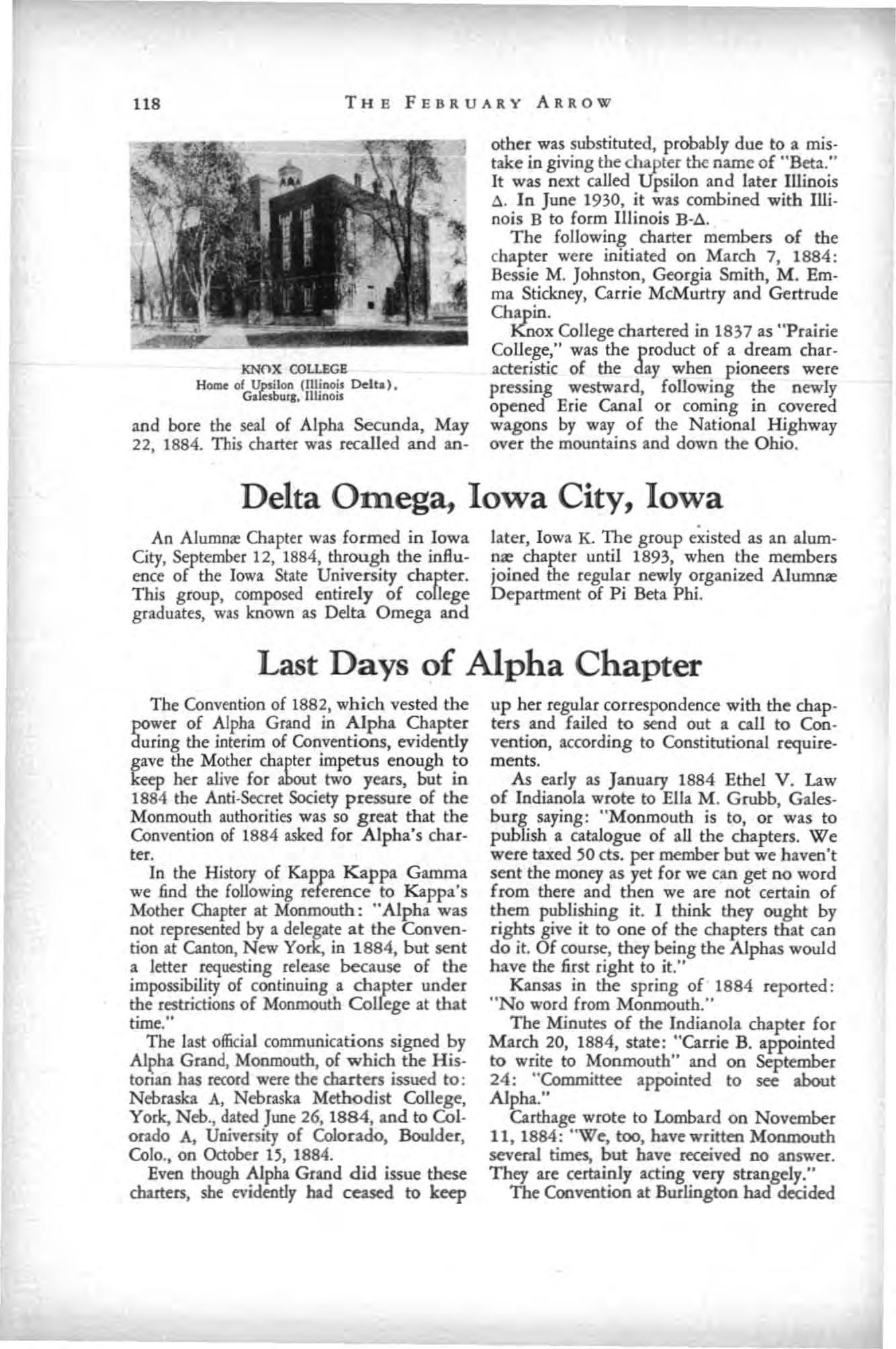
later, Iowa K. The group as an alum· nae chapter until 1893, when the members joined the regular newly organized Alumnae Department of Pi Beta Phi.
The Convention of 1882, which vested the power of Alpha Grand in Alpha Chapter during the interim of Conventions, evidently gave the Moth« chapter impetus enough to keep her alive for about two years, but in 1884 the Anti-Secret Society pressure of the Monmouth authorities was so great that the Convention of 1884 asked for Alpha's charter.
In the Hi story of Kappa Kappa Gamma we find the following reference to Kappa's Mother Chapter at Monmouth: "Alpha was not represented by a delegate at the Convention at Canton, New York, in 188 4, but sent a letter requesting release because of the impossibility of continuing a chapter under the restrictions of Monmouth Colfege at that time,"
The /ast official communications signed by AI{'ha Grand, Monmouth , of wbich the Histonan has record were the charters issued to: Nebraska A, Nebraska Methodist CoUege, York, Neb., dated June 26, 1884, and to Colorado A, University of Colorado, Boulder, Colo., on October 1884.
Even though Alpha Grand did issue these charters, she evidently had ceased to keep
up her regular correspondence with the chapters and failed to send out a call to Convention, according to Constitutional requirements.
As early as January 1884 Ethel V_ Law of Indianola wrote to Ella M. Grubb, Galesburg saying: "Monmouth is to, or was to publish a catalogue of aU the chapters. We were taxed cts. per member but we haven 't sent the money as yet for we can get no word from there and then we are not certain of them publishing it. I think they ougbt by rights give it to one of the chapters that can do it. Of course, they being the Alpbas would have the first right to it."
Kansas in the spring of 1884 reported : "No word from Monmouth."
The Minutes of the Indianola chapter for March 20, 1884, state: "Carrie B. appointed to write to Monmouth" and on September 24: "Committee appointed to see about Alpha."
Carthage wrote to Lombard on November 11, 1884: "We, too, have written Monmouth several times, but have received DO answer. They are certainly acting very strangely."
Tbe Convention at Burlington had decided
upon Iowa City. Iowa. a5 the next meeting place in 1884. and according to the power vested in Monmouth a5 Alfha Grand she should have sent out the Cal
Upon receiving 00 word from Monmouth relative to the Convention, the Iowa State University chapter. appealed to Gamma. at Mt. Pleasant. since that chapter was next in point of age to Alpha and was the head of the Iowa chapters.
Gamma. as Alpha Secunda of Iowa . assumed the responsiMity of calling the Convention and accordingly a letter was sent out on October 7. 188'. by Nell G. Custer. Iowa City. Iowa. which read:
Ladies of I .C. Sotosis Sisters,
May we call your atttotion to and ask your support in a very import2n1 matter?
Two years ago .t the general convention at Burlingto n, Jowa, J owa City was the place chosen f o r the nat genecal convention and the time decided upon, the first of Oct.
We have written repeatedly to Monmouth in order to have the call issued and arrangements made for this conventioo. but can get no answer.
We all realiz.e the pressing necessity for such a Conventioo aDd all have the same desire to im· prove our general organization and malce our Sorosis more perfect as a whole .
Because of this necessity we ask you jf you will give us your hearty support, and meet with u.s in Convention at Iowa City on Wednesday, Nov. 19, 1884, the Convention to continue until Friday evening or longer if necessary
lu soon as the decisions of the chapters are received the call will be iSSUN and as there is much to be done I must request an immediate reply and
eamestJy hope to have your representative with us Yours in I.C Nell G. Cu,ter,
By order of Iowa Gty, Iowa .
lowl Alpha Secunda.
Galesburg wrote to the Mt. Pleasant chap. ter askiog about this Call to Convention and Mrs. BelIe Lttch replied on October 14 :
Dear uah: Have your letter and o ne from l owl City before me. We fed that as Monmouth has neglected or failed 10 her duty some action should be taken in regard to calling a Convention. It seems proper for Iowa City to take the next lIitep in thu malter, but I feel sure Monmouth will have some excuse and say they did not receive th e letters &:c, but they do n ot need to be n otified of their duty. They can refer to their copy of the Constitution. So I feel it will be right to support Iowa City in the Call. There is so much to be done and we want G A changed if nothing more By the way does your Bro ther kn ow Maggie Binford of Marshalltown? W e made her an I.C while visiting here last month, she vuited one of our girisl Myra Satterthwait. She is enthused over I.e. and wants to organize a chapter there. We want you to meet her when you go there. She stands well, be· lo ngs to one of the wealthy families . You must go to Iowa City, our girls all want to go. Guess J will not go this time. Jo Gassner or Flora H ousel will go I think and dream of what I.e. could be made
This Convention proved to be a most important one. From 1867 to 1884 AIJ'ha Chapter had been recognized as the offiaal head of the fraternity. A chan,ge in organization now placed national officers at the head of Pi Beta Phi and provided for the present system of controlJing fraternity affairs in the interim of Conventions.
A month before the Convention convened at Iowa City. a charter Wa5 obtaioed for the establishment of a chapter at the University of Colorado. Boulder. Colorado. and a charter grant was later sanctioned by Convention. The charter issued to "Alpha of Colorado " was the last official act of the Mother Chapter at Monmouth .
In September 1883. M. G Stidger founded Beta Kappa chapter of Delta Tau Delta in the University of Colorado at Boulder Colo .• and a year later. his wife. Helena Dorr Stid · /ler a member of Lambda of I.e.. and a grad· uate of Simpson College. obtained through the influence of the Simpson chapter a charter for "Nu of I.e. ... later known as "Alpha of Colorado" and Colorado A of Pi Beta Phi
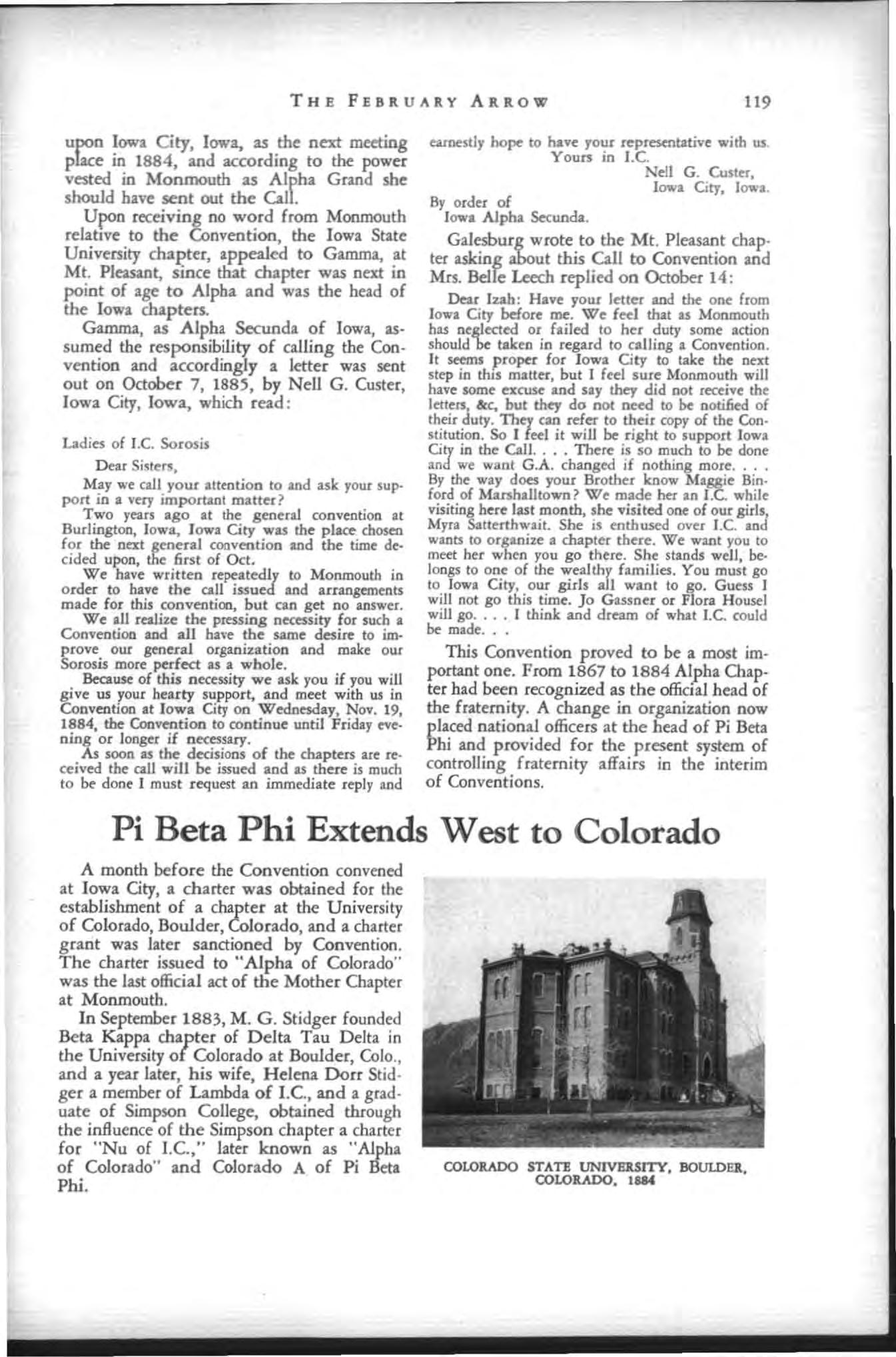
COLORADO STATE UNIVERSITY, BOUlDER, COLORADO. 1884
In writing of the founding of the chapter, Georgina Rowland , former Grand Treasurer, says:
"In the fall and spring of 1884, Mrs Stidger, May Peabody, Hessie Scudder and Elizabeth Everts met and had some kind of literary programs Then the next fall, Mrs. Platt Rogers (Dessie Weidner) and her sister, Josephine Weidner from Mt. Pleasant chapter assisted in initiating: Minnie Earhart, Kate
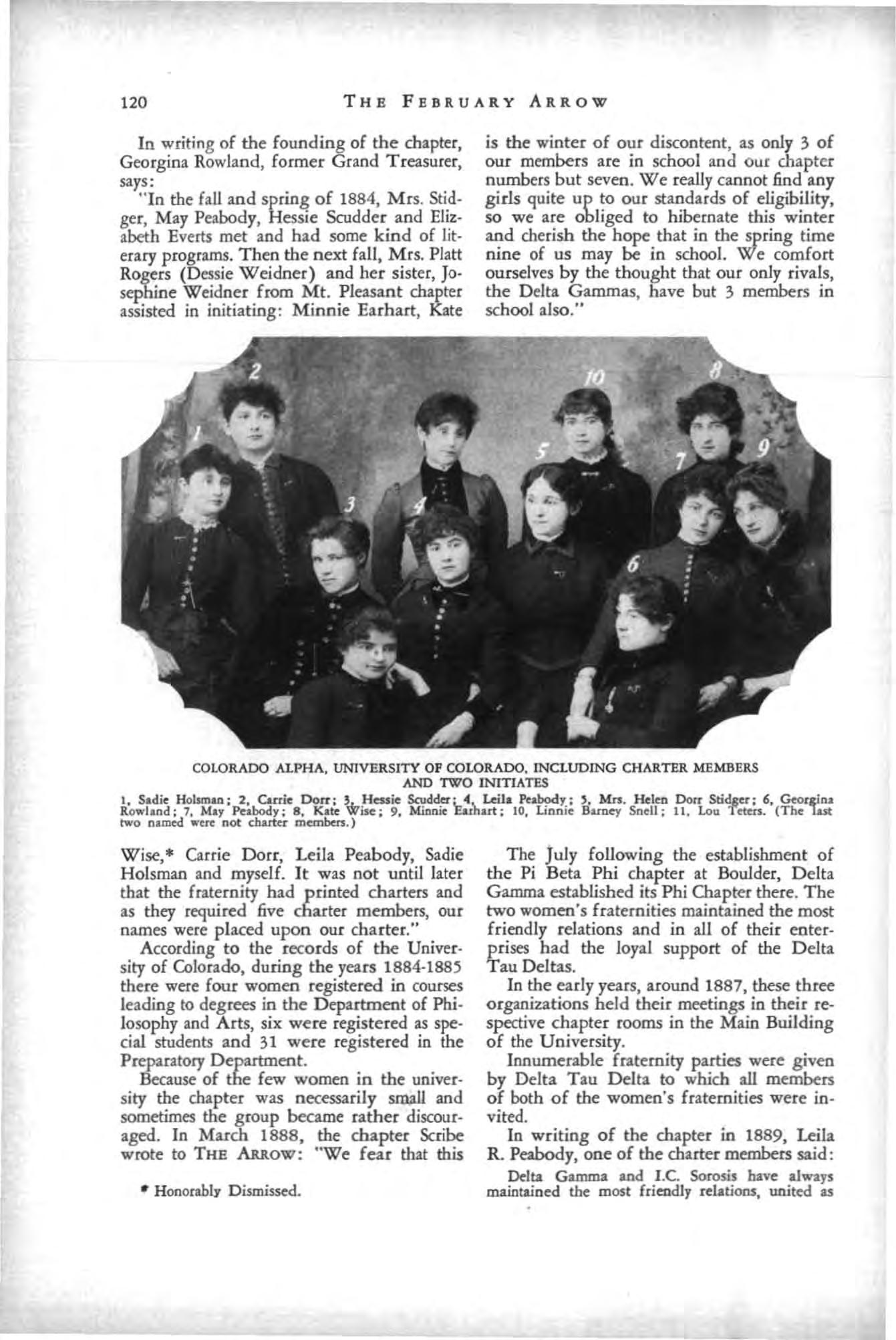
Wise,. Carrie Dorr, Leila Peabody, Sadie Holsman and myself It was not until later that the fraternity bad printed charters and as they required live charter members, our names were placed upon our charter."
According to the records of the University of Colorado, during the years 1884-1885 there were four women registered in courses leading to degrees in the Department of Philosophy and Arts, six were registered as special students and 31 were registered in the Preparatory Department.
of tne few women in the univer· sity the chapter was necessarily small and sometimes the g roup became rather discouraged. In March 1888, the chapter Scribe wrote to THE ARRow: "We fear that Ibis
- Honorably Dismissed .
is the winter of our discontent, as only 3 of our members are in school and our dlapter numbers but seven. We really cannot lind any girls quite up to our standards of eligibility, so we are obliged to hibernate this winter and cherish the hope that in the spring time nine of us may be in school. We comfort ourselves by the thought that our only rivals, the Delta Gammas, have but 3 members in school also."
The July following the establishment of the Pi Beta Phi chapter at Boulder, Delta Gamma established its Pbi Chapter there The two women's fraternities maintained the most friendly relations and in all of their enterprises bad the loyal support of the Delta Tau Deltas
In the early years , around 1887 , these three organizations held their meetings in their respective chapter rooms in the Main Building of the University
Innumerable fraternity parties were given by Delta Tau Delta to which all members of both of the women 's fraternities were in· vited.
In writing of the chapter in 1889, Leila R- Peabody, one of the charter members said : Delta Gamma and I.e $orosis have alwa ys maintained the most friendly rdatioos, united as
we are by common aims. And in a11 its enterprises, the chapter has had the admiration and support of the Deltas. In the summer of '86 a lawn fetc was given by the chapter, which was a social and financial success, and the money was nicely expended in furnishing a chapter hall. The hall is on the third Boot of the University and commands a fine view from its Jarge windows. Of course wine and bluc prevail in the furnishings and here the girls set up their Lares and Penates Truly there is no place I ike home, say the loyal Pi Phis. The members of the chapter have always been among the
The University of Colorado is a fine building situated on an eminence south of town and commanding a fine view of valley, foothills and snowy range. On the campw are the president's bouse, the students' cottages, the Medical Department and the Hospital , aU line buildings . A science hall wiJl probably be erected the following year. The literary societies are the Phil omathean and the Bell. The former composed of " preps:' (he latter of coliegiates. The library is one of the finest in the west. The University opened in 1877, and although comparatively young. the work done in the various
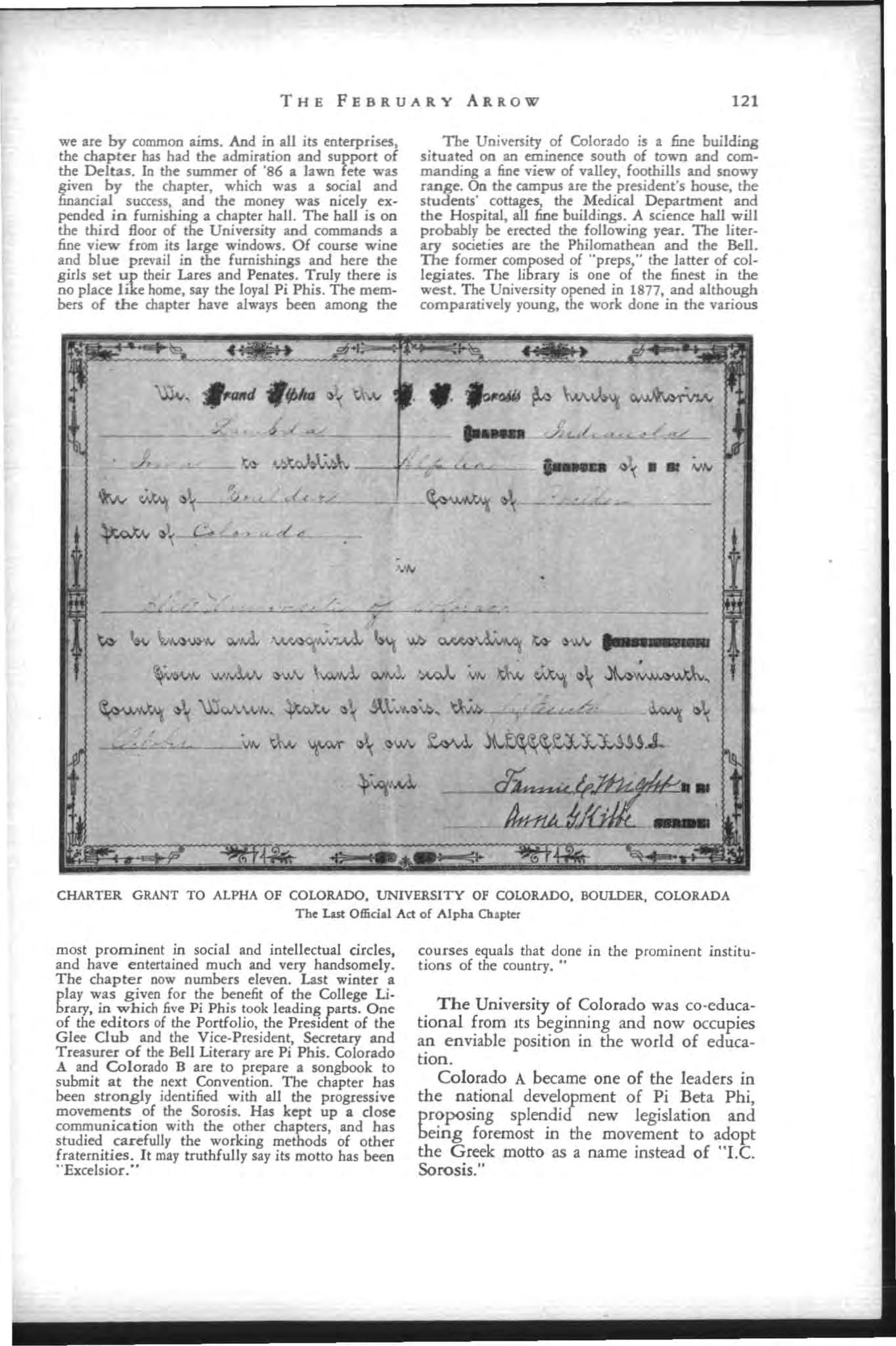
I.
most prominent in social and intellectual circles. and have entertained much and nry handsomely. The chapter now numbers eleven. Last winter a play was given for the benefit of the CoUege Library, in which five Pi Phis took leadin 8 /.arb. One of the editors of the Portfolio. the Presi ent of the Glee Club and the Vic e- Preside nt, Secretary and Treasurer of the Bell Literary are Pi Phis Colorado A. and Colorado B are to prepare a songbook to submit at the next Convention. The chapter has been strongly identified with all the progressive movements of the $orosis. Has kept up a close communication with the other chapters. and has studied carefully the working methods of other fraternities. It may truthfully say its motto has been "Excelsio r .• ,
courses equals that done in the prominent institutions of the country
The Un,versity of Colorado was co-educational from lts beginning and now occupies an enviable position in the world of education.
Colorado A became one of the leaders in the national development of Pi Beta Phi, proposing splendid new legislation and being foremost in the movement to adopt the G reek motto as a name instead of "I.e. Sorosis."
The Seventh Nati o nal Convention, or Grand Alpha, was held in the parlors of the First M E. Church, Iowa City, Iowa, on November 19, 20, 21, 1884 . Representatives began to arrive on the eighteenth, and by Wednesday noon all of the delegates and many visiting members were in Iowa City from eleven chapters . Others sent their greetings.
Nell G. Custer (Swisher), Iowa City, was
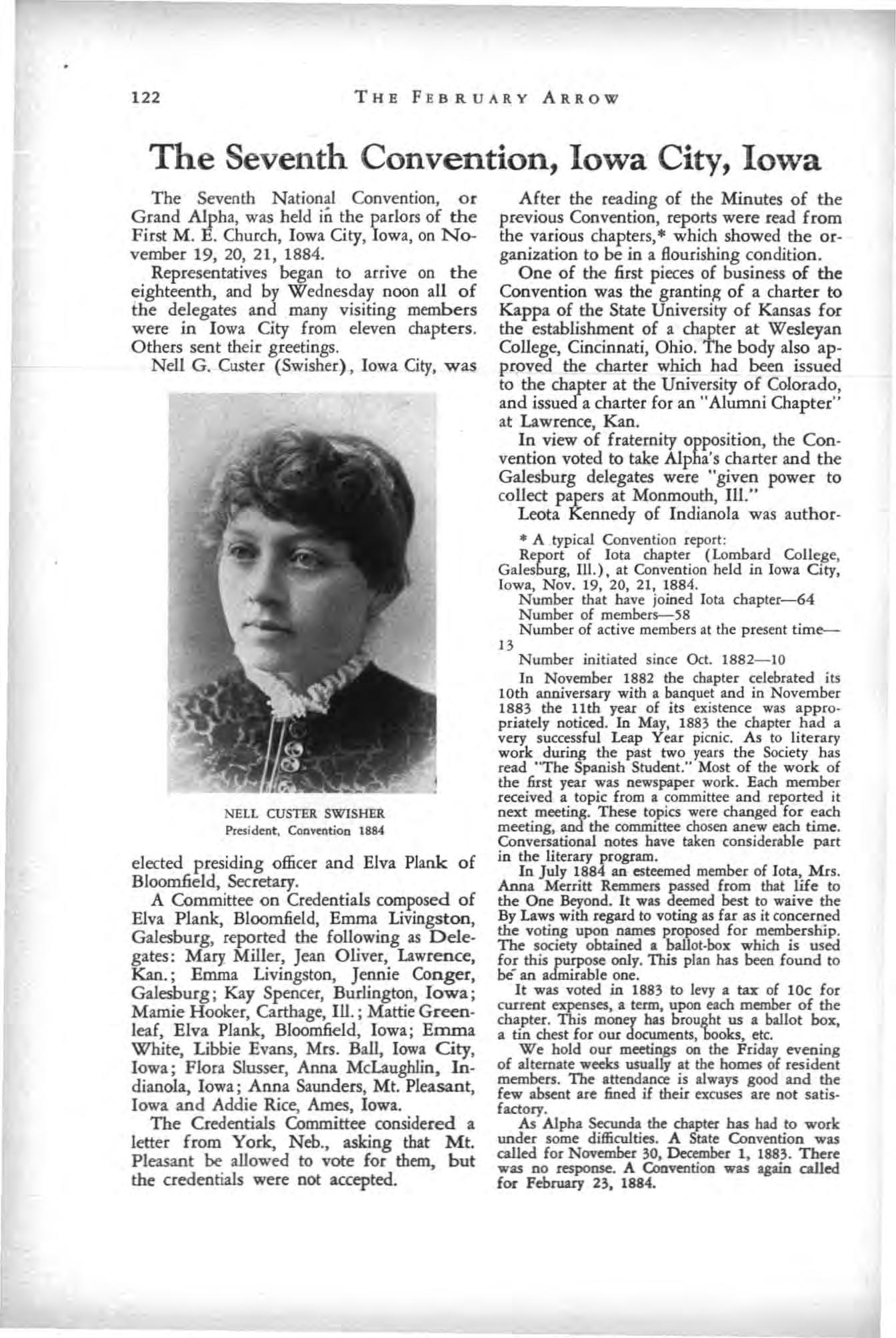
elected presiding officer and Elva Plank of Bloomfield, Secretary.
A Committee on Credentials composed of Elva Plank, Bloomfield, Emma Livingston, Galesburg, reported the following as Delegates: Mary Miller, Jean Oliver, Lawrence, Kan. ; Emma Livingston, Jennie Conger, Galesburg; Kay Spencer, Burlington , Iowa; Mamie Hooker, Carthage, Ill. ; Mattie Greenleaf, Elva Plank, Bloomfield , Iowa; Emma White, Libbie Evans, Mrs. Ball, Iowa City, Iowa; Flora Slusser, Anna McLaughlin, Indianola, Iowa; Anna Saunders, Mt. Pleasant, Iowa and Addie Rice, Ames, Iowa.
The Credentials Committee considered a letter from York, Neb., asking that Mt. Pleasant be allowed to vote for them, but the credentials were not accepted.
After the reading of the Minutes of the previous Convention, reports were read from the various chapters, * which showed the ganization to be in a flourishing condition.
One of the first pieces of business of the Convention was the granting of a charter to Kappa of the State University of Kansas for the establishment of a chapter at Wesleyan College, Cincinnati, Ohio. The body also approved the charter which had been issued to the chapter at the University of Colorado, and issued a charter for an "Alumni Chapter" at Lawrence, Kan.
In view of fraternity opposition, the Con· vention voted to take Alpha' s charter and the Galesburg delegates were "given power to collect papers at Monmouth, Ill."
Leota Kennedy of Indianola was author-
• A typical Conventi on report : Report of Iota chapter (Lombard College, Galesburg, Ill.), at Conventi on held in Iowa City, Io wa, Nov. 19, 20, 21, 1884.
Number that have joined Iota chapter--64
Number of members-58
Number of active members at the present time--13
Number init iated sin ce Oct. 1882- 10
In November 1882 the chapter celebrated its lOth anniversary with a banquet and in November 1883 the 11th year of its existence was appropriately noticed. In May, 1883 the chapter had a very successful Leap Year picnic. As to literary work during the past two years the Society has read "The Spanish Student ." Most of the work of the first year was newspaper work. Each member received a topic from a committee and reported it next meeting. These topics were changed for each meeting, and the committee chosen anew each time. Conversational notes have taken considerable part in the literary program.
In July 1884 an esteemed member of Mrs. Anna Merritt Remmers passed. from that life to the One Beyond. It was deemed best to waive the By Laws with regard to voting as far as it concerned the voting upon names proposed for membership . The society obtained a baUot-box which is used for this purpose ooly. This plan has been found to be an admirable one.
H was voted in 1883 to levy a tax of IOe for curreat expenses, a term. upon each member of the chapter. This money has brought us a ballot box, a tin chest for ow documents , books, etc.
We hold our meetings on the Friday evening of alternate weeks usually at the homes of resident members . The attendance is always good and the few absent are fined if their excuses are not satis· factory.
As Alpha Secunda the chapter has had to work under some difficulties. A State Convention was called for NovemMr 30, December I, 1883. There was no response. A Convention was again called for February 2', 1884.
i""d to obtain the papers from Oarinda, Iowa , and the order was given in writing.
A new Constitution was discussed and voted on by Articles and 5<ctioru and a motion was carried that the Constitution should go into effect on Janu.ry 1, 1885, if ratified by two-thirds of all the chapters_
Under this new Constitution, the Object was stated: "To be the formation of a sisterhood for the mutual encouragement and assistance of its members in all that pertains to truth , virtue and sisterly love ; ana to bring together girls and women engaged in the work or study of literature, art, science, and kind red pursuits . "
The Menbership clause definitely repeated that "each initiate must be a student, teacher or graduate of or in a university or college or institution of learn ing, having a full course of study equal thereto, etc."
Provision was made that the school chapters be named by the letters of the Greek alphabet in the order of the founding: Alpha, Beta , etc., omitting the dead chapters . Arumn", chapters were to be named Alpha Omega, Beta Omega, etc., in chronological order.
The new Constitution proVIded that the expenses of sending the Grand Officers and one dele$ate from each chapter to the Grand ConventIOn should be paid by an equal tax levied upon each active member of I.e.S. which tax sbould be raid into the Grand Treasury. It was r«JUlred that only active members should be elected as members of Grand Alpha
The new form of government provided for three officers of Grand Alpha and stated that:
The duty of the Grand Illustra Regina shall be to preside over Grand Alpba; to grant charters, and to be responsible for the legality of the charters $ranted by her and to give notice of the meeting of Grand Alpha, at least six weeks previous to the time of meeting.
It shall be the duty of the Grand Scribe to see that all inter-corcespondence is carried on regularly; to draw on the Grand Quaestor for general funds (orders to be signed by Grand I.R ) and to record the meetings of the Grand Alpha.
It shall be the duty of the Grand Quaestor to take charge of all funds belonging to the General Organization and to pay all orders signed by G .I.R. and by Grand Scribe, and to make a detailed report at the meeting of G A
Thus began the present system of Grand
Council government during the interim of Conventions.
The Gamma Chapter of Iowa, Mt. Pleasant, was empowered to provide pins for the Sorosis at tlie usual rates, no orders to be filled unless accompanied by the secret sign.
Too, it was requJred that all letters relative to fraternity matters, all orders and papers must be signed by the Scribe and have the secret sign and all correspondence must be sealed.
An Executive Committee was provided for each chapter to act upon all important measures and to report the same to the chapter.
The monogram adopted was: the imtials LC.S ., an arrow and scrolls.
An addition to the By-Laws required initiates to sign the Constitution
The yearly tax or dues was set at 50¢. According to Nell Custer (Swisher) this annual tax was to be used: " To send an I.e. to form a new chapter, to get out a catalogue, a magazine or tor any purpose wherein the entire Sorosis will be henelited. None of it can be used without an order, issued with proper signatures."
A fine of $5.00 was stipulated for anyone who permitted her pin to be worn by a nonmember.
The new Constitution also stated that no charter could be granted "for foundation of chapters in schools where in connection with the endowment fund, it is stated that secret societies are forbidden ."
"Women and her Work" was the subject recommended for study in all of the chapters during that school year.
The election of officers resulted as follows: G.I.R. Nell Custer, Iowa Gty, Iowa; G. Scribe Emma Livingston, Galesburg, Ill.; G. Quaestor Jean Oliver, Lawrence, Kan.
Alter deciding to hold the Conventions annually in the future, the session adjourned to meet with Kappa Chapter, Lawrence, Kan ., in October or November, 1885.
One writer in describing the Convention said: "During their stay in Iowa City the visitin$ sisters were entertained in a most charmmg manner. And on Thursday evening the culminatiing event took place The resident chapter tendered an elegant reception , in honor of the delegates, at the home of Miss Hattie Cochrane. Many friends of the Sorosis were present, among whom were some of the faculty of the Iowa State University. The lunch was simply superb. The ladies all looked lovely, as I.Cs . know well
how to look. Everything passed off as 'merry as a marriage bell.' At a late hour the company broke up , thinking it was well to have been there, and wishing long may I.e. live and fiolUish."
Although h<r power had been taken away through the creation of the Grand Council officers and the vote of Convention to take her charter, members of Alpha held meetings now and then until some time in 1888 wben all activity ceased.
Alpha Chapter was re-established at Mon-
mouth on May 2', 1928, at which time the college authorities welcomed fraternities o n the campus.
The Constitution , with its new provisions, revisions and amendments was accepted by all of the active chapters and went into effect on January 1, 188' and under its new gnvernment by Grand Officers, the fraternity settled down into steady development, be8inning a period of splendid growth and mternal progress , thriving under the new leadership
By this time there was a strong sentiment among some of the members of the fraternity for the adoption of the Greek motto, Pi Beta Phi, as the name of the organization instead of I.e. Sorosis .
The delegates from Kansas A , went to the I owa City Convention in 1884, instructed by their chapter to place before the Convention the advisability of adopting the Greek name "But" wrote Mary Miller Barnes, delegate, "we found the girls were neither willing nor ready to even consider the change of name . Th at had to wait until the times were ripe."
Many of the older members , who through the years in I.C had come to love the name were loath to relinquish it. The Simpson, Indianola, Minutes of Sept 24, 188 4 recorded: "Motion carried that our delegate be instructed to say at the Convention that we are not in favor of changing the letters to Greelc, only as a last resort."
In the older chapters where I.C had so long been established the name could hold its own against any Greek -named rival, but in the newer fields which were being entered by the organizations with Greek-lettered names, I.e. Sorosis was under a handicap.
The chapters at the University of Colorado and at the University of Kansas and at Iowa W esleyan were coovinced that the Greek name would help greatly in gaining new members in the newer fields of extension. They therefore began to use !be Greek motto, Pi Beta Pbi, as a name as early as 188' . Other chapters followed.
In the Marrlb ARRow, 1887, Colorado A, Boulder, urged: " Let us by all means be called by ow Greek name, using I. C. only as an explanatory title when necessary, gradually 100lDg sight of it a.ltogether." The chapt<r letter from Boulder in the same issue is
signed "Nu of Pi Beta Phi, CS .U," and the Scribe refers to the "chapters of Pi Beta Phi" In the same issue, Kansas A refers to a member of her chapter as "doing honor to Pi Beta Phi ."
A chapter letter from I.W.U. , Mt. Pleasant, June 1887 reads: "How pleasant it is to receive letters from those wnom we have never seen and yet in whom we have such an interest when we read, 'Yours in Pi Beta Phi ' ."
The Iowa City Alumn" chapter reJ?Orted in June 1887: "Pi Beta Phi looks out In red letters from the three front windows of OUf hall," and in the same issue says: "The Pi Beta Phi Sorosis can boast of being the ooly Sorosis in the S.U.1. that owns a home of its own." The editorial in the September ARRow, 1887, refer to both "I.C" and "Pi Beta Phi" and the words are used alternately in chapter letters from Iowa A and Iowa B. Other chapters commented in June 1888: Indiana A: "How anxious we are that the coming Convention of the fraternity will abolish the old appellation of I.C and adopt Pi Beta Phi exclusively."
Michigan B, in its /irst ARRow letter said: "What is the use of having Greek letters at all if no one sees them, except on the title page of THE ARROW? To be sure we appreciate the difference, but our friends and rivals do not, and so long as they are not in plain sight they will not be heeded."
Illinois A: Sept. '88: " We are going, we hope to an I.C Lonvention, for the last time. The next one we sincerely trust will be illumined by the beacon light, 'Pi Beta Phi now and forever.' Our Greek (?) friends use the matter of our name as an argument of right in getting new members, and we can't stand this insult much longer."
The Bouid<r H"a/d in July 1888 de-
scrib<d a lawn fete given ''by the ladies of Pi Beta Phi ."
THE ARRow Editor in March 1888 wrote: "May not a reasonable woman (masculine exchaoges please pardon the seeming paradox) be allowed to change her mind? ... We have become persuaded that 'I.C.' will
never find herself on an even basis with other Greek letter fraternities, until she becomes Pi Beta Phi, our indifference bas become our enthusiasm which we think, in time will reach a culminating point equal to that of our sister chapter at Boulder, Colo., who continudly does cry Pi Beta Phi! "
On January 14, 1885 a new chapter was founded at Wesleyan College, Cincinnati, Ohio through the inHuence of M. Aonette Jones (Walls) of Kansas A, as the result of a charter graot by Convention The charter members of Xi dlapter were: Harriet Ritter, Florence McGowan, Weslaona Brown, Cor· nelia Humphrey, Laura R. Wagner, Esther Rhay, Thirza Buros , and Margaret Gay Dolliver. Later, three more members joined the group: Eleanor Hoyt Brainerd, Sarah Shire and Lucretia Elizabeth Booham.
Immediately after the chapter was organized the college author ities passed a resolution secret societies in the institution.
In writIDg of the history of this chapter, Marie Annette Walls said in 1907: "I was in Cinci nnati Wesleyan College--had per-
mission from Mrs . M. McClellan Brown to organize a chapter in the school. We had our charter and were arranging for an initia· tion and hoped to have a delightful time, when Mrs. Brown appeared, saying she wanted us to be an Auxiliary of the Woman's Foreign Missionary Society of St. Paul's M E. Church, absolutely refused to allow a secret society in the school, insisted upon reading the Constitution I remember Florence McGowan and Harriet Ritter es{""iaUy, for they were so angry at this suggestIon that they roUed the charter, constitution, minutes, everything indeed, and burned the package in the furnace.
At the time the chapter ceased to exist there were thirteen members initiated.
An event of great significance in the year 1885 was the publication of Vol. 1 No.1 of THE ARROW, official organ of I.e. Sorosis. At the 1882 Convention, Alpha Grand had been authorized to "publish, when funds permit, a magazine devoted to literary purposes and the interests of the society." The magazine, however, did not materialize until three years later.
The first issue, a twenty-page magazine in a blue cove r, came from the press of Foley's Water Power Printing Establishment, lawrence, Kansas, under tne able management of Kansas A, with Mary E. Miller (Barnes ), editor-in-chief, Marcy G. Gilmore (AUen) and Nettie Hubbard (BoJles) of Lawrence, associate editors, and Sue Miles (Kinsey), of Kansas At business manager .
According to Mary Miller (Barnes) : "We had hoped to send out the first number in January, and then three months later to present second number more in the form of an historicd catalogue. The object of the lat-
tee can easily be SC!eD. We met with great difficulties and discouragements, for the sister chapters were exceedingly slow in responding. We struggled on, and finally-much later that we anticipated-the first issue appeared."
A clipping in the Kansas A Scrapbook, presumably taken from the Weekly University Courier, dated February 1885 states:
" In fraternity circles the University of Kansas must be beginning to attract considerable attention Last faU the annual CODven· tion of the I.e. Sorasis resolved to estab· li sh a journal, and its publication was l'laced in the hands of the chapter here. While no numbers have as yet been published, we are informed that the time has been employed in making arrangements and Vol. I, No 1 wiil soon be out. Next, the G.e.A. of the Phi Kappa Psi Fraternity, placed the Shield, its offiCIal organ, in the hands of Kansas Alpha and already the first number by their chapter here has come from the press and a very
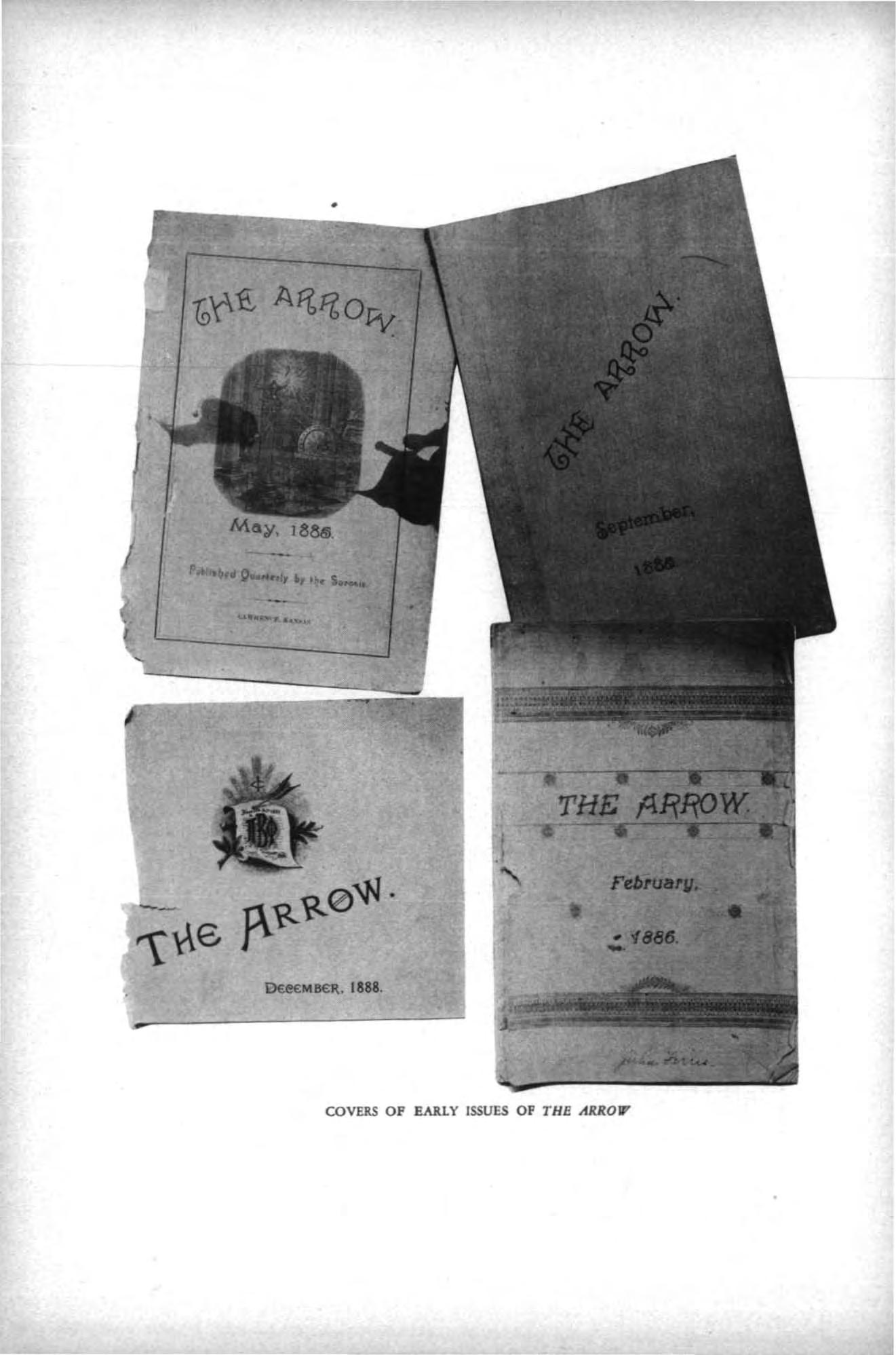
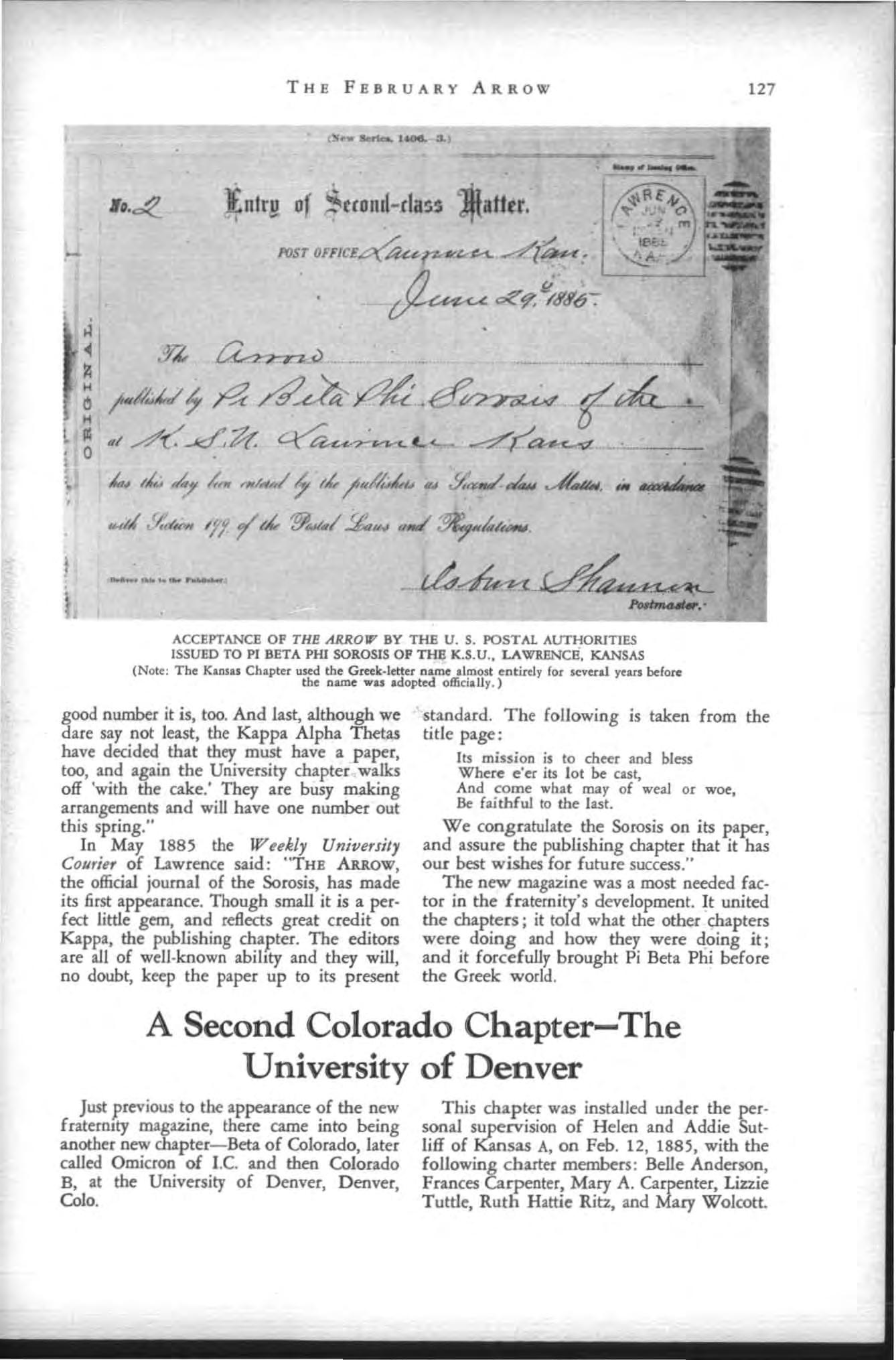
ACCEPTANCE OP THE ARROW BY THE U. S. POSTAL AUTHORITIES ISSUED TO PI BETA PHI SOROSIS OF THE K.S U • LAWRENCe, KANSAS
(Not e: The Kansu Chapter used the Greelc:·lrtter name almost entirely for sneral yUII before the name wu adoptNi officially .)
good number it is, too. And last, although we dare say not least, the Kappa Alpha T hetas have decided that they must have a paper, too, and again the University chapter walks off 'with the cake: They are busy making arrangements and will have ODe number out this spring."
I n May 1885 the Weekly University Courier of Lawrence said: "THE ARRow, the official journal of the $orosis, has made its first appearance. Though small it is a perfect little gem, and reBects great credit on Kappa, the publishing chapter. The editors are all of well-known ability and they will, no doubt, keep the paper up to its p r esent
standard. The following is taken from the title page;
Its mission is to cheer and bless Where e'er its lot be cast, And come what may of weaJ or woe, Be faithfuJ to the last .
We congratulate the Sorosis on its paper, and assure the publishing chapter that it has our best wishes for future success."
The new magazine was a most needed factor in the fraternity's development. It united the chapters; it told what the other chapters were doing and how they were doing it; and it forcefully brought Pi Beta Phi before the Greek world.
Just previous to the appearance of the new f ratemlty magazine, there came into being another new chapter-Beta of Colorado, later called Omicron of I.e. and then Colorado B. at the University of Denver, Denver, Colo.
This chapter was installed under the personal supervision of Helen and Addie SutliB of Kansas A, on Feb. 12, 1885, with the following charter members; Belle Anderson, Frances Carpenter, Mary A. Carpenter, Lizzie Tuttle, Ruth Hattie Ria, and Mary Wolcott.
Minnie Whffitr (Sommerville) was Colorado B's first initiate_
On March 5, 1864, through the efforts of John Evans, Territorial governor of Colorado, who had inttrested the Methodist
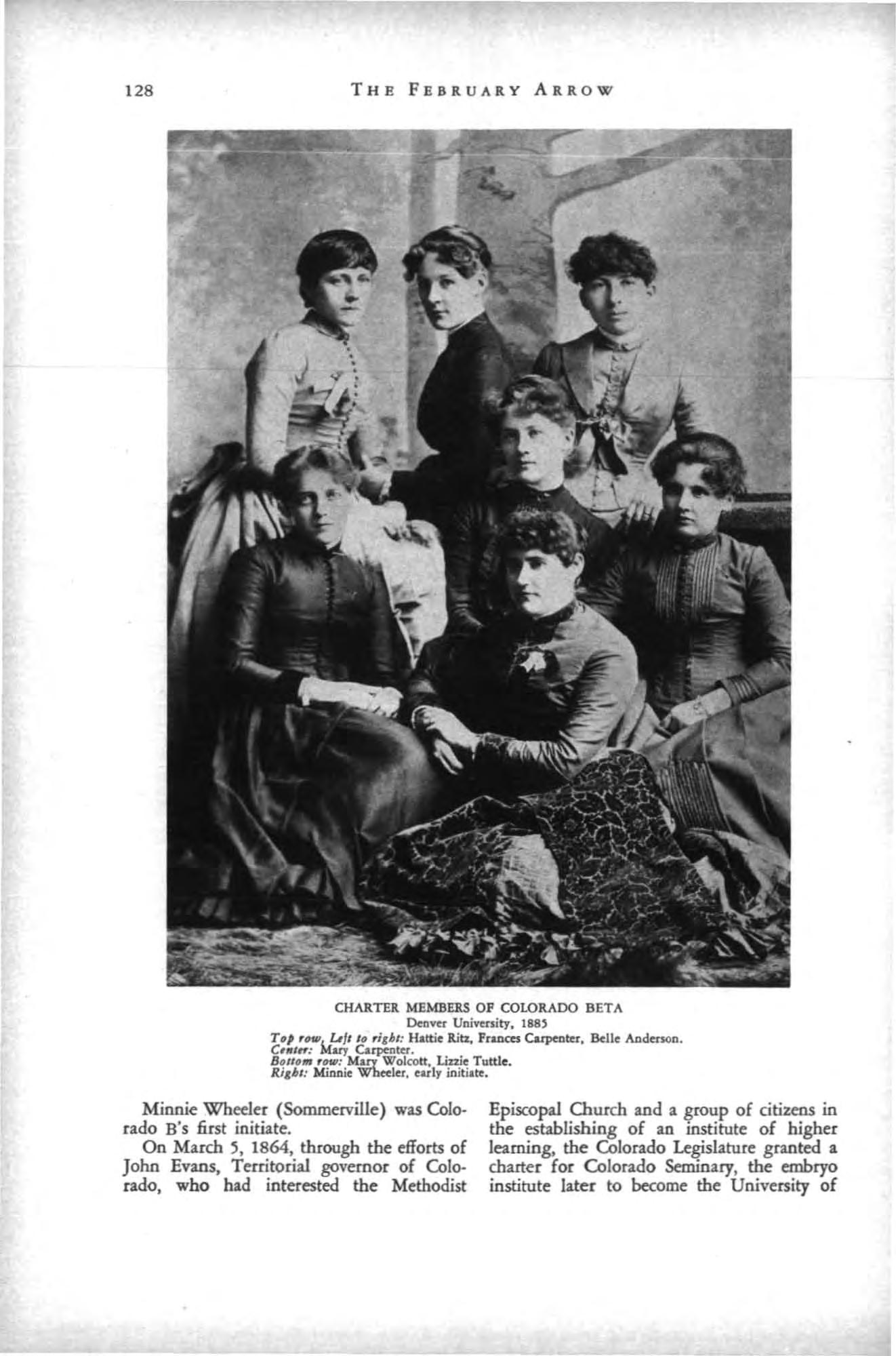
Episcopal Church and a group of citizens in the establishing of an institute of higher learning, the Colorado Legislature granted a charter for Colorado Seminary the embryo institute later to become the University of
and
Denver Women were admitted from the begi nn ing.
Colorado B was the 6rst woman's fraternity in the University and received its charter large ly through the efforts of the members of the local rhapter of Beta Theta Pi, established the previous year. Especially did Mont Cranston aid the grou p . The Betas were acquainted with the rhapter of I.e. Sorosis at the University of Kansas and so interested a group of women at Colorado Seminary in the Sorosis. At this time, the University with its enrollment of three hundred students, supported one fraternity, several honorary societies, but no woman's fraternity. As a result of the efforts of the Betas, the group of women petitioned I.e. Sorosis through
the Kansas University rhapter and received a charter.
In 1885 six members were initiated into the group and in the following year four more became the wearers of the arrow.
When the Seminary was located at Arapahoe and Fourteenth, the chapter held its meetings in the third story of the Main Building. After the University was moved to University Park, the chapter initiations were held in the Drawing Room of Old Main, while meetings were held in the homes of the members.
The chapter, though small at 6rst, and at some times greatly worried over how to continue because of the fewness in numbers, steadily progressed an d has always been on e of the strong chapters of the fraternity.
An Alumnae Chapter was established in 1885 in Lawrence, Kansas, known as Kappa Omega, the members being college and uni-
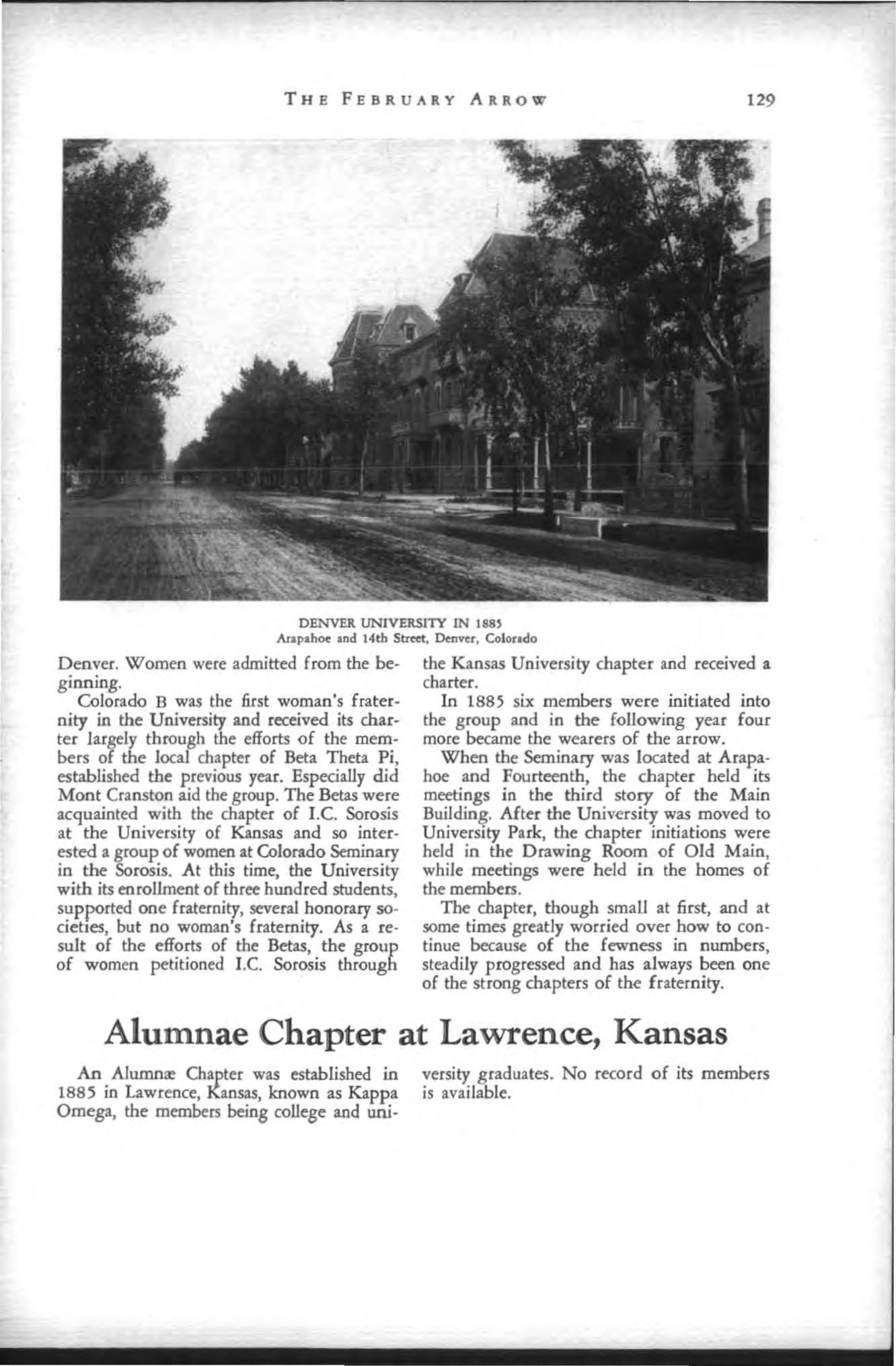
versity graduates. No record of its members is available.
According to the agreement that the Con· vention would meet annually. G.!.R. Nell G. Custer. in the fall of sent out the following Call:
By virtue of power vested in me by I e. Sorosu, I do hereby officially notify Gamma that the Grand Chapter of I.C. Sorosis will convene at Lawrence, Kansas. on the days of November 25, 26 and 27. 188l.
Signed, Nell G Custer
Io wa City I owa Oct . 19. 188l .
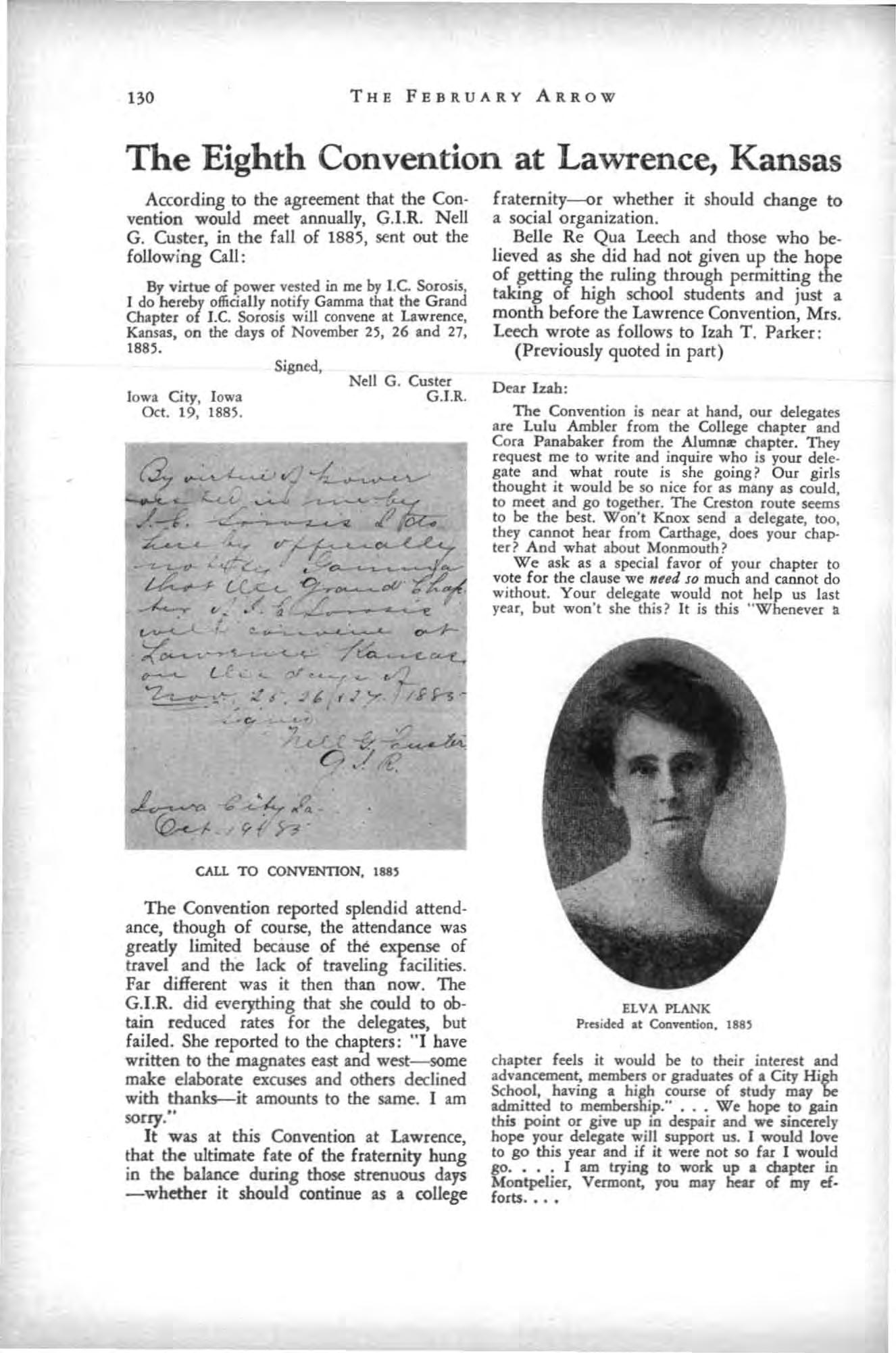
G.l .R.
f raternity---<>r whether it should change to a social organization.
Belle Re Qua Leech and those who be· lieved as she did had not given up the hope of /letting the ruling through permitting the taking of high school students and just a month before the Lawrence Convention, Mrs. Leech wrote as follows to bah T. Parker: (Previously quoted in part)
Dear bah :
The Convention is near at hand. our delegates are Lulu Ambler from the College chapter and Cora Panabakec from the Alumnae chapter. They request me to write and inquire who is your delegate and what route is she going? Our girls thought it would be so nice for as many as could , to meet and go together The route seem s to be the best. Won ' t Knox send a delegate, too , they cannot hear from Carthage , docs your chapter? And what about M o nmouth?
We ask as a special favor of your chapter t o vote for the dause we n,ea so much and cannot do without. Your deleg a te would not help Wi last year, but woo't she this ? It is this "Whenever II.
CALL TO CONVENTION, 188)
The Convention reported splendid attend· ance, though of course, the attendance was greatly limited because of the! expense of travel and the lack of traveling facilities. Far different was it then than now The GJ.R. did everything that she could to ob· tain reduced rates for the delegates. but failed. She reported to the chapters: " I have written to the magnates east and west-some make elaborate excuses and others declined with thanks-it amounts to the same. I am sorry."
It was at this Convention at Lawrence. that the ultimate fate of the fraternity hung in the balance during those strenuous days -whether it should continue as a college
chapter feels it would be to their interest and advancement. members or graduates of a Gty Higb School, having a high course of study may be admjtted to membusbip." We hope to gain this point or give up in despair and we sincerel y hope your delegate will support w I would love to go this yeu and if it were not so far I would 80. • • • I am trying: to work up • chapter in Montpelier, Vermont. you may hear of my cf· forts .• • •
A report of u,., Convention appeared in THE ARRow of February 1886 as follows:
The delegates and those attendant upon the convmtioo began to arrive at Lawrence 00 the afternoon of the 24th From that time on. until the following afternoon, nearly every train brought some one or more who worc the golden arrow. Some few did not arrive until Thursday moening, having b«n dcIaytd by wreck5 upon the road
Wronesday opened bright and pleasant.
The morning was spent in driving over the city and visiting the University, and early in the afternoon groups of I.C! could be seen wendlng thei r way down Massachusetts toward the rooms of the Art League, at which place the mttt · ings were held throughout the Convention.
There ensued a sroeral hand-shalcing and in the pleasure of meeting fam iliar faces and of form ing new fcimcbhips the slipped rapidly away. and it was not until 3:30 o'clock that the house was called to order It was greatly regretted that the Grand I .R. Nellie Cwler, of Iowa City, was unable on account of illness, to be present. Her place, however, WaJi ably filled by Miss Elva Plank , of Junction City , K ansas Mter devotional exercises a committee on Credentials was appoi nted, com · POSed of Mrs. Carrie Spangler, of Lawrence, Miss tinie Flagle r , o f Ottumwa, JOWl , and Miss Lulu Ambler, of Mount Pleasant.
The committee promptly reported that the f ollowing delegates were entitled to a scat in the convention:
Ethel Law, Indianola; Mrs. Spangler, Lawrence ; Sue Miles, Lawrence; Mira Troth Iowa City; Lillian Lewis, Iowa City; Liuie Flagler, Ottumwa ; Julia Ferris. Carthage; Mary Carpenter, Denver ; Josephine Gassner, Mt. Pleasant ; Lulu Ambler, Mt. Pleasant; Mary Campbell Ball, Fairfield; Florence Hill, Bloomfield; Coca Widick, Burlington; Vinnie Harrison, York.
The calliog of the roll showed that all the dele· gates were present save those from Galesburg, IlL,. the month -o ld chapter at BouJder, Colo., Cincinna ti , Ohio, t and Ames, Iowa,t
Then folJowed the reports of Grand Officers .
In the absence oE G I.R her report was read by Miss Troth, of Iowa City Although reporting much progress in fraternity affairs Nell Custer said: "I have several times during the last year been obliged to solace myself with the reBection that K,elJJ bodies move slowly."
The reports of Scribe, Emma Livingston, of Galesburg, Ill. , and Quaestor, Qaca Poehler, of Lawrence, Kan ., were given and accepted. A com· mittee was appointed by the chair to draft a programme for the remainder of the Convention. The members oE this committee were : Misses Troth, Ferris, and Mrs. Spangler. The Convention adjourned to meet the (ollowing morning.
• The Galesburg delegates a.rrived late.
t Chapter had ceased to exist
The Am .. Minutes of Oct. 20, 'S,: "A called meeting to appt. II delegate to represent us in the Convention to be held at Lawrence, ](an., the com· ing week Moved to appt. lone Weatherby but after reading the New Const. found we could not smd lone as a delegate as she is Dot active. De· cided could not send I delegate aod would simply depend upoa a Scribe. Emma Casey appt. u Scribe.
In the evening a most enjoyable " CoolUe Shine" was held at the pleasant home o f sister Sue Miles
The Thursday moming smiion met according to adjournment aod the Convention was called to order promptly at 10 o·dock. Elva Planlc in the chair. The mctting Wal opened with devotional exercises.
The calling of the roll showed all delegates present. The minutes of the Wednesday session were read and approved Then followed a report o f the committee on programme.
The Committee on Crc:!entials further reported that Rainie Adamson , of Lombard University, and Carrie McMurtry, of Knox College, Galesburg , Ill. , had arrived and were entitled to seats in the Convention as delegates. The Committee was th en discharged and a report of each chapter was given in the order of her founding These reports were very interesting and showed that good earnes t work was being done and that the future prospect
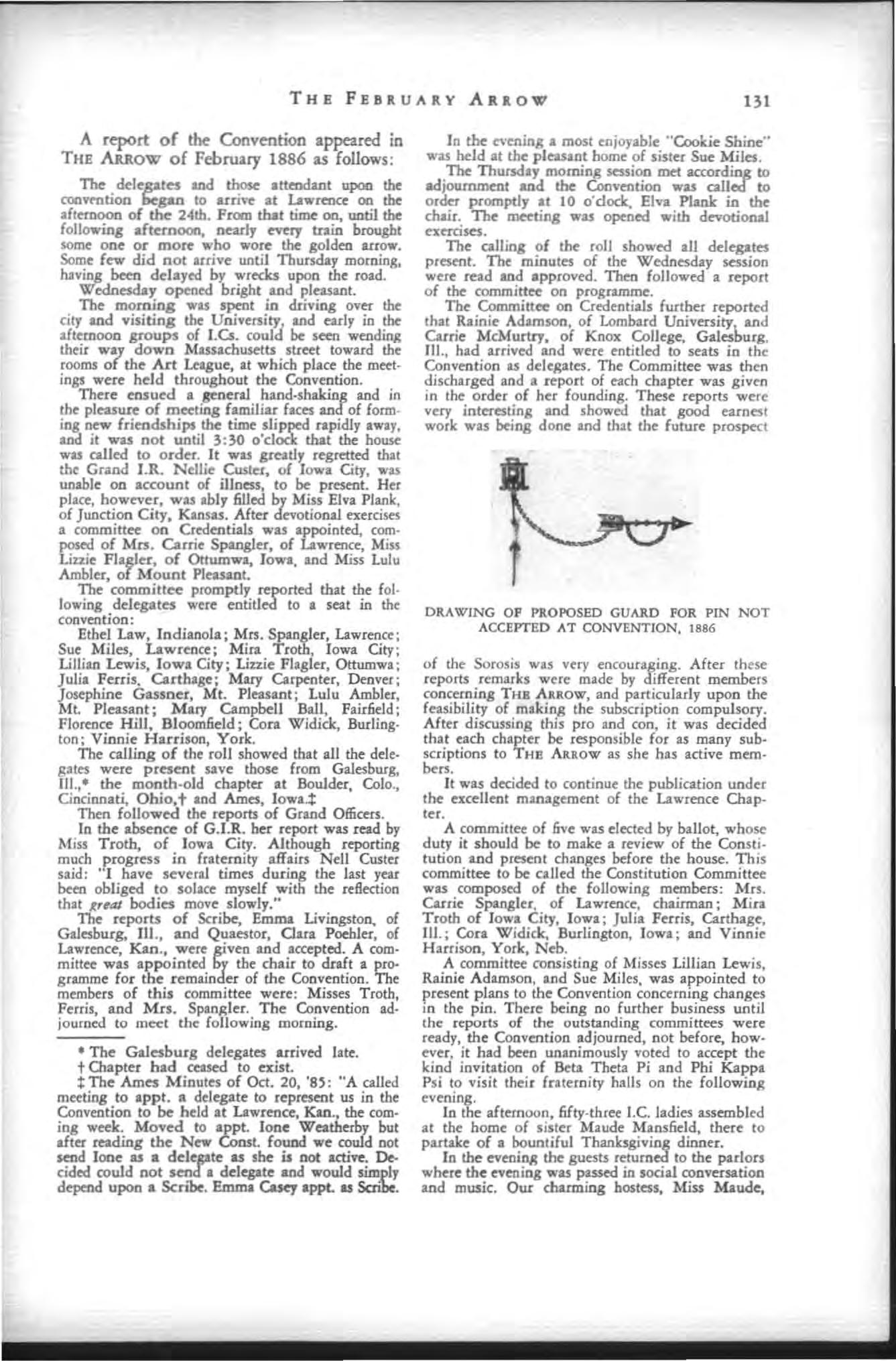
DRAWING OP PROPOSED GUARD FOR PIN NOT ACCEPTED AT CONVENTION, 1886
of the $orosis was very encouraging. After th ese reports remarks were made by different members concerning THB ARROW, and particularly upon the feasibility o f making the subscription compulsory. After discussing this pro and con, it was decided that each chapter be respon sible for as many sub· sc riptions to THE ARROW as she has active members.
It was dec ided t o continue the publication under the excellent m anagemen t of the Lawrence Chapter
A committee of five was elected by ballot, whose duty it should be to make a review of the Consti. tution and present changes before the house. Th is committee to be called the Constitution Committee was composed. of the following members : Mrs Carrie Spangler of Lawrence, chairman; Mira Troth of Iowa City, l o w. ; Julia Ferris, Carthage, JII .; Cora Widick, Burlington, Iowa ; and Vinnie Harriso n, York, Neb
A committee consisting of Misses Lillian lewi s, Rainie Adamson , and Sue Miles, was appointed to present plans to the Convention concerning changes i n the pin. There being no further business until the reports of the: outstanding committees were ready, the Convention adjourned, n o t before, however, it had been unanimously voted to accept the kind invitation of Beta Theta Pi and Phi Kappa Ps i to visit their fraternity hall s on the following evening
In the aftern oon, fifty three I.C ladies assembled at the home of sister Maude Mansfield, there to partake of a bountiful Thanksgiving dinner.
In the evening the guests returned to the padors where the: evening Wal passed in social conversation and music. Our charming hostess, Miss Maude,
favored us with a couple of choice solos; Miss Jennie Walker of lawrence, and Florence Hill of Bloomfield, also sang for us, and Misses Mamie Woodward and Lena Beard rendered some extra fine instrumental music, .t the dose of which an I.e. SODg was sung in appropriate style, by the whole company.
Friday morning proved chilly and disagrenble. Notwithstanding this. a goodly number of the delegates were promptly on hand. But as many were working on committees the Convention was not called to order until eleven o'clock. Then it was to hear the report of the pin committee. The plan presented, which was unanimously agreed upon and adopted by the Convention, was that of having a guard pin with head the size of • gold dollar, in which should be cut the Greek characters. n B ., attached to the wing or the arrow by a slender chain.
The committee was co ntinued and instructed to
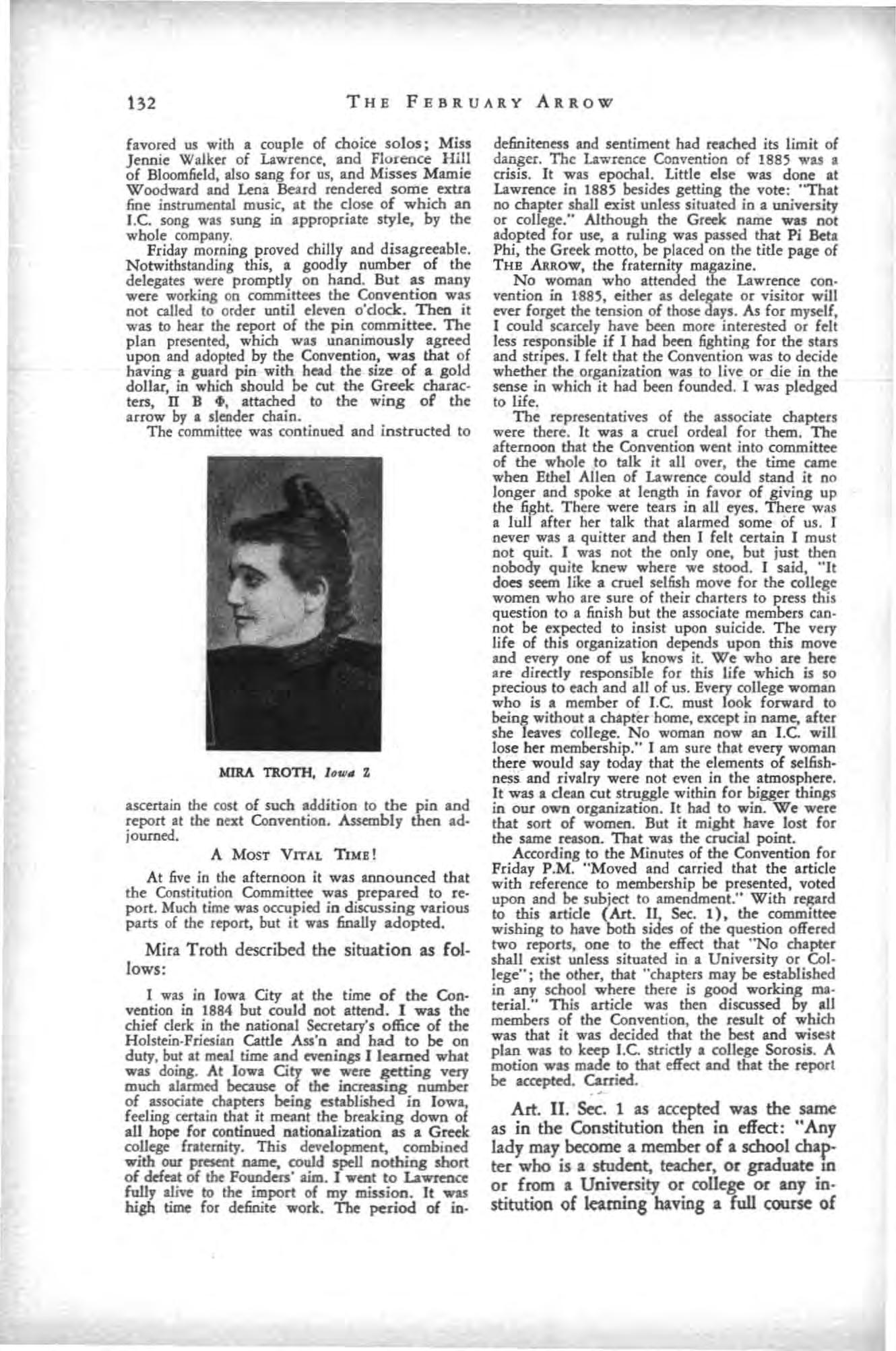
a.scertain the cost of such addition to the pin and report at the next Convention. then ad· journed.
At live in the afternoon it was announced that the Constitution Committee was prepared to reo port . Much time was occupied in discussing variow puts of the report, but it was finally adopted.
Mira Troth described the situation as follows:
I Wll in I owa Gty at the time of the Con· vcotion in 1884 but could not attend. I was the chief derk in the national Secretary' s office of the Holstein Friesian Cattle Ass'o and had to be on duty, but at meal time and evenings I learned what was doins. At Iowa City we were getting very much alarmed because of the inaeuing number of associate chapters being established in Iow a, feeling certain that it meant the breakins down of all hope for continued nationalization as a Greek college fraternity. This development. combined with our present name. could spell nothing short of defeat of the Founders' aim. I wmt to Lawrence fully alive to the import of my mission. It was high time for d.Jioit. work_ The period of in-
definiteness and sentiment had reached its limit of danger. The Lawrence Convention of was a crisis. It was epochal. Little else Wll done at Lawrence in 188, besides getting the vote: 'That no char.ter shan exist unless situated in a university or col ege." Although the Greek name was not adopted for use. a ruling was paued that Pi Beta Phi. the Greek motto. be placed on the title page of THE ARROW, the fraternity magazine.
No woman who attended the lawrence con· vention in as delegate or visitor will ever forget the tension of those days & for myself. 1 could scarcely have been more interested or felt less responsible if I had been 6ghting for the stars and strtpes. I felt that the Convention was to decide whethe:r the organization was to li ve or die in the sense in which it had been f ounded. I was pledged. to life.
The representatives of the associate chapters were there. It was a crud ordea l for them. The afternoo n that the Convention went into committee of the whole to talk it all over. the time came when Ethel Allen of Lawrence could stand it no longer and spoke at length in favor of giving up the light. There were tears in all eyes. There was a lull after her talk that alarmed some of us. I neve[l was a quitter and then I felt certain I must quit. I was not the only one, but jwt then nobody quite knew where we stood. I said, "It does: seem like a cruel selfish move for the college women who are sure of their charters to press this question to a finish but the associate members can· not be expected to insist upon suicide. The very life of this organization depends upon this move and every one of w knows it We who are here are directly respomible for this life which is so precious to each a nd all of us. Every college woman who is a member of I.e. mwt look forward to being without a chapter home. except in name, after she leaves college. N o woman now an I.e. will lose her membership ." I am sure that every woman there would say today that the elements of selfish· ness and rivalry were not even in the atmosphere. It was a dean cut struggle within for bigger things in our own organization. It had to win. We were that sort of women But it might have lost f or the same reason. That Wll the crucial point. According to the Minu tes of the Convention for Friday P M " Moved and carried that the article with reference to membership be presented, voted upon and be to amendment." With rega.rd to this artide Art. 11. Sec. 1). the committee wishing to have th sides of the question offered two reports, one to the effect that " No chapter shall exist unless situated in a University or Col lege"; the other. that "chapters may be established in any school where there is good worlcing ma o terial." This artjde was then discwscd. by all members of the Convention , the result of which was that it was decided that the best and wisest plan wu to keep I.e. strictly a college Sorosis A motion was made to that effect and that the repor t be accepted_
Art _ II. Sec_ 1 as accepted was the same as in the Constitution then in effect: "lI.ny lady may become a member of • school chapter who is a student, teacher, or graduate 10 or from a University or coUege or any institution of leaming having a full course of
study equal therdo, and who has never been a member of any school secret organization existing at present."
The Constitutional Committee arranged the Constitution into three Divisions: Con· stitution of Grand Alpha ; Grand Ollicers and I. C. Chapter, and also reworded many parts.
There were few outstanding changes, the principal ones
The Editor·in-chJef of THE ARRow was made a member of Grand Alpha.
When the G.I.R. presided at Grand Alpha, it was stated she should be given the title Worthy G.I .R. and that she should be elect· ed not only for the interim of Grand Alphas, but should serve at the following Conven· tion.
The W.G.I.R. was authorized to appoint a Worthy G. Vigil, also a committee to ar· range the Order of Business at Convention.
The duties of the Grand Officers was de· nned: " During the recess of Grand Alpha the supreme executive power of this Sorosis s hall be vested in a body known as the Grand Officers."
Four months notice was required to be given to chapters preceding the next Grand Alpha.
Charters could be revoked for refusal to pay the annual per capita tax of $1 for THE ARROW fund and the 50c per capita annual dues.
Each person on becoming a member of the I. C. Sorosis was required to sign the Constitution and to pay into the treasury the sum of $1.00.
A tax of $1 per member for THE ARROW for one year was provided for.
It was stated that: Whenever nve ladies shall make a,Pplication to become members of this SorosJs the G.I R shall make inquiry as to their moral character, social standing and me nt al ability and as to the kind of institution represented. A charter could be granted upon two-thirds vote of the chapters.
The G.I .R. or a member of the nearest chapter should install the new chapter, at the expense of the Grand Treasury.
All ceremonies were left as they were.
The election of Grand Officers for the year resulted as follows:
Rainie Adamson, Grand I.R., Galesburg, III.
Elva Plaok, Grand R.S., Junction City, Kansas.
Mrs. Belle R . Leech, Grand &ribe, Mt. Pleasant, Iowa.
Julia Ferris, Grand Qua:stor, Carthage, W.
The managers of THE ARROW were au· thorized to use the motto: Pi Beta Phi on the title of the magazine.
The Burhngton Chapter was made inactive at the request of its members .
The Convention ratified the charter grant· ed to Mt. Pleasant for the AI= chapter.
It was decided that a Convention should be held the third week in the following Oc· tober and after that only once in two years. The invitation from the chapter at Indianola to hold the next convention at that place was accepted.
A description of some of the social ac· tivities of the Conventioo appeared in THE ARROW of February, 1886:
Frida, night wa. the dosing scene of ga'{tt y. and was indeed the very tassel o n the cap 0 the climax. The sisten had received .n invitation from Beta Theta Pi and Phi Kappa Psi fraternities to spmd the evening at their chapter balls, and in the Stru881c to complete the business of the Convention in time, thq sacrificed their supper. After the Convmtion had dissolved, and when the informal Pow Wow was in progress the young men came and led us off, ODe by one, to the Opera HoUR block, where they induced w to climb 5emlins1y endless fliAhts of stain. At the top we found the Beta HalT, or rather, suite of rooms, f or first tbq showed u.s into a very pretty dressing room, said to be tM college home of one of the brothers. Here we repaired the ravages that heated argument bad made, and smoothed the plumage ruBI<d by deba.e. The Beta Hall itself, !he two spacious velvet carprted rooms ought to be pURd i n mystic siJeoce according to strict laws, but surely a hint may be allowed, the beautiful furs scattered here and there, the mystic emblems on high, the many pictures and ornaments, some of which showed a feminine-we hoped an I.e. hand. But su.rely there can be no restraint as to the delicious and truly fraternal "dorg" that was served us there. lndet'd. there wa.s but little restraint, for sandwiches were ambrosia to the hungry girls, and even their muried sisters wue known to con· ceal whole bags of vanilJa cookies behind flowin g draperies, and with misleading innocence of ex· pression , ask for a banana when one was already concealed beneath a friendly napkin .
But this was not all. Scarcely had we risen from our Turkish seats upon the floor when a clapping of hands announced that sister Pead Young had consented to dedaim for us. Pearl is studying elocution in a School of Oratory, from which she graduates next June, and this lent a double interest to her patnetic recital. She was followed by Dot Mead. once also a sister of Kappa, but now at Washburn College, Topeka . Both received warm and sincere applause. Then the girls clamored for a song. and we .11 joined in the dear old chorw of Litoria, set with Beta words. When we called for an encore, they responded by a counter call for Mr. Jenks, a brother of Phi Psi, in a mellow tender voice. Mr. Jenks sang in German "When the Swallows Home·
ward Fly," possibly giving utterance to a longing for the halls d Phi Kappa Psi, At least. so it seemed to be interpreted , for we promptly descended o ne o f the many flights o f stain and entered the luxuriously upholstered domains of the pink and lavender . Here we had a novel entertainment, for the Phi Psi band of five pieces pl ayed two channing selecti o ns . Between them Siste r LuJu of Mount Pleasant. recited a
dialect with marked success . These would seem to be pJeasures enough for o ne evening, but o ur hosts went stiU farther. and calhag our attenti o n to the canvas on the Jargest of their rooms, they asked us to "come and trip it ere you go ," It is hard to do our ho sts fuU justice in print with o ut seeming ful some. One should hear what the girls say
The interim of Conventions passed har· moniously wi.th the chapters thriving, as shown in the letters printed in THE ARRow, four issues of the magazine being published
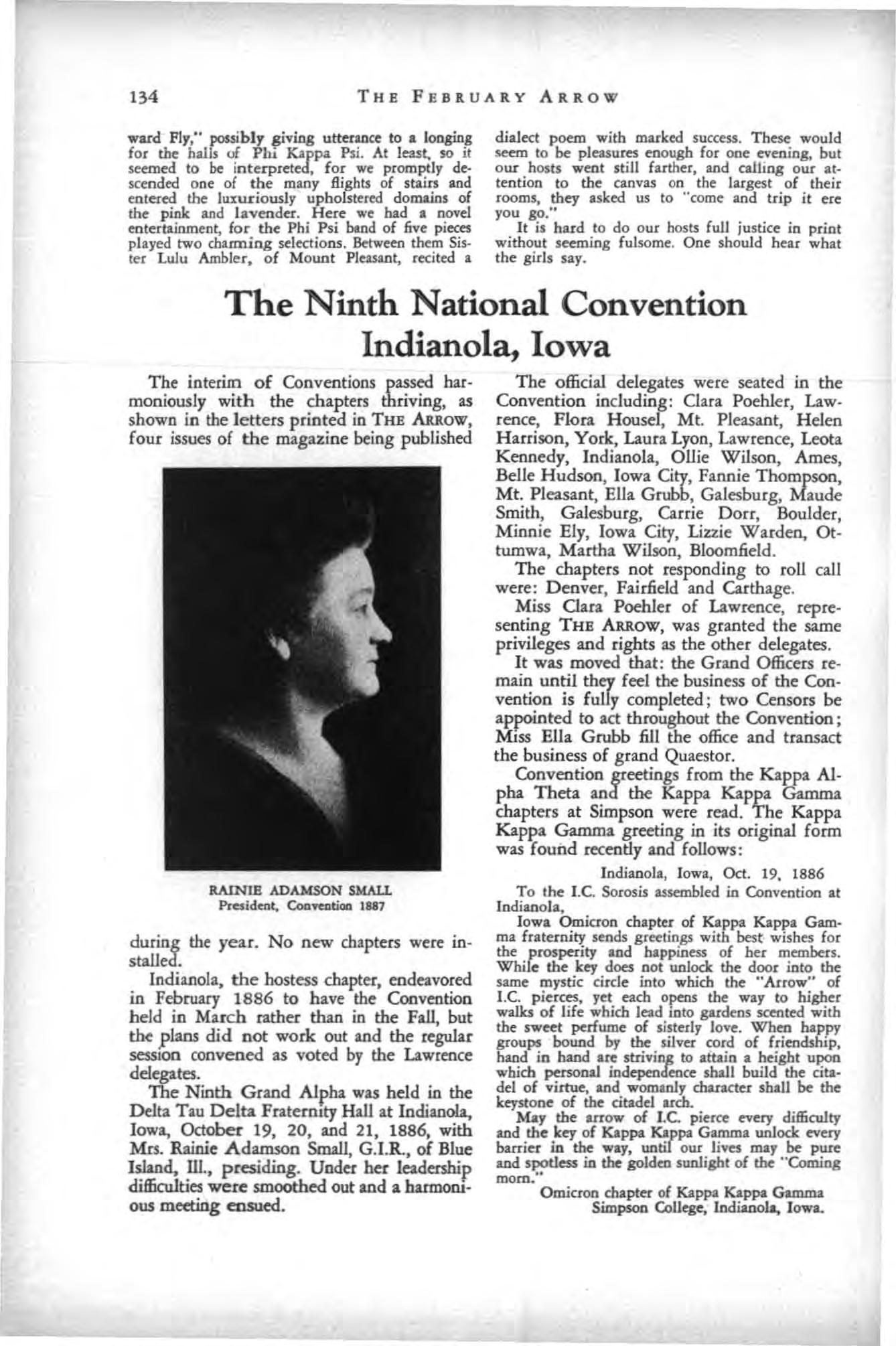
during the year. No new chapters were in· stalled.
Indianola, the hostess chapter, endeavored in February 1886 to have the Convention held in March rather than in the Fall, but the 'plans did not work out and the regular sessIon convened as voted by the Lawrence delegates . The Ninth Grand Alpha was held in the Delta Tau Delta FraterDlty Hall at Indianola, Iowa, October 19, 20, and 21, 1886, with Mrs Rainie Adamson Small, G LR., of Blue Island, Ill., presiding. Under her leadership difficulties were smoothed out and a harmoru· ous meeting ensued.
The official delegates were seated in the Convention including: Clara Poehler, Law· renee, Flora Housel , Mt. Pleasant, Helen Harrison, York, Laura Lyon , Lawrence, Leota Kennedy, In dianola , Ollie Wilson, Ames , Belle Hudson , Iowa City, Fannie Thompson, Mt. Pleasant, Ella Grubb, Galesburg, Maude Smith, Galesburg, Carrie Dorr, Boulder, Minnie Ely, Iowa City, Lizzie Warden , Ot· tumwa, Martha Wilson , Bloomfield . The chapters not responding to roll call were: Denver, Fairfield and Carthage. Miss Clara Poehler of Lawrence, repre· senting THE ARRow, was granted the same privileges and rights as the other delegates. It was moved that : the Grand Officers re o main until they feel the business of the Con · vention is fully completed ; two Censors be appointed to act throughout the Convention; M,ss Ella Grubb IiII the office and transact the business of gra nd Quaestor.
Convention greetings from the pha Theta and the Kappa Kappa a chapters at Simpson were read. The Kappa Kappa Gamma greeting in its original form was found recently and follows:
Indianola , Iowa. Oct 19, 1886
T o the I.e. Sorosis assembled in Convt:ntioo at Ind ianola,
Iowa Omicron chapter of Kappa Kappa Gamma fraternity sends greet ings with best wi shes fo r the prosperity and happiness o f he r members . While the key does not unlocJc the door into the same mystic circle into which the "Mrow" o f I.e. pierces, yet each opens the way to higher walles of life which lead Into garde ns scented. with the swed perfume of sisterly love. When bappy gro ups bound by the silver cord of friendship , hand in hand He striving to attain a height upon which personal independence shall build the citadel of virtue, and womanly character shall be the keystone of the citadel arch.
May the arrow of I.e. pierce every difficulty and the key of Kappa Kappa Gamma unJoclc every barrier in the way. until o ur lives may be pure and spotless ia the gold", sunlight of the ·Coming mom."
Omicron chapter of Kappa Kappa Gamma Simpson College, Indianola, Iowa.
A ' ·beautiful Boral offering" was presented to the Sorosis by Phi Kappa Psi and a teleg ram of greeting was read from the Phi Delta Thetas in General Convention in New York
In taking up its routine business, Convention mov<d to name chapters by the letters of the Greek alphabet and by states as: Io wa Iowa B, etc.
In discussing the Monmouth chapter in the listing of names , it was decided to send a committee of one to Monmouth to ascertain whether the chapter wished to be considered an active chapter. If so, the chapter should be given the name Illinois A. If Monmouth prefemd to be inactive, Lombard of Galesburg would be named Illinois A . A committee of three was appointed to draw up a paper showing our good feeling toward Monmouth This paper was to be sigurd by the delegates and given to the one appointed to visit the Monmouth chapter.
It was unan imously carried that the I. C. Sorosis have no dead chapter.< on its roll
As to the qualifications for membership, it was "Moved to stand by the ruling already in the Constitution that 'Any lady may become a member of a school chapter who is a student, teacher, or graduate in or from a University, college or institution of Jearning, having a full course of study equal thereto--"
It was voted that no more " Alum""," Chapters be established In order to make provision for the Alumme-Associate chapters then in existence at Mt . Pleasant, Burlington , Bloomfield, Ottumwa, and Fairfield , it was decided that : " All Alumnre chapters , founded before October 20, 1886 be allowed to exist, but that they confine themselves when taking new members to graduates of colleges or high schools. (The use of "Alumnre Chapters'· is confusing here, as the chapters referred to were the Associate chapters and not the regularly provided for A/1lJIlClZ Chapters. The Convention of 1892 forbade the Initiation of any new members into these groups, which meant the end of the Associate Chapters.)
One of the most important accomplishments of the Convention was the Constitutional support given to THE ARRow through a motion providing "that the expense of supporting our magazine be distributed among the chapters in to the number of active members ID each, and that the number of active members be determined by the last chapter meeting in October. Subscription to
TH E ARR ow to be limited to one dollar ."
Each chapter was required to elect a correspondent to THE ARRow . The publication of the magazine was at first given to lawren ce again and then upon reconsideration was put into the hands of the chapter at the University of Iowa The date of publication was set as "After " the middle of September, December, February and May of each year . The report of THE ARlloW representative showed a balance on hand of $30.60
The financial condition of the entire Sorosis was shown . ' to be better than at the preceding Convention ."
According to the Convention M inutes : · ' A letter was read from Gamma Phi Beta Sorority of Madison , Wisconsin . Moved and carried that a committee be appointed to inves· tigate the matter of Gamma Phi Beta Sor· ority meeting with us."
(No information is available now as to why the proposed meeting , but in view of the fact that , ust about that time some of the national raternities were conside ring consolidation, this may have been the reason for the correspondence.)
It was moved and carried that the power of granting charters be vested in the Three Grand Olllcers : G I R. , G R S. and G S And it was voted that Mt. Pleasant have charge of printing charters.
The Convention granted a charter for the establishment of a chapter in Callanan College, Des Moines, Iowa- the members to be con fined to the collegiate department.
An invitation was extended to the Burlington chapter to become active again, but the chapter did not accept, still believing that the present government was unsuited to the development of chapters outside of college.
The following chapters were requested to plan, carry on correspondence and work up the following subjects ready to report at the next session of Grand Alpha : Indianola, Regalia, Banner, etc., for initiation.
Mt. Pleasant: Poems and Songs for an I. C. Song Book.
Galesburg: designs for a monogram for stationery.
Lawrence: ideas and designs for a cut for college annuals, etc
It was decided not to make any addition to the pins. This was a great disappointment to many members, as it was a postponement of the acceptance of the Greeli letters, Pi Beta Phi on the pin
In commenting in THE AR1low on the
Convention, Kappa of K S.U. said in December 1886: "The Only thing that disappointed us was that Pi Beta Phi was not added to the pin ." Too, Denver University wrote: "All our members were disappointed that the Pi Beta Phi addition to our pins was not made."
A measure providing for Honora,}, Membership was propos<d, reading: "A chapter may elect any laay of high social and intellectual culture to honorary membership. An Honor ary member may wear the pin but is exempt from the vote."
Following the Convention, THE ARROW Editor commented: "Since the move made at the recent Convention to make the conferring of honoury membership one of our practices, we think that the matter should receive the careful and candid consideration of our members. We should not adopt any such measure thoughtlessly, especialfy one which has such a down-dragging tendency as this. While it is true that the few honorary members we have who were taken in under the old regime are an honor to us , yet we think the revival of such a custom would be dangerous and of no advantage. The constant aim for a lon g time to come should be to restrict membership rather than leave any excuse for shoddy admissions On the whole, we are decidedly opposed to the unguarded clause as it now stands in the proposed constitution, and thiok that at any rate it would be wiser to wait a while before attempting anything in this line."
The election of oflicers resulted in the reelection of G.I.R . Mrs. R ai nie Adamson Small, Blue Island, 111., G.R.S. Miss Elva Plank, Bloomfield, I owa, G.S. Mrs. Belle Re Qua L=h, Mt. Pleasant, Iowa; and by acclamation , Miss Lizzie Flagler of Ottumwa, Iowa was elected G.Q.
In appreciation of her "zeal, earnestness and superior l eadership," the Convention presented a gift to the Grand I.R ., consistmg of a locket appropriately engraved from "I.e. Sorosis . 1886."
Descriptions of the social side of the Convention which appeared in Th. SimpJonian, Indianola, Iowa, Oct. 1886 read:
The National I.e. Convention met in this city. Oct. 19. 20 and 21. 22 in the Delta Tau Delta haJJ, wlUch bad bo<o kindly proffered them by that fntemity. The I.e. Sorosis is • college organization of twenty yean' existence, and during that time has established nineteen chapters, thir· teen of which were represented in this Convention. The ddegate5 btgan to arrive on Monday. ,II being bere ready for the ficst session Tuesday
eve ning. Near the close of the session business was interrupted and a floral gift was presented by the Phi Kappa Psi Fraternity, with their greetings. The Kappa Kappa Gamma and Kappa Alph a Theta $oroses, of this college, and the Phi Delta Theta Fraternity, assembled in convention in New York City, a lso sent greetings. evening was devoted to a recepti o n givm to the other Fraternities and Soroses of the college, at Miss Ethel Law's and about two hundred guests were received. Before all had departed melodious sounds were heard from the outside, Windows and d oors were opened and all were pleasantly entertained by "the boys." They were lo udly encored, but as they had already sung, "Good night, ladies we're going to leave you now-" they left. We are told th at later, when silence should have reigned supreme, another band came, this time with harps and stringed instruments. Mtcr replying to many en cores, they, too, said "Good night, Ladies." Notwithstanding the late hours kept Wednesday evening, all the delegates were on hand at promptly nine o'clock Thursday morning ready for business Thursday evening a banquet was prepared for the delegates and visitors by the Indianola chapter, a t the h ome of Miss Anna Mclaughlin. About sixty persons were present and the evening was pleasantly spent in conversing and l isteni ng to music and recitations. Friday moraing about forty-three LCs. visited the college chapel en masse. All business was finished Friday evening and the Convention adjourned to meet in two yean. The delegates left o n Saturday morning feeling well pleased with their work and speaking highly of the kindness and courtesy shown them by Indiano la people.
The reception given by Lambda chapter of LC, at the home of Miss Ethel Law, in honor of the delegates to their National Convention, was an event that wiJi long be remembered by the Indianola "mystics."
M all the soroses and fraternities of the college were invited arrangements were made by which delegates from each order were to arrive at different times and depart in corresponding order, that the confusion and discomfort of a packed house might be avoided, for the number of invited guests was large
From 7 :30 to 10:00 o'clock guests were almost constantly arriving, and though the house was large and the first to come took an earlier departure, the rooms were all the time hUed to overflowing.
Upon arrival each person was met at the door by a member of the Ind ianola chapter and introduced to the delegates. After this all were expected to enter upon informal pletjure that they might enjoy the social hour as only a body of students can,
We do not believe it in good taste to indulge in "taHy:' so we will only say that their own consciousness of intelligence and whi ch those possessing it must surtly have, is so high a tribute to the I.Cs . and their delegates that they nttd no mttd of praise at our hands. 00 this occasion fraternity lines were l oosdy and each vied with the other to make the evening enjoyed by all.
For the courtesy and generous spirit shown us by the LCs. we of other f"temjties feel grateful.
We think that thi5 crossing o f the boundary Jines between our orden an but be productive of the high t good, we Itoow that it tends to b<e2lc down the "clique" spirit that is so apt to creep in and divide fraternities, when in fact their interests are common in grtat mnsure.
According to the instructions of Grand Alpha, G.I.R. Rainie A. Small gave notice in the June ARROW, 1887 , of the new names of the chapters of the I e. Sorosis. The rul· ing required that no dead chapters be carried on the roU and that the chapters be named by the letters of the Greek alphabet and by states as follows :
Illinois A, Monmouth-
• Before the Convention closed at Indianol a, it was voted to retain Alpha chapter on the roll as JII inois A out of respect to the Mother chapter.
Illinois B (Lombard U niv . ) Galesburg
Illinois r , Carthage, Ill., Carthage College
Illinois d (Knox College), Galesburg
Iowa A (Jowa Wesleyan University), Mt. Pleasant
Iowa B. Simpson College, Indianola
Iowa r, State Agricultural College, Ames
Iowa 6 (inactive) . Burlington , Iowa
Iowa E, Bloomlield. Iowa
Iowa Z (Iowa State University) , Iowa City
Iowa H , Fair&ld. Jowa
Iowa 9, Ottumwa, Iowa
Iowa I (Alumn.e), Mt. Pleasant
Iowa K (Alumnr). Iowa City
Iowa A, Des M oines, Callanan College
N eb ras ka A, Meth odis t College, York
Nebraska B, Hastings College, Hastings
KlUUaJ A , University of Kansas, lawrence
Co l o rado A, University of Colorado, Boulder
Colorado :8 , Dmver Univenity, Denver
Michigan A., H i llsdale College, Hillsdale
A charter was granted by the Convention of 1886 for the establishment of a chapter at Callanan CoU ege and on October 21 , the following charter members were initiated into Iowa Lambda: Anna Ross, Helen Jensen, Gr ace Osborne, Lizzie Case and Lyda Hous· ton.
According to Carrie Dorr, Colorado A, wbo installed the chapter, ''This chapter was founded with five charter members. That year six more were added to it and the chapter was in a prosperous condi tion . In 1887·8 three more were initiated into the fold , but that was the last year of Callanan College It closed and tran sferred its good will to Drake University, which prohibited secret societies."
On Feb. 14 , 1887, Miss Dorr wrote to G.I .R. Rainie A. Small : "We have nine members in all. The school here is divided into two classes , Boarding hall girls and day scholars. AIl the I.Cs are day scholars except· ing one and myself. There is to be a German Fair held here Wednesday and three of us are in It 50 we have our hands fuU preparing costumes, etc. Will you please
send us the name of our chapter as we are very anxious to name " the chIld."
The charter authorizing Miss Carrie Dorr to establish the chapter at Callanan is in the Historian's 61es and the space which was ordinarily used for the chapter name, is blank. Presumably, since the charter was issued at the Convention , th e Grand Officers had not yet had time to make up the official list of chapters according to the new system of naming.
The corresponding secretary of " Iowa Lambda" wrote to THE ARROW in Decem· ber 1888:
"We have some sad news to relate. Cal· lanan CoUege has changed hands and is now under the auspices of Drake University, which excludes secret soci eties . You know the rest. We still have some members in school , but that does us no good. You cannot feel more disappointed than we do This is one of the 'downs of life.' ..
According to the fraternity catalogue the chapter roll contained the names of twelve initiates and three affiliates.
Although the Greek letters, Pi Beta Phi, were not placed on the guard to the arrow, as so many had hoped , advocates of the
Greek name kept up th ei r campaigning.
In an open letter to THE ARRow, March 1887, Mary Gilmore of Kansas A wrote:
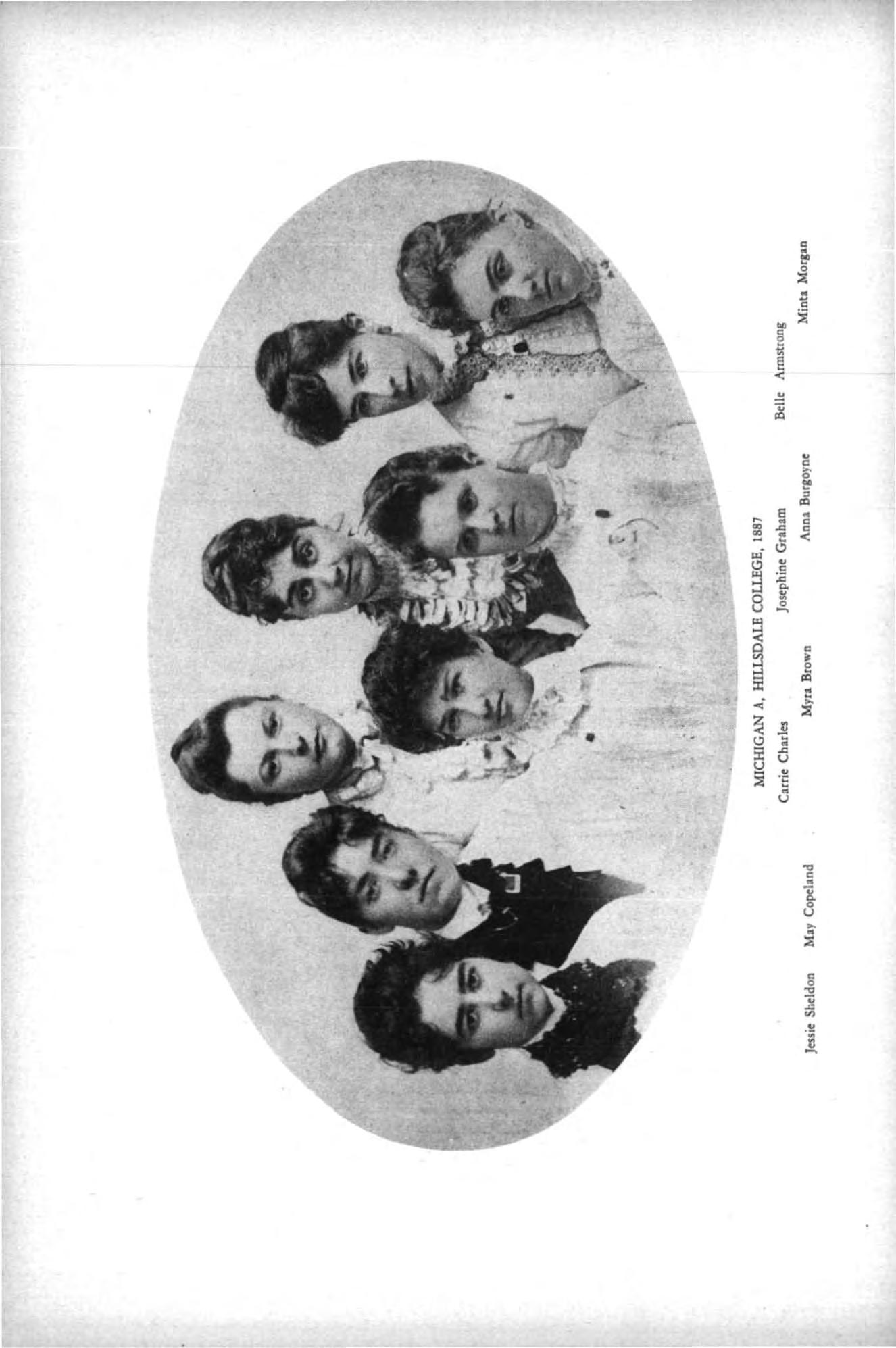
Whether you are perfectly satisfied with out name , o r whether yo u want to give more promi · ntnce to Pi Beta Phi, or to gradually lose s ight of I.C, or to suppress it entirely, or-do any of f OU know just what you do want?
Some will cry out "To suggest a cbange is dislo yal to revered old Alpha! But Alpha 's charter mtmbecs teU me that Greek letters were favorably considered when our standard was selected, and it were but natural if they erred in their dC(:Lsion in those primitive days of laelies' fcatemitics--in the sixties . The majority have used the Greek alphabet, and our adopting it would be merely conforming ourselves to the general rule. I fetl as though our girls with Pi Beta Phi before them and its !nutiful sentiment would lift themselves above strife with local organizations of or Saxon names, w o uld wo rk mo re f o r the good of the
entirety. no t SO much for tgo, remembering that what might seem for the advantage of the chapter would not always be for the weUare of the Sorosis . 11lose who are truly interested in our well being. though they might differ in opinion, would accept any change approved by the majority. and knowing of old their beJoved Sorosis. they would cling ever to it for the good it has done, thinking 'You may break, you may shatter the vase if you will, But the scent of the roses will ding round it still ."
If by this open letter there is not I member converted, the end will not be a failure. It is not to stir up aggressive thought or to arowe slumbering rues of dispute, it is merely to call forth cool deliberation, to awaken meditation in retirement; it is for rumination . So, Was Dftlken Sie?
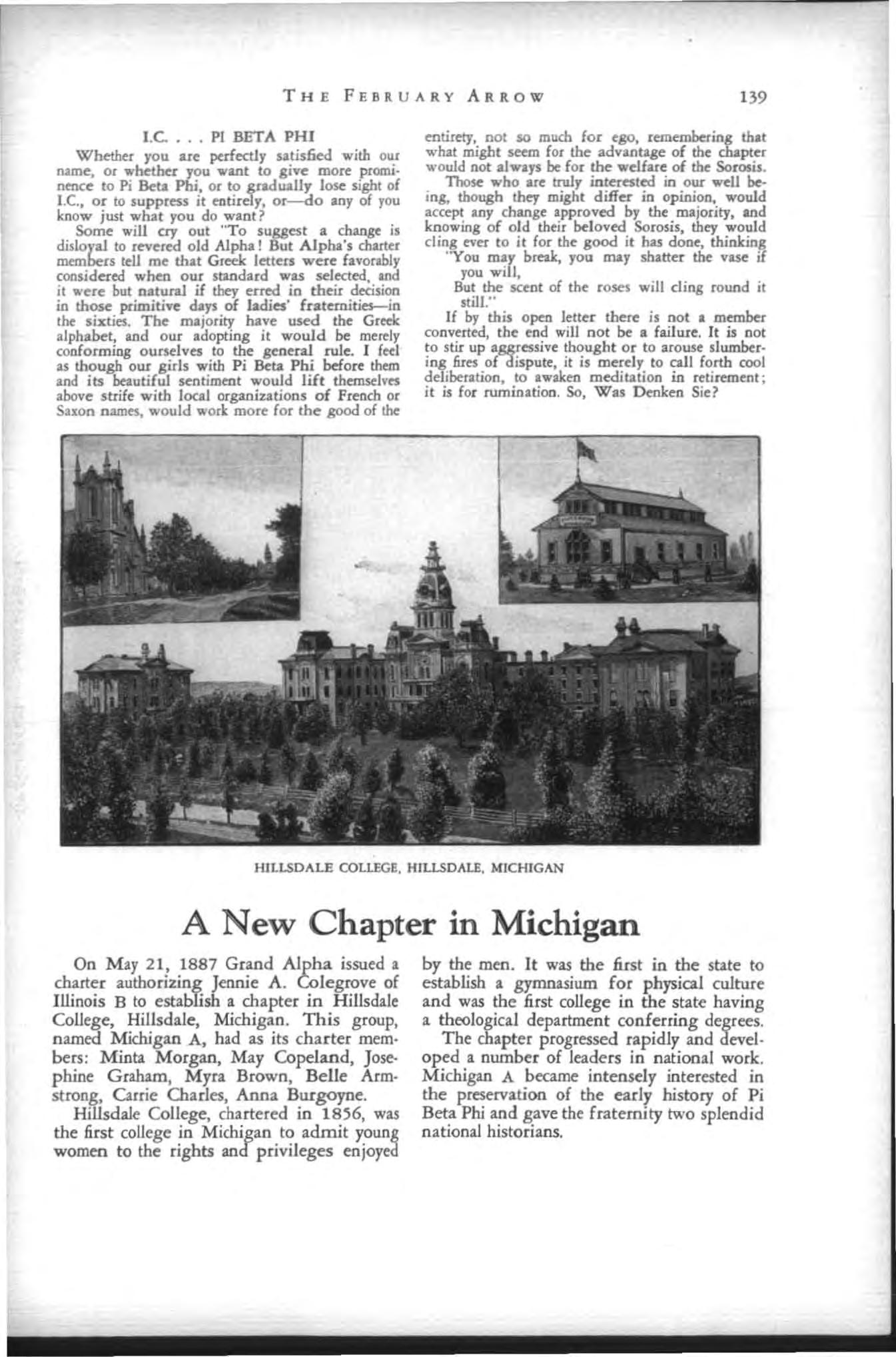
On May 21, 1887 Grand Alpha issued a charter authorizing Jennie A. Colegrove of Illinois B to establish a chapte r in H illsdale College, Hillsdale, Michigan. This group, named Michigan A, had as its charter memo bers: Minta Morgan, May Copeland, Jose· phine Graham, Myra Brown , Belle Arm· strong, Carrie CharIes, Anna Burgoyne. Hillsdale College, chartered in 1856, was the lirst college in Mich igan to admit young women to the rights and privi leges enjoyed
by the men. It was the first in the state to establish a gymnasium for phY'ical culture and was the lirst college in the state havi ng a theo logical departme n t conferri ng degrees.
The chapter progressed rapidly and devel· oped a number of leaders in national work. Michigan A became intensely interested in the preservation of the early history of Pi Beta Phi and gave the fraternity two splendid national historians.
In this same year of 1887, there appeared an editorial in THE ARROW written by Lillie Selby which is worthy of repetition :
Our contemporaries have occasionaHy referred. to Pi Beta Phi as a "Western" organization in a connection evidently meant to imply some possible inferiority on that account. We drt a western organization in origin and o:tension, having at present no chapter east of Ohio. But what of that? The west is the synonym for thrift. energy and intelligence. The Mississippi Valley, the representative section of the west is the/ractical base of supplies for the whole Unite States, and yields to no section in wealth, education and progrcs.s. Iowa, with its lowest percentage of il-
literacy and occeHcnt school system, is the banner educational state of the Union.
It is only in the minds of untraveled inhabitants of the extreme east that the people of llIinois and Indiana are in danger of being scalped by the Indians; that cook stoves are not yet introduced into Kansas or that Minnesota is in the frigid zone While the western colleges may lack the prestige and the inspiration drawn from old traditions, which give flavor to life in the older and more celebrated institutions of the east, yet they certainly go far toward supplying all needed advantages for the education and culture of the earnest young men and women who crowd their haJls.
Tbe next chapter to be installed was Beta of Nebraska, a charter being issued by the Grand Officers to Alpha of Nebraska at York to establish a chapter in the Presbyterian College, Hastings, Nebraska on November 17, 1887. The chapter was organized through the efforts of Luella Vance (Phillips ) , Maud C. Harrison and Flora S. Bowman (McCloud) of York, assisted by Flora Bl ackburn (Lamson) of York and Lillie Selby (Moore ) of I owa Z.
The charter members were: Leta H orlocker, Adaline E Shedd, Freda Elizabeth Wahlquist, and Luella Vance, an aIliIiate from Nebraska A.
In March 1888, the chapter reported 'There are nine of us. There are no other secret societies in the school. The tide backs strongly against fraternities." And because of this anti-fraternity situation, the chapter did not thrive.
GJ.R. Rainie Small endeavored to stir up the chapter spirit and wrote on May 14, 1889 urging the Hastings chapter: "to get to work and to take advantage of opportunity. All the Sorosis is with anxiety watching for you to become active. To recall your charter would certainly be a very unpleasant transaction both for the chapter and for the Gen-
eral Sorosis; but unless you can soon become active this step, as disagreeable as it may be, will have to be taken. Will be glad to do anything to aid, etc.-"
The following spring Lillie M. Selby wrote Mrs . Small that she had shown a recent letter from Mrs. Small to Carrie Kimball, "one of the members here, and one most likely to be interested in Pi Beta Phi, and she agreed with me in thinking that there is n o use trying to keep up the chapter here, and we thought you would best send to Miss Horlocker for the charter, etc. She is the Scribe and no doubt has them. . . . The present members (there are five in town besiaes my sister and myself ) have been so long out of school that they have not much influence or interest there, and the school is at some distance out, the girls board in the dormitory so altogether it is not easy to gain a foothold there again. It seems to me that it will be much better to give it up now, and then when the time seems ripe, organize anew, and in the college and I think a chapter thus carefully started would succeed."
The charter and Constitution were returned to the Grand IlJustra Regina on May 8, 1890.
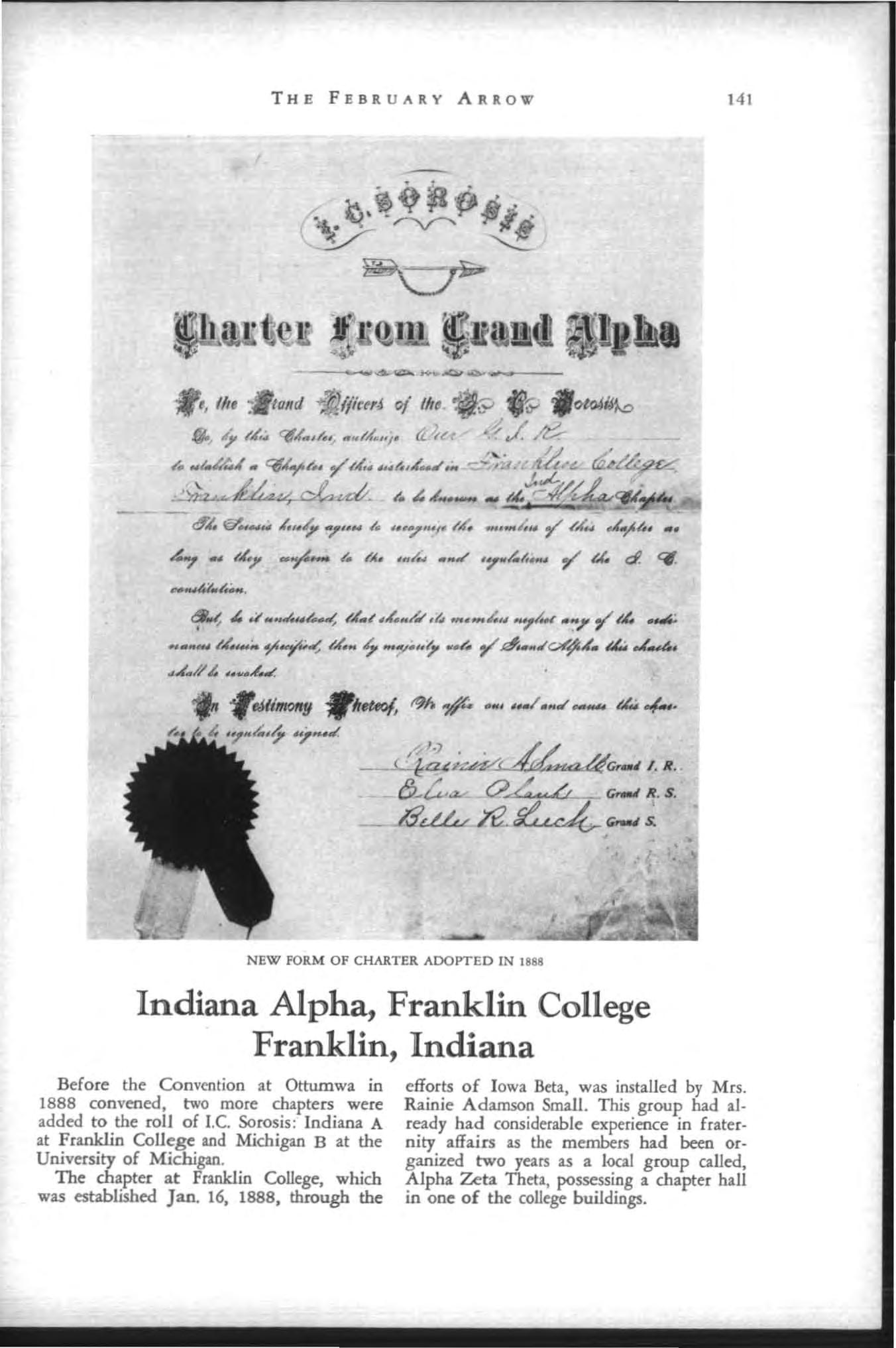
Before the Convention at Ottumwa in 1888 convened, two more chapters were added to the rolJ of I.e. Sorosis : I ndiana A at Franklin College and Michigan B at the University of Michigan
The chapter at Franklin College, which was established Jan. 16, 1888, through the efforts of I owa Beta, was installed by Mrs . Rainie Adamson Small . This group had already had considerable experience in fraternity affairs as the members had been organized two years as a local group called, Alp h a Zeta Theta, possessing a chapter hall in one of the college buildings.
INDIANA ALPHA IN 1889
The groupinciudcl clC'ftD chartu mcmOOl and the first SiI initiates. Tol r owl 111' to , i" bt: Sara Covert. Sophia Tanner (Deer). Martha Noble (Carter) , Pearl Polk (Du.l}&ao), d MiJtfJ, row: M.,. Burton (Wright) NeUe Turne r, Ooa Paync_ (Newsom)·, SChufJ Clark)·, Ann. McMahan-, Emma Ellis (Monroe)- Eliza beth Middletoo-, Eliubeth Clark (Stark). lAW" row: aooa Emma M cCoy (Hillis)·, Emma H. Tumer- . Maude Mets ker-.
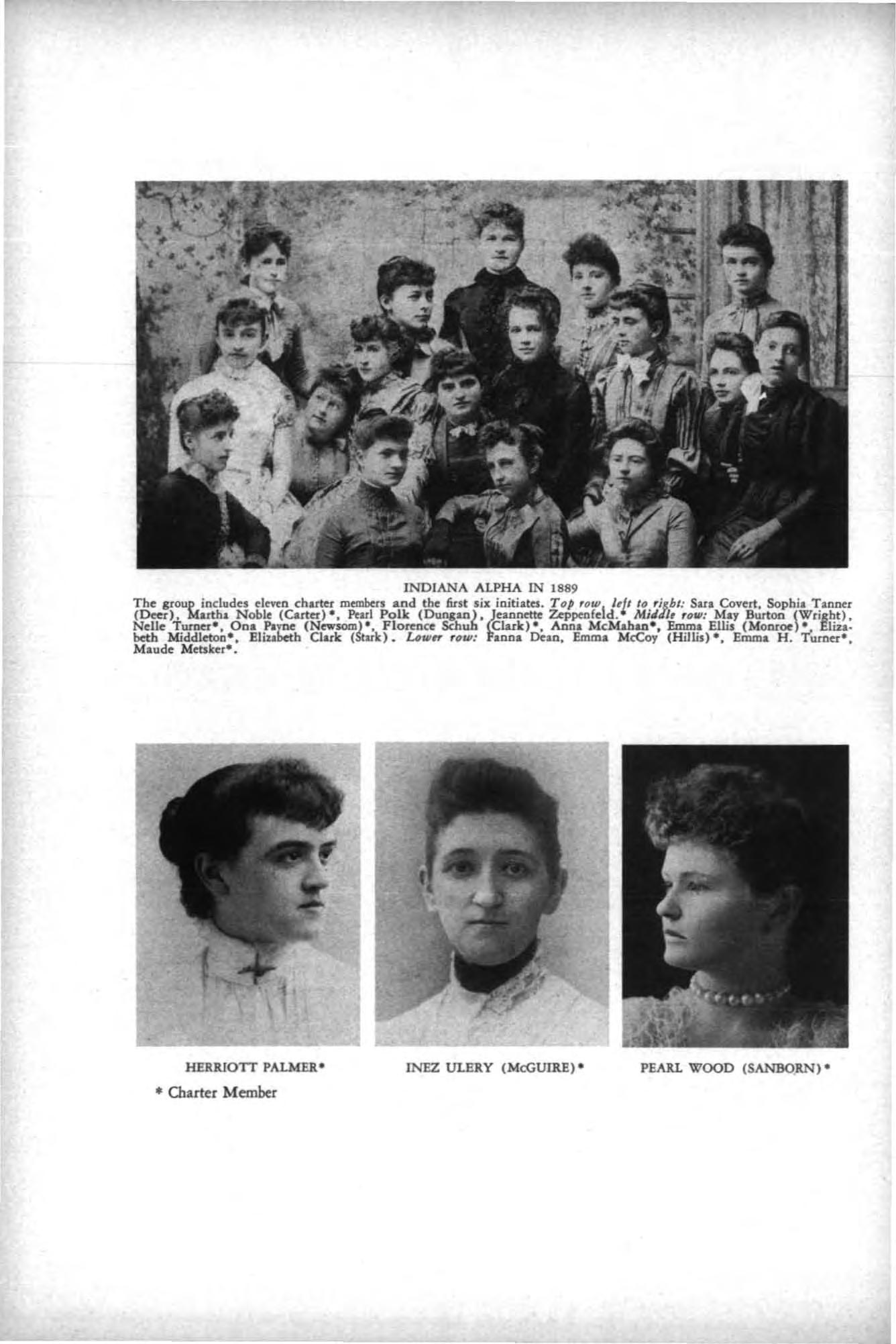
• Cluter M ember
The list of charter member> included:
Emma Harper Turner, Martha Noble, Inez Ulery, Jeannette Zq>penfeld , Elisabeth Middleton, Herriott Clare Palmer, Maud E. Metsker, Emma McCoy, Ona H. Payne, Pearl Wood, Florence Shuh, Anna McMahon, Nelle B . Turner, Mary Emma Ellis.
Two of the charter members were gradu . ates and most of the others were from the upper college classes. With Emma Harper Turner as their leader they were soon occupying a prominent place in fraternity activities
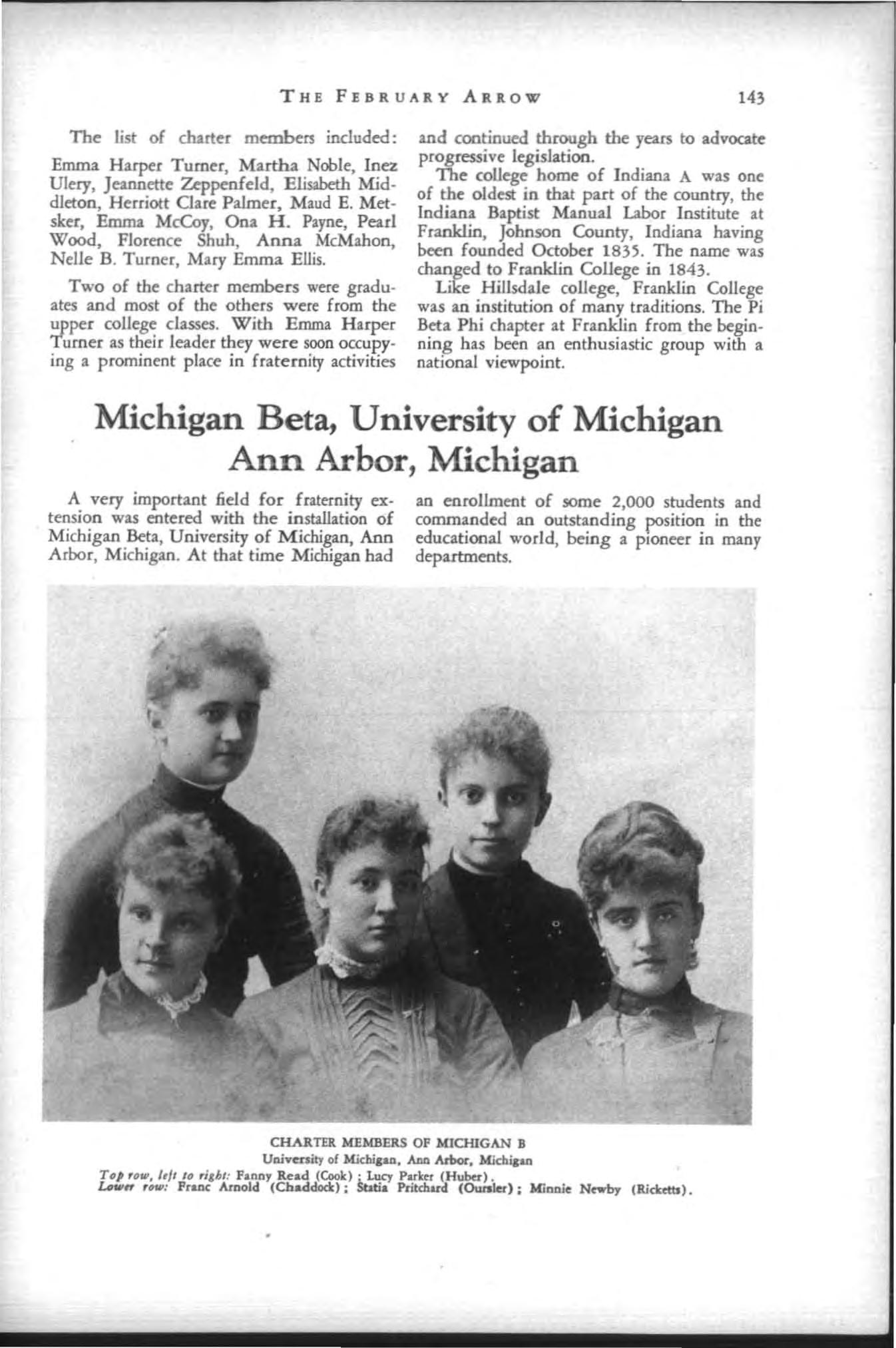
and continued through the years to advocate progressive legislatioo.
The college home of Indiana A was one of the oldest in thai part of the country, the Indiana Baptist Manual Labor Institute at Franklin, Johnson County , Indiana having been founded October The name was changed to Franklin College in 1843.
Like Hillsdale college, Franklin College was an institution of many traditions. The Pi Beta Phi chapter at Franklin from the beginning has been an enthusiastic group with a national viewpoint.
A very important field for fraternity extension was entered with the installation of Michigan Beta, University of Michigan, Ann Arbor, Michigan. At that time Michigan had
an enrollmeot of some 2,000 students and commanded an outstanding position in the educational world, being a pioneer in many departments.
The founding of the University of Michigan in 1837 was one of the most developments in the history of Amencan Education-the establishment and success ful maintenance of a university by the people of a state.
After 1850 fraternities were weU established at the University, and the institution became co-educational 111 1870
The charter granted by the Grand Officers authorized Minnie H. Newby (Ricketts), of Iowa A to establish a chapter to be known as Michigan B, on April 7, 1888 with the following charter members: Frances Arnold (OIaddock), Minnie Newby (Ricketts) , Lucy Parker (Huber), Statia Pritchard (Oursler) and Fannie K. Read (Cook).
In writing of the chapter, MirlIlie Newby Ricketts said: "Michigan B of Pi Beta Phi was ushered into life April 7, 1888 , Saturday, at the rooms of the Misses Read and Arnold in the East wing on the lower Boor of the Miner house, 42 Liberty Street (old number at So. East corner of Liberty and Thompson Sts.), with Jive charter members, but only three initiates, while we were still I. C. Sorosis, in order to establish the chapter at Michigan which our Grand President, Rainie Adamson Small, had for a long time felt should be established. We had a mock initiation at first, then the solemn ritual,
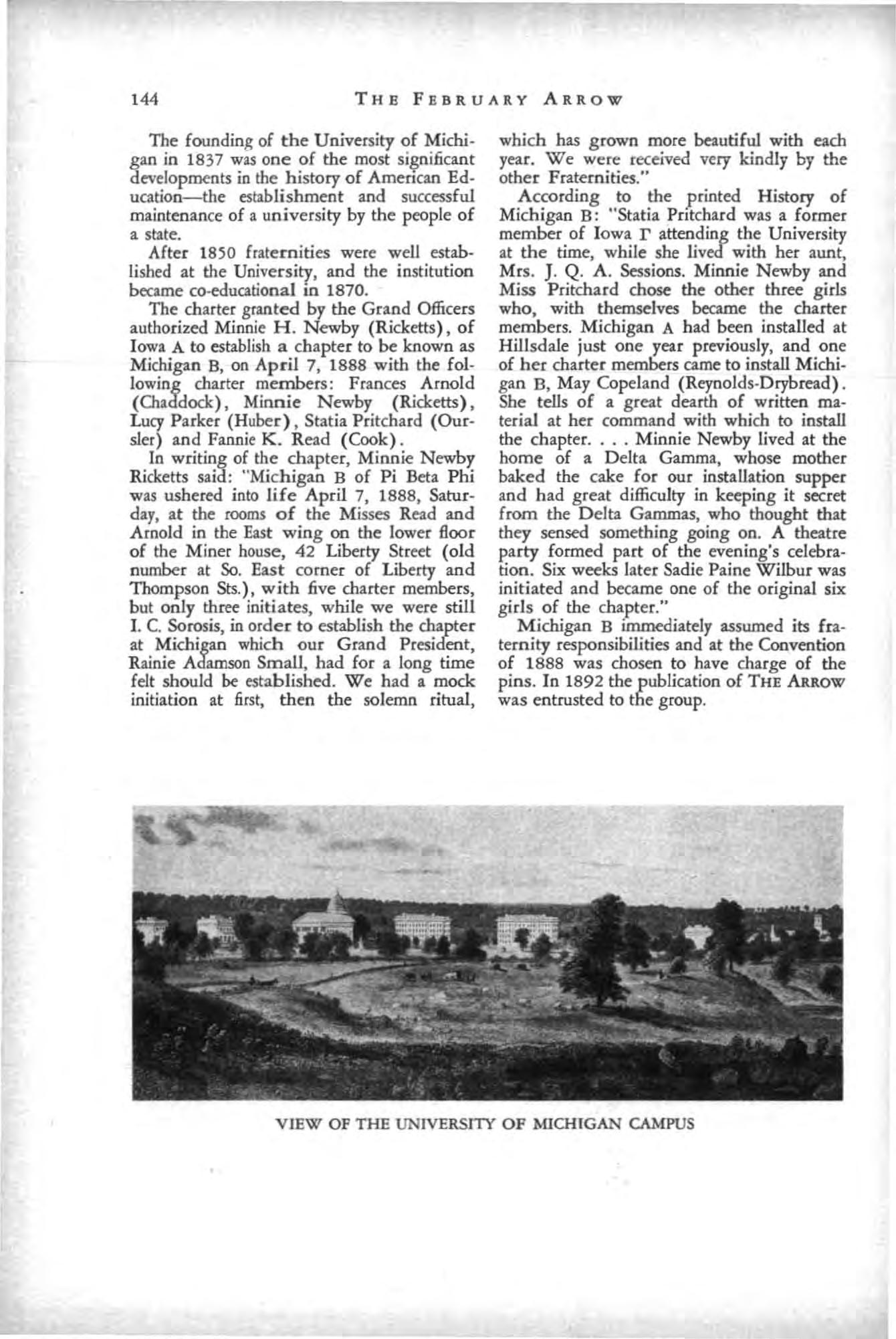
which has grown more beautiful with each year. We were received very kindly by the other Fraternities ."
According to the printed History of Michigan B: "Statia Pritchard was a former member of Iowa r attending the University at the time, while she lived with her aunt, Mrs J. Q A Sessions. Minnie Newby and Miss Pritchard chose the other three girls who, with themselves became the charter members. Michigan A had been instaUed at Hillsdale just one year previously, and one of her charter members came to instaU Michigan B, May Copeland (Reynolds -Drybread). She teUs of a great dearth of written material at her command with which to instaU the chapter Minnie Newby lived at the home of a Delta Gamma, whose mother baked the cake for our instaUation supper and had great difficulty in keeping it secret from the Delta Gammas, who thought that they sensed something going on. A theatre party formed part of the evening's celebration. Six weekS later Sadie Paine Wilbur was initiated and became one of the original six girls of the chapter "
Michigan B immediately assumed its fraternity responsibilities and at the Coovention of 1888 was chosen to have charge of the pins . In 1892 the publication of THE ARRow was entrusted to the group.
The Tenth Grand .Alpha met in the Ottumwa Chapter Hall, Ottumwa, Iowa on October 16 , 17 and 18, 1888 , with G.I.R Rainie Adamson Small presiding.
The morning was devoted to organization . Flora McCloud and Minta Morgan were appointed as censors j Sude Weaver, as reporter for city papers; and Carrie Flagler, as Chaplain .
The chapter reports were followed by reports of Grand Officers .
Before all of the delegates arrived it was moved and carried that they take an informal vote in regard to changing the name of the Sorosis. The vote stood 13 in favor of the change and 3 opposed. Moved to take up the subject of changing the name as the first
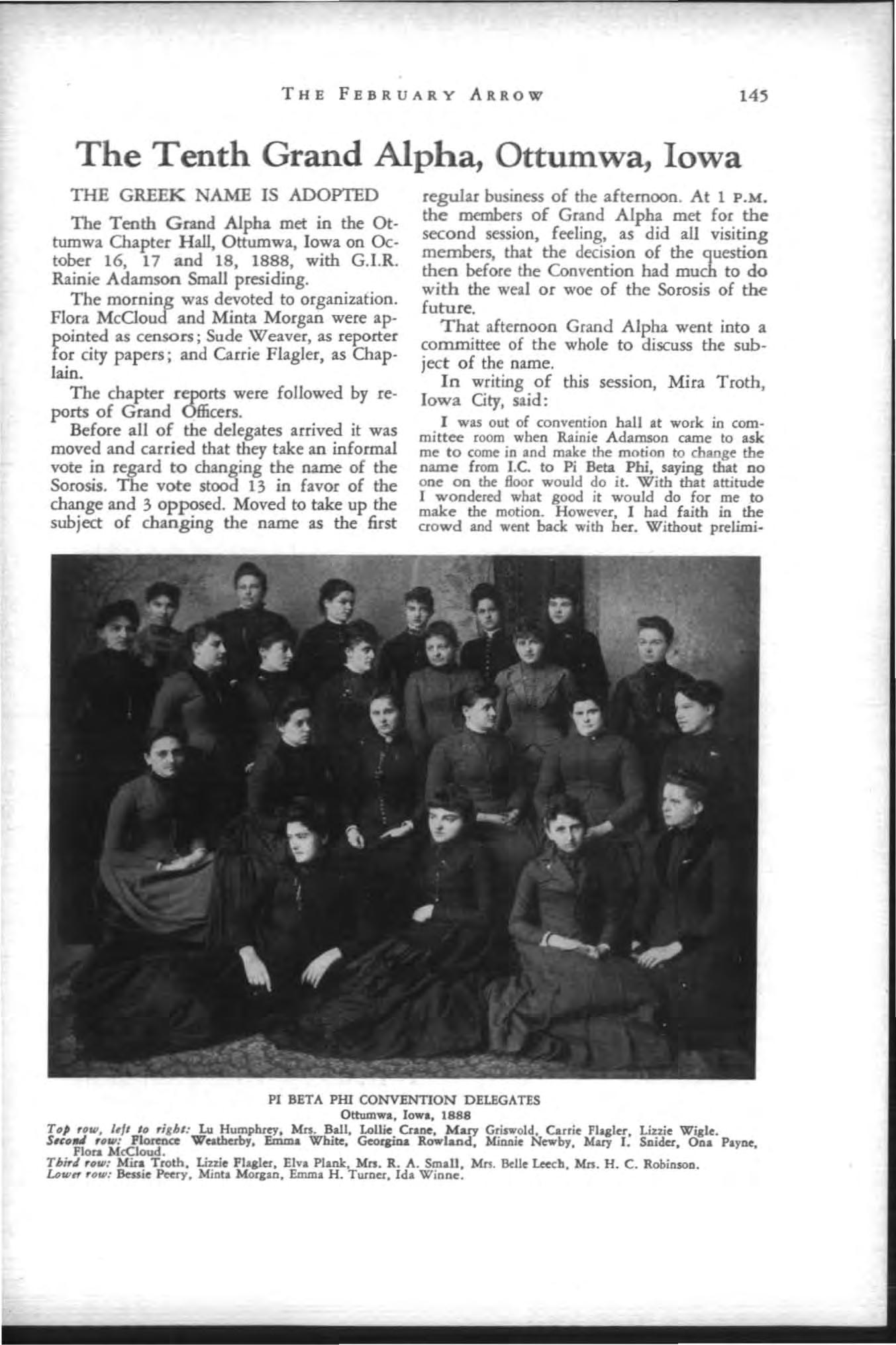
regular bus iness of th e afternoon At 1 P M. the members of Grand Alpha met for the second session , fttling, as did all visiting members, that the decision of the question then before the Convention had much to do with the weal or woe of the Sorosis of the future.
That afternoon Grand Alpha went into a committee of the whole to discuss the subject of the name .
In writing of this session . Mira Troth , Iowa City, said:
I was o ut of h alJ at work in com· mittee room when Rainie Adamson came to ask me to come in and make the m oti on to ch ange the name from I e. to Pi Beta Phi, saying that no o ne on the fl oo r w o uld do it. With that attitude I wondered wh at good it w o uld do f o r me to make the motion. However, 1 had faith in the cro wd and weat back with hu Without prelimj·
naries I presented a written motion reading : "Reso l ved that the Dame o f this orga nization he chan$cd, that the organization be hereafter known as PJ Beta Pbi." Minnie Newby seconded the motion . The silence between the motion and the call for a vo te was the stillest time I ever knew but the vote was a unanimow "Aye,"
Miss Troth continued: "The history tells us that the Ottumwa Convention of 1888 'stands on record as being the most spirited and harmonious of the fraternity: The situation was peculiar, The Rubicon had really been crossed three years before at Lawrence, The Convention at Indianola in 1886 had protected the associate chapters then in existence. Oue hostess at Ottumwa was an associate chapter still, apparently secure in her charter. rt would have been gross discourtesy to have broached a renewal at that time of the argument made in Lawrence. The Ottumwa Convention was delightful but some of us did not forget our work at Lawrence or fail to look up a way to see it made good , The committee on incorporation practically accomplished an O.K. to the work done at Lawrence,"
Miss Troth gave much credit to the abiljty of Emma Harper Turner, Indiana A, saying: "Fortunatefy for us Emma Harper Turner came to us at the Ottumwa Convention in 1888 and made such a favorable impression that she was named for Grand VicePresident and was on the committee to incorporate the organization as a national under the name of Pi Beta Phi. These two facts were in time to make good the work of Lawrence in 1885. The advent of Emma Harper Turner in 1888 was a blessing. Her matter of course, straightforward executive ability fell right into line wherever it could serve. She had a quick sense of leverages and about it in the most considerate fashion. , . ,
Immediately after adopting the Greek letter motto as a name for the f catemity, the Convention moved that the letters " I .e." would hereafter stand for . . ...... .... . . & .. our present motto.
Reports of special committees were given, among them one from Iowa I, Mt. Pleasant Alumna; relating to songs. A motion was made that the songs be published in THE ARRow.
'Tuesday evening was the event of an elegant ' spread' at the girlhood home of Mrs . Bertha Sargeant. Seventy-five members of Pi Beta Phi can testify to the fact that everything on the part of the hostess chapter (Iowa
e) was done to make our first evening there memorable The literary programme, with some changes and additions, was listened to with much interest.
Address of Welcome . . . ...... Io wa e. Ottumwa Mrs. Carrie Walton Miller
Music ........... . .. .. . . . . .. Ottumwa chapter
Response . Emma W. White. Kansas A, Lawrence Recitation ..
. Laura Smith , Iowa A Essay Ida W inne, Colorado B
Solo
Review .
Mrs . Deolia Brown Davis
Elva Plank, Iowa Epsilon , Bloomfield Poem
. Georgina Rowland, Col o rado A Recitation . Bessie Peery, Iowa Z
Selection
Indiana A, Franklin, Ind. Choice .
. M ichigan A. H i llsdale Music .... Louise Humphrey, Anna McLaughlin, Iowa B
"It was pleasing indeed to note that a goodly share of musical talent was distributed here and there among our girls, and the part which in the composition and rendering of Grub Songs' was not the least pleasing.
'The Republicans in procession that evening, notwithstanding their political enthusiasm, were not unmindful of the Pi Beta Phi /lirls, and contributed their share of entertamment by halting the bands in front of the house, in the meantime discoursing some very good music."
From THE ARROW we quote: "Wednesday, Wednesday evening, and Thursday were busy days and one pleasing feature of the Convention work was that it was constructive, and not The Constitution was not dragged into the arena and torn limb from limb, and at the last moment thrown together and left a misshapen monster upon which we must gaze for two years with pitying regret, wondering what the next dismembering and readjustment will show us in the way of a deformity. A committee of three chapters was appointed to rrepare a constitution during the two years 0 adjournment of Grand Alpha, to be submitted to the next Convention. This work was assigned to Indiana A, Iowa A, and Iowa Z."
Convention moved to adopt a uniform banner to be used at initiation. Decided to adopt collars as regalia and only those taking part in the Initiation to wear regalia. A committee composed of Mrs . Ball , Lollie Crane, and Mira 'froth was appointed to decide upon and present their ideas as to the regalia, etc ., for chapter officers. (Iowa B reported they had done nothing special in the work of regalia and banner, etc., since the last Convention )
Mter • lengthy discussion of the pin, with a report made by Michigan B and letters from desIgners in regard to the style of the pin, cost, etc ., it was unanimously carried that Pi Beta Phi take the place of I.e. on the pin.
Michigan B was appointed to have charge of purchasing the pim. Moved to order pim from John F. Newman, a fraternity jewder in New York City. The Sorosis to be respon· sible for difference in price.
Iowa A was chosen to have charge of remodeling old pins.
Newman agreed to furnish a pin of plain gold for $3.00, the size of sample. ''This new pin if placed parallel would only reach the head 0 the present arrow The feather is to be enamelled in white, with the gnld letters Pi Beta Phi {'laced diagonally. Pin can be jewded to SUIt the fancy of the purchaser, on either the shaft or head, or on both or they may be perfectly plain."
Ottumwa was put in charge of regalia work.
A message of greeting from the P.E O. Convention at Keosauqua was read by the Grand Scribe.
A report of the Grand Qurestor showed $100.15 in the Grand Treasury.
Application was made for a charter for a chapter at Evanston, Ill. (There is no record of the action taken )
A letter was read from the Carthage chapter, stating that the members could not send a ddegate and would not pay the tax It was unanimously carried that the Carthage charter be withdrawn .
Nebraska A, which had always been a prosperous chapter, was reported to be without a college, the institution of Jearning in which it was founded having been moved to Lincoln . It was moved that the chapter known as Nebraska A, at York, be transferred to the University at Lincoln. Adopted. (The present chapter at Lincoln was not organized until 1895. )
After being tabled, a motion relative to transfers was revived and carried. * It provided that an amendment be made to the Constitution in regard to a member being transferred from one chapter to another,
• NOTE: No statistics arc available to show how many transfers there were at the time. In 1889 Colorado A mentioned in a letter: "We have received ioto our mids t two initiates of Mt . Pleasant. Lulu and Bessie Sangers, who , l ast year attended the University of We feel pretty well with Iowa (Iota), Mt. Pleasant. as five of mr have affiliated with us."
reading: "Any member desiring to transfer her membership from one chapter to another shall procure from the I.R . ana Scribe of her own chapter, if it be active, otherwise from G.I .R. and G .S. a written statement certifying that she is a Pi Beta Phi in good standing. This statement being read and approved by the I.R. and Scribe of the chapter which she desires to join she is duly oeclared an active member of said chapter."
Illinois A, Knox, presented the subject of our organization becoming incorporated as a national organization, and read a report on it. This was in keeping with a letter which had been written the previous spring by Emily M. Brooks of Knox. to Mrs Rainie A. Small, Grand President, dated Feb. 16, 1888; which foUows:
There is a matter that is a g reat source of distrtSS to me in regard to I.e. and I WUlt to take a few moments of your time th is afternoon and aslc you what you think should be do ne about it. There was a late convention beld here at Knox, and, as it was a Y.W.e.A . convention girls were here fcom neuly all schools in the stite. A great many secret societies were represented, and several of the gitls in speaking of I.e. spoke of it as but a local society. One girl fcom Evanston an Alpha Theta said while I .e. claimed to be a sorority she was not at aJl and had no charter whatever. Well. it is a shame that we don't have a charter and that I e. is not incorporated. Something must be done before the nttt I e. ConvCltion.
Had the Founders of I.e. Sorosis consulted any of the fraternity men at Monmouth about organizing in the beginning, they probably would have been advised to Incorporate, but being pathbreakers in organizing a woman's national fraternity and launching the Sorosis all by themselves they did not incorporate.
The Convention, upon having the matter brought to its attention , moved at once that a committee of three act to incorporate Pi Beta Phi as a National Organization and to have the privilege of adding two members to the committee. The three members named were: Rainie A . Small, Emma Turn er and Miss Sude Weaver.
It was moved to insert Pi Beta Phi instead of I.e. throughout the Constitution.
A motion was made that the article of Honorary Membership be amended and the clause "Honorary Members may wear the pin," be stricken out.
The delegates and officers then went to the photographers to have a group picture taken. This, so far as is known, was the first Pi Beta Phi Convention picture ever taken .
At this Convention a new method of voting was adopted.
It was carried that THE ARROW publica tion be continued at Iowa City. The dele· gates d iscussed THE ARRow in regard to size, color, style, etc. Motion passed that the Ar· row Publishing Co., issue our magazine in a style "similar to the Key, if possible. " Ed· itor·in·chief requested all chapters to assist in procuring advertisements and to do all in their power to secure subscribers.
It wa.s struck out from the Constitution that " It shall be the duty of the Grand AI· pha to elect the Grand Quaestor from the chapter where the next Convention is to be held ."
A committee was appointed to draw up and decide upon the wording for the new charters and the expense of printing and furnishing same and to report to the next G.A. It was the duty of this committee, composed of Ames, Bloomfield, and Hillsdale to furnish charters to all chapters, issuing duplicate charters to those older ones who had not prese rved thei rs.
Kansas A was appointed on designs for cuts for stationery and college annual.
It was voted that the time of Conven· tion be the last week in March and was moved to accept the invitation of 11linois B and 11 at Galesburg, for the next place of meeting of Grand Alpha.
Letters were read in regard to the "ladies of Franklin, Ind ., becoming members of Pi Beta Phi." The Convention unanimously sanctioned the action of G .I.R. in this mat· ter. (A charter had been granted and the chapter installed the previous January )
Miss Carrie Flagfer, on behalf of the members of Pi Beta Phi , presented to the Worthy G.I R. Mrs. R. A. Small, an order for a Pi Beta Phi pin to be jeweled with diam<>nds and pearls. This was the first jeweled arrow manufactured. (Upon the death of Mrs Small, her husband presented the pin to the Fraternity and it is now in the Historian 's Archives . Shown in photograph.)
Some of the chapters were opposed to jeweling the pin. Kansas A said: "Many of us do not consider that the proposed changes would he in the direction of beauty. The present shape and size of the pin would not admit of jewels being effectively applied ."
Officers elected at the Convention were: G.I R. Rainie Adamson Small; G.R S Emma Harper Mrs. Belle Re Qua Leech; G Q LIZZIe Flagler.
Mrs . Leech presented her resignation as R.S. and Elva Plank was elected by unani· mous ballot to fill the position
The delegates who attended the Ottumwa Convention were:
Illin ois B, Li zzie Wigle; lIIinois d, Mary Gris · wold; Iowa A l.W .U., Lollie Crane; Iowa B, Louise Humphrey; Iowa r, Florence Iowa 4, Clara Laubenfels ; Iowa E, Elva Plank; Iowa Z, Bessie Peery; Iowa H, Mary Carpenter Ball ; Iowa e, Carrie Flagler; Iowa I . Mary I . Snider; Iowa K, Mira Troth; Kans as A Emma White; Colorado A . Georgina Rowland; Colorado B, Ida C. Winne; Michigan A. Minta A. Mor-
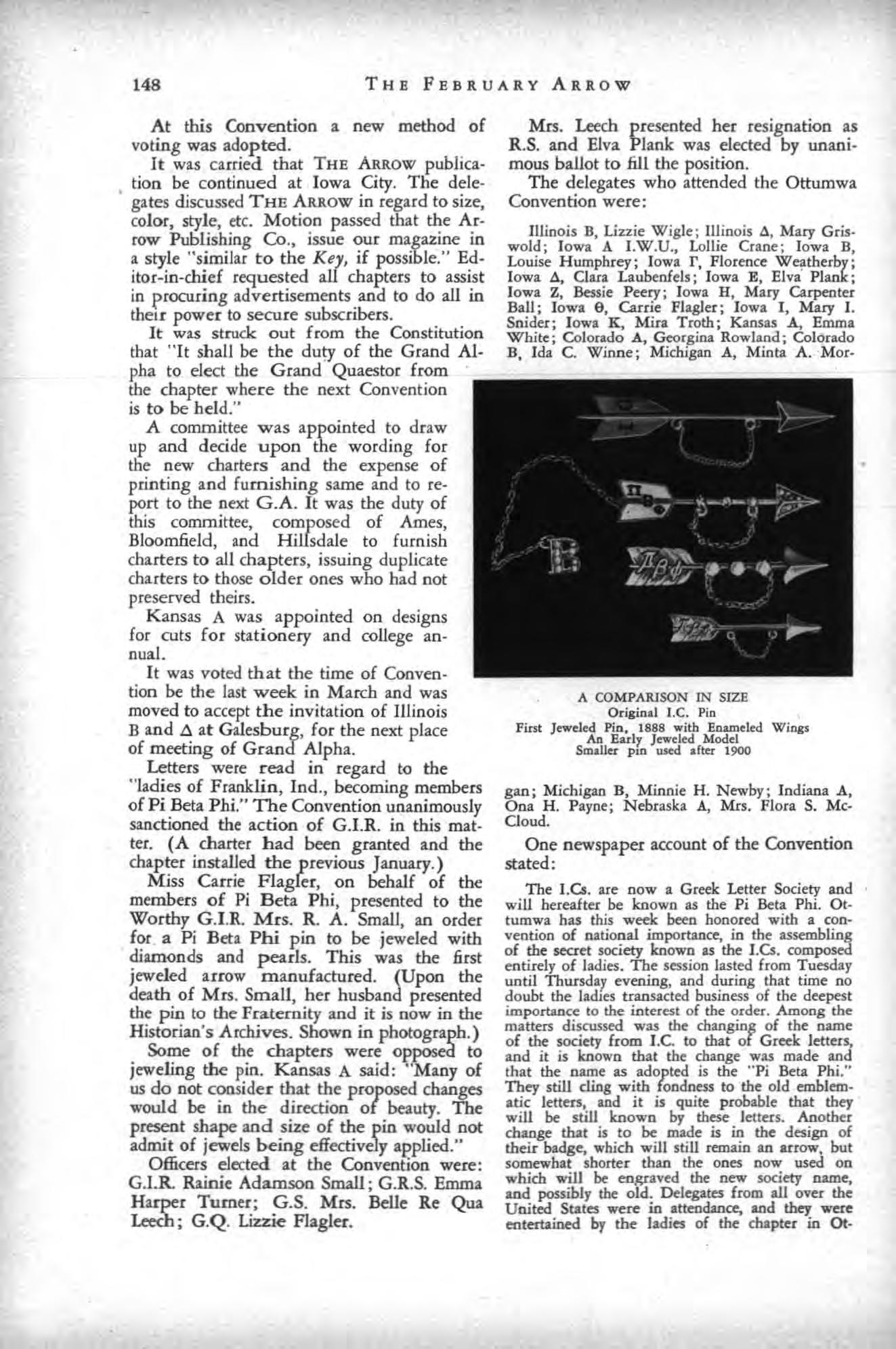
A COMPARISON IN SIZE
Original I .C. Pin
Fint Pin, 1888 with Enameled Wings
An Early Jeweled Model Smaller pm used afkr 1900
gan; Michigan B, Minnie H. Newby; Indiana A, Ona H. Payne; Nebraska A, Mrs. Flora S. McCloud.
One newspaper account of the Convention stated:
The I.Cs. are now a Greek Letter Society and will hereafter be kn own as the Pi Beta Phi. Ottumwa has this week been honored with a convention of natio nal importance, i n the assembling of the secret society known as the I .u. composed e ntirely of ladies. The session lasted from Tuesday until Thursday evening, and during that time no doubt the ladl es transacted business of the deepest importance to the i nterest of the order. Among the matters discussed was the changin, of the name o f the society from I .e. to that a Greek letters, and it is known that the change was made and that the name as adopted is the " Pi Beta Phi." They still cling with fondness to the old emblematic letters, and it is quite probabl e that they wiU be still known by these letters. An other change that is to be made is in the design of their badge, which wiU still remain an arrow, but somewhat shorter than the ones now used on which will be engraved the new society name. and possibly the old. Delegates from allover the United States were in attendance. and they were entertained by the ladies of the chapter in Ot-
tumw•. Although considerable was tnnsacted the ladies found a litt le time for social relaxation and on Tuesday were tendered a banquet by the I. Cs. of Ottumwa at the ro:idmce of Hoo . Chas. F. Blake, on East Second Street. Only members of the order were present on this occasion. After the banqud: a l iterary programme of unexcelled merit was carried out by the visiting ladies. On Thursday "ming a reaption was tendered the visitors at Armory Hall by the Ottumwa ladies , at which time tilt: gentlonen were invited .
In describing the soc ial side of the Convention, the Ottumwa Daily COIJrier of Oct. 19, 1888 said:
The social feature of the ocasion was a grand hop givm at Armory Hall , last evening. in honor of the delegates, and a more handsome or intelligent looidng company of ladies was never assembled in Iowa, than were present on this occasion and the large Dumber of gmtlcmen present while not so for as ladies, as gaJlant as the lmights of old. Schwabkey 's full orchestra the music, which was of best, and from the time of the grand march It 9:00 P.W. until 1:00 A.M., a more time was never spm.t at Armory Hall.
The nrarly all left foe their homes on an early morning or the afternoon trains today, and as far as we cou ld were delighted with their hospitable reception and e nter tai nmm t while in our city."
The dunge to the Greek name was commented on in the chapter letters which appeared in December following the Ottumwa Convention. One of the members of Iowa I, Alumn., Chapter wrote: ' 'The regret felt in changing the beloved I. c." for Pi Beta Phi is like that felt by the bride when she takes h er husband ' s name. The old name is very dear to the older members, but the change, we believe, is for the best_ With the Greek upon our wings , we are indeed Greek.
In the same issue an active member of Iowa Z wrote: "The Pi Beta Phi convention delegates returned and the following evening a grand and impressive memorial service was held in memory of I.c.- a strange memorial service! Not a tear was shed. but all w as mirth and jollity; one sister mourned, but she was alone in her grief; evidently the departed was not regretted _"
An editorial in THE ARROW said: "To the older members of the Sorasis, it was hard
to discard the old name, hallowed by so many ties ; but we are fast learning to love the new name as we did the old , and, all feeling of sentiment being thrown aside, we are ready to join the younger members in earnest devotion to the new name. We find ourselves now where we have always been but in name-i n the midst of the Greek World _ May our co urse there reBect honor upon us."
The Kansas A Scribe wrote: "We notice that some of the chap.ters are using 'Pi Phi' for short and would lIke to say we think Beta Phi much prettier
The chapter letters in the December, March and June issues foUowing the convention reflected progress and prosperity _ The one hundred and eighty actives reported in the chapters in September all seemed to be industriously at work building up their chapters to the best of their ability_
It was at this time that the idea was brought up by Margaret Sisson of Illinois d, that it would be advisable for all Soroses to unite in a pledge to allow a certai n amount of time to elapse, at least a month, at the beginning of each school year, before the subject of becoming a member of any Sorosis sboul d be broached to new students_
This matter had already been given consideration at Kansas State University_ In March of 1888 , the Kappa Chapter of Kappa Alpha Theta at Lawrence had put a notIce in each of the college papers to the effect that: "At a recent meeting of Kappa Chapter
of K A 0 it was decided that hereafter no ca ndidate shall be eligible to memberShip who has not been a student in regular and continuous attendance at the University of Kansas for a period of three months , during all of which tIme she shall have pursued two full collegiate studies_"
After this declaration was published , the members of the Pi Beta Phi chapter sent letters to the local chapte rs of Kappa A1(>ha Theta and Kappa Kappa Gamma, asking them to cooperate by signing some pled!!e saying that they would all abstain from inVIting, pledging, or initiating any girl until after
she had attended the Unive<sity at least two months and a half; that is, until the fifteenth day of the third month of the term in which she "shall have entered the Unive<sity, the object being to avoid the 'rushing; which has become such a crying evil of the fraternity system_"
Both Kappa AI{'ha Theta and Kappa Kappa Gamma appointed committees to meet with the Pi Beta Phis and an agreement was reached, which was one of the first PanhelJen.ic agreements in the world of women's college fraternities .
In 1892, the Kan sas A Scribe to THB ARROW wrote: ''The inter-fraternity pledge, the time of which was shortened this fall to two months, is now entirely removed . Kappa Alpha Theta called a meeting of the committee, and expressed her desire of withdrawing from the pledge, so that now the new girls are exposed to the tender mercies of the 'rus hing' nrst thing. The faculty , however, is considering the question of allowing no fraternity to pledge a student until he has completed freshman work."
After the Convention , the Committee on Incorporation with Emma Harper Turner, as Chairman, added two more members: Emily Brooks of Illinois A and Mrs . Emma Humphrey Haddock of Iowa K, Iowa City.
M<s. Haddock , a graduate lawyer, gave the committee the benefit of her legal advice, but asked to be excused from further work on the Committee.
It seems that at first it was thought the Incorporation would have to be dooe through an Act of Congress. Mrs Haddock, however, wrote on January 21, 1889: "It is my judgment and I have also consulted another at· torney, who thinks as I do-that Congress does not incorporate any institution outside the District of Columbia- that of a few miles square is wholly under the control of Congress'--that is, Congress legislates for the District. But each state has the right to incorporate either by general incorporation laws or by charter and Congress confers such right on the Territories. So, if we incorporate at all it must be in some state. We would then have all the rights in other states that citizens of one State have in another, that is we could do business-hold property &c by conforming to the laws of such state.
" In my judgment it would be best to iocorporate in whatever state you expect the property of the Fraternity to be established. I do not see as yet, that we are in a way to become wealthy and there is no reason for becoming incorporated at all, except to give tJ.e Fra' ternity all the rights of persons as to holding property, &c."
The remaining members of the committee worked the matter up, but as they were so scattered it was inconvenient to have a meet ·
ing, so with the consent of the Grand Officers they "conferred the r:wer to incorporate on reSIdent members 0 Galesburg, tIlat beiog the place where it seemed best to incorporate."
Evidently the chairmanship of the Committee was transferred to the G.I.R ., as Mrs . Small directed the work of the committee from May 1889.
On May 14 , Mrs . Small, who lived at Dixon, Ill., addressed the following letter to the Secretary of Delta Tau Delta :
Having always f o und the members of Delta Tau Delta friendly and obliging, it is without any heiitancy that I now apply to their secretary for information with regards to Jncorponlting S«ret societies. I have a copy of the Articles of Incorporation of an Iowa secret organization, but it does not s uit OUf purpose. If not asking too much will you send me a copy of the Delta Tau Delta articles o f incorporation and greatly oblige the President of Pi Beta Phi Sorosis.
There is no record to show whether the artides were received by Mrs. Small, but three days after writing to Delta Tau Delta , Mrs. Small addressed a letter to the Secretary of State of Illinois, asking for informatioo relative to the steps necessary for the Committee to take.
A letter dated May 18, 1889 from I. N. Pearson , Secretary of State, Springfield , III. , sa,d:
Dear Madam:
In reply to your f avor of the 17th ins t. I in· close you a blank application for license to orga nize such a corporation 1$ you desire. If you incorporate io this state it w ill not be necrs5ary for you to incorporate in other states; it will oot be necessary for you to make public yo ur consti· tution o r any of your records; it will not be necessary for you to specify any number of years o f the duration o f the incorporation; you must
designate the Jocation of your incorporation in this state and have yow charter recorded in the office of the Recorder of Deeds for the county. In stating the object of the In corporation you will probably find apt words in the Janguage of your Constitution which you can use, At least, three persons must sign the application and it is not necessary that more than your principal officers probably shaH sign or be named as trustees. Three o r five trustees are ample.
When you have signed the application 80 be· fore a Notary or a Clerk of a court and ack.nowl·
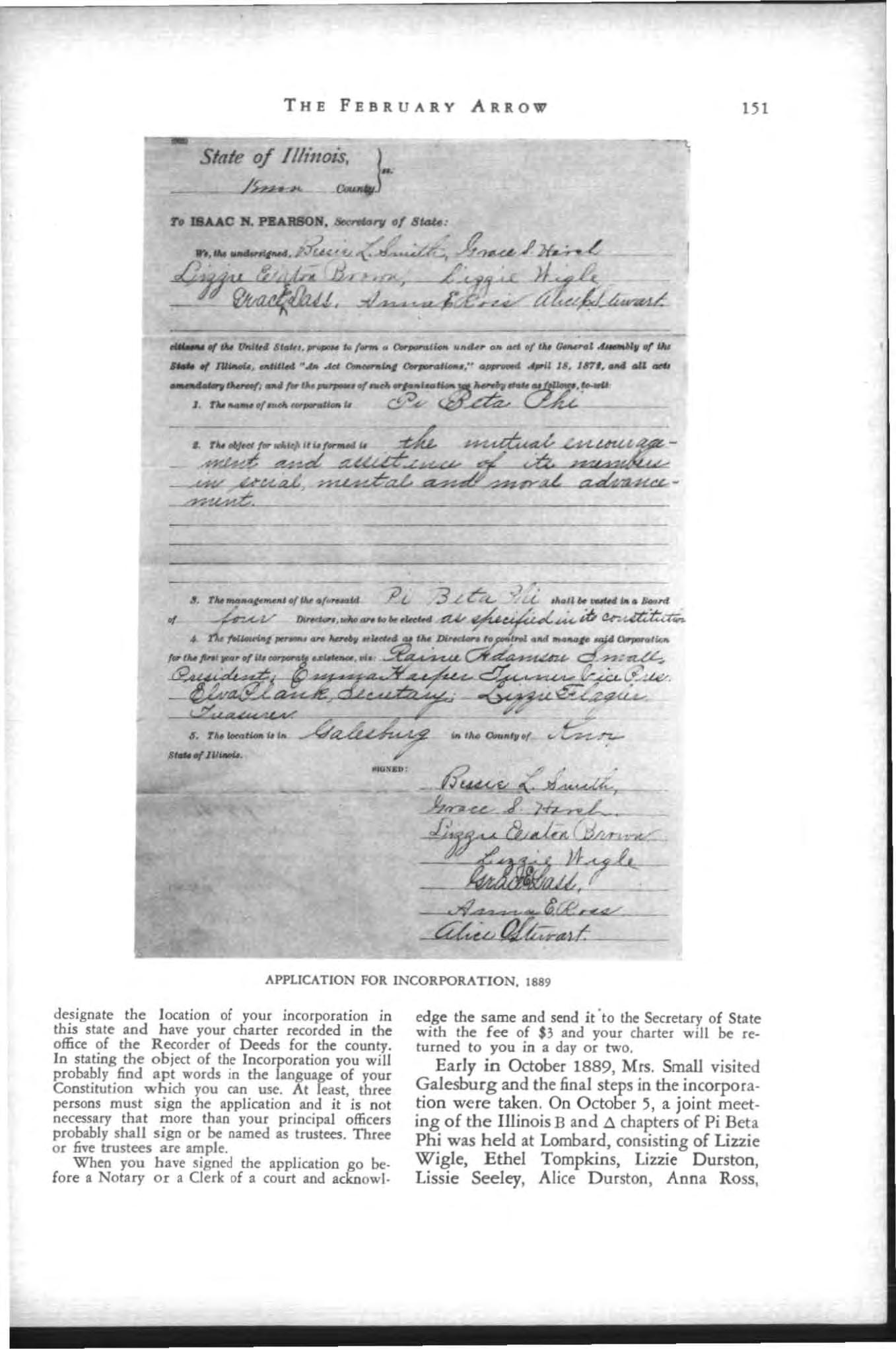
edge the same and send it ' to the Secretary of State with the fee of $3 and your charter will be returned to you in a day or two.
Early in October 1889, Mrs. Small visited Galesburg and the final steps in the incorpor ation were taken. On October 5, a joint m eeting of the Ill inois Band e. chapters of Pi Bet a Phi was held at Lombard, consisting of Lizzie Wigle, Ethel Tompkins, Lizzie Du rston, Lissie Seeley, Alice Durston , Anna Ross ,
Nellie Burns, Della Rogers , Clara Grubb, Grace Harsh of Beta, and Bessie Smith, Frank Vineyard, Blanche Smith, Annie Hoover, Alice Stewart and Grace Lass of Delta.
"The meeting was opened with Grand I.R. Mrs. R A. Small in the chair.
"Articles were read by Mrs. Small, report· ing the work of the original Incorporating Committee.
"The Grand Officers, and original Incor· porating Committee requested that five sub· stitutes be appointed from the Illinois B and A chapters of Pi Beta Phi. It was moved and carried that the r"'luest be granted. It was then moved and carried that three of the committee be chosen from Beta and two from Delta , with chairman from Delta, also moved and carried that the respective I.Rs. of Beta and Delta chapters form part of the committee. The committee chosen cons ists as follows: I.R Lizzie Wigle, Lizzie Durston of Beta chapter, I.R Bessie Smith and Grace Lass of Delta chapter, Bessie Smith of Illinois B was chosen chairman of the committee."
Three days later the Committee met with Mrs Small and voted that Mrs. Ed. Brown of 1l1inois A and Miss Alice Stewart of 1l1i· nois A should be added to the committee, provided that Mrs Ed Brown should consent to serve. The Articles of Incorporation were then read by the G.I.R and filled out by the consent of the committee.
Two days later, on October 10, the Com· mittee met at the law office of J. c. Stewart where the Articles of Incorporation were duly signed in the presen ce of a notary, J. C. Stewart, countersigned by him , sealed and sent to the Secretary of State, reading as fol· lows :
J. N Pearson, S«retary of State
We , the undersigned, Bessie L. Smith
Alice C. Stewart
Grace Lass
Mrs. Ed Brown
Lizue Wigle
Anna Ross
Grace Harsh
Citizens of the United States propose to form a Corporat io n under the act o f the General Assembly of the State o f Illin ois, entitled an act amendatory thereof ; and for the purposes of such organi. zation, we hereby state as foll ows, to wit :-
1. The name of such corporation is Pi Beta Phi .
2 . The o bject f o r which it is f o rmed is the mutual encouragem ent and assistance of its members in social. mental and m o ral ad· vancement.
3. The management of the aforesaid organi. utio n shall be vested in a Board o f Fo ur (4) Directors, who are to be elected as s peci · tied in the Constitution.
4. The following are hereby se lected as the Directors to control and manage said corporation for the first year o f its existence, viz, Rainie Ad amson Small, President Emma Harper Turner, Vice President Elva Plank, Secretary Lizzie Flagler, Treaswer
On O ctobe r 15, the charter which was dated October 14, 1889 was "duly received from the Secretary of State, and delivered to the Recorder of Knox County where it was recorded It was then forwarded to the G.I.R. of Pi Beta Phi , Mrs Rainie A Small and the Incorporation of said society was completed Bessie L. Smith, Chairman of Committee."
The records of Illinois A show:
Pi Beta Phi Sorosis, Dr .
March 6, 1890 Gales burg, Ill . To Delta chapter of Pi Beta Phi
00 Fra nk Vineyard Q o f Delta Chapter
Illinois B in writing for THE ARROW, De · cembe r 1889 reported :
"Mrs Small visited us early in October, and the final steps in the incorporation of our society were taken here. And now Pi Beta Phi , as a society, may bave the power of suing or being sued, owning property or building chapter houses , for all of which we are duly grateful ."
.All was not calm on the fraternity sea, especially dueing the eighties. Anti·fraternity activity was reported from Ames, Indianola ; Butler College at Ind ianapolis; Hastings , Neb.; Mt. Pleasant, and other localities
As eady as 1881 there was so much agitation at Indianola that the I.e. members discussed the plan of laying aside their badges until Commencement.
At Ames in 1882 there was a called meeting to allow three candidates to take the vows at once. The Minutes record: " The young ladies above named reported their wish to join the I .e. society and that at once. The opposition was strong. Said we had no idea the ordeal they had been subjected to since the Anti-secret societies had found they had been invited to join us. We held a consultation and decided to call a meeting at the ringing bell Monday morning which resulted as above recorded. Their joining caused a great amount of talk and sour looks, especially from the furious _ But at this date all has subsided. They have concluded to make the best of the situation and all the I.es. are hapI'Y'"
In 1885 Ames reported delayed meetJ.ngs due to a change in CoUege affairs and a committee was appointed to consult with the President in regard to having I.e. recognized as a Society on the Campus.
In 1886, Mt. Pleasant reported , " Rumor says that fraternities at I.W .U. are to be annihilated this year. We, however, do not conJirm it as the I.Cs. with 3 others expect to come out victorious in the battle."
In 1888 at Ames: "An insulting attack was made by the ' Barbs' upon a Greek letter banquet. An investigation was made but there was inclination on the part of the college and civil authorities to let the matter drop."
Indianola re{'Orted that there was a rumor on her campus In 1887 relative to the abolishment of fraternities, and in 1889 a meeting was called to discuss the disbanding of secret societies at Simpson. Too, in 1890 the chapter wrote that "Some of our Greeks, growing weary of s«ret have surrendered their charters; an action for which we think they will sooo repent."
In 1889 the board of trustees of Iowa State College, .Ames, took away all "special p'rivileges," which meant the giving up of 'an y more joint with our brothers, and worst of all, our cozy little ball, which had been our pride." In the same year, all classes, with the exception of the senior, passed amendments to their constitutions, prohibiting members of fraternities from holaing any office or class honor.
Despite all of this , Ames reported in 1890 that it was: "progressing; and progression amid the opposition and 'barbs' with which we are surrounded is no insignificant We have initiated no new members this term, and this fact seems to be one reason for the tumult about us. Our Anti-friends, have, all unknown to ourselves, appointed times, selected places, and chosen candidates for our initiation- have become self-appointed detectives to watch for the culmination of their plans, then, strange to say, were disappointed when they failed to materialize,"
A State Barb Association of Indiana, organized at Butler University under the name of the Independents of Butler University in 1889 , appeared in chapel with ribbons of yellow and bronze.
At Hastings, Neb. , I.e. was the only secret society in the school and in 1888 report.d that the "tide backs slowly against fraternities,"
From Illinois t;. at Knox College in 1888 carne the word: " In our college of about 500 students there is a very stcong anti-frat element. This opposition bas reached a climax now in the pu61ication of two Annuals--one by the fraternities called the Gale, in honor of the founder of Knox College; the other by the college students, which means 'antifrat' called the Panth, on_ "
Many of the chapters weathered the antifraternity attacks Those at the Iowa State Agricultural College and at Hastings, Neb., however, surrendered their charters. The Nebraska chapter permanently ceased to exist; the wine and blue was not seen on the campus at Ames, Iowa from 1894 until 1906, wnen Iowa r was again re-chartered .
The first chapter to be installed after I.e. was changed to Pi Beta Phi, was Columbia A, chartered on April 27, 1889 at Columbian University (George Washington University), Washington, D.e. According to one of the c harter members this was "the first woman's college fraternity established in Washington , D .e. The preceding autumn the faculty of Columbian University had permitted women to enter the institution for the first time."
In the interim of Conventions a number of Committees were at work. The Committee on Incorporation, as has been related, completed its work in October 1889 In March of the same year, Kansas A, the Committee on the Cut for Annuals and Stationery reported its work completed, stating that: "For ARRow and ANNALS, we selected a scroll, supported by a branch, and pierced by an arrow. above which is a smaIl monogram of I.e. while on the scroll is the date and Pi Beta Phi in large letters. For stationery, simply a Pi Beta Phi pin is the design."
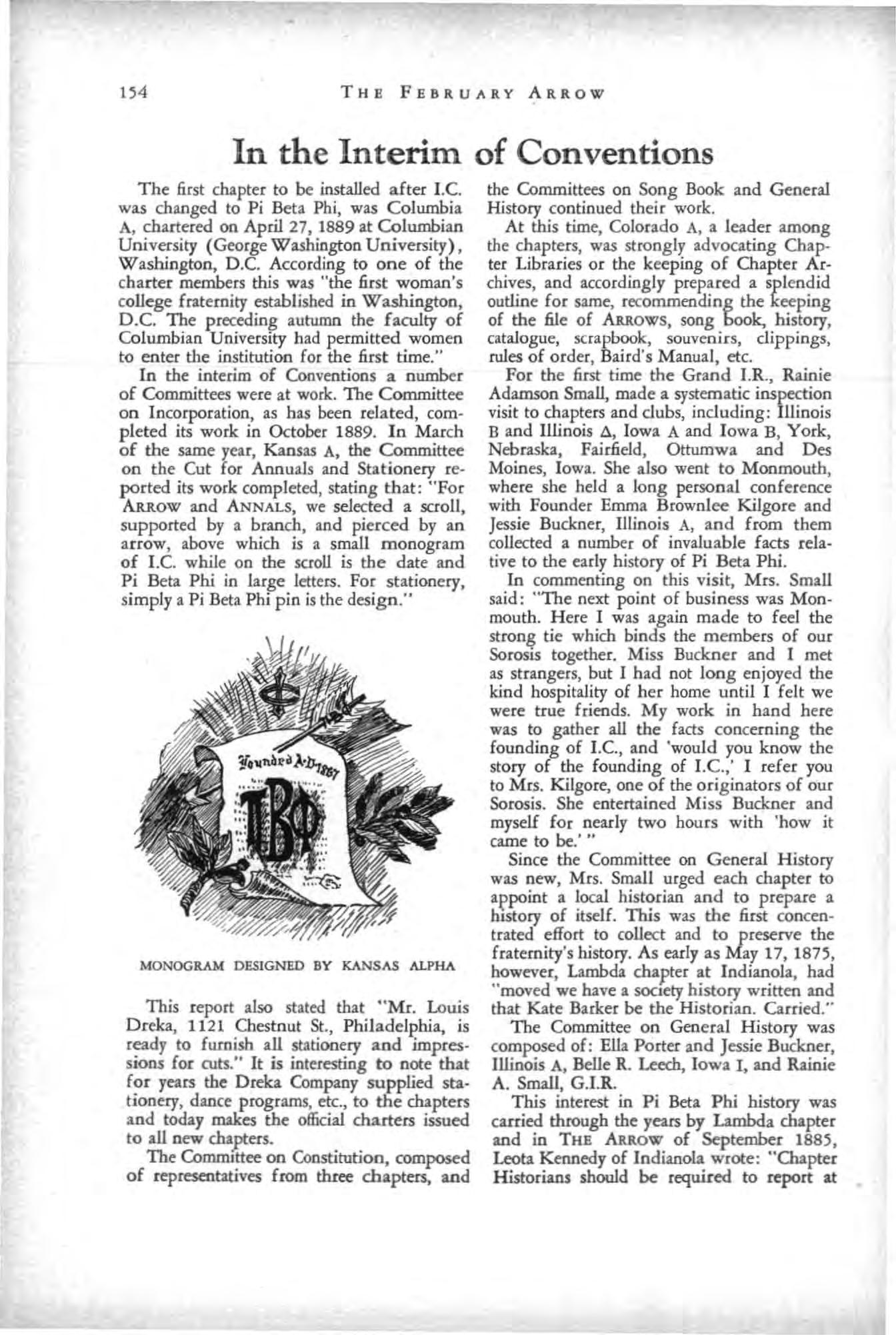
This report also stated that "Mr. Louis Dreka, ll21 Chestnut St., Philadelphia, is ready to furnish all stationery and impressions for cuts." It is interesting to note that for years the Dreka Company supplied stationery, dance programs , etc., to the chapters and today makes the official charters issued to all new chapters.
The Committee on Constitution, composed of representatives from three chapters, and
the Committees on Song Book and General History continued their work.
At this time, Colorado A, a leader among the chapters, was stro ngly advocating Chapter Libraries or the keeping of Chapter Archives, and accordingly prepared a spl endid outline for same, recommending the keeping of the file of ARRows, song book, history, catalogue, scrapbook, souvenirs, clippings, rules of order, Baird's Manual, etc.
For the first time the Grand I.R ., Rainie Adamson Small, made a systematic inspection visit to chapters and clubs, including: Illinois B and Illinois tl., Iowa A and Iowa B, York, Nebraska, Fairfield, Ottumwa and Des Moines, Iowa . She also went to Monmouth, where she held a long personal conference with Founder Emma Brownlee Kilgore and Jessie Buckner, Illinois A, and from them collected a number of invaluable facts relative to the early history of Pi Beta Phi.
In commenting on this visit, Mrs. Small said: "The next point of business was Monmouth. Here I was again made to feel the stron!! tie which binds the members of our SoroSlS together. Miss Buckner and I met as strangers , but I had not long enjoyed the kind hospitality of her home until I felt we were true friends. My work in hand h e re was to gather all the facts concerning the founding of I.e., and 'would you know the story of the founding of I.e. : I refer you to Mrs. Kilgore, one of the originators of our Sorosis. She entertained Miss Buckner and myself for nearly two hours with 'how it came to be:"
Since the Committee on General History was new, Mrs. Small urged each chapter to a{'point a local historian and to prepare a hIstory of itself. This was the first concentrated effort to collect and to preserve the fraternity 's history. As early as May 17, 1875 , however, Lambda chapter at Indianola, had "moved we bave a SOCIety history written and that Kate Barker be the Historian Carried."
The Committee on General History was co mposed of: Ella Porter and Jessie Buckner, Illinois A, Belle R. Leech, Iowa I, and Rainie A. Small , G.I.R.
Tbis interest in Pi Beta Phi history was carried through the years by Lambda chapter and in THE ARROW of September 1885 , Leota Kennedy of Indianola wrote: "Chapter Historians sbould be requited to report at
least once every term. No one should be elected to office wbo is not heartily in favor of the plan and willing to take upon herself all the care that the duties of the office de· mand The history sbould he given up to recording things which do not find their way
into chapter minutes. The historian should tell of banquets, anniversaries, and public literary entertainments in which I.Cs have participated, or visits from old members of the society and relations with rivals during the year . . .. "
Although the Convention of 1888 "Ad· journed to meet in March 1890," Mrs Small, G.I.R., began early in 1889 to ascertain at what time the Convention could be held that would be included in the spring vacations of all the chayters.
The ASSOCIation of the Iowa College Fac · ulties had issued an edict that " All Conven· tions---oratorical , fraternity, Y.M.C.A., etc.shall be conducted during vacation. No stu· dent shall be excused during the session to attend any convention or assembly."
After sending queries to the various chapters early in 1890, Mrs. Small issued an offi· cia l call as follows:
To the Several chapters of Pi Beta Ph i:
In accordance with the duties of my office, I hereby call the biennial convention of Pi Beta Phi to meet at Galesburg, lIl., April I, 2, 3 and 4. It being impossible foe me to be present, Emma Harper Turner, G .R.S., will have charge of the business of Convention. Therefore let aU communications which would otherwise come before me be addressed to her.
York, Neb. Feb 20, 1890.
Rainie A. Small Grand I.R
Previous to the Convention, Colorado A wrote to THE ARROW: "We are much interested in the selection of our emblematic flower, and hope that one chosen will not be too rare for common use. While we all adorchids, lilies of the valley, etc., we want not a flower that from its costliness can only figure in Constitution and song, but one which can be associated with our medings, entertainments, commencement offer-
ings, etc. (Beta Theta Pi has adopted the rose as the fraternity Bower, leaving the variety to the option of the chapters Kappa Alpha Theta has adopted the black and gold pan· sies.... What shall we have 1)"
The Iowa B Minutes of November 15, 1890, show that a motion carried that the chapter "recommend the lily as the !lower to be adopted as the Sorosis Bower ."
Too, tile chapters discussed the adoption of a Greek Goddess. Iowa B reports a discussion in chapter meeting of the Greek Goddesses aDd Gods and the reading of an article on Grecian Mythology by Bell Hastie.
Iowa r, Ames, iD 1890, recorded a chapter discussion relative to the colors. "We wondered what others would think of changing the colors to gold and white, the same as our pins. * It would make such pretty decorations and there would then be so many pretty Bowers we might select."
One new chapter was established before Convent)on: Ohio A at the Ohio University, Athens, Ohio, on December 16, 1889
Illinois B, Lombard , reported in THE ARROW chapter letter for March 1890 that it had not given any parties that term, "for our time has been too much occupied with work and other preparations for the coming Convention." In the same issue, Illinois A, Knox, wrote: "Of course now our great interest is in the coming Grand Alpha and for this we have been busily planniDg for some months. In company with Beta chapter we have held meetings to discuss ways and means .
• Pins at that time had white enameled wings.
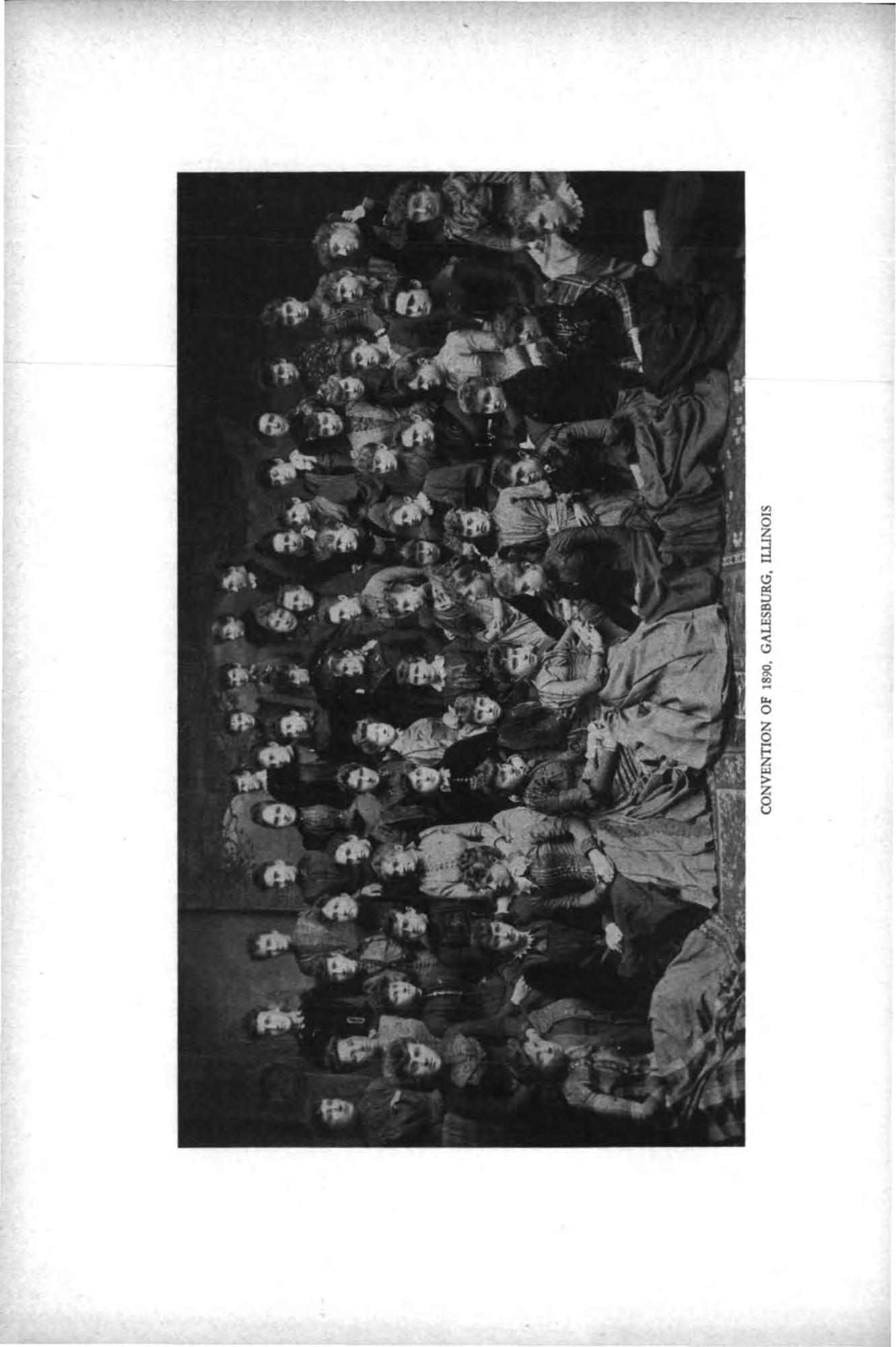
The eleventh session of Grand Alpha of Pi Beta Phi Sornsis was held in Galesburg, JUinois, April I, 2, 3, and 4, in the Phi Gamma Delta Halls WIth 11110015 Band Illinois a , hostesses .
In tht absence of Grand I.R Rainie Adamson Small, Grand Regina Secunda Emma Harper Turner, presided.
The G rand officers present were : Emma Har!",r Turner, G.R.S.; Elva Plank, G.S .; LiZZIe Flagler, G.Q.
Twenty delegates were present:
Iowa A. Cora Dill; IJlinois B, Grace Harsh; Kamas A. Marne Tisdale; Iowa B. Estella Hartman; Iowa r, Mattie Yeardley; Iowa E (Alumnae), Bloom6eld, Sude Iowa Z, Nellie Peery; Iowa K (Alumnae). Bessie Peery ; Colorado A, Emma L Sternbuc8; Iowa e (Alumnz), Ottumwa, lillie Hartman; Illinois .d, Grace Lass; Iowa I (Alurnnz), Mt. Pleasant, Lillie Perry; Nebraska A, York, Maude Chilcote; Colorado B . Charlotte Fowler; Michigan A, Grace Payne Higbee; Indiana A, Herriott Palmer; Michigan B. Franc Arnold; Columbia A, Phebe R. Norris; Ohio A , Fannie Brown. ARRow Represmtative. Ella M . Ham, Iowa City, Iowa .
The Committees which worked during the Convention were: Condition of Olapters, Hand Book, Catalogue, Seals, Miscellaneous, Audit Treasurer's Report, ARROW, Place of Meeting, Form of Charters, History.
Reports were made relative to pins and on the banner and regalia.
A motion was carried that the songs be printed in pamphlet form.
Nebraska A, whose college home had been removed, appealed to Convention to be allowed to live and her request was granted.
The history committee reported and recommended that Jessie Buckner, Ella Porter, Mrs. R. A. Small, Mrs. BeUe R. Leech be retained as a history committee-the history not to be printed.
It was voted that every chapter write a letter of fraternity news to every other chapter at least once during the school year.
The first day's work of the Convention was closed by public literary exercises in the Presbyterian Church. The opening prayer was followed by a beautiful vocal solo by Minnie Day, of Illinois fl.. A.n historical sketch of Pi Beta Phi, written by Helen Sutliff, of Kansas Alpha, was read by Marne Tisdale, delegate from the same chapter.
An address, "The New Revolution," was then delivered by Mrs Carrie Lane-Chapman
(Catt) of Iowa r. " In a most forcible and womanly manner she pictured the history of woman's progress from the time she was regarded as the slave of man to her present state, where she is surely and steadily receiving her just place."
"A fine Instrumental solo attuned OUf minds to receive the musical production of Carrie Rutledge, of Iowa A, in the form
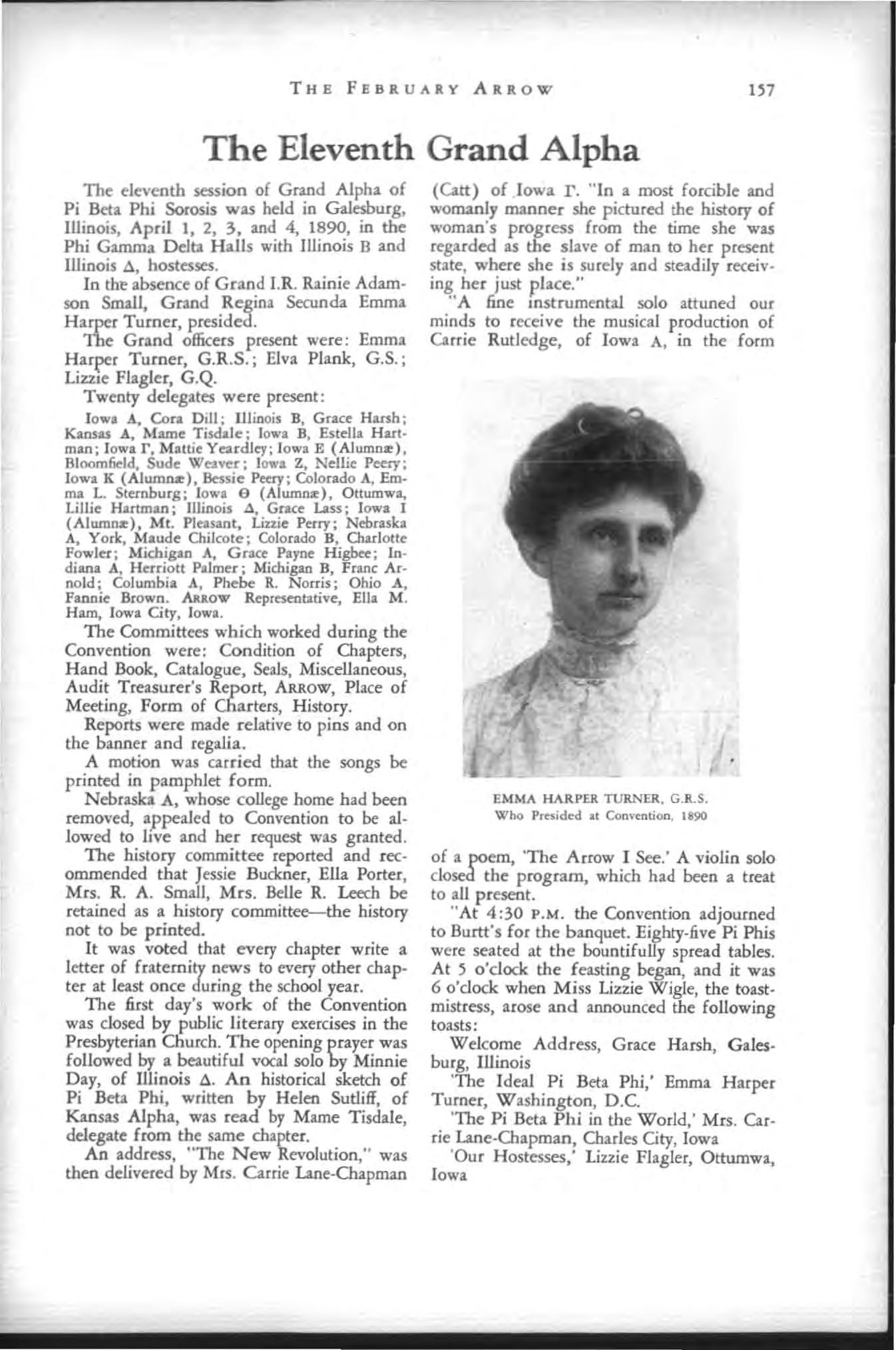
of a poem, 'The Arrow I See: A violin solo closed the program, which had been a treat to all present.
"At 4 :30 P.M. the Convention adjourned to Burtt's for the banquet. Eighty-five Pi Phis were seated at the bountifully spread tables. At 5 o'clock the feasting began, and it was 6 o'clock when Miss Lizzie Wigle, the toastmistress, arose and announced the following toasts:
Welcome Address, Grace Harsh, Galesburg, Illinois
'The Ideal Pi Beta Phi: Emma Harper Turner, Washington, D.C.
'The Pi Beta Phi in the World,' Mrs. Carrie Lane-Chapman, Charles City, Iowa
' Our Hostesses; Lizzie Flagler, Ottumwa, Iowa
'The Arrow,' Harriet Palmer, Franklin , Indiana
'Miss Nancy : Ella M Ham, Iowa City, Iowa
These speeches so enthused, that many others volunteered to say a word for the delights of Pi Beta Phi. When at last the final word was spoken, the banqueteers adjourned to the Convention hall. After a pleasant intermis· sion devoted to music, dancing and joyous conversation, the call to order came from the G R S , and the work of Convention was taken up again After an hour's hard work , release came once more. The cloth was brought in, and a genuine jolly Cookie Shine was enjoyed."
Other innovations of the Convention were Chapel services at Knox College on Thurs· day morning before Grand Alpha convened ; the taking of Grand Alpha picture on Thurs· day afternoon; a reception at the Odd Fellows ' Hall g iven Thursday afternoon by Phi Delta Theta at which many were seen wear· ing the "tri ·colors," the white and silvery blue of Phi Delta and the silvery blue and wine of Pi Phi.
In the evening the members of Beta Theta Pi and Phi Gamma Delta gave an informal rece ption and dance to Pi Beta Phi. Many availed themselves of tbe invitation, but pres · sure of business compelled the delegates to attend an evening business session .
On Friday morning a delegation attended chapel at Lombard University.
Greetings were read in Convention from Phi Kappa Psi then in Convention at Chicago , from Zeta Province of Phi Delta Theta, and from Delta Delta Delta.
An invitation was extended to the Conven · tion by the Mt. Pleasant Pi Phis for a reception to be held at Mt. Pleasant on Saturday afternoon.
Selection of a seal was left in the hands of Grand Council who should also procure new charters and arrange the word 109 for same ,
The Committee on Charters composed of Ames, Bloomfield, and Hillsdale was author· ized to begin the work at once.
A committee on Catalogue was appointed composed of Iowa @, Iowa I , and Ohio A.
The Committee on Ritual asked to be con· tinued until September in order that the new Ritual might be printed with the Handbook
The Committee on Handbook consisted of Miss Turner, Iowa E and Iowa B.
It was moved to recomp:nse the husiness m anager and Editor in Chief of THE ARR OW with the accumul ated ARROW money .
The Committee on Condit ion of Chapters recommended that the re signation of Fairfield be accepted and that the charters of Des Moines, Burlington, and Hastings be recalled
To sum up the work of Grand Alpha: The carnation was adopte d as the Sorosis Flower.
Pallas Athenae was selected as the Sorosis goddess
A Pi Phi caIJ or whistle was adopted as follows.
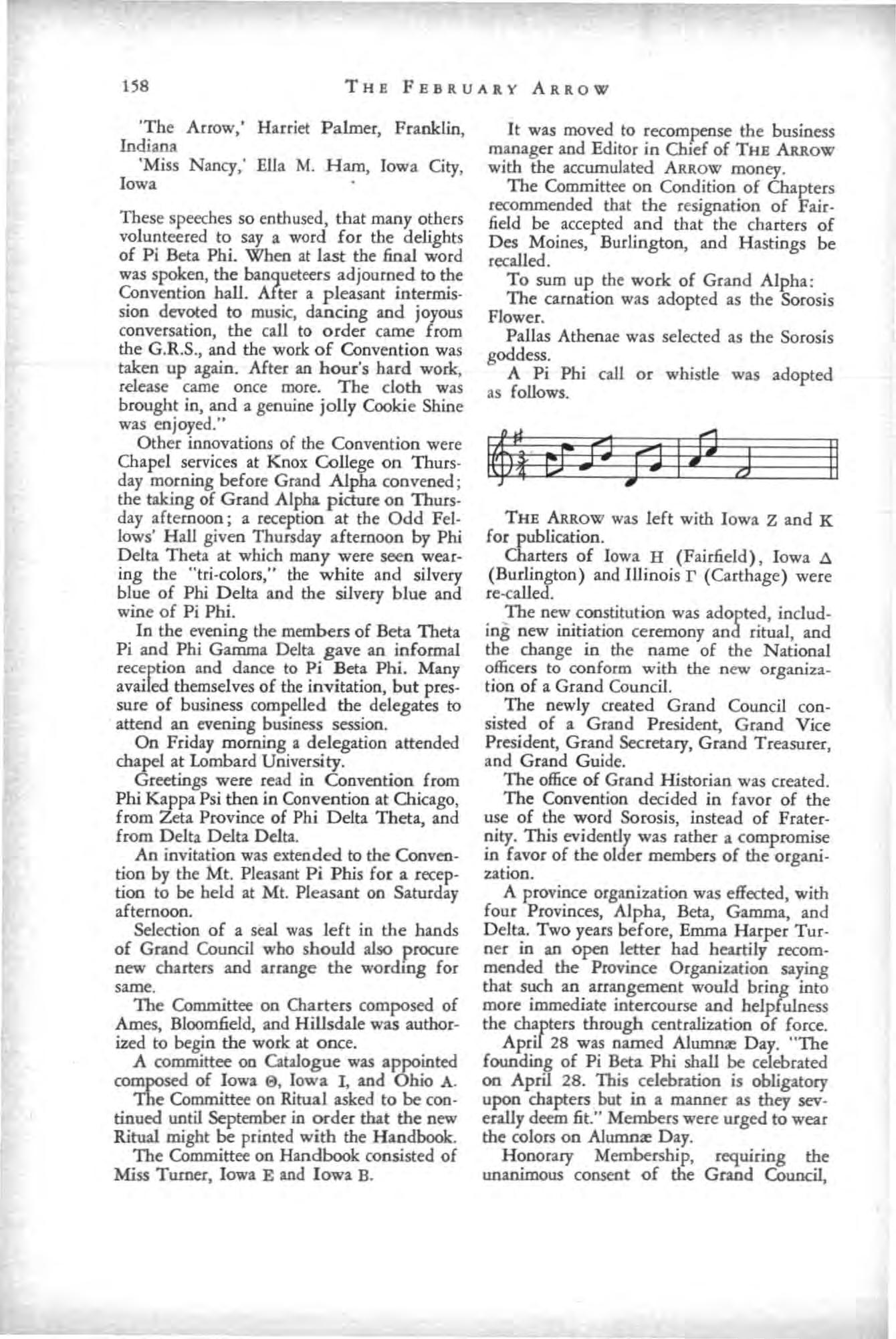
THE ARRow was left with I o wa Z and K for publication
Charters of Iowa H (Fairfield) , Iowa t;. (Burlington) and Illinois r (Carthage ) were re-called.
The new constitution was ado p ted , including new initiation ceremony and ritu al , and the change in the name of th e National officers to conform with the n ew organization of a Grand Council.
The newly created Grand Council consisted of a Grand President, Grand Vice President, Grand Secretary, Grand Treasurer, and Grand Guide.
The office of Grand Historian was created.
The Convention decided in favor of the use of the word $orosis, instead of Fraternity. This evidently was rather a compromise in favor of the older members of the organization .
A. province organization was effected, with four Provinces, Alpha, Beta , Gamma, and Delta Two years before, Emma Harper Tur· n er in an open letter had heartily recom· mended the Province Organization saying that such an arrangement would bring into more immediate intercourse and helpfuln ess the chapters through centralization of force . April 28 was named Alumn", Day. " The founding of Pi Beta Phi shall be celebrated on April 28. This celebration is obligatory upon chapters but in a mann e r as they sev· erally deem fit. " Members wer e urged to wear the colors on A1= Day.
Honorary Membership, reqwnng the unanimous consent of the Grand Council,
was provided. for such membershif to "in· dude ail m<mbc:rs chOS<D because 0 superior qua liJications as shown in work sub"'luent to college life. They shall be fully initlated and may wear the badge:'
In the election of officers the following were named to office:
Grand President: Emma Harper Turner
Grand Vice President: Minnie H. Newby of Chicago
Grand Secretary: Sud e Weaver of Bloom· field, Iowa
Grand Treasurer : Georgiana Rowland, Boulder, Colorado
Grand Historian: Rainie Adamson Small
Grand Guide: Helen Sutliff, Kans as A Province Presidents: Alpha, Franc Arnold, Ann Arbor ; Beta , Lizzie Wigle, Galesburg; Gamma, Zoe Willi ams, Iowa City; Delra, Id a Winne Balentine, Denver.
As a fitting dose to the successful session, Illinois Band t;. gave a recept ion to delegates, visitors, faculty, students, and friends in the Odd Fellows ' Hall whicb was a ttended by 700 guests.
In addition to the officers and delegates , the following visitors were registered at the Eleventh Grand Alpha :
Iowa A, LoUie Crane, Ida Van Hon, Mary Groves, Oily M . GoJfy, Lillian M. Saunders .
Iowa r, Lydia Bradrick, Harriet A Perrett
Iowa E, Cora McGowan
Iowa Z, Julia E. Rogers , Jessie L. Speer, Edna McElravy
Iowa e, Mrs. R.D . Beghart, Mrs . B . S. Sargent, Lura Phillips
Indiana A, L. May Burton
Illinois B, Madora Bradford, Quincy, IIIi· nois
IIJinois t;., Margaret Phelps, Minnie Day
Mrs Carrie Lane.Chap man , Charles City , Iowa; Carrie Rutledge, Waterloo, Iowa; Laura B. Smith, Creston, Iowa; Mate State· ler, Winona, Illinois; Mrs . Margaret Russell-Greer, Johnson, Nebraska; Myrtle McGahey, Cameron, Illinois; Laura Grubb, Liberty, Illinois ; Hattie Grubb, Barry, Illinois; and Glenn Taylor, Galesburg , Illinois .
During the Convention a committee was appointed to investigate the chartering of a steamer on the Mississippi River for a Pi Beta Phi trip to Minneapolis and St Paul , but it was found to be impracticable Iowa Z and K therefore went ahead with 'plans for a summer outing at their old campwg ground at Linder's on the Iowa River.
In September, following the 18 90 Con·
vention , the ne\\' Initi ation Ceremony and Ritual were issued in frinted form and met with the approval of al c>f the cbapte rs.
This new Ri tual was prepared by Anna S. H aze lton , Distri ct of Columbia A, the idea having originated with Emma Harper Tur · ner oThe R itual was officially adopted in 189 3.
The following sentence quoted from a let· ter of Indian a A typifies the general feeling in regard to the new publication: "We have the pleasure of presenting to you the n ames
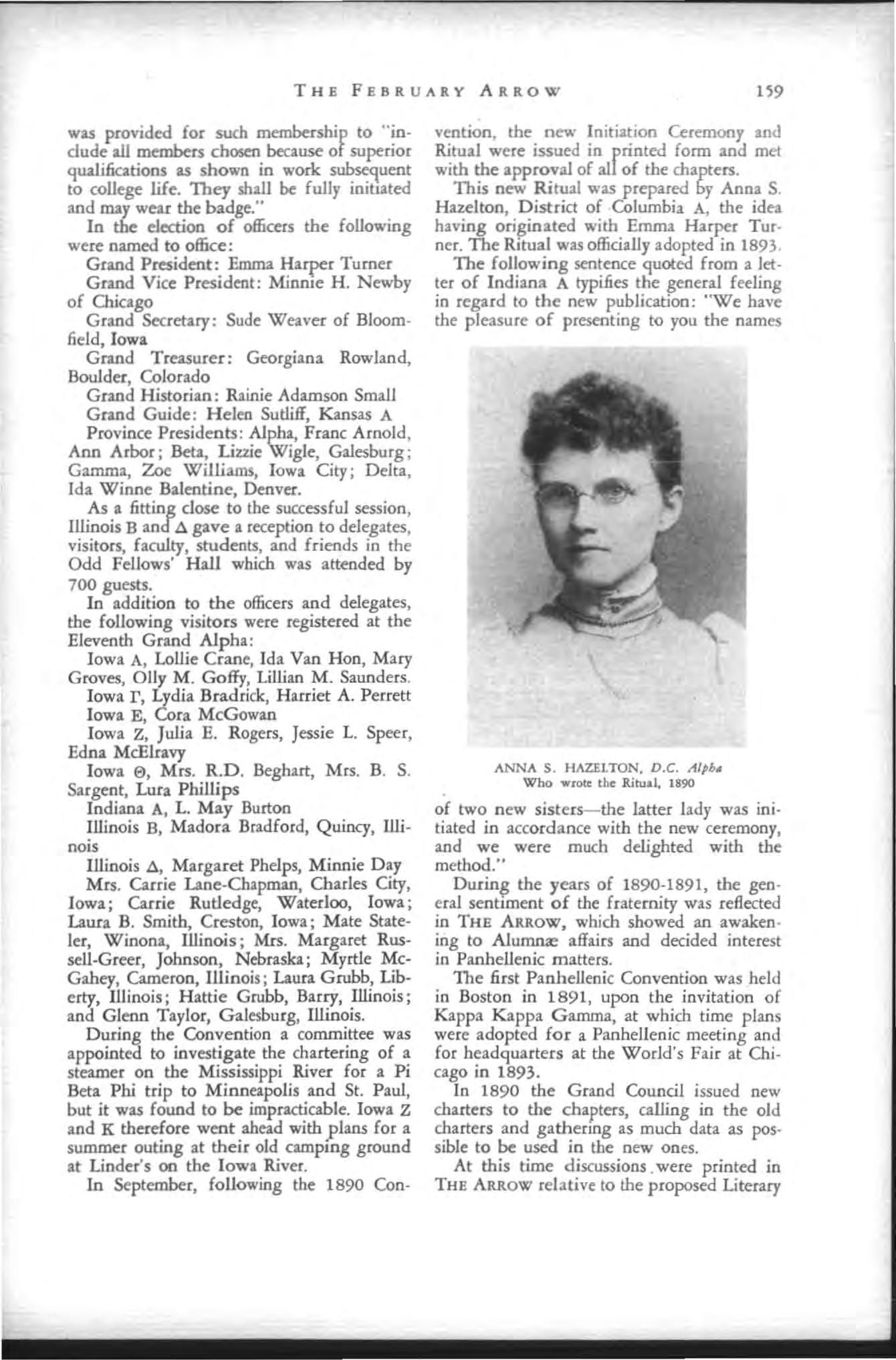
ANNA S . HAZELTON. D.C. A/ph. Who ."..,ote the Ritual. 1890 of two new sisters- the latter l ady was initiated in accordance with the new ce remony, and we were much delighted with the methnd:'
During the years of 1890-1891, the gen · eral sentIment of the fraternity was reflected in THE ARROW, which showed an awake ning to Alumn:e affairs and decided interest in Panhellenic matters ,
The first Panhelleni c Convention was held in Boston in 1891 , upon the invitati o n of Kappa Kappa Gamm a, at whicb tim e plans were adopted for a PanheHenic m eeting and for headquarters at the World 's F ai r at Chi· cago in 1893.
In 18 90 the Grand Council iss ued new cbarters to the chapters, calling in the old cbarters and gathenng as much data as pos, sible to be used in the new ones.
At this time discussions . were printed in THE ARROW relative to the proposed L it erary
Bureau, wbich it was boped would be approved at the coming Convention. The object of the bureau was to disseminate information relative to the bistory and workings of Pi Beta Pbi and also to give the members an opportunity for the discussion of timely topics.
The chapters all showed steady improvement under the new constitution and the life of the fraternity progressed , undisturbed by internal troubles.
The chapter letters during this period reBect harmony among .the various Greek groups .nd mdicate general fraternity .dvancement.
Michigan B wrote in one chapter letter at length on the benefit of Honorary Members, saying that it felt that such members could be of much assistance when it was
at all practicable to bave them. "By bonorary members , " the secretary wrote, " we mean ladies of the faculty, or ladies who stand high in the community for their intelligence, cultu re and social ability; who are interested in the chapter and put forth their efforts for it s welfare."
Since the Constitution required that Honorary Members should be admitted only by the unanimous consent of the Grand Council, very few were thus initiated.
On May 30, 1890, Pi Beta Phi entered the University of Minnesota, and on October 29, 1891, established a chapter at H Sophie Newcomb College of Tulane University, New Orleans, Louisiana . The establishment of the l atte r c hapter carried the wine and blue into entirely new te rritory .
In issuing a call to Grand Alpha for March 1892 at Lawrence, Kansas, the Grand President, Emma Harper Turner, urged that chapters send sophomores and juniors as delegates so that they could be of the utmost assistance in carryin$ ou t the work of the Convention in the Active chapters, dwing the following years.
The Twelfth Biennial Convention of Pi Beta Pbi convened in the Phi Delta Theta Hall at Lawrence, Kansas , March 29, 30, and 31, 1892 , with Grand President Emma Harper Turner in the chair.
Twenty of the twenty-one active chapters were represented. louisiana A did not send a delegate because of ber inability to find a chaperon who would take the long trip.
The Convention opened with devotional exercises followed by a short talk by the Grand President relative to the lirst quarter century of Pi Beta Phi , April 1867-1892.
The Grand Officers Jresent were: Emma Turner, Gran President; Minnie Howe Newby, Grand Vice-President; Helen Sutliff, Grand Guide. In the absence of Grand Secretary Sude Weaver Evans, Miss Newby was appointed to act as ber proxy, and Helen Maxwell served as proxy for Grand Treasurer Georgina Rowland
The chapter delegates arcepted by the Committee on Credentials were:
Iowa A. Laura Peterson , Mt. Pleasant; lIlinois B, Ethel Tompkins, Galesburg; Kans .. A, Ethel Grubb, Lawrence; Iowa B. Tella Talbot, Ind ianola;
Iowa r, Kathaeen Porter, Ames; Iowa E, Mayme McGowen. Bl oomfield; Iowa Z, Julia E. Rogers, Iowa Gty; Iowa K, Ida M . Greer, Iowa City; Colorado A. Marie Maxwell , Boulder ; I owa e, Mrs Emma H. Jones, Ottumwa; JIIinoi5 .6., Marion Niles, Galesbwg; Iowa I, Ida Van H on, Mt. Pleasant ; Nebraska A, Belle Reynolds, York ; Colorado B, Lottie Waterbury, Denver; Mi chiga n A, Lena Judd, HiJlsdale ; Indiana A, Dna H. Payne, Franklin; Michigan B, May B. Thompson, Ann Arbor; Colwnbia A, Edna Clark, Washington; Minneapolis A, Cora Louise Johns o n, Minneapolis.
Also entitled to vote: ARROW Representative: Ella M. Ham, Iowa City ; Extension Com., Bessie Peery, Iowa City.
The chapter reports, which were read to the Convention, were systematically made out, showing progress in every line, with especial attention being given to internal improvement. "The Michigan A report of constitutional study, througb a query box, was particularly pleasing. These reports led to a discuss ion of chapter meetings, a questioning from chapter to chapter. The literary work done embraced all lines, through exhaustive studies, reviews of current events as noted in magazines, the reading of certain books, lectures from invited guests, down to positivdy no such work. One or two chapters have business sessions only once per month; most chapters follow the plan of business first, literary or social afterward At every meeting most chapters secure prompt attendance by a system of fines."
Following the reports of delegates and standing committees, the committees of the
Convention were appointed, and the greater part of the lirst afternoon was given up to active committee work.
The reports of the Province Presidents showed the chapters to be in splendid condition, and a beginning made toward systematic Provin ce suptrvision .
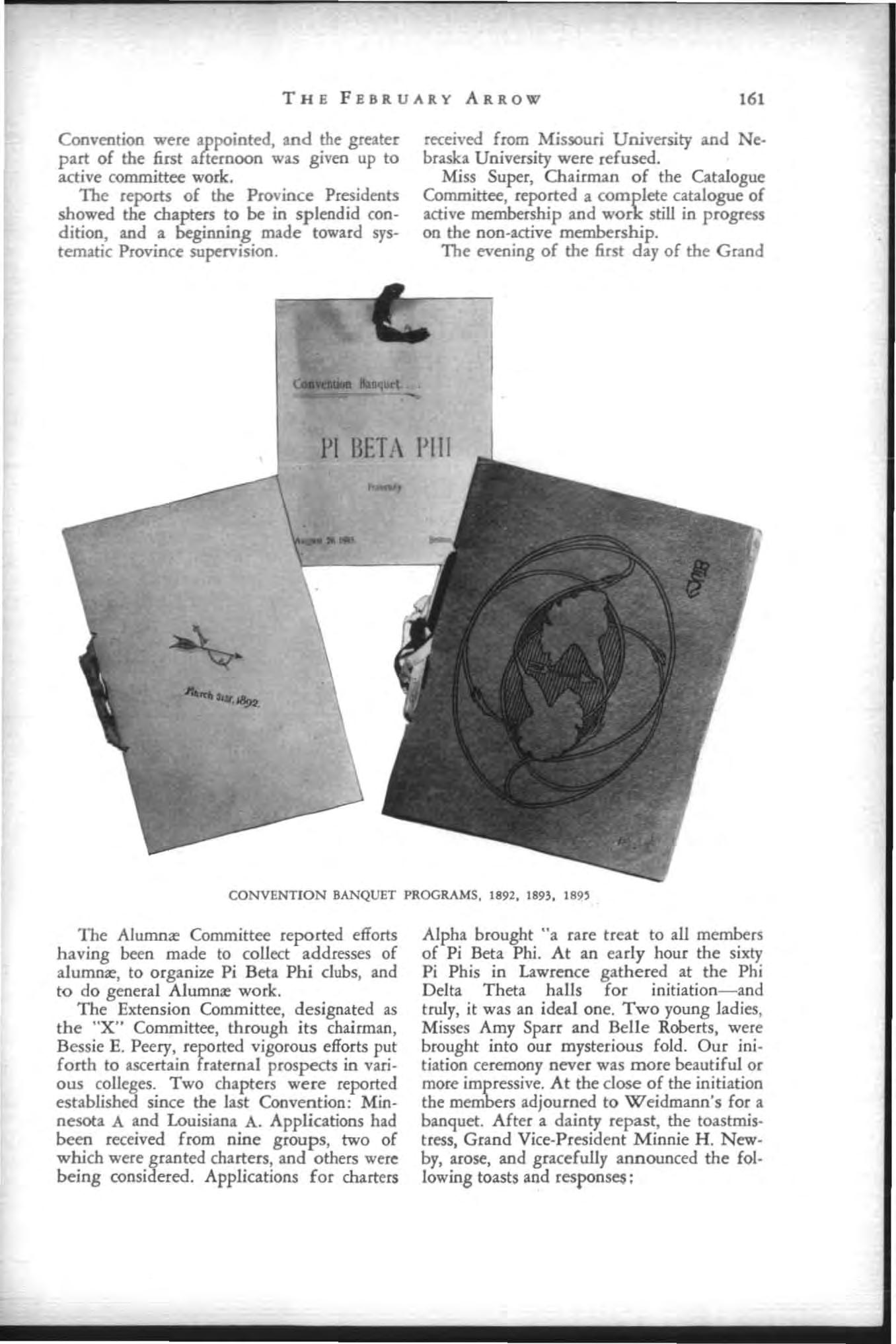
received from Missouri University and Nebraska University were refused.
Miss Super, Chairman of the Catalogue Committee, reported a complete catalogue of active membership and work still in progress on the non -acti ve membership.
The evening of the first day of the Grand
CONVENTION BANQUET PROGRAMS. 1892, 189l, 189'
The Alumnre Committee reported efforts having been made to collect addresses of alumme, to organize Pi Beta Phi clubs, and to do general AIumnre work.
The Extension Committee, designated as the "X" Committee, through its chairman, Bessie E Peery , reported vigorous e£lorts put forth to ascertain fraternal prospects in various coUeges. Two chapters were reported established since the last Convention: Minnesota A and Louisiana A. Applications had been received from nine groups, two of which were granted charters, and others were being considered. Applications for charters
Alpha brought "a rare treat to all members of Pi Beta Phi. At an early hour the sixty Pi Phis in Lawrence gathered at the Phi Delta Theta halls for initiation - and truly, it was an ideal one . Two young Jadies , Misses Amy Sparr and Belle Roberts, were brought into our mysterious fold. Our ini· tiation ceremony never was more beautiful or more impressive. At the close of the initiation the members adjourned to Weidmann's for a banquet. After a dainty repast, the toastmistress, Grand Vice-President Minnie H. Newby, arose, and gracefully announced the following toasts and responses;
'Welcome: Edith Grubb, Lawrence, Kansas
'The Greeks and th e Barbs: Marion Niles, Galesburg, Illinois
'Our Absent Sisters; by one of the absent ones (Read by Katharen Porter, Ames, Iowa)
'Auf Wiedersehen; Edna Clark, Washington, D .C
"The speeches were interspersed with rOllS · ing Pi Phi songs
"The ban9.uet over , the banqueteers re· turned to Ph, Delta Theta halls, where they informally received tbe gentlemen of that fraternity."
On Wednesday morning the Convention assembled for a short business session and then adjourned to visit the University. Wednesday afternoon, was most delightfully spent in a reception given by Kansas A, assisted by the VIsiting members of Pi Beta Phi , to aU girls of the University . It was held at the home of Marne Tisdale, "and with the exqu isite toilettes of the girls, the profuse floral decorations, the dainty refreshments , the brilliant light, the sweet music of mandolins, the social converse, was a most enjoyable entertainment. It was a pleasure to meet the girls of Kappa Kappa Gamma, Kappa Alpha Theta, and those who, to us, were so unfortunate as never to have entered the mysteries of fraternity life. The day of so much pleasure was most deligbtfully closed by a Panhellenic bop, given to the ladies of Pi Beta Phi by the members of the chapters of the six gentlemen's fraternities represented in Kansas State University:'
Thursday morning was given up entirely to hard work in Convention. The literary Bureau report was fr ese nted arid read by Mrs. H H. Harrison 0 Illinois A The substance of the report was that the fraternity should study more specifically, "Woman and Woman's Work ," Mrs. Harrison suggested a course with that object in view. The report was accepted.
The report of the Woman 's Panhellenic Convention held in Boston in April , 18 91, as given in THE ARROW, was adop.ted in full, upon condition that similar ratification be made by the seven women's fraternities represented in the Panbellenic Convention . The matter of a charter to certain Pi Beta Phi aJumnre resIdent at Des Moines, Iowa, was referred to the Grand Council for investigation and final action.
It was recommended that individual members be permitted to hold copies of the Con-
stitution, subject to recall by their respective chapt ers.
The ARROW Committee recommended and the recommendations were adopted that the publishing of THE ARROW be entrusted to Michigan B, University of Michigan, subsequent to the present school year and that there should be omitted from THE ARRow the school-girl expressions in chapter letters, heavy literary articles, and that greater prominence be given to fraternity subjects, current topics, and matters of special interest to women.
It was voted to have Convention Minutes printed and supplied to each chapter.
A motion by the Committee on Literary Bureau that each chapter maintain a reading table and that arrangements be made for supplying same with matter through alumna: contributions was adopted.
Th e Committee recommended ; and the Convention adopted:
1. That a general Alumna: secretary be appointed to have supervision of Alumna: work.
2. A plan of sending circulars to Alumna: at stated intervals; these circulars to note:
a. The Development of I.C into Pi Beta Phi.
b. The status and condition of the fraternity.
e. Quotations from Constitution relating to AllUllllZ.
3. That Pi Beta Phi Clubs be formed wherever practicable.
4. That Alumna: be urged to purchase new Pi Beta Phi pins.
5. That a system of circulating letters among A1lU1lllZ be inaugurated .
6. That Alumna: secretaries be appointed in large cities .
A motion that Alum"", be requested to subscribe to the fraternity $3 00 per year for three years, subsequent to graduation to be apportioned thus: $1.00 to ARROW subscriptron ; $1.00 to Grand Treasury; $1.00 to chapter Literary Bureau, was lost after much discussion. Later the motion was adopted after the last clause had been struck out.
lt was decided that the next Biennial Convention should be held in OUcago dnring the summer of 1893, incident to the second Woman's Panhellenic Convention. It was also moved and adopted that in the future Pi Beta Phi Conventions should be held in cities and during the summer months _
The feasibility of future Pi Beta Phi Con-
v e ntions assembling regularly in Washington, D .C. , was discussed but no definite action was taken.
For the first time the national organization discussed the erection of a chapter house at Ann Arbor and out of the discussion grew the appointment of a Committee to fully investigate the chapter-house prospect at Ann A rbor and to report to the Grand Council in May.
The Grand President named as a Committee of three to look after Oub House interest in Ann Arbor: Miss Gertrude Oark, Miss Ella M. Ham, and Miss Helen Sutliff.
The report of the Grand Treasurer Georgina Rowland showed a balance on hand in the fraternity's favor.
"Notwithstanding the lowering weather, Thursday evening found not one Pi Phi absent from the crowning event of the weekthe receptioo and banquet. The reception was held in the spacious parlors of the Elbridge House, where assembled the members of Pi Beta Phi and their friends. During the hour given to sociability many pleasant acquaintances were formed. At eleven o'clock all moved to the banquet hall, which was handsomely decorated with long festoons of smilax and the wine and blue of Pi Beta Phi. The tables, arranged in the form of a Maltese cross, were beautiful with their Bowers aDd silver and mellow light of shaded lamps and wax candles. The one hundred and thirty guests were served an elegant menu.'·
"After the Jast course was over, the toastmistress, Jennie Sutliff, of Lawrence, aptly and charmingly announced the following toasts and responses:
'Fraternity- A Magic Word; Emma Harper Turner, Pi Beta Phi.
'Fraternity-A Social Factor; Chancellor F. H. Snow, of Kansas State University.
'Our Mutual Friend; Mr . H . E. Cooper, Sigma Nu.
'The Rush Line,' Mr Montgomery Hallowell, Phi Kappa Psi.
'The Corridors,' Mr . F. H. Riddle, Sigma Chi.
'The Spirit of Good-fellowship; Mr W. H . Johnson, Beta Theta Pi .
'The Mysterious Woman; Mr. W. H White, Phi Delta Theta.
'The Wine and the Blue; Mr . C. H. Johnson, Phi Gamma Delta
"At last the final words were said, and slowly the happy, delighted throng left the halls; good -nights were said, and homeward
all went, ca.rry ing with them memories of a very pleasant evening."
On Friday morning a recommendation of the Committee on G.taJogue was adopted: To print in THE ARRow once per year, the names and addresses of active members as an expedient measure pending the completion of general catalogue work.
A number of changes and additions were made in the Constitution induding the celebration of Founders' Day, the election of Corresponding Secretary for one year, the adoption of the Fraternity yell to read:
"Ring, Ching, Ching Ho hippi hi Ra Ro Arrow Pi Beta Phi," the adoption of the /lag, and • provision that the chapter should supply initiates with membership certificates .
A very important measure was adopted which provided: "Associate chapters shall be prohibIted from initiating new members."
This of course, meant the death of the Associate Chapters . In the vote on the amendment there were 18 affirmative, 7 negative .
In referring to this measure, Dr. Bessie Peery wrote in 1893:
"Again the old question came up with reo newed vigor at the Lawrence Convention in March 1892 and this time with a very decided result. When the Associate chapters entered the Convention they felt that they were helpless. They could only point to the past inconsistency of the fraternity 00 this question, and appeal to our kindness and sense of justice. All looked forward with dread to the day on which the question should come up. In those four chapters were some of our most loved and honored sisters . Yet we knew that to favor them meant resigning ourselves permanently to a second place in the fraternity world. Nay, more. The Women's PanheUenic in '91 marked an era in women's college secret societies. It had adopted a certain condition to which we must conform or cease to attempt to rival those who did . In short, give up at no distant day Our college chapters which could not hope to hold their own in the unequal contest . Thus justified hy the intention of our Founders and the future prosp<rity of the fraternity, but with hearts filled with pity and regret many of the delegates cast their votes that day, denying the Associate Chapters the right of initiation."
Let it be said of those four strong Asso · ciate Chapters-that they numbered loyal, en -
thusiastic, splendid Pi Phis. Ottumwa entertained the Convention in 1888 and did it magnificently; Iowa E furnished two Grand Secretaries in Elva Plank and Sude Weaver Evans. Ottumwa, too, had contributed a Grand Quaestor, Elizabeth Flagler. Nebraska A had become Associate through the loss of her college home and had distinguished herself in the establishment of a public library Iowa I numbered among its members outstanding workers in the fraternity . who had, many of them, transferred from Iowa A .
This vote of Convention , however, wrote the beginning of the concluding chapter of the history of Associate groups .
Another important measure adopted was the one which read: "Whenever the word Sorosis occurs in the Constitution, the word Fraternity shall be substituted. "
A slight change was made in the Initiation Ceremony, and it was decided to have a general exchange of chapter photographs.
Among those to whom the Committee of Resolutions expressed thanks were : " Col. Roberts, who so kindly furnished the music on the evening of the banquet" and "Illinois B, for providing the Convention with a Quadro-Centennial souvenir in the photograph of the Founders of Pi Beta Phi "
The election of officers resulted in the following: Grand President , Emma Harper Turner, District of Columbia A; Grand VICePresident, Mira Troth, Iowa K; Grand Secre· tary, Minnie Howe Newby, Michigan B ; Grand Treasurer, Helen Sutliff, Kansas A; Grand Guide, Frances E. Flagler, Iowa e ; Grand Historian, L. May Copeland , Mirhigao A; Alumn., Secretary, Corrine Super, Ohio A; General Secretary and Asst . to Grand Secretary, Ona Hamlin Payne, Indiana A.
After the close of the Lawrence Convention, the delegates return ed to their respective rhapters, filled with enthusiasm and inspiration_ Too, the development of the fraternity received a great impetus in the definite organization of the alumnre, or as the ARRow Editor expressed it, "We salute the newly made aJumn., of Pi Beta Phi."
Attention of the chapters was turned towards the ethirs of pledging and rushing and many felt that the conditions demanded some system of interfraternity courtesy and hoped that the coming PanheUenic meeting would take decisive action in that direction .
Much attention was directed towards the gathering of material for the Pi Beta Phi
exhibit for the World's Fair. Ohio A, in one letter reported that she was " preparing the circulars, the part assigned us to prepare for the exhibit at the Columbia Exposition. These circulars will be sent to every member of the fraternity.
Later Pi Beta Phi withdrew from the proposed interfraternity exhibit giving as her reason that "the delays by the Chicago Committee in charge to make definite arrangements made it impossible to collect a creditable exhibit in the short time remaining." The fraternity did , however, h ave a display with Kappa Alpha Theta, Delta Gamma, Gamma Phi Beta and Delta Delta Delta in a Fraternity Booth in the Woman's Building, where a Pi Beta Phi Register was kept.
On October 12, 1892, Pennsylvania A was organized at Swarthmore College , Swarthmore, Pennsylvania.
During 1892-93 there was marked internal improvement in the fraternity and Pi Beta Phi was certainly holding her own against her rivals wherever she had been established for some time, but she was not expanding as many of her officers and members wished.
During those years when Pi Beta Phi had been struggling to hold together as a unit and had been fighting for her very existence to maintain the standards set by the Founders , her strength and attention had necessarily been directed towards her existing chapters. In the meantime her rivals, especially Kappa Alpha Theta and Kappa Kappa Gamma , had been branching out- putting new chapters especially in the eastern territory.
There was no doubt that Pi Beta Phi suffered at the hands of the Greek world because of the fact that up to 1888 she had not borne a Greek name and because of the existence for those few shott years in the eighties of the associate chapters .
Although members of Pi Beta Phi insisted , and rightly, that tllere was not and never had been any provision in the Constitution for the legal establishment of the associate chapters, the chapter roll remained.
This matter of chapter roll was becoming more important each year in the business of expansion . It was necessary, of course, to have the approval of college authorities before entering institutions and in some in · stances Pi Beta Phi paid the penalty of her years of internal strife
When Pi Beta Phi turned her attention to concentrated extension she found a number
POUNDERS IN THEIR COLLEGE DAYS, 1867
Souvenir of the 1892 Convention. Presented by III inoi. Ikta . 1. Emma Kil& o lc . 2.
MO(Ke. 3 lJbbic Brook: Gaddis. 4 Fa01lf Thomson. ,. Nancy Black Wallace , 6. Clara IJrownl« Hutchinson. 7. M. rg lm Campbell. 8. I nel SmIth Soule. 9. Ad. Bruen Grier. 10. Jenn ie Home Turnbull . 11 . Fannie Whitenack Libbey.
of desirable fields already occupied. From 1890 to 1893, the Extension Committee in· vestigated 20 institutions and recommend ed charters to only four groups.
We must remember that in those early times there were still few students as com · pared with today's registrations, and often an institution could not furnish material for more than one or two good fraternities .
It was a matter of grave concern with the
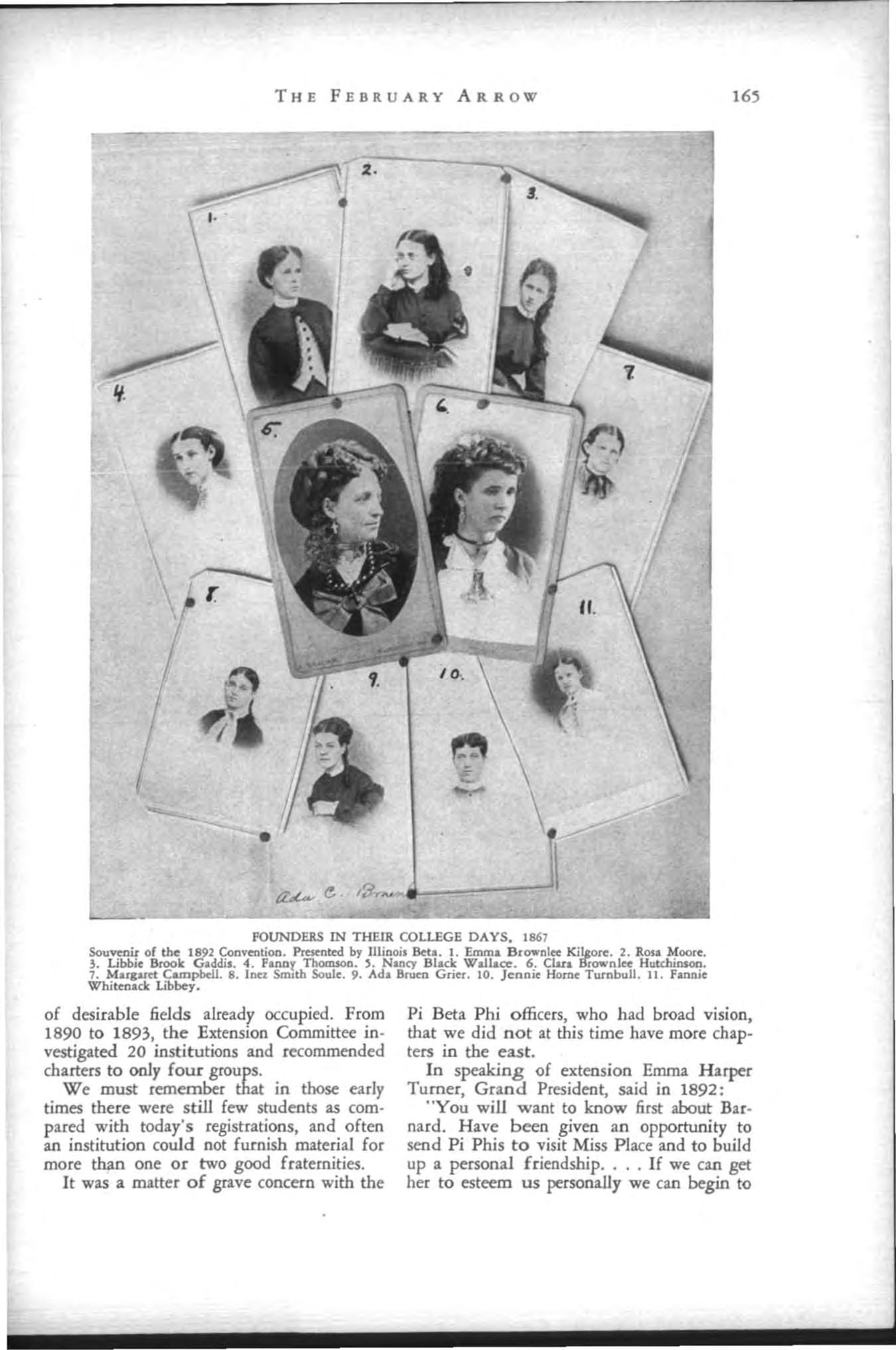
Pi Beta Phi officers, who had broad vision, that we did not at this time have more chapters in the east.
In speaking of extension Emma Harper Turner, Grand President, said in 1892: "You will want to know lirst about Bar · nard. Have been given an opportunity to send Pi Phis to visit Miss Place and to build up a personal friendship If we can get her to esteem us personally we can begin to
hope. Th.is personal friendship will have to beCome ou r one reason in the face of such bitter and strong rivalry in the large instiand we need depend on no other untIl we are better equipped with a stronger chapter roll One of the first things Miss Place asked me was if we had a chapter at Cornell."
To continue, Miss Turner said: "I have urged the Swarthmore chapter to plant a chapter at the University of Pennsylvania .... I am more and more to the conclusion it pays to build up strong chapters in growing Jnstitutions. where you are nest on the .field, rather. than waste vitality in attempting to edge In on to fields already taken .... I'm wonde!lDg ,f the St. Louis University is not becommg coeducational and shall write Miss Chase there now to look into the matter at once. I know positively from a semi-private letter that Kappa Kappa Gamma is to make a great effort to establish herself in the West as she is now in the east. . Have you ever thougbt of the State Universities in the Northwest? Let's take the West for Pi Pbi If there are barely five to begin on . Do you hear anything of work at California State UniverSity r'
Since Cornell University seemed to be such a strategic point for a fraternity chaf'ter because of its standing in the educationa world it was evidently deemed necessary to estab: lish a chapter there.
Believing that it would be better to build up a chapter quietly rather than to face the open opposition of rivals, a chapter was "planted ' at Cornell University on December 17, 1892, with Grand Council sanction, by Franc Arnold, Alpha Province President. There were six charter members.
Emma Harper Turner, Grand President, issued a printed slip to all chapters and officers of Pi Beta Phi which read :
.1D strict we may tell you, Pi Beta Ph, ha..s establIShed a chapter at Cornell which is to be sub rosa until the fall of 1893 and to become then provid('d a sufficiently'large mmlbcr. IS secured. Such a course is deemed necessary 0"J08 to the strength of rival fraternit ies at the school.
That ow: Cornell chapter may be announced in due season we solicit the aid of every and a.sIc that each will keep a sbarp lookout for young WOlDen proposing to mter Cornell, making note of-
Preparation fOl college.
Schohuship.
Social qualities, etc.
And oot for Cornell alone, but for-
1. All eastern co·educational schools .
2. The Women's Colleges, Wellesley, etc.
3. All schools in which we desire to locate chapters .
4 . All schools in which chapters are now 10' cated.
Investigate the college intentions of H ig h Sch oo l classes. etc. Report all items bearing on subject above to address below.
Do not pledge any possible members without correspondence 00 the matter.
The report ' of the Extension Committee to Grand Alpha in July 1893 shows that "after six weeks' hard work with five Pi Phis on the ground, New York A at Cornell University was org anized on D ecembe r 17, 1892 by Franc Arnold, Michigan B. M embers hip : Louisa Smith and five members of Iowa r Ames, who were attending Cornell sity: Sarah T. Barrows, Charlotte Barrows Jennie Thornburg, Elmina Wilson, and Min: nie Robert s. Patronesses: Mrs. Charles Avery Collins, wife of professor of law, Mrs John M . Barr, wife. of. assistant professor of Mech anICal EnglOeenng, Mrs. Edward Hitch· cock, wife of professor of Physical Culture Mrs. W. F. Wilcox , wife of professor oi Philosophy."
The Convention in 1893 appropnated $30 to contlDue the extension work at Cornell."
In 1894, about a year after the chapter was established there was some co rrespondence about a Bould er, Colorado, girl who was gOlOg to enroll at Cornell. Helen Sutliff of Kansas. A, was evidently interested in the girl and M,ss Turner IOstructed Miss SutlifJ: " At all events be sure to pledge her before she does go. And if there is any Pi Pbi at all there, she can be initiated the day of her matriculation for you know New York A is a duly organized chapter. Who has their charter now? Tbere was only a certilicate unless you reissued a ch arter when the new ones were received ."
Turner's expression, "If there is any p, Ph, .at "!l ther,::' could well be applied to the Sltuanon which then existed at Cornell. It seems that the girl, who was recomme nded by Franc Arnold to be in charge of the cha
Lter, had failed to wnte to Miss Turner. n fact, sbe had done nothing about inviting new members into the group. Hence, because of the inactivity of the members, the group exlsted only a little mOre than a year.
One of the Pi Phis who was at Cornell at the time reported late r that she believed a chapter migbt bave been organized easily
enough had the right girl been left in charge
It was quite understandable that girls hesitated about uniting with a new chapter, if small in numbers) btcause of the financial burdens of the first year, consequent upon entertainments.
Thus the first New York A passed out of existence.
Elva Plank, as a member of the .Al= Committee, had beeo interested in working up a successful alum= chapter in Des Moines and gave the group there alJ possible assistance. In January 1893, the nes Moines Pi Bola Phi .Alumnae Association, which had been fun ctioning regularly for three years, r eported bi-weekly meetings and applied for an a1um= charter saying:
" There are thirty Pi B<ta Phis resident in Des Moin es and an alumrur chapter could do much good for them and for the fraternity ."
On March 14 a meeting was held at the home of Miss Olive McHenry, at which the organization of Iowa A was effected, the charter being issued on February 6. Thirteen charter members formed this new alumna! group, the first to be chartered under the new national aJumnz organization.
On April 13, 1893, Indiana B was in -
stalled at the Indi ana University, Bloomington, Indiana and once again the ARRow was seen on the campus, the first time being in 1874.
Just what had been accomplished by the Committee on Chapter House is not certain, but records show that Michigan B reported early in 1893: "Our chapter house we enjoy very much. It is a great hel p in rushing and in initiating and makes foe a positive fraternity life."
Emma Harper Turner, who was untmng in her efforts on behalf of the fraternity'S progress, visited many of the chapters in the spring of 1893 and in April sent out a Convention Call which read :
"The thirteenth biennial convention of Pi Beta Phi will be held the week of July 17 , at the Isabella Hotd, Chicago, Illinois. Convention will be called to order Monday evening. All sessions will occur in the evening so as not to conflict with attendan ce at the Fair."
In response to the Convention Call, two of the Founders, Emma Brownlee Kilgore and Fannie Whitenack Libbey sent their registration fees and made eacJy reservations, but neither, when the time came, was able to at· tend.
In view of the amazing things that women allover the world were accomplishing in the stirring days of the nineties, it is not surpris· ing that they made rapid strides in the devd0rment of their f ratemity systems. The days o groping and da r kness were go ne.
The history of Pi Beta Phi parallels the progress of the college education of women - both up to this time had been experimental. The m<thods and meaning of education were far different some 50 years before. Now, however, by 1893, the experiment of the bigher education of women was acknowledged an unqua1ified success and women were thronging through college doors. Public sentiment had changed in favor of co·education.
Just what were women doing in the world, you ask? Glance for a second at some of the paragraphs which appeared in THE ARROw at this time under the heading: "Of Interest to All Women."
Miss Victoria Whitnry has the honor of the first woman ever admitted to practice in the St. Louis Court of Appeals There are two hundred women in America who practice law or do legal wo rk of some kind.
• •
Miss Florence Bascom, who was admitted to Johns Hopkins in 1891 by special recommendation , has attracted considerable attention by her original work in rocks and fossil s. Last summer she surveyed a five mile square district in the Blue Ridge 1tfountains, doing her work as thoroughly as any of the men students. • • •
Henrietta Herschfeld , the nest woman graduate of .the Philadelphia; G;>Jlege of Dental Surgery, is asSIStant court dentIst 10 Germany.
• •
Mes. Arthur Stannard (John Strange Winter) has been eJected a fellow of the Roy al Society of Literature, the first time the ho n or has been conferred. on a woman since the society was founded in 1823_
1884--Kay Spencer, Burlington
Anna McLaughlin, Indianola
Mamie Hooker, Carthage
Libbie Evans, Jowa City 1892-Alpha Province-.Florence P. Chase
Beta Province--Laura Crane
Gamma Province-lone Weatherby MarSh
Delta Province----Edith Ingers oll 189)-Elilabeth A. Culver, Chairman Prindle, Chairman 1897·99-Qlivia Ambler. Chairman.
It is not known how many of the chapters carried out the work as outlined by the Literary Bureau, but a number of them endeavored to cooperate with the Bureau and were sympathetIc with the "course of work" which was intended to broaden the viewpoint of all members of the fraternity.
The program, recommended by the Bureau , and adopted for the school year of 1892 and 1893 follows:
The Fraternity is in sympathy with the na· tion 's thought
1. A course of five, public informal evenings, addressed by invited guests on topics of American history, appropriate to this Quarto-Centennial cele. bration.
a. Topics may be selected by speakers.
h. These evenings may be distributed through. out the year.
c. Very light refreshments should be served.
d. If a large reception be given through the year let continental dress be adopted.
2. A Mothers ' Evening, to which should be jnvited mothen and friends among the women of the college town, and at which should be rendered a programme exp lan atory of Pi Beta Phi ideals and methods.
a. Material for above programme will be supplied by Literary Bureau. Apply to Chairman.
b. Leaftets giving information regarding the Fraternity will be supplied by the Bureau at nominal cost. These should be distributed at the evenings in the Course and carried home by guests This is an important matter These leaflets are/,,pared to disseminate correct ideaJ in regar to
Pi Beta Phi and will do much toward extending its reputation.
c . If desired the programme on Pi Beta Phi may be added to an evening in Course.
3. Compulsory: l.(emorizing the four verses of "America."
4. Advised, if additional chapter work be desired, we recommend the game, "American H istorical Cards," Mcloughlin Bros., New York; and if used one evening might become an Hist orical Card Party, which could be made thoroughly enjoyab le to o lder guests and perhaps do good in ex· hibiting the ignorance of students on topics of American Hist ory .
5. Use must be made of newspapers.
6. If entertainments be added to this Programme let none be given in the name of Pi Beta Phi, that could possibly evoke criticism from a ny class of citizens.
1. The course rlanned is appropriate f or an organization 0 patriotic, educated young women.
2 It is expedient, since Pi Beta Phi NEEDS:
a. A course of public work to show it is not merely a school girrs society.
b. To extend its reputation among ALL people interested in education.
c. To convince {>ruents we desire and deserve their cooperation.
3. These Evenings shou ld be public, because:
a. There is no necessity for them to be otherwise.
b In order to refute the argument of fraternities being selfish organizations
c. Fraternity members need the association of older people interested in education.
d. They may take on a philanthropic aspect.
Invitati ons SHOULD be issued to students who have evidently been denied social advantages and who need sorely assistance in social matters.
Let us urge this point: Here we have the opportunity of influencing these lives, making them inestimably brighter and broader and our ow n , by reflex action, sweeter and teuer. The Fraternity MUST be philanthropic or it cannot satisfy the noblest part of our nature. Let Pi Beta Phi do this, something positive this year toward influencing college for good.
EWMA HARPER TURNER, Grand
KATB B KING, Alpha Province
LAURA PETERSON, Beta Province
MRS. lONE W. MARSH, Delta Province
MAUDE C. HARJUSON. Gamma Province
The co mi ng Convention promi sed to be outstanding and different from any of the previous ones . According to THE ARROW : " The work will not be so entirely cons tructive; and by that we mean , there arc not SO many ,p?iots in OUf organization demanding additional provisions as he retofore . After a trial of three years the Constitution and plan of organization are found in the main satisfactory and will not need prolonged consideration.
" With less attention demanded as above, there will be more time for the consideration of Pi Beta Phi 's position on many topics coofronting the fraternity world today We need to take a definite stand on certain topics and policies and to have that position known and followed throughout the confines of our fraternity.
"There will be unequalled opportunity for explaining and discussing the future of the fraternity. And above all, the Convention offers splendid opportunity for becoming acquainted."
A splendid rate of $1.00 a day was made by the Hotel Isabella management and the net proceeds of the Hotel, at the close of the Fair, were to be used as a Hospital Fund , to be under the control of women physicians.
By holding the Convention in the World's Fair city, so many Pi Phis were attracted to Chicago, that it was possible for various thapters to hold reunions. These chapter gettogethers have, since that time, been outstanding features of national Conventions.
The Thirteenth Grand Alpha convened at 7:00 P.M., Monday, July 17, 1893, at the Isabella Club House, Chicago, Illinois, with Grand President Emma Harper Turner in the chair. There were in attendance 19 delegates, 4 officers and 76 visitors.
In a comprehensive report the Grand President reviewed the work of the past two years and stressed the importance of the use of printed matter, giving in detail a description of the various communications which she had sent to the fraternity.
She also reported the publication of the Pi Beta Phi Song pamphlet, the Revised Constitution and Initiation Ceremony . She reported having visited: Kansas A, Nebraska A, Iowa 0, Iowa A, Iowa B, Iowa r, Iowa K, Iowa Z and Iowa A, Illinois d, Illinois B, Chicago University, Indiana A, and Ohio A.
Miss Turner stressed the absolute necessity of Pi Beta Phi representation in all representative institutions. She reported that aLI work and reports relative to tb e selections of designs for the Pi Beta Phi Bag, which had been done by Columbia A, had been lost in the mails.
The Alumna! Secretary , Lillie S Hazelton, reported that her work began in August 189 2 and that during the year 1000 c irculars and postal notes had been printed and sent out to a lumna: in the U.S. and abroad and th at 200 or more of the Literary Bureau circulars had been distributed.
These alumnre circ ulars , issu ed by the Secretary, contained an Address to Alumna: by Ethel Allen , and an article signed by Emma H Turner, G P and Mira Troth , G.V P , suggesting that a college woman's fraternity could not be capable of the greatest good until the alumnz and (ollege members worked together actively and it was proposed that an Alumna! Association of Pi Beta Phi be foomed with a membership composed of: A Alumna: chapters and Clubs; B Alumna:: Corresponding members .
The object of the Association was to be the development of Pi Beta Phi . To that end the circular suggested-
1. Effort toward a fraternity that shall incite al\lJJlflle to continuous study and college members to best efforts.
a. Recognition of all deserving attainments of members.
b. A system of conferring honors.
2. The maintenance of an Alumn.r Department in THE ARROW, which shall be a "Review of Reviews " on the higher education of women.
As a result of the presentation of the plan there was formed at the Chicago Convention, 1893, the /irst national alumna:: association to be created by any woman's college fraternity
It was most fitting, that the woman whose efforts had been turned towards this great Alumnre Organization and whose vision made such a thing possible, should be elected its first President-Emma Harper Turner . Other alumna: officers elected were: VicePresident, Mrs. Laura M. Vance ; Secretary , Effie June Scott; Treasurer, ana Hamlin Payne; Historian, Minnie Howe Newby ; Guide, Dr. Phebe Norris.
The Convention officially adopted the Ritual as prepared by Anna Hazelton.
A badge pin was adopted for the use of Grand Officers, these to be badges of honorary distinction, but supplied at the expense of the individual officers purchasing same:
A _ For President, a small gold gavel.
B For Vice-Pres ident, a gold scroU with wine enamelled gavel and letters Pi Beta Phi across face
C. For Treasurer, the $ sign in gold wire
D. For Secretary, gold pen with Pi Beta Phi in black enamel across same.
E. For Grand Historian, white enamelled scroU with Pi Beta Phi in gold letters across face.
F For ARROW Editor, white enameUed scroll with word Arrow in gold across face.
There is no record to show that these were ever used .
A committee was appointed to redistrict the Provin ces with a view to holding Province Conventions.
It was voted to leave the publication of THE ARROW with Michigan B for the interim of Grand Alphas: '93 to ' 95 .
Again at this Convention came the discussion of whether preparatory students could initiated in June after passing examinations for college freshman dasses. The general opinion was that they could not-that it was unconstitutional before a student had matriculated as a freshman.
Ohio A reported much work done on the Catalogue.
It was recommended that the next Coovention be held at Washington, D.C.
Two i.mportant resolutions adopted by the ConventIon were:
1. Since mock initiations tend to detract from the solemnity and impressiveness of the real ceremony, and since they do not fairly represent the true spirit and hi g h purpose of Pi Beta Phi , Resolved, that we earnestly desire and recommend that such initiation be dispensed with.
.2. Since there exists a great deal of prejudICe agamst us by reason of the opprobrium that has become attached to the word "secrecy,·'
Resolved , that we insist that the word as used by_us be understood merely 10 sense of pnvacy, such as prevails in the highest types of that sacred Institution the family '
The election of officers resulted as follows:
Grand President- Helen B. Sutliff, Kansas A*
Grand Secretary-Grace Lass, Illinois 1J.
Grand Vice-President- Corinne Super Stine Ohio A '
Grand Treasurer- lucinda Smith, Kansas A
Grand Historian - Olive McH e nry, Iowa A
Grand Guide-Edna A. Clark, Columbia A
Catalogue Secretary- Mary Clark Bancker Michigan B '
The outstanding success of the Convention was due in large part to Minnie Howe Newby, Grand Secretary, wbo had full charge of arrangements for and during Convention.
One delegate . in commenting upon the ChICago conventIOn said: "This co nvention differed from others in several ways . In the nrst place we were not the guests of any and thus missed the pleasure of seeIng the school and social life of our friends in other colleges. There could also be none of that hospitality and gratitude that comes from the relation of hostess and guest. Also by reason of the many attractions that invited our attention during fraternity week at the Fair, many of the pretty externals of Convention had to be dispensed with . But to the convention sessions themselves came that quickening of life, which usually comes when we dispense with externals. Every moment was well used, and a great deal of bu siness transacted in a short time."
The period Jwy 17 to 22, 1893, was designated as Fratermty Week on the World's Fair calendar. Many of the men's fraternities held conventions and reunions at that time. Kappa Alpha Theta held a very large convention the following week.
The second Woman's Panbellenic Congress conve?ed on Wednesday, July 20, at the Art Institute. Pi Beta Phi was represented by Gertrude Boughton Blackwelder who read a paper on "Ethics of Fraternity ." This paper was later published in several of the fraternity maguines and highly complimented.
At the Panhellenic reception , held in the New York State building, Pi Beta Phi had the largest representation of any woman's fraternity.
Delegates:
Columbia .A , Clara Pmnsylvania A, Dora Gilbert; OhIO A , Ehzabeth Foster; Indiana A.
• Ona H. Payne was first nominated III Grand President and Helen B. Sutliff as Grand Tteas· utero U:poo the of Miss Payne, HeJen B. Sutliff was nommated for Grand and Lucinda Smith. as Grand TreJSuter .
I..ella HaIman; lodiana B. Della Mount; Michigan A. Michigan B, Dora B. Elmer; louisiana A, lsabdla Coleman; lUinois B, Margaret Titus; lUinois Frances Arnold; Iowa A., Mabd Milner; Iowa B, Ethel Gilbert; Iowa r, Helm Radnich; Minnesota A, Elw.-
beth Foss ; Iowa A. Harriet Eldco' Colorado .A, Elizabeth Smith; Colorado B. Nan McParl and; Kamas A, Mabel Scott; N York A. Sanh Barrows; Iowa Z, report received. Delegate detained by sickness; Iowa K. report received.
If you would lind answers to questions such as: Did we ever have pledges at Wellesley College and at Chicago University? Why dId we not enter Nebraska State University sooner I-just glance through the Report of the Extension Committee to Grand Alpha in 1893, which follows:
Ind ian.a B: Indiana State University, organIZed April 13, 1893, by Elizabeth Middleton Indiana A. •
Mt. Union: Request for information and favor· able action by men's fraternities. A ction vetoed by Grand President.
Swarthmore, Pa .: Investigation by Miss A. Maris and Mrs Zuell Preston Tyler of Michigan B. Olapter organized. October, 1892.
Budnell University: Information furnished by the men's fraternities at Bucknell. School vetoed by Grand Council and Michigan B
.Chicago Univmity: Investigations made by MISS Mary C. Bancker of Michigan B chapter pledged but its establishment thwarted through action qticago Un}versity faculty discouraging In the University.
UnIversity of Pennsylvania: Little progres$ made. School vetoed by Ohio A.
Nebraska State University: Inv estigation carned on by Kansas A but no definite results.
Ohio State University: Favorable report made by Grand Historian School vetoed by Michigan B. Chapter vetoed from want of material by Ohio A.
Brown University; Investigation carried on by Grand President and Miss E. C. Eddleman of A. Nothing has as yet resulted, sJl!ce It was absolutely lDlpossible to SfXUre replies from young women at Brown in anything like a reasonable time.
Cornell University: Investigation made by Provo ince Pres ident, Mrs. Franc Arnold Chaddock and after six weeks hard work, with five Pi Phis on the ground, New York A was organized (sub rosa), December, 1892.
Wellesley: In vt'Stigation made by a sister and friend of Miss Bancker, the friend being a member of the faculty and the sister a student. Six fresh· men pledged to Pi Beta Ph';. Formal app li cation for permission to establish a chapter was made to the President in March, the receipt of matter v.;as acknowledged and a promise given to con· Sider the matter at an early date. No positive decision has been rendered as yet.
Des Moines Alumnlf : Under no investigation but their writtm pledges to maintain a true fra· ternity chapter reassured the Grand Council and the chapter was organized Much 14, 189l
Wooster, Ohio: Investigations conducted by Kansas A. and minois d, through men's frater-
nities. Conditions reported very favorable. School vetoed by Michigan D.
Indiana State University: Investigations made by Indiana A, the Grand President and a member of Indian!l A attending school at the University. All conditions favorable and chapter organized April, 189l, Bloomington.
De Pauw University: Names furnished by a Kappa Alpha Theta friend to the Grand President. Investigatton referred to lnd iaoa A.. Strong hopes for new/ear_
ulan Stanford University: made by Kansas A., Colorado A, Grand Historian, Dr Peery and others. An application of six youn,l!: women now 00 file. The applicants come highly r«emmended and need. only persooal investigation for final action.
Madison, University of Wisconsin: AppHcation of 12 young women highly commmded by well known Phi Dcltl Theta and personal invt'Stigation on ly lacking for final action.
Baltimore: Personal investigation made by :Miss Elizabeth Culver of Colorado A, and the Grand President. Arrangements were completed to absorb a most flourishing local fraternity, the Tau Kappa Pi, and the day named on which Columbia .A. would visit Baltimore lind initiate the Tau Kappa Pis , but a few days preceding that evening word was received that the President of the colle,l!:e OBJECTED to Pi Beta Phi on the ground that it was too lar$e a fraternity, and had persuaded this local fraternIty to attempt to form a new national. No report of their progress hu ever been re· ceived.
University of Cincinnati: Investigations made by Indiana A through the mm's fraternities. Personal investigation made by M..iss Ban cker and an unfav ora ble report made concerning the applicants and material of which the college is supplied.
Dickinson CoUege: Application for information by a local society of young women. Correspondence conducted by Grand President. Favorable action hoped for next year.
Correspondence has also been conducted con· cerning St Lawrence, Illinois State University, University, Syracwe University, Un iversrty of Vermont.
Illinois A Chairman
The October ARROW, 1893, was issued under the Editorship of Mary B. Thompson, with a new Busmess Manager, Mrs. Lucy Parker Huber. Mary Clark Bancker of Oxford, Ohio, was Alumna! Editor For the nrst time there appeared in THE ARROW the Alumna! Association Directory, with the names of the national alumna! officers, eight state secretaries and two club secretaries.
In THE ARROW Directory, too, Grace Lass ' was listed as Catalogue Assistant in place of Mary Clark Bancker , who was elected to the position by Convention. Grace Lass was also Grand Secretary.
This same issue of THE ARROW announced the addition of two chapters to our roll: California A at Leland Stanford, organized September 13, and Wisconsin A at the University of Wisconsin . The announcement relative to Wisconsin A was evidently premature, since the chapter was not installed until November 1, 1894 .
Closely following the installation of California A came the announcement of the chartering of a chapter in the far east-Vermont A, Middlebury College, Middlebury, Vermont, on December I, 1893, and thus Pi Beta Phi entered entirely new territory .
Under the new Alumna! regime much interest was being aroused among the allllIll1re of the fraternity and Washington , D C., with eight active members reporting a flourishing club. On February 8, 1894, this enthusiastic group gave a tea for 300 people in Washington , in honor of the President of Kappa Alpha Theta, Margaret Smith Abbott, who was visiting in Washington.
"Who knows," wrote the Washington Alumnae Secretary to THE ARROW, "but that Washington may yet see a splendid PanheJlenic club?"
Much space in the fraternity magazine was devoted to the expression of opinions of both actives and alumna! and there appeared i n the spring of 1894 carefully written discussions of Fraternity Ideals, of Fraternity "secrecy," of "How to Rush," etc.
In April the Literary Bureau made its report of the first Fraternity examination The Committee seemed well pleased with the spirit in which the chapters had taken up the study work and reported that all of the twenty active chapters h ad responded splendidly. Five of the chapters were rated: Excellent : Minnesota A, Kansas A, Oh io A, Columbia A, and Vermont A.
Two more chapters were added to the chapter roll early In 1894: Ohio B at Ohio State University, Columbus, Ohio, and Illinois E, Northwestern University, Evanston, Illinois.
With the announcement of these new chapters there also came the regrettable news that Iowa r, Agricultural College, Ames, Iowa, was having to give up her charter be-
cause of anti-secret society legislation by the co llege authorities
On June 6, 1894, Minnie Roberts of Am.. wrote to Grand President Sutliff : "Three years ago the Fac ulty ruled that there should be no more initiations . .. . Delta Tau Delta took the matter to court, but the decision of the court rendered a short time ago was against us ." And since the chapter had only 6 members left it was deemed " impossible to go on further if we cannot have new members."
At about this same time, the Grand President received a letter from Iowa I, Mt. Pleasant, Associate Chapter, saying that the chapter had considered carefully the matter of continuing and had decided to surrender the charter for one year, ending by saying: "Grand Alpha can count upon our individual love and sympathy."
Thus with a gesture of devotion and loyalty, the last Associ ate Chapter became inactive as the result of the ruling of the 1892 Convention forbidding further initiations by the associate groups.
Pi Beta Phi now turned its attention to extension, studying the fields that were open and endeavoring to add only very strong new groups to its roll. Althou g h Emma Harper Turner was elected President of the National Alumna! Association at the 1893 Convention and gave sr.lendid assistance in alum"", affairs , she still maintained her keen interest in the matter of fraternity expansion.
With splendid vision, she insisted upon the strengthening of the active chapters and the entering of fields in which Pi Beta Phi would be first on the ground. To quote in part from a letter written by Miss Turner on November 8, 1894, to Grand President Helen Sutliff :
"You will soon receive a strong application from Bucknell University, LeWISburg, Pennsylvania. It is useless to think of Wellesley now. The authorities would not consent to the fraternities outside their own college The extension work is enough to make one faint hearted. We do not need more chapters so much as stronger ones. I believe it is surely best to give up the discouraging attempt to force a way into old schools already full of fraternities and to strengthen our forces where they are as to make them command and attract attention everywhere. We may do well to come to the conclusion: Our only means of entering the
eastern institutions where our rivals are strongly entrenched is by waiting until the number of students at schools is too large for the existing fraternities; then the new students will form local chapters and soon apply to us All this will occur, too , sooner than we may imagine. Every year sees more and more of this thing . Mrs. Sober wrote me that was the case at Madison: Kap. pa Kappa Gamma, DeIta Gamma , and Kappa Alpha Theta could have everything they wanted and still leave splendid girls outside. We ought to have splendid chapters in every good western university Every State University is safe. If there were but five girls to begin with, I would form a chapter and enlist all of the inBuential women of the town and get everybody on my side We ought to have Nebraska University . We have some Pi Phis resident there.... I would be very sure if I were you that Missouri University is not a growing institution . * It may not be the equal of Kansas University, yet be good ground for a fraternity chapter and the feeling against it may not extend beyond your own vicinity and state. The papers from Missouri seemed very enthusiastic over it at the time of its recent disaster through /ire and subsequent change of location. Does it not seem Impossible that Missouri would remain indifferent to educational matters? Suppose the University is not a growing institution just now ; rest assured it will be and Pi Phi may find it as hard to enter then, as she does to enter some other institutions now.
• The reco rds show charters were refused gro ups at the Missouri University and at Nebraska University in the Conventi o n o f 1890.
" Now for Illinois University- Do you remember that Knox Coll ege has always been jealous of Illinoi s State ? May that not acco unt for some of the discouraging reports ? As I understand Illinois State Uni versity is very fine in certain lines , scientific work especially. Let US never dream but that lUinois will take care of its State University ."
During the years 1893 to 1900 , Pi Beta Phi granted fifteen charters, seven of which created chapters in the state universities of Ohio, lliinois , Wisconsin, Nebraska , Vermont, Missouri , and California. The remaining eight chapters were installed at Middlebury College, Bucknell , Leland Stanford, Northwestern, Syra cuse University, Boston University, Woman ' s College of Baltimore, and Butler .
In April 1895 , the Literary Bureau made public the results of the second annual fraternity examination, reporting fourteen chapters as "Excellent" and the fraternity work as a whole showing marked interest and improvement.
In this same month the Alumna! Association sent a pamphlet to all Pi Beta Phi .Alumnre Associations; the Michigan Betas reported that nine girls were living in their Pi Beta Phi chapter house at Ann Arbor; and the Grand Council decided, after a favorable vote of the chapters, to hold the session of Grand Alpha the coming summer.
A change of the Convention city was made from Washington , D.C. to Boston, Massachusetts, due to trouble about railroad rates . Lower rates could be obtained to Boston, due to the Knight's Templar Conclave to be held there at that time.
The Fourteenth Biennial Convention convened at the Y W.CA., 68 Warrenton St., Boston , Massachusetts, August 28.29, 189:; with Grand President Helen B. Sutliff pre · siding. The A1= Association held its sec· and convention at the same time,
In attendance ' were: The Grand Council. the Business manager of THE ARROW, the
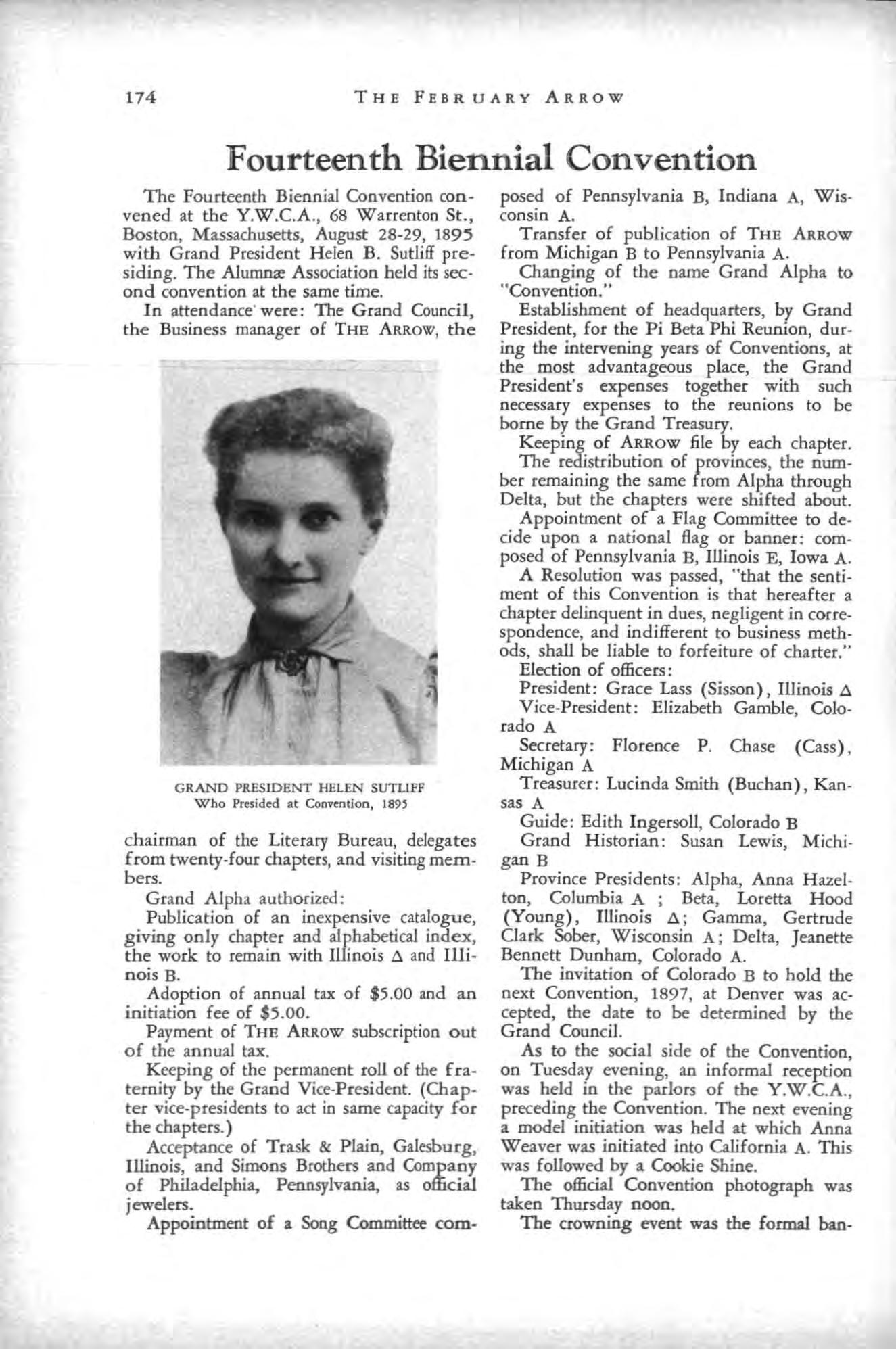
GRAND PRESIDENT HELEN SUTUFF
Who Presided at Convention, 189'
chairman of the Literary Bureau , delegates from twenty-four chapters, and visiting members.
Grand Alpha authorized:
Publication of an inexpensive catalogue, giving only chapter and alphabetical index, the work to remain with Illinois tl. and Illinois B.
Adoption of annual tax of $5 .00 and an initiation fee of $5.00.
Payment of THE ARROW subscription out of the annual tax.
Keeping of the permanent roU of the f ra· temity by the Grand Vice·President. (Chap. ter vice-presidents to act in same capacity for the chapters.)
Acceptance of Trask & Plain , Galesburg, Illinois , and Simons Brothers and Company of Philaddphia, Pennsylvania, as official jewelers.
Appointment of a Song Committee com·
posed of Pennsylvania B, Indiana A, Wis · consin A.
Transfer of publication of THE ARROW from Michigan B to Pennsylvania A.
Changing of the name Grand Alpha to "Convention,"
Establishment of headquarters, by Grand President, for the Pi Beta Phi Reunion, duro ing the intervening years of Conventions, at the most advantageous place, the Grand President's expenses together with such necessary expenses to the reunions to be borne by the Grand Treasury .
Keeping of ARROW file by each chapter.
The redistribution of provinces, the number remaining the same from Alpha through Delta, but the chapters were sbifted about.
Appointment of a Flag Committee to decide upon a national Bag or banner: composed of Pennsylvania B, Illinois E, Iowa A.
A Resolution was passed, "that the sentiment of this Convention is that hereafter a chapter delinquent in dues, negligent in correspondence, and indifferent to business methods, shall be liable to forfeiture of charter."
Election of officers:
President: Grace Lass (Sisson). IUinois t; Vi ce-President: Elizabeth Gamble, Colorado A
Secretary: Florence P . Chase (Cass) , Michigan A
Treasurer: Lucinda Smith (Buchan) , Kan · sas A
Guide : Edith Ingersoll , Colorado B
Grand Historian: Susan Lewis , Michigan B
Provin ce Presidents: Alpha, Anna Hazelton, Columbia A ; Beta , Loretta Hood (Young), Illinois t; ; Gamma, Gertrude Clark Sober, Wisconsin A; Delta, Jeanette Bennett Dunham , Colorado A.
The invitation of Colorado B to hold the next Convention, 1897 , at Denver was accepted, the date to be determined by the Grand Council.
As to the social side of the Convention, on Tuesd ay evening, an informal reception was held in the parlors of the Y .W.CA., preceding the Convention The next evening a model initiation was hdd at which Anna Weaver was initiated into California A. This was followed by a Cookie Shine.
The official Convention photograph was taken Thursday noon
The crowning event was the formal ban·
quet on Thursday evening at wbich the tables, arranged to form the Greek letter Pi, were "deco rated with the fraternity colors, wine and blue and with dusters of the fratemity Bower, the wine carnation. At each plate was a dainty menu card in a blue cover tied with wine ribbon."
Grace Grosvenor, Grand Vice-President. presided at the banquet as Toastmistress and called upon the following Emma Harper Turner, Mary Bartol (Theiss) , Annie Weaver, Joanna Hempsted, Caroline Schwefel , and Helen B. Sutliff.
"Ring, Ching , Ching," proved to be the favorite song of the Convention.
Perbaps the outstanding note of the sessions was that of nationalism. More tha n ever t h e delegates were impressed with the fact that they belonged to a national fraternity whose chapters were spread from the Atlantic to the Pacific Ocean and from Wisconsin to Louisiana.
That SO much business was accomplished in the four sessions of the convention was, acco rding to one delegate, "the result of care· ful work preceding convention and parliamentary ability on the part of the delegates and president."
D elegates to the Convention:
Vermont A, Lena M. Roseman ; Columbia A . Lillian Penn sy lvania A, Anna Smedley; Pennsylvania B. MirY Bartol; Ohio A. Caroline Schwefel: Ohio B . Mary Indiana A , Viola Lukens; Indiana E. Stella Fox: MichiAan A. Grace Higbee ; Michigan B. Joanna Hempsted : Louisiana A. Lily Y. Logan; Illin ois n. Edith Crissey; JIIi · nois .6. , Mabel Aylsworth: JIIinois "E. Ada M ay Gri8}l!J; I owa A. Olive H . Gass; Towa B. Effie Busselle; Iowa Z. Clyde Cobb: Minnesota A. Blanche Smith; Wisconsin A . El izabeth Smith ; Kansas A . May Gardner: Nebraska B . Mae Mill er Lansing; Colorado A. Florence Wilder; Colorado B. M ary Schuyler Ingerso ll ; California A, A nna Weaver.
Business Manager ARROW , Miriam Dunbar ; Cha.irman of Litenry Bureau. Florence P. Chase . Iowa A (Alumntl), Des M oi nes , was not represented.
Florence P. Chase (Cass), presided over the Alumna'! Association sessions in the ab-
sene< of President Emma Turner. Fourteen were present.
The Legislation passed by tbe Association to: Ratification of the Constitution submitted by the Committee at Chicago '93, and revised by the Alumna: Council; the ratification of plans for work outlined by the Council: The Bulletin , Annual Catalogue, Clubs, Conventions.
In the election of officers, Emma H arper Turner was chosen President, with the fuJI
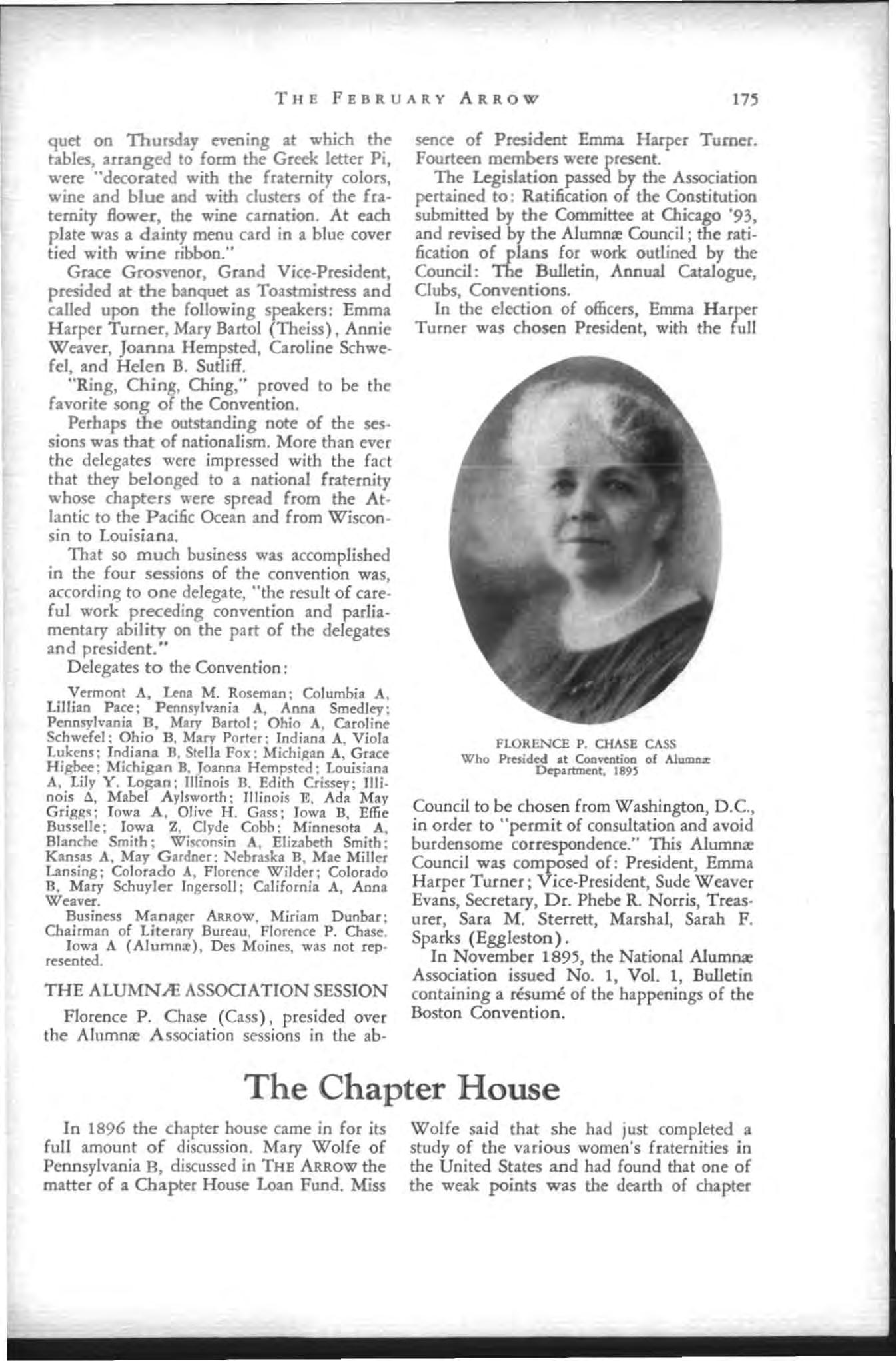
Council to be chosen from Washington , D .C., in order to "pe rmit of consultation and avoid burdensome cor respondence." Thi s Council was composed of: President, Emma H arper Turner; Vi ce·President, Sude Weaver Evans, Secretary, Dr. R. Norris, Treasurer, Sara M Sterrett, Marshal , Sarah F. Sparks (Eggleston) .
In November 1895, the National Alumna: Association issued No .1, Vol. 1, Bullet in containi ng a resume of the of the Boston Convention.
In 1896 the chapter house came in for its full amount of discussion. Mary Wolfe of Pennsylvania B, discussed in THE ARROW the matter of a Chapter House Loan Fund. Miss
Wolfe said that she had just comp leted a study of the various women's fraternities in the United States and had found that one of the weak points was the dearth of chapter
houses, owned by the fraternities She suggested that some sort of a loan fund be started to be applied to the building of chapter houses and proposed that alumna: gIve $1 each, to start the fund.
Closely following Miss Wolfe's article was a letter from a member of Pennsylvania A, who was gravely concerned over the chapter house system. " In the lirst place," she wrote, "it requires perfect co ngeniality or disciplined tempers to permit a number of people to live in the same house together for a year , in harmony. In the second place, is it for the best interests of the college work to have a bevy of talkative girls meeting three times a day in the most delightfully conndential relations, loth to separate? Would not many a minute be spent in chatter that should be spent in study? Would not the frequent interruptions due to the perfect freedom existing between the girls be death to dose and conti nued application?"
It was indeed fortunate for the advancement of chapter houses that California A made such a splendid record during her lirst year in a house Because of the report which she made, others were encouraged to attempt the running of chapter houses
The report of California A, Leland Stanford Jr University written 'by Helen Williams, stated:
"Perhaps there is no stronger factor than the chapter house for making the fraternity interesting to the college community and a power unto itself. After one year's experience in cooperative housekeeping are we wise enough to speak oracularly on the subject? Perhaps so, for we are not so lirmly established that we have forgotten the hard things - the mistakes, and the ways out of them .
"Our chapter house is a mile from the University quadrangle, in a grove of pine trees. It is a square, old -fashioned , well built house We call it ours though we merely rent il. When we build , we shall be nearer the campus .
"We pay thirty dollars a month for our unfurnished house. For convenien c e, however, we pay the entire year's rent during the nine months of the school year, making forty dollars a month during those nine months . We are esFally fortunate in having one of our girls living near. Her mother gladly becarne our chaperon and much of her furniture and one of the gtrls furnished her own room , besides bringing a piano and book-ases.
" So with much management, by hook and c rook we furnish ed our rooms, bought a stove and kitchen uten s ils and a carpet or two. We hired two servants--Japanese hoth of them . One, Ollr cook, received twenty-five dollars a month . The other, a Jap student in the University, waited upon the table at breakfast and dinner, gave us an hour at morning and evening cleaning, and all day Saturday. He received ten dollars a month , and roomed elsewhere
"Ou r whole eXl."'nse a month amounted to twenty dollars apIece. There were ten of us during most of the year. Perhaps you think we could do this because we live in California . Coal, however, is the only difference that makes. Our coal bill from November to April averaged lifteen dollars a month Vegetables and fruits the year around are extremdy cheap, but meat is expensive . Our chaperon had nothi ng whatever to do with our domestic management. This was in the hands of two different girls each month. One, the house president, ordered the meals, kept the table and table linen , saw that the house was kept in order and that the expenses were not running too high.
" The house treasurer collected the money from each of us, gave receipts for everything, paid our house bills and kept the account books carefully . Perhaps it is a good plan to appoint one girl house manager for the year, letting her receive pay for it, although we have not tried it. Several of the men 's fraternities have tried the plan; sometimes, when the manager was a good one, they made money ; sometimes, when he was careless, debts accumulated. By our plan there was a co mplete settling at the end of each month before affairs went into another girl's hands, a nd each girl vied with her predecessors to make her month best at the least expense.
"One month when we had to buy a stove and furnish a room for our cook it seemed a large debt would be upon us . But we put our best housekeeper in charge, and by rigid watchfulness that all needl ess lamps were extinguished, alllires put out when useless , that salads were made without olive oil , etc. , our expenses died down aga in Th at g irl has won for herself lasting renown , as great indeed a.s that of the charter members . Our chapter house is a home for us . Here we throw off the burden of wo,k and worry . Here we have our monthly 'At Homes' and an occasional party. Here on Saturday morning we hold our meetings and the girls who live
elsewhere stay here and have luncheon with us. Here we entertain our friends. Our parents can visit us here, and the professors and wives can be entertained at dinner. A chapter house is not an impossibility , it is a necessity , in fact , for many chapters. We would not like to think of chapter life without one ."
Chapter houses in maor places solved the problem of living, as the larger universities were growing by leaps and hounds
The fraternities were literally " Bocking " to the bigger institutions and Pi Beta Phi almost always had in these institutions as fellow fraternity women: Kappa Kappa Gamma, Kappa Alpha Theta, Delta Delta Delta, and Gamma Phi Beta.
Coeducation was an accepted fact. According to one of Wisconsin Alpha ' s patronesses : " The college woman is here to stay She is no strange monster, but simply our own bright, loyal, loving, most beloved daughter, sister, sweetheart. We rejoice in her ; in her brightness; in her truly American ability to grasp the situation . We wouldn't part with her now if we could, and to be quite frank- we couldn't if we would.
" We loved the dear old - fashioned girl, too , so well, that we cannot, must not, lose her either, and how to combine the two seems sometimes a problem The dear old·fashioned girl , who was not so very much wiser than her mother, who had not outgrown an time habit of reverence, who did not use slang, who studied her Latin at home and only entered college halls to shyly rejoice over her brother when he carried off the honors . ... Her species is almost extinct and we do not regret her. All honor to the bicyde girl, who studies a road map and knows how to use a monkey wrench Or mend her tured t.ire' ."
With the publication of the Convention Number of THE ARRow, October 1895, Pennsylvania A was compelled to give up the work due to the .11 health of the alumna who had been expected to edit the magazine, and to the pressure of college work upon the ac· tive chapter. Wisconsin A was appointed to publish the magazine for the ensuing year, with Jessie Catherine Craig, Editor.in·Chief, and Alice B. Dacey, Business Manager.
The year of 1896,97 might be called the "Year of Reunions" foe in it there came: First Beta Province Convention at Chicago; Third State Reunion of Colorado; First State Re· union of Indiana; First Alpha Province Convention, and the First Biennial National union at Washington, D.C.
The lirst Province Convention to be held was that of Beta Province, which convened on March 20 at Chicago, Illinois, at the home of Mrs. Leslie Lewis on the South side, the home of the Grand Historian, Susan Lewis. From three in the afternoon until ten at night "the hospitable doors of the spacious home were thrown open, and the fragrance from the many bowls of carnations tiUed the house and greeted every guest. The scene from the first was one of uninterrupted tivity. Nearly forty dainty jeweled arrows sparkled from the gowns of as many loyal Pi Beta Phi girls, representing ten western chapters. Among the guests from outside the city were Miss Grace Lass, the Grand Presi· dent, Galesburg, Illinois; Miss Elizabeth Culvet', chairman of the Literary Bureau , Baltimore, Maryland; Miss Grace Harsh, ex· president of Beta Province, Creston, Iowa,
and Mrs. Mary Reid, ex ·editor of THE AR· ROW, Harvey, Illinois. Besides the alwnme there were present the delegates from seven active chapters who were in Chicago ing the Convention of Beta Province. The Pi Phi yell re echoed many times from floor to floor and many songs were sung adding to the enjoyment of the lovely banquet which was tendered the guests by Mrs. lewis and her daughter."
The next day on March 21, the business session of the Beta Province Convention was held at Evanston, Illinois. with tives from Illinois B, Illinois /)", Illinois E, illinois Z, Indiana A, and Michigao A.
There was just one session which was led by the Grand President. The princi)'al points discussed were: manner of conductmg lrater· nity meetings, initiations, pledge pin, pledge ceremony, reading of the constitution, and keeping of the chapter roll . In the evening a cookie shine was enjoyed at the home of Miss Prindle in Evanston. after which the evening was spent in singing, dancing, and telling " It was felt by those who attended the Convention that the meeting strengthened
the social ties of friendship , broke down the barriers of provincialism and gave the dele· gates time to discuss things informally, a pleasure that is not always possible in the regular Conventions ."
The subjects of pledge pin and pledge ceremony wer e being discussed by a number of the chapters at this time. In writing to THB ARROW, Michigan B said: "Could not
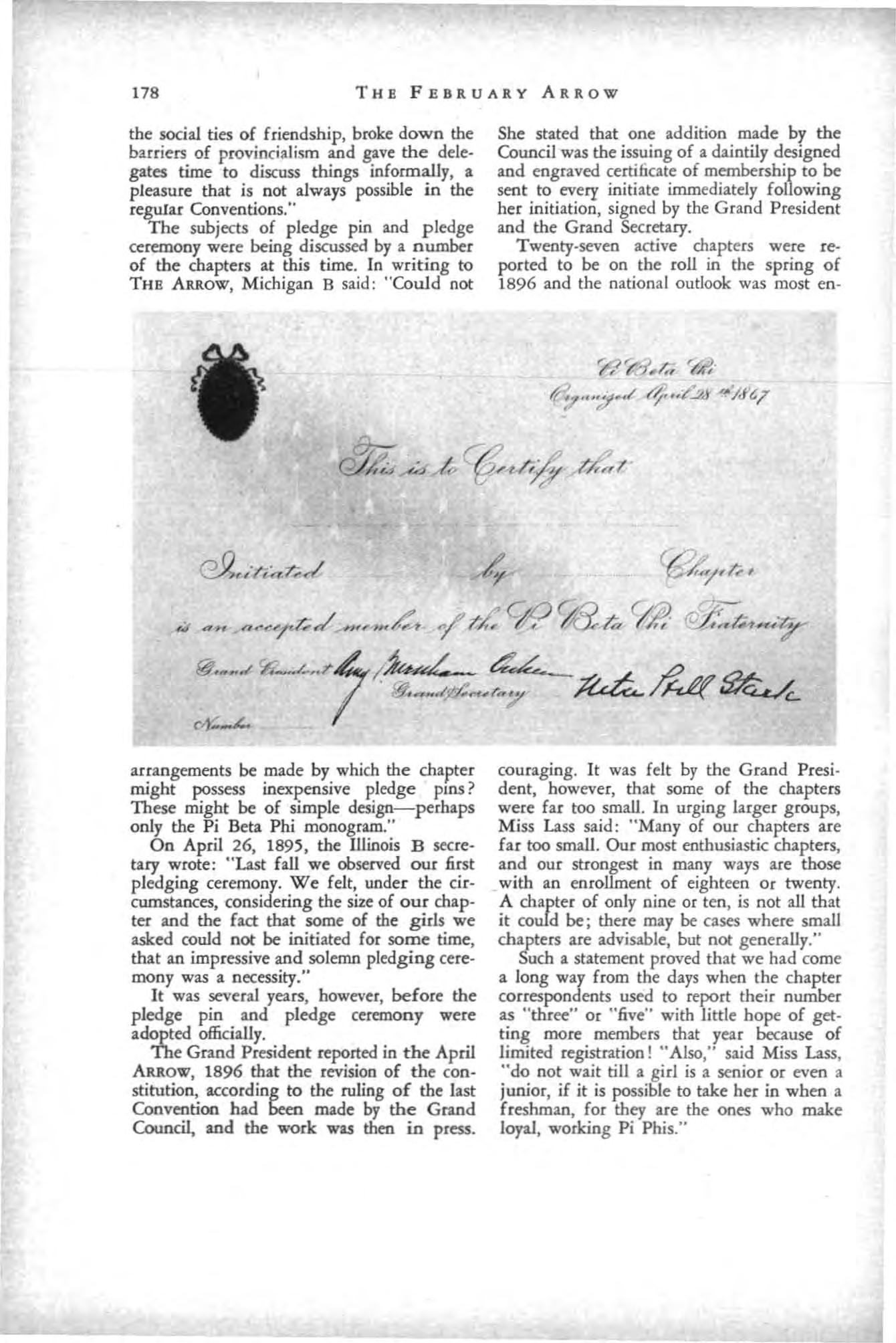
arrangements be made by which the chapter might possess inexpensive pledge pms? These might be of simple design-perhaps only the Pi Beta Phi monogram."
On April 26, the Illinois B secretary wrote: "Last fall we observed our first pledging ceremony. We felt, under the circumstances, considering the size of OUI chapter and the fact that some of the girls we asked could not be initiated for some time, that an impressive and solemn pledging ceremooy was a necessity."
It was several years, however, before the pledge pin and pledge ceremony were adopted officially.
The Grand President reported in the April ARRow, 1896 that the revision of the constitution, according to the ruling of the last Convention had been made by the Grand Council, and the work was then in press
She stated that one addition made by the Council was the issuing of a daintily designed and engraved certificate of membership ro be sent to every initiate immediately following her initiation, signed by the Grand President and the Grand Secretary.
Twenty-seven active chapters were reported to be on the roll in the spring of 1896 and the nat ional outlook was most en-
/f?'?d,Tn 'a
q",/'.2J -';"'67
couraging. It was felt by the Grand President, however, that some of the chapters were far too small. In urging larger groups, Miss Lass said : "Many of our chapters are far too small. Our most enthusiastic chapters. and our strongest in many ways are those with an enrollment of eighteen Or twenty A chapter of only nine or ten, is not all that it could be; there may be cases where small chapters are advisahle, hut not ge n erally."
Such a statement proved that we had come a long way from the days when the chapter correspondents used to report their number as " three" or " live" with little hope of getting more members that year because of limited registration ! "Also," said Miss Lass, "do not wait til1 a girl is a senior or even a junior, if it is possible to take her in when a freshman , for they are the ones who make loyal, workin g Pi Phis."
In accordance with the decision of the Boston Convention, a reunion of all Pi Beta Phis was scheduled to be held in the summer of 1896. As a result of the decision, the First Biennial National Reunion and the First Al · pha Province Convention were held jointly at Washington , D.C., July 9-10, at Columbian University (George Washington University)
Attending the Reun ion there were nineteen visitors and a large representation from Columbia A, both active and aIumnre, bringing the attendance up to 38, induding seven national officers, the Grand President, Grand Secretary, Alpha Province President; and the Alumn., Council. With one exception all of the chapters of AJpha Province were represented by a delegate.
What a modest yet commendable beginning this was compa red with the Eastern Conference which followed some twentynine years later, attended by 1300 delegates!
While no legislation was possible, both "conventions" in 1896 were {'ronounced un · 'l.ualified successes. The prinCIpal topics conSidered were: THB ARROW, chapter work and study, archives, history, register, affiliations, and chapter halls.
A memorial was presented urging the chapters as such, to study English or Letter writing as an art. Much discussion followed . It is reported that the " Alumn., urged, chapters hesitated ."
The luncheon which was served at the University on Friday, by the Washington Alumnre gave an additional hour for making friends and kept the delegates together for the delightful trip to Glen Echo, on the Potomac in the foothills of the Blue Ri dge Mountains There in th e great Glen Echo Forum, capable of seating 6000 people, the band of loyal Pi Phis held the last business session of the Reunion, which was followed by a dinner at Cabin John's Bridge near Glen Echo
With Grand President, Grace Lass (Sisson), as toastmistress at the dinner, the following responded to toasts: Cora De L. Thomas, Columbia A, Flora A. S. Sigle, Pennsylvania B, Anna Hazleton , Columbia A, Emma Harper Turner, Columbia A, Floren ce Putnam Chase, Michigan A, Nan Kelton, Columbia A, Josephine McDowell , Pennsyl-
vania A, Olive Gilchrist , Massachusetts A, and Dr Phebe R Norris, Columbia A FoUowed by impromptu remarks from all visitors and the bome gi rls as well, the official program ended with " Ra Ro ArrowPi Beta Phi. "
Mu ch credit for the splendid arrange· ments went to Miss Florence Bingham , Columbia A.
Following the Reunion , in July 1896, there appeared a Catalogue of the National Alumnre Association which contained, in addition to the five Alumnre Council M embers, the names of 37 alumna: members of the Association. Also there was a Directory of Active chapters, co ntaining 360 names .
In November 1896 the announcement was made of the appointment of Grace Grosve · nor, Athens, Ohio , as Grand Vi ce- President, to fill the vacancy left by the resignation of Elizabeth Gamble, previous to her departure for travel in Europe; of Miss Emma S Hutchinson (Conrow) , Pennsylvania A, in charge of the Alumn., Department of THE ARROW ; and of Miriam Elizabeth Prindle (Waller), Illinois E, as Chairman of the Literary Bureau .
Copies of the new constitution, whkh had been printed, were made available early in the fall of 1896.
With the careful personal supervision now being given to each chapter it was possib le for the Grand Council to know at all times whether chapters were meeting the national requirements . For some time the Grand Council had been perturbed over Minnesota A at the University of Minnesota , feeling that the chapter was SO small it was not competent to cope with its strong rivals , who in fairness it must be said, had been established first on the cam pus
When it became known that the charter was in dange r of being withdrawn, the members of the active chapter, three in number , and representatives of the :Minnesota A alumnre, sent a lette r to Grand Council und e r date of Sept. 1896 in which they said in part: "We, the active and alumna! members of Minnesota Alpha chapte r, desire to enter a protest against the threatened withdrawal of OUI charter. We feel convinced that our prospects this fall a re better than they hav e been
for some time, in spite of the fewness of our members. During the whole history of our chapter we have had some most unpleasant and disrouraging circumstances to struggle against. For various reasons some of our strongest girls have been obliged to leave the University, after being associated with us only one year; as a result, we have frequently found ourselves at the be/!inning of the school year with a small aellve membership. Another thing which has tended to bring about our fresent weakness is the fact that a majority a our girls have not been residents of Minneapolis. We bave been trying ha rd to secure a stro nger foothold in Minneapolis. It has been uphill work But in spite of many drawbacks we fed the strongest possible desire to keep our chapter here: '
In November, however, after a personal investigation by the Grand President, Grand Council voted to withdraw the charter.
The following month, the fraternity was saddened by the death of Jeannette Bennett Dunham , Colorado A, D elta Province Presi· dent, who passed away on Christmas mom· ing. Louise Foucar, Colorado B, was ap· pointed to the place.
Early in 1897, interest was aroused in the fraternity relative to cha.pters of Pi Beta Phi establishing and maintaming " Loan Funds "
for use in their respective colleges The idea was presented to the fraternity by Susanne F. Tlndale, Iowa Z, wbo was strongly in favor o such a system.
THE ARROW conducted a symposium on the subject and opinions were expressed pro and can One of those who opposed the iaea asked the question : " If we lend girls money we assume that when they leave school they will become wage eamers. Is this what Our schools prepare for? Does Pi Beta Phi wish to encourage even indirectly the spirit which has led and is leading so many American girls to abandon the responsibilities and privi. leges of home to become
The Editor of THE ARRow wrote an edi · torial article on the subject, saying in part: "While the establishment of a 'Loan Fund ' for the aid of needy students may, in itself, be a very worthy project, we should not favor the adoption of such a scheme as a part of fraternity work. "
Thus it may be seen that the movement in later years which resulted in one of the finest pieces of national work of Pi Beta Phi-the creation of a permanent Loan Fund which now exceeds $lO,OOO----<lid not come into being without opposition such as usually faces many new constructive systems.
So successful were the reunions held in Chicago and Washingto n, the I ndiana Pi Beta Phis called a reunion for January U, 1897. The occasion was celebrated with a dinner given at the Pro pylaeum in Indianapolis and was attended by thirty-five members of the fraternity. Among the guests were Mrs. E. E . Griffith, one of the patronesses of Indiana B, and Mary D unham, Colorado A.
The arrangements for the dioner wsr e in
charge of Mrs. Lelia Kennedy Galpin and Stella R. Fox of indianapolis and Levona Payne of Franklin.
Office rs elected at the meeting were: President, Mrs Lelia K. Galpin, Michigan B; Secretary, Levona Payne, Indiana A; Treasurer, Maude Martin , Indiana B.
Thus was launched a state association which has through the years held its annual Indiana Reunion , always enthusiastically supported by the Indiana Pi Phis
The thirtieth year of the fraternity was celebrated in April 1897 by an appropriate poem written by Rita Sutherland , OhiO B, entitled , "The Founding of Pi Beta Phi." Later the poem was set to music and has be · come a favorite song of the fraternity .
THE FOUNDING OF PI BETA PHI
Long ago in Monm o uth College. On one bright, glad April day,
Met a band of seven maidens Bent on worle and bent on play.
One a fair and earnest lass ie W ith great eyes of bonest blue. Spoke of dear and lasting friendships, And her w ords were pwe and true.
We h ave come together, sisters, With a purpose strong and pwe Now to form a lasting friendship That forever shall endure.
For our emblem Jet us take
A golden arrow that shaJJ show Cupid each ooc's heart With ooe sure and sudden blow .
To tie the knot of friendship Take wine and silver blue; And thw our bark will always run 10 channel deep and true.
From gardens fair, of flowers Cboose now the sweettst there. Carnations bright and spicy Of fragrance rich and rate
Above all things, dear sisten, Our aim shall ever be To treat each other DOW and aye With Jove and charity.
Thus WI$ formed in Monmouth College
On that day so long gone by The $orosis I e. called Now beloved Pi Beta Phi .
Ltt us try then, dearest sisten, Spread o'er all of this broad land, To follow in our founders' foot·steps
A truly pure and noble band .
Kttping pace with the progress of the active chapters, the alumna= clubs were thriving, new ones being added to the roll and the older ones adding to their membership and undertaking most worthwhile projects. The Washington Club, on March 30, 1897, announced that a long-cherished wish had at last been realized in the establishment of a dub room, 318 East Capitol Street. This room which was made possible "through the generosity of one of the dub's enthusiastic members, Miss Maty E. Graves, was opened on Easter Monday, when the Club welcomed the Baltimore Chapter and other members of the fraternity resident in Washington." The dub at that time numbered thirteen.
A roll of the Denver Alumnae Club taken
the same spring, showed 19 members. The Alumrur Club Secretaries then listed in THE ARRow induded those of New York, Chicago, Baltimore, Cincinnati, Indianapolis, Grand Rapids, Galesburg, Creston, fowa, Madison , Campbell, Texas, San Franosco, Helena , Montana.
In the earlier days of the fraternity's history, the early years of I.e., letters written from one chapter to another glowed with enthusiasm whenever members met a "sister" from another chapter, and transfers were ae· cepted into chapters with great pleasure. By 1897, however, the fraternity had grown so in size and there were so many chapters of varying institutions, that there was beginning to creep in a "chapter exdusiveness"-noth· jog for serious action-but enough to (ause an editorial article calling attention to a "possible shrinking of the members of one chapter from receiving as sisters the seemingly less favored members of others. This should not be tolerated for one moment," conduded the Editor. "We must have universal courtesy!"
Although the Convention in Boston had accepted the invitation to hold the next gathering at Denver, Colo., it was deemed advisable to change the place of Convention to a more central point, and Madison, Wisconsin, was chosen. Too. the Convention dates were set in order to coincide with the National Education Association meeting at Milwaukee, in order to take advantage of the low railroad rates.
Gertrude Oark Sober, Wisconsin A, was appointed Grand Guide to 611 the vacancy made by Miss Ingersoll's resignation, upon the change of Convention cities.
THE ARROW gives the following description of the Wisconsin Convention:
The fifteenth bienni al Convention of the Pi Beta Phi Fraternity was formally opened Wednesday morning, July 7, 1897, at Madison, in Library Hall of the University of
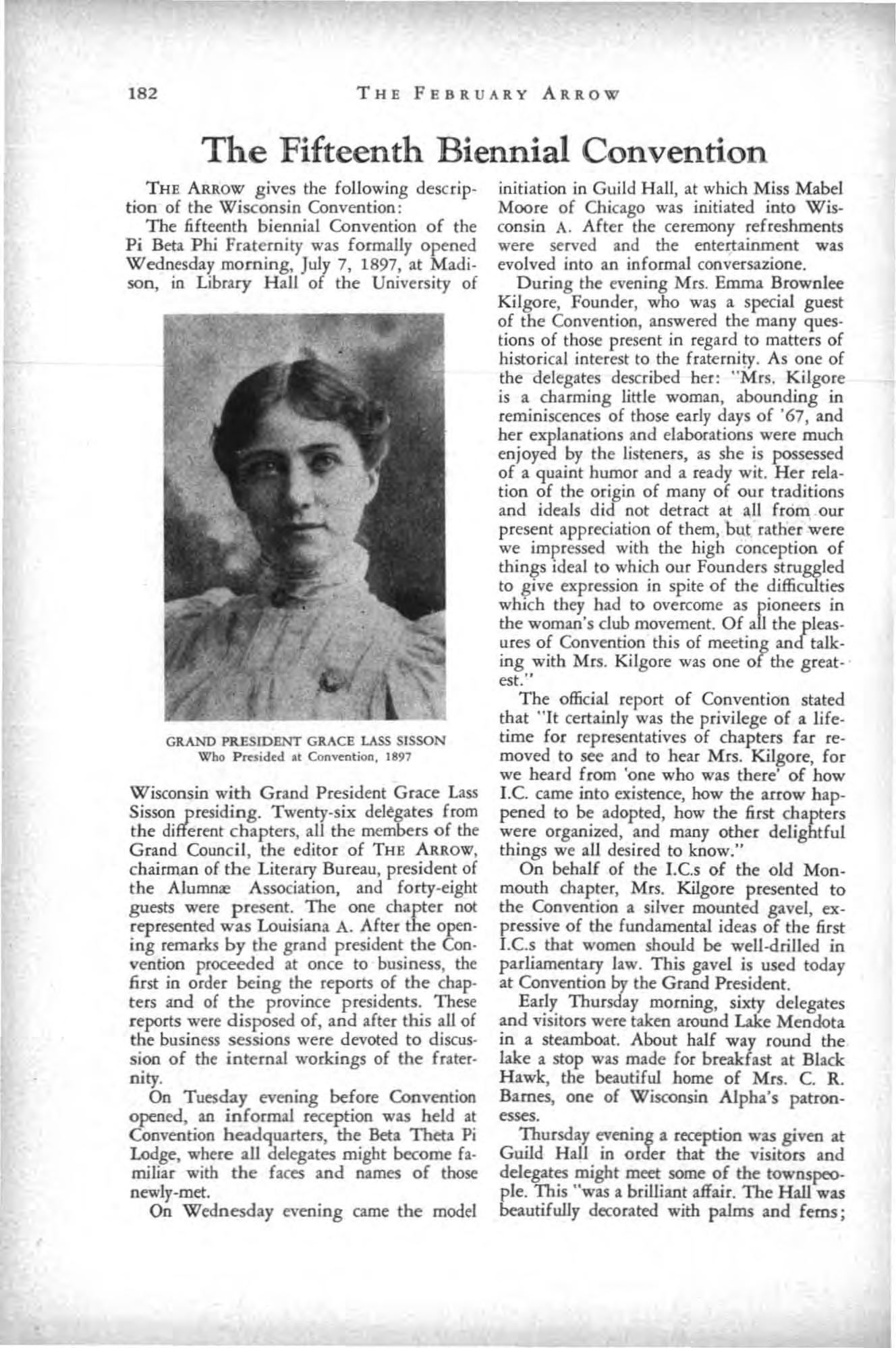
Wisconsin with Grand President Grace Lass Sisson presiding. Twenty-six from the different chapters, all the members of the Grand Council, the editor of TH E ARROW, chairman of the Literary Bureau . president of the Alumna! Association, and forty-eight guests were present. The one chapter not: represented was Louisiana A. After the opening remarks by the grand president the Convention proceeded at once to business, the first in order being the reports of the chapters and of the province presidents. These reports were disposed of, and after this all of the business sessions were devoted to discussion of the internal workings of the fraternity
On Tuesday evening before Convention opened , an informal reception was held at Convention headquarters, the Beta Theta Pi Lodge, where aU delegates might become familiar with the faces and names of those newly-met
On Wednesday evening came the model
initiation in Guild Hall, at which Miss Mabel Moore of Chicago was initiated into Wisconsin A. After the ceremony refreshments were served and the entertainment was evolved into an informal conversazione .
During the evening Mrs . Emma Brownlee Kilgor e, Founder, who was a special guest of the Convention, answered the many ques· tions of those present in regard to matters of histori ca l interest to the fraternity . As one of the delegates described h er: ··Mrs. Kilgore is a charming little woman , abounding in reminiscences of those early days of '67, and her explanations and elaborations were much enjoyed by the listeners, as she is possessed of a quaint humor and a ready wit. Her rela· tion of the origin of many of our traditions and ideals did not detract at all from our present appreciation of them, hu.t rather were we impressed with the high co nception of Ideal to which our Founders struggled to expression in spite of the difficulties whICh they had to overcome as pioneers in the woman's dub movement. Of aU the/leas. ures of Convention this of meeting an talk· ing with Mrs. Kilgore was one of the great· est."
The official report of Convention stated that "It certainly was the privilege of a lifetime for representatives of chapters far re· moved to see and to hear Mrs . Kilgore , for we heard from 'one who was there' of how I.C. came into existence, how the arrow happened to be adopted, how the first chapters were organized , and many other delightful things we all desired to know."
On behalf of the I.C.s of the old Monmouth chapter, Mrs. Kilgore presented to the Convention a silver mounted gavel, expressive of the fundamental id eas of the first I.c.s that women should be well -d rilled in parliamentary law . This gavel is used today at Convention by the Grand President.
Early Thursday morning , sixty delegates and visitors were taken around Lake Mendota in a steamboat. Abnut half way round the lake a stop was made for breakfast at Black Hawk, the beautiful home of Mrs C. R. Barnes, one of Wisconsin Alpha's patronesses.
Thursday evening a reception was given at Guild Hall in order that the visitors and delegates might meet some of the townspeople. This "was a brilliant affair The Hall was beautifully decorated with palms and fems;
the refreshment rooms , with carnations and smilax, and the stairways with trailing vines . After the formal r«<pIion many of the young people remained for dancing."
On Friday evening came the banquet with Grace Grosvenor, Grand Vice-President, the toastmistress . Tbose who responded to the toasts were: Olivia Ambler, Iowa A. Alice Dacy, Wisconsin A, Lucinda Smith, Kansas A, Elise Bradford, Columbia A, Fanny Maroa Sutton, Vermont A, and Grace Lass Sisson, Illinois Il..
The toasts were follo ....ed by impromptu talks from Emma Harper Turner, Dr. Bessie Peery, Florence P Chase, Jessie C. Craig, Gertrude Clark Sober, and Charlotte Farns· worth On behalf of the Convention , Florence P. Robinson , Wisconsin A. then presented a Silver ladle to the Grand President Grace Lass Sisson, who had , since the last convention , married Francis H . Sisson , Beta Theta Pi (Mr Sisson afterwards was elected Grand President of his fraternity )
Greetings were read at the banquet from Founder Ada Bruen Grier.
On Saturday morning the Convention adjourned to meet two years hence with Colorado A at Boulder, Colo .
As to the business side of the Convention, Grand Alpha authorized:
The pnnting of chapter delegate's reports to be circulated among delegates at Convention instead of being read.
The printing of THE ARROW to be left in charge of Wisconsin A with Florence Robinson as business manager and editor-in-cruef.
The granting of a provisional charter to applicants from Indianapolis University (Butler University), for three years with the written agreement that .. if in three years the University had not grown as present prospects indicated, the charter would be withdrawn.
The issuance of an annual message by the Grand President, reporting the conditions of the chapters and other matters of interest to the fraternity of a nature too private for publication in THE ARROW. (This was a forerunner of the Secrel A"o tll.)
A fine to be imposed upon any member securing a pin not manufactured by an official jeweler.
The appointment of a committee of three to arrange for the final disposition of the Constitution, as revised by Miss Turner, to secure the opinions of various chapters, and to report the same to the Grand Council not later than January I , 1898.
The assignment to each chapter of a par-
ticular topic in fraternity history for investigation. with a provision that the report on each topic be sent to the historian on or before Alumnae Day, 1898, subject to a fine of $) for failure to perform such duty .
Appointment of an advisory board of three members, by THE Alutow Editor to co nsult with her regarding ARROW work.
The guarantee of $100 to the ARRow Editor .
Appoinbnent of a committee on AIulow Cover, composed of Florence P. Robinson, New York A, Illinois Z.
Recognition of the souvenir spoon , originated by Louise Foucar, Colorado B.
Appointment of Bunde and Upmeyer of Milwaukee, Wis. , as additional oIIicial jewelers, provided that pins submitted meet with the approval of Grand Council.
Among the motioos that wefe lost were recommendations that the fraternity Bower be the white carnation, and that the Editorin -Chief of THE ARROW be made a member of the Grand Council.
No action was taken on the recommendation that pins be of uniform size.
Reports of the Literary Bureau, Grand Treasurer, Grand Historian indicated progress made by the active members in educating themselves in fraternity matters, and in maintaining a sound financial condition, the balance in the treasury being far beyond all expectations.
A report of the Son$ Book Committee was made by the Chatrman , Mary Bartol (Theiss)
A national flag was adopted by the Grand Council in 1896 and was presented to Convention in 1897. It was an oblong, with lower edge indented; connecting the opposite cocners were curved lines which divided the field into three parts. The center portion was of silver blue, bearing in its upper part a monogram of the letters I C , surrounded by a halo, and below was a monogram of the letters Pi Beta Phi. The lower point was pierced by a gold arrow which overlapped the lateral section of the wine red.
A review of fraternity conditions and Pi Beta Phi prospects at Chicago University was given by Alice Peirce.
Announcement was made of a prize consisting of a fraternity pin and a stick pin (not to exceed $2) in cost), offered by Dr. Bessie Peery for the best ARROW letter and best article published in THE ARROW.
Owing to the lack of time no official pbotograph of the Convention was taken.
A m""ting of the Nation al Alumnae iusodation was held on Thursday afternoon, at which Emma Harper Turner, president, presided and gave a detailed report of the work of the past two years. She reported that much had been done to awaken interest among the alumna:, and much assistance had been given to the Historian in hunting up records . The of the Association closed with the election of the Alumna: Council [or the next two years. Miriam Prindle of Evanston, Ill ., was elected presiden t with instructions to choose the other members of the Council. Th e official list, as selected, included: Vi cePresident , Ali ce Peirce; Secretary, Mary Belle H arris; Treasurer, Marga ret Ransome; Marshal, Mary Thompson Reid , all of Chi cago, Ill.
The Convention closed with the election and installation of officers as follows: Grand President-Grace Lass Sisson, Illinois
Grand Vice-President-Grace Grosvenor, Ohio A
Grand Secretary-Ethel B. Allen , Kansas A
Grand Treasurer-Lucinda Smith, Kansas A
Grand Guide-Charlotte Joy Farnsworth, Colorado A
Hjstorian--Susan Lewis, Michigan B
Province Presidents: Alpha , Mary Bartol, Pennsylvania B and Michigan B; Beta , Ona A . Payne, Indiana A; Gamma, Elizabeth Smith. Wisconsin A; Delta , Louise Faucar, Colorado B.
The delegates attending the 189 7 Convention
Vermont A., Fann ie M. Sutton ; Columbia A. Elise Bradford; Pennsylvania A, Edn a H . Richards; Pennsylvania B, Gra ce Slifer ; Ohio A, Florence Craig; Ohio B, Blanche Moss ; New York A. Clara G. Hookway; Massachusetts A, Helen Eldridge; Maryland A . May Keller ; Illin o is B, Helen M ackay; Illinois 4 , Elizabeth Reinmund ; Illinois E , Mary I. Reyn o lds; Illinois Z. Edith M . WeavH; Indiana Adda M. Wyriclc ; Indiana B Rousseau McClellan; Mich igan A, Bertha I. Myers ; Iowa A, Olivia Ambler; Iowa B, Nettie Erick. son; Iowa Z, Norca Allin; Wisconsin A, Agne3 Perry; Kansas A. Edith Snow; Nebraska B, Ann a Webster Lytle; Co lorado A. Blanche Squires; Colo. rado B , Martha N. Kimb all; California A. Anna Weaver; Michigan B. Rebecca E. Finch. THB AKllow. Jessie c. Craig.
As the fraternities grew and developed, the early bitterness and intense rivalry which had been paramount in the beginning was dissipated and the different nationals strove to work side by side for mutual interests This spirit of Panhellenism was shown in 1898 through the exchange of fr aternity journals.
THE ARROW Editor took pleasure in announcing that "arrangements have been made with Th. Key, Th . An chor., and th. Kappa Alpha Theta , in consequence of which, each of our chapters, as well as the grand officers. will hereafter receive a copy of each of these quarterlies ."
The various chapters, too, were joining Panhellenic groups and scarcely an issue of THE ARROW appeared without the announcement of a new local Panhellenic. For instance, in January 1898, Illinois E reported: " The different women ' s fraternities of Northwestern, nine in nwnber. have united in a Pan · hellenic association and gave their tiISt dancing party on the evening of December sixteenth, at Evanston."
With this growing interest in other fraternities, THE ARROW, January 1898, cootained • list of the oldest women's national fraterni -
ties-with up to date statistics:
" Pi Beta Phi , founded at Monmouth, 1867; 28 chapters in 17 states
Kappa Alpha Theta, founded at Indiana Asbury ( D ePauw), 1870, 22 chapters in 14 states_
Kappa Kappa Gamma, founded at Monmouth, 1870; 27 chapters in 14 states.
Alpha Pbi, founded at Syracuse, 1872; 9 chapters in 8 states.
Delta Gamma, founded at University of Mississippi, 1872; 13 chapters in 11 states.
Gamma Phi Beta, founded at Syracuse, 1874, 7 chapters in 7 states.
Delta Defta Delta, founded at Boston University, 1889; 15 chapters in 11 states.
At this time the appeared in the Delta UpIilon lIarterl,: "By the way , when we were in co ege we were accustomed to hear societies of college women spoken of as ' sororities.' Now everything in the college society line, regardless of sex, is a fraternity _ Do our 'sisters' f",,1 that ' brotherhood' means more than 's isterhood '? We will not admit that this is merely an-
other indi cati on of the new woman, and should be glad if some of our 'sister ' editors would tell us why they persist in using the term fra temity to indude themselves. "
THE ARRow Editor answered:
" This question we are not prepared to an · swer as regards the other women's fraterni · t ies, although we believe the editor of the Alpha Phi Q"arl ..I, has lately declared her preference for ' Sorority' and her opinion is that the objection of Deltlj Upsilon is well taken So far as Pi Beta Phi is concerned, however, while 'sisterhood ' 'is a name which we would proudly bear, 'sorority' is not. We prefer, other things being equal, to be called by a title which is to be found in an English dictionary . We admit that this may be a purely personal prejudice, and we are quite willing to grant that usage makes dictionaries rather than dictionaries usage, and that ' s0rority' may some day be recognized as a word. like Tennyson 's lily, we walt.
AIUIll1lZ interest in Pi Beta Phi steadily in· creased and the state reunions and meetings were repeated with much success. The regular annual reunion banquet of Indiana Pi Beta Phis occurred on January 22 1898, at the home of Mrs. William Galpin in Indianapolis with Mrs . Charles B. Clarke, one or the patronsses, of Indiana r, as toastmistress .
On March 30, 1898, twenty·eight Pi Phis met in the Blue Parlor of Handel Hall , Chi· cago, for the purpose of forming a Chicago Alum"", chapter A preliminary organization was effected with Miss Reeves as chairman . Plans were formulated for a called meeting.
By 1898 Pi Beta Phi had reached the place in her growth where "relatives" or "legacies" were being discussed. One member of Michi· I"'n A was very outspoken regarding the sub · Ject, saying that she believed there was "need of caution" in initiating relatives-that all girls---even sisters--were not in the same things, etc. On the whole, however, the f rateroity welcomed relatives, who the aims and ideals of the organization and
who brought to it the same enthusiasm and loyalty as their older sisters, aunts or mothers.
Michigan A, a chapter th at bad been much interested in preserving fratemity history, completed a very fine piece of work in the compilation of a Catalogue of all of its mem · bers The chapter reported that it wrote let· ters "once, twice, thrice and then exchanged our delinquent list . In the end we wer e reo warded by hearing from all but one (though she was heard from indirectly) and the addi · tion of twelve names to the AIUlll1lZ Associa · tion."
During the summer of 1898, two members of the Grand Council were married : Grand Treasurer Lucinda Smith married Frederick Erskine Buchan, and Ethel Beecher Allen, Gr:md Secretary, married James Kent Hamil· ton . Upon the resignation of Lucinda Smith Buchan , to join her husband in Manila, her sister, Ida Greeley Smith of Lawrence, Kan· sas, was appointed Grand Treasurer.
Amelia D . Alpiner, Illinois Z, of Kanka· kee, Ill ., Beta Province cjresentative on the Literary Bureau, succeede Ethel Allen Ham· ilton as Grand Secretary.
Although the chapters, at this time, were required to write a letter to every other chap. ter at least once during the year, the letters had not thus far differed much from the regular chapter letter, yet it was felt that they could be put to much better use.
The various women's fraternity mas;azioes took up the discussion of the desirability and the necessity of having some sort of secret publication Many of the men's organizations already had them. There were arguments on both sides. It was felt that perhaps such a secret publication could not be kept secret, the expense, too, had to be considered in ad· dition to the extra trouble of editing and distributing. Pi Beta Phi rather favored the use of intet<hapter letters for disseminating pri. vate information. Nothing definite was done, however, about a secret magazine for several years.
The Sixteenth Biennial Convention was held August 29 to September I , 1899, at the Chautauqua ground, Boulder, Colorado, with Colorado A as the hostess chapter.
Delegates from twenty-nine chapters were present and Grand President, Grace Lass Sis· SOD, Grand Secretary Amelia D. Alpinec, Grand Treasurer, Ida Greeley Smith, Grand Guide Charlotte J. Farnsworth , and ARROW Editor, Florence P. Robinson .
A special car, filled with Pi Beta Phis m ade the trip from Chicago to Denver . Another special car piloted by Colorado Betas , brought the delegates from Denver to the convention grounds.
The social side of the convention consisted of an informal reception held the first evening, a reception by the Delta Gamma chapter at the University of Colorado, a model initiation at which Rosetta BeU was initiated into Colorado A, a cookie shine and dance, a trip around the mountains from Boulder to Ward-,·the Switzerland Trail of America," a reception by the Colorado Alpha patronesses of Pi Beta Phi; a banquet; a reception by Theta chapter of Gamma Phi Beta in Denver, and a trolley sightseeing ride in Denver . Mrs. Charlotte Farnsworth , Grand Guide, as toastmjstress at the banquet, called upon the following for toasts: Cassie Souther, Massachusetts A, Amelia D. Alpiner, Illinois z, Rosalie Nixon, Louisiana A, Eunice W. Welsh , Wi sco nsin A, M. Estelle Martin, Maryland A, and Grace Lass Sisson, Illinois Ll..
Impromptu toasts were given by Miriam Prindle, Florence P Robinson, Ida Greeley Smith and Maud Miller.
In the history of this Convention we undoubtedly find the origin of the mid -night nestas, the gay parades , and other "extra curricular" activities of subsequent Conventions, for Lora Townsend, Illinois B. in describing the Convention said: " Indeed , some defied Fate, determined that it should not end yet That accounts for the enchanting serenades some received that night, or rather, the next morning. What mattered it, if they did have but one hour's sleep? Boulder Conventions come but once in a lifetime. Saturday morning we bade farewell to our ' Beautiful Boulder' to spend th e day in Denver with Colorado B . Here, too, the same c ordial welcome and gen · uine hospitality awaited us. In the afternoon
a reception was given by Theta chapter of Gamma Phi Beta, which prov ed most delightful. In the evening two large trolley cars, brilliantly lighted with incandescent lights in wine and blue, conveyed the I?arty through the streets of Denver . A string orchestra added to the pleasure of the ride. At the halfway point delicious refreshments were served. It was a late hour when good-nights were said at this, OU r Jast festivity together . "
In a letter of greeting from the Founders to Convention, written from Monmouth , 111. , A,;,gust 28 , 1899 , Emma Brownlee Kilgore said:
"We adjust our spectades, look at our gray hairs , consider our aches and pains, wondering what joyful words of greeting you will expect. Rest assured your Founders ' hearts do not beat feebly or memory fail when we think of the good times we had in caring for the I.e . infant-we never nicknamed it 'Frat.' When we read in TH E ARROW of the work of Pi Beta Phi , we growl'roud and wonder if the world does know 0 its greatness.
"In all earnestness permit me to congratulate you upon your vigorous growth of thirtytwo years-it speaks of love and work. When in Madison we were pleased to see the true I.e. spirit still living in the Greeks , there was only one discordant note--no daoong girl was numbered among your Founders . May you plan wisely and have a happy and profitable Convention. It would have given us pleasure to have been with you, but we could not forget the ' hot reception ' at Madison, two years ago. May each of you choose to keep your feet in the path of righteousness. Divide my love, so that each delegate may take a bundle home to her chapter ."
One of the nrst important pieces of business of the Convention was the reading of the report of THE ARROW Editor, Florence Rob inson , in which she recommended that THE ARROW Editor be made a member of Grand Council saying: "THE ARROW Editor is brought very closely in touch with the girls and their needs, yet so little does the editor of the fraternity magazine know of the work of the Grand Council, that Vermont Beta had actually been nearly two months established before she casually learned that such a chapter was contemplated As to make the editor a Council member would make the Council number six, whicb is of course un-
d<sirable, it seems a good plan to make the Grand Guide a temporary olIicer, appointed by the Presidmt, say three months previous to Convent ion . "
During the business sessions the following prog ressive measures were voted:
That THE ARR OW Editor be made a member of Grand Council in place of the Grand Guide, who will hereafter be appointed by the Grand President
That a salary be paid to the Grand President, to the Grand Secretary, and to the Grand Treasurer .
That there be a traveling delegate, Grand Pr<sident, if possible, to visit all chapters during interim of Conventions .
That the Pi Beta Phi history be published.
That individual chapters be permitted to d« ide upon the eligibility of professional students
That membership be confined to active and alumnre--no honorary members.
That alumn", members may be expelled .
That the Grand Treasurer be required to give a bond not less than $2000.
That the Pi Beta Phi monogram be used on jewelry, as recommended by Pennsylvania A
That Thomas Long Co., Summit St. , Boston, Mass., be made an official jewder.
That the ruling providing for the holding of Pi Beta Phi Reunions be to read:
'To establish headquarters for Pi Beta Phi reunions when suitable, during the intervening years of Conventions, etc."
A Committee on the revision of the Constitution was appointed comprised of: Illinois Z, Ohio A, and Kansas A.
A fraternity two-step was reported by lUinois B and Michigan B .
A petition from Arkansas University for a charter was laid on the table .
Election of Olli cers:
Grand President : Elise Bradford, Columbia A
Grand Vice·President: Elizabeth Gamble, Colorado A
Grand Secretary : Mary Bartol, PennsylvaniaB
Grand Treasurer: Ida G. Smith, Kansas A
ARROW Editor: Florence P Robinson, Wisconsin A
Historian: Susan Lewis. Michigan B
Province Presidmts: Alpha, Frances Darlington , Pennsylvania A ; Beta , Lura Grimes , Indiana A; Gamma, Olivia Ambler , Iowa A; Delta, Clara Matthews, Louisiana A .
The account of the Alum"", Session of th e Boulder Convention which appeared in TH E ARR OW stated that the retiring pr<sident, Miriam Prindle (Waller), called the convention to order, and read her report for her two yea rs of offi ce, in which she set forth the aims
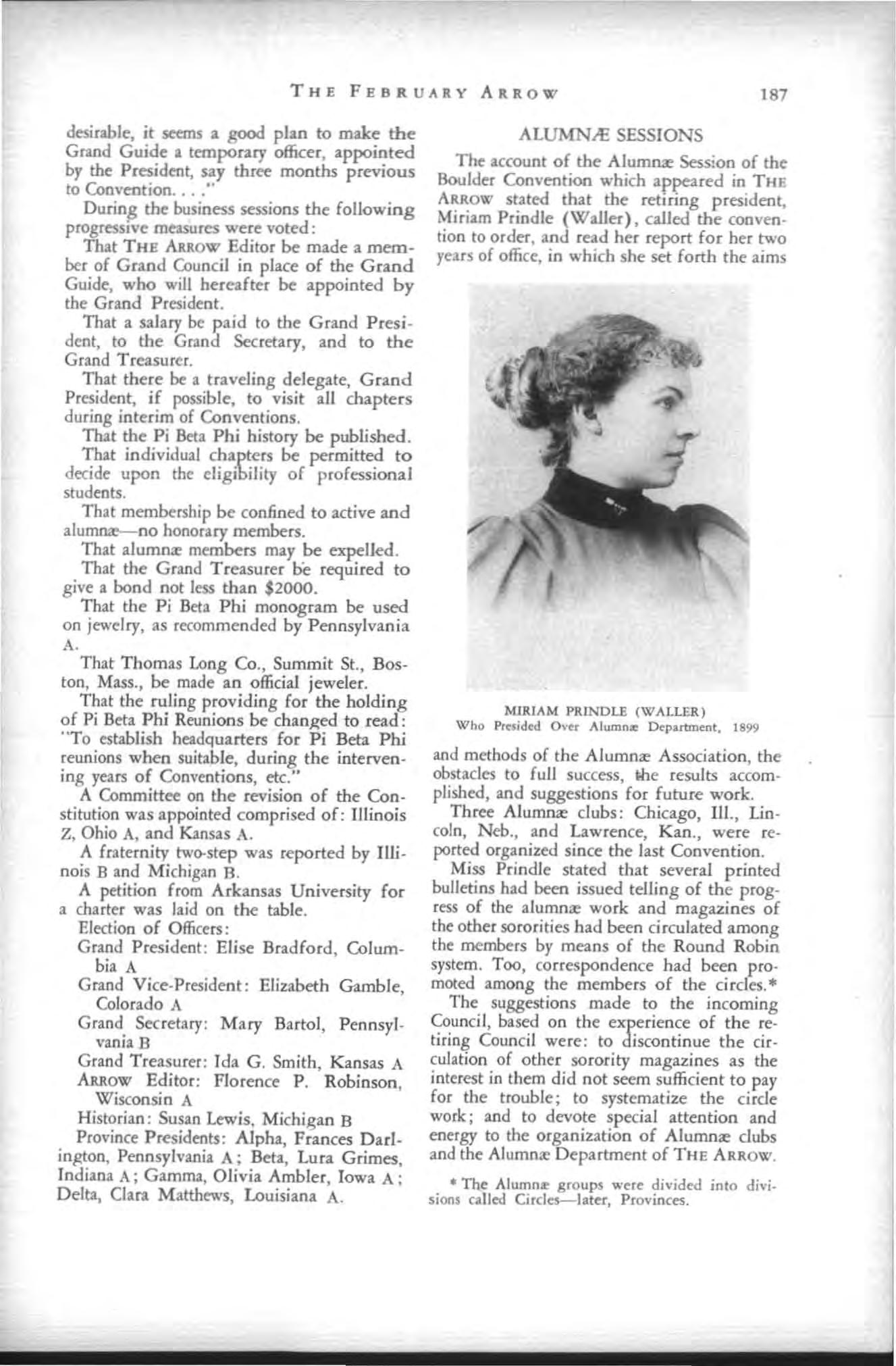
MIRIAM PRINDLE (WALLER)
Who O ve r Alumnz Departm ent, 1899 and methods of the Alumnre Association , the obstades to full success , w,e results accomplished, and suggestions for future work.
Three Alumn", clubs: Chicago, III., Lincoln, Neb ., and Lawrence, Kan., were reported organized since the last Convention.
Miss Prindle stated that several printed bulletins had been issued telling of the progress of the alumnre work and magazines of the other sororities had been circulated among the members by means of the Round Robin system. Too, correspondence had been promoted among the members of the ci rdes . *
The suggestions made to the incoming Council, based on the experience of the retiring Council were: to discontinue the circulation of other sorority magazines as the interest in them did not seem sufficient to pay for the trouble; to systematize the cirde work; and to devote special attention and energy to the organization of Alumn", clubs and the Alumn., Department of THE ARROW .
• Tbe Alumn I: g ro ups w e re d ivi ded int o d iv is ions called Circl es-later, Pro vin ces.
DI>ring the deliberation of the committees, the time was occupied by informal discussion of ways aod means for further development of the AI=nre Association
The Al urnnre Association officers elected for the ensaing years were:
President: Fanny K. Read, Richland, Mich .
Vice- President: Leila Lane Smith, Cleve· land, Oh io.
Secretary: Anna S Hazelton, Washington, D.C. .
Treasurer: The Business Manager of THE ARRow.
Marshal: Kate King Bostwick, Chardon, Ohio.
The delegates who attended the Boulder Convention, 1899: Vermont A, Sarah Vincent Mann ; Vermont B, Mary A. Grout; Columbia A, Elsie Elizabeth Park. inson; Pennsylvania A , Lucy Bancroft; Pennsylvania B, Genevieve White; Ohi o A, Mary O'Blen. eM; Ohio B, Laura A. Weisman; New York A, Frances Elizabeth Madden ; Massachusetts A , Cassie L. Souther; Maryland A, Mary Es telle Martin; lIlinois B, Lora Adelle Townsend; Illinois 41 , Frances Illinois E , Abbie Florence Williams; Illinots Z, Grace Osborne Edwards; Indi· ana A, Eleanor La Grange; Ind iana B Helen Traylor; Indiana r. Jessie lockhart; Michigan A. Frances French; Michigan B, Grace Roberts o n; Iowa A, Mamie Brenholts; Iowa B, Daisey Dent; Iowa Z, Leda Pinkham; Wisconsin A. Eunice Wallace Welsh; Missouri A, Sue Stone.
The First Grand Alpha, or Convention, was held in August, 1868, and the name Grand Alpha was applied to the national meetings until 189', when it was voted that "the name Convention be used instead of Grand Alph a."
The national conventions of Pi Beta Phi ha ve been held as follows :
Oquawka, Illinois
1870--5prlOg : Mt. Plea sant, Iowa
IB72-June : Greencastle, Indiana
18 78-June : Indianola, Iowa Mt . Pleasant, Iowa
1882-October : Burlington, Iowa
1884-November: Iowa Gty, Iowa Lawrence, Kansas
1886-October: Indianola, Iowa
1888-Octooo : OttUmwa , Iowa
Galesburg, Illino is 1892-March: lawrence, Kansas
189l-July : OJicago, Illinois
189}-.August: Boston , Massachwetts
1897-July : Madison , Wisconsin
1899-Augwt: Boulder, Colorado
19Ot-July: Syracuse, New York
1904-June: St. Louis, Missouri
1906--June: Indianapolis, Indian a
1907-08-l>«'.-Jan.: New Louisiana
1911>-June: Swarthmore, Pennsylvania
1912-June: Evanston , Illinois
1915-July: Berkeley, California
1915-June-July! Ol1rlevoix, Michigan
1921-July : Charlevoix, Michigan
1923-June: Es tes Park, Colorado
192'-June : Bigwin Inn, Lake of Bays , Canada
1927-June-]uly: Breezy Point Lodge, Minnesota
1929--]une-Jul y: Pasadena CaJifornia
Asbury Park, New Jersey
1934-June : Yello wstone Park, Wyoming Chicago, Illinois
All Conventions up to 1901 have been in· cluded in the chronological history, from 1901 on they have been grouped into one rh
Amy Sparr and Belle Roberts , Kansas A Anna Weaver, California A
Mabel Moore, Wisconsin A
Rosetta Bell, Colorado A
Mittie V Robnette, Missouri A
Mary Gordon Holway. Califo rnia A
Michigan Betas
Mary L. Matthews, Indiana .6Grace Edgington, Oregon B
Emma J. Woerner, Ontario A
Bertha M. Goodell, Indiana A
Jul ia Kingsbury Wrisht, California A
Miriam Lutcher Stark, Texas A
Pay Rowley Huttenl ocher, Iowa Z
Nebraska B, University of Nebraska
New York B, Barnard College
Missouri r, Drury College
Tex as B, Southern Methodist University
Louisiana A, Tulane University (Newcomb
illinOIS E. Northwestern University
Ontario A. University of To ronto
Minnesota A , University of Minnes ota
Oregon B, Oregon State Agricultural College
Colorado A, University of Colorado
Utah A , University of Utah
THE SEVENTEENTH NATIONAL BIENNIAL CoNVENTION met in the University Build · ings at Syracuse, New York, on July 2-' , 1901, with Grand President Elise Bradford , presiding.
Grand GuM.: Sadie B. Williams (Bell), New York A
Alundanc.: Six national officers and thirty chapter delegates.
For the first time the chapter reports were not read at Convention, but extracts from
them were printed an d distributed amon g the delegates .
ug h /alio n : Grand Council empowered to issue a Constitution to be submitted for rat ifi cation by a vote of two-thirds of the chapters , based upon the revision made at the
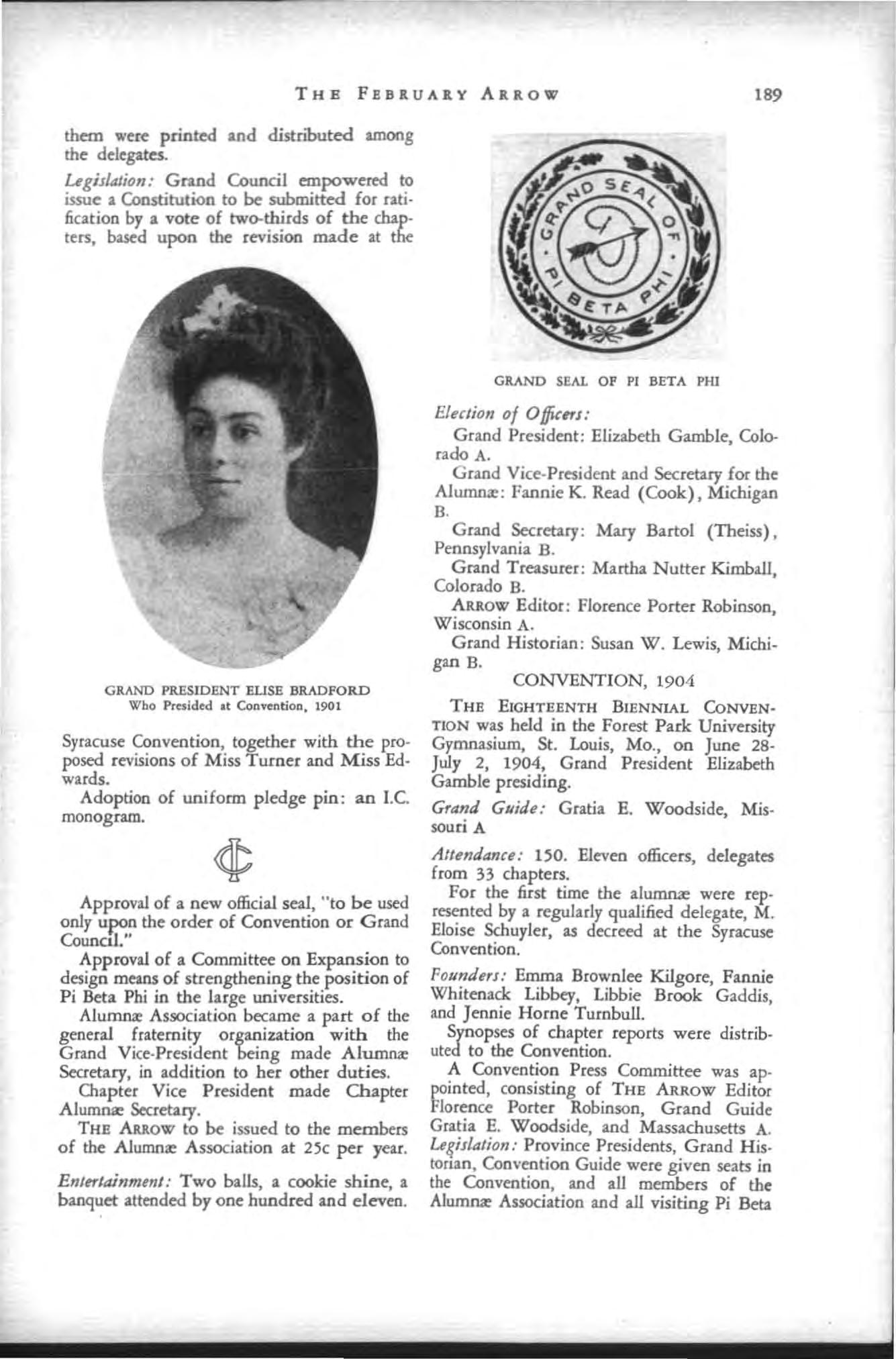
Who at Con,.ention, 1901
Syracuse Convention, together with the pro · posed revisions of Miss Turner and Miss Edwards_
Adoption of uniform pledge pin : an I.e. monogram.
¢Approval of a new official seal, " to be used only uP."n the order of Convention or Grand Council_"
Approval of a Committee on Expansion to design means of strengthening the position of Pi Beta Pbi in the large universities.
Aiumllll! Association became a part of the general fraternity organization with the Grand Vice-President being made Alumna: Secretary, in addition to her other duties.
Chapter Vice President made Chapter Alumn.., Secretary.
THE ARRow to be issued to the members of the Alumn., Association at 25c per year
Enltrlainmml: Two balls , a cookie shine, a banquet attended by one hundred and eleven.
Elu tion of O!fi<m :
Grand President: Elizabeth Gamble, Colorado A
Grand Vi ce -Presid ent and Secretary foe the Alumn", : Fannie K. Read (Cook) , Michigan B
Grand Secretary : Mary Bartol (Theiss), Pennsylvania B .
Grand Treasurer: Martha Nutter Kimball, Colorado B.
ARRow Editor: Florence Porter Robinson, Wisconsin A .
Grand Historian: Susan W. Lewis, Michigan B.
THE EIGHTEENTH BIENNIAL CoNVENTION was held in the Forest Park University Gymnasium, St_ Louis, Mo , on June 28July 2, 1904, Grand President Elizabeth Gamble presiding.
Grand Guide: Gratia E Woodside, Missouri A
Allmdance: DO. Eleven officers, delegates from 33 chapters.
For the rust time the alumOIl' were represented by a regularly qualified del egate, M. Eloise Schuyler, as decreed at the Syracuse Convention.
Founder!: Emma Brownlee Kilgore, Fannie Whitenack Libbey, Libbie Brook Gaddis , and Jennie Horne Turnbull.
Synopses of chapter reports were distributed to the Convention.
A Convention Press Committee was appointed , consisting of THE ARROW Editor Florence Porter Robinson, Grand Guide Gratia E. Woodside, and Massachusetts A. u l{ iJlal io n : Province Presidents, Grand HistOrian , Convention Guide were given seats in the Convention , and all members of the AlulDrlZ Association and all visiting Pi Beta
Phis were allowed the privileges of the Boor as though members of the Convention.
New Constitution was ratified.
Delegate to the coming Inter ·Sorority Con· ference (National Panhellenic Congress) to be held in Chicago in September 1904, was
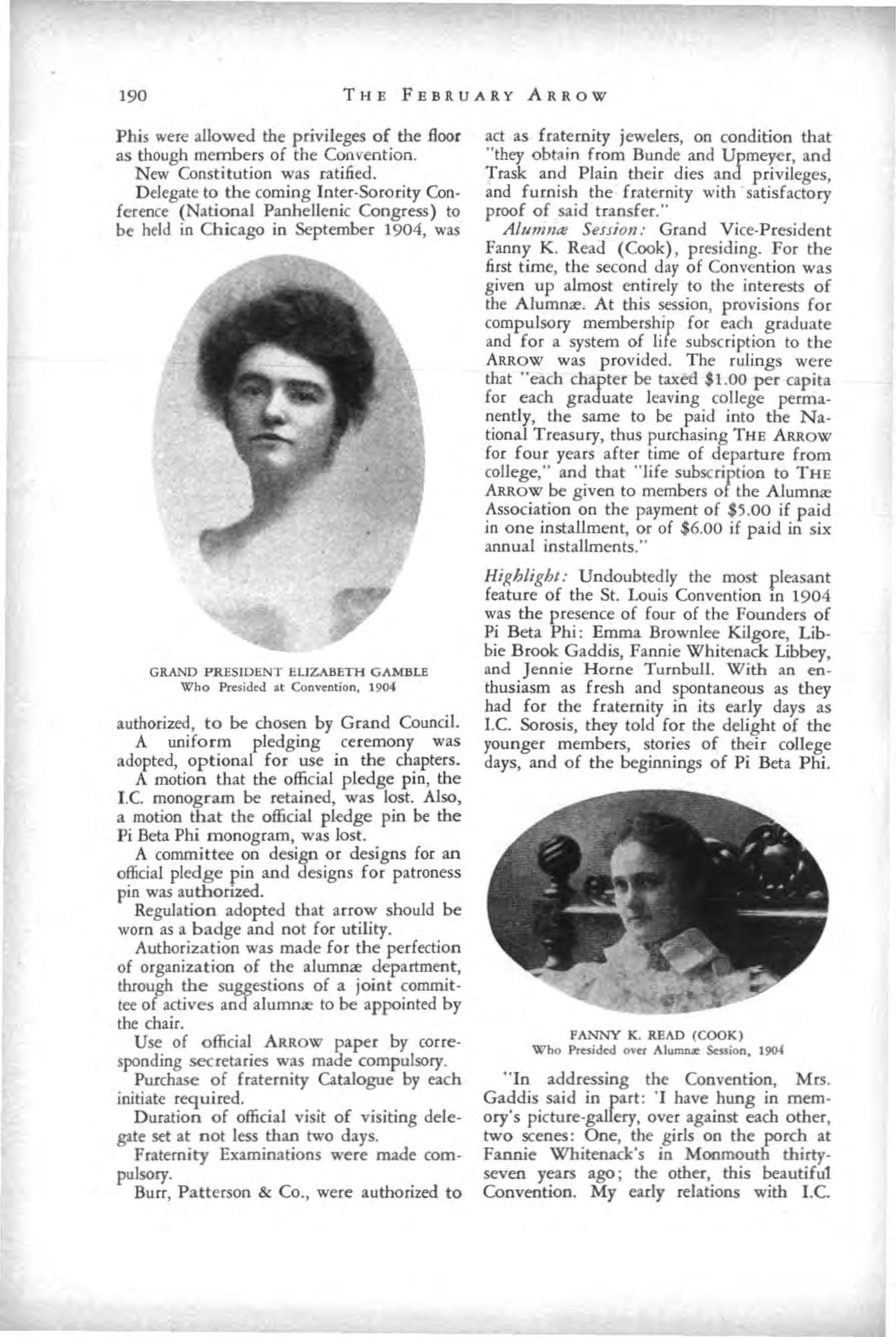
Who Prlesided lit Conven tion, 1904
authorized, to be chosen by Grand Council.
A uni form pledging ceremony was adopted, optional for use in the chapters.
A motion that the official pledge pin , the I .e. monogram be retained, was lost. Also, a motion that the official pledge pin be the Pi Beta Phi monogram, was lost .
A committee on design or designs for an official pledge pin and designs for patroness pin was authonzed.
Regulation adopted that arrow should be worn as a badge and not for utility.
Authorization was made for the perfection of organization of the alumna! department, through the suggestions of a joint committee of actives and alumn", to be appointed by the chair.
Use of official ARROW paper by corre· spo nding secretaries was made compulsory. Purchase of fraternity Catalogue by each initiate required.
Duration of official visit of visiting delegate set at not less than two days.
Fraternity Examinations were made compulsory.
Burr , Patterson & Co., were authorized to
act as fraternity jewelers, on condition that ""they obt.in from Bunde and Upmeyer, and Trask and Plain their dies and privileges , and furnish the fraternity with satisfactory proof of said transf er.""
S eJJioll,' Grand Vi ce- President Fanny K. Read (Cook) , presiding. For the first time. the second day of Convention was given up almost entirely to the interests of the Alumna! . At this session , provisions for compulsory membership for each graduate and for a system of life subscription to the ARROW was provided . The rulings were that ·'each cbaptc< be taxed $ 1.00 per capita for each graduate leaving college permanently , the same to be paid into the Na· tional Treasury, thus purchasing THE ARROW for four years after time of departure from college," and that "life subscrirtion to THE ARROW be given to members 0 the Alumnre Association on the payment of $5.00 if paid in one installment, or of $6 .00 if paid in six annual installments."
Hif!.hlight: Undoubtedly th e most pleasant feature of the St. Louis Convention In 1904 was the presence of four of the Founders of Pi Beta Pbi : Emma Brownlee Kilgore, Lib· bie Brook Gaddis , Fannie Whitenack Libbey, and Jennie Horne Turnbull. With an enthusiasm as fresh and spontaneous as they had for the fraternity in its early days as I.e. Sorosis , they told for the delight of the younger members, stories of their college days, and of the beginnings of Pi Beta Phi.
Who over Alumnae Session, 1904
··In addressing the Conv<ntion, Mrs . Gaddis said in part : 'J have hung in memory's picture-gallery, over against each other, two scenes: One, th e girls on the porch at Fannie Whitenack's in Monmouth thirty. seven years ago; the other, this beautiful Convention. My early relations with I.e.
were most pleasant, and I can truly say. of all the bmes that Time has in his grip, there are none that] can smile at half SO much , or think of half so tenderly I am so sorry that Mrs . Wallace and Mrs . Turnbull are not yet here to enjoy with us every phase of this Convention, both grave and gay. To us that are here, it has given great pleasure and we have agreed that the thought that arranged a reunion of the Founders during this Con· venti on deserves our warmest thanks . We are proud of you and your good name.
As Joseph ' s dream , In his youthful home
Was a type of his future fame , So the proof of our dream From the type has come To give us an honored name .
. , 'Tis sweet to be remembered, and again we thank you. May Heaven's choicest bene· dictions rest upon you."
Entertainment: Due to the fact that the Convention was held during the St. Louis Exposition, social functions were Limited to: Greetings from Anna S. Cairns, President of Forest Park University; an informal reception; a model initiation and a banquet. Spare hours were devoted to visiting the Exposition.
Model Initiation: Mittie V. Robnette, a pledge of Missouri A , was initiated.
Eleel;ol1 0/ Officers:
Grand President: Elizabeth Gamble, Colorado A
Grand Vice·President and Secretary to Alumn",: May Copeland Reynolds (Drybread), Michigan A
Grand Secretary: Mary Bartol Theiss, Pennsylvania B
Grand Treasurer: Martha N. Kimball, Colorado B
ARROW Editor: Florence P. Robinson , Wisconsin A
Historian: Susan W. Lewis , Michigan B.
THE NINETEENTH BIENNIAL CONVEN· TION of Pi Beta Phi was held at the Claypool Hotel, Indianapolis, Ind., June 26-30, 1906, with Grand President Elizabeth Gamble, presiding
Gral1d Gu;de: Ethel Rous Curryer, Indiana 1'.
Comm;I"e: Three Indiana chapters: Alpha , Beta and Gamma.
Allendallce: Ten officers and delegates from 35 chapters were present. In the absence of the Grand Secretary, Mary Bartol Theiss who was ill, Elda L. Smith, Illinois E, was appointed Secretary of the Convention. Approximate attendance, 175 .
Legislation,' Use of the arrow except as a badge forbidden.
New pledge pin adopted, consisting of an arrow head of Roman gold with Ji¥ef burnished gold mounted on it. F-.
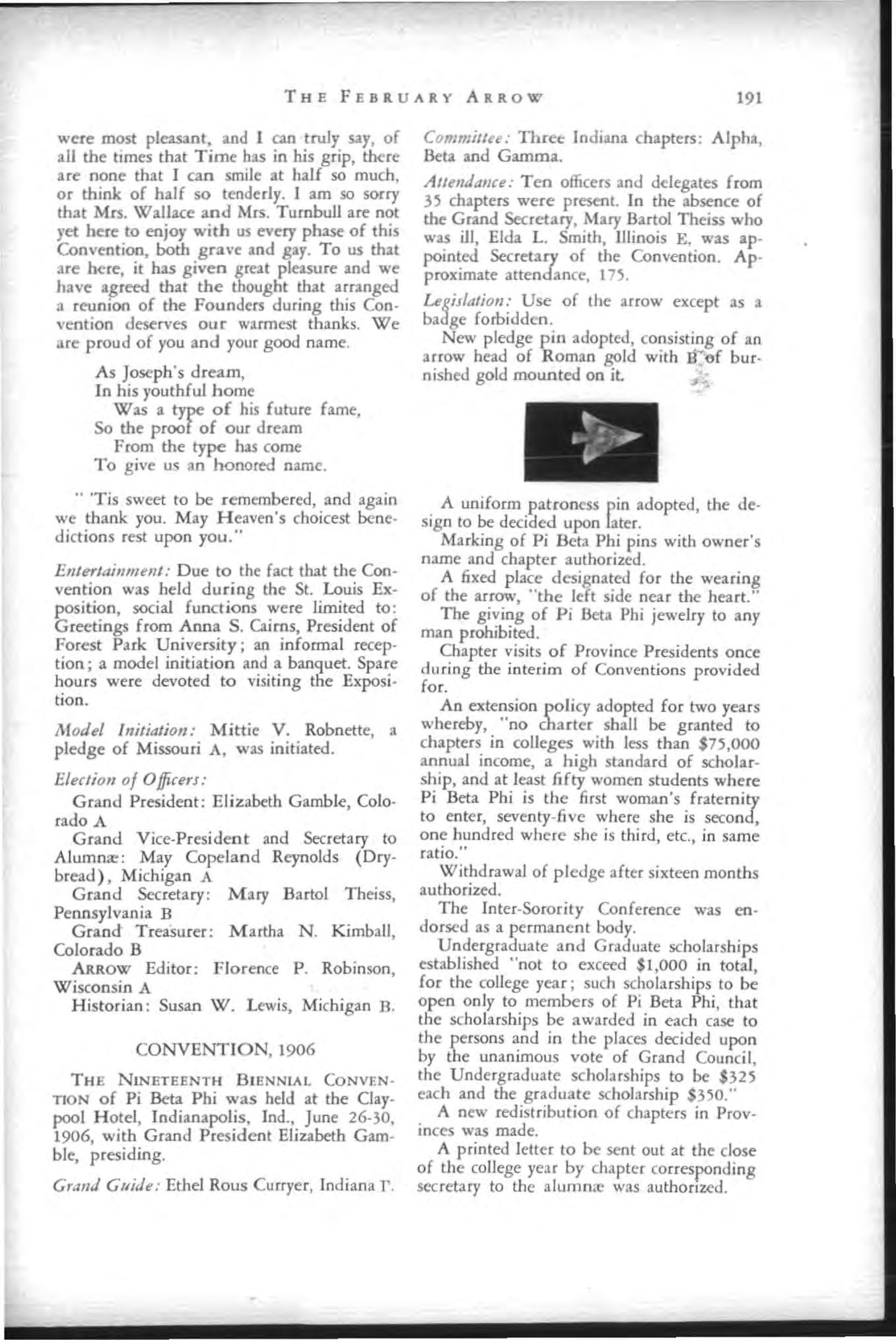
A uniform patroness pin adopted, the de · sign to be decided upon later.
Marking of Pi Beta Phi pins with owner's name and chapter authorized.
A fixed place designated for the wearing of the arrow, "the left side near the heart."
The giving of Pi Beta Phi jewelry to any man prohibited.
Chapter visits of Province Presidents once during the interim of Conventions provided for.
An extension policy adopted for two years whereby, "no charter shall be granted to chapters in colleges with less than $75,000 annual income, a high standard of scholarship, and at least fifty women students where Pi Beta Phi is the first woman's fraternity to enter, seventy -five where she is second, one hundred where she is third, etc., in same ratio."
Withdrawal of pledge after sixteen months authorized.
The Inter-Sorority Conference was endorsed as a permanent body.
Undergraduate and Graduate scholarships established "not to exceed $1,000 in total, for the college year; such scholarships to be open only to members of Pi Beta Phi, that the scholarships be awarded in each case to the persons and in the places decided upon by the unanimous vote of Grand Council, the Undergraduate scholarships to be $325 each and the graduate scholarship
A new redistribution of chapters in Provinces was made.
A printed letter to be sent out at the close of tile college year by chapter corresponding secretary to the alumna! was authoClzed.
A committee was authorized to consider a coat of arms and to report at the next Convention.
The maintenance of a chapter lodge or room, wbere faculty ruling permits, made compulsory_
The office of Alurnn., Editor was created and the duties of the J\1umnae Editor defined.
The rights of official jeweler were taken from Trask and Plain
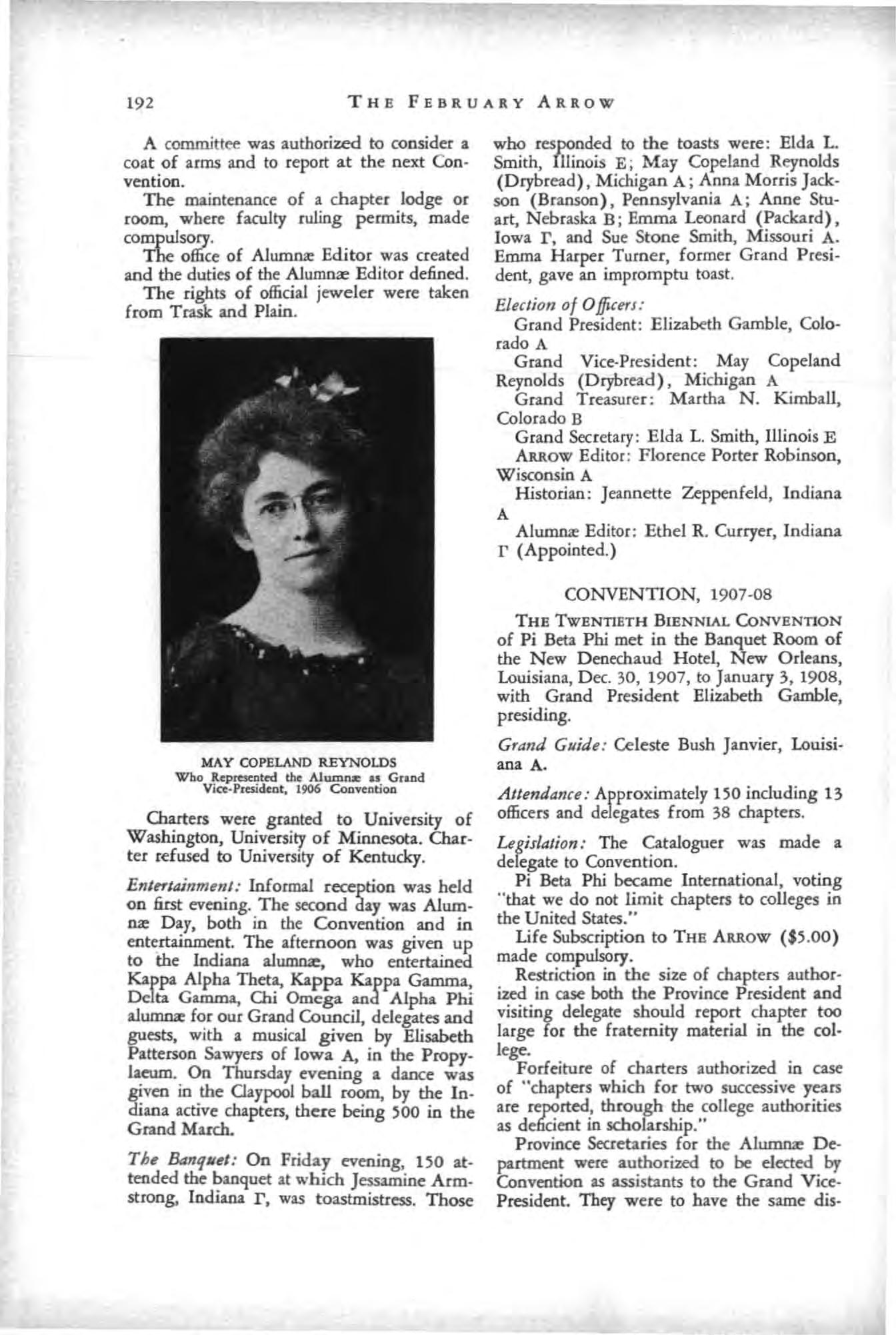
Wbc R.epruented the Alumnz " Grand Vict -PrtSiden t. 1906 Convention
Charters were granted to University of Washington, Universitr of Minnesota. Charter refused to UniverSIty of Kentucky
Enltrlainmml." Informal reception was held on first evening The second day was J\1umnae Day, both in the Convention and in entertainment. The afternoon was given up to the Indiana alumnae, who entertained Kappa Alpha Theta, Kappa Kappa Gamma, Delta Gamma, Chi Omega ana Alpha Phi alumnae for our Grand Council, delegates and guests, with a musical given by Elisabeth Patterson Sawyers of Iowa A, in the Propylacum _ On Thursday evening a dance was given in .the Caypool ball room, by the Indiana actIve chapters, there being in the Grand March.
Ban'l"<i." On Friday evening, 150 attended the banquet at which Jessamine Armstrong, Indiana r, was toastmistress. Those
who responded to the toasts were: Elda L. Smith, fIlinois E; May Copeland Reynolds (Drybread) , Michigan A; Anna Morris Jackson (Branson), Pennsylvania A; Anne Stuart, Nebraska B; Emma Leonard (Packard), Iowa r, and Sue Stone Smith, Missouri A. Emma Harper Turner, former Grand Presi· dent, gave an impromptu toast.
Eleclion of O/fieerJ ."
Grand President : Elizabeth Gamble, Colorado A
Grand Vice-Preside nt: May Copeland Reynolds (Drybread), Michigan A
Grand Treasurer: Martha N. Kimball, Colorado B
Grand Secretary: Elda L. Smith, JIlinois E ARROW Edito r: Florence Porter Robinson, Wisconsin A
Historian: J eannette Zeppenfeld, Indiana A
Al= Editor: Ethel R. Curryer, Indiana l' (Appointed . )
THE TWENTIETH BIENNIAL CoNVENTION of Pi Beta Phi met in the Banquet Room of the New Denecbaud Hotel, New Orleans , Louisiana, D ec 30, 1907, to J anuary 3, 1908 , with Grand President Elizabeth Gamble, presiding.
Grand Guide: Celeste Bush Janvier, Louisiana A .
Allendance." Approximately 150 including 13 officers and delegates from 38 chapters.
Legislation." The Cataloguer was made a defegate to Convention .
Pi Beta Phi became Intemational , voting " that we do not limit chapters to colleges in the United States."
Life Subscription to THE ARROW ($5.00) made compulsory_
Restriction in the size of chapters authorized in case both the Province President and visiting delegate should report chapter too large for the fraternity material in the college_
Forfeiture of charters authorized in case of "chapters which for two successive years are reported , through the college authorities as de6cient in scholarship."
Province Secretaries for the Alumnae Department were authorized to be elected by Convention as assistants to the Grand VicePresident. They were to have the same dis-
tricts as the Province Presidents, ailed Grdes, tMir experues to Convention to be paid by the national treasury, but were not to have a vote in Convmtioo.
Monthly attendance of representative from aI= club to active chapter meeting authorized
Regulations were adopted prohibiting the initiation of any special student carrying less than 12 hours work, or having less than 12 hours credit in a college of liberal arts.
Selection of a patroness pin was laid on the table, pending the choice of symbols.
Secret number of THE ARROW to be printed annually, approved.
A treasurer's boOk with simple directions for keeping same, authorized for chapter treasurers.
Committees appointed to: prepare a Pi Beta Phi Calendar, a symphony, and to continue the study of the crest or coat of arms.
Fifteen alumna: dubs submitted reports to the Convention.
Highlight: At this Convention the Chaprer Exhibit idea was inaugurated. "In the banquet room of the Denechaud , fish nets had been hung on the four walls of the room, and one wall was assigned to each province. Under the leadership of their presidents, the girls of each province filled their nets with college and fraternity banners, photographs of chapter groups and college scenes, and pennants and emblems ."
An informal reception in the banquet room of the Denechaud Hotd, with an address of welcome by President Dixon on the first night; a royal entertainment New Year's Eve by Kappa Kappa Gamma at the home of Miss Kate Minor; the third day, Alpha Tau Omega gave the delegates a trolley ride to and through the Newcomb College (Irounds, visiting the pottery works, and havtng New Year's luncheon on tM campus; a trip to the quaint old French operahouse, where "La Tosca" was being played ; and a banquet
The Banquel : A banquet with covers for 125, at which Alice Monroe, Louisiana A, was toastmistress. Those who responded to toasts: Pauline Curran, Louisiana A, Muriel James, Michigan B, May L. Keller, Maryland A, Elizabeth Gamble, Colorado A, Margaret Phillippi , Iowa A, Louise Birch, Missouri B, Martha N . Kimball , Colorado B, Cora E. Marlow, Mirtnesota A and Frances Waltemeyer, Colorado A. A number of fake tele·
grams and a mock debate added much enjoyment to the evening " Loving cups of Newcomb pottery, with the Pi Beta Phi carnations upon them, were presented to Grand President Elizabeth Gamble and ARROW Editor Florence Robinson , retiring Grand Officers.
P)"lion
Grand President: May Lansfield Keller, Maryland A
Grand Vice·President: Cora Emilie Mar· low (Kerns), Minnesota A
Grand Secretary: Elda L. Smith, lUinois E
Grand Treasurer: Celeste Bush Janvier , Louisiana A
ARROW Editor: Mary Bartol Theiss, Pennsylvania B
A
Historian: Jeann ette Zeppenfeld, Indiana
Alumna: Editor: Sarah Pomeroy (Rugg) , Massachusetts A (Appointed)
THE TWENTY-FIRST BIENNIAL CoNVENTION was held in the Presbyterian Chapel, Swarthmore, Pa ., June 27-30, 1910, with Grand ?resident May L. Keller, presiding.
Grand Guide: Mary Gloper Johnson (Griest), Pennsylvania A.
Commillet,' Pennsylvania A, Pennsylvania B. Pennsylvania r.
AllendanCl: Thirteen officers, delegates from 40 chapters and 12 clubs. Approximately 220, indudin(l visitors.
This Convention, because of the endorsement of the Settlement School, and the adoption of other exceedingly progressive movements, was caUed an "epoch-making" one . Good fellowship was the keynote.
ugiIlalion: Charters were granted to : University of Oklahoma , University of Wyoming, and Wooster University, and representatives from the three petitioning groups were pledged before the banquet.
The Symphony, submitted by Abbie Williams Burton , Illinois E, was adopted offi· cially and ordered printed .
The Grand PresIdent was empowered to appoint a committee to investigate and sc· lect a suitable pattern for the initiation gown and to send same to all chapters.
A new historical sketch was ordered prepared and published as soon as possible; also, a new Catalosue.
The publishing of the Fraternity Calendar for 1911 was san c ti one d.
The Fellowship for graduate study
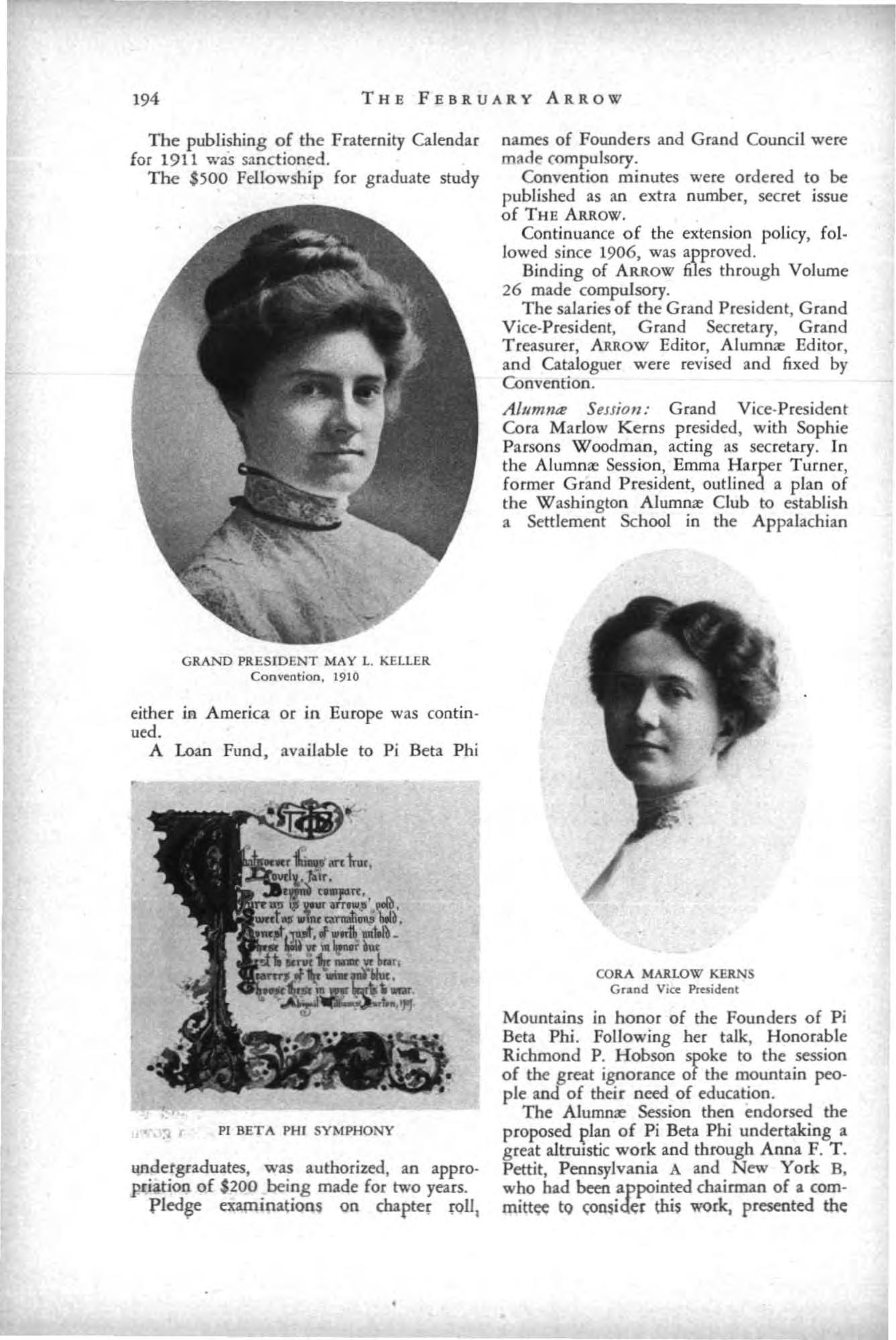
GRAND PRESID ENT MAY L. KELLER
Conventi on, 191 0
either in America Or in Europe was (ontin · ucd.
A Loan Fund, available to Pi Beta Phi
names of Founders and Grand Council were mad e compulsory.
Convention minutes were ordered to be published as an extra number, secret issue of THE ARROW
Continuance of the extension policy, followed sin ce 1906 , was approved . Binding of ARROW 51es through Volume 2 6 made compulsory
The salaries of the Grand President , Grand Vice -President, Grand Secretary, Grand Treasurer . ARROW Editor, Alumnre Editor, and Cataloguer were revised and fixed by Convention .
Sessio n.' Grand Vice President Cora Marlow Kerns presided, with Sophie Parsons Woodman, acting as secretary . In the Alumna:: Session , Emma Harper Turner, former Grand President, outlined a plan of the WaShington Alumnae Club to establish a Settlement School in the Appalachian
. .' PI BET A PHl S YMPHONY
qndetgraduates, was authorized , an approof $200 being made for two years fledlle examinations on chapter roU.
CO RA MARLOW KERN S G ran d Via Prcsiden t
Mountains in honor of the Founders of Pi Beta Phi . Following her talk , Honorable Ricbmond P. Hobson spoke to the session of th e great ignorance of the mountain pea . pie and of their need of education.
The Alumnae Session then endorsed the proposed {'Ian of Pi Beta Phi undertaking a great altruIStic work and through Anna F . T. Pettit, Pennsylvania A and New York B, who had been appointed cbairman of a (om· mittc;c tQ c;<lru;i<ler thi$ work, presented tbe
followin g recommendations to the Convention as a whole :
1. That the sanctio n of the Co nvention be g ive n to this pl a n , thu s opening the door of opportunity to Pi Beta Phi to become a pioneer amon g women 's fraternities in one of the great altruistic movements of the present day. That this worthy memorial be aedica ted to OUf Founders o n the fiftieth anniversary of the fraternity .
2 That the following committee representing the national alumn." be elected by Convention to outline and develop the work:
Emma Harper Turner, Indiana A and Columbia A. Grand Vice-President Anna Bronson , Grand Secretary Julia E. Rogers, Mary B. Harris, Pennsylvania B, Leila R. Soule, Mi chigan A, Jennie C. Rainey. Louisiana A, M a ry E W allih.n, Colorado B, Alice C. Stewart Wolf, Illinois A, Edith L. Carpenter, Vermont B, Jennie B. Allyn , Massachusetts A, Anna F T Pettit, Pennsylvania A and New York B.
That the local Washington committee be aske d to serve as a sub-committee.
3. That the national committee' be empowered to send out requests for contributions and pledges at their discretion.
4. That the thanks of the Convention be extended to the Washington Alumn", Club for their suggestion.
The Convention unanimously adopted the recommendations .
Hig hlighl: A loving cup awarded to the chapter with the largest delegation, judged on percentage of total enrollment of the chapter, age of same, greatest number from active chapter and percentage of miles covered was awarded for the first time to : Nebraska B, University of Nebraska .
Enlertainm ent: Much time was spent in the examination of splendid chapter exhibits On Monday evening there were songs, recitations, college skits and a Pi Phi medley at the Strath Haven Inn , where the Grand Council and as many others as possible were housed. On Tuesday there was a picnic across Crum Creek; Wednesday morning the Cnnvention picture was taken ; in the afternoon, Pennsylvania A presented fairy scenes from A Midsummer Night's Dream in the nearby deU to which Panhellenic guests had been invited . In the evening. Pennsylvania B entertained with a stunt party and cookie shine .
T be Ban'lN .t: On Thursday evening, Mary Belle Harris, P(nnsylvania B, presided as
toastmistress at the banquet Speakers in · cluded: Minnie Barry, Ontario A ; May L. Keller, Maryland A, Mary Shannon, Arkan · sas A, Florence Metzner, California A, Lois Janvier, Louisiana A, and Anna CampbeU , Pennsylvania A
Elect io ll o f 0 ffirerl : Grand President; May L. Keller, Maryland A
Grand Vice ·President : Anna Jackson Branson , Pennsylvania A
Grand Secretary: Julia E. Rogers, Iowa Z
Grand Treasurer : Celeste Bush Janvier, Louisiana A
ARROW Editor : Mary Bartol Theiss , Pennsylvania B
Historian: Kate King Bostwick, Michigan
Alumn", Editor: Sophie P Woodman, New York B (Appointed)
THE TWENlY -SECOND BIENNIAL CoNVENTION was held in Annie May Swift Hall, of Northwestern University, Evanston, III. , June 25 -29, 1912, with Grand President May Lansfield Keller, presiding.
C o nvt1llion Gllide: Elda L. Smith, Illinois E, Asst. Guide: Amy B. Onken, Illinois E.
FOllllder: Libbie Brook Gaddis.
Allelldanee: Roll call showed sixteen officers and 44 delegates present, Beta Province President being absent.
u giJ/a/ion : A provisional charter was granted to Delta Alpha Delta, Stetson University. subject to the investigation and approval of the Grand Council.
Alumnre Delegates were given the privilege of the floor.
The Loan Fund, started in 1910, was made permanent to consist of not less than $200 per annum.
The provinces were redistr icted, on a geographical basis, the number being enlarged from four to six, from Alpha to Zeta, induslve.
The bond of the Grand Treasurer was raised to $6,000
The report of the committee on uniform initiation gown was accepted.
Emma Harper Turner made a report of the Settlement &hool and recommended that Marth a HiU be re -engaged as school teacher
for the present, with a member of Pi Beta Phi as understud y Convention sanctioned the appropriation of $2)0 a year for running expenses of the Settlement School.
The Chicago Alumn., Club was requested to assume control of the Settlement School project.
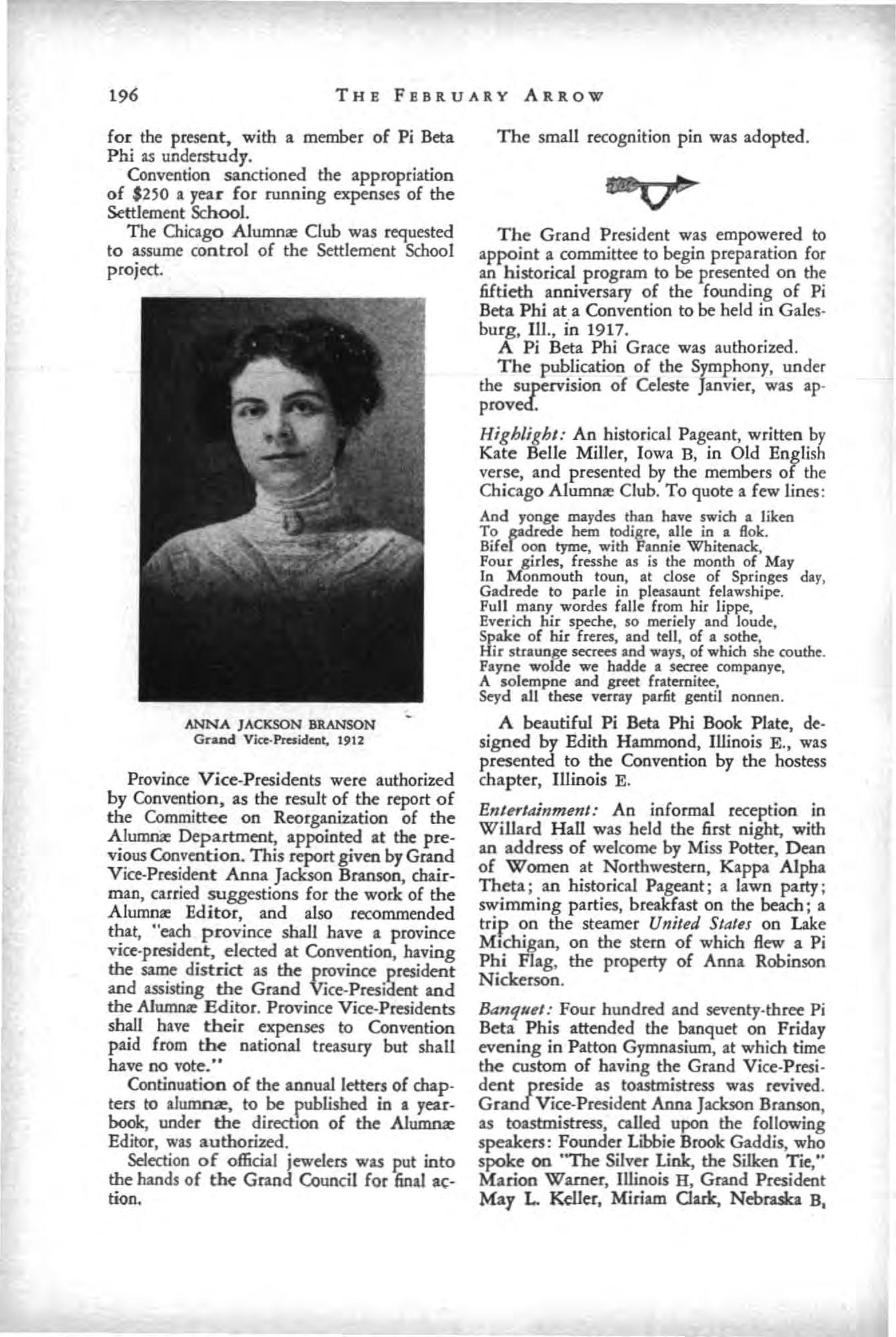
Province Vice-Presidents were authorized by Convention, as the result of the report of the Committee on Reorganization of the Alum"", Departmeot, appointed at the previous Convention. This report given by Grand Vice-Pres ide nt Anna Jackson Branson, chairman, carried suggestions for the work of the Alumn., Editor, and also recommended that, "each province shall have a province vice-president, elected at Coovention, having the same district as the province president and assisting the Grand Vice-Presioent and the Alum"", Editor. Provine< Vi ce- Presidents shall have their expenses to Convention paid from the national treasury but shaU have no vote:'
Continuation of the annual letters of chapters to lIUJtlru1e, to be publiShed in a yearbook, under the directIon of the AI= Editor, was authorized.
Selection of oflicill jewders was put into the hands of the Grand Council for linal action.
The small recognition pin was adopted .
The Grand President was empowered to appoint a committee to begin preparation for an historical program to be presented on the fiftieth anniversary of the founding of Pi Beta Phi at a Convention to be held in Gales· burg, Ill., in 1917.
A Pi Beta Phi Grace was authorized
The publication of the Symphony, under the supervision of Cdeste Janv;'r, was ap ' proved.
Highlight: An historical Pagea nt, written by Kate Belle Miller, Iowa B, in Old English verse, and presented by the members of the Chicago Alu= Club . To quote a few lines : And yonge maydes than have swich a liken To gadrcde hem todigce, aIle in a Ook. Bifel oon tyme, with Fannie Whjtcnaclc, Four gides, frcs she as is the month of May In Monmouth toun, at close of Springes day, Gadrede to parle i n pleasaunt felawshipe . Pull many wordes falle from hir lippe, Everich hir spec.he, so meriely and loude, Spake of hit freres, and tell , of a rothe, Hir straunge secrees and ways, of which she couthe. Payne wolde we hadde I secrce compaoye, A solempoe and gred: fratemitce, Seyd aU these vertay par6t gentiJ nonnen.
A beautiful Pi Beta Phi Book Plate, designed by Edith Hammond , IUinois E., was presented to the Convention by the hostess chapter, IUinois E.
Entertainmenl: An informal reception in Willard HaU was held the first night, with an address of wdcome by Miss Potter, Dean of Women at Northw<stern , Kappa Alpha Theta; an historical Pageant; a lawn party ; swimming parties , breakfast on the beach; a trip on the steamer United Stat" on Lake MIchigan, on the stern of which Bew a Pi Phi Flag, the property of Anna Robinson Nickerson.
Banquet : Four hundred and seventy-three Pi Beta Phis attended the banquet on Friday evening in Patton Gymnasium, at which time the custom of having the Grand Vice-Presi · dent lreside as toastmistress was revived. Gran Vice-Presi dent Anna Jackson Branson, as toastmistress, called upon the following speakers: Founder Libbie Brook Gaddis, who spoke on '''The Silver Link, the Silken Tie," Marion Warner, Illinois H, Grand Presiden t May L Keller, Miriam Clark, Nebraska B.
Helen Page Illinois E, Gertrude Fil2-Randolph Currens, Colorado A, Amelia Alpiner Stern, Illinois Z A special feature of the banquet was a parade of the Phi Beta Kappas.
Award: Attendance cup, won by New York Beta.
Election of 0 {ficerI:
A
Grand PresiJent: May L. Keller, Maryland
Grand Vice-President : Lida Burkhard Lardner, Colorado B
Grand Secretary: Amy B. Onken, lllinois E
Grand Treasurer : Anne Stuart, Nebraska B
ARROW Editor: Sarah G. Pomeroy (Rugs), Massachusetts A
Historian: Elizabeth Clarke Helmick. Michigan A
Alu= Editor : Sophie P . Woodman, New York B (Appt.)
THE TwENTY-THlRD BIENNIAL CoNVENTION of Pi Bet. Phi was held at the Twentieth Century Club House, Berkeley, Calif., July 5-19, 1915, with Grand President May Lanslield Keller, presiding.
Guide: Treasurer Ellis McClymonds. Asst. Guides: Anna Laura Bradley, Eliubeth A. Coates, Georgia Dell McCoy, Edith B. Darnell, and 15 assistants Chairman of Transportation, Nina Harris Allen, Illinois B.
Allendance: Between 450 and 500. AU members of the Grand Council, the Alurnnre Editor, Historian, Cataloguer and Guide and all Province officers were in attendance, with the exception of the Gamma Province President and Gamma Province Vice Pres ident.
Initiate: Mary Gordon Holway, California B.
Former Grand Council MemberI Present: Grand President Rainie A Small, Grand Secretary J uJia E. Rogers.
ConfJention D aily: Editor, Hazel Donoho Babcock, California B; Business Manager, Helen Havens, California B.
Legislation: Provinces were redistricted, being increased from Alpha through Eta.
Scholarship requirements were voted for Convention Delegates and for chapter officers, no one being eligible to be elected as a Delegate whose record after the freshman year was not without condition or failure; and no one being eligible for chapter office
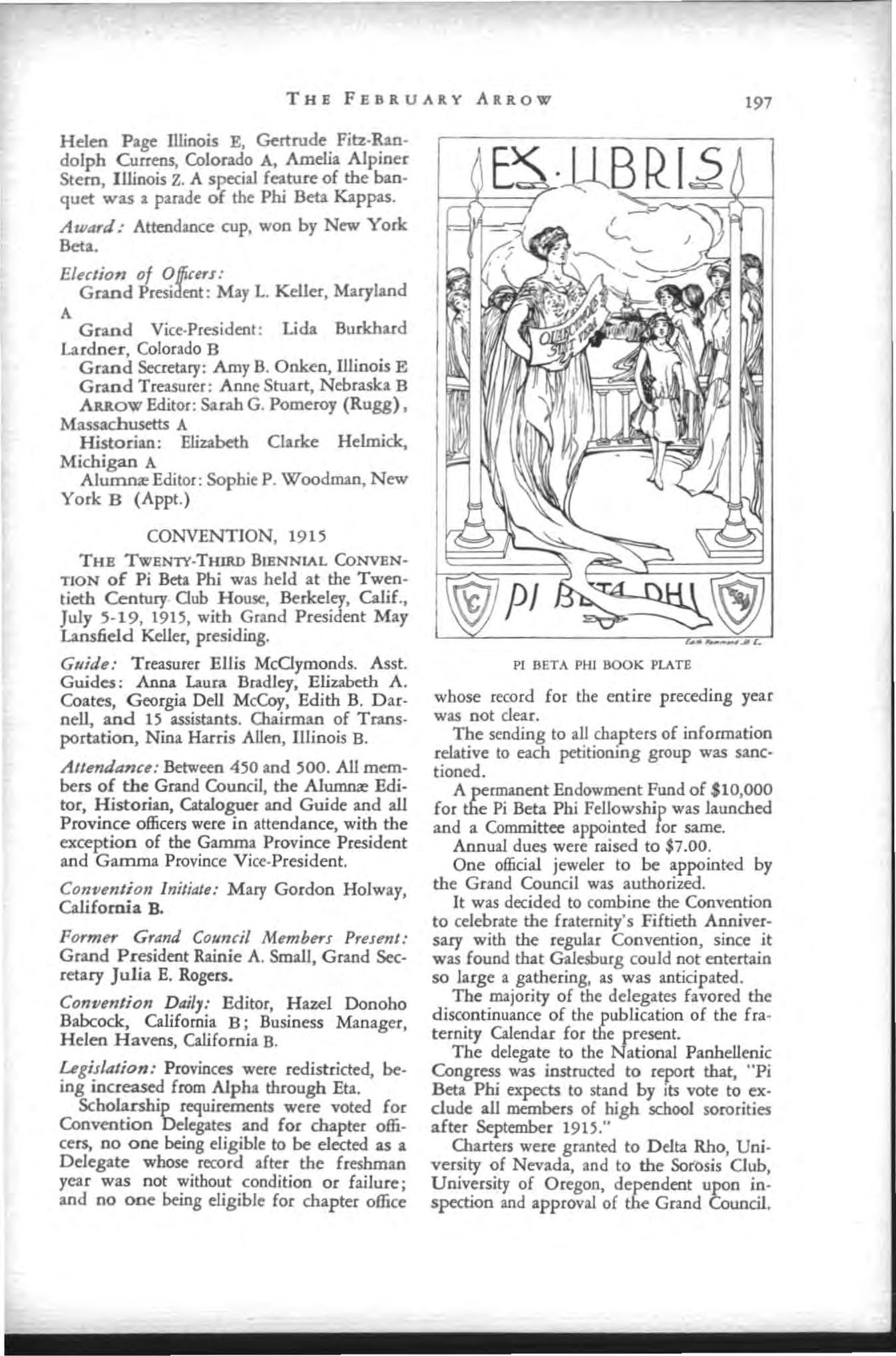
PI BETA PHl BOOK PLATE
whose record for the entire preceding year was not dear.
The sending to all chapters of inforroation relative to each petitioning group was sanctioned.
A permaneot Endowment Fund of $10,000 for the Pi Beta Pbi Fellowship was launched and a Committee appointed lor same.
Annual dues were raised to $7.00
One official jeweler to be appointed by the Grand Council was authorized.
It was decided to combine the Convention to celebrate the fraternity ' s Fiftieth Anniversary with the regular Convention. since it was found that Galesburg could not eotertain so large a gathering, as was anticipated.
The majority of the delegates favored the discontinuance of the publication of the fraternity Calendar for the present.
The delegate to the Natio nal Panhellenic Congress was instructed to report that, "Pi Beta Phi expects to stand by Its vote to exclude all members of high school sororities after September 1915."
Charters were granted to Delta Rho, University of Nevada, and to the So1'Osis Club, University of Oregon, dependent upon in· spection and approval of the Grand Council.
Alllm,,(/! SeJJion: Wednesday, July 7, was Jevoted entirely to the Alumn", Department , with Grand Vice-President Lida Burkhard Lardner in the chair, with Harriet A. Briggs, Michigan B. acting as secretary.
Voted, that "the Settlement School be placed under the co ntrol of a Board of Di -
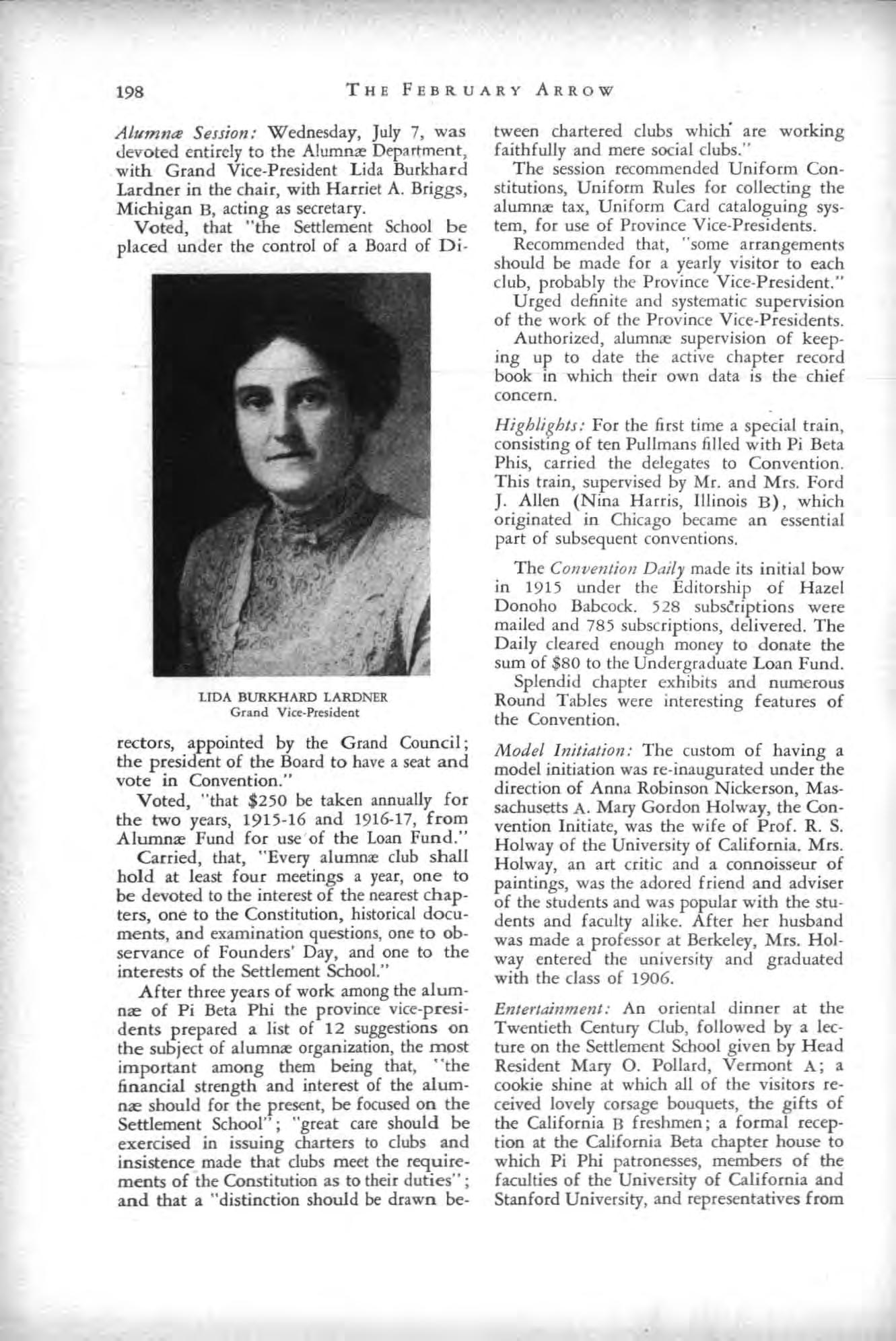
rectors, appointed by the Grand Council; the president of the Board to have a seat and vote in Convention."
Voted, " that $250 be taken annually for the two years, 1915-16 and 1916-17, from Alumn", Fund for use of the Loan Fund_"
Carried, Utat, "Every alumn", dub shall hold at least four meetings a year, one to be devoted to the interest of the nearest chapters, one to the Constitution, historical documents, and examination questions, one to observance of Founders ' Day, and one to the interests of the Settlement School."
After three years of work among the a1 umme of Pi Beta Phi the province vice-presidents prepared a list of 12 suggestions on the subject of alumna! organization, the most important among them being that, .. the financial strength and interest of the a1umn", should for the present, be focused on the Settlement School"; "great care should be exercised in issuing charters to dubs and insistence made that dubs meet the requirements of the Constitution as to their duties "; and that a " distinction should be drawn be-
tween chartered clubs which' are working faithfully and mere social clubs."
The session recommended Uniform Constitutions, Uniform Rules for collect ing the alumnre ta x, Uniform Card cataloguing system, for use of Prov in ce Vi ce- Presidents.
Re comme nd ed that, "some arrangements should be made for a yearly visitor to each club, probably the Provin ce Vi ce- Preside nt. " Urged definite and systemat ic supervision of the work of the Pr ovi nce Vi ce- Pres idents.
Authorized , alumn re superv isio n of keeping up to date the active chapte r record book in which their own data is the chief concern.
Highli$hIJ: For the first time a special train, co nsistmg of ten Pullmans filled with Pi Beta Phis, ca rried the delegates to Co nve ntion . This train, supe rvised by Me. and Mrs. Ford J. All en (Nina Harris , Illinois B), whi c h originated in Chicago became an esse nti al part of subsequent co n ventions.
Th e COllvention Daily made its initi al bow in 19 15 und er the Editorship of Hazel Donoho Babcock. 528 were maiJed and 785 s ubscriptions, delivered. The Dajly cleared enough money to donate the sum of 80 to the Undergraduate Loan Fund. Spl endid cha pte r ex hibi ts and numerous Round T ables were inte res ting features of the Convention.
M odel blitialioll: The cllstom of having a mood initiation was re -inaugurated under the direction of Anna Robinson Nickerson, Massachusetts A_ Mary Gordon Holway, the Convention Initiate, was the wife of Prof. R . S. Holway of the University of California_ Mrs . Holway, an art critic and a connoisseur of paintings, was the adored friend and adviser of the students and was popular with the students and faculty alike After h e r husb and was made a professor at Berkel ey, Mrs_ Holway entered the university and graduated with the class of 1906.
Enterlainmenl: An oriental di nner at the Twentieth Century Club, followed by a lecture on the Settlement School g iven by Head Resident Mary O. Pollard, Vermont A; a cookie shine at which all of the visitors received lovely co rsage bouquets, the gifts of the California B freshmen; a formal reception at the California Beta chapter house to which Pi Phi patronesses, members of the faculties of the University of California and Stanford UOlversity, and representatives from
FIRST PI BETA PHI SPECIAL FROM CHICAGO, 19t)
the women' s f caternities of both institutions were invited; an Hawaiian dinner on Wed· nesday night; a stunt program; a trip around San Francisco Bay on The Arrow, music be· iog furnished by H awaiia n singers. More than 300 Pi Phis !articipated in the trip, which was followe by a picnic supper. A trip to Palo Alto with the California Alphas as hostesses, lunc heon at the Women's Oub house, and a tour of Stanford University.
The Ballquel: On Friday evening the banquet was held in the crysta l ballroom of the Hotel Oakland. Grand Vice-President Lida B. Lardner who presided very cleverly called upon: Georgia nell McCoy, California B, Margaret Davis Carney, Colorado A. Agnes McCorkle, Kansas B, Anna Lytle Tannahill (Brannon), Nebraska B, Anna Robinson Nickerson, Mass.,chusetts Alpha , Regina Rom aine Miller, and Grand President May L. Ke ller .
Award: Attendance Cup: Missouri Gamma, Drury College
Best Chapter Exhibit: Nebraska Beta, University of Nebraska
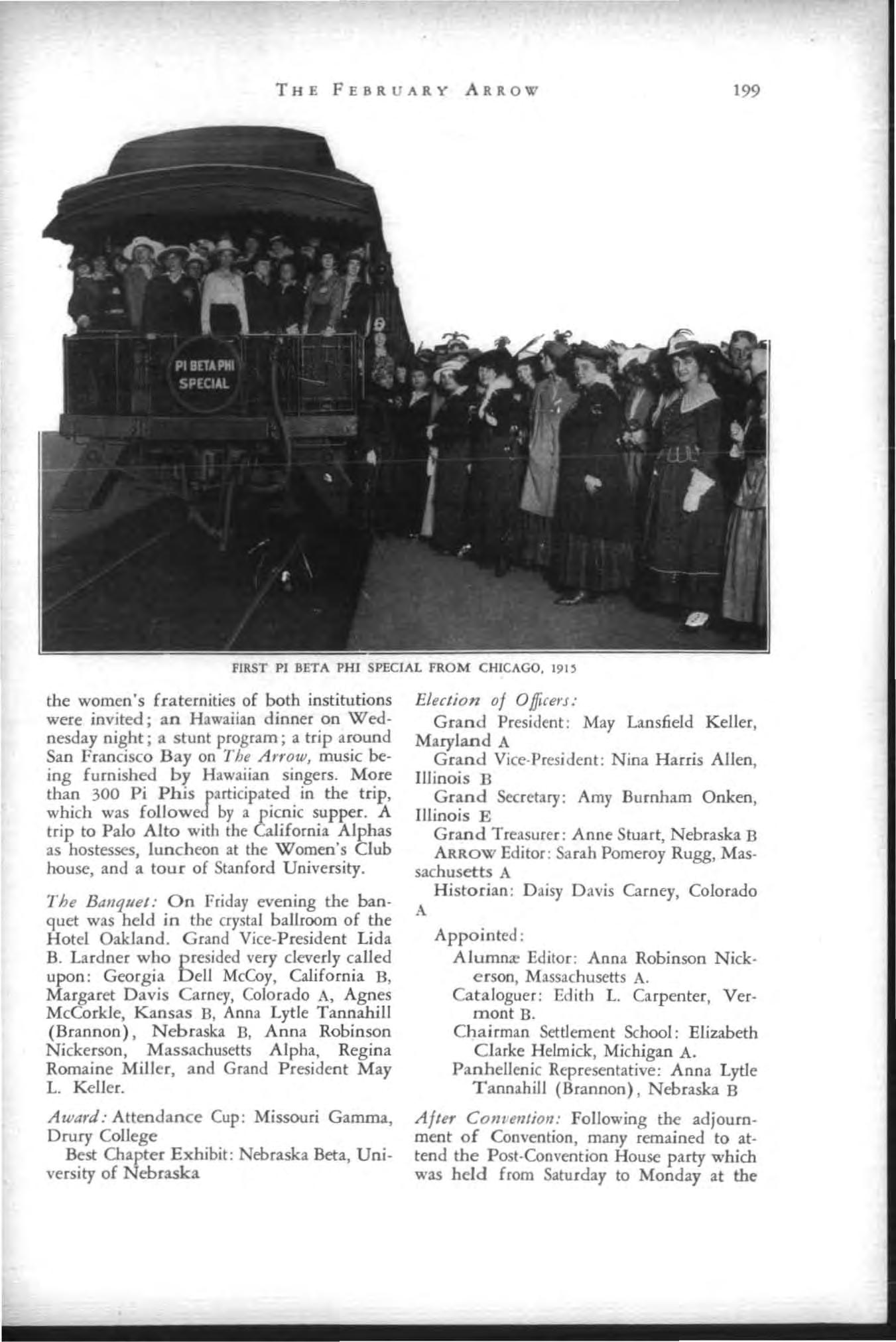
Election of 0/JicerJ:
Grand President: May Lansfield Keller, Maryland A
Grand Vice-President: Nina Harris Allen, Illinois B
Grand Secretary: Amy Burnham Onken, Illinois E
Grand Treasurer: Anne Stuart. Nebraska B ARROW Editor : Sarah Pomeroy Rugg, Massachusetts A
Historian : Daisy Davis Carney, Colorado A
Alumn", Editor: Anna Robinson Nickerson, A.
Cataloguer: Edith L. Cupe nter , Vermont B.
Chairman Setdement School: Elizabeth Clarke Helmick , Mi chigan A.
Panhellenic Repr ese nt at ive: Anna LytI e Tannahill (Brannon), Nebraska B
Alter COIlU'llioll: Following the ment of Convention, many remained to at· tend the Post-Convention House party which was held from Saturday to Monday at the
Hotel Oaremont, Berkeley. Others went to Yosemite, some to Portland , and Seattle; and some to San Diego to the Exposition there, some to Grand Canyon Eleven members of Massachusetts Alpha enjoyed a houseparty at Glendale, California, at the home of Blanche Charlton Curtis. Another houseparty was held at Lake Waha, Idaho, at the summer home of Mr. and Mrs. Tannahill.
GOLDEN ANNIVERSARY CoNVENTION planned for 1917, but not held .
Convention was called for June 23·30, 1917, to be held at Lake Geneva, Wisconsin, to celebrate the fraternity's Golden Anniversary.
The following appointments were made by the Grand Council:
Grand Guide: Inez Webster, Illinois a. Assistant Guides: Louise Chapman, Marion Webster, Delia Conger, Edna Wnod, and Florence Hunt.
Soon after the Convention call was issued, the United States entered the World War and the Grand Council decided upon the postponement of the meeting.
In postponing the Convention, Grand President May 1. Keller said in part: "To quote John R. Mott, 'This is a woman's war as no other war in history has ever been, and no woman with the right standards can dodge her responsibility: ... I n the name then of the highest ideals of Pi Beta Phi, I charge you to be true to your trust in this time of national crisis, to remember the symbolism of the golden arrow, and to do worthily whatever may be your part in this great war."
THE TwENTY-FOURTH BIENNIAL CoNVENTION of Pi Beta Phi was held at The Inn, Charlevoix , Michigan, June 29-July 5, 1918, with Grand President May Lansfield Keller presiding.
Gllide: Inez Webster, Illinois a.
Founders Present: Libbie Brook Gaddis, Emma Brownlee Kilgore, Inez Smith Soule, and Fannie Whitenack Libbey
Attendance,' Approximately 200 including all national officers (except Epsilon and Eta Province Presidents and Delta and Eta Province Vice-Presidents), delegates from 55 active chapters, and visitors . It was deemed fitting to omit all the proposed features of our Golden Anniversary
which required an unnecessary outlay of time and e.xpense
Simplicity and patriotic service were the keynotes of the week, and the two outstanding characteristics of this Convention were: " the uniform excellence of the delegates and the beautiful spirit of h a rmony which always prevailed "
Due to war time conditions there was no special train.
Leg isLation: Charters were granted to the Dianthians at the University of Pittsburgh , and to the Circle, University of West Virginia.
A standing Committee on Survey was cceated
Payment of the initiation fee before initiation was made compulsory .
The fraternity was redistricted into ten provinces.
Regular annual visits of Province Presidents to all chapters in the province were authorized.
Transfers received the status of al= until afliliation with the chapter in the college to which they have transferred. Too, transfers were required to comply with college and fraternity requirements of scholarship and conduct for at least one term or semester before being received as active members of any Pi Beta Phi chapter.
Initiation requirement was adopted stipulating that "any student to be eligible to initiation into Pi Beta Phi must have satisfactorily passed, in the institution concerned, the twelve semester hours required by the fratemity and have conformed further to all college and fraternity requirements regarding scholarship and conduct."
The h01ding of initiations later than two months preceding the close of the college year, forbidden.
The report of the Committee for recommendations to the Alu= Advisory Committee was accepted.
A Chairman to solicit magazine subscriptions for the benefit of the Settlement School authorized for each chapter.
A War Work Committee, originating in the A1= Session , appointed by the Grand President and Grand Vice-President, considered various suggestions for a valuable war work to be undertaken by the fraternity at large.
This Committee, composed of Leah 1. Stock, Chairman, Edith Gordon, Jessica Davis Murphy, California A and Maryland A, took
as a basis for considering the fraternity war work, the assumption of the Grand that about $2,000 might annually bt avail· able for such a work. Two suggestions from the many considtrtd wtre sd<cted as bting "distinctive, valuable, and well worthy of developmtot" :
1. Tho establisbment of ten scholarships in nursing (or possibly othtr forms of war work, such as psychothtrapy, stenography, <tc. )
2. The creating of more coopt rative houSts in congested centers, similar to the one organized by the Pi Phis in Washington, D .C
The Convention went on record as favoring some form of war work to be carried on by Pi Beta Phi as a national organization, and r<commended that a committee bt ap· pointed to investigate forms and costs of war work and to report to the Grand Coun· ci L
Rules rdative to tbt inspection of ptti. tioning groups wert adopted.
An informal vote of Convention showtd that, "the StDtiment was very strongly against allowing the badge to bt made with a iewd set in the chain or with enameled wings, and against allowing the coat of arms to be worn by anyone not a membtr of the fraternity."
The deficit of $4,000 in the ARROW En· dowment Fund was wiptd out by · a sptcial appropriation.
The office of the resident Custodiao of Sup plies for each chapter was crtated, her duties to be the r<ceiving and distribution of all sup· plies sent during vacations.
The carrying on of all official corre· spondence in typewritten form was made compulsory.
The Grand Treasurer was empowertd to print in pamphlet foom the historical play, written by Mabel Balch, Vermont B.
Vottd that $200 from the Contingent Fund bt plactd annually at the disposal of the Loan Fund Committee, and that $2'0 bt placed annually at the disposal of the Settle· ment School Board.
At the close of Convention upon the re· tirement of Grand I.'resident May Lansfield Keller, Kansas A1pba moved that "May Lansfield KtUtr be made President Emeritus of Pi Beta PhL" Unanimously carried by a rising vote. Miss Kdltr accepted this hon· orary office with "an expressIOn of her ap· preciation and a pltdge for continued service for the fraternity."
AII,mnee
Three sessions of the Alumnae Department were held with Grand Vice·President Nina Harris AUen, presiding and Alumnae Editor Anna Robinson Nicker· son, actins as secretary.
The ch,ef business of the sessions was the creation of the War Work Committee and
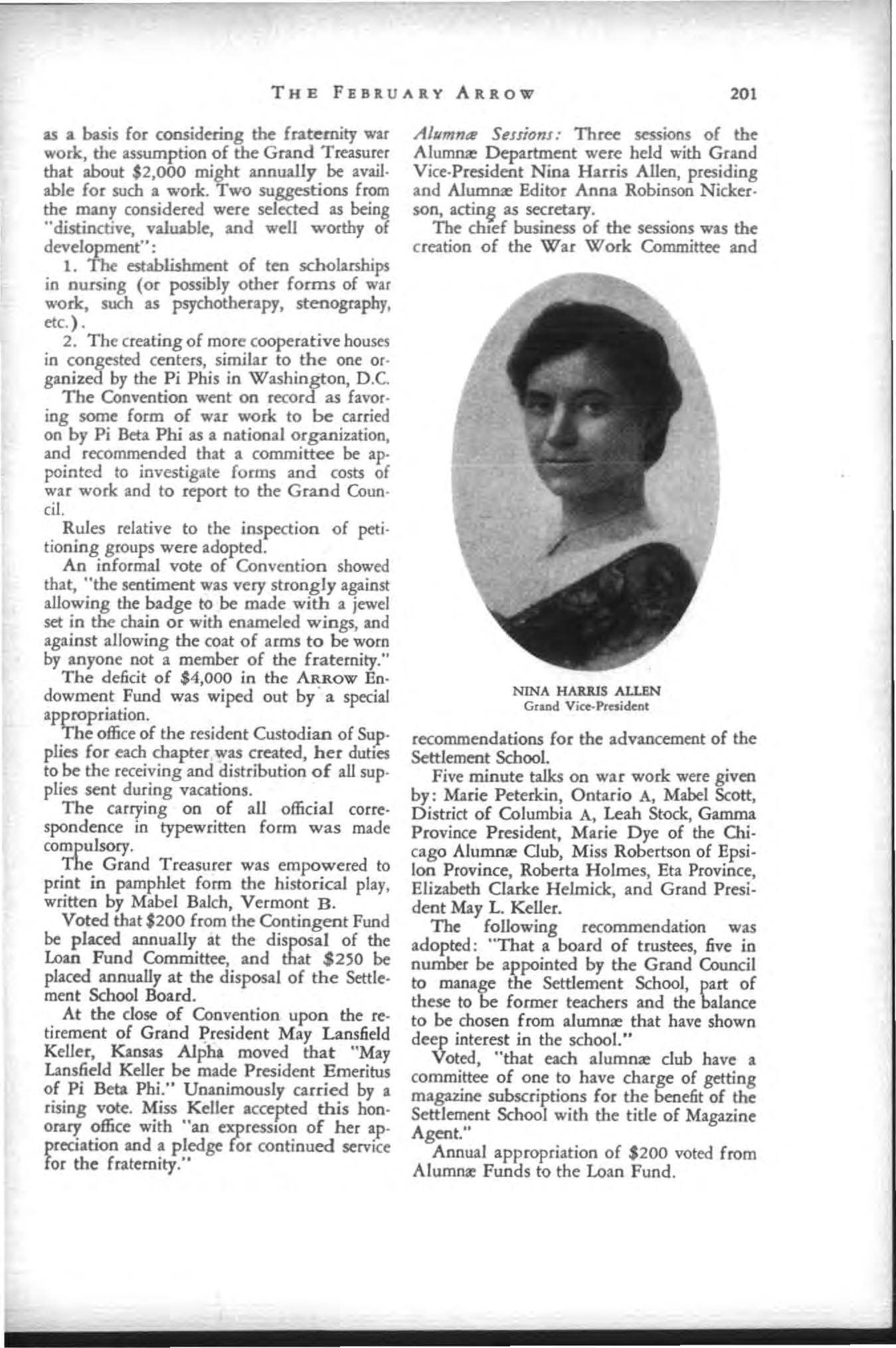
NINA HARRIS ALLEN Grand Vice· President
recommendations for the advancement of the Settlement School.
Five minute talks on wac work were given by: Marie Peterkin, Ontario A, Mabtl Scott, District of Columbia A, Leab Stock, Gamma Province President, Marie Dye of the Chi· cago Alumn., Club, Miss Robertson of Epsi. Ion Province, Robtrta Holmes, Eta Province, Elizabeth Clarke Helmick , and Grand Presi· dent May L. Keller.
The following r<commendation was adopted: " That a board of trustees, five in numbtr be appointed by the Grand Council to . manage the Settlement School, part of these to be former teachers and the balance to be chosen from alumn., that have shown deep interest in the school."
Vottd, "that each alumnae club have a committee of one to have charge of g<tting magazine subscriptions for the benefit of the Settlement School with the title of Magazine Agent."
Annual appropriation of $200 vottd from Alumn., Funds to the Loan Fund.
Model lnilialio,,: Co ndu cted by Mi chi ga n B.
Highlighlr: There was no Convention Daily o n account of wac cost. A very comp lete and artistic Yearbook was published by a staff of Michigan Betas com posed of : ·Edito[·in· chief, Ma[tha C. Gray; Literary Editor, Mil· dred Vorce, Business Manager, Margaret E. Snyder, Advertising Manager, Ruth Mallory, Circulation Manager, Grace Hall, Assistant Circulation Manager, Olive Wright. The staff financed. the publication and succeeded in dearing enough to co ntribute $15 to the Un· dergraduate Loan Fund.
Sperial talks were given by : Miss Eva Jones, Principal of Rupert's Land Ladies' College, Winnipeg, Canada, on " War Work "; D ean Gertrude Beggs, Colorado B, o n , "The Daughters of Atlas"; Dr Edith H. Gordon , on "Conduct Standards for Frater· nily Girls"; Miss Richards on the " Y.W .C.A. and War Work"; and Ruth De Hass Bal· fouc , Indiana r, told of her musi cal entertainments in the ca ntonm ents .
On July 4, came the Formal Presentation of the Settlement School when with exceed · ingly fitting words, El izabeth Clarke Hel· mick, on behalf of Pi Beta Phi, presented the School to our Founders. Libbie Brook Gaddis made the speech of accepta nce for the Found · e rs and then placed the School in the keeping of the Fraternity by presenting it to the Grand President.
Enlerlaimnelzt: An informal reception; Stereopticon Lecture on Tennessee and the Settlement Sc hoo l by Mr O. M. Schantz, husband of Carrie Flagler Schantz, Io wa 11) ; Vesper Services in Convention Hall; Informal musical; Model Initiation; His torical Play, a a splend id production, written by Mabel Balch , Vermont B, depicting the birth and vital scenes of the development of Pi Beta Phi, representing two yea rs of work on the part of the author . After the play the four Founders present each gave a talk Emma Brownlee Kilgore won a round of applause with :
"Y ou scarce expect o ne of my age To speak in public on the stage If we chance to (aU Mlow in beauty Rest assured , we arc still on duty Yo ur Founders hold their heads on high Because they M o th e r Pi Beta Phi :"
The Banquel: The festivities of Convention were brought to a dose on Thursday evening, July 4 , with the banquet, over which Grand Vice·President Nina Harris Alleo,
graciously presided. The banquet menu wns in strict accord with Hoover and the toasts were mOre informal than ever before . Tiny Bags were given as souvenirs. The Pi Beta Phi grace was sung, the guests gave the Pledge of Allegiance to the Flag, and re o peated Americas Creed. Then all joined in si nging: "God Save Our Men ." The banquet roU call stressed the charter members . The list of banquet speakers included : Ethel Carey, New York n , Delia Conger, Illino is 8 , Margaret Prentiss, Columbia A, Kathryne Cae, California n, Josephine Welch, Cali · fornia A, Edna Stoke, MIChigan A, and May L. Keller, retiring Grand President. Edna Stoke 's toast was made the occasion of the presentation to Miss Keller of a handsome gold wrist watch .
Awardr : Attendance Cup, Texas n, South · ern Methodist Unive rsity .
Best Exhibit : Kansas Beta , Kan State Agr College . After the banquet an auction of the flags of the allies , which had been used for tab le decorations, was held in the lobby of The Inn . The extra stock of souvenir pins was also contributed to the auction by Mr . L. G . Balfour. The auction netted $75 for the Sct· tleme nt School fund.
Grand President: Anna Lytle Tannahill (Brannon), Nebraska B
Grand V ice-President: Anna Robinson Ni ckerson, Massachusetts A
Grand Secretary: Amy Burnham Onken, lliinois E
Grand Treasurer : Anne Stuart, Nebras· ka B.
ARROW Editor : Sarah Pome roy Ru gg, Mas · sachusetts A
Historian : Elizabeth Clarke Helmick , Michigan A
THE TWENTY- FIFTH BlENNlAL CoNVENTION of Pi Beta Phi was held at The Inn, Charlevoix, Michigan, July 1 to July 6, 1921 , with Grand President Anna Lytle Tannahill , presiding Lillian Wisconsin A.
FOllnder! Emma Brownlee Kilgore , Clara Brownlee Hutchinson , Fannie Wbite · nack Libbey, and Inez Smith Soule (Ella Smith Hoyt, an I.c. at Monmouth, and a
sister of Mrs Soule, was also present.)
Allendanee : Approximately 300 delegates, officers and visitors .
Convemi o" Mary 1. Matthews, Indiana 6.
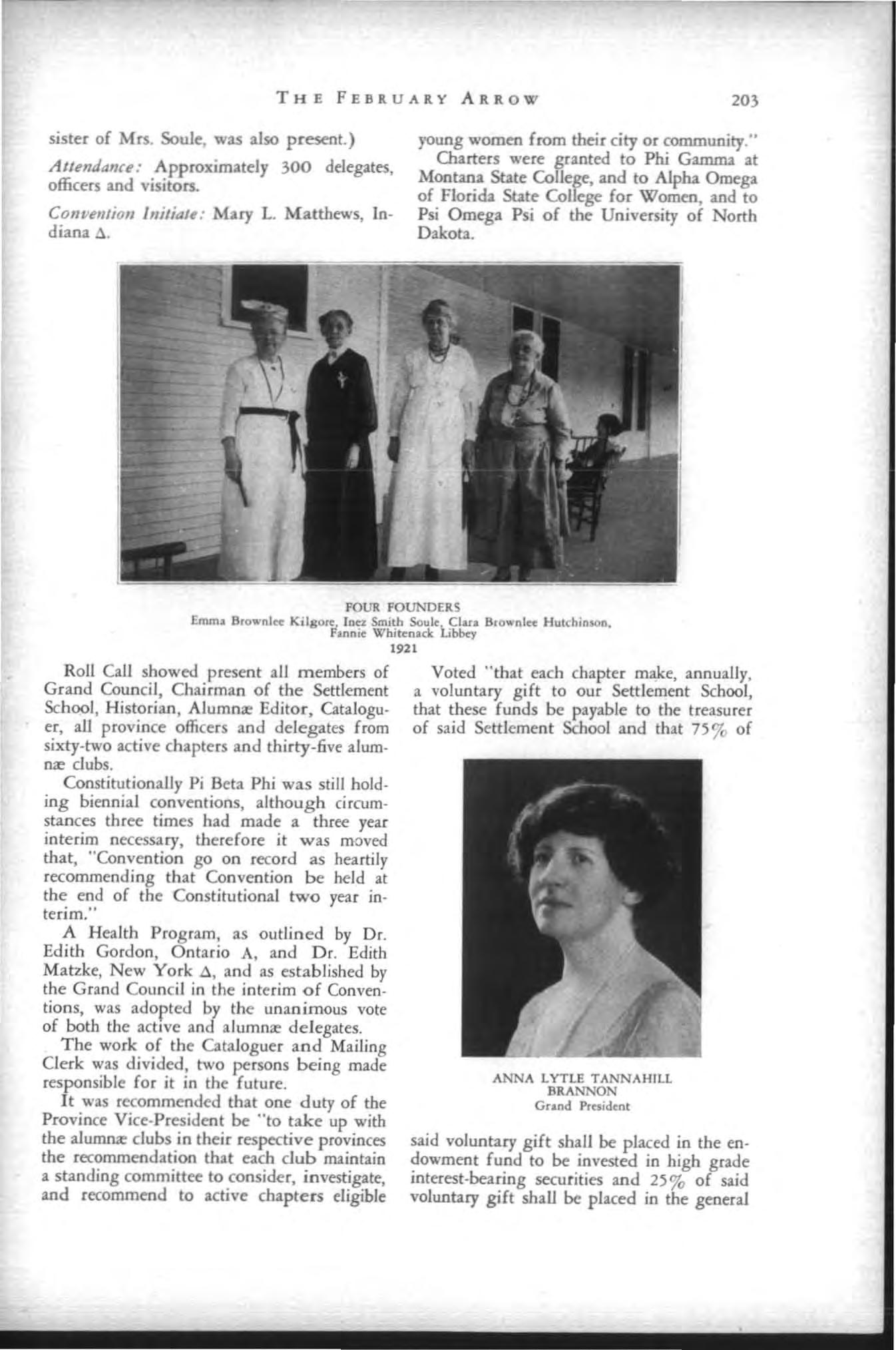
young womttl from their city or community ."
Cllarters were granted to Phi Gamma at Montana State College, a nd to Alpha Omega of Florida State College for Women , and to Psi Omega Ps i of the University of North Dakota
Ro ll Call showed present all members of Grand Council , Chairman of the Settlement School, Historian , Alumn", Editor , Cataloguer, all province offi ce rs and delegates from sixty. two active chapters and thirty-five alumnre dubs.
Constitutionally Pi Beta Phi was still holding biennial conventions, although circumstances three times had made a three year interim necessa ry. Ul c refore it was m :) ved that, "Convention g o on record as heartily recommending that Convention be held at the end of the Constitutional two year interim, "
A Health Program , as outlined by Dr Edith Gordon, Ontario A, and Dr Edith Matzke, New York Ll. , and as established by the Grand Council in the interim of Conventions, was adopted by the unanimous vote of both the actIve and alumn", delegates .
The work of t1he Cataloguer and Mailing Clerk was divided, two persons being made respon si ble for it in the future .
It was reco mmend ed that one duty of the Province V ice- Presiden t be "to take up with the alumna! clubs in their respective provinces the recommend at ion that each club maintain a standing co mmittee to consider. investigate, and recommend to active chapters eligible
1921
Voted "that each chapter make, annually, a voluntary gift to our Settlement School, that these funds be payable to the treasurer of said Settl ement School and that 75 % of
ANNA L YTLE TANNAHILL BRANNON Grand
said voluntary gift shall be placed in the endowment fund to be invested in h ig h grade interest-bearing securities and 25 % of said voluntary gift shaU be placed in the general
fund of the Settlement &bool for use in de· fraying current expenses."
Two grades of dismissal were provided for: Honorable dismissal and Expulsion.
An appropriation of $300 annually, was approved from the Emergency Fund to the Loan Fund.
The Grand President was empowered to appoint special local deputies to supplement the work of national and province officers, in visiting new chapters and those in need of special supervision.
Insignia regulations were authorized as follows: " No member of the fraternity ac· tive at this time or initiated after July 6, 1921, may wear other than the official, stand· ard, gold badge ; enamelled wings, and stones in the chains being forbidden. Plati · num badges, since they are not 'gold arrows,' may be worn by no member of the fraternity , active or alumnae. The fraternity pins of hus· bands , fathers, brothers , sons and fiancees , may be, if desired, attached by a chain to the arrow. The letters Pi Beta Phi in mono· gram may be worn only by the parents , pa· tronesses, brothers, sons, husbands and fian · cees of members of the fraternity."
Beta Province President Lulu H. Clark pre· sented suggestions for a farewell serviee for Pi Beta Phi seniors and it was moved " that Grand Council appoint a co mmittee to for· mulate and publish such a ceremony."
Voted, "that the fraternity purchase from L. G . Balfour Co ., and present to the Found· ers, who do not already own them, reproductions of the I.e. Pin."
A rising vote of Convention was extended to Mr. Balfour io appreciation of the Balfour Memorial Cup , presented to Pi Beta Phi, by Mr. Balfour in memory of his wife, Ruth De Hass Balfour, Indiana r.
AJllmnte StJlionJ: Three alumnre sessions were held, presided over by Grand Vice· President Anna Robinson Nickerson and AI= Editor Nina Harris Allen, as secre· tary.
Delegates from 35 alumnae dubs were in attendance.
The Alumnae voted that the Alumnae Fund
assume expense of the Province Viee·Presi· dents to Convention; work up Founders' Day celebrations in places where there were no dubs or chapters; to appropriate to the Loan Fund the sum of $400.
A motion was carried "that any fraternity officer who expects to make an official visit to
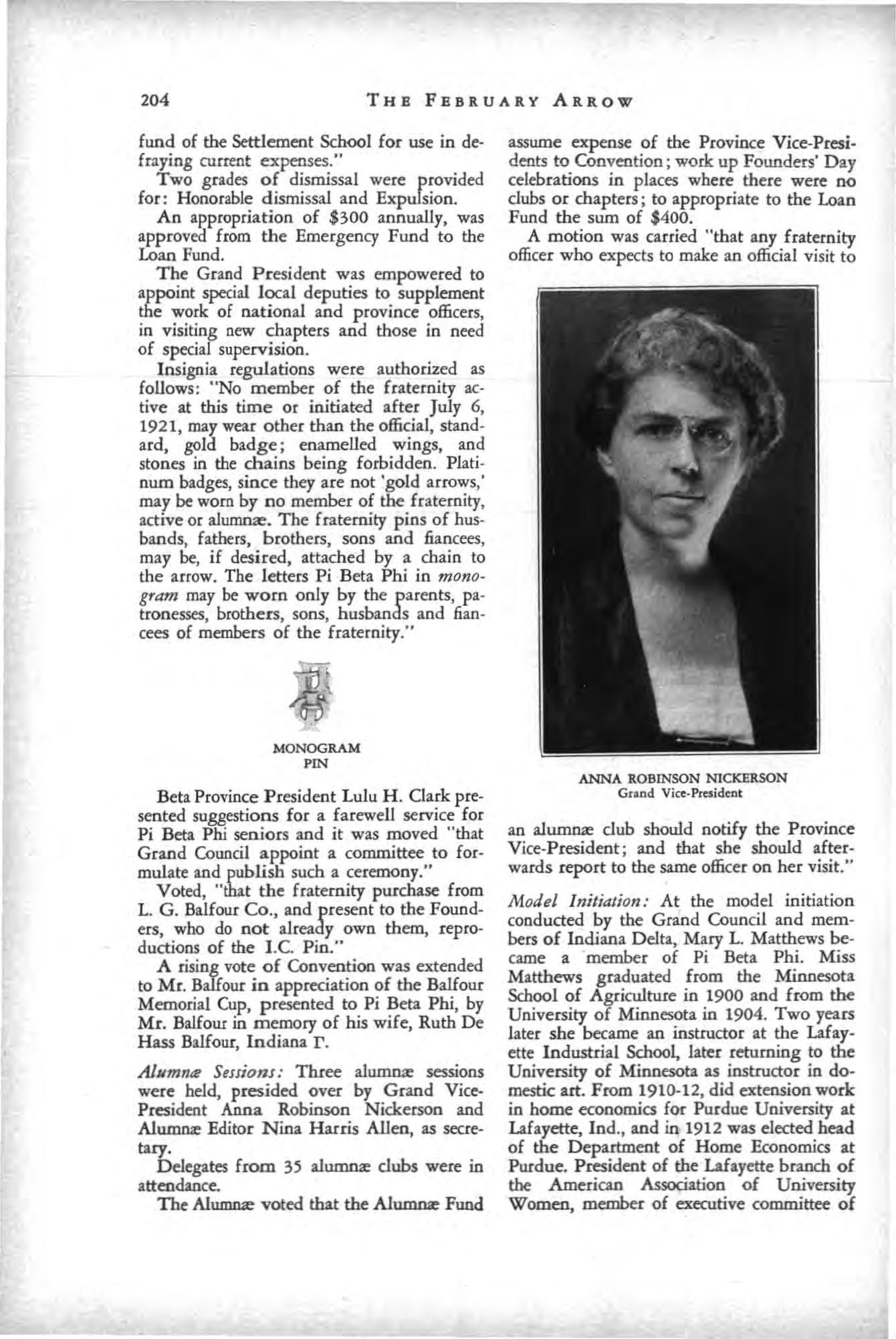
ANNA ROBINSON NICKERSON Grand Vice -President
an alumnae dub should notify the Province Vice·President ; and that she should after· wards report to the same officer on her visit . "
Model Inilialion: At the model initiation conducted by the Grand Council and memo bers of Indiana Delta, Mary L. Matthews be· came a member of Pi Beta Phi. Miss Matthews graduated from the Minnesota &boo! of Agriculture in 1900 and from the University of Minnesota in 1904. Two years later she became an instructor at the Lafay. ette Industrial &bool, later returning to the University of Minnesota as instructor in do· mestic art. From 1910 12 , did extension work in home economics for Purdue University at Lafayette, Ind ., and in 1912 was elected head of the Department of Home Economics at Purdue. President of the Lafayette branch of the American Association of University Women, member of executive committee of
the Inruana Fedeution of Clubs, member of Omicron Nu . Author of a book, "Elementary Home Economics ." Member of American Home Economies Association council.
Highlights: Qules B. Edd'l' a repr=ntative or the Near East Relie , addressed the Convention in behalf of Armenian relief Resolutions were passed by Convention endorsing the cause of the Near East Relief and Pi Beta Phi went on record as, "favoring speedy action by the United States Congress to S<Cure permanent relief and protection for Armenians in the Near East."
A quiet Sunday afternoon hour was devoted to a vesper and memorial .service "to the sisters in the wine and blue who have been taken by death from our ranks during the P:lSt three years." A very fitting talk was given by Kate B. Miller, Iow a B, on "Values." The service closed with the singing by Evelyn Bishop, New York A, of "The Slwnber Song," by Jessie L. Gaynor, Iowa Z.
An address, "The College Woman as a Citizen" by May Wood Simons, IUinois E, was most instructive.
A special train, under the supervision of Nina Harris Allen, brought the guests from Chicago to Charlevoix.
As a substitute for the Convention Daily, a cardboard BuDetin , was issued each morn· ing under the direction of Assistant ARROW Editor, Agnes Wright Spring, assisted by fifteen volunteer reporters.
Informal reception and "Stunts"; an informal tea given by Mrs. John Stewart, Louisiana A; Province Spreads; Fire-side Conference; the heat prevented the athletic contests with the exception of the water festival; motor trips on Pme Lake and occasional early morning tramps in the woods; the Pi Beta Phi paReant, words and music written by Laurel Cissna, Indiana r, and produced by members of Delta Province This Pageant was presented in the form of "The Pi Phi Memory Book," and recalled step by step the history of the fraternity as the leaves of the books were tu rned , showing life-size "port raits ."
T h4 Banqu.t: Under the guidance of Grand Vice-President Anna Robinson Nickerson, as toasttnistress at the banquet, the Pi Beta Phi Garden blossomed and furnished a lovely nosegay through the toasts given by: Emma Brownl.., Kilgore, Founder, Sarah Pomeroy RU88, Massachusetts A; Alice Wiedmer,
Missouri A; Dorothy Cunningham , Washington B; Martha G. Trost, Indiana.!!.; Anna Lytle Tannahill (Brannon), Nebcaska B; President Emeritus May L. Keller.
Awards : Presentation of awards made by the Grand President:
The Balfour Memorial Cup: Virginia A, Randolph-Macon Woman's College.
The Attendance Cup: Louisiana A, Newcomb College.
Best Exhibit: Kansas A, University of Kansas.
The banquet closed with the passing of the loving cups and the singing for the lirst time at Convention of "The Loving Cup Song," written by Loraine Lenz Carrol, Colorado A.
Election of 0 !Fc.,.s:
Grand President : Amy Bucnbaro Onken, Illinois E
Grand Vice-President: Anna Robinson Nickerson, Massachusetts A
Grand Secretary: Lulu Clark, Virginia A
Grand Treasurer: Anne Stuart, Nebraska B
ARRow Editor: Agnes Wright Spring, Wyoming A
Historian : Sarah Eikenberry Sigler, Iowa B
Appointment: Cataloguer, Lillian Freund, Wisconsin A
Alumnz Editor, Nina Harris Allen, lUi · nois B
THE TwENTY-SIXTH BIENNIAL CoNVENTION of Pi Beta Phi was held at the Hotel Stanley, Estes Park , Colorado, June 25-30, 1923, with Grand President Amy Burnharo Onken, presiding.
Guide: Lorena Accola Fitzell, Colorado A.
Commillee : Lena Harper Trott, Colorado B, Mabel Dickerson Davis , Colorado B, Nina Harris Allen, Illinois B, Anna Pifer, Colorado A.
FOUlld., p,.unt : Inez Smith Soule.
Convention Initial e: Grace Edgington (Jordan), Oregon A.
Allendanr.: 700, representing seventy-four chapters (nine non-existent). All members of Grand Council, the President Emeritus, Chairman of the Settlement &bool, Historian, Cataloguer, Alwnnae Editor, and all
Province officers (except Alpha Province President and Eu Province Vice -President) , delegates from 65 chapters and 57 a1umnre dubs were present.
The In vocation was given by Former Grand President Elizabeth Gamhle, Colorado A.
Legislatioll: Charters were granted to Alpha Sigma Phi, University of Chattanooga, Beta
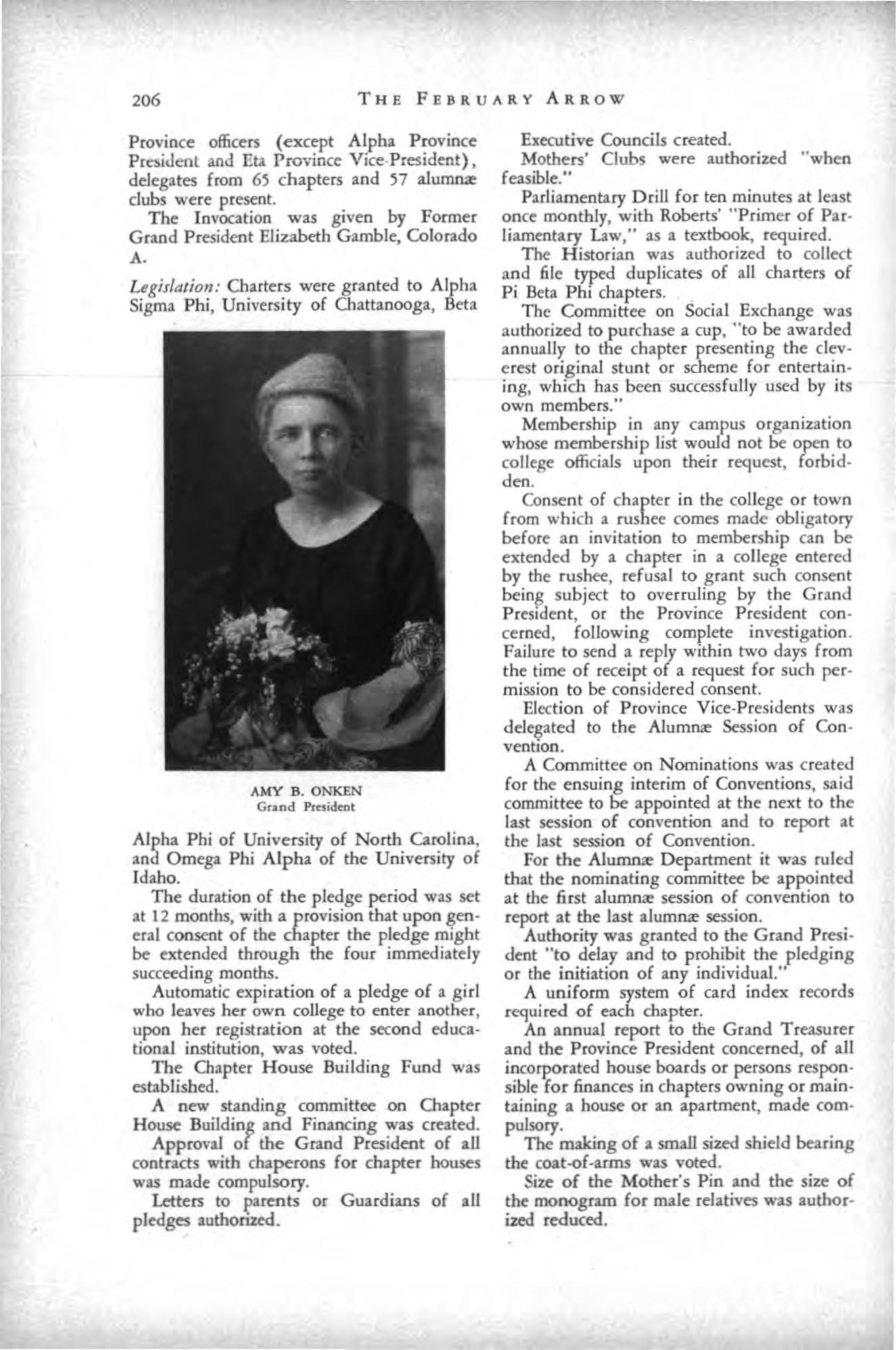
AMY
B.
ONKEN Grand President
Alpha Phi of University of North Carolina , ana Omega Phi Alpha of the University of Id aho
The duration of the pledge period was set at 12 months, with a provision that upon general consent of the chapter the pledge might be extended through the four immediately succeeding months . Automatic expiration of a pledge of a girl who leaves her own colJege to enter another , upon her registration at the second educational institution , was voted.
The Chapter House Building Fund was esUblished
A new standing committee on Olapter House Building and Financing was created . Approval of the Grand President of all contracts with chaperons for chapter houses was made compulsory.
Letters to parents or Guardians of all pledges authorized.
EX«utive Councils created . Mothers' Clubs were authorized "when feasible."
Parliamentary Drill for ten minutes at least on ce monthly, with Roberts ' "Prim e r of P a r· liamentary Law , " as a textbook, require d . The Histori an was authorized to co ll ect and file typed duplicates of all charters of Pi Beta Ph. chapters. _
The Committee on Social Exchange was authorized to purchase a cup, "to be awarded a nn ually to the chapter presenting the c1ev · erest original stunt or scheme for entertaining, which has been successfully used by its own members. "
Membership in any campus org anization whose membership list would not be open to college officials upon their request , forbidden.
Consent of chapter in the college or town from whi c h a rushee comes made obli ga tory before an invitation to membership can be extended by a chapter in a college entered by the rushee , refusal to grant su c h con sent being subject to overruling by the Gr and President , or the Provin ce President concerned, following complete investigation . Failure to send a reply within two days from the time of receipt of a request for su ch permission to be co n sidered consent.
Election of Province Vice -Presidents was to the Alum,"" Session of Con · ventlon.
A Committee on Nominations was c reated for the ensuing interim of Conventions , said committee to be appointed at the next to the last session of convention and to report at the last session of Convention.
For the A1umnre Department it was ruled that the nominating committee be appointed at the first alumnz session of c onvention to report at the last alumrue session .
Authority was granted to the Grand Presi · dent "to delay and to prohibit the pledging or the initiation of any individual."
A uniform system of card index records ce<Juired of each chapter.
An annual report to the Grand Treasurer and the Province President concerned , of a1l incorporated house boards or persons responsible for finances in chapters owning or maintaining a house or an apartment, made compulsory.
The making of a small sized shield bearin g the coat-of·arms was voted.
Size of the Mother' s Pin and the size of the monogram for male relatives was authorized reduced .
Alum1Ue SUIionJ : Two AJumna: Sessions were he ld , presided over by Grand VicePresident Anna Robinson Nickerson, with Alumn<r Editor Geraldine E. Mars, secretary.
Election of the Grand Vi ce-P resident an d Provin ce Vice-Presidents in the alumna: session was provided.
Compulsory subscription to THE ARROW for a lumn z dub corresponding secretaries (if the co rresr.ndin g secretary is not already a subscriber , was voted.
Alumna: clubs in c ities or towns with active chapters, were made Pi Beta Phi life of transfers untd affiliation takes place.
The session voted that the chai rman appoint a committee to prepare a skeleton co nst itution for use by a Iumnre clubs . Washington, D.C., club asked the endorsement of alumrue session of a confere nce of Eastern Provinces at Washington , preced ing the D . A.R. Congress in the spring of 1924, and requested that the committee on hos pitality s hould include o nl y Washin gton, D .C., members, and that the committee on prog ram should be headed by a Washington alumn", c h a i [man. Th e e n dorsement was g iven .
As a- result of a resolution presented by the New York Alumn", Club that, ·necessary steps be taken to effect a reorga niz ation of Pi Beta Phi Fraternity which will g ive its alumnre associations an equitable vo ice in the e l ec tion of all officers having in charge the directing and distribut ion of fund s rai sed in full or in part by these alumnre associations," it was voted that the matter be refe rred to a comm ittee to be appointed aft e r Co nv e ntion which, "should study the ci rcumsta nces durin g inte rim of conv e ntion s a nd make proper recomm endation s for a reorganization of the aJumn re department at the next Convention."
V o ted , that ··th e nam e of Emma Harper Turn e r be made as lasting as h e r work, by n a ming for her some building at the Settlement School."
The matter of subscrib in g to s hares in a Panhe ll eni c building to be erected in New York City was brought up for di scussio n , but a ll motions con cerning it were lost.
Model I nitiation: Held in Stanley Casino with the Grand Cou n cil and Provi nce Offi ce rs officiating, at the ini tiatio n of Grace Edgington (Jorda n) , Oregon A. Grace Edgington, Phi B e t a Kappa , a ttend ed Williamette University, taught at W asco, Oregon, the n attended the University of Oregon where s he belonged to Th eta Sigma Phi and to a group
that later became Mortar Board Writer of stories and verse. On faculty of University of W ashi ngto n where she taught journalism
Taught English and journalism in University of Oregon and edited the alumni magazine. Twice filled emergency terms as acting dean of women at Oregon University a nd was house mother of University of Washington chapter for s ix months.
Highlighlf : Accommodations had bee n planneil for 400 delegates , but with the arrival of 700, ··overflow ·· hote ls h ad to be ca lled into service and guests were housed not only at th e Hotel Stanley, but at the Lew isto n, Elkhorn Lodge and Baldpate Inn
Those o n the Special Train from Chicago we re e nte rtained en route as guests at breakfast of the Pi Phis at Ames, for tea at th e Happy H ollow Club in Omaha, and at breakfast at Dani e ls' and Fisher's in D e nver .
Ninety-se ven busses transported the special train passenge rs from Denver to Estes P ark . The singing of Gladys H agee Matthew, Colorado A, was an outstanding Convention feature.
Del egates were thrilled to meet and know H ead Resident Evelyn Bi shop and Nurse Phyllis Higinbotham from the Settlement School, and to insp ect the unu s ua lly splendid exhibits from Little Pi geo n.
Fifty ·seven chapters had exce llent exhibits .
The Convention D aily was edited by Marion Dale, Colorado A , with Willa Ferris, Co lorado A, as business man age r. Published by the Estes Park Trail.
Entertainment: Hik es and mountain trip s; Autochrome lecture by Fred Payne Clatworthy, Beta Theta Pi, showing Colorado mountain scenery; Settlement School Prog ram with stereopticon pictures of " Little Pigeon" and a splendid play, ··Pi Beta Phi in th e Hi g hlands ." The play was originally written and produced by Washington Alumna: Club, reVised by Elizabeth Shepard Lough , Wisconsin A , and Kate B. Miller, Iowa B . Directed by Emilie Margaret White, District of Columbia A. Members of the Zeta Tau Alph a Council, who were in co nference at the Y.M C.A. grounds, were the special gues ts of Pi Beta Phi at this program Stunt night with clever skits and many souvenirs , such as maple sugar, oranges, etc., co ncluding with the ··Masque of Athena ,' · by Dorothy Cleaveland, New York r.
The Banquet: Grand Vi ce- Preside nt Anna Robi nson Ni ckerso n' s toast scheme of ·'The
Victrola Shop" was in perfect keeping with the "singing convention." Banquet speakers who contributed to the Victrola Shop were: Helen Waltemeyer Fischer, Colorado A, Elizabeth Lauver, Michigan B, Jane Maguire, Texas B, Grand President Amy Burnham Onken, Illinois E, Ruth Davidson, Montana A, Inez Smith Soule, Founder, Grace Edgington , Convention Initiate, Dorothy Haldeman, California r, May Copeland Drybread, Michigan A.
AwardJ: Balfour Cup: Louisiana A, Newcomb College ; Attendance Cup, Illinois E, Northwestern University; Best Chapter Exhibit: Indiana A, Franklin College; Prize Song: "Pi Phi Pals," written by Elizabeth langworthy, Montana A, with music composed by he r brother, Norval Langworthy, composer of "Sweetheart of Sigma Chi."
Eltclion of OfficerJ:
Grand President : Amy B. Onken , Illinois E
Grand Vice-President: Anna Robinson Nickerson, Massachusetts A
Grand Secretary: Francese Evans (Ives) , lowsiana A
Grand Treasurer : Anne Stuart, Nebraska B
ARROW Editor: Agnes Wright Spring, Wyoming A
Cataloguer: Mabel Scott Brown, District of Columbia A
Mailing Oerk: Florence Clum Temple, Pennsylvania B
Alumnz Editor: Lorena Accola Fitzell, Colorado A
N P.C. Delegate: Dr. May L. Keller, Maryland A
THE TwENTY-SEVENTH BIENNl,I.L CONVENTION of Pi Beta Phi was held at Bigwin Inn , Lake of Bays, Ontario, Canada, June 22-27, 1925, with Grand President .Amy B. Onken, presiding.
Gg;ae : Dr Edith H Gordon, Ontario A Assistant Guide, Mary Herdman Scott, Liaison Officer, Edith Goss . Chairman of Transportation, Nina Harris Allen.
Found"'J P"unl : Fannie Whitenack Libbey, Inez Smith Soule, Libbie Bronk Gaddis.
Altena4nce : 500. All officers of the fraternity were present, numbering 30, and delegates
from 68 active chapters, and from 58 alumn'" clubs.
Con ve ntion IniliaJe: Emma J. Woerner, Louisville, Kentucky
Convention Daily: Editor, Elinor Jeannings , New York 6.; Business Manager, Margaretta Spence, Ontario A.
Invocation by Libbie Brook Gaddis.
A prize for having attended the most Conventions was awarded to Anne Stuart, Grand Treasurer.
Leghlalion: Adoption of uniform accounting system.
Requirement of bonds for all chapter treasurers and house treasurers.
Requirement of annual auditing of chapter records.
Continuance of present policy of granting charters only at Convention.
Creation of "a central record and supply office to be established in connection with the Cataloguers office, a full time paid assistant, who has had business training, to be employed at a maximum salary of one thousand dollars per annum."
Establishment of a Pi Beta Phi Endowment Fund . "Fees amounting to five dollars paid by each initiate shall constitute a permanent Pi Beta Phi Endowment Fund, the interest from which shall be applied to the Contingent Fund ."
Adoption of uniform examination for pledges.
Provision that pledge meetinJ(s be held at least twice a month, when possible.
Incorporation in the constitution of a provision for Founders' Day celebration.
Provision for a closer supervision of new chapters for a period of two years following installation.
Adoption of a uniform Pi Beta Phi ring as a scholarship award.
Creation of Board of Trustee Funds: "which shall have charge of all endowment moneys and whose duties shall be determined by law. The personnel of this committee shall be the Grand President, the Grand Treasurer, the immediately retired Grand President and Grand Treasurer and a fifth member who shall be appointed by the Grand Council at its meeting immediately preceding Convention .And shall serve durmg the immediately succeeding interim of Conventions. The Grand Treasurer shall act as chairman of this committee."
The Grand President announced that within a recent period Monmouth College had reopened its doors to national f ..ternities and explained in detail the situation existing there_
Charters were $ranted to: Tri Xi of the University of LOUIsville, Delta Phi Kappa of William and Mary College, Sigma Delta Pi, Ohio Wesleyan University _
AJllmnte Seuions . Four AJu.rnnz sessions were presided over by Grand Vice-President Anna Robinson Nickerson, with Lorena Accola Fitzell , secretary. The chief business was concerned with discussions of the Settlement School and with the reorganization of the AllllDIlZ Department. A recommendation was made that the Grand Council be authorized to appoint a committee to continue the research on reorganization It was also suggested that Grand Council so change the Constitution and Statutes that the " alumnae sessions can change such articles and sections as concern only the alumnae department."
Alumnae dues were raised from 50c to $1.00.
The office of Assistant to the Grand Vice · President was created.
Appropriations from the Alumnae Fund were made of: $200 to the Loan Fund; $350 to Record and Supply Office.
High lighu: Ovations were given to two retiring Grand Council members: Anne Stuart, who was coml;'leting twenty -three years of active service In the fraternity; and Anna Robinson Nickerson, completing seventeen years of active service.
Pi Beta Phi Special Train under direction of Nina Harris JI.llen took the delegates from Chicago to Toronto and from there another s!;'.OCial relayed them from Toronto to Huntsville.
A cup in praise of song was given by the New York AllllDIlZ Oub, a sterling silver vase, which "may be used as a loving cup or as a holder for flowers. To be awarded at each Convention to the chapter which submits the best song of permanent value."
The Convention Daily published by the Huntsville ForeIl", was delivered each evening at dinner time, and was made possible through the use of telephone, motor boat and train. Success of the Daily was due to Margaretta Spence, Ontario A, Business Manager, and Elinor Jennings, New York <l, Editorin -Chief.
Convention souvenirs, presented by Lloyd
G Balfour were two golden bracelets clasped together with the Pi Beta Phi coat of arms.
lIIod.1 I nitiation: Emma J. Woerner, ot Louisville, Ky., a sister of Lisette Woerner Hampton, Wisconsin A, was initiated into Ontario A. Miss Woerner was a member of a petitioning group at the University of K entucky, whose charter was refused by Pi Beta Phi on account of the rating of the University in 1906 . Nineteen years later, Emma Woer· ner returned to Convention as official conven· tion initiate . At the time of initiation she was Acting Dean of Women at the University of Kentucky, was one of the six women in Kentucky whose names appeared in Women's Who ' s Who. Held an A.B. degree from the University of Kentucky and an M A degree from the University of Louisville.
Entertainment: A splendid band concert by the famous Huntsville Band; afternoon teas at the Inn; Province spreads; very entertaining Health Stunt, showing girls of today and those of earlier times; informal re(eption; sing song; Settlement School Night, featuring a play, " Up the Little Pigeon," written by Mary E. Verner, North Carolina A; Recreation Day; Stunt Night with clever skits and numerous delightful souvenirs; and the banquet
Th. Banq,ut: The service of the 70 well trained servants was so perfect and each moved with such precision and speed, that they resembled a well trained chorus in a musical revue, winning the admiration of everyone.
Grand Vice President Anna Robinson Nickerson, toastmistress, with her poetical talent, introduced her speakers with aelightful free verse, using as her toast scheme: Songs of Hiawatha. Those responding were : Grand President Amy B. Onken, Founder Libbie Brook Gaddis, Grace Harris, District of Columbia A , Ruth Hecht, Washington A , Katherine Ball, Ontario A, Etolia Simmons, Louisiana A. Perfect silence fell upon the room as Libbie Brook Gaddis responded to the toast: "Hail! My Children!" At the age of 75 years, Mrs. Gaddis penned a poem shortly before the banquet, as she sat in her room at the hotel, hesitating only once to make a slight revision -a poem which litted perfectly into the toast scheme . This poem , written on the hotel stationery, in Mrs . Gaddis' own handwriting foUows:
At the close of the toasts, the Grand President made the Awards as follows:
Balfour Memorial Cup : I llinois Z, University of Ill i nois.
Best Chapter Exhibit: North Dakota A, University of North Dakota.
Silver Song Vase: North Carolina A, University of North Caro lina . Attendance Cup: Ontario A , University of Ontario.
Scholarship Cup for chapter ranking highest in Iota Province, Washington B, Wash · ington State College.
Scholarship Cup for chapter ranking highest in Zeta Province, Iowa B, Simpson Col· lege.
A special feature of the banquet was the singing of a song by Margaret Patterson , Iowa B, entitled, "Dreaming ," written by Louise Spaulding Malin , Iowa B.
The ban';).uet closed with the singing of the traditional Loving Cup Song."
Election of Officers:
Grand President : Amy B. Onken , Illinois E.
Grand Vice-President : Olive Keller Laurence, Minnesota A_
Grand Secretary: Francese Evans (Ives) , Louisiana A . Grand Treasurer : Lois FrankJin Stoo[man , Illinois Z.
ARROW Editor: Agn es Wri g ht Spring, Wyoming A.
Historian: Sarah Eikenberry Sigler , Iowa B.
Assistant to Grand Vi ce- President : Emilie Margaret White, Di strict of Columbia A. Cataloguer: M abe l Scott Brown , Distri ct of Columbia A.
Alumn., Editor: Lorena Accola Fitzell, Co lorado A.
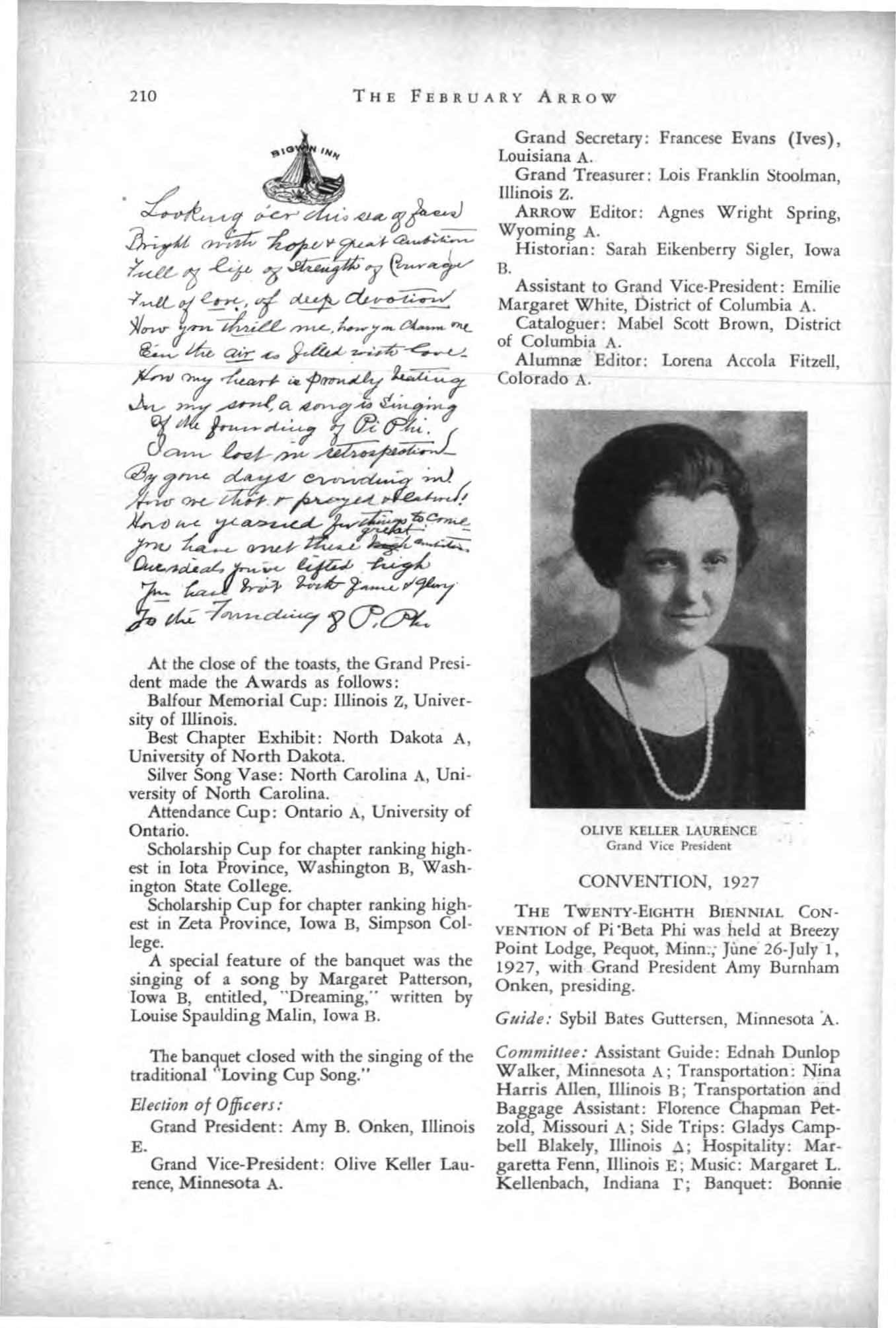
Grand
CONVENTION , 19 27
THE TW EN Ty EIGHTH BIENNIAL CONVENTION of Pi 'Beta Phi was held at Breezy Point Lodge, Pequot , Minn .; June 26-)uly I , 192 7, with Grand President Amy Burnham Onken, presiding.
Gllide: Sybil Bates Guttersen , Minn esota A
Commillee: Assis tant Guide: Ed nah Dunlop Walker, Minn esota A ; Transportation : Nin a Harris Allen , Illinois B ; Transportation and Baggage Assistant: Florence Chapman Petzold, Missouri A; Side Trips : Gladys Campbell Blakely, Illinois Hospitality: Margaretta Fenn , Illinois E; Musi c: Margaret L . Kellenbach, Indiana r; Banquet: Bonnie
Lane Edcenb<ck , Minnesota A; Athletics: Ruby Burtness Olmstead, Minnesota A; Automobile Trip: Juanita Day Carman, Minnesota A; Convention Dail, : Editor, Kathe eine Robinson, Colorado A ; Business Manager, Elizabeth Dixon , Minnesota A_
FOllnders p,.sml : Inez Smith Soule, Fannie Whitenaclc Libbey, Clara Brownlee HutchinSOD_
Allmdanct : 500_ All national officers present except the Grand Secretary and Alpha Province Vice-President Delegates from 71 active chapters, and from 57 aI= clubs.
Form" Grand Council M.",b"s : Grand Vice-President Minnie Newby Ricketts, Iowa A, who was also Guide of the Chicago Conv e ntion, 1893; Grand Vice-President Nin a Harris Allen, Illinois B.
Opening Invocation given by Founder Fannie Whitenack Libbey.
Due to the greatly regretted absence of Grand Francese Evans Ives, Olive Keller Laurence, former Grand Vice-President, was appointed as acting secretary of Convention.
The Grand President led the list in attendance, having been present at seven previous conventions.
The Founders, the Assistant to the Grand Vice-President and the National Supervisor of Cbapter Accounting were seated as members of Convention.
ugislalion:
Launching of a brief and intensive Endowment Fund Campaign for $50,000 in honor of Pi Beta Phi 's Sixtieth Anniversary Permanent Provision made for the Pi Beta Phi Central Office as a non-executive office, for the carrying on of the clerical work of the fraternity, for the publishing and issuing of supplies, and for the supervision of all catalogue and mailing lists. "The Cataloguer to be in charge of the Central Office with two full-time paid assistants."
Uniform annual membership cards to show local and national membership in good standing, and to serve as transfer cards between alum"", clubs, adopted.
Uniform Health Cards authorized. Chairman of Health included in the official personnel of chapters.
Pledge examinations made obligatory.
Ritual for Pledge Meetings, prepared by Emilie Engelbach (King), Colorado B,
adopted, use of same to be left optional with chapters .
Subscription by chapters to Bania's Gr k Exchang. recommended
The purchase of ten shares of preferred stade in the National Panhellenic House of N .... York City authorized.
Committee on Fraternity Study and Examination authorized to revise and have printed in manual form the material in the .files, in · eluding th e Handbook on Fraternity Study and Examinations and The Study for Pledges
Uniform Blank for recommendations for rushees adopted
Committee of one on Mothers' Gubs created_
National Advisory Committee on Chapter Finances, to assist chapter with all financial prob lems, ineludin g those connected with the building and maintenance of chapter bouse authorized.
Uniform System to be administered under the duection of a National Supervisor of Cbapter Accounting adopted as a measure .
Voted that in the matter of revision of the Constitution by the Numnre Session of Convention, "in case of a question as to the interpretation of the words ' which relate solely to the work and interests of the alumnre department of the fraternity' the power of interpretation shall be vested in a board of arbitration , which shaU consist of the members of the Grand Council and Province Presi dents and Province Vice-Presidents ,"
Charters were granted to: Zeta Cbi Delta of the University of South Dakota, Alpha Tau Zeta of the University of California at Los Angeles, and Theta Pi of BirminghamSouthern College.
Monmouth College: A detailed explanation of the fraternity situation at Monmouth College, as it concerned Pi Beta Phi, was made on the floor of Convention
Lena Lee Powell , Illinois tJ., presented information about the college and about the local group Zeta Epsilon Chi, which was applying to 1'i Beta Phi for a charter. During the discussion from the floor, Founders Fannie Whiteoack Libbey and Clara Brownlee Hutchinson spoke in favor of chartering the g roup . Mrs . Minnie McDill McMichael, Illinois r, wife of President T H. McMichael, also spoke very enthusiasticaUy in behalf of the return of Pi Beta Phi to Monmouth College.
The Convention empowered the Grand
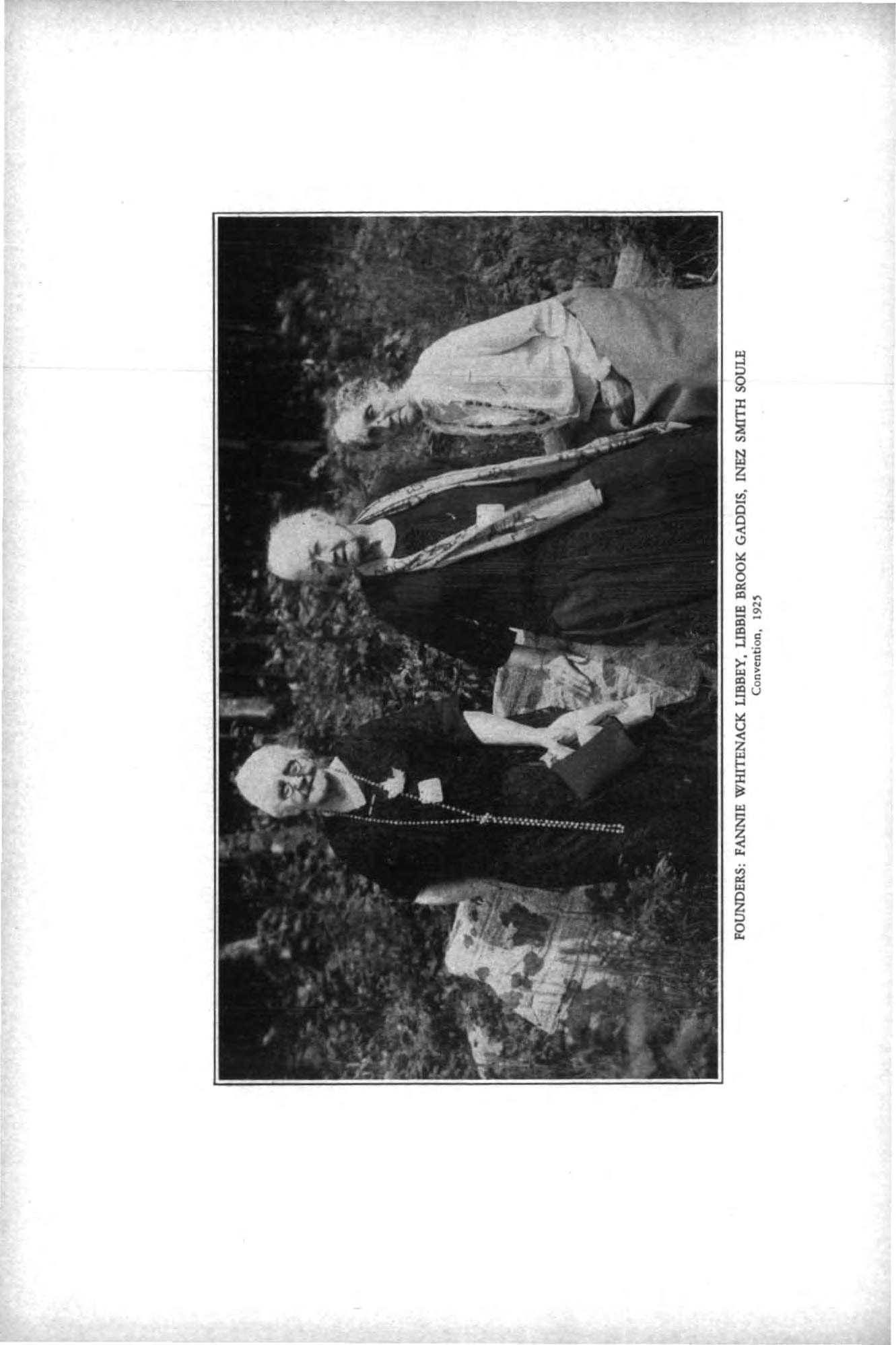
Council to grant a charter to Zeta Epsilon Chi, Monmouth College, in the intenm of Conventions, should coUege and group conditions warrant this action.
AJIlf1lnte Senion.r ,' Thrte Alumn:r Sessions of Convention were held, presided over by Grand Vice-President Emilie Margaret White, with Al= Editor Lorena Accola Fitzell, as secretuy_
Voted, that the Alurnn., Editor be made a member of THE ARROW staff instead of a member of Convention , and that the Assistant to the Grand Vice-President be made secretary of the Alumn., Sessions at Convention.
Voted, that Seniors be asked to pay their dues of $ LOO to the Alumn., organization at the time of the Senior ceremony_ (This was submitted to the chapters and was passed by them .)
Recommended , that "the Committee on Reorganization be continued."
Adoption of a uniform liseal year for al= clubs to end May 3L
Endorsement of the Endowment Fund , with an immediate contribution of $10 from the Boor made by Mrs. Deborah Strattan, Pennsylvania A, of Philadelphia . Provision was made for a visit to each a1urnn., club from its Province Vice-President, once during each interim of Conventions.
Interestin$ Round Tables were devoted to Ways of Raising Money.
Highlights: A Pi Beta Phi Special Train UDder direction of Nina Harris AUen from Chicago to St . Paul , thence to Pequot; a demonstrat ion of scho larship honors for individual members and chapters; many Round Tables, some of the outstanding subjects being : The Period of Pledgeship; The relations between the Chapter, its AI= Advisory Committee and its Mumme; Internal Development of Chapters; The Assumption of College Responsibilities; and Rushing, induding Legacies.
Dean Blitz, Dean of Women at the University of Minnesota, was a guest of the fraternity on July 29.
Louise Gardner, Nebraska B, offered a new convention cup to be awarded for the best stunt given on Convention Stunt Night.
A luncheon was attended by 50 members of Mortar Board _ The Convention DaH, was efficiently edited, managed and published, despite the
fact that every afternoon Mr. Ben Wagner, of the Pequot Rtvitw, had to drive forty-five miles to Hackensack to his print shop_ He returned with the issues before breakfast each morning.
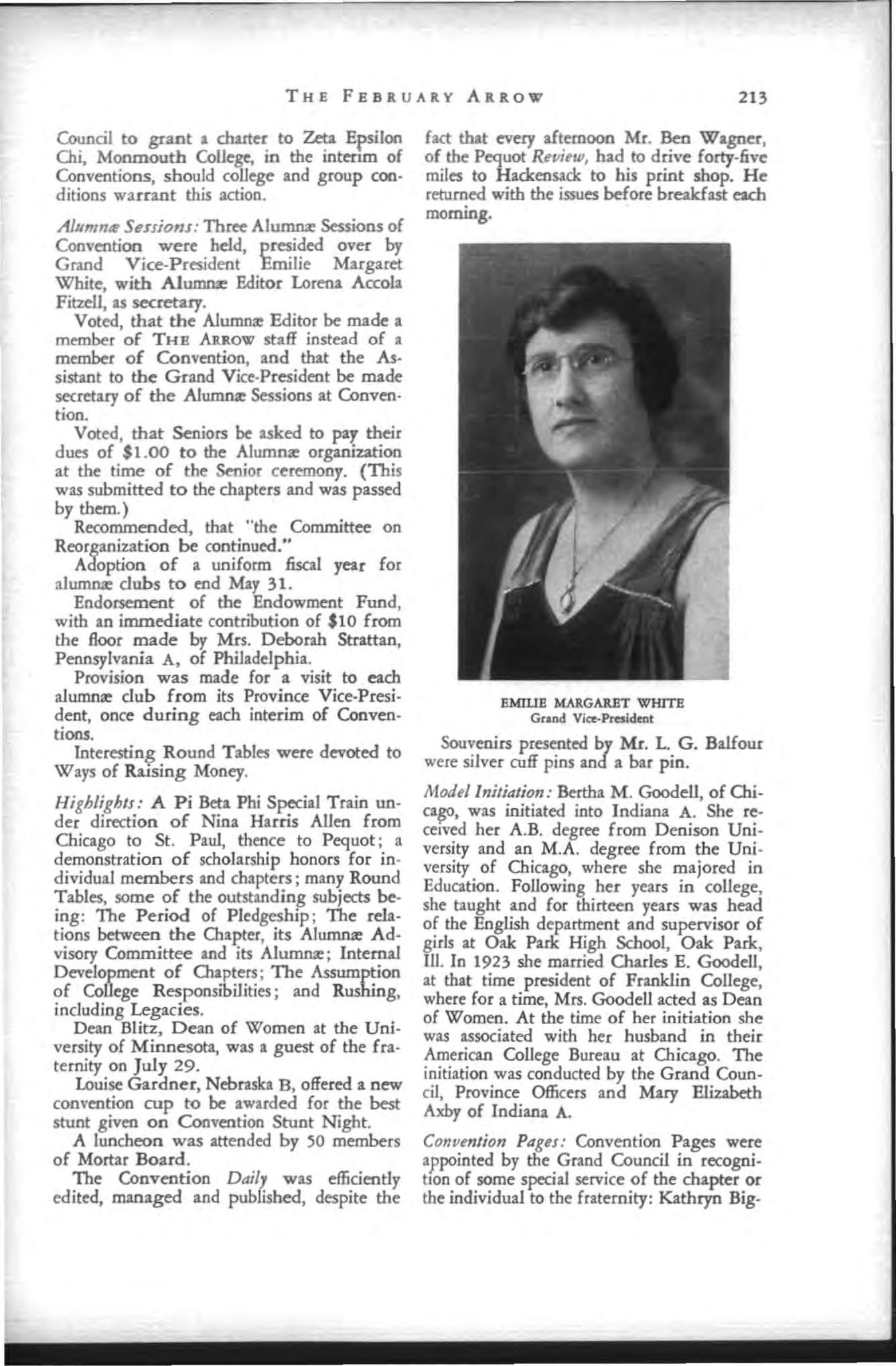
EMIUE MARGARET WHITE Gland Via-Presideot
Souvenirs presented by Mr. L. G_ Balfour were silver cuff pins and a bar pin.
Mod,llniJiaJion: Bertha M Goodell, of Chica$", was initiated into Indiana A . She reCeived her A B. degree from Denison University and an M.A. degree from the University of Chicago, where she majored in Education. FoUowing her years in college, she taught and for thirteen years was head of the English department and supervisor of girls at Oak Park High School, Oak Park , III. In 1923 she married Charles E GoodeU, at that time president of Franklin CoUege, where for a time, Mrs. Gooden acted as Dean of Women. At the time of her initiation she was associated with her husband in their American CoUege Bureau at Chicago. The initiation was conducted by the Grand Counci l, Province Officers and Mary Eliza.beth Axby of Indiana A.
ConvenJion Page!.' Convention Pages were appointed by the Grand Council in recognitIOn of some special service of the chapter or the individual to the fraternity: Kathryn Big-
gert, Wisconsin A, Jesse Purves, Illinois z, Charlotte Win get, Minnesota A, Helen Appleby, Ontario A, Virginia Aires, Virginia r, Elsa Kerkow, Nebraska B, Zita Miller, Wyoming A, Barbara Watkins , Illinois H, Helen Taylor, District of Columbia A, Florentine Holmes, Florida B , Elizabeth Bass, Minnesota A, and Dorothy Stone, Illinois E.
Entertainment: Song Service; presentation of Convention prize stunt, "The Highwayman ," by New York A ; a talk by Inez Webster on her work in the Near East; Settlement School Program during which mimeographed copies of mountain ballads were distributed through the audience and everyone was invited to join in singing the quaint verses; singing of mountain ballads by Evelyn Bishop ; presentation of Settlement School Committee members by Nita Hill Sta rk ; a style show in charge of the treasurer of the Settlement School, showing the splendid weaving being done at Gatlinburg; three reels of movies taken by Mr Lutcher Stark and explained by Mrs Stark ; informal spread, dinners, beach parties; Indian songs by Martha M41imey, Oklahoma A; exhibition of trap shooting by Captain "Billy" Fawcett, captain and manager of the Olympic Trap-shooting team from the United States to Paris in 1924; bridge tournament; an Indian dance by Chippewa Indians; recreation afternoon with golf, tennis, and swimming tournaments; stunt night ; song contest; and the Banquet.
The Banqllet: Grand Vice-President Emilie Margaret White, in accordance with tradition, presided as toastmistress, choosing as her toast scheme, The Father of Waters Cleverly .he introduced: Grand President Amy B. Onken , Founder Fannie Whitenack Libbey, Polly Hines, Virginia r , Charlotte Wollaeger, Wisconsin A, Kate Freund Miller Assistant to Grand Vice-President, Jean Mabee, Wyoming A, and Bertha M. Goodell , Convention Initiate.
Awards :
Ballour Cup: Wisconsin A, University of Wisconsin .
Best Chapter Exhibit: Arizona A, University of Arizona.
Attendance Cup : Minnesota A, University of Minnesota.
Stunt Cup: New York A, Syracuse University.
Kappa Province Cup : California A, Stanford University
Gamma Province Cup : Maryland A, Goucher College.
Song Contest Cup: Minnesota A, University of Minnesota , for "The Pi Beta Phi Evening Song," with words by Elizabeth J. Ca rgill and music by Elizabeth Bass
Election of 0 jJicerJ :
Grand President : Amy Burnham Onken, Illinois E.
Grand Vice-President: Emilie Margaret White, District of Columbia A.
Grand Secretary: Gail De Wolf, Iowa z.
Grand Treasurer: Lois Franklin Stoolman , Illinois z.
ARRow Editor: Agnes Wright Spring, Wyoming A .
Historian: Ethel Mills Cadman , California B.
Cataloguer : Mabel Scott Brown , Columbia A and Maryland A
Supervisor of Chapter Accounting: Marie Freeman Palmer.
Assistant to the Grand Vice-President: Genevieve Herrick Smith, Kansas A.
THE TWENTY-NINTH BIENNIAL CONVENTION of Pi Beta Phi Fraternity was held at the Huntington Hotel, Pasadena, California, June 30 to July 5, 1929, with Grand President Amy B Onken, presiding.
Gllide: Grace Post, Washington B. Co-Workers : Ruth Barrett Smith, Iowa r, Nelle Welles Parr, Illinois tJ., Opal Cranor Wilcox, Illinois E, of the Pasadena, Los Angeles, Glendale, and Long Beach Alumn., Clubs.
Hospitality Committee: a representative from each of the nearby chartered alumnre clubs: Gertrude Pentland Millikan, Glendale ; Netta Nixon Young, Los Angeles ; Winifred Seay Morris, Long Beach; Margaret GilliJand Moore , Pasadena.
Committee Chairmen : Recreation--Capitola Breyley Forker ; Bus Ride-Julia Jacob · son ; Community Theater--Cloyde Dalzell ; Bridge Tournament- Josephine Kenkel ; Golf-Helen Lawson; Tennis-Frances Jean; Archery- Mary Easton ; SwimmingHelen Burton; Riding- Mary Sims; Information-M argaret Frey Pierce; Masquerade - Ann McDonald D' Aule ; Settlement School Arrangements-Bess Tumer Pearsall ; Baggage-Catherine Hamilton Devine ; Transportation-Nina Harris Allen.
Convention Daily : Editor, Helene Unity
Hunt er, W ashington A; Business Manage r, Ann F<lJows Ro&erts, Missouri r.
Allendan ce: 900 Attend ing were fo ur Founders, thirteen national officers and Convention Committee m<mbers, twenty province officers, d<legates from 75 active chapters and a1= delegates representing 71 alumnae dubs THE ARR o w Editor, Josephine M Coates, was unable to attend
POllnd"s Present : Libbie Brook Gaddis , Oaea Brownlee Hutchinson, Fannie Whitenack Libbey, and Inez Smith Soule.
Form" Grand Council Memb"s: Grand Presidents, Elizabeth Gamble and Dr. May 1. Keller, ARROW Editor Isabella Hudson Cartwright, Grand Vice-President Nina Harris Allen, Assistant to the Grand Vi ce-President Kate Freund Miller
President Emeritus May 1. Keller won the attendance record , having attended nine previous Conventions .
Legislation : Voted to give the National Panhellenic Congress delegate plenary powers
Provided that Convention shall elect an Assistant to the Grand President.
Voted that the fraternity shall have staoding committees, whose personnel shall be drawn from paid members of the alumnae department.
l.ife subscription of THE ARRow was raised to $15.
Provided for an Extra-Curricular Activity Committee for each chapter whose duties shall be "to impress upon active members and pledges the importance and value of participation in the activities of the college communjty, to diem and supervise their activities, and to encourage expressions of chapter apr.reciation for individual's accomplishments.
The Standing Committee Manuals were made a part of the archives of the national officers and chapters.
Regulations were passed r<lative to the suspension of both active and a1umn., members
Voted that, "Each chapter be required to have on lile on a blank supplied by the Central Office, a statement from the parent or guardian of each pledge to be initiated, that he understaods all financial obligations of initiation and membership in Pi Beta Phi , and that it is with his consent that the pledge is being initiated."
Pi Beta Phi maintained her standard on smoking, sustaining the ruling that, "no
smoIcing by acti ve members or pledges anywhere about the premises of houses, at any function given by Pi Beta Phi, at any function given by university or college groups, in any college building, anywhere on the college campus, or at public places frequented by coUege students. "
Charters were granted to : Gamma Phi of the University of Utah ; Sigma Phi of Rollin s CoUege; and Delta Phi of the University of Manitoba
Voted, that the Endowment Fund should cover a period of five years with pledges for five years accepted.
Endowment Fund pledges from the floor of Convention, in money and pled/les, totaled $2 ,668 . Theta Province Vice-PresIdent, Nita Hill Stark , generously offered to contribute $500 to the Endowment Fund if nine other people would do the same, or 10 per cent of all $250 individual contributions.
Moved that a Chapter President's Manllal be adopted.
Convention ratiJied the Trust Agreement with the Harris Trust and Savings Bank of Chicago.
Pag es: Carolyn Ayars, California r , Laura Payne, California tJ. , Gladys Ullyott, South Dakota A, Virginia McMahan, Alabama A, Betty Stoolman, Illinois Z, Helen Seibold , Illinois E, Gwendolyn Vinson, Iowa Z, Mary Walton, Pennsylvania A , Margaret McDonald, Iowa r, Adele Jahncke, Louisiana A.
A/llmna! Sellion: Grand Vice·President Emilie Margaret White , presided over two Alumme Sessions, with Genevieve Herrick Smith , secretary.
Pages at these sessions were: Elizabeth HaWkins , California A, Clara Katherine Hudson, California B, Ruth Newburn , District of Columbia A, and Margaret Nichols , Kansas A.
Reports of officers , dubs , and committees given careful consideration.
Voted that, "Alumn., delegates to Convention shall be elected from the active membership of the dub concerned" and that, "Delegates shall send credentials of delegateship upon official blanks provided by the Central Office ."
Clubs were required to send lists to the Central Office, annually, of all resident a1um- n"" showing paid members and unaffiliated aI=.
Authorized the appropriation of two -fifths of the expenses of the Central Office and an
annual appropriation of $200 to the Loan Fund.
Round table discussions proved exceedingly helpful.
Highlighls: Convention Daily was edited by Helene Unity Hunter, Washington A, a founder of Theta Sigma Phi and a columnist of note in California, and had for its efficient Business Manager, Ann Fellows Roberts of Missouri r. Sir Gilbert Parker was a guest of Convention and of Helene Unity Hunter on Thursday, July 4.
Demonstration of scholarship honors and extra<urricular honors .
A visit of the Grand Council and Founders to the home of Mrs Robert J. Burdette, one of the Founders of Alpha Phi , whose home was on the Huntington grounds.
Hand written greetings by Jessie Scott Cline of the Glendale A1urnn;" Gub for each member of Grand Council and the delegates Ten hostesses for each day were dressed in white dresses, with blue hostess' ribbon and each wore the Bower of her club
The Pi Beta Phi Special train from Chicago, with its 246 guests was by Nina Harris Allen. Some guests arrived by airplane
Model Initiation: Julia Kingsbury Wright (Mrs. Uoyd E. ) . of Hollywood, Calif., was initiated into California fl. She was born in Buffalo, Wyoming, her father and mother being among the early settlers of the state. Graduated from Pomona College, Calif. Active in women 's organizations, the P.E.O ., and Eastern Star. In September 1918 married Uoyd E Wright, Kappa Alpha, a lieutenant in the army, who is now a successful attorney in Los Angeles and a lecturer of law at the University of Southern California Mrs. Wright is the mother of four children, the first son having been born while his father was in France Mrs Wright has held important cnmmittee chairminships and was president of the Parent Teachers' Association. For some time previous to her initiation into Pi Beta Phi she displayed deep interest in the Pi Beta Phi Settlement School , attending benefit parties and bazaars for the School.
Enlerlainmml: An informal "sing" led by Harriet Henderson , accompanied by Louise Malin ; informal reception ; the formal Panhellenic dinner preceding the Settlement School Night program ; Carnival Night upon which prizes were awarded for various beautiful and clever cnsturnes; AI Fresco supper
served around the pool at the Huntington , attended by more than 1, 000; an evening at the Pasadena Community Playhouse, where the visitors were entertained with the sparkling comedy, 'Why Not?"; an auto ride from Pasadena, over the Arroyo Seco Bridge, over the hills to Hollywood, to the Hollywood Bowl, through the city's business dis · trict to the Hollywood Boulevard and Grauman's Chinese Theater, to the United Artists Studio where Mary Pickford greeted the guests, and a visit to the new grounds of the University of California at Los Angeles and the new California Delta house. Recreation Day brought swimming, archery, tennis, golf and bridge contests.
The Banquet: Chairman, Adele Taylor AI · ford. Nine hundred and eighty six Pi Beta Phis were seated at the banquet which began with the saying of the Pi Beta Phi Grace by Amy Burnham Onken, Grand President Grand Vice-President Emilie Margaret White presided as toastmistress , arranging the clever toast scheme around the subject, "Gold." Those who responded were: the Grand Presi· dent, Founder aara Brownlee Hutchinson, Anna Ewell Phillips, California fl, Beverly Householder, Vermont B, Jane Brooks , Iowa B, Genevieve Herrick Smith, Kansas A. and Julia Kingsbury Wright, Convention Initiate Songs were sung by Harriet Henderson, Iowa B.
Awards:
Balfour Memorial Cup: Michigan B, Uni · versity of Michigan.
Stoolman Vase: California r, Univ. of Southern California .
Attendance Cup : Oregon B, Oregon State Agricultural College.
Chapter Exhibit: Colorado A, University of Colorado.
Song Contest : California fl, song com· posed by Pauline Dowling Tompkins
Stunt Cup on Stunt Night: California fl, University of California at Los Angeles.
Election of Officers:
Grand President: Amy Burnham Onken , lIlinois E .
Grand Vice·President : Katherine Burr Tel · ler, Colorado A.
Grand Secretary : Goil De Wolf, Iowa Z
Grand Treasurer: Lois Franklin Stoolman , Illinois Z.
ARRow Editor: Josephine M. Coates, I1Ii. nois B.
Historian : Grace Filler, Pennsylvania r .
Assistant to Grand President : Margaretta Fenn (Putnam), Illinois E.
Assistant to Grand Vice-President : Ruth Barrett Smith, Iowa r.
Cataloguer: Mabel Scott Brown, District of Columbia A_
THB THIRTIETH BIENNIAL CoNVENTION of Pi Beta Phi was beld at the Berkeley Carteret Hotel, Asbury Park, New Jersey, JUDe 22 - 27 , 1931 , with Grand President Amy Burnham Onken, presiding.
Gllid" Francese Evans Ives, Louisiana A.
Commill .. : Helen Kammerer McKendrew, Missouri B, Vibert Potts Duncan, Missouri n. Ellen Miller Smith , Pennsylvania A, assisted by Jess Wade, Grace Filler, Elizabeth Love, Carrie Stroud , Eva Puff, Marian Evans, and Sophie Parsons Woodman. Hostesses: the Philadelphia AI= Oub, the New York 1.1= Club, the two New Jersey Oubs, the Monmouth County Pi Pbis, and Pennsylvania A.
FOllnd".s Present: Fannie Whitenack Libbey and Jennie Home Turnbull.
Honor GUilt: Emma Harper Turner.
Convention Initiale: Miriam. lutcher Stark , Orange, Texas.
Former Grand Council: Grand President, Emma Harper Turner, Grand Vice-Presidents, Nina Harris Allen, Anna Robinson Nickerson, Emilie Margaret White; ARRow Editor, Sarab Pomeroy Rugg; Grand Secretacy, Francese Evans Ives_
Special Guests: Convention Initiate and Mr. and Mrs. 1. G. Balfour.
Convention Daily: Editor, Elinor Jennings Wood, New York 6. and Business Manager, Alice Evans, New York A.
AUendanu.' Thirty-two officers, committee chairmen and convention committee members, delegues from 75 active chapters, and from n alumna: dubs President Emeritus was absent, bein$ in Europe.
Invocation gIven by Founder Fannie Whitenack Libbey.
The Grand President won the attendance hooors, having attended nine conventions_
ugisl4lion : The Convention inaugurated the policy of honoring at each Convention a former Grand Council member by invitiog her to be its honored guest at Convention, the decision as to the guest to be made by the Grand Council . An appeal to Convention from action of Grand Council voted as an amendment to the Constitution
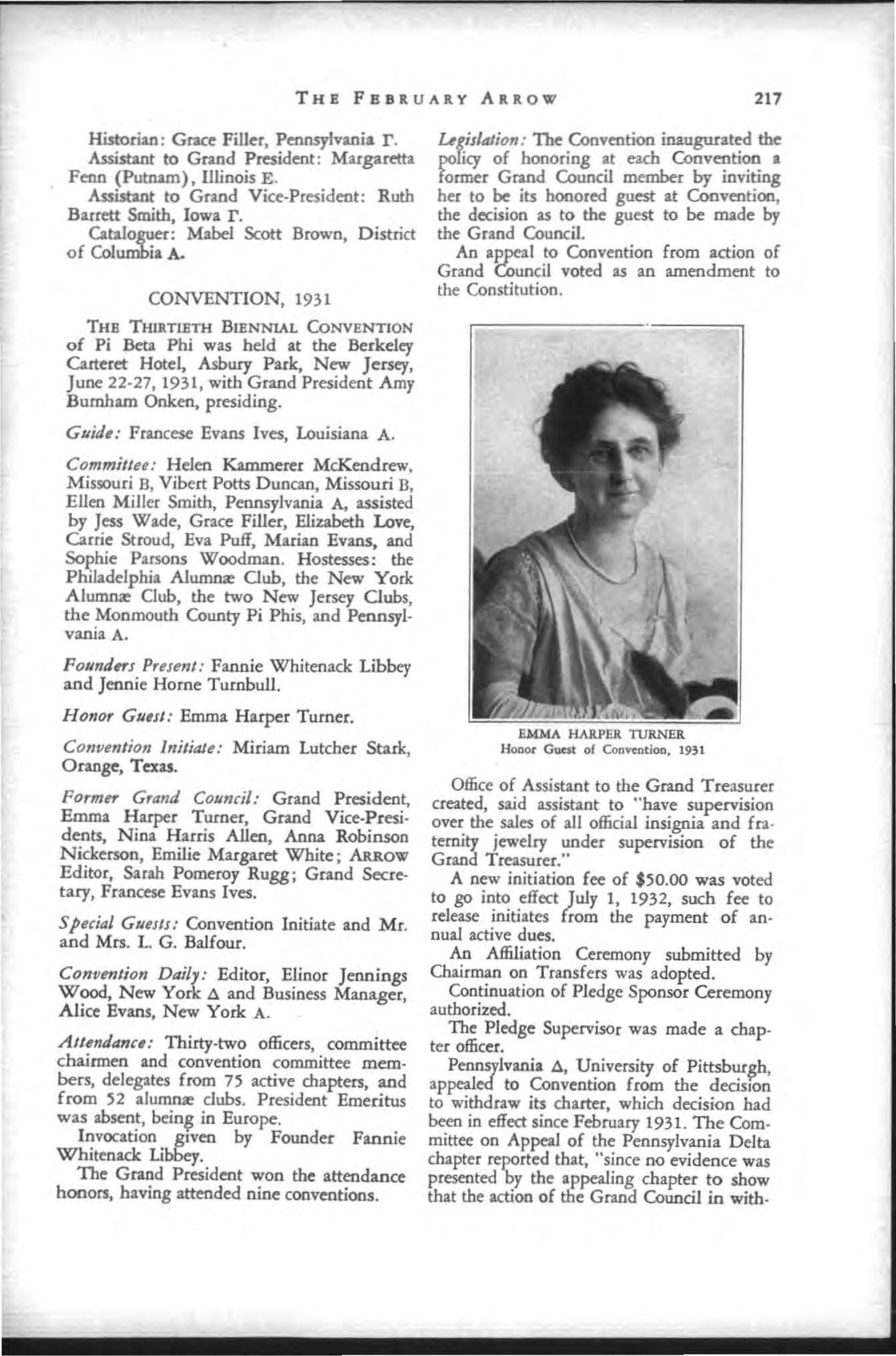
Office of Assistant to the Grand Treasurer created, said assistant to "have supervision over the sales of all official insignia and f ratemity jewelry under supervision of the Grand Treasurer. "
A new initiation fee of $50.00 was voted to go into effect July I, 1932, such fee to release initiates from the payment of annual active dues.
An Affiliation Ceremony submitted by Chairman on Transfers was adopted. Continuation of Pledge Sponsor Ceremony authorized.
The Pledge Supervisor was made a chapter officer.
Pennsylvania 6., University of Pittsbur$h , appealed to Convention from the deciSIon to withdraw its charter, which decision had been in effect since Februacy 1931. The Committee on Appeal of the Pennsylvania Delta chapter reported that, "since no evidence was presented by the appealing chapter to show that the action of the Grand Council in with-
drawing the charter of Pennsylvania .t;. was improper, the Committee submits the following recommendation: 'That the action of Grand Council in withdrawing the charter of Pennsylvania .t;. be sustained by Convention:" Convention adopted the motion of the committee,
Charters were granted to: Gamma Sigma, University of South Carolina, and to Alpha Upsilon, University of Alberta.
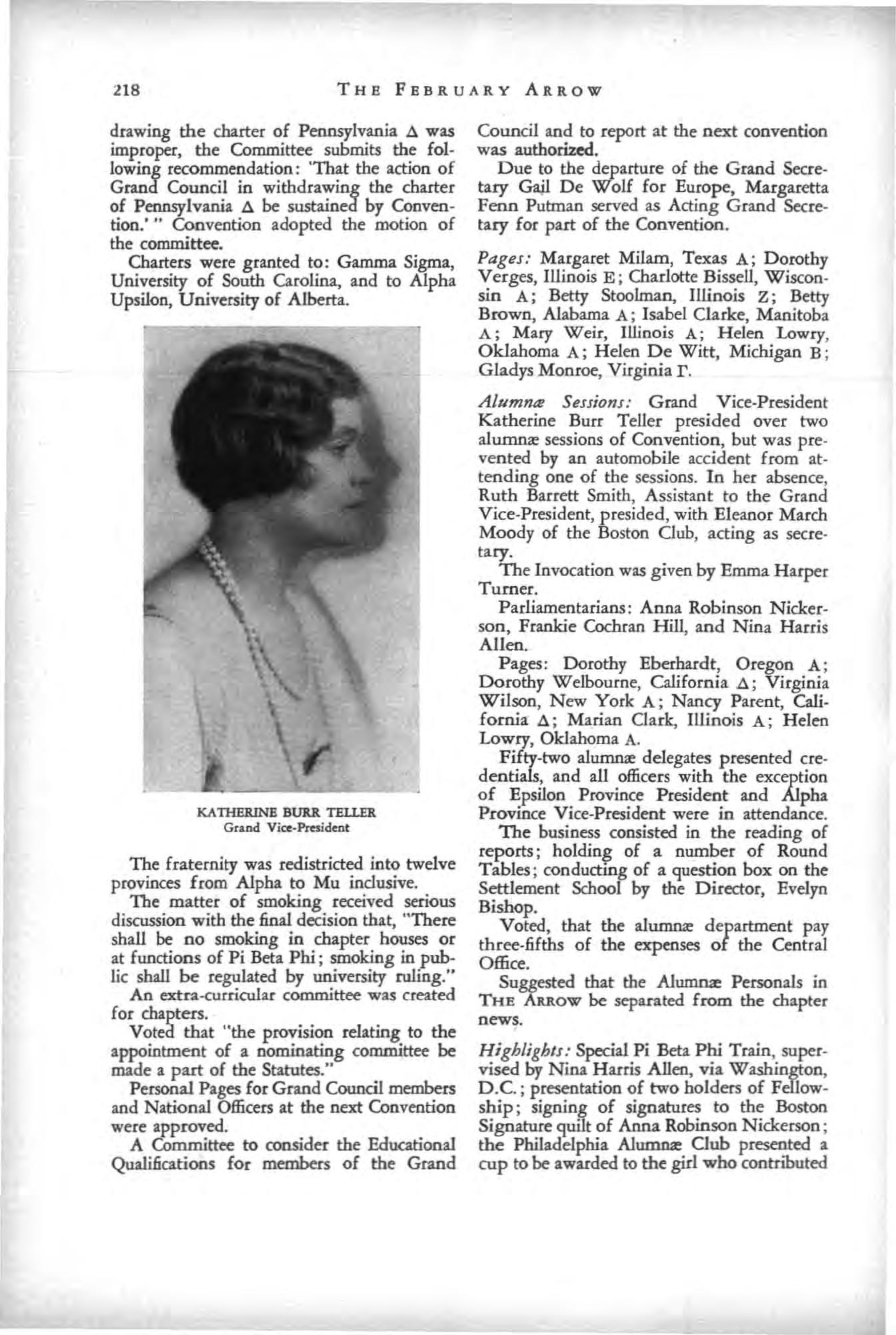
KATHERlNE BUllR TELLER Grand Vice-President
The fraternity was redistricted into twelve provinces from Alpha to Mu inclusive.
The matter of smoking received serious discussion with the final decision that, "There shall be no smoking in chapter houses or at functions of Pi Beta Phi; smoking in public shall be regulated by university ruling."
An extra-curricular committee was created for chapters.
Voted that "the provision relating to the appointment of a nominating committee be made a part of the Statutes."
Persooal Pages for Grand Council members and National Officers at the next Convention were approved.
A COmmittee to consider the Educational Qualifications for members of the Grand
Council and to report at the next convention was authorized.
Due to the departure of the Grand SecretaI}' GajI De Wolf for Europe, Margaretta Fenn Putman served as Acting Grand SecretaI}' for part of the Convention.
Page!,' Margaret Milam, Texas A; Dorothy Verges, Illinois E; Charlotte Bissell, Wisconsin A; Betty Stoolman, Illinois Z; Betty Brown, Alabama A; Isabel Clarke, Manitoba A; Mary Weir, Illinois A; Helen Lowry, Oklahoma A; Helen De Witt, Michigan B ; Gladys Monroe, Virginia r.
Alumnd! SeJJionJ,' Grand Vice-President Katherine Burr Teller presided over two alumnre sessions of Convention, but was prevented by an automobile accident from attending one of the sessions. In her absence , Ruth Barrett Smith, Assistant to the Grand Vice-President, presided, with Eleanor March Moody of the Boston Club, acting as secretaI}'
The Invocation was given by Emma Harper Turner.
Parliamentarians: Anna Robinson Nickerson, Frankie Cochran Hill, and Nina Harris Allen.
Pages: Dorothy Eberhardt, Oregon A; Dorothy Welbourne, California .t;.; Virginia Wilson, New York A; Nancy Parent, California .t;.; Marian Clark, Illinois A; Helen Lowry, Oklahoma A
Fifty-two delegates presented credentials, and all officers with the exception of Epsilon Province President and Alpha Province Vice-President were in attendance.
The business consisted in the reading of reports; holdin!! of a number of Round Tables; conductlOg of a question box on the Settlement School by the Director, Evelyn Bishop,
Voted, that the alum"", department pay three-fifths of the expenses of the Central Office.
Suggested that the Al= Personals in THE ARRow be separated from the chapter news.
Highlight!: Special Pi Beta Phi Train, supervised by Nina Harris Allen, via Washington, D C.; presentation of two holders of Fellowship; signing of signatures to the Boston Signature quilt of Aona Robinson Nickerson ; the Philadelphia Alumnae Club presented a cup to be awarded to the girl who contributed
the most to the Convention and who best represented the ideals of the fraternity ; live splendid issues of the Convention Dail y; nwnerous exhibits induding those of the Arrowrraft Sbop , the Central Office, and the Historian ; news clippings; and Chapter exhibits ; and for the first time, a splendid A1umruE Exhibit with maps showing location of dubs, exhibits of Founders' Day programs, yearbooks, Constitution games, constitution cross word puzzle. list of suggestions for raising money. etc .
Model [nilia/ion: The Grand Council in a model initiation directed by Marion Baker, Pennsylvania A, initiated Miriam Lutcher Stark into Texas A. For many years Mrs. Stark had done much for the University of Texas and for the chapter, having personal contact with Texas A through ber daughter-in-law, Nita Hill Stark . For more than forty years Mrs Stark has been a collector of original manuscripts and has in her possession the best collection of Byron in the world . The University of Texas is greatly indebted to Mrs . Stark for her gift to it of the Miriam Lutcher Stark Museum, which contains valuable collectio ns of paintings, furniture, glassware, books, rugs and old jewelry. She owns one of the originals of " My Country 'tis of Thee" and the marriage certificate of the Empress Josephine's mother and father. Mrs. Stark is widely traveled, and in her gracious way added many Pi Beta Phi friends to ber alceady wide circle of fraternity friendships, as the Convention Initiate.
Enl.,/ai"mtn/: Informal reception ; bridge party, fa n cy dress party foUowed by a dance; stunt program, children's party, luncheon on the beach, recreation afternoon with games on the beach and beach contests, also golf, miniature golf, tennis, swimming; tea at the Ben jamin Franklin Inn; PanheHenic dinner preceding the Settlement School program. An invitation had been extended to each Panhellenie Congress fraternity to send one member to this dinner. Those present were: Mrs. Frank Gentry, Alpha Delta Theta; Helen Ramlet, Alpha Omicron Pi; Alice Hanson, Beta Phi Alpha ; Mrs. Mary Love Collins, Chi Omega; Mrs . William Graham, Gamma Phi Beta; Mrs. John Cathey, Kappa Delta; Helen Knox, Kappa Kappa Gamma, representing the New York Panhellenic ; Jane Cramer, Phi Mu; and Bess Ritchie, Sigma Kappa_ Pive mannequins displayed attractive costumes
made from Settlement School materials . After the dioner came an inspection of Settlement School products during the playing of airs on the great concert organ by the official Asbury organist, Mr . &ott. Dramatic stories were read by Miss Irene Bewley, herself a native of the southern hiUs.
T h. Banque/: Grand Vice-President Katherine Burr Teller, Colorado A. as toastmis ·
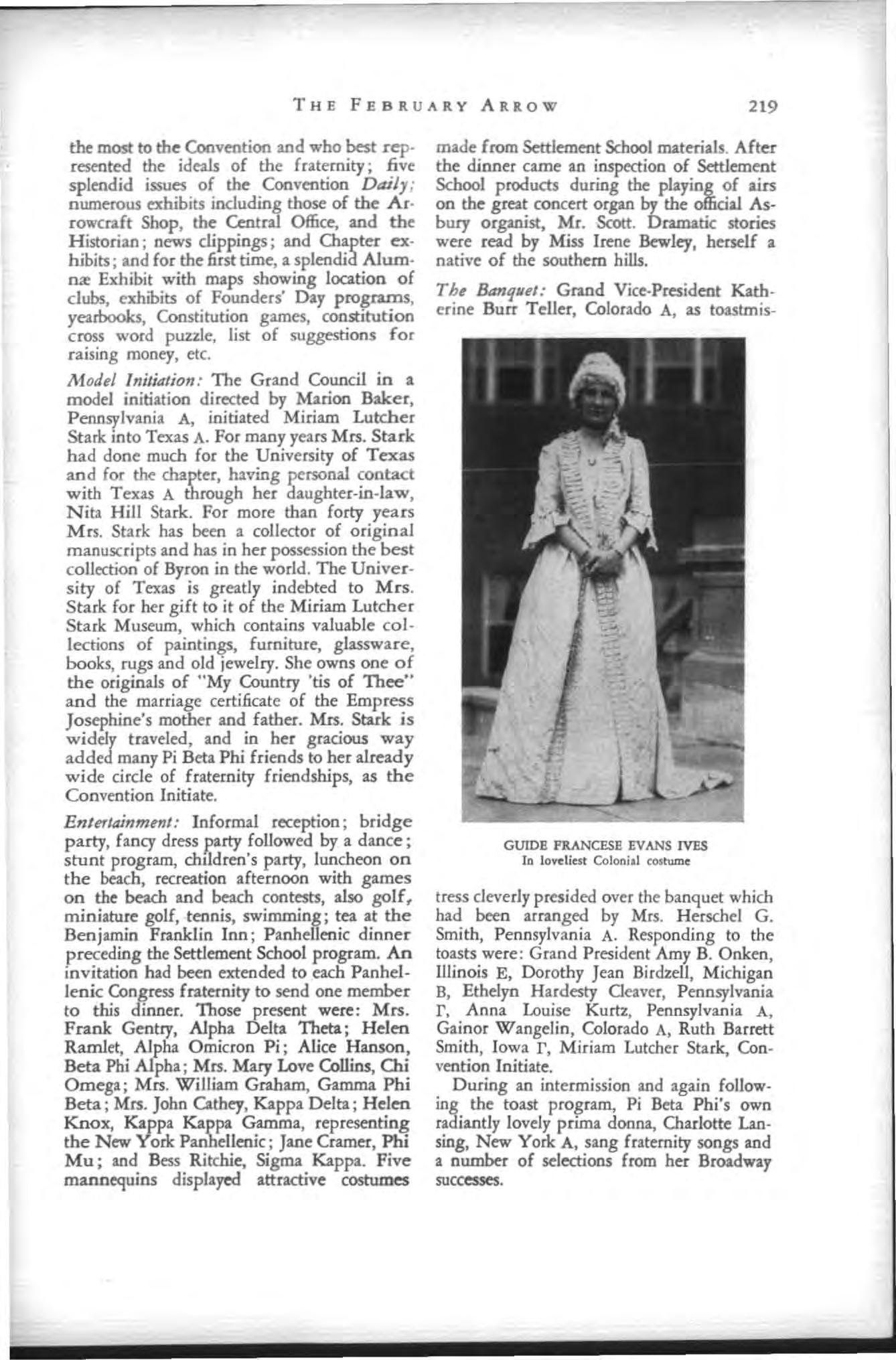
tress cleverly presided over the banquet which had been arranged by Mrs Herschel G. Smith, Pennsylvania A. Responding to the toasts were: Grand President Amy B. Onken, Illinois E, Dorothy Jean Birdzell, Michigan B, Ethelyn Hardesty Geaver, Pennsylvania r. Anna Louise Kurtz. Pennsylvania A. Gainor Wangelin, Colorado A, Ru th Barrett Smith. Iowa r. Miriam Lutcher Stark, Con· vention Injtiate.
During an intermission and again following the toast Pi Beta Phi's own radiantly lovely pnma donna, Charlotte Lansing, New York A , sang fraternity songs and a number of selections from her Broadway successes.
The Balfour Memorial Cup : to Michigan B for the third time, thus it became the permanent possession of the chapter_
Stoolman Vase: Washington B, Washington State College_
Outstanding Delegate Vase: Betty Bement, Washington B.
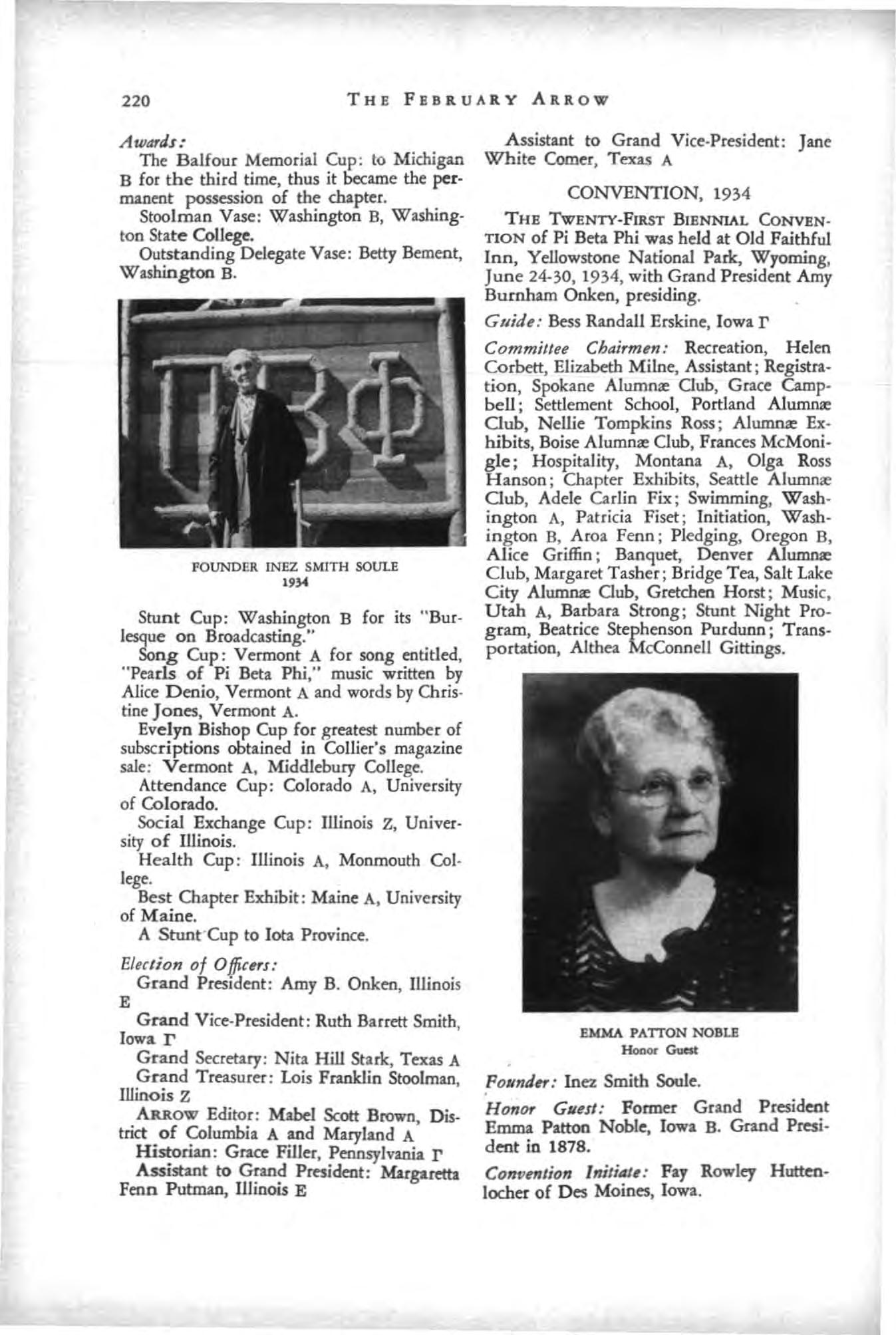
FOUNDER INEZ SMITH SOULE ..,.
Stunt Cup: Washington B for its "Burlesque on Broadcasting "
Song Cup: Vermont A for song entitled, "Peads of Pi Beta Phi , " music written by Alice Denio, Vermont A and words by Christine Jones, Vermont A.
Evelyn Bishop Cup for greatest number of subscriptions obtained in Collier's magazine sale: Vermont A, Middlebury College.
Attendance Cup: Colorado A, University of Colorado.
Social Exchange Cup: Illinois Z, University of Illinois
Health Cup: Illinois A, Monmouth College.
Best Chapter Exhibit: Maine A, University of Maine.
A Stunt -Cup to Iota Province . Eleclion of 0 !fiem:
Grand President : Amy B. Onken , Illinoi s E
Grand Vice-President: Ruth Barrett Smith , Iowa r
Grand Secretary: Nita Hill Stark, Texas A
Grand Treasurer: Lois Franklin Stoolman, Illinois Z
ARRow Editor: Mabel &ott Brown , Dt.triet of Columbia A and Maryland A
Historian: Grace Filler, Pennsylvania r
Assistant to Grand President: Margaretta Fenn Putman, Illinois E
Assistant to Grand Vice-President: Jane White Comer, Texas A
THE TwENTY-FIRST BIENNIAL CoNVENTION of Pi Beta Phi was held at Old Faithful Inn, Yellowstone National Park, Wyoming, June 24-30 , 1934 , with Grand President Amy Burnham Onken, presiding.
GuM.: Bess Randall Erskine, Iowa r
C ommitlee Chairmen: Recreation, Helen Corbett, Elizabeth Milne, Assistant; Registration, Spokane Alumna: Guh, Grace Campbell; Settlement School, Portland Alumna: Gub, Nellie Tompkins Ross ; A1umn", Exhibits, Boise Alumn", Club , Frances McMonigle; Hospitality, Montana A, Olga Ross Hanson ; Chapter Exhibits, Seattle Alumn", Gub, Adele Carlin Fix; Swimming, Washington A, Patricia Fiset ; Initiation, Washington B, Aroa Fenn ; Pledging, Oregon B, Alice Griffin; Banquet, Denver AIu.mrur Club, Margaret Tasher; Bridge Tea, Salt Lake City AI= Guh, Gretchen Horst; Music , Utah A, Barbara Strong; Stunt Night Program, Beatrice Stephenson Purdunn; Transportation, Althea McConnell Gittings . EMMA PATrON NOBLE Honor Guest
POllnd,,: Inez Smith Soule
Honor Gil'll: Pormer Grand President Emma Patton Noble, Iowa B. Grand President in 1878_
Co"".nlion Inilial'" Pay Rowley Huttenlocher of Des Moines, Iowa.
Formn Grand 0 ffic"s P"unl : President Emeritus May unsfield Keller, Grand Treasurer Martha N. Kimball, Grand Secretary , Elda L Smith
Convenlion Dai/y: The Pi Phi Geysn, Elizabeth Hawkins, California A, Editor; The Arrow Ir ., newspaper of the special train, Jane Orr, Illinois E, Editor
Allendance: All Grand Council members and national officers in attendance with exception of Mu Province Vice-President, totaling 37 in all ; delegates from 78 active chapters ; delegates from % alumnae dubs.
Invocation by uura Storms Knapp, Iowa r .
Legis/alion ,' Voted to ret ain original form of the membership certificate .
Voted that there shall be just twelve links in the chain on the official badge--one link for each Founder
Voted to place a bronze tablet on the grave of each Founder, if Ibis meets with approval of the family.
Charters were granted to : Upsilon Iota Sigma, University of Western Ontario, Sigma Theta Pi, Dalhousie University.
Pledged to Endowment Fund from lloor of convention at joint session of actives and alumnae: $4,176.36.
New rulings passed relative to financially delinquent members.
Cost of chapter Convention Exhibits limited to $10.
Voted that "after 1934-35 officers serve chapters without reimbursement. Devi ation from this policy permissible only with approval of the Alumnae Advisory Committee
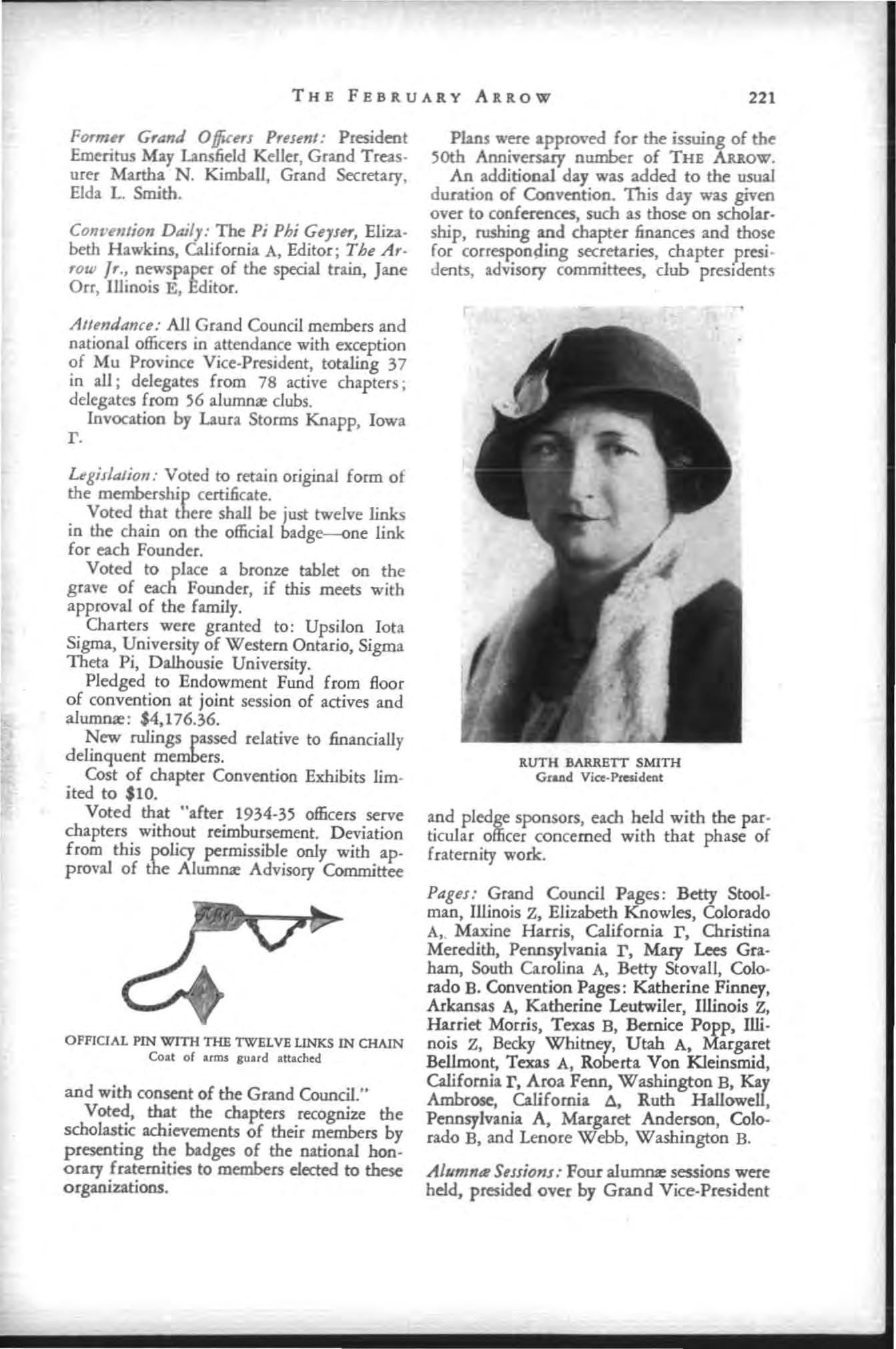
OFFICIAL PIN WITH THE 1WElVE LINKS IN CHAIN Colt of arms luud attlched
and with consent of the Grand Council."
Voted, that the chapters recognize the scholastic achievements of their members by presenting the badges of the national honorary fratemities to members elected tn these organizations.
Plans were approved for the issuing of the 50th Anniversary namber of THE ARRow. An additional day was added to the usual duration of Convention This day was given over to conferences, such as those on scholarship, rushing and chapter finan ces and those for corresponding secretaries, chapter dents, advisory committees, club presIdents
and pledge sponsors, each held with the parti cular officer conce rned with that phase of fraternity work.
Pages: Grand Council Pages : Betty Stoolman, Illinois Z, Elizabeth Knowles, Colorado A, . Maxine Harris, California r, Quistina Meredith, Pennsylvania r, Mary Lees Graham, South Carolina A, Betty Stovall, Colorado B. Convention Pages : Katherine Finney, Arkansas A, Katherine Leutwiler, Illinois Z, Harriet Morris, Texas B, Bernice Popp, Illinois Z, Becky Whitney, Utah A, Margaret Bellmont, Texas A, Roberta Von K1einsmid, California r, Aroa Fenn, Washington B, Kay Ambrose, California 6, Ruth Hallowell, Pennsylvania A, Margaret Anderson, Colorado B, and Lenore Webb, Washiogton B.
Alumndt StJsionJ: Four alumnz sessions were held, presided over by Grand Vice-President
Ruth Barrett Smith, with Marianne Reid Wild, as sec retary
Invocation by Louise Richardson, Alpha Province Vice-President; and Annie Lowrie Gaddis Anderson, Illinois t., daug hter of Founder Libbie Brook Gaddis .
Fifty-six clubs were rep resen t ed by certified delegates . Eta Province lead with ten clubs represented.
Pagel : Betty Wilson , California t., Josephine Hellings, Kans as A, Dorothy Roth , Michigan B, Virginia Sandberg, Illinois Z.
LegiIlation: Voted that " All national officers and members of nat io nal standing committees shall be members in good standing of the alumn., department of the fraternity with dues paid by November 15 of each year."
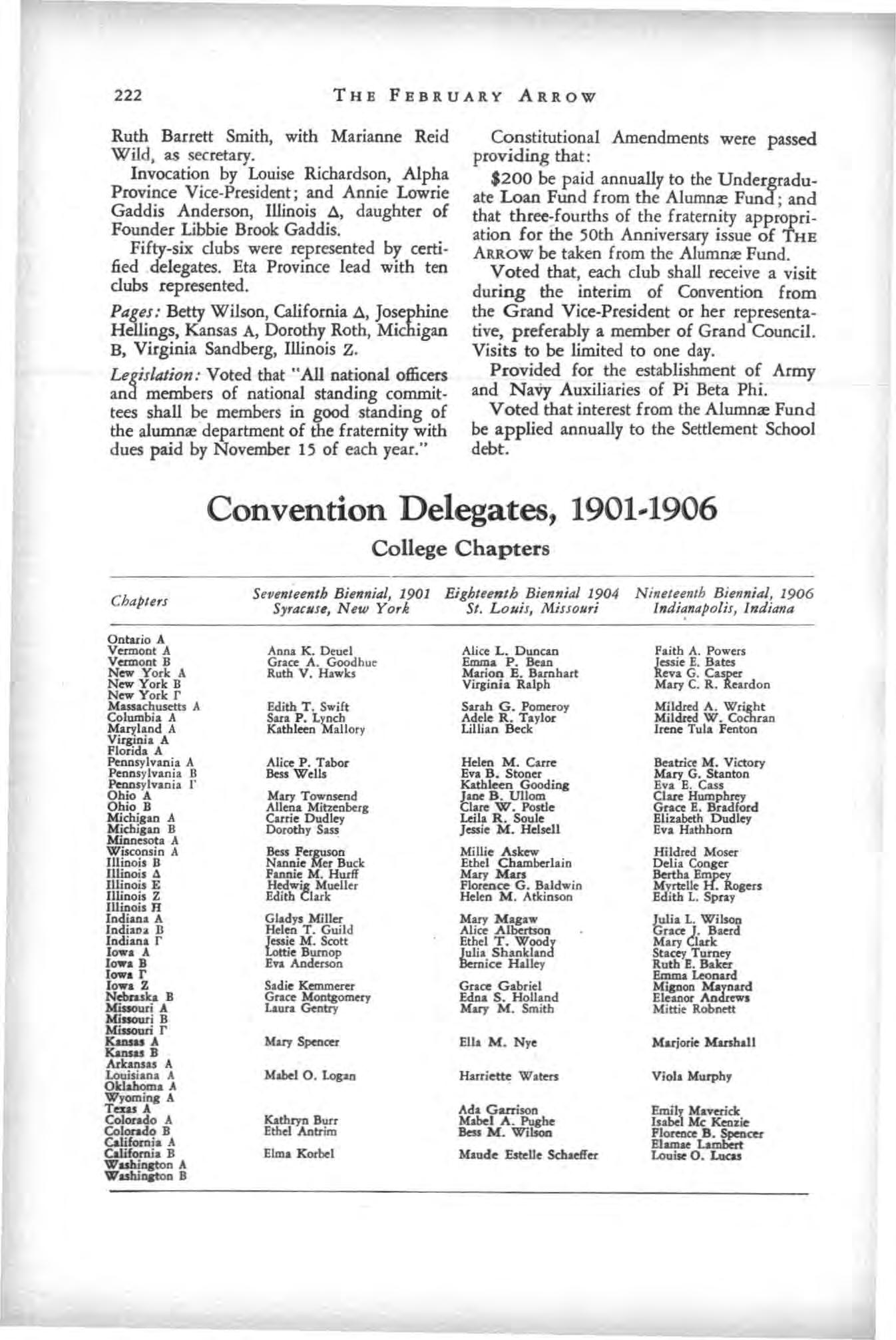
Chapters
Oowio A Vermont A Verm on t B
New Y o rk A
New Y o rlc: D
New Y ork r Musa chusetts A
Columbia A Mart'iand A
Virginia A
Plorid. A
Pennsylvania A
Penns ylvan ia B
Penns ylv.nia r Ohio A Ohio B
Mich ig.n A
Michisan B Minnesota A Wisconsin A Illin ois n lIIiaois 4 Illinois E Illinois Z Illinois H Indian. A Indiao:& B Indiana r 10 A Iowa B
r 10 Z Nebnlka B Miuouri A MiltOUt i B Miuouri r K A ""'"' BArkaNlu A Louisiana A
Oklahoma A
Wyomina A
T A
Colorado A
Colorado B
California A
California B
Wasbioaton A
Wuhi".ron B
Cons titutional Amendments were passed p roviding that:
$200 be paid annually to the Undergraduate Loan Fund from the Alumn", Fund; and that three -fourth s of the fraternity appropriation for the 50th Anniversary issue of THE ARROW be taken from the Alumna! Fund .
Voted that, each club shall receive a visit during the interim of Convention from the Grand Vice-President or her representative, preferably a member of Grand Council. Visits to be limited to one day.
Provided for the establishment of Army and NaVy Auxiliaries of Pi Beta Phi.
Voted that interest from the Alumn", Fund be applied annually to the Settlement School debt.
Seventeenth Biennial, 1901 Eighlttnlh Biennial 1904 Nineleenlh Biennial, 1906 SyracNII, New York 51. Louis, MiuolI,i Indiana
Anna K. D euel
Grace A Goodhue
Ruth V Hawks
Edith T. Swift
Sara P. L)!fch
Kathleen allor y
Alice P. Tabor
Bess Wdls
Mary Towruend
Aliena Mitzenberg
C.rrie Dudley
Alice L Duncan
Faith A Powers
Emm. P. Beao i.essie E Bates
Marion E. Barnh.rt
Vir,inia Ralph
Sarah G. Pomeroy
Adele R. Tayloe
Lillian Beck
Helen M Caere
Eva B. Stoner
Kathleen GoodinS
taoe B. Ullom
l.ce W. Postle
Leil. R. Soule
Dorothy Sus }ess.ie M. Hdsdl
Bess Perli:'0
Nanoie er Buck
Fannie M Hurff
Mueller
Edith lark
GI.dys Miller
Hden T. Guild
Scott
Millie AJkrw
Ethd Chamberlain
Mary Mars
Florence G Baldwin
eva G. Cur.:
Mary C. R . eardon
Mildred A
Mildred W. ran
Irene Tula Fenton
M. Victory
M.ry G. Stanton
Ev. E Cass
Clare Humphm
Gr.ce E. Bradford
Elizabeth Dudley
Ev. H athhom
Hildred Moser
Delia Cooger
Bmh.EtrL,e
MJi"" k . "
Helen M Atkinson E ith L Spray
Mary M aga tulia L Wilson
Al ice AIDertsoo r.a 6' Baerd
Ethd T. WoodJ
M.ry lark 'e Burnop Shanklan
En Anderson
Sadie Kemmerer
Grace Montg omery
..."'" c.nay
Mary Speottr
Mabel O Log.n
KathryD Burr
Ethel Antrim
Elma Korbel
icc Halle y
Grace G.briel
Edna S. HoU nd
Mary M Smith
Ella M Nye
Harriett.; Waters
Ada Ganison
Mabel A
Bcsa M WillOa
Maude Este:Ue Schadler
St.cey Turner
Ruth E. Bam
Emma Leonard
Mignon Mar=d
Eleanor An I
Mittie Robnett
Marjorie Manhall
Viola Murphy
Mu-crick
babe Me Kenzie
Florence B. $pencer
Elamae l.amIitrt
Louise O l.ucu
Report of the Magazine Ay,mcy was read by the St. Louis ddegate by vIrtue of the fact that that dub had earned the largest com· missioo for the agency doring the year.
The report of the Endowment Committee was incorporated in a skit which was pre· sented with the assistance of several Los An· geles dub members.
Highlights: Introduction of Honor Guest, Emma l'atton Noble, and of Christina Mere· dith, Pennsylvania r, Pellow for 1934. Address of Wdeome by Roger W. Toll, Superintendent of YeUowstone Park ; Special train from Chicago in charge of Althea Me-
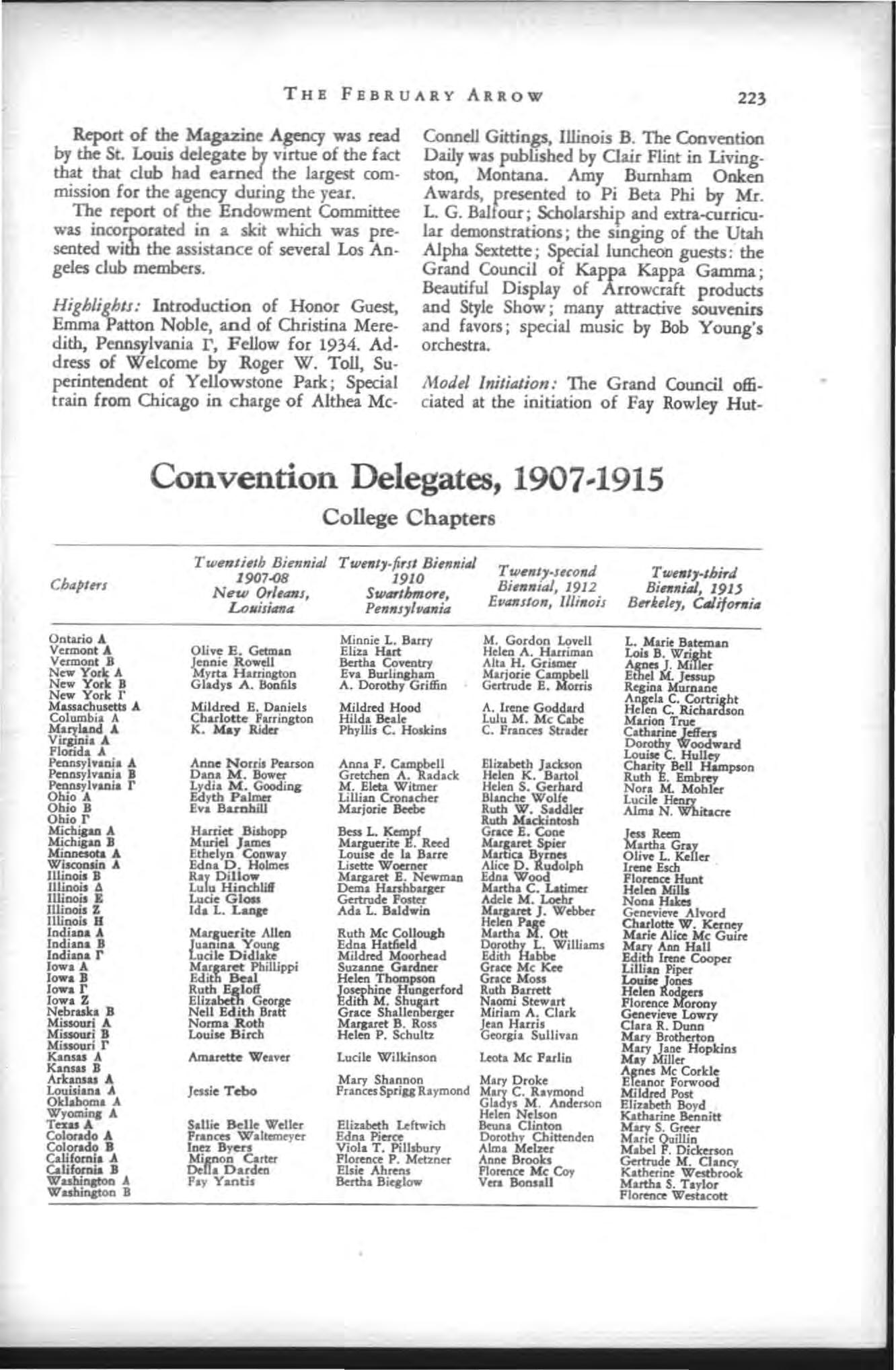
Connell Gittings, Illinois B. The Convention Daily was published by Oair Flint in Livingston, Montana. Amy Burnham Onken Awards, presented to Pi Beta Phi by Mr. L. G. BallaD!; ScholarShip and extra·amicular demonstrations; the singing of the Utah Alpha Sextette; Special luncheon guests: the Grand Council of Kappa Kappa Gamma; Beautiful Display of Arrowcraft products and Style Show; many attractive souvenirs and favors; special music by Bob Young's orchestra.
Mod,l Initiation: The Grand Council officiated at the initiation of Fay Rowley Hut-
BinmiaJ TWntl]-firSI Bimni'" T w,nt,-ucolfd T we.ll-Ihi"d 1907.()8 1910 ChapUrl NftU O,J,tmJ, SWllrlhmor" Bi,nn/aJ, 1912 Bi",,,illl, 191) Lollisind Penns]I.,.,,;a EfJlIIIJ/on, Winoil B"1,1.,, eMiI"",i.
Ontario A L. Barry M. Gordon Lovell L. Muit Bateman
Vermont A Olive E. Cftmao
Vermont B {.7nic Rowdl
Eliza Hart
Bertha Covcotry
New York J.. yrta Harrioat9o En Burlioaham
New YOlk B Glad,.a A 800.61s A. Dorothy Griffin
Hdeo A. Harri.!DUI LoiJ B
Alta H. Griamer
Marjorie CAmJ:U E I ]euup
Gertrude E. orris Rqins Murnane
New York r A. Irene Goddard A;t.'" c. Cortriab,
Mauac:hUJetts A Mildred E. Daniels
Columhia A Charlotte Furin,ton
Mildffii Hood He en C. Richar JOn
Hilda Beale
Lulu M. M e Ca.be Marico True Matt1a.nd J. K. May Ricb
Plorida J.
Phyllis C. Hoskins C. Francet Stradtt Catharine.dfen A oodwud
Elizabeth Jacbon Loube
Pennsyl n.i. A Anne Norr is Pearson Anna P. Camell Bell HAm...,.
Peonsylvaai. B O.n. M. Bower
Peoruylraai. r Lydia M Goodine
Ohio A Edyth Palmer
Gretchen A. adaek
M. Eleta Witmer
lillian Cranacher
Helen K. Bartol
Heleo S. Gerhard
BI&DCbe: Wolfe Ohio B Eva Barnhill
Marjorie Beebe
Ruth W Saddler
Ruth Embrey
Nora M. Mohler
Alma N. ae Ohio r
M..ichiaan A Harrie:tBiIbopp
M..ichi&an B Murid lama
Ba.L.K=1.1
MUJUCI:ite: • Reed
Minnesota A Ethelyn Coowa,. Lowle de I.
Wiscoruia A Edna D HolmCs
Lise:tte: Woerner
Ruth Mackintosh
Gra« E. Cooe {TR=>
Martlea Blma
MarAUd Spiu artha Graft
Olift L Ke ler
Alice D. udoJph I EKh lIliooia B Rar, Dillow
MUJ:uet E. Newman
Edna Wood
Plorence HUDt Illinois 4 Lu u Hinchlif
JlliDOis E Lucie GIOll
JIIioois Z Id. L. l.a.o&t
Illinois H
Indiana J. Marcuerite Alle:o
Daria Hanhbaqu
Gertrude Foster
Ada L. BaldwLa.
Ruth Me Collouah
Indiaaa B Luanlna Youn&: Edaa Hatfield
Indiaaa r ucile Oidl.
Jow. A Mattiaret' Phillippi
Iowa B Edi Beat
Jowa r Rutht!3!0ff
Mildred Moorhead
SUUMe Gardner
Helen Tbompsoa
td'f£rune Hun&erlord
Jowa Z Eliza Georae i M
Nebraska B Nell Edith Bratt
Missouri A Norm. Roth
Missouri B Loui.e Birch
Miuouri r
Kon Amardte Weaver
Grace ShaHen rler
Martha C. l..atimu
Adele M. Loehr
Mar,Ud J. Webber
Hde:o Mila
Noaa HUa
Gene:.ie:ft AJ"ord
Helen Pu:e Charlotte W KctDCJ'
Martha Ott
Docothft.L. Williams Ann H.II
Edith bbe
Grace Me Ke:t
Gra« MOil
Ruth Barrett
Naomi Stewart
Miriam A Clark
Marie Alice Me Guite
Edi lnne Cooper
Lillian Pi
Louise: 0::
Plorence oron,.
GeoC't'ieft Lowty
Marauet B Ross Huri. Clara R. Dunn
Helm P Schultz
Lucile Wilkinson
fOr,ia Sulli"an
Uota Me P lin
Mary Brotherton
Mary Jaoe Hopkins
M.,. Miller
Kanua B MeCorlt1e
Arkan.as A.
Louisiana A Jessie Tebo
Olilil>omo •
Wyominc A
T A Sallie Belle Weller
Colorado A Prancet Walttmeyer
Colorado B Jnez B yers
California A Milf.0n Carter
Califomla B De • Darden
Washinatoo A Fay Yantis
Wubinjtoo B
Mary Shannon
Mary Droke E eanor Forwood
Prances Sprig Raymond C. Raymon d Mildred Post
Elizabeth Leftwich
Edna Pierce
Viola T Pillsbury
Plorence P Metzner
Elsie Ahrens
Bertha Biealow
G Ia ys M Anderson
Helen Nelson
Beuna Clinton
Dorothy Chittenden
Alma Metz.er
Anne Brooks
Eliubct11 Boyd
Katharine Bennitt
Mary S Greer
Marie 'rillin
Mabel Dickenon
GC'rtrude M CJanCT
Katherine Westbrook
Martha S. Taylor
florence Watacott
Tw,nly-fourth T wen'1-fifth Bi",nial Twenly-sixth
Twenly-ullenlh Chapters Biennial, 1918 1921 Biennial, 1923 Biennial, 192' Ch.,letloix Charlnoix
Ontario A
Maine A.
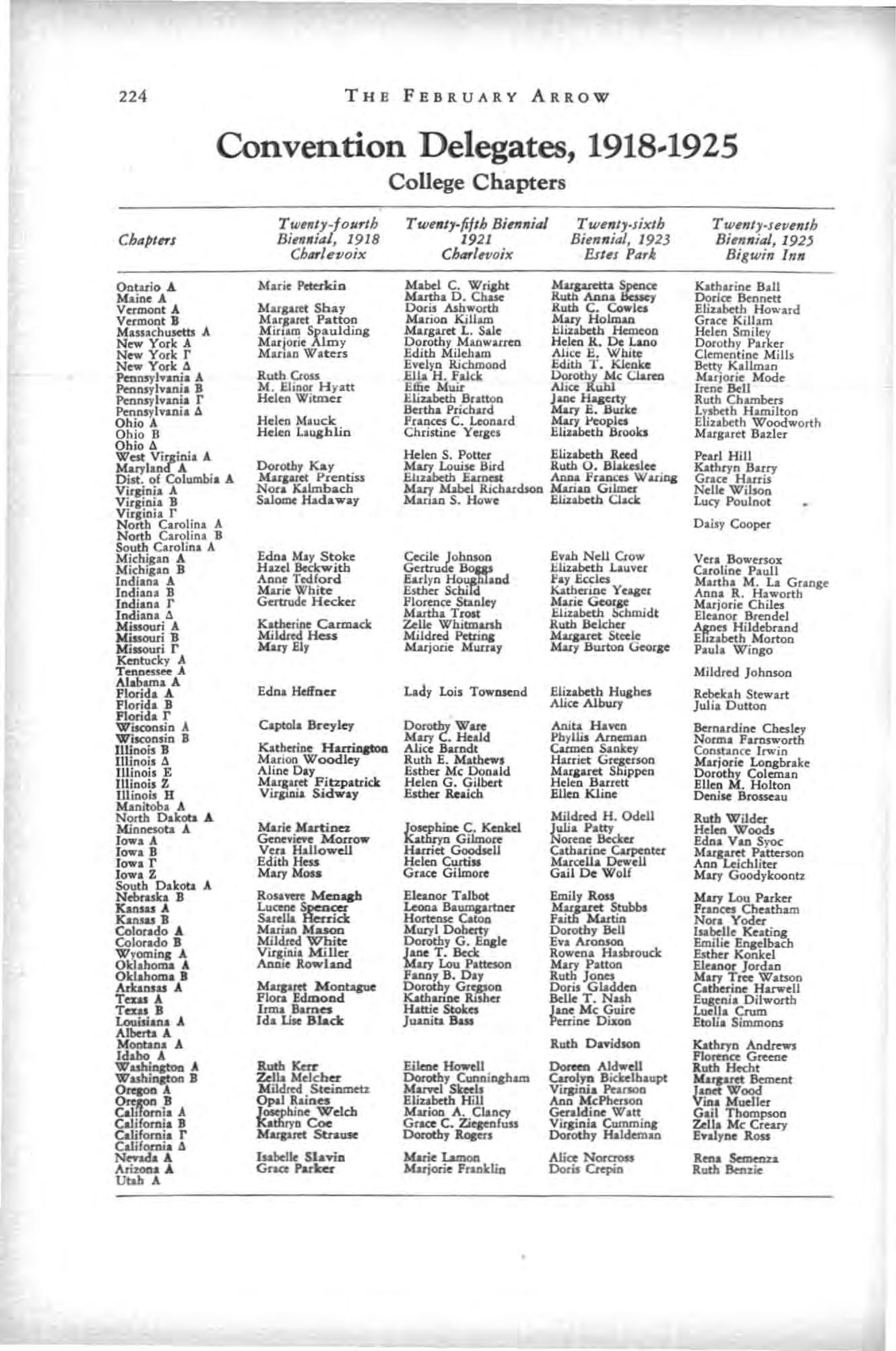
Estes Pari Bigwin In"
Marie Pfterkin
Vermont A A.far8AId: Shay
Vermont B M.r,ltd Patton
Massachusetts A Millam Sx.uJdinB
New York A Marj orie tm y
New Y orle r Manan Waters
New York A
Pmnsylnni. A Ruth Cross
Pmnsylvani. B M Elinor H yatt
Pmosylnni. r Hdea Witmer
Pennsyl n i. I:.
Ohio A Helen Mauck
Ohio B
Ohio I:.
West Vi:tnia A
MU)'I.n A
Helen Laughlin
Dorothy Kay
DiSl" of Columbia A Prentiss
Virsinia A Not. Kalmbach
Virlinia B Salome Hadaway
V irlinia r A
North Carolina
North Carolina B
South Carolina A
Michigan A
Michi.an B
Edna May Stoke
Indiana A Anne Tedford
Jodi an. B
Indiana I:.
Mabel C. Wri&ht .....uuta=
Katharine Ball
Marth. D. Cbue
Dotis Ashworth
Marion Killam
Marg.ret L Sale
Dorothy Manwarreo
Edith Mileham
Evelyn Richmond
Ell. H. Falck
Rutli """. Oorlce Iknnrtt
Ruth C. Cowles
.Mary Holmao
.l:.1inbeth Hemeoa
Helen It.. De Laao
Elizabeth Howard
Graa Killam
Hel en Smilet
Dor o thy Plr cr
AJice E. White Clementine Mills
Edith T. KJeoke Kallman
Clarm MarJorie Mode
Effie Muir Bdl
Eliubeth Button
Ruth Chambers
Berth. Prichard Lrsbdh H.milton
Frances C. Leonard j,{uy l-'eoples E iubeth Woodworth
Christine Yeraes
Helen S. Potter
¥arY Louise Bird
Elizabeth .Earnest
Eliubetb Brooks Mars aret Bazler
Elizabeth Reed Pearl Hill
Rulh O. Bl.akeslee K.thryn Barry
Anna Franca Wuina
Grace Huris
M&.tf Mabel Richudsoo )Urian Glimc:r Nelle Wilson
Ma.nan S. Howe
Cecile Jc0hnson
Huel BeCkwith G<ruu
Marie White
Indi.n a r Gertrude Hrcker
Mislouri A Katherine Carmack
Elizabeth Qac.k lucy Pouinot
Daisy Cooper
Enh Nell Crow
£Iiu.bet.b Lauver
Earl yn and Fay Eccles
Esther Schi d Katherine Ye&&er
Florence Stanley
Marth a TraR
Zelle Whitmanh
Missouri B Mildred Hess PUrina
Missouri r MU)'Ely
Kentu cky A
Tenncssee A.
Alabama A Edna Hclfau
Florida A
Plorid. B
Vera BowerSOJ:
Caroline P.ull
Martha M. La Granle
Anna R. Ha orth
Marjorie Chiles
Eleanor Brendel
Ruth Belcher Hildebrand
Marlaret Steele E lzabcth M orton
Mujone Murray
Mary Burton Gcorae
Lady Lois TOWDJC:od Eliubeth HUlhes
Alice Albury
Paula Wingo
Mild red Johnson
Rebek.h StClVart
JuJia Dutton
Florida r Captola Breyler
WiKOnsin B
Illinois B
Katherine
Illinois .0. Marion Woodley
IIlinoi. E Aline Day
JIlinoi. Z MuCUfl: Fitzpatrick
Dorotbc: W""
MUJ • Heald
Anita liavm
WisconsinA Bernardine Chesley
Phyllis Amcma.n
Norm. PUQSW'orth
Alice Bundt <:aimeD Sankey Const.ance Irwin
Ruth E. Mathews
Esther Me Donlld
Helen G. Gilbert
tIIin ois B Virluua Sidway &thee Reaich
Man itoba A
North Dakota A
Harriet Marjor ie Loll8brake
Marlud S Ippcn Coleman
Helen Burett
Ellen Kline
Mildred H. Odell
Minnesota A Marie Martinez P.tty
Ellen • Holton
Denise Broueau
Ruth Wilder
Helen Woods
Iowa A Gconicn: Morrow Gilmore ocene BCcker Edn. V.n Syoc
Iowa B Vera Hallowc.U
low. r Edith Hess
Jowa Z Mary Moss
South Dakota A
Nebrask. B
K.,,, A
RoSl1'eft Menq:h
H.met: GoodJcll
Helen Curti
Gr.ce Gilmore
Eleanor Talbot
Lcooa
Cathuioe Carpenter Marllt'd Patterson
Marcella Dewell AnD Leichliter
Gail De Wolf
Emily Ross
Mary Goodykoontt
MUJ Lou Parker
M-:luet Stubbs Pranca Cheatham
Koruu • Homme Coii>a Fai Martin N«a Yoder
Color.do A Marian Masoa
Colorado B
Mildred Wbite
W Jomina A Virainia Miller
Dorothy Bell
DorOthy G Eaale E Aroruoa
Rowena Hasbrouck
Isabelle Keating
Emilie EnaelbaCh
Esther Konkel
Old ahoma A Annie Ro land ry Lou P.tktoo
Oklahoma B
ArunSd A MarJuct Montague
fanny B. Day
Doroth1 Gnpon
T A Flora Edmond Kathanne Risher
T lrma Barnes Hattie Stokes
Mary PaUon
Eleanor Jordan
Ruth Jones Mal)' Tree Watson
Ooris Gladden
Catherine Harwell
BcUcT. Nash Dil orth
Luella Crum
Louisian. A Ida Lise Blad:; Juanita Bast i ne Di.J:oo Etoli. Simmons
Alberta A
Montana A
Ruth Dni dson
Kathryn Ancmws
Idaho A Piortna Grttoe
WuhiQltOft A Ruth "=
Wuhiqton B
0 A
8!r;1:nl! A
Zen MdcbC1'
Eilene Howell
Dorothy CWlOiqham
Mildred SteinmetJ: Mlrftl
OPal R.ioes
Caliromia B ",.eo.
Elizabeth H ill
Oom::a Ald"eU
Carolyn B ickelb.upt
Ruth Hecht
MarJlt'd Bement
Virainia Purson {- Wood
Ann McPherson ina Mueller l<'::l::;" W.kh
California r MarJlm Strause
California I:.
Nondo IsabeUe Sluin
Marion A Clancy
Grla C. Ziqen fuss
Geraldine Watt Gail Thompson
Vltlinia Cummin&: Zella Me Creary
Doroth, Rco<n Dorotby HaldCIDan E alyftC ROIl
>Wi< Umoa
Arizona A Gn« Parker Mujorie Fnnklia
Utoh A
Alia Norcrou Rena Semenza
R.uth Benzie
Chap/irs
O ntari o A
T wen1l·"i1tlh Thirtieth Bin.;.}
ThifOJ1-firsl
Bien"ial, 1927 Bie""ial, 1929 1931 Bin",;,,/, 1934 8'''%1 Point PaJa4."a, Calilor";,, Asb"" Par; Yel/owIlo"e PtJrk
Maine J. Emm, ""'"
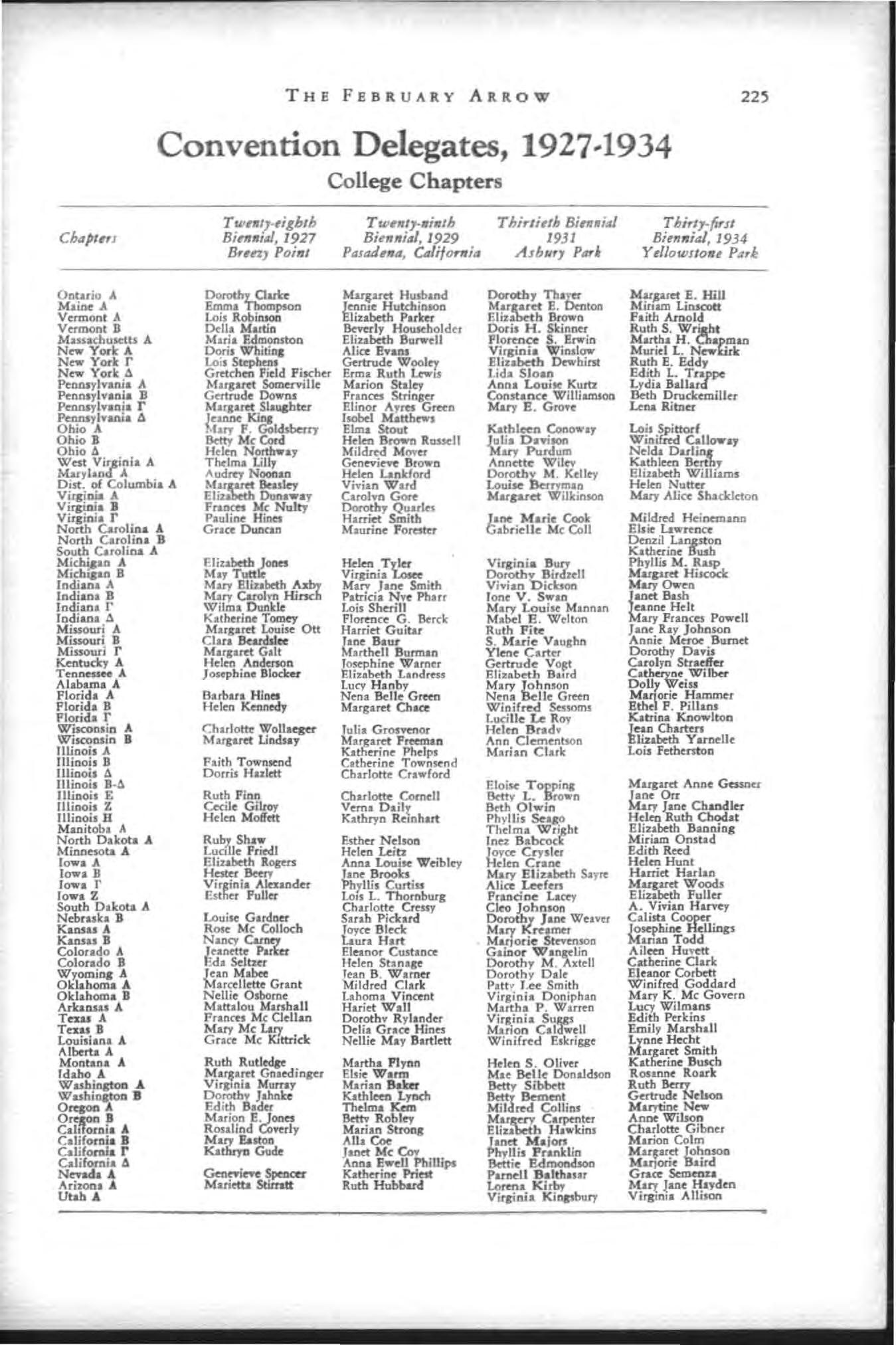
Husband
Oo<otb, Th,/J:" Marpre!: E. Hill
Ientile Hutchinson E loa Miriam LituCOtt
Vermont A Lois RobinJOa Iizabcth Parker
Eliz th Brown Faith Arnold VermontB Dell. Martifl Bnul, Houttholdcr
Massachusetts A Maria Edmonston
New Yorle A Dori. Whitina
Elizabeth BlU'Wcl1
Dotis H. Skinner Ruth S. Wraht
Florence S. Erwin Marth. H Ire-an
Alice E ns Virlini. Win ,low Murid L. Nnr -k
New York r Lo is StepbeoJ Gertrude Wooky
Eliubeth Dnohirst Ruth E. Eddy
New York 6- Gretchen Field PilCher Erma Ruth Lewi S Lid. Sloan Edith 1. T'r A Miriam: Somerville
Pennsylvania B Gertrud e Downs
Marion Stale, Anna Louise Kurtz Lydia Ballar
PranCES Strin&er
Constance Williamson Beth Drucktmiller Pennsylnnia r Mar,am Slaucbter
Elinor Ayres Grttn
Mary E. Gron Lena Ritner
Pe:nnlylYarua 6
lsobtl Matthew, Ohio It. ary F GOldsberry Elma Stout
Kathleen Cooow,y Loil Spittod Ohio B 'B:e:t:tJ Me Cord.
Helen Brown Rossell {.(Iia DnilOll Wiaifftd Calloway Ohio A Helen North.a, Mildred MDYer UJ' Purdum Nelda West V:rcinia It. Thelma Lilly
Genevie:ft Bra-a
Annette Wiln
Kathleen Bert , Maryla It. Audrq Noocun
Ditt of Columbia It. Beasley
Vi,.inia A Blu h Dunaway
Frances Mc Nulty
Vi,.inia r Pauline Hines
Vi.ian W ard
Helen Lankford !ae!ley Eliube:th Williams
Carol n Gore
Doroth, Quarles
Harrid smith
Helen Nutttt
Mar,aret Mary Alice Sha ckleton
Ir'te
Marie Cook Mildred Heinemaan North Caroli na 1 Grace: Duocan
Maurine Porester abrielle Mc Coil Ebie Lawrence: North Caro lina B Denzil La1f;ston
South Carolina A.
Michiaan B May Tuttle Vir,inia
Indiana B
Katherine: ush A. F.liubetb jooes Holen
Indiana A MUfEllu
Mary Carolyn Kine
Indian a r Wilma Dunkle
lodiana A Kat herine Tomey
Mary jane Smith
Vir,inia
PhJ'llis M. Rasp
OorothhBir leI! Maraue:t HiscOck
Vivian icbon
Mary Owen
PatrIcia Nye: Pharr l one V. Swan hane:t: Bash
Lois Sherill
Florence G Berck
Missouri It. Mar,ard Louise: Ott Harriet Guitar
Missouri B Clua Be:atcWee {;ne: Bau.-
M issouri r Margaret Galt arthe ll Burman
Kentucky A Helen Ande:non
Tennessee A. JotephiDe Bloem
Alabama A.
Florida A Barbara Hina
Josephine Warner
Landrfll
Lucy Hanby
Nena Belle Green
Florida B Helen Kenne:dy Margaret Chace
Flnrida r
Wisconsin A Chlliotte W'ollaqtt
WilCOuin B MatSaret Lindsay
IlliDOis A
lIIiDois B Faith TowMCnd
lIlinols A Dorris Hulett
Illin oi s B·6,
IlIiDoi. E Ruth Pinn
Illinois Z Cecile
lIIinoi. B Helen Moffett
Manitoba A
Nort h Dakota A. Shaw
Minnesota A LucI Ie Friedl
Iowa A Elizabeth ROSUS
Tulia GroSftOor
Preeman
Kat crine Phelps
Catherine Townsend
Charlotte Crawford
Charlotte Cornell
Vema O ai l l'
Kathryn RClnhart
Esther Nelson
Helen Leitz
Mary Louise Hnne Helt
Mabel E. Welton Illy Frances Powell
Ruth Fite Jane R.ay Johnson
S Marie Va U3hn Annie Merae Burnet
Ylene Carter Dorothy O is
Gertrude V ogt Carolyn Stradftt
Elizabeth BlUd Wilber
Mary Doll,. eiu
Nena li e Gr«n
Winifred Sessoms
Lu<:ilJe I.e Roy Katrina Knowlton
Helen Brad Cham"
Ann Clementso n lizabetb Yaroelle
Marian Clark Lois Fetherston
Eloise: T ORpinc
Ma.tJ:aret AnDe Gasner
Betty L. rown l.{neOu
Beth Ol.,in a,.,. Jane Chandler
Phyllis SeaJ:O Helen Ruth Chociat
Thelma Elizabeth Banning
Ine l B abcoc Miriam Onstad
/.r " ce Cr'}'sle:r Edith Reed
Anna Louise W'cibl e:y elen Cranc
Iowa B H_ """ Broob
Iowa r Alexander ,.lIis Curtiss
Iowa Z Est er FuUer
Helm Hunt
Mary Elizabeth Sa yre: Harriet H arta n
Alice I.e-den M:Wood
LoiS I.. Thombur, Prancine Lacey
Eliza Fuller
South Dakota A Charlotte Cre", Cleo Johnson A. Vi bn HuvlCY
Nebraska B Louise GudMr
Kant A. Rose: Mc CoUach
Sanh Pickard
OotothiJaoe Weaver Calista
tice Bled: Mary arner ellia,s
KaMu • NanC')' un Hart
Colorado A Pu er
Colorado B Seltzer
MarJorie Stn-mson anatl Todd
Eleanor Cwtance: Gainor
Helen Stan.
Wyomia, A Mabee Tean B Wamer
Oklahoma A arce:lldte Gr ant M ildred Clark
Oklahoma B Nellie Osborne
Arbasu A Mattalou ManhaU
T A Prancn Mc Clellan
Lahoma Vincent
Hariet Wall
Ooroth R ylander
Tnu B Mary Mc 4!7: Grace Hines
Louisiana A Grace M e Kittrick
Nellie May Bartlett
Aileen Huve:tt
Dorothy M xtell Catherine Clark
Dorothy Dale Eleanor Corbett
Patt" J,ee Smith Goddard
Virlinia Doniphan Mary K Mc Go.ern
Martha P. Warren Lucy Wilmaru
Virginia SUf.: Edith Perkins
Marion Cal well Emil" Manhall
WinHred E.krigge lJnne Hecht
Alberta A a:Ltarct Smith
Montana A. Ruth
Idabo A Mu.aret GtiacdinBer
Wuhift3lOCt A. Vir&1nia Munay
Martha Flynn
Hclen S Oliftr Ka inc Busch
Elsie Warm Mae Bd Ie Donaldsoo Roark
Marian Balter
Washinatoa B Dofoth, jaht1ke: Kathleen Lyodl
Betty Sibbett
Gertrude ehon a...... Edith Bader
a,C·
Call oroia J. Rosalind riy
California B Mary EutOft
Thelma Karl M i l red Collin. Mal'}tinc Ne'W
BettY Robley
Marian Strong
Eliza h Hawkins
Carpenter Anne Wilson
Charlottt Gibne r
Alia Cae: /,hnd. Majon Marion Co lm
Califo rnia r Katlirya Gude janet yUis PrWlin Marsam
Ca l ifornia .1
Anna Ewell iIIi", Bettie Edmoadson MlJ'forie aud
NeTada J. Gonorin< s....., Katherioe Priest Parnell Balthas ar Grace Sernmu
Arizona J. M arietta Stiiratt
Ruth Hubbard
Lorena Ki rby
Matt Jane HJyden
Utah A Vir,inia Kiripbury Vifllnla Allison
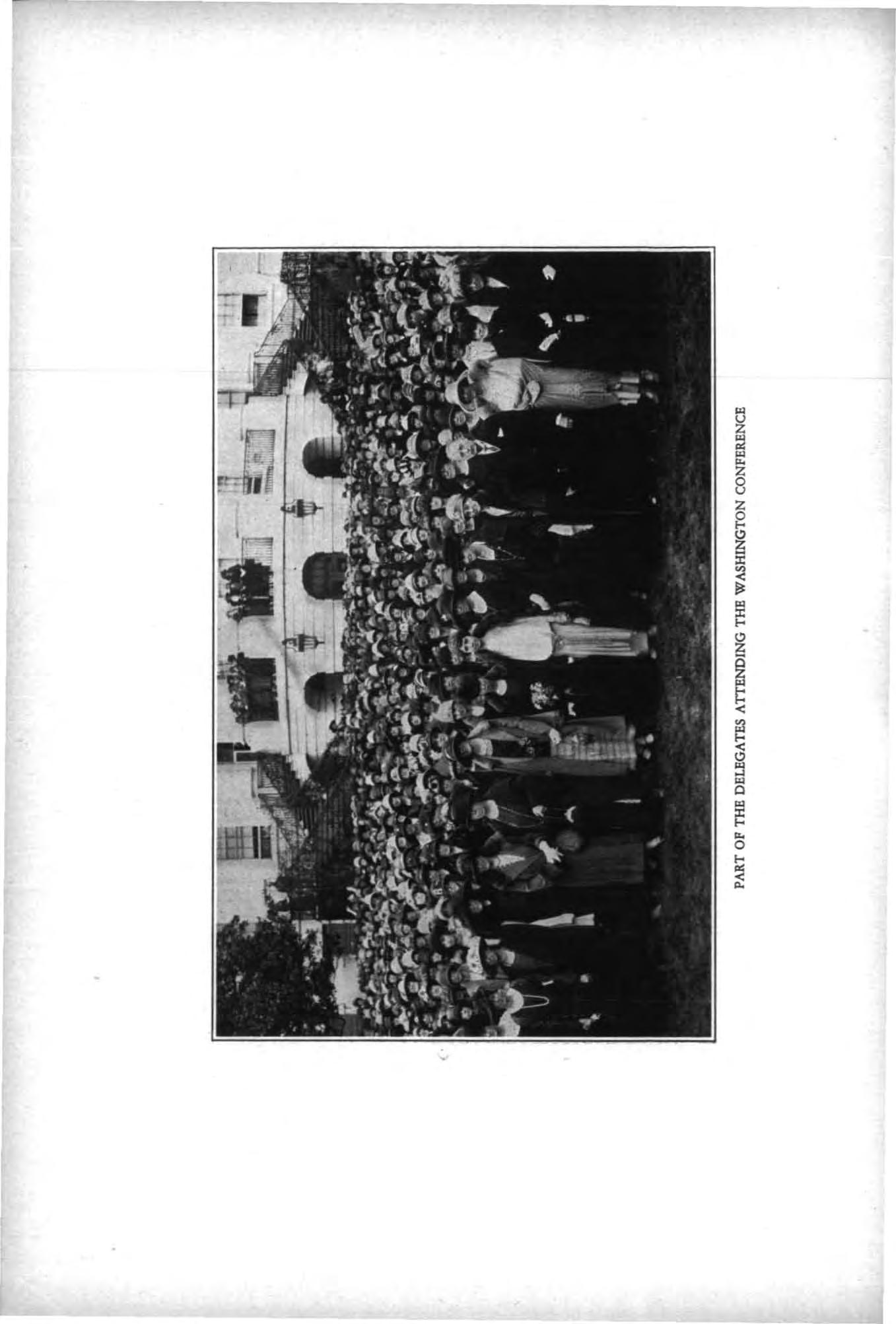
tenlocher, of Des Moines, Iowa , initiating her into Iowa Z, to which chapter she had been a former pledge, and of which her sister, Henrietta Rowley (Stoner), is a member. Mrs . Huttenlocher attended the University of Iowa, later graduating from the Des Moines Bible School. She is nationally prominent in garden dub activities, being the organizer of the Junior Garden Oubs of America . On the staff of Bell.,. Hom, s and Gardens ; appointed to the educational com · mittee of the Iowa Survey. Has had wide experience in editing and writing, being partirularIy well known for her magazine articles , leaflets and handbooks on garden sub · jects .
Kappa Province Dinner in honor of Grand Secretary Nita Hill Stark ; Stunt Night with a Fancy Dress Ball ; serenades, sight seeing trips ; Recr tion Day and the Banquet
The Banqllet : ClIairman , Margaret Tasher , Colorado A. Grand Vice -President Ruth Barrett Smith foUowed "The Trail to the West"' in her clever toast scheme which centered around "Sacajawea , " the famous guide of the Lewis and Clark Exposition. Those who responded to the toasts were: Grace Semenza , Nevada A, Marianne Reid Wild, Kansas A. Inez Smith Soule, Founder, Aileen Huyett, Colorado A, Margaret Johnson, California r, Fay Rowley Huttenlocher, Convention Initiate, Lydia J. Ballard, Pennsylvan ia A, and Grand President Amy B Onken
In the candle lighting ceremony, written by Ruth Barrett Smith, Iowa r , and beautifully dedicated to our Founders, Betty Stoval , Colorado B, a modern Pi Phi , greeted Louise Epperson, Colorado A, a Pi Phi of 1867.
The singing of the Utah Alpha Sextette was an outstanding feature of the banquet, which closed with the "Loving Cup Song."
Awards:
Balfour Cup, Illinois Z, University of Illinois.
Stoolman Vase, Colorado A , University of Colorado . Attendance Cup, Utah A , University of Utah .
Stunt Cup , won by Iota Province for "The Lazy Arrow Ranch," written and enacted by Wyoming A
Song V ase, JUinois Eta, "A Pi Phi Tribute," written by Helen Ruth Chodat.
ClIapter Exhibit, Iowa A, Iowa Wesleyan University.
Best Deleg ate, Missouri r , Dorothy Davis . Kappa Province Scholarship Honor Plaque, Kentu cky A, University of Louisville.
El ecti on of Officer! :
Grand Pre sident: Amy Burnham Onken , JIIinois E
Grand Vice -President : Ruth Barrett Smith , Iowar
Grand Secretary : Nita Hill Stark, Texas A Grand Treasurer : Lois Franklin Stoolman, JIIinois Z
ARRow Editor : Adele Taylor Alford, District of Columbia A
Historian: Agnes Wright Spring, Wyoming A
Assistant to Grand Vice·President : Marianne Reid Wild, Kansas A
Assistant to Grand President: Floren ce Hunt Webster, Illinois B
Director of Central Office : Beatrice Stephenson Purdunn, Illinois Z
THE THIRTY -SECOND BIENNIAL CONVENTION of Pi Beta Phi is scheduled for June 21 - 27, 1936, Edgewater Beach Hotel , ClIicago, III.
THE EASTERN CONFERENCE of Pi Beta Phi, held in the Hotel Willard in Washington, D .C., April 11-12, 1924, was the largest gathering of fraternity women ever held up to that time. More than 1350 Pi Beta PhiS voluntarily attended the Conference, which was purely advisory and not legislative in nature .
Committ .. : General Arrangements: WashinFn .AlUIIlru1! Club, Adele Taylor .Alford , District of Columbia A, president.
Honorary Chairman : Emma Harper Turner, Indiana A.
Gllide: Vi bert Potts Duncan, Missouri B . Program ClIairman, Margaret Mackey, District of Columbia A ; Hospitality ClIairman, Helen Harrington Compton, Ohio r ; Director of Music, Emilie Margaret White, District of Columbia A.
Honored GllestS: Founders, Inez Smith Soule and Jennie Home Turnbull ; former Grand
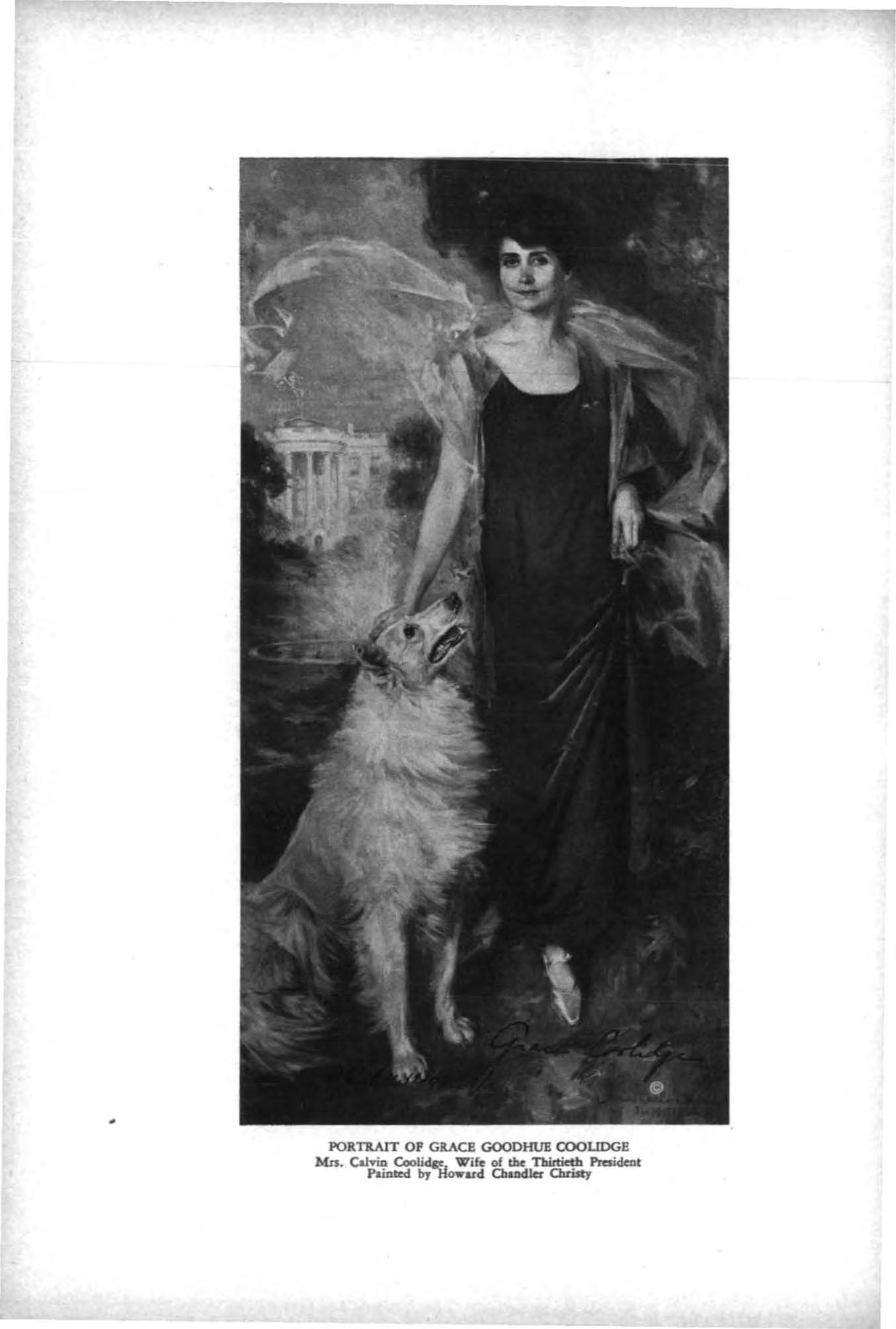
Presidents, Emma Harper Turner and Grace Lass Sisson; Mrs. Carrie Chapman Cau, Iowa r; Secretary of Agriculture and Mrs. Henry Wallace; Mr. and Mrs. Howard Chandler Christy; Marie Winsor Stebbins, author of " The Anthem, " and Louise Sawyers Linn, auth or of " Rin g, Ching, Ching."
At the Convention at Estes Park in June 1923, through the inspiration of Emma Harper Turner, the Washington AlW1l11lr Oub asked the national endorsement of a Con· ference of Eastern Provinces at Washington, D .C., preceding the D . A .R . Congress in the spring of 1924 . This was long before it was known that Mrs. Calvin Coolidge, Vermont B, would be in the White House.
The idea of the presentation of the por· trait of Mrs. Coolidge was made after the plans for the Conference were well under way.
The first business session of the Conferenc< was called to order by Emma Harper Turner, Honorary Chairman. During the Round Tables, various Grand Officers pres ided in turn , beginning with the Grond President.
Topics discussed included: Reorganization of the AlUlIlDle Departtnent, More Help for National Officers, Alumn., Club Constitutions, Alumnre Initiation Ceremony, Health Program, National Viewpoint, Ways and Means of Raising Money lor the Settlement School, and a Monthly AB.B.ow.
A splendid talk on Health by a Pi Phi husband, Dr. Harvey Wiley, was outstand · ing.
Enurlainment: Informal reception in the Red Room at the Hotel Willard, with a musical skit by pledges of D.C. Alpha; informal reception at the Congressional Library; a reception by the Pi Phi members of the Congressional grou)'; tea at the National Women's DemocratiC Oub; reunion luncheons, dinners, and parties of all kinds; the presen· tation of the portrait of Grace Goodhue
Coolidge to the White House; a splendid Settlement School Exhibit was arranged and shown by Nita Hill Stark, Chairman of the Settlement School Committee. Slides of the School were also shown by Mr. and Mrs. Stark.
An interesting feature of the Congres· sional Oub reception was the radio program /I. long distance receiving set had been in· stalled by courtesy of Mr. William P. Boyer, owner of a broad casti ng station in Washington. The Chicago Alumn., Oub and Illinois E presented a special radio program. The manager of Kathryn Browne, Illinois Z, set aside the ruling against broadcasting by Grand opera stars, so that Miss Browne might sing fraternity songs. From station WGN ChICago, she sang, " Speed Thee My Arrow" and the "Pi Phi Anthem," with eight mennbers of Illinois E joining in the chorus
The Banquet: Due to the large number of guests it was necessary to hold the banquet in the large ball room of the Willard Hotel with an overBow banquet at the Raleigh Ho· tel. After dinner was served the guests at the Raleigh came to the Willard for the program. Preceding the banquet, May Brodhead WaI· lace, Iowa r, wife of the Secretary of Agri. culture, Grand President Amy B. Ooken, Mrs. Carrie Chapman Catt, Iowa r, and Adele Taylor Alford, president of the Washington Al= Ou6, received. As toastnustress, Grand Vice·President Anna Robinson Nickerson used the toast scheme, "The Pi Phi Tree," calling upon President Emeritus May L. Keller, Grand President, Amy B Onken, President of Distri ct of Columbia A, Anna Waring, former Grand President Grace Lass Sisson, former Grand President Emma Harper Turner, and Mrs. Carrie Chapman Catt.
Souvenirs were: picture of Lincoln Me· morial seen through the cherry blossoms, a song sheet, and a pamphlet of the Settlement School, compiled 6y Nita Hill Stark.
On April 11, 1924 came the most outstanding feature of the Eastern Conference, the formal presentation to the White House of the portrait of Grace Goodhue Coolidge, Vermont B , painted by Howard Chandler Christy.
In January 1924, when plans for the Con· ference were going forward, Katharine Towtr Barnes, Michigan B, conceived the idea of presenting the portrait of Mrs. Cool · idge to the White House Mrs. Barnes sent the suggestion to Grand Vice-President Anna
Robinson Nickerson, wbo enthusiastically took up the idea at once and presented it to the Grand Council.
The Grand Council unanimously endorsed it and appointed Mrs. Nickerson to direct the project. Mrs. Nickerson, who had long been a personal friend of Mrs . Coolidge, wrote to ner that Pi Beta Phi would be proud to present a portrait of the first wearer of the arrow to become the First Lady of the Land.
Upon being informed that, "Mrs Coolidge would be deeply touched and greatly pleased to receive such a mark of affection and recognition from her college fraternity," the assistance of May Brodbead Wallace, Iowa r, was solicited .
Mrs. Wallace, wife of the Secretary 'of Agriculture, made arrangements at once with Mr. and Mrs. Howard Chandler Christy, who were then guests at the White House, to purchase the portrait of Mrs. Coolidge, which Mr. Christy was painting.
Under Mrs. Nickerson' s direction, every club and chapter of Pi Beta Phi and many individuals were given an opportunity to help in the purchase of the portrllt. The necessary sum and more, too, was quickly raised and the portrait rresentation became one of the highlights 0 the Eastern Conference.
Twelve hundred Pi Beta Phis and 100 Pi Beta Phi mothers and bonor guests, assembled at the White House on April 11. The party was headed by the presentation group, made up of Grand President Amy Burnhatn Onken , Grand Vice-President Anna Robinson Nickerson; President Emeritus May 1. Keller, Grand Secretary, Francese Evans (Ives) , former Grand Presidents , Emma Harper Turner, and Grace Lass Sisson; Katherine Tower Barnes, May Brodhead Wallace, Adele Taylor Alford , Erminie Pollard, Vermont B, and Irene Kerr Narwold , Michigan B, active representatives who were to unveil the portrait; the artist, Howard Chandler Christy and Mrs. Christy; Founders Inez Smith Soule and Jennie Horne Turnbull; and a number of national officers .
According to THE ARRow: "The guests were welcomed through the east entrance of the White House, passing on the way, the lawns of the White House, lovely with mag· nolias, pansies, jonquils, and crocus The company of guests aSsembled in the histori c East Room, forming a semi-circle about th e panel on the east wall, where hung the curtains of wine red velvet, with cords of silver
blue, which covered the portrait. The presentation party was assembled in the Green Room. Promptly at four-thirty a section of the Marine Band began to play, announcing the opening of the simple ceremony. The Presentation group, led by Miss Onken and Mrs . Nickerson, came first from the Green Room, taking their places on the inner side of the circle, facin.g the portrait. On either side of the portrait stood the two active girls who were to draw the curtains.
"Througb the double doorway appeared the Army, Naval, and Marine Aides to the President. With the Senior Aides as escort, carne Grace Coolidge, First Lady of the Land. She wore a soft grey georgette crepe afternoon dress trimmed with and, as jewels, a diatnond eagle on her shoulder, a chain with a crystal pendant, a gold bracelet, her wedding ring, and the diatnond studded arrow, which had been yresented to ber the day before by a group 0 personal friends in Pi Beta Phi. Wonderfully slim and straight wi th arms at her side, she stood very still through the entire ceremony, except for a constant play of understanding appreciation which ligbted her expressive face.
"Miss Onken, in making the presentation, said in part: 'As Grand President of Pi Beta Phi, it IS an exceeclingly great 'pleasure and privilege to rresent to the WhIte House in the narne 0 the Frotemity and as an expression of its pride and affection this beautiful portrait of Grace Goodhue Coolidge, Vermont B, who has brought honor to her fratemity, not only through the distinguished position which she now fills SO graciously and so well, but also through her life wbich has ever made apparent her faithfulness to the pledges of loyalty, service, and noble womanhood made by her to Pi Beta Phi."
"The representatives of Vermont B and Michigan B drew the silver blue cord., the heavy wine-red curtains parted, and the portrait was revealed-
"In the portrait, Mrs. Coolidge stands on the White fIouse lawn, with the White House Collie, Rob Roy, by her side, and the south front of the Executive Mansion in the background The long line of ber brilliant red velvet evening gown is unbroken from shoulder to hem, save by the golden arrow. About her shoulders floats a gaU2e scarf. The artist has caught in a most successful way the poise, youthfulness, and vivid personality of the First Lady of the Land
"An oblong brass l'late at the base of the frame bears thiJ insert ption in blade:
Mrs. Calvin Coolidl!e Wife of the 30th PresIdent Painted by Howard OJ.andier Clu:isty Presented by Pi Beta Phi Fraternity
"The Army Aide, Colonel Cla.rence O. Sberrill, Superintendent of Public Buildings and Grounds and Custodian of the White House, received the picture for the United States.
"At the conclusion of bis speech, the whole assemblage, with Mrs. Coolidge joining as heartily as the rest, sang together, the 'Pi Beta Pbi Anthem :
"The Marine Band began to play again, while Mrs Coolidge, accompaDled by the
ranking Aides, moved into the Blue Room . The guests formed in a single line and were presented by name to Mrs Coolidge. To each one she gave a smile, an individual word of greeting. and a warm handclasp.
"The lower Boors of the White House were thrown open, so that every person there had an opportunity to see the state rooms. At the conclusion of the reception, the guests were welcomed in the gardens. Here the entire group, with Mrs. Coolidge as the central /igure, was photographed, as well as Vermont B, her own chapter.
" Reluct antly 1'i Beta Phi went away, taking the memory of two pictures-one of the portrait, and the other the living, breathing original, whose spiritual beauty no artist can paint."
In honoring Grace Goodhue Coolidge, Pi Beta Phi paid tribute to one of her most
formed in 1910, Mrs. Coolidge became its /irst president. In 1912, at the Evanston Con ·
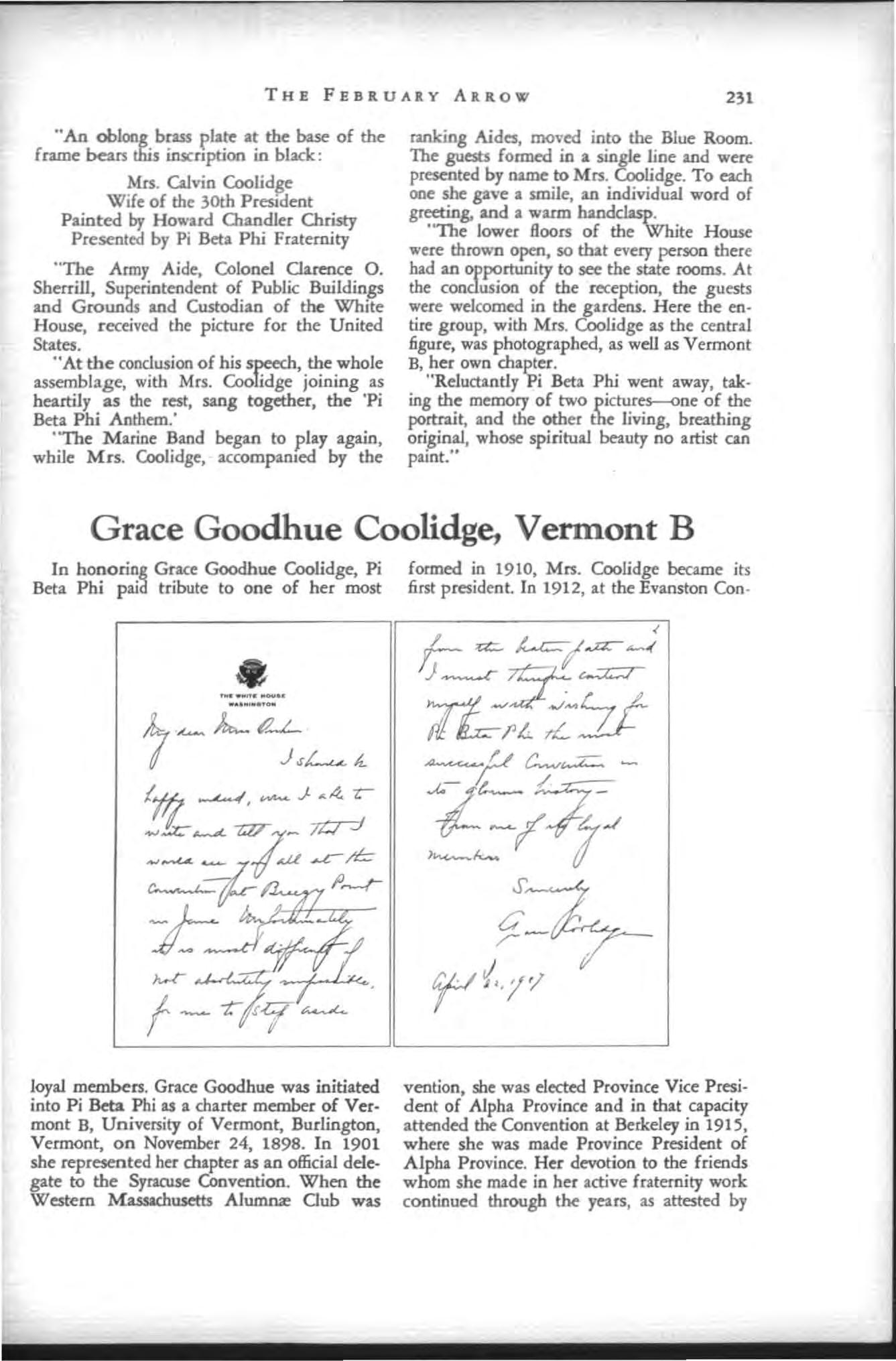
loyal members. Grace Goodhue was initiated into Pi Beta Phi as a charter member of Vermont B, University of Vermont, Burlington, Vermont, on November 24, 1898. In 1901 she represented her chapter as an official delegate to the Syracuse Convection. When the Western Massachusetts Al= Gub was
vention, she was elected Province Vice President of A.lpha Province and in that capacity attended the Convention at Berkeley in 1915, where she was made Province President of Alpha Province. Her devotion to the friends whom she made in ber active fraternity work continued through the years, as attested by
GOWN OF MRS. COOUDGE
Pruerltrd to Smithtoa.ian lo.stitution
the Round Robin letters, written by hersdf rod • group of Pi Beta Phis who attended the Berkeley Convention.
After the dection of Mr. Coolidge to the position of Lieutenant-Governor of Massachusetts, Mrs Coolidge resigned as .Alpha Province President because of the responsibilities and duties of ofliciallife Her interest in Pi Beta Phi , however, has ever been loyal as expressed through messages to Conventions
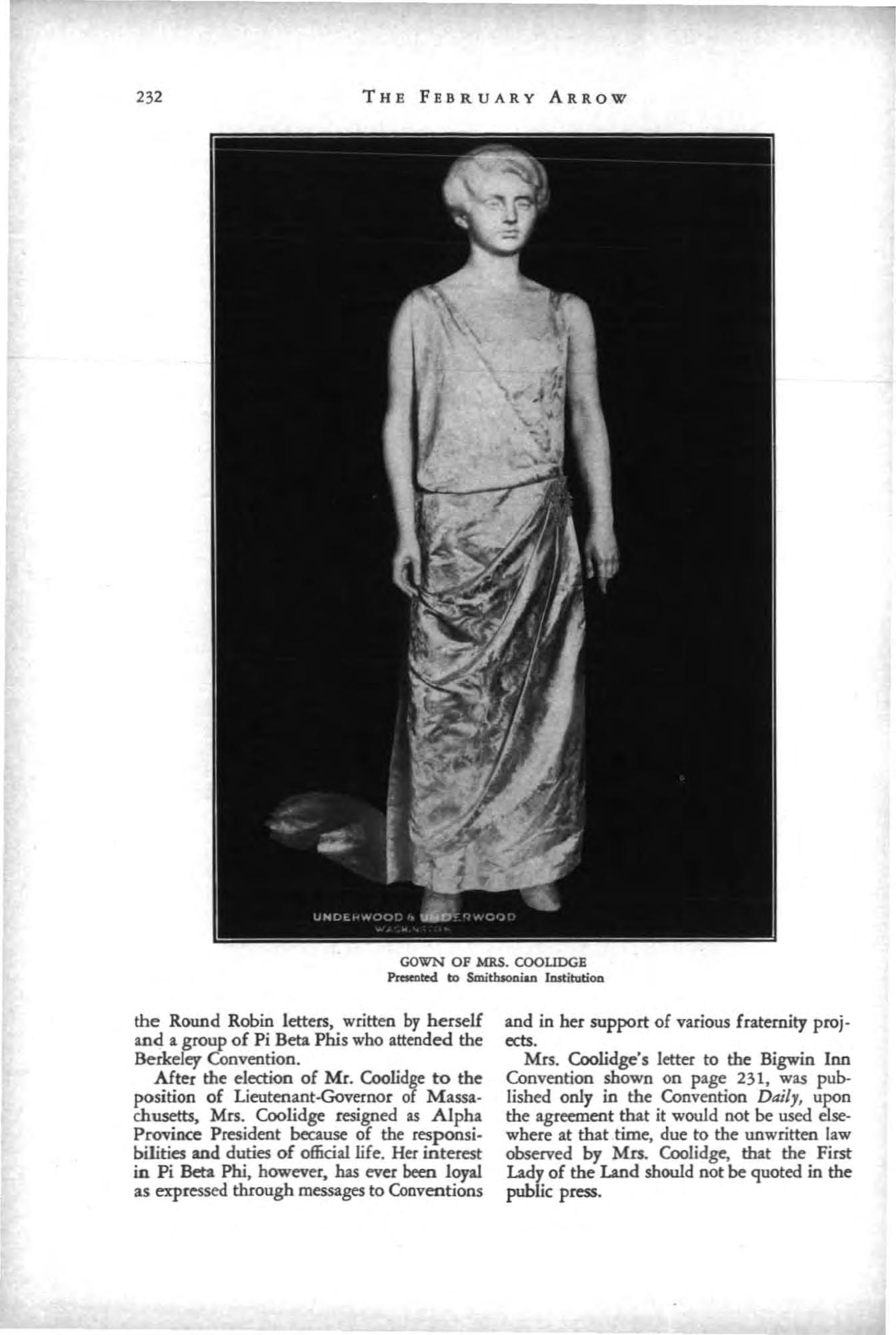
and in her support of various fraternity projects.
Mrs . Coolidge's letter to the Bigwin Inn Convention shown on page 231, was published only in the Convention Daily, upon the agreement that it would not he used elsewhere at that time, due to the unwritten law observed by Mrs Coolidge, that the First Lady of the Lwd should not he quoted in the public press.
In recognition of Mrs . Coolidge's membership as an active fraternjty woman. the members of the Eighteen th National Panhelleni c Congress sent to her the following telegraphic greetings:
Octobez 17,
The Eigbtttnth National Panhcllenic Congress rep. resenti ng 1 SO.OOO Sorority Women in session at Parker House, Boston. Mus ., sends grretings and best wishes to you u the first Sorority Woman to grace the White House.
(Si8J1ed) May A8J1ess Hopkins, 5<cretary.
Mrs. Coolidge was the first regularly initiated member of a National Panhellenic Congress fraternity, to preside at the White House. Kappa Kappa Gamma, however, through its Rho chapter of Ohio Wesleran University, Delaware, Ohio, in 1880 invited Mrs Rutherford B. Hoyes, wife of the 19th President of the United States, to become an Honorary Member . According to the History of Kappa Kappa Gamma on Dec. 1, 1880, Mrs . Hayes the invitation through Goor!!e A. Gustin who wrote as follows: " Ladles: Mrs. Hayes requests me to say, in reply to your Jetter of the 13th instont, that she most cordially appreciates the honor which you desire to confer upon her in selecting her for a membership in the Kapp.1 Kappa Gamma fraternity of Monnett Hall, and that she accepts with pleasure."
Tn 1931 Kappa Kappa Gamma piruned the key on the gown of Mrs . Hayes, which is in the National Museum at Washington, D .C.
According to custom, in 1927 , Mrs . Coolidge presented to the National Museum one of her gowns--a white brocaded satin gown,
"worn by her as the Wife of President Cal · vin Coolidge during his administration at the White House in 1924 ." On the gown she placed the small golden arrow, set with three large opals in the shaft and three smaller stones set in the point-the arrOw with which she had been initiated ond had worn through the years, until the Eastern Conference, when • group of her dnsest friends in Pi Beta Phi had presented to her a diamond set badge.
Grace Goodhue Coolidge has always brought honor to Pi Beta Phi. In conferring upon her the degree of Doctor of Laws in 1925, President Lemuel H. Murlin of Boston University, said :
" Grace Goodhue Coolidge, student, university graduate, teacher; daughter, wife, mother; in every station exemplifying the finer qualities of mind and heart we most admire in women; your own works praise you ; you have gained the confidence, admiration and love of the American people."
In 1929, the New York H.,aJd Tribllne in mentioning the $2,000,000 Endowment to be known as the Coolidge Fund for the Ouke School for the Deaf at Northampton , Mass , where Grace Goodhue taught during the days of her courtship by Calvin Coolidge, said:
"Mrs. Coolidge long ago won all hearts by her natural grace and the Bawless tact of her deportment as the mistress of the White House, the First Lady of the Land . Her buoyancy, her complete friendliness, her shining sincerity, the unfailing rightness of her bearing in every vicissitude of her station have endeared the President's wife to Americans ."
With the turn of the century we leave the strictly chronological order, which has thus far been followed in relating the History of Pi Beta Phi, and shall endeavor to give a brief resume of the most outstanding developments from 1900 to 1936 Several of the most extensive subjects such as: Conventions, Charter Grants , the Alllllllla' Department, and the Setdement School, have been arranged io separate chapters in order to permit of more detail, so will be referred to her e only briefly in pass ing
As the result of the Convention action in 1899 the Grand Council was composed of the Grand President, the Grand Vice President, the Grand Secretary, the Grand Treas urer , and the ARROW Editor who carried on the governmental affairs of the fraternity in the interim of Conventions. The Grand Council was ably assisted by Province Presidents who were directly responsible for administering the affairs of the chapters Regular annual Grand Council meetings were not yet provided for, hence, the business of the fraternity was carried on largely through correspondence and through the visits of Grand Council members.
The latter part of the nineties brought rapid growth in the A1umnre Department, which was then functioning apart from the active chapters, having its owo national Council and its own Convention sessions, with secretaries to supervise the geographical districts called Circles
In 1901, however, the alumna: asked to become a part of the general organization of the fraternity, and accordingly the Grand Vice-President was made Secretary of th e Alumnre Association, with supervision of the alumnre work, while still devoting part of her time to the interests of the active chapters. She was assisted by Province secretaries, later called Province Vice-Presidents, and also by the A1umn", Editor . In 1925 additional help was provided through the creation of the office of Assistant to the Grand Vice-President.
Due to the fact that the functions of the active chapters and those of the a1UOlIllr dubs are necessarily different, the matter of equal representation in the national government has, during the years, beeo a much discussed subject In 1910 a committee began work on
the Reorganization of the Alumnre Department and similar committees (o ntinueO the work during subsequent years , assisting with many valuable suggestions and constructive legislation, which will be discussed elsewhere. In 1928 the Committee on Alumnre Reorga nization was disbanded.
One feature which has contributed splendidly to the welding of the active life to that of the aJurnn." has been the use of the Senior Farewell Ceremony, conceived and written by former Graod Secretary Lulu Clark Ingraham in 1923. By a vote of the chapte rs talcen October 192 7, it became obligatory upon every senior to pay at the time of the Senior Farewell Ceremony the $1.00 dues for membership in th e National A1umn", Departm en t for the year following graduation .
In reviewing the history of Pi Beta Phi the fact is quite outstanding that despite the difference in work and organization details of the active members and th e alumn"" both have always worked loyally side by side for the best interests of the fraternity in general.
Following the policy of intensive internal work, suggested at the Syracuse Convention in 1901, the Grand Council began to stress the importance of chapter visits, and as the fraternity grew, recommended chapter visits by Province Presidents during the interim of Conventions . These were legalized in 1906 and were changed to annual visits in 1918. The Grand Council instructed the Province Presidents to obtain scholarship grades from Deans of Women, in an effort to raise the g eneral scholarship of the chapters
With this beginning showmg such excellent results, the Convention of 1906 r«juired each chapter to have a committee to mamtain the scholarship of its members. In 1908 , it was ruled that chapters showing continued deficiency in scholarship were liable to have charters removed.
By 1909, there was a well-organized scholarship committee in each one of Pi Beta Phi's thirty -nine chapters , responsible to the Grand Council for the supervision of each chapter's scholarship record . The work of these committees was centralized in 1912 under the supervision of Anoa Lytle Tannahill (Bran-
non), and since that time a regularly organized national Scholarship Committee with province supervisors has kept in close touch with each chapter.
As early as 1910, alumrur interest was aroused in chapter scholarship attainments and the alumrue of Massachusetts A, Colorado A, Illinois B, and Illinois Ii offered loving cups to be awarded to those members of the freshman or sophomore classes who had the highest standing for the year. Subsequently, nwnerous other cups and trophies have heen provided through the generosity of chapters , dubs, and individuals to stimulate high grades .
All of the various methods used by the individual chapters in their scholarship work are too numerous to enumerate here. The following methods observed in a survey of social conditions of campuses, however, are typical. It was revealed in the survey that one chapter charged a $5 line for over-cutting of classes; another one ruled that any girl who fell below 84% should forfeit the privilege of wearing her pin for two months; another one took away the right to vote in chapter meetings during the next term, from all actives falling below an average of 85%. Some of the chapters required freshmen to room with seniors during the nrst quarter. One group ruled that freshmen could have no Sunday night dates. These and many more similar provisions have proven most effective.
At the 1915 Convention two rulings were passed with noticeable results: one provided that those eligible to be elected convention delegate must have a record free of condition or failure after the freshman year; the other stipulated that those elected to chapter offices must have had a clear record for the entire preceding year.
In recognition of scholastic attainment, Pi Beta Phi offered, in 1906, undergraduate and graduate scholarships, which later developed into the $500 Fellowship, now offered annually. This Fellowship is assured through the $10,000 Fellowship Endowment Fund, which was coml?leted in 1925.
Other lOcentives for high grades have been offered by the national fraternity. One ruling provides that a Scholarship Ring may be awarded by a chapter to a girl in the three upper classes, who makes the highest average for each scholastic year. This ring is set with a ruby. In the event that it is won a second time by the same girl, the chapter shall change the setting to • sapphire; and if won
by the same girl a third time, to a diamond. Too, in 1934 the Convention voted that the chapters present the badges of honorary fraternities, such as Phi Beta Kappa and Phi Kappa Phi , to their members who are elected to membership.
The coming of the Inter-Sorority Conference in 1902, which resulted in the formation of what is now called the National PanhelJenic Congress, brought a new era into the history of the fraternity system in which the attention of the chapters was focussed upon the idea of the advancement of all fraternity women. This tended to break down the bitter rivalry which had existed in the past and to emphasize a broader viewpoint and more tolerance. Pi Beta Phi as a national organization was represented at the .first meeting of the conference, and from the be · ginning insisted that her chapters abide by the national Panhellenic constitution and cnoperate with the local Panhellenics. With a VIew to keeping the chapters well informed relative to all Panhellenic matters, the fraternity supplied all chapters with copies of Baird' ] Manual , Rev. Ed. 1906; the 3rd Edition of the Sorority Handbook issued in 1904 and from 1919-21, annual subscriptions to Banta'] Gr k Exchang•. Later these subscriptions were recommended for each chapter.
In developing the individual chapters, Pi Beta Phi desired that all of the memhers should be well informed concerning the history of the fraternity-its past accomplishments and its present polioes . In 1901 the Grand Secretary was instructed to collect all available minutes of past Conventions, to print them, and to dIstribute them to chapters. At this time, too, publication of Historical Paper No. 2 was authorized.
To make sure that the members became informed concerning the fraternity, the work which had been started some years before by the Literary Bureau , was continued in the form of fraternity examinations prepared and supervised by the Province Presidents . These examinations were made compulsory in 1904.
Eight years later, in 1912, this work was taken over by a regular Committee on Fraternity Study and Examination. In 1921 a new system of examinations was adopted, since it was felt that the older method was a burden
on the members. Under the new system pertinent questions were submitted to the chapters for study and the examination questions were taken from this list with a view to helping the individuals familiarize themselves with the most important facts of Pi Beta Phi his<ory
In 1925 it was ruled that there should be no more exemptions from fraternity examina· tions and a fine was provided for those failing to pass a grade of 85% Five years later the Grand Council voted that the fraternity examinations consist of the roll of two Provinces and ten questions, one of which shall require the writing of an essay between 150 and 200 words, showing knowledge of the individual of some phase of fraternity work ."
Early in each year 30 questions are submitted to each chapter and just before the examination . is. given , the exact questions are sent, 9 of whIch are taken from the original 30
While doing intensive work with the chapters in the first decade of the new century , the Grand Council and Cnnvention also gave much thought to national work which became more systematized through the use of printed blanks and record books, which were furnished to the chapters to in preserving unIform data. Grand PresIdent Elizabeth Gamble was a leader in this work.
In the early 1900s the matter of Extension of utmost importance. Sixteen applications were received from petitioning groups between 1901 and 1904 , with the result that three charters were granted. In 1906 Pi Beta Phi adopt<:d an extension policy, which required that charters would be granted to groups only in institutions with an annual income of $75,000 and with an enrollment of at least 50 women in the event that Pi Beta Phi was the first to enter, 75 if there was one women's fraternity already on the campus, etc.
In order to discourage future applications , except from very strong groups, determined upon obtaining a charter from Pi Beta Phi, the Grand Cnuncil authorized printed a cirnote of instructions to send to all petiborung groups.
Groups were not encouraged by the Grand Cnuncil unless it was felt that they had a fair chance of being chartered, because of the expense entailed in preparing and presenting a petition. It was then the custom for groups which were not fortunate enougb to be chartered in the interim of Convention to present
personally their petitions to Cnnvention. In on e instan ce 15 petitioners from one group came to Convention. This practice however, was discontinued in 1918 with the presentation of the petitions by interested Pi Beta Phis. Too , endorsements are now made from the floor of Convention by Pi Beta Phi oflicers, who have first hand knowledge of the groups. In her standard of membership and in Insisting that ooly institutions of high grade be entered by the fraternity, Pi Beta Phi was in a position to do as some of her c ontemporaries were doing, that is, to prune away ber weaker branches and to take charters away from some of the chapters in the smaller and more poorly endowed institutions. But through sentiment and in appreciation of the loyalty of these smaller and older chapters, who had struggled valiantly through pioneer days, Pi Beta Phi kept them on ber rolls, always giving them the same careful supervision, the same helpful support that sbe gave all of her other chapters,-and through the years has been repaid by the continued loyal support of these chapters and their alumnae .
Although the program of extension was based on careful and thorough methods of inspection and the adherence to high standaras, some of the eastern chapters began to oppose further extension, insisting that charters be granted only at Convention . There were, however, those in the fraternity who realized the splendid fields for extension in the south and west and in Canada, wbo worked consistently to gaio footholds in the new territory.
During the period 1900-1936, Pi Beta Phi granted 51 new charters, reestablished 4 chapters, and lost 5 chapters: 3 through anti-fraternity legislation , 1 through college consolidation , and 1 througb withdrawal of charter
The expansion has been gradual and at a rate which has percnitted individual attention to each new group _ Only one new chapter was established in each of the years: 1900, '02, '03, ' 04, '08, '09, ' 16, '20 , and '33 ; two new ones were chartered in: '07, '12, '13, '14 , ' 18, ' 31, and '34; three, in '10, '15, '19 , '23 , '29; and four in '17 and ' 2l.
In 1919 just preceding the extension boom period which struck the fraternity world, the Grand Cnuncil went on record as favoring " conservative extension " As a result of the " boom , " 27 groups applied to Pi Beta Phi for charters in 1921 !
Grand Cnuncil visits have been made to each new group within six months after estab-
lishment, and in 192) there w added to the duties of the Grand Secretary, the direct supervision for two years of each new chapter, thus usuring all possible national help to the groups
With the steady growth in college enrollment everywhere the chapters increased in size until by 1906 they ranged frnm 12 to 28 members, with a usual average of about 21. In 1907, the Grand Council was empowered to restrict the size of any chapter 'whenever it was deemed advisable According to statistics for 1927-28 and 1928-29, the chapter membership averaged around 32, a most interesting contrast to the days when THE ARROW Editor wrote an editorial in which she stated that she betieved it to be an impossibility for many 18 to get along harmoniously in one group.
The early part of the Twentieth Century was a period of chapter rooms and suites, there being only eight Pi Beta Phi chapter houses in 1901. That w.. the day of the Virginia reel, chafing dish parties, fudge parties, straw rides, and Kensingtons. Concerts and banquets, too, were in high favor. And if games werellayed at parties in which prizes were awarde . one was reasonably sure to receive a pen and ink sketch of a "Gibson" girl. Chapter room walls were covered with myriad pennants and the up to date college girl wore a hat with a fraternity hat-band. The official Pi Beta Phi hat-band was supplied for several years by Jacob Reed's Sons, Philadelphia, and sold for 60¢.
An original sample of one of these hatbands is herewith lhotographed, consisting of a ribbon one an inches wide in black, silver blue and wme stripes.
Gradually the number of Pi Beta Phi houses increued and by 1907 there were sixteen. The next year the Grand President w empowered to appoint a committee "to assist chapters in obtatning chaperons and matrons for their chapter houses, such chaperons to be employed only upon the approval of the Grand President."
At the close of 1922, 19 chapters owned homes valued at $360,000. Although many chapters began to buy homes and to build, the real "fever for bigger, better chapter homes" began to strike the fraternity world about 1922.
In 1923 the Chapter House Building Fund w.. authorized and inaugurated with the transfer of $)000 from the Badge Fund The fund itself is supervised by the Grand Council, but a Comrmttee on Chapter House Building and Financing was created to assist chapters with advice concerning building plans and ways and means of financing a bouse
The maximum amount loaned to anyone
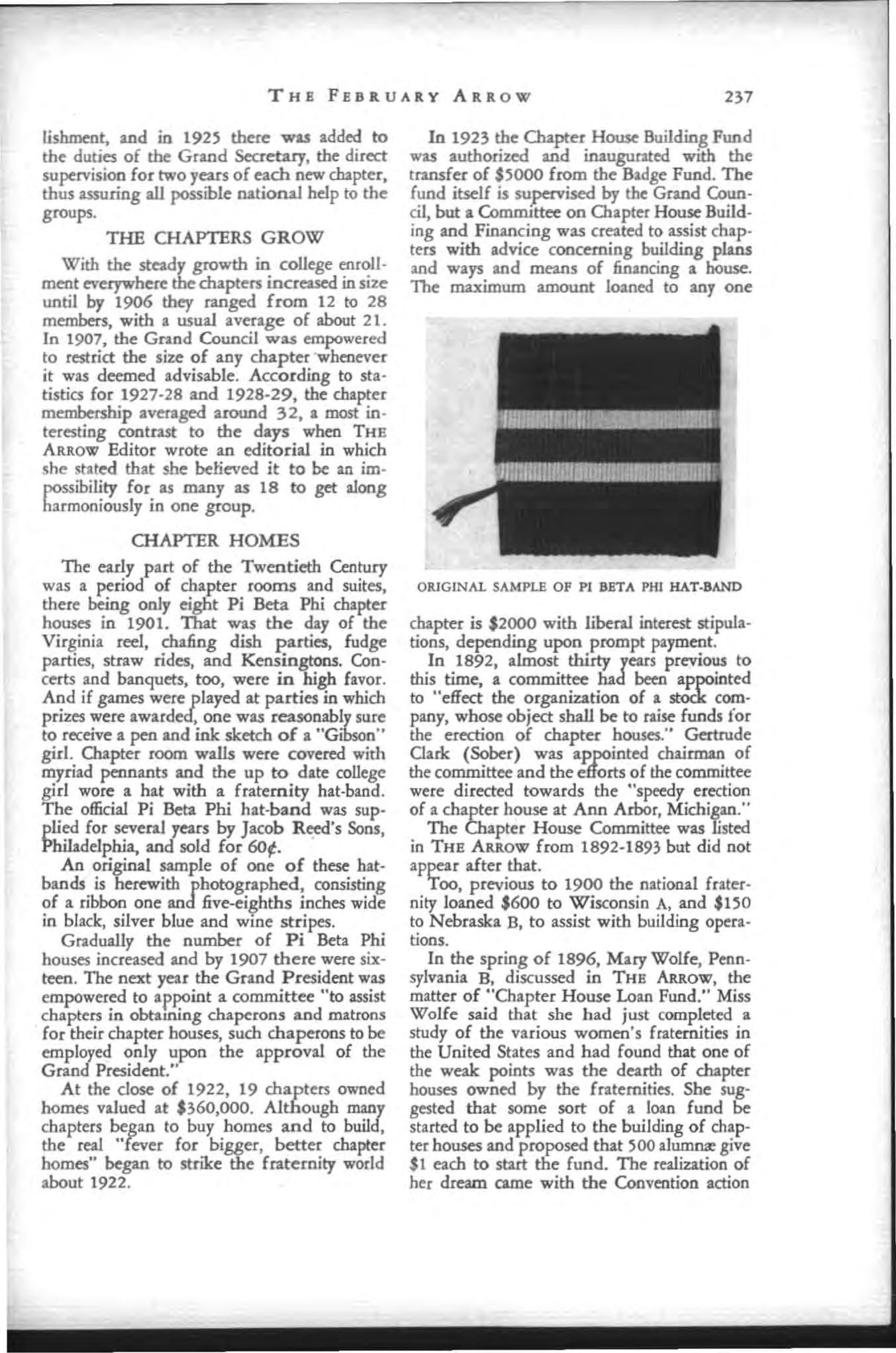
chapter is $2000 with liberal interest stipulations, depending upon prompt payment.
In 1892, almost thirty years previous to this time, a committee had been appointed to "effect the organization of a stOck company, whose object shall be to raise funds for the erection of chapter houses." Gertrude aade (Sober) was appointed chaianan of the committee and the efforts of the committee were directed towards the "speedy erection of a chapter house at Ann Arbor, Michigan."
The Chapter House Committee was listed in THE ARROW from 1892-1893 but did not appear after that.
Too, previous to 1900 the national fraternity loaned $600 to Wisconsin A, and $1)0 to Nebraska B, to assist with building operations.
In the spring of 1896, Mary Wolfe, Pennsylvania B, discussed in THE ARROW, the matter of "Chapter House Loan Fund." Miss Wolfe said that she had just completed a study of the various women's fraternities in the United States and had found that one of the weak points w.. the dearth of chapter houses owned by the fraternities. She suggested that some sort of a loan fund be started to be applied to the building of chapter houses and proposed that )00 alum= give $1 each to start the fund. The realization of her dream came with the Convention action
of 1923, creating the new committee and providing the new fund.
Within six years after the Estes Park Convention in 1923, 41 chapters owned houses valued at $1 , 360,000 and the latest available statistics of 1936 show: 47 chapter-owned houses with a valuation of approximately $2,000,000. Ten of the chapters today rent houses, the remainder have suites or rooms.
In addition to borrowing from the national fund, the chapters which have bought or built homes raised money through rummage sales, musicales, dramatic readings. candy sales, bridge benelits, by the sale of bonds to alumnae, and by being linanced through building and loan associations.
Before the period of the real chapter house " building boom," many of the chapters assisted their alma maters in endowment drives. contributing generously and earning the money in various ways. One chapter reported in 1920, having made a pledge of $1200 to such an tnclowment drive.
Although the unforeseen economic depression struck many of the chapters at a t.ime when they were heavily burdened with the financial cares of new homes, all have been able to weather the storm, and not one chapter has suHered the loss of its home because of the financial stress of the past five years.
In order to facilitate the work of the national officers, authorization was made in 1906 for annual Grand Council meetings, to be held at a time and place to be chosen by the Grand President. The first of these meetings was held in 1908 and the practice has been continued every year since that time, with the exception of 1910. In Convention years, the outgoing Grand Council usually holds a meeting just preceding the Convention and a post-Convention joint -session with the new Council members and the Province officers.
At these annual Council meetings, dates and plans for Convention ace considered; reports of all officers are read and discussed; chapters are studied individually and provision is made to supervise carefully all needing individual help; necessary amendments are voted to the Constitution and By-Laws; petitioning groups are given careful consideration with a view to encouragement or discouragement; and all general business is disposed of.
On altemate years since and including
1922, the Grand Council has met at the Settlement School at Gatlinburg, Tenn ., in order to gain first hand knowledge of the School, and to hold joint sessions with the Settlement School Committee or with the Director and Head R esident of the SchooL
TIME AND PLACE OF GRAND COUNOL MEETINGS
1908-NoYCmbcr 27·28; Whitt iu HaUt.Ncw York City 1909--Octobu 23: The Se:srvn Club, New York City' 1911-Dcccmb« I: Home of Anna Jackson Branson. New York City 2"; WillalJ Hall Ev.ruton , 111. 19B- une 23·27: Home of tid, Smith. Springfield. Ill. 191"""': lolly 6·11: Gatlinburg, Ttnn. 19U- 1.11, 5: On Train to CooVflltion ui,ll; Home of Daisy Dnis wncy. Bcr.ke.J.ey, Calif. 17-24 : Home of Anna Robinson Niclctt$On Quincy , Mass 1917-QctObcr 22'2"') Edgewater Beach Hotel, Chic.go 1918- U;t,e f/ 8 The Inn, Charlevoix, Mich. 1: Home of Anne Stuart, Lincoln, 192D-SUDC 26-Jul, 1: Edgewattt Bea ch Houl, Chicqo 1921- une 26-30: The Inn. Mich 1922- IJ 6-1-4: Gatlinburg, Tenn. 19H-June 20-25: Hokl Stanley, Estes Pule, Colo.' 192-4-May 2oC·30: Gatlinburg, Tenn . 192)-JuDe 1' -21: Bipin, Lake of Ba ys, Ont ., Canada 1926--May 22·29: GatliDbUrlt' Tenn . 1927-June 20-26: PotDt Lodse. Pequot, MiDD. I'ost-Coovmbon. IQDwood , MlRn. 192&-Aucust 2·10: Gatlinburg, Tenn . 1929--jUne 23-30 : Huntington Hotel, Patadena, Calif. uly 8·16: Gatlinburg, Tenn 1931- une 1-4-22: Ikrkdey:Carterd Hotel, Asbury Park, N.J. 1932-june 22 28: Gatlinburg, Tenn . une 21·29: Canynn Hotel and Old Faithful Inn YellOW'ltotle Park ' 193.f-June n·23: Old Faithful Inn , Yellowstone National Pule 193)-June 13-21 : Gatlinburg, Tenn.
C01l.T OF ARMS
In keeping with the general development, the fraternity in 1906 ordered that charters be printed on parchment; in 1910, it adopted a new official initiation gown pattern, and the Pi Beta Phi Symphony; the next year came the. sanction of the Pi Beta Phi Calendar; and in 1912 the Grand Council voted the adoption of the official Coat of Arms
Anna F. T. Pettit, who had been appointed to make a study of heraldry and to hring before Convention a design for a Pi Beta Phi Coat of Arms, reported at the Swarthmore Convention in 1910 as follows:
"A thorough investigation into the prinCiples of English and American heraldry has been made with the result that the committee in submitting a plan for a Pi Beta Phi coat of arms emphasizes the scientilic importance of simplicity, authenticity and adherence to the traditions of heraldry. (According to Mr. Zieber's compilation of rules for Americans: Ladies who desire to conform to the laws of English hQ"aldcy will omit the helmet and crest at all times and unmarried ladies or widows will bear their heraldic devices in a
lozenge. Mottoes ore also denied ladies by heraldic law, the soyereige, alone, excepted . ) In applying th= principles the committee suggests that the coat of amlS of our Founder and First Presideot, Emma Brownlee Kilgore, be used as a basis, that the seal of Monmouth College be quartered with the Brownlee arms and that the symbols of the fraternity be placed in the chief. 'The committee regrets that, owing to the illness of Mn. Kilgore, it has been imp<l!sible to present the completed desige at this Convention and asks that it be allowed to continue its work along the lines suggested. "
It might seem that, with the plan so definitely worked out, there wo"ld be very little more to do. Such, however, was not the case . The Brownlee. had a coat of arms somewhere in Scotland and somebody was hunting for it, but for many months it proved to be very elusive. The search, while at times tedious and semlingIy without reward, was not without its compensations. Mrs. Kilgore's letters on the subJect were real treasures.
In one of these letters Mrs. Kilgore said : "The Brownlee sisters date their paternal ancestry from the 'Laird of Torfoot,' who was identified with the reformation in Scotland. He was in the battles of Drumclog and Bothwell Bridge in 1679. Archibald and Margaret Hornilton Brownlee of this family carne to America in 1752, the McDowell family coming in 1758.
"In the maternal line the Paine fornily were natives of England, comi ng to this country in 1638. Gen. Edward Paine settled in Ohio in Territorial days, where he owned the site of the city of Painesville, Ohio, which has perpetuated his home.
"Elijah Mason and Lucretia Greene also carne from England in 1619, settling in Connecticut. They are very proud of their greatgrandmother Greene, a strong character, who was related to Nathaniel Greene, and also to the grandmother of Mrs. James A Garfield. AIl four of their great-grandfathers were in the Revolutionary War. So the Brownlee girls have plenty of fighting blood .
'Their grandparents were pioneers in Warren County. Hamilton Brownlee and family coming from Washington County, Pennsylvania, in the year 1833 and Charles Henry Paine coming from Painesville, Ohio, in 1836, both families living near Little York, Illinois, on farms. Their father was Nathaniel Brownlee, who married Emily Paine
'The Brownlee. were noted for marrying
Scotch and the Paines, English, and their parents were the first to break the record; so you understand the Brownlee girls are ScotchEnglish with an American mix."
After months of searching, it came to light one day that the Brownlee. did not have a coat of arms, but a crest instead, and that the crest was the "eagle displayed." After this discovery, the designing of the coat of arms was an easy matter. Mr Charles J. Young,
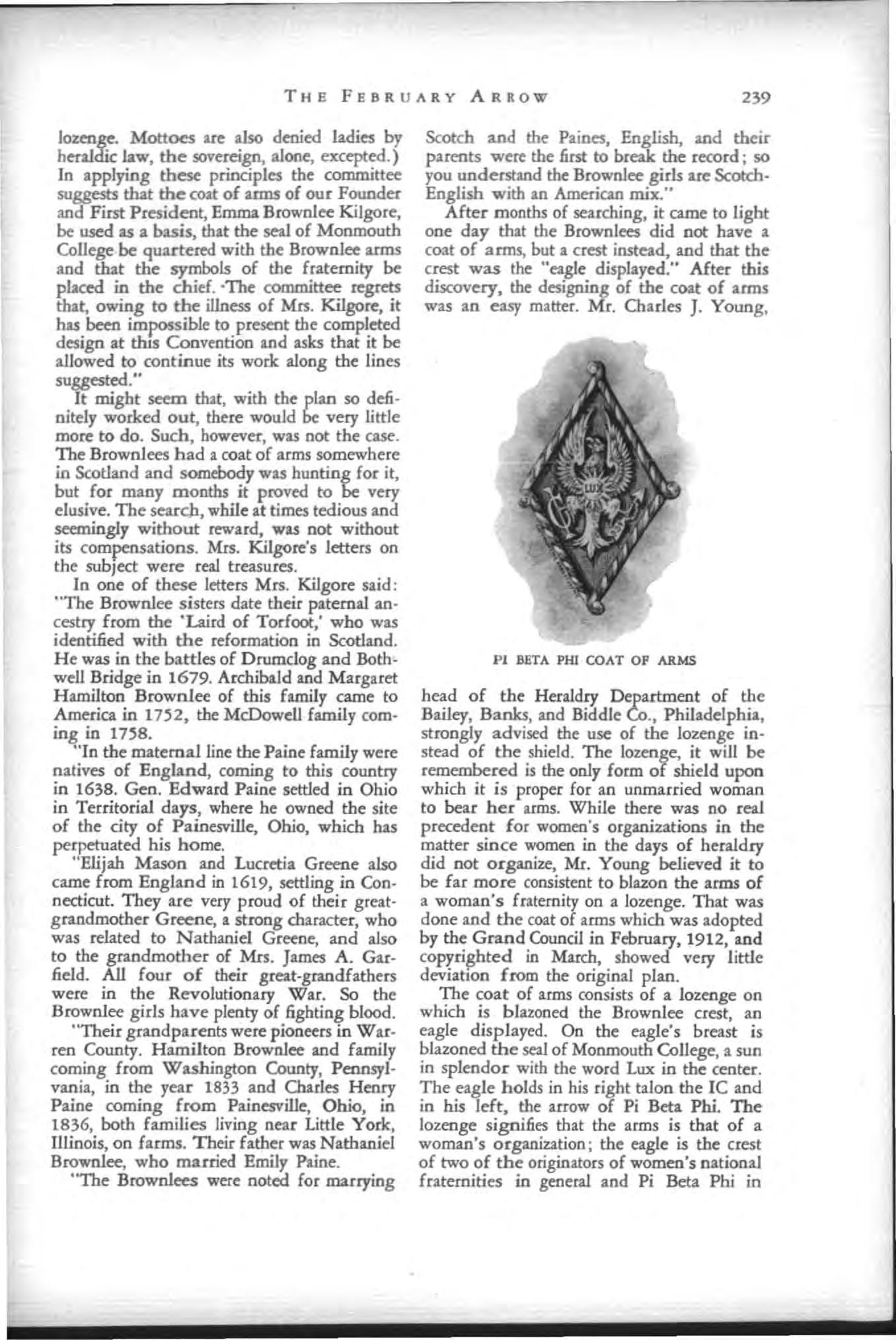
head of the Heraldry Department of the Bailey, Banks, and Biddle Co , Philadelphia, strongly advised the use of the lozenge instead of the shield. The lozenge, it will be remembered is the only form of shield upon which it is proper for an unmarried woman to hear her arms. While there was no real precedent for women's organizations in the matter since women in the days of heraldry did not organize, Mr. Young believed it to be far more consistent to blazon the arms of a woman' s f ratemity on a lozenge. That was done and the coat of arms which was adopted by the Grand Council in February, 1912, and copyrighted in March, showed very little deviation from the original plan.
The coat of arms consists of a lozenge on which is blazoned the Brownlee crest, an eagle displayed. On the eagle's breast is blazoned the seal of Monmouth College, a sun in splendor with the word Lux in the center . The eagle holds in his right talon the IC and in his left, the arrow of Pi Beta Phi . The lozenge signifies that the arms is that of a woman's organization; the eagle is the crest of two of the originators of women'. national fraternities in general and Pi Beta Phi in
particular; the sun is the seal of the college in which Pi Beta Phi had its first home; and the eagle by bolding the IC and the Pi Beta Phi arrow shows the absolute identity between the I.e. $orosis and Pi Beta Phi Fraternity.
In days of old a knight chose bis device seemingly at random and having chosen it, set out to glorify it by deeds of valor. A device stood for something in his mind , by virtue of the glory he or his ancestors had brought to it. And so, according to Anna F . T . Pettit the "symbols of the Pi Beta Phi coat of arms should bring to the mind of every Pi Beta Phi a realization that this great fraternity of ours is a heritage from the past, that we who are proud to use its coat of arms should be equally proud to uphold the ideals for which those noble women, Ollr Founders , established the first chapter at Monmouth College, and that our modem fraternalism should embody in it the chivalry of the past. "
Many of the clubs and chapters, previous to the establishment of the Settlement School, and also afterwards , contributed generously to various altruistic projects. One dub main · tained a splendid university scholarship; an· other contributed to the support of a missionary in China ; several furnished rooms in local hospitals; one donated money to a local Girls' Hotel; several assisted the Associated Cbarities; one paid the rent of a poor woman during one entire winter and assisted with financial contributions to the Old People's Home ; one helped a girl through higb school. Many sent Christmas boxes to homes for the aged and infirm. Some assisted in city Y .W.e.A . extension work; one dub bad entire charge one night a week of a free night school ; one maintained a rest room for farmers' wives; one group conclucted mission classes and Bible classes at the Carlisle Indi an school in addition to dressing dolls for poor children of the slums in New York City.
In fact, there was scarcely a dub or a chap ter that did not engage to some extent in work of this kind, SO that they were especially "a1truistic·minded" and eager to take up the responsibility of a great national project for Pi Beta Pbi when the idea of having Pi Beta Pbi do some sort of educational work in the Appalachian Mountains was proposed to the Convention in 1910.
The inspiration for the project was that of Emma Harper Tumer, former Grand President, and as the spokesman for the Washing-
ton A1umn", Club, Miss Turner presented ber idea to the Convention at Swarthmore. The result was immediate endorsement.
From the acceptance of the idea there came the establishment of the Pi Beta Phi Settle · ment School at GatJiuhurg, Tenn., a work which has thrilled both actives and alumn ", alike and which has grown from an exceed· ingly modest beginning into a project of splendid proportions.
In 1911·12, the fraternity stressed adherence to the spirit of Panhellenic rules, as well as the letter of the law; emphasized high social standards and scholarship; and concen· trated upon the idea of the development of the individual member.
In speaking upoo the latter subject, Grand President May L. Keller said: "We hav e it in our power as a fraternity to spoil good fresh · men, or to make the fraternity one of the important factors in developing strong, wellrounded college women. The latter policy is the one that has marked every step of the development of Pi Beta Phi, and when we have failed , it has not been due to the policy of the fratern ity, but to human nature and circumstances."
This directing of attention towards the in · dividual member has since consistently been followed by Pi Beta Phi. In 1931, the As · sistant to the Grand President was authorized to work out a "personality development" program; and in 1932, detailed "''luiremeots were outlined by the Grand Council for data relative to a person before being elected to membership
Although the giving of the first promise was considered in the light of pledging in the early days of the fraternity , the chapters felt they should have something a little more detailed. Accordingly some of them originated thor own pledging ceremonies. As early as 189S , Illino is B reported such a pledgin g ceremony. The pledge pin was mentioned from time to time by various chapters Wis · consin A, so far as is known, was the first chapter to use a pledge pin , the I . e. ronnogram. In 1901 th is monogram was adopted as the official pledge pin of the fraternity A number of the chapters. however, were oot satisfied with the design and in 1906 this was set aside and the present pledge pin consisting of a Roman gold arrowbead with the
Gred:: letter B in burnished gold, mounted on it was adopted_ A uniform pledging service was adopted in 1904, its use being optional with the chapters_
In order to make sure that each initiate experience some active chapter life, the fraternity in 1918 prohibited the initiation of any pledge later than two months preceding the close of the coUege year.
Even though it was not required by a national ruling , many of the chapters held regular fraternity study for their pledges at least once a month , a regular Handbook of Pledge Study being compiled by the national fraternity in 1919. A Ritual to be used at pledge meetings, written by Emilie Engelbach (King), Colorado B, was adopted by the Grand Council in 1926.
In 1931 the Assistan t to the Gr and President was empowered to organize a program for pledges who had passed their fraternity examinations and were awaiting initiation .
As a natural result of the attention being co ncen trated upon the pledges , the office of Pledge SupervIsor was created in 1931, such Supervisor being made a regular chapter officer.
An important step was taken by the Grand Council IR 1923 and is still in use todaythat of issuing Letters to Parents and Guardians of Pledges. These letters thoroughly acquaint the Parents and Guardians with the general policies of Pi Beta Phi and with the details of the financial requirtments of initiation.
The anti-fraternity movement which seems to come and go in cycles, grew rapidly in 1912-13 and the fraternity officers did everything possible to impress upon the members that they must be democratic and must guard against doing anything that might cause criticism. The report of Alpha Province President for that year showed an increasing number of girls were refusing bids on account of antifraternity sentiment. At this time there was marked legislative activity in Ohio, Texas, Minnesota, Kansas, Wisconsin, Arkansas, South Carolina, Nebraska, and Mississippi.
A mass meeting of all fraternities was called in Chicago, May 30-31, 1912, to consider the situation . On the National Executive Committee, composed of seven men and three women, elected by the Convention, Pi Beta Phi was represented by Lida Burkhard lardner, Colorado B.
Mississippi was the only stote at that time which really took action adverse to the fraternities and her decision caused a long-drawnout law suit. Several institutions, however, acting individually fo<ced the withdrawal of Greek letter groul;'s. As the result of such actio n Pi Beta PhI lost chapters at Barnard College and at Wooster CoIfege.
Believing that high schoo! sororities undoubtedly created resen tmen t against the entire fraternity system, Pi Beta Phi took a definite stand in 1912, voting that beginning in 191' the fraternity woufd refuse to initiate anyone who had been a member of a high school fraternity. Notifi ca tion of such action was sent to National PanheLlenic Congress.
By 1917 the anti-fraternity movement had spread to the Pacific Coast ana was particularly strong at Stanford University. The corning of the war, however, diverted the attention from the subject for the time being.
After the war, in the college world as elsewhere, there arose a radical element determined upon the complete overthrowal of the old oraer, particularly if it represented in any way special privilege,-and the fraternity system was assailed as never before.
It was at this time that exceedingly careful thought was given to extension, with a feeling that perhaps the future of some of the existing chapters might not be secure.
In 1920 the Grand President reported, "the day for fraternities has been saved at Swarthmore, Newcomb, and Hollins." Of our three chapters located in those institutions, only Louisiana A at Newcomb survives today. Because of anti -fraternity legislation, further initiation at Hollins was prohibited in 1929 and Virginia B ceased to exist in 1930. In May 1934, Pennsylvania A at Swarthmore surrendered its charter after two and one-half years of anti-fraternity agitation on that campus. We can point with pride to the fact that Pennsylvama A was the only chapter on the Swarthmore campus which voted 100 per cent for the retention of fraternities when a vote was taken in December 1933.
For some time the charter of Vermont A was threatened by agitation on the Middlebury campus, but the Board of Regents refused to take action abolishing fraternities and all chapters in 1936 were reported to be functioning normally there.
In pleasing contrast to the opposition to fraternities by some university authorities, a
letter was sent in 1928 to Oregon B by the registrar of Oregon State College, congratulating the chapter upon its splendid record for the year, urn its " good leadership; careful selection a members and real sincerity of purpose." Although other ch apter houses at that institution had 30'7'0 of their pledges ineligible for initiation under the college rule, Pi Beta Phi ranked first with not one ineligible.
Under the leadership of Grand President Emma Harper Turner a number of Committees were set to work in 1890, THE ARRow listing at that time the following Standing Committees : X Committee (Extension) ; Committee on Song Book ; Committee on Alumnre; Committee on Catalogue ; Commjttee on Manual ; Committee on Summ er Resort ; and the Library Bureau In 1892, two more Committees wer e added to the list : Chapter Homes, and Literary Bureau . By 1893 , however, the only Committee listed in THE ARRow was the Li terary Bureau , the work of some of the other committees having been completed and the duties of others having been taken over by individual officers.
At the 1906 Convention, Texas A moved "that Standing Committees be appointed to assist the Grand President." The ARRow Editor moved "that committees be appointed by the Grand President with one Or two on a Committee as she shall decide. " Both motions were carried This was the beginning of the renewal of a splendid forward looking movement .
Under the leadership of Grand President May L. Keller the Standing Committee system was relaunched, providing splendid support to the work of the Grand Council.
In 1910 came the creation of two Standing Committees which have continued their work systematically through the years: the Settlement School Committee and the Committee on Undergraduate Loan Fund.
Five important standing committees were organized in 1912: Scholarship, Extension, Fraternity Study and Examinations, Musi c, and Chaperons. Four Special Committees were also created then : Calendar, Pi Beta Phi Grace, Bureau of Printing, and Programme of the Anniversary.
Various Committees of Ooe have been organized from time to time as follows : 1912, Magazine Subscription Agency ; 1914 , Custodian of the Pin ; 1914, Arrow File ; and
1917, Transfers . Temporary Committees organized include : 1916 - 19, Committee on Vocations; 1918 - 19, Wa r Work ; 1918 - 19 , War Fund ; 191 9-2 0, Reconstru ction; and 1920, Convention.
In 1918 there was created the very important Committee on Survey and Standardization with the Grand Secretary as Chairman The decision for the award of the Balfour Memorial Cup, made for the first time in 1921, depended primarily upon the report of this committee. The entire work of the committee was taken over in 1928 by the Central Office and the committee dishanded.
The work of committee chairmen and committee members may in a way, be likened to that of the men in the line in a football team. Seldom are the individual players glorified in the public eye and yet they furnish much of the power and the possibility for the more spectacular touchdown runs of the backfield men . And so, though unsung, the committee workers, who have served faithfully and well through the years , deserve high praise
A stu d y of the list of committee chairmen reveals the fact that Blanche G. Reisinger served continuously for 17 years ; Delia Conger, for 15 years; and Ellen Claire Gilles pie Kribs, and Margaret Kellenbach, each 11 years
Although the administration of Anna Lytle Tannalhill (Brannon), 1918-21, is often referred to as one of ritualistic and ceremonial accomplishment, it was under her direction that a complete reorganization of the stand109 CO!D.lIl1ttees on Scholarship , Examinations, and Fellowship Endowment was effected, the chairman of each being given a staff of ten associates, each to act as a supervisor of her respective province.
Since the election of Amy B. Onken as Grand President in 1921 , there have been c reated the following important standing committees : 1923, SociaJ Exchange, organized for the purpose of providing a clearing house for clever entertaInment ideas; 1923 , Chapte r House Building and Financing, created to assist chapters with building plans and advice as to the financing of new homes ; 1921, Health, organized to improve the health of all members and to SUpervIse living conditions in chapter houses; Transfers, reorganized to help Pi Beta Phis attending universities or colleges other than where they were members of a Pi Phi chapter by initiation or transfer, to get in touch with other P i Phis in the same institution, to enoourage
them to organize unofficial groups, and thus to have something that might in slight measure take the place of the chapter life which they had before ; 1927, Mothers' Gubs to assist in organizing new dubs aod to act as a clearing house for those already functioning; 1927, Endowment Fund Committee, formed for the purpose of raising a $50,000 Endowment for the Contingent Fund; and 1927 , a Committee on Trust Funds , later designated Board of Trustee Funds, to administer the fraternity endowment funds through the Trust Companies with which the securities are placed, and with the approval of these Trust Companies. All endowment mooeys are in the hanas of a trust compaoy or trust companies of recognized financial stability.
Recent Temporary Committees have been: 1926, Muron", Reorganization; and 1932 , Educational Qualifications, a committee appointed to ascertain the sentiment of the fratemity relative to requirement of a degree for national officers .
In 1933, two of the standing committees were discontinued, the Committee on Health and the Committee on Mothers' Gubs , the work of the latter being taken over by the Assistant to the Grand Vice-President.
In order to increase the efficiency and to facilitate the work of the national committees, the Grand Council in 1928 appointed Grand Secretary Gail De Wolf as Supervisor of Standing Committees. Miss De Wolf supervised the compilation of a Maoual for each committee ana assisted each committee wherever possible. The Manuals were printed and distributed by the Central Office.
CHAPEJlONS
Chairman
1912-U Minnie K. Organ, Mo. A
19U-1S Effie Ouistie Patch (Yeaton), Mich . AJessie Lockett, Ill H
1912-14
1923-2' 1923-36
1912-18
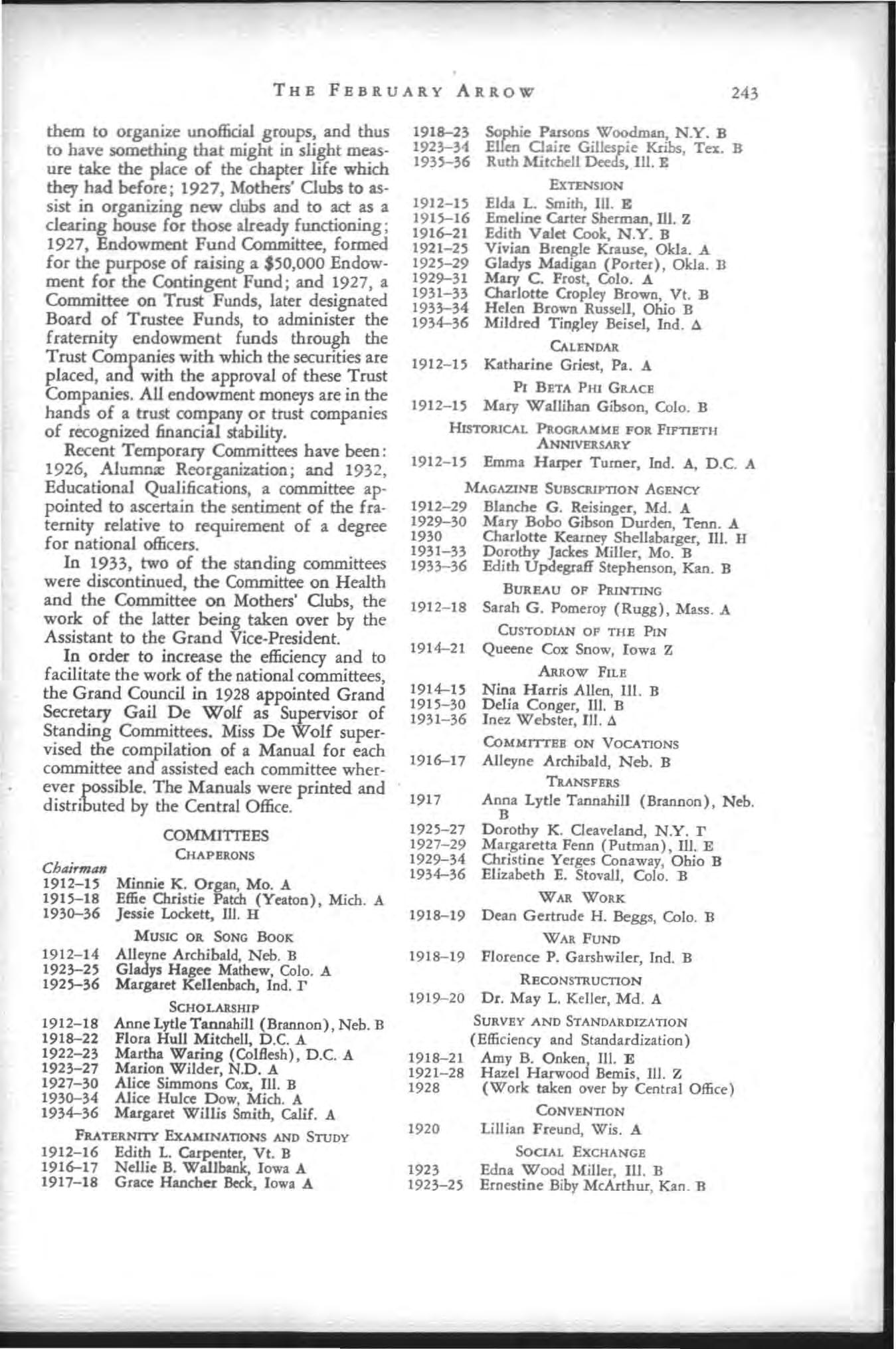
1934-36
MUSIC OR SoNG BooK
Alleyne Archibald, Neb . B
Gladys Hagee Mathew, Colo. A.
Margaret Kellenbach, Ind . r
ScHOLA1lSHIP
Anne Lytle Taruahill (Branoon), Neb. B
Flora Hull MitChell, D .C. A-
Martha Waring (CoIHesh), D .C. AMarion Wilder, N .D. A
Alice Simmons Cox, Ill. B
Alice Hulce Dow, Mich. A
Margaret Willis Smith, Calif. A
FRATERNITY E.xM.f:INAnoNS AND STUDY
1912-16
1916-17
Edith L. Carpenter, Vt. B
Nellie B. Wallbank, Iowa A1917-18
Grace Hancher Bede, Iowa A
1918-23
1923-34 1933-36
1912-1'
1913-16 1916-21
1921-2' 192'-29 1929-31 1931-33 1933-34 1934-36
Sophie Parsons Woodman, N.Y. B
Ellen Gaire Gillespie Kribs, Tex. B
Ruth l>iitch.tl Deeds, III. E
ExTENSION
Elda L. Smith, III. E
Emeline Carter Sherman, llJ. Z
Edith Valet Cook, N.Y. B
Vivian Krause, Okla. A
Glady. Madigan (Porter) , Okla. B
Mary C. Frost, Colo. A-
Charlotte Cropley Brown, Vt. B
Helen Brown Rwsell , Ohio B
Mildred Tingley Beisel, Ind . .:l.
CALENDAR.
1912-n Katharine Griest, Pa. A
PI BETA PH] GRACE
1912-1' Mary WaUihan Gibson , Colo. B
HIsTORICAL PROGRAMME FOR FIFTIETH ..ANNIVERSAJty
1912-1' Emma Harper Turner, Ind. A., D .C. A-
MAGAZINE SUBSCRIP110N AGENCY
1912-29 Blanche G. Reisinger, Md . A
1929-30 Muy Bobo Gibsoo Durden Tenn A1930 Charlotte Kearney Shellabarger, III. H
1931-33 Dorothy Jaclces Miller, Mo B
1933-36 Edith Upd<graff Stephensoo, Kan . B
BUREAU OP PRINTING
1912-18 Sarah G . Pomeroy (Rugg), Mass . A
CU STODlAN OF THE PIN
1914-21 Qucene Cox Snow, Iowa Z
Au.ow FILE
1914-n Nina Harris Allen , Ill. B 19n-30 Delia Conger. III. B 1931 -36 Inez Webster, Ill. 11
CoMMITI'EB ON VOCATIONS
1916-17 Alleyne Archibald, Neb. B
1itANSFERS
1917 Anna Lytle Tannahill (Brannon), Neb . B
1925-27 Dorothy K. Oeaveland, N .Y. r 1927-29 Margaretta Fenn (Putman), III. E
1929-34 Christine Verges Conaway, Ohio B 1934-36 Elizabeth E. Stovall, Colo. B
WAR WORK
1918-19 Dean Gertrude H Beggs, Colo. B
W R FUND
1918- 19 Florence P. Garshwiler, Ind. B RECON STRUCTION
1919- 20 Dr. May L. K eller, Md. ASURVEY AND ST ND RDIZATION (Effi ciency and Standardization)
1915-21 Amy B. Onken III. E
1921 -2 8 Hazel III . Z
1928 (Work taken over by Central Office)
CoNVENTION
1920 Lillian Freund, Wis . A SoCrAL EXCHANGE
1923 Edna Wood Miller, 111 B 1923-2) Erne5tine Biby McArthur, Kan. B
192 ' - 26 Kathleen L. Hammond, M o. B
1926-2 7 Gladys Morris Williams, PIa. B
1928 31 Faith Martin Hanna, Ktn. B
1934-36 Edna Graham, VI. A
CHAPTER HOU SE BUILDING AND FINANCING
1923-2 ' Anna Cravens Rott t Ind. B
192)-27 Marion Coe Palmer, Calif. B
1927- 28 Marie Freeman Palmer, Ill. Z
1929-36 Sybil Batts Guttmen, Minn. A
1921 - 29
1929 1929-3 6
1927-32
1932- 33 1934-3) 193)-3 6
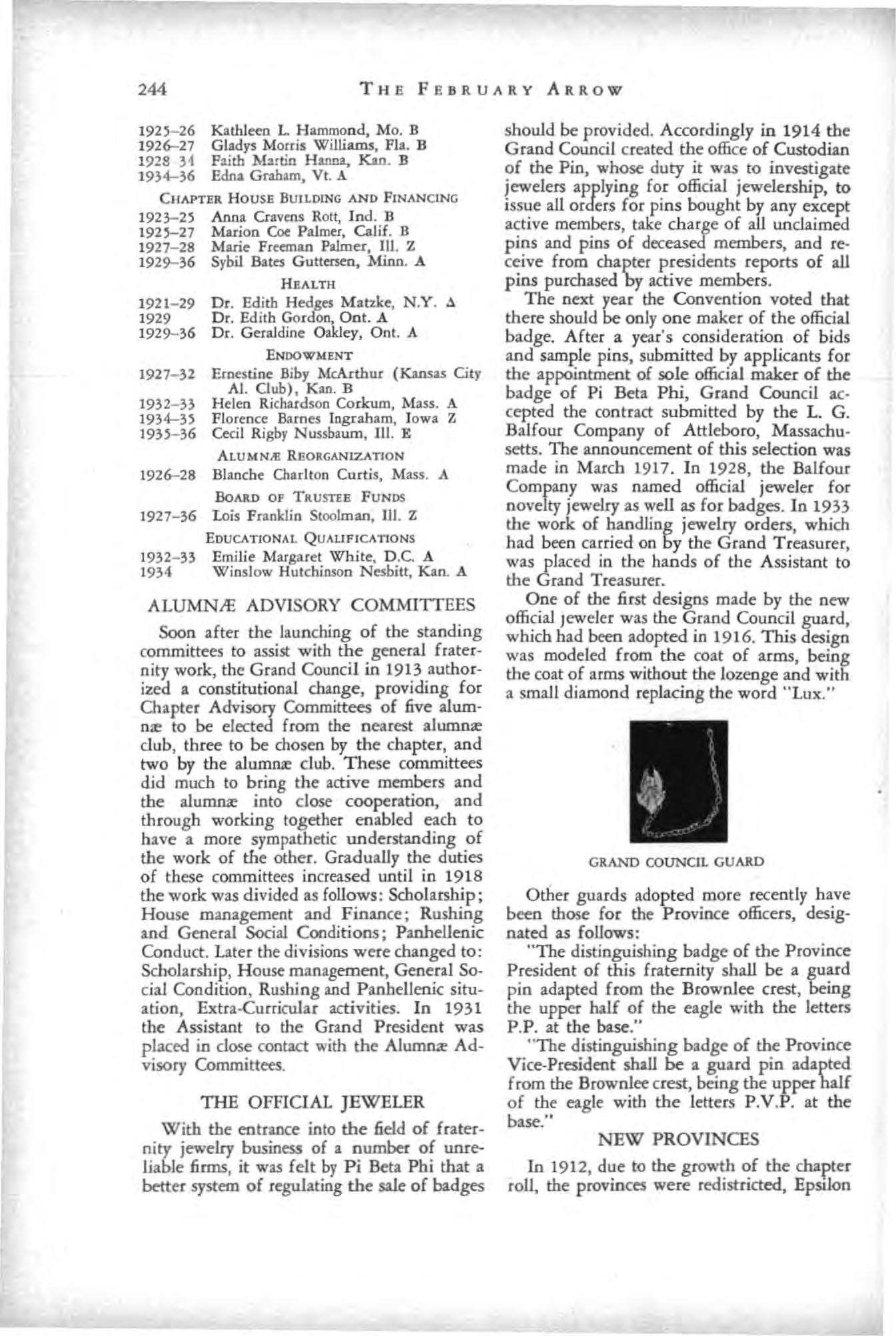
Dr. Edith Hedges Matzke, N.Y. 4
Dr. Edith Gordon, Ont o A
Dr. Geraldine Oakley, Ont. A
ENDOWMENT
Ernestine Biby McArthw (Kansas Gty AI. Club), Kan. B
Helen Richardson Corkum , Mass. A
Florence Barnes Ingrah am, Iowa Z Cecil Rigby Nussbaum, lIl. E
ALUMNAt ReORGANIZATION
1926-28 Blanche Charlton Curtis, Mass. A
BoAllD OF TRUSTEE FUNDS
1927-3 6 Lois F ranklin Stoolman, Ill. z
EDUCATIONAL QUAUFICATIONS
1932 - 33 Emilie Margaret White, D .C. A 1934 Winslow Hutchinson Nesbitt, Kan . A
ALUMNfE ADVISORY COMMITTEES
Soon after the launching of the standing committees to assist with the general fraternity work, the Grand Council in 1913 authorized a constitutional change, providing for Chapter Advisory Committees of live alumn", to be elected from the nearest alumn", club, three to be chosen by the chapter, and two by the alumn., club. These committees did much to bring the active members and the alumnre into close cooperation, and through working together enabled each to h ave a more sympathetic understanding of the work of the other. Gradually the duties of these committees increased until in 1918 the work was divided as follows: Scholarship; House management and Finance; Rushing and General Social Cooditions; Panhellenic Conduct. Later the divisions were changed to: Scholarship, Hou", management, Gene",l Social Condition, Ru shi ng and Panhellenic situation, Extra-Curricular activities. In 1931 the Assistant to the Grand President was placed in close contact with the Al= Advisory Committees.
With the entrance into the lield of fraternity jewelry business of a number of unreliable linns, it was felt by Pi Beta Phi that a better system of regulating the sale of badges
should be provided. Accordingly in 1914 the Grand Council created the office of Custodian of the Pin, whose duty it was to investigate jewelers applying for official jewelersbip, to issue all orders for pins bought by any except active members, take charge of all unclaimed pins and pins of deceased members, and receive from chapter presidents reports of all pins purchased by active members.
The next year the Convention voted that there should be only one maker of the official badge. After a year's consideration of bids and sample pins, submitted by applicants for the appoinbnent of sole official maker of the badge of Pi Beta Phi, Grand Council accepted the contract submitted by the L. G . Balfour Company of Attleboro, Massachusetts. The announcement of this selection was made in March 1917. In 1928, the Balfour Company was named official jeweler for novelty jewelry as well as for badges . In 19 33 the work of handling jewelry orders, which had been carried on by the Grand Treasurer, was placed in the hands of the Assistant to the Grand Treasurer.
One of the lirst designs made by the new official Jeweler was the Grand Council guard, which had been adopted in 1916 This design was modeled from the coat of arms, being the coat of arms without the lozenge and with a small diamond replacing the word "Lux."
Other guards adopted more recently have been those for the Province officers, designated as follows:
"The distinguishing badge of the Province President of this fraternity shall be a gnard pin adapted from the Brownlee crest, being the upper half of the eagle with the letters P.P. at the base ."
"The distinguishing badge of the Province Vice-President shall be a guard pin adapted from the Brownlee crest, being the upper balf of eagle with the letters P.V P. at the base.
In 1912, due to the growth of the char.ter roll, the provinces were redistricted, Epsilon
and Zeta being added; in 191 5, Epsilon was changed to Zeta and Zeta to Eta ; in 1918 came Theta, Iota, aod Kap!'" ; and in 1931 a complete redistricting e acned the provin ces from Alpha through Mu With the addition of two more Canadian chapters in 1934, it was felt that Alpha Province was too large, so in 1935 it was divided into Alpha Province East and AIl;'ha Provin ce West, with two province presidents.
About 1913 there came the beginning of what was later designated the "/lapper age " Through the pages of THE ARROW, especially in the paragraphs, "What a Fraternitr Girl Thinks," one linds recorded changes In the mode of living Camr.aigns were launched against "cheap and vu gar music." Editorials decried the new modern dances such as the Rag and the Boston, and the Grand Council forbade "ragging with a man " in any chapter house. Censorship of the movies was considered of utmost importance and SOCIal standards were carefully guarded by the national officers.
Beginning with 1913 and continuing for several years, the interest of the membe!s of Pi Beta Phi was focused up"" the Nahonal Amendment to the Constitution providing for Equal Rights. THE ARROW _much data to suffrage" presenting opml.ons from Pi Phts on both stdes of the questIOn. Many Pi Phis were active in the various and national campaigns, the most outstaodIng one being Carrie Charman Catt, Iowa r, president of the Nationa Woman's Suffrage Association.
During the winter of 1915 , the Y.W.CA . celebrated its Jubilee Year in honor of the founding of the organization fifty years before. THE ARROW gave this celebration wide publicity and printed artides written by members of the fraternity who wefe then active in Y.W .CA. work.
At this time, too, plans were going forward for the Jubilee Year 1917, when Pi Beta Phi intended to devote three days of convention to alumn", interests in honor of the Fiftieth Anniversary of our founding. The highlight of the celebration was to be the tendering to the fraternity by Elizabeth Carke Helmick, of the Settlement School as a memorial to the Founders.
The Convention was scheduled to be held at Lake Geneva . Wisconsin, the summer of 1917 , but with the declaration of war , th is was l"?'tponed at on ce, due to the uncerta in condttion of transportation, the general disorganization and unrest which immediatel y followed the entrance of the United St ates into the World War.
With the postponement of the Convention , the Grand Council planned for province and sectional reunions throughout the United States with one or more Grand Council mem· bers present. Too, it was deemed advisable that every chapter be visited by a Grand Offi ce r before 1918. In pursuance of this policy Grand President May L. Keller and Grand Vi ce -President Nina Harris Allen were sent to the Paci6 c Coast to hold reunions in Eta Province and to visit as many alumn:r clubs and chapters as possible. These officers com· pleted a most satisfactory six weeks' tour, as a beginning to the official visits.
Cooperation with university authorities was the outstanding message conveyed to the chapters by all national officers and in May 1917, Anna Lytle Tannahill (Brannon) , representing Pi Beta Phi at a Conference of Deans, read a paper on the subject, "The Fraternity for Women in its Relationship to the College."
These were upset times. There were many changes in personnel , and much responsibility rested upon the shoulders of the Grand Council, who worked unceasingly to keep the national organization functioning as nearly normaUy as possible.
The inRuenza epidemic was devastating , but despite the influenza bans on public meetings, and the demands of war activities , 71 of the 74 alum"", dubs listed in 1918-19 sent in annual reports!
The year 1918 began a decade of what may be called "Intensive Internal Development." By far the greater part of the legislation passed at the first Charlevoix Convention had as its object the development of the chapters to greater degrees of efficiency. Under this program of progress carne the new scholarship and conduct requirements for initiation ; the placing of final date of initiation not later than two months hefore the dose of the college year; provision for annual visits of in-
spection by Province Presidents ; the districting of the fraternity into ten provinces oC reasonable size, roiling possible more inten· sive work on the part of province officers.
From the chaos of the war two astounding facts emerged to face the nation: first, imperative need for fundamental physical knowledge in order to preserve our national health from the dangers which then threatened ; second, the appalling truth that there were at that time withm our borders, 5,500 ,000 men , women , and children of school age who could not read or write.
To answer these challenges, Pi Beta Phi adopted a nat ional Health program and redoubled the efforts at the Settlement School. No special appeals had been made for the support of the School during the war, and now as a reconstruction agency it drew renewed interest . Plans for the enlargement of the School and its further development were eagerly pushed.
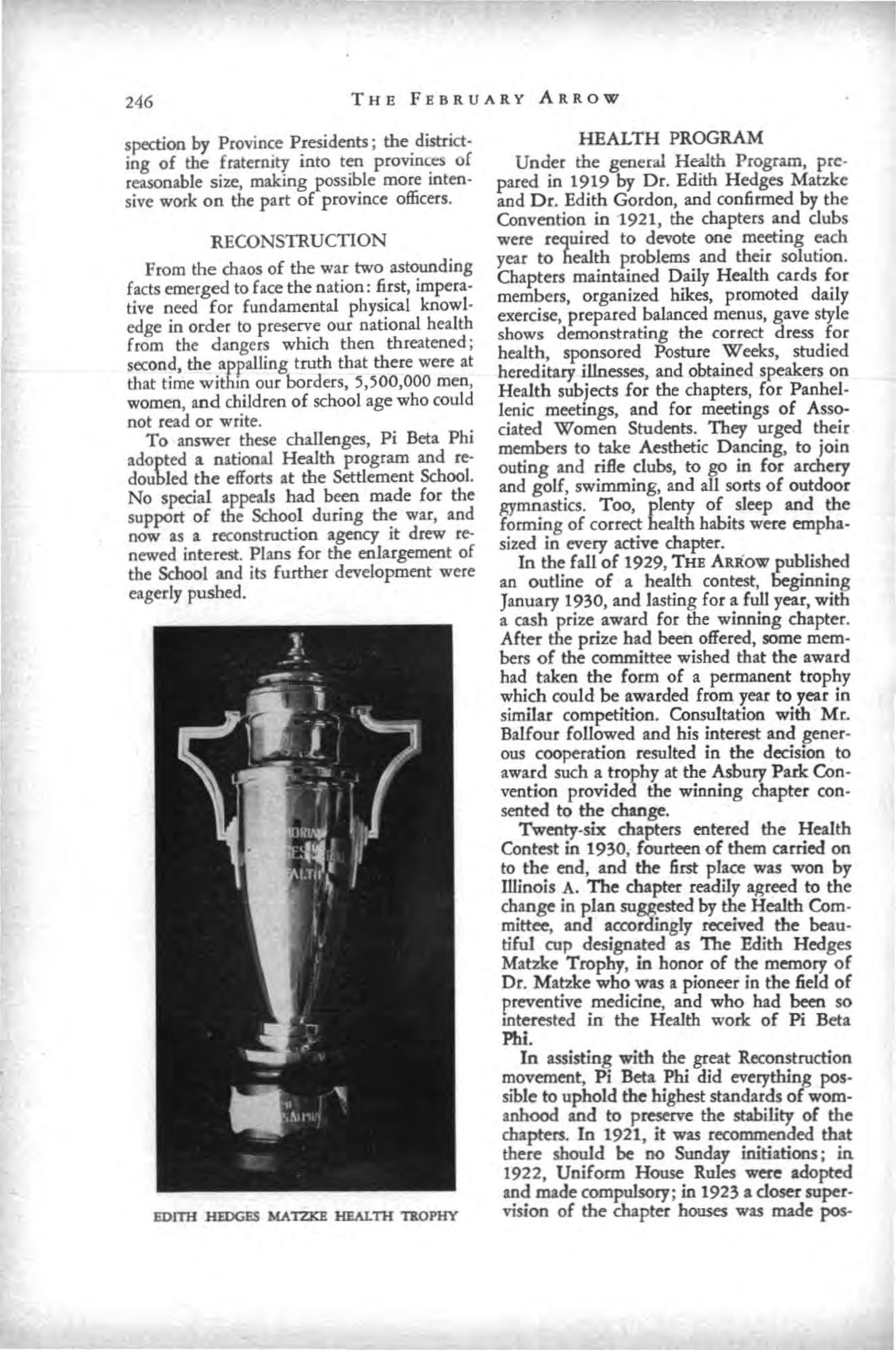
Under the general Health Program, prcpared in 1919 by Dr. Edith Hedges Matzke and Dr Edith Gordon, and confirmed by the Convention in 1921, the chapters and dubs were required to devote one meeting each year to health problems and their solution. Chapters maintained Daily Health cards for members, organized hikes, promoted daily exercise, prepared balanced menus, gave style shows demonstrating the correct dress for health, sponsored Posture Weeks, studied hereditary illnesses, and obtained speakers on Health subjects for the chapters, for Panhellenic meetings, and for meetings of Associated Women Students. They urged their members to take Aesthetic Dancing, to join outing and rifle dubs, to go in for archery and golf, swimming, and all sorts of outdoor gymnastics. Too, plenty of sleep and the formin g of co rrect health habits were emphasized in every active chapter.
In the fall of 1929, THE Aluiow published an outline of a health contest, beginning January 1930, and lasting for a full year, with a cash prize award for the winning chapter After the prize had been offered , some members of the committee wished that the award had taken the form of a permanent trophy which could be awarded from year to year in similar competition. Consultation with Me. Balfour followed and his interest and generous cooperation resulted in the decision to award such a trophy at the Asbury Park Convention provided the winning chapter conseated to the change
Twenty-six chapters entered the Health Contest in 1930, fourteen of them carried on to the end, and the first place was won by IUinois A. The chapter readily agreed to the change in plan suggested by the Health Committee, and accordingly received the beautiful cup designated as The Edith Hedges Matzke Trophy, in honor of the memory of Dr. Matzke who was a pioneer in the field of preventive medicine, and who had been so interested in the Health work of Pi Beta Phi.
In assisting with the great Reconstruction movement, Pi Beta Phi did everything possible to uphold the highest standards of womanhood and to preserve the stability of the chaple". In 1921, it was recommended that there should be no Sunday initiations; in 1922 , Uniform House Rules were adopted aod made compulsory; in 1923 • doser supervision of the chapter houses was made pas-
si ble through the approval of all cha perons by th e Grand Council ; in 1924 standard books of social usage were recommended to chapters ; and in 19 32 , an official Manual of Social Usage, especially adapted to use in the chapter houses, was r,repared by Beatri ce Teague, Colorado B. n the same year the fraternity issued Uniform Regulations Gov · erning O"pter House Chaperons . Too, it added to its Uniform House Rules a com· pulsory rule relative to guests who had been drinking; and through the years, Pi Beta Phi maintained a very conservative stand on the subject of smoking. In order to broaden each college girl"s ""P"rience, an Extra Curricular Committee for chapters was recommended in 1929 and officially created in 1931, with ex· cellent results.
During this Reconstruction Period, following the War, in addition to assisting in the support of visiting foreign women students, Pi Beta Phi contributed $25 to the American Commission for the Restoration of the University of Louvain , and subscribed $300 for the years 1920 and 1921 to the American School of Oassical Studies at Athens.• Part of the fund for this latter project was met by the surplus war fund, and the balance was successfully raised by the Richmond Alumnae Gub.
During this same period of Reconstruction, chapters continued their altruistic proJects, contributed generousTy to the Settlement School and a number of them reported contributions to Serbian relief, to Armenian relief, to the support of the Y.M.CA. and Y.W.CA. base at the University of Prague, Czecho-Slovakia, to support o£ a chair at Madura College, India, to funds for the sup· port of French and Italian orphans, and to funds for Disabled War Veterans
• The American School at Athens was founded in 1881 by a group of the leading and universities in the United States, managed by • committee repcestoting these institutions, twenty. five in number in 1920 On this board was Prof . Gertrude H . Beggs of Westhampton College. The special work of this smaller committtt o f which Prof. Beggs was a member, wa.s to raise an "AuxiJiazy Fund" to make possible the increase in the facilities of the school by the additi o n, particularly. of a dormitory for women stude!ots in punuit of research work in Athens. Work of the school WaJ of strictly graduate grade and offered opportunities for advanced study Dot only to spcciaJists in the dassia , but also to architects and sculptors .
Just about the time of th e signing of the Armistice, there sprang up the Student Volunteer Conference movement, which sent a call to the college women to be prepared for "the more serious time to come-the period of reconstruction: · Many of our members earnestly devoted themselves to the study of Christianity in order to combat the fatalism sure to come as a result of the wac.
In December 1919, a Student Volunteer Conference was hdd in Des Moines, Iowa. More Pi Beta Phis than members of any other fraternity were in attendance, there being representatives from 30 Pi Beta Phi chapters . The keynote of the Conference was-responsibility-universal fellowship and an interest in world affairs , with an appeal for a greater understanding among all the peoples of the World
World interest was reJlected in THE ARROW at this time through letters from Pi Beta Phis in the Philippines, Porto Rico, Japan, China, India, Alaska, Bermuda, Panama, South America , and Hawaii.
Beginning about 1920 there was a great inBux of students to college. Conditions in the country were still restless and students shifted about, resulting in a real Transfer problem. Pi Beta Phi asked the chapters that every consideration be shown to transfers, but it was a physical impossibility on some of the carnpuses to affiliate them. At Berkeley in 1923 eleven transfers formed a "Transient" chapter, held regular meetings in the California B chapter house, had cookie shines, bridge parties, and prepared and read papers of fraternity interest. The dues collected each month were sent to the Settlement School. The chairman of Transfers cooperated in every way possible to put the chapters into touch with the Transfers.
Too, with the increase in enrollment and the correspondingly large increase in rushing lists, there arose the question of what to do with all of the relatives or "Iegades." In 1920 the Grand Council stated that it was the policy of the fraternity that Pi Beta Phi members be chosen for their own qualifications alone, but that sisters .nd of members should be given an espectal opportunity to prove themselves worthy and that they should be given every courtesy and consideration of the chapters.
In 1920 steps were taken to safeguard the pin and to put a stop to its use by the two high school fraternities which had appropriated the design of the Pi Beta Phi arrow. Progress in the matter was at nrst very slow due to the legal techni calities involved. In 1927 application was made for the trade mark registration of Pi Beta Phi ' s Greek name, since it was learned that when fraternity jewelry is sold by offi cial jewelers , under
For at least two years subsequent to the signing of The Armistice, general conditions were greatly unsettled and Pi Beta Phi felt to a co nsiderable degree the inroads made upon the personnel of national office rs . Of the Provmce Presidents elected at Charlevoix in 1918 , only three remained in office in 1920 . Therefore, in order to recruit fraternity workers, a system of volunteer service cards was inaugurated in order to find out who were at
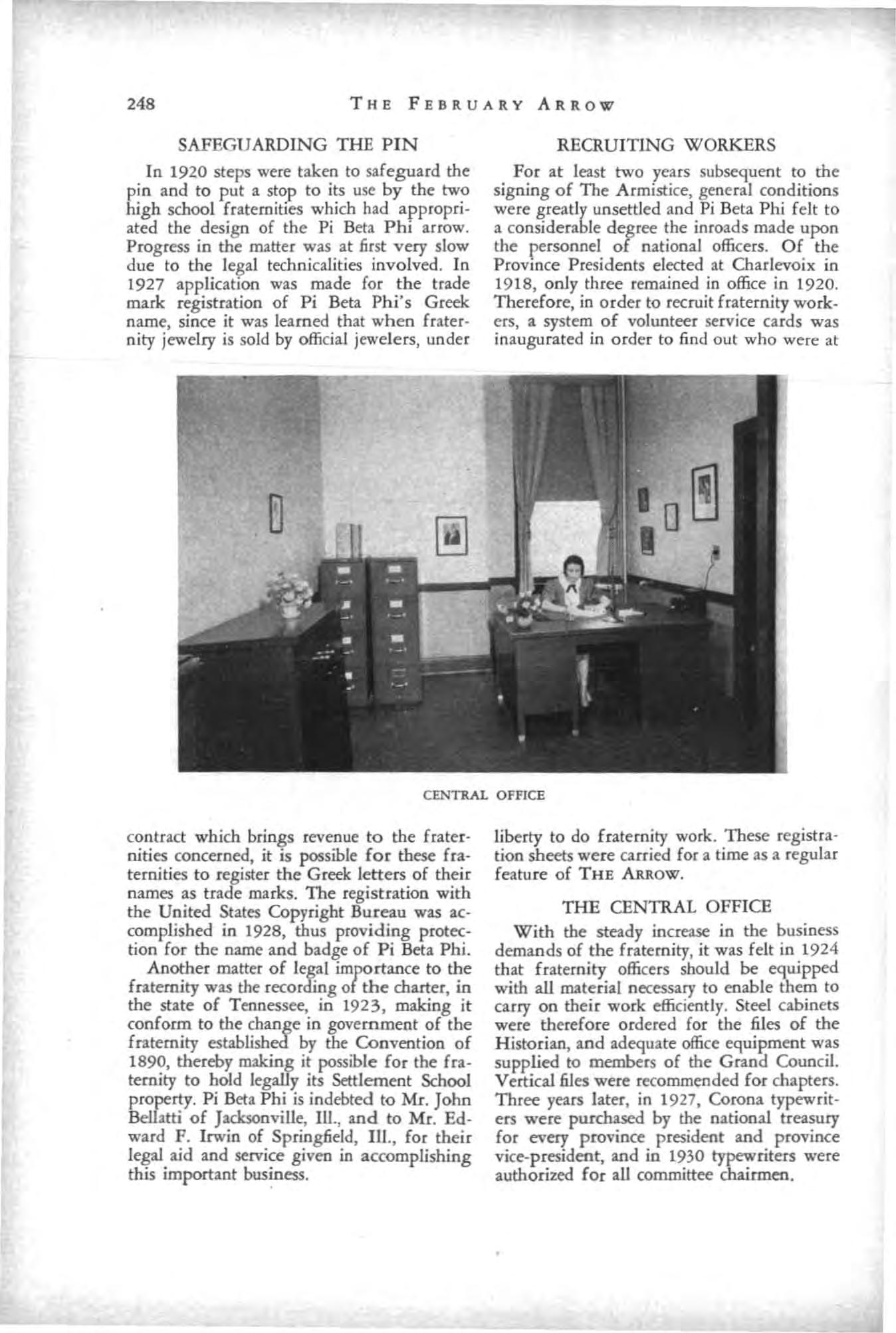
c ontract which brings revenue to the fraternities concerned, it is possible for these fraternities to register the Greek letters of their names as trade marks. The registration with the United States Copyright Bureau was accomplished in 1928, thus providing protection for the name and badge of Pi Beta Phi. Another matter of legal importance to the fraternity was the recording of the charter, in the state of Tennessee, in 1923, making it conform to the change in government of the fraternity established by the Convention of 1890, thereby makin8 it possible for the fraternity to hold legally its Sett1ement School property. Pi Beta Phi is indebted to Mr. John BeUatti of Jacksonville, m., and to Mr . Edward F. Irwin of Springfield, Ill ., for their legal aid and service given in accomplishing this important business.
liberty to do fraternity work. These registration sheets were carried for a time as a regular feature of THE ARROW.
With the steady increase in the business demands of the fraternity , it was felt in 1924 that fraternity officers should be equipped with all material necessary to enahle them to carry on their work efficiently. Steel cabinets were therefore ordered for the files of the Historian, aod adequate office equipment was supplied to members of the Grand Council. Vertical files were recommended for chapters. Three years later, in 1927, Corona typewriters were purchased by the national treasury for every province president and province vice-president, and in 1930 typewriters were authorized for all committee chairmen .
In keeping with the general trend . there was created the Central Record and Supply Office. Such an office was first suggested at th e Washington Eastern Conferen ce in 192 4 at a Round Tahle dealing with "Relief for National Oflicers " The next year the office was oflicially authorized as an experiment. by the June 1925 Convention.
Mabel Scott Brown District of Columbia A. Cataloguer. was placed in charge of the office which for a year and a half existed in her home at Hartford. Connecticut. During this first year. in addition to doing the regu· lar catalogue work. Mrs Brown undertook to centralize the issue of publications and to simplify the membership machinery of the fraternity.
Since the Catalogue and the Mailing List of TH E ARR o w had always been intimately con· nected. the Mailing List was returned to the custody of the Cataloguer. upon the resigna· tion of THE ARROW Circulation Manager in 1927, and the duties of the Central Record and Supply office were considerably increased. Hence, more room was needed for files and supplies. Accordingly in 1929 the fraternity rented quarters consisting of two large office rooms in the Hartford's Woman 's Club. 175 Broad St.• Hartford. Conn. Later, in 1921. the office was moved to Room 1312 , American Industrial Bldg.• Hartford. Conn.
Realizing that the duties of the Central Office demanded more time and strength than anyone should be expected to contribute to the fraternity, without adequate compensation, the Grand Council in 1931 voted to make the work of U,. Director of the Central Office a paid secretarial position and no longer just the required duty of a national officer.
With the election of Mabel Scott Brown as THE ARROW Editor there came the necessity for a change in the management of the Cen· tral Office and early in January 1932, Beatrice Stephenson (Purdunn) was appointed to the position.
The far-sighted understanding of conditions and the pioneer work of Mrs. Brown in organizing the work of the Central Office can never be over -estimated.
After six weeks of study under Mrs. Brown's direction, Beatrice Stephenson (Pur. dunn) moved the office to Bloomington, Illinois, in March 1932 and later. upon her marriage in October 1933, transferred the office to Marshall, IHinois , where it now oecu-
pies three rooms in the National Dixie BuildIng.
The Central Office fun ctions as a dearin g h ouse for the fraternity . Among its many duties are:
Revising the entire membership of the fra · temity each year.
Sending out supplies to chapters and alum · na: clubs throughout the year
Changing addresses on the file cards and plates. and keeping the mailing list up to date
Collecting money for THE ARRow subscriptions. and for supplies sold.
Compiling reports.
Running the Arrow mailing list for THE ARROW.
Mimeographing material for chapters. clubs , and officers.
Filling printing orders
Writing up THB ARROW personals.
Handling new initiate work, which sists of sending out directories and embossed ini tiation certificates to the new initiates and of making cards for them in the files
Endeavoring to find the "lost" members
Entering data contained on such blanks as inactive, active, officer, and change of address blanks.
Making addressograph lists for Alumna: Clubs.
Mimeographing manuals, letters and other material as authorized.
The Convention held at Breezy Point Lodge 1927. voted. "That Pi Beta Phi launch a brief and intensive campaign for the $50.000 Fraternity Endowment Fund, in honor of its Sixtieth Anniversary."
Other fraternities were at that time insur · ing increased supervision through contingent endowments, and Pi Beta Phi swung into line to raise this endowment to the contingent fund. the principal of wh ich should be available for chapter house loans and the interest, for internal organization needs.
The Kansas City. Mo., Alumna: Club was appointed in charge of the campaign with Ernestine Biby McArthur as Chairman. Later the work was delegated to a regular standing committee on Endowment.
The fund was designated the Friendship Fund and every member of the f ratemity was given an opportunity to contribute. In 192 9 the pledge system was adopted, whereby a
letter with a pledge card was sent to the membership-at-Iarge, pledges being accepted for live years_
On the Boor of the Convention in 19 29, Fannie Whitenack Libbey started the contributions with a result that $2600 was subscribed at once_ Similar aPFs have been made at subsequent ConventIons, with gratifying results _
The total in cash and pled$'" subscribed to January I, 1936, was approxtmately $30,000_ The drive goes forward steadily with a view
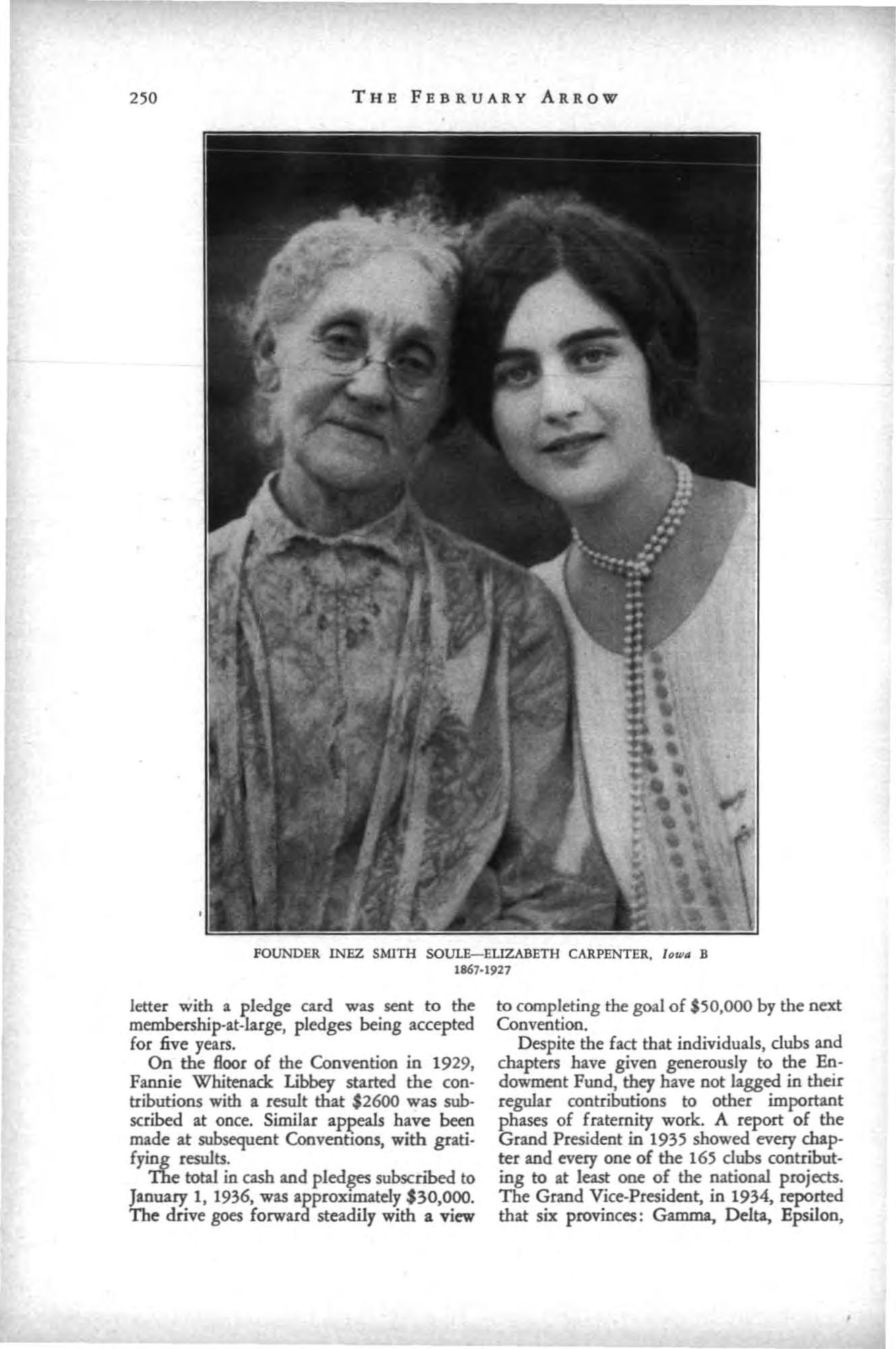
to completing the goal of $50,000 by the next Convention _
Despite the fact that individuals, dubs and chapters bave given generously to the Endowment Fund , they have not lagged in their regular contributions to other important phases of f ratemity work _ A report of the Grand President in 1935 sbowed every cbapter and every one of the 165 dubs contributing to at least one of the national projects _ The Grand Vice-President. in 1934, reported that six provinces : Gamma, Delta, Epsilon ,
Em, Theta, and Lambda were lOOper cent in Settlement &bool donations from their clubs, while six provinces: Beta, Epsilon, Zeta, Theta, and Kappa increased their donations over the previous year. She reported in 1935 that Delm , Epsilon , and Lambda Provinces had perfect records in contributions to the Settlement &boo!, the Endowment, and the Loan Funds.
In 1934 came the announcement of three splendid donations to the national fraternity from New York Beta alumnre. When Barnard closed its doors to fraternities in 1913, "the members of New York B cherished the hope that eventually it would aUow their reestablishment and they determined that when that time came, New York B should have finaneial support for a chapter. A fund was established and was kept practicaUy inmct . On Memorial Day, 1934, the anniversary of the founding of the chapter, the loyal alumnre decided to put their fund actively at work for the fraternity as a whole, and very generouslr gave to the altruistic projects of Pi Beta Phi, contributing $300 to the Settlement &bonl Endowment, $300 to the Pi Beta Phi Endowment, and $166.49 to the Loan Fund: '
Two other splendid gifts were made to the fraternity on March 10, 1935, when Pennsylvania A, after selling her bungalow, pre· sented $400 to the Endowment Fund, and $200 to the Settlement &hool.
National Supervisors:
1925-28, Marie Freeman Palmer, Illinois Z 1928-29, Dorothy Burrows, Illinois Z 1929·31, Marie Freeman Palmer, Illinois Z 1931-34, Helen Kammerer McKendrew, Missouri B
1934, Helen Jo Roop Adkisson, Missouri r 1935-36, Nell Weaver Will, Oklaboma A
Realizing that a chapter could not be successful unless its linances were sound, the Grand Couneil in 1908 sent uniform books to the chapter treasurers, with simple instruc· tions relative to the keeping of them. Four years later the examination of chapter record books and cha pter treasurer ' s books, became an esmblished part of the routine of inspect. ing officers In 1923 aU chapters were required to make financial statements to the Grand Council annuaUy.
In 1924 the Grand Council strongly fa· vored the adoption of • uniform budget sys· tem for all chapters and appointed the Grand
Secretary to compile dam during the ensuing year on such budget systems as had already been put into elIect by various chapters. As the result of this investigation, the Busey system of Uniform Acco unting was adopted for all chapters and a National Supervisor of Chapter Accounts was authorized.
Naturally the installation of the uniform system of Accoun ting brought some diffi· culties of adjustment, but at the close of the lirst year, with few exceptions, all chapters were using the Busey system successfully. This system did away with special assessments and, according to record, no chapter started the school year 1928 ·29 with a "red" balance.
Lilee other business firms, chapters running their own houses, felt the economic depression and have had financial difficulties during the past six years, but have undoubtedly been able to meet these difficulties much more successfully because of the close national supervision given their finances through the use of the budget system.
In order to lessen the burden on one individual, the Grand Council voted in 1935 that after July 1936 the wock of the Supervisor of Chapter Accounting be divided between two divisional officers: the eastern division to comprise the nrst six provinces. the western division to comprise the last six.
Important legislative measures passed between 1923 and 1936 have induded the authorization for the Grand Treasurer to procure blanket em.l'loyee's liability insurance for aU chapters havlOg employees; the stipulation of an IOstallation fee to be charged new chapters; the substituting for the regular initiation fee, one aU-inclusive fee which is to be paid at the time of initiation and which will do away with annual dues, the new fee to go into effect after July I, 1936; the restricting of the requirements for initiation by special dispensation of the Grand Council; and the requirement that each chapter shaU have and preserve a book of Initiate Signatures to a pledge to accept the provisions of and abide by the Constitution.
To summarize the past ten years: the term "intensive internal progress" pechaps more aptly describes the work of the fraternity than any other term. This intensive development has been accomplished through close super-
vision of each chapter and of individuals through the annual visits and regular letters of the Province Presidents and the biennial visits of Grand Council members; through well organized Executive Councils· of from five to seven members; through Alumnre Advisory Boards; through competent, interested chaperons and loyal Mothers' Clubs; through chapter house building supervision; annual visits to dubs by Province Vice·Presidents; through committee work ca rried on most eAl . cie ntly; through the use of instructions , sup-
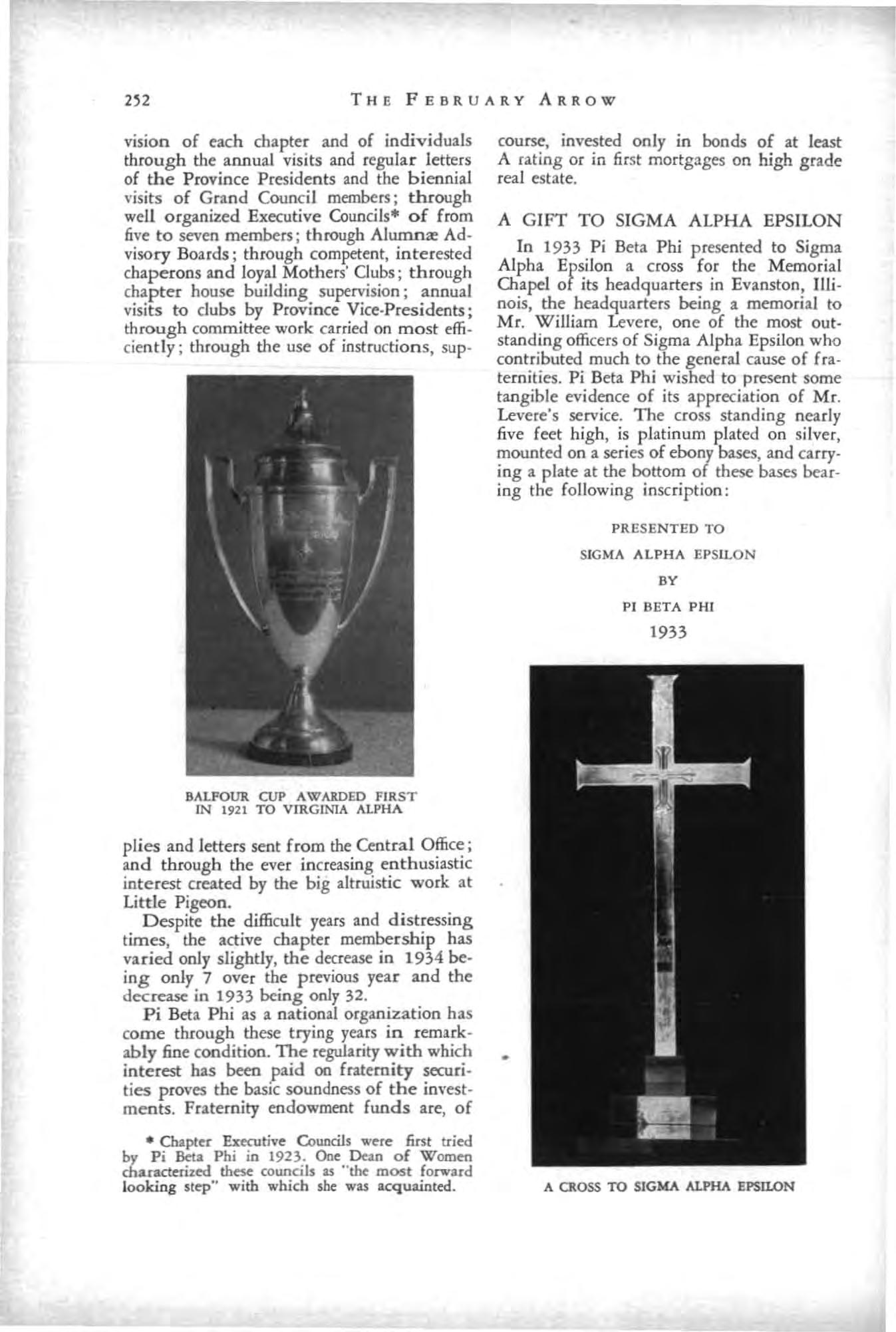
plies and letters sent from the Central Office; and through the ever increasing enthusiastic interest created by the big altruistic work at Little Pigeon,
Despite the difficult years and distressing times, the active chapter membership has varied only slightly, the decrease in 1934 being only 7 Over the previous year and the decrease in 1933 being only 32.
Pi Beta Phi as a national organization has come through these trying years in remarkably fine condition. The regularity with whi c h interest has been paid on fraternity securities proves the basic soundness of the inv estments. Fraternity endowment funds are) of
• Chapter Executive Councils were first tried. by Pi .Beta Phi in 1923. One Dean of W omen cbaracterized these councils as "the most f o rward looking step " with which she was acquainted.
course, invested only in bonds of at least A rating or in fir st mortgages on high grade real estate.
In 1933 Pi Beta Phi presented to Sigma Alpha Ersilon a cross for the Memorial Chapel 0 its headquarters in Evanston, Illinois , the headquarters being a memorial to Mr. William Levere, one of the most outstanding offi cers of Sigma Alpha Epsilon wh o contributed much to the general cause of f ra · ternities. Pi Beta Phi wished to present some tangible evidence of its appreciation of Me. Levere's service. The cross standing nearly five feet high , is platinum plated on silver, mounted on a series of ebony bases, and ca rrying a plate at the bottom of these bases bear· ing the fo llowing inscription:
PRES ENTED TO SIGMA ALPHA EPSlLON BY PI
BETA PHI
1933
MAlTIE HUFF, Iowa r
On Feb. 20, 1931, Mattie Huff of Gatlinburg, Tenn., was initiated into Iowa r, Iowa State Agricultural College, Ames, Iowa She was a graduate of our own Settlement &hool at Little Pigeon. She was pledged to the Ames chapter, not because she was one of our graduates, but because she was charmi ng, capable, and especially desirable as a fraternity memo ber. She was rushed by other national organizat ions on the campus, but chose to wear the arrow. From the very beginning of the School, two of its staunchest friends were Mattie's parents, Mr. and Mrs . Andrew Huff, and when Andrew Huff saw the need of keeping up the attendance he used to carry his small four-year-<>Id daughter Mattie to school each day in order to swell the numbers. And there in the big schoolroom, with a Pi Beta Phi pennant on the wall above her head, Mattie learned to read and write. After graduating from the School, she finished her high school work in one year at Virginia Intermont, at Bristol, Tenn ., and later com pleted two years at Maryville College.
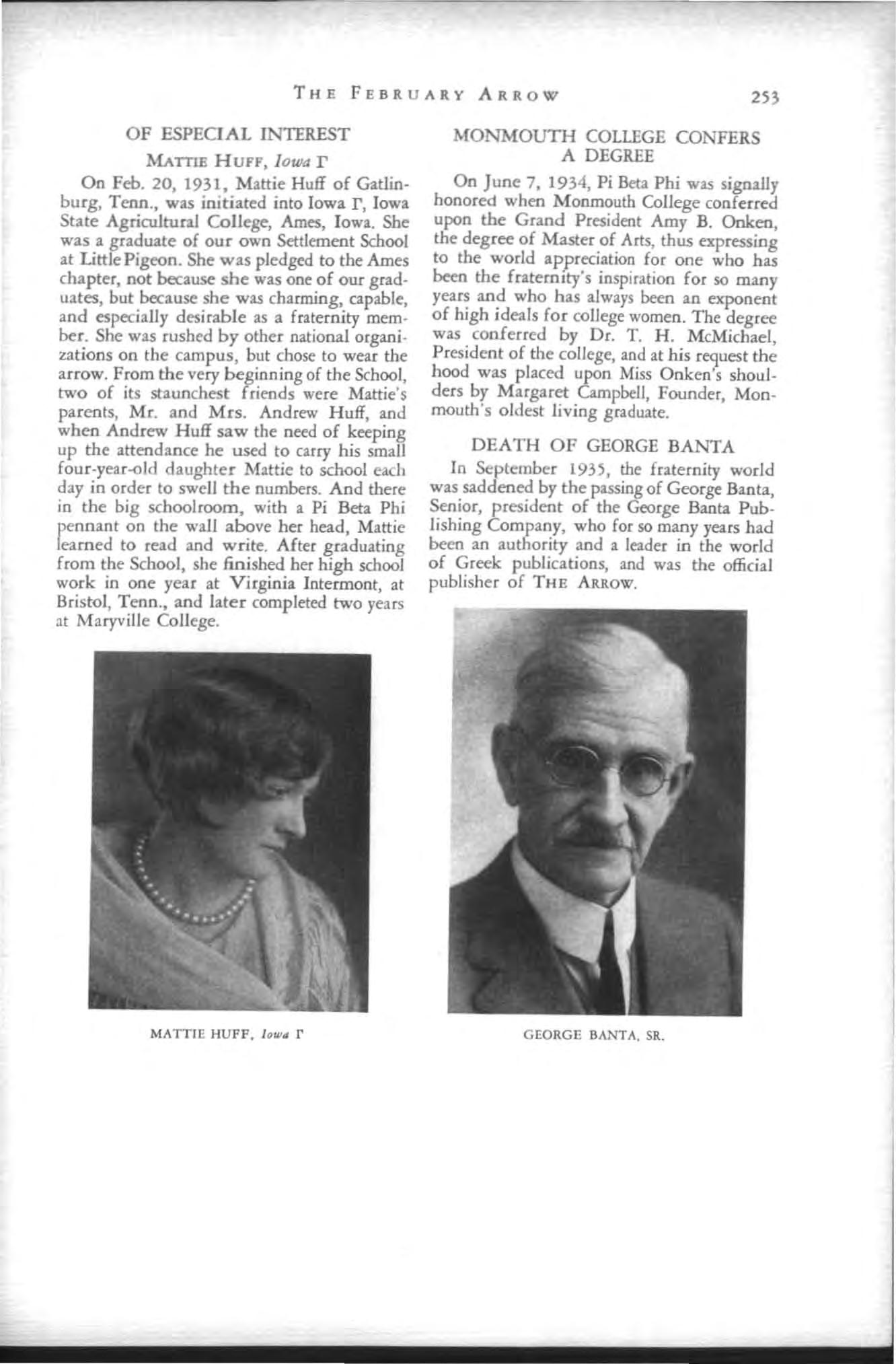
On June 7, 1934, Pi Beta Phi was signally honored when Monmouth College conferred upon the Grand President Amy B. Onken, the degree of Master of Arts, thus expressing to the world appreciation for one who has been the fraternity's inspiration for so many years and who has always been an exponent of high ideals for college women. The degree was conferred by Dr. T. H. McMichael , President of the college, and at his request th e hood was placed upon Miss Onken's shoulders by Margaret Campbell, Founder, Monmouth's oldest living graduate.
I n September 1935, the fraternity world was saddened by the passing of George Banta, Senior, president of the George Banta Pub · lishing Company, who for so many years had been an authority and a leader in the world of Greek publications, and was the official publisher of THE ARROW.
FOUNDERS WHO ATIENDED RETURN TO MONMOUTH
.An outstanding event in the history of Pi Beta Phi was the return to Monmouth College in 1928.
From 1899 to 1910 a group of girls, Zeta Epsil on Chi, hoped to gain a charter of Pi Beta Phi, then the college p l aced a han upon local fraternities and all activity ceased. In 1922 the decision of the college trustees to open Monmouth to fraternities immediately aroused action. Sponsored by the former members of Zeta Ifpsilon Chi and by Pi Beta Phi alumna:, a group was f o rmed with Pi Beta Phi as its goal.
At the Convention in 1927 info rmation was presented concerning the Monmouth College situation and Convention empowered the Grand Council to grant a charter to Zeta Epsilon Oli. in the interim of Conventions, should college and group conditions warrant this action.
The charter was granted in 1928 and the initiation and installation ceremonies were conducted by Grand President Amy B. Onken, on May when 21 actives and 23 alumna: were initiated. Miss Onken was assisted by Grand Treasurer Lois F. Stoolman and Epsilon Province President Bernadine Chesley Sawers.
Five Founders, as guests of the National
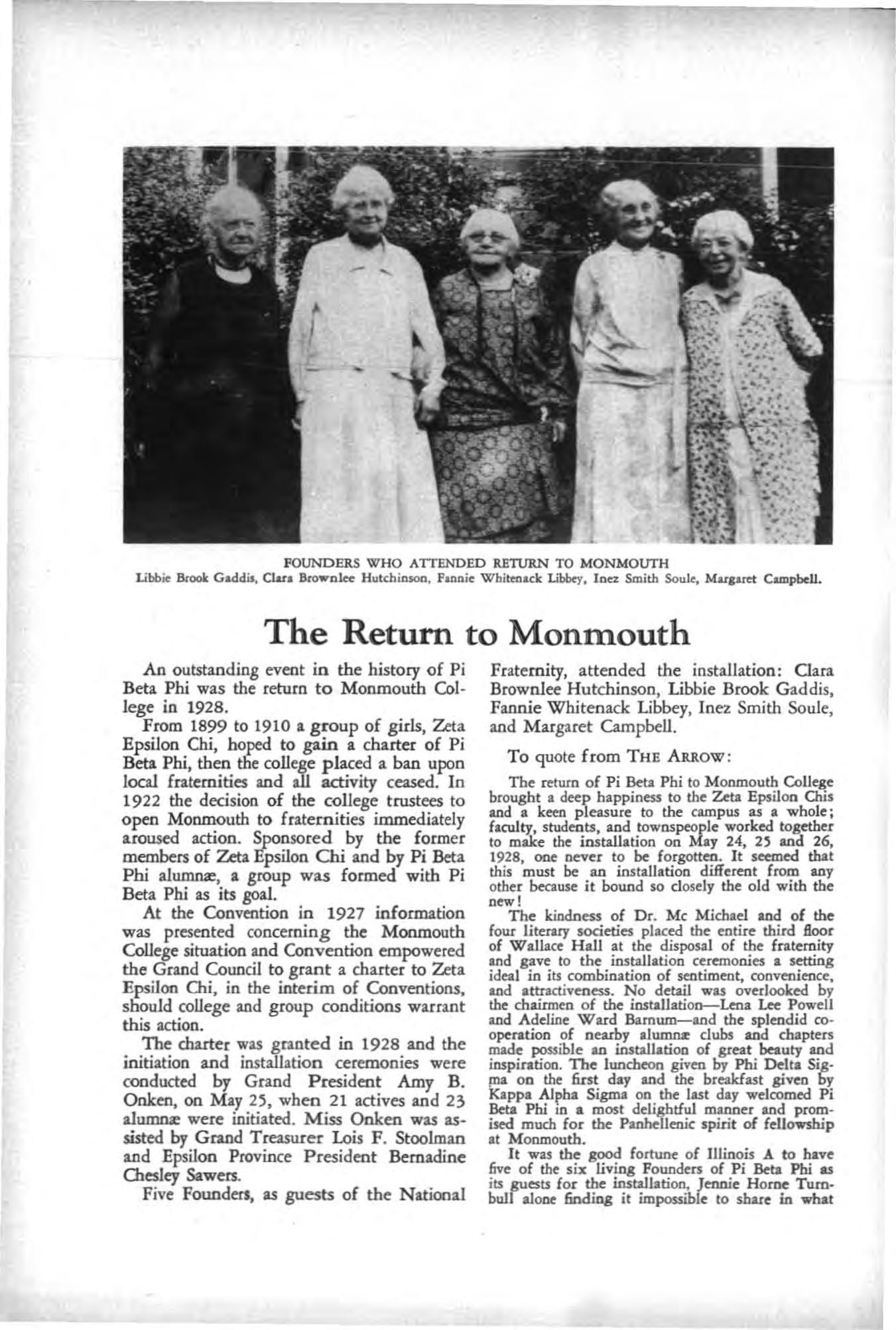
Fraternity, attended the installation: aara Brownlee Hutchinson, Libbie Brook Gaddis , Fannie Whitenack Libbey, Inez Smith Soule, and Margaret Campbell.
To quote from THE ARROW:
The return of Pi Beta Phi to Monmouth College brought a deep happiness to the Zeta Epsilon aus and a keen pleasure to the campus as a who le; faculty, students, and townspeople worked together to make the installation on May 24, 2" and 26, 1928 , one never to be forgotten. It seemed that this must be an installation different from any other because it bound so close ly the old with the new!
The kindness of Dr. Mc Michael and of the four literary societies placed the entire third floor of Wallace Hall at the disponl of the fraternity and gave to the instaIlation ceremonies a setting ideal in its combination of sentiment, convenience, and attnctiveness. No detail was overlooked by the chairmen of the installati on-Lena Lee Powell and Adeline Ward Bamwn-and the splendid cooperation of nearby .1WIlllZ clubs and chapters made poss ible an installation of great beauty and inspiration. The luncheon given bf Phi Delta Sig· Pla on the first day and the breakfast given by Kappa Alpha Sigma on the last day welcomed Pi Beta Phi 10 a most delightful manner and promised much for the Pan.hellenic spirit of fellowship at Monmouth.
It was the good fortune of IJooois A. to have five of the six living Founders of Pi Beta Phi as its guests for the installation, Jen.n.ie Home Tumbull alone finding it impos.sible to share in what
was to them all • time of happy associations. Qan Brownlee Hutchiosoo. beloved by all Monmouth. youns as the youngest active, in spirit; lDc:z Smith Soul" gucious, slender. dignified; Margaret Campbell •• dear little white haired "lavender and old lace" lady; Libbie Brook Gaddis, dever, motherly. and never too wea.ry to enter into the spirit of any occasion i and FanDY Whitenack Libbey, girlish and youthful with her emery lauAh and happy reminiscences-these beloved Founders came with happy bearts to han I part in the of Pi Beta Pbi at their alma mater.
Friday afternoon group representing the Pounders, the fraternity nationally. and the local Pi Beta Phi and Zeta alumne went to the rnting place of one whom we had admired and caUed our friend, Emma Brownlee Kilgore, Founder. These Pi Bet. Phis--Clara Brownlee Hutchinson sister of Mrs. Kil,ore. and berscU • Founder, Libbie Brook Gaddi S, Lois Praoldin Stoolman, Adeline Barnum, NeU Porter Hood, and Jessie Gaddiscarried Bowers as a tribute of love and respect. and while the sun, sinJc.ing in the west, shone softly 00 her geave, rach one, with bowed head, stood in silent prayer. To each there came the thou,ht of how geeat would have been Mrs. Kilgore s joy could she have 5t'eO. the realization of her keen desire to have Pi Beta Phi "come back home" to Monm outh ....
Wednesday afternoon, the pledging of Zeta actives and alumnae took place at the Woodbine, home of Dr. and Mrs. Mc Michael, with oue Grand President. Amy B Onken, presiding-it was a beautiful and Impressive servICe_ At six o'clock a dinner was served at the home of Adeline Ward
Barnum by the Monmouth Pi Phi Alumrut Dub Afterwards. our own Ikenadine Sawecs, Province President. met with the pJedges to read and aplain the Constitution , Thursday the solemn, impressive initiation and instaUation ctremonies were held. Miss Onken made the occuion a memorable one for all. Twentyone actives and twenty-three aJumoJ: were initiatecl and the coveted arrow was pinned over the heart of each by Miss Onken. At noon a buffet luncheon was served by the Zeta aJumnr. Thursday evening a beautiful formal banquet was given by the new chapter As the guesu entered the dining room they found themselves in a tern.ced formal garden A low graystone wall and a border of flowers enclosed the garden, graceful young trees and shrubs stood at intervals against the wall of the house and in one corner wu a hollyhock bed. The garden decorations centered in a graceful ra.inbow, arched across the room , and the soft rainbow colors blended and stood out mistily against a soft slcyblue drop At the end was found the traditional (ajry pot o f gold. Al the guests were seated, little Betty Gallop, dresso:! as a wood-fairy, turned on the rainbow liahlS trtnsforming the rainbow into a shimmering bow of a thousand tin u_ Candles were of rainbow colors running from a short red candle at each end of the f our long tables up to tall violet ones in the center of the bow thus fonned Place cards were pas ttl-tinted bows, the ends of which reached into nut cups represmting a pot of .Rold and programs were of white and gold . The GaJesburg Pi Phi Alumnr dub and the alumnr dub of Burlingto n, I owa, sent large baskets of spring flowers and the Knox and Lombard chap-
announces the re-estabJishment of it.s (jr.st chapter in the installation of Illinois Alpha Chapter Monmouth College
May twenty - fifth , Nineteen hundred twenty -eight
teu sent roses Congratulatory tdegrams were received from officers. chapters, and alumnz clubs and a congratuJatory letter came from Mrs. Coolidge.
An excellent toast program was given, the scene being the IUinbow Garden of Monm o uth College with the gardener, Bernadine Sawers. as to astm istress Toasts were given to the Sun , the Fo unders ; to the Rainbow , Pi lkta Phi ; to th e Rain bow Trail , the Zetas ; and to t he P o t o f G old, Su ccess in P etitioning.
Friday morning the first chapter meeting was h e ld, th e o ffice rs were installed , and Miss Onkm gave a brief ta l k on fr a ternity ideals I n the alter· noon , the chapter gave a delightful formal tea at the ho me of Dr Me Michael. In the receiving line were Mrs. M e Michael; Mrs Mo rt o n, Dean of Women; the Founders, Mrs. Stoolman and Miss Onken from the G rand Council , Mrs. Sawers , Ep· sil o n Provin Ce" Pres ident, Lorraine Smith, Illinois d repr ese nt a tive , Sarah Pratt, llJin ois B reprcscnta · tive, Mrs Ba rnum, president of t he M o nm o uth
alumna: dub , Mrs. Weiblcy of the Bwli.ngton alumna: dub , Dr. Winbigler of the Monmouth (acuIty, Mrs . Legg and .Mi ss Graham o f Illinois A, and others . The more than three hundred gucsts , which included stud e nts , faculty, and to wnspeople, gathered in the h ospitable home whi ch had been made unwually beautiful with many lovely Bowen spoke of a w e lcom e to Pi Beta Phi wh ic h w as mos t co lo rful and heartfelt
On Fr iday evening. Helen Booker Sawyer cotertained with a delightful dinner at the Monm o uth Country Club and gave to new and old Pi Phis a last cherished opportunity f o r happy f e llowship. Eyes were misty when the old Zeta hymn rang out fo r the last time "in the ol d way" but as the beautiful ··Pi Beta Phi Anthem " succeeded it there remained in the hearts of all only a strong lo yal love for Pi Beta Phi and a de ep h a ppiness in a " dream co me true ." . ..
M INN IB .Mc DILL M c MIC HA EL
By Conven t ion a c tion in 1934, the Grand (:oun c il was authorized to choose a suitable m a rker for the graves of deceased Founders.
.A simp le bronze tablet was chosen, and on October 27 , 19 35 Memorial Tablets were unveiled at Monmouth, Ill ., in honor of Emma Brownlee Kilgore, Clara Brownlee Hutchinson, a.nd Jennie Horne Turnbull.
Markers for Frances Ann Thompson and Jennie Nicol were placed at their graves n ear Monmouth, later.
The following Memorial Service was hdd :
F OR
Founders Of PI BETA PHI
MONMOUTH, ILLINOIS
OCTOBER 27 , 19 35
SoLO Mrs. George Bodine
Harp A ccompa niment by Mrs . Glen Sbaver
PRAY ER .. .. ... . .. Dr. T. H. M cMichael
CEREMONY . . ........ Dr. James H . Grier
UNVEILIN G OF MARKERS OF Emma Brownlee Kil g ore Clara Brownlee Hutchinson Jenn ie Horne Turnbull
PRAYER Dr T. H. McMichad
So NG . . .... . ... . . .. Pi Beta Phi Anthem
BENEDICTION .... .. . . Dr. James H . Grier
FOLD AMEN -
Mrs R W Hood
Mrs. J C. M cCoy
The beautifu l Ceremony read by Dr James H. Grier, son of Ada Bruen Grier, was writ· ten by Hallie Chapman Collins, Colorado A. Jane Tornquist (Compton) , Illino is A, g rand daughter of Clara Brownlee Hutchinson , unveiled her marker; the president of the Monmouth club unveiled Mrs. Kil gore's, and the Knox chapter president unveiled the marker for Mrs. Turnbull.
On November 3 , 1935, the Pittsburgh Alumna: Club dedicated the bronze marker placed at the grave of Ada Bruen Grier, in Union Dale Cemetery Twenty pe rsons attended the ce remony, among them being a son, Mr. R. N. Grier and his wife and son; and Miss Anne Porter, a close friend of Mrs. Grier.
The opening of the ceremony was g iven by Candace C. Johnson , Illinois H, while Elizabeth Hamilton Heazlett, Pennsylvania A, read the main ceremony and Lu cile Doug· lass Carson , who was initiated when Illinois A was rechartered, gave the closing words. The unveiling was done by Marjorie Turn· bull, Illinois A, a granddaugbter of Jennie Home Turnbull, and Ellen Hopkins, Ohio fl. Markers for Libbie Brook Gaddis and for Nanq Black Wallace will be unveiled on Founders' D ay, 1936. No bronze marker was placed for Rosa Moore since the fraternity bad already placed a granite stone, suitably marked, on her grave at the time of bu rial.
"We, Pi Phi sisters here , they, hillfolk sisten there We, in the midst of all thinls lovely and tnu: , They, for .... hom the .... hole world seems askew, Sh,,11 we, the women on whom God's lilbt Shines, not by rtUOO of our ri.lht, Refuse to share it ,..ith our SIsters there?"
1912 -13
Martha Hill (Principal)
1913 Abbie Langmaid, Minnesota A (Principal)
19\!-15
191'-16
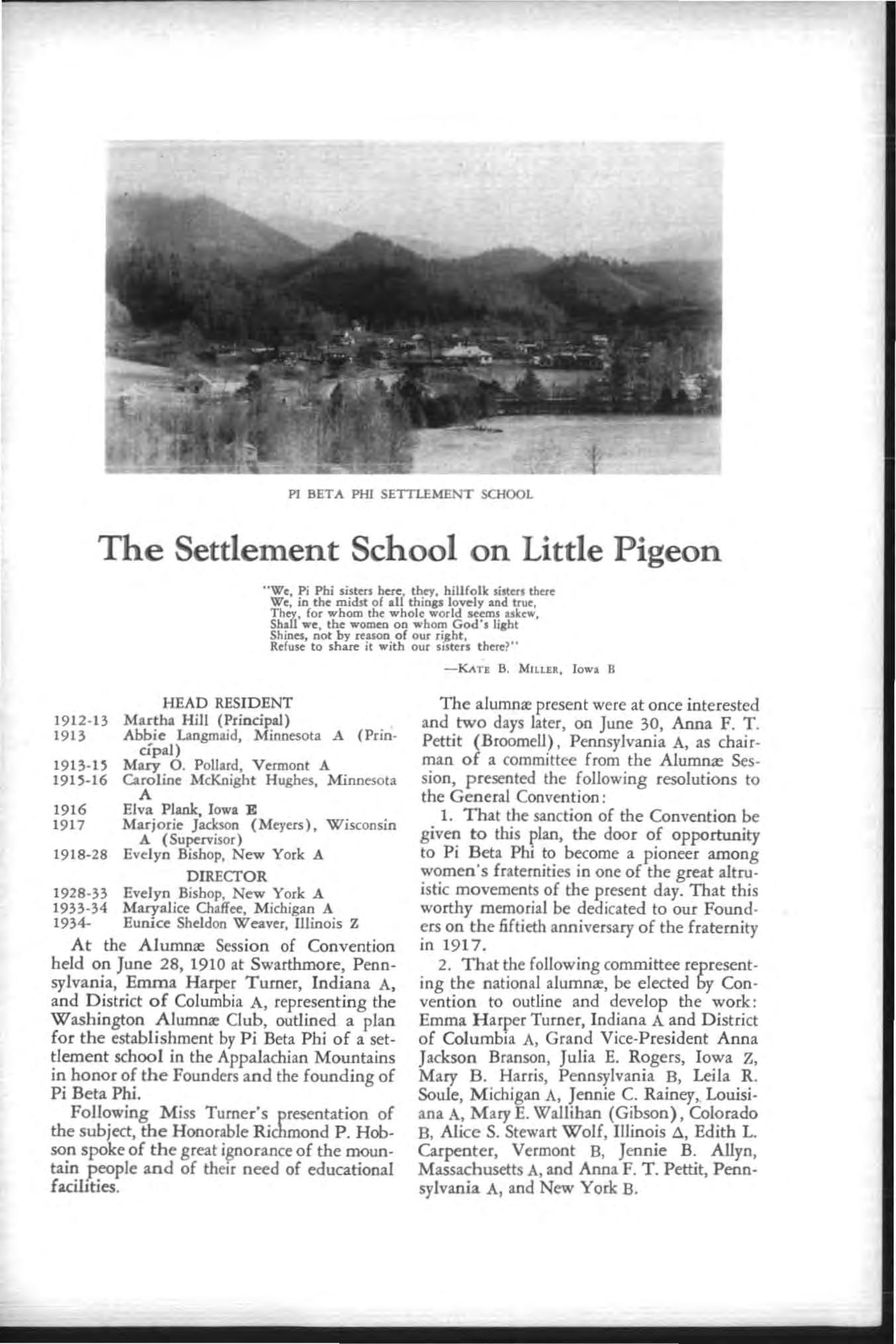
Mary O Pollard , Vermont A
Caroline McKnight Hughes, Minnesota A
1916 Elva Plank, Iowa E
1917 Marjorie Jackson (Mq>ers), Wisconsin .A. (Supervisor)
1918-28
Evelyn Bishop. New York .A
DIRECI'OR
1928 - 33 Evelyn Bishop, New York A
1933-34
Maryalice Chaffee, M ichigan A 1934- Eunice Sheldon Weaver, Illinois Z
At the Alumnre Session of Convention held on June 28, 1910 at Swarthmore, Pennsylvania, Emma Harper Turner, Indiana A, and District of Columbia A, representing the Washington Alumnae Club , outlined a plan for the establishment by Pi Beta Phi of a settlement school in the Appalachian Mountains in honor of the Founders and the founding of Pi Beta Phi.
Following Miss Turner's presentation of the subject, the Honorable Richmond P Hobson spoke of the great of the mountain and of thm need of educational facilities
-KATI
B . MILLEA, 10...." 8
The alumnre present were at once interested and two days later, on June 30, Anna F. T . Pettit (Broomell), Pennsylvania A, as chairman of a committee from the Alumnre Session, presented the following resolutions to the General Convention:
1. That the sanction of the Convention be g iven to this plan, the door of opportunity to Pi Beta Phi to become a pioneer among women's fraternities in one of the great altruistic movements of the present day. That this worthy memorial be dedi cated to our Founders on the fiftieth anniversary of the fraternity in 1917 .
2. That the following committee representing the national alumnae, be elected by Convention to outline and develop the work: Emma Harper Turner, Indiana A and Distri ct of ColumbIa A, Grand Vi ce- President Anna Ja ckso n Branson, Julia E. Rogers, Iowa Z, Mary B. Harris, Pennsylvania B, Leila R. Soule, Michigan A, Jennie C. Rainey , Louisiana A, Mary E Wallihan (Gibson), Colorado B, Alice S. Stewart Wolf, Illinois A, Edith L. Carpenter, Vermont B, Jennie B Allyn, Massachusetts A, and Anna F. T. Pettit, Pennsylvania A, and New York B
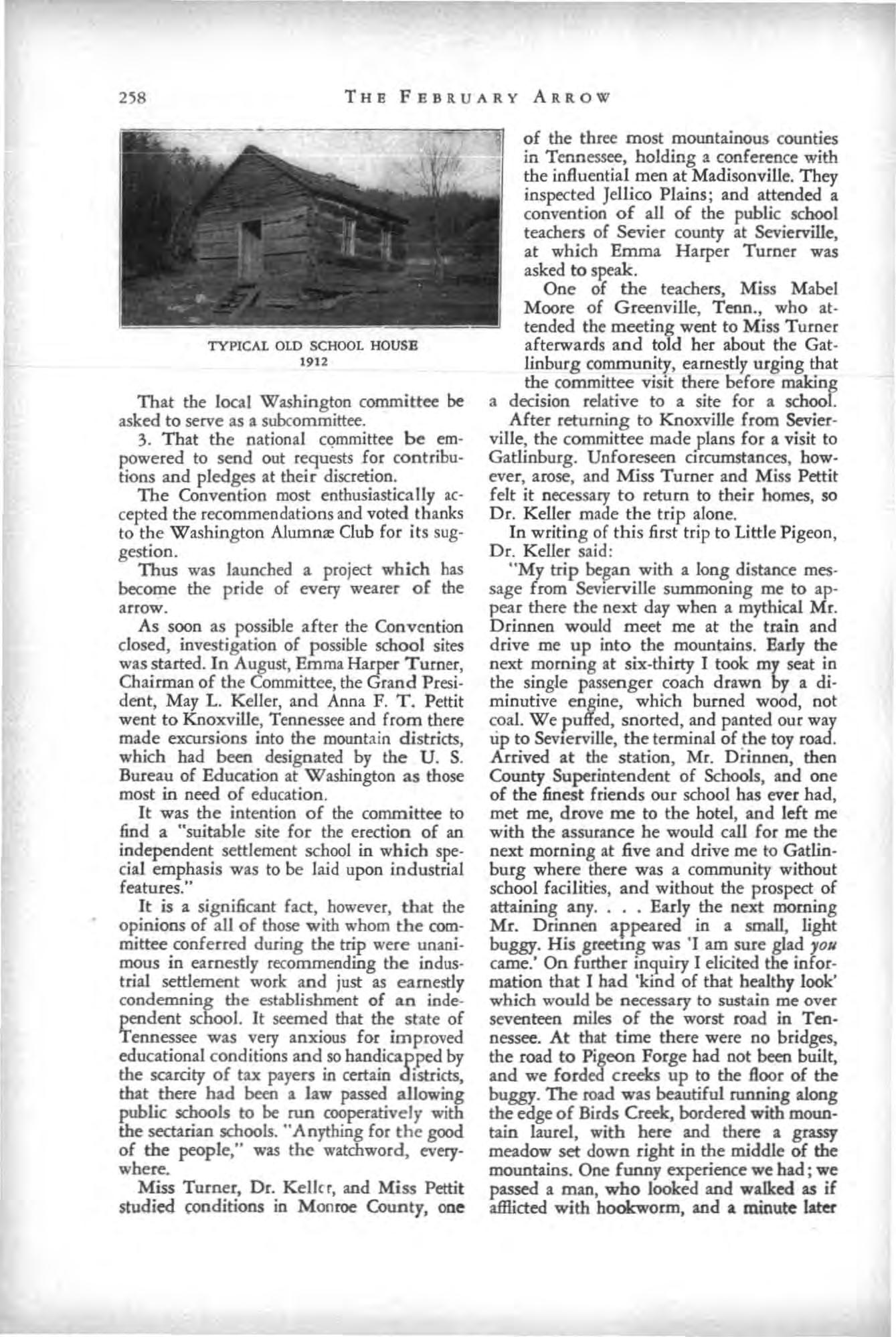
That the local Washington committee be asked to serve as a subcommittee.
3. That th e national committee be empowered to send out requests for contributions and pledges at their discretion.
The Convention most enthusiastica Ily accepted the recommendations and voted thanks to the Washington Alumn", Club for its suggestion
Thus was launched a project which has become the pride of every wearer of the arrow.
As soon as possible after the Convention closed, investi gation of possible school si tes was started. In August, Emma Harper Turner, Chairman of the Committee, the Grand President, May L. Keller, and Anna F T_ Pettit went to Knoxville , Tennessee and from there made excursions into the mount ai n districts, which had beeo designated by the U. S Bureau of Education at Washington as those most in need of education.
It was the intention of the committee to find a "suitable site for the erection of an independent settlement school in which special emphasis was to be laid upon industrial features ."
It is a signi6cant fact, however, th at the opinions of all of those with whom the committee conferred during the trip were unanimous in earnestly recommending the industrial settlement work and just as earnestly co ndemning the establishmen t of an independent school. Jt seemed that the state of Tennessee was very anxious for improved educa tional co nditions and so handicapped by the scarcity of tax payers in certain districts, that there had been • law passed allowing public schools to be run cooperatively with the sectarian schools. "A nything for the good of the penple," was the watchword, everywhere.
Miss Turne r, Dr. Keller, and Miss Pettit studied ,onditions in Monroe County, one
of the three most mountainous counties in Tenn essee, holding a conference with the influential men at Madisonville. They inspected Jellico Plains; and attended a convention of all of the public school teachers of Sevier couoty at Sevierville, at which Emma Harper Turner was asked to speak.
One of the teachers, Miss Mabel Moore of Greenville, Tenn., who attended the meeting went to Miss Turner afterwards and told her about the Gatlinburg community, earnestly urging that the committee visit there before making a decision relative to a site for a school.
After returning to Knoxville from Sevierville, the committee made plans for a visit to Gatlinburg. Unforeseen circumstan ces, however, arose, and Miss Turner and Mi ss Pettit felt it necessa ry to return to their homes, so Dr. Keller made the trip alone.
In writing of this lirst trip to Little Pigeon, Dr. Keller said:
" My trip be!!an with a long di stan ce message from Sevierville summoning me to appea r there the next day when a mythical Mr Orinnen would meet me at the train and drive me up into the mountains . Early the next morning at six -thirty I took my seat in the single passenger coach drawn by a diminutive engine, which burned wood , not coal . We puffed , snorted, and panted our way up to SevIerville, the terminal of .the toy road . Arrived at the station, Mr. Drinnen, then Couoty Superintendent of Schools, and one of the linest friends our school has ever had, met me, drove me to the hotel , and left me with the assurance he would call for me the next morning at .five and drive me to Gatlinburg where there was a community without school facilities , and without the prospect of attaining any. . . . Early the next morning Mr . Orinoen appeared in a small, light huggy. His greetmg was ' J am sure glad 1011 came: On further inquiry I eli cited the information that I had 'kind of that healthy look' which would be necessary to sustain me ovec seventeen miles of the worst road in Tennessee. At that time there were no bridges , the road tn Pigeon Forge had not been built, and we forded creeks up to the Boor of the huggy. The road was beautiful running along the edge of Birds Creek, bordered with mountain laurel , with here and there a grassy meadow set down right in the middle of the mountains . One funny experience we had; we passed a mao, who looked and walked as if affiicted with hookworm, and a minute later
th e froot wheel o f our b uggy pused over hi dog. who was too luy to get out of the way. He saw the hind wheel coming and Deve! even moved, so we had to descend and puJI him out of the way, that done he rose, shook himself, gave a little yelp , and slowly betook himse.lf elsewhere.
"The first school we visited was at the Glades . It was situated on a high hill, and was the usual wooden structure of one room All the children were dressed in calico and were bare-footed, but had bright intelligent faces, and they were clean .
"The trouble with the schools seems to be
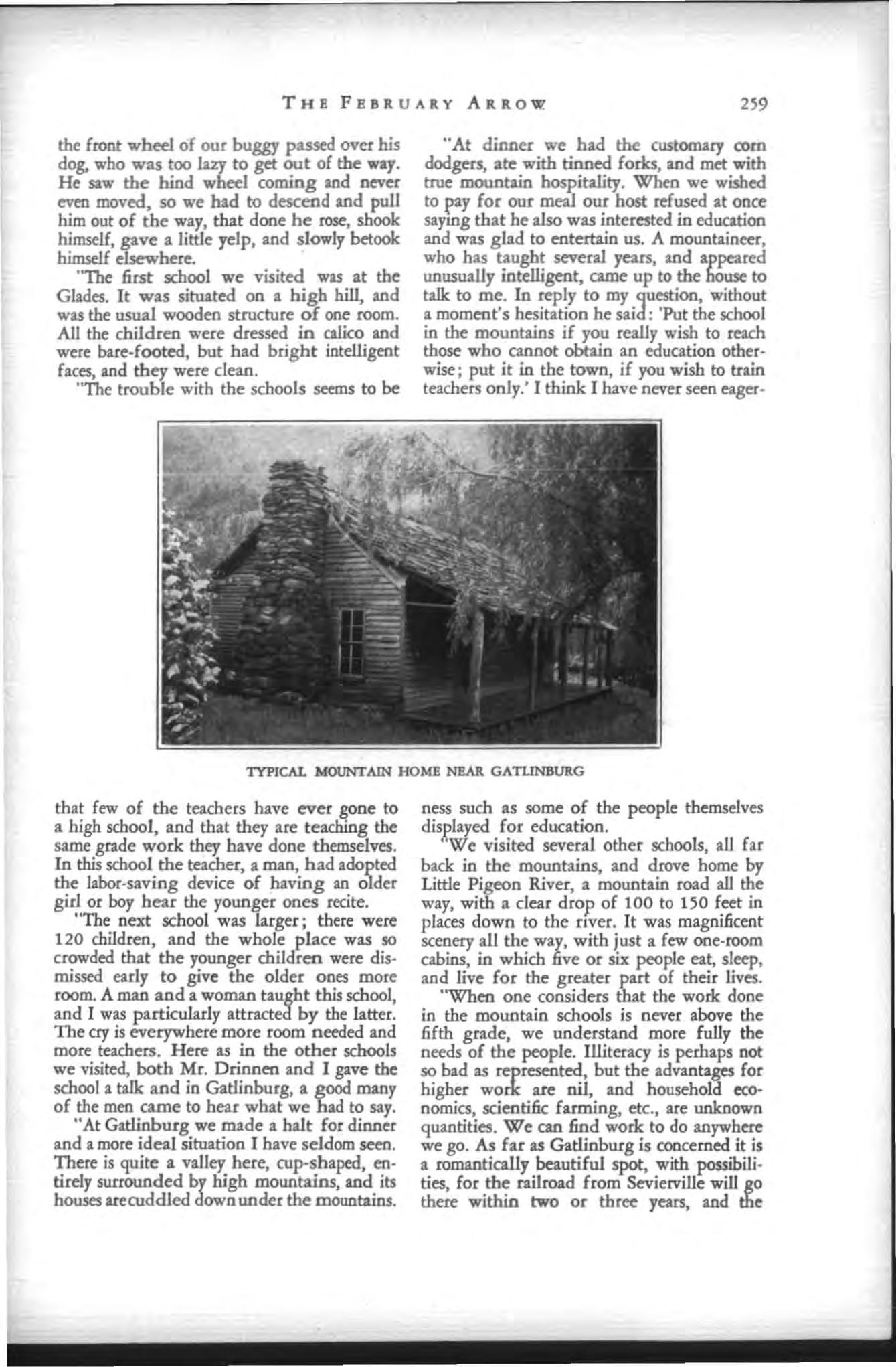
that few of the teachers have ever gone to a high school, and that they are teaching the same grade work they bave done themselves . In this school the teacher, a man, had adopted the labor-saving device of having an older girl or boy hear the younger ones recite.
"The next school was larger; there were 120 children, and the whole place was so crowded that the younger children were dismissed early to give the older ones more room. A man and a woman taugbt this school, and I was particularly attracted by the latter. The cry is everywhere more room needed and more teachers. Here as in the other schools we visited, both Mr. Drirtnen and I gave the school a talk and in Gatlinburg, a good many of the men came to hear wbat we had to say
"At Gatlinburg we made a halt for dirtner and a more ideal situation I bave seldom seen. There is quite a valley here, cup-shaped, entirely surrounded by higb mountains, and its houses arecuddled down under the mountains .
" At dinner we had the customary com dodgers, ate with tinned forks , and met with true mountain hospitality. When we wished to {'"y for our meal our host refused at once saYlOg that he also was interested in education and was glad to entertain us. A mountaineer, who has taugbt several years , and appear ed unusually intelligent, came up to the liouse to talk to me In reply to my question, without a moment's hesitation he said: 'Put the school in the mountains if you really wish to reach those wbo cannot obtain an education otherwise ; put it in the town, if you wisb to train teachers only.' I think I have never seen eager-
ness such as some of the people themselves disl?,layed for education.
. We visited several other schools, all far back in the mountains, and drove home by Little Pigeon River, a mountain road all the way, with a clear drop of 100 to UO feet in places down to the fiver. It was magnificent scenery all the way, with just a few one-room cabins, in which five or six people eat, sleep, and live for the greater part of their lives .
"When one considers that the work done in the mountain schools is never above the fifth grade, we understand more fuJIy the needs of the people. Illiteracy is perhaps not so bad as represented, but the advantages for higher work are nil, and household ec0nomics, scientific farming, etc., are unknown quantities We can lind work to do anywhere we go. As far as Gatlinburg is concerned it is a romantically beautiful spot, with possibilities, for the railroad from Sevierville will go there within two or three years, and the
. region is full of children, as are all mountain districts ."
A month after the com mittee's visit to Tennessee, Miss Turner asked Lizette Woer· ner, Wis A, to go to Kentucky to gather data relative to the needs there.
It was found that in the mountain distri cts of both Tennessee and Kentucky the women in many cases did all of the work about the home, farming and providing fuel, while the men hunted and fished . As one woman said pathetically: " Men and dogs has a kinder easy time in these 'ere parts but wimmen and steers h as it mighty hard."
In vestigation also showed abject poverty , hard living conditions , no sanitary provision whatsoever, and the size of families out of all proportion to that of most of the abodes . There were prejudice and suspicion consequent upon mountain isolation . Communities were torn by jealousies, factions, and denomi· national wars. In certain instances lamentable ignorance prevailed .
Determined to make suce that the most needy district shou ld be the one which Pi Beta Phi would enter, correspo nden ce was ca rri ed on by the committee m the fall of 1910 with many l ocalities regarding the location of the which res ulted in overtures from many.
The sub -committee composed of the Grand Vice-President, the Grand President, the Grand Secretary of New York, M ary B Harri s of Baltimore, Ar:na F T. Pettit of Philadel phia, and the Chairman , Emma H arper Turner, was empowered to act on detail work.
This committee met December 18, 1910 at the home of Anna Jackson Branson , the Grand Vice -President, at Lansdowne, Pa. At this meeting it was decided that the Settlement Schoor pro ject must have an endowment fund and plans were outlined for launching the campaogn for the raising of $12,000 by April 28, 1911. The Graod Vice-President was made National Cha irm an of Finances with a sub-chairman for each province. Mrs . Branson's assistants were : Anne Stuart, Nebraska B, Anna F . T. Pettit, Pennsylvani a A and K ate King Bostwick, Michigan A.
The Committee unanimously decided that until such a sum be raised it would incur no definite obligations, and also approved the establishment of a magazine subscription agency for the benefit of the Settlement Fund .
The several sites which had been under investigation were discussed and that at
Wears VaHey, Tenn. , about miles over the mountains [rom Sevierville was consid· ered most favorably, at the time of the Committee meeting. The Committee. however, was not sure that it was what it wanted. At Wears Valley a school had been established originally under Presbyterian auspices and thus continued for a time. The property was valued at $3 ,000 with a comparatively large school in successful operation and supported by the good will and cooperatio n of the people. The entire plant was offered to Pi Beta Phi outright as a gift for the s imple taking.
A second meeting of the Committee was held in Philadelphia in May 1911, at th e home of Anna F. T. Pettit. At this meeting a decision was reached favoring Gatlinburg for the school site in stead of Wears Valley The factors determining this were: Need, opportunities for influence as to territory and population, ability of Pi Beta Phi to meet the special local need . Gatlinburg had been settled sometime between 1801 and 1807 by the first settlers c orning avec the Indi an Gap Trail on horseback and on foot from North and South Carolina. It was first call ed "The White Oak Flats ," but the postoffice name was changed to Gatlinburg in honor of a man who kept a store there just before the Civil War
According to a description in one of the Committee repo rts: "Gatlinburg is in the eastern part of Sevier County; a center of teaming routes into the mountains; a point of large influence; no railroad connections but the prospective terminus of a branch road from Sevierville; wildly beautiful country; flot a town bill a community along the big road; served by rural mail carriers; has a little public school house that has not been reroofed in 30 years ; school furniture homemade and 20 years old. (Steps are being taken at present to build a new school bouse.) About 200 children are within school influence of this point and many very needy outlying coves are accessible from it. The public school term usually begins in August and closes at Christmas-teachers' salary $30."
The Committee appropriated $500 as a maximum limit for school expenses of the first session, that amount to be repaid to the Endowment Fund as soon as other contributions should (orne in.
After careful study the Committee recommended t!.at the fraternity cooperate with the public schools, if possible, uoder arrange-
ments satisfactory to Pi Beta Phi , rather than Lo undertake an independent work since it was felt that this Public School cooperation "would be the best means of help towards 'self-help' "
Negotiations were opened at once with the School Board and citizens at Gatlinburg but delays almost disheartening attended every step. County school oflidals had been changed sinc e Miss Keller's visit and the new officials had to be informed about the proposed work , nd had to be interested.
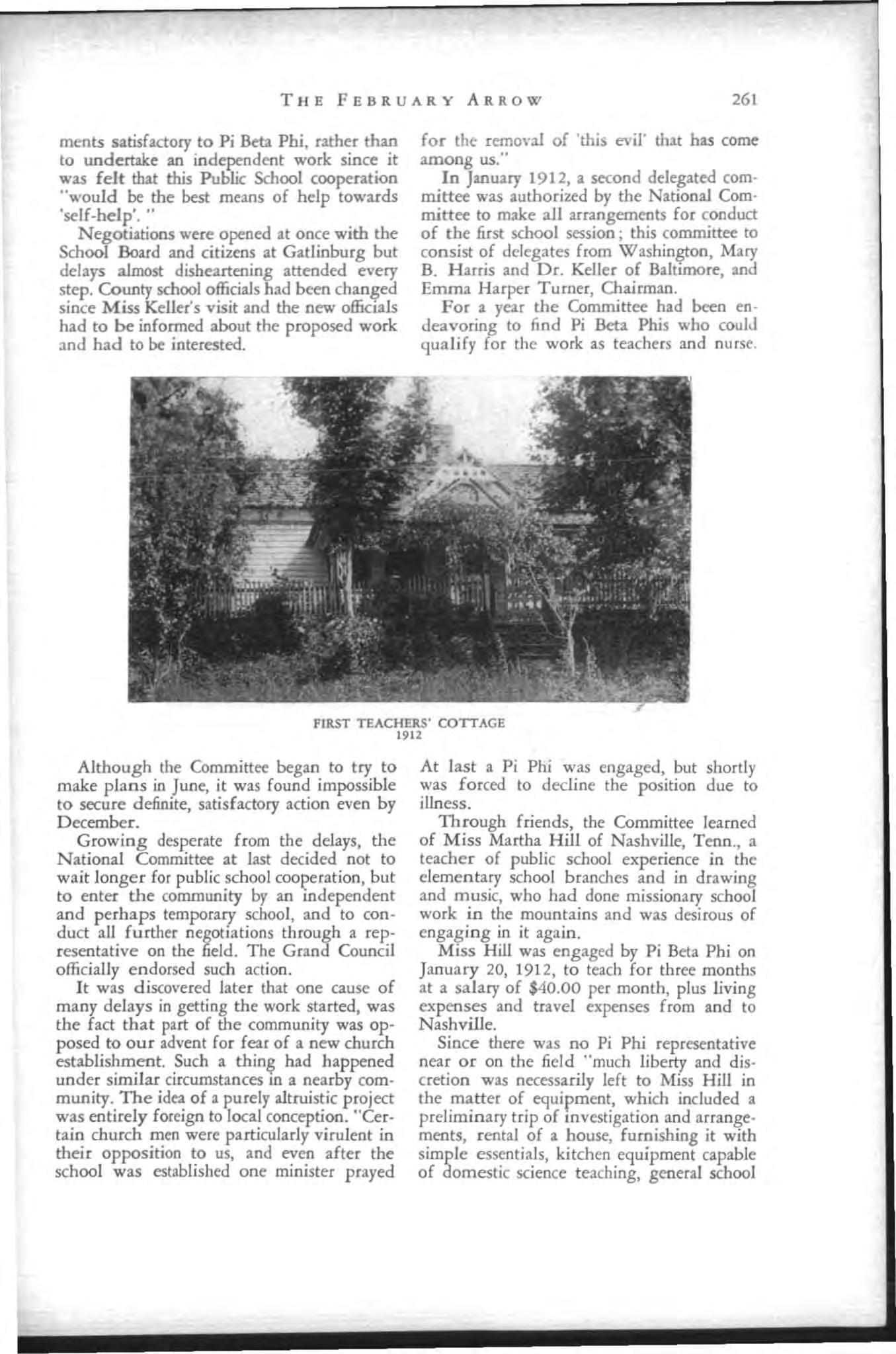
Although the Committee began to try to make plans in June, it was found impossible to secure definite, satisfactory action even by December.
Growing desperate from the delays, the National Committee at last decided not to wait longer for public school but to enter the community by an Independent and perhaps temporary school, and to conduct all further negotiations through a representative on the field. The Grand Council officially endorsed SUdl action.
It was discovered later that one cause of many delays in getting the work started, was the fact that part of the community was opposed to our advent for fear of a new church establishment. Such a had happened under similar circumstances 10 a nearby community. The idea of a purely altruistic project was entirely foreign to local conception. "Certain church men were particularly virulent in their opposition to us, and even after the school was established one minister prayed
f o r t he r emoval of 'th is evil' that has come among us. "
In January 19 L2, a second delegated committee was authorized by the National Committee to make all arrangements for c onduct of the lirst school session; this committee to consist of delegates from Mary B. Harris and Dr Keller of Baltimore, and Emma Harper Turner. Chairman .
For a year the Committee had been endeavoring to find Pi Beta Phis who coulJ qualify for the work as teachers and nurse .
At last a Pi Phi was engaged, but shortly was forced to decline the position due to illness.
Through friends, the Committee learned of Miss Martha Hill of Nashville, Tenn., a Leacher of public school experience in the elementary school branches and in drawing and music, who had done missionary school work in the mountains and was desirous of enga$ing in it again .
MISS Hill was engaged by Pi Beta Phi on January 20, 1912, to teach for three months at a salary of $40.00 per month, plus living expenses and travel expenses from and to Nashville.
Since there was no Pi Phi representative near or on the field "much liberty and discretion was necessarily left to Miss Hill in the matter of equipment, which included a preliminary trip of Investigation and arrangements, rental of a house, furnishing it with simple essentials, kitchen equipment capable of aomestic science tea ching, general school
equipment, and materials for kindergarten."
Miss Hill very generously gave her servic"" the lirst two months (before the opening of the school) for $20.00 eer month, and continued the school until June 28. She rented a house at $1.50 yer month and after days of arduous scrubbmg with lye and hot water made it livable.
This lirst teachers' cottage at Gatlinburg was a three·roomed hou se. with a narrow piazza in front and on the back, covered with honeysuckle vines. In side the walls, ceiling, and Boor of native woods were without paint or varnish.
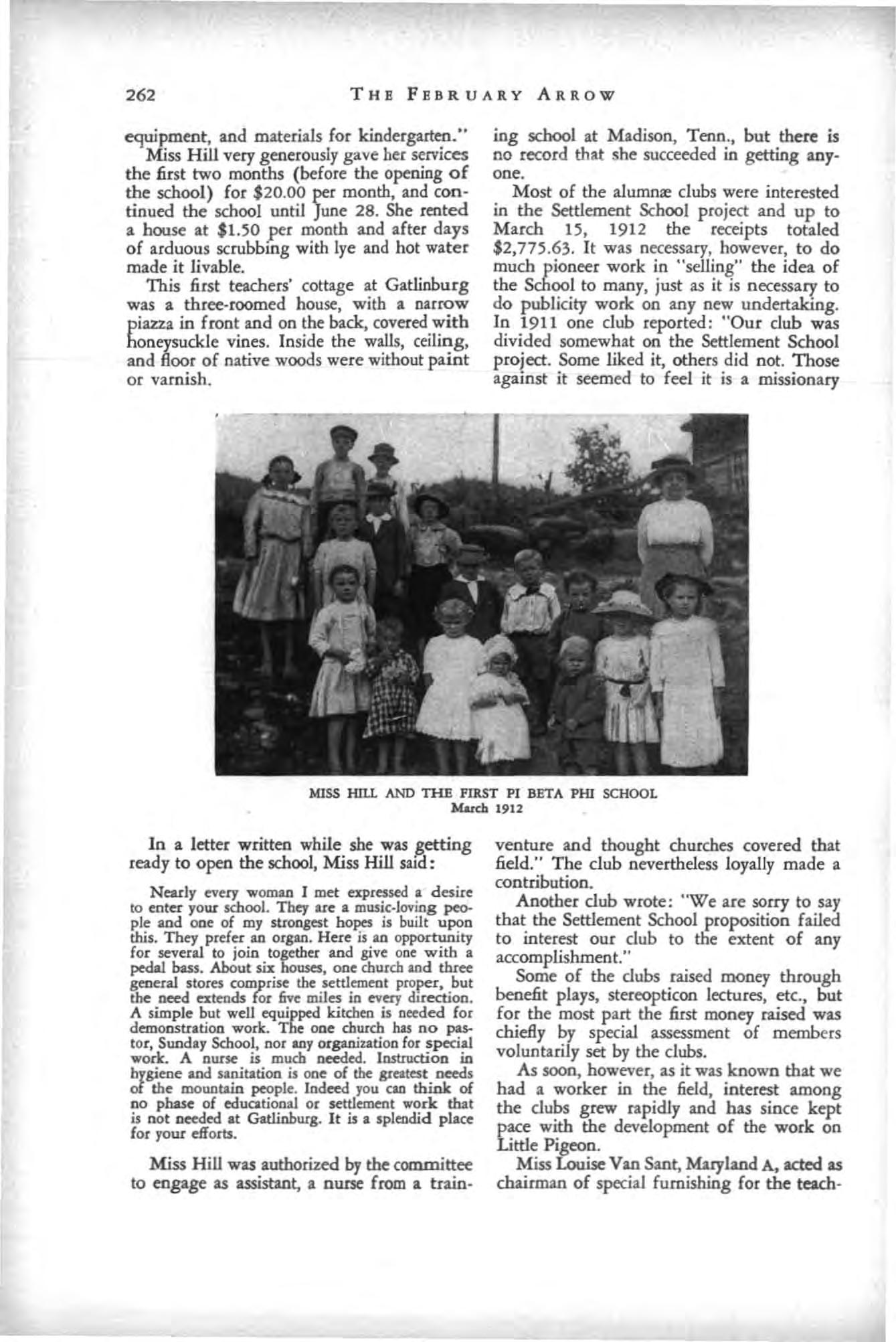
In a letter written while she was getting ready to open the school , Miss Hill said:
Neuly every woman I met expressed a desire to enter your school. They are a mu.sic-lO\l'ing pe0ple and ooe of my strongest hopes is built upon this. They prefer an organ. Here is an opportunity for several to join together and give ODC with a pedal bass. About six houses, ODe church and truce general stores comprise the settlmleot proper. but the need extends for five miles in every direction. A. simple but well equipped Jcjtchen is needed for demonstration work:. The one church Iw: no pa$tor. Sunday School. nor any organization for special work. A. nurse is much needed. Instruction in brg..iene and sanitation is one of the greatest needs of the mountain people. Indeed you ClQ think of no phase of educational or settlement work that is Dot needed at Gatlinburg. It is a splendid place for your cfforU.
Miss Hill was authorized by the cncnmittee to engage as assistant, a nurse from a train-
ing school at Madison, Tenn., but there is no record that she succeeded in getti ng anyone.
Most of the a1umn", clubs were interested in the Settlement School project and up to March 15, 1912 the receipts totaled $2,775.63. It was necessary, however, to do much pioneer work in "selling " the idea of the School to many, just as it is necessary to do publicity work on any new undertaking. In 1911 one club reported: "Our club was divided somewhat on the Settlement School project. Some liked it, others did not. Those against it seemed to feel it is a missionary
venture and thought churches covered that lield." Tbe club nevertheless loyally made a contribution .
Another club wrote: "We are sorry to say that the Settlement School proposition failed to interest our club to the extent of any accomplishment."
Some of the clubs raised money through benefit plays, stereopticon lectures, etc., but for the most part the lirst money raised was chiefly by special assessment of members voluntarily set by the clubs.
As soon, however, as it was known that we had a worker in the field, interest among the clubs grew rapidly and has since kept pace with the development of the work on Little Pigeon.
Miss Louise Van Sant, Maryland A, acted as chairman of special furnishing for the teach-
ers' cottage at Gatlinburg, leading a spirited campaign of solicitation among the cfubs.
The most outstandiog gift was that of an organ pro';ded by the Wasbington and Baltimore Clubs, for which they sacriJiced their Founders' Day banquet. Mr. Percy Foster of Washington, piano dealer, furnished the organ at cost and attended to the shipment.
Early «ports of Miss Van Sant showed a pledge of table silver from the Los Angel es club, of linen from Boston, of a sewing machine {rom Franklin , window shades from Baltimore, a box of rugs and books from Washington, a cereal double boiler from Philadelphia, magarine subscriptions from Syracuse, a clock from the mother of a Michigan Pi Phi, sheets and bird pictures from Carrie Flagler Sbantz, of Iowa 0, napkins and dish towels {rom the Cllicago A1umn", Club, damask towels and books and pictures from the Boston Club, and 12 yards of blackboard doth and a box of books from St. Louis.
Although January 1912 had been set as the date for the opening of the school, more than two months were r"'l,uired in making preparations for the openmg, which took place in March with 14 pupils enrolled. The session lasted three months and closed with 33 enrolled. This lirst Pi Beta Phi school was held in the old school building at the junction of Baskins and Little Pigeon, destined to become famous in later years as the Arrowcraft Shop .
On June 28, Miss Hill gave a scbool program which was pronounced a great success and it was said that "nothing like it had ever been held there before."
The Program follows:
PI: enA PHf SaTTl.I",INT ScHOOL 28, 1912. Miss Marth. Hill. Teacher
Song-Happy Welcome. By School.
Story-The: Stofl' of Peterkin By Emma Maples. Couplet-"Of .11 the pets to loft and bU&:. The cicnt I' • little pu't.'· By Matt ie Huff (of Jtm). (ShOWing pictures of Purr,")
Rrot.tion-White Sh«p. 9 ,. Arlena Maples (, SjlC'CCh-Thrte wise mea of Apple Tree: t own. &, Jim. uH. Couplet--"Help us to do the thin&: we should. To be to others kiDd Ind aood." By UrIe Owensby. Marie Owtn.by (Twins years). 5o...-B, th< School. Lamp Liahter (R. L. Str:..-enson). Bf Estelll HoJf.
Recitation-Honest and True. Mattie Oale. Spefi:h-The Lark. By Lillard Mlples. Son, (MotiOD $ona). Bf Scbool. Couplet-. PolfttleH is to do and .aT !cindest thin, io the kiDdest WIY." BJ Ray Bohanan.
RKitatioD-Sprina Is By Edna BohaDID Son&-Rub-a·"Dub-Dub (Motion and March with pen nIDts).
Recitation- Rose Busb. By Cora Ollie. St()f'J--The Pi, and the World. By WinnIe Owenby. Speech-Luck By Willie O,le
Socecb---Sir lWlbit By OiUud Owtab,Couplet- Bowt on my mo-Jders. .lipPe!1 00 my feet. I am Mama' Olllioa. alo ' t I nred: ." Bil Wade Cocdill \t":Il1). Ori Calisthenic-By I.
The program was interspersed with teaching classes of little tots arithmetic, using Fitch's cards, classes in stick laying, etc. There was a profusion of bright, wild Bowers in the school room and everything was as clean and nice looking as it could be made.
Miss Hill did much visiting; held regular Mother's attended public meeting'; had a mUSIcal evening for the young people; and made friends with those who were especially unfriendly in the beginning.
In March 1912 the National Settlement School Committee authorized the organization of a National Settlement School Association as the best means of developing the movement, and thus affording a better opportunity for purely voluntary support.
The Tentative Constitution provided that membership be open to all members of the fraternity and to friends and sympathizers with the movement, duly elected by a chapter or an alumn", club of Pi Beta Phi. There were three grades of dues: Life, $25.00; Sustaining, $5.00, and Annual , $1.00.
The Life membership dues were to be invested as an endowment fund. the others to be used for current expenses. Meetings were to be held biennially in conjunction with Convention of the national fraternity. Officers provided for were: president, four vice-presidents, a Secretary and treasurer.
Authorization was also given for Association Clubs for the prosecution of the Settlement Work.
A pamphlet concerning this proposed Association was sent out to ARRow subscribers but no further record is found co ncerning it.
At the 1912 Convention, sbortly afterwards, the National Committee recommended that Miss Hill be re-engaged and that the Chicago A1umn", Club assume control of the Settlement School project. This was approved by the Convention.
The splendid work accomplished by the original committee and the Washington Alum"", Club as a whole can never be estimated. And so, after two years of pioneering, led by Emma Harper Turner, the Washington Club relinquished the responsibility for the Settlement School to the Chicago Alumnae Club with Elizabeth Clarke Helmick, Mich . A, as Chairman and tr«surer of the new
During the first year of Chicago's committecship the records show 1 receipts from alf sources $1610.11, of that sum $751.89 was from individual contributions.
The fall term of the school was held in the abandoned Methodist church, which was made from rough boards like a rough country barn. Great cracks were in the floor and walls. During the four months of the public school term Pi Beta Phi cooperated with the public schools and Miss Hill taught with the native teacher, being paid partly by the county and partly by the fraternity. This term expired
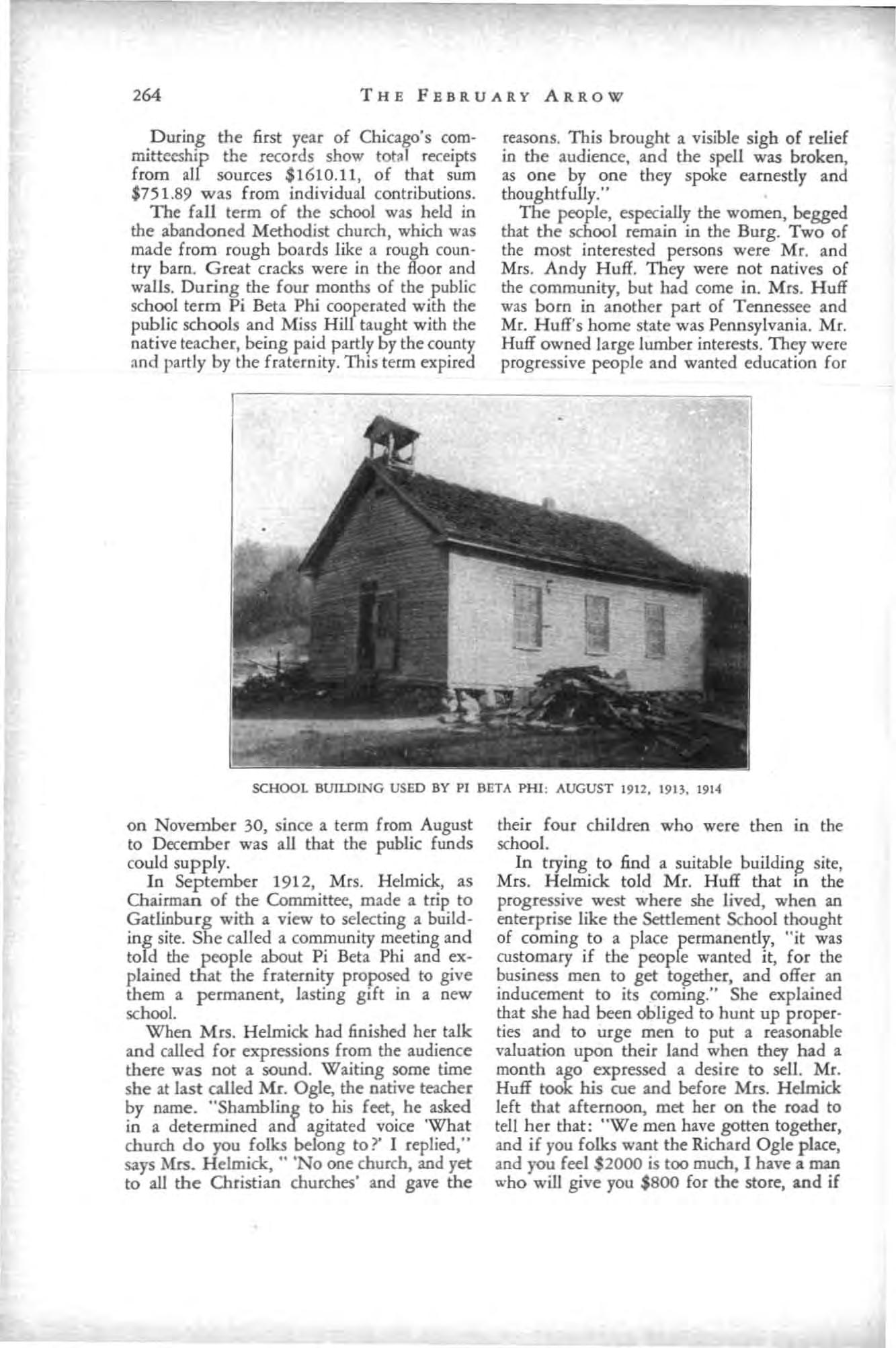
on November 30, since a term from August to December was all that the public funds could supply.
In September 1912, Mrs Helmick, as Chairman of the Committee, made a trip to Gatlinburg with a view to selecting a building site. She called a community meeting and told the people about Pi Beta Phi and explained that the fraternity proposed to give them a permanent, lasting gift in a new school.
When Mrs Helmick bad finished her talk and called for expressions from the audience there was not a sound. Waiting some time sbe at last called Mr. Ogle, the native teacher by name. "Shanabling to his feet, he asked in a determined and agitated voice 'What chureb do you folks belong to?' I replied," says Mrs. Helmick, " 'No one church, and yet to all the Christian churches' and gave the
reasons . This brought a visible sigh of relief in the audience, and the spell was broken , as one by one they spoke earnestly and thoughtfully."
Tbe people, especially the women, begged that the school remain in the Burg. Two of the most interested persons were Mr. and Mrs. Andy Huff. They were not natives of the community, but had co me in. Mrs Huff was born in another part of Tennessee and Mr. Huff's home state was Pennsylvania . Mr. Huff owned large lumber interests. They were progressive people and wanted education for
their four children who were then in the school.
In trying to find a suitable buildin,g site, Mrs Helmick told Mr. Huff that In the progressive west where she lived, when an enterprise like the Settlement School thought of coming to a place pennanentIy, "it was customary if the people wanted it, for the business men to get together, and offer an inducement to its coming." She explained that she had been obliged to hunt up proper· ties and to urge men to put a reasonable valuation upon their land when they had a month ago expressed a desire to sell. Mr HuH took his cue and before Mrs Helmick left that afternoon , met her on the road to tell her that: "We men have gotten together, and if you folks want the Richard Ogle place, and you feel $2000 is too much, I have a man who will give you $800 for the store, and if
$1200 is more than you want to pay, we propose making up the difference among us. We want your school right here. We know Miss Hill and we know what you have done , and we stand togeth<r to do anything you wish to keep you here Please don't let anything influence you to go elsewhere."
The next day the County Superintendent, J. S. Keeble, after talking with Mr . Huff, made the proposition that the fraternity take the entire charge of the school management in the Gatlinburg district. He offered to give a dear, absolute deed to all the public school property, induding a new building valued at $ 1000 which stood on a hill overlooking the Burg, and to turn over, in cash, the pay allotted the school teachers by the school autho rities annually, without a "st ring " of any kind, as long as Pi Beta Phi maintained a public and free school in the lower grades.
As a result of her trip to Tennessee, Mrs Helmick asked the Chicago Club to authorize the Sub-Committee to hire an assistant to Miss Hill ; to take over the public school property and obligation; to buy the necessary property; and to put up the n ecessary buildmgs, with the understanding that all was to be done when the money was available. The dub gave the authorization.
A vivid description of the "doses" of the school o n November 30, 1912 was written by Kate B. Miller of the Committee after she had visited Gatlinburg. Miss Miller said: " They had come at night, some of them at half-past six, though that was the bedtime of many of them. They had come from up Baskins ' way, on Mill Creek, down Roaring Brook, farther up Little Pigeon, from Holy Top, and Dick 's Range, over devious mountain trails and rocky, muddy mountain roads of so modest a nature that they were often difficult to find Most of them came afoot, carrying babies, leading little children, and lighting their uncertain way with lamps and lanterns_ Their goal was the school house on the small high nob, which had but one way of rational approach. The person who sought to scale the rocky bluff of seventy-five or a hundred feet from the Roaring Brook side or the Little Pigeon and bad road side would have stood small chance of reaching Minerva's temple on top. And so they plodded along the meandering muddy road, around and up the hill. They were all there waiting when Miss Hill, Miss Gillette, Mrs . J R Keeble, the County Superintendent of Schools, Dr. E. A. Bishop, the president of
Murray College, and I arrived, after having stumbled our lamp and lantern lighted way down and up the slippery road from the Pi Phi cottage, half a mile away . . .. The absolute quiet during the program was unbroken except by the procession of young and old who passed to and from the end seat near the stove reserved for those who wished to warm themselves, and of the slight shuflling
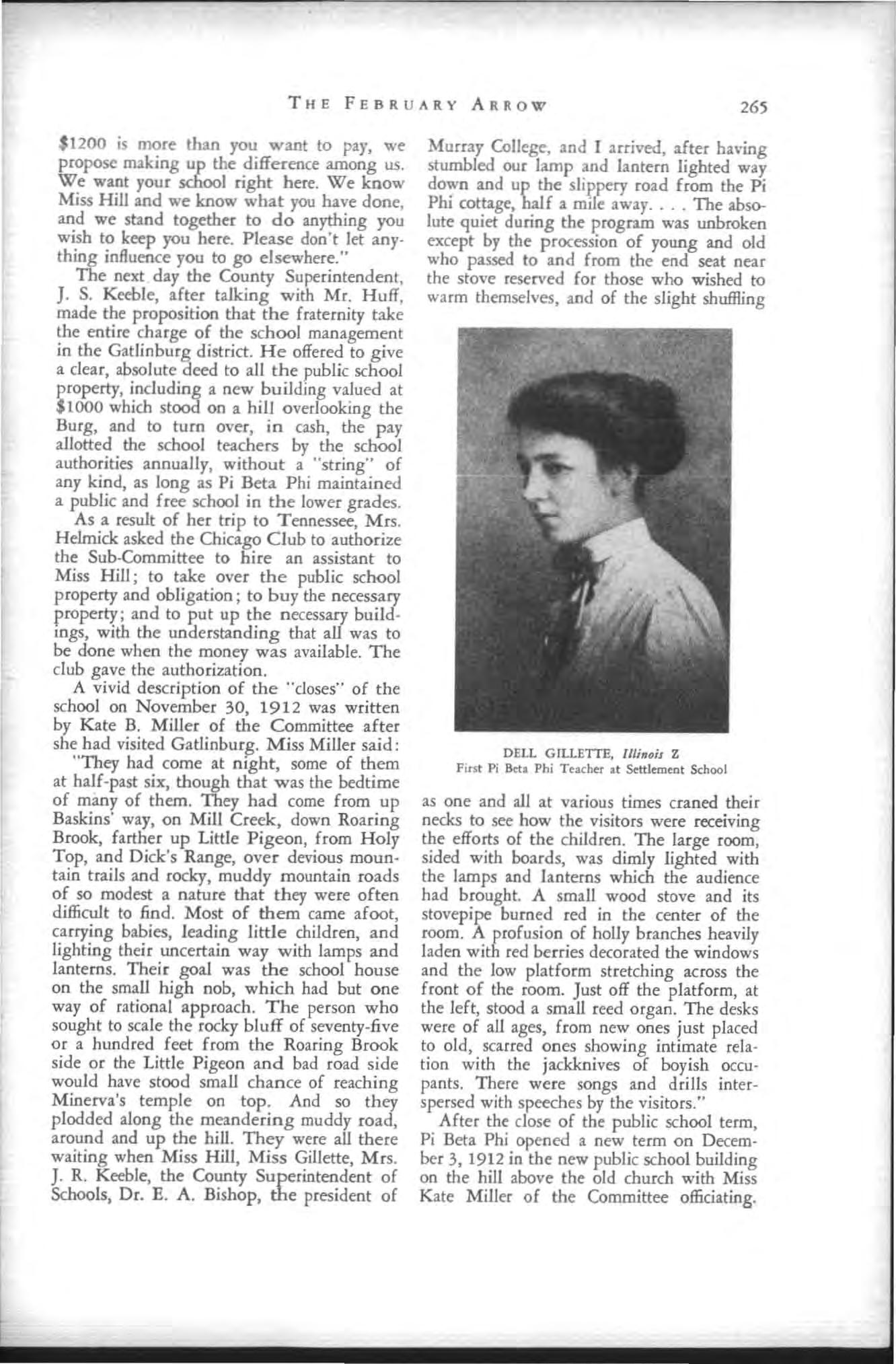
as one and aU at various times craned their necks to see how the visitors were receiving the efforts of the children. The large room, sided with boards, was dimly lighted with the lamps and lanterns which the audience had brought. A small wood stove and its stovepipe burned red in the center of the room. A profusion of holly branches heavily laden with red berries decorated the windows and the low platform stretching across the front of the room. Just off the platform, at the left, stood a small reed organ The desks were of all ages, from new ones just placed to old, scarred ones showing intimate relation with the jackk nives of boyish occupants. There were songs and drills interspersed with speeches by the visitors."
After the close of the public school term, Pi Beta Phi opened a new term on December 3, 1912 in the new public school building on the hill above the old church with Miss K ate Miller of the Committee officiating.
Miss Hill and DeUa W . Gillette, Illinois Z, were in charge of the school. Miss Gillette, the first Pi Beta Phi teacher at the School, was a trained librarian and had had considerable experience at the head of the Bureau of Charities of Traverse City, Mich .
More than 40 pupils were enrolled that day and by January there were n enroUed. Some bad to be refused because of limitations of space and of the small teaching force One who had to be refused was Mr. Ogle, the public school teacher.
The Christmas season that year was celebrated as it had never been before. Miss Gillette told the Christ Child stories to many who heard them for the lirst time. A big Christmas tree was arranged under difficulties and three hundred people came to see the amazing gifts which had come in boxes from the dubs-many of the boxes, however, did not arrive until after Christmas.
In describing this lirst real Christmas at Gatlinburg Miss Gillette said: "They never have family dinners oor ever have Christmas trees at home. But the thing that surprised me most of all was that they know absolutely nothing of the religious idea of Christmas I had told my room the story of the 'Little Boy' s Visit to Santa Claus; just from memory. and they were the best audience I bave ever seen . From that time on I had no rest from their entreaties to tell them another story, so the last day of school I had the little people cut out and color Christmas pictures and I also took a beautiful picture of the shepherds following the star and tacked it up after explaining to them. I told them the old , old story of Mary and Josepb. Not one of my fifty and more boys and girls knew who Mary was nor had any conception of the beauty of Christmas from the religious standpoint. It is surprising, as these people are supposed to be reli ious."
On 'anuary 31, 1913, the lirst American flag to Boat from a pole over Gatlinburg, was raised on the Settlement School Bagstaff in front of the school building. Dell Gillette broke the sod for the £lag pole and Miss Hill attached the flag to the halyard, and while the school cbildren sang the "Star Spangled Banner" the Bag was run up to the top. The Bag was presented by Worth Schantz, the young son of Carrie Flagler Schantz, Iowa e.
Soon after taking up ber wode at the School, Miss Gillette organized the older girls of the School aod Gatlinburg into a sewing club which met every Friday after-
noon. The first ,Piece of wode which each m ade was a wh,te linen collar. While the girJ,. sewed "Miss Dell" or someone relld aloud.
For the boys, Miss Gillette adopted certain Boy Scout rules for behaviour and development in two baseball teams One was an indoor team which played in the abandoned Methodist Church, and the other was a regular outside team which played in the "flats."
The school closed on the last of March. For the lirst time in the history of the community, the children had gone to school for eight months in one year!
Although the school had progressed splendidly and Pi Beta Phi had made wonderful friends in the community, two things happened which almost caused the withdrawal of the fraternity from Gatlinburg to some other locality
It will be recalled that the county superintendent had assured the Committee that the whole school situation would be given into Pi Beta Phi's control, but Mrs . Helmick and Miss Miller found upon their arrival at Gatlinburg in July 1913, th at although almost everyone in the community wanted Pi Beta Phi to conduct the school, a local man was hired through a misunderstanding. By the opening of the next term, however, the misunderstanding had been deared. The Board voted that after Christmas, the public school building should be given to PI Beta Phi for its use and that another year the fraternity sbould have the wbole school situation in its hands .
The next and very vital matter to be settled was that of acquiring land. Although several places were considered, the only really desirable tract seemed to be that owned by E. E. O$le, but the men of the village did not thmk that he would sell even if the money could be raised.
Despite the fact that the men had some time before agreed to help with the purchase of property for the school, they now seemed to hang back and to want Pi Beta Pbi to try to raise the money and to persuade Mr. Ogle to sell . It was not that they were shirking a promise but rather that they had never assisted with the promotion of any community project such as this and seemingly did not know how to go about it .
Mrs Helm ick talked with Mr Ogle and found that he would sell for $1800. If the fratemity would put in $600 and the men of
the community, $l200 , the land no doubt could be obtained.
Since the matter had dragged along for months with nothing accomplished, Mrs. HeJmide issued an ultimatum saying that if the Ogle land were not obtained for the fraternity (we contributing $600) by the next day at neon, Pi Beta Phi would go elsewhere and estahlish a school where land would be given to us.
Kate Miller·s graphic description shows the tenseness of the situation:
We now wondered what they would do. They were at Jut convinced that "those wimmin" meant what thq said. We packed ow trunks, began to get the household thlOgs ready to leave until we should have them sent elsewhere, ordered the hade from Sevierville to come for us the nat day and wondered what the next twenty·four hours would being forth. Mr. Huff was .sent foe in his lumber camp eight miles away; everyone gave up his busin6S and those who had no bwiness gave that UP . all morc deeply excited than they had ever been. We were now to the mirade: these mountain men and womm, moved by their very strong desire to keep the fraternity school, forgot their reserve. threw off their euy·going ways, and went to work for a community enterprise. Never before had they cooperated for a public affair. They said that there was no one who could go ahead, but the necessity for a leader developed one, and Andy Huff was drawn forth. As I think back over the stirring weeks, it semiS to me that nothing which came out of them will be of greater good to these men and women than this: the knowledge that they can do things themselves . Tuesday evening we had many callers, three of the women staying until after dark. They said they jwt couldn't let us 80, that they knew the men would try their best, but that per· haps they couldn't raise enougb money For women in the mountains to stay out after dark was a violati o n of their social code, but they were forgetting even thdr social customs now.
The next morniog while we were at breakfast, Mr. Huif and Steve Wbaley came to get us to draw up a subscription paper. Mrs . Helmick wrote the heading (or one, putting Pi Beta Phi down for $600. Aod, HufI put down $2S0 and Steve Whaley $2S0. Then they started off saying that the hack would not take us back. Aiter the men had left, Mrs. HuH came to us and told us of her dream. She dropped into a chair in our kitchen as we washing the dishes that morning and said: "I had a dream last night," It seemed that she had dreamt that she and the children were all down by the river bank playing. The children had pushed through the bushes and had slipped down to the river bed where they were playing on the dry gravelJy bottom in the pools. She had stayed up on the road and suddenly she looked up the river to the distant mountains th.t seemed to close it in. There she saw rising and clinging to the moun· tain sides a "big steam , a fog." Then the fog began to roll in clouds, and to come down the river slowly. It kept gdting b;gger and b;gger and kept rolling and rolling down towards the place where the children were playing, Her eyes yew large and her voice tense as the vividness of her vision came
bade to h<r She r<peated lpill and again: ·The (og kept rolling and roUing and getting bigger and bigger and coming down to get my children." Up the river she also sa.w, in the path of the oncoming danger, Reagin and Ownby children. She thought that the fog was going to gtt them as well as her own children. She was so frigbten«l, she said that her "heart roared like a pheasant. " She tried to go down to the children but she couldn't go through the dense bushes . She knew that the (og would gft her children. Just then she saw Andy going to them. The relief she must have felt in her dream at this moment was (uJly evidenced in her voice. She knew that "Andy would save them," Then when she wakened, and waJcened "Andy" and told him her dream, she told him that he had just got to make "the women" stay if it took every ceot he had.
That Mrs . HuWs dream played a large part in working the mirade of raising the necessary money canno t be doubted.
Mrs . Helmide, Mrs . Huff, and Miss Miller sat on the front porch of the cottage and wondered and watched the excited groups around the store at the foot of the hill Bulletins were given to them from time to time, ··The three of us on the Pi Beta Phi veranda;' continued Miss Miller, "were all at such a tension that if some relief did not come immediately, it seemed as if we should break. Just before noon Mr. E. E. Ogle came up to say that he had decided to sell the tract if the money could be raised, and that he would give as much as anyone towards the purchase price He would give $250. He said he would rather have the school than his land-pro· vided he could get a fair trice for the land. His neighbors said that i Eph had wanted to sell to anyone else he could have gotten $2000. . . . The last stage of the transaction was at hand. The hade from Sevierville now arrived and raised the excitement to fever heat. Soon after its arrival, word was sent us that we were wanted at the store. Men were crowding around the outside of the building, on the steps, in the doors, were standing inside and sitting on the counters. We found Mr. Ogle busy writing a title bond to be held by us till the deed could be made and sworn to. Almost all the money had been subscribed and Mr. Huff and Mr. Maple had agreed to make up any final deficit. When the terms were finally and satisfactorily embodied in this preliminary instrument, it was signed and $iveo to Mrs. Helmick. The wave of relaxahon that passed through that assemblage was almost audible. Charley Ogle, the son of E. E. Ogle, collected all the tire-cradcers remaining £rom the Fourth, and fired them off in front of the store, thus announcing to
any few who were not at tbe store that 'them wimmio' wt:ce not going back to Sevierville in the back."
And thus Pi Beta Phi remained on Little Pigeon-beca use the people themselves made the supreme effort to lceep us there.
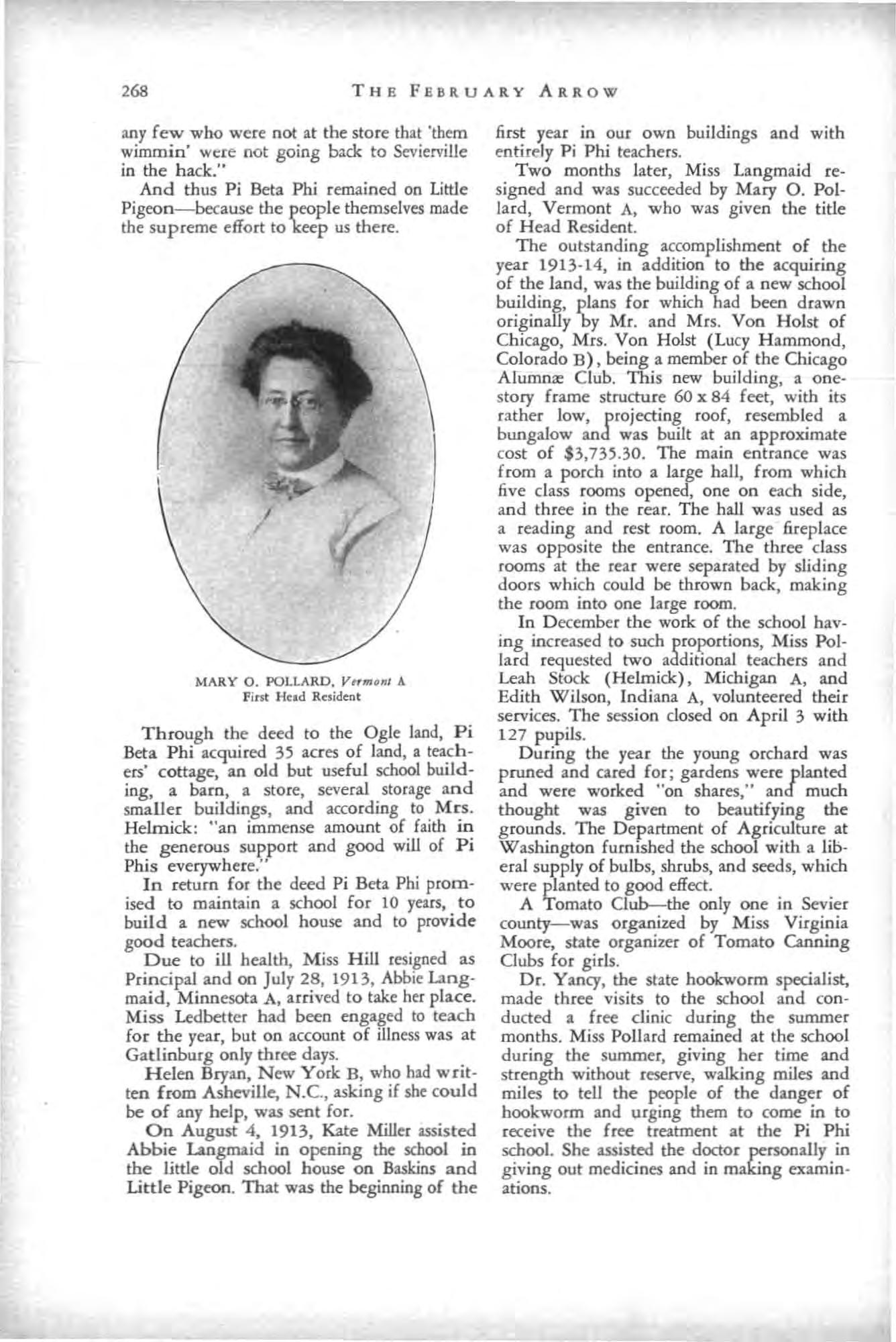
MARY O. POLLARD. Vm"ont A Firs t Held Resident
Tbrough the deed to the Ogle land, Pi Beta Phi acquired 35 acres of land , a teachers' cottage, an old but useful school builda barn, a store, several storage and smaller buildings, and according to Mrs . Helmick.: "an immense amount of faith in the generous support and good will of Pi Phis everywhere "
In return for the deed Pi Beta Phi promised to maintain a school for 10 years, to build a new school house and to provide good teachers .
Due to ill health, Miss Hill resigned as Principal and on July 28, 1913, Abbie Langmaid, Minnesota A, arrived to take her place. Miss Ledbetter bad been engaged to teach for the year, but on account of illness was at Gatlinburg only three days.
Helen Bryan, New York B, who had written from Asheville, N.C., asking if she could be of any help, was sent for.
On August 4, 1913, Kate Miller assisted Abbie Langmaid in opening the school in the little old school house on Baskins and Little Pigeon. That was the beginning of the
first year in our own buildings and with entire ly Pi Phi teachers.
Two months later, Miss Langmaid res igned and was succeeded by Mary O. Pollard, Vermont A, who was given the title of Head Resident.
Th e outstanding accomplishment of the year 1913·14, in addition to the acquiring of the land, was the building of a new school building, plans for which had been drawn originally by Mr. and Mrs . Von Holst of Chicago, Mrs. Von Holst (Lu cy Hammond , Colorado B) , being a member of the Chicago Alumna: Club. This new building , a one· story frame structure 60 x 84 feet, with its rather low , projecting roof, resemb led a bungalow and was built at an approximate cost of $3,73'.30. The main entrance was from a porch into a large hall, from which five class rooms opened, one on each side, and three in the rear. The hall was used as a reading and rest room A large fireplace was opposite the entrance. The three class rooms at the rear were separated by sliding doors whicb cou ld be thrown back, making the room into one large room
In D ece mber the work of the school hav· ing increased to such proportions, Miss Pol · lard requested two add itional teachers and Leah Stock (Helmick), Michigan A, and Edith Wilson , Indiana A. volunteered their services. The session closed on April 3 with 127 pupils
During the year the young orchard was pruned and cared for ; gardens were/lanted and were worked "on shares ," an much thought was given to beautifying the grounds. The Department of Agriculture at Washington furnished the school with a lib· eral supply of bulbs, shrubs, and seeds, which were planted to good effect.
A Tomato Club-the only one in Sevier cou nty-was organized by Miss Virginia Moore, state organizer of Tomato Canning Clubs for girls.
Dr. Yancy, the state hookworm specialist, made three visits to the school and con· ducted a free clinic during the summer months. Miss Pollard remained at the school during the summer, giving her time and strength without reserve, walking miles and miles to tell the people of the danger of hookworm and urging them to (Orne in to receive the free treatment at the Pi Phi school. She assisted the doctor personally in g iving out medicines and in making examin· ations.
The Chairman of the Settlement School Committee reported at the end of the school year that a fund had been started by three of our Founders, with the result that $150 was then in the bank for the establishment of the Jennie Nicol Memorial Hospital at Gatlinburg, in loving memory of Jennie Nicol of "Alpha ."
Late in June, the Settlement School Committee sent out attractive invitations to the dedication of the new sc hoo l building which took place on July 9.
The five members of the Grand Council: Dr M ay L. KeUer, Lida Burkhard Lardner,
her assisUnt, Miss Webb, and they were soon foll owed by Prof. Keffer of the University of Tmnesand his friend, Me. RaJ1.
A lashing hail storm made it necessary to postpone the exercises until the storm had abated and then , Dr. Keller presiding called on Rev J. F H ale to open tbe exercises with prayer This was followed by music provided by Mr. Atchley and Mr. Ellis , associate authors of "The Pilot," the new hymn book recently adopted by the Gatlinburg ch urc h , who were in the neighborhood conducting a "singing school."
Dr. Keller made a brief speech accepting
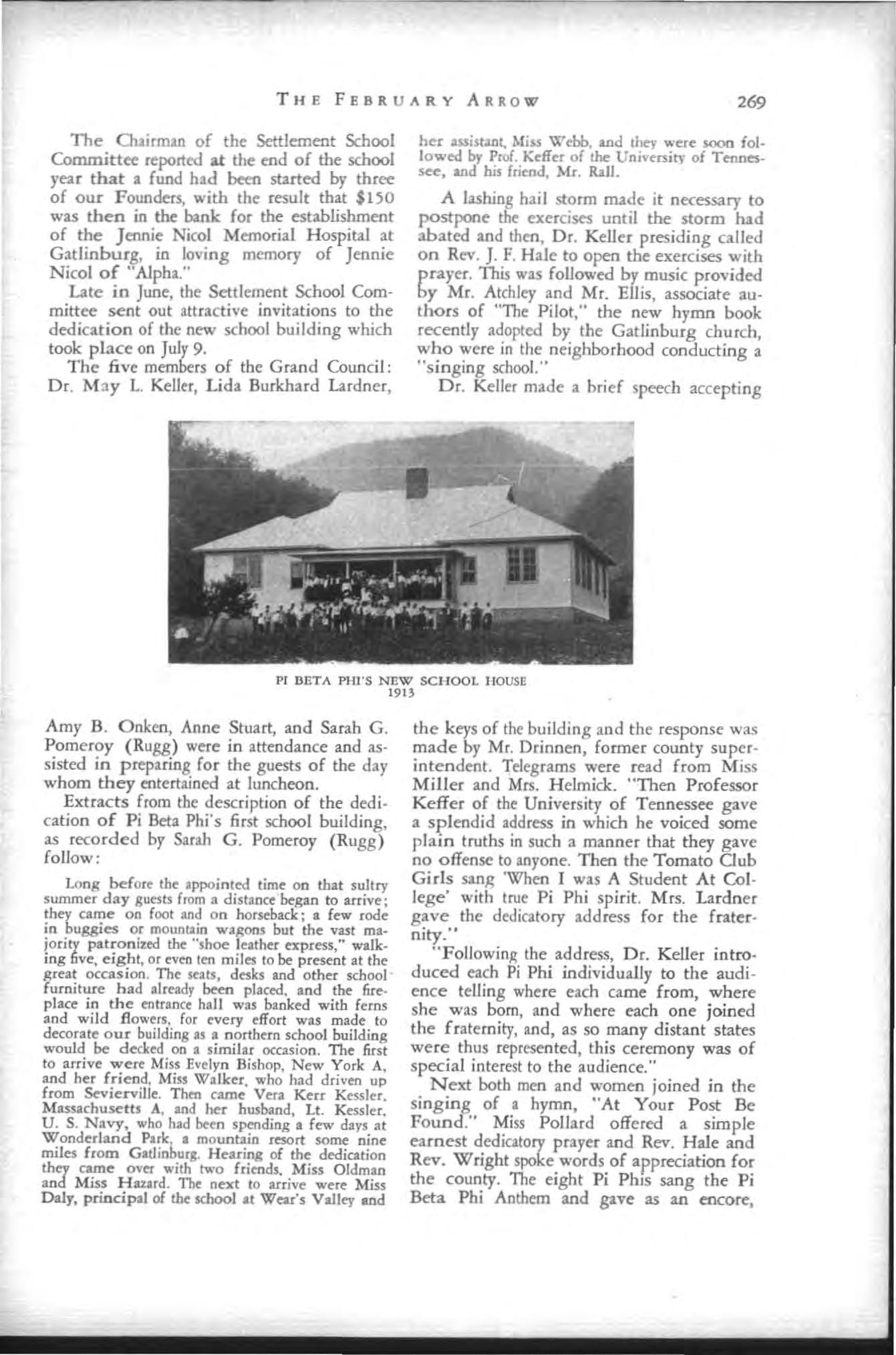
Amy B Onken, Anne Stuart, and Sarah G Pomeroy (Rugg) were in attendance and assisted in preparing for the guests of the day whom they entertained at luncheon . Extracts from the description of the dedica tion of Pi Beta Phi's first school building , as recorded by Sarah G. Pomeroy (Ru gg ) follow:
Long before the appo inted time o n that sultry s ummer day guests from a distance began to arrive ; they came on foot and o n a few rode in buggies or mountain wagons but the vast majority patronized the "shoe leather express," walk· ing 6ve, eight, or even ten miles to be present at the great occasion. The seats , desks and other school ' furniture had already placed , and the fire · place in the entrance hall was banked with ferns and wild flowers, (or every effort was made to decorate OUf building as a northern school buiJding would be decked on a similar occasion. The first to arrive were Miss Evelyn Bi shop, New York A , and her friend , Miss Walke.r, who had driven up from Sevierville. Then carne V era Kerr Kessler. Massachusetu A, and her husband, Lt Kes s le r U . S. Navy, who had been spending a few days at W onde rland Park, a mountain resort some nine miles fro m Gatlinburg . Hearing o f the dedication they came over with two friends , Miss Oldman and Miss Hazard . The next to arrive were Miss DaJy. principal of the school .t Wear's VaJl cy and
the keys of the building and the response was made by Mr. Drinncn, former county super· intendent. Telegrams were read from Miss Miller and Mrs. Helmick. "Then Professor Keffer of the University of Tennessee gave a splendid address in which he voiced some plain truths in such a manner that they gave no offense to anyone. Then the Tomato Club Girls sang 'When I was A Student At College ' with true Pi Phi spirit. Mrs. Lardner gave the dedicatory address for the fraternity "
"Following the address, Dr. K eller introduced each Pi Phi individually to the audien c e telling where each came from, where she was born, and where each o ne joined the fraternity, and, as so many distant states were thus represented , this ceremony was of special interest to the audience ."
Next both men and women joined in the singing of a hymn, "At Your Post Be Found ." Miss Pollard offered a simple earnest dedicatory prayer and Rev. Hale and Rev, Wright spoke words of appreciation for the county. The eight Pi PhIS sang the Pi Beta Phi Anthem and gave as ao encore,
"When I was a Student At College," supported by the Tomato Club Girls. A beautiful new flag, the gift of Major and Mrs. Helmick, floated from a pole in front of the new school house.
With the beginning of the fourth session of the school on August 10, 1914, the Sevier County &bool Board voted to turn over to the Pi Beta Phi Settlement School the district's appropriation for schools for the year which amounted to $375 . The session for the year dosed on April 2, 1915 with an enrollment of 158 scholars, and was declared by the Head Resident to have been "the most P refitable session in the history of the schoo!."
It is most gratifying to find in the Committee's report that many Pi Phis had offered their services and that the School had never suffered from want of Pi Phi workers or for money for running expenses
During the winter of 1914-15, Miss Pollard slept in the where all cooked, ate, and lived, while Miss Wilson , Miss Dit· mars and Miss Young slept in one of the unused school rooms. The arrangement was neither pleasant nor comfortable, and hence, it was urged by the Director that a new teacher's residence be constructed and the three -roomed cottage be converted into a small hospital, to be known as the Jennie Nicol Memorial Hospital .·
In November of that year a field day was held on the school grounds, to which all the neighboring schools were invited. Many came and had a line day with races of all kinds and a baseball game in the afternoon with a spelling bee in the evening.
That fall for the lirst time serious attention was directed towards the industrial work. Margaret Burroughs, Texas A, stopped over at the &bool for a week on her way north and storted the girls in basket making, much to their delight.
Basket making was an old industry in the mountains but since there was DO sale for such products, they were made chielly for household use such as containers for picking berries, baskets for wood, etc.
Aunty Lydia Whaley, who lived in a little cabin by herself up OD the mountainside, was known far and wide for h<r baskets and the few visitors to Gatlinburg always sought her out to buy what she would sell . "AllOt Lyddie" always entertained with old time
• Later, however, it was the And, Ogle bome and nOl the cottage which became the hospital _
stories and could quote the Bible by the hour She was a remarkable woman , having raised her family of children after her husband was killed almost on her doorstep during the Civil War
The " Aunt Lyddie" baskets were known far and wide.
In March 1915, Miss Pollard wrote to THE ARRow: "We are hoping to emphasize the industrial side of our work more and more. We are hopin$ to start basket making in the school, /loping that it will prove a profitable industry. Many of the women make exquisite patchwork quilts and some still make the hand woven coverlids and blankets If a sale could be found for these artides, many might undertake the work ."
And that is where the alumna:: department of Pi Beta Phi has accomplished a marvelous work - by making a "sale for these articles."
In May of that year, Caroline M e Knight Hughes , Minnesota A, a graduate of the University of Michigan, of Cooper Union School of Art and of Prang Normal , took charge of the business and industrial work, spending some time in the summer looking the situation over, and starting the fall as Head Resident in charge of industrial work, with Mary O. Pollard as Principal of the school.
Miss Hughes installed a manual training outfit at a cost of $172.81 with which she gave instruction to 52 boys and a beginning was made of a department which it was hoped in time would be of great benelit to the community and to the school.
It was noised about that "them wimmin" were going to "teach tools ," and the curiosity of the Burg was so great that some of the residents ran down the country road to meet the wagoo bringing in the tools All they saw were some boxes, nailed up tight, and some crates with they knew not what inside. The excitement and curiosity was equal to a circus coming to town and when the live benches were in place, with the tools set out, every man and oof able to come to the &bool, did so _ Apparently no one knew much about tools, except the saw, plane and hammer, and the first day of class work was a queer one.
As soon as possible the weaving department was equipped, spinning bees and quilting parties were given with the hope of revivmg those almost lost industries .
For the first time in the faU of 1915 the school began the sale of baskets, purchasing
materials and articles for the industrial work, trying to raise the standard of workmanship, and endeavoring to find a market for the products.
In urging Ibe revival of industrial work, Miss Hughes said: " In the !esteryear this country was a community 0 weavers, but after the War 'store doth' was cheap so that one woman after another put the old loom aside, but many of our neighbors today know how to spin and weave though it has been a 'tol' able loog spell' since any of them have
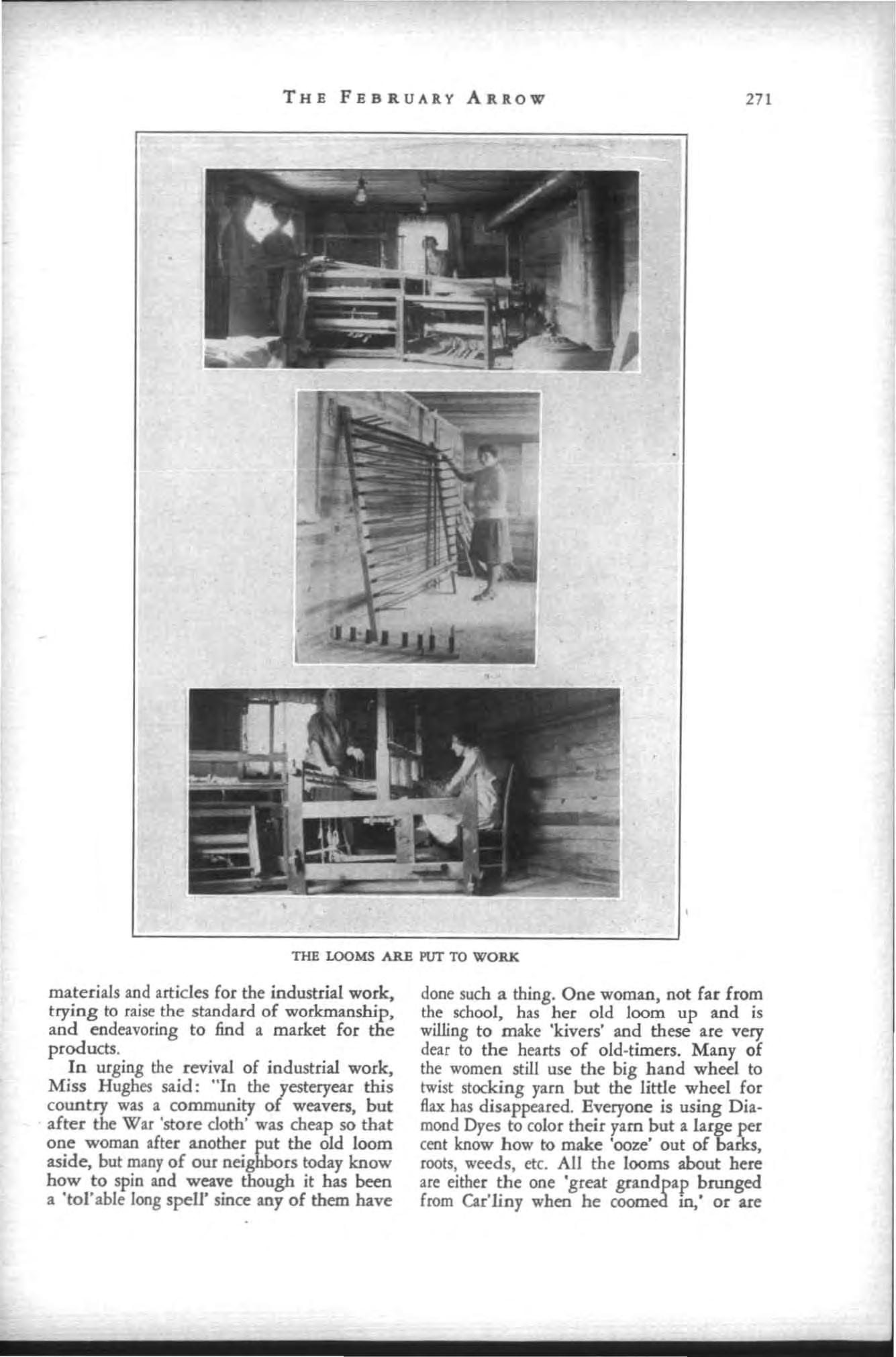
done such a thing. One woman, not far from the schoo l, has her old loom up and is willing to make 'kivers' and these are very dear to the hearts of old-timers. Many of Ibe women still use the big hand wheel to twist stocking yarn but the little wheel for flax has disappeared. Everyone is using Di amood Dyes to color their yam but a large per cent know how to make 'ooze' out of barks, rools, weeds, etc. All the looms about h<re are eilber the one 'great grand pap brunged from Car'liny when he coorned 10,' or are
copies of these old ones, and of course one and all are crude homemade affairs. They are clumsy and big and all the weavers are old women . 'Up yander in the mo'tains' there are many looms in use, and the women have little or no use for 's tore doth' but down in our Burg all are fond of it ."
Miss Hughes instructed the children in schoo l in the art of weaving tiny rugs, mats and hammocks. In response to her call for assistance in the work, the Springfield , Mo., Club raised $100 for the buymg of looms.
During the first year that the Chicago Alumna! Club had charge of the Settlement School work, the Committee met onct' a week and devoted much time, thought, and study to the school business. The members of the club earned $10 each for the School fund.
In June 1914, Mrs Helmick moved away from Chicago but the Chicago dub asked her to retain the Directorship of the School, rega rdless of residence. For the following year she managed the School practically alone, not being able to hold conferences with the committee members. In making her report to the co nvention , Mrs. Helmick recommended that the direction of the Set· tlement School should be in the hands of the Grand Council and that the general manage· ment of the affairs of the Settlement School, including those of the treasurer, should be placed in the hands of the Grand Vice · President.
Accordingly the Alumn", Session of Con· vention in 1915, authorized that the Settle· ment &bool be placed under the control of a Board of Managers appointed by the Grand Council and also made the Chairman of the Board a national officer with all privileges as a delegate to Convention. This action was formally ratified by the Grand Council at its meeting in 1916 , and the Council also au· thorized and instructed the Chainman of the Board , the Grand Vice·President, and the Head Resident to decide all matters of Settlement School work that required imme,(H· ate action.
The Board which was appointed was com· prised of the Grand Vice President, to rep· resent the Grand Council, the seven province vice-presidents, with Mrs_ Helmick as chairman and treasurer.
During October, 1915, the church beld prot racted meetings at Gatlinburg for two weeks, and the school became badly disor· gan ized, and did not recover fully until after
the Christmas holidays. The most important thing, perhaps, which was accomplished in the school work was the grading of the classes. Improvement in singing was reported during the year. The children were learning to sing the same songs as other primary children. Too, there was a noticeable change in the faces of the children from the days when Dell Gillette spoke of the "sad faces" of the Ijtt1e ones.
These children were learning to
y games such as Farmer-in-the-Dell an to jump rope with a grape vine. There was the usual Christmas tree, also carols. Cooking dasses were held for the girls in the teach · ers' cottage. A debating club and other school activities aroused a new spirit in the children and their people took pride in theirwork.
The mothers and fathers though djd not approve of the girls playing basketball in bloomers just as they disapproved of the t eachers riding a horse astride .
The older boys loved to sing and spent most of their time at recess and at noon singing bymns.
Attendance was still a problem The school terms were arranged in order to lit the needs of the community. As soon as the weather beRan to be settled in the spring all of the older children, both the boys and girls, "stopped out" to help plant corn and were busy helping with the crop until it was "laid by" about the first of July, then there was a month of respite when they had singing school and a picnic at Elkmont ; by the first of August, the children were ready to attend school. For a week or two they left again to "pull fodder ," then they were in agai n for a few days and out again to pick beans. Between times fhey made molasses, and then came the picking of peas. After the COrn was shocked the first of November they came to school with fair regularity.
During 1914 -15 a new orchard of three dozen trees was started; a model hen house was built and an eighth acre fenced in for a poultry yard; a board walk was laid between the schoolhouse and the cottage; a baseball field was deaned and leveled, some of the picking of rocks being performed by tardy pupils; the old barn was tom down; basket· ball posts were made; • bridge was built across Baskins ; about two dozen ornamental shrubs and rosebushes were set out; a strawberry bed was started and a new garden fenced in; a new 60 foot well was dug and the teachers' residence was remodeled.
A change in routine came, however, in 1916 with the resignation of Miss Pollard who asked for a leave of absence in order to prepare for greater development of the industrial work. Miss Hughes also resigned. Elva Plaok, Iowa E, took charge of the business details of the school and served as Head Resident until called home by iliness the following January. There was no Head Resident during the spring session of 1917 but Mr. Norman Prickett, manual training teacher, acted as Principal of the School.
she was forced to go to bed with an infected foot, Mrs. Helmick was daily with the workmen to see that the work was properly done. The building of the basement attracted especial attention among the mountaineers. One (old frosty morning, about sunrise, one of the oldest inhabitants and bis wife woke Mrs. Helmick to say with genuine anxiety and solicitude: "Martha and me cain't stand it no longer; we said we would come to you and tell you that it don't stand to no reason that that ere watery stuff they is puttin ' in
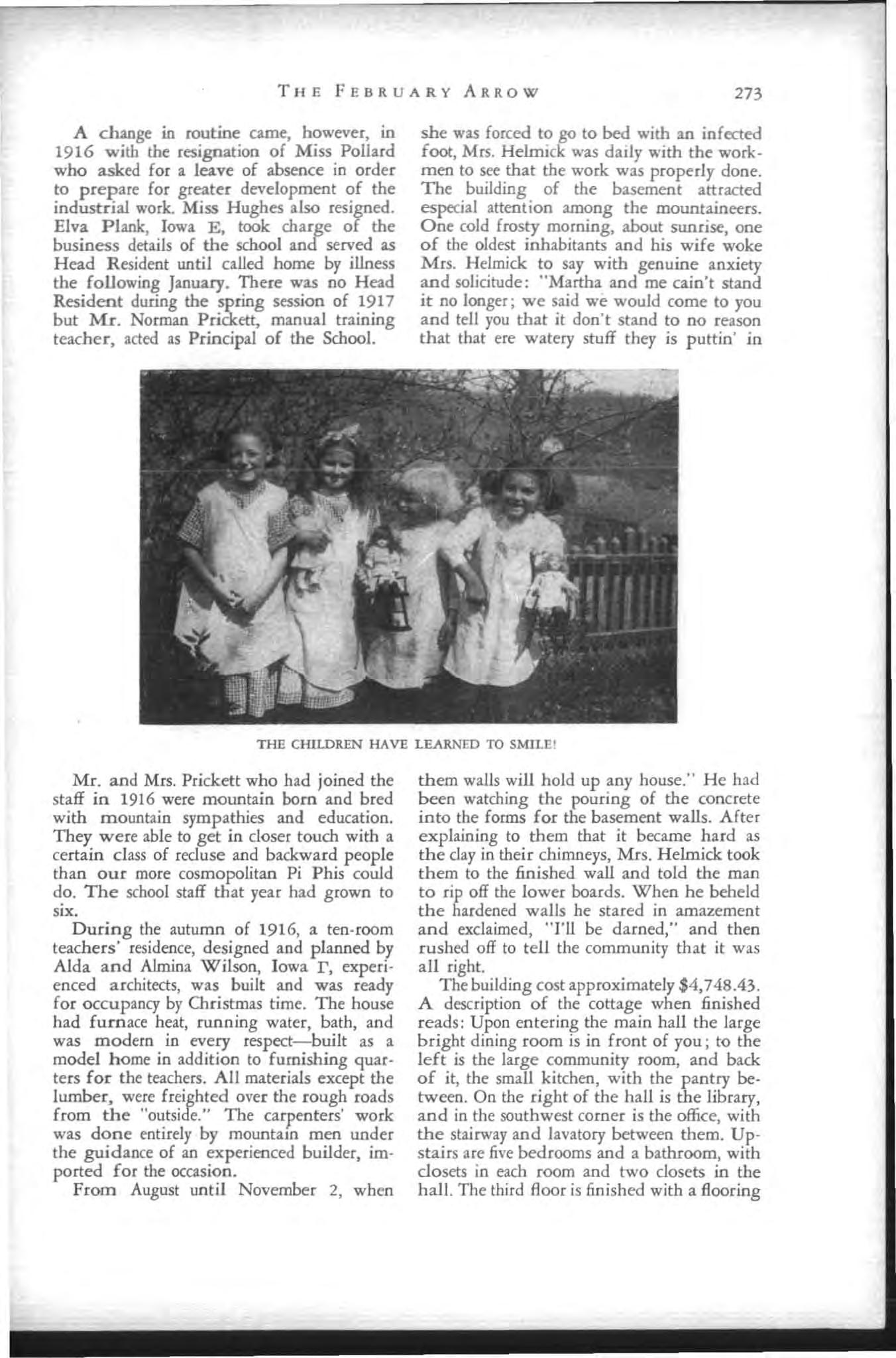
Mr. and Mrs. Prickett who had joined the staff in 1916 were mountain born and bred with mountain sympathies and education. They were able to get in closer touch with a certain class of recluse and backward people than our more cosmopolitan Pi Phis could do. The school staff that year had grown to six.
During the autumn of 1916, a ten-room teachers' residence, designed and planned by Alda and Almina Wilson, Iowa r, experi· enced architects, was built and was ready for occupancy by Christmas time. The house had furnace heat, running water, bath, and was modern in every respect-built as a model home in addition to furnishing quarters for the teachers. All materials except the lumber, were freighted over the rough roads from the "outside." The carpenters' work was done entirely by mountam men under the guidance of an experienced builder, imported for the occasion.
From August until November 2, when
them walls will hold up any house." He Illd been watching the pouring of the concrete into the forms for the basement walls. After explaining to them that it became hard as the day in their chimneys, Mrs. Helmick took them to the finished wall and told the man to rip of! the lower boards. When he beheld the hardened walls he stared in amazement and exclaimed, ''1'11 be darned," and then rushed of! to tell the community that it was all right.
The building cost approximately $4,748.43. A description of the cottage when finished reads: Upon entering the main hall the large bright dining room is in front of you; to the left is the large community room, and back of it, the small kitchen, with the pantry between. On the right of the hall is the library, and in the southwest corner is the office, with the stairway and lavatory between them. Up · stairs are five bedrooms and a bathroom, with closets in each room and two closets in the hall. The third Boor is finished with a flooring
only and affords stora$e for trunks, etc. The heating plant, plumblDg and bath fixtures are the best to be had."
With the workmen on the ground constructing the teachers ' cottage, they were employed to install a large steam heating plant 10 the school building at an approximate cost of $900, the former system having proven unsatisfactory . They built shelves 10 the school house to accommodate all of the books in the library . They constructed a much needed barn or shed for the children ' s horses .
Helen Weinberg, Illinois .6, one of the teachers, went carefully through the books, numbering and reclassifying them and then catalogued them in a regular library catalogue book.
That winter there was much sickness in the mountains-diphtheria, scarlet fever, tonsillitis There were no hospital facilities, no doctor within 17 miles. An appeal was sent to the Pi Phis for funds to equip the little hospital and to employ a nurse, but war agitation prevented the hiring of a nurse at that time.
Life at Gailinburg grew broader with each season, entertainments were given in the school house, parties were held in the cottage and many "sings" and suppers were given in return by the people. A new piano, a gift of the Boston Alumnre Oub, opened a new field for cultivation, as other lianos were purchased and piano lessons an singing became popular in the Burg.
The religious life had progressed from the days of no regular pastor when Pi Beta Phi entered the community to regular church services under Mr. Conner, and a well conducted Sunday School, and a well-organized B.Y.P.U.
About this time the county built a pike road to a point six miles below Gatlinburg, and public spirited men succeeded in getting bridges built across the Little Pigeon river and a fairly good dirt · road over the balance of the way, making it possible, at some seasons to leave the railroaa at Sevierville and to reach the School in a couple of hours ' ride by motor. Gatlinburg was made the distributing point of seven rural delivery routes and the citizens ' names began to appear in the county papers
In August 1917, the School session opened with speeches made by Mr. Cooner, pastor of the Missionary Baptist Cllurch, Steve Whaley, and others and there was very inspiring singing by the children. Through the
work of Mr and Mrs Prickett and Ruth Meacham, Illinois .6 , of the School staff and with the aid of the new piano in the school room and new songbooks a wonderful improvement was evident in both the voices of the children and in the nature of the songs which they sang.
In addition to having regular room work, each teacher under the direction of Marjorie Jackson, W ·isconsin A, SUp'ervisor, was as · signed a definite responsibIlity in the settlement.
Regular work in teaching of home econmnics was emphasized and the lower part of Mrs. Prickett s room was partitioned off by the manual training boys for the cooking department, which had been located in the teachers' cottage Two three-holed kerosene stoves, with a complete working outfit for each, delighted the girls. Mrs. Prickett conducted the classes in cooking and sewing.
Mr. Prickett endeavored to work up a Community Oub among the men to be held in the old school building at the junction of Baskins and Little Pigeon. Under his direction , too, the mountain people began to make furniture: mountain porch chairs of hickory, black walnut chairs, stools, bookcases, etc.
Soon after the entrance of the Uuited States into the World War, Mrs. Helmick, who had served the School so efficiently as Chairman and treasurer of the Committee, was forced by home duties to resign the position. This resignation was accepted by the Grand Council at its meeting in Chicago in October, 1917 with the following expression of appreciation: "The Grand Council realizes the deep debt of gratitude which the fraternity owes Mrs. Helmick and it accepted her resignation only after it had been repeatedly given and when it seemed unfair longer to insist on her remaining in office." Mrs Helmick's name will always be linked with the pioneer days of the Settlement School to which she gave much time and energy and made many personal sacrifices.
The new Chairman, Waneta Bunting Richardson, Nebraska B, began her duties about December 1.
During the strenuous year of 1917-18 everyone on the school staff, which then nurubered seven; did double and triple duty. Since there was no Head Resident, Marjorie Jackson, Wisconsin A, acted as Secretary and Supervisor, taught the intermediate grades, wrote all letters to the chapters, dubs and THE ARRow, and carried on the duties of
the Had Residmt. Ruth M<ach<m, lIlinoi! 6, hlught the high and music and had charge of the library. Emily Burton taught the little childrm and act<d as bo""," moth.., having charge of the meals, planning the worle for the out5ide bel.!"'rs, and was responsible for ev<rything UlSide of the teachers· cottage. Lat«, Mrs. Emily Platt, moth of a Pi Pbi, came to belp with tbi! work, «lioving Miss Burton untif the last of February. From thm until the session dos<d, Estell. Walters Ball of Iowa City, a charter
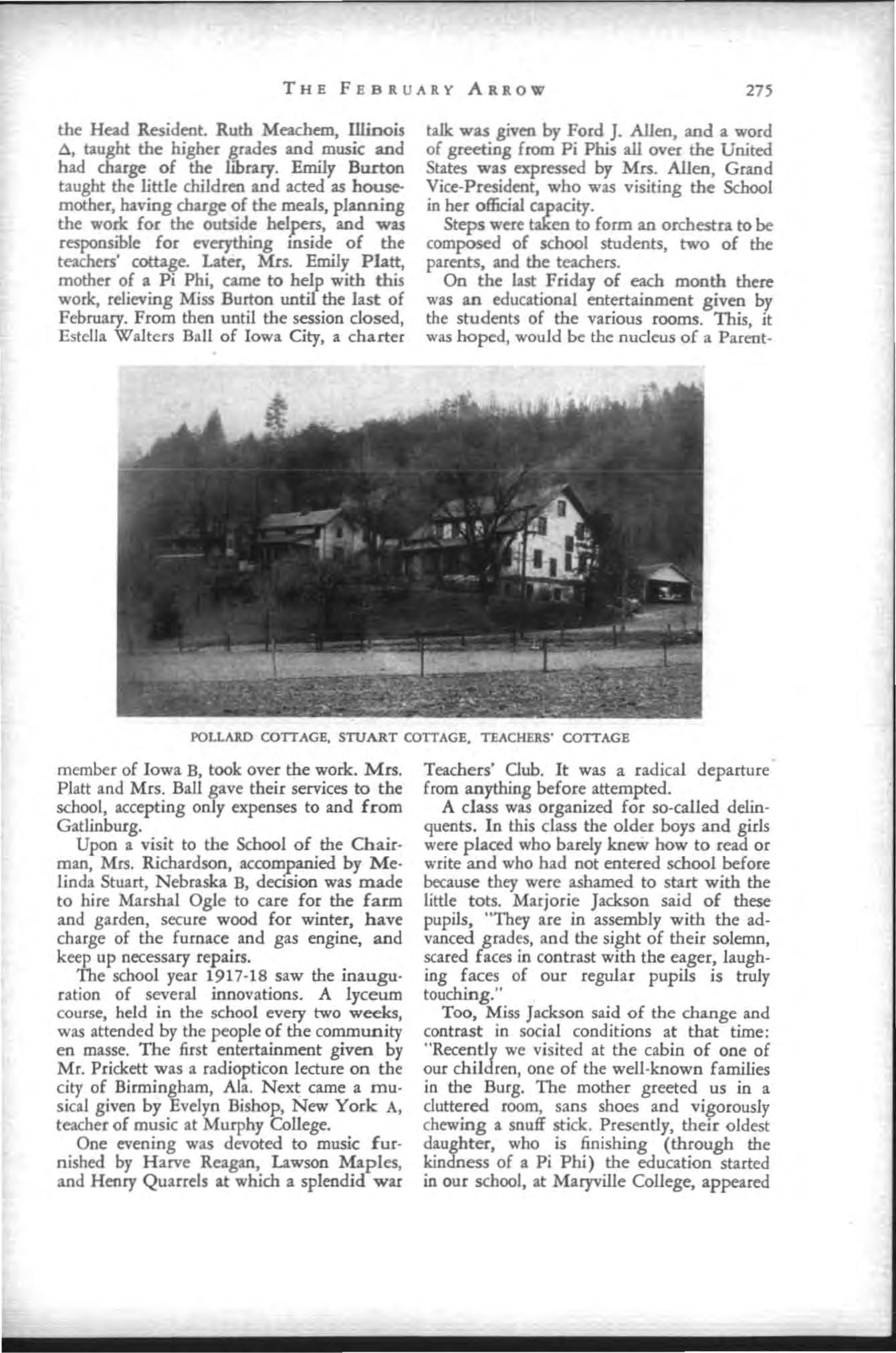
m ember of Iowa B, took ovec the work. Mrs. Platt and Mrs. Ball gave their services to the school, accepting only expenses to and from Gatlinburg.
Upon a visit to the School of the Chair· man, Mrs. Richardson, accom)'anied by Me· linda Stuart, Nebraska B, decision was made to hire Marshal Ogle to care for the farm and garden, secure wood for winter, have charge of the furnace and gas engine, and keep up necessary repairs
The school year 1917·18 saw the inaugu· ration of several innovations. A lyceum course, held in the school every two weeks, was attended by the people of the community en masse, The first entertainment given by Mr. Prickett was a radiopticon lectu« on the city of Birmingham, Ala. Next came a mu· sical given by Evelyn Bishop, New York A, teacher of music at Murphy College.
One evming was devoted to music fur · nished by Harve Reagan, Lawson Maples, and Henry Quarrels at which a splmdid war
Wk was givm by Ford J . .AIIm, and a word of greeting from Pi Phi! all ov« the Unit<d Shltes was expr<SSed by Mrs . .Allen, Graod Vice-Presidmt, who was visiting the School in h official capacity.
Steps w e w<en to form an orchestra to be composed of school studmt5, two of the parents, and the t<achers.
On the last Friday of <ach month there was an educational entertainment given by the students of the various rooms. This, it was hoped, would be the nucleus of a Parent-
Teachers" Cub. It was a radical departure from anything before attempted.
A class was organized for so·call<d delin· quents. In this class the older hoys and girls were placed who barely knew how to read or write and who had not enter<d school before because they were ashamed to start with the little tots. Marjorie Jackson said of these pupils, "They are in assembly with the ad· vanced grades, and the sight of their solemn, scared faces in contrast with the eager, laugh· ing faces of our regular pupils is truly touching:·
Too, Miss Jackson said of the change and contrast in social conditions at that time:
··Recently we visited at the cabin of one of our children, one of the well·known families in the Burg. The mother greeted us in a duttered room , sans shoes and vi$orously chewing a snuff stick. Presently, the" oldest daughter, who is finishing (through the kinJness of a Pi Phi) the education shlrted in our school, at Maryville College, appared
upon the scene. We held our breath at the tableau and wondered how to relieve the embarrassing situation . We need not have worried for never was a situation handled more tactfully There was no apology nor sign of embarrassment , and the deference the daughter showed her mother was truly an object lesson to us Another similar incident illustrating the strides that the younger generation are making with the aid of an education occurred at the cabin . The day we arrived, the wife and mother was drowsily rocking to and fro smoking a corncob pipe (which disappeared as if by magic when we entered). Beside her sat ---, a child of nine, a student in the upper fourth grade . She was working buttonholes on a dress which she had actually made from start to finish by herself. While we chatted , she continued to sew busily, stopping only long enough to apologize because she had not found time to scrub the house that day ."
The S chool staff added to its duties tho se of war work and assisted in organizing a Red Cross chapter which became a branch of the Sevierville chapter. Mrs . Platt and Mrs . Ball both assisted in the completion of the organization of which Mrs. Steve Whaley, a moun tain woman, was elected chairman . The charter members of the chapter were : Mrs. Stephen Whaley, Mattie Ogle, Josie Trentham, Mrs. H . S. Platt, Lillie Reagan, Arena Cardell, Mrs. C. C. Reagan, Mrs. Geo. W . Ball, Mrs. Torn McCarter, Mrs. Norman . Prickett, Nell Williams, Mrs. Brown, Emma Maples, Mrs. J. V. Husky, Mrs. Martin Clabo, Mrs . George Ogle, Mrs. Annie Ogle, Mrs. Nick Husky, Mrs Andy Huff, Mrs
DANIEL KmG-CalIed in the sum · mer. Sent abroad almost immedi ately . Killed in actinn. Left widow of fifteen years.
ZIMMJlY TRENTH.AM-Called May 27, 19 18 . Camp Pike until August. Killed in action in France October II. Left wife and baby. Zimrnry was a charter pupil of the School.
SAM OGLE-Overseas service, was wounded but would not take his discharge. His captain wrote that he would go on regardless of wounds. Killed in action soon after.
E. L. Brown, May Montgomery, Ruth Meacham, and Andy Huff
Meetings were held at the community room at the co ttage where work was started on sweaters and socks. Most of the actual work was done in the homes, the school children being given special instructions .
The real interest of course la y in the boys from the Burg who were in service. Pi Beta Phi Alumna! clubs "adopted'· these boys, writing letters to them and sending them many gifts
Often a mother brought a letter from her boy to read at Red Cross meeting, or a proud facher held the center of the stage at Charley 's s tore as he gave the latest news from the Front
It was a far cry from the quiet road along Little Pigeon to th e deck of a battleship or a mud -filled and bullet-riddled trench in France.
Most of the G atlinburg boys who went overseas belonged to the Thirtieth Division . "They went out from the mountains , serious and quiet, with a full knowl edge of wh at war really means for che effects of our last war have not yet died in this part of th e coun try ."
The service Bag of the school had 19 stars, three of which were changed to gOld.
The following is the · Pi Beta Phi War Roll:
Otis Trentham-Enlisted in Knoxville, sent to France from training camp .
Arlie Watson-Left for Camp Wadsworth, transferred to Camp Sherman, and sent abroad after short training. Quartermaster 's Department.
Charlie Clabo-Sent to training camp and then to France.
Dallard Ownby-Trainin!! camp, overseas service. This was the first time he ever had been away from home and he wrote of want· ing to get back to the quiet of the mountains and asked how the hunting and trapping were He left a little wife of about slldeen who was in our School for a time.
Elder Ogle-Enlisted in the navy April 1917. Trained at Norfolk . In two weeks was sent aboard the L OlliJ iana and was later on a transport.
(Note: The boys on the LOlliJiana were trained by T N Alford, th e late husband of ARRow Editor Adele Alford, who was then a Lieutenant Commander on that ship.)
Oscar Bohanan-Trained at Camp Gordon , later sent to France.
Reed Ogl e-Re -enlisted when war was declared. and went on the LofliJialla. Transported troops after the armisti ce.
Elmer Ogle-Enlisted August 2, 1917. Camp Oglethorpe , Custer, Mills, Merritt, Dix, and Gordon: cook and baker. Noncommissioned officer. Returned home at Christmas timt.
Richard Carr-Enlisted August, 1917 . Camp Oglethorpe, Camp Devons, later in France. Quartermaster's Department. Bakery C. 307.
Mitchell Carr-S .A.T.C. Carson-Newman College, September, 1918.
Albert Clabo-Enlisted in the navy soon after war was declared. Was on the D.lafuare, Jater in Charleston Navy Yards.
Evert Reagan - Called in the summer and sent abroad very soon .
Eli Wilson - In the first call , overseas service Gassed and severely wounded, and at first reported dead.
Loy Reagan-Called October 22 , 1918, Camp Wadsworth, transferred to Newport News and retained in the Utility Department because of his carpentry work.
Minnis Ogle-Medical Department, Camp Greenleaf. Had not had much education when he left Gaclinburg. Came back on furlough and gave a splendid talk at the School when the service flag was raised. Later in France.
From the very first conception of the Settlement School by Emma Harper Turner and the Washington Alumn"" Club, the idea had been to create a project worthy of dedication to our Founders and the founding of Pi Beta Phi. It was proposed that such a dedication should be made upon the Fiftieth Anniversary of the Fraternity in 1917. Due to the fact that the 1917 Convention was postponed on account of the War, the presentation was delayed until the Charlevoix Convention of 1918.
The Four Founders present at Charlevoix: Inel: Smith Soule, Fannie Whitenack Libbey, Libbie Brook Gaddis, and Emma Brownlee Kilgore, chose Mrs. Gaddis to be their spokesman on July 4, when the Settlement School was formally presented to them.
Elizabeth Garke Helmick, who had served so long as Chairman and Director of the Committee, "made the presentation speech in a few brief, extemporaneous sentences which were full of deep feeling and meaning .
"In response, Mrs. Gaddis spoke as fol -
lows: 'This is one o f the proudest moments in the lives of your Founders. We have watched with great interest the beginning and development of this great undertaking To you, who have thought out and wrought out the problems of the Settlement School, g reat c redit is due ; and you h ave the heartfelt g ratitude of the whole Fraternity. Now that this great wo[k is an accomplished fact we have a right to a just pride In its success .
'Our hearts are stirred with deep emotion when we think of your devotion to your Founders, and we want you to know that we fully appreciate the nobility of spirit pervading the whole organization . We are overwhelmed when we think of the honor you have conferred upon us in permitting the Settlement School to stand as a memorial to your Founders. We have tried to comply with your wishes and we recognize the fa ct that this deed conveys to the Pi Beta Phi Fraternity- the property held in trust by Mrs. Elizabeth Clarke Helmick and Miss Kate Miller for the Settlement School at Gatlinburg, Tennessee.
"We have received the honor of a memorial at your hands, the deed we pass over to the Grand President as the representative of the Fraternity, with our hopes and prayers."
At this Convention it was voted that "a board of trustees, five in number, be lppointed by the Grand Council to manage the Settlement School, part of these to be former teachers and the balance to be chosen from alumnre that have shown deep interest in the school."
At the 1921 Convention it was ruled that the Chairman of the Settlement School Committee be appointed for the interim of Conventions, and the other members for a period of one official year, with reappointment contingent upon service, the official year being defined as the interim between the annual meetings of said committee.
Later in 1923, the Grand Council voted that "the tenure of office of Settlement School Committee be changed to four years. Members so appointed that there shall never be more than two new members on the Committee. No member shall be eligible for reappointment at the time of expiration of her term."
In 1929, it was ruled that a member from Grand Council should meet with the Settlement School Committee during a part of each annual committee meeting and that "the
Grand Council shall be the final authority on all matters of policy pertaining to the Settlement School."
The Board or committee for 1918 of which Waneta Bunting Richardson was Chairman , selected as Head Resident for the ensuing year, Evelyn Bishop, New York A, of Sevierville, Tenn ., who had long been interested in
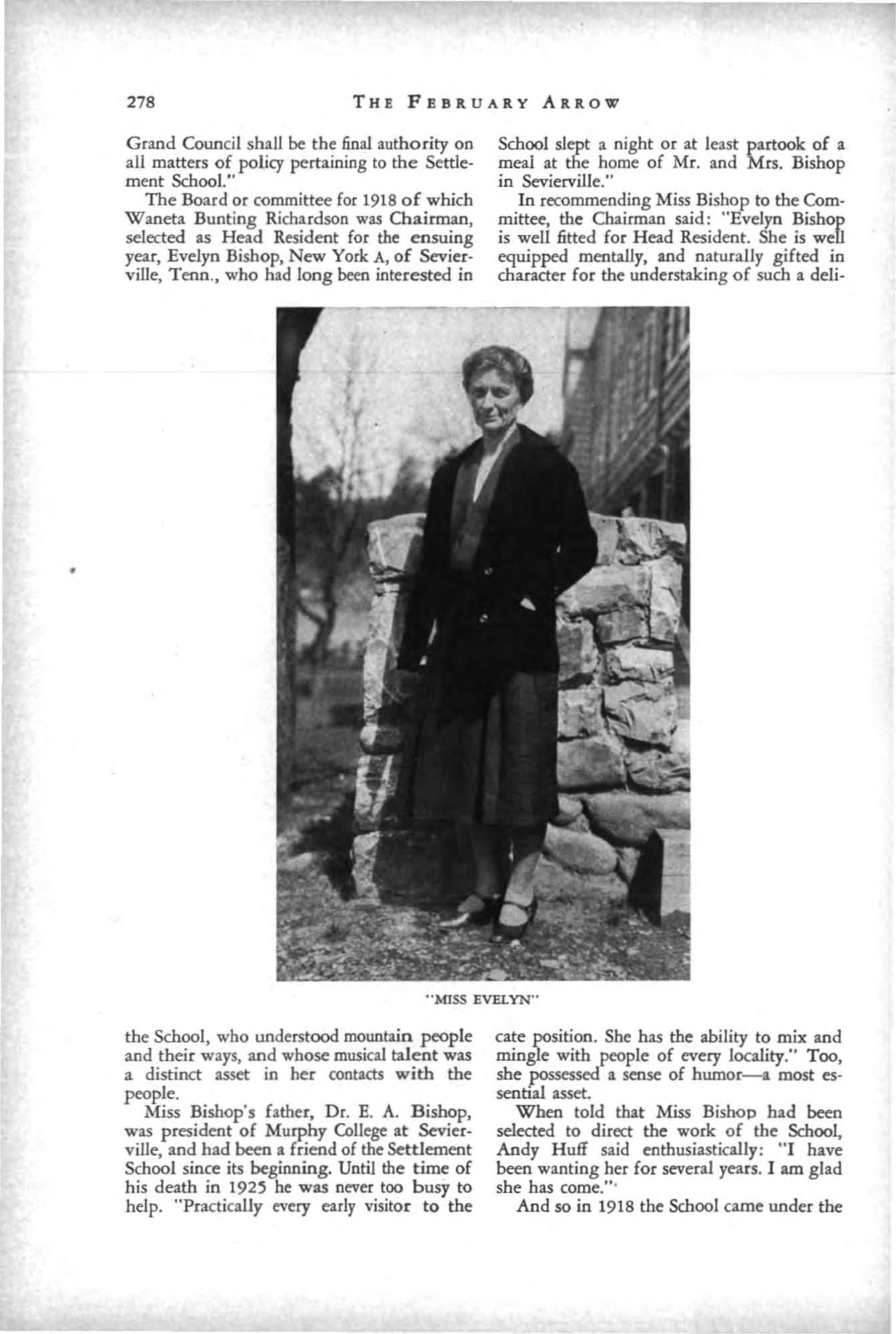
the School, who understood mountain people and their ways, and whose musical talent was a distinct assd: in her contacts with the people.
Miss Bishop's fathe r, Dr E. A Bishop, was president of Murphy College at Sevierville, and bad been a friend of the Settlement School since its beginning. Until the time of his death in he was never too busy to help. "Practically every early visitor to the
School slept a night or at least partook of a meal at the home of Mr. and Mrs_ Bishop in Sevierville. II
In recommending Miss Bishop to the Committee, the Chairman said: "Evelyn Bishop is well fitted for Head Resident. She is well equipped mentally, and naturally gifted in character for the understaking of such a deli -
cate position. She bas the ability to mix and mingle with people of every locality ." Too , she }'?ssessed a sense of bumor-a most essenbal asset_
When told that Miss Bishop bad been selected to direct the work of the School, Andy Huff said enthusiastically: " I have been wanting her for several years. 1 am glad she has come:"
And so in 1918 the School came under the
direction of one who steered its course through fifteen years of progress, some of which were the most strenuous yeats in the history of the School.
When "Miss Evelyn," as everyone called her, took up her duties as Head Resident there also came to the School, Aunt Lizzie Reagan, a mountain woman, whose chief object in coming was to take care of the Prickett baby, the infant son of Mr. and Mrs. Norman Prickett of the School staff. Aunt Lizzie soon took care of everyone and became the regular School housekeeper. She was a most important link between the mountain people and the School. Everyone depended upon her . She insisted on milking the row ; she made the butter; picked wild berries and canned them; helped with the garden; and kept the house in order-though she did say one morning, "You uos mustn't patronize after me." Aunt Lizzie was a true mountain woman but she admitted later after living in the new model cottage that living in our " tight house" had "plumb bodaciously sp'iled" her for a cabin such as numerous ch ildren and grandchildren found very com· foctable. Aunt Lizzie knew everyone for miles around and their family history and after the nurse came to the School, few long trips were ever taken without first consulting Aunt Lizzie about direction, roads, and family. For nine years she was on the &hool staff.
As changes came, however, she did not enjoy the bustle and the work was too hard for one of her age, so she bought a little place on Mill Creek, with a house at the brow of the hill, from which she can look down on the valley and says she "hears our dinner bell and some days watches us go to dinner." She still puts in crop, garden, and has her pet cow. When the School bought the big old· fashioned loom that used to belong to Aunt Lydia Whaley, it couldn't be set up. After 35 years away from a loom, Aunt Lizzie set up the loom, put on a warp and threaded it. Not a single thing had she forgotten in all that time . In fact, she knew many a little turn that the weaving teacher had never heard of and Aunt Lizzie told her with great pride. She weaves and winds bobbins for others. In appreciation of all that Aunt Lizzie had done and had meant to the School, the Settlement School Committee presented to her a Pi Beta Phi Patron ess pin.
To return to 1918-Dr. May L. Keller represented the Committee at the regular opening of the School session in August and
was much pleased and amazed to find so many changes in the School since her last visit.
Early in the fall, Mrs. Warner, Tennessee State Health Specialist, came to the School to talk to the mothers of the Burg at a Better Babies meeting. Since it was quite the usual thing to feed green beans , fried eggs, and
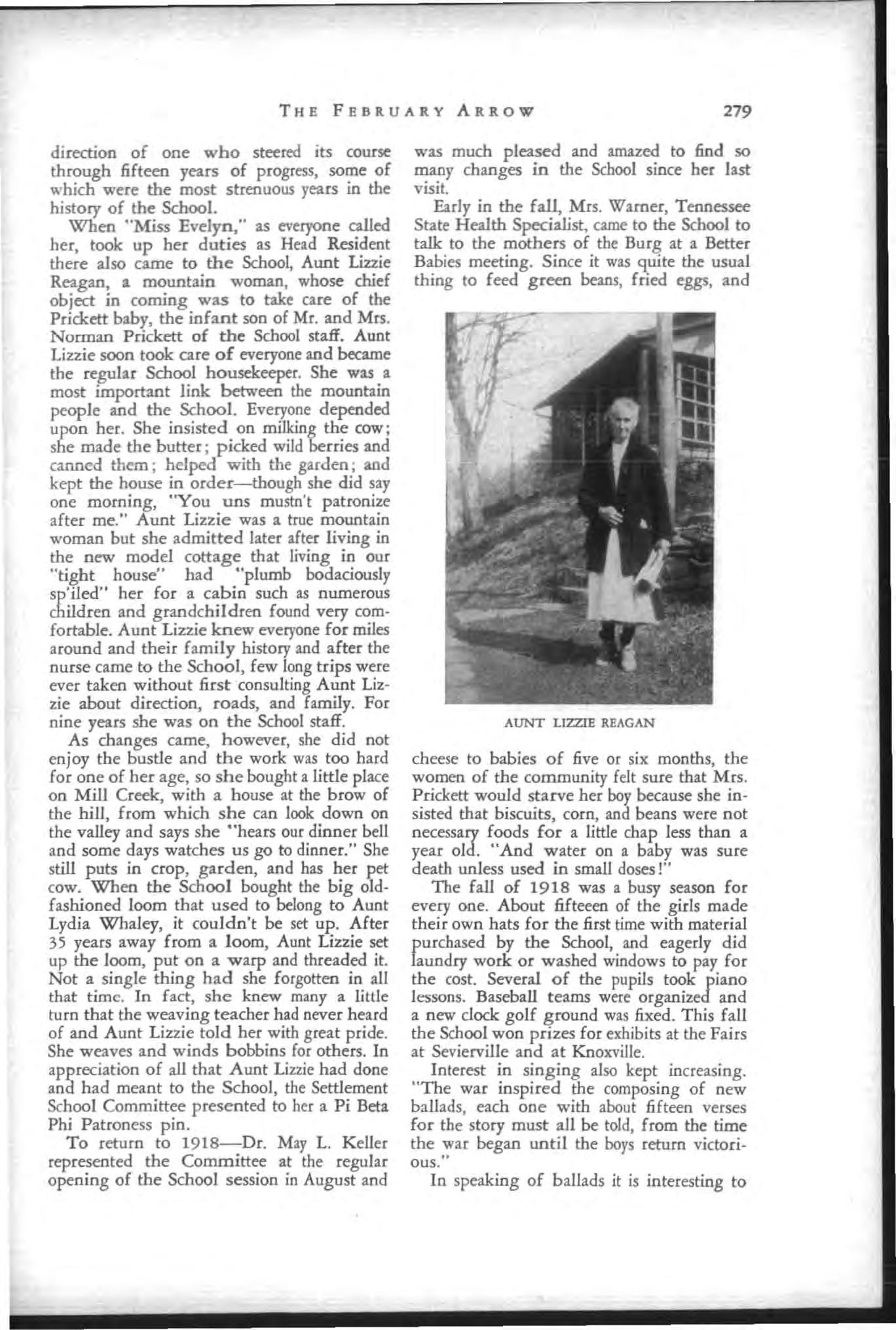
cheese to babies of five or six months, the women of the community felt sure that Mrs. Prickett would starve her boy because she in · sisted that biscuits, corn, and beans were not necessary foods for a little chap less than a year old. "And water on a baby was sure death unless used in small doses!"
The fall of 1918 was a busy season for every one. About fifteeen of the girls made their own hats for the first time with material purchased by the School, and eagerly did laundry work or washed windows to pay for the cost. Several of the pupils took !iano lessons. Baseball teams were organize and a new clock golf ground was fixed. This fan the School won prizes for exhibits at the Fairs at Sevierville and at Knoxville . Interest in singing also kept increasing. "The war inspired the composing of new ballads, each one with about fifteen verses for the story must all be told, from the time the war began until the boys return victorious."
In speaking of ballads it is interesting to
note in passing that a love of music and an ear for It seemed natural to nearly everyone on Little Pigeon. Many times the child learned a ballad first. Instead of hearing the child sing Mother Goose melodies, Our workers heard tots singing of the courtly days of old, the knights and "Iadyes" and often the tragic death of the lover. It was still the custom to have "singings" when a family moved into a new house, and when the young people wanted some entertainment or to cerebrate at holiday time they had a "sing."
Cecil Sharp of London visited that section of the country and in talking to young people in on e of the schools gave the history of some
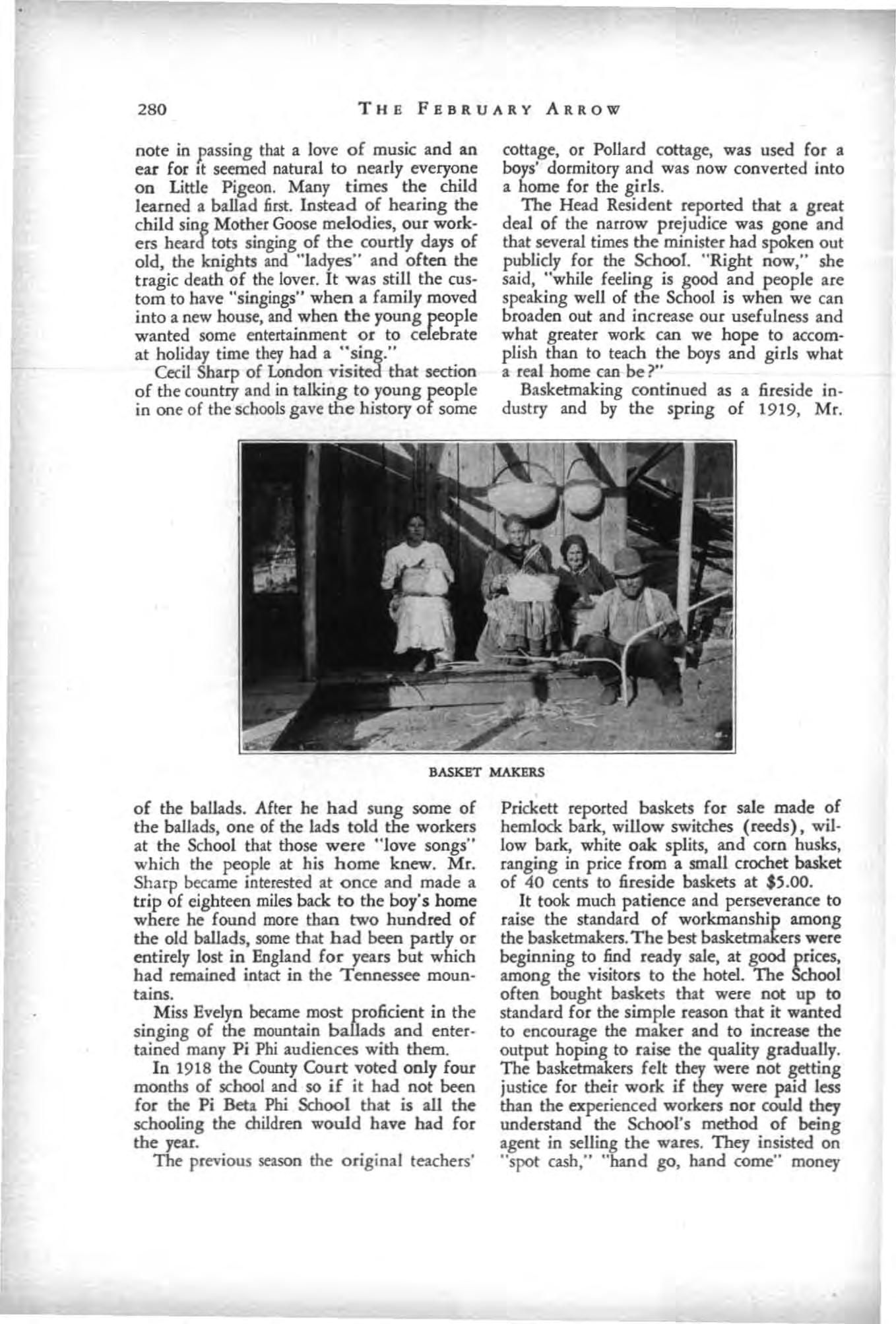
of the ballads. After he had sung some of the ballads, one of the lads told the workers at the School that those were "Iove songs" which the people at his home knew. Mr . Sh a rp became interested at on ce and made a trip of eighteen miles back to the boy's home where he found mare than two hundred of the old ballads, some th at had been partIy or entirely lost in England for years but which had remained intact in the Tennessee mountains .
Miss Evelyn became most proficient in the singing of the mountain ballads and entertained many Pi Phi audiences with them . In 1918 the County Court voted only four months of school and so if it had not been for the Pi Beta Phi School that is all the schooling the children would have had for the year.
The previ ous season the original teachers'
cottage, or Pollard cottage, was used for a boys' dormitory and was now converted into a home for the gi rls
The Head Resident reported that a great deal of the narrow prejudice was gone and that several times the minister had spoken out publicly for the School. " Right now ," she said, "while feeling is Rood and people are speaking well of the School is when we can broaden out and increase our usefulness and what greater work can we hope to accomplish than to teach the boys and gids what a real home can be?"
Basketmaking continued as a fireside industry and by the spring of 1919 , Mr
Prickett reported baskets for sale made of hemlock bark, wiUow switches (reeds), willow bark, white oak splits, and corn husks, ranging in price from a small crochet basket of 40 cents to fireside baskets at It took much patience and perseverance to raise the standard of workmanship among the basketmakers. The best basketmakers were beginning to find ready sale, at good prices, among the visitors to the hotel The School often bought baskets that were not up to standard for the simple reason that it wanted to encourage the maker and to increase the output hoping to raise the quality graduaUy. The basketmakers felt they were not getting justice for their work if they were paid less than the experienced workers nor could they understand the School's method of being agent in seUing the wares They insisted on "spot cas h ," "hand go , hand come" money
or they wouldn ' t worle, thus makiog it necessary for the School to do a great deal of managing to keep the work going,
Mr, Prickett reported in 1919 that "despite the ups and downs in basketdom, we have sold 1Jl the neighborhood of one thousand per year and thi5 income not only helps the native workers, but is helping to eqUIp the School with some very necessary things such as supplies for the cooking and sewint: classes and a few new tools for manual trairung,"
The second week of January, 1919, the the epidemic of influenza struck Gatlinburg, causing the closing of the School for two weeks, Within a day almost every person was down with the disease _ With no doctor within seven miles and no nurses anywhere the well ones, including the School staff, put their shoulders to the wheel. The people showed their confidence in the School by turning to it for aid and advice, Miss Evelyn directed the work among the sick and not one case proved fatal,
In writing to the Chairman of the Settlement School Committee, Dr. Massey of Sevierville said : "I must express to you the great work that Miss Bishop is doing in the community, Last winter, during the flu epidemic, she went into the homes and nursed and cared for the sick, I believe her physical powers were kept up by her confidence in God and her loyalty to goodness. Since that great scourge the sentiment is eotirely changed toward the School. Before this I noticed there was aJrejudice, very largely from a denomination standpoint. They were afraid that this was some secret way in which some denominational tribe was to be educated." The doctor also told of one case where Miss Bishop was his only assistant in amputating the limb of a man hurt in a mill. He said that her work was equ 1 to any trained nurse he had ever had.
To malee things more difficult just at this time, Mrs. Prickett's health made it necessary for her to discontinue her work in the schoolroom, and, on February I, Mr. Prickett unexpectedly tendered his resignation. "Through all of this upheaval Miss Bishop was equal to the occasion and by reason of her familiarity with local conditions and her wide acquaintance, she was able to fill the vacancies immediately and the work went 00."
In the spring which followed the /lu epidemic new duties were undertaken by the School staff in helping to revive ioterest in
the church and Sunday School affairs by permitting the women's society of the church to hold meetings in the teachers' cottage; and in view of the fact that the Tennessee women had beeo giveo the vote for the first time, some civic training for them was felt to be a necessity and was given.
Having steered the work of the Committee successfully through the war period, Mrs. Richardson felt she could no longer assume the heavy responsibility and upon her resignation in August, 1919, Abbie Langmaid, Minnesota A, became the Chairman of the Committee. Miss Langmaid bad been a member of the School staff a few months in 1913 and reported upon her visit to Gatlinburg in 1920 that sbe was unprepared for the wonderful change which haa taken place in seven years. "Only among such a leaple 'uneducated but highly cultured' an only with the zealous, wise, untiring work of many Pi Phis could results such as these have been accomplished," she said.
Up to this time the work of the School had necessarily for the most part been concentr.ted upon the work in the grades and with community visiting. The teachers had found it • great task to keep the pupils in school regularly and the home visiting h.d helped this problem in some respects.
Now with splendid progress being made at the School there came the problem of what could be done to help the pea!?le back on the creeks--in Sugarlands and LIttle River, up Baskins and Spruce Flats, and Mill Creek, and Little Dudley.
Four adjoining districts wished to give up their county schools which they recognized were inferior to the Pi Phi School in equipment, length of school year, and quality of teaChing, and to send all the children to our School. Owing to lack of accommodations and funds for adequate teaching force for so large and sudden an addition, only one of the petitioning districts could be admitted.
Projects under consideration during Miss Langmaid's lirst year as Chairman were: the purchase of more land; the installing of a light plant; the hiring of a visiting nurse; the making of some provision for older boys to earn their "schoolmg"; and the establishing of a small furniture factory to give the older boys something to do
In the summer of 1919 Pi Beta Phi had an exhibit at the Untenary in Columbus, Ohio, where a spinning wheel and loom
were in operation much of the time.
An experiment was tried at the School in the fall session of 1919 called the "Country Home." The girls brought their supplies from their home, did all their work auring the week, and then on Friday afternoon packed up again and returned home. Abbey Runyan of the School stafllived in the home with the girls and supervised their work.
Especial effort was made during the year to, have the farm produce as much of the liv·
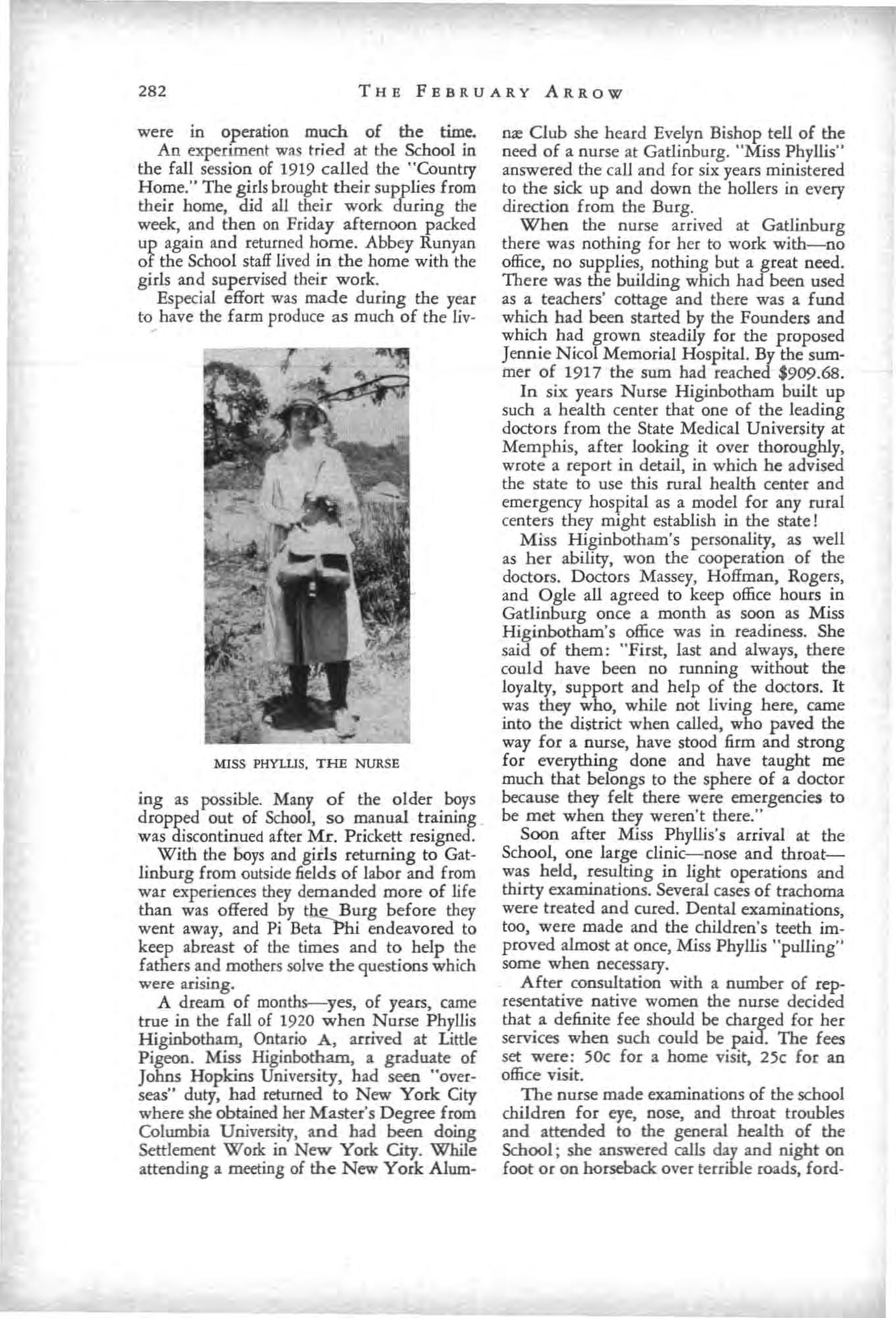
ing as possible. Many of the older boys dropped out of School, so manual training was discontinued after Mr. Prickett resigned.
With the boys and girls returning to Gatlinburg from outside fields of labor and from war experiences they demanded more of life than was offered by Burg befo« they went away, and Pi Beta Phi endeavored to keep abreast of the times and to help the fathers and mothers solve the questions which were arising.
A dream of months--yes, of years, came true in the fall of 19 20 when Nurse Phyllis Higinbotham, Ontario A, arrived at Little Pigeoo. Miss Higinbotham, a graduate of Johns Hopkins University, had seen "overseas" duty, had returned to New York City where she obtained her Master's Degree from Columbia Un ivers ity, and had been doing Settlement Work in New York Gty. While attending a meeting of the New York Alum-
nao Club she heard Evelyn Bishop tell of the need of a nurse at Gatlinburg. "Miss Phyllis" answered the call and for six years ministered to the sick up and down the hollers in every direction from the Burg . When the nurse arrived at Gatlinburg there was nothing for her to work with-no office, no supplies, nothing but ajreat need. There was the building which ha been used as a teachers' cottage and there was a fund which had been started by the Founders and which had grown steadily for the proposed Jennie Nicol Memorial Hospital. By the summer of 1917 the sum had reached $909 68.
In six years Nurse Higinbotham built up such a health center that one of the leading doctors from the State Medical University at Memphis, after looking it over thoroughly, wrote a report in detail, in which he advised. the state to use this rural health center and emergency hospital as a model for any rural centers they mIght establish in the state!
Miss Higinbotham's personality, as well as her ability, won the cooperation of the doctors. Doctors Massey, Hoffman, Rogers, and Ogle all agreed to keep office hours in Gatlinburg once a month as soon as Miss Higinbotham's office was in readiness. She said of them: "First, last and always, there could have been no running without the loyalty, support and help of the doctors. It was they who, while not living here, came into the district when called, who paved the way for a nurse, have stood firm and strong for everything done and have taught me much that belongs to the sphere of a doctor because they felt there were eonergencies to be met when they weren't there."
Soon after Miss Phyllis'S arrival at the School, one large clinic- nose and throatwas held, resulting in light operations and thirty examinations. Several cases of trachoma were treated and cured. Dental examinations, too, were made and the children's teeth improved almost at once, Miss Phyllis "pulling " some when necessary.
After consultation with a number of representative native women the nurse decided that a definite fee should be charged for her services when such could be paid. The fees set were: 50c for a home visit, 25c for an office visit.
The nurse made examinations of the school children for eye, nose, and throat troubles and attended to the general health of the School; she answered calls day and night on foot or on horseback over terrible roads, ford-
ing swollen streams, ploughing through mud , or negotiating rickety footlogs. One night Miss Evelyn and Miss Phyllis carried a lad with a broken leg down a mountainside and over one of those footlogs so that he could be cared for in the little School hospital.
There were no telephones . And since the doctors lived long distances away, the responsibility of a doctor as well as a nurse fell upon Miss Higinbotham . Having been trained to act only on doctor's orders there were times when all that training h ad to be forgotten and the emergency met. Saddle bags had to carry every kind of supply and utensil that might be needed. The nurse had three sets of equipment: one for office use, one for saddle bags, and one for the obstetrical bag, but she never went on the obstetrical cases unless the people
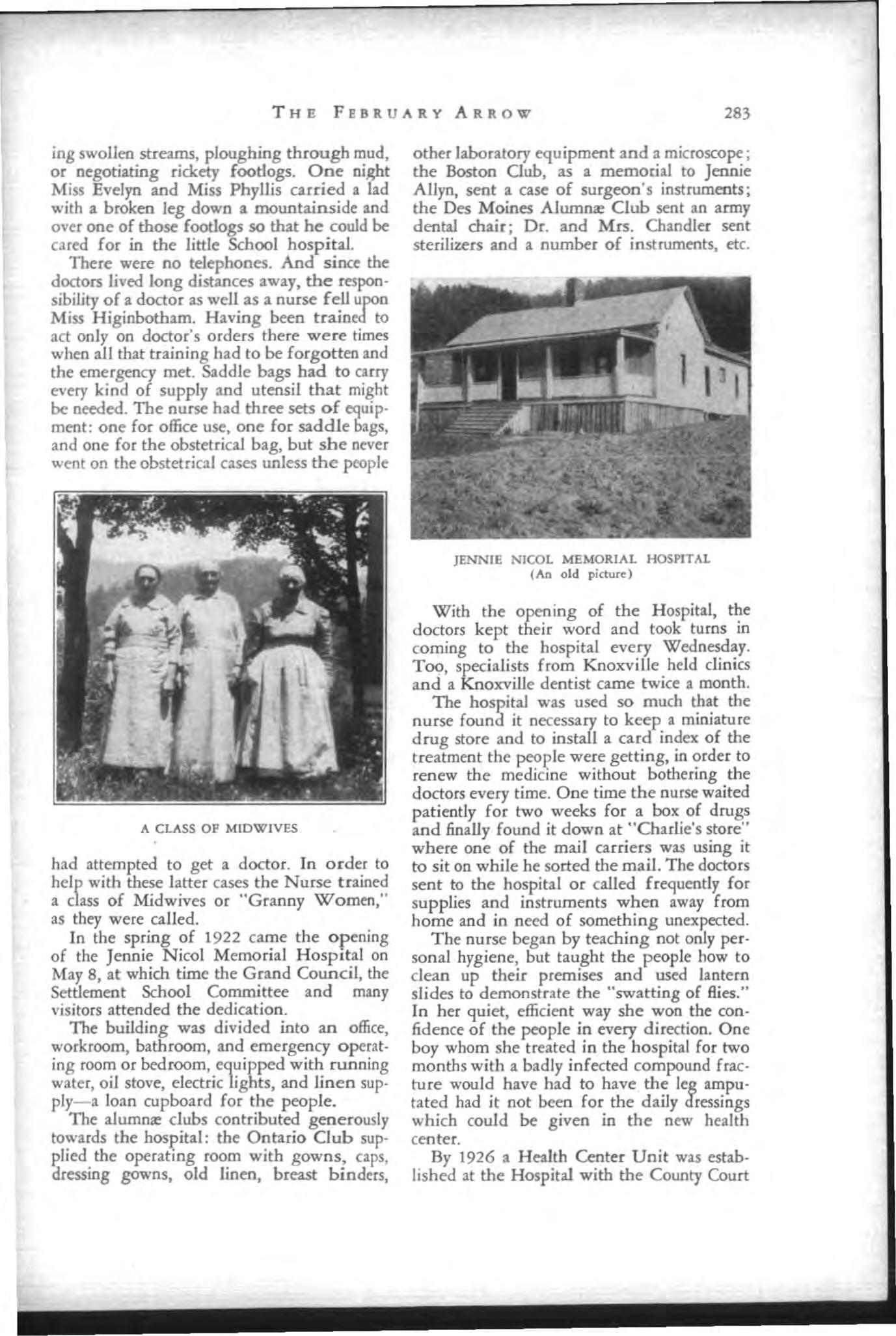
had attempted to get a doctor. In oeder to help with these latter cases the Nurse trained a class of Midwives or "Granny Women," as they were called.
In the spring of 1922 came the opening of the Jennie Nicol Memorial HospItal on May 8, at which time the Grand Council, the Settlement School Committee and many visitors attended the dedication.
The building was divided into an office , workroom, bathroom, and emergency operating room or bedroom, equipped with running water, oil stove, electric lights, and linen supply- a loan cupboard for the people_
The a1umn., clubs contributed geoerously towards the hospital: the Ontario Club supplied the operating room with gowns, caps , dressing gowns, old linen , breast binders,
other laboratory equipment and a microscope; the Boston Club , as a memo,ial to Jennie Allyn, sent a case of surgeon 's instruments; the Des Moines Alum"", Club sent an aemy dental chair ; Dr and Mrs. Chandler sent sterilizers and a number of instruments. etc.
With the opening of the Hospital, the doctors kept their word and took turns in coming to the hospital every Wednesday. Too, specialists from Knoxville held clinics and a Knoxville dentist came twice a month .
The hospital was used SO much that the nurse founa it necessary to keep a miniature drug store and to install a card index of the treatment the people were getting, in order to renew the medicine without bothering the doctors every time. One time the nurse waited patiently for two weeks for a box of drugs and /ioaUy found it down at "Charlie's store" where one of the mail carriers was using it to sit 00 while he sorted the mail. The doctors sent to the hospital or called frequently for supplies and instruments when away from home and in need of something unexpected.
The ourse began by teaching not only personal hygiene. but taught the people how to clean up their premises and used lantern slides to demonstrate the "swatting of Bies." In her quiet, efficient way she won the confidence of the people in every direction. One boy whom she treated in the hospital for two months with a badly infected compound fracture would have had to have the leg amputated had it not been for the daily dressings which could be given io the new health center.
By 1926 a Health Center Unit was established at the Hospital with the County Court
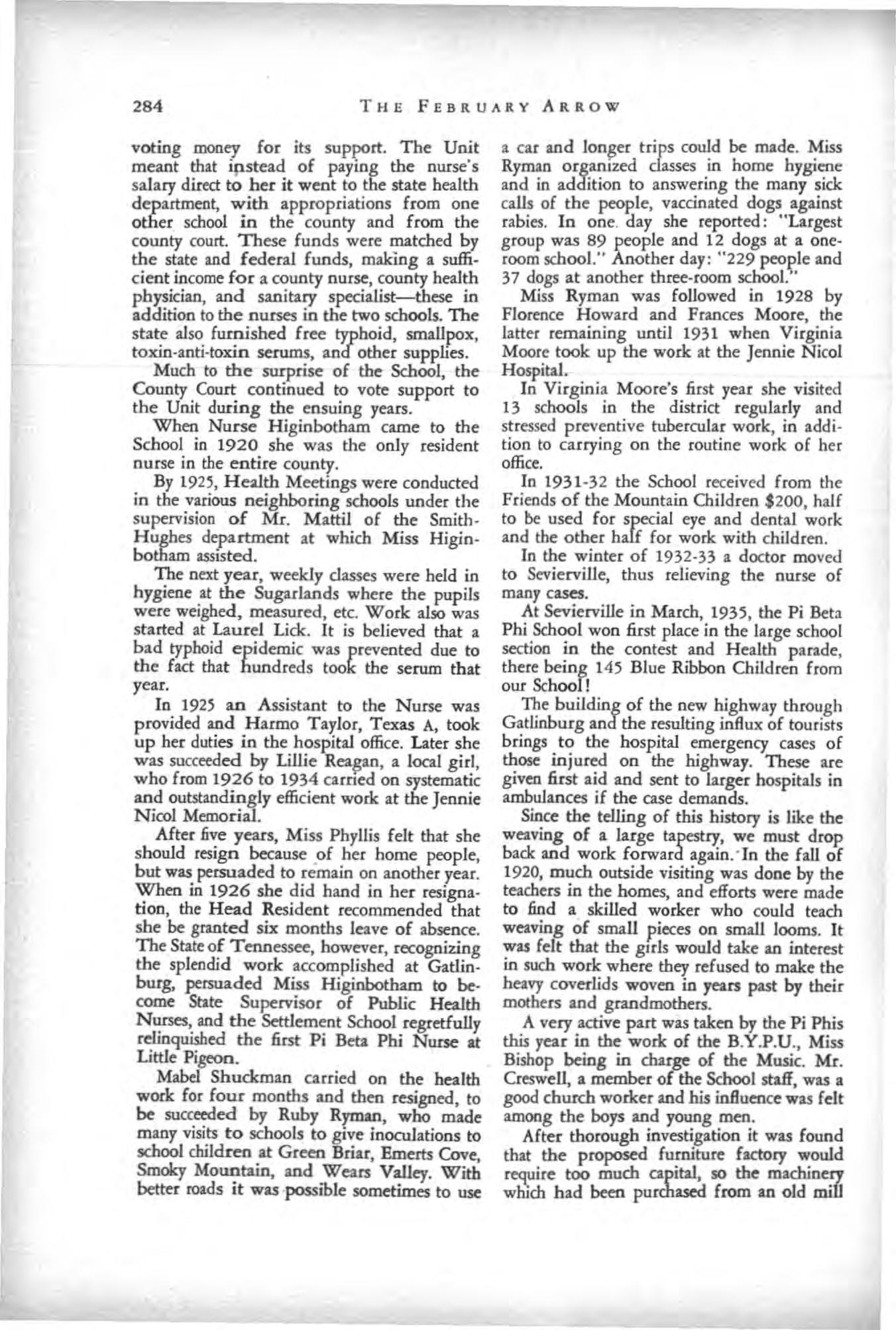
voting money for its support. The Unit meant that ip.stead of paying the nurse's sala ry direct to her it went to the state health department, with appropriations from one oilier school in the county and from the county court. These funds were matched by the state and federal funds, making a sufficient income for a county nurse, county health physician, and sanitary specialist-these in addition to the nurses in the two schools, The state also furnished free typhoid, smallpox, toxin ·anti -toxin serums, ana other supplies .
Much to the surprise of the School, the County Court continued to vote support to the Unit during the ensuing years.
When Nurse Higinbotham came to the School in 1920 she was the only resident nurse in the entire county.
By 192', Health Meetings were conducted in the various neighboring schools under the supervision of Mr. Mattil of the SmithHughes department at which Miss Higinbotham assisted.
The next year, weekly classes were held in hygiene at the Sugarlands where the pupils were weighed, measured, etc. Work also was started at Laurel Lick. It is believed that a had typhoid epidemic was prevented due to the fact that hundreds took the serum that year.
In 192' an Assistant to the Nurse was provided and Harmo Taylor, Texas A, took up her duties in the hospital office. Later she was succeeded by Lillie ltea$an , a local girl , who from 1926 to 1934 carned on systematic and outstandingly efficient work at the Jennie Nicol Memorial.
After five years, Miss Phyllis felt that she should resign because of her home people, but was persuaded to remain on another year. When in 1926 she did hand in her resignation, the Head Resident recommended that she be granted six months leave of absence.
The State o f Tennessee, however, recognizing the splendid work accomplished at Gatlinburg, persuaded Miss Higinbotham to become State Supervisor of Public Health Nurses, and the Sett1ement School regretfully relinquished the first Pi Beta Phi Nurse at Little Pigeon.
Mabel Shuckman carried on the health work for four months and then resigned, to be succeeded by Ruby Ryman , who made many visits to schools to give inoculations to school children at Green Briar, Emerts Cove, Smoky Mountain, and Wears Valley. With better roads it was possible sometinnes to use
a car and lon$er trips could be made . Miss Ryman organized classes in home hygiene and in addition to answering the many sick calls of the people, vaccinated dogs against rabies In one Clay she reported: "Largest group was 89 people and 12 dogs at a oneroom school." .Another day : "229 people and 37 dogs at another three-room school."
Miss Ryman was followed in 1928 by Florence Howard and Frances Moore, the latter remaining until 1931 when Virginia Moore took up the work at the Jennie Nicol Hospital.
In Virginia Moore's first year she visited 13 schools in the district regularly and stressed preventive tubercular work, in addition to carrying on the routine work of her office.
In 1931-32 the School received from the Friends of the Mountain Children $200 , half to be used for special eye and dental work and the other half for work with children.
In the winter of 1932-33 a doctor mov ed to Sevierville, thus reiieving the nurse of many cases.
At Sevierville in March, 1935, the Pi Beta Phi School won first place in the large school section in the contest and Health parade , there being 145 Blue Ribbon Children from our School!
The building of the new highway through Gatlinburg and the resulting influx of tourists brings to the hospital emergency Cases of those injured on the highway. These are given first aid and sent to larger hospitals in ambulances if the case demands.
Since the telling of this history is like the weaving of a large tapestry, we must drop back and work forward again. ' In the fall of 1920, much outside visiting was done by the teachers in the homes, and efforts were made to find a skilled worker who could teach weaving of small pieces on small looms . It was felt that the girls would take an interest in such work where they refused to make the heavy coverlids woven in years past by their mothers and grandmothers
A very active part was taken by the Pi Phis this year in the wock of the BY P U ., Miss Bishop being in charge of the Music. Mr. Creswell, a member of the School staff, was a good chunch worker and his influence was felt among the boys and young men .
After thorough investigation it was found that the proposed furniture factory would require too much capital, SO the machinery which had been purchased from an old mill
was sold to a local group, and a new industry was started which gave employment to several men of the Burg _
At this time the Chairman of the Committee began to talk of plans for the future when an Auditorium or Community House should be built, "where all neighborhood meetings could be held-farmers' dubs, political meetings, patriotic homecomings, moving pictures, school or neighborhood dramatics, and social gatherings, as well as clinics," Dormitories, too, were needed.
In her annual report the Chairman made an appeal for more land and buildings, equ ipment and endowment funds, in order to furnish opportunity not alone to those children "fo r whom the present plant provides, but to those several hundred more living within a radius of a few miles."
During the year sixty-seven acres of land "more or less," generally considered the most desirable that could be acquired for the School, were purchased_ A Delco plant, large enough not only for the School but for lighting the homes of Mr. Hull and Mr. Maples, the hotel, and the churcb was installed, and other improvements were added.
Melinda Stuart, as a member of the committee, gave much time to directing the finances of the School, and with the contributions coming in splendidly from dubs and chapters, the School lIourished.
For two rears the School had been offering first -yeu hIgh school work_ But for the advanced work the pupils were going away whenever possible. One went to Athens University, Freparatory department; another bor. and gir went to a North Carolina schoo , some attended Murphy College, and several went to Carson Newman.
With the addition to the School staff in 1920 of Lucy Nicholson of Berea, to teach weaving, interest was immediately revived among the women of the Burg_ Two women, Mrs. Anderson and Mary Ogle, "Marsh's wife," had their own looms made and started work at home_ Mrs. Anderson soon began selling her rugs and table scarfs to the tourists at the hotel.
Three looms were added to the School equipment in 192 L Six looms were reported in operation in the School in 1921-22, and six looms were installed in various homes, the girls -and women having many artides ready for the summer hotel trade.
As fast as possible the School to take these products believing that, IE the
weaving prospered as the basket business had done in the past few years, it " should eventually be a source of income to the School," as well as to the people_
In order to popularize the Fireside Industries the Chairman of the Committee, Nita Hill Stark, got out a new booklet Personal letters were sent to each president and secretary of the alWIlIlZ dubs and slides of the School were prepared and displayed at the Eastern Conference in the spring of 1924.
The Committee was especially determined that the development of the weaving must be stressed and inspiration provided for new desi80s. new combinations of colors t and originality in the weaving of rugs, coverlets and baskets.
In 1925 Winogene Redding , a very splendid weaving teacher, was employed full time. She walked miles and miles through those cold winter months, instructing the women in this revived art.
As the standard of quality increased in the weaving, orders increased and soon the sales began to mount. From $1,000 in 1923 they jumped to $14,000 in 1927.
Several exhibits were sent away from the School in 1927 and it was found that the work of our School compared well with that from other well-known places. The demand for our work became so great that it was im· possible to keep up with the orders. The school girls became interested in weaving the smaller pieces.
It was not at all uncommon for a woman with from four to seven children to care for, to weave three and sometimes five guest towels in a day. One woman walked five miles with her young daughter one cold morning in winter with high hopes to learn to weave.
"I've worked hard all my life," she said. "I started to hoe corn and ' taters when I was a little 'un an' I been haein' ever since. I've had nine chillun, seven are livin ' an ' two are dead. I've lived in the same hoUer for twenty years--sometimes I think I'd like a sight to change. When I heered of this weaving I jest thought I'd quit workin' in the field an' let the young uns do hit. I'm fortyfour year old an' I'm tired, so I aim to work inside now."
For some women like this, weaving is emancipation from tending the crop; for others the money it brings means new shoes, a new dress for one of the cbildren, a poke of meal for the family, or a new and coveted piece of furniture.
In 1928, Allie McCarter, one of the School's own $raduates, taught the practical work in weaving while Miss Redding gave the notebook instruction.
Izora Connor, one of the local women, seems to have an inborn sense of color and makes many new color schemes in and some of the work bears her name 10 consequence.
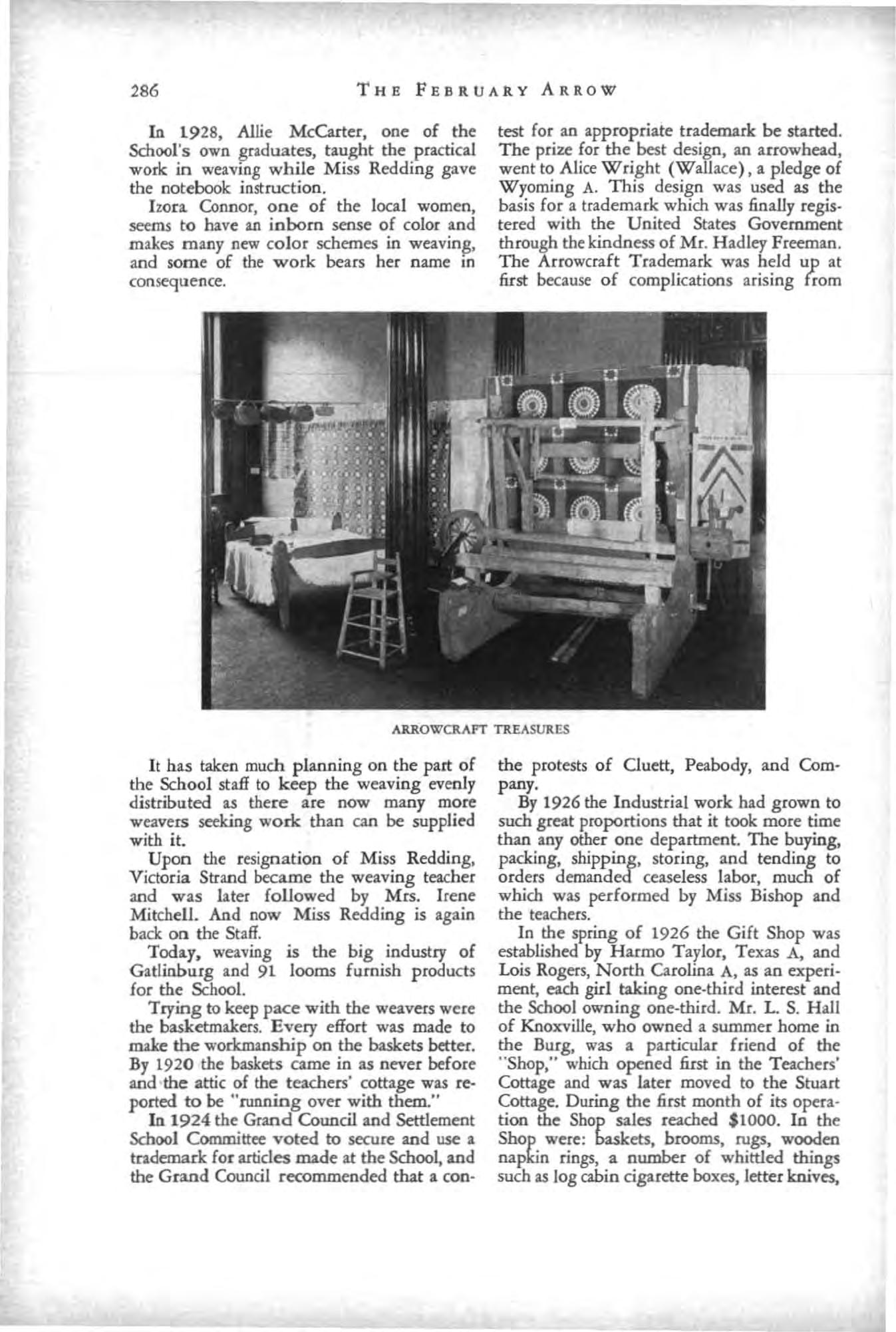
It has taken much planning on the part of the School staff to keep the weaving evenly distributed as there are now many more weavers seeking work than can he supplied with it.
Upon the resignation of Miss Redding , Victoria Strand became the weaving teacher and was later foUowed by Mrs. I rene Mitchell. And now Miss Redding is again back on the Staff.
Today, weaving is the big industry of Gatlinburg and 91 looms furnish products for the School.
Trying to keep pace with the weavers were the basketmakers. Every effort was made to make the workmanship on the baskets better _ By 1920 the baskets came in as never before and the attic of the teachers' cottage was reported to be " running over with them."
In 1924 the Grand Council and Settlement School Committee voted to secure and use • trademark for articles made at the School, and the Grand Council recommended that a con-
test for an appropriate trademark he started. The prize for the best design, an arrowhead, went to Alice Wright (Wallace ), a pledge of Wyoming A. This design was used as the basis for a trademark which was finally registered with the United States Government through the kindness of Mr Hadley Freeman The Arrowcraft Trademark was held up at first because of complications arising from
the protests of Guett, Peabody, and Company.
By 1926 the Industrial work had grown to such great proportions that it took more time than any other one department. The buying, paclcing, shipping, storing, and tending to orders demanded ceaseless labor, much of which was performed by Miss Bishop and the teachers.
In the spring of 1926 the Gift Shop was established by Harmo Taylor, Texas A, and Lois Rogers , North Carolina A, as an experiment, each girl taking one-third interest and the School owning one-third. Mr. L. S. Hall of Knoxville, who owned a summer home in the Burg, was a particular friend of the " Shop, " which opened first in the Teachers' Cottage and was later moved to the Stuart Cottage. During the first month of its operation the Shop sales reached $1000. In the Shop were: baskets, brooms, rugs, wooden napkin rings, a number of whittled things such as log cabin cigarette boxes, Jetter knives,
salad sets of rhododendron, toasting forks , doll furniture, fans of pressed rye stalks, pillowtops, bags, towels, balsam pillows, lzorie runners, hookM rugs, etc.
Although the trade at the Sbop during the summer was most satisfactory the big sale of and the heavy work aune usually een September and December when the shipments were made to the alumnz clubs. During that fall the &hool shipped $10,000 worth of products, the work of sbipping be· ing attended to by LaDelle Allen, Winogene Redding, and Evelyn Bishop.
With the success of the Gift Shop proven, the decision was made in 1927 to place the products in the Arrowcraft Shop to be kept open the entire year and to be managed by one person on full time
It is interesting to note that some of the first things offered for sale by the Shop were made by Richard Ogle, whose father had been taught basketmaking and broom tying by an Indian .
Lois Rogers returned to Gatlinburg in April, 1927 , and opened the Arrowcraft Shop, assisted later by Eugenia Dilworth, Texas A. The following faU the old school building at the junction of Baskins and Little Pigeon, was moved back from the road and a new addition built on, converting it into a permanent Arrowcraft Shop. LaDeUe Allen took charge. Sales of the products have n",·er slackened. In 1929 quilts and hooked mats were added to the weaving and baskets, next furniture cJaimed especial attention.
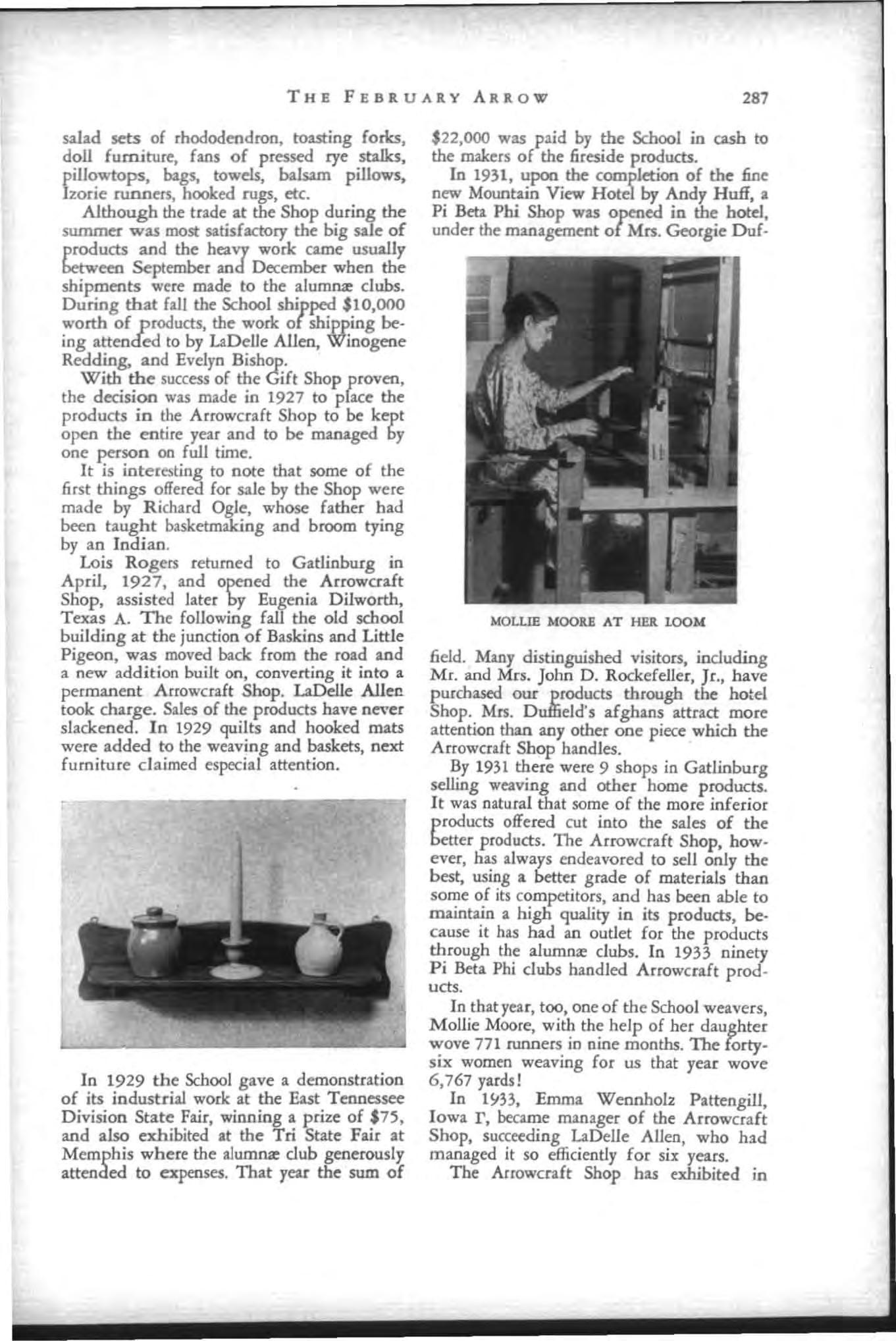
In 1929 the School gave a demonstration of its industrial work at the East Tennessee Division State Fair, winning a prize of $7S, and also exhibited at the Tri State Fair at Memphis where the alum"", club generously attended to expenses . That year the sum of
$ 22,000 was paid by the &hool in cash to the makers of the fireside products.
In 1931, upon the completioo of the fine new Mountain View Hotel by Andy Huff, a Pi Beta Phi Shop was opened in the hotel, under the management of Mrs . Georgie Duf·
field . Many distinguished visitors, including Mr. and Mes. John D. Rockefeller, Jr., have purchased our products through tbe hotel ShOp. Mrs. Duffield , afghans attract more attention than any other one piece which the Arrowcraft Shnp handles.
By 1931 there were 9 sbops in Gatlinburg selliog weaving and other home products. It was natural that some of the more inferior products offered cut into the sales of the better products. The Arrowcraft Shop, how· ever, has always endeavored to sell only the best, using a better grade of materials than some of its competitors, and has been able to maintain a high quality in its products, be. cause it has had an outlet for the products through the alumna! clubs. In 1933 ninety Pi Beta Phi clubs handled Arrowcraft prod· ucts.
In that year, too, one of the &hool weavers, Mollie Moore, with the help of her daughter wove 771 runners in nine months. The fortysix women weaving for us that year wove 6,767 yards!
In Il133, Emma Wennholz Pattengill, Inwa r, became manager of the Arrowcraft Shop, succeeding LaDelle AUen, who had managed it so efficiently for six years.
The Arrowcraft Sbop has exhibited in
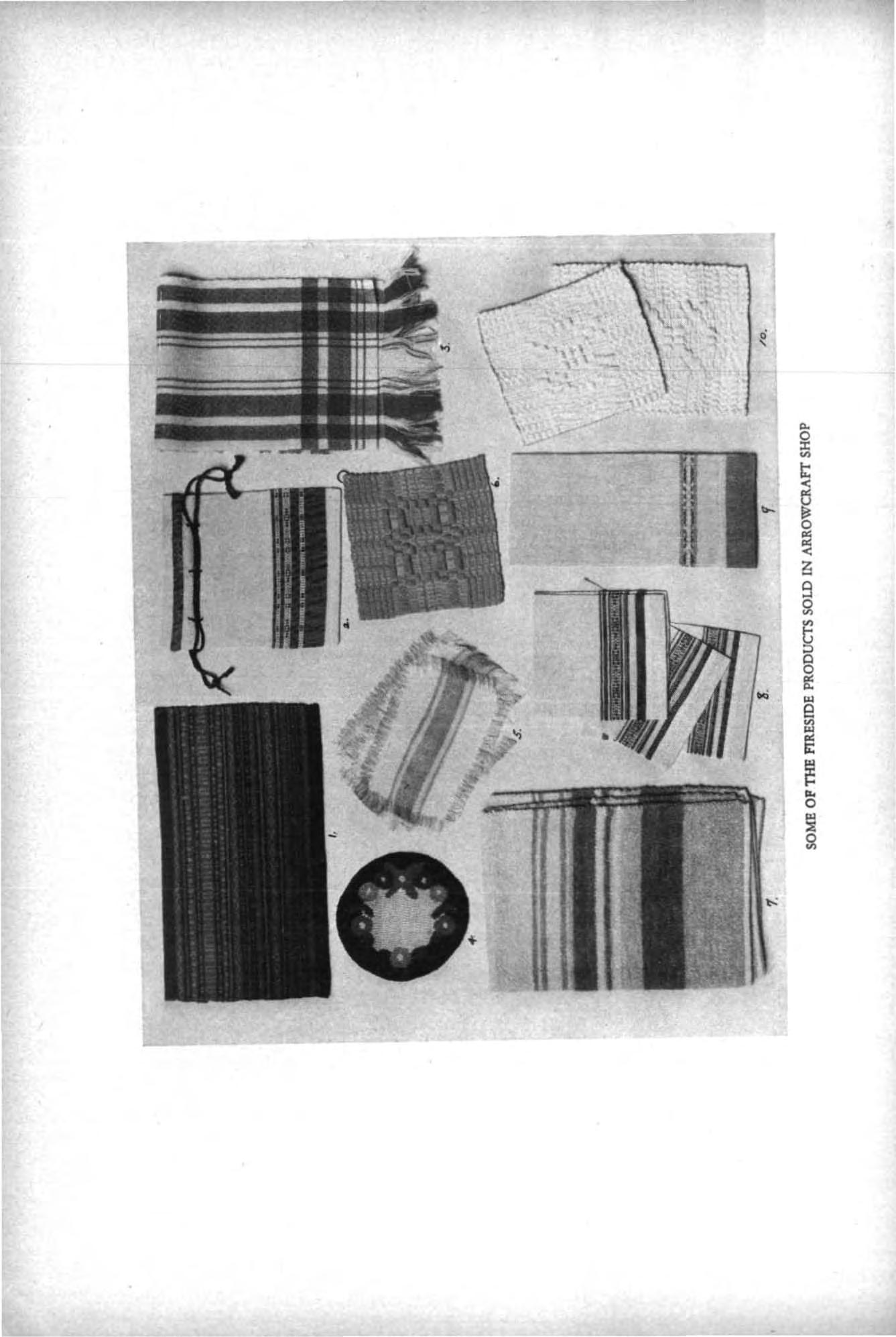
some of the outstanding art exhibits in the cou ntry, including that of the Decorative Arts by American Contemporary Artists, held .t Montclair Art Museum, Montclair, N .J ., the Dogwood Festival held at Chapel Hill, N C and the American Federation of Arts Exhibit in the Corcoran Art Gallery, Washington . D.C. , and at Berea, Ky., always winning high praise and most outstanding honors.
In 1935 the &hool decided to buy shares of stock of the Southern Highlanders, Inc., which will allow the sale of Accowcraft products at the Norris Shop , Norris Dam , about 60 miles from Gatlinburg.
Dresses woven by the girls at the Settle · ment &hool have been woen by two First Ladies. In 1926, the Kansas City Alumna: Club presented to Mrs. Coolidge a lovely dress pattern in soft cream wool, with a deep block pattern of self color, which had been woven by Edna McCarter; and in 1935 the Arrowccafters presented to Mrs. Roosevelt, a lovely pattern edged with a three-inch band of white Angora, woven by Maggie Parton, because of Mrs . Roosevelt's well known interest in handicrafts.
To return to the chronological order-in 1921, the Pi Beta Phi &hool had reached the place where its inlluence was being felt through the efforts of some of its fortner pupils who were teaching in the little isolated schoolhouses in various parts of the county. In that year Mattie Ogle Watson was teaching
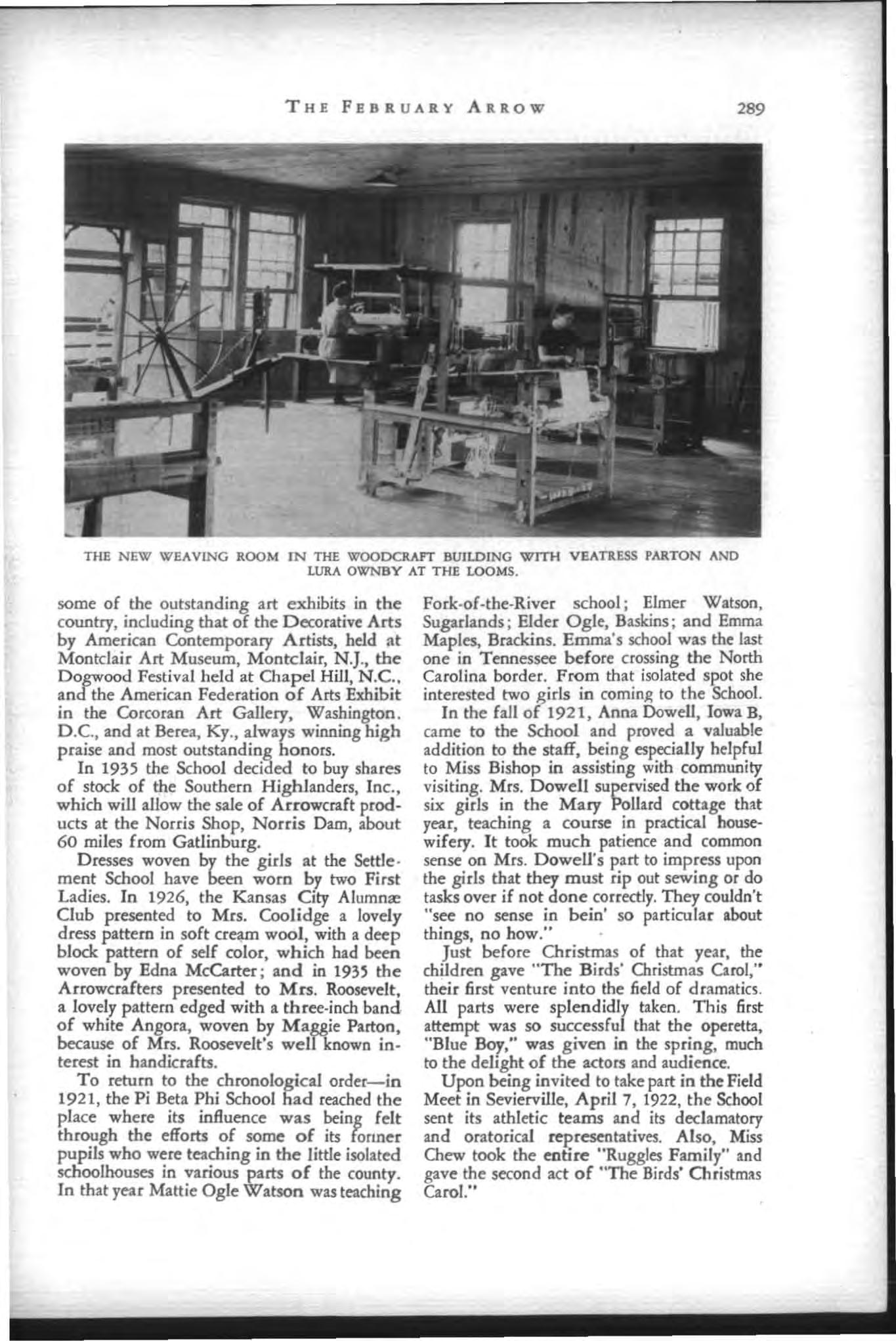
Fork-of-the-River school; Elmer Watson, Sugar lands ; Elder Ogle, Baskins; and Emma Maples, Brackins Emmas school was the last one in Tennessee before crossing the North Carolina border. From that isolated spot she interested two girls in coming to the &hool.
In the fall of 1921, Anna Dowell, Iowa B, came to the &hool and proved a valuable addition to the staff, being especially helpful to Miss Bishop in assisting with community visiting. Mrs. Dowell supervised the work of six girls in the Mary Pollard cottage that year, teaching a course in practical housewifery. It took much patience and common sense on Mrs. Dowell 's part to impress upon the girls that they must rip out sewing or do tasks over if not done correctly. They couldn't "see no sense in heiD' so particular about things, no how."
Just before Christmas of that year, the children gave "The Birds' Christmas Carol," their tirst venture into the field of dramatics All parts were splendidly taken. This tirst attempt was so successful that the operetta, "Blue Bor," was given in the spring, much to the delIght of the actors and audience.
Upon being invited to take part in the Field Meet in Sevierville, April 7, 1922, the School sent its athletic teams and its declamatory and oratorical representatives Also, Miss Chew took the entire "Ruggles Family" and gave the second act of "The Birds' Christmas Carol.'·
At the meet, Ethel Carr won the first prize in the oratorical contest; Estella Huff won ond place in the running jump and would have had first except for a technicality. This was the first scholastic meet in which our studen ts had ever participated.
The plays proved so successful in the School that they have been given every year, both the students and teachers taking part.
At the joint session of the Grand Council and the Settlement School Committee held in
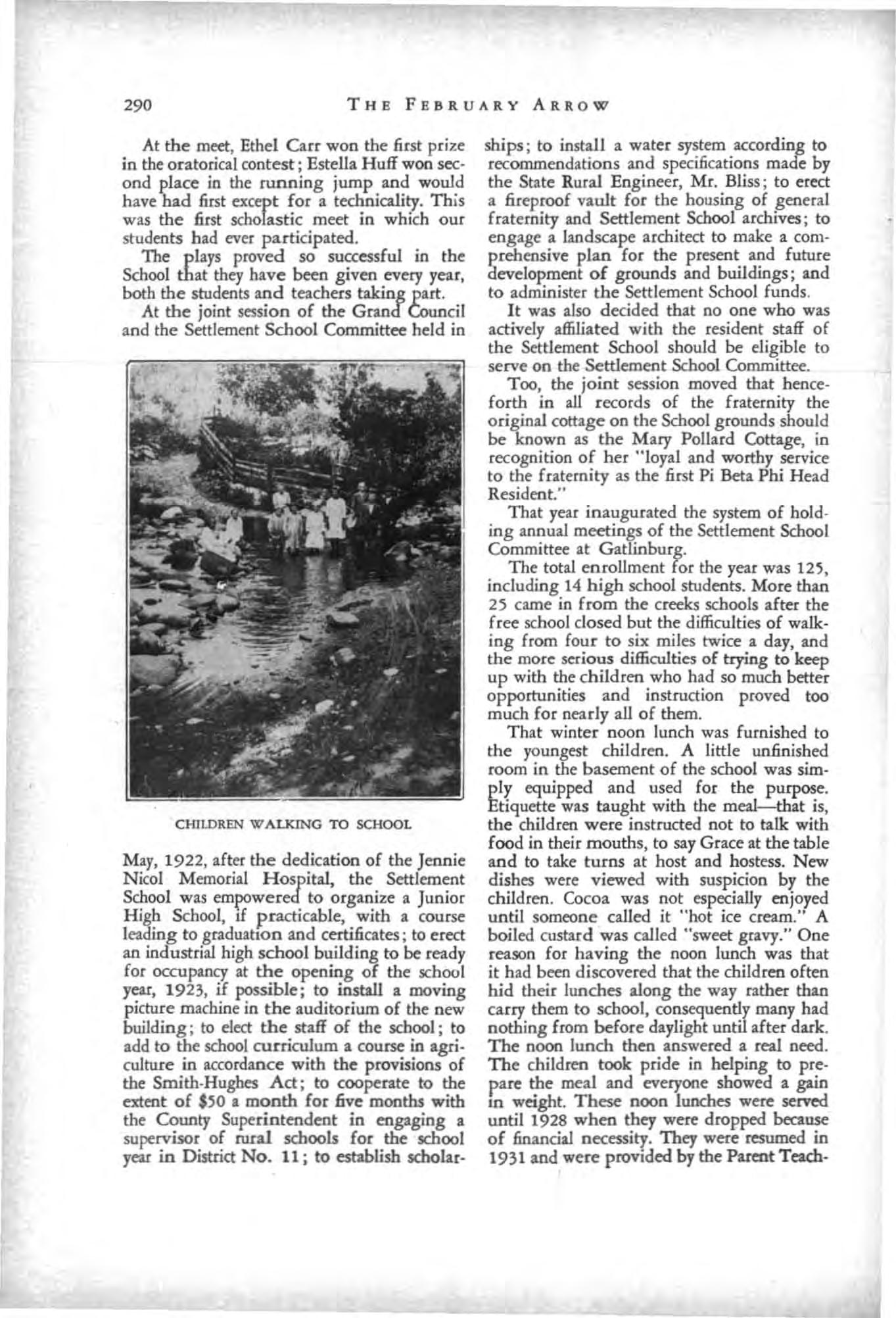
May, 1922 , after the dedication of the Jennie Nicol Memorial Hospital, the Settlement School was em!'?wered to organize a Junior High School, If practicable, with a course leading to graduatIOn and certificates; to erect an industrial high school building to be ready for occupancy at the openiog of the school year, 19 23, if possible; to install a moving picture machine in the auditorium of the new building; to elect the staff of the school; to add to the school curriculum a course in agriculture in accordance with the provisions of the Smith .Hughes Act; to cooperate to the extent of $'0 a month for five mooths with the County Superintendent in engaging a supervisor of rural schools for the school year in District No_ 11; to establish scholar-
ships; to install a water system according to recommendations and specifications made by the State Rural Engineer, Mr. Bliss; to erect a fireproof vault for the housing of general fraternity and Settlement School archives; to engage a landscape architect to make a comprehensive plan for the present and future development of grounds and buildings; and to administer the Settlement School funds
It was also decided that no one who was actively afliliated with the resident staff of the Settlement School should be eligible to serve on the Settlement School Committee.
Too, the joint session moved that henceforth in all records of the fraternity the original cottage on the School grounds should he known as the Mary Pollard Cottage, in recognition of her "loyal and worthy service to the fraternity as the first Pi Beta Phi H ead Resident."
That year inaugurated the system of hold · ing annual meetings of the Settlement School Committee at Gatlinburg.
The total enrollment for the year was including 14 high school students. More than 2' came in from the creeks schools after the free school closed but the difficulties of walking from four to six miles twice a day, and the more serious dilliculties of trying to keep up with the children who had so much better opportunities and instruction proved too much for nearly all of them
That winter noon lunch was furnished to the youngest children. A little unfinished room in the basement of the school was simply equipped and used for the purpose Etiquette was taught with the meal- that is, the children were instructed not to talle with food in their mouths, to say Grace at the table and to take turns at host and hostess. New dishes were viewed with suspicion by the children. Cocoa was not especially enjoyed until someone called it "ho t ice cream." A boiled custard was called "sweet gravy." One reason for having the noon lunch was that it h ad been discovered that the children often hid their lunches along the way rather than carry them to school, consequently many had nothing from before daylight until after dark. The noon lunch then answered a real need The children took pride in helping to prepare the meal and everyone showed a gain 10 weight. These noon lunches were served until 1928 when they were dropped becaose of financial necessity. They were resumed in 1931 and were provided hy the Parent Teach-
ecs' Association which raised money in various ways and solicited all kinds of canned goods
A dissertation on natural history which was delivered before an English dass by Cecil Maples is worth recording here :
I think toa ds have no tails because they ace h atched out o f an egg, just like a chicken . They are raised in water and not in .6elds A co w and hocSt a ta il to help kttp the flies ofT and pro tect
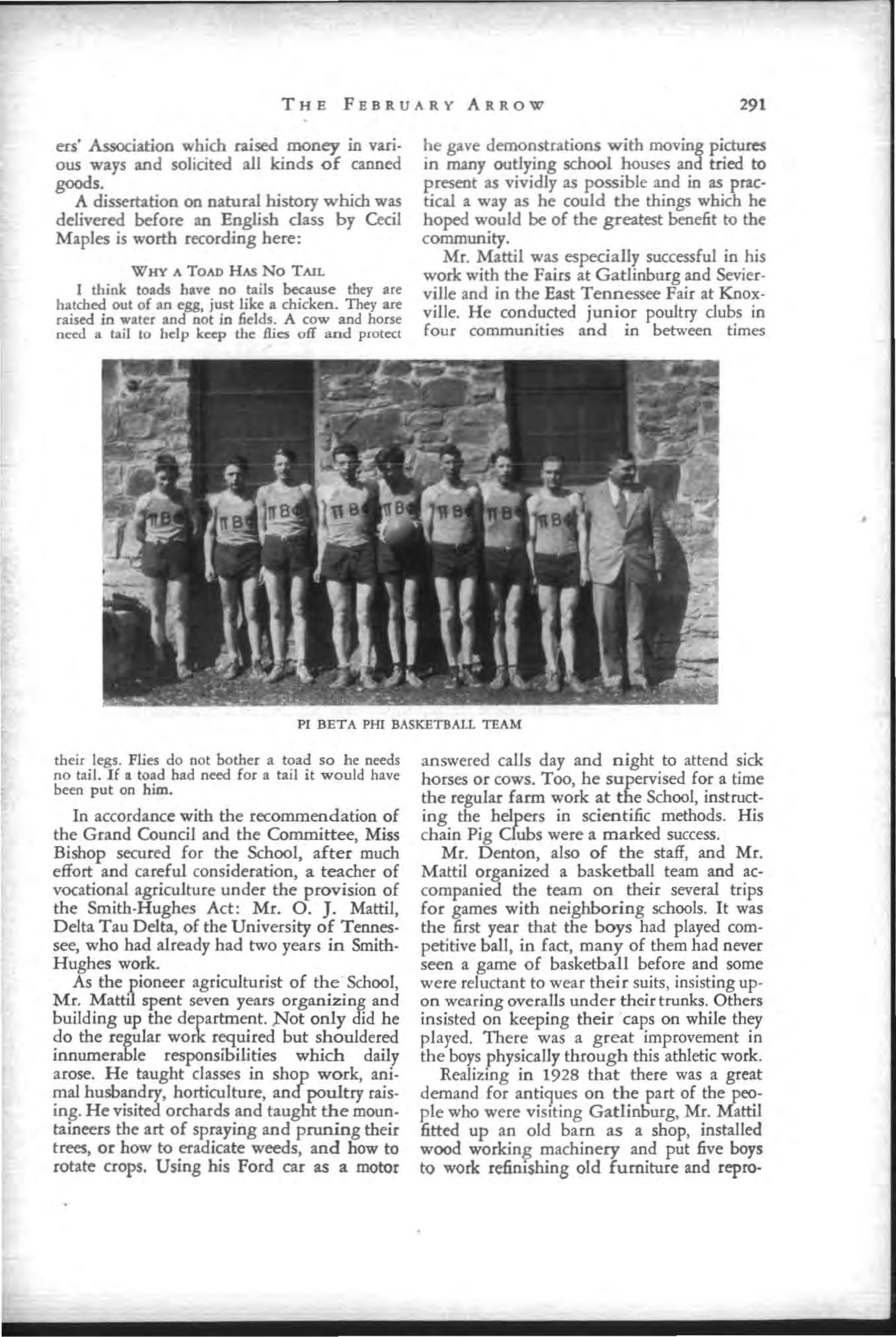
th e ir legs . Flies do no t bother a toad so he needs no tail. If a toad had need for a tail it would have bttn put on him.
In accordance with the recommendation of the Grand Council and the Committee, Miss Bishop secured for the School, after much effort and careful consideration, a teacher of vocational agriculture under the provision of the Smith·Hughes Act: Mr. O. J. Mattil, Delta Tau Delta, of the University of Tennes· see, who had already had two years in Smith· Hughes work.
As the pioneer agriculturist of the School, Me. Mattil spent seven years organizing and building up the department. ,Not only did he do the regular work required but shouldered innumerable responsibilities which daily arose. He taught classes in shop work, mal husbandry, horticulture, and poultry rais · ing. He visited orchards and taught the moun· taineers the art of spraying and pruning their trees, or how to eradicate weeds, and how to rotate crops. Using his Ford car as a motor
h e ga ve demonstrations with moving pictures in many outlying school h o uses and tried to present as vividly as possible and in as prac· tical a way as he could the things which he hoped would be of the greatest benefit to the c ommunity.
Mr. Mattil was especially successful in his work with the Fairs at Gatlinburg and Sevier· ville and in the East Tennessee Fair at Knox· ville He conducted junior poultry dubs in four communities and in between times
answered calls day and night to attend sick horses or cows. Too, he supervised for a time the regular farm work at the School, instruct· ing the hdpers in scientific methods. His chain Pig Gubs were a marked success .
Mr. Denton , also of the staff, and Mr. Mattil organized a basketball team and ac· companied the team on their several trips for games with neighboring schools. It was the first year that the boys had played com· petitive ball, in fact, many of them had never seen a game of basketball before and some were reluctant to wear their suits, insisting on wearing overalls under their trunks. Others insisted on keeping their caps on while they played. There was a great improvement in the boys physicaUy through this athletic work.
RealiZing in 1928 that there was a great demand for anti'lues on the part of the peo. pIe who were viSIting Gatlinburg, Mr. Mattil fitted up an old barn as a shop, installed wood workin? machinery and put five boys to work refinishing old furniture and repro·
ducing c ri ckets, book shelves, tables, etc., and found a ready market for the projects in the Arroweraft Shop .
Upon resigning from the School Staff in 1929, Mr. Matti! devoted bis time to his wood work shop, taking the beautiful woods of the mountains such as wild cherry, black walnut , and m..,Ie, and working them ioto reproductions 0 colonial or earfy American furniture.
The furniture makers of the Burg seemed amazed to think that the things they made "jest old common settin' chairs" could be made to look so pretty with the polishing
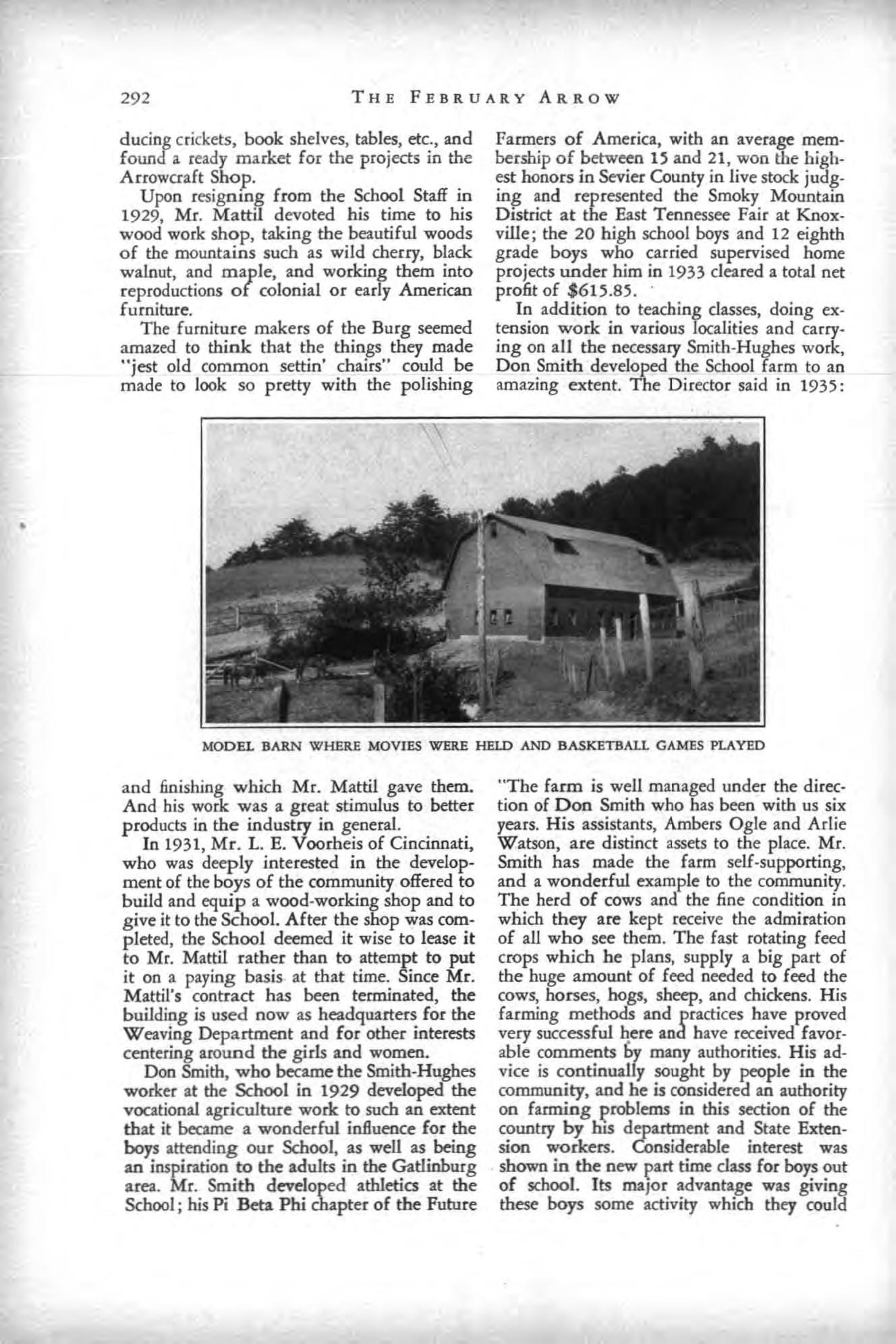
and finishing which Mr. Mattil gave them. And his work was a great stimulus to better products in the industry in general.
In 1931, Mr. L. E. Voorheis of Cincinnati, who was deeply interested in the development of the boys of the community offered to build and equip a wood -working shop and to give it to the School. After the shop was completed, the School deemed it wise to lease it to Mr. Matti! rather than to attempt to put it on a paying basis at that time. Since Mr. Mattil's contract has been terminated, the building is used now as headquarters for the Weaving Department and for other interests centering around the girls and women.
Don Smith, who became the Smith-Hughes worker at the School in 1929 developed the vocational agriculture work to such an extent that it became a wonderful influence for the boys attend ing our School, as well as being an inspiration to the adults in the Gatlinburg area. Mr. Smith developed athletics at the School; his Pi Beta Phi chapter of the Future
Farmers of America, with an average membership of between 15 and 21, won the high. est honors in Sevier County in live stock judg. ing and represented the Smoky Mountain District at the East Tennessee Fair at Knoxville; the 20 high school hoys and 12 eighth grade boys who carried supervised home projects under him in 1933 cleared a total net profit of $615.85.
In addition to teaching classes, doing ex· tension work in various localities and carrying on all the necessary Smith ·Hughes work, Don Smith developed the School farm to an amazing extent. The Director said in 1935:
"The farm is well managed under the direction of Don Smith who has been with us six years. His assistants, Ambers Ogle and Arlie Watson, are distinct assets to the place. Mr . Smith has made the farm self-supporting, and a wonderful example to the community The herd of cows and the fine condition in which they are kept receive the admiration of all who see them . The fast rotating feed crops which he plans, supply a big part of the huge amount of feed needed to feed the cows, horses , hogs, sheep , and chickens . His farming methods and practices have proved very successful here and have received favorable comments (,y many authorities. His advice is continually sought by people in the community, and he is considered an authority on farmiog !?roblems in this section of the country by his department and State Extension workers . Considerable interest was shown in the new !?art time class for boys out of school. Its major advantage was giving these boys some activity which they could
feel was their own . The school farm furnished, as usuaJ, many opportunities for practical application of farm jobs learned in the classroom. Prizes were won for outstanding work done in the farm shop and exhibited at the Tennessee Valley Agricultural and In· dustrial Fair "
After six years of splendid, constructive work at the School, Don Smith resigned in the summer of 193) and was succeeded by Elmer Kite, Tennessee University, Smith· Hughes teacher last year at the Claiborne
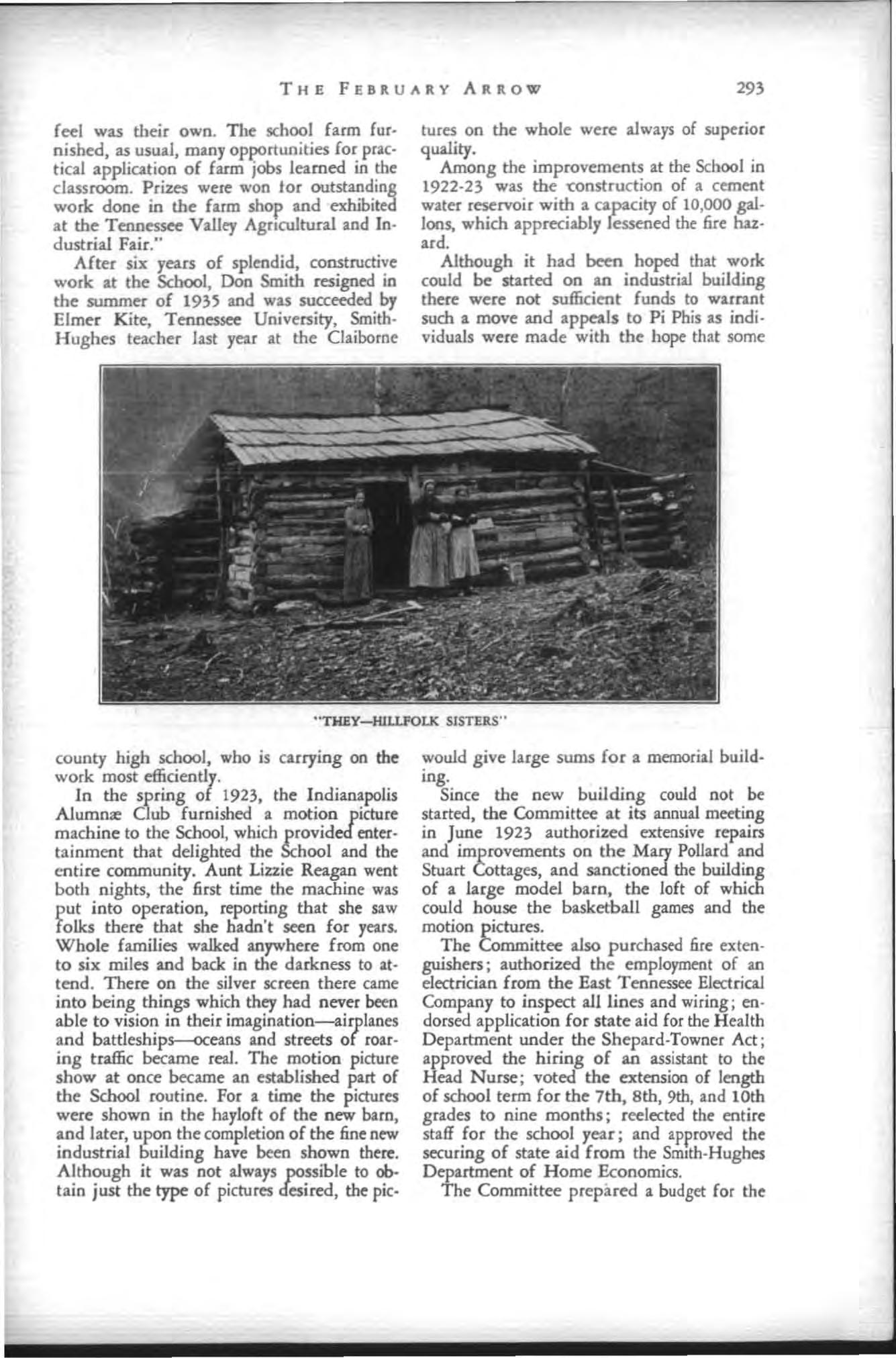
county high school, who is carrying on the work most efficientr'
In the spring 0 1923, the Indianapolis Numore Club furnished a motion picture machine to the School, which provided entertainment that delighted the School and the entire community. Aunt Lizzie Reagan went both nights, the first time the machine was put into operation, reporting that she saw folks there that she hadn't seen for years. Whole families walked anywhere from one to six miles and back in the dackness to attend. There on the silver screen there came into being things whith they had never been able to vision in their imagination-airlanes and battleships-oceans and streets 0 roaring traffic became real. The motion picture show at once became an established part of the School routine. For a time the pictures were shown in the hayloft of the new barn, and later, upon the completion of the fine new industrial building have been shown there. Although it was Dot always possible to obtain just the type of pictures desired, the pic-
tures on the whole were always of superior quality_
Among the improvements at the Scbool iD 1922-23 was the 'Construct ion of a cement water reservoir with a capacity of 10 ,000 gallons, which appreciably fessened the fire hazard.
Although it had been hoped that work could be started OD an industrial building there were not sufficient funds to warrant such a move and appeals to Pi Phis as individuals were made with the hope that some
would give large sums for a memorial buildIDg.
Since the new building could not be stacted, the Committee at its annual meeting in June 1923 authorized extensive repairs and improvements on the Mary Pollard and Stuart Cottages, and sanctioned the building of a large model barn, the loft of which could house the basketball games and the motion pictures.
The Committee also purcbased fire extenguishers; authorized the employment of an electrician from the East Tennessee Electrical Company to inspect all lines and wiring; endorsed application for state aid for the Health Department under the Shepard-Towner Act; approved the hiring of an assistant to the Head Nurse; voted the extension of length of school term for the 7th, 8th, 9th, and 10th grades to nine months; reelected the entire staff for the school year; and approved the securing of state aid from the Smtth-Hughes Department of Home Economics.
The Committee prepared a budget for the
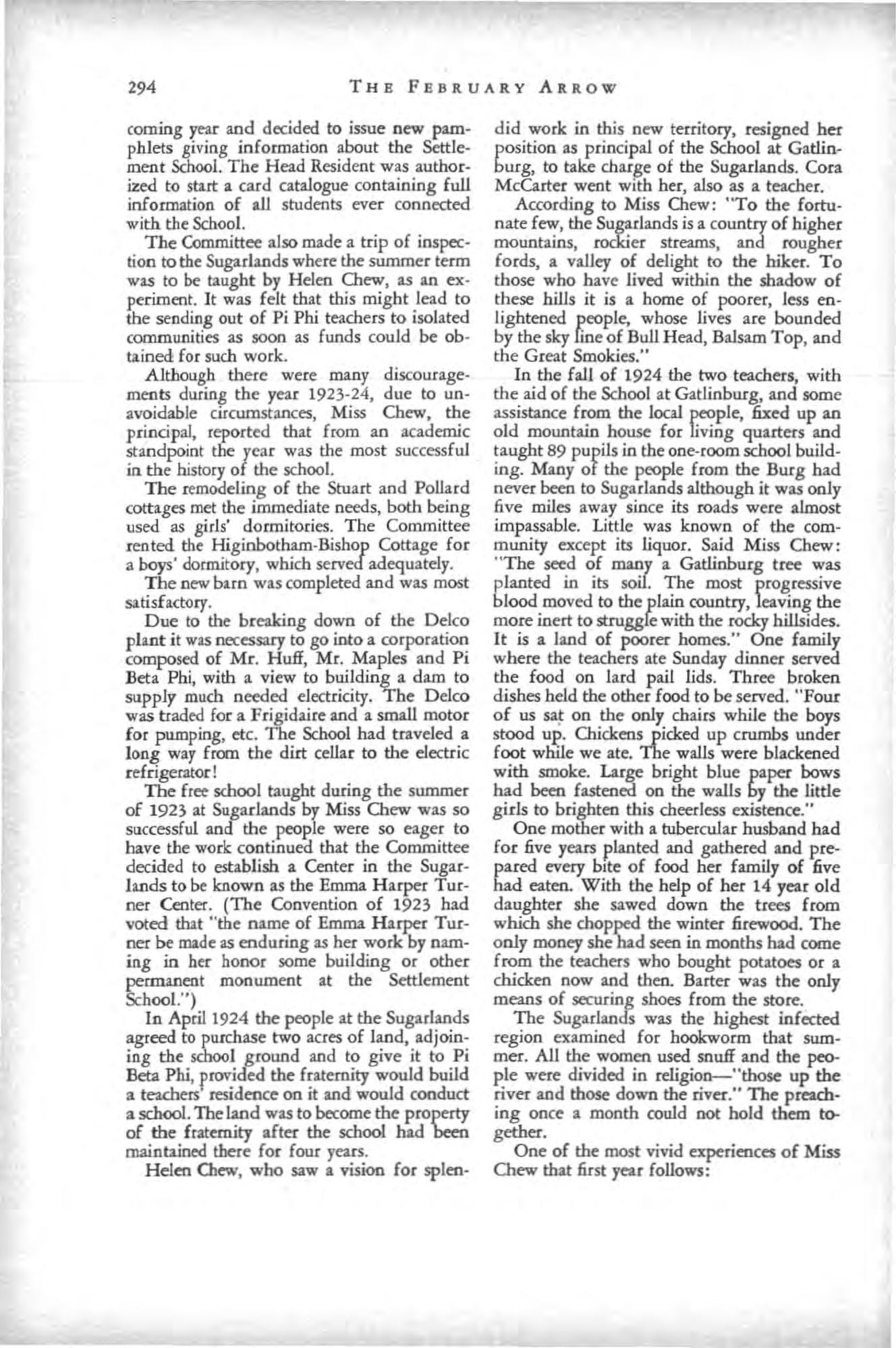
coming year and decided to issue new pamphlets giving information about the Settlement School. The Head Resident was authorized to start a card catalogue containing full information of all students ever connected with the School.
The Committee also made a trip of inspection to the Sugarlands where the summer term was to be taught by Helen Chew, as an experiment. It was felt that this might lead to the sending out of Pi Phi teachers to isolated communities as soon as funds could be obtained for such work.
Although the re were many discouragements during the year 1923-2 4, due to unavoidable circumstances , Miss Chew, the principal, reported that from an academic standpoint the lear was the most successful in the history 0 the school.
The remodeling of the Stuart and Pollard cottages met the immediate needs, both being used as girls' dormitories. The Committee rented the Higinbotham.Bishop Cottage for a boys ' dormitory, which served adequately.
The new bun was completed and was most satisfactory.
Due to the breaking down of the Delco plant it was necessary to go into a corporation composed of Mr. Huff, Mr Maples and Pi Beta Phi, with a view to building a dam to supply much needed electricity. The Delco was traded for a Frigidaire and a small motor for pumping, etc. The School had traveled a long way from the dirt cellar to the electric refrigerator!
The free school taught during the summer of 1923 at Sugarlands by Miss Chew was so successful and the people were so eager to have the work continued that the Committee decided to establish a Center in the Sugarlands to be known as the Emma Harper Turner Center (The Convention of 1923 had _ed that "the Dame of Emma Harper Turner be made as enduring as her work by naming in her honor some building or other permanent monument at the Settlement SchooL")
In April 1924 the people at the Sugarlands agreed to purchase two acres of land, adjoining the school ground and to give it to Pi Beta Phi , provided the fraternity would build a teachers residence on it and would conduct a school. The land was to become the property of the fratemity after the school had been maintained there for four years.
Helen Chew, who saw a vision for splen-
did work in this new territory, resigned her position as principal of the School at Gatlinburg, to take charge of the Sugarlands. Cora McCarter went with her, also as a teacher.
According to Miss Chew: '"To the fortunate few, the is a country of higher mountains, rockier streams, and rougher fords, a valley of delight to the hlker. To those who have lived within the shadow of these hills it is a home of poorer, less enlightened people, whose lives are bounded by the sky line of Bull Head, Balsam Top, and the Great Smolcies."
In the fall of 1924 the two teachers, with the aid of the School at Gatlinburg, and some assistaoce from the local people, fixed up an old mountain house for living quarters and taught 89 puyils in the one-room school building. Many 0 the people from the Burg had never been to Sugarlands although it was only five miles away since its roads were almost inopassable. Little was known of the community except its liquor. Said Miss Chew: " The seed of many a Gatlinburg tree was planted in its soil. The most progressive blood moved to the plain country, leaving the more inert to struggle with the rocky hillsides. It is a land of poorer homes " One family where the teachers ate Sunday dinner served the food on lard pail lids. Three broken dishes hdd the other food to be served. "Four of us sat on the only chairs while the boys stood up. Chickens picked up crumbs under foo t while we ate. The walls were blackened with smoke. Large bright blue paper bows had been fastened on the walls by the little girls to brighten this cheerless existence."
One mother with a tubercular husband had for five years planted and gathered and prepared every bIte of food her family of five had eaten. With the help of her 14 year old daughter she sawed down the trees from which she chopped the winter firewood. The only money she had seen in months had come from the teachers who bought potatoes or a chicken now and then. Barter was the only means of securing shoes from the store.
The Sugarlaods was the highest infected region examined for hookworm that summer. All the women used snuff and the pe0ple were divided in religion-"those up the river and those down the river " The preaching once a month could not hold them together.
One of the most vivid experiences of Miss Chew that first year follows:
" Yesterday from the last house up the river, the parents brought down their little six months old baby to be buried in the little graveya rd on a hill oot far beyond the school house. The crowd had gathered and I could see them waiting. Presently a committee of two boys carne for me to conduct the funeral services. There was no one else. Our weekend preachers were in the lumber canop during the week_ What could I do? Helpless as I was I had to go. When I reached the spot they were standing about in a large circle. Within , beside the deep hole, stood this girl, sca rcely seventeen, alone with that little wcxxlen box covered with white muslin. over the top of which she had laid a piece of embroidery work evidently taken from the fireboard of her cabin. No one within ten feet of her to com fort her or to support h<r in this tirst great sorrow of her life. I asked where the father was and a rough looking creature with a cigarette was pointed out, a fellow who had been arrested the day before for making liquor. The revenue officers had entered his house just as the baby was dyiog the day before and had given him permission to stay uotil after the funeral. She surely had more than her baby ·s death to cause tears. When our little service was over the man who stepped forward to lower the little white muSlin covered box into the ground was another of the sanae liquor crowd, but because he could pay his fine was free to do his community and his friend this service. With a cigarette in his mouth he did the last service for the little mountain baby. After all was over the mother went home across the hill, her husband down the river to work out his fine. Life seems so much uglier sometimes wheo contrasted with our gorgeous hillsides this time of year."
Then there was the story of a thirty-three year old mother of seven children who put up sixty gallons of kraut to feed them through the winter-and the story of how Miss Chew met an old woman hobbling down the road in the pouriog rain taking the last look of the Sugarlands, the mortgage had taken her farm and she had to leave. _ _
The second year at Sugarlands there was difficulty with ooe of the school board, who felt he should have been coosulted relative to the hiring of the teachers, and through a misunderstanding Miss Chew was not rehired. The man's son-in-law was given the school instead. What at tirst looked discourag-
iog and unfair, =I1y proved a blessing, as Miss Chew then had time to try out some of the adult work which she had been wantin!! to do, holdiog night classes, doing much visiting, etc.
The next term, however, after the Chairman of the Committee, Nita Hill Stark, had had a definite understandiog with the local men and the county board, Miss Chew was re-
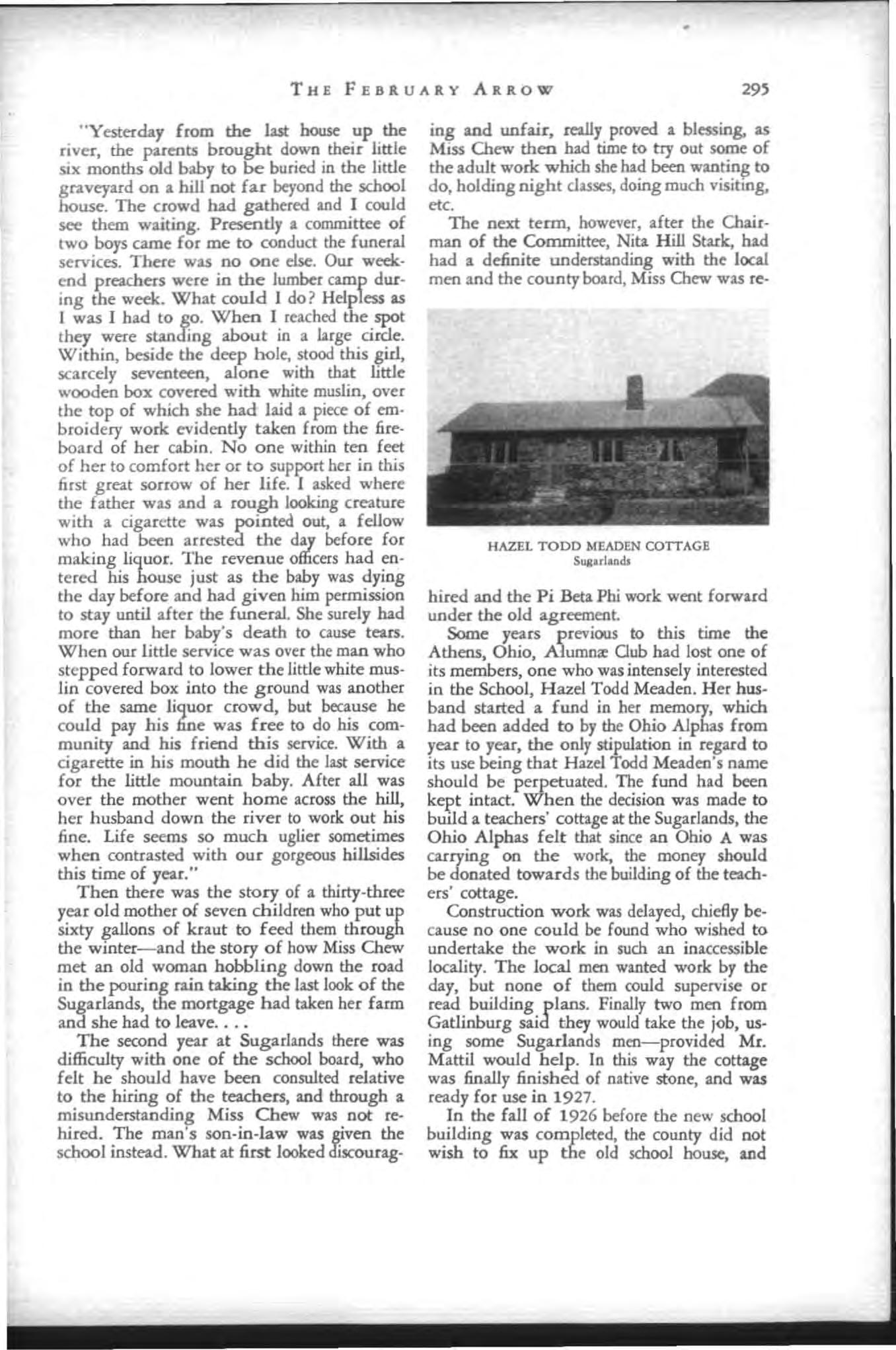
hired and the Pi Beta Phi work went forward under the old agreement.
Some years previous to this time the Athens, Ohio, Alumna: Gub had lost one of its members, one who was intensely interested in the School, Hazel Todd Meaden. Her husband started a fund in her memory, which had beeo added to by the Ohio Alphas from year to year, the ooly stipulatioo in regard to its use being that Hazel Todd Meaden·s nanoe should be perpetuated. The fund had been kel?t intact. When the decision was made to build a teachers" cottage at the Sugarlands, the Ohio Alphas felt that sioee an Ohio A was carrying on the work, the money should be donated towards the building of the teachers' cottage.
Construction work was delayed, chiefly because no one could be fouod who wished to undertake the work in such an inaccessible locality. The local men wanted work by the day, but none of them could supervise or read building plans. Finally two men from Gatlinburg said they would take the job, using some Sugadands men-provided Mr. Mattil would help. In this way the cottage was finally finished of native stone, and was ready for use io 1927.
In the fall of 1926 before the new school building was completed, the county did not wish to fix up the old school house, and
consequently "bitter winter weather found the girls teaching in a room with practically no window panes, a house so frail that on very windy days scbool had to be dismissed in safety to the thildren."
In 1928 Emily Burton, who had so successfully taught the kindergarten and primary work at the &bool for some ten years, went to the Sugamnds to take Cora McCarter's place. Mrs . Anna Do well also went as house mother for the girls and to give dasses in
mained were taken to Gatlinburg to School by bus.
With the closing of the Sugarlands school, 56 people from Laurel Lick petitioned to have Eva Hathaway come to them. The county paid the expenses of Miss Hathaway and an assistant teacher, who taught the Laurel Lick school during the 1932-33 season. This was another isolated region. There was little or no school equipment and the children bartered for the few pencils and tablets which
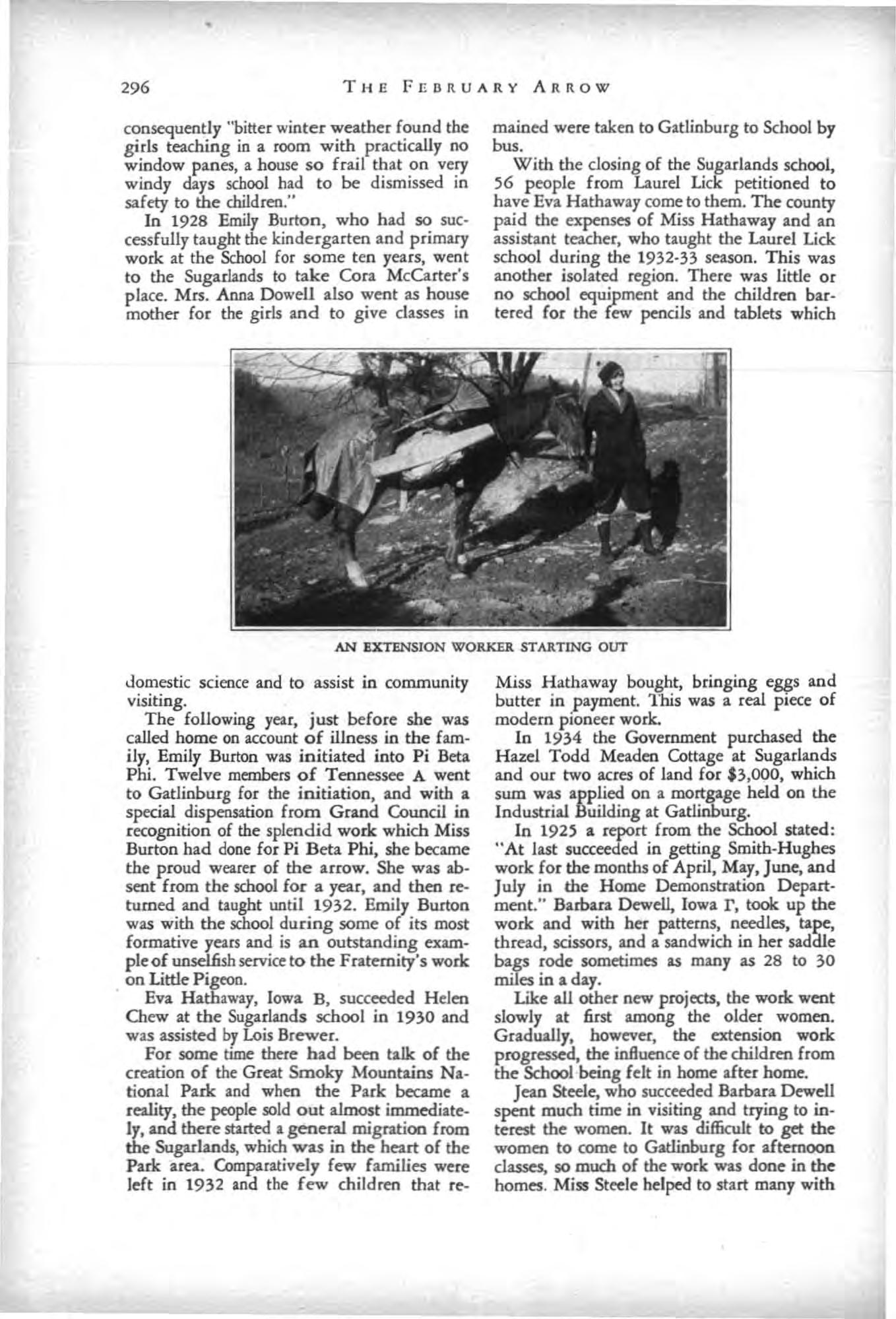
Jomestic science and to assist in community visiting.
The following year, just before she was called home on account of illness in the family, Emily Burton was initiated into Pi Beta Phi. Twelve members of Tennessee A went to Gatlinburg for the initiation, and with a special dispensation from Grand Council in recognition of the splendid work which Miss Burton had done for Pi Beta Phi , she became the proud wearer of the arrOw. She was absent from the scbool for a year, and then returned and taught until 1932_ Emily Burton was with the scbool during some of its most formative years and is an outstanding example of unseJ6sh service to the F ratemity' s work on Little Pigeon .
Eva Hath away, Iowa B, succeeded Helen Chew at the Sugarlands school in 1930 and was assisted by Lois Brewer_
For some time there had been talk of the creation of the Great Smoky Mountains National Park and when the Park became a reality, the people sold out almost immediately, and there started a general migration from the Sugarlands, which was in the heart of the Park area_ Comparatively few families were left in 1932 and the few children that re-
Miss Hathaway bought, bringing eggs and butter in payment. This was a real piece of modern pioneer work.
In 1934 the Government purchased the Hazel Todd Meaden Cottage at Sugarlands and our two acres of land for $3,000, which sum was applied on a mortgage held on the Industrial Building at Gatlinburg.
In 1925 a report from the School stated: "At last succeeded in getting Smith-Hughes work for the months of April, May, June, and July in the Home Demonstration Department." Barbara Dewell, Iowa r, took up the work and with her patterns, needles, tape, thread, scissors, and a sandwich in her saddle bags rode sometimes as many as 28 to 30 miles in a day_
Like all oth er new projects, the work went slowly at first among the older women. Gradually, however, the extension work progressed, the inBuence of the children from the School being felt in home after home.
Jean Steele, who succeeded Barbara Dewell spent much time in visiting and trying to interest the women. It was diflicuJt to get the women to come to Gatlinburg for afternoon classes, so much of the work was done in the homes Miss Steele helped to start many with
their sewing and worked up a good canning class. Gradually classes in domestic science were worked up in Laurel Lick, Sugarlands , Pigeon Forge, Benner Fork -of-the-River, and Gatli nburg
So successful was she with her work , Miss Steele was called into state work in 1927, being made Supervisor of Rur al H ome Economics for the State of Tennessee.
One of th e big projects superv ised by her successor, Katherine Watson (Farm e r) , Chi
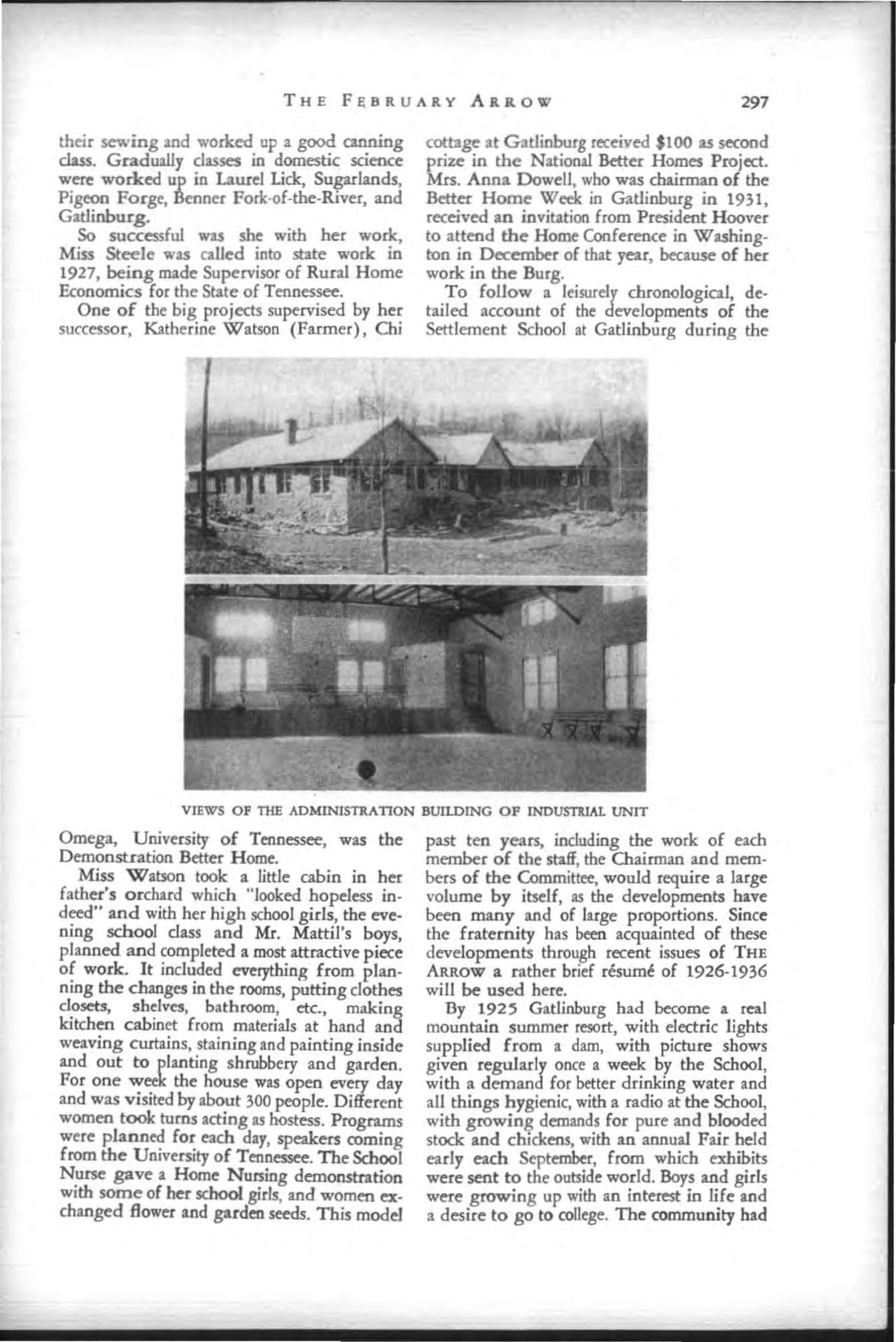
Omega, University of Tennessee, was the Demonstration Better Home.
Miss Watson took a little cabin in ber father's orchard which " looked bopeless indeed" and with her high school girls, the evening school class and Mr. Mattil's boys, planned and completed a most attractive piece of work. It included everything from planning the changes in the rooms, putting clothes closets, shelves, bathroom, etc., making kitchen cabinet fr om materials at hand and weaving curtains , stai ning and painting inside and out to planting shrubbery and garden. For one week the house was open every day and was visited by about 300 people Different women took turns act ing as hostess. Programs were planned for each day, speakers coming from the University of Tennessee . The School Nurse gave a Home Nursing demonstration with s ome of her school girls, and women ""changed Bower and garden seeds. Tbis model
cottage at Gatlinburg received $100 as second prize in the National Better H omes Pro ject. Mrs. Anna Dowell , who was chairman of the Better Home Week in Gatlinburg in 1931, received an invitation from President Hoove r to attend the Home Conference in Washington in December o f that year, because of her work in the Burg
To follow a leisurely chronological, detailed account of the developments of the Sett leme nt School at Gatlinburg durin g the
past ten years, including the work of each member of the staff, the Chairman and members of the Committee, would require a large vo lume by itself, as the developments bave been many and of large proportions . Since the fraternity has been acquainted of these d evelnpments through recent issues of THE ARROW a rather brief of 1926-1936 w ill be used here.
By 192' Gatlinburg had become a real mountain summer resort, with electric lights supplied from a dam, with picture show s gi ven regularly once a week by the School , with a demand for better drinking water and all things hygi enic, with a radio at the School , with growing demands for pure and blooded stock and chickens, with an annual Fair beld early each September, from which exhibits were sent to the outside world. Boys and girls were growing up with an interest in life and a desire to go to college. The community had
advanced exceedingly in thought but its financial standing had increased very litUe, hence the wock of the School in furthering the fireside industries was more necessary than ever.
Many of the students worked at the summer hotels and because of the late tourist season, our School term had to be delayed in the fall. The great problem of irregular attendance was becoming much improved, but myriad other problems were present, that of over-crowding being one of the greatest ones.
Too, the dormitory problem had always been ever-present. It was felt though that by maintaining dormitories in which boys and girls could be boarded and given supervision that much could be accomplished in giving them first·hand knowledge of proper home life and atmosphere. Each boy and girl in the cottage dormitories was given definite work to do out of school hours and they were so busy that the matter of discipline was almost nil. Never more than about 20 to of these boarding students could be accommodated at one time, but those: who were privileged to enjoy the dormitories undoubtedly profited much by the life there. During a period of the worst depression the dormitories wert closed and the School suffered the loss of many in the upper grades. The dormitories were again 0rened in 1933 and are a most important part o the School's organization today.
Many important changes occurred in the years The county increased the free school term to eight months, our School had its largest enrollment up to that time-1 2; a central dining room was started and most successfully; farming was carned on at the School upon a more businesslike basis with efficient supervision; there was great improvement in the industrial department; a bookkeeping and collecting department was installed at Gatlinburg; the Arrowcraft was started; extension work was carried on in the Sugarlands and other isolated centers to a large degree; plans were completed for the Industrial building; • telephone was installed at the School; and of much importance-a man principal was ob· tained for the School: W. B. Overton, an experienced teacher, who held the degrees B.A. and M.S. Ed.
The new Principal accomplished much in 1928, by securing certificates . ratings, etc. , Dot heretofore had by the School. Every teacher had her state certificate at the opening of the school session and there was no longer any doubt about our rating with the state depart-
ment of education "The state was willing to give us any aid possible, and sent a number of advisers and visitors to the different departments of the School."
In 1926 the third year of bigh school was approved but was not added to the curriculum until The teachers' salaries were arranged on a sliding scale: ranging from and transportation and board for the first year, to for the fifth year. Later, in 1931, all teachers' salaries were placed on a complete cash basis to replace the former arrangement of cash·board·travel payment, and all teachers paid by the county received their salaries di · rect from the County (For the past few years the County has paid the salary of all grade school teachers and has provided school supplies and has helped WIth the salary of the principal. This year, the County is also paying the salary of a high school teacher and allowing the usual amount for the principal of the school.)
Steady development was shown under Principal Overton's direction. More time was spent on supervised play and upon the improvement 10 athletics, as well as upon ad· vancement in the school room.
Mr. Overton resigned in 1930 and was followed by William King, who was away duro ing the year 1933-34 when Virgil Hampton was Principal. Mr. King returned again in 1934 and IS at present the efficient principal of the School.
One of the far-reaching achievements of the School during Miss Bishop's administration was the issuin$ of the Gatlinburg N eWJ, which was begun 10 1924 first as a mimeographed sheet and was later printed. About 600 copies were issued each month, some be· ing sent to alum"", dubs and isolated alum""" about going up and down the creeks to furnisb the only pnnted news in many mountain homes. The cost of the publication was a rear outside of Gatlinburg. The NewJ was distributed free to the people of the community. In its columns they could read about everything from when to spray the apple trees and what to feed the cow-to who had the newest baby. The Gatlinburg NewJ was dis· continued in November 1931 when paring of the budget became absolutely necessary .
One of the projects planned by Chairman Nita Hill Stark-tbe Industrial Buildingwas built during the administration of Gertrude Freeman, as chairman, being completed in the spring of 1928. Original plans had been obtained from James White, architect
for the University of Illinois, who gave his time and effort to the work. These plans later had to be altered but were used as the basis of the work which was ca.rried to completion by Contractor John Turner, an uncle of Agnes Miller Turner, California B, and Mr. Matti!.
In the spring of 1928 the building was completed as far as the exterior was concerned, the interior being finished the following fall The farm -shop and agriculture classes moved into the buifding at once, followed soon by the weaving classes, classes in home economics, high school, and junior high school classes. Too, the much longed for Auditorium was put to use at on ce, providing a mple room for basketball games, for community meetings, for socials, in fact , was the meeting place for aU occasions of any size.
On e mu,t look back in order to appreciate what community gatherings meant to the people of the Burg. Not so many years ago they held no public meetings except when they gathered at the church-nouse or had "sings : ' Today there is a well organized Community Club, a splendid Pi Beta Phi Parent-Teachers' Association (of which a past president is a member of Kappa Kappa Gamma) , a Weavers' Guild which meets monthly and at which the women plan their spring gardens and which sponsored the Wayside Market so successfully in 1935. Evening School meets twice a month, which is social as well as educational in character. There are Canning Gubs and Dressmaking Groups, there are movies, basketball games, operettas and plays by the school and school staff, and many rummage sales and box suppers. And of course, the usual pimics which are always attended by old and young alike.
Among other community entertainments in 1935, Harve Reagan lead a "Harp Singing/'-the name Originating from a title of an old-time song book, "Harp of Columbia." Recent editions of this book have continued the use of the word "harp" in the titles and thus all singing froco these books is so named.
Too, last summer (1935) the church had a "bomecoming" and "decoration" that was attended by 500 people, who were served dinner under the trees on the School grounds.
The outstanding annual Community affair is Old Timers' Day, statted and sponsored by the Schoo! some eigh teen years ago. It was originated in the beginning with a hope that the older people could have a day when they could get together for visiting and good times and to keep alive some of the old customs.
In the morning there is usually speaking, story telliog, singing and a business session. In the afternoon there are contests with prizes in: weaving, spinning, ca.rding, board splitting, corn shuckin$, hog calling, and rifle shooting. The first tune that the contests were held and prius were awarded to some of the contestants, those who won wtre naturally pleased. The others went home "in the
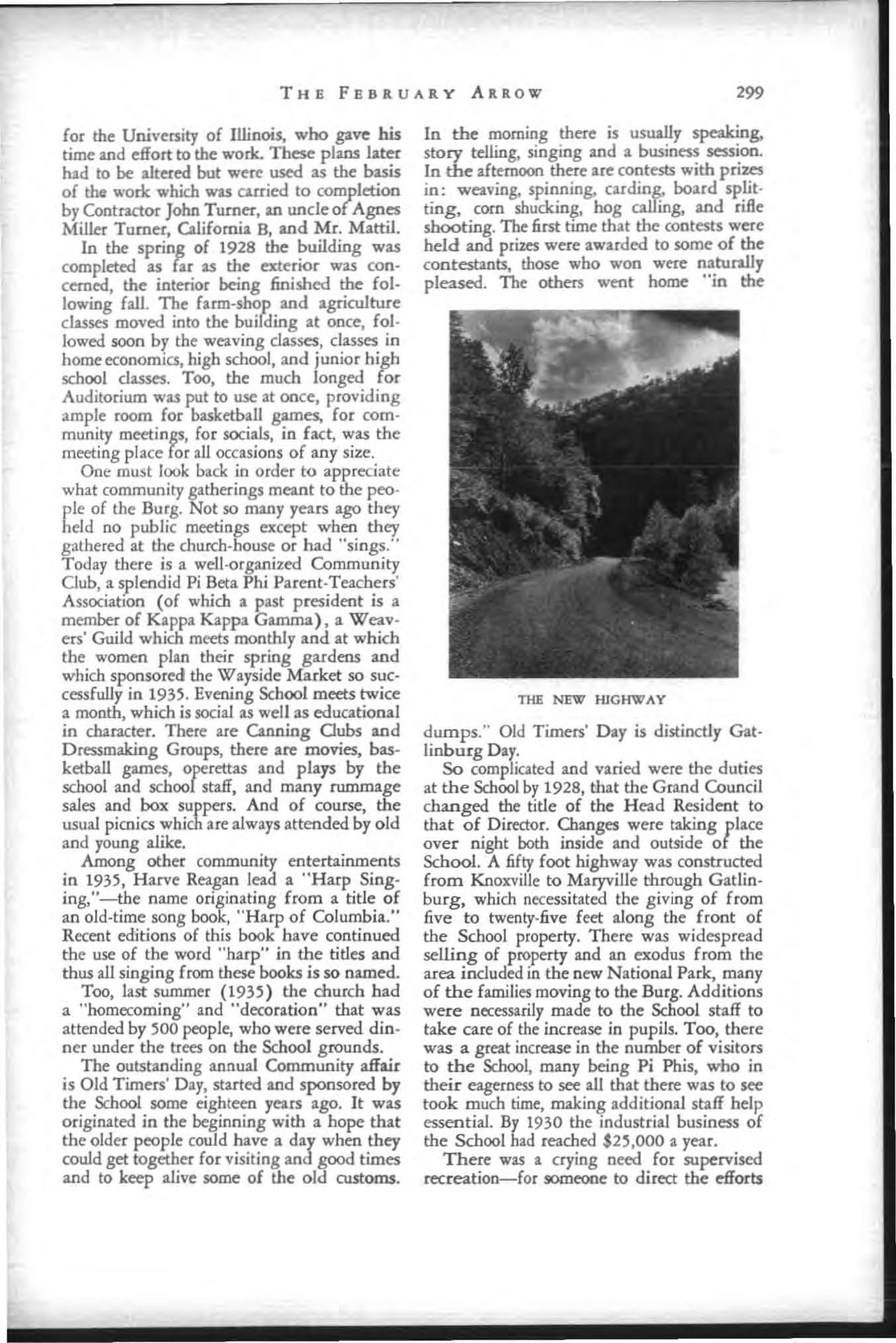
dumps " Old Timers' Day is distinctly Gatlinburg Day.
Sa complicated and varied were the duties at the School by 1928, the Grand Council changed the title of the Head Resident to that of Director. Changes were taking flace over night both inside and outside 0 the School. A fifty foot highway was constructed from Knoxville to Maryville Gatlinburg, which necessitated the giving of from five to twenty-five feet along the front of the School property. There was widespread selling of property and an exodus from the area included in the new National Park, many of the families moving to the Burg. Additions were necessarily made to the School staff to take care of the increase in pupils. Too, there was a great increase in the number of visitors to the School, many being Pi Phis, who in their eagerness to see all that there was to see took much time, making additional staff help essential. By 1930 the industrial business of the School had reached $25,000 a year.
There was a crying need for supervised recreation-for 9OIDeone to direct the efforts
,
of the groups of boys who wandered aimlessly about on Saturday and Sunday afternoons. The staff members tried in a way to meet this need but with their added duties and the carrying on of regular community work already started could Dot devote much time to this work for which there is still a need
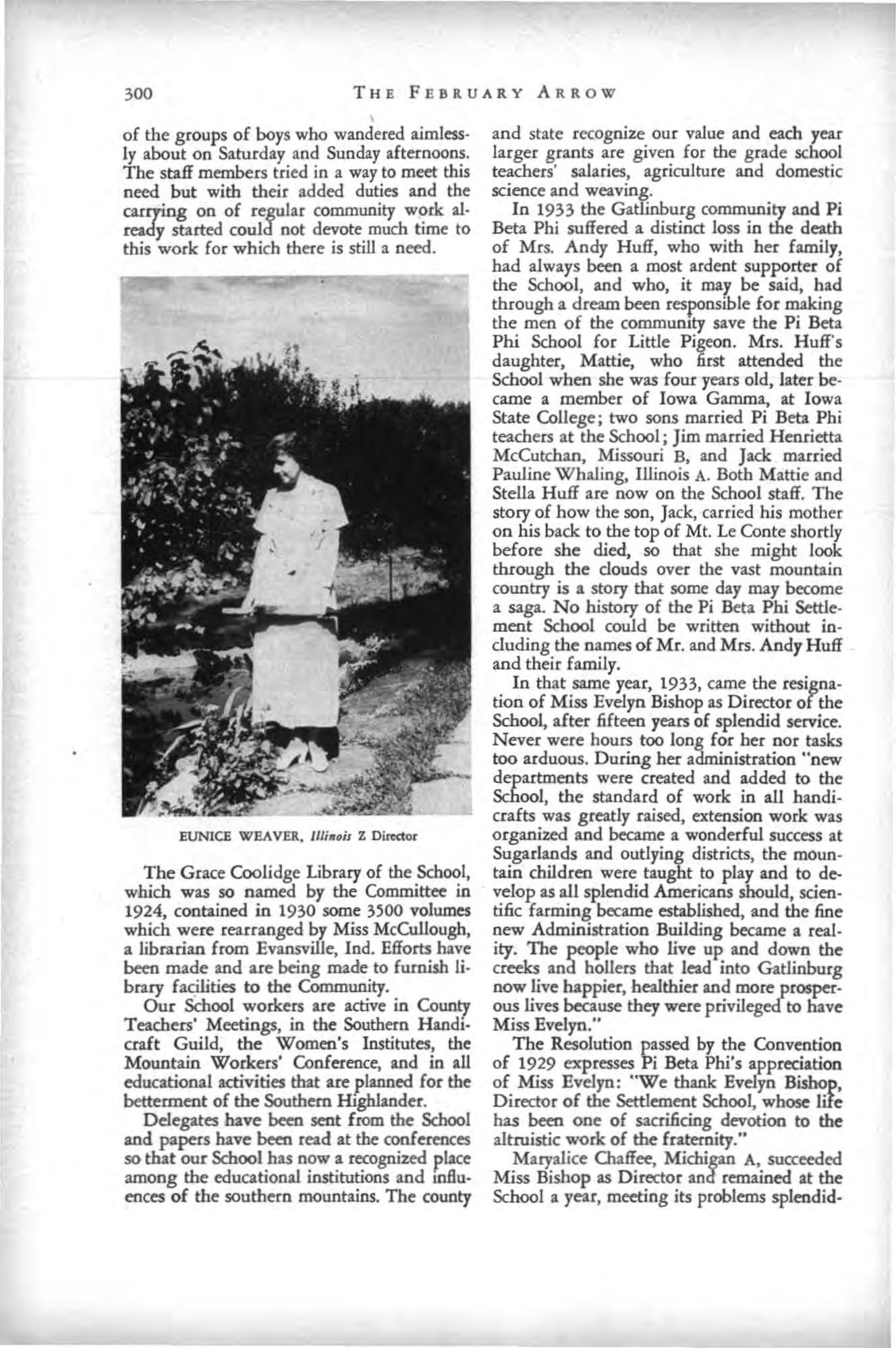
The Grace Coolidge Library of the School, which was so named by the Committee in 1924, contained in 1930 some 3500 volumes which were rearranged by Miss McCullough, a librarian from Evansville, Ind . Efforts have been made and are being made to furnish library fac;ilities to the Community.
Our School workers are active in County Teachers' Meetings, in the Southern HandIcraft Guild, the Women's Institutes, the Mountain Workers' Conference, and in all educational activities that are planned for the betterment of the Southern Highlander.
Delegates bave been sent from the School and papers have been read at the conferences so that our School has now a recognized place among the educational institutions and mBuences of the southern mountains , The county
and state recognize our value and each year larger grants are given for the grade school teachers' salaries, agriculture and domestic science and weaving .
In 1933 the Gatlinburg community and Pi Beta Phi suffered a distinct loss in the death of Mrs Andy Huff, who with her family, had always been a most ardent supporter of the School, and who, it may be said, had through a dream been responsible for making the men of the communIty save the Pi Beta Phi School for Little Pigeon Mrs Huff' s daughter, Mattie, who first attended the School when she was four years old, later became a member of Iowa Gamma, at Iowa State College; two sons married Pi Beta Phi teachers at the School; Jim married Henrietta McCutchan, Missouri B, and Jack married Pauline Whaling, Illinois A Both Mattie and Stella Huff are now on the School staff. The story of how the son , Jack, carried his mother on his back to the top of Mt. Le Conte shortly before she died, so that she might look through the clouds over the vast mountain country is a story that some day may become a saga No history of the Pi Beta Phi Settlement School could be written without including the names of Mr and Mrs. Andy Huff and their family.
In that same year, 1933, came the resignation of Miss Evelyn Bishop as Director of the School, after fifteen years of splendid service Never were hours too long for her nor tasks too arduous. During her administration "new departments were created and added to the School, the standard of work in all handicrafts was greatly raised, extension work was organized and became a wonderful success at Sugarlands and outlying districts, the mOuntain children were taught to play and to develop as all splendid Americans sbould, scientific farming became established, and the fine new Administration Building became a reality_ The people who live up and down the creeks and hollers that lead into Gatlinburg now live happier, healthier and more prosperous lives beCause they were privileged to have Miss Evelyn "
The Resolution passed by the Convention of 1929 expresses Pi Beta Phi's appreciation of Miss Evelyn : "We thank Evelyn Bisbop, Director of the Settlement School, whose life has been one of sacrificing devotion to the altruistic work of the fraternity _"
M aryalice Chaffee, Michigan A, succeeded Miss Bishop as Director and remained at the School a year, meeting its problems splendid-
ly and carrying on the work of the School. Following the resignation of Miss Chaffee, Mrs . Eunice Weaver, Illinois Z. was appointed Director in 1934 and is now at tlle belm of our work on Little Pigeon, bringing to her tasks a background of experience and understanding so needed in these strenuous days of 1936.
"How much longer will Pi Beta Phi he needed at Gatlinburg?" has been asked fr< · quently.
Answer for yourself. Gatlinburg has grown from a "community along the road" to the largest town in Sevier County, and now has a population of noo souls. The Natiooal Park Headquarters are there and the head· quarters of the Bureau of Roads; a telephone exchange building faces our School gate, next to which is the postoffice where not so loog ago 60,000 stamps were sold in one day commemorating the opening of the Great Smoky Mountain National Park.
Nine gift shops, a number of filling sta· tions, dance halls, tea rooms, tourist camps, hot.dog stands-now clutter the banks of the little mountain stream. Tourists whirl by ou r gateway in an endless procession and the still· ness of the mountains, which not so ago was broken only by the wailing of a dIst ant violin, the call of a fox horn, or the trilling of tree toads is now blasted by the incessant honking of the automobi le sirens .
"Many people who had gone to towns or cities have come back to the hills since work has been scarce; every little cabi n is again occupied and steep hillsides are growing something of a crop. It is difficult tinaes for many . .. many families there are where the girls or women with their weaving are bring. ing in aU the cash the families have."
In 1935 we had 91 women doing our weav· ing. Our School enrollment had climbed to 335, fifty.eight being in the high school.
The Pi Beta Phi Settlement School is the big stabilizing force. Community work is needed as never before at the Burg. And , too, "there are still remote homes lost up the valleys and hidden on the mountain sides that are very littl e nearer the varied life of the com munity than they were twenty years ago. In them poverty and disease still exist to he met and conquered."
It is with regret that we cannot devote space to the individual accomplishments of each member of the various Settlement School
Committees, through whose efforts so much has been made possible at Little Pigeon.
The work of the Committee is divided into that of Chairman, Treasurer, Editor of News from Little Pigeon and Publicity, Progrlms for Settlement School Meeting, Secretary of Ways and Means.
It seems fitting here to quote paragraphs written by former Committee Chairmen.
Said Kate Miller in 1923: "Our chairmen come and go, committee members come and go, and various members of the staff at Gat· linburg render their year or years of service and then go back to the fraternity at large and into the work, carrying the enthusiasm that any time spent on Little Pigeon instills into them. But the work goes on, animated by a force that is hard to name but one that is so vital that we all feel its power. It is much larger and greater than the Spirit of Pi Beta Phi that our pictures in the Settlement School program show as hovering over the Mountain Cabin, although she is a symbol of the Spirit of Service and Enlightenment and Progress that is an element in this intangible force of which I speak."
In dosing her five ,ears as a member of the Committee, four 0 which she was Chair· man, Nita Hill Stark wrote: "Things will never go smoothly for us and I hasten to say that I hope they never will, because things a re worth little more than what they cost us in time, effort and heartache."
1910-12
1912-17
1917-19
1919-21
1921-22
1922
1923
1923-27
1927-29
1929-JI
19}1-}2
1932-
1910-12
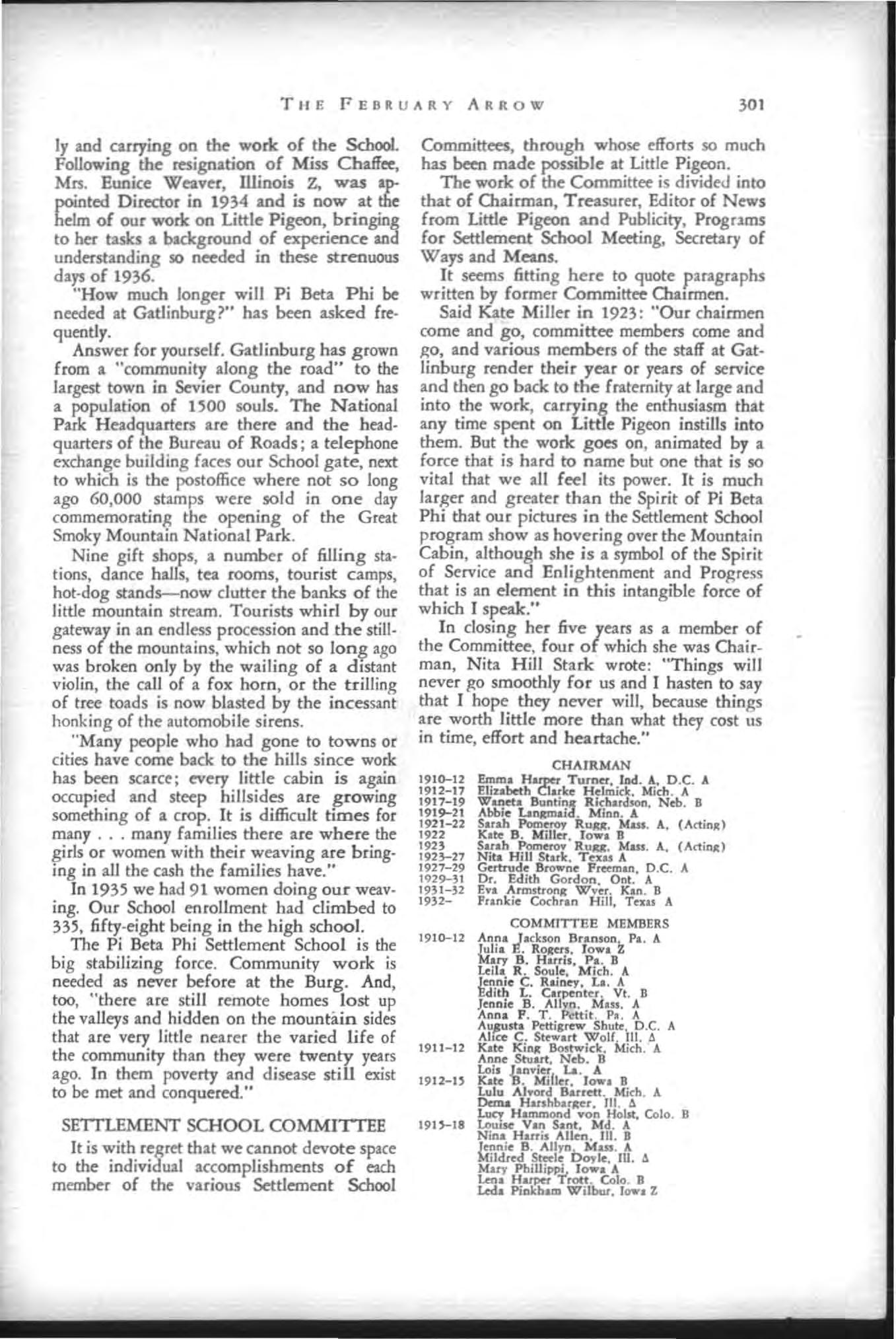
1911-12
1912-13
191)-18
CHAIRMAN
Emma HarpH TurnH, rDd A, D.C. A
Elizabeth Clarke Helmick. Mich . A
Waneta Bunting Richardson. Neb B
Abbie Larwnaid. Minn. A
Sarah PoIrieror RUM: Mus. A, (Actin d Klk 8 Miller JOWl B
Suah PomftQY Run. Mus . A. (AninI!:)
Nit. Hill Stark. Te:ns A
Gertrude Browne Premtan, D .C . A
Dr. Edith Gordon. Onto A
En Armstrong Wver. K.n . B
Franicie Cochran Hill, Tn:u A
COMMITrEE MEMBERS
Anna hclcson Branson!. PI. A
Julia It RORcrs. J OWl z.
Mary B. Harrls. PI . B
Ldl. R . Soule. Mich . A
Jennie C. Rainey , La. A L . Vt. D B. Allyn, Mus. A
Anna P. T . Pettit . P• . A
AUJUsta Pettigrew Shute , D C A
Alice C. Stew.rt Wol( III. fJ.
Kate KinA Bostwick , Mich . A
Anne Stu.rt, B
Lois Janvier u . A
Kate It Miller low. B
Lulu Alvord Barrett Mich A
Ocma Hanhbar,tter. III. b. !-UCT H.mmond von Holst, Colo. B
Louise V.n S.nt. Md A
Nina H rt is Allen. III B
Jenn ie B Allyn M.ss A
Mildrt"d Steele Ill. fJ.
M ry Phillippit low. A
Len. Harper Hott Colo . B
Uda Pinkh.m Wilbur Jowa Z
191) 1916-17 191:5-16 1918-21 1918-20
1919-20 1920--24 1920-23 1921-2:5 1922-23 1922-24 192}-27 1924-2' 1924-28 192)-29 192)-29 1927-31 1927-29 1928-31 1929-33 1929-32 1929-32 1931-3) 19B193219B193-4-
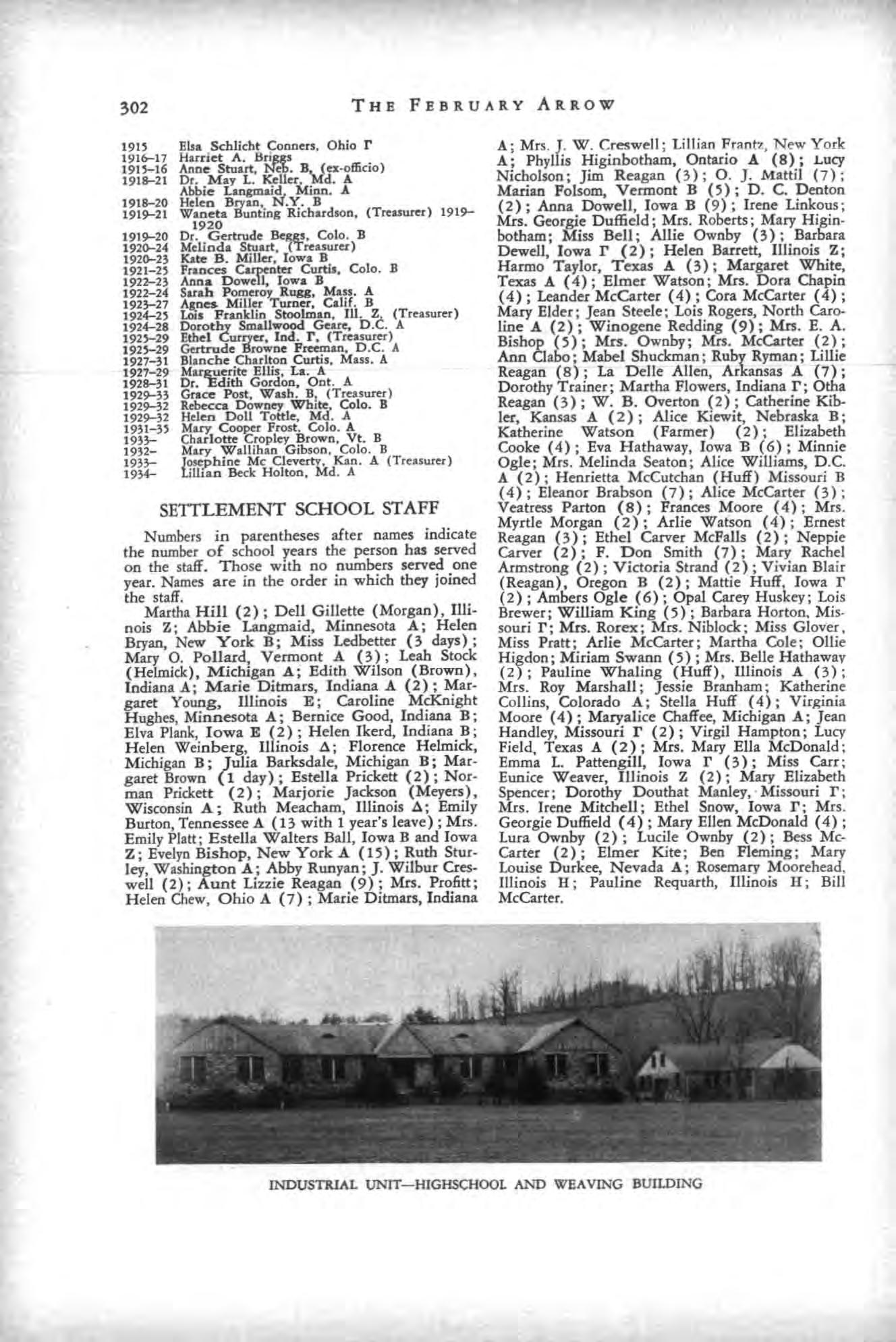
Elsa Schlicht Conner.. Ohio r
Harriet A. Sriggs
Anne Stuart, Nrl>. B. (a·officio)
Dr. May L. Keller Md. A
Abbie Minn A
Helen B!y1n, N,Y. B
WaDeta Bunting Richardson. (Treasurer) 19191920
Or. Gertrude BeW. Colo B
Mdioda Stuart. (Treasuru)
Kite B. Miller, JOWl B
Prlaces Carpenter Curtis, Colo. B
Anna Dowell, JOWl B
Sarah PomerOl Ruga:, Mus. A
!-&.nes Miller Turner. Calif. B
Lois Franklin Stoolman m. Z"" (Treasurer)
Dorothy Smallwood Geare, 0 .'-. A
Ethel Cur!Yet, Ind. r. (Treasurer)
Gertrude Browne Freeman, D .C. A
Bl anche Char lton Curti, M ass . A
Marguerite Ellis. La. A
Dr. Edith Gordon. Ont o A
Grace Post Wuh. 8 1 (Treasunr)
Rebecca Downey WhItt. Colo. B
Helen Doll Tottle. Md .A
Mary Cooper Frrut. Colo. A
Charlotte Cropley Brown, Vt B
Mary WaUihan Gil»on , Colo. B
Josephine Me ClevertY. Kan. A (Treasurer)
Lilhan Beck Holton, Md . A
Numbers in parentheses after names indicate the num ber of school rears the person bas served on the staff. Th ose with no numbers served one year. Names are in the order in which they joined the staff.
Martha Hill (2); Dell Gillette (Morgan), Illinois Z: Abbie Langmaid. Minnesota A; Helen Bryan, New York B; Miss Ledbetter (3 days); Mary O. Pollard, Veanon! A (3); Leah Stock (Helmick), Michigan A; Edith Wilson (Brown), Indiana A; Marie Ditmars, Indiana A (2); Margaret Young, Illinois E ; Caroline McKnight Hughes , Minnesota A; Bernice Good, Indiana B; Elva Plank, Iowa E \2); Helen Ikerd, Indiana B; Helen Weinberg, II inois d; Florence Helmick, Michigan B; Julia Barksdale, Michigan B; Margaret Brown (1 day); Estella Prickett (2); N orman Prickett (2) ; Marjorie Jackson (Meyers) , Wisconsin .A.; Ruth Meacham, 1llinois Emily Bwton, Tennessee A (13 with 1 year's leave); Mrs Emily Platt; Estella Walters Ball , Iowa B and Iowa Z; Evelyn Bishop, New York A (15); Ruth Sturley, Washington A; Abby Runyan; J. Wilbur Creswell (2) i Aunt Lizzie Reagan (9); Mrs. Profitt; Helen o,ew, Ohio A (7) ; Marie Ditmars, Indiana
A ; Mrs . J . W. Creswell; Lillian Prant7 , New York A; PhylJis Higinbotham. Ontario A (8); l.ucy Nicholson; Jim Rea ga n (3) ; O. J. Matti! (7) ; Marian Folsom, Vermont B (5); D C. Deaton (2); Anna Dowell, Iowa B (9); Irene Linkous; Mrs. Georgie Duffield; Mrs. Roberts; Mary Higinbotham; Miss Bell; Allie Ownby (3); Barbara Dewell , Iowa r (2); Helen Barrett, lIlinois Z; Harmo Taylor, Texas A (3); Margaret White, Texas A (4); Elmer Watson ; Mrs. Dora Chapin ( 4) ; Leander McCarter (4) ; Cora McCarter (4) ; Mary Elder ; Jean Steele; Lois Rogers, North Caroline A (2); Winogene Redding (9); Mrs. E A. Bishop (5); Mrs . Ownby; Mrs. McCarter (2); Ann aaoo; Mabel Shuckman ; Ruby Ryman; Lillie Reagan (8); La Delle Allen, Arkansas A (7); Dorothy Trainer; Martha Flowers, Indiana r; Otha Reagan (3) ; W. B. Overton (2); Catherine Kibler. Kansas A (2); Alice K iewi t Nebraska B; Katherine Watson (Farmer) (2); Elizabeth Cooke (4) ; Eva H a thaway, Iowa 'B (6); Minnie Ogle; Mrs. Melinda Seaton; Alice Williams, D .C. A (2) ; Henrietta McCut chan (HuH) Mi ssouri B (4); Eleanor Brabson (7); Alice McCarter (3); Veatress Parton (8); Frances Moore (4); Mrs Myrtle Morgan (2); Arlie Watson (4) ; Ernest Reagan (3); Ethel Carver McFalls (2); Neppie Carver (2); P Don Smith (7); Mary Rachel Armstro ng (2); Victoria Strand (2); Vivian Bla ir (Reagan), Oregon B (2); Mattie Huff, Iowa r (2); Ambers Ogle (6); Opal Carey Huskey; Lois Brewer; William King (5); Barbara H o rton. M issouri r; Mrs . Rorex ; Mrs . Niblock:; Miss Glover. Miss Pratt; Arlie McCarter ; Martha Cole; Olli e Higdon; Miriam Swann (5) ; Mrs Belle Hathawav (2); Pauline Whaling (Huff) , Illinois A (3); Mrs. Roy Marshall; Jessie Branham; Katherine Collins, Colorado A ; Stella Huff (4); Virginia Moore (4); Maryalice Dlaffee. Mic:h.igan A; Jean Handley, Missouri r (2); Virgil Hampton; Lucy Field, Texas A (2); Mrs. Mary Ella McDonald ; Emma L. PattengiIl, Iowa r (3); Miss Carr ; Eunice Weaver, Illinois Z (2); Mary Elizabeth Spencer; Dorothy Douthat Manley, ' Missouri r; Mrs. Irene Mitchell; Ethel Snow, Iowa r ; Mrs Georgie Duffield (4) ; Mary Ellen McDonald (4) ; Lura Ownby (2); Lucile Ownby (2) ; Bess McCarter (2); Elmer Kite; Ben Fleming; M ary Louise Durkee, Nevada A; Rosemary M oo rehead. Illinois R; Pauline Requarth, Illinois 11 ; Bill McCarter
iIlu ""II IIIl!IIIII lIT'" prramt. IIIIJI nnnr I5 r"lIl1!l: ., It kttPlDR 111 .,1. 1Il!1 JlratrmltlJ, In purpo or U. arganl JatlDn, bo,. 4rr,bjJ lIT' ar an Almnnat CIlInb In _________ ta h, luumm anb b,.tgutrll u 14'--------
OlbdJ ar 111 .,Ia 114l
J. IflllnlalllJ 4rrrof IJ of lIT' 16ranb WIn-prr8lllmt anb &,trrllrg ra r lIT'
The history of Pi Beta Phi's lirst alumna: chapters has beeo given in the chronological history, beginning with the one formed in Des Moines, Iowa in 1882 under the provision of the original I.e. Constitution, which stated that "Members of the several chapters shall, upon graduation, become members of the alw:n.ruc chapter, but shall retain connection with their former chapter. The alumna;: chapter shall have no power to transact business," These chapters were given the name of the parent chapter followed by Omega
Of these alumn", groups formed in the eighties, three remai n ed purely alumna:: one at Des Moines, one at I owa City, and one at Lawrence, Kansas.
Th e subject of al um n re interest was o n e which was d iscussed widely in the eig h ties I n September 1885, Leota K e n nedy, I owa B, wrote in THE ARROW : "What can we do to keep up interest among allllIUllE? This is a question often asked and rarely answered We can only suggest possible means. Every old member of the chapter should hear from the chapter at least twice a year, and regular correspondence should be maintained with as large a number as possible, even if a special
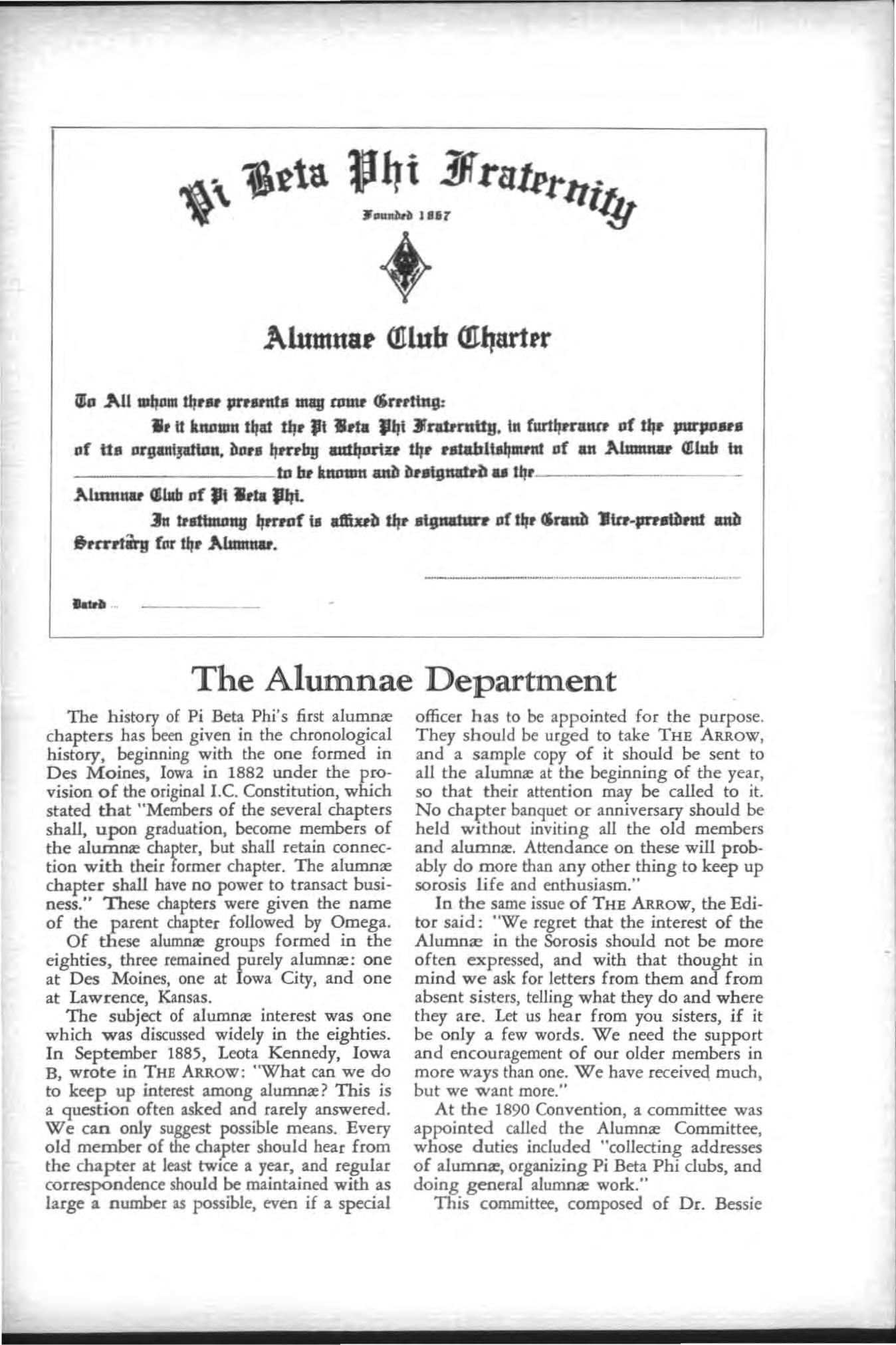
officer has to be appointed for the purpose . They should be urged to take THE ARROW, and a sample copy of it should be sent to all the alumn., at the beginning of the year, so that their attention may be called to it No chapter banquet or anniversary should be held WIthout inviting all the o l d members and alumna:. Attendance on these will probably do more than any other thing to keep up sorosis life and enthusiasm."
In the same issue of THE ARROW, the Editor said : "We regret that the interest of the Alumna! in the $oros is should not be more often expressed, and with that thought in mind we ask for letters f rom them and f rom absent sisters, telling what they do and where they are. Let us hear f rom you sis ters, if it be only a few words. We need the support and encouragement of our older members in more ways than one. We have received. much , but we want more."
At the 1890 Convention, a co mmittee was appointed called the Alumna: Committee, whose duties included "collecting addresses of al=, organizing Pi Beta Phi clubs, and doing general al= work "
This committee, composed of Dr Bessie
Peery, Ida Van Hon, Elva Plank, Lizzie Flagler, and Minnie Howe Newby (Ricketts), recommended at the Convention held at Lawrence in March 1892, "that a general alumnre secretary be appointed to have supervision of alumna: work."
The subject of alumna: organization, as has been stated, had for some time been discussed at meetings and reunions. and in THE ARROW correspondence. Emma Harper Turner, who was then Grand President, was a leader in the movement. With exceptional breadth of vision she saw a great future for an alumnae department through the formation of alumnae "clubs." Miss Turner felt that the alumn", "chapter" was not suited to the needs of the older women.
In accordance with the wish of the Convention. Mary Mc Donald Knapp. Iowa r. was appointed to undertake the duties of alumnz secretary, in the summer of 1890. In August of the same year she was succeeded by Lillie S. Hazelton. District of Columbia A.
In the first Bulletin. which was published by the new Alumn., secretary. Miss Turner wrote an article entitled: "Why Should Alumnz Remain Active in the Fraternity ?. In this artide, with the assistance of Mira Troth, Grand Vice-President, Miss Turner outlined eleven suggestions for a1umn.,. the most important one being:
"Wherever a sufficient number reside let them organize an Alumn., Association that they may keep better informed of the fraternity's condition, put themselves into intimate contact with the organization and in every way spread its reputation and in8ucoce."
Being convinced that the general fraternity organization did not provide full opportunity for alumna: work, and with a view to arousing interest among the delegates to the a pproaching Convention. Miss Turner sent out a special circular in May 1893. proposing that an Al= Association of PI Beta Phi be formed with a membership composed of:
A. Alum"", chapters and dubs.
B. Alumn., corresponding members.
Further. Miss Turner suggested the maintenance of an Alumnz Department in THE ARROW. the publication of an annual membership pampnlet. noting addresses. occupations. and items. and the development of the Literary Bureau.
When the Convention assembled in the
Isabella Club House. Chicago. Illinois. in July 1893. the consideration of alumn", organization was of paramount importance and on the evening of July 18. the question of a permanent organization was submitted to the alumna: for their decision. "The question was a serious one, and involved many vital con· side rations. There was no doubt but what such an association would have a great and good influence on the undergraduates of the fraternity. Besides inspiring them by its example, the association of older women in fraternity work would give a dignity and weight to the fraternity which would never belong to a mere college society."
After careful deliberation. that same evening, the alumna'! at Convention organized the National Alumnre Association of Pi Beta Phi. the first organization of its kind to be formed by any national woman ' s Greek letter fraternity.
The new association was not covered by any provision of the fraternity's statutes. but the constitution and officers recommended for an Alumna'! Council, were submitted to the General Convention for approval. and were by it. at once officially recognized and enthusiastically endorsed.
Emma Harper Turner, retiring Grand President. accepted the Presidency of the new Alumna: Council, in order to devote her time and energy to this very splendid new development in the progress of Pi Beta Phi. Immediately upon the formation of the National Alumna: Association, state secretaries we re appointed in Pi Beta Phi strongholds: District of Columbia. Michigan. Ohio I ndiana, Illinois, Iowa, Kansas, and Colo· cado. In the fall of 1893 THE ARROW directory carried the names also of two alumn", dub secretaries: Washington. D .C.. and Des Moines. Iowa ( Iowa Lambda) Early in 1896 City Secretaries were appointed for New York, Chicago. Baltimore. Cincinnati. Little Rock, Seattle and San Francisco. whose duties were to represent the fraternity, caring for its interests and meeting traveling Pi Beta Phis.
CONSTITUTION OF THE NATIONAL ALUMNIE ASSOCIATION OF PI BETA PHI
( Revu.d and Ratifiod Apr il 1896)
P'RBA.w:8LB
The National AJumne AS$OCiation of Pi Beta Phi js hereby established to maintain the Frater. nity associatIoDJ and friendships of Pi Beta Phi
Alumnz; aDd to secure the-ir mutual roopttation in the- adVAOCftDent of the Fratern ity.
SECTION 1. This orsmizatioo shdl be known as the Nation.1 AJurnnr Association of Pi Beta Phi
O,ganizaJion a"d Go"nnmtnl
SECTION 1. The Organizati on of thU Ass ociation shall be dated from the fourteenth biennial Convention of Pi Beta Phi held at Chicago, July 17-21,
SECTION 2. This Association shaJJ consist of an individual and club
SECTION 3. The government of this Association shall be vested in a bienniaJ Convention, and in the interim of Conventions in an Alumnz Council.
Aillmntlt Anoria/ion C01lv,,,lion
SECTION 1. The biennial of the National Alummt Association of Pi Beta Phi shall consist of .11 of the Associ.tion present; but five (S) members shall be necessary for the transaction of business.
SECTION 2. Organization and conduct of the Convention shall Dc effected after the manner of parliamentary bodies.-the AlumnI: Councilor their substitutes constituting its officers
SECTION 3. Duties of the Convention shall be-
a. To receive reports and review the work of national officers and committees.
b. To provide for the development of the Asso ciatJon and the advancement of Pi Beta Phi interests.
AJ,lmn. Council
SECTION 1. The Alumnae Council shall consist of five (S) officers: President. Vice·President. Secretary. Treasurer. Marshal.
SECTION 2. The Council shall be charged with duties corrcsponrung to those of the Grand Council of Pi Beta Phil so far 15 applicable to AlumnI! work; and in addition those specified in the following sections.
SECTION 3. The President shall have charge of the Association Archives except those provided for otherwise by this Constitution.
SECTION 4. The Secretary shall perform the office of Historian: have charge of al1 Convention Minutes and the Archives pertaining to her specific office : preserve all authorizations for Council action.
SECTION S. The Treasurer shall keep an account of all Association property and be responsible for the same.
SECTION 1. Requirements for membership shaJJ k-
a. AlumnI: or Honorary membership in Pi Beta Phi (Stt Pi Ikta Phi Const. Art. IX, Stt _ 4)_
b . The payment of dues .
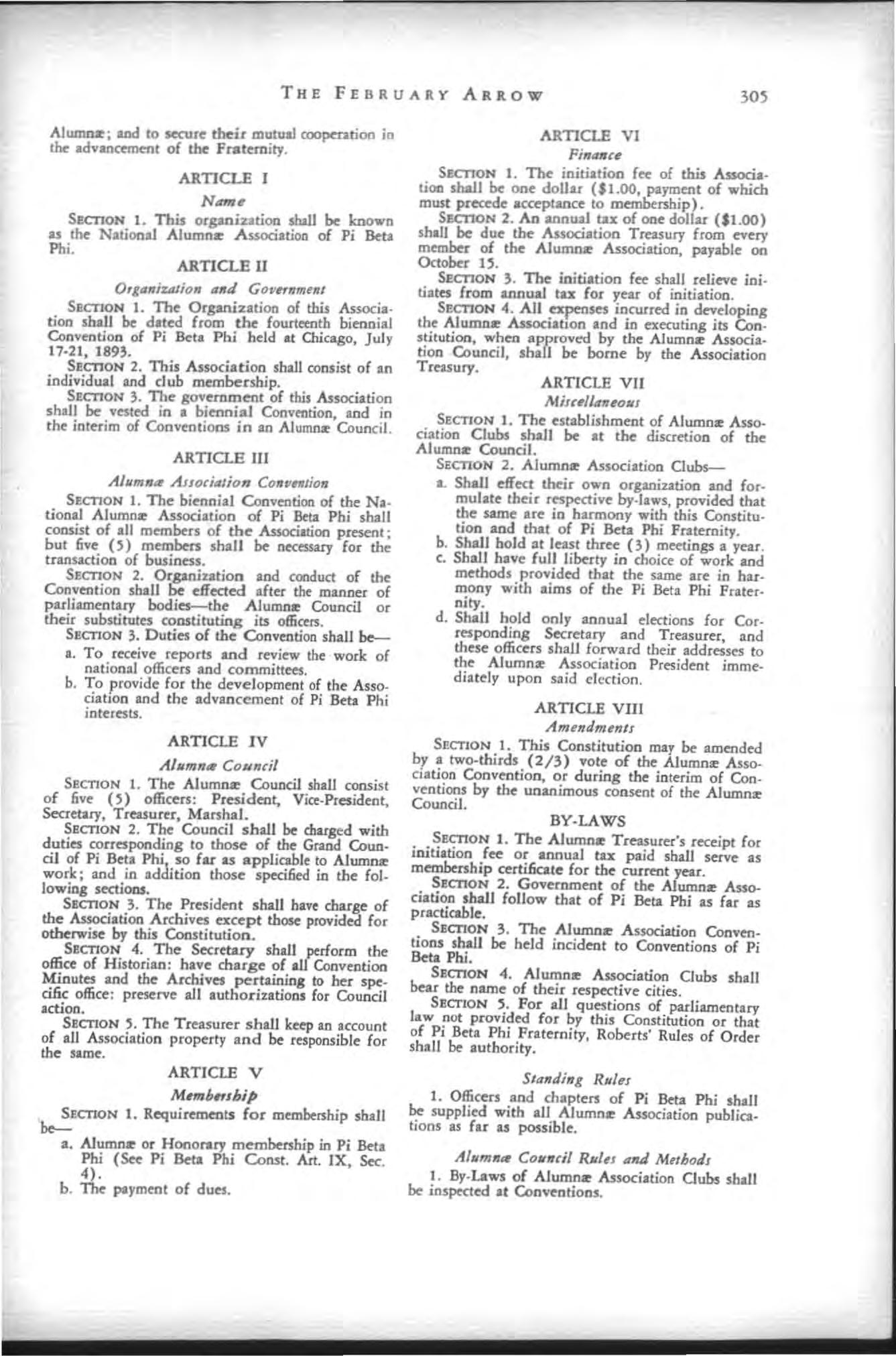
Finan(1
SEenoN 1. The initiation fee of this Assoc:ia. tioc. shaJJ be one dollar ($1.00, payment of which must prectde acceptance to membership).
S.cnON 2_ An annual tax of 00< dollar (SLOO) s ball be due the Association Treasury from every member of the Alumme Association. payable on October ".
SEct10N 3. The initiation fee shall relieve initiates from annual tax for year of initiation.
SECTION 4 All incurred. in developing the AlumnI: Association and in executing its Constitution, when approved by the AlumnI: Associatioo Council, shall be borne by the Association Treasury.
SECTION 1. The establishment of Alumnae Association Clubs shaH be at the discretion of the AlumnI! Council.
SECTION 2. Alumntr Association Oubs-
a. Shall effect thcir own organization and formubte thei r by laws , provided that the same are in harmony with this Constitu. tion and that of Pi Beta Phi Fraternity
b Shall hold 3t least thcee (3) meetings a year.
c. Shall have full liberty in choice of work: and methods provided that the same are in harmony with aims of the Pi Beta Phi Fraternity.
d. Shall hold only annual elections for Corresponding Secretary and Treasurer. and these officers shaU forward their addresses t o the Alumnae Association President immediately upon said election.
A.mendmentl
SECTION 1. This Constitution may be amended by a two-thirds (2/3) vote of the AlumnI! Asso. cia tion Convention. or during the interim of Con. ventions by the uoanimow consent of the AlumnI! Council.
.. 1. The Alumntr Treasurer's receipt for IDJtiation fee oc annual tax paid shall serve as membership certi1icate for the current year.
S.e:cnON 2. Government of the Alumnae Ass0ciation shall follow that of Pi Beta Phi as far as practicable.
SECTJON 3. The AlumnI: Association Conventions shall be held incidcot to Conventions of Pi Bet. Pbi_
SECTJON 4. Alurnne Auoc:iation Clubs shall bear the name of their respective cities.
SECTION ,. For aU questions of parliamentary law not provided for by this Constitution or that of Pi Beta Phi Fraternity, Roberts' Rules of Order shall be authority.
1. Officers and chapters of Pi Beta Phi shaU be suppJied with all AlumnI: Association publications as far as possible.
All/mn_ COl/neil RIIlel lind Methodl
1. By Laws of Alumnae Association Clubs shall be inspecttd at Conventions.
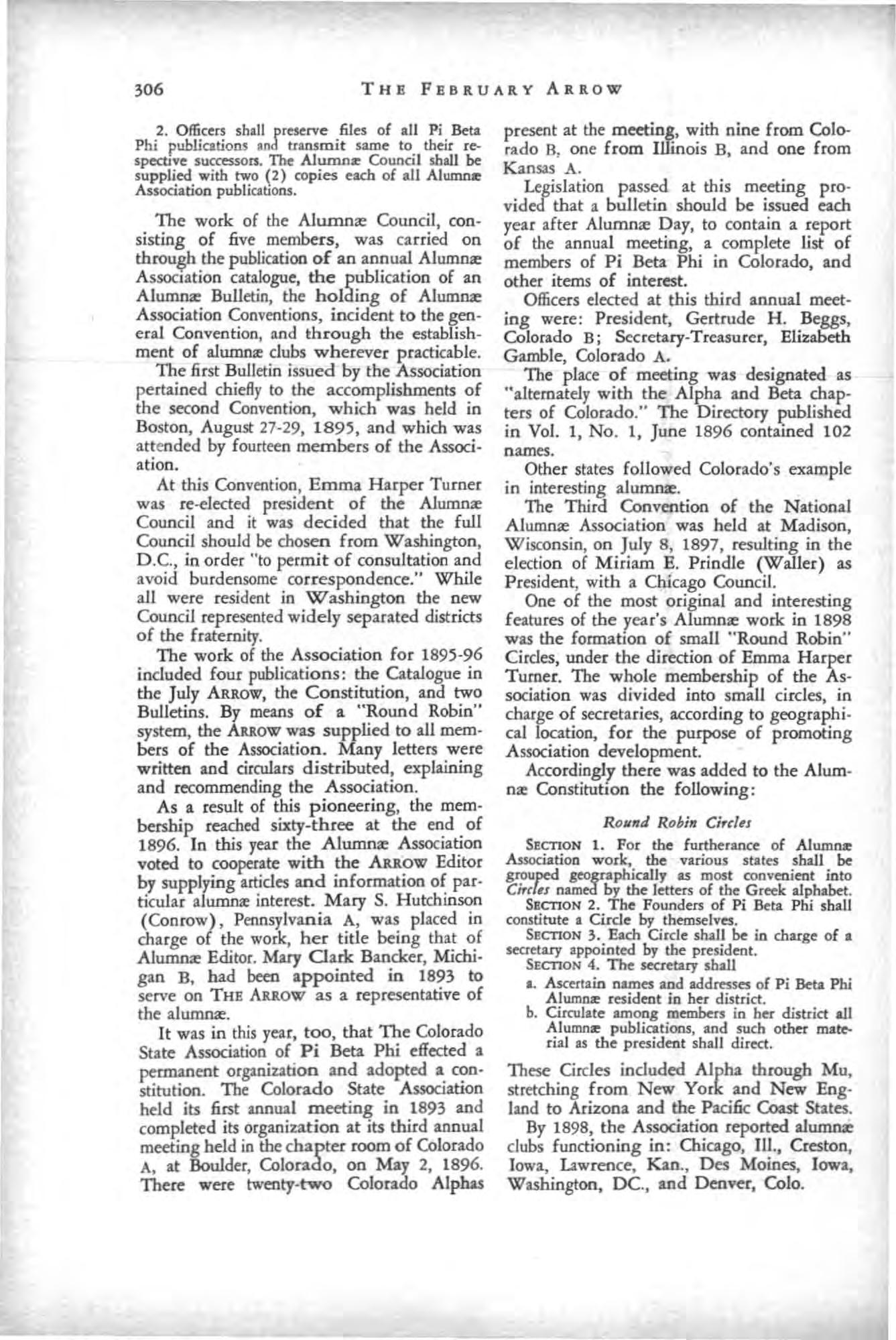
2 Officers shan preserve 61es of aU Pi Beta Phi publications and transmjt same to their respecUve successors. The Alumnae Council shall be su pplied with two (2) copies each of all AIUlIlrul! Association publiations .
The work of the Alwnn", Council, consisting of five members, was ca rried on through the publication of an annual Alumn", Association catalogue, the publication of an Alumna: Bulletin, the holaing of Alumna: Association Conventions, incident to the general Convention, and through the establishment of alwnn., clubs wherever practicable.
The Ii rst Bulletin issued by the Association pertained chiefly to the accomplishments of the second Convention, which was held in Bosto n , August 27-29, 1895, and which was atte nded by fourteen members of the Association.
At this Convention, Emma Harper Turner was re -elected president of the Alumn", Council and it was decided that the full Council should be chosen from Washington, D .C., in order "to permit of consultation and avoid burdensome correspondence." Wbile all were resid ent in Washington the new Council represented widely separated districts of the fraternity .
The work of the Association for 1895-96 included four publications: the Catalogue in the July ARROW, the Constitution, and two Bulletins By means of a "Round Robin" system, the ARROW was supplied to all members of the Association. Many letters were written and circulars distributed, explaining and recommending the Association .
As a result of this pioneering, the membership reached sixty-three at the end of 1896. In this year the Alumn., Association voted to cooperate with the ARRow Editor by supplying articles and information of particular alumn., mterest. Mary S. Hutchmson (Conrow), Pennsylvania A, was placed in charge of the work, her title being that of Alumna: Editor. Mary aark Bancker, Michigan B, had been appointed in 1893 to serve on THE ARROW as a representative of the alumna: .
It was in this year, too, that The Colorado State Association of Pi Beta Phi effected a permanent organization and adopted a. stitution. The Colorado State Associabon held its lirst annual meeting in 1893 and completed its organization at its third annual meeting beld in the chapter room of Colorado A, at Boulder, Colorado, on May 2, 1896. There were twenty-two Colorado Alphas
present at the meeting, with nine from Colorado B, one from Illinois B, and one from Kansas A
Legislation passed at this meeting provided that a bulletin should be issued each year after Alumnz Day, to contai n a report of the annual meeting, a complete list of members of Pi Beta Phi in Colorado, and other items of interest.
Ollicers elected at this third annual meeting were: President, Gertrude H . Beggs , Colorado Bi Secretary-Treasurer, Elizabeth Garuble, Colorado A.
The place of meeting was designated as "alternately with the Alpha and Beta chapters of Colorado.'· The Directory published in Vol. 1, No.1, June 1896 contained 102 names.
Other states followed Colorado's example in interesting aJurnnz.
The Third Convention of the National Alumna: Association was held at Madison , Wisconsin, on July 8, 1897, resulting in the election of Miriam E. Prindle (Waller) as Pres ide nt , with a Chicago Council.
One of the most original and interesting features of the year's Alumn", work in 1898 was the formation of small " Round Robin " Cirdes, under the direction of Emma Harper Turner. The whole membersbip of the Association was divided into small circles, in charge of secretaries, according to geographical location, for the purpose of promoting Association development.
Accordingly there was added to the Alumn., Constitution the following:
ROllnd Robin Ci,deJ
SECfION 1. For the furtherance o f Alumnae Association worle, the various statrs shalJ be grouped geographically as most convmient ioto Ci,el,J named by the letters of the Greek alphabet. SEcnON 2. The Founders of Pi Beta Phi shall constitute I Circle by SEcnON 3. Each Cirde shall be in charge o f a secretary appoin ted by the president . S£cnON 4. The secretary shalJ
I Ascertain namrs and addrnses o f Pi Beta Phi Alumnr resident in her diJtrict.
b. CirruJate among members in her district all Alumnz publications , and such other mate-. rial as the president shall direct.
These Circles included Alpha through Mu, stretching from New York and New England to Arizona and the P acific Coast States . By 1898, the Association reported alumna: clubs functioning in: Chicago, Ill ., Creston , Iowa, Lawrence, Kan . , Des Moines, Iowa., Washington, DC., and Denver, Colo .
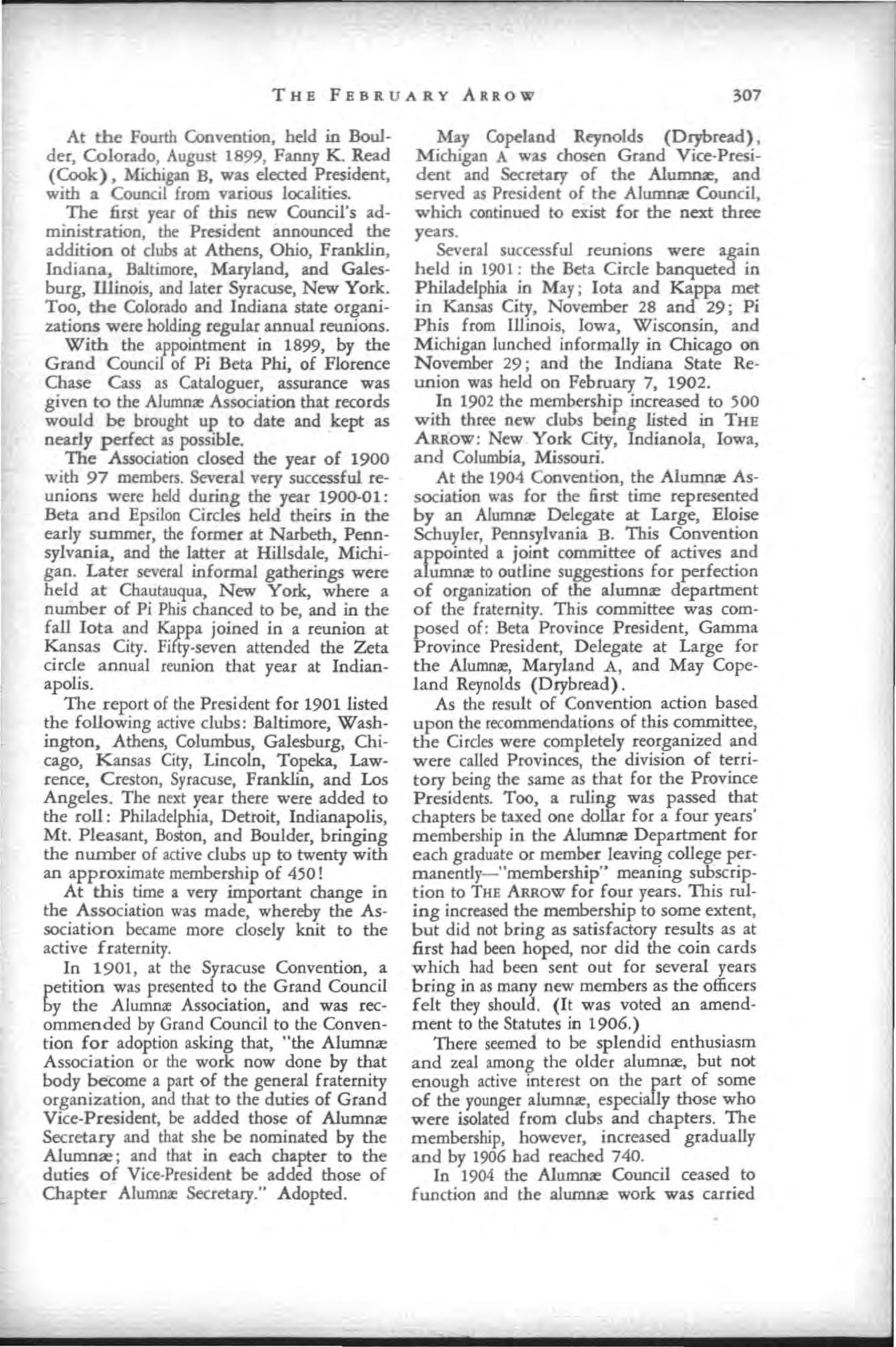
At the Fowth Convention, held in Boulder, Colorado, August 1899, Fanny K Read (Cook), Michigan B, was elected President, with a Council from various localities.
The first year of this new Council 's administration, the President announced the addition 01 dubs at Athens, Ohio, Franklin, Indi ana, Baltimore, Maryland, and Galesburg, Illinois, and later Syracuse, New York . Too, the Colorado and Indiana state organizations were holding regular annual reunions.
With the appointment in 1899, by the Grand Council of Pi Beta Phi, of Florence Chase Cass as Cataloguer, assurance was given to the AlwnnlE Association that records would be brought up to date and kept as nearly perfect as possible.
The Association closed the year of 1900 with 97 members Several very successful reunions were held during the year 1900-01: Beta and Epsilon Circles held theirs in the early summer, the former at Narbeth, Pennsylvania, and the latter at Hillsdale, Michigan. Later several informal gatherings were held at Chautauqua, New York, where a number of Pi Phis chanced to be, and in the fall Iota and Kappa joined in a reunion at Kansas City. Fifty-seven attended the Zeta circle annual reunion that year at Indianapolis.
The report of the President for 1901 listed the following active clubs: Baltimore, Washington, Athens, Columbus, Galesburg, Chicago, Kansas City, Lincoln, Topeka, Lawrence, Creston, Syracuse, Franklin, and Los Angeles. The next year there were added to the roll: Philadelphia , Detroit, Indianapolis , Mt. Pleasant, Boston, and Boulder, bringing the number of active dubs up to twenty with an approximate membership of 450!
At this time a very important change in the Association was made, whereby the Association became more dosely knit to the active fraternity.
In 1901, at the Syracuse Convention, a petition was presented to the Grand Council by the Alumnre Association, and was recommended by Grand Council to the Convention for adoption asking that, "the AlumnlE Association or the work now done by that body become a part of the general fraternity organization, and that to the duties of Grand Vice-President, be added those of Al= Secretary and that she be nominated by the Alumnre; and that in each chapter to the duties of Vice -President be added those of Chapter Alwnnz Secretary." Adopted.
May Copeland Reyoolds (Drybread) , Michigan A was chosen Grand Vice-President and Secretary of the Alumnae, and served as President of the Al= Council, which continued to exist for the next three years.
Several successfuJ reunions were again held in 190 t: the Beta Circle banqueted in Philadelphia in May ; Iota and Kappa met in Kansas City, November 28 and 29; Pi Phis from Illinois, Iowa, Wisconsin, and Michigan lunched informally in Chicago on November 29; and the Indiana State Reunion was held on February 7, 1902.
In 1902 the membership increased to 500 with three new dubs being listed in THE Alutow: New York City, Indianola, Iowa , and Columbia, Missouri
At the 1904 Convention, the AlumnlE Association was for the first time represented by an A1= Delegate at Large, Eloise &huyler, Pennsylvania B. This Convention af.pointed a joint committee of actives and a umnre to outline suggestions for perfection of organization of the alumnlE department of the fraternity . This committee was composed of : Beta Province President, Ganuna Province President, Delegate at Large for the AlwonlE, Maryland A, and May Copeland Reynolds (Drybread).
As the result of Convention action based upon the recommendations of this committee, the Cirdes were completely reorganized and were called Provinces, the division of territory being the same as that for the Province Presidents. Too, a ruling was passed that chapters be taxed one dollar for a four years' membership in the Al= Department for each graduate or member leaving college permanently-" membership" meaning subscription to THE ARROW for four years. This ruling increased the membership to some extent, but did not bring as satisfactory results as at first had been hoped, nor did the coin cards which had been sent out for several years being in as many new members as the officers felt they should. (It was voted an amendment to the Statutes in 1906.)
There seemed to be splendid enthusiasm and zeal amon$ the older alumn"" but not enough active mterest on the part of some of the younger alum=, especiaUy those who were isolated from clubs and chapters. The membership, however, increased gradually and by 1906 bad reached 740.
In 1904 the Alumnz Council ceased to function and the alurnn.:e work was carried
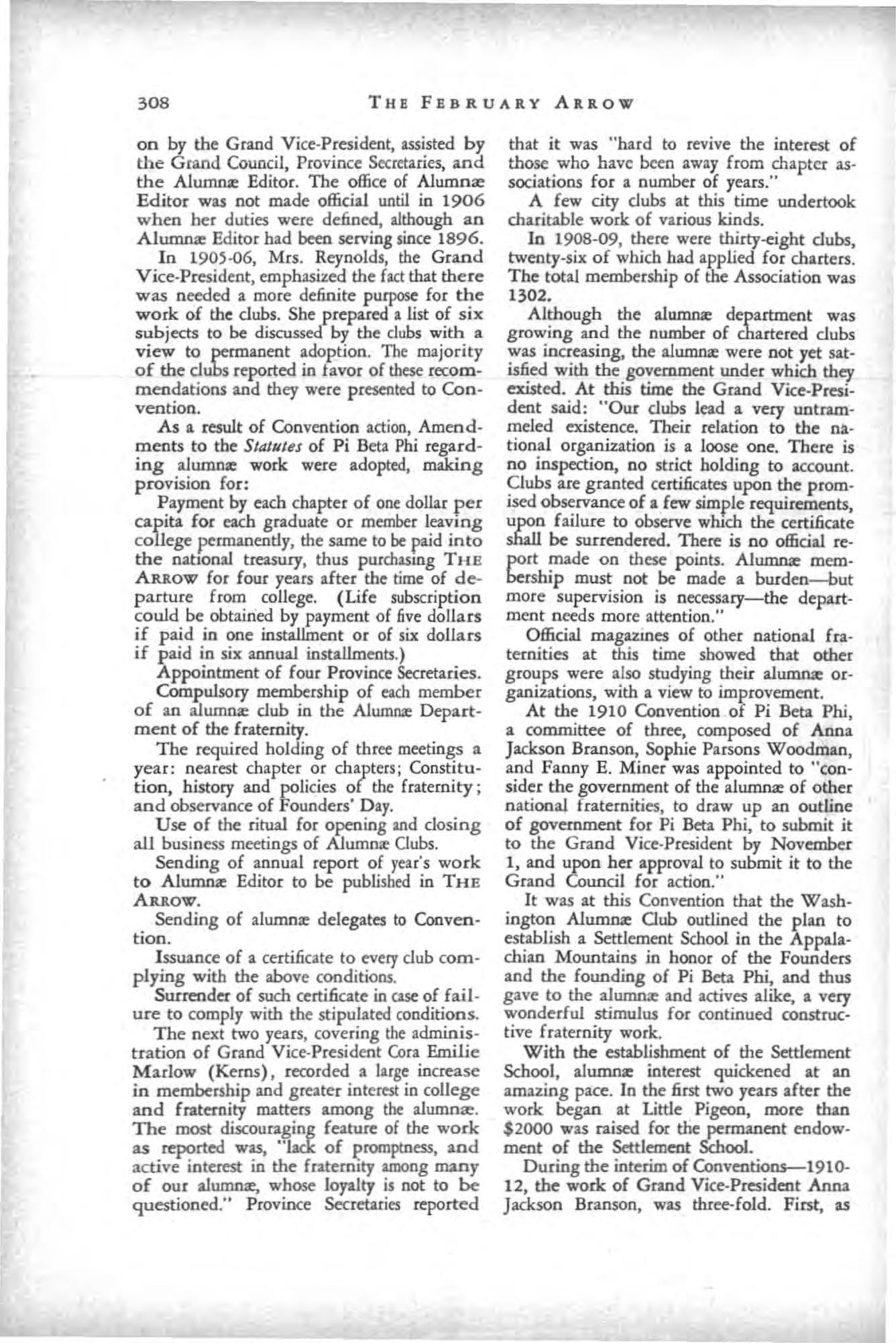
on by the Grand Vice-President, assisted by the Grand Council, Province Secretaries, and the .Alumn", Editor _ The office of .Alumna: Editor was not made official until in 1906 when her duties were defined, although an Alumn", Editor had been serving since 1896 _
In 1905 -06, Mrs. Reynolds , the Grand Vice-President, emphasized the f"t that there was needed a more definite purpose for the work of the dubs. She prepared a list of six subjects to be discussed by the dubs with a view to permanent adoption. The majority of the clubs reported in lavor of these recommendations and they weee presented to Convention.
As a result of Convention action, Amendments to the Slalliles of Pi Beta Phi regarding alumn", work were adopted, making provision for:
Payment by each chapter of one dollar per capita for each graduate or member leaving college permanently, the same to be paid into the national treasury, thus purchasmg THE ARROW for foue years after the time of departure from college. (Life subscription could be obtained by payment of five dollars if paid in one installment or of six dollars if paid in six annual installments )
Appointment of four Province Secretaries_
Compulsory membership of each member of an alum= dub in the .Alum"", Department of the fraternity.
The required holding of three meetings a year: nearest chapter or chapters; Constitution, history and policies of the fraternity; and observance of Founders' D ay.
Use of the ritual for opening and dosing all business meetings of .Alumn", Clubs.
Sending of annual report of year's work to Editor to be published in THE ARROW
Sending of alucnn", delegates to ConventiOD.
Issuance of a ce rtific ate to every dub complying with the ahove conditions.
Sucrender of such certificate in case of failure to comply with the stipulated conditions.
The next two years, covering the admi nistration of Grand Vice-President Cora Emilie Marlow (Keens), recorded a large increase in membership and g reater interest in (ollege and fraternity matters among the alumna: The most discouraging feature of the work as reported was, "lark of promptness, and active interest in the fraternity among many of our aI=, whose loyalty is not to be questioned." Province Secretaries reported
that it was "hard to revive the interest of those who have been away from chapter associations for a number of years. "
A few city dubs at this time undertook charitable work of various kinds.
In 1908-09, there were thirty-eight dubs, twenty-six of which had applied for charters. The total membership of the Association was 1302_
Although the al= department was growing and the number of chartered dubs was increasing, the alumna! were not yet satisfied with the government under which they existed. At this time the Grand Vice-President said: "Our dubs lead a very untrammeled existence. Their relation to the national organization is a loose one, There is no inspection, no strict holding to account. Clubs are granted certificates upon the promised observance of a few simple requirements, upon failure to observe whIch the certificate sliall be sucrendered. There is no official report made on these points. .AI= membership must not be made a burden-but more supervision is necessary-the department needs more attention."
Official magazines of other national fraternities at this time showed that other groups were also studying their al= organizations, with a view to improvement.
At the 1910 Convention of Pi Beta Phi, a committee of three, composed of Anna Jackson Branson, Sophie Parsons Woodman, and Fanny E. Miner was appointed to "consider the government of the alucnn", of other national fraternities. to draw up an outline of government foe Pi Beta Phi, to submit it to the Grand Vice-President by November 1, and upon her approval to submit it to the Grand Council for action."
It was at this Convention that the Washington .Alum= Cub outlined the plan to establish a Settlement School in the Appalachian Mountains in hooor of the Founders and the founding of P i Beta Phi, and thus gave to the al= and actives alike, a very wonderful stimulus for continued constructive fraternity work.
With the establishment of the Settlement School, interest quickened at an amazing pace. In the first two years after the work began at Little Pigeon, more than $2000 was raised for the permanent endowment of the Settlement School.
During the intetim of Conventions-191012, the work of Grand Vice-President Anna Jarkson Branson, was three-fold. First, as
Grand Vice -President, she performed the usual duties of her offi ce as a member of the Grand Couocil; =ond, as secretary of the Alumn"" she had charge of the making up of the mailing list for the alumn", subscribers of THE ARROW, which induded the sending out of 5000 coin cards annually through the various secretaries and with the help of the Cataloguer; in addition to this she had her regular dub work, the chartering of dubs, etc.; and third, she was a member of the National Settlement School Association, being made the treasurer of the committee.
In making her report to the Convention in 1912, Mrs . Branson recommended that some new plan be adopted so that no one officer should have to carry all of the detailed work which had devolved upon her office during the P:lSt interim of Conventions.
In accordance with Mrs. Branson's recommendations, Province Vice - Presidents were created at the 1912 Convention whose duties were in the same relation to the Grand Vice-President as those of the Province Presidents to the Grand President.
The year following the Convention a very interesting Conference of the Grand Council and Alumn", Club Delegates was held at the Fine Arts BuildlOg, Chicago, June 19-21, 1913. The Conference was opened by Grand Vice-President Lida Burkhard Lardner, with Bessie Tucker GisJason, secretary. All Grand Council members wefe present.
This Conference was the outcome of a growing desire among the older members for a closer and more intimate knowledge of fraternity, and especially Pi Beta Phi Fra· ternity matters. The visiting delegates were the guests of the Chicago Alumn", Club, and the meetings were held in their dub rooms . The traveling expenses of the delegates were defrayed by themselves or their clubs. Half of the delegates were women with families; four were initiated previous to 1887, the Indianola delegate having been a Pi Phi more than thirty years, the Mt Pleasant, 29 years, the Ames, 28 years, and the Des Moines, 27.
The reports of the clubs occupied two full sessions and part of a third, and were full of interest and profit.
The Conferen ce, not being vested with legislative power, could make recommendations only. All questions of reform or amendments were referred to the Committee on Recommendations, which made a complete and concise report to the Conference . These recommendations were voted upon separately and
were then submitted to the Grand Couocil, which met shortly after the Conference adjourned.
Some of the most outstanding accomplishments of the Conference were:
A recommendation that a committee be named to consider the rroposition that each alumna pay the sum 0 50¢ a year into the grand treasury to meet expenses of the Alumn", Depa rtment.
A recommendation for the drafting of a model and uniform constitution for all alumnre clubs.
Endorsement of the idea that a plan be evolved for better and larger representation of alumnz in the biennial conventions.
Recommendation that the Constitution be amended, so as to authorize an advisory committee, to be appointed from the nearest chartered alumna! dub, this committee, composed of three alumn", to be selected by the active and two by the alumn", dub, to be adVISOry only.
This last recommendation was of farreaching effect and met with universal approval.
Most of one session of the Conference was devoted to the Pi Beta Phi Settlement School at which time Elizabeth Clarke Helmick gave an historical sketch of the school; Lulu Alvord Barr ett spoke of the needs in furnishings; Kate B Miller related incidents of interest about the life of the people at Gatlinburg; and Abbie Langmaid, who had just returned from a visit to the Hindman, Kentucky, Settlement School , told of the work of that school and outlined her wishes for the Pi Beta Phi School.
The Conference went on record as favoring continued conservative extension; Province Conferences; continued support to the ARROW Editor ; serious consideration of the Panhellenic situation; and voted that the alumn", clubs provide for a systematic study of the Constitution, the Historical Documents, and the Yearly Examinations .
That the Conference had splendid results could not be doubted.
In 1914, Mrs. Lardner said in her annual report: "Though the specific relations now established between the alumn", clubs and the fraternity have not brought forth tbe results anticipated, nevertheless they are gratifying when one considers how long our have been running independeotJy. " In this report she also commented upon the club programs which she had received. As early
as 1908, the New York City Club began printing its annual programs.
Very definite results followed the plan adopted by the 1912 Convention, by which the provine< vice·presidents and the Alumn., Editor bore the same general relation to the alumn., that the province presidents and The ARROW Editor bore to the active members. The alumnz department endeavored to hold the clubs responsible for ARROW subscriptions, the collection of the alumna:: tax, and the dissemination of fraternity information among the resident aJU1llI1re so far as possible, and tried to reach the isolated alumnz through the Province Vice-Presidents
In the three years between the Evanston Convention and the Berkeley Convention in 1915, 24 new alumn., clubs were organized and 36 charters were granted, bringing the roll of clubs up to 65. Much effort was placed by the Grand Vice-President upon the locating of old charters and in persuading old well-established clubs to go through the formality of requesting a chart"r. In carrying out this work a tentative form of application for a charter was inaugurated.
No fee was charged for a charter, but all cha rtered clubs were required to pay into the national treasury through the Province President, the alumnre tax of 50¢ for eac h member.
The ruling for Chartered Alumnz Clubs provided that, "Every alumnae group with not less than ten active members which agrees to meet the requirements established by law shall upon application to the Grand VicePresident and upon paying to her of national dues, be granted a charter by the Grand VicePresident. Each chartered alumn., club shall be allowed one delegate to the Alumn., Sessions of Convention ." (In 1931 the Grand Council voted that, "Any chartered club which fails for two years to meet the requirements of the fraternity shall forfeit its cha rter.")
The work of the .Iumn., dubs by 1916 was four-fold, viz.: the collection of alumn., tax, the getting of ARROW subscriptions, the maintenance of chapter interest, and the support of the Settlement School.
The most stimulating and unifying work of the clubs was that which they did in the interest of the Settlement School. The clubs not only raised money with various local projects for the financial aid of the school, but they supported the national magazine subscription agency, and created splendid
markets for the sale of the products made at Gatlinburg.
The plan of having the Grand VicePresid ent and the seven Province VicePresidents act as a Settlement School Board, under the able management of Elizabeth Clarke Helmick, worked out very well , and the alumnz club contributions to the project steadily increased.
When the strong wave of anti-fraternity agitation began to sweep the country, the Grand Vice-President urged the clubs to realize that there were many opportunities before them-not only in the mountains of Tennessee, but in the field of the active chapters, as well.
At the end of their first three years of work among the alumnre, the Province VicePresidents, in 1915, presented twelve recommendations to Convention relating to yearly visits to clubs, uniform constitutions, uniform rul es [or collecting the alumna! tax, uniform card cataloguing system for use of Province Vice -Presidents , definite outline of work for Province Vice-Presidents, systematic supervision of the work of the Province VicePresidents, and definite regulations for alumfire advisory committees.
The Convention accepted the recommendations and also voted that the alumn., clubs hold four regular meetings each year.
In recognition of the splendid accomplishments of the Province Vice-Presidents, the Grand Council in 1916 voted to grant thern seats and votes in the active as well as the alumnre sessions of Convention. Too, the A1umnz Editor was made the secretary of the alumna! convention sessions.
Since the coming Convention of 1917 was to be devoted largely to the celebration of the 50th Anniversary of the f ound ing of Pi Beta Phi , it was to be primarily an "alumnz convention ," with three days allotted to alumn., interests. Every club was urged to send a delegate Efforts were being made to bring the roll of clubs up to 100 by Convention time.
There were at that time 23 states without a Pi Beta Phi alumn., club. Since ten members were required for a standard club, and it was often difficult to find that many Pi Phis in one town, alumna: were urged to form "locality" clubs-that is, to reach out from their towns and to welcome isolated Pi Phis in order to find a group of ten members.
Transfer cards were available for the use
of a!umnz moving into a now locality wbere there was an alumna: dub. Detailed information relative to the organization of dubs and the duties of a!urntl3O dub officers were printed in THE ARRow. Everything possible was done to stimulate interest in al= affairs .
And then with a rising wave of enthusiasm among all f rateroity members for the approaching Anniversary Conveotion-the United States eotered the World War. All Convention plans were immediately post· poned.
In order to maintain the necessary contacts with the clubs and chapters , Gund President May 1. Keller and Grand Vice·President Nina Harris Allen made a six weeks' trip in the summer of 1917 to the Pacific Coast to attend province gatherings and to stimu· late interest in the national fraternity. Oubs were advised to do war work in addiJion tO I rather than instead of the regular fraternity work
Volunteers were called for to assist in organizing or in joining clubs in the states of Maine, New Hampshire, Connecticut, Now Jersey, West Virginia, North Carolina, South Carolina, Georgia, Florida, Alabama, Missis· sippi , Tennessee, Kentucky, North Dakota, Idaho, Utah , and New Mexico.
The Grand Council asked for an expres· sion of opinion th rough letters of questions to be discussed at its annua! meeting, send· ing the questions to the dubs for advice.
Although conditions throughout the coun· try were and we were still in the midst of War, it was felt necessary to hold a Convention in the summer of 1918 at Charlevoix, Michigan. There three outstand· ing measures originated in the Alumna"! Sessions: the recommendation for a distinctive war work as a national fraternity; the recommendation for the establishment of a board of trustees, five in number, to manage the Settlem<nt School; and the appropriation annually of $200 for the Loan Fund.
Although the fraternity was not yet finan· cially able to bear the expense of visits to clubs from national or province officers, Mrs. Allen, the Grand Vice·President, while visit· ing chapters in the interim of Conventions, 191'·1918, found it possible to visit 33 clubs. The Province Presidents also visited clubs whenever possible. Despite the unsettled con · ditions of the war, during part of this period, 20 new clubs were orJ!2nized and applied for charters, and a small beginning on a state
or sectional plan of organization , especially in states wheee there were few and widely scattered Pi Phis, was made.
Due to the fact that the Grand Vice· President was a member of the Settlement School Board , and made personal trips to the Settlement School, she was able to bring first hand information to the clubs and illustuted her talks with the stereopticon.
The year 1918·19 was rather devastating on alumrur interests, due to the inBuenza epidemic and the war conditions. Many clubs had no meetings for months because of the ban on gatherings of any sort, and so, many of the year's programs had to be abandoned.
The new Grand Vice·Presideot, Anna Robinson Nickerson , departed from tbe usual custom and wrote directly to all clubs in the eady fall , making suggestions relative to tbeir work and endeavored "to establish a feeling of nearness and in the spirit of helpfulness that the alumnae officers wished to have exist in their department ."
At the request of Grand Council, Volun · teer Service cards were issued in order to recruit workers. Five new dubs were char· tered during the year . Clubs were asked to set aside one meeting a year for the discussion of vital health problems, and it was suggested that they might unite with chapters in celebrating chapter day.
The work of the alumna:, however, continued to be the maintenance of the Settle· ment School, a work which surely had a place in the reconstruction period.
B1.,ks for Jists of club officers were suo· olied to all clubs. For Founders' Daf cele· heations . a personal letter was sent by the Grand Vice President to each dub , with an attemDt to make e ach greeting suited to the club receivinQ; it.
Tn Tune 1920 Mrs Nickerson sent a letter to all Pi Phis living in {areian countries and whose address was known. asking for a letter, that when published in THE ARROW, might be of aid to Pi Phis planning to travel to those same countries.
In the work there were many oroblems due to the fact that the clubs varied so in character. There was the small club; the club comoosed of members from one chapter ; the club composed of many memo hers from one c hapter with a few from other chapters; the cosmopolitan dub; the club composed of members living within a short distance of each other ; and that of members scattered over a wide territory ; the club with
an active chapter near at hand; and the dub without one.
In 1920-21 a suggested Constitution was compiled for use of small clubs, also a detailed program was outlined for Constitution Day. Clubs were advised to use a budget system and to form executive boards, in order that the amount of time consumed by business in the regular meetings might be reduced to a minimum .
Sixteen dubs were chartered between 1918 and 1921.
Especial effort was made to work up Founders' Day celebrations in centers not reached or affected by alu= clubs or active chapters . The Grand Vice-President recommended a Manual for Club work.
At the 1923 Convention the alumn., assumed the financial responsibility for the expenses of Province Presidents who detoured to make dub visits, while visiting chapters. Too, arrangements were made whereby any fraternity officer who expected to make an official visit to an alumn", dub should notify the Province Vice-President, and afterwards report to her concerning the visit.
Alum"", Club charts, showing progress of the various groups, were presented for the first time at the 1921 Convention The con· tribution to the Loan Fund that year, made by the a1umn"" was $400
The year 1919-20 marked the beginning of intensive club work to raise funds for the Settlement School and showed rivalry between the clubs in the amounts raised. That year, Lincoln, Nebraska, in addition to assist· ing Nebraska B in purchasinp; and helping to furnish a new .home, raised for the Settlement School, with Cleveland contributing $711. Clubs in 1920-21 raised $D,OOO for the School, Cleveland setting the high mark at $1800. The next year Cleveland and New York Gty reached $1800 with Philadelphia $1100 and Washington , D C., $1000. The next year New York City took the lead with $2123.10, with Cleveland
Much enthwiasm was generated at the Convention of 1921, resulting in the chartering of nine new clubs in the following year . Group after group applied for charters.
In 1922 the Grand Council voted that a1umn., dubs adopt the AIwnnre Mother idea with relation to the girls of the active chapter, the same to be based on the Town Mother Idea as introduced at Indianola , Iowa, by Sarah Eikenberrr Sigler.
The compilatton of a Manual for the use
of Alumn., Advisory Committees, compiled by Mrs Nickerso n in 1922 proved of inestimable value.
In 1923 it was voted that the Grand VicePresident and Provin ce Vice·Presidents be elected in the alumnre session of Convention, thus giving more power to the alumnae department.
At this Convention a committee was appointed to prepare a skeleton constitution for use by alumnae clubs, and endorsement of a Conference of Eastern Provinces to be held at Washington , D.C., preceding the D A R. Congress in the spring of 1924, was given.
It was voted in the alumnae session that the name of Emma Harper Turner be made as lasting as her work by naming for her some building at the Settlement School.
At this Convention the New York Alumn", Club presented a set of resolutions which read, in part : "It is the consensus of opinion of the Executive Committee of the New York Alumnae Club that 'Taxation without Representation' is not a sound policy upon which to build a united fraternity; be it therefore Resolved , That necessary steps be taken to effect a reorganization of Pi Beta Phi Fraternity which will give its alumna: associations an equitable voice in the election of all officers havin,g in charp;e the directing and distribution of funds raised in full or in part by these alum"", associations."
These resolutions were referred to a committee appointed after Convention , to study and report on the Reorganization of the Alumn., Department. The Grand Vice-President appointed the New York City Alumnae Club as the committee.
Through the splendid spirit aroused at the Estes Park Convention and by the Eastern Conference and the Presentation of Mrs Coolidge's portrait, alumnae interest was given much zest for progressive work.
In the year 1924 the New York Club again lead aU other clubs with its Settlement School <lonation of $2300 , Oeveland was a dose second with $2100 although its membership was only 60. The next year Cleveland led with $2200 .
Through the able management of the Grand Mrs. Nickerson, assisted by her husband , David D. Nickerson , the sum of $1172 was turned over to the Settlement School from the oversubscription to the Portrait Fund and from the sale of autographed photographs of Mrs . Strenuous effort was made by national offi-
cers to keep in close contact with the clubs, and a report for the year showed 112 clubs visited by a member of Grand Council, leaving only 34 clubs unvisited by a Council member. Many of those clubs, however, received visits from the Province Presi· dents.
At the AlUIIlllZ Session of the Convention, when it was found that the report of the Committee on Alumn., Reorganization dealt with a change in the government of the active department, and not just with the alumn", department, the Chair ruled the report was out of order and therefore could not be presented officially Since the session, however, asked to hear the report, it was read in full by the Chairman, Elizabeth Shepard Lough, Wisconsin A.
Some of the changes in reorganization suggested in the report included:
1. Addition of a second Grand Vice·Presi· dent, who would do the work which concerned only alumn." leaving the first Grand Vice-President free for active work.
2. Granting of charters to clubs of members or over so as to insure possibility of each club finan cing a delegate to Convention and thus cutting down the number of clubs entitled to a delegate.
3. Increase of dues.
The Convention recommended that the Grand Council be authorized to appoint a committee to continue the research on Reorganization of the Alumna! Department, the committee to consist of the Grand Treasurer as an advisory member, alumnre, and active representatives.
Grand Council was empowered to so change the Constitution and Statutes that the alumore sessions could change such articles and sections as concerned only the alumnae department. Accordingly the Grand Council voted that in the matter of revision of the Constitution by the Alumn", Session of Convention, "in case of a question as to the interpretation of the words 'which relate solely to the work and interests of the alumn", department of the fraternity; the power of interpretation shall be vested in a board of arbitration, which shall consist of the members of the Grand Council and Province Presidents and Province Vice-Presidents."
The Convention raised the annual alumnre national dues to $1.00; and created the office of Assistant to the Grand VicePresident.
After Convention a Manual for Province
Vice-Presidents was compiled by Emilie Margaret White, newly appointed Assistant to the Grand Vice-President, assisted by Kate Freund Miller, and Marion Baker.
Directed by Grand Vice-President Olive Keller Laurence, monthly letters were exchanged between the Province Vice·Presidents and clubs, and a system of Round Robin letters was carried on most effectively between the Grand Vice-President and her Province officers. Especial attention was given to the collecting and verifying of addresses of isolated al=.
After serving one year as Grand VicePresident, Mrs. Laurence found it necessary to resign because of home duties, and she was succeeded by Emilie Margaret White.
As Grand Vice-President, Miss White, with the assistance of Dorothy Smallwood Geare of the Settlement School Committee, directed an intensive membership drive, sending out through the Central Record and Supply Office some 5000 letters to isolated al=. To these isolated al= the Asso· ciation offered for $1.00: membership for one year and an annual subscription to the monthly newspaper, The Gatlinburg NewI, published monthly at the Settlement School. Clubs offered associate membership to the isolated members for a year.
About 100 members were added to the alumn", membership roll through this campaign.
Despite the increase in regular dues, membership everywhere increased, during the interim of Conventions.
The Committee on Alumn", Reorganization, with Blanche Charlton Curtis, Massachusetts A, Chairman, worked diligently between Conventions and in 1927 presented a report. A minority report was also submitted by Elizabeth Shepard Lough, Wiscon· sin A, of the New YorK Club.
Each recommendation was considered separately by Convention, with the result that much important legislation was adopted, the most important being:
The Alumn., Editor became a member of THE ARROW staff only, relinquishing her work as secretary of the alumnz sessions of Convention.
The Assistant to the Grand Vice·President was made secretary of the alumnre sessions of Convention.
Official visits to dubs by Province Vice· Presidents once in the interim of Conventions were provided for
Payment of $1.00 dues to the National Alwnnre organization by seniors at time of Senior Farewell Ceremony was made pulsory.
Two·fifths of cost of maintenance of the Central Record and Supply office was as' sumed by the alumnre department.
Annual appropriation of $200 to the Loan Fund was made.
Presentation of credentials to future Conventions by alumna! club delegates was reo quired.
Before the close of the Convention it was moved that the Committee on Reorganization be continued.
As chairman of a committee appointed by Mrs. Laurence, Kate Freund Miller, Assistant to the Grand Vice·President, continued the work of sending questionnaires to all national fraternities for women to obtain data on alumnre procedure. The answers to these questionnaires were summarized and proved to be of much interest, showing that all national fraternities had practically the same alumnre problems
Thirty new charters were granted to dubs between and 1927, with the loss of only two clubs, bringing the total to 136.
In 1927-28, Grand Vice·President Emilie Margaret White reported a marked increase in membership, especially in the larger cities. During this period, with the assistance of the Assistant to the Grand Vice·President Genevieve Herrick Smith, Miss White issued: a Manual, outlining the duties of officers of alumna:' clubs; an outline for the report of AJumnre Advisory Committees; an outline for report of Province Vice·Presidents on visits made to their dubs.
Mu ch was accomplisbed through the per· sonal contact of officers with their dubs. Many of the smaller clubs reported 100% membership!
Continuing the plan which had been used in 1927 of devoting separate sessions of Con· vention to the Alumme Department, instead of holding them at the same time as the ac· tive Session, the 1929 Convention made it possible for both actives and alumnre to attend the alumnre sessions. Seventy-one alumnre dub delegates presented credentials and were seated in Convention, nearly all of them attending the Convention at their own ex· pense.
Reports of officers and dubs showed splen. did work being accomplished by the alumna!
department, and the dovetailing of interest and work with the active de\,artment. There were 151 clubs on the fraternIty roll.
The Committee on Alumnre Reorganiza· tion, with Blanche Charlton Curtis, Chair· man, reported that in 1928·29 it had sent a letter to each dub, to each committee chair· man, and to each national officer asking what changes each desired or recommended. "I n particular, an expression of opinion was re· quested on the subject of a required course of study of fraternity policy and organiza· tion. Twenty.nine clubs expressed tHemselves on this last point and only three were in favor of it. The general opinion seems to be that the serious work of the alumna! is the Settlement School, and that it would be a mistake to give up more time to study, especially in view of the fact that the constitution already requires two such meetings every year . . There were few other suggestions, although two dubs sent quite definite points for committee discussion. The New York Club is convinced that the required course of study, referred to above, is the best way to secure a greater interest on the part of the alumnre, and in addition, strongly recom· mended a change in our system of nominations for national officers . ... The Richmon d Club recommends that the Grand Vice· President conce ntrate on alumnre work and alumnre club visiting. At present this is the work of the assistant to the Grand V ice· President, with the province vice-presidents doinS- the club visiting in their respective provInces. They further recommena that alumnre conferences be held at Washington at desirable intervals."
The Committee reached the conclusion that, "Most of the clubs and most of tbe in· dividual alumna! consulted seem to feel that further changes in our organization are not necessary at this time," and in conclusio n recommended "that this Committee be dis· banded, since the alumn", club work has been so developed that there seems no further need for its services."
The Committee offered to Convention an amendment to the Constitution, defining the duties of the Settlement School Committee. The Convention voted the adoption of the recommendation , and also voted that the Committee on Alumnre Reorganization be discontinued.
In closing her work as Grand Vice-President, Emilie Margaret White reported that
during the period 1927·29 there had been a devdopment of national consciollsness-a distinct advance in the more active participation of dubs in the national work. Of the 141 clubs chartered previOUS to Founders ' Day 1929, 120 submItted annual president's repotts. Many of the dubs asked for annual visits of Province Vice·Presidents, instead of biennial visits.
"Most dubs," said Miss White, "find that variance in ages and occupations of members presents no problems, if they {rOvide worthwhile programs and plenty 0 work A club with an efficient executive committee which disposes of routine business and permits time in club meetings for real discussion of fraternity questions, the reading of officers ' letters and news from the active chapter and Settlement School, and real sociability holds the interest of members more successfully than the one in which all the time is consumed with matters of routine."
The Convention of 1929 authorized a conference of Province Vice·Presidents to be held at the Settlement School during the summer with Grand Vice-President Katherine Buer TelJer. The intimate information and true understanding gained at that conference proved of inestimable value to the officers and through them much new enthusiasm was aroused in the clubs by vivid accounts of the SchooL
During the administration of Mrs. Teller, 1929 -3 1, the alumnae cluh roll reached U2 in number with eight new clubs chartered, despite the great handicap of the depression. The group plan steadily gained in favor in the larger cities. Mrs. Teller reported that Seattle had found the plan to be a successful way of meeting the problems of distance and a widely scattered membership; the New York City Club reorganized on the group plan ; the Chi cago membership divided into five distinrt clubs; and a number of "locality" dubs were formed such as the South Central Kansas Cluh ; the Southern Jersey Gub; and the Glenhurston Club in Illinois.
By 1930 district and state gatherings were being more and more widely observed. Such meetings had been very pnpular in the early 19005 when Kansas City, Chicago, Indianapolis, and Boulder and Denver were the leaders in such movements . The more recent gatherings include those held at: Seattle, Syracuse, Rochester, Northern New York and Canada, O:licago, Des Moines, San Francisco Bay,
Southern California, New York City , Kansas City, Michigan , Arkansas , Indianapolis , Denver and Boulder, Ontario Province, St. Louis, and Eta Province.
In 1930, Ruth Barrett Smith, then Assistant to the Grand Vice President, completed the tabulation of records of province work. for 1926-1930, and has since then carried on that im portant work.
The al= exhibits at the Convention tn 1931, attested the extensive work being done by the clubs and the great progress made in the internal development of the Alu.m.nre Department.
Despite the trying financial conditions prevalent throughout the country and regard. less of the fact that the Convention was held far from the center of the greatest "popula. tion" of Pi Beta Phis, 52 alum"", delegates presented credentials at Asbury Park in 1931 , practically all of them bearing their own ex· penses.
Numerous Round Tables at the Alumn", Sessions of the Convention proved most instructive and helpful. Some of the subjects discussed were: Ways and Means of increasing membership; methods of raising money; sale of Settlement School products; support of the magazine agency; methods of interest· ing active chapter members and of educating them for membership in alumn", clubs. In cluded in the business transactions was the approval of the creation of the office of As· sistant to the Grand Treasurer.
Following this Convention, Jane White Comer, Assistant to the Grand Vice Presi · dent, inaugurated the compilation of "High LIghts of Convention." These "High Lights" outlined the most outstanding accomplish. ments of Convention, and they were dlStrib· uted in multigraphed form by the Central Office, thus making available immediately to officers and clubs the most pertinent facts of the Convention.
In 1932, under the supervision of Vera Wattles Kirkpatrick, a former province presi. dent, a model club constitutIOn was made available to clubs. This was an excellent stirn. ulus to alumnae efficiency.
In 1933, a year when even nations gave weighty consideration to the valuation of the dollar, not a club relinquished its charter . Many of the clubs reported meeting only the four required times a year. Once a month for the meeting, however, seemed most satisfactory. Some of the city clubs reported bolding
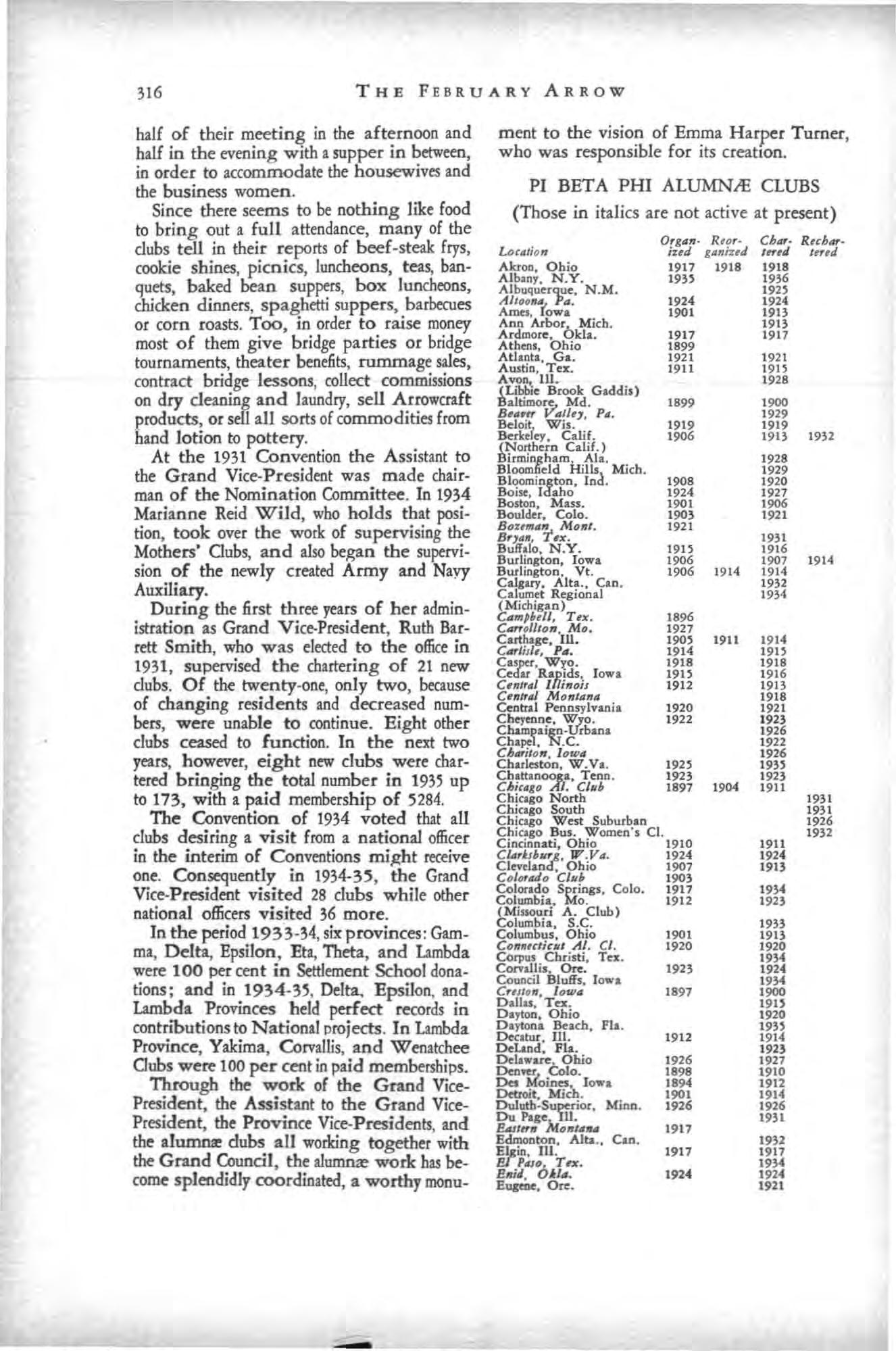
half of their meeting in the afternoon and half in the evening with a supper in between, in order to accommodate the housewives and the business women.
Since there seems to be nothing like food to bring out a full atte ndance, many of the clubs tell in their reports of beef-steak frys , cookie shines, picnics, luncheons, teas, banquets, baked bean suppers, box luncheons, chicken dinners , spaghetti sup pers, barbecues or corn roasts . Too, in order to raise money most of them give bridge pacties or bridge tournaments, theater benefits, rummage sales, contract bridge lesson!, collect commissions on dry cleaning and laundry, sell Arrowcraft products, or sen all sorts of commodities from hand lotion to pottery.
At the 1931 Convention the Assi stant to the Grand Vice-President was made chairman of the Nominatioo Committee In 1934 Marianne Reid Wild, who holds that position, took over the work of supervising the Mothers' Gubs, and also began the supervision of the newly created Army and NaY)' Auxiliary.
During the first three years of her administration as Grand Vice-President, Ruth Barrett Smith , who was eletted to the ollice in 1931, supervised the chartering of 21 new clubs. Of the twenty -one, only two, because of changing residents and decreased numbers, were unable to continue. Eight other clubs ceased to function . In the next two years, however, eight new clubs were chartered bringing the total number in 193 5 up to 173, with a paid membership of 5284 .
The Convention of 1934 voted that all clubs desiring a visit from a national officer in the interim of Conventions mi,ght receive one. Consequently in 1934-35 , the Grand Vice-President visited 28 clubs while other national officers visited 36 more.
In the period 1933 -34, six provinces: Gamma, Delta, Epsilon, Eta, Theta , and Ltmbda were 100 per cent in Settlement School donations; and in 1934-35, Delta, Epsilon , and Lambda Provinces held perfect records in contributions to National projects . In Ltmbda Province, Yakima , Corvallis, and Wenatchee Gubs were 100 per cent in paid memberships.
Through the work of the Grand VicePresident, the Assistant to the Grand VicePresident, the Province Vice-President., and the al= dubs all working together with the Grand Council, the a1= work has become splendidly coordinated, a worthy monu-
ment to the vision of Emma Harper Turner, who was responsible for its creahon.
(Those in italics are not active at present)
l.D(lIlion Akr on, Oh io Albany. N . Y . Albuquerque, N.M. Allo",.,., p",
O'Ktl" . R,o,;t,d glmi%tJ 19 17 19 18 193) Ames. I o wa Ann Arbor Mich . Ardmore, Okla. AthttlJ. Ohio Atl anta , G,. Austin , Tex. Avol?t. Ill (L'bblc Brook Gaddis) 1hltimorc Md . B",," V',dlt.7. P. o Beloit Wis Ikrlr:: t{ey, Calif. (Northern Calif.) Birmingham AI ,. Bloomfidd HilIs \ Mich . Bloomi ngto n , loa . Boise, Idah o Boston, M ass. Boulder. Colo Mon' , B'll1l1, .I.'X. BuHllo , N.Y. Burlington, Iowa Burlington . Vt . C.I,ary, .Alta., Can. Calumet Reg ional (Mich iga n) C"m;;,IJ. T ,x. e"mllJtD1f, Mo, Carthage, JU, e..,Jill" P", Casptl'. Wto Cedar Rapids , Iowa e,nff/II UJintlis e'nl'1ld Mtlnt4n4 Central Penn sy lvania Cheytnne. Wyo . Champaign Urban a Chapel, N . C . eh.,ittl", Itl llI" Charleston, W.Va . Ch att anoo&a, Tenn. Chirilltl AI . Ctd Chicalo North Chicago South
Chicqo West Suburban Chicalo Bus. W omen's CI. Cincinnati, Ohio 1910 ClII,!/"'r"" W .V4. 1924 Cleveland, Ohio 1907 C II I","o C ld 1903 Colorado Springs, Colo. 1917 Columbia. Mo 1912 (Mioouri A Club) Columbia, S .C. Columbus , Ohio ell"""tiul AI , CI , Corpus Chris ti, To: . CQrTall is. Ore Council Bluffs. l ow. e rll'O " , l ow" D allas, Tex D ayton Ohio D aytona Beach. Fla . DeOtur. JIl . DelAnd . Fla . Delaware Ohio Dcnl'tt Col o.
1898 18" 1901 1926 Du Moines. Iowa Detroit, Mich. Duluth·Superior, Mi nn. Du Paa:;e Ill . &VI"" MOII'1I1111 1917 Edmonton. Alta .. Can . Ela.in, Ill. EFPufI T,,, S"iJ, 0"1,,.Euame. Ore .
OF,..' R,or· CA.- RuIn,· 0, ",.. R,D,' C/,,.,. R" • uCM/ill" iutl ,1I"nlll tn,J In •• UC.';U iutl ''''';%14 Un. II"tI E "JI·"Al Il • '90l
Pdo Alto. c:.lif 1929 enl. E C.) •. Calif. 19204 192"
Filii} Ciliu·I..au.iII. 1923 192J
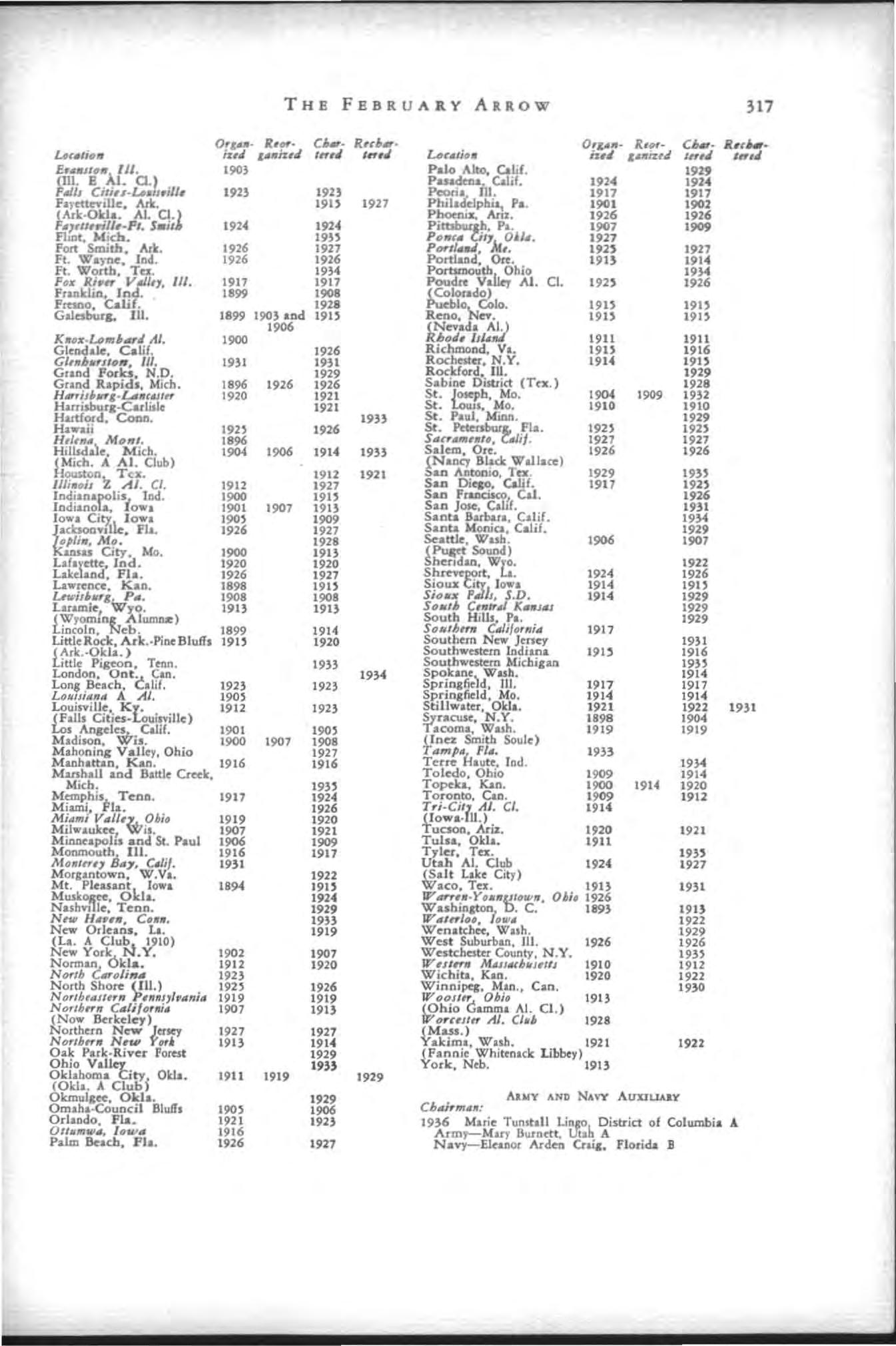
Peoria JU. 1917 1917
F.yettn'iUe. Ark. 191) 1927 Philadelphia t Pa. '90' '902 }M.OId •. AI. 0.1
Phocrux, AriZ. 1926 1926 "II.,m.·PI. S.;I 192• 192" Pitbbw'e,. Pa , '907 '909 FLiDt, MIch. 19l)
P'''UII ' /.7N OAl., 1927 Fort Smith. Ark. 1926 1927 Ptwll".J to 192' 1927 Ft. Wayne, I nd. 1926 1926 Portland, Ore. 191} 191. Ft. Worth, Tex. 193'1 .... Fox Ri,," VIIII", III. 1917 1917
Poudrc: V AI. o. 192 ' 1926 Franklin. Ind. .... .... Prnoo. Cali£. 1921 ebl0N-Colo. 191) 191' Galc:sbura:. III. 1899 t901.nd 191) Reno. eT. 19U 1911 '906 kN d • K"ox·um"MJ AI. '900 htli_ IIh 1911 1911
Glenda.le. CaUf. 1926 Richmond, VI, 19U 1916 GJ",bllOI(U" III 1931 I9ll
Rocbester, N.Y. 19H 19U Grand POCQ, N.D. 1929 Rockford, Ill. 1929 Grand Rapid" Mi ch. ,.96 1926 1926 Sabine Disttict (Ta:.) 1928 Htnisjn,.ulltMJ'tr 1920 1921 St. tulCpb. Mo. ."'" '909 1932 Huriibuf• .culiJle 1921 St. II. Mo. 1910 1910 Hartford, Conn. 1933 St. Paul, Minn. 1929 Ha,nii 192) 1926 St. Fla. 192) 192) H"'''iJ Monl. .... S.cr_".""., il. 1927 1927 Hilbd e, Mi ch . ."", '906 1914 1933 Salem, Ore. 1926 1926 A Al. CI.b) Pa'!ancy Black Wallace) ouston Tc:&:. 1911 1921 an AntODJO. Ta. 1929 193) J/I,""il Z AI. Cl. 1911 1927 San Diq;o. Calif. 1917 192) In dianay:.lisi Ind '900 19U San Ptaacisco, Cal. 1926 lo diano a. o1ll"a '90' '907 1913 Sao JOIC' CaM. 1931 Iowa Citr.k Iowa '90' '909 Santa Barba,., Cali£. 193" • Fla. 1926 1927 Santa Monia , Calif. 1929 0,1;", Mo. 1928 '906 '907 aruu City, Mo. '900 19B Laf!Idk, Ind 1920 1920 hendao, We! ' 1922 Lak a nd, PI •. 1926 1927 1924 1926 La:wnnce, Kan 1898 19U Sioux i!J: Jowa 191" 191) Uw;Jjllr" P •. '90. '908 SitIMJt P ll, S.D. 1914 1929 Laramie, Wyo 1913 1913 S •• ,j C,,,ITM K."JtiU 1929 Alumnc) South Hilb Pa . 1929 iDcoln, eb. .... 191" South"" C,ui/tJr"i. 1917 Little Rode, Ark.·Pine Bluffs 19U 1910 Southern New Jersey 1931 LArk Okla. ) South1ll"cstcrn Jndi ana 191' 1916 'tUe Pigeon, Ttnn. 1933 Southwestern Michigan 19l' London. Ootc.. Can. 1914 Spokane Wash. 191" Lang Beach, lif. 1923 1923 SprinBfie)d, 111. 1917 1917 LONUi_". A AI. '90' Springfield, Mo. 1914 191" Louisville, KL 1912 192} Stillwater, Okla. 1921 1922 1931 l!all.s Cities- uilville) N.Y. 189B '904 s Calif. '90' '90' acom •• Wuh 1919 1919 M adison, is. '900 '907 '90. Smith Soule) Mahoning Valle y, Ohio 1927 limp. FI_. 1933 Manhattan, K.D. 1916 1916 Terre Haute. Jod .... Manh all and Battle Creek, Toledo, Ohio '909 191" Mich 193' Topeka, KaD. '900 1914 1920 Mcmphisp TCOD 1917 1924 Toronto, Can. '909 1912 Miami, la. 1926 Tri.Ci'li AI. el. 1914 Mi_mi V.IJ"{v0hi, 1919 1920 ¥o II.) Milwaukee, II. '907 1921 ucsoo. Ariz. 1920 1921 Minocapoh, aod St Paul '906 '909 Tulsa, Okla. 1911 Monmouth Ill. 1916 1917 Tyler. Tex. 193) M o"'",, B•.7, eMil. 1931 Utah AI. Club 1924 1927 MOI,anto n. W.Va. 1922 Walt Lalr::e City) Mt Ple nt lcl 1000a .... 191) .co, Tn. 19U 1931 0 a. 1924 lY1IIrr,.,, ·Y Ohi,. 1926 NasbYI Ie. Tenn. 1929 Washinaton C. ..., 191J NIW Hit."", C.,,". 1933 W.,nltJ., /0"_ 1922 New Orle.ns, La. 1919 Wen.tchee. Wuh. 1929 (La. A West Suburb.n, 111. 1926 1926 NCW' •• '902 '907 Westchester County, N Y 193) Norman kla. 1912 1920 WUI"" M.J Jllllun""J 1910 1912 Ntff,h CIITolinll 1923 Wichita, KaD 1920 1922 North Shore SIll.) 192) 1926 WinnipcI, Min ., Can. 1930 N Orlb'IIJ/,r" .",,1,1.11";_ 1919 1919 WODJI" Oh;tJ 1913 Northn" Cillilorlfi. '907 1913 &9hio Gamml AI. Cl.) (Now Berkeley) orUlttr AI. Cld 1928 Northern New lerte'J 1927 1927 \.M.... ) NorJhn" NIUI "k 1913 1914 .kima. Wash. 1921 1922 Oak P.rk·River Forest 1929 Vannie Wh itenl ck Libbey) Ohio Vallee 1933 ark, Neb. 1913 Oklahoma ityf Okl•• 1911 1919 1929 (Okla. A Cluti
MMY AND NAvY Olunul,«, OkJ •. 1929
AUXlUAay Om.hl·Council Bluffl '90' '906
Ch.irmn: Orlando. Pia. 1921 1923 1936 Malic Tunstall LitCh District of Columbia A OIl,UllfII., low. 1916 Ar my- Mat)' Burnett. A Palm Beach, Pia 1926 1927 NaY}'-Ele aJ)()f Arden Clli«. Florida B
Chairman:
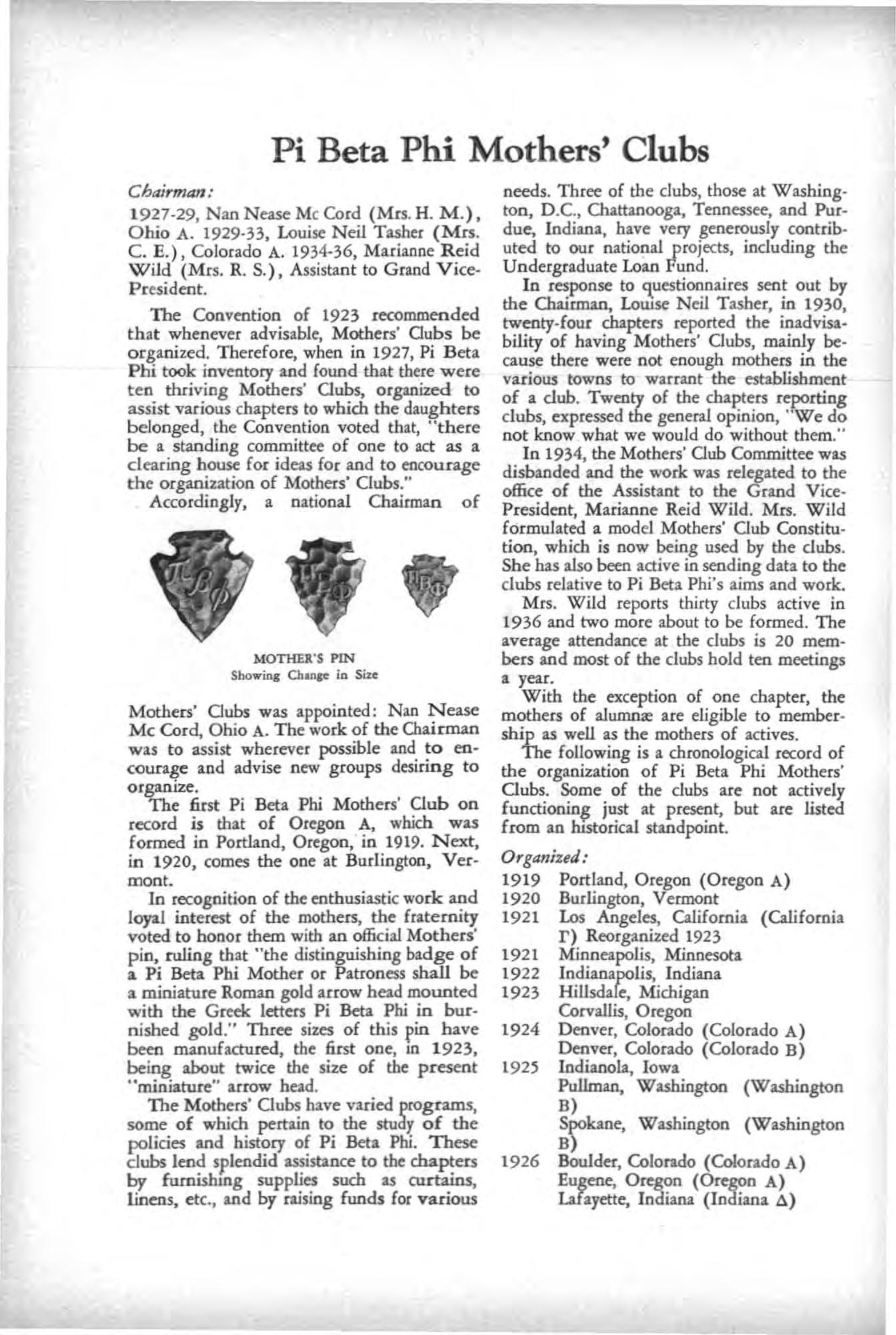
192 7 -2 9, Nan N ease Me Cord (Mrs H M.), Ohio.A. 1929 -33, Louise Neil Tasher (Mrs _ C E ), Colorado A 1934-36, Marianne Reid Wild (Mrs. R. S.), Assistant to Grand VicePresident .
The ConvOltion of 1923 recommended that whenever advisable, Mothers' Gubs be organized. Therefore, when in 1927, Pi Beta Pbi took inventory and found that there were ten thriving Mothers' Gubs, organized to assist various chapters to which the daugbters belonged , the Convention voted that, "tbere be a standing committee of one to act as a clearing house for ideas for and to encourage the organization of Mothers' Gubs. "
Accordingly, a national Chairman of
needs. Three of the clubs, those at Washington, D C. , Chattanooga, Tennessee, and Purdue, Indiana, have very generously contributed to our national proj ects, including the Undergraduate Loan Fund .
In response to 'luestionnaires sOlt out by the Chairman, Lowse Neil Tasher, in 1930, twenty -four chapters reported the inadvisability of having Mothers' Gubs, mainly because there were not enough mothers in the various towns to warrant the establishment of a club. Twenty of the chapters reporting clubs , expressed the general opinion, " We do not know what we would do without them. "
In 1934, the Mothers' Gub Committee was disbanded and the work was relegated to the office of the Assistant to the Grand VicePresident, Marianne Reid Wild. Mrs. Wild formulated a model Mothers' Club Constitution, which is now being used by the dubs She has also been active in sending data to the clubs rel ative to Pi Beta Phi's aims and work.
MOTHER 'S PIN
Sho win g Chan,e in Size
Mothers' Clubs was appointed: Nan Nease Mc Cord, Ohio A. The work of the Chairman was to assist wherever possible and to eo· courage and advise new groups desiring to organize.
The first Pi Beta Phi Mothers' Gub on record is that of Oregon A, which was formed in Portland, Oregon, in 1919. Next, in 1920, comes the one at Burlington, Vermont.
In recognition of the enthusiastic work and loyal interest of the mothers, the fraternity voted to honor them with an official Mothers' pin, ruling that "the distinguishing badge of a Pi Beta Phi Mother or Patroness shall be a miniature Roman gold arrow head mounted with the Greek letters Pi Beta Phi in burnished gold ." Three sizes of this pin have been manufactured , the first one, 10 1923, being about twice the size of the present 'miniature" arrow head.
The Mothers' Gubs have varied programs, some of which pertain to the study of the policies and history of Pi Beta Phi. These dubs lend splendid assistance to the chapters by furnishUlg supplies such as curtains, linens, etc_ , and by raising funds for various
Mrs. Wild reports thirty clubs active in 1936 and two more about to be form ed The average attendance at the clubs is 20 members and most of the clubs hold ten meetings a year.
With the exception of one chapter, the mothers of alumna: are eligible to membership as well as the mothers of actives .
The following is a chronological record of the organization of Pi Beta Phi Mothers' Clubs. Some of the clubs are not actively functiooinll just at present, but are listed from an historical standpoint
Organized: 1919 Portland, Oregon (Oregon A)
Burlington, Vermont
Los Angeles, California (California r) Reorganized 1923
Minneapolis, Minnesota
Indianapolis, Indiana Hillsdafe, Michigan
Corvallis, Oregon
Denver, Colorado (Colorado A)
Denver, Colorado (Colorado B) Indianola, Iowa Pullman, Washington (Washington B)
Washington (Washington
Boulder, Colorado (Colorado A)
Eugene, Oregon (Oregon .A) Wayette, Indiana (Indiana 6)
Grand Forks , North Dakota
Franklin, Indiana
Laramie, Wyoming
Los Angeles, Calif. (California <3.)
Stillwater, Oklahoma
Salt Lake City, Utah
Kansas City, Missouri (Kansas A)
St. Louis , Missouri
Syracuse, New York
Omaha, Nebraska (Helps 3 chapters : Nebraska B and 2 Iowa Chapters)
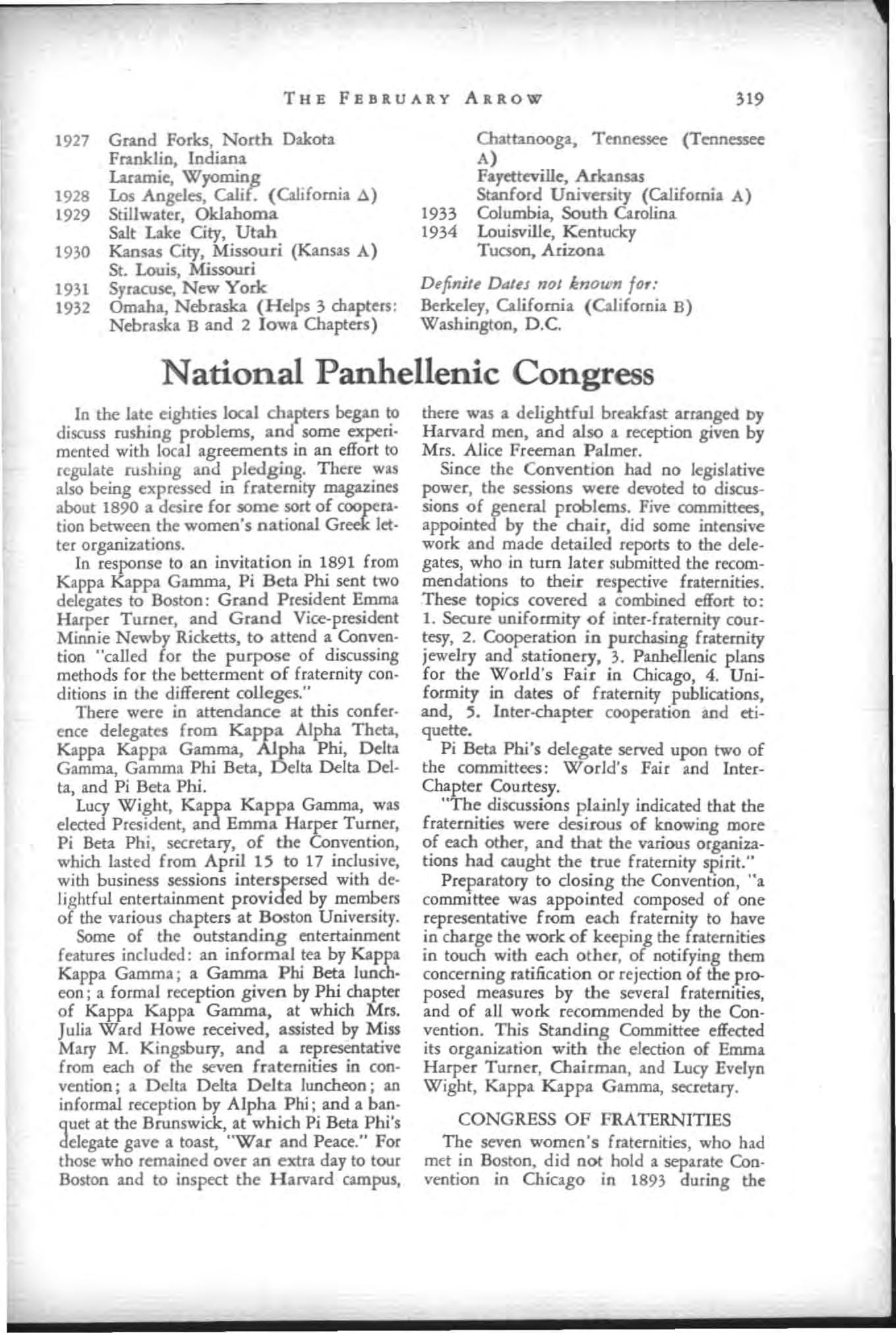
Chattanooga, Tennessee (Tenn A)
Fayetteville, Arkansas
Stanford University (California A)
1933 Columbia, South Carolina
1934 Louisville, Kentu cky Tucson, Arizona.
D 'fin i/, Datu not known fo,: Berkeley, California (California B) Washington, D .C.
In the late eighties local chapters began to discuss rushing problems, and some experi. mented with loca l agreements in an effort to regulate rushing and pledging. There was also being expressed in fraternity magazines about 18 90 a desire for some sort of coopera· tion between the women's national GredC let· ter organizations.
In response to an invitation in 1891 from K appa Kappa Gamma, Pi Beta Phi sent two delegates to Boston: Grand President Emma Harper Turner, and Grand Vice.president Minnie Newby Ricketts, to attend a Conven· tion "called for the purpose of discussing methods for the betterment of fraternity con · ditions in the different coUeges."
There were in attendance at this ence delegates from Kappa Alpha Theta, Kappa Kappa Gamma, Alpha Phi, Delta Gamma, Gamma Phi Beta, Delta Delta Del· ta, and Pi Beta Phi
Lucy Wight, Kappa Kappa Gamma , was elected Pres ident, and Emma Harper Turner, Pi Beta Phi , secretary, of the Convention , which lasted from April 15 to 17 indusive, with business sessions intersptrsed with de· I igh tful entertainment provided by members of the various chapters at Boston University.
Some of the outstanding entertainment features included: an informal tea by Kappa Kappa Gamma; a Gamma Phi Beta lunch· eon; a form al reception given by Phi chapter of Kappa Kappa Gamma, at which Mrs. Julia Ward Howe received, assisted by Miss Mary M Kin g sbury, and a representative from each of the seven fraternities in con· vention; a Delta Delta Delta luncheon; an informal reception by Alpha Phi ; and a ban · quet at th e Brunswick, at which Pi Beta Phi's delegate gave a toast, "War and Peace." For those who remaine d over an extra day to tour Boston and to inspect the Harvard campus,
there was a delightful breakfast arranged by Harvard men, and also a reception given by Mrs . Alice Freeman Palmer.
Since th e Convention had no legislative power, the sessions were devoted to discus· sions of general problems. Five committees. appointed by the chair, did some intensive work and made detailed reports to the dele· gates, who in turn later submitted the recommendations to their respective fraternities. These topics covered a combined effort to: 1. Serure uniformity of inter·fraternity cour· tesy, 2. Cooperation in purchasing fraternity jewelry and statio n ery, 3. PanheUenic plans for the World's Fair in Chicago, 4. Uni· formity in dates of f ratemity publications, and, ,. Inter<hapter cooperation and eti· quette.
Pi Beta Phi's delegate served upon two of the committees: World ' s Fair and Inter· Chapter Courtesy.
"The discussions plainly indicated that the fraternities were desirous of know ing mOre of each other, and that the various organiza . tions had caught the true fraternity s/?irit. "
Preparatory to dosing the ConventIOn, " a comrruttee was appointed composed of one representative from each fraternity to have in charge the work of keeping the fraternities in touch with each other, of notifying them concernjng ratification or rejection of the pco. posed measures by the several fratern ities, and of all work r ecommended by the Con· vention. This Standing Committ.. effected its organization with the election of Emma Harper Turner, Chairman, and Lucy Evelyn Wight, Kappa Kappa Gamma , secretary.
The seven women 's fraternities, who had met in Bosto n , did not hold a separate Con· vention in Chicago in 18 93 during the
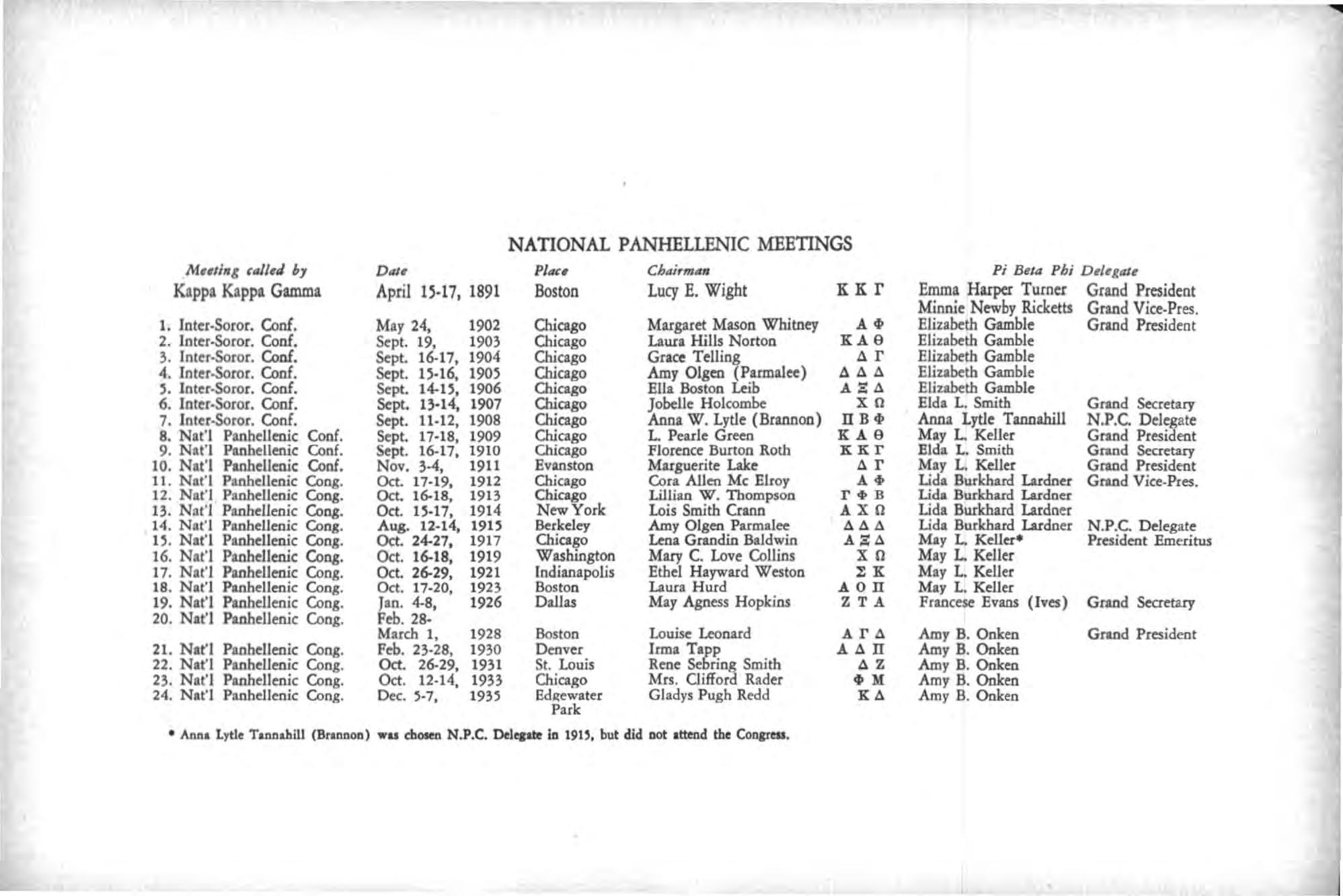
MI#lh" rill/,ll b, D." Piau Chairm411 Pi Bela Phi DelegaJe Kappa Kappa Gamma April 15-17, 1891 Boston Lucy E. Wight KKr Emma Harper Turner Grand President Minnie Newby Ricl<etu G.... d Vice.Pres.
1. Jnter·Soror. Conf. May 24, 1902 Chicago Margaret Mason Whitney A4> Elizabeth GambJe G....d P,..ident
2. Inter·Soror. Coni. Sept. 19, 1903 Chicago Lawa Hills Norton KA9 Elizabeth Gamble
3. Inler·Soror. ConI. Sept 16-17, 1904 Chicago Gra Telling Ar Elizabeth Gamble
4 . Inter·Soror. Conf. Sept. Chicago Amy Olgen (Parmalec) AAA Elizabeth Gamble
, . Inter-Soror. ConE. Sept. 14-15. 1906 Chicago Ella Boston Leib AZd Elizabeth Gamble
6 . Jnter·Soror. Cool. Sept. 13·14. 1907 Chiago Jobelle Holcombe XO Eld. L. Smith Grand Stcretary
7 . lnter-Soror. Conf. Sept. 11.12, 1908 ChiOigo Anna W. LyUe (Brannon) llB4> Anna LyUe Tannabill N.P.C. Delegate
8. Nat ' l Panbellenic Coni. Sept. 17·18. 1909 Chicago L Pearle Green KA9 May L Keller Grand President
9. N an Panhellenic Conf. Sept. 16-17. 1910 Chicago florence 8urton Roth KKr Elda L. Smith Grand Secretary
10. Nat ' J Paabellenic Cool. Nov. 3-4, 1911 Evanston Marguerite lake Ar May L Keller Grand President
11 . Nat'l Panhcllcnic Cong. Oct. 17·19. 1912 Chicago Cora Allen Me Elroy A. Uda Bu<khard Lardner Grand Vice-Pres.
12 . Nat'l Panhcllenic Cong. Oct. 16-18. 1913 Chicago Lillian W. Thompson r.B Lida Burkhard Lardner
13. No!'J PanheUenic Cong. Oct. 1l-l7. 1914 New York lois Smith Crann AXO Uda Burkhard Lardner
14. Nat'l PanheJlenic Cong. Aug. 12-14. 19I:S Berkeley Amy Olgen Parmalee dAA Lida Burkhard Lardner N.P.C. Delegate Nat'! Panhellenic Cong. Oct. 24-27. 1917 Lena Grandin Baldwin AZA May L Keller- President Emeritus
16 . N . !'I Panhellenic Cong. Oct . 16-18. 1919 Washtngton Mary C. Love Collins XO May L Keller
17. Nat ' l Panhellenic Cong. Oct. 26-29. 1921 lndianapolis EtheJ Hayward Weston l:K May L Kell.,
18 . Nat'l Panhellenic Cong. Oct . 17-20, 19 23 Boston Laura Hwd AOn May L. Keller
19. Na!'J Panhellenic Cong. Jan . 4-8. 1926 Dallas May Agness Hopkins ZTA Francese Evans (Jves) Grand Secretary
20. Nat ' J Panhellenic Cong. Feb. 28· March 1. 1928 Boston Louise Leonard ArA Amy B. Onken Grand President
21. NIt'! Panhellenic Cong . Feb. 23·28. 1930 Denver Irma AAll Amy B. OnIcen
22. Nan Panhclleoic Cong . Oct. 26-29. 1931 St. Louis Rene Sc Smith AZ Amy B. OnIceo
23 . Na!,1 Panhellenic Cong. Oct. 12 . 14, 1933 Chicago Mrs . Cliffor Rader 4>M Amy B. Onken
24 . Nat'! Panhellenic Cong . Dec. '-7. 1935 Gladys Pugh Redd KA Amy B. Onk,n Park
• Anna Lytle Tannahill (Brinnon) W'u chosen N.P.C. De1qm io 1915. but did DOt Itttod tM Conarcu.
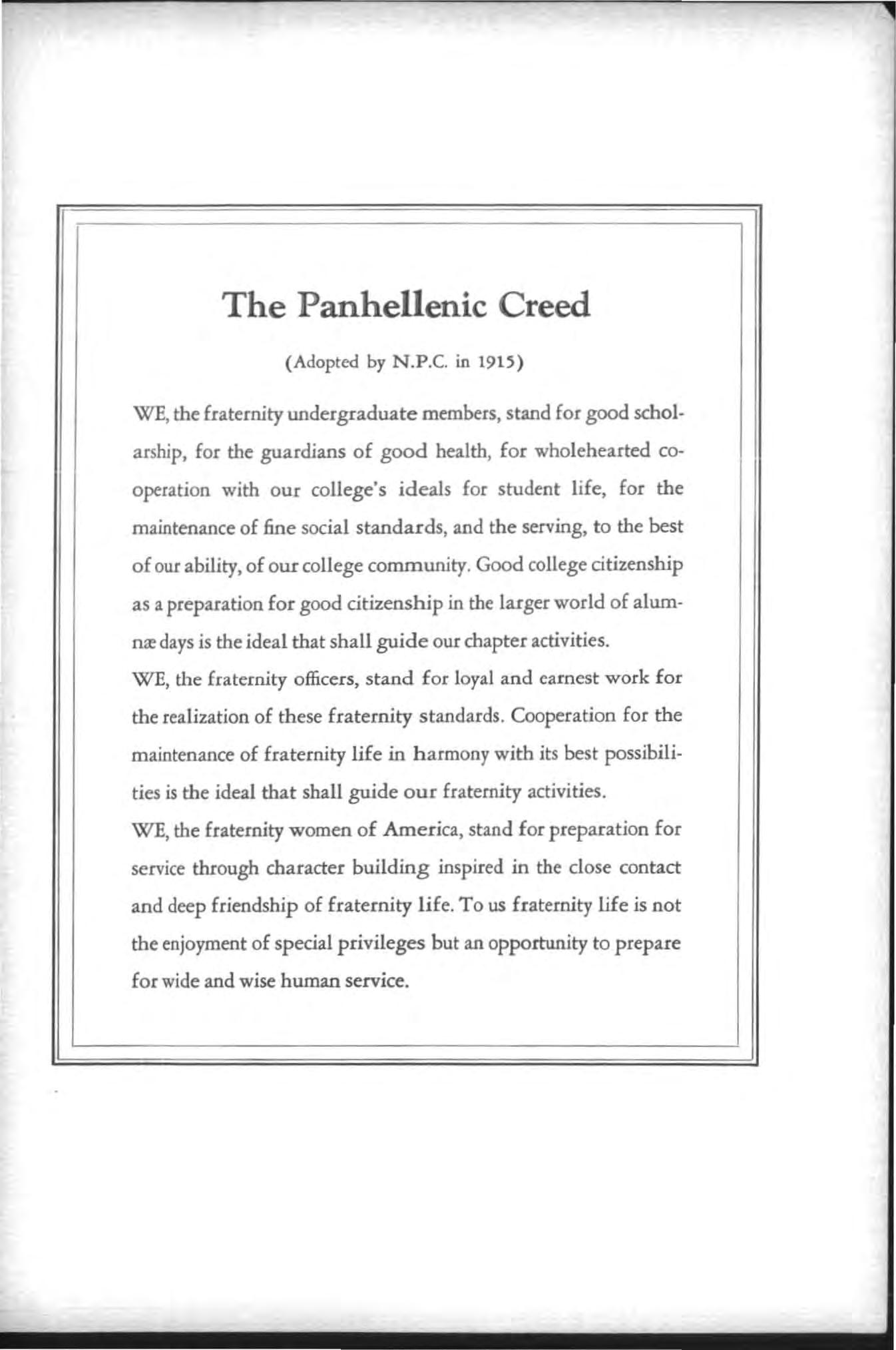
(Adopted by N.P.C. in 1915)
WE, the fraternity undergraduate members, stand for good schola rship, for the guardians of good health , for wholehearted cooperation with Our college's ideals f or student life, for the maintenance of /ine sodal standards , and the serving, to the best of our ability, of our college commuruty. Good college citizensrup as a preparation for good citizenship in the larger world of alumnre days is the ideal that shall guide our chapter activities.
WE, the fraternity officers, stand for loyal and earnest work for the realization of these fraternity standards . Cooperation for the maintenance of fraterruty life in harmony with its best possibilities is the ideal that shall guide our fraternity activities.
WE, the fraternity women of America, stand for preparation for service through character building inspired in the close contact and deep friendship of fraternity life. To us fraternity life is not the enjoyment of special privileges but an opportunity to prepare for wide and wise human service.
World's Fair, but joined the men ' s fraternities in wbat was called the Congress of Fr:ttemities held July 19 and 20.
The morning session of July 20 was devoted to women's college fraternities. Miss Ethel Baker was Chairman and the address of Welcome was delivered by Mrs. Charles Henrotin , which was followed by addresses by representatives from Kappa Kappa Gamma, Gamma Phi Beta, Delta Gamma, Delta Delta Delta, Alpha Phi, and by Gertrude Boughton Blackwelder, Pi Beta Phi. Mrs. Blackwelder's paper was 00 the "Ethical Influence of Fraternities ." This paper was reprinted by several of the fraternity magazines and received high praise.
A social meeting of grand officers was held in the afternoon, and a Panhellenic reception and banquet followed in the evening in the New York Building
Pi Beta Phi cooperated with Kappa Alpha Theta, Delta Gamma, Gamma Phi Beta, and Delta Delta Delta in maintaining a booth at the World's Fair in the Organization Room of the Woman's Building, where a restingplace for fraternity women was provided, and a register was kept for names of members.
While the sessions at Boston and those at Chicago seemed to be filled with Panhellenic enthusiasm, the time had not yet arrived for a permanent organization, and nothing further was done for some years .
On May 24, 1902 , in response to an invitation from Margaret Mason Whitney, National President of Alpha Phi, representatives of the seven fraternit.es, who had previously sent delegates to Boston and to ChIcago, met at Columbus Memorial Building, Chicago.
Laura Hills Norton , Kappa Alpha Theta, was elected chairman, and Minnie Ruth Terry, Alpha Phi, sec retary, of the meeting.
After thorough discussion the delegates endorsed six motions to be used as a basis of as many by-laws, if accepted by all of the f ratemities. These motions pertained to the time and manner of issuing invitations to membership; to rushing; to public initiations; and to penalties for infnngement of the rules. The unanimous sentiment of the Convention was in favor of deferred pledging wd the cilicouotenancing of "lifting."
"It was recommended that a similar meeting, called by each of the several fraternities in rotation, be held annually, to which a delegate shall be appointed from each of the several fraternitIes, the meeting of 1903 to be called by Gamma Phi Beta in St. Louis."
The meeting of these delegates to the First Inter-Sorority Conference, representing AI pha Phi, Gamma Phi Beta , Delta Gamma, Delta Delta Delta, Kappa Alpha Theta, Kappa KaPl'a Gamma, and Pi Beta Phi marked the beginning of what developed into the National Panhellenic Conference in 1908, and the National Panhellenic Congress i" 1911. The membership has since increased from seven to twenty-three.
Annual meetings were held until 19U, when it was voted to meet biennially.
According to the Manual of Information , issued by the National Panhellenic Congress in 1929, "the first meetings of official representatives of national fraternities for women were called because of a realization that when different fraternities meet on a campus, many of the problems which follow are common to all and are best solved by joint co nsideration and action. Back of the acceptance of this fact of common problems, however, was a much more significant thing-the realization that women's fraternities are founded upon similar ideals and for similar purposes and that, because of this, a P anhellenic asso· ciation whose high standards are to be maintained and whose regulations are to be enfo.reed as a matter of ethical agreement, is poSSIble."
When the second meeting of the InterSorority Conference convened it was found that the majority of the fraternities represented were "unwilling to adopt the proposed by-laws, so no intersority compact was entered into, but the conference continued to function without definite by-laws, and it ordered the formation of a Panhellenic association in every institution in which two or more national fraternities were represented and empowered the first chapter established in each institution to organize the Panhellenic there, the chairmanship to be held in rotation by each chapter in the order of its establishment. "
In 1904 the Conference recommended the establishment of Women's Leagues, and defined the purpose of a college Panhellenic as: "not merely to promote good feeling and social intercourse, but especially to discuss
and act upon all matters of intersorority interest with a view to raising fraternity standards and ameliorating existing evils_" The delegates voted to investigate the advisability of the appointment of Deans of Women in all coeducational colleges_ Too, this session adopted the official roster and established the rotation of office holding. -n,., following is the official rotation list to which has been added the names of the members of the Congress with dates of admission into the Congress:
ADMISSION TO N.P.C.
Pi Beta Phi
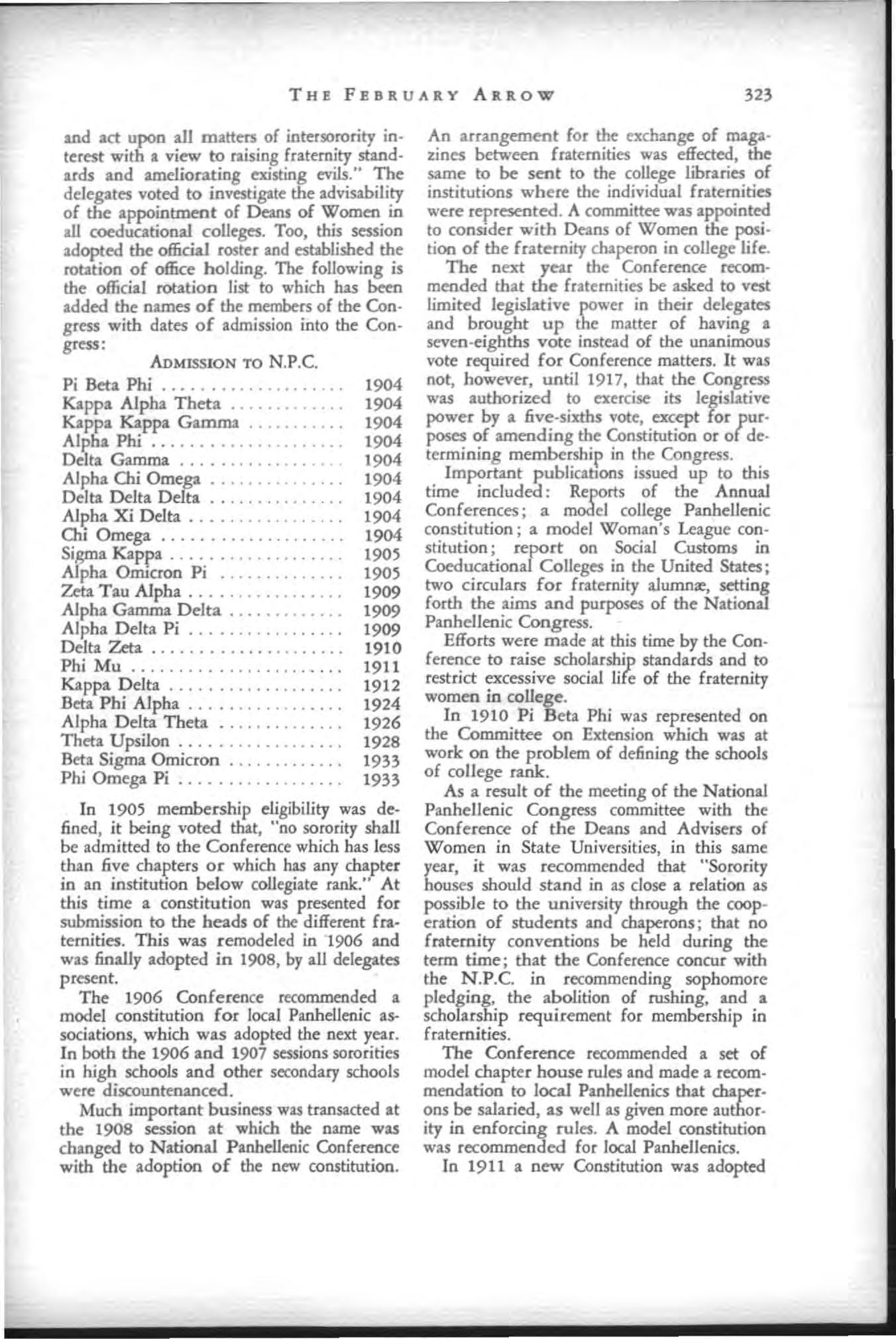
1904
Kappa Alpha Theta 1904
Kappa Kappa Gamma
Alpha Phi
Delta Gamma
Alpha Chi Omega
1904
1904
1904
1904
Delta Delta Delta 1904
Alpha Xi Delta
Oi Omega
1904
1904
Sigma Kappa 1905
Alpha Ommon Pi 1905
Zeta Tau Alpha. 1909
Alpha Gamma Delta 1909
Alpha Delta Pi
1909
Delta Zeta _ 1910
Phi Mu " ,," " _ 1911
Kappa Delta _ 1912
Beta Phi Alpha 1924
Alpha Delta Theta _.. 1926
Theta Upsilon
Beta Sigma Omicron.
Phi Omega Pi
1928
1933
1933
In 1905 membership eligibility was delined, it being voted that, "no sorority shall be admitted to the Conference which has less than live chapters or which has any chapter in an institution below collegiate rank." At this time a constitution was presented for submission to the heads of the different fraternities. This was remodeled in 1906 and was finally adopted in 1908, by all delegates present.
The 1906 Conference recommended a model constitution for local Panhellenic associatio n s, which was adopted the next year. In both the 1906 and 1907 sessions sororities in high schools and other secondary schools were discountenanced.
Much important business was transacted at the 1908 session at which the name was changed to National PanheUenic Conference with the adoption of the new constitution.
An arrangement for the ""change of magazines between fraternities was effected, the same to be sent to the coUege libraries of institutions where the individual fraternities were represented A committee was appointed to conSIder with Deans of Women the position of the fraternity chaperon in coUege life.
The n ext year the Conference recommended that the fraternities be asked to vest limited legislative power in their delegates and brought up the matter of having a seven -eighths vote instead of the unanimous vote required for Conference matters. It was not, however, until 1917, that the Congress was authorized to exercise its legislative power by a live-sixths vote, except for purposes of amending the Constitution or of determining membership in the Congress .
Important publicatIons issued up to this time included: Reports of the Annual Conferences; a model college Panhellenic constitution; a model Woman's League constitution; report on Social Customs in Coeducational Colleges in the United States; two circulars for fraternity alumnz, setting forth the aims and purposes of the National Panhellenic Congress.
Efforts were made at this time by the Conference to raise scholarship standards and to restrict excessive social life of the fraternity women in college.
In 1910 Pi Beta Phi was represented on the Committee on Extension which was at work on the problem of defining the schools of college rank.
As a result of the meeting of the National Panhellenic Congress committee with the Conference of the Deans and Advisers of Women in State Universities, in this same year, it was recommended that "Sorority houses should stand in as close a relation as possible to the university through the cooperation of students and chaperons; that no fraternity conventions be held during the term time; that the Conference concur with the N.P.C. in recommending sophomore pledging, the abolition of rushing. and a scholarship requirement for membership in fraternities.
The Conference recommended a set of model chapter house rules and made a recommendation to local Panhellenics that chaperons be salaried, as well as given more authority in enforcing rules . A model constitution was recommended for local Panhellenics.
In 1911 a new Constitution was adopted
which granted limited legislative power tn the delegates and under which the nam e was changed to National Panhellenic <Angress
The government between the sessions was placed in the hands of • committee of three, to serve as chairman , secretary and treasurer. The powers of the exerutive committee were defined as follows: "1. To make laws that pertain to its own 2. To admit at its discretion petitioning sororities, 3. To levy annual dues, 4. To make final settlement of college Panhellenic difficulties, 5. To have advisory power over PanheUenics .
Provision was made for the issuing of quarterly bulletins.
The fraternities were urged not to allow their chapters to withdraw from local Panhellenic under any conditions. Money penalties were recommended abolished as being unethical. The Congress went on record as being in favor of establishing uniformity as to size of chapters.
The Eleventh Congress which assembled in 1912 appointed Mrs. Ida Shaw Martin, Delta Delta Delta, Historian of the <Angress, for the comiog five years. For the first time there was held a conference of National Fraternity Presidents, who pledged themselves to "support the Code, which covers such practical ideals as all fraternities are striving to attain,·'
The following Committees were appointed to work during the coming year: <Ammittee on Point System, Committee on Social Custom, Committee on Investigating Interfraternity Organizations, and <Ammittee to Investigate Sophomore Pledge Day. The Pi Beta Phi delegate was made a member of the lirst two mentioned groups.
"By 1912," says the Manual of Information, "the value of the Sophomore Pledge Day was believed to be so open to question that the Congress authorized a thorough investigation of the systems as it was being used on all types of campuses, and in 1913, it voted to support the system on campuses whe re it was in effect but to encourage no other Panhellenics to adopt it. By 1926, opinion had so changed that National Panhellenic Congress went on record as officially favoring a 'short open rushing season and an early pledge day: a policy reaffirmed by the 1928 Con)!ress "
The 1913 Congress was marked by constructive legislation, including the adoption of uniform bouse rules, uniform scholarship
cards . City Panhellenics r<ported and app roval was given for the extension of Gty Panhellenics . Financial support was given to the Chicago Bureau of Occupations . In the lirst Blllielin for that year a plan was worked out for City Panhellenics.
The first Conferen ce of Editors of fraternity magazines met in connection with this Congress, on October 16, and formed a permanent organization.
By 1914, the business of the Congress was beginning to become more systeenatized through the standing committees and more attention was being paid tn ethical standards Emphasis was placed upon the "necessity of raismg a feeling among fraternity members , college students and alumn"" against disparagement of other fraternities and selfpraise in rushing ."
The most important question before the 1915 Congress was that pertaining to the enforcement of the high school sorority regulation. This Congress adopted a Panhellenic Creed ; made the BanIa' J Greek Exchange the official organ for the Congress; and voted to hold meetings biennially. A year was set as the time limit before a girl , who had broken her pledge or resigned from one Congress fraternity , could be asked to join another.
In 1917 it was voted that each fraternity could be represented by three delegates at the Congress, if so desired, with only one voting delegate It was agreed that no case of lifting or breaking of a pledge should be considered by the Executive Committee, unless proof was offered in the shape of a signed pledge. No appeals to the Executive Council could be made unless presented by the Grand Presidents whose chapters were concerned.
The Congress of 1919 established a national bureau of chaperons. Due to the fact that statistics presented showed that the ratio of women in pc<?portion fraterolty -women was steadIly decreaslOg 10 many colleges, a standing committee was appointed to assist local social units in colleges and universities in the organization of new national organizations.
At this time there was adopted the following:
STANDAADS OP ETHICAL CoNDucr
1. That in case o f Panhcllenic d i fficulties all chapters invo lved d o their utmost to res tore hac. mo ny and to prtVen t publici ty , both in the college and city community.
2. That an y na tioo al Panhellmic fratem.i.ty whom I local is peti ti oaiag shall ins is t that such
g roup conform to college conditions &j to pledging. etc., where it is established.
3. That oatioaal Pa.nhdlenic fraternity chapters unite in assisting local groups in coUeges and universities to obtain national charters .
4 . That visiting officers of nati o nal Panhellenic fraternities sball be expected not to interfere with regular routine work of the college but. on the cootrary, that they shall encourage chapters to keep the coUege business day free from social engagements.
, . That it is beneath the standards of fraternity women:
•. To speale: disparagingly o f any fraterruty or college woman,
b. To create any feeling between fraternity and Doruraterruty women
c. To alJow an account of minor social func tions to appear in the public prtS5.
6 . That national Panhellcoic fraternities shan impress upon their that they shall respect and obey the Jetter and the spirit of any agreement which bas made either by the college Pan hellenic or by the fraternities through National PanheUeruc.
The report on City Panhellenics showed a very large amount of war work accomplished and the desire on the part of many to continue some form of philanthropic work. The high school fraternity question was still the subject of much discussion.
The next Congress which was held at Indianapolis in 1921 suspended the ruling on high school fraternities, believing that the time had come for the high schools themselves to legislate. At this meeting a committee on Health was appointed to draw up a program for Panhellerucs to follow.
"The first motion of the 1923 Congress was of particular interest to Pi Beta Phi, since it was voted by the delegates to send a telegram of greetings to Mrs. Calvin Coolidge, "the first sorority woman to grace the White House."
For the first time an ouUine of points to be considered at the Congress had Deen furnished the delegates in advance. Dr. Galloway, representing the Interfraternity Conference appeared before National Panhellenic Congress and pleaded for cooperation with the Interfraternity Conference on the health problem in our colleges and universities, the most direct need being the appointment of properly equipped and well poISed men and women rhysiaans as heads of the departments 0 Health and Hygiene. Among the projects referred to the incoming Executive Committee of the Congress for execution was the compilation of a History or Handbook of Information about N.P C. The Congress
accepted the invitation of the League of Women Voters to take part in a campaign for efficient citizenship.
Dr May L. Keller, the Pi Beta Phi delegate, after the Congress, reported: "From many standpoints the Panhellenic meeting in Boston seems to me the most productive of lasting good of any held for a number of years. We recognized ourselves, for the most part, as a deliberative not a legislative body and as such many important problems both of the fraternity and university world ."
The 1926 Congress went on record as 01'posed to a protracted rushing season; In favor of unpretentious entertainment and discountenanced stag lines. It expressed the intention of thoroughly the scholastic standings of vaflous types of institutions and their grading systems; of maleing a survey of the status of chaperons and of the official recognition by college authorities of chaperons; of attempting to achieve greater uniformity in the constitutions of college Panhellenics, which were then at considerable variance; of standardizing penalties in SO far as practicable; of estimating the cost entailed by fraternity membership; and of investigating financial standards maintained in charter houses.
Reports 0 the convention seemed to in· dicate a strong feeling in favor of extension and a generally aroused interest in means of becoming financially stabilized; in the awarding of scholarships and fellowshil's; in the prol])()tion of philanthropies; and m the recognitio n of al=.
The Congress resolved that "the resort to an injunction or other legal method, as a means of avoiding compliance with local or national Panhellenic rulings by any chapter of any National Panhellenic Congress fraternity shall cancel that fraternity's membership in the N.P.C., and I'lace its chapters in every college on the basiS of local {raternities in all college Panhellenic matters."
Important action taken at the 1928 Congress in cluded the adoption of the following recommendations: "That it become a Rule of Procedure that when a girl receives a bid under the preferential system, the signing of the preference slip shall be binding to the extent that she shall be considered ineligible, for one calendar year, for a bid from any fraternity other than the one from whom she received a bid in accordance with the
proper functioning of the preferential system; that for the coming two years N.P.e. abide by its agreement with the Association of Educational Sororities not to enter its restricted field , which N .P.e. interprets to be normal schools and teachers colleges."
The Congress expressed itself as against smoking by active chapter members in chapter houses or on the campus, and recommended that allllllllZ and guests be asked to respect this policy, as do house rules.
A committee was appointed to draw up a new Constitution and By-Laws to be voted on at the next Congress.
Round Tables, a new feature of N .P .e. proved very valuable. The Round Table on " Pledge Training" was conducted by Amy Burnham Onken, Chairman. Miss Onken also assisted in conducting the Round Table on Preferential Bidding, and was appointed Chairman of the Committee on Education and Information_ This committee planned to prepare four times a . year, a uniform page of educational information concerning N.P.e. to be sent to all fraternity magazines.
A unique feature of this Eighteenth Congress was its joint session with the Deans of Women, who were holding their convention in Boston.
One of the most outstanding accomplishments of the 1930 Congress was the passing of an amendment to the Constitution which permitted changes to be made to the Constitution by a seven-eighths vote, instead of the unanimous vote.
Definite plans were made for a closer relationship between City Panhellenics and the N P.e. Executive Committee for the making possible of increased personal contacts between delegates at the next Congress and for Round Table discussions.
Mrs. Joseph Wollett, former Grand President of Delta Gamma, was appointed official representative of National Paohellenic Congress to assist in planning for fraternity representation at the Chicago World's Fair 10 1933.
The Congress authorized a survey of fraternity costs and agreed to join with the Deans' Conference in planning for an -historical survey of women's fraternities.
For the first time in its history, National Paohellenic Congress in 1931 invited a group of undergraduates to attend two open sessions of its biennial meeting, held at St. Louis _ Representatives from as far west as
the Pacific Coast and as far South as Texas were sent to the Congress by local college Paohellenics. Too, for the first time the Congress opened some of its sessions to representatives of City Panhellenics . Pi Beta Phi was represented by two of the nineteen delegates from City Panhellenics and by five of the 62 college students who represented 41 college Panhellenics. The session for college Panhellenics bad as its chief speaker, Dean Maria Leonard, Pi Beta Phi, Dean of Women at the University of Illinois.
The Congress allirmed its approval of a short open rushing season and reaffirmed the right of N.P.e. fraternities to consider as their legitimate fields "every department of a college or any college within a university. where students can rursue studies leading to a hachelor's degree:
A committee was authorized to report to the next Congress a plan by which the older and younger fratermties could both be represented on future executive boards of the Congress.
In 1933 the membership list of N.P.e. was increased to twenty-three, with no associate members. This Congress recommended that local Panhellenics reduce rushing costs; that N P.C. fraternities cooperate to control the tendency towards competitive building programs; and that a program be worked out for dignified publicity.
It was decided that in case of an appeal from a penalizing decision of a college Panhellenic, a three-fourths vote of the national presidents of the N .P .e. fraternities represented on the campus concemed, shall be necessary for a reversal of the local decision_
Amy B. Onken, chairman of the Committee on College Panhellenics, presided over the sessions for undergraduates, which were held in connection with the N.P.e. Sixtyfive delegates from college Paohellenics on campuses allover the nation attended these seSSIODS, which gave serious consideration to the subjects of rushing and pledging_
In reporting the 1935 Congress, Amy B. Onken, Pi Beta Phi ' s official representative said: "The meeting stands out in the minds of experienced N P C. delegates as the most delightful congress which they have ever attended. There was tine fellowship which emphasized the truth that the greatest value of the meetings of N P.e. lies in the opportunity which they give of knowing, understanding and liking the officers of other fraternities ."
All of the members of Pi Beta Phi ' s Grand Council were in attendance at the Congress. Other fraternities who were represented at Edgewater Park by their entire Grand Councils were: Alpha Delta Pi, Delta Delta Delta, Kappa Alpha Theta, and Kappa Kappa Gamma.
PI Beta Phi was distinctly honored by hav· ing Mary Ali ce Jones, Tennessee A, chosen by the Executive Committee of N . P.C. as the speaker at the banquet. Miss Jones chose for her subject, "Fraternity Membership Today and Tomorrow," based upon her reo in connection with her thesis, "The College Fraternity as a Character Forming Agency," upon which she secured her Doc· tor's degree from Yale University in 1935
Ninety two fraternity officers, N P C. dele· gates and past and present Grand Council members, were in attendance at the sessions of this Twenty·Fourth N .P .C. held Decem· ber 5-7, 1935, representing 1158 active chap. ters, 1959 alumn", groups (variously called alu= dubs, alliances and alumn., chapters), and 289,666 fraternity members!
Following the recommendation of the 1933 Congress, the program of the 1935 sessions was given over largely to discussions based upon addresses on currently vital fraternity interests or problems.
Since the past two years have seen forty fraternity chapters withdrawn and only thirty·one new chapters installed by N .P .C. fraternities, the discussion on which the greatest interest centered were those which had to do with the inability of some chapters to initiate enough new members to insure their ability to continue.
A report was made by the Committee on College Panhellenics to the effect that sur· veys on the number of pledges showed no material increase for the strongest groups during the past six years
The quota system was discussed but no action was taken. In an effort to get an ex· pression of sentiment which might lead to numerical adjustments on the campuses where these are apparently needed N.P.C. adopted a statement of "Policy as to the number of chapter members. " All delegates indicated their willingness to "attempt to in· fluence their individual fraternities to accept seriously this declaration of principles."
The Congress adopted a recommendation that it go on record as disapproving of un· ethical coUege political practices such as bloc voting and as being willing to cooperate
with othe r organizations, notably Mortar Board , in their efforts to eliminate these abuses.
Special emphasis was placed upon the de· sirability of a better informed alumnre memo bership as a whole, in order that fraternity alUJIltllE may more intelligently work witll city and college Panhellenics
Pi Beta Phi's delegate was asked to speak in the Round Table based upon the adaress by Dr. Smith , upon the special subject, "What can th is N.P .C. do to insure the Fu · ture of Fraternities ."
The Congress appointed a committee to " make a study of the advisability of national affiliation of all academic sororities, profes sional, honorary. and social, the comlDlttee to report to the next Congress "
A committee was appointed " to study and investigate and collaborate, if necessary, on the possibility of a Iilrn truthfully presenting the essentials of Greek letter societies."
An appropriation was made for the coop · eration with the Interfraternity Editors' Association in its plan of syndicated cooperative artides.
The Congress disco untenanced the use of fraternity names and fraternity insignia in commercial advertjsing.
The Committee on College PanheUenics recommended that N P C. consider the pub. lication of a booklet for information of par· ents and incoming students similar to the one recently issued by the Interfraternity Conference. Carried .
Since 1913 the editors of the National Panhellenic magazines have held conferences in conjunction with the biennial sessions of the National Pan hellenic Congress. To quote from the N .P.C. Manual of Information, "The earliest minutes available state that the editors meet ' merely for helpful suggestion, with no legislative power: Therefore the conferences are always informal, usually conducted after the manner of round table discussions. The number of sessions held during a given Congress depends on the amount of business to be conSIdered. The Editors' Conference is loosely organized. The established plan of rotation of officers by fraterni· ties does not prevail bere as in the formal Congress; rather, office is elective. The pres· ent plan is to elect the secretary of the open· ing session to serve through a. givm confcrence, at the dose of which she automatically
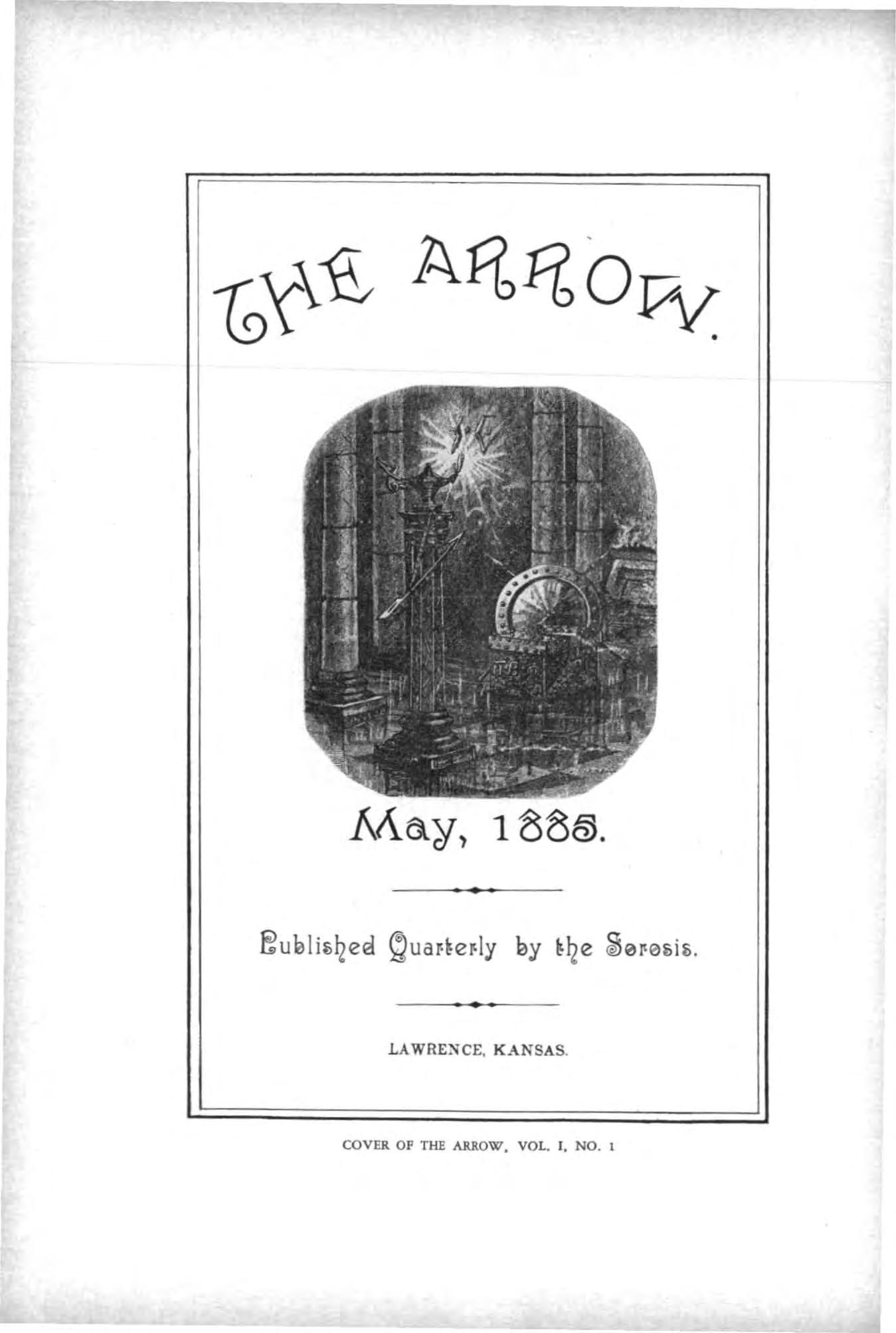
COVER OF THE ARROW, VOL. I, NO.1
to the clWrmanship for the eosuing biennium, presiding at the next conference. Special committttS are appointed as by the cbairman to work and report on spedlic problems, assignments, and projects, but there are no standing committees."
Among the most important topics discussed at the Editors' Confereeces are: Typographical style, make-up, finances, business management, life subscriptions, uniformity of style and uniform advertising, opposition to publication of society items in local newspapers, editorial policies, the budget, catalogues and hi.to"es, song books and alumnae bulletins, rules for acceptable English to use in the journals, a catalogue of cuts of college buildings, campus scenes, etc ., owned by N.P.C. fraternities.
The Pi Beta Phi delegate to the Editors' Conference in 1921 was made Chairman of the Committee on Unifoo:n Advertising and did much research on the subject, preseeting
a paper as to ber findings, to the 1926 Conference. D
EDITORS' CONFERENCE OF N.P.C.
Pi /h14 Phi Dd"III.
Louise Pitch 4.6 Sarah Pomeroy RI1M' L. Pearle Gr«l1'r K A e I...ida Bwltbard Lardner
Ethel Tukry , 4 Ma, L. Keller
Plort:ace X 0 Sarah RUU
Arana O'Brieti Ki".ia. A&nes Wri&;ht Sprinl " 2
Ruth Sanden Thomson, (Not repraeokd) ...
LiDclJoey r + :B
Emil,. Butttrlidd , A r A
Mrs. Mark E Uncapher
Wilma S 0 n
Shirley Krtuan Niq, 2TJ.
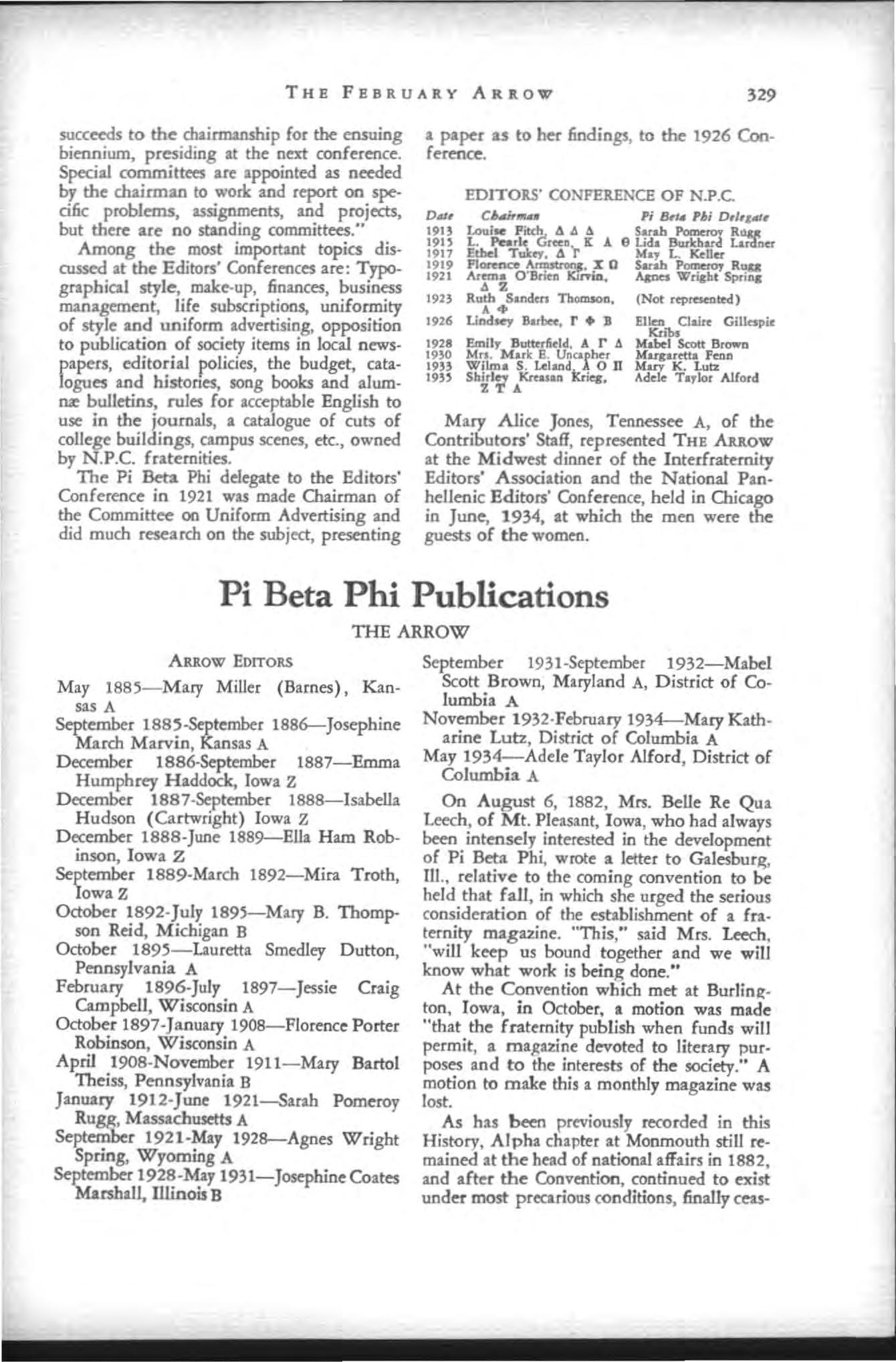
EUen Claire GiIIHpic Kn1o, Mabel Scott Brown
Mucaretta Fenn
Muy K. Lutz
Adele T.,.lor Alford
Mary Alice Jones, TenMSsee A, of the Contributors' Staff, represented THE ARRow at the Midwest dinner of the Interfraternity Editors' Assoriation and the National Panhellenic Editors' Conference, held in Chicago in June, 1934, at which the men were the guests of the women.
ARROW EOITORS
May 1885 - Mary MiUer (Barnes), Kansas A
September 1885-September 1886-Josephine March Marvin, Kansas A
December 1886-September 1887-Emma Humphrey Haddock, Iowa Z
December 1887-September 1888-lsabella Hudson (Cartwright) Iowa Z
December 1888-June 1889-EIla Ham Robinson , Iowa Z
September 1889-March 1892-Mira Troth , 10waZ
October 1892 -July 1895-Mary B. Thompson Reid, Michigan B
October 1895 -Lauretta Smedley Dutton, Pennsylvania A
February 1896-July 1897-Jessie Craig Campbell, Wisconsin A
October 1897 -Ja nuary 1908-Florence Porter Robinson, Wisconsin A
April 1908 -November 1911-Mary Bartol Theiss, Pennsylvania B
January 1912-June 1921-Sarah Pomero y Rugg , Massachusetts A
September 1921-May 1928-Agnes Wright Spring, Wyoming A
September 1928-May 1931-JosephineCoates Marshall, Illinois B
September 1931-September 1932-Mabel &ott Brown, Maryland A, District of Columbia A
November 1932 -February I 934-Mary Katharine Lub:, District of Columbia A May 1934-Adele Taylor Alford, District of Columbia A
On August 6, 1882, Mrs. Belle Re Qu a Leech, of Mt. Pleasant, Iowa , who had always been intensely interested in the development of Pi Beta Phi , wrote a letter to Galesbur!!, ilL , re1ative to the coming convention to be held that fall, in which she urged the serious consideration of the establishment of a fra· ternity magazine. "This,·' said Mes. Uech , "w ill keep us bound together and we will know what work is being done."
At the Convention which met at BurJinltton, Iowa . in a motion was made "that the f ratemity publish when funds will permit, a ma;tazine devoted to literary purposes and to the interests of the society." A motion to make thi, a monthly maga.ine was lost.
As has been previously recorded in this History, Alpha chapter at Monmouth still remained at the bead of national aifairs in 1882, and after the Convention, continued to exist under most precarious conditions, finally ceas-
M -\RY E MILLER , EDITOR - IN CHIEF.
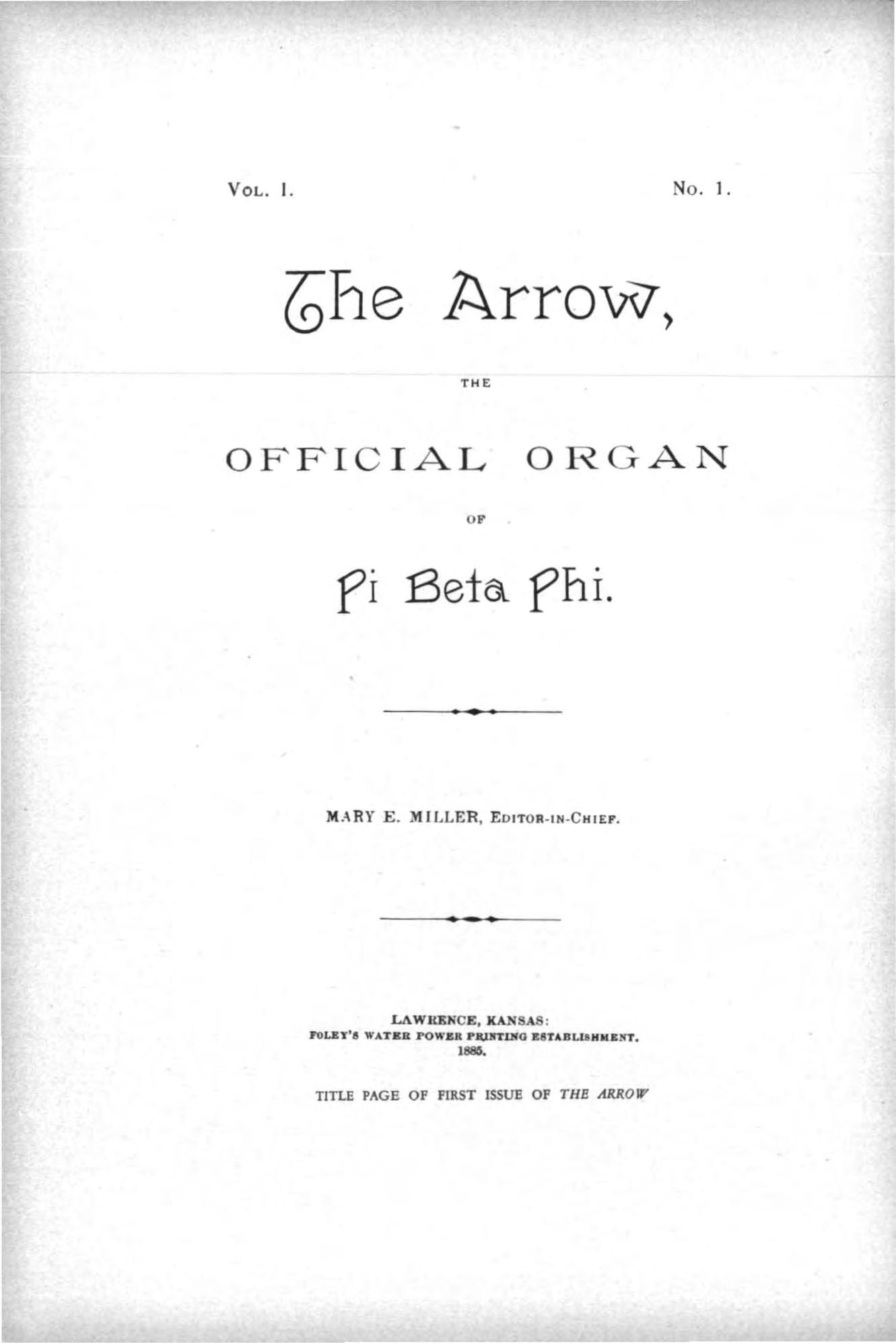
LAWRENCE, KAN SAS : roUy'. WATaB P.I,llfl'UfO E8TABLJa N." Cl'fT, ,....
TITLE PAGE Of FIRST ISSUE Of THE ARR: OW
ing to function early in 1884 The other chapters looked to Alpha to establish the new magaz ine, but evidently nothing was done towards the publication of the proposed fra · ternity journal.
The Simpson Minutes of September 20, 1883 record : " Dora was appointed to write to Monmouth to find out something about the pap<r and the taxes."
The next information which we find recorded is that Kansas A, then Kappa chapter, sent two delegates to the Convention in 1884, Jean Oliver (Humphrey) and Mary Miller (Barnes), who had definitely been instructed to establish a magazine for the fraternity
The minutes of that Convention state: "At the Thursday morning session, Nov. 20, a committee was appointed to report on the possibility of a magazine, composed of Jean Oliver (Humphrey) , Lawrence ; Jennie Conger, Lombard; Emma White (Shellenbarger) , Jowa City."
The next day the report of the committee was accepted and, "It was moved and carried that our magazine be a quarterly ." "Moved that a committee be appointed to arra nge for the publication of a magazine, to consist of: Mary Miller, Lawrence delegate; Estelle WaIters Ball , Jowa City delegate; Nell Custer Swisher, G.I.R ."
This committee decided that the publication of the magazine should be placed in the hands of Kappa chapter at Lawrence, Kan sas.
In writin,g of this pioneer journalistic effort of Pi Beta Phi , Mary MiJler (Barnes) said: " The girls honored m e by making me the first editor·in-chief.* My assistants were Mary Gilmore (Allen), Nettie Hubbard (Bolles), and Sue Miles (Kinsey). We had hoped to send out the lirst number in January, and then three months later to present the second number more in the form of an historical catalogue. We met with great difficulties and discouragements , for the sister chapters were exceedingly slow in re spo nding . We strug-
·The Minutes o f Kansas A show that Mary Miller Bunes was elected first ed it or, April 8 , 188' . That the committee was at work o n the pub· Iication much eulier is proven by the above statement of Mrs . Barnes and is corroborated by a s tat ement made by • Lawrence. Kansas newspaper dated Feb. 188'. We quote: "Last fall the annual convention of the I.e. $orosis resolved to establish a journal, and its publication was placed in the hands of the chapter here . While no number has as yet been published, we are informed that the time hu been employed in making arrange· ments and Vol. I, No.1 will soon be out,"
gled 00, and Iioally-much later than we anticipated-the lirst issue appeared ."
This issue bearing the date, "May 188) ," came from Foley' s Water Power Printing Establishment, Lawrence, Kansas , on May 21 , and was honored by many pleasing commen ts from other fraternity journals and from local
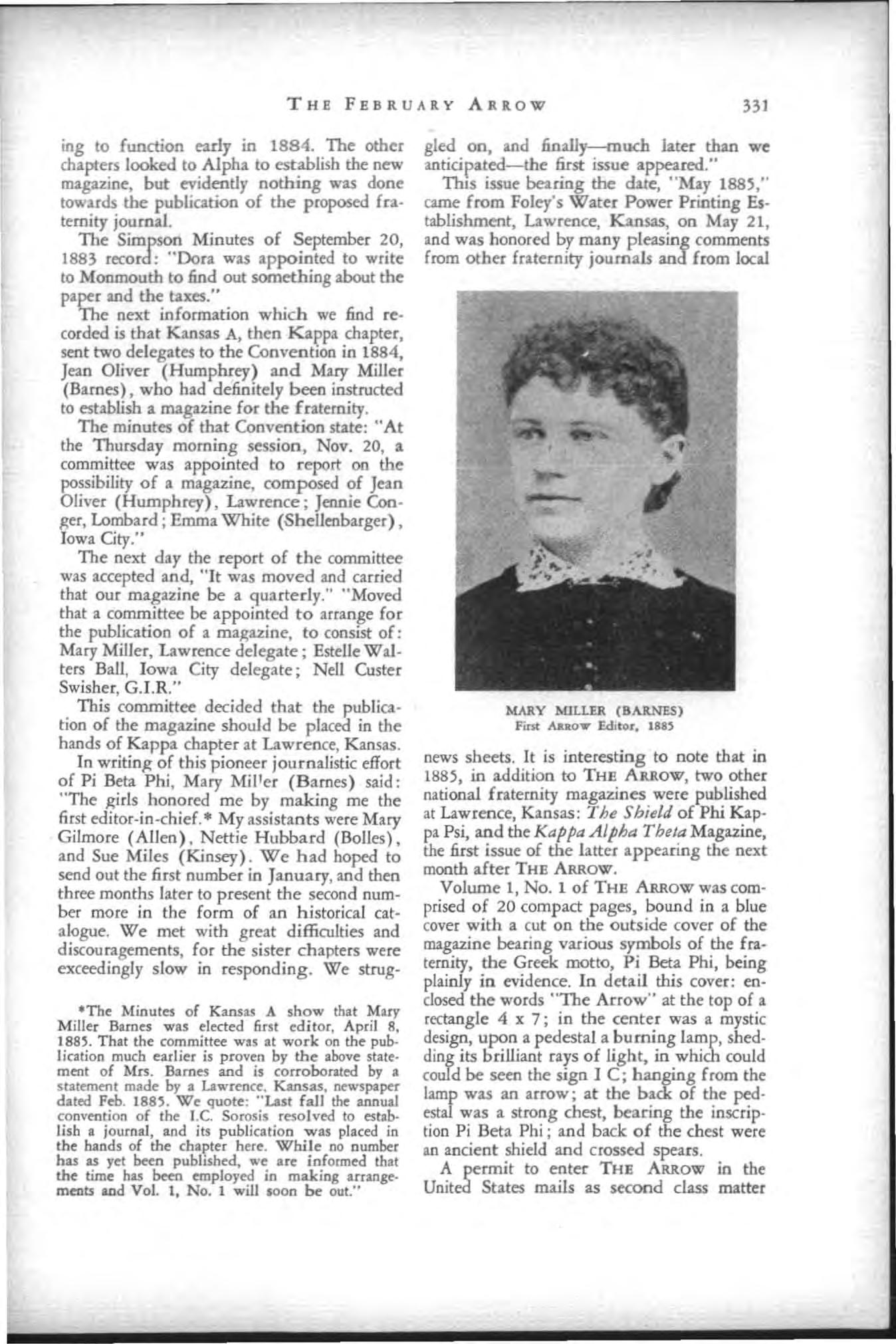
news sheets. It is interesting to note that in 188), in addition to THE AJUlOW, two other national fraternity magazines were published at Lawrence, Kansas : The Shield of Phi Kappa Psi, and the Kappa Alpha Thela Magazine, the first issue of the latter appearing the next month after THE ARROW . Volume 1, NO.1 of THE ARROW was comprised of 20 compact pages, bound in a blue cover with a cu t on the outside cover of the magazine bearing various symbols of the fraternity, the Greek motto, Pi Beta Phi, being plainly in evidence In detail this cover: endosed the words "The Arrow " at the top of a rectangle 4 x 7; in the center was a mystic design, upon a pedestal a burning Jamp, shedding its brilliant rays of light, in which could (ould be seen the sign I C; hanging from the lamr was an arrow; at the back of the pedesta was a strong chest, bearing the inscription Pi Beta Phi; and back of the chest were an ancient shield and crossed spears .
A p<rmit to enter THE ARROW in the United States mails as second class matter
was issued on June 2', 188'. The subscription price was $1.00.
The lirst issue contained a copy of "The Founding Song," by Ethel B. Allen, Kansas A; an account of the Grand Convention held at Iowa Gty in November, 1884; a short history of Kappa Chapter; an article on "Public Opinion"; three editorials; a1= personals; chapter letters from: Iowa Wesleyan, Lombard, Kansas State University, Simpson, Centenary Collese, Southern Iowa Normal, Iowa State University, Carthage College, Knox College, York Methodist College, Gacinnati Wesleyan. Denver University, Fairfield, Iowa, and Ottumwa, Iowa; and an I.e. Poem_
The editor wrote: "In sending out this, the first issue of THE ARROW we hope to be welcomed with encouraging words from our brother and sister Greeks. And as it is the first number, like new wine, the older it grows the better it will become. Succeeding numbers will demonstrate the truth of this. We aim high, and as we have often heard that ' Where therc"s a will there"s a way,' SO exercising our will, and hewing our way, success must attend our efforts:'
There was only one number issued in Volume One.
Soon after this first issue was published, the editor-in-chief, Mary Miller (Bames) left lawrence to complete her college work at Cincinnati Wesleyan, and on June 10, 1885, the minutes of Kappa chapter read: "Josephine Marcb was elected editor of THE ARRow, Ethel Allen and Mary Gilmore, associate editors. and Oaea Poehler, business manager."
The new staff brought out Volume II, No. 1 in September 1885, a very creditable issue in a pale blue cover with the narne "THE AARow " printed on it in gold. The number contained an t rticle on, "Portraiture of Woman in Poetry," by Mina B. Selby; "Four Points," by Leota Kennedy; a poem 'ToCora F. p_. of Gamma" by Lucy S. Silke; "Western Association of Collegiate Alumna!" by A. G. Blackwelder, Kappa Omega; "Practical Use of Spiders," by Lulu M. Burt; editorials; chapter letters, personals, and "Parthian Shafts " (exchanges). Fourteen Associate Editors were listed, one for each active chapter.
Copies of No. I, Volume 2 are very rare, only two DOW being knnwn to be in existence, one of which was recently generously transferred from the AllRow Editor's files to the
*Cora F. Panabakcr. Gamma .
61es of the Historian, in excbange for a typewritten copy.
The cbapters were delighted with the new magazine. Lambda, Simpson College, wrote: " For several years has Lambda chapter sighed for a sorosis paper. At last the happy moment has arrived, when all the cbapters are able to throw aside their school bOoks and other worldly cares and eagerly peruse the contents of THE ARRow. Now each member may become personally acquainted with the other chapters; may hear of their achievements, listen to their aspirations, siog their songs and, catching inspiration from their sisters, nerve themselves to work more faithfully."
According to the quarterly arrangement, the next issue should have appeared in December, 1885. Volume 11, No.2, however, bore the date: February 1886. The Editor explained: "The delay of this issue, the unusually heavy expenses to whicb the Sorosis has been put durmg this academic year, and the determination of the editors to avoid all debts, have combined to render it expedient to omit the Marcb issue of THE ARROW and to unite the January and March issues into one-"
The issue was attractively hound in a light blue cover, with wine-colored bands and fancy conventional designs, and on the out· side cover, the words, "THE ARRow, Febru· arr 1886," in gold. There were thirty-five pages of reading matter and one advertisement. The Convention of 188' authorized .. the managers of THE ARROW to use the motto Pi Beta Phi on the title page of the magazine," so there appeared on the frontispiece of the issue, a legend whicb read: '"THE ARRow, official organ of I.e. Sorosis, Pi Beta Pbi." This was two years previous to the time that the Greek lettered name was officially adopted by Convention.
It must be remembered that the magazine had to be financed through subscriptions solicited by the artive chapter at Kansas University, a task of no small proportion, but the chapter worked willingly and efficiently to accomplish it.
In the February 1886 issue it was forecast that .. the June number of THE ARRow will take the form of a catalogue, giving first a general history of the Sorosis, folfowed by a short history of eacb chapter, etc."
This issue did not materialize, due it is presumed to Kappa's determination not to go into debt. When the business manager, Oara Poehler (Smithmeyer), reported to the Convention in 1886, she showed $180.3' turned
into THE ARRow fund as against $149 .n paid out, leaving a balance of $30.60.
This Convention at Indianola, gave the representative of THE ARROW the same privileges and rights as the other delegates, and voted Constitutional support to THE ARRow in a provision requiring each chapter to be respoosible for as many subscriptions as it bad active members. The charter of any chapter refw ing to pay this assessment to the ARROW fund could be revoked. At this session regular chapter correspondents to THE ARROW were made compulsory.
Through Convention action the responsibility of the magazine publication was transferred from Kansas A to the Iowa City alumn", and active chapters: Kappa and Zeta.
10 paying tribute to Kansas A, Emma Humphrey Haddock , the new editor said: "Too much cannot be said in praise of our Lawrence sisters for the ability and success with which they have conducted THE ARRow in the past two years. Amid hindrances and delays most lack of financial suoport, and espeCIally the countless difficulties of the beJ!inning of such work, they have succeeded in producing a really valuable magazine which rank. well with other publications of like nature."
Volume III, No. I , December 1886, was printed by the Republican Print, Iowa City, Iowa , in a plain blue cover, with ''THE ARROW" and the date printed in black across the front. The editorial staff consisted of Emma Humphrey Haddock, LL.B ., editorin-chief, Lillie M. Selby (Moor), and Gertrude Dawley, associate editors, and Hattie E. Cochran (Robinson) (Dayton), business mana,l!er, all of Iowa City.
This staff very efficiently brought out four numbers to Volume III: December, 1886, March, June, and September 1887, the re,I!Ularity in publication being made possible through the support given by the Indianola Convention.
In March 1887 the Editor wrote: "We are able to note the encouraging financial condition of THE ARROW for the year; at least it seems so now . According to present indications , lack of funds will not cause delay or irregularity in the issuing of the remaining numbers of the year; that is , if the subscriptions are sent in promptly.
The catalo/tUe, which had been much desired , was published in the September 1887 number.
With Volume IV, No I, December 1887,
there came an almost complete change in staff with Belle T _ Hudson (Cartwright), editorin<hief, and Addie I. Dickey (Tuthill), and Eva Elliott (Mahler), associate editors.
Just previous to the 1886 Convention an unsigned article appeared in THE ARRow saying in part, "THE ARRow has drifted into a sort of literary 'Hit or miss rag carpet' in appearance Since our object is not pdmarilyliterary the leading artides must be 00 fraternity topics."
The subject of literary contributions was discussed pro and con at the convention, and Grand Alph a agreed that a certain amount of literary material should be used in each issue of THE ARROW for another year, "the Grand Alpha to decide at the end of that time whether it would be practicable to continue its use."
At the Ottumwa Convention in 1888, it was voted to continue the publication of the magazine with the Iowa City chapters, and the delegates , in view of the fact that the Sorosis was in a prosperous condition, ex· pressed a strong desire to improve the official journal as much as possible.
The size, color, style, and general makeup of the magazine were discussed and the Convention voted that "the ARROW Publishing Company issue our magazine in a style similar to Th e Key, if possible."
The Key of Kappa Kappa Gamma, was the pioneer among women 's fraternity journals , making its appearance in 1882 .
In the li ght of the recommendation of Pi Beta Phi that THE ARROW be made as nearly like Th e K ey as possible, it is inte.esting to note the following comment which appeared in The Key in 1907 : "ThE ARROW continues to distance all sorority journals. It is eminently wise and sensible."
With such manifest interest in the maAazine as was displayed by the delegates at Ottumwa, as inspiration, the ARROW staff brought out Volume V. No. I, with sli,l(htly larger pages, with a larger style type from the press of Fidlar & Chambers, of Davenport, Iowa.
The title-page of this issue, on light chocolate colored paper, carried for the first time Our familiar Pi Beta Phi scroll, pierced hy the arrow with its winged Pi Beta Phi, with the monogram I C shedding its rays of light upon the manuscript which rested on an olive branch.
The business manager of the magazine remained the same, but most of the staff
changed. Ella M. Ham (Robinson) was editor-in-chief, Mira TrOlh and Eva M . Elliott (Mahler), were associate editors, and Carrie Dorr (Elliott) was exchange editor.
The American Newspaper Directory of 1888 gives the circulation of THE ARROW as 2'0.
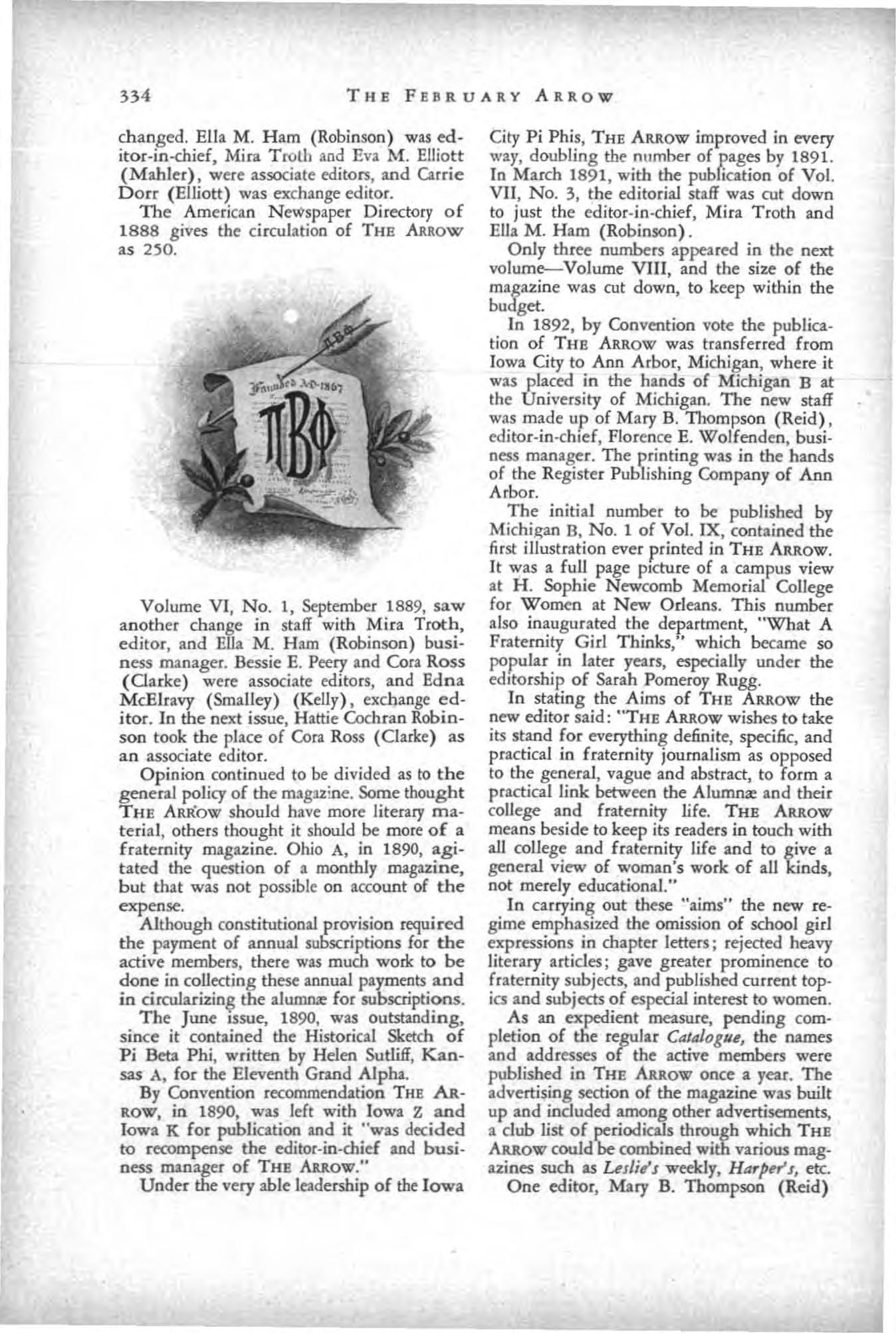
Volume VI, No I, September 1889, saw another change in staff with Mira Troth, editor, and Ella M Ham (Robinson) business manager. Bessie E. Peery and Cora Ross (Clarke) were associate editors, and Edna McElravy (Smalley) (Kelly), exchange editor . In the next issue, Hattie Cochran Robinson took the place of Cora Ross (Clarke) as an associate editor.
Opinion continued to be divid ed as to the general policy of the magazine. Some thought THE ARROW should have more literary material, others thought it should be more of a fraternity magazine Ohio A, in 1890, agitated the question of a monthly magazine, but that was not possible on account of the expense.
Although constitutional provision required the payment of annual subscriptions for the active members , there was much work to be done in collecting these annual payments and in circularizin$ the alUllllla! for subscriptions .
The lSsue, 1890 , was outstanding, since it contained the Historical Sketch of Pi Beta Phi, written by Helen Sutliff, Kansas A, for the Eleventh Grand Alpha .
By Convention recommendation THE ARROW, in 1890, was left with Iowa Z and Iowa K for publication and it "was decided to recompense the editor-in-chief and business manager of THE ARROW ."
Under the very able leadership of the Iowa
City Pi Phis, THE ARROW improved in every way, doubling the number of pages by 1891. In March 1891, with the pubfication of Vol. VII , No.3, the editorial staff was cut down to just the editor-in-chief, Mira Troth and Ella M. Ham (Robinson).
Only three numbers appeared in the next volume--Volume VIII, and the size of the magazine was cut down, to keep within the budget.
In 1892, by Convention vote the publication of THE ARRow was transferred from Iowa City to Ann Arbor, Michigan, where it was placed in the hands of Michigan B at the University of Michigan The new staff was made up of Mary B. 1110mpson (Reid), editor-in·chief, Flore nce E. Wolfenden, busi· ness manager. The printing was in the hands of the Register Publishing Company of Ann Arhor
The initial number to be published by Mi chiJ;an B, NO.1 of Vol. IX , contained the /irst illustration ever printed in THE ARROW. It was a full page p,cture of a campus view at H Sophie Newcomb Memorial College for Women at New Orleans This number also inaugurated the department, "What A Fraternity Girl Thinks," which became so popular in later years, especially under the edItorship of Sarah Pomeroy Rugg.
In stating the Aims of THE ARROW the new editor said: "THE ARROW wishes to take its stand for everything definite, specific, and practical in fraternity journalism as opposed to the general , vague and abstract, to form a practical link between the Alumnae and their college and fraternity life. THE ARROW means beside to keep its readers in touch with all college and fraternity life and to give a general view of woman's work of all kinds, not merely educational."
In carrying out these "aims" the new regime emphasized the omission of school girl expressions in chapter letters; rejected heavy literary articles; gave greater prominence to fraternity subjects, and published current top· ics and subjects of especial interest to women.
As an expedient measure, pending completion of the regular Catalogu., the names and addresses of the active members were published in THE ARRow once a year. The advertising section of the magazine was built up and included among other advertisements, a club list of periodicals through which THE ARROW could be combined with various magazines such as ullirl weekly, Harp'''l, etc.
One editor, Mary B. Thompson (Reid)
carried on the ARROW work continuously for Michigan B, but there were three changes i,\business managers, Florence E. WoUeoden being succeeded by Lucy Puker Huber, who in turn was succeeded by Miriam Dunbar. Mary Clark Banrker became Alumn", Editor in 1893, followed by Emma Hutchinson (Conrow) in 1896, who established a regular Al= Department in the magazine.
With the publication of the Convention Number, Vol. XII, No. I, October 1895, THE ARROW was placed in the hands of Pennsylvania A, with Lauretta T. Smedley, Editor in Chief, and Sarah Bancroft, business manager. The number was printed by the Inland Press of Ann Arbor.
Owing to the ill health of the alumna who was expected to edit THE ARROW, and to the pressure of college work upon the active chapter, Pennsylvania A was compeUed to give up the project.
Number 2 of Volume Xli was brought out by Wisconsin A, under the editorship of Jess ie C. Craig (CampbeU) with Alice B. D.cy (Bergenthal) , business manager . Tracy Gibbs & Co , Madison, Wis., did the print. ing.
A new financial arrangement went into effect during the year, whereby THE ARROW subscriptions of active members were paid direct to the Grand Treasury in an annual tax, thereby reijeving the business manager of collecting the money.
At the Reunion in Washington in July 1896, THE ARRow was "the burning question." The slogan of the meeting seemed to be, "THE ARRow must be and shall be im· proved," and the Reunion resolved "that Grand Council be requested to legislate reo quiring contributions in addition to chapter letters; the printing of proper names in copy; and the fining of chapters for submitting let· ters written on more than one side of the paper."
The following November the Grand Council decided that each chapter should henceforth be held responsible for one spe· cial article for THE ARROW earh year.
There was quite a noticeable change in the appearance of Volume XlII, No. I, Novem· ber 1896, with larger pages, better type and numerous illustrations . The name of Fforence Porter Robinson was found in that issue as Exchange Editor, and the next year she be· came editor·in·chief, entering upon some ten years of service during which the magazine progressed under uninterrupted leadership.
The Convention of 1897 created an ad· visory board of tbree members to be appoint. ed by THE ARRow Editor to consult with her regarding AR.ROW work, thus taking !be magazine out of the control of the active chapters, who had performed splendid piC)neer work.
Under the new arrangement Gertrude Clark Sober, Michigan B, became business manager with Emma S. Hutchinson (Con· row) I Pennsylvania A, editor. Alice Pierce (Sylvester), Michigan B, editor of Collece Netv! and Fanny K Read (Cook), MichIgan B, in charge of alum"", personals.
Because so many colleges opened late in the faU, making it impossible to get chapter letters early, it was decided in 1898 to issue THE ARRow in November, 1anu3ry, April , and July instead of on the former schedule
A change of publishers was made with the employment of the Democrat Printing Co., Madison, Wis., and a distinct improvement was noted in the paper, type and cuts, in 1897 Many of the other fraternity journals also began to use j lIustrations at this time. Says THE ARROW of October 1897: "The Key for July has settled its long·discussed question of illustration or no iUustratioD by issuing a pictorial number which surpasses in ambition and execution all previous efforts of its contemporaries, and like The Key , The T,"idenl celebrates the summer season with an efflorescence of illustrations, and inserts half· tones of four of its chapter groups."
Stimulated by the pmes which were of· fered by Dr. Bessie Peery at the 1897 Con· vention for the best article and the best chap. ter Jetter, many splendid contributions reached THE ARROW Editor's desk.
The prize for the best article was awarded to the essay entitled, 'The Fraternity as a SUl.'plement to College Life," which was wCltten by Cassie L. Souther of Massarhu· setts A, and Miss Souther became the owner of the prize Pi Beta Phi pin. Honorable men· tion was accorded Edna Harriet Rirhards of Pennsylvania A, for the toast, "Democracy," and to Martha N. Kimball of Colorado B for her art.icle on "The Chapter Letter."
To Mirhigan B was awarded the prize of a Pi Beta Phi stick pin for the best rhapter letter, which was written by Edna Bevans . Letters written by Vermont A and Massa · chusetts A received special praise.
The 1899 Convention provided for the reo printing of THE ARROW from its first num· ber so that each chapter might have a com·
plete set. No further record has been found concerning any action having been taken to carry out this ambitious yrovision , and it is assumed that the cost 0 the printing was prohibitive.
It was at t/lis Convention that THE ARROW Editor was made a member of the Grand
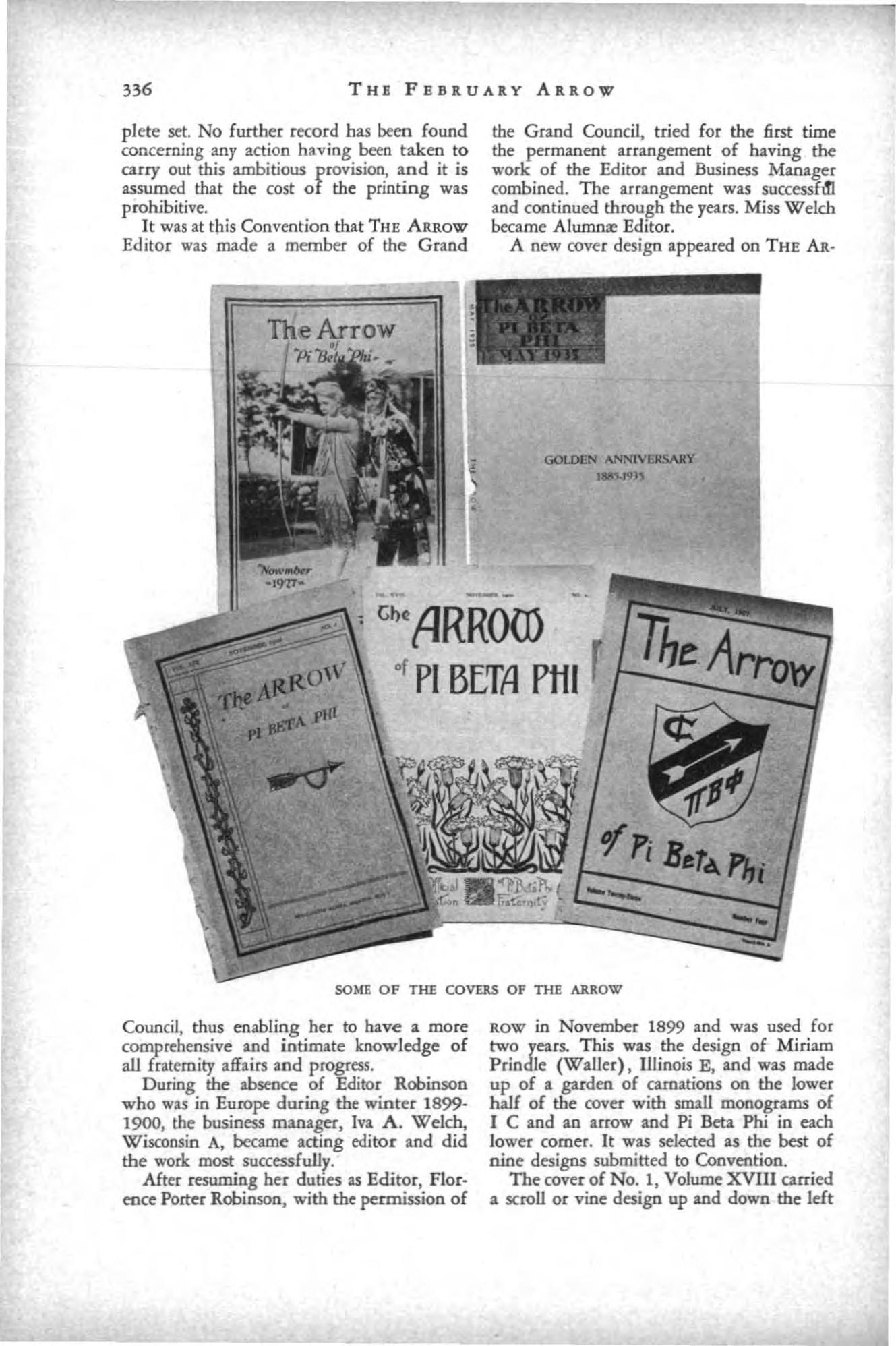
the Grand Council, tried for the first time the permanent arrangement of having the work of the Editor and Business Manager combined. The arrangement was successfm and cootinued through the years . Miss Welch became Alumna: Editor.
A new cover design appeared on THE AA -
SOME OF THE COVERS OF 1HE ARROW
Council, thus enabling her to have a more comprehensive and intimate knowledge of aU fraternity affairs and progress
During the absence of Editor Robinson who was in Europe during the winter 18991900, the business manager, Iva A_ Welch, Wisconsin A, became acting editor and did the work most successfully.
Mter resuming her duties as Editor, Florence Porter Robinson , with the permission of
ROW in November 1899 and was used for two years. This was the design of- Miriam Prindle (Waller), Illinois E, and was made up of a garden of carnations on the lower half of the cover with small mooograms of I C and an arrow and Pi Beta Phi in each lower comer. It was selected as the best of nine designs submitted to Convention.
The cover of No .1, Volume XVIII carried a scroll or vine design up and down the left
side of the page, to which later was added the insignia of the fraternity.
Volume XX, No. 1 carried a plain blue rover, solid cadet blue paper, with the words ''The Arrow of Pi Beta Phi" in gold across the face. This was used until 1906, when a new design by Charlotte E . Sbepard (Field) , Michigan A greeted the readers. In the center of the new cover a shield was divided diag. onally through the center by a band of black, bearing the arrow. In the upper left-hand division was I.e., in the right.band lower section was IT B
Above the shield in a plain panel space was "The Arrow," and below under the shield, "of Pi Beta Phi ."
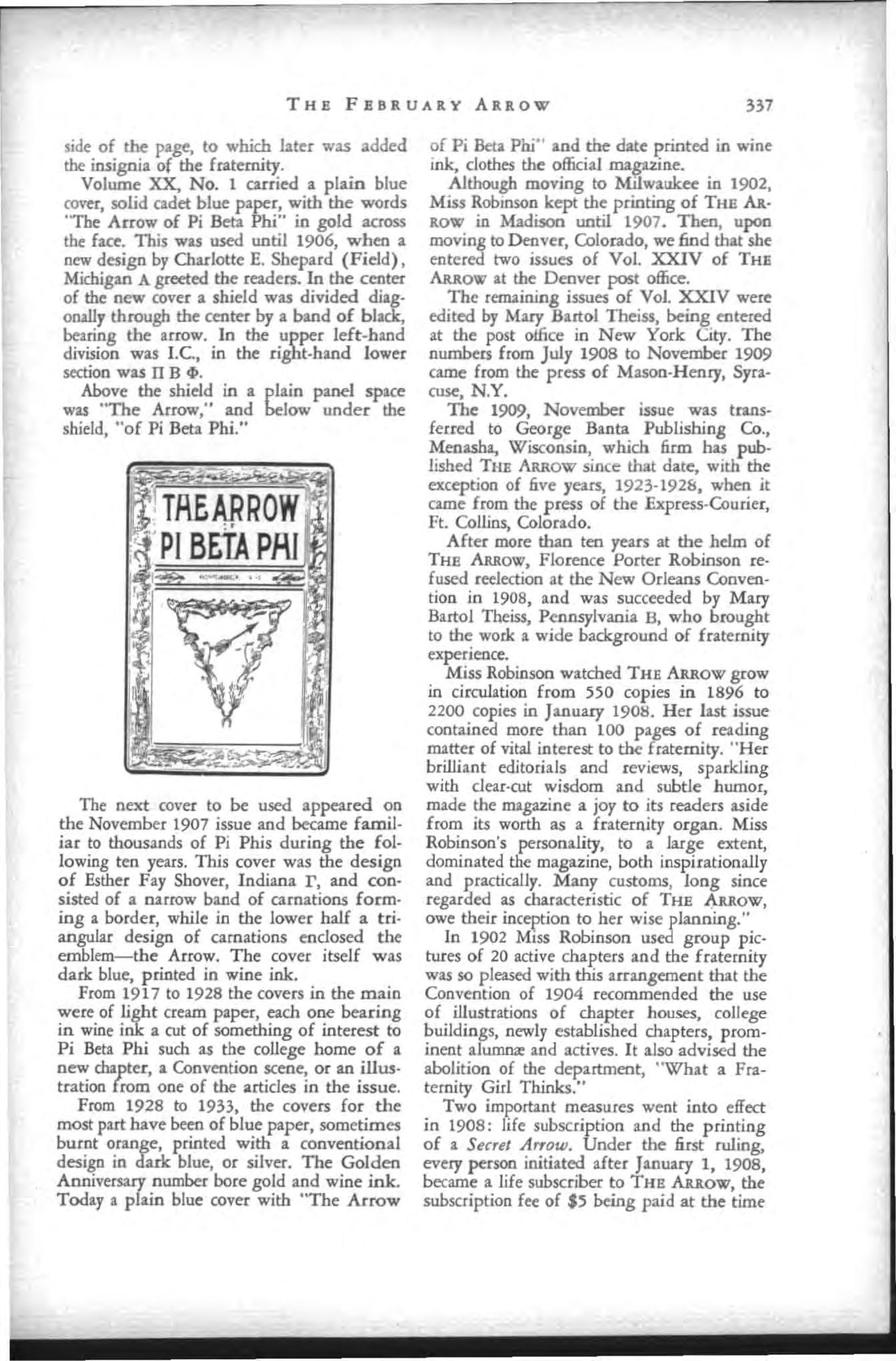
The next cover to be used appeared on the November 1907 issue and became famil· iar to thousands of Pi Phis during the fol· lowing ten years. This cover was the design of Esther Fay Sbover, Indiana r, and con· sisted of a narrow band of carnations forming a border, while in the lower balf a trio angular design of carnations endosed the emblem-the Arrow. The cover itself was dark blue, printed in wine ink.
From 1917 to 1928 the covers in the main were of light cream paper, each one bearing in wine ink a cut of something of interest to Pi Beta Phi sucb as the college borne of a new chapter, a Convention scene, or an illwtration from one of the artides in the issue.
From 1928 to 1933, the covers for the most part have been of blue paper, sometimes burnt orange, printed with a conventional design in dark blue, or silver. The Golden Anniversary number bore gold and wine ink. Today a plain blue cover with ''The Arrow
of Pi Beta Phi " and the date printed in wine ink, clothes the official magazine.
Although moving to Milwaukee in 1902, Miss RoblOson kept the printing of THE AR· ROW in Madison until 1907. Tben, upon moving to Denver, Colorado, we find that she entered two issues of Vol. XXIV of THE ARRow at the Denver post office.
The remaining issues of Vol. XXIV were edited by Mary Bartol Theiss, being entered at the post olfice in New York City. The numbers from July 1908 to Noventher 1909 came from the press of Mason·Henry, Syracuse, N Y.
The 1909, Noventher issue was transferred to George Banta Publishing Co., Menasha, Wisconsin , which firm has pub· lished THE ARROW since that date, with the exception of five years, 1923 1928, when it came from the press of the Express-Courier, Ft. Collins, Colorado.
After more than ten years at the helm of THE ARRow. Florence Porter Robinson reo fused reelection at the New Orleans Conven· tion in 1908, and was succeeded by Mary Bartol Theiss, Pennsylvania B, who brought to the work a wide background of fraternity experience.
Miss Robinson watched THE ARRow grow in circulation from 550 copies in 1896 to 2200 copies in January 1908. Her last issue contained more than 100 pages of reading matter of vital interest to the fraternity. " Her brilliant editorials and reviews, sparkling with clear·cut wisdom and subtle humor, made the magazine a joy to its read ers aside from its worth as a fraternity organ. Miss Robinson 's personality, to a large extent, dominated the magazine, both inspirationally and practically. Many customs, long since regarded as characteristic of THE 4JutOW, owe their to her wise planning."
In 1902 MISS Robinson used group pic. tures of 20 active chapters and the fraternity was so pleased with this arrangement that the Convention of 1904 recommended the use of illustrations of chapter houses, college buildings, newly established chapters, prominent alu= and actives . It also advised the abolition of the department, "What a Fraternity Girl Thinks."
Two important went into effect in 1908: life subscription and the printing of a Secret A".ow. Under the first ruling. every persoo initiated afte r January I, 1908, became a life subscribec to THE ARRow, the subscription fee of $5 being paid at the time
of initiation. This was later raised to $10, and in 1932 was increased to $15. Through this life subscription plan the circulation automatically increases each year, the present average being about 1 ,000 names annually. The circulation in 1936 is approximately 23,000. The second ruling proviaed for the publication of a secret or Information Number following each biennial Convention. Through Grand Council action in 1913, the Secret issue became an annual publication, the first number in each volume, appearing as the September A1lRow, instead of the extra July or August issue after Conventions.
The minutes of Conventions and the reports of the Grand President which were first published and distributed in the late nineties were fore-runners of the Information Number. As early as December 1888, Illinois a asked: "Why should not THE ARRow be strictly sub rosa? " Through the Seerel Arrow all members of the fraternity are given the opportunity to know the inner workings and accomplishments of Pi Beta Phi.
FoUowing the recommendation made by Kate King Bostwick in 1908, the 1910 Convention voted that each chapt.. keep an AR· ROW file, hence a bound copy of each volume is sent to the chapter annually, under the supervision of the ARRow Editor.
Various drives have been made from time to time to induce early members of the fraternity to become life subscribers. Especial efforts were made in 1913, 1916, 1922 , and 1933, with some success.
Space does not permit a detailed descrip. tion of the chronological developments of THE ARRow during the past thicty years, but in rassing we shall give a summary of some 0 the most outstanding features.
For a time the Editor was assisted only by the A1umnre Editor, then came the Chapter Letter Editor, an Associate Editor, then the Mailing List Oerk. the editors of various departments, and in later years a staff of spe' cial correspondents.
From 1908-1912 printed circulars with in · structions were sent by the Editor to chapters, these later developing into the Bulletin which was issued four times a year until 1927, being replaced by mimeographed letters of instruction sent as needed from the Central Office. In 1922, a Handbook for Corresponding Secretaries was published, supplementing the Bullelin.
In 1912 the official list of Fraternity Sup-
plies appeared as a regular ARRow feature, and Coming Events was inaugurated. In 1913 "News from Little Pigeon" became a regular department.
In 1916 there appeared the calendar on the inside of each ARROW cover. In that same year, "Let's Get Acquainted" took the place temporarily of "What a Fraternity Girl Thinks ." In 1918 Club Interest and Events became permanent.
A number of features which had appeared in various issues of THE ARROW were made permanent departments in the years between 1922 and 1927, with regular staff members in charge of each. These induded: Pi Phi Relativ es, Book Reviews, Pi Fhis in the Public Eye, With the Actives, and Arrowettes. In 1928, Book Reviews grew into. "From Pi Phi Pens. " and a very colorful Rotogravure section supplanted, " With the Actives." In 1935, "Pi Phi Personalities" took the place of "Pi Phis in the Public Eye" and "Arrowettes" became, ' The Editor Hears That."
In 1925 the schedule of appearance of THE ARRow was changed to September, November, February and May.
The Central Office has performed splendid service for THE ARROW, by taking over the Mailing List in 1927, and the A1umnre Personals, in 1933.
For a number of years the contingent fund advanced money to THE ARROW in addition to the income from the Arrow Endowment. and THE ARRow was enabled to expand most generously in size, in make-up and in the use of cuts. Gradually, however, it was realized that THE ARROW must be self-supporting. Hence, the Grand Council made a aecision in 1928 that " The Arrow in future publication costs, running expenses and staff fees must not exceed the interest from the A1lRow Endowment Trust Fund," and recommended that the ARRow fund repay to the contingent fund any surplusses from year to year
This meant that through necessity a cut of $5000 must be made over the previous year. Jnsephine Coates, incoming editor, devoted much time and effort to supervising an entire change in typographical style and general make-up of THE ARRow in order to hold publication costs to the necessary budget. Under the new plan THE ARRow appeared in a two·column arrangement, with smaller type and a considerable reduction in the number
THE FEBRUARY ARROW 339 of pages-but a most creditable journal with pleasing make-ur and ""cellent cuts, and its high standard 0 excellency has been carried on by succeeding editors.
The Chapter Letters (which for years have been the center of discussion whenever fraternity editors get together) were a hobby of Mabel &ott Brown, who gave splendid service as Chapter Letter Editor several years before becoming ARROW Editor. Much credit is due Mrs . Brown for the improvement in that very important section of 'tHE ARRow. To quote Mrs. Brown: "The phrases ' we are justly proud: and 'the cream of the campus: no longer strut like gay peacocks through chapter and alumn", letters. What flowers of rhetoric withered when the ARROW correspondent was asked to use the third person. How much more succinct and sparkling the new reporting!'·
The Alumn", Department, perhaps the most trying of all to edit, was given splendid impetus by Mrs. Brown as ARROW Editor, ana continued its development under Mary Kathrine Lutz and Adele Taylor Alford. Through the years there have appeared a number of special editions of THE ARRow, which have elicited high praise-particularly those of an historical nature.
To Mary Bartol Theiss goes the credit for the invaluable service of collecting the early day photographs of all of the Founders, and of printing letters and historical data. Mrs. Theiss said in THE ARROW of May 1935: "The loveliest thing I ever did for THE ARROW as editor, it seems to me, was to gather together for the forty-first anniversary of Pi Phi's founding, in 1908, old time photographs of our twelve founders and of the old H.olt House in Monmouth where the society's first meeting was held. Although I wrote to and heard from all of the ten founders then living, it was to Mrs. Emma Brownlee Kilgore, our first president, that we owed most of these photographs. Her sympathetic interest in and affectionate loyalty to these friends of her youth made it possible for us of the next generation to enJOY much sweet sentiment in these quaint likenesses of our Founders in 1867. Later, when I collected information about various
professions and ocCtJpations in which Pi Phis had been engaged, hoping thus to serve our actives, it was again Mrs. Kilgore who furnished THE ARRow with the old -fashio ned, frolicsome, friendly letters of 1876-1881, written by our Founder and /irst physician, Jennie Nicol, wbose name we cherish today in our Settlement &hool Hospital."
In 1917 , Sarah Pomeroy Rugg edited the Fiftieth Anniversary number of the Arrow, of which she says: "Heart-warming were the letters from the ten living Founders, many of them with affectionate personal messages to the Editor. Fascinating as the solution of a modern picture puzzle was the task of piecing together reminiscences of the two who died in early youth. Like a fragrant old nose -gay were their Bowers of memory for Ann Thompson , hostess of our first Convention. Thought-provoking was Mrs. Kilgore'S characterization of Dr. Jennie Nicol."
The Vocational Number issued by Agnes Wright Spring in February 1928, was based upon a complete survey of the then 17,000 members of the fraternity, which produced valuable data used in succeeding issues of THE ARROW.
An outstanding achievement was the publication of the Golden Anniversary number of THE ARRow, edited by Adele Taylor ALford, May 1935, in which the early history of the magazine was skillfully presented and biographies, filled with human interest, were published of every ARROW Editor from 1885 to 1935.
Said Mrs. Alford: "The History of THE ARROW is the story of its editors-truly a distinguished company To them the fraternity offers its gratitude for giving it so fine a public presentation in the Greek letter world."
As a supplement to the Golden Anniversary number, Mrs. Alford had printed an exact replica of THE ARROW, Vol. 1, No.!.
The following verse which appeared on the title page of this first ARROW, is as appropriate now as it was fifty.one years ago: "Its mission is to cheer and bless Where' er its lot be cast, And come what may, of weal or woe, Be faithful to the last."
Historical Paper Number One A Sketch of Pi Beta Phi from 18 67 -1893 Edited by Historian Susan Whipple Lewis. June 1899. 11 pages_
Historical Paper Number Two. Resume of Salient Points in the History of Pi Beta Phi Edited by Jeannette Zeppenfeld, Historian. Published by George Banta Pub. Co., Menasha, Wis. 1910. 38 pages.
.The Hislory of Pi Bela Phi, compiled by ElIzabeth Allen Clarke Helmick, Michigan A, Historian Pub. by David D. Nickerson & Co., Bosron, Mass. Cloth bound. 272 pages. 91 illustrations Roll of Active Chapters, R oll of In active Chapters, Chapters: In the Beginning. Extension. Inactive Cbapters . Organization and Government. National Con· ventions. Insignia . Alumnre Organizations. Alumnre Clubs. Incorporation. Grand Officers . The Fraternity Magazine. Catalogue and Calendars. Pi Beta Phi Song Book. Symphony and Coat of Arms. The Cookie Shine. Fellowships, Scholarships and Lnan Funds. Fraternity Examinations. Panhellenic Conventions. Pi Beta Phi Settlement School. Conclusion. Index.
1910. Compiled by R oberta G. Frye (Watt), Maryfand A 1911. Compiled by Anna F. T. Pettit (Broomell) and Katherine Griest, Pennsylvania A. Printed by Walter B. Jenkins, Philadelphia. sheets. Each day of the year bore an appropriate quotation. Birthdays of Founders, Grand Council and active chapters were noted.
1912. Compiled by Katherine Griest Printed by JenIQns Done in black and white, a page a week style, with quotations 1913. Compiled by Katherine Griest. A bright attractive border of green and red, with the carnation in the four corners. Birth anniversaries of Founders, Grand Council and chapters noted 1914. Form of a page a day pad, with appropriate verses and birthday anniversaries noted. Compiled by Katherine Griest. Printed by Jenkins.
A duplicate of the 1913 Calendar.
The first definite step taken towards the compilation of a fraternity catalogue was the recommendation made at the Fifth Grand Alpha, held at Mt. Pleasant, Iowa, in 1880, that the LnqJbard chapter "work up an interest in regard to an I .e. Catalogue." Numerous efforts were made to accomplish the work, and the publication was scheduled three times before actual appearance of the lirst general Catalogue printed in THE ARROW, September 1887. This directory consisted of 20 pages and contained the names and addresses of 970 members, belonging to 20 active chapters. No record of the members of the inactive chapters was given.
In THE ARRow, December 1887, the lirst supplement to the Catalogue was printed carrying 38 names From time to time additional names appeared in the magazine.
A Committee on Catalogue, composed of Ohio A, Iowa 0, and Iowa I , with Corinne Super (Stine), as Chairman, was named at the Convention of 1890 to publish a catalogue. This committee reported in 1892 that it had completed a catalogue in manuscript form , of a1f active members and was at work on the non-active list. The Alumnre Committee, also reported at the Convention saying it had made efforts to collect addresses of Alumna:.
A Convention committee on catalogue, composed of Corinne Super, Helen Maxwell, Colorado A, and I da Van Hon, Iow a A , met during the sessions and recommended that the names and addresses of active members be printed in THE ARROW once each year . Carried . " This was proposed as an expedient measure pending the completion of general Catalogue work."
Although nothing is recorded in the Convention minutes relative to the creation of a new office, the Nominating Committee in· cluded the name of Miss Super as ··Catalogue Secretary," and she was elected to the position.
. THE ARROW Directory of 1892 carries the names of two Catalogue Secretaries: Corinne Super and Mary Mc Donald Knapp. Early in 1893 the name of Mary Clarke Bancker is listed in THE ARROW as Catalogue Secretary, and is followed shortly by that of Grace Lass Grace Lass (Sisson) continued as Cata-
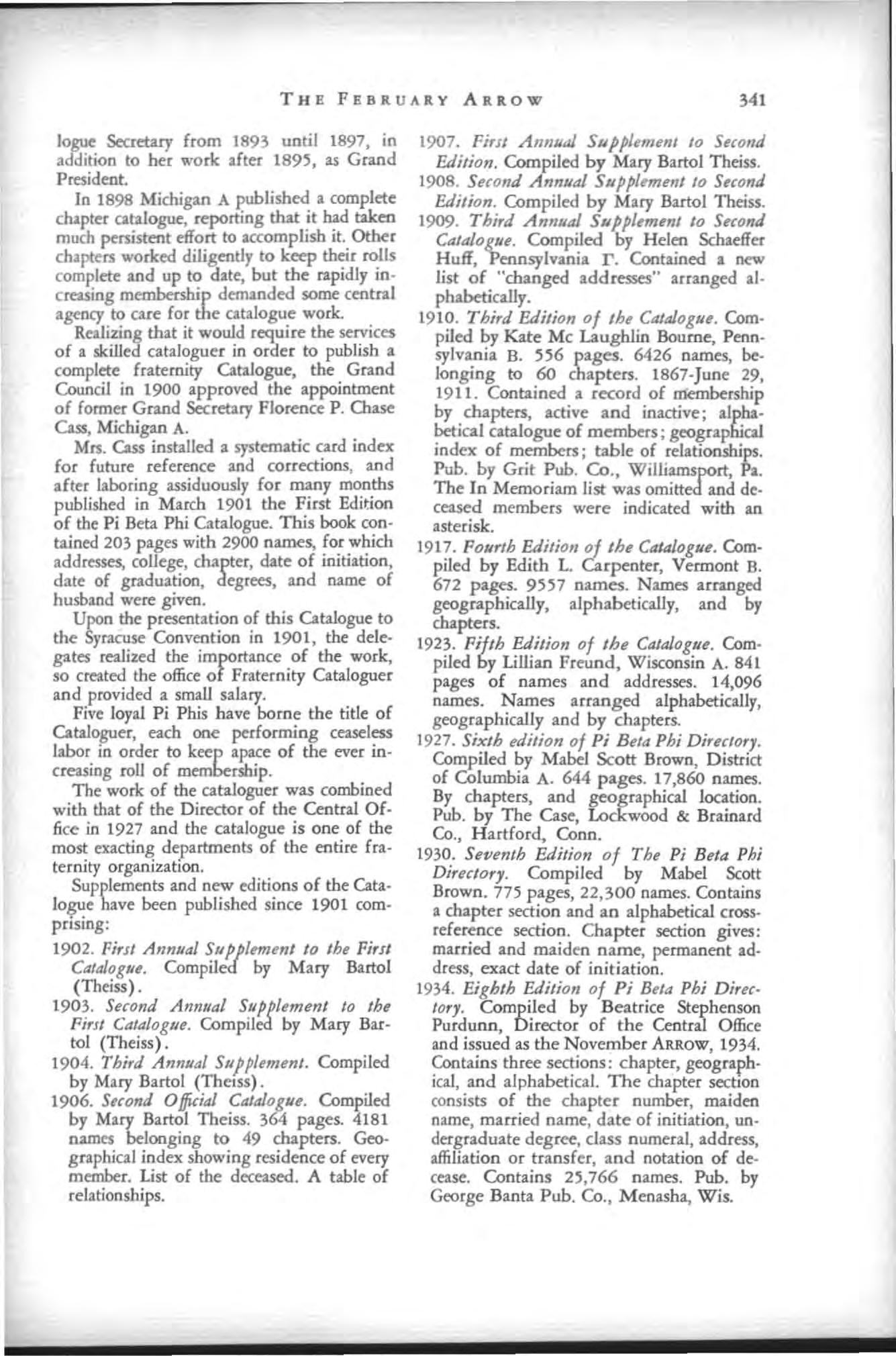
logue Secretary from 1893 until 1897, in a<fdition to her work after 1895, as Grand President.
In 1898 Michigan A published a complete chapter catalogue, reporting that it had taken much persistent effort to accomplish it Other chapters worked diligently to keep the" rolls complete and up to date, but the rapidly increasing membership demanded some centra l agency to care for the catalogue work.
Realizing that it would require the serviCes of a skilled cataloguer in order to publish a complete fraternity Catalogue, the Grand Council in 1900 approved the appointment of former Grand Secretary Florence P. Chase Cass, Michigan A.
Mrs. Cass installed a systematic card index for future reference and corrections, and after laboring assiduously for many months published in March 190 I the First Edition of the Pi Beta Phi Catalogue. This book contained 203 pages with 2900 names, for which addresses, college, chapter, date of initiation, date of graduation, degrees, and name of hushand were given.
Upon the presentation of this Catalogue to the Syracuse Convention in 1901, the delegates realized the importance of the work, so created the office of Fraternity Cataloguer and provided a small salary.
Five loyal Pi Phis have borne the title of Cataloguer, each one performing ceaseless labor in order to keep apace of the ever increasing roll of membership.
The work of the cataloguer was combined with that of the Director of the Central Offi ce in 1927 and the catalogue is one of the most exacting departments of the entire fraternity organization.
Supplements and new editions of the Catahave been published since 1901 COIDpnsmg:
1902. Pirst Annual S" pplement to the First Catalogu.. Compiled by Mary Bartol (Theiss)
1903. Second Annllal Supplement to the First Catalogue. Compiled by Mary Bartol (Theiss).
1904. Thi,d Annual Sulplement. Compiled by Mary Bartol (TheIss) . 1906. Stcond Official Catalogue. Compiled by Mary Bartol Theiss 364 pages. 4181 names belonging to 49 chapters. Geographical index showing residence of every member. List of the deceased. A table of relationships.
1907. First Annual Supplement to Second Edition. Compiled by Mary Bartol Theiss. 1908. Second Annual Supplement to Stcond Edition. Compiled by Mary Bartol Theiss . 1909 Thi,d Annual Supplement to Second Catalogue. Compiled by Helen Schaeffer Huff, "Pennsylvania r. Contained a new list of "changed addresses" arranged alphabetically.
1910. Thi,d Edition of Ihe Catalogue. Compiled by Kate Mc Laughlin Bourne, Pennsylvania B. 556 pages. 6426 names, belonging to 60 chapters. 1867-June 29, 1911. Contained a record of membership by chapters, active and inactive; alphabetical catalogue of members; geographical index of members; table of relationships. Pub . by Grit Pub. Co ., Williamsport, Pa. The In Memoriam list was omitted and deceased members were indicated with an asterisk.
1917. Fourth Edition of Ihe Catalogue. Compiled by Edith L. Carpenter, Vermont B. 672 pages. 9557 names. Names arranged geographically, alphabetically, and by chapters.
1923. Fifth Edition of the Catalogue. Compiled by Lillian Freund, Wisconsin A. 841 pages of names and addresses. 14,096 names. Names arranged alphabetically, geographically and by chapters.
1927. Sixth edition of Pi Beta Phi Directo,y Compiled by Mabel Scott Brown , District of Columbia A. 644 pages. 17,860 names. By chapters, and geographical location. Pub. by The Case, LockwOod & Brainard Co., Hartford , Conn.
1930. Seventh Edition of The Pi Beta Phi Directory Compiled by Mabel Scott Brown. 775 pages, 22,300 names. Contains a chapter section and an alphabetical crossreference section. Chapter section gives: married and maid en name, permanent ad· dress, exact date of initiation.
1934. Eighth Edition of Pi Beta Phi Direct o,y. Compiled by Beatrice Stephenson Purdunn, Director of the Central Office and issued as the November ARROW, 1934 . Contains three sections: chapter, geographical, and alphabetical. The d13pter sectIon consists of the chapter number, maiden name, married name, date of initiation, undergraduate degree, class numeral , address, affiliation or transfer, and notation of decease. Contains 25,766 names. Pub. by George Banta Pub. Co., Menasha, Wis.
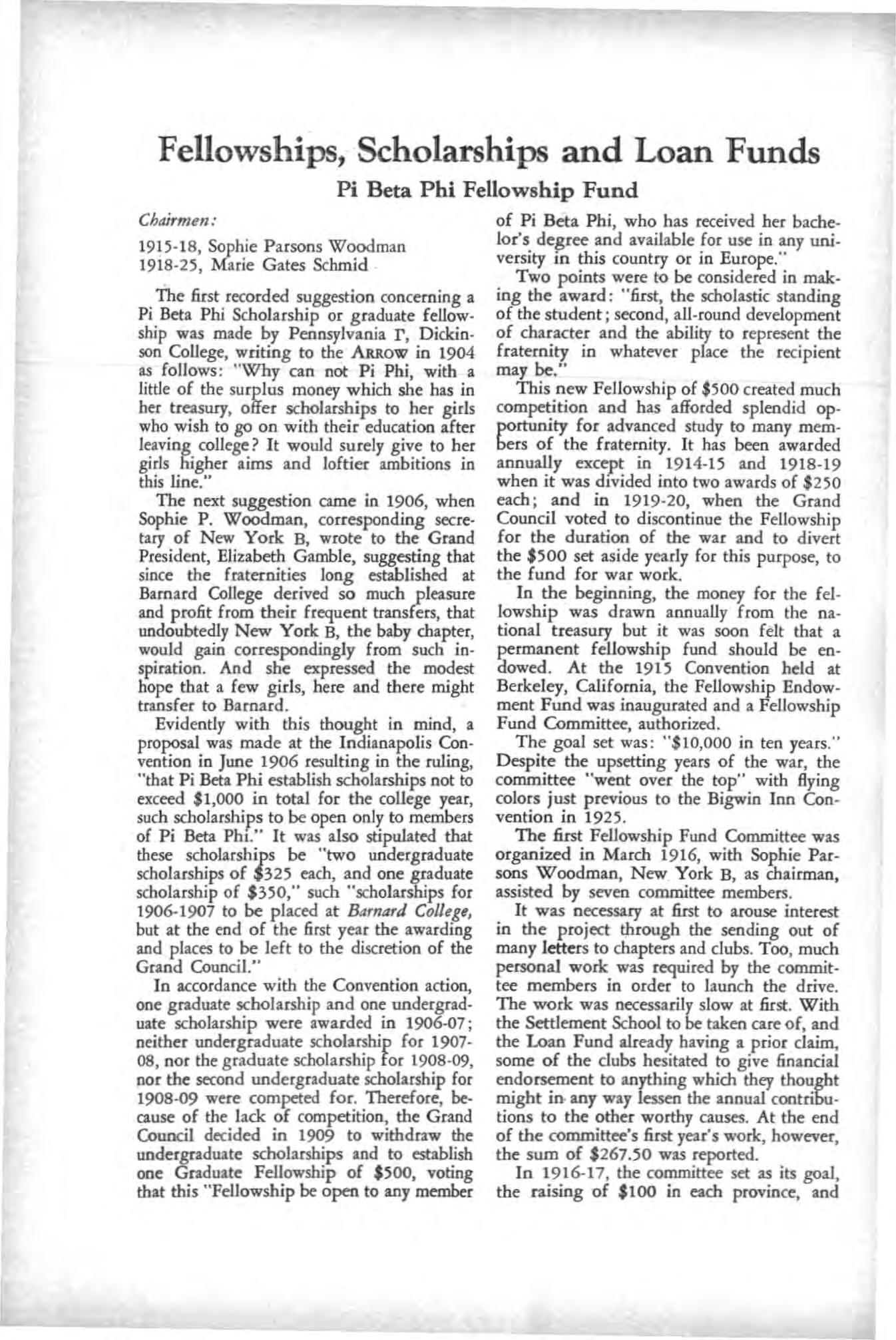
Chairmen:
1915 - 18, Sophie Parsons Woodman
1918 -25, Marie Gates Schmid
The first recorded suggestion concerning a Pi Beta Phi Scholarship or graduate fellowship was made by Pennsylvania r, Dickin· son College, writing to the ARRow in 1904 as follows: " Why can not Pi Phi, with a little of the surplus money which she has in her treasury, offer scholarships to her girls who wish to go on with their education after leaving college? It would surely give to her girls nigher aims and loftier ambitions in this line ."
The next suggestion came in 1906, when Sophie P. Woodman , corresponding secre· tary of New York B, wrote to the Grand President, Elizabeth Gamble, suggesting that since the fraternities long established at Barnard College derived so much pleasure and profit from their frequent transfers, that undoubtedly New York B, the baby chapter, would gain correspondingly from such inspiration. And she expressed the modest hope that a few girls, here and there might transfer to Barnard.
Evidently with this thought in mind, a proposal was made at the Indi anapolis Con· vention in June 1906 resulting in the ruling, '·that Pi Beta Phi establish scholarships not to exceed $1,000 in total for the college year, such scholarships to be open only to members of Pi Beta PhI ." It was also stipulated that these scholarships be "two undergraduate scholarships of $325 each, and one graduate scholarship of $350," such "scholarships for 1906·1907 to be placed at B arnard Colltgt, but at the end of the first year the awarding and places to be left to the discretion of the Grand Council."
In accordance with the Convention action, one graduate scholarship and one undergrad. uate scholarship were awarded in 1906·07; neither undergraduate scholarship for 1907· 08, nor the graduate scholarship for 1908·09, nor the second undergraduate scholarship for 1908 -09 were competed for . Therefor<, be· cause of the lack of competition, the Grand Council decided in 1909 to withdraw the undergraduate scholarships IJId to establish one Graduate Fellowship of $500, voting that this "Fellowship be op"" to any member
of Pi Bet a Phi, who has received her bache· lor's deere< and available for use in any uni· versity In this country or in Europe. "
Two points were to be considered in making the award: "first, the scholastic standing of the student; second, all·round development of character and the ability to represent the fraternity in whatever place the recipient may be."
This new Fellowship of $500 created mu ch competition and has afforded splendid op· portunity for advan ced study to many m emo bers of the fraternity . It has been awarded annually except in 1914·15 and 1918-19 when it was dIvided into two awards of $250 each; and in 1919· 20, when the Grand Council voted to discontinue the Fellowship for the duration of the war and to divert the $500 set aside yearly for this purpose, to the fund for war work.
In the beginning, the money for the fellowship was drawn annually from the oa· tional treasury but it was soon felt that a permanent fellowship fund should be endowed . At the 1915 Convention held at Berkeley, California, the Fellowship Endowment Fund was inaugurated and a Fellowship Fund Committee, authorized.
The goal set was: "$10,000 in ten years :' Despite the upsetting years of the war, the committee "went over the top" with Bying colors just previous to the Bigwin Inn Convention in 1925.
The first Fellowship Fund Committee was organized in March 1916, with Sophie Parsons Woodman , New York B, as chairman, assisted by seven committee members.
It was necessary at first to arouse interest in the project through the sending out of many letters to chapters and clubs. Too , much personal work was required by the commit· tee members in order to launc h the drive. The work was necessarily slow at first . With the Settlement School to be taken care of, and the Loan Fund already having a prior daim, some of the dubs hesitated to give financial endorsement to anything which they thought might in- aoy way lessen the annual con tributions to the other worthy causes. At the end of the committee's first year's work, however, the sum of $267.50 was reported
In 1916- 17, the committee set as its goal, the raising of $100 in each province, and
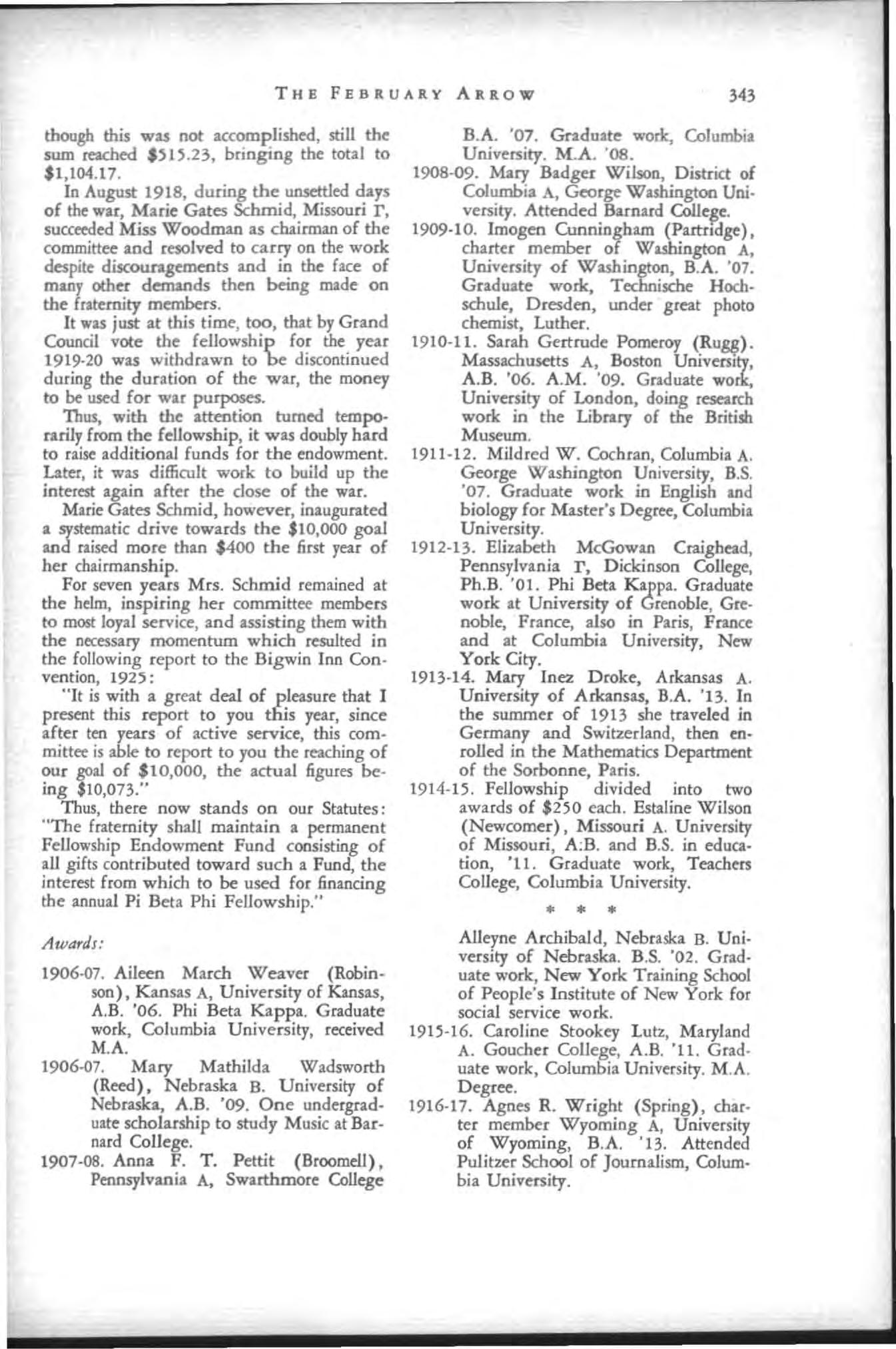
though this w ... not acc omplished . still th e sum reached $)1) .23. bringing the total to $1 104 17.
In August 191 8. d uring the unsettled days of the war, Marie Gates Schmid, Missouri r, succeeded Miss Woodman as chairman of the committee and resolved to carry on the work despite discouragements and in the face of man y other demands then being made on the fraternity members
It w... just at this time. too. that by Grand Council vote the fellowship for the year 1919-20 w w ithdrawn to be discontinued during the duration of the war. the money to be used for war purposes.
Thus. with the attention turned temporarily from the fellowship. it w ... doubly hard to raise additional funds for the endowment. Later. it was difficult work to build up the interest again after the dose of the war.
Marie Gates Schmid, however, inaugurated a systematic drive towards the $10.000 goal and raised more than $400 the lirst year of her chairmanship .
For seven years Mrs . Schmid remained at the helm , inspiring her committee members to most loyal service. and assisting them with the necessary momentum which resulted in the following report to the Bigwin Inn Convention, 1925;
"It is with a great deal of pleasure that I present this report to you this year. since after ten years of active service. this committe< is able to report to you the reaching of OUr goal of $10 . 000. the actual ligures being $10.073."
Thus, there now stands on our Statutes: "The fraternity shall maintain a permanent Fellowship Endowment Fund consisting of all gifts contributed toward such a Fund. the interest from which to be used for linancing the annual Pi Bet a Phi Fellowship ."
Award,:
1906-07. Aileen March Weaver (Robinson), Kansas A, University of Kansas, A.B. '06 Phi Beta Kappa. Graduate work, Columbia University, received. M.A.
1906 -07 . Mary Mathilda Wadsworth (Reed). Nebraska B. University of Nebraska. A B. '09 Ooe undergraduate scholarship to study Music at Barnard College.
1907-08. Anna F. T. Pettit (BronmeJl). Pennsylvania A. Swarthmore College
B. A. ' 07 . Graduate work, Col umb ia University. M .A . ' OS.
1908 -09. Mary Badger Wilson District of Columbia A . George Washington University. Attended Barnard College. 1909 -10. Imogen Cunningham (Partridge). charter member of Washington A Uni versity of Washington. B.A. ' 07_ Graduate work. Technische Hochschule. Dresden. under great photo chemist. Luther.
1910 -11. Sarah Gertrude Pomeroy (Ru8$) Massachusetts A. Boston UniversIty. A.B. '06 A M _ '09_ Graduate work. University of London. doing research work in the Library of the British Museum .
1911-12. Mildred W. Cochran. Columbia A. George Washington Un iversity. B.S. ' 07 Graduate work in English and biology for M ter·s Degree. Columbia University.
191 2-13. Elizabeth McGowan Craighead Pennsylvania r. Dickinson College. Ph.B. '01. Phi Beta Kappa. Graduate work at University of Grenoble . Grenoble, France, also in Paris, Franee and at Columbia University. New York City.
1913-14. Mary Inez Droke. Arkansas A. University of Arkans .... B.A_ '13. In the summer of 1913 she traveled in Germany and Switzerland then enrolled in the Mathematics Department of the Sorbonne, Paris.
1914-1) Fellowship divided into two awards of $250 each . Estaline Wilson (Newcomer). Missouri A. University of Missouri . A :B. and B.S. in education, '11. Graduate work, Teachers College. Columbia University.
Alleyne Archibald Nebraska 8. University of Nebraska B S '02 Graduate work. New York Training School of People' s Institute of New York for social service work.
1915-16. Caroline Stookey Lutz. Maryland A. Goucher College A B. 'II. Graduate work. Columbia University. M . A. Degree.
1916- 17. Agnes R_ Wright (Spring). charter member Wyoming A. University of Wyoming. B.A. '13. Attended Pulitzer School of Journalism. Columbia University
1917-18. Esther Bigger (Jenkins), Ohio B Ohio State University, A B '17 Phi Beta Kappa . Theta Sigma Phi. Graduate work, Columbia University, working towards degree of Doctor of Philosophy.
1918 - 19. Lucile S. Cravens (Morgan), Illi· nois B. Lnmbard College, A.B. ' 10. Graduate work, for Doctor's Degree, in classical languages, University of Missouri.
1918-19. Delia Conger, Illinois B. Lnmbard College, A.B. '09. Graduate work for Ph.D. degree at the University of Chicago.
1919 -20. Through Grand Council vote the Fellowship was withdrawn for this year. Under terms of the war fund , a reconstruction scholarship of $2'0 was awarded to : leie Gertrude Macy, Virginia A. Randolrh-Macon, Chicago University, B .S. 16. University of Colorado, M .A . '18. Graduate work, Doctor of Philosophy, Yale University.
1920-21. Helen Ingraham, Illinois I!.. Knox College, B S. '18. Phi Beta Kappa. Graduate work, for Master's Degree in Zoology at University of Chicago, also at Wood's Hole.
1921-22. Frances E Gillespie, District of Columbia A. George Washington University, A.B. '08. Graduate work, University of Lnndon.
1922-23. Alice Barndt (Lambert), Illinois I!. . Knox College, A .B . ' 22. Graduate wode: in journalism, University of Illinois .
1923-24 . Lelah Bell Davis, Illinois H . James Millikin University, A .B. '14 . Grad· uate work, University of Chicago.
1924-2' Mary Shannon Snook, Arkansas A. University of Arkansas, A.B . '13. Graduate work, School, Har· vard University.
192' -26 Beatrice Adams (Sullivan), Louisi· ana A. Newcomb College, Tulane University, A.B. '2'. Graduate course in Social Economics, Johns Hopkins University
1926-27. Mildred Maroney, Oklahoma B. Oklahoma Agricultural and Mechani ·
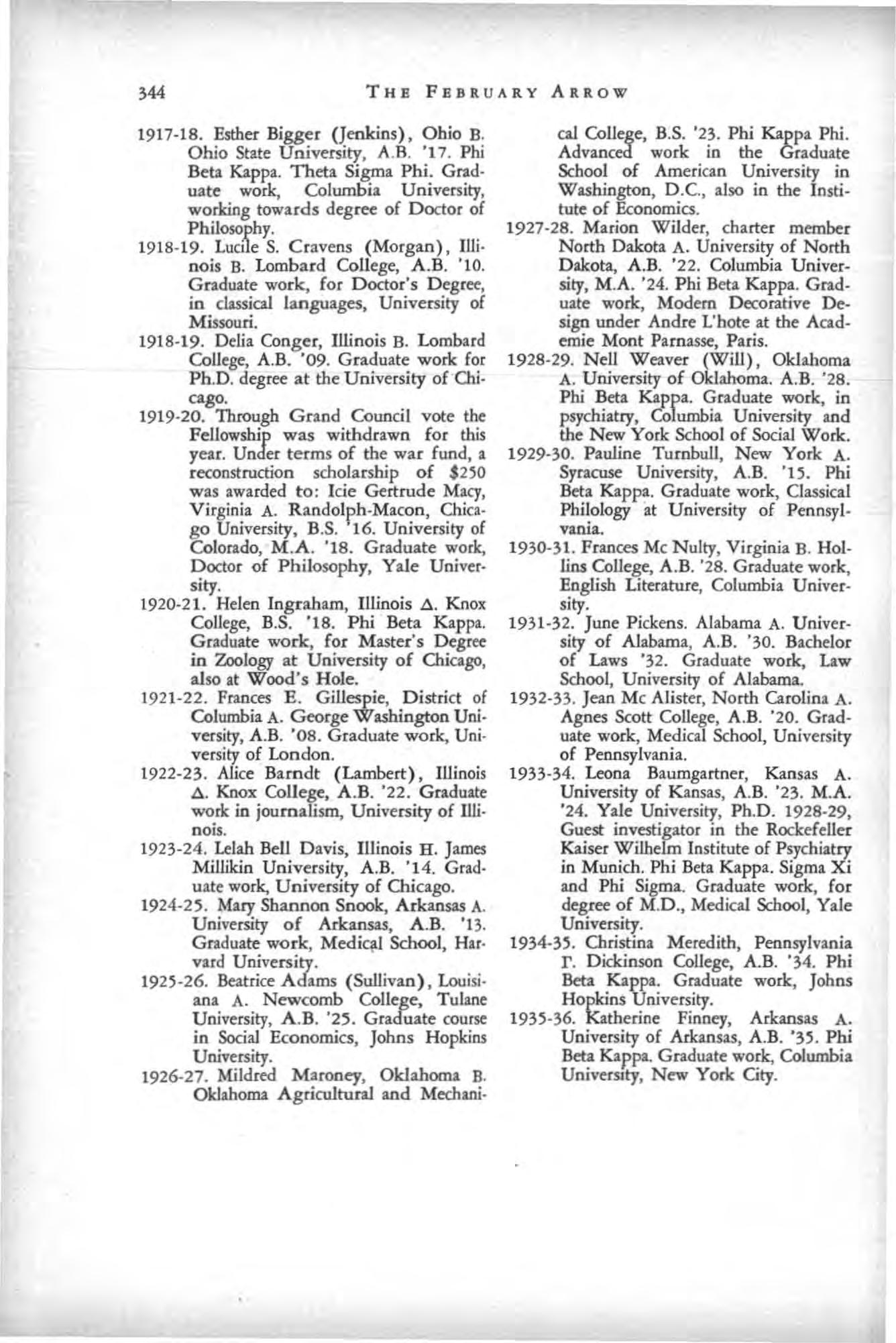
cal College, B S. '23. Phi Kappa Phi. Advanced work in the Graduate School of Ameri ca n University in Washington, D.C., also in the Institute of &onomics.
1927-28 . Marion Wilder, charter member North Dakota A. University of North Dakota, A.B . '22. Columbia University, M .A. '24. Phi Beta Kappa . Graduate work, Modem Decorative Design under Andre L' hote at the Acadernie Mont Parnasse, Paris.
1928-29 . Nell Weaver (Will). Oklahoma A. University of Oklahoma. A.B. '28. Phi Beta Kappa . Graduate work, in psychiatry, Columbia University and the New York School of Social Work.
1929-30. Pauline Turnbull, New York A. Syracuse University, A B. 'I'. Phi Beta Kappa. Graduate work, Classical Philology at University of Pennsylvania.
1930 -3 1. Frances Me Nulty, Virginia B. Hollins College, A.B. '28. Graduate work , English Literature, Columbia University.
1931-32. June Pirken,. Alabama A. University of Alabama , A B. '30. Bachelor of Laws '32. Graduate work, Law School , University of Alabama .
1932-33. Jean Me Alister, North Carolina A. Agnes Scott College, A.B. '20 . Graduate work, Medical School, University of Pennsylvania.
1933-34. Leona Baumgartner, Kansas A. University of Kansas , A.B. '23. M .A. '24 Yale University, Ph .D . 1928-29, Guest investigator in the Rorkefeller Kaiser Wilhelm Institute of Psychiatry in Munich. Phi Beta Kappa. Sigma Xi and Phi Sigma. Graduate work, for degree of M.D ., Medical School, Yale University
1934-". Christina Meredith, Pennsylvania r . Dickinson College, A.B. '34. Phi Beta Kappa. Graduate work, Johns Hopkins University.
19" -36 . Katherine Finney, Arkansas A. University of Arkansas, A.B. ''' . Phi Beta Kappa. Graduate work, Columbia UniverSIty, New York City.
Chairm.n:
1910·11 (Boston Al= Cub), Mary C. Galbraith, Massachusetts A. 1911·12, Georgia Bentley Green, Massachu· setts A (Boston Al= Cub).
1912 18, Mild",d F. Babcock (Mrs. H . L.) , Massachusetts A. 1918·24, Jennie Rowell Bradlee (Mrs lOOmas), Vermont B. 1924·25, Monta Hunter, Indiana r. 1925·28, Mildred Kern Bissell (Mrs. R . H.), Maryland A
1928·date, Ruth Heseltine, Obio tJ..
At the twenty.lirst Biennial Convention, bdd in Swarthmore, Pennsylvania, June 20, 1910, Columbia A made a motion and it was carried , "that an appropriation of $200 be made annually for two years for a Loan Fund, available to Pi Beta Phi undergraduates."
A committee of three, al.'pointed to draw up regulations for governmg the use and aaministration of the loan Fund recommended: that "a committee appointed by tbe Grand President sball be responsible for the administration of the Loan Fund"; that loans "be made in any amount to the maximum of $100 to anyone person in anyone year," with the understanding that loans "be paid if possible within two years after leaving colfege, with the privilege of renewal for two year periods." "On the renewal of a loan one· half per cent of its face value sball be charged," and "in the event of any loan reo maining unpaid at the expiration of two years after leaving coUege. interest at the rate of two per cent per annum shall be charged. "Loan obligations sball lapse in case of death of the student to whom the loan was made."
The disbursement of this fund was placed in the hands of the Boston Alumn", Club, with Georgia Bentley Green, Chairman. Our· ing the two years of the club's administration, 1910·1912, $475 was used in helping Pi Beta Phi undergraduates.
At the Evanston, Illinois, Convention. on June 26, 1912, it was voted "that a perma· nenl Loan Fund of not less than $200 per armum be established, the details of its ad· ministration to be worked out by a committee appointed by the Grand President."
This first permanent committee was composed of Mifdred F. Babcock (Mrs. H. L.), Massachusetts A, Elmina Wilson, Iowa r, and Jennie L. Rowell, Vermont B
The conditions governing the loans remained practically the same as during the previous two years. The chief subsequent changes have been: in 1921, the Grand Coun· cil voted that $300 be taken annually from the Contingent Fund for the Loan Fund; in 1924, the maximum amount to be loaned to anyone individual was raised to $200; and in 1931, it was decided, that " loans should be limited to girls wishing to study on their own campuses. to
Annual loans made during the Iirst few years of the Fund's existence, averaged from four to live in number. Later, as the fund in· creased, loans reached 12 to 14 armually.
With each repaid loan going into the per· manent Loan Fund, the sum gradually built up. Contributions, too, came in from indio vlduals, dubs and chapters.
Through the gene rosity of the Alum"", Session of the Berkeley Convention, 1915, the annual sum of $250 was added to the Loan Fund . This amount was raised to $400 in 1921 and was subsequently changed to an aonual appropriation from the Alumn", Department treasury of $200.
The Cont Jenlion Daily, 1915, turned over its profit of $80 to the Fund and the man· agers of the Yearbook donated $15 in 1918-
The Chairman's report for the year July I, 1916, to July 1, 1917, stated that there had been "received for the Undergraduate Loan Fund for the year, gifts from six alumn", dubs, from one active chapter, and from two individuals." The total in the Fund for that year was $873.25.
Feeling that additional support could be obtained from dubs and indiViduals, the mittee directed its efforts towards interesting a larger alumn", membership. Too, the com· mittee tried to bring before the active chap. ters a realization of the possibilities of the Fund.
Through the earnest, consistent and per· sistent wnrk of each Chairman and of all committee members, the imp:lCtance of the Loan Fund was stressed and dubs and chap· ters gradually came to regard the Fund as an essential part of the fraternity structure.
In what regard this work is now held is sbown in the report of Chairman Ruth Hesel · tine for the year 1934·35 in which she gives the grand total in the fund for the year as $10,304.78, including co ntributions from 105 Oubs, two Mothers' Oubs, and 54 active chapters.
According to the report of the Grand President for 1934-35 : "That the F_E.R.A. reduced the number of applicants for loans is scarcely to be questioned , sin ce it is not hard to understand why students would pre -
fer financial help which carried with it no indebtedness for futur e repayment, but it is cause for great gratification that the Undergraduate Loan Fund Committee last year, had funds for '''"1 "quelled loan : ·
It seems fitting, since we have been considering the Pi Beta Phi Fellowship Fund and the Undergraduate Loan Fund, to mention in passing, some of the Memorials which have been established in the world of education in honor of members of Pi Beta Phi.
Beta Phi Alpha paid tribute to the memory of Mary Gordon Holway, California B, in the establishment of the Beta Phi Alpha Mary Gordon Holway Loan )'und, stating that: "Our relationship to Mrs Holway may be likened to that of a mother and child She came to us in the troublous times of a new club endeavoring to establish itself on the California campus What that guiding spirit meant in those times was that she beileved in us even when sometimes we were not sure that we believed in ourselves .. . ."
The Al= of Kansas A, University of Kansas, in 1900, established a fellowship in memory of Lucinda Smith Buchan , '95, former Grand Treasurer . "This is a Joan of $200 for two years without interest, open to young women of the junior and senior classes of the college:'
The Helen Schaeffer Huff Memorial Research Fellowship amounting to $750 was founded in Bryn Mawr in 1913 by an anonymous donor. Helen Schaeffer Huff was a member of Pennsylvania r, '04, and served as Cataloguer, 1908-10.
In memory of Dr. Agnes M Wergeland, Wyoming A, Dr. Grace Raymond Hebard,
Iowa Z, gave $1,000 to be held as a trust fund by the trustees of the University of Wyoming to be awarded to the student who has shown, the preceding year, most scholarly proficiency in the subject of history.
Also in honor of Dr. Wergeland, Dr Hebard gave another $1,000 to the State University at Christiana, Norway, "the ioterest from which is to go to some worthy woman who has made notable progress in the line of history ."
In October 1922, Carrie Chapman Catt, Iowa r, delivered to the Secretary and Treasurer of Iowa State College at Ames, Iowa, $100,000 in bonds and securities, which sum is to be used as a permanent fund , the larger part of the income being apportioned as scholarships to worthy students. During her lifetime Mrs. Catt will have the privilege of using the income of the gift, after which the collelle will have the full benefit of the funds. In hIS will Mr Catt had designated the sum of $72,000 to go to the college, but through a flaw in the will his wish could not be carried out. Mrs. Catt, however; later added enough to the sum to make $100 ,000 and herself made the gift.
In 1930 the Pi Beta Phi All1lJlClre Gub of Central Pennsylvania at a meeting held at the home of Dr. Mary Bartol Theiss voted to establish a Kate McLaughlin Bourne Memorial Loan Scholarship to be open to seniors in the Pennsylvania B chapter.
The Balfour Cup, which is the most cherished award of Pi Beta Phi, was presented to the fraternity in 1921 by Mr. Uoyd G. Balfour in memory of his wife, Ruth De Hass Balfour, Indiana r. :[his award is presented annually to the chapter, which, in the opinion of the Grand Council, best meets its responsibilities to its college, itself, and its national fraternity.
The reports of Province Presidents, visiting members of Grand Council, Deans of Women, and the Committee on Standardization acc used as a basis for the award.
To be eligible for the award, a chapter must:
a. Be recommended for this honor by its Province President who presents two candidates each spring.
b. Be in the upper·third of the competing woman's fraternities on the comparative scholarship report for its campus.
e. Have no letter grade below Good on the Standardization report.
The award is made upon the unanimous vote of t1le Grand Council.
To each chapter winning the Balfour Cup, Mc. Balfour presents, as a permanent indi· vidual gift, a smaller cup. When a chapter wins the Balfour Cup three successive times. the cup becomes its permanent possession. This feat was accomplished by Michigan B, University of Michigan, in 1931.
After the winning of the cup for the third time by Michigan B, Mr. Balfour presented to Pi Beta Phi a new Cup for clleulation until another chapter emulates the line record of Michigan B and captures the prize permanently.
Winners of the Balfour Cup:
1921 Virginia A
1922 New York r
1923 Louisiana A
1924 Pennsylvania A
1925 llIinols Z
1926 Wisconsin.A
1927 Wisconsin.A
1928 Vermont B
1929 B
1930 Micrugan B
1931 Michip" B
1932 lJIinols Z
1933 Colorado A
1934 Illinois Z
1935 Texu A
The Stool man Vase, presented to the fraternity by Lois Franklin Stoolman, Grand Treasurer, is awarded annually to the chapter which, upon the unanimous vote of tne Grand Council, is found to have met in the second best way the responsibilities listed under the Balfour Cup Award.
This award was presented for the first time in 1929.
Winners:
1929 California r
1930 Virginia r
1931 Washington B
1932 Washington B
1933 California r
1934 Colorado A
1935 Manjtoba A
Through Grand Council action in 1934, Certificates of Honorable Mention are given to the chapters who receive third in the rating of the Balfour Cup awards. These certificates, like the Stoolman Vase, are Jess high awards based on the same qualifications.
1934 Kentucky A
1935 Ohio B and Michigan A
The Amy Burnham Onken Awards, presented to the fraternity by Mr. Lloyd G. Balfour, are individual, permanent awards consisting of jeweled guards for the fraternity badge, diamond set for the National Award, and sapphire set for Province Award.
These awards are given on the basis of the following four qualifications: 1. Scholarship, 2. Personality, 3. Fraternity Service, and 4. Student Activity Participation.
Each chapter has the I?rivilege of nominating to the Province PresIdent a candidate for the Province Award. The winner of the National Award is selected from the candidates named by the Province Presidents as the winners of the awards in their respective Provinces.
These awards were made for the nrst time in 1935 as follows:
National Award and Alpha Province Award: Faith Arnold, Vermont A
:
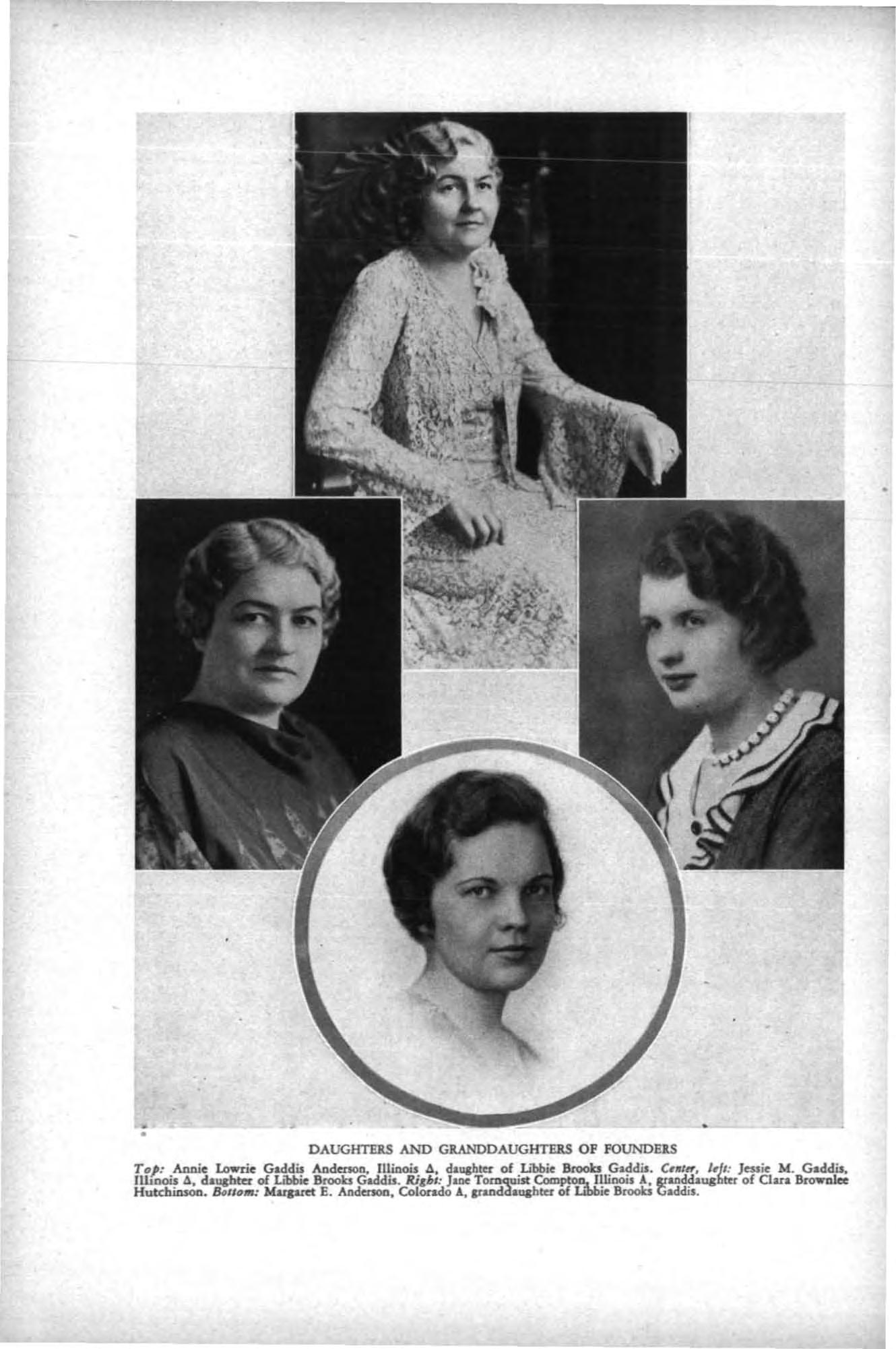
DAUGHTERS AND GRANDDAUGHTERS OF FOUNDElS
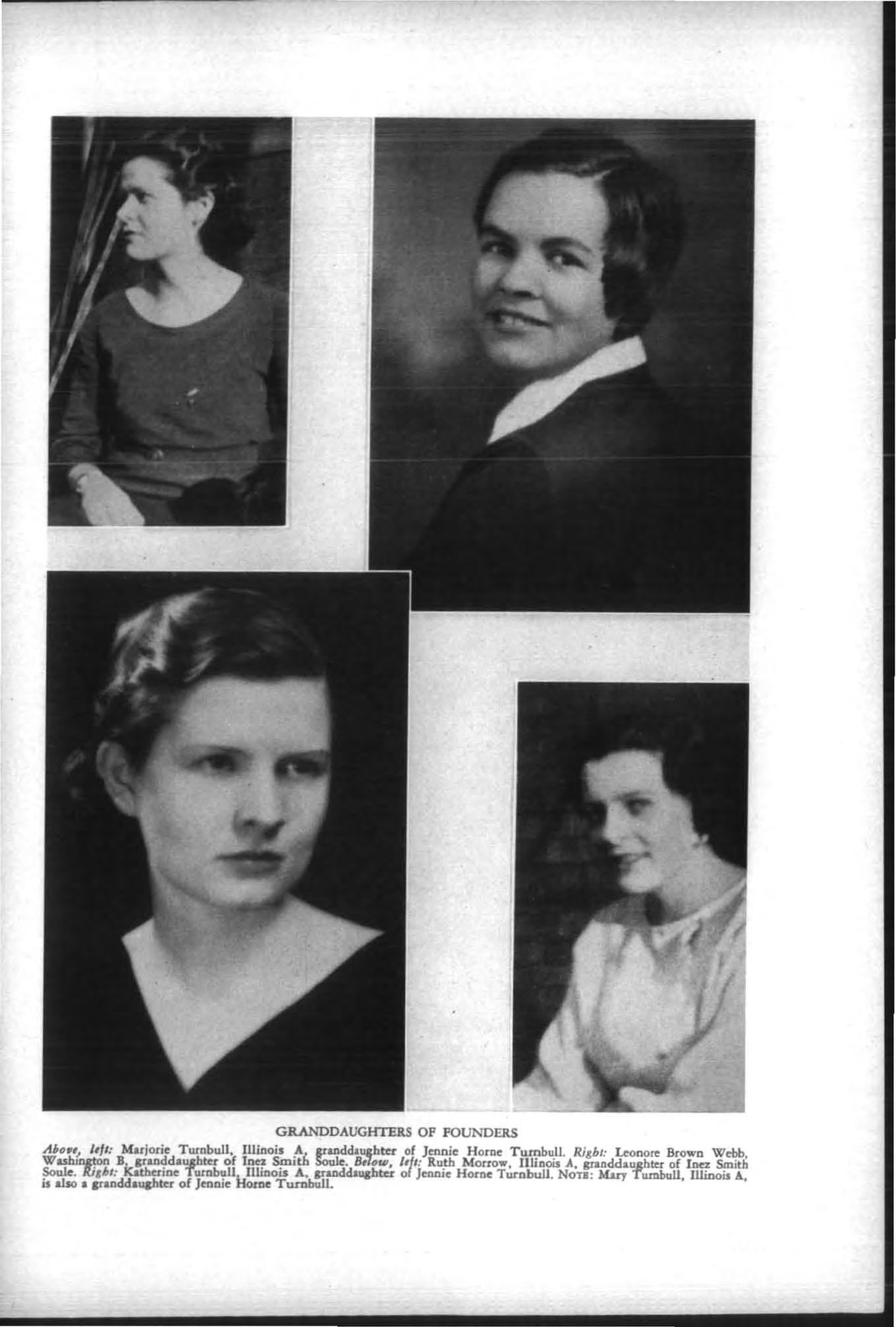
Beta Pro vi nce: Josephine Bak e r, Ohio B
Gamma Province: Elsie Scott Lawren ce, North Carolina A
Delta Provin ce: Ann Osborn , Michigan B
El.'silon Province: Jocelyn Taylor, Missoun B
Zeta Province: Eleanor White Jones, Florida r
Eta Province: Mary Jane Chandler, Illinois Z
Theta Provinc e : Elizabeth Fuller, Iowa Z
Iota Provin ce: Cal is ta Coope r, N ebraska B
Kappa Province: M a rietta Me Gregor, Texas A
Lambda Provinc e : Margaret Hartson , Washington A
Mu Province : Charlotte Gibner, California A
CommiJltt on War Work:
Gertrude H. Beggs, Colorado B, Chairman
Dr. May 1. Keller, Maryland A
Elizabeth Oarke Helmick, Michigan A
CommiJlu on War Fund:
Florence Provinc e Garshwiler, Indiana B. Chairman
Sara Eikenberry Sigler, Iowa B
Jessica Davis Murphy, Wisconsin A
Roberta Holmes, California B
During the /irst stages of the World War, the Grand Council felt that Pi Beta Phi could probably be of the most service to the Country, by working through mediums already established for relief, in accordance with the policy of the Association of Collegiate A1umore, and also, by continuing the maintenance of the Settlement School at Gatlinhurg , Tennessee. Hence, no attempt was made to pro-mote any sort of distinctive war work as a national fraternity until after the Charlevoix Convention , June 1918.
Every effort was ·made hy the national officers, however, to encourage and to develop the spirit of service which, even before our own country entered the war, was manifested by the chapters a nd clubs of Pi Beta Phi.
The fraternity itself subscribed $500 to the Y.M CA and Y_W.CA. Friendship Fund and invested in Liberty Bonds . A number of a1umn", clubs and chapters purchased Liberty Bonds for the Settlement &bool Endowment Fund_
THE ARIlow reJIected the chapter activities and instead of recounting description. of da.uJ.ing balls and hanquets, printed parastating that: "Stale cake, com bread , m and cookies as well as jlain hread crumb', can all be used in brea pudding."
Wheatless and meatless menus supplanted lists of banquet fare. Chapter houses coop-
erated with the government in strictly ODserving wheatless meals and meatless day., cutting down on sugar allowances and saving fuel _
Working through the Re d Cross , the Y .M .CA. , various soc ieties for the care of French orphans , and every other recognized organization for war re lief, our alumna! clubs and chapters made a most commendable record.
During the college year of 19l 7 -18, fully $10 ,000 was donated by the active chapters toward war relief. Thirty-one chapters, the only ones for which statistics are available, gave more than $6,663 to the Y.M.CA. alone Two of the outstanding reports show Ohio B with 100 % membership in Red Cross and in the Patriotic League and- a contributio n of $1 ,063 to the Y.M CA. fund; and Iowa r with a gift of $600 to the Y M CA and $50 to the Red Cross .
Despite the many demands upon their time and strength, the a1umn", cluh members, who had borne th e greatest share of financial responsibility of the Settlement &bool , conbnued to consider the maintenance of the &bool of utmost importance, and raised the usual contrihutions for its support . No special appeals were made for money for the Settlement School during th e War, but the members did everything possible to enable the work on Little Pigeon to continue normally Too, our &bool workers organized the local Red Cross at Gatlinburg, organized knitting groups , nursed the people of the vicinity during the "Bu" epidemic, and twelve Pi Beta Phi a1= clubs " adopted " Gatlinburg boys who went into the service, sending them knitted goods, things to eat, many little useful gifts, mileage books, and letters_ The School proudly di sp layed its serv ice Bag with nineteen stars, three of them later being changed to gold_
Because of the unanimous opinion expressed at the Ol.clevoix Convention, lune 1918, in favor of • distinctive fraternity war undertaking, a Committee on War Work was appointed at the AJ= Session by the Grand President and the Grand VicePresid<nt, and before the Convention dosed, presented a number of suggestions.
Two of the suggestions seriously considered by the delegates were: 1. The establishment of ten scholarships in nursing (or possibly other forms of war work, such as psy'chotherapy, stenography, etc.). The detatls whether scholarships only in nursing should be given, whether only Pi Phis should be recipients, where granted, the exact amount of money necessary for each scholarship, to be determined by a more permanent committee. 2. The creating of more cooperative houses in congested centers, similar to the ooe organized by the Pi Beta Phis in Washington, D.C.
These suggestions were in a way, a continuation of the particular kind of work in which Pi Beta Phi was already engaged-the granting of educational assistance in the Loan Fund and Fellowship, and the establishing of the mountain Settlement School and the new cooperative house in Washington.
The Convention voted to undertake definite war work but left the final decision relative to the proposed work to the War Work Committee of which Dr. Gertrude Harper Beggs, Colorado B, was appointed chairman.
The Grand President, Dr May L. Keller. urged the delegates to take this message back to their chapters and clubs: "The fraternity has mobilized for war, and it is incumbent upon every fraternity woman whoever she is or wherever she may be to play the part of the Greeks of old in support of the state, not this time of one state as in the days when the Spartans defended Thermopylae and the Athenians won the battle of Marathon, but in support of a world league of nations, who are lighting for a wocld peace that shall make this and every country a safe place in which to live."
The form of war work to be undertaken by Pi Beta Phi as a national project, as decided by the Committee was:
"I. The establishment of five scholarships of $200 each, amounting to $1000 to be given to undergraduate students who are specializing in subjects valuable for the prosecution of war or reconstruction work, such as dietetics, medicine, chemistry, etc. , and to
Fr<nch Government girl students in this country
"11. The establishment of a second fund of $ 1000 for the support of war workers."
The Committee on War Fund, captained by Florence Province Gershwiler, set to work
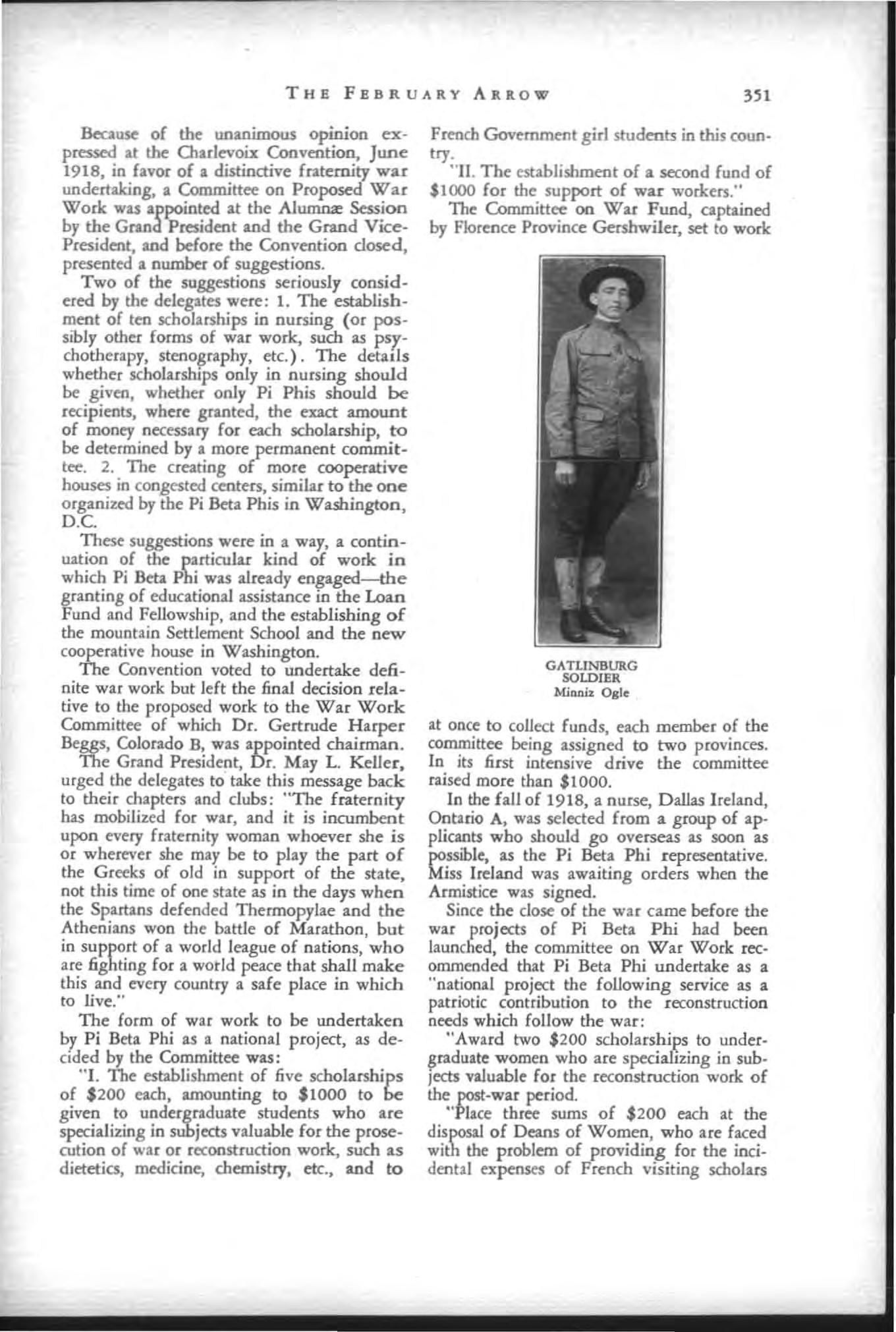
GATUNBURG SOLDIER Minniz Ogle
at once to collect funds , each member of the committee being assigned to two provinces. In its first intensive drive the committee raised more than S 1000.
In the fall of 1918, a nurse, Dallas Ireland, Ontario A, was selected from a group of applicants who should go overseas as soon as possible, as the Pi Beta Phi representative. Miss Ireland was awaiting orders when the Armistke was signed.
Since the close of the war came before the war projects of Pi Beta Phi had been launched, the committee on War Work recommended that Pi Beta Phi undertake as a "national project the following service as a patriotic contribution to the reconstruction needs which follow the war:
",Award two $200 scholarships to under$caduate women who are specializing in subJects valuable for the reconstruction work of the post-war period.
"Place three sums of $200 each at the disposal of Deans of Women, who are faced with the problem of providing for the incidental expenses of French visiting scholars
"That the sum of $1000 already provided to pay expenses of a reconstruction worker abroad be handled by Dean Keller, who will act jointly in dispensing jt."
The Grand Council acted favorably 00 these recommendations and awarded a reconstruction scholarship of $2'0 to Ieie G. Macy, Virginia A, to do graduate work at Yale University, and placed the funds for aiding the foreign women students at the disposal of Dean Gertrude Begss of the University of
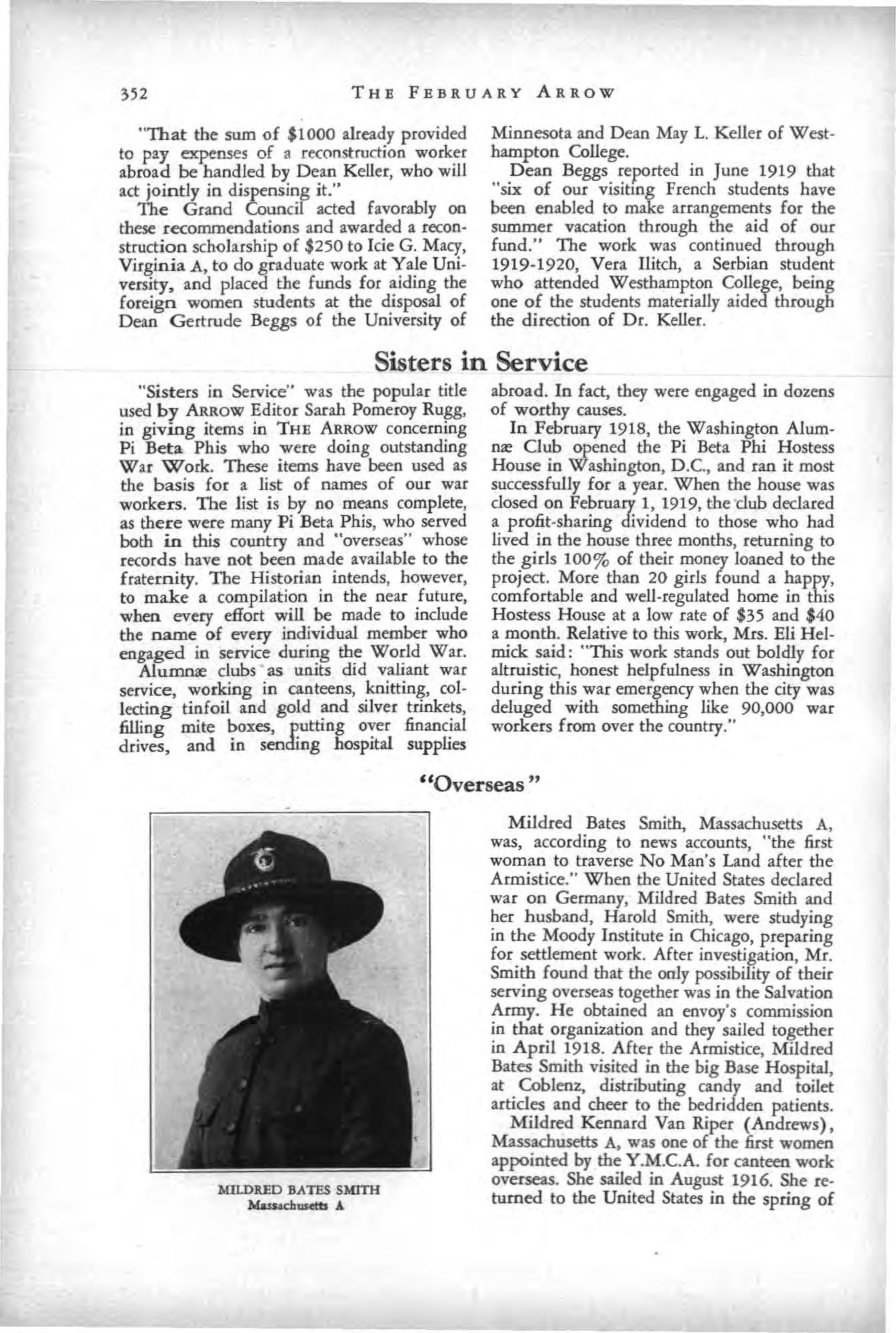
Minnesota and Dean May 1. Keller of Westhampton College.
Dean Beggs reported in June 1919 that "six of our visiting French students have been enabled to make arrangements for the summer vacation through the aid of our fund." The work was continued through 1919-1920, Vera Hitch , a Serbian student who attended Westhampton College, being one of th e students materially aided through the direction of Dr. K eller
"Sisters in Service" was the popular title used by ARRow Editor Sarah Pomeroy Rugg, in giving items in THE ARROW concerning Pi Beta Phis who were doing outstanding War Work. These items have been used as the basis for a list of names of oue war workers. The list is by no means complete, as there were many Pi Beta Phis, who served both in this country and "overseas" whose records have not been made available to the fraternity . The Historian intends, however, to make a compilation in the near future, when every effort will be made to include the name of every individual member who engaged in service during the World War Alumn:e clubs as units did valiant war service, working in canteens. knitting, collecting tinfoil and gold and silver trinkets, filling mite boxes, putting over financial drives, and in sending hospital suppli ..
abroad. In fact, they were engaged in dozens of worthy causes.
In February 1918, the Washington Alumore Club opened the Pi Beta Phi Hostess House in Washington, D .C., and ran it most successfully for a year. When the house was closed on February I, 1919, the club declared a profit-sharing dividend to those who had lived in the house three months, returning to the girls 100 % of their money loaned to the project. More than 20 girls found a happy, co mfortable and well-regulated home in this Hostess House at a low rate of $3' and $40 a month . Relative to this work, Mrs. Eli Helmick said: "This work staods out boldly for altruistic, honest helpfulness in Washington during this war emergency when the city was deluged with something like 90,000 war workers from over the country."
Mildred Bates Smith, Massachusetts A, was, according to news accounts, "the first woman to traverse No Man's Land after the Armistice." When the United States declared war on Germany, Mildred Bates Smith and her husband , Harold Smith, were studying in the Moody Institute in Chicago, preparing for. settlement work. After investigation, Mr . Smtth found that the ooly possibility of their serving overseas together was in the Salvation Army. He obtained aD envoy's commissio n in that organization and they sailed together in April 1918. After the Armistice, Mildred Bates Smith visited in the big Base Hospital, at Coblenz, distributing candy and toilet articles and cheer to the bedridden patients. Mildred Kennard Van Riper (Andrews), Massachusetts A, was one of the first women appointed by the Y.M.CA. for canteen work overseas. She sailed in August 1916. She returned to the United Stat.. in the spring of
1918 and worked in our Southern cantonments, addressing many soldier audien ces, explaining conditions of the life awaiting them overseas .
Mabel L. Scott (Brown), Columbia A, Red Cross nurse. Was occupied in vocatiooallines with disabled soldiers . Her Al= Oub gave her a purse of $100 to be used whenever and wherever she might see lit. She was one of the workers in the Recreation Hut for convalescent soldiers at the Base Hospital , Cablenz , after the Armistice. Also had charge of a Canteen at Brest.
Harriet E. Beard, Michigan B, was stationed in Italy at Palermo, doing Red Cross work, particularly Children's Hygiene and Feeding
Helen Nelson (Borkland), Pennsylvania r , sailed for France, but in response to Lady Ward's appeal, volunteered to work in England In Liverpool she demonstrated her ability in domestic science by making cocoa by the gallon over a tiny oil stove. Did hospital night work while Liverpool was in the midst of the terrible influenza epidemic.
Anne Henrietta Taylor (Burnett), Virginia B, worked in Paris directing the making of surgical dressings under the supervision of the American Red Cross Before going "overseas" was instructor of a class in surgical dressings with the Hollins chapter of the Red Cross at Hollins, Virginia.
Helen Brainard (Chalker), New York r, sailed for France in September 1918 , as a merober of the first neural-psychopathic unit of reconstruction aides. Located in Base Hospital No. 117, A .E.F., France. Worked with those soldiers whose minds were affected by shell shock.
Ruth Le Cron (Clark), Missouri B, probably was the first Pi Beta Phi to engage in overseas relief wmk. She was in London when the war broke out and soon afterwards went to Paris to help in nursing the wounded in a surgical ward. The hospital in which she worked was a boys' high school, taken over by the American Amhulance.
Edna Coldren, Michigan A, Red Cross nurse in France.
Dr Nora D. Dean, Kentucky A, was an American Red Cross Nurse at Base Hospital #59 at Camp Meade, Maryland. After three months at Camp Meade sailed for France with Base Hospital #59 on the British art/llna Attached to Base Hospital #59, RimancourtHaute Marn e, France, of which Dr. Irvin Abell was Commanding Officer. Remained at this base for the entire time overseas, /irst as general
ward nurse then as kitchen police, errand messenger and assistant chief nurse under Ida B Hulette Was then chief nurse until the unit was transferred to Brest for demobilization . Was then made assistaot chief nurse. Returned to th e United States aod was discharged from the Army, August 23 , 1919
Beulah Whitoey (George), Michigan B, was with the Red Cross and the A .E.F., tracing dead or missing soldiers, writing their relatives and writing letters for the sick.
Ethel B. Goede, New York B, graduate of the New York Hospital, sailed with representatives of that hospital to form a "mobile unit" in France. Treated the worst cases, as near the lines as possible, in order to save life. With Sec. I, Mobile Operating Unit No . I, A.E.P.
Florence Denny Heliker, Maryland A, Xray Technician, Women ' s Hospital Unit for Foreign Service . For nine months studied under Dr. Harold Thompson at the Seattle General Hospital, in order to lit herself for serviee in the unit. Went to France in June 1918. Nursed and helped to mend the French wounded.
Phyllis Higinbotham, Ontario A, overseas with the American Army at Brest and other points for a year. Stationed at one time at Base Hospital No. 71, France, near Monpont.
Welthy Honsinger (Fisher). Returned from China to do war work for the War Work Council of the Y.W.C.A. Sent to France, then in answer to a cablegram returned to this country to help in the hig drive for funds . After a few weeks, was sent to Belgium , Iraly, France and England.
Celeste Janvier, Louisiana A, former Grand Treasurer, went with the Jobns Hopkins Hospital Unit in June 1917, which became American Base Hospital No. 18. Later U S. Army Hospital No.2 A.E.F. Her unit occupied an American built hospital at Bazoilles, a small village about 15 miles from Verdun. On duty helping to evacuate one convoy of wounded just in time to rece,ive another. Received 3 gold service stripes.
Betty Johnston (Kracaw), Iowa A, Red Cross nurse in France.
Alice P. N. Waller (King), New York B, with a Division at the Front.
Ruth Wright Hammitt Kauffman, Pennsylvania B, war journalist. In war area for the Vigilantes , the organization of writers formed just before the war to help awaken the American p<?ple to a realization of their duties. Her mIssion in Europe was to gather material concerning the war time activities of
the Allies and the miStakes they bave made, so that America could profit thereby. Made investigations among the masses, the workers in munition factories, the at work and in their homes, the tenants of cheap pensions and boarding-houses, the peopre that traveled third class--in other words, among those upon whom the burdens of the war were laid most heavily.
E1izabeth Macauley, New York B, U_ S _ Signal Service. Sailed with third unit of the Operators' Division of the Signal Corps_
Estelle Martin and Bealle Martin , Maryland A, sailed as Red Cross nurses in 1918 . Both had studied nursing and Bealle took the motor course, while Estelle studied stenography. Assigned to the American Military Hospital No . 1, Neuilly-sur-Seine .
Kate B . Miller, Iowa B, Y.W .C A. work in France .
Rosalie Nixon , Louisiana At with the Red Cross in France, then went into Near East Relief work.
Alice Rohe, Kansas A, was a war cor· respondent for several years.
Florence Bentley (&ott), Massachusetts A. Nurse. Sailed with Third Harvard Unit for Service at Hospital 22, a British base hospital near Boulogne. Was bombed at 17 CCS., Casuality Gearing Station, when there were many casualties . During the last four months of her service, she had charge of an ambulance train wbich covered the entire British sector from Ypres to St. Quentin, following closely behind the advanciog army. On Christmas Day, 1918, at St. Martin -in-theFields , Trafalgar Square, London, she was married to Lieut Col. Morris A. &ott, son of Judge and Mrs . David L _ &ott of Edmonton, Alberta . She saw her husband decorated by King George at Buckingham Palace . After three weeks' leave Col. &ott returned to his battalion with the Army of Occupation and Mrs &ott returned home with her Unit
Helen Spencer, JUinois E, Y.M .CA _ canteen worker in France near the lints and was ordered to "proceed to the Front."
Vivian Muir Smith, Wisconsin A, Canteen worker with Y.M.CA ., later with Red Cross. Then became a member of the Hoover Food Commission to feed babies and children in the devastated regions of Czechoslovakia. Did Red Cross work in Poland, one of her co-workers being Princess Lnbomirska _ Mrs. Gertrude Hill Springer, Kansas A, in Rome at the headquarters of the American Red Cross in Italy_ Did special work with
approval of representatives of Itali an Government because of her knowledge of Italy and of the Italian language. First work was a compilation of the reports of the Red Cross work in Italy, then the inspection and establishment of Mili for the cbildren of Italian soldiers and of quarters for the refugees who were driven out of the northern part of the country by the advancement of the Austrians . Her trips of inspection took her into many sectjons.
Katherine Duce (Stickney), Colorado A, enlisted with the Base Hospital No. 29.
Frances Ryan Thomas, wife of Lowell Thomas, Colorado B, accompanied her husband on a special mission to Europe On December 1, 1917 she was arrested with other members of their party as a spy at Bussoleno, when one of their party took some pictures . Held for twelve hours, and then released because an Italian who had worked as a railroad section hand in Amer ica, spoke in their behalf before the "Commando Militaire ."
Isabel Totten , with a Barnard Unit- a canteen unit of the Y.M.CA .-a large Hut at Saint Aignan
Harriet Maxon (Thayer) , Wi sco nsin A. In France for nine months with the Ameri can Red Cross canteen service at the First Air Depot, Columbey-les-Belles, Meurthe et Moselle.
Harriett Kelley (Virkery), Ohio A, with the Salvation Army in a Recreation Hut and Canteen at Coblen•.
Inez Webster. Illinois A, ran a canteen at Brest and later did work both in Russia and Armenia. Was at one time head of a orphanage near Leninaken, Armenia-lO fact, the largest orphanage in the world, in which 6000 refugee children were housed . It was due to Miss Webster's thorough methods that none of the children were injured in the terrible earthquake in 19 26 which took hundreds of lives in Leninaken and nearby villages Before going to Russian Armenia, Miss Webster spent two years as head of a Near East Relief orphanage at Beirut, Syria where she had 800 children under her care, looking after their housing and feeding and directing the school in connection with the orphanage.
Mrs. Norman de R Whitebouse (Vera Boarman), Louisiana A, sent to Switzerland on a special mission in 1918, at the request of Chairman George Creel of the Bureau of Public Information , to direct an educational campaigo in that country intended to place America'. side fully before the Swiss people
and through them before the people of the Central Powers Mrs. Whitehouse was the first woman asked to undertake such a mission in a foreign country Her appointment came through ber success in the campaign in favor of the adoption of woman suffrage in New York State
Margaret Wood. New York B. private secretary to Miss Kathleen Burke. the special delegate to America for the Scottish Women's Hospitals for Home and Foreign Service This organization was staffed entirely by women. from the head surgeon down to the last orderly. Through the efforts of Miss Burke more than a quarter of a million dollars went to help nurses located in Russia Serbia . on the Island of Corsica, in FrlOee. in Greece. and in England. Later Miss Wood was a Y .M .CA. worker in Nancy. France and assisted with the entertainment of soldiers left to police the Front.
Mary Cooper Frost. COlo ....do A. served thirt<en months with Red Cross, as a Home Communication Service worker. Was first at Camp Hospital 33 at Pontanezen in Brittany near Brest, then at Camp Hospital 26 in St. Aignan-Noyecs Ie cher, in the Touiraive. Tben went to Paris and entered th e Dep art . ment of Claims. settling up business
Margaret Forsyth. Colorado B. Y .W .CA. work overseas .
Edith Everald White, California B. Y.W CA. Canteen and ambulance work in France. Died in service of influenza and meningitis at Chaumont, France. The only Pi Beta Phi to die in the service "overseas:-
In January 1920. twenty-four fraternity women formed a PanheUenic Gub at Co· blenz. Gecmany. Mrs. Louis J. Van Schairk (Nellie M. Kellogg. Michigao B. of Pi Beta Pbi). was elected the first president. with Mrs . Earl Brannon. secretary. Credit for the organization is due Miss Robey. Kappa Kappa Gamma. a Y.W.CA. secretary.
Many of the members of the organization were giving their entire time to Army Welfare and Rhineland Commission Secretarial Work.
Pi Beta Pbi was represented by Mrs R L. Creed. Vermont A. and Mrs . Louis J. Van Schaick. Michigan B. wives of Capt . Creed and Col. Van Schaick of the Regular Army ; Mildred Bates Smith, Massachusetts A. and Harriet Kelley. Ohio A, of the Salvation Army; Mabel Scott (Brown). Columbia A. of the Red Cross . Frances Christian (Brand). Maryland A. attended one meeting when passing through Coblenz with her father Lieut. Col. Christian on their way from France to the United States.
Because time has not permitted a thorough canvass of the membership for data relative to war workers at home. the following list of names represents only a few of those who devoted themselves to War Work.
Katharine Bennitt. Wyoming A. Red Cross dietitian and a supervisor of surgical dressings. Taught surgIcal dressing work in Wyoming. Was one of the first county home demonst....tors. her position being one of the number made possible by the war emergency appropriation passed by Congress in 1917.
Ruth De Hass Balfour. Indiana r. used her musical talent in playing at Cantonments and in entertaining government employees.
Martha Dashiell Burberry, Iowa B. a Red Cross worker and food conservationist in connection with the Food Administntion . Cbair-
man of the Seventh District. Also on a state committee of women in the interest of the War Savings Stamps Campaign.
Mrs. Carrie Qapman Cart, Iowa r, one of nine women of the country appointed to serve on the Women's Committee on the Council of National Defense. early in the war, to consider and advise how the assistance of the women of America might be made available in the prosecution of the war.
Dr. Grace Raymond Hebard. Iowa Z. held classes in naturalization and did extensive food publicity work. Appointed by Mr. Hoover. State Director for Library Publicity and head of the War Lecture Bureau of Wyoming. Elizabeth aarke Helmick. Michigan A.
was on the Housing and Health Division of lhe War Department, in charge of the housing of girl war workers in the many new offices made necessary by the war. Before the war closed, M rs. Helmick opened the fifty-second war workers' house in Washington, D .C., and at the last had the privilege of commandeering and financing them from her own office.
Cluistine Sneath (Henry) , Ontario A, completed a course in military massage work at the Hart Reeduc at ion House, University of Toronto and was assigned to a military convalescent hospital in Canada
Florence Helmick (Macauley), Michigan B, worked for the Red Cross in Washington, D .C., bei n g responsible for sending every dollar sent to the prisoners in Germany . Georgia P McElroy, Indiana r, visitor for the Home Service Department of Civilian Relief of the Illinois chapter of the Red Cross.
Evdyn Oliver, Ontario A, V.A.D. nurse in the Sir Sandford Fleming Military Hospital in Ottawa . Mary de Garmo (Payne), Missouri B, Base Hospital at Camp McPherson , Georgia. Patients brought in from all of the surrounding cantonments. Sbe was dietitian in the Hospital and planned the diets of all the patients, except those practieally well.
Ltnda Pratt, Ontario A, a pUl'il dietitian in the Sir Oliver Mowat MemoClal Hospital in Kingston, Ontario.
Ethel Wagg (Sdby) , Pennsylvania r, wife of the president of the Vegetable Growers Association of America, assisted greatly in preparation of recipes designed to conserve the nation's food supply.
Dr Mary Shannon Snook, Reconstruction Aide, ordered overseas to Base Hospital No 58, Bordeaux, France7 but orders were lost so did not sail although on board ship for five hours Assistant to chief nurse in the Mobilization station , New York City, then sent with Unit No. 13 to Camp Devens, Ayer, Massachusetts, Letterman General Hospital , San
Francisco in the Electro-Therapy Department to treat wounds with various electrical deviees. Head Aide, the highest rank to be obtained in her work, at the Crocker Street Hospital, Los Angeles, California.
Margaret Eaton (Snyder), Michigan B, war work secretary of the Y.W.C.A. in the Central Field with headquarters in Chicago . Dorothy Spencer, Louisiana A, devoted her time to tbe collection of odd bits of gold and silver, trinkets, lead and tinfoil in response to an appeal of the Queen of Roumania These things were sold and the money derived from them used to benefit starving Roumanian children.
Agnes Wright (Spring), Wyoming A, State Director of Library War Service, sending largest single shipment of books overseas from any state. Established and directed a library at the Y M.C.A. Hut at Fort D A Russell. In charge of war records division of the State Council of National Defense, and on United War Work Council.
Mary Stewart (White), Missouri A, worked under Patriotic League in Alexandria, Louisiana.
Margaret Williamson , Colorado B, war secretary of the Y.M .C. A . at Waco, Texas.
Gertrude F. Cole (Wright), Missouri B, head of military training for women at Chautauqua, New York. Drilled two co mpanies of women twice a day. Later became a war work secretary of the Y .W.C.A , stationed at Fort Niagara, Youngstown, New York, where she was hostess at the hostess house. Extension secretary of the Niagara Falls, Y_W C.A , carried on the war work of the Patriotic Leagne and drilled the Cross Canteen Corps.
Members of Ontario A, who' responsed to the Government's call for munition workers and fruit pickers included: Mary Fletcher, Maddeine Snider, Vivien Chalmer, Agnes Boyle, Jean MacQueen , Margaret Ross, Mary Walters , Margaret Anderson , Marie Peterkin, B ertha Ferguson, and Bessie Ewan .
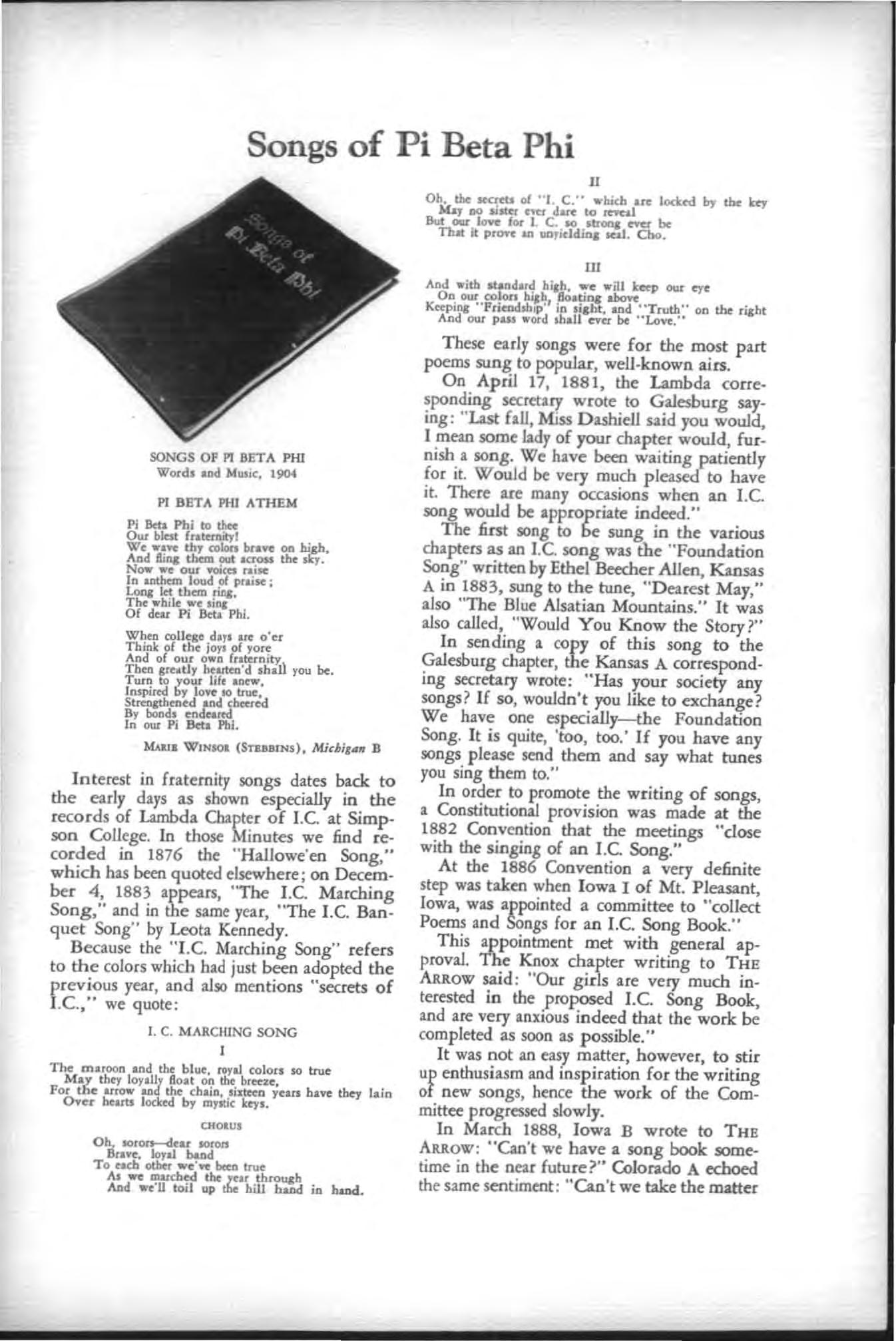
SONGS OF PI BETA PHI
Words .nd MusIc. 1904
PI BETA PHI ATHEM
Pi Beta Phi to thee
Our blat fraternityl We ave thy colon bene 00 high. And Ilinc them 9Ut the sq. NOW' our rlllC In anthem loud of pr&isc; !,on& ld: them lilll. The while we ,inc Of dear Pi Bm. Phi.
Whm college daT' .re o'er Think of Hie jO)'l of And of our own fute:rnity
Then gre_tly burteo'd sh.rl you be. Turn to your tHe Inspired by loYe JO true. and cheered By bOnd, endcattd In our Pi Beta Phi.
M.u.J. WINSOI (STBIIBINS). Midli,." B
Interest in fraternity songs dates back to the early d ays as shown especially in the records of Lambda Chapter of I.C at Simpson College . In tho se Minutes we find recorded in 18 76 the " Hallowe' en Song, " wh ich has been quoted elsewhere; on December 4, 1883 appears, "The I.C Marching Song," and in the same yea r, "The I.C Banquet Song" by Leota Kennedy.
Because the "I.C Marching Song" refers to the colors which had just been adopted the previous year, and also mentions "secrets of I. e.," we quote:
I. c. MARCHI NG SONG
The maroon .nd the blue. toyll colors so true M ay th ey loyally tl oa t on the For the Irrow and the c hai n, sixteen years have they laIR Over hearts locked by myllic key • . CHOI.US
Oh sorott-dur IOrOIl Braft. loyal baod
To each other we'ft' true AI: we marched the year thtouah ADd we 'll toil up the hill band ID hand.
Ob the xcrm of " I. C:' which are loded by the key Ma, 00 sister ncr dare to rnnJ But OW" love fOf' I. C. 10 ltrOIlI eTtt be:
That it pIon an uoyiddin& scil. Cbo.
And "ith standard hich, we "ill keep our eye On out colon hiJh 8OItio& above " Fricocbhrp " in si,ht. and " Truth " on the tiJ:ht And OUt pus word ,hal l ever be "Love,"
These early songs were for the most part poems sung to popular, well-known airs.
On April 17 , 1881, the Lambda corresponding secretary wrote to Galesburg saying : "Last fall, Miss Dashiell said you would, I mean some lady of your chapter would, furnish a song. We have been waiting patiently for it. Would be very much pleased to hav e it. There are many occasions when an I .C. song would be appropriate indeed ."
The lirst song to be sung in the various chapters as an I.C song was the "Foundation Song" written by Ethel Beecher Allen, Kansas A in 1883 , sung to the tune, "Dearest May," also "The Blue Alsatian Mountains ." It was also called, " Would You Know the Story?"
In sending a copy of this song to the Galesburg ch apter, the Kansas A corresponding secretary wrote: "Has your society any songs? If so, wouldn't you like to exchange? We have one especially-the Foundation Song. It is quite, 'too , too.' If you have any songs please send them and say what tunes you sing them to."
In order to promote the writing of songs , a Constitutional provision was made at the 1882 Convention that the meetings "dose with the singing of an I.C Song."
At the 1886 Convention a very definite step was taken when Iowa I of Mt. Pleasant, Iowa was appointed a committee to "collect poen:., and SOngs for an I.C Song Book."
This appointment met with general approval , The Knox chapter writing to THE ARRow said: " Our girls are very much interested in the proposed I.e. Song Book, and are very anxious indeed that the work be completed as soon as possible."
It was not an easy matter, however, to stir uf enthusiasm and inspiration for the writing o new songs, hen ce the work of the Committee progressed slowly.
In March 1888, Iowa B wrote to THE ARROW: "Can 't we have a song book sometime in the near future?" Colorado A echoed the same sentiment: " Can ' t we take the matter
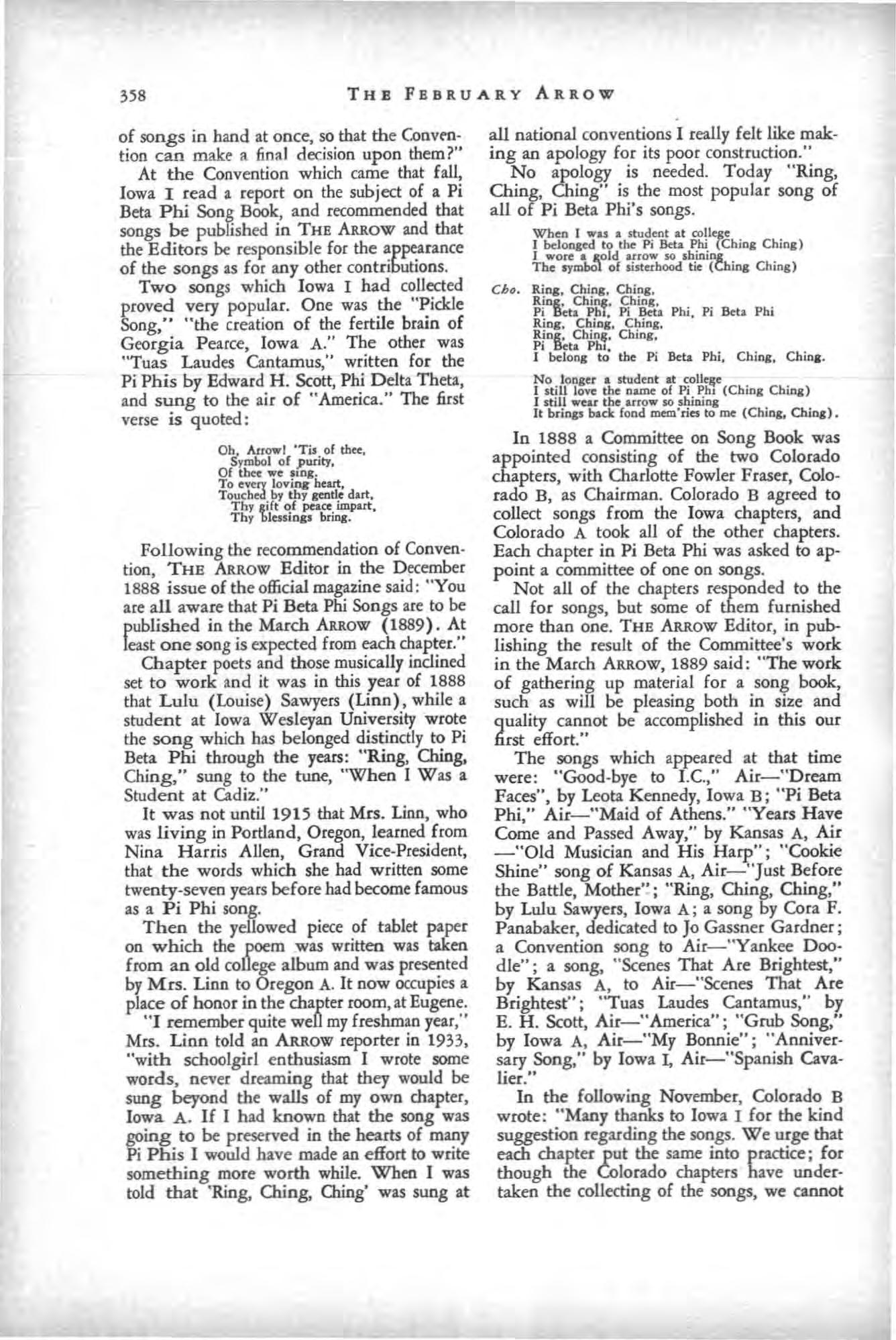
of songs in hand at once. so that the Convmtion can make a fina.l decision upon them?"
At the Convention which came that fall. Iowa I read a report on the subject of a Fi Beta Phi Song Book. and recommended that songs be published in THE ARRow and that the Editors be responsible for the appearance of the songs as for any other contributions.
Two songs which Iowa I had collected proved very popular. One was the "Pickle Song." "the creation of the fertile brain of Georgia Pearce. Iowa A." The other was "Tuas Laudes Cantamus," written for the Pi Phis by Edward H. Scott. Phi Delta Theta. and sung to the air of "America." The /irst verse is quoted:
Oh, Arrow! 'Tis of thrc. Symbol of 'purity, Of thee we 1mI'.
To every lovina beart, Touched by thy amtle dirt, Thy gift of peace impart, Thy blessings bring.
Following the recommendation of Convention. THE ARROW Editor in the December 1888 issue of the official magazine said: "You are all aware that Pi Beta Phi Songs are to be published in the March ARROW (1889). At least one song is expected from each chapter."
Chapter poets and those musically inclined set to work and it was in this year of 1888 that Lulu (Louise) Sawyers (Linn). while a student at Iowa Wesleyan University wrote the song which has belonged distinctly to Pi Beta Phi through the years: " Ri ng. Ching. Ching." sung to the tune. "When I Was a Student at Cadiz."
It was not until 191' that Mrs. Linn. who was living in Portland. Oregon. learned from Nina Harris Allen, Grand Vice-President, that the words which she had written some twenty-seven years before had become famous as a Pi Phi song.
Then the yellowed piece of tablet paper on which the poem was written was taken from an old college album and was presented by Mrs. Linn to Oregon A. It now occupies a place of honor in the chapter room. at Eugene.
"I remember quite wen my freshman year." Mrs. Linn told an ARRow reporter in 1933. "with schoolgirl enthusiasm I wrote some words. never dreaming that they would be sung beyond the walls of my own chapter. Iowa A. If I had known that the song was going to be preserved in the hearts of many Pi Phis I would have made an effort to write something more worth while. When I was told that 'Ring. Ching. Ching' was sung at
all national conventions I really felt like making an apology for its poor construction." No apology is needed. Today "Ring. Ching. Ching" is the most popular song of all of Pi Beta Phi's songs.
Wben J WI.$ • student at college ] bc:lonat4 to the Pi Beta Phi (China Ching) J • gold atrow $0 shining Tbe symbOl of sisterhood tic (Ching China)
Cho. Ring, Ching, Ching, Ring, Ching, Pi Beta Phi, Pi Beta Phi Pi Bda Phi Ring, Cbing, Ching, Ring, Chin,. Ching, Pi Beta Phi, I belong to the Pi Beta Pbi, Ching, Chinl.
No lon8er a student at collect: I still love the name of Pi Ph. (Ching China) I still we.., the arrow so shining It brings back: fond mem'ries to me (Ching, China).
In 1888 a Committee on Song Book was appointed consisting of the two Colorado chapters. with Charlotte Fowler Fraser. Colorado B, as Chairman. Colorado B agreed to collect songs from the Iowa chapters. and Colorado A took all of the other chapters. Each chapter in Pi Beta Phi was asked to appoint a committee of one on songs.
Not all of the chapters responded to the caIl for songs. but some of them furnished more than one. THE ARROW Editor, in publishing the result of the Committee's work in the March ARROW. 1889 said: "The work of gathering up material for a book. such as will be pleasing both in SIze and quality cannot be accomplished in this our nrst effort."
The songs which appeared at that time were: "Good-bye to I .C.... Air-"Dream Faces". by Leota Kennedy. Iowa B; "Pi Beta Phi." Air-"Maid of Athens." "Years Have Come and Passed Away." by Kansas A. Air -"Old Musician and His Harp"; "Cookie Shine" song of Kansas A. Air-"Just Before the Battle. Mother"; "Ring. Ching. Ching." by Lulu Sawyers. Iowa A; a song by Cora F. Panabaker. dedicated to Jo Gassner Gardner; a Convention song to Air-"Yankee Doodie"; a song. "Scenes That Are Brightest." by Kansas A. to Air-"Scenes That Are Brightest"; "Tuas Laudes Cantamus." by E. H. Scott. Air-"America"; "Grub Song." by Iowa A. Air-"My Bonnie"; "Anniversary Song." by Iowa I, Air-"Spanish Cavalier,"
In the following November. Colorado B wrote: "Many thanks to Iowa I for the kind suggestion regarding the songs. We urge that each chapter put the same into practice; for though the Colorado chapters have undertaken the collecting of the songs. we cannot
ac complish anything unl ess we have the hearty cooperation of all; SO please prompt to send us the best you have, and patknt if o ur remindtrs have been too frequent. "
A motioo was passed by the 1890 Conventi o n that the "songs be printed in fo rm " This work was tumed over to MIchigan B and the result was a very neat, twentypage pamphlet entitled, " A collection of Beta Phi Songs of the VaClous Chapters_ This pamphlet, bound in a blue cover, bore the official monogram of Pi Beta Phi on outside, and was printed by the Register Pub_ Co _, Ann Arbor, Michigan , in 1892.
The pamphlet cootained thirteen songs: "Foundmg Song," Ethel B. Allen, Kansas A; Ching, Ching," Lulu Sawyers, Iowa A; ' Song of Welcome," Inez L. Shit'man , Illinois B; " Pi Phi Meeting," Jenrue Hitchcock, Colorado B; " Assembly Song," Colorado A; " Anniversary Song," Lucy A. Silke, Iowa A; "Pi Beta Phi Serenade," M. Frances Randolph, Michigan A; "Pi Beta Phi Goat," Anna R. Ross Lapham, Illinois B; "Reunion Song"; "Oh, Arrow Bright and Bonny," Sarah T. Barrows, Iowa r; quet Soog," Georgia Pearce, Iowa A; "Tuas Laudes Cantamus , " E H. &ott; ''The Initiation Song," Colorado A.
The Convention Committee on Resolutions expressed its thanks to: "Michigan B for compiling and publishing the Pi Beta Phi Song Pamphlet "
At about this same time, Iowa r published a small pamphlet of songs, similar to that compiled by Michigan B, except that it consisted entirely of songs written by members of Iowa r _ This was a small pamphlet approximately the same size as the Michigan B publication, bound in brown paper. Three of the songs from this compilation were used in the First Edition of the Song Book; and also in the Second Edition: "0 , Arrow Bright and Boony," by Sarah T. Barrows; "Fraternity We Bow to Thee," by Ada Mills Dewell; and "The Coming Day," by Jennie Thornburg.
The Michigan B Song Pamphlet was worn out and the supply was exhausted by the time the Boston Convention was held in 1895.
Just previous to the Convention the ARROW Editor wrote: ' 'The need of a larger and better song book seems to be felt among the chapters. Can we not have some 'rousing' Pi. Phi songs--songs so good that the words and tunes would haunt our minds, and we should find ourselves hUJIlnling them involuntarily. Let those who have the 'trick of rhyming' do
their best for a new song book We sbould have songs which are known and loved and sung everywhere Pi Beta Phi exists " Convention appointed a com · posed of Mary Bartol (Theiss), Pennsyl -
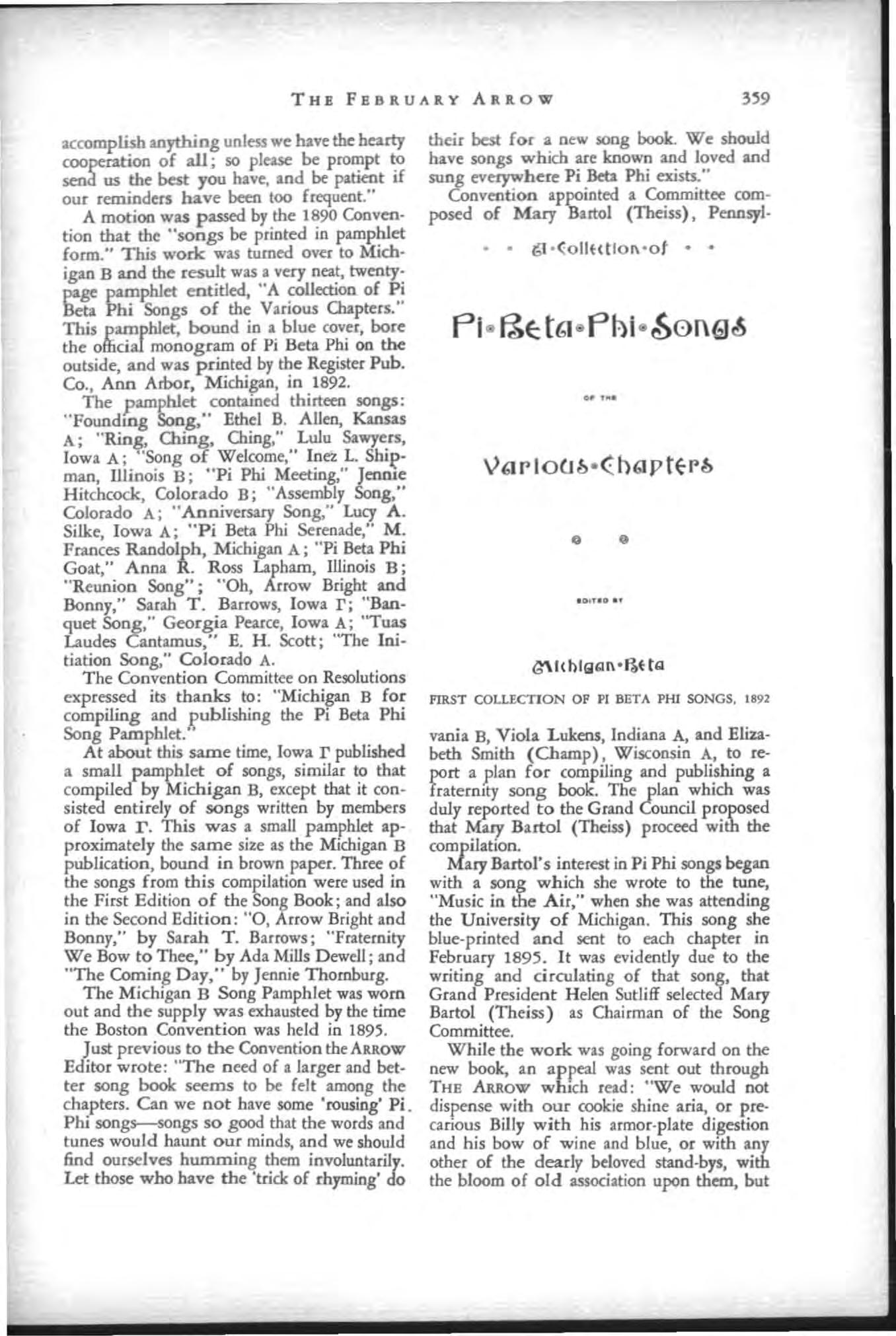
FIRST COLLECTION OF PI BETA PHI SONGS , 189 2
vania B, Viola Lukens, lndiana A, and Eliza· beth Smith (Champ) , Wisconsin A, to report a plan for compiling and publishing a fraternIty song book. The plan which was duly reported to the Grand Council proposed that Ma'Y Bartol (Theiss) proceed with the compilation.
Mary Bartol's interest in Pi Phi songs began with a song which she wrote to the tune, "Music in the Air,'· when she was attending the University of Michigan. This song she blue-printed and sent to each chapter in February 1895_ It was evidently due to the writing and circulating of that song, that Grand President Helen Sutliff selected Mary Bartol (Theiss) as Chairman of the Song Committee.
While the work was going forward on the new book, an appeal was sent out through THE ARRow which read: "We would not diSpense with our cookie shine aria, or pre· caClOUS Billy with his armor-plate digestion and his bow of wine and blue, or with any other of the dearly beloved stand-by., with the bloom of old association upon them, but
we want more songs, new songs, songs grave and gay, songs for special occasions or for any occasion ."
Many of the contributors sent songs written to copyright music, and often the use of such music for publication in the new book was refused by the owner of the copyright, hence some of the best songs appeared without music. Other publishers including Messrs. Silver, Burdett & Co., and Mr. F. Trifet and Messrs Martin R D ennis & Co., gave cordial permission to use their copy rights .
Friends of Pi Beta Phi rallied generously to the cause, cont ributing splendid original music. Among these friends were: Rev. Robert Lowry, D .D. , Prof. Elysee Aviragnet, Mus.D ., Miss J Juliet Aikin, of the Bucknell School of Music, and Rev A B Bowser, A.M ., of Dan vi lle, Pa.
In writing of her work as Chairman of the Song Book Commjttee, Mrs. Theiss says: "As I look back on the Song Book, I think of the music Dr . Robert Lowry wrote for us. He was a well·known hymn writer, some of his best known being: ' 1 Need Thee Every Hour, 'Shall We Gather at the River: 'Follow On : 'Who'll Be the Next to Follow Jesus'-all hymns that became popular in the '605, '70s, and 'SOs. He also wrote 'Where Is My Wandering Boy Tonight.' Dr. Lowry was a former Grand President of Phi Kappa Psi.
"Music for 'Hold Up the Colors: was writ· ten by Dr. Elysee Aviragnet, head of the Bucknell School of Music, who had been a soldier in the Franco·Prussian War This par· ticular music was written originalJy for a Bucknell song, entitled, 'The Orange and Blue.'
"Miss Juliet Aikin , who wrote the musk for the Pennsylvania A song, was a teacher of instrumental music in the Bucknell school at that time.
" 'The Founding of Pi Beta Phi : used the music of a University of Michigan song, written by Prof. Albert A Stanley, professor of music at the University of Michigan. Mrs. Stanley was an honorary member of Michigan B.
"The music of the Michigan Beta chapter song was written by Lewis Richards, a brother of Florence Richards , who wrote the words.
''The Pennsylvania Beta chapter song, the Whistle Song, was written orjginally for the Bucknell Song Book, compiled by the Oass of 1897. Dr. Mary Harris wrote the music and Mary Wolfe the words. Both are eminent members of Pi Beta Phi."
In the winter of 1898, Mary Bartol (Theiss) reported the completion of the book, with the compilation of 80 songs, including the thirteen songs from the Michigan B pamphlet.
At this time, however, the fraternity was hesitant to risk the expense of publishing the book, and so Mary Bartol (Th eiss ) assumed the financial risk and published the song book, which not only patd for itself but put one hundred dollars into the fraternity treas· ury.
This first edition with words and music was published by J W. Pepper, Philadelphia, Pa. Instrumental p ieces have been published from time to time i n honor of Pi Beta Phi. The first one was ''Tbe Golden Arrow Polka," composed by S. H. Price, an I .e. father, a member of the musi c faculty of Monmouth College, in 1874 In 1891 a dance program of Kansas A listed , "Pi Phi York and Waltz," the Pi Beta Phi whistle having heen taken as a theme. In 1902 Margaret Hammond published through the Carl Hoffman Music Company of Kansas City, "Pi Beta Phi Waltzes." In 1910, Lela Howard (Wood) , District of Columbia A, co mposed " The Arrow-March Two.Step," which was publjshed by H Kirkus Dugdale Co., Washmgton, D.e.
The second copyright edition of the Pi Beta Phi Song Book was published by the fraternity, with Mary Bartol Theiss chairman, in 1904. The publishers were the Metropolitan Eng., Lithog. & Printing Co., Phila· delphia, to whom J . W. Pepper, the printer of the First Edition had sold his concern.
This edition contained 130 songs, two waltzes, and a two·step, and published for the first time several songs which have become the most favored songs of the fraternity: "The Pi Beta Phi Anthem:' words and music by Marie Winsor (Stebbins) , Michigan B; " Speed Thee My Arrow," by Dr. Mary Bartol Theiss, Pennsylvania B; and, ''The Wine and Silver Blue" by M. Elizabeth Pownall Walton, Pennsylvania A.
After the publication of the Second Edition of the Song Book, Mrs Theiss directed that the plates be shipped to her in Lewis· burg, Pa., for safe keeping, being uncertain as to the future fate of the plates, in view of the fact that the printing concern had changed hands. She found that what she had feared might happen had already happened-the plates were not to be found. They bad either been lost or destroyed.
Therefore, when in 1912 , Chairman Alleyne Arrhibald, Nebraska B, began work on the Third Edition of the Song Book, she had the pages photographed from the Second Edition and new plates made from the photographs of those songs which she wislled to retain. She used what became page 35 to the end of the book, from the second edition, and if one inspects the pages one can readily recognize the old plates which were photographed as they appear somewhat smaller in proportion.
This Third Edition of the Song Book, edited by Miss Archibald, assisted by Anne Stuart, Nebraska B; Lela Howard, District of Columbia A; Jessie Smith Gaynor, Iowa Z; and Mary Shannon (Snook), Arkansas A, contained a number of new songs and stimulated much interest in the fraternity's music. It contained 160 songs and was published in 1914 . Song pamphlets have been published from time to time for use at large gatherings. containing just the words of the songs. One of the largest of this type was published for the Convention in 1910.
The Fourth EdItion of the Song Book, compiled by Laurel G. Cissna, Indiana r, and published in 1923 contained a number of new songs, one of the most outstanding ones being, "The Loving Cup Song," composed by Loraine Len. Carrol, Colorado A, In 1916. The singing of this song during the passing of the loving rups is one of the most impressive features of all national Conventions and has become tradjtional at chapter initiation banquets.
Oh in the llrine and blue, Sing $Oft.. sing Iweet, sing cleac, The while we pass our Pi Pbi cup,
The cup o r Jovt and Drink deep the joys of college days, Embrace the bOnds so true, And p1tdltt t'tt rnal lo yalty
To the wine and silver blue.
And sisttfS l while you quaff the cup
Pltd,e raim to dear Pi Phi
That she may claim you {or her own
And bind you with her tie.
And IS you join in lovin, song Unittd. staunch and true, Repledge mrnal loyalty
To the wine and silver blue.
LoaAlNB LsNZ CAnOL, CDI(KUD A
In 1921, with a view to making money for the Settlement School, Neva Hungerford Cutler, Michigan B, originated the idea of having some Pi Beta Phi songs recorded as a Victrola record. The New York AlU1llOle Club backed the project, and with the ap-
proval of the Grand Council, made arrange· ments with the University Records Corpora. tion to do the recording Three songs were recorded on a double disc record by Kathryne Browne, Illinois Z: "Pi Beta Phi Anthem,"
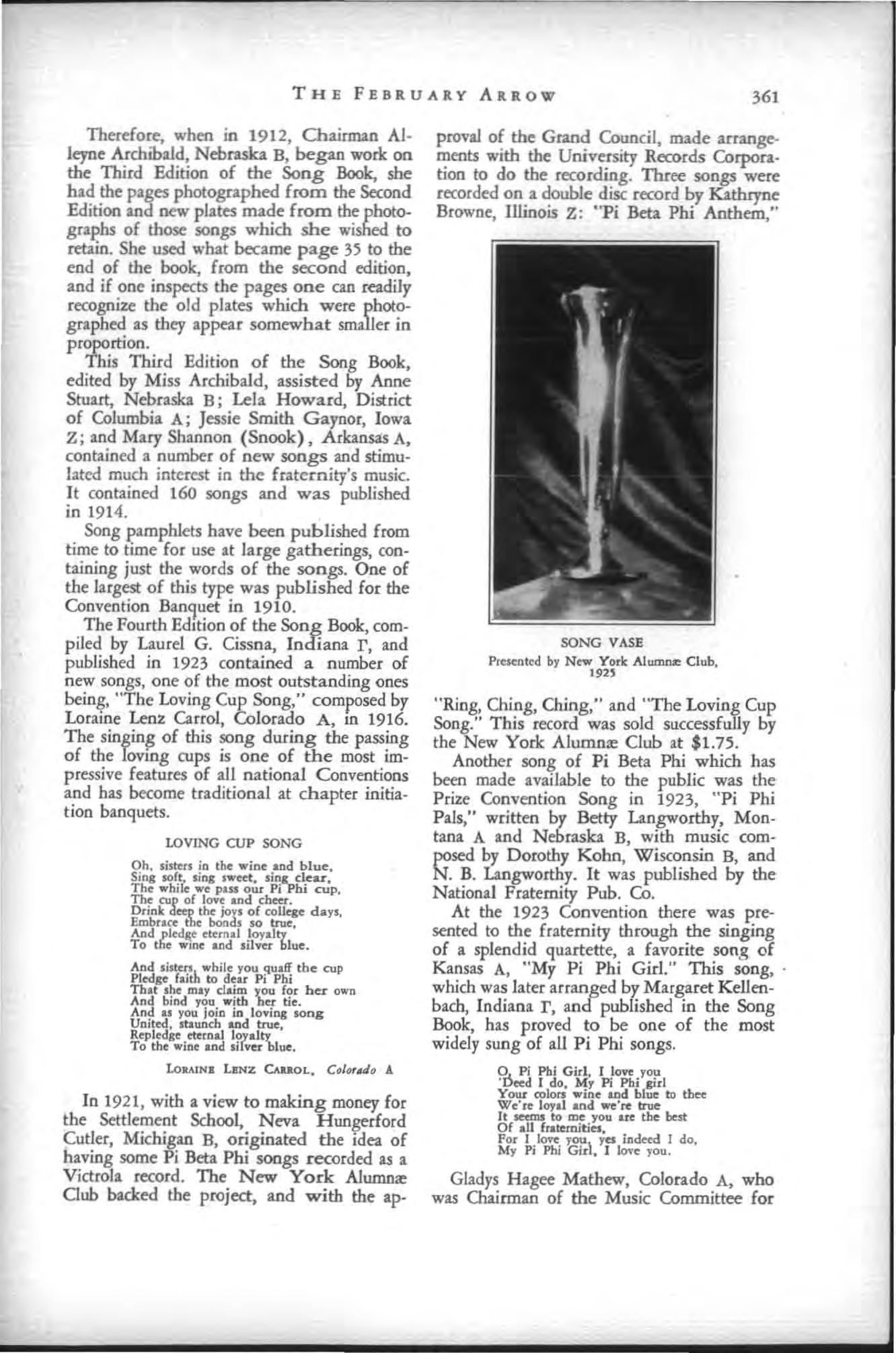
"Ring, Ching, Ching," and ''The Loving Cup Song." This record was sold successfully by the New York Alumnre Club at $1.75.
Another song of Pi Beta Phi which has been made available to the public was the Prize Convention Song in 1923, "Pi Phi Pals," written by Berty Langworthy, Montana A and Nebraska B, with music com· posed by Dorothy Kohn, Wisconsin B, and N. B. Langworthy. It was published by the National Fraternity Pub. Co.
At the 1923 Convention there was presented to the fraternity through the singing of a splendid quartette, a favorite song of Kansas A, "My Pi Phi Girl." This song, . which was later arranged by Margaret Kellenbach, Indiana r, and published in the Song Book, has proved to be one of the most widely sung of all Pi Phi songs.
C?t Pi Phi Gte!. I low you 'ueed I do, My Pi Pbi girl Your colors wine a.nd blue to thee We're loyal and we 're true It seems to me )'ou are the best Of all fraternities, Por I loTe YOU I ya indeed I do. My Pi Phi Gil' . I love yo u ,
Gladys Hagee Mathew, Colorado A, who was Chairman of the Music Committee for
the Estes Park Convention, was especially interested in seeing new songs written for the fraternity, and was instrumental in getting the New York Alumnae Gub to present a very lovely award to the frat ernity, in the form of a sterling silver vase whi ch can be used as a loving cup or as a Bower holder.
On May 28 , 1925, Mrs . Mathew, as Chair· man of the New York Alumnae Gub Music Committee sen t the following letter to the Grand Council :
"For the purpose of sowing a broad in· terest in the Songs of Pi Beta Phi, and thus reaping for our f rateroity the benefits to be gained from such an interest, the New York AlllIIlnZ Club presents the Song Vase to the Grand Council of Pi Beta Phi The cup is to be presented at each Convention for the in· terim of Conventions, to the active chapter submitting the song chosen for the Prize Song. The committee further suggests that the name of each chapter holcling the prize for the period of donation, be engraved upon the Vase. The G ub hopes that tbe Vase, by promulgating a interest in Pi Ph i sing. lng, will be an mcenhve for the wClting of many beautiful Pi Phi songs, and prove in· deed, 'A Cup in Praise of Song.' ..
In awarding the Vase the Standing Com· mittee on Music selects songs from those submitted before Conventton, and the final choice of first place is made by pop. ular acclaim from the Boor of Convention.
The Vase was presented for the first time at the Bigwin Inn Convention, 1925, when North Carolina A with the "Pi Phi Marching Song," won over thirty·three contestants.
The awards at Conventions have been:
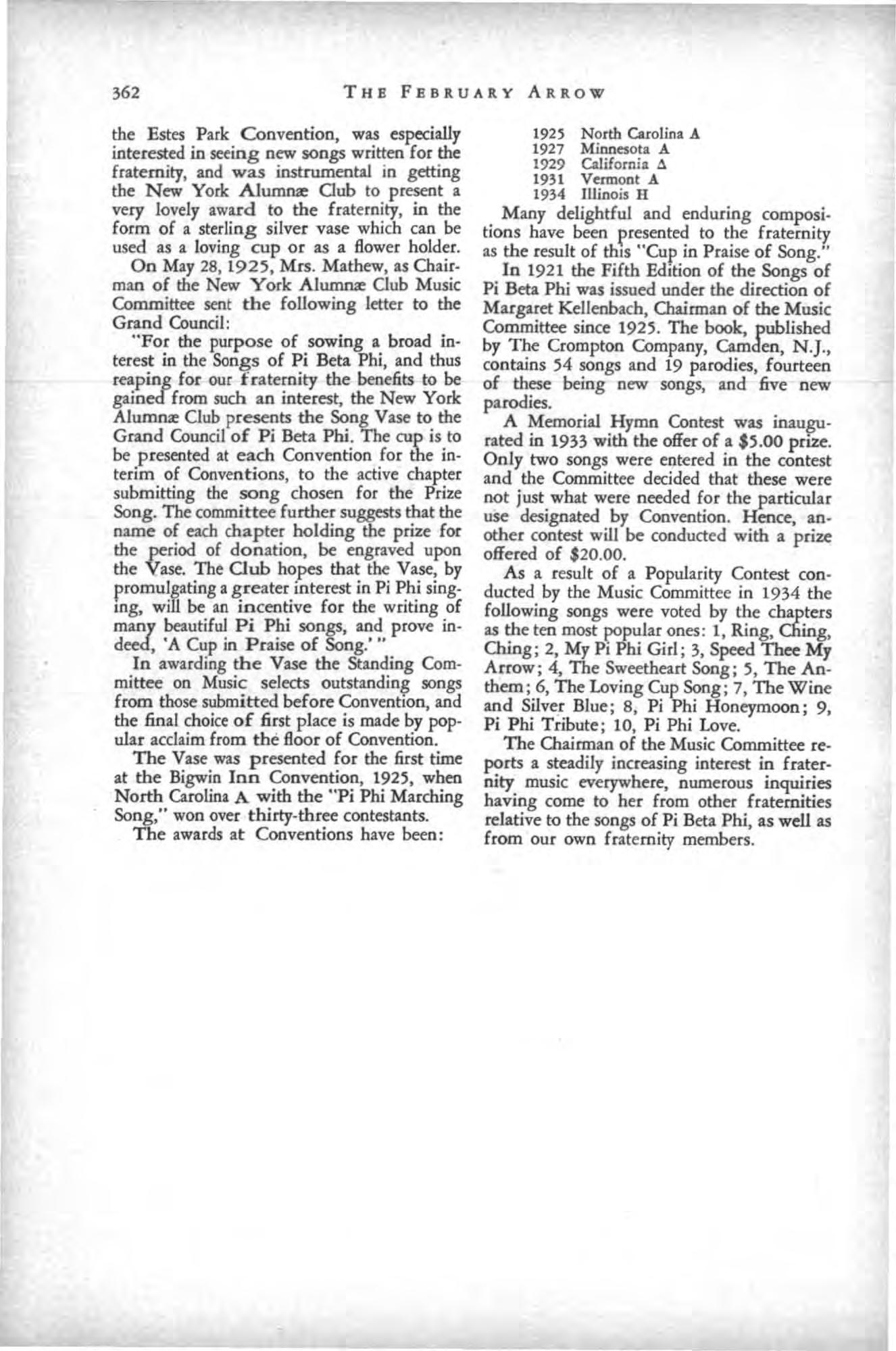
192) North Carolina A 1927 Minnesota A 1929 Caljforn ia A 1931 Vermont A 19 34 Illinois H
Many delightful and enduring composi. tions have been l'resented to the fraternity as the result of thIS "Cup in Praise of Song."
In 1921 the Fifth EdItion of the Songs of Pi Beta Phi was issued under the clirection of Margaret Kellenbach, Chairman of the Music Committee since 1925. The book, published by The Crompton Company, Camden, N.J ., contains 54 songs and 19 parodies , fourteen of these being new songs, and five new parodies
A. Memorial Hymn Contest was rated in 1933 with the offer of a $5 .00 prlZe. Only two songs were entered in the contest and the Committee decided that these were not just what were needed for the particular use designated by Convention. Hence, an· other contest will be conducted with a prize offered of $ 20 .00 .
A.s a result of a Popularity Contest can · ducted by the Music Committee in 1934 the following songs were voted by the chapters as the ten most ones: I, Ring, Ching, Ching ; 2, My PI Phi Girl ; 3, Speed Thee My Arrow; 4, The Sweetheart Song ; 5, The An · them ; 6, The Loving Cup Song; 7, The Wine and Silver Blue; 8 , Pi Phi Honeymoon; 9, Pi Phi Tribute; 10, Pi Phi Love.
The Chairman of the Music Committee reo ports a steadily increasing interest in frater· nity music everywhere, numerous inquiries having come to her from other fraternities relative to the songs of Pi Beta Phi, as well as from our own frate rnity members .
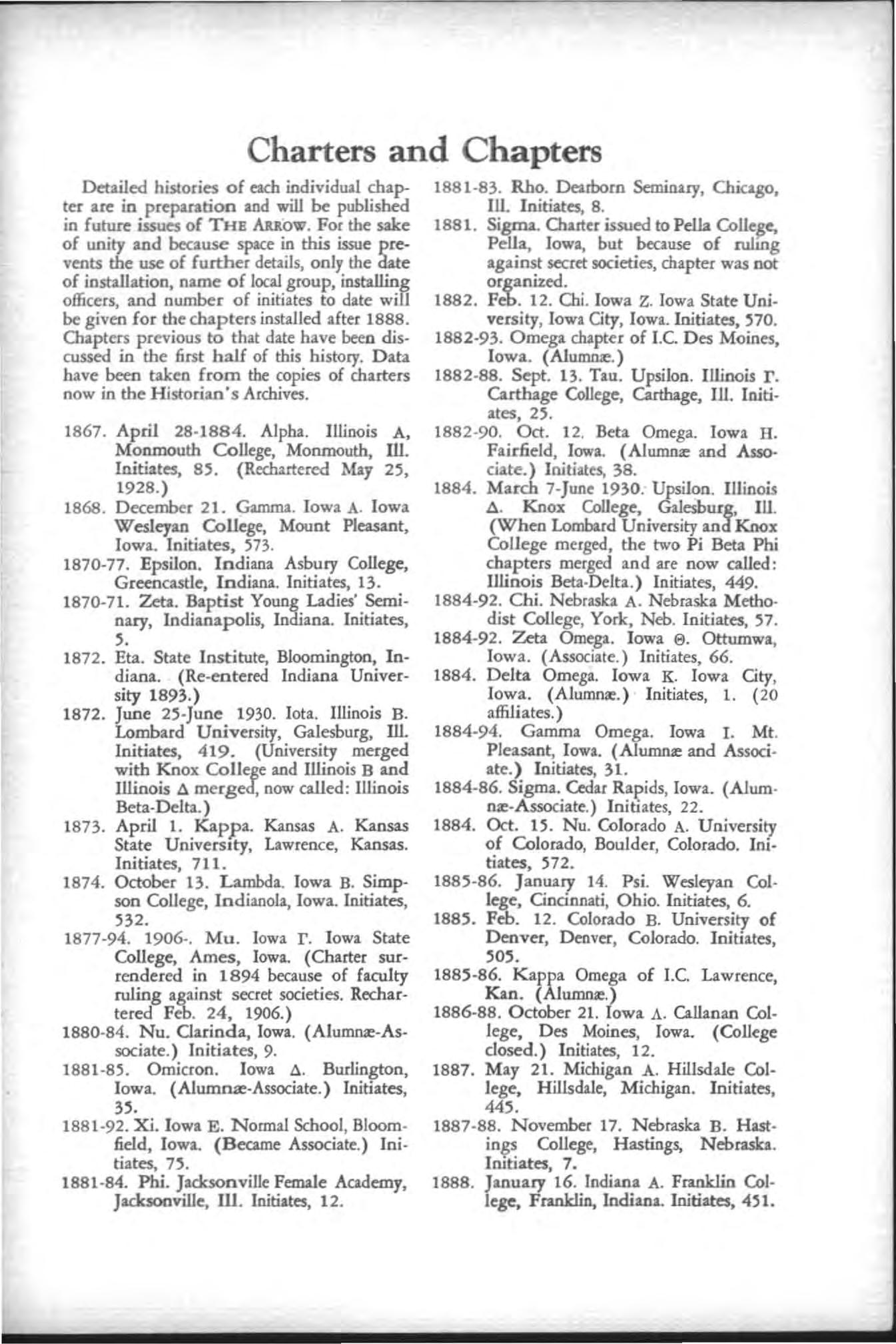
Detailed histories of each individual chapter are in preparation and will be published in future issues of THE AIutow. For the sake of unity and because space in this issue prevents the use of further details, only the elate of install a tion , name of local group, installing officers, and number of initiates to date will be given for the chapters installed after 1888. Chapters previous to that date h ave been discussed in the first half of this history. Data h ave been taken from the copies of charters now in the H istorian' s Archives.
1867 . April 28-1884. Alpha. Illinois A, Monmouth College, Monmouth, Ill. Initiates, 85 (Rechartered May 25, 1928 .)
1868 D ecember 21. Gamma Iowa A Iowa Wesleyan College, Mount Pleasant, Iowa. Initiates, 573.
1870-77. Epsilon . Indiana Asbury College, Green castle, Indiana . Initiates, 13 . 1870 -7 1. Zeta Baptist Young Ladies' Seminary, Indianapolis, Indiana . Initiates, 5 _
18 72. Eta State Institute, Bloomington, Indiana (Re-entered Indiana University 1893.)
1872. June 25-June 1930 Iota Illinois B Lombard University, Galesburg, Ill. Initiates, 419_ (University merged with Knox College and Illinois B and Illinois /1 merged, now called: Illinois Beta-Delta . )
1873 . April 1. Kappa . Kansas A. Kansas State UniverSity. Lawrence . Kansas . Initiates, 71 L 1874. October 13. Lambda Iowa B. Simpson College, Indianola, Iowa. Initiates , 532.
1877-94. 1906-. Mu Iowa r. Iowa State College, Ames, Iowa. (Charter surrendered in 1894 because of faculty ruling against secret societies. Rechartered Feb. 24, 1906 )
1880-8 4. Nu Garinda, Iowa (Alumnre-Associate.) Initiates, 9.
1881-85. Omicron. Iowa fl Burlington , Iowa. (Alumrue-Associate ) Initiates, 35-
1881 -9 2_ XL Iowa E . Normal School , Bloomfield, Iowa (Became Associate ) Initiates, n.
1881 -84. Phi_ Jacksonville Female Academy, Jack$onville, III Initiates, 12.
1881-83. Rho /)arborn Semitury, Chicago, III Initiates, 8.
1881. Sigma. Charter issued to Pella College, Peila, Iowa, but bec.use of ruling against secret societies, chapter was not organized.
1882 Feb 12 Chi. Iowa Z. low State University , Iow a City, Iowa Initiates, 570 1882-93. Omega chapter of I e. Des Moines, Iowa . (!U\lJIl!IZ. )
1882 -88 Sept. B Tau. Upsilon Illinois r_ Carthage College, Carthage, Ill Initiates, 25.
1882 -90 Oct. 12 Beta Omega. Iowa H. Fairfield , Iowa (1.1= and Associate. ) Initiates, 38.
1884_ March 7-Jl1Oe 19 30. Upsilon Illinois /1 Knox College, Galesburg, Ill. (When Lombard University and Knox College merged, the two Pi Beta Phi chapters merged and are now called : Illinois Beta-Delta ) Initiates, 449. 1884-92. Chi. Nebraska A Nebraska Methodist College, York , Neb . Initiates, 57 . 1884-92. Zeta Omega. Iowa e_ Ottumwa , Iowa . (Associate.) Initiates, 66.
1884 . Delta Omega. Iowa K. Iowa City, Iowa _ (Alumn",.) Initiates, 1. (20 affiliates )
1884-94. Gamma Omega. Iowa I- Mt . Pleasant, Iowa _ (A1\lJIl!1Z and Associate.) Initiates, 31.
1884-86 Sigma. Cedar Rapids, Iowa (Alumn", -Associate.) Initiates, 22.
1884. Oct _ 15. Nu. Colorado A. University of Co lorado, Boulder, Colorado. Initiates, 572_
1885-86. January 14. Psi. Wesleyan College, Cincinnati , Ohio Initiates, 6 1885 _ Feb _ 12. Colorado B. University of Denver, Denver, Colorado. Initiates, 505_
1885-86 Kappa Omega of I.e. Lawrence, Kan _ (Alumn", )
1886-88 . October 2l. Iowa l!.. Callanan College, Des Moines, Iowa _ (College dosed.) Initiates , 12
1887. May 21. Michigan A Hillsdale College, Hillsdale, Michigan _ Initiates, 445.
1887 -88. November 17. Nebraska B _ HastCollege, Hastings, Nebraska lrutiates, 7_
1888. January 16. Indiana A. FranIdin College, FranIdin, Indiana_ Initiates, 451.
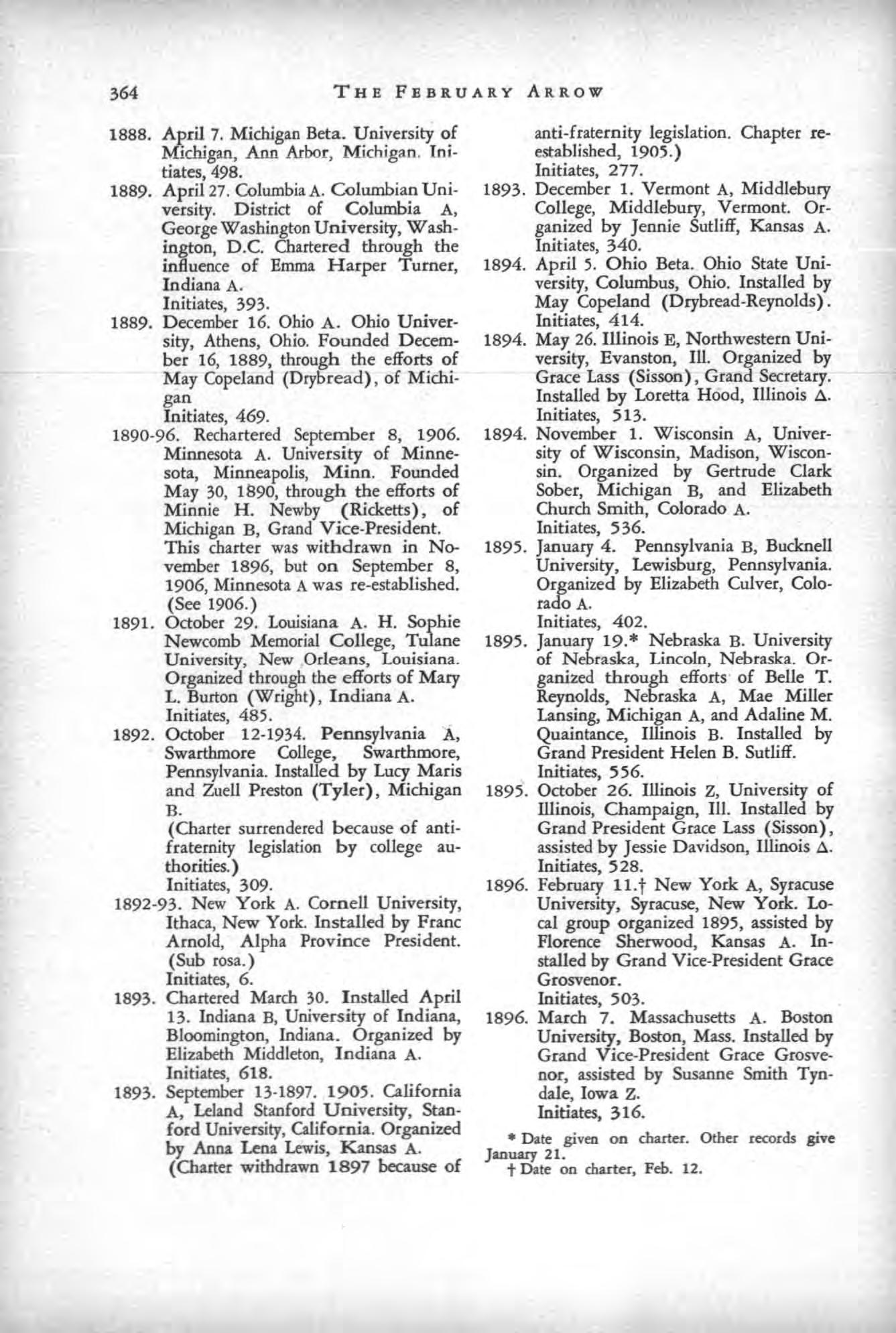
1888. A);'ril 7. Michigan Beta. University of MIChigan , Ann Arbor, Michigan Ini· tiates, 498.
1889. April 27 ColumbiaA. Columbian Uni · versity. District of Columbia A, George Washington University, Wash · ington, D.C. Chartered through the influence of Emma Harper Turner, Indiana A.
Initiates, 393.
1889 December 16. Ohio A. Ohio Univer· sity, Athens, Ohio. Founded December 16, 1889, through the efforts of May Copeland (Drybread) , of Michigan
Initiates, 469. 1890 -96
Rechartered September 8, 1906. Minnesota A. University of Minnesota, Minneapolis, Minn. Founded May 3D , 1890, through the efforts of Minnie H Newby (Ricketts), of Michigan B, Grand Vice·President. This charter was withdrawn in November 1896, but on September 8, 1906 , Minnesota A was re-established. (See 1906 ) 1891. October 29. Louisiana A. H. Sophie Newcomb Memorial College, Tu1ane University, New Orleans, Louisiana _ Organized through the efforts of Mary L. Burton (Wright) , Indiana A. Initiates, 485.
1892 . October 12-1934. Pennsylvania A, Swarthmore College, Swarthmore, Pennsylvania Installed by Lucy Maris and Zuell Preston (Tyler) , Michigan B.
(Charter surrendered because of antifraternity legislation by college authorities. )
Initiates, 309 . 1892 -93 . New York A. Cornell University, Ithaca, New York . Installed by Franc Arnold, Alpha Province President. (Sub ro sa.) Initiates, 6.
1893. Chartered March 30. Installed April 13. Indiana B, University of Indiana, Bloomington , Indiana Organized by Elizabeth Mi dd leton , Indiana A. Initiates , 618. 1893. September 13-1897. 1905. California A, Leland Stanford University, Stanford University, California. Organized by Anna Una Lewis, Kansas A.
(Charter withdrawn 1897 because of
anti-fraternity legislation. Chapter reestablished, 1905 ) Initiates, 277.
1893. December 1. Vermont A, Middlebury College, Middlebury, Vermont. Organized by Jennie Sutliff, Kansas A. Initiates, 340.
1894. April 5. Ohio Beta. Ohio State University, Columbus, Ohio. Installed by May Copeland (Drybread-Reynolds). Initiates, 414.
1894. May 26. Illinois E, Northwestern University, Evanston, Ill. Organized by Grace Lass (Sisson), Grand Secretary. Installed by Loretta Hood, Illinois A Initiates, 513.
1894. November 1. Wisconsin A, University of Wisconsin, Madison, Wiscon· sin. Organized by Gertrude Clark Sober, Michigan B, and Elizabeth Church Smith, Colorado A. Initiates, 536.
1895. January 4. Pennsylvania B, Bucknell University, Lewisburg, Pennsylvania. Organized by Elizabeth Culver, Colorado A. Initiates, 402.
1895. January 19.· Nebraska B University of Nebraska, Lincoln , Nebraska . Organized through efforts of Belle T. Reynolds, Nebraska A, Mae Miller Lansing, Michigan A, and Adaline M. Quaintance, Illinois B. Installed by Grand President Helen B. Sutliff. Initiates, 556 .
1895. October 26 . Illinois Z, University of Illinois, Champaign, III. Installed by Grand President Grace Lass (Sisson) , assisted by Jessie Davidson , Illinois A. Initiates, 528.
1896. February 11. t New York A, Syracuse University, Syracuse, New York. local group organized 1895, assisted by Florence Sherwood , Kansas A. Installed by Grand Vice-President Grace Grosvenor. Initiates, 503.
1896. March 7. Massachusetts A. Boston University, Boston, Mass. Installed by Grand Vice-President Grace Grosvenor, assisted by Susanne Smith Tyndale, Iowa Z Initiates, 316.
• Date given on charter. Other records give January 21.
t Date 00 charter. Feb. 12.
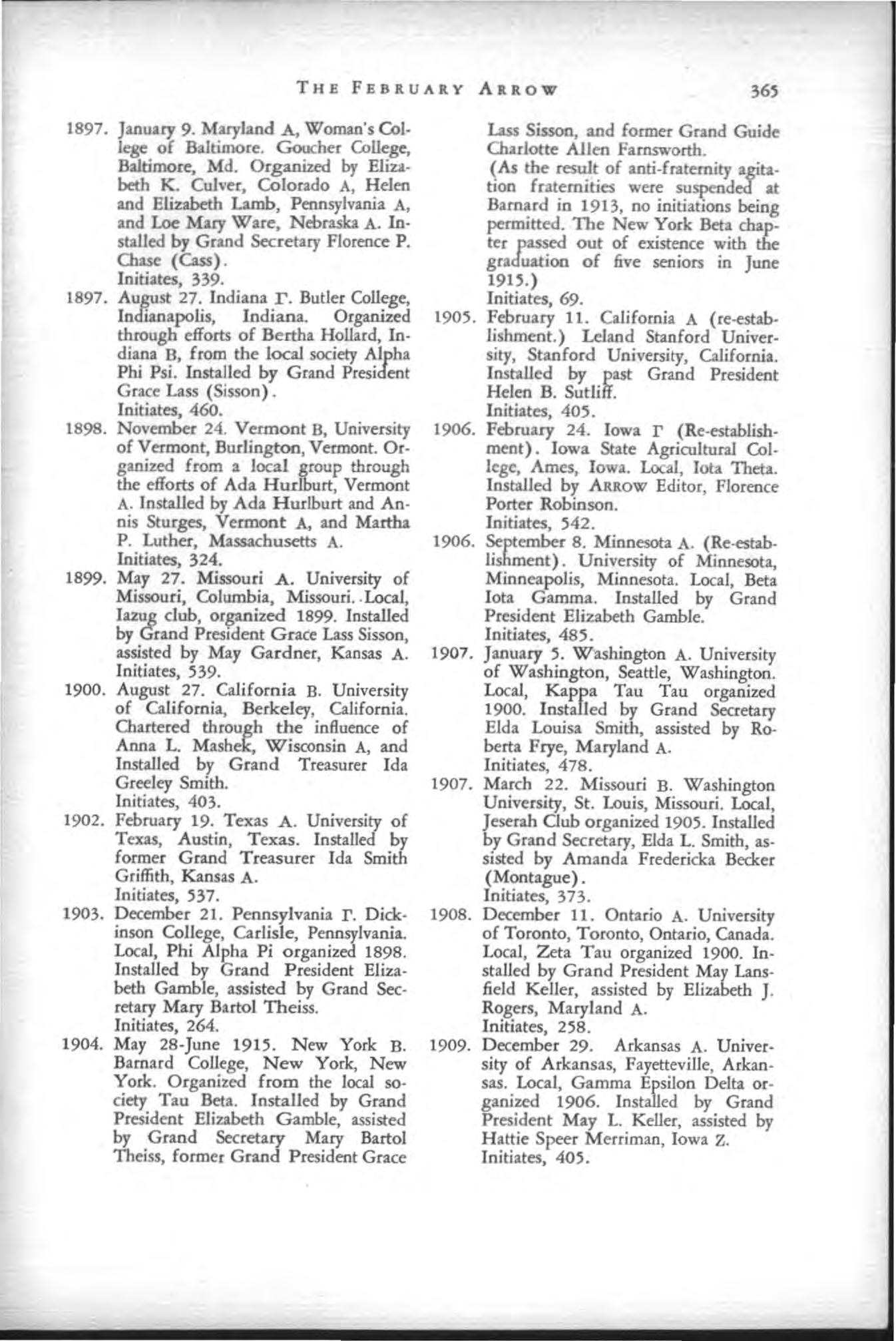
1897. January 9. M aryland A , Woman 's College of Baltimore Goucher College, Baltimore, M d. Organized by Elizabeth K Culv«, Colorado A, Helen and Elizabeth Lamb, Pennsylvania A, and Loe Mary Ware, Nebraska A. Installed by Grand Secretary Florence P Chase (Cass). Initiates, 339.
1897. August 27. Indiana r. Butler College, Indianapolis, Indiana Organized through efforts of Be rtha Hollard, Indiana B, from the local society Alph a Phi Psi. Installed by Grand President Grace Lass (S isso n). Initiates, 460.
1898. November 24. Vermont B, University of Vermont, Burlington , Vermont. Organized from a local group through the efforts of Ada Hurlburt, Vermont A. Installed by Ada Hurlburt and Annis Sturges, Vermont A, and Martha P. Luther, Massachusetts A. Initiates, 324.
1899. May 27. Missouri A. University of Missouri, Columbia, Missouri. . Local, Iazug dub , orFized 1899. by Grand PresIdent GraCe Lass SISson, assisted by May Gardner, Kansas A. Initiates, 539
1900. August 27. California B University of California , Berkeley, California Chartered through the influence of Anna L. Mashek, Wisconsin A, and Installed by Grand Treasurer Ida Greeley Smith Initiates , 403.
1902. February 19. Texas A. University of Texas, Austin, Texas. Installed by former Grand Treasurer Ida Smith Griffith , Kansas A. Initiates, 537.
1903 December 21. Pennsylvania r. Dickinson College, Pennsylvania. Local, Phi Alpha Pi organized 1898. Installed by Grand President Elizabeth Gamble, assisted by Grand Secretary Mary Bartol Theiss . Initiates. 264 .
1904 May 28-June 1915 New York B Barnard College, New York, New York Orga nized from the local society Tau Bet a. Installed by Grand Presid ent Elizabeth Gamble, assisted by Grand Secretary Mary Bartol Theiss, former Grand President Grace
Lass Sisson, and former Grand Guide Charlotte Allen Farnsworth. (As the result of anti.fraternity agita. tion fraternities were suspended at Barnard in 1913, n o initiations being permitted. The New York Beta chapter passed out of existence with the graduation of five seniors in June 1915 . )
Initiat es, 69.
February 11. California A (re-estab· li shment.) Leland Stanford University, Stanford University, California. In stalled by past Grand President Helen B. Sutliff. Initiates , 405.
February 24. Iowa r (Re.es tablishment). Iowa State Agricultural College, Ames, Io wa. Local, Io ta Theta. Installed by ARJl. ow Editor, Florence Porter Robinson Initiates, 542.
September 8. Minnesota A. (Re ·establishment). University of Minnesota, Minneapolis. Minnesota . Local, Beta Iota Gamma. Installed by Grand President Elizabeth Gamble. Initiates, 485 . January 5. Washington A University of Washington, Seattle, Washington . Local , Kappa Tau Tau organized 1900. Installed by Grand Secretary Elda Louisa Smith, assisted by Roberta Frye, Maryland A Initiates, 478.
March 22. Mi sso uri B. Washington University, St. Louis , Missouri. Local, Jeserah Oub org anized 1905. Installed by Grand Secretary, Elda L. Smith, assisted by Amanda Frederi cka Becker (Montague). Initiates, 373.
December 11. Ontario A. University of Toronto, Toronto , Ontario, Canada . Local, Zeta Tau organized 1900. Insta lled by Grand President May Lansfield Keller, assisted by Elizabeth J . Rogers, M a ryland A. Initiates, 258.
December 29 . Arkans as A. University of Arkansas, Fayetteville, Arkansas. Local, Gamma Epsilon Delta organized 1906 Installed by Grand Presid ent May L. K eller, ass isted by Hattie Speer Merrim an, Iowa Z. Initiates, 405.
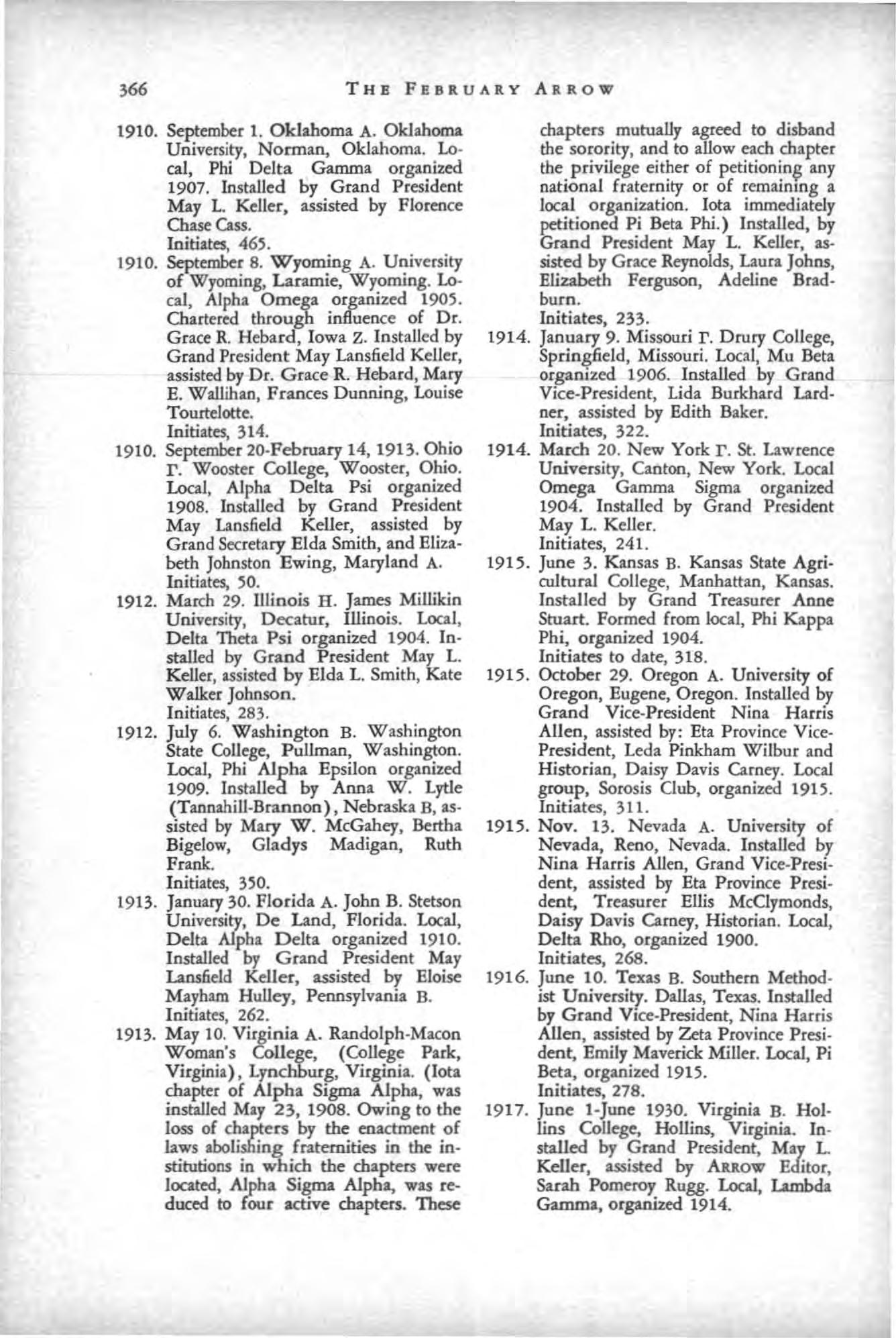
1910. September 1. Oklahoma A. Oklahoma University, Norman, Oklahoma . Local, Phi Delta Gamma organized 1907. Installed by Grand President May L. Keller, assisted by Florence ChaseCass . Initiates, 465 .
1910. September 8. Wyoming A University of Wyoming, Laramie, Wyoming Local, Alpha Omega organized 1905 Chartered through influence of Dr Grace R. Hebard, Iowa Z. Installed by Grand President May Lansfield Keller, assisted by Dr . Grace R . Hebard, Mary E. Wallihan, Frances Dunning, Louise Tourtelotte. Initiates, 314
1910. September 20 -February 14, 1913 . Ohio r . Wooster College, Wooster, Ohio
Local, Alpha Delta Psi organized 1908. Installed by Grand President May Lansfield Keller, assisted by Grand Sec retary Elda Smith, and Elizabeth Johnston Ewing, Maryland A Initiates, 50
1912 March 29 JlIinois H. James Millikin Univers ity, Decatur, Illinois . Local, Delta Theta Psi organized 1904 . Installed by Grand Fresident May L. Keller, assisted by E1da L. Smith , Kate Walker Johnson . Initiates, 28 3.
1912. July 6. Washington B W ashington State College, Pullman, Washington Local, Phi Alpha Epsilon organized 1909. Installed by Anna W. Lytle (Tannahill-Brannon) , Nebraska B, as· sisted by Mary W . McGahey, Bertha Bigelow, Gladys Madigan, Ruth Frank Initi ates, 350.
19 13. January 30 Florida A. John B Stetson University, De Land, Florida Local , Delta Alpha Delta organized 1910. InstaIled by Grand President May Lansfield Keller, assisted by Eloise Mayham Hulley, Pennsylvania B. Initiates, 262
1913 May 10 Virginia A. Randolph -Macon Woman's College, (College Park, Virginia) , Lynchburg, Virginia . (Iota chapter of Alpha Sigma Alpha, was instaIled May 23 , 1908 Owing to the loss of chapters by the enactment of laws abolisliing fraternities in the institutions in which the chapters were located, Alpha Sigma Alpha, was reduced to four active chapters. These
chapters mutually agreed to disband the sorority, and to allow each chapter the privilege either of petitionin!! any national fraternity or of remaining a local organization. Iota immediately petitioned Pi Beta Phi.) Installed, by Grand President May L. Keller, assisted by Grace Reynolds , Laura Johns , Elizabeth Ferguson , Adeline Bradburn . Initiates, 233.
1914. January 9. Missouri r Drury College, Springfield, Missouri. Local, Mu Beta organized 1906. Installed by Grand Vice-President, Lida Burkhard lardner, assisted by Edith Bake r. Initiates, 32 2 .
1914. March 20 . New York r . St. Lawrence University, Ca nton, New York Local Omega Gamma Sigma organized 1904. Installed by Grand President May L. Keller Initiates, 241.
1915. June 3. Kansas B Kansas State Agricultural College, Manhattan , Kansas . Installed by Grand Treasurer Anne Stuart . Formed from local , Phi Kappa Phi, organized 1904. Initiates to date, 318 .
1915. October 29 Oregon A. University of Oregon, Eugene, Oregon. Install ed by Grand Vice-President Nina Harris Allen, assisted by: Eta Province VicePresident, Leda Pinkham Wilbur and Historian, Daisy Davis Carney. Local group, Sorosis Club, organized 1915 Init.iates, 3 11 .
1915 Nov. 13 Nevada A University of Nevada, Reno, Nevada Installed by Nina Harris Allen, Grand Vice-President, assisted by Eta Province President, Treasurer Ellis McCIymonds, Daisy Davis Carney, Historian Local , Delta Rho , organized 1900. Initiates, 268
1916 June 10. Texas B Southern Methodist University. Dallas, Texas. Installed by Grand Vice-President, Nin a Harri s Allen, assisted by Zeta Province President, Emily Maverick Miller. Local, Pi Beta , organized 1915. Initiates, 278.
1917. June I-June 1930. Virginia B. Hollins College, Hollins, Virginia . Installed by Grand President, M ay L. Keller, ass isted by ARRow Editor, Sarah Pome roy Rugg. Local, Lambda Gamma, organized 1914.
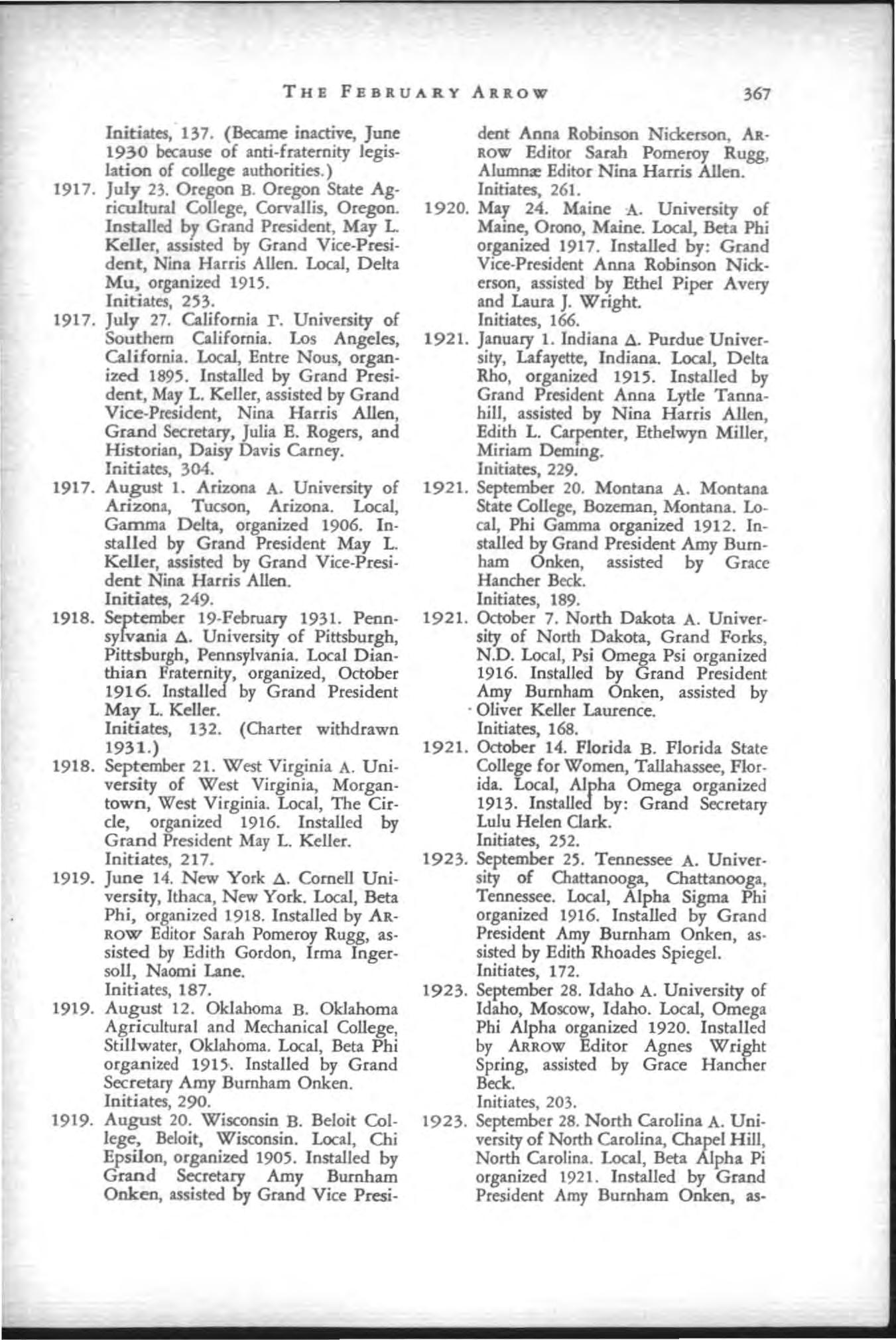
Initiates, 137. (&ame inactive, June 1930 because of anti·fraternity legis . lation of college authorities.)
1917. July 23. Oregon B. Oregon State Ag· ricultural College, Corvallis, Oregon . Installed br Grand President, May L Keller, asSISted by Grand Vice·Presi· dent, Nina Harris Allen. Local, Delta Mu, organized 1915. Initiates, 253.
1917. July 27. California r . University of Southern California. Los Angeles, California. Local, Entre Nous, organ· ized 1895 Installed by Grand Presi· dent, May L. Keller, assisted by Grand Vice·President, Nina Harris Allen, Grand Secretary, Julia E Rogers, and Historian, Daisy Davis Carney. Initiates, 304.
1917. August 1. Arirona A.. University of Arizona, Tucson, Arizona. Local, Gamma Delta, organized 1906. In· stalled by Grand President May L. Keller, assisted by Grand Vice·Presi· dent Nina Harris Allen. Initiates, 249.
1918. September 19·February 1931. Penn· sylvania f>.. University of Pittsburgh, Pittsburgh, Pennsylvania. Local Dian· thian ¥raternity, organized, October 1916. Installed by Grand President May L. Keller. Initiates, 132. (Charter withdrawn 1931 )
1918. September 21. West Virginia A. University of West Virginia, Morgantown, West Virginia . Local, The Cirde, organized 1916. Installed by Grand President May L. Keller. Initiates, 217.
1919. June 14. New York f>.. Cornell University, Ithaca, New York. Local, Beta Phi, organized 1918. Installed by .ARROW Editor Sarah Pomeroy R ugg, assisted by Edith Gordon, Irma Ingersoll, Naomi Lane. Initiates, 187.
1919. August 12. Oklahoma B. Oklahoma Agricultural and Mechanical College, Stillwater, Oklahoma. Local, Beta Phi organized 1915. Installed by Grand Secretary Amy Burnham Onken. Initiates, 290.
1919. August 20. Wisconsin B. Beloit College, Beloit, Wisconsin. Local , Chi Epsilon, organized 1905. Installed by Grand Secretary Amy Burnham Onken, assisted by Grand Vice Presi-
dent Anna Robinson Nickerson, ARROW Editor Sarah Pomeroy Rugg , Al= Editor Nina Harris Allen Initiates, 261.
1920. May 24. Maine A. University of Maine, Orono, Maine. Local, Beta Phi organized 1917 . Installed by: Grand Vice-President Anna Robinson Nickerson, assisted by Ethel Piper Avery and Laura J. Wright. Initiates , 166 .
1921. January 1. Indiana f>.. Purdue University, Lafayette, Indiana. Local, Delta Rho , organized 1915. Installed by Grand President Anna Lytle Tannahill, assisted by Nina Harris Allen, Edith L. Carpenter, Ethelwyn Miller, Miriam Deming Initiates, 229.
1921. September 20. Montana A. Montana State College, Bozeman, Montana. local, Phi Gamma organized 1912. Installed by Grand President Amy Burnham Onken, assisted by Grace Hancher Beck. Initiates, 189.
1921. October 7. North Dakota A. University of North Dakota, Grand Forks , N.D. Local, Psi Omega Psi organized 1916. Installed by Grand President Amy Burnham Onken, assisted by . Oliver Keller Laurence.
Initiates, 168.
1921. October 14. Florida B. Florida State College for Women, Tallahassee, Florida. Local, Alpha Omega organized 1913. Installed by: Grand Secretary Lulu Helen Oark. Initiates, 252.
1923. September 25. Tennessee A. University of Olattanooga, Chattanooga , Tennessee. Local, Alpha Sigma Phi organized 1916. Installed by Grand President Amy Burnham Onken, assisted by Edith Rhoades Spiegel. Initiates, 172.
1923. September 28. Idaho A University of Idaho, Moscow, Idaho. Local, Omega Phi Alpha organized 1920. Installed by ARROW Editor Agnes Wright Spring, assisted by Grace Hancher Beck.
Initiates, 203.
1923 . September 28. North Carolina A. University of North Carolina, Chapel Hill , North Carolina . Local, Beta Alpha Pi organized 1921. Installed by Grand President Amy Burnham Onken, as-
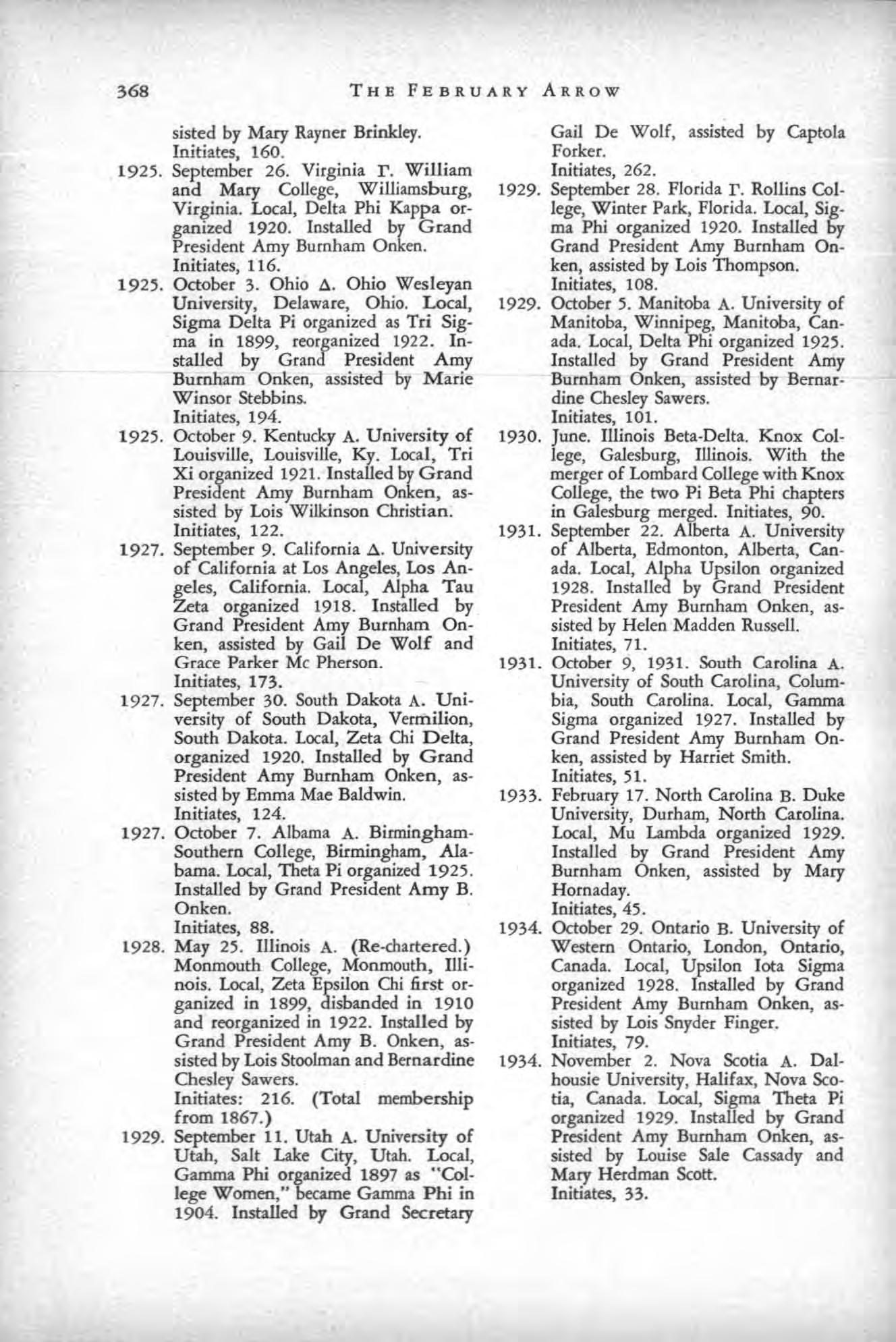
sisted by Mary Rayner Brinkley. Initi ates, 160
1925. September 26 . Virginia r. William and Mary College , Williamsburg, Virginia. Local, Delta Phi Kappa organized 1920 Installed by Grand President Amy Burnham Onken Initiates , 116.
19 2 5. October 3. Ohio d. Ohio Wesleyan University, Delaw a re, Ohio . Local, Sigma Delta Pi orga niz ed as Tri Sigma in IS99, reorganized 1922. Installed by Grand President Amy Burnham Onken, assisted by Marie Winsor Stebbins Initiates, 194.
1925. October 9. Kentucky A. University of LouisvilJe, Louisville, Ky. Local, Tri Xi organized 19 2 1. Installed by Grand President Amy Burnham Onken, as 4 sisted by Lois Wilkinson Christian . Initiates, 122.
1927. September 9. California fl.. University of California at Los Angeles, Los Angeles, California . Local, Alpha Tau Zeta organized 1915. Installed by Grand President Amy Burnham Onken , assisted by Gail De Wolf and Grace Parker M e Pherson . Initiates, 173 .
1 9 27 . September 30. South Dakota A. University of South Dakota, Vermilion, South Dakota. Local, Zeta Chi Delta , organized 1920. Installed by Grand President Amy Burnham Onken, as· sisted by Emma Mae Baldwin. Initiates, 124 .
1927. October 7 . Albama A. BirminghamSouthern College, Birmingham, Alabama. Local, Theta Pi organized 19 25 . Installed by Grand President Amy B . Onken.
Initiates, SS.
19 25 May 25 Illinoi s A (Re-dlartered.) Monmouth College, Monmouth , Illinois. Local , Zeta Epsilon Chi first organized in IS99, disbanded in 1910 and reorganized in 1922 . Installed by Grand President Amy B . Onken , assisted by Lois Stoolman and Bernardine Chesley Sawers Initiates: 216. (Total membership from IS67.)
192 9 . September 11. Utah A. University of Utah , Salt Lake City, Utah . Local, Gamma Phi organized 1897 as "College Women," became Gamm a Phi in 19 04. Installed by Grand Secretary
Gail D e Wolf, assisted by Captola Forker.
Initiates, 26 2 .
19 29. September 2S. Florida r. Rollins College, Winte r Park, Florida Local, Sigma Phi organized 1920. Installed by Grand Presid ent Amy Burnham Onken , assisted by Lois Thompson.
Initiates , lOS .
19 29. October 5. Manitoba A. University of M anitoba , Winnipeg, Manitoba, Canada. Local , Delta Phi organized 1925. Installed by Grand President Amy Burnham Onken, assisted by Bemardine Chesley Sawers . Initiates, 101.
1930. June. Illinois Beta-Delta . Knox College, Galesburg, Illinois. With the merger of Lombard Colleg e with Knox College, the two Pi Beta Phi chapters in Galesburg merged Initiates , 90 1931. September 22. Alberta A University of Alberta , Edmonton, Alberta, Canada. Local , Alpha Upsilon organized 1925 . Installea by Grand President President Amy Burnham Onken, assisted by Helen Madden Russell. Initiates, 71.
1931. October 9, 1931. South Carolina A. University of South Carolina , Columbia, South Carolina . Local , Gamma Sigma organized 1927 Installed by Grand President Amy Burnham Onken, assisted by Harriet Smith. Initiates, 51.
1933. February 17. North Carolina B Duke University, Durham, North Carolina. Local, Mu Lambda organized 1929. Installed by Grand President Amy Burnham Onken , assisted by Mary Hornaday Initiates, 45.
1934. October 29 Ontario B University of Western Ontario, London, Ontario, Canada. Local, Upsilon Iota Sigma organized 1925. Installed by Grand President Amy Burnham Onken , as · sisted by Lois Snyder Fing er. Initiates, 79.
19 34. November 2. No va Scotia A. Dalhousie University, Halifax, Nova Scotia , Canada . Local, Sigma Theta Pi organized 1929. In stalled by Grand President Amy Burnham Onken, assisted by Loui se Sale Cassady and Mary Herdman Scott. Initiates, 33.
Total
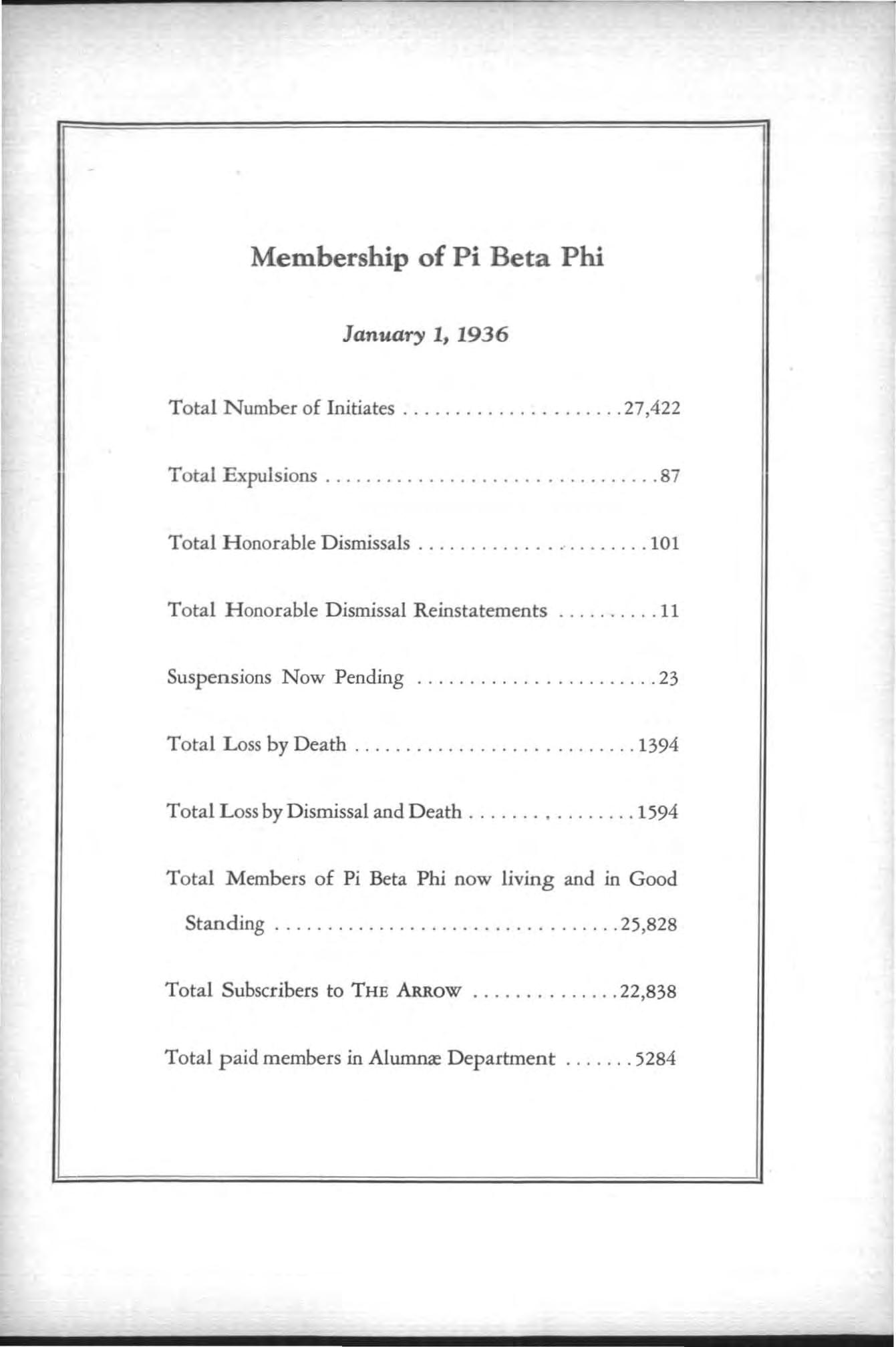
January 1, 1936
Ollicers of Alpha chapter of I.e. from 1867 to 1884 were the Grand Ollicers of the entire organization:
1867
1868 1870 1872 1880 1881
1883
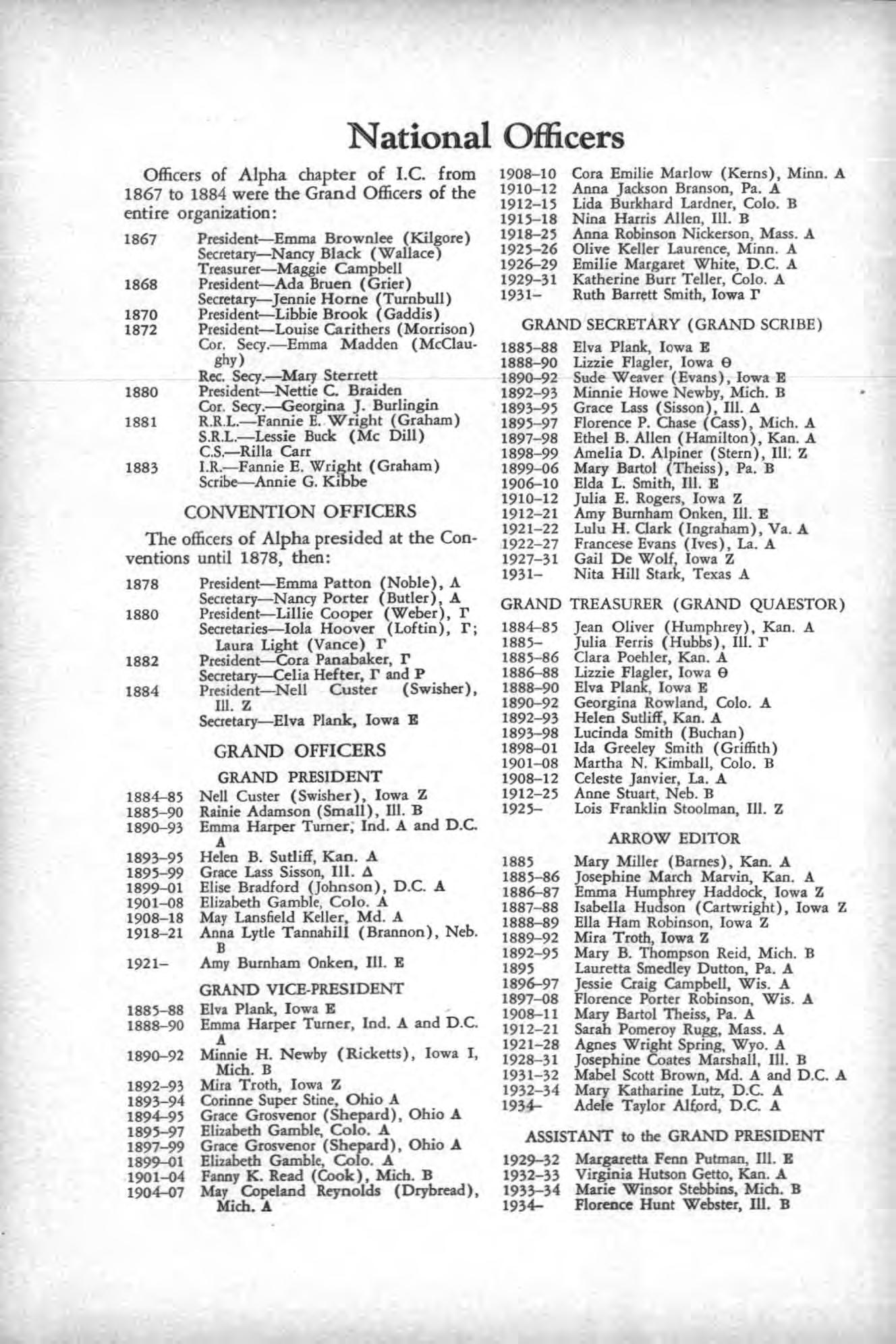
President-Emma Brownlee (Kilsorc)
Secretary-Nancy Black (Wallace)
Treasurer-Maggie Campbell
President-Ada Bruen (Grier)
Secretary-Jennie Home (Turnbull)
President-Libbie Brook (Gaddis)
President-Louise Carithers (Morrison)
Cor Secy.- Emma Madden (McClau ghy)
Rce. Secy.-Mary Steuett
President-Nettie C. Braiden
Cor Secy.-Georgina } BurHngin
R R L.-Fannie E. Wright (Graham)
S R L.-Lessie Buck (Me Dill)
C.S.-Rilla Carr
I.R .-Fannie E Wright (Graham)
Scribe-Annie G. Kibbe
The ollicers of Alpha presided at the Con· ventions until 1878, then:
1878 1880 1882 1884
President-Emma Patton (Noble), A
Secretary-Nancy Portcr (Butler), A
President-Lillie Cooper (Weber), r
Secretaries-lola Hoover (Loftin), r; Laura light (Vance) r
President-Cora Panabaker, r Hefter, r and P .
President-Nell Custer (Swuher) . Ill Z
Secretary-Elva Plank, Iowa B
GRAND OFFICERS
GRAND PRESIDENT
Nell Custer (Swisher). Iowa Z
1885-90 Rainie Adamson (SmaJI), lH B 1890-93 Emma Harper Turner; Ind A and D.C. A
1893-9) Helen B . SutliJf, Kan. A 1895-99 Grace Lass Sisson, Ill. .d 189!HlI Elise Bradford (johnson), D C. A 1901--08 Elizabeth Gamble, Colo . A 1908-18 Ma y Lans6eld K eller, Md . A 1918--21 Anna LytIc Tannahill (Brann o n) Neb B
1921- Amy Burnbam Onken, Ill. E
GRAND VICE·PRESIDENf 1885-88 Elva Plank, Iowa E 1888-90 Emma Harper Turne r. Ind A and D C A
1890-92 Minnie H . Newby (Rick ..ts), I owa I, Mich B
1892-93 Mira Troth, I owa Z
1893-94 Corinne Super Stine, Ohio A 1894-9) Gr ace Grosven o r (Shepard), Ohio A 189)-97 Eliubeth Gamble, Colo A 1897-99 G roce Grosvenor (Shepard), Ohio A 1899-{)1 Eliubeth Gambl e, Colo A
1901-04
Panny K. Read (Cook), Mich B 1904-07 May Copeland Reynolds (Drybread), Mich. A
1908-10 1910-12 1912- 1) 191)-18 1918-2) 192)-26 1926-29 1929-31 1931-
Cora Emilie M arlow (Kerns) Minn A
Anna Jackson Branson , Pa . A
lida Burkhard Lardner, Colo . B
Nina Harris Allen, Ill. B
Anna Robin soD Nickerson , M ass. A
Olive Keller Laurence, Minn A
Emilie Margaret White, D C. A
Katherine Bu rr Teller, Colo. A
Ruth Barrett Smith, Iowa r
GRAND SECRETARY (GRAND SCRIBE)
188)-88 1888-90 1890-92 1892 -93 1893-9) 189'-9 7 1897-98 1898-99 1899-M 1906-10 1910- 12 191 2-2 1 192 1- 22 1922 - 27 19 27-3 1 1931-
Elva Plank , I owa E
lizzie Flag ler, I owa e
5ude W eave r (Evan5), I owa B
Minni e Howe Newby, Mich B
Grace Lass (Sisson), Ill. .6
Florence P. Chase (Cass), Mich A.
Ethel B All e n (Hamilton ) , Kan A
Amelia D A,leiner (Stern) , 1ll : Z
Mary Bartol (Theiss). Pa B
Elda L. Smith , Ill E
Julia E. Roger5, Iowa Z
Amy Burnham Onken, Ill. E
Lulu H . aark (In graham ) . Va . A
Fran cese Evans (I ves). La. A
Gail De Wolf I owa z
Nita Hill Stark, T exas A
GRAND TREASURER (GRAND QUAESTOR)
1884- 8' 188)188)-86 188&-88 1888-90 189(}..92 1892-93 1893-98 1898-01 1901-08 1908-12 1912- 2' 192)-
188) 188)-86 188&-87 1887-88 1888-89 1889-92 1892-9 ' 189' 1896-97 1897-{)8 1908-11 1912- 21 1921-28 1928- 31 1931 - 32 1932-34
Jean Oliver (Humphrey) Kan A
Julia Ferris (Hubbs) , 111. r
Clara P oeh ler, Kan. A
lizzie Flas ler, I owa e
Elva Plank, I owa E
Georgina Rowland, Colo. A
Helen Sutliff, Kan A
Lucinda Smith (Buchan)
Ida Greeley Smith (Griffith)
Martha N Kimball , Colo B
Celeste Janvier , La A
Anne Stuart, Neb B
Lois Franklin Stoolman, Ill Z
ARROW EDITOR
Mary Mill e r (B arnes ), Kan. A
Josephine March Marvin, Kan . A.
Emma Humphrey Haddock I owa Z I sa bella Huds on (Cartwri g ht), Iowa Z
Ella Ham Robinson, Iowa Z
Mira Troth, Iowa Z
Mary B Thompson Reid , Mich B
Lauretta Smedley Dutton, Pa A
Jessie Craig Campbell, Wis A
Flo rence Po rt er R obinso n Wis A
Mary Bartol Theiss, Pa . A
Sarah Pomeroy Ru gg, Mass A
Agnes Wr ight Spring Wyo A
Josephine Coates Marshall, Ill. B
Mahel Scott Brown, Md A and D C. A
Mary K athar ine Lutz.. D .C. A
Adele Taylor Alford, D C. A
ASSISTANT to the GRAND PRESIDENf
1929-32 1932-33 1933-34 1934-
Margaretta Penn Putman, Ill. E
Virginia Hutson Getto, Kan. A
Marie Wmsol Stebbins, Mich. B
Florence Hunt Webster, Ill . B
1892
1893 189 3- 97
1901 1902-()8 1908-10 1910- 12
1912 - 1)
1915-21 1921-23 1923-27 1927-
1890-92
1892-93
1893- 95
1895-()6
1906-10
1910-12
1912-15
1915-17
1918-21 1921-27
1927 1927-34
1934-
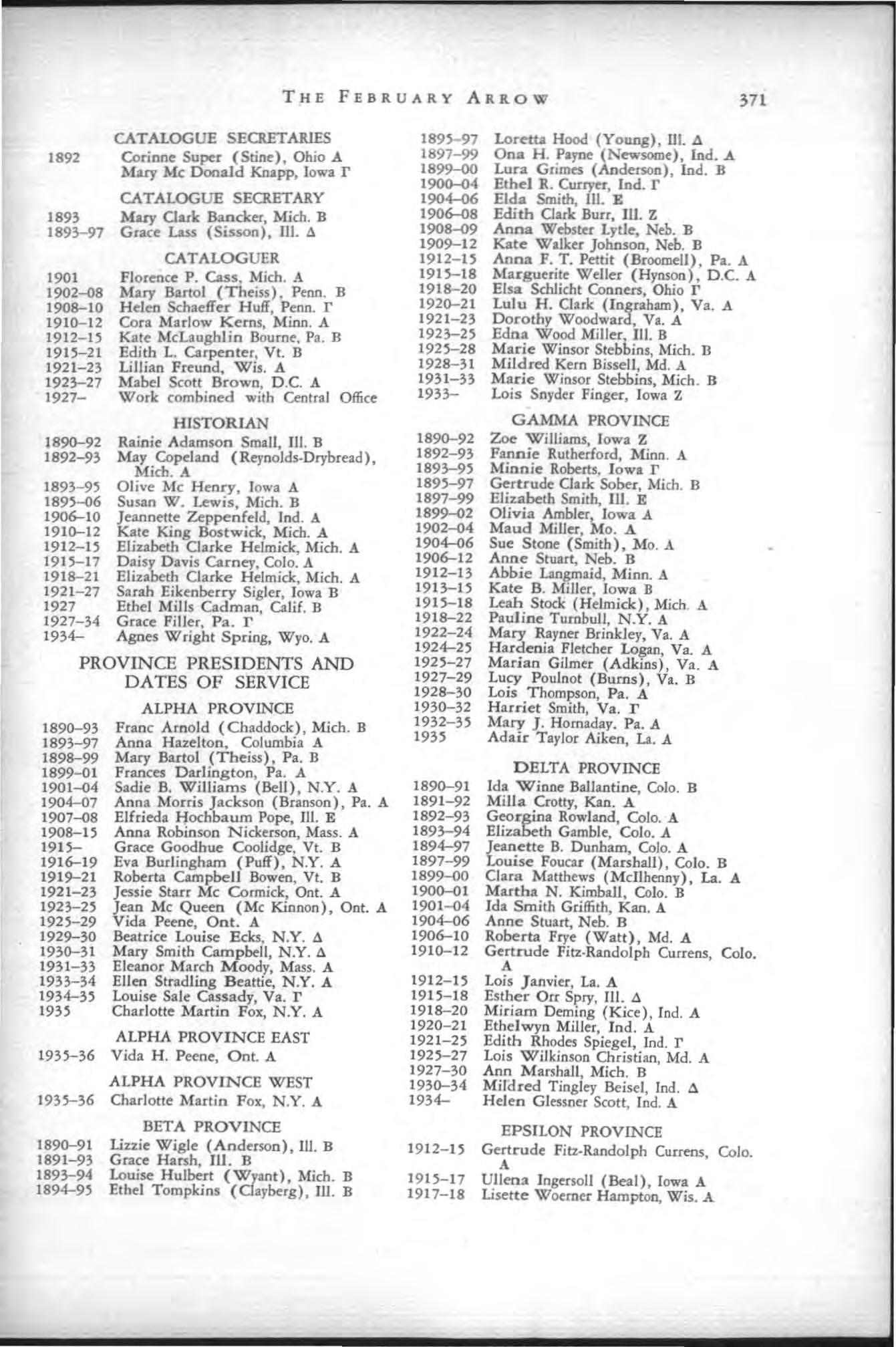
CATALOGUE SECRETARIES
Corinne Super (Stine), Oruo .A
.Mary Me Donald Knapp , Iowa r
CATALOGUE SECRETARY
Mazy aork Baneker, Mich. B
G ra ce Lass (Sisson). 111. 6-
CATALOGUER
Florence P . Cass , Mich . A
Mary Bartol (Thei ss) P enn B
Helen Schaeffer HuH, Penn r
Cora Marlow Kerns, Minn A
Kate McLaughlin Bourne. Pa B
Edith 1. Carpenter, Vt. B
Lillian Freund, Wis. A
Mabel Scott Brown , D .C. .A
Work combined with Unteal Office
HISTORIAN
Rainie Adamson Small, III. B
May Copeland (ReyDold,.Drybread), Mich A
Olive Me Henry, Io wa A
Su san W. Lewis, Mich B
Jeannette Ind A
Kate King Bostwick, Mich. A
Elizabeth Clarke Helmick, Mich A
Daisy Davis Carney, Colo. A
Elizabeth Clarke Helmick, Mich. A
Sarah Eihnberry Sigler, Iowa B
Ethel Mills Cadman, Calif. B
Grace Filler, Pa. r
Agnes Wright Spring, Wyo. A
PROVINCE PRESIDENTS AND DATES OF SERVICE 1890-93
ALPHA PROVINCE
Franc Arnold (Chaddock), Micb. B
Anna Hazelton. Columbia A
Mary Bartol (Theiss), Pa. B
Frances Darlington, Pa. A-
Sadie B. William, (Bell), N Y. A
Anna Morris Jackson (Branson), Pa. A
Elfrieda Hochbaum Pope, Ill. E
Anna Robinson Nickerson, Mass. A
Grace Goodhue Coolidge, Vt. B
Eva Burlingham (Puff), N Y. A
Roberta Campbell Bowa1, Vt. B
Jessie Starr Me Cormick, Onto A
]fin Me (Me Kinnon), Ont. A
Vida Onto A
Beatrice Louise Ecks, N.Y . .6.
Mary Smith Campbell, N.Y. <).
Eleanor March M oody, Mass .A
Ellen Stradling Beattie, N.Y. A
Louise Cassady, Va. r
Chaclotte Martin Fox, N.Y. A
ALPHA PROVINCE EAST 193'- 36 Vida H. Peene. Ont. A
ALPHA PROVINCE WEST 1935- 36 Charlotte Martin Fox, N Y A
1890-91
1891-93 1893-94 1894-95
BETA PROVINCE
lizzie Wigle (Anderson), III. B
Grace Harsh, Ill. B
Louise Hulbert (Wyant). Mich. B
Ethel Tompkins (Gayberg). III. B
1895-97
1897-99
1899-00
1900-04 1904-06 1906-{)8 1908-09 1909-12 1912-15 1915-18
1918- 20 1920-21 1921-23
1923-25 1925-28
1928- 31
1931-33 1933-
1890-92 1892- 93
1893-95
1895-97
1897-99
1899-()2
1902-()4
1904-()6
1906-12
1912-13
1913-15
1915-18
1918-22
1922-24
1924-25
1925-27
1927-29
1928-30
1930-32
1932- 35 1935
1890-91 1891-92
1892-93
1893-94
1894-97
1897- 99
1899-()0 1900-01
1901-()4
1904-()6 1906-10
1910-12
1912-15
1915-18
1918-20
1920-21
1921-25
1925- 27
1927-30
1930-34
1934-
1912 - 15
1915- 17
1917-18
Loretta Hood (YounB) , III. .6
ODa H Payoe (Newsome), Ind .A
Lura Grimes (Anderson) , Ind . B
Ethel R. Cunyer, Ind. r
Elda Smith, III. E
Edith aark Burr, m. Z
Anna Webster Lytle, Neh. B
Kate Walker Johnson, Neb. B
Anna F . T. Pettit (Broomell) Pa . A
Marguerite Weller (Hynson): D .C. A
Elsa Schlicht Cormen, Ohio r
Lulu H. Clark (Ingraham), Va. A.
Dorothy Woodward , Va. A
Edna Wood Miller, Ill. B
Marie Winsor Stebbins, Mich. n
Mildred Kern Bissell, Md. A
Marie Winsor Stebbins, Mich . B
Lois Snyder Finger, Iowa Z
GAMMA PROVINCE
Zoe Williams, Iowa Z
Fannie Rutherford, Minn A
Minnie Robert s, Iowa r
Gertrude Clark Mi ch . n
Elizabeth Smith, Ill. E
Olivia Ambler, Iowa A.
Maud MilJer, Mo. A
Sue Stone (Smith). Mo . A
Anne Stuart, Neb . B
Abbie langmaid, Minn A
Kate B. Miller, Iowa B
Leah Stock (Helmick), Mich A
Pauline Turnbull , N.Y. A
Mary Rayner Brinkley, Va A
Hardenia Fletcher Logan, Va. A
Marian Gilmer (Adkins), Va. A
Lucy Poulnot (Burns), Va. B
Lois Thompson, Pa. A
Harriet Smith, Va. r
Mary ]. Hornaday. Pa. A
Adair Taylor Aiken, La. A.
DELTA PROVINCE
Ida Winne Ballantine, Colo B
Milia Crotty, Kan. A
Georgina Rowland, Colo. A
Elizabeth Gamble, Colo. A.
Jeanette B Dunham, Colo. A
l.<mLse Foucu (Marshall), Colo. B
Clara Matthews (Mc1lhenny), La. A.
Martha N. Kimball, Colo. B
Ida Smith Griffith, Kan. A
Anne Stuart, Neb B
Roberta Frye (Watt), Md . .A
Gertrude Fitz.Randolph Currens Colo. A '
Lois Janvier, La. A
Esther Orr Spry, Ill. .6
Miriam Deming (Kice) , Ind. A
EtheJwyn Miller, Ind. A
Edith Rhodes SpieBel, Ind. r
Lois Wilkinson Christian, Md. A
Ann MarshaJl, Mich. B
Mildred Tingley Beisel, Ind.
Helen Glessner Scott, Ind A
EPSILON PROVINCE
Gertrude Fitz-Randolph Currens Colo. A '
UJlena Ingersoll (Beal), Iowa A.
Lisette W oerner Hampton, Wis A
1919- 20 1920-21 1921 1921-25 1925-27 1927- 30 1930-31 1931-33 1933
1912- 15 1915-18 1918-21 1921-23 1923-25 1925-27 1927-30 1930-31 1931-34 1934
1915-19 1919-21 1921-23 1923-25 1925-27 1927-29 1929-31 1931-34 1934-
1918-21 1921-23 1923-2' 1925 1925- 27 1927-29 1929-31 1931-35 1935-
1918-25 1925-27 1927-28 1928-31
1931-32 1932-34 1934-
1918-20 1920-23 1923-26 1926-29 1929-30 1930-31 1931 - 34 1934-
1931-34
Olive Keller Laurence, Minn. A
Helen Harrington Compton, Ohio r
Florence Underhill Smith, Colo. A
Olive Keller laurence, Minn. A
Margatetta Fenn (Putnam). Ill. E
Bernardine Chesley Sawers, Wis. A
Charlotte Winget Chope, Minn. A
Lorette Chapman Terrell, Kan. A
Agnes Hildebrand Daniel, Mo. A
ZETA PROVINCE
Margerite Davis Carney. Ind. B
Emily Maverick Miller, Tex. A
Sarah Eikenberry Sigler, Iowa B
Olive Hawkins (Smith), Mo. A
Edith Curtis Shuggart, Iowa r
Gail De Wolf, Iowa r
Emma May Baldwin, Mo. r
Edna Westfall Foster, Iowa Z
Rebekah Stewart, Fla. A luC}' Pope, Fla. B
ETA PROVINCE
Treasure Ellis Me Clymonds, Calif. B
Hazel E. Carson (Brooks), Kan. A
Macyelenore Fraser (Donley). Colo. A
Vivian White Scott, Colo. A
leona Baumgartner. Kan. A
Mary Frost, Colo .A
Virginia Hutson (Getto), Kan. A
Florence Hunt Webster, Ill. B
Inez Webster, ]11. .6
THETA PROVINCE
Edith Daniel DyCT, Va. A
Ellen Claire Gillespie Krib3:, Tex B
Juanita Bass (Trumbo), La. A
Lottie Taylor Holland, Okla. A
Mattie Craig Francis, Tex. A
Gertrude Gardner Turner, Okla. A
Nita Hill Stark, Tex. A
Elizabeth Carpenter Buxton, Iowa B
Isabel Clark, Man .A
IOTA PROVINCE
Grace Hancher Beck, Iowa A
Marvel Skeels Obertaufi"er, Ore. A
Irene Oliver Wash. B
Dorothy Cunningham Douglass, Wash. B
Virginia Hutson (Getto), Kan. A
Helen Stanage (Lewis), Colo. B
Faith Martin Hanna, Kan B
KAPPA PROVINCE
Treasure Ellis Mc Clymonds, Calif. B
Josephine Welch (Wood), Calif. A
Netta Lucile Young. Ind. B
Grace Parker Mc Pherson, Ariz. A
Captola Breyley Forker. Wis . A
Adele Taylor Alford, D .C. A
Mary Mc Larry Bywaters , Tex B
Gladys Scivally, Okla. A
LAMBDA PROVINCE
Helen Madden Russell, Ore. A
1934- lilian Mac lead Rusch, \Vash. B
MU PROVINCE
1931-34. Adele Taylor Alford. D C. A
1934- Margaret Willis Smith, Calif. A
1934-3' Florence Allen Smith, Calif. A 1935 Ann Mc Donald D'Aule, Calif. r
ALUMNJE OFFICERS
ALUMNlE SECRETARY
1892 Mary Mc Donald Knapp, Iowa r 1892-93 Lillie S. Hazelton, D.C. A
ALUMN.IE COUNCIL
President
1893-97 1897-99 1899-{)4 1904
1893-95 1895-96 1896-97 1897-99 1899-{)1 1901-{)4
1893-95 1895-97 1897-99 1899-{)4
1893-95 1895-97 1897-98 1891Hl0 1899-{) 1 1901
1901-{)4
Emma Harper Turner, Ind. A
Miriam Prindle (Waller), 111. E
Fanny K. Read (Cook), Mich. B
May Copeland Reynolds (Drybread) , Mich. A
V iu-P,esidenl
Laura M. light Vance, Iowa A
Sude Weaver Evans, Iowa E
Florence Putnam Chase (Cass), Mich. A ·
Alice Peirce ' (Sylvester), Mich. A
Leila Lane Smith, Mich. A
M. Eloise Schuyler, Pa. B
SeC,.ela,.y
Effie June Scott (Franklin), Kan. A
Dr. Phebe Russell Norris, D.C. A
Mary Belle Harris, Pa. B
Anna S. Hazelton, D.C. A
T,.easu,.er
Ona Hamlin Payne (Newsom), Ind. A
Sara Mitchell Sterrett, Iowa A
Margaret Ransome (Lawrence). 111. E
Maude Hicks Lamson, Iowa r
Bus. Mgr . of ARRow, Iva A. Welsh, Wis. A
Bus Mgr of ARRow, Gertrude Clark Sober, Mich. B
Bertha Myers Kempton, Mich. A
Histo,.ian
1893-95 Minnie Howe Newby (Ricketts), Iowa I, Mich. B
Guide
1893-9' Dr. Phebe R Norris, D.C. A
Ma,shal
1895-97 Sarah F . Sparks (Eggleston), D .C. A 1897-99 Mary Thompson Reid, Mich. B 1899-01 Kate King Bostwick, Mich. A
Edil o,.
1893 1896-{)0 1901-{)6 1906-{)8 1908-10 1910-15 1915- 18 1918- 22
1922-23
1923- 27
1927-31
1931 - 33 19 33
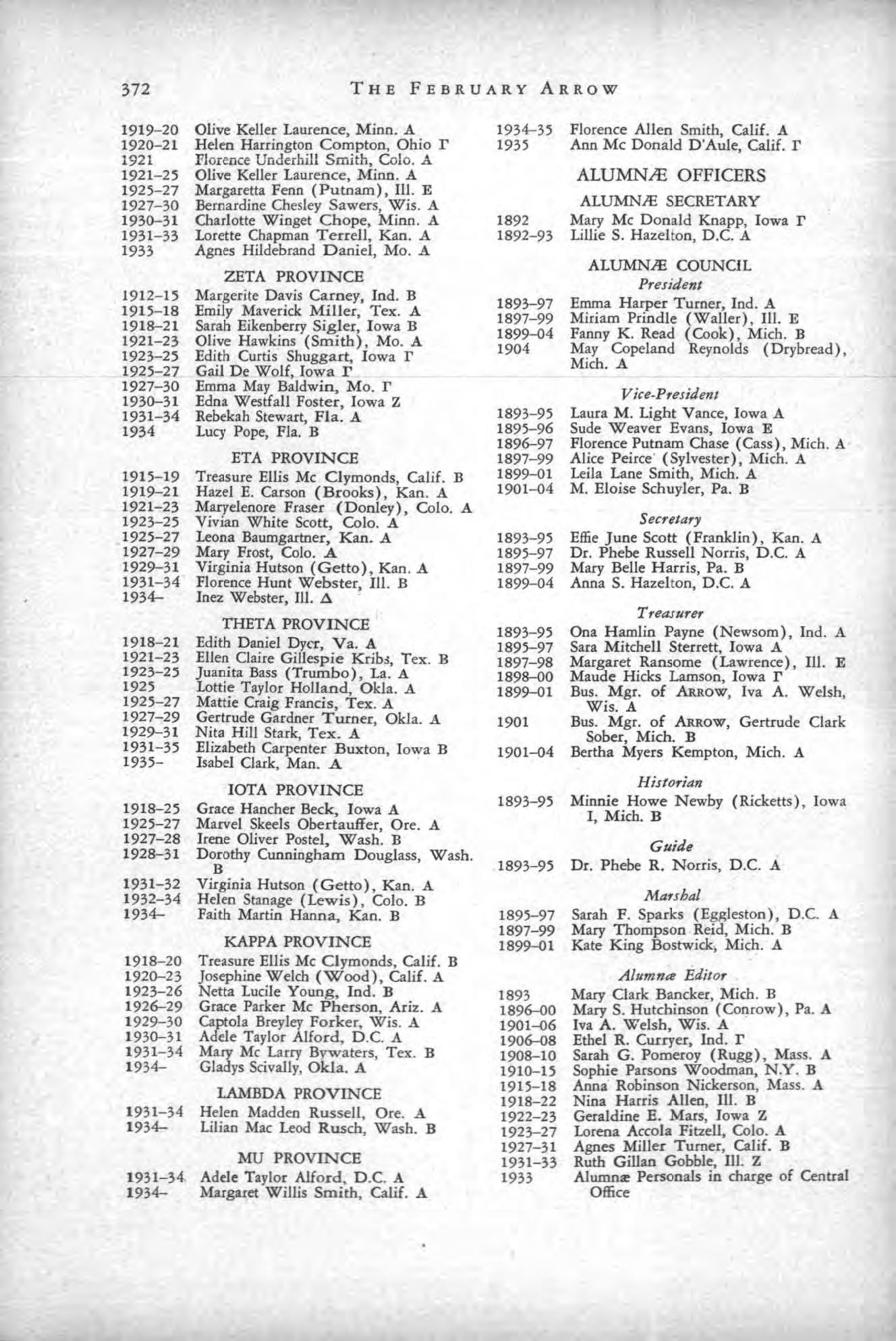
Mary Clark Bancker, :Mich B
Mary S . Hutchinson (Conrow) . Pa . A
Iva A. Welsh. Wis. A
Ethel R Curryer, Ind. r
Sarah G Pomeroy (Rugg) , Mass. A
Sophie Parsons Woodman, N.Y. B
Anna' Robinson Nickerson , Mass. A
Nina Harris Allen, 111. B
Geraldine E. Mars, Iowa Z
Lorena Accola Fitzell, Colo A
Agnes MiUer Turner, Calif. B
Ruth Gillan Gobble, III. Z
Alumna: Personals in charge of Central Office
Alllmntr C/d Editor 19H-3 6 Lotta ]ohruoo Weir, Ill. Z
GRAND VlCE.PRESIDENT and SECRETARY TO THE ALUMNA!
1904-07 May Copeland Reynold.< (Dcybread), Mich. A
1908-10 Cora Emilie Marlow (Kerns), Minn .A 1910--12 Anna Jackson Branson, Pa A
192"-26 Olive Keller Laurence, Minn A. 1926-29 Emilie Margaret White, D.C. A 1929-31 Katherine Burr Teller, Colo. A 1931-36 Ruth Barrett Smith, Iowa r
AJIiJlant Jo Grand
1925-26 Emilie Margard: White. D .C. A 1926-27 Kate Freund lll. E 1927-29 Genevieve Herrick Smith, Kan. A 1929-31 Ruth Barrett Smith, Iowa r 1931-33 Jane White Comer, Tex. A
1912-1" Lida Burkhard lardner. Colo. B 191)-18 Nina Harris Allen, Ill. B 19H Becnyce Scott Hwnpluey, III. B 1918-2,. Anna Robinson Nickerson. Mass. A 1934-36 Marianne Rcid Wild, Kan. A
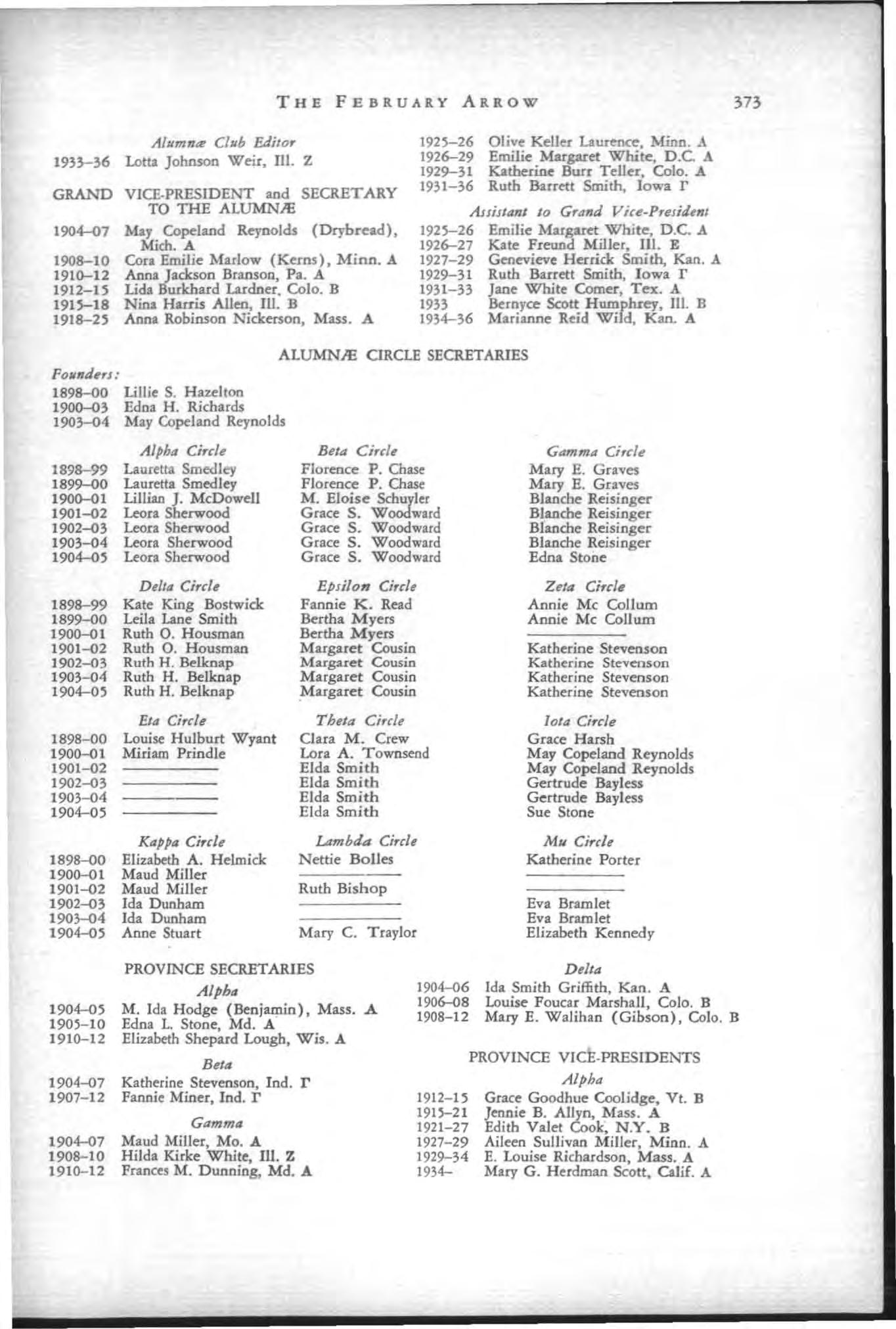
FOII"dus:
1898-00
Lillie S. Hazelton
Edna H. Richards
1903-04 May Copeland Reynolds
Alpba Circle
1898-99 Lauretta Smedley
1899--00 Lauretta Smedley
Lillian t' McDowell
1901-02 Leora S erwood
1902-03 Leora Sherwood
1903-04
Leora Sherwood
Leora Sherwood
Ci"cle
1898-99 Kate King Bostwick
1899--00
1901-02
Leila Lane Smith
Ruth O. Housman
Ruth O. Housman
1902-0; Ruth H. Bellc.nap
1903-04
Ruth H Belknap
Ruth H. Belknap
Ela Ci"cle
1898-00 Louise Hulburt Wyant
19O<Hll Miriam Prindle
1901-02
1902-03
1903-04
Kappa Ci"cle
1898-00 Elizabeth A. Helmi ck
19O<Hll Maud Miller
1901-02 Maud Miller
1902-03 Ida Dunham 1903-04 Ida Dunham Anne Stuart
Bela Cirele
Florence P.
Florence P Chase
M. Eloise
Grace S. Woodward
Grace S. Woodward
Grace S. Woodward
Grace S Woodward
Epsilon
Fannie K Read
Bertha Myers
Bertha Myers
Margaret Cousin
Marga.ret Cousin
Margaret Cousin
Margaret Cousin
Cirele
Clara M. Crew
Lora A. Townsend
Elda Smith
Elda Smith
Elda Smith
Elda Smith
Lambda
Nettie Bolles
Ruth Bishop
Mary C. Traylor
PROVINCE SECRETARIES
A/ph.
M. Ida Hodge (Benjamin), Mas, A. 1905-10 Edna L Stone, Md A
1910-12 Elizabeth Shepard Lough, Wis. A
1904-07
1907-12
1904-07
1908-10 1910-12
Bela
Katherine Stevenson, Ind . r Fannie Miner, Ind. r Gamma
Maud Miller, Mo. A
Hilda Kirke White, Ill. Z M Dunning, Md. A
Gamma Circle
Mary E. Graves
Mary E. Graves
Blanche Reisinger
Blanche Reisinger
Blanche Reisinger
Blanche Reising er
Edna Stone
Cirel.
Annie Mc Collum
Annie Mc ColI um
Katherine Stevenson Stevenson
Katherine Stevenson
Katherine Stevenson
/ola Circle
Grace Harsh
May Copeland Reynolds
May Copeland Reynolds
Gertrude Bayless
Gertrude Bayless
Sue Stone
Mil Cirde Porter
Eva Bramlet
Eva Bramlet
Elizabeth Kennedy
1904-06 Ida Smith Griffith , Kan. A
1906-08 Louise Foucar Marshall. Colo. B
1908-12 Mary E Walihan (Gibson), Colo. B
PROVINCE VlcE . PRESIDENTS A/pha
1921-27
1927-29
1929-34
1934-
Grace Goodhue Coolidge. Vt. B
Jennie B. Allyn, Mass . A
Edith Valet Cook, N.Y. B
Aileen Sull iva n Miller, Minn A. E. Louise Ri chardson. Mass. A
Mary G Herdman Scott, Calif. A
Bela
1918- 20 Mary E. Robertson (Streamer), Colo. A 1912- 1) El sa Schlicht (Conners) , Ohio r 1920-2) HeleD McCargo (Geppert) , M o. B 191)- 18 Louise Van Sant, Md A 19 n -29 Margaret Jackes Ball, Mo. B 1918-2) Marion Baker. Pa . A 1929-31 Florence Barnes Inghram. Jowa Z 192)-34 Frances Carpenter Curtis, Col o. B 1931-3) Hilda Beggs Henry, Colo. B 19 34- Candace Cloyd J o hnson , Ill. H 193)- Winifred Smith Paige, Colo B G amma EJa
19 12 - 1) Lizdte Woerner (Hamt:0n ), Wis A 19 1)- 18 uda Pinkham Wilbur, Iowa Z 191)-16 Harret Briggs (Day). ich. B 1918- 21 Lena Trott Harper, Colo . B
1916-18 Elsa Schlicht (Conners) Ohio r 1921-24 SareIJa Her rick Brewer, Kan . B 1918 - 19 Helen Compt on , Ohi o r 1924-27 Genevieve Herrick Smith, Kan. A 1919-21 Vibert Potts uncan , Mo. B 1927-31 Vaa Wattles Kirkpatrick. Neb B 19 2 1-2 ) Emili e Margaret White. D C A 1931-3) Ruth Nicholas Sutton , Wis n 192)-27 Gertrude Kutzleb. Md. A 193)-36 Dorothy Hunt Dengel , Ill. E 1927-29 Mary Jimmie Pattillo (Tayl or) , Va . A 1936- Hazel Murdock Murlcland, Wis. B
1929-30 Mable Eldredge Bcrnsley, Pla . A
193()-32 tane White Comer, Tex. A. 1932-3 6 mma Drury Sippel , Md. A
1918-21 Emily Maverick Miller, Tex. A. 1936- 5aJly Belle Weller Sydnor, Tex A
192 1-23 Little, Tex A
1923-27 Lucile Blair, OkJa. A 1927-2 9 Nita Hill Stark, Tex A
1912-13 Ross (McEldowney) Mo A 1929-31 Frankie Cochran Hill, Tex. A 19 13- 1) Ed;t Baker (G;duz), Mo B'
1931-33 Lucy How Potter, Minn. A. 19 1)-18 Mildred Steele (Doyle), III. d 193 3- Lawa Storms Knapp, Iowa r 1918-23 Helen M. Wattles , M ich. B l Ola 1923-27 Lulu Mignonn e Zirpel , D C. A 1927-29 Elizabeth Ja ckson Shaffner, Pa. A
1929-31 Ruth Wilson, Ky A
1931-34 Marianne Reid Wild , Kan . A
1934- Aline Morton Burt, Wis. A
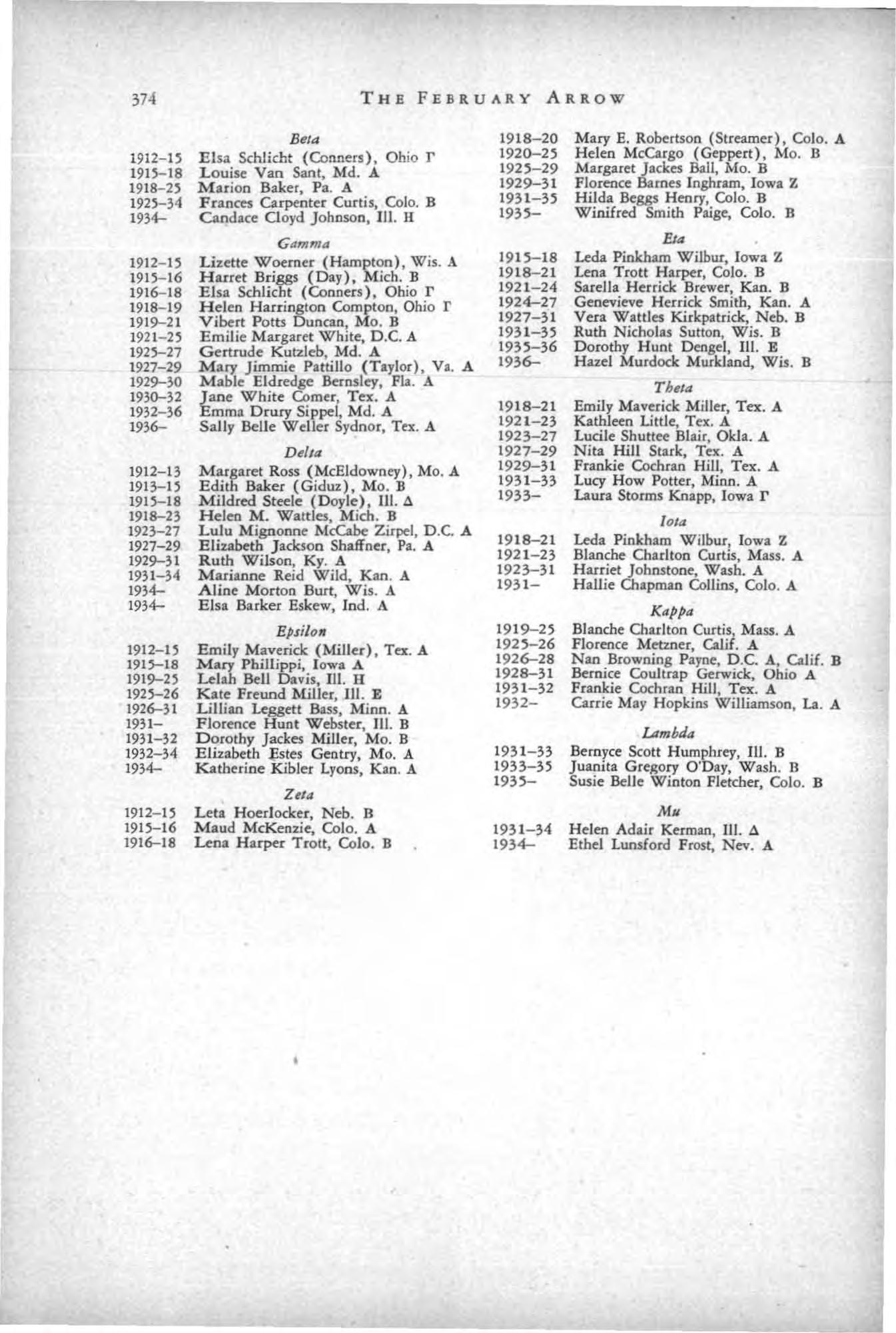
1918-21 Leda Pinkham Wilbur, Iowa Z
1921-23 Blanche Charlton Curtis, Mass. A
1923-3 1 Harrietd Ohnstone, Wash. A
1931- Hallie apman Collins, Colo. A
1934- Elsa Barker Eskew, Ind , A Kappa Epsilon
1912-1) Emily Maverick: (Miller)' Tex A
191r18 Ma3: Phillippi , I owa A
1919-2) ula Bell Davis, 111 . H
1919-2) Blanche Charlton Curtis , Mass. A
192)-26 Florence Mettner, Calif. A
1926-2 8 Nan Browning Payne, D C. A , Calif B
1928-31 lkrnlce CouJtrap Gerwick:. Ohio A 192)-26 Kate Freund M..iller, Ill. E
1926-31 Lillian Leggett Bass, Minn , A
1931- Florence Hunt Webster, Ill. B
1931-32 Frankie Cochran Hill, Tex. A
1932- Carrie May H o pkins William so n, La. A
1931-32 Doro thy Jackes Miller, Mo , B LAmbda
1932-3 4 Elizabeth ,f!stes Gentry, Mo A
1934- Katherine Kibl er Lyons, Kan A
1931-33 Bernyce Scott Humphrey, Ill. B
1933-3 ) Juanita Gregory O'Day, Wash n 193)- Susie Belle Winton Fletcher, Colo, B
1912- 1' Leta Hoerlocke.t. Neb . B Mu
191)-16 Maud McKenzie, Colo , A.
1916-18 una Harper Trott, Colo. B
1931 -34 Helen Adair Kerman , Ill. d
1934- Ethel Lunsford Frost, Nev A
A"A" Society, 9, 10, 13 Adelphean. 9
Allm, Nina Harcis, 201, 24, Alpha (Cha:r.'«) ' '. 61.91.92. 93. 109 liB
AJpha Gran. 107
Alpha Secunda. 106
Alpha Secunda of Illin ois, 107, 111 of Jowa , 107. III of Kansas, 107. 11' Altruistic Projects , 73. 240, 247
Alumn;e, 181, 184, 187. 189, 190, 201, 204, 207, 209. 211. 234. 303 Advisory Committees, 244 Advisory Committees Manual, 312 Association, 304 Chapters, 19. 91, 107, 129, 13'. 167 Certificates, 308 Chaners 102, 103. 303,310, 3U Circles , 306, 307. 3n Club, 312 Club Visits, 213, 31 1, 312, 313,316 Clubs. 306. 30B. 310.311. 314. 3ll. 316 Commjtttt, 303
Conference of Eastt:rn Provinces, 312 Conference in Chicago, 309 Conference of Province Vice - presidents at Gatlinburg, 31:5 Constitution, 304, 31) Conventions, 307 Council, 306, 307, 371 Convention Highlights, 31' Day. I,B
Delegates, 19'. 308, 314 Department, 166. 169. 303 District Gatherings, 3U Dues. 308.309. 314 Editor, 192 ,213, 308, 371 Exhibits at Convention, 3U Internal Development, 31' Manual for Province Vice-presidents . 313 Membership, 222, 314, 3U Meetiogs 193. 308. 311.316 Monthly lett 313 Mother Idea, 312 New York City Club. 310. 312.314 Officers, 371 Organization, 304 Philadelphia Club, 312 Records of Province Work 31' Reorganiution, 213, 308, 313, 314 Rnund Tables. 31'
Alumna: Sterdaey, 169, In, 304, HI Session of Convention, 313 State Conventions, 31' Volunteer Service Cards, 311 War Work, 311 Washington Club, 312 Ways and Means, 316 Work. 316
Work for Settlement School, 311, ..3 12 Amendments, 8' American School at Athens, 247 Amy B. Onken Awards. 347 Anthony, Susan B., 19 Anti -Fra ternity
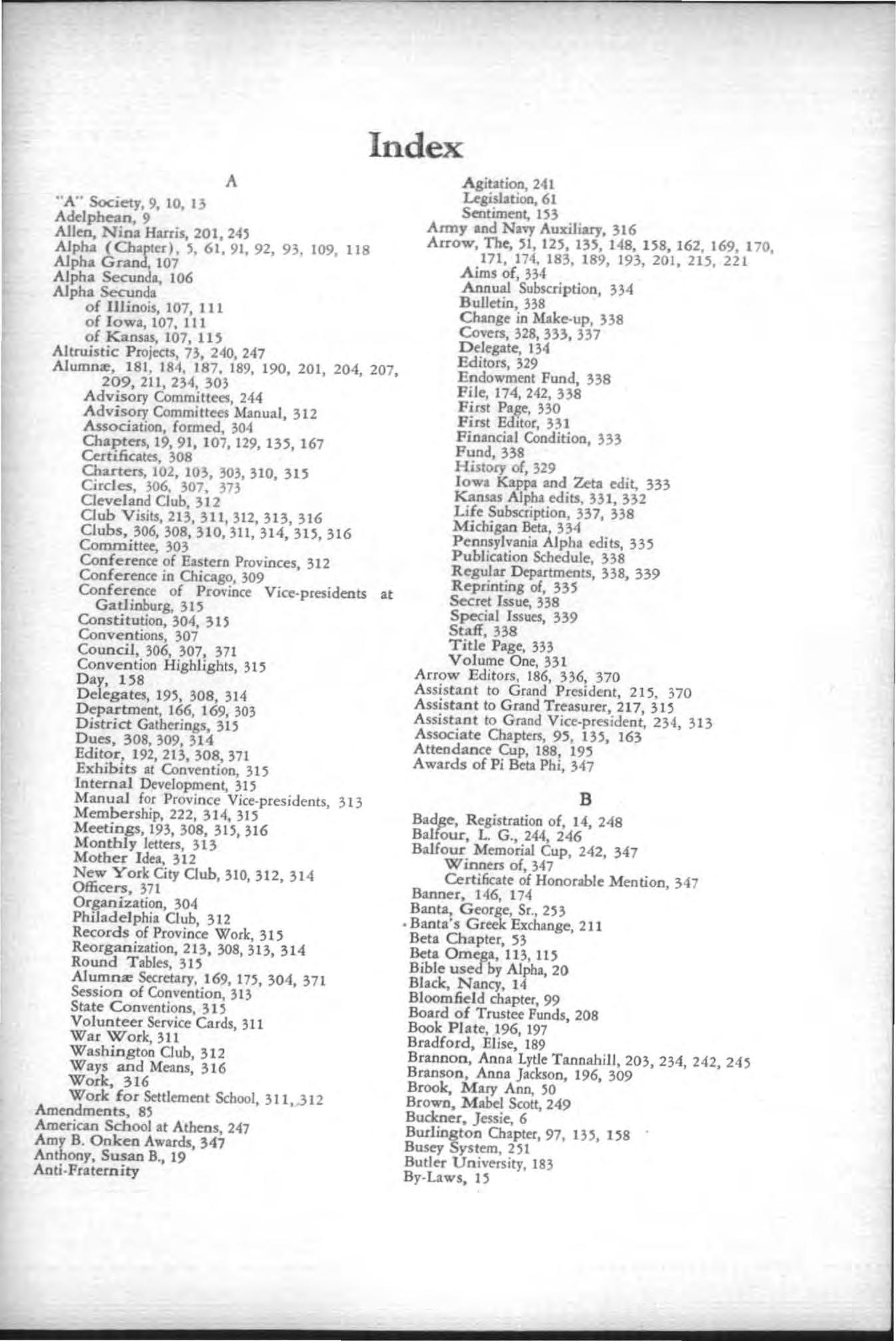
Ag itation, 241 Lrgi.slatioo.,61 IH
Army and Navy Auxiliary, 316 Arrow, The, 'I, 12',13' , 148,08,162, 169, 170, 171. 174. IB3. IB9 . 193. 201 . 211. 221 Aims of. 334
Annual Subscription, 334 Bulletin, 338 Change in Make-up, 338 Cove", 32B. 333. 337 D elegate, 134 Editors, 329 Endowment Fund, 338 Pile, 174,242, 338 First Pa$e, 330 First Editor, 331 Financial Condition, 333 Pund.338 Hislory of. 329 low l Kappa and Zeta edit, 333 Kan.sa.s Alpha edits, 331, 332 Life Subscription , 337, 338 Michigan Beta. 334 Pennsylvani a Alph a edits, 33' Publication Schedule, 338 Regular !>q>artment..s, 338, 339 Reprinting of, 33S Secrd Issue, 338 Special Issues, 339 Stalf. 338 Title Page, 333 Volume One, 331 Arrow Editors, 186, 336. 370 Assistant to Grand President, 21', 370 Assi.stant to Grand Treasurer, 217, 3U Assistant to Grand Vice-president, 234, 313 Associate Chapters, 9', 13' , ]63 Attendance Cup, 188, 19' Awards of Pi Beta Phi, 347
BBadge, Registrati on of, 14, 248 Balfour, L G ., 244, 246 BaJfour Mem orial Cup, 242, 347 WinnttS of, 347 Certificate of Honorable Mention, 347 Banner, 146, 174 Banta , George, Sr , 2'3 • Banta', Greek Exchange, 211 Beta Chapler, '3 Beta Omega, 113, 11' Bible used by Alpha, 20 Black, Nancy, 14 Bloom6eJd chapter, 99 Board of Trustee Fund.s, 208 Book Plate . 196. 19 7 Bradford, Elise, 189 Brannon, Anna lytle TannahiJl, 203, 234, 242, 24, Branson , Anna Jackson, 196, 309 Brook, Mary Ann. '0 Brown. Mabel Scott, 249 Buckner. Jessie, 6 Bwlington Chapter, 97 , 13', ISS Busey System. 211 Butler Unive1"sity, 183 By-Laws, l'
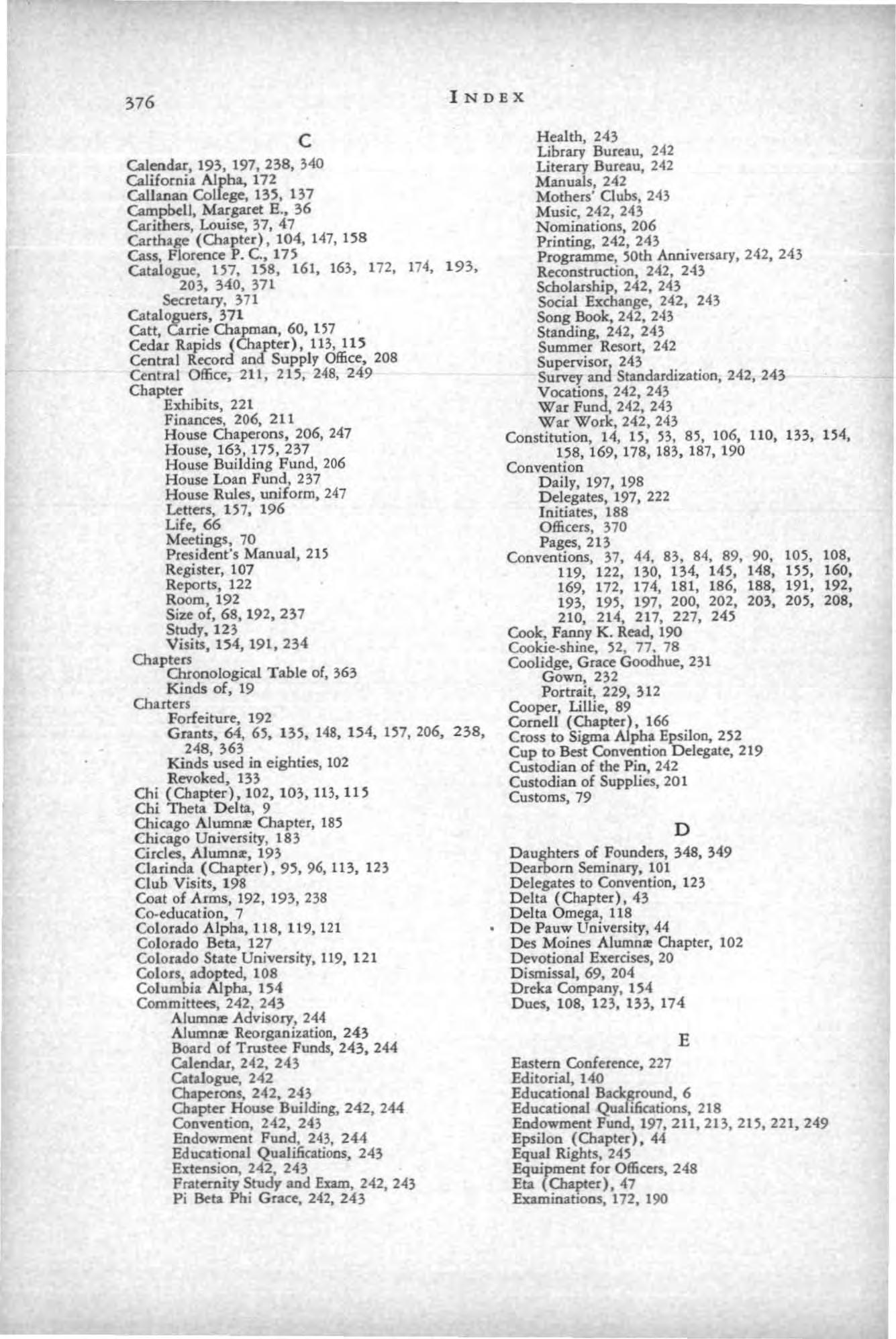
Calendar, 197, California Alpba, 172
CaIlUlan College, 13S, 137 Campbell, Margaret E., 36 Carithers, Louise, 37, 47 (Chapter), 104, 147, IS8 Cass, Florence P. c.. 17 S, Catalogue, 1)7, ISB, 161, 16l, 172, 174, 340, Secretary, Cataloguers. 371 Catt, Carrie Chapman, 60. 07 Cedar Rapids (Chapter), 113, US Central Record and Supply Office, 20B Cenual Office, 211, 2lS, 249 Chapter Exhibits, 221 Finances. 206, 211 House Chaperons, 206, 247 House, 163, 17S" 237 House Building Fund, 206 House Loan Fund, 237 House Rules, uniform, 247 Letters, 1l7, 196 Life, 66 Meetings, 70 President's Manual. 2U Register, 107 Reports, 122 Room , 192 Size of, 68. 192 , 23-7 Study, 12l Visits, 1'4, 191, 234
ChaptersChronological Table 0(, Kinds of, 19 Chuters Forfeiture. 192 Gcants. 64, 6'. 13'. 148, 1'4, 1".206, 238 , 248, Kinds used in eighties, 102 Revoked , 13l Chi (Chapter), 102, 10l, Ill , 11 S Chi Theta Delta, 9 Chicago Alumnae o,apter. 18' Chicago University, 183 Circles, AJumnz, 193 Clorinda (Chapter), 9S, 96, 12l Club Visits, 198 Coat of .A.rms, 192, 193, 238 7 Colorado .Alpba, 118, 119, 121 Colorado Beta, 127 Colorado State University, 119, 121 Colors, adopted, 108 ColumDi. Alpha, 1'4 Committees, 242, 243 Alumne Advisory, 244 Alumne Reorganitation, 243 Board of Trustee Funds, 243. 244 Calendar, 242, 24l Catalogue, 242 Olape:roos, 242, 243 Chapter House Building, 242, 244 Convention, 242, 243 Endowment Fund, 243, 244 Eduatiooal Qualifications. 243 Extension, 242, 243 Fraternity Study aod Enm, 242, 24l Pi Beta Phi Grace, 242, 243
Health, 24l Library Bureau, 242 Literary Bureau, 242 Manuals, 242 Mothers' Gubs, 243 Music, 242, 243 Nominations, 206 Printing, 242, 243 Programme, 'Otb Anniversary, 242, 243 Reconstruction, 242, 243 Scholarship, 242, 243 Social achaoge, 242, 24l Song Book, 242, 24l Standing, 242, 243 Summer Resort, 242 Supervisor 243 Survey and Standardization, 242, 243 Vocations r 242, 243 War fund, 242, 243 War Work, 242, 243 Constitution, 14, U, H, 8S, 106, 110, 133. U4, IS8, 169, 178, 183, 187, 190 Convention Daily, 197, 19B Delegates, 197, 222 Initiates, 188 Officers, 370 Pages , 213 Conventions, :P. 44. 83, 84. 89, 90, 10'. 108, 119 , 122, 130, 134, 14S, 148, IS', 160, 169, 172 , 174, 181, 186, 188 , 191, 192, 193 , 19S. 197, 200, 202, 203, 20', 208, 210, 214, 217, 227, 24S Cook, Fanny K Read, 190 Cookie-shine, n, 77. 78 Cooljdge, Grace Goodhue, 231 Gown, 232 Portrait, 229, 312 Cooper, LiIJie, 89 Cornell (Chapter), 166 Cross to Sigma .Alpha Epsilon. 2,2 Cup to Best Convention Delegate, 219 Custodian of the Pin, 242 Custodian of Supplies, 201 Customs, 79
Daughters of Founders, 348, 349 Dearborn Seminary. 101 Delegates to Convention, 123 Delta (Chapter), Delta Omega, 118 De Pauw University, 44 Des Moines Alumnz Chapter, 102 DevotionaJ Exercises, 20 Dismissal, 69, 204 Dreka Company, U4 Dues. 108. 123. IH, 174
EEastern Conference, 227 Editorial, 140
Educatiooal J!adcRround. 6 EducationaJ Quali1icatioos, 218 Endowment Fund, 197,211,213 , 21S, 221. 249 Epsilon (Chapter), 44 Equal Rishts, 24S Equipment for Officers, 248 Eta (Chapter), 47 Examinations, 172, 190
Executive Councils. 206 2'2 Extension. 39, 48. 98. 107, 164. 16'. 171. 172, 189, 191,236 Extra-Curricular Activitits, 21' F
Fairfield (Chapter), 113, IU, U8 Fellowship Endowment Fund. 249. 342 Fellowships. 342 Holders of, 343 Furis, Julia (Hubbs), 104 Fiftieth Anniversary Convention, 196. 197,200 Finances, 221 Fines, l23 First Charter, 40 First Initiate, 37 First Special Tuin, 198 Flag, adopted, 163, 183 Flower, 1". 1'8, 183 Founding, 19, 180 Founders, 20, 16',2'4
Daughters and Granddaughters of, 348 349 Memorials to, 2'6
Signatures of, 2'6 Founders' Day, 163. 208, 311 Frank.Hn College, 141 Fraser, Chancellor, 77 Frattrnities, 71 Fraternity Study, 23'
GGadd;s, Ubb;e Brook, 32,44, 190, 209,2)4 Gamble, Elizabeth, 190 Gamma (Chapter), 39,41 Gamma Omega, 117 Gault, Mary "Sis." 13, 37 Gavel, 182 Goddess, U), U8 Graod Alpha, 106, 14), I)), 1)7 Grand Council, 123 238 Grand Guide, 187 Grand Presidents, 370 Annual Message, 183 Grand Scribe. 370 Grand 5«retaries, 370 Gra.nd Treasurers, 370 Bond, 19)
Grand Vice-president, 308, 309, 373 Granddaughters of Founders, 348. 349 Greek: Letters, 131 Greek: Motto, " 14
Greck Name, 124, 137, 146, 149 Grier, Ada Bruen, 9, 2', 26 Grip, 14 Guard fort;n Gran Council, 244 Province Officers, 244
Hallowe'en, 76 Handbook for Study, 1)7, 1)8, 211 Hat -ba nd, 237
Hazelton , Anna S., 1'9 Health Committee, 211 Health Program, 203, 246 Health Trophy, 246 Hebard, Grace R ., 103 H ;gh School aause, 8), 88 H;gh School RuHng, 130
H;Jlsdale College, U9 Historian, 1'8 Historians, 371 H;'torr, 1)4, 1)7, 183, 187 Historical Pageant, 196 Historical Play, 201 lfutoriaJ Publjatioos. 340 Historical Sketch, 193 Holt Home. 1, H onor Guest of Convention, 217, 220 Honorary Membership, 19, 136. 147, 1'8, 1'9 Huff, Matti e, 2'3 Hutchinson, Clara Brownlee. 29, 2'4
Founding, " 9 Meaning, 108 lIJinois Alpha, 2Il, 246 Illinois Beta, 49 I Illinois D e lta, lOl, 117,1'3 JIlinoi! Epsilon, 172 Incorporation, 147, 1'0, 1'4 In Tennessee, 248 Indiana Alpha, 141 Indiana Asbury, " 44 Indiana Gamma, 183 Indiana Reunion, 180 Indiana &minuy. 4, Indiana Unive:rsJty, 47 Individual Development, 240 Initiation, 69. 74, 111, 200 Ceremony, 1'9. 169 Certificate, 178 Fee , 200 Gown. 193 , 19'. 238 Model,18Z No Sunday, 246 Installation fee , 2 n Internal Development. 245 IDte.r.Sorority Confereoce, 190, 191 Iota (Chapter) , 6, 49 Iowa Alpha, 39, 41, 1)3 Iowa Agricultural C o llege 58 Iowa Brta. '4, 1H. 1)4 Iowa City Alummr Olapter. 118 Iowa Gamma, '8, 1B, 172 Iowa Iota, 172 Iowa Lambda, 137 Iowa Sigma, 11' Iowa State University, 102, 103 Iowa Wesleyan University, '. 39 Iowa Zeta, 102
J. C $orosis
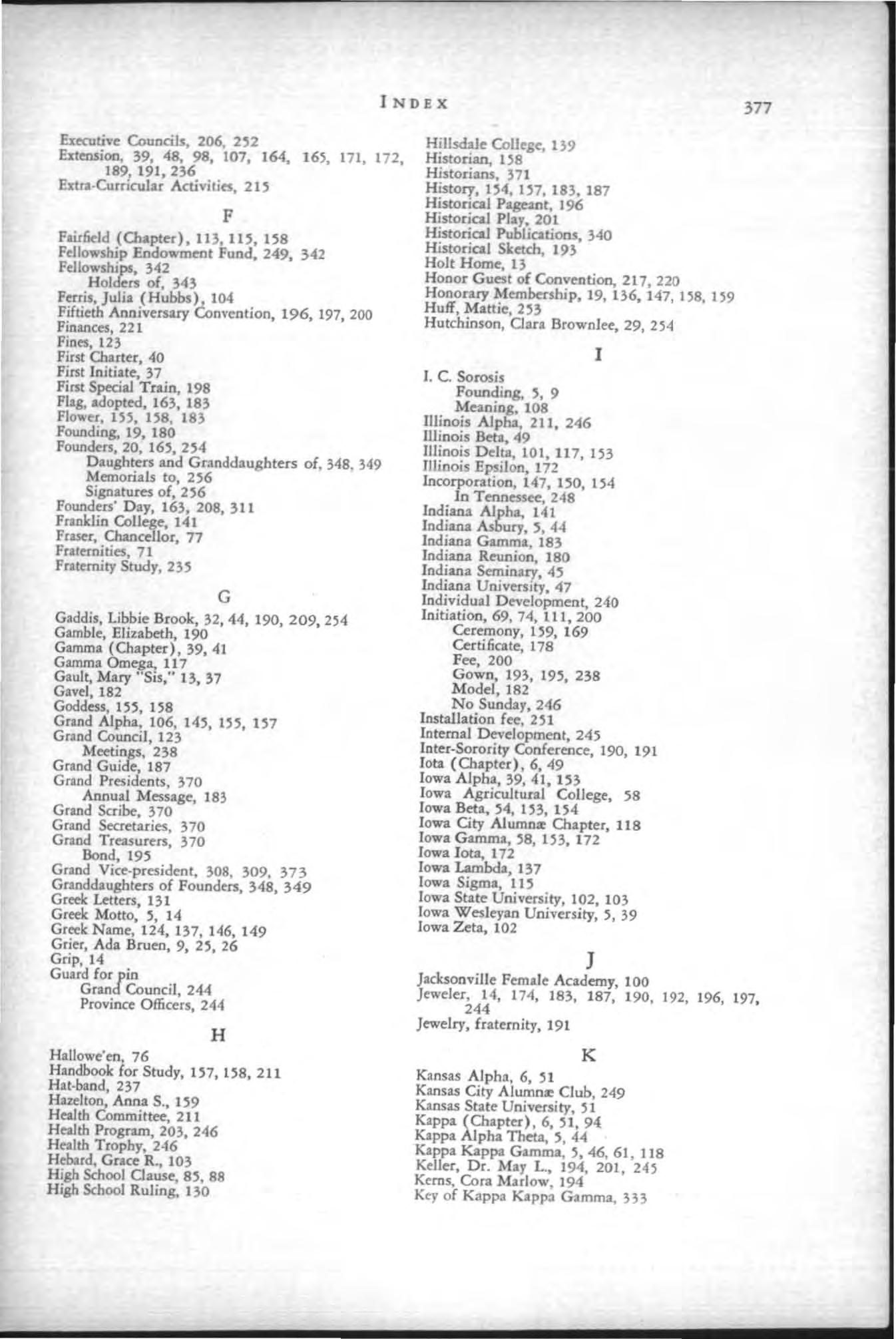
JJacksonville Fema.le Academy, 100 Jeweler, 14, 174, 183, 187, 190, 192, 196, 197, 244 Jewelry, fraternity, 191
KKansas Alpha , 6, '1 Kansas City Alumnz Club, 249 Kansas State University, n Kappa (Chapter), 6, )1, Kappa Alpha Theta, ), 44 Kappa Kappa Gamma, ,. 46, 61. 118 KeJler. Dr May L. 194, 201, 24' Kerns, Cora Marlow, 194 Key of Kappa Kappa Gamma 3;3
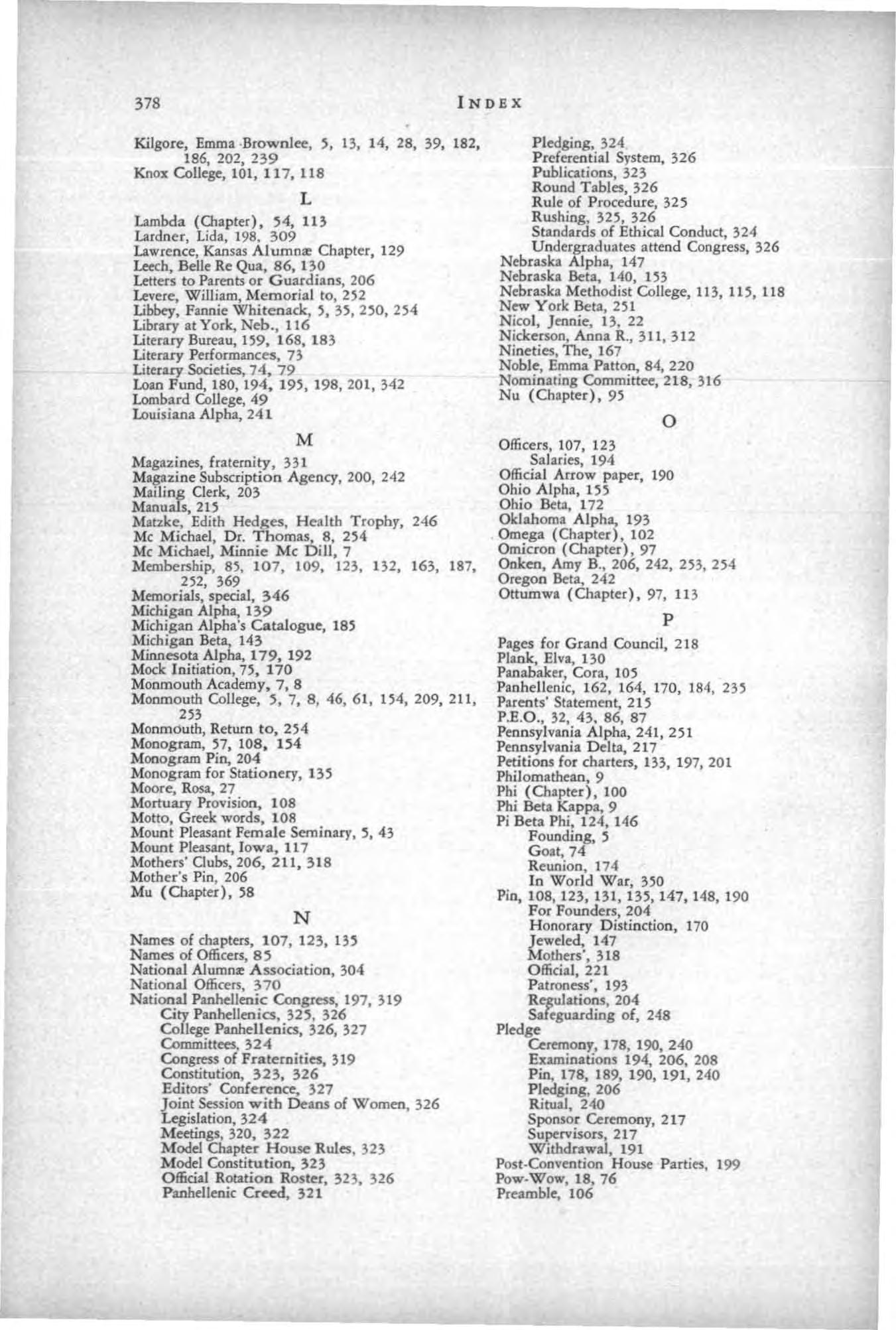
Kilgore, Emma Brownltt 13, 14, 28. 39. 182, 186, 202, 239 Knox College, 101 , 117, 118
Lambda (o,apter), 54, IH Lardner, Lida, 198. 309
Lawrence, Kansas Alumn1r Chapter. 129
Leech, Belle Re Qua, 86, 130
Letters to Parents or Guardi ans, 206
Levere, William , Mem o rial to, 2,2
Libbey, Fannie Whitenack, S. 3'.2'0. 2,4 Library at York, Neb., 116 literary Bureau, 1'9. 168, 183 literary Performances, 73 Literary Societies, 74. 79
Loan Fund, 180 , 194, 19'. 198, 201, 342 Lomb"d College, 49 Louisiana Alpha, 241
Magazines, fraternity , 331 Magazine Subscription Agency, 200, 242 Mailing Clerk, 203 Manuals, 21'
Matzk e, Edith Hedges, H ealth Trophy. 246
Me Michael, Dr. Thomas , 8, 2)4
Me M ichael, Minnie Me Dill , 7
Membership 8'. 107 109. 123, 132, 163. 187, 2)2, 369
Mem orials, special, 346 Michigan AJpha, 139 Michigan Alpha 's Catalogue, 18, Mi chigan Beta, 143 Alpha, 179, 192
Mock. Initiation, n, 170
Monmouth Academy, 7, S Monmouth College, " 7, 8 , 46,61, 1)4, 209, 211, 2)3
Monmouth, Return to, 2)4
Monogram , )7, 108. 1,4
Monogram Pin, 204 Mon ogram for Stationery, 13S Moore, Rosa, 27 Mortuary Provision, lOS Motto, Grttk words, 108
Mount Pleasant Female Soninary, S, 43
Mount Pleasant. Io wa. 117 Mothers' Clubs, 206, 211, 31S Mother 's Pin, 206 Mu (Chapter). )8
Names of chapters, 107, 123, 13'
Names of Officers, 8, National Alumnz: Ass ociation, 304
National Officers, 370 National Panhe1lmic Congress, 197, 319 City Panhellcnics, 32'. 326 College Panhellenics, 326, 327 Committees, 324 Congress of Fraternities, 319 Constitution, 323, 326 Editors' Conference, 327 Joint Snsion with Deans of Women, 326 Legislati on, 324 Meetings , 320, 322
Model Chapter H ouse Rules , 323 Model Constitution. 323 Official Rotation Roster, 323 . 326 PanheJlenic Creed, 321
Pledging, 324
Preferential System, 326 Publications, 323 Round Tables, 326 Rule of Procedure, 32' Rwhing , 32), 326 Standards of Ethical Conduct, 324 Undergraduates attend Congress, 326 Nebraska Alpha , 147 Nebraska Beta, 140, 1S3 Nebraska Meth odist College. 113, US, 118 New Y ork Beta, 2, 1 Nicol, Jennie, 13, 22 Nickerson, Anna R., 311, 312 Nineties, The, 167 Noble, Emma Patton, 84, 220 Nominating Committee, 218, 316 Nu (Chapter), 9)
Officers, 107 , 12 3 Salaries, 194 Official Arrow p aper, 190 Ohio Alpha , 1)) Ohio Beta, 172 Oklahoma Alpha, 193 Omega (Chapter), 102 Omicron (Chapter) , 97 Onken, Amy B., 206, 242, 2)3, 2,4 Oregon Beta, 242 Ottumwa (Chapter), 97, 11 3
Pages for Grand Council, 218 Plank, Elva, 130 Panabak er, Cora, 10' Panhellenic, 162, 164, 170, 184, 23' Parents' Statement, 21S P.E .O., 32, 43, 86, 87 Pennsylvania Alpha, 241, 2S1 Pennsylvania Delta, 217 Petitions for charters. 133. 197.201 Phil omathean, 9 Phi (Chapter), 100 Phi Beta Kappa, 9 Pi Beta Phi, 124, 146 Founding, , Goat , 74 Reuni on, 174 In World War, 3'0 Pin, 108, 123, 131, 13', 147, 148. 190 For Founders, 204 Honorary Distinction. 170 Jeweled, 147 M o thecs', 31S Official, 221 Patroness', 193 Regulation s , 204 Safeguuding of, 248 Pledge Ceremony, 178, 190,240 Examinations 194, 206, 208 Pin, 178, IS9, 190 , 191, 240 Pledging, 206 Ritu al, 240 Sponsor Ceremony, 217 Supervisors, 217 Withdrawal, 191 H ouse Parties, 199 Pow-Wow, 18, 76 106
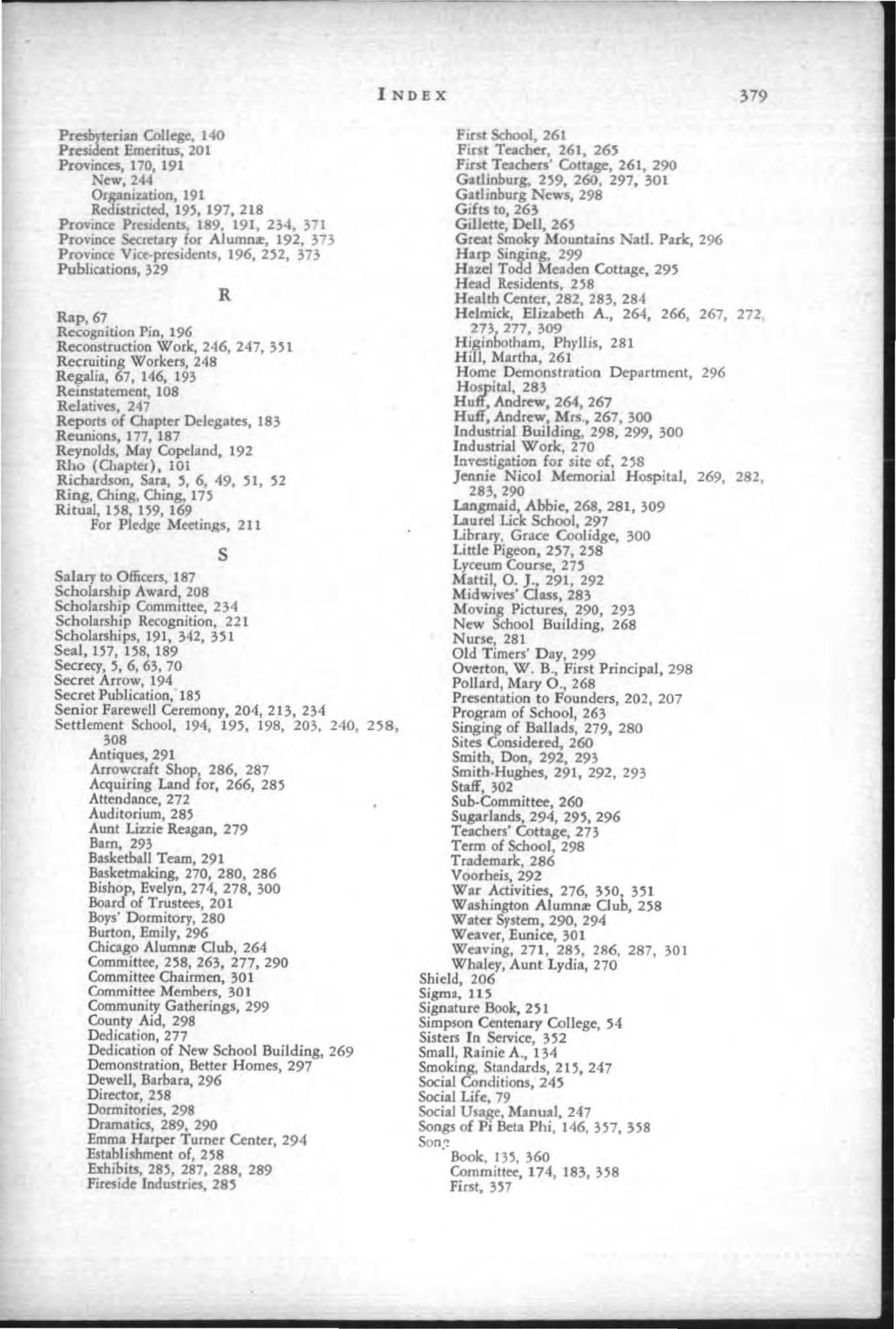
Presbvt.erian College:, 1-40
Pres iden t Emeritus, 201 Provinces, 170, 191 New, 244 Organization, 191 Redistricted, 19'. 197, 218 Province Presidents, 189. 191, 234. 371 Province for Alumnz, 192, 373 Province Vice-presidents, 196, 2'2, 373 Publications, 329
Rap , 67
Recogniti on Pin, 196 Reconstruction Work. 246, 247, 3H Recruiting Workers, 248 Regalia, 67. 146, 193 Reinstatement, 108 ReJativH , 247 Reports of Chapter Delegates, 183 Reunions, 177. 187 Reynolds, May Coptland. 192 Rho COlapter), 101 Richardson , Sar., " 6, 49. 51 , ,2 Ring, Ching, Ching, In Ritual, U8, 1)9, 169 For Pledge Meetings, 2 11
Salary to Officers, 187 Scholarship Award, 208 Scholarship Committee, 234 Scholarship Recognition, 221 Scholarships , 191, 342, 3:H Seal, U7 , 1'8, 189 70
Secret Arrow, 194 Secret Publication, 18, Senior Farewell Ceremony, 204, 213, 234 Settlement School, 194, 19), 198, 203, 240, 258, 308 Antiques, 291 Arrowcraft Shop, 286, 287 Acquiring Land for, 266, Attendance, 272 Auditorium, Aunt l.jzzie Reagan, 279 Bam, 293 Basketball Team, 291 Ba.!ketmaking, 270, 280, 286 Bishop, Evelyn, 274, 278, 300 Board of 201 Boys' Dormitory, 280 Burton, Emily, 296 Chicago AlumnI! Club, 264 Committee, 263, 277,290 Committee Chairmen, 301 Members, 301 Community Gatherings, 299 County Aid, 298 Dedication, 277
Dedication of New School Building, 269 Demonstration, Better Homes, 297 Dewell, Barbara. 296 Director, Dormitories, 298 Dramatics, 289. 290
Emma Harper Turner Center, 294 Establishment of, E:rhibits, 287, 288, 289 Fires ide Industries ,
F.rst School, 261
First Teacher, 261, 265
Pint Teachers' Cottage, 261, 290 Gatlinburg, 2)9, 260, 297, 301 Gatlinburg News, 298 G ifts to, 263 Gillett., DeU, 26)
Great Smoky Mountains Natl Park, 296 Harp Singing, 299
Hazel Todd Meaden Cottage, 29:5 Head Residents , 258 Health Center, 282, 283, 284 Helmidc, ELizabeth A ., 264, 266, 267 , 272 273 277, 309 Higin!x;tham , Ph yllis, 281 Hill, Martha, 26 1 H ome Demonstration Department, 296 Hospital, 283 HuH, Andrew, 264, 267 HuH. Andrew, Mrs ., 267, 300 Industrial Building, 298, 299, 300 Industrial Work, 270 Investigation f or site of, 2'8 Jennie Nicol Memorial Hosp ital, 269, 282, 283,290 Langmaid, Abbie, 268, 281, 309 laurel Lick School. 297 Library, Grace Coolidge, 300 Little Pigeon, 2'7, Lyceum Course, 2n Mattil, O. J ., 291, 292 Midwives' Oass, 283 Moving Pictures, 290, 293 New School Building, 268 Nurse, 281 Old Timers ' Day, 299 Overton, W B ., First Principal, 298 Pollard, Mary 0 ., 268 Presentation to Founders, 202, 207 Program of School, 263 Singing of Ballads, 279. 280 Sites Conside.red, 260 Smith, Don, 292, 293 Smith-Hughes, 291, 292, 293 StaJf, 302 Sub-Committee, 260 Sugarlands, 294, 29), 296 Teachers' Cottage, 273 Term of School, 298 Trademarlc:, 286 Voorheis, 292 War Activities, 276, 350. Washington AlumnI! Oub, 258 Water System, 290, 294 Weaver, Eunice, 301 Weav ing. 271, 285, 286, 287, 301 Whaley, Aunt Lydia, 270 Shield, 206 Sigma, 115 Signature Book, 2St Simpson Centenary College. Sisters [n Service, 3'2 Small, Rainie A ., 134 Smoking, Standards, 247 Social Conditions, SodalUr., 79 Social Usage. Manual, 247 Songs of Pi Beta Phi , 146, 3'7,358
. Book, 1n, 360 Commiltet, 174 , 183, 3S8 FirSt , 3'7
Iowa Gamma's Compilation, 3}9 Mary B. Theiss, Editor, ,'9 Michigan Beta ' s Compilation, "9 Pamphlet. 169 Popularity Contest, 362 Ring. Ching, Ching. 3'8 Two·Step. 187 Vase, 209 Sotosis, 1,8
Soule, InN Smith, 34, 220 Southern Jowa Normal, 99 Stanton, Cady, 19 Sterrett. Sarah M., 43 Stoolman Vase, 347 Winners of, 347 Student Volunteer Conferences, 247 Supervisor of Olapter Accounts, 2)1 Survey, Committee on, 200 Suspension, 21' Sutliff, HeJen, 174 Swisher, Nell G Custer, 122 Symphony. 193. 194. 238
Tablets to Founders, 221 Tau (Chapter), 101 Theta Omega, 98 Thirtieth Anniversary, 180 Thomson, Fannie A " 22 Traditions. Early , 7 6 Train, Pi Beta Phi Special. 186 Transfers. 147, 181, 200 , 242, 247 Transient Chapter. 247 Traveling Delegate, 187 Treasurer's Book, 193 Troth, Mira, 132 TurnbuU, Jennie Horne, 9. 30 Turner, Emma Harper, 146, 157, 207, 217 , 304, 306 Trust Agreement, 215
Undergraduate Loan Fund, 345 Uniform Accounting System. 208, 211, 251 Uniform House Rules, 246
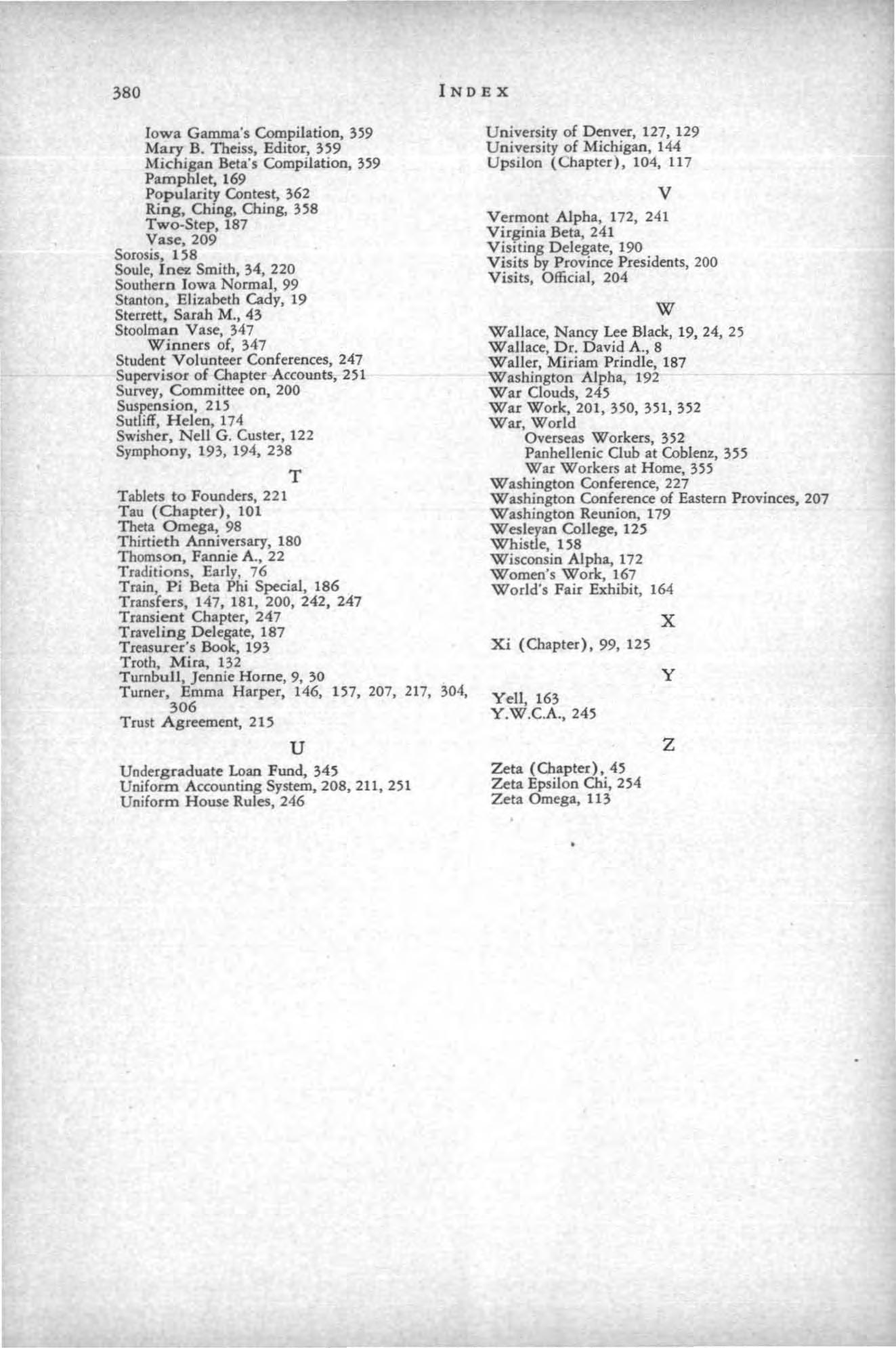
University of Denver, 127. 129 University of Michigan, 144 Upsilon (Chapter), 104, 117 V
Vermont Alpha, 172, 241 Beta, 241 VisIting Delegate, 190 Visits by Province Presidents, 200 Visits, Official, 204
WaJlace, Nancy Lee Black, 19.24, 25 Wallace, Dr. David A., 8 Waller, Miriam Prindle, 187 Washjngton Alpha, 192 War Clouds, 245 War Work. 201 . 310. 311. 312 War, World Overseas Workers, 352 Panhellenic Club at Coblenz, 355 War Workers at Home, 355 Washington Conference, 227 WashingtoD Conference of Eastern Provinces, 207 Washington Reunion, 179 Wesleyan Collese. 12l WhistJe, 158 Wisconsin Alpha, 172 Women's Work, 167 World's Fair Exhibit, 164
Xi (Chapter). 99 121
Yell. 163
Y.W.C .II .• 241
Zeta (Chapter). 41 Zeta Epsilon Chi, 254 Zeta Omega, 113 x y z
When you change your address for THE ARRow please fill out the following form and mail it at once to Pi Beta Phi Central Office, Marshall, Ill.
NOTE: Mailing list closes September 1, November 1, February 1 , May 1. To have THE ARROW forwarded , ask the person forwarding to attach sufficient postage to the wrapper . Otherwise the Post Office returns it to the Central Office.
If your ARRow is returned on accouot of an incorrect address, it costs the fraternity 15¢. Please remember to send in your correct address when you move.
All orders accompanied by ch«k or money order must be sent to Sarah J. Fi sher. )04 E. Ouid St., Champai, n , lIliMis. Whe[] ordering badin please l ive name of your CHAPTER.
A-Oflic ia l Pl a in D.dae ,
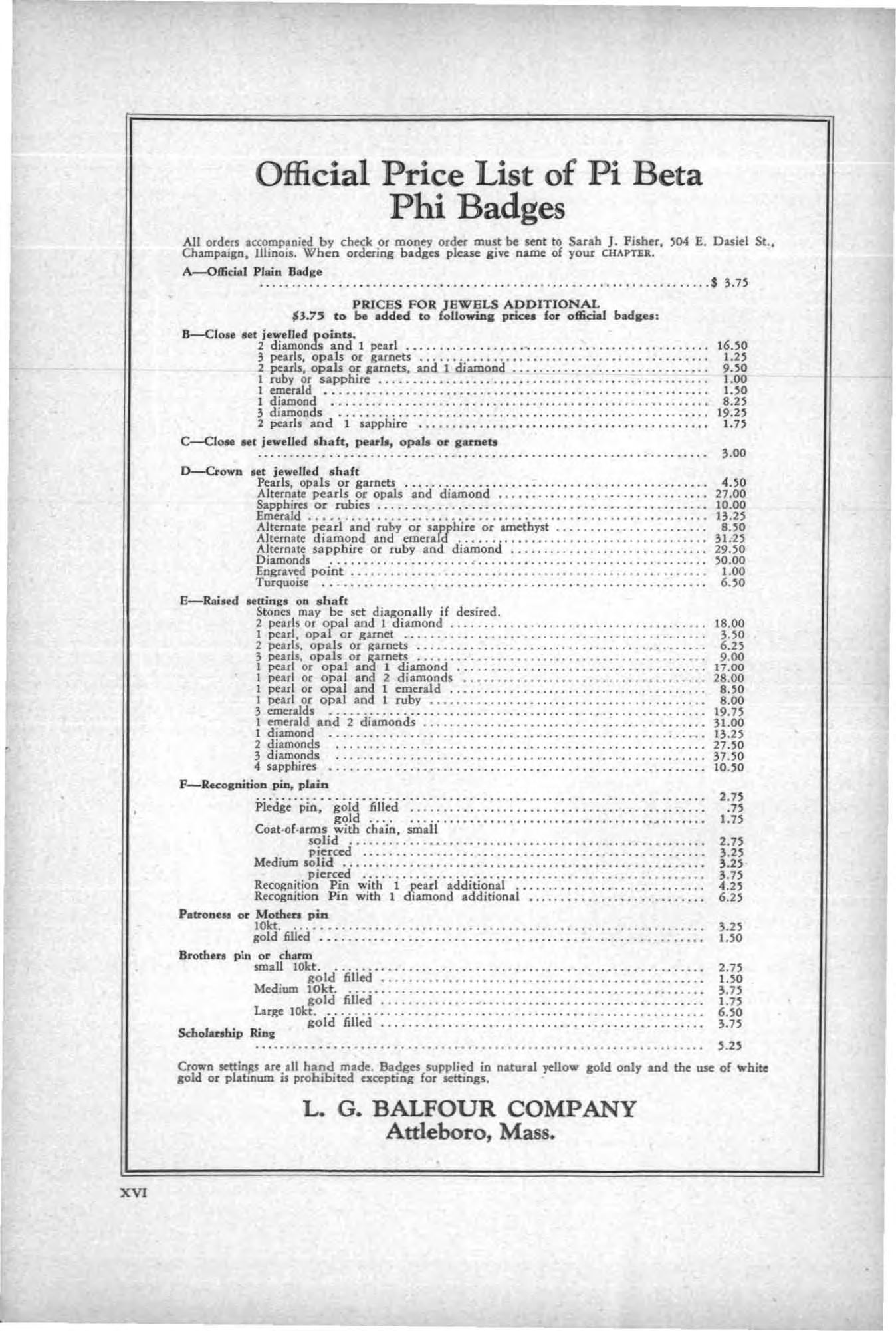
, $ ).7'
PRICES FOR JEWELS ADDITIONAL '3 7:5 to be .dded Co followina: pric 1M official bad • .,.;
&-Cl o e t 1
3 pearl•• o pau or garnets
2 pcaili, opals or garnets, and 1 diam o nd
1 ruby o r sapphire ' _
1 cmerald •.
I diamond
3 diamonds .............................••..•.•.........
2 pt'.rls and 1 sapphi r e
C-CIOM Ht jewelled ahaft, peart., opal. or lanUb
D----Cown
E-Raiud Id jewe ll ed .haft
Pearls, opals o r garnets ..•.
Altern te pea.rls or opa ls an d diamond
Sapphires or rubies •......•.............•...........•....
Emerald ..............•....•..
Altern.te pea rl and ruby o r sapphi re or amethyst
Alternate di2mond .nd emera ld .........................•............
A lternate sap phire or ruby and diamo nd
D iamonds
Engraved point. .' ' Turquoise ..................•...............
u ttin g 0 11 haft
Stones m2y be set diagona ll y if desired.
2 pt'aris or opal and I diamo nd
I pe.r1. opal or g.rnet
2 pearls. o p als Of ,!t2rnets
3 pearls. opa ls or R.rnct5 ....................•.......•
I pead or o pal and 1 diamond..
I pearl or o pal and 2 di2monds
1 pearl or opal and 1 emera l d
1 pearl or opal 2nd 1 ruby
3 emeralds ....•.............
I I."Intrald and 2 diamonds
I diamond
2 diam onds
3 diamonds
s2pphires
F-Reco,nitioD pia, plaiD
gold
C02t·of·arms with cha in. small so lid
Recognition Pin with 1 pearl
Crown se«in,gs .u: .U hand made. Badges supplied in n.tur.l yellow gold onlT and the usc of white lo ld or pl ati num is prohibited exceptiDll for sett1nls.
BY GRAND PRES1DENT:
Blink applications IOf the fellowship, Blank
Blank notllkatlOU of fines to Corrcspolldiag S«ntary.
Blank noti6cation of lines to Grand TrHJUffr. VOlin« blanltt for chapten on Itlnting of charten;, Votln, blinks for Grind Council.
BY GRAND VICE· PRESIDENT:
Blank applic.tions lor a1umrul: club charters. Charters fOr alumme dubs.
BY GRAND SECRETARY ;
Key to fr.te:rnity cipht'r
Lst of allowed experuu to tbOM: trawling 00 fnkeruty bWio""
BY
Alumn.: Advisory Committee Manual. nco
Alumnz Club Model Constitution. 2x.
Alumnz Club Officers' Manuals.
Blanks for ICknowlcdgin, letters of recommendation. 1)c per 2).
Blanks for affiliation.
Blanks {or broken pledlc, Blanks {or chaperonage.
Blanks for chaperons.
Blanks for chapter annuli report, due May 1.
Blanb {or chapter dUH.
Blanb for credentials to Convention Blanlu for honorable dismissal.
Blanks for upulsion.
Blanlts for fraternltf study and examination.
Blanks for lists of alumnllt advisory committee.
Blanks for lists of alumnae club officers.
Blanu for lists of chapter membcts at the: be.inning of each term
Blanu for lins of chapter members not returning to college at be,ltinning of each term.
Blanb for lam of chspter officers at bqinnin& of each term
Blank membershIp certificates (Lost ones replaced, )OC each)
Blanks for officers' bills.
Blanu for r«ommendation. 1 'C per 2'.
Blanks for te·instatement.
Blanb for JCholanhip re-ports.
Blanb for Blanks for transfer.
Blank initiation certificates.
Book of Initiates' Si,ltnatulfl: (formerly called Bound ConstitutIon). ".00 each.
Book of Pled,ll;es' Signatures. $3 00 each.
Candle Li,tjhtin,tj Ceremony, cards.
Chapter file cards, 3 x , inches (in lots of not leu th.n 100), "c per 100 , Chapter lile instruction booklet. 1 'C elch. Ch.pter Mann.1. I)c each. '1.,0 doz.
Chap(er Oftictts ' Manuals (for Praident. V ice·Presi· dent, Conftpondioa Sc<rctarr, Historian, Treasurer. Pled,:e Supervisor). 2)c each.
Chapter Presidenu' Reference Binder. '1.n. Ch.pter Recordin& Secretar)'" Book. '3.)0. ConstItution. }OC each Directory. '2 .) 0 e.ch. Dumlssal Binder. '3.,0. Fin.ncial statement to p.rents of plcdRes Historical PI.y. 'Oc each. History of the Sdtkmcnt School, 1927. :l0c House Rula. Initi.tion Ceremony. l,c each. $1.'0 pet dozen. IMll\Ictions to visitinc officers. Letters to chapter and cbapetoo,. Utters to parents of pledges. Manual of 500al Usage. 2,c.
"My Seven Gifts to Pi Ikta Phi." :Ie each. :l0c per do
National Committee Manusls.
Official Anow chapter lettet stationtry. 1:Ic per 2:1 .."".
Offici.1 ColttSpondcnu statioocr)'. '00 and '00 enw.lopcs. 1).'0
Order forms for official badges and jewelry. 'Oc plus postlj:e. p.ttetn fot model initiation gown. :l0c.
Pi Beta Phi Book PI.tes. 'l.,O per hundred.
Pi Bet. Phi Symphony. lOe e.ch.
Pledge M.nual. I,c each. ,1.,0 dozen.
Pledge Ritual. 20c per dozen.
Pledging Ceremony lOe each. '1.00 pet dozen. Rtceipts fOt Province Vice·Presideot.
Record of Membership. full le.ther ' 10.00
Ribbon: Orders fot wine and blue ribbon may be ob· tained in both ,hades in three widtbs t the follow. illl: prices :
No.2, % inch wide, lOe pet yard.
No.3, % inch wide. I)c pet yard.
No. 40, 1 inches wide, <l0e per yard.
Ritu.1. 20c pet dOleo.
Rusb Captain Maoual. l'c each.
Senior Applications for Membcnhip io AlumolP: Club. Senior Farewell Ceremooy. I)c each.
Songs of Pi Ikts Phi. '1.'0. Stud, Aids. :Ie each.
The Wishing Well-A Playlet. 1:Ic.
Uniform Re&;u l.tions Governing Chapter House Chap. erons.
BY CHAIRMAN OP EXTENSION COMMITTEE:
Instructions to petitioning ,toups.
BY CHAIRMAN OP ARROW PILE COMMITTEE :
Duplicate copies of AlUlo files.
BY ARROW EDITOR:
Auo Handbook (or Correspoodin, Secretaries
BY FLANIGAN· PEARSON. PRINTERS, Champsi,n, HI. BI.nks fOr moothly ch.pter accounts. XVII
The Arrow: Official magazine of the Fraternity. Published in September. Novembrr, February, and May. Subscription price $1.'0 a year; single copies, 50 cents; life subscriptions $1).00. Sa1d subscriptions to Pi lkta. Phi Central Office, Marshall,I1linoi.s
Order the following through Pi Beta Phi Central Office, Marshall, Illinois
The Pi Beta Phi Directory : 1934 edition . Price $1.'0 a copy.
The Pi Beta Phi Symphony: Artistically lettered in gold on a decorated card. Price 30 emts.
liMy Seven Gifu to Pi Beta Phi ": Printed on stiff cardboard; , cents och '0 cents per dozen.
The 1931 Pi Beta Phi Songbook. Price $1.:W.
Historical Play "I. C Sorosis." '0 cents each.
Pi Beta Phi Ribbon: (See page on Fraternity Supplies )
Pi Beta Phi Bookplates (See page on Fraternity Supplies.)
Order the following direct
Pi Beta Pbi Vanilla. Excellent way to raise money. Six ounce bottle retails for 7} ccou For full particulars and special rates write Mes Ashford M. Wood, 201, Jarvis Avenue, Chicago, Ill
Pi Beta Phi Handerchids : Orders shouJd be sent to Mn. 1. E Scott, 2309 Summit Ave , Little Roclc, Ark. Handkerchiefs, 12x12 inches, ,0 cents, 18x18 inches, 7' cenu. Wine and blue, nBc. monogram in romer
Pi Beta Phi Candles: Orders for wine-colored candles may be scnt to the San Jose Alumnae Club.
Pi Beta Phi Wine Carnations. Orders may be sent to Mangel, Florist, Chicago , Ill.
Legal title for \de in making wills: "The Pi Beta Phi Settlement School. of the Pi Beta Phi Fraternity, at Gatlinburg, Tenn."
The badge of your frater· nily worn over your heart is a distinguished emblem. Let it express intrinsically a value like the ideals it so beautifully represents.
Write lor Price LuI
OUR ritu a l s
we are taught Lbat by our conduct we sre to know our fraternity brothers and sisters, but for a quicker means of identification we wear beautiful insignia-
A BADGE wrought in fine gold and gems, on its face the cryptic symbolism we respect . or
A RI G beautifully fash· ioned of gold or silver, bearing the coat of arms of the fraternity.
We are admonished to wear OUI insignja proudly, a distinction and honor only the fraternity man and woman may enjoy.
Only second to the badge in importance as a means of dignified association with your fraternity is a beautiful ring. Many styles are illustrated in the 1936 Blue Book.
W rile for your copy!