Spring 2022 • Southern Alliance
PAGE 14
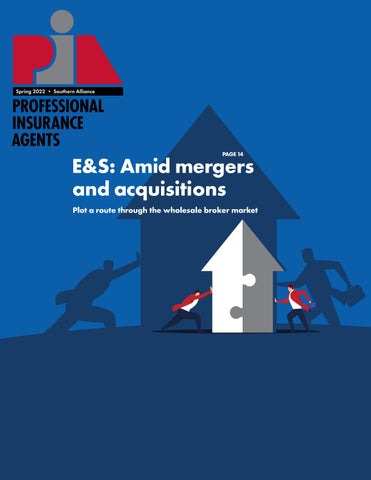
E&S: Amid mergers and acquisitions Plot a route through the wholesale broker market
AGENTS OF
Explorat ion
Tech solutions for you and your customers—now and into the future At Progressive, we’re always thinking about ways to push our business forward with innovations like our leading telematics solutions: Snapshot® for personal auto and Snapshot ProView® and Smart Haul® for your commercial customers. Plus, we’ve rolled out a multi-product quoting platform that makes bundling easier than ever. With breakthroughs like these and more, you can feel confident that while you’re focused on your customers, we’re focused on what’s ahead. Tech leadership—it’s in our DNA.
TO LEARN MORE Search for us online at Agents of Progressive, Progressive Connect, or Progressive Appointment.
*Telematics programs not available in all states.
21A00108.EP06 (02/22)
DEPARTMENTS Spring 2022 • Southern Alliance
4
In brief
7
Legal
9
Risks
23
E&O
26
Readers’ service and advertising index
COVER STORY 14 E&S: Amid mergers and acquisitions Plot a route through the wholesale broker market
FEATURE 19 Unusual risks Specialty insurance market is driven by demand
Statements of fact and opinion in PIA magazine are the responsibility of the authors alone and do not imply an opinion on the part of the officers or the members of the Professional Insurance Agents. Participation in PIA events, activities, and/or publications is available on a nondiscriminatory basis and does not reflect PIA endorsement of the products and/or services. President and CEO Jeff Parmenter, CPCU, ARM; Executive Director Kelly K. Norris, CAE; Communications Director Katherine Morra; Senior Magazine Designer Sue Jacobsen; Editor-In-Chief Jaye Czupryna. Postmaster: Send address changes to: Professional Insurance Agents Southern Alliance, 3805 Crestwood Pkwy., Suite 1408, Duluth, GA 80096. “Professional Insurance Agents” is published quarterly by PIA Management Services Inc. PIA Management Services, 25 Chamberlain St., P.O. Box 997, Glenmont, NY 12077-0997; (518) 434-3111 or toll-free (800) 424-4244; email pia@pia.org. ©2022 Professional Insurance Agents. All rights reserved. No material within this publication may be reproduced—in whole or in part—without the express written consent of the publisher.
COVER DESIGN David Cayole
IN BRIEF
FIVE MINUTES WITH …
A look at the ‘wholesale’ marketplace
So much is going on in the world right now, how does what’s happening globally affect the surplus-lines market in the U.S.? Brad Kelley The market is growing. The 15 state Executive Director stamping offices report increases in Wholesale & Specialty Insurance Association demand in D&O, professional, excess Kansas City, Mo. liability, property, residential flood, wildfire and cyber coverages. Greater In 2010, surplus-lines premium was 6.8% frequency and severity of weather-related of total property/casualty premium, and events, social inflation, nuclear verdicts and global in 2020, it was estimated at 9.1%. On the commercial cyberincidents are likely factors. Economic growth also is side, surplus-lines premium was 13.7% of commercial a component of its overall growth. lines premium in 2010 and it grew to 18.4% in 2020, so growth as a percentage of the overall market also It’s also important to remember that the E&S segment is is noteworthy. designed for innovation, so in a time of rapidly developing technologies and emerging risks, the industry naturally excels. Exposures like cyber aren’t new, but their impact is evolving and expanding, and insureds need customized coverages that this industry can deliver.
The AM Best report also notes one unique financial impairment in the surplus-lines segment from 2010 to 2020, in contrast to 163 admitted property/casualty company impairments.
Does the WSIA have any initiatives that it is working on to strengthen the marketplace? WSIA’s mission is to help members across the entirety of the surplus-lines industry build profitable business relationships and strengthen the industry with networking, education, talent recruitment, regulatory/legislative advocacy and promotion of the value of the wholesale distribution system. Diversity, equity and inclusion initiatives also are a priority focus and related to every element of our programs, events and services to members.
When a wholesaler and a retail broker work together, how does an insured benefit? Wholesale brokers are technical specialists who work in a unique segment of the insurance industry, and they provide retail agents, and their clients, access to expertly tailored, customized solutions. Insureds benefit because wholesale brokers provide expertise and access to markets, coverages and options that might not be available in the standard market.
The WSIA Diversity Foundation was formed in 2020, through support of member firms, to influence a more diverse, equitable and inclusive workplace and industry. In addition to several student-focused initiatives with this in mind, we also are very focused on providing memberfocused resources, tools and education to help WSIA member firms influence meaningful change for their own workplaces and the industry. We believe that a more diverse and inclusive workplace will yield many benefits for the industry and our teams. 4
How has the E&S market evolved in the last decade? During the last decade, the E&S market has grown exponentially. AM Best’s 2021 Special Report, U.S. Surplus Lines– Segment Review found that the market reached a record $66.1 billion of E&S premium in 2020. That was a 17.5% increase over 2019 and ranks as the third largest growth since 2001-03. Domestic company growth was reported at 20.2%, which also is the largest since 2003, and E&S carriers maintain a higher proportion of secure financial ratings than the overall property/casualty market.
Brady Kelley is the executive director of the Wholesale & Specialty Insurance Association, a member service organization representing the entirety of the wholesale, specialty and surplus-lines industry. PIA Magazine asked him a few questions about the current state of the wholesale market.
In late 2021, WSIA partnered with Conning Inc. to update an analysis of data from 2016-20, which confirmed that wholesale distribution does not increase the cost of the transaction to the insured. That analysis determined that the cost of wholesale distribution was lower than retail distribution by 1.8 percentage points, which makes consulting a wholesale expert a common-sense approach for insurance buyers, particularly in emerging risks. There is never a cost to seek a wholesale quote, but there is high value when buyers need an expertly crafted solution from the wholesale market.
PROFESSIONAL INSURANCE AGENTS MAGAZINE
BY THE NUMBERS
NFTs and the E&S market Nonfungible tokens—aka NFTs—are digital assets (e.g., digital artwork) that are bought and sold online. As their popularity grows—and individuals and businesses invest in them—they raise questions about insurance. How can the industry insure them? And, would they fall into the excess-and-surplus lines market? First, let’s break down what NFTs are:
Nonfungible vs. fungible
NFTs are: Unique in value (nonfungible) Equipped with one-of-a-kind digital signatures (like the VIN on a car)
Nonfungible: A house Its value is unique—no identical house at the same value exists. Fungible: Cash Its value is not unique— $50 in New York is the same $50 in Los Angeles, and it can be exchanged for the same value.
Insurance implications
A helpful analogy:
If insureds purchase NFTs, insuring digital assets would be tricky—what type(s) of coverage would protect them?
A Van Gogh painting is nonfungible If Starry Night is sold, the seller cannot get the same unique value in return There is only one original Starry Night A poster of Starry Night is a copy of the painting (and worthless) If Starry Night was crafted digitally, it would be an NFT
E&S Outlook on NFTs NFTs—especially if certain coverages for them fall under specialty fine-art insurance. NFTs are risky to insure, so it wouldn’t be surprising to see coverage for these digital assets become part of the specialty-insurance market. Time will need to tell us—along with more research and examination from the insurance industry as a whole.
Purchased with non-unique (fungible) currency Able to be copied, but copies aren’t NFTs—because they aren’t the original
Would it be the property policies (e.g., homeowners, commercial general liability)? Nope HO and CGL policies cover damage to physical property NFTs are intangible (not physical) Cyber policies Maybe Many cyber policies exclude cryptocurrency —the main currency used in NFT transactions Some cyber policies may cover third-party exposure (for NFT purchasers) There are gaps in first-party exposure (for NFT sellers) Specialty fine-art policies Maybe Traditionally, fine-art policies also cover damage only to physical property To get coverage, fine-art underwriters would need to: Determine how to appraise NFTs for first-party coverage; and Determine how to underwrite risk depending on how NFTs are stored
PIASOUTH.COM
5
LOCAL NEWS
Oakbridge’s first year in review A little over a year ago, four of Georgia’s leading independent insurance agencies formed a strategic partnership, creating Oakbridge Insurance. The principals of Hutchinson Traylor, McGinty Gordon & Associates, Waites & Foshee and Founders Insurance had worked alongside each other for decades and shared common values and business culture as well as an overriding commitment to better serve the needs of their clients and their communities. Oakbridge has since grown to include partnerships with The Greer Agency; Pittman Insurance Group; SniderKillingworth Insurance Agency; Your Insurance Centers; Jenkins, Skipworth & Associates; McNeal Sports & Wilson Risk Advisors; Marietta Insurance Services and Shield Insurance Partners. Major achievements: • Top 100 Broker in the U.S., as determined by Business Insurance magazine. • Designated a Best Practices Agency by Independent Insurance Agents of Georgia. • Named a Top 100 Property/Casualty Agency by Insurance Journal. • Grew from the four founding agencies to 13 current partner firms. • Employs 280 employees in 30 offices across the Southeast. • Grew revenue from $30 million to more than $53 million in 2021. • Fully integrated back-office operations including accounting, marketing, IT and human resources.
6
According to a press release issued by the partnership “Our clients and employees are what propels our growth and what will drive our success into the future. We’re extremely grateful for the opportunity to help protect our neighbors’ interests and livelihoods. We’re Oakbridge, deeply rooted in communities across the Southeast.”
Hamby & Aloisio celebrates 50 years of success Founded in 1972 by Bob Hamby and later joined by Charles Hamby & Vic Aloisio Sr., Hamby & Aloisio, Atlanta, Ga., celebrates 50 years of providing responsible and effective risk management solutions for thousands of clients throughout the Southeast. Serving specialty industries such as nonprofits, transportation, habitational and shopping centers along with the risk management needs of small businesses and a robust personal-lines practice, Hamby & Aloisio is proud to be one of the few remaining truly independent agencies left in the marketplace. “Our business has always been focused on doing the right thing for our clients, our carrier partners and our employees every time, all of the time” said agency President Vic Hamby. “We are very proud to be a family business. While we are very proud of achieving this milestone, we aren’t focused on the past, but instead we look forward to meeting the ever-changing needs of our clients and our carrier partners for the next 50 years.” Do you have exciting news to share about your agency? We love to share great news! Send it to info@piasouth.com.
PROFESSIONAL INSURANCE AGENTS MAGAZINE
E&S is not the Wild West Many independent insurance agents likely view the excess-and-surplus lines market of the insurance industry as some cross between the Wild West and Mary Poppins’ carpetbag. They think it is a place where policies exist that, if they were in Vegas, may be mistaken for gambling. Unlike standard insurers, these carriers and the policies escape the strict regulations of the admitted market, so they can have the flexibility to offer any policy an insured may be willing to purchase. However, that lack of strict oversight has a tradeoff. Insurance producers must take certain steps to guarantee a customer does not give up protections in the admitted market unless necessary to obtain insurance coverage. Depending on the type of policy and the state laws, policyholders may give up the guarantee of advanced notice of nonrenewals and other legal protections nobody considers until they actually have a problem. These protections also exist because E&S was effectively the Wild West of insurance. Strict laws and regulations may have applied to admitted markets, but E&S had freedom to devise policies to cover any risk conceived. Yet, just as the Wild West has faded into the past and largely been replaced by fast growing cities and suburbia, the E&S market has become far more stable— even if it is still less regulated than the admitted market. The increased stability has changed the risk calculations for policyholders substantively. Now, the bigger issue is under what conditions a carrier can choose not to renew a policy, rather than the long-term stability of the carrier. The stability of E&S carriers along with the rest of the market shows that the risks for policyholders have decreased. Yet in some states, the hurdles to place a policy in the E&S market date back to the days of the Wild West, and they no longer reflect the realities of the industry.
E&S grows up Insurance has become an essential product in American life, from auto insurance to renters insurance to travel insurance and, of course, health insurance. People know they should buy insurance, yet the complexities may escape them—and the number of catchy television advertisements marketing the policies does not help them either. To protect consumers, states highly regulate the insurance policies most people need. However, states cannot regulate every policy, and insurers do not have broad ratings for every risk. E&S insurance escapes this scrutiny for numerous reasons. Broadly, these policies cover risks complex enough for people with resources to assess policies beyond what an animal on TV says. These are PIASOUTH.COM
distinct business or high-value properties for which the purchaser of insurance presumably would have the ability to review the policy.
LEGAL
CLARE IRVINE, ESQ. Government affairs counsel, PIA Northeast
A similar rule applies in securities law—only sophisticated investors can invest large sums of money into privately held companies. Unlike publicly traded companies, private companies have minimal financial reporting requirements and significantly less oversight. These laws make it difficult for people with median incomes and no substantial savings to risk their money on investments that lack government and public oversight. The laws have been adapted with time and they have their own flaws, but the general principle is to discourage people from gambling their futures. While these rules may have a purpose in the world of investing, insurance has changed drastically over the last several decades. E&S may have once been an unregulated area that sometimes veered into the gambling territory, but that has not been true for several decades. In 1988, the Excess Line Association of New York was founded by New York state to “act as a facilitator between the brokers and the regulators.”1 The founding of ELANY helped give oversight over the E&S market while keeping it a step removed from the state insurance department. ELANY has the authority to monitor the marketplace, educate the various partici7
pants, and lobby on behalf of the E&S industry. Other states have similar E&S associations that oversee the marketplace for insurance departments without being regulators. They do not regulate the E&S market near the levels insurance departments regulate the admitted market yet, they have a stabilizing influence. They bring order to the nonadmitted market, help hold carriers accountable, and make it easier for retail brokers to understand the policy options for their clients.
London (almost) fell Casually talk about E&S insurance, and someone will reference the London Syndicate—industry jargon for the E&S policies that go through Lloyd’s of London—a system that is several hundred years old. For many British investors, becoming a member of Lloyd’s was an essential step to joining the upper class.2 This caused extensive losses when the insurers backed by these investments found themselves facing massive claims in the early 1990s. The exposure for asbestos particularly was destructive for the members of the syndicate. These losses almost destroyed Lloyd’s of London. Yet, the society had come under more regulation from the British government, and it was forced to put measures in place to protect itself. Actuaries and lawyers sorted out the mess, which took over a decade to resolve. Such changes added restrictions to policies (e.g., U.S. general liability policies, which have limited exposure to the ongoing pandemic among other catastrophes). It also made governments pay more attention, particularly in the United Kingdom where so many people lost what they had considered safe investments. American E&S insurance faced a similar reckoning during the 2008 recession. Dodd-Frank created the Federal Insurance Office and effectively put states on notice that they needed to rethink aspects of the insurance market. States re-evaluated the laws governing areas of the industry, particularly E&S markets, while making other changes to reflect a changed economy with insurance an important component of the financial services of the country. Some states even have merged their banking and insurance departments.
Stability and modernization Modernizing the oversight of the E&S market as carriers become more stable has hardly carried over to the actual process of placing policies in the marketplace. The requirement that stands is the diligent-effort requirement, in which retail brokers need to obtain three declinations of coverage for a policy in the admitted market before they can place the risk in the E&S market (if the risk is not on the state export list). Some states still require these declinations in an affidavit signed presumably by the person at the insurance carrier who declines to offer a policy. The problem with this practice is that few people quote policies in the admitted market through actual people anymore. Web portals allow producers to assess whether a policy exists. It would be difficult to argue this system greatly harms customers. Producers can quickly pull up quotes from numerous carriers and greatly expedite the process of buying insurance. Similarly, they can learn that coverage does not exist for a risk and that they must call a wholesale broker with similar speed. Even if producers know coverage does not exist for a risk, they still can confirm it before going to a wholesaler. 8
PROFESSIONAL INSURANCE AGENTS MAGAZINE
The declination requirements complicate the entire process and adds unnecessary delays. A consistent legislative priority for associations—especially on the E&S side of the industry—is to overhaul these requirements to better reflect how producers place insurance. Right now, there is little incentive for retail brokers to split commissions with a wholesaler when they move a risk into the E&S market, and the delays make it harder to obtain insurance. It also increases the risks to consumers when the professionals need to spend so much time on outdated paperwork rather than finding them the best insurance policy.
Conclusion The west may have once been wild, but it now includes some of the fastest growing cities where California-based technology companies test their new gadgets. Once upon a time, people risked their lives traveling in covered wagons west of the Mississippi River—now they hop on a plane in the morning and can arrive in Scottsdale with time for an afternoon of golf. The E&S marketplace has stabilized greatly to the benefit of policyholders. Even if some of the unique risks may teeter toward gambling territory, modern gambling is highly regulated. Now is the time to re-evaluate and modernize the process of placing these policies to reflect the reality of today’s insurance industry. Irvine is PIA Northeast’s government affairs counsel. 1
ELANY (elany.org/about-us)
Many Lloyd’s Investors Facing Loss of Fortunes, The New York Times, 1993 (nyti.ms/2OWIwYx)
2
Rising real estate: Shore up clients’ protections A home or business can be your clients’ most valuable asset. In the event of a flood, that asset is at significant risk of damage or, in severe cases, total loss. Historically, just an inch of water can equate to tens of thousands of dollars in damage.1 Purchasing flood insurance is a primary defense against such devastating loss—and knowing the appropriate amount of flood coverage to buy is critical for property owners to be able to recover quickly. The real estate market has been booming since the pandemic began—with home prices rising as much as 30% in some cities,2 and 15.8% on average in 2021.3 After a slight dip at the beginning of the pandemic, commercial real estate pricing also has been on a steady growth rate, in the mid-single digits. This trend is expected to continue through the end of 2022.4 Higher residential and commercial real estate prices, coupled with an ongoing rise in the cost of materials and labor, mean increased replacement cost value for homes and businesses. Now is a good time to assess whether your clients’ flood insurance needs are being met under their current coverage.
Why excess coverage may be a good choice for your clients Most homeowners insurance does not include flood coverage, so flood insurance must be purchased separately. Primary flood insurance can be obtained through FEMA’s National Flood Insurance Program, which is distributed by a network of over 50 insurance companies called Write-Your-Owns and the NFIP Direct, which allows enrolled agents to offer flood insurance to their clients directly from FEMA. Underwritten by the federal government, the NFIP provides flood insurance to homeowners, renters and businesses. There also are many private primary flood insurance options available through the insurance marketplace. [EDITOR’S NOTE: PIA members can offer their clients’ personal and commercial flood policies through Hartford Flood.] Excess flood insurance is widely available, and supplements primary policies offered through the NFIP or private insurance. If the property is insured under the NFIP, excess coverage is available once property and contents values are maxed out (see chart on page 10), and it should be offered to clients
PIASOUTH.COM
when a house or business property is valued over those limits. Maximum NFIP residential building coverage limits are $250,000. To provide more context around the benefits of including excess flood as part of the overall flood insurance package for a residential property, the median home prices across the United States are increasing rapidly. According to the National Association of Realtors, the median U.S. house price rose to over $350,000 as of January 2022.5 This is an increase of 15.4% year-over-year.6 To ensure a home is protected, it is imperative excess flood is included in the equation. For example, take Collier County, Fla., an area that borders the Gulf of Mexico. Home prices rose by 14.4% year-over-year with a median home price of over $435,000.7
RISKS
MELISSA LEUCK SVP, sales & client relationship leader, Torrent Technologies Inc.
Based on current NFIP maximums, the values of many houses and businesses exceed primary coverage limits, so excess insurance is not only a good option, but may be a necessary consideration. Similarly, if the property is insured through a single carrier—outside of the NFIP— excess coverage can be added easily to your client’s insurance and should be considered when primary flood insurance coverage is not sufficient to cover a total loss.
9
NFIP primary policy limits
along with property-specific characteristics, including elevation and replacement cost.
Type of property Building coverage Contents coverage maximum maximum Residential
$250,000
$100,000
Commercial
$500,000
$500,000
Risk Rating 2.0 is designed to make pricing unique to each property and by extension more equitable for insureds. For some, this means that rates will go up. For others, rates will go down. It is important to note, NFIP rates were increasing prior to Risk Rating 2.0—to more accurately reflect actual risk. Consistent with current legislation, Risk Rating 2.0 will cap rate increases at 18% per year, until the actuarially sound rate—which means each property’s evaluated true risk—has been achieved.
Generally, excess flood insurance is easy to quote during the application process, and it can be economical. Some insurance providers offer excess flood insurance policies for as little as $250. FEMA’s recent introduction of Risk Rating 2.0 methodology—which went into effect on new policies on Oct. 1, 2021, and now is required for renewals starting April 1, 2022—has shone a spotlight on the importance of replacement cost values as a key loss factor. The time to talk to your insureds about excess coverage is now.
What is Risk Rating 2.0? Risk Rating 2.0 was introduced by FEMA in 2021 after a review of the flood rating methodology under the NFIP was completed. For 50 years, flood insurance was rated based on fairly static criteria such as the property’s flood zone. The new rating system incorporates a wider range of flood risk factors,8 such as flood frequency, multiple flood types—river overflow, storm surge, coastal erosion and heavy rainfall—and distance to a water source,
April showers bring...floods.
Best practices Here are some suggested approaches to help clients make the most of flood insurance coverage available to them:
Your logo here 123 Main Ave, Ste. 100 Anytown, USA 12345
Consider Flood Insurance Put your mind at rest with a hassle-free quote!
Title :
s duciis aute Rumqui qui ulpa pore nobisciu atemquia es nus. Tis in conse por millupt nos excearist, secustrum consequos ma inciduc blab sequam quaepel istento Ommolorum ? itatiore vel mint quuntur volla nes mod volent doluptureped quatius
And your insureds need to be prepared.
• An inch of water in your home can cost over $25,000 in damage. • Homeowners policies exclude flood damage. • Relying on just your homeowners insurance to cover hurricane or windstorm damage can be costly.
(555) 123-4567 visit us at www.website.com.
Your logo here 555 Main St. Anytown, USA 12345
• Flooding is the most common (and costly) natural disaster in the U.S.
We’re here to help. Make an informed flood insurance policy decision with <Your Agency>. Get answers to your flood‑related insurance questions.
Visit youragency.com Or call (555) 555-5555
Design + Print can help you: Your insureds stay educated about flood insurance They are reminded that you can help them maximize their coverage Collaborate with design experts to reach— and engage—your insureds effectively Send flood postcards that are attuned to your brand, designed, and delivered on your behalf (800) 424-4244
10
design.print@pia.org
PROFESSIONAL INSURANCE AGENTS MAGAZINE
Additional options. The NFIP offers standard coverage for a house or business, and its contents. Private insurance also is available through individual carriers and can offer additional coverage options not available through the NFIP. Whether the insured has flood insurance through the NFIP or a single carrier, coverage needs should be reviewed carefully on an annual basis or as property values increase. Property values can increase at any time—based on a variety of economic factors—so it is important to maintain regular communication with clients to ensure there is sufficient insurance to cover a loss. If the replacement cost value of the property exceeds maximum limits or is expected to do so during the policy period, excess insurance options should be offered to help mitigate risk and ensure the total replacement cost of your client’s property is covered at the time of loss. Many online quoting platforms make it easy to request both primary and excess coverage options during the initial or renewal application process. A valuable tool is a multirater to provide agents with different flood insurance options. These may include quotes from the NFIP, private primary flood insurance, and excess flood insurance. A curated and integrated portfolio helps to eliminate the stress of too many options for the agent and their clients. Mid-term excess flood. Some companies offer mid-term excess flood. This benefits both agents and insureds because it allows more flexibility to protect the insured’s property without the confines of doing so only at renewal or at the time of new business.
NFIP or private insurance? The NFIP is attractive to many because it is underwritten by the federal government. Combining the NFIP coverage with excess flood to maximize coverage showcases the complementary nature of these two products. The NFIP also has set maximums for primary coverage, while private insurance often offers higher limits and potentially broader coverages. For homeowners, private insurance may include coverage for additional living expenses. And, for small-business owners, private insurance also may offer coverage for loss of business income and business interruption.
Admitted vs. nonadmitted options Many states require agents to do a diligent search to place clients with an admitted policy. If there are no admitted policies, only then may nonadmitted lines be an option. Admitted policies can be more secure as well as being more convenient, because: • Admitted carriers are licensed by the states in which they operate and file their rates and forms with the state regulator. • Claims on admitted policies are backed by the state guaranty funds, so the fund will assume liability to pay the claim if the carrier is insolvent. For nonadmitted private flood insurance that is written by an E&S insurer, there is no state guaranty fund to protect the insured in the event of a company insolvency. The NFIP has financial backing from the federal government. Products and options are helping to bridge the U.S. flood insurance gap, while also ensuring properties have full replacement cost coverage. Between the NFIP, private flood and excess flood offerings, agents are able to offer their clients flood protection and financial peace of mind. Leuck leads the client executive team at Torrent, the leading flood insurance administrator in the U.S. She is passionate about leveraging sales and community education tools to expand her clients’ flood portfolios while closing the flood insurance gap. Leuck joined Torrent in 2019, and she is based in Chicago, Ill. For more information, visit www.torrentcorp.com. 1
FEMA, 2020 (bit.ly/3wqpxth)
2
Realty News Report, 2022 (bit.ly/3tXLMDT)
3
National Association of Realtors, January 2022 (bit.ly/36gaebn)
4
Forbes, December 2021 (bit.ly/3CSqlYT)
5
National Association of Realtors (bit.ly/3KNf8vr)
6
National Association of Realtors (bit.ly/3IlHAmI)
7
National Association of Realtors (bit.ly/3q7qd2u)
8
FEMA Risk Rating 2.0 (bit.ly/37yHuvc)
PIASOUTH.COM
11
Company Updates
Nine Decades of Accomplishments for Professional Independent Insurance Agents
W
hen an association celebrates a significant anniversary, there is a temptation to focus only on the past, especially when there is a significant history of accomplishment spanning many decades. That temptation is particularly acute when it comes to the National Association of Professional Insurance Agents (PIA), which was founded 90 years ago and has an impressive list of achievements over the years.
Adopted unanimously by the NAMIA (PIA) Board of Directors, December 12, 1931.
On December 12, 1931, 90 years ago, board members of PIA’s precursor organization — the National Association of Mutual Insurance Agents — met in Washington, D.C, and adopted eight agent-focused founding principles. All eight are as current today as they were then.
PIA can meet the challenges of the future because we are grounded in firm principles and successful advocacy for agents that have stood the test of time.
OUR FOUNDING PRINCIPLES • Educate agency owners and staff about insurance concepts. • Keep agents informed about changing company offerings. • Allow agents to assist one another in proper underwriting of their business. • Increase cooperation between carriers and agents. • Encourage uniform policy writing and assist in proper form completion. • Advocate for agents in legislative matters. • Foster acquaintanceship among agents so they can
support one another. • Protect the American Agency System.
PIA's past anchors its forward focus. PIA advocates for members’ interests in real-time, in the present, and always with a focus on building a better future.
Our carrier partners believe in partnering with local agents, for the benefit of agencies, carriers and customers. The incredible team at PIA at the state and the national level work tirelessly for the betterment of all PIA members. We believe that we owe it to our members to help them evolve, so they are more profitable, more efficient, and more successful. We all share an abiding belief in the agency distribution system, our industry and our communities. We protect people and help to make them whole if there’s a loss.
NAMIA members gather outside for a group portrait during their third annual national convention held in Washington, D.C., Septem
The Demotech Difference Fall 2021 12
This article first appeared in the Fall 2021 issue of The Demotech Difference, a publication of Demotech, Inc., www.demotech.com. To obtain your own copy contact BAlbert@demotech.com. PROFESSIONAL INSURANCE AGENTS MAGAZINE
Company Updates PIA’s 90th Anniversary is a reason to celebrate and look to a bright future for independent insurance agents and their carrier partners.
“Since we were founded 90 years ago, a lot has changed. But one thing that hasn’t changed is our commitment to who we are and how we serve our members, our dedication, our commitment to innovation, to community — to honest, hard work on behalf of our independent agents — has not changed, has not wavered.” Mike Becker CEO, PIA National “PIA is an activist organization that remains true to our principles. We are fully engaged in Congress, in state capitals and with regulators. We are proud, unabashed advocates for professional independent insurance agents and the American system of free enterprise — and we always will be.”
A group of NAMIA presidents posed in 1953 (right). Standing in the center is John R. Chappell of Richmond, Virginia, NAMIA’s first president. Standing to his right is Fred E. Reuning of Bristol, Virginia, NAMIA’s sixth president. Seated on the far left is NAMIA’s 20th president, John H. Kroll of Washington, D.C. Seated behind him is Charles M. Boteler, also from Washington, and was one of NAMIA’s presidents. Mrs. John R. Chappell is seated on the far right.
“Ninety years of success for PIA is amazing. And to build this into a national organization representing all agents — every independent agent is represented by PIA.” Wayne F. White Immediate Past President PIA National
“When a national association reaches the 90 year mark, approaching 100 years in business, it means that association is doing something well and really connects to its members.” Andrew C. Harris Executive Committee Past President PIA National
mber 26-28, 1934. (Publisher's note: PIA was an early supporter of female entrepreneurship!)
The Demotech Difference Fall 2021 PIASOUTH.COM
13
14
PROFESSIONAL INSURANCE AGENTS MAGAZINE
Barbara Winsky, CPCU, ARe, ARM, CRIS Vice President Technical Training & Development, Jencap
E&S: Amid mergers and acquisitions Plot a route through the wholesale broker market he insurance industry is full of uncertainty. However, there is one thing that is constant: Mergers and acquisitions are happening at warp speed within all sectors of the insurance marketplace— including the wholesale brokerage market segment. It used to be that many agencies sold primarily due to aging sellers who were worried about the perpetuation of their business; this is no longer the case.
PIASOUTH.COM
15
According to Mark Maher, president, Jencap Group, “The wholesale broker marketplace has been consolidating for a number of years not dissimilar to the retail broker marketplace.” Consolidation in the distribution chain has been driven by well capitalized buyers with private equity backing. For example, Russell Bond & Co. Inc., sold to the fourth largest wholesaler, Jencap, in October 2021. Prior to the sale, Russell Bond was an independent regional wholesale broker, and it is now a part of a national company. Both national and independent wholesalers provide their own unique value proposition to you, the agent, and we will provide insight into the pros and cons of working with each type of wholesaler. This article includes thoughtful insights from four highly respected professionals in our industry: Tim Russell, CPCU, president, The Russell Agency, and independent retailer firm, Southport, Conn.—he also is the former president of PIA Connecticut and PIA National; Tony Curti, operations executive with Acrisure LLC, a national retailer firm, Grand Rapids, Mich.—he also is the current president, PIA National and past president of Michigan PIA; Coryn Thalmann, CEO of Jimcor Agency Inc., an independent wholesale firm, Montvale, N.J.; and Mark Maher, president of Jencap Group, a national wholesale firm, New York, N.Y. To find a wholesale relationship that works best for your agency, you need to consider the Three P’s: people, products and processes. These factors are the foundation for any business relationship and they should be considered carefully.
People Insurance is a people business built on solid relationships. In addition, human nature leads people to do business with those they like and with whom they connect. Look for a wholesale broker that is viewed as trustworthy, dependable and possesses specialized expertise; one that acts as a trusted adviser. Thalmann offers this advice, “Build a relationship with your wholesaler. Spend time getting to know what makes them different, what products and markets they have to offer and how they can help you grow your agency.” Russell shared, “So much of what my agency does in the E&S market is relationship driven. It’s really not the company, but the people that we are dealing with. Have they been responsive in the past? Do they get quotes out quickly? Do they seem to know what they are talking about when we have coverage questions?” From an independent wholesaler’s perspective, Thalmann offered: “Agents should look for wholesalers that want to build a relationship with them. They should ask what products they have and what service levels they should expect from the wholesaler. They should also spend some time getting to know their claims and accounting teams along with the underwriting teams. The post-bind relationship and experience is important to build as well.”
Products The second area of focus is on product/coverage specialization and market access to help the retail agent find a solution for the risks that they are not able to place with their direct markets. The end goal of the wholesaler should always be to serve the retail agents and help them write a piece of business
16
PROFESSIONAL INSURANCE AGENTS MAGAZINE
they may not have otherwise been able to without help. If your agency writes E&S property/casualty business, you may have noticed you are getting more nonrenewal notices due to surplus-lines carriers exiting delegated bind-authority business. In the past year, two markets that worked with Russell Bond, exited this segment because they were unable to write this business at the targeted profit margins. The renewal team needed to remarket this business and Russell Bond needed more p/c markets. Despite my solid relationships and our reputation within the E&S marketplace, I was finding it a challenge to obtain new markets before we were acquired. Why? Because we didn’t have scale. Continuing this idea, Maher shared, “Without a certain amount of scale, access to markets is a concern, and staying relevant to your retail customers—especially those who have sold to a larger retail brokerage group—becomes difficult to do. As a wholesaler you constantly need to bring more products to the table to help your retail customers grow. This gets more difficult to do without the scale that a larger organization can bring to the table.” The same concept applies to the retail side, and it is a major reason for M&A—the formation of Alliance Groups (e.g., Renaissance Alliance, SANS Group and Iroquois Group) and cluster groups. This means that agents need to pair with other agents to get market access and get scale.
Processes Ease of processing business with your wholesaler is vital, whether it is a national firm or an independent firm. Often these policies are written with lower commission than retailers’ direct markets and as the
saying goes, time is money. The ease of doing business equates to greater success and revenue. Russell also evaluates his wholesalers on: Have they been responsive in the past? Do they get out quotes quickly? There is nothing more frustrating for a retail broker than to be asked a lot of questions and complete supplemental applications only to be told that the wholesaler has no markets, which means the retail broker must start over with another wholesale broker. The technology a wholesaler uses also is important. The easier it is to do business, the more accounts can be written together. This technology can include: an online rating platform, a means for retailers to obtain certificates on their own, and an efficient policy issuance or simple billing strategy.
National vs. independent So, what happens when an independent wholesaler is acquired by a national firm? What does this ultimately mean to you? And, what needs to be retained? Curti shared his views, “If an independent wholesaler becomes part of a larger national organization, it is critical that it retains its value proposition, relationships, attention to detail and specialization. Joining a larger, more stable and broader platform is the best of both worlds. What is paramount is exceptional service, quality products and communications—if this is lost, the potential value created will suffer.” Regarding what a national wholesaler can bring to the merger, he said: “National wholesalers can provide several benefits and services to the agency/ broker community. Intuitively, the ability to leverage technology, geographic coverage, breadth of product scope, access to capital and broader underwriting capacity are all potential advantages. A great independent wholesaler (think: boutique) can get things done based on their personal relationships, specialization and motivation to win.” When Russell Bond went from being an independent firm to a national firm last fall, I called many of my retail brokers and many of them shared that when their favorite independent wholesaler broker sold to a national firm, they were told that nothing would change, but this was not always the case. They found that some national wholesalers reassigned the retail broker to a junior member in the firm or consolidated accounting or service depart-
Is your agency ready for a better
401(k) PLAN? PIA 401(k) Retirement Plan is a turn-key, low-cost solution for agency owners and their employees. • outsources functions to third parties for less fiduciary strain on the company • lower cost • payroll integrations and year-end data • less error
L E A R N M O R E AT
pianational.org/401k
© Copyright 2022 National Association of Professional Insurance Agents
PIASOUTH.COM
17
ments—which at times left those feeling disconnected. This does not have to be the case. As a national firm, we focus on a boutique style, with solid personalized agency/broker relationships as part of our value proposition. While the idea of working with a national company may turn some retail brokers off, Russell noted that its more about the rapport: “I like the idea of independent brokerages, but if a firm is purchased, I am still going to use them if it is the same people and we had a good relationship,” he said.
The relationship benefits As solid relationship benefits both sides. What are the advantages of good working relationships with independent wholesalers? According to Thalmann, “The benefit of working with an independent wholesaler is a more personalized and custom experience, as we focus on independent retailers and aggregators as our core clients. We partner with clients of all sizes, to add value and help them write more business. Our market reach provides a great spread of products and markets to meet their customers’ needs, without making them feel like a number. Independent wholesalers understand the independent retail agency model, as we face many of the same opportunities and challenges. We view our partnerships as a true extension of the retailers’ access to markets, knowledge and products.”
“Our market reach provides a great spread of products and markets to meet their customers’ needs, without making them feel like a number.”
Moreover, what are some of the benefits to the wholesaler that may choose to merge with a national wholesaler? And, how can those advantages also benefit the retail agent’s clients? “I think if you spoke with all of the former founders of the firms we have acquired, they would tell you bringing access to more markets—and a seat at the table with the management of those markets—is very impactful immediately,” said Maher. “This allows our team to be able to compete with anyone in the market. The additional specialties and programs that we/Jencap have, are products that these firms did not have preacquisition. So again, there is more to offer our clients to help them grow. As a larger organization, we can attract talent that might have been difficult to do as a smaller firm.”
The future of M&A It looks like mergers and acquisitions will continue to be a part of the insurance industry’s future, as firms continue to look to consolidate their relationships. According to Curti: “We’re constantly evaluating our wholesalers to ensure our agency and our clients are receiving the best value. We are a tech-driven brokerage firm, and we are looking for wholesalers that can use data/artificial intelligence to drive growth. There are benefits of consolidating wholesalers, including enhanced compensation, dedicated service and brokerage staff, access to technology, and enhanced service. Ideally, we’ll have local relation-
18
PROFESSIONAL INSURANCE AGENTS MAGAZINE
ships that provide exceptional service backed by the power of a large national wholesaler that offers bestin-class technology, broad access to markets, specialization, leverage in the marketplace, and proprietary products.”
Take your next steps As you decide which wholesaler best fits your agency’s needs, remember the three P’s—people, products and processes. The insights provided by the panelists are meant to assist you in navigating the ever-changing wholesale broker landscape. Whether they are a national or independent firm; the ultimate goal is to build a long-term relationship; and help your agency find solutions for your hard-to-place clients. Winsky serves on the PIACT board of directors and she has been active in the insurance industry—serving on many carrier agency adviser groups and facilitating at a national level for Wholesale & Specialty Insurance Association. She is passionate about insurance and she is committed to continual learning and mentoring and growing others in our industry. In her free time, Winsky enjoys hiking, riding her Spyder, entertaining, listening to live music and travel. She resides in western Massachusetts with her husband, Stuart.
DAVE ZEORNES Sales leader, Aon Programs
Unusual risks Specialty insurance market is driven by demand Due to a demand for innovative, customized solutions to help combat increasingly unique risks across industries, the specialty insurance market is booming. In fact, Market.US projects that the global market— which was valued at $229.6 million in 2018—will increase at a compound annual growth rate of 5.7% from 2019 to 2028. This steady, upward trajectory is driven by an appetite for customized solutions across industries, from ride-share to commercial property. And, this growth has the potential to touch all players in the insurance continuum—from managing general agents and managing general underwriters, to brokers and agents—who are looking to the specialty market to solve specific challenges. According to Chad Levine, executive vice president and chief strategy officer for Aon Affinity, “There is an intense craving for customization and for partners who truly know what they’re doing. For agents, being able to zero in on a specific client risk and provide coverage for it is a serious leg up. In fact, consumers no longer hope you have what they want—they expect it. Specialization is driving every facet of our lives—including what coverages we choose to protect our most important investments.”
Built for speed and innovation Typically, specialty insurance companies are among the first to bring a solution to market when a new insurance need emerges due to their business model. Designed to be nimble and forward-thinking, specialty companies aren’t looking at 50 industries and trying to understand the impact of an event. They’re often laser-focused in one area and that enables a faster pace of evolution and innovation—they can adapt quickly as risks emerge. The internal structure of a specialty provider differs from a more traditional insurance company in a way that supports bringing a product to market quickly. While a traditional company might need to own every part of the policy lifecycle—from the sales and marketing to launch the product to claims management—specialty companies often assemble a team of experts from different organizations to design and deliver a product that’s in line with unique or emerging client needs in a shorter time frame. You can see this process playing out in real-time as insurance experts work together to address questions in the fine art world about the potential for coverage to help protect NFTs, or nonfungible tokens—which are digital PIASOUTH.COM
19
assets designed to show one has unique ownership of a virtual item. This conversation really started to gain momentum in March 2021 when the digital artist, Beeple sold an NFT of his work for $69 million during a first-of-itskind auction at Christie’s. It was a moment that demonstrated what collectors are willing to invest in digital art and the need to make sure that investment is protected adequately. And, while the specialty insurance world hasn’t arrived at an answer to NFT coverage, it is exploring a range of options—from how it might adapt traditional fine art coverage for the digital world, to how coverage from the financial institutions market might work—to meet the needs of this emerging group of clients.
Industries leading the specialty charge While there are many drivers moving the needle in the world of specialty insurance, there are four industries that are really driving demand for unique products, which include the following: Catastrophes. There’s a great awakening happening in catastrophe coverage. Commercial property owners are coming to understand their increased threat of flooding no matter where their property is located. Typically, property owners arrive at this awakening because of increased access to data about the property’s true flood risk, as well as personal experiences with flooding—a moment that usually brings about the understanding that flooding is the most costly catastrophe exposure for property owners, yet isn’t covered under a standard commercial property policy. Because of the great awakening, two areas of the market will become growth hotspots in the coming years: • Special flood hazard areas. Historically, lender flood insurance requirements have driven the market. In the absence of a lender requirement, penetration remains low, even in high-risk flood zones like A and V. However, as the quality of data improves, the industry is better able to educate commercial property owners on their individual perils. With better education and clear data, property owners in all flood zones will begin to proactively consider nonlender-required flood insurance, growing the industry in a different way. • The private market. In the past, you could only buy flood insurance from one source: the National Flood Insurance Program. Today, an emerging private market is blossoming, providing wider protection options, excess coverage and different—and often more affordable—rates. Having this choice can make a significant difference for commercial property owners, opening the door for them to select more customized coverage. Health care. Beyond the daily risks involved with delivering patient care, the COVID-19 pandemic created new risks and has accelerated the maturity of those once simply deemed as emerging. As a result, as providers and practices navigate a more complex risk landscape, it is essential that they work with insurance specialists who understand these complexities and can deliver contemporary solutions for their clients. There are many forces that will continue to shape and reshape health care’s risk environment in the coming years, but four stand out because of their projected 20
PROFESSIONAL INSURANCE AGENTS MAGAZINE
scope and impact: 1. changes in the delivery of care—particularly telehealth; 2. the growth of the home health care industry; 3. a rebound in the senior living industry; and 4. the rise in demand for mental wellness services. The world of health care is dynamic and so are the risks these professionals face in their work. Professional liability insurance will continue to play a vital role as health care professionals and practices seek to protect from today’s risks as well as tomorrow’s. Nonprofit. The pandemic intensified the need for the criticalresources nonprofits provide as more people deal with serious issues like food insecurity, lack of access to educational resources and insufficient housing. Yet the pandemic also tested nonprofits, pushing them to their limits and exposing them to new risks as they seek to serve greater numbers with less funding, increased expenses, and fewer volunteers. Beyond the myriad of risks, the rising price of insurance will continue to be a pain-point for nonprofits—presenting insurance professionals with an opportunity to serve as a true counselor to their clients in this industry. These organizations are looking for protection options in the middle of a fluid risk landscape and often don’t have the expertise to choose on their own. As risks continue to converge and press against each other, insurance agents will play a major role in serving as advisers to help their clients find alternate coverage solutions that can serve as an umbrella of protection. “Nonprofits are faced with the potential of choosing a policy based on price and ending up with coverage that doesn’t do what they thought it would,” said Amy Doherty, senior
vice president of Affinity Nonprofits. “It’s a critical moment for any insurance professional who serves the industry to meet the challenge and serve as a guiding light to keep these incredibly important organizations moving forward.” Mortgage banking. Originally predicted to be a challenging year as consumers grappled with a spike in unemployment and an economic crash, 2020 saw a boom in the mortgage banking industry, which “had everything to do with low interest rates,” said Tom Delaney, president of Bankers Insurance Services, an Aon Programs solution. Across the board, Delaney notes a few key trends that will continue to propel insurance solutions for the industry forward, including the hot selling market, continued interest in refinancing, and a new level of demand for mortgage impairment.
Areas that historically have never flooded are flooding because of changing weather patterns, overbuilding, and increasing urban density. Yet, if consumers buy houses that are not in traditional high-hazard flood zones, they’re still not required to purchase mandatory flood insurance protection—which means mortgage lenders are sitting on high risk, expensive collateral properties. This disconnect between flood insurance requirements and the reality of flood risk is driving an appetite for mortgage impairment insurance as lenders look to insulate their businesses against the impact of catastrophic events. “The insurance industry is working to educate consumers about this hidden risk and how they can help mitigate it, especially in those areas considered low hazard,” Delaney said. “But, until we truly have widespread adoption of flood insurance and more accurate flood mapping, mortgage impairment insurance will be critical for lenders in all corners of the country.”
Conclusion The specialty insurance market shows no signs of letting up, proving tremendous opportunity for insurance professionals looking to expand or evolve their books of business. “There is—and will continue to be—a significant appetite for specialty products,” said Levine. “The last year certainly showed how important it is to be able to rely on expertise in the face of new challenges.” Zeornes is the sales leader for Aon Programs, an Aon Affinity business that helps agents and brokers develop tailored insurance portfolios. An experienced sales leader, Zeornes is skilled in property/casualty insurance, strategic planning, and team building.
5 REASONS to Choose Utica National’s Agents’ Errors & Omissions Since 1966, Utica National has been a continuous leader in the E&O market. More than 10,000 agents have placed their trust in Utica National’s E&O program and their state association. Let us earn your business! Claims Strength – Utica National’s E&O claims team is 100% dedicated to E&O and has decades of experience. Direct Access to Underwriters and Claim Specialists – With Utica National, you can speak directly with an underwriter or claim representative. Customized Coverage – We offer choices based on your operation and risk appetite. Leading-Edge Risk Management – We offer resources on contemporary topics so you can understand the hazards involved and take steps to reduce your risk. Flexible Payment Options – We offer multiple billing options including electronic fund transfer without any interest charges or fees*. *A nominal fee per installment applies to direct bill invoiced policies using the 12-payment option. Fees vary by state.
For more information on how to protect your agency from the financial hardship that results from an E&O claim, visit www.uticanational.com/EO.
PIASOUTH.COM
Amanda Bautista
770-921-3278 amanda@piasouth.com
21
Utica National’s School Program is
‘HEAD OF THE CLASS’
At the member companies of the Utica National Insurance Group, we understand the challenges that educational institutions face, and we’re focused on continually enhancing our school program to meet the needs of our policyholders. For nearly 50 years, we’ve worked closely with our school clients and agents to
Contact us to learn more about how we can help. Please call Educational Institutions Segment Specialist Mike Centrone at 716-639-2347, or Senior Vice President Brian Saville at 315-734-2843. You can also find a Utica National agent near you with our agent locator at uticanational.com.
enhance our coverage offerings and risk management services to ensure we are truly Head of the Class.
Scan this QR code to learn more about our program and how to partner with us.
Utica Mutual Insurance Company and its affiliated companies New Hartford, NY 13413 Risk management information is provided solely as an insurance risk management tool, with the understanding that the member insurance companies of the Utica National Insurance Group are not providing legal advice, risk management advice, or any other professional services or advice. Utica National shall have no liability to any person or entity with respect to any loss or damages alleged to have been caused, directly or indirectly, by the use of this information. You are encouraged to consult an attorney or other professional for advice on these issues.
Don’t be a victim of cyber extortionists, ransomware Ransomware1 attacks—also known as cyber extortion—are on the rise. As these attacks increase in frequency, ransom demands are increasing as well. More particularly, such demands are estimated to have nearly doubled in 2020 over the prior year;2 the average ransomware demand is $233,817.3 If your computer system is compromised by ransomware, it can cause delays in conducting your business, a loss in profits, increased expense in responding to the breach, and may impact your business’s good will if personally identifiable information is exfiltrated by the hackers. Although ransomware attacks are increasing, there are steps you can take to protect your computer system from the attempts of hackers to encrypt, compromise and/or steal your data, as well as to help you rebound quickly in the event your computer system is encrypted by hackers: Educate staff members on malware and system vulnerability. You and your staff members need to be aware of what files and links you are accessing on your computer system. One way for hackers to gain access to your computer system is through phishing (i.e., social engineering in which the hacker sends a fraudulent email that appears to be a legitimate business email with links or attached files that, if accessed, release the ransomware on your computer system). Educating users on the types of social engineering scams being used and the importance of not clicking on links or opening files from untrusted sources are the first line of defense against a ransomware attack. Ensure that your system software, including antivirus software, is updated regularly. Ransomware can be quite sophisticated, and it may take advantage of weaknesses in your computer system’s architecture. Ensuring that your operating system and programs are updated regularly with security patches can increase the efficacy of your computer system’s built-in security. Likewise, having antivirus software is important for early detection. However, if it is not updated regularly, it will not be as effective at locating and isolating potential malware. If available, employ endpoint detection and response. An endpoint is any point in your computer system or network where communication occurs (i.e., entry and exit of data). EDR is a complementary component to antivirus software, and it offers a proactive tool for locating malware before it can negatively impact your computer system. However, EDR is not included in all antivirus platforms, and may require additional cost per user. Therefore, you must consider the cost and benefit of such an application. Depending on the PIASOUTH.COM
E&O
UTICA NATIONAL INSURANCE GROUP
size and volume of your agency, it may be a worthwhile investment in your business operation. Automate your computer system backup. It is important that you backup your computer system daily. Why? Once your computer system is encrypted by ransomware, it is likely that you are not going to be able to access that data without a key code from the hacker—which may be quite expensive, and you are not guaranteed to get all your data back. Moreover, even if the hacker provides a key that unlocks your data (after paying a hefty ransom), there is no guarantee that there is not more malware on your computer system that will be activated later. However, if your computer system is backed up daily, you can simply wipe your system of the encrypted data and ransomware and restore your data from the most recent backup (that predates the infection). Many cyber risk policies will cover that restoration cost up to the applicable sublimit for ransomware. Create an Incident Response Plan. Having an Incident Response Plan will provide your agency with a framework on how to respond to a cyberthreat, such as a ransomware attack. It should include information on available resources, such as information regarding your cyber risk coverage, third-party vendors that are approved for servicing your 23
Grow your book of business— offer the protection of Hartford Flood
Exclusive online program access for PIA members—Personal and Commercial Flood policies
Why Hartford Flood
Protecting your proprietary information and the personally identifiable information of your customers is a necessary component of a trusted and successful business. Avoid being a victim to cyber extortionists by being proactive in the use and management of your computer system. Utica National Insurance Group and Utica National are trade names for Utica Mutual Insurance Company, its affiliates and subsidiaries. Home Office: New Hartford, NY 13413. This information is provided solely as an insurance risk management tool. Utica Mutual Insurance Company and the other member insurance companies of the Utica National Insurance Group (“Utica National”) are not providing legal advice, or any other professional services. Utica National shall have no liability to any person or entity with respect to any loss or damages alleged to have been caused, directly or indirectly, by the use of the information provided. You are encouraged to consult an attorney or other professional for advice on these issues. © 2022 Utica Mutual Insurance Company A type of malware designed to encrypt a user’s data and lock users out of their system. Some types of ransomware allow for the exfiltration of data, while others merely restrict access to the data.
1
• Competitive commissions (20% for new business; 19.5% for renewal; and 20% for rollover) • Brand recognition, with a locally based carrier • Multi-rater quoting system • Online quoting, endorsements and policy issuance • Free flood zone determinations, certified to be accurate • Dedicated flood sales director assigned to your agency Get started—contact us today. Neil L. Randerson, National Flood Sales Director Office: (303) 645-8526 Email: Neil.Randerson@thehartford.com The program is available to PIA members and their policyholders in all 50 states, the District of Columbia and Puerto Rico, and offers special PIA member commissions starting with the first sale (no minimums to qualify).
24
computer system, and actions to take to avoid further damage from cyberthreats.
PROFESSIONAL INSURANCE AGENTS MAGAZINE
Cyber Security Trends in 2021, Firch, Jason, MBA, Dec. 31, 2020
2
This Year In Ransomware Payouts (2020 Edition), Soare, Bianca, Dec. 18, 2020
3
We invest in bonds. The human kind. Working with the independent agency system is one of the most worthwhile investments we can make. Travelers is proud to be a sponsor of the 2022 PIA Southern Alliance Conference.
travelers.com The Travelers Indemnity Company and its property casualty affiliates. One Tower Square, Hartford, CT 06183 © 2022 The Travelers Indemnity Company. All rights reserved. Travelers and the Travelers Umbrella logo are registered trademarks of The Travelers Indemnity Company in the U.S. and other countries. M-18607 New 3-22
PIA Southern Alliance
Spring Conference Join us May 18-19, 2022, at the Gas South Convention Center
Earn up to 10 hours of continuing-education credits See the latest insurance products and services at the trade show
Network with colleagues at the luncheon Win cash prizes
$59 for members/$99 for nonmembers
More information to come. For more details, watch piasouth.com.
DIRECTORY
Readers’ service and advertising index 24 27 17 10, 26 BC
The Hartford National Security Group PIA 401(k) Program PIA Design & Print PIA Market Access
26 2 25 21, 22
PIA Southern Alliance Spring Conference Progressive Travelers Utica National Insurance Group
Name____________________________________________________________________ Agency___________________________________________________________________ Address__________________________________________________________________ City/town________________________________ State____________ ZIP_____________ Phone____________________________________________________________________
Design+ Print (800) 424-4244 design.print@pia.org pia.org/design&print
26
PROFESSIONAL INSURANCE AGENTS MAGAZINE
Celebrating 75 Years Of Providing Competitive, Affordable Insurance. National
Security
has
provided
competitive, affordable insurance to
policyholders
for
75
years.
We also provide our agents with competitive commissions, excellent customer service and experienced company adjusters. As a Southeastern based regional company, National Security prides itself on fast, efficient service from a friendly small town company. Our agent website provides fast quotes, online policy issuance, and real-time policy information. Find out more about our products by calling 1-800-239-2358 or visiting nationalsecuritygroup.com.
Dwelling Fire • Limited Homeowners Comprehensive Mobile Homeowners Vacant Proper t y • Life & Health
Elba, Alabama
PIA Market Access TAKE YOUR AGENCY TO NEW HEIGHTS AND GROW YOUR BOOK OF BUSINESS • Access to more than 50 national and specialty carriers • Real-time rating for personal and commercial lines • Ownership of your book of business & no exit fees • Higher PIA member commission rates • Low monthly access fees R
r o F New ! s t n e g A A PI
powered by
MARKET ACCESS
Have your own carrier appointments? Plug them into our rater! We call it Best of Both Worlds
Sign up to begin your two months free! To learn more, visit
PIAMarketAccess.com *Current PIA Membership Required. Available in the 50 U.S. states and DC. Carrier availablity varies by state. Provided through partnership with InsureZone.com of Texas, Inc.