PAGE 20
Con fere Insid nce e Rev : iew p.12
CREATE an Summer 2022 • Southern Alliance
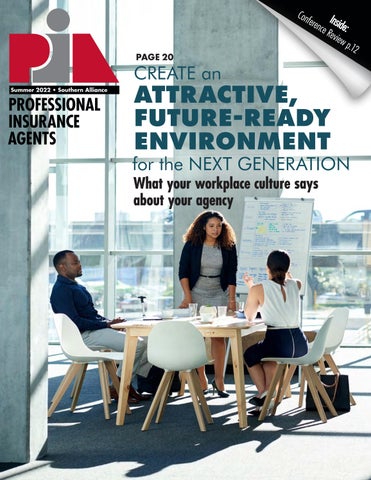
ATTRACTIVE, FUTURE-READY ENVIRONMENT
for the NEXT GENERATION What your workplace culture says about your agency
Grow your book of business— offer the protection of Hartford Flood
Exclusive online access for PIA members—Personal & Commercial Flood policies • Competitive commissions for PIA members • Multi-rater quoting system • Certified & accurate flood zone determinations • Dedicated sales director assigned to your agency
Get started—contact us today. Neil L. Randerson, National Flood Sales Director Office: (303) 645-8526 Email: Neil.Randerson@thehartford.com
The program is available to PIA members and their policyholders in all 50 states, the District of Columbia and Puerto Rico, and offers special PIA member commissions starting with the first sale (no minimums to qualify). 117745 1021
DEPARTMENTS Summer 2022 • Southern Alliance
COVER STORIES 12 PIA South celebrates its 85
th
4
In brief
7
Tech
9
Staffing
23
E&O
26
Readers’ service and advertising index
anniversary
A look at its trade show and conference
14
Create an attractive, future-ready, environment What your workplace culture says about your agency
FEATURE 19 Is your agency a source of inspiration? New hires have new expectations
Statements of fact and opinion in PIA magazine are the responsibility of the authors alone and do not imply an opinion on the part of the officers or the members of the Professional Insurance Agents. Participation in PIA events, activities, and/or publications is available on a nondiscriminatory basis and does not reflect PIA endorsement of the products and/or services. President and CEO Jeff Parmenter, CPCU, ARM; Executive Director Kelly K. Norris, CAE; Communications Director Katherine Morra; Senior Magazine Designer Sue Jacobsen; Editor-In-Chief Jaye Czupryna. Postmaster: Send address changes to: Professional Insurance Agents Southern Alliance, 3805 Crestwood Pkwy., Suite 1408, Duluth, GA 80096. “Professional Insurance Agents” is published quarterly by PIA Management Services Inc. PIA Management Services, 25 Chamberlain St., P.O. Box 997, Glenmont, NY 12077-0997; (518) 434-3111 or toll-free (800) 424-4244; email pia@pia.org. ©2022 Professional Insurance Agents. All rights reserved. No material within this publication may be reproduced—in whole or in part—without the express written consent of the publisher.
COVER DESIGN Anne Dolfi
IN BRIEF
FYI
Preparation, it’s the key to snowstorms and life insurance
4
Michael Noyes, a former multi-line agent and district manager
Suppose you owned a hardware store and a 100-year snowstorm had just swept through town. You wouldn’t need a study to prove it—but someone did one anyway—and it showed 1 in 3 of your customers was more likely to want to buy a snow shovel. Armed with that information would you move the snow shovels to the back room and only bring one out for sale when someone asked about it? Or would you build a display front-and-center of the store and make sure your customers knew where they could get the best snow shovels in town? If you’re running an insurance agency in 2022, that’s the situation you have with life insurance. An increased need for life insurance COVID-19 has caused the greatest mass public health crisis since the Spanish Flu of the early 1900s, and people are responding with a greater desire for a product you can help them with.
“With the Omicron virus variant disrupting a return to normalcy, 2022 could very well be another banner year for life insurance sales,” according to an article posted last December on Forbes.com. “Nearly one in three consumers (31%) say they were more likely to purchase coverage due to the pandemic, according to a survey by LIMRA.”1 For property/casualty agents, life insurance may represent just a segment of store sales, but it’s an area of opportunity that allows you to showcase your value. It’s inflation proof The increased desire for life insurance comes at a time when people may pare back spending in other areas as they see their buying power cut by inflation. When your clients comment on the increased price of gas and groceries it is nice to have an example where, in many cases, there hasn’t been a single price increase during the past few months.
PROFESSIONAL INSURANCE AGENTS MAGAZINE
And is there another product in which they can lock in today’s rates for the next 20, 30 years—or even a lifetime? Ask them. And then help them do it with a guaranteedpremium life product. While people are more open to buying life insurance, the coverage need is also growing, according to a recent post on LIMRA.com.2 According to the posting, “The need gap for life insurance—what people have versus what they say they need— is at an all-time high (18 points), more than double what it was 12 years ago.” Add the growing desire for coverage with the widening gap in what people need, and the opportunity is golden for agents willing to do a little extra to help their clients. Don’t miss this opportunity Consider this: If you have 1,000 p/c clients, it’s possible that some 300 of them are more likely to want life insurance this year. And, those 300 clients are likely to need
more coverage than they did even a few years ago. Have you started to have conversations with them about this vital coverage? Your clients are going to buy more life insurance this year. Make sure they know they can buy it from someone they already trust. To go back to our original example of the snowstorm and the snow shovels: Build the display and help them buy it from you. Michael Noyes is a former multi-line agent and district manager. Currently, he serves as vice president of sales for Mountain Life Insurance Co., which is headquartered in Lexington, Ky. 1
Forbes, 2022 (bit.ly/3IkNhCI)
2
LIMRA, 2022 (bit.ly/3IpPpcI)
SENIOR LIFE INSURANCE—FIVE QUESTIONS. NO EXAM.
THE LIFE INSURANCE COMPANY FOR THE P&C AGENT ISSUE AGES: 50 TO 85
NO Charge for Tobacco Use with Senior Life Health Issues? NO extra charge for a graded benefit policy Also offering Term (10, 20, 30 year plans); Whole Life, and Juvenile Life policies Get Started - Contact Us Today! 800-888-6542 • contact@mountainlife.com • www.mountainlife.com
PIASOUTH.COM
5
e 4.)
BY THE NUMBERS
In with the new: Generation Z in the workplace
Generation Z is moving—quickly—into the workforce. Statistically, this generation differs from the resident baby boomers and Generation X, and even slightly from the newly settled millennial generation. Understanding the key values and needs of the adult individuals of Gen Z can help insurance agents attract them to—and keep them in—the industry.
The Generations: Group Nicknames
Gen Z = Zoomers (1997-2012) Gen Y = millennials (1981-1996) Gen X = Gen Xers (1965-1980) Baby Boomer = boomers (1946-1964)
77%
91%
70%
Attracting Gen Z
What Gen Z looks for in employment
Require health benefits Company diversity Company integration of technology
77%
90%
60%
77%
75%
51%
Collaborating with Gen Z Keeping Gen Z Working habits preferred
Happy guiding colleagues through technology
What to consider to keep talent around
Value work/life balance
Direct/consistent feedback
Explore new roles than switch companies
Human connection
Stay longer if the job is fulfilling
These are just some of the important values and needs that insurance agents should consider as they recruit Zoomers to their agencies. While these might be different than the values and needs of older employees, staying open-minded and looking for more ways to understand potential new hires can help agents grow their agencies—because growth starts internally. When an employer values its employees priorities, both will come out having benefited.
6
PROFESSIONAL INSURANCE AGENTS MAGAZINE
ng
uit
Hiring: Looking forward can mean looking back I want to talk about my dad. I promise, this isn’t a therapy session. My dad was an insurance broker for over 20 years. And, like many involved in this business, his path to insurance was not straight. As a high school graduate, my dad joined the Army Reserve in the 1970s, after which he started a job working for the town in which he grew up. He spent the next 20 years working for the town. I say job because that is what it was. Despite being there for 20 years, he never considered it a career. It was a means to an end—a government retirement. During those 20 years, he dabbled in insurance. However, it wasn’t until he was in his 40s—when he was looking at the prospect of losing his primary income—that he turned to insurance full-time. The rest is history for my dad and my family. Why I am I telling you this story? It’s not merely to talk about my dad—whom I adore—although I promise you that is certainly part of it. I illustrate my dad’s story because, while he was unquestionably one-of-akind, his story is not. There is a shortage of quality new hires in the insurance industry. There also is a pool of millions of people (like my father) in the country right now: Mid-career professionals looking for a career change. The insurance industry can provide them with an ideal landing spot.
Have experience, looking for new experiences Mid-career professionals have been in the workforce for more than 10 years, and they are looking for a career change. Maybe like my father, they are retiring from one profession and are looking for the next. Maybe they are just dissatisfied with their current job or looking for better work-life balance. There are myriad reasons why someone would be switching careers, but mid-career professionals are out there. The job website, Indeed.com, conducted a survey in 2019 of 662 full-time U.S. workers. Of those surveyed, 49% of the respondents had made a dramatic career shift—and among those who hadn’t, 65% had considered it.1 Check the date on that survey, that was pre-pandemic. I guarantee you that number has gone up in the past few years. You might be thinking that’s great that mid-career professionals are out there, but why should I care and why should they want to get into the insurance industry? Great questions! Let’s answer the first one from my dad’s perspective.
PIASOUTH.COM
TECH
und
BRADFORD J. LACHUT, ESQ. Director of government & industry affairs, PIA Northeast
On paper, my dad was not the most attractive candidate. No college education (he insisted he only graduated high school because the teachers didn’t want to put up with him anymore), and 20 years of non-insurance work experience. Sounds like the ideal candidate, right? Here is the issue with many mid-career professionals: They may not fit neatly into hiring categories and requirements. However, fixating on education or relevant experience can blind a hiring manager to quality candidates. Generation—a nonprofit group dedicated to helping unemployed and underemployed individuals obtain work—conducted a survey of 3,800 employed and unemployed individuals and 1,404 hiring managers from around the world.2 The survey found that while mid-career professionals—defined as job seekers 45 years old or above—demonstrated job performance on par with younger workers, hiring managers overall had a negative perception of mid-carrier professionals during the application process, ranking them significantly lower than younger individuals when asked to consider who is the best fit for an office. This disconnect between perception and actual performance can create real harm to a business. To avoid falling into these unconscious bias traps regarding mid-career profes-
7
sionals, agencies and hiring managers may need to reevaluate what is important in a candidate. What wouldn’t a resume say about my dad? It wouldn’t show that 20 years of work experience may not have given him hard insurance skills, but it did equip him with the soft skills (e.g., interpersonal communication), that are so important to thriving in a workplace. Chances are if you have hired someone and it didn’t work out, it wasn’t because the person lacked the hard skills necessary for the job, but rather the employee lacked the soft skills necessary to be successful. All due respect to the world of insurance, but the insurance-side of the business can be taught. In fact, it must be taught, each person reading this article learned insurance both in an agency and in a classroom at some point in their professional career. If you are going to need to teach the hard skills to a new hire, why not take a chance on a candidate who already has built up strong soft skills that making learning those hard skills a little bit easier? Perhaps, most importantly my dad’s resume wouldn’t show that he was a little desperate. He had just finished one phase of his life, was still young,3 and he had a family that he didn’t have 20 years prior. My dad was looking for a permanent landing spot, and he was willing to work hard to get and retain it. These are all important points that any hiring manager needs to keep in mind.
What does the insurance industry offer mid-career professionals? My dad not only had a family, but he also had interests and obligations outside of work. The insurance industry offered my dad—and millions of mid-career professionals—the work-life balance that was important to him and vital to today’s mid-career professionals. My dad was an avid golfer, never missed a school sporting event and loved to travel. He was able to do all of those while working in insurance.
Coincidentally, the work-life balance was a benefit to my dad, but it ended up being a benefit to his agency, too. My dad spent much of his time volunteering with the Shriners—you know those guys with the funny hats (fezzes) and small cars? As it happens, the Shriners were not just guys wearing funny hats. They owned businesses, houses, and classic cars. They had insurance needs. Who did they go to for their insurance? My dad. So, the freedom that the insurance profession offered my dad ended up benefitting both him and his agency—a benefit his agency continues to see to this day. My dad was truly one-of-a-kind as a human being, but he was just one-ofa-million when it came to mid-career professionals looking for a new direction. Mid-career professionals have so much to offer to the insurance industry and vice versa. The agencies that recognize this stand to have a huge advantage over those that don’t. Lachut is PIA Northeast’s director of government & industry affairs. 1
Indeed, 2019 (indeedhi.re/3MncldN)
2
Generation, 2021 (bit.ly/3wmC5Bi)
At the time, I didn’t think he was young, but now that I am roughly the same age as he was then, I don’t think he was old at all.
3
Design+Print PIA Design & Print offers a one-of-a-kind relationship between you, your brand, and our diligent, creative and unique team of hardworking professionals whose top priority is building your business. You are important to us—let us show you! (800) 424-4244 | design.print@pia.org | pia.org/design&print
8
PROFESSIONAL INSURANCE AGENTS MAGAZINE
The great appreciation for the next generation Employers seeking to attract and retain top talent always have needed to pivot their benefits offerings, but never more frequently than in the last two or three years. The trends are no longer focused simply on paying for health insurance, life insurance, and giving paid time off; that is now expected. Even on-campus benefits—like dry cleaning, gyms, and grocery shopping—are not sufficient. Remote work is no longer a perk, it is an expectation. Today, the focus is centered on employee relations and how employers care for their employees holistically and for their employees’ well-being. According to Forbes magazine, “six in ten employees say well-being benefits will be a top priority when applying for their next job” and “for Gen-Z employees 67% strongly agree or agree that well-being benefits will be a priority for them in evaluating new job offers.”1
A culture of well-being So, how do employers shift their thinking and their budgets to maximize their return and create a culture of well-being? Employers and their human resource specialists need to redefine their approach to how they think about their employees. Employees are looking for a level of compassion, work-life balance, flexibility, growth, and development—not just money. The winners will focus on key aspects of an employee’s life, financial fitness; health and wellness; and social and family solutions. Financial concerns. At the top of the list are financial concerns. Helping employees relieve these concerns has an impact on productivity, so these programs benefit both the employees and their employers. 401(k) plans and employer contributions still are important, but employees also have stress from financial debt such as student loan repayments. [EDITOR’S NOTE: If you don’t offer your employees a 401(k) plan, PIA can help. For more details see: www. pianational.org/401k.] They need investment tools, financial education, and guidance on reaching life goals like buying a house and saving for college. The CARES Act provided the opportunity for employers to assist employees with student loans under IRS Code Section 127. However, finding ways to continue to contribute beyond the regulations will be important for employers. Health care. A close second is for health care solutions that better meet the needs of employees where they are. Accessible mental health solutions have become critical for employees and their families. The dramatic expansion of telemedicine options—even beyond the COVID-19 pandemic—has demonPIASOUTH.COM
strated the desire for employees to have solutions at critical times in their lives. Telemedicine also has grown beyond primary and urgent care and even mental health care. Today, employers can offer options to employees that give them a health care navigation champion, virtual options for specialties like physical therapy, or options that can provide virtual access to national experts that help them with everything from health and wellness, to support and guidance for complex diagnoses for themselves and their families. Companies like Summus Global Inc., Quantum Health, and Sword Health are just a few that are paving the way to a new way of accessing care for today’s mobile patients. This is a critical shift in how health care has been delivered in the recent past.
STAFFING
DENISE STEFAN AND VANESSA MATSIS-McCREADY Engage PEO
Wellness benefits no longer only apply to on-campus benefits, although a popular yoga or spin class may help lure employees to the office. Employees are looking for reimbursements or special pricing for meditation apps, acupuncture, massage, and other fitness and health programs. Flex time. Flexible work arrangements and the increasingly popular unlimited paid time off are still important benefits. Employees expect flexible work arrangements with hybrid and remote work seamlessly integrated into the work envi9
ronment. Unlimited, or generous paid time off packages also are in high demand, as employees want to feel their employer values them taking time off to maintain balance in their lives. Sabbaticals also are making a comeback, where long-serving employees can take a period of time off to explore community service, professional development, travel, or a personal hobby. Family considerations. Family solutions round out the shift in what has become important to employees today. MetLife’s 2022 Employee Benefit Trends Study found that employees who can address the needs of their lives and their families’ lives because they have a more flexible schedule or hybrid work solution, or access to programs that support them in the various stages of their lives, are more productive in their workdays.
RIVER VALLEY UNDERWRITERS Insurance for Every Peak and Valley
Assistance with IVF and egg freezing is another sought-after benefit. Parental leave is expected by most employees entering the workforce today. Access to day care, or elder care solutions, Medicare planning for those who are moving into the retirement stages of their careers, pet care solutions or even bringing pets into the workplace are all part of the most robust offerings. Other considerations. Career development, workplace culture, and values also rate high on the list. Employees want to work for companies at which diversity, equity, and inclusion are valued and practiced, and at which growth in their career and as a whole person is valued. Coaching and professional development at all team-member levels are increasingly desired, as are tuition reimbursement and company-led leadership programs to develop junior staff.
Blueprint for success
Send RVU all your risks including: • Property • Environmental • GL • Professional • Garage • and Package
Today’s employees want to work for employers who listen to them and understand the challenges in their lives outside of work. This wholeperson view combined with transparent communication about how employees contribute to the company mission helps team members have purposeful and meaningful work, helps them bring passion to their work, and reduces the chances of burnout.
Andrew Adams River Valley Underwriters, Inc.
Employers that shift to the Great Appreciation can lead dynamic workplaces and offset the negative effects of the Great Resignation.
(833) 788-7887 (Toll Free) • (501) 588-7717 Fax
Stefan is president of Engage Insurance and Matsis-McCready is associate general counsel and director of human resources for Engage PEO.
(501) 475-7887
aadams@rvuins.com
1
10
PROFESSIONAL INSURANCE AGENTS MAGAZINE
Forbes, 2021 (bit.ly/3Po2aYa)
We invest in bonds. The human kind. Working with the independent agency system is one of the most worthwhile investments we can make. Travelers is proud to be a sponsor of the 2022 PIA Southern Alliance Conference.
travelers.com The Travelers Indemnity Company and its property casualty affiliates. One Tower Square, Hartford, CT 06183 © 2022 The Travelers Indemnity Company. All rights reserved. Travelers and the Travelers Umbrella logo are registered trademarks of The Travelers Indemnity Company in the U.S. and other countries. M-18607 New 3-22
PIA South celebrates its 85th annive A look at its trade show and conference PIA celebrated its 85th anniversary with a spectacular education conference and trade show on May 18-19, 2022. Two event-packed days featured networking, education, and regulatory updates—all just a short drive for most agents. This year’s event featured several attendee-friendly givebacks: PIA’s 2022 Industry Partners and Carriers provided free parking to the conference’s attendees and it also offered over $3,000 in cash prizes to randomly selected winners throughout the event. A well-planned event package allowed more agents and agencies to participate and minimized time away from the office and family—at a cost-effective price. In honor of our 85th anniversary, support by our Company and Industry Partners allowed us to offer the same registration fee charged for our first conference, which was held in Macon in 1942. Our Company and Industry Partners were so impressed with the turn out from this year’s trade show and conference—from the large number of agents who attended, to the venue, and our special pricing that they asked us to plan the 2023 Spring Conference with the same format. Members and partners asked for it, and PIA responded: Save the date: Spring Conference 2023 May 9 & 10, 2023 Gas South Convention Center Mark your calendars now!
Time to celebrate The official 85th anniversary of PIA South (originally The Mutual Agents Association) will be marked on Aug. 17, 2022. The association was founded by agencies utilizing mutual carriers. Many of our current agency members have roots in some founding members. Thank you to all our members who contribute to our past and future success.
12
PROFESSIONAL INSURANCE AGENTS MAGAZINE
nniversary
85th Annual Convention
PIASOUTH.COM
13
14
PROFESSIONAL INSURANCE AGENTS MAGAZINE
BEN JOHNSON, SHEFFIELD HAWORTH TIM M C EWAN, SHEFFIELD HAWORTH LEADERSHIP ADVISORY
CREATE an
ATTRACTIVE, FUTURE-READY ENVIRONMENT
for the NEXT GENERATION
What your workplace culture says about your agency
I
n a post-COVID world of hybrid working and changing expectations of work, attracting the future generation of independent insurance agents can seem daunting. According to PwC, 65% of U.S. employees are looking for new jobs, while 88% of U.S. executives have been seeing higher staff turnover since the beginning of COVID in 2020.1
PIASOUTH.COM
15
A thriving workplace culture One of the ways agents can look to overcome these challenges is by focusing on workplace culture. This comes with several significant potential benefits. Multiple studies show that businesses with positive work cultures tend to achieve better financial results; are more innovative and more productive; have lower employee turnover; and find it easier to attract and retain top talent.2 At the same time, millennial and Gen Z professionals are attracted to working at firms with strong environmental, social, and governance principles.3 As an example, cumulative stock market returns among the publicly held Fortune 100 Best Companies to Work For are nearly three time greater than the market average. A Cornell University study proved that engaged, empowered employees deliver better customer service, better products, and have happier customers. Fortune Best Companies to Work For also had an average voluntary employee turnover rate of just 12% in 2019, versus the national average of 27%. Moreover, 93% of employees at the 100 Best Companies to Work For say they’re proud to tell others where they work—which makes attracting talent far easier, too. These are all the potential benefits of a thriving workplace culture, but before we go on, it’s important to be clear on what a workplace culture is.
What is a workplace culture? Some say culture is just behavior, but there’s more to it than that. Another way to define it is to say that culture is made up of the underlying assumptions, values, beliefs, and expectations shared by your agency’s members. It can be positive or negative, proactive or reactive. There are many models of organizational culture. The Johnson-Scholes model, developed by Gerry Johnson and Kevan Scholes in 1992, is a useful framework for thinking about culture. It suggests that any workplace culture is built on the following six factors: No. 1: Control systems. Businesses use different means to control employee behavior—from pay and training, to disciplinary systems and personal development plans. No. 2: Rituals and routines. These are the everyday behaviors and actions that are expected and normal within the business. No. 3: Stories. These are the collective memory of a business, based on shared past experiences. No. 4: Symbols. These can be anything that represents your agency—either visually or metaphorically—from the dress code and the office foyer, to branding and logos, to attitudes and mindsets around issues such as diversity and inclusion. No. 5: Organizational structures. The official hierarchy and management structure of your agency, as well as the unofficial influencers, such as administrative professionals or charismatic individuals who help to motivate others. No. 6: Power structures. These are determined by which people have the most say in your agency, and how that voice is disseminated. 16
PROFESSIONAL INSURANCE AGENTS MAGAZINE
What does a thriving workplace culture look like? Americans’ attitudes to work have shifted in the last few years, partly due to COVID, partly due to the changing priorities of younger generations entering the workforce, and partly due to concerns around social and environmental issues. Remote working has proved so popular that only 4% of hybrid or remote employees would choose to return fully on-site.4 Employees also value other aspects of work over their salaries. These aspects include sustainability, mental health,5 and diversity, equity, and inclusion. In one survey, 83% of human resource leaders said that diversity, equity, and inclusion was either “very” or “extremely” important to their organization.6 More than three quarters (76%) of job seekers say a diverse workforce is an important factor when evaluating companies and job offers, while 32% would not apply to a job at a company that lacks workplace diversity.7 Meanwhile, a majority of MBA students surveyed said they would accept a lower salary to work for an environmentally responsible company.8 With the culture around work changing so rapidly and profoundly, it can be difficult to say what a thriving workplace culture even looks like today. However, based on our experience around attracting and retaining talent, it’s best to focus on key measurables.
How to build a thriving culture Every independent insurance agency has a culture, whether it is deliberate
Indicators of a thriving workplace culture: • Your employee turnover goes down • Your productivity increases • You attract a higher number of high-quality candidates when you’re recruiting • Your employees are keen to take on more responsibility or learn new skills • Your employees offer more frequent feedback about how to improve processes or solve problems • Your flexible work environment is effective and employees are productive • Your workforce becomes more diverse—and you’re able to retain diverse talent or not. If you’re not actively shaping or influencing it to help generate the business outcomes you want, then it may become counter-productive. This is where the Johnson-Scholes Cultural Web model comes in— because you can use that to shape your agency’s culture. Let’s look at how: No. 1: Control systems. You have less direct control over employees working remotely. Trust them, give them clear boundaries and expectations, and let them get on with their work. This tends to increase motivation and productivity. No. 2: Rituals and routines. Hybrid working creates huge opportunities to change pre-existing rituals and routines. Many employees now returning to the office have forgotten the old ones. This enables you to establish new routines better suited to the culture you’d like to develop.
No. 3: Stories. These are most effective when based around shared experiences, so encourage shared experiences amongst your employees. Have spaces where they can meet. Have regular and varied social gatherings, from meals out, to summer barbeques, to dog-walking afternoons. It doesn’t matter what, so long as everybody in your agency can partake if they wish, regardless of physical limitations or religious and cultural differences. The more your people willingly share time together, the more positive your agency’s stories will be. No. 4: Symbols. A symbol is more than just a logo or brand. For example, you could experiment with your dress code. Being more flexible can become symbolic of the experience of working for you. Investing more in technology could be symbolic of your culture and mindset. Think broadly about how you want your clients and employees to visualize your agency, then create symbols that reaffirm that. No. 5: Organizational structures. These can be difficult, costly, and time consuming to change. It’s usually best to focus on other areas of culture first and then return to this if needed. No. 6: Power structures. Another phrase to describe the most influential people within a business is culture carriers. In a hybrid model, you benefit from identifying who your informal culture carriers are and put work into influencing them to be onside and effective. Above all, whatever you look to change, it’s best to consult with your employees, and to be open and transparent. It can have a positive impact when you make people part of the conversation and the changes that come from it, because they feel more of a sense of ownership. This will again increase their motivation and productivity, as well as your bottom line.
How to build a culture that attracts the next generation One of the biggest challenges around attracting the next generation of insurance-agent talent is the unpopularity of insurance as an industry. In our experience, at university and college careers and recruitment events, insurance is consistently the least attractive of all financial services careers. For independent agents, there are two ways they can leverage their workplace culture to become more attractive. First, we’ve already mentioned that millennial and Gen Z talent tends to place a lot of emphasis on working for businesses that value ESG, DEI, mental health, and flexibility. Agencies with employees who communicate and live those values will do much better at attracting talent than those who do not. Second, in the big international insurance centers of New York, London, and Singapore, insurance firms of all kinds—carriers, MGAs, brokers, and InsurTechs—are attracting talent by focusing on their technology and new innovative business models. Essentially, these firms are pitching themselves as tech companies. Similarly, those agents who embrace new technologies are likely to come across as more dynamic, exciting places to work, with more of the culture and atmosphere of a tech firm. This can make them far more competitive in today’s ferocious and fast-changing talent market. PIASOUTH.COM
17
As an example of this, McKinsey paints a future for the independent insurance agency which, by 2030, needs fewer staff and can leverage the power of AI and machine learning to: help agents to support a substantially larger client base while making customer interactions (a mix of in-person, virtual, and digital) shorter and more meaningful, given that each interaction will be tailored to the exact current and future needs of each individual client.9
The foundations of a thriving culture So, to attract the future generation, it’s important to hold and communicate values around social and environmental principles that resonate with them. It’s important to be flexible, and to develop your workplace culture in ways that embody these principles. Yet, at the same, the technologically innovative independent insurance agency of the future is likely to be more automated, more productive, and to need fewer employees. Realizing this AI-driven, service-led future is likely to make the sector more attractive to young emerging talent, while at the same time allowing professional insurance agents to pick and choose who they want to work for their agencies. Johnson is managing director and global head of insurance & InsurTech at Sheffield Haworth. He joined Sheffield Haworth in 2019. His goal is to deliver solutions that combine industry expertise with strategic thinking—driving creativity, innovation, diversity and inclusion for clients. For over 14 years he has placed executives, interims, and consultants at C-Suite level across some of the biggest names in the sector. McEwan is Managing Director for Sheffield Haworth Leadership Advisory.
18
PROFESSIONAL INSURANCE AGENTS MAGAZINE
He leads the SH Leadership team and specializes in organizational culture and leadership. He provides advisory support to individual executives and wider organizations through boards, executive committees and management teams. He has held numerous leadership positions including global head of leadership and learning at the global asset manager, Henderson. 1
PwC, 2021 (pwc.to/3wbGsip)
Great Place to Work, 2019 (bit. ly/3N9uV92)
2
Corporate Compliance Insights, 2022 (bit.ly/3NeOwEM)
3
4
Gartner, 2021 (gtnr.it/3l6spEy)
5
Forbes, 2020 (bit.ly/3NacbX5)
6
AON, 2021 (aon.io/3wafxU7)
7
Glass Door, 2020 (bit.ly/3l6uHna)
Corporate Compliance Insights, 2022 (bit.ly/3a0Q4nF)
8
McKinsey & Co., 2021 (mck. co/3syxhXi)
9
ROBYN BORER AND JENNA CLEMISHAW Liberty Mutual and Safeco Insurance
Is your agency a source of inspiration? New hires have new expectations Change is inevitable as the new generations enter the workforce. However, no one could have predicted that a global pandemic would catapult us into a new era of work so quickly. Prior to the pandemic, millennials (those born between 1981 to 1996) and Gen Z (born after 1996) were establishing their careers and already pushing for culture shifts in the workplace—they are the generations that grew up with the internet, digital information at their fingertips and an increasingly global worldview. As we start to find a way forward after the tumultuous last few years, we’re seeing major lasting shifts in the ways that we work. Now is the time for agents to re-examine their workplace practices to align with the wants and needs of the next generation of employees. Now that this next generation of insurance leaders have experienced what technology can do for the workplace, they’re ready to fully embrace digital along with a few other important culture shifts. Five key areas for agency leaders to consider as we usher in this new era of work are talent diversity, workplace flexibility, creating meaningful work, a caring workplace and development opportunities.
Agency owners must be forward-thinking to thrive into the future by embracing this new generation and creating an agency culture that will attract and retain them for years to come.
Embrace diversity, new talent Now more than ever, embracing diversity is critical to an agency’s ability to attract and retain talent of all ages. Millennials and Gen Z especially value and increasingly expect diversity in the workplace. According to Pew, Gen Z is more diverse than previous generations, and both millennials and Gen Z view societal changes as a good thing.1 And, with nearly 1-in-4 agency hires last year being from Gen Z,2 this new generation already is making its mark on the workplace. To bring in fresh talent, you must look beyond the list of skills found on a resume. By doing so, you can open the pathway for a more diverse candidate pool. The right talent can come from anywhere—a great employee is one who is engaged with the agency. He or she will have the right mix of mindset and skillset to build upon the foundation of an agency and lead it into the future.
PIASOUTH.COM
19
To adapt and change the definition of what makes a great employee, you also must consider the standards and assumptions used as part of the recruiting process. Is a bachelor’s degree really required for the role? What transferable soft skills does a candidate bring? How can you foster the talent you already have to help them fulfill their career ambitions and emerging needs of the business? These are just a few examples of the critical questions that agency executives must ask themselves to recruit and retain diverse candidates.
Offer workplace flexibility It’s no surprise after two years of mostly remote work that job hunters and employees now expect more flexible work options. Most businesses continued to operate successfully with a fully remote workforce, and employees proved they can continue thriving while working from home. The flexibility realized during the pandemic has now become ingrained in culture. According to a report by Zety, flexible working practices were one of the top things that attracted people to a new job.3 In fact, Bloomberg found that nearly half of millennials and Gen Z workers would consider quitting if their employers weren’t flexible about remote work.4 This is contrasted with the nearly two-thirds of agencies that are unwilling to hire a remote employee and more than half that plan to keep staff in the office full-time in 2022.5 The same study also found that of agency employees who do work at least partially remote: • 57% believe they have better work-life balance, • 52% have more personal happiness, and • 47% are more productive when working from home.
• 62% said it was important for the company to have values that match their own, and • 61% looked for companies that had a purpose beyond just making a profit. So, how do you hire from this group? Insurance agencies need to tell compelling stories of the meaning behind their work. Insurance isn’t just about the process of issuing a policy—it’s about providing clients peace of mind and delivering on the promise made if they suffer a loss. It is deeply human, and independent insurance agents are helping their clients and communities through good times and bad. Telling these stories when recruiting can help differentiate your agency from other agencies, and from other opportunities and industries candidates may be considering.
The benefits of offering a flexible work arrangement are real. Happy employees are more engaged in the work they are doing and they are more likely to stay with your agency.
Establish a caring workplace culture
Flexibility doesn’t have to be a one-size-fits-all solution. Different employees may want different options to accommodate the demands of their work and personal lives. By embracing flexibility as part of your agency’s culture, it also means you can recruit and retain talent beyond the small geographic footprint directly surrounding your agency.
Creating meaningful work and cultivating a culture of caring go handin-hand. When an employer cares about its employee’s well-being, it comes back full circle. Employees are more likely to stay with the organization, do their best work and promote the business as a great place to work to their network, opening the pathway for more talent recruitment opportunities.
You can set your flexible or fully remote employees up for success by establishing clear and measurable performance goals, so no matter where they are working from, they have something to work toward that’s attainable for their role. Agencies offering flexibility become enticing options for job seekers, while agencies that maintain a rigid viewpoint on being in a physical office as a requirement will miss out on high-quality candidates.
Create meaning and purpose in work Work is no longer only about getting a paycheck. Millennials and Gen Z are seeking jobs that give them purpose and make an impact. The results of a Zety survey of Gen Z job seekers offer a clear picture of just how important purpose is to this up-and-coming generation:6 • 95% of survey respondents said it was “very or somewhat important” for their work to have meaning, 20
• 71% said they would take a pay cut to do meaningful work,
PROFESSIONAL INSURANCE AGENTS MAGAZINE
With the impacts of the pandemic, creating a caring workplace culture is more important than ever as employees continue to experience increased levels of stress and uncertainty. In fact, TELUS International found that 80% of employees would consider quitting their current
job for a job that focused more on employees’ mental health.7 A Gallup survey found that employees who strongly agree that their employer cares about their overall well-being, in comparison to others, are: • 69% less likely to actively search for a new job, • 71% less likely to report experiencing a lot of burnout, • five times more likely to strongly advocate that their company as a great place to work, and to strongly agree they trust the leadership of their organization, and • three times more likely to be engaged at work.8 How you support employees will look different based on your agency’s values and culture. Offering tools and resources that support and foster
the mental health and overall well-being of employees is a great start. Establishing Employee Resource Groups, offering Employee Assistance Programs, and encouraging employees to bring their whole selves to work are just a few examples. Creating a caring workplace culture will help agency owners attract top talent, retain employees, and prevent burnout among staff.
Provide growth and development opportunities Providing growth and development opportunities also is critical to attracting and retaining the next generation of insurance leaders. Millennials and Gen Z are in the early to mid-stages of their careers. Gen Z explicitly lists career development opportunities as an important qualification when looking for a job.9 The members of the next generation are investing their time into meaningful work, and they want to know that there is growth and opportunity for advancement where they are putting their energy. While many new graduates and job seekers might not be aware of the career opportunities that are available in the insurance industry specifically, insurance agencies are well suited to meet many of the qualifications job seekers are looking for—offering meaningful work, opportunities for career advancement and ways to grow into a competitive salary.
Brought to you by PIA and The PIA Partnership
There are more
cyber risks
THAN EVER.
Is your agency at risk? The answer is yes—everyone is at risk. The best defense is a strong offense.
Winning@CyberSecurity Defense is a customized 4 step program to make your agency and its customers more secure and stronger.
pianational.org/cybersecurity
© Copyright 2022 National Association of Professional Insurance Agents
PIASOUTH.COM
21
In 2021, a survey found 66% of those who quit their job did so because of limited career opportunities.10 And a report on the state of women in independent insurance agencies found that more than half of woman frontline employees under the age of 50 are interested in partnership opportunities.11 To attract and retain the next generation of talent, agency owners need to invest in employees’ career development and show the career paths that are available. When it comes to development, millennial and Gen Z job seekers are looking for one-on-one mentorship or online classes over traditional classroom training. By offering these types of development opportunities to your employees, your agency would be fulfilling the demands and needs for the next generation to grow in their insurance careers while establishing a leadership and perpetuation pipeline. As we move forward into this new era of work, it is time for agency owners to rethink and implement changes in their hiring and talent management practices to best position them for future success. The next generation of insurance leaders are forging their paths in the industry, and forward-thinking agency owners are making changes to meet the needs of these younger employees. By investing in human-centered workplace cultures, embracing diversity, hiring for personality and potential—rather than experience alone—and investing in employee development, agency leaders can bring in and train the next generation of talent to carry the agency forward into the future. Borer and Clemishaw are leaders in the Liberty Mutual and Safeco Insurance independent agent distribution organization, serving the Northeast. Borer brings nearly 20 years of experience to her role as AVP & region operations manager working across Liberty Mutual business lines and Safeco personal lines, while Clemishaw brings nearly 15 years of industry experience and serves as AVP & region director for New England with a focus on business lines.
22
PROFESSIONAL INSURANCE AGENTS MAGAZINE
Reach them at robyn.borer@libertymutual.com and jenna.clemishaw@ libertymutual.com, respectively. Pew Research Center, 2020 (pewrsr.ch/39vqdUM)
1
Liberty Mutual and Safeco Insurance 2022 Agency Growth Study (bit.ly/3lcserm) 2
3
Zety, 2021 (bit.ly/3yFzCDp)
Bloomberg, 2021 (bloom.bg/3yCSbZ9)
4
Liberty Mutual and Safeco Insurance 2022 Agency Growth Study (bit.ly/3lcserm) 5
6
Zety, 2022 (bit.ly/3wiadOI)
BusinessWire, 2020 (bwnews.pr/3weonQW)
7
8
Gallup, 2022 (bit.ly/3a4RxcE)
9
Zety, 2022 (bit.ly/3wiadOI)
10
Zety, 2021 (bit.ly/3yFzCDp)
Liberty Mutual and Safeco Insurance 2022 Agency Growth Study (bit.ly/3lcserm) 11
New hires and your E&O loss prevention culture As new staff members join your agency, there is a need to provide them with training on such items as your agency system, your procedures, the carriers with which you do business, and the details of the job responsibilities. Obviously, the goal is to get the new staff members up to speed as quickly as possible so they can begin to contribute to your agency’s success. One area that may not get the attention it deserves is errors-and-omissions loss prevention. If a new staff member has some insurance experience, it may be assumed that he or she understands the ins and outs of E&O and what is necessary to minimize the potential for E&O claims to occur.
Just because the employee worked in another agency does not mean that E&O was understood and valued to the level that your agency does.
Quite honestly, this is a dangerous assumption to make. Just because the employee worked in another agency does not mean that E&O was understood and valued to the level that your agency does. In addition, if the employee is a rookie in the business, there is a good chance he or she is completely unfamiliar with the concept of E&O—and uneducated on the key issues that drive a strong E&O loss prevention culture.
As your agency experiences the anticipated turnover, ensuring that these new hires get the proper E&O education and guidance becomes even more vital. Without question, your firm’s E&O loss prevention culture will be influenced heavily by the level of E&O training these new staff members received upon joining your agency. Items to consider include: Provide an E&O overview. As new employees are brought into your agency, it would be beneficial for you to dedicate some time to the topic of E&O and emphasize that by adhering to various best practices, E&O claims can be avoided. Depending on the size and structure of the agency, consider having each respective department manager (personal lines, commercial lines, benefits, etc.), provide the new staff members with the necessary information. It is suggested to provide new staff members with details of the expected
PIASOUTH.COM
E&O
CURTIS M. PEARSALL, CPCU, CPIA President, Pearsall Associates Inc.
procedures as it is possible that your agency has different expectations than the new employees’ prior employers. Then periodically (preferably monthly), meet with new staff members to give them a refresher on E&O overall or possibly specific issues such as documentation, exposure analysis, managing workloads, etc. While the issue of “document, document, document” has been part of the E&O loss prevention mantra for years, don’t assume your new staff members fully understand the value of a high level of documentation. Share your agency’s expectations for documentation with the new staff members. Contact your state association or E&O carrier. These organizations probably have resources/articles/educational seminars they can provide (some may be for a fee) to get the new employee up to speed. Add an E&O discussion in your agency staff meetings. The more your new staff members hear about E&O loss prevention, the more they will understand it and be committed to the cause. In staff meetings, address issues such as the finer points of specific coverages, or how to handle various inquiries from your customers.
23
Your agency system. Consistency is a key word when dealing with E&O. This means that there is a common way that various procedures are performed within the agency. Even if you hire a new employee who has knowledge of your agency system, it is important to understand that your agency might use the system differently than how the new staff member used the system at his or her previous employer. This is when having a written procedures manual that details the use of the system will play a vital role. Audit the work of the new staff members. Perform some extensive auditing of the new staff members to determine if they are meeting the agency’s expectations. The quicker any issues are identified, the quicker that further training can be provided. Bottom line: Dedicate time early on to provide your new employees with a solid overview of your E&O loss prevention culture. This will play a key role in ensuring a bright future for your agency. Pearsall is president of Pearsall Associates Inc. and special consultant to the Utica National E&O Program.
management tool. Utica Mutual Insurance Company and the other member insurance companies of the Utica National Insurance Group (“Utica National”) are not providing legal advice, or any other professional services. Utica National shall have no liability to any person or entity with respect to any loss or damages alleged to have been caused, directly or indirectly, by the use of the information provided. You are encouraged to consult an attorney or other professional for advice on these issues. © 2022 Utica Mutual Insurance Company
Utica National Insurance Group and Utica National are trade names for Utica Mutual Insurance Company, its affiliates and subsidiaries. Home Office: New Hartford, NY 13413. This information is provided solely as an insurance risk
Is your agency ready for a better
401(k) PLAN? PIA 401(k) Retirement Plan is a turn-key, low-cost solution for agency owners and their employees. • outsources functions to third parties for less fiduciary strain on the company • lower cost • payroll integrations and year-end data • less error
L E A R N M O R E AT
pianational.org/401k
© Copyright 2022 National Association of Professional Insurance Agents
24
PROFESSIONAL INSURANCE AGENTS MAGAZINE
5 REASONS to Choose Utica National’s Agents’ Errors & Omissions Since 1966, Utica National has been a continuous leader in the E&O market. More than 10,000 agents have placed their trust in Utica National’s E&O program and their state association. Let us earn your business! Claims Strength – Utica National’s E&O claims team is 100% dedicated to E&O and has decades of experience. Direct Access to Underwriters and Claim Specialists – With Utica National, you can speak directly with an underwriter or claim representative. Customized Coverage – We offer choices based on your operation and risk appetite. Leading-Edge Risk Management – We offer resources on contemporary topics so you can understand the hazards involved and take steps to reduce your risk. Flexible Payment Options – We offer multiple billing options including electronic fund transfer without any interest charges or fees*. *A nominal fee per installment applies to direct bill invoiced policies using the 12-payment option. Fees vary by state.
For more information on how to protect your agency from the financial hardship that results from an E&O claim, visit www.uticanational.com/EO.
Amanda Bautista
770-921-3278 amanda@piasouth.com
DIRECTORY
Readers’ service and advertising index 2 5 27 24 21 8, 26
The Hartford Mountain Life Insurance Company National Security Group PIA 401(k) Plan PIA Cybersecurity PIA Design & Print
BC 25 10 11 26
Progressive RS Thomas Training Associates Inc. River Valley Underwriters Travelers Utica National Insurance Group
Name____________________________________________________________________ Agency___________________________________________________________________ Address__________________________________________________________________ City/town________________________________ State____________ ZIP_____________ Phone____________________________________________________________________
Design+ Print (800) 424-4244 design.print@pia.org pia.org/design&print
26
PROFESSIONAL INSURANCE AGENTS MAGAZINE
Celebrating 75 Years Of Providing Competitive, Affordable Insurance. National
Security
has
provided
competitive, affordable insurance to
policyholders
for
75
years.
We also provide our agents with competitive commissions, excellent customer service and experienced company adjusters. As a Southeastern based regional company, National Security prides itself on fast, efficient service from a friendly small town company. Our agent website provides fast quotes, online policy issuance, and real-time policy information. Find out more about our products by calling 1-800-239-2358 or visiting nationalsecuritygroup.com.
Dwelling Fire • Limited Homeowners Comprehensive Mobile Homeowners Vacant Proper t y • Life & Health
Elba, Alabama
AGENTS OF
Explorat ion
Tech solutions for you and your customers—now and into the future At Progressive, we’re always thinking about ways to push our business forward with innovations like our leading telematics solutions: Snapshot® for personal auto and Snapshot ProView® and Smart Haul® for your commercial customers. Plus, we’ve rolled out a multi-product quoting platform that makes bundling easier than ever. With breakthroughs like these and more, you can feel confident that while you’re focused on your customers, we’re focused on what’s ahead. Tech leadership—it’s in our DNA.
TO LEARN MORE Search for us online at Agents of Progressive, Progressive Connect, or Progressive Appointment.
*Telematics programs not available in all states.
21A00108.EP06 (02/22)