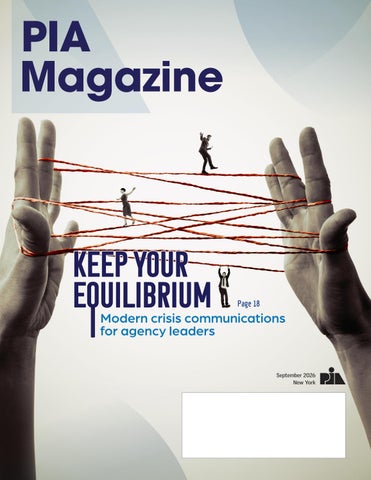
Keep your equilibrium
Page 18
Modern crisis communications for agency leaders
September 2026 New York
Real service. Real results. Not just promises.
Over
$1.31 Billion in Dividends Issued to Date
Lovell Safety Management continues its track record of providing affordable workers’ compensation insurance coverage for the following industries: • Asbestos Abatement • Building Metal Trades • Cleaners • Construction • Electrical Manufacturers • Hospitals • Launderers and Cleaners • Municipalities
• Painters and Decorators • Paper Products Manufacturers • Retail Lumber • Roofers and Sheet Metal Workers • Truckers, Movers, and Warehouse Workers
Discounts up to 35%
NNt
Call us for a quote today at 800-556-8355
Get a quick estimate by visiting our website at
www.LovellSafety.com Lovell Safety Management Co., LLC 22 Cortlandt Street, 33rd Floor New York, NY 10007 212-709-8600 | 1-800-5-LOVELL www.lovellsafety.com
Discounts subject to approval. Dividends and savings are not guaranteed.
Vol. 70, No. 8 September 2026
Departments
Keep your equilibrium
Modern crisis communications for agency leaders
18
Cover story Modern crisis communications for agency leaders
Highlights
9
4
In brief
9
Risks
13
E&O
31
Security
35
Ask PIA
38
Officers and directors directory
39
Advertising index
Cover Design Damon Whimple
Risks
Help your clients prepare for ‘it won’t happen to me’
25
Feature
Agency agreements are vital to agency planning
31
Security
When cyberrisk becomes business risk
Professional Insurance Agents 25 Chamberlain St., P.O. Box 997, Glenmont, NY 12077-4835 (800) 424-4244 | pia@pia.org | www.pia.org
President and CEO Jeff Parmenter, CPCU, ARM; Executive Director Kelly K. Norris, CAE; Communications Director Katherine Morra; Editor-In-Chief Jaye Czupryna; Advertising Sales Representative Robbie Merrill; Magazine Layout Designer Patricia Corlett; Communications Department contributors: David Cayole, Jeana Coleman, Darel Cramer, Matthew McDonough and Damon Whimple. Postmaster: Send address changes to: Professional Insurance Agents Magazine, P.O. Box 997, Glenmont, NY. “Professional Insurance Agents” (USPS 913-400) is published monthly by PIA Management Services Inc., except for a combined July/August issue. Periodical postage paid at Glenmont, N.Y., and additional mailing offices. ©2026 Professional Insurance Agents. All rights reserved. No material within this publication may be reproduced—in whole or in part—without the express written consent of the publisher. Statements of fact and opinion in PIA Magazine are the responsibility of the authors alone and do not imply an opinion on the part of the officers or the members of the Professional Insurance Agents. Participation in PIA events, activities, and/or publications is available on a nondiscriminatory basis and does not reflect PIA endorsement of the products and/or services.
IN BRIEF
Cyberattacks, and AI’s role in causing (and preventing) them As agency owners further integrate new technologies into their businesses, they expose their agencies to an ever-expanding cyber threat landscape. New tech offers incredible benefits in terms of efficiency and security, but it also exposes your business to phishing attacks, ransomware and more. The consequences can be severe: a crisis triggered by a cyberattack means lost time, money and reputation. Don’t despair. You can take an active part in the protection of your independent insurance agency.
Cyber security incidents in 2025 June of 2025 was a hot time for cyber security incidents in the insurance industry: Breach No. 1: Erie Insurance identified unusual activity on its network. The company initiated a network outage to safeguard its systems and sensitive data. The customer portal was affected, making it hard for its seven million policyholders to submit claims and access the paperwork they needed. The company found no evidence of a breach of sensitive information, financial records or legally protected data. Erie Insurance’s business was disrupted for a month, and the incident prompted two class-action lawsuits, which claimed that a ransomware group accessed the insurer’s network, and that there was a breach. Breach No. 2: Philadelphia Indemnity Insurance found that its customer data was stolen. There was unauthorized access on its network between June 9-10, and from there an unauthorized party acquired files containing customers’ names, dates of birth and driver’s license numbers.
4
PROFESSION A L I NS U RANCE RANC E AG E NTS M AG AZI AZIN NE
Steps you can take during a cyber security crisis Cyberattacks against your insurance agency can hit fast, hard and make a wide impact. Across the two cyber security incidents outlined previously, millions of people’s personal information was accessed—Erie Insurance claims that its information was not breached, but the company had to take drastic measures to protect itself. No. 1: Secure your agency. If you don’t already have a team in place to handle a cyberattack in your agency, you may need to assemble one— depending on the resources available to you; this may include forensics, legal and information technology experts among other disciplines. You also may need to protect your agency physically (i.e., taking equipment offline and keeping track of entry and exit points). Keep your staff informed of the incident and have legal counsel on standby. Finally, don’t destroy evidence—preserve everything that could be related to the incident. No. 2: Address vulnerabilities in your systems. At this point, you should work with forensics and tech experts to determine when, where and how the attack took place. For example, in the case of a data breach, this includes: checking to see if your servers contained the breach, determining who had (and has) access to sensitive data, what kind of data was leaked and who was impacted. You also may need to check with your service providers and see if they had access to the information, and adjust their access privileges, if necessary.
By the numbers …
97
% of organizations that reported
What about AI? Artificial intelligence has a role to play in cybersecurity—either it is used by bad actors to breach your business, or it can be implemented into your cyber security regimen. Typically, AI is used to enhance already existing types of cyberattacks, such as social engineering and phishing attacks. It does this by: • automating information gathering processes; • creating fake messages, scenarios, personas and communications; and
63
an AI-related security incident, also reported a lack of AI-access controls.
% of organizations that lack
AI usage policies to manage or prevent AI attacks.
1.9 million $
savings by those organizations who use AI as part of their security plan (vs. the organizations that didn’t use these solutions).
• scaling up its attacks to target multiple victims. It can form the basis of an attack, like if the cybercriminals were to use deepfakes— AI-generated video and audio—to deceive a victim. The AI your agency uses can be a target: a cyberattack can feed the AI misinformation or corrupt its input data to hamper its efficacy. However, AI does have its uses in protecting your business. In some cases, it can: • detect unusual network behavior;
Something to consider … The global average cost of a data breach in 2025 was $4.4 million—down 9% (decrease caused by faster identification and containment).
• identify phishing and fraudulent activity; • automate incident response and threat mitigation; and • analyze datasets at scale and detect hidden risks.
Per a 2026 report, 60% of all 2024 cyber insurance claims originated from business email compromises and fund transfer fraud.
PIA .ORG
5
IN BRIEF
The cost of a fire, monetarily and emotionally David Brill, marketing/contents specialist, Paul Davis Restoration A crisis isn’t necessarily a townwide or statewide situation. A crisis can be at the individual insured, family level. A severe house fire—or even a minor one—is a crisis for the family who experienced it. Looking at it from a structural point of view, even with a small fire that was contained quickly, chances are good that the family will need to relocate to an alternate living situation, will incur alternate living expenses, and will be out of their home for a certain amount of time—that is a crisis. Not having enough, or the right, insurance coverage can be the cause of another crisis. Do your insureds understand the factors that determine the replacement costs after a fire? The time to talk to them about the cost of a fire is before a claim occurs. Helping them understand today, can help them prepare for tomorrow.
An example of being underinsured Consider this scenario: A fire nearly destroyed a historic home. The 3,500-square-foot house had different types of materials and building features, which would place the cost to rebuild at roughly $350 per square foot—the local building rate based on labor and material costs. So, rebuilding this home from the ground up would cost roughly $1.2 million. If the insured only has about $800,000 in structural coverage, the homeowner would be severely underinsured for the loss. Unfortunately, the financial crisis doesn’t end there. In the case of a fire, one isn’t simply getting underway with new construction. What is left needs to be deconstructed and/or demolished first before the rebuild can take place. Of course, that costs money. Environmental costs (e.g., asbestos and lead testing, which if positive would include the cost of abatement) can add hundreds of thousands of dollars in additional structural costs—which should be covered by the structural portion of the insured’s insurance policy. Granted, many homeowners insurance policies include a 5% debris removal buffer, which in this scenario obtained the insured an additional $40,000 to demolish the building. In this particular case, the costs of testing and demolition came close to $200,000, which left the insured with $600,000 to rebuild a home that should have been insured for $1.2 million. In today’s blame-someone-else society, the fingers will point at the insurance agent. The client might ask: “How could my agent not know, and leave me so underinsured?” This is
6
PROFESSION A L I NS U RANC E AG E NTS M AG AZIN E
why it’s important to counter your insureds when they are looking for the lowest rate possible. Consider offering a breakdown of what it might cost to replace a client’s home. Explain to the client how all the costs that people tend to forget can add up and contribute to the rebuilding costs.
Have the right coverage In a different scenario: In a kitchen, a pan of oil flares up and sends plumes of oily soot into the air. Soot travels wherever air travels. So, while the actual fire may not cause structural damage, there is a lot of work that must happen even with a small fire. For example, most kitchen cabinets have a space between the cabinet and the wall. So, in addition to removing and washing the cabinets and everything in them, the cabinets must be removed to clean the wall. In that same scenario, the entire house will need to be cleaned and deodorized, most likely including the ductwork and the furnace/air handler filter. So, a fire that occurred in one section of the house could have far-reaching consequences. Again, having proper and enough coverage is vital.
Beyond the monetary cost of recovery The toll of a fire goes beyond the cost of replacing the structure and the items inside the house. There’s an emotional crisis that the people who live through the fire need to face. They may find themselves turning to their insurance agents for support. Remember: With a fire there’s a chance that there wasn’t just a loss of property. However, even if there isn’t a loss of life—the best scenario—the family knows that it could have been a possibility. That puts a lot of weight on their minds. While there is little you can do to assuage clients’ emotional trauma, staying connected with them through the process— helping in any way you may be able to on the insurance side of the claim—may give them a little less to worry about. And, proactively taking time at the front end, sitting with your clients—maybe even at their homes—to view the countertops, flooring, cabinets, trim, etc., and being able to put together a good per-square-foot-rebuilding cost can help them get a good sense of the numbers for their coverage options, which should help to limit surprises later.
Specialized solutions for complex & evolving risks When risk changes, we find a new way forward. Brooks Insurance Agency helps you navigate an increasingly complex risk landscape. When emerging threats, market disruptions, or evolving liabilities create coverage challenges, we provide access to specialized markets and custom insurance solutions that help your clients move forward with confidence. Specialized wholesale solutions for: Commercial
Special Events
Professional/Non-Profit Liability
Cyber Liability
Personal Lines
Surety
Contact a Brooks broker to start a quote. Contact a Brooks broker at info@brooks-ins.com and scan to start a quote.
Brooks Group Insurance Agency, LLC | NJ License 1575143 • Brooks Specialty Insurance Agency | CA License 0L58112 © 2026 Brooks Group Insurance Agency is a wholly-owned subsidiary of Venbrook Group, LLC. All Rights Reserved.
When ‘it won’t happen to me’ happens to your clients
RISKS
Joseph Ritchie Coordinator of government & industry affairs, PIA Northeast Consider this scenario: A homeowner has carried the same insurance policy for years. At renewal time, the client reviews the policy, confirms the premium still fits the budget and moves on. A few months later, a severe storm causes significant flooding in the neighborhood. Water enters the home, damages flooring, furniture and personal belongings. When the claim is reported, the homeowner learns that flood damage is not covered under the standard homeowners policy. The first question often isn’t about the claim. It’s: “Why didn’t anyone tell me?” The reality is that many insurance gaps are not caused by consumers intentionally declining coverage. Often, they simply do not know if a risk exists until it affects them. That is why having conversations about less-likely disaster events remains one of the most important discussions independent agents can have with their clients.
The risks clients don’t think about Most clients understand common risks. They know a house can catch fire. They understand the possibility of theft or a vehicle accident. Less familiar exposures are different. Flooding, earthquakes, sewer backups, equipment breakdown, cyber security incidents and other low-frequency events often receive less attention because they seem unlikely. If a client has never experienced one of these losses personally, it can be difficult to see the need for additional protection.
modelers have observed an increase in severe weather events, including heavy rainfall, flooding, wildfires and convective storms. Areas that historically viewed certain disasters as once-in-a-generation events are experiencing them with greater regularity. The term “100-year flood” often creates the impression that such an event occurs only once every century. In reality, clients need to understand that it refers to a flood with a 1% chance of occurring in any given year. As weather patterns shift and development changes local drainage and land use, some communities are experiencing multiple severe flooding events within relatively short periods of time. For agents, this underscores the importance of discussing exposures that clients still may view as unlikely. Yesterday’s low-probability weather event may not carry the same level of risk tomorrow. The challenge for agents is helping clients understand that the probability of a loss and the impact of a loss are not the same thing.
Protection starts before disaster strikes Many coverage discussions occur after a major weather event dominates headlines. Following a flood, wildfire or hurricane, consumers often call asking whether they are protected. By that point, however, options may be limited. They need to understand that some coverages have waiting periods, underwriting restrictions or availability concerns after a significant event.
Unfortunately, insurance decisions often are made based on recent experience rather than potential severity.
The most effective conversations happen long before disaster becomes a news story.
A client may spend considerable time comparing deductibles or premiums while overlooking a coverage gap that could result in tens of thousands of dollars in uncovered losses.
Independent agents are uniquely positioned to identify exposures clients may not recognize on their own. A simple review of a property’s location, lifestyle changes, business operations or technology use can reveal risks that deserve discussion.
Adding to the challenge is that some events that were once considered rare are occurring more frequently. Across many parts of the country, insurers, regulators and catastrophe
The goal is not to create fear. It is to create awareness.
PIA .ORG
9
RISKS Clients make better decisions when they understand both the risks they face and the options available to address them.
Turn complex risks into meaningful conversations One reason less-likely disasters often are overlooked is that they can feel abstract. Telling clients that they have exposures to low-frequency perils may not resonate. Explaining what a claim could look like often does. Real-world examples help make risks understandable. A conversation about flood insurance becomes more meaningful when discussing the cost of replacing flooring, drywall and personal property after several inches of water enter a home. Cyber security coverage becomes easier to understand when framed around a ransomware attack that disrupts a small business for weeks. Clients do not need a technical explanation of every endorsement or coverage form. They need to understand what could happen, how it could affect them, and what solutions may be available. Simple, practical communication often has the greatest impact.
Build trust through education Discussing less-likely disaster events is not only about coverage. It is also about strengthening client relationships. When agents raise issues clients have not considered, they demonstrate expertise and reinforce their role as trusted advisers. Even when a client decides not to purchase additional coverage, the conversation itself has value. The client becomes more informed, expectations
10
Independent agents are uniquely positioned to identify exposures clients may not recognize on their own. A simple review of a property’s location, lifestyle changes, business operations or technology use can reveal risks that deserve discussion. become clearer and documentation of the discussion can help avoid misunderstandings later. From an agency perspective, these conversations also can play an important role in errors-and-omissions risk management. Identifying a potential exposure, recommending appropriate coverage and documenting a client’s decision to decline it can help demonstrate that the issue was discussed before a loss occurred. While no documentation can eliminate E&O exposure entirely, maintaining a clear record of those conversations may prove invaluable if questions arise after a claim. These conversations also show clients that insurance is about more than meeting a legal requirement or securing the lowest premium. It is about preparing for unexpected events that could have significant financial consequences. Over time, that educational approach helps build credibility and trust.
PROFESSION A L I NS U RANC E AG E NTS M AG AZIN E
Start the conversation today The disasters that create the largest coverage gaps are often the ones clients never expected to experience. That is why independent agents should not wait for a storm, cyberattack or other major event to start the conversation. A brief discussion during a renewal review can help clients identify exposures they may never have considered. It can create opportunities to review coverage, to address misconceptions and to ensure clients understand both the protections they have and the limitations that may exist. The role of the independent agent is not simply to respond after a loss occurs. It is to help clients prepare before it does. The most valuable conversations are not always about the risks clients expect. Often, they are about the ones they never saw coming.
Insuring the companies that build America and keep it running ®
[
Workers Compensation Insurance • No volume requirements • Competitive rates • Multiple options for premium payments • Open to Shock Loss/High Mods Send in your submissions today. For more information contact a marketing rep at 844-761-8400 or email us at Sales@Omahanational.com. Coverage in most states Omaha National Underwriters, LLC is an MGA licensed to do business in California (License No. 078229). Coverage is provided through Omaha National Insurance Company and Omaha National Casualty Company, each rated A- (Excellent), and Preferred Professional Insurance Company, rated A (Excellent).
Smart. Different. Better.
Hamond Safety Management Where Safety Pays Dividends Up front discounts up to 35%, for new businesses that qualify. Consistent annual dividend payments—unbroken string since the group’s inception. Staff averaging 40+ years of workers’ compensation experience. Focused exclusively on New York’s building trades industry.
*50% of our service fee paid to
brokers for the first 3 policy terms.
Group 534: Almost all construction trades eligible Group 533: All types of woodworkers, lumberyards, and building material dealers Group 501: Plumbing, heating, cooling, HVAC, and steamfitting contractors
Hamond Safety Management included service checklist Payroll and audit assistance Audit preparation and support Class code and payroll review assistance Hearing and claims reviews, testimony support and assistance OSHA compliance and safety training Risk management and job-specific safety program development Underwriting and billing assistance
Please send all quotes to Alan Cohen – Sales & Marketing Specialist (516) 762-4212 • Fax: (516) 488-5940 ACohen@HamondGroup.com • Hamondgroup.com *Service fee paid to brokers on subsequent renewals and on returning members at our usual 20%.
Underwritten by the New York State Insurance Fund.
3320-D-2025
Policy renewals, review and premium optimization
Risk management tips for agents during catastrophe season
E&O
Utica National Insurance Group E&O Risk Management
A recurring theme in E&O claims is not just whether coverage was offered— Hurricanes and other catastrophic events consistently expose but whether it can be gaps in coverage, misunderstandings about policy provisions, and breakdowns in communication. These issues can proven that it was offered. evolve into uninsured losses—and ultimately, E&O claims against the agent. In several claim scenarios, The following risk management tips are designed to help insurance professionals strengthen their processes before agents faced significant and during catastrophe season. Address coverage gaps before the storm forms E&O exposure when they One of the most consistent sources of E&O claims stems from uninsured or underinsured exposures—particularly flood. could not demonstrate Generally, standard property policies exclude flood damage, and many insureds only become aware of this limitation that flood coverage or after a loss occurs. Plus, insureds often attempt to secure coverage only after a storm is imminent, not realizing that higher limits had been flood policies typically include waiting periods before coverage becomes effective. Risk management tips include the offered or declined. following: In recent years, catastrophic weather events have continued to increase in frequency and severity. While past hurricanes have highlighted recurring coverage misconceptions, today’s market environment presents an even greater challenge for insurance agents: proactively managing client expectations before a loss occurs while maintaining strong errors-and-omissions defensibility.
• Maintain agency procedures to discuss flood, windstorm, and other catastrophe-related exposures with all property clients—not just those in high-risk coastal areas. • Explain timing restrictions (e.g., waiting periods) well in advance. • Present optional coverages proactively, not reactively. • Avoid selective disclosure of one exclusion without addressing other material limitations.
Focus on coverage limitations Frequently, coverage misunderstandings arise after a loss— especially with flood policies and catastrophe deductibles. For example, flood policies may apply separate deductibles for building and contents, which can surprise policyholders at claim time. Risk management tips include the following: • Explain how deductibles apply, including percentage catastrophe deductibles and multiple deductible structures.
PIA .ORG
13
E&O • Highlight commonly misunderstood exclusions and coverage differences between policies (e.g., property vs. flood vs. windstorm). • Communicate that these discussions are examples of key provisions only and that the policy must be reviewed in its entirety for a complete understanding of coverage. • Encourage insureds to review the full policy and ask questions about any provisions they do not understand. • Avoid generalized statements like “you’re covered for hurricanes,” without clarifying coverage components.
Document every coverage conversation A recurring theme in E&O claims is not just whether coverage was offered—but whether it can be proven that it was offered. In several claim scenarios, agents faced significant E&O exposure when they could not demonstrate that flood coverage or higher limits had been offered or declined. Risk management tips include the following: • Document client decisions (i.e., acceptance or rejection of coverage options). • Use standardized forms, checklists or renewal questionnaires. • Retain documentation in the client file in a consistent manner. Documentation often is the primary defense when coverage disputes arise.
Considerations at renewal time Client exposures change over time—yet coverage limits and policy structures often remain static unless proactively reviewed.
14
E&O claims have occurred when policies were left unchanged for years, despite evolving operations, resulting in significant uninsured exposures. Risk management tips include the following: • Use a renewal questionnaire or exposure update form to prompt insureds to identify any changes in operations, property values or exposures. • Revisit catastrophe-related exposures (e.g., flood, windstorm, business income) when responses or circumstances indicate a need for further discussion. • Retain all questionnaires and related communications in the client file.
Set clear expectations Catastrophe events will continue to test both policy coverage and agency relationships. While you cannot prevent every loss, you can help to reduce your E&O exposure by focusing on proactive communication, consistent documentation and clear expectation-setting. Helping insureds understand their exposures—and their options—before a loss occurs remains one of the most effective risk management strategies available to insurance professionals.
Loss examples Failure to place flood coverage. The insured was a long-term agency customer operating a retail shop written on a businessowners policy. The hurricane caused flood damage to the insured’s rented store, resulting in contents and inventory damage. The carrier declined the claim, and the insured sued the agency for failure to offer flood coverage. The agency did not document in the file that flood coverage was offered/declined, which
PROFESSION A L I NS U RANC E AG E NTS M AG AZIN E
resulted in a $325,000 E&O claim with an additional $145,000 of loss adjustment expenses. Failure to offer excess flood coverage. The agency placed a National Flood Insurance Program policy for homeowners who were insured with a $250,000 building limit. The agent recalled verbally offering excess flood coverage, but the agent did not include the documentation in the file. The agency’s website proclaimed that the agents are “flood experts,” and that the agency was named “Agency of the Year” at the National Flood Conference. A hurricane destroyed the home, and the NFIP policy paid the full limits. The insured sued the agency for failure to recommend and place excess flood coverage, which resulted in a $195,000 E&O claim with an additional $45,000 of loss adjustment expenses. This information and any attachments or links are provided solely as an insurance risk management tool. They are derived from information believed to be accurate. Utica Mutual Insurance Company and the other member insurance companies of the Utica National Insurance Group (“Utica National”) are not providing legal advice or any other professional services. Utica National shall have no liability to any person or entity with respect to any loss or damages alleged to have been caused, directly or indirectly, by the use of the information provided. You are encouraged to consult an attorney or other professional for advice on these issues.
BLAZING A PATH OF PROTECTION.
WHOLESALE BROKERAGE | BINDING AUTHORITY | EXCLUSIVE PROGRAMS JencapGroup.com
Enhance Your Trust And Credibility With Your Clients Clients look to insurance professionals who are credible and trustworthy. PIA and Beyond Insurance provide insurance agents and brokers with opportunities to increase their insured’s perception of them—through the Trusted Risk Advisor Certification Program. This program is comprised of four online courses, which range from 30-45 minutes per day: Sept. 14-29 • Goodbye, Agent and Broker. Hello, Trusted Risk Advisor Oct. 5-20 • The Art and Science of Discovery … Leading to Strategy Oct. 26-Nov. 10 • The Risk Advisor … Moving Away from the Transactional Sale Nov. 16-Dec. 3 • Creating a Differentiated Customer Experience Journey Through the TRA Process Register today!
Register: www.pia.org/edu/tra-program (800) 424-4244 • email: education@pia.org
Foremost is Your Product Powerhouse We do it all. From non-standard to ultra-preferred, we deliver strong auto and home coverage, and an unmatched suite of specialty products. As part of Farmers Insurance®, we have a foundation of financial strength and fortified stability. Our claims team is one of the best in the business, and we’re working tirelessly to create an easier insurance experience for all.
Foremost is ready to be your go-to solution. Harness this power in your agency at ForemostAgent.com
Not all products, coverages and discounts are available in all areas. 9031354 08/26
KATHERINE MORRA DIRECTOR OF COMMUNICATIONS, PIA NORTHEAST
Keep your equilibrium Modern crisis communications for agency leaders
E
arly in my career, I worked at a research institution that supported the Department of Energy on issues ranging from energy and the environment, to fundamental science and national security. The work was high stakes—and so was how we talked about it. That became profoundly clear in 2011, when the Fukushima nuclear disaster unfolded in Japan.
A massive earthquake and tsunami disabled the cooling systems at a nuclear power plant, triggering reactor meltdowns, hydrogen explosions and widespread evacuations. As the crisis escalated, several of our nuclear scientists deployed as part of an international response effort. In the Communications Department, we fielded media calls and connected reporters with scientific experts who could explain what was happening and what it meant. At first, the story centered on international collaboration and disaster recovery. Then came the nuclear fallout. On U.S. soil. As part of its nuclear nonproliferation work, my institution operated radiation detection stations throughout North America. Those instruments detected the first traces of radioactive fallout from Fukushima after it crossed the Pacific Ocean. This was no longer just a disaster happening on another continent. It had become a national story overnight—and my institution was at the center of it. Within 24 hours, we launched an informational website, identified subject-matter experts and developed talking points tailored to different audiences and concerns. We briefed the laboratory director and members of Congress, coordinated closely with the Department of Energy and other agencies, and worked with media outlets to share accurate information with the public. I still remember one phone call from a concerned mother asking whether she should pull her daughter out of a West Coast college because of radiation fears. I explained that her daughter would likely receive more radiation exposure from the flight home than from the fallout itself. It was a crash course in crisis communications, and an important lesson in leadership. I learned that during a crisis, communication isn’t simply about sharing information. It’s one of the primary ways leaders guide people through uncertainty. Since then, I’ve managed events ranging from natural disasters and operational disruptions to incidents caused by people making poor decisions. While every situation is unique, one lesson has remained remarkably consistent: People can tolerate uncertainty. What they cannot tolerate is silence, confusion or conflicting information.
20
PROFESSION A L I NS U RANC E AG E NTS M AG AZIN E
During a crisis, leaders have two equally important responsibilities. The first is to manage the event itself—stabilizing operations, protecting people, understanding what happened and making good decisions under pressure. The second is to help everyone else understand what is happening, what it means and what they should do next. That’s the role of crisis communications. For insurance agency owners, that responsibility is vital. Agencies are built on trust. Every day, you help clients navigate uncertainty after car accidents, storms, lawsuits, cyberattacks and other life-changing events. Your clients expect you to provide clarity when their world has become uncertain. But, what happens when the crisis is your own? Whether it’s a fire that forces you out of your office, a ransomware attack that disrupts operations, an employee whose actions damage your reputation or another unexpected event, your employees, clients and carrier partners will look to agency leadership for the same thing: confidence, clarity and direction. An effective response reduces uncertainty, keeps people aligned, prevents misinformation from filling the void, and reinforces confidence that the situation is being managed— even before every answer is known.
The leader’s role in a crisis One of the biggest misconceptions about crisis communications is that it’s primarily about public relations. It isn’t. Long before an organization begins thinking about media statements or social media posts, leaders have much bigger responsibilities. When a crisis occurs, leaders do four things at once. They’re leading the response itself. They’re making decisions with incomplete information. They’re working to keep the business operating. And, they’re keeping employees, clients and business stakeholders aligned around what is happening and what comes next. The fourth responsibility is possible because of communication. Without clear, credible communication, employees begin filling information gaps with speculation. Clients lose confidence because they don’t know what to expect. Carrier partners and regulators become frustrated when they receive inconsistent or incomplete information. Before long, the communication breakdown becomes a second crisis layered on top of the original one. That’s why the fundamentals of crisis communications have remained remarkably consistent over the years. Leaders need to communicate quickly, but accurately. They need
to deliver consistent messages across every audience. They need to acknowledge uncertainty without creating unnecessary alarm. And perhaps most importantly, they need to communicate with empathy. During a crisis, people rarely remember every fact they were told, but they almost always remember how an organization made them feel. Those fundamentals haven’t changed. What has changed is the environment in which leaders are expected to operate. Not long ago, organizations often had several hours to gather facts before responding publicly. Today, an employee can post on social media before leadership has even assembled the crisis response team. Clients are discussing issues in neighborhood Facebook groups. Rumors spread through text messages, WhatsApp chats and online forums long before an official statement is issued. Expectations have changed, as well. People don’t expect leaders to have every answer immediately. They do expect leaders to acknowledge the situation quickly, communicate what is known, be transparent about what isn’t yet known, and provide regular updates as the picture becomes clearer. In other words, today’s leaders don’t have to communicate perfectly. They do have to communicate early, honestly and consistently.
Leading through crisis: The five communications principles, not a checklist The specific details of every crisis are different. An employee misconduct issue demands a different approach than a severe weather event. However, while the circumstances change, the leadership challenge does not. In every crisis, people are asking the same basic questions: What happened? How does this affect me? What should I do now? Can I trust the people in charge? The five principles that follow aren’t intended to be a crisis checklist. They’re leadership principles that help answer those questions, reduce uncertainty, and keep people moving in the same direction when the pressure is highest.
One practice I’ve found invaluable is separating information into three categories: what we know, what we don’t yet know, and what we’re doing to find the answers. There is a difference between evidence and assumptions. Credibility is built by being disciplined about what you claim to know. Every communication also should answer one practical question for its audience: What should I do now? Employees may need to report to an alternate office. Clients may need to monitor their email for updates. Customers affected by a cyber security incident may need to reset passwords. Giving people a clear next step reduces anxiety because it replaces uncertainty with action. The first communication isn’t expected to answer every question. Its job is to reassure people that someone is leading. No. 2: Own the information vacuum. People are uncomfortable with uncertainty, so they naturally fill information gaps. If leadership isn’t communicating, employees begin speculating. Clients begin making assumptions. Social media and local news often amplify incomplete or inaccurate information before organizations have a chance to respond. The goal isn’t to “control the narrative” in the public relations sense. It’s to ensure that accurate, credible information reaches people before rumors become accepted as fact. By consistently distinguishing facts from assumptions and communicating what you know, what you’re investigating and when stakeholders can expect another update, you make it much harder for misinformation to take root. No. 3: Speak with one voice. Consistency builds confidence. During a crisis, every audience should hear the same core message, whether they’re speaking with the agency owner, a producer, a customer service representative or the receptionist. That doesn’t mean everyone memorizes a script. It means everyone understands the facts, the organization’s response and where to direct questions they can’t answer. One inconsistent conversation can quickly undermine dozens of accurate ones.
No. 1: Respond early, even if you don’t have every answer. One of the biggest mistakes leaders make is waiting until they have the complete story before saying anything. In today’s environment, that almost never happens. Facts emerge over hours or days, not minutes. Acknowledging that something has happened, explaining what you know, being transparent about what you don’t know yet and committing to regular updates demonstrates leadership without requiring speculation.
PIA .ORG
21
No. 4: Bring employees inside the circle. Often, employees are an organization’s most trusted ambassadors—but only if they’re informed. Whenever possible, your employees should hear about a crisis from leadership before they hear about it from a client, social media or the evening news. Tell them what happened, what the agency is doing, what they should say if they’re asked about it, and when they can expect another update. Well-informed employees reduce rumors, reinforce confidence, and become part of the solution instead of another communication challenge. No. 5: Communicate until the crisis is truly over. Too many organizations issue one statement and then go silent. From the audience’s perspective, silence often creates more anxiety than bad news because people don’t know whether the situation has improved or simply isn’t being discussed. Even if there is little new information, regular updates reassure stakeholders that the issue remains a priority. Equally important, don’t forget the recovery phase. Let people know when operations have resumed, what has changed and what you’ve learned. The final chapter of a crisis often shapes long-term trust more than the first.
Crisis scenario playbook for agency owners Every crisis is unique, but most agency crises fall into a handful of familiar categories. Thinking through these scenarios before they happen allows leaders to focus on solving the problem instead of inventing a communications strategy under pressure. Regardless of the situation, every communication should answer four questions, which become the foundation of every response: • What do we know? • What don’t we know yet? • What are we doing about it? • What should you (the audience) do next? Let’s look at four situations every agency owner should be prepared to manage.
Situation 1: Operational crisis (e.g., fire, flood, system outage) Focus: Business continuity and client confidence. When your office is inaccessible or systems are offline, clients have one overriding concern: Can my agency still help me? They care far less about why your building flooded than whether they can report a claim, obtain a certificate of insurance or speak with someone who can assist them.
22
PROFESSION A L I NS U RANC E AG E NTS M AG AZIN E
Your first messages should answer three questions immediately: Are we operational? How can clients reach us? And, will services be affected? Preparation makes all the difference. Maintain alternate communication channels, including call forwarding, cloudbased systems and remote access capabilities. Prepare website banners, social media posts and client email templates before they’re ever needed so they can be activated within minutes rather than written during the crisis. Leadership takeaway: Clients don’t expect perfection. They expect clarity, accessibility and confidence that someone is ready to help.
Situation 2: Employee misconduct Focus: Protect trust while reinforcing culture. Every organization eventually faces difficult personnel issues. Sometimes an employee exercises poor judgment, violates policy or behaves in a way that reflects negatively on the agency. The communication challenge is balancing transparency with fairness and legal obligations. Resist the temptation to either over-explain or say nothing at all. Internally, employees often need enough context to prevent rumors from filling the void. Externally, communication should remain factual, limited and focused on the agency’s response rather than the individual’s behavior. Most importantly, reinforce the organization’s values. Employees and clients are watching to see not only what happened, but how leadership responds. Leadership takeaway: You’re not just managing the incident. You’re signaling what your organization tolerates.
Situation 3: Financial or cyber security crisis Focus: Compliance, precision and trust. Cyber security incidents, fraud and financial crises present a unique communications challenge because legal, regulatory and operational considerations are unfolding simultaneously. Often, the instinct is to wait until every detail has been confirmed. That’s understandable—but extended silence can erode trust just as quickly as inaccurate information. Coordinate communications closely with legal counsel, compliance professionals, technology teams and your cyber security carrier. Meet notification requirements without speculating beyond confirmed facts. A layered approach works best: acknowledge the incident quickly, provide verified updates as the investigation progresses and communicate clearly when the situation has been resolved, including any actions affected parties should take.
Above all, separate facts from assumptions. Clearly explain what is known, what remains under investigation and when stakeholders should expect another update.
ing. They’re not simply another audience to communicate with—they’re an extension of your leadership team and one of your organization’s greatest assets.
Leadership takeaway: In regulated crises, what you say matters. When you say it matters just as much.
Whenever possible, employees should hear about a crisis from leadership before they hear about it from outside sources. Give them the same four things every other audience needs: what you know, what you don’t yet know, what you’re doing about it and what they should do next. Equip them with clear talking points, tell them where to direct difficult questions and commit to regular updates. When employees understand the situation and trust leadership, they’re far more likely to reinforce your message than unintentionally undermine it.
Situation 4: Carrier insolvency or carrier crisis Focus: Stewardship, transparency and advocacy. Few events create more uncertainty for clients than hearing that an insurance carrier is financially impaired, entering receivership or experiencing another major operational crisis. Even when the agency played no role in creating the problem, clients will naturally turn to the people they know and trust for answers. The priority is acknowledging the situation quickly while avoiding speculation. Explain what is known, what remains uncertain and what steps regulators, guaranty associations or the carriers are taking. Most importantly, tell clients what the agency is doing on their behalf—reviewing policies, evaluating replacement options, monitoring regulatory guidance and proactively contacting affected policyholders as more information becomes available. Because information often changes rapidly, resist the urge to overpromise or predict outcomes. Instead, commit to regular updates and communicate only confirmed information. Your role is not to defend the carrier or speculate about its future. Your role is to serve as a trusted adviser who helps clients navigate uncertainty with confidence.
The same principle applies more broadly across the organization. Trust isn’t built during a crisis. Neither is culture or credibility. Those are established over months and years through consistent leadership, open communication and an environment in which people feel informed, respected and comfortable raising concerns before they become larger problems. When that kind of culture exists, crisis communications becomes far less about managing messages and far more about leading people through uncertainty. Employees ask questions instead of making assumptions. Clients receive consistent information because the organization is aligned internally before it communicates externally. Reputation is strengthened from the inside out.
Whenever possible, prepare producers and customer service representatives with a common set of talking points and the answers to frequently asked questions so clients receive consistent answers regardless of whom they contact.
Every agency will eventually face a crisis that tests its leadership. By then, it will be too late to build trust, establish culture or teach people how to communicate under pressure. Those investments are made every day, long before the crisis arrives.
Leadership takeaway: During someone else’s crisis, your clients still are evaluating your leadership.
When the unexpected happens, your communication won’t create leadership. It will reveal it.
Trust is built before the crisis Throughout my career, I’ve learned that organizations rarely communicate better during a crisis than they communicate every other day of the year. That’s because crisis communications isn’t an isolated skill. It’s the visible expression of an organization’s leadership and culture.
Morra is the director of communications for PIA Northeast. With more than 20 years of experience in leadership and strategic communications, she is an expert in developing and managing programs that effectively build brand identity and reinforce organizational values. Morra has a master’s degree in industrial-organizational psychology from Harvard University, and a bachelor’s degree in business administration from Eastern Oregon University.
Employees are central to that equation. Often, they’re the first people clients call, the first people neighbors ask questions of and the first people to notice when information isn’t flow-
PIA .ORG
23
Real Dividends!
Now M anagin g Three Safety More Group u s
$459 Million Paid
“In a world of customer service outsourcing, I truly appreciate the personal service from the team at Friedlander. Not only does Friedlander offer lower workers’ compensation premiums and dividend options for our insureds, but their customer service is also impeccable. Whether inquiring about prospects, quotes, or billing, the team is knowledgeable and quick to respond. The Elwood Jordans Insurance Agency is a small hometown agency, and I feel we are treated with as much importance as their larger clients.” Jenny Urbanski, Commercial Service Manager The Elwood Jordans Agency, Inc., Alden, NY
UP TO 45% SAVINGS UPFRONT! (35% advance discounts and NYS Assessment deferrals until dividends for first two periods) RETAILERS
WHOLESALERS
RESTAURANTS
HOTELS
OIL DEALERS
Wholesale Group of NY Workers’ United Restaurants of NY Comp. Safety Group #551 Workers’ Comp. Safety Group #556 2024-25 . . . . . . . . . . . 42.5%*** 2024-25 . . . . . . . . . . . 42.5%*** 2023-24 . . . . . . . . . . . 45%*** 2023-24 . . . . . . . . . . . 42.5%*** 2023-24 . . . . . . . . . . . 42.5%*** 2022-23 . . . . . . . . . . . 42.5%*** 2022-23 . . . . . . . . . . . 40%** 2022-23 . . . . . . . . . . . 42.5%*** 2021-22 . . . . . . . . . . . 40%**
Hotel & Motel Group of NY Workers’ Comp. Safety Group #578 2024-25 . . . . . . . . . . . 42.5%*** 2023-24 . . . . . . . . . . . 40%*** 2022-23 . . . . . . . . . . . 37.5%***
Oil & Gas Dealers Group of NY Workers’ Comp. Safety Group #582 2024-25 . . . . . . . . . . . 37.5%*** 2023-24 . . . . . . . . . . . 37.5%*** 2022-23 . . . . . . . . . . . 35%***
42% average dividend over past 3 years. 42.5% average dividend over past 3 36% avg. since 2011. years. 31% avg. since 2011.
44% average dividend over past 3 years. 37% average dividend over past 3 years. 24% avg. since 2006. 24% avg. since 2010.
Retail Group of NY Workers’ Comp. Safety Group #544
HOME HEALTHCARE
RESIDENTIAL CARE
42.5% average dividend over past 3 years. 34% avg. since 2011. u
FINANCIAL SERVICES
u
BUILDING MATERIAL
Building Material Dealers Workers’ Comp. Safety Group #540 2024-25 . . . . . . . . . . . 42.5%*** 2023-24 . . . . . . . . . . . 42.5%*** 2022-23 . . . . . . . . . . . 42.5%***
Social & Health Services Group of NY Workers’ Comp. Safety Group #585 2024-25 . . . . . . . . . . . 42.5%*** 2023-24 . . . . . . . . . . . 42.5%*** 2022-23 . . . . . . . . . . . 42.5%***
Residential Care Facilities Group Financial Services Group of NY Workers’ Comp. Safety Workers’ Comp. Safety Group #586 Group #558 2024-25 . . . . . . . . . . . 37.5%*** 2024-25 . . . . . . . . . . . 50%*** 2023-24 . . . . . . . . . . . 37.5%*** 2023-24 . . . . . . . . . . . 50%*** 2022-23 . . . . . . . . . . . 35%** 2022-23 . . . . . . . . . . . 50%**
42.5% average dividend over past 3 years. 25% avg. since 2011.
37% average dividend over past 3 years. 50% average dividend over past 3 years. 42.5% average dividend over past 3 years. 27% avg. since 1991. 21% avg. since 2012. 40% avg. since 1994.
u
TRANSPORTATION
Transportation Industry Workers’ Comp. Safety Group #510 2024-25 . . . . . . . . . . . 42.5%*** 2023-24 . . . . . . . . . . . 42.5%*** 2022-23 . . . . . . . . . . . 42.5%*** 42.5% average dividend over past 3 years. 23% avg. since 1986.
***12.5% increase in advance discount **10% increase in advance discount Underwritten by the New York State Insurance Fund, 199 Church Street, New York, NY 10007. Dividends not guaranteed.
Safety and Workers’ Compensation Strategies Maria Thomas | 631-834-9829 mariat@friedlandergroup.com (LI, Manhattan, Queens, Brooklyn, Bronx, Staten Island) Donna Nygard | 914-844-2195 donnan@friedlandergroup.com (Remainder of NY, NJ, and CT)
www.friedlandergroup.com
To Unleash Productivity and Profits Featuring insightful interviews with experts including Paul O’Neil, 72nd Secretary of the U.S. Treasury By Adam Friedlander Now on Amazon.com
Al Diamond President, Agency Consulting Group Inc.
Plan for tomorrow or 30 years from now Clarify your goals with agency agreements We received calls from two agents almost back-to-back, which illustrate the need for an insurance agency to have contingency buy/sell agreements. The first agent said that his partner had died after a minor surgery caused a sudden heart attack. Just two months earlier, the partners had agreed that a contingency buy/sell agreement was a great idea—but the one partner passed away before they could meet with the attorney to draw up the agreement. This was an unfortunate failure in perpetuation planning for a few reasons. The partner’s wife—with whom the remaining partner had a good relationship—was not the party with whom he was negotiating with for the disposition of the agency. Rather, he was negotiating with the estate’s attorney—who was definitely not the remaining partner’s friend. The attorney’s fee came from a percentage of the estate, so he was certain that the agency was undervalued, and he demanded a much higher valuation.
The second phone call came from another agent who also lost his partner. The partners had an outdated agreement that would not bear the scrutiny of any court or heir. And, while the two partners had decided to revise their agreement, the one partner suddenly died of a heart attack before the agreement could be updated. Now, the remaining partner was confronted with the worstcase scenario. He tried to live up to the original buy/sell agreement that the two agents had signed some 30 years ago when they merged their agencies. When they merged, the agencies were small, and they both had young families. The original terms determined the basis of value from multiple revenue sources, and it included a long-term payout over the course of 15 years. The attorney for the deceased partner’s wife insisted on a cash payout without discounting from the value established by the agreement. And to complicate matters, additional claims were made by attorneys representing the deceased’s
PIA .ORG
25
first wife and the children from his previous marriage. They also wanted their fair share of the agency value, which their deceased father had promised them. The litigation defense in both cases will be nightmarish and expensive, and it could have been avoided by taking the following steps: No. 1: Write down your wishes. Whether your 35 years old or 70 years old, whether you are the sole owner of your agency or have partners: Write down what you would like to happen to your agency should something happen that takes you away from the business for a prolonged period of time, or forever. This is your perpetuation plan, and your succession plan. Give the document to a trusted adviser with instructions to act if you can no longer manage your business. Review this document once each year to be certain that the agreement still fits your goals. No. 2: Execute a simple, direct contingency buy/sell agreement. This agreement should be sensitive to the fair market value of the agency at the point in time that the agreement is triggered by a specific event (e.g., the death or disability—permanent and total—of the agency owner). No. 3: Get signatures. Make sure that the signatories on the agreement include both the agency owners and their spouses. That way all parties involved in a triggering event have agreed to the terms in advance. No. 4: Organize the funding of the buyout. Fund the buying or selling of the agency with a life insurance policy that is owned and paid for by the beneficiary in the case of death, and that also includes a timed buy-out (in case of disability).
It needs to be binding A contingency buy/sell agreement does not need to be complex or expensive. However, it does need to be validated by an attorney within your state to make sure it is legally correct and binding. It needs to state that the participants in the agreement will guarantee to buy out the deceased owner’s percentage of the agency, which will be payable with the proceeds of a life insurance policy owned by the beneficiary (e.g., the surviving partner, the internal choice for successor or an external choice for a perpetuator) to an amount equivalent to the fair market value of the deceased owner’s portion of the agency. It also needs to provide a timed buyout of the agency in case of total and permanent disability—use the disabled owner’s regular compensation as the basis of the monthly payments until the value of the disabled owner’s shares has been achieved.
26
PROFESSION A L I NS U RANC E AG E NTS M AG AZIN E
Gaining the signatures of the spouses of the agency owners cements their agreement to the terms. It also makes it difficult for the spouses to alter or argue about the document after a triggering incident. Spell out a term buyout for a disabled owner to allow for continued support of that owner through the recuperative period, to guarantee a continued income stream to support the family during the period of diminished capabilities, and to denote the use of the disabled owner’s prior productive salary as the normal limit of the payout—as long as that payout does not achieve the total value of the individual’s portion of the agency’s ownership. Use a “Fair Market Value As A Going Concern” statement, and make sure the agency’s value is determined by a valuer of insurance agencies to assure the seller’s estate that a competent valuation will be completed, and that neither the buyer or seller will be disadvantaged in the process. In one of the examples cited earlier, one of the agency owners estimates that he will be spending a six-figure amount to defend and to maintain the ownership of his agency. This could have been avoided if he and his partner had taken the time to prepare a contingency buy/sell agreement.
Succession planning Even if you have established a contingency buy/sell agreement to address agency ownership in the event of a critical event, you also should have an idea of your eventual succession plan, which will permit you to monetize the value of your agency in retirement. Remember, ownership succession differs from retirement. While succession and retirement can be a singular event, this isn’t always the case. In fact, the most frequent succession plans involve an owner selling to an internal successor, and then the seller continues in the agency with less responsibilities until full retirement, sometime in the future. The best succession transition is transparent to the clients, to the insurance carriers, and to the staff as they learn to respond to the new owner instead of to the previous one. Succession planning is most likely internal to next-generation ownership—whether to related or former staff members. The transfer of value from the new owner to the previous one may be through buyer-financing (i.e., directly with the former owner or through a financial
institution). The best way to maximize the value is for the former owner to take the loan to the new owner with payback terms tailored to the needs of the seller, and terms tailored to the cashflow of the buyer. Friendly (long-term) financing repays the seller over a determined timeline—with both principal and interest payments accruing to the benefit of the seller. The timing of internal succession planning is three to five years to give the buyer the time to learn the strategic operations and tactical requirements of the agency. It also gives the new and former owners time to transition responsibilities of agency management, to deal with carriers and to transition the agency’s important customer relationships from one generation to another.
One, two, three … There are three transitions needed to successfully accomplish a succession plan: employee transition, client transition and carrier transition. No. 1: Employee transition. Often, the most difficult transition is management transition of employees from the previous owner to the new one. We recommend this transition be managed first because there can be resistance to a change in management direction. However, if the former owner remains in place during the transition, the individual can support the new owner to assure the employees that continuity exists in the management transition. The former owner remains in place to assure employees of an easy transition, and to support the new owner’s decisions during the first year of the change. No. 2: Client transition. This transition is best done over a full year during which the former and new owners visit
the agency’s primary clients. This is most effectively done during a full renewal cycle after which the new owner takes primary control of the agency’s primary or largest clients. In many agencies, the former owner remains the primary service relationship manager for the accounts that the owner has maintained over many years. No. 3: Carrier transition. This should be done during the three to five years prior to the triggering of the succession plan to build and to transfer the working relationships of the agency with its primary carriers from the former owners to the new owners.
Plan for tomorrow If these transitions are managed by both the previous and new owners during the years prior to the change of ownership, succession planning becomes transparent to the clients, and a transition from one generation to another happens naturally. These days, more agency owners are finding their next generation of leaders from within the agency. And, financing for this type of succession is relatively easy to achieve, as long as the cashflow is available to cover the value of the agency. Beyond financing, agency owners need to have succession and perpetuation plans in place, which will allow for the continuance of growth and agency stability during these transitions. Diamond is president of Agency Consulting Group Inc. He can assist with the valuation and financing terms that is best suited for both the buyer and the seller. The firm can help independent insurance agents with contingency buy/sell or succession planning. Reach him at (800) 779-2430.
PIA .ORG
27
Advertise in the
PIA Magazine Don’t let this opportunity pass you by—when you advertise in the PIA Magazine, you reach over 20,000+ insurance professionals monthly from an award-winning industry resource. Contact Robbie Merrill Magazine and Media Sales Executive rmerrill@pia.org
“I RECEIVED CALLS TODAY FROM THE AD. IT WORKS!” —Brian Samway, Empire State Brokerage Services
www.pia.org
We can help you modernize the payment experience!
We can help you
modernize the payment experience! The right payment experience helps insureds say ‘Yes’ faster and gives agents more time to focus on growth. With PayMyPremiums®, our modern digital payment portal, agencies can: Deliver a seamless self-service payment experience Offer pay-in-full and financing options Reduce administrative work and follow-up Accelerate policy binding with integrated e-signatures and payments One workflow. Every way to pay. Request our Payment Portal FAQs and discover how PayMyPremiums® can improve efficiency and win more business at solutions@afcodirect.com.
A PIA preferred and endorsed provider
PIA’s curated programs for member agencies and brokerages feature carrier selection, flexible coverage, top-notch customer service, and claims assistance when you need it.
Employee Benefits for Insurance Agencies
Let the
PIA Members’ Choice group benefits program take care of your agency. Medical Dental/vision LTD with Reliance Standard Term life with Reliance Standard guarantee issue, no medical questions
Get your quote today! (800) 424-4244 memberservices@pia.org
SECURITY
When cyberrisk becomes business risk: A broader role for agents David Bruni Regional vice president of sales, Engage PEO Cyberattacks are no longer only a technology problem. They can disrupt payroll, customer service, compliance obligations and day-to-day operations. According to the World Economic Forum’s 2025 Global Cybersecurity Outlook, 72% of business leaders reported an increase in organizational cyber security risk, while 45% of cyber security leaders identified disruption to operations and business processes as a significant concern.1 As technology becomes more powerful and deeply embedded in business operations, organizations face greater exposure to cyberthreats, system disruptions and data loss. What does this have to do with independent insurance agents and brokers? Plenty. A cyberattack can quickly become a business continuity problem for a client, affecting critical workforce and operational functions. Ransomware can lock businesses out of critical systems. Phishing scams can expose sensitive employee information. Often, the challenge is bigger than restoring technology. Employers must keep essential business and workforce functions running while systems are unavailable. That creates an opportunity for agents to help clients look beyond coverage and consider whether the partners they rely on are prepared to support them during a disruption.
Why workforce continuity matters to agents Property/casualty agents already help clients evaluate cyber security coverage, loss controls and incident response resources. Workforce continuity adds another important layer to that conversation. If a cyberattack disrupts an employer’s internal systems, critical workforce functions such as payroll, benefits administration and employee communications must continue. Employers may not realize the extent of these vulnerabilities until a disruption occurs. While agents are not directly responsible for managing a client’s cyber incident response, often they can help clients evaluate whether the vendors and service providers they
select are equipped to support business continuity during unexpected disruptions. This is especially relevant when recommending partners such as professional employer organizations, payroll providers, benefits administrators and other workforce management solutions that play a critical role in day-to-day operations.
What employers should look for in workforce partners, questions to answer As cyberthreats continue to evolve, employers should understand how their service providers would support them during a disruption. Questions worth asking include: • What business continuity plans are in place if systems become unavailable? • How would payroll be processed during a cyber security event? • What backup procedures exist for benefits administration and employee records? • How would employees receive important updates if primary communication systems, such as a human resources information system, are compromised? • What support resources would be available during a disruption? The answers can help employers better understand potential vulnerabilities and identify partners that are prepared to maintain critical workforce functions when challenges arise.
The role PEOs can play during a disruption While every employer remains responsible for its own business continuity strategy, many rely on external partners to support critical functions during periods of disruption. PEOs can provide valuable support through payroll administration, benefits management, HR services, employee communications and compliance assistance. These capabilities can become especially important when internal systems are unavailable, or business operations are interrupted.
PIA .ORG
31
SECURITY For agents, understanding how a PEO partner approaches cyber security preparedness, workforce continuity and client support during a crisis can provide additional insight when evaluating solutions for clients. Beyond traditional HR outsourcing benefits, a well-equipped PEO may offer an additional layer of operational support during unexpected disruptions. These conversations can help agents and brokers better understand the capabilities of the solutions they recommend and provide additional value to clients seeking resilient workforce management partners.
Looking ahead The most effective disruption response plans are developed before they are needed. While employers should review their own business continuity strategies regularly, agents can play an important role by understanding the preparedness of the vendors and partners they recommend. Whether the disruption comes from a hurricane, wildfire, power outage or cyberattack, organizations are increasingly looking for partners that can help maintain critical workforce functions when unexpected events occur.
As a result, cyber security resilience and workforce continuity are becoming key factors in how employers evaluate HR and benefits solutions. Bruni leads and develops Engage PEO’s growing sales organization across the region, supporting continued expansion in a key growth market and helping scale the company’s sales infrastructure. He has more than 20 years of experience in the PEO and human capital management industry, where he has led regional sales teams and driven growth across multiple state markets. World Economic Forum, 2025 (https://tinyurl. com/4smusd7v) 1
Winning in Workers' Comp. . . You Won't Believe Your Eyes This Fall!
150
~
New Eligible Class Codes* & Streamlined Submission Journey
Digital Decisioning for most classes and premiums
up to $50,000
*Variable by state
32
PROFESSION A L I NS U RANC E AG E NTS M AG AZIN E
Protect Your Agency. Understand Your Contracts. PIA’s Contract Review Service—Exclusive for PIA-Member Agencies Navigating company and wholesale contracts can be complex—but you don’t have to do it alone. As part of PIA’s commitment to supporting independent agencies, our legal counsel offers expert contract reviews to help you make informed decisions. PIA’s team will examine key provisions such as:
Commission structure
Termination clauses & post-termination rights
Ownership of expirations
Ready to have a contract reviewed? Email a copy of the contract with your request to resourcecenter@pia.org “PIA has been an invaluable partner for our agency, especially when it comes to contract reviews. Navigating carrier agreements and complex language can be challenging, but PIA’s expert guidance has given us clarity and confidence. Their contract review service helped us identify red flags, protect our business interests, and ensure we’re entering fair and balanced agreements. It’s reassuring to know we have an advocate who understands the fine print and intricacies of contract language. Simply put, we wouldn’t sign a contract without consulting PIA first.” —Anthony J. Intile III
Industry Resource Center
www.pia.org (800) 424-4244
3276-D-2025
Lionsure Insurance, Cedar Knolls
These are the Workers’ Comp These are the
Markets Worker’s Comp You’re Looking for! Markets You’re Looking for!
Market Access Only With Your Market Access PIA Membership Only With Your Program Appetite Guide Painting Auto BodyMembership PIA Plumbing Cabinet/Floor Installation
0-D-2022
Electrical Program Appetite Guide Grocery/Deli/Supermarkets Landscapers Auto Body Masonry
Restaurants Retail And, more …
Painting Cabinet/Floor Installation Plumbing Exclusive Features for PIA Members Electrical Restaurants Grocery/Deli/Supermarkets Retail Simplified submission process Hundreds of class codes Landscapers more ... premium Trusted carriers AAnd, low-minimum Masonry commissions Competitive Quick turnaround
Exclusive Features for PIA Members
Scan to Get Started
Scan to Get Started (800) 424-4244, ext. 318 memberservices@pia.org https://bit.ly/3Rpe5oc
Provided in partnership with Simplified submission process Hundreds of class codes (800) 424-4244, ext. 318 | memberservices@pia.org | https://bit.ly/3Rpe5oc Agency Resources A low-minimum premium Trusted carriers Provided in partnership with Agency Resources Quick turnaround Competitive commissions
Named insureds on WC policies, power outages and more
ASK PIA
PIA technical staff Have a question? Ask PIA at resourcecenter@pia.org.
Natural disaster courses Q . I saw that a law took effect in New York state that makes homeowners eligible for a reduction of their fire, homeowners and property insurance premiums if they complete a course on natural disaster preparedness, home safety and loss prevention. Where can I find information on these courses? A. Information on these courses can be found at the New York State Citizen Preparedness Corps. (https://prepare. ny.gov/training-events). The New York State Department of Financial Services encourages property/casualty insurers to submit their disaster-preparedness courses for approval so consumers may complete them for the discount. For more information, see tinyurl.com/zz5m3b4e.—Lachut
N.Y. vehicle located outside the US Q. A client had her car shipped to Italy still bearing her New York license plates. The vehicle is insured through us, and also in Italy. Due to certain Italian rules, the vehicle cannot be registered in Italy. Therefore, if we can’t return the New York plates, how can I cancel the New York insurance policy without my client’s registration being suspended? A. You need to complete an FS-113 transaction form showing proof that the vehicle is located outside the U.S. The insurer code will be assigned as 995. If the New York policy terminates, there will be no suspension of the registration.
As a result, recovery may be limited compared to other states. Any such charges may be covered under the insured’s policy, subject to its terms, conditions and limits.
Workers’ compensation–LLC as named insured Q . Should the members of a limited liability company be listed as named insureds on the company’s workers’ compensation policy? A. Only the employer needs to satisfy the statutory obligation to provide workers’ compensation insurance, so the employer should be listed as the named insured. The limited liability company is the legal entity that is the employer. There is no benefit to listing the members of an LLC as named insureds on a workers’ compensation policy unless those members employ workers in their individual names. If the members were sued individually for negligence in causing injury to an employee of the LLC, they would be covered under the LLC’s commercial general liability policy. The members are automatic insureds by definition under the ISO Commercial General Liability policy and the employer’s liability exclusion does not impact them. The exclusion removes coverage for an injury to “an employee of the insured arising out of and in the course of employment by the insured.” While the member is an insured, the employee of the LLC is not that insured’s employee. If the members of the LLC want to cover themselves with workers’ compensation benefits, they need to elect coverage by completing the C-105.32 form.
Loss of use, car companies
Coinsurance on flood policy
Q . Is it true that New York rental car companies cannot charge any additional fees for loss of use or for loss valuations?
Q. Is coinsurance a factor to determine a loss payout on a flood policy?
A. New York state law regulates how rental car companies may assess damages, including loss of use, and generally it requires that such charges be reasonable and supported.
A. The short answer is yes. The long answer requires a definitional clarification, and a bit of math. Most National Flood Insurance Program policies do not include a coinsurance clause as we would traditionally think of one in a homeowners policy. Instead, the same coinsur-
PIA .ORG
35
ASK PIA ance principle operates in NFIP policies through replacement cost eligibility rules. The calculation works as follows: For a single-family primary residence to qualify for replacement cost coverage, the dwelling must be insured for at least 80% of its replacement cost value or the maximum NFIP limit ($250,000), whichever is less. If the policy limit is less than 80% of replacement cost and less than $250,000, the loss payment based on replacement cost will be reduced proportionally to the amount of insurance carried. In such cases, the insured will receive the greater of: 1. the actual cash value of the damaged property; or 2. the replacement cost of the damage after applying the proportional reduction. Accordingly, while not formally labeled as coinsurance, a similar mechanism
applies and can reduce claim payments significantly when insurance-to-value requirements are not met.—Lachut
Business interruption from power outage Q . Because of the storm, my client is without power, and he will be unable to operate his business until the power is restored. Will the business income coverage be applicable to this loss? A. According to the language in most business owners and commercial property policies, the failure of power (or any other utility service) being supplied to the insured premises is excluded if the failure occurs off the premises, regardless of cause. The cause might be a flood event, vehicle damage, an earthquake at a generating plant, a transformer fire, an explosion at the substation, or transmission lines downed by wind.
Fortunately, a solution exists with the Utility Services–Time Element (BP 04 57 or CP 15 45) endorsement, which may be offered by the insurer to provide business interruption coverage when property of the power supply company has been damaged from a covered cause of loss. An option in these forms can provide coverage for loss resulting from damage to overhead transmission lines, as well as other power company property. However, keep in mind that flood is not a covered cause of loss on the typical business owner’s policy or commercial property policy. If the power company suffered damage from wind, this endorsement should respond, but not if the cause was flooding. If coverage for the breakdown of a power company’s equipment is desired, an equipment breakdown policy will be required.—Lachut
E D U C AT I O N | O N L I N E R E S O U R C E S ADVOCACY | COMPLIANCE ADVICE
Build Solid Compliance Foundations E X C E S S L I N E A S S O C I AT I O N O F N E W Y O R K 6 4 6 - 2 9 2 - 5 5 0 0 | W W W. E L A N Y. O R G
36
PROFESSION A L I NS U RANC E AG E NTS M AG AZIN E
We’ll Navigate Your
E&O Coverage
AFCO Direct
You Focus on Business
Scan to learn more and get a quote.
PIA is here to help you navigate through uncertain times, so let’s make sure you have great errors-and-omissions coverage at a competitive price.
Why PIA is the Best Choice for E&O • Our professional liability and cyber liability programs are designed for your agency’s needs and risk exposures • Critical coverage options—especially important when many agents are working remotely • Top-rated, stable E&O carriers • Experience & expertise from our team
Call (800) 424-4244, ext. 408 | Web www.pia.org
DIRECTORY
PIANY 2025–2026 Board of Directors OFFICERS President Jason E. Bartow, AAI, CPIA, TRA Bartow Insurance Agency & Jebb Brokerage Inc. Deer Park, NY President-elect Michael A. Loguercio Jr. Belfor Property Restoration Middle Island, NY First Vice President Jorge Hernandez North Franklin Brokerage Inc. Hempstead, NY Vice President Eric Cohen Benefit Quest Inc./Eric Cohen Insurance New York, NY Treasurer Ed Chadwick Jencap Specialty Insurance Services Buffalo, NY Secretary Justin Fries, CIC, CPCU, CPIA Garber Atlas Fries & Associates Inc. Oceanside, NY Immediate Past President Richard Andrews, LUTCF Andrews Agency Inc. Ithaca, NY NATIONAL DIRECTOR Michael J. Skeele, CIC, CPIA Skeele Agency Inc. DeRuyter, NY DIRECTORS Dina Bruno, CPIA Trucordia Long Beach, NY
Email>
NY-YIP REPRESENTATIVE
COMMITTEE VOLUNTEERS
Peter Conte, CPIA, MSRE Honig Conte Porrino Insurance Agency Inc. New York, NY
Matthew Davoult AFCO Direct Lake Forest, IL
ACTIVE PAST PRESIDENTS Jamie A. Ferris, CIC, CRM, AAI, CPIA P.W. Wood & Son Inc. Ithaca, NY
Jennifer P. DeCristofaro Lancer Management Co. Inc. Long Beach, NY Jeffrey Dende, CIC, CPIA, CRM P.W. Wood & Son Inc. Ithaca, NY
Lynne R. Frank, CPCU Williamsville, NY
Leslie Driscoll Tronilo-Driscoll Insurance Agency Ozone Park, NY
Jeffrey H. Greenfield NGL Group LLC Lynbrook, NY
Khaleedah Francis Sedgwick Claims Mahwah, NJ
Fred Holender, CLU, CPCU, ChFC, MSFS Lawley LLC Buffalo, NY
Natalie Golubski Jencap Specialty Insurance Services Buffalo, NY
John C. Parsons II, CIC, AAI, CPIA, NcSA Parsons & Associates Inc. Syracuse, NY
Sean Grant Jimcor Agencies Montvale, NJ
Gene L. Sandy, CIC Highstreet Insurance Partners Millennium Alliance Group LLC Melville, NY Richard A. Savino, CIC, CPIA, TRA Broadfield Group LLC Trucordia Warwick, NY Gary Slavin, CIC, CLTC, LUTCF Massapequa, NY John Tomassi, CPCU Open Coast Surety Agency LLC New York, NY
Peter Buccinna XS Brokers Quincy, MA
Christina Kager Piper Insurance Agency Inc. Painted Post, NY Scott Richards Hilltop Strategies Huntington Station, NY
Keep these addresses handy to reach PIA electronically General pia@pia.org Conference conferences@pia.org Design + Print design.print@pia.org Education education@pia.org Government & Industry Affairs govaffairs@pia.org Industry Resource Center resourcecenter@pia.org Member Services memberservices@pia.org
Frances A. Scott F.A. Scott Insurance Agency Goshen, NY
Publications publications@pia.org
Ian Sterling, CLCS Sterling Risk Woodbury, NY
Young Insurance Professionals yip@pia.org
Derek Stork, CIC Stork Insurance Agency Penn Yan, NY Shannon van Doorn Lawley LLC Buffalo, NY
Marshall Glass, CPIA Ironpeak Astoria, NY Leslie C. Rogoff Madison Avenue Brokerage Corp. New York, NY Richard Signorelli AZBY Brokerage Inc. Bronx, NY 116889
38
PROFESSION A L I NS U RANC E AG E NTS M AG AZIN E
DIRECTORY
Lawyers Professional Liability Coverage* If you have law firms as clients, you know they have unique insurance requirements that can’t be covered by a standard general liability policy. We can help you help them. Parsons & Associates has programs designed to help you cover your clients’ unique insurance needs.
Advertising Index 29 BC 32 36 17 24 12 15 2 11 39 7 28 37 16 33 30 34 8
AFCO Direct Applied Underwriters Berkshire Hathaway GUARD Insurance ELANY Foremost Friedlander Group Hamond Safety Management JENCAP Lovell Safety Management Omaha National Parsons & Associates Paul Davis Restoration PIA Advertising PIA E&O Insurance PIA Education PIA Industry Resource Center PIA Members’ Choice PIA NumberONE Comp Venbrook Group
For more information about an advertiser, email ads@pia.org, or call (800) 424-4244.
4lawyersinsurance.com (800) 440-9932 *New York only
PIA .ORG
39
©2026 Applied Underwriters, Inc. Rated A- (Excellent) by AM Best.
Risk is everywhere. In everything. With Applied Underwriters by your side, the gears of commerce, innovation, and exploration keep turning. Experience the unrivaled heart and unwavering service that only Applied delivers. Learn more at auw.com or call (877) 234-4450.