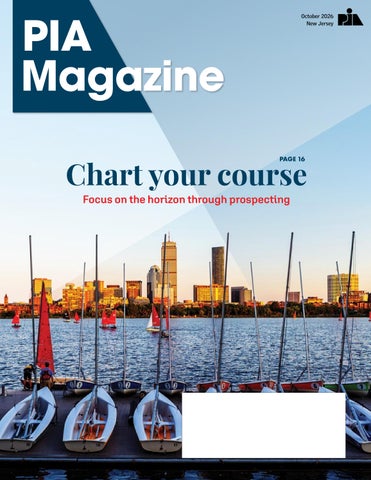
October 2026 New Jersey
Chart your course PAGE 16
Focus on the horizon through prospecting
PIA’s curated programs for member agencies and brokerages feature carrier selection, flexible coverage, top-notch customer service, and claims assistance when you need it.
Employee Benefits for Insurance Agencies
Let the
PIA Members’ Choice group benefits program take care of your agency. Medical Dental/vision LTD with Reliance Standard Term life with Reliance Standard guarantee issue, no medical questions
Get your quote today! (800) 424-4244 memberservices@pia.org
Vol. 70, No. 9 October 2026
Chart your course
Departments
Focus on the horizon through prospecting
16
9
In brief
9
Staffing
13
Legal
27
Service
31
Ask PIA
34
Officers and directors directory
35
Advertising index
Cover Design David Cayole
Cover story The cost of maintaining; the value of prospecting
Highlights
4
Staffing
Build lasting relationships through communication
13
Legal
Leave the book; take the talent
23
Feature
Telematics: A powerful retention tool
Professional Insurance Agents 25 Chamberlain St., P.O. Box 997, Glenmont, NY 12077-4835 (800) 424-4244 | pia@pia.org | www.pia.org
President and CEO Jeff Parmenter, CPCU, ARM; Executive Director Kelly K. Norris, CAE; Communications Director Katherine Morra; Editor-In-Chief Jaye Czupryna; Advertising Sales Representative Robbie Merrill; Magazine Layout Designer Patricia Corlett; Communications Department contributors: David Cayole, Jeana Coleman, Darel Cramer, Matthew McDonough and Damon Whimple. Postmaster: Send address changes to: Professional Insurance Agents Magazine, P.O. Box 997, Glenmont, NY. “Professional Insurance Agents” (USPS 913-400) is published monthly by PIA Management Services Inc., except for a combined July/August issue. Periodical postage paid at Glenmont, N.Y., and additional mailing offices. ©2026 Professional Insurance Agents. All rights reserved. No material within this publication may be reproduced—in whole or in part—without the express written consent of the publisher. Statements of fact and opinion in PIA Magazine are the responsibility of the authors alone and do not imply an opinion on the part of the officers or the members of the Professional Insurance Agents. Participation in PIA events, activities, and/or publications is available on a nondiscriminatory basis and does not reflect PIA endorsement of the products and/or services.
IN BRIEF
PLAN FOR MORE AGENCY GROWTH Agencies that grow have more longevity. Longevity attracts more clients. More clients means more business growth. More growth means … you get the idea. But, how do you go about expanding your agency to generate more revenue and increase your marketshare? It helps if you have a plan.
The five stages of business growth Stage No. 1: Existence.
Stage No. 3: Success.
This is the initial startup phase to focus on gaining clients and delivering a viable product of service.
This is when a business is stable and profitable. This is when agency owners need to decide whether to maintain the status quo or leverage the agency for agressive expansion.
Questions to ask: • Is it a viable business? Can we get enough clients, deliver our products, and provide services well enough?
Questions to ask: • Are we retaining our existing clients?
• Can we broaden our sales base? Can we expand on what we offer?
• How can we lower our client acquisition costs?
• Can we meet cash-flow demands? Do we have enough money to cover our start-up phase?
• Are our daily workflows efficient?
Stage No. 2: Survival. This is when the business has proven to be a workable entity, but it is still focused on breaking even and generating enough cash flow to stay afloat. Questions to ask: • Can we generate enough cash to cover expenses? • Can we generate enough cash to continue to stay in business and to grow?
• Is the business aligned with personal goals?
Stage No. 4: Take-off. This is when the business grows rapidly. The main challenge is securing adequate financing to fuel this growth and to delegate responsibility. Questions to ask: • Do we have formalized systems for data and resources? • Are our operational metrics aligning with our goals? • Do we have the right leaders on board? • Is revenue growth matched by health profit margins? • Do we persist or pivot?
Stage No. 5: Resource maturity. This is when the agency has attained significant scale and financial control. The key is to consolidate and control the financial gains while retaining the entrepreneurial spirit. Questions to ask: • How can we effectively control and consolidate our financial returns while funding future projects? • Are our budgeting, strategic planning and management systems prepared for long-term goals? • How can we diversify our investments to protect the agency’s capital against market shifts? • What is our strategic plan for the agency’s value, and are we preparing for an exit or an acquisition? • How can we maintain a flexible, entrepreneurial spirit and foster innovation while operating at a large, mature scale? • Is our management team actively incentivized to identify new markets or product lines? • Do we have a strong succession plan in place for key leadership roles? • Are our employees engaged, and are we providing the resources they need to thrive in a mature organization?
4
PROFESSION A L I NS U RANC E AG E NTS M AG AZIN E
Higher growth stages To transition to higher growth stages, you should consider: Market expansion. Open new physical locations or sell into adjacent demographics. Before you expand into a new market: You need to examine demand and positioning; financial do your due readiness, your agency’s infrastructure; and do your due diligence regarding risk management (i.e., What are roadblocks? Are there regulatory compliance issues? Is there a right market for the expansion?). Product development. Build new products or upgrade services to deepen relationships with your existing client base.
Before you develop a new product: You need to identify the specific client plain point that you are trying to solve; to determine if there is a genuine demand for the market; and to identify your ideal target audience. Strategic partnerships. Collaborate with other noncompeting businesses to co-market or bundle services. Before you establish partnerships: You need to ask yourself: What unique capabilities would the partnership bring to the agency?; Does your target markets and ideal customer profiles overlap? And, you need to make sure your direct competitors don’t already have a relationship with the potential partner. Plus, you need to make sure you are compatible regarding culture and operations.
Create an actionable growth plan Step 1: Confirm financial readiness: Assess your agency’s current metrics to ensure your cash flow can handle expansion risks. Step 2: Define SMART goals. Use the Specific, Measurable, Achievable, Relevant and Time-bound methodology to set clear targets.
Step 3: Comply with local regulations. If you are expanding into a new region, research and adhere to all local laws, permits and tax structures.
PIA .ORG
5
IN BRIEF
Nine reasons your agency needs a marketing plan Doug Brown, chairman/CEO, Paradigm Associates LLC No. 1: Minimize the cost of false starts. An agency can invest time and money to pursue a market that does not fit its carrier relationships, expertise or profit requirements. It can build a campaign around a poorly defined message. It can adopt technology without deciding how it will support the agency’s strategy. A marketing plan forces agents to think about decisions before committing resources. It cannot eliminate every mistake. However, it can reduce impulsive decisions, disconnected initiatives and unnecessary spending.
A producer pursuing contractors needs to understand that market’s exposures, terminology, operating pressures and coverage concerns. An account manager working with affluent personal lines clients may need a different level of knowledge. Focused training allows the agency to deepen its capabilities, but it should not be limited to insurance products. Employees may need development skills in relationship building, communication, account management, technology, referral development, etc.
No. 2: Focus efforts. A marketing plan clarifies the agency’s priorities, and its employees’ roles to achieve them. Producers may need to develop relationships within selected industries. Account managers may need to identify account-rounding opportunities. When expectations are clear, people can make better decisions. The plan also should help employees understand what the agency is not pursuing. All business is not equally valuable for the agency.
No. 7: Build recognition and credibility. Recognition matters, but it is not enough. An agency needs to be associated with something. What should prospects think when they hear the agency’s name? Is the agency known for understanding construction companies, helping manufacturers manage risks, advising nonprofits or responding well to claims? That reputation becomes the agency’s brand. It is shaped by what the agency says, but also by what it does. A plan helps to ensure that the agency’s website, conversations, involvement, educational content, advertising and client experience reinforce that position.
No. 3: Select the right markets. A marketing plan requires an agency to define its type of clients. That decision might be based on industry, geography, risk profile, account size, life stage or coverage needs. The more an agency defines its preferred markets, the easier it is to develop relevant expertise, strengthen carrier relationships, create useful content, train employees and communicate a point of difference. No. 4: Spend marketing dollars wisely. A plan helps leadership decide which activities to fund. Should the agency sponsor an event? Invest in search visibility? Produce educational webinars? Expand its referral network? Develop a client newsletter? Hire outside marketing support? The answers depend on what the agency is trying to accomplish, whom it needs to reach, and how each activity supports the larger strategy. No. 5: Evaluate results easier. Agents can track website inquiries, referral sources, event responses, email engagement, appointments, quotes, new business, account rounding, retention, reviews, etc. Dedicated landing pages, QR codes, campaign telephone numbers, customer relationship management systems, and follow-up questions can provide useful information. The goal is to develop enough information to make better decisions. A sound plan distinguishes among activity, response, conversion and financial results. No. 6: Focus training and development. Once an agency identifies the markets to pursue, it can prepare its people.
6
PROFESSION A L I NS U RANC E AG E NTS M AG AZIN E
No. 8: Improve understanding of competition. Competition is not limited to the agency across town. It may include national brokers, direct writers, digital platforms, aggregators, specialized agencies, banks, payroll companies, benefits firms, etc. A marketing plan should prompt leadership to examine how competitors position themselves, which markets they pursue, what capabilities they emphasize, and where they appear strong or vulnerable. The purpose is not to imitate competitors. It is to understand prospects’ choice, and to determine how the agency can create a distinction. No. 9: Connect current activities to long-term growth. Sustainable growth develops when agents make aligned decisions over time. The agency becomes known in selected markets. It builds relationships and strengthens expertise. It communicates consistently and delivers on promises. It retains clients and earns referrals. A marketing plan connects today’s activities to long-term objectives. It helps the agency balance today’s lead generation with slower work to build reputation, credibility, relationships and market position. This is an excerpt of an article in the PIA QuickSource library (90500), which PIA Northeast members can find on pia.org.
Insuring the companies that build America and keep it running ®
[
Workers Compensation Insurance • No volume requirements • Competitive rates • Multiple options for premium payments • Open to Shock Loss/High Mods Send in your submissions today. For more information contact a marketing rep at 844-761-8400 or email us at Sales@Omahanational.com. Coverage in most states Omaha National Underwriters, LLC is an MGA licensed to do business in California (License No. 078229). Coverage is provided through Omaha National Insurance Company and Omaha National Casualty Company, each rated A- (Excellent), and Preferred Professional Insurance Company, rated A (Excellent).
Smart. Different. Better.
Bold solutions that drive business growth. Together, let’s create new opportunities. Brooks Insurance Agency helps retail agents grow their business through expanded market access, specialized expertise, and responsive service. Backed by a broad carrier network, we deliver the solutions and support you need to meet client needs with confidence. Specialized wholesale solutions for: Commercial
Special Events
Professional/Non-Profit Liability
Cyber Liability
Personal Lines
Surety
Contact a Brooks broker to start a quote. Contact a Brooks broker at info@brooks-ins.com and scan to start a quote.
Brooks Group Insurance Agency, LLC | NJ License 1575143 • Brooks Specialty Insurance Agency | CA License 0L58112 © 2026 Brooks Group Insurance Agency is a wholly-owned subsidiary of Venbrook Group, LLC. All Rights Reserved.
STAFFING
High-touch communication builds lasting relationships Tory Brownyard, CPCU President, Brownyard Group Even in today’s tech-forward environment, 88% of insurance customers prefer guidance about their policies to come from a human being.1 In part, this is why savvy independent agents are driving client retention by building strong and lasting relationships long before renewal periods. To do so, they lean in on consistent, proactive communication that strengthens relationships and positions them as trusted advisers, not just policy providers. These regular touchpoints take many forms and create familiarity and trust, reinforcing the value of the agent beyond a mere transaction.
Sharper underwriting through ongoing dialogue Independent agents who maintain regular contact with their insureds tend to develop a deeper understanding of the insured’s operations. Often, this results in producing insights of value for underwriters to tailor coverage more closely to the insured’s realities. That correlation between consistent communication and relationship building for client retention manifests in a range of ways beneficial to the insured as much as the agent: It develops accuracy in the underwriting process. By having constant communication, the agent becomes familiar with the insured’s business, which allows the agent to ask the insightful, helpful questions at renewal.
When thinking about coverage gaps, consider a pest control company that adds a new service (e.g., bed bug eradication). The owner may not think to report this new service to the insurance agent right away. This could lead to a gap in coverage if the existing policy language excludes this type of service. Adding this new service might necessitate significant, and potentially expensive, change to the policy to ensure proper coverage. Proactive communication by or with the agent will likely bring that new service to light sooner, allowing proper coverage options to be discussed and addressed. Another example is security guard liability insurance. Some providers will add an exclusion for certain events, such as gatherings of more than 250 people. When an insured submits a renewal application, which does not indicate that the insured will provide security for large events, a policy could be issued that excludes such work. During the policy term, if a client asks the security firm to provide security at a big event, the exclusion will leave the firm uninsured should a claim occur. A dialogue between the insured and agent, during the policy term, may have triggered the agent to remind the insured of that exclusion, and to allow time to fill the coverage gap.
Set expectations in an evolving market
It builds trust, dependability and familiarity. Ample communication strengthens a relationship naturally, engendering greater trust and dependability.
Volatility in the insurance industry is not a recent development. Ongoing economic pressures such as tariffs, the rising cost of living, regulatory changes, climate issues and an ever-evolving appetite among insurance carriers have challenged independent agents to get creative and to expand their resource networks. Industry competition and increasing customer expectations also contribute to operational challenges for insurance agencies.
It prevents potential coverage gaps. At renewal, agents can ask the right questions and can identify the unique exposures. Often, continuous engagement uncovers operational changes, new services or emerging risks that require coverage adjustments clients may not recognize as critical.
Frequent communication presents a range of opportunities throughout any given year for independent agents to better educate insureds about the ramifications of these changing market conditions. This includes keeping insureds aware of trends and emerging areas of growth, especially with
It sets expectations. Through constant communication, the agent can keep the insured aware of the current insurance environment and rates—so when premiums rise, the insured is not caught unaware by an increase in insurance rates.
PIA .ORG
9
STAFFING specialized insurance products in niche areas like security, beauty salons and spas or pest control. Take on the role of trusted adviser to identify areas for business growth and to elevate your role beyond that of just a sales agent. A commitment to high-touch communication between the agent and the insured also has become more relevant thanks to artificial intelligence, which allows questions to be answered instantaneously via chatbot. Should AI hallucinate, insureds run the risk of spreading inaccurate information, which can impact coverage. Instead of allowing the technology to replace the agent-insured relationship, successful agents are using AI to enhance customer service and streamline administrative tasks, paving the way for them to spend more time relationship building so they can better anticipate their clients’ needs. A strong rapport between independent agents and their insureds also increases the likelihood of early policy renewals that benefit policyholders by preventing rushed decisions and coverage lapses. These high-touch communication examples reinforce the agent’s advisory role, demonstrating tangible value. The agent can become aware of new exposures or changes in the operation that require new coverage, identify risk management opportunities to help minimize losses or bring premium savings to a new client through a review of their insurance program.
Minimize liability with clear, contractual communications Insurance policies that include jargon, complicated fine print, confusing exclusions or strict deadlines can create financial and legal trouble for insureds. Even unintentional errors or omissions
10
on an insurance application can cause a policy to be rescinded.2 Proactive, transparent communication during the initial policy writing process can help protect insureds from liability down the line. For example, when writing the initial policy, avoid overly affirmative language like guarantee and ensure clarity of language around specific terms or benefits of a given policy. Clear and simple contractual language helps manage client expectations and helps protect the insured against future losses down the line, which shows that the agent is prioritizing the insured’s best interests. Plain-language documents also prevent surprises and unexpected coverage denials. This helps to build trust and to prevent misunderstandings while enhancing the independent agent’s reputation. Perhaps most importantly, clear and consistent communication between insureds and agents helps policyholders navigate unclear jargon in the policy language and focus on the most important coverages for their business. This helps insureds better understand their policies and avoid gaps or mishaps. Confirming a client understands what has been documented builds confidence and increases the odds of repeat business.
Turn relationships into growth opportunities Another benefit of strong agent-insured communication is that it allows for new and increased business development. Agents can: • engage with clients’ industry associations; • ask if they can attend or can speak at relevant events; • request testimonials to share within the client’s industry; and
PROFESSION A L I NS U RANC E AG E NTS M AG AZIN E
• leverage the relationship to confidently ask for referrals and introductions.
Advisory actions any agent can take Scheduling a dedicated yearly checkin date for the annual policy review is standard operating procedure in the industry. This conversation gives the agent a chance to make sure the insured’s existing coverage matches any new business milestones or operational changes. For agents looking to open the door to other regular touchpoints to strengthen relationships, consider: Regular meetings. An in-person lunch or coffee meeting, or virtual monthly or quarterly meetings can help address any pressing issues. They can allow the agent to gauge the insured’s current pressure points or obstacles. Proactive check-ins. Active outreach, including on-site visits, can identify changes in an insured’s lifestyle or business, which can provide context for better underwriting. It also allows for further communication—and a chance to see businesses in action. Year-round outreach. Regular checkin emails, outside of renewal season, can help you stay top of mind with your insureds. They can let your insureds know that you are thinking about them beyond their renewal, which can help you continue to build trust throughout the year. Check-ins at business milestones (e.g., anniversaries) or after severe storms or weather events can demonstrate that the relationship between the agent and the insured can be personal and not just transactional. Informational resources. Monthly or quarterly newsletters that highlight insurance industry trends, provide
seasonal reminders, or share client success stories can keep insureds informed, engaged and educated. They also can serve as a valuable errors-and-omissions prevention tool. Gather feedback. Periodic client surveys that are designed to gauge interests, priorities and potential areas of concern can help the agent stay better informed about their clients’ thinking and potential needs. Community outreach. Partnerships around community events, sponsorships or charitable causes can allow the agent and the insured to extend their relationship for a good cause. Many of these touchpoints can be organized through a customer relationship management system that tracks, among other things: customer interactions, satisfaction, behavior and business performance.
Intentional communication is a business strength When communication becomes intentional rather than reactive, it strengthens retention, reduces E&O insurance risk, and creates natural opportunities to ask for referrals or testimonials. In the independent agency system, disciplined communication is not simply about good service; it is a scalable growth strategy.
Advertise in the
PIA Magazine Pass-on readership of 20,000+ professionals a month Award-winning magazine with expert-driven, relevant content Increase digital traffic through socials, links, QR codes Contact Robbie Merrill Magazine and Media Sales Executive rmerrill@pia.org “I RECEIVED CALLS TODAY FROM THE AD. IT WORKS!” —Brian Samway, Empire State Brokerage Services
Brownyard, CPCU, is president of Brownyard Group, an insurance program administrator with specialty programs for select insurance groups. In addition to his responsibilities as president, he spearheads the Brownguard® Security Guard Insurance Program. The firm can be reached at Brownyard.com or (800) 645-5820. 1
Insurance Business, 2024 (tinyurl.com/mrykrxu2)
2
Hunton, 2024 (tinyurl.com/5n7netmc)
www.pia.org
PIA .ORG
11
JAN 2026-JAN 2027 USA
Reimagine Insurance Whether starting or growing your independent agency is the goal, we can help. SIAA–The Agent Alliance.
siaa.com
Market Access | Enhanced decision-making | Integrated technology & real-time business intelligence
To learn how SIAA NXT is elevating the independent agency channel through The Intelligent Distribution Platform, visit siaanxt.com.
LEGAL Leave the book; take the talent Bradford J. Lachut, Esq. Director of government & industry affairs, PIA Northeast
One of the greatest benefits of my position at PIA is that I spend nearly every day talking with insurance agents and brokers. Those conversations are my window into what’s happening in the marketplace, and lately one topic seems to come up in almost every conversation: mergers and acquisitions. Consolidation continues to reshape the independent agency system. Agencies are buying other agencies, aggregators continue to expand, and firms of every size are asking whether acquisition should be part of their growth strategy. However, during a recent conversation with an agency owner, I heard a different perspective. He told me he wasn’t looking to acquire books of business anymore. He was looking to acquire people. Instead of asking, “What accounts can this person bring me?,” he was asking, “What could this person help me build?” It was one of those aha moments. That simple observation completely reframed the way I think about agency growth. For years, growth has meant one thing: buying revenue. But, perhaps the better question today is whether agencies should be investing in capacity instead.
Buy revenue vs. build capacity Purchasing a book of business has obvious advantages. It can generate immediate revenue, expand an agency’s geographic footprint, add expertise in a niche market and create economies of scale. However, every acquisition also brings uncertainty. The acquiring agency must evaluate account quality, carrier relationships, retention expectations, technology compatibility, service demands and cultural fit. Some policies may no longer fit the agency’s carrier appetite. Clients may leave during the transition. Employees may struggle to adapt to new systems, new leadership or a new culture. In other words, an agency may acquire revenue—but it also acquires complexity.
Hiring a talented professional is a different kind of investment. Instead of purchasing existing revenue, an agency is investing in its future ability to create revenue. A talented producer creates new opportunities. An experienced account manager improves retention and frees producers to sell. An operations specialist creates efficiencies that allow everyone else to become more productive. A marketing professional helps the agency reach new audiences. You get the idea. A book provides accounts. The right employee builds capacity. And, capacity has a remarkable way of producing sustainable growth year after year.
Why now? The conversation with the agency owner wasn’t my only reason for rethinking agency growth. It simply crystallized a trend I had already noticed. Every merger creates disruption. Some of that disruption is positive. Some of it isn’t. Employees find themselves working under new leadership, in a different culture, with different expectations. Some positions disappear altogether. Others change dramatically. None of that means those employees suddenly became less talented. Quite the opposite. Consolidation often leaves outstanding people looking for an organization that better appreciates what they do best. Consider the high-performing producer who suddenly becomes a middle manager because that’s viewed as the natural next step. The skills that make someone an exceptional producer—competitiveness, independence and a passion for building client relationships—do not automatically make that person an effective manager. Often, the result is a round peg being forced into a square hole. For agents who are paying attention, that creates opportunity. A talented employee who seems out of place after a merger may simply need a different environment to thrive. Recruiting that individual isn’t merely filling an opening—it’s
PIA .ORG
13
LEGAL acquiring an asset another organization failed to maximize.
Warning: Legal talk ahead Now it’s time to put on the attorney hat. Unfortunately, it isn’t a real hat. In my imagination, it’s a trucker hat with the word Attorney across the front and a barrister’s wig sticking out underneath. You know, dignified—but ready to party. But, I digress. Recruiting experienced insurance professionals requires agents to understand any contractual obligations a candidate may have to a current or former employer. I’ve written entire articles about restrictive covenants, so I won’t revisit every nuance here. A quick refresher will do. The two restrictive covenants agencies are most likely to encounter are noncompetition agreements and nonsolicitation agreements, and they are not the same thing.
Generally, a noncompetition agreement attempts to restrict where, for whom or in what capacity an individual may work for a specified period of time. On the other hand, a nonsolicitation agreement typically permits the employee to take a new position, but it limits the ability to solicit certain clients, prospects or co-workers from the former employer.
individual at this time makes business sense. If the candidate is subject to a nonsolicitation agreement, you should understand exactly what restrictions apply before assigning responsibilities or developing a marketing strategy.
Whether either agreement is enforceable depends on the applicable law, the language of the agreement and the facts surrounding the employee’s departure. Agents should never assume that a restriction is enforceable automatically—or unenforceable automatically.
The goal shouldn’t be to find ways around another agency’s agreements. The goal should be to identify talented professionals who can help your agency grow while respecting any legal obligations they still may have.
In either case, remember that restrictive covenants generally govern how the employee can transition—not whether the employee has value.
More importantly, those agreements should shape your hiring strategy.
That’s why I think it’s important to view these hires as investments in people rather than investments in someone else’s client list.
If a candidate is subject to a valid noncompetition agreement, you may need to delay the start date, modify the position or determine whether hiring the
Hire people for what they can help your agency become—not merely for what they might bring with them from their previous employer.
Postal Ownership Statement
That mindset creates a far more sustainable—and far less troublesome— foundation for growth.
A different way to think about your agency’s growth strategy Buying another agency will always have its place. For many firms, acquiring a book of business will continue to be an excellent growth strategy. However, it isn’t the only strategy. In fact, today’s wave of consolidation has created something else: a marketplace filled with talented insurance professionals looking for the right opportunity. Ultimately, those people may become a better investment than another book of business. Books generate revenue. Great people build agencies.
14
PROFESSION A L I NS U RANC E AG E NTS M AG AZIN E
BLAZING A PATH OF PROTECTION.
WHOLESALE BROKERAGE | BINDING AUTHORITY | EXCLUSIVE PROGRAMS JencapGroup.com
AMANDA PUPPO Owner, MarketReach Inc.
Chart your course Focus on the horizon through prospecting
alk into most insurance agencies today and—on the surface— things look good. Retention is strong. Books of business are healthy. Producers are busy. Revenue is steady. However, underneath that success, there’s a challenge many agency principals quietly wrestle with: Their producers aren’t necessarily prospecting anymore. They’re maintaining. And, the tricky part is that maintaining doesn’t look like a problem—at least not right away.
Managing renewals, providing service to clients, handling day-to-day issues, and strengthening existing relationships are all important. In fact, those activities are what build trust and keep an agency successful. The problem occurs when maintaining becomes a substitute for creating new opportunities. Because maintaining protects today’s revenue. Prospecting creates tomorrow’s growth. Tomorrow’s growth is paramount for a healthy organization to not only manage the inevitable attrition that occurs when clients take their business elsewhere or sell their company, but it also ensures that the agency is a more sought-after entity for acquisition due to profit and consistent growth. The best time to start thinking about selling your agency is the day you start it.
The difference between maintaining and prospecting, today vs. tomorrow
• How is activity measured? • What tools and resources are available? • What prospect lists are available? If those answers are unclear, prospecting becomes optional. And, optional activities tend to get pushed aside when a producer has a full schedule of renewals, client meetings and internal responsibilities. And, things rarely slow down to pave the way to focus on net-new business as a daily and weekly activity.
The cost of not prospecting Usually, the impact of inconsistent prospecting does not show up immediately. It appears later in the form of inconsistent pipelines, unpredictable growth and missed opportunities. Today’s pipeline is often the result of yesterday’s activity.
There’s a natural evolution that happens as producers become successful. Early in their careers, they often focus on building relationships and finding new opportunities. They network, attend conferences and make cold calls. Over time, as their book grows, their attention shifts toward servicing and protecting what they already have. It’s an understandable shift.
In the insurance industry, timing matters. A client who is open to exploring options at renewal may already have relationships in place months before that window arrives. If your agency is not consistently creating awareness and building relationships, you may never get the opportunity.
Prospecting requires intentional activity, such as:
The first thing to understand is that prospecting is not simply networking and cold calling. While these prospecting elements can be part of a strategy, effective prospecting is a complete process that requires more thought and action. A strong prospecting engine includes:
• identifying target accounts; • reaching out before a prospect is actively shopping; • building relationships before there is an immediate need; and • creating conversations with prospects who may not know your agency yet. The challenge is that maintaining feels productive because it produces immediate results. It’s also very comfortable. Prospecting requires patience. The conversation you start today may not turn into revenue for months. Without structure, the urgent always wins over the important. Getting in the car for an event or picking up the phone takes a back seat.
Why this happens (not just a producer problem) It’s easy to point the finger at producers and say, “They need to prospect more.” However, in many agencies, the bigger issue is not effort—it’s the system around the effort. To get better at prospecting, the questions that need to be answered include: • What are the expectations? • How often should prospecting happen? 18
• What markets should producers focus on?
PROFESSION A L I NS U RANC E AG E NTS M AG AZIN E
What effective prospecting requires
• clear target markets and ideal client profiles (the strategy piece); • messaging that connects to real challenges; • consistent outreach activity that can include a host of techniques; • agency-wide initiatives—anchored by a customer relationship management system to track prospect activity, combined with consistent marketing efforts (e.g., a monthly newsletter created by a dedicated marketing resource) that keep all producers top-of-mind across the entire prospect base; and • a follow-up process that keeps opportunities alive. There is no universal metric that works for every agency, but consistency matters more than occasional bursts of activity. Consider multiple channels. Phone, email, LinkedIn posts, referrals, networking and strategic partnerships can all play a role. Using AI for marketing is becoming a useful tool in an ever-changing landscape.
The goal is not to overwhelm producers with activity. The goal is to create a repeatable process that happens regardless of how busy the week gets.
Build a prospecting engine The agencies that consistently grow don’t leave prospecting to chance. They build an engine around it. That starts with focus. So, the questions that need to be answered include: • Who are you trying to reach? • What industries align with your agency’s expertise? • What size accounts make sense? • Are there specific business triggers, market changes or renewal timelines that create opportunities? • What can you glean from third-party prospect list platforms that allow for more targeted messaging on key data points (in commercial lines this would include MOD, renewal dates, reduction in payroll, OSHA data)?
Follow-up wins—silence doesn’t mean ‘no’ Finally, there must be follow-up. Outside of immediate sales meetings, callbacks are king. Hitting the timing a prospect suggests shows you’re paying attention—and separates you from everyone else who doesn’t follow through. One of the biggest mistakes agents make is assuming that a prospect who does not respond immediately is not interested. In reality, many opportunities require multiple touches before a conversation happens. An effective follow-up approach isn’t about checking in. It’s about staying relevant, persistent and easy to engage with—without becoming noise or a bother. You’ll know if your messages are received well when the prospect responds back with, “Thank you for the follow up.” Every prospect should sit inside a defined follow-up cadence that blends multiple touchpoints over time—calls, emails and light touches on platforms like LinkedIn. Intentional sequencing. For example, an initial call during which you must leave a message, you reference the email you’re about to send “sometime today.” A call/message with email follow up offers prospects another way to easily get to you at their preferred channel. They may be able to escape seeing an email, or forget about the message you left, but it’s much harder to ignore a call and same-day email. Then attempt another contact a few days later, and a value-based touch the following week. Finally, spaced follow-ups that extend out over time. Consistency matters more than intensity. Following their own callback cadence also
is a good strategy: “If I don’t hear from you, which month makes sense for me to come back to you?” Equally important is context in the value-based touch. Generic follow-ups are easy to ignore. Effective follow-ups give the prospect a reason to re-engage. This could be a quick insight about their industry, a relevant coverage trend or article to reference, a question tied to their insurance needs or business, or even referencing something specific from a prior interaction. It signals that this isn’t just another name on a list. There’s also a mindset shift required. Silence is not rejection. In most cases, it simply means not now. Too many opportunities are abandoned after two or three attempts, when it often takes eight, 10 or more touches before a conversation happens. The agents who win are the ones who stay in the game longer—professionally and consistently. And, when prospects do engage—even briefly—that’s when discipline matters most. If they say: “circle back in a month,” that follow-up should happen exactly when promised. That level of timing and attentiveness stands out more than most agents realize.
At its core, effective follow-up is less least aboutnot creativity and right away. more about commitment. The agents tricky who treat it as a propart is that maintaining d cess—not an afterthought—are the onesnecessarily that ultimately turn anymore prospecting more prospects into conversations, andagency more conversations principals quietly wrestl into revenue. However, underneath that succ
Don’t settle for “being ghosted” and chalk it upProducers to bad luck. healthy. are busy. Rev Rather, breakdown the process, examine where it fell apart, things look good. Retention is and continue your follow up. Ask these alkquestions: into most insurance agencie • Did you build value when they were paying attention? • Did you act in a consultive manner?
Chart your
• Did you ask questions so that you understood their Focus on the horizon thro pain points? • Did you listen to them more than you talked?
There are basic techniques in sales (and life, in general) that will separate you from other agents and producers. However, even when you do everything right, you still can get ghosted, which is when you move on to the next prospect. Strong appointment-setting can help create consistent outreach, identify potential opportunities, and open doors that may not have existed otherwise. Sometimes, those doors can lead to somewhere unexpected. For example, one agency we worked with secured a meeting with a country club through outbound prospecting. On the surface, it was simply a new business opportunity. However, that conversation also created an introduction that opened
PIA .ORG
19
the door to a separate opportunity for one of the club’s existing clients—ultimately, generating an additional $20,000 in annual commission. That is the part of prospecting many people underestimate. You never fully know where one conversation can lead. However, without creating the initial conversation, the additional opportunity can never exist.
Prospecting is not one activity
The answer starts with positioning. Prospecting should not be viewed as a punishment or an indication that someone is not doing enough. It should be viewed as an investment in the future of the agency, and, in the producer’s own wallet. The conversation should be about growth. Questions to focus on include:
The strongest agents understand that growth comes from a combination of channels. Some of the most effective prospecting engines include:
• What does the agency want to accomplish?
Strategic referral programs. Create a process to ask and to receive introductions rather than simply hope for referrals to happen.
• What support does the team need to make that happen?
Email campaigns. Stay relevant with prospects through timely, valuable communication. LinkedIn engagement. Build familiarity and credibility with prospects before they have an immediate need. Network and establish partnerships. Create relationships that can produce opportunities over time. AI-driven advertising. Use increasingly precise targeting and intent data to get in front of the right accounts earlier in their decision cycle. Appointment setting. Add consistent outbound activity to create conversations with qualified prospects. The key is not to choose one channel and to expect it to solve everything. Rather it is in creating a consistent mix of activities that keeps new opportunities flowing.
Reset expectations without creating friction One of agency leaders’ biggest concerns is how to increase prospecting activity
20
without creating frustration among the agency’s producers.
• What type of clients does it want to attract?
When expectations are clear and resources are available, prospecting becomes much less intimidating. It becomes part of the culture.
Maintain today, grow tomorrow The agencies that thrive are the ones that balance protecting existing relationships with consistently creating new ones. They understand that growth is not built through occasional bursts of activity. It is built through a repeatable process that creates opportunities month after month. The question is not whether your producers can prospect; it is whether your agency has built the structure, expectations and support system to make prospecting a consistent part of how you grow your agency. Puppo is the owner of 25-year-old New Jersey-based MarketReach Inc., which specializes in setting qualified sales meetings and B2B appointment setting for insurance agencies and allied suppliers. For more information, visit MarketReachResults.com.
PROFESSION A L I NS U RANC E AG E NTS M AG AZIN E
Tailored Support. Profitable Growth. True Independence. A network with one goal for the last 49 years: helping our members thrive.
Ken Bull
Shanna Muscavage
Gary Reisman
•
Build equity value while remaining 100% independent.
•
Win more new business through optimized markets.
•
Grow top-line commission revenue.
•
Increase profit-sharing revenue with enhanced incentives for profitable growth.
Reach out now or learn more at ironpeak.com. PIA .ORG
21
Update your CIC designation this fall with PIA Eligible for continuing education credits in all states, CIC is one of the most advanced, highly recognized professional education designation programs in the insurance industry. The program provides a comprehensive and continuing education program to individuals who have made a career commitment to insurance. The institutes and examinations are based on the premise that the student has a good grasp of the subject matter before coming to the institute. The program is provided by the Risk and Insurance Education Alliance and PIA Northeast. Remember, you don’t have to be seeking the designation to attend CIC institutes. People are welcome to attend for state CE credit or personal enrichment. Exams are optional for those not seeking the designation.. Don’t miss out on this opportunity. Oct. 21-22, 2026
CIC CML–Commercial Multi Line Institute Webinar
Nov. 4-5, 2026
Ruble Graduate Seminar Hybrid (in-person Caesar’s Atlantic City)
*This session does not contribute toward getting the CIC designation, only for updating it.
Nov. 18-19, 2026
CIC ICO–Insurance Company Operations Institute Webinar
Dec. 2-3, 2026
CIC AM–Agency Management Institute Webinar
Register online at: www.pia.org/category/education
www.pia.org
Jared Stuckey Managing director, product & underwriting, Plymouth Rock Assurance
Telematics
An agent’s most powerful retention tool Telematics has grown in popularity across the auto insurance industry, promising accurate pricing, personalized policies, and more proactive engagement with policyholders. As adoption increases, insurers are leveraging telematics as an underwriting tool, providing clients with driving insights and strengthening customer relationships through improved retention and more consistent touchpoints between renewals.
know what telematics is or whether their insurer offers it; in fact, only 28% of policyholders are aware of their insurer’s telematics program. Of those, just 31% actively use it, while others have either opted out or abandoned it.2
Yet, despite its growing role as the future of insurance, its adoption still lags due to one critical issue: trust. Research has shown that the challenge is not the technology itself but the trust of it from consumers.1 While insurers have invested heavily in telematics capabilities, the industry’s biggest obstacle is helping consumers understand how the technology works, and the value it provides. Independent agents are uniquely positioned to bridge that gap.
The insurance industry consistently has measured success in terms of customer acquisition. This has led to a focus on competitive new business pricing, chasing quote volumes and responding to rate shopping. However, acquisition costs continue to increase, and customer loyalty has become difficult to maintain with clients able to compare carriers right at their fingertips online.
Independent agents and customers often struggle to discuss the practical benefits of telematics and how it works. Beyond general uncertainty, many consumers may not even
Telematics is an opportunity to build stronger relationships with clients and further innovation, growth and trust.
Retention over acquisition
This makes retention extremely and increasingly valuable and creates a key role for telematics reinforcing value. Telematics is not only a pricing or risk-selection tool: it also maintains ongoing engagement and fosters strong
PIA .ORG
23
client relationships. This reduces shopping behavior and increases long-term loyalty. For independent agents, this matters because retention is increasingly more valuable than constant pressure to acquire. Even modest improvements in retention can have a significant business impact. By retaining policyholders, you’re reducing costs from needing to acquire a new one, supporting long-term revenue stability, and deepening trust throughout time. Insurers and agents alike can find value in telematics in this regard, as it helps carriers improve lifetime customer value through stronger engagement and loyalty, not just pricing. For independent agents, these conversations can build trust, improve retention and create more opportunities to demonstrate value throughout the policy lifecycle.
Privacy concerns remain an issue Despite the potential benefits of telematics, privacy concerns remain one of the biggest barriers to adoption. Today, 20% of drivers said their biggest telematics concern was their data being shared or sold, while 32% said they would be uncomfortable with insurers collecting their precise location.3 Many consumers still believe telematics is designed to track their every move, when in reality it is used to evaluate driving behaviors such as speed, braking patterns, mileage and other indicators of risk. As a result, misconceptions about data collection and usage continue to overshadow the real value these programs can bring to customers. This presents a significant opportunity for independent agents. Consumers are looking for someone they trust to explain what that data means. By addressing privacy concerns and reframing telematics as a customer benefit rather than a surveillance tool, agents can increase adoption while strengthening long-term relationships. Those conversations matter. When customers understand the purpose of telematics, they’re more likely to recognize
its benefits. Agents who can bridge the gap between perception and reality will be best positioned to drive adoption.
Transactional vs. trusted relationships Typically, traditional insurance relationships are silent until renewal or a claim arises. For many policyholders, insurance remains a transactional experience: they purchase a policy, renew it each year, file a claim when necessary, and have little interaction with their agent in between. For independent agents, this creates a challenge to build meaningful relationships with customers who often feel passive between policy periods. Customers often evaluate insurance primarily by price, because there are few ongoing touchpoints reinforcing value. However, customers clearly value engagement when it meets them where they are. Customer-centric companies are 60% more profitable than those that are not, according to Deloitte,4 reinforcing the business value of more consistent customer relationships. Telematics offers a solution to this transactional dynamic. With telematics, there are ongoing touchpoints in the form of driving feedback, coaching, rewards, safety insights and app engagement. Instead of interacting only at renewal or after a claim, agents have more opportunities to engage customers proactively and to reinforce their value. By creating more frequent, meaningful interactions between renewals, telematics helps shift the insurance relationship from transactional to consultative. For independent agents, these ongoing conversations may improve retention—and ultimately support long-term business growth.
Personalization at scale In addition to limiting customer communication to specific times, insurers also tend to speak to clients in a one-sizefits-all way using generic emails, renewal notices, standard discounts—the list goes on. This is an area in which consumer expectations for engagement have shifted significantly. According to Deloitte, nearly 70% of consumers state that they are more likely to engage with brands that personalize experiences.5 Telematics enables insurers to shift from broad messaging to individualized communication based on behavioral insights and risk patterns derived from each driver’s telematics data. Drivers who exhibit safe habits receive reinforcement, while those who display risky behavior can receive educational outreach. Both create opportunities for more relevant conversations and personalized guidance.
24
PROFESSION A L I NS U RANC E AG E NTS M AG AZIN E
Personalized communication helps shift telematics from a pricing tool to a relationship-building tool.
benefits create early value for participants, encouraging continued engagement over time.
Knowing when it’s the right fit
Why it works for the right customers
Telematics is not a one-size-fits-all solution. Not every client is ready for this technology, and it is an agent’s job to know when the recommendation makes sense. For some people, privacy remains a top concern and pushing the use of telematics aggressively will erode trust rather than build it.
As vehicle technology continues to develop and to grow over time, telematics will inevitably become even more integrated in the insurance experience. Data will grow both in volume and sophistication, offering agents and insurers access to more predictive insights than ever before. It also will offer more opportunities for proactive customer engagement, but increased data alone will not build strong customer relationships automatically.
The most effective telematics conversations begin with understanding the customer. Research shows that roughly 70%-80% of drivers believe they are more skilled behind the wheel than the average driver6—telematics is an opportunity to validate their safe driving habits and potentially help them to earn rewards or discounts based on their actual behavior. Another example is customers with new teen drivers who often are concerned about building safe driving habits and avoiding dangerous behavior such as speeding and distracted driving—these customers are more likely to value the coaching opportunities that telematics feedback can provide to them. By first understanding a customer’s goals, comfort level and motivations, independent agents can determine whether telematics is the right fit and frame the conversation around the benefits most relevant to that individual. Telematics might not always be the right decision for every client, and that’s okay. Success is measured in leveraging the right tools with the right clients, not mass adoption by all policyholders.
Leverage the correct data
For agents, the real value lies in helping policyholders understand how telematics works, what data is being collected, and how that information is being leveraged to ultimately benefit them. As independent agents continue to shift toward more personalized and engagement-driven models, transparency and trust will remain the frontrunners for critical long-term adoption and retention. When positioned effectively, telematics has the potential to create more meaningful policyholder interactions, supporting both customer satisfaction and long-term business growth for an agency. Stuckey is managing director of product & underwriting at Plymouth Rock Assurance, where he oversees the commercial product and New Jersey personal auto product teams and leads underwriting strategy and analytics for the Independent Agency Group. Prior to joining Plymouth Rock, he held positions at Liberty Mutual and PricewaterhouseCoopers. Stuckey earned a bachelor’s degree in accounting from Goshen College, and an MBA in finance from The Wharton School. He is based in the Boston area.
In terms of leveraging data, telematics is one of the most valuable tools because it serves as not just a pricing tool, but also as a conversation starter. With around 80% of insurance companies now offering usage-based programs,7 the opportunity for agents isn’t just availability, but application.
1
Journal of Knowledge Management Practice, 2024 (tinyurl.com/yw398u8v)
2
Consumer Reports, 2025 (tinyurl.com/ybfx9w78)
3
LendingTree, 2026
4
Deloitte Digital (tinyurl.com/te9dyjvx)
5
Deloitte, Wall Street Journal, 2024 (tinyurl.com/mt7rn6zn)
The strongest agents understand that success with telematics often depends on how it is introduced. In highly competitive quoting situations, it can help differentiate a policy by offering a more individualized approach to pricing and engagement. Even for households that may not be motivated primarily by premium savings, telematics still can provide value through broader incentive and rewards programs that extend beyond the policy itself.
6
University of Stockholm, 1981 (tinyurl.com/bder3t9m)
7
Wall Street Journal, 2026 (tinyurl.com/2cmx9w74)
Many telematics programs offer tangible, immediate incentives, including fuel rewards, gift cards or other perks. These
PIA .ORG
25
What if you could bypass the payment conversation?
What if you could
bypass the payment conversation? Insurance can be complicated enough. Payment doesn’t need to be. With PayMyPremiums®, our modern digital payment portal, agencies can: Meet payment challenges before they become obstacles Help clients focus on coverage - not affordability concerns Build trust through a more consultative, proactive approach Integrated payment options allow customers to choose at check-out whether to pay-in-full or finance their premium - creating a smoother path to purchase.. Simplify payments. Strengthen relationships. Request our Payment Portal FAQs and discover how PayMyPremiums® can improve efficiency and win more business at solutions@afcodirect.com.
A PIA preferred and endorsed provider
Unlock lifetime value through client retention
SERVICE
Jeff McFarland Northeast region field executive, Liberty Mutual In recent years, a firm pricing environment has helped fuel revenue growth for independent agents. However, as today’s market environment moderates, it is underlying policy retention that becomes increasingly important to growth. With this shift, agents are positioned to make the greatest gains by retaining and delivering value to their existing customers. Agent sentiment points to retention as an opportunity for growth: Agents have cited that retaining clients is the single most important activity for agency success this year, outranking even new business acquisition.1 For independent agents, this intentional refocus comes with a clear advantage. Agents already know their customers, understand local markets, and provide guidance that is difficult to replicate through direct or purely transactional models. When paired with smarter technology, better timing and stronger communication, the impact on keeping customers can be significant. By focusing on retention as a growth lever, there are several ways to drive stronger results, and it starts with an understanding of today’s customer mindset.
A shifting environment creates an opening The last few years of market uncertainty made customers more likely to shop their insurance and consider other options for their needs. Rising premiums, underwriting and appetite changes, and economic pressure all contributed to the rise in shopping and policy shifting. Fortunately for agents, this intensity appears to be normalizing. As the insurance market begins to stabilize, agents have an opportunity to strengthen relationships with existing customers and create clearer pathways toward retention. Agents who reported increased retention attributed the increase to their client communication strategies.2 These agents communicated with clients more frequently than
other agents and were more likely to explain coverage details to clients clearly and conduct proactive policy reviews. Without strong communication, even customers who are not actively considering a switch can become vulnerable to seeking change. Conversely, a well‑maintained relationship built on trust can strengthen retention and create more opportunities within the account over time.
Service and communication are foundational to build trust among clients Service experiences are a cornerstone of customer loyalty. In fact, customers who have a poor service experience are more than six times more likely to shop for a new insurer, according to J.D. Power’s 2024 Insurance Intelligence Report. For agents, that finding should be a call to action: Every touchpoint counts in keeping trust strong. One of the most effective ways agents can improve the customer experience is by being more deliberate about when and how they communicate. That means moving beyond reactive service and creating a more intentional cadence of outreach to customers throughout the year. Instead of relying solely on annual renewal conversations, agents can plan for additional quick check-ins throughout the account lifecycle. This may include prerenewal outreach to set expectations and clarify coverage, midterm check-ins to identify changes or new exposures, informal interactions to stay connected, and targeted education related to common concerns or market trends. These touchpoints do not need to be lengthy or complex. In many cases, a short, well-timed message is enough to remind customers that their agent is there for them. Even a tailored thank-you-for-being-a-customer note can have unexpected benefits. Over time, these interactions build a sense of reliability and care year-round. In a market where clients have more choices, consistency can make the difference between a renewal, and a lost account.
PIA .ORG
27
SERVICE Technology can help agents see retention risk sooner While personalized service lays the foundation for loyalty, technology can be the bridge that enables agents to identify shopping risks and stay top of mind for customers in the long-term. Most agents understand the value of retention. However, it can be difficult to know when to take action to retain a client. This is when technology can become a meaningful effort-multiplier for busy, multitasking agents. Many agents now use tools such as customer relationship management platforms, data dashboards and analytics solutions to parse account data, identify behavioral trends, and surface risks and opportunities within their existing books of business. Rather than relying solely on renewal dates or anecdotal feedback, these tools allow agents to spot signals that customer needs may be changing. For example, this technology can help identify accounts with potential coverage gaps, shifts in business operations or engagement patterns that may indicate a client is likely to shop for new insurance. With these insights, agents can prioritize outreach more effectively and address the most pressing needs first. Generative AI is quickly emerging as another way to support these efforts. When it comes to creating outreach and follow-up communication, AI-driven tools can help businesses draft messages, summarize account changes or streamline administrative tasks. Recently, during a conversation with an HVAC contractor about installing a home generator, he shared how his business uses AI to identify at-risk clients, predict which customers are likely to need service, and automate scheduling and follow-up communications. Since integrating AI into his workflows, his version of same-store sales has in-
28
creased by double digits, underscoring how data-driven insights paired with proactive outreach can drive meaningful results. Agencies with increased retention are more likely than other agencies to report that AI has saved them a notable amount of time.3 This allows them to redirect effort to other priorities. Those agencies that combine data-informed decision-making with a customer-first approach have a real advantage in boosting retention and spotting opportunities to round out accounts.
Cross sell works best when it starts with customer value Retention and cross-sell opportunities often are discussed separately, but in practice they should support one another. A broader relationship usually is a stickier relationship—especially with insurance customers. In fact, according to a 2023 report from Bain & Co., multipolicy insurance customers are three to five times less likely to switch providers than single‑policy customers. Cross-sell efforts are most effective when they are relevant and thoughtful. Customers want recommendations that make sense for their lives or businesses, and the strongest conversations often are triggered by moments that naturally invite discussion. For example, as agents deepen their understanding of a customer’s full risk profile, cross sell opportunities often emerge organically. A small-business insured for general liability may have unmet needs around workers’ compensation, commercial auto, or cyber security protection. In these moments, expanding coverage helps close critical gaps while reinforcing the agent’s broader commitment to protecting the customer, making the recommendation more likely to be welcomed and acted upon. By anchor-
PROFESSION A L I NS U RANC E AG E NTS M AG AZIN E
ing these conversations in real-world milestones, agents can guide customers toward coverage that aligns with their evolving needs. This is when retention moves beyond maintenance and becomes a strategic opportunity.
Retention as a growth strategy Independent agents will always need to pursue new business for their agencies. What is changing is the opportunity to make retention a more intentional part of the agency’s growth strategy. In fact, high‑retention agencies are more optimistic about future revenue growth and more likely to anticipate growth over the next five years.4 Seen this way, growth and retention are directly connected. The more intentionally agencies invest in keeping customers, the more resilient and sustainable their growth becomes. This strategic focus often begins with simply asking the right questions about existing accounts. Which clients are most likely to shop at renewal? Has anyone experienced recent service issues? Which accounts show strong cross-sell potential? Which renewal conversations should start earlier? When agencies begin to address these questions consistently, retention becomes more strategic and less reactive. However, this proactive approach must be paired with a consistent commitment to clear communication and excellent service for existing customers.
Carrier collaboration strengthens efforts Agents who retain accounts are intentional about how they show up for customers throughout the year. Retention becomes part of daily operations, from starting the renewal strategy earlier and segmenting the book by opportunity, to aligning teams around customer outcomes.
SERVICE In practice, retention is strongest when carriers and agents work in close coordination. Beyond data and renewal insights, carriers can support agents by providing clear signals around risk and pricing, earlier visibility into market or underwriting changes, and consistent support that helps manage customer conversations throughout changing market cycles. In turn, agents can partner closely by engaging with their carriers earlier, sharing relevant account‑level context with service teams, collaborating on retention planning for key accounts and coordinating customer messages before renewal pressure builds. This two‑way exchange allows agents to act sooner, set expectations more effectively, and deliver a more confident, unified experience for customers.
Build a strong retention plan Once agents refocus on retention, the next step is consistency. Applying what works to guide outreach, refine renewal preparation, and prioritize high‑value accounts helps agents move from an idea to a repeatable practice. Over time, patterns will emerge that make it clear what drives loyalty, where relationships are most vulnerable, and which actions have the greatest impact. Then, agents can build on this approach by identifying a small set of measures that show whether retention efforts are working, such as renewal rates by segment, policies per customer, service interaction trends, and the timing of customer communications relative to renewal. When agents are prepared for these interactions with behavioral change indicators, proactive communication,
and strong carrier support, retention becomes a driver of lifetime value. In a market shaped by higher customer expectations and constant change, agencies that outperform will be those that treat retention as a deliberate path to growth. McFarland is the Northeast Region field executive at Liberty Mutual. With more than 25 years of insurance experience across field distribution, product and marketing, he brings a holistic viewpoint to the challenges and opportunities facing today’s independent agents. He has been with Liberty Mutual for more than 13 years, and he joined the Northeast Region in November of 2025 after leading distribution strategy and marketing for the Global Risk Solutions North America business unit. Liberty Mutual’s 2026 Independent Agency Growth Study 1
2
Ibid.
3
Ibid.
4
Ibid.
Winning in Workers' Comp. . . You Won't Believe Your Eyes This Fall!
150
~
New Eligible Class Codes* & Streamlined Submission Journey
Digital Decisioning for most classes and premiums
up to $50,000
*Variable by state
PIA .ORG
29
These are the Workers’ Comp These are the
Markets Worker’s Comp You’re Looking for! Markets You’re Looking for!
Market Access Only With Your Market Access PIA Membership Only With Your Program Appetite Guide Painting Auto BodyMembership PIA Plumbing Cabinet/Floor Installation
0-D-2022
Electrical Program Appetite Guide Grocery/Deli/Supermarkets Landscapers Auto Body Masonry
Restaurants Retail And, more …
Painting Cabinet/Floor Installation Plumbing Exclusive Features for PIA Members Electrical Restaurants Grocery/Deli/Supermarkets Retail Simplified submission process Hundreds of class codes Landscapers more ... premium Trusted carriers AAnd, low-minimum Masonry commissions Competitive Quick turnaround
Exclusive Features for PIA Members
Scan to Get Started
Scan to Get Started (800) 424-4244, ext. 318 memberservices@pia.org https://bit.ly/3Rpe5oc
Provided in partnership with Simplified submission process Hundreds of class codes (800) 424-4244, ext. 318 | memberservices@pia.org | https://bit.ly/3Rpe5oc Agency Resources A low-minimum premium Trusted carriers Provided in partnership with Agency Resources Quick turnaround Competitive commissions
ASK PIA
Legal mailings, books of business, coverage territories and more PIA technical staff Have a question? Ask PIA at resourcecenter@pia.org.
Banks–tie-in sales Q. Can a New Jersey bank require a homeowner to purchase homeowners insurance from the bank or a specific insurance company? A. No. This is prohibited for all lenders by N.J.A.C. 3:1-13:1: (a) No lender shall require any borrower to obtain insurance from a licensed insurance agent or broker, owned by or controlled directly or indirectly by that lender, as a precondition for obtaining financing. (b) In the event a loan or other financing is granted for personal, family or household purposes, and if insurance is required and is available through the lender, the terms of the loan agreement or a separate written notice to the borrower shall state that the borrower has the option of securing such insurance from a source of the borrower’s own choosing. Nothing herein shall prevent the lender from reserving the right to refuse to accept, for reasonable cause, an insurer or insurance offered by the consumer; provided however, the lender must give written notice to the consumer stating specific reasons why insurance coverage provided by the consumer is unacceptable to the lender. (c) No lender shall, in connection with any application for a loan secured by a mortgage on real property located in New Jersey, require any mortgagor to obtain by purchase or otherwise a fire insurance policy in excess of the replacement value of the covered premises as permitted under N.J.S.A. 17:36-5.1 9 as a condition for granting such mortgage loan. (d) For purposes of this section, the term “lender” means any bank, savings bank, savings and loan association, credit union, licensed lender, banking institution, bank-holding company, savings and loan service corporation or any other person, or any subsidiary or affiliate thereof, who makes a loan secured by a first, second or subsequent mortgage on real property located in New Jersey.—Ritchie
Agents must read … their agency agreements … to ensure that the company recognizes the agency’s undisputed ownership of the book of business. Mailing of legal documents Q. When mailing legal or other important documents, should I use certified or return-receipt-requested mail? A. The better option is to use first-class mail and request a certificate of mailing. New Jersey courts have long held that a presumption of delivery follows first-class mail, as evidenced in the Waite v. Doe and Cwiklinski v. Burton cases. A certificate of mailing shows when and to whom the mail was sent; assuming the listed addressee is correct, the recipients are deemed to have received the mail, and it shifts the burden of proving that they did not receive it to the recipients. Accordingly, the recipient deemed to be under notice of the documents contained therein, regardless of whether he or she may have opened and read the letter or thrown it away unopened. Sending a potentially unwelcome, time-sensitive notice return-receipt requested exposes you to the risk that the recipient will refuse the envelope and will refuse to sign the receipt, which acts as evidence that the recipient did not receive the letter and is not under notice of the document contained, even if the person has a good idea of what the letter communicated.
PIA .ORG
31
ASK PIA In fact, New Jersey and federal courts have reaffirmed this exact premise. In Moya v. United States [35 F.3d 501, 504 (10th Cir. 1994)] the 10th Circuit stated: “While it is presumed that a properly addressed piece of mail placed in the care of the Postal Service has been delivered, no such presumption of delivery exists for certified mail when the requested return receipt is not received by the sender.” In Guzman v. City of Perth Amboy, [518 A. 2d 758], the New Jersey Appellate Division stated “… unlike ordinary mail, a rebuttable presumption of delivery does not arise when certified or registered mail is used.”—Lachut
Book of business owner Q . In a carrier-agency relationship, does the book of business (e.g., clients’ names, policy information and expirations) that the agency submits to the carrier belong to the agent or the carrier? A. The agent owns the book of business—through common law—unless the agency grants the ownership rights to the carrier through contract. Case law solidifies the ownership of the book of business with the agent. However, often insurance agents believe that they maintain undisputed ownership of their expiration information, regardless of what their agency agreement with a carrier (or even an agreement with a producer) states. This is absolutely not the case. While it is true that insurance agents generally own the right to use and control the expiration information relating to business they personally produced, it does not mean that agents can’t lose some or all their expiration rights through the operation of an agency-carrier contract. At the same time, the ownership of the book of business is not a right bestowed by the company to the agency. Therefore, the
32
provision in a carrier-agency agreement regarding the ownership of the book of business should clearly demonstrate that the company recognizes this ownership by the agency, not that the company believes it is bestowing the ownership to the agency. Moreover, the agency’s ownership of the book of business should survive the termination of the agency agreement. The book of business that the agency develops includes all the records and information developed for that book of business. Agents must read this section of their agency agreements carefully to ensure that the company recognizes the agency’s undisputed ownership of the book of business. For more information, PIA Northeast members can access Who really owns the business? (90728) in the PIA QuickSource library.—Ritchie
Coverage territory Q. My insured does business overseas. I am concerned about the coverage afforded by the commercial general liability policy for foreign liability situations. Could you explain this issue to me? A. Yes. Check SECTION V–DEFINITIONS. The “coverage territory” includes (a) the U.S. (including its territories and possessions), Puerto Rico and Canada (we’ll call this “the U.S./Canada”) and (b) international waters or airspace, provided the trip or transportation is between two locations in the U.S./ Canada. However, occurrences in other locations can be covered under (c) all other parts of the world, if certain conditions are met. The conditions under (c) require the injury or damage to arise out of: 1. goods or products made or sold by the insured in the U.S./Canada; 2. the activities of a person whose home is in the U.S./
PROFESSION A L I NS U RANC E AG E NTS M AG AZIN E
Canada, but who is away for a short time on the business of the insured; or 3. personal and advertising injury offenses that take place by electronic means. Regardless of where the injury or damage occurs under (a), (b) or (c), coverage will only be afforded as long as the insured’s responsibility to pay damages is determined in a suit brought in the U.S./Canada or by a settlement agreed upon by the insurer. In its 2001 program changes, ISO introduced three new endorsements that serve to expand the coverage territory. Amendment Of Coverage Territory–Worldwide Coverage (CG 24 22). With this endorsement the world becomes the CGL territory, except any country or jurisdiction that is subject to trade or other economic sanction or embargo by the U.S. If the insurer is prevented by law from defending the insured in the territory expanded by this endorsement, the insurer will reimburse expenses incurred by the insured in initiating its own defense. Likewise, the insured will be reimbursed for damages paid by the insured that the insurer is prevented from directly paying. This coverage is excess over any other insurance or any insurance required by law, whether in force or not. All payments or reimbursements will be made in U.S. currency at the prevailing rate of exchange. Amendment Of Coverage Territory–Additional Scheduled Countries (CG 24 23). As the title implies, this endorsement may be used to expand the standard territory to include any scheduled country. Amendment Of Coverage Territory–Worldwide Coverage With Specified Exceptions (CG 24 24). In the same manner as the CG 24 22 endorsement, this endorsement expands coverage to the world beyond the standard territory—except certain scheduled countries.—Lachut
We’ll Navigate Your
E&O Coverage You Focus on Business
AFCO Direct Scan to learn more and get a quote.
PIA is here to help you navigate through uncertain times, so let’s make sure you have great errors-and-omissions coverage at a competitive price.
Why PIA is the Best Choice for E&O • Our professional liability and cyber liability programs are designed for your agency’s needs and risk exposures • Critical coverage options—especially important when many agents are working remotely • Top-rated, stable E&O carriers • Experience & expertise from our team
Call (800) 424-4244, ext. 408 | Web www.pia.org
DIRECTORY
Email>
PIANJ 2026–2027 Board of Directors OFFICERS President Aaron Levine, CIC LG Insurance Agency Long Branch, NJ Vice President Lisa Hamm, CIC Clyde Paul Agency Summit, NJ
Alyssa Delaney KRH Consulting Hazlet, NJ
Charles J. Caruso, CIC, CPIA AssuredPartners Jamison Cranford, NJ
Maria N. Escalona, CPIA Jimcor Agencies Inc. Montvale, NJ
Donna M. Cunningham, CPIA ADP Partners Insurance Agency Inc. Florham Park, NJ
Tim Latimer, CPCU, CIC, AAI The Barclay Group Riverton, NJ
Andrew Harris Jr., CIC, AAI, CISR Liberty Insurance Associates Inc. Millstone Township, NJ
Keep these addresses handy to reach PIA electronically General pia@pia.org Conference conferences@pia.org
Vice President Michael Beckerman, CPCU Acrisure of New Jersey Iselin, NJ
Becky Mateus, CIC, CPIA, ANFI, CFM World Insurance Associates LLC Iselin, NJ
Treasurer Christopher J. Powell Hardenbergh Insurance Group Marlton, NJ
William J. McMahon III, CIC, CWCA McMahon Agency Inc. Ocean City, NJ
Secretary Casey Yarger, CIC, CRM Acrisure of New Jersey Fairfield, NJ
Josh McManigal LG Insurance Agency Long Branch, NJ
Paul Monacelli, CIC, CPIA Veterans Insurance Agency Inc. Randolph, NJ
Shanna Muscavage Ironpeak Lancaster, PA
Steven C. Radespiel Insurance Center of New Jersey Hillsdale, NJ
Vincent Pantaleo, CRIS, TRA Otterstedt Insurance Agency Inc. Englewood Cliffs, NJ
Keith A. Savino, CPIA Trucordia Warwick, NY
Member Services memberservices@pia.org
Logan True, CRIS The True Agency LLC Mendham, NJ
William R. Vowteras Fraser Brothers Group LLC Edison, NJ
Publications publications@pia.org
Immediate Past President Roger C. Butler, CIC Barclay Group Riverton, NJ PIA NATIONAL DIRECTOR Connie Mahoney Mark Anthony Associates Mountainside, NJ
DIRECTORS Mandy Adams Moreland, AIS, AU, CPIA Acrisure Florham Park, NJ John Anderson Brouwer Hansen & Izdebski Toms River, NJ Lydia Bashwiner, Esq. Otterstedt Insurance Agency Inc. Englewood Cliffs, NJ Yossi Bolanos Yossi United Insurance Agency LLC Clifton, NJ Kenneth Bull, CIC, AU Ironpeak Hillsborough, NJ Walter Conroy, CISR Liberty Insurance Associates Inc. Millstone Township, NJ
YIP LIAISON Michael S. DeStasio, MBA Aon Risk Services Northeast, Inc. New York, NY
Donald F. LaPenna Jr. DFL Consulting Group Naples, FL John A. Latimer, Esq. Barclay Group Riverton, NJ
Education education@pia.org Government & Industry Affairs govaffairs@pia.org Industry Resource Center resourcecenter@pia.org
Young Insurance Professionals yip@pia.org
ACTIVE PAST PRESIDENTS Anthony F. Bavaro, CIC, CRM Liberty Insurance Associates. Inc. Millstone Township, NJ Louis Beckerman, CIC, CPCU Acrisure of New Jersey Iselin, NJ Bruce Blum, CPIA, TRA Blum & Walsh Group Inc. c/o TE Freuler Agency Inc. Somerset, NJ Rip Bush, CPIA Keer & Heyer Inc. Point Pleasant Beach, NJ 116889
34
PROFESSION A L I NS U RANC E AG E NTS M AG AZIN E
DIRECTORY
Grow your book of business— offer the protection of Hartford Flood
Exclusive online program access for PIA members—Personal and Commercial Flood policies
Advertising Index 26 29 35 21 15 7 11 33 22 2 30 12 BC 8
AFCO Direct Berkshire Hathaway GUARD Insurance Hartford Flood Ironpeak JENCAP Omaha National PIA Advertising PIA E&O Insurance PIA Education PIA Members’ Choice PIA NumberONE Comp SIAA United Risk Venbrook Group
For more information about an advertiser, email ads@pia.org, or call (800) 424-4244.
Why Hartford Flood • Competitive commissions (20% for new business; 19.5% for renewal; and 20% for rollover) • Brand recognition, with a locally based carrier • Multi-rater quoting system • Online quoting, endorsements and policy issuance • Free flood zone determinations, certified to be accurate • Dedicated flood sales director assigned to your agency Get started—contact us today. Neil L. Randerson, National Flood Sales Director Office: (303) 645-8526 Email: Neil.Randerson@thehartford.com The program is available to PIA members and their policyholders in all 50 states, the District of Columbia and Puerto Rico, and offers special PIA member commissions starting with the first sale (no minimums to qualify).
PIA .ORG
35
Luke Donald Ryder Cup Captain, Team Europe 2023 & 2025 Former World Number One.
Up-and-down The best scramblers on tour today achieve a 67% conversion rate.
Luke Donald knows the game has evolved. As a winning Ryder Cup Captain, he chooses his players carefully. At United Risk, we unite elite capability backed by proven results. A magnet for apex underwriting professionals committed to free enterprise and success.
©2026 United Risk Global
The Global Choice for Apex Underwriting Professionals.