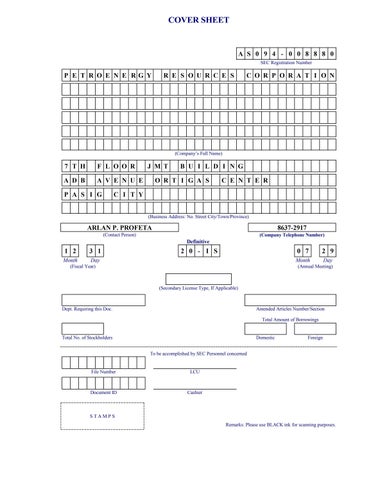
COVER SHEET
A S 0 9 4 - 0 0 8 8 8 0 SEC Registration Number
P E T R O E N E RG Y
R E S O U R C E S
C O R P O R A T I O N
(Company’s Full Name)
7 T H
F L O O R
A D B
A V E N U E
P A S I G
J M T
B U I L D I N G
O R T I G A S
C E N T E R
C I T Y
(Business Address: No. Street City/Town/Province)
ARLAN P. PROFETA
8637-2917
(Contact Person)
(Company Telephone Number)
Definitive
1 2
3 1
Month
Day
2 0 - I S
(Fiscal Year)
0 7
2 9
Month
Day
(Annual Meeting)
(Secondary License Type, If Applicable)
Dept. Requiring this Doc.
Amended Articles Number/Section Total Amount of Borrowings
Total No. of Stockholders
Domestic
Foreign
To be accomplished by SEC Personnel concerned
File Number
LCU
Document ID
Cashier
STAMPS Remarks: Please use BLACK ink for scanning purposes.
PETROENERGY RESOURCES CORPORATION 7th Floor, JMT Building, ADB Avenue Ortigas Center, Pasig City
8637-2917 Telephone Number
31 December 2020 Fiscal Year Ended
Notice of Regular Annual Stockholders’ Meeting `
SEC Form 20-IS Information Statement Pursuant to Section 20 of the Securities Regulation Code Form Type
NOTICE OF REGULAR ANNUAL STOCKHOLDERS’ MEETING
TO OUR STOCKHOLDERS:
NOTICE IS HEREBY GIVEN that the Regular Meeting of the Stockholders of PetroEnergy Resources Corporation (the “Company”), will be held on July 29, 2021 at 1:30 p.m., to be called, conducted and presided virtually or via online/remote communications by the presiding officer at the Company’s principal office address, 7th Floor, JMT Building, ADB Avenue, Ortigas Center, Pasig City, with the following agenda: 1. 2. 3. 4.
Certification of Service of Notice; Determination of Quorum/Call to Order; Approval of Minutes of the last Regular Stockholders’ Meeting held on August 18, 2020; Approval of Management Report and the 2020 Audited Financial Statements contained in the 2020 Annual Report; 5. Confirmation and Ratification of all acts, contracts and investments made and entered into by Management and/or the Board of Directors during the period August 18, 2020 to July 29, 2021; 6. Election of Members of the Board of Directors for 2021-2022: a. Approval of the extension of term and retention of Mr. Cesar A. Buenaventura as Independent Director 7. Approval of the extension and retention of Mr. Cesar A. Buenaventura as Independent Director 8. Appointment of External Auditors; 9. Other matters; and 10. Adjournment. Stockholders as of Record Date June 10, 2021 will be entitled to notice of, and to vote at, the Annual Meeting. To conform with the Government’s regulation on social distancing and prohibition on mass gatherings, the Company decided to hold the Regular Annual Meeting virtually or via online/remote communication, and allow the stockholders to cast their votes by proxy, or by remote communication, or in absentia. To participate in the Annual Meeting, stockholders must register from 9:00 a.m. of July 15, 2021 until 5:00 p.m. of July 26, 2021 through the following link: http://petroenergy.com.ph/investor_relations and follow the steps provided therein. The procedures for participation via remote communication and in absentia may be found in the said link and in Annex “B” of the Information Statement. Stockholders who wish to appoint proxies may submit proxy forms until 5:00 p.m. of July 26, 2021 to the Office of the Corporate Secretary at 7th Floor, JMT Building, ADB Ave., Ortigas Center, Pasig City or by email to asm@petroenergy.com.ph. Validation of proxies will be held on July 26, 2021. A sample proxy form will be enclosed in the Information Statement for your convenience.
.
ATTY. SAMUEL V. TORRES Corporate Secretary 2
RATIONALE AND BRIEF DISCUSSION OF THE AGENDA 2020 ANNUAL STOCKHOLDERS’ MEETING (THE “ANNUAL STOCKHOLDERS’ MEETING”)
1.
Call to Order The Chairman of the Board of Directors (or the Chairman of the Meeting, as the case maybe) (the “Chairman”) will call the meeting to order.
2.
Determination of Quorum/Report on Attendance The Corporate Secretary (or the Secretary of the Meeting, as the case may be) (the “Secretary”) will certify that the written Notice for the meeting was duly sent to stockholders of record, including the date of publication and the newspaper where the notice was published. He will also certify that a quorum exists, and the Stockholders representing at least a majority (or 2/3 in certain cases required by the Revised Corporation Code) of the outstanding capital stock, present in person or by proxy, constitute a quorum for the transaction of business. Pursuant to Sections 23 and 57 of the Revised Corporation Code and SEC Memorandum Circular No. 6, Series of 2020, stockholders may participate and vote through remote communication or in absentia. Stockholders may register by submitting the requirements via email at asm@petroenergy.com.ph and vote in absentia on the matters for resolution at the meeting. Stockholders who will vote in absentia, as well as those who will participate by remote communication, shall be deemed present for purposes of quorum. Please refer to Annex “B” Procedures and Requirements for Voting and Participation in the 2021 Regular Annual Stockholders’ Meeting for complete information on remote participation or voting in absentia, as well as on how to join the livestream for the 2021 ASM.
3.
Approval of the Minutes of the last Stockholders’ Meeting held on August 18, 2020 The Minutes of the Meeting held on August 18, 2020, showing the agenda items discussed and the resolutions passed thereat, as well as the Meeting’s record of attendance, are posted and can be viewed at the PetroEnergy Resources Corporation website: www.petroenergy.com.ph.
4.
Approval of Management Report and the 2020 Audited Financial Statements The Report summarizes the milestones and key achievements of PetroEnergy Resources Corporation (“PERC” or the “Company”) and provides a clear picture of how PERC achieved its goals and strategic objectives for the year 2020. The highlights of PERC’s audited financial statements are explained in the President and Chief Executive Officer’s Report and in the Definitive Information Statement. Copies of the 2020 Audited Financial Statements, which were previously approved by the Board of Directors, were also submitted to the Securities and Exchange Commission (SEC) and the Bureau of Internal Revenue.
5.
Confirmation and Ratification of all acts, contracts and investments made and entered into by Management and the Board of Directors during the period August 18, 2020 to July 29, 2021. The actions for approval are those taken by the Board and/or its Committees and/or the Management since the Annual Stockholders’ Meeting on August 18, 2020 until July 29, 2021, including the approval of the internal procedures for participation in meetings and voting through remote communication or in absentia. Agreements, projects, investments, treasury-related matters and other matters covered by disclosures to the SEC and the Philippine Stock Exchange will likewise be presented for approval. The acts of the officers were those taken to implement the resolutions of the Board and/or its Committees or made in the general conduct of business.
6.
Election of Seven (7) members of the Board of Directors (including Independent Directors) for 2020-2021 At its meeting held on June 14, 2021, the Corporate Governance Committee, as the standing committee of the Board of Directors constituted for the purpose of reviewing and evaluating the qualifications of persons nominated to become members of the Board of Directors (including the Independent Directors), and pursuant to the provisions of the Code of Corporate Governance for Publicly-Listed Companies, as the same are adopted in the Company’s 2017 Manual on Corporate Governance, reviewed the candidates for directorship to ensure that they 3
have all the qualifications and none of the disqualifications for nomination and election as members of the Board of Directors. The seven (7) nominees will be submitted for election to the Board of Directors by the stockholders at the Annual Stockholders’ Meeting. The profiles of the nominees are provided in the Definitive Information Statement for the Annual Stockholders’ Meeting. Each shareholder is entitled to one (1) vote per share multiplied by the number of Board seats to be filled, i.e. seven, and may cumulate his/her votes by giving as many votes as he/she wants to any candidate, provided that the total votes cast shall not exceed the total votes to which he/she is entitled. In the event the votes cast by a stockholder exceeds that to which he/she entitled to vote, the Corporate Secretary, in his discretion, shall deduct such votes cast by the stockholder in favor of any nominee as may be necessary under the circumstances. In the event that there would only be seven (7) nominees to fill seven (7) seats in the Board, the Chairman shall direct the Corporate Secretary to cast all votes in favor of those nominated, except the votes of stockholders who object to the said casting of votes, which objection is supported by majority of the stockholders present or represented in the meeting. 7.
Appointment of the Company’s External Auditors The Company’s Audit Committee assessed and evaluated the performance for the previous year of the Company’s external auditors, SYCIP GORRES VELAYO & CO. (SGV). Based on the Audit Committee’s endorsement, the Board of Directors will recommend the reappointment of SGV, a SEC-accredited auditing firm and among one of the top in the country, as the Company’s external auditors for 2021. A resolution for the appointment of the Company’s external auditors for 2021 shall be presented to the stockholders for approval.
8.
Other Matters The Chairman will inquire whether there are other relevant matters and concerns to be discussed.
9.
Adjournment Upon determination that there are no other relevant matters to be discussed, the meeting will be adjourned on motion duly made and seconded.
4
SECURITIES AND EXCHANGE COMMISSION SEC FORM-20-IS INFORMATION STATEMENT PURSUANT TO SECTION 20 OF THE SECURITIES REGULATION CODE
1.
Check the appropriate box: _____Preliminary Information Statement √_ Definitive Information Statement
2.
Name of Registrant as specified in its charter
:
PETROENERGY RESOURCES CORPORATION
3.
Province, country or other jurisdiction of Incorporation or organization
:
Philippines
4.
SEC Identification Code
:
AS094-008880
5.
BIR Tax Identification Code
:
004-471-419-000
6.
Address of the principal office
:
7th Floor, JMT Building ADB Avenue, Ortigas Center Pasig City 1605
7.
Registrant’s telephone number including area code
:
(02) 8637-2917
Date, time and place of meeting of security holders
:
July 29, 2021, 1:30 p.m. virtually or via online/remote communication. http://petroenergy.com.ph/investor_relations
8.
9.
10.
Approximate date on which the Information Statement is first to be sent or given to security holders :
Securities registered pursuant to Sections 8 and 12 of the Code or Sections 4 and 8 of SRC (information on number of shares and amount of debt is applicable only to corporate registrants): Title of Each Class Common
11.
July 07, 2021
Number of Shares of Stock Outstanding or Amount of Debt Outstanding 568,711,842
Are any or all the Registrant’s securities listed on a Stock Exchange? Yes
√
No
If so, disclose name of the Exchange: Philippine Stock Exchange, Inc. – common shares
5
PETROENERGY RESOURCES CORPORATION INFORMATION STATEMENT
A. GENERAL INFORMATION 1.
Date, Time and Place of Meeting of Security Holders The Regular Annual Stockholders’ Meeting of PetroEnergy Resources Corporation (“PERC” or the “Company”) will be held on Tuesday, July 29, 2021 at 1:30 p.m., to be called, conducted and presided virtually or via online/remote communication by the presiding officer at the Company’s principal office address at 7th Floor, JMT Building, ADB Avenue, Ortigas Center, Pasig City. http://petroenergy.com.ph/investor_relations. Mailing Address – 7th Floor, JMT Building, ADB Avenue, Ortigas Center, Pasig City 1600 The approximate date on which this Information Statement is first to be sent or given to security holders is on July 05, 2021. WE ARE NOT ASKING YOU FOR A PROXY AND YOU ARE REQUESTED NOT TO SEND US A PROXY.
2.
Dissenter’s Right of Appraisal There are no corporate matters or actions that will entitle dissenting stockholders to exercise their right of appraisal as provided under Title X, Section 80 of the Revised Corporation Code of the Philippines. Although the following actions are not among the matters to be taken up during the 2021 Regular Annual Stockholders’ Meeting, the stockholders are herein apprised of their appraisal rights pursuant to Title X of the Philippine Corporation Code. A stockholder shall have the right to dissent and demand payment of fair value of the share in case he voted against the following proposed corporate actions: a.
b. c. d.
any amendment to the articles of incorporation has the effect of changing or restricting the rights of any stockholders or class of shares, or of authorizing preferences in any respect superior to those outstanding shares of any class, or extending or shortening the term of corporate existence; sale, lease, exchange, transfer, mortgage, pledge or other disposition of all or substantially all of the corporate property and assets; merger or consolidation; and investment of corporate funds for any purpose other than the primary purpose of the Company.
As provided under Section 81 of the Revised Corporation Code, a dissenting stockholder who votes against a proposed corporate action may exercise the Right of Appraisal by making a written demand to the Company for the payment of the fair value of his/her shares held within thirty (30) days from the date on which the vote was taken: Provided, That failure to make the demand within such period shall be deemed a waiver of his/her Right of Appraisal. If the proposed corporate action is implemented, the Company shall pay the dissenting stockholder, upon surrender of the certificate or certificates of stock representing the his/her shares, the fair value thereof as of the day before the vote was taken, excluding any appreciation or depreciation in anticipation of such corporate action. If, within sixty (60) days from the approval of the corporate action by the stockholders, the dissenting/withdrawing stockholder and the Company cannot agree on the fair value of the shares, it shall be determined and appraised by three (3) disinterested persons, one of whom shall be named by the stockholder, another by the Company, and the third by the two (2) thus chosen. The findings of the majority of the appraisers shall be final, and their award shall be paid by the Company within thirty (30) days after such award is made: Provided, no payment shall be made to any dissenting stockholder unless the Company has unrestricted retained earnings in its books to cover such payment. Upon payment by the Company of the agreed or awarded price, such stockholder shall forthwith transfer the shares to the corporation. 3.
Interest of Certain Persons in Matters to be Acted Upon The incumbent directors or officers of the Company, since the beginning of the last fiscal year, do not have substantial interest, direct or indirect, by security holdings or otherwise, in any matter to be acted upon. None of the incumbent directors informed the Company in writing that he/she intends to oppose any action to be taken during the annual meeting of the stockholders.
6
B. CONTROL AND COMPENSATION INFORMATION
4.
Voting Securities and Principal Holders Thereof: a)
Number of Common Shares Outstanding as of May 31, 2021: Number of Vote each share is Entitled:
568,711,842 One (1) vote per share
Of the total outstanding common capital stock as of May 31, 2021, 567,739,116 shares (or 98.83%) are owned by Filipino citizens, while 972,726 shares (or 0.17%) are owned by Foreigners. b)
All stockholders as of June 10, 2021 are entitled to notice and to vote at the Regular Annual Stockholders Meeting.
c)
Manner of Voting
Section 7 of Article III of the By-Laws of the Company provides that the stockholders may vote at all meetings the number of shares registered in their respective names either in person or by proxy executed in writing. Section 6 of the same Article provides that no proxy shall be recognized unless presented to the Secretary for inspection and registration at least three (3) calendar days before the date of said meeting (for the 2021 Regular Annual Stockholders’ Meeting, the proxy should be presented to the Corporate Secretary not later than 5:00 p.m. on July 26, 2021). The By-Laws of the Corporation does not require notarization of proxies. In the same vein, Section 23 of the Revised Corporation Code of the Philippines and Section 7, Article III of the Corporation’s By-Laws provide that each stockholder may vote in any of the following manner: 1)
he/she may vote such number of shares for as many persons as there are Directors to be elected;
2)
he/she may cumulate said shares and give one candidate as many votes as the number of Directors to be elected multiplied by his/her shares;
3)
he/she may distribute them, on the same principle, among as many candidates as he/she may see fit. In any of these instances, the total number of votes cast by the stockholders should not exceed the number of shares owned by him/her as shown in the books of the Corporation multiplied by the total number of Directors to be elected.
d) Security ownership of certain record and beneficial owners and management. 1)
Security ownership of certain record and beneficial owners of more than 5% of Registrant securities as of May 31, 2021: Title of Class
Common
Common
TOTAL
a.
b.
c.
Name, Address of record Owner and relationships With the Issuer PCD Nominee Corp. G/F MSE Bldg., 6767 Ayala Ave., Makati City
Others
Name of Beneficial Owner and relationship with the record owner PCD Nominee* (Various stockholders-beneficially owned by the participants of the PCD) (Various stockholders-no holders of 5%)
Citizenship
Filipino and NonFilipino
Filipino
No. of Shares Held 527,903,959
% 92.82%
40,807,883
7.18%
568,711,842
100.00%
*Under PCD account, the following companies owned more than 5%: RCBC Securities, Inc. – 293,728,407 or 51.65% of the Company’s outstanding capital stock. The current nominee of RCBC Securities, Inc. is Mr. Raul M. Leopando. (Under RCBC Securities, Inc. with 5% of the Registrant securities). The breakdown of the shareholdings are as follows: a. GPL Holdings, Inc. – 55,218,121 shares or 9.71% b. House of Investments, Inc. – 143,662,864 shares or 25.26% c. RCBC Capital, Inc. – 60,773,808 shares or 10.69% d. Various Stockholders – 33,802,814 shares or 5.94% RCBC Trust and Investments Division – 64,560,717 shares or 11.35% of the Company’s outstanding capital stock. RCBC Trust and Investments are trust accounts between RCBC and Beneficial Owners. The corporate acts of RCBC are carried out by its management through the guidance of its Board of Directors. Ms. Helen Y. Dee is the current Chairman of the Company. Malayan Insurance Company, Inc. – 30,103,023 shares or 5.29% of the Company’s outstanding capital stock. Mr. Paolo Y. Abaya is the President and Chief Executive Officer of the Company.
7
2)
Security Ownership of Management (as of May 31, 2021):
The following are the number of shares owned and of record by the Directors, the Chief Executive Officer and each of the key officers of the Company and the percentage of shareholdings of each:
Title of Class Common Common
Common Common Common Common Common Common Common Common Common Common
Name of Beneficial Owner Name and Position Helen Y. Dee Chairman Milagros V. Reyes President/Director Basil L. Ong Independent Director Cesar A. Buenaventura Independent Director Lorenzo V. Tan Director Yvonne S. Yuchengco Director/Treasurer Eliseo B. Santiago Independent Director Francisco G. Delfin, Jr. Vice President Samuel V. Torres Corporate Secretary Arlan P. Profeta Asst. Corporate Secretary Carlota R. Viray AVP for Finance Maria Victoria M. Olivar AVP for Technical
Total
Amount and Nature of Beneficial Ownership Direct 10,662 Indirect 5,006,574
Citizenship
Percent of Class
Filipino
0.88%
Indirect
125,695
Filipino
0.02%
Direct Direct Indirect
1 1,300 222,844
Filipino
-
Filipino
0.04%
1
Filipino
-
Indirect
435,956
Filipino
0.08%
Direct Direct Indirect
1 55,000 27,500
Filipino
-
Filipino
0.02%
-
Filipino
-
6,216 69,001
Filipino
-
Filipino
0.01%
Filipino
-
Direct
Direct Indirect
5,960,751
1.05%
As of May 31, 2021, the Company’s directors and executive officers owned an aggregate of 5,960,751 shares equivalent to 1.05%.
3)
Voting Trust Holders of 5% or more
The Company is not aware of any voting trust or similar arrangement among persons holding more than 5% of a class of shares. e)
Changes in Control
There has been no change in the control of the Company since the beginning of last fiscal year. The Company has no existing voting trust or change in control agreements. 5.
Directors and Executive Officers: The members of the Board of Directors are elected at the general meeting of stockholders and shall hold office for a term of one (1) year or until their successors shall have been duly elected and qualified. The Board Committee Members and other Officers of the Company, unless removed by the Board of Directors, shall serve as such until their successors are elected or appointed.
8
a.
Directors and Executive Officers
The following are the names, ages, positions and periods of service of Directors and Executive Officers: Name Helen Y. Dee Cesar A. Buenaventura Basil L. Ong Milagros V. Reyes Yvonne S. Yuchengco Lorenzo V. Tan Eliseo B. Santiago Francisco G. Delfin, Jr. Samuel V. Torres Arlan P. Profeta
Age
Position
76 91 69 79 67 59 71 59 56 47
Chairman (NED) Director / Independent * (NED) Director / Independent * (NED) Director / President Director / Treasurer Director (NED) Director / Independent (NED) Vice President Corporate Secretary Asst. Corporate Secretary
Citizenship Filipino Filipino Filipino Filipino Filipino Filipino Filipino Filipino Filipino Filipino
Period of Service 2001 to present 1998 to present 2011 to present 1998 to present 2004 to present 2019 to present 2013 to present 2008 to present 2006 to present 2008 to present
NED - Non-Executive Director * Cumulative Term of Nine (9) Years for Independent Directors elected prior to 2012 is reckoned from 2012.
The following are the Chairperson and Members of the Corporate Governance Committee for 2020-2021. Chairperson – Mr. Basil L. Ong (Independent Director) Members – Mr. Cesar A. Buenaventura (Lead Independent Director) Mr. Eliseo B. Santiago (Independent Director) Below are the incumbent directors except for Ms. Maria Mercedes Corrales who has been nominated to the Board of Directors of the Company for the ensuing year 2021-2022. The nominees have been approved for election by the Corporate Governance Committee at its meeting on June 14, 2021. 1. 2. 3. 4. 5. 6. 7.
Ms. Helen Y. Dee Ms. Milagros V. Reyes Ms. Yvonne S. Yuchengco Mr. Lorenzo V. Tan Mr. Cesar A. Buenaventura Ms. Maria Mercedes Corrales Mr. Eliseo B. Santiago
– – – – – – –
Regular Director Regular Director Regular Director Regular Director Lead Independent Director Independent Director Independent Director
Nomination and Election of Independent Director: All independent directors were nominated by Atty. Dan Dyonne Eminiano Q. Gonzales, who has no relations with the Nominees. (Please see attached Annex “A” for the Certification of Independent Directors.) Below are the qualifications of Ms. Maria Mercedes Corrales as Independent Director: Ms. Corrales, 72, Filipino, is a product of Mapua Institute of Technology (“Mapua”) with a degree in BSBA Management in 1972. She also pursued studies abroad and finished Masters in Business Administration postgraduate diploma at Fuqua School of Business, Duke University, North Carolina, U.S.A. in 2000. Ms. Corrales presently sits as Member in the Board of Trustees of Mapua since 2013, and likewise held directorships and executive positions in both local and foreign companies in the past. Ms. Corrales started her illustrious career with Levi Strauss & Co. (“Levi’s”) where she first served as Distribution Manager, Marketing Services Manager, Merchandising Manager and Marketing Director from 1974 until 1985. Thereafter, she was appointed to several executive posts in Levi’s, more particularly: Far East Regional Marketing and Licensing Director for Levi’s Far East (1986 -1990); Managing Director for Levi’s Singapore, Malaysia and Indonesia (1991-1994); General Manager for Levi’s Philippines I and II (1994-1997); Member of the Board of Trustees for Levi Strauss Foundation (SFO, USA) (19970-200); General Manager and Executive Director for Levi’s South America (1997-2000); President and Representative Director for Levi’s Japan KK (2001-2005); and Regional Vice President for Levi’s North Asia covering Greater China, South Korea, and Japan (2001-2005). After Ms. Corrales’ stint with Levi’s, she worked with Starbucks Corporation from 2006 until 2010 wherein she served the positions of Corporate Sr. Vice President (Seattle), President for Asia Pacific Division (Japan, South Korea, SEA, ANZ), and Representative Director and Chief Executive Officer/Chief Operating Officer for Starbucks Coffee Japan KK. She also held independent non-executive directorships and committee memberships in Fraser and Neave Limited, Singapore and its Beverage Committee (2011-2013); Sarah Lee/D.E. Masters Blenders, Netherlands and its Remuneration and Audit Committees (2011-2013); Huhtamaki Oyji, Finland and its Human Resource Committee (2012-2016); and RCBC Savings Bank, Manila and its Executive and Governance Committees (2016-2019). 9
Justification for the Retention of Mr. Cesar A. Buenaventura as Independent Director Mr. Cesar A. Buenaventura’s term as Independent Director is set to reach its limit in 2021. Notwithstanding this, Atty. Dan Dyonne Eminiano Q. Gonzales nominated Mr. Buenaventura and be retained as Independent Director. Below are the noteworthy justifications that would merit his retention as Independent Director: Mr. Buenaventura graduated from the University of the Philippines with a degree in BS Civil Engineering. As a Fullbright scholar, he received his Master’s Degree in Civil Engineering from Lehigh University in Bethlehem, Pennsylvania. He started his profession in the construction business with David M. Consunji. Thereafter, in 1956, Mr. Buenaventura went on to commence a long-standing career at Pilipinas Shell, serving as the first Filipino Chairman & CEO of the Shell Group of Companies in the Philippines, from 1977 to 1990. He remains as a Director of said company to date. Among the many appointments and positions that Mr. Buenaventura has held and continues to hold, one of the most notable would be as a Member of the Monetary Board of the Central Bank of the Philippines, representing the private sector from 1981 to 1987. He was also a Founding Member of the Board of Trustees of the Makati Business Club, a Member of the Board of Regents of the University of the Philippines from 1987 to 1994 and of the Board of Trustees of the Asian Institute of Management from 1994 to 1997. Mr. Buenaventura has also been honored with numerous awards and accolades, including being made an Honorary Officer of the Order of the British Empire (OBE) by HM Queen Elizabeth II. Undoubtedly, the Company greatly benefits from Mr. Buenaventura’s guidance as a well-respected member of the business community and through his expertise in the oil and power industry. It would be in the Company’s best interest for Mr. Buenaventura to continue providing the same guidance and wisdom as the Company’s Independent Director. Assessment by the Corporate Governance Committee on the Qualifications of the Nominees for Directorship The Corporate Governance Committee passed upon their qualifications and found no disqualifications, as provided for in the By-Laws, the 2017 Manual on Corporate Governance, the Board Charter, and in accordance with SRC Rule 38. The Company has adopted SRC Rule 38, and compliance therewith has been made. Only nominees whose names appear on the Final List of Candidates shall be eligible for election as Independent Director. No further nominations shall be entertained or allowed on the floor during the actual annual stockholders’ meeting. The nominees for independent directors were advised of SEC Memorandum Circular No 5, Series of 2017 on the required submission of Certificate of Qualification of Independent Directors (the “Certificate of Qualification”) that should include, among others, disclosure of any pending criminal or administrative investigation or proceedings, positions held in Government-Owned and Controlled Corporations and the required written permission or consent from the head of Department/Agency for those in government service. As disclosed by the nominees in their respective Certificate of Qualification, each nominee possesses all of the qualifications and none of the disqualifications. The Independent Directors were likewise advised of the Company’s 2017 Manual on Corporate Governance and the Securities and Exchange Commission (SEC) Memorandum Circular No. 19, Series of 2016 on the term limits for Independent Directors, both of which state that independent directors shall serve a maximum cumulative term of nine (9) years reckoned from 2012. Such term limit, however, may be extended upon meritorious justification/s and stockholders’ approval. Business Experiences during the Past five (5) Years and Educational Background. Directors MS. HELEN Y. DEE, 76, Filipino, Chairman (Non-Executive Director) Publicly-Listed Companies: Ms. Dee has been a Director of the Company since 2001 and Chairman of the Board since 2011. She is also presently the Chairman of House of Investments, Inc., Rizal Commercial Banking Corporation, and EEI Corporation, and a Director of PLDT Inc. Non-Listed: She is the Chairman of RCBC Excom Forex Brokers Corporation, Landev Corporation, Mapua Information Technology, Inc., Hi-Eisai Pharmaceuticals, Inc., Pan Malayan Realty Corporation, RCBC Savings Bank, Merchants Bank, La Funeraria Paz-Sucat, Malayan Insurance Company, Inc., Xamdu Motors, Inc., Manila Memorial Park Cemetery, Inc., PetroWind Energy, Inc. and Malayan High School of Science, Inc. 10
She is the Chairman/President of Hydee Management & Resources, Inc.; Financial Brokers Insurance Agency, Inc., RCBC Leasing and Finance Corporation and Mijo Holdings, Inc.; She is also Chairman and CEO of Tameena Resources, Inc. She is the President of Moira Management, Inc., YGC Corporate Services, Inc. and GPL Holdings, Inc. She is the Vice Chairman of Pan Malayan Management and Investment Corporation and West Spring Development Corporation and Vice President of A.T. Yuchengco, Inc. She is also a Member, Board of Trustees of Mapua Institute of Technology, Inc. a leading engineering school in the Philippines, Malayan Colleges Laguna, Inc and Philippine Business for Education, Inc. She also sits in the Board of the following companies, South Western Cement Corp., Great Life Financial Assurance Corp., MICO Equities, Honda Cars Philippines, Inc., Isuzu Philippines, Inc., A.Y. Holdings, Inc. Pan Malayan Express, Honda Cars Kalookan, Sun Life Grepa Financial, Inc., Philippine Integrated Advertising Agency, Inc., Y Realty, Inc., Luis Miguel Foods. Educational Background: Bachelor of Science in Commerce Major in Administration from the Assumption College; Master in Business Administration Degree from the De La Salle University. MR. CESAR A. BUENAVENTURA, 91, Filipino, Independent Director. Publicly-Listed Companies: Mr. Buenaventura is a Non-Executive Director of DMCI Holdings, Inc., iPeople, Inc., Semirara Mining and Power Corporation, Concepcion Industrial Corporation, and Pilipinas Shell Petroleum Corporation. Non-Listed and Civic Affiliations: Mr. Buenaventura is also holding the following positions: Chairman at Buenaventura, Echauz and Partners, Inc., Mitsubishi Hitachi Power Systems (Phils.), Inc. He is a director of various companies such as: D.M. Consunji, Inc., The Country Club, and trustee of various foundations such as Pilipinas Shell Foundation, Inc. (Chairman), Bloomberry Cultural Foundation and ICTSI Foundation. Educational Background and Other Information: Bachelor of Science in Civil Engineering from the University of the Philippines; Master’s degree in Civil Engineering majoring in Structures from Lehigh University, Bethlehem, Pennsylvania as a Fulbright Scholar. In 1991, Mr. Buenaventura was made Honorary Officer of the Order of the British Empire (OBE) by Her Majesty Queen Elizabeth II. MS. MILAGROS V. REYES, 79, Filipino, Director/President Publicly-Listed Companies: Seafront Resources Corporation (President) and formerly, iPeople, Inc. Non-Listed: She is the President/Director of PetroWind Energy Inc. and PetroSolar Corporation; President/Chairman of PetroGreen Energy Corporation; Chairman of Maibarara Geothermal, Inc.; and Director and Treasurer of Hermosa Ecozone Development Corporation. She previously served as President of Petrofields Corp. (now iPeople, Inc.); Senior Vice President of Basic Consolidated, Inc. (formerly Basic Petroleum and Minerals, Inc.); Vice President and Chief Operating Officer of Mapua Institute of Technology, Inc.; Director and Consultant of PNOC-EC. Educational Background: Bachelor of Science in Geology and Physical Sciences (Double Degree) from the University of the Philippines. She pursued various technical trainings from the National Iranian Oil Co., University of Illinois, and Ajman Fields in U.A.E. YVONNE S. YUCHENGCO, 67, Filipino, Director/Treasurer Publicly-Listed Companies: House of Investments, Inc., Seafront Resources Corporation, iPeople, Inc. and National Reinsurance Corporation of the Philippines. Non-Listed: She is the Chairperson/President/Director of Phil. Integrated Advertising Agency, Inc., Royal Commons, Inc., Y Realty Corporation, Y Tower II Office Condominium Corporation, Yuchengco Museum, Inc., Yuchengco Tower Office Cond. Corporation, Chairperson of XYZ Assets Corporation, Director/President of Alto Pacific Corporation, RCBC Land, Inc., Mico Equities, Inc. She is Director/Treasurer of Honda Cars Kaloocan, Inc., Malayan High School of Science, Inc., Mona Lisa Development Corporation, PetroEnergy Resources Corporation, Water Dragon, Inc., DirectorTreasurer/CFO of Pan Malayan Mgm’t. & Inv’t. Corp., Director/Vice Chairperson of Malayan Insurance Co., Inc., Director/Vice President/Treasurer of Pan Managers, Inc., Trustee/Chairperson of The Malayan Plaza Condominium Owners Association, Inc., Trustee of AY Foundation, Inc, Mapua Institute of Technology, Inc., Phil-Asia Assistance Foundation, Inc., She is a member of Advisory Committee of Rizal Banking Corporation, Director/Corporate Secretary of MPC Investment Corporation. She is also a member of the Board of Directors of the following companies: Annabelle Y. Holdings & Management Corporation, Asia-Pac Reinsurance Co., Ltd., A.T.Yuchengco, Inc. DS Realty, Inc., Enrique T. Yuchengco, Inc., GPL Holdings, Inc., House of 11
Investment, Inc., HYDee Management and Resource Corp., iPeople, inc., La Funeraria Paz, Inc.-Sucat, Luisita Industrial Park Corp., Malayan College Laguna, Inc., Malayan Colleges, Inc., Malayan High School of Science, Inc., Malayan International Insurance Corp., Manila Memorial Park Cemetery, Inc., Pan Malayan Express, Inc., Pan Malayan Realty Corporation, Shayamala Corp. and YGC Corporate Services, Inc, Yuchengco Center, Inc. Educational Background: Bachelor of Arts in Interdisciplinary Studies from the Ateneo De Manila University MR. LORENZO V. TAN, 59, Filipino, Non-Executive Director Publicly-Listed Companies: He is currently an Independent Director of the Philippine Realty Holdings Corporation and Atok-Big Wedge Co., Inc. and a regular director of the House of Investments, Inc., EEI Corporation, and iPeople, Inc. Non-Listed: He serves as the Vice Chairman of the Pan Malayan Management & Investment Corporation and the TOYM Foundation; a director of the Malayan Insurance Company, Inc., and Sunlife Grepa Financial, Inc; and member of the Board of Advisors of the FICO Group of Companies (Bangkok, Thailand). Previous Experiences: He previously served as President and CEO of the Rizal Commercial Banking Corporation, Sunlife of Canada (Phil), Inc., the Philippine National Bank, United Coconut Planters Bank; as Director of SMART Communications, Inc., Digital Telecommunications (DIGITEL), and Voyager Innovation, Inc, and CITIBANK NA Singapore; as Group Managing Director of Guoco Holdings (Philippines) Inc.; as President of the Bankers Association of the Philippines and Chairman of the Asian Bankers Association. He was an awardee of the 1999 The Outstanding Young Men (TOYM) in the field of Banking. Educational Background: He took his Master of Management Degree from J.L. Kellogg Graduate School of Management, Northwestern University Evanston, Illinois, USA, with concentration in Finance and Management Information Systems. He graduated with a degree of Bachelor of Science in Commerce, Major in Accounting from the De La Salle University, Manila, Philippines. He is a Certified Public Accountant in Pennsylvania, USA and in the Philippines. MR. ELISEO B. SANTIAGO, 71, Filipino, Independent Director Non-Listed: Mr. Santiago sits in the Board and is a member of the Executive Committee of Isla Petroleum and Gas Corporation. He is also an Independent Director of Supply Oilfield Services, Inc. He was formerly Chairman of the Board of the Clark Development Corporation; formerly, Chief Executive of the Shell Eastern Caribbean Group of Companies covering Supply & Trading, Sales & Marketing and Chemicals businesses of the Shell Group in 15 island countries based in Barbados; Managing Director of Pilipinas Shell Petroleum Corporation; Senior Adviser to the Regional Managing Director for Asia Pacific, based in London; Country Chairman of the Shell companies in Thailand and concurrently the Vice President for Retail for the ASEAN countries and Hong Kong, based in Bangkok; Country Chairman of the Shell companies in the Philippines in addition to his regional Retail Sales and Operations for the East, based in Manila. Educational Background: Mr. Santiago is a graduate of Bachelor of Science degree in Mechanical Engineering from the Mapua Institute of Technology in 1971 and received his professional license as a Mechanical Engineer in the same year. Executive Officers: MILAGROS V. REYES, 79: Other Business Experience: President/ Director President/Chairman Chairman/Director Director/Treasurer Former Senior Vice President Former Director Educational Background:
President and CEO (1998 to present) Seafront Resources Corporation, PetroWind Energy Inc. PetroSolar Corporation PetroGreen Energy Corporation Maibarara Geothermal, Inc. Hermosa Ecozone Development Corporation Basic Petroleum and Minerals Corporation PNOC-EC, iPeople, Inc. Ms. Reyes graduated from the University of the Philippines with a Bachelor of Science degree in Geology and Physical Sciences Double Degree. She pursued Specialization and Training in National Iranian Oil Co., in Teheran, University of Illinois and in Ajman Fields in U.A.E. 12
FRANCISCO G. DELFIN, JR. 59: Other Business Experience: President / Director Vice President & COO / Director Vice President / Director Vice President Former Undersecretary Former Assistant Secretary Former Professor, Public Administration & Governance Geophysics Supervisor
Vice President (2008 to present)
Maibarara Geothermal, Inc. PetroGreen Energy Corporation PetroSolar Corporation PetroWind Energy, Inc. Department of Energy Department of Energy University of the Philippines, Diliman Campus PNOC-EDC
Educational Background:
Mr. Francisco G. Delfin, Jr. is a graduate of Bachelor of Science in Geology from the University of the Philippines (6th place in the 1982 Geologist Licensure Examination). He received his Master’s Degree in Geology from the University of South Florida, Tampa, and his Ph.D. in Public Administration from the University of Southern California.
SAMUEL V. TORRES, 56
Corporate Secretary (2006 to present)
Other Business Experience: General Counsel/Corporate Secretary
AY Foundation, Inc., Alto Pacific Company, Inc. (Formerly: The Pacific Fund, Inc.), Bankers Assurance Corp., FBIA Insurance Agency, Inc., Bluehounds Security & Invt. Agency, Enrique T. Yuchengco, Inc., First Nationwide Assurance Corp., GPL Holdings, Inc. GPL Cebu Tower Office Cond. Corp., GPL Holdings, Inc., Grepaland, Inc., Grepa Reality Holding Corporation, Hexagon Integrated Financial & Insurance Agency, Hi-Eisai Pharmaceutical, Inc., Honda Cars Kalookan, Inc, House of Investments, Inc., Hexagon Integrated Fin. Ins. Agency, Inc., Hexagon Lounge, Inc., iPeople, Inc., Investment Managers, Inc., Landev Corporation, La Funeraria Paz-Sucat, Inc., Malayan High School of Science, Inc., Malayan Insurance Co., Inc., Mico Equities, Inc., Malayan Colleges, Inc., Malayan Colleges Laguna, Inc., Malayan Securities Corporation, Mapua Information Technology Center, Inc., MJ888 Corporation, Mona Lisa Development Corporation, Pan Malayan Management & Investment Corporation, Pan Malayan Realty Corporation, Pan Malayan Express, Inc., Pan Pacific Computer Center, Inc., People eServe Corporation, Philippine Integrated Advertising Agency, Inc., Royal Commons, Inc., RCBC Forex Corporation, RCBC Realty Corporation, RCBC Land, RCBC Securities, Inc., RCBC Bankard Services Corporation, RCBC Securities, Inc., RP Land Development Corporation, Sun Life Grepa Financial, Inc., Yuchengco Museum, YGC Corporate Services, Inc., Y Realty Corporation, Y Tower II Office Condominium Corp., Yuchengco Tower Office Condominium Corp. and Xamdu Motors, Inc.
Educational Background:
Atty. Samuel V. Torres is a graduate of Bachelor of Science in Business Economics from University of the Philippines and Bachelor of Laws from Ateneo de Manila University.
ARLAN P. PROFETA, 47
Asst. Corporate Secretary (2008 to present) Compliance Officer (2017 to present)
Other Business Experience: Corporate Secretary
Corporate Secretary
Maibarara Geothermal, Inc. PetroGreen Energy Corporation PetroSolar Corporation PetroWind Energy Inc. 13
Asst. Corporate Secretary / Compliance Officer Formerly, Tax Manager Educational Background:
b.
Seafront Resources Corporation Punongbayan & Araullo Atty. Arlan P. Profeta graduated with a degree of Bachelor of Science in Accountancy from San Beda College. He is a Certified Public Accountant. He took his Bachelor of Laws degree from the Arellano University School of Law.
Legal Proceedings
The Company is not aware of any legal case, presently or during the last five (5) years, involving the present members of the Board of Directors or Executive Officers or their property before any court of law or administrative body in the Philippines or elsewhere. Moreover, the Company has no information that the above named persons have been convicted by final judgment of any offense punishable under the laws of the Philippines or of any other country. c.
Significant Employees
The Corporation has no employee who is not an executive officer that is expected to make a significant contribution to the business. The Corporation values its human resources. It strives to develop and maintain a safe, healthy, challenging, rewarding, participative, and fair working environment for all employees, and intends to utilize their full talents and expertise through effective selection, mentoring and development. The Company likewise seeks to offer career opportunities to qualified employees, regardless of gender, belief, ethnic or regional origin, and physical condition. It expects each employee act as a team player and do his or her share in achieving the Corporation’s set goals. d.
Family Relationships
Ms. Helen Y. Dee and Ms. Yvonne S. Yuchengco are siblings. e.
Certain Relationships and Related Transactions
Parties are considered to be related if one party has the ability, directly or indirectly, to control the other party or exercise significant influence over the other party in making financial and operating decisions. A related party relationship also exists between and/or among entities, which are under common control with the reporting enterprises and its key management personnel, directors, or its shareholders. In considering each related party relationship, attention is directed to the substance of the relationship, and not merely the legal form. Related parties may be individuals or corporate entities. As a good corporate practice, the Company discloses its related party transactions, if any, in its Audited Financial Statements (AFS). In this regard, please refer to the 2020 Consolidated AFS, Note 25, for the significant transactions with related parties. f.
Disagreement with the Company
No Director has resigned from the Board of Directors since the date of the last meeting of shareholders due to disagreement with the Company on any matter relating to its operations, policies and practices.
14
6.
Compensation of Directors and Executive Officers
Summary of Annual Compensation Table Name and Principal Position Top 5 Highest paid key officers: Milagros V. Reyes Francisco G. Delfin Carlota R. Viray Arlan P. Profeta Maria Victoria M. Olivar Total salaries top 5 highest paid officers
Year
Salary
Bonus
Other Annual Compensation
Total
President Vice President AVP - Finance AVP - Legal and Administration AVP - Technical Affairs
All Directors and Officers as a group
2018 2019 2020 2021 est 2018 2019 2020 2021 est
13,066,431 13,948,386 13,317,746 13,317,746 13,066,431 13,948,386 13,317,746 13,317,746
9,156,068 8,837,996 5,367,137 3,424,937 9,156,068 8,837,996 5,367,137 3,424,937
920,350 1,096,922 2,277,415 1,913,007 1,220,350 5,804,539 7,951,613 2,213,007
23,142,849 23,883,304 20,962,298 18,655,690 23,442,849 28,590,921 26,636,496 18,955,690
*the 2021 estimate does not include profit share The Company’s fiscal year ends in the month of December of every year. Estimated compensation of all Directors and officer for the year 2021 is P18.956 million. There are no other arrangements pursuant to which any director of the Company was compensated, or is to be compensated, directly or indirectly. The Board of Directors receives a per diem of P5,000.00, per meeting attended. No warrants or options were granted to the Directors and Officers from 2001 to 2019. Aside from those mentioned above, there are no other arrangements pursuant to which any director of the Company was compensated, or is to be compensated, directly or indirectly, other than those stated in the above table during the Company’s last completed fiscal year and the ensuing year for any service provided as an executive officer or member of the Board of Directors. There is no director, executive officer, nominee for director, beneficial holder and family member involved in any business transaction of the Company. 7.
External Auditors a.
Appointment of External Auditors
The Company’s external auditor is SyCip Gorres Velayo & Co. (SGV & Co.), with office address at SGV Building, 6760 Ayala Avenue, Makati City, Philippines. SGV & Co. has been reappointed during the Company’s recent Annual Stockholders’ Meeting on August 18, 2020. The representatives of SGV & Co. have always been present at the Annual Stockholders’ Meeting held during prior years and shall likewise be present during for this year’s Stockholders’ Meeting to respond to appropriate questions or make statements with reference to matters for which their services were engaged. The Company is in compliance with SRC Rule 68 paragraph 3 (b)(1V) requiring the rotation of external auditors or engagement partners who have been engaged by the Company for a period of five consecutive years and the mandatory two-year cooling-off period for the re-engagement of the same signing partner or individual auditor. The engagement partner who conducted the audit for 2020, Ms. Ana Lea C. Bergado, has not been involved as engagement partner for more than five (5) years. b.
Audit and Other Related Fees
Audit and Other Related Fees The Audit Committee approved SGV & Co.’s fees based on the services rendered and the amount paid from the previous year’s audit fees.
15
c.
Changes and Disagreements with Accountants on Accounting and Financial Disclosure.
The Company has not changed SGV & Co. as its auditor and has not had any disagreements on any matter relating to accounting principles or practices, financial statement disclosures, or auditing scope or procedure during the last three years or any subsequent interim periods. 8.
Compensation Plans No action is to be taken with respect to any plan pursuant to which cash or non-cash compensation may be paid or distributed. C. ISSUANCE AND EXCHANGE OF SECURITIES
9.
Authorization or Issuance of Securities Other than for Exchange There is no matter or corporate action to be taken up in the meeting with respect to issuance of securities.
10. Modification or Exchange of Securities No modification of Outstanding Securities 11. Financial and Other Information The Company’s financial statements for the year ended December 31, 2019 and Management’s Discussion and Analysis or Plan of Operations are contained in the Management Report portion of this Information Statement. 12. Mergers, Consolidation, Acquisition and Similar Matters Not Applicable 13. Acquisition or Disposition of Property Not Applicable 14. Restatement of Accounts None D.
OTHER MATTERS
15. Actions with Respect to Reports During the scheduled Regular Annual Stockholders’ Meeting, the following shall be submitted to the stockholders for their approval: a)
The Minutes of the Annual Stockholders’ Meeting held on August 18, 2020;
b)
Approval of Management Report and the 2020 Audited Financial Statements contained in the 2020 Annual Report.
c)
Confirmation and Ratification of all acts, contracts and investments made and entered into by Management and/or Board of Directors during the period of August 18, 2020 to July 29, 2021. 1)
Constitution of various Committees and Appointment of Chairman and Members: (Organizational Meeting held on August 18, 2020), such as: Audit Committee Chairman Members
- Cesar A. Buenaventura (Lead Independent Director) - Basil L. Ong (Independent Director) - Helen Y. Dee (Non-Executive Director) Corporate Governance Committee Chairman - Basil L. Ong (Independent Director) Members - Cesar A. Buenaventura (Lead Independent Director) - Eliseo B. Santiago (Independent Director) Board Risk Oversight Committee Chairman - Eliseo B. Santiago (Independent Director) Members - Cesar A. Buenaventura (Lead Independent Director) - Lorenzo V. Tan (Non-Executive Director) 16
2)
3) 4) 5) 6) 7) 8) 9) 10) 11) 12) 13) 14)
Approval re: Compliance with SEC Memorandum Circular No. 28, Series of 2020 - To create &/or designate e-mail account, address, cellphone number for transactions with the Commission. (BOD November 26, 2020) Ratification of Approval of the Third Quarter 2020 Financial Statements (SEC Form 17-Q). (BOD November 26, 2020) Approval for the renewal of Directors’ and Officers’ Liability Insurance. (BOD March 26, 2021). Approval for the Activation and Closure of the Bank Accounts with Metropolitan Bank and Trust Company (Metrobank). (BOD March 26, 2021). Ratification of Existing Loans from Various Funders (RCAP PNs) amounting to 150MM and Appointment of RCAP to act as Company’s Broker. (BOD March 26, 2021). Approval re: Granting of Authority to Transact with the Bureau of Internal Revenue (BIR) and Secure BIR Documents (BOD March 26, 2021). Approval re: Authority to file SEC Submissions via its Online Submission Tool. (BOD March 26, 2021) Approval of the transfer of Company Car to Atty. Arlan P. Profeta pursuant to Company’s Policy. (BOD March 26, 2021) Approval for the opening of Credit Line with YGC Isuzu and Honda Dealerships. ( BOD March 26, 2021) Approval of the 2020 Audited Financial Statements (Special BOD April 23, 2021) Approval for the holding of 2021 Annual Stockholders’ Meeting. (BOD May 20, 2021). Approval re: PERC to participate in re-application for the DOE Service Contract over Malajon fields. (BOD May 20, 2021). Ratification of Approval of the 1st Quarter 2021 Financial Statements (BOD May 20, 2021)
16. Matters Not Required to be Submitted a) Proof of the required notice of the meeting. b) Proof of the presence of a quorum. 17. Amendments of Charter, By-Laws and Other Documents None 18. Other Proposed Action None 19. Voting Procedures Section 23 of the Revised Corporation Code of the Philippines and Section 7 of Article III of the By-Laws of the Corporation provides that: “At all elections of Directors, each stockholder may vote the shares registered in his name in person or by proxy for as many persons as there are Directors, or he may cumulate said shares and give one candidate as many vote as the number of Directors to be elected multiplied by the number of his shares shall equal, or he may distribute them on the same principle among as many candidates as he shall see fit, provided, however, that the whole number of votes cast by him shall not exceed the number of shares owned by him as shown on the Company’s stock transfer books multiplied by the whole number of Directors to be elected.” With respect to amendments to various provisions of Articles of Incorporation, the approval of the stockholders owning two-thirds (2/3) of the outstanding capital stock is required. Other items that need action of the stockholders require simple majority. The voting procedure for election and approval of corporate actions in which Stockholders’ approval will be required shall be by “viva voce”, unless voting by ballot is decided upon during the meeting. The methods by which votes will be counted, except in cases where voting by ballots is applicable, voting and counting shall be by “viva voce”. If by ballot, counting shall be supervised by external auditors and transfer agent. However, considering that the Company will dispense with the physical attendance of its stockholders, the Board of Directors has adopted an internal procedure for the voting and participation in the 2021 Annual Stockholders’ Meeting, which covers both electronic voting in absentia and proxy voting. For the detailed steps and guidelines, please see attached Annex “B” – Procedures and Requirements for Voting and Participation in the 2021 Annual Stockholders’ Meeting.
17
After reasonable inquiry and to the best of my knowledge and belief, I certify that the information set forth in this report is true, complete and correct. This report is signed in the City of Pasig on July __, 2021.
PETROENERGY RESOURCES CORPORATION By:
ATTY. SAMUEL V. TORRES Corporate Secretary
Undertaking to Provide Annual Report UPON THE WRITTEN REQUEST OF A STOCKHOLDER, THE COMPANY UNDERTAKES TO FURNISH SAID STOCKHOLDER WITH A COPY OF THE ANNUAL REPORT ON SEC FORM 17-A, FREE OF CHARGE. ANY WRITTEN REQUEST FOR A COPY OF SEC FORM 17-A SHOULD BE ADDRESSED TO THE FOLLOWING: Office of the Corporate Secretary PETROENERGY RESOURCES CORPORATION 7th Floor, JMT Building, ADB Avenue Ortigas Center, Pasig City
18
MANAGEMENT REPORT TO STOCKHOLDERS PART I - BUSINESS AND GENERAL INFORMATION
INCORPORATED HEREIN ARE THE AUDITED CONSOLIDATED FINANCIAL STATEMENTS OF PETROENERGY RESOURCES CORPORTION FOR THE YEAR ENDED DECEMBER 31, 2020 WITH THE CORRESPONDING STATEMENT OF MANAGEMENT RESPONSIBILITY and 2021 FIRST QUARTERLY REPORT. CHANGES IN AND DISAGREEMENTS WITH ACCOUNTANTS ON ACCOUNTING AND FINANCIAL DISCLOSURE For the last five (5) years, there have been no disagreements with the independent accountant on any matter of accounting principles or practices, financial statement disclosures or auditing scope or procedure. During the two most recent fiscal years, the independent accountant has not resigned, was dismiss or otherwise ceased performing services for the Company. (Please see discussion on page 17 of the Information Statement Item 7 – Independent Public Accountant, Audit and AuditRelated Fees. Item 1 - Business Development PetroEnergy Resources Corporation (“PERC” or “PetroEnergy” or the Parent Company) is a publicly-listed domestic corporation. Its registered office and principal place of business is 7/F, JMT Building, ADB Avenue, Ortigas Center, Pasig City. PERC was organized on September 29, 1994 as Petrotech Consultants, Inc. to provide specialized technical services to its then parent company, Petrofields Corporation, and to companies exploring for oil in the Philippines. In 1997, PERC simultaneously adopted its present name and changed its primary purpose to oil exploration and development and mining activities. Subsequently in 1999, PERC assumed Petrofields’ oil exploration contracts in the Philippines and the Production Sharing Contract covering the Etame discovery block in Gabon, West Africa. On August 11, 2004, PERC’s shares of stock were listed at the PSE by way of introduction. In 2009, following the enactment of Republic Act No. 9513, otherwise known as the “Renewable Energy Act of 2008” (RE Law), PERC amended its articles of incorporation to include among its purposes the business of generating power from renewable sources such as, but not limited to, biomass, hydro, solar, wind, geothermal, ocean and such other renewable sources of power. On March 31, 2010, PERC incorporated it’s now 90%-owned subsidiary, PetroGreen Energy Corporation (PetroGreen or PGEC), to act as its renewable energy arm and holding company. PGEC ventured into renewable energy development and power generation through its subsidiaries and affiliate: (a) Maibarara Geothermal, Inc. (MGI, 65%-owned) - owner and developer of the 20 MW Maibarara Geothermal Power Project (MGPP-1) in Santo Tomas, Batangas and its expansion, the 12 MW MGPP-2; (b) PetroSolar Corporation (PetroSolar, 56%-owned) - owner and developer of the 50MWDC Tarlac Solar Power Project (TSPP-1) in Tarlac City and its 20 MWDC expansion, TSPP-2; and (c) PetroWind Energy, Inc. (“PetroWind”, 40%-owned) – owner and developer of the 36 MW Nabas Wind Power Project (NWPP-1) in Nabas and Malay, Aklan. MGI and PetroSolar are effectively indirect subsidiaries of PetroEnergy through PetroGreen. PetroGreen owns majority of the voting power of MGI and PetroSolar. PetroEnergy, PetroGreen, MGI and PetroSolar are collectively referred to as the “Group” and were incorporated in the Philippines. Business of Issuer Description of Business The Group’s four (4) main energy businesses are: (a) upstream oil exploration and development, and power generation from renewable energy resources such as, (b) geothermal, (c) solar, and (d) wind, through the Group’s affiliate, PetroWind.
19
(a) Upstream Oil Exploration and Development Oil and gas are usually buried several thousand meters underneath the earth. The explorationist, therefore, neither sees nor touches his objective. This lack of physical access, however, is compensated by the employment of state-of-the art technology in remote sensing via seismology, geology, and chemistry. In the actual testing of prospects, computer-guided drills dig rock layers several kilometers below the surface. In offshore exploration and production, robot submarines are used to emplace and control subsea equipment and materials. The intensive application of modern technology is supported by large amounts of capital. Oil exploration companies worldwide had adopted the prudent strategy of pooling together, as consortia, in pursuing their projects in order to distribute risk and minimize financial exposures. The common financial arrangement between host countries and the exploration companies is the sharing in costs and revenues from the sale of the hydrocarbon products. The host country partakes in the costs by allowing the explorationists to recover an agreed percentage of the historical costs before the net proceeds are divided between the government and the consortia. Oil Exploration and Development Projects The principal properties of the Company consist of various oil areas located in the Philippines and in Gabon. Petroleum production is on-going in the Etame (Gabon) concession, while the other petroleum concessions in the Philippines are still in the advances exploration stages or pre-development stages. The following is a brief description and update of each. Foreign Operations Gabon, West Africa The Group holds approximately 2.53% participating interest in the EPSC covering the Etame block in Gabon, West Africa (the “Etame Marin Permit”). The EPSC is a contract with the Gabonese Government that gives the holder of the said EPSC exclusive rights and obligations to perform exploration, exploitation, and production activities within the Etame Marin Permit area. The other parties and their respective participating interests in the EPSC are as follows: Addax Petroleum Etame, Inc. (33.90%); Sasol Petroleum West Africa Limited (30.00%); VAALCO Gabon (Etame), Inc. (33.58%) (the “Gabon Consortium”), all are leaders in their respective areas of operation. VAALCO is the Consortium’s operator, and as such, has the exclusive charge of conducting the exploration and production activities in the Gabon contract area. The Etame Marin Permit consists of an offshore exploration area of 307,360 hectares that extends from depths of 200 meters in the Atlantic shelf to near-shore Gabon. The Gabon Consortium was able to develop four (4) oil fields, namely, Etame, Avouma, Tchibala, and Ebouri oil fields. Aside from the EPSC, other licenses were required for the Gabon Consortium to conduct exploration, production and exploitation in these areas within the EPSC such as the Etame Exclusive Exploitation Authorization (G5-88), the Avouma Exclusive Exploitation Authorization (G5-95), and the Ebouri Exclusive Exploitation Authorization (G5-98) (collectively, the “Production Licenses”). Meanwhile, exploration activities outside of the Production License areas are authorized through the Etame Exploration License (G4-160). In September 2018, the Gabonese Government allowed the Sixth Amendment to the EPSC that extends the exploitation period for the Production Licenses by ten (10) years, or from September 2018 until September 2028, extendible by five (5) years, and by a final extension of five (5) more years. The extension further allows the Consortium to continue to develop the four (4) oil fields in the Etame Marin block offshore in the Republic of Gabon and explore the potential for resources in the surrounding area. The Amendment commits the Consortium to undertake new drillings and technical studies to be completed within two (2) years from the effectivity of the Amendment. Given past production from the block, it is anticipated that the committed drilling program for two (2) development wells and two (2) appraisal wells would further enhance the block’s long-term commercial value. As part of the commitment to the Sixth Amendment to extend the economic life of the field, the Consortium completed a three-well drilling program in the Etame and Southeast Etame fields, using the Topaz Driller jack-up rig. The first well in the drilling program, Etame-9H, was put on-line in November 27, 2019. Subsequent wells, Etame-11H and Southeast Etame4H, were put on-line on January 4, 2020 and on March 22, 2020, respectively. Two (2) old wells, Etame-10H and Southeast Etame-2H, were also worked-over. 20
Upon completion of the three-well drilling and two-well workover program in February 2020, overall crude production rose from just ~11,000 barrels of oil per day (BOPD) in October 2019 to ~22,000 BOPD – last experienced in mid-2009 after the Ebouri Field was put on-line. In July 2020, the Gabonese government imposed a production curtailment to the Etame Marin block to comply with OPECmandated supply cuts as a result of global supply-demand imbalance brought about by COVID-19-related business and operational restrictions starting March 2020. Overall crude production was reduced to ~14,000 - 16,000 BOPD up to March 2021. In November 2020, the consortium completed a 1,000 sq.km 3D seismic survey over the Etame Marin block using the Polarcus Adira seismic vessel, which aims to explore other drilling targets within the existing fields, as well as other nearfield structures which can be programmed in the succeeding drilling campaigns, which will start in late-2021 to 2022. Given the extended EPSC period, the Consortium is currently firming up the most feasible Integrated Field Development Plan (IFDP) to extract the remaining recoverable oil volumes until at least 2028 up to 2038 (final extension). This IFDP may include: 1) production from sour oil reserves, 2) outfield drilling opportunities, and 3) facility maintenance strategies. Update on Production Production is routed to the Petroleo Nautipa, the spread-moored Floating Production Storage and Offloading (FPSO) vessel from the Etame, Avouma-Southeast Etame-North Tchibala and Ebouri platforms, and from the wells tied to the subsea Etame manifold. The produced oils are processed and exported from the FPSO, which has a storage capacity of one million barrels of oil (MMBO). Crude production comes from four (4) oil fields (Etame, Avouma, Ebouri and North Tchibala). In 2020, total crude production reached 6.57 MMBO. The Consortium managed 11 liftings, resulting in a net crude export of 6.02 MMBO, with crude oil market prices ranging from US$ 17 - 66 per barrel. In 2019, total crude production reached 4.70 MMBO. The Consortium managed 14 liftings, resulting in a net crude export of 4.63 MMBO, with crude oil market prices ranging from US$59-US$71 per barrel. In 2018, total crude production reached 5.06 MMBO. The Consortium managed 14 liftings, resulting in a net crude export of 5.34 MMBO, with crude oil market prices ranging from US$55-US$80 per barrel. Since the Gabon oilfield has been put on-line in 2002, a total of 119 MMBO has been extracted to date over the last 18 years.
Philippine Operations SC 6-A - Octon-Malajon Block This is one of the first exploration areas in offshore Palawan. It includes about 165,000 hectares of relatively shallow water areas where a string of wells has found non-commercial oil accumulations in varied reservoir horizons. DOE granted in June 2009 the final 15-year extension of the SC-6A service contract. In 2016, The Philodrill Corporation (Operator of the SC-6A Block), conducted Geological and Geophysical (G&G) evaluation of the northern portion of the contract area through broadband reprocessing of the 3D seismic dataset acquired in 2013, seismic interpretation works on the newly processed data, and quantitative interpretation (QI) works on the Octon datasets. These were carried over to 2017. Contractor DownUnder Geosolutions (DUG) finished the preliminary processing works of the 2013 3D seismic dataset and is currently integrating the new data for the QI works. In 2018, technical evaluation efforts continued in the north block, particularly the Malajon-Salvacion-Saddle Rock prospects, in which Seismic Attributes mapping yielded several turbiditic channel systems within the reservoir intervals. In 2019, Philodrill completed seismic interpretation and mapping works for the northern portion of the Octon-Malajon block, using recent and old SC 6A seismic data and subsurface data from the adjacent Galoc 21
In 2020, Philodrill engaged Dubai-based consultants LMKR to conduct Quantitative Interpretation (QI) works to determine possible drilling opportunities in the northern portion of the block (Malajon field); the results of which were provided to the consortium in January 2021. In parallel, Philodrill is also reviewing a third-party technical evaluation on the southern portion of the block for a potential farm-in opportunity. Service Contract 6A is set to run until 2024. SC 14-C2 - West Linapacan, Northwest Palawan West Linapacan was discovered in the early 1990s. It produced oil from 1992 to 1996, peaking at 18,000 BOPD, before it was shut-in due to early water incursion. A 1,083 km 3D seismic survey was conducted and processed in 1997 to 1998, however, the farminees opted not to drill a well. The block was in suspension mode until 2006. From 2007 to 2015, two new farminees joined the SC 14-C2 Consortium and committed to conduct Geological and Geophysical (G&G) studies and to drill one (1) well. However, the farminees defaulted and eventually left the Consortium. Philodrill took over as Operator and has been conducting G&G studies to further strengthen the West Linapacan block to be revived for production. In July 2018, CWT Consultancy Ltd. was engaged for a three-month scoping study to investigate the feasibility of a re-entry of the West Linapacan A-1 (WLA-1) to gather reservoir data that would support a subsequent drill-stem test (DST) and/or an extended well test (EWT). Concurrent with the scoping study on the potential WLA-1 re-entry, technical evaluation work focusing on the adjacent West Linapacan “B” (WLB) structure was undertaken, using the 2014 Pre-SDM reprocessed seismic volume acquired from DownUnder Geosolutions (DUG) in early 2017. In 2019, Philodrill advanced the G&G works using recent reprocessed 3D seismic data acquired in 2017. These aimed to mature the field further to identify drilling prospects. Further the SC 14C2 Consortium negotiated with a potential farmee for the drilling of these potential drilling targets, in exchange for a majority share and Operatorship of SC 14C2. This farm-in is subject to the approval of the Department of Energy (DOE). While the consortium awaited the farmee’s completion of the farm-in documentation, Philodrill continued to do in-house G&G work over at the West Linapacan area at the interim. For compliance, a “Transition Work Program and Budget, covering November 2020 to March 2021 was submitted to the DOE in November 2020 and was approved. PERC holds a 4.137% participating interest in SC 14C2. SC 75 – Offshore Northwest Palawan Service Contract 75 (SC 75) was signed on December 27, 2013 with partners PXP Energy Corporation (50%) and PNOCExploration Corporation (35%). The block covers the West Philippine Sea with an area of 616,000 hectares. The work commitment for Sub-Phase (SP) 1, which ended on December 27, 2015, had been fulfilled with the completion of the following activities, 1) Acquisition of 2,235 line-km of 2D seismic data over SC 75 from March to April 2014 using the vessel M/V Voyager Explorer of SeaBird Exploration, and simultaneous acquisition of marine magnetic and gravity data, 2) Broadband processing of the 2D seismic data, which was completed in April 2015, 3) Processing and interpretation of gravity and magnetic data, which was completed in February 2015, and 4) Geological & Geophysical (G&G) studies, including 2D seismic interpretation, which was completed in July 2015. On September 09, 2015, the DOE advised the Consortium of its decision to place SC 75 under Force Majeure (FM) effective from the end of Sub-Phase 1 on December 27, 2015. On October 14, 2020, the Department of Energy (DOE) issued a formal notice to the SC 75 consortium, lifting the Force Majeure imposed since September 2015. Through this letter, the consortium was notified to resume its Work Program commitments under SC 75.
22
As of December 31, 2020 and2019, the corresponding percentages of the Group’s participation in the various Petroleum SC areas are as follows:
Gabonese Oil Concessions SC 6-A - Octon Malajon Block SC 14 C2 - West Linapacan SC 75 - NW Palawan
2020 2.525% 16.667% 4.137% 15%
2019 2.525% 16.667% 4.137% 15.000%
The oil revenues are derived from Gabon Operations. All contractual obligations with the Gabonese Government are complied with. The Philippine contracts are in exploration stage and some contracts are being farmed out to reduce risk inherent to the business. Renewable Energy (b) Geothermal Energy Maibarara Geothermal Power Project Geothermal Renewable Energy Service Contract (GRESC) No. 2010-02-012 Following the DOE’s Philippine Energy Contracting Round for Geothermal in 2009, PetroEnergy signed the Service Contract for the Maibarara Geothermal Power Project (MGPP) on February 1, 2010. PetroEnergy then conducted predevelopment activities in 2010 to 2011. In order to carry out the development and operations of the MGPP, PetroEnergy (through its subsidiary, PetroGreen) then created Maibarara Geothermal, Inc. (MGI) along with Trans-Asia Oil and Energy Development Corporation (“Trans-Asia”, subsequently renamed as PHINMA Energy Corporation or “PHINMA”, and now known as AC Energy Corporation or “ACEN”) and PNOC Renewable Corporation (PNOC RC), with 65%, 25%, and 10% equity ownerships, respectively. In June 2019, ACEN, the energy platform of Ayala Corporation, completed the acquisition of PHINMA, including PHINMA’s 25% share in MGI. 20 MW Maibarara-1 Geothermal Power Plant (MGPP-1) The DOE confirmed the commerciality of the 20-MW MGPP-1 in 2011, allowing MGI to proceed with the MGPP’s development stage, involving 1) the drilling of two (2) wells to complete the steam production and reinjection well capacities, and 2) the construction of the steamfield and power plant facilities. The MGPP-1’s 115kV Transmission Line system was successfully connected to the existing Manila Electric Company (MERALCO) line in September 2013. Upon completion of the reliability and performance testing, the MGPP-1 went on commercial operations on February 8, 2014. All electricity generated are sold to offtaker, ACEN, following the aforementioned acquisition of PHINMA by ACEN. On April 26-29, 2019, the MGPP-1 had a scheduled minor maintenance shutdown. Various maintenance activities for the unit’s mechanical and electrical and instrumentation facilities, as well as for the switchyard and transmission lines, were carried-out by MGI technical staff and private contractors. On February 08-27, 2021, the Maibarara-1 facility had a scheduled minor maintenance shutdown. Various maintenance activities for the unit’s mechanical and electrical, and instrumentation facilities, as well as for the switchyard and transmission lines, were carried-out by MGI technical staff and private contractors. On the steamfield side, the two (2) production wells dedicated to MGPP-1 operations—Mai-6D and MB-12D—continued to behave consistently with dynamic but sustainable production. MGPP-1 exported 165.10 GWh and 162.09 GWh of electricity in 2020 and 2019, respectively.
23
12 MW Maibarara-2 Geothermal Power Plant (MGPP-2) With the stable performance of the reservoir, MGI decided to pursue an expansion of the MGPP. There was at least 5 MW of excess steam supply from the MGPP-1 wells, and with the ~6 MW capacity of the new well, an expansion of 12 MW was decided and approved in 2015 (MGPP-2). Major power plant components from Fuji Electric Co. Ltd. (“Fuji”, the same supplier as the MGPP-1) were delivered and installed on site from March to April 2017. MGPP-2 was first synchronized to the grid on March 9, 2018, with the full 12 MW attained on March 18, 2018. Reliability tests were then conducted from March 18 to 27, 2018, during which the power plant was on full 12 MW operation. The Energy Regulatory Commission (ERC) formally notified MGI of the approval of MGPP-2’s Certificate of Compliance (COC) application on April 26, 2018. Subsequently, the MGPP-2 was accepted into the Wholesale Electricity Spot Market (WESM) on April 30, 2018 - pegging the MGPP-2’s start of Commercial Operations on the same date. This operationally started the application of MGPP-2’s Electricity Supply Agreement (ESA) with PHINMA, now ACEN, wherein all of MGPP2’s generated electricity are sold to ACEN. On February 08-13, 2021, the Maibarara-2 facility had its similar scheduled minor maintenance shutdown activities. MGPP-2 exported 93.97 GWh and 94.44 GWh of electricity in 2020 and 2019, respectively. Both the MGPP-1 and the MGPP-2 are registered with the Board of Investments and are enjoying the incentives under the Renewable Energy Act of 2008. (c) Solar Tarlac Solar Power Project (TSPP) Solar Energy Service Contract (SESC) No. 2015-03-115) The SESC for the TSPP was awarded by the DOE on March 19, 2015. On June 17, 2015, PGEC and affiliate EEI Power Corporation (“EEIPC”, 100% subsidiary of EEI Corporation), incorporated PetroSolar to undertake the development of the TSPP. 50 MWDC Tarlac Solar Power Project-1 (TSPP-1) On June 22, 2015, PetroGreen and solar farm lot owner, Luisita Industrial Park Corporation (LIPCO), executed a Lease Agreement for the 55-hectare solar farm development. This was assigned to PetroSolar on September 15, 2015. As the LIPCO property is within the Central Technopark, which is under the jurisdiction of the Philippine Economic Zone Authority (PEZA), PetroSolar was able to register as an Ecozone Utilities Enterprise on July 28, 2015, entitling it to the incentives available to PEZA locators. After only four (4) months of ground works, the TSPP-1 was completed by mid-January 2016 and was able to export power to the grid on January 27, 2016. The DOE eventually gave its Certificate of Endorsement (COE) - Feed-in-Tariff (FiT) for TSPP-1, with anofficial Commercial Operations Date on February 10, 2016. Subsequently, on April 6, 2016, PSC executed its Renewable Energy Payment Agreement (REPA) with the National Transmission Corporation (TransCo), assuring the TSPP-1’s revenues from the FiT payment of P =8.69/kWh from 2016 to 2036. The total energy exported to the grid was 71.93 GWh and 66.00 GWh in 2020 and 2019, respectively. 20 MWDC Tarlac Solar Power Project (TSPP-2) On September 17, 2018, the BOI formally awarded to PetroSolar the latter’s Certificate of Registration for the 20 MWDC TSPP-2. This approval entitles the TSPP-2 to enjoy duty-free importations, and a seven-year Income Tax Holiday (ITH), among others. By the end of December 2018, civil works contractor, Media Construction and Development Corporation (MCDC), completed the site clearing, ground levelling, and compaction works for the whole 22-hectare TSPP-2 lot (likewise under a 24
long-term lease agreement with LIPCO). All six (6) quadrants were turned over and accepted by Solenergy Systems Inc., the main EPC contractor. After the site construction works for the TSPP-2 were completed in March 2019 and its registration with the WESM was secured from the Independent Electricity Market Operator of the Philippines Inc. (IEMOP) on April 21, 2019, the TSPP-2 started exporting power to the grid on April 22, 2019 as part of its testing and commissioning activities. The Energy Regulatory Commission (ERC) conducted its technical inspections for the TSPP-2 on May 31, 2019, as part of PetroSolar’s Certificate of Compliance (COC) for TSPP-2. On February 27, 2020 and March 18, 2020, the DOE formally issued to PSC the Certificate of Confirmation of Commerciality (COCOC) and the Certificate of Endorsement (COE) for TSPP-2, respectively. The COE is a prerequisite to the issuance of the Certificate of Compliance (COC). The COC will determine the official Commercial Operations Date (COD) for TSPP-2. To date, PSC is still awaiting the ERC’s approval and release of TSPP-2’s COC, which will determine the official COD for TSPP-2. The TSPP-2 exported 29.75 GWh and 19.03 GWh in 2020 and 2019, respectively. Puerto Princesa Solar Power Project (PPSPP) The Service Contract for the Puerto Princesa Solar Power Project (PPSPP) was signed by DOE Secretary Alfonso Cusi on February 27, 2017. The PPSPP aims to put up a 10-20 MW off-grid solar hybrid power facility in Puerto Princesa City, Palawan to meet the increasing electricity demand and address the fluctuating electricity situation in the city through solar power. Pre-development works have been commenced already, including technical and financial due diligence studies. Major permits such as the host local government unit’s favorable endorsements, the Strategic Environmental Plan (SEP) Clearance from the Palawan Council for Sustainable Development (PCSD), the Environmental Compliance Certificate (ECC) from the DENR-EMB Region IV-B, and the Certificate of Non-Overlap from the National Commission on Indigenous Peoples (NCIP), were already secured. PetroGreen has secured all local government endorsements needed for eventual facility development. In January 2020, PGEC was among seven (7) pre-qualified bidders for the 20-MW Palawan Main Grid Competitive Selection Process (CSP) of the Palawan Electric Cooperative (PALECO). On March 12, 2020, PALECO issued a bulletin which states that the submission and opening of bids was postponed until further notice. On January 18, 2021, PALECO issued a bulletin resuming the Palawan Main Grid 20-MW CSP after a 10-month postponement, with minor revisions to the bid terms as approved by the DOE and the National Electrification Administration (NEA). However, PGEC decided to withdraw from said bidding process, owing to PALECO’s final Terms of Reference (TOR), which severely limit the economic feasibility of PGEC’s planned investment. PGEC is now exploring alternative offtake arrangements for PPSPP. Enrique T. Yuchengco Bldg. Rooftop Solar Power Project (ETY) – Binondo, City of Manila PGEC is currently completing its first commercial and industrial (C&I) rooftop solar project for the Enrique T. Yuchengco Bldg. in Binondo, Manila. The building owner E.T. Yuchengco Inc. (ETY) and project owner PGEC signed a 15-year Rent-to-Own Agreement for a 140.8-kWp solar rooftop facility last January 14, 2021. The rental period will commence once the construction of the rooftop facility is completed in 3-4 months. After said 15-year cooperation period, PGEC will turn-over the said rooftop solar facility to ETY free of charge.
25
(d) Wind Nabas Wind Power Project (NWPP) Wind Energy Service Contract (WESC) No. 2009-09-002 The service contract for the Nabas Wind Power Project (NWPP) covers 2,000 hectares of public and private lands in rolling terrain located near the northwestern tip of Panay Island. It lies about 6 km southeast of Caticlan, and electricity-deficient Panay and Boracay islands are natural markets of future power from Nabas or the Nabas WESC. In 2012, activities were focused on securing critical government permits, completing technical feasibility studies and initiating requests for engineering, procurement and construction bids. PetroGreen incorporated PetroWind on March 6, 2013 to undertake the NWPP. It was decided that the NWPP will be constructed in two phases: Phase 1 for the existing 36 MW NWPP-1, consisting of 18 Wind Turbine Generators (WTG); while Phase 2 will be a 14 MW development that will have seven (7) WTGs (NWPP-2). On May 26, 2013, the DOE issued the Confirmation of Commerciality for the 36 MW NWPP-1, making it the third WESC to be declared commercially feasible. This converted the Nabas WESC from the Pre-Development Stage to the Development Stage, enabling PetroWind to proceed with the construction and development of the NWPP-1. EEI Corporation (EEI) was engaged to conduct the civil works consisting of the construction of the access roads, temporary landing pad and the WTG foundation. Cendaur Engineering was contracted to undertake the construction of the transmission line and substation. Gamesa Eolica SL Unipersonal, a Spanish company, and its Philippine Branch were engaged to supply, transport and install the WTGs. Construction of NWPP-1 started in December 2013 and was completed in the first half of 2015. On March 24, 2015, NWPP-1 successfully energized and dispatched power from 8 WTGs (WTGs 1-8) to the Visayas grid. On April 17, 2015, the DOE issued its Nomination for FIT Eligibility of NWPP-1. The DOE also released on April 30, 2015, its Certificate of Endorsement (COE) for the NWPP-1, which is one of the requirements for the ERC to process PetroWind’s COC application for NWPP-1 and for FIT eligibility. By June 2015, all 18 WTGs became operational. On June 16, 2015, the DOE released the COE for FIT Eligibility (COE-FIT), endorsing the official start of commercial operation to be June 10, 2015. The ERC also completed the site visit for the DOE’s COE-FIT validation on June 24-25, 2015. On August 17, 2015, the ERC approved PWEI’s COC for NWPP-1. This confirms the commercial operations date of the wind farm to be June 10, 2015. In 2017, recently-merged WTG supplier, Siemens Gamesa Renewable Energy (SGRE), completed the following maintenance works on site: a) 24-month WTG maintenance in June; b) 30-month WTG maintenance in November; c) semiannual electrical maintenance in October; and d) several and specific corrective works on the WTG blades and electrical modules. Major and long-lead equipment spares, such as WTG transformer, generator, and gearbox, were acquired to avoid long and unplanned shutdowns due to sudden equipment failure, similar to those that recently plagued other Philippine wind developers. SGRE completed its 36-Month WTG maintenance works, which started on April 16, 2018. The annual preventive maintenance works for the 69-kV electrical facilities (Substation, Switching Station, and Control Building equipment) were also completed on April 21-22, 2018. To maintain operational efficiency of the windfarm, O&M contractor SGRE completed its 48-Month (48M) and 54-Month (54M) WTG maintenance works in April and October 2019, respectively. In parallel, the annual preventive maintenance for the 69-kV electrical facilities was also conducted by Airnergy and Renewables, Inc. from April 11 to 12, 2019. On December 25, 2019, Typhoon Ursula (with international name Phanfone) hit the Visayas region, affecting several WTGs. These were put back on line in January to February 2020. In 2020, SGRE completed its 60-Month (60M) and 66-Month (66M) WTG maintenance works in June and October 2020, respectively. In parallel, the annual preventive maintenance for the 69-kV electrical facilities was also conducted by Airnergy and Renewables, Inc. from June 13 to 14, 2020.
26
The annual total energy exported to the grid were 80.45 GWh, 110.09 GWh, and 114.55 GWh in 2020, 2019, and 2018 respectively. On May 13, 2020, the DOE formally awarded to PetroWind the Certificate of Confirmation of Commerciality (COCOC) for the planned 14-MW Nabas-2 Wind Power Project (NWPP-2). This signifies that NWPP-2 has been approved for construction as being commercially feasible. Throughout 2020, PetroWind carried out the following activities for NWPP-2; namely 1) third-party technical and commercial review of EPC proposals, and 2) environmental permit application from DENR to allow construction of NWPP2 inside the Northwest Panay Peninsula Natural Park (NWPPNP). On February 17, 2021, the DENR-EMB Region 6 issued the amended Environmental Compliance Certificate (ECC) to PetroWind for NWPP-2. In parallel, PWEI is also advancing its offtake negotiations for NWPP-2 with local Visayas electric cooperatives and private retail electricity suppliers. Proposed San Vicente Wind Hybrid Power Project (SVWPP) On November 11, 2019, the DOE officially awarded to PetroGreen the San Vicente, Palawan WESC. The WESC, effective October 9, 2019, vests PetroGreen with the rights and responsibilities to harness wind energy and develop and operate the corresponding renewable energy facility in the area. The proposed project is situated in the municipality of San Vicente, Palawan, approximately 130 km north of Puerto Princesa. Activities for the meteorological mast installation program for the San Vicente Wind Hybrid Power Project (SVWHPP) have been put on-hold due to COVID-19-related travel restrictions. Nonetheless, PGEC has secured on May 07, 2020 a Certificate of Non-Coverage (CNC) from the Department of Environment and Natural Resources (DENR) for the mast installation. In December 2020, PGEC’s contractor was mobilized to San Vicente, Palawan to carry out the installation works for the 60meter meteorological mast to be used for the wind measurement campaign of the SVWHPP. The said mast is expected to be commissioned and turned-over to PGEC by April, 2021. Summary of Renewable Energy Service Contract:
Contract No. Wind Energy Service Contract No. 2009-09-002 Geothermal RE Service Contract No. 2010-02-012 Solar Energy Service Contract No. 2015-03-115 Solar Energy Service Contract No. 2017-01-360
Contract Expiry 2034 2035 2040 2042
Location Nabas -Buruanga-Malay, Aklan Maibarara,Batangas/Laguna Tarlac City, Tarlac Puerto Princesa City, Palawan
Products The Group’s main products are revenues from electricity sales from renewable energy projects and crude oil production. Electricity sales contributed 87.46% to the total revenues as of December 31, 2020. These were generated by the MGPP-1, MGPP-2, TSPP-1 and TSPP-2. Oil revenues are derived largely from PERC’s share of producing offshore oil fields in Gabon, West Africa, which contributes 12.54% of the total revenues as of December 31, 2020. Distribution Method Electricity Sales For Maibarara Geothermal Power Plant (MGPP) Unit 1 (20 MW) and MGPP Unit 2 (12 MW) which started commercial operations on February 8, 2014 and April 30, 2018, respectively, all the energy exported is sold to AC Energy Philippines, Inc (formerly PHINMA Energy Corporation), a retail electricity supplier (RES), through an electricity supply agreement (ESA). 27
For the 50 MWdc Tarlac Solar Power Project (TSPP) which started its commercial operations on February 10, 2016 and qualified for the Fee-in-Tariff (FIT) scheme, all energy is exported to the grid and is distributed to all end-users who are connected to the grid. The National Transmission Corp.(TransCo), as the FIT administrator, facilitates the payments to FITeligible plants, such as TSPP. Crude oil
The Consortium entered into a crude sales agreement with ExxonMobil Sales and Supply LLC where a single buyer is committed to buy a minimum of 300,000 bbls per lifting based on a pricing scheme that is benchmarked on Dated Brent. Dated Brent represents the value of physical crude oil trading for prompt delivery in the open spot market. With this type of agreement, the Consortium will be assured of its crude oil being purchased at a fixed pricing scheme. Physical transfer of the oil was effected at the offshore production site from the Floating Production Storage and Offloading Vessel (FPSO) to the buyer’s oil tanker. Competition In the Company’s RE business, there is a risk that bigger power producers, particularly those that operate coal power plants, may command lower prices and thus be preferred by potential offtakers over the electricity generation from power generating assets of the Company. To mitigate this risk, long-term contracts have been and will be secured for its RE power projects. MGI has secured a long-term Electricity Supply Agreement with PHINMA ensuring stable and predictable cash flows for the 20year duration of the agreement. As for the TSPP-1 and NWPP-1, FIT rates of P8.69/kWh and P7.40/kWh, respectively, have been secured from the DOE, with the approval of the Energy Regulatory Commission (ERC). For the local oil industry, industry, companies form a consortium to explore certain areas due to high cost of exploration. Competition arises when 2 or more parties bid for a single block offered by the government and have to come up with the best program for exploration. Oil companies with local presence in the Philippines include: Philodrill Corporation, PHINMA Energy, Forum Energy Philippines Corporation, Philex Petroleum Corporation, and Pitkin Petroleum Plc., among others. The Company formed consortiums with these companies in some Philippine service contracts. Sources and Availability of Raw Materials and Names of Principal Suppliers The Company is not into manufacturing and has no need for raw materials for its business. Dependence on a single customer or few customers For the MGPP, an Electricity Supply Agreement was signed with PHINMA, now AC Energy Philippines for a period of 20 years, wherein it will buy all of the energy exported for a fixed agreed price, re-priced every 5 years. For the TSPP-1, consequent to the issuance of FIT COC in its favor, PSC entered into a REPA with the TransCo on April 6, 2016. Under the REPA, TransCo shall pay the FIT Rate of P8.69/kWh for all metered generation of PSC for a period of twenty (20) years from start of Commercial Operations. For the oil liftings, these are sold to a single buyer, ExxonMobil Sales and Supply LLC. Transaction with and/or Dependence on Related Parties Please see “Letter “e” of Item 5 for discussion on Related Party transactions. Summary of principal terms and expiration dates of all patents, trademarks, copy rights, licenses, franchises, concessions and royalty agreements Aside from the Petroleum Properties and Renewable Energy Service Contracts discussed, there are no other patents, trademarks, copyrights, licenses, franchises, concessions, and royalty agreements entered into by the Group as of December 31, 2020 and 2019. Need for Government approvals of Principal Products Oil industry in the Philippines is regulated by the policies and rules and regulations provided by government agencies like the Departments of Energy, Finance and Environment and Natural Resources. Moreover, generation and sale of electricity need prior approval from the Energy Regulatory Commission. Effect of existing or probable governmental regulations and Costs and Effects of Compliance with Environmental Laws For the Renewable Energy Project, the Company conducted extensive studies to determine the environmental impact and possible mitigating actions to reduce, if not eliminate, potential threats to the environment connected with the conduct of geothermal, wind, and solar operations. Moreover, active coordination and consultation with the Department of Environment and Natural Resources (DENR) local government units (LGUs), including other stakeholders, is constantly observed. More importantly, proactive and self-monitoring activities are being observed by the respective Environmental Officers for each project in compliance with existing environmental laws, rules, and regulations. 28
The Environmental Compliance Certificate (ECC) for the MGPP was issued by the DENR on August 10, 2010 for the development of up to 42 MW of geothermal power project; the ECC for the NWPP was issued on June 10, 2012 for the development of up to 50 MW of wind energy project; and the ECC for the TSPP was issued on August 4, 2015 for the development of 50 MW solar power project, which was later amended on October 12, 2017 to cover up to 98 MW of solar power project development. All operating companies have shown outstanding performance in ensuring environment-friendly business operations. These are shown in the environmental programs and projects of the respective companies with the following components: Site Restoration and Protection, Conduct of Annual Environmental Activities, Compliance with Regulatory Agencies and Monitoring Mechanism and Community Involvement and Participation. It is also worth noting that the operating companies have received the following citations: PetroWind: “Environmental Upgrade of the Year Award” from Asian Power Awards given in November 2017 in Bangkok, Thailand. Letter of Commendation from DENR PENRO Aklan in January 2017 for Outstanding Environmental Compliance through Implementation of Slope Stabilization Measures. PetroSolar PEZA Outstanding Community Awards for 2016 & 2017” from the Philippine Economic Zone Authority
“Success Story Exemplary Awards” for the Solar Sharing Project from 38th PCAPI Environmental Awards given on May 9, 2018
DENR NCR Awards and Department of Education-Tarlac Certificate given last November 2017
Amount spent on research and development activities and its percentage to revenues A. Renewable Energy Research and Development In 2019, the group spent additional P701.44 million (Note 10 of the Consolidated AFS) for the completion of the construction of the TSPP2 and construction of substation for the MGPP.
B. Oil Exploration and development – bulk of the additions to the Deferred Oil Exploration (Note 10 of the Consolidated AFS) pertains to PERC’s share share in the first well of the drilling program. Total Number of Employees and Number of Full-Time Employees As of December 31, 2020, there were 136 regular employees of the Group. The Group may hire employees in the next twelve (12) months due to increased volume of business, specifically for its renewable energy business. Below is the break-down of regular employees of PERC and its subsidiaries PetroEnergy
14
PetroGreen Maibarara PetroSolar Total Employees
32 83 7 136
Risk Factors Political, Economic and Legal Risks in the Philippines The Philippines has, from time to time, experienced military unrest, mass demonstrations, and similar occurrences, which have led to political instability. The country has also experienced periods of slow growth, high inflation and significant depreciation of the Peso. The regional economic crisis which started in 1997 negatively affected the Philippine economy resulting in the depreciation of the Peso, higher interest rates, increased unemployment, greater volatility and lower value of the stock market, lower credit rating of the country and the reduction of the country’s foreign currency reserves. There has also been growing concerns about the unrestrained judicial intervention in major infrastructure project of the government.
29
There is no assurance that the political environment in the Philippines will be stable and that current or future governments will adopt economic policies conducive to sustained economic growth. Continuous and peaceful operations in the project areas are dependent on the Company’s good relationships with the host local government units. The Company’s renewable energy projects are located in three provinces: Batangas for its geothermal energy project; Tarlac, for its solar power project; and Aklan for the wind energy project. Currently, a new solar service contract has been secured in Puerto Princesa City. The local governments in these areas-- from the provincial, municipal and barangay levels, including the Palawan Council for Sustainable Development (PCSD) -- are supportive of these projects. Local government endorsements and resolutions have therefore not been a problem in these areas. The Company’s oil projects, on the other hand are located in Palawan and Visayas. Since these are oil exploration projects, getting local government support have been challenging. To ensure that host local government units give their support and to mitigate the risk of their withdrawal of support of the Company’s projects, the Company invests in corporate social responsibility projects (CSR). These CSR projects are geared towards providing long term and sustainable development to the communities within the host local government units, particularly in the areas of health, education, and livelihood. Political, Economic and Legal Risks in Gabon Despite its internal problems, the State of Gabon is said to be politically stable by African standards. Gabon was led by President Omar Bongo, the continent's second longest-serving head of state, who has been in power since 1967 until his death in 2009. Through an election held soon after, his son, Ali-Ben Bongo Ondimba, succeeded him as President. Its political stability and ample natural resources have helped make Gabon a wealthy nation compared to the rest of Sub-Saharan Africa. It must be noted however that Gabon's wealth is not distributed equitably, and almost half of the population lives below the poverty line. Gabon held a presidential election in August 2016, and the change in administration also introduced new fiscal terms that could likewise change and negatively impact the Company’s business. A new Hydrocarbon Law, which took effect since 2014, introduces new fiscal terms for all upstream operators – which include increased government shares and royalties, decreased cost recovery, and the imposition of 35.0% income tax on profit oil – all of which would significantly work in favor of the Gabonese Government. The Consortium was, however, able to secure favorable concessions from the Gabonese Government, like the non-imposition of the 35% income tax on profit oil, which has now been permanently lifted for all upstream oil operators. The oil industry is the key to Gabon’s economy although the government is trying to distance itself from oil dependence and focus on non-oil businesses such as forestry products due to concerns over the life of the oil reserves. The general political situation in and the state of economy of Gabon may thus influence the growth and profitability of the Company. Any future political or economic instability in Gabon may have a negative effect on the financial results of the Company. Furthermore, the continuity of the Gabon Operations is dependent on the validity of the permits and licenses issued the Gabon Consortium. A stable regulatory environment that would allow unhampered operations in Gabon is crucial to the Company’s continuous profitability. Technical Risk The petroleum exploration industry is a high risk, capital intensive and highly speculative industry. Risks in upstream petroleum exploration include 1) prospectivity of the concession area in terms of actually finding oil in commercial quantity, 2) varying oil prices and project economics, 3) joint venture structuring and key personnel management, among others. Finding oil in commercial quantity is highly dependent on appropriate geologic conditions for oil to accumulate, and be able to be extracted by drilling. Once commercial oil is found, one has to make capital expenditures in terms of field appraisal (determining the extent of the reserves) for proper field development. The Company mitigates this high degree of technical risk through the use of advanced and sophisticated tools, engagement of experienced consultants, and constant intensive discussion and information-sharing with joint venture partners. From late 2016 onwards, much of the discussions of the consortium has been over the economic life of the Etame Marin complex. To date, the consortium has already recovered 50% of the estimated ultimate recoverable reserves, which means that production from the Gamba sand reservoir will soon start to decline. The planned future drillings in the area are mostly from the deeper Dentale sands. These sands are not as well characterized as the Gamba, thus, putting uncertainty in its production. Two (2) wells are currently producing from these sands. Moreover, there is not much area to produce the Gamba from within the Etame Marin permit as some acreage has been relinquished to the government in 2012. There is also the current issue on production of sour gas (hydrogen sulfide gas) 30
within the Gamba sands in the northern Ebouri production sector. Souring usually happens when extraction of oil has already reached deeper in the reservoir. Souring of wells is a concern which may extend further to the other production fields as extraction continues. Currently, all wells that turned sour are kept shut since the facilities are not designed to handle this corrosive oil. Production from these sour wells may be realized either thru installation of processing platforms or re-installation of sour-resistant pipes at the surface facilities. Both options entail high costs. These risks are key considerations for the Consortium’s on-going studies and discussions for the Integrated Field Development Plan (IFDP) for the remainder of the field life. The IFDP aims to 1) augment long-term production by strategic drilling program/s to near-field areas and deeper targets, 2) address the risk of souring by evaluating options for crude sweetening, and 3) optimize the crude handling capacity for more profitable crude sales. Operational Risk The production of crude oil may involve many risks such as breakdown of equipment, unexpected levels of output or efficiency, natural disasters, and the need to comply with further directions of the relevant government authority. Moreover, like most oil discovery areas, there are concerns over how long these reserves will last. Any of the foregoing circumstances could significantly reduce revenues or increase the cost of operating the contract area. As the field matures, the existing wells age and become more prone to mechanical fatigue and failures. In case these wells fail, the Consortium conducts workover operations on these wells to repair these damages and restore lost crude production. These are budgeted and conducted at regular year intervals in anticipation of potential or unexpected failures for the existing wells. The Consortium entered into a crude sales agreement with Mercuria Energy Trading SA as a single buyer and committed to buy a minimum of 300,000 bbls per lifting based on a pricing scheme that is benched mark on Dated Brent. With this type of agreement, the Consortium will be assured of its crude oil being purchased at a fixed pricing scheme. Aside from this, the Consortium also plans to balance its operating expenses and to increase oil production to ensure that revenues do not drop drastically as a result of low oil prices. The Consortium is currently examining the most optimal drilling program to ensure maximum recoverable oil, while ensuring positive returns for the consortium members. This includes an optimal drilling program in which the Consortium could further extract as much of the Gamba and Dentale reservoirs and address the sour oil from the affected wells while keeping capital expenditures and operating expenses at manageable levels to hope for positive returns. These are all heavily dependent on the global oil price trends. The Consortium is hoping that prices will rise up to almost US$100.00/bbl in order to make the Integrated Field Development Plan technically and economically feasible for the Gabonese Government. Historically, the world-wide crude oil price has been volatile and may continue to be so in the future. The extreme effect of this volatility has been felt recently with the COVID-19 pandemic among other reasons, slowing down world economies and the global demand for crude oil. Oil price declined significantly in early March 2020, ending at approximately US$19/bbl for Brent crude as of March 31, 2020 as a result of market concerns about the ability of OPEC and Russia to agree on a perceived need to implement further production cuts in response to weaker worldwide demand. While OPEC and Russia were able to reach an agreement to cut production in April 2020, crude oil prices continued to decline below US$20/bbl for Brent Crude as a result of the adverse economic effects caused by COVID-19 (Source: Page 36 of VAALCO's 1st Quarter 2020 Report). In response to the COVID-19 outbreak and the current pricing environment, VAALCO has taken mitigating measures including the implementation of cost cutting measures with vendors and sharing certain costs, such as shipping vessels, helicopter, and personnel with other operators in the region (Source: VAALCO 1st Quarter 2020 Announcement) Risk of Venturing into Renewable Energy Project The following risks on the Group’s ventures in geothermal, solar, and wind energy development may have significant effect in the Group’s business, financial condition, and results of operations:
Offtake risks or market risks; Collection risks from offtaker and the FIT-Allowance Administrator; breakdown or failure of power generation equipment, steam supply equipment, transmission lines, pipelines or other necessary equipment or processes, leading to unplanned outages and other operational issues; flaws in the design of equipment or in the construction of an electric generation or steam supply plant; problems with the quality and quantity of geothermal and wind resources; material changes in law or in governmental permit requirements; operator error; performance below expected levels of output or efficiency; labor disputes, work stoppages, and other industrial actions by employees affecting the projects directly; 31
pollution or environmental contamination affecting the operation of the plants; planned and unplanned power outages due to maintenance, expansion and refurbishment; the inability to obtain required governmental permits and approvals including the FIT allocation; opposition from local communities and special interest groups; social unrest and terrorism; engineering and environmental problems; construction and operational delays, or unanticipated cost overruns; force majeure and other catastrophic events such as fires, explosions, earthquakes, floods and acts of terrorism and war that could result in forced outages, personal injury, loss of life, severe damage or destruction of a plants and suspension of operations; Grid failure, and Denial of Land Conversion Application with the Department of Agrarian Reform.
The Group cannot assure that future occurrences of any of the events listed above or any other events of a similar or dissimilar nature would not significantly decrease or eliminate the expected revenues from any of its power or steam generating assets, or significantly increase the costs of operating any such assets. The Group avoids or mitigates the operational risks through proper maintenance of machinery and equipment and by making sure that Operations and Maintenance (O&M) contracts with competent third-party service providers are always active and effective. The Group also ensures that the operating units would hire competent personnel. Design flaws are addressed by professional indemnity insurances that could cover losses from the same. Constant communication with regulators and maintenance of good relations with them help in planning ahead for any potential change in regulations or regulatory requirements. For the social aspects of the projects, the Group maintains a good Corporate Social Responsibility Program, with focus on health, education and livelihood programs, thus helping in achieving host community acceptance, and reduction of social unrest and terrorism. The Group also ensures that the operating units are adequately covered by sabotage and terrorism insurance policies. Foreign Currency Risk The revenues of PetroEnergy are predominantly denominated in U.S. Dollars. However, the obligation and expenses of the local areas which do not contribute revenues to the Company are denominated in Philippine Peso. In addition, a substantial portion of the PERC’s future capital expenditures in Gabon are denominated in currencies other than the Peso. During the last decade, the Philippine economy has from time to time experienced instances of devaluation of the Peso and limited availability of foreign exchange. Recurrence of these conditions may adversely affect the financial condition and results of operations of the Company. The Company does not normally hedge its foreign currency exposures as it believes that it has sufficient revenues in U.S. Dollar and/or Philippine Peso, as the case may be, to answer for corresponding obligations. Equity Partnership Risk The Company has been participating in various oil exploration and development activities in Gabon and the Philippines with other parties. The Company is currently engaged in a production sharing contract with an equity share of 2.525% covering the Etame discovery block in the Atlantic shelf along with its Gabon Consortium partners. Such equity partnership requires the sharing in costs and revenues from the sale of the Etame crude oil. This situation may involve special risks associated with the possibility that the equity partner (i) may have economic or business interests or goals that are inconsistent with those of the Company; (ii) take actions contrary to the interests of the Company; (iii) be unable or unwilling to fulfill its obligations under the production sharing contract or sales contract; or (iv) experience financial difficulties. These conflicts may adversely affect the Company’s operations. To date, the Company has not experienced any significant problems with respect to its equity partners. In the Philippines, the Company, through its subsidiary, PetroGreen, partnered with different foreign and local companies. For MGI, the Company (65.00% through PetroGreen) partnered with PHINMA (25.00%) (PHINMA was acquired by the AC Energy, Inc. and has been renamed to AC Energy Philippines, Inc. or “ACEPH”) and PNOC RC (10.00%); in PetroWind, the Company (40.00% through PetroGreen) partnered with EEIPC (20.00%) and CapAsia ASEAN Wind Holdings Cooperatief U.A. (40.00%) (CapAsia was later acquired by BCPG Public Company Ltd. and renamed to BCPC Wind Cooperatief U.A.); and for PetroSolar, the Company (56.00%) partnered with EEIPC (44.00%). This situation may involve special risks associated with the possibility that the equity partner (i) may have economic or business interests or goals that are inconsistent with those of the Company; (ii) take actions contrary to the interests of the Company; (iii) be unable or unwilling to fulfill its obligations under the production sharing contract or sales contract; or (iv) experience financial difficulties. These conflicts may adversely affect the Company’s operations. Further to these, the Company continues to evaluate joint venture or partnership opportunities. Cooperation among the joint venture and consortium partners on business decisions is crucial to the sound operation and financial success of these joint venture companies. Although the Company believes it maintains good relationships with its 32
partners, there is no assurance that these relationships will be sustained in the future or that problems will not develop. For example, the Company’s joint venture partners may be unable or unwilling to fulfill their obligations, take actions contrary to its policies or objectives, or may experience financial difficulties. If any of these events occur, the businesses of these joint ventures could be severely disrupted, which could have a material adverse effect on PERC’s business, financial condition and results of operations. In order to avoid or mitigate these risks, PERC employs care and prudence in its partner selection. The backgrounds of would be partners are heavily scrutinized; attention is given in knowing the personalities behind the potential partners, their culture, and their industry reputation. The shareholders’ agreements or joint venture agreements contain penalty provisions in case a partner refuses or fails to fulfill its obligations. There are likewise exit mechanisms that could be utilized in case the relations among partners become sour. Risks Relating to Change in Regulations The Group is compliant with the laws, rules and regulations in the Philippines and Gabon that enable it to legally operate or participate in the energy projects it has invested in. In the same manner, the relevant permits, endorsements, clearances applicable to the respective energy projects which the Group has invested in have either been secured or are currently being processed. These permits are based on present rules, regulations and laws of the Philippines and Gabon. There is a risk that the Philippines and Gabon would change any rule, regulation and law that may affect the Group’s and its projects’ existing permits. To mitigate this risk, the Group constantly monitors the policy direction of both the governments of the Philippines and Gabon in order to anticipate any change in regulation that may affect the Group and its projects. Risks relating to the Environment The Group’s projects involve energy exploration, development and utilization, which entail putting up of infrastructure, erection and installation of equipment and facilities, extraction and utilization of natural resources –all of which may involve temporary disturbances to the environment. To minimize and mitigate the risks involved in these temporary disturbances, the Group ensures that environmental risks (such as erosion and siltation) have been considered during the planning stage of the construction activities and thus the necessary mitigating measures and plans have been incorporated in the projects’ environmental management plan. In the case of the NWPP, PetroWind installed slope protection measures to prevent erosion and degeneration of the land. Risk from Natural Calamities The Philippines is prone to natural calamities such as typhoons, floods, volcanic eruptions, earthquakes, mudslides, and droughts, and thus, the Company’s operations and those of its subsidiaries and affiliates may be disrupted by the occurrence of such natural calamities, and could thereby materially and adversely affect the Company’s and its subsidiaries’ and affiliate’s ability to generate revenues. There is no assurance that the insurance coverage maintained by the Company and its subsidiaries and affiliates would adequately compensate them for all damages and economic losses resulting from natural calamities including possible business interruptions. To mitigate this, insurance policies are regularly reviewed and updated as are necessary in accordance with industry standards. Furthermore, the Company and its subsidiaries and affiliates formulated emergency preparedness plans in order to lessen the impact of natural calamities to their respective operations. Risk from the COVID-19 and Similar Pandemic Manpower for operations may be affected due to state-imposed self-quarantine, partial lockdown, and curfew. To address this, the Company has devised an alternative working arrangement of work-from-home and skeletal workforce scheme for its employees. Business support units were equipped with appropriate protocols and digital tools to be able to support the operations unit and ensure unhampered business operations. Due to travel restrictions, scheduled power plant maintenance by third-party foreign suppliers may also be affected. In preparation for this, the Company has communicated with its Operations and Maintenance (O&M) providers to strengthen its remote support and provide contingencies. PERC has also ensured that the insurance coverage maintained for the Company, its subsidiaries and affiliates, would adequately compensate for any business interruptions. In addition, there is also the risk relating to compliance with regulatory permits and submissions due to changes in work schedule both in public and private sectors. As a response, PERC regularly monitors the advisories from relevant Government agencies to ensure that requirements are submitted on time. Financial Risk Management Objectives and Policies The Group’s principal financial instruments include cash and cash equivalents, financial assets at FVTPL, receivables, restricted cash, loans payable, accounts payable, accrued expenses and dividends payable. The main purpose of these financial instruments is to fund the Group’s working capital requirements. 33
The Group manages and maintains its own portfolio of financial instruments in order to fund its own operations and capital expenditures. Inherent in using these financial instruments are the following risks on liquidity, market and credit. Please refer to the 2020 Consolidated AFS, Note 26 for the discussion of main financial risks arising from the Group’s financial instruments. Capital Management The primary objective of the Group’s capital management is to ensure that it maintains a strong credit rating and healthy capital ratios in order to support its business and maximize shareholders’ value. The Group manages its capital structure and makes adjustments to it, in light of changes in economic conditions. To maintain or adjust the capital structure, the Group may increase its debt from creditors, adjust the dividend payment to shareholders or issue new shares. Based on the Group’s assessment, the capital management objectives were met in 2020 and 2019. Please refer to the 2020 Consolidated AFS, Note 19 for the discussion the Group’s Capital Management. Item 2 – Properties PERC owns a 714-square meter office unit located at 7th Floor, JMT Building, ADB Avenue, Ortigas Center, Pasig City. The title of the Company over the property is clean and free from any lien and encumbrance. In April 2012, Maibarara entered into a 25-year Land Lease Agreement (LLA) for its steamfield and access road with Power Sector Assets and Liabilities Management Corp. (PSALM) and paid upfront fees for the entire term. Also, Maibarara has a US$0.760 million worth of purchased lot to be used as MGPP plant site, access road and transmission line. The Group may acquire additional property in the next twelve (12) months due to the increased volume of business, specifically for its renewable energy business. The principal properties of the Group consist of various oil areas located in the Philippines and in Gabon, and renewable energy service contracts, as follows: Petroleum Service Contracts (SC) EPSC – Gabon, West Africa SC 6A – Octon, Northwest Palawan SC 14C2 – West Linapacan SC 75 – Offshore NW Palawan
Participating Interest 2.525% 16.670% 4.137% 15.000%
Wind Energy Service Contract (WESC) WESC No. 2009-09-002 – (Nabas-Malay-Buruanga, Aklan)
Participating Interest
Geothermal Renewable Energy Service Contract (GRESC) GRESC No. 2010-02-012 – (Laguna and Batangas)
40% (through PetroGreen)
Participating Interest 65% (through PetroGreen)
Solar Energy Service Contract (SESC) SESC No. 2015-03-115 – (Tarlac)
Participating Interest 56% (through PetroGreen)
Solar Energy Service Contract (SESC) SESC No. 2017-01-360 – (Puerto Princesa)
Participating Interest 100% (through PetroGreen)
For details on the above Production Sharing Contact in Gabon and Service Contracts in the Philippines, please see discussion on “Business of Issuer.” 34
Item 3 - Legal Proceedings
MGI has outstanding input VAT claims for refund with the BIR, Court of Tax Appeals (CTA) and Supreme Court (SC). As of December 31, 2020 and 2019, the outstanding input VAT claims which are still pending with the CTA and SC amounted to P =126.96 million. Aside from the discussions above, The Group is neither a party to, nor is involved in, any litigation that affects or will affect its interests. It has neither any knowledge of any litigation, present or contemplated, against the Company. There are no other pending legal proceedings to which the Group is a party or which any of its property is subject to.
Item 4 - Submission of Matters to a Vote of Security Holders There were no matters that were submitted to a vote of security holders during the fourth quarter of the fiscal year covered by this report.
35
PART II - OPERATIONAL AND FINANCIAL INFORMATION Item 5 - Market for Registrant’s Common Equity and Related Stockholder Matters Market Price of and Dividends on Registrant’s Common Equity and Related Stockholder Matters
A)
1.
Market Information 1st Quarter
2nd Quarter
3rd Quarter
4th Quarter
2020
2019
2020
2019
2020
2019
2020
2019
1st Quarter 2020
Par value
Php1.00
Php1.00
Php1.00
Php1.00
Php1.00
Php1.00
Php1.00
Php1.00
Php1.00
Php1.00
High
Php4.28
Php4.24
Php3.29
Php4.95
Php3.49
Php4.90
Php4.38
Php4.45
Php4.14
Php3.45
Low
Php2.50
Php3.52
Php2.02
Php4.15
Php3.00
Php4.07
Php3.00
Php3.78
Php3.50
Php3.30
Volume
1.48MM
13.49MM
3.73MM
11.2MM
3.72MM
3.53MM
6.24MM
12.06MM
7.47MM
79,000 shs.
Particulars
2.
08-June-21
Holders As of May 31, 2021, the Company has 1,996 stockholders, a. Hereunder is the list of the top 20 Stockholders of Common shares as of May 31, 2021. STOCKHOLDERS
SHARES
PERCENTAGE
1
PCD Nominee Corporation
Common
526,931,942
92.65%
2
House of Investments, Inc.
Common
21,805,861
3.83%
3
Pan Malayan Management and Investment Corporation
Common
5,377,079
0.95%
4
Hydee Management & Resources Corporation
Common
1,880,779
0.33%
5
Baguyo, Dennis G.
Common
1,698,888
0.30%
6
PCD Nominee Corporation (NF)
Common
972,017
0.17%
7
Yan, Lucio
Common
355,468
0.06%
8
Ong Pac, Sally C.
Common
327,030
0.06%
9
R. P. Land Development Corporation
Common
309,078
0.05%
10
Tan, Juanita Uy
Common
300,781
0.05%
11
David Go Securities Corporation
Common
277,949
0.05%
12
Ley, Fely
Common
266,600
0.05%
13
Chen Hua Bi
Common
266,599
0.05%
14
Mendoza, Alberto &/or Mendoza, Jeanie C.
Common
251,492
0.04%
15
Phil. Asia Equity Sec., Inc. U-055
Common
159,959
0.03%
16
Orientrade Securities, Inc.
Common
121,500
0.02%
17
Uy-tiocco, George
Common
106,640
0.02%
18
Roque, Gonzalo Jr. &/or Roque, Eric
Common
90,234
0.02%
19
Chan, Juanito &/or Co, Susana
Common
88,865
0.02%
20
EBC Securities Corporation
Common
Sub-Total Others (Various Stockholders) Grand Total
73,405
0.01%
561,662,166
98.76%
7,049,697
1.24%
568,711,842
100.00%
Minimum Public Ownership The Company is compliant with the required Minimum Public Ownership of at least 10% of the total issued and outstanding capital stock, as mandated by Section 3, Article XVIII of the Continuing Listing Requirements of the Listing and Disclosure Rules. As of May 31, 2021, the Company’s public float was 38.09%. 3.
Dividends In accordance with the Corporation Code of the Philippines, the Company intends to declare dividends (either in cash or stock or both) in the future. The shareholders of the Company are entitled to receive a proportionate share in cash dividends that may be declared by the Board of Directors out of surplus profits derived from the Company’s operations. The same right exists with respect to a stock dividend, the declaration of which is subject to the approval of stockholders representing at least two-thirds (2/3) of the outstanding shares entitled to vote. The amount will depend on the Company’s profits and its capital expenditure and investment requirements at the relevant time. 36
Dividend declaration in two (2) most recent years
Date of Declaration July 04, 2013 July 26, 2018 4.
Dividends per Share Cash Stock 5% 5%
Record Date July 25, 2013 August 24, 2018
Payment Date August 20, 2013 September 20, 2018
Recent Sale of Unregistered Securities PERC requested for confirmation of exemption transaction filed on September 26, 2017 and was approved on December 8, 2017. The provision of Section 10.1 of the Code under which exemption is based: Section 10.1 (e) The sale of capital stock of a corporation to its own stockholders exclusively, where no commission or other remuneration is paid or given directly or indirectly in connection with the sale of such capital stock. Section 10.1 (i) Subscription for shares of the capital stock of a corporation prior to the incorporation thereof or in pursuance of an increase in its authorized capital stock under the Corporation Code, when no expense is incurred, or no commission, compensation or remuneration is paid or given in connection with the sale of disposition of such securities, and only when the purpose for soliciting, giving or taking of such subscription is to comply with the requirement of such law as to the percentage of the capital stock of a corporation which should be subscribed before it can be registered and duly incorporated, or its authorized capital increased. Section 10.1 (l) The sale of securities to any number of qualified buyers. The Company filed its application for listing and trading on September 29, 2017 and was approved by the Philippines Stock Exchange (PSE) on December 13, 2017. The Company offered 157,975,512 common shares to all existing eligible shareholders of record as of January 12, 2018 (Ex-date January 9, 2018), at a ratio of one (1) Rights Share for every two and six-tenths (2.6) common shares held at an Offer Price of P4.80 per share. The Offer Period started on January 22, 2018 and ended on January 26, 2018. The Stock Rights Offering was fully subscribed and fully paid-up, and has been listed at the PSE on February 2, 2018.
B) Description of Registrant`s Securities 1. Common Stock The details of the Company’s capital stock as of May 31, 2020 are as follows: Authorized – 700 Million shares at P1.00 par value Issued and Outstanding shares 2. 3. 4. 5. 6. 7.
568,711,842
$12,500,454
Debt Securities - Not Applicable Stock Options - Not Applicable Securities Subject to Redemption call – Not Applicable Warrants – Not applicable Market Information for Securities Other than Common Equity – Not Applicable Other Securities – Not Applicable
37
Item 6 - Management’s Discussion and Analysis or Plan of Operation 1. Management’s Discussion and Analysis (Amounts are in Philippine Peso (P))
a. Consolidated Financial Position (As of December 31, 2020 and 2019) As of December 31 (Audited) 2020 ASSETS Cash and cash equivalents Receivables Financial assets at fair value through profit and loss (FVTPL) Crude oil inventory Other current assets Property and equipment-net Deferred oil exploration cost Contract assets
% Change
% in Total Assets
2019
P1,267,332,044 273,571,895
P1,066,698,077 332,889,623
18.81% -17.82%
9.45% 2.04%
7,531,587 35,090,324 697,022,710 8,310,613,046
8,240,096 11,163,550 727,906,237 8,536,605,048
-8.60% 214.33% -4.24% -2.65%
0.06% 0.26% 5.20% 61.99%
210,533,496
192,958,190
9.11%
1.57%
132,687,182 1,635,213,444 383,032,125 5,651,825 1,611,533 445,434,294 P13,405,325,505
1,563,732,303 403,394,701 12,623,992 1,611,533 506,399,446 P13,364,222,796
100.00% 4.57% -5.05% -55.23% 0.00% -12.04% 0.31%
0.99% 12.20% 2.86% 0.04% 0.01% 3.32% 100.00%
343,716,074 1,197,555,427 18,974,634 4,019,134 4,102,283,436 318,854,915 90,621,021 22,388,139 6,098,412,780
6.94% -28.58% -18.87% 98.40% -5.59% 0.38% 20.46% 16.30%
2.74% 6.38% 0.11% 0.06% 28.89% 2.39% 0.81% 0.19%
TOTAL LIABILITIES
367,581,709 855,279,695 15,393,725 7,973,817 3,872,924,261 320,057,378 109,159,679 26,037,526 5,574,407,790
-8.59%
41.58%
EQUITY Attributable to equity holders of the Parent Company
5,247,815,461
4,927,470,764
6.50%
39.15%
2,583,102,254 7,830,917,715
2,338,339,252 7,265,810,016
10.47%
19.27%
7.78%
58.42%
P13,405,325,505
P13,364,222,796
0.31%
100.00%
Investment in a joint venture Right of use of asset Deferred tax assets-net Investment properties-net Other noncurrent assets TOTAl ASSETS LIABILITIES AND EQUITY Accounts payable and accrued expenses Current portion of loans payable Lease liabilities-current Income tax payable Loans payable - net of current portion Lease liabilities - net of current portion Asset retirement obligation Other noncurrent liability
Non-controlling interest TOTAL EQUITY TOTAL LIABILITIES AND EQUITY
Total assets amounted to P13.399 billion and P13.364 billion as of December 31, 2020 and December 31, 2019, respectively. Cash and cash equivalents consist of cash on hand, cash in banks and money market placements with original maturities of not more than three months. The 18.81% net increase from P1.067 billion as of December 31, 2019 to P1.267 billion as of December 31, 2020 is mainly due to collection of electricity sales, net of working capital requirements during the period. The Receivables account mainly consists of receivables from electricity sales and lifting/sales of crude oil revenue. The 17.82% decrease is mainly due to collections made during the period.
38
Financial assets at fair value through profit and loss (FVPL) amounted to P7.532 million and P8.240 million as of December 31, 2020 and 2019, respectively. The 8.60% net decrease is due to net downward movement of the market prices of the Company’s investments in stocks traded in the Philippine Stock Exchange (PSE). Crude oil inventory increased due to higher barrels left unsold during the period. Other current assets consist of restricted cash, supplies inventory, prepaid expenses, and other current assets. The bulk of the net decline of 4.24% is mainly due to amortization of prepayments. Property, plant and equipment (PPE) amounted to P8.311 billion and P8.537 billion as of December 31, 2020 and December 31, 2019, respectively. The 2.65% net decrease is mainly due to the continuous depreciation of the Renewable Energy Power Plants and depletion of the oil assets. Deferred oil exploration cost increased by 9.11% resulting from the continuous development of the oil assets. Contract assets pertains to PSC’s receivable from TransCo, pertaining to FIT arrears, which is currently recorded at net present value since this will be collected over five (5) years. Start of PSC’s collection is scheduled on year 2022. Investment in a joint venture refers to the remaining 40.00% shareholdings in PWEI. The 4.57% net increase from P1.564 million to P1.635 billion pertains to the Group’s share in net income generated by PWEI during the period, net of dividend income. Right of use of asset and lease Liabilities – these resulted from the first time adoption of the new PFRS 16 – leases in 2019. Please refer to Note 13 of the 2020 Consolidated Financial Statements. The movements pertain to the amortization of the account during the period. The Investment properties-net account remains the same as of December 31, 2020. Deferred tax assets – net occurs due to timing differences in recognizing temporary deductible expenses and temporary taxable revenues such as accrued profit share, accretion expenses, accrued retirement liability, provision for probable losses, unrealized gains or losses and change in crude oil inventory. As of December 31, 2020 and December 31, 2019, this amounted to P5.652 million and P12.624 million, respectively. The 55.23% pertains to movements of the temporary deductible expenses and temporary taxable revenues during the period. Other non-current assets amounted to P445.434 million and P506.399 million as of December 31, 2020 and December 31, 2019, respectively. The 12.04% net decrease is mainly due to recoupment of advances and amortization of accounts. Accounts payable and accrued expenses increased by 6.94% mainly due to accruals made during the year. Current portion of loan payable and Loans payable – net of current portion declined by 28.58% and 5.59%, respectively, mainly because of settlement of principal loans during the period. The bulk of the Income tax payable pertains to PSC’s outstanding tax payable - 5.00% provision for income tax under the PEZA rules. For MGPP, minimal income tax was computed because its principal business is under the Income tax Holiday, as part of its incentives under RE Law. The increase is mainly due to higher taxable income from PSC, due to the recording of the FIT arrears and full year operations of the TSPP2. Asset retirement obligation amounted to P109.160 million and P90.621 million as of December 31, 2020 and as of December 31, 2019, respectively. The 20.46% increase in this account resulted from changes in estimates and contributions made during the period. Other non-current liabilities net increase of 16.30% is mainly due to increase in the Group’s retirement liability. Equity attributable to equity holders of the Parent Company amounted to P5.248 billion or P9.23 book value per share and P4.927 billion or P8.66 book value per share, as of December 31, 2020 and December 31, 2019, respectively. The increase is mainly due to continuous income generation from the Renewable Energy Operations. Non-controlling interest (NCI) pertains to the following: 10% share of EEI-PC in PetroGreen; 25% share of Trans-Asia, the 10% share of PNOC-RC, and 10% of the 65% share of EEI-PC (indirect) in MGI; 39
44% share of EEI-PC (direct) and 10% of 56% share (indirect) in PSC; Non-controlling interest increased by 10.47% from P2.338 billion to P2.583 billion due to net income from RE projects.
b. Consolidated Results of Operation (As of December 31, 2020, 2019 and 2018) Years Ended December 31 (Audited) 2020 REVENUES Electricity sales Oil revenues
COST OF SALES Cost of electricity sales Oil production Depletion Change in crude oil inventory GROSS INCOME GENERAL AND ADMINISTRATIVE OTHER INCOME (CHARGES) - net Interest expense Share in net income of a joint venture Interest income Accretion expense Net foreign exchange gains (losses) Net gain on fair value changes on financial assets at FVPL Impairment reversal (loss) Miscellaneous income NET INCOME BEFORE INCOME TAX Provision for (benefit from) income tax NET INCOME
2019
2018
% in % Change Total 2020 vs. Revenues 2019 2020
P2,039,917,873 292,573,199 2,332,491,072
P1,771,107,457 351,057,274 2,122,164,731
P1,725,156,936 436,971,279 2,162,128,215
15.18% -16.66% 9.91%
87.46% 12.54% 100.00%
909,577,258 211,527,791 82,236,533 (23,926,774) 1,179,414,808 1,153,076,264 211,402,211
805,694,582 221,259,356 55,845,199 (2,371,818) 1,080,427,319 1,041,737,412 223,213,616
721,184,272 242,695,131 81,096,112 22,803,652 1,067,779,167 1,094,349,048 217,463,499
12.89% -4.40% 47.26% 908.79% 9.16% 10.69% -5.29%
39.00% 9.07% 3.53% -1.03% 50.56% 49.44% 9.06%
(386,788,348) 111,266,383 18,362,302 (4,129,022) (3,500,604)
(409,690,469) 97,552,085 44,025,392 (4,505,825) (7,232,114)
(388,377,540) 118,849,158 43,860,614 (4,309,762) 6,070,411
-5.59% 14.06% -58.29% -8.36% -51.60%
-16.58% 4.77% 0.79% -0.18% -0.15%
(708,509) 11,876,677 (253,621,121) 688,052,932 41,861,712 P646,191,220
(242,610) 7,682,215 (272,411,326) 546,112,470 12,179,814 P533,932,656
(575,624) 54,317,979 6,354,982 (163,809,782) 713,075,767 18,162,480 P694,913,287
192.04% 0.00% 54.60% -6.90% 25.99% 243.70% 21.02%
-0.03% 0.00% 0.51% -10.87% 29.50% 1.79% 27.70%
319,412,421
292,835,761
421,257,530
9.08%
13.69%
NET INCOME ATTRIBUTABLE TO: Equity holders of the Parent Company Minority interest NET INCOME Basic/Diluted Earnings Per Share (EPS)
326,778,799
241,096,895
273,655,757
35.54%
14.01%
P646,191,220
P533,932,656
P694,913,287
21.02%
27.70%
P0.562
P0.515
P0.741
Note: Differences in amounts are due to rounding off. The Group generated a consolidated net income amounting to P646.191 million and P533.933 million as of December 31, 2020 and 2019, respectively, representing a 21.02% increase. The Group generated consolidated net income attributable to equity holders of the Parent Company amounting to P319.412 million or P0.562 earnings per share and P292.836 million or P0.515 earnings per share as December 31, 2020 and same period in 2019, respectively. The main drivers of the increase are the recording of the FIT arrears for PSC and PWEI, the full year operations of the TSPP - 2 and TSPP’s higher generation due to extended summer months during the period.
40
Revenues: Electricity sales refer to the electricity power generated by MGPP and TSPP. The 15.18% net increase is due to the full year operations of TSPP-2; higher generation of the TSPP due to the extended summer months and the effect of the one-time recording of the FIT adjustment. Oil revenues declined, despite the higher volume of production mainly because of lower average crude oil price realized this year as compared last year. Average crude oil price in 2019 was $64.94/bbl. while in 2020, $49.72/bbl. Costs and Expenses: Costs of electricity sales pertain to the direct costs of generating electricity power including operating and maintenance costs (O&M) of power plant and fluid collection and reinjection system (FCRS), depreciation, and other costs directly attributed to producing electricity. The bulk of the 12.89% increase is mainly due to MGI’s costs for MERALCO wheeling charges. Cost of oil production decreased mainly due to lower expenses made during the period. The 47.26% increase in depletion is due to increase in production barrels. The Change in crude oil inventory increased due to higher number of barrels left unsold during the period. General and administrative expenses, Other Income (Charges) and Provision for (Benefit From) Income Tax: General and administrative expenses (G&A) declined by 5.29% mainly due to lower expenses resulting from the travel restrictions brought about by the COVID 19 pandemic. Other income (charges) amounted to (P253.621) million and P(272.411) million as of December 31, 2020 and 2019, respectively. Below presents the itemized discussion of the changes in other income (charges) – net account. Bulk of the interest expense pertains to the interest due from loans. The decrease in the account is attributed to lower principal loans resulting from annual amortization of principal loans. 14.06% net increase in share in net income of a joint venture due to PWEI’s one-time recording of the FIT arrears adjustment. Interest income declined mainly because of lower interest rates during the period. Lower effect of forex movements from P7.232 million unrealized loss last year to P3.501 million unrealized loss this year. higher losses from the fair value changes on financial assets at FVPL due to slump of the market prices of investments in stocks traded at the PSE resulting from the COVID 19 pandemic; 8.36% decrease in accretion expense is mainly due to change in estimates; and 54.6% increase in miscellaneous income mainly due to higher time-writing charges during the period. Provision for (benefit from) income tax: Provision for income tax current - pertains to PSC’s outstanding tax payable - 5.00% provision for income tax under the PEZA rules. For MGPP, no income tax was computed because it is under the Income tax Holiday, as part of its incentives under RE Law. The increase is relative to PSC’s recording of the FIT arrears adjustment and full year operation of the TSPP2. Non-controlling interest (NCI) as of December 31, 2020 and 2019 pertains to the following: 10% share of EEI-PC in PetroGreen; 25% share of Trans-Asia, the 10% share of PNOC-RC, and 10% of the 65% share of EEI-PC (indirect) in Maibarara; 44% share of EEI-PC (direct) and 10% of 56% share (indirect) in to PetroSolar
41
c. Consolidated Financial Position (As of December 31, 2019 and 2018) Total assets amounted to P13.364 billion and P12.740 billion as of December 31, 2019 and December 31, 2018, respectively. Cash and cash equivalents consist of cash on hand, cash in banks and money market placements with original maturities of not more than three months. The 10.22% net decrease from P1.188 billion as of December 31, 2018 to P1.067 billion as of December 31, 2019 is mainly due to the following: Instalment payment of principal loans and funding of the debt reserve accounts; Purchase of lot for MGPP’s substation; Lower revenue collection from the MGPP resulting from repricing of the electricity price; and Completion of the TSPP2 development. These are partially offset by the continuous cash inflows from operations of the Group. The Receivables account mainly consists of receivables from electricity sales and lifting/sales of crude oil revenue. The 6.35% decline is mainly due to collection from Transco as a result of the accelerated receivable turn-over and the repricing of electricity price of MGPP. Financial assets at fair value through profit and loss (FVPL) amounted to P8.240 million and P8.483 million as of December 31, 2019 and 2018, respectively. The 2.86% net decrease is due to net downward movement of the market prices of the Company’s investments in stocks traded in the Philippine Stock Exchange (PSE). Prepaid expenses and other current assets consist of restricted cash, supplies inventory, prepaid expenses, crude oil inventory and other current assets. The bulk of the 4.13% decrease from P770.894 million to P739.07 million is mainly due to amortization of prepayments. Property, plant and equipment (PPE) amounted to P8.537 billion as of December 31, 2019 and P7.937 billion as of December 31, 2018. The 7.55% net increase is mainly due to the completion of the TSPP2 and purchase of lot for MGPP’s substation. This is net of the continuous depreciation of the Renewable Energy Power Plants and depletion of the oil assets. Deferred oil exploration cost decreased by 16.22% resulting from the reclassification of the signature bonus paid to the Gabonese Government for the renewal of the Production Sharing Contract – Etame in September 2018 to other non-current assets – intangible assets. Investment in a joint venture refers to the remaining 40.00% shareholdings in PWEI. The 2.43% net increase from P1.527 billion to P1.564 million mainly pertains to the Group’s share in net income generated by PWEI during the period, net of dividend income. Right of use of asset and lease liability – this resulted from the first time adoption of the new PFRS 16 – leases. The Investment properties account remains the same as of December 31, 2019. Deferred tax assets – net occurs due to timing differences in recognizing temporary deductible expenses and temporary taxable revenues such as accrued profit share, accretion expenses, accrued retirement liability, provision for probable losses, unrealized gains or losses and change in crude oil inventory. As of December 31, 2019 and December 31, 2018, this amounted to P12.624 million and P10.493 million, respectively. Other non-current assets amounted to P506.399 million and P710.153 million as of December 31, 2019 and December 31, 2018, respectively. The 28.69% net decrease is mainly due to the following: Recoupment of advances to contractors for the completion of the development of TSPP2 and Derecognition of MGI’s prepaid rent as a result of the adaptation of the PFRS 16. Accounts payable and accrued expenses amounted to P343.716 million and P318.227 million as of December 31, 2019 and December 31, 2018, respectively. The 8.01% increase mainly pertains to higher accruals made during the year.
42
Current portion of loan payable as of December 31, 2019 amounted to P1.198 billion and P731.284 million as of December 31, 2018. The 63.76% increase is mainly due to reclassification of nearly maturing loans. The bulk of the Income tax payable pertains to PSC’s outstanding tax payable - 5.00% provision for income tax under the PEZA rules. For MGPP, no income tax was computed because it is under the Income tax Holiday, as part of its incentives under RE Law. Loans payable – net of current portion amounted to P4.102 billion and P4.942 billion as of December 31, 2019 and December 31, 2018, respectively. The 16.99% net decrease is mainly due to the scheduled instalment payment made during the period and reclassification of the nearly maturing loan to loans payable – current account. Asset retirement obligation amounted to P90.621 million and P63.157 million as of December 31, 2019 and as of December 31, 2018, respectively. The 43.49% increase in this account resulted from changes in estimates and contributions made during the period. Other non-current liabilities pertain to accrued rent payable arising from the application of straight line amortization of operating lease and accrued retirement liability. The 31.14% net decrease mainly pertains to the derecognition of the set-up of rent levelization of PSOC’s land lease resulting from the adaptation of the PFRS 16. Equity attributable to equity holders of the Parent Company amounted to P4.927 million or P8.66 book value per share compared to P4.639 billion or P8.16 book value per share as of December 31, 2018. The increase is mainly due to continuous income generation from the Renewable Energy Operations. Non-controlling interest (NCI) pertains to the following: 10% share of EEI-PC in PetroGreen; 25% share of Trans-Asia, the 10% share of PNOC-RC, and 10% of the 65% share of EEI-PC (indirect) in MGI; 44% share of EEI-PC (direct) and 10% of 56% share (indirect) in PSC; Non-controlling interest increased by 16.43% from P2.008 billion to P2.338 billion due to the higher net income in the RE projects, and additional equity infusion. d. Results of Operations (For the years ended December 31, 2019 and 2018) The Group generated a consolidated net income amounting to P533.932 million and P694.913 million as of December 31, 2019 and 2018, respectively, representing a 23.17% decline. The Group generated consolidated net income attributable to equity holders of the Parent Company amounting to P292.836 million or P0.515 earnings per share as of December 31, 2019 and P421.258 million or P0.741 earnings per share as of December 31, 2018. The main drivers of the decline in the bottom-line figures are: Repricing of MGI’s electricity sales agreement in middle of the year. lower share in net income in PWEI due to lower wind speeds; and lower income from oil operations due to lower volumes and lower crude prices Revenues: Electricity sales refer to the electricity power generated by MGPP and TSPP. Despite the repricing of MGI’s ESA, electricity sales revenues have been maintained, because of the full year operations of MGPP-2 in 2019 and entry of the TSPP-2. Oil revenues likewise decreased by 19.66% from P436.971 million as of December 31, 2018 to P351.057 million as of December 31, 2019. The decrease is mainly due to lower crude lifting at lower oil prices of 4.6MMBO at average of $64.94/bbl. in 2019 as compared to 5.34 MMBO at average price of $70.10/bbl in 2018. Costs and Expenses: Costs of electricity sales pertain to the direct costs of generating electricity power including operating and maintenance costs (O&M) of power plant and fluid collection and reinjection system (FCRS), depreciation, and other costs directly attributed to producing electricity. The 11.72% increase is mainly due to expenses relative to MGPP-2 43
that reflected a full year’s depreciation and other costs in 2019, compared to only eight months of depreciation and other costs in 2018. Cost of oil production decreased by 8.83% from P242.695 million as of December 31, 2018 to P221.259 million as of December 31, 2019 mainly due to lower expenses made during the period. The 31.14% decline in depletion is due to increase in the reserves estimates and decline in production barrels. General and administrative expenses, Other Income (Charges) and Provision for (Benefit from) Income Tax: General and administrative expenses (G&A) slightly increased by 2.64% mainly due to higher expenses incurred during the period resulting from the Renewable Energy operations expansion. Other income (charges) amounted to P (272.441) million and P (163.810) million as of December 31, 2019 and 2018, respectively. Below presents the itemized discussion of the changes in other income (charges) – net account. 17.92% decrease in share in net income of a joint venture due to lower net income of PWEI for the period resulting from low energy generation during the period; Interest income slightly increased by 0.38%; downturn in forex changes from gain of P6.070 million in 2018 to (P7.232) million in 2019 due to changes in the forex; lower losses from the fair value changes on financial assets at FVPL due to slight recovery of market prices of investments in stocks traded at the PSE; Bulk of the interest expense pertains to the interest due from loans. However, in 2019, this includes interest expense as a result of the first time adoption of the PFRS 16 – Leases, wherein the Group recognized the difference between the total undiscounted payment amount up to the lease term versus the net present value of the lease payments. This is amortized in time with the payment of the lease. This drives the 4.4% increase in this account. In 2018 there was also a reversal of impairment loss amounting to P54.318 million, as compared to 2019 wherein the Group did not recognize any reversal or additional impairment during the period. 4.55% increase in accretion expense mainly due to change in estimates; and 26.10% decrease in miscellaneous income mainly due to lower time-writing charges during the period. Provision for (benefit from) income tax: Provision for income tax current - pertains to PSC’s outstanding tax payable - 5.00% provision for income tax under the PEZA rules. For MGPP, no income tax was computed because it is under the Income tax Holiday, as part of its incentives under RE Law. Non-controlling interest (NCI) as of December 31, 2019 and 2018 pertains to the following: 10% share of EEI-PC in PetroGreen; 25% share of Trans-Asia, the 10% share of PNOC-RC, and 10% of the 65% share of EEI-PC (indirect) in Maibarara; 44% share of EEI-PC (direct) and 10% of 56% share (indirect) in to PetroSolar; Key Performance Indicators (please see attached “Schedule of Financial Soundness Indicators”) There are no events that will trigger direct or contingent financial obligations that is material to the group, including any default or acceleration of an obligation There are no material off – balance sheet transactions, arrangements, obligations (including contingent obligations), and other relationships of the group with unconsolidated entities or other persons created during the period. 2. Plan of Operations for the next 12 months
Gabon, West Africa Crude production will continue from the existing wells, as the Gabon Consortium is currently firming up the most feasible Integrated Field Development Plan (IFDP) to extract the remaining recoverable oil volumes. SC 6A – Octon, Northwest Palawan Operator Philodrill will continue its review of a third-party technical evaluation on the southern portion of the block for a potential farm-in opportunity. 44
SC 14C2 - West Linapacan, Northwest Palawan Operator Philodrill will conduct further G&G activities to validate the feasibility of extracting the remaining recoverable volumes in West Linapacan. SC 75 - Offshore Northwest Palawan Subject to government’s safely and security clearance over the prospect area, the SC 75 Consortium will proceed to Subphase 2, with the conduct of a ~1,000 sq.km 3D seismic survey over the identified leads in SC 75. Maibarara Geothermal Power Project Power generation from both Maibarara -1 and Maibarara-2 will continue. Nabas Wind Power Project The plant will be in continuous operation from the 18 WTGs comprising the project's Phase 1. For the project’s Phase 2, environmental permitting and tender evaluation works will continue. Tarlac Solar Power Project TSPP-1 and TSPP-2 will continue to supply electricity to the grid. Further, PSC aims to secure the ERC’s approval for the TSPP-2’s COC within the year. Puerto Princesa Solar Hybrid Power Project In light of PGEC’s withdrawal from the PALECO CSP, PGEC is now exploring alternative offtake arrangements for this project. San Vicente Wind Hybrid Power Project PGEC will continue with initial feasibility studies for SVWHPP, consisting of: 1) Two-year wind measurement campaign, 2) LGU and regulatory permitting works, and 3) technical and economic feasibility works for a potential wind-hybrid system in San Vicente. Material Commitments Aside from the committed developments of the prospective projects, there are no other foreseen material commitments during the period. Discussion of Indicators of the Company’s Level of Performance Productivity Program For the electricity sales, the expansion of the TSPP (Phase 2) will increase the power generation from 50 MW to 70 MW; the development of the prospective projects will increase the Group’s capacity and power generation For oil revenues, the consortium of the Etame Marine completed the three-well drilling program, which was conducted in October 2019 to March 2020, this will contribute positively in maintaining and increasing overall production from ~11,000 barrels of oil per day (BOPD) to ~22,000 BOPD. Receivable Management The Group’s receivables are mainly due from sale of electricity to PHINMA and Transco and sale of crude oil in Etame, Gabon through the Consortium’s Operator. Revenues are recorded once sale are made. Payments are received every 30-45 days following each sale. For electricity sales form TSPP and NWPP, the payment for the Actual FIT Revenue is sourced from the FIT-All Fund, specifically the Actual FIT Differential (FD) and the Actual Cost Recovery Revenue (ACRR). The FD is the difference between the Actual FIT Revenue and the ACRR and is collected from on-grid consumers as a uniform charge and applied to all billed kilowatt-hours. For FIT-Eligible RE Plants connected to the Wholesale Electricity Spot Market (“WESM”), the ACRR refers to the WESM proceeds remitted to the FIT-All Fund by the Independent Electricity Market Operator of the Philippines, Inc. (“IEMOP”), which took over the Philippine Electricity Market Corporation (“PEMC”) as operator of the electricity spot market. PWEI and PSC regularly receive the both the ACRR and FD components on time, which is 45 days after billing date. PetroWind and PetroSolar manage this risk through proper and meticulous allocation of funds, proper timing of expenditures, employment of cost-cutting measures, and sourcing short-term funding requirements from local banks and investment houses or from affiliated companies.
45
For the eighteen (18) years since oil production inception, there was no event that the buyer failed to remit the proceeds of the sale. However, the Group is willing to look for another buyer should there be some problem that may happen in the future. Liquidity Management Management of liquidity requires a flow and stock perspective. Constraint such as political environment, taxation, foreign exchange, interest rates and other environmental factors can impose significant restrictions on firms in management of their financial liquidity. The Group considers the above factors and pays special attention to its cash flow management. The Company identifies all its cash requirements for a certain period and invests unrestricted funds to money market placements to maximize interest earnings. The Group does not anticipate any cash flow or liquidity problems within the next twelve (12) months. The Group is not in default of any, note, loan, lease, or other indebtedness or financing arrangement requiring it to make payments. Inventory Management The only inventory is the crude oil produced in Gabon. The buyer lifts certain volume and pays the same in 30 days. The operator sees to it that crude oil inventory does not reach 800,000 barrels at any one time to avoid overflow and to generate revenues to cover production costs. Cost Reduction Efforts In order to reduce costs, the Group employs a total of one hundred thirty six (136) employees with multi-task assignments. The Company’s general and administrative expense as of December 31, 2020 is equivalent to 9.06% of the total revenue. Rate of Return of Each Stockholder The Company has no existing dividend policy. However, the Company intends to declare dividends in the future in accordance with the Corporation Code of the Philippines. Please see Part II, Item 5, 3. Dividends for the Dividend declared for two (2) most recent years.
Item 7 - Financial Statements The 2020 Consolidated Audited Financial Statements (AFS) of the Company are incorporated herein by reference. The schedules listed in the accompanying index to Supplementary Schedules are filed as part of this Report. Item 8 – Changes in and Disagreements with Accountants on Accounting and Financial Disclosures -none-
46
PART III – CORPORATE GOVERNANCE The Company’s platform of corporate governance is anchored on its Manual on Corporate Governance (the “Manual”). The Manual has been updated to reflect the requirements stated in the Code of Corporate Governance for Publicly-Listed Companies (SEC Memorandum Circular No. 19, Series of 2016). The Manual institutionalizes the principles of good corporate governance in the entire organization. It also lays down the Company’s compliance system and identifies the responsibilities of the Board and Management in relation to good corporate governance. The Company believes that compliance with the principles of good corporate governance begins with the Board of Directors. It is the Board’s duty and responsibility to foster the long-term success of the Company and secure its sustained competitiveness and profitability in a manner consistent with its corporate objectives and the long-term best interest of its shareholders and other stakeholders. With these in mind, the Company ensures that its Board of Directors is composed of individuals of proven competence, integrity, and probity. These individuals determine the Company’s purposes, vision and mission, and strategies to carry out its objectives, ensure compliance with all relevant laws, regulations and codes of best business practices, adopt a system of internal checks and balances, and install a process of selection to ensure a mix of competent directors and officers. The Board of Directors endeavors to substantially adhere to and comply with the principles and best practices contained in the Manual. The Company is adopting the Integrated Annual Corporate Governance Report, pursuant to the Code of Corporate Governance for Publicly-listed Companies (CG Code for PLCs), as an evaluation system for the company to measure or determine the level of compliance of the Board of Directors and top management with its Manual of Corporate Governance. The Board of Directors including its officers likewise attended Corporate Governance seminars in compliance with the requirements of the Securities and Exchange Commission. In this regard, the Company’s directors submitted their respective Certifications, as referred to in Annex “G”, attesting their attendance and participation in required trainings and/or continuing education seminars for directors, to further support their qualification for directorship. Further, the total corporate organization received copies of the Manual on Corporate Governance (Manual) duly approved by the Board of Directors. The members of the Board, substantial shareholders, and officers are obligated to disclose all material facts related to RPTs, as well as their direct and indirect financial interest in any transaction or matter that may affect or is affecting the Company. Such disclosure shall be made at the Board and/or Audit Committee Meeting where the RPT will be presented for review and approval and before the completion or execution of the RPT. There were no transactions with Directors, Officers or any principal stockholders (owning at least 10% of the outstanding shares of the Company) that are not in the ordinary course of business of the Company. No related party transactions were entered into by any Director in 2020 that required review by the Audit Committee (acting as RPT Committee) and further approval by the Board in accordance with the RPT Policy of the Company. There have been no complaints, disputes or problems regarding related party transactions of the Company. The Company observes an arm’s length policy in its dealings with related parties. Three (3) Independent Directors (namely, Mr. Basil L. Ong, Mr. Cesar A. Buenaventura and Mr. Eliseo B. Santiago) sit on the Board. The Company adopts the definition of Independence in the Securities Regulation Code and the CG Code for PLCs, and considers as an independent director a person who is independent of Management and the controlling shareholder, and is free from any business or other relationship which could, or could reasonably be perceived to, materially interfere with his exercise of independent judgment in carrying out his responsibilities as a director in the Company. Based on the recommendations under the CG Code for PLCs, as adopted in the Manual, the Board organized the following committees:
Audit Committee – which has the oversight capability over the Company’s financial reporting, internal control system, internal and external audit processes, and compliance with applicable laws and regulations. The Audit Committee shall likewise review all material related party transactions and would thus exercise the functions of a Related Party Transaction Committee.
Corporate Governance Committee – which shall be tasked to assist the Board in the performance of its corporate governance responsibilities, including the functions that were formerly assigned to the Nomination Committee and the Compensation and Remuneration Committee.
Board Risk Oversight Committee – which shall have the oversight function over the Company’s Enterprise Risk Management system, enabling the Board and Management to be in confident position to make well-performed decisions, having taken into consideration risks to significant business activities, plans, and opportunities. 47
Below are the Committees and their corresponding members: Audit Committee Chairman Members
-
Corporate Governance Committee Chairman Members -
Board Risk Oversight Committee Chairman Members -
Mr. Cesar A. Buenaventura – Lead Independent Director Mr. Basil L. Ong – Independent Director Ms. Helen Y. Dee – Non-Executive Director Mr. Basil L. Ong – Independent Director Mr. Cesar A. Buenaventura – Lead Independent Director Mr. Eliseo B. Santiago – Independent Director Mr. Eliseo B. Santiago – Independent Director Mr. Cesar A. Buenaventura – Lead Independent Director Mr. Lorenzo V. Tan – Non-Executive Director
As part of corporate measures to ensure compliance with the principles and policies embodied in the Manual, the Board of Directors designated Atty. Arlan P. Profeta, as the Company’s Compliance Officer (concurrent Assistant Corporate Secretary). Atty. Profeta is responsible for, among matters, determining and measuring compliance with the Manual; appearing before the Philippine SEC upon summons on matters relating to the Manual; identifying, monitoring, and controlling compliance with corporate governance matters; and recommending to the Board of Directors the review of the Manual. Atty. Profeta works closely with the Board of Directors, top management, and board committees to evaluate and monitor compliance with the Manual. Specifically, he determines the level of compliance and accordingly recommends the adoption of measures to improve such compliance. Likewise, the various board committees perform oversight duties and functions to ensure proper compliance with the Manual and other corporate policies. The Company also submits governance reports required by the Philippine SEC and the PSE to determine compliance with their rules and regulations, the Manual, and the Code of Corporate Governance. Pursuant to the CG Code for PLCs, the positions of the Corporate Secretary and Compliance Officer are no longer performed by the same person. In line with the Company’s aspirations for growth and development, the Company continues to work towards enhancing its adherence to the principles and best practices of good corporate governance.
Director Compensation Report. Amounts in PhP Directors
Year
Per Diem
2018
422,491
-
2019
372,222
-
5,045,026
5,417,248
2020
392,105
-
5,282,093
5,674,198
2021 est**
300,000
Bonus
Other Compensation* 5,382,048
Total 5,804,539
300,000
*Other compensation pertains to the Director’s share in the profit share. **The 2021 estimate does not yet include profit share.
A director attendance report, indicating the attendance of each director at each of the meetings of the board and its committees and in regular or special stockholder meeting. Please refer to Annex “H”
48
ANNEX “A”
CERTIFICATION OF
INDEPENDENT DIRECTOR
49
CERTIFICATION
OF INDEPENDENT
DIRECTOR
I, ELISEO B. SANTIAGO, Filipino, of legal age and a resident of#23 Spinach Street, Valle Verde 5, Pasig City, after having been duly sworn in accordance with
law do hereby declare that: 1. I
am a nominee for Independent Director of PETROENERGY RESOURCES CORPORATION and been Independent Director since 2013 to present.
2. I am affiliated with the following companies or organizations (including Government-Owned and Controlled Corporations): COMPANY/ ORGANIZATION
POSITION I RELATIONSHIP
Isla Petroleum and Gas Corporation
Member, Executive Committee Independent Director
Citadel Pacific Ltd.
PERIOD OF SERVICE
2012 to present 2016 to present
3. I possess all the qualifications and none of the disqualifications to serve as an Independent Director of PETROENERGY RESOURCES CORPORATION, as provided for in Section 38 of the Securities Regulation Code, its Implementing Rules and Regulations and other SEC issuances. 4. I am not related to the following director/officer/substantial shareholder of PETROENERGY RESOURCES CORPORATION its subsidiaries and affiliates, other than the relationship provided under the Rule 38.2.3 of the Securities Regulation Code. (where applicable) NAME OF DIRECTOR I OFFICER/ SUBSTANTIAL SHAREHOLDER
COMPANY
NATURE OF RELATIONSHIP
5. To the best of my knowledge, I am not the subject of any pending criminal or administrative investigation or proceeding. 6. I am not in government service or am affiliated with a government agency or GOCC. 7. I shall faithfully and diligently comply with my duties and responsibilities as Independent Director under the Securities Regulation Code and its Implementing Rules and Regulations, Code of Corporate Governance and other SEC issuances.
8.
shall
inform
the
Corporate
RESOURCES CORPORATION
Secretary
of
PETROENERGY.
of any changes in the abovementioned
information within five (5) days from its occurrence.
Done this June 15, 2021 at Pasig City, Metro Manila, Philippines.
Independent Director SUBSCRIBED
AND SWORN to before me this June 15, 2021, affiant
personally appeared before me and exhibited his Tax Identification No. 106-210-036 as competent evidence of his identity.
lg~
Dqc.'No.:
PagE! No.:
~
,
a.&~:· - _;
- :-:-$0~,k No.: - - ·:fVj . ; - · Se'rle_s_of ·202·1 ·. .-~-:_ ~
/mdr ~
...
-~ -
_ ~ • - ..:::- -
~,
ATTY. LO
MARK
R. LIMCOLIOC
Appoin ment No. 112 (2020-2021) Notary Pubic :Or Pasig, SEJn Juan Pateros Until 31 Oecernber 2021' 7F JMT Bldg. Ortigas Center, Pasig City Roll No. 63341 PTR No. 5242984; 01/11/2021; Pasig City IBP No. 143420; 01/11/2021; RSM MCLE Compliance No. Vl-0018291; 02/06/19
CERTIFICATION OF INDEPENDENT DIRECTOR
A. BUENAVEI{TURA, Fitipino, of legal age and a resident of #27 Kasiyahan Homes, 58 Mckinley Road, Forbes Park, Makati City, after having been duly swom in accordance with law do hereby declare that: I, CESAR
1
. I am a 1
2.
for
Independent Director of PETROENERGY RESOURCES CORPORATION and been Independent Director since
nominee
998 to present.
I am affiliated with the following companies or organizations (including Govemment-Owned and Controlled Corporations): COUPANY / ORGAI{IZATION
P(\srloN, RELATIONSHIP
Buenaventura, Echauz and Partners. Inc. Bloomberry Cuftural Foundstion Concepcion Industrial Corporation OMCI Holdings, Inc. DM Consunji, Inc. Intemational Container Terminal Services.
Chaiman Direcior Oirector
PERIOD OF SERVICE 2001 to Present 2015 to Pr€sent 2013 to Present
Vice Chairman
1995 to Present
Direcior
1995 to Pressnt
Direc,tor
2019 to Present
Direcior Direcior
2015 to Present
Inc.
ICTSI Foundatlon iPeople, Inc. Manila Water Company, IncMitsutishi Hitachi Power Systems Philippines, Inc. Pilipinas Shell Petroleum Corporalon Pilipinas Shell Foundation Inc. Semirara Mining Compnny The Country Club
Director Chairman
1991 to Present 2021 to Present 1996 to Present
Direclor
1970 to Present
Chairman
1982 to Present
Direclor
1997 to Present 2016 to Present
Director
I possess all the qualifications and none of the disqualifications to serve
as an
Independent Director of PETROENERGY RESOURCES CORPORATION, as provided for in Section 38 of the Securities Regulauon Code, its lmplementing Rules and Regulations and other SEC issuances. 4. I am not related to the following director/ofncer/substantial shareholder of PETROENERGY RESOURCES CORPORATTON its subsidiaries
and affiliates, other than the relationship provided under the Rule 38.2.3 of the Securities Regulation Code. (where applicable)
NAiIE OF DIRECTOR / OFFICER
COUPAI{Y
NATURE OF
/
RELATIONSHIP
SUBSTANTIAL SHAREHOLDER
5_
To the best of my knowledge, I am not the subject of any pending criminal or administrative investigation or proceeding.
6.
I am not in govemment service or am afhliated with a
government
agency or GOCC. 7. I shall faithfully and diligently comply wilh my duties and responsibilities as Independent Director under the Securities Regulation Code and its
lmplementing Rules and Regulations, Code of Corporate Governance and other SEC issuances.
8. I shall inform the Corporate Secretary of
PETROENERGY RESOURCES CORPORATTON of any changes in the abovementioned information within five (5) days from its occunence.
Done
this
June 15,2021
at Pasig City, Philippines.
CESARUA. BUENAVENTURA
SUBSCRIBED AND SWORN to before me this June.l5.2021 , affiant personally appeared before me and exhibited his philippine passport No.
P9753800A 28 Nov 2028
Doc
\3(.
I No
u w E boF
issued on
29 Nov
ATTY. LO
noll
until
fsARK R. LltcoLloc jir Pa3ig, S.n Juan' Patcrog
6nr No. 1lZ (2b20-2021)
31 Dscember 2021 7F JMT Bldg. Ortigas C€nter, Pa'ig City
No. cl
and valid
, as competent evidence of his identity.
No,
ktrcg
2018
RollNo.63341
PTR No. 52429Ea; 01/11r2Q?l; P'-r-!g -Cily ''iaFxo.
'
1131ioi 01t1rt202l; RsM. - .. uclitompiianle N6. vt-oor azgt ; oztoert s
CERTIFICATION OF INDEPENDENT DIRECTOR
I, MARIA MERCEDES M. CORRALES,
Filipino, of legal age and a resident of No. 208 Camachile, Ayala Alabang Village, Muntinlupa City, after having been duly swom in accordance with law do hereby declare that:
1.
I am a nominee for Independent Director of PETROENERGY RESOURCES CORPORAT|OT.T.
2.
I am affiliated with the following companies or organizations (including Government-Owned and Controlled Corporations):
COMPANY / ORGANIZATION
POSITION / RELATIONSHIP
PERIOD OF
SERVICE Mapua Institute of Technology, lnc.
Member-Board of Trustees
2013 to present
RCBC Savings Bank
Formen lndeDendent. NonExecutive Oireclor Member, Executve Committee and Govemance Committee
2016 to 2019
Former Indepsndent, Non-
2012lo 20'16
Huhtamaki Oyj, Finland
Exedlive Director Member, Human Resources Committee Sara Lee/D.E.Master Blenders,
USNethedands
Fraser and Nesve Limited.
Singapore ("Frase/)
'lime Publishing (a subsidiary company of Fraser) Starbucks Comoration
Former lndependent NonExecutive Director Member, Remuneration Committee and Audit Committee
2012 to 2013
Former: lndeoendent NonExecutive Direclor Member, Beverage Committee
2011 to 2013
Fomen Member, Executive Committee
2011 to 2013
Formen CorDorale Senior Mce President (Seatte) President, Asia Pacific Division (Japan, South Kore, SEA, ANz)Direclor of Licensed and JV Markets in the Region.
2009 to 2010
Starbucks Cofiee Japan KK
Levi Strauss JaDan KK
Former Representative Director / Chaef Executive Ofrcer / Chief Operating Oftcer
2006 to 2009
Fomer ReFesentative
2001 to 2005
Direclor / President
Formefi Member, Board of Truslees
Levi Strauss Foundation
(sFo,usA)
1997 to 2000
3. I
possess all the qualifications and none of the disqualifications to serve as an Independent Director of PETROENERGY RESOURCES CORPORATION, as provided for in Section 38 of the Securities Regulation Code, its lmplementing Rules and Regulations and other SEC issuances.
4.
I am not related to the following director/offcer/substantial shareholder of PETROENERGY RESOURCES CORPORATION its subsidiaries and affiliates, other than the relationship provided under the Rule 38.2.3 of the Securities Regulation Code. (where applicable)
I{AIIIE OF DIREGTOR OFFICER
/
/
NATURE OF RELANONSHIP
SUBSTANTIAL SHAREHOLDER
To the best of my knowledge, I am not the subject of any pending criminal or administrative investigation or proceeding. 6.
I am not in govemment service or am affliated with a
government
agency or GOCC. 7.
I
shall faithfully and diligently comply with my duties and responsibilities as Independenl Director under the Securities Regulation Code and its lmplementing Rules and Regulations, Code of Corporate Govemance and other SEC issuances.
8. I shall inform the Corporate Secretary of
PETROEN ERGY RESOURCES CORPORATION of any changes in the abovementioned information within five (5) days from its occunence.
Done this
_
day of June 2O21, in Pasig City, Philippines.
ZtL-.
/rL-^J- rn. tL*tt.--
T{ARIA iIERCEDES [I. CORRALES Independent Director
SUBSCRIBED AND SWORN to before me this28th day ot June 2021, affiant personally appeared before me and exhibited her Senior Citizen No. B-12600issued on July 05,2019, as competent evidence of her identity.
ATrY. LOU/filARK R. L-lt-c-olloc \ ippoini#'n m'. t 1 2^(2o2o -2o?1 Pareros Sen HorjriFuoriU i13n, -'-' untit ':r3t Parie, Occamb6r 2021 CilY Pl Center, easig ortig.3c6nter, 7F JMT Bldg..bnitir
Rotl No.63341
,,:It':ff ,ilhft .Jji':tF'*i1;llil'
ANNEX “B”
PETROENERGY RESOURCES CORPORATION Procedures and Requirements for Voting and Participation in the 2021 Annual Stockholders’ Meeting To conform with the Government’s regulations on social distancing and prohibition on mass gatherings and to protect the safety of its stockholders during the COVID-19 pandemic crisis, PetroEnergy Resources Corporation (the “Company”) will dispense with the physical attendance of its stockholders for the 2021 Annual Stockholders’ Meeting (ASM). Instead, the Company will conduct the 2021 ASM scheduled on July 29, 2021 at 1:30 p.m. by remote communication and will conduct electronic voting in absentia. Only stockholders of record as of June 10, 2021 are entitled to participate and vote in the 2021 ASM. The Company has adopted the following procedures and requirements to enable its stockholders to participate and vote in the 2021 ASM: I.
ONLINE REGISTRATION STEPS AND REQUIREMENTS A. Stockholders may register from 9:00 AM of July 15, 2021 until 5:00 PM of July 26, 2021 to signify his/her/its intention to participate in the 2021 ASM by remote communication. The registration steps and requirements are available through the following link: http://petroenergy.com.ph/investor_relations. B. To register, stockholders shall submit the following requirements to the Office of the Corporate Secretary via email at asm@petroenergy.com.ph: B.1. For Individual Stockholders: (i) Scanned valid government issued identification card; (ii) Valid email address and active contact number; B.2. For Stockholders with Joint Accounts: (i) Authorization letter signed by all stockholders indicating the name of the person authorized to cast the votes; (ii) Valid email address and active contact number of the authorized stockholder; (iii) Scanned copy of valid government-issued identification card of the authorized stockholder; B.3. For Stockholders under PCD Participant/Brokers Account or holding ‘Scripless Shares’: (i) Broker’s Certification on the stockholder’s number of shareholdings; (ii) Valid email address and active contact number of the stockholder; (iii) Scanned copy of valid government-issued identification card of stockholder; and B.4. For Corporate Stockholders: (i) Secretary’s Certificate attesting to the authority of the representative to vote the shares on behalf of the corporate stockholder; (ii) Valid email address and active contact number of authorized representative; and (iii) Valid government-issued identification card of authorized representative. C. The documents submitted will then be verified by the Office of the Corporate Secretary with the assistance of the Stock Transfer Agent. The validation process will be completed by the Company no later than three (3) business days from the stockholder’s receipt of an email from the Company acknowledging receipt of the stockholder’s registration documents. Once validated, the stockholder will receive an email that his/her/its account has been verified and shall be provided instructions for the stockholder’s access to the Company’s electronic voting and to access the ASM livestreaming link.
50
II. ELECTRONIC VOTING IN ABSENTIA A. Duly registered stockholders have the option to vote for the matters contained in the agenda for the 2021 ASM through electronic voting in absentia. The deadline for registration is 5:00 PM of July 26, 2021. Beyond this date, stockholders may no longer avail of the option to electronically vote in absentia. B. After verification, the Company shall send a ballot to the registered stockholder through his/her/its e-mail address which shall contain all the agenda items for approval as indicated in the Notice of Meeting and the registered stockholder may vote as follows: (1) For items other than Election of Directors, the registered stockholder has the option to vote: In Favor of, Against, or Abstain. The vote is considered cast for all the registered stockholder’s shares. (2) For the Election of Directors, the registered stockholder may vote for all nominees, not vote for any of the nominees, or vote for some nominees only, in such number of shares as preferred by the stockholder, provided that the total number of votes cast shall not exceed the number of shares owned, multiplied by the number of directors to be elected. The total number of votes the stockholder is allowed to cast shall be based on the number of shares he/she or it owns. (3) Once voting on the agenda items is finished, the stockholder can proceed to submit the accomplished ballot via email to asm@petroenergy.com.ph. (4) After the ballot has been submitted, the stockholder may no longer change his/her vote. The stockholder will receive a confirmation email that his/her/its vote has been recorded. C. Thereafter, the Office of the Corporate Secretary and the Transfer Agent, shall tabulate all valid and confirmed votes cast through electronic voting, together with the votes through proxies. D. Registered stockholders shall have until 5:00 PM of July 26, 2021 to cast their votes in absentia. Stockholders will not be allowed to cast votes during the livestream of the 2021 ASM. III. VOTING BY PROXY A. For individual stockholders holding certificated shares of the Company – Download the proxy form that is available at http:// petroenergy.com.ph/investor_relations. B. For stockholders holding ‘scripless’ shares, or shares held under a PCD Participant/Broker – Download the proxy form that is available at http://petroenergy.com.ph/investor_relations. Stockholders are advised to coordinate with their brokers first for the execution of this type of proxy. C. For corporate stockholders - Download the proxy form that is available at http://petroenergy com.ph/investor_relations. A copy of the duly signed and notarized Secretary’s Certificate must be submitted together with the proxy form. D. General Instructions on Voting by Proxy: (1) (2)
(3) (4) (5)
Download and fill up the appropriate proxy form. Follow the instructions on how to cumulate or allocate votes in the election of directors. Send the scanned copy of the duly executed proxy form via email to corporate secretary via asm@petroenergy.com.ph or submit the original proxy form to the Office of the Corporate Secretary at 7th Floor, JMT Building, ADB Avenue, Ortigas Center, Pasig City. Deadline for the submission of proxies is at 5:00 PM of July 26, 2021. Validation of proxies will be on July 26, 2021. If a stockholder avails of the option to cast his/her vote electronically in absentia and also issues proxy votes with differing instructions, the duly accomplished ballots sent through e-mail shall replace the proxy votes issued by the stockholder.
IV. PARTICIPATION BY REMOTE COMMUNICATION A. Only duly registered stockholders will be included in determining the existence of a quorum. B. Duly registered stockholders may send their questions and/or comments prior to the ASM through email at asm@petroenergy.com.ph. The deadline for submitting questions shall be at 5:00 PM of July 26, 2021. C. The proceedings during the 2021 ASM will be recorded. For any clarifications, please contact the Office of the Corporate Secretary via email at asm@petroenergy.com.ph.
51
ANNEX “C” SAMPLE ONLY PROXY PETROENERGY RESOURCES CORPORATION 2021 STOCKHOLDERS’ MEETING I/WE hereby name and appoint, _____________________________, or in her absence, the Chairman of the meeting, as my/our proxy at the annual stockholders’ meeting of PETROENERGY RESOURCES CORPORATION. (“PERC”) to be held on July 29, 2021 and/or at any postponement or adjournment thereof, and/or any annual stockholders’ meeting of PERC, which appointment shall not exceed five (5) years from date hereof. In particular, I hereby direct my said proxy to vote all my shares on the agenda items set forth below as I have expressly indicated by marking the same with an “X”. Item No.
Subject
Action For
I. II. III.
IV.
V.
Against
Abstain
Approval of the Minutes of the Annual Meeting held on August 18, 2021 Approval of Management Report and the 2020 Audited Financial Statements contained in the 2020 Annual Report Confirmation and Ratification of all acts, contracts and investment made and entered during the period August 18, 2020 to July 29, 2021 Election of Directors for the year 2021-2022 1. Helen Y. Dee 2. Milagros V. Reyes 3. Yvonne S. Yuchengco 4. Cesar A. Buenaventura (For Extension and Retention as Independent Director) 5. Maria Mercedes Corrales 6. Eliseo B. Santiago 7. Lorenzo V. Tan Appointment of External Auditors
I am accomplishing this Proxy Form this _____ day of ______ 2020.
__ ____________________________________ PRINTED NAME OF STOCKHOLDER
_____________________________________ AUTHORIZED SIGNATORY
THIS PROXY SHOULD BE SUBMITTED UNTIL 5:00 PM OF JULY 26, 2021, TO THE OFFICE OF THE CORPORATE SECRETARY AT 7th Floor, JMT Building, ADB Avenue, Ortigas Center, Pasig City OR BY EMAIL AT asm@petroenergy.com.ph. THIS PROXY, WHEN PROPERLY EXECUTED, WILL BE VOTED IN THE MANNER AS DIRECTED HEREIN BY THE STOCKHOLDER(S). IF NO DIRECTION IS MADE, THIS PROXY WILL BE VOTED FOR THE ELECTION OF ALL NOMINEES AND FOR THE APPROVAL OF THE MATTERS STATED ABOVE AND FOR SUCH OTHER MATTERS AS MAY PROPERLY COME BEFORE THE MEETING IN THE MANNER DESCRIBED IN THE INFORMATION STATEMENT. A STOCKHOLDER GIVING A PROXY HAS THE POWER TO REVOKE IT AT ANY TIME BEFORE THE RIGHT GRANTED IS EXERCISED. A PROXY IS ALSO CONSIDERED REVOKED IF THE STOCKHOLDER ATTENDS THE MEETING IN PERSON AND EXPRESSED HIS INTENTION TO VOTE IN PERSON. THIS PROXY DOES NOT NEED TO BE NOTARIZED.
52
` ANNEX “C-1” PETROENERGY RESOURCES CORPORATION 2021 STOCKHOLDERS’ MEETING ELECTRONIC VOTING IN ABSENTIA A.
Duly registered stockholders have the option to vote for the matters contained in the agenda for the 2020 ASM through electronic voting in absentia. The deadline for registration is 5:00 PM of July 26, 2021. Beyond this date, stockholders may no longer avail of the option to electronically vote in absentia.
B.
After verification, the Company shall send a ballot to the registered stockholder through his/her/its e-mail address which shall contain all the agenda items for approval as indicated in the Notice of Meeting and the registered stockholder may vote as follows: (1)
For items other than Election of Directors, the registered stockholder has the option to vote: In Favor of, Against, or Abstain. The vote is considered cast for all the registered stockholder’s shares.
(2)
For the Election of Directors, the registered stockholder may vote for all nominees, not vote for any of the nominees, or vote for some nominees only, in such number of shares as preferred by the stockholder, provided that the total number of votes cast shall not exceed the number of shares owned, multiplied by the number of directors to be elected. The total number of votes the stockholder is allowed to cast shall be based on the number of shares he/she or it owns.
(3)
Once voting on the agenda items is finished, the stockholder can proceed to submit the accomplished ballot via email to asm@petroenergy.com.ph. After the ballot has been submitted, the stockholder may no longer change his/her vote. The stockholder will receive a confirmation email that his/her/its vote has been recorded.
(4)
B.
Thereafter, the Office of the Corporate Secretary and the Transfer Agent, shall tabulate all valid and confirmed votes cast through electronic voting, together with the votes through proxies.
D.
Registered stockholders shall have until 5:00 PM of July 26, 2021 to cast their votes in absentia. Stockholders will not be allowed to cast votes during the livestream of the 2020 ASM.
Item No.
Subject
Action For
I. II.
III.
IV.
Against
Abstain
Approval of Minutes of the Annual Meeting held on August 18, 2020 Approval of Management Report and the 2020 Audited Financial Statements contained in the 2020 Annual Report Confirmation and Ratification of all acts, contracts and investment made and entered during the period August 18, 2020 to July 29, 2021 Election of Directors for the year 2021-2022 1. Helen Y. Dee 2. Milagros V. Reyes 3. Yvonne S. Yuchengco 4. Cesar A. Buenaventura (For Extention and Retention as Independent Director)
V.
5. Maria Mercedes Corrales 6. Eliseo B. Santiago 7. Lorenzo V. Tan Appointment of External Auditors
53
ANNEX “D”
AUDITED FINANCIAL STATEMENT FOR THE YEAR 2020 AND 2021 FIRST QUARTERLY REPORT
54
COVER
SHEET for
AUDITED FINANCIAL STATEMENTS SEC Registration Number
A S O 9 4 - 0 8 8 8 0 COMPANY
NAME
P E T R O E N E R G Y I O N
A N D
R E S O U R C E S
C O R P O R A T
S U B S I D I A R I E S
PRINCIPAL OFFICE ( No. / Street / Barangay / City / Town / Province )
7
t h
F l
A D B P a s
o o r
,
A v e n u e i
g
C i
J M T ,
O r
B u i t
i
l
d i
g a s
n g
,
C e n t
e r
,
t y
Form Type
Department requiring the report
A C F S
Secondary License Type, If Applicable
S E C COMPANY
N / A
INFORMATION
Group’s Email Address
Group’s Telephone Number
Mobile Number
corpaffairs@petroenergy.com.ph
8637-2917
N/A
No. of Stockholders
Annual Meeting (Month / Day)
Fiscal Year (Month / Day)
1,998
7/29
12/31
CONTACT PERSON INFORMATION The designated contact person MUST be an Officer of the Corporation Name of Contact Person
Email Address
Telephone Number/s
Mobile Number
Carlota R. Viray
crviray@petroenergy.com.ph
8637-2917
N/A
CONTACT PERSON’s ADDRESS
7th Floor, JMT Building, ADB Avenue, Ortigas Center, Pasig City NOTE 1 : In case of death, resignation or cessation of office of the officer designated as contact person, such incident shall be reported to the Commission within thirty (30) calendar days from the occurrence thereof with information and complete contact details of the new contact person designated. 2 : All Boxes must be properly and completely filled-up. Failure to do so shall cause the delay in updating the corporation’s records with the Commission and/or non-receipt of Notice of Deficiencies. Further, non-receipt of Notice of Deficiencies shall not excuse the corporation from liability for its efficiencies.
*SGVFSM008891*
SyCip Gorres Velayo & Co. 6760 Ayala Avenue 1226 Makati City Philippines
Tel: (632) 8891 0307 Fax: (632) 8819 0872 ey.com/ph
BOA/PRC Reg. No. 0001, October 4, 2018, valid until August 24, 2021 SEC Accreditation No. 0012-FR-5 (Group A), November 6, 2018, valid until November 5, 2021
INDEPENDENT AUDITOR’S REPORT
The Board of Directors and Stockholders PetroEnergy Resources Corporation 7th Floor, JMT Building, ADB Avenue Ortigas Center, Pasig City Opinion We have audited the consolidated financial statements of PetroEnergy Resources Corporation and its subsidiaries (the Group), which comprise the consolidated statements of financial position as at December 31, 2020 and 2019, and the consolidated statements of comprehensive income, consolidated statements of changes in equity and consolidated statements of cash flows for each of the three years in the period ended December 31, 2020, and notes to the consolidated financial statements, including a summary of significant accounting policies. In our opinion, the accompanying consolidated financial statements present fairly, in all material respects, the consolidated financial position of the Group as at December 31, 2020 and 2019, and its consolidated financial performance and its consolidated cash flows for each of the three years in the period ended December 31, 2020 in accordance with Philippine Financial Reporting Standards (PFRSs). Basis for Opinion We conducted our audits in accordance with Philippine Standards on Auditing (PSAs). Our responsibilities under those standards are further described in the Auditor’s Responsibilities for the Audit of the Consolidated Financial Statements section of our report. We are independent of the Group in accordance with the Code of Ethics for Professional Accountants in the Philippines (Code of Ethics) together with the ethical requirements that are relevant to our audit of the consolidated financial statements in the Philippines, and we have fulfilled our other ethical responsibilities in accordance with these requirements and the Code of Ethics. We believe that the audit evidence we have obtained is sufficient and appropriate to provide a basis for our opinion. Key Audit Matters Key audit matters are those matters that, in our professional judgment, were of most significance in our audit of the consolidated financial statements of the current period. These matters were addressed in the context of our audit of the consolidated financial statements as a whole, and in forming our opinion thereon, and we do not provide a separate opinion on these matters. For each matter below, our description of how our audit addressed the matter is provided in that context.
*SGVFSM008891* A member firm of Ernst & Young Global Limited
-2We have fulfilled the responsibilities described in the Auditor’s Responsibilities for the Audit of the Consolidated Financial Statements section of our report, including in relation to these matters. Accordingly, our audit included the performance of procedures designed to respond to our assessment of the risks of material misstatement of the consolidated financial statements. The results of our audit procedures, including the procedures performed to address the matters below, provide the basis for our audit opinion on the accompanying consolidated financial statements. Estimation of oil reserves The estimation oil reserves is a focus area because the resulting estimates have a material impact on the consolidated financial statements, as these are utilized in the impairment testing and the calculation of depletion expense of the investments in Gabon, West Africa. Wells, platforms and other facilities which are depleted are presented under Property, plant and equipment amounting to = P557.77 million as of December 31, 2020. There are inherent uncertainties involved in estimating oil reserve quantities because of the exercise of significant management judgment and consideration of inputs from internal geologists and the complex contractual arrangements involved as regards the Group’s share of reserves in the exploration and production sharing contract areas. This uncertainty also depends on the amount of reliable geologic and engineering data available at the time of the estimate and the interpretation of these data. The disclosures in relation to oil reserves are included in Notes 5 and 10 to the consolidated financial statements. Audit response We considered the competence, capabilities and objectivity of the geologists engaged by the Group to perform an independent assessment of its oil reserves given their qualifications, experience and reporting responsibilities. We reviewed the specialist’s report and obtained an understanding of the nature, scope and objectives of his work and basis of the estimates including any changes in the reserves during the year. In addition, we tested the reserves estimates applied to the relevant areas of the consolidated financial statements including impairment testing and recognition of depletion expense. Recoverability of investments in Gabon, West Africa The Group has significant investments in Gabon, West Africa consisting of wells, platforms and other facilities which are presented under Property, plant and equipment, production license presented under Intangible assets and Deferred oil exploration costs. The recoverability of these assets, with carrying amount aggregating to P =618.07 million as of December 31, 2020, is affected by low crude oil prices and political risks, among others, and that are tested for impairment when there are indications that the carrying values of these investments may exceed their recoverable amounts. The assessment of the recoverable amount of these investments requires significant judgment and involves estimation using assumptions about future production levels and costs, as well as external inputs such as oil prices and discount rate. Hence, such assessment is a key audit matter in our audit. The disclosures in relation to the Group’s investments in Gabon, West Africa are included in Notes 5, 10, 11 and 15 to the consolidated financial statements.
*SGVFSM008891* A member firm of Ernst & Young Global Limited
-3Audit response We involved our internal specialist in evaluating the methodologies and the assumptions used. These assumptions include future production levels and costs, as well as external inputs such as oil prices and discount rate. We compared the key assumptions used such as future production levels against oil reserves and costs against historical data. We tested the parameters used in the determination of the oil prices and discount rate against market data. We also reviewed the Group’s disclosures about those assumptions to which the outcome of the impairment test is most sensitive, specifically those that have the most significant effect in the determination of the recoverable amounts of these investments. Estimation of asset retirement obligations The Group has provisions for the close-down, restoration and environmental obligations on its solar power plant in Tarlac, geothermal power plant in Batangas and interest in oil fields in Gabon totaling to P109.16 million as of December 31, 2020. The Group uses an external technical specialist to assess its share in abandonment cost in the Gabon oil fields, and an internal technical group to estimate the future restoration costs of its solar and geothermal power plant sites. The estimation of the provisions requires significant management judgment in estimating future costs given the nature of each site, the operating activities done, and the facilities constructed, among other considerations. This calculation also requires the management to use a discount and inflation rates for these future costs to bring them to their present value at reporting date. The Group’s disclosures about asset retirement obligations are included in Notes 5 and 18 to the consolidated financial statements. Audit response We considered the competence, capabilities and objectivity of management’s internal and external technical specialists given their qualifications, experience and reporting responsibilities. We reviewed the decommissioning report and obtained an understanding from the internal and external technical specialists about their bases for identifying and estimating the Group’s share in abandonment costs in the Gabon oil fields and restoration costs of its solar and geothermal power plant sites. We also evaluated the discount and inflation rates used by comparing these to external data. We also reviewed the Group’s disclosures on the assumptions that have the most significant effect in the determination of the amounts of these obligations. Other Information Management is responsible for the other information. The other information comprises the information included in the SEC Form 20-IS (Definitive Information Statement), SEC Form 17-A and Annual Report for the year ended December 31, 2019, but does not include the consolidated financial statements and our auditor’s report thereon. The SEC Form 20-IS (Definitive Information Statement), SEC Form 17-A and Annual Report for the year ended December 31, 2020 are expected to be made available to us after the date of this auditor’s report. Our opinion on the consolidated financial statements does not cover the other information and we will not express any form of assurance conclusion thereon.
*SGVFSM008891* A member firm of Ernst & Young Global Limited
-4In connection with our audits of the consolidated financial statements, our responsibility is to read the other information identified above when it becomes available and, in doing so, consider whether the other information is materially inconsistent with the consolidated financial statements or our knowledge obtained in the audits, or otherwise appears to be materially misstated. Responsibilities of Management and Those Charged with Governance for the Consolidated Financial Statements Management is responsible for the preparation and fair presentation of the consolidated financial statements in accordance with PFRSs, and for such internal control as management determines is necessary to enable the preparation of consolidated financial statements that are free from material misstatement, whether due to fraud or error. In preparing the consolidated financial statements, management is responsible for assessing the Group’s ability to continue as a going concern, disclosing, as applicable, matters related to going concern and using the going concern basis of accounting unless management either intends to liquidate the Group or to cease operations, or has no realistic alternative but to do so. Those charged with governance are responsible for overseeing the Group’s financial reporting process. Auditor’s Responsibilities for the Audit of the Consolidated Financial Statements Our objectives are to obtain reasonable assurance about whether the consolidated financial statements as a whole are free from material misstatement, whether due to fraud or error, and to issue an auditor’s report that includes our opinion. Reasonable assurance is a high level of assurance, but is not a guarantee that an audit conducted in accordance with PSAs will always detect a material misstatement when it exists. Misstatements can arise from fraud or error and are considered material if, individually or in the aggregate, they could reasonably be expected to influence the economic decisions of users taken on the basis of these consolidated financial statements. As part of an audit in accordance with PSAs, we exercise professional judgment and maintain professional skepticism throughout the audit. We also:
Identify and assess the risks of material misstatement of the consolidated financial statements, whether due to fraud or error, design and perform audit procedures responsive to those risks, and obtain audit evidence that is sufficient and appropriate to provide a basis for our opinion. The risk of not detecting a material misstatement resulting from fraud is higher than for one resulting from error, as fraud may involve collusion, forgery, intentional omissions, misrepresentations, or the override of internal control.
Obtain an understanding of internal control relevant to the audit in order to design audit procedures that are appropriate in the circumstances, but not for the purpose of expressing an opinion on the effectiveness of the Group’s internal control.
Evaluate the appropriateness of accounting policies used and the reasonableness of accounting estimates and related disclosures made by management.
*SGVFSM008891* A member firm of Ernst & Young Global Limited
-5
Evaluate the overall presentation, structure and content of the consolidated financial statements, including the disclosures, and whether the consolidated financial statements represent the underlying transactions and events in a manner that achieves fair presentation.
Obtain sufficient appropriate audit evidence regarding the financial information of the entities or business activities within the Group to express an opinion on the consolidated financial statements. We are responsible for the direction, supervision and performance of the audit. We remain solely responsible for our audit opinion.
We communicate with those charged with governance regarding, among other matters, the planned scope and timing of the audit and significant audit findings, including any significant deficiencies in internal control that we identify during our audit. We also provide those charged with governance with a statement that we have complied with relevant ethical requirements regarding independence, and to communicate with them all relationships and other matters that may reasonably be thought to bear on our independence, and where applicable, related safeguards. From the matters communicated with those charged with governance, we determine those matters that were of most significance in the audit of the consolidated financial statements of the current period and are therefore the key audit matters. We describe these matters in our auditor’s report unless law or regulation precludes public disclosure about the matter or when, in extremely rare circumstances, we determine that a matter should not be communicated in our report because the adverse consequences of doing so would reasonably be expected to outweigh the public interest benefits of such communication. The engagement partner on the audit resulting in this independent auditor’s report is Ana Lea C. Bergado. SYCIP GORRES VELAYO & CO.
Ana Lea C. Bergado Partner CPA Certificate No. 80470 SEC Accreditation No. 0660-AR-4 (Group A), October 22, 2019, valid until October 21, 2022 Tax Identification No. 102-082-670 BIR Accreditation No. 08-001998-063-2020, November 27, 2020, valid until November 26, 2023 PTR No. 8534225, January 4, 2021, Makati City April 23, 2021
*SGVFSM008891* A member firm of Ernst & Young Global Limited
PETROENERGY RESOURCES CORPORATION AND SUBSIDIARIES CONSOLIDATED STATEMENTS OF FINANCIAL POSITION December 31 2020
2019
ASSETS Current Assets Cash and cash equivalents (Note 6) Receivables (Note 7) Financial assets at fair value through profit or loss (Note 8) Crude oil inventory (Note 22) Other current assets (Notes 9) Total Current Assets
=1,267,332,044 P 273,571,895 7,531,587 35,090,324 697,022,710 2,280,548,560
=1,066,698,077 P 332,889,623 8,240,096 11,163,550 727,906,237 2,146,897,583
Noncurrent Assets Property, plant and equipment (Notes 5 and 10) Deferred oil exploration costs (Notes 5 and 11) Contract asset (Note 33) Investment in a joint venture (Note 12) Right-of-use assets (Note 13) Deferred tax assets - net (Note 20) Investment properties (Note 14) Other noncurrent assets (Notes 5 and 15) Total Noncurrent Assets
8,310,613,046 210,533,496 132,687,182 1,635,213,444 383,032,125 5,651,825 1,611,533 445,434,294 11,124,776,945
8,536,605,048 192,958,190 ‒ 1,563,732,303 403,394,701 12,623,992 1,611,533 506,399,446 11,217,325,213
=13,405,325,505 P
=13,364,222,796 P
Current Liabilities Accounts payable and accrued expenses (Note 16) Current portion of loans payable (Note 17) Lease liabilities - current (Note 13) Income tax payable (Note 20) Total Current Liabilities
P367,581,709 = 855,279,695 15,393,725 7,973,817 1,246,228,946
=343,716,074 P 1,197,555,427 18,974,634 4,019,134 1,564,265,269
Noncurrent Liabilities Loans payable - net of current portion (Note 17) Lease liabilities - net of current portion (Note 13) Asset retirement obligation (Note 18) Other noncurrent liabilities Total Noncurrent Liabilities Total Liabilities
3,872,924,261 320,057,378 109,159,679 26,037,526 4,328,178,844 5,574,407,790
4,102,283,436 318,854,915 90,621,021 22,388,139 4,534,147,511 6,098,412,780
568,711,842 2,156,679,049 2,337,064,060 (8,924,964) (263,445) 114,499,681 80,049,238 5,247,815,461 2,583,102,254 7,830,917,715
568,711,842 2,156,679,049 2,017,651,639 (9,663,958) (456,727) 114,499,681 80,049,238 4,927,470,764 2,338,339,252 7,265,810,016
=13,405,325,505 P
=13,364,222,796 P
TOTAL ASSETS LIABILITIES AND EQUITY
Equity Attributable to equity holders of the Parent Company Capital stock (Note 19) Additional paid-in capital (Note 19) Retained earnings (Note 19) Remeasurements of net accrued retirement liability - net of tax Share in other comprehensive income of a Joint Venture (Note 12) Cumulative translation adjustment (Note 19) Equity reserve (Note 19) Non-controlling interests (Note 29) Total Equity TOTAL LIABILITIES AND EQUITY See accompanying Notes to Consolidated Financial Statements.
*SGVFSM008891*
PETROENERGY RESOURCES CORPORATION AND SUBSIDIARIES CONSOLIDATED STATEMENTS OF COMPREHENSIVE INCOME
2020 REVENUES Electricity sales (Notes 4 and 33) Oil revenues (Note 33) COST OF SALES Cost of electricity sales (Note 21) Oil production (Note 22) Depletion (Note 10) Change in crude oil inventory (Notes 4 and 22)
P =2,039,917,873 292,573,199 2,332,491,072
Years Ended December 31 2019 =1,771,107,457 P 351,057,274 2,122,164,731
2018
=1,725,156,936 P 436,971,279 2,162,128,215
909,577,258 211,527,791 82,236,533 (23,926,774) 1,179,414,808
805,694,582 221,259,356 55,845,199 (2,371,818) 1,080,427,319
721,184,272 242,695,131 81,096,112 22,803,652 1,067,779,167
1,153,076,264
1,041,737,412
1,094,349,048
211,402,211
223,213,616
217,463,499
(386,788,348) 111,266,383 18,362,302 (4,129,022) (3,500,604)
(409,690,469) 97,552,085 44,025,392 (4,505,825) (7,232,114)
(388,377,540) 118,849,158 43,860,614 (4,309,762) 6,070,411
(708,509) ‒ 11,876,677 (253,621,121)
(242,610) ‒ 7,682,215 (272,411,326)
(575,624) 54,317,979 6,354,982 (163,809,782)
INCOME BEFORE INCOME TAX
688,052,932
546,112,470
713,075,767
PROVISION FOR INCOME TAX (Note 20)
41,861,712
12,179,814
18,162,480
646,191,220
533,932,656
694,913,287
‒
‒
24,653,465
GROSS INCOME GENERAL AND ADMINISTRATIVE EXPENSES (Note 23) OTHER INCOME (CHARGES) – Net Interest expense (Notes 13 and 17) Share in net income of a joint venture (Note 12) Interest income (Notes 6, 7, 9 and 33) Accretion expense (Note 18) Net foreign exchange gains (losses) Fair value changes on financial assets at fair value through profit or loss (Note 8) Impairment reversal (Notes 10 and 11) Miscellaneous income (Note 24)
NET INCOME OTHER COMPREHENSIVE INCOME (LOSS) Item that may be reclassified to profit or loss in subsequent periods Movements in cumulative translation adjustment - net of tax (Note 19) Item not to be reclassified to profit or loss in subsequent periods Remeasurement gains (losses) on net accrued retirement liability - net of tax Share in other comprehensive income of a joint venture (Note 12) TOTAL OTHER COMPREHENSIVE INCOME (LOSS) TOTAL COMPREHENSIVE INCOME
(1,798,279) 214,758 (1,583,521) P =644,607,699
(4,939,493)
3,451,605
(507,474)
‒
(5,446,967)
28,105,070
=528,485,689 P
=723,018,357 P
(Forward)
*SGVFSM008891*
-2-
2020 NET INCOME ATTRIBUTABLE TO: Equity holders of the Parent Company Non-controlling interests (Note 29) TOTAL COMPREHENSIVE INCOME ATTRIBUTABLE TO: Equity holders of the Parent Company Non-controlling interests (Note 29) EARNINGS PER SHARE FOR NET INCOME ATTRIBUTABLE TO EQUITY HOLDERS OF THE PARENT COMPANY - BASIC AND DILUTED (Note 28)
Years Ended December 31 2019
2018
P =319,412,421 326,778,799 P =646,191,220
P292,835,761 = 241,096,895 =533,932,656 P
P421,257,530 = 273,655,757 =694,913,287 P
P =320,344,697 324,263,002 P =644,607,699
P289,002,268 = 239,483,421 =528,485,689 P
P449,219,204 = 273,799,153 =723,018,357 P
P =0.5616
=0.5149 P
=0.7407 P
See accompanying Notes to Consolidated Financial Statements.
*SGVFSM008891*
PETROENERGY RESOURCES CORPORATION AND SUBSIDIARIES CONSOLIDATED STATEMENTS OF CHANGES IN EQUITY FOR THE YEARS ENDED DECEMBER 31, 2020, 2019 AND 2018
BALANCES AT DECEMBER 31, 2017 Net income Remeasurement gain on net accrued retirement liability Movement in cumulative translation adjustment Total comprehensive income Issuance of stocks Cash dividends Reversal of appropriation Increase in non-controlling interests: Deposit for future stock subscriptions Stock issuances BALANCES AT DECEMBER 31, 2018 Net income Remeasurement loss on net accrued retirement liability Share in OCI of a joint venture Total comprehensive income (loss) Cash dividends Increase in non-controlling interests - stock issuances (excluding previous deposits for future stock subscriptions issued during the year) Derecognition of deferred tax assets BALANCES AT DECEMBER 31, 2019 Net income Remeasurement loss on net accrued retirement liability Share in OCI of a joint venture Total comprehensive income Cash dividends BALANCES AT DECEMBER 31, 2020
Attributable to Equity Holders of the Parent Company Appropriated Unappropriated Remeasurement Cumulative Additional Retained Retained of Net Accrued Share in OCI of Translation Capital Stock Paid-in Capital Earnings Earnings Retirement a Joint Venture Adjustment (Note 19) (Note 19) (Note 19) (Note 19) Liability (Note 12) (Note 19) = P410,736,330 = P1,556,372,104 = P138,589,220 = P1,193,758,427 (P = 9,595,401) = P‒ = P89,846,216 ‒ ‒ ‒ 421,257,530 ‒ ‒ ‒ ‒ ‒ ‒ ‒ 3,308,209 ‒ ‒ ‒ ‒ ‒ ‒ ‒ ‒ 24,653,465 ‒ ‒ ‒ 421,257,530 3,308,209 ‒ 24,653,465 157,975,512 600,306,945 ‒ ‒ ‒ ‒ ‒ ‒ ‒ ‒ (28,435,592) ‒ ‒ ‒ ‒ ‒ (138,589,220) 138,589,220 ‒ ‒ ‒ ‒ ‒ ‒ ‒ ‒ ‒ ‒ ‒ ‒ ‒ ‒ ‒ ‒ ‒ ‒ 568,711,842 2,156,679,049 ‒ 1,725,169,585 (6,287,192) ‒ 114,499,681 ‒ ‒ ‒ 292,835,761 ‒ ‒ ‒ ‒ ‒ ‒ ‒ (3,376,766) ‒ ‒ ‒ ‒ ‒ ‒ ‒ (456,727) ‒ ‒ ‒ ‒ 292,835,761 (3,376,766) (456,727) ‒ ‒ ‒ ‒ ‒ ‒ ‒ ‒ ‒ ‒ ‒ ‒ 568,711,842 2,156,679,049 ‒ ‒ ‒ ‒ ‒ ‒ ‒ ‒ ‒ ‒ = P568,711,842 = P2,156,679,049
‒ ‒ ‒ ‒ ‒ ‒ ‒ ‒ = P‒
‒ (353,707) 2,017,651,639 319,412,421 ‒ ‒ 319,412,421 ‒ = P2,337,064,060
‒ ‒ (9,663,958) ‒ 738,994 ‒ 738,994 ‒ (P = 8,924,964)
‒ ‒ ‒ ‒ (456,727) 114,499,681 ‒ ‒ ‒ ‒ 193,282 ‒ 193,282 ‒ ‒ ‒ (P = 263,445) = P114,499,681
Equity Non-controlling Reserve Interests (Note 19) Total (Note 29) Total = P80,049,238 = P3,459,756,134 = P1,590,499,272 = P5,050,255,406 ‒ 421,257,530 273,655,757 694,913,287 ‒ 3,308,209 143,396 3,451,605 ‒ 24,653,465 ‒ 24,653,465 ‒ 449,219,204 273,799,153 723,018,357 ‒ 758,282,457 ‒ 758,282,457 ‒ (28,435,592) (65,900,000) (94,335,592) ‒ ‒ ‒ ‒ ‒ ‒ 80,049,238 ‒ ‒ ‒ ‒ ‒
‒ ‒ 4,638,822,203 292,835,761 (3,376,766) (456,727) 289,002,268 ‒
197,398,447 12,500,000 2,008,296,872 241,096,895 (1,562,727) (50,747) 239,483,421 (76,000,000)
197,398,447 12,500,000 6,647,119,075 533,932,656 (4,939,493) (507,474) 528,485,689 (76,000,000)
‒ ‒ 166,907,053 166,907,053 ‒ (353,707) (348,094) (701,801) 80,049,238 4,927,470,764 2,338,339,252 7,265,810,016 ‒ 319,412,421 326,778,799 646,191,220 ‒ 738,994 (2,537,273) (1,798,279) ‒ 193,282 21,476 214,758 ‒ 320,344,697 324,263,002 644,607,699 ‒ ‒ (79,500,000) (79,500,000) = P80,049,238 = P5,247,815,461 = P2,583,102,254 = P7,830,917,715
See accompanying Notes to Consolidated Financial Statements
*SGVFSM008891*
PETROENERGY RESOURCES CORPORATION AND SUBSIDIARIES CONSOLIDATED STATEMENTS OF CASH FLOWS
2020
CASH FLOWS FROM OPERATING ACTIVITIES Income before income tax Adjustments for: Depletion, depreciation and amortization (Notes 10, 13 and 15) Interest expense (Notes 13 and 17) Share in net income of a joint venture (Note 12) Interest income (Notes 6, 7 and 9) Provision for probable losses (Note 23) Write-off of deferred development costs (Note 15) Accretion expense (Note 18) Movement in accrued retirement liability Net unrealized foreign exchange loss (gain) Fair value changes on financial assets at fair value through profit or loss (Note 8) Gain on sale of equipment (Note 24) Dividend income (Note 8) Impairment reversal (Notes 10 and 11) Operating income before working capital changes Decrease (increase) in: Receivables Contract asset (Note 33) Input VAT Other current assets Increase in accounts payable and accrued expenses Cash generated from operations Interest received Income taxes paid, including movement in creditable withholding taxes Net cash provided by operating activities CASH FLOWS FROM INVESTING ACTIVITIES Payments for: Acquisitions of property, plant and equipment (Note 10) Deferred oil exploration costs (Note 11) Deferred development costs (Note 15) Acquisitions of intangibles (Note 15) Advances to contractors (Note 15) Dividends received (Notes 8 and 12) Proceeds from sale of property, plant and equipment Withdrawal from (contribution to) restricted cash (Note 9) Decrease (increase) in other noncurrent assets Net cash used in investing activities
=688,052,932 P
Years Ended December 31 2019
=546,112,470 P
2018
= P713,075,767
529,123,431 386,788,348 (111,266,383) (18,362,302) 14,667,316 5,959,962 4,129,022 (3,018,565) 816,741
486,048,073 409,690,469 (97,552,085) (44,025,392) 6,188,034 ‒ 4,505,825 (397,681) 4,884,642
434,796,786 388,377,540 (118,849,158) (43,860,614) 12,553,048 ‒ 4,309,762 3,227,826 (6,070,411)
708,509 (662,857) (71,770) ‒ 1,496,864,384
242,610 (345,134) (61,586) ‒ 1,315,290,245
575,624 (500,830) (83,050) (54,317,979) 1,333,234,311
59,857,904 (132,687,182) 2,915,446 10,638,198 56,274,625 1,493,863,375 19,280,794
22,257,025 ‒ 74,834,553 (151,914,259) 19,522,566 1,279,990,130 44,531,743
29,555,146 ‒ 4,277,486 (191,380,576) 78,792,689 1,254,479,056 47,208,947
(33,966,707) 1,479,177,462
(16,194,063) 1,308,327,810
(15,200,938) 1,286,487,065
(219,209,060) (39,915,658) (3,210,454) (2,102,105) ‒ 40,071,770 825,000 ‒ 3,577,849 (219,962,658)
(941,313,683) (19,606,158) (39,144,180) (9,821,503) (29,300,000) 60,061,586 1,839,579 160,000,000 96,167,613 (721,116,746)
(117,710,922) (47,680,995) (61,165,900) (17,171,106) ‒ 83,050 500,831 (303,666,050) (183,720,035) (730,531,127)
(Forward)
*SGVFSM008891*
-2-
2020
CASH FLOWS FROM FINANCING ACTIVITIES Proceeds from: Availments of debt - net of deferred financing costs (Note 17) Issuance of stocks to non-controlling interests (Note 29) Deposits for future stock subscriptions on non-controlling interests (Note 29) Issuance of stocks by the Parent Company (Note 19) Payments of: Loans (Notes 17 and 30) Interest (Notes 17 and 30) Dividends to non-controlling interests (Notes 29 and 30) Lease liabilities (Note 13) Dividends by the Parent Company (Note 19) Net cash used in financing activities
(1,369,699,350) (348,317,765) (79,500,000) (36,596,442) ‒ (1,057,764,095)
NET EFFECT OF FOREIGN EXCHANGE RATE CHANGES ON CASH AND CASH EQUIVALENTS
(816,742)
NET INCREASE (DECREASE) IN CASH AND CASH EQUIVALENTS CASH AND CASH EQUIVALENTS AT BEGINNING OF YEAR CASH AND CASH EQUIVALENTS AT END OF YEAR (Note 6)
Years Ended December 31 2019
2018
=776,349,462 P ‒
P546,347,841 = 166,907,053
=317,804,356 P 12,500,000
‒ ‒
‒ ‒
197,398,447 758,282,457
200,633,967 1,066,698,077
(940,520,781) (1,177,263,636) (364,125,100) (396,054,782) (76,000,000) (65,900,000) (36,338,378) ‒ (9,500) (28,435,592) (703,738,865) (381,668,750) (4,884,642)
9,702,056
(121,412,443)
183,989,244
1,188,110,520
1,004,121,276
=1,267,332,044 P P =1,066,698,077 P =1,188,110,520
See accompanying Notes to Consolidated Financial Statements.
*SGVFSM008891*
PETROENERGY RESOURCES CORPORATION AND SUBSIDIARIES NOTES TO CONSOLIDATED FINANCIAL STATEMENTS
1. Corporate Information a. Organization PetroEnergy Resources Corporation (“PERC” or “PetroEnergy” or the “Parent Company”) is a publicly-listed domestic corporation. Its registered office and principal place of business is 7th Floor, JMT Building, ADB Avenue, Ortigas Center, Pasig City. PERC was organized on September 29, 1994 as Petrotech Consultants, Inc. to provide specialized technical services to its then parent company, Petrofields Corporation, and to companies exploring for oil in the Philippines. In 1997, PERC simultaneously adopted its present name and changed its primary purpose to oil exploration and development and mining activities. Subsequently in 1999, PERC assumed Petrofields’ oil exploration contracts in the Philippines and the Production Sharing Contract covering the Etame discovery block in Gabon, West Africa. On August 11, 2004, PERC’s shares of stock were listed at the Philippine Stock Exchange (PSE) by way of introduction. In 2009, following the enactment of Republic Act No. 9513, otherwise known as the “Renewable Energy Act of 2008” (RE Law), PERC amended its articles of incorporation to include among its purposes the business of generating power from renewable sources such as, but not limited to, biomass, hydro, solar, wind, geothermal, ocean and such other renewable sources of power. On March 31, 2010, PERC incorporated PetroGreen Energy Corporation (“PetroGreen” or “PGEC”), its 90%-owned subsidiary, to act as its renewable energy arm and holding company. PGEC ventured into renewable energy development and power generation through its subsidiaries and affiliate: (a) Maibarara Geothermal, Inc. (“MGI”, 65%-owned) - owner and Renewable Energy (RE) developer of the 20 MW Maibarara Geothermal Power Project (MGPP-1) in Santo Tomas, Batangas and its expansion, the 12 MW MGPP-2; (b) PetroSolar Corporation (“PetroSolar”, 56%owned) - owner and RE developer of the 50 MWDC Tarlac Solar Power Project (TSPP-1) in Tarlac City and its 20 MWDC expansion (TSPP-2); and (c) PetroWind Energy, Inc. (“PetroWind”, 40%owned associate) - owner and developer of the 36 MW Nabas Wind Power Project (NWPP-1) in Nabas and Malay, Aklan. MGI and PetroSolar are effectively indirect subsidiaries of PetroEnergy through PetroGreen. PetroGreen owns majority of the voting power of MGI and PetroSolar. PetroEnergy, PetroGreen, MGI and PetroSolar are collectively referred to as the “Group” and were incorporated in the Philippines. b. Nature of Operations The Group’s four (4) main energy businesses are: (a) upstream oil exploration and development, and power generation from renewable energy resources such as, (b) geothermal, (c) solar, and (d) wind, through the Group’s affiliate, PetroWind. Upstream Oil Exploration and Development Petroleum production is on-going in the Etame (Gabon) concession, while the other petroleum concessions in the Philippines are still in the advanced exploration stages or pre-development stages.
*SGVFSM008891*
-2Geothermal Energy The geothermal projects are the 20 MW MGPP-1 in Sto. Tomas, Batangas that started commercial operations on February 8, 2014 and its expansion, the 12 MW MGPP-2 that started commercial operations on April 30, 2018. Solar Energy The Solar power projects are the 50 MWDC TSPP-1 in Tarlac City, Tarlac that started commercial operations on February 10, 2016 and its 20 MWDC expansion (TSPP-2) which has been commissioned and tested on April 22, 2019 and is now awaiting the issuance of a Certificate of Compliance (COC) from the Energy Regulatory Commission (ERC). Wind Energy The wind energy project is the 36-MW NWPP-1 in Nabas, Aklan, where PetroWind has a wind farm. It started its commercial operations on June 10, 2015. c.
Approval of Consolidated Financial Statements The accompanying consolidated financial statements were approved and authorized for issue by the Board of Directors (BOD) on April 23, 2021.
2. Basis of Preparation Basis of Preparation The accompanying consolidated financial statements have been prepared under the historical cost basis, except for financial assets carried at fair value through profit or loss (FVTPL) which are measured at fair value and crude oil inventory which is valued at net realizable value (NRV). The financial statements are presented in Philippine Peso (PHP or = P), which is the Parent Company’s functional currency. All amounts are rounded to the nearest PHP unless otherwise stated. Statement of Compliance The accompanying consolidated financial statements have been prepared in compliance with Philippine Financial Reporting Standards (PFRS). 3. Changes in Accounting Policies The accounting policies adopted are consistent with those of the previous financial year, except that the Group has adopted the following new accounting pronouncements starting January 1, 2020. Adoption of these pronouncements did not have any significant impact on the Group’s financial position or performance.
Amendments to PFRS 7, Financial Instruments: Disclosures and PFRS 9, Financial Instruments, Interest Rate Amendments to PFRS 16, COVID-19-related Rent Concessions
Amendments to PFRS 3, Business Combinations, Definition of a Business The amendments to PFRS 3 clarifies that to be considered a business, an integrated set of activities and assets must include, at a minimum, an input and a substantive process that together significantly contribute to the ability to create output. Furthermore, it clarifies that a business can exist without
*SGVFSM008891*
-3including all of the inputs and processes needed to create outputs. These amendments may impact future periods should the Group enter into any business combinations.
Amendments to PAS 1, Presentation of Financial Statements, and PAS 8, Accounting Policies, Changes in Accounting Estimates and Errors, Definition of Material The amendments provide a new definition of material that states “information is material if omitting, misstating or obscuring it could reasonably be expected to influence decisions that the primary users of general purpose financial statements make on the basis of those financial statements, which provide financial information about a specific reporting entity.” The amendments clarify that materiality will depend on the nature or magnitude of information, either individually or in combination with other information, in the context of the financial statements. A misstatement of information is material if it could reasonably be expected to influence decisions made by the primary users.
Conceptual Framework for Financial Reporting issued on March 29, 2018 The Conceptual Framework is not a standard, and none of the concepts contained therein override the concepts or requirements in any standard. The purpose of the Conceptual Framework is to assist the standard-setters in developing standards, to help preparers develop consistent accounting policies where there is no applicable standard in place and to assist all parties to understand and interpret the standards. The revised Conceptual Framework includes new concepts, provides updated definitions and recognition criteria for assets and liabilities and clarifies some important concepts.
Pronouncements issued but not yet effective are listed below. The Group does not expect that the future adoption of the said pronouncements to have a significant impact on its financial statements. Effective beginning on or after January 1, 2021 Amendments to PFRS 9, PFRS 7, PFRS 4 and PFRS 16, Interest Rate Benchmark Reform Phase 2 The amendments provide the following temporary reliefs which address the financial reporting effects when an interbank offered rate (IBOR) is replaced with an alternative nearly risk-free interest rate (RFR): • Practical expedient for changes in the basis for determining the contractual cash flows as a result of IBOR reform • Relief from discontinuing hedging relationships • Relief from the separately identifiable requirement when an RFR instrument is designated as a hedge of a risk component The Group shall also disclose information about: • The about the nature and extent of risks to which the entity is exposed arising from financial instruments subject to IBOR reform, and how the entity manages those risks; and • Their progress in completing the transition to alternative benchmark rates, and how the entity is managing that transition The amendments are effective for annual reporting periods beginning on or after January 1, 2021 and apply retrospectively, however, the Group is not required to restate prior periods.
*SGVFSM008891*
-4Effective beginning on or after January 1, 2022
Amendments to PFRS 3, Reference to the Conceptual Framework The amendments are intended to replace a reference to the Framework for the Preparation and Presentation of Financial Statements, issued in 1989, with a reference to the Conceptual Framework for Financial Reporting issued in March 2018 without significantly changing its requirements. The amendments added an exception to the recognition principle of PFRS 3, Business Combinations to avoid the issue of potential ‘day 2’gains or losses arising for liabilities and contingent liabilities that would be within the scope of PAS 37, Provisions, Contingent Liabilities and Contingent Assets or Philippine-IFRIC 21, Levies, if incurred separately. At the same time, the amendments add a new paragraph to PFRS 3 to clarify that contingent assets do not qualify for recognition at the acquisition date. The amendments are effective for annual reporting periods beginning on or after January 1, 2022 and apply prospectively.
Amendments to PAS 16 , Plant and Equipment: Proceeds before Intended Use The amendments prohibit entities deducting from the cost of an item of property, plant and equipment, any proceeds from selling items produced while bringing that asset to the location and condition necessary for it to be capable of operating in the manner intended by management. Instead, an entity recognizes the proceeds from selling such items, and the costs of producing those items, in profit or loss. The amendment is effective for annual reporting periods beginning on or after January 1, 2022 and must be applied retrospectively to items of property, plant and equipment made available for use on or after the beginning of the earliest period presented when the entity first applies the amendment. The amendments are not expected to have a material impact on the Group.
Amendments to PAS 37, Onerous Contracts - Costs of Fulfilling a Contract The amendments specify which costs an entity needs to include when assessing whether a contract is onerous or loss-making. The amendments apply a “directly related cost approach”. The costs that relate directly to a contract to provide goods or services include both incremental costs and an allocation of costs directly related to contract activities. General and administrative costs do not relate directly to a contract and are excluded unless they are explicitly chargeable to the counterparty under the contract. The amendments are effective for annual reporting periods beginning on or after January 1, 2022. The amendments are not expected to have a material impact on the Group.
*SGVFSM008891*
-5
Annual Improvements to PFRSs 2018-2020 Cycle • Amendments to PFRS 1, First-time Adoption of Philippines Financial Reporting Standards, Subsidiary as a first-time adopter The amendment permits a subsidiary that elects to apply paragraph D16(a) of PFRS 1 to measure cumulative translation differences using the amounts reported by the parent, based on the parent’s date of transition to PFRS. This amendment is also applied to an associate or joint venture that elects to apply paragraph D16(a) of PFRS 1. The amendment is effective for annual reporting periods beginning on or after January 1, 2022 with earlier adoption permitted. The amendments are not expected to have a material impact on the Group. •
Amendments to PFRS 9, Financial Instruments, Fees in the ’10 per cent’ test for derecognition of financial liabilities The amendment clarifies the fees that an entity includes when assessing whether the terms of a new or modified financial liability are substantially different from the terms of the original financial liability. These fees include only those paid or received between the borrower and the lender, including fees paid or received by either the borrower or lender on the other’s behalf. An entity applies the amendment to financial liabilities that are modified or exchanged on or after the beginning of the annual reporting period in which the entity first applies the amendment. The amendment is effective for annual reporting periods beginning on or after January 1, 2022 with earlier adoption permitted. The Group will apply the amendments to financial liabilities that are modified or exchanged on or after the beginning of the annual reporting period in which the entity first applies the amendment. The amendments are not expected to have a material impact on the Group.
•
Amendments to PAS 41, Agriculture, Taxation in fair value measurements The amendment removes the requirement in paragraph 22 of PAS 41 that entities exclude cash flows for taxation when measuring the fair value of assets within the scope of PAS 41. An entity applies the amendment prospectively to fair value measurements on or after the beginning of the first annual reporting period beginning on or after January 1, 2022 with earlier adoption permitted. The amendments are not expected to have a material impact on the Group.
Effective beginning on or after January 1, 2023 Amendments to PAS 1, Classification of Liabilities as Current or Non-current The amendments clarify paragraphs 69 to 76 of PAS 1, Presentation of Financial Statements, to specify the requirements for classifying liabilities as current or non-current. The amendments clarify: • What is meant by a right to defer settlement • That a right to defer must exist at the end of the reporting period • That classification is unaffected by the likelihood that an entity will exercise its deferral right
*SGVFSM008891*
-6•
That only if an embedded derivative in a convertible liability is itself an equity instrument would the terms of a liability not impact its classification
The amendments are effective for annual reporting periods beginning on or after January 1, 2023 and must be applied retrospectively. The Group is currently assessing the impact the amendments will have on current practice and whether existing loan agreements may require renegotiation.
PFRS 17, Insurance Contracts PFRS 17 is a comprehensive new accounting standard for insurance contracts covering recognition and measurement, presentation and disclosure. Once effective, PFRS 17 will replace PFRS 4, Insurance Contracts. This new standard on insurance contracts applies to all types of insurance contracts (i.e., life, non-life, direct insurance and re-insurance), regardless of the type of entities that issue them, as well as to certain guarantees and financial instruments with discretionary participation features. A few scope exceptions will apply. The overall objective of PFRS 17 is to provide an accounting model for insurance contracts that is more useful and consistent for insurers. In contrast to the requirements in PFRS 4, which are largely based on grandfathering previous local accounting policies, PFRS 17 provides a comprehensive model for insurance contracts, covering all relevant accounting aspects. The core of PFRS 17 is the general model, supplemented by: • A specific adaptation for contracts with direct participation features (the variable fee approach) • A simplified approach (the premium allocation approach) mainly for short-duration contracts PFRS 17 is effective for reporting periods beginning on or after January 1, 2023, with comparative figures required. Early application is permitted. The adoption is not applicable to the Group since none of the entities within the Group have activities that are predominantly connected with insurance or issue insurance contracts.
Deferred effectivity Amendments to PFRS 10, Consolidated Financial Statements, and PAS 28, Sale or Contribution of Assets between an Investor and its Associate or Joint Venture The amendments address the conflict between PFRS 10 and PAS 28 in dealing with the loss of control of a subsidiary that is sold or contributed to an associate or joint venture. The amendments clarify that a full gain or loss is recognized when a transfer to an associate or joint venture involves a business as defined in PFRS 3. Any gain or loss resulting from the sale or contribution of assets that does not constitute a business, however, is recognized only to the extent of unrelated investors’ interests in the associate or joint venture. On January 13, 2016, the Financial Reporting Standards Council deferred the original effective date of January 1, 2016 of the said amendments until the International Accounting Standards Board (IASB) completes its broader review of the research project on equity accounting that may result in the simplification of accounting for such transactions and of other aspects of accounting for associates and joint ventures.
*SGVFSM008891*
-7The Group continues to assess the impact of the above new and amended accounting standards and interpretations effective subsequent to 2020 on the Group’s financial statements in the period of initial application. Additional disclosures required by these amendments will be included in the financial statements when these amendments are adopted. 4. Summary of Significant Accounting Policies Basis of Consolidation The consolidated financial statements comprise the financial statements of the Group as at December 31, 2020 and 2019 and for each of the three years in the period ended December 31, 2020. The financial statements of the subsidiaries are prepared in the same reporting year as the Group’s, using consistent accounting policies. Below are the Group’s subsidiaries, which are all incorporated in the Philippines, with their respective percentage ownership as of December 31, 2020, 2019 and 2018: PetroGreen Percentage share of PetroGreen in its subsidiaries: MGI PetroSolar Navy Road Development Corporation (NRDC) – dormant company
90% 65% 56% 100%
Subsidiaries are entities controlled by PERC. PERC controls an investee if and only if PERC has: a) power over the investee (i.e. existing rights that give it the current ability to direct the relevant activities of the investee); b) exposure, or rights, to variable returns from its involvement with the investee; and c) the ability to use its power over the investee the amount of the investor’s returns. When PERC has less than a majority of the voting or similar rights of an investee, PERC considers all relevant facts and circumstances in assessing whether it has power over an investee, including: a) the contractual arrangement with the other vote holders of the investee; b) rights arising from other contractual arrangements; and c) the Group’s voting rights and potential voting rights. PERC re-assesses whether or not it controls an investee if facts and circumstances indicate that there are changes to one or more of the three elements of control. Consolidations of a subsidiary begins when PERC obtains control over the subsidiary and ceases when PERC loses control of the subsidiary. Assets, liabilities, income and expenses of a subsidiary acquired or disposed of during the year are included in the consolidated statement of comprehensive income from the date PERC gains control until the date PERC ceases to control the subsidiary. The consolidated financial statements are prepared using uniform accounting policies for like transactions and other events in similar circumstances. Adjustments where necessary are made to ensure consistency with the policies adopted by the Group. All intra-group balances and transactions, intragroup profits and expenses and gains and losses are eliminated during consolidation. All intra-group balances, transactions, income and expenses and profit and losses are eliminated in full.
*SGVFSM008891*
-8A change in the ownership interest of a subsidiary, without loss of control, is accounted for as an equity transaction, as transactions with the owners in their capacity as owners. For purchases from noncontrolling interests, the difference between any consideration paid and the relevant share acquired of the carrying value of net assets of the subsidiary is recorded in equity. Gains or losses on disposals to non-controlling interests are also recorded in equity. If the Group loses control over a subsidiary, it:
derecognizes the assets (including goodwill) and liabilities of the subsidiary, the carrying amount of any non-controlling interest and the cumulative translation differences recorded in equity. recognizes the fair value of the consideration received, the fair value of any investment retained and any surplus or deficit in the consolidated statement of comprehensive income. reclassifies the parent’s share of components previously recognized in other comprehensive income (OCI) to the consolidated statement of comprehensive income or retained earnings, as appropriate.
Non-controlling interests are presented separately from the Parent Company’s equity. The portion of profit or loss and net assets in subsidiaries not wholly owned are presented separately in the consolidated statement of comprehensive income and consolidated statement of changes in equity, and within equity in the consolidated statement of financial position. Cash and Cash Equivalents Cash includes cash on hand and in banks. Cash equivalents are short-term, highly liquid investments that are readily convertible to known amounts of cash with original maturities of three (3) months or less from the dates of acquisition and that are subject to an insignificant risk of change in value. Financial Instruments A financial instrument is any contract that gives rise to a financial asset of one entity and a financial liability or equity instrument of another entity. Financial assets - Initial recognition and measurement Financial assets are classified, at initial recognition, as subsequently measured at amortized cost, fair value through other comprehensive income (FVOCI), and FVTPL. The classification of financial assets at initial recognition depends on the financial asset’s contractual cash flow characteristics and the Group’s business model for managing them. The Group initially measures a financial asset at its fair value plus, in the case of a financial asset not at fair value through profit or loss, transaction costs. In order for a financial asset to be classified and measured at amortized cost or fair value through OCI, it needs to give rise to cash flow that are ‘solely payments of principal and interest (SPPI)’ on the principal amount outstanding. This assessment is referred to as the SPPI test and is performed at an instrument level. The Group’s business model for managing financial assets refers to how it manages its financial assets in order to generate cash flows. The business model determines whether cash flows will result from collecting contractual cash flows, selling the financial assets, or both. Subsequent measurement For purposes of subsequent measurement, financial assets are classified in four categories:
Financial assets at amortized cost (debt instruments) Financial assets at FVOCI with recycling of cumulative gains and losses (debt instruments)
*SGVFSM008891*
-9
Financial assets designated at FVOCI with no recycling of cumulative gains and losses upon derecognition (equity instruments) Financial assets at FVTPL
The Group has no financial asset classified as financial assets at FVOCI. Financial assets at amortized cost (debt instruments) This category is the most relevant to the Group. The Group measures financial assets at amortized cost if both of the following conditions are met:
the financial asset is held within a business model with the objective to hold financial assets in order to collect contractual cash flows; and the contractual terms of the financial asset give rise on specified dates to cash flows that are solely payments of principal and interest on the principal amount outstanding.
Financial assets at amortized cost are subsequently measured using the effective interest (EIR) method and are subject to impairment. Gains and losses are recognized in profit or loss when the asset is derecognized, modified or impaired. The Group’s financial assets at amortized cost include cash and cash equivalents, receivables, restricted cash and refundable deposits. Financial assets at FVTPL Financial assets at fair value through profit or loss include financial assets held for trading, financial assets designated upon initial recognition at fair value through profit or loss, or financial assets mandatorily required to be measured at fair value. Financial assets are classified as held for trading if they are acquired for the purpose of selling or repurchasing in the near term. Derivatives, including separated embedded derivatives, are also classified as held for trading unless they are designated as effective hedging instruments. Financial assets with cash flows that are not solely payments of principal and interest are classified and measured at fair value through profit or loss, irrespective of the business model. Notwithstanding the criteria for debt instruments to be classified at amortized cost or at fair value through OCI, as described above, debt instruments may be designated at fair value through profit or loss on initial recognition if doing so eliminates, or significantly reduces, an accounting mismatch. Financial assets at fair value through profit or loss are carried in the consolidated statement of financial position at fair value with net changes in fair value recognized in the consolidated statement of profit or loss. This category includes derivative instruments and listed equity investments which the Group had not irrevocably elected to classify at fair value through OCI. Dividends on listed equity investments are also recognized as other income in the consolidated statement of profit or loss when the right of payment has been established. The Group’s financial assets at FVTPL includes marketable equity securities and investment in golf club shares.
*SGVFSM008891*
- 10 Impairment of financial assets The Group recognizes an allowance for ECLs for all debt instruments not held at FVTPL. ECLs are based on the difference between the contractual cash flows due in accordance with the contract and all the cash flows that the Group expects to receive, discounted at an approximation of the original effective interest rate. The expected cash flows will include cash flows from the sale of collateral held or other credit enhancements that are integral to the contractual terms. ECLs are recognized in two stages. For credit exposures for which there has not been a significant increase in credit risk since initial recognition, ECLs are provided for credit losses that result from default events that are possible within the next 12-months (a 12-month ECL). For those credit exposures for which there has been a significant increase in credit risk since initial recognition, a loss allowance is required for credit losses expected over the remaining life of the exposure, irrespective of the timing of the default (a lifetime ECL). The Group may consider a financial asset to be in default when internal or external information indicates that the Group is unlikely to receive the outstanding contractual amounts in full before taking into account any credit enhancements held by the Group. A financial asset is written off when there is no reasonable expectation of recovering the contractual cash flows. Financial Liabilities - Initial recognition and measurement Financial liabilities are classified, at initial recognition, as financial liabilities at FVTPL, financial liabilities at amortized cost (loans and borrowings) or as derivatives designated as hedging instruments in an effective hedge, as appropriate. All financial liabilities are recognized initially at fair value and, in the case of loans and borrowings and payables, net of directly attributable transaction costs. The Group’s financial liabilities include accounts payable and accrued expenses, excluding statutory liabilities, loans payable and lease liabilities. The Group does not have financial liabilities at FVTPL. Subsequent measurement After initial recognition, interest-bearing loans and borrowings are subsequently measured at amortized cost using the EIR method. Gains and losses are recognized in profit or loss when the liabilities are derecognized as well as through the EIR amortization process. Amortized cost is calculated by taking into account any discount or premium on acquisition and fees or costs that are an integral part of the EIR. The EIR amortization is included as finance costs in the statement of comprehensive income. Derecognition of Financial Assets and Financial Liabilities Financial assets A financial asset (or where applicable, a part of a financial asset or part of a group of similar financial assets) is derecognized when:
the rights to receive cash flows from the asset have expired; the Group retains the rights to receive cash flows from the asset, but has assumed an obligation to pay them in full without material delay to a third party under a “pass-through” arrangement; or the Group has transferred its right to receive cash flows from the asset and either (a) has transferred substantially all the risks and rewards of the asset, or (b) has neither transferred nor retained substantially all the risks and rewards of the asset, but has transferred control of the asset.
*SGVFSM008891*
- 11 When the Group has transferred its rights to receive cash flows from an asset and has neither transferred nor retained substantially all the risks and rewards of the asset nor transferred control of the asset, the asset is recognized to the extent of the Group’s continuing involvement in the asset. Continuing involvement that takes the form of a guarantee over the transferred asset is measured at the lower of the original carrying amount of the asset and the maximum amount of consideration that the Group could be required to repay. Financial liabilities A financial liability is derecognized when the obligation under the liability is discharged, cancelled or has expired. Where an existing financial liability is replaced by another from the same lender on substantially different terms, or the terms of an existing liability are substantially modified, such an exchange or modification is treated as a derecognition of the original liability and the recognition of a new liability, and the difference in the respective carrying amounts is recognized in profit or loss. Offsetting of Financial Instruments Financial assets and financial liabilities are set off and the net amount is reported in the consolidated statement of financial position if there is a currently enforceable legal right to offset the recognized amounts and there is an intention to settle on a net basis, or to realize the asset and settle the liability simultaneously. Fair Value Measurement Fair value is the price that would be received to sell an asset or paid to transfer a liability in an orderly transaction between market participants at the measurement date. The fair value measurement is based on the presumption that the transaction to sell the asset or transfer the liability takes place either:
In the principal market for the asset or liability, or In the absence of a principal market, in the most advantageous market for the asset or liability.
The principal or the most advantageous market must be accessible to by the Group. The fair value of an asset or a liability is measured using the assumptions that market participants would use when pricing the asset or liability, assuming that market participants act in their economic best interest. The Group uses valuation techniques that are appropriate in the circumstances and for which sufficient data are available to measure fair value, maximizing the use of relevant observable inputs and minimizing the use of unobservable inputs. All assets and liabilities for which fair value is measured or disclosed in the financial statements are categorized within the fair value hierarchy, described as follows, based on the lowest level input that is significant to the fair value measurement as a whole:
Level 1 - Quoted (unadjusted) market prices in active markets for identical assets or liabilities Level 2 - Valuation techniques for which the lowest level input that is significant to the fair value measurement is directly or indirectly observable Level 3 - Valuation techniques for which the lowest level input that is significant to the fair value measurement is unobservable
For assets and liabilities that are recognized in the financial statements on a recurring basis, the Group determines whether transfers have occurred between Levels in the hierarchy by re-assessing categorization (based on the lowest level input that is significant to the fair value measurement as a whole) at the end of each reporting period.
*SGVFSM008891*
- 12 Crude Oil Inventory Crude oil inventory is stated at NRV at the time of production. NRV is the estimated selling price less cost to sell. The estimated selling price is the market values of crude oil inventory at the time of production. Other Current Assets This account comprises restricted cash, supplies inventory, prepayments and advances to suppliers. Restricted cash is recognized when the Group reserves a portion of its cash to pay loan interest charges and loan principal amortization and when cash is deposited in an escrow fund. Restricted cash that are expected to be used for a period of no more than 12 months after the financial reporting period are classified as current assets, otherwise, these are classified as noncurrent assets. Supplies inventory refers to parts purchased for used in operations. Supplies inventory are stated at the lower of cost or NRV. Cost is determined using the specific identification method. NRV is the current replacement cost of supplies inventory. Prepayments are expenses paid in advance and recorded as asset before these are utilized. The prepaid expenses are apportioned over the period covered by the payment and charged to the appropriate accounts in profit or loss when incurred. Prepayments that are expected to be realized for a period of no more than 12 months after the financial reporting period are classified as current assets, otherwise, these are classified as noncurrent assets. Advances to suppliers are reclassified to the proper asset or expense account and deducted from the supplier’s billings as specified in the provisions of the contract. Property, Plant and Equipment Property, plant and equipment, except for land, are stated at cost less accumulated depletion, depreciation and amortization and any accumulated impairment losses. Land is stated at cost less any accumulated impairment losses. The initial cost of the property, plant and equipment consists of its purchase price, including any import duties, taxes and any directly attributable costs of bringing the assets to its working condition and location for its intended use and abandonment costs. Expenditures incurred after the fixed assets have been put into operation, such as repairs and maintenance, are normally charged to the consolidated statement of comprehensive income in the period in which the costs are incurred. In situations where it can be clearly demonstrated that the expenditures have resulted in an increase in the future economic benefits expected to be obtained from the use of an item of property, plant and equipment beyond its originally assessed standard of performance, the expenditures are capitalized as an additional cost of property, plant and equipment. Depreciation of an item of property, plant and equipment begins when it becomes available for use, i.e., when it is in the location and condition necessary for it to be capable of operating in the manner intended by management. Depreciation ceases at the earlier of the date that the item is classified as held for sale (or included in a disposal group that is classified as held for sale) in accordance with PFRS 5, Non-current Assets Held for Sale and Discontinued Operations, and the date the asset is derecognized. Wells, platforms and other facilities related to oil operations are depleted using the units-of-production method computed based on estimates of proved reserves. The depletion base includes the exploration and development cost of the producing oilfields.
*SGVFSM008891*
- 13 Land improvements consist of betterments, site preparation and site improvements that ready land for its intended use. These include excavation, non-infrastructure utility installation, driveways, sidewalks, parking lots, and fences. Property, plant and equipment are depreciated and amortized using the straight-line method over the estimated useful lives of the assets as follows: Power plant, FCRS and production wells Office condominium units Land improvements Transportation equipment Office improvements Office furniture and other equipment
Number of Years 25 15 5 4 3 2 to 3
The useful lives and depletion, depreciation and amortization methods are reviewed periodically to ensure that the period and method of depletion, depreciation and amortization are consistent with the expected pattern of economic benefits from items of property, plant and equipment. Construction in progress represents property, plant and equipment under construction and is stated at cost. This includes the cost of construction to include materials, labor, professional fees, borrowing costs and other directly attributable costs. Construction in progress is not depreciated until such time the construction is completed. Fully depreciated assets are retained in the accounts until they are no longer in use and no further depreciation is credited or charged to current operations. When the assets are retired or otherwise disposed of, the cost and the related accumulated depletion, depreciation and amortization and any accumulated impairment losses are removed from the accounts and any resulting gain or loss is recognized in profit or loss. Borrowing Costs Borrowing costs directly attributable to the acquisition, construction or production of an asset that necessarily takes a substantial period of time to get ready for its intended use or sale are capitalized as part of the cost of the asset. All other borrowing costs are expensed in the period in which they occur. Borrowing costs consist of interest and other costs that an entity incurs in connection with the borrowing of funds. Deferred Oil Exploration Costs PERC follows the full cost method of accounting for exploration costs determined on the basis of each SC area. Under this method, all exploration costs relating to each SC are tentatively deferred pending determination of whether the area contains oil reserves in commercial quantities. Deferred oil and gas exploration costs are assessed at each reporting period for possible indications of impairment. This is to confirm the continued intent to develop or otherwise extract value from the discovery. When this is no longer the case or is considered as areas permanently abandoned, the costs are written off through the consolidated statement of comprehensive income. Exploration areas are considered permanently abandoned if the related permits of the exploration have expired and/or there are no definite plans for further exploration and/or development.
*SGVFSM008891*
- 14 The exploration costs relating to the SC where oil in commercial quantities are discovered are subsequently reclassified to “Wells, platforms and other facilities” shown under “Property and equipment” account in the consolidated statements of financial position upon substantial completion of the development stage. On the other hand, all costs relating to an abandoned SC are written off in the year the area is permanently abandoned. SCs are considered permanently abandoned if the SCs have expired and/or there are no definite plans for further exploration and/or development. Deferred Development Costs - Geothermal included in Other Noncurrent Assets All costs incurred in the geological and geophysical activities such as costs of topographical, geological and geophysical studies, rights of access to properties to conduct those studies, salaries and other expenses of geologists, geophysical crews, or others conducting those studies are charged to profit or loss in the year such costs are incurred. If the results of initial geological and geophysical activities reveal the presence of geothermal resource that will require further exploration and drilling, subsequent exploration and drilling costs are accumulated and deferred under the “Other noncurrent assets” account in the consolidated statement of financial position. These costs include the following:
costs associated with the construction of temporary facilities; costs of drilling exploratory and exploratory type stratigraphic test wells, pending determination of whether the wells can produce proved reserves; and costs of local administration, finance, general and security services, surface facilities and other local costs in preparing for and supporting the drill activities, etc. incurred during the drilling of exploratory wells.
If tests conducted on the drilled exploratory wells reveal that these wells cannot produce proved reserves, the capitalized costs are charged to expense except when management decides to use the unproductive wells for recycling or waste disposal. Once the project’s technical feasibility and commercial viability to produce proved reserves are established, the exploration and evaluation assets shall be reclassified to “Property, plant and equipment” and depreciated accordingly. Deferred Development Costs - Solar Power Project included in Other Noncurrent Assets These are costs incurred in the development of the solar plant expansion project. Costs are capitalized if the technological and economic feasibility is confirmed, usually when a project development has reached a defined milestone according to an established project management model. These costs include the following: costs incurred for the expansion of the solar plant project costs of administration, finance, general and security services and other costs attributed to the expansion of the project. Deferred development costs of the Solar Power Project is recognized under “Other noncurrent assets” in the statement of financial position. Once the project’s technical feasibility and commercial viability has been established, development costs shall be reclassified to “Property, plant and equipment” and depreciated accordingly.
*SGVFSM008891*
- 15 Investment in a Joint Venture (JV) A JV is a type of joint arrangement whereby the parties that have joint control of the arrangement have rights to the net assets of the joint venture. Joint control is the contractually agreed sharing of control of an arrangement, which exists only when decisions about the relevant activities require unanimous consent of the parties sharing control. Investment in a JV is accounted for under the equity method of accounting. Under the equity method, the investment in a JV is initially recognized at cost. The carrying amount of the investment is adjusted to recognize changes in the Group’s share of net assets of the JV since the acquisition date. The consolidated statement of comprehensive income reflects the Group’s share of the financial performance of the joint venture. Any change in OCI of those investees is presented as part of the Group’s OCI. In addition, when there has been a change recognized directly in the equity of the JV, the Group recognizes its share of any changes, when applicable, in the consolidated statement of changes in equity. Unrealized gains and losses from transactions between the Group and the JV are eliminated to the extent of the interest of the JV. The aggregate of the Group’s share in profit or loss of a JV is shown under “Other income (charges)” in the consolidated statement of comprehensive income and represents profit or loss after tax and noncontrolling interests in the subsidiaries of the JV. The financial statements of the JV are prepared in the same reporting period of the Group. When necessary, adjustments are made to bring the accounting policies in line with those of the Group. After application of the equity method for the investment in a JV, the Group determines whether it is necessary to recognize an impairment loss on its investment in a JV. At each reporting date, the Group determines whether there is objective evidence that the investment in JV is impaired. If there is such evidence, the Group calculates the amount of impairment as the difference between the recoverable amount of the JV and its carrying value, then recognizes the loss in the consolidated statement of comprehensive income. Upon loss of joint control over the JV, the Group measures and recognizes any retained investment at its fair value. Any difference between the carrying amount of the joint venture upon loss of joint control and the fair value of the retained investment and proceeds from disposal is recognized in the consolidated statement of comprehensive income. Contract Assets A contract asset is recognized for the earned consideration for goods or services transferred to a customer before the customer pays or before payment is due. Contract assets are measured at the present value of future collections to be received over a period of time. Contract assets that are expected to be received within 12 months after the financial reporting period are classified as current assets, otherwise, these are classified as noncurrent assets. Intangible Assets Intangible assets acquired separately are measured on initial recognition at cost. The cost of intangible assets acquired is their fair value as at the date of acquisition. Following initial recognition, intangible assets are carried at cost less accumulated amortization and accumulated impairment losses, if any.
*SGVFSM008891*
- 16 Intangible assets with finite lives are amortized over their useful economic lives and assessed for impairment whenever there is an indication that the intangible asset may be impaired. The amortization period and the amortization method for an intangible asset with a finite useful life are reviewed at least at the end of each reporting period. Changes in the expected useful life or the expected pattern of consumption of future economic benefits embodied in the asset is accounted for by changing the amortization period or method, as appropriate, and are treated as changes in accounting estimates. The amortization expense on intangible assets with finite lives is recognized in the consolidated statement of comprehensive income in the expense category consistent with the function of the intangible assets. Intangible assets are amortized using the straight-line method over the estimated useful lives of the assets as follows: Land rights Production license Software license
Number of Years 25 10 1.5 to 3
Gains or losses arising from derecognition of an intangible asset are measured as the difference between the net disposal proceeds and the carrying amount of the asset and are recognized in the consolidated statement of comprehensive income when the asset is derecognized. Investment Properties Investment properties consist of land held for capital appreciation. Land is stated at cost less any impairment in value. The initial cost of the investment properties comprises its purchase price and any directly attributable costs of bringing the asset to its working condition. Expenditures incurred after the investment properties have been put into operation, such as repairs and maintenance, are normally charged to expense in the year when costs are incurred. In situations where it can be clearly demonstrated that the expenditures have resulted in an increase in the future economic benefits expected to be obtained from the use of an item of investment properties beyond its originally assessed standard of performance, the expenditures are capitalized as an additional cost of investment properties. Investment property is derecognized when either it has been disposed of or when the investment property is permanently withdrawn from use and no future economic benefit is expected from its disposal. Any gains or losses on the retirement or disposal of investment properties are recognized in the consolidated statement of comprehensive income in the year of retirement or disposal. Transfers are made to investment properties when, and only when, there is a change in use, evidenced by the end of owner-occupation, commencement of an operating lease to another party or by the end of construction or development. Transfers are made from investment properties when, and only when, there is a change in use, evidenced by commencement of owner-occupation or commencement of development with a view to sell. Interest in Joint Operations A joint operation is a joint arrangement whereby the parties that have joint control of the arrangement have rights to the assets, and obligations for the liabilities, relating to the arrangement.
*SGVFSM008891*
- 17 The Group recognized in relation to its interest in a joint operation its: assets, including its share of any assets held jointly liabilities, including its share of any liabilities incurred jointly revenue from the sale of its share of the output arising from the joint operation share of the revenue from the sale of the output by the joint operation expenses, including its share of any expenses incurred jointly The Group accounts for the assets it controls and the liabilities it incurs, the expenses it incurs and the share of income that it earns from the sale of crude oil by the joint operations. The Group’s participating interest in the Etame block in Gabon, West Africa and participating interests in Philippine service contracts (SCs) are classified as joint operations. Impairment of Nonfinancial Assets The Group assesses at each reporting date whether there is an indication that an asset (e.g., property, plant and equipment, investment properties, deferred costs, intangible assets and right-of-use assets) may be impaired. If any such indication exists, or when annual impairment testing for an asset is required, the Group estimates the asset’s recoverable amount. An asset’s recoverable amount is the higher of an asset’s or cash-generating unit’s fair value less costs to sell and its value in use and is determined for an individual asset, unless the asset does not generate cash inflows that are largely independent of those from other assets or group of assets. Where the carrying amount of an asset exceeds its recoverable amount, the asset is considered impaired and is written down to its recoverable amount. In assessing value in use, the estimated future cash flows are discounted to their present value using a discount rate that reflects current market assessments of the time value of money and the risks specific to the asset. In determining fair value less costs to sell, an appropriate valuation model is used. These calculations are corroborated by valuation multiples, quoted share prices for publicly traded companies or other available fair value indicators. An assessment is made at each reporting date as to whether there is any indication that previously recognized impairment losses may no longer exist or may have decreased. If such indication exists, the Group makes an estimate of recoverable amount. A previously recognized impairment loss is reversed only if there has been a change in the estimates used to determine the asset’s recoverable amount since the last impairment loss was recognized. If that is the case, the carrying amount of the asset is increased to its recoverable amount. That increased amount cannot exceed the carrying amount that would have been determined, net of depletion, depreciation and amortization had no impairment loss been recognized for the asset in prior years. Capital Stock and Additional Paid-in Capital The Group records common stock at par value and additional paid-in capital in excess of the total contributions received over the aggregate par values of the equity shares. When the Group issues more than one class of stock, a separate account is maintained for each class of stock and the number of shares issued. Incremental costs incurred directly attributable to the issuance of new shares are shown in equity as a deduction from proceeds, net of tax. When any member of the Group purchases the Group’s capital stock (treasury shares), the consideration paid, including any attributable incremental costs, is deducted from equity attributable to the Group’s equity holders until the shares are cancelled, reissued or disposed of. Where such shares are subsequently sold or reissued, any consideration received, net of any directly attributable incremental transaction costs and the related tax effects, is included in equity.
*SGVFSM008891*
- 18 Deposits for Future Stock Subscriptions Deposits for future stock subscriptions is recorded based on the redeemable amounts received and is presented under liabilities unless the following items were met for classification as part of equity: a. the unissued authorized capital stock of the entity is insufficient to cover the amount of shares indicated in the contract; b. there is BOD approval on the proposed increase in authorized capital stock (for which a deposit was received by the Group); c. there is stockholders’ approval of said proposed increase; and d. the application for the approval of the proposed increase has been filed with the Securities and Exchange Commission (SEC). Deposits represent subscription payments received from prospective investors for the Group’s common shares which are yet to be issued upon approval by the SEC of the application for increase in the authorized capital stock. This will be reclassified to ‘Capital stock’ upon issuance of the subscribed shares. Retained Earnings Retained earnings represent the cumulative balance of consolidated net income, effects of changes in accounting policy and other capital adjustments, net of dividend declaration. Unappropriated retained earnings represent the portion which can be declared as dividends to stockholders after considering the undistributed accumulated equity in a subsidiary, funds appropriated for corporate expansion projects or programs, restrictions under loan agreements and funds retained under special circumstances for probable contingencies. Appropriated retained earnings represent the portion which has been restricted and therefore is not available for any dividend declaration. Cumulative Translation Adjustment Cumulative translation adjustment represents the resulting exchange differences in the remeasurement of accounts due to change in functional currency. Equity Reserve Equity reserve is made up of equity transactions other than equity contributions such as gain or loss resulting from increase or decrease of ownership without loss of control. Dividend Distribution Cash dividends on capital stock are recognized as a liability and deducted from retained earnings when approved by the BOD. Revenue Recognition Revenue is recognized when the control of petroleum and electricity are transferred to the customer at an amount that reflects the consideration which the Group expects to be entitled in exchange for those goods and services. The Group has generally concluded that it is the principal in its revenue arrangements. Electricity sales Revenues from sale of electricity using renewable energy is consummated and recognized over time whenever the electricity generated by the Group is transmitted through the transmission line designated by the buyer, for a consideration.
*SGVFSM008891*
- 19 Oil revenues Revenue from crude oil is recognized at a point in time when the control of the goods has transferred from the sellers (Consortium) to the buyer at the delivery point. Revenue is measured at the fair value of the consideration received. The revenue recognized from the sale of petroleum products pertains to the Group’s share in revenue from the joint operations. The revenue sharing is accounted for in accordance with PFRS 11, Joint Arrangements. Interest income Interest income is recognized as the interest accrues taking into account the effective yield on the asset. Dividend income Dividend income is recognized according to the terms of the contract, or when the right of the payment has been established. Share in Net Income of a Joint Venture Share in net income of a joint venture represents the Group’s share in profit or loss of its joint venture, PWEI. Miscellaneous Income Miscellaneous income is recognized when the Group’s right to receive the payment is established. Costs and Expenses Cost of electricity sales Costs of electricity sales pertain to direct costs in generating electricity power which includes operating and maintenance costs (O&M) for power plant and fluid collection and reinjection system (FCRS), depreciation and other costs directly attributed to producing electricity. Oil production Oil production are costs incurred to produce and deliver crude oil inventory, including transportation, storage and loading, among others. Change in crude oil inventory Change in crude oil inventory pertains to the movement of beginning and ending crude oil inventory charged as part of cost of sales. General and administrative expenses General and administrative expenses constitute costs of administering the business. Costs and expenses are recognized as incurred. Income Taxes Current Tax Current tax assets and liabilities for the current and prior periods are measured at the amount expected to be recovered from or paid to the taxation authorities. The tax rates and tax laws used to compute the amounts are those that are enacted or substantively enacted at the reporting date. Deferred Tax Deferred tax is provided using the balance sheet liability method on all temporary differences at the reporting date between the tax bases of assets and liabilities and their carrying amounts for financial reporting purposes.
*SGVFSM008891*
- 20 Deferred tax liabilities are recognized for all taxable temporary differences except to the extent that the deferred tax liabilities arise from the: a) initial recognition of goodwill; or b) the initial recognition of an asset or liability in a transaction which is not: i) a business combination; and ii) at the time of the transaction, affects neither accounting profit nor taxable profit or loss. Deferred tax assets are recognized for all deductible temporary differences with certain exceptions, and carryforward benefits of unused tax credits from excess minimum corporate income tax (MCIT) over RCIT and unused net operating loss carryover (NOLCO), to the extent that it is probable that sufficient taxable income will be available against which the deductible temporary differences and carryforward benefits of unused tax credits from excess MCIT and unused NOLCO can be utilized. Deferred tax assets, however, are not recognized when it arises from the: a) initial recognition of an asset or liability in a transaction that is not a business combination; and b) at the time of transaction, affects neither the accounting income nor taxable profit or loss. The carrying amounts of deferred tax assets are reviewed at each reporting date and reduced to the extent that it is no longer probable that sufficient taxable income will be available to allow all or part of the deferred tax assets to be utilized. Unrecognized deferred tax assets are reassessed at each reporting date, and are recognized to the extent that it has become probable that future taxable income will allow the deferred tax assets to be recovered. The Group does not recognize deferred tax assets and deferred tax liabilities that will reverse during the income tax holiday (ITH). Deferred tax assets and liabilities are measured at the tax rates that are applicable to the period when the asset is realized or the liability is settled, based on tax rates (and tax laws) that have been enacted or substantively enacted as of the reporting date. Deferred tax relating to items recognized outside profit or loss is recognized outside profit or loss. Deferred tax items are recognized in correlation to the underlying transaction either in profit or loss or other comprehensive income. Deferred tax assets and deferred tax liabilities are offset if a legally enforceable right exists to set off current tax assets against current tax liabilities and the deferred taxes relate to the same taxable entity and the same taxation authority. Value-Added Tax (VAT) Revenues, expenses and assets are recognized net of the amount of VAT, if applicable. When VAT from sales of goods or services (output VAT) exceeds VAT passed on from purchases of goods or services (input VAT), the excess is recognized as payable in the consolidated statement of financial position. When VAT passed on from purchases of goods or services (input VAT) exceeds VAT from sales of goods and/or services (output VAT), the excess is recognized as an asset in the consolidated statement of financial position as part of “Other noncurrent assets” to the extent of the recoverable amount. Leases Group as a lessee The Group assesses at contract inception whether a contract is, or contains, a lease. That is, if the contract conveys the right to control the use of an identified asset for a period of time in exchange for consideration.
*SGVFSM008891*
- 21 Right-of-use assets The Group recognizes right-of-use assets at the commencement date of the lease. Right-of-use assets are measured at cost, less any accumulated depreciation and impairment losses, and adjusted for any remeasurement of lease liability. The cost of right-of-use assets includes the amount of lease liability recognized, and lease payments made at or before the commencement date less any lease incentives received and estimate of costs to be incurred by the lessee in dismantling and removing the underlying asset, restoring the site on which it is located or restoring the underlying asset to the condition required by the terms and conditions of the lease, unless those costs are incurred to produce inventories. Unless the Group is reasonably certain to obtain ownership of the leased asset at the end of the lease term, the recognized right-of-use assets are depreciated on a straight-line basis over the shorter of its estimated useful life and the lease term, as follows: Office space Land
Number of Years 2 18 to 25
Lease liabilities At the commencement date of the lease, the Group recognizes lease liability measured at the present value of lease payments to be made over the lease term. The lease payments include fixed payments less any lease incentives receivable, variable lease payments that depend on an index or a rate, and amounts expected to be paid under residual value guarantees. The lease payments also include the exercise price of a purchase option reasonably certain to be exercised by the Group and payments of penalties for terminating a lease, if the lease term reflects the Group exercising the option to terminate. The variable lease payments that do not depend on an index or a rate are recognized as expense in the period on which the event or condition that triggers the payment occurs. In calculating the present value of lease payments, the Group uses the incremental borrowing rate at the lease commencement date if the interest rate implicit in the lease is not readily determinable. After the commencement date, the amount of lease liability is increased to reflect the accretion of interest and reduced for the lease payments made. In addition, the carrying amount of lease liability is remeasured if there is a modification, a change in the lease term, a change in the in-substance fixed lease payments or a change in the assessment to purchase the underlying asset. Short-term leases and leases of low-value assets The Group applies the short-term lease recognition exemption to its short-term leases (i.e., those leases that have a lease term of 12 months or less from the commencement date and do not contain a purchase option). It also applies to the leases of low-value assets recognition exemption to leases that are considered of low value (i.e., below = P250,000). Lease payments on short-term leases and leases of lowvalue assets are recognized as expense on a straight-line basis over the lease term. Accrued Retirement Liability The net defined benefit liability or asset is the aggregate of the present value of the defined benefit obligation at the end of the reporting period reduced by the fair value of plan assets (if any), adjusted for any effect of limiting a net defined benefit asset to the asset ceiling. The asset ceiling is the present value of any economic benefits available in the form of refunds from the plan or reductions in future contributions to the plan. The cost of providing benefits under the defined benefit plans is actuarially determined using the projected unit credit method.
*SGVFSM008891*
- 22 Defined benefit costs comprise the following: Service cost Net interest on the net defined benefit liability or asset Remeasurements of net defined benefit liability or asset Service costs which include current service costs, past service costs and gains or losses on non-routine settlements are recognized as expense in the consolidated statement of comprehensive income. Past service costs are recognized when plan amendment or curtailment occurs. These amounts are calculated periodically by independent qualified actuaries. Net interest on the net defined benefit liability or asset is the change during the period in the net defined benefit liability or asset that arises from the passage of time which is determined by applying the discount rate based on government bonds to the net defined benefit liability or asset. Net interest on the net defined benefit liability or asset is recognized as expense or income in the consolidated statement of comprehensive income. Remeasurements comprising actuarial gains and losses, return on plan assets and any change in the effect of the asset ceiling (excluding net interest on defined benefit liability) are recognized immediately in OCI in the period in which they arise. Remeasurements are not reclassified to consolidated statement of comprehensive income in subsequent periods. Plan assets are assets that are held by a long-term employee benefit fund. Plan assets are not available to the creditors of the Group nor can they be paid directly to the Group. Fair value of plan assets is based on market price information. When no market price is available, the fair value of plan assets is estimated by discounting expected future cash flows using a discount rate that reflects both the risk associated with the plan assets and the maturity or expected disposal date of those assets (or, if they have no maturity, the expected period until the settlement of the related obligations). If the fair value of the plan assets is higher than the present value of the defined benefit obligation, the measurement of the resulting defined benefit asset is limited to the present value of economic benefits available in the form of refunds from the plan or reductions in future contributions to the plan. The Group’s right to be reimbursed of some or all of the expenditure required to settle a defined benefit obligation is recognized as a separate asset at fair value when and only when reimbursement is virtually certain. Asset Retirement Obligation (ARO) The Group records present value of estimated costs of legal and constructive obligations required to restore the oilfields and plant sites upon termination of its operations. The nature of these restoration activities includes dismantling and removing structures, rehabilitating settling ponds, dismantling operating facilities, closure of plant and waste sites, and restoration, reclamation and re-vegetation of affected areas. The obligation generally arises when the asset is constructed or the ground or environment at the sites are disturbed. When the liability is initially recognized, the present value of the estimated cost is capitalized as part of the carrying amount of the ARO assets (included under “Property, plant and equipment”) and ARO liability. Liability and capitalized costs included in oil properties is equal to the present value of the Group’s proportionate share in the total decommissioning costs of the consortium on initial recognition. Additional costs or changes in decommissioning costs are recognized as additions or charges to the corresponding assets and ARO when they occur.
*SGVFSM008891*
- 23 For closed sites or areas, changes to estimated costs are recognized immediately in the consolidated statement of comprehensive income. If the decrease in liability exceeds the carrying amount of the asset, the excess shall be recognized immediately in profit or loss. For the oil operation, the Group depreciates ARO assets based on units-of-production method. For the renewable energy, the Group depreciates ARO assets on a straight-line basis over the estimated useful life of the related asset or the service contract term, whichever is shorter, or written off as a result of impairment of the related asset. The Group regularly assesses the provision for ARO and adjusts the related liability and asset. Foreign Currency-Denominated Transactions and Translation The consolidated financial statements are presented in PHP, which is the Parent Company’s functional and presentation currency. Transactions in foreign currencies are initially recorded in the functional currency using the exchange rate at date of transaction. Monetary assets and liabilities denominated in foreign currencies are reinstated to the functional currency using the closing exchange rate at reporting date. All exchange differences are taken to the consolidated statement of comprehensive income. Nonmonetary items that are measured in terms of historical cost in foreign currency are translated using the exchange rates as at the dates of initial transactions. Non-monetary items measured at fair value in a foreign currency are translated using the exchange rates at the date when the fair value was determined. Earnings Per Share Basic earnings per share is computed on the basis of the weighted average number of shares outstanding during the year after giving retroactive effect to any stock split or stock dividends declared and stock rights exercised during the current year, if any. Diluted earnings per share is computed on the basis of the weighted average number of shares outstanding during the year plus the weighted average number of ordinary shares that would be issued on the conversion of all the dilutive potential ordinary shares into ordinary shares. Segment Reporting The Group’s operating businesses are organized and managed separately according to the nature of the products and services provided, with each segment representing a strategic business unit that offers different products and services, serves different markets subject to different risks and returns. Financial information on business segments is presented in Note 27 to the consolidated financial statements. Provisions and Contingencies Provisions are recognized when the Group has a present obligation (legal or constructive) as a result of a past event, it is probable that an outflow of resources embodying economic benefits will be required to settle the obligation and a reliable estimate can be made of the amount of the obligation. If the effect of the time value of money is material, provisions are determined by discounting the expected future cash flows at a pre-tax rate that reflects current market assessments of the time value of money and, where appropriate, the risks specific to the liability. Where discounting is used, the increase in the provision due to the passage of time is recognized as an interest expense. Provisions are reviewed at each reporting date and adjusted to reflect the current best estimate.
*SGVFSM008891*
- 24 Contingent liabilities are not recognized in the financial statements. They are disclosed unless the possibility of an outflow of resources embodying economic benefits is remote. Contingent assets are not recognized in the financial statements but are disclosed when an inflow of economic benefits is probable. Contingent assets are assessed continually to ensure that developments are appropriately reflected in the financial statements. If it has become virtually certain that an inflow of economic benefits will arise, the asset and the related income are recognized in the consolidated financial statements. Events After the Reporting Period Post year-end events that provide additional information about the Group’s situation at the reporting date (adjusting events) are reflected in the financial statements, if any. Post year-end events that are not adjusting events are disclosed in the notes to consolidated financial statements when material. 5. Significant Accounting Judgments, Estimates and Assumptions The preparation of the consolidated financial statements in compliance with PFRS requires the Group to make judgments, estimates and assumptions that affect the reported amounts of assets, liabilities, income and expenses and disclosure of contingent assets and contingent liabilities. Future events may occur which will cause the assumptions used in arriving at the estimates to change. The effects of any change in judgments, estimates and assumptions are reflected in the consolidated financial statements, as they become reasonably determinable. Judgments, estimates and assumptions are continually evaluated and are based on historical experience and other factors, including expectations of future events that are believed to be reasonable under the circumstances. Judgments In the process of applying the Group’s accounting policies, management has made the following judgments, apart from those involving estimations, which has the most significant effect on the amounts recognized in the consolidated financial statements: Determination of Functional Currency The Parent Company determines its functional currency based on economic substance of underlying circumstances relevant to the Parent Company. The functional currency has been determined to be the PHP based on the economic substance of the Parent Company’s business circumstances. Capitalization of Deferred Oil Exploration Costs and Deferred Development Costs Initial capitalization of costs is based on management’s judgment that technological and economic feasibility is confirmed, usually when a product development project has reached a defined milestone according to an established project management model. If the accounting policy on capitalization of development costs are not met, such costs are expensed. As of December 31, 2020 and 2019, the carrying value of deferred oil explorations costs amounted to =210.53 million and P P =192.96 million, respectively (see Note 11), and the Group’s deferred development costs amounted to = P3.86 million and P =6.61 million as of December 31, 2020 and 2019, respectively (see Note 15).
*SGVFSM008891*
- 25 Classification of Joint Arrangements Judgment is required to determine when the Group has joint control over an arrangement, which requires an assessment of the relevant activities and when the decisions in relation to those activities require unanimous consent. The Group assesses their rights and obligations arising from the arrangement and specifically considers: the structure of the joint arrangement - whether it is structured through a separate vehicle when the arrangement is structured through a separate vehicle, the Group also considers the rights and obligations arising from: the legal form of the separate vehicle the terms of the contractual arrangement other facts and circumstances, considered on a case by case basis This assessment often requires significant judgment. A different conclusion about both joint control and whether the arrangement is a joint operation or a joint venture, may materially impact the accounting of the investment. The Group’s investment in PetroWind is structured in a separate incorporated entity. The Group and the parties to the agreement only have the right to the net assets of the joint venture through the terms of the contractual arrangement. Accordingly, the joint arrangement is classified as a joint venture. As of December 31, 2020 and 2019, the Group’s investment in a joint venture amounted to P =1.64 billion and P =1.56 billion, respectively (see Note 12). The Group and the parties to the agreement in investment in Gabon, West Africa and investments in petroleum concessions in the Philippines have joint control over its rights to the assets and obligations for the liabilities, relating to the arrangement. Accordingly, the joint arrangements are classified as joint operations (see Notes 10 and 11). Estimates and Assumptions The key assumptions concerning the future and other key sources of estimation uncertainty at the reporting date that have a significant risk of causing a material adjustment to the carrying amounts of assets and liabilities within the next financial year are discussed below. Estimation of Geothermal Field Reserves The Group performed volumetric reserve estimation to determine the reserves of the Maibarara geothermal field. As a requirement for project financing, The Group engaged at its own cost the New Zealand firm Sinclair Knight Merz (SKM) in 2011 to undertake a comprehensive third-party technical review of the Maibarara geothermal field. This review included analysis of the resource assessment performed in-house by the Group as well as a separate SKM reserve estimation and numerical modeling of the Maibarara reserves. The Group’s simulation indicated a mean (P50) proven reserves of 27.8 MW for 25 years. In contrast, SKM calculated the P50 reserves at 44 MW. At 90% probability (P90), the reserves calculated are 28 MW and 12 MW by SKM and the Group, respectively. SKM concluded that the approach taken by the Group is conservative as it limits reservoir thickness to depths where a maximum thickness of 280°C will be encountered although the measured temperature reached as high as 324°C. There is reasonable confidence that the 20 MW (gross) plant development is feasible as the P90 level appears also conservative as with the Group’s approach. In addition, SKM identified indicated reserves, translating to 10 MW-26 MW in the area south of and outside the current area of development.
*SGVFSM008891*
- 26 Also, there is a likely geothermal potential south of the proven area where two old wells were drilled and encountered high fluid temperatures (T ~ 300°C). MGI identified the southern block as a probable reserve area. SKM in 2011 suggested that the southern block can be classified as Indicated Resource based on the Australian Code as high temperatures have been intersected by the two wells. SKM estimated that the stored heat in the Southern Block has a resource potential equivalent to 12 MW for a project life of 25 years. An updated reserves estimation using the stored-heat calculation was made in 2015 by the Group as a result of reservoir and production performance and the 2014 drilling campaign. The 2014 drilling proved that the current resource area can produce around 33.1 MW, more than enough to meet the steam requirement of the existing 20 MW power plant plus the 12 MW expansion power plant. Using Monte Carlo simulation to estimate the reserves, the proven resource area has an 80% probability of delivering between 18.1 MW to 50.9 MW over a 25-year operating period. This Monte Carlo simulation also showed that the expected mean reserve for the proven resource area is 30.4 MW for 25 years. The Group engaged a U.S. firm Geothermal Science, Inc. (GSI) in 2015 to perform a third-party technical appraisal of the resource for the planned 12 MW expansion. This third-party review was also made as a requirement for the project financing of MGPP-2 or M2. GSI adopted the technique from the US Geological Survey Circular 790 in making the probabilistic calculation of the geothermal reserves at Maibarara. Based on this approach, GSI estimates that Maibarara has a minimum or proven reserves of 40.2 MW, P90 for 25 years plant life and Most Likely Reserve of 61.6 MW, P50 for 25 years of plant life. The Group commenced producing power commercially last February 8, 2014. To date, the current production wells of M1 and M2 are capable of producing 33.1 MW. These production wells including the complement reinjection wells are concentrated on the proven resource area. As of December 31, 2020 and 2019, there has been no significant change in the estimated reserves that would affect the carrying value and useful life of the Group’s property, plant and equipment. Estimation of Proved and Probable Oil Reserves The Parent Company assesses its estimate of proved and probable reserves on an annual basis. The estimate is based on the technical assumptions and is calculated in accordance with accepted volumetric methods, specifically the probabilistic method of estimation. Probabilistic method uses known geological, engineering and economic data to generate a range of estimates and their associated probabilities. All proved and probable reserve estimates are subject to revision, either upward or downward, based on new information, such as from development drilling and production activities or from changes in economic factors, including product prices, contract terms or development plans. Estimates of reserves for undeveloped or partially developed fields are subject to greater uncertainty over their future life than estimates of reserves for fields that are substantially developed and depleted. Estimated oil reserves are utilized in the impairment testing and the calculation of depletion expense using the unit of production method of the investments in Gabon, West Africa.
*SGVFSM008891*
- 27 As of December 31, 2020 and 2019, the carrying value of “Wells, Platforms and other Facilities” under “Property, Plant and Equipment” amounted to P =557.77 million and P =577.41 million, respectively (see Note 10). Estimation of Useful Lives of Property, Plant and Equipment The Group reviews on an annual basis the estimated useful lives of property, plant and equipment based on expected asset utilization as anchored on business plans and strategies that also consider expected future technological developments and market behavior. It is possible that future results of operations could be materially affected by changes in these estimates brought about by changes in the factors mentioned. A reduction in the estimated useful lives of property, plant and equipment would increase the recorded depletion, depreciation and amortization expense and decrease noncurrent assets. There is no change in the estimated useful lives of property, plant and equipment as of December 31, 2020 and 2019. As of December 31, 2020 and 2019, the Group’s depreciable property, plant and equipment amounted to P =7.38 billion and = P7.73 billion, respectively (see Note 10). Impairment of Nonfinancial Assets The Group assesses at each reporting date, whether there is an indication that an asset may be impaired. If any indication exists, or when annual impairment testing for an asset is required, the Group estimates the asset’s recoverable amount. An asset’s recoverable amount is the higher of an asset’s or cashgenerating unit’s (CGU) fair value less cost of disposal and its value in use. The recoverable amount is the higher of an asset’s or cash-generating unit’s (CGU) fair value less cost of disposal and its value in use. The fair value less cost of disposal is the amount obtainable from the sale of an asset in an arm’s length transaction while value in use is the present value of estimated future cash flows expected to arise from the continuing use of an asset or CGU and from its disposal at the end of its useful life. In determining the present value of estimated future cash flows expected to be generated from the continued use of an asset or CGU, the Group is required to make estimates and assumptions that can materially affect the consolidated financial statements. Facts and circumstances that would require an impairment assessment as set forth in PFRS 6, Exploration for and Evaluation of Mineral Resources, are as follows:
the period for which the Group has the right to explore in the specific area has expired or will expire in the near future, and is not expected to be renewed; substantive expenditure on further exploration for and evaluation of mineral resources in the specific area is neither budgeted nor planned; exploration for and evaluation of mineral resources in the specific area have not led to the discovery of commercially viable quantities of mineral resources and the entity has decided to discontinue such activities in the specific area; and sufficient data exist to indicate that, although a development in the specific area is likely to proceed, the carrying amount of the exploration and evaluation asset is unlikely to be recovered in full from successful development or by sale.
*SGVFSM008891*
- 28 The related balances of the Group’s nonfinancial assets as of December 31 follow: Property, plant and equipment (Note 10) Right-of-use assets (Note 13) Deferred oil exploration costs (Note 11) Intangible assets (Note 15) Deferred development costs (Note 15) Investment properties (Note 14)
2020 P =8,310,613,046 383,032,125 210,533,496 165,976,162 3,855,596 1,611,533 P =9,075,621,958
2019 =8,536,605,048 P 403,394,701 192,958,190 181,192,511 6,605,102 1,611,533 =9,322,367,085 P
There are no indicators of impairment that would trigger impairment review in 2020 and 2019 other than those mentioned below. Gabon, West Africa The Group believes that the low crude oil prices in the market, political risks in Gabon, discount rates and changes in other assumptions such as change in production profile which is based on continued production until the term of the existing Production Sharing Contract are indicators that the assets might be impaired and thus, prompted the Group to perform impairment testing of the assets. In 2018, the Gabonese Government allowed the sixth amendment to the Exploration Production Sharing Contract (EPSC) that extends the exploitation period for the production licenses by ten (10) years, or from September 2018 until September 2028, extendible by five (5) years and by a final extension of 5 more years. The extension of the EPSC will allow the consortium to maximize the use of the existing facilities that are already in place to increase or maintain production until the field’s extended life (see Note 10). In assessing whether the asset is impaired or if reversal of prior impairment loss is required, the carrying value of the asset is compared with its recoverable amount. The recoverable amount is the higher of the asset’s fair value less costs to sell and value in use. Given the nature of the Group’s activities, information on the fair value of an asset is usually difficult to obtain unless negotiations with potential purchasers or similar transactions are taking place. Consequently, unless indicated otherwise, the recoverable amount used in assessing the impairment loss is value in use. The Group estimates value in use using a discounted cash flow model using a discount rate of 10.00% in 2020 and 2019. In 2018, the Group recognized an impairment loss (reversal of impairment loss) amounting to (P =75.97 million) and P =21.65 million for “Wells, platforms and other facilities” and “Deferred oil exploration costs”, respectively (nil in 2019 and 2020). As of December 31, 2020 and 2019, the net carrying value of the assets forming part of the CGU in Gabon, West Africa are as follows: Wells, platforms and other facilities (Note 10) Production license (Note 15) Deferred oil exploration costs (Note 11)
2020 P =557,767,960 35,828,192 24,471,370 P =618,067,522
2019 =577,405,460 P 40,451,185 8,015,333 =625,871,978 P
*SGVFSM008891*
- 29 Estimating the incremental borrowing rate The Group cannot readily determine the interest rate implicit in the lease, therefore, it uses its incremental borrowing rate (IBR) to measure lease liabilities. The IBR is the rate of interest that the Group would have to pay to borrow over a similar term, and with a similar security, the funds necessary to obtain an asset of a similar value to the right-of-use asset in a similar economic environment. The IBR therefore reflects what the Group ‘would have to pay’, which requires estimation when no observable rates are available or when they need to be adjusted to reflect the terms and conditions of the lease. The Group estimates the IBR by reference to the PH BVAL rate, adjusted by the credit spread of the Group based on current loan agreements. The Group’s lease liabilities amounted to P =335.45 million and P =337.83 million as of December 31, 2020 and 2019, respectively. (see Note 13) Estimation of Asset Retirement Obligations The Group has various legal obligation to decommission or dismantle its assets related to the oil production, geothermal energy project and solar power project at the end of each respective service contract. In determining the amount of provisions for restoration costs, assumptions and estimates are required in relation to the expected costs to restore sites and infrastructure when such obligation exists. The Group recognizes the present value of the obligation to dismantle and capitalizes the present value of this cost as part of the balance of the related property, plant and equipment, which are being depreciated and amortized on a straight-line basis over the useful life of the related assets (for the renewable energy) and based on units-of-production method based on estimates of proved reserves (for the oil operations). Cost estimates expressed at current price levels at the date of the estimate are discounted using a rate ranging from 2.84% to 3.92% in 2020 and 4.39% to 5.17% in 2019 to take into account the timing of payments. Each year, the provision is increased to reflect the accretion of discount and to accrue an estimate for the effects of inflation, with charges being recognized as accretion expense (see Note 18). Changes in the asset retirement obligation that result from a change in the current best estimate of cash flow required to settle the obligation or a change in the discount rate are added to (or deducted from) the amount recognized as the related asset and the periodic unwinding of the discount on the liability is recognized in profit or loss as it occurs. While the Group has made its best estimate in establishing the asset retirement obligation, because of potential changes in technology as well as safety and environmental requirements, plus the actual time scale to complete decommissioning activities, the ultimate provision requirements could either increase or decrease significantly from the Group’s current estimates. The amounts and timing of recorded expenses for any period would be affected by changes in these factors and circumstances. Asset retirement obligation as of December 31 follows (see Note 18): PetroEnergy - Oil production MGI - Geothermal energy project PetroSolar - Solar power project
2020 P =64,070,738 31,209,163 13,879,778 P =109,159,679
2019 =55,571,203 P 24,562,064 10,487,754 =90,621,021 P
*SGVFSM008891*
- 30 Recoverability of input VAT The Group maintains an allowance for input VAT based on an assessment of the recoverability of these assets using the historical success rate of VAT refunded from the Bureau of Internal Revenue (BIR). A review is made by the Group on a continuing basis annually to determine the adequacy of the allowance for losses. Allowance for probable losses as of December 31, 2020 and 2019 amounted to = P 6.63 million and P =1.66 million, respectively. The carrying value of input VAT amounted to =206.86 million and = P P220.68 million as of December 31, 2020 and 2019, respectively (see Note 15). Recognition of deferred tax assets The Group reviews the carrying amounts of deferred tax assets at each reporting date and reduces them to the extent that it is no longer probable that sufficient future taxable profit will be available to allow all or part of the deferred tax assets to be utilized. As of December 31, 2020 and 2019, the Group did not recognize deferred tax assets on certain NOLCO and MCIT as the Group believes that it may not be probable that sufficient taxable income will be available in the near foreseeable future against which the tax benefits can be realized prior to their expiration. As of December 31, 2020 and 2019, gross deferred tax assets recognized amounted to =27.80 million and = P P23.39 million, respectively (see Note 20). 6. Cash and Cash Equivalents Cash on hand and in banks Cash equivalents
2020 P =607,252,608 660,079,436 P =1,267,332,044
2019 =625,028,938 P 441,669,139 =1,066,698,077 P
Cash in banks earn interest at the prevailing bank deposit rates. Cash equivalents are made for varying periods of up to three months depending on the immediate cash requirements of the Group and earn interest at the prevailing short-term deposit rates. Interest income earned on cash and cash equivalents and restricted cash (see Note 9) amounted to =18.03 million, P P =43.92 million and = P34.79 million in 2020, 2019 and 2018, respectively.
7. Receivables Accounts receivable from: Electricity sales and other charges to ACEN (formerly PHINMA) [Note 25] Feed-in-Tariff (FiT) revenue from National Transmission Corporation (TransCo) Consortium operator PHESCO, Incorporated (PHESCO) Electricity sales to Wholesale Electricity Spot Market (WESM) Affiliate (Note 25) Others
2020
2019
P =116,391,600
=104,098,660 P
96,878,750 32,808,612 15,245,231
94,025,965 73,339,544 12,263,904
7,641,677 1,933,908 1,932,374
19,534,580 2,230,515 761,992
(Forward)
*SGVFSM008891*
- 31 -
Interest receivables Other receivables Less allowance for impairment losses
2020 P =895,945 2,526,250 276,254,347 2,682,452 P =273,571,895
2019 P1,348,378 = 27,968,537 335,572,075 2,682,452 =332,889,623 P
Receivables are generally on 30 days credit term. Interest income earned from the delayed payment of FiT differential amounted to = P8.98 million in 2018 (nil in 2019 and 2020). Other receivables in 2019 pertain to the amount due from Rizal Commercial Banking Corporation (RCBC) for withholding tax on interest expense for the Project Loan Facility Agreement advanced by the Group (see Note 17). This amount was subsequently collected in 2020. 8. Financial Assets at Fair Value Through Profit or Loss Marketable equity securities Investment in golf club shares
2020 P =6,761,587 770,000 P =7,531,587
2019 =7,470,096 P 770,000 =8,240,096 P
Net loss on fair value changes on financial assets at FVTPL included in the consolidated statements of comprehensive income amounted to = P0.71 million, = P0.24 million and = P0.58 million in 2020, 2019 and 2018, respectively. Dividend income received from equity securities amounted to = P0.07 million, =0.06 million and = P P0.08 million in 2020, 2019 and 2018, respectively (see Note 24). 9. Other Current Assets Restricted cash Supplies inventory Prepaid expenses Prepaid taxes Advances to suppliers Others
2020 P =549,011,453 106,005,350 17,283,912 15,116,146 7,725,445 1,880,404 P =697,022,710
2019 =595,874,394 P 83,227,307 28,199,797 12,863,669 4,051,107 3,689,963 =727,906,237 P
Restricted Cash Restricted cash includes the amount of fund that the Group is required to maintain in the Debt Service Payment Account (DSPA) and Debt Service Reserve Account (DSRA) pursuant to the Omnibus Loan and Security Agreement (OLSA) of MGI and PetroSolar, respectively (see Note 16). Restricted cash also includes the remaining unused portion of the Stock Rights Offering Proceeds held under an escrow account amounting to ₱154.12 million and ₱152.03 million as of December 31, 2020 and 2019, respectively. Supplies Inventory Supplies inventory refers to purchased supplies and parts that are intended to be used for operations and maintenance.
*SGVFSM008891*
- 32 Prepaid Expenses Prepaid expenses include various prepaid insurances, services and rent. Prepaid expenses also include advance payment for Real Property Taxes (RPT), Stand-by Letter of Credit (SBLC) charges and operations and maintenance professional fees. Prepaid Taxes Prepaid taxes pertain to creditable withholding taxes and prior year’s income tax credit. Advances to Suppliers Advances to suppliers pertain to down payments to various suppliers for the purchase of materials and services for the current operations.
*SGVFSM008891*
- 33 10. Property, Plant and Equipment
Cost Balances at beginning of year Additions Transfers from deferred oil exploration costs (Note 11) Change in ARO estimate (Note 18) Disposal Reclassifications Balances at end of year Accumulated depletion and depreciation Balances at beginning of year Depletion and depreciation Disposals Balances at end of year Accumulated impairment losses Net book values
Power plants
FCRS and production wells - geothermal
Wells, platforms and other facilities
Land and land improvements
2020 Office condominium units and improvements
= P7,211,984,013 12,119,628
= P1,562,738,120 –
= P2,166,119,173 19,175,902
= P293,346,620 3,303,588
= P40,991,861 583,008
= P51,082,742 1,877,102
= P144,493,150 15,668,856
= P18,015,854 157,949,831
= P11,488,771,533 210,677,915
–
–
34,267,669
–
–
–
–
–
34,267,669
2,848,844 – 11,965,624 7,238,918,109
5,444,510 – 425,295 1,568,607,925
9,155,462 – – 2,228,718,206
– – – 296,650,208
– – – 41,574,869
– (2,920,998) – 50,038,846
– – – 160,162,006
1,101,299,995 305,456,658 – 1,406,756,653 – = P 5,832,161,456
260,867,044 69,553,776 – 330,420,820 – = P1,238,187,105
1,223,735,862 82,236,533 – 1,305,972,395 158,657,126 = P764,088,685
26,485,766 5,425,175 – 31,910,941 – = P264,739,267
40,769,200 70,501 – 40,839,701 – = P735,168
36,100,378 6,247,975 (2,817,784) 39,530,569 – = P10,508,277
104,251,114 19,292,570 – 123,543,684 – = P36,618,322
Transportation equipment
Office furniture and other equipment
Construction in progress
Total
– – (12,390,919) 163,574,766 – – – – – = P163,574,766
17,448,816 (2,920,998) – 11,748,244,935 2,793,509,359 488,283,188 (2,817,784) 3,278,974,763 158,657,126 = P8,310,613,046
*SGVFSM008891*
- 34 -
Cost Balances at beginning of year Additions Transfers from deferred development costs (Note 15) Transfers from deferred oil exploration costs (Note 11) Change in ARO estimate (Note 18) Disposal Reclassifications Balances at end of year Accumulated depletion and depreciation Balances at beginning of year Depletion and depreciation Disposals Balances at end of year Accumulated impairment losses Net book values
Power plants
FCRS and production wells - geothermal
Wells, platforms and other facilities
Land and land improvements
2019 Office condominium units and improvements
= P6,429,701,275 6,333,780
= P1,549,575,653 2,327,943
= P2,108,693,290 33,654,719
= P99,800,307 185,242,549
= P40,991,861 –
= P47,432,450 6,109,396
= P128,876,866 14,260,725
= P41,763,095 701,435,745
= P10,446,834,797 949,364,857
58,119,066
–
–
–
–
–
–
432,934
58,552,000
–
–
11,901,978
–
–
–
–
–
11,901,978
5,505,476 – 712,324,416 7,211,984,013
7,234,343 – 3,600,181 1,562,738,120
11,869,186 – – 2,166,119,173
– – 8,303,764 293,346,620
– – – 40,991,861
– (2,459,104) 51,082,742
– (32,000) 1,387,559 144,493,150
– – (725,615,920) 18,015,854
24,609,005 (2,491,104) – 11,488,771,533
811,905,265 289,394,730 – 1,101,299,995 – =6,110,684,018 P
192,997,406 67,869,638 – 260,867,044 – =1,301,871,076 P
1,167,890,663 55,845,199 – 1,223,735,862 158,657,126 =783,726,185 P
20,993,615 5,492,151 – 26,485,766 – =266,860,854 P
40,725,745 43,455 – 40,769,200 – =222,661 P
28,934,921 7,960,457 (795,000) 36,100,378 – =14,982,364 P
87,305,444 16,947,329 (1,659) 104,251,114 – =40,242,036 P
– – – – – =18,015,854 P
2,350,753,059 443,552,959 (796,659) 2,793,509,359 158,657,126 =8,536,605,048 P
Transportation equipment
Office furniture and other equipment
Construction in progress
Total
*SGVFSM008891*
- 35 Power plants represent MGI’s geothermal power plant and PetroSolar’s photovoltaic plant. The Group’s construction in progress account as of December 31, 2020 includes mobilization of Drilling Rig for Workover of one (1) unit Well MB-12D Wellhead Replacement of MGPP, civil structural, piping and mechanical works for M2, interconnection of MGPP to NGCP 69kV distribution line, design, facilities study and construction of 70/77 MVA MGI Substation related to MGPP-1&2 expected to be completed in 2021. Change in ARO estimate and transfers from advances to contractors, deferred oil exploration costs and development costs are considered as noncash investing activities. Depletion and depreciation expense charged to profit or loss follow: Cost of electricity sales (Note 21) Depletion General and administrative expenses (Note 23)
2020 P =394,231,789 82,236,533
2019 =377,738,239 P 55,845,199
2018 =331,552,793 P 81,096,112
11,814,866 P =488,283,188
9,969,521 =443,552,959 P
8,669,441 =421,318,346 P
Depletion of wells, platforms and other facilities is presented as a separate item under cost of sales in the consolidated statements of comprehensive income. As of December 31, 2020 and 2019, the participating interest of PERC in various service contracts areas are as follows: Gabonese Oil Concessions SC 14-C2 – West Linapacan
2.525% 4.137%
Foreign Operations Gabon, West Africa Background The Group holds approximately 2.53% participating interest in the EPSC covering the Etame block in Gabon, West Africa (the “Etame Marin Permit”). The EPSC is a contract with the Gabonese Government that gives the holder of the said EPSC exclusive rights and obligations to perform exploration, exploitation, and production activities within the Etame Marin Permit area. The other parties and their respective participating interests in the EPSC are as follows: Addax Petroleum Etame, Inc. (33.90%); Sasol Petroleum West Africa Limited (30.00%); VAALCO Gabon (Etame), Inc. (33.58%) (the “Gabon Consortium”), all are leaders in their respective areas of operation. VAALCO is the Consortium’s operator, and as such, has the exclusive charge of conducting the exploration and production activities in the Gabon contract area. The Etame Marin Permit consists of an offshore exploration area of 307,360 hectares that extends from depths of 200 meters in the Atlantic shelf to near-shore Gabon. The Gabon Consortium was able to develop four (4) oil fields, namely, Etame, Avouma, Tchibala, and Ebouri oil fields. Aside from the EPSC, other licenses were required for the Gabon Consortium to conduct exploration, production and exploitation in these areas within the EPSC such as the Etame Exclusive Exploitation Authorization (G5-88), the Avouma Exclusive Exploitation Authorization (G5-95), and the Ebouri Exclusive Exploitation Authorization (G5-98) (collectively, the “Production Licenses”). Meanwhile, exploration
*SGVFSM008891*
- 36 activities outside of the Production License areas are authorized through the Etame Exploration License (G4-160). In September 2018, the Gabonese Government allowed the Sixth Amendment to the EPSC that extends the exploitation period for the Production Licenses by ten (10) years, or from September 2018 until September 2028, extendible by five (5) years, and by a final extension of five (5) more years. The extension further allows the Consortium to continue to develop the four (4) oil fields in the Etame Marin block offshore in the Republic of Gabon and explore the potential for resources in the surrounding area. The Amendment commits the Consortium to undertake new drillings and technical studies to be completed within two (2) years from the effectivity of the Amendment. Given past production from the block, it is anticipated that the committed drilling program for two (2) development wells and two (2) appraisal wells would further enhance the block’s long-term commercial value. As part of the commitment to the Sixth Amendment to extend the economic life of the field, the Consortium completed a three-well drilling program in the Etame and Southeast Etame fields, using the Topaz Driller jack-up rig. The first well in the drilling program, Etame-9H, was put on-line in November 27, 2019. Subsequent wells, Etame-11H and Southeast Etame-4H, were put on-line on January 4, 2020 and on March 22, 2020, respectively. Two (2) old wells, Etame-10H and Southeast Etame-2H, were also worked-over. Upon completion of the three-well drilling and two-well workover program in February 2020, overall crude production rose from just ~11,000 barrels of oil per day (BOPD) in October 2019 to ~22,000 BOPD – last experienced in mid-2009 after the Ebouri Field was put on-line. In July 2020, the Gabonese government imposed a production curtailment to the Etame Marin block to comply with OPEC-mandated supply cuts as a result of global supply-demand imbalance brought about by COVID-19-related business and operational restrictions starting March 2020. Overall crude production was reduced to ~14,000 - 16,000 BOPD up to March 2021. In November 2020, the consortium completed a 1,000 sq.km 3D seismic survey over the Etame Marin block using the Polarcus Adira seismic vessel, which aims to explore other drilling targets within the existing fields, as well as other near-field structures which can be programmed in the succeeding drilling campaigns, which will start in late-2021 to 2022. Given the extended EPSC period, the Consortium is currently firming up the most feasible Integrated Field Development Plan (IFDP) to extract the remaining recoverable oil volumes until at least 2028 up to 2038 (final extension). This IFDP may include: 1) production from sour oil reserves, 2) outfield drilling opportunities, and 3) facility maintenance strategies. In November 2020, the consortium completed a 1,000 sq.km 3D seismic survey over the Etame Marin block using the Polarcus Adira seismic vessel, which aims to explore other drilling targets within the existing fields, as well as other near-field structures which can be programmed in the succeeding drilling campaigns, which will start in late-2021 to 2022. Update on Production Production is routed to the Petroleo Nautipa, the spread-moored Floating Production Storage and Offloading (FPSO) vessel from the Etame, Avouma-Southeast Etame-North Tchibala and Ebouri platforms, and from the wells tied to the subsea Etame manifold. The produced oils are processed and exported from the FPSO, which has a storage capacity of one million barrels of oil (MMBO). Crude production comes from four (4) oil fields (Etame, Avouma, Ebouri and North Tchibala).
*SGVFSM008891*
- 37 In 2020, total crude production reached 6.57 MMBO. The Consortium managed 11 liftings, resulting in a net crude export of 6.02 MMBO, with crude oil market prices ranging from US$17 - US$66 per barrel. In 2019, total crude production reached 4.70 MMBO. The Consortium managed 14 liftings, resulting in a net crude export of 4.63 MMBO, with crude oil market prices ranging from US$59 - US$71 per barrel. In 2018, total crude production reached 5.06 MMBO. The Consortium managed 14 liftings, resulting in a net crude export of 5.34 MMBO, with crude oil market prices ranging from US$55-US$80 per barrel. Since the Gabon oilfield has been put on-line in 2002, a total of 119 MMBO has been extracted to date over the last 18 years. Philippine Operations SC. No. 14 - C2 (West Linapacan) - North West Palawan West Linapacan was discovered in the early 1990s. It produced oil from 1992 to 1996, peaking at 18,000 BOPD, before it was shut-in due to early water incursion. A 1,083 km 3D seismic survey was conducted and processed in 1997 to 1998, however, the farminees opted not to drill a well. The block was in suspension mode until 2006. From 2007 to 2015, two new farminees joined the SC 14-C2 Consortium and committed to conduct Geological and Geophysical (G&G) studies and to drill one (1) well. However, the farminees defaulted and eventually left the Consortium. Philodrill took over as Operator and has been conducting G&G studies to further strengthen the West Linapacan block to be revived for production. In July 2018, CWT Consultancy Ltd. was engaged for a three-month scoping study to investigate the feasibility of a re-entry of the West Linapacan A-1 (WLA-1) to gather reservoir data that would support a subsequent drill-stem test (DST) and/or an extended well test (EWT). Concurrent with the scoping study on the potential WLA-1 re-entry, technical evaluation work focusing on the adjacent West Linapacan “B” (WLB) structure was undertaken, using the 2014 Pre-SDM reprocessed seismic volume acquired from DownUnder Geosolutions (DUG) in early 2017. In 2019, Philodrill advanced the G&G works using recent reprocessed 3D seismic data acquired in 2017. These aimed to mature the field further to identify drilling prospects. Further, the SC 14-C2 Consortium negotiated with a potential farmee for the drilling of these potential drilling targets, in exchange for a majority share and Operatorship of SC 14-C2. This farm-in is subject to the approval of the Department of Energy (DOE). While the Consortium awaited the farmee’s completion of the farm-in documentation, Philodrill continued to do in-house G&G work over at the West Linapacan area at the interim. For compliance, a “Transition Work Program and Budget, covering November 2020 to March 2021 was submitted to the DOE in November 2020 and was approved. SC 14-C2 has not yet expired and was granted with a 15-year extension of the SC as approved by the Department of Energy (DOE) from December 18, 2010 to December 18, 2025.
*SGVFSM008891*
- 38 As of December 31, 2020 and 2019, PetroEnergy has investments in the West Linapacan Oilfield included in “Wells, platforms and other facilities” account under “Property, plant and equipment” and “Deferred oil exploration costs” amounting to P =206.32 million and P =0.27 million (see Note 11), respectively. PetroEnergy holds a 4.137% participating interest in SC 14-C2. Geothermal Energy Geothermal Renewable Energy Service Contract (GRESC) No. 2010-02-012 Following the DOE’s Philippine Energy Contracting Round for Geothermal in 2009, PetroEnergy signed the Service Contract for the Maibarara Geothermal Power Project (MGPP) on February 1, 2010. PetroEnergy then conducted pre-development activities in 2010 to 2011. In order to carry out the development and operations of the MGPP, PetroEnergy (through its subsidiary, PetroGreen) then created Maibarara Geothermal, Inc. (MGI) along with Trans-Asia Oil and Energy Development Corporation (“Trans-Asia”, subsequently renamed as PHINMA Energy Corporation or “PHINMA”, and now known as AC Energy Corporation or “ACEN”) and PNOC Renewable Corporation (PNOC RC), with 65%, 25%, and 10% equity ownerships, respectively. In June 2019, ACEN, the energy platform of Ayala Corporation, completed the acquisition of PHINMA, including PHINMA’s 25% share in MGI. 20 MW Maibarara-1 Geothermal Power Plant (MGPP-1) The DOE confirmed the commerciality of the 20-MW MGPP-1 in 2011, allowing MGI to proceed with the MGPP’s development stage, involving 1) the drilling of two (2) wells to complete the steam production and reinjection well capacities, and 2) the construction of the steamfield and power plant facilities. The MGPP-1’s 115kV Transmission Line system was successfully connected to the existing Manila Electric Company (MERALCO) line in September 2013. Upon completion of the reliability and performance testing, the MGPP-1 went on commercial operations on February 8, 2014. All electricity generated are sold to offtaker, ACEN, following the aforementioned acquisition of PHINMA by ACEN. On April 26 to 29, 2019, the MGPP-1 had a scheduled minor maintenance shutdown. Various maintenance activities for the unit’s mechanical and electrical and instrumentation facilities, as well as for the switchyard and transmission lines, were carried-out by MGI technical staff and private contractors. On February 8 to 27, 2021, the Maibarara-1 facility had a scheduled minor maintenance shutdown. Various maintenance activities for the unit’s mechanical and electrical, and instrumentation facilities, as well as for the switchyard and transmission lines, were carried-out by MGI technical staff and private contractors. On the steamfield side, the two (2) production wells dedicated to MGPP-1 operations—Mai-6D and MB-12D—continued to behave consistently with dynamic but sustainable production. MGPP-1 exported 165.10GWh and 162.09 GWh of electricity in 2020 and 2019, respectively. 12 MW Maibarara-2 Geothermal Power Plant (MGPP-2) With the stable performance of the reservoir, MGI decided to pursue an expansion of the MGPP. There was at least 5 MW of excess steam supply from the MGPP-1 wells, and with the ~6 MW capacity of the new well, an expansion of 12 MW was decided and approved in 2015 (MGPP-2).
*SGVFSM008891*
- 39 Major power plant components from Fuji Electric Co. Ltd. (“Fuji”, the same supplier as the MGPP-1) were delivered and installed on site from March to April 2017. MGPP-2 was first synchronized to the grid on March 9, 2018, with the full 12 MW attained on March 18, 2018. Reliability tests were then conducted from March 18 to 27, 2018, during which the power plant was on full 12 MW operation. The Energy Regulatory Commission (ERC) formally notified MGI of the approval of MGPP-2’s Certificate of Compliance (COC) application on April 26, 2018. Subsequently, the MGPP-2 was accepted into the Wholesale Electricity Spot Market (WESM) on April 30, 2018 - pegging the MGPP2’s start of Commercial Operations on the same date. This operationally started the application of MGPP-2’s Electricity Supply Agreement (ESA) with PHINMA, now ACEN, wherein all of MGPP-2’s generated electricity are sold to ACEN. On February 8 to 13, 2021, the Maibarara-2 facility had its similar scheduled minor maintenance shutdown activities. MGPP-2 exported 93.97 GWh and 94.44 GWh of electricity in 2020 and 2019, respectively. Both the MGPP-1 and the MGPP-2 are registered with the Board of Investments and are enjoying the incentives under the Renewable Energy Act of 2008. Solar Energy Solar Energy Service Contract (SESC) No. 2015-03-115 The SESC for the TSPP was awarded by the DOE on March 19, 2015. On June 17, 2015, PGEC and affiliate EEI Power Corporation (“EEIPC”, 100% subsidiary of EEI Corporation), incorporated PetroSolar to undertake the development of the TSPP. 50 MWDC Tarlac Solar Power Project-1 (TSPP-1) On June 22, 2015, PetroGreen and solar farm lot owner, Luisita Industrial Park Corporation (LIPCO), executed a Lease Agreement for the 55-hectare solar farm development. This was assigned to PetroSolar on September 15, 2015. As the LIPCO property is within the Central Technopark, which is under the jurisdiction of the Philippine Economic Zone Authority (PEZA), PetroSolar was able to register as an Ecozone Utilities Enterprise on July 28, 2015, entitling it to the incentives available to PEZA locators. After only four (4) months of ground works, the TSPP-1 was completed by mid-January 2016 and was able to export power to the grid on January 27, 2016. The DOE eventually gave its Certificate of Endorsement (COE) - Feed-in-Tariff (FiT) for TSPP-1, with an official Commercial Operations Date on February 10, 2016. Subsequently, on April 6, 2016, PSC executed its Renewable Energy Payment Agreement (REPA) with the National Transmission Corporation (TransCo), assuring the TSPP-1’s revenues from the FiT payment of = P8.69/kWh from 2016 to 2036. The total energy exported to the grid was 71.93GWh and 66.00 GWh in 2020 and 2019, respectively. The carrying value of the TSPP-1 solar plant amounted to P =2.34 billion and = P2.46 billion as of December 31, 2020 and 2019, respectively, and is pledged as mortgage property to the long-term loans obtained to finance the project (see Note 17). 20 MWDC Tarlac Solar Power Project (TSPP-2) On September 17, 2018, the BOI formally awarded to PetroSolar the latter’s Certificate of Registration for the 20 MWDC TSPP-2. This approval entitles the TSPP-2 to enjoy duty-free importation, seven-year Income Tax Holiday (ITH), among others.
*SGVFSM008891*
- 40 By the end of December 2018, civil works contractor, Media Construction and Development Corporation (MCDC), completed the site clearing, ground levelling, and compaction works for the whole 22-hectare TSPP-2 lot (likewise under a long-term lease agreement with LIPCO). All six (6) quadrants were turned over and accepted by Solenergy Systems Inc., the main EPC contractor. After the site construction works for the TSPP-2 were completed in March 2019 and its registration with the WESM was secured from the Independent Electricity Market Operator of the Philippines Inc. (IEMOP) on April 21, 2019, the TSPP-2 started exporting power to the grid on April 22, 2019 as part of its testing and commissioning activities. The Energy Regulatory Commission (ERC) conducted its technical inspections for the TSPP-2 on May 31, 2019, as part of PetroSolar’s of the Certificate of Compliance (COC) for TSPP-2. On February 27, 2020 and March 18, 2020, the DOE formally issued to PSC the Certificate of Confirmation of Commerciality (COCOC) and the Certificate of Endorsement (COE) for TSPP-2, respectively. The COE is a prerequisite to the issuance of the Certificate of Compliance (COC). The COC will determine the official Commercial Operations Date (COD) for TSPP-2. As of April 23, 2021, PSC is still awaiting the ERC’s approval and release of TSPP-2’s COC, which will determine the official COD for TSPP-2. The TSPP-2 exported a total of 29.75GWh and 19.03 GWh to the grid in 2020 and 2019, respectively. Collateral to Secure Borrowings In 2011, MGI acquired land areas from Science Park of the Philippines, Inc. and Philtown Properties, Inc. amounting to = P25.57 million and P =8.15 million, respectively, used as power plant site in the Maibarara Project Area in Sto. Tomas, Batangas. MGI has mortgaged its property consisting of real assets and chattel, with a total carrying value of =4.59 billion as of December 31, 2020, as collateral in favor of RCBC (the Lender), in relation to its P two (2) loan facilities (see Note 17). The breakdown of the above value is as follows:
Real Assets (consisting of land, buildings, land improvements, machinery and equipment) = P4.47 billion; and Chattel (consisting mainly of other machinery and equipment, inventory, furniture and fixtures) =126.16 million. P
PetroSolar mortgaged all of its property, plant and equipment with carrying value of = P3.05 billion as collateral to secure its borrowings as of December 31, 2020 (see Note 17). 11. Deferred Oil Exploration Costs The movements in deferred oil exploration costs follow: 2020 Cost Balances at beginning of year Additions Transfers to wells and platforms (Note 10) Transfers to intangible assets (Note 15) Write-off / relinquishment Balances at end of year
P =513,400,918 51,842,975 (34,267,669) – – 530,976,224
2019 =570,262,558 P 19,606,158 (11,901,978) (45,074,178) (19,491,642) 513,400,918
*SGVFSM008891*
- 41 2020 Accumulated impairment losses Balances at beginning of year Write-off / relinquishment Balances at end of year
P =320,442,728 – 320,442,728 P =210,533,496
2019 =339,934,370 P (19,491,642) 320,442,728 =192,958,190 P
Details of deferred oil exploration costs as of December 31 follow: Cost Gabonese Oil Concessions (Note 10) SC No. 6A - Octon-Malajon Block SC. No. 75 - Offshore Northwest Palawan SC. No. 14 - C2 (West Linapacan) Northwest Palawan (Note 10) Accumulated impairment losses Gabonese Oil Concessions (Note 10) SC. No. 14 - C2 (West Linapacan) Northwest Palawan (Note 10)
2020
2019
P =342,755,717 157,745,711 28,041,968
=326,299,680 P 156,626,442 28,041,968
2,432,828 530,976,224
2,432,828 513,400,918
318,284,347
318,284,347
2,158,381 320,442,728 P =210,533,496
2,158,381 320,442,728 =192,958,190 P
Philippine Oil Operations – Development Phase Under the SCs entered into with the DOE covering certain petroleum contract areas in various locations in the Philippines, the participating oil companies (collectively known as “Contractors”) are obliged to provide, at their sole risk, the services, technology and financing necessary in the performance of their obligations under these contracts. The Contractors are also obliged to spend specified amounts indicated in the contract in direct proportion to their work obligations. However, if the Contractors fail to comply with their work obligations, they shall pay to the government the amount they should have spent, but did not, in direct proportion to their work obligations. The participating companies have Operating Agreements among themselves which govern their rights and obligations under these contracts. The full recovery of these deferred costs is dependent upon the discovery of oil in commercial quantities from any of the petroleum concessions and the success of future development thereof. As of December 31, 2020 and 2019, the participating interests of the Group in various Petroleum SC areas are as follows: SC 6A – Octon-Malajon Block SC 75 – Offshore Northwest Palawan
2020 16.667% 15.000%
2019 16.667% 15.000%
*SGVFSM008891*
- 42 SC 6A - Octon-Malajon Block This is one of the first exploration areas in offshore Palawan. It includes about 165,000 hectares of relatively shallow water areas where a string of wells has found non-commercial oil accumulations in varied reservoir horizons. DOE granted in June 2009 the final 15-year extension of the SC-6A service contract. In 2016, The Philodrill Corporation (Operator of the SC-6A Block), conducted Geological and Geophysical (G&G) evaluation of the northern portion of the contract area through broadband reprocessing of the 3D seismic dataset acquired in 2013, seismic interpretation works on the newly processed data, and quantitative interpretation (QI) works on the Octon datasets. These were carried over to 2017. Contractor DownUnder Geosolutions (DUG) finished the preliminary processing works of the 2013 3D seismic dataset and is currently integrating the new data for the QI works. In 2018, technical evaluation efforts continued in the north block, particularly the Malajon-Salvacion-Saddle Rock prospects, in which Seismic Attributes mapping yielded several turbiditic channel systems within the reservoir intervals. In 2019, Philodrill completed seismic interpretation and mapping works for the northern portion of the Octon-Malajon block, using recent and old SC 6A seismic data and subsurface data from the adjacent Galoc Field. In 2020, Philodrill engaged Dubai-based consultants LMKR to conduct Quantitative Interpretation (QI) works to determine possible drilling opportunities in the northern portion of the block (Malajon field); the results of which were provided to the consortium in January 2021. In parallel, Philodrill is also reviewing a third-party technical evaluation on the southern portion of the block for a potential farm-in opportunity. Service Contract 6A is set to run until 2024. SC 75 - Offshore Northwest Palawan Service Contract 75 (SC 75) was signed on December 27, 2013 with partners PXP Energy Corporation (50%) and PNOC-Exploration Corporation (35%). The block covers the West Philippine Sea with an area of 616,000 hectares. The work commitment for Sub-Phase (SP) 1, which ended on December 27, 2015, had been fulfilled with the completion of the following activities, 1) Acquisition of 2,235 line-km of 2D seismic data over SC 75 from March to April 2014 using the vessel M/V Voyager Explorer of SeaBird Exploration, and simultaneous acquisition of marine magnetic and gravity data, 2) Broadband processing of the 2D seismic data, which was completed in April 2015, 3) Processing and interpretation of gravity and magnetic data, which was completed in February 2015, and 4) Geological & Geophysical (G&G) studies, including 2D seismic interpretation, which was completed in July 2015. On September 9, 2015, the DOE advised the Consortium of its decision to place SC 75 under Force Majeure (FM) effective from the end of Sub-Phase 1 on December 27, 2015. On October 14, 2020, the Department of Energy (DOE) issued a formal notice to the SC 75 consortium, lifting the Force Majeure imposed since September 2015. Through this letter, the consortium was notified to resume its Work Program commitments under SC 75. SC 51 - East Visayas The block covers the East Visayan basin in two parcels aggregating 444,000 hectares.
*SGVFSM008891*
- 43 Activities in SC 51 has been dormant since 2015 after a failed drilling program and farm-in opportunity from Otto Energy. After Otto’s exit and failed negotiations between the remaining Consortium members and the DOE, the DOE formally approved the relinquishment of SC 51 on July 1, 2019. Prior to relinquishment, PetroEnergy owned 20.05% participating interest in SC 51. The other Consortium members were PHINMA Petroleum and Geothermal Inc. (PPGI) and Alcorn Petroleum and Minerals Corporation (APMC) with 33.35% and 46.60% participating interests, respectively. Due to the relinquishment, the Parent Company has written off the = P19.49 million deferred oil exploration cost, including the related allowance for impairment loss provided in 2018. 12. Investment in a Joint Venture The investment in a joint venture represents PetroGreen’s 40% interest in PetroWind, a company incorporated in the Philippines. The primary purpose of PetroWind is to carry on the general business of generating, transmitting and/or distributing power derived from renewable energy sources. The movements in the carrying value as of December 31 follow: Balance at beginning of year Share in net income of a joint venture Dividends received Share in other comprehensive income (loss) Balance at end of year
2019 2020 P =1,563,732,303 = P1,526,687,692 111,266,383 97,552,085 (40,000,000) (60,000,000) 214,758 (507,474) P =1,635,213,444 P =1,563,732,303
The cost of the investment in PetroWind amounted to = P514.04 million as of December 31, 2020 and 2019. The carrying value of the investment in PetroWind is equivalent to the Group’s 40% share in PetroWind’s equity, plus the fair value adjustment of = P764.49 million recognized when the Group lost control over PetroWind in 2014. Selected financial information of PetroWind as of December 31 follows: Current assets Noncurrent assets Current liabilities Noncurrent liabilities Equity
2020 2019 P =529,047,169 =786,649,690 P 3,714,662,991 3,646,444,029 (344,089,158) (452,136,793) (1,787,557,500) (2,047,596,275) P =2,112,063,502 = P1,933,360,651
*SGVFSM008891*
- 44 Summary of statements of comprehensive income of PetroWind for the years ended December 31 follows: 2020 Revenue (electricity sales and other income) Cost and expenses Income before tax Tax benefit (provision) Net income Group’s share in net income Other comprehensive income (loss) Group’s share other comprehensive income (loss)
P =814,551,799 (537,899,312) 276,652,487 1,513,469 P =278,165,956 P =111,266,383
2019
2018
P832,679,152 = (589,046,283) 243,632,869 247,342 =243,880,211 P =97,552,085 P
P869,231,086 = (567,412,396) 301,818,690 (4,695,793) =297,122,897 P =118,849,159 P
P =536,894
(P =1,268,685)
–
P =214,758
(P =507,474)
–
Wind Energy Service Contract (WESC) No. 2009-09-002 The service contract for the Nabas Wind Power Project (NWPP) covers 2,000 hectares of public and private lands in rolling terrain located near the northwestern tip of Panay Island. It lies about 6 km southeast of Caticlan, and electricity-deficient Panay and Boracay islands are natural markets of future power from Nabas or the Nabas WESC. In 2012, activities were focused on securing critical government permits, completing technical feasibility studies and initiating requests for engineering, procurement and construction bids. PetroGreen incorporated PetroWind on March 6, 2013 to undertake the NWPP. It was decided that the NWPP will be constructed in two phases: Phase 1 for the existing 36 MW NWPP-1, consisting of 18 Wind Turbine Generators (WTG); while Phase 2 will be a 14 MW development that will have seven (7) WTGs (NWPP-2). On May 26, 2013, the DOE issued the Confirmation of Commerciality for the 36 MW NWPP-1, making it the third WESC to be declared commercially feasible. This converted the Nabas WESC from the PreDevelopment Stage to the Development Stage, enabling PetroWind to proceed with the construction and development of the NWPP-1. EEI Corporation (EEI) was engaged to conduct the civil works consisting of the construction of the access roads, temporary landing pad and the WTG foundation. Cendaur Engineering was contracted to undertake the construction of the transmission line and substation. Gamesa Eolica SL Unipersonal, a Spanish company, and its Philippine Branch were engaged to supply, transport and install the WTGs. Construction of NWPP-1 started in December 2013 and was completed in the first half of 2015. On March 24, 2015, NWPP-1 successfully energized and dispatched power from 8 WTGs (WTGs 18) to the Visayas grid. On April 17, 2015, the DOE issued its Nomination for FIT Eligibility of NWPP1. The DOE also released on April 30, 2015, its Certificate of Endorsement (COE) for the NWPP-1, which is one of the requirements for the ERC to process PetroWind’s COC application for the NWPP1 and for FIT eligibility. By June 2015, all 18 WTGs became operational. On June 16, 2015, the DOE released the COE for FIT Eligibility (COE-FIT), endorsing the official start of commercial operation to be June 10, 2015. The ERC also completed the site visit for the DOE’s COE-FIT validation on June 24-25, 2015. On August 17, 2015, the ERC approved PWEI’s COC for NWPP-1. This confirms the commercial operations date of the wind farm to be June 10, 2015.
*SGVFSM008891*
- 45 In 2017, recently-merged WTG supplier, Siemens Gamesa Renewable Energy (SGRE), completed the following maintenance works on site: a) 24-month WTG maintenance in June; b) 30-month WTG maintenance in November; c) semi-annual electrical maintenance in October; and d) several and specific corrective works on the WTG blades and electrical modules. Major and long-lead equipment spares, such as WTG transformer, generator, and gearbox, were acquired to avoid long and unplanned shutdowns due to sudden equipment failure, similar to those that recently plagued other Philippine wind developers. SGRE completed its 36-Month WTG maintenance works, which started on April 16, 2018. The annual preventive maintenance works for the 69-kV electrical facilities (Substation, Switching Station, and Control Building equipment) were also completed on April 21-22, 2018. To maintain operational efficiency of the windfarm, O&M contractor SGRE completed its 48-Month (48M) and 54-Month (54M) WTG maintenance works in April and October 2019, respectively. In parallel, the annual preventive maintenance for the 69-kV electrical facilities was also conducted by Airnergy and Renewables, Inc. from April 11 to 12, 2019. On December 25, 2019, Typhoon Ursula (with international name Phanfone) hit the Visayas region, affecting several WTGs. These were put back on line in January to February 2020. In 2020, SGRE completed its 60-Month (60M) and 66-Month (66M) WTG maintenance works in June and October 2020, respectively. In parallel, the annual preventive maintenance for the 69-kV electrical facilities was also conducted by Airnergy and Renewables, Inc. from June 13 to 14, 2020. The annual total energy exported to the grid were 80.45 GWh, 110.09 GWh, and 114.55 GWh in 2020, 2019, and 2018 respectively. On May 13, 2020, the DOE formally awarded to PetroWind the Certificate of Confirmation of Commerciality (COCOC) for the planned 14-MW Nabas-2 Wind Power Project (NWPP-2). This signifies that NWPP-2 has been approved for construction as being commercially feasible. Throughout 2020, PetroWind carried out the following activities for NWPP-2; namely 1) third-party technical and commercial review of EPC proposals, and 2) environmental permit application from DENR to allow construction of NWPP-2 inside the Northwest Panay Peninsula Natural Park (NWPPNP). On February 17, 2021, the DENR-EMB Region 6 issued the amended Environmental Compliance Certificate (ECC) to PetroWind for NWPP-2. In parallel, PWEI is also advancing its offtake negotiations for NWPP-2 with local Visayas electric cooperatives and private retail electricity suppliers. 13. Leases The Group entered into lease contracts for office spaces and land used as geothermal field and photovoltaic (PV) solar power facility. The office space lease agreements are for a period of two (2) years and are renewable by mutual agreement of both parties. The land lease agreement (LLA) with NPC and PSALM for the geothermal field in Sto. Tomas, Batangas has a lease term of twenty-five (25) years, extendable for another 25 years upon mutual agreement of both parties.
*SGVFSM008891*
- 46 The two lease agreements with Luisita Industrial Park Corporation (LIPCO) for land used for the photovoltaic solar power facility in Tarlac is for a period of 25 years, renewable by mutual agreement of both parties, generally under the same terms and conditions, with escalation clause of 3% every 2 years. The Group’s obligations under these leases are secured by the lessor’s title to the leased assets. The Group is restricted from assigning and subleasing the leased assets. The Group applies the ‘short-term lease’ and ‘lease of low-value assets’ recognition exemptions for all other leases, including leases of vehicles and parking slots. The rollforward analyses of right-of-use assets follow:
Cost Beginning balance Additions Ending balance Accumulated depreciation Beginning balance Depreciation (Notes 21 and 23) Ending balance Net Book Value
Cost Depreciation (Notes 21 and 23) Net Book Value
Land
2020 Office Spaces
Total
=420,180,224 P – 420,180,224
P6,563,033 = 3,159,213 9,722,246
=426,743,257 P 3,159,213 429,902,470
20,053,149 20,144,675 40,197,914 =379,982,310 P
3,295,407 3,377,024 6,672,431 =3,049,815 P
23,348,556 23,521,789 46,870,345 =383,032,125 P
Land =420,180,224 P 20,053,149 =400,127,075 P
2019 Office Spaces =6,563,033 P 3,295,407 =3,267,626 P
Total =426,743,257 P 23,348,556 =403,394,701 P
The depreciation of the right-of-use of the lands in Tarlac and Batangas are presented as part of “Cost of electricity sales” while the depreciation of the right-of-use of office spaces are presented as part of “General and administrative expenses” in the consolidated statement of comprehensive income. In 2019, prior to the technical feasibility and commercial viability of TSPP-2, a portion of the depreciation of right-of-use assets and interest expense on lease liabilities amounting to P =1.99 million and P =4.29 million respectively, were capitalized as part of deferred development costs (see Note 15). No lease liability was recognized for leases of land that have been prepaid. The rollforward analyses of lease liabilities follow: Beginning balance Payments Interest expense Additions Ending balance Less current portion Noncurrent portion
2020 P =337,829,549 (36,596,442) 31,058,783 3,159,213 335,451,103 15,393,725 P =320,057,378
2019 =342,107,039 P (36,338,378) 32,060,888 – 337,829,549 18,974,634 =318,854,915 P
*SGVFSM008891*
- 47 The following are the amounts recognized in the consolidated statements of comprehensive income: Interest expense on lease liabilities Depreciation expense of right-of-use assets Rent expense - short-term leases Rent expense - low-value assets
2020 P =31,058,783 23,521,789 5,082,037 184,500 P =59,847,109
2019 =32,060,888 P 23,348,556 4,446,083 202,697 =60,058,224 P
Shown below is the maturity analysis of the undiscounted lease payments as of December 31: Within one year After one year but not more than five years More than five years but less than 10 years
2020 P =35,458,737 140,054,372 583,479,239 P =758,992,348
2019 P36,596,442 = 137,003,891 618,990,077 =792,590,410 P
14. Investment Properties As of December 31, 2020 and 2019, this account consists of land and parking lot space (located in Tektite) with cost amounting to = P1.61 million. The fair value of the investment properties of the Group is between P =1 million to P =1.70 million as of December 31, 2020 and 2019. The Group determined the fair values of the Group’s investment properties on the basis of recent sales of similar properties in the same areas as the investment properties and taking into account the economic conditions prevailing at the time the valuations were made. As of December 31, 2020 and 2019, the fair value of the investment properties is classified under the Level 2 category. Except for insignificant amounts of real property taxes on the investment properties, no other expenses were incurred, and no income was earned in relation to the investment properties in 2020, 2019 and 2018. 15. Other Noncurrent Assets Input VAT Intangible assets Restricted cash Deferred development costs Advances to contractors Others Less allowance for probable losses (Note 23)
2020 P =213,491,296 165,976,162 44,833,232 3,855,595 1,311,357 22,595,698 452,063,340 6,629,046 P =445,434,294
2019 =222,338,316 P 181,192,511 47,360,677 6,605,103 31,201,988 19,358,112 508,056,707 1,657,261 =506,399,446 P
*SGVFSM008891*
- 48 Input VAT Input VAT represents VAT passed on from purchases of goods and services that can be claimed against any future liability to the Bureau of Internal Revenue (BIR) for output VAT from sale of goods and services. Input VAT also includes outstanding input VAT claims that were applied by MGI for refund with the BIR. As of December 31, 2020 and 2019, the outstanding input VAT claims which are still pending with the CTA and SC amounted to = P126.96 million. Intangible assets Intangible assets pertain to land rights, which refers to grant of easement of right of way entered by PetroSolar to construct, operate, maintain, repair, replace and remove poles, wire, cables, apparatus, and equipment and such other apparatus and structures needed for the transmission line. This also includes software licenses of the Group.
Land Rights Cost: Balances at beginning of year Additions Balances at end of year Accumulated Amortization: Balances at beginning of year Amortization Balances at end of year Net Book Values
2020 Software and Production Others License
P =152,249,710 – 152,249,710
P =45,074,178 – 45,074,178
P =40,827,262 2,102,105 42,929,367
P =238,151,150 2,102,105 240,253,255
23,852,454 6,089,989 29,942,443 P =122,307,267
4,622,993 4,622,993 9,245,986 P =35,828,192
28,483,192 6,605,472 35,088,664 P =7,840,703
56,958,639 17,318,454 74,277,093 P =165,976,162
2019 Production Software and License Others
Total
Land Rights Cost: Balances at beginning of year Additions Reclassifications from deferred oil exploration costs (Note 11) Balances at end of year Accumulated Amortization: Balances at beginning of year Amortization Balances at end of year Net Book Values
Total
=152,239,710 P 10,000
= P– –
=31,015,759 P 9,811,503
=183,255,469 P 9,821,503
– 152,249,710
45,074,178 45,074,178
– 40,827,262
45,074,178 238,151,150
17,761,299 6,091,155 23,852,454 =128,397,256 P
– 4,622,993 4,622,993 =40,451,185 P
18,065,487 10,417,705 28,483,192 =12,344,070 P
35,826,786 21,131,853 56,958,639 =181,192,511 P
Amortization expense charged to profit or loss follows: Cost of electricity sales (Note 21) General and administrative expenses (Note 23) Oil production operating expenses (Note 22)
2020 P =8,060,685
2019 =10,726,337 P
2018 =11,414,196 P
4,634,776
5,782,523
2,064,244
4,622,993 P =17,318,454
4,622,993 =21,131,853 P
– =13,478,440 P
*SGVFSM008891*
- 49 Restricted cash The restricted cash pertains to the Parent Company’s share in the escrow fund for the abandonment of the Etame Marine Permit amounting to = P41.80 million (or $870,200) and = P44.16 million (or $870,200) as of December 31, 2020 and 2019, respectively. This also includes escrow to secure payment and discharge of the Parent Company’s obligations and liabilities under the FPSO contract amounting to P =3.03 million and = P3.20 million as of December 31, 2020 and 2019, respectively. The amount for the share in escrow of the Parent Company’s obligation for the FPSO was deducted from the Parent Company’s share on lifting proceeds during the first lifting made by Etame in November 2002 and will be paid back to the Parent Company at the end of the contract in 2022. Deferred development costs These pertains to costs incurred in the exploration, development, production and expansion of renewable energy projects. Balances at beginning of year Additions Write-offs (Notes 23 and 33) Transfers to property, plant and equipment (Note 10) Balances at end of year
2020 P =6,605,103 3,210,454 (5,959,962) – P =3,855,595
2019 =26,012,923 P 39,144,180 – (58,552,000) =6,605,103 P
Advances to contractors Advances to contractors pertain to the downpayments to various contractors for the purchase of materials and equipment. Others Other noncurrent assets pertain to noncurrent portion of prepaid insurance and security deposits. 16. Accounts Payable and Accrued Expenses Accounts payable Accrued expenses Utilities Interest (Note 17) Professional fees Sick/vacation leaves Profit share Due to related party (Note 25) Others Withholding taxes and other tax payables Provision for probable loss (Note 23) Due to NRDC Others
2020 P =108,742,621
2019 =139,167,931 P
138,895,513 46,686,129 20,110,749 17,373,564 8,019,499 1,192,620 7,053,531 12,502,369 3,566,020 2,269,737 1,169,357 P =367,581,709
68,310,651 54,130,576 8,792,995 15,807,702 7,087,209 145,600 5,157,806 40,038,233 1,051,178 2,269,737 1,756,456 =343,716,074 P
*SGVFSM008891*
- 50 Accounts payable mainly consists of payable to suppliers and contractors that are currently involved in the development, construction and operations of energy projects. Accounts payable also include unclaimed checks pertaining to dividends payable amounting to = P10.66 million as of December 31, 2020 and 2019 (see Note 30). The Group’s accounts payable and accrued expenses are due within one year.
17. Loans Payable The Group’s loans payable as of December 31 follow: Principal, balance at beginning of year Add availments during the year Less principal payments during the year Principal, balance at end of year Less unamortized deferred financing cost Less current portion - net of unamortized deferred financing cost Noncurrent portion
2020 P =5,360,170,129 778,500,000 1,369,699,350 4,768,970,779 40,766,823 4,728,203,956
2019 =5,752,190,910 P 548,500,000 940,520,781 5,360,170,129 60,331,266 5,299,838,863
855,279,695 P =3,872,924,261
1,197,555,427 =4,102,283,436 P
PetroEnergy’s short-term loans payable PetroEnergy entered into unsecured loan agreements specifically to finance its Etame Expansion Project and investments in Renewable Energy Projects. Omnibus Credit Line Agreement (OCLA) with the Development Bank of the Philippines (DBP) PetroEnergy entered into unsecured loan agreements specifically to finance its Etame Expansion Project and investments in Renewable Energy Projects. On April 27, 2015, PetroEnergy entered into an OCLA with the DBP which provides a credit facility in the principal amount not exceeding = P420.00 million. On June 29, 2016 the credit facility was increased to P =500.00 million. Loans payable to DBP are as follows: As of December 31, 2020: P =78.50 million with interest rate of 5.5% and maturity on May 14, 2021; and As of December 31, 2019: P =78.50 million with interest rate of 6.0% and maturity on May 19, 2020; and P =190.00 million with interest rate of 6.0% and maturity on April 27, 2020. Short-term Loan with Rizal Commercial Banking Corporation (RCBC) In 2020, PetroEnergy obtained a clean loan from RCBC amounting to = P150.00 million with interest rate of 4.5% and maturing on November 15, 2021. Interest expense related to these loans amounted to = P17.02 million, = P20.36 million and = P28.13 million in 2020, 2019 and 2018, respectively. Accrued interest payable amounted to P =1.16 million and =2.22 million as of December 31, 2020 and 2019, respectively (see Note 16). P
*SGVFSM008891*
- 51 PetroGreen’s long-term loans payable Credit Line Facility with Chinabank On November 17, 2015, PetroGreen entered into a 5-year credit line facility with Chinabank amounting to = P500.00 million, subject to repricing on the third anniversary. On the same date, = P400.00 million out of the total loan facility were drawn by PetroGreen. The loan has an annual interest rate of 5.24% and has no collateral. The loan is payable every 17th of May and November beginning on May 2017. The agreement further specifies that 96.50% of the aggregate principal amount shall be paid on the due date of the loan. On November 29, 2016, PetroGreen has drawn an additional P =30.00 million out of the total loan facility. The additional loan from Chinabank has an annual interest rate of 5.33%. On November 17, 2018, the = P400.00 million and = P30.00 million long-term loans payable with interest rate of 5.24% and 5.33%, respectively, were repriced to 8.28% and 8.47%. In 2019, PetroGreen negotiated for the reduction in the interest rates of the aforementioned loans from 8.28% and 8.47% to 7.14% for both loans. The reduced interest rate was approved by the bank and made effective starting September 19, 2019. This amendment did not result to an extinguishment of the loan. As of December 31, 2019, outstanding balance of the loan, net of unamortized deferred financing costs, amounted to = P416.45 million. The loan was paid in 2020. Long-term loan with RCBC On November 16, 2020, PetroGreen obtained a new long-term unsecured loan with RCBC amounting to = P400.00 million. The proceeds from this loan was used to pay the outstanding = P417.10 million loan from Chinabank. The new loan bears interest at a fixed rate of 4.74% payable semi-annually. The principal amount is payable in five equal annual installments starting November 11, 2021. As of December 31, 2020, the outstanding balance of the loan, net of unamortized deferred financing costs, amounted to = P397.93 million. Interest expense related to these loans amounted to = P31.47 million, = P34.84 million and = P26.39 million in 2020, 2019 and 2018, respectively. Accrued interest payable amounted to P =2.13 million and =3.28 million as of December 31, 2020 and 2019, respectively (see Note 16). P MGI’s long-term loans payable Project Loan Facility Agreements with RCBC On May 19, 2016, MGI, together with PetroGreen, PHINMA and PNOC RC executed the Project Loan Facility Agreement with RCBC for a P =1,400.00 million project loan to finance the design, development and construction of MGPP-2 or M2. On September 5, 2016, MGI, together with PetroGreen, PHINMA and PNOC RC executed another Project Loan Facility Agreement with RCBC for a P =2,100.00 million project loan to finance the design, development and construction of MGPP-1 or M1. This was done to consolidate the outstanding principal of the term loan under the 2011 OLSA with RCBC and BPI, incidental costs, general corporate expenditures and working capital requirement. a. MGPP-1 or M1 new Loan The new MGPP-1 or M1 loan amounting to P =2,100.00 million has a term of ten (10) years from the drawdown date of October 10, 2016. Interest and principal are payable semi-annually. Interest
*SGVFSM008891*
- 52 payment started on October 12, 2016, while the twenty (20) semi-annual principal payments started on April 12, 2017. Interest rate is fixed for the first five (5) years from drawdown date, based on the sum of the prevailing 5-year fixed benchmark rate on the pricing date and the margin of 1.75% (the “Initial Interest Rate”). On the repricing date, the interest for the remaining five (5)-year term of the loan will be the higher of (i) the sum of then prevailing 5-year fixed benchmark rate plus the margin of 1.75%, or (ii) the initial interest rate. As of December 31, 2020 and 2019, the outstanding balance of this loan amounted to = P1,465.00 million and = P1,623.00 million, respectively. Interest expense recognized from the new M1 Loan amounted to = P94.05 million, P =105.45 million and P =117.94 million in 2020, 2019 and 2018, respectively. b. MGPP-2 or M2 Expansion Loan The MGPP-2 or M2 Expansion Loan amounting to = P1,400.00 million has a term of twelve (12) years including thirty-six (36) months grace period from initial drawdown date of June 2, 2016. Interest and principal are payable semi-annually. Interest payment started on October 12, 2016, while the eighteen (18) semi-annual principal payments started on October 12, 2019. Interest rate is fixed for the first seven (7) years from the initial drawdown date based on the sum of the prevailing 7-year fixed benchmark rate on the pricing date and the applicable margin of (1) 2.25% per annum prior to commercial operations date, or (2) 1.75% per annum from and after the Commercial Operations Date (the “Initial Interest Rate”). For subsequent drawdowns, interest rate will be the three (3) –day simple average interpolated rate based on the remaining tenor and computed using the straight-line method. On the repricing date, the interest for the remaining five (5)-year term of the loan will be the higher of (i) the sum of the then prevailing 5-Year fixed benchmark rate plus the applicable margin, or (ii) the weighted average interest rate during the first seven (7) years of the loan. As of December 31, 2020 and 2019, the outstanding balance of this loan amounted to =1,204.11 million and = P P1,321.54 million, respectively. Interest expense amounted to =92.71 million, P P =92.54 million and P =62.04 million in 2020, 2019 and 2018, respectively. Capitalized interest, on the other hand, amounted to ₱29.04 million in 2018 (nil in 2020 and 2019). Accrued interest payable of MGI’s loans amounted to P =35.46 million and P =39.49 million as of December 31, 2020 and 2019, respectively (see Note 16). The loan covenants covering the outstanding debt of MGI include, among others, the following conditions: maintenance at all times of Debt-to-Equity (DE) Ratio of not greater than 70:30, Default Debt Service Coverage Ratio (DSCR) of at least 1.10x both until full payment of the Loans, and Dividend DSCR of at least 1.20x. MGI is also required to transfer in the DSPA equivalent to onesixth (1/6) of the amount sufficient to pay for the forthcoming debt service scheduled in April and October of every year until the loan is fully paid off (see Note 9). As of December 31, 2020 and 2019, MGI has been compliant with the above conditions. PetroSolar’s long-term loans payable On November 12, 2015, the PetroSolar, together with PetroGreen and EEIPC, as third party mortgagors and pledgors, entered into a = P2,600.00 million OLSA with PNB and DBP specifically to partially finance the design, development, procurement, construction, operation and maintenance of its TSPP.
*SGVFSM008891*
- 53 PetroSolar shall fully pay the loan for the pro-rata account of each lender within twelve (12) years from and after the date of the initial drawdown. Interest and principal are payable semi-annually. Interest payment started on May 27, 2016, while the twenty-two (22) semi-annual principal payments started on November 27, 2016. The rate of the interest applicable to the facility or the relevant part thereof for each interest period shall be fixed for the first seven periods (7) from the initial drawdown date (the Initial Interest Rate). Prior to the FIT entitlement and collection of FIT revenues of the borrower, the rate shall be the higher of: (i) the aggregate of the seven (7) year PDST-R2 and the initial credit spread of 2.25%, or (ii) the minimum interest rate of 5.75%. Upon FIT entitlement of at least 40MW and collection of FIT revenues by the borrower equivalent to an aggregate of at least P =473.00 million within a period not exceeding twelve (12) consecutive months, the rate shall be the higher of (i) the weighted average interest rate in previous drawdowns less the step down credit spread of 0.25%, or (ii) minimum interest rate, and which interest rate shall be applied beginning the following month immediately succeeding the month wherein the aforesaid FIT entitlement and FIT revenue collection thresholds were satisfied. PetroSolar met the criteria for FIT entitlement and aggregate collection of at least P =473 million within 12 months which resulted to a lower interest rate effective July 2017. The applicable interest rate for 2020 and 2019 is equal to 6.71%. The loan covenants covering the outstanding debt of PetroSolar include, among others, maintenance of debt-to-equity ratio of 75:25 and establishment of DSPA required balance (see Note 9). As of December 31, 2020 and 2019, PetroSolar is in compliance with the said loan covenants. As of December 31, 2020 and 2019, the outstanding balance of this loan amounted to = P1,448.54 million and P =1,667.64 million, respectively. Interest expense recognized amounted to P =120.94 million, =131.14 million and P P =157.90 million in 2020, 2019 and 2018, respectively. Accrued interest payable amounted to = P7.92 million and = P9.14 million as of December 31, 2020 and 2019, respectively (see Note 16). PetroSolar mortgaged all of its property and equipment related to TSPP-1 as collateral in connection with the loan (see Note 10). Deferred financing costs Deferred financing costs are incidental costs incurred in obtaining the loan which includes documentary stamp tax, transfer tax, chattel mortgage, real estate mortgage, professional fees, arranger’s fee and other costs directly attributable in obtaining the loan. The balance of unamortized deferred financing costs is presented as a deduction from the loans payable account and is amortized over the term of the loan using the effective interest rate method. Details of the Groups’ unamortized deferred financing costs follow: Balance at beginning of year Deferred financing costs on loans drawn during the year Less amortization during the year Balance at end of year
2020 P =60,331,266
2019 =79,276,809 P
2,150,538 62,481,804 (21,714,981) P =40,766,823
2,152,159 81,428,968 (21,097,702) =60,331,266 P
*SGVFSM008891*
- 54 18. Asset Retirement Obligation The Group has recognized its share in the abandonment costs associated with the Etame, Avouma and Ebouri oilfields located in Gabon, West Africa, geothermal field located in Sto. Tomas Batangas, and photovoltaic (PV) solar power facility in Tarlac. Movements in this account follow: 2019 =63,156,679 P 24,609,005 4,505,825 (1,650,488) =90,621,021 P
2020 P =90,621,021 17,448,816 4,129,022 (3,039,180) P =109,159,679
Balance at beginning of year Change in estimates (Note 10) Accretion expense Foreign exchange adjustment Balance at end of year
Details of the Group’s asset retirement obligation as of December 31 follow:
PetroEnergy MGI PetroSolar
2020 Discount Rate Amount 2.84% P =64,070,738 3.41% 31,209,163 3.92% 13,879,778 P =109,159,679
2019 Discount Rate Amount 4.39% P55,571,203 = 4.83% 24,562,064 5.17% 10,487,754 =90,621,021 P
19. Equity Under the existing laws of the Republic of the Philippines, at least 60% of the Parent Company’s issued capital stock should be owned by citizens of the Philippines for the Parent Company to own and hold any mining, petroleum or renewable energy contract area. As of December 31, 2020 and 2019, the total issued and subscribed capital stock of the Parent Company is 99.89% Filipino and 0.11% non-Filipino. As of December 31, 2020 and 2019, paid-up capital consists of: Capital stock - P =1 par value Authorized - 700,000,000 shares Issued and outstanding Additional paid-in capital
=568,711,842 P 2,156,679,049 =2,725,390,891 P
The Group’s track record of capital stock follows:
Listing by way of introduction August 11, 2004 Add (deduct): 25% stock dividend 30% stock dividend
Number of shares registered
Issue/offer price
Date of SEC approval
84,253,606
=3/share P
August 4, 2004
21,063,402 31,595,102
P1/share = =1/share P
September 6, 2005 September 8, 2006
Number of holders as of year-end
(Forward)
*SGVFSM008891*
- 55 -
1:1 stock rights offering December 31, 2010 Deduct: Movement December 31, 2011 Deduct: Movement December 31, 2012 Deduct: Movement December 31, 2013 Deduct: Movement December 31, 2014 Add (Deduct): 2:1 stock rights offering December 31, 2015 Deduct: Movement December 31, 2016 Deduct: Movement December 31, 2017 Add (Deduct): 1.2:6 stock rights offering December 31,2018 Deduct: Movement December 31,2019 Deduct: Movement December 31,2020
Number of shares registered 136,912,110 273,824,220 − 273,824,220 − 273,824,220 − 273,824,220
Issue/offer price =5/share P
Date of SEC approval May 26, 2010
Number of holders as of year-end 2,149 (26) 2,123 (10) 2,113 (41) 2,072 (29) 2,043
273,824,220 136,912,110 410,736,330 − 410,736,330 − 410,736,330
=4.38/share P
June 3, 2015
(15) 2,028 (1) 2,027 (15) 2,012
157,975,512 568,711,842 − 568,711,842 − 568,711,842
=4.8/share P
January 8, 2018
(8) 2004 (5) 1,999 (1) 1,998
On July 26, 2017, at the BOD meeting, the Parent Company was authorized to raise approximately one billion pesos (P =1,000,000,000) in capital, by offering and issuing to all eligible stockholders as of record date, the rights to subscribe up to all of the existing unissued common shares of the Parent Company (“ Stock Rights Offer”). On September 29, 2017, the Parent Company filed its application for the listing and trading of rights shares with the PSE. On December 13, 2017, the PSE approved the application to list the Rights Shares. The rights offer entitled eligible stockholders as of record date of January 12, 2018 to subscribe to one rights share for every 2.6 shares held at an offer price of P =4.80 per share. The rights offer was undertaken on January 22 to 26, 2018. Following the close of the offer period, the Parent Company successfully completed the stock rights offer for 157,975,512 common shares with gross proceeds of = P758.28 million and was subsequently listed on the PSE on February 2, 2018. The proceeds from the stock rights offer were used for the development and expansion plans of the Group’s renewable energy projects, general corporate requirements, and payments of loans and the related interest. Appropriated Retained Earnings On January 15, 2008, the BOD approved the appropriation of P =20.00 million for the development of the Ebouri oilfield in Gabon, West Africa in addition to the = P30.00 million originally appropriated amount. On July 24, 2008, the BOD approved additional appropriation of retained earnings amounting to =44.14 million for the development of the Ebouri oil field in Gabon, West Africa. P
*SGVFSM008891*
- 56 On February 19, 2013, the BOD approved additional appropriated retained earnings amounting to =44.45 million to cover for the Group’s share in the cost of the committed wells in the Etame oilfield P in Gabon, West Africa. On July 12, 2018, the BOD approved the reversal of the appropriation amounting to = P138.59 million to unappropriated retained earnings since the above appropriations have been served. Dividends On July 26, 2018, the Parent Company declared cash dividends amounting to = P28,435,592 or = P0.05 per share to stockholders of record as of August 24, 2018 and was paid on September 20, 2018 (nil in 2019 and 2020). Cumulative Translation Adjustment In 2018, because of the change in business circumstances of the Parent Company, management changed its functional currency from United States Dollar (USD) to PHP effective January 31, 2018. All resulting exchange differences in the remeasurement of USD balances to PHP balances were recognized as ‘Cumulative Translation Adjustment’. Equity Reserve On June 9, 2015, PetroEnergy sold its 10% interest in PetroGreen to EEIPC, bringing its ownership in PetroGreen from 100% to 90%. The transaction was accounted as an equity transaction since there was no change in control. The effect of change in the ownership interest in PetroGreen on the equity attributable to owners of PetroEnergy is summarized as follows: Consideration received from non-controlling interest Carrying amount of non-controlling interest sold, net of related cost Excess of consideration received recognized in equity
P206,000,000 = (125,950,762) =80,049,238 P
Capital Management The primary objective of the Group’s capital management is to ensure that it maintains a strong credit rating and healthy capital ratios in order to support its business and maximize shareholders’ value. The Group manages its capital structure and makes adjustments to it, in light of changes in economic conditions. To maintain or adjust the capital structure, the Group may increase its debt from creditors, adjust the dividend payment to shareholders or issue new shares. As of December 31, 2020 and 2019, the Group monitors capital using a debt-to-equity ratio, which is total liabilities divided by total equity. The Group’s sources of capital as of December 31 are as follows: Loans payable Capital stock Additional paid-in capital Retained earnings Equity reserve
2020 2019 P =4,728,203,956 P =5,299,838,863 568,711,842 568,711,842 2,156,679,049 2,156,679,049 2,337,064,060 2,017,651,639 80,049,238 80,049,238 P =9,870,708,145 = P10,122,930,631
*SGVFSM008891*
- 57 The table below demonstrates the debt-to-equity ratio of the Group as of December 31: 2020 P =5,568,758,749 7,830,917,715 0.71:1
Total liabilities Total equity Debt-to-equity ratio
2019 =6,098,412,780 P 7,265,810,016 0.84:1
Based on the Group’s assessment, the capital management objectives were met in 2020 and 2019. 20. Income Tax The provision for (benefit from) income tax consists of: 2020 P =35,668,914 6,192,798 P =41,861,712
Current Deferred
2019 =15,054,689 P (2,874,875) =12,179,814 P
2018 =18,067,256 P 95,224 =18,162,480 P
The components of the Group’s net deferred tax assets (liabilities) are as follows: Deferred income tax assets on: Asset retirement obligation Accrued retirement liability Unrealized foreign exchange loss Interest on FIT adjustment Accrued interest on tax assessment Deferred income tax liabilities on: Oil production revenue Asset retirement cost Net retirement asset Deferred income tax assets - net
2020
2019
P =23,215,810 2,738,915 1,061,129 656,037 131,100 27,802,991
=19,787,726 P 2,408,273 1,193,492 – – 23,389,491
(10,527,097) (9,929,356) (1,694,713) (22,151,166) P =5,651,825
(3,349,064) (7,416,435) – (10,765,499) =12,623,992 P
As of December 31, 2020 and 2019, the Group did not recognize deferred tax assets on NOLCO and MCIT as the Group believes that it may not be probable that sufficient taxable income will be available in the near foreseeable future, prior to their expiration, against which the tax benefits can be realized. Details of the NOLCO and MCIT follow: Year Incurred 2020 2019 2018
NOLCO =173,156,951 P 80,176,058 58,106,412 =311,439,421 P
Expiry Year 2025 2022 2021
MCIT P755,543 = 2,329,516 2,759,239 =5,844,298 P
Expiry Year 2023 2022 2021
On September 30, 2020, the BIR issued Revenue Regulations No. 25-2020 implementing Section 4 (bbbb) of “Bayanihan to Recover As One Act” which states that the NOLCO incurred for taxable years 2020 and 2021 can be carried over and claimed as a deduction from gross income for the next five (5) consecutive taxable years immediately following the year of such loss.
*SGVFSM008891*
- 58 Movements in NOLCO follow: Beginning balances Additions Expiration Ending balances
2020 P =287,334,725 173,156,951 (149,052,255) P =311,439,421
2019 =381,104,630 P 80,176,058 (173,945,963) =287,334,725 P
2020 P =5,335,472 755,543 (246,717) P =5,844,298
2019 =3,232,966 P 2,329,516 (227,010) =5,335,472 P
Movements in MCIT follow: Beginning balances Additions Expiration Ending balances
For MGI, as indicated on the Implementing Rules and Regulations of the Renewable Energy (RE) Act of 2008, the NOLCO of the RE Developer during the first three (3) years from the start of commercial operation shall be carried over as a deduction from gross income for the next seven (7) consecutive taxable years immediately following the year of such loss, subject to the following conditions: a) The NOLCO had not been previously offset as a deduction from gross income; and b) The loss should be a result from the operations and not from the availment of incentives provided for in the RE Act. For PetroSolar, on July 28, 2015, the PSC registered with PEZA as an Economic Zone Utilities Enterprise to establish, operate and maintain its 50MW Solar Facility project at the Central Technopark and the sale of electricity in accordance with the representations, commitments and proposals set forth in its application. PetroSolar shall pay the special tax rate of 5% on its gross income earned from sources within the PEZA economic zone in lieu of paying all national and local income taxes. Gross income earned refers to gross sales derived from any business activity, net of returns, discounts and allowances, less cost of sales, cost of production and allowable expenses as defined by PEZA. Income generated from sources outside of PEZA economic zone shall be subject to Regular Corporate Income Taxes (RCIT). The reconciliation of the statutory tax rate to the effective income tax rate shown in the consolidated statements of income follows: Statutory tax rate Add (deduct) reconciling items: Income from entities subjected to lower rate Nondeductible expenses Movement in unrecognized deferred tax assets Income subjected to final tax Unrealized loss on FVTPL Nontaxable income Others Effective income tax rate
2020 30.00% (31.51) 1.05 7.65 (0.78) (0.03) – (0.30) 6.08%
2019 30.00%
2018 30.00%
(21.50) 1.60
(14.83) 0.79
4.91 (2.42) (0.01) – (10.35) 2.23%
11.80 (2.49) (0.07) (18.05) (4.60) 2.55%
*SGVFSM008891*
- 59 21. Cost of Electricity Sales Depreciation and amortization (Notes 10, 13 and 15) Purchased services and utilities Rental, insurance and taxes Personnel costs Repairs and maintenance Materials and supplies Government share and royalty fees Business and other related expenses
2020
2019
2018
P =422,437,239 240,261,428 113,001,690 67,663,684 29,031,090 14,768,942
P406,532,430 = 119,305,171 108,363,449 70,579,509 53,529,903 16,417,339
=342,966,989 P 107,426,125 119,598,185 70,691,373 26,903,476 27,304,016
13,859,060
13,066,762
12,094,267
8,554,125 P =909,577,258
17,900,019 =805,694,582 P
14,199,841 =721,184,272 P
Government share Under the Service Contract, the RE Developer shall pay the government share equivalent to one and a half percent (1.5%) from the sale of geothermal steam and one percent (1%) from the sale of solar energy produced and such other income incidental to and arising from generation, transmission and sale of electric power generated from geothermal energy within the Contract Area less costs and expenses incurred thereon. Energy Regulation No. 1-94 (ER 1-94) Based on ER 1-94, all power producer shall set aside one-centavo per kilowatt-hour (P =0.01/kwh) of the total electricity sales of the energy-generating facility which shall be applied to Generation Facilities and/or energy resource development projects located in all barangays, municipalities, cities, provinces and regions. This is included under “Rental, insurance and taxes.” 22. Crude Oil Inventory and Oil Production Crude Oil Inventory Crude oil inventory is stated at NRV at the time of production. Change in crude oil inventory amounting to (P =23.93 million), (P =2.37 million) and P =22.80 million is included in “Cost of Sales” in the profit or loss in 2020, 2019 and 2018, respectively. Oil Production Production, transportation and other related expenses Storage and loading expenses Amortization (Note 15) Supplies and facilities Others
2020
2019
2018
P =154,375,753 48,958,540 4,622,993 245,499 3,325,006 P =211,527,791
=162,893,096 P 48,659,191 4,622,993 317,481 4,766,595 =221,259,356 P
=194,336,353 P 42,986,631 − 310,395 5,061,752 =242,695,131 P
*SGVFSM008891*
- 60 23. General and Administrative Expenses Salaries, wages and benefits Research costs (Note 15) Depreciation and amortization (Notes 10, 13 and 15) Professional and other fees Provision for probable losses (Notes 15 and 16) Taxes and licenses Communication Entertainment, amusement and recreation Insurance Transportation and travel Gasoline, oil and lubricants Donation and contribution Security and janitorial services Advertisement Environmental and social expenses Repairs and maintenance Condominium dues Stock transfer expense Office supplies Utilities Rent expense (Note 13) Business meetings Dues and subscriptions Training and seminar Other services Others
2020 P =88,316,619 20,732,859
2019 =86,593,321 P 2,428,039
2018 =79,440,639 P 4,286,192
19,826,663 16,150,382
19,047,451 16,377,334
10,733,686 50,145,356
14,667,316 12,981,759 4,899,998
6,889,792 25,544,000 4,809,611
12,553,048 3,649,424 4,527,004
3,864,188 3,275,568 2,788,254 2,592,010 2,438,521 1,858,409 1,721,551
5,852,679 3,221,453 5,121,820 2,632,511 2,484,110 2,205,419 1,733,416
5,477,813 2,311,921 7,186,379 2,358,781 1,512,730 1,586,178 1,171,144
1,641,585 1,462,835 1,344,109 1,248,905 1,207,607 1,130,369 894,632 392,771 325,755 166,739 97,920 5,374,887 P =211,402,211
2,181,745 1,519,353 1,327,547 2,238,317 1,782,023 1,967,063 791,891 1,310,651 516,748 2,509,070 139,389 21,988,863 =223,213,616 P
2,917,179 1,324,698 1,321,855 4,413,970 1,907,846 2,107,922 4,137,614 1,133,477 306,877 4,461,364 243,809 6,246,593 =217,463,499 P
Others, include miscellaneous expenses such as wheeling charges, development assistance, notarization, bank charges, and reproduction expenses. 24. Miscellaneous Income (Charges) 2020 Management income and timewriting fees (Note 25) Trustee fees Rental income (Note 25) Professional fees (Note 25) Gain on sale of equipment Dividend income (Note 8) Others
P =13,252,890 (4,169,361) 857,143 550,000 662,857 71,770 651,378 P =11,876,677
2019 =10,517,125 P (5,157,836) 857,143 550,000 345,134 61,586 509,063 =7,682,215 P
2018 P8,408,310 = (4,041,061) 857,143 − 500,830 83,050 546,710 =6,354,982 P
*SGVFSM008891*
- 61 Trustee fees pertain to payments of the Group to the facility agent and account trustees for the M1 and M2 loans (see Note 17). 25. Related Party Transactions Parties are considered to be related if one party has the ability, directly or indirectly, to control the other party or exercise significant influence over the other party in making financial and operating decisions. Parties are considered to be related if one party has the ability, directly or indirectly, to control the other party in making financial and operating decisions or the parties are subject to common control or common significant influence (referred to as ‘Affiliates’). Related parties may be individuals or corporate entities. Significant transactions with related parties are as follows:
Related Party/Nature Investor House of Investments, Inc Internal audit services
Transactions for the Years Ended December 31 2020 2019
Outstanding Balance Receivables (Payables) (see Notes 7 and 16) 2020 2019
=1,483,821 P
=739,200 P
(P =1,192,620)
857,143 11,252,890 2,000,000 8,301,126
857,143 8,517,125 2,000,000 8,984,672
− 578,331 − 123,577 701,908
Affiliate AC Energy Corporation (ACEN) Electricity sales 1,044,249,958 Wheeling Charges 116,377,508
Joint Venture PetroWind Rental income Timewriting fee Management income Advances
Affiliate EEI Power Corporation Other income
=550,000 P
Terms and Conditions
(P =145,600)
Note a
− 1,411,611 − 202,904 1,614,515
Note b Note c Note c Note d
1,139,162,750 −
103,806,730 104,098,660 12,584,870 − 116,391,600 104,098,660
Note e Note e
=550,000 P
=1,232,000 P =616,000 P =117,132,888 P P =106,183,575
Note f
a. PetroEnergy has an Internal Audit Engagement arrangement with House of Investments, Inc. (HI). The internal audit services amounted to = P873,600 and = P739,200 for 2020 and 2019, respectively. In 2020, HI rendered additional internal audit service amounting to = P610,221 (nil in 2019). These are non-interest bearing and are due and demandable. b. PetroGreen charges rental fees to PetroWind amounting to = P71,429 every month. These are non-interest bearing and payable when due and demandable. c. Timewriting fees are charged by PetroGreen for accounting, legal management and other support services rendered to PetroWind. Management income refers to charges by PetroEnergy to PetroWind. These are non-interest bearing and are due and demandable.
*SGVFSM008891*
- 62 d. Advances represent reimbursements of costs and expenses. e. Electricity sales to ACEN (formerly PHINMA) is pursuant to the Electricity Supply Agreement (see Note 33). This is due and payable on the last business day of the month succeeding the billing period and non-interest bearing if paid within the due date. f.
In 2020 and 2019, PetroGreen charged EEI Power Corporation (EEIPC) amounting to ₱550,000 plus VAT representing charges for the equity valuation study.
g. In 2019, EEIPC granted a loan to PetroSolar amounting to = P123.20 million with an interest rate of 5.50% per annum. The loan was converted into equity for subscription of unissued authorized capital stock in July 2019 increasing non-controlling interest (see Note 29). h. On November 12, 2015, PetroSolar entered into a P =2.6 billion OLSA with PNB and DBP. PetroGreen and EEIPC signed as the third party mortgagors and pledgors (see Note 17). i.
PetroWind executed an OLSA with DBP for a loan facility amounting to P =3.0 billion. PetroEnergy signed as guarantor and PetroGreen signed as guarantor, pledgor and third-party mortgagor.
Compensation of Key Management Personnel The Group has a profit-sharing plan for directors, officers, managers and employees as indicated in its by-laws. The amount, the manner and occasion of distribution is at the discretion of the BOD, provided that profit share shall not exceed 5% of the audited income before income tax and profit share. The remuneration of the Group’s directors and other members of key management are as follows: Salaries and wages and other short-term benefits Directors’ fees Retirement expense
2020
2019
2018
P =20,962,298 5,674,198 2,242,667 P =28,879,163
=23,883,304 P 5,417,248 2,033,795 =31,334,347 P
=23,142,849 P 5,804,539 2,537,817 =31,485,205 P
26. Financial Instruments The Group’s principal financial instruments include cash and cash equivalents, financial assets at FVTPL, receivables, restricted cash, loans payable, accounts payable, accrued expenses and dividends payable. The main purpose of these financial instruments is to fund the Group’s working capital requirements. Categories and Fair Values of Financial Instruments As of December 31, 2020 and 2019, the carrying amounts of the Group’s financial assets and financial liabilities approximate their fair values except for loans payable and lease liabilities. The fair value of the loans payable as of December 31, 2020 and 2019 amounted to P =4.83 billion and = P5.45 billion compared to their carrying value of P =4.73 billion and P =5.36 billion, respectively. As of December 31, 2020 and 2019, the fair value of lease liabilities amounted to = P466.80 million and = P397.22 million compared to the carrying value of = P335.45 million and = P337.83 million, respectively.
*SGVFSM008891*
- 63 The methods and assumptions used by the Group in estimating the fair value of financial instruments are: Financial instruments Cash and cash equivalents, restricted cash, receivables, accounts payable and accrued expenses, and short-term loans payable
Considerations Due to the short-term nature of the instruments, carrying amounts approximate fair values as at the reporting date.
Equity securities
Fair values are based on published quoted prices.
Golf club shares
Fair values are based on quoted market prices at reporting date.
Long-term loans payable
Fair value is based on the discounted value of expected future cash flows using the applicable interest rate for similar type of instruments. The fair value is derived using the prevailing PH BVAL rate in 2020 and 2019.
Lease liabilities
Estimated fair value is based on the discounted value of future cash flows using the prevailing PH BVAL rate in 2020 and 2019.
The fair value is based on the source of valuation as outlined below:
quoted prices in active markets for identical assets or liabilities (Level 1); those involving inputs other than quoted prices included in Level 1 that are observable for the asset or liability, either directly or indirectly (Level 2); and those with inputs for the asset or liability that are not based on observable market data (unobservable inputs) (Level 3).
In 2020 and 2019, there were no transfers of financial instruments among all levels. Financial Risk Management Objectives and Policies The Group manages and maintains its own portfolio of financial instruments in order to fund its own operations and capital expenditures. Inherent in using these financial instruments are the following risks on liquidity, market and credit. Financial Risks The main financial risks arising from the Group’s financial instruments are liquidity risk, market risk and credit risk. Liquidity Risk Liquidity risk is the risk that the Group is unable to meet its financial obligations when due. The Group monitors its cash flow position and overall liquidity position in assessing its exposure to liquidity risk. The Group maintains a level of cash and cash equivalents deemed sufficient to finance its operations and to mitigate the effects of fluctuation in cash flows. To cover its short-term and long-term funding requirements, the Group intends to use internally generated funds as well as to obtain loan from financial institutions. As of December 31, 2020 and 2019, the Group has existing credit line facilities from which they can draw funds from (see Note 17).
*SGVFSM008891*
- 64 The tables below summarize the maturity profile of the Group’s financial assets and financial liabilities as of December 31, 2020 and 2019 based on contractual payments: 2020
Financial Assets Financial assets at FVTPL Financial assets at amortized cost: Cash and cash equivalents Accounts receivable Other receivables Interest receivable Refundable deposits Restricted cash Financial Liabilities Financial liabilities at amortized cost: Loans payable** Lease liabilities Accounts payable and accrued expenses* Net financial assets (liabilities)
On demand
1 year or less
More than 1 year
= P7,531,587
= P−
= P−
= P7,531,587
1,267,332,044 29,035,850 − 895,945 − 154,118,649 1,458,914,075
− 240,119,247 − − 324,721 394,892,804 635,336,772
− 994,603 2,526,250 − 16,583,984 44,833,232 64,938,069
1,267,332,044 270,149,700 2,526,250 895,945 16,908,705 593,844,685 2,159,188,916
− −
855,988,810 35,383,562
4,093,526,940 723,514,761
4,949,515,750 758,898,323
416,485,403 416,485,403 = P1,042,428,672
− 891,372,372 (P = 256,035,600)
− 4,817,041,701 (P = 4,752,103,632)
Total
416,485,403 6,124,899,476 (P = 3,965,710,560)
*Excluding statutory payables **Includes future interest payments 2019
Financial Assets Financial assets at FVTPL Financial assets at amortized cost: Cash and cash equivalents Accounts receivable Interest receivable Other receivables Refundable deposits Restricted cash Financial Liabilities Financial liabilities at amortized cost: Loans payable** Lease liabilities Accounts payable and accrued expenses* Net financial assets (liabilities)
On demand
1 year or less
More than 1 year
=8,240,096 P
=− P
=− P
=8,240,096 P
1,066,698,077 70,683,906 253,077 − − 152,036,942 1,297,912,098
− 232,525,972 1,095,301 27,968,537 324,721 443,837,452 705,751,983
− 362,830 − − 15,980,288 47,360,677 63,703,795
1,066,698,077 303,572,708 1,348,378 27,968,537 16,305,009 643,235,071 2,067,367,876
− − 81,931,561 81,931,561 = P1,215,980,537
1,521,269,853 171,797,454 214,781,270 1,907,848,577 (P =1,202,096,594)
5,476,849,755 619,157,476 − 6,096,007,231 (P =6,032,303,436)
Total
6,998,119,608 790,954,930 296,712,831 8,085,787,369 (P =6,018,419,493)
*Excluding statutory payables **Includes future interest payments
b. Market Risk Market risk is the risk of loss on future earnings, on fair values or on future cash flows that may result from changes in market prices. The value of a financial instrument may change as a result of changes in equity prices, foreign currency exchanges rates, interest rates and other market changes. Foreign Exchange Risk Foreign currency risk is the risk that the value of the Group’s financial instruments denominated other than the Group’s functional currency diminishes due to unfavorable changes in foreign exchange rates. The Group’s transactional currency exposures arise from cash and cash equivalents, receivables and accounts payable and accrued expenses.
*SGVFSM008891*
- 65 The Group’s foreign currency-denominated financial instruments as of December 31, 2020 and 2019 follow: 2020 Financial assets Cash and cash equivalents Receivables Restricted Cash Financial liabilities Accounts payable and accrued expenses Net exposure
2019
US Dollar
Peso Equivalent
US Dollar
Peso Equivalent
$504,969 627,158 933,325 2,065,452
P24,256,708 = 30,126,160 44,833,232 99,216,100
$1,825,094 1,392,423 933,325 4,150,842
=92,611,861 P 70,657,092 47,360,677 210,629,630
276,820 $1,788,632
13,297,309 P85,918,791 =
933,283 $3,217,559
47,358,522 =163,271,108 P
As of December 31, 2020 and 2019, the exchange rates used for conversion are = P48.036 and =50.744 per $1, respectively. P The following table demonstrates the sensitivity to a reasonably possible change in US dollar exchange rates. With all other variables held constant, the effect on the Group’s income before income tax is as follows:
2020 2019
Increase/(decrease) in foreign currency +5% -5% +4% -4%
Effect on income before income tax (P =4,585,135) 4,585,135 (P =6,131,492) 6,131,492
There is no other impact on the Group’s equity other than those already affecting income before income tax. Interest Rate Risk The Group’s exposure to market risk for changes in interest rates relates primarily to the Group’s loans payable. Interest rate of loans payable is fixed for the first five (5) years or first seven (7) years and will be repriced thereafter. The table demonstrates the sensitivity to a reasonably possible change in interest rates, with all other variables held constant, of the Group’s net income. The Group used the forecasted one-year Treasury bill rate in performing the analysis. Loans payable 2020 Increase/decrease in interest rate (in basis points) +50% to 195% -50% to -195%
Impact on income before tax (P =47,544,391) 47,544,391
*SGVFSM008891*
- 66 2019 Increase/decrease in interest rate (in basis points) +38% to +60% -38% to -60%
Impact on income before tax (P =43,402,513) 43,402,513
There is no other impact on the Group’s equity other than those already affecting income before income tax. c. Credit Risk Credit risk is the possibility of loss for the Group if its receivable counterparties fail to discharge their contractual obligations. With respect to credit risk arising from the other financial assets of the Group, which comprise of cash and cash equivalents, receivables, financial assets at FVTPL, and restricted cash, the Group’s exposure to credit risk could arise from default of the counterparty. The Group trades only with recognized, creditworthy third parties. However, the Group’s credit risk exposure is concentrated on a few counterparties as inherent in the oil exploration and production and renewable energy businesses. The Group has a well-defined credit policy and established credit procedures. In addition, receivable balances are being monitored on a regular basis to ensure timely execution of necessary intervention efforts. The table below summarizes the Group’s gross maximum credit risk exposure from its financial instruments and contract asset. These amounts are gross of collateral and credit enhancements, but net of any amounts offset and allowance for impairment losses: Financial assets: Cash in banks and cash equivalents Receivables Financial assets at FVTPL Refundable deposits Restricted cash Contract asset
2020
2019
P =1,263,308,043 273,571,895 7,531,587 16,908,705 593,844,685 146,067,517 P =2,301,232,432
=1,066,396,874 P 332,889,623 8,240,096 16,305,009 643,235,071 − =2,067,066,673 P
An impairment analysis is performed at each reporting date using a provision matrix to measure ECL. The mechanics of the ECL calculations and the key elements are, as follows: a. Probability of default (PD) is an estimate of the likelihood of default over a given time horizon. b. Exposure at default (EAD) is an estimate of the exposure at a future default date taking into account expected changes in the exposure after the reporting date. c. Loss given default (LGD) is an estimate of the loss arising in the case where a default occurs at a given time. ECLs are recognized in two stages. For credit exposures for which there has not been a significant increase in credit risk since initial recognition, ECLs are provided for credit losses that result from default events that are possible within the next 12-months (a 12-month ECL). For those credit exposures for which there has been a significant increase in credit risk since initial recognition, a loss allowance is required for credit losses expected over the remaining life of the exposure,
*SGVFSM008891*
- 67 irrespective of the timing of the default (a lifetime ECL). In its ECL models, the Group relies on a broad range of forward-looking information as economic inputs. The inputs and models used for calculating ECLs may not always capture all characteristics of the market at the date of the financial statements. To reflect this, qualitative adjustments or overlays are occasionally made as temporary adjustments when such differences are significantly material. The table below shows the aging by class of asset for the Group’s financial assets and contract asset as of December 31, 2020 and 2019:
Current Financial assets: Cash and cash equivalents* P1,263,308,043 = Accounts receivable 270,149,700 Other receivables 2,526,250 Interest receivable 895,945 Financial assets at FVTPL 7,531,587 Refundable deposits 16,908,705 Restricted cash 593,844,685 Contract asset 146,067,517 =2,301,232,432 P
2020 More than 90 days
Credit impaired
Total
= P− − − −
= P− = P1,263,308,043 2,682,452 272,832,152 − 2,526,250 − 895,945
− − − − = P−
− 7,531,587 − 16,908,705 − 593,844,685 − 146,067,517 =2,682,452 P P =2,303,914,884
*excluding cash on hand
Current Financial assets: Cash and cash equivalents* Accounts receivable Interest receivable Other receivables Financial assets at FVTPL Refundable deposits Restricted cash
2019 More than 90 days
Credit impaired
Total
=1,066,396,874 P 303,572,708 1,348,378 27,968,537
P− = − − −
=− = P P1,066,396,874 2,682,452 306,255,160 − 1,348,378 − 27,968,537
8,240,096 16,305,009 643,235,071 =2,067,066,673 P
− − − =− P
− 8,240,096 − 16,305,009 − 643,235,071 =2,682,452 P P =2,069,749,125
*excluding cash on hand
Financial assets are classified as high grade if the counterparties are not expected to default in settling their obligations. Thus, credit risk exposure is minimal. Financial assets are classified as a standard grade if the counterparties settle their obligation with the Group with tolerable delays. Low grade accounts are accounts, which have probability of impairment based on historical trend. These accounts show propensity of default in payment despite regular follow-up actions and extended payment terms. The Group’s cash in banks, cash equivalents, accounts receivable, interest receivable and restricted cash have high grade credit quality.
*SGVFSM008891*
- 68 27. Segment Information For management purposes, the Group is organized into business units based on their products and has four reportable segments as follows:
The oil production segment is engaged in the oil and mineral exploration, development and production. The geothermal energy segment develops and operates geothermal steamfields and power plants. The solar energy segment carries out solar energy operations of the Group. Other activities pertain to research and investment activities.
No operating segments have been aggregated to form the above reportable operating segments. Management monitors the operating results of its business units separately for the purpose of making decisions about resource allocation and performance assessment. Segment performance is evaluated based on operating profit or loss and is measured consistently with operating profit or loss in the consolidated financial statements. 2020 Oil Geothermal Production Energy = P292,573,199 P = 1,160,627,466 (93,295,082) 282,923,201 3,490,089 (6,516,645)
Solar Energy P = 879,290,407 413,412,580 111,889
Other Activities = P– 197,987,673 1,331,146
Elimination Consolidated Segment revenue = P– P = 2,332,491,072 Net income (loss) (154,837,152) 646,191,220 Other comprehensive income (loss) – (1,583,521) Other information: Segment assets except deferred tax assets = P3,446,590,391 P = 5,910,320,833 = P4,294,097,136 P = 2,759,679,512 (P = 3,016,663,233)P = 13,394,024,639 Deferred tax assets - net = P777,332 = P3,969,332 = P905,161 = P– = P– = P5,651,825 Segment liabilities except deferred tax liabilities = P338,912,834 P = 2,969,012,990 = P1,835,356,905 P = 425,683,647 (P = 207,627) = P5,568,758,749 Deferred tax liabilities - net = P– = P– = P– = P– = P– = P– Cash flows from (used in): Operating activities = P17,492,817 P = 831,655,309 P = 645,745,818 (P = 14,762,230) (P = 954,252) = P1,479,177,462 Investing activities (84,758,970) (151,529,604) (21,805,235) 152,676,899 (114,545,748) (219,962,658) Financing activities (58,070,172) (555,675,630) (506,472,851) (53,045,442) 115,500,000 (1,057,764,095) Provision for (benefit from) income tax = P7,384,343 = P70,287 = P33,707,896 = P699,186 = P– = P41,861,712 Capital expenditures = P26,168,256 P = 162,001,340 P = 21,346,049 = P1,162,270 = P– P = 210,677,915 Deferred oil exploration costs = P210,533,496 = P– = P– = P– = P– P = 210,533,496 Depletion, depreciation and amortization = P95,845,289 P = 252,171,511 P = 176,667,277 = P4,731,938 (P = 292,587) = P529,123,428 2019 Oil Production = P351,057,274 37,056,507 822,545
Geothermal Energy P =1,139,162,750 321,474,746 (2,464,127)
Solar Energy = P631,944,707 209,475,962 (531,118)
Other Activities = P– 203,929,129 (3,274,267)
Elimination Consolidated Segment revenue = P– P =2,122,164,731 Net income (loss) (238,003,688) 533,932,656 Other comprehensive loss – (5,446,967) Other information: Segment assets except deferred tax assets = P3,599,142,103 P =5,937,038,323 = P4,225,274,049 P =2,665,532,940 (P = 3,075,388,611)P =13,351,598,804 Deferred tax assets - net = P9,601,071 = P2,834,134 = P188,787 = P– = P– = P12,623,992 Segment liabilities except deferred tax liabilities = P410,483,292 P =3,201,001,838 = P2,054,341,913 P =433,089,051 (P = 503,314) = P6,098,412,780 Deferred tax liabilities - net = P– = P– = P– = P– = P– = P– Cash flows from (used in): Operating activities = P38,591,853 = P738,157,482 = P552,836,198 (P = 22,541,695) = P1,283,972 P =1,308,327,810 Investing activities 42,387,137 (308,157,013) (604,558,161) (24,382,378) 173,593,668 (721,116,747) Financing activities (31,601,092) (441,536,798) (121,287,399) 65,564,064 (174,877,640) (703,738,865) Provision for (benefit from) income tax (P = 839,974) (P = 61,826) = P12,523,711 = P557,903 = P– = P12,179,814 Capital expenditures = P36,519,811 = P264,104,747 = P647,523,109 = P2,343,099 (P = 1,125,911) = P949,364,855 Deferred oil exploration costs = P192,958,190 = P– = P– = P– = P– P =192,958,190 Depletion, depreciation and amortization = P68,072,511 = P256,012,915 = P157,983,213 = P4,618,436 (P = 639,002) = P486,048,073
*SGVFSM008891*
- 69 -
Segment revenue Net income (loss) Other comprehensive loss Other information: Segment assets except deferred tax assets Deferred tax assets - net (Forward)
Oil Production = P436,971,279 26,219,307 3,106,072
2018 Geothermal Other Energy Solar Energy Activities P =1,110,004,166 = P615,152,770 = P– 377,499,019 221,904,465 163,390,496 345,533 – –
Elimination Consolidated = P– = P2,162,128,215 (94,100,000) 694,913,287 – 3,451,605
= P3,527,423,273 P =5,855,498,457 = P3,649,347,629 P =2,472,755,316 (P = 2,775,878,178) = P12,729,146,497 = P7,342,003 = P2,344,578 = P806,575 = P– = P– = P10,493,156
Segment liabilities except deferred tax liabilities = P374,384,446 P =3,337,983,034 = P2,171,664,798 Deferred tax liabilities - net = P– = P– = P– Cash flows from (used in): Operating activities = P92,490,837 P =559,439,468 P =646,206,888 Investing activities (539,841,895) (139,072,317) (195,618,902) Financing activities 209,163,053 (328,649,582) (89,101,150) Provision for (benefit from) income tax = P3,891,103 (P = 902,758) P =14,816,069 Capital expenditures = P2,129,418 P =70,126,594 = P38,839,853 Deferred oil exploration costs = P230,328,188 = P– = P– Depletion, depreciation and amortization = P86,711,385 P =214,950,154 P =131,321,428
P =631,592,683 (P = 423,104,383) = P6,092,520,578 = P– = P– = P– (P = 22,399,774) = P10,749,646 = P1,286,487,065 (166,340,490) 310,342,477 (730,531,127) 148,011,052 (321,092,123) (381,668,750) = P358,066 = P– = P18,162,480 = P1,237,756 = P– P =112,332,621 = P– = P– P =230,328,188 = P1,813,819
= P–
P =434,796,786
InterGroup investments, revenues and expenses are eliminated during consolidation.
28. Basic/Diluted Earnings Per Share The computation of the Group’s earnings per share follows: Net income attributable to equity holders of the Parent Company Weighted average number of shares Basic/diluted earnings per share
2020
2019
2018
P =319,412,421
=292,835,761 P
=421,257,530 P
568,711,842 P =0.5616
568,711,842 =0.5149 P
568,711,842 =0.7407 P
Earnings per share are calculated using the net income attributable to equity holders of the Parent Company divided by the weighted average number of shares. PERC does not have potentially dilutive common stock. 29. Non-controlling Interests As of December 31, 2020 and 2019, non-controlling interests (NCI) pertain to the 10% shareholdings of EEIPC in PetroGreen, total shareholdings of ACEN (formerly PHINMA) [25%] and PNOC-RC (10%) in MGI and 44% shareholdings of EEIPC in PetroSolar.
*SGVFSM008891*
- 70 As of December 31, 2020 and 2019, the accumulated balances of and net income attributable to noncontrolling interests are as follows: Accumulated balances of non-controlling interests: PetroSolar MGI PetroGreen
Net income attributable to non-controlling interests: PetroSolar MGI PetroGreen
2020
2019
P =1,082,243,972 1,030,847,011 470,011,271 P =2,583,102,254
=955,293,206 P 958,604,717 424,441,329 =2,338,339,252 P
2020
2019
P =181,901,535 99,023,120 45,854,144 P =326,778,799
P92,169,424 = 112,516,161 36,411,310 =241,096,895 P
The summarized financial information of these subsidiaries is provided below in PHP which is the subsidiaries’ functional currency. This information is based on amounts before intercompany eliminations. MGI The 2020 and 2019 financial information for MGI follow: Statements of Financial Position Current assets Noncurrent assets Current liabilities Noncurrent liabilities Equity Statements of Comprehensive Income Revenue Net income Total comprehensive income Statements of Cash Flows Net cash from (used in): Operating activities Investing activities Financing activities Effect of foreign exchange rate Net increase (decrease) in cash and cash equivalents
2020
2019
P =1,202,138,803 4,712,151,362 596,645,785 2,372,367,206 2,945,277,174
=1,103,583,706 P 4,836,288,751 510,905,565 2,690,096,273 2,738,870,619
1,160,627,466 282,923,201 276,406,555
1,139,162,750 321,474,746 319,010,619
831,655,304 (151,529,599) (555,675,630) (14,423)
738,157,482 (308,157,013) (441,536,798) (12,186)
124,435,652
(11,548,515)
*SGVFSM008891*
- 71 PetroSolar The 2020 and 2019 financial information for PetroSolar follows: Statements of Financial Position Current assets Noncurrent assets Current liabilities Noncurrent liabilities Equity Statements of Comprehensive Income Revenue Net income Total comprehensive income Statements of Cash Flows Net cash from (used in): Operating activities Investing activities Financing activities Effect of foreign exchange rate Net increase (decrease) in cash and cash equivalents
2020
2019
P =593,681,512 3,701,320,783 272,971,498 1,562,385,406 2,459,645,391
=505,633,639 P 3,719,829,197 275,302,122 1,779,039,791 2,171,120,923
P =879,290,407 413,412,580 413,524,468
=631,944,707 P 209,475,962 208,944,844
645,745,818 (21,805,236) (506,472,851) (249,572)
552,836,198 (604,558,161) (121,287,399) (2,588,425)
117,218,160
(175,597,787)
PetroGreen The 2020 and 2019 financial information for PetroGreen follows: Statements of Financial Position Current assets Noncurrent assets Current liabilities Noncurrent liabilities Equity Statements of Comprehensive Income Revenue Net income Total comprehensive income Statements of Cash Flows Net cash from (used in): Operating activities Investing activities Financing activities Effect of foreign exchange rate Net increase (decrease) in cash and cash equivalents
2020
2019
P =195,771,674 2,452,641,455 98,673,138 327,010,509 2,222,729,482
=107,470,601 P 2,460,510,254 427,456,320 5,632,731 2,134,891,804
191,332,639 86,721,290 87,837,678
196,454,123 106,377,044 103,610,251
(14,762,230) 152,676,899 (53,045,442) (54,831)
(22,541,695) (24,382,378) 65,564,064 43,789
84,814,396
18,683,780
Dividends paid to non-controlling interests amounted to = P79.50 million and = P76.00 million in 2020 and 2019, respectively.
*SGVFSM008891*
- 72 Increase in non-controlling interests from stock issuances December 31, 2020:
There was no movement in the capital stocks of the subsidiaries.
December 31, 2019:
On March 29, 2019, the SEC approved PetroGreen’s increase in authorized capital stock. PetroGreen applied the P =254.46 million deposits for future stock subscription as payment of stock. PetroGreen also received additional subscriptions amounting to P =156.80 million at par which increased the non-controlling interest by = P15.68 million. On April 15, 2019, the SEC approved PetroSolar’s increase in authorized capital stock. PetroSolar applied the = P454.50 million deposits for future stock subscription as payment of stock. PetroSolar also received subscriptions amounting to P =280.00 million at par which increased the non-controlling interest by = P123.20 million.
The increase in non-controlling interest from stock issuances did not result in dilution of the Parent Company’s effective interest in the subsidiaries. The SEC approved the application made by both PetroGreen and PetroSolar on March 29, 2019 and April 15, 2019, respectively. PetroGreen On September 12, 2018, PetroGreen’s BOD and stockholders approved the proposed increase in authorized capital stock from = P2.00 billion divided into 2 billion shares with a par value of = P1.00 per share to = P2.50 billion divided into 2.5 billion shares with the same par value per share. In 2018, PetroGreen received deposits for future stock subscriptions amounting to = P222.87 million at par, = P22.29 million of the total consideration was received from the non-controlling interests. In 2019, PetroGreen received an additional P =31.59 million deposits for future stock subscription which increased the non-controlling interest by = P3.16 million. The total deposits for future stock subscription amounting to = P254.46 million was reclassified as equity in 2019 upon approval by the SEC of the increase in authorized capital stock. PetroSolar On September 12, 2018, PetroSolar’s BOD and stockholders approved the proposed increase in authorized capital stock from = P1.00 billion divided into 1 million shares with a par value of P =100.00 per share to = P1.8 billion divided into 1.8 million shares with the same par value per share. In 2018, PetroSolar received deposits for future stock subscriptions amounting to = P397.98 million at par, = P175.11 million of the total consideration was received from the non-controlling interests. In 2019, PetroSolar received an additional = P56.52 million deposits for future stock subscription which increased the non-controlling interest by = P24.87 million. The total deposits for future stock subscription amounting to = P454.50 million was reclassified as equity in 2019 upon approval by the SEC of the increase in authorized capital stock.
*SGVFSM008891*
- 73 30. Consolidated Statements of Cash Flows Changes in the Group’s liabilities arising from financing activities follow: 2020
2019 Loans payable P5,299,838,863 = Accrued interest payable 54,130,576 Lease liabilities 337,829,549 Dividends payable 10,666,514 = P5,702,456,002
Non-cash Changes Additional lease Dividend liabilities Deferred Interest Interest declarations Cash (Note 13) financing costs accretion expense to NCI flows 2020 =– P = 2,150,538 P P = 19,564,443 =– P = – (P P = 593,349,888)P = 4,728,203,956 – 3,159,213 – = P3,159,213
– – 340,873,318 – (348,317,765) 46,686,129 – (36,596,442) 335,451,103 – – 31,058,783 – – – 79,500,000 (79,500,000) 10,657,014 = 1,057,764,095)P = 5,120,998,202 = P2,150,538 = P19,564,443 = P371,932,101 P = 79,500,000 (P
2019 Non-cash Changes Adoption of Declaration Deferred Interest Interest Capitalized PFRS 16 of cash financing Cash (Note 3) dividends** costs accretion expense interest flows 2019 = P– = P– = P2,152,159 = P18,945,543 = P– = P– (P = 394,172,940) P =5,299,838,863
2018 Loans payable P =5,672,914,101 Accrued interest payable 58,556,797 – – – – 358,550,724 – (362,976,945) 54,130,576 Lease liabilities – 342,107,039 – – – 27,767,974 4,292,914 (36,338,378) 337,829,549 Dividends payable 10,666,514 – 76,000,000 – – – – (76,009,500) 10,657,014 Due to a related party – – – – – 1,148,155 – (1,148,155) – = P5,742,137,412 = P342,107,039 = P76,000,000 = P2,152,159 = P18,945,543 = P408,081,530 P =4,292,914 (P = 870,645,918) P =5,702,456,002
In 2019, the Group also received cash from issuance of stocks to Non-controlling interests amounting to = P166.91 million (see Note 29). 2018
Loans payable Accrued interest payable Dividends payable Due to a related party
Non-cash Changes Declaration of Deferred Interest 2017 cash dividend* financing costs accretion = P6,509,479,547 = P– = P1,195,645 = P21,698,189
60,180,919 – – – 10,393,359 144,608,747 – – 39,422,055 – – – = P6,605,738,542 = P144,608,747 = P1,195,645 = P21,698,189 *Includes dividend declarations to non-controlling interests amounting to = P 65,900,000
Interest Cash expense flows 2018 = P– (P = 859,459,280) P =5,672,914,101 394,430,660 (396,054,782) 58,556,797 – (144,335,592) 10,666,514 1,337,333 (40,759,388) – = P395,767,993 (P = 1,440,609,042) P =5,742,137,412
In 2018, the Group also received cash from the following: Issuance of stocks to Non-controlling interests amounting to = P12.50 million (see Note 29); Deposits for future stock subscriptions on Non-controlling interests amounting to = P197.40 million (see Note 29); and Issuance of stocks by the Parent Company amounting to = P758.28 million (see Note 29).
*SGVFSM008891*
- 74 31. Renewable Energy Act of 2008 On January 30, 2009, Republic Act No. 9513, An Act Promoting the Development, Utilization and Commercialization of Renewable Energy Resources and for Other Purposes, otherwise known as the “Renewable Energy Act of 2008” (the “Act”), became effective. The Act aims to (a) accelerate the exploration and development of renewable energy resources such as, but not limited to, biomass, solar, wind, hydro, geothermal and ocean energy sources, including hybrid systems, to achieve energy selfreliance, through the adoption of sustainable energy development strategies to reduce the country’s dependence on fossil fuels and thereby minimize the country’s exposure to price fluctuations in the international markets, the effects of which spiral down to almost all sectors of the economy; (b) increase the utilization of renewable energy by institutionalizing the development of national and local capabilities in the use of renewable energy systems, and promoting its efficient and cost-effective commercial application by providing fiscal and non-fiscal incentives; (c) encourage the development and utilization of renewable energy resources as tools to effectively prevent or reduce harmful emissions and thereby balance the goals of economic growth and development with the protection of health and environment; and (d) establish the necessary infrastructure and mechanism to carry out mandates specified in the Act and other laws. As provided for in the Act, Renewable Energy (RE) developers of RE facilities, including hybrid systems, in proportion to and to the extent of the RE component, for both power and non-power applications, as duly certified by the DOE, in consultation with the Board of Investments (BOI), shall be entitled to the following incentives, among others: i.
Income Tax Holiday (ITH) - For the first seven (7) years of its commercial operations, the duly registered RE developer shall be exempt from income taxes levied by the National Government; ii. Duty-free Importation of RE Machinery, Equipment and Materials - Within the first ten (10) years upon issuance of a certification of an RE developer, the importation of machinery and equipment, and materials and parts thereof, including control and communication equipment, shall not be subject to tariff duties; iii. Special Realty Tax Rates on Equipment and Machinery - Any law to the contrary notwithstanding, realty and other taxes on civil works, equipment, machinery, and other improvements of a registered RE developer actually and exclusively used for RE facilities shall not exceed one and a half percent (1.5%) of their original cost less accumulated normal depreciation or net book value; iv. NOLCO - the NOLCO of the RE developer during the first three (3) years from the start of commercial operation which had not been previously offset as deduction from gross income shall be carried over as deduction from gross income for the next seven (7) consecutive taxable years immediately following the year of such loss; v. Corporate Tax Rate - After seven (7) years of ITH, all RE developers shall pay a corporate tax of ten percent (10%) on its net taxable income as defined in the National Internal Revenue Code of 1997, as amended by Republic Act No. 9337; vi. Accelerated Depreciation - If, and only if, an RE project fails to receive an ITH before full operation, it may apply for accelerated depreciation in its tax books and be taxed based on such; vii. Zero Percent VAT Rate - The sale of fuel or power generated from renewable sources of energy, the purchase of local goods, properties and services needed for the development, construction and installation of the plant facilities, as well as the whole process of exploration and development of RE sources up to its conversion into power shall be subject to zero percent (0%) VAT; viii. Cash Incentive of RE Developers for Missionary Electrification - An RE developer, established after the effectivity of the Act, shall be entitled to a cash generation-based incentive per kilowatthour rate generated, equivalent to fifty percent (50%) of the universal charge for power needed to service missionary areas where it operates the same;
*SGVFSM008891*
- 75 ix. x.
Tax Exemption of Carbon Credits - All proceeds from the sale of carbon emission credits shall be exempt from any and all taxes; and Tax Credit on Domestic Capital Equipment and Services - A tax credit equivalent to one hundred percent (100%) of the value of the VAT and custom duties that would have been paid on the RE machinery, equipment, materials and parts had these items been imported shall be given to an RE operating contract holder who purchases machinery, equipment, materials, and parts from a domestic manufacturer for purposes set forth in the Act.
RE developers and local manufacturers, fabricators and suppliers of locally-produced RE equipment shall register with the DOE, through the Renewable Energy Management Bureau (REMB). Upon registration, a certification shall be issued to each RE developer and local manufacturer, fabricator and supplier of locally-produced renewable energy equipment to serve as the basis of their entitlement to the incentives provided for in the Act. All certifications required to qualify RE developers to avail of the incentives provided for under the Act shall be issued by the DOE through the REMB. 32. Electric Power Industry Reform Act (EPIRA) After emerging from the crippling power crisis that occurred in the early 1990s, the Philippine Government embarked on an industry privatization and restructuring program envisioned to ensure the adequate supply of electricity to energize its developing economy. This restructuring scheme is embodied in RA No. 9136, the EPIRA. Approved on June 8, 2001, the EPIRA seeks to ensure quality, reliable, secure and affordable electric power supply; encourage free and fair competition; enhance the inflow of private capital; and broaden the ownership base of power generation, transmission and distribution. The Government viewed restructuring and reform as a long-term solution to the problems of the power sector. The huge investment requirement for new generation capacity and expansion of the necessary transmission and distribution network was estimated at an annual average of $1.0 billion. Given its own fiscal constraints, the Government recognized the need for greater private sector involvement in the power sector. Even though some private sector participation was successfully introduced earlier between the NPC and private investors, this time, the Government is envisioning addressing the power sector inefficiencies and the monopoly in the generation business. EPIRA mandated the overall restructuring of the Philippine electric power industry and called for the privatization of NPC. The restructuring of the electricity industry calls for the separation of the different components of the power sector, namely: generation, transmission, distribution, and supply. On the other hand, the privatization of the NPC involves the sale of the state-owned power firm’s generation and transmission assets (e.g. power plants and transmission facilities) to private investors. These two reforms are aimed at encouraging greater competition and attracting more private-sector investments in the power industry. A more competitive power industry will in turn result in lower power rates and a more efficient delivery of electricity supply to end-users. Specifically, the EPIRA has the following objectives:
Achieve transparency with the unbundling of the main components of electricity services, which will be reflected in the consumers’ electricity rates; Opening up of the electricity market to competition at the wholesale (generation) level to improve efficiency in the operation of power plants and redound to lower electricity prices; Enhance further inflow of private capital and broaden ownership base in generation, transmission distribution, and supply of electric power;
*SGVFSM008891*
- 76
Establish a strong and independent regulatory body that will balance the interest of both the investors by promoting competition through creation of a level playing field and protect the electricity end-users from any market power abuses and anti-competitive behaviors; and Accelerate and ensure the total electrification of the country.
33. Material Contracts and Agreements Foreign Petroleum Operations Oil revenue is recognized upon transfer of crude oil to the buyer at the delivery point. Exploration and Production Sharing Contract - Gabon, West Africa The Etame permit consists of an offshore exploration area of 307,360 hectares that extends from depths of 200 meters in the Atlantic shelf to the near-shore Gabon. PetroEnergy, together with its joint venture partners (JV) composed of Addax Petroleum Etame, Inc. (formerly PanOcean Energy Gabon Corp.); Sasol Petroleum West Africa Limited; Tullow Oil Gabon S.A. and VAALCO Gabon S.A., has an existing Exploration and Production Sharing Contract (EPSC) with the Republic of Gabon in West Africa. The EPSC defines the rights and obligations of the Consortium in relation to the contract area, and governs the mutual relationship and establishes the rules and terms for exploration, exploitation and production sharing. After deduction by the consortium on a part of the Net Production for the recovery of the Petroleum Costs, the remaining hydrocarbon production is shared between the Consortium and the Gabonese Government, the rate of which depends on the level of production for a given calendar month. The Consortium is likewise subject to payment of royalties, the rate of which previously depended on the volume of production for a calendar month, ranging from 3% to 17.5%. Starting July 17, 2011, by virtue of an amendment to the EPSC, the rate was fixed at 13%. In the 6th amendment to the EPSC dated September 17, 2018, the Government of Gabon granted a ten (10)-year extension on the Consortium’s Exclusive Exploitations Areas under the EPSC, with two additional five (5)-year option periods. Joint Operating Agreement - Gabon The Joint Operating Agreement (JOA) establishes the respective rights and obligations of the members of the Consortium with regard to the operations under the EPSC, including the joint exploration, appraisal, development and production of hydrocarbon reserves from the contract area. VAALCO has been appointed as the Operator of the field and shall continue to act as such until such time that all the JV Partners decide to appoint a new Operator from among them. Crude Oil Sales and Purchase and Services Agreement (COSPA) with Glencore Energy UK Ltd and Mercuria Energy Trading S.A. In 2015, the JV Partners signed a COSPA with Glencore Energy UK Ltd., a company incorporated in England. The initial agreement was effective from August 1, 2015 to July 31, 2016. There were several extensions until January 31, 2019. In January 2019, the JV Partners entered into a COSPA with Mercuria Energy Trading S.A., a company incorporated in Switzerland. The agreement is effective from February 1, 2019 to January 31, 2020.
*SGVFSM008891*
- 77 Crude Oil Sales and Purchase and Services Agreement (COSPA) with Exxon Mobil Sales and Supply LLC On December 20, 2019, the JV Partners signed a COSPA with Exxon Mobil Sales and Supply LLC (Exxon), a company incorporated under the laws of the State of Delaware and having its registered office at 251 Little Falls Drive, Wilmington DE 19808. The agreement is effective from February 1, 2020 until January 31, 2021. On December 14, 2020, the first amendment to the COSPA was executed, amending and extending the term of the COSPA with Exxon effective February 1, 2021 until July 31, 2021. Philippine Petroleum Operations The Group is part of various consortia for the following petroleum service contracts (see Notes 10 and 11): Service Contract (SC) SC 6A Octon, Northwest Palawan SC 14-C2 West Linapacan SC 75 Offshore, Northwest Palawan Under the SCs entered into with the Department of Energy (DOE) covering the petroleum contract areas located in the Philippines described above, the participating oil companies (collectively known as “Contractors”) are obliged to provide, at their sole risk, the services, technology and financing necessary in the performance of their obligations under these contracts. The Contractors are also obliged to spend specified amounts indicated in the contract in direct proportion to their work obligations. Should the Contractors fail to comply with their work obligations, they shall pay to the government the amount they should have spent but did not in direct proportion to their work obligations. The participating companies have Joint Operating Agreements among themselves which govern their rights and obligations under these contracts. At present, all of the above are in the exploration stage, and the Group, except as to SC 75, is carried free up to at least the drilling of the first well (see Note 11). Renewable Energy Projects Revenues from sale of electricity using renewable energy is consummated and recognized over time whenever the electricity generated by the Group is transmitted through the transmission line designated by the buyer, for a consideration. Set out below is the disaggregation of the Group’s revenue from contracts with customers for the years ended December 31: Revenue from electricity supply agreement Revenue sales under Feed-in-Tariff (FIT)
2020 P =1,160,627,466 879,290,407 P =2,039,917,873
2019 =1,139,162,750 P 631,944,707 =1,771,107,457 P
*SGVFSM008891*
- 78 Shareholders Agreement (SHA) On May 16, 2017, PetroGreen entered into a Shareholders Agreement (SHA) with EEI Power Corporation (EEIPC) and BCPG Wind Cooperatief U.A. (BCPG). The SHA governs the relations of these three companies as shareholders of PWEI and define their respective rights and obligations as such. Omnibus Loan and Security Agreement (OLSA) with DBP On November 4, 2013, PetroWind executed an OLSA with the Development Bank of the Philippines for a loan facility of up to = P2.8 billion to fund the 70% debt portion of the project cost of Nabas 1. PetroWind signed the OLSA as a borrower, while PetroGreen signed as a guarantor, pledgor and third-party Mortgagor. PetroEnergy likewise signed as a guarantor. The loan amount was later increased to P =3 billion. Renewable Energy Payment Agreement (REPA) Consequent to the issuance of FIT COC in its favor, PetroWind entered into a REPA with the National Transmission Corporation (TransCo) on July 30, 2015. Under the REPA, TransCo shall pay the FIT Rate of = P7.40/kWh for all metered generation of PetroWind for a period of twenty (20) years from start of Commercial Operations. Geothermal Renewable Energy Service Contract (GRESC) On February 1, 2010, PetroEnergy signed GRESC No. 2010-02-012 covering the Maibarara Geothermal Field in Laguna and Batangas areas, following a Philippine Energy Contracting Round for Geothermal held by the DOE in November 2009, where PetroEnergy emerged as the lone qualified bidder. On August 11, 2010, the SEC approved the incorporation of MGI, whose principal business is to develop and operate geothermal steam fields and power plants. The GRESC was then assigned to MGI. PetroEnergy, through PetroGreen, holds a 65% interest in MGI, while Trans-Asia Oil and Energy Development Corporation (“Trans-Asia”, subsequently renamed as PHINMA Energy Corporation or “PHINMA”, and now known as AC Energy Corporation or “ACEN”) and PNOC Renewables Corporation (PNOC RC) holds 25% and 10% interests, respectively. MGI developed the 20 MW MGPP-1, which was put on commercial operation on February 8, 2014. The MGPP-1 is the first commercial geothermal power facility under the administration of President Benigno S. Aquino, III and the first renewable energy (RE) project to go commercial under the 2008 RE Law. On March 9, 2018, MGI’s newly completed 12 MW MGPP-2 started exporting power to the Luzon Grid and official commenced commercial operations on April 30, 2018. On January 8, 2019, the ERC notified MGI that its application for the renewal of its COC for MGPP-1 and MGPP-2 was approved by the ERC En Banc on December 4, 2018. Joint Venture Agreement (JVA) On May 19, 2010, PetroEnergy’s subsidiary, PetroGreen entered into a JVA with Trans-Asia (now ACEN) and PNOC RC whereby these companies agreed to pool their resources together to form a joint venture company to develop and operate the Maibarara geothermal field.
*SGVFSM008891*
- 79 Omnibus Loan and Security Agreement (OLSA) with RCBC and BPI On September 26, 2011, MGI executed an OLSA with Rizal Commercial Banking Corporation (RCBC) and Bank of the Philippine Islands (BPI) for a = P2.40 Billion loan facility to fund the 70% loan portion of the project cost of MGPP 1. PetroGreen signed as sponsor, pledgor and third-party mortgagor. = P 2.10 Billion Project Loan Facility Agreement (OLSA) with RCBC On September 5, 2016, MGI executed a = P2.10 Billion Project Loan Facility with RCBC to be used for the consolidation of MGI’s outstanding Term Loans under the 2011 OLSA and incidental costs in connection with the consolidation, and to finance the working capital requirements and other general corporate purposes of MGI. = P 1.40 Billion Project Loan Facility Agreement with RCBC On May 19, 2016, MGI entered into a P =1.40 Billion Project Loan Facility Agreement with RCBC to finance up to 70% of the Project Cost of the 12 MW MGPP-2. ESA for MGPP-1 and MGPP-2 On September 16, 2011 MGI executed an Electricity Supply Agreement (ESA-1) with Trans-Asia (now ACEN), wherein MGI agreed to sell to Trans-Asia (now ACEN) the entire generated output of MGPP1 for a period of 20 years commencing from commercial operations on February 8, 2014. On April 26, 2016, MGI entered into another Electricity Supply Agreement (ESA-2) with Trans-Asia (then renamed as PHINMA Energy Corporation and now ACEN), wherein MGI agreed to sell to PHINMA (now ACEN) the entire generated output of the MGPP-2 for a period of 20 years from start of commercial operations on April 30, 2018. On August 23, 2019, MGI and PHINMA (now ACEN) executed the Amendment to the Unit 1 ESA and Unit 2 ESA which, among others, extended the effectivity of both ESA-1 and ESA-2 until June 25, 2039. Solar Energy Service Contract for Tarlac On March 25, 2015, PetroGreen signed with the DOE a service contract for a 10-50 MWDC Solar Power Project near Hacienda Luisita, Tarlac: Solar Energy Service Contract No. 2015-03-115 (SESC). On June 17, 2015, the SEC approved the incorporation of PetroSolar. PetroGreen then assigned the SESC to PetroSolar, wherein PetroGreen and EEIPC hold 56% and 44% equity interests, respectively. The TSPP-1 was put on commercial operation on February 10, 2016. By the end of December 2018, PetroSolar started the construction of the 20 MWDC TSPP-2. The TSPP-2 was completed on March 2019 and underwent commissioning and testing on April 22, 2019. PetroSolar is now waiting for the ERC’s issuance of COC for TSPP-2. Omnibus Loan and Security Agreement (OLSA) with Philippine National Bank (PNB) On November 12, 2015, PSC executed an OLSA with the PNB for a loan facility of up to = P2.6 billion to fund the 75% debt portion of the project cost of TSPP-1. PetroEnergy signed the OLSA as a Sponsor while PetroGreen signed as a Sponsor, Pledgor and Third-party Mortgagor. The TSPP-2 was funded through equity contributions and loans from its stockholders and through internally generated funds from the TSPP-1.
*SGVFSM008891*
- 80 Renewable Energy Payment Agreement (REPA) Consequent to the issuance of FIT COC in its favor, PetroSolar entered into a REPA with the TransCo on April 6, 2016. Under the REPA, TransCo shall pay the FIT Rate of = P8.69/kWh for all metered generation of PSC for a period of twenty (20) years from start of Commercial Operations. FIT rate adjustment On May 26, 2020, the ERC approved Resolution No. 6 series of 2020 approving the adjustment to Feed in Tariff for the years 2016 to 2020 using 2014 as the base year for the consumer price index and foreign exchange. The resolution was published in a newspaper of general circulation on November 17, 2020 and became effective 15 days after. Total retroactive FIT revenue adjustment recognized in 2020 by PetroSolar amounted to = P132.69 million which will be recovered from TransCo for a period of five (5) years. As of December 31, 2020, contract asset amounted to = P132.69 million. Interest earned amounted to =0.26 million in 2020. P Solar Energy Service Contract (SESC) No. 2017-01-360 – Puerto Princesa, Palawan The Service Contract for the Puerto Princesa Solar Power Project (PPSPP) was signed by DOE Secretary Alfonso Cusi on February 27, 2017. The PPSPP aims to put up a 10-20 MW off-grid solar hybrid power facility in Puerto Princesa City, Palawan to meet the increasing electricity demand and address the fluctuating electricity situation in the city through solar power. Pre-development works have been commenced already, including technical and financial due diligence studies. Major permits such as the host local government unit’s favorable endorsements, the Strategic Environmental Plan (SEP) Clearance from the Palawan Council for Sustainable Development (PCSD), the Environmental Compliance Certificate (ECC) from the DENR-EMB Region IV-B, and the Certificate of Non-Overlap from the National Commission on Indigenous Peoples (NCIP), were already secured. PetroGreen has secured all local government endorsements needed for eventual facility development. In January 2020, PGEC was among seven (7) pre-qualified bidders for the 20-MW Palawan Main Grid Competitive Selection Process (CSP) of the Palawan Electric Cooperative (PALECO). On March 12, 2020, PALECO issued a bulletin which states that the submission and opening of bids was postponed until further notice. On January 18, 2021, PALECO issued a bulletin resuming the Palawan Main Grid 20-MW CSP after a 10-month postponement, with minor revisions to the bid terms as approved by the DOE and the National Electrification Administration (NEA). However, PGEC decided to withdraw from the said bidding process, owing to PALECO’s final Terms of Reference (TOR), which severely limit the economic feasibility of PGEC’s planned investment. PGEC is now exploring alternative offtake arrangements for PPSPP. Wind Energy Service Contract (WESC) No. 2017-09-118 – San Vicente, Palawan On November 11, 2019, the DOE officially awarded to PetroGreen the San Vicente, Palawan WESC. The WESC, effective October 9, 2019, vests PetroGreen with the rights and responsibilities to harness wind energy and develop and operate the corresponding renewable energy facility in the area. The
*SGVFSM008891*
- 81 proposed project is situated in the municipality of San Vicente, Palawan, approximately 130 km north of Puerto Princesa. Activities for the meteorological mast installation program for the San Vicente Wind Hybrid Power Project (SVWHPP) have been put on-hold due to COVID-19-related travel restrictions. Nonetheless, PGEC has secured on May 07, 2020 a Certificate of Non-Coverage (CNC) from the Department of Environment and Natural Resources (DENR) for the mast installation. In December 2020, PGEC’s contractor has mobilized to San Vicente, Palawan to carry out the installation works for the 60-meter meteorological mast to be used for the wind measurement campaign of the SVWHPP. The said mast is expected to be commissioned and turned-over to PGEC by April 2021. 34. Other Matters In a move to contain the COVID-19 outbreak, on March 13, 2020, the Office of the President of the Philippines issued a Memorandum directive to impose stringent social distancing measures in the National Capital Region effective March 15, 2020. On March 16, 2020, Presidential Proclamation No. 929 was issued, declaring a State of Calamity throughout the Philippines for a period of six (6) months and imposed an enhanced community quarantine throughout the island of Luzon until April 12, 2020. For selected areas, including Metro Manila, this was subsequently extended to May 31, 2020. The ECQ was lifted and replaced by general community quarantine (GCQ) starting June 1, 2020. On March 27, 2021, NCR and neighboring areas were placed under ECQ until April 11, 2021. These measures have caused disruptions to businesses and economic activities, and its impact on businesses continue to evolve. Manpower for operations may be affected due to the stateimposed self-quarantine, partial lockdown, and curfew. With the enforcing of national and localized community quarantines, the Group has issued guidelines to mitigate risks, ensure business continuity, and safeguard the health and safety of its employees. As an energy company with investments in petroleum and renewable energy, the Group is exposed to operational risks. Manpower for operations may be affected due to state-imposed self-quarantine, partial lockdown, and curfew. To address this, the management has devised an alternative working arrangement of workfrom-home and skeletal workforce scheme for its employees. Business support units were equipped with appropriate protocols and digital tools to be able to support the operations unit and ensure continuity of business operations. The management also ensured that the insurance coverage maintained for the Group would adequately compensate for any business interruptions. Due to travel restrictions, scheduled power plant maintenance by third-party foreign suppliers may also be affected. In preparation for this, the Group has communicated with its Operations and Maintenance (O&M) providers to strengthen its remote support and provide contingencies. The Group has also ensured that the insurance coverage maintained for the Group, its subsidiaries and affiliates, would adequately compensate for any business interruptions. For the oil operations in Gabon, the Group constantly communicated with the Operator and monitored the effect of the COVID-19 pandemic in the Gabon oil field. The Operator ensured that there is continued operations in the oil field, even with travel restrictions in the country.
*SGVFSM008891*
- 82 In addition, there is also the risk relating to compliance with regulatory permits and submissions due to changes in work schedule in both the public and private sectors. As a response, the Group regularly monitors the advisories from relevant Government agencies, such as the DOE, to ensure that requirements are submitted on time. The Group considered the events surrounding the outbreak in its financial position and performance as of and for the year ended December 31, 2020. Even the impact for periods thereafter will be considered. Considering the evolving nature of this outbreak, the Group cannot determine at this time the impact to its financial position, performance and cash flows subsequent to 2020. The Group will continue to monitor the situation.
35. Subsequent Events President Rodrigo Duterte signed into law on March 26, 2021 the Corporate Recovery and Tax Incentives for Enterprises (CREATE) Act to attract more investments and maintain fiscal prudence and stability in the Philippines. Republic Act (RA) 11534 or the CREATE Act introduces reforms to the corporate income tax and incentives systems. It takes effect 15 days after its complete publication in the Official Gazette or in a newspaper of general circulation or April 11, 2021. The following are the key changes to the Philippine tax law pursuant to the CREATE Act which have an impact on the Group:
Effective July 1, 2020, regular corporate income tax (RCIT) rate is reduced from 30% to 25% for domestic and resident foreign corporations. For domestic corporations with net taxable income not exceeding Php5 million and with total assets not exceeding Php100 million (excluding land on which the business entity’s office, plant and equipment are situated) during the taxable year, the RCIT rate is reduced to 20%.
Minimum corporate income tax (MCIT) rate reduced from 2% to 1% of gross income effective July 1, 2020 to June 30, 2023.
Imposition of improperly accumulated earnings tax (IAET) is repealed.
For investments prior to effectivity of CREATE: o
RBEs granted an ITH followed 5% GIT or are currently enjoying 5% GIT - allowed to avail of the 5% GIT for 10 years.
As clarified by the Philippine Financial Reporting Standards Council in its Philippine Interpretations Committee Q&A No. 2020-07, the CREATE Act was not considered substantively enacted as of December 31, 2020 even though some of the provisions have retroactive effect to July 1, 2020. The passage of the CREATE Act into law on March 26, 2021 is considered as a non-adjusting subsequent event. Accordingly, current and deferred taxes as of and for the year ended December 31, 2020 continued to be computed and measured using the applicable income tax rates as of December 31, 2020 (i.e., 30% RCIT / 2% MCIT) for financial reporting purposes.
*SGVFSM008891*
- 83 Applying the provisions of the CREATE Act, the Group would have been subjected to lower regular corporate income tax rate effective July 1, 2020.
The provisions of Revenue Regulations (RR) No. 5-2021 was issued by the BIR dated April 8, 2021. This will result in lower provision for current income tax for the year ended December 31, 2020, amounting to P =34.45 million, or a reduction of = P1.22 million. This will also result in higher prepaid taxes and lower income tax payable as of December 31, 2020, amounting to = P15.31 million and = P6.94 million, respectively, or an increase (reduction) of P =0.19 million and (P =1.03 million), respectively. The reduced amounts will be reflected in the Group’s 2020 annual income tax return. However, for financial reporting purposes, the changes will only be recognized in the 2021 financial statements.
This will result in lower deferred tax assets - net as of December 31, 2020 by = P0.97 million and higher provision for deferred tax for the year then ended December 31, 2020 by = P0.97 million. These reductions will be recognized in the 2021 financial statements.
For the renewable energy operations of the Group, this is covered under the Renewable Energy Act of 2008, therefore, the CREATE Act has no impact on income tax for the renewable energy operations.
*SGVFSM008891*
SyCip Gorres Velayo & Co. 6760 Ayala Avenue 1226 Makati City Philippines
Tel: (632) 8891 0307 Fax: (632) 8819 0872 ey.com/ph
BOA/PRC Reg. No. 0001, October 4, 2018, valid until August 24, 2021 SEC Accreditation No. 0012-FR-5 (Group A), November 6, 2018, valid until November 5, 2021
INDEPENDENT AUDITOR’S REPORT ON SUPPLEMENTARY SCHEDULES
The Board of Directors and Stockholders PetroEnergy Resources Corporation 7th floor, JMT Building, ADB Avenue Ortigas Center, Pasig City We have audited in accordance with Philippine Standards on Auditing, the consolidated financial statements of PetroEnergy Resources Corporation and its subsidiaries (the Group) as at and for the years ended December 31, 2020 and 2019, and for each of the three years in the period ended December 31, 2020, included in this Form 17-A and have issued our report thereon dated April 23, 2021. Our audits were made for the purpose of forming an opinion on the basic financial statements taken as a whole. The schedules listed in the Index to the Consolidated Financial Statements and Supplementary Schedules are the responsibility of the Group’s management. These schedules are presented for purposes of complying with the Revised Securities Regulation Code Rule 68 and are not part of the basic financial statements. These schedules have been subjected to the auditing procedures applied in the audit of the basic financial statements and, in our opinion, fairly state, in all material respects, the financial information required to be set forth therein in relation to the basic financial statements taken as a whole. SYCIP GORRES VELAYO & CO.
Ana Lea C. Bergado Partner CPA Certificate No. 80470 SEC Accreditation No. 0660-AR-4 (Group A), October 22, 2019, valid until October 21, 2022 Tax Identification No. 102-082-670 BIR Accreditation No. 08-001998-063-2020, November 27, 2020, valid until November 26, 2023 PTR No. 8534225, January 4, 2021, Makati City April 23, 2021
*SGVFSM008891* A member firm of Ernst & Young Global Limited
PETROENERGY RESOURCES CORPORATION AND SUBSIDIARIES SUPPLEMENTARY INFORMATION AND DISCLOSURES REQUIRED ON REVISED SRC RULE 68 DECEMBER 31, 2020 Philippine Securities and Exchange Commission (SEC) issued the revised Securities Regulation Code Rule SRC Rule 68 which consolidates the two separate rules and labeled in the amendment as “Part I” and “Part II”, respectively. It also prescribed the additional information and schedule requirements for issuers of securities to the public. Below are the additional information and schedules required by Revised SRC Rule 68 that are relevant to the Group. This information is presented for purposes of filing with the SEC and is not required part of the basic financial statements. Schedule A. Financial Assets The Group is not required to disclose the financial assets in equity securities as the total financial assets at fair value through profit and loss securities amounting to P =7.532 million do not constitute 5% or more of the total current assets of the Group as at December 31, 2020. Schedule B. Amounts Receivable from Directors, Officers, Employees, Related Parties and Principal Stockholders (Other than Related Parties) As of December 31, 2020, there are no amounts receivable from directors, officers, employees, related parties and principal stockholders that aggregates each to more than = P100,000 or 1% of total assets whichever is less. Schedule C. Amounts Receivable from Related Parties which are Eliminated during the Consolidation of Financial Statements The following is the schedule of receivables from related parties, which are eliminated in the consolidated financial statements as at December 31, 2020:
Name and Designation of debtor PetroGreen Energy Corporation Maibarara Geothermal, Inc. PetroSolar Corporation
Balance at beginning of Amounts period Additions Collected =– P P =2,942,427 P =2,910,349 – 4,707,710 3,975,489 – 4,356,416 4,289,618 =– = P P12,006,553 = P11,175,456
Amounts written off = P– – – = P–
Balance at Not Current end of period = P– P32,078 = – 732,221 – 66,798 = P– =831,097 P
Please refer to Note 25 of the Consolidated Financial Statements. Schedule D. Long-term Debt Please refer to the Consolidated Audited Financial Statement, Note 17 for details of the loans. Schedule E. Indebtedness to Related Parties (Long-Term Loans from Related Companies) The Group has no outstanding long-term indebtedness to related parties as of December 31, 2020. Schedule F. Guarantees of Securities of Other Issuers The Group does not have guarantees of securities of other issuers as of December 31, 2020.
-2Schedule G. Capital Stock
Title of issue Common Shares
Number of shares authorized 700,000,000
Number of shares issued and outstanding as shown under related balance sheet caption 568,711,842
Number of Shares reserved for options, warrants, conversion and other rights –
Number of shares held by related parties 165,468,725
Directors, Officers and Employees 5,855,751
Others 397,387,366
SyCip Gorres Velayo & Co. 6760 Ayala Avenue 1226 Makati City Philippines
Tel: (632) 8891 0307 Fax: (632) 8819 0872 ey.com/ph
BOA/PRC Reg. No. 0001, October 4, 2018, valid until August 24, 2021 SEC Accreditation No. 0012-FR-5 (Group A), November 6, 2018, valid until November 5, 2021
INDEPENDENT AUDITOR’S REPORT ON COMPONENTS OF FINANCIAL SOUNDNESS INDICATORS
The Board of Directors and Stockholders PetroEnergy Resources Corporation 7th floor, JMT Building, ADB Avenue Ortigas Center, Pasig City We have audited in accordance with Philippine Standards on Auditing, the consolidated financial statements of PetroEnergy Resources Corporation and its subsidiaries (the Group) as at December 31, 2020 and 2019 and for each of the three years in the period ended December 31, 2020, and have issued our report thereon dated April 23, 2021. Our audits were made for the purpose of forming an opinion on the basic financial statements taken as a whole. The Supplementary Schedule on Financial Soundness Indicators, including their definitions, formulas, calculation, and their appropriateness or usefulness to the intended users, are the responsibility of the Group’s management. These financial soundness indicators are not measures of operating performance defined by Philippine Financial Reporting Standards (PFRS) and may not be comparable to similarly titled measures presented by other companies. This schedule is presented for the purpose of complying with the Revised Securities Regulation Code Rule 68 issued by the Securities and Exchange Commission, and is not a required part of the basic financial statements prepared in accordance with PFRS. The components of these financial soundness indicators have been traced to the Group’s consolidated financial statements as at December 31, 2020 and 2019 and for each of the three years in the period ended December 31, 2020 and no material exceptions were noted. SYCIP GORRES VELAYO & CO.
Ana Lea C. Bergado Partner CPA Certificate No. 80470 SEC Accreditation No. 0660-AR-4 (Group A), October 22, 2019, valid until October 21, 2022 Tax Identification No. 102-082-670 BIR Accreditation No. 08-001998-063-2020, November 27, 2020, valid until November 26, 2023 PTR No. 8534225, January 4, 2021, Makati City April 23, 2021
*SGVFSM008891* A member firm of Ernst & Young Global Limited
PETROENERGY RESOURCES CORPORATION AND SUBSIDIARIES SCHEDULE OF FINANCIAL SOUNDNESS INDICATORS AS OF DECEMBER 31, 2020 and 2019 Financial Soundness Indicators Below are the financial ratios that are relevant to the Group for the year ended December 31, 2020 and 2019: Financial ratios Current ratio (under page 31, KPI)
Total current assets Total current liabilities
Acid test ratio
Solvency ratio
Total current assets – inventories – other current assets Total current liabilities After tax net profit + depreciation Long-term + short-term liabilities
Debt-to-Equity Ratio (under page 31, KPI)
Total liabilities
2020
2019
1.83:1
1.37:1
1.24:1
0.90:1
0.21:1
0.17:1
0.71:1
0.84:1
1.71:1
1.84:1
2.78:1
2.33:1
8.56%
7.68%
4.83%
4.09%
27.70%
25.16%
=0.5616 P
=0.5149 P
=6.66 P
=7.96 P
Total stockholder's equity Asset-to-Equity Ratio (under page 31, KPI)
Total assets Total stockholder's equity
Interest rate coverage ratios
Earnings before interest and taxes (EBIT) Interest expense*
Return on equity
Net income Average shareholder’s equity
Return on assets
Net income Average assets
Return on revenue
Net income Total revenue
Earnings per share
Net income Weighted average no. of shares
Price Earnings Ratio
Closing price Earnings per share
(Forward)
-2-
Long term debt-to-equity ratio
Long term debt Equity
EBITDA to total interest paid
0.55:1
0.62:1
4.23
3.77
EBITDA**
Total interest paid *Interest expense is capitalized as part of the construction-in-progress account under PPE. **Earnings before interest, taxes, depreciation and amortization (EBITDA)
PETROENERGY RESOURCES CORPORATION AND SUBSIDIARIES MAP OF RELATIONSHIPS OF THE COMPANIES WITHIN THE GROUP Group Structure Below is a map showing the relationship between and among the Group and its subsidiaries as of December 31, 2020: PETROENERGY RESOURCES CORPORATION GROUP STRUCTURE PetroEnergy Resources Corporation
Navy Road Development Corporation 100%
90%
PetroGreen Energy Corporation 65% Maibarara Geothermal, Inc.
*Investment in a joint venture.
56% PetroSolar Corporation
40% PetroWind Energy, Inc.*
COVER SHEET
A S O 9 4 - 0 8 8 8 0 SEC Registration Number
P E T R O E N E R G Y A N D
R E S O U R C E S
C O R P O R A T I O N
S U B S I D I A R I E S
(Company’s Full Name)
7 T H
F L O O R
A D B
A V E N U E
P A S I G
J M T
B U I L D I N G
O R T I G A S
C E N T E R
C I T Y (Business Address: No. Street City/Town/Province)
Carlota R. Viray
637-2917
(Contact Person)
(Company Telephone Number)
First Quarter
1 2
3 1
Month
Day
1
7
-
Q
0 7
2 5
Month
(Fiscal Year)
Day
(Annual Meeting)
(Secondary License Type, If Applicable)
Dept. Requiring this Doc.
Amended Articles Number/Section Total Amount of Borrowings
1,997 Total No. of Stockholders
Domestic
Foreign
To be accomplished by SEC Personnel concerned
File Number
LCU
Document ID
Cashier
STAMPS Remarks: Please use BLACK ink for scanning purposes.
-2-
SECURITIES AND EXCHANGE COMMISSION SEC FORM 17-Q QUARTERLY REPORT PURSUANT TO SECTION 11 OF THE SECURITIES REGULATION CODE (SRC) AND SRC RULE 17(a)-1(b) (2) THEREUNDER 1.
31 March 2021 For the quarterly period ended
2.
SEC Identification Number ASO94-08880
4.
PetroEnergy Resources Corporation Exact name of registrant as specified in its charter
5.
Manila, Philippines Province, country or other jurisdiction of incorporation
7.
7th Floor JMT Condominium, ADB Avenue, Pasig City Address of principal office
8.
(632) 637-2917 Registrant’s telephone number, including area code
9.
Not Applicable Former name, former address and former fiscal year, if changed since last report
10.
Securities registered pursuant to Sections 8 and 12 of the Code, or Section 4 and 8 of the RSA Title of Each Class
3. BIR Tax Identification No. 004-471-419-000
6. (SEC Use Only) Industry Classification Code: 1605 Postal Code
Number of Shares of Common Stock Outstanding
Common (par value of P1.00/share)
568,711,842
Amount of Debt Outstanding = P =5,685,588,064 11. 12.
Are any or all of the securities listed on the Philippine Stock Exchange? All issued and outstanding common shares are listed in the Philippine Stock Exchange. Indicate by check mark whether the registrant: a.
has filed all reports required to be filed by Section 11 of the Securities Regulation Code(SRC) and SRC Rule 11(a)-1 thereunder and Sections 26 and 141 of the Corporation Code of the Philippines, during the preceding 12 months (or for such shorter period the registrant was required to file such reports) Yes [ /]
b.
has been subject to such filing requirements for the past 90 days Yes [/ ]
-3TABLE OF CONTENTS Page no. PART I
FINANCIAL INFORMATION
Item 1. Financial Statements 1. Consolidated Statements of Financial Position As of March 31, 2021, March 31, 2020 and December 31, 2020 2. Consolidated Statements of Income For the quarter ended March 31, 2021 and March 31, 2020 3. Consolidated Statements of Comprehensive Income For the quarter ended March 31, 2021 and March 31, 2020 4. Consolidated Statement of Changes in Equity As of March 31, 2021, March 31, 2020 and December 31, 2020 5. Consolidated Statement of Cash flows As of March 31, 2021, March 31, 2020 and December 31, 2020 6. Notes to Unaudited Financial Statements
4 5 6 7 8 9 - 63
Item 2. Management Discussion and Analysis of Financial Condition and Results of Operations 1. Financial Position – March 31, 2021 and December 31, 2020 2. Results of Operations – For the quarter ended Mar 31, 2021 and Mar 31, 2020 3. Financial Position - March 31, 2021 and March 31, 2020 4. Key performance indicators 5. Discussion of Indicators of the Company’s Level of Performance 6. Disclosure in view of the current global financial crisis. 7. Operations review and business outlook
64 - 66 67 - 69 70 - 72 72 72 73 74 - 77
PART II OTHER INFORMATION OTHER SUPPLEMENTARY SCHEDULES Supplementary Information and disclosures required on SRC Rule 68 Schedule of Financial Soundness Indicators Reconciliation of Retained Earnings Available for Dividend Declaration Report on Stock Rights Offering Map of relationships of companies within the group SIGNATURES
78 - 79 80 81 82 83 84
-4PETROENERGY RESOURCES CORPORATION AND SUBSIDIARIES UNAUDITED CONSOLIDATED STATEMENTS OF FINANCIAL POSITION (Amounts in Philippine Peso)
Unaudited
Unaudited
Audited
31-Mar-21
31-Mar-20
31-Dec-20
₱1,285,483,514 6,627,804 335,223,095 7,614,273 959,831,466 2,594,780,152
₱1,085,458,463 5,351,629 298,396,128 15,347,864 1,006,799,007 2,411,353,091
₱1,267,332,044 7,531,587 273,571,895 35,090,324 697,022,710 2,280,548,560
8,228,618,291 216,121,476 132,687,182 1,677,778,461 380,986,581 5,682,417 1,611,533 448,591,060 11,092,077,001 ₱13,686,857,153
8,507,490,401 218,362,772 1,616,179,585 397,524,339 12,653,115 1,611,533 494,250,301 11,248,072,046 ₱13,659,425,137
8,310,613,046 210,533,496 132,687,182 1,635,213,444 383,032,125 5,651,825 1,611,533 445,434,294 11,124,776,945 ₱13,405,325,505
Current Liabilities Accounts payable and accrued expenses Loans payable - current Lease liability-current Income tax payable Total Current Liabilities
₱454,510,511 855,448,571 25,978,725 14,181,356 1,350,119,163
₱425,175,433 1,185,253,029 25,823,001 12,487,036 1,648,738,499
₱367,581,709 855,279,695 15,393,725 7,973,817 1,246,228,946
Noncurrent Liabilities Loans payable - non current Lease liability- non current Asset retirement obligation
3,877,870,959 320,057,378 110,590,137
4,120,146,644 318,854,915 92,047,146
3,872,924,261 320,057,378 109,159,679
Other non-current liability Total Noncurrent Liabilities Total Liabilities
26,950,427 4,335,468,901 5,685,588,064
13,987,990 4,545,036,695 6,193,775,194
26,037,526 4,328,178,844 5,574,407,790
568,711,842 2,156,679,049 2,143,695,904 80,049,238 (9,663,958) (456,727) 114,499,681 5,053,515,029 2,412,134,914 7,465,649,943 ₱13,659,425,137
568,711,842 2,156,679,049 2,337,064,060 80,049,238 (8,924,964) (263,445) 114,499,681 5,247,815,461 2,583,102,254 7,830,917,715 ₱13,405,325,505
ASSETS Current Assets Cash and cash equivalents Financial assets at fair value through profit and loss (FVPL) Receivables Crude oil inventory Advances, prepaid expenses and other current assets Total Current Assets Noncurrent Assets Property and equipment-net Deferred oil exploration cost Contract assets Investment in Associate Right of use of asset Deferred tax assets-net Investment properties-net Other non-current assets Total Noncurrent Assets TOTAL ASSETS LIABILITIES AND EQUITY
Equity Attributable to equity holders of the Parent Company Capital stock Additional paid- in capital Retained earnings Equity reserve Remeasurement loss on define benefit obligation Share in other comprehensive income of a Joint Venture Cumulative translation adjustment Noncontrolling interest Total Equity TOTAL LIABILITIES AND EQUITY
568,711,842 2,156,679,049 2,443,360,911 80,049,238 (8,924,964) (263,445) 114,499,681 5,354,112,312 2,647,156,777 8,001,269,089 ₱13,686,857,153
-5PETROENERGY RESOURCES CORPORATION AND SUBSIDIARIES UNAUDITED CONSOLIDATED STATEMENTS OF INCOME (Amounts in Philippine Peso) Unaudited For the 1st Quarter ending 31-Mar-21 REVENUES Electricity sales Oil revenues
31-Mar-20
₱426,806,792 119,416,710 546,223,502
₱455,300,931 101,677,345 556,978,276
197,045,941 66,999,115 27,476,052 291,521,108
194,858,930 75,446,238 (4,184,314) 266,120,854
254,702,394
290,857,422
35,328,527
39,343,862
2,460,888 298,361
5,709,934 692,203
(903,783) (85,881,312) (856,449) 42,565,018 1,837,474 (40,479,803)
(2,888,467) (100,217,066) (1,165,830) 52,447,282 2,881,584 (42,540,360)
INCOME BEFORE INCOME TAX PROVISION FOR (BENEFIT FROM) INCOME TAX NET INCOME
178,894,064 8,542,690 ₱170,351,374
208,973,200 9,133,273 ₱199,839,927
NET INCOME ATTRIBUTABLE TO: Equity Holders of the Parent Company Noncontrolling interest - IS NET INCOME
106,296,851 64,054,523 ₱170,351,374
126,044,265 73,795,662 ₱199,839,927
0.1869
0.2216
COST OF SALES Cost of sales - Electricity Cost of sales - Oil Production Change in crude oil inventory
GROSS INCOME GENERAL AND ADMINISTRATIVE EXPENSES OTHER INCOME (CHARGES) Interest income Net unrealized foreign exchange gain (loss) Net unrealized gain (loss) on fair value changes on financial assets at FVPL Interest expense Accretion expense Share in net income of an Associate Miscellaneous income (charges)
EARNINGS PER SHARE FOR NET INCOME ATTRIBUTABLE TO EQUITY HOLDERS OF THE PARENT COMPANY- BASIC AND DILUTED
-6PETROENERGY RESOURCES CORPORATION AND SUBSIDIARIES UNAUDITED CONSOLIDATED STATEMENTS OF COMPREHENSIVE INCOME (Amounts in Philippine Peso) Unaudited For the 1st Quarter ending 31-Mar-21 31-Mar-20 NET INCOME
₱170,351,374
₱199,839,927
OTHER COMPREHENSIVE INCOME (LOSS) Item to be reclassified to profit or loss in subsequent periods Movements in cumulative translation adjustment - net of tax Item not to be reclassified to profit or loss in subsequent periods Remeasurement gains on net accrued retirement liability - net of tax Share in other comprehensive income of a joint venture TOTAL OTHER COMPREHENSIVE INCOME (LOSS) 170,351,374 TOTAL COMPREHENSIVE INCOME
199,839,927
TOTAL COMPREHENSIVE INCOME (LOSS) ATTRIBUTATBLE TO: Equity Holders of the Parent Company 106,296,851 Noncontrolling interest 64,054,523 TOTAL COMPREHENSIVE INCOME 170,351,374
126,044,265 73,795,662 199,839,927
-
-7PETROENERGY RESOURCES CORPORATION AND SUBSIDIARIES UNAUDITED CONSOLIDATED STATEMENTS OF CHANGES IN EQUITY (In Philippine Peso)
CAPITAL STOCK Authorized capital Issued and outstanding Balance beginning of year Issuance during the period Total issued and outstanding
Unaudited
Unaudited
Audited
31-Mar-21
31-Mar-20
31-Dec-20
700,000,000 568,711,842 568,711,842
568,711,842 -
568,711,842 -
568,711,842 -
568,711,842
568,711,842
568,711,842
2,156,679,049
2,156,679,049
2,156,679,049
ADDITIONAL PAID-IN CAPITAL Balance beginning of year Additions during the period UNAPPROPRIATED RETAINED EARNINGS Balance at beginning of year Net Income
REMEASUREMENT OF NET ACCRUED RETIREMENT LIABILITY Balance at beginning of year Remeasurement gain (loss) on accrued retirement liability
-
-
-
2,156,679,049
2,156,679,049
2,156,679,049
2,337,064,060 106,296,851
2,017,651,639 126,044,265
2,017,651,639 319,412,421
2,443,360,911
2,143,695,904
2,337,064,060
(8,924,964) -
(9,663,958) -
(9,663,958) 738,994
(8,924,964)
(9,663,958)
(8,924,964)
(263,445)
(456,727)
(456,727)
SHARE IN OCI OF A JOINT VENTURE Balance at beginning of year Share in other comprehensive income of a Joint Venture
(263,445)
CUMULATIVE TRANSLATION ADJUSTMENT Balance at beginning of year Movement of cumulative translation adjustment
PARENT'S OTHER EQUITY RESERVES
TOTAL EQUITY ATTRIBUTED TO EQUITY HOLDERS OF PARENT NONCONTROLLING INTEREST Balance at beginning of year Net income Remeasurement loss on defined benefit obligation Share in other comprehensive income of a Joint Venture Cash dividends
TOTAL EQUITY
-
193,282
(456,727)
(263,445)
114,499,681 -
114,499,681 -
114,499,681 -
114,499,681
114,499,681
114,499,681
80,049,238
80,049,238
80,049,238
5,354,112,312
5,053,515,029
5,247,815,461
2,583,102,254 64,054,523 -
2,338,339,252 73,795,662 -
2,647,156,777
2,412,134,914
2,583,102,254
8,001,269,089
7,465,649,943
7,830,917,715
2,338,339,252 326,778,799 (2,537,273) 21,476 (79,500,000)
-8PETROENERGY RESOURCES CORPORATION UNAUDITED CONSOLIDATED STATEMENTS OF CASHFLOWS (Amounts in Philippine Peso) Audited 31-Dec-20
31-Mar-20
31-Mar-21 CASH FLOWS FROM OPERATING ACTIVITIES Income before income tax
208,973,200
688,052,932
85,881,312
93,628,095
386,788,348
126,657,052
126,712,070
529,123,431
(42,565,018)
(52,447,282)
(111,266,383)
(298,361)
(692,203)
178,894,064
Adjustments for: Interest expense Depletion, depreciation and amortization Impairment loss (reversal) Share in net income (loss) of joint venture Net unrealized foreign exchange loss (gain) Provision for probable losses Write-off of deferred development costs Accretion expense Dividend income Gain on sale of property, plant and equipment Net loss (gain) on fair value changes on financial assets at fair value through profit or loss Interest income Movement in accrued retirement liability Operating income before working capital changes
-
-
-
-
816,741 14,667,316
-
-
5,959,962
856,449
1,165,830
4,129,022
(13,500)
(71,770)
(229,755)
(276,786)
(662,857)
903,783
2,888,467
708,509
(2,460,888)
(5,709,934)
(18,362,302)
-
-
-
(3,018,565)
347,638,638
374,227,957
1,496,864,384
(61,648,891)
35,139,065
59,857,904
-
(132,687,182)
Decrease (increase) in: Receivables Contract Assets Input VAT Other current assets Increase in Accounts payable and accrued expenses Cash generated from (used in) operations Interest received Income taxes paid, including movement in CWT Net cash provided by (used in) operating activities
42,848,400
28,692,339
2,915,446
(262,808,756)
(82,086,023)
10,638,198
33,337,478
16,629,253
56,274,625
126,842,920
372,602,591
1,493,863,375
2,458,579
5,064,364
19,280,794
(2,335,151)
(665,371)
(33,966,707)
126,966,348
377,001,584
1,479,177,462
(35,105,805)
(89,614,431)
(219,209,060)
CASH FLOWS FROM INVESTING ACTIVITIES Acquisitions of property, plant and equipment Acquisitions of intangibles (Increase)/decrease in Other noncurrent assets Withdrwal from (Contribution to) restricted cash
(48,837,730) -
(15,542,694) (200,991,061)
(2,102,105) 3,577,849 -
(Increase)/decrease in deferred oil exploration costs
(5,587,980)
(25,404,582)
(39,915,658)
(Increase)/decrease in deferred development costs
(5,096,571)
(3,113,130)
(3,210,454)
-
Proceeds from: disposals of property, plant and equipment Dividends received Net cash used in investing activities
647,942
276,786
825,000
-
13,500
40,071,770
(334,375,612)
(219,962,658)
(93,980,144)
CASH FLOWS FROM FINANCING ACTIVITIES Proceeds from: Availments of loans
-
-
776,349,462
-
(1,369,699,350)
Payments of: Loans Interest Dividends to Non-Controlling Interest Lease liabilities Increase in other noncurrent liabilities Net cash provided by financing activities EFFECT OF FOREIGN EXCHANGE RATE CHANGES ON CASH AND CASH EQUIVALENTS NET INCREASE (DECREASE) IN CASH AND CASH EQUIVALENTS CASH AND CASH EQUIVALENTS, BEGINNING CASH AND CASH EQUIVALENTS, END
(20,625,042) (911,070)
(21,813,332) (136,290)
(348,317,765) (79,500,000) (36,596,442)
5,859,599
(2,839,339)
(15,676,513)
(24,788,961)
(1,057,764,095)
-
841,779
923,375
(816,742)
18,151,470
18,760,386
200,633,967
1,267,332,044 1,285,483,514
1,066,698,077 1,085,458,463
1,066,698,077 1,267,332,044
-9-
PETROENERGY RESOURCES CORPORATION AND SUBSIDIARIES NOTES TO CONSOLIDATED FINANCIAL STATEMENTS 1. Corporate Information a. Organization PetroEnergy Resources Corporation (“PERC” or “PetroEnergy” or the “Parent Company”) is a publicly-listed domestic corporation. Its registered office and principal place of business is 7th Floor, JMT Building, ADB Avenue, Ortigas Center, Pasig City. PERC was organized on September 29, 1994 as Petrotech Consultants, Inc. to provide specialized technical services to its then parent company, Petrofields Corporation, and to companies exploring for oil in the Philippines. In 1997, PERC simultaneously adopted its present name and changed its primary purpose to oil exploration and development and mining activities. Subsequently in 1999, PERC assumed Petrofields’ oil exploration contracts in the Philippines and the Production Sharing Contract covering the Etame discovery block in Gabon, West Africa. On August 11, 2004, PERC’s shares of stock were listed at the Philippine Stock Exchange (PSE) by way of introduction. In 2009, following the enactment of Republic Act No. 9513, otherwise known as the “Renewable Energy Act of 2008” (RE Law), PERC amended its articles of incorporation to include among its purposes the business of generating power from renewable sources such as, but not limited to, biomass, hydro, solar, wind, geothermal, ocean and such other renewable sources of power. On March 31, 2010, PERC incorporated PetroGreen Energy Corporation (“PetroGreen” or “PGEC”), its 90%-owned subsidiary, to act as its renewable energy arm and holding company. PGEC ventured into renewable energy development and power generation through its subsidiaries and affiliate: (a) Maibarara Geothermal, Inc. (“MGI”, 65%-owned) - owner and Renewable Energy (RE) developer of the 20 MW Maibarara Geothermal Power Project (MGPP-1) in Santo Tomas, Batangas and its expansion, the 12 MW MGPP-2; (b) PetroSolar Corporation (“PetroSolar”, 56%owned) - owner and RE developer of the 50 MWDC Tarlac Solar Power Project (TSPP-1) in Tarlac City and its 20 MWDC expansion (TSPP-2); and (c) PetroWind Energy, Inc. (“PetroWind”, 40%owned associate) - owner and developer of the 36 MW Nabas Wind Power Project (NWPP-1) in Nabas and Malay, Aklan. MGI and PetroSolar are effectively indirect subsidiaries of PetroEnergy through PetroGreen. PetroGreen owns majority of the voting power of MGI and PetroSolar. PetroEnergy, PetroGreen, MGI and PetroSolar are collectively referred to as the “Group” and were incorporated in the Philippines. b. Nature of Operations The Group’s four (4) main energy businesses are: (a) upstream oil exploration and development, and power generation from renewable energy resources such as, (b) geothermal, (c) solar, and (d) wind, through the Group’s affiliate, PetroWind.
- 10 Upstream Oil Exploration and Development Petroleum production is on-going in the Etame (Gabon) concession, while the other petroleum concessions in the Philippines are still in the advanced exploration stages or pre-development stages. Geothermal Energy The geothermal projects are the 20 MW MGPP-1 in Sto. Tomas, Batangas that started commercial operations on February 8, 2014 and its expansion, the 12 MW MGPP-2 that started commercial operations on April 30, 2018. Solar Energy The Solar power projects are the 50 MWDC TSPP-1 in Tarlac City, Tarlac that started commercial operations on February 10, 2016 and its 20 MWDC expansion (TSPP-2) which has been commissioned and tested on April 22, 2019 and is now awaiting the issuance of a Certificate of Compliance (COC) from the Energy Regulatory Commission (ERC). Wind Energy The wind energy project is the 36-MW NWPP-1 in Nabas, Aklan, where PetroWind has a wind farm. It started its commercial operations on June 10, 2015. c.
Approval of Consolidated Financial Statements The accompanying consolidated financial statements were approved and authorized for issue by the Board of Directors (BOD).
2. Basis of Preparation Basis of Preparation The accompanying consolidated financial statements have been prepared under the historical cost basis, except for financial assets carried at fair value through profit or loss (FVTPL) which are measured at fair value and crude oil inventory which is valued at net realizable value (NRV). The financial statements are presented in Philippine Peso (PHP or P =), which is the Parent Company’s functional currency. All amounts are rounded to the nearest PHP unless otherwise stated. Statement of Compliance The accompanying consolidated financial statements have been prepared in compliance with Philippine Financial Reporting Standards (PFRS). 3. Changes in Accounting Policies The accounting policies adopted are consistent with those of the previous financial year, except that the Group has adopted the following new accounting pronouncements starting January 1, 2021. Adoption of these pronouncements did not have any significant impact on the Group’s financial position or performance.
- 11
Amendments to PFRS 9, PFRS 7, PFRS 4 and PFRS 16, Interest Rate Benchmark Reform Phase 2 The amendments provide the following temporary reliefs which address the financial reporting effects when an interbank offered rate (IBOR) is replaced with an alternative nearly risk-free interest rate (RFR): • Practical expedient for changes in the basis for determining the contractual cash flows as a result of IBOR reform • Relief from discontinuing hedging relationships • Relief from the separately identifiable requirement when an RFR instrument is designated as a hedge of a risk component The Group shall also disclose information about: • The about the nature and extent of risks to which the entity is exposed arising from financial instruments subject to IBOR reform, and how the entity manages those risks; and • Their progress in completing the transition to alternative benchmark rates, and how the entity is managing that transition The amendments are effective for annual reporting periods beginning on or after January 1, 2021 and apply retrospectively, however, the Group is not required to restate prior periods.
Pronouncements issued but not yet effective are listed below. The Group does not expect that the future adoption of the said pronouncements to have a significant impact on its financial statements. Effective beginning on or after January 1, 2022
Amendments to PFRS 3, Reference to the Conceptual Framework The amendments are intended to replace a reference to the Framework for the Preparation and Presentation of Financial Statements, issued in 1989, with a reference to the Conceptual Framework for Financial Reporting issued in March 2018 without significantly changing its requirements. The amendments added an exception to the recognition principle of PFRS 3, Business Combinations to avoid the issue of potential ‘day 2’gains or losses arising for liabilities and contingent liabilities that would be within the scope of PAS 37, Provisions, Contingent Liabilities and Contingent Assets or Philippine-IFRIC 21, Levies, if incurred separately. At the same time, the amendments add a new paragraph to PFRS 3 to clarify that contingent assets do not qualify for recognition at the acquisition date. The amendments are effective for annual reporting periods beginning on or after January 1, 2022 and apply prospectively.
Amendments to PAS 16 , Plant and Equipment: Proceeds before Intended Use The amendments prohibit entities deducting from the cost of an item of property, plant and equipment, any proceeds from selling items produced while bringing that asset to the location and condition necessary for it to be capable of operating in the manner intended by management. Instead, an entity recognizes the proceeds from selling such items, and the costs of producing those items, in profit or loss. The amendment is effective for annual reporting periods beginning on or after January 1, 2022 and must be applied retrospectively to items of property, plant and equipment made available for use
- 12 on or after the beginning of the earliest period presented when the entity first applies the amendment. The amendments are not expected to have a material impact on the Group.
Amendments to PAS 37, Onerous Contracts - Costs of Fulfilling a Contract The amendments specify which costs an entity needs to include when assessing whether a contract is onerous or loss-making. The amendments apply a “directly related cost approach”. The costs that relate directly to a contract to provide goods or services include both incremental costs and an allocation of costs directly related to contract activities. General and administrative costs do not relate directly to a contract and are excluded unless they are explicitly chargeable to the counterparty under the contract. The amendments are effective for annual reporting periods beginning on or after January 1, 2022. The amendments are not expected to have a material impact on the Group.
Annual Improvements to PFRSs 2018-2020 Cycle • Amendments to PFRS 1, First-time Adoption of Philippines Financial Reporting Standards, Subsidiary as a first-time adopter The amendment permits a subsidiary that elects to apply paragraph D16(a) of PFRS 1 to measure cumulative translation differences using the amounts reported by the parent, based on the parent’s date of transition to PFRS. This amendment is also applied to an associate or joint venture that elects to apply paragraph D16(a) of PFRS 1. The amendment is effective for annual reporting periods beginning on or after January 1, 2022 with earlier adoption permitted. The amendments are not expected to have a material impact on the Group. •
Amendments to PFRS 9, Financial Instruments, Fees in the ’10 per cent’ test for derecognition of financial liabilities The amendment clarifies the fees that an entity includes when assessing whether the terms of a new or modified financial liability are substantially different from the terms of the original financial liability. These fees include only those paid or received between the borrower and the lender, including fees paid or received by either the borrower or lender on the other’s behalf. An entity applies the amendment to financial liabilities that are modified or exchanged on or after the beginning of the annual reporting period in which the entity first applies the amendment. The amendment is effective for annual reporting periods beginning on or after January 1, 2022 with earlier adoption permitted. The Group will apply the amendments to financial liabilities that are modified or exchanged on or after the beginning of the annual reporting period in which the entity first applies the amendment. The amendments are not expected to have a material impact on the Group.
•
Amendments to PAS 41, Agriculture, Taxation in fair value measurements The amendment removes the requirement in paragraph 22 of PAS 41 that entities exclude cash flows for taxation when measuring the fair value of assets within the scope of PAS 41.
- 13 An entity applies the amendment prospectively to fair value measurements on or after the beginning of the first annual reporting period beginning on or after January 1, 2022 with earlier adoption permitted. The amendments are not expected to have a material impact on the Group. Effective beginning on or after January 1, 2023 Amendments to PAS 1, Classification of Liabilities as Current or Non-current The amendments clarify paragraphs 69 to 76 of PAS 1, Presentation of Financial Statements, to specify the requirements for classifying liabilities as current or non-current. The amendments clarify: • What is meant by a right to defer settlement • That a right to defer must exist at the end of the reporting period • That classification is unaffected by the likelihood that an entity will exercise its deferral right • That only if an embedded derivative in a convertible liability is itself an equity instrument would the terms of a liability not impact its classification The amendments are effective for annual reporting periods beginning on or after January 1, 2023 and must be applied retrospectively. The Group is currently assessing the impact the amendments will have on current practice and whether existing loan agreements may require renegotiation.
PFRS 17, Insurance Contracts PFRS 17 is a comprehensive new accounting standard for insurance contracts covering recognition and measurement, presentation and disclosure. Once effective, PFRS 17 will replace PFRS 4, Insurance Contracts. This new standard on insurance contracts applies to all types of insurance contracts (i.e., life, non-life, direct insurance and re-insurance), regardless of the type of entities that issue them, as well as to certain guarantees and financial instruments with discretionary participation features. A few scope exceptions will apply. The overall objective of PFRS 17 is to provide an accounting model for insurance contracts that is more useful and consistent for insurers. In contrast to the requirements in PFRS 4, which are largely based on grandfathering previous local accounting policies, PFRS 17 provides a comprehensive model for insurance contracts, covering all relevant accounting aspects. The core of PFRS 17 is the general model, supplemented by: • A specific adaptation for contracts with direct participation features (the variable fee approach) • A simplified approach (the premium allocation approach) mainly for short-duration contracts PFRS 17 is effective for reporting periods beginning on or after January 1, 2023, with comparative figures required. Early application is permitted. The adoption is not applicable to the Group since none of the entities within the Group have activities that are predominantly connected with insurance or issue insurance contracts.
Deferred effectivity Amendments to PFRS 10, Consolidated Financial Statements, and PAS 28, Sale or Contribution of Assets between an Investor and its Associate or Joint Venture The amendments address the conflict between PFRS 10 and PAS 28 in dealing with the loss of control of a subsidiary that is sold or contributed to an associate or joint venture. The amendments clarify that a full gain or loss is recognized when a transfer to an associate or joint venture involves
- 14 a business as defined in PFRS 3. Any gain or loss resulting from the sale or contribution of assets that does not constitute a business, however, is recognized only to the extent of unrelated investors’ interests in the associate or joint venture. On January 13, 2016, the Financial Reporting Standards Council deferred the original effective date of January 1, 2016 of the said amendments until the International Accounting Standards Board (IASB) completes its broader review of the research project on equity accounting that may result in the simplification of accounting for such transactions and of other aspects of accounting for associates and joint ventures. The Group continues to assess the impact of the above new and amended accounting standards and interpretations effective subsequent to 2021 on the Group’s financial statements in the period of initial application. Additional disclosures required by these amendments will be included in the financial statements when these amendments are adopted.
4. Summary of Significant Accounting Policies Basis of Consolidation The consolidated financial statements comprise the financial statements of the Group as at March 31, 2021 and December 31, 2020 and for the three months ended March 31, 2021 and March 31, 2020. The financial statements of the subsidiaries are prepared in the same reporting year as the Group’s, using consistent accounting policies. Below are the Group’s subsidiaries, which are all incorporated in the Philippines, with their respective percentage ownership as of March 31, 2021, December 31, 2020 and March 31, 2020: PetroGreen Percentage share of PetroGreen in its subsidiaries: MGI PetroSolar Navy Road Development Corporation (NRDC) – dormant company
90% 65% 56% 100%
Subsidiaries are entities controlled by PERC. PERC controls an investee if and only if PERC has: a) power over the investee (i.e. existing rights that give it the current ability to direct the relevant activities of the investee); b) exposure, or rights, to variable returns from its involvement with the investee; and c) the ability to use its power over the investee the amount of the investor’s returns. When PERC has less than a majority of the voting or similar rights of an investee, PERC considers all relevant facts and circumstances in assessing whether it has power over an investee, including: a) the contractual arrangement with the other vote holders of the investee; b) rights arising from other contractual arrangements; and c) the Group’s voting rights and potential voting rights. PERC re-assesses whether or not it controls an investee if facts and circumstances indicate that there are changes to one or more of the three elements of control. Consolidations of a subsidiary begins when PERC obtains control over the subsidiary and ceases when PERC loses control of the subsidiary. Assets, liabilities, income and expenses of a subsidiary acquired or disposed of during the year are included in the consolidated statement of comprehensive income from the date PERC gains control
- 15 until the date PERC ceases to control the subsidiary. The consolidated financial statements are prepared using uniform accounting policies for like transactions and other events in similar circumstances. Adjustments where necessary are made to ensure consistency with the policies adopted by the Group. All intra-group balances and transactions, intragroup profits and expenses and gains and losses are eliminated during consolidation. All intra-group balances, transactions, income and expenses and profit and losses are eliminated in full. A change in the ownership interest of a subsidiary, without loss of control, is accounted for as an equity transaction, as transactions with the owners in their capacity as owners. For purchases from noncontrolling interests, the difference between any consideration paid and the relevant share acquired of the carrying value of net assets of the subsidiary is recorded in equity. Gains or losses on disposals to non-controlling interests are also recorded in equity. If the Group loses control over a subsidiary, it:
derecognizes the assets (including goodwill) and liabilities of the subsidiary, the carrying amount of any non-controlling interest and the cumulative translation differences recorded in equity. recognizes the fair value of the consideration received, the fair value of any investment retained and any surplus or deficit in the consolidated statement of comprehensive income. reclassifies the parent’s share of components previously recognized in other comprehensive income (OCI) to the consolidated statement of comprehensive income or retained earnings, as appropriate.
Non-controlling interests are presented separately from the Parent Company’s equity. The portion of profit or loss and net assets in subsidiaries not wholly owned are presented separately in the consolidated statement of comprehensive income and consolidated statement of changes in equity, and within equity in the consolidated statement of financial position. Cash and Cash Equivalents Cash includes cash on hand and in banks. Cash equivalents are short-term, highly liquid investments that are readily convertible to known amounts of cash with original maturities of three (3) months or less from the dates of acquisition and that are subject to an insignificant risk of change in value. Financial Instruments A financial instrument is any contract that gives rise to a financial asset of one entity and a financial liability or equity instrument of another entity. Financial assets - Initial recognition and measurement Financial assets are classified, at initial recognition, as subsequently measured at amortized cost, fair value through other comprehensive income (FVOCI), and FVTPL. The classification of financial assets at initial recognition depends on the financial asset’s contractual cash flow characteristics and the Group’s business model for managing them. The Group initially measures a financial asset at its fair value plus, in the case of a financial asset not at fair value through profit or loss, transaction costs. In order for a financial asset to be classified and measured at amortized cost or fair value through OCI, it needs to give rise to cash flow that are ‘solely payments of principal and interest (SPPI)’ on the principal amount outstanding. This assessment is referred to as the SPPI test and is performed at an instrument level.
- 16 The Group’s business model for managing financial assets refers to how it manages its financial assets in order to generate cash flows. The business model determines whether cash flows will result from collecting contractual cash flows, selling the financial assets, or both. Subsequent measurement For purposes of subsequent measurement, financial assets are classified in four categories:
Financial assets at amortized cost (debt instruments) Financial assets at FVOCI with recycling of cumulative gains and losses (debt instruments) Financial assets designated at FVOCI with no recycling of cumulative gains and losses upon derecognition (equity instruments) Financial assets at FVTPL
The Group has no financial asset classified as financial assets at FVOCI. Financial assets at amortized cost (debt instruments) This category is the most relevant to the Group. The Group measures financial assets at amortized cost if both of the following conditions are met:
the financial asset is held within a business model with the objective to hold financial assets in order to collect contractual cash flows; and the contractual terms of the financial asset give rise on specified dates to cash flows that are solely payments of principal and interest on the principal amount outstanding.
Financial assets at amortized cost are subsequently measured using the effective interest (EIR) method and are subject to impairment. Gains and losses are recognized in profit or loss when the asset is derecognized, modified or impaired. The Group’s financial assets at amortized cost include cash and cash equivalents, receivables, restricted cash and refundable deposits. Financial assets at FVTPL Financial assets at fair value through profit or loss include financial assets held for trading, financial assets designated upon initial recognition at fair value through profit or loss, or financial assets mandatorily required to be measured at fair value. Financial assets are classified as held for trading if they are acquired for the purpose of selling or repurchasing in the near term. Derivatives, including separated embedded derivatives, are also classified as held for trading unless they are designated as effective hedging instruments. Financial assets with cash flows that are not solely payments of principal and interest are classified and measured at fair value through profit or loss, irrespective of the business model. Notwithstanding the criteria for debt instruments to be classified at amortized cost or at fair value through OCI, as described above, debt instruments may be designated at fair value through profit or loss on initial recognition if doing so eliminates, or significantly reduces, an accounting mismatch. Financial assets at fair value through profit or loss are carried in the consolidated statement of financial position at fair value with net changes in fair value recognized in the consolidated statement of profit or loss. This category includes derivative instruments and listed equity investments which the Group had not irrevocably elected to classify at fair value through OCI. Dividends on listed equity investments are also recognized as other income in the consolidated statement of profit or loss when the right of payment has been established.
- 17 The Group’s financial assets at FVTPL includes marketable equity securities and investment in golf club shares. Impairment of financial assets The Group recognizes an allowance for ECLs for all debt instruments not held at FVTPL. ECLs are based on the difference between the contractual cash flows due in accordance with the contract and all the cash flows that the Group expects to receive, discounted at an approximation of the original effective interest rate. The expected cash flows will include cash flows from the sale of collateral held or other credit enhancements that are integral to the contractual terms. ECLs are recognized in two stages. For credit exposures for which there has not been a significant increase in credit risk since initial recognition, ECLs are provided for credit losses that result from default events that are possible within the next 12-months (a 12-month ECL). For those credit exposures for which there has been a significant increase in credit risk since initial recognition, a loss allowance is required for credit losses expected over the remaining life of the exposure, irrespective of the timing of the default (a lifetime ECL). The Group may consider a financial asset to be in default when internal or external information indicates that the Group is unlikely to receive the outstanding contractual amounts in full before taking into account any credit enhancements held by the Group. A financial asset is written off when there is no reasonable expectation of recovering the contractual cash flows. Financial Liabilities - Initial recognition and measurement Financial liabilities are classified, at initial recognition, as financial liabilities at FVTPL, financial liabilities at amortized cost (loans and borrowings) or as derivatives designated as hedging instruments in an effective hedge, as appropriate. All financial liabilities are recognized initially at fair value and, in the case of loans and borrowings and payables, net of directly attributable transaction costs. The Group’s financial liabilities include accounts payable and accrued expenses, excluding statutory liabilities, loans payable and lease liabilities. The Group does not have financial liabilities at FVTPL. Subsequent measurement After initial recognition, interest-bearing loans and borrowings are subsequently measured at amortized cost using the EIR method. Gains and losses are recognized in profit or loss when the liabilities are derecognized as well as through the EIR amortization process. Amortized cost is calculated by taking into account any discount or premium on acquisition and fees or costs that are an integral part of the EIR. The EIR amortization is included as finance costs in the statement of comprehensive income. Derecognition of Financial Assets and Financial Liabilities Financial assets A financial asset (or where applicable, a part of a financial asset or part of a group of similar financial assets) is derecognized when:
the rights to receive cash flows from the asset have expired; the Group retains the rights to receive cash flows from the asset, but has assumed an obligation to pay them in full without material delay to a third party under a “pass-through” arrangement; or the Group has transferred its right to receive cash flows from the asset and either (a) has transferred substantially all the risks and rewards of the asset, or (b) has neither transferred nor retained substantially all the risks and rewards of the asset, but has transferred control of the asset.
- 18 When the Group has transferred its rights to receive cash flows from an asset and has neither transferred nor retained substantially all the risks and rewards of the asset nor transferred control of the asset, the asset is recognized to the extent of the Group’s continuing involvement in the asset. Continuing involvement that takes the form of a guarantee over the transferred asset is measured at the lower of the original carrying amount of the asset and the maximum amount of consideration that the Group could be required to repay. Financial liabilities A financial liability is derecognized when the obligation under the liability is discharged, cancelled or has expired. Where an existing financial liability is replaced by another from the same lender on substantially different terms, or the terms of an existing liability are substantially modified, such an exchange or modification is treated as a derecognition of the original liability and the recognition of a new liability, and the difference in the respective carrying amounts is recognized in profit or loss. Offsetting of Financial Instruments Financial assets and financial liabilities are set off and the net amount is reported in the consolidated statement of financial position if there is a currently enforceable legal right to offset the recognized amounts and there is an intention to settle on a net basis, or to realize the asset and settle the liability simultaneously. Fair Value Measurement Fair value is the price that would be received to sell an asset or paid to transfer a liability in an orderly transaction between market participants at the measurement date. The fair value measurement is based on the presumption that the transaction to sell the asset or transfer the liability takes place either:
In the principal market for the asset or liability, or In the absence of a principal market, in the most advantageous market for the asset or liability.
The principal or the most advantageous market must be accessible to by the Group. The fair value of an asset or a liability is measured using the assumptions that market participants would use when pricing the asset or liability, assuming that market participants act in their economic best interest. The Group uses valuation techniques that are appropriate in the circumstances and for which sufficient data are available to measure fair value, maximizing the use of relevant observable inputs and minimizing the use of unobservable inputs. All assets and liabilities for which fair value is measured or disclosed in the financial statements are categorized within the fair value hierarchy, described as follows, based on the lowest level input that is significant to the fair value measurement as a whole:
Level 1 - Quoted (unadjusted) market prices in active markets for identical assets or liabilities Level 2 - Valuation techniques for which the lowest level input that is significant to the fair value measurement is directly or indirectly observable Level 3 - Valuation techniques for which the lowest level input that is significant to the fair value measurement is unobservable
For assets and liabilities that are recognized in the financial statements on a recurring basis, the Group determines whether transfers have occurred between Levels in the hierarchy by re-assessing categorization (based on the lowest level input that is significant to the fair value measurement as a whole) at the end of each reporting period.
- 19 Crude Oil Inventory Crude oil inventory is stated at NRV at the time of production. NRV is the estimated selling price less cost to sell. The estimated selling price is the market values of crude oil inventory at the time of production. Other Current Assets This account comprises restricted cash, supplies inventory, prepayments and advances to suppliers. Restricted cash is recognized when the Group reserves a portion of its cash to pay loan interest charges and loan principal amortization and when cash is deposited in an escrow fund. Restricted cash that are expected to be used for a period of no more than 12 months after the financial reporting period are classified as current assets, otherwise, these are classified as noncurrent assets. Supplies inventory refers to parts purchased for used in operations. Supplies inventory are stated at the lower of cost or NRV. Cost is determined using the specific identification method. NRV is the current replacement cost of supplies inventory. Prepayments are expenses paid in advance and recorded as asset before these are utilized. The prepaid expenses are apportioned over the period covered by the payment and charged to the appropriate accounts in profit or loss when incurred. Prepayments that are expected to be realized for a period of no more than 12 months after the financial reporting period are classified as current assets, otherwise, these are classified as noncurrent assets. Advances to suppliers are reclassified to the proper asset or expense account and deducted from the supplier’s billings as specified in the provisions of the contract. Property, Plant and Equipment Property, plant and equipment, except for land, are stated at cost less accumulated depletion, depreciation and amortization and any accumulated impairment losses. Land is stated at cost less any accumulated impairment losses. The initial cost of the property, plant and equipment consists of its purchase price, including any import duties, taxes and any directly attributable costs of bringing the assets to its working condition and location for its intended use and abandonment costs. Expenditures incurred after the fixed assets have been put into operation, such as repairs and maintenance, are normally charged to the consolidated statement of comprehensive income in the period in which the costs are incurred. In situations where it can be clearly demonstrated that the expenditures have resulted in an increase in the future economic benefits expected to be obtained from the use of an item of property, plant and equipment beyond its originally assessed standard of performance, the expenditures are capitalized as an additional cost of property, plant and equipment. Depreciation of an item of property, plant and equipment begins when it becomes available for use, i.e., when it is in the location and condition necessary for it to be capable of operating in the manner intended by management. Depreciation ceases at the earlier of the date that the item is classified as held for sale (or included in a disposal group that is classified as held for sale) in accordance with PFRS 5, Non-current Assets Held for Sale and Discontinued Operations, and the date the asset is derecognized. Wells, platforms and other facilities related to oil operations are depleted using the units-of-production method computed based on estimates of proved reserves. The depletion base includes the exploration and development cost of the producing oilfields.
- 20 Land improvements consist of betterments, site preparation and site improvements that ready land for its intended use. These include excavation, non-infrastructure utility installation, driveways, sidewalks, parking lots, and fences. Property, plant and equipment are depreciated and amortized using the straight-line method over the estimated useful lives of the assets as follows: Power plant, FCRS and production wells Office condominium units Land improvements Transportation equipment Office improvements Office furniture and other equipment
Number of Years 25 15 5 4 3 2 to 3
The useful lives and depletion, depreciation and amortization methods are reviewed periodically to ensure that the period and method of depletion, depreciation and amortization are consistent with the expected pattern of economic benefits from items of property, plant and equipment. Construction in progress represents property, plant and equipment under construction and is stated at cost. This includes the cost of construction to include materials, labor, professional fees, borrowing costs and other directly attributable costs. Construction in progress is not depreciated until such time the construction is completed. Fully depreciated assets are retained in the accounts until they are no longer in use and no further depreciation is credited or charged to current operations. When the assets are retired or otherwise disposed of, the cost and the related accumulated depletion, depreciation and amortization and any accumulated impairment losses are removed from the accounts and any resulting gain or loss is recognized in profit or loss. Borrowing Costs Borrowing costs directly attributable to the acquisition, construction or production of an asset that necessarily takes a substantial period of time to get ready for its intended use or sale are capitalized as part of the cost of the asset. All other borrowing costs are expensed in the period in which they occur. Borrowing costs consist of interest and other costs that an entity incurs in connection with the borrowing of funds. Deferred Oil Exploration Costs PERC follows the full cost method of accounting for exploration costs determined on the basis of each SC area. Under this method, all exploration costs relating to each SC are tentatively deferred pending determination of whether the area contains oil reserves in commercial quantities. Deferred oil and gas exploration costs are assessed at each reporting period for possible indications of impairment. This is to confirm the continued intent to develop or otherwise extract value from the discovery. When this is no longer the case or is considered as areas permanently abandoned, the costs are written off through the consolidated statement of comprehensive income. Exploration areas are considered permanently abandoned if the related permits of the exploration have expired and/or there are no definite plans for further exploration and/or development. The exploration costs relating to the SC where oil in commercial quantities are discovered are subsequently reclassified to “Wells, platforms and other facilities” shown under “Property and equipment” account in the consolidated statements of financial position upon substantial completion of the development stage. On the other hand, all costs relating to an abandoned SC are written off in the
- 21 year the area is permanently abandoned. SCs are considered permanently abandoned if the SCs have expired and/or there are no definite plans for further exploration and/or development. Deferred Development Costs - Geothermal included in Other Noncurrent Assets All costs incurred in the geological and geophysical activities such as costs of topographical, geological and geophysical studies, rights of access to properties to conduct those studies, salaries and other expenses of geologists, geophysical crews, or others conducting those studies are charged to profit or loss in the year such costs are incurred. If the results of initial geological and geophysical activities reveal the presence of geothermal resource that will require further exploration and drilling, subsequent exploration and drilling costs are accumulated and deferred under the “Other noncurrent assets” account in the consolidated statement of financial position. These costs include the following:
costs associated with the construction of temporary facilities; costs of drilling exploratory and exploratory type stratigraphic test wells, pending determination of whether the wells can produce proved reserves; and costs of local administration, finance, general and security services, surface facilities and other local costs in preparing for and supporting the drill activities, etc. incurred during the drilling of exploratory wells.
If tests conducted on the drilled exploratory wells reveal that these wells cannot produce proved reserves, the capitalized costs are charged to expense except when management decides to use the unproductive wells for recycling or waste disposal. Once the project’s technical feasibility and commercial viability to produce proved reserves are established, the exploration and evaluation assets shall be reclassified to “Property, plant and equipment” and depreciated accordingly. Deferred Development Costs - Solar Power Project included in Other Noncurrent Assets These are costs incurred in the development of the solar plant expansion project. Costs are capitalized if the technological and economic feasibility is confirmed, usually when a project development has reached a defined milestone according to an established project management model. These costs include the following: costs incurred for the expansion of the solar plant project costs of administration, finance, general and security services and other costs attributed to the expansion of the project. Deferred development costs of the Solar Power Project is recognized under “Other noncurrent assets” in the statement of financial position. Once the project’s technical feasibility and commercial viability has been established, development costs shall be reclassified to “Property, plant and equipment” and depreciated accordingly.
- 22 Investment in a Joint Venture (JV) A JV is a type of joint arrangement whereby the parties that have joint control of the arrangement have rights to the net assets of the joint venture. Joint control is the contractually agreed sharing of control of an arrangement, which exists only when decisions about the relevant activities require unanimous consent of the parties sharing control. Investment in a JV is accounted for under the equity method of accounting. Under the equity method, the investment in a JV is initially recognized at cost. The carrying amount of the investment is adjusted to recognize changes in the Group’s share of net assets of the JV since the acquisition date. The consolidated statement of comprehensive income reflects the Group’s share of the financial performance of the joint venture. Any change in OCI of those investees is presented as part of the Group’s OCI. In addition, when there has been a change recognized directly in the equity of the JV, the Group recognizes its share of any changes, when applicable, in the consolidated statement of changes in equity. Unrealized gains and losses from transactions between the Group and the JV are eliminated to the extent of the interest of the JV. The aggregate of the Group’s share in profit or loss of a JV is shown under “Other income (charges)” in the consolidated statement of comprehensive income and represents profit or loss after tax and noncontrolling interests in the subsidiaries of the JV. The financial statements of the JV are prepared in the same reporting period of the Group. When necessary, adjustments are made to bring the accounting policies in line with those of the Group. After application of the equity method for the investment in a JV, the Group determines whether it is necessary to recognize an impairment loss on its investment in a JV. At each reporting date, the Group determines whether there is objective evidence that the investment in JV is impaired. If there is such evidence, the Group calculates the amount of impairment as the difference between the recoverable amount of the JV and its carrying value, then recognizes the loss in the consolidated statement of comprehensive income. Upon loss of joint control over the JV, the Group measures and recognizes any retained investment at its fair value. Any difference between the carrying amount of the joint venture upon loss of joint control and the fair value of the retained investment and proceeds from disposal is recognized in the consolidated statement of comprehensive income. Contract Assets A contract asset is recognized for the earned consideration for goods or services transferred to a customer before the customer pays or before payment is due. Contract assets are measured at the present value of future collections to be received over a period of time. Contract assets that are expected to be received within 12 months after the financial reporting period are classified as current assets, otherwise, these are classified as noncurrent assets. Intangible Assets Intangible assets acquired separately are measured on initial recognition at cost. The cost of intangible assets acquired is their fair value as at the date of acquisition. Following initial recognition, intangible assets are carried at cost less accumulated amortization and accumulated impairment losses, if any.
- 23 Intangible assets with finite lives are amortized over their useful economic lives and assessed for impairment whenever there is an indication that the intangible asset may be impaired. The amortization period and the amortization method for an intangible asset with a finite useful life are reviewed at least at the end of each reporting period. Changes in the expected useful life or the expected pattern of consumption of future economic benefits embodied in the asset is accounted for by changing the amortization period or method, as appropriate, and are treated as changes in accounting estimates. The amortization expense on intangible assets with finite lives is recognized in the consolidated statement of comprehensive income in the expense category consistent with the function of the intangible assets. Intangible assets are amortized using the straight-line method over the estimated useful lives of the assets as follows: Land rights Production license Software license
Number of Years 25 10 1.5 to 3
Gains or losses arising from derecognition of an intangible asset are measured as the difference between the net disposal proceeds and the carrying amount of the asset and are recognized in the consolidated statement of comprehensive income when the asset is derecognized. Investment Properties Investment properties consist of land held for capital appreciation. Land is stated at cost less any impairment in value. The initial cost of the investment properties comprises its purchase price and any directly attributable costs of bringing the asset to its working condition. Expenditures incurred after the investment properties have been put into operation, such as repairs and maintenance, are normally charged to expense in the year when costs are incurred. In situations where it can be clearly demonstrated that the expenditures have resulted in an increase in the future economic benefits expected to be obtained from the use of an item of investment properties beyond its originally assessed standard of performance, the expenditures are capitalized as an additional cost of investment properties. Investment property is derecognized when either it has been disposed of or when the investment property is permanently withdrawn from use and no future economic benefit is expected from its disposal. Any gains or losses on the retirement or disposal of investment properties are recognized in the consolidated statement of comprehensive income in the year of retirement or disposal. Transfers are made to investment properties when, and only when, there is a change in use, evidenced by the end of owner-occupation, commencement of an operating lease to another party or by the end of construction or development. Transfers are made from investment properties when, and only when, there is a change in use, evidenced by commencement of owner-occupation or commencement of development with a view to sell. Interest in Joint Operations A joint operation is a joint arrangement whereby the parties that have joint control of the arrangement have rights to the assets, and obligations for the liabilities, relating to the arrangement.
- 24 The Group recognized in relation to its interest in a joint operation its: assets, including its share of any assets held jointly liabilities, including its share of any liabilities incurred jointly revenue from the sale of its share of the output arising from the joint operation share of the revenue from the sale of the output by the joint operation expenses, including its share of any expenses incurred jointly The Group accounts for the assets it controls and the liabilities it incurs, the expenses it incurs and the share of income that it earns from the sale of crude oil by the joint operations. The Group’s participating interest in the Etame block in Gabon, West Africa and participating interests in Philippine service contracts (SCs) are classified as joint operations. Impairment of Nonfinancial Assets The Group assesses at each reporting date whether there is an indication that an asset (e.g., property, plant and equipment, investment properties, deferred costs, intangible assets and right-of-use assets) may be impaired. If any such indication exists, or when annual impairment testing for an asset is required, the Group estimates the asset’s recoverable amount. An asset’s recoverable amount is the higher of an asset’s or cash-generating unit’s fair value less costs to sell and its value in use and is determined for an individual asset, unless the asset does not generate cash inflows that are largely independent of those from other assets or group of assets. Where the carrying amount of an asset exceeds its recoverable amount, the asset is considered impaired and is written down to its recoverable amount. In assessing value in use, the estimated future cash flows are discounted to their present value using a discount rate that reflects current market assessments of the time value of money and the risks specific to the asset. In determining fair value less costs to sell, an appropriate valuation model is used. These calculations are corroborated by valuation multiples, quoted share prices for publicly traded companies or other available fair value indicators. An assessment is made at each reporting date as to whether there is any indication that previously recognized impairment losses may no longer exist or may have decreased. If such indication exists, the Group makes an estimate of recoverable amount. A previously recognized impairment loss is reversed only if there has been a change in the estimates used to determine the asset’s recoverable amount since the last impairment loss was recognized. If that is the case, the carrying amount of the asset is increased to its recoverable amount. That increased amount cannot exceed the carrying amount that would have been determined, net of depletion, depreciation and amortization had no impairment loss been recognized for the asset in prior years. Capital Stock and Additional Paid-in Capital The Group records common stock at par value and additional paid-in capital in excess of the total contributions received over the aggregate par values of the equity shares. When the Group issues more than one class of stock, a separate account is maintained for each class of stock and the number of shares issued. Incremental costs incurred directly attributable to the issuance of new shares are shown in equity as a deduction from proceeds, net of tax. When any member of the Group purchases the Group’s capital stock (treasury shares), the consideration paid, including any attributable incremental costs, is deducted from equity attributable to the Group’s equity holders until the shares are cancelled, reissued or disposed of. Where such shares are subsequently sold or reissued, any consideration received, net of any directly attributable incremental transaction costs and the related tax effects, is included in equity.
- 25 Deposits for Future Stock Subscriptions Deposits for future stock subscriptions is recorded based on the redeemable amounts received and is presented under liabilities unless the following items were met for classification as part of equity: a. the unissued authorized capital stock of the entity is insufficient to cover the amount of shares indicated in the contract; b. there is BOD approval on the proposed increase in authorized capital stock (for which a deposit was received by the Group); c. there is stockholders’ approval of said proposed increase; and d. the application for the approval of the proposed increase has been filed with the Securities and Exchange Commission (SEC). Deposits represent subscription payments received from prospective investors for the Group’s common shares which are yet to be issued upon approval by the SEC of the application for increase in the authorized capital stock. This will be reclassified to ‘Capital stock’ upon issuance of the subscribed shares. Retained Earnings Retained earnings represent the cumulative balance of consolidated net income, effects of changes in accounting policy and other capital adjustments, net of dividend declaration. Unappropriated retained earnings represent the portion which can be declared as dividends to stockholders after considering the undistributed accumulated equity in a subsidiary, funds appropriated for corporate expansion projects or programs, restrictions under loan agreements and funds retained under special circumstances for probable contingencies. Appropriated retained earnings represent the portion which has been restricted and therefore is not available for any dividend declaration. Cumulative Translation Adjustment Cumulative translation adjustment represents the resulting exchange differences in the remeasurement of accounts due to change in functional currency. Equity Reserve Equity reserve is made up of equity transactions other than equity contributions such as gain or loss resulting from increase or decrease of ownership without loss of control. Dividend Distribution Cash dividends on capital stock are recognized as a liability and deducted from retained earnings when approved by the BOD. Revenue Recognition Revenue is recognized when the control of petroleum and electricity are transferred to the customer at an amount that reflects the consideration which the Group expects to be entitled in exchange for those goods and services. The Group has generally concluded that it is the principal in its revenue arrangements. Electricity sales Revenues from sale of electricity using renewable energy is consummated and recognized over time whenever the electricity generated by the Group is transmitted through the transmission line designated by the buyer, for a consideration.
- 26 Oil revenues Revenue from crude oil is recognized at a point in time when the control of the goods has transferred from the sellers (Consortium) to the buyer at the delivery point. Revenue is measured at the fair value of the consideration received. The revenue recognized from the sale of petroleum products pertains to the Group’s share in revenue from the joint operations. The revenue sharing is accounted for in accordance with PFRS 11, Joint Arrangements. Interest income Interest income is recognized as the interest accrues taking into account the effective yield on the asset. Dividend income Dividend income is recognized according to the terms of the contract, or when the right of the payment has been established. Share in Net Income of a Joint Venture Share in net income of a joint venture represents the Group’s share in profit or loss of its joint venture, PWEI. Miscellaneous Income Miscellaneous income is recognized when the Group’s right to receive the payment is established. Costs and Expenses Cost of electricity sales Costs of electricity sales pertain to direct costs in generating electricity power which includes operating and maintenance costs (O&M) for power plant and fluid collection and reinjection system (FCRS), depreciation and other costs directly attributed to producing electricity. Oil production Oil production are costs incurred to produce and deliver crude oil inventory, including transportation, storage and loading, among others. Change in crude oil inventory Change in crude oil inventory pertains to the movement of beginning and ending crude oil inventory charged as part of cost of sales. General and administrative expenses General and administrative expenses constitute costs of administering the business. Costs and expenses are recognized as incurred. Income Taxes Current Tax Current tax assets and liabilities for the current and prior periods are measured at the amount expected to be recovered from or paid to the taxation authorities. The tax rates and tax laws used to compute the amounts are those that are enacted or substantively enacted at the reporting date. Deferred Tax Deferred tax is provided using the balance sheet liability method on all temporary differences at the reporting date between the tax bases of assets and liabilities and their carrying amounts for financial reporting purposes.
- 27 Deferred tax liabilities are recognized for all taxable temporary differences except to the extent that the deferred tax liabilities arise from the: a) initial recognition of goodwill; or b) the initial recognition of an asset or liability in a transaction which is not: i) a business combination; and ii) at the time of the transaction, affects neither accounting profit nor taxable profit or loss. Deferred tax assets are recognized for all deductible temporary differences with certain exceptions, and carryforward benefits of unused tax credits from excess minimum corporate income tax (MCIT) over RCIT and unused net operating loss carryover (NOLCO), to the extent that it is probable that sufficient taxable income will be available against which the deductible temporary differences and carryforward benefits of unused tax credits from excess MCIT and unused NOLCO can be utilized. Deferred tax assets, however, are not recognized when it arises from the: a) initial recognition of an asset or liability in a transaction that is not a business combination; and b) at the time of transaction, affects neither the accounting income nor taxable profit or loss. The carrying amounts of deferred tax assets are reviewed at each reporting date and reduced to the extent that it is no longer probable that sufficient taxable income will be available to allow all or part of the deferred tax assets to be utilized. Unrecognized deferred tax assets are reassessed at each reporting date, and are recognized to the extent that it has become probable that future taxable income will allow the deferred tax assets to be recovered. The Group does not recognize deferred tax assets and deferred tax liabilities that will reverse during the income tax holiday (ITH). Deferred tax assets and liabilities are measured at the tax rates that are applicable to the period when the asset is realized or the liability is settled, based on tax rates (and tax laws) that have been enacted or substantively enacted as of the reporting date. Deferred tax relating to items recognized outside profit or loss is recognized outside profit or loss. Deferred tax items are recognized in correlation to the underlying transaction either in profit or loss or other comprehensive income. Deferred tax assets and deferred tax liabilities are offset if a legally enforceable right exists to set off current tax assets against current tax liabilities and the deferred taxes relate to the same taxable entity and the same taxation authority. Value-Added Tax (VAT) Revenues, expenses and assets are recognized net of the amount of VAT, if applicable. When VAT from sales of goods or services (output VAT) exceeds VAT passed on from purchases of goods or services (input VAT), the excess is recognized as payable in the consolidated statement of financial position. When VAT passed on from purchases of goods or services (input VAT) exceeds VAT from sales of goods and/or services (output VAT), the excess is recognized as an asset in the consolidated statement of financial position as part of “Other noncurrent assets” to the extent of the recoverable amount. Leases Group as a lessee The Group assesses at contract inception whether a contract is, or contains, a lease. That is, if the contract conveys the right to control the use of an identified asset for a period of time in exchange for consideration.
- 28 Right-of-use assets The Group recognizes right-of-use assets at the commencement date of the lease. Right-of-use assets are measured at cost, less any accumulated depreciation and impairment losses, and adjusted for any remeasurement of lease liability. The cost of right-of-use assets includes the amount of lease liability recognized, and lease payments made at or before the commencement date less any lease incentives received and estimate of costs to be incurred by the lessee in dismantling and removing the underlying asset, restoring the site on which it is located or restoring the underlying asset to the condition required by the terms and conditions of the lease, unless those costs are incurred to produce inventories. Unless the Group is reasonably certain to obtain ownership of the leased asset at the end of the lease term, the recognized right-of-use assets are depreciated on a straight-line basis over the shorter of its estimated useful life and the lease term, as follows: Office space Land
Number of Years 2 18 to 25
Lease liabilities At the commencement date of the lease, the Group recognizes lease liability measured at the present value of lease payments to be made over the lease term. The lease payments include fixed payments less any lease incentives receivable, variable lease payments that depend on an index or a rate, and amounts expected to be paid under residual value guarantees. The lease payments also include the exercise price of a purchase option reasonably certain to be exercised by the Group and payments of penalties for terminating a lease, if the lease term reflects the Group exercising the option to terminate. The variable lease payments that do not depend on an index or a rate are recognized as expense in the period on which the event or condition that triggers the payment occurs. In calculating the present value of lease payments, the Group uses the incremental borrowing rate at the lease commencement date if the interest rate implicit in the lease is not readily determinable. After the commencement date, the amount of lease liability is increased to reflect the accretion of interest and reduced for the lease payments made. In addition, the carrying amount of lease liability is remeasured if there is a modification, a change in the lease term, a change in the in-substance fixed lease payments or a change in the assessment to purchase the underlying asset. Short-term leases and leases of low-value assets The Group applies the short-term lease recognition exemption to its short-term leases (i.e., those leases that have a lease term of 12 months or less from the commencement date and do not contain a purchase option). It also applies to the leases of low-value assets recognition exemption to leases that are considered of low value (i.e., below P =250,000). Lease payments on short-term leases and leases of lowvalue assets are recognized as expense on a straight-line basis over the lease term. Accrued Retirement Liability The net defined benefit liability or asset is the aggregate of the present value of the defined benefit obligation at the end of the reporting period reduced by the fair value of plan assets (if any), adjusted for any effect of limiting a net defined benefit asset to the asset ceiling. The asset ceiling is the present value of any economic benefits available in the form of refunds from the plan or reductions in future contributions to the plan. The cost of providing benefits under the defined benefit plans is actuarially determined using the projected unit credit method.
- 29 Defined benefit costs comprise the following: Service cost Net interest on the net defined benefit liability or asset Remeasurements of net defined benefit liability or asset Service costs which include current service costs, past service costs and gains or losses on non-routine settlements are recognized as expense in the consolidated statement of comprehensive income. Past service costs are recognized when plan amendment or curtailment occurs. These amounts are calculated periodically by independent qualified actuaries. Net interest on the net defined benefit liability or asset is the change during the period in the net defined benefit liability or asset that arises from the passage of time which is determined by applying the discount rate based on government bonds to the net defined benefit liability or asset. Net interest on the net defined benefit liability or asset is recognized as expense or income in the consolidated statement of comprehensive income. Remeasurements comprising actuarial gains and losses, return on plan assets and any change in the effect of the asset ceiling (excluding net interest on defined benefit liability) are recognized immediately in OCI in the period in which they arise. Remeasurements are not reclassified to consolidated statement of comprehensive income in subsequent periods. Plan assets are assets that are held by a long-term employee benefit fund. Plan assets are not available to the creditors of the Group nor can they be paid directly to the Group. Fair value of plan assets is based on market price information. When no market price is available, the fair value of plan assets is estimated by discounting expected future cash flows using a discount rate that reflects both the risk associated with the plan assets and the maturity or expected disposal date of those assets (or, if they have no maturity, the expected period until the settlement of the related obligations). If the fair value of the plan assets is higher than the present value of the defined benefit obligation, the measurement of the resulting defined benefit asset is limited to the present value of economic benefits available in the form of refunds from the plan or reductions in future contributions to the plan. The Group’s right to be reimbursed of some or all of the expenditure required to settle a defined benefit obligation is recognized as a separate asset at fair value when and only when reimbursement is virtually certain. Asset Retirement Obligation (ARO) The Group records present value of estimated costs of legal and constructive obligations required to restore the oilfields and plant sites upon termination of its operations. The nature of these restoration activities includes dismantling and removing structures, rehabilitating settling ponds, dismantling operating facilities, closure of plant and waste sites, and restoration, reclamation and re-vegetation of affected areas. The obligation generally arises when the asset is constructed or the ground or environment at the sites are disturbed. When the liability is initially recognized, the present value of the estimated cost is capitalized as part of the carrying amount of the ARO assets (included under “Property, plant and equipment”) and ARO liability. Liability and capitalized costs included in oil properties is equal to the present value of the Group’s proportionate share in the total decommissioning costs of the consortium on initial recognition. Additional costs or changes in decommissioning costs are recognized as additions or charges to the corresponding assets and ARO when they occur. For closed sites or areas, changes to estimated costs are recognized immediately in the consolidated statement of comprehensive income. If the decrease in liability exceeds the carrying amount of the asset, the excess shall be recognized immediately in profit or loss.
- 30 For the oil operation, the Group depreciates ARO assets based on units-of-production method. For the renewable energy, the Group depreciates ARO assets on a straight-line basis over the estimated useful life of the related asset or the service contract term, whichever is shorter, or written off as a result of impairment of the related asset. The Group regularly assesses the provision for ARO and adjusts the related liability and asset. Foreign Currency-Denominated Transactions and Translation The consolidated financial statements are presented in PHP, which is the Parent Company’s functional and presentation currency. Transactions in foreign currencies are initially recorded in the functional currency using the exchange rate at date of transaction. Monetary assets and liabilities denominated in foreign currencies are reinstated to the functional currency using the closing exchange rate at reporting date. All exchange differences are taken to the consolidated statement of comprehensive income. Nonmonetary items that are measured in terms of historical cost in foreign currency are translated using the exchange rates as at the dates of initial transactions. Non-monetary items measured at fair value in a foreign currency are translated using the exchange rates at the date when the fair value was determined. Earnings Per Share Basic earnings per share is computed on the basis of the weighted average number of shares outstanding during the year after giving retroactive effect to any stock split or stock dividends declared and stock rights exercised during the current year, if any. Diluted earnings per share is computed on the basis of the weighted average number of shares outstanding during the year plus the weighted average number of ordinary shares that would be issued on the conversion of all the dilutive potential ordinary shares into ordinary shares. Segment Reporting The Group’s operating businesses are organized and managed separately according to the nature of the products and services provided, with each segment representing a strategic business unit that offers different products and services, serves different markets subject to different risks and returns. Financial information on business segments is presented in Note 27 to the consolidated financial statements. Provisions and Contingencies Provisions are recognized when the Group has a present obligation (legal or constructive) as a result of a past event, it is probable that an outflow of resources embodying economic benefits will be required to settle the obligation and a reliable estimate can be made of the amount of the obligation. If the effect of the time value of money is material, provisions are determined by discounting the expected future cash flows at a pre-tax rate that reflects current market assessments of the time value of money and, where appropriate, the risks specific to the liability. Where discounting is used, the increase in the provision due to the passage of time is recognized as an interest expense. Provisions are reviewed at each reporting date and adjusted to reflect the current best estimate.
- 31 Contingent liabilities are not recognized in the financial statements. They are disclosed unless the possibility of an outflow of resources embodying economic benefits is remote. Contingent assets are not recognized in the financial statements but are disclosed when an inflow of economic benefits is probable. Contingent assets are assessed continually to ensure that developments are appropriately reflected in the financial statements. If it has become virtually certain that an inflow of economic benefits will arise, the asset and the related income are recognized in the consolidated financial statements.
5. Significant Accounting Judgments, Estimates and Assumptions The preparation of the consolidated financial statements in compliance with PFRS requires the Group to make judgments, estimates and assumptions that affect the reported amounts of assets, liabilities, income and expenses and disclosure of contingent assets and contingent liabilities. Future events may occur which will cause the assumptions used in arriving at the estimates to change. The effects of any change in judgments, estimates and assumptions are reflected in the consolidated financial statements, as they become reasonably determinable. Judgments, estimates and assumptions are continually evaluated and are based on historical experience and other factors, including expectations of future events that are believed to be reasonable under the circumstances. Judgments In the process of applying the Group’s accounting policies, management has made the following judgments, apart from those involving estimations, which has the most significant effect on the amounts recognized in the consolidated financial statements: Determination of Functional Currency The Parent Company determines its functional currency based on economic substance of underlying circumstances relevant to the Parent Company. The functional currency has been determined to be the PHP based on the economic substance of the Parent Company’s business circumstances. Capitalization of Deferred Oil Exploration Costs and Deferred Development Costs Initial capitalization of costs is based on management’s judgment that technological and economic feasibility is confirmed, usually when a product development project has reached a defined milestone according to an established project management model. If the accounting policy on capitalization of development costs are not met, such costs are expensed. As of March 31, 2021 and December 31, 2020, the carrying value of deferred oil explorations costs amounted to P =216.12 million and P =210.53 million, respectively, and the Group’s deferred development costs amounted to P =8.95 million and P =3.86 million as of March 31, 2021 and December 31, 2020, respectively.
- 32 Classification of Joint Arrangements Judgment is required to determine when the Group has joint control over an arrangement, which requires an assessment of the relevant activities and when the decisions in relation to those activities require unanimous consent. The Group assesses their rights and obligations arising from the arrangement and specifically considers: the structure of the joint arrangement - whether it is structured through a separate vehicle when the arrangement is structured through a separate vehicle, the Group also considers the rights and obligations arising from: the legal form of the separate vehicle the terms of the contractual arrangement other facts and circumstances, considered on a case by case basis This assessment often requires significant judgment. A different conclusion about both joint control and whether the arrangement is a joint operation or a joint venture, may materially impact the accounting of the investment. The Group’s investment in PetroWind is structured in a separate incorporated entity. The Group and the parties to the agreement only have the right to the net assets of the joint venture through the terms of the contractual arrangement. Accordingly, the joint arrangement is classified as a joint venture. As of March 31, 2021 and December 31, 2020, the Group’s investment in a joint venture amounted to ₱1.68 billion and P =1.64 billion, respectively. The Group and the parties to the agreement in investment in Gabon, West Africa and investments in petroleum concessions in the Philippines have joint control over its rights to the assets and obligations for the liabilities, relating to the arrangement. Accordingly, the joint arrangements are classified as joint operations. Estimates and Assumptions The key assumptions concerning the future and other key sources of estimation uncertainty at the reporting date that have a significant risk of causing a material adjustment to the carrying amounts of assets and liabilities within the next financial year are discussed below. Estimation of Geothermal Field Reserves The Group performed volumetric reserve estimation to determine the reserves of the Maibarara geothermal field. As a requirement for project financing, The Group engaged at its own cost the New Zealand firm Sinclair Knight Merz (SKM) in 2011 to undertake a comprehensive third-party technical review of the Maibarara geothermal field. This review included analysis of the resource assessment performed in-house by the Group as well as a separate SKM reserve estimation and numerical modeling of the Maibarara reserves. The Group’s simulation indicated a mean (P50) proven reserves of 27.8 MW for 25 years. In contrast, SKM calculated the P50 reserves at 44 MW. At 90% probability (P90), the reserves calculated are 28 MW and 12 MW by SKM and the Group, respectively. SKM concluded that the approach taken by the Group is conservative as it limits reservoir thickness to depths where a maximum thickness of 280°C will be encountered although the measured temperature reached as high as 324°C. There is reasonable confidence that the 20 MW (gross) plant development is feasible as the P90 level appears also conservative as with the Group’s approach. In addition, SKM identified indicated reserves, translating to 10 MW-26 MW in the area south of and outside the current area of development.
- 33 Also, there is a likely geothermal potential south of the proven area where two old wells were drilled and encountered high fluid temperatures (T ~ 300°C). MGI identified the southern block as a probable reserve area. SKM in 2011 suggested that the southern block can be classified as Indicated Resource based on the Australian Code as high temperatures have been intersected by the two wells. SKM estimated that the stored heat in the Southern Block has a resource potential equivalent to 12 MW for a project life of 25 years. An updated reserves estimation using the stored-heat calculation was made in 2015 by the Group as a result of reservoir and production performance and the 2014 drilling campaign. The 2014 drilling proved that the current resource area can produce around 33.1 MW, more than enough to meet the steam requirement of the existing 20 MW power plant plus the 12 MW expansion power plant. Using Monte Carlo simulation to estimate the reserves, the proven resource area has an 80% probability of delivering between 18.1 MW to 50.9 MW over a 25-year operating period. This Monte Carlo simulation also showed that the expected mean reserve for the proven resource area is 30.4 MW for 25 years. The Group engaged a U.S. firm Geothermal Science, Inc. (GSI) in 2015 to perform a third-party technical appraisal of the resource for the planned 12 MW expansion. This third-party review was also made as a requirement for the project financing of MGPP-2 or M2. GSI adopted the technique from the US Geological Survey Circular 790 in making the probabilistic calculation of the geothermal reserves at Maibarara. Based on this approach, GSI estimates that Maibarara has a minimum or proven reserves of 40.2 MW, P90 for 25 years plant life and Most Likely Reserve of 61.6 MW, P50 for 25 years of plant life. The Group commenced producing power commercially last February 8, 2014. To date, the current production wells of M1 and M2 are capable of producing 33.1 MW. These production wells including the complement reinjection wells are concentrated on the proven resource area. As of March 31, 2021 and December 31, 2020, there has been no significant change in the estimated reserves that would affect the carrying value and useful life of the Group’s property, plant and equipment. Estimation of Proved and Probable Oil Reserves The Parent Company assesses its estimate of proved and probable reserves on an annual basis. The estimate is based on the technical assumptions and is calculated in accordance with accepted volumetric methods, specifically the probabilistic method of estimation. Probabilistic method uses known geological, engineering and economic data to generate a range of estimates and their associated probabilities. All proved and probable reserve estimates are subject to revision, either upward or downward, based on new information, such as from development drilling and production activities or from changes in economic factors, including product prices, contract terms or development plans. Estimates of reserves for undeveloped or partially developed fields are subject to greater uncertainty over their future life than estimates of reserves for fields that are substantially developed and depleted. Estimated oil reserves are utilized in the impairment testing and the calculation of depletion expense using the unit of production method of the investments in Gabon, West Africa.
- 34 As of March 31, 2021 and December 31, 2020, the carrying value of “Wells, Platforms and other Facilities” under “Property, Plant and Equipment” amounted to P =542.06 million and P =557.77 million, respectively. Estimation of Useful Lives of Property, Plant and Equipment The Group reviews on an annual basis the estimated useful lives of property, plant and equipment based on expected asset utilization as anchored on business plans and strategies that also consider expected future technological developments and market behavior. It is possible that future results of operations could be materially affected by changes in these estimates brought about by changes in the factors mentioned. A reduction in the estimated useful lives of property, plant and equipment would increase the recorded depletion, depreciation and amortization expense and decrease noncurrent assets. There is no change in the estimated useful lives of property, plant and equipment as of March 31, 2021 and December 31, 2020. As of March 31, 2021 and December 31, 2020, the Group’s depreciable property, plant and equipment amounted to P =7.29 billion and P =7.38 billion, respectively. Impairment of Nonfinancial Assets The Group assesses at each reporting date, whether there is an indication that an asset may be impaired. If any indication exists, or when annual impairment testing for an asset is required, the Group estimates the asset’s recoverable amount. An asset’s recoverable amount is the higher of an asset’s or cashgenerating unit’s (CGU) fair value less cost of disposal and its value in use. The recoverable amount is the higher of an asset’s or cash-generating unit’s (CGU) fair value less cost of disposal and its value in use. The fair value less cost of disposal is the amount obtainable from the sale of an asset in an arm’s length transaction while value in use is the present value of estimated future cash flows expected to arise from the continuing use of an asset or CGU and from its disposal at the end of its useful life. In determining the present value of estimated future cash flows expected to be generated from the continued use of an asset or CGU, the Group is required to make estimates and assumptions that can materially affect the consolidated financial statements. Facts and circumstances that would require an impairment assessment as set forth in PFRS 6, Exploration for and Evaluation of Mineral Resources, are as follows:
the period for which the Group has the right to explore in the specific area has expired or will expire in the near future, and is not expected to be renewed; substantive expenditure on further exploration for and evaluation of mineral resources in the specific area is neither budgeted nor planned; exploration for and evaluation of mineral resources in the specific area have not led to the discovery of commercially viable quantities of mineral resources and the entity has decided to discontinue such activities in the specific area; and sufficient data exist to indicate that, although a development in the specific area is likely to proceed, the carrying amount of the exploration and evaluation asset is unlikely to be recovered in full from successful development or by sale.
- 35 The related balances of the Group’s nonfinancial assets as of March 31 and December 31 follow:
Property, plant and equipment Right-of-use assets Deferred oil exploration costs Intangible assets Deferred development costs Investment properties
Audited Unaudited 31-Dec-20 31-Mar-21 P8,310,613,046 P =8,228,618,291 = 383,032,125 380,986,581 210,533,496 216,121,476 165,976,162 162,050,581 3,855,596 8,952,166 1,611,533 1,611,533 =9,075,621,958 P =8,998,340,628 P
There are no indicators of impairment that would trigger impairment review in March 31, 2021 and December 31, 2020 other than those mentioned below. Gabon, West Africa The Group believes that the low crude oil prices in the market, political risks in Gabon, discount rates and changes in other assumptions such as change in production profile which is based on continued production until the term of the existing Production Sharing Contract are indicators that the assets might be impaired and thus, prompted the Group to perform impairment testing of the assets. In 2018, the Gabonese Government allowed the sixth amendment to the Exploration Production Sharing Contract (EPSC) that extends the exploitation period for the production licenses by ten (10) years, or from September 2018 until September 2028, extendible by five (5) years and by a final extension of 5 more years. The extension of the EPSC will allow the consortium to maximize the use of the existing facilities that are already in place to increase or maintain production until the field’s extended life. In assessing whether the asset is impaired or if reversal of prior impairment loss is required, the carrying value of the asset is compared with its recoverable amount. The recoverable amount is the higher of the asset’s fair value less costs to sell and value in use. Given the nature of the Group’s activities, information on the fair value of an asset is usually difficult to obtain unless negotiations with potential purchasers or similar transactions are taking place. Consequently, unless indicated otherwise, the recoverable amount used in assessing the impairment loss is value in use. The Group did not recognize an impairment loss (reversal of impairment loss) for the period ended March 31, 2021 and December 31, 2020: As of March 31, 2021 and December 31, 2020, the net carrying value of the assets forming part of the CGU in Gabon, West Africa are as follows:
Wells, platforms and other facilities Production license Deferred oil exploration costs
Unaudited 31-Mar-21 P =542,064,443 34,672,445 29,756,315 P =606,493,203
Audited 31-Dec-20 =557,767,960 P 35,828,192 24,471,370 =618,067,522 P
- 36 Estimating the incremental borrowing rate The Group cannot readily determine the interest rate implicit in the lease, therefore, it uses its incremental borrowing rate (IBR) to measure lease liabilities. The IBR is the rate of interest that the Group would have to pay to borrow over a similar term, and with a similar security, the funds necessary to obtain an asset of a similar value to the right-of-use asset in a similar economic environment. The IBR therefore reflects what the Group ‘would have to pay’, which requires estimation when no observable rates are available or when they need to be adjusted to reflect the terms and conditions of the lease. The Group estimates the IBR by reference to the PH BVAL rate, adjusted by the credit spread of the Group based on current loan agreements. The Group’s lease liabilities amounted to P =346.04 million and P =335.45 million as of March 31, 2021 and December 31, 2020. Estimation of Asset Retirement Obligations The Group has various legal obligation to decommission or dismantle its assets related to the oil production, geothermal energy project and solar power project at the end of each respective service contract. In determining the amount of provisions for restoration costs, assumptions and estimates are required in relation to the expected costs to restore sites and infrastructure when such obligation exists. The Group recognizes the present value of the obligation to dismantle and capitalizes the present value of this cost as part of the balance of the related property, plant and equipment, which are being depreciated and amortized on a straight-line basis over the useful life of the related assets (for the renewable energy) and based on units-of-production method based on estimates of proved reserves (for the oil operations). Cost estimates expressed at current price levels at the date of the estimate are discounted using a rate ranging from 2.84% to 3.92% in 2020 to take into account the timing of payments. Each year, the provision is increased to reflect the accretion of discount and to accrue an estimate for the effects of inflation, with charges being recognized as accretion expense. Changes in the asset retirement obligation that result from a change in the current best estimate of cash flow required to settle the obligation or a change in the discount rate are added to (or deducted from) the amount recognized as the related asset and the periodic unwinding of the discount on the liability is recognized in profit or loss as it occurs. While the Group has made its best estimate in establishing the asset retirement obligation, because of potential changes in technology as well as safety and environmental requirements, plus the actual time scale to complete decommissioning activities, the ultimate provision requirements could either increase or decrease significantly from the Group’s current estimates. The amounts and timing of recorded expenses for any period would be affected by changes in these factors and circumstances. Asset retirement obligation as of March 31, 2021 and December 31, 2020 follows:
PetroEnergy - Oil production MGI - Geothermal energy project PetroSolar - Solar power project
Unaudited 31-Mar-21 P =65,103,472 31,471,003 14,015,662 P =110,590,137
Audited 31-Dec-20 =64,070,738 P 31,209,163 13,879,778 =109,159,679 P
- 37 Recoverability of input VAT The Group maintains an allowance for input VAT based on an assessment of the recoverability of these assets using the historical success rate of VAT refunded from the Bureau of Internal Revenue (BIR). A review is made by the Group on a continuing basis annually to determine the adequacy of the allowance for losses. Allowance for probable losses as of March 31, 2021 and December 31, 2020 amounted to P =2.49 million and P =6.63 million, respectively. The carrying value of input VAT amounted to P =203.55 million and P =220.86 million as of March 31, 2021 and December 31, 2020, respectively (see Note 15). Recognition of deferred tax assets The Group reviews the carrying amounts of deferred tax assets at each reporting date and reduces them to the extent that it is no longer probable that sufficient future taxable profit will be available to allow all or part of the deferred tax assets to be utilized. As of March 31, 2021 and December 31, 2020, the Group did not recognize deferred tax assets on certain NOLCO and MCIT as the Group believes that it may not be probable that sufficient taxable income will be available in the near foreseeable future against which the tax benefits can be realized prior to their expiration. As of March 31, 2021 and December 31, 2020, gross deferred tax assets recognized amounted to P =27.80 million. 6.
Cash and Cash Equivalents Cash on hand and in banks Cash equivalents
Audited Unaudited 31-Dec-20 31-Mar-21 =607,252,608 P P =637,299,064 660,079,436 648,184,450 P1,267,332,044 P =1,285,483,514 =
Cash in banks earn interest at the prevailing bank deposit rates. Cash equivalents are made for varying periods of up to three months depending on the immediate cash requirements of the Group and earn interest at the prevailing short-term deposit rates. Interest income earned on cash and cash equivalents and restricted cash (see Note 9) amounted to =2.46 million and P P =18.03 million as of March 31, 2021 and December 31, 2020, respectively.
7. Receivables Unaudited 31-Mar-21 Accounts receivable from: Feed-in-Tariff (FiT) revenue from National Transmission Corporation (TransCo) Electricity sales and other charges to ACEN (formerly PHINMA) [Note 25] Consortium operator Electricity sales to Wholesale Electricity Spot Market (WESM)/SNAP/NGCP PHESCO, Incorporated (PHESCO) Affiliate (Note 25) Others (Forward)
Audited 31-Dec-20
P =120,368,558
=96,878,750 P
108,896,346 69,875,368
116,391,600 32,808,612
16,378,731 15,245,231 2,308,031 1,408,777
7,641,677 15,245,231 1,933,908 1,932,374
- 38 -
Interest receivables Other receivables Less allowance for impairment losses
Unaudited 31-Mar-21 P =898,255 2,526,250 337,905,547 2,682,452 P =335,223,095
Audited 31-Dec-20 =895,945 P 2,526,250 276,254,347 2,682,452 =273,571,895 P
Receivables are generally on 30 days credit term. Interest income earned from the delayed payment of FiT differential amounted (nil in March 31, 2021 and December 21, 2020). Other receivables in 2020 pertain to the amount due from Rizal Commercial Banking Corporation (RCBC) for withholding tax on interest expense for the Project Loan Facility Agreement advanced by the Group (see Note 17). This amount was subsequently collected in 2021.
8. Financial Assets at Fair Value Through Profit or Loss
Marketable equity securities Investment in golf club shares
Unaudited 31-Mar-21 P =5,857,804 770,000 P =6,627,804
Audited 31-Dec-20 =6,761,587 P 770,000 =7,531,587 P
Net loss on fair value changes on financial assets at FVTPL included in the consolidated statements of comprehensive income amounted to P =0.90 million as of March 31, 2021 and P =0.71 million, as of December 31, 2020. Dividend income received from equity securities amounted to (nil as of March 31, 2021) and P =0.07million as of December 31, 2020.
9. Other Current Assets
Restricted cash Supplies inventory Prepaid expenses Prepaid taxes Advances to suppliers Others
Unaudited 31-Mar-21 P =753,375,030 104,323,873 76,243,717 14,335,737 9,003,083 2,550,026 P =959,831,466
Audited 31-Dec-20 =549,011,453 P 106,005,350 17,283,912 15,116,146 7,725,445 1,880,404 =697,022,710 P
Restricted Cash Restricted cash includes the amount of fund that the Group is required to maintain in the Debt Service Payment Account (DSPA) and Debt Service Reserve Account (DSRA) pursuant to the Omnibus Loan and Security Agreement (OLSA) of MGI and PetroSolar, respectively (see Note 16). Restricted cash also includes the remaining unused portion of the Stock Rights Offering Proceeds held under an escrow account amounting to ₱154.21 million and ₱154.12 million as of March 31, 2021 and December 31, 2020, respectively.
- 39 Supplies Inventory Supplies inventory refers to purchased supplies and parts that are intended to be used for operations and maintenance. Prepaid Expenses Prepaid expenses include various prepaid insurances, services and rent. Prepaid expenses also include advance payment for Real Property Taxes (RPT), Stand-by Letter of Credit (SBLC) charges and operations and maintenance professional fees. Prepaid Taxes Prepaid taxes pertain to creditable withholding taxes and prior year’s income tax credit. Advances to Suppliers Advances to suppliers pertain to down payments to various suppliers for the purchase of materials and services for the current operations.
- 40 10. Property, Plant and Equipment
Cost Balances at beginning of year Additions Disposal Balances at end of year Accumulated depletion and depreciation Balances at beginning of year Depletion and depreciation Disposals Balances at end of year Accumulated impairment losses Net book values
31-Mar-2021 (Unaudited) Office condominium units and Transportation improvements equipment
Power plants
FCRS and production wells - geothermal
Wells, platforms and other facilities
Land and land improvements
P =7,238,918,109 10,205,246 – 7,249,123,355
P = 1,568,607,925 864,865 – 1,569,472,790
P =2,228,718,206 207,437 – 2,228,925,643
P =296,650,208 – – 296,650,208
P = 41,574,869 – – 41,574,869
1,406,756,653 76,444,593 – 1,483,201,246 – P = 5,765,922,109
330,420,820 17,117,439 – 347,538,259 – P = 1,221,934,531
1,305,972,395 15,910,953 – 1,321,883,348 158,657,126 P =748,385,169
31,910,941 1,286,531 – 33,197,472 – P =263,452,736
40,839,701 54,084 – 40,893,785 – P = 681,084
Office furniture and other equipment
Construction in progress
Total
P =50,038,846 – (418,187) 49,620,659
= 160,162,006 P 410,855 – 160,572,861
P =163,574,766 23,417,402 – 186,992,168
P = 11,748,244,935 35,105,805 (418,187) 11,782,932,553
39,530,569 1,326,470 – 40,857,039 – P =8,763,620
123,543,684 4,542,303 – 128,085,987 – = 32,486,874 P
– – – – – P =186,992,168
3,278,974,763 116,682,373 – 3,395,657,136 158,657,126 P =8,228,618,291
- 41 -
Cost Balances at beginning of year Additions Transfers from deferred oil exploration costs (Note 11) Change in ARO estimate (Note 18) Disposal Reclassifications Balances at end of year Accumulated depletion and depreciation Balances at beginning of year Depletion and depreciation Disposals Balances at end of year Accumulated impairment losses Net book values
31-Dec-2020 (Audited) Office condominium units and Transportation improvements equipment
Power plants
FCRS and production wells - geothermal
Wells, platforms and other facilities
Land and land improvements
Office furniture and other equipment
Construction in progress
Total
=7,211,984,013 P 12,119,628
=1,562,738,120 P –
=2,166,119,173 P 19,175,902
=293,346,620 P 3,303,588
=40,991,861 P 583,008
=51,082,742 P 1,877,102
=144,493,150 P 15,668,856
P18,015,854 = 157,949,831
=11,488,771,533 P 210,677,915
–
–
34,267,669
–
–
–
–
–
34,267,669
2,848,844 – 11,965,624 7,238,918,109
5,444,510 – 425,295 1,568,607,925
9,155,462 – – 2,228,718,206
– – – 296,650,208
– – – 41,574,869
– (2,920,998) – 50,038,846
– – – 160,162,006
1,101,299,995 305,456,658 – 1,406,756,653 – = 5,832,161,456 P
260,867,044 69,553,776 – 330,420,820 – =1,238,187,105 P
1,223,735,862 82,236,533 – 1,305,972,395 158,657,126 =764,088,685 P
26,485,766 5,425,175 – 31,910,941 – =264,739,267 P
40,769,200 70,501 – 40,839,701 – =735,168 P
36,100,378 6,247,975 (2,817,784) 39,530,569 – =10,508,277 P
104,251,114 19,292,570 – 123,543,684 – =36,618,322 P
– – (12,390,919) 163,574,766 – – – – – =163,574,766 P
17,448,816 (2,920,998) – 11,748,244,935 2,793,509,359 488,283,188 (2,817,784) 3,278,974,763 158,657,126 =8,310,613,046 P
- 42 Power plants represent MGI’s geothermal power plant and PetroSolar’s photovoltaic plant. The Group’s construction in progress account as of March 31, 2021 and December 31, 2020 includes mobilization of Drilling Rig for Workover of one (1) unit Well MB-12D Wellhead Replacement of MGPP, civil structural, piping and mechanical works for M2, interconnection of MGPP to NGCP 69kV distribution line, design, facilities study and construction of 70/77 MVA MGI Substation related to MGPP-1&2 expected to be completed in 2021. Change in ARO estimate and transfers from advances to contractors, deferred oil exploration costs and development costs are considered as noncash investing activities. Depletion of wells, platforms and other facilities is presented as a separate item under cost of sales in the consolidated statements of comprehensive income. As of March 31, 2021 and December 31, 2020, the participating interest of PERC in various service contracts areas are as follows: Gabonese Oil Concessions SC 14-C2 – West Linapacan
2.525% 4.137%
11. Deferred Oil Exploration Costs The movements in deferred oil exploration costs follow: Unaudited 31-Mar-21 Cost Balances at beginning of year Additions Transfers to wells and platforms Balances at end of year
P =530,976,224 5,587,980 – 536,564,204
Audited 31-Dec-20 =513,400,918 P 51,842,975 (34,267,669) 530,976,224
- 43 Unaudited 31-Mar-21 Accumulated impairment losses Balances at beginning of year Write-off / relinquishment Balances at end of year
P =320,442,728 – 320,442,728 P =216,121,476
Audited 31-Dec-20 =320,442,728 P – 320,442,728 =210,533,496 P
Details of deferred oil exploration costs as of December 31 follow: Unaudited 31-Mar-21 Cost Gabonese Oil Concessions SC No. 6A - Octon-Malajon Block SC. No. 75 - Offshore Northwest Palawan SC. No. 14 - C2 (West Linapacan) Northwest Palawan Accumulated impairment losses Gabonese Oil Concessions SC. No. 14 - C2 (West Linapacan) Northwest Palawan
Audited 31-Dec-20
P =348,040,662 158,048,746 28,041,968
=342,755,717 P 157,745,711 28,041,968
2,432,828 536,564,204
2,432,828 530,976,224
318,284,347
318,284,347
2,158,381 320,442,728 P =216,121,476
2,158,381 320,442,728 =210,533,496 P
Philippine Oil Operations – Development Phase Under the SCs entered into with the DOE covering certain petroleum contract areas in various locations in the Philippines, the participating oil companies (collectively known as “Contractors”) are obliged to provide, at their sole risk, the services, technology and financing necessary in the performance of their obligations under these contracts. The Contractors are also obliged to spend specified amounts indicated in the contract in direct proportion to their work obligations. However, if the Contractors fail to comply with their work obligations, they shall pay to the government the amount they should have spent, but did not, in direct proportion to their work obligations. The participating companies have Operating Agreements among themselves which govern their rights and obligations under these contracts. The full recovery of these deferred costs is dependent upon the discovery of oil in commercial quantities from any of the petroleum concessions and the success of future development thereof. As of March 31, 2021 and December 31, 2020, the participating interests of the Group in various Petroleum SC areas are as follows: SC 6A – Octon-Malajon Block SC 75 – Offshore Northwest Palawan
2021 16.667% 15.000%
2020 16.667% 15.000%
- 44 -
12. Investment in a Joint Venture The investment in a joint venture represents PetroGreen’s 40% interest in PetroWind, a company incorporated in the Philippines. The primary purpose of PetroWind is to carry on the general business of generating, transmitting and/or distributing power derived from renewable energy sources. The movements in the carrying value as of March 31, 2021 and December 31, 2020 follow: Audited Unaudited 31-Dec-20 31-Mar-21 P1,563,732,303 P =1,635,213,444 = 111,266,383 42,565,017 (40,000,000) 214,758 =1,635,213,444 P =1,677,778,461 P
Balance at beginning of year Share in net income of a joint venture Dividends received Share in other comprehensive income (loss) Balance at end of year
The carrying value of the investment in PetroWind is equivalent to the Group’s 40% share in PetroWind’s equity, plus the fair value adjustment of P =764.49 million recognized when the Group lost control over PetroWind in 2014.
13. Leases The Group entered into lease contracts for office spaces and land used as geothermal field and photovoltaic (PV) solar power facility. The office space lease agreements are for a period of two (2) years and are renewable by mutual agreement of both parties. The land lease agreement (LLA) with NPC and PSALM for the geothermal field in Sto. Tomas, Batangas has a lease term of twenty-five (25) years, extendable for another 25 years upon mutual agreement of both parties. The two lease agreements with Luisita Industrial Park Corporation (LIPCO) for land used for the photovoltaic solar power facility in Tarlac is for a period of 25 years, renewable by mutual agreement of both parties, generally under the same terms and conditions, with escalation clause of 3% every 2 years. The Group’s obligations under these leases are secured by the lessor’s title to the leased assets. The Group is restricted from assigning and subleasing the leased assets. The Group applies the ‘short-term lease’ and ‘lease of low-value assets’ recognition exemptions for all other leases, including leases of vehicles and parking slots. The rollforward analyses of right-of-use assets follow: 31-Mar-2021(Unaudited) Land Office Spaces Cost Beginning balance Additions Ending balance
P =420,180,224 – 420,180,224
P =9,722,246 3,861,186 13,583,432
Total P =429,902,470 3,861,186 433,763,656
- 45 31-Mar-2021(Unaudited) Land Office Spaces Accumulated depreciation Beginning balance Depreciation Ending balance Net Book Value
Cost Beginning balance Additions Ending balance Accumulated depreciation Beginning balance Depreciation Ending balance Net Book Value
40,197,914 5,283,007 45,480,921 P = 374,699,303
Total
6,672,431 623,723 7,296,154 P =6,287,278
46,870,345 5,906,730 52,777,075 P =380,986,581
31-Dec-2020(Audited) Land Office Spaces
Total
P =420,180,224 – 420,180,224
P =6,563,033 3,159,213 9,722,246
= P426,743,257 3,159,213 429,902,470
20,053,149 20,144,675 40,197,914 P =379,982,310
3,295,407 3,377,024 6,672,431 P =3,049,815
23,348,556 23,521,789 46,870,345 = P383,032,125
The depreciation of the right-of-use of the lands in Tarlac and Batangas are presented as part of “Cost of electricity sales” while the depreciation of the right-of-use of office spaces are presented as part of “General and administrative expenses” in the consolidated statement of comprehensive income. No lease liability was recognized for leases of land that have been prepaid. The rollforward analyses of lease liabilities follow:
Beginning balance Payments Interest expense Additions Ending balance Less current portion Noncurrent portion
Unaudited 31-Mar-21 P =335,451,103 (911,070)) 7,634,883 3,861,187 346,036,103 25,978,725 P =320,057,378
Audited 31-Dec-20 =337,829,549 P (36,596,442) 31,058,783 3,159,213 335,451,103 15,393,725 =320,057,378 P
14. Investment Properties As of March 31, 2021 and December 31, 2020, this account consists of land and parking lot space (located in Tektite) with cost amounting to P =1.61 million. The fair value of the investment properties of the Group is between P =1 million to P =1.70 million as of March 31, 20221 and December 31, 2020. The Group determined the fair values of the Group’s investment properties on the basis of recent sales of similar properties in the same areas as the investment properties and taking into account the economic conditions prevailing at the time the valuations were made. As of March 31, 2021 and December 31, 2020, the fair value of the investment properties is classified under the Level 2 category. Except for insignificant amounts of real property taxes on the investment properties, no other expenses
- 46 were incurred, and no income was earned in relation to the investment properties.
15. Other Noncurrent Assets
Input VAT Intangible assets Restricted cash Deferred development costs Advances to contractors Others Less allowance for probable losses
Unaudited 31-Mar-21 P =206,041,262 162,050,581 45,234,561 8,952,166 6,180,669 22,626,414 455,220,106 2,494,593 P =448,591,060
Audited 31-Dec-20 =213,491,296 P 165,976,162 44,833,232 3,855,595 1,311,357 22,595,698 452,063,340 6,629,046 =445,434,294 P
Input VAT Input VAT represents VAT passed on from purchases of goods and services that can be claimed against any future liability to the Bureau of Internal Revenue (BIR) for output VAT from sale of goods and services. Input VAT also includes outstanding input VAT claims that were applied by MGI for refund with the BIR. As of March 31, 2021 and December 31, 2020, the outstanding input VAT claims which are still pending with the CTA and SC amounted to P =126.96 million. Intangible assets Intangible assets pertain to land rights, which refers to grant of easement of right of way entered by PetroSolar to construct, operate, maintain, repair, replace and remove poles, wire, cables, apparatus, and equipment and such other apparatus and structures needed for the transmission line. This also includes software licenses of the Group. Restricted cash The restricted cash pertains to the Parent Company’s share in the escrow fund for the abandonment of the Etame Marine Permit amounting to P =42.18 million (or $870,200) and P =41.80 million (or $870,200) as of March 31, 2021 and December 31, 2020, respectively. This also includes escrow to secure payment and discharge of the Parent Company’s obligations and liabilities under the FPSO contract amounting to P =3.06 million and P =3.03 million as of March 31, 2021 and December 31, 2020, respectively. The amount for the share in escrow of the Parent Company’s obligation for the FPSO was deducted from the Parent Company’s share on lifting proceeds during the first lifting made by Etame in November 2002 and will be paid back to the Parent Company at the end of the contract in 2022. Advances to contractors Advances to contractors pertain to the downpayments to various contractors for the purchase of materials and equipment. Others Other noncurrent assets pertain to noncurrent portion of prepaid insurance and security deposits.
- 47 -
16. Accounts Payable and Accrued Expenses
Accounts payable Accrued expenses Utilities Interest Professional fees Sick/vacation leaves Profit share Due to related party Others Withholding taxes and other tax payables Provision for probable loss Due to NRDC Others
Unaudited 31-Mar-21 P =106,232,335
Audited 31-Dec-20 =108,742,621 P
143,159,222 111,773,523 9,334,174, 13,813,530 8,019,499 917,188 49,866,156 7,027,051
138,895,513 46,686,129 20,110,749 17,373,564 8,019,499 1,192,620 7,053,531 12,502,369 3,566,020 2,269,737 1,169,357 =367,581,709 P
–
2,269,737 2,098,096 P =454,510,511
Accounts payable mainly consists of payable to suppliers and contractors that are currently involved in the development, construction and operations of energy projects. Accounts payable also include unclaimed checks pertaining to dividends payable amounting to P =10.66 million as of March 31, 2021 and December 31, 2020. The Group’s accounts payable and accrued expenses are due within one year. 17. Loans Payable The Group’s loans payable as of December 31 follow:
Principal, balance at beginning of year Add availments during the year Less principal payments during the year Principal, balance at end of year Less unamortized deferred financing cost Less current portion - net of unamortized deferred financing cost Noncurrent portion
Audited Unaudited 31-Dec-20 31-Mar-21 =5,360,170,129 P =4,768,970,779 P 778,500,000 – – 1,369,699,350 4,768,970,779 4,768,970,779 40,766,823 35,651,249 4,728,203,956 4,733,319,530 855,448,572 P =3,877,870,958
855,279,695 =3,872,924,261 P
PetroEnergy’s short-term loans payable PetroEnergy entered into unsecured loan agreements specifically to finance its Etame Expansion Project and investments in Renewable Energy Projects. Omnibus Credit Line Agreement (OCLA) with the Development Bank of the Philippines (DBP) PetroEnergy entered into unsecured loan agreements specifically to finance its Etame Expansion Project and investments in Renewable Energy Projects.
- 48
On April 27, 2015, PetroEnergy entered into an OCLA with the DBP which provides a credit facility in the principal amount not exceeding P =420.00 million. On June 29, 2016 the credit facility was increased to P =500.00 million. Loans payable to DBP amounted to P =78.50 million with interest rate of 5.5% and maturity on May 14, 2021.
Short-term Loan with Rizal Commercial Banking Corporation (RCBC) In 2020, PetroEnergy obtained a clean loan from RCBC amounting to P =150.00 million with interest rate of 4.5% and maturing on November 15, 2021. Interest expense related to these loans amounted to P =2.78 million, P =17.02 million as of March 31, 2021 and December 31, 2020, respectively. Accrued interest payable amounted to P =1.13 million and =1.16 million as of March 31, 2021 and December 31, 2020, respectively. P PetroGreen’s long-term loans payable Credit Line Facility with Chinabank On November 17, 2015, PetroGreen entered into a 5-year credit line facility with Chinabank amounting to = P500.00 million, subject to repricing on the third anniversary. On the same date, P =400.00 million out of the total loan facility were drawn by PetroGreen. The loan has an annual interest rate of 5.24% and has no collateral. The loan is payable every 17th of May and November beginning on May 2017. The agreement further specifies that 96.50% of the aggregate principal amount shall be paid on the due date of the loan. On November 29, 2016, PetroGreen has drawn an additional P =30.00 million out of the total loan facility. The additional loan from Chinabank has an annual interest rate of 5.33%. On November 17, 2018, the P =400.00 million and P =30.00 million long-term loans payable with interest rate of 5.24% and 5.33%, respectively, were repriced to 8.28% and 8.47%. In 2019, PetroGreen negotiated for the reduction in the interest rates of the aforementioned loans from 8.28% and 8.47% to 7.14% for both loans. The reduced interest rate was approved by the bank and made effective starting September 19, 2019. This amendment did not result to an extinguishment of the loan. As of December 31, 2019, outstanding balance of the loan, net of unamortized deferred financing costs, amounted to P =416.45 million. The loan was paid in 2020. Long-term loan with RCBC On November 16, 2020, PetroGreen obtained a new long-term unsecured loan with RCBC amounting to = P400.00 million. The proceeds from this loan was used to pay the outstanding P =417.10 million loan from Chinabank. The new loan bears interest at a fixed rate of 4.74% payable semi-annually. The principal amount is payable in five equal annual installments starting November 11, 2021. As of March 31, 2021 and December 31, 2020, the outstanding balance of the loan, net of unamortized deferred financing costs, amounted to P =398.10 million. Interest expense related to these loans amounted to P =5.21 million and P =31.47 million as of March 31, 2021 and December 31, 2020, respectively. Accrued interest payable amounted to P =6.40 million and =2.13 million as of March 31, 2021 and December 31, 2020, respectively. P
- 49 MGI’s long-term loans payable Project Loan Facility Agreements with RCBC On May 19, 2016, MGI, together with PetroGreen, PHINMA and PNOC RC executed the Project Loan Facility Agreement with RCBC for a P =1,400.00 million project loan to finance the design, development and construction of MGPP-2 or M2. On September 5, 2016, MGI, together with PetroGreen, PHINMA and PNOC RC executed another Project Loan Facility Agreement with RCBC for a P =2,100.00 million project loan to finance the design, development and construction of MGPP-1 or M1. This was done to consolidate the outstanding principal of the term loan under the 2011 OLSA with RCBC and BPI, incidental costs, general corporate expenditures and working capital requirement. a. MGPP-1 or M1 new Loan The new MGPP-1 or M1 loan amounting to P =2,100.00 million has a term of ten (10) years from the drawdown date of October 10, 2016. Interest and principal are payable semi-annually. Interest payment started on October 12, 2016, while the twenty (20) semi-annual principal payments started on April 12, 2017. Interest rate is fixed for the first five (5) years from drawdown date, based on the sum of the prevailing 5-year fixed benchmark rate on the pricing date and the margin of 1.75% (the “Initial Interest Rate”). On the repricing date, the interest for the remaining five (5)-year term of the loan will be the higher of (i) the sum of then prevailing 5-year fixed benchmark rate plus the margin of 1.75%, or (ii) the initial interest rate. As of March 31, 2021 and December 31, 2020, the outstanding balance of this loan amounted to =1,465.00 million. Interest expense recognized from the new M1 Loan amounted to P P =21.76 million and = P94.05 million as of March 31, 2021 and December 31, 2020, respectively. b. MGPP-2 or M2 Expansion Loan The MGPP-2 or M2 Expansion Loan amounting to P =1,400.00 million has a term of twelve (12) years including thirty-six (36) months grace period from initial drawdown date of June 2, 2016. Interest and principal are payable semi-annually. Interest payment started on October 12, 2016, while the eighteen (18) semi-annual principal payments started on October 12, 2019. Interest rate is fixed for the first seven (7) years from the initial drawdown date based on the sum of the prevailing 7-year fixed benchmark rate on the pricing date and the applicable margin of (1) 2.25% per annum prior to commercial operations date, or (2) 1.75% per annum from and after the Commercial Operations Date (the “Initial Interest Rate”). For subsequent drawdowns, interest rate will be the three (3) –day simple average interpolated rate based on the remaining tenor and computed using the straight-line method. On the repricing date, the interest for the remaining five (5)-year term of the loan will be the higher of (i) the sum of the then prevailing 5-Year fixed benchmark rate plus the applicable margin, or (ii) the weighted average interest rate during the first seven (7) years of the loan. As of March 31, 2021 and December 31, 2020, the outstanding balance of this loan amounted to =1,204.11 million. Interest expense amounted to P P =21.51 million, and P =92.71 million as of March 31, 2021 and December 31, 2020, respectively. Accrued interest payable of MGI’s loans amounted to P =75.36 million and P =35.46 million as of March 31, 2021 and December 31, 2020, respectively.
- 50 The loan covenants covering the outstanding debt of MGI include, among others, the following conditions: maintenance at all times of Debt-to-Equity (DE) Ratio of not greater than 70:30, Default Debt Service Coverage Ratio (DSCR) of at least 1.10x both until full payment of the Loans, and Dividend DSCR of at least 1.20x. MGI is also required to transfer in the DSPA equivalent to onesixth (1/6) of the amount sufficient to pay for the forthcoming debt service scheduled in April and October of every year until the loan is fully paid off (see Note 9). As of March 31, 2021 and December 31, 2020, MGI has been compliant with the above conditions. PetroSolar’s long-term loans payable On November 12, 2015, the PetroSolar, together with PetroGreen and EEIPC, as third party mortgagors and pledgors, entered into a P =2,600.00 million OLSA with PNB and DBP specifically to partially finance the design, development, procurement, construction, operation and maintenance of its TSPP. PetroSolar shall fully pay the loan for the pro-rata account of each lender within twelve (12) years from and after the date of the initial drawdown. Interest and principal are payable semi-annually. Interest payment started on May 27, 2016, while the twenty-two (22) semi-annual principal payments started on November 27, 2016. The rate of the interest applicable to the facility or the relevant part thereof for each interest period shall be fixed for the first seven periods (7) from the initial drawdown date (the Initial Interest Rate). Prior to the FIT entitlement and collection of FIT revenues of the borrower, the rate shall be the higher of: (i) the aggregate of the seven (7) year PDST-R2 and the initial credit spread of 2.25%, or (ii) the minimum interest rate of 5.75%. Upon FIT entitlement of at least 40MW and collection of FIT revenues by the borrower equivalent to an aggregate of at least P =473.00 million within a period not exceeding twelve (12) consecutive months, the rate shall be the higher of (i) the weighted average interest rate in previous drawdowns less the step down credit spread of 0.25%, or (ii) minimum interest rate, and which interest rate shall be applied beginning the following month immediately succeeding the month wherein the aforesaid FIT entitlement and FIT revenue collection thresholds were satisfied. PetroSolar met the criteria for FIT entitlement and aggregate collection of at least P =473 million within 12 months which resulted to a lower interest rate effective July 2017. The applicable interest rate for 2021 and 2020 is equal to 6.71%. The loan covenants covering the outstanding debt of PetroSolar include, among others, maintenance of debt-to-equity ratio of 75:25 and establishment of DSPA required balance (see Note 9). As of March 31, 2021 and December 31, 2020, PetroSolar is in compliance with the said loan covenants. As of March 31, 2021 and December 31, 2020, the outstanding balance of this loan amounted to ₱1,450.21 million and P =1,448.54 million, respectively. Interest expense recognized amounted to ₱24,671.46 million, P =120.94 million as of March 31, 2021 and December 31, 2020, respectively. Accrued interest payable amounted to P =28.89 million and P =7.92 million as of December 31, 2020 and 2019, respectively. PetroSolar mortgaged all of its property and equipment related to TSPP-1 as collateral in connection with the loan (see Note 10). Deferred financing costs Deferred financing costs are incidental costs incurred in obtaining the loan which includes documentary stamp tax, transfer tax, chattel mortgage, real estate mortgage, professional fees, arranger’s fee and other costs directly attributable in obtaining the loan. The balance of unamortized deferred financing costs is presented as a deduction from the loans payable account and is amortized over the term of the loan using the effective interest rate method.
- 51 -
18. Asset Retirement Obligation The Group has recognized its share in the abandonment costs associated with the Etame, Avouma and Ebouri oilfields located in Gabon, West Africa, geothermal field located in Sto. Tomas Batangas, and photovoltaic (PV) solar power facility in Tarlac. Movements in this account follow: Audited 31-Dec-20 =90,621,021 P 17,448,816 4,129,022 (3,039,180) =109,159,679 P
Unaudited 31-Mar-21 P =109,159,679
Balance at beginning of year Change in estimates Accretion expense Foreign exchange adjustment Balance at end of year
–
856,449 574,009 P =110,590,137
19. Equity Under the existing laws of the Republic of the Philippines, at least 60% of the Parent Company’s issued capital stock should be owned by citizens of the Philippines for the Parent Company to own and hold any mining, petroleum or renewable energy contract area. As of December 31, 2020 and 2019, the total issued and subscribed capital stock of the Parent Company is 99.89% Filipino and 0.11% non-Filipino. As of March 31, 2021 and December 31, 2020, paid-up capital consists of: Capital stock - P =1 par value Authorized - 700,000,000 shares Issued and outstanding Additional paid-in capital
P =568,711,842 2,156,679,049 = P2,725,390,891
The Group’s track record of capital stock follows:
Listing by way of introduction August 11, 2004 Add (deduct): 25% stock dividend 30% stock dividend 1:1 stock rights offering December 31, 2010 Deduct: Movement December 31, 2011 Deduct: Movement December 31, 2012
Number of shares registered
Issue/offer price
Date of SEC approval
84,253,606
P =3/share
August 4, 2004
21,063,402 31,595,102
P =1/share P =1/share
September 6, 2005 September 8, 2006
136,912,110 273,824,220 − 273,824,220 − 273,824,220
P =5/share
May 26, 2010
Number of holders as of year-end
2,149 (26) 2,123 (10) 2,113
- 52 Deduct: Movement December 31, 2013 Deduct: Movement December 31, 2014 Add (Deduct): 2:1 stock rights offering December 31, 2015 Deduct: Movement December 31, 2016 Deduct: Movement December 31, 2017 Add (Deduct): 1.2:6 stock rights offering December 31,2018 Deduct: Movement December 31,2019 Deduct: Movement December 31,2020 Movement March 31,2021
− 273,824,220
(41) 2,072 (29) 2,043
273,824,220 136,912,110 410,736,330 − 410,736,330 − 410,736,330
=4.38/share P
June 3, 2015
(15) 2,028 (1) 2,027 (15) 2,012
157,975,512 568,711,842 − 568,711,842 − 568,711,842 − 568,711,842
=4.8/share P
January 8, 2018
(8) 2004 (5) 1,999 (1) 1,998 (1) 1997
On July 26, 2017, at the BOD meeting, the Parent Company was authorized to raise approximately one billion pesos (P =1,000,000,000) in capital, by offering and issuing to all eligible stockholders as of record date, the rights to subscribe up to all of the existing unissued common shares of the Parent Company (“Stock Rights Offer”). On September 29, 2017, the Parent Company filed its application for the listing and trading of rights shares with the PSE. On December 13, 2017, the PSE approved the application to list the Rights Shares. The rights offer entitled eligible stockholders as of record date of January 12, 2018 to subscribe to one rights share for every 2.6 shares held at an offer price of P =4.80 per share. The rights offer was undertaken on January 22 to 26, 2018. Following the close of the offer period, the Parent Company successfully completed the stock rights offer for 157,975,512 common shares with gross proceeds of P =758.28 million and was subsequently listed on the PSE on February 2, 2018. The proceeds from the stock rights offer were used for the development and expansion plans of the Group’s renewable energy projects, general corporate requirements, and payments of loans and the related interest. Appropriated Retained Earnings On January 15, 2008, the BOD approved the appropriation of P =20.00 million for the development of the Ebouri oilfield in Gabon, West Africa in addition to the P =30.00 million originally appropriated amount. On July 24, 2008, the BOD approved additional appropriation of retained earnings amounting to =44.14 million for the development of the Ebouri oil field in Gabon, West Africa. P On February 19, 2013, the BOD approved additional appropriated retained earnings amounting to =44.45 million to cover for the Group’s share in the cost of the committed wells in the Etame oilfield P in Gabon, West Africa.
- 53 -
On July 12, 2018, the BOD approved the reversal of the appropriation amounting to P =138.59 million to unappropriated retained earnings since the above appropriations have been served. Dividends On July 26, 2018, the Parent Company declared cash dividends amounting to P =28,435,592 or P =0.05 per share to stockholders of record as of August 24, 2018 and was paid on September 20, 2018 (nil in 2019 and 2020). Cumulative Translation Adjustment In 2018, because of the change in business circumstances of the Parent Company, management changed its functional currency from United States Dollar (USD) to PHP effective January 31, 2018. All resulting exchange differences in the remeasurement of USD balances to PHP balances were recognized as ‘Cumulative Translation Adjustment’. Equity Reserve On June 9, 2015, PetroEnergy sold its 10% interest in PetroGreen to EEIPC, bringing its ownership in PetroGreen from 100% to 90%. The transaction was accounted as an equity transaction since there was no change in control. The effect of change in the ownership interest in PetroGreen on the equity attributable to owners of PetroEnergy is summarized as follows: Consideration received from non-controlling interest Carrying amount of non-controlling interest sold, net of related cost Excess of consideration received recognized in equity
P =206,000,000 (125,950,762) P =80,049,238
Capital Management The primary objective of the Group’s capital management is to ensure that it maintains a strong credit rating and healthy capital ratios in order to support its business and maximize shareholders’ value. The Group manages its capital structure and makes adjustments to it, in light of changes in economic conditions. To maintain or adjust the capital structure, the Group may increase its debt from creditors, adjust the dividend payment to shareholders or issue new shares. As of March 31, 2021 and December 31, 2020, the Group monitors capital using a debt-to-equity ratio, which is total liabilities divided by total equity. The Group’s sources of capital as of March 31, 2021 and December 31, 2020 are as follows:
Loans payable Capital stock Additional paid-in capital Retained earnings Equity reserve
Audited Unaudited 31-Dec-20 31-Mar-21 P4,728,203,956 P =4,733,319,530 = 568,711,842 568,711,842 2,156,679,049 2,156,679,049 2,337,064,060 2,443,360,911 80,049,238 80,049,238 =9,870,708,145 P =9,982,120,570 P
The table below demonstrates the debt-to-equity ratio of the Group as of March 31, 2021 and December 31, 2020:
- 54 Audited Unaudited 31-Dec-20 31M - ar-21 P5,574,407,790 P =5,685,588,064 = 7,830,917,715 8,001,269,089 0.71:1 0.71:1
Total liabilities Total equity Debt-to-equity ratio
Based on the Group’s assessment, the capital management objectives were met in March 31, 2021 and December 31, 2020.
20. Related Party Transactions Parties are considered to be related if one party has the ability, directly or indirectly, to control the other party or exercise significant influence over the other party in making financial and operating decisions. Parties are considered to be related if one party has the ability, directly or indirectly, to control the other party in making financial and operating decisions or the parties are subject to common control or common significant influence (referred to as ‘Affiliates’). Related parties may be individuals or corporate entities. Significant transactions with related parties are as follows:
Related Party/Nature Investor House of Investments, Inc Internal audit services
Transactions for the Period Outstanding Balance Ended December 31 Receivables (Payables) 31-Dec-2020 31-Mar-2021 31-Dec-2020 31-Mar-2021
Terms and Conditions
P =218,400
=1,483,821 P
=1,192,620) (P =218,400) (P
Note a
214,286 2,049,092 500,000 3,124,755
857,143 11,252,890 2,000,000 8,301,126
− 764,065 − 311,966 1,076,031
− 578,331 − 123,577 701,908
Note b Note c Note c
Affiliate AC Energy Corporation (ACEN) Electricity sales Wheeling/NGCP Charges
223,824,421 12,649,822
1,044,249,958 116,377,508
93,183,798 103,806,730 15,712,547 12,584,870 108,896,345 116,391,600
Note d Note d
Affiliate EEI Power Corporation Other income
-
=550,000 P
=1,232,000 P =1,232,000 P P117,132,888 P =110,985,976 =
Note e
Joint Venture PetroWind Rental income Timewriting fee Management income Advances
a. PetroEnergy has an Internal Audit Engagement arrangement with House of Investments, Inc. (HI). The internal audit services amounted to P =873,600 for 2020. In 2020, HI rendered additional internal audit service amounting to P =610,221 (nil as of March 31, 2021) .These are non-interest bearing and are due and demandable.
- 55 b. PetroGreen charges rental fees to PetroWind amounting to P =71,429 every month. These are non-interest bearing and payable when due and demandable. c. Timewriting fees are charged by PetroGreen for accounting, legal management and other support services rendered to PetroWind. Management income refers to charges by PetroEnergy to PetroWind. These are non-interest bearing and are due and demandable.Advances represent reimbursements of costs and expenses. d. Electricity sales to ACEN (formerly PHINMA) is pursuant to the Electricity Supply Agreement (see Note 33). This is due and payable on the last business day of the month succeeding the billing period and non-interest bearing if paid within the due date. e. In 2020, PetroGreen charged EEI Power Corporation (EEIPC) amounting to ₱550,000 plus VAT representing charges for the equity valuation study, (nil as of March 31, 2021). f.
On November 12, 2015, PetroSolar entered into a P =2.6 billion OLSA with PNB and DBP. PetroGreen and EEIPC signed as the third party mortgagors and pledgors.
g. PetroWind executed an OLSA with DBP for a loan facility amounting to P =3.0 billion. PetroEnergy signed as guarantor and PetroGreen signed as guarantor, pledgor and third-party mortgagor. 21. Financial Instruments The Group’s principal financial instruments include cash and cash equivalents, financial assets at FVTPL, receivables, restricted cash, loans payable, accounts payable, accrued expenses and dividends payable. The main purpose of these financial instruments is to fund the Group’s working capital requirements. Categories and Fair Values of Financial Instruments As of March 31, 2021 and December 31, 2020 the carrying amounts of the Group’s financial assets and financial liabilities approximate their fair values except for loans payable and lease liabilities. The fair value of the loans payable as of March 31, 2021 and December 31, 2020 amounted to P =4.83 billion and the fair value of lease liabilities amounted to P =466.80 million. The methods and assumptions used by the Group in estimating the fair value of financial instruments are: Financial instruments Cash and cash equivalents, restricted cash, receivables, accounts payable and accrued expenses, and short-term loans payable
Considerations Due to the short-term nature of the instruments, carrying amounts approximate fair values as at the reporting date.
Equity securities
Fair values are based on published quoted prices.
Golf club shares
Fair values are based on quoted market prices at reporting date.
Long-term loans payable
Fair value is based on the discounted value of expected future cash flows using the applicable interest rate for similar type of instruments. The fair
- 56 value is derived using the prevailing PH BVAL rate. Lease liabilities
Estimated fair value is based on the discounted value of future cash flows using the prevailing PH BVAL rate.
The fair value is based on the source of valuation as outlined below:
quoted prices in active markets for identical assets or liabilities (Level 1); those involving inputs other than quoted prices included in Level 1 that are observable for the asset or liability, either directly or indirectly (Level 2); and those with inputs for the asset or liability that are not based on observable market data (unobservable inputs) (Level 3).
As of March 31, 2021 and December 31, 2020, there were no transfers of financial instruments among all levels. Financial Risk Management Objectives and Policies The Group manages and maintains its own portfolio of financial instruments in order to fund its own operations and capital expenditures. Inherent in using these financial instruments are the following risks on liquidity, market and credit. Financial Risks The main financial risks arising from the Group’s financial instruments are liquidity risk, market risk and credit risk. Liquidity Risk Liquidity risk is the risk that the Group is unable to meet its financial obligations when due. The Group monitors its cash flow position and overall liquidity position in assessing its exposure to liquidity risk. The Group maintains a level of cash and cash equivalents deemed sufficient to finance its operations and to mitigate the effects of fluctuation in cash flows. To cover its short-term and long-term funding requirements, the Group intends to use internally generated funds as well as to obtain loan from financial institutions. As of March 31, 2021 and December 31, 2020, the Group has existing credit line facilities from which they can draw funds from. The tables below summarize the maturity profile of the Group’s financial assets and financial liabilities as of March 31, 2021 and December 31, 2020 based on contractual payments:
On demand Financial Assets Financial assets at FVTPL Financial assets at amortized cost: Cash and cash equivalents Accounts receivable Other receivables Interest receivable Refundable deposits Restricted cash Financial Liabilities Financial liabilities at amortized cost: Loans payable Lease liabilities
31-Mar-2021(Unaudited) More than 1 year or less 1 year
Total
P =6,627,804
P =−
P =−
P = 6,627,804
1,285,483,514 17,553,262 − 898,255 − 154,224,874 1,464,787,709
− 312,836,551 − − 324,721 599,150,156 912,311,428
− 1,408,777 2,526,250 − 5,108,106 45,234,561 54,277,694
1,285,483,514 331,798,590 2,526,250 898,255 5,432,827 798,609,591 2,431,376,831
− −
855,448,571 25,978,725
3,877,870,959 320,057,378
4,733,319,530 346,036,103
- 57 -
On demand Accounts payable and accrued expenses
454,510,511 454,510,511 P =1,010,277,198
Net financial assets (liabilities)
On demand Financial Assets Financial assets at FVTPL Financial assets at amortized cost: Cash and cash equivalents Accounts receivable Interest receivable Other receivables Refundable deposits Restricted cash Financial Liabilities Financial liabilities at amortized cost: Loans payable** Lease liabilities Accounts payable and accrued expenses* Net financial assets (liabilities)
31-Mar-2021(Unaudited) More than 1 year or less 1 year − 881,427,296 P = 30,884,132
− 4,197,928,337 (P = 4,143,650,643)
31-Dec-2020 (Audited) More than 1 year or less 1 year
Total 454,510,511 5,533,866,144 (P = 3,102,489,313)
Total
P =7,531,587
= P−
= P−
P =7,531,587
1,267,332,044 29,035,850 − 895,945 − 154,118,649 1,458,914,075
− 240,119,247 − − 324,721 394,892,804 635,336,772
− 994,603 2,526,250 − 16,583,984 44,833,232 64,938,069
1,267,332,044 270,149,700 2,526,250 895,945 16,908,705 593,844,685 2,159,188,916
− − 416,485,403 416,485,403 P =1,042,428,672
855,988,810 35,383,562 − 891,372,372 (P =256,035,600)
4,093,526,940 723,514,761 − 4,817,041,701 (P =4,752,103,632)
4,949,515,750 758,898,323 416,485,403 6,124,899,476 (P =3,965,710,560)
*Excluding statutory payables **Includes future interest payments
b. Market Risk Market risk is the risk of loss on future earnings, on fair values or on future cash flows that may result from changes in market prices. The value of a financial instrument may change as a result of changes in equity prices, foreign currency exchanges rates, interest rates and other market changes. Foreign Exchange Risk Foreign currency risk is the risk that the value of the Group’s financial instruments denominated other than the Group’s functional currency diminishes due to unfavorable changes in foreign exchange rates. The Group’s transactional currency exposures arise from cash and cash equivalents, receivables and accounts payable and accrued expenses. The Group’s foreign currency-denominated financial instruments as March 31, 2021 and December 31, 2020 follow:
Financial assets Cash and cash equivalents Receivables Restricted Cash Financial liabilities Accounts payable and accrued expenses Net exposure
31-Dec-2020 US Peso Dollar Equivalent
US Dollar
31-Mar-2021 Peso Equivalent
$806,690 1,386,393 870,201 3,063,284
P =39,097,038 67,192,923 42,175,162 148,465,123
$504,969 627,158 933,325 2,065,452
=24,256,708 P 30,126,160 44,833,232 99,216,100
313,903 $2,749,381
15,213,623 P =133,251,500
276,820 $1,788,632
13,297,309 P85,918,791 =
- 58 As of March 31, 2021 and December 31, 2020, the exchange rates used for conversion are P =48.466 and = P48.036 per $1, respectively. There is no other impact on the Group’s equity other than those already affecting income before income tax. Interest Rate Risk The Group’s exposure to market risk for changes in interest rates relates primarily to the Group’s loans payable. Interest rate of loans payable is fixed for the first five (5) years or first seven (7) years and will be repriced thereafter. There is no other impact on the Group’s equity other than those already affecting income before income tax. c. Credit Risk Credit risk is the possibility of loss for the Group if its receivable counterparties fail to discharge their contractual obligations. With respect to credit risk arising from the other financial assets of the Group, which comprise of cash and cash equivalents, receivables, financial assets at FVTPL, and restricted cash, the Group’s exposure to credit risk could arise from default of the counterparty. The Group trades only with recognized, creditworthy third parties. However, the Group’s credit risk exposure is concentrated on a few counterparties as inherent in the oil exploration and production and renewable energy businesses. The Group has a well-defined credit policy and established credit procedures. In addition, receivable balances are being monitored on a regular basis to ensure timely execution of necessary intervention efforts. The table below summarizes the Group’s gross maximum credit risk exposure from its financial instruments and contract asset. These amounts are gross of collateral and credit enhancements, but net of any amounts offset and allowance for impairment losses: 31-Mar-2021 Financial assets: Cash in banks and cash equivalents Receivables Financial assets at FVTPL Refundable deposits Restricted cash Contract asset
P =1,281,459,514 335,223,095 6,627,804 5,432,827 798,609,591 132,687,182 P =2,560,040,013
31-Dec-2020 =1,263,308,043 P 273,571,895 7,531,587 16,908,705 593,844,685 146,067,517 =2,301,232,432 P
An impairment analysis is performed at each reporting date using a provision matrix to measure ECL. The mechanics of the ECL calculations and the key elements are, as follows: a. Probability of default (PD) is an estimate of the likelihood of default over a given time horizon. b. Exposure at default (EAD) is an estimate of the exposure at a future default date taking into account expected changes in the exposure after the reporting date. c. Loss given default (LGD) is an estimate of the loss arising in the case where a default occurs at a given time. ECLs are recognized in two stages. For credit exposures for which there has not been a significant increase in credit risk since initial recognition, ECLs are provided for credit losses that result from default events that are possible within the next 12-months (a 12-month ECL). For those credit
- 59 exposures for which there has been a significant increase in credit risk since initial recognition, a loss allowance is required for credit losses expected over the remaining life of the exposure, irrespective of the timing of the default (a lifetime ECL). In its ECL models, the Group relies on a broad range of forward-looking information as economic inputs. The inputs and models used for calculating ECLs may not always capture all characteristics of the market at the date of the financial statements. To reflect this, qualitative adjustments or overlays are occasionally made as temporary adjustments when such differences are significantly material. The table below shows the aging by class of asset for the Group’s financial assets and contract asset as of March 31, 2021 and December 31, 2020: 31-Mar-2021(Unaudited)
Current Financial assets: Cash and cash equivalents* P = 1,281,459,514 Accounts receivable 331,798,590 Other receivables 2,526,250 Interest receivable 898,255 Financial assets at FVTPL 6,627,804 Refundable deposits 5,432,827 Restricted cash 798,609,591 Contract asset 132,687,182 P = 2,560,040,013
More than 90 days
Credit impaired
Total
P =− − − −
P =− P = 1,281,459,514 2,682,452 334,481,042 − 2,526,250 − 898,255
− − − − P =−
− 6,627,804 − 5,432,827 − 798,609,591 − 132,687,182 P =2,682,452 P = 2,562,722,465
*excluding cash on hand 31-Dec-2020 (Audited)
Current Financial assets: Cash and cash equivalents* Accounts receivable Interest receivable Other receivables Financial assets at FVTPL Refundable deposits Restricted cash Contract asset
More than 90 days
Credit impaired
Total
P =1,263,308,043 270,149,700 2,526,250 895,945
=− P − − −
=− P P =1,263,308,043 2,682,452 272,832,152 − 2,526,250 − 895,945
7,531,587 16,908,705 593,844,685 146,067,517 = P2,301,232,432
− − − − =− P
− 7,531,587 − 16,908,705 − 593,844,685 − 146,067,517 =2,682,452 P P =2,303,914,884
*excluding cash on hand
Financial assets are classified as high grade if the counterparties are not expected to default in settling their obligations. Thus, credit risk exposure is minimal. Financial assets are classified as a standard grade if the counterparties settle their obligation with the Group with tolerable delays. Low grade accounts are accounts, which have probability of impairment based on historical trend. These accounts show propensity of default in payment despite regular follow-up actions and extended payment terms. The Group’s cash in banks, cash equivalents, accounts receivable, interest receivable and restricted cash have high grade credit quality.
- 60 -
22. Segment Information For management purposes, the Group is organized into business units based on their products and has four reportable segments as follows:
The oil production segment is engaged in the oil and mineral exploration, development and production. The geothermal energy segment develops and operates geothermal steamfields and power plants. The solar energy segment carries out solar energy operations of the Group. Other activities pertain to research and investment activities.
No operating segments have been aggregated to form the above reportable operating segments. Management monitors the operating results of its business units separately for the purpose of making decisions about resource allocation and performance assessment. Segment performance is evaluated based on operating profit or loss and is measured consistently with operating profit or loss in the consolidated financial statements.
Segment revenue Net income (loss) Other comprehensive income (loss) Other information:
Oil Production P =119,416,710 5,945,756 –
Geothermal Energy P =236,474,243 47,072,663 –
31-Mar-2021 (Unaudited) Other Solar Energy Activities P =190,332,549 P =– 82,794,386 34,372,858 – –
Segment assets except deferred tax assets P =3,455,262,078 P =6,036,166,646 P =4,416,680,378 Deferred tax assets - net P =777,332 P = 3,969,332 P =935,753 Segment liabilities except deferred tax liabilities P = 341,638,764 P =3,047,786,141 P =1,875,176,353 Deferred tax liabilities - net P =– P =– P =– Provision for (benefit from) income tax P = 1,085,089 P =1,142,012 P =6,176,983 Capital expenditures P =378,627 P =33,432,282 P =1,225,256 Deferred oil exploration costs P =216,121,476 P =– P =– Depletion, depreciation and amortization P =18,784,105 P =62,331,958 P =44,492,980
Geothermal Energy = P1,160,627,466 282,923,201 (6,516,645)
Elimination P =– 165,711 –
Consolidated P =546,223,502 170,351,374 –
P = 2,678,078,481 P =–
(P = 2,905,012,847) P =13,681,174,736 P =– P =5,682,417
P =420,976,142 P =– P =138,606 69,640 P =– P =1,121,156
P =10,664 P =5,685,588,064 P =– P =– P =– P =8,542,690 P =– P =35,105,805 P =– P =216,121,476 (P =73,147) P =126,657,052
31-Dec-2020 (Audited) Other Solar Energy Activities = P879,290,407 P =– 413,412,580 197,987,673 111,889 1,331,146
Oil Production Elimination Consolidated Segment revenue P =292,573,199 =– = P P2,332,491,072 Net income (loss) (93,295,082) (154,837,152) 646,191,220 Other comprehensive income (loss) 3,490,089 – (1,583,521) Other information: Segment assets except deferred tax assets P =3,446,590,391 P =5,910,320,833 = P4,294,097,136 = P2,759,679,512 (P =3,016,663,233) P =13,394,024,639 Deferred tax assets - net =777,332 P =3,969,332 P =905,161 P =– P =– P =5,651,825 P Segment liabilities except deferred tax liabilities P =338,912,834 P =2,969,012,990 P =1,835,356,905 P =425,683,647 (P =207,627) P =5,568,758,749 Deferred tax liabilities - net P =– = P– =– P = P– =– P P =– Provision for (benefit from) income tax P =7,384,343 P =70,287 =33,707,896 P P =699,186 =– P = P41,861,712 Capital expenditures =26,168,256 P =162,001,340 P =21,346,049 P P1,162,270 = =– P =210,677,915 P Deferred oil exploration costs =210,533,496 P =– P =– P =– P =– P =210,533,496 P Depletion, depreciation and amortization =95,845,289 P =252,171,511 P P =176,667,277 =4,731,938 P (P =292,587) P =529,123,428
InterGroup investments, revenues and expenses are eliminated during consolidation.
- 61 -
23. Basic/Diluted Earnings Per Share The computation of the Group’s earnings per share follows: 31-Mar-2021 Net income attributable to equity holders of the Parent Company Weighted average number of shares Basic/diluted earnings per share
31-Mar-2020
31-Dec-2020
P =106,296,851
=126,044,265 P
P =319,412,421
568,711,842 P =0.1869
568,711,842 =0.2216 P
568,711,842 P =0.5616
Earnings per share are calculated using the net income attributable to equity holders of the Parent Company divided by the weighted average number of shares. PERC does not have potentially dilutive common stock. 24. Non-controlling Interests As of March 31, 2021 and December 31, 2021, non-controlling interests (NCI) pertain to the 10% shareholdings of EEIPC in PetroGreen, total shareholdings of ACEN (formerly PHINMA) [25%] and PNOC-RC (10%) in MGI and 44% shareholdings of EEIPC in PetroSolar.As of December 31, 2020 and 2019, the accumulated balances of and net income attributable to non-controlling interests are as follows: Unaudited 31-Mar-21 Accumulated balances of non-controlling interests: PetroSolar MGI PetroGreen
P =1,118,673,502 1,047,322,443 481,160,832 P =2,647,156,777 Unaudited 31-Mar-21
Net income attributable to non-controlling interests: PetroSolar MGI PetroGreen
P =36,429,530 16,475,433 11,149,560 P =64,054,523
Audited 31-Dec-20 =955,293,206 P 958,604,717 424,441,329 =2,338,339,252 P Audited 31-Dec-20 P92,169,424 = 112,516,161 36,411,310 =241,096,895 P
- 62 -
25. Other Matters In a move to contain the COVID-19 outbreak, on March 13, 2020, the Office of the President of the Philippines issued a Memorandum directive to impose stringent social distancing measures in the National Capital Region effective March 15, 2020. On March 16, 2020, Presidential Proclamation No. 929 was issued, declaring a State of Calamity throughout the Philippines for a period of six (6) months and imposed an enhanced community quarantine throughout the island of Luzon until April 12, 2020. For selected areas, including Metro Manila, this was subsequently extended to May 31, 2020. The ECQ was lifted and replaced by general community quarantine (GCQ) starting June 1, 2020. On March 27, 2021, NCR and neighboring areas were placed under ECQ until April 11, 2021. These measures have caused disruptions to businesses and economic activities, and its impact on businesses continue to evolve. Manpower for operations may be affected due to the stateimposed self-quarantine, partial lockdown, and curfew. With the enforcing of national and localized community quarantines, the Group has issued guidelines to mitigate risks, ensure business continuity, and safeguard the health and safety of its employees. As an energy company with investments in petroleum and renewable energy, the Group is exposed to operational risks. Manpower for operations may be affected due to state-imposed self-quarantine, partial lockdown, and curfew. To address this, the management has devised an alternative working arrangement of workfrom-home and skeletal workforce scheme for its employees. Business support units were equipped with appropriate protocols and digital tools to be able to support the operations unit and ensure continuity of business operations. The management also ensured that the insurance coverage maintained for the Group would adequately compensate for any business interruptions. Due to travel restrictions, scheduled power plant maintenance by third-party foreign suppliers may also be affected. In preparation for this, the Group has communicated with its Operations and Maintenance (O&M) providers to strengthen its remote support and provide contingencies. The Group has also ensured that the insurance coverage maintained for the Group, its subsidiaries and affiliates, would adequately compensate for any business interruptions. For the oil operations in Gabon, the Group constantly communicated with the Operator and monitored the effect of the COVID-19 pandemic in the Gabon oil field. The Operator ensured that there is continued operations in the oil field, even with travel restrictions in the country. In addition, there is also the risk relating to compliance with regulatory permits and submissions due to changes in work schedule in both the public and private sectors. As a response, the Group regularly monitors the advisories from relevant Government agencies, such as the DOE, to ensure that requirements are submitted on time. The Group considered the events surrounding the outbreak in its financial position and performance as of March 31, 2021 and December 31, 2020. Even the impact for periods thereafter will be considered. Considering the evolving nature of this outbreak, the Group cannot determine at this time the impact to its financial position, performance and cash flows subsequent to March 31, 2021. The Group will continue to monitor the situation.
- 63 -
26. Others a. The Interim Financial Report (March 31, 2021) is in compliance with generally accepted accounting principles. b. The same policies and methods of computation were followed in the preparation of the interim financial report compared to the December 31, 2020 Consolidated Audited Financial Statements. c. No unusual item or items affected the assets, liabilities, equity and cash flows of the March 31, 2021 Financial Statements. d. Earnings per share is presented in the face of the unaudited statements of income for the period ended March 31, 2021 and December 31, 2020. e. No significant events happened during the quarter that will affect the March 31, 2021 Unaudited Financial Statements. f.
There are no seasonal aspects that had a material effect on the financial condition or results of operation of the Company.
g. There is no foreseeable event that will trigger direct or contingent financial obligation that is material to the Company, including any default of accelerated obligation. h. There are no material off-balance sheet transactions, arrangements, obligations and other relationships of the Company with other entities or persons that were created during the period. i.
There are no changes in estimates of amounts reported in prior periods of the current financial year or changes in estimates of amounts reported in prior financial years that could have material effect in the current period.
j.
Our Company has no contingent liabilities or assets during the period.
- 64 Item 2 - Management’s Discussion and Analysis or Plan of Operation 1. Management’s Discussion and Analysis (Amounts are in Philippine Peso (P)) 1. Consolidated Financial Position (As of March 31, 2021 and December 31, 2020) Unaudited
Audited
% Change
% in Total Assets
1,267,332,044
1.43%
9.39%
6,627,804 335,223,095
7,531,587 273,571,895
-12.00% 22.54%
0.05% 2.45%
7,614,273
35,090,324
-78.30%
0.06%
31-Mar-21
31-Dec-20
1,285,483,514
ASSETS Cash and cash equivalents Financial assets at fair value through profit and loss (FVPL) Receivables Crude oil inventory Prepaid expenses and other current assets Property and equipment-net Deferred oil exploration cost
959,831,466 8,228,618,291 216,121,476 132,687,182 1,677,778,461 380,986,581 1,611,533 5,682,417 448,591,060 P13,686,857,153
697,022,710 8,310,613,046 210,533,496 132,687,182 1,635,213,444 383,032,125 1,611,533 5,651,825 445,434,294 P13,405,325,505
37.70% -0.99%
7.01% 60.12%
2.65%
1.58%
0.00% 2.60% -0.53% 0.00% 0.54% 0.71% 2.10%
0.97% 12.26% 2.78% 0.01% 0.04% 3.28% 100.00%
367,581,709 855,279,695 15,393,725 7,973,817 3,872,924,261 320,057,378 109,159,679 26,037,526 5,574,407,790
23.65% 0.02% 68.76% 77.85% 0.13% 0.00% 1.31% 3.51%
3.32% 6.25% 0.19% 0.10% 28.33% 2.34% 0.81% 0.20%
TOTAL LIABILITIES
454,510,511 855,448,571 25,978,725 14,181,356 3,877,870,959 320,057,378 110,590,137 26,950,427 5,685,588,064
1.99%
41.54%
EQUITY Attributable to equity holders of the Parent Company
5,354,112,312
5,247,815,461
2.03%
39.12%
2,647,156,777 8,001,269,089
2,583,102,254 7,830,917,715
2.48%
19.34%
2.18%
58.46%
P13,686,857,153
P13,405,325,505
2.10%
100.00%
Contract assets Investment in Associate Right of use of asset Investment properties-net Deferred tax assets-net Other noncurrent assets TOTAl ASSETS LIABILITIES AND EQUITY Accounts payable and accrued expenses Loans payable - current Lease Liability-current Income tax payable Loans payable - net of current portion Lease Liability-non-current Asset retirement obligation Other noncurrent liability
Non-controlling interest TOTAL EQUITY TOTAL LIABILITIES AND EQUITY
Total assets amounted to P13.687 billion and P13.405 billion as of March 31, 2021 and December 31, 2020, respectively. Cash and cash equivalents consist of cash on hand, cash in banks and money market placements with original maturities of not more than three months. The 1.43% net increase from P1.267 billion as of December 31, 2020 to P1.285 billion as of March 31, 2021 is mainly due to the continuous cash inflows from operations of the group, net of working capital requirements during the period.
- 65 -
Financial assets at fair value through profit and loss (FVPL) amounted to P6.628 million and P7.532 million as of March 31, 2021 and December 31, 2020, respectively. The 12% net decrease is due to net downward movement of the market prices of the Company’s investments in stocks traded in the Philippine Stock Exchange (PSE). The Receivables account mainly consists of receivables from electricity sales and lifting/sales of crude oil revenue. The 22.54% increase is mainly due to continuous sales from electricity generation and higher receivables from crude oil lifting due to the recovery of crude oil price, net of collections during the period. Prepaid expenses and other current assets consist of restricted cash, supplies inventory, prepaid expenses, crude oil inventory and other current assets. The bulk of the 37.70% increase from P697.023 million to P959.831 million is mainly due to funding of the debt service payment account, and additional prepayments made for insurances and other expenses. Property, plant and equipment (PPE) amounted to P8.229 billion as of March 31, 2021 and P8.311 billion as of December 31, 2020. The 0.99% net decrease is mainly due to the continuous depreciation of the Renewable Energy Power Plants and depletion of the oil assets. Deferred oil exploration cost increased by 2.65% resulting from the continuous development in the Gabon oil fields. The Contract assets remained the same as of March 31, 2021. Investment in associate refers to the remaining 40.00% shareholdings in PWEI. The 2.6% net increase mainly pertains to the Group’s share in net income of PWEI during the period. Right of use of asset decline pertains to the amortization of the account for the period. The Investment properties account remains the same as of March 31, 2021. Deferred tax assets – net occurs due to timing differences in recognizing temporary deductible expenses and temporary taxable revenues such as accrued profit share, accretion expenses, accrued retirement liability, provision for probable losses, unrealized gains or losses and change in crude oil inventory. As of March 31, 2021 and December 31, 2020, this amounted to P5.682 million and P5.651 million, respectively. Other non-current assets amounted to P448.591 million and P445.434 million as of March 31, 2021 and December 31, 2020, respectively. The 0.71% net increase is mainly due to additional advances to contactors and deferred development costs. Accounts payable and accrued expenses amounted to P454.510 million and P367.582 million as of March 31, 2021 and December 31, 2020, respectively. The 23.65% increase mainly pertains to additional accruals of interest expenses and other costs made during the period. The minimal change in Current portion and long-term portion of loan payable is mainly due to amortization of deferred financing cost. Lease liability - current portion amounted to P25.979 million and P15.394 million as of March 31, 2021 and December 31, 2020. The increase pertains to the amortization of interest expense during the period. The bulk of the Income tax payable pertains to PSC’s outstanding tax payable - 5.00% provision for income tax under the PEZA rules. For MGPP, the income tax holiday (ITH) for the M1 ended last February
- 66 8, 2021, the tax rate after the ITH period is now at 10%, as part of its incentives under RE Law. Asset retirement obligation amounted to P110.590 million and P109.160 million as of March 31, 2021 and December 31, 2020, respectively. The 1.31% net increase in this account pertains to the additional accretion during the period. Other non-current liabilities amounted to P26.950 million and P26.038 million as of March 31, 2021 and December 31, 2020, respectively. The 3.51% net increase mainly pertains to accretions made during the period. Equity attributable to equity holders of the Parent Company amounted to P5.354 billion or P9.41 book value per share as of March 31, 2021 as compared with P5.247 billion or P9.23 book value per share as of December 31, 2020. The increase is mainly due to continuous income generation from the Renewable Energy projects. Non-controlling interest (NCI) pertains to the following: 10% share of EEI-PC in PetroGreen;
25% share of Trans-Asia, the 10% share of PNOC-RC, and 10% of the 65% share of EEI-PC (indirect) in MGI;
44% share of EEI-PC (direct) and 10% of 56% share (indirect) in PSC;
Non-controlling interest increased by 2.48% from P2.583 billion to 2.647 billion due to the additional net income from the Renewable Energy projects.
- 67 2. Consolidated Results of Operation (for the quarter ending March 31, 2021 and March 31, 2020)
Unaudited 31-Mar-21 31-Mar-20 REVENUES Electricity sales Oil revenues COST OF SALES Cost of sales - Electricity Oil production operating expenses Change in crude oil inventory
GROSS INCOME GENERAL AND ADMINISTRATIVE EXPENSES OTHER INCOME (CHARGES) Interest income Net unrealized foreign exchange gain (loss) Net unrealized gain on fair value changes on financial assets at FVPL Interest expense Accretion expense Share in net income of an Associate Miscellaneous income (charges) INCOME BEFORE INCOME TAX PROVISION FOR INCOME TAX NET INCOME NET INCOME ATTRIBUTATBLE TO: Equity Holders of the Parent Company Noncontrolling interest NET INCOME Note: Differences in amounts are due to rounding off
% Change
% to Total Revenues
-6.26% 17.45% -1.93%
78.14% 21.86% 100.00%
426,806,792 119,416,710 546,223,502
455,300,931 101,677,345 556,978,276
197,045,941 66,999,115 27,476,052 291,521,108
194,858,930 75,446,238 (4,184,314) 266,120,854
1.12% -11.20% -756.64% 9.54%
36.07% 12.27% 5.03% 53.37%
254,702,394
290,857,422
-12.43%
46.63%
35,328,527
39,343,862
-10.21%
6.47%
2,460,888 298,361
5,709,934 692,203
-56.90% -56.90%
0.45% 0.05%
(903,783)
(2,888,467)
-68.71%
-0.17%
(85,881,312) (856,449) 42,565,018 1,837,474 (40,479,803) 178,894,064 8,542,690 170,351,374
(100,217,066) (1,165,830) 52,447,282 2,881,584 (42,540,360) 208,973,200 9,133,273 199,839,927
-14.30% -26.54% -18.84% -36.23% -4.84% -14.39% -6.47% -14.76%
-15.72% -0.16% 7.79% 0.34% -7.41% 32.75% 1.56% 31.19%
106,296,851 64,054,523 170,351,374
126,044,265 73,795,662 199,839,927
-15.67% -13.20% -14.76%
19.46% 11.73% 31.19%
The Group’s consolidated net income amounted to P170.351 million and P199.839 million for the 1st quarter ending March 31, 2021 and for the same period in 2020. The Group’s consolidated net income attributable to equity holders of the Parent Company amounted to P106.297 million or P0.187 earnings per share as of March 31, 2021 and P126.044 million or P0.222 earnings per share as of March 31, 2020. Revenues: Electricity sales refer to the electricity power generation from MGPP and TSPP. The net decline, despite the TSPP’s higher generation (due to better weather conditions) is due to the MGPP scheduled minor preventive maintenance in February 2021 (7 days for M1 and 4 days for M2). Oil revenues increased by 17.45% from P101.677 million as of March 31, 2020 to P119.417 million as of
- 68 March 31, 2021. The increase is mainly due to increase in average crude oil prices and higher barrels lifted during the period. Costs and Expenses: Costs of electricity sales pertain to the direct costs of generating electricity power including operating and maintenance costs (O&M) of power plant and fluid collection and reinjection system (FCRS), depreciation, and other costs directly attributed to producing electricity. The 1.12% slight increase is mainly due to expenses relative to MGPP’s shut down as discussed above. Cost of oil production decreased by 11.20% mainly due lower expense for the period. Any oil produced but not delivered is recognized as crude oil inventory valued at its current crude oil price (net realizable value). The movement in crude oil inventory is presented as Change in crude oil inventory. The P27.476 million as of March 31, 2021pertains to the decline in inventory barrels recorking from December 31, 2020 of 637,600bbls to 105,270 bbls. Where as in same period 2020, the inventory barrels increased to 385,772bbls from 142,402 bbls. General and administrative expenses, Other Income (Charges) and Provision for (Benefit From) Income Tax: General and administrative expenses (G&A) declined by 10.21% mainly due to lower expenses incurred during the period resulting from the travel restrictions brought about by the Covid 19 pandemic. Other income (charges) amounted to (P40.480MM) and P(42.540) million as of March 31, 2021 and 2020, respectively. Below presents the itemized discussion of the changes in other income (charges) – net account.
56.90% decrease in interest income due to lower interest rates during the period;
Decline in net unrealized forex gain is mainly due to changes in forex rates. Ending closing forex rate in March 31, 2021is at US$: 48.466 Php and in March 31, 2020 at US$: 51.044 Php;
Lower losses in unrealized changes on financial assets at FVTPL due to slight recovery of the market values of investment in stocks;
14.30% decline in interest expense is due to decline in the amount of principal loan as a result of instalment payment during the period.
Decline in accretion expense mainly due to change in estimates;
18.84% decrease in share in net income of a joint venture due to lower net income of PWEI for the period resulting from lower winds;
Decline in miscellaneous income is mainly due to PGEC’s lower Timewriting Charges to PWEI.
Provision for (benefit from) income tax: Provision for income tax current - pertains to PSC’s outstanding tax payable - 5.00% provision for income tax under the PEZA rules. For MGPP, no income tax was computed because it is under the Income tax Holiday, as part of its incentives under RE Law.
- 69 Non-controlling interest (NCI) as of March 31, 2021 and same period 2020 pertains to the following: 10% share of EEI-PC in PetroGreen; 25% share of Trans-Asia, the 10% share of PNOC-RC, and 10% of the 65% share of EEI-PC (indirect) in Maibarara; 44% share of EEI-PC (direct) and 10% of 56% share (indirect) in to PetroSolar;
- 70 -
3.
Consolidated Financial Position (March 31, 2021 and March 31, 2020) Unaudited 31-Mar-21
Unaudited 31-Mar-20
% Change
% in Total Assets
ASSETS Cash and cash equivalents Financial assets at fair value through profit and loss (FVPL) Receivables Crude oil inventory Prepaid expenses and other current assets Property and equipment-net Deferred oil exploration cost Contract assets Investment in associate Right of use of asset Investment properties-net Deferred tax assets-net Other noncurrent assets TOTAl ASSETS LIABILITIES AND EQUITY Accounts payable and accrued expenses Current portion of loans payable Lease Liability-current Income tax payable Loans payable - net of current portion Lease Liability-non-current Asset retirement obligation Other noncurrent liability TOTAL LIABILITIES
1,285,483,514
P1,085,458,463
18.43%
9.39%
6,627,804 335,223,095
5,351,629 298,396,128 15,347,864
23.85% 12.34%
0.05% 2.45%
-50.39%
0.06%
1,006,799,007 8,507,490,401
-4.67% -3.28%
7.01% 60.12%
218,362,772
-1.03% 100.00% 3.81% -4.16% 0.00% -55.09% -9.24% 0.20%
1.58% 12.26% 2.78% 0.01% 0.04% 3.28% 100.00%
6.90% -27.83% 0.60% 13.57% -5.88% 0.38% 20.15% 92.67%
3.32% 6.25% 0.19% 0.10% 28.33% 2.34% 0.81% 0.20%
-8.20%
41.54%
39.12%
7,614,273 959,831,466 8,228,618,291 216,121,476 132,687,182 1,677,778,461 380,986,581 1,611,533 5,682,417 448,591,060 P13,686,857,153
454,510,511 855,448,571 25,978,725 14,181,356 3,877,870,959 320,057,378 110,590,137 26,950,427 5,685,588,064
1,616,179,585 397,524,339 1,611,533 12,653,115 494,250,300 P13,659,425,136
425,175,433 1,185,253,029 25,823,001 12,487,036 4,120,146,644 318,854,915 92,047,146 13,987,990 6,193,775,194
EQUITY Attributable to equity holders of the Parent Company
5,354,112,312
5,053,515,028
5.95%
Non-controlling interest
2,647,156,777
2,412,134,914 7,465,649,942
9.74%
19.34%
8,001,269,089
7.17%
58.46%
P13,686,857,153
P13,659,425,136
0.20%
100.00%
TOTAL EQUITY TOTAL LIABILITIES AND EQUITY
Total assets amounted to P13.687 billion and P13.659 billion as of March 31, 2021 and March 31, 2020, respectively. Cash and cash equivalents consist of cash on hand, cash in banks and money market placements with original maturities of not more than three months. The 18.43% net increase from P1.085 billion to P1.285 billion is mainly due to continuous receipt of electricity sales and oil revenues, net of working capital requirements, such as but not limited to payment of loans and interest. Financial assets at fair value through profit and loss (FVPL) amounted to P6.628 million and P5.352
- 71 million as of March 31, 2021 and same period 2020, respectively. The 23.85% net increase is due to slight recovery of the market prices of the Company’s investments in stocks traded in the Philippine Stock Exchange (PSE). The Receivables account mainly consists of receivables from electricity sales and lifting/sales of crude oil revenue. The 12.34% increase is mainly due to continuous sales from electricity generation and higher receivables from crude oil lifting due to the recovery of crude oil price, net of collections during the period. Decline in crude oil inventory resulted from lower barrels left unsold during the period. Prepaid expenses and other current assets consist of restricted cash, supplies inventory, prepaid expenses, crude oil inventory and other current assets. The bulk of the 4.67% decline is mainly due to lower prepaid insurances and lower funding of the debt service payment accounts resulting from the amortization of principal loans. Property, plant and equipment (PPE) amounted to P8.228 billion and P8.507 billion as of March 31, 2021 and March 31, 2020, respectively. The 3.28% net decrease is mainly due to continuous depreciation of the Renewable Energy Power Plants and depletion of the oil assets. There is a minimal 1.03% movement of Deferred oil exploration cost resulting from the net reclassification of the costs to PPE-wells. Investment in associate refers to the remaining 40.00% shareholdings in PWEI. The 3.81% net increase mainly pertains to the Group’s share in net income of PWEI during the period, net of dividend declaration. Right of use of asset declined by 4.16% mainly because of the amortization of the account. Deferred tax assets – net occurs due to timing differences in recognizing temporary deductible expenses and temporary taxable revenues such as accrued profit share, accretion expenses, accrued retirement liability, provision for probable losses, unrealized gains or losses and change in crude oil inventory. As of March 31, 2021 and March 31, 2020, this amounted to P5.682 million and P12.653 million, respectively. Other non-current assets declined by 9.24% mainly due to amortization of land rights and ---Accounts payable and accrued expenses amounted to P454.510 million and P425.175 million as of March 31, 2021 and March 31, 2020, respectively. The 6.90% increase mainly pertains to set-up of payables during the period. Current portion of loan payable and Loans payable –net of current portion declined mainly because of settlement and amortization of principal due. The bulk of the Income tax payable pertains to PSC’s outstanding tax payable - 5.00% provision for income tax under the PEZA rules. For MGPP, no income tax was computed because it is under the Income tax Holiday, as part of its incentives under RE Law. Asset retirement obligation increased by 20.15% mainly due to changes in estimates made during the period. Other non-current liabilities increased by 92.67% mainly because of changes in estimates of the retirement liability accounts.
- 72 -
Equity attributable to equity holders of the Parent Company amounted to P5.354 billion or P9.41 book value per share and P5.054 billion or P8.886 book value per share as of March 31, 2021 and same period 2019, respectively. Non-controlling interest (NCI) pertains to the following: 10% share of EEI-PC in PetroGreen;
25% share of Trans-Asia, the 10% share of PNOC-RC, and 10% of the 65% share of EEI-PC (indirect) in MGI;
44% share of EEI-PC (direct) and 10% of 56% share (indirect) in PSC;
Non-controlling interest increased by 9.74%% due to continuous net income from the RE projects, and additional equity infusion, net of dividend declared during the period. Material Commitments Aside from the committed developments of the prospective projects, there are no other foreseen material commitments during the period. Productivity Program For the electricity sales, the development of the prospective projects will increase the Group’s capacity and power generation For oil revenue, the consortium of the Etame Marine completed the three-well drilling program, which was conducted in October 2019 to March 2020, contributed positively in maintaining and increasing overall production from ~11,000 barrels of oil per day (BOPD) to ~22,000 BOPD. Receivable Management The group’s receivables are mainly due from sale of electricity to AC Energy and Transco and crude oil in Etame Gabon, through the consortium operator. These are being recorded once sale is made. Payment is received every 30-45 days following each sale. For electricity sales form TSPP and NWPP, the payment for the Actual FIT Revenue is sourced from the FIT-All Fund, specifically the Actual FIT Differential (FD) and the Actual Cost Recovery Revenue (ACRR). The FD is the difference between the Actual FIT Revenue and the ACRR and is collected from on-grid consumers as a uniform charge and applied to all billed kilowatt-hours. For FIT-Eligible RE Plants connected to the Wholesale Electricity Spot Market (“WESM”), the ACRR refers to the WESM proceeds remitted to the FIT-All Fund by the Independent Electricity Market Operator of the Philippines, Inc. (“IEMOP”), which took over the Philippine Electricity Market Corporation (“PEMC”) as operator of the electricity spot market. PWEI and PSC regularly receive the both the ACRR and FD components within45 days after billing date. PWEI and PSC manage this risk through proper and meticulous allocation of funds, proper timing of expenditures, employment of cost-cutting measures, and sourcing short-term funding requirements from local banks and investment houses or from affiliated companies. For the eighteen (18) years since oil production inception, there was no event that the buyer failed to remit the proceeds of the sale. However, the group is willing to look for another buyer should there be some problem that may happen in the future.
- 73 -
Liquidity Management Management of liquidity requires a flow and stock perspective. Constraint such as political environment, taxation, foreign exchange, interest rates and other environmental factors can impose significant restrictions on firms in management of their financial liquidity. The Group considers the above factors and pays special attention to its cash flow management. The Company identifies all its cash requirements for a certain period and invests unrestricted funds to money market placements to maximize interest earnings. The Group does not anticipate any cash flow or liquidity problems within the next twelve (12) months. The Group is not in default of any, note, loan, lease, or other indebtedness or financing arrangement requiring it to make payments. Inventory Management The only inventory is the crude oil produced in Gabon. The buyer lifts certain volume and pays the same in 30 days. The operator sees to it that crude oil inventory does not reach 800,000 barrels at any one time to avoid overflow and to generate revenues to cover production costs. Cost Reduction Efforts In order to reduce costs, the Group employs a total of one hundred thirty four (134) employees with multitask assignments. The group also implements request for quotations to compare prices, quality of the products and services and negotiate the payment terms. The Company’s general and administrative expense is equivalent to 6.47% of the total revenue. Rate of Return of Each Stockholder The Company has no existing dividend policy. However, the Company intends to declare dividends in the future in accordance with the Corporation Code of the Philippines. Dividend declared for two (2) most recent years. Date of Declaration April 26, 2012 April 26, 2012 July 04, 2013 July 26, 2018
Dividends per Share Cash Stock 10% 10% 5% 5%
Record Date May 18, 2012 September 21, 2012 July 25, 2013 August 24, 2018
Payment Date June 14, 2012 October 17, 2012 August 20, 2013 September 20, 2018
Financial Disclosures in view of the current global financial condition: Assess the financial risks exposures of the Company and its subsidiaries particularly on currency, interest credit, and market and liquidity risks. If any change thereof would materially affect the financial condition and results of operation of the Company, provide a discussion in the report on quantitative impact or such risks and include a description of enhancement in the company’s risk management policies to address the same: The Group’s principal financial instruments include cash and cash equivalents, trading and investment securities (financial assets at FVPL) and receivables. The main purpose of these financial instruments is to fund the Company’s working capital requirements.
- 74 -
Effect of the Covid 19 Pandemic: The Group have secured long-term offtake rates (for MGPP1 & MGPP2) and secured FIT rates (for the TSPP1 and NWPP) for its Renewable Energy operations, thus, the revenue generation and eventual sale are not affected by the current pandemic. Aside from the work-from-home arrangement at the home office, there are no other significant impact caused by the pandemic. Financial Risk Management Objectives and Policies. Please refer to Note 21. Operations Review and Business Outlook A. OIL EXPLORATION Foreign Operations Gabon, West Africa The daily oil production of the four oil fields (Ebouri, Etame, North Tchibala and Avouma) as of March 31, 2021 ranged from 1,670 – 18,640 barrels of oil per day (BOPD). The fluctuations in the daily production were due to the following: 1) Reduced production due to FPSO reaching capacity after deferred lifting in January; 2) Field shutdown due to FPSO production separator alarm in February; and 3) Reduced production due to generator failures and pressure build-up in wells. The total cargo lifted by the consortium in Q1 2021 amounted to 1.78 Million barrels of oil (MMBO). To date, the Etame Marin Field has produced ~120 MMBO since inception in 2002. Philippine Operations Service Contract 6A – Octon-Malajon, Northwest Palawan For the quarter, Operator The Philodrill Corporation has been reviewing a third-party technical evaluation on the southern portion of the block for a potential farm-in opportunity. Service Contract 14C2 – West Linapacan, Northwest Palawan For the quarter, the SC 14C2 consortium has been carrying-out the Transition Work Program, while awaiting the completion of farm-in documentation of a potential farmee. Service Contract 75 – Offshore Northwest Palawan The SC 75 consortium has preparing to carry out the Subphase 2 works for SC 75, with the conduct of a ~1,000 sq.km 3D seismic survey over the identified leads in SC 75.
- 75 -
Summary of Petroleum Properties: Contract Expiry Production Sharing Contract (PSC) 93 – 2028 Gabon Service Contracts (SC) – Philippines SC 6A – Octon-Malajon, Northwest Palawan 2024 SC 14C2 – West Linapacan, Northwest 2025 Palawan SC 75 – Offshore Northwest Palawan 2025* (*Force Majeure lifted in October, 2020) Contract No.
Participating Interest % 2.525%
Gabon Offshore
16.667% 4.137%
Northwest Palawan Northwest Palawan
15.000%
Northwest Palawan
Location
The Company derives its petroleum revenues from its Gabon Operations. All contractual obligations with the Gabonese Government are complied with. Some of the Company’s petroleum Service Contracts in the Philippines are in exploration stage and some contracts are being farmed out to reduce risk inherent to the business. B. RENEWABLE ENERGY PROJECTS Maibarara Geothermal Power Project The 20-MW Maibarara-1 (MGPP-1) and 12-MW Maibarara-2 (MGPP-2) Geothermal Power Plants are on continuous operations. From January 01 – March 31. 2021, the combined net exported output is 55,532 MWh (33,943 MWh from MGPP-1 and 21,589 MWh from MGPP-2). On February 8-15, 2021, the MGPP-1 facility had a scheduled minor preventive maintenance shutdown. Various maintenance activities for the unit’s mechanical and electrical, and instrumentation facilities, as well as for the switchyard and transmission lines, were carried-out by MGI technical staff and private contractors. On February 10-13, 2021, the MGPP-2 facility had its similar scheduled minor preventive maintenance shutdown activities. On the steamfield side, MGI engaged DESCO drilling rig to ensure the safe replacement of MGPP-1 production well MB-12D’s wellhead assembly needed for safety and operational reasons. Nabas Wind Power Project The 36-MW Nabas-1 Wind Power Plant (NWPP-1) has been operating normally, and for the period of January 01 – March 31. 2021, the total net energy exported to the grid reached 33,985 MWh. For the planned 14-MW Nabas-2 Wind Power Project (NWPP-2), PetroWind Energy Inc (PWEI) is carrying out the following on-going activities; namely 1) third-party technical and commercial review of EPC proposals, and 2) final environmental permitting with the DENR. On February 17, 2021, the DENR-EMB Region 6 issued the amended Environmental Compliance Certificate (ECC) to PWEI for NWPP-2.
- 76 In parallel, PWEI is also advancing its offtake negotiations for NWPP-2 with local Visayas electric cooperatives and private retail electricity suppliers. Tarlac Solar Power Project From January 01 – March 31. 2021, the 50-MWDC Tarlac-1 Solar Power Plant (TSPP-1) exported a total net energy of 18,817 MWh. Meanwhile, the 20-MWDC Tarlac-2 Solar Power Plant (TSPP-2) exported 7,845 MWh to the grid during same quarter. To date, PetroSolar Corporation (PSC) is still awaiting the Energy Regulatory Commission’s (ERC) approval and release of TSPP-2’s Certificate of Compliance (COC), which will determine the official Commercial Operations Date (COD) for TSPP-2. Puerto Princesa Solar Power Project On January 18, 2021, Palawan Electric Cooperative (PALECO) issued a bulletin resuming the Palawan Main Grid 20-MW Competitive Selection Process (CSP) after a 10-month postponement, with minor revisions to the bid terms as approved by the DOE and the National Electrification Administration (NEA). However, PetroGreen (PGEC) decided to withdraw from the said bidding process, owing to PALECO’s final Terms of Reference (TOR), which severely limit the economic feasibility of PGEC’s planned investment in the Puerto Princesa Solar Power Project (PPSPP). PGEC is now exploring alternative offtake arrangements for PPSPP. San Vicente Wind Hybrid Power Project In December 2020, PGEC’s contractor mobilized to San Vicente, Palawan to carry out the installation works for the 60-meter meteorological mast to be used for the wind measurement campaign of the San Vicente Wind Hybrid Power Project (SVWHPP). The said mast is expected to be commissioned and turnedover to PGEC by Q3 2021. Plan of operations for the next 12 months: Gabon, West Africa Crude production will continue from the existing wells, as the Gabon Consortium is currently firming up the most feasible Integrated Field Development Plan (IFDP) to extract the remaining recoverable oil volumes until at least 2028. SC 6A – Octon-Malajon, Northwest Palawan Operator Philodrill will continue its review of a third-party technical evaluation on the southern portion of the block for a potential farm-in opportunity.
- 77 -
SC 14C2 - West Linapacan, Northwest Palawan Operator Philodrill will conduct further G&G activities to validate the feasibility of extracting the remaining recoverable volumes in West Linapacan. SC 75 - Offshore Northwest Palawan Subject to government’s safely and security clearance over the prospect area, the SC 75 Consortium will proceed to Subphase 2, with the conduct of a ~1,000 sq.km 3D seismic survey over the identified leads in SC 75. Maibarara Geothermal Power Project Power generation from both Maibarara -1 and Maibarara-2 will continue. Nabas Wind Power Project The plant will be in continuous operation from the 18 WTGs comprising the project's Phase 1. For the project’s Phase 2, environmental permitting and tender evaluation works will continue. Tarlac Solar Power Project TSPP-1 and TSPP-2 will continue to supply electricity to the grid. Further, PSC aims to secure the ERC’s approval for the TSPP-2’s COC within the year. Puerto Princesa Solar Power Project In light of PGEC’s withdrawal from the PALECO CSP, PGEC is now exploring alternative offtake arrangements for this project. San Vicente Wind Hybrid Power Project After the completion of the meteorological mast, PGEC will undertake the three-year pre-development stage, consisting of: 1) Two-year wind measurement campaign, 2) LGU and regulatory permitting works, and 3) technical and economic feasibility works for a potential wind-hybrid system in San Vicente. PART II - Other Information The Company has no other information that need to be disclosed other than disclosures made under SEC Form 17-C (if any).
77
PETROENERGY RESOURCES CORPORATION AND SUBSIDIARIES SUPPLEMENTARY INFORMATION AND DISCLOSURES REQUIRED ON REVISED SRC RULE 68 MARCH 31, 2021 Philippine Securities and Exchange Commission (SEC) issued the revised Securities Regulation Code Rule SRC Rule 68 which consolidates the two separate rules and labeled in the amendment as “Part I” and “Part II”, respectively. It also prescribed the additional information and schedule requirements for issuers of securities to the public. Below are the additional information and schedules required by Revised SRC Rule 68 that are relevant to the Group. This information is presented for purposes of filing with the SEC and is not required part of the basic financial statements. Schedule A. Financial Assets The Group is not required to disclose the financial assets in equity securities as the total financial assets at fair value through profit and loss securities amounting to P =6.628 million do not constitute 5% or more of the total current assets of the Group as at March 31, 2021. Schedule B. Amounts Receivable from Directors, Officers, Employees, Related Parties and Principal Stockholders (Other than Related Parties) As of March 31, 2021, there are no amounts receivable from directors, officers, employees, related parties and principal stockholders that aggregates each to more than P =100,000 or 1% of total assets which-ever is less. Schedule C. Amounts Receivable from Related Parties which are Eliminated during the Consolidation of Financial Statements The following is the schedule of receivables from related parties, which are eliminated in the consolidated financial statements as at March 31, 2021:
Name and Designation of debtor PetroGreen Energy Corporation Maibarara Geothermal, Inc. PetroSolar Corporation
Balance at beginning of period P =32,078 732,221 66,798 =831,097 P
Additions = P561,814 998,910 1,123,450 P =2,684,174
Amounts Collected P =404,999 1,541,814 882,670 P =2,829,483
Amounts written off P =– – – P =–
Balance at Not Current end of period =– P P188,893 = – 189,317 – 307,578 =– P =685,788 P
Please refer to Note 25 of the Consolidated Financial Statements. Schedule D. Long-term Debt Please refer to the Consolidated Audited Financial Statement, Note 17 for details of the loans. Schedule E. Indebtedness to Related Parties (Long-Term Loans from Related Companies) The Group has no outstanding long-term indebtedness to related parties as of March 31, 2021. Schedule F. Guarantees of Securities of Other Issuers The Group does not have guarantees of securities of other issuers as of March 31, 2021.
Schedule G. Capital Stock
Title of issue Common Shares
Number of shares authorized 700,000,000
Number of shares issued and outstanding as shown under related balance sheet caption 568,711,842
Number of Shares reserved for options, warrants, conversion and other rights –
Number of shares held by related parties 165,468,725
Directors, Officers and Employees 5,855,751
Others 397,387,366
77
PETROENERGY RESOURCES CORPORATION AND SUBSIDIARIES SCHEDULE OF FINANCIAL SOUNDNESS INDICATORS AS OF MARCH 31, 2021 AND DECEMBER 31, 2020 Financial Soundness Indicators Below are the financial ratios that are relevant to the Group for the year ended March 31, 2021, March 31, 2020 and year ended December 31, 2020. Unaudited Unaudited Audited Financial ratios Formula 31-Mar-2021 31-Mar-2020 31-Dec-2020 Current ratio (under page 31, KPI)
Total current assets
1.92:1
1.46:1
1.83:1
0.05:1
0.05:1
0.21:1
0.71:1
0.83:1
0.71:1
1.71:1
1.83:1
1.71:1
3.08:1
3.23:1
2.78:1
31.19%
35.88%
27.70%
P =0.1869
=0.2216 P
P =0.5616
P =19.80
=11.28 P
=6.66 P
0.54:1
0.61:1
0.55:1
6.31
4.23
Total current liabilities Solvency ratio
After tax net profit + depreciation Long-term + short-term liabilities
Debt-to-Equity Ratio (under page 31, KPI)
Total liabilities Total stockholder's equity
Asset-to-Equity Ratio (under page 31, KPI)
Total assets Total stockholder's equity
Interest rate coverage ratios
Earnings before interest and taxes (EBIT) Interest expense*
Return on revenue
Net income Total revenue
Earnings per share
Net income Weighted average no. of shares
Price Earnings Ratio
Closing price Earnings per share
Long term debt-to-equity ratio
Long term debt Equity
EBITDA to total interest paid
EBITDA**
2.53 Total interest paid *Interest expense is capitalized as part of the construction-in-progress account under PPE. **Earnings before interest, taxes, depreciation and amortization (EBITDA)
PETROENERGY RESOURCES CORPORATION SCHEDULE OF RETAINED EARNINGS AVAILABLE FOR DIVIDEND
DECLARATION MARCH 31, 2021
Unappropriated retained earnings, beginning Prior year adjustments: Recognized gross deferred income tax assets, beginning Unrealized marked-to-market gain on FVTPL Unappropriated retained earnings, as adjusted, January 1, 2019 Net income based on the face of unaudited financial statements Movement in gross deferred tax assets Unrealized foreign exchange loss - net (except those attributable to cash and cash equivalents) Fair value adjustment - marked-to-market loss Net loss actual/realized TOTAL RETAINED EARNINGS AVAILABLE FOR DIVIDEND DECLARATION
P =24,215,877 20,282,351 (4,128,274) 40,369,954 5,945,756 –
90,302 903,783 6,939,841 P =47,309,795
PETROENERGY RESOURCES CORPORATION REPORT ON SRO PROCEEDS March 31, 2021 On July 26, 2017, at the BOD meeting, the Parent Company was authorized to raise approximately one billion pesos (P =1,000,000,000) in capital, by offering and issuing to all eligible stockholders as of record date, the rights to subscribe up to all of the existing unissued common shares of the Parent Company (“ Stock Rights Offer”). On September 29, 2017, the Parent Company filed its application for the listing and trading of rights shares with the PSE. On December 13, 2017, the PSE approved the application to list the Rights Shares. The rights offer entitled eligible stockholders as of record date of January 12, 2018 to subscribe to one rights share for every 2.6 shares held at an offer price of P =4.80 per share. The rights offer was undertaken in January 22 to 26, 2018. Following the close of the offer period, the Parent Company successfully completed the stock rights offer for 157,975,512 common shares with gross proceeds of P =758.28 million and was subsequently listed on the PSE on February 2, 2018. The proceeds from the stock rights offer will be used for the development and expansion plans of the Group’s renewable energy projects and general corporate requirements. The table below shows the gross and net proceeds; each expenditure item where the proceeds were used: Proceeds from the Stock Rights Offering Gross Proceeds Less: Listing and Registration Fees Net Proceeds
PhP758,282,458 5,988,316 PhP752,294,142 Total As of 31-Dec-20
Less: Expenditures A. Development and expansion of Renewable Energy Projects
1st Quarter 31-Mar-21
370,129,536
-
370,129,536
B. General and Corporate requirements C. Loans and Interest
36,774,276
-
36,774,276
177,720,542
-
177,720,542
Total Expenses Allocated to Proceeds
584,624,354
-
584,624,354
Remaining proceeds as of March 31, 2021
PhP167,669,788
PETROENERGY RESOURCES CORPORATION AND SUBSIDIARIES MAP OF RELATIONSHIPS OF THE COMPANIES WITHIN THE GROUP Group Structure Below is a map showing the relationship between and among the Group and its subsidiaries as of March 31, 2021: PETROENERGY RESOURCES CORPORATION GROUP STRUCTURE PetroEnergy Resources Corporation
Navy Road Development Corporation 100%
90%
PetroGreen Energy Corporation 65% Maibarara Geothermal, Inc.
*Investment in a joint venture.
56% PetroSolar Corporation
40% PetroWind Energy, Inc.*
SIGNATURES Pursuant to the requirements of the Securities Regulation Code, the registrant has duly caused this report to be signed on behalf of the undersigned thereunto duly authorized.
Registrant
:
PETROENERGY RESOURCES CORPORATION
Signature and Title
:
Milagros V. Reyes - President
Signature and Title
:
Carlota R. Viray – Asst. Vice President for Finance
Date
: April 17, 2021
ANNEX "E"
OFFICERS: Atty. Samuel V. Torres
– Corporate Secretary Office
Atty. Arlan P. Profeta
– Asst. Corporate Secretary Residence
Mr. Francisco G. Delfin, Jr.
– Vice President (PetroEnergy Resources Corporation) Residence – AVP for Finance (PetroEnergy Resources Corporation) Residence
Ms. Carlota R. Viray
Ms. Maria Victoria M. Olivar
– AVP for Technical Affairs (PetroEnergy Resources Corporation)
Ms. Ladianne R. Cayaban
– Assistant CFO (PetroEnergy Resources Corporation) Residence
Ms. Vanessa G. Peralta
– Senior Corporate Communication Manager (PetroEnergy Resources Corporation) PERC President’s Residence
Mr. Paul Elmer C. Morala
– AVP for Power Plant Operations (PetroGreen Energy Corporation) Residence
Ms. Maria Cecilia L. Diaz De Rivera – Finance Head (Maibarara Geothermal, Inc.) Residence Atty. Louie M. Limcolioc
– Corporate & Legal Affairs Manager (PetroGreen Energy Corporation) Residence
Atty. Keel Achernar R. Dinoy
– Senior Legal Counsel (PetroGreen Energy Corporation) Residence
PERC - Annual Stockholders’ Meeting, August 18, 2020
Page 8
STOCKHOLDERS/OTHERS: Mr. Paolo Y. Abaya Ms. Ring Joven Mr. Martin C. Guantes Ms. A.C. Bergado Mr. Jun T. Torres Ms. Katrina C. Lusung Ms. Chona Cacho Mr. Alan Galang Ms. Beng de Lara Ms. Leah Ignacio Ms. Laarnie Mari Vida Ms. Arlene B. Villanueva Ms. Shirley E. Belarmino Ms. Irene S. Samaniego Ms. Irma R. Falag-ey Ms. Shirley Cueva Mr. Adriann V. Velasquez Ms. Peewee Cruz Mr. Adam J. Ang/Business World Ms. Tess Bautista Gocheng MODERATORS: Ms. Vanessa G. Peralta Mr. Jerome A. Jardinero Ms. Maritess D. Reyes
NOTE: Bulk of the shares represented are those of YGC. The remainder are those of the Company’s Directors and officers and other unaffiliated persons.
-
END OF LIST -
PERC - Annual Stockholders’ Meeting, August 18, 2020
Page 9
PETROENERGY RESOURCES CORPORATION STOCKHOLDERS AS OF RECORD DATE JUNE 10, 2021 SH NAME
ANNEX "F" NO. OF SHARES
ABACAN JR., ANTONIO S.
6,562
ABAD, RUFINO
3,198
ABANILLA, MA. ZENAIDA L.
4,101
ABANO, FERNANDO A.
7,153
ABATTENG, WENCIO
1,775
ABELLA, JUAN F.
15,993
ABELLA, LIZARDO G.
5,331
ABELLADA, MANUEL F.
1,366
ABELLANA JR., JUAN V.
1,420
ABES, CORAZON P.
176
ABIERA, MARIE MITZI P.
1,775
ABIERA, ROBERT G.
1,775
ABION, ZENY
1,404
ABLAO, NEMIA S.
1,775
ABOITIZ, MARY ANN
410
ABONITA, LORENZO M.
2,132
ABREU, OPIGENIO
1,784
ABUAN, FELIPE G.
886
ABUDO, HERMENEGILDO M.
5,330
ACHANZAR, ORLINO I.
1,066
ACOL, MANUEL C.
1,775
ACOLACOL, RODOLFO
886
ACORDA, CELESTE V.
684
ACOSTA, FRANCISCO
886
ADELANTE, ROMAN E.
1,397
ADELANTE, ROSE B. ADOLFO, LEO AGABON, CLEOTILDE A. AGAPEN, JAMES AGATEP, RAMON L. AGJ SECURITIES CORP. AGLAYEN, JUAN S. AGRINGO, ALFONSO R. AND/OR MARY GRACE
267 2,733 87 451 2,665 10,662 1,420 594
AGUADO, EDUARDO AND/OR LUZ
1,066
AGUILAN, CARLOS M.
2,665
AGUILAR, ARAMIS B. AGUILAR, LEILANIE MAE
176 709
AGUILAR, MICHAEL
2,488
AGUSTIN, REYNALDO E.
4,442
AGUSTO, BIBOY C/O EASTERN SEC. DEV. CORP.
533
AGUYOS, ROGELIO P.
266
AKIN, REYNALDO L.
828
AKISTOY, DOUGLAS L.
976
ALACYANG, GEORGINA C.
353
ALAFRIZ, NOLI ALAGADAN, NARCISO M. ALBANO, EUSEBIO M. ALBAR, HERMINIA G. ALBARRACIN JR., MAGDALENO ALBERTO, GERARDO &/ OR ISABEL
353 1,128 246 709 11,018 272
ALCANTARA, ZENAIDA
8,885
ALCOREZA, JOCELYN
5,331
ALDE, CORNELIO B.
176
ALDEGUER, ANTONIO
659
ALEGRE, EDUARDO &/OR LILIA
533
ALEGRE, EUNICE A.
1,066
ALEJO, ARSENIO S.
1,775
ALFARO, AZUCENA V.
1,775
ALHAMBRA, CONSTANTINO
2,665
ALIAS, NORBERTO L.
1,775
ALINSO, RENATO S.
403
ALISON SY &/OR WEN FANG SHIANG
7,108
ALIX, NILDA
3,552
ALLAGA, RAFAEL B.
1,066
ALLATIW, MARCELA
353
ALMEDA, VALERIANO &/OR TITA JANE &/OR RAYMOND JOSEPH ALMEDA
14,000
ALMEDA, VICENTE AND/OR ROSARIO
12,084
ALMOITE, LEONARDO
835
ALORA, MARIA VICTORIA G.
799
ALVAREZ, CONSUELO
353
ALVAREZ, JOSE Q.
709
ALVAREZ, MARIANITO
353
ALVEZ, PERCIVAL A.
443
AMANDO C. DIMARUCOT JR. AS AIF FOR JAIME PANGANIBAN
353
AMARESE REALTY DEVELOPMENT CORP.
546
AMARNANI, ASHOK
533
AMIN, VICTORIO
409
AMISTOSO, MA. DULCE S.
1,775
AMOGAN, CATHERINE R.
1,775
AMON SECURITIES CORP. A/C 001-00001
620
AMON SECURITIES CORP. A/C 001-54011
1,775
AMON SECURITIES CORP. A/C 001-54013
3,552
AMON SECURITIES CORP. FAO:JOSHUA GREY AMPARO, TERESITA
353 27,343
AMSTEEL SECURITIES PHILIPPINES, INC.
1,775
ANABE, LEA G.
2,733
ANAPEN, DAVID S.
497
ANDAL, WALTER P.
3,552
ANDRES, REGALADO
1,775
ANG, ANTHONY
1,365
ANG, ANTHONY &/OR SUSAN SI
4,100
ANG, BANING P.
35,545
ANG, CALEB
53,319
ANG, EDGAR N.
886
ANG, GEORGE
8,885
ANG, JOSEPH
3,552
ANG, MARIANO
3,552
ANG, VERMONT
820
ANGALA, ROLANDO
803
ANGCO, LEONILDA C.
959
ANGEL, ROMEO P. DE
1,209
ANGELES, SEBASTIANA F. ANGELES, VIDAL B.
353 7,108
ANGUSTO, ABNER
153
ANSALDO, GODINEZ & CO., INC.
764
ANSCOR CAPITAL & INVESTMENT CORPORATION
852
ANSCOR HAGEDORN SECURITIES, INC. A/C 99999
4,440
ANTOLIN, ROBERTO G.
1,599
ANTONIO JR., RAYMUNDO A.
1,066
ANTONIO, FREDY A.
2,212
ANTONIO, JOSE G.
2,665
ANTONIO, TEODULO L.
1,953
APELO, MARCELINO R. APILIS, PACITO G. APO FLEXIBLE UNITS, INC. APOSTOLIC VICARIATE OF PALAWAN APULOG, ELSIE E. AQS EQUITY VENTURES, INC.
353 2,132 3,198 17,772 1,183 24,882
AQUINO SR., CIPRIANO
443
AQUINO, CARLOS
546
AQUINO, JUANITO S.
353
AQUINO, MANUEL M.
3,559
AQUINO, NIMPHA M.
709
ARABIA, DEQUITA
5,516
ARAGON, ADOLF B.
1,066
ARCHOG SR., FABIAN F.
326
ARELLANO, JESUS O.
691
ARELLANO, ROSALINO L.
886
ARELLANO, VICTORIA O. ARENAS JR., SILVERIO A.
353 1,066
ARENAS, LEANDRO A.
353
ARENAS, SALVADOR Q.
886
AREOLA, ADELBERTO
327
AREVALO, ARIOSTO P.
353
ARGUINOSO, HELEN S.
3,198
ARMSTRONG SECURITIES, INC.
27,723
ARNOBIT, EVANGELINE S.
353
AROMIN, AQUILINA M.
709
AROMIN, AURELIA ARSENIO L. LIM JR. &/OR RUBY LIM
176 1,775
ARZADON, ALFREDO V.
442
ASARIAS, GODOFREDO
1,066
ASIAMERIT SECURITIES, INC. ASIAMERIT SECURITIES, INC. A/C 1000
27,537 1,953
ASIAMERIT SECURITIES, INC. FAO: CHP 612
35,545
ASIAN OCEANIC MERIT SEC., INC. FAO: MF-037
17,772
ASPERIN, ANTONIO M.
2,665
ATADERO, FAUSTINO
886
ATIENZA, ROSITA L. &/OR ALVIN L.
409
ATIWAG, LAWRENCE C.
799
AU, OWEN NATHANIEL AUINO, EDUARDO B.
66 808
AUSTRIA, ARMANDO &/OR GUILLERMINA AUSTRIA
1,775
AUSTRIA, BENJAMIN S.
5,331
AUSTRIA, ELENA S.
1,775
AVEDANA, MARY ANN
579
AVERA, WASHINGTON
270
AYBAN, THEODORE D. AYLLON, VICENTE R. AYSON SR., SALVADOR AZARCON, GILBERT B. AZORES, NORMA BACDANGAN, FELIPE
533 53,319 274 886 1,640 353
BACOBOY, PILAR A.
1,066
BACORDIO, ENRIQUE L.
1,332
BACSAL, NICANOR BACURIN JR., GERONIMO L.
306 263
BADIO, ELMER
1,066
BAGAY, BENJAMIN
1,394
BAG-AYAN, VICTOR
1,775
BAGAYAO, ALFREDO BAGTAS, CYNTHIA F. BAGTASO, AMPARITA BAGUYO, DENNIS G.
685 709 10,752 1,698,888
BAHINTING JR., AGAPITO O.
246
BAINO, DANILO A.
709
BALADAD, ALFREDO R.
9,168
BALAGOT, RAYMOND G.
353
BALATBAT, HENEDINA S.
620
BALATBAT, RENATO A.
3,286
BALAUAG, MARIANO R.
2,460
BALBA, MARIO
1,775
BALCITA, ALEJO E.
301
BALCITA, NESTOR E.
1,775
BALDEO, ARTURO
1,066
BALDO, GREG
3,552
BALICWEY, BERTO S.
2,665
BALILIS, AGUSTIN B.
1,066
BALINAG, RICARDO A.
1,952
BALISALISA JR., JUAN
1,775
BALIZA, BERNARDO
1,775
BALLADA, JUAN B.
2,665
BALLARES, FRANCIA M. BALLESTEROS JR., ENRIQUE B.
709 353
BALLESTEROS, JESSIE
1,775
BALLESTEROS, PETRONILO R.
1,775
BALTAO, GINO A.
2,843
BAMBA, ROBERTO E.
728
BANAN, ROMEO G.
2,576
BANASAN, JOSEFINA PERPETUA
2,486
BANEZ, LUZ CONSUELO J.
2,984
BANGOYNA, ALBERTO O.
799
BANIAGA, ESMIN
886
BANOGON, CATALINO
709
BANZHAF, JANE
546
BAQUIRAN, GEORGE
886
BAQUIRAN, SEBASTIAN FREDERICK
286
BARBACENA, RAMON
117
BARCELON, FERNANDO E.
709
BARCELON, ROXAS SECURITIES, INC.
8,365
BARDOQUILLO, REYNATO E.
2,665
BARINAN, MARILYN B.
799
BARQUILLA, JOSE B.
565
BARQUIN, WILFREDO A.
353
BARRANDA, VICTOR E.
709
BARRETTO, ALVARO J.
5,331
BARRIENTOS SR., FERNANDO P.
886
BARRION, PRIMITIVO M.
886
BARTOLOME, WILMA
237
BASA, JESSIE
442
BASA, RIVINIO J. BASCO, WILFREDO E.
353 1,067
BASILIO, BERNARDO
347
BATAAN, HERMINIGILDO
692
BATAN, EMMANUEL
403
BATANG, ARNEL C. &/OR JUDITH BATHAN, MARIAN B. BATICULON, HERMES M.
163 1,420 176
BATTAD, REYNALDO E.
1,775
BAUA, ENCARNACION E.
7,108
BAUA, ENCARNACION E. &/OR RIZALINO B. LARAYA
3,552
BAUTISTA JR., ALEJO T.
1,388
BAUTISTA SR., FERNANDO
3,552
BAUTISTA, ALBERTO B. &/OR SOLA G.
1,640
BAUTISTA, ALBERTO F.
1,332
BAUTISTA, CAROLYN M. BAUTISTA, CELSO BAUTISTA, ERLINDA L. BAUTISTA, FERNANDO &/OR LEONISA BAUTISTA, ILUMINADA C.
353 353 1,775 17,772 205
BAUTISTA, LEONIDES
1,775
BAUTISTA, LEONISA
4,265
BAUTISTA, RENATO BAUTISTA, REY BAYBAYAN, MARCIANO L. BAYOS, REGINA C. BAYUDANG, ORLANDO G. BELARMINO, SEVERINO BELARMINO &/OR MARINA S.
2,843 26,659 699 2,733 886 353
BELSON SECURITIES INC.
2,187
BELSON SECURITIES, INC.
3,281
BELTRAN III, SERVERINO BELTRAN, JUANITA S. BENGSON, MANUEL Q. BENITEZ, ROMEO M.
353 709 3,552 176
BENITEZ, TIRSO E.
1,476
BENJAMIN CO & CO., INC.
8,844
BERAY, GERARDO E.
3,559
BERINGUEL, CORNELIO
361
BERINO, ANTONIO M.
353
BERINO, PACIANO A.
353
BERMILIO, ANGELINA
1,775
BERMUNDEZ, MARILOU A. BERMUNDO JR., PEDRO M. BERNABE, LINDA BESAS, FREDULEN M.
163 1,775 353 2,132
BESIATA, GASPAR V.
423
BIAGTAN, ROMEO E.
176
BIAK, KING SI
266
BIAO, JOHNSON GO
23,103
BILDAN, AGUSTIN R.
443
BILLOTE, ALREDO A.
353
BINGHAY, EDGAR P.
354
BIROSEL, RAMON
1,066
BLANDO, RIOSDADO H.
1,385
BLARDONY, MAURO
3,552
BONAOBRA, RUBEN G.
894
BONDAD, ADELA M.
709
BONDOC, MARISSA
3,552
BONEO, ROGELION B. BONGANAY, MA. JOJI A.
799 728
BONIOG, NARCISO B.
1,775
BORJA, ANTONIO P.
2,843
BOYLAN, PLACIDA Y.
533
BPI SECURITIES CORPORATION
443
BRILLANTES, ANTONIO A.
301
BRILLANTES, ANTONIO E. BRIMO, GERARD BT BROKERAGE PHIL., INC.
353 20,507 886
BUAN, AURORA D.
3,552
BUAN, NESTOR R.
530
BUBUTAN, GLORIA B. BUCSIT, CELSO A. BUDHRANI, CHANDRU BUDRAHNI, SURESH BUEN, VALENTIONO P.
533 1,471 17,772 176 533
BUENASEDA, MA. RIZALINA PAZ P.
7,108
BUENAVENTURA, CESAR A.
1,300
BUENAVENTURA, EDNA J. BUENAVENTURA, GIL A.
353 13,328
BUENAVENTURA, NOEL A.
1,690
BUENAVENTURA, RAFAEL
58,650
BUENAVENTURA, ROSITA
141
BUENAVENTURA, SERENIDAD
985
BUENO, ANGELICA VICTORIA C.
533
BUENO, CONRADO H.
7,108
BUGNOSEN, ANDRES R.
2,132
BUHANGIN, JOSELITO F.
1,775
BULAT-AG, ANDRONICO P.
5,331
BUNDOC, ATENOGENES M.
886
BUSTILLOS JR., JUAN T.
886
CABA, MARIA LUISA
353
CABAHUG, ELVIRA Y.
59
CABALES, DANILO A.
353
CABALLEROS, TERESITA
546
CABALTICA, BENJAMIN B.
2,665
CABALUNA, INOCENCIA C. &/OR BENEDICTA P.
158
CABALUNA, INOCENCIO &/OR LOREMILLA C.
105
CABALUNA, MANUEL C. &/OR INOCENCIA
132
CABALUNA, PERLA C. &/OR INOCENCIA
132
CABANELA, CARLITO
276
CABANGAL, ISOCELES D.
533
CABARRUS, JOSE MIGUEL
9,022
CABATU, ANTONIO D.
5,331
CABEBE, ERNANITA L.
685
CABINGAN, JOSE MA. RODERICO G.
709
CABRAL JR., RAMON
886
CABUSAO, EMMANUEL M.
300
CACANINDIN, MERCEDITAS C.
533
CACAY, MANUEL B.
886
CACAY, ORLANO B.
728
CADAG SR., ELY V.
2,132
CADANGEN, JERRY B.
5,331
CADANGEN, RICHARD
1,066
CADIATAN, JOSE D.
353
CADITENT SR., MANOLITO A.
886
CAFRA BROTHERS SECURITIES INC.
176
CAGAOAN, GILREX E.
1,881
CALAMA, ANDRES T.
3,552
CALANAYAN, JOVINO G.
1,420
CALAOAGAN, REILY T.
1,599
CALILUNG, FRANCISCO S.
80
CALILUNG, HECTOR G.
61
CALILUNG, LIBRADO S.
210
CALIMLIM, ERNESTO P.
1,066
CALIMQUIM, ARNULFO
237
CALINA, DANILO J.
665
CALINGO, MARIO P. &/OR CALINGO, ROSEMARIE R.
163
CALO, MIGUEL
275
CALUB JR., LAUREANO
353
CALUB SR., LAUREANO
886
CALUB, PERSEVERANDA G.
886
CALUGCUG, LOU NICHOLAS N.
353
CALVARIDO, LETICIA
1,420
CAMADO, ALFRED W.
5,331
CAMPOS, LOURDES LIM
1,366
CANAPI, SHIERLITA L.
4,798
CANCIO, DONNA NATIVIDAD T.
533
CANCIO, MA. THERESA T.
533
CANDELARIO, ELFINA Z.
353
CANG, ANTONIO
21,326
CANG, ANTONIO
17,772
CANGCO, SALVADOR CANGGAT, ADORE
2,665 443
CANISI, ROLAND B.
202
CANLAS JR., FELIPE
709
CANLAS, BAYANI B. CANOSA JR., JESUS G. CANOSA, GUILLERMO F. CANOSA, JACINTO G. CANTADA, LUIS/VICTORIA CANTEN, NGALA
371 1,599 477 2,665 87 709
CANUTO, BETTY M.
5,331
CAPALAD, DITAS D.
1,443
CAPCAPEN, VILLAMOR B.
353
CAPILI, TERESITA A.
889
CAPUTOLAN, GLECERIA A.
665
CARAANG, ROGER CARAG III, VICENTE R. CARAG, FERNANDO
704 7,819 886
CARAGAY, ELMER V.
3,909
CARAME, ALBERT M.
5,331
CARAOS, WILFREDO M.
85
CARBONILLA, ROGELIO N.
886
CARDENAS, ROGELIO B.
353
CARIAGA, ALBINA A.
533
CARIDAD, MA. CYNTHIA B.
709
CARINO, DOMINGO
353
CARINO, EDGARD
20
CARINO, EFREN C.
886
CARINO, PROSPERO A. CARLIT, RODOLFO G. CARLOS, SYLVIA D. CARMONA, MARIO P.
9,773 709 1,775 353
CARRANCEJA JR., ALBERTO
1,391
CARREON, VICENTE O.
1,332
CASANO, MANUEL CASINO, NOEMI E.
10,662 682
CASTANEDA, DONALD C.
3,552
CASTILLO, MARCELINA M.
1,775
CASTILLO, POLICARPIO J.
1,775
CASTILLO, PRECIOSA D.
8,619
CASTILLO, TOMAS O. DEL
1,775
CASTRO SR., ERNESTO J.
834
CASTRO, ANTONIO
709
CASTRO, DONATA C.
1,420
CASTRO, ELMA M.
1,332
CASTRO, ISAGANI DE
615
CASTRO, SOLEDAD C. DE
8,885
CASTRO, SOLEDAD C. DE OR ARTURO DE CASTRO
4,442
CASTRO, SOLEDAD C. DE OR EDITHA SOLEDAD DE CASTRO CASTRO, TOMAS CATHAY SECURITIES CO., INC A/C 2152 CATHAY SECURITIES CO.,INC. A/C 1 1577
5,331 137 3,281 2,187
CATHAY SECURITIES CO.,INC. A/C 1030
21,875
CATHAY SECURITIES CO.,INC. A/C 1066
13,671
CATHAY SECURITIES CO.,INC. A/C 1611
6,835
CATHAY SECURITIES CO.,INC. A/C 1657
5,468
CATHAY SECURITIES CO.,INC. A/C 1666
2,187
CATHAY SECURITIES CO.,INC. A/C 1789
1,093
CATIPON, ROLANDO U. CATUBIG, DIONESIO C.
894 353
CAVADA, TERESITA S.J.
2,379
CAYETANO, ERNESTO L.
5,331
CELEBIO, PABLO M. CELESTE, MASARITA J. CERA, RUFINO D. CERNAL, ROMULO V. CHAM, CAROLYN T.
353 1,420 886 353 1,775
CHAN, AIDA
17,772
CHAN, AIDA
17,772
CHAN, BENJAMIN TE CHAN, ELEANOR
2,050 3,552
CHAN, FREDERICK
10,662
CHAN, JUANITO &/OR SUSANA CO
88,865
CHAN, LAZARO H.C. CHANECO, CARMELITA V. CHARANAG, CHARLES CHEN HUA BI
164 3,552 158 266,599
CHEOK, EDWARD
4,442
CHIAPOCO, JEANET D.
1,775
CHING, LORENZO
5,331
CHIONG, ANG NGO CHONG, ELIZABETH CHU, EUSEBIO CHUA, ALEJANDRO
17,062 377 3,062 426
CHUA, ANTONIO
5,331
CHUA, CARLOS
7,109
CHUA, CATHERINE CHUA, CHRISTOPHER C. CHUA, CONSTANTINE LEH KOHCHET CHUA, DOMINGO
819 45,117 533 353
CHUA, EMY
4,131
CHUA, EUSEBIO &/OR ANA A.
2,734
CHUA, FELIPE
1,093
CHUA, HELEN KING
286
CHUA, HONG PENG CHUA, JERRY TEO CHUA, JOSEPHINE TY CHUA, LORENZO CHUA, MICHAEL T.
409 3,731 12,084 7,108 437
CHUA, MICHAEL TY
141
CHUA, NICKSON T.
2,050
CHUA, ROGELIO CHONG BING
19,371
CHUA, ROJAS
17,772
CHUA, VANI LION TIA CHUAN, TIONG SIN
10 1,775
CHULLAG, MICHAEL G.
728
CIMAFRANCA, TITO C.
353
CINO, EDWIN P. CIPRIANO, NOQUIRPIO
709 5,330
CIRO, DOMINGO
35,544
CIRO, DOMINGO
12,441
CITYTRUST SECURITIES CORP. # 91-011
1,066
CITYTRUST SECURITIES CORP. #90-080
1,775
CITYTRUST SECURITIES CORP. #93-047
9,596
CLAVE, JACOBO C.
3,731
CO, BENITO CHAYLAY
35,545
CO, ELENA C.
1,367
CO, FELISA UY &/OR CO TONG TE JR.
7,463
CO, GEORGE P. CO, LUIS CHI KIAT
1,775 47,985
CO, MICHAEL
353
CO, PHILIP O.
17,772
CO, ROWENA
15,993
CO, SHAKESPEARE C.
3,552
CODNITA, EXEQUIEL M.
5,331
COGOY, NAPOLEON
353
COMPUESTO, RAFAEL
176
CONCEPCION, EDWIN
87
CONCEPCION, WILFREDO
533
CONDE, AUGUSTO P.
643
CONICONDE, LYN S. CONNELL SECURITIES INC. CONQUEST LINKAGES CORP. CONSTANTINO, RODRIGO A. COO, BETTY U.
886 33,235 3,552 269 3,552
CORDOVA, MANOLO Q.
886
CORDOVA, ROMULO H.
709
CORNISTA, ROGELIO R.
886
CORNISTA, ROGELIO R.
1,775
CORPUS, FLORENTINA B.
709
CORPUZ, ALEJANDRINO
1,392
CORPUZ, BRIGILDO
533
CORPUZ, DIONISIO S.
353
CORPUZ, GUILLERMO S.
396
CORTEZ, ALFREDO
3,731
CORTEZ, DIONESIO N.
1,599
CORTEZ, ERLINDA
1,066
COSTALES, ADELAIDA
1,066
COSTALES, CANDIDO B.
886
CREDIT MANILA, INC.
7,238
CRISPA TEXTILES, INC.
7,108
CROMA, INC. CRUEL, MARIO CRUZ JR., JUAN S. CRUZ JR., SEBASTIAN G. CRUZ, ADORACION CRUZ, ADORNO
2,486 10,662 87 3,552 353 886
CRUZ, ARNEL
1,420
CRUZ, DANILO DELA
1,775
CRUZ, EDUARDO
1,371
CRUZ, EVELYN S.
709
CRUZ, JOSEFINA V.
1,775
CRUZ, MANUEL A. DELA
886
CRUZ, MANUEL DELA
176
CRUZ, MARCELITA J. &/OR PETRONILA J. CRUZ, MARIA SOCORRO A.
246 3,552
CRUZ, NELSON F. DE LA
353
CRUZ, NENITA S.
410
CRUZ, ROBERTO
353
CRUZ, RODEL E.
612
CRUZ, ROSENDO
1,775
CUA, MARIA PAZ B.
3,552
CUETO, ARSENIO H.
1,332
CUEVA, SHIRLEY
1,230
CUNADA, ALVIN B.
1,775
CUYA, EDDIE C. DABAJO, CHONA CARMEN S. DACANAY, MARIO R. DACANAY, PRIMO
799 274 1,374 266
DACANAY, RODOLFO
1,141
DADAT, ROBERT L.
5,330
DADO NEDY DAGDAG, MARLENE B. DAHAB, ALBERTA H.
533 1,775 533
DAHLEN, FRANCISCA S.
1,066
DALUSON FELIX M.
2,665
DAMAGUEN, FE A.
728
DAMASCO, SAMUEL B.
5,331
DANTES, MARISSA L.
3,552
DAO, MARY TERESITA DAO-INES, RENATO B.
353 176
DAQUIOAG, DEMETRIO
2,665
DAQUIOAG, DEMETRIO &/OR BRENDA
2,665
DATANGEL, RUTH G.
3,731
DATUD, MARY DAVID GO SECURITIES CORP.
757 277,949
DAVID GO SECURITIES CORP. A/C 3596
5,687
DAVID GO SECURITIES CORP.A/C 3259
27,343
DAVID GO SECURITIES CORP.A/C V-9
5,331
DAYAG, PEDRO D.
5,331
DAZA, MARTIN VILLEGAS
613
DEE, HELEN Y.
10,662
DEE, SIMON DEE &/OR ELENA
32,364
DEGIAWE, FELIX
3,731
DEGYEM, ANTHONY S.
2,665
DEJORAS, EDUARDO D.
1,242
DELARMENTE, BELINDA O. DELENA, REUBEN F. DELFIN JR., FRANCISCO G.
773 3,731 55,000
DELI-DELI, JERRY M.
2,132
DELOS SANTOS MEDICAL CENTER
5,331
DEZA JR., INOCENCIO
2,132
DHARMALA SEC. (PHIL.) INC.
8,885
DIAWAN, WILLIAM L.
5,331
DIAZ, AIDA G.
4,798
DIAZ, DINO C.
353
DIAZ, EMILIA G.
663
DIAZ, EXPEDITO D.
4,365
DIAZ, JUANITO
1,066
DIAZ, LETICIA
1,775
DIAZ, MARIA ESPERANZA S. DICHOSO, WILLIAM D. DICTAAN, TITO A.
2,665 10,662 3,551
DIDELES, JOSEFINA B.
820
DIMACULANGAN, RONNIE A.
176
DIMALANTA, ESTHER F.
533
DIMAYUGA, ATHENA P. DINO, RICSON ENRICO T. DIOKNO, RAMON DIONISIO, MELODY T. DIOQUINO, JOHN D. DISINI, ANGEL E. I
886 17,772 1,035 709 353 8,885
DISTOR, ROMIEL F.
286
DIVINA, VIRGINIA L.
1,332
DIZON, CARLOS L.
1,953
DIZON, LORINA DIZON, MA. MILAGROS G. DIZON, MANUEL DMT SECURITIES (PHILS.), INC. DMT SECURITIES, INC. A/C 011-A
353 5,331 353 709 1,066
DMT SECURITIES, INC. A/C 06
533
DOBLE, SAMUEL D.
314
DOGUI-IS JAIME P.
1,332
DOGVILES, VICENTE O.
266
DOLFINA, DOMINGO
266
DOLWE, PEDRO
886
DOMINGO, JOSE R. DOMINGO, RODOLFO B.
221 11,018
DOMINGUEZ, MA. NELLIE F.
5,331
DOMINGUEZ, ZALDY C.
4,265
DOMPELINO, IGNACIO B.
400
DONES, VALENTINO M.
1,066
DONGLAL, AGUSTO A.
1,066
DONGLAL, SALVADOR
377
DONGLAL, SAMSON A.
353
DOROMAL, QUINTIN S. DU VIVIER, JAMES DUCLIS, MARIO DUENAS, GARZON B. DUENAS, GODOFREDO S. DULALIA, ELIAS B.
443 10,662 353 894 2,212 150
DULAY, ALEXANDER
1,953
DULAY, ANDRES A.
2,132
DULIN JR., JESUS A. DUMATOL, CONSTANTINO B.
87 10,661
DUMDUM, ORION
1,775
DUMDUM, SAMUEL M.
7,108
DUMLAO, FELIMON G. DURANA, ROSITA DY, AURORA DY, BETTY GARZA DY, ERLINDA DY, JUANITA
689 3,552 30 61 4,101 709
DY, LEONCIO
1,066
DY, LEONCIO L.
1,775
DY-BUNCIO, MARTIN &/OR JOCELYN
6,835
DY-BUNCIO, MARTIN &/OR JOCELYN DYCHENGBENG, MARGARETTE
682 17,772
DYNAVISION DEV. INVESTMENT CORP. DY-SUN MA. ROSARIO EAST WEST CAPITAL CORPORATION EBALO, ROOSEVELT E. EBC SECURITIES CORP. FAO CHANG DARIO EBC SECURITIES CORP. FAO G. P. GO
33,589 3,552 141 709 8,885 3,376
EBC SECURITIES CORPORATION
73,405
EBC TA#99-00006-99 FAO PARIBAS
23,917
EBUENG, FORTUNATO E.
533
ECHALUSE, NATHANIEL D.
886
ECHON, PROTACIO E. ECLAVIA, VIOLETA A. ECLEVIA, EFREN E. EDANO, ARTHUR EDILLON, CONRADO M. EDNAVE, PENY E.
1,108 533 443 1,066 533 15,993
EDNILAG JR., HONORATO
1,066
EFE, JOSELIN B.
1,640
EGANGO, MATIAS N. EGUITA, NOEL E.
709 709
EILINGER JR., JOSEPH M.
4,265
ELACION, ESMENIO E.
4,261
ELAMPARO, EFREN E. ELBANCOL, DANIEL I.
708 1,420
ELICANO, HORACIO
709
ELOPIO, ANDY S.
275
EMERSON, MA. CRISTINA S.
246
ENCANTO, MERVIN
4,265
ENCISO, RAUL D.
1,775
ENOVA, JUANCHO C.
1,374
EQUITABLE SECURITIES (PHILS.) INC. ERMITA, RENATO R.
176 35,545
ESCALICAS, INOCENCIO V.
3,198
ESCOBAR, GEORGE C.
1,332
ESGUERRA, GUILLERMO C.
2,665
ESPINOSA, ERNESTO F.
1,332
ESPINOSA, MA. AGNES M.
2,132
ESPINOSA, MA. LOURDES
3,376
ESPIRITU JR., ANASTACIO
1,374
ESQUEJO, ANA LIZA O. PEREZ ESQUEJO, GILBERT R. ESTEL, PRESENIO E.
5,331 24,882 894
ESTELLA, JUNITH B.
2,132
ESTOLAS, ANTONIO
6,671
ESTOLAS, ANTONIO &/OR GRACE ALMA
3,552
ESTRELLA, EVELYN
682
ESTRELLA, JAIME B. ESTRERA, JOSE EMMANUEL M.
1,640 10,662
EUFEMIO, ALICE T.
709
FABABIER, CESAR R.
481
FABABIER, JOSE E.
443
FABICULANAN, MA. CRISTINA E. FABUNAN, EVANGELINE N. FABUNAN, RODRIGO F. FACUNDO, JOSE &/OR JUERGEN
266 1,640 492 2,665
FAMADOR, JOEL M.
353
FAMISAN, WAGNER O.
443
FAMULARCANO, DOMINGO C. FARINAS, FEDENCIO D. FEB STOCK BROKERS, INC. A/C ATIJ003 FELARCA, ERNESTO M. FELARCA, GROVER I.
533 2,665 17,772 314 1,865
FELICIANO, JOSE C. &/OR PONCIANA
353
FELICITAS, JOSE B.
497
FELIPE, DONATO N.
530
FELIX, FILOLOGO &/OR ANNIE
225
FERMIN, FRANK T.
533
FERNANDEZ, CARMEN L.
4,265
FERNANDEZ, EMERITO R.
1,775
FERNANDEZ, PATRICK BERNARD C.
1,066
FERNANDEZ, ROBERT
533
FERNANDEZ, TEOFILO
1,374
FERNANDEZ, VIRGILITA
886
FERNANDO, FERNANDO/FELINA
1,154
FERNANEZ, ROSALINDA L.
1,066
FERRER, CEASAR
718
FERRER, MELECIO
1,066
FERRER, MONICA CARMEN C.
1,420
FERRERA, MARGARET
5,331
FERRERIA, MA. AGNES G. FESTIKEN, LORENZO T. FIAL JR., CONRADO C. FINVEST SECURITIES CO., INC.
353 1,066 891 15,531
FIRST PACIFIC SEC. PHILS INC. A/C C-203
1,346
FIRST PACIFIC SEC. PHILS INC. A/C F-085
8,885
FIRST PACIFIC SEC. PHILS INC. A/C M-117
1,775
FIRST PACIFIC SEC. PHILS. INC. A/C L-146
7,108
FIRST PACIFIC SEC. PHILS. INC. A/C R-163 FIRST SOLID HOLDINGS & REALTY CORPORATION
2,132 10,662
FLORES, ANGELES QUE
3,417
FLORES, NIDA L.
1,705
FLORES, TEOFILO C.
689
FONG, BETTY
1,365
FONTANOS, TOMY C.
2,665
FONTILLAS, EFREN B. FORDAN, SISTEMO R.
799 416
FORES, PAZ Y.
5,331
FORONDA, JUBE AVELINO R.
1,066
FORTIN, LEONARDO A. FORTUNE SECURITIES INC.
353 2,188
FORYASEN, CONSTANCIO
709
FPSPI A/C V-044
886
FRANCIA SR. NORBERTO T.
533
FRANCISCO JR., RAMON B.
2,665
FRANCISCO ORTIGAS SEC. INC. A/C 5360
1,093
FRANCISCO ORTIGAS SEC. INC. A/C 5561 FRANCISCO ORTIGAS SEC. INC. A/C 757 FRANCISCO, ALBERT
328 3,198 886
FRANCISCO, DANIEL R.
1,136
FRANCISCO, ELEUTERIA M.
1,775
FRANCISCO, EMELITA FRANCISCO, ERNESTO A. FRANCISCO, FELIZARDO FRANCISCO, FERDINAND FRANCISCO, JUAN B. &/OR JOSEFINA P.
353 1,066 820 533 5,331
FRANCISCO, JUANARIO L.
353
FRANCISCO, NESTOR
266
FRANCISCO, SUSAN B. FRANCO, HELENITA EVELYN A. FREDELUCES, FLORENDO C.
353 1,775 353
FRIGILLANA, ARISON
1,420
FUENTE, RIZALINA S. DELA
1,332
FUENTES, JOSE MELFORD A.
886
FUND FOR ASSISTANCE TO PRIVATE EDUCATION A/C #7777
2,187
FUND FOR ASSISTANCE TO PRIVATE EDUCATION DDD
3,281
FUND FOR ASSISTANCE TO PRIVATE EDUCATION DDD
2,187
G & L SECURITIES CO., INC.
2,666
GABALDON, ALEX
4,785
GACAO, ANTHONY C. GAERLAN, FREDERICK
266 572
GAISANO, JOHN
1,775
GALANG, BERNABE O.
3,954
GALANG, DANILO
5,331
GALERA, ERNESTO B.
886
GALINDEZ, ESTEBAN M.
195
GALLARDO, EDGARDO B.
1,775
GALVAN, JAMES U.
689
GAMALINDA, DORIS
246
GAMBOL, AMARANTE M. GAMMAD, EPIFANIO GAMO, VICENTE G.
7,108 886 353
GAMSAWEN, JOHNNY K.
2,665
GAN, BAN
3,552
GAN, BENJAMIN
327
GAN, CHARLES TIU
6,562
GAN, ROBERT TIU
7,108
GANGPAO, MANUEL
2,749
GARCIA JR, JUAN G.
266
GARCIA, ANTONIO D.
3,018
GARCIA, DANILO S.
1,066
GARCIA, JESUS
8,885
GARCIA, MA. LEONORA B.
123
GARCIA, MAYLANDA
1,066
GARCIA, MELVA P.
6,220
GARCIA, MERIAM L. GARCIA, MERIAM L.
65 65
GARCIA, ROLANDO V.
533
GARRUCHO, PETER
886
GATARIN, WILME E.
400
GAW, VERONICA GAWIDAN, OSCAR T. GELLA, VICTOR C.
10,662 117 568
GEMMA F. FERNANDEZ &/OR NANCY F. DE GUZMAN
1,775
GENATO, JAIME S.
2,665
GENESIS GLOBAL SECURITIES INC.
8,885
GEPOLANI, CARLITO B.
1,775
GERARDO, NATHANIEL K. GERMAR,HERMINIO
2,843 42,655
GERMEDIA, HELEN A.
273
GEROLAGA, ALEJANDRO M.
353
GIL A. BUENAVENTURA &/OR ROGELIO G. LARAYA
2,665
GILI JR., GUILLERMO F.
3,000
GISON JR., AMBROSIO M.
1,775
GO, ALEXANDER GO, ALY
266 35,545
GO, ILDEFONSO LAURO M.
1,775
GO, JOHNNY
2,486
GO, JULIA
3,554
GO, MICHAEL
1,367
GO, PACITA L.
3,552
GO, REMEDIOS GO, SALLY GO, SALLY TE GO, TERENCE ALLEN
266 1,230 13,670 2,843
GODUCO, EDMUNDO
123
GONGORA, ERNESTO G.
62
GONGORA, WINIFREDO
886
GONZALES, ALICE Y. GONZALES, CYNTHIA GONZALES, MERCY P. GONZALEZ, RODRIGO
1,775 709 1,599 275
GOPEZ, BENIGNO M.
7,108
GOPEZ, CESAR S.
1,066
GOQUIOLAY, GONZALO C.
4,647
GOQUIOLAY, GONZALO ITF: MA LOURDES F. GOQUIOLAY GOQUIOLAY, SALUD G. GOROSPE, ROSE MARIE GOSGOS, DOUGLAS L. GRACIA, ELEANOR LAYA DE
1,366 10,662 886 14,215 93
GRANADOS, WILSON
886
GREGORIO, PURIFICACION
886
GREGORIO, SALVACION V.
353
GTR PROJECTS & SERVICES CORP. GUANZON, ARTURO A. GUILD SECURITIES INC. GUILING, PEDRO
353 10,662 1,778 275
GUINYANG, EDUARDO P.
1,066
GUMEMBA, ROGELIO T.
1,420
GUOCO SEC. (PHILS) INC. A/C 80001
353
GUOCO SECURITIES (PHIL) INC.
9,596
GUOCO SECURITIES (PHIL) INC. A/C 1302-A
3,552
GUOCO SECURITIES (PHIL) INC. A/C CO5132 GURNAMAL, AIL GUTIERREZ SR., BEN
3,552 17,772 2,129
GUTIERREZ, MARIO
709
GUTOMAN, RAYMUNDO
353
GUZMAN, ARNEL DE
266
GUZMAN, BERNABE DE
87
GUZMAN, BERNABE DE
176
GUZMAN, BILLY DE GUZMAN, CORAZON DE GUZMAN, ELMER A.
709 5,331 16
GUZMAN, JEHU G. DE
2,665
GUZMAN, JULIE S. DE
1,953
GUZMAN, LORNA F. DE
6,397
GUZMAN, NORBERTO P. DE
2,665
HAGIYA, NORINAO
1,775
HAJAS, ANDITO M.
509
HALAMAN, RICARDO HAPI ILOILO CORPORATION
886 1,000
HDI SECURITIES, INC. A/C #315
1,093
HDI SECURITIES, INC. A/C 399
1,366
HERALDO, AILEEN H. HERAS, SOLEDAD F. HERMOGENES, SIMPLICIO
263 886 53,319
HERNAN, OFELIA P.
1,775
HERRERA, FILMA
1,066
HERRERO, ABRAHAM M.
1,509
HIDALGO, NOEL
1,375
HILARIO, ROLLY
353
HIPOL, LAUREANO
266
HIPOLITO, MYRNA L.
1,775
HK SECURITIES, INC.
2,187
HK SECURITIES, INC. A/C 1010109 HK SECURITIES, INC. A/C 1010126 HO, HENSON HONTIVEROS, BERT HOUSE OF INVESTMENTS, INC. HULOG, HILARIO T. HUY, RICKY SEE ENG HYDEE MANAGEMENT & RESOURCE CORPORATION
437 656 4,785 4,511 21,805,861 599 3,096 1,880,779
IBARRA, TINA MARIA
886
IBASCO, ANGEL P.
176
IBE, SANDRA
354
IGNACIO, ANGEL F.
3,552
ILAGAN, GAUDENCIA B.
9,240
ILAO, VIVENCIO
40
ILAO, VIVENCIO
272
ILUMIN, ARSENIO N. ILUSTRE, CLARITO M.
601 35,545
IMANIL, FABIAN P.
848
IMPERIAL, DE GUZMAN, ABALOS & CO., INC.
328
INES, ARSENIO S.
2,132
INSIGNE, MAGNO
709
INVESTORS SECURITIES, INC.
218
ISIDRO, MARIZEL C.
886
ISIP, CARMELITA ISIP, JOSE ELPIDIO J.L. HOLDING CORPORATION JABAGAT, EDGAR D. JACALNE, CRISMINA C. JACILDO, ELIZABETH JACINTO, CABUTOTAN JAENA, ELMER I. AND/OR LOLITA D. AQUINO JAGMOC JR., DOMINGO B. JAIME JR., VICENTE
377 1,775 14,218 319 353 1,775 799 1,332 28 3,552
JAKA SECURITIES CORPORATION
1,775
JALANDONI, MA. VENICIO L.
1,420
JANEA, EDGAR E. JANIA, LEONARDO A. JAO, HENRY T. JARDINE FLEMING EXCHANGE CAP. SEC INC. JAVELLANA, EDUARDO AND/OR MA. TERESA JAVELLANA, RAYMUNDO &/OR MA. NIEVES
685 886 3,552 886 4,798 437
JAVELLANA, SATURNINO R.
1,775
JENN WOEI SECURITIES, INC.
5,687
JIMENEA, ROMULO V. JIMENEZ, CESAR L. JIMENEZ, GASPAR R. JOAQUIN, ERIC PEREZ
179 14,218 266 886
JOAQUIN, ROMEO A.
3,552
JOSE, ROBERTO
8,885
JUAN MIGUEL TORRES
12
JUAN REDOR JR.
1,367
JUANICO, SAMSON V.
1,332
JUGO, VALENTINO S.
1,066
JUICO, IGNACIO
2,665
KABIGTING, ZOSIMO A. &/OR OLYMPIA
533
KASTRO, FE REYES DE
318
KEPPEL SECURITIES PHILIPPINES INC. A/C 1050
886
KEPPEL SECURITIES PHILIPPINES INC. A/C 1124
709
KEPPEL SECURITIES PHILIPPINES INC. A/C 1139
1,775
KEPPEL SECURITIES PHILIPPINES INC. A/C 1211
709
KEPPEL SECURITIES PHILIPPINES INC. A/C 1215
353
KEPPEL SECURITIES PHILIPPINES INC. A/C 1218
1,775
KEPPEL SECURITIES PHILIPPINES INC. A/C 1246
709
KEPPEL SECURITIES PHILIPPINES INC. A/C 1259
7,107
KEPPEL SECURITIES PHILIPPINES INC. A/C 1284
682
KEPPEL SECURITIES PHILIPPINES INC. A/C NO. 1117 KEPPEL SECURITIES PHILIPPINS INC. A/C NO. 1116 KERRY SECURITES (PHILS.) INC., A/CWA001 KERRY SECURITIES (PHILS.) INC. A/C GE001 KERRY SECURITIES (PHILS.) INC. LSJ01 KEWALRAM, KUMAR KHENSAY, IGNACIO G.
1,066 353 3,552 176 17,772 283 799
KHO, DAVID L.
72,686
KIANG, LIU
17,772
KIKIGUE, PEDRO B.
938
KINDIPAN, VICENTE
709
KINFIA, GEORGE M.
2,665
KING, NINA P. KING, ROBIN
533 2,291
KINTANAR, ELISEO KITONGAN, STEWART KLEINER, PAUL KONG, KUAN KOO, ANNA LIM L.M. GARCIA & ASSOCIATES LABRADOR, SANTOS J.
1,775 665 3,552 2,132 17,772 5,384 533
LACHICA, AURELIA G.
2,665
LACHICA, BENNY C.
5,331
LACSAMANA, ROY
886
LACSON, MARITA B.
886
LAGUIO, GUIA MAGDALENA
533
LAIGO, LILIA O.
1,427
LAITA, DOMINGO
3,906
LALOG, ROLANDO &/OR RUEL
709
LAMADRID, BENJAMIN B.
87
LAMBERTE, ROBERTO S.
2,096
LAMSEN, ALFREDO C.
1,953
LAMSIS, GENARO S. LANGUIDO, NORBERTO R. LAO, AGUSTIN
176 263 13,347
LAO, ELENA
1,775
LAO, ELI D.
6,562
LAO, KIM
2,733
LAO, SUSAN
548
LAO, YVONNIE D.
1,332
LAPITAN, BENEDICTO
1,047
LARA, FLAVIANO T.
1,375
LAT, MA. ROWENA M. LATIGO, VICENTE
709 533
LAT-IW, MOISES A.
2,665
LAVIN JR., SUNDAY
3,552
LAY, ALBERT W. LAYA, SILVINA C. LAYGO, FE L.
819 533 4,804
LAZARO, CECILIA LIM
656
LECIAS, MERCELYN M.
353
LEDESMA, ALFONSO B. LEE, ERIC L.
533 27,343
LEE, HENRY M.
2,733
LEE, MAY LYNN YU
1,599
LEE, PAMELA
886
LEE, ROBERT
656
LEE, SIMON TY
1,775
LEGARDA, ELENA S.
1,775
LEGASPI, ARLEEN P.I
176
LEGASPI, BIENVENIDO S.I
1,775
LEGASPI, EDWARD K. &/OR DANILO V. LITONJUA
1,353
LEJANO, REX M.
620
LEMENTE, EDUARDO M.
353
LEMENTE, MA. CECILIA B.
353
LEON, JULIETA DE
353
LEONES, GRANDINO
353
LEOPANDO, RAUL M. LEOPOLDO E. SAN BUENAVENTURA ITF LEOPOLDO M. SAN BUENAVENTURA JR. LEY, FELY LIBERATO, ADELFA E. &/OR ADRIAN
1 5,100 266,600 533
LIBONGCO, EDWIN
1,845
LICUDINE, DANILO L.
2,132
LIM JR., LUIS A.
3,198
LIM JR., VICTOR Y.
2,460
LIM, ALFRED &/OR PHILIP
17,772
LIM, AMADO P.
22,393
LIM, AMADO P. &/OR HEIDE DY
14,394
LIM, ANDRES G.
6,220
LIM, BENJAMIN CHEW
3,281
LIM, BIENVENIDO
3,909
LIM, CHESTER
8,885
LIM, CONSUELO
6,835
LIM, EDGARDO H. LIM, EDWIN
709 10,662
LIM, GERALDINE
1,775
LIM, GRACE
3,552
LIM, HORTENCIA
6,835
LIM, IGNATUIS JERRY
3,552
LIM, JUANITA TAN
176
LIM, MOISES TAN
35,545
LIM, PATRICIA G.
4,442
LIM, PATRICIO L.
34,125
LIM, PHILIP
3,552
LIM, ROMEO V.
7,820
LIM, SIN ENG
2,733
LIM, SUZANNE S.
3,552
LIM, UN KA LIM, WILFREDO ANG
353 353
LIMSENKENG, BENITO
5,331
LIMTONG, MANUEL
1,775
LINSANGAN, ANNELIE T. LIPIO, ALOYSIUS T.
1,066 20,507
LIRIO, ANA MARIE D.
533
LIWAN, BENDINO
263
LIWANAG II, LUIS C. I
307
LLUSALA SR., LEONARDO S.
886
LO, EDUARDO
35,545
LOK, LAURENCE ANTHONY
12,441
LOMAGUE, RODOLFO LOMEREZ, WILLIAM T.
1,359 533
LONGA, ENRIQUE T.
1,066
LOPE, ELIZABETH
7,996
LOPEZ, ARTURO F.
1,596
LOPEZ, EDWIN M.
1,359
LOPEZ, EUGENE B.
886
LOPEZ, FLORA T.
3,019
LOPEZ, GLORIA HIZON
1,775
LOPEZ, GLORIA HIZON
6,041
LOPEZ, JUDITH H.
1,775
LOPEZ, MA. CRISTINA
2,665
LOQUIAS, ROMAN LORENZO V. TAN LOZANO, EDGARDO M. LU, LILIAN S.
533 1 353 2,486
LUCENA, LORETO
738
LUCIDO, MANOLO R.
820
LUNA, CELSO L.
819
LUNA, FRANCISCO U.
886
LUNA, LYDIA Y.
1,599
LUNA, LYDIA Y.
14,218
LUZADA, ARSENIO C. &/OR CLARITA T.
2,665
LUZADAS, ARSENIO C.
2,665
MA. CRISTINA MARTINEZ &/OR FIDELINA MENDOZA
3,552
MABANTA, JOSE C.
1,862
MABIAS, GEORGE A.
1,775
MACARAEG, FERNANDO U.
1,066
MACARAIG JR., CATALINO
17,772
MACEDA, ARTURO F. MADARANG, GENARO B.
2,665 132
MADIAN, ALEJO
1,066
MADRID, JONATHAN &/OR BELINDA
8,086
MADRID, JOSEPH &/OR JONATHAN
16
MAGAT JR., GODOFREDO G.
886
MAGAT, MILAGROS ONG
150
MAGAY, ROSA MARIA MAGCASE, JOSELITA C. MAGHUYOP, CONRADO S. MAGNO, ANTONIO S.
176 1,775 353 11,199
MAHANDONG, CORAZON R.
1,066
MAIQUEZ, DAVID S.
1,332
MAKABENTA, FLORENTINO
2,132
MALATEO, JOSE B. MALAZARTE, LEONAIDA B.
600 709
MALECDAN, JOSE
4,442
MALHABOUR, LORNA R.
1,420
MALINAO, NIDA M. MALLARI, LEDESMA
1,775 10,662
MALONG, JESSIE
1,775
MALPAYA, WILLIAM L.
1,359
MAMAYSON, ROMULO G.
353
MAMON JR., ROQUE L.
2,733
MAMON, ROQUE
2,187
MANALO, FEDERICO .A
1,066
MANGOSING, EMMANUEL T.
1,839
MANGROBANG, CESAR A.
728
MANGUBAT, ANTONIO
1,216
MANJARES, VIRGILIO M.
2,132
MANLY, RUBEN D.
5,331
MANNONG, JOE M.
2,132
MANONGBO, COTICOT
1,066
MANSUETO JR., LEOPOLDO O.
799
MANSUETO, ALICIA E.
533
MANSUKHANI, LAXMAN M.
1,775
MANUEL, ERNESTO J.
1,359
MANZANA, JUANITA C.
1,775
MANZANO, BENEDICT JOSE
1,066
MANZANO, RENIE
1,368
MAPALO, ARTURO MARANA JR., CENON BIENVENIDO C. MARANA, BIENVENIDO D. MARANA, CENON BIENVENIDO D. MARANA, MIGUEL DC.
1,599 15,500 2,665 5,000 16,053
MARANION, ONESIMO G.
2,392
MARAVILLA, EUSEBIO R.
3,559
MARAVILLAS, ROBERTO
1,775
MARCAIDA, ERNIE
435
MARCELO, RAYMUNDO
677
MARIANO, ENRIQUE G.
685
MARIANO, GAVINO B.
1,066
MARINAS, EFREN A.
2,797
MARINAS, REYNALDO A. &/OR LOLITA D. AQUINO
1,332
MARK SECURITIES CORPORATION
3,552
MARKET CAPITAL & SECURITIES INC.
287
MARRERO, ASTERIO A.
443
MARTEL, TOMAS C. MARTELINO, RAFAEL A. MARVILLA, GIL A.
1,775 2,132 60,000
MARZAN, DANIEL D.
709
MASBAD, ANITA S.
533
MASCARDO, GABRIEL R.
685
MASCARDO, GASPAR LITO S.
1,953
MASCENON, ERNESTO
1,775
MATIAS, ADELA RAMOS MATIAS, VENANCIO E. MATOCINOS, DANILO L. MATUDIO, BARTOLOME C. MATULAC, EVELYN G. MAY-AG, SIMON P. MAYO, ELVIRA V. MBTC-TBG FAO PHIL. FUJI XEROX CORP. MCINNES, UISDEIN A. MEDINA, NERES L. MEDRANO, RAFAEL R. MELCHOR, VICTOR T. MELENDRES, MARIO R. MENDEJAR, AMELIA &/OR JAIME MENDIOLA, NERINA D. MENDONES, DIOSDADO T. MENDOZA, ALBERTO MENDOZA, ALBERTO &/OR JEANIE C. MENDOZA, ALBERTO &/OR LAWRENCE
176 1,066 353 5,331 886 176 2,050 17,062 6,397 709 12,441 353 709 7,286 176 5,331 19,194 251,492 22,214
MENDOZA, BERNADETTE
1,775
MENDOZA, DELSON R.
2,665
MENDOZA, HILARIO A.
2,783
MENDOZA, JOSEFINA Y.
1,775
MENDOZA, MA. CHRISTINA O.
2,220
MENDOZA, OFELIA V.
2,646
MENDOZA, REYNALDO P.
2,665
MENDOZA, ROBERTO
1,775
MENDOZA, VALENTIN C.
2,132
MENDOZA, YOLANDA R.
1,066
MENESES, MARIANITO N.
5,331
MENESES, ROLANDO V.
1,066
MENOR, WESTER E.
1,359
MENZI, AMALIA G. &/OR BELEN G. ALBALOS
709
MERCADO, DAVID C.
44,843
MERCADO, MA. ASUNCION V.
37,323
MERES, DANILO M. MERIALES JR., DOMINADOR MERIN, FERDERICO R. MESA, ROGER B.
204 137 1,066 533
MESINA, EDUARDO C.
1,066
MICHAEL, BERNADINE
2,096
MIGUEL, BETTY MIGUEL, RODOLFO A. MILAN, ELISEO R.
3,198 886 132
MILLS JR., VICENTE T.
6,220
MIRANDA, CARMENCITA Y.
1,775
MIRANDA, ELEUTERIO B.
1,066
MOCYAT, JERRY P. MONCUPA, JAIME S. MONSALUD, DANILO M.
241 1,332 26,659
MONSALUD, GERMAN M.
2,665
MONSALUD, GONZALO E.
5,327
MONSALUD, MA. THERESA P.
2,665
MONTEJO, RODRIGO U. MONTEMAYOR, JUANITO
665 263
MONTINOLA JR., AURELIO
7,108
MONTINOLA, LOURDES R.
10,662
MONTIVEROS, MYRNA F. MORADA, MARINA CECILIA L. MORALES, WILFREDO PERRY MORALES, WILFREDO PERRY B. MORAN, LIBRADA P.
266 709 3,552 21,327 820
MORASA, NESTOR &/OR MA. ELISA
3,552
MORATO, JOSE &/OR MA. ROSARIO
1,066
MORENO, TINO D. MORESTO, COSME E.
443 1,066
MOSELINA, LEOPOLDO M.
709
MOUNT PEAK SECURITES,INC.
218
MOYO, ERLINDA W.
886
MUNDA, REYNALDO M.
1,716
MUNDO, FERNANDO J. DEL
5,331
MUNJI, DIVINA F.
6,397
MUNOZ JR., VICENTE R.
3,198
MUNOZ JR., VICENTE R. MURGA, ROGELIO M.
3,198 21,323
MURILLO, TOMAS
2,665
NACIANCENO, EDUARDO &/OR NOEL I.
1,420
NACIANCENO, NOEL &/OR NOLI I. NAHIWAN, PABLO NAKIHID, VICTOR T. NAMONNE, DANIEL NANIONG, PEDRO A. NAPEEK, LAMBERT E. NARANJILLA JR., SERGIO L. NARAVAL, GERARDO B.
709 1,089 98 2,665 176 7,108 526 10,662
NARCELLES, MYRNA DIZON
36
NARCISO, MERCYLINDA M.
369
NARCISO, ROGELIO S.
1,230
NATIVIDAD C. DATUIN &/OR CORAZON DE GUZMAN
5,330
NAVA, GRACE NAVA &/OR CARLOS
353
NAVARRA, JULIUS
353
NAVARRO, MARIBEL V.
904
NAVARRO, PAZ N.
396
NAVARRO, RIZALINO S.
16
NAVAT, SANGGUMAY R.
709
NAYVE, NONITO R.
1,066
NEBRES, JERSON N.
5,331
NEPOMUCENO, LIZITA E.
3,552
NEW WORLD SECURITIES CO., INC.
7,327
NG, ANGIE
6,152
NG, BENEDICTO O.
3,552
NG, CHRISTINE
3,034
NG, GUAT HUA
6,835
NG, JOSEPH HENRY
3,998
NG, MARIO
5,468
NG, MARIO BON NGA
709
NG, PETER T.
7,996
NGO, DELFIN
2,665
NGU, SAMMY
17,772
NGU, SAMMY SO
12,228
NICASIO M. MARIN JR. &/OR ARNOLFO ACERO
12,304
NIEVES, ONOFRE A.
1,367
NIMER, RICARDO
4,264
NOEL BUENAVENTURA &/OR MA. ROSARIO ALMEDA
4,442
NONAN, JOSE NORTHSTAR CAPITAL INC. O, MANUEL OAKES, JAIME A. OAKES &/OR RICARDO OBAR, FE F.
604 266 2,665 87 685
OBREGON, MAYO J.
3,552
OBREGON, TEDDY BOY C.
1,066
OBUSAN, ROLANDO Z.
5,331
OCAMPO, CASIMIRO C.
1,366
OCAMPO, ROBERTO
3,554
OCIAL, GUADALUPE C.
1,066
ODCHEO, ROBENSON O.
2,665
ODCHIGUE JR., RUFINO G. OFIAZA, ANASTACIO A. OGAYON, CARLOS S. OLAVARIO, HERMINIO O. OLBES, NICOLE OLIVA, ANNABELLE OLIVA, DULCE MARIA S.
709 894 1,066 353 7,996 1,775 54,394
OLIVA, HENRY C. OLOAN, EDWIN OLONDRIZ, MARINO Y CIA ONA, ENRIQUE T. ONG PAC, SALLY C. ONG, ANNA D. ONG, BASIL L. ONG, BERNABE A.
3,552 677 37,876 85 327,030 16,406 1 886
ONG, EDGARDO
1,025
ONG, ELENA LIANTE
1,775
ONG, ELIZA QUE ONG, JAIME W. ONG, LETTY CO. ONG, LUCIO
17,772 1,599 3,552 14,080
ONG, MARCELINO Y.
7,108
ONGLATCO, HENRY
2,665
ONOON, NENITA S.
353
OPACO, MARIAN
3,198
ORDILLAS, NOLI R.
2,665
ORGEL JR., SERGIO RIVERA ORIENTRADE SECURITIES, INC. ORIG, CHITO S.
1,420 121,500 176
ORILLA, CONCHITA M.
1,380
ORMSBY, DESMOND J.
15,993
ORTIZ, GIL G. ORTIZ, JAIME B.
353 176
OSONG DEVELOPMENT ENTERPRISES, INC.
3,998
OSORIO, JERRY D. &/OR CLEMENCIA O.
2,753
OYAM, EUGENIA
1,250
PABALAN, SALVADOR P.
709
PABALAN, SALVADOR P.
1,420
PABLO, BALTAZAR B.
1,420
PACIOLES, BANY &/OR MYRNA PACLIBAR, VIOLANDA V.
886 353
PADA III, FREDERICK EMMANUEL
5,331
PADA, LEONOR S.
4,265
PADAO, RUDY O. PADERES, MELANDER PADILLA, ROBERTO S.
263 2,665 443
PADILLA, TEODORO
3,998
PADILLA, TEOFILA E.
1,066
PADUA, AURELIA O.
487
PAET, LORETO P.
124
PAGDANGANAN, ERNESTINA A.
82
PAGDANGANAN, ISAURO J.
451
PAGSANJAN, ROLANDO M.
1,367
PAGUINTO, ELVIRA
8,885
PAGULAYAN, CLARA M.
1,242
PAGULAYAN, WILSON
886
PALANCA, PATRICK Q.
6,396
PALANGCHAO, GERALDO
709
PALATICAN, PEDRO F.
353
PALAY, LORETO D.
709
PALAY, MYRNA E.
1,066
PALISOC, PRECILLA G.
1,367
PALOAY, PELAGIA G.
1,775
PAN MALAYAN MANAGEMENT AND INVESTMENT CORP.
5,377,079
PAN-ASIA SECURITIES CORP.
9,155
PANGANIBAN, EUSTAQUIO T.
1,775
PANGANIBAN, NORMITA A.
2,187
PANGILINA, ANGELITO M.
377
PANGLAO, TRINIDAD
327
PANLILIO, CONSOLACION LAZATIN
546
PAPA SECURITIES CORPORATION
5,468
PARAN, RODULFO G.
353
PARCIA, JOSELITO P.
124
PARCIA, TERESITA P.
886
PARDO JR., JOSE
3,552
PAREDES, JULIE C.
1,775
PASAMONTE, CESAR S. PASAMONTE, FERNANDO L. PASCUA JR., TOMAS S. PASCUA, AMELITO PASCUA, MARIANO T.
709 2,665 932 677 2,132
PASCUA, SALLY
533
PASCUA, TOMAS
132
PASCUA, ZOSIMO
886
PASCUAL JR., HONORATO A.
533
PATACSIL, BERNADINE PATRICIO JR., JOSEPH PAYONG, CLARO O. PAYUMO, GERARDO C. PAZ, DEOGRACIAS DELA PAZ, DOMINGO C. PAZ, WENCESLAO R. DE LA
1,367 353 1,784 19,016 533 3,552 17,772
PCD NOMINEE CORP
526,941,942
PCD NOMINEE CORP
962,017
PCIB SEC., INC. FAO ANNA MELISSA URBI
353
PCIB SEC., INC. FAO VICTOR PAOLO CRUZ
1,775
PE, GLORIA SUN
2,132
PEDROSA, AUGUSTO
5,331
PE-ING, ARSENIO
1,775
PELENIO, ELIZABETH
353
PELLAZO, AGELIO R.
7,108
PENA, EDWIN ALCID
21
PENA, JESSICA ALCID PENA, MARIA ELENA PENA, MILAGROS ALCID
21 709 45
PENAFLOR, ROLANDO &/OR MILAGROS
1,066
PENARANDA JR., PRIMITIVO T.
3,552
PENULLAR, PEDRO M.
353
PERALTA, BASILIO R.
2,665
PERALTA, CLARO D. DE
1,784
PERALTA, MARYBETH F. PERALTA, ORLANDO DE PERALTA, RENATO I.
799 897 1,332
PERALTA, XERXES R.
176
PERAS, SANTIAGO A.
1,775
PEREA, SOTERO F. PEREDO, CONSUELO AZUCENA S. PEREGRINE SECURITIES PHIL. INC. PERERAS, ESTANISLAO V. PEREZ, ANGELA PEREZ, BENEDICTO G. PEREZ, BIENVENIDO &/OR PRESCILLA R. PEREZ, CESARIO POLICARPIO
353 2,132 218 1,329 353 1,154 353 886
PEREZ, EDMUND M.
1,332
PEREZ, GLORIA L.
1,640
PEREZ, JAIME V.
2,665
PEREZ, JOHNNY
886
PEREZ, LAMBERTO C. PEREZ, MICHELLE MARIE L. PERLAS, MANUEL P. PETROENERGY RESOURCES CORPORATION IN TRUST FOR VARIOUS STOCKHOLDERS
886 1,066 17,772 2,251
PHIL. ASIA EQUITY SEC. INC. G-122
175
PHIL. ASIA EQUITY SEC. INC. U-055
159,959
PHIL. ASIA LIFE ASSURANCE CORP.
26,659
PIDAOC, GABRIEL M.
3,198
PIENG, ARSENIO
1,775
PIERCE INTERLINK SEC., INC.
3,362
PINEDA, VICTORIA R.
1,066
PIZARRO, NICANOR Q.
282
PNB HOLDING CORPORATION
6,289
PO, CHENG WONG
3,281
PO, MANUEL YU
3,552
PO, SUSANA
30,213
PO, SUSANO
1,775
PO. RONALD
1,775
POBAR, EDERLINA C. POBLADOR III, HONORIO
213 21,860
POBLADOR, ELSA
1,366
POBLADOR, MANUEL A.
1,777
POCHARD, LAURENCE
3,198
POCSEDIO, ARTURO E.
533
PORTUGAL, LETICIA
353
PORTUGAL, LETICIA
1,599
POSADAS, JOSEPH L.
3,552
POTENCIANO, ALFRED &/OR LARRY POTENCIANO
7,108
PRIETO, EDUARDO A. PRIETO, RAMON M. PROJECTS PROPONENT & DEV., CORP.
353 886 17,772
PROTACIO, SUSAN A. &/OR ALEXANDER M. AUSTRIA
3,552
PUA, LOLITA
1,775
PUA, YOK BING
2,187
PUANGCO, TITA D.
886
PUDICO, CALIXTO
533
PUNDAMIERA, ROGELIO R.
266
PURA, ELINOR S. QUERUBIN, JOSE L.
709 21,327
QUIAZON, MARILOU R.
1,066
QUIJANO, VIRGILIO
1,367
QUINTO, RADITO A.
353
QUIOGUE, CARMELA A.
27
QUIOGUE, CARMELA A.
55
QUIRINO, AUGUSTO P.
886
QUIROZ, SERVILLANO L.
1,862
QUITCO, JOSEFINA T.
1,066
QUIZON, MA. ASUNCION S.
728
R & L INVESTMENTS, INC.
3,170
R. COYIUTO SECURITIES, INC.
4,375
R.P. LAND DEVELOPMENT CORP.
309,078
R.S LIM & CO., INC.
4,648
R.S. LIM & CO., INC.
9,433
RABANES, CYNTHIA B.
3,552
RABANES, ROLANDO R.
2,132
RABANILLO, REYNALDO R.
2,132
RACELIS, SIXTO O.
2,665
RACUYA, ALBERTO
1,066
RAGASA, EDGAR A. &/OR DORIS R. VILLARUS &/OR TEO RAGAS
7,170
RAGRAGIO, CRESENCIANO L.
6,574
RAGUINE, ANTONIO C.
533
RAGUINE, MARIVIC L.
353
RAGUINE, ROBERT M.
1,775
RAMA, ARMANDO M.
353
RAMCHANDANI, SUNITA RAMIREZ JR., JOSE
688 533
RAMIREZ, ROBERTO P.
2,379
RAMIRO, MA. ELENA C.
3,552
RAMOS JR., LEODIGARIO T.
1,332
RAMOS, CELSO C.
533
RAMOS, DANILO
1,953
RAMOS, EDILBERTO M.
1,775
RAMOS, ELEUTERIO B.
8,707
RAMOS, ELEUTERIO V. &/OR MARIANITA T. RAMOS, ELIZABETH M.
709 526
RAMOS, FRANK C.
1,775
RAMOS, MARCELO P.
2,427
RAMOS, ROBERTO P. RAMOS, RONALD S. RAMOS, RONALDO RAMOS, RUDY C. RANA, HOMER L.
677 2,665 176 2,665 1,209
RANADA JR., SANTIAGO
20,507
RAPISURA, REBECCA R.
799
RAQUEPO, ALEXANDER B.
728
RAQUEPO, SALVADOR
443
RARA, FLORENCIO G. RARO, ARNULFO Z. RAVALO, ELIODORO J.
886 2,665 11,787
RAYA, ROMEO I. &/OR AGNES
2,665
RAYANDAYAN, RODOLFO B.
3,198
RAYMUNDO, WILFREDO
1,367
RCBC TRUST ACCOUNT #33-399-9
1,365
REAMBILLO, VIRGILIO &/OR MA. LEONORA
886
REANTAZO, OSCAR V.
5,331
REBULTAN, GERMAN M.
1,462
REDEEMER LIFE PLAN INC.
6,220
REGINA CAPITAL DEV'T 001132
2,187
REGINA CAPITAL DEV'T 005585
7,656
REGINA CAPITAL DEV'T 462
1,420
REGINA CAPITAL DEV'T CORP.
1,066
REGINA CAPITAL DEV'T CORP. 000546
2,187
REGINA CAPITAL DEV'T CORP. 000627
1,093
REGIO, RAMON
3,552
REGUA, DANILO V.
2,132
REGUA, DANILO V.
5,331
RELOJ JR., ALFREDO M. RELUCIO, ROSARIO S.
886 87
REMEDIOS M. BORROMEO &/OR LORETO C. MARCAIDA
9,418
REMEGIO, CORAZON P.
2,132
REMIENDO, WILSON
87
REMOTO, PEDRO R.
4,531
REPIL, FELIPE R. REQUIERO, REGINA
780 492
RETARDO, EDILBURGA
2,427
REUSIA, FLORENCIO R.
1,066
REUSIA, MODESTO R.
1,066
REYES JR., JOSE D. REYES JR., RAYMUNDO A. REYES, ADOLFO R. REYES, ADOLFO R. REYES &/OR PEREGRINA Z. REYES, CONRADO S.
353 1,367 12,441 18 176
REYES, FELIPA Q. DE LOS
5,331
REYES, MA. ROANNE R.
3,909
REYES, MARIAN C.
4,442
REYES, MARIO L. DELOS
1,332
REYES, NICANOR
2,665
REYES, RUPERTO C. REYES, WALFRIDO
533 3,552
REYNALDO DE DIOS OR MILAGROS DE DIOS
409
RICO, ANITA
106
RIEZA, ANTONIO V.
1,775
RIMANDO, ERNESTO C.
2,576
RINON, JUANIO C.
353
RIO JR., CANUTO D.
235
RIPOL JR., GABRIEL
410
RIVERA, HONESTO D.
1,862
RIVERA, LOURDES
1,066
RIVERA, RUBEN
1,781
RIVERA, RUBEN V. ROBERT C. YAO FOUNDATION INC. ROBERTO L. SANTOS &/OR LYDIA F. SANTOS ROBILITA MERCADO &/OR LOURDES SAN JUAN ROBLES, ESTRELLA ROBLES, JESUS C.
1,367 10,662 390 1,775 353 1,066
ROCA SECURITIES INC.
533
RODIL, AMPARO
964
RODRIGUEZ, FELINA
620
RODRIGUEZ, GABRIEL ROLA, DIONISIA A. ROLANDO DELA CUESTA &/OR NORMA A. BITONG
470 13,861 1,473
ROLDAN, EDEN N.
416
ROMANO, JORGE O.
443
ROMERO JR., PABLO F.
1,775
ROMERO, APOLINARIO C.
4,798
ROMERO, CORNELIO R.
2,665
ROMERO, INOCENCIO R. ROMERO, ROMEO
2,665 1,066
ROQUE JR., GONZALO &/OR ERIC ROQUE
90,234
ROQUE, DOMINGO
53,319
ROS, ORCESIO
533
ROSA, ORLANDO A. DELA
443
ROSARIO, ELOISA DEL
886
ROSARIO, MARIE CLARICE DEL
353
ROSENDO, CHARLITO F. ROSENTHAL, DANIEL MARC ROTAECHE, ALBERTO DE ROUX, ANGELITO ROXAS, JOSE P. ROYAL LINK INDUSTRIES
451 1,775 15,993 533 709 24,882
RUBIO JR., ANTONIO M.
1,066
RUBIO, GREGORIO VILLARIVERA
5,331
S.J. ROXAS & CO., INC.
4,101
S.J. ROXAS & CO., INC. A/C#2-19-038
6,835
SABADO, EDGARDO
1,782
SABALBURO, ALEX SABAS, FRANCISCO V. SABIJON, LILIBETH D. SACLA, JOSE A.
78 533 353 1,066
SACRIS, CAROLINA N.
17,772
SACRIS, EDUARDO M.
11,096
SADANG, ROGELIO G.
1,775
SADCOPEN, AGUSTINA SAHIBOL, ABDULA
728 176
SAJONIA, ERNESTO
1,362
SALAMAT, HERMINIA &/OR ALBERTO
1,775
SALAS III, JAIME ROMERO SALAS, JAIME ROMERO
1,775 12,441
SALAYAO, BLAS
1,599
SALAYOG, MODESTO
1,599
SALAZAR, REYNALDO S.
2,212
SALCEDO, WILLIAM BLAS L.
1,362
SALEN, ELOIDA C. SALINAS SR., CARLOS SALINAS, ARMANDO SALUDO JR., ANICETO G.
1,362 17,772 565 5,331
SALUMBIDES, BIENVENIDA
886
SALUTIM, GIL
615
SALVADOR, APOLINARIO L. &/OR CECILIA J. SALVADOR
639
SALVADOR, JAIME T. SALVADOR, PIO &/OR LOPE GAYLA SAMANIEGO, ABRAHAM DR.
709 1,775 533
SAMANIEGO, EMMANUEL SAMANIEGO, EMMANUEL S.
5,864 24,136
SAMANIEGO, OFELIA
1,066
SAMANIEGO, OLIVER S.
2,665
SAMSON, CHARLITO SAN FELIPE JR., FELIX SAN FELIPE JR., FELIX R. SAN GABRIEL, ARTURO G.
477 1,547 834 2,843
SAN JUAN, LEOPOLDO O.
198
SAN JUAN, LOURDES &/OR SAN JUAN, VIRGINIA S.
353
SAN JUAN, LOURDES S.
709
SANA, VIRGINIA P.
442
SANCHEZ, DIOSCORO I.
588
SANCHEZ, LINDA
8,885
SANGALANG, LUTGARDA D.
2,734
SANGBAAN JR., FLORENTINO
1,066
SANO, JACKSON SANTANA, JOSEFINA T. SANTAYANA, GREGORIO V. SANTAYANA, LOURDES A. SANTELICES, LAZARITO &/OR SANTELICEES, ANNE MARIE
416 1,066 266 176 1,775
SANTIAGO COLUMBIA ENCINAS
409
SANTIAGO, ELEGIO A.
886
SANTIAGO, ELISEO B. SANTIC, NESTOR A. SANTIG, SATURNINO B.
1 565 568
SANTOS , CLARITA LOURDES
3,552
SANTOS JR., DOMINGO A.
1,257
SANTOS, CIPRIANO DELOS SANTOS, MA. CHONA C.
709 3,551
SANTOS, RICARDO DELOS
353
SANTOS, ROBERTO L.
260
SAPGUIAN, FREDDIE
270
SAPITULA, RICARDO SAPPHIRE SECURITIES, INC. SARAPAO, MICHAEL L. SARASPE, CEFERINO F.
353 12,441 615 2,665
SARMIENTO JR., JOVENAL
119
SARMIENTO JR., JOVENAL
119
SARMIENTO, LUZ M. SARMIENTO, PABLO S.
709 2,132
SAROMINES, CRESCENCIO C.
533
SATUD, JAMES
221
SATUITO, LIGAYA V.
409
SAY, CECILIA C.
249
SAYO, ESPERANZA P.
246
SAYOD, TONGALOG B.
1,066
SEANGIO, VIRGINIA D.
7,108
SEBALLOS, ROY
1,242
SEBIAL, ARSENIO K.
886
SEC ACCOUNT NO. 2 FAO: VARIOUS CUSTOMERS OF GUOCO SECURITIES (PHILIPPINES) INC.25,418 SECOR HOLDINGS INC. SEE, CHEUNG SHING (DIONISIO) SEGUNDO, RODOLFO B. SEKI, CORAZON M. &/OR ESTRELLA E. MARIANO SEN JR., PABLO SENIN, NARCISO Q.
18,000 1,366 81 2,132 819 5,331
SERRANO, FLORENCIA L.
266
SERVANDO, MADELEINE F.
886
SEVILLA, MARIVIC L.
422
SHUCK, AMIL D. SIA, ASUNCION E. SIA, KELLY SIA, MERCEDES SIA, PHOA A HON
533 1,775 409 1,775 17,772
SIAO, MYLES ANHONY LIM
4,442
SIBUCAO, ROLANDO A.
3,559
SILMETE, NELLY
1,775
SILVA, EDNA T. DE
1,775
SILVA, RENE G. SILVA, ROGELIO C.
141 1,775
SIMON, VILLAMOR G.
266
SIN, HOM PETER NG
49,327
SINGSON, ANGELA
353
SINGSON, JOAQUIN P.
353
SINGSON, JOSE P.
526
SINGSON, LORENZO
2,486
SINOT, PEDRO S.
1,332
SIONG, TAN BON
53,319
SISON, AMELIA
5,741
SISON, STEPHEN V.
886
SM DEVELOPMENT CORP.
307
SO, WARREN
409
SO, YIA PUA
546
SOBERANO, VIRGILIO V.
685
SOLIBA, MANUEL C.
886
SOLID STATE MULTI-PRODUCTS CORP.
10,662
SOLIDBANK A/C#CC-2020
53,319
SOLIDBANK T/A # P-11010
2,665
SOLIDBANK T/A P-10790
3,552
SOLIMAN, SONIA L.
533
SOLIVA, ULYSSES P.
709
SOLIVEN, STEPHEN G. SOMERA, FE C. SON, DAVID D.
577 3,198 533
SOQUE, ERNESTO V.
2,665
SORIA, ALEJANDRO L.
1,332
SORIANO, DANILO V. SORIANO, EDUARDO SORIANO, REMEDIOS U. SORIANO, THELMA SORIANO, ZALDY T. SORIENTE, DOMINADOR P.
176 1 1,066 176 5,331 17,772
SOTO, CIPRIANO T.
2,132
SQUIRE SECURITIES, INC.
2,042
STA. ANA, MARCIAL R. &/OR ROSALINDA E. STRASSER, MARIVI P. STREEGAN, GORGONIA SU, LILY SUMPIO, JOHNSON SUN HUNG KAI SEC. (PHIL.) INC. A/C AR002 SUN HUNG KAI SEC. (PHIL.) INC. A/C C0080 SUNICO, AUGUSTO SUPPLEMENTO JR., ZOILO L.
353 1,775 709 3,552 294 1,312 149 2,050 87
SUP-SUP, CARLITO E.
1,807
SUSMERANO, GRACIANO, S.
1,154
SUTER, JULIE
709
SUY, GO TIAM
3,552
SY, DELIA SEE
3,552
SY, EVELYN
2,050
SY, GUAN HIONG
2,752
SY, KENNETH
3,552
SY, QUEENIE
5,331
SY, RENATO SY &/OR HEDY GAN SY, ROSITA SY, VICKY
327 1,640 176
SYCIP, BONNIE L. SYCIP &/OR ALAN L.
8,885
TAAD, MANUELA C.
1,775
TABABA, OFELIA
1,775
TABAC, YVONNE H.
1,066
TABCAO, VICENTE
533
TABORA, AQUILINO V.
2,843
TACUB, PACIFICO B.
2,000
TAGALA, RUBEN
1,066
TAGAMOLILA, JAIME P.
5,331
TAGART, EDUARDO R. TAGUINOD, TEODORICO C. TALENS, MARIO
702 5,331 396
TALUYO, ARNULO O.
117
TAMAYO, ADELA B.
1,420
TAMAYO, ROGELIO
3,731
TAMAYO, WILFREDO C.
2,108
TAMBUCO, MARITA L. TAMI-ING, JAIME G. TAMI-ING, RICHARD J. TAMLIMCO, INEZ TAN, CARLOS C. TAN, CARMELITA S. TAN, EDWIN
353 2,665 353 21,875 266 1,775 10,662
TAN, ELENA &/OR KATHERINE
2,050
TAN, FIDEL
3,980
TAN, GENARO
2,132
TAN, HELEN CHOA TAN, IRISH D. TAN, JOSE &/OR CORAZON TAN, JOSEPHINE B. TAN, JUANITA UY
709 5,331 354 709 300,781
TAN, LUCIANO
62,206
TAN, MARVIN
7,108
TAN, ROLANDO L.
176
TAN, SIXTO S.
533
TAN, TRUMAN
3,552
TAN, WILLIE O.
1,093
TANDAGEN, DAMIAN
1,775
TANG, ANN MARGARETH T.
1,775
TANG, CELEE P.
21,327
TANG, HARRY
17,772
TANGAN, FATIMA TANGCO, PACIANO
477 35,545
TANGHIAN, RUBEN M.
353
TANGUILIG JR., PAULO
399
TAROMA, ROGELIO V. TATENO, NOBUYUKI
62 709
TATLONGHARI, ERLINDA E. &/OR RENATO S.I. TATLONGHARI
3,552
TAVARA, ANDRES L.
2,129
TAWAGEN, NARCISO
2,665
TCHOI, JEDWYN
1,420
TECSON, ANTONIO P.
1,066
TEE, SALLY
1,775
TEH, SOLOMON T.
886
TENEDERO, MA. THERESA B.
2,308
TIAMZON, MARIE VICTORIA M.
1,775
TIANGCO, REY MIKHAIL &/OR RUFINO
2,753
TIBUBOS, ADRIANO V.
709
TIBURAN, REYNALDO
2,665
TICAN, ARISTON &/OR FELISA
6,397
TICSAY JR., OLIMPIO M.
2,132
TINO, MORENO D.
1,242
TIONG, JOHN G. TIONG, LIU YEK
886 886
TIONGSO, FELIPE
1,836
TIPA, EPHRAIM V.
413
TIRZO E. BENITEZ &/OR JOSE EUGENIO COLLANTES TITO, DOMINGO TIU, KONG LIAN
176 5,331 6,574
TIU, LEONCIO
15,993
TIU, LEONCIO
19,139
TIU, LINA TIU, TERESITA TOBIAS, ERNESTO O. TOBIAS, MA. THERESA J. TOLENTINO, NESTOR L. TOMINES, JOSE TOMMY CO UYLIAPCO
984 35,545 2,665 533 35 353 3,072
TONGAWAN, ROWEN
709
TOPACIO, CECILIA C.
1,420
TOREJAS, QUINTELO R. TORRE III, JUAN G.I. DE LA TORRE, RIC DELA TORRENTE, CIRILA A. TRANATE, CHARITO &/OR JOSEPH TRANATE, CHARITO &/OR SALOME LEGASPI TRANATE, CONRADO &/OR CHARITO TRIA, NANCY TUAZON, BEN JAVELLANA &/OR CARMELITA
353 353 3,629 40 1,775 3,552 12,304 1,775 886
TUBA-ANG ANTONIO C.
1,362
TUGGAD, JULIAN
1,599
TUL-ING, MARIO
52
TUREJAS, GIL R.
353
TURNER, PHILIP TURNER &/OR ELNORA UBP SECURITIES, INC. UBUNGEN, RIZALINO G. UBUNGEN, RIZALINO G.
125 13,328 413 269
UGALE, JUANARIO
1,599
ULPINDO, MANUEL M.
1,066
UMALI, MARLYN M.
1,775
UNGSON, RAFAEL
1,599
UNIWELL SECURITIES, INC.
2,042
UNSON, GERUNDIO KONG
7,321
UNSON, RENATO JOSE O.
163
UNTALAN, BARBARA ANN C. UNTIONG, WILLIAM TAN
353 13,861
URBAN, VIOLETA Y.
2,665
URBANCORP INVESTMENTS, INC.
3,821
URBANCORP INVESTMENTS, INC.
533
USON, FERNANDO P.
87
USON, MA. KARINA LUCILE
565
UY, BEN T.
109
UY, BENJAMIN T.
40
UY, BENZIN LEE
5,331
UY, JOSEPH
2,665
UY, LIDIA
1,775
UY, LIDIA UY, LINO H.
1,775 22,968
UY, MILTON &/OR YU PO TEE
1,025
UY, ROBERT
3,731
UY, ROSEMARIE L.
709
UY, ROSITA
6,835
UY, TE CHIN
4,921
UY, VICENTA
9,773
UY. JOSE B. UYANGUREN, MA. LUCENA H. UYLIAPCO, TOMMY CO UYLIAPCO, TOMMY CO UY-TIOCO & CO., INC. A/C#BN UY-TIOCO & CO., INC. A/C#SDG UY-TIOCO &/CO, INC. A/C#02361-B1564-A-6 UY-TIOCO, GEORGE
164 10,662 3,552 4,438 17,772 3,552 533 106,640
VALBUENA JR., PEDRO
2,665
VALDES, RODOLFO VALDES ITF LEOPOLDO
1,420
VALDEVIEZO, MARIETA
198
VALDEZ, ARNULFO
266
VALDEZ, LORENZO O. VALDEZ, REYNALDO V. VALDEZ, ROMEO VALDEZ-MARCOS FOUNDATION INC. VALENCERINA, CHARLES DIAZ VALENCIA, EDGARDO VALENCIA, JESUS SAN LUIS VALENCIA, LEONIDES VALENCIA, LEONIDES C. VALENCIA, PILAR L.
685 1,362 533 353 1,775 198 200 1,066 22,934 2,460
VALENZUELA, RAYMUNDO R.
410
VALERA, ARTURO T.
371
VALERA, RAMONITA AMANDA D.
582
VALEROSO, VITALIANO C.
353
VALLES, RONALD C.
353
VANTALES SR., RUDY
1,775
VARGAS, JOEL B.
5,331
VARGAS, VICTORICO P.
1,420
VEGA, ERLINDA C.
1,066
VELA, CHRISTOPHER C.
5,331
VELASCO, ARNOLD
87
VELASQUEZ, NATALIE
1,332
VELASQUEZ, ROQUE R.
1,066
VELHAGEN, CONSUELO A.
820
VELICARIA, LOVELYN
273
VELO, ENRICO
353
VENTURA, CECILIA M.
5,331
VERA, JUANITO DE
1,066
VERA, MARCOS C. DE VERA, ROSE NATHALIE DE VERDOLAGA, REY A. VERGARA, MA. TERESA D.
709 574 3,998 728
VERSOZA JR., CANDELARIO
3,552
VICENTE GOQUIOLAY & CO., INC.
1,107
VICENTE, CRISTOBAL F.
5,331
VICENTE, EDMOND L.
1,066
VICEST (PHILS.) INC. VICKERS BALLAS SEC. (PHILS) INC. FAO: DOMINADOR L.
709 17,772
VICTORINO, MEDRANO S.
3,552
VIDAL, ARLENE E.
2,132
VIERNES, ERNESTO C.
1,484
VIERNES, ROGELIO G.
711
VILAR, JOSE VICENTE
8,174
VILAR, JOSE VICENTE S.
4,100
VILLA, JESUS S.
1,599
VILLA, NORMITA D.
7,996
VILLAFLOR, PATRICIA M. VILLAFLORES, SERAFION
266 198
VILLAFUERTE, FERDINAND G.
3,198
VILLALBA JR., ISIDRO
1,775
VILLALUZ, FRANCIA O.
1,332
VILLAMIL, MARCELINO A. VILLANIEL, ELPIDIO P. &/OR HERMINIA G. VILLANIEL VILLANUEVA, JOSE ALFREDO VILLANUEVA, JUANITO VILLANUEVA, MANUEL R. VILLANUEVA, MARCELO B. VILLANUEVA, MARIO N. VILLAR, ORLANDO U. VILLENA, MARIA
709 2,665 176 353 10,662 5,331 704 938 1,066
VINAS, REMIGIO C.
1,775
VIRAY, CARLOTA R.
6,216
VISTA JR., TELESFORO T. VITO, TOMAS &/OR ASUNCION VIVAR, HERNANDO B. DE W.C. KING & SONS INC. WALKER, TERESITA BAUTISTA &/OR GINA WEE, OSCAR T.
643 1,420 353 5,331 492 2,132
WEE, WILFREDO ALCALA
237
WEINSTEIN, PHILIP L.
533
WESTBROOK, MA. LOURDES L.
709
WINDO, NASON P.
533
WOLFF & CO. INC. YALONG, CARIDAD A. YALONG, PETROCINO C. YAN, LUCIO
656 2,665 1,332 355,468
YANA, JOSE S.
891
YANCO, FILEMON
176
YANEZA, HILDA A.
318
YANG, EUGENE B.
1,066
YAO, JOVITO
1,420
YAO, ROBINSON YAO, SUSAN A/C 25-001
7,108 10,662
YAP JR., JULIAN BENJAMIN V.
4,240
YAP, CHO SENG
2,734
YAP, DANIEL &/OR LILY
8,885
YAP, EDNA &/OR CHINA OMICTIN YAP, EDUARDO H. YAP, GERMELINA C. YAP, JACINTO T.
353 2,665 546 546
YAP, JULIAN
1,128
YAP, LUIS Y.
81
YAP, RICARDO G.
6,835
YAPJOCO, DOMINGO &/OR FELICIDAD T. YAP
1,066
YAPTINCHAY, VIRGINIA
8,885
YATCO, MARGARETT MARY ANGELI S.
1,640
YAU, SING K. &/OR ELENA C.
3,552
YAZON, XENNON O.
1,171
YEE, JUANITO L. YEO, RICKY D. YLLANA, FLORENCIO C.
410 3,552 757
YORK, MEELING C.
1,242
YOUNG, CATHERINE LAO
1,230
YOUNG, MARCELO
1,777
YOUNG, MERCY P.
5,331
YOUNG, RANDALL
353
YU & COMPANY INC.
10,937
YU TING CHONG
17,088
YU, BRENDA ELAYNE
1,775
YU, GAYLY
5,331
YU, HERMIN T.
1,066
YU, JAMES
2,132
YU, JEFFREY
8,885
YU, ROSALINA CO
5,468
YU, VICTOR
1,775
YU, WILSON
176
YUBOS, ROQUE YUCHENGCO III, ALFONSO S. YUCHENGCO, YVONNE S.
1,599 7 1
YULO, FLORENCE T.
1,775
YUSAH, PATRICIA LIM
4,265
YUSON, CRISTINA LIM
3,281
ZABAT, ROMEO S. ZALUAGA, EUFEMIA
117 709
ZARAGOZA, ROSAURO
5,331
ZOSA, DULCE FE A.
1,332
ZUBIRI, ROSA R. DE &/OR ASUNCION I. ZUBIRI ZULUETA, LANI N.
Total
533 1,599
568,711,022
ANNEX "G"
Maritess D. Reyes From: Sent: To: Subject:
ICTD Submission <ictdsubmission+canned.response@sec.gov.ph> Tuesday, 29 December 2020 7:17 pm Maritess D. Reyes Re: FW: SUBMISSION OF PETROENERGY RESOURCES CORPORATION - Certificates of Completion/Attendance of CG Seminar for 2020
Dear Customer, SUCCESSFULLY ACCEPTED (subject to verification and review of the quality of the attached document) Thank you. SEC ICTD. The contents of this e-mail message and any attachments are confidential and are intended solely for the addressee. The information may also be legally privileged. This transmission is sent in trust, for the sole purpose of delivery to the intended recipient. If you have received this transmission in error, any use, reproduction or dissemination of this transmission is strictly prohibited. If you are not the intended recipient, please immediately notify the sender via e-mail or phone and delete this message and its attachments, if any.
1
(SEC Provider Accreditation Number CG2018-002)
presents this
to
Eliseo B. Santiago for participating in the four-hour webinar on
SEC Compliance with the Rules on Disclosures held at 1:00 in the afternoon on Friday, October 30, 2020 via ZOOM
Henry Belleza Aquende Founder & President Center for Global Best Practices
Atty. Justina F. Callangan Course Director & Lecturer Center for Global Best Practices
905 Richville Corporate Tower, 1107 Alabang- Zapote Road, Madrigal Business Park, Muntinlupa City, 1780 Philippines Manila: (02) 8842-7148/59; (02) 8556-8968/69 Cebu: (032) 512-3106/07 Baguio: (074) 423-2914 Website: www.cgbp.org
(SEC Provider Accreditation Number CG2018-002)
presents this
to
Basil L. Ong for participating in the four-hour webinar on
SEC Compliance with the Rules on Disclosures held at 1:00 in the afternoon on Friday, October 30, 2020 via ZOOM
Henry Belleza Aquende Founder & President Center for Global Best Practices
Atty. Justina F. Callangan Course Director & Lecturer Center for Global Best Practices
905 Richville Corporate Tower, 1107 Alabang- Zapote Road, Madrigal Business Park, Muntinlupa City, 1780 Philippines Manila: (02) 8842-7148/59; (02) 8556-8968/69 Cebu: (032) 512-3106/07 Baguio: (074) 423-2914 Website: www.cgbp.org
(SEC Provider Accreditation Number CG2018-002)
presents this
to
Milagros V. Reyes for participating in the four-hour webinar on
SEC Compliance with the Rules on Disclosures held at 1:00 in the afternoon on Friday, October 30, 2020 via ZOOM
Henry Belleza Aquende Founder & President Center for Global Best Practices
Atty. Justina F. Callangan Course Director & Lecturer Center for Global Best Practices
905 Richville Corporate Tower, 1107 Alabang- Zapote Road, Madrigal Business Park, Muntinlupa City, 1780 Philippines Manila: (02) 8842-7148/59; (02) 8556-8968/69 Cebu: (032) 512-3106/07 Baguio: (074) 423-2914 Website: www.cgbp.org
ANNEX "H"