MESSAGE FROM THE CHAIRMAN AND THE PRESIDENT
W
Dear Fellow Stockholders,
HIGHLIGHTS
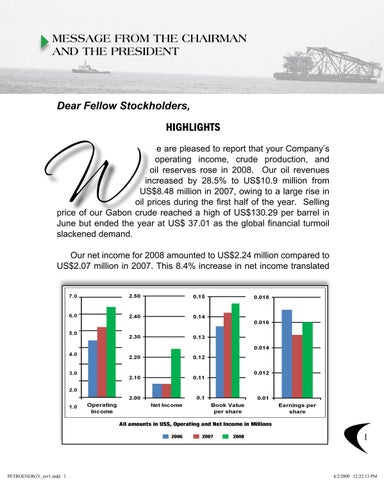
e are pleased to report that your Company’s operating income, crude production, and oil reserves rose in 2008. Our oil revenues increased by 28.5% to US$10.9 million from US$8.48 million in 2007, owing to a large rise in oil prices during the first half of the year. Selling price of our Gabon crude reached a high of US$130.29 per barrel in June but ended the year at US$ 37.01 as the global financial turmoil slackened demand. Our net income for 2008 amounted to US$2.24 million compared to US$2.07 million in 2007. This 8.4% increase in net income translated
PETROENERGY_rev .indd
/ / 00 : : PM
to an improvement in our earnings per share from US$0.015 to US$0.016 over the same period.
The jack-up rig GSF Adriatic VI drilling well Ebouri 2H near the Ebouri production platform; at the background is the jack up rig Pride Cabinda drilling North Ebouri I exploration well.
We also produced and sold more crude in 2008 than in 2007. Production from the Etame and AvoumaTchibala fields posted a 5.2 % increase, rising from 7.41 million barrels in 2007 to 7.79 million barrels last year. Consequently, our total crude oil exported during the period also gained from 7.38 million barrels to 7.60 million barrels. Drilling activities, which were at their busiest, produced significant expansion of our oil reserves in the Ebouri field. For the first time in our Gabon operations, two jack-up drilling rigs, assisted by several work boats, were drilling wells back to back. In over four months from mid-November 2008 to February 2009, they drilled two vertical wells, three inclined pilot holes, one sidetrack well, and two horizontal production wells. Drilling results expanded the extent of the Ebouri reservoir area to 1,050 acres. All these positive developments did not come cheaply. Costs of drilling, pipelines, and construction services set a record capital expenditure of US$162.4
PETROENERGY_rev .indd
/ / 00 : : PM
million for the entire Consortium. But the good news is that we have recovered the bulk of these during the peak oil prices of 2008. We project the balance to be recovered within the next eight months even at current depressed oil prices. Our production-sharing arrangement with the Gabon government allows recovery of 70% of this cost balance from the gross value of each oil sale. It effectively reduces the government share of the oil sales and adds to the revenue stream of the Consortium.
GABON OPERATIONS Increased Processing Capacity of the Production System and Offloading (FPSO)
Floating
In order to accommodate the higher volumes of oil that were expected from the new oil fields Avouma and Ebouri, the FPSO Petroleo Nautipa underwent an upgrading of its flare system and its produced-water system. These upgrades in two essential components of the FPSO’s fluid processing train were made in June and November 2008, requiring a field shut-down limited to only five days. Prior to this improvement, fluids extracted from the production fields – oil, gas, and water – had to be restricted to a volume much less than desired. This limitation was seen in 2006 as a drawback from the intent to maximize the processing capacity of the FPSO inasmuch as two new fields, the Avouma-Tchibala and the Ebouri, were imminently coming into production.
The FPSO Petroleo Nautipa undergoing upgrade of its flare system and producedwater system.
PETROENERGY_rev .indd
/ / 00 : : PM
With the upgrades in place, the FPSO is currently enabled to process the maximum limit of 30,000 barrels of fluid per day, which include the daily target of 25,000 barrels of exportable crude. Increased Reserves Of Ebouri Field Development of the Ebouri Field began in late 2007 and went into full swing as the Ebouri Production Platform and a 9-kilometer pipeline to the FPSO were installed in July 2008. After a 3-month delay in the release of drilling rigs from elsewhere in Africa, two jack-ups arrived on the Ebouri drill sites and commenced drilling in November 2008. A series of coordinated probing drilling operations produced results that exceeded the optimistic projections on the probable size of the Ebouri Field. The jack-up rig GSF Adriatic VI drilled two pilot holes (Ebouri-2HP1 and -P2). One was drilled to the northeast of the discovery well Ebouri-1 and the other to its south. Both encountered oil and their positive intercepts widened the known oil-bearing Gamba sandstone reservoirs eastward.
PETROENERGY_rev .indd
/ / 00 : : PM
The jack-up Pride Cabinda, at the same time, drilled another well, the North Ebouri-1. It intercepted oil in the Gamba sandstone and, thus, further widened the oilbearing reservoir by 800 meters northward. Based on this information, the production well Ebouri-2H was drilled 300 meters horizontally along the Gamba reservoir. Prior to drilling the North Ebouri, a refined calculation by Netherland Sewell Associates yielded reserves of 7.25 million barrels in the same area. The recent drillings widened the reservoir area to 1,000+ acres and increased the oil column within the Gamba sandstone reservoir which has an average porosity of 30% and average permeability of 1.5 darcies. Exploration Well North Etame-1 Dry Rare as it is in our ventures in Etame, we hit a dry one, the exploration well North Etame-1, which found the reservoir deeper by 67 meters, deep enough, though, to sink the Gamba sandstone in the water zone. Further probe of a higher structure on the east was put aside since its smaller volume might not be amenable to an independent development. The jack-up Pride Cabinda was released from contract on February 21, 2009 instead of sending it to drill the next well, Southeast Etame-1. Drilling activities in Gabon will resume in the 3rd quarter of 2009.
PETROENERGY_rev .indd
/ / 00 : : PM
PHILIPPINE PROJECTS Galoc Oil Field in Production (SC 14 C1) A major achievement by the joint venture partners in Service Contract (SC)14-C1 was the commissioning of the Galoc oil field off northwest Palawan. Drilling of production wells Galoc-3 and Galoc-4 was completed in late January 2008 and installation of the seabed flowlines, mooring system, and associated facilities followed soon after. But a series of typhoon crossings in the middle of the year greatly slowed subsea operations and even damaged critical equipment. On October 9, oil finally flowed from the field to the FPSO Rubicon Intrepid, marking the first oil extraction from sandstone reservoirs in the Philippines. Three liftings from Galoc totaling nearly 798,000 barrels were offloaded to buyers’ tankers before the field had to be temporarily shutdown in mid-December 2008.
PETROENERGY_rev .indd
/ / 00 : : PM
Operations by the block operator, Galoc Production Company (GPC), in 2008 were beset by many challenges that led to considerable production downtime. On December 9, 2008, two thrusters of the Rubicon Intrepid failed. A few days later, the towing vessel Ena Sultan suffered an engine failure that led the FPSO Rubicon Intrepid to drift into the red zone. Emergency disconnection of the FPSO from the mooring & riser system (M&RS) was initiated but failed when a section of the riser got snagged. The field crew finally
FPSO Rubicon Intrepid flaring gas in Galoc
managed to disconnect the M&RS on December 15 and laid it on the seabed. Subsequent underwater surveys revealed varying damages on the subsea risers and umbilicals. After over two months of repairs and improvements, the Galoc field was finally returned to production on February 25, 2009. After an initial post-commencement production high of about 17,000 barrels, average daily production is now stabilizing at about 13,000 barrels. Farm-Out of the West Linapacan Block (SC 14 C2) In May 2008, the Filipino members of the Service Contract 14-C2 Consortium, consisting of Alcorn Gold,
PETROENERGY_rev .indd
/ / 00 : : PM
Forum Energy, Oriental Petroleum, PetroEnergy, and Philodrill, farmed out 75% of its interest to Pitkin Petroleum Ltd. of Dallas, Texas. In exchange, the consortium members are to be free-carried through the West Linapacan oil field redevelopment project. Pitkin committed a 3-phase appraisal and redevelopment program that aimed to re-establish production from the oil field. Due to heavy water incursion into the production wells, the oil field was shut down in 1996 while it was still flowing 1,772 barrels of oil per day. Recent assessment by Pitkin of old production data suggested that about 9.9 million barrels of oil may still be recovered with the application of new reserve development techniques that involve long (1,500 meters) dual lateral drain holes. Pitkin has gathered the original field tapes of the 3D seismic data over the West Linapacan-A structure and has submitted them for reprocessing at the Veritas DGC Singapore to gain a better subsurface image of the reservoir. Extension of Octon Farm-in Option (SC 6A) In 2007, the Consortium of Service Contract 6A (SC 6A) composed of Alcorn Gold, Anglo-Philippines, Forum Energy, PetroEnergy, Philex, Philodrill, Trans-Asia, and Vulcan signed an Agreement to farm out the 70% of SC-6A to Vitol GPC Investments S.A. (Vitol). Under this Agreement, Vitol was granted the option to complete the farm-in process contingent on the Final Investment Decision (FID) by the SC-14C Galoc Consortium to proceed to Phase 2 of the Galoc Development Program.
PETROENERGY_rev .indd
/ / 00 : : PM
Location of PERC’s Philippine petroleum projects
Pending the FID, the SC-6A Consortium extended Vitol’s term to decide on its option until the 2nd quarter of 2009. In the meantime, the consortium’s request for the final 15year extension of SC-6A, filed in November 2008 by block operator Philodrill, is pending approval with the DOE. Petronas Pulls Out of Offshore Mindoro (SC 47) After drilling the unsuccessful Kamia-1 exploration well in September 2007, the major partner Petronas Carigali pulled out from the consortium and transferred operatorship to PNOC-EC. During the operatorship of Petronas, the interests in the service contract of PetroEnergy, together with another partner, Basic Petroleum, were warehoused in PNOC-EC. The former consortium was revived in 2008 and the participation in the Service Contract of PetroEnergy and Basic was acknowledged by the DOE.
PETROENERGY_rev .indd
/ / 00 : : 0 PM
The SC 47 Consortium entered into the Sub-Phase 2 of the DOE-approved work program for year 2009. The program calls for acquiring and interpreting a 2D seismic program and drilling one exploration well that costs $3.5 million. DOE Moratorium on Visayan Basin Block (SC 51) In 2008, marine environmental surveys were begun in two potential drilling locations in offshore Cebu previously identified by the SC 51 Consortium made up of NorAsian Energy, Alcorn, Trans-Asia, and PetroEnergy. However, complaints by fishermen from some coastal towns led the provincial government to ask the DOE to stop the site environmental survey. Despite the appeals made by the DOE and the SC51 operator, NorAsian Energy, the insistence by Cebu officials for NorAsian to satisfy the complaints of fisherfolks prompted the DOE to declare a moratorium on SC 51 work program. Thus, the planned drilling of one exploration well by the first quarter of 2009 as committed in the approved Sub-Phase 3 of the work program, is indefinitely put on hold. In sum, our Company’s petroleum portfolio is well balanced; we have a modest-size but expanding oil field in Gabon that provides steady and increasing revenue, the Galoc oil field under extended testing for future commercial development, and a host of relatively low-risk exploration blocks that we continue to mature. This asset spread allows us not only to adapt but even thrive in these challenging times.
10
PETROENERGY_rev .indd 0
/ / 00 : : 0 PM
EXPANDING OUR FRONTIERS While the volatile global economy has led many companies to scale down their plans and operations, we look at the current bearish environment as the opportune time to prepare for long-term growth. Although we have been invited in the recent past to participate in domestic biofuel and gas-to-liquid projects, we concluded that it was not yet timely to invest in these undertakings. Renewable energy, on the other hand, is the better and logical sector in which to plant our future growth. The inevitable, if long-term, depletion of hydrocarbon resources makes renewable energy the fuel of the future. Also making investment in this sector attractive are the relative abundance of domestic renewable energy sources and the fiscal and non-fiscal incentives provided by the recently enacted Renewable Energy Law. Our on-going due diligence identifies wind and geothermal energy as promising areas for our Company’s expansion. We have acquired practical expertise in these areas, established linkages with industry players, and initiated the prescribed regulatory process on selected prospects. In venturing into this new territory, we are guided by a few key principles that have similarly steered our petroleum operation – careful project selection through rigorous technical analysis, partnership with credible industry players, and risk reduction through limited capital exposure.
Bangui wind farm in Bangui Bay, Ilocos Norte
PETROENERGY_rev .indd
11
/ / 00 : : PM
OUTLOOK The coming months will see your Company vigorously pursuing both the expanding petroleum operations in Gabon and the new opportunities in renewable energy projects in the Philippines. Our success in earlier years has allowed us to strengthen our managerial, technical, and financial capabilities. As we reap the benefits of our growing Gabon operations and move forward into new energy opportunities, we acknowledge the dedication of our officers and staff, past and present, who have been instrumental to bringing PetroEnergy into its respected position in the local upstream oil industry. And to our fellow stockholders, whose unfailing trust and support have been vital to our continued growth and success, we extend our deepest thanks and gratitude. Thank You and Good Day,
Rizalino S. Navarro Chairman of the Board
Milagros V. Reyes President
12
PETROENERGY_rev .indd
/ / 00 : : PM
STATEMENT OF MANAGEMENT’S RESPONSIBILITY FOR THE FINANCIAL STATEMENTS
13
PETROENERGY_rev .indd
/ / 00 : : PM
FINANCIAL HIGHLIGHTS (In U.S. Dollars)
2008
2007
% Change
Assets
20,836
20,510
1.59%
Liabilities
762
1,070
(28.79%)
Stockholders’ Equity
20,074
19,440
3.26%
Oil Revenue
10,905
8,482
28.57%
Operating Income
6,410
5,211
23.00%
Net Income
2,243
2,068
8.46%
Book Value per share
0.146
0.142
2.82%
Earnings per Share
0.016
0.015
6.67%
14
PETROENERGY_rev .indd
/ / 00 : : PM
INDEPENDENT AUDITORS’ REPORT
The Stockholders and the Board of Directors PetroEnergy Resources Corporation We have audited the accompanying financial statements of PetroEnergy Resources Corporation, which comprise the balance sheets as at December 31, 2008 and 2007, and the statements of income, statements of changes in equity and statements of cash flows for each of the three years in the period ended December 31, 2008, and a summary of significant accounting policies and other explanatory notes.
Management’s Responsibility for the Financial Statements Management is responsible for the preparation and fair presentation of these financial statements inaccordance with Philippine Financial Reporting Standards. This responsibility includes: designing, implementing and maintaining internal control relevant to the preparation and fair presentation of financial statements that are free from material misstatement, whether due to fraud or error; selecting and applying appropriate accounting policies; and making accounting estimates that are reasonable in the circumstances.
Auditors’ Responsibility Our responsibility is to express an opinion on these financial statements based on our audits. We conducted our audits in accordance with Philippine Standards on Auditing. Those standards require that we comply with ethical requirements and plan and perform the audit to obtain reasonable assurance whether the financial statements are free from material misstatement. An audit involves performing procedures to obtain audit evidence about the amounts and disclosures in the financial statements. The procedures selected depend on the auditor’s judgment, including the assessment of the risks of material misstatement of the financial statements, whether due to fraud or error. In making those risk assessments, the auditor considers internal control relevant to the entity’s
15
PETROENERGY_rev .indd
/ / 00 : : PM
preparation and fair presentation of the financial statements in order to design audit procedures that are appropriate in the circumstances, but not for the purpose of expressing an opinion on the effectiveness of the entity’s internal control. An audit also includes evaluating the appropriateness of accounting policies used and the reasonableness of accounting estimates made by management, as well as evaluating the overall presentation of the financial statements. We believe that the audit evidence we have obtained is sufficient and appropriate to provide a basis for our audit opinion.
Opinion In our opinion, the financial statements present fairly, in all material respects, the financial position of PetroEnergy Resources Corporation as of December 31, 2008 and 2007, and its financial performance and its cash flows for each of the three years in the period ended December 31, 2008 in accordance with Philippine Financial Reporting Standards. Without qualifying our opinion, we draw attention to Note 8 to the financial statements. The suspension of the production activities in the West Linapacan Oilfield raises uncertainties as to the profitability of the petroleum operations. In addition, the farm-out of the Company’s participating interest in Service Contract No. 14 may result in a potential reduction in its share of future revenues. The profitability of petroleum operations and the full recovery of unamortized cost of wells, platforms and other facilities and the deferred oil exploration costs (Note 9) incurred in connection with the Company’s participation in the acquisition and exploration of petroleum concessions are dependent upon additional discoveries of oil in commercial quantities and the success of future development thereof.
SYCIP GORRES VELAYO & CO.
Cyril Jasmin B. Valencia Partner CPA Certificate No. 90787 SEC Accreditation No. 0782-A Tax Identification No. 162-410-623 PTR No. 1566477, January 5, 2009, Makati City February 17, 2009
16
PETROENERGY_rev .indd
/ / 00 : : PM
BALANCE SHEETS (In U.S. Dollars) ASSETS Current Assets Cash and cash equivalents (Notes 4 and 20) Financial assets at fair value through profit and loss (Notes 5 and 20) Receivables - net (Notes 3, 6 and 20) Crude oil inventory (Note 3) Prepaid expenses and other current assets (Notes 7 and 20) Total Current Assets Noncurrent Assets Property and equipment - net (Notes 3 and 8) Deferred oil exploration costs (Notes 3 and 9) Investment properties - net (Notes 3 and 10) Total Noncurrent Assets LIABILITIES AND EQUITY Current Liabilities Accounts payable and accrued expenses (Notes 12, 14 and 20) Income tax payable (Notes 14 and 16) Total Current Liabilities Noncurrent Liabilities Accrued retirement liability (Notes 3, 14 and 15) Asset retirement obligation (Notes 3, 13 and 14) Deferred tax liabilities - net (Notes 3, 14 and 16) Total Noncurrent Liabilities Total Liabilities Equity (Note 14) Capital stock - $0.0245 par value Authorized - 330,000,000 shares Issued and outstanding - 136,912,110 shares Additional paid-in capital Retained earnings Appropriated Unappropriated Total Equity
December 31 2008
2007
$1,348,609
$2,314,465
573,308 1,291,148 308,939 204,197 3,726,201
77,068 1,500,354 491,985 139,016 4,522,888
12,578,532 4,499,993 31,417 17,109,942 $20,836,143
12,341,891 3,613,657 31,417 15,986,965 $20,509,853
$440,082 – 440,082
$550,958 165,608 716,566
38,737 181,061 102,682 322,480 762,562
42,216 92,948 218,261 353,425 1,069,991
3,358,068 13,390,875
3,358,068 13,390,875
2,055,555 1,269,083 20,073,581 $20,836,143
563,550 2,127,369 19,439,862 $20,509,853
See accompanying Notes to Financial Statements.
17
PETROENERGY_rev .indd
/ / 00 : : 0 PM
STATEMENTS OF INCOME (In U.S. Dollars)
Years Ended December 31 2008 2007 2006 $10,905,157
$8,482,118
$7,113,692
4,494,522 1,050,079
3,270,740 881,930
2,692,048 904,682
1,774,329 7,318,930
1,617,393 5,770,063
637,660 4,234,390
94,986
52,694
73,633
(30,913) (40,277) (155,554) 5,606 (126,152)
3,713 (12,474) 81,478 375 125,786
5,156 (10,800) 26,634 16,494 111,117
INCOME BEFORE INCOME TAX
3,460,075
2,837,841
2,990,419
PROVISION FOR INCOME TAX (Note 16)
1,217,371
769,036
918,104
$2,242,704
$2,068,805
$2,072,315
$0.016
$0.015
$0.017
OIL REVENUES COSTS AND EXPENSES Oil production operating expenses (Note 17) General and administrative expenses (Note 18) Depletion, depreciation and amortization (Notes 8 and 10) OTHER INCOME (CHARGES) Interest income Net gain (loss) on fair value changes on financial assets at fair value through profit and loss (Note 5) Accretion expense (Note 13) Net unrealized foreign exchange gain (loss) Miscellaneous income
NET INCOME (Note 21) Basic/Diluted Earnings Per Share (Note 21) See accompanying Notes to Financial Statements.
18
PETROENERGY_rev .indd
/ / 00 : : PM
STATEMENTS OF CHANGES IN EQUITY (In U.S. Dollars)
Years Ended December 31 2008 2007 2006 CAPITAL STOCK - $0.0245 par value (Note 14) Authorized - 330,000,000 shares Issued and outstanding - 136,912,110 shares in 2008, 2007 and 2006 Balance at beginning of year Stock dividends Balance at end of year
$3,358,068 – 3,358,068
$3,358,068 – 3,358,068
$2,583,129 774,939 3,358,068
ADDITIONAL PAID-IN CAPITAL
13,390,875
13,390,875
13,390,875
563,550 1,492,005 2,055,555
563,550 – 563,550
563,550 – 563,550
2,127,369 2,242,704 (1,608,985) – (1,492,005) 1,269,083 $20,073,581
1,224,882 2,068,805 (1,166,318) – – 2,127,369 $19,439,862
323,063 2,072,315 (395,557) (774,939) – 1,224,882 $18,537,375
APPROPRIATED RETAINED EARNINGS Balance at beginning of year Transfer from unappropriated retained earnings (Note 14) Balance at end of year UNAPPROPRIATED RETAINED EARNINGS Balance at beginning of year Net income Cash dividends (Note 14) Stock dividends (Note 14) Transfer to appropriated retained earnings (Note 14) Balance at end of year
See accompanying Notes to Financial Statements.
19
PETROENERGY_rev .indd
/ / 00 : : PM
STATEMENTS OF CASH FLOWS (In U.S. Dollars) CASH FLOWS FROM OPERATING ACTIVITIES Income before income tax Adjustments for: Depletion, depreciation and amortization (Notes 8 and 10) Accretion expense Interest income Net loss (gain) on fair value changes on financial assets at fair value through profit and loss (Note 5) Net unrealized foreign currency exchange (gain) loss Loss on sale of property and equipment Operating income before working capital changes Changes in operating assets and liabilities: Decrease (increase) in: Receivables Crude oil inventory Prepaid expenses and other current assets Increase (decrease) in accounts payable and accrued expenses Net cash generated from operations Interest income received Income taxes paid Net cash provided by operating activities CASH FLOWS FROM INVESTING ACTIVITIES Additions to property and equipment (Note 8) Proceeds from disposals of property and equipment Increase in deferred oil exploration costs Acquisitions of financial assets at fair value through profit or loss Net cash used in investing activities CASH FLOWS FROM FINANCING ACTIVITY Dividends paid EFFECT OF FOREIGN EXCHANGE RATE CHANGES IN CASH AND CASH EQUIVALENTS NET INCREASE (DECREASE) IN CASH AND CASH EQUIVALENTS CASH AND CASH EQUIVALENTS AT BEGINNING OF YEAR CASH AND CASH EQUIVALENTS AT END OF YEAR (Note 4)
Years Ended December 31 2008 2007 2006 $3,460,075
$2,837,841
$2,990,419
1,774,329 40,277 (94,986)
1,617,393 12,474 (52,694)
637,660 10,800 (73,633)
30,913 192,102 – 5,402,710
(3,713) (2,670) – 4,408,631
(5,156) (14,106) 1,001 3,546,985
221,725 183,046 (65,181)
(883,733) 76,723 (37,546)
(77,810) (28,869) 59,856
(177,785) 5,564,515 82,406 (1,583,993) 4,062,928
113,188 3,677,263 50,792 (657,942) 3,070,113
114,425 3,614,587 72,014 (938,969) 2,747,632
(204,506) 44,931 (2,689,895)
(279,504) – (858,437)
(2,413,363) 14,997 (345,827)
(537,167) (3,386,637)
– (1,137,941)
– (2,744,193)
(1,583,223)
(1,102,723)
(395,557)
(58,924)
–
–
(965,856)
829,449
(392,118)
2,314,465
1,485,016
1,877,134
$1,348,609
$2,314,465
$1,485,016
See accompanying Notes to Financial Statements.
20
PETROENERGY_rev .indd 0
/ / 00 : : PM
NOTES TO FINANCIAL STATEMENTS (In U.S. Dollars)
1.
Corporate Information PetroEnergy Resources Corporation (the Company) was incorporated in the Philippines in September 29, 1994 and started commercial operations in 1995. The Company is engaged in oil and mineral exploration and development. The registered office address of the Company is 7th Floor, JMT Building, ADB Avenue, Pasig City. The Company’s shares of stocks are listed and are currently trading at the Philippine Stock Exchange. The accompanying financial statements were approved and authorized for issue by the Board of Directors (BOD) on February 17, 2009.
2.
Summary of Significant Accounting Policies Basis of Preparation The accompanying financial statements of the Company have been prepared on a historical cost basis, except for financial assets at fair value through profit and loss (FVPL) and crude oil inventory that have been measured at fair value. The financial statements are presented in the Company’s functional currency which is the United States (U.S.) Dollar ($). Statement of Compliance The financial statements of the Company have been prepared in accordance with Philippine Financial Reporting Standards (PFRS). Changes in Accounting Policies and Disclosures The accounting policies adopted are consistent with those of the previous financial year except for the adoption of the following Philippine Interpretations of International Financial Reporting Interpretations Committee (IFRIC) which became effective on January 1, 2008, and amendments to an existing standard that became effective on July 1, 2008. Adoption of these changes in PFRS did not have any significant effect to the Company: •
Philippine Interpretation IFRIC 11, PFRS 2 - Group and Treasury Share Transactions
•
Philippine Interpretation IFRIC 12, Service Concession Arrangements
•
Philippine Interpretation IFRIC 14, PAS 19, The Limit on a Defined Benefit Asset, Minimum Funding Requirement and their Interaction
•
Amendments to Philippine Accounting Standards (PAS) 39, Financial Instruments: Recognition and Measurement and PFRS 7, Financial Instruments: Disclosures Reclassification of Financial Assets
21
PETROENERGY_rev .indd
/ / 00 : : PM
New Accounting Standards, Interpretations, and Amendments to Existing Standards Effective Subsequent to December 31, 2008 The Company will adopt the following standards and interpretations enumerated below when these become effective. Except as otherwise indicated, the Company does not expect the adoption of these new and amended PFRS and Philippine Interpretations to have significant impact on its financial statements. Effective in 2009 PFRS 1, First-time Adoption of Philippine Financial Reporting Standards - Cost of an Investment in a Subsidiary, Jointly Controlled Entity or Associate The amended PFRS 1 allows an entity, in its separate financial statements, to determine the cost of investments in subsidiaries, jointly controlled entities or associates (in its opening PFRS financial statements) as one of the following amounts: a) cost determined in accordance with PAS 27; b) at the fair value of the investment at the date of transition to PFRS, determined in accordance with PAS 39; or c) previous carrying amount (as determined under generally accepted accounting principles) of the investment at the date of transition to PFRS. PFRS 2, Share-based Payment - Vesting Condition and Cancellations The standard has been revised to clarify the definition of a vesting condition and prescribes the treatment for an award that is effectively cancelled. It defines a vesting condition as a condition that includes an explicit or implicit requirement to provide services. It further requires nonvesting conditions to be treated in a similar fashion to market conditions. Failure to satisfy a nonvesting condition that is within the control of either the entity or the counterparty is accounted for as cancellation. However, failure to satisfy a non-vesting condition that is beyond the control of either party does not give rise to a cancellation. PFRS 8, Operating Segments PFRS 8 will replace PAS 14, Segment Reporting, and adopts a full management approach to identifying, measuring and disclosing the results of an entity’s operating segments. The information reported would be that which management uses internally for evaluating the performance of operating segments and allocating resources to those segments. Such information may be different from that reported in the consolidated balance sheet and consolidated statement of income and the Company will provide explanations and reconciliations of the differences. This standard is only applicable to an entity that has debt or equity instruments that are traded in a public market or that files (or is in the process of filing) its financial statements with a securities commission or similar party. Amendments to PAS 1, Presentation of Financial Statements This Amendment introduces a new statement of comprehensive income that combines all items of income and expenses recognized in the profit or loss together with ‘other comprehensive income’ (OCI). Entities may choose to present all items in
22
PETROENERGY_rev .indd
/ / 00 : : PM
one statement, or to present two linked statements, a separate statement of income and a statement of comprehensive income. This Amendment also requires additional requirements in the presentation of the balance sheet and owner’s equity as well as additional disclosures to be included in the financial statements. The Company will determine the format of statement of comprehensive income and the additional requirements of the standard upon adoption. PAS 23, Borrowing Costs The standard has been revised to require capitalization of borrowing costs when such costs relate to a qualifying asset. A qualifying asset is an asset that necessarily takes a substantial period of time to get ready for its intended use or sale. Amendments to PAS 27, Consolidated and Separate Financial Statements - Cost of an Investment in a Subsidiary, Jointly Controlled Entity or Associate Amendments to PAS 27 will be effective on January 1, 2009 which has changes in respect of the holding companies separate financial statements including (a) the deletion of ‘cost method’, making the distinction between pre- and post-acquisition profits no longer required; and (b) in cases of reorganizations where a new parent is inserted above an existing parent of the group (subject to meeting specific requirements), the cost of the subsidiary is the previous carrying amount of its share of equity items in the subsidiary rather than its fair value. All dividends will be recognized in profit or loss. However, the payment of such dividends requires the entity to consider whether there is an indicator of impairment. Amendment to PAS 32, Financial Instruments: Presentation and PAS 1 Presentation of Financial Statements - Puttable Financial Instruments and Obligations Arising on Liquidation These amendments specify, among others, that puttable financial instruments will be classified as equity if they have all of the following specified features: (a) the instrument entitles the holder to require the entity to repurchase or redeem the instrument (either on an ongoing basis or on liquidation) for a pro rata share of the entity’s net assets, (b) the instrument is in the most subordinate class of instruments, with no priority over other claims to the assets of the entity on liquidation,(c) all instruments in the subordinate class have identical features, (d) the instrument does not include any contractual obligation to pay cash or financial assets other than the holder’s right to a pro rata share of the entity’s net assets, and (e) the total expected cash flows attributable to the instrument over its life are based substantially on the profit or loss, a change in recognized net assets, or a change in the fair value of the recognized and unrecognized net assets of the entity over the life of the instrument. Philippine Interpretation IFRIC 13, Customer Loyalty Programmes This Interpretation requires customer loyalty award credits to be accounted for as a separate component of the sales transaction in which they are granted and therefore part of the fair value of the consideration received is allocated to the award credits and realized in income over the period that the award credits are redeemed or expire.
23
PETROENERGY_rev .indd
/ / 00 : : PM
Philippine Interpretation IFRIC 16, Hedges of a Net Investment in a Foreign Operation This Interpretation provides guidance on identifying foreign currency risks that qualify for hedge accounting in the hedge of net investment; where within the group the hedging instrument can be held in the hedge of a net investment; and how an entity should determine the amount of foreign currency gains or losses, relating to both the net investment and the hedging instrument, to be recycled on disposal of the net investment. Improvements to PFRSs In May 2008, the International Accounting Standards Board issued its first omnibus of amendments to certain standards, primarily with a view to remove inconsistencies and clarify wordings. There are separate transitional provisions for each standard: •
PFRS 5, Non-current Assets Held for Sale and Discontinued Operations ▪ When a subsidiary is held for sale, all of its assets and liabilities will be classified as held for sale under PFRS 5, even when the entity retains a non-controlling interest in the subsidiary after the sale.
•
PAS 1, Presentation of Financial Statements ▪ Assets and liabilities classified as held for trading are not automatically classified as current in the balance sheet.
•
PAS 16, Property, Plant and Equipment ▪ The amendment replaces the term ‘net selling price’ with ‘fair value less costs to sell’, to be consistent with PFRS 5, Non-current Assets Held for Sale and Discontinued Operations and PAS 36, Impairment of Asset. ▪ Items of property, plant and equipment held for rental that are routinely sold in the ordinary course of business after rental, are transferred to inventory when rental ceases and they are held for sale. Proceeds of such sales are subsequently shown as revenue. Cash payments on initial recognition of such items, the cash receipts from rents and subsequent sales are all shown as cash flows from operating activities. •
PAS 19, Employee Benefits ▪ Revises the definition of ‘past service costs’ to include reductions in benefits related to past services (‘negative past service costs’) and to exclude reductions in benefits related to future services that arise from plan amendments. Amendments to plans that result in a reduction in benefits related to future services are accounted for as a curtailment. ▪ Revises the definition of ‘return on plan assets’ to exclude plan administration costs if they have already been included in the actuarial assumptions used to measure the defined benefit obligation. ▪ Revises the definition of ‘short-term’ and ‘other long-term’ employee benefits to focus on the point in time at which the liability is due to be settled. ▪ Deletes the reference to the recognition of contingent liabilities to ensure consistency with PAS 37, Provisions, Contingent Liabilities and Contingent Assets.
24
PETROENERGY_rev .indd
/ / 00 : : PM
•
PAS 20, Accounting for Government Grants and Disclosures of Government Assistance ▪ Loans granted with no or low interest rates will not be exempt from the requirement to impute interest. The difference between the amount received and the discounted amount is accounted for as a government grant.
•
PAS 23, Borrowing Costs ▪ Revises the definition of borrowing costs to consolidate the types of items that are considered components of ‘borrowing costs’, i.e., components of the interest expense calculated using the effective interest rate method.
•
PAS 28, Investment in Associates ▪ If an associate is accounted for at fair value in accordance with PAS 39, only the requirement of PAS 28 to disclose the nature and extent of any significant restrictions on the ability of the associate to transfer funds to the entity in the form of cash or repayment of loans applies. ▪ An investment in an associate is a single asset for the purpose of conducting the impairment test. Therefore, any impairment test is not separately allocated to the goodwill included in the investment balance.
•
PAS 29, Financial Reporting in Hyperinflationary Economies ▪ Revises the reference to the exception that assets and liabilities should be measured at historical cost, such that it notes property, plant and equipment as being an example, rather than implying that it is a definitive list.
•
PAS 31, Interest in Joint Ventures ▪ If a joint venture is accounted for at fair value, in accordance with PAS 39, only the requirements of PAS 31 to disclose the commitments of the venturer and the joint venture, as well as summary financial information about the assets, liabilities, income and expense will apply.
•
PAS 36, Impairment of Assets ▪ When discounted cash flows are used to estimate ‘fair value less cost to sell’ additional disclosure is required about the discount rate, consistent with disclosures required when the discounted cash flows are used to estimate ‘value in use’.
•
PAS 38, Intangible Assets ▪ Expenditure on advertising and promotional activities is recognized as an expense when the Company either has the right to access the goods or has received the services. Advertising and promotional activities now specifically include mail order catalogues. ▪ Deletes references to there being rarely, if ever, persuasive evidence to support an amortization method for finite life intangible assets that results in a lower amount of accumulated amortization than under the straight-line method, thereby effectively allowing the use of the unit of production method.
25
PETROENERGY_rev .indd
/ / 00 : : PM
•
PAS 39, Financial Instruments: Recognition and Measurement ▪ Changes in circumstances relating to derivatives - specifically derivatives designated or re-designated as hedging instruments after initial recognition - are not reclassifications. ▪ When financial assets are reclassified as a result of an insurance company changing its accounting policy in accordance with paragraph 45 of PFRS 4 Insurance Contracts, this is a change in circumstance, not a reclassification. ▪ Removes the reference to a ‘segment’ when determining whether an instrument qualifies as a hedge. ▪ Requires use of the revised effective interest rate (rather than the original effective interest rate) when re-measuring a debt instrument on the cessation of fair value hedge accounting.
•
PAS 40, Investment Properties ▪ Revises the scope (and the scope of PAS 16, Property, Plant and Equipment) to include property that is being constructed or developed for future use as an investment property. Where an entity is unable to determine the fair value of an investment property under construction, but expects to be able to determine its fair value on completion, the investment under construction will be measured at cost until such time as fair value can be determined or construction is complete. •
PAS 41, Agriculture ▪ Removes the reference to the use of a pre-tax discount rate to determine fair value, thereby allowing use of either a pre-tax or post-tax discount rate depending on the valuation methodology used. ▪ Removes the prohibition to take into account cash flows resulting from any additional transformations when estimating fair value. Instead, cash flows that are expected to be generated in the ‘most relevant market’ are taken into account.
Effective in 2010 Revised PFRS 3, Business Combinations and PAS 27, Consolidated and Separate Financial Statements The revised PFRS 3 introduces a number of changes in the accounting for business combinations that will impact the amount of goodwill recognized, the reported results in the period that an acquisition occurs, and future reported results. The revised PAS 27 requires, among others, that (a) change in ownership interests of a subsidiary (that do not result in loss of control) will be accounted for as an equity transaction and will have no impact on goodwill nor will it give rise to a gain or loss; (b) losses incurred by the subsidiary will be allocated between the controlling and non-controlling interests (previously referred to as ‘minority interests’); even if the losses exceed the noncontrolling equity investment in the subsidiary; and (c) on loss of control of a subsidiary, any retained interest will be remeasured to fair value and this will impact the gain or loss recognized on disposal. The changes introduced by the revised PFRS 3 and PAS 27 must be applied prospectively and will affect future acquisitions and transactions with non-controlling interests.
26
PETROENERGY_rev .indd
/ / 00 : : PM
Amendment to PAS 39, Financial Instruments: Recognition and Measurement - Eligible hedged items Amendment to PAS 39 will be effective on July 1, 2009, which addresses only the designation of a one-sided risk in a hedged item, and the designation of inflation as a hedged risk or portion in particular situations. The amendment clarifies that an entity is permitted to designate a portion of the fair value changes or cash flow variability of a financial instrument as a hedged item. Effective in 2012 Philippine Interpretation IFRIC 15, Agreement for Construction of Real Estate This Interpretation covers accounting for revenue and associated expenses by entities that undertake the construction of real estate directly or through subcontractors. This Interpretation requires that revenue on construction of real estate be recognized only upon completion, except when such contract qualifies as construction contract to be accounted for under PAS 11, Construction Contracts, or involves rendering of services in which case revenue is recognized based on stage of completion. Contracts involving provision of services with the construction materials and where the risks and reward of ownership are transferred to the buyer on a continuous basis, will also be accounted for based on stage of completion. Accounting Policies Revenue Recognition Revenue is recognized to the extent that it is probable that the economic benefits will flow to the Company and the revenue can be reliably measured. Revenue is measured at the fair value of the consideration received, excluding discounts, rebates and other sales taxes or duty. The following specific recognition criteria must also be met before revenue is recognized: Oil Revenues Revenues from producing oil wells are recognized as income at the time of production. Interest Income Interest income, mainly on cash and cash equivalents, is recognized as the interest accrues taking into account the effective yield on the asset. Rental Income Rental income arising from operating leases on investment properties is accounted for on a straight-line basis over the lease terms. Cash and Cash Equivalents Cash includes cash on hand and in banks. Cash equivalents are short-term, highly liquid investments that are readily convertible to known amounts of cash with original maturities of three months or less from the dates of acquisition and that are subject to an insignificant risk of change in value.
27
PETROENERGY_rev .indd
/ / 00 : : PM
Financial Assets Financial assets within the scope of PAS 39, Financial Instruments: Recognition and Measurement, are classified as FVPL, loans and receivables, held-to-maturity (HTM) investments, available-for-sale (AFS) investments or as derivatives designated as hedging instruments in an effective hedge, as appropriate. The classification depends on the purpose for which the investments were acquired. Management determines the classification of its investments at initial recognition and re-evaluates this designation at every reporting date. Financial assets are recognized initially at fair value plus transaction costs directly attributable to their acquisition in the case of all financial assets not carried at FVPL. All regular way purchases and sales of financial assets are recognized on the trade date, which is the date that the Company commits to purchase the asset. Regular way purchases or sales are purchases or sales of financial assets that require delivery of assets within the period generally established by regulation or convention in the marketplace. Assets under this category are classified as current assets if maturity is within 12 months from the balance sheet date and as noncurrent assets if maturity date is more than a year from the balance sheet date. a.
Financial Assets at FVPL. This includes financial assets held for trading and financial assets designated upon initial recognition as at FVPL.
Financial assets are classified as held for trading if they are acquired for the purpose of selling in the near term. Financial assets at FVPL are recorded in the balance sheet at fair value with unrealized markto- market gains and losses reported as part of the current year operations. Interest earned or incurred is recorded in interest income or expense, respectively, while dividend income is recorded in ‘miscellaneous income’ according to the terms of the contract, or when the right of payment has been established. Derivatives, including separated embedded derivatives are also classified as FVPL unless they are designated as effective hedging instruments or a financial guarantee contract.
Classified as financial assets at FVPL are the Company’s marketable debt and equity securities held for trading purposes and investment in golf club shares as described in Note 5.
b.
Loans and Receivables. Loans and receivables are non-derivative financial assets with fixed or determinable payments that are not quoted in an active market. After initial measurement, loans and receivables are carried at amortized cost using the effective interest method less any allowance for impairment. Gains and losses are recognized in the statement of income when the loans and receivables are derecognized or impaired, as well as through the amortization process. Classified under this category are the Company’s cash on hand and in bank, restricted cash, short-term investments, accounts receivable and interest receivable.
28
PETROENERGY_rev .indd
/ / 00 : : PM
c.
d.
e.
HTM Investments. HTM investments are quoted non-derivative financial assets with fixed or determinable payments and fixed maturities for which the Company’s management has the positive intention and ability to hold to maturity. After initial measurement, HTM investments are measured at amortized cost using the effective interest method. Gains and losses are recognized in the statement of income when the investments are derecognized or impaired, as well as through the amortization process. The Company has no HTM investments as at December 31, 2008 and 2007. AFS Investments. AFS investments are those non-derivative financial assets that are designated as AFS or are not classified in any of the three preceding categories. After initial measurement, AFS investments are measured at fair value with unrealized gains or losses recognized directly in equity until the investment is derecognized or determined to be impaired at which time the cumulative gain or loss previously recorded in equity is recognized in the statement of income. The Company has no AFS investments as at December 31, 2008 and 2007. Derivative Financial Instruments. Derivatives are recorded at fair value and carried as assets when their fair value is positive and as liabilities when their fair value is negative. Changes in the fair value of derivatives are included in the statement of income.
Derivatives embedded in other financial instruments are treated as separate derivatives and recorded at fair value if their economic characteristics and risks are not closely related to those of the host contract, and the host contract is not itself held for trading or designated at fair value through profit or loss.
The Company assesses at each reporting date whether an embedded derivative is required to be separated from the host contract and accounted for as a derivative when the Company first becomes a party to the contract. Subsequent reassessment is prohibited unless there is a change in the terms of the contract that significantly modifies the cash flows that otherwise would be required under the contract, in which case reassessment is required. The Company determines whether a modification to cash flows is significant by considering the extent to which the expected future cash flows associated with the embedded derivative, the host contract or both have changed and whether the change is significant relative to the previously expected cash flows on the contract.
The Company has no derivative financial instruments as at December 31, 2008 and 2007.
Fair Value The fair value of investments that are actively traded in organized financial markets is determined by reference to quoted market bid prices at the close of business on the balance sheet date. For investments where there is no active market, fair value is determined using valuation techniques, using inputs and assumptions from market
29
PETROENERGY_rev .indd
/ / 00 : : PM
observable data and condition, and reflect appropriate adjustments that market participants would make for credit and liquidity risks existing as at each of the periods indicated. Such techniques include using recent arm’s length market transactions; reference to the current market value of another instrument which is substantially the same; discounted cash flow analysis or other valuation models. Day 1 Profit Where the transaction price in a non-active market is different to the fair value from other observable current market transactions in the same instrument or based on a valuation technique whose variables include only data from observable market, the Company recognizes the difference between the transaction price and fair value (a Day 1 profit) in the statement of income unless it qualifies for recognition as some other type of asset. In cases where use is made of data which is not observable, the difference between the transaction price and model value is only recognized in the statement of income when the inputs become observable or when the instrument is derecognized. For each transaction, the Company determines the appropriate method of recognizing the Day 1 profit amount. Financial Liabilities Financial liabilities within the scope of PAS 39, Financial Instruments: Recognition and Measurement, are classified as financial liabilities at FVPL and other financial liabilities, as appropriate. a.
Financial Liabilities at FVPL - Financial liabilities at FVPL include financial liabilities held for trading and financial liabilities designated upon initial recognition as at fair value through profit or loss. Derivatives, including separated embedded derivatives, are also classified as FVPL unless they are designated as effective hedging instruments.
Financial liabilities are classified as held for trading if they are acquired for the purpose of selling in the near term. Gains or losses on liabilities held for trading are recognized in the statement of income.
The Company has no designated financial liabilities at FVPL as at December 31, 2008 and 2007.
b.
Other Financial Liabilities - Other financial liabilities are non-derivative financial liabilities with fixed or determinable payments that are not quoted in an active market. These liabilities are carried at cost or amortized cost in the balance sheet. Amortization is determined using the effective interest method.
Gains and losses are recognized in the statement of income when the liabilities are derecognized as well as through the amortization process.
Classified under this category are accounts payable and accrued expenses.
30
PETROENERGY_rev .indd 0
/ / 00 : : PM
Designated Financial Assets or Financial Liabilities at FVPL Financial assets or financial liabilities classified in this category are designated by the management on initial recognition when the following criteria are met: • • •
The designation eliminates or significantly reduces the inconsistent treatment that would otherwise arise from measuring the assets or liabilities or recognizing gains or losses on them on a different basis; The assets and liabilities are part of a group of financial assets, financial liabilities or both which are managed and their performance evaluated on a fair value basis, in accordance with a documented risk management or investment strategy; or The financial instrument contains an embedded derivative, unless the embedded derivative does not significantly modify the cash flows or it is clear, with little or no analysis, that it would not be separately recorded.
Designated financial assets and financial liabilities at FVPL are recorded in the balance sheet at fair value. Changes in fair value are recorded in “net gain (loss) on fair value changes on financial assets at FVPL” in the statement of income. Interest earned or incurred is recorded in interest income or expense, respectively. The Company has no designated financial assets or financial liabilities at FVPL. Offsetting of Financial Instruments Financial assets and financial liabilities are offset and the net amount reported in the balance sheet if, and only if, there is a currently enforceable legal right to offset the recognized amounts and there is no intention to settle on a net basis, or to realize the asset and settle the liability simultaneously. Impairment of Financial Assets The Company assesses at each balance sheet date whether a financial asset or a group of financial assets is impaired. Loans and Receivables The Company first assesses whether objective evidence of impairment exists individually for financial assets that are individually significant, or collectively for financial assets that are not individually significant. If the Company determines that no objective evidence of impairment exists for individually assessed financial asset, whether significant or not, it includes the asset in a group of financial assets with similar credit risk characteristics and collectively assesses for impairment. Those characteristics are relevant to the estimation of future cash flows for groups of such assets by being indicative of the debtors’ ability to pay all amounts due according to the contractual terms of the assets being evaluated. Assets that are individually assessed for impairment and for which an impairment loss is, or continues to be, recognized are not included in a collective assessment for impairment. If there is objective evidence that an impairment loss on assets carried at amortized cost has been incurred, the amount of the loss is measured as the difference between the asset’s carrying amount and the present value of estimated future cash flows (excluding
31
PETROENERGY_rev .indd
/ / 00 : : PM
future expected credit losses that have not been incurred) discounted at the financial asset’s original effective interest rate (i.e., the effective interest rate computed at initial recognition). The carrying amount of the asset is reduced through use of an allowance account. The amount of the loss shall be recognized in the statement of income. If in a subsequent period, the amount of the impairment loss decreases and the decrease can be related objectively to an event occurring after the impairment was recognized, the previously recognized impairment loss is reversed, to the extent that the carrying value of the asset does not exceed its amortized cost at the reversal date. Any subsequent reversal of an impairment loss is recognized in the statement of income. In relation to receivables, a provision for impairment is made when there is objective evidence (such as the probability of insolvency or significant financial difficulties of the debtor) that the Company will not be able to collect all of the amounts due under the original terms of the invoice. The carrying amount of the receivable is reduced through the use of an allowance account. Impaired receivables are derecognized when they are assessed as uncollectible. Derecognition of Financial Assets and Financial Liabilities Financial Assets
A financial asset or, where applicable, a part of a financial asset or a part of a group of similar financial assets, is derecognized when: •the rights to receive cash flows from the asset have expired; • •
the Company retains the right to receive cash flows from the asset, but has assumed an obligation to pay them in full without material delay to a third party under a ‘passthrough’ arrangement; or the Company has transferred its rights to receive cash flows from the asset and either (a) has transferred substantially all the risks and rewards of the asset, or (b) has neither transferred nor retained substantially all the risks and rewards of the asset, but has transferred control of the asset. When the Company has transferred its rights to receive cash flows from an asset and has neither transferred nor retained substantially all the risks and rewards of the asset nor transferred control of the asset, the asset is recognized to the extent of the Company’s continuing involvement in the asset. Continuing involvement that takes the form of a guarantee over the transferred asset is measured at the lower of the original carrying amount of the asset and the maximum amount of consideration that the Company could be required to repay.
Financial Liabilities A financial liability is derecognized when the obligation under the liability is discharged or cancelled or has expired.
32
PETROENERGY_rev .indd
/ / 00 : : PM
When an existing financial liability is replaced by another from the same lender on substantially different terms, or the terms of an existing liability are substantially modified, such an exchange or modification is treated as a derecognition of the original liability and the recognition of a new liability, and the difference in the respective carrying amounts is recognized in the statement of income. Crude Oil Inventory Crude oil inventory is at fair market value. Property and Equipment Property and equipment are stated at cost less accumulated depletion, depreciation and amortization and any accumulated impairment losses. The initial cost of the property and equipment consists of its purchase price, including any import duties, taxes and any directly attributable costs of bringing the assets to its working condition and location for its intended use. Expenditures incurred after the fixed assets have been put into operation, such as repairs and maintenance, are normally charged to income in the period in which the costs are incurred. In situations where it can be clearly demonstrated that the expenditures have resulted in an increase in the future economic benefits expected to be obtained from the use of an item of property and equipment beyond its originally assessed standard of performance, the expenditures are capitalized as an additional cost of property and equipment. When the assets are retired or otherwise disposed of, the cost and the related accumulated depreciation are removed from the accounts and any resulting gain or loss is reflected in the income for the period. Wells, platforms and other facilities are depleted using the unit-of-production method computed based on estimates of proved reserves. The depletion base includes the exploration and development cost of the producing oilfields. Other property and equipment are depreciated and amortized using the straight-line method over the estimated useful lives of the assets as follows: Office condominium units and improvements Transportation equipment Office furniture and equipment
15 years 5 years 3 years
Wells in progress pertains to those development costs relating to the Service Contract (SC) where oil in commercial quantities are discovered are subsequently reclassified to “Wells, platforms and other facilities” shown under “Property and equipment” account in the balance sheets upon commercial production. Depletion of wells in progress commences upon transfer to property and equipment. The useful life and depletion, depreciation and amortization method are reviewed periodically to ensure that the period and method of depletion, depreciation and amortization are consistent with the expected pattern of economic benefits from items of property and equipment.
33
PETROENERGY_rev .indd
/ / 00 : : 0 PM
Deferred Oil Exploration Costs The Company follows the full cost method of accounting for exploration costs determined on the basis of each SC area. Under this method, all exploration costs relating to each SC are tentatively deferred pending determination of whether the area contains oil reserves in commercial quantities. The exploration costs relating to the SC where oil in commercial quantities are discovered are subsequently capitalized as “Wells, platforms and other facilities” shown under “Property and equipment” account in the balance sheet upon substantial completion of the development stage. On the other hand, all costs relating to an abandoned SC are written off in the year the area is permanently abandoned. SCs are considered permanently abandoned if the SCs have expired and/or there are no definite plans for further exploration and/or development. Investment Properties Investment properties include land, building and improvements held for capital appreciation or rental to others. Buildings and improvements are stated at cost less accumulated depreciation and any impairment in value. Land is stated at cost less any impairment in value. The initial cost of the investment properties comprises of purchase price and any directly attributable costs of bringing the asset to its working condition. Expenditures incurred after the investment properties have been put into operation, such as repairs and maintenance, are normally charged to income in the year when costs are incurred. In situations where it can be clearly demonstrated that the expenditures have resulted in an increase in the future economic benefits expected to be obtained from the use of an item of investment property beyond its originally assessed standard of performance, the expenditures are capitalized as an additional cost of investment properties. Depreciation of building and improvements is computed using the straight-line method over 5 to 15 years. Investment properties are derecognized when either they have been disposed of or when the investment properties is permanently withdrawn from use and no future economic benefit is expected from its disposal. Any gains or losses on the retirement or disposal of an investment property are recognized in the statement of income in the year of retirement or disposal. The useful life and depreciation method are reviewed periodically to ensure that the method and period of depreciation are consistent with the expected pattern of economic benefits from items of building and improvements. Transfers are made to investment properties when, and only when, there is a change in use, evidenced by the end of owner-occupation, commencement of an operating lease to another party or by the end of construction or development. Transfers are made from investment properties when, and only when, there is a change in use, evidenced by commencement of owner-occupation or commencement of development with a view to sell.
34
PETROENERGY_rev .indd
/ / 00 : : 0 PM
Impairment of Non-financial Assets The Company assesses at each reporting date whether there is an indication that an asset (e.g. crude oil inventory, property and equipment, investment properties) may be impaired. If any such indication exists, or when annual impairment testing for an asset is required, the Company estimates the asset’s recoverable amount. An asset’s recoverable amount is the higher of an asset’s or cash-generating unit’s fair value less costs to sell and its value in use and is determined for an individual asset, unless the asset does not generate cash inflows that are largely independent of those from other assets or groups of assets. Where the carrying amount of an asset exceeds its recoverable amount, the asset is considered impaired and is written down to its recoverable amount. In assessing value in use, the estimated future cash flows are discounted to their present value using a pre-tax discount rate that reflects current market assessments of the time value of money and the risks specific to the asset. In determining fair value less costs to sell, an appropriate valuation model is used. These calculations are corroborated by valuation multiples, quoted share prices for publicly traded companies or other available fair value indicators. For assets excluding goodwill, an assessment is made at each reporting date as to whether there is any indication that previously recognized impairment losses may no longer exist or may have decreased. If such indication exists, the Company makes an estimate of recoverable amount. A previously recognized impairment loss is reversed only if there has been a change in the estimates used to determine the asset’s recoverable amount since the last impairment loss was recognized. If that is the case the carrying amount of the asset is increased to its recoverable amount. That increased amount cannot exceed the carrying amount that would have been determined, net of depreciation, had no impairment loss been recognized for the asset in prior years. Such reversal is recognized in the statement of income unless the asset is carried at revalued amount, in which case the reversal is treated as a revaluation increase. Retirement Costs The retirement cost is actuarially determined using the projected unit credit method. Under this method, the current service cost is the present value of retirement benefits payable in the future with respect to services rendered in the current period. The liability recognized in the balance sheet with respect to defined benefit pension plans is the present value of the defined benefit obligation at the balance sheet date less fair value of plan assets, if any, together with any adjustments for unrecognized actuarial gains and losses and past service cost. The present value of the defined benefit obligation is determined by discounting the estimated future cash outflows using interest rate on government bonds that have terms to maturity approximating the terms of the related retirement liability. Actuarial gains and losses arising from experience adjustments and changes in actuarial assumptions are charged or credited to income when the net cumulative unrecognized actuarial gains and losses at the end of the previous period exceeded 10% of the higher of the defined benefit obligation and the fair value of plan assets at that date. These gains or losses are recognized over the expected average remaining working lives of the employees participating in the retirement plan.
35
PETROENERGY_rev .indd
/ / 00 : : PM
The past service cost is recognized as an expense on a straight-line basis over the average period until the benefits become vested. If the benefits are already vested immediately following the introduction of, or changes to, a pension plan, past service cost is recognized immediately. The defined benefit liability is the aggregate of the present value of the defined benefit obligation and actuarial gains and losses not recognized reduced by past service cost not yet recognized and the fair value of plan assets out of which the obligations are to be settled directly. If such aggregate is negative, the asset is measured at the lower of such aggregate and the aggregate of cumulative unrecognized net actuarial losses and past service cost and the present value of any economic benefits available in the form of refunds from the plan or reductions in the future contributions to the plan. Income Tax Current Income Tax Current income tax assets and liabilities for the current and prior periods are measured at the amount expected to be recovered from or paid to the taxation authorities. The tax rates and tax laws used to compute the amount are those that are enacted or substantially enacted at the balance sheet date. Deferred Income Tax Deferred income tax is provided, using the balance sheet liability method, on all temporary differences at the balance sheet date between the tax bases of assets and liabilities and their carrying amounts for financial reporting purposes. Deferred income tax liabilities are recognized for all taxable temporary differences. Deferred income tax assets are recognized for all deductible temporary differences, carryforward of unused tax credits from excess minimum corporate income tax (MCIT) over regular corporate income tax and unused net operating losses carryover (NOLCO), to the extent that it is probable that taxable profit will be available against which the deductible temporary differences, and the carryforward of unused tax credits from excess MCIT and unexpired NOLCO can be utilized. The carrying amount of deferred income tax assets is reviewed at each balance sheet date and reduced to the extent that it is no longer probable that sufficient taxable profit will be available to allow all or part of the deferred income tax asset to be utilized. Unrecognized deferred income tax assets are reassessed at each balance sheet date and are recognized to the extent that it has become probable that future taxable profit will allow the deferred tax asset to be recovered. Deferred income tax assets and liabilities are measured at the tax rates that are expected to apply to the year when the asset is realized or the liability is settled, based on tax rates (and tax laws) that have been enacted or substantially enacted at the balance sheet date.
36
PETROENERGY_rev .indd
/ / 00 : : PM
Deferred income tax assets and liabilities are offset, if a legally enforceable right exists to set off current tax assets against current income tax liabilities and the deferred income taxes relate to the same taxable entity and the same taxation authority. Leases The determination of whether an arrangement is, or contains a lease is based on the substance of the arrangement at inception date whether the fulfillment of the arrangement is dependent on the use of a specific asset or the arrangement conveys a right to use the asset. A reassessment is made after inception of the lease only if one of the following applies: (a) There is a change in contractual terms, other than a renewal or extension of the arrangement; (b) A renewal option is exercised or extension granted, unless the term of the renewal or extension was initially included in the lease term; (c) There is a change in the determination of whether fulfillment is dependent on a specified asset; or (d) There is a substantial change to the asset.
Where a reassessment is made, lease accounting shall commence or cease from the date when the change in circumstances gave rise to the reassessment for scenarios (a), (c) or (d) and at the date of renewal or extension period for scenario (b). Leases where the lessor retains substantially all the risks and benefits of ownership of the asset are classified as operating leases. Operating lease payments are recognized as an expense in the statement of income on a straight line basis over the lease term. Provisions Provisions are recognized when (a) the Company has a present obligation (legal or constructive) as a result of a past event, (b) it is probable that an outflow of resources embodying economic benefits will be required to settle the obligation and (c) a reliable estimate can be made of the amount of the obligation. If the effect of the time value of money is material, provisions are determined by discounting the expected future cash flows at a pretax rate that reflects current market assessment of the time value of money and, where appropriate, the risks specific to the liability. Where discounting is used, the increase in the provision due to the passage of time is recognized as an interest expense. Contingencies Contingent liabilities are not recognized in the financial statements. They are disclosed unless the possibility of an outflow of resources embodying economic benefits is remote. Contingent assets are not recognized in the financial statements but disclosed when an inflow of economic benefit is probable.
37
PETROENERGY_rev .indd
/ / 00 : : PM
Borrowing Costs Borrowing costs directly attributable to the acquisition, construction or production of an asset that necessarily takes a substantial period of time to get ready for its intended use or sale are capitalized as part of the costs of the respective assets. All other borrowing costs are expensed in the period they occur. Borrowing costs consist of interest and other costs that an entity incurs in connection with the borrowing of funds. Foreign Exchange Transactions and Translations The functional and presentation currency of the Company is the U.S. Dollar. Transactions in foreign currencies are initially recorded in the functional currency rate at the date of the transaction. Monetary assets and liabilities denominated in foreign currencies are translated at the functional currency rate of exchange ruling at the balance sheet date. Differences arising from monetary assets and liabilities are taken to the statement of income. Basic/Diluted Earnings Per Share Basic earnings per share are computed on the basis of the weighted average number of shares outstanding during the year after giving retroactive effect for any stock dividends declared in the current year. Diluted earnings per share are computed on the basis of the weighted average number of shares outstanding during the year plus the weighted average number of ordinary shares that would be issued on the conversion of all the dilutive potential ordinary shares into ordinary shares. Segment Information The Company has not provided segment information since it has only one (1) business segment (oil operations) and currently, it operates one (1) geographical segment (Gabon, West Africa) since its Philippine operations is still in exploration stage/phase and has not yet started commercial production. Events After the Balance Sheet Date Post year-end events that provide additional information about the Company’s situation at the balance sheet date (adjusting events) are reflected in the financial statements, if any. Post yearend events that are not adjusting events are disclosed in the notes when material.
3.
Significant Accounting Judgments, Estimates and Assumptions The preparation of the financial statements in accordance with PFRS requires the Company to make judgments, estimates and assumptions that affect the reported amounts of assets, liabilities, income and expenses, and the disclosure of contingent assets and contingent liabilities, at the reporting date. However, uncertainty about these assumptions and estimates could result in outcomes that could require a material adjustment to the carrying amount of the asset or liability affected in the future.
38
PETROENERGY_rev .indd
/ / 00 : : PM
Judgments
In the process of applying the Company’s accounting policies, management has made the following judgment, apart from those involving estimations, which has the most significant effect on the amounts recognized in the financial statements: Determination of Fair Values of Financial Assets and Liabilities
The fair value determinations for financial assets and liabilities are based generally on listed market prices or broker or dealer price quotations. If prices are not readily determinable or if liquidating the positions is reasonably expected to affect market prices, fair value is based on either internal valuation models or management’s estimate of amounts that could be realized under current market conditions, assuming an orderly liquidation over a reasonable period of time. Determination of Functional Currency
The Company determines the functional currency based on economic substance of underlying circumstances relevant to the Company. The functional currency has been determined to be the U.S. Dollar since its revenues and expenses are substantially denominated in U.S. Dollar. Operating Lease Commitments - Company as Lessor
The Company has entered into commercial property leases on its investment property portfolio. The Company has determined, based on an evaluation of the terms and conditions of the arrangement, that it retains all the significant risks and rewards of ownership of these properties and so accounts for the contracts as operating leases. Estimates and Assumptions
The key assumptions concerning the future and other key sources of estimation uncertainty at the balance sheet date that have a significant risk of causing a material adjustment to the carrying amounts of assets and liabilities within the next financial year are discussed below. Impairment of Receivables
The Company reviews its receivables to assess impairment at least on an annual basis. In determining whether an impairment loss should be recorded in the statement of income, the Company makes judgments as to whether there is any observable data indicating that there is a measurable decrease in the estimated future cash flows from its receivables. This evidence normally includes direct information about the financial condition of the borrower. Allowance for impairment losses are determined based on individual assessment. Based on the Company’s assessment, no objective evidence of impairment exists as at December 31, 2008 and 2007, therefore, no impairment losses were recognized. The allowance for impairment losses as of December 31, 2008 and 2007 are carryover from prior years.
39
PETROENERGY_rev .indd
/ / 00 : : PM
The carrying value of receivables amounted to $1,291,148 and $1,500,354 as of December 31, 2008 and 2007, respectively. Receivables are presented net of accumulated impairment losses amounting to $56,449 and $50,472 as of December 31, 2008 and 2007 (see Note 6). Estimating Proved Company Oil Reserves
The Company assesses its estimate of proved reserves on an annual basis. The Company estimates its reserves of oil in accordance with accepted volumetric methods, specifically the probabilistic method of estimation. Probabilistic method uses known geological, engineering and economic data to generate a range of estimates and their associated probabilities. Estimating Useful Lives of Property and Equipment and Investment Property
The Company reviews on an annual basis the estimated useful lives of property and equipment and investment property based on expected asset utilization as anchored on business plans and strategies that also consider expected future technological developments and market behavior. It is possible that future results of operations could be materially affected by changes in these estimates brought about by changes in the factors mentioned. A reduction in the estimated useful lives of property and equipment and investment property, would increase the recorded depreciation and amortization expense and decrease noncurrent assets. As of December 31, 2008 and 2007, the Company’s property and equipment amounted to $12,578,532 and $12,341,891, respectively (see Note 8), while investment properties amounted to $31,417 as of December 31, 2008 and 2007 (see Note 10). Impairment on Non-financial Assets
The Company assesses impairment on its non-financial assets (e.g., property and equipment, investment properties, crude oil inventory) whenever events or changes in circumstances indicate that the carrying amount of an asset may not be recoverable. Among others, the factors that the Company considers important which could trigger an impairment review on its non-financial assets include the following: An impairment loss is recognized whenever the carrying amount of an asset exceeds its recoverable amount. The recoverable amount is the higher of an asset’s net selling price and value in use. The net selling price is the amount obtainable from the sale of an asset in an arm’s length transaction while value in use is the present value of estimated future cash flows expected to arise from the continuing use of an asset and from its disposal at the end of its useful life. Recoverable amounts are estimated for individual assets or, if it is not possible, for the cashgenerating unit to which the asset belongs. For impairment loss on specific assets, the recoverable amount represents the net selling price. In determining the present value of estimated future cash flows expected to be generated from the continued use of property and equipment and investment property, the Company is required to make estimates and assumptions that can materially affect the financial statements.
40
PETROENERGY_rev .indd 0
/ / 00 : : PM
Crude oil inventory is written down to net realizable value (NRV) if the cost may not be recoverable. NRV is the net selling price in the ordinary course of business less the estimated costs of completion and the estimated costs necessary to make the sale. As of December 31, 2008 and 2007, the carrying value of the Company’s crude oil inventory amounted to $308,939 and $491,985, respectively; the carrying value of property and equipment amounted to $12,578,532 and $12,341,891 (see Note 8); the carrying value of investment properties amounted to $31,417 (see Note 10). Impairment and Write-off of Deferred Oil Exploration Costs
The Company assesses impairment on deferred oil exploration costs when facts and circumstances suggest that the carrying amount of the asset may exceed its recoverable amount. Until the Company has sufficient data to determine technical feasibility and commercial viability, deferred oil exploration costs need not be assessed for impairment. Facts and circumstances that would require an impairment assessment as set forth in PFRS 6, Exploration for and Evaluation of Mineral Resources, are as follows: • • • •
The period for which the Company has the right to explore in the specific area has expired or will expire in the near future, and is not expected to be renewed; Substantive expenditure on further exploration for and evaluation of mineral resources in the specific area is neither budgeted nor planned; Exploration for and evaluation of mineral resources in the specific area have not led to the discovery of commercially viable quantities of mineral resources and the entity has decided to discontinue such activities in the specific area; and Sufficient data exist to indicate that, although a development in the specific area is likely to proceed, the carrying amount of the exploration and evaluation asset is unlikely to be recovered in full from successful development or by sale.
The carrying value of deferred oil exploration costs amounted to $4,499,993 and $3,613,657 as of December 31, 2008 and 2007, respectively. Accrued Retirement Liability and Retirement Expense
The determination of the Company’s accrued retirement obligation and annual retirement expense is dependent on the selection of certain assumptions used in the actuarial calculations. Those assumptions include, among others, discount rates, expected return on plan assets and salary increase rates (see Note 15). While the Company believes that the assumptions are reasonable and appropriate, significant differences between actual experiences and assumptions may materially affect the Company’s accrued retirement obligation and annual retirement expense. Accrued retirement liability as of December 31, 2008 and 2007 amounted to $38,737 and $42,216, respectively (see Notes 14 and 15).
41
PETROENERGY_rev .indd
/ / 00 : : PM
Asset Retirement Obligation
Plug and abandonment costs are based on estimates made by the service contract operator. The timing and amount of future expenditures are reviewed annually. Liability and capitalized costs included in property and equipment is equal to the present value of the Company’s proportionate share in the total plug and abandonment costs of the consortium on initial recognition. The amount of asset retirement obligation in the balance sheet is increased by the accretion expense charged to operations using the effective interest rate method over the estimated remaining term of the obligation. Asset retirement obligation as of December 31, 2008 and 2007 amounted to $181,061 and $92,948 respectively (see Notes 13 and 14). Deferred Tax Assets
The Company reviews the carrying amounts of deferred tax assets at each balance sheet date and reduces them to the extent that it is no longer probable that sufficient taxable profit will be available to allow all or part of the deferred tax assets to be utilized. The Company believes that it will generate sufficient taxable profit to allow all of the deferred tax assets to be utilized. Deferred tax liabilities are presented net of deferred tax assets amounting to $102,682 and $218,261 as of December 31, 2008 and 2007, respectively (see Notes 14 and 16).
4.
Cash and Cash Equivalents
This account consists of:
Cash on hand and in banks Short-term investments
2008 $158,714 1,189,895 $1,348,609
2007 $126,355 2,188,110 $2,314,465
Cash in bank earns interest at the prevailing bank deposit rates. Short-term deposits are made for varying periods of up to three months depending on the immediate cash requirements of the Company, and earn interest at the prevailing short-term deposit rates.
5.
Financial Assets at FVPL This account consists of:
Marketable debt securities Marketable equity securities Investment in golf club shares
2008 $527,030 31,127 15,151 $573,308
2007 $– 58,060 19,008 $77,068
42
PETROENERGY_rev .indd
/ / 00 : : PM
Financial assets at FVPL are presented net of accumulated net unrealized losses amounting to $100,343 and $101,116 as of December 31, 2008 and 2007, respectively. Net unrealized gains (losses) included in statement of income amounted to ($30,913), $3,713 and $5,156 in 2008, 2007 and 2006, respectively.
6.
Receivables - net
This account consists of: Accounts receivable Consortium operator Others Interest receivable Less allowance for impairment losses
2008
2007
$1,327,074 2,074 18,449 1,347,597 56,449 $1,291,148
$1,531,466 13,491 5,869 1,550,826 50,472 $1,500,354
The Company’s receivables are mainly due from consortium operator and are due within one year. Carrying values as of year-end approximate fair values. The table below demonstrates the disclosure of reconciliation of allowance for impairment losses for receivables from a consortium operator: Beginning balances Effect of foreign currency translation Ending Balance
2008 $50,472 5,977 $56,449
2007 $50,472 – $50,472
Allowance for impairment losses are determined based on individual assessment. There were no additions to this account as of December 31, 2008 and 2007. Based on the Company’s assessment, no objective evidence of impairment exists as at December 31, 2008 and 2007, therefore, no impairment losses were recognized.
43
PETROENERGY_rev .indd
/ / 00 : : PM
7.
Prepaid expenses and other current assets
This account consist of :
2008 $89,288 63,125 22,594 10,202 18,988 $204,197
Input value added tax (VAT) Restricted cash Prepaid tax Health insurance fund Others
2007 $60,531 63,125 – – 15,360 $139,016
Restricted cash represents the Company’s share in the escrow fund to secure payment and discharge of Company’s obligations and liabilities under the Floating Production Storage and Offloading (FPSO) contract. The amount was deducted from the Company’s share on lifting proceeds during the first lifting made by Etame in November 2002 and will be paid back to the Company at the end of the contract.
8.
Property and Equipment - net
The rollforward analysis of this account as of December 31, 2008 and 2007 follows:
Wells, Platforms and Other Facilities Cost Balance at beginning of year Additions Disposals Reclassification from deferred oil exploration costs Balance at end of year Accumulated depletion, depreciation and amortization Balance at beginning of year Depletion, depreciation and amortization Disposals Balance at end of year Net book value
$14,478,475
2008 Office Condominium Office Units and Transportation Furniture Improvements Equipment Equipment
Wells in Progress
Total
(30,036)
$623,735 138,335 (15,776)
$74,223 5,453 (27,057)
$48,630 84,656 (2,620)
$880,658 $16,105,721 23,898 252,342 – (75,489)
– 14,586,774
– 613,412
– 131,822
– 69,908
1,803,559 2,684,217
1,803,559 18,086,133
3,342,313
373,041
26,166
22,310
–
3,763,830
1,693,291 (978) 5,034,626 $9,552,148
43,170 (15,774) 400,437 $212,975
19,293 (12,060) 33,399 $98,423
18,575 – 1,774,329 (1,746) – (30,558) 39,139 – 5,507,601 $30,769 $2,684,217 $12,578,532
44
PETROENERGY_rev .indd
/ / 00 : : PM
Cost Balance at beginning of year Additions Disposals Reclassification from wells in progress Reclassification from deferred oil exploration costs Transfer from investment properties Balance at end of year Accumulated depletion, depreciation and amortization Balance at beginning of year Depletion, depreciation and amortization Disposals Transfer from investment properties Balance at end of year Net book value
2007
Wells, Platforms and Other Facilities
Office Condominium Units and Improvements
$11,119,697 237,316 –
$341,914 18,805 –
$74,223
3,121,462
Office Transportation Furniture Equipment Equipment
Wells in Progress
Total
–
$32,793 $3,121,462 – 23,383 (7,546) –
$14,690,089 – 279,504 (7,546)
–
–
– (3,121,462)
–
–
–
–
–
880,658
880,658
– 14,478,475
263,016 623,735
– 74,223
– 48,630
– 880,658
263,016 16,105,721
1,800,525
184,552
11,320
15,987
–
2,012,384
1,541,788 –
41,108 –
14,846 –
13,869 (7,546)
– –
1,611,611 (7,546)
– 3,342,313 $11,136,162
147,381 373,041 $250,694
– 26,166 $48,057
– 22,310 $26,320
– – $880,658
147,381 3,763,830 $12,341,891
Foreign Operations
Two oil fields, the Avouma-Tchibala oilfield and the Etame oil field, were in production during 2008. Daily production averaged 20,437 barrels, as production was moderated to accommodate the upgrade of processing facilities in the Floating Production Storage and Offloading (FPSO) vessel Petroleo Nautipa. Seventeen (17) liftings and sales were made during the year with an average lifting volume of 460,000 barrels. In December 2008, appraisal and development drilling in the Ebouri, the third oil field, in the Etame Block began. Two jack up drilling rigs, the GSF Adriatic VI and the Pride Cabinda were in operation as of year-end. The first horizontal development well, the Ebouri-2H, was completed on December 15, 2008 while the appraisal well North Ebouri1 was also successfully drilled, confirming a wider reservoir area. Consequent to this finding, a sidetrack well, the North Ebouri- ST-1, was initiated at year end to confirm the revised Ebouri oil field map and to locate an optimal position for a second horizontal production well. The Ebouri production platform was delivered and installed on site in the third quarter of the year. Two prospects, the North Etame and the Southeast Etame, are to be drilled back to back by the Pride Cabinda after drilling the appraisal well North Ebouri-1.
45
PETROENERGY_rev .indd
/ / 00 : : PM
Philippine Operations
The Company has a working interest in Block “C” of SC No. 14 situated in offshore Northwest Palawan where oil discoveries were made. Service Contract (SC) 14-C
On December 15, 1975, pursuant to Section 7 of the Oil Exploration and Development Act of 1972, the joint venture partners entered into a service contract with the Philippine Government through the Department of Energy for the exploration, exploitation and development of contract area in northwest offshore Palawan, Philippines, which was amended from time to time. This contract area includes the Galoc Field where significant hydrocarbons deposits were discovered. West Linapacan Oilfield
Production activities in the West Linapacan Oilfield (WLO) remained on suspension mode. Pitkin Petroleum of the United States of America completed during the first quarter of 2008 a farm-in to the West Linapacan Consortium on the following terms: • To earn 70% participating interest after completion of G & G studies; • •
To drill one well; and To distribute development cost, pro-rata among farminee and partners.
Galoc Oilfield
Team Oil and Cape Energy (Parties), both foreign companies, signed a memorandum of agreement dated September 23, 2004 with the participants of SC No. 14-C regarding the development of a portion of SC No. 14-C, Galoc area. The Parties will shoulder the development cost in exchange for 75% of the participating interest. The implementation of this is subject to the satisfaction of certain conditions. On August 22, 2005, the Parties assigned their rights and obligations to Galoc Production Co., WLL, a corporation organized in Bahrain with Vitol, a European oil trading Company, as majority stockholder. On October 7, 2007, the development of the Galoc oil field began which involved the construction of two subsea horizontal production wells under a so-called “batch drilling” program. Two production wells, Galoc-3 and Galoc-4 were drilled and later tied back to a Floating Production Storage and Offloading (FPSO) facility via a seabed pipeline and mid-water riser system. Drilling of the Galoc-3 and Galoc-4 development wells was finalized in late January 2008 and completion activities for production proceeded. During the middle of the year, a series of typhoons crossed the area. This hampered subsea operations and even damaged critical subsea equipment. On October 9, 2008, oil was made to flow from the field and onto the production facility. Since then, three cargoes totaling 604,683 barrels of oil, the last being on Dec. 30, 2008 with 198,000 barrels, were offloaded to a buyer’s tanker.
46
PETROENERGY_rev .indd
/ / 00 : : PM
Farm-in Agreement (FA)
On September 23, 2004, TEAM and CAPE entered into a FA with the SC 14C - Galoc joint venture partners for the development of the Galoc Field. The FA was concluded in a Deed of Assignment (DA) dated August 22, 2005 where TEAM and CAPE designated GPC as the special purpose company to accept the assigned participating interest and to act as operator of the Galoc production area. Under the FA and DA, GPC will pay 77.721% of the cost to develop the Galoc Field in exchange for a 58.29075% participating interest in the area. Other significant terms and conditions of the Agreements are as follows: 1)
That GPC, together with the other paying party (Nido Petroleum), be allowed to first recover their share of the development cost from crude oil sales proceeds from the Galoc Field after production expenses.
2)
That GPC will be assigned its pro-rata share of the $68 million historical cost recovery of the Galoc block equivalent to $34 million to be recovered pursuant to the terms of the Block C agreement below.
3)
That GPC will reimburse the joint venture partners (except GPC and Nido Petroleum) for expenditures previously incurred in relation to the Galoc Field as follows: a) $1.5 million payable out of 50% of GPC’s share of the Filipino Participation Incentive Allowance; and b) $1.5 million payable upon reaching a cumulative production of 35 million barrels of oil from the Galoc Field.
Joint venture partners as of December 31, 2007 consist of GPC (58.29075%), Nido Petroleum (22.279%), The Philodrill Corporation (Philodrill) (7.0175%), Alcorn Gold Resources Corporation (1.53075%), Forum Energy Philippines Corporation (2.27575%), Oriental Petroleum and Minerals Corporation (4.965%), Linacapan Oil Gas and Power Corporation (2.607%) and PetroEnergy Resources Corporation (1.03425%). Extended Production Test (EPT) Agreement
On August 10, 2006, an EPT agreement was made and entered into by the DOE and GPC and its partners (referred to as “contractors” under the EPT agreement). The purpose of the EPT is to obtain dynamic performance data for the Galoc reservoir and to confirm the presence and continuity of at least 2 significant channel sandbodies by undertaking an EPT of a well designed to probe each channel. In consideration of the risk and undertaking assumed by the contractor under the EPT agreement, the contractor, shall market crude produced and saved from the EPT and is allowed to retain the gross proceeds for the recovery of 100% of all operating expenses incurred in the EPT. Any amount of gross proceeds in excess of the cost of the EPT shall be subject to 60-40 sharing in favor of the government. The duration of the EPT is a minimum of 90 days of actual crude flow from at least one well excluding delays which arise from breakdowns, repairs or replacements, well
47
PETROENERGY_rev .indd
/ / 00 : : PM
conditions or other conditions. The EPT will be terminated upon the earliest of 182 days of actual crude production or when sufficient data has been obtained or viability of the Galoc Field has been established by the contractor in conjunction with the DOE. On termination, the contractor shall either declare commerciality of the field and commit to undertake development, or declare field to be noncommercial for further development or production and commence abandonment and demobilization of the EPT facilities. Joint Operating Agreement (JOA)
On September 12, 2006, the joint venture partners entered into a JOA, amending the existing JOA, for the purposes of regulating the joint operations in the Galoc Block. The JOA shall continue for as long as: 1) 2)
the provisions in SC 14 in respect of the Galoc Block remain in force; and until all properties acquired or held for use in connection with the joint operations has been disposed of and final settlement has been made between the parties in accordance with their respective rights and obligations in the Galoc Block;
and without prejudice to the continuing obligations of any provisions of the JOA which are expressed to or by their nature would be required to apply after such final settlement. Block C Agreement
In 2006, Block C Agreement was entered into by the joint venture partners (the Galoc Block Owners) of SC 14C - Galoc to specify gross proceeds allocation as well as the rights and obligations relating to their respective ownership interest in the Galoc Block (the “ Galoc Contract Area Rights”) and their respective ownership interest in the Remaining Block (except for GPC). The agreement also clarifies how GPC and Philodrill, which are the designated Operator of the Galoc Block and the Remaining Block, respectively, shall work together to perform their obligations and exercise their rights as Operator. The Allocation of Contract Area Rights under Section 3 of the Block C Agreement provides that: 1)
GPC shall be entitled to the Filipino Participation Incentive Allowance, Production Allowance, Recovery of Operating Expenses and the Net Proceeds of the SC 14 insofar as it relates to the Galoc Block.
2)
The portion of the Galoc Contract Area Rights allocable as Filipino Participation Incentive Allowance, Production Allowance and Net Proceeds shall be distributed as follows: a)
GPC shall be allocated an amount equal to its participating interest in the Galoc Block which is currently 58.29075%.
48
PETROENERGY_rev .indd
/ / 00 : : PM
b) c) 3)
The portion of the Galoc Contract Area Rights allocable to recovery of Operating Expenses (the reimbursement amount) shall be distributed as follows: a)
b)
c)
d)
4)
Nido and Philodrill shall be allocated an amount equal to 17.5% and 4.375%, respectively. The balance of 19.83425% shall be allocated to the Remaining Block (except GPC) in accordance with number 5 below.
First, an amount equal to the operating expenses incurred by the Galoc Block Owners in respect of production costs on and from the date of the 2nd Galoc well being brought on stream shall be allocated to each Galoc Block Owner in accordance with each Galoc Block Owner’s participating interest. Second, an amount equal to the Operating Expenses incurred by GPC and Nido in respect of the Galoc Block (excluding the $68 million historical cost assigned to the Galoc Block pursuant to the FA) shall be allocated 77.721% to GPC and the balance of 22.279% to Nido. Third, any reimbursement amount remaining after applying the provisions of 3a and 3b above shall be allocated 58.29075% to GPC, 17.5% to Nido, 4.375% to Philodrill and 19.83425% to the Galoc Block Owners (except GPC but including Nido and Philodrill only in relation to its remaining 4.779% interest and its 2.022% interest in the Galoc Block, respectively) until all the Galoc Block Owners have received in aggregate a total of $34 million in accordance with this provision. The 19.83425% allocated to the Galoc Block Owners (except GPC) shall be distributed by GPC in accordance with number 5 below. Fourth, any reimbursement amount remaining after applying the provisions of 3a, 3b and 3c above shall be allocated 38.8605% to GPC and 17.5% to Nido and the balance of 43.6395% to the Galoc Block Owners(except GPC but including Nido only in relation to its remaining 4.779% interest in the Galoc Block) until all the Galoc Block Owners have received in aggregate a total of $34 million in accordance with this provision. The 43.6395% allocated to the Galoc Block Owners (except GPC) shall be distributed by GPC in accordance with number 5 below.
After the provisions in Clause 3.3 of the Block C Agreement (as detailed in number 3 above) have been satisfied, all the Galoc Block Owners shall share the reimbursement amount in accordance with each Galoc Block Owner’s participating interest as follows: a)
GPC, Nido and Philodrill shall receive 58.29075%, 17.5% and 4.375%, respectively; and
b)
The balance of 19.83425% shall be distributed by GPC to the Galoc Block Owners (except Galoc but including Nido and Philodrill only in relation to remaining 4.779% interest and its 2.022% interest in the galoc Block, respectively) in accordance with Clause 5 of the Block C Agreement (see number 5 below).
49
PETROENERGY_rev .indd
/ / 00 : : PM
5)
All amounts due to the Galoc Block Owners (except GPC) pursuant to Clauses 3.2, 3.3c, 3.3d and 3.4 (see numbers 2, 3c, 3d and 4 above)(the “Outstanding Balance”), shall be distributed by GPC in accordance with written instructions to distribute the Outstanding Balance authorized by all the other Galoc Block Owners.
The Block C agreement shall terminate when SC 14 terminates. Lifting Agreement
In 2008, GPC and its partners entered into a lifting agreement which provides for the lifting procedures to be applied by GPC to ensure that: 1) 2) 3) 4) 5)
each lifter is able to lift its Lifting Entitlement on a timely basis; each lifter receives its Actual Lifting Proceeds; overlift and underlift position of each party are monitored and settled; each lifter pays its Actual Lifting Deduction Payment to the GPC; and GPC has sufficient funds in the Joint Account to pay the Government and the Filipino Group Entitlement.
The terms of the Block C Agreement shall prevail in the event of a conflict with terms of this agreement. The agreement shall terminate when SC 14 terminates unless terminated earlier by the unanimous written agreement by the parties. Decommissioning Agreement (DA)
On December 12, 2008, GPC and its partners entered into a decommissioning agreement which provides for the terms upon which the wells, offshore installations, offshore pipelines and the Floating Production Storage and Offloading (FPSO) facility used in connection with the joint operations in respect of the Galoc Development shall be decommissioned and abandoned in accordance with the laws of the Philippines including all regulations issued pursuant to the Oil Exploration and Development Act of 1972. In accordance with the DA, each party has a liability to fund a percentage of the decommissioning costs (to be determined at a later date), which shall be equal to the party’s percentage interest. The funding of the decommissioning costs shall commence on the date (“Funding Date”) GPC issues a written notice to the DOE after completion of the EPT, specifying the date of commencement of commercial operations from the Galoc Block. The decommissioning cost, as funded, shall be kept in escrow with a bank of international standing and repute to be appointed by GPC. The DA shall terminate when SC14 terminates.
50
PETROENERGY_rev .indd 0
/ / 00 : : PM
As of December 31, 2008 and 2007, the corresponding percentages of the Company’s participation in various SC areas in the Philippines are as follows:
NW Palawan - SC No. 14-C (West Linapacan) 4.137% NW Palawan - SC No. 14-C (Galoc) 1.034%
The profitability of petroleum operations and the full recovery of unamortized costs of wells, platforms and other facilities are dependent upon the favorable outcome of the Study Agreement, the discoveries of additional oil in commercial quantities and the success of future development thereof.
9.
Deferred Oil Exploration Costs
The movement in deferred oil exploration costs follow: Beginning balance Internal development Reclassification to wells in progress Ending balance
2008 $3,613,657 2,689,895 (1,803,559) $4,499,993
2007 $3,635,878 858,437 (880,658) $3,613,657
Under the SCs entered into with the Department of Energy (DOE) covering certain petroleum contract areas in various locations in the Philippines, the participating oil companies (collectively known as Contractors) are obliged to provide, at their sole risk, the services, technology and financing necessary in the performance of their obligations under these contracts. The Contractors are also obliged to spend specified amounts indicated in the contract in direct proportion to their work obligations. However, if the Contractors fail to comply with their work obligations, they shall pay to the government the amount they should have spent but did not in direct proportion to their work obligations. The participating companies have Operating Agreements among themselves which govern their rights and obligations under these contracts. The accumulated costs incurred in connection with the exploration contracts are shown under deferred oil exploration costs account in the balance sheet. The full recovery of these deferred costs is dependent upon the discovery of oil in commercial quantities from any of the petroleum concessions and the success of future development thereof. SC 51 - East Visayas
On August 5, 2005, a Farm-in Agreement was signed by the SC No. 51 members, including the Company, as Assignors with Australasian Energy Limited, a corporation existing under the laws of the Isle of Man and Ottoman Energy Limited, a company organized under the laws of Western Australia as Assignees. The Assignors assigned
51
PETROENERGY_rev .indd
/ / 00 : : PM
80% of their participating interest to the Assignees in SC No. 51 in consideration for the work obligation including funding, at the Assignees’ sole cost of a seismic survey program. The farminee submitted to the DOE a work program composed of drilling one well and acquisition of seismic data. In 2008, the 3D seismic data gathered the previous year were processed by the Singapore CGGVeritas and were used to produce the prospect maps of two potential trapping structures the Argao and Cabilao. Technical surveys over the drilling sites were also conducted during the year. SC 6-A - Octon-Malajon Block
In March 2007, Vitol GPC Investments S.A. (VGI) negotiated a farm-in to the SC No. 6A in offshore Palawan. Under the agreement, Vitol will conduct a study on the prospectivity of the block over a one-year period until March 2008, after which it will decide whether to continue or complete the farm-in process. As of December 31, 2008 and 2007, the corresponding percentages of the Company’s participation in the various SC areas are as follows: NW Palawan - SC No. 6-A East Visayas - SC 51 Gabonese Oil Concessions Offshore Mindoro - SC 47
10.
2008 16.670% 4.012% 2.525% 0.400%
2007 16.670% 4.012% 2.525% 0.400%
Investment Properties - net
As of December 31, 2008 and 2007, this account consists of land with carrying value of $31,417. Movement in this account as of December 31, 2007 follows: 2007 Building and Land Improvements Cost Balance at beginning of year $31,417 $263,016 Transfer to property and equipment – (263,016) Balance at end of year 31,417 – Accumulated depreciation and amortization Balance at beginning of year – 141,599 Depreciation and amortization – 5,782 Transfer to property and equipment – (147,381) Balance at end of year – – Net book value $31,417 $–
Total $294,433 (263,016) 31,417 141,599 5,782 (147,381) – $31,417
52
PETROENERGY_rev .indd
/ / 00 : : PM
In 2007, certain properties previously leased or held for lease to third parties were occupied by the Company and used in its operations. Accordingly, these properties were reclassified to property and equipment and accounted for as owner-occupied property. The fair values of the Company’s investment properties have been determined on the basis of recent sales of similar properties in the same areas as the investment properties and taking into account the economic conditions prevailing at the time the valuations were made. The fair value of the investment properties of the Company amounted to $31,468 as of December 31, 2008. Details of the rental income, which is included under miscellaneous income and direct operating expense relating to taxes, which is included in general and administrative expenses under taxes and licenses account (see Note 16), on the investment properties of the Company follow: Rental income on investment properties Direct operating expense from investment properties generating rental income Direct operating expense from investment properties not generating rental income
11.
2006 $16,924 (7,310) (121) $9,493
Investment in and Advances to Navy Road Development Corporation (NRDC) This account consists of:
Investment in NRDC Acquisition cost Advances Less accumulated impairment loss
$260,388 54,032 314,420 314,420 $–
Investment in NRDC represents the Company’s holdings in 100% of NRDC’s capital stock. As of December 31, 2008, 2007 and 2006 NRDC has not commenced commercial operations. The management of the Company intends to liquidate NRDC and has provided for full impairment losses on its investment in NRDC. Under these circumstances, NRDC’s accounts were no longer consolidated into the Company for 2008, 2007 and 2006.
53
PETROENERGY_rev .indd
/ / 00 : : PM
12.
Accounts Payable and Accrued Expenses This account consists of:
Accrued expenses Dividend payable (Note 14) Due to NRDC Accounts payable Others
2008 $217,613 155,820 59,101 – 7,548 $440,082
2007 $191,580 130,058 59,101 158,147 12,072 $550,958
The Company’s accounts payable and accrued expenses are due within one year. Carrying values approximate their fair values as of December 31, 2008 and 2007.
13.
Asset Retirement Obligation The Company has recognized its share in the abandonment costs associated with the Etame and Avouma oilfields located in Gabon, West Africa. Movements in this account follows:
Beginning balance Additions during the year Accretion expense Ending balance
2008 $92,948 47,836 40,277 $181,061
2007 $80,474 – 12,474 $92,948
The provision for the oilfields in Etame maintained the original discount rate. Additions during the year resulted from the change in the estimate of abandonment cost due to the addition of the estimates for the Avouma oilfield. The estimate was done by the operator of the oilfields in Gabon, West Africa. This was included as additions to “Wells, platforms and other facilities” account (see Note 8). The provisions for the abandonment costs for Etame and Avouma oilfields are expected to be settled in years 2020 and 2022, respectively. 14.
Stockholders’ Equity Under the existing laws of the Republic of the Philippines, at least 60% of the Company’s issued capital stock should be owned by citizens of the Philippines for the Company to own and hold any mining or petroleum contract area. As of December 31, 2008, the total issued and subscribed capital stock of the Company is 99.53% Filipino and 0.47% non-Filipino, as compared to 99.64% Filipino and 0.36% non-Filipino during 2007 and 99.52% Filipino and 0.48% non-Filipino during 2006.
54
PETROENERGY_rev .indd
/ / 00 : : PM
On July 24, 2008, the BOD declared 30% cash dividends to all stockholders of record as of August 11, 2008 amounting to $930,531. The dividends were paid on August 29, 2008. On the same date, the BOD approved the appropriation of retained earnings amounting to $1.0 million for the development of the Ebouri oil field in Gabon, West Africa. On February 6, 2008, the BOD declared 20% cash dividends to all stockholders of record as of February 22, 2008 amounting to $678,454. The dividends were paid on March 17, 2008. On January 15, 2008, the BOD approved the appropriation of $492,005 for the development of Ebouri oilfield in addition to the $563,550 originally appropriated amount. On July 25, 2007, the BOD declared 20% cash dividends to all stockholders of record as of August 10, 2007 amounting to $607,829. The dividends were paid on September 5, 2007. On January 29, 2007, the BOD declared 20% cash dividends to all stockholders of record as of February 21, 2007 amounting to $558,489. The dividends were paid on March 16, 2007. On June 8, 2006, the BOD declared 30% stock dividends out of the unappropriated retained earnings to stockholders of record as of August 15, 2006 amounting to $774,939. The PSE approved the listing of additional capital stock to cover the 30% stock dividends declaration. The stock dividends were distributed on September 8, 2006. On June 8, 2006, the BOD declared 20% cash dividends to all stockholders of record as of June 30, 2006 amounting to $395,557. The dividends were paid on July 26, 2006. The rollforward analysis of capital stock follows: At January 1 Stock dividends At December 31
Shares 136,912,110 – 136,912,110
2008 2007 Amount Shares Amount $3,358,068 136,912,110 $3,358,068 – – – $3,358,068 136,912,110 $3,358,068
2006 Shares Amount 105,317,008 $2,583,129 31,595,102 774,939 136,912,110 $3,358,068
Capital Management
The primary objective of the Company’s capital management is to ensure that it maintains a strong credit rating and healthy capital ratios in order to support its business and maximize shareholder value.
55
PETROENERGY_rev .indd
/ / 00 : :00 PM
The Company manages its capital structure and makes adjustments to it, in light of changes in economic conditions. To maintain or adjust the capital structure, the Company may adjust the dividend payment to shareholders or issue new shares. The Company monitors capital using a debt-to-equity ratio, which is total debt divided by total equity. The Company’s source of capital follows: Capital stock Additional paid-in capital
2008 $3,358,068 13,390,875 $16,748,943
2007 $3,358,068 13,390,875 $16,748,943
The table below demonstrates the debt-to-equity ratios of the Company as of December 31, 2008 and 2007, respectively: Total debt: Accounts payable and accrued expenses Asset retirement obligation Deferred tax liabilities Accrued retirement liability Income tax payable Total equity: Capital stock Additional paid-in capital Retained earnings Appropriated Unappropriated Debt-to-equity ratio
15.
2008
2007
$440,082 181,061 102,682 38,737 – $762,562
$550,958 92,948 218,261 42,216 165,608 $1,069,991
$3,358,068 13,390,875
$3,358,068 13,390,875
2,055,555 1,269,083 $20,073,581 0.04:1
563,550 2,127,369 $19,439,862 0.06:1
Retirement Plan The Company has a defined benefit retirement plan (the Plan) for all of its employees. The Plan provides for normal and early retirement, as well as, death and disability benefits.
56
PETROENERGY_rev .indd
/ / 00 : :00 PM
The retirement expense included under general and administrative expense account for the years ended December 31, 2008, 2007 and 2006 are as follows: Current service cost Interest cost Expected return on plan assets Retirement expense (Note 18)
2008 $13,391 10,126 (2,321) $21,196
2007 $15,265 5,172 (1,427) $19,010
2006 $12,911 5,303 – $18,214
The accrued retirement liability recognized in the balance sheets as of December 31, 2008 and 2007 are as follows: Present value of accrued retirement liability Fair value of plan assets Net accrued retirement liability Unrecognized actuarial gains (losses) Foreign currency translation adjustments Liability recognized in the balance sheets (Note 3)
2008 $64,604 (73,704) (9,100) 53,393 (5,556) $38,737
2007 $109,097 (61,292) 47,805 (5,589) – $42,216
The movements in the accrued retirement liability recognized in the balance sheets are as follows: Liability recognized at beginning of year Retirement expense (Note 18) Contributions to retirement plan Foreign currency translation adjustments Liability recognized at end of year
2008 $42,216 21,196 (17,822) (6,853) $38,737
2007 $34,557 19,010 (17,930) 6,579 $42,216
The reconciliation of the present value of accrued retirement liability are as follows: Present value of accrued retirement liability at beginning of year Interest cost Current service cost Actuarial loss (gain) on obligation Foreign currency translation adjustments Present value of accrued retirement liability at end of year
2008
2007
$109,097 10,126 13,391 (59,532) (8,478)
$72,602 5,172 15,265 – 16,058
$64,604
$109,097
57
PETROENERGY_rev .indd
/ / 00 : :0 PM
The reconciliation of the fair value of the plan assets are as follows: Fair value of plan assets at beginning of year Actual contributions Expected return on plan assets Actuarial gain (loss) on plan assets Foreign currency translation adjustments Fair value of plan assets at end of year Actual return on plan assets
2008 $61,292 17,822 2,321 (550) (7,181) $73,704 $5,410
2007 $32,950 17,930 1,427 414 8,571 $61,292 $1,841
2008 $45,623 27,789 399 (107) $73,704
2007 $14,657 46,376 516 (257) $61,292
The distribution of net plan assets are as follows: Investments in debt securities Cash and cash equivalents Interest receivable Trust fee payable
The principal actuarial assumptions used in determining pension benefit obligation for the Company’s plan are as follows: Rate of increase in salaries Beginning Ending Discount rate Beginning Ending Expected rate of return Beginning Ending
2008
2007
3.00% 3.00%
7.00% 3.00%
10.00% 7.33%
6.71% 10.00%
4.08% 7.00%
– 4.08%
The overall expected rate of return on assets is determined based on the market expectations prevailing on that date, applicable to the period over which the obligation is to be settled.
58
PETROENERGY_rev .indd
/ / 00 : :0 PM
Amounts for the current and previous period are as follows:
Present value of accrued retirement liability Fair value of plan assets Deficit (Surplus) Experience adjustments on plan obligations Experience adjustments on plan assets
2008
2007
2006
$64,604 73,704 (9,100)
$109,097 61,292 47,805
$72,602 32,950 39,652
(11,209)
16,058
13,561
515
8,985
3,979
The Company expects to contribute to the fund the amount of $17,375 in 2009.
16.
Income Tax The provision for income tax for the years ended December 31, 2008, 2007 and 2006 consists of:
Current Deferred: On temporary differences On changes in tax rates
2008 $1,332,950
2007 $830,314
2006 $854,193
(86,813) (28,766) $1,217,371
(61,278) – $769,036
63,911 – $918,104
The components of the Company’s net deferred tax liabilities (assets) follows: Deferred tax liabilities (assets) on: Production revenue Unrealized foreign exchange loss Non-deductible depletion expense Donations Accretion expense Provision for probable losses Accrued retirement liability
2008
2007
$92,619 18,573 29,019 13,050 (18,149) (16,935) (15,495) $102,682
$172,195 (38,996) 123,098 8,339 (8,855) (22,744) (14,776) $218,261
59
PETROENERGY_rev .indd
/ / 00 : :0 PM
The reconciliation of the statutory tax rate to the effective income tax rate shown in the statements of income follows:
Statutory tax rate Add (deduct) reconciling items: Interest income subjected to final tax Others Effect of change in tax rates Effective income tax rate
2008 35.0%
2007 35.0%
2006 35.0%
(0.9%) 0.3% (0.6%) 33.8%
(0.6%) (7.3%) – 27.1%
(0.9%) (3.4%) – 30.7%
As per Republic Act 9337, which was declared as valid by the Supreme Court on October 18, 2005, the corporate income tax, as well as the allowable deduction for interest expense will be reduced to 30% and 33%, respectively, effective January 1, 2009.
17.
Oil Production Operating Expenses The cost and expenses incurred related to oil production are as follows:
2008 2007 2006 Production, transportation and related expenses $3,568,508 $2,559,680 $1,957,192 Storage and loading expenses 711,796 521,563 485,666 Supplies and facilities 18,936 16,999 23,663 Others 195,282 172,498 225,527 $4,494,522 $3,270,740 $2,692,048
18.
General and Administrative Expenses The Company’s general and administrative expenses are as follows:
Salaries and wages (Note 19) Donation and contribution Professional and other fees Transportation and travel Taxes and licenses Insurance Entertainment, amusement and recreation (EAR) Retirement expense (Notes 15 and 19) Forward
2008 $426,804 129,427 105,867 100,335 46,540 28,939
2007 $338,617 63,106 120,544 76,627 52,393 10,670
2006 $300,566 82,140 248,078 53,050 47,540 8,418
23,402 21,196
35,481 19,010
17,185 18,214
60
PETROENERGY_rev .indd 0
/ / 00 : :0 PM
Utilities Gasoline, oil and lubricants Condominium dues Business meetings Stock transfer fees Advertisement Communication Office supplies Security and janitorial services Repairs and maintenance Dues and subscriptions Restructuring and listing fees Others
2008 21,170 18,633 17,444 15,086 13,374 12,765 12,501 10,288 7,428 6,446 2,520 – 29,914 $1,050,079
2007 19,422 13,808 16,770 17,048 10,871 19,382 11,665 9,330 8,289 14,859 2,462 – 21,576 $881,930
2006 12,699 11,580 10,081 17,377 12,384 17,335 9,001 4,451 6,978 3,420 2,904 884 20,397 $904,682
Revenue Regulations No. 10-2002 defines expenses to be classified as EAR expenses and sets a limit for the amount that is deductible for tax purposes. EAR expenses are limited to 0.5% of net sales for sellers of goods or properties or 1% of net revenue for sellers of services. For sellers of both goods or properties and services, an apportionment formula is used in determining the ceiling on such expenses.
19.
Related Party Transactions Parties are considered to be related if one party has the ability, directly or indirectly, to control the other party or exercise significant influence over the other party in making financial and operating decisions. Parties are also considered to be related if they are subject to common control or significant influences. Related parties may be individuals or corporate entities. The Company has a profit sharing plan for directors, officers, managers and employees as indicated in its by-laws. The amount, the manner and occasion of distribution is at the discretion of the BOD, provided that profit share shall not exceed 5% of the audited income before income tax and bonus. The remuneration of the Company’s directors and other members of key management are as follows:
Salaries and wages and other short-term benefits Directors’ fees Retirement expense
2008
2007
2006
$152,870 148,432 16,660 $317,962
$149,295 92,781 8,381 $250,457
$90,955 117,002 8,915 $216,872
61
PETROENERGY_rev .indd
/ / 00 : :0 PM
20.
Financial Instruments The Company’s principal financial instruments include cash and cash equivalents, trading and investment securities (financial assets at FVPL) and receivables. The main purpose of these financial instruments is to fund the Company’s working capital requirements. Categories and Fair Values of Financial Instruments
The carrying amount of the Company’s financial assets and financial liabilities approximate their fair values. As of December 31, 2008 and 2007, the Company’s financial instruments are as follow:
Carrying Values 2008 2007 Financial Assets: Financial assets at FVPL $573,308 $77,068 Loans and receivables: Cash in bank 158,714 126,355 Short-term investments 1,189,895 2,188,110 Accounts receivable: Consortium operator 1,270,625 1,480,994 Others 2,074 13,491 Interest receivable 18,449 5,869 Restricted cash 63,125 63,125 $3,276,190 $3,955,012 Financial Liabilities: Other financial liabilities: Accounts payable and accrued expenses: Accrued expenses $217,613 $191,580 Dividend payable 155,820 130,058 Due to NRDC 59,101 59,101 Accounts payable – 58,147 Others 7,548 12,072 $440,082 $550,958
Fair Values 2008 2007 $573,308
$77,068
158,714 1,189,895
126,355 2,188,110
1,270,625 2,074 18,449 63,125 $3,276,190
1,480,994 13,491 5,869 63,125 $3,955,012
$217,613 155,820 59,101 – 7,548 $440,082
$191,580 130,058 59,101 158,147 12,072 $550,958
The methods and assumptions used by the Company in estimating the fair value of financial instruments are: Cash and cash equivalents
Due to the short-term nature of the instrument, carrying amounts approximate fair values as of the balance sheet date.
Equity securities
Fair values are based on published quoted prices. Unquoted equity securities are carried at cost less impairment.
62
PETROENERGY_rev .indd
/ / 00 : :0 PM
Debt securities Receivables
Accounts payable and accrued expenses
Fair values are based on quoted market prices at balance sheet date. Due to the short-term nature of the instrument, carrying amounts approximate fair values as of the balance sheet date. Carrying amounts approximate fair values.
Financial Risk Management Objectives and Policies
The Company manages and maintains its own portfolio of financial instruments in order to fund its own operations and capital expenditures. Inherent in using these financial instruments are the following risks on liquidity, market and credit. Financial Risks
The main financial risks arising from the Company’s financial instruments are liquidity risk, market risk and credit risk. a. Liquidity Risk
The Company monitors its cash flow position and overall liquidity position in assessing its exposure to liquidity risk. The Company maintains a level of cash and cash equivalents deemed sufficient to finance operations and to mitigate the effects of fluctuation in cash flows. The table below summarizes the maturity profile of the Company’s accounts payable and accrued expenses as of December 31, 2008 and 2007, respectively, based on undiscounted cash flows: On demand Accrued expenses $217,613 Dividend payable 155,820 Due to NRDC 59,101 Others 7,548 $440,082
On demand
Accrued expenses Accounts payable Dividend payable Due to NRDC Others
$191,580 158,147 130,058 – 12,017 $491,802
2008 More than 1 year $– –1 – – $–
Total $217,613 55,820 59,101 7,548 $440,082
2007
More than 1 year
$– – – 59,101 55 $59,156
Total
$191,580 158,147 130,058 59,101 12,072 $550,958
63
PETROENERGY_rev .indd
/ / 00 : :0 PM
b. Market Risk
Market risk is the risk of loss on future earnings, on fair values or on future cash flows that may result from changes in market prices. The value of a financial instrument may change as a result of changes in equity prices, foreign currency exchanges rates, interest rates and other market changes. Equity Price Risk
The Company closely monitors the prices of its securities on a daily basis, as well as macroeconomic and entity-specific factors which could directly or indirectly affect the prices of these instruments. In case of an expected decline in its portfolio of equity securities, the Company readily disposes or trades the securities for replacement with more viable and less riskier investments. Such investment securities are subject to price risk due to changes in market values of instruments arising either from factors specific to individual instruments or their issuers, or factors affecting all instruments traded in the market. The analysis below is performed for reasonably possible movements in the Philippine Stock Exchange (PSE) index with all other variables held constant, showing the impact on income before tax (due to changes in fair value of equity securities and golf shares whose fair values are recorded in the statements of income). % Equity securities ±13% Golf club shares ±6%
2008 Increase $3,632 424 $4,056
Decrease ($3,632) (424) ($4,056)
% Equity securities ±13% Golf club shares ±4%
2007 Increase $7,548 760 $8,308
Decrease ($7,548) (760) ($8,308)
There is no other impact on the Company’s equity other than those already affecting net income. Foreign Exchange Risk
Exposure to currency risk arises from sales and purchases in currencies other than the Company’s functional currency which is very minimal since the Company’s oil revenues and costs and expenses are denominated in U.S. Dollar. Currency risk is monitored and analyzed systematically and is managed by the Company.
64
PETROENERGY_rev .indd
/ / 00 : :0 PM
The analysis below demonstrates the sensitivity to a reasonably possible change in the Philippine Peso exchange rate, with all other variables held constant, showing the impact on income before tax (due to changes in fair value of currency sensitive to financial assets and liabilities). Increase/ decrease in Php rate +1.52% –1.52%
2008 Impact on income before tax $20,826 (20,826)
Increase/ decrease in Php rate
2007 Impact on income
+8% –8%
before tax $111,069 (111,069)
There is no other impact on the Company’s equity other than those already affecting net income. Interest Rate Risk
The Company’s exposure to market risk for changes in interest rates relates primarily to the Company’s money market placements and debt securities. The table below demonstrates the sensitivity to a reasonably possible change in interest rates, with all other variables held constant, of the Company’s net income: Increase/ decrease in interest rate (in basis points) +200 $34,541
2008 Impact on income before tax –200 (34,541)
2007 Increase/ decrease in interest rate Impact on income (in basis points) before tax +225 $41,872 – 225 (41
There is no other impact on the Company’s equity other than those already affecting net income c. Credit Risk
There are significant concentrations of credit risk within the Company since most of its financial assets are from consortium operator, although credit risk is immaterial.
65
PETROENERGY_rev .indd
/ / 00 : :0 PM
The table below shows the comparative summary of maximum credit risk exposure on financial instruments as of December 31, 2008 and 2007:
Financial assets at FVPL: Marketable debt securities Marketable equity securities 31,127 58,060 Golf club shares Loans and receivables: Cash in bank Short-term investments Accounts receivable: Consortium operator Others Interest receivable Restricted cash
2008
2007
$527,030
$–
15,151
19,008
158,714 1,189,895
126,355 2,188,110
1,270,625 2,074 18,449 63,125 $3,276,190
1,480,994 13,491 5,869 63,125 $3,955,012
The Company has a well-defined credit policy and established credit procedures. In addition, receivable balances are being monitored on a regular basis to ensure timely execution of necessary intervention efforts. The Company determines the credit quality by class for loan-related balance sheet lines based on the following: Cash in bank and short-term investments - based on the nature of the counterparties and the reputation of the financial institution. Receivables - based on the payment behavior of the counterparty. High grade pertains to receivables from consortium operator and interest receivable from short-term investments and standard grade pertains to other receivables. Both are neither past due nor impaired. The table below shows the credit quality by class of asset for loan-related balance sheet lines, based on the Company’s credit rating system as of December 31, 2008 and 2007.
2008 Neither past due nor impaired Past due High grade Standard grade and impaired Cash in bank $158,714 $– $– Short-term investments 1,189,895 – – Accounts receivable: Consortium operator 1,270,625 – 56,449 Others – 2,074 – Interest receivable 1 8,449 – – $2,637,683 $2,074 $56,449
Total $158,714 1,189,895 1,327,074 2,074 18,449 $2,696,206
66
PETROENERGY_rev .indd
/ / 00 : :0 PM
Neither past due nor impaired High grade Standard grade Cash in bank $126,355 $– Short-term investments 2,188,110 – Accounts receivable: Consortium operator 1,480,994 – Others – 13,491 Interest receivable 5,869 – $3,801,328 $13,491
2007
Past due and impaired $– –
Total $126,355 2,188,110
50,472 – – $50,472
1,531,466 13,491 5,869 $3,865,291
As of December 31, 2008, the Company has no past due receivables that are not impaired. Past due and impaired receivables relates to long outstanding receivables from a consortium member which were provided fully with allowance. With respect to credit risk arising from the other financial assets of the Company, which compose of financial assets at FVPL, cash in bank and short-term investments, the Company’s exposure to credit risk relates to default of the counter party, with a maximum exposure equal to the carrying amount of these instruments.
21.
Basic/Diluted Earnings Per Share The computation of the Company’s earnings per share follows:
Net income Weighted average number of shares Basic/diluted earnings per share
2008 $2,242,704 136,912,110 $0.016
2007 $2,068,805 136,912,110 $0.015
2006 $2,072,315 136,912,110 $0.015
67
PETROENERGY_rev .indd
/ / 00 : :0 PM
BOARD OF DIRECTORS
Rizalino S. Navarro Chairman
Milagros V. Reyes President
Helen Y. Dee Director
Walter W. Brown Director
Cesar A. Buenaventura Director
Eric Ongpin Recto Director
68
PETROENERGY_rev .indd
Yvonne S. Yuchengco Director
/ / 00 : : PM