


Understanding how particles move and how bodies spin.
Mechanics is built on a single idea: things move. But motion comes in two fundamentally different flavors, and the same underlying principle governs both laws of Newton, just expressed in different languages.
Displacement, velocity, and acceleration describe how an object changes position over time.
A net force causes acceleration: F = m·a. No force, no change in motion.
Linear momentum p = m·v — a measure of how hard it is to stop a moving object
Kinetic Energy
Energy ofmotion:KE = ½mv². Doubles when speed doubles — quadruples
Rotational Quantities
Instead of displacement and velocity, rotation uses angular displacement (θ), angular velocity (ω), and angular acceleration (α).
Torque (τ)
The rotational equivalent of force — what causes an object to spin faster or slower.
L = I·ω — the rotational counterpart of linear momentum.
Rotational KE
KE =½Iω² — where I is the moment of inertia, the resistance to spinning.

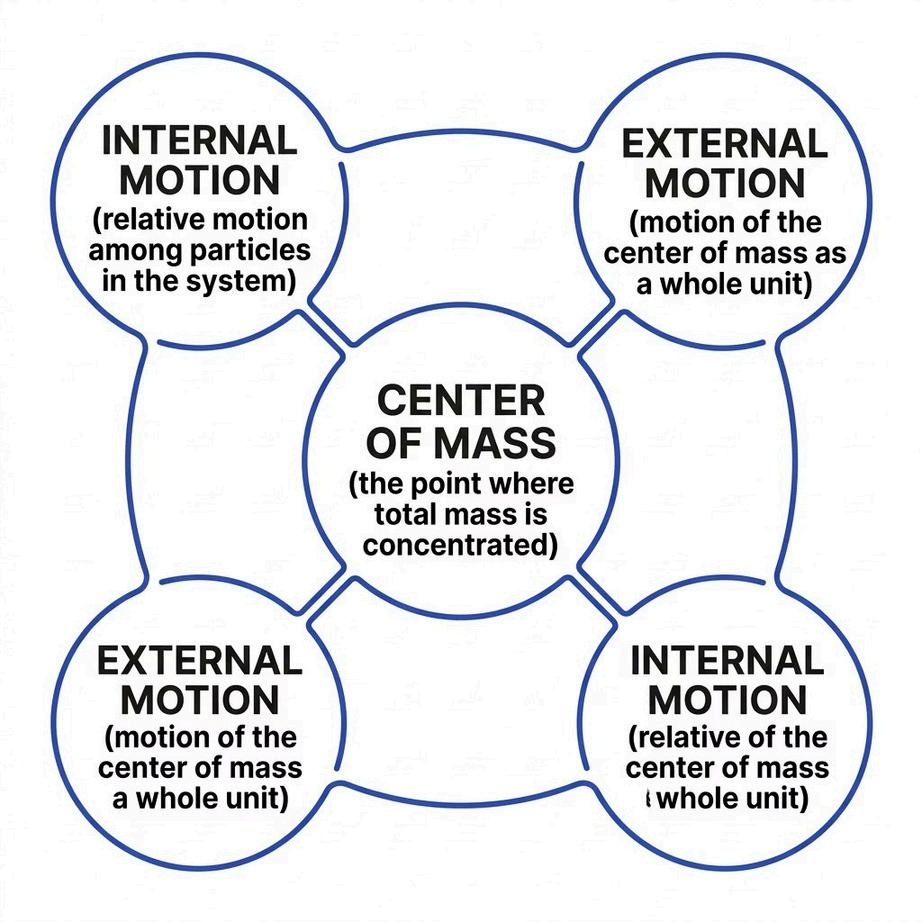
A system of particles , no matter how complex , can alwaysbe analyzed in two parts: the motion of its center of mass, and the internal motion of particles around it.



Engineering
Gears, turbines,and flywheels transfer and store rotational energy in machines.
Sports
A skater pulls in their arms to spin faster. Angular momentum is conserved.
Astronomy
Planets, stars, and galaxies all spin, and rotational dynamics govern the cosmos.