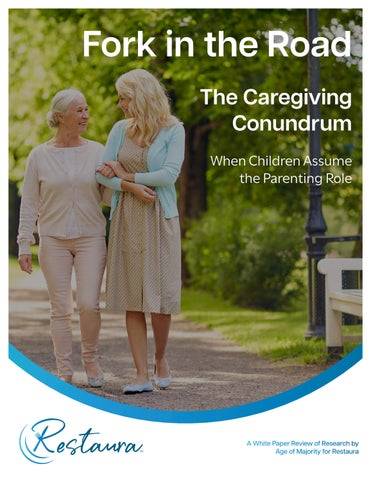
Fork in the Road The Caregiving Conundrum When Children Assume the Parenting Role
A White Paper Review of Research by Age of Majority for Restaura
We learn what matters most at the crossroads.
INTRODUCTION:
THE PARENTIFICATION OF A GENERATION
The Caregiving Conundrum As the Baby Boomer generation ages, more adult children find themselves in unfamiliar territory: caring for the very parents who once took care of them. This phenomenon, sometimes described as parentification, flips family roles upside down. Daughters and sons step into the role of caregiver.
These shifts raise deeply personal questions:
CIRCLE-QUESTION
Can children adjust to the role of a parent caregiver?
CIRCLE-QUESTION
Should parents who are no longer able to care for themselves remain at home, move in with a family member, or transition into senior living?
CIRCLE-QUESTION
And what role does something as fundamental as food play in shaping these decisions?
The scale of the challenge underscores why these questions matter. According to AARP’s Caregiving in the U.S. 2025 report, more than 38 million Americans now provide unpaid care to an adult, most often a parent, and only 11% have received formal training to prepare them. The public is beginning to take notice. In 2025, Bradley Cooper produced the PBS documentary Caregiving to shine a light on the emotional and practical realities families face when caring for loved ones. Behind the headlines are families weighing independence and quality of life, while reconciling outdated perceptions of senior living with its potential to provide safety, community, and peace of mind. This White Paper explores these topics through the lens of a national survey commissioned by Restaura and conducted by Age of Majority (AOM). More than 1,200 U.S. adults ages 45+ shared their experiences and expectations of caregiving, senior living, and the role of food in health and well-being. Their insights reveal the forks in the road that nearly every family will likely face.
Restaura commissioned Age of Majority (AOM) in April 2025 to survey more than 1,200 U.S. adults ages 45+ with household incomes of $50K+ in three distinct categories: 551 were actively providing care to a parent or in-law not currently in a senior living community, 583 were not yet caregivers but had living older parents, and 141 respondents identified as providing care to a parent who resides in assisted or senior living. Care recipients were by far most likely to be the mother or mother-in-law of the survey respondent (8 in 10). Fork in the Road: A study by Age of Majority for Restaura © 2025
3
SECTION 01:
WHEN ROLES REVERSE
This first fork in the road concerns identity rather than care logistics. As parents age, some begin to rely on their children for household tasks, navigating healthcare needs, transportation, and other duties that mirror the type of care that children likely received from their parents during their childhood.
The Age of Majority research found that the most common impetus for children to assume the caregiver role was gradually escalating healthcare needs, safety concerns, and the ability to drive versus a sudden event like an injury or medical emergency.
When children in caregiving roles were asked about the most common forms of care they provide their parents, it was notable that “emotional support” was at the top of the list, selected by 87% of survey respondents. This form of care was followed by “companionship,” “transportation,” “tech/online support,” and “healthcare provider communication.” A parent’s need for emotional support shines a spotlight on the role reversal in play. Most children likely never imagined that they would become the ones providing comfort to the parents who once did the same for them.
While the role reversal may feel unnatural at first, when children were asked to describe how caring for a parent made them feel, the most commonly selected choice was:
46% Obligation
"I feel it’s my responsibility as payback for the care I received."
39% Honor
"It’s an honor to provide this care."
Fork in the Road: A study by Age of Majority for Restaura © 2025
10% Fear
"I'm concerned about making the best choices."
5% Resentment "It's frustrating to assume these responsibilities."
4
The Circle of Life Stubborn Returns A vast majority of children who have not yet assumed caregiving responsibilities believe they will need to provide care in the future (83%). However, just as parents sometimes avoided difficult conversations with their children (such as how babies are made), the Fork in the Road study found that 7 in 10 non-caregiver children have had limited or no discussions with their parents about care needs or the possibility of a move to a senior living community. When care needs arise, those deferred discussions quickly become urgent and lead families to the next fork in the road: determining where their parents should live.
40%
I’ve had only general discussions
I’ve had no discussions 22% and have no plans to do so I’ve had fully detailed 17% discussions including about different options
9% 12% 17%
Have you had the "talk"?
12% I’ve had no discussions but plan to do so
40%
I’ve had detailed 9% discussions and have researched/explored community options with them
22%
Fork in the Road: A study by Age of Majority for Restaura © 2025
When provided a list of words to describe their parents, the word most frequently chosen by children who are currently caregivers was "stubborn." The irony is hard to miss since most children were likely once stubborn toddlers or teenagers, resisting parental guidance to establish independence. The parent’s stubborn streak is likely a frustration with losing independence – a full circle of life in play. In fact, when the same list of words was presented to children whose parents do not require care, the most common word selected to describe their parents was "independent."
5
SECTION 02:
CROSSROADS OF CARE
Where Parents Should Live
In addition to managing the emotional nuances of role reversal, children are heavily involved in the practical choices of deciding where parents will live and the type of support they require. The Fork in the Road survey revealed a striking truth: a vast majority of adult children do not want their parents to live with them. If cost were not a factor, 7 in 10 children currently caring for their parents would prefer that they live in some kind of senior living setting. Only 12.7% said they would want their parents to move in with them. Proximity and geography play a surprising role. In a world where much is written about the unraveling of close-knit families, 7 in 10 children live within an hour of the parents they are caring for and more than half of those live within a 15-minute drive. In fact, the most prominent factor in deciding where a parent will live when they require care is “close to family” (60.7%).
This physical closeness means adult children are deeply involved in deciding where parents live and monitoring their care. So, it should come as no surprise that 8 in 10 children who are currently caregivers were intimately involved in choosing where their parents live. Those who chose senior living communities most often reported that they had participated in tours, conducted online research, and asked friends for recommendations to make an informed decision.
Fork in the Road: A study by Age of Majority for Restaura © 2025
6
When children currently providing care for parents were asked about factors that would provide the most peace of mind in opting to choose a senior living community, “safe and secure” ranked highest, followed by “healthy/nutritious food and dining.” These factors ranked higher than “affordability,” “friendly staff,” and “on-site health professionals.” Some families hesitate to take the senior living path because outdated perceptions linger, with many adult children still associating senior living with cafeteriastyle meals, institutional care, and nursing homes. This perception gap creates a contradiction: children overwhelmingly prefer senior living in theory, but in practice, they often delay or avoid it.
Top 10
words associated with senior living: 1.
Social
2.
Safe
3.
Comfortable
4.
Nursing Home
5.
Independent
6.
Active
7.
Accessible
8.
Cafeteria Food
9.
Old
10. Quiet N=1,275
Fork in the Road: A study by Age of Majority for Restaura © 2025
7
SECTION 03:
HOW MUCH DOES FOOD MATTER?
It’s clear that Gen X and Millennials, who now make up the majority of family caregivers, understand that food is much more than fuel for the body. Restaura’s Fork in the Road research found that when adult children were asked about the impact of food and nutrition on the health of their parents, “it can help them live longer” was the top response, followed closely by “it can support cognitive/brain health.”
Fork in the Road study say they want for their parents. They expect dining experiences that actively contribute to longevity, brain health, and day-to-day vitality.
This reflects a profound generational shift. Unlike their parents or grandparents, who grew up during the rise of frozen dinners and packaged convenience foods, today’s caregivers have been shaped by decades of evidence linking ultra-processed products to chronic disease, obesity, and reduced quality of life. For them, scratch-made, fresh, and flavorful meals are not only nourishment but a foundation for health. This perspective echoes the thinking of Dr. Peter Attia, author of Outlive: The Science and Art of Longevity, who argues for maximizing healthspan (i.e., the years lived in good health), not just extending lifespan. Attia emphasizes food as one of the most critical levers to delay the onset of chronic diseases. His recommendations include reducing ultra-processed foods, managing blood sugar, and prioritizing whole, nutrientdense meals, which align directly with what caregivers in the
Fork in the Road: A study by Age of Majority for Restaura © 2025
8
In fact, children who are not currently caring for their parents ranked “food and nutrition” as the #1 factor that affects the health and well-being of their older family member – more important than “living with minimal health issues,” “social connections,” and “having a purpose.” When asked about barriers to considering senior living, nearly a third said poor food quality and dining experiences would be a reason to disqualify a senior living community. When the Fork in the Road research asked children of parents who are currently living in a senior living community about the factors they considered in choosing a community, “quality and variety of the food” was cited by over one-third of the respondents. Interestingly, however, only 1 in 5 actually tried the dining/food before choosing a community for their parents. Perhaps most alarming was the fact that children with parents in senior living rank satisfaction with the “dining experience” and “food selection” lowest at their parent’s senior living or assisted living community. Satisfaction levels were higher for “safety,” “accommodations,” “support staff,” “social connections,” and “activities.” These findings suggest a significant gap between expectations and reality.
Fork in the Road: A study by Age of Majority for Restaura © 2025
Hydration: The Overlooked Concern
While much of the focus falls on nutrition and meal quality, the Fork in the Road research revealed a surprising truth: caregivers’ single greatest concern about their parents’ nutrition is “hydration.” More than 40% cited it as their top worry — ahead of “calories,” “nutrients,” or “weight management.” For noncaregivers, hydration also topped the list. This finding highlights how easily health can unravel not just through major medical events, but through everyday lapses as simple as not drinking enough water.
9
SECTION 04:
THE PATH FORWARD
For Senior Living Leaders The Fork in the Road research clearly illustrates the impact and implications of role reversal as children assume caregiving roles for their aging parents.
Adult children are central decision makers
Caregiving today is defined by adult children stepping into roles their parents once held. These sons and daughters aren’t just part of the process – they are the ones initiating conversations, shaping expectations, and ultimately making decisions about care and living arrangements. Ignoring caregivers means missing the real gatekeepers of resident acquisition.
Caregivers prefer senior living but hesitate
A majority of caregivers say they would rather see their parents live in a senior living community versus having them move in with them. But high expectations and current satisfaction levels, particularly relating to food and nutrition, are likely holding them back. Satisfaction with food in senior living is alarmingly low. Caregivers cited “dining quality” as one of their top barriers to choosing a community.
Fork in the Road: A study by Age of Majority for Restaura © 2025
Food is the hinge point of trust
Families are not simply comparing floor plans and amenities; they are evaluating care through the most tangible lens available: food. Communities that rely on outdated, institutional dining models will not earn their trust. Today’s Gen X and Millennial caregivers, who came of age during a cultural reckoning with processed, frozen, and convenience foods, expect scratchmade meals, fresh ingredients, and thoughtful, nutritious options. Senior living communities that close this culinary confidence gap will move more families from consideration to commitment.
10
WHAT THIS MEANS FOR OPERATORS
The Restaura Fork in the Road research makes the business case unambiguous for senior living executives: dining as a core resident acquisition and retention strategy. CHECK-CIRCLE Treat Quality food isn’t an amenity; it is a decision driver. Marketing campaigns and on-site events must go broad and deep to communicate a commitment to food and nutrition connected to the science of longevity and impact on quality of life.
an infrastructure to support expectations. CHECK-CIRCLE Build Invest in your culinary team and the technology available to deliver personalized nutrition and dining experiences that
are visibly fresh and scratch-made to meet the expectations of both residents and their children. Create a culture that encourages all community team members to embrace food’s role in resident satisfaction and commit to systems that measure real-time resident sentiment. And don’t forget the importance of hydration!
adult children directly in marketing and family communications. CHECK-CIRCLE Engage Position dining as a healthspan driver in marketing, digital caregiver portals, and family communications. Develop caregiver-focused campaigns such as emails, social posts, and webinars that focus on nutrition and culinary experiences available at your community. Build resident and family dashboards for current residents that provide menu transparency and two-way communication.
food as a differentiator in tours and storytelling. CHECK-CIRCLE Use Offer tasting experiences, showcase fresh preparation, and highlight how menus support longevity and vitality. Always integrate dining experiences into tours, create culinary experiences and signature meal tastings as part of ongoing community outreach, and share residents’ stories about how dining has enhanced their quality of life. A memorable meal often carries more weight than brochures or presentations.
Communities that elevate dining from a basic service to a signature differentiator will not only drive acquisition but also earn long-term loyalty, referrals, and brand distinction. Those who continue to treat food as secondary will be left behind. By investing in culinary excellence, measuring its impact, and marketing directly to caregivers, operators can position themselves as true partners in extending life quality and longevity. In this new era of decision-making, where children hold the keys to their parents’ future, the communities that put food and nutrition at the center of their promise will be the ones families trust with their most important responsibilities – the wellbeing and healthspan of those who once cared for them.
Fork in the Road: A study by Age of Majority for Restaura © 2025
11
Welcome to the Future of Senior Living Dining Restaura was built for this moment. Restaura combines culinary excellence with intelligent technology to help communities meet this new standard. Our integrated systems enable personalized nutrition, real-time feedback, and greater visibility for families – ensuring every meal builds both wellness and trust. At the core of Restaura’s approach is a culture of ownership and innovation. Every team member takes pride in crafting experiences that not only nourish residents but also empower communities to thrive. This shared commitment transforms dining into a true differentiator – one that enhances resident satisfaction, strengthens family confidence, and drives long-term loyalty.
Let’s Connect Unapologetically DeliciousSM Fork in the Road: A study by Age of Majority for Restaura © 2025
info@restaura.com | 833-573-7828 | restaura.com 12