the
reporter
Paola High School • 401 N. Angela • Paola, KS 66071
October 2011
New teachers
3 (news)
Unusual art
8-9 (features)
Fall plays take off
11(arts)
Beware the Panther
15 (sports)
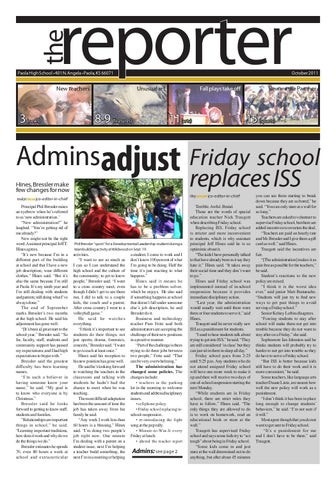
Adminsadjust Friday school replaces ISS
Hines, Bressler make few changes for now
riley sawyer co-editor-in-chief
rosalyn lucas co-editor-in-chief Principal Phil Bressler raises an eyebrow when he’s referred to as ‘new administration.’ “New administration?” he laughed. “You’re getting rid of me already?” New might not be the right word. Assistant principal Jeff T. Hines agrees. “It’s new because I’m in a different part of the building at school and that I have a new job description; wear different clothes,” Hines said. “But it’s also the same because I’m still at Paola. It’s my ninth year and I’m still dealing with students and parents; still doing what I’ve always done.” The end of September marks Bressler’s two months at the high school. He said his adjustment has gone well. “[It’s been a] great start to the school year,” Bressler said. “So far, faculty, staff, students and community support has passed my expectations; and I had high expectations to begin with.” Bressler said the greatest difficulty has been learning names. “I’m such a believer in having someone know your name,” he said. “My goal is to know who everyone is by Christmas.” Bressler said he looks forward to getting to know staff, students and families. “Relationships are important things in school,” he said. “Learning important traditions, how does it work and why do we do the things we do.” Bressler estimates he spends 70, even 80 hours a week at school and extracurricular
Photo by Jacinda Dent
Phil Bressler “spots” for a Developmental Leadership student during a teambuilding activity at Wildwood on Sept. 19.
activities. “I want to see as much as I can so I can understand the high school and the culture of the community; to get to know people,” Bressler said. “I went to a cross country meet, even though I didn’t get to see them run, I did to talk to a couple kids, the coach and a parent. After cross country I went to a volleyball game.” He said he watches everything. “I think it’s important to see students do their things, not just sports; drama, forensics, concerts,” Bressler said. “I want to go to each at least once.” Hines said his reception to his new position has gone well. He said he’s looking forward to watching the teachers in the classroom and talking with students he hadn’t had the chance to meet when he was teaching. The most difficult adaptation has been the amount of time the job has taken away from his family he said. “Any week I work less than 60 hours is a blessing,” Hines said. “I’m doing two people’s job right now. One minute I’m dealing with a parent on a student issue, next I’m helping a teacher build something, the next I’m in a meeting or helping
a student. I come to work and I don’t know 100 percent of what I’m going to be doing. Half the time it’s just reacting to what happens.” Hines said it means he has to be a problem solver, which he enjoys. He also said if something happens at school that doesn’t fall under someone else’s job description, he and Bressler do it. Business and technology teacher Pam Fette said both administrators are accepting the challenge of their new positions in a positive manner. “Part of the challenge is them trying to do three jobs between two people,” Fette said. “That can be very overwhelming.” The administration has changed some policies. The changes include: • teachers in the parking lot in the morning to welcome students and address disciplinary issues. • cell phone policy. • Friday school replacing inschool-suspension . • re-introducing the fight song at the pep rally. • Minute-to-Win-It every Friday at lunch. • altered the teacher report
Admins: see page 2
Terrible. Awful. Brutal. Those are the words of special education teacher Nick Traugott when describing Friday school. Replacing ISS, Friday school is stricter and more inconvenient to students, which is why assistant principal Jeff Hines said he is so optimistic about it. “The kids I have personally talked to that have already been in it say they hate it,” Hines said. “It takes away their social time and they don’t want to go.” Hines said Friday school was implemented instead of in-school suspension because it provides immediate disciplinary action. “Last year, the administration would usually wait until there were three or four students to serve it,” said Hines. Traugott said he never really saw ISS as a punishment for students. “I used to hear students talk about trying to get into ISS,” he said. “They are still considered ‘in class’ but they can just sit in there in sleep all day.” Friday school goes from 2:25 until 5:25 p.m. Any students who do not attend assigned Friday school will have one more week to make it up and then will receive two days of out-of-school suspension starting the next Monday. “While students are in Friday school, there are strict rules they have to follow,” Hines said. “The only things they are allowed to do is to work on homework, read an educational book or stare at the wall.” Traugott has supervised Friday school and says some kids try to “act tough” about being in Friday school. “Some kids come in and just stare at the wall determined not to do anything, but after about 45 minutes
you can see them starting to break down because they are so bored,” he said. “You can only stare at a wall for so long.” Teachers are asked to volunteer to supervise Friday school, but there are added incentives to sweeten the deal. “Teachers are paid an hourly rate and Mr. Bressler and I give them a gift card as well,” said Hines. Traugott said the incentives are fair. “[The administration] makes it as pain free as possible for the teachers,” he said. Student’s reactions to the new policy are mixed. “I think it is the worst idea ever,” said junior Matt Bastarache. “Students will just try to find new ways to get past things to avoid serving a Friday school.” Senior Kelsey Loftiss disagrees. “Forcing students to stay after school will make them not get into trouble because they do not want to stay after on a Friday,” she said. Sophomore Ian Johnston said he thinks students will probably try to harder to not get into trouble so they do have to serve a Friday school. “But ISS is better because kids still have to do their work and it is more convenient,” he said. Some teachers, like language arts teacher Duane Lintz, are unsure how well the new policy will work as a punishment. “I don’t think it has been in place long enough to change students’ behaviors,” he said. “I’m not sure if it will.” Most agree though that you do not want to get sent to Friday school. “It’s a punishment for me and I don’t have to be there,” said Traugott.
2 (quick news)
42
116.7
million estimated number of trick-ortreaters in 2010
occupied households in the USA to trick-or-treat at
1.1
billions pounds of pumpkins produced in 2010
Compiled by Rosalyn Lucas
quick picks
pounds of candy consumed by each American during the Halloween season
by the numbers
24.7
The Reporter • October 2011
Information from Halloween Stats website.
10.17,20, 21 No school In-service
10.14 Homecoming Paola vs. Osawatomie Kick-off at 7pm
10.25 Fall Choir Concert Starts at 7:30pm Photo by Lexi Loya
Sophomore cheerleader, Nina Lopez, painted whiskers and a nose on a kindergartener’s face at the home game, Sept. 23. All the cheerleaders were painting the Bleacher Creatures faces to prepare them to perform.
Lunch cards save time Students have been getting used to the new district-wide lunch card system. Instead of lunch personnel swiping the cards through the reader, the new system puts more responsibility on the students to remember their lunch card or student ID number every day. The system allows parents to pay for lunches online via the school website for a fee. “The new system was brought in to be incorporated with Infinite Campus and make the file compatibility easier,” said cashier Rita Wobker. An advantage is by the students remembering their cards or student ID, it makes the lunch line more efficient said Wobker.
SITS in flux
Students sauntering through the senior hall after spring break noticed a gold coat of paint on the pillars. This was junior Patrick Kennedy’s inspiration for a program to get students more involved in similar projects. SITS (Students Improving the School) was formed before summer as a way for all clubs to help out. Erica Bayles, senior, said SITS has planned to fix doors in the bathrooms. Emma Dixon, senior, did not think the program was a success at first. “It was an idea that wasn’t acted upon,” she said. “We had one meeting with all the clubs and they were all going to, but no one
“Since every student only gets one lunch card, it saves me a lot of time from having to make new lunch cards,” said Wobker. Junior Dustyn Mize also said the new lunch card system is a step forward. “It makes the line a lot faster so it takes less time to get your food,” Mize said. Every transaction has to be assigned to a student. If a student pays with cash, his name has to be found in the database which can slow down the line, Wobker said. “So far the students have been very patient and we ask them to keep being patient, even if the system is not working right,” said Wobker. - carl schmidt
took the initiative to do anything about it.” Justin Elliott, sponsor, stressed the need for student participation. “We need to find ways for people who are not involved to be involved,” he said. Dixon said she hopes SITS succeeds. “If Patrick decides to commit, I think it will turn out really well,” she said. Kennedy said he has a lot to do before his idea gets fully formed, like talking with the principal. “Once I have it approved, it will be a school club,” he said. - lane harris
Administration: contd. from page 1 time to 7:30 rather than 7:45, to make it easier for students to find their teachers in the mornings and seek help. “A few things have changed, but they have been well received,” Hines said. Overall, Bressler said, nothing has really changed. “We haven’t had time to talk it over,” Bressler said. “I’m a believer that you shouldn’t change things for the sake of change. You should also involve everybody who would be impacted by that change. If we’re making changes that affect the students, I want students to be involved in that change.” Junior Tony Telegin said he thinks both Hines and Bressler are “pretty awesome”. However, he said he doesn’t care for the changes in cell phone policy. Telegin said it’s the student’s fault for having their cell phone out, but the punishment can be a bit harsh. According to the school handbook, students with a second offense will have their phone taken away and a parent or a guardian will have to retrieve it. On a third offense, the student is assigned Friday school and the parent or guardian can decide whether to pick the phone up from the office themselves or opt for the student to take it after Friday school is over. “Hopefully Mr. Bressler loosens the policies a bit after he realizes these are
responsible students for the most part,” Telegin said. Senior Jessica Drews agrees. “I don’t want things to change drastically to were my senior year was terrible because of the changes,” she said. What she’s most worried about is that the administration will get really strict. “I want to keep a bright personality inside of the school,” Drews said. “Keep it open and fun and be able to joke with the administration.” Bressler and Hines said there will be more changes in the future. It’s hard to say what changes there will be, Bressler said. “We’re looking virtually at every part of the policy and procedures and cultural issues,” he said. “Look at what there is, if we like it and if we could make it better.” “The changes we’ve made are not necessarily because they were wrong before, but we’ve just got to keep moving forward,” said Hines. “That’s important. The pep rally was the perfect example, because it shows how we’re using traditions from the past and reintroducing them, the new and the old.” “When you come in, you can’t make a lot of changes,” Fette said. “Bressler and Hines have been good about that. They see a need, then it’s discussed.”
(news)
The Reporter • October 2011
A quick peek at 5
3
Whitney Lanier, mathematics
Graduated: Newton High School, Newton. College: Emporia State. Favorite high school memory: “Studying for finals with my friends and we would have a big party instead.” Reason for teaching at PHS: “I likes the class size... a lot smaller then what I student taught at and in the interview they talked about how involved the community was [with the high school].” Pet peeve: “Drumming on the desk. They do it when I’m the only one talking so it is very quiet and very noticeable.” Why she teaches: “When students finally catch on to a concept, it is very rewarding because it is an ‘aw’ moment.” If she could only teach his students one thing: “I would teach them responsibly. When you are responsible then you can achieve almost anything.
Greg Morgan, science
Photo by Lane Harris
Sara Allison, French teacher, helps Nevin McCracken, junior, on homework during seminar. Allison, a PHS graduate, has switched roles and is teaching French.
7 new arrivals Teachers acclimate to high school lane harris reporter As Sara Allison drove to school on her first day as a bona-fide French teacher she could not help thinking, “Don’t mess up.” “Don’t mess up.” “Don’t. Mess. Up.” Both Sara Allison, and Kevin Bronson, trade and industry, say they are comfortable and adjusting well to the students and faculty. Allison says she feels comfortable, in part, because her family has gone to the high school for years. “There’s not really a point in time that’s not welcoming,” she said. Bronson is new to Paola and hopes to buy a home soon. “My family is still in Salina,” he said. Although Allison knows her way around the school, Bronson said he may need help finding teachers and “getting a feel for the building layout.” Bronson also said that he had trouble adjusting to block scheduling. “The logistics are a little hard to deal with,” he said. Allison said she likes the
‘small-school’ atmosphere. “You get to know the students really well. You also get to know the community,” she said. Allison also likes the kindness of the students. “Kids I don’t even know say ‘hi, how are you?’ It’s a very welcoming school,” she said. Stephen King, junior, had advice for students to let the new teachers know that they are welcome. “New teachers don’t know anyone, so just go along with it,” he said. “They’ll get nicer and less strict, hopefully,” he said. Bronson said the students are “friendly.” He said he likes when students have an open mind and “working with a group of students who are willing to learn.” King said to make the teachers feel comfortable, he would follow the rules and not use inappropriate language. Bronson said he enjoys the traditions at Paola. “There are a lot of good ag programs, sports programs and extra-curricular activities,” he said. Allison looks forward to cheering on her school in athletics. “I’m excited to support the Panthers whether it be soccer, baseball, volleyball,
just any of them.” To relax, Allison goes uptown. “I like to go up to the coffee shop on the Square and just hang out and relax after class,” she said. Bronson, however, gets most comfortable with those he is close with. “After 3 o’clock, it’s mainly family and friends,” he said. He expects his students to respect the values he obtained from serving our country in the armed services. “Leadership skills...teamwork, honor, value,” he said. “Those are the things that come together whether you’re in a school setting or sports.” Bronson wants his students to “simply take each day as a new day. All I ask of my students is respect and a positive attitude,” he said. Allison said that if you ever need help, ask. “I think it’s better to ask a question than to not know something,” she said. As Allison finished up her first day she felt more comfortable. “I felt accomplished; a sense of ‘I can do this,” she said.
Graduated: Diamond High School, Diamond, Mo. College: Masters at Kansas State University. Favorite high school memory: “Getting third in state my senior year in basketball.” Teaching style: “Progressive. I try to be hands-on and interactive.” Why he teaches: “Seeing that light bulb come on. In any situation it takes the right moment to get them to engage. For many kids the education they get is the only thing they can apply in their daily life.” If he could only teach his students one thing: “To not give up. To not give up on what they want to do: their dreams”
Brett Brownback, agriculture
Graduated: Jayhawk-Linn, Mound City. College: Kansas State University. Favorite high school memory: Winning livestock judging at Fort Scott Aggie Days or senior year football. Reason for teaching at PHS: [It is] close to home and the reputation of the agriculture department preceded itself.” Pet peeve: “Poor work ethic. I have no sympathy for a slacker.” Why he teaches: “I love to work with students. I love being an advocate of agriculture and feel like this is the best way to be one.” If he could only teach his students one thing: “To have faith in their own ability’s to succeed.”
John Menefee, agriculture
Graduated: Paola High School. College: Kansas State University. Favorite high school memory: “Mr. Smith's current events class or getting a speeding ticket on my way to prom my junior year.” Biggest challenge: “School didn't come easy to me. I had to work at it.” Teaching style: Laid back. “I love to make class fun. I put a lot of emphasis on winning at FFA contest.” Pet peeve: “Liars and stealers.” Why he teaches: “To make my students better. I want to see my students be successful.” If he could only teach his students one thing: “There is no substitute for hard work.”
Ryan Oshel, science
Graduated: Wellsville High School, Wellsville. College: Pittsburg State University. Favorite high school memory: “Playing football my senior year.” Reason for teaching at PHS: “I did my student teaching here in 2008-09. I coached football and basketball. I decided to come back because I enjoyed my time here so much.” Teaching style: “I'm fairly strict but I'm pretty fair. I like to joke around with kids after I get to know them.” Why he teaches: “I enjoyed my school experience so much. I like being in a classroom. I like the students. I like the high school experience.” If he could only teach his students one thing: “How to solve problems in the real world.” chrystal thompson reporter
4 (news)
The Reporter • October 2011
Students, teachers feel the pinch
classroom cuts In the past few years one teacher has been cut from:
• Business and technology • Culinary arts • English • Fine arts • Science • Social science Other recent cuts to student support:
Photo by Rosalyn Lucas
Seniors work until the end of their first class, College Prep English on Sept. 30. One fewer College Prep English course has been offered the past few years because a Greg Cartwright’s position was not filled when he retired, increasing class sizes in all English classes.
Larger classes taken in stride by some, more cuts doubtful, Hines says shelby mcdaniel reporter Since six teachers have been cut in the past few years at the high school, classes are bigger, which could mean problems for staff and students. Jeff Hines, vice principal, said he encourages everyone, from students to the school board, to rally together.
He said more budget cuts were not on the agenda for this school year because the state legislature had cut more money from the budget than needed the previous year and now they have a surplus. “The only way we will face cutbacks is if the economy deteriorates further or if the federal government cuts more money from the budget,” Hines said “We’ve made cuts…but the worst has passed us by.” Susan Blankenship, art teacher, has been at the high school for 32 years. She said there have been drastic changes because of budget cuts, but she said she feels her job is secure. “I’m only a little worried about more cut-
• Administrator • Counselor • Media-center specialist • Student-resource officer
backs,” she said. “I’m more worried about the governor cutting back on arts education more.” When students are in closer quarters, they tend to cause more behavioral problems and it is harder to keep track of paperwork that must be graded, Hines said. Some students say they aren’t affected negatively by larger classes. Jake Funk, junior, said larger classes helped him learn, because bigger classes mean more friends to help with homework. “Take lots and lots of notes, though,” he said. After a cut in the science department a
couple of years ago, science teachers have more students in each class, which makes it harder to do one on one help, said Rachel Dougherty, chemistry teacher. “It could possibly mean that some classes will have to be cut in the future as well,” Dougherty said. “If the enrollment in lower level classes goes up, then upper level classes would have to be cut.” For Kayla Salyers, sophomore, her study strategies include sitting towards the front and not falling asleep. “I like it because bigger classes mean more people. I like to associate with people,” she said.
(features)
The Reporter • October 2011
5
A day in the life: Custodian
Staff comes early, stays late to clean school libby rayne reporter Working 17 hours a day and cleaning up after more than 600 teens may not be considered an ideal job. The custodians have a different outlook. Michelle Minden, day-shift janitor, said she has no regrets after taking the lead position of the janitorial staff. Minden took the lead position after Craig Henness died in March. Minden comes in early for her 6:30 a.m. to 3:30 p.m. shift. She prepares the school for the day by turning on lights, double-checking night-shift custodial responsibilities and unlocking doors for stu-
dents who arrive as early as 6:40 a.m. Minden works the school day single-handedly. She does everything from kitchen work and ordering supplies to laundry. She said she is “very particular about how the school looks.” “I want it to look nice,” she said. The job comes without much trouble to her because she said she loves working with the students and the teachers. John Zander, night shift janitor, also said he enjoys his work. “I don’t mind the job, but it sure helps to have people you enjoy working with you,” Zander said. Zander, Dennis Kelly and Greg Good all arrive early for their 3 p.m. to 11 p.m. shifts. Before their shift
starts, they can generally be found in the custodial lounge laughing. They relate jokes and good time they have while on the job such as chasing each other around the parking lot and turning lights off on a coworker on the other side of the building. The janitors clean the entire school from before the moment students arrive, to eight hours after they leave. They also come into work on the weekends to help set up or clean up after events at the school such as plays or tournaments. The custodial staff help the school run smoothly, said Justin Elliott, counselor. “They are always very willing to do whatever they can do to help,” he said.
Custodial Cruxes o Hole punch circles o Any biohazard o People showing up late for work o Kids eating and drinking on carpet o Trash on floors o Vomit o Graffiti o Gum under tables and desks o Excrement o Writing on desks o Large paper on floor
don’t mind the job, but it sure helps to have “Ipeople you enjoy working with you. ” - John Zander, night shift janitor
Photo by Marissa Bergman Photo by Marissa Bergman
John Zander, night shift janitor, vacuums a room at work. He said he enjoys his work more when he’s working with people he enjoys.
Greg Good, night shift janitor, changes a trash bag out when he is working. He works with John Zander and Dennis Kelly, also night shift janitors.
6 (opinion)
The Reporter • October 2011
staff editorial Pinching pennies We love you, but... With so much time devoted to looking at ourselves, it’s no wonder we start comparing with others. And with the insatiable greed of marketing, it’s no wonder we start to find faults in ourselves we didn’t know existed. Too fat, too hairy, too knobby, too wrinkly. Too much everything. The National Eating Disorder Association also gives another statistic: 1996 fashion models were thinner than 98 percent of American women. According to the Rader Program website, an organization for helping individuals struggling with eating disorders, supermodels Niki Taylor and Elle MacPherson meet the Body Max Index criteria for anorexia. Unhealthy. Unrealistic. All in the name of conforming to what society deems “attractive.” “It’s like fast food,” counselor Deborah Baldwin said. “They promise more for a cheaper price, but it’s not healthy.” Baldwin said there are three sides to the health triangle: physical, personal or social and mental or emotional. During health classes she would give students various scenarios describing two different people. One, a slightly overweight person, who had good social relationships, didn’t worry about managing his or her weight. The second, a person who was physically attractive and fit and constantly went to the gym, but isolated his or herself from others. Then the students would have to decide who was the healthiest. They often got it wrong, Baldwin said, because they were surprised that the first person was actually healthier than the second. “It’s very clear that one person may have one side of the triangle, but if they don’t have the other two, they’re not very healthy,” she said. “We’d also have the students do self-assessments on things they were unhappy with their bodies. Then we asked if there were things they could change, leaving plastic surgery out. If they couldn’t change it, we talked about ways of accepting it.” “Acceptance can be achieved through positive reinforcement,” Baldwin said. Having good personal relationships, a support group either in peers, family or even an outside source, is important as well, she said. But acceptance is easier said than done. “We are our own worst critics,” Baldwin said.
Media sends unrealistic messages about body image The next time you’re asked to say one word to describe American marketing, try this one: Snuggie. Yes. Snuggie. But before you scoff and turn the page or burn me an effigy, let me recite a rule of sales; See a need and fill it. Or for those really profitable sectors; Make a need and fill it. Or better yet, we make products for problems you didn’t even know existed. Snuggie, right? Who knew doing mundane tasks while using a blanket was so incredibly difficult? In one episode of “The Colbert Report,” Stephen Colbert makes fun of the hypocrisy behind Unilever, the parent company of Dove. Between its commercials promoting Dove Real Beauty (which encourages women to accept their “inner beauty”), they began to sell deodorant that promised to “make your armpits more attractive.” Colbert humorously points out that women’s armpits were not considered unattractive to begin with until Dove invented the insecurity. Ironically enough Unilever also makes the Slim-Fast products. So much for encouraging the acceptance of inner beauty. Insecurities are a part of life. Much more so in the world we live in. While ancient societies worried about basic needs of survival, today we have the opportunity to focus less on where our next meal is coming from and on more prudent things, like armpit improving deodorant. The media constantly bombards us with messages of improving ourselves or achieving the perfect body. Everything from hair roots to toenails is fair game for criticism. According to the National Eating Disorders Association website, a study in 1992 revealed that 1 out of 3.8 TV commercials sends some sort of “attractiveness message” that tells viewers “what is or is not attractive.” It’s estimated the average teenager sees more than 5,260 “attractiveness messages” per year. The study is old, but think how much that number has increased in 19 years.
Einstein’s definition of insanity is doing something over and over again and expecting different results. I believe insanity is doing something over and over again expecting to change something that is beyond your control. You will never fit in. It doesn’t matter if you’re the most popular kid at school or the least. It doesn’t matter if your thin as a rail, blonde haired, perfect skin, whatever. No matter what we do, the market will keep cutting you down until it bleeds out the last penny. They won’t stop telling us to improve. But what you can do is draw a line. Work on actively recognizing advertisements and promotions for what they are. Be aware of the limits of your body. Stop comparing yourself and end unrealistic expectations. Trying to achieve perfection (which is never achieved by the way) is both mentally, physically and emotionally exhausting. Once the illusion is dropped, so is the misery. If you see a friend or a classmate who is struggling, reach out to them. “Let other people know they’re not alone,” Baldwin said. “Tell them you may not understand what their feeling now, but you’ve been through a similar situation. Validate their feelings.” We all know the feeling of insecurity, of feeling down on ourselves. But at least by experiencing this we can draw on empathy. “We’re not going to change the world,” Baldwin said. “But one good deed could help someone feel good about themselves. Everybody wants acceptance, to feel that someone cares.” But if in the end that isn’t enough for you, consider this; in the book, Organizational Communication for Survival by Virginia Richmond and James C. McCrosky, they write that beauty may be valued in a first impression, but only for so long. Once that impression is over, if beauty is the only good quality that person possesses, their physical attractiveness will decrease in the eyes of the person who is socializing with them. The opposite is also true. An unattractive person becomes beautiful over time, the more you get to know them. So on the risk of sounding cliché, it’s what’s inside of you that matters. So when your inner doubt screams that society says otherwise, that it’s the outside that really counts, do yourself a favor: remember the Snuggie. And be assured.
Increasing prices puts needs over extras katey colwell reporter Prices are shooting up everywhere, gas is up to almost $3.50 a gallon, and minimum wage has also gone up. It affects us everywhere, even in our own school. The price of cookies has gone up from 50 cents last year, to 65 cents this year. The following are some of the most popular food items from the snack bar sold and their prices: Pizza Sticks- $1.00 Bosco Sticks- $1.00 Cookies-65 cents Marble Bars- 65 cents Cinnamon Rolls- 95 cents It’s disappointing that these prices are climbing, especially on our favorite snack foods. Prices are going up everywhere, and everything costs money. Prices on all foods here at Paola High School have gone up ten percent. The district also has had to pay for new things inside the kitchen, such as; laborers, and for the food. Eventually, it all adds up. Some students are upset about these prices going up. “I think it’s ridiculous, and I know they aren’t making any more money because there are a lot of people that don’t buy stuff there anymore,” said Michelle Wilkes, sophomore. I understand that inflation plays a huge factor in all of this, but why do the prices go up? What’s the point? Someday when we’re grown up does this mean it’s going to be $3 dollars a cookie? Since prices on everything are going up, it’s going to be harder on teens. While some of us have jobs, and have extra money in their pockets, the reality of it is that not everyone does have a job at this age. Not everyone has spare money. So, of course, things will only get harder for those without jobs as the prices increase. Everything costs money, and prices are always fluctuating, so we’ll just have to become accustomed to this, and learn to spend money wisely on things we really need, not just the chocolate chip cookies.
Cartoon by Jenna Ratzlaff
7 Positive minds, All work, no (opinion)
The Reporter • October 2011
good results
Keeping an open mind improves outlook Having new administration has caused concern kali blanc reporter for many students this year. We need to realize these changes are inevitable and are going to have to be dealt with your whole life. So to those students that are stressed out – get over it. A PHS student said that they did not have a problem with the new, they just missed the old. Students may have loved our former adminatrators, but wecan not let the memory of them hold us back. With all new administration, students have different doors that are opening to the future. Harboring the emotions of the past can only lead to catastrophe. The new principal, Phil Bressler, is constantly exceeding my expectations for him. He is open to my ideas as well as keeping the old. Think positively instead of negatively, and by keeping your mind open you will succeed. Say you go ice skating, if you constantly think about how you do not want to fall, all you think about is falling. But if you think about the situation in a positive light, thinking about staying on your feet, you’re more than likely going to stay on your feet according to the book 8 to Great by MK Mueller. Mueller said that visualizing the outcome until it feels good is the first step to any dream or goal. Being open-minded means that you’re receptive to new ideas and that you’re willing to consider other perspectives to see if they hold any value. When someone has
this state of mind, they are more willing to try new things (remember the open doors we talked about earlier). Even though those doors may lead you down a wrong path, at least you tried. Close-minded people are not as willing to open those doors, thus they will never find the right path. These people have closed their mind to the possibilities and their stubbornness prevents them from achieving their goals. When this happens they greatly decrease the odds of any success. One student said that our school is dumb for letting the best principal go. She said that she was mad that most everyone was just going with the flow and acting like it was ok that Henn and Perbeck are gone. When you close your mind and become stubborn, you’re essentially telling yourself, your higher self, and the natural forces of the universe that you’re not willing to go the extra mile - that you’re not willing to grow and experience new things. If you are not willing to grow, experience new things, and instead choose to be stubborn or closed minded then there can be no change and no progress in life and things will never improve - it’s that simple. No matter what, new people will come into your life in the future, respect them, and you in turn will receive that same respect. Life will be much simpler. Most of the time these people that come into our lives, did not choose it, they were forced to. So welcome them with open arms. In the end people all want the same goal, to be accepted. And that goal can only be accomplished with an open-mind.
play libby rayne reporter
Think back to your elementary school days… you had recess, snack time, nap time, minimal homework if any at all, and the energy of a kitten… those truly were the days. Then right before your eyes, all of it was ripped out from under you. You were thrown into a new school with new rules and more homework and more stress without any outlets. Every day, students fall asleep in class. A nap time that seemed impractical, even cruel, to us as six year olds now seems like it should be a requirement. High school students could use a break. Now I’m sure most adults first thought after reading this is, “Well those kids should be getting more sleep.” Don’t get me wrong, I agree completely, but that will most likely never happen for most teens. According to the National Sleep Foundation website, staying up later is what comes naturally to a teenager. So what would the harm be in some sort of midday break? If we shaved off about 7.5 minutes from each class (not including lunch) that would render a 30 minute break. If we put that break after lunch, the time would really add up. This is a solution that could definitely be worked into the schedule without much hassle. “Maybe if we could just get out of the
the
reporter the staff
Volume 87 Issue 1
Naps and recess could improve attention span, stop sleeping in class
Co-Editors-in-Chief: Rosalyn Lucas, Riley Sawyer Design Editor: Hope Waisner Reporters: Marissa Bergman, Kali Blanc, Katey Colwell, Lane Harris, Beth Johansen, Aly Johnson, Shelby McDaniel, Jenna Ratzlaff, Libby Rayne, Carl Schmidt, Chrystal Thompson, Hali Wimbush Ad Manager: Jessica Allison Political Cartoonist: Jenna Ratzlaff Adviser: BriAnne Chayer
mission statement
The mission of the Paola High School Reporter is to inform and entertain its audience in a broad, fair, and accurate manner of all subjects that affect readers. The publication seeks also to provide a forum for the opinion of students, the staff of the paper, and the faculty, thus encouraging an exchange of ideas and opinions on issues of importance to the readers.
school environment; that’d be good,” said Conner Maynard, sophomore. It would be a time of rejuvenation. A small break from the day to go outside and get some fresh air. Maybe to go home or just sit outside on the school’s grounds. This mid-day recess would be fantastic but it does seem slightly unrealistic. So I guess an alternative would be to go straight to the problem. As students, we should be getting more sleep. “Ultimately, it’s up to them,” said Lisa Collier, math teacher. Collier estimates that she has at least five students a day who fall asleep in her class. The most popular time they fall asleep is after lunch. She does agree that a break some time during the day would prove beneficial, but she said that it is not always easy to accomplish at our school. “I don’t take it personally,” said Todd DeYoung, science teacher. He has a completely different outlook on sleeping students. He believes it’s only natural for the mind to wander and for kids to be tired and bored at school. “The bigger problem than being tired is why they are tired,” DeYoung said. “They are staying up late doing things they shouldn’t be doing.” Maynard said that just having more interactive classes would help him stay awake. Kim Minden, junior, agreed. She also would like more hands on activities during her classes. Being tired during the school day is a contributing factor to lack of motivation and unsatisfactory grades. If we had this break, the issue of tired/sleeping students would be on its way to improvement.
editorial policy
It is the policy of the Paola Reporter, to provide a forum for student expression, voices in the uninhibited, robust, free and open discussion of issues. The Reporter encourages students to write letters to the editor or submit articles for the editorial page. We reserve the right to edit content. Material that contains libelous or obscene information will not be published. Material that will cause a disruption of school activities is also prohibited. Authors must provide their full name. No articles will be published with an alias.
8
The Reporter • October 2011
(features)
Artists showcase creativity through unique mediums
B
aly johnson reporter
ailey Barney, senior, has been drawing ever since she first picked up a crayon. Typically, Barney prefers doing oil paintings and portraits, but she has dabbled in art with unconventional materials a few times. Barney said that she once created a sketchbook painting out of nail polish. In a world where technology seems to have taken over and where kids’ creativity seems to be at a null, there are still a few kids defying that trend. Whether they’re making a painting out of nail polish, bracelets out of Starbursts wrappers, or chain mail out of pop tabs, these students are the epitome of creativity. Kenzie Getz, sophomore, doesn’t typically do things involving art. “I wouldn’t really consider myself an “artsy” person,” Getz said. “I usually just doodle on my homework.” However, Getz also said that she makes bracelets out of Starbursts wrappers sometimes. She found out how to do it on the internet and says it only takes about 15 minutes to make one. She said she has made up to 50 of them in the last year or so. Nicholas Hermes, freshman, uses his ingenuity to make numerous items. “I made chain mail out of soda pop tabs and I’ve made blow dart guns from pens, but that’s just scratching the surface, really,” Hermes said. Hermes’ chain mail required a lot of dedication, as it took him somewhere between four and six months to create, but he said the end result was well worth it. “It was definitely worth the time because I wouldn’t have been doing anything else as productive or as awesome with my time,” Hermes said. Susan Blankenship, art teacher, also uses unconventional materials from time to time, both for her art classes and for her own art. “I like to have my classes bring things from home, usually two-dimensional objects,” Blankenship said. “And right now I’m planning a mosaic where I’m asking people to bring in any old glass or pottery and we’ll smash it and use it to create a recycled mosaic.” Blankenship often incorporates recycled or reused objects into her art. “I like to use recycled paper to make sculptures,” Blankenship said. “And we have a lot of various items that students will bring in to see if we can find some use for them. Even if it’s not right away, we eventually find a use for everything.” Blankenship said that incorporating unconventional materials into artwork takes a lot of inventiveness. “I think that to find a really creative use for an otherwise common material just requires a lot of creativity,” Blankenship said. Luke Larson, sophomore, and Lindsey Holtz, senior, both put their creativity into their photography. “I once took a long exposure picture of myself and went over my face with a laser so that it only recorded the lines and contour of my face,” Larson said. Larson said that he prefers unconventional forms of photography to typical ones. “I definitely like photographing in unusual ways better,” Larson said. “I’m a very abstract person.” Holtz had two different things come to mind when asked what atypical types of photography she’s done. One of which includes photographing a dead squirrel. “It just looked so peaceful lying there,” Holtz said. “It was the alternative of being energetic and squirrely.” Holtz has also taken photographs in which she filled her bathtub up with red food coloring and wrapped up Aaren Connell, senior, like a mummy and Connell yelled underneath the water. “The red food coloring was supposed to represent anger, and that’s why I had her yell under the water,” Holtz said when explaining her inspiration for the photograph. Holtz also prefers unconventional photography. “Why take pictures of normal things?” Holtz said. “People get tired of seeing the same things over and over again.”
Freshman Nicholas Hermes poses with the chain mail he made out of pop tabs. He said it took four to six months to make.
Senior Lindsey Holtz likes to do unusual photography. To create the illusion of anger, Holtz had senior Aaren Connel scream underwater. Holtz said she took the pictures of the dead squirrel because of its peaceful expression.
edge
ART on the
9
The Reporter • October 2011
Photo by Aly Johnson
Sophomore Kenzie Getz displays four Starburst bracelets she made. She said she made up to 50 last year.
10 (entertainment)
The Reporter • October 2011
Excuses gone Who’s that kid? New students bad from all over Students make up excuses to get out of doing homework kali blanc reporter As juniors Christine Bessey and Joe Pomatto said they have learned Photo illustration by Kali Blanc that homework can’t always be completed, and at that point another plan must be used. While excuses can become a nuisance and A lot of us have heard them. The good annoying to teachers, both teachers agreed ones are semi-believable. The horrible one’s they enjoy classes that have personality. only a half-witted armadillo would believe “I’d rather have a class with personality,” and the funny ones deserve props for being a Schmidt said. “This whole thing is just about poor excuse for a poor excuse. working with people, not science.” “[The best excuse I have ever heard is The worst experience Schmidt had with that] you shouldn’t give homework over a excuses was when a student told him that he long weekend, because we forget to do it,” didn’t have his homework because his house Kelly Fields, English teacher, said. burned down. Christine Bessey has to finish her home“I chewed him out,” Schmidt said. “Then work at the last minute about once a week. the class said his house really did burn “I usually just put down random answers down.” if it’s graded for completion,” Bessey said. Schmidt and Fields said they would Joe Pomatto occasionally doesn’t get his rather have a student tell them “straight up” homework done for his fourth block classes that they didn’t have time, rather than make because of football practice. something up. Fields said that under certain “I try to do as much as I can, but if I don’t circumstances appreciates the creativity that get it done, I will use my resources,” Pomatto goes into making a good excuse. said with a grin. “Bland days would get monotonous as Fields estimated that about 40 percent of well,” Fields said. her students don’t get their homework done Excuses can spark humor in some teachon a daily basis. Karl Schmidt, biology teach- ers. Pomatto told BriAnne Chayer, English er, said only about 10 percent of his students teacher, that his dog ate his novel response don’t get their homework done. book. “If they didn’t finish their homework they “I showed Mrs. Chayer my book and she usually give an excuse,” Fields said. “Usu- started laughing,” Pomatto said. ally they just say they didn’t understand.”
come for different reasons hali wimbush reporter
Thirty- seven new faces have joined the Panther family since Aug. 17. These faces are those of new students that come to Paola from all over Kansas. Students come to Paola for several different reasons. Samantha Dennigan, sophomore, came to Paola for the benefit of her family. “My parents work closer to Paola,” Dennigan said. “So it’s more gas savvy.” Other students come to Paola for the benefit of their future. Josh Newberry, senior said he is attending Paola just for sports, including soccer, track, and wrestling. While some students are new to the district, others are returning. Elijah Short, sophomore, previously attended Paola and transferred to Spring hill over the summer. Short returned to Paola the second week of the 2011-2012 school year for the student atmosphere, he said “My friends stayed up until midnight and it made me feel really warm and fuzzy,” Short said. “I just felt a lot more accepted here, because the people are just more open and accepting.” Adjusting to a new school isn’t always easy for new students. Debbie Baldwin, counselor, helps new students to adjust by setting up times to meet with them. “We like to call all new students and just let them know what we’re here for,”
Baldwin said. “We look at grade reports and we’ll go into the classroom and just observe to see how the new students are getting along. We have about two students out of 40 that have noticed issues to report but most of them are already having a good experience.” she said. Adjusting to a new school can be challenging for several reasons, from not knowing anyone, moving into new houses and having to re adjust your mental time clock to a new schedule. Dennigan is used to a late start every Wednesday at Louisburg. On Wednesdays school in Louisburg starts at 8:35. Newberry is becoming familiar with the different lunch schedules. “Paola has four lunches instead of just one big one and that’s pretty cool,” Newberry said. New students and entering freshmen don’t have to enter high school completely unprepared, Justin Elliott, counselor, goes to Holy Trinity and to the middle schools eighth grade to talk to the students about moving up. “The students get onto Kansas Career Pipeline to get a look at their career and the courses that are offered at Paola,” Baldwin said. “They talk about the schedule changes, and when Student council hosts the first day, we always receive really positive feedback.” Students entering Paola High School don’t have to worry about the mass changes, because the school works to make incoming students well prepared, she said.
11
(arts)
Taking Sides The Reporter • October 2011
Spotlight
on a major issue
on Emily Fry Senior to make acting debut in musical, The Frogs
Photo by Natalie Franz
Juniors Zach Holtz and Cooper Sims-West argue while sophomore Sarah Phipps watches during the Sept. 24 performance of Taking Sides.
First fall play ends: musical in November shelby mcdaniel reporter For Emily Fredock, who goes to as many of the school plays as possible, going to Taking Sides was a chance to learn more about the Holocaust, a subject they were studying in English class. The production was set post-Holocaust and opened Sept. 22 and 24. “The play taught me that you have to be nice to people,” Fredock said. Many students were excited about the first of the fall plays this year. “I liked the differences in the character personalities,” Nick Newkirk, senior, said. He said he tries to go the most of the plays that the high school puts on. “I knew everybody in it…it was really good.” Amanda Hedges, junior, said. She also tries to go to as many plays as possible. The actors and actresses in the pro-
Q&A
duction were also enthusiastic about Taking Sides. “The Holocaust was a subject I was interested in.” Sarah Phipps, sophomore and actress, said. Phipps said it was a worldwide situation that affected everyone. “It also has many lessons that make people think about themselves and who they are as a person,” she said. Jordan Malone, junior and actor in Taking Sides, agrees with Phipps. “The Holocaust is something people should know about,” he said. Leslie Coats, theater teacher, said that the issues Taking Sides dealt with were important and it was a good stretch for the actors and actresses. The second production debuting this fall is a musical; it is The Frogs, an adaptation by Stephen Sondheim. “I’m excited to do this musical,” Alora Smotherman, junior and actress who plays in the chorus, said. She said that she had no worries about being a cast member. “Once I get up on a stage, my nerves float away,” she said.
“
I like to sing, and I’d always thought before that you had to be in choir to try out, but when I found out you didn’t, I was ‘woo.’ - Emily Fry, senior
”
Exchange student from Chile gets used to Kansas life beth johansen reporter
Q: How does your family feel about you leaving? Q: How are you adjusting to your host family? A: “It’s complicated; I miss them and my friends very A: “I like them, they are nice. New family, new friends
with
Nicole Neira
Kyam McCormack, junior, agreed with Smotherman. He said that it was an interesting piece, with different styles incorporated in it. McCormack also said he enjoyed his part in the musical, being the character Pluto. “I’ve always loved musicals,” he said, “And Pluto is a fun guy. He’s always making jokes and goofing off.” “I’m the only character that will not sing, but I have a dance,” Zach Holtz, junior and actor playing Shaw, said “I can’t wait.” He, too, is also excited about The Frogs debuting Nov. 17. “Musicals are an enjoyment,” Austin Smith, sophomore and actor playing another chorus member, said. He said that he did not get to be in one last year, but since he wants to be an actor, he needs the experience on the stage. “I’ve always wanted to be in a musical,” he said.
Emily Fry hasn’t been acting very long. “As of yesterday, I’ve acted one day,” Fry said. Fry has been involved with seven other plays by working in the tech department. “The Frogs is different than the other plays that have been performed, The Frogs is more modern,” Fry said. “Most are set back in the 70s and 80s.”
much. But it’s only for one year.”
and new life.”
Q: What is different than Chile? A: “Everything. We are able to eat lunch at home.
Q: Is this your first time in the United States? A: “Yes, but this is my second time traveling to a dif-
We have three different breaks during the day, and we don’t have lockers.”
Nicole Neira
ferent country. I’ve been to Argentina before.”
Q: Are you enjoying Paola? Q: Is it hard to learn English? A: “Yes the people here are nice. I enjoy playing socA: “Yes because everyone talks fast so it’s hard to cer at the school.” hear.”
12 (entertainment)
Falling forfeathers hall talk
The Reporter • October 2011
Which is better:
Hair accessory becomes fashion trend
Coke or Pepsi? ““Coke. Pepsi is sweet and Coke is carbonated awesomeness and it’s like yeah!” -Bradford Deyoung, sophomore
katey colwell reporter Past trends at Paola High School have consisted of silly bands, and D.C. shoes. This year, its feathers in the hair. Sunrayz Tannery stylist, Jenny Chadwick said she was one of the first in Paola to wear feathers in her hair. She had visited relatives who wore the feathers, liked them, and bought some for herself. When working at the salon, her clients began to ask for feathers as well. Chadwick says that Sunrayz Tannery has sold over five hundred feathers to more than two hundred and seventy five people. Feathers cost ten dollars and can come in a variety of colors including pink, yellow, orange, green, and blue. Madison Auten, sophomore, said “(I wanted feathers) because they were in style.” This is an accurate statement for most people who get feathers. Not everyone gets feathers for the same reasons though. “I wanted feathers because they’re trendy and I wanted individuality,” said Jessi Phillips, sophomore. Phillips has had hers for three months. “You wash your hair like you normally would, and I usually straighten it. But don’t catch the clamp when brushing your hair, it’ll hurt and the feathers may come out.” Christian Peuser, sophomore, has a different point of view on the subject; he thinks the feathers are a waste of money. “I don’t really see how it makes them look any better,” said Peuser. C elebrities, such as Stephen Tyler, a judge on the TV show American Idol started this trend. Getting feathers put into your hair can be a great way to express yourself, not only does it help show in-
“I like Coke because it’s logo is just so much better, and I just like it better.” -Mollie Hart, junior
“Coke, it’s sweeter.” -Lindsey Shirk, senior Nikki Harrison, senior dividuality, but they can easily be taken out when you get tired of them. “Mine lasted two months before falling out,” said Auten. “They were not worth the $9.00 because they didn’t last very long, and I can’t wear them for sports.” There are many different ways to express your individuality, and creativity. But you will be the one deciding how to do that.
“Coke, I don’t know why.” -Phillip Shackleford, freshman
Compiled by Jenna Ratzlaff
Moneyball doesn’t quite cash in review
caleb hecker sports editor Moneyball is an entertaining movie for everyone, even those who know nothing about baseball. The movie thrives on the witty banter between Billy Beane (Brad Pitt), a former major leaguer and frustrated GM of the Oakland Athletics, and Peter Brand (Jonah Hill), an Ivy League graduate with a degree in economics. At times the conversations become strictly baseball and will lose some people, it even lost me once, but the intrigue to the story is still there. Moneyball is about the 2002 Oakland A’s, which has the tough
task of replacing its three superstars, Johnny Damon, Jason Giambi and Jason Isringhausen, to teams willing to pay them more. As Beane sets out to rebuild the team he faces the challenge of making a competitive team with one of the smallest budgets in baseball. “There are rich teams, there are poor teams, there’s 50 feet of crap and then there’s us,” Beane said in reference to his team’s budget. Beane goes to Cleveland in an attempt to make a trade to rebuild the team. During the trade negotiations, Beane notices a quiet man in the corner, Peter Brand, who makes suggestions that shut down every trade Beane attempts. After the negotiations fail, Beane finds Brand and asks him what he said that stopped
the trades. Brand says he just saw players who played above what they were valued at. After the talk with Brand, Beane hires Brand because of his new technique focusing on buying wins instead of superstars to lead the team. Moneyball refers to Brand and Beane’s system of replacing superstars with undervalued players they can find to stay competitive with teams that have much higher budgets. Unfortunately the movie skipped over the players (Barry Zito, Miguel Tejada and Billy Koch) who had a breakout out year and went on to be All-Stars after the 2002 season. The movie did hold my attention with the occasional real-life footage of the A’s run in 2002 and the
dramatized baseball games. Pitt does a good job of portraying a failed baseball player and GM struggling to compete. Pitt was really convincing when he goes through multiple phone calls manipulating teams so he can gain the player he wants near the trade deadline. Hill played the same role he is usually cast for, the person who is present and only adds a line or two here or there with one major moment of dialogue. This is a good part for him because he is really good at adding one-liners and just being a friendly face in the harsh realm of the inner workings of a major league ball club. The rest of the cast was pretty mundane with very few other parts that contributed heavily to the
movie. The only other part worth mentioning was that of A’s manager Art Howe played by Phillip Seymour Hoffman which in and of itself really doesn’t add a ton to the story Movies are not often made about a team that doesn’t win the championship, but Moneyball is one of them. Even though Beane doesn’t lead the team to a championship, he ends up a winner because he made a winning team from players that no one wants. The process of Moneyball is still used today and has taken teams with small budgets like the Tampa Bay Rays and the Florida Marlins to World Series appearances. This movie has something for everyone, hence the reason Brad Pitt was hired for the part of Billy Beane.
13
up Stepping (sports)
The Reporter • October 2011
Athletes fill in gaps seniors leave aly johnson reporter For Mallorie Nelson, senior, the responsibility of becoming a leader for the volleyball team was inevitable. “Being a leader is a part of being a senior,” Nelson said. Seniors can be our leaders, our motivation, and what holds the team together. And with the start to each year, every team has to rebuild and new athletes have to take on the responsibility of stepping up to try and fill the shoes of those team leaders that graduated. Nelson said that the transitioning of the team overall from last year to this year has gone pretty smoothly. “With the people we did lose, we were able to fill their positions better than we all thought we’d be able to,” Nelson said. “It [also] feels like we’re a lot closer this year to everyone on the team; both freshmen and JV, not just varsity,” Nelson added. Michelle Abshire, volleyball coach, said the team has done a good job of readjusting and she says that the seniors have done an excellent job of stepping up to leadership roles. “I feel like Cheyenne Rankin has become that spark plug sort of leader, Mallorie Nelson leads by example and Samantha Oberg leads by just being a really great teammate,” Abshire said.
Senior cross country runner Justice Hargis feels that the team lost several crucial runners to graduation and admits to feeling the pressure to step up and be a leader. “That was our lead varsity team that we lost and so with them gone everyone has to step up,” Hargis said. Cross Country Coach Lesley Wilson lost both her top male runner, Sam Rourke, and her No. 2 runner for the girls, Lauren Brodie to graduation. “Great talent is most difficult to replace because there’s always going to be someone who can bring that something special to the team, but an elite runner is very hard to find a replacement for,” Wilson said. Wilson said that the team has been able to compensate for the loss of those leaders pretty well, though. “I think that new people are stepping up to leadership roles when necessary,” Wilson said. “Having to step up and be a leader is all just kind of a part of maturing.” Wilson also said the talent of the new freshmen helps to compensate for the loss of last year’s seniors. Wilson said freshmen Emily Muckelbauer and Chase Mercer are running varsity. “Every year the team is different, but I think there’s a sort of tradition of just wanting to win—having a desire to win,” Wilson said. “And even though we lost our leaders from last year, the younger runners really understand what cross country is about and know how to fill the leadership positions.” Mike Dumpert, head coach for the football team, also feels that this year’s seniors have done a great job of taking over the lead-
Photo by Riley Sawyer
Senior mid-fielder Travis Augustine fights for the ball against Spring Hill defender Austin Cline in the varsity soccer game against Spring Hill on Sept. 15. Augustine was attempting to steal the ball to pass to another Panther teammate. The Panthers lost the game 3-0.
ership roles. “I’ve been very pleased. I feel that the athletes in this group are very high character kids. They’re good people,” Dumpert said. Dumpert also said that he tries not to dwell on the loss of the seniors every year. “It’s a natural thing. It’s this year’s se-
niors’ turn to step up. It’s a new chapter—a new blank page,” Dumpert said. “And with each new year, that group has the opportunity to put their mark, their stamp, on the program.”
Runtoinspire
chrystal thompson reporter Seth Roberts found inspiration within himself. Last year Roberts decided to join cross country to lose some weight. Something unexpected happened though; he realized that he really likes the sport. Roberts takes a lot pride in running cross country. “It’s a team sport but it’s a lot of individual work too.” he said. This individual work is what jump started his self-confidence. Roberts put a lot of effort in his final race of the Photo by Ayla Fedor season last year. His effort yielded a new personal Justice Hargis, senior, Emily Muckelbauer, freshman, Matt Haefele, senior, and Seth record. Roberts, senior, all cheer on Matt Fuchs, freshman, during the cross country meet Most people believe in something. Most peoon September 8, 2011. Fuchs was in last place when his team mates decided to ple are inspired by someone else. The inspiration cheer him on by running beside him. varies though.
According to Debbie Baldwin inspiration can come from mentors or something they find interesting. Matt Fuchs gains inspiration from his dad. He motivates him to keep running. Fuchs enjoys challenging himself through cross country. Roberts found his confidence and inspiration by trying a new sport. Fuchs also gained confidence from cross country. “I never thought I would be able to run a race and now I can,” said Fuchs. Roberts urges others to try cross country. “It isn’t the sport I’m best at, but I enjoy it,” he said. “If you like to work hard, and enjoy being on a team with nice people, do it.”
14 (sports)
The Reporter • October 2011
Eating on a
nervous
stomach Eating before or after competition depends on the athlete
Freshman volleyball player Mallory Gillilandtakes the concussion test before the start of the season. The preseason test is a baseline reading.
Head check
marissa bergman reporter Junior Savannah Taylor and senior Tyler Henness say it is better to eat light before a game than to not eat at all. Some athletes watch what they eat because they want to perform well. Henness, a running back on the football team, said when there are team meals at 4 p.m., he only eats a peanut butter and jelly sandwich. “It’s partly because of nerves but also because I don’t like to eat a lot of junk food,” Henness said. This is the last time Henness eats before a game. Henness said some people eat a lot at the team meals, while others don’t. “Varsity tries not to eat as much, but if someone is not playing that night they eat as
Photo by Caleb Hecker
much as they want,” Henness said. Taylor, a left side on the volleyball team, also doesn’t eat heavily before a game. “I have a light snack, but not a big meal,” Taylor said. Karl Schmidt, a coach for cross country, said the energy students use during a meet is from the food they ate the night before. “In cross country, you run in the morning, so it is rare for kids to eat a big breakfast,” Schmidt said. “We try to carb load.” Carb loading is eating lots of carbohydrates. Schmidt said the cross country team eats a spaghetti dinner before their first meet. Junior Heather Thornberg, cross country runner, said she doesn’t eat during the two hours before a meet, but some people do. “Some people eat a granola bar right before they run because they always have,” Thornberg said. Schmidt said if someone eats a lot before they run bad things can happen. “They might see their food again.” Schmidt said.
Getz, Ebeling not worried about serious head injury, they said caleb hecker sports editor Senior Bryan Ebeling realizes concussions occur but is not worried about getting one in soccer. Sophomore Drew Henn doesn’t feel as certain when in a football game. Concussions have always been a concern in sports and last year after the tragic death of Nathan Stiles during a football game between Osawatomie and Spring Hill, more precautions are being taken to protect athletes. As of this year every student involved in athletics has to take the concussion tests. It’s so “the school can know what to expect when a player is retested after a concussion,” activities director Jeff Hines said. Even though athletes have to take the concussion tests junior Paige Getz, and senior Bryan Ebeling aren’t worried about sustaining a concussion. “Concussions don’t happen that often in soccer but one kid did get a concussion in the Eudora game,” Ebeling said. Sophomore Drew Henn said that football players are more likely to get a concussion because it is a contact sport.
“Football players are hitting someone every play and which increase the chances of doing something to injure your head,” Henn said. Hines agrees that some sports are more at risk than others for something bad happening that is concussion related. “Contact sports such as football and basketball are more apt to get a head injury,” Hines said “Cheerleading is probably the second most likely sport for concussions because of the stunts.” Getz said that concussions can be very serious if not recognized when they occur. “If players keep playing after they get a concussion and they get another one lifethreating things can occur,” Getz said. Hines said that concussions have been on the rise in recent years and that the test that were administered hope to bring the number down. “Student safety is the No. 1 priority when it comes to sports and the concussion tests are in the intention that we will be able to diagnose a concussion and prevent serious injuries,” Hines said.
15
(sports)
The Reporter • October 2011
Photo by Ayla Fedor
Seniors Seth Roberts and Brandon Cole lead the JV boys cross country team at the Paola Invitational Sept 10. The boys and girls team finished fourth.
Speed, pace intertwine Haefele and Boyer say a good meet requires good speed and pace caleb hecker sports editor Senior Matt Haefele uses the hills to his advantage in a cross country race. “Speed is a factor when on the hills but overall pace is needed to
run a good race,” he said. “Pace allows a runner to obtain a good time, while speed helps runners get in the lead.” Runners can work on speed and pace in different ways said cross country head coach Leslie Wilson.
“We do runs with short rests to work on speed,” Wilson said. “Pace workouts usually consist of runners having to meet a time which I give them.” Sophomore Regan Boyer says she needs to get better at pace. However, Boyer said sometimes how an athlete runs is out of their control. “Weather can affect how a runner does because if it is cold then
you feel stiffer, and if you are going up a hill wind can slow you down,” Boyer said. Rain is another weather factor that can prevent a runner from running a good time of about 16 minutes, Hafele said. “If it’s rainy and wet when we start a meet, the ground is slippery and we have to watch our step so we don’t fall which can slow a runner down by a minute or two,”
he said. A good running time for guys and girls differ, said Boyer “The boys run a 5k in about 17 or 18 minutes and the girls run 4k in about 15 or 16 minutes,” she said. Pace holds more weight than speed said Wilson. “Pace is better for distance running because you have to keep going at a good speed if you want to finish first,” Wilson said.
Making the transition Freshmen enter different level of competition carl schmidt reporter Three years of the same faces, teammates, and coaches is all altered when a student enters high school. New coaches, different levels of intensity and a new team with experienced players. Freshmen volleyball player Kenna Haley said that middle school sports are just a starting block for a student that gives them a sense of confidence and a feel for the game. “Playing middle school sports definitely helped because I have an idea of what is going on in the game, but I still have a lot to learn in high school,” said Haley. Football coach Stuart Ross said middle
school and recreational teams can make a world of difference. He said seeing players develop is one of his favorite things about coaching. “I still go and watch my former high school players, like Brittney Miller and Rachel Hanf, just to see how much they have improved, and to look back and remember how they started,” said Ross, “I remember that at first Brittney was not ready, but she worked hard and developed into a fine player.” Some sports that are available at PHS aren’t available at PMS, like soccer and baseball. Freshman soccer player Nick Hermes
played soccer in a recreational league until this year. “There is a huge difference between an hour, laid back recreational practice, and two to three hour difficult and continuous high school practices,” Hermes said. “The whole team relies on you. You have to work hard every day because if you slack off it lets your whole team down.” Junior volleyball player Elizabeth Edwards remembers when she was a freshmen in sports. “It was a nerve-wracking and exciting experience,” said Edwards. “I try to help the freshmen because I remember how hard
it was and the way the upperclassmen act shows the freshmen how to act.” How a person adapts to a new situation can change the way they play and learn. Ross said that many stud high school players in any sport don’t start their first year of college because of such the big playing level and that it can be applied to the transfer from middle school to high school. “Even though I think I have adapted well to the new atmosphere, I still have a lot to learn but when you get that block or good hit it makes it all worth it,” said Haley.
16 (features)
The Reporter • October 2011
r e m Memories m Su rosalyn lucas co-editor-in-chief
Summer is the pool. The smell of chlorine, sun screen and hotdogs. Staying up until it’s early and sleeping in late. It’s full of ice cream, basketball scrimmages on scorching blacktop, fishing in the lake, and – llamas? Sophomore Brianna Williams spent most of her summer break taking care of two llamas. Originally there had been four baby llamas, but two had died, leaving them with the female and male named Spot and Pete. “They’re kind of pets at our house,” Williams said. “I have to cut their hair, because they get too hot. I can say I’ve shaved a llama.” It’s not an easy feat she, said. While shaving Pete, the male llama, he’d try to spit on her and try to kick her, she said. But there was compensation. ”The best part was petting them. They’re quite soft.” Williams said. “Their fur is really light and soft. I can’t describe it.” Her worst memory was when her family noticed that Spot was behaving strangely. Williams said that llamas will lay down sometimes, but not usually. Spot had laid down and wouldn’t move, even when they walked towards her. Since Spot would usually run whenever someone approached, they knew something was wrong, she said. It turned out that Spot had over-heated, which can be deadly for a llama, Williams said. “We had to put her on a blanket and drag her to a spot in the garage where there was air conditioning.” she said. “It was hard. She weighs like 300 pounds.”
marissa bergman reporter
It’s a phenomenon that spread like a disease. Or might have looked like it, considering all the people dropping face down on the ground. At least whenever there’s a cam era. It’s called planking. The name is fairly self-explanatory. “[It’s] when you lay down on your stom ach, face down on the ground like a wooden plank.” Senior Alex is McDowell said. “Then you take a picture.” The origins of the trend are elusive. Som e claim that it was started on the social networking site Facebook. Others say it originated from two friends who started the fad while trav eling in Europe. Wherever the source, planking has caught on. “Everybody’s doing it,” McDowell said . “I was on Twitter and Justin Bieber had tweeted “coning is the new planking.” I didn’t know what either of them was, so I looked it up on YouTube. There’s a song called “Teach me how to Plank” to the tune of “Teach me how to Dougie”. McDowell went with her cousin to a Wal -Mart in both Olathe and Paola and on the Red Box outside the Paol a McDonald’s to plank. They also went coning. “Go through a drive-thru or go into a restaurant and order one vanilla ice cream cone.” McDowell said . “And when they hand it to you grab the ice cream part, turn it over and take a bite out of the cone. Then you drive away. And have a serious expression the entire time.” The serious facial expression isn’t the most important part, she said. “When you act serious they don’t think it’s a joke,” McDowell said. “They think you’re just doing your normal thing.” Unlike planking however, coning is done with a video camera to better catch expressions. “When my cousin and I did it, the lady was like “Oh” and freaked out. We drove away and then we laughed, ” McDowell said. While keeping a straight face while you’ re doing it may not be important, the best part is other people’s expressions. “It’s just for entertainment,” McDowell said. “People’s reactions of what you’re doing is priceless. They’d walk around you and give you this look like ‘what are you doing?’.”
Good!
BAD Getting hit by a car is not a typical summer memory, but for senior Alex Jackson, he’s used to it. Jackson was in Kansas City when a car hit him. “The driver wasn’t paying attention,” Jack son said. “The car was going about 30 mph.” Jackson said he was not seriously hurt, but his leg hurt the rest of the day and he got a bruise. He said it took a few weeks for the bruise to heal. Jackson did not press charges agai nst the driver. “I just got up [and] I went on with the day, ” he said. This is not the first time Jackson has been hit by a car. “I just have bad luck,” he said. Jackson has been hit by 10 cars, the first of which was in eighth grade, he said. “After the fifth one, it was like, whateve r,” he said. Jackson said none of the occurrences were his fault. “You get a sense of security,” Jackson said . “[Crossing a street] is like breathing.” One person didn’t notice that they had hit him. When Jackson stuck his leg out, they bumped it. “They spilled coffee and didn’t notice they had hit me,” he said.
mer in m u s 1 201 ord:
one w
Photo courtesy of Alexis McDowell
Senior Alexis McDowell planks in the middle of a Wal-Mart aisle during the 2011 summer break. She said she planked in a Wal-Mart in both Paola and Olathe.
Scorching Crazy
Fast X-Box Fun Anti-climatic
Bliss Legit
Taken from a survey of 100 randomly selected students
Want more? Visit The Reporter online: www.phsjournalism.com