Photography Club
PI X EL Issue 3 - March 2022
Nature Trails
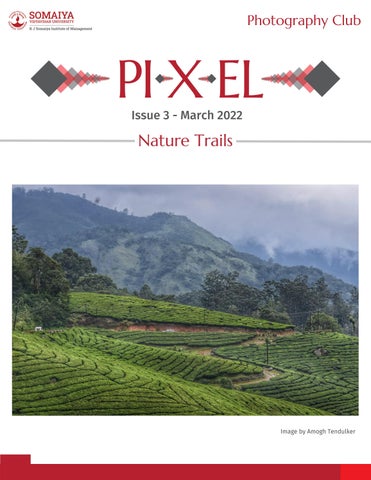
Image by Amogh Tendulker
ABOUT US The Photography Club of K J Somaiya Institute of Management has been encouraging students to use the art of photography to express their emotions & thoughts. We aim to create an environment for everyone to discover, develop, and express their creativity in photos & videos, by honing their capturing & editing skills. To keep the passion for photography alive in the busy lives of the students, the club conducts workshops, events, photo walks, competitions, and official photoshoots around the year under the guidance of Prof. Hitesh Punjabi. To be a member of the club, one may not know the technicalities of photography but must have a passion for it as our goal is to keep capturing moments and lives around us in one way or the other. The club believes that every picture has a story to tell and to let everyone tell their's, the club presents to the whole institute the opportunity to showcase their best shots on various themes the club runs throughout the year for the students of the institute. Pixel, the club's official magazine brings various styles of photography and camera techniques together as well as expert's views and journeys to encourage budding photographers to take on their picturesque journey forward. We hope you enjoy the content of this issue. Regards,
Photography Club
THE TEAM D E S I G N E R S
Alipriya Ghosh
Gavin Wagh
C O N T E N T
Amogh Tendulker
C U R A T O R S
Devansh Shah
Varun Nagur
Harsh Bhandari
Apoorva Kale
Tuneer Sarkar
Ashwin Lad
CONTENTS
1
Theme Overview Get introduced to the world of Travel Photography
3
Capture The Perfect Shot
7
Aesthetic Edits
9
Tips & Tricks
Learn the techniques to click the best shot
Enhance your shot to make it come alive
Use hacks to get professional looking clicks
12
A Photographer's Journey
15
The Professional's Insights
18
Shots From The Club
Know about the journey of Nick Brandt
Interview by Janhavi Patil
Glance through the best captures of our members
Theme Overview “Nature always wears the colours of the spirit” -Ralph Waldo Emerson This quote speaks a lot about the impact of nature on humans. It has always intrigued humans be it the vast beauty that it holds or the laws of nature that humans so desperately try to unfold. One way or the other humans have always been in touch with nature and found it amazing to study and appreciate. In terms of photography though Nature has always been in the focus because of the ease and simplicity with which it can capture us in awe. Nature Photography in general encompasses a wide range of elements such as wildlife, landscape, Flora and Fauna. (Source: Canva)
Nature-themed photographs can be published in scientific journals along with travel and cultural magazines such as National Geographic Magazine, Audubon Magazine, Outdoor Photographer, etc. A number of photography techniques can be utilized to create a desired effect on the image when considering Nature as our muse. Monochromatic Landscapes and Macro Photography of wildlife and plants are quite regularly used by photographers across the globe.
Images of nature help in shaping our consciousness about the physical world and play a major role by being the gateway to the relationship that humans have with nature.
1
Contemplating nature within the framework of photography opens the door to conservatism as well, many photographers participate in environment-saving campaigns by capturing images of endangered species and bringing the spotlight to the noble cause. Photography being an art deeply resonates with the emotions of the artists and the environment around them be it Nature, landscape, or wildlife. (Source: Canva)
The use of photography as a conservation tool may be traced all the way back to the invention of photography. William Henry Jackson's photographs from his travels with the Hayden Expedition to survey the American West in the 1860s were instrumental in persuading Congress to establish Yellowstone National Park in 1872, and thus in the birth of the worldwide movement to protect special places as national parks. Ansel Adams carried on the tradition a century later, introducing millions of people to the beauty of many iconic western landscapes. Wildlife photographers have recently gotten up and personal with wild animals large and tiny so that the rest of us can admire their beauty while staying out of harm's way. The Photography Club of K J Somaiya Institute of Management is pleased to introduce to you the theme of the March edition of our official magazine, Pixel - Nature Photography.
We invite you to join us in our journey and explore more about Nature photography and learn the tricks and tips of the trade right there from expert photographer interviews to curated articles from our club.
2
Capture The Perfect Shot! “In nature, nothing is perfect and everything is perfect” Nature photography is a magnificent way to show the beauty of nature to others. It is a huge genre, consisting of landscapes, wildlife photography, outdoor macro photography, and even abstract photos.
(Source: Yash Munot)
3
Using a tripod Sometimes according to lighting conditions, long exposure shots are required,for that tripod is much useful as slow shutter speed can be used and it helps prevent blury images and camera shake (source: Canva)
Tripod
Camera Filters Camera filters help in making the photographs look more enhanced and rich in colors. Famous camera filters are ND filters and polarising filters. A polarising filter darkens pale blue skies and gives them a richer hue of blue. It also aids in the reduction of glare. An ND filter functions as a pair of sunglasses for your lens, ensuring that both the sky and the ground are properly exposed (source: artofit.org)
Without Filter
With Filter
4
Focal Point A strong and well-defined focal point can assist almost any composition. The presence of a distinct point of focus in a photograph leads the viewer's attention to the appropriate location, resulting in a strong and visually beautiful image. (source: portraitsrefined.com)
24 mm
50 mm
100 mm
Look for patterns in nature Repeating patterns are everywhere in nature, whether you’re photographing fields of flowers, the veins of leaves, feathers, or insects. Often, you can crop images so that your photos highlight those patterns instead of the overall shape of the subject. These make for interesting abstract photos that can only be found in nature. (source: 121clicks.com)
Natural Pattern
5
Keep an eye on the depth of field For a shorter depth of field, use a wide aperture (small number) while photographing close-ups. This will bring the spotlight to your subject while blurring the background. To ensure that the majority of the image is in focus, use a narrow aperture for landscape photography (source: Outdoorphotography.com)
F16
F2.8
Have Patience One should not disturb the natural habitat species while capturing them and should have the patience to get the perfect shot. While shooting animals one should patiently observe the activities of the animal and wait for a few minutes and click at the perfect moment. (Source: Pinterest)
6
Aesthetic Edits (Source: Canva)
Why Aesthetic edits-Resolution of the human eye is 576 megapixels and not a single camera can beat the human eye for it hence there is a high chance to miss out on the real beauty of nature in photographs. Sometimes it is practically difficult to use other equipment apart from the camera hence aesthetic editing is very important to highlight those elements to make the picture more alive.
Color correction plays an important role in nature photo editing. It comprises color improvement, to make photos appealing. The central aim of color enhancement is to put color balance, make the photo saturated and correct all deviations, changing the photo's previous look. The color of trees and the entire scene depends on multiple factors like dust in the frame in this case clarity of water also plays an important role, since water is dull light reflection is not good as expected hence doing color enhancement will fix these issues and make the picture more beautiful. Removing dust, adjusting color contrast, making color brighter will surely help. (Source: fixthephoto.com)
Dull due to overexposure
Bright and beautiful after editing
7
Sometimes the background captured in the photo is not suitable for the main object in the frame we have to keep in mind that background can make or break the things in a picture. The perfect background will help to make the main subject more appealing and the overall picture acquires a new look hence you have to focus on the background as well and if it is not appropriate some minor changes adding some elements can create magic. (Source: fixthephoto.com)
Before background change
After background change
It is very important for photographers to decide what actually they want to highlight in the picture, color and black and white pictures of the same place can create a different atmosphere hence if you want to highlight raw aggressive features of nature black and white will always work for you. (Source: fixthephoto.com)
Color
Black and White
Sometimes when the light source is also present in the picture can cause some flares which can create some unpleasant objects in the picture hence it is important to remove those flares from the picture which can be done by using editing apps very easily. (Source: fixthephoto.com)
After lens flare
Before lens flare
8
Tips & Tricks (Source: gorodvo)
Nature photography entails photographing flowers and wildlife. This includes plants, flowers, and animals photographed in their natural habitats. It isn't easy due to the range of themes and mobility. Bring a wide-angle lens: These lenses have a larger depth of field. Wide-angle lenses allow more light to penetrate, allowing you to employ quicker shutter speeds. Some of these wildlife photography ideas may be situational. However, wider angle lenses are almost always preferable.
Without Wide angle lens
With Wide angle lens
Take multiple shots: Take many shots of the same topic by modifying your distance, shooting from different angles, changing your perspective, and doing anything you can to provide yourself with various possibilities
(Source: National News and Pictures)
Study your subject: We can capture photos of things we comprehend better. Knowing your subject's tendencies will also aid with shot prediction.
9
(Source: Pinterest)
Close-up of Textures: Colors, sounds, and patterns can serve as a source of inspiration for many aspects of our lives. Zoom in and crop close to your subject when photographing nature pictures. This may be tree bark, a leaf, the forest floor, or the skin of a lizard. Invest in a macro lens for an even closer view. These lenses may generate some beautiful photographs by magnifying even the most minor details. (Source: Nature TTL)
Photograph your subject in their natural environment: This isn't a rule, but if you're going to photograph nature, try to keep everything in the frame as natural as possible. There's nothing wrong with photographing a bird on a power wire or a spider on the side of your house. However, if you want to capture striking nature images, shoot animals and plants in their natural habitat. (Source: focusphotography)
The Rule of Thirds: To use the Rule of Thirds, divide your view into nine equal sections by drawing two central vertical and horizontal lines. The rule dictates that essential elements of your photograph should be positioned along these lines or where they meet.
10
(Source: Adobe)
Utilize RAW format: Many aspiring photographers, particularly those who like human-focused photographs, do not employ RAW format in their daily pursuit of beauty. This is because it might consume a substantial quantity of memory card space. However, the RAW format is usually preferable for wildlife photography. Cameras that capture RAW photographs produce unfiltered end outputs compared to JPEG formats. This means you'll have a large quantity of pixel information to work with when editing images later. One of the largest benefits of RAW is the ability to recover shadows and highlights in post-processing without bringing in the grainy noise usually associated with high ISO settings. (Source:orphicpixel)
JPEG
RAW
Use natural light: If feasible, try to use natural light. The natural lighting provides a soft and hazy look that allows for equal illumination and avoids sharp shadows when photographing immediately after sunrise or just before dusk. A photo taken during the golden hour will look markedly different from one taken in the middle of a sunny day, which in turn will look different from a photo at dusk, or even at night
11
A Photographer's Journey My images are unashamedly idyllic and romantic, a kind of enchanted Africa. They're my elegy to a world that is steadily, tragically vanishing. (Source: nickbrandt.com)
Nick Brandt was born in 1964 and is an English photographer who focuses on the natural world and the impact of climate change on disappearing nature. He had his schooling in Painting and Film at Saint Martin’s School of art and after moving to California in 1992, he has worked in many award-winning music videos. It was in Tanzania where he became frustrated with his inability to capture the natural world and his love for animals and decided to pick up photography. (Source: nickbrandt.com)
The themes of his work often focus on the destructive impact humankind has had on nature and on humankind itself.
Gorilla on Rock, Parc des Volcans A Shadow Falls
In his famous East African trilogy, On This Earth, A Shadow Falls Across the Ravaged Land captured between 2001 to 2012 Brandt had established a style of photography of animals that resembled photography of humans in a studio setting with the intent of expressing animals as sentient beings just like humans.
12
In his following work, Inherit the Dust (2016), Brandt had photographed places in East Africa where animals used to be in abundance.
(Source: nickbrandt.com)
Lifesized panels of unreleased animal portrait photographs were erected in each of these places, setting the panels within an environment of rapid human development. The series tries to portray that this out-ofcontrol world has not only victimised the animals but also humans.
Halima, Abdul and Frida, Kenya The Day May Break
His first series in Colour, This Empty world shot in 2019 aims to capture the increasing destruction of the natural world at human hands in East Africa where the overwhelming runaway development has stripped the animals of any space to survive.
(Source: nickbrandt.com)
The people in these photos are relentlessly swept away by the tides of progress. Each image in the series is a combination of moments, once when the animals roam free after which a set is built and a cast of people drawn from local communities.
13
The Gathering This Empty World
The Day May Break (2021) is the first part of a global series portraying people & animals impacted by environmental destruction. Photographed in Zimbabwe and Kenya, the people in the photos have all been badly affected by climate change - displaced by cyclones that destroyed their homes, displaced & impoverished after years-long severe droughts. (Source: nickbrandt.com)
Quarry with Elephant Inherit The Dust (Source: nickbrandt.com)
Brandt has had a solo gallery and museum shows around the world, including in New York, London, Berlin, Stockholm, Paris and Los Angeles. All the series are published in book form.
Loinesss against Dark Foliage, Across The Ravaged Land
In 2010, Brandt co-founded Big Life Foundation, a non-profit in Kenya/ Tanzania that employ more than 300 local rangers to protect 1.6 million acres of the Amboseli/Kilimanjaro ecosystem Now, he continues doing that in digital space as well, where every picture is a reflection of moments filled with tales.
Head on to their Instagram page: @nickbrandtphotography Check out their work: https://www.nickbrandt.com/
14
The Professional's Insights Q. Tell our readers a bit of yourself and your journey as a photographer so far?
Janhavi Patil
I am Janhavi, and I am a photographer. I was born into a family of Teachers, but my father has an interest in photography so I got interested in this field. My dad taught me the basics of photography and then working and organizing events which helped me gain the required skills. When I was pursuing my first year in electrical engineering I participated in a photography competition that attracted the attention of my friends and acquaintances, commending my sense of photography.My friend introduced me to social media platforms and I started posting pictures on an everyday basis. Many people liked my creativity and appreciated my skills. One of the pictures that I clicked during the Ganesh festival got viral all over. It attracted attention from all quarters. Till then, my conservative family was not quite keen on leveraging social platforms for their work, but this event triggered my interest, leading to the realization of the importance of these social media channels. Similarly one of my photos of an umbrella shot got immediately viral which led to widespread appreciation from social media channels. Both incidents instilled a lot of confidence to pursue my dream.
@janhavipatilsays I also won a prize in an Instagram-hosted photography competition. My dad encouraged me to take it up and even supported me to fulfill the assigned tasks In recent times, my work has been recognized by Nikon Indiaschool gallery and Nat Geo and each of those pictures has landed me some cool reviews. It is heartening to see my work being appreciated by the best in the business too. I and my friends plan trips and outdoor shoots together. I make it a point to click them randomly, some of the pics get noticed while some are even approached for collaborations.
15
Q. What drew you to photographing nature? Curiosity towards unique elements in nature which I can showcase through my photographic eye. Q: As a photographer is there anyone you look up to? What do you think makes their work special? As a photographer, I look up to so many inspirational street & nature photographers who showcase their work’s in such a way that every photo speaks, Steve McCurry sir who captures amazing photographs who is my inspiration of all time. Q: Where is your favorite place to photograph and why? My favorite places for Photography are the old streets of Nashik or beauty landscape views of Igatpuri in Nashik where I Photograph the landscape views & stories of village people. Q: Any specific destination you would suggest for budding photographers to visit? In Karnataka state 'Hampi' is the best historic location to photograph landscape views and heritage. I highly recommend this location for budding photographers to visit once in a lifetime. Q: Do you have a go-to piece of kit you use more often than any other? If so, why? I mostly use my sigma 85 mm lens. Because the lens is beautifully designed that delivers very impressive, near best in class image quality.
16
Q: The black and white shot of the bulls working the field is very interesting, can you share the story behind it? During the lockdown period, I was at my native place. One day I went to our farm just to experience, what is the process after the rain shower, and the funny part was, I saw one of our bulls was attacking each and every passer over there and our labors were continuously controlling him. During that period I took that Shot. Q: Can you share the story of any memorable sightings? One day I saw one old lady selling flowers in front of a temple and in her shop there are so many cats, I went near her and started photographing and the love between that old lady and her cats are so adorable that she cannot express in the words. Basically the pure emotions I captured between them is the greatest memory.
17
YASH MUNOT @yashmunot95
Shots From The Club
18
19
SANJANA SANEJA @_tripper_ss_
20
GAVIN WAGH @gavin.wagh
21
DEVANSH SHAH @thegoodevansh
22
TUNEER SARKAR @selbst__ist__der__mann
23
AMOGH TENDULKER @_a_mog_
PI X EL YOUR LENS TO EXPLORE THE WORLD OF PHOTOGRAPHY
Photography Club K J Somaiya Institute of Management REACH US OUT ON: