Photography Club
PI X EL Issue 4 - July 2022
Architecture
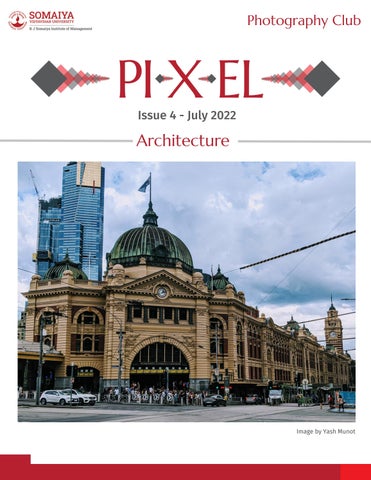
Image by Yash Munot
ABOUT US The Photography Club of K J Somaiya Institute of Management has been encouraging students to use the art of photography to express their emotions & thoughts. We aim to create an environment for everyone to discover, develop, and express their creativity in photos & videos, by honing their capturing & editing skills. To keep the passion for photography alive in the busy lives of the students, the club conducts workshops, events, photo walks, competitions, and official photoshoots around the year under the guidance of Prof. Hitesh Punjabi. To be a member of the club, one may not know the technicalities of photography but must have a passion for it as our goal is to keep capturing moments and lives around us in one way or the other. The club believes that every picture has a story to tell and to let everyone tell their's, the club presents to the whole institute the opportunity to showcase their best shots on various themes the club runs throughout the year for the students of the institute. Pixel, the club's official magazine brings various styles of photography and camera techniques together as well as expert's views and journeys to encourage budding photographers to take on their picturesque journey forward. We hope you enjoy the content of this issue. Regards,
Photography Club
THE TEAM
D E S I G N E R S
Aaron D'Souza
Siddharth Yadav
C O N T E N T
Yash Munot
Varun Nagur
C U R A T O R S
Shruti Sen
Tuneer Sarkar
CONTENTS
1
Theme Overview Get introduced to the world of Architecture Photography
3
Capture The Perfect Shot
6
Aesthetic Edits
8
Tips & Tricks
Learn the techniques to click the best shot
Enhance your shot to make it come alive
Use hacks to get professional looking clicks
11
A Photographer's Journey
14
The Professional's Insights
18
Shots From The Club
Know about the journey of Hufton+Crow
Interview with Ricken Desai
Glance through the best captures of our members
Theme Overview “Beauty perishes in life, but is immortal in art” - Leonardo da Vinci Humans are an aesthetic species. We yearn for beauty and for objects that enhance our lives. Such beauty can be found in interpersonal interactions and all around our surroundings: in pretty clouds, inspiring sunsets, magnificent beaches, and our edifices. We are fortunate to live in a nation rich with diverse cultures, languages and artistic styles. From prehistoric times, India has been a pioneer in architecture - the structures discovered in the Harappan settlements continue to astonish historians with their complexity and intricacy. (Source: Elle Decor)
Ancient glorious structures such as the Ajanta and Ellora caves, Konark Sun Temple, Hawa Mahal in Jaipur and the Hampi group of monuments in Karnataka still draw tourists and architecture enthusiasts alike. The Taj Mahal and Red Fort are recognized by people across the world. The Chhatrapati Shivaji Maharaj Terminus and the Gateway of India in Mumbai, Fort St. George in Chennai and the Victoria Monument in Kolkata are other notable examples. Even the swanky glass tower offices of the Bandra Kurla Complex (BKC) in Mumbai and the Modernist facade of the Indian Institute of Management, Ahmedabad, are worth mentioning.
1
The purpose of a structure, its history, symmetry and location are a few factors that contribute to its popularity. Internationally, the Taj Mahal Palace Hotel in Mumbai is known not only for its historical and architectural value but also for being a symbol of perseverance and hope against terrorism and fear. Other buildings, such as the Bombay Stock Exchange, have a unique aura, being the centre of finance and aspiration for millions of Indians. (Source: Elle Decor)
Our own Institute and University campus have elements of inspiring architecture that enforce the spirit of dedication, commitment, and entrepreneurship. The vast athletic track with the statue of the Running Man inspires students to excel in sports and academics, while the statues of Shri K J Somaiya and Lord Ganesha add to the rich legacy of the campus. The wide-open spaces, gardens, water fountains and curvature of the Chanakya building make an unforgettable first impression on new students and still inspire nostalgia in alumni. The Photography Club of K J Somaiya Institute of Management is pleased to introduce to you the theme of the current edition of our official magazine, Pixel - Architecture Photography. We invite you to explore the fantastic art of Architecture Photography through the lenses of our club members, fellow students, and guest photographers.
2
Capture The Perfect Shot! Our modern-day, image-obsessed culture has got us consuming a large quantity of architecture through photographs instead of physical, spatial experiences. The advantages of architectural photography are significant; it allows people to obtain a visual understanding of buildings they may never get the opportunity to visit in their lifetime, creating a valuable resource that allows us to expand our architectural vocabulary. However, one must stay critical of the disadvantages of photography in architecture. (Source: Iwan Baan)
3
Prioritize good lighting Good lighting should always be a priority regardless of when you are shooting photographs. Great architectural lighting helps to emphasize space, a specific structure or atmosphere, and thus plays a significant role in shaping one’s understanding of what is essential in that specific architectural project. (source: Digital Photography School)
Look for a unique angle Playing with perspective is not only an entertaining thing to do; it can also be gratifying. Taking time to find a different angle from which to photograph can expose an overlooked form or abstraction of a building’s detail that may give rise to another level of beauty and appreciation for its form. (source: Balin Alovitz)
Unique Angle
4
Research the building beforehand Reading up on the history and context of an architectural site before visiting is an indispensable resource that will, without a doubt, help focus the photography on a relevant story or idea that captures the essence of the building. (source: portraitsrefined.com)
Use post processing tools Processing images has become a standard part of photography, allowing you to tweak your images to match the atmosphere you want to capture perfectly. While images should only be altered with a clear understanding of what changes are acceptable, software such as Photoshop and Lightroom are easy to use with a wide variety of advanced functions such as lens correction. (source: Helene Binet)
5
Aesthetic Edits (Source: Canva)
Architecture and buildings are artistic creations and enduring cultural icons. Architecture photography can involve photographing the outside and inside of buildings, as well as cityscapes, bridges, and other buildings
Gradient Filter While most people are familiar with the fundamentals of editing photos for interior settings, one tool, the gradient filter, is frequently overlooked. When you have limited equipment and can't adjust the light on site, this may be a great tool for balancing out fading light on the margins of a frame. Before use of Gradient Filter
Your ordinary interior images may quickly and easily be transformed from ordinary to remarkable by applying a few Gradient Filters to them. The gradient tool is particularly great for sharpening up near the frame's edges and helping to partially correct for lens distortion.
(Source: fixthephoto.com)
After use of gradient filter
6
White Balance You will find that moving forward with modifications is considerably simpler if you start with the right white balance. It is advised to start out by avoiding the use of white balance sliders to create artistic colour grading to your photographs. This is because you should start with a white balance that produces accurate colour. (Source: fixthephoto.com)
Before White Balance
After White Balance
It enables you to experiment with various colour grading as much as you like while always having a baseline image to refer to by starting with an accurate colour image. Additionally, when working with a "properly" coloured image as a starting point, creative colour grading just appears to look better. Recover Highlights and Shadows Highlights and Shadows can make or break an image especially if it architecturally oriented. Almost often, whenever we snap an image, we end up brightening the shadows and darkening the brightness. The "dynamic range" of modern cameras is really astounding since they can catch a broad range of brightness. However, the majority of the pictures' display mediums, such as screens and prints, have a limited range. As a result, you'll frequently need to make the highlights darker and the shadows lighter. This will allow you to restore some of the information in these spots and guarantee that the final viewer can see it. (Source: fixthephoto.com)
After recovering shadows
Before recovering shadows
7
Tips & Tricks Architecture Photography is essentially in the to-do list of every photographer irrespective of the expertise whether professional or amateur. It comes with an opportunity to travel that adds to the adventure and the element of fun. Capturing architectural images requires the photographer to communicate with the structure, understand its history and appreciate the craftmanship of its creators. (Source: Wikipedia)
1. Explore the details of Architecture Although using a wide-angle lens is typically the best course of action for photographing buildings, structures include hundreds of minute details that get lost when a room or facade is captured in its entirety. Investigating specifics in-depth could offer fresh information regarding the history or construction of the building, for instance.
2. Shoot multiple times under variety of weather conditions at a single location
(Source: Archdaily)
When photographing architectural marvels, people frequently go for the most dramatic lighting, such as just before sunset when the shadows are lengthy and the colours are vibrant. Although technique frequently yields incredibly evocative photographs, it only really captures the ambiance of the structure at one particular moment in time.
8
3. Select Unique Angles Playing with perspective may be incredibly rewarding in addition to being amusing. A simple change in angle can make a vast difference to the overall aesthetics of the image. Finding a different perspective might reveal an underappreciated form or abstraction of a building's detail, which may lead to a newfound level of beauty and appreciation for its form.
(Source: Buildingsandinteriors.com)
4. Use Different Lenses (Source: smashingmagazine.com)
The use of variety of lenses is recommended in Architecture Photography, ideally a wide-angle lens is a go to lens for capturing architectural images, however a tilt shift lens is something that should be included in the toolbox whilst capturing architectural images. These lenses add an element of depth to the images and increase the width as well.
9
5. Use of Polarising Filter
(Source: www.lesdeuxpiedsdehors.com)
Polarising filters essentially compensate for loss of light under non conducive weather conditions. These filters also assist in capturing reflective surfaces effectively. These filters also cut out scattered light enabling the photographer to capture haze free images.
6. Look for Structural Lines The structural lines of any monument or a building can prove to be a very good enhancer of the aesthetics of the images and hence it is imperative for the photographer to look for such lines that can demarcate the structure from its surroundings.
(Source: Google images)
10
A Photographer's Journey
(Source: dezeen.com)
Hufton+Crow as a photographer duo is dedicated to capturing amazing and striking photographs of contemporary interior and exterior architecture across the globe. As two experienced photographers with skills that complement each other and competitive characters individually, they offer a unique proposition because they work as a team.
The Hufton + Crow couple, who are now based in London at age 43 and 39 respectively, have spent their formative years together in Macclesfield, northern England. Both work as a team – either both simultaneously photographing one project or by each providing input, critiques, and direction of the other work. Both the photographers had their initial training in analogue, employing the large format camera that many architectural photographers prefer, but they quickly made the leap to digital. (Source: Hufton + Crow)
11
(Source: https://www.huftonandcrow.com/)
They term their collective photography methods as "a package" that involves as much consideration at the image capturing stage as during the retouching. Hufton and Crow paid for a number of their own shoots as they had more options to work overseas with the lighter equipment in digital format The company owned by the famous architect Zaha Hadid became interested in a number of uncommissioned image sets, which led to an ongoing partnership. Late in 2013, the two went to Baku, Azerbaijan, to photograph Hadid's Heydar Aliyev Center.
The 2014 Arcaid Images Architectural Photography Awards later recognized one of their photos as the best of the year.
(Source: https://www.huftonandcrow.com/)
The second thing that's incredibly important to what they do is that they aim to capture the story of each work in roughly 30 photographs, including everything from construction details to dawn/dusk views, night shots, and shots of people moving around the area.
12
Together, they have all the things and concepts that they've developed over the past 10 to 12 years and still working on such concepts as taking day and night photos with the high level of contrast. (Source: https://www.huftonandcrow.com/)
(Source: https://www.huftonandcrow.com/)
"With the old camera system you took a picture and that, largely, was the image you got," said Crow. "But now you're almost collecting data on-site. You imagine what the shot will be." Their outcome represents passionate attention to detail, the most creative approach possible, and reliable and professional service. They define their technique as "a package" that involves as much consideration at the shooting stage as during the retouching.
Head on to their Instagram page: @huftonandcrow Check out their work: https://www.huftonandcrow.com
13
The Professional's Insights Q. Would you mind sharing with us where and how your journey began? How did you find your niche in architecture photography? What drew you specifically to architecture photography? I started Photography as a hobby around 13 years ago. I am blessed with twin daughters and they were the reason I got in to photography. I wanted to photograph their journey as they grew and hence started learning about it. Once my interest in photography turned into passion - passion to create amazing photographs, I started reading and learning more about it. I started exploring new areas other than my daughters as I wanted to photograph more. I started with my friends and families kid’s, different products etc. And travel is very close to my heart so I decided to mix travel and photography. I started photographing my bikes, places I travelled etc. This journey led me to explore many genres, I photographed events such as Sunburn festival,
Ricken Desai
@rickendesai
Harley events across the country and many more. I was asked to photography a friends store 7 years ago, that changed my outlook towards Architecture and Interior, it was a challenge to photograph structures etc. It was different and very niche as well. I loved it and hence learned more about it, channeled my energy in that direction and well here I am, still learning everyday with every new project. Architecture photography was amazing because with every new project came new creativity. I started meeting some amazing creative people and this excites me even today. Q. Who or what do you cite as some of your primary inspirations? Other photographers, artists, or sources that you frequently find yourself drawn to? Every space is different and so is the eye of every photographer. That’s what makes them unique in their own special way. You cannot copy a unique style but you can surely learn from their photographs. Learn about light, composition etc. but at the end of the day, the way you look at a
14
space through that view finder is the way you are going to capture it. I studied, followed and wrote to a lot of photographers in my journey and still do. I have learnt from all of them and still do. There are too many photographers that I find myself drawn to but what I learnt is that every individual has his or her own unique style, which they polish and enhance and then dive into. Q: What is your main priority when starting a project? Is there something that is fundamental to your practice – your philosophy and your process? How is the approach to architecture photography different from other genres? Here are my fundamentals about shooting projects: 1. Every project is different, It has its own character and life (if I may say so). So approach each space differently, it changes things. 2. My main aim is bring out the essence of the design of the project the way the Architect or Interior designer has envisioned it. 3. My likes or dislikes about a space do not matter. I love to be neutral with every space. 4. My first impression when I first step into a space is what I love. This sets the base for the rest of the session. 5. Every Architect & Interior Designer who gets their project documented should understand that its their baby, its a reflection of their design so keep it neat, keep it at its best. 6. And lastly, always keep the learning chapter open. Every space teaches me something new. Architecture photography is different as every space is different. The light in every space is different, design is different, angle is different, conditions are different. So get your fundamentals correct and explore each project with a fresh view.
Q:What are the key qualities to capture a great architectural shot? The biggest quality is how you perceive the space with your own eyes. What do you feel when see the space? Do feel sad? Do you feel happy? Do you want to party? What kind of vibe does the place give out? How a tourist sees the Taj Mahal might be different from how a professional photographer perceives it. After you identify your style, develop a few more qualities such as patience, some knowledge of architecture, direction of light and command over your gear. Q. What are you most proud of professionally? Do you have a favourite shoot/ project thus far? On a creative level, I think every time I come back from a shoot I feel proud. Cause I want this shoot be better than the last one and that simply makes me grow as a Creative. On a professional level I think being mentioned in the top 10 photographer in country amongst some amazing talent was a big boost. Being recognized by Nat Geo as Upcoming photographer in my
15
genre was another. On a personal level, when clients trust me for my work, its a great boost (as well as pressure). Favorite shoots are a lot, too many to mention cause as I mentioned earlier, they taught be a lot and helped me grow as a creative. We should catch up over a cup of coffee to discuss those stories. Q6. Social media, particularly Instagram, is saturating creative industries and blurring the concept of ‘professional’ photography – how do you feel about social media as an advantage/disadvantage to your work? What do you feel is the most challenging part of being a photographer today? Social media is something that you cannot avoid, and when you cannot avoid something, master it. As a creative, you should pro actively show case your work. I think It pushes you more to do better. Yes Instagram etc is a debatable topic on where they are heading , especially for photographers as its slowly moving towards video. I have Adopted to changing times, I shoot video for a long time now and now understand it so much better when the time is right. Here’s my take - The greatest currency today is audience. In any business your audience is key. Especially for a creative person. So spend some time in identifying your audience, and after you Have done that, spend some more time to understand what they like, that probably should give a great direction to start. And adapting to new situations is what we humans should do, growing is that isn’t it? Q7. Lastly, what has been one of your biggest lessons learned since starting your practice? Any words of advice that you have in mind for emerging photographers? Will keep it simple here: 1. Work with passion and money becomes a by- product. (Read that again-probably the best advice I received in the beginning of my carrier) 2. Slowly is the fastest way to get where you want to be. 3. Stay humble and be the hardest worker in the room. (That’s what The Rock said and it makes sense) 4. Apart from developing your skills, spend time on learning about the business as well. 5. Relationships go a long way, honor them.
16
17
YASH MUNOT @yashmunot95
Shots From The Club
18
19
SANJANA SANEJA @_tripper_ss_
20
SIDDHARTH YADAV @visionofshutter
21
KUNTAL CHAKRABORTY @aperture_of_my_lens
22
YUTI TALATI
@yutiiii___
23
KRITTIKA TEWARI @whiskeyinacoffeemug_
PI X EL YOUR LENS TO EXPLORE THE WORLD OF PHOTOGRAPHY
Photography Club K J Somaiya Institute of Management REACH US OUT ON: