FALL/WINTER 2023–2024
A M A L I A M E S A - B A IN S /// L A U R A A G UI L A R /// E X PA N DIN G D A R S H A N /// G U A R DIN G T H E A R T phxart.org
F O R G E T Y O U R S E L F. B E C O M E O N E WITH E TERNIT Y. / / / YAYO I K US A M A / / /
On your next trip to PhxArt, rediscover the magic and wonder of You Who are Getting Obliterated in the Dancing Swarm of Fireflies (2005) by Yayoi Kusama. After more than a decade on view, the immersive installation underwent vital restoration work to upgrade various technologies and move the piece to a more accessible location on the Museum’s first floor, adjacent to the Art of Asia Wing. Experience the beloved piece anew, like it’s your first time. See you soon.
image credit: Yayoi Kusama, You Who are Getting Obliterated in the Dancing Swarm of Fireflies, 2005. Mixed media installation with LED lights. Museum purchase with funds provided by Jan and Howard Hendler.
2
FALL / WINTER 2023–2024 /// PHXART MAGAZINE
FALL / WINTER 2023–2024 /// PHXART.ORG
3
PHOENIX ART MUSEUM 2 0 2 3 – 2 0 2 4
CONTENTS FALL/WINTER 2023–2024
5 Letter from the Director 6 Museum News 9 Education + Engagement 25 Why We Give 26 Why We Give 27 In Memory 28 Thank You
CHECK OUT OUR MUSEUM STORE HOLIDAY GIFT GUIDE ON THE REVERSE OF THIS ISSUE
Jeremy Mikolajczak The Sybil Harrington Director and CEO Donald Opatrny Chair of the Board of Trustees
E DI T O R I A L S TA F F Executive Editor /// Samantha Andreacchi Associate Editor /// Samantha Santos Creative Director /// Michael Bartley Photography Editor /// Airi Katsuta
C O N T RI BU T I N G E DI TO R S Giovana Aviles, MAC Curator of Engagement Janet Baker, PhD, Curator Emerita of Asian Art Claudia López, Cohn Fund for Arts & Culture ASU/LACMA Fellow and Bilingual Communications Specialist Emilia Mickevicius, Norton Family Assistant Curator of Photography
CH A IR Donald Opatrny
V ICE CH A IR S
E X HIBI T IO N S 10 On View 11 Princely States of the Punjab: Sikh Art and History 12 Arizona Artist Awards 15 Amalia Mesa-Bains: Archaeology of Memory 18 Expanding Darshan: Manjari Sharma, To See and Be Seen 20 Guarding the Art: A Frontline Perspective 22 Laura Aguilar: Nudes in Nature
Christian Ramírez, Cohn Assistant Curator of Contemporary and Community Art Initiatives Arlyn Rico, Human Resources Coordinator Kaylee Weyrauch, Development Events Specialist Rachel Sadvary Zebro, Associate Curator of Collections Amy Zhang, Staff Accountant
CO N N E C T W I T H U S @phxart 1625 North Central Avenue Phoenix, Arizona 85004-1685 phxart.org 602.257.1222 602.257.2124 602.257.2115 602.257.2173
24-HOUR INFORMATION MEMBERSHIP OFFICE CIRCLES OF SUPPORT VOLUNTEER OFFICE
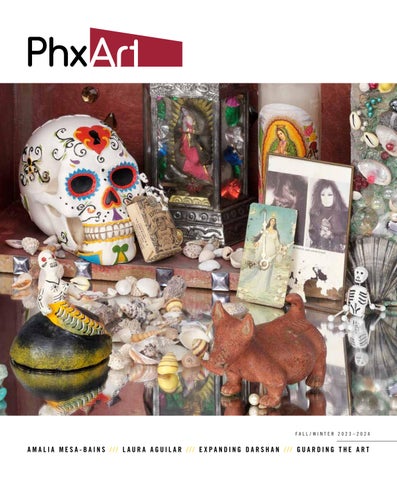
image credit: (front cover) Amalia Mesa-Bains, Queen of the Waters, Mother of the Land of the Dead: Homenaje a Tonatzin/Guadalupe (detail), 1992.
Mixed media installation including fabric drape, six jeweled clocks, mirror pedestals with grottos, nicho box, found objects, dried flowers, dried pomegranate, potpourri; 120 x 216 x 72 in. Courtesy of the artist and Rena Bransten Gallery, San Francisco.
4
BOARDOF TRUSTEES
FALL / WINTER 2023–2024 /// PHXART MAGAZINE
David Lenhardt Blair J. Portigal
S E CR E TA R Y Carl Thoma
TRE ASURER Blair J. Portigal Ruben E. Alvarez Alice Bazlen Drew M. Brown* Joel Coen Andrew Cooper Gloria P. Cowen Jacquie Dorrance* Carter Emerson Robert Faver Michele M. Feeney Martin R. Galbut Judy Goldberg Sara T. Gordon John W. Graham Michael Greenbaum* Lila Harnett* Oliver Harper, M.D. John Horseman Barbara Noble Howard Jon Hulburd Jane Jozoff Ellen Katz* Don Kile Sally Lehmann Mitch Menchaca** Bettina Nava Ann M. Ocaña Sally A. Odegard Doris Ong Rose Papp Terry Roman Jordan Rose Vanessa Ruiz Ann Siner Rob Taylor *Honorary Trustee **Ex-Officio
FROM THE DIRECTOR
D E A R F R I E N D S A
s we reflect on a long, hot, and dry summer here in the Valley, and now with the promise of comfort on the horizon, it reminds us that life doesn’t always get more accessible, but we become stronger and more resilient. Yesterday’s challenges fall away to the promise of today and the possibilities of tomorrow. Here at Phoenix Art Museum, we look forward to our incredible Fall/Winter roster of exhibitions, programs, and opportunities, devoted to the artists, visionaries, and voices that have been historically overlooked and undervalued. We draw inspiration from their perseverance and persistence and consider how their examples can show us ways to unlock the tremendous potential in each of us.
Photography Gallery, Laura Aguilar: Nudes in Nature showcases photographic works by a groundbreaking yet underrecognized artist who challenged perceptions of beauty by examining the female body in dialogue with the natural world. Co-curated by Sybil Venegas and Christopher Velasco, trustees of the Laura Aguilar Estate, the exhibition is the first project coordinated by Emilia Mickevicius, the newly appointed Norton Family Assistant Curator of Photography at PhxArt and the Center for Creative Photography in Tucson.
JEREMY MIK O L A J C Z A K The Sybil Harrington Director and CEO Phoenix Art Museum
In September, the Museum opened its season with a renewed commitment to the investment in our Art of Asia collection, demonstrated through the renovation of the Art of Asia Wing. This project included relocating and restoring the Museum’s most beloved installation—Yayoi Kusama’s infinity mirror room, You Who are Getting Obliterated in the Dancing Swarm of Fireflies. Bittersweet in its completion, it marked the final installation expertly curated by Dr. Janet Baker, now distinguished Curator Emerita of Asian Art. Nevertheless, the project is an example of how the Museum and its curatorial team view future explorations of our extensive collection, presenting narratives that are not limited by time, culture, or genre, but instead expand on connections that can be made when we consider various viewpoints and histories. Beginning in November, we bring new voices to our galleries and Southwest audiences. Through Amalia Mesa-Bains: Archaeology of Memory, we present the first major retrospective of work by the trailblazing Chicana artist renowned for her signature large-scale altar installations. In December, we open Expanding Darshan: Manjari Sharma, To See and Be Seen, which presents the striking work of the global contemporary artist in conversation with historical objects from the collection of the Birmingham Museum of Art. The presentation of this exhibition on the third floor of our Katz Wing marks the premiere of newly dedicated galleries for temporary exhibitions. In Norton
In addition to showcasing these exhibitions and programs, this edition of PhxArt Magazine includes personal reflections from select members of our dedicated and passionate staff—reinforcing our commitment to a work culture that not only highlights the depth of perspectives across our team but also fosters a space of exchange from within the institution. You’ll particularly enjoy a sneak peek into Guarding the Art: A Frontline Perspective, the first exhibition at PhxArt to center the voices of guest curators from our retail-services, security, and event-rentals teams. Intimidating—and often overwhelming—to try and capture in a single welcome letter, the transformation and advancement of this Museum over the past year has been astounding, and it’s required the dedication of all of us—the Board of Trustees, staff, and volunteers. But it has also required the investment of those highlighted in our Why We Give pages and named on our donor-recognition lists. From those who helped reduce our institution’s environmental impact, such as David Fenton of ECM Technologies, to the outstanding investment in community arts from Lee Baumann Cohn and Mike Cohn, to the sharing of knowledge from Susana Torruella Leval, Director Emerita of El Museo del Barrio in New York and Guarding the Art mentoring curator, it is truly a privilege to be a part of our shared community. In closing, I dedicate this issue to the memories of John and Oonagh Boppart. John served on the boards of several Phoenix-based arts and cultural institutions, including Phoenix Art Museum, where he served as a Docent for more than 25 years. Oonagh, who also served on many boards, spent her time most devoutly supporting the Desert Botanical Garden but will also be remembered for her work bringing arts leaders together to collaborate in innovative ways. Their legacies will be felt throughout the Valley for generations. With gratitude,
Jeremy M. Mikolajczak The Sybil Harrington Director and CEO
FALL / WINTER 2023–2024 /// PHXART.ORG
5
MUSEUM NEWS
A L IF E T IME OFA R T At Phoenix Art Museum, we strive to be a place open to all, with something to inspire and delight at every stage of life. But we can’t do it alone.
O
ur early childhood education programs, including monthly Storytime events, help parents and pre-K children become comfortable in museum settings while supporting childhood literacy and providing an opportunity for meaningful quality time. With the support of our dedicated corps of Docents, who enliven art in our galleries for youth of all ages, the Museum offers school field trips and welcomes thousands of elementary, middle-school, and high-school students each year for less than $5 per student and at absolutely no cost for Title-I schools. Four times a year, we present PhxArt Family Fundays, day-long celebrations that provide fully free access to the Museum along with exciting activities, workshops, artmaking, live music, and dance. We offer internships, fellowships, and volunteer opportunities suitable for teens, college students, graduate students, and beyond.
And we serve our older-adult population through exciting exhibitions, volunteer roles, learning activities, creative-aging programs, and offsite art presentations that bring the magic of our collection directly to those community members who are unable to visit our galleries.
B U T N O N E O F T HI S W O R K C A N CO N T IN U E W I T H O U T T H E S U P P O R T O F CO M M U NI T Y M E M B E R S A N D A R T A D V OC AT E S W H O U N DE R S TA N D T H AT A N IN V E S T M E N T IN P H O E NI X A R T M U S E U M I S A N IN V E S T M E N T IN A L IF E T IM E O F A R T A N D CO N N E C T IO N . We hope you will consider making a donation to the Museum’s annual fund today. Your donation will directly impact our ability to present engaging and dynamic arts programming, designed to inspire a lifelong appreciation of the arts. To give, visit phxart.org/membersgive, or contact our Membership Office at 602.257.2124.
PHXART RECEIVES $2 MILLION FOR EXHIBITIONS, EDUCATION + ENGAGEMENT, ACQUISITIONS
P
hxArt recently announced three major gifts that represent a cumulative infusion of $2 million in support of exhibitions, education and engagement programs, and contemporary art acquisitions. The Opatrny Family Foundation has provided a founding gift of $1 million to establish the Phoenix Art Museum Exhibition Excellence Fund under
6
the institution’s endowment. The fund supports the Museum’s efforts to present impactful special-engagement exhibitions, large-format collection-based exhibitions, and enhanced collection reinstallations. The Cohn Fund for Arts & Culture, a component fund of the Arizona Community Foundation, has provided a founding grant
FALL / WINTER 2023–2024 /// PHXART MAGAZINE
of $750,000 to establish the Phoenix Art Museum Education and Engagement Excellence Fund. This initial seed investment, distributed over multiple years, supports the naming of the Cohn Assistant Curator of Contemporary and Community Art Initiatives position, currently held by Christian Ramírez. It also provides five-year support for the
MUSEUM NEWS Museum’s ASU/LACMA Fellow, who takes part in a three-year master’s degree program created by Arizona State University and Los Angeles County Museum of Art that is designed to foster a more diverse generation of Museum curators, administrators, and thought leaders. Claudia López, PhxArt’s bilingual communications specialist, is the Museum’s inaugural Cohn Fund for Arts & Culture ASU/LACMA Fellow. The grant also enables the Museum to deepen its support of Arizonabased artists. Effective with the 2024 cohorts, PhxArt will increase monetary support for the annual Scult Artist Award from $10,000 to $20,000 and the Lehmann Emerging Artists Awards from $5,000 to $10,000 per artist (two awarded). Additionally, the Museum will establish in 2024 the Sette/Cohn Artist Award, a new recognition opportunity that awards a $5,000 prize to an emerging Arizona-based artist, and an annual educational partnership with a Valley-based organization designed to broaden engagement with the visual arts. In support of contemporary art acquisitions and educational programming, Valley philanthropists Dawn and David Lenhardt have renewed their support for the David and Dawn Lenhardt Contemporary Art Initiative with a $250,000 gift. The initiative was established in 2017 and expanded in 2021 to support the diversification of PhxArt’s contemporary art collection through the acquisition of works by artists contributing to discourses on race, gender, and other socially relevant concerns, including those by Black, Indigenous, Latinx, and women artists, among others. This recent gift, which brings the Lenhardt family’s support to more than $1 million since 2017, will continue to fund contemporary art acquisitions and the semiannual Lenhardt Lecture, the intiative’s flagship program. “We are deeply grateful to The Opatrny Family Foundation, the Cohn Fund for Arts & Culture at the Arizona Community Foundation, and the Lenhardt family for this incredible display of generosity and commitment to the mission of Phoenix Art Museum,” said Jeremy Mikolajczak, the Museum’s Sybil Harrington Director and CEO. “These gifts have allowed us to make great strides in our efforts to diversify our holdings, present regionally based as well as globally recognized contemporary artists, and present outstanding exhibitions. The gifts from The Opatrny Family Foundation and the Cohn Fund for Arts & Culture have also allowed us to create critical financial infrastructure to ensure long-term, sustainable support for our exhibitions, education and engagement programming, and our support of Arizona-based artists. This infusion of support will truly make a difference in our ability to present impactful art experiences and serve as a vital space for community engagement and exchange, now and for decades to come.” For information on how to contribute to the Museum’s Exhibition Excellence Fund or its Education and Engagement Excellence Fund, contact us at development@phxart.org.
J A N E T B A K E R , P H D, A P P OIN T E D CU R AT O R E M E R I TA O F A S I A N A R T After more than two decades of service to PhxArt and our Asian art collection, Janet Baker, PhD, has retired from her role as curator of Asian art. In honor of her distinguished service, the Museum has named Dr. Baker the Curator Emerita of Asian Art. In this role, she will serve as a trusted advisor on the institution’s Asian art collection and exhibition program, in addition to various arts-education programs.
Since joining PhxArt in 2000, Dr. Baker has guided the expansion of the Museum’s holdings in Chinese, Japanese, Sri Lankan, Indian, and contemporary Asian art, more than doubling the Asian art collection through the acquisition of 3,000+ objects. She also stewarded a major acquisition of more than 50 Indonesian textiles, the first works from Indonesia acquired into the Museum’s Asian art collection. Along with strengthening the Museum’s Asian art collection, Dr. Baker developed a number of significant exhibitions that examined historical and contemporary art forms from many Asian countries, including Sacred Word and Image: Five World Religions; Hidden Memories of Love and Death in Chinese Painting: Selections from the Marilyn and Roy Papp Collection; and Quiet Rage, Gentle Wail: Prints and Masks of Japanese Noh. She also was instrumental in bringing major Asian art exhibitions to PhxArt from partner institutions, including Samurai: Armor from the Ann and Gabriel Barbier-Mueller Collection, one of our most attended exhibitions in the past decade, and Ai Wei Wei: Circle of Animals / Zodiac Heads: Gold.
JANET BAKER, PHD Curator Emerita of Asian Art
PhxArt will launch a national search for the Museum’s next curator of Asian art, who will be responsible for maintaining and growing the institution’s Asian art collection, developing original scholarship, and spearheading interpretation and programmatic offerings to broaden engagement.
R A CH E L S A D VA R Y Z E B R O A P P OIN T E D A S S OCI AT E CU R AT O R O F CO L L E C T IO N S In October, PhxArt welcomed back Rachel Sadvary Zebro as our new associate curator of collections. In her new role, Zebro curates original exhibitions that highlight the depth of the Museum’s modern, contemporary, and European art exhibitions, in R A CH E L S A D VA R Y addition to managing all collectionZEBRO based projects and acquisition Associate Curator of Collections strategies related to those collecting areas. She also assists with scholarly research and publications projects across all seven of the Museum’s collecting areas, including American, Asian, and Latin American art. Zebro returns to PhxArt from Di Donna Galleries in New York City, where she served as head of research and contributed to the exhibition Man Ray’s Paris Portraits (2023). Prior to that role, she worked at PhxArt since 2013, first as an assistant registrar and then as a curatorial associate for modern and contemporary art. In 2018, Zebro was promoted to assistant curator, in charge of managing major CONTINUED ON PAGE 8
FALL / WINTER 2023–2024 /// PHXART.ORG
7
MUSEUM NEWS
KEEP COOL + CONSERVE
A
s one might imagine, an effective and efficient HVAC (heating, ventilation, and air conditioning) system is essential to maintaining specific temperatures and levels of humidity at Phoenix Art Museum, where more than 20,000 artworks, held in the public trust, are stored, preserved, and presented to the public at regular intervals throughout the year. Because the Museum building is maintained by the City of Phoenix, PhxArt and the City often work together to monitor the facility’s HVAC system to ensure artwork can be safely stored. The two entities also consider the building’s overall energy efficiency, energy consumption, and carbon emissions. In 2016, the City of Phoenix established a goal of reaching carbon neutrality by 2050, and as part of those efforts, the City contracted ECM Technologies, a leader in HVAC efficiency and energy conservation, to evaluate the Museum’s building and treat its existing HVAC system to restore lost efficiency, improve the facility’s air quality, and lower overall building emission, all while prioritizing the preservation of the PhxArt Collection. In 2022, ECM Technologies completed its signature HVAC treatment, ThermaClear™. Since then, PhxArt has experienced a range of benefits. “ThermaClear™ has ensured our HVAC equipment runs at top quality and at a lower cost,” said Jeremy Mikolajczak, PhxArt’s Sybil Harrington Director and CEO. “I am also thrilled to share that a single treatment has been able to make a positive impact on our ability to reduce the Museum’s CO2 output and, consequently, its greenhouse gas emissions.” More specifically, the treatment has lowered the Museum’s carbon-dioxide output by more than 542,900 pounds, equal to the emissions of 53 cars driven continuously for an entire year. It has also helped extend the lifespan of the facility’s three water-cooled chillers. PhxArt is proud to play an active role in ensuring the City of Phoenix becomes carbon neutral by 2050. In addition to completing the ThermaClear™ treatment, Museum staff regularly participate in Maricopa County’s Travel Reduction Program, which seeks to reduce the number of single-occupant vehicles and/or miles traveled to work. As a result, staff often carpool, work remotely one day per week, take the Light Rail or bus, or bike to the Museum (when the weather permits). Over the coming years, PhxArt leadership and staff will continue to seek opportunities that reduce the Museum’s carbon footprint.
8
FALL / WINTER 2023–2024 /// PHXART MAGAZINE
FROM PAGE 7
projects across all permanent-collection areas. She also organized numerous exhibitions drawing from the Museum’s modern and contemporary art collections, including Breaking Up (2022), Out of Print: Innovations of 19thand 20th-Century Printmaking from the Collection of Phoenix Art Museum and The Schorr Collection (2021), Joseph Cornell: Things Unseen (2020), Rauschenberg and Johns: The Blurring of Art and Life (2018), and In the Company of Women: Women Artists from the Collection (2018). Zebro received her MA in art history from the University of Arizona in Tucson, her MA in library and information services from the University of Pittsburgh, and her undergraduate degree in art history from Northern Arizona University.
CO M MI T M E N T T O DI V E R S I T Y, E Q UI T Y, A CCE S S IB L I T Y + IN CL U S IO N PhxArt continues to pursue and create new opportunities that deepen our commitment to diversity, equity, accessibility, and inclusion (DEAI). The Museum’s Staff Equity Committee, a solutions-focused working group that leads internal initiatives and projects to ensure sustainable DEAI practices across the organization’s operations, continues to meet regularly throughout the year. The group has completed an intensive two-day training workshop with Patricia Lannes of CALTA21, developed a list of goals to prioritize in fiscal year 2024, and consulted on various initiatives across the institution, including the refresh of all wayfinding and signage throughout our galleries, a project that will continue into 2024. Particular areas of interest for the group include creating more accessible spaces and activations for families with children, creating an internal inclusive language guide that will inform all Museum communications, increasing interpretative activations in exhibition spaces to promote new ways of thinking about and interacting with art, and more. The Museum has also participated in a national study organized by WolfBrown and funded by the Flinn Foundation. As part of the study, PhxArt sent a survey to our Members and general subscriber lists to gain an understanding of how our audiences view DEAI work, its role in museums, and the ways DEAI principles are integrated (or not integrated) at PhxArt and other Valley cultural institutions. The findings of the study have been instrumental in helping the Museum understand the needs and interests of our visitors, as PhxArt continues in its mission to becoming a space of exchange and belonging for our community.
EDUCAT IO N + E N G AG E M E N T
S TAGE+SCREEN LENHARDT LECTURE, PHXART AMPLIFIED + NEW FILM SERIES ENLIVEN MUSEUM SCENE LENHARDT LECTURE On November 8, PhxArt hosted the Fall 2023 Lenhardt Lecture, featuring contemporary artist Leonardo Drew. Renowned for creating contemplative abstract sculptural works that play upon the tension between order and chaos, Drew transforms various raw materials to create evocative works that explore the passage of time, allude to America’s industrial past, and articulate the cyclical nature of life and decay. The Lenhardt Lecture is made possible through the generosity of the Lenhardt Contemporary Art Initiative.
P H X A R T A M P L IF IE D R E T U R N S J A N U A R Y 2 0 , 2 0 24 PhxArt Amplifed—the Museum’s art+music festival experience—returns in 2024. Sound and art converge at this all-day event suitable for visitors of every age and ability. Experience a range of live, acoustic, and experimental musical performances throughout Museum galleries and spaces, along with enhanced outdoor visual-art installations, hands-on programming, and an exciting line-up of bands hailing from Tucson and Phoenix that will premiere sitespecific musical performances inspired by special exhibitions and artworks on view. More details available soon at phxart.org. PhxArt Amplified is made possible through the generosity of Men’s Arts Council, with additional support from Ultimate Playlist powered by Arizona Lottery.
and produces director-driven work in celebration of authentic, diverse, and bold voices in independent cinema. Now Showing premiered in October with a viewing of Federico Fellini’s 8 1/2. Save the date for the remainder of our Now Showing films, or reserve your tickets online.
N O W S H O W I N G : KOYA A N I S Q AT S I N OV E M BE R 15 /// 6 P M Koyaanisqatsi captures natural landscapes and elemental forces, showing viewers the heavy toll that modern technology is having on humans and the earth. Containing neither dialogue nor narration, the film’s tone is set by the juxtaposition of poignant images and cinematic music by American composer Philip Glass. Not Rated. Runtime: 1+ hours.
N O W S H O W I N G : TOY KO S TO RY D ECE M BE R 13 /// 6 P M
N O W S H O W IN G This fall and winter, PhxArt presents our latest film series—Now Showing—featuring contemporary and classic films directed by local and globally recognized filmmakers. All movie selections create connections between the art of cinema and the Museum’s renowned collection of 20,000 objects of American, Latin American, Asian, European, modern, and contemporary art and fashion design. The series is made possible through the generosity of Fit Via Vi Films, an organization founded by longtime Museum supporters Mary Coleman Way and Bill Way that develops, finances,
A profoundly stirring exploration of humanity and universal heartbreak, Tokyo Story follows an aging couple’s journey to visit their grown children in bustling postwar Japan. The crowning achievement of director Yasujiro Ozu, the film surveys the rich and complex world of family life—including generational conflict—with delicacy and incisive perspective on social mores. Not Rated. Runtime: 2+ hours. All Now Showing films are presented during Pay-What-You-Wish Wednesdays, when general admission to the Museum is a voluntary donation. Film tickets are free for Museum Members and $8 for the public, with concessions and beverages available for purchase on-site.
image credits: (top to bottom) Photo by Charles Darr; Portrait Leonardo Drew by Christopher Garcia Valle, Courtesy AMFA and Galerie Lelong & Co.
FALL / WINTER 2023–2024 /// PHXART.ORG
9
E X HIBI T I O N S + I N S TA L L AT I O N S FA S HIO NIN G S E L F: T H E P H O T O GR A P H Y O F E V E R Y D AY E X P R E S S IO N
CO L L E C T IO N S P O T L IGH T: A M E R IC A N S CE N E S / A M E R IC A S S E E N
NORTON PHOT OGRAPHY G A L L E RY THROU GH NOVEMBER 5, 2 0 2 3
AMERICAN ART GALLERIES O N G O IN G
M O V E : T H E M O DE R N CU T O F GE O F F R E Y B E E N E
CO L L E C T IO N S P O T L IGH T: THE MUSE OF NE W M E X ICO
E LLM AN, HARNET T, AND O R ME L E WIS GA LLERIES THROU GH DECEMBER 3, 2 0 2 3
MISSION AND LEGACY: FRIENDS OF MEXICAN ART’S ENDURING IMPACT IN THE VALLEY AND BEYOND JA M E S K. BAL L INGER GA L L E RY THROU GH DECEMBER 31, 2 0 2 3
W IL L I A M H E R B E R T “B U C K ” D U N T O N : A M A IN E R GO E S W E S T A M E RICAN ART GAL L ERIES THROU GH JUNE 30, 2024
CO L L E C T IO N S P O T L IGH T: N AT U R E A S S T IL L L IF E IN CHIN E S E PA IN T IN G A RT OF ASIA GAL L ERIES THROU GH AUGUST 11, 20 2 4
CO L L E C T IO N S P O T L IGH T: S CE N E S A N D S E A S O N S IN J A PA N E S E A R T A RT OF ASIA GAL L ERIES THROU GH AUGUST 11, 20 2 4
CO L L E C T IO N S P O T L IGH T: A M E R IC A N A B S T R A C T IO N DU R IN G T H E T HIR T IE S A N D F O R T IE S
A ME R IC A N A RT G ALLER I ES O N G O IN G
CO L L E C T IO N S P O T L IGH T: S U B L IM E L A N D S C A P E S A ME R IC A N A RT G ALLER I ES O N G O IN G
CO L L E C T IO N S P O T L IGH T: Y O U A R E IN CO W B O Y CO U N T R Y A ME R IC A N A RT G ALLER I ES O N G O IN G
MIGR AT IO N S T O R IE S : A R IZ O N A CO L L E C T S CU B A N A R T K AT Z WIN G F O R M O D ER N ART O N G O IN G
Y O U W H O A R E GE T T IN G O B L I T E R AT E D IN T H E D A N CIN G S WA R M O F F IR E F L IE S N O RT H WIN G O N G O IN G
P HIL IP C. CU R T I S AND THE L ANDSCAPES O F A R IZ O N A T H E U L L MA N C E N TER FO R TH E ART O F P H IL IP C . C U RTI S O N G O IN G
A M E RICAN ART GAL L ERIES ONGOING
ONVIEW please note: All exhibition dates are subject to change. Visit phxart.org for the most up-to-date
information and a complete list of exhibition sponsors.
10
FALL / WINTER 2023–2024 /// PHXART MAGAZINE
image credits: (left to right) Unknown, Portrait of Maharajah
Sangat Singh of Jind (1782-1832), 19th century. Ink and color on paper; Unknown, Emerald and cut-diamond necklace, formerly belonging to Maharaja Hiral Singh, late 19th century. Gold and precious stones; George Landseer, Maharajah Narendra Singh, 1862. Oil on canvas. The Khanuja Family. Photos: Mike Lundgren.
T I M E T R A V E L P R IN CE LY S TAT E S OF THE PUNJAB: S IK H A R T A N D HI S T O R Y KHANUJA FAMILY GALLERY THROUGH AUGUST 11, 2024
By traveling the world and viewing art, we immerse ourselves in new, wondrous cultures and environments.
T
o capture these memories, we might pose for a selfie, take a video, write a postcard to a loved one, or write a (too-long) social media post to record ourselves in a particular moment that meant something or moved us. But long before these modes of memory-making existed, artists who lived and worked in India’s Punjab region during the 19th century made use of burgeoning technology to capture their experiences. They created paintings, sketches, and photographs from plate cameras. Visit the Khanuja Family Gallery to step back in time and discover when the Sikh empire flourished in the Punjab under the rule of locals in alliance with the British Raj. Princely States of the Punjab: Sikh Art and History illuminates the period through regal state portraiture and military photography, depicting many key individuals and highranking administrators. Examples of precious jewelry, including stunning turban ornaments, additionally demonstrate the quality and extravagance of artistic production and expression during an era when palatial courts attracted countless artists, poets, and musicians. Experience all of this, and more, at PhxArt.
Princely States of the Punjab: Sikh Art and History is organized by Phoenix Art Museum and curated by Janet Baker, PhD, Curator Emerita of Asian Art. It is made possible through the generosity of The Sikh Heritage Fund and the Papp Family Foundation. All exhibitions at Phoenix Art Museum are underwritten by the Phoenix Art Museum Exhibition Excellence Fund, founded by The Opatrny Family Foundation with additional major support provided by Joan Cremin.
F A L L / WF IA NL TL E/ RW I 2N 0T 2E 3R– 2 0 2 43 / / / P H X A R T . O R G
11
G A B R IE L A M U Ñ O Z & J E N E A S A N CH E Z : E M P O W E R E D F R O N T E R IZ X B O DIE S A N D T H E 2 0 2 3 L E H M A N N E M E R GIN G A R T I S T AWA R D S E X HIBI T IO N LOWER LEVEL KATZ WING THROUGH MAY 12, 2024
E
ach year, Phoenix Art Museum recognizes and supports Arizona-based artists. The Arlene and Morton Scult Artist Award recognizes a midcareer Arizona artist. Candidates are nominated and must demonstrate artistic excellence and significant growth in their work. The recipient is selected by a jury of nationally recognized artists, curators, and art scholars, and the award includes a monetary prize, a solo exhibition at the Museum, and a Lifetime Membership to PhxArt. The Sally and Richard Lehmann Emerging Artist Awards provide recognition and support for emerging, professional Arizona-based artists. Artists apply through an open call managed by Artlink, a Phoenix-based arts organization, and are selected by a jury of nationally recognized artists, curators, and art scholars. The award includes a monetary prize, the opportunity to show work in a group exhibition at the Museum, and a Lifetime Membership. The 2023 Scult Artist Award recipients are Jenea Sanchez and Gabriela Muñoz of Fronterizx Collective. Sanchez and Muñoz have collaborated since 2009, and their practice
2023ARIZONA ARTISTAWARDS
12
F A L L / W I N T E R 2 0 2 3 –/ 2/ 0/ 2P4H X/ /A/ R PT H MX A GR AT Z MI NA EG A Z I N E
includes video, printmaking, paper-making, installation, performance, sculpture, and socially engaged projects, rooted in their experiences as women of color who grew up in the liminal culture between Mexico and the United States. Through skill-sharing and mutual aid, Fronterizx Collective develops projects and artworks that center the experiences of women of color and explore issues of power, labor, and transnational feminism. On view now at PhxArt, their exhibition Gabriela Muñoz & Jenea Sanchez: Empowered Fronterizx Bodies links these themes, showcasing their latest projects and installations. The 2023 Lehmann Emerging Artist Awards recipients are Alejandro Macias and Yaritza Flores Bustos, both of whom have work on view in the lower-level of the Museum’s Katz Wing for Modern Art. Born and raised in Brownsville, Texas, Macias mixes conventional, representational, and abstract approaches, a strategy that acts as a metaphor for his upbringing along the U.S.-Mexico border. His work explores themes of Mexican-American identity, assimilation, acculturation, repression, civil rights, immigration, cultural misconceptions, contemporary sociopolitical trepidations, and the ever-shifting American political landscape. Flores Bustos was born in 1997 and migrated from Michoacán, México, at a young age with her family. They established a home in Maryvale, on the west side of Phoenix. Her interdisciplinary practice works across media to develop a new archive that venerates the multiple languages her community utilizes to survive. Arizona Artist Awards are made possible by the Arlene and Morton Scult Artist Award and the Sally and Richard Lehmann Emerging Artists Award with additional support from Cattryn Somers and Michael Cafiso. Gabriela Muñoz & Jenea Sanchez: Empowered Fronterizx Bodies is organized by Phoenix Art Museum. The exhibition is made possible through the generosity of the Cohn Fund for Arts & Culture at the Arizona Community Foundation, a founding gift of the Phoenix Art Museum Education and Engagement Excellence Fund. The 2023 Lehmann Emerging Artist Award Recipients exhibition is organized by Phoenix Art Museum. The exhibition is made possible through the generosity of the Cohn Fund for Arts & Culture, a founding gift of the Phoenix Art Museum Education and Engagement Excellence Fund. Both exhibitions are curated by Christian Ramírez, the Cohn Assistant Curator of Contemporary and Community Art Initiatives. All exhibitions at Phoenix Art Museum are underwritten by the Phoenix Art Museum Exhibition Excellence Fund, founded by The Opatrny Family Foundation, with additional major support provided by Joan Cremin. image credits : ( page 12, top to bottom ) Installation views, 2023 Arizona Artist Awards, 2023, Phoenix Art Museum; Alejandro Macias, Out of Sight (Conceal), 2022. Oil, acrylic, found wood mounted to panel. Courtesy of the artist. ( left , top to bottom ) Yaritza Flores Bustos, 51 y Thomas, 2023. Earthenware, glaze, underglaze, stain, and luster. Courtesy the artist. Installation view, 2023 Arizona Artist Awards, 2023, Phoenix Art Museum; Gabriela Muñoz, Earth Tattoo - Solo Queda el Desierto, 2021. Courtesy of the artist; Jenea Sanchez, Blue Self Portrait, 2021. © Jenea Sanchez. Image courtesy of the artist.
FALL / WINTER 2023–2024 /// PHXART.ORG
13
14
FALL / WINTER 2023–2024 /// PHXART MAGAZINE
A M A L I A M E S A - B A IN S : A R CH A E O L O GY O F M E M O R Y STEELE GALLERY NOVEMBER 5, 2023 – FEBRUARY 25, 2024
S O U L SISTER Have you ever experienced an artwork and felt it to your core? Or maybe it whispered to you, soft words of affirmation that made you feel seen. Has a painting or photograph ever brought you back in time to that place, with that person? Have you ever had an artwork change your mind, your path, your life?
S
uch is the nature of works by multimedia artist, scholar, and activist Amalia Mesa-Bains, who, after a long career of elevating Chicano/a/x and feminist art within the contemporary art world, is just now getting her due with major career retrospective Amalia Mesa-Bains: Archaeology of Memory, organized by the Berkeley Art Museum and Pacific Film Archive (BAMPFA) in collaboration with the Latinx Research Center (LRC) at UC Berkeley. As the exhibition’s title suggests, featured works house layer upon layer of meaning, and what’s there to excavate are many stories, of Mexican-American women who persevered despite all odds, of Sor Juana Inés de la Cruz and Santa Teresa de Ávila who hold deep cultural legacies, and of African-American and Indigenous identities that have been erased over time by the dominance of Western colonial narratives. And then there are personal stories, unique to each viewer, that surface during those quiet moments of reflection. To provide readers a glimpse into the exhibition, we asked various team members to provide responses to Mesa-Bains’ work, including featured installations. Here are those thoughts and stories, in their own words.
The first time I encountered an ofrenda was at my mother's friend's house in Mexico. We would gather to pray the rosary a few times a week, especially when there was a death in the community. Despite my young age, I had already memorized the entire rosario and knew how to set up an ofrenda. Then, when my family and I moved to the United States, our customs seemed to fade away, leaving us longing for that sense of community. In high school, I stumbled upon an ofrenda at the library. It was the first time I had seen our culture represented so vividly. A mixture of pride and nostalgia CONTINUED ON PAGE 16
FALL / WINTER 2023–2024 /// PHXART.ORG
15
overwhelmed me. Later on, I discovered Amalia Mesa-Bains and her work, along with other artists who explored and celebrated our cultural richness through their art. Over time, I stopped lamenting what we had left behind when we migrated and embraced a deep pride in my identity. I realized that our traditions could transform into powerful forms of art, capturing the essence of belonging and constant evolution.
surrounding a large table with a spread of their favorite foods. An altar at the head of the table would hold incense, serving as a site for prayer and remembrance. In Mesa-Bains’ installation, each chair leg appears to sit upon a small dark pile, reminiscent of incense ash. The scent of incense always brings me back to the front of the table and the care my family would take in arranging the altar.
A M Y ZH A N G , S TA F F A C C O U N TA N T
GIOVANA AVILES, MAC CURATOR OF ENGAGEMENT Memory, thought, I thought, you thought Past to the present to the future to the past One is the other, the other is one We are me and you are we Without Binary With Community In Society Circles and weaves, ties and binds Binds us to gather To share and mourn Mourn for the days and daze Of the past, of the future in the present Presence within, with out
The juice from the mango heart drips from my chin as I scrape for the meaty bits with my front teeth. It smells and tastes like home. Like my mother and my grandmother and every auntie who helped raise me with forehead kisses and scoldings and buttered green beans. I see Auntie Mary in the yellow nectar that falls to my plate. She’s at the dining room table with Auntie Nettie, slicing a mango open as I look on wide-eyed, ravenous, ready. “Well, you know she had the baby and they aren’t married.” And then it’s Ilocano, and Spanish, and English. Round and round they go, a game they play when I’m here, changing the shapes of their tongues so I can’t learn the secrets that are meant only for sisters. But mangoes aren’t secrets. Mangoes I’m allowed to know and devour. Until I’m curled over, sick in my stomach, full, satisfied, whole.
S A M A N D RE A C CH I , S E N I O R DI REC TO R O F E X T E RN A L A F FA I R S , I N RE S P O N S E TO CI RCLE O F A N CESTO RS
Circle of Ancestors by Amalia Mesa-Bains brings back memories of Lunar New Years and the altars my family would create for our loved ones. Photos of those who have passed would be placed in chairs
Is Joy the opposite of Rage or the absence of it And the past of it, the future of it Time will tell Tell us the story Story of us Will it be we, will it be me All together In memory
K AYLEE WEYRAUCH, DEVELOPMENT EVENTS SPECIALIST
As I view Circle of Ancestors, I cannot help but feel the presence of the seven women who are being celebrated with each of the individual chairs. Although Amalia Mesa-Bains and I do not share a common heritage, this installation encourages me to think about the strong and larger-than-life women who were responsible for the creation of my own family line. I think about what it would be like to sit among them in a circle like this one, hearing their stories and learning how they directly, or indirectly, influenced my life and shaped me into the woman I identify as today.
A RLY N RICO, HU M A N RESOURCES COORDIN ATOR
Amalia Mesa-Bains: Archaeology of Memory is organized by Berkeley Art Museum and Pacific Film Archive (BAMPFA) in collaboration with the Latinx Research Center (LRC) at UC Berkeley. The exhibition is co-curated by María Esther Fernández, Artistic Director, The Cheech Marin Center for Chicano Art & Culture of the Riverside Art Museum, and Laura E. Pérez, PhD, Professor of Chicanx, Latinx and Ethnic Studies, and Chair of the Latinx Research Center, UC Berkeley. Its presentation at Phoenix Art Museum is coordinated by Christian Ramírez, the Cohn Assistant Curator of Contemporary and Community Art Initiatives. Amalia Mesa-Bains: Archaeology of Memory is made possible by generous lead support from the Henry Luce Foundation and The Andy Warhol Foundation for the Visual Arts. The exhibition’s presentation at Phoenix Art Museum is made possible through the generosity of Virginia G. Piper Charitable Trust Exhibition Endowment Fund. All exhibitions at Phoenix Art Museum are underwritten by the Phoenix Art Museum Exhibition Excellence Fund, founded by The Opatrny Family Foundation with additional major support provided by Joan Cremin. In-kind support provided by Kimpton Hotel Palomar. image credits: (page 14) Amalia Mesa-Bains, Guadalupe Twins in Venus Envy, Chapter III: Cihuatlampa, 1997. Giclee print; 14 x 36 in. Courtesy of the artist and Rena Bransten Gallery, San Francisco. (left) Amalia Mesa-Bains,
Circle of Ancestors, 1995. Mixed media installation including candles and seven hand-painted chairs with mirrors and jewels; 168 in. diameter. Courtesy of the artist and the Rena Bransten Gallery, San Francisco. (right) Amalia Mesa-Bains, Venus Envy II: The Virgin’s Garden, 1994 (detail). Mixed media installation; 180 x 120 x 72 in. Courtesy of the artist and Rena Bransten Gallery, San Francisco.
16
FALL / WINTER 2023–2024 /// PHXART MAGAZINE
FALL / WINTER 2023–2024 /// PHXART.ORG
17
E X PA N DIN G D A R S H A N : MANJARI SHARMA, TO SEE AND BE SEEN THIRD FLOOR KATZ WING DECEMBER 16, 2023 – APRIL 14, 2024
SCENEBUILDING “Growing up in India, I saw spiritual paintings and sculptures of Hindu deities everywhere – in temples and in people’s homes – but never a photograph.” – Manjari Sharma
B
ased in Los Angeles, contemporary artist Manjari Sharma was born and raised in Mumbai, India, an experience that informs her photographic portraiture rooted in issues of identity, multiculturalism, and personal mythology. Upon moving to the U.S. in 2001, Sharma was motivated to use the camera— what she calls her “one medium of worship”—to study, construct, and deconstruct the mythologies of her community. The goal? To create photographic interpretations of the sculptures and ornamental paintings of Hindu gods and goddesses she had seen growing up to prove that carefully crafted photographs can evoke a similar spiritual response. Sharma’s Darshan series began as a multiyear, crowdfunded project through the online platform Kickstarter. The series’ name refers to the Sanskrit word Darshana, which means “sight,” “vision,” or “appearance.” In the Hindu faith, ‘darshan’ refers to the experience of seeing or witnessing a deity, spiritual object, or holy person in either real or imagined form. True darshan, however, is not simply a voyeuristic relationship—it is a mutual interaction between viewer and subject that results in a powerful form of worship. To bring her Darshan series to fruition, Sharma worked across continents to organize and manage a large team of models and craftspeople, including prop builders, makeup artists, art directors, painters, carpenters, jewelry experts, and assistants, whose labor and expertise informed her photographic recreations of nine Hindu deities
typically encountered in temple settings across India. To ground her process, Sharma conducted extensive research on each god and goddess for, what she calls, her assemblages to ensure individual characteristics and pivotal details of mythological stories were appropriately portrayed or conveyed. Her remarkable resulting photographs now anchor Expanding Darshan: Manjari Sharma, To See and Be Seen, organized by the Birmingham Museum of Art in Alabama. Through the exhibition, visitors encounter the large-scale works that Sharma created incamera, with custom fabrication and exacting attention to detail. The images maintain the spiritual sanctity of each represented deity and provide viewers with an experience of darshan that resembles what they might encounter in a religious setting. In dialogue with these contemporary images, the exhibition presents much more ancient sculptural objects from the collection of the Birmingham Museum of Art, many of which are on view to the public for the first time. These works date as early as the 7th century and offer waves of stylistic and regional iterations of these same nine Hindu deities. Together with Sharma’s works, they amplify on-going dialogues about the inextricable relationship between art and religion, and how each generation of contemporary artists continues, century after century, to cull inspiration from their personal experiences, individual cultures, and spiritual practices to refresh and re-envision images from an earlier history.
Expanding Darshan: Manjari Sharma, To See and Be Seen is organized by Birmingham Museum of Art in Alabama. The exhibition’s presentation at Phoenix Art Museum is coordinated by Janet Baker, PhD, Curator Emerita of Asian Art, and Rachel Sadvary Zebro, associate curator of collections, in collaboration with Katherine Anne Paul, PhD, the Virginia and William M. Spencer III Curator of Asian Art at the Birmingham Museum of Art in Alabama. The exhibition is made possible through the generosity of Men’s Arts Council, with additional support from E. Rhodes and Leona B. Carpenter Foundation. All exhibitions at Phoenix Art Museum are underwritten by the Phoenix Art Museum Exhibition Excellence Fund, founded by The Opatrny Family Foundation, with additional major support provided by Joan Cremin. image credits: (above) Manjari Sharma, Maa Kali, From the Darshan Series, 2013. Archival inkjet print in brass-embossed frame. Collection of the Birmingham Museum of Art; Museum purchase, 2020.48.8a,b. Photography credit: Manjari Sharma, © Manjari Sharma. (right) Manjari Sharma, Lord Vishnu, From the Darshan Series, 2013. Archival inkjet print in brass-embossed frame. Collection of Birmingham Museum of Art; Museum purchase, 2020.48.3a,b. Photography credit: Manjari Sharma, © Manjari Sharma.
18
FALL / WINTER 2023–2024 /// PHXART MAGAZINE
FALL / WINTER 2023–2024 /// PHXART.ORG
19
GU A R DIN G T H E A R T: A F R O N T L IN E P E R S P E C T I V E RINEBERG LOBBY + BALLINGER GALLERY JANUARY 19 – DECEMBER 1, 2024
U P C L O S E + P E R S O N A L Guarding the Art: A Frontline Perspective features works from the Phoenix Art Museum Collection selected by 13 guest curators from the Museum’s security, event-rentals, and retail-services teams, all of whom spend thousands of hours engaging with artworks and visitors in the galleries. Conceived by the Baltimore Museum of Art (BMA), which is led by Asma Naeem, PhD, the Dorothy Wagner Wallis Director, and BMA Trustee Amy Elias, Guarding the Art provided the opportunity for these guest curators to draw from their unique insights and perspectives and create an original exhibition, including didactics, interpretation materials, and object labels. The team worked closely with mentoring curator Susana Torruella Leval, Director Emerita and former chief curator of El Museo
20
FALL / WINTER 2023–2024 /// PHXART MAGAZINE
del Barrio in New York, who shared her knowledge as a seasoned curator, educator, and leader in the museum field. They were guided through the process by PhxArt organizing curator Christian Ramírez, the Cohn Assistant Curator of Contemporary and Community Art Initiatives, who served as the connector between the guest curators and staff across the various administrative teams critical to presenting our exhibitions to the community. As part of the project, guest curators were additionally tasked with
producing an exhibition catalogue. Printed here is an excerpt (edited for length) from their roundtable discussion featured in the illustrated publication.
L O V E AT F IR S T S IGH T: A CO N V E R S AT IO N O N A R T A P P R E CI AT IO N + CU R AT IO N WHAT WAS THE FIRST WORK OF ART THAT MADE AN IMPRESSION ON YOU, CONSCIOUSLY OR UNCONSCIOUSLY SPARK ING A NOTION OF ‘LOVE AT FIRST SIGHT’? Savaughna Yohannes: My mom took me to see [dancer] Alvin Ailey when I was 7 or 8 years old. Movement one of Revelations was radical to me, to have form be created with bodies without the emphasis being on the person. I could feel the impact not only on myself but in the audience; we could all feel it. Then having that love of dance translate into the love of sculpture, and how much you could augment these human forms to not appear human, or to seem otherworldly—it became really interesting and started a hunger for abstract movement, art, clothing, aesthetics, everything. Martha Montour: So I wasn’t raised around art. Didn’t really see art museums until much later in life, but at the age of about 13, there was a song called “Vincent (Starry, Starry Night)” by Don McLean, a very famous song about Vincent van Gogh. That brought me to look at that painting and fall deeply in love with it. Destiny Montoya: [I]t was an exhibition by Beverly McIver at the Scottsdale Museum of Contemporary Art. Seeing those pieces was so emotional to me. [I]t made me cry, and I really reflected, well why did I cry? I think it was going back to the way she painted.... the way she worked with color was very personal; I could feel the love she had for the portraits she was making.
WHAT WERE SOME SELECTIONS FROM THE GROUP THAT SURPRISED YOU OR MAYBE MOVED YOU IN A WAY YOU DIDN’T EXPECT? Lindsay Caglio: It was so cool to see peoples’ pieces next to each other when we got to go down to the vault. I’m thinking of John’s piece [Little Boy Lives in a Copper Camp (1939)] and Destiny’s piece [Woman with Jar (1975)], which they happened to put on the same A-frame, and we were all there like, ‘Why aren’t these on a wall next to each other?’
Myia Ramirez: That day in the vault was such a reassuring day. It was really nice, and super sweet seeing everyone connect with their art…. I didn’t have much to say about love at first sight, I didn’t have that moment really. It wasn’t until I got to know my pieces that I wanted and learned to love them and make space for them. John Hatch: I feel the same way. I don’t think I’ve ever fallen in love at first sight with a person or work of art—maybe a car— but one of the things that struck me was the humanity you see in some of these paintings. Little Boy Lives in a Copper Camp just makes me so sad.
W H O FO U N D T H E M S E LV E S G RO W I N G TO LOV E O R A P P RECI AT E A W O RK O F A R T T H E Y O RI G I N A L LY DI D N OT H AV E S T RO N G F E E L I N G S FO R? Sarah Jean (SJ) Molina: When I was starting to look more into (Spaces) K-3/K-4 (1964) by Peter Krasnow, the more I looked at it, the more detail I saw every time. I really like that because all of the little details would connect to one larger picture, so I really liked finding all of those little worlds within the big picture. I connected more with that. Devin Carreon: When it came to the driving forces of what we chose and why we chose those things, I found that nostalgia was a big driving factor for me. When I stepped back and had my talk with Susana, I realized my choices had to do a lot with where I grew up and my mom.
For the complete roundtable discussion, purchase the Guarding the Art: A Frontline Perspective exhibition catalogue, available at The Musuem Store following the exhibition’s opening on January 19, 2024. Guarding the Art was founded by the Baltimore Museum of Art with generous support from the Pearlstone Family Fund. Guarding the Art: A Frontline Perspective at Phoenix Art Museum is made possible through the generosity of PNC Bank.
ABOUT PNC BANK PNC Bank, National Association, is a member of The PNC Financial Services Group, Inc. (NYSE: PNC). PNC is one of the largest diversified financial services institutions in the United States, organized around its customers and communities for strong relationships and local delivery of retail and business banking including a full range of lending products; specialized services for corporations and government entities, including corporate banking, real estate finance and asset-based lending; wealth management and asset management.
GUARDING THE ART GUEST CURATORS Teresa Andreno /// Retail Sales Associate Lindsay Caglio /// Security Dispatch Operator Devin Carreon /// Gallery Attendant John Hatch /// Gallery Attendant Rachel Hawthorne /// Event Specialist Brielle Lee /// Gallery Attendant Saul Millan /// Gallery Attendant Sarah Jean (SJ) Molina ///Senior Event Specialist Martha Montour /// Gallery Attendant Destiny Montoya /// Gallery Attendant Myia Ramirez /// Gallery Attendant Juan Jose Oliveros Saldaña /// Gallery Attendant Savaughna Yohannes /// Gallery Attendant
FALL / WINTER 2023–2024 /// PHXART.ORG
21
the
THERADICAL SOFTNESS O F
L A U R A
A G U I L A R
It was toward the end of my college career that I was introduced to the work of Laura Aguilar, and it felt like home. B Y CL A U DI A L Ó P E Z COHN FUND FOR ARTS & CULTURE ASU/L ACMA FELLOW + BILINGUAL COMMUNICATIONS SPECIALIST
22
FALL / WINTER 2023–2024 /// PHXART MAGAZINE
N
avigating the world of fine art photography as a queer, brown, fat, masculine-presenting woman during my undergraduate studies was an isolating journey. Course after course, I searched for some common ground in the works of the great masters of photography, but I never truly saw myself in them, leading to my first creative heartbreak. Personally, it was a time of struggle and growth in which I was coming to terms with my own identity and its influence on my creative pursuits. What I did see in my history of photography books was an extensive archive of Eurocentric, cisgender perspectives and a set of rigid aesthetic ideals, which were then reaffirmed by my own experience. Laura Aguilar was born in San Gabriel, California, in 1959 to a second-generation Mexican American father and a mother of Irish American, Mexican American, and Californio native descent. Aguilar suffered from auditory dyslexia, which was undiagnosed until her mid-20s, and although this learning disability hindered her ability to communicate with the world, it empowered her to find other forms of expression, ultimately leading to the beginning of her photographic journey. As a Chicana lesbian who was large-bodied and lived with a learning disability, Aguilar turned the lens on herself to challenge the standards of able-bodied, heteronormative ideals often seen in traditional fine-art depictions of the human form. Her resulting body of work stands as a tender yet powerful testament to her journey of self-acceptance and liberation—a true manifestation of radical softness. The term ‘radical softness’ was popularized in 2015 by contemporary artist and poet Lora Mathis, but the concept itself emerged from various social and artistic movements, particularly within BIPOC1, feminist, and LGBTQIA2S+2 communities. Radical softness challenges traditional ideas of strength, toughness, and emotional suppression that are often associated with conventional notions of masculinity, instead promoting the idea that vulnerability, empathy, and emotional expression CONTINUED ON PAGE 24
L A U R A A GUIL A R : N U D E S IN N AT U R E NORTON PHOTOGRAPHY GALLERY DECEMBER 16, 2023 – JANUARY 5, 2025
1 The acronym “BIPOC” stands for “Black, Indigenous, and people of color.” The term places Black and Indigenous peoples outside of the larger “people of color” designation to recognize that not all people of color experience equal levels of racial discrimination and injustice. 2 The acronym “LGBTQIA2S+” stands for “Lesbian, Gay, Bisexual, Transgender and/or gender expansive, Queer and/ or Questioning, Intersex, Asexual, and Two-Spirit.” “Two-Spirit” is a term specific to Indigenous communities, referring to a distinct, alternative gender identity that is neither man nor woman and encompasses various spiritual and social roles within a given tribe. Each tribal nation has a specific term and way of defining the two-spirit identity. The use of the “+” acknowledges that there are a multiplicity of gender identities and sexual orientations beyond these specific designations and that identities are constantly changing and evolving to better represent the full breadth of humanity.
FALL / WINTER 2023–2024 /// PHXART.ORG
23
can be powerful forms of resistance and activism. Radical softness encourages individuals to embrace and express their emotions, to reject the pressure to conform to rigid gender roles, and to create spaces where sensitivity, compassion, and kindness are valued. Offering an honest exploration of body and identity, Aguilar’s work brings to light the often-silenced narratives of marginalized communities and presents a visual ode to Chicanx queer bodies. Aguilar’s radical softness taught me that true liberation lies in embracing the full spectrum of our identities and celebrating the diversity that makes us human. It was her radical softness that empowered me to fall in love, once again, with photography, and with myself.
Although Aguilar continued to endure personal hardships and the indifference of the broader art world toward her work for most of her life, she persisted in defying conventions, eventually turning to the landscape, which remained a source of spiritual sustenance for her until her passing in 2018. In returning to the natural world, she created some of her most notable works, many of which are on view in Laura Aguilar: Nudes in Nature. As we continue to individually and collectively navigate an evolving world, Laura Aguilar’s legacy remains a guiding light, urging us to embark on our own journeys of self-discovery and radical revolution.
Laura Aguilar: Nudes in Nature is organized by Phoenix Art Museum and the Center for Creative Photography. It is co-curated by Sybil Venegas and Christopher Velasco, trustees of the Laura Aguilar Estate. The exhibition’s presentation at Phoenix Art Museum is coordinated by Emilia Mickevicius, the Norton Family Assistant Curator of Photography at Phoenix Art Museum and the Center for Creative Photography. All exhibitions at Phoenix Art Museum are underwritten by the Phoenix Art Museum Exhibition Excellence Fund, founded by The Opatrny Family Foundation with additional major support provided by Joan Cremin. image credits: (page 22) Laura Aguilar, Stillness #25, 1999. Gelatin silver print. © Laura Aguilar Trust of 2016. (page 23) Laura Aguilar, Grounded #105, 2006-2007 (printed 2018). Gelatin silver print. © Laura Aguilar
Trust of 2016. (above) Laura Aguilar, Motion #59, 1999. Gelatin silver print. © Laura Aguilar Trust of 2016.
24
FALL / WINTER 2023–2024 /// PHXART MAGAZINE
WHY WE GIVE
One work of art can make a life-altering impact on the mind and soul.” JPMORGAN CHASE Suppor ting Phoe nix Ar t Mu se um since 1979
J
PMorgan Chase is profoundly committed to supporting Phoenix Art Museum. The origins of that support date back decades with our predecessor, Valley National Bank, and its former president Walter Bimson, considered a pioneering Arizona art collector. As Bimson led the development of Valley National Bank, art pieces were displayed in the banks and the building eventually known as the Chase Tower. He was also an early supporter of the Museum, and we have continued to maintain this relationship today, particularly through membership on the Museum’s governing Board of Trustees with Sara Gordon, a long-time arts advocate and managing director for J.P. Morgan Private Bank in Scottsdale. For us as a firm, Family Fundays at Phoenix Art Museum have been particularly special because we’re able to bring our employees and their families together to enjoy artmaking, live performances, art demonstrations, and handson experiences. These opportunities are invaluable and can make a life-lasting impact on young minds through a beautiful venue to enjoy the creativity and self-expression of a myriad of artists. In addition to Family Fundays, the firm recognizes the importance of school field trips in giving students an introduction to the Museum. For Sara, her son’s joyful reaction to his first-grade field trip to the Museum was pivotal in reigniting her fondness of visiting the many galleries and participating in the lectures, movies, and other activities that she’s been enjoying at PhxArt for the past four decades. Phoenix Art Museum is at the heart of the city, and we’re excited to see it continue to build connections in the community to share its collections and exhibitions with more individuals. One work of art can make a life-altering impact on the mind and soul. We’re excited to see the Museum further expand on its legacy in Arizona and the Southwest.
SAR A GORDON M A N A G I N G DI REC TO R, J P M O RG A N P RI VAT E B A N K
image credit: Sara Gordon. Photo: Gordon Murray, Pixel Photo Video LLC.
F A L L / WF IA NL TL E/ RW I 2N 0T 2E 3R– 2 0 2 43 / / / P H X A R T . O R G
25
WHY WE GIVE
We want to support efforts to build a museum without walls.” C O H N F U N D F O R A R T S & C U LT U R E AT THE ARIZONA COMMUNIT Y FOUNDATION, LEE COHN AND MIK E COHN A R T S A DVO C AT E S A N D P H I L A N T H RO P I S T S
Suppor ting Phoe nix Ar t Mu se um since 199 4
O
ur initial involvement with Phoenix Art Museum goes back to the early days of Contemporary Forum, a former support group that provided a great way to meet people and learn about contemporary art. Through the years, we’ve built incredible memories. We enjoyed the Phoenix Rising exhibition, which highlighted all of the outstanding art collections in our community. Mike was also a member of the Board of Trustees for many years, as well as Board Chair, where he cultivated and enjoyed relationships with the other Board members. Over the nearly three decades we’ve supported PhxArt, we’ve seen the Museum evolve and continue on the path to becoming an important community resource and learning center. With the recent grant from the Cohn Fund for Arts & Culture at the Arizona Community Foundation, we want to support efforts to build a museum without walls and directly support arts engagement and collaborations. We are excited to help the Museum deepen its financial support of Arizona artists through its annual Arizona Artists Awards programs, in addition to providing a multi-year sponsorship of the Museum’s participation in the ASU/LACMA fellowship program, designed to unite museums across the country in their efforts to prepare employees who have been historically underrepresented in the field for future career growth. This grant will additionally underwrite educational programs that bolster PhxArt’s partnerships with other organizations that share in the mission of using art to transform lives. It’s all about helping to build a museum of the future and turning PhxArt into a destination for learning and experimentation, and we hope others across the Valley consider supporting Phoenix Art Museum to make this vision a reality.
26
F A L L / W I N T E R 2 0 2 3 –/ 2/ 0/ 2P4H X/ /A/ R PT H MX A GR AT Z MI NA EG A Z I N E
IN MEMORY
OONAGH+JOHN BOPPART,JR. “Their dedication to their community work was exceeded only by their profound love for each other and their family.”1
F
or 44 years, Oonagh and John Boppart, Jr. built an artful life, full of love, adventure, family, and volunteer service to the cultural organizations that meant most to them. John was born in Kansas and attended CalTech, where he earned both his undergraduate and graduate degrees in mechanical engineering. Shortly after, he began his career as a design engineer at AiResearch Manufacturing Company. He would remain at the company for 40 years, eventually retiring as the President of the Garrett Auxiliary Power division of Allied-Signal Aerospace. Across the globe, Oonagh was born in London, England. She completed her undergraduate degree in music, followed by a graduate degree in education from Coventry College. In 1965, Oonagh moved to the United States, where she dedicated 25 years of her life to working with special-needs children as an educator and director of preschools. She also spent many years as a Court Appointed Special Advocate (CASA) for abused and neglected children. Oonagh and John were married in 1979 and throughout their marriage remained united in their lifelong love of learning, their insatiable desire to travel and experience difference cultures, and their passion for arts, education, and the sciences, which inspired them to support numerous organizations across Arizona. They both spent significant time supporting the Desert Botanical Garden, with John volunteering in the herbarium and Oonagh serving on the Board, including as Board President. Then while John served on the Board at the Arizona Science Center, Oonagh served on the Board and as Board President of Achievement Rewards for College Scientists, helping to raise funds for scholarships. Oonagh also had a special desire to strengthen Arizona’s arts community. Driven by this vision, she brought together principal
leaders from various performing and visual-arts organizations to collaborate in innovative ways that expanded arts engagement across the Valley. The Bopparts’ devotion to our region’s core arts and cultural institutions also benefitted Phoenix Art Museum, where their generosity and volunteer service made a deep impact on the Museum’s collection, operations, and ability to serve our community. Oonagh and John began supporting PhxArt in 1984, first as general Members and then eventually as Circles of Support donors, the Museum’s premier annual-giving society. They also participated in numerous Museum support groups to benefit specific collecting areas, serving on the Asian Arts Council, Friends of European Art, Western Art Associates, and InFocus support groups. John additionally served as a Museum Docent, or volunteer educator, for more than 25 years, and only deepened his volunteer-engagement with the Museum by serving for six years on the Board of Trustees, providing invaluable leadership and insight. The Bopparts also joined the Museum’s 21st Century Society, a group of forward-looking individuals who make planned gifts to PhxArt to ensure generation-after-generation of museumgoers and community members can continue to experience the best in the visual arts, right here in the Valley of the Sun. Phoenix Art Museum is deeply grateful to Oonagh and John Boppart, whose efforts in support of arts and cultural institutions across our shared community remain an inspiration. Their legacy lives on at Phoenix Art Museum, and we extend our heartfelt condolences to the Boppart family. image credit: Oonagh and John Boppart at the 75th Anniversary Celebration at Desert Botanical Garden in 2013. Courtesy of Desert Botanical Garden. ©️Haute Media. 1
John & Oonagh Boppart, September 15, 2023. Published in The Arizona Republic.
FALL / WINTER 2023–2024 /// PHXART.ORG
27
SUPPORT
THANKYOUTO OURSUPPORTERS Thank you to our Circles of Support donors, Museum Members, corporate and community partners, and 21st Century Society members, whose ongoing generosity and support of Phoenix Art Museum make it possible for us to present dynamic art experiences, including exhibitions and arts-education and engagement programming, to our shared community.
28
FALL / WINTER 2023–2024 /// PHXART MAGAZINE
A list of donors from this past year will appear in a new, fully designed 2023 Endof-Year Impact Report, which will arrive in early 2024. The report will highlight visitation and engagement statistics, institutional accomplishments, and exhibition and acquisition information, in celebration of all that we have accomplished—together. QUES T IO NS? EM A IL DEVELOPM ENT@PHXART.ORG.
COMING SOON
TRACE THE EVOLUTION OF BARBIE FROM CHILD’S TOY TO GLOBAL ICON F E B R U A RY 1 4 – J U LY 7, 2024 PRESENTED IN CONVERSATION WITH THE POWER OF PINK, AN ORIGINAL PHXART EXHIBITION THAT EXPLORES THE HISTORY, SCIENCE, AND ASSOCIATIONS OF THE COLOR THAT’S BECOME SYNONYMOUS WITH THE BARBIE BRAND. Barbie®: A Cultural Icon was created by Illusion Projects and curated by costume historian Karan Feder, in collaboration with Mattel. The exhibition’s presentation at Phoenix Art Museum is coordinated by Helen Jean, the Jacquie Dorrance Curator of Fashion Design. Barbie®: A Cultural Icon is made possible through the generosity of Men’s Arts Council. All exhibitions at Phoenix Art Museum are underwritten by the Phoenix Art Museum Exhibition Excellence Fund, founded by The Opatrny Family Foundation with additional major support provided by Joan Cremin.
image credit: Courtesy of Illusion Projects, Inc. and Mattel Inc. ©2020 Mattel Inc. All rights reserved.
F A L L / WF IA NL TL E/ RW I 2N 0T 2E 3R– 2 0 2 43 / / / P H X A R T . O R G
29