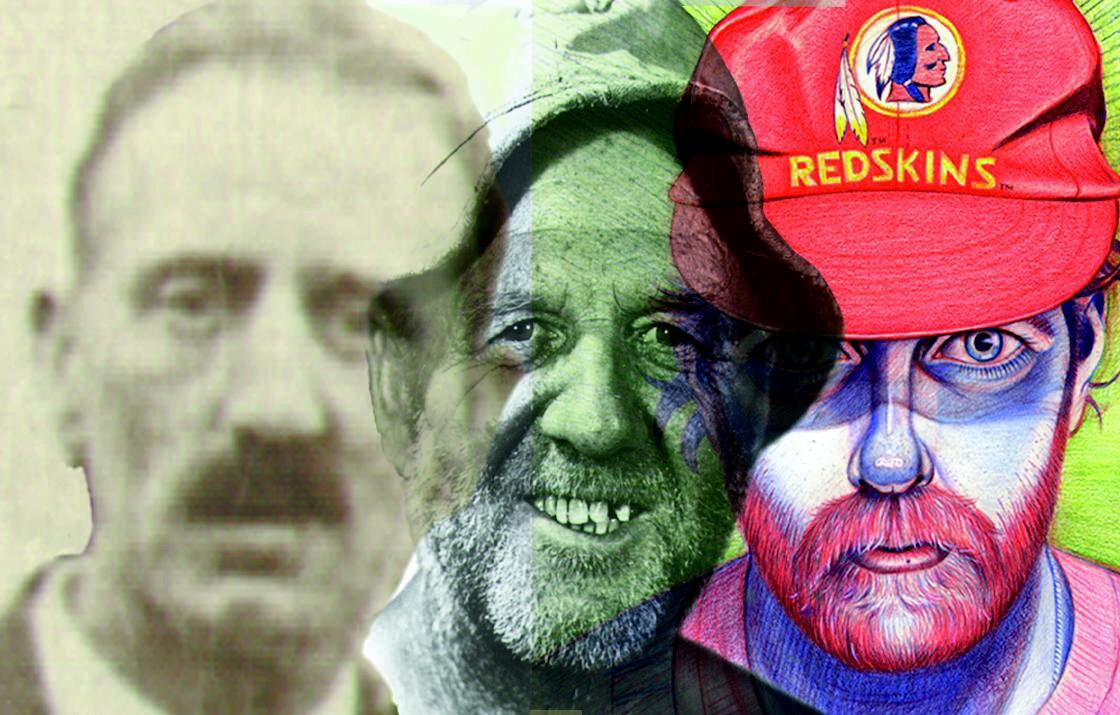
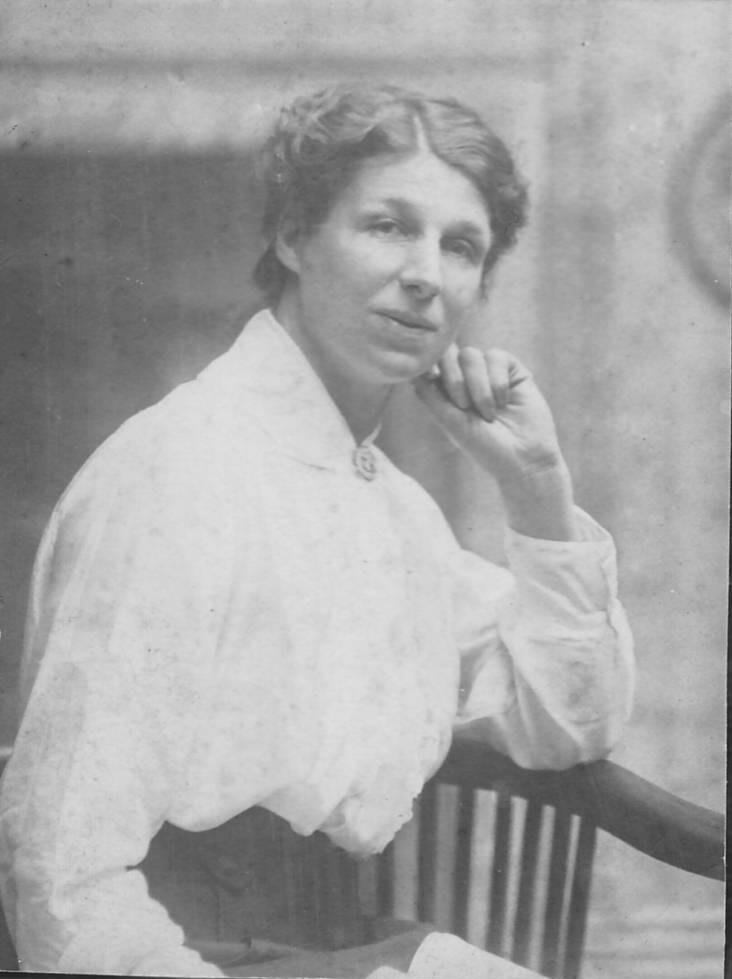
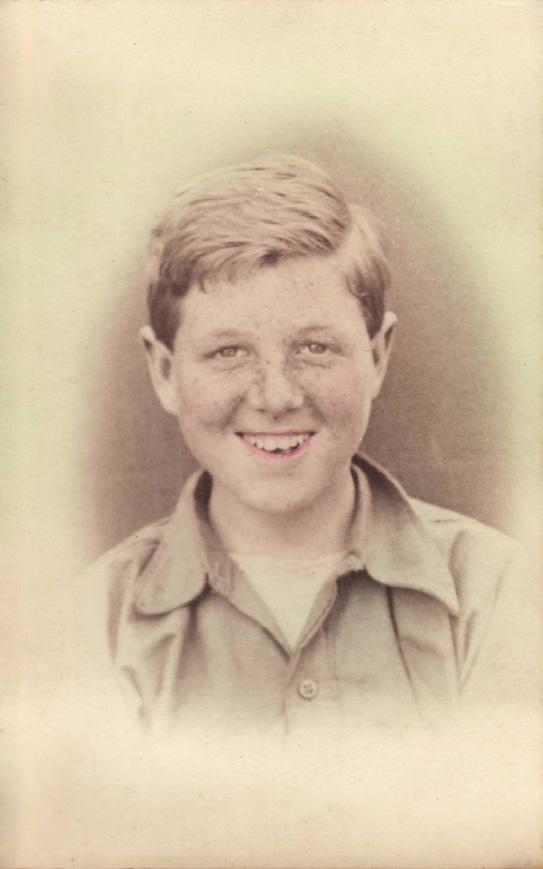
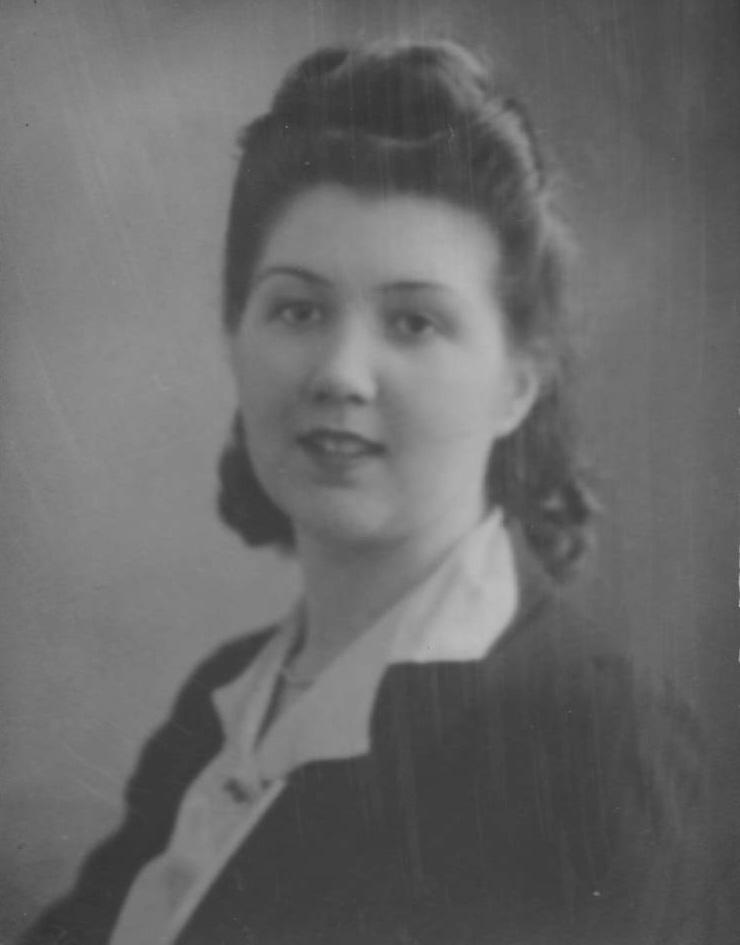
Digital graphic I did in 2009 of (left to right) my Grandfather William Arthur Scarrold, My Father (John James Scarrold) and Me.
I, like most people, have always wondered where I came from. Growing up in Rhodesia in the middle of Africa in the 1950s -1970s I was the only kid in school with the name “Scarrold” which set me on my journey of discovery. All the boys in my class were called either Smith or Jones so I wondered where my surname came from.
All I knew about my heritage was that my father John James Scarrold was born in Shoeburyness, Essex, England in 1919 and that my mother Johanna Magdalena Spangenberg was of Afrikaner origin born in Vereeniging, South Africa in 1913.
My parents met in Pietersburg, Transvaal, South Africa in 1945 when my father was in the Royal Airforce with the Empire Training Scheme stationed in South Africa during WW2. My mother was an orange packer in Tzaneen and Zebadeela Orange Estate, near Pietersburg, Northern Transvaal when they met.
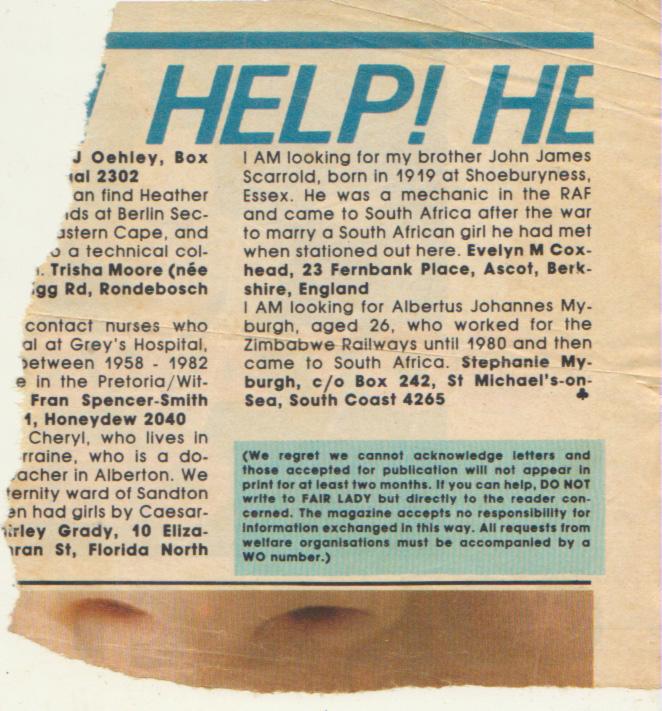
During the 1960s our family went on road trips to South Africa and visited my mother’s relatives in the Transvaal and Orange Free State where I picked up a bit of my mother’s Afrikaner history. My father’s English history was a total mystery to me as he rarely spoke about it. I found out later that he had a row with his sister Evelyn in Shoeburyness when he decided to emigrate to South Africa after he had been demobbed from the RAF after the war had ended in 1945. Evelyn sent a “looking for John Scarrold request” to Fair Lady, a South African woman’s Magazine in 1985 and one of our family friends in Durban recognised my father’s name and sent the article to my mother in Zimbabwe. She sent it to me in Australia and I wrote to Evelyn in England telling her that my father had passed away in Durban, South Africa in 1981 so she had missed him by four years but it was a serendipitous moment connecting up with her. I had met my father’s older brother,William, in Shoeburyness, Essex in 1981 when I was living in UK and had gone to visit him and have a chat about the Scarrold family before I left to live in Australia. He was a stroke victim and was walking with the help of a zimmer frame and as a consequence hadn’t been upstairs in his house for years and it was like walking into a time warp as I went upstairs where the family photos were kept in an old chest of draws.
Scarrold Family Tree
John Skerrell (1751-1831) Islington, London
William John Skerrell (1784 -1838) Islington, London
Sophia Skerrell (1808 -1886) Kings Cross London
William Henry Skerrell (1838-1900) Clerkenwell Workhouse London father unknown
married 1778 Islington, London
Elizabeth Weaver (1750 -1820?) Islington, London
married 1807 Islington, London
John Samuel Skerrell (1811-?)
Elizabeth Perfect (1779-1842) Islington, London
Elizabeth Skerrell (1813-1816)
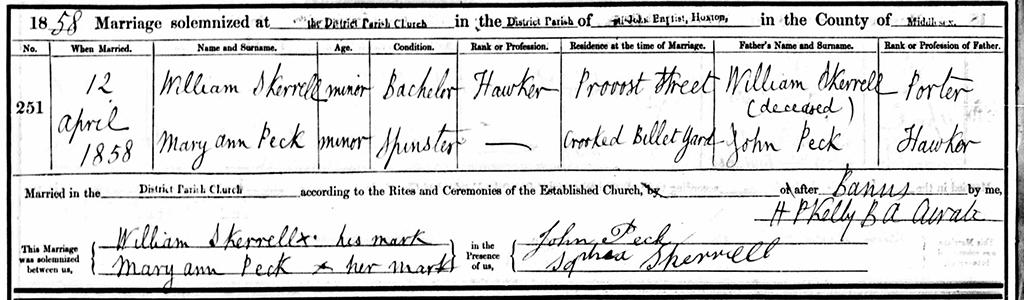
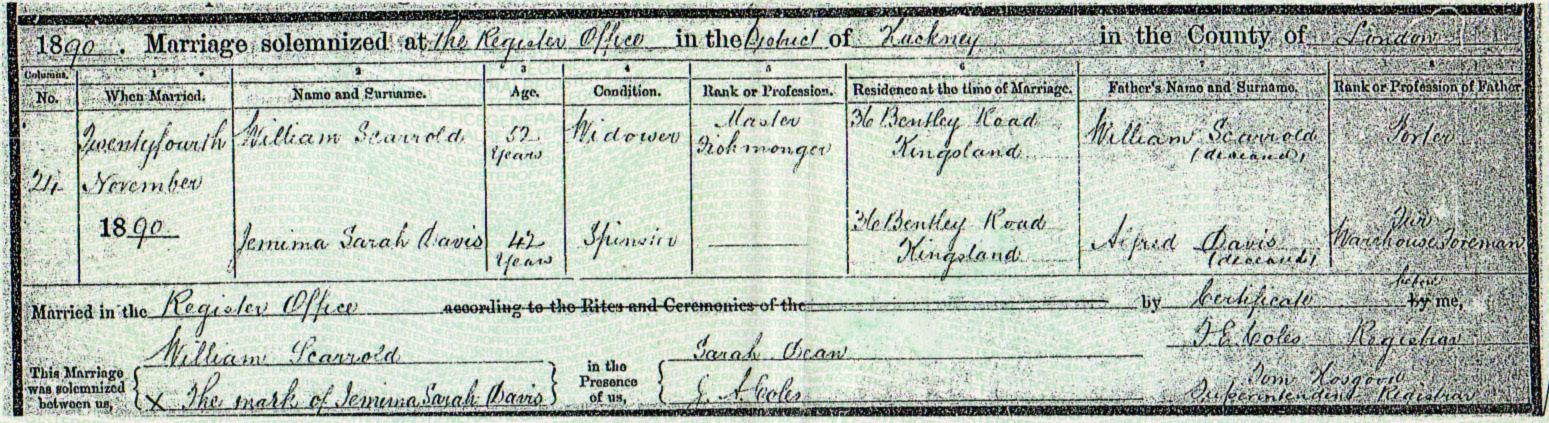
William and Sarah had 5 sons out of wedlock between 1877-1886 in Woolwich and then married in 1890, Hackney, London, England. William’s first marriage was to Mary Ann Peck in 1858. The marriage didn’t last long and they had no children.
The name “Skerrell” was changed to “Scarrold” on the 1871 census by Sarah Daives and Sophia Skerrell for an unknown reason.
Alfred Charles Scarrold (1879 -1955
William Arthur Scarrold (1877-1942) Woolwich, London
John James Scarrold (1919-1981) Shoeburyness, England
William Scarrold (1917-1983)
Vera Scarrold (b.1947)
George Henry Scarrold (1881-KIA1916)
married 1915 Orsett Essex
Sarah Elizabeth Skerrell (1816-1865) London
Sarah Jemima Daives/Davis (1850-1936) Holborn London father Isaac Daives.
Walter Scarrold (1883 - 1956)
Evelyn Scarrold (1924-1998)
married 1945 Pietersburg, South Africa.
He let me take a few and explained to me who the people in the photos were before I left to go back to London. I did notice some letters that he had written from Egypt to his mother during WW2 when he was stationed there. Apparently he had suffered shell shock. I kept in touch with him for a few years when I moved back to Australia. He died in 1983 so in retrospect I wish I had taken more of the family photos and documents as he didn’t have any family (apart from his sister Evelyn) to leave them to and I never knew I would ever write a family history.
I did phone up my Dad’s sister Evelyn in 1987 when I had moved back to London for a few years and wanted to visit her in Ascot, Berkshire for a chat but she was very offish toward me so I didn’t, unfortunately. Her husband was an invalid so I suspect that’s the reason she didn’t want me to visit. Maybe she still held a grudge against her brother from way back in 1945???? Who knows? Families are strange institutions especially when it comes to grudges!!!! Evelyn passed away a year later in 1988.
I had first started looking into the Scarrold family genealogy when I was in London in 1992 and it turned out to be a real roller coaster ride with many twists and turns.
Philip Scarrold (b.1952)
Evelyn Scarrold (b.1954)
Henry Scarrold (1886 -1955)
Emma Mary Kruse (1884-1962) Poplar, London
Johanna Magdalena Spangenberg (1913-1996) Vereeniging, South Africa
marriage of
Arthur
in October 1915.
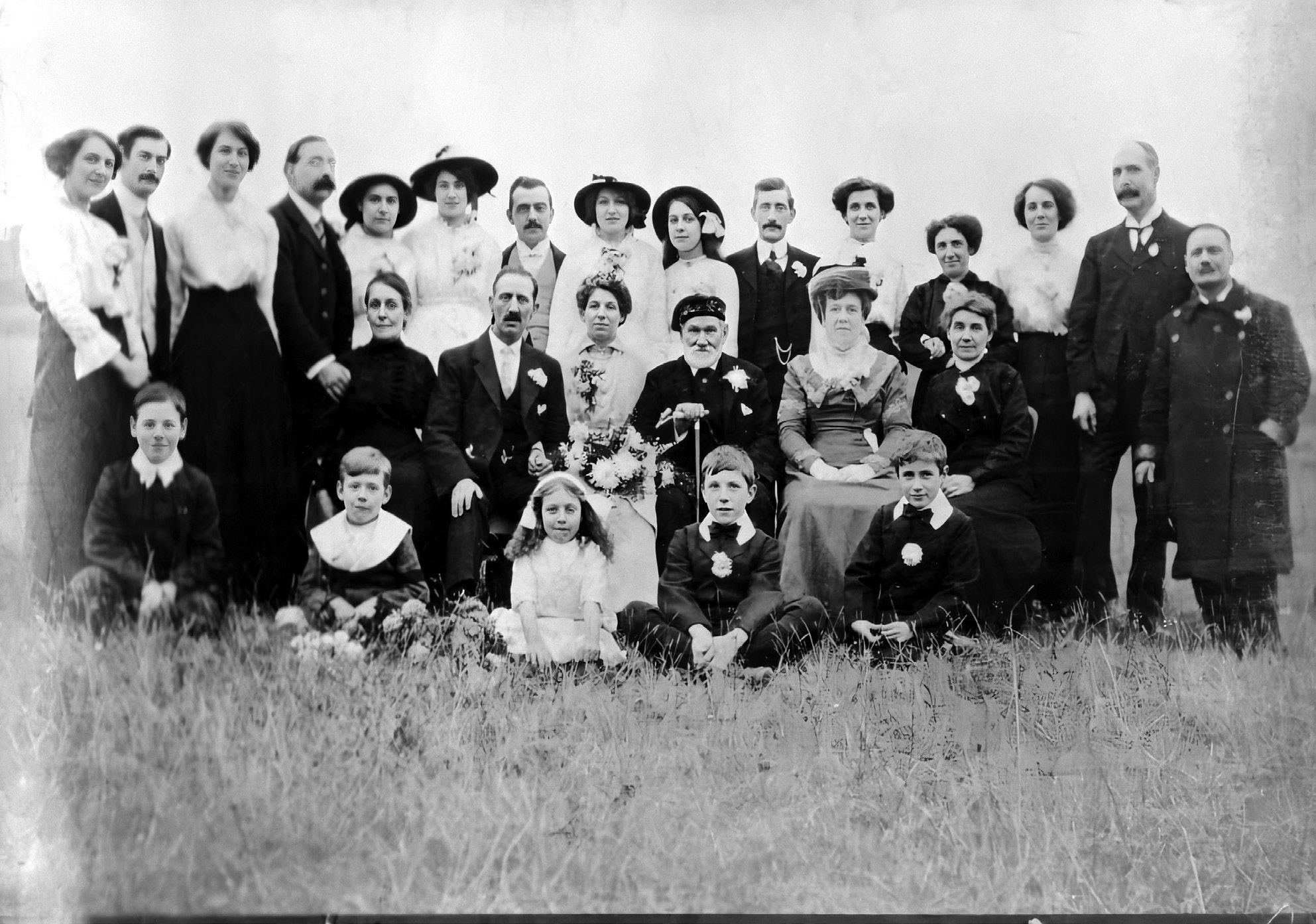
A photo I got from my uncle William Scarrold when I went to visit him in 1981.
The
William
Scarrold (my grandfather) to Emma Mary Kruse (my grandmother) at Orsett, Essex
My grandfather, William Arthur
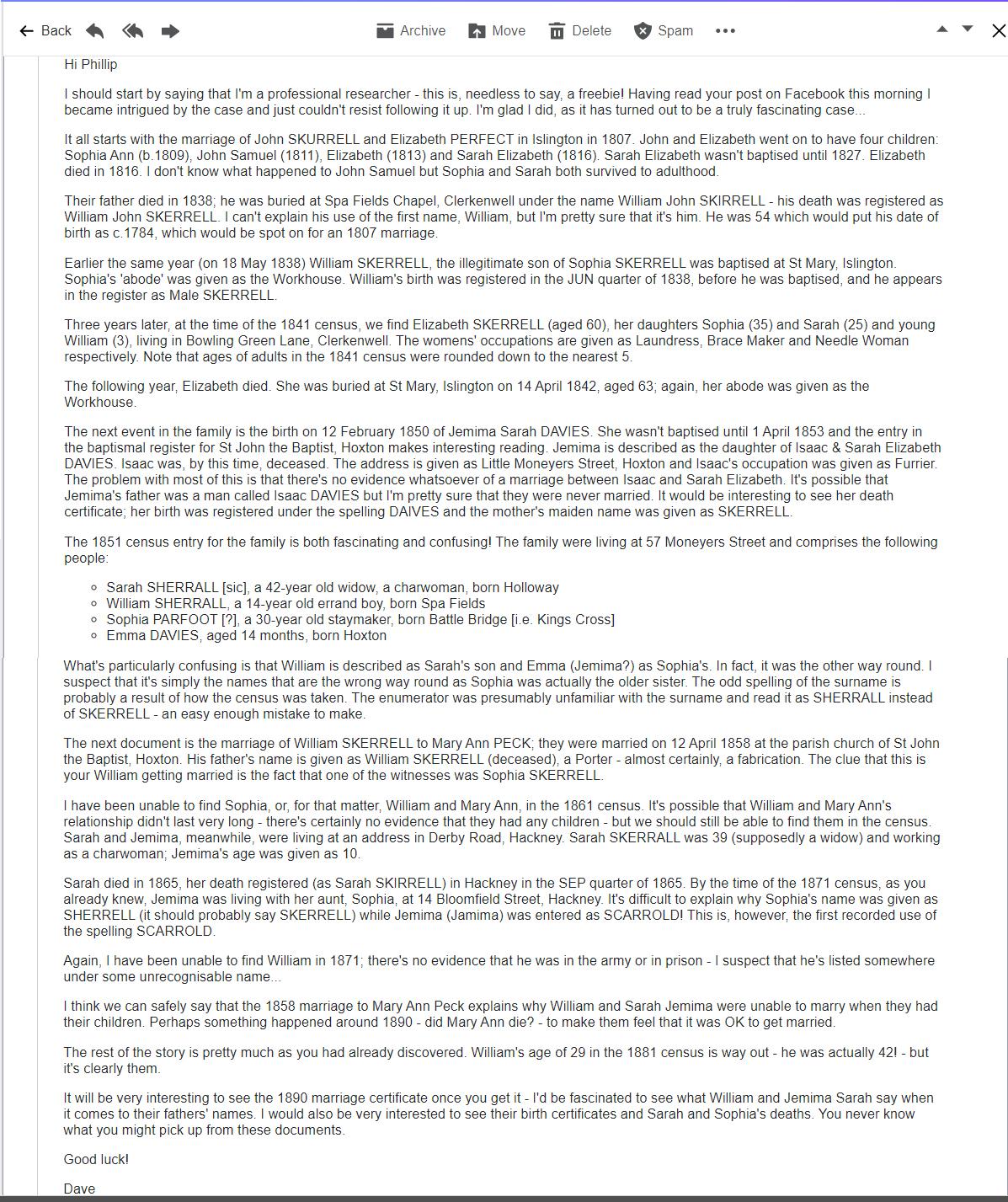
My first search started off at the records office of the Church of Latter Day Saints in Kensington, London when I was living near Hyde Park in 1992. This was pre computer days when records were kept on microfilm. I couldn’t find any “Scarrold” in their records, only a few variations of the spelling like Scarrall, Scarrell, Skarle etc. It turns out my surname “Scarrold” was originally spelt “Skerrell” prior to 1877 which I only found out in 2018 when I met a professional genealogist on London History Forum on Facebook who was interested in my story. He agreed to research my Scarrold history for free in exchange for my story so I jumped at the offer as I had hit a brick wall and wasn’t able to find out much in my computer searches since 2000.
Document from the Church of Latter Day Saints, London
The marriage of my parents in Pietersburg, South
The second part of my search started off straight forwardly when I went to the BMD records office on Kingsway, London just down from Holborn tube station. I walked into the search room filled with huge vellum books and took a wild guess as to my grandfather William Arthur Scarrold’s date of birth. I remember my father telling me that his father got married late in life. I hit the jackpot with the first book I opened which was 1877! I applied for the certificate which arrived by post a week later. It had his father’s (William Henry Scarrold) and mother’s (Sarah Davis) name on it and they lived in Woolwich Dockyard and his occupation was listed as a General Dealer. So now my aim was to find William Henry Scarrold’s birth certificate and then go further back in time. It sounded like a straightforward task but turned out to be a lot more complicated until I met the professional geneaologist on Facebook who discovered the change in the spelling of “Scarrold” from “Skerrell”.
William Arthur Scarrold’s (my grandfather) birth certificate 1877.
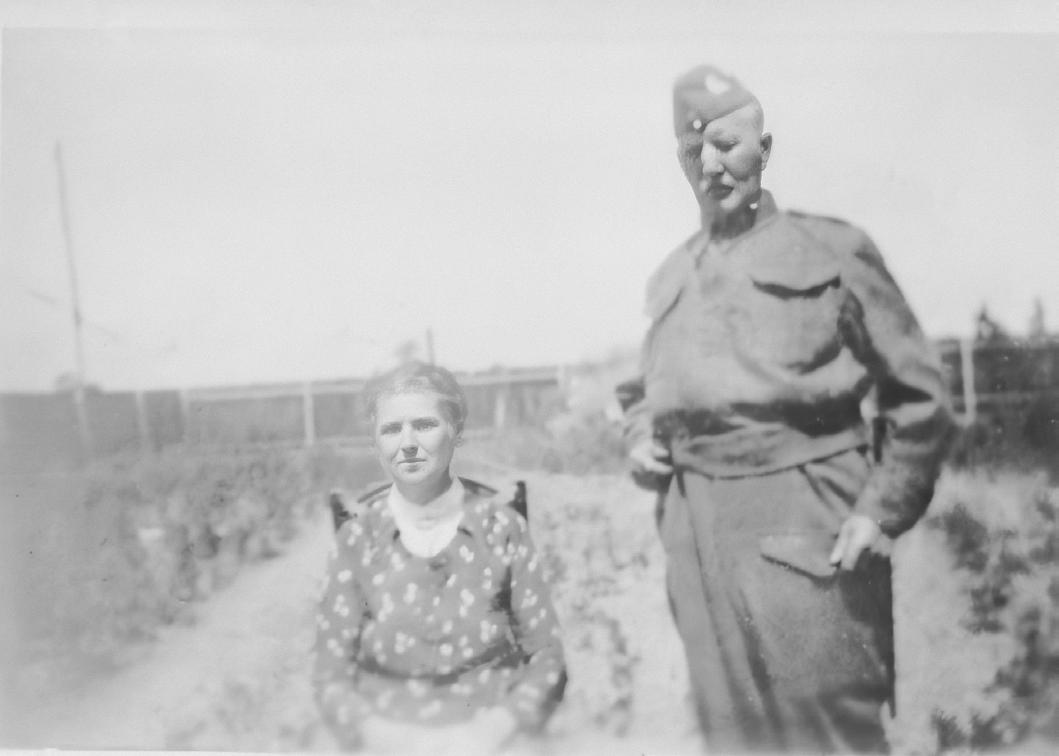
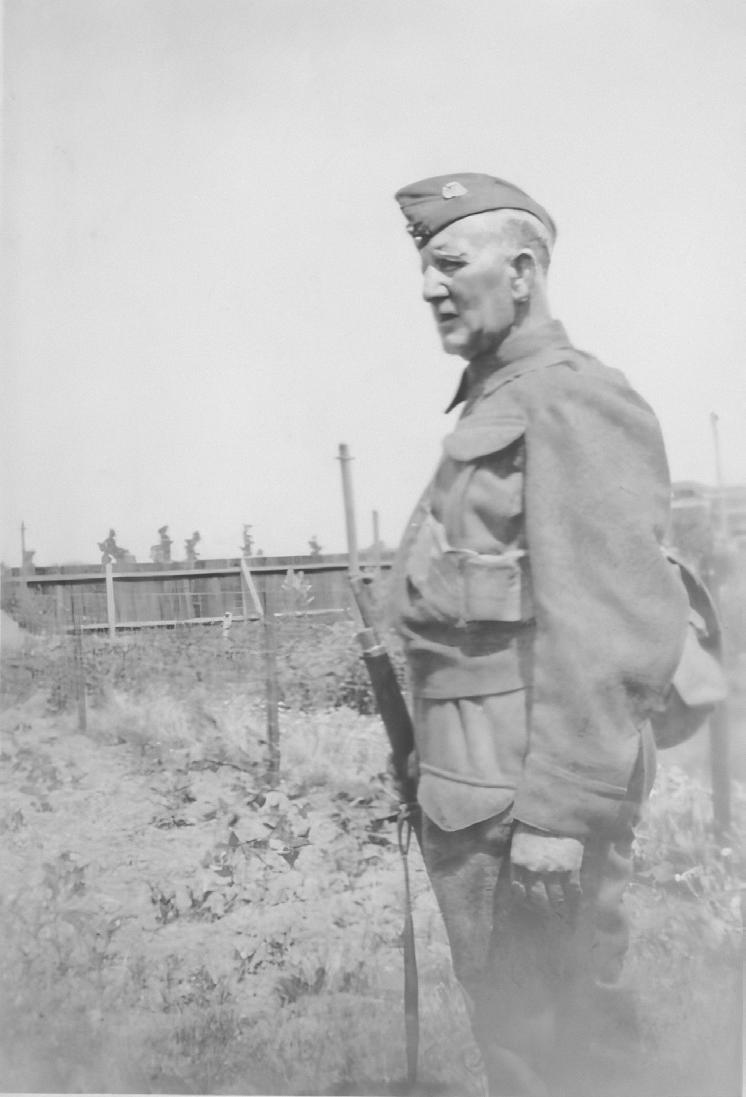
Scarrold with his wife Emma in their back garden in Shoeburyness, Essex circa 1940 during WW2. William was in the Home Guard and died in 1942. Emma died in 1962 aged 80.
My father’s mother (my grandmother) Emma Mary Kruse circa 1930s.
My father John Scarrold circa 1930 aged ~10. My father’s sister Evelyn Scarrold circa 1940.
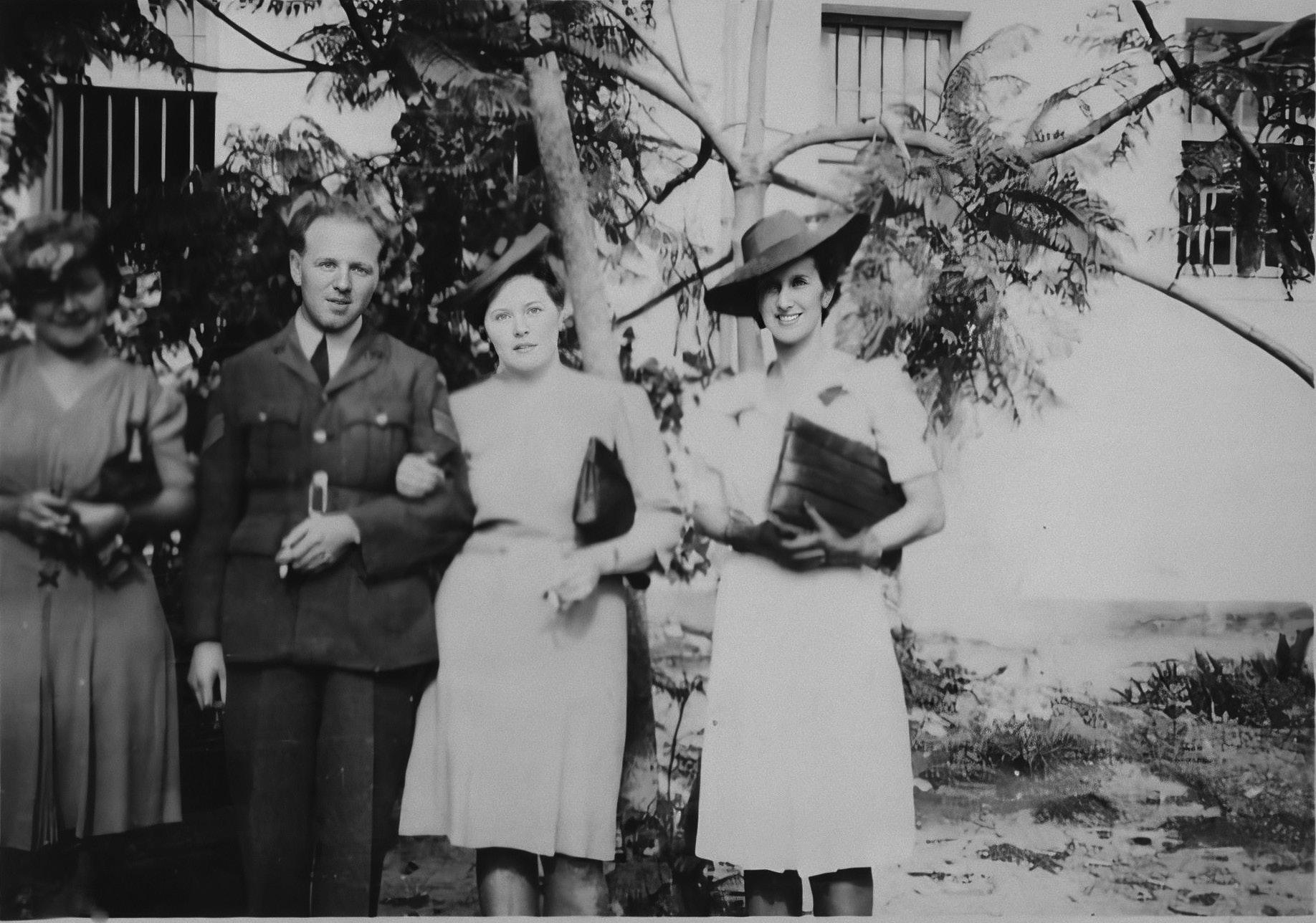
Africa 1945.
Scarrold Family Tree
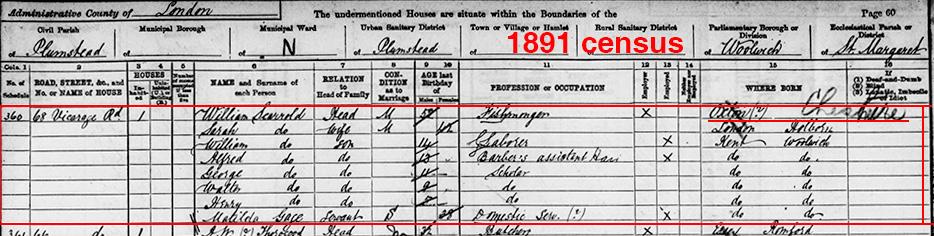
The first census I found of William Henry Scarrold and his family was 1891 in which his occupation is listed as Fishmonger and his place of birth as Oxton (?) and someone had written Cheshire in pencil next to it which ended up confusing me and sending me on a ten year wild goose chase. I later found out that the enumerator must have misunderstood “Hoxton” for “Oxton”. The Cockney’s drop their ‘H”s.
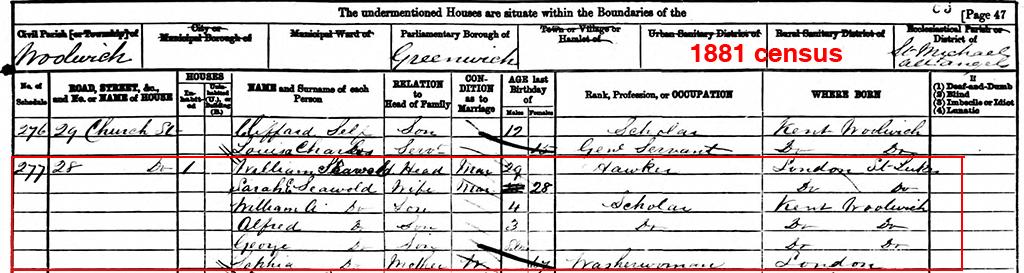
I found out that Oxton is on the Wirrel, Cheshire opposite Liverpool so I joined the Wirrel Geneaology group on Facebook in the hope of finding out more info. I found a few “Scarrolds” in the Cheshire area but nothing definitive until a member of the group sent me the 1881 census which mentioned that William Henry Scarrold was born in St Lukes (London) and not Oxton, Cheshire as the 1891 census wrongfully states. His occupation is listed as a Hawker. William and Sarah had 3 children by 1881 (William, Walter and George). Sophia is William’s mother and was living with them and is listed as a washerwoman. Her surname name was Skerrell and as William was illegitimate he took her surname, later changed to Scarrold in 1871 by Sarah Davis for an unknown reason. There is no record of the father’s name but his Y (paternal) dna haplogroup was I1a (Scandinavian) which I inherited. Paternal Y dna is passed down from father to son.
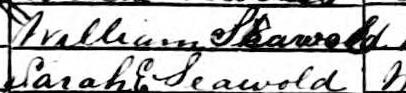
If you look carefully at the above close up from the 1881 census you will see that the census enumerator started writing “Skerrell” then it was changed to “Scarrold”. Sarah’s middle name was Jemima (Emma) which she sometimes used as her first name.
I found the above 1871 census on the internet in about 2016 and I was confused by the names Jamima Scarrold and Sophia Sherrell (Skerrell) listed as aunt and niece living in Hackney, East London. I thought there must be a connection to my family but I couldn’t quite put my finger on it until years later. I had an inkling that Sophia was William Henry Skerrell’s mother and thought that Jamima (Sarah) might be his cousin which actually turned out to be correct in the end!!!!
Jemima (aka Sarah, Emma) had changed her surname from Davis/Daives to Scarrold for an unknown reason on this 1871 census. William is strangely absent from the records after he married Mary Anne Peck in 1858 until 1877 when his first son William Arthur Scarrold (my grandfather) was born out of wedlock in Woolwich. Apparently the marriage to Mary Anne didn’t last long and they had no children (?) nor did they get divorced (divorce was expensive). William Henry then had 5 sons out of wedlock from 1877-1886 with his cousin Jemima Sarah Davis (ie: William Arthur, Alfred, George, Walter, Henry). They officially got married in 1890 in Hackney to make it legal and it is thought that they waited for Mary Anne to pass away before they tied the knot so as not to commit bigamy. There are no records of what happened to Mary Anne.
to Jemima Sarah Davis 1890.
William Henry Skerrell’s (my gt grandfather) first marriage to Mary Anne Peck 1858. William lied about his father who was unknown although his mother Sophia knew.
William Henry Scarrold’s (my gt grandfather) second marriage
This is a letter I received from the professional genealogist I met on Facebook in 2018 outlining his discovery of the Skerrell family history in London. It is VERY complicated!!!!!
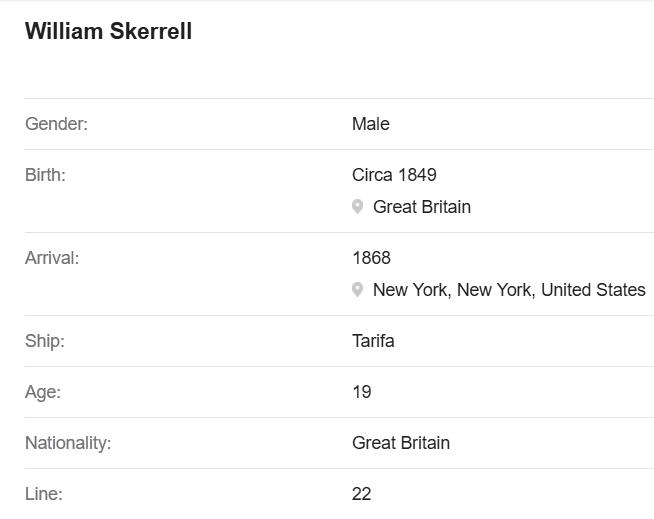
William disappears from the records from 1858 - 1877 and there is no record of him in prison or the army so it is a total mystery as to his whereabouts. I did find a record of a William Skerrell travelling from England to New York in 1868 on the steamer Tarifa but it might not be him????
He might have gone to America in 1868 until 1877 for work but I don’t really know. The age is wrong as William would have been 30 in 1868 but this is not a problem as many people back then didn’t really know their ages as I have discovered.
1851 Census. Sophia Parfoot (Skerrell) is the eldest sister aged 42. She used her mother’s name Perfect (Parfait) for an unknown reason. William is her son aged 14 listed as an errand boy. Sarah Sherrall (Skerrell) is the younger sister of Sophia aged 30 and Emma (Jemima) Davies is her daughter aged 10 months. The enumerator mixed the sisters’ names up.
Sarah Daives’ (Davis) birth certificate 1851. Her father is listed as Jacob
but it changes to Isaac and Alfred on other certificates.
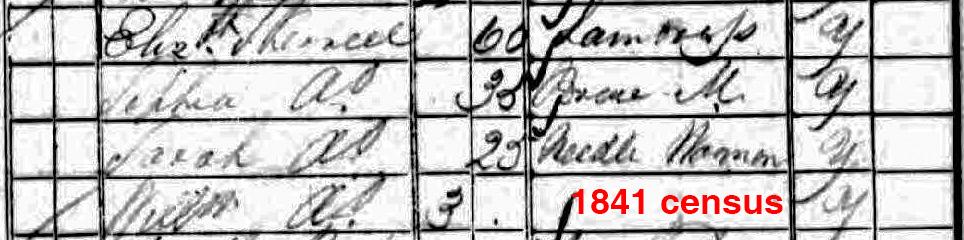
1841 Census. Elizabeth Skerrell the mother aged 60, laundress. Her daughters, Sophia Skerrell aged 30, brace (corset) maker, Sarah aged 25, needle woman and William (Sophia’s son) aged 3 years old.
Jemima
Daives
Workhouses
April1838.
William Henry Scarrold’s (Skerrell) death certificate in Rochford Union Workhouse dated 2nd January 1900. Some of the information is wrong like his age and occupation. He would have been 62. He might have been a farm labourer although his occupation was a fishmonger. I suspect he had a stroke in the family home in Shoeburyness, Essex and was rushed to the Rochford Union Infirmary where he died. The whole irony of this is that William Skerrell was born in a workhouse and died in a workhouse as well. It was a real stigma to be born in a workhouse during Victorian times and it followed the person around all their life
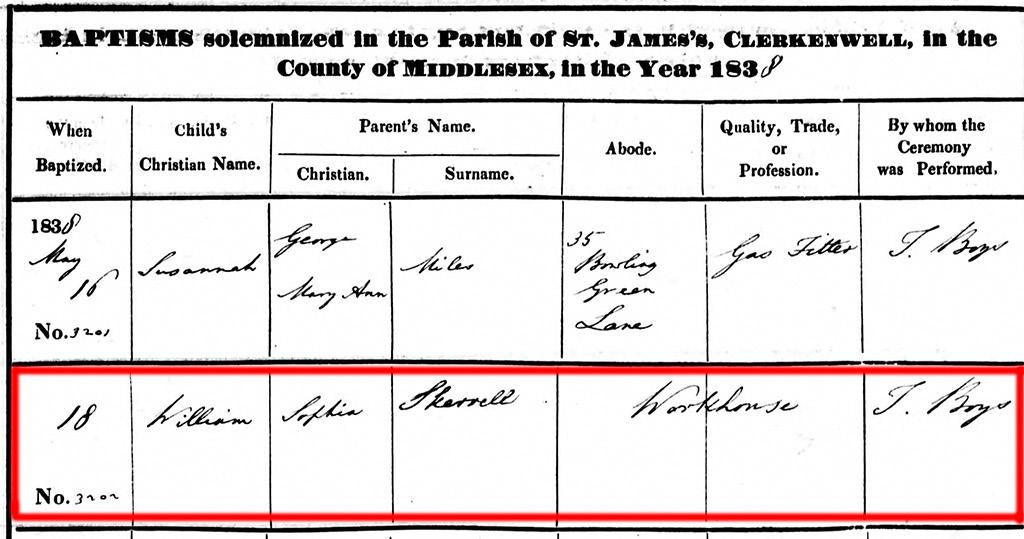
William Henry Skerrell’s birth certificate, Clerkenwell Workhouse, 23rd
William Henry Skerrel’s baptism certificate 1838.
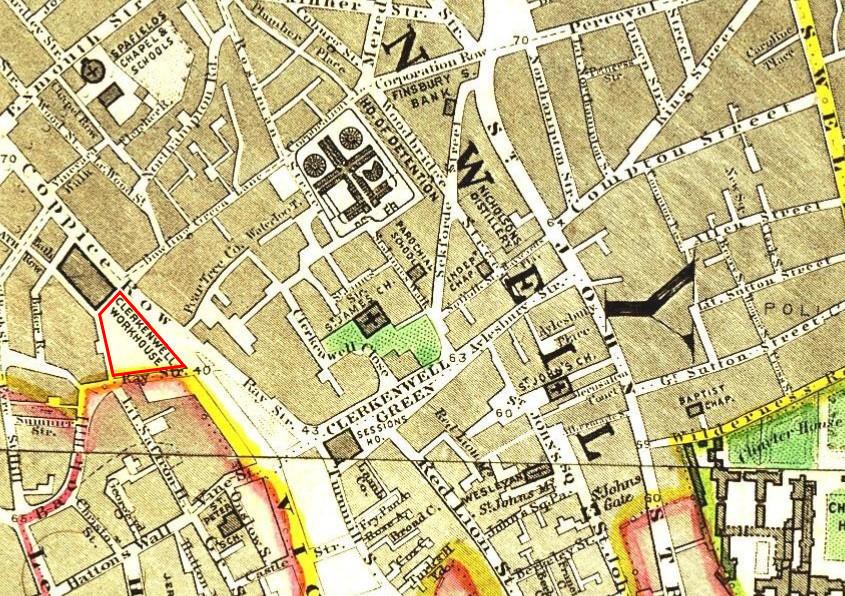
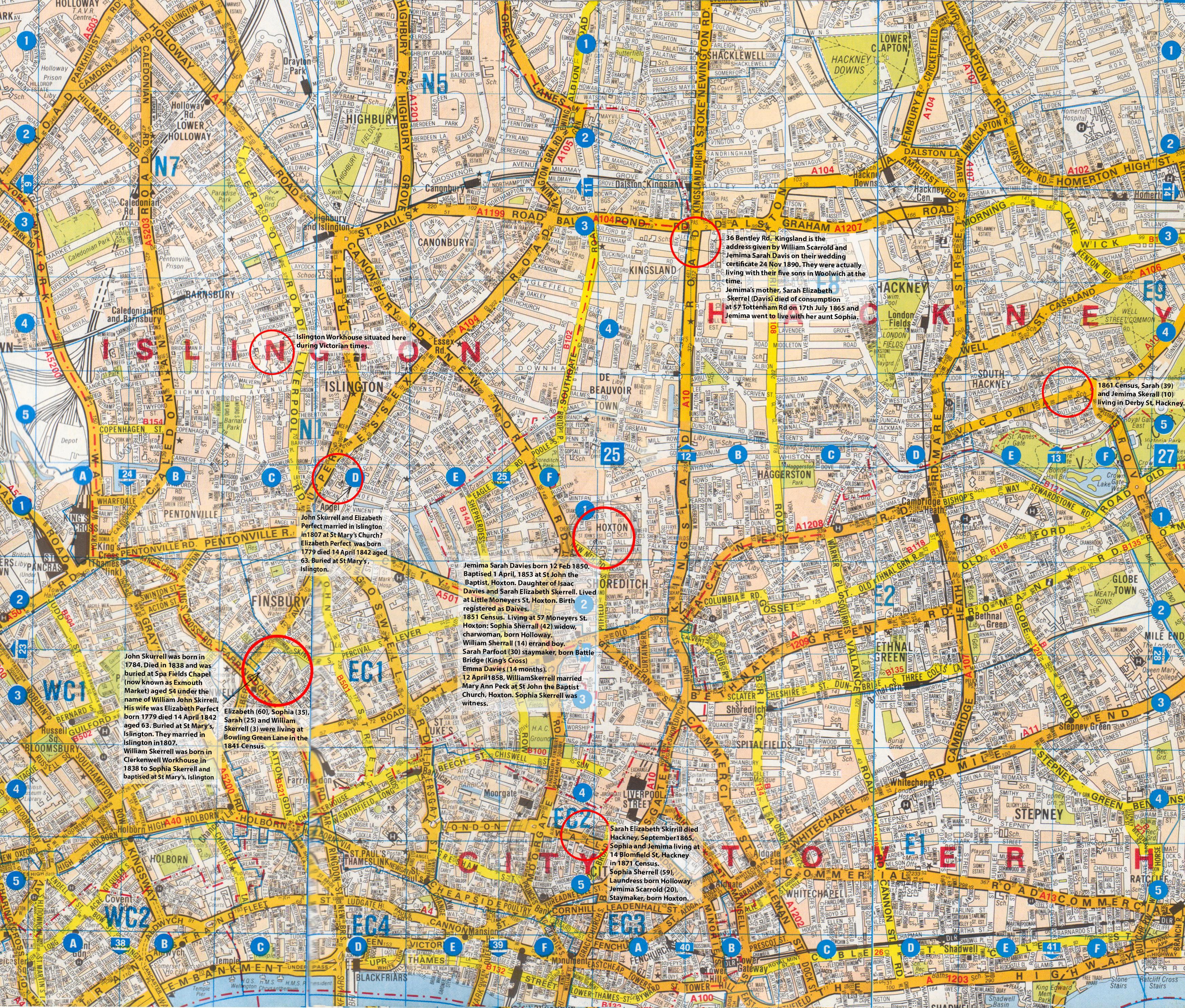
Map of Clerkenwell, London circa 1838.
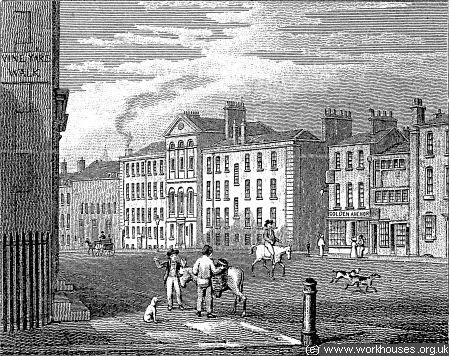
Clerkenwell Workhouse circa 1838.
Clerkenwell Workhouse circa 2023.
1861 Census. Sarah Skerrell aged 49, charwoman living in Hackney with her daughter, Jemima Davis aged 10.
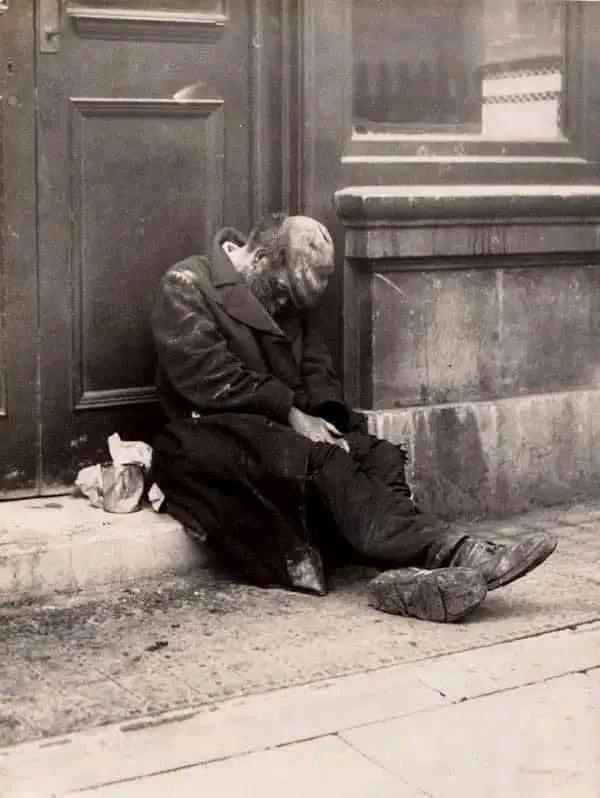
Dickensian London
“A dirtier or more wretched place he had never seen. The street was very narrow and muddy, and the air was impregnated with filthy odours. There were a good many small shops, but the only stock in trade appeared to be heaps of children, who, even at that time of night, were crawling in and out at the doors, or screaming from the inside. The sole places that seemed to prosper amid the general blight of the place, were the public-houses; and in them, the lowest orders of Irish were wrangling might and main. Covered ways and yards, which here and there diverged from the main street, disclosed little knots of houses, where drunken men and women were positively wallowing in the filth; and from several of the door-ways, great ill-looking fellows were cautiously emerging, bound, to all appearance, on no very well disposed harmless errands.”
Oliver Twist, Charles Dickens - 1837
Incidentally Dickens wrote Oliver Twist between 1837-1839 while he was living in Bloomsbury, London which is near Clerkenwell where my gt grandfather William Skerrell was born in 1838 so William would have known Dickens’ world. Coincidentally, when I arrived in Sydney, Australia in 1981 my first job was working on an animated version of Oliver Twist.
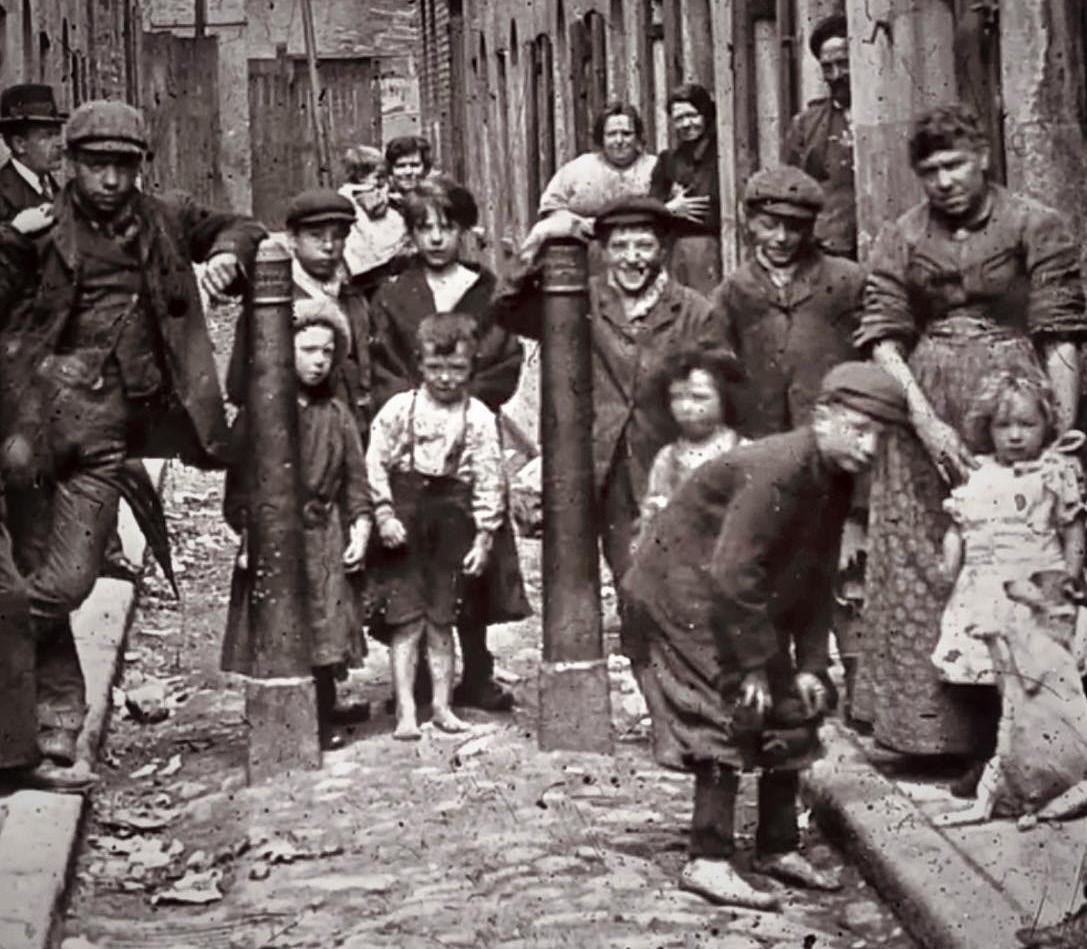
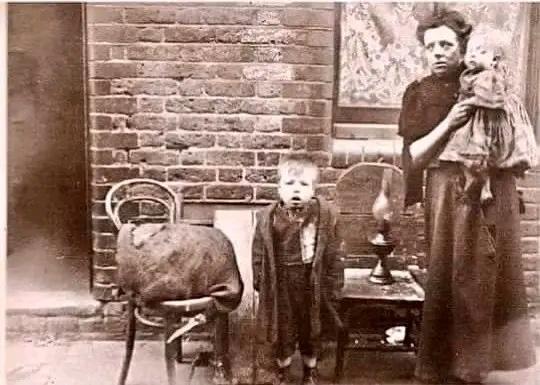
A street scene from London circa 1800s. My gt gt grandmother Sophia Skerrell and her family lived in Bowling Green Lane opposite Clerkenwell Workhouse in the 1830s-1840s . I presume it looked similar to this.
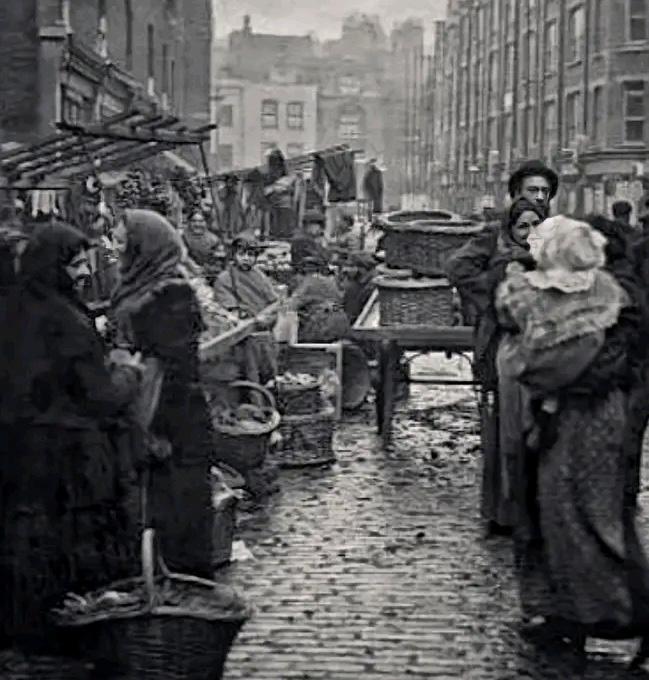
My gt grandfather William Skerrell would have recognised this street market scene in London as he worked as a hawker in the markets around the Islington area of NE London in the 1850-60s. He started as an errand boy at age 13 years old. He eventually moved to Woolwich in 1877 with his partner Sarah Jemima Davis and started a family and eventually owned a fishmonger shop. They got married in 1890.
WW1 MILITARY SERVICE
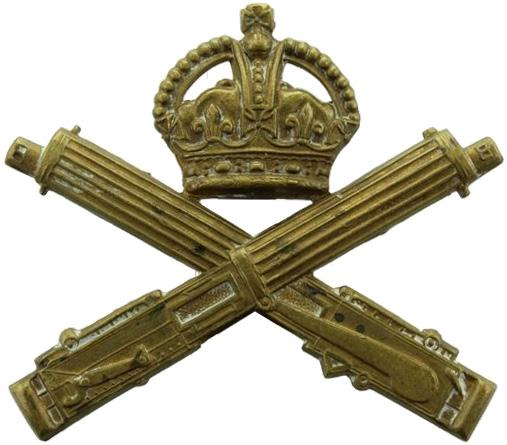
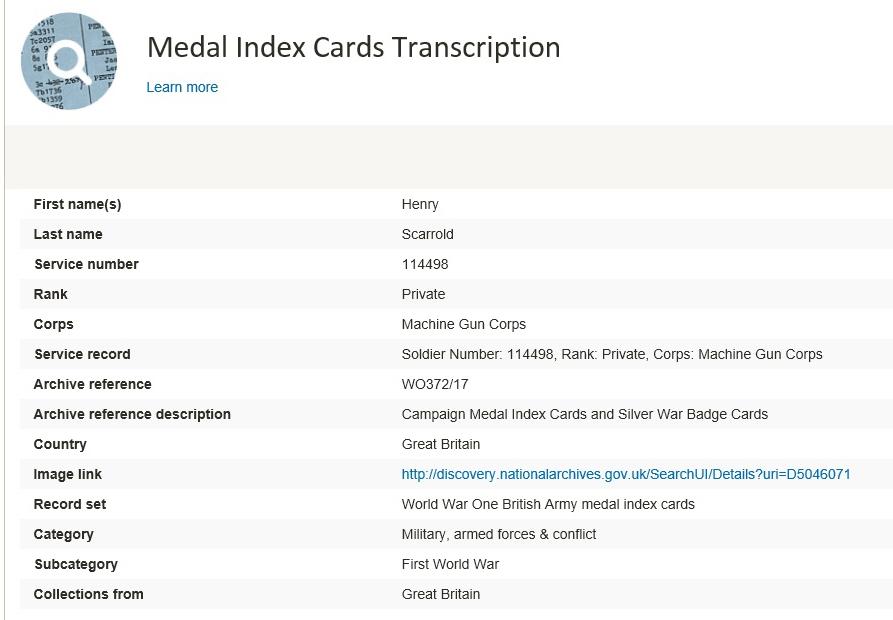
Thank you for your message relating to your great uncle Henry Scarrold and the Machine Gun Corps. Sadly, I have very little information to pass on to you. It would appear that he volunteered in September 1914, but was discharged, for unknown reasons in February 1915 - my guess is that he did not, at that time, measure up medically to the requirements for an active service soldier in the Highland Light Infantry. However, we know that he subsequently served in the Machine Gun Corps. His number (114498) indicates that he joined in August 1917. My guess is that although he had been discharged back in 1915, he was still subject to conscription, if he could then be accepted as physically fit. The requirements, in 1917, were much less than in 1914.
Unfortunately none of his service papers relating to his time with the MGC have survived - almost certainly among the 4-million sets lost to fire during the blitz on London in 1940. All that is known is that he survived the war, to be discharged on 28/3/1919, going into Class “Z” Reserve, which implies that the army then regarded him as fit, and liable for recall in emergency. He earned the silver British War medal and bronze Allied Victory medal, but I have absolutely no idea where he served during his overseas service.
Very sorry to be unable to help any further in this case.
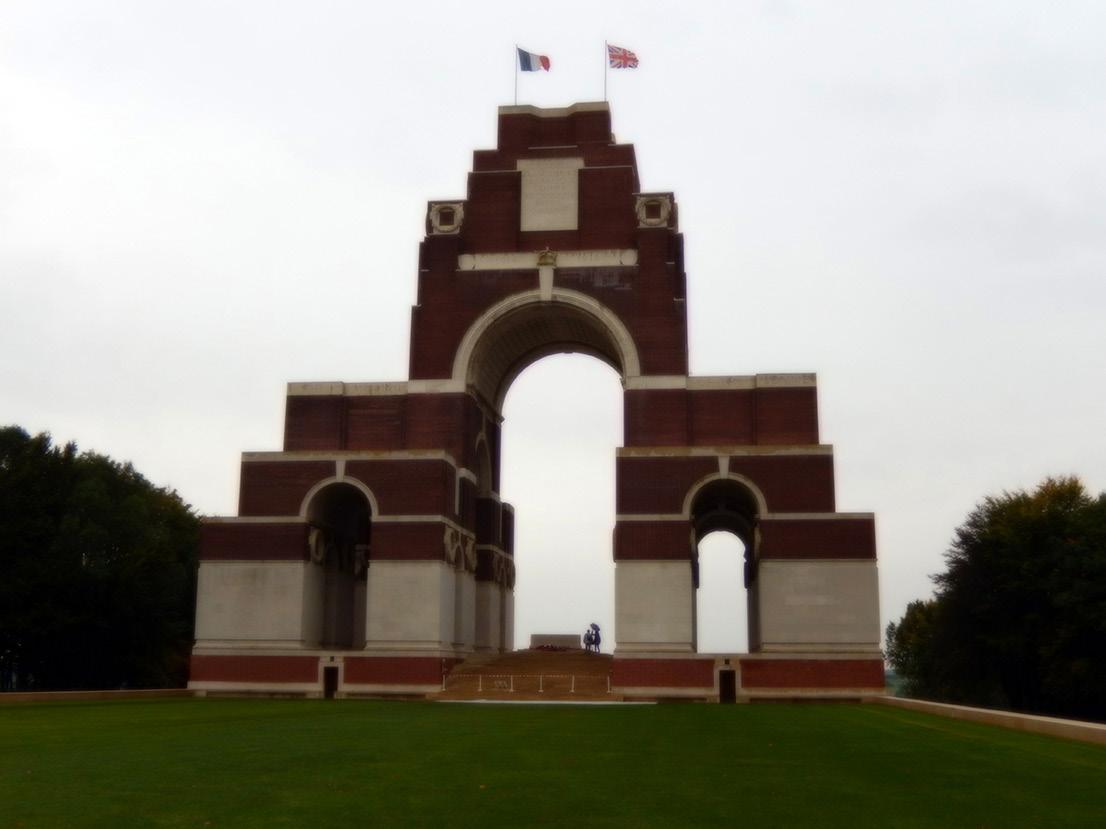
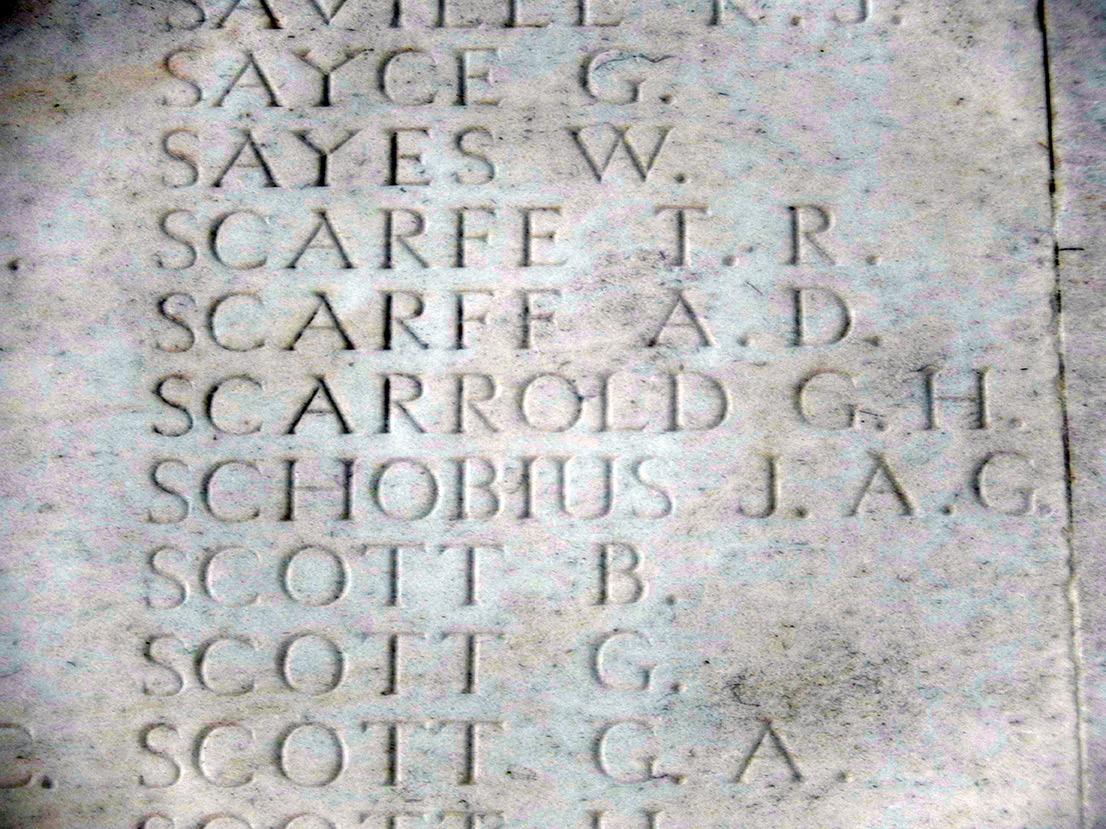
WWI Monument at Thiepval, Flanders.
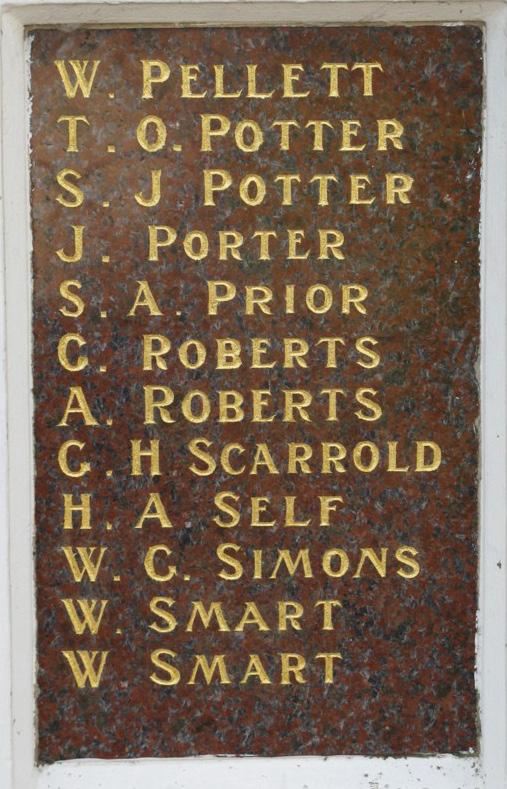
WWI memorial Shoeburyness, Essex.
WWI memorial at Thiepval, Flanders.
Machine Gun Corp badge.
Henry Scarrold’s Story.
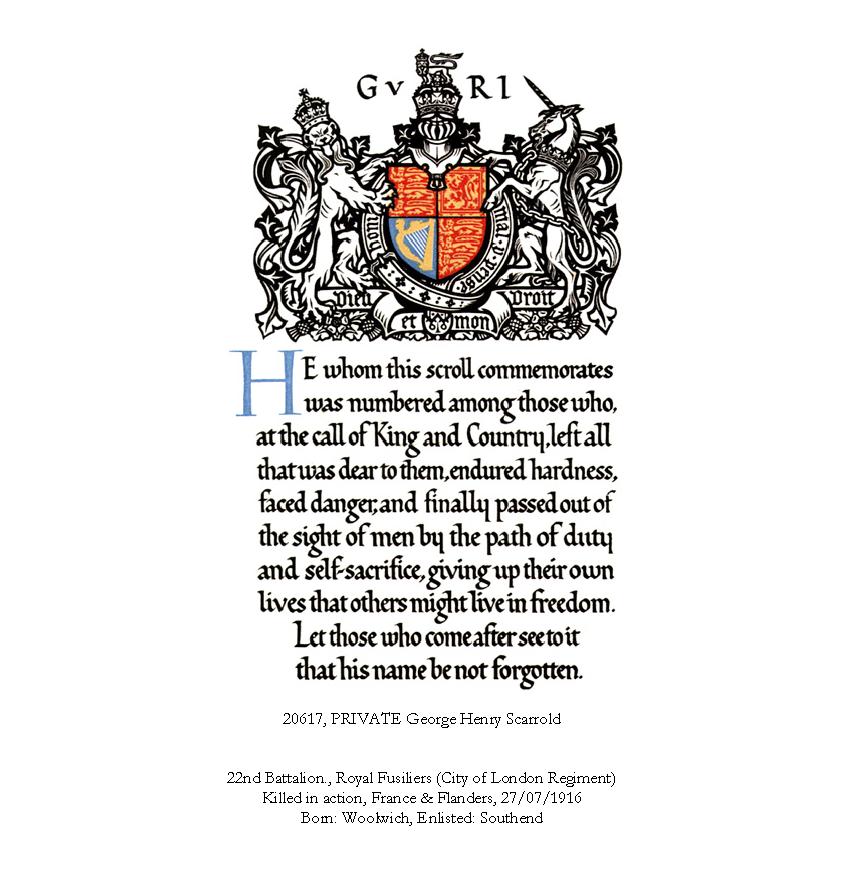
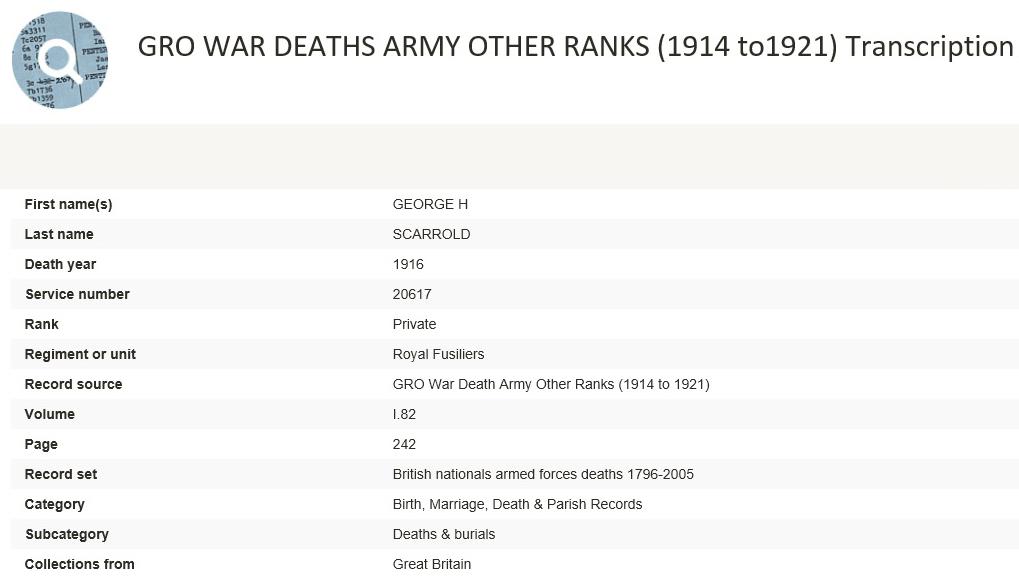
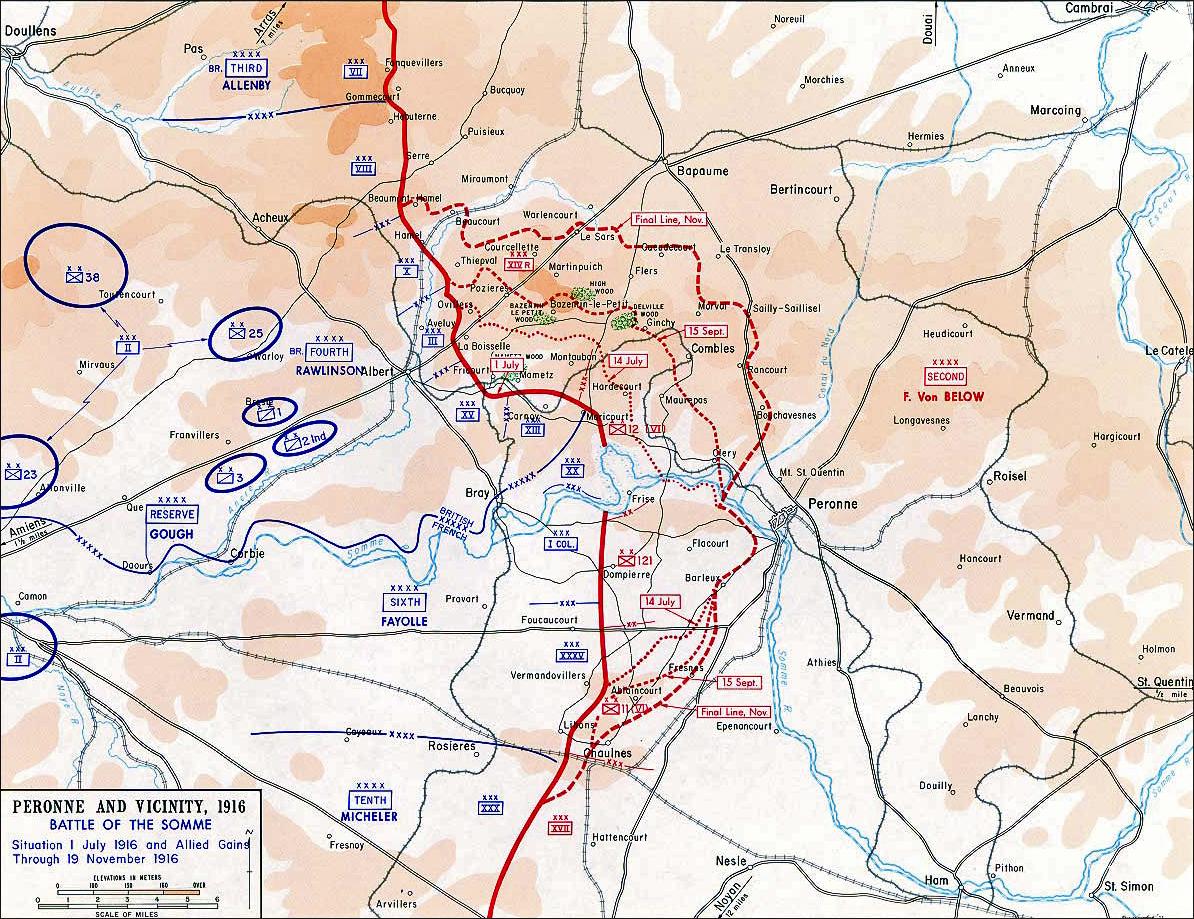
Battle of the Somme July - November 1916. My gt uncle George Henry Scarrold w as KIA at the Somme 27 July 1916.
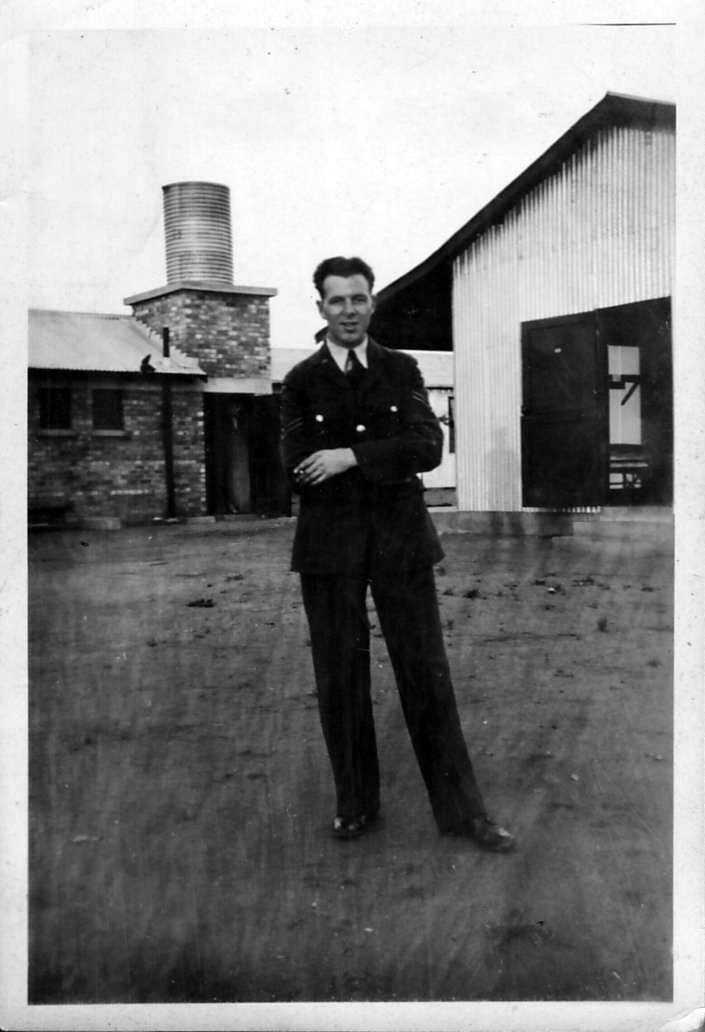
My father during WW2 at an airfield somewhere in England. He was an airframe fitter in the Royal Air Force.
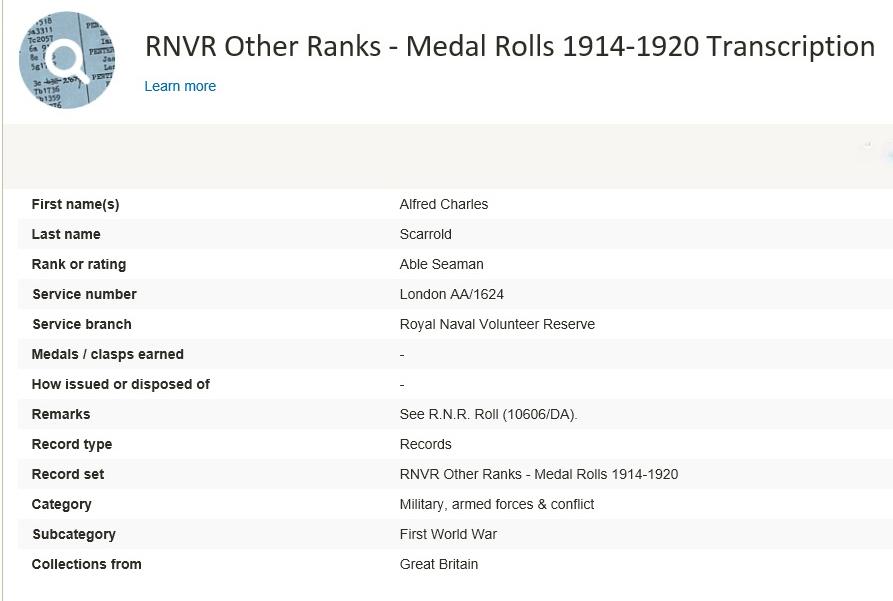
Record of Alfred Charles Scarrold’s military service in the Royal Navy Volunteer Reserve during WWI.
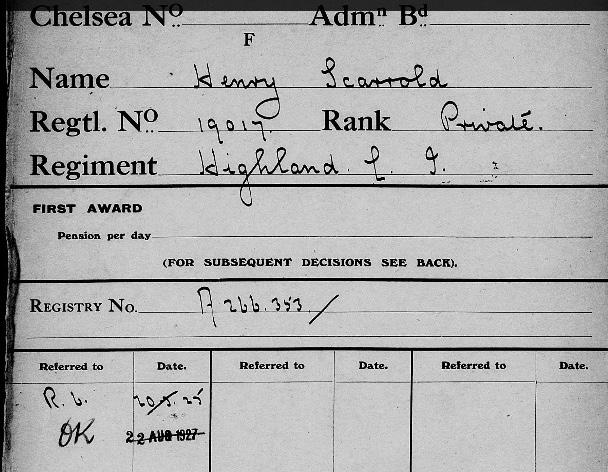
Record of Henry Scarrold’s military service in the Machine Gun Corps of the Highland Light Infantry during WWI.
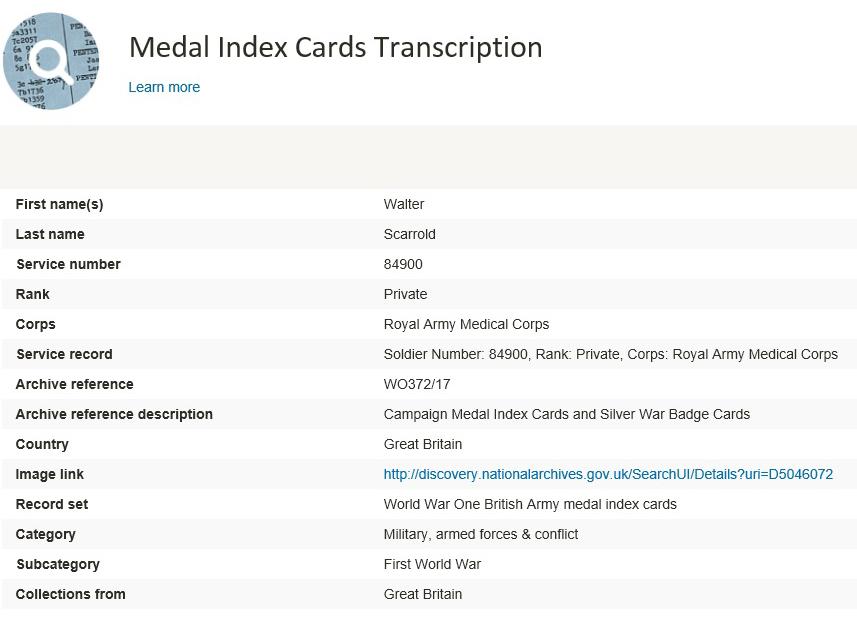
Record of Walter Scarrold’s military service in the Royal Army Medical Corps during WWI.
Record of George Henry Scarrold’s military service in the Royal Fusilliers during WWI. He was KIA at the Battle of the Somme 27th July 1916.
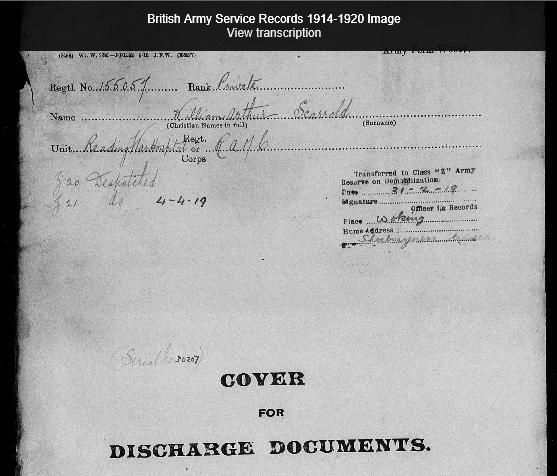
Record of William Arthur Scarrold’s discharge papers from the Royal Army Medical Corps after WWI. He worked at Woking Hospital as a medical orderly during WWI.
Record of Henry Scarrold’s discharge papers from the Highland Light Infantry after WWI.
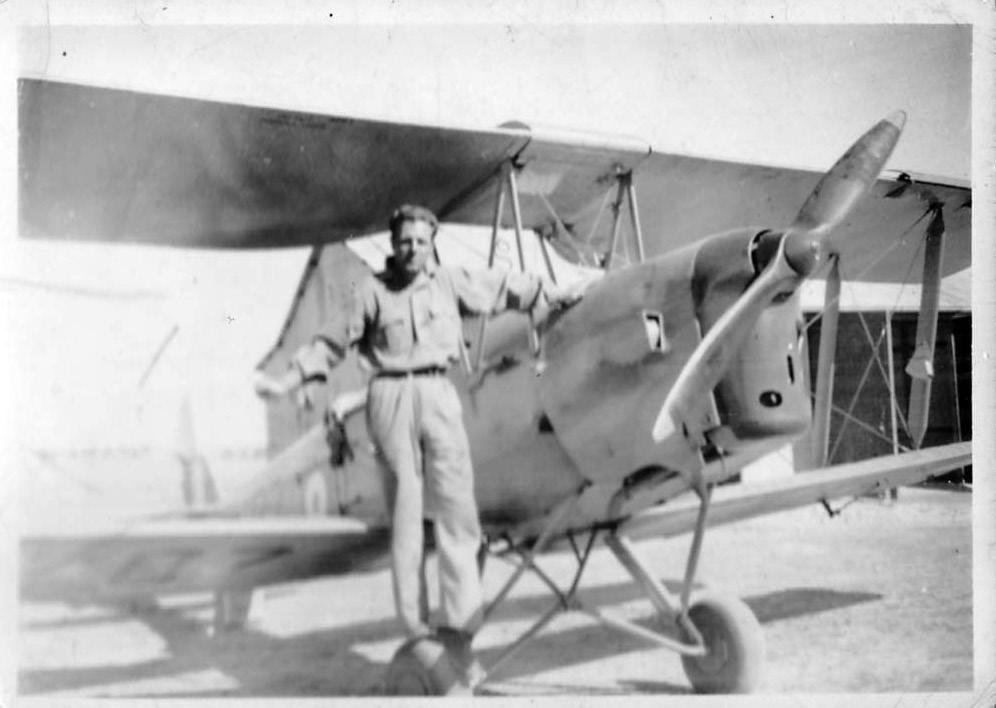
My father posing on a Tiger Moth aeroplane circa 1940.
Kruse Family Tree
George Kruse (aka. German George) (1792 - 1855) Hamburg Germany
George James Kruse 1 (1832 -1916) Poplar London, England
George James Kruse 2 (1856 -1915) Poplar London, England
Emma Mary Kruse (1884 -1962) Poplar London, England
John James Scarrold (1919 -1981) Shoeburyness, Essex, England
Vera Scarrold (b.1947)
1915
Mary Margaret Green (1799 -1885) Southwark London, England
Maria Mary Ann Taylor (1834 -1900) Sheerness Kent, England
Emma Mary Smale (1855 -1928) Paddington London, England
William Arthur Scarrold (1877-1942) Woolwich Kent, England
Johanna Spangenberg (1913 -1996)
Vereeniging South Africa
Philip Scarrold (b.1952)
Evelyn Scarrold (b.1954)
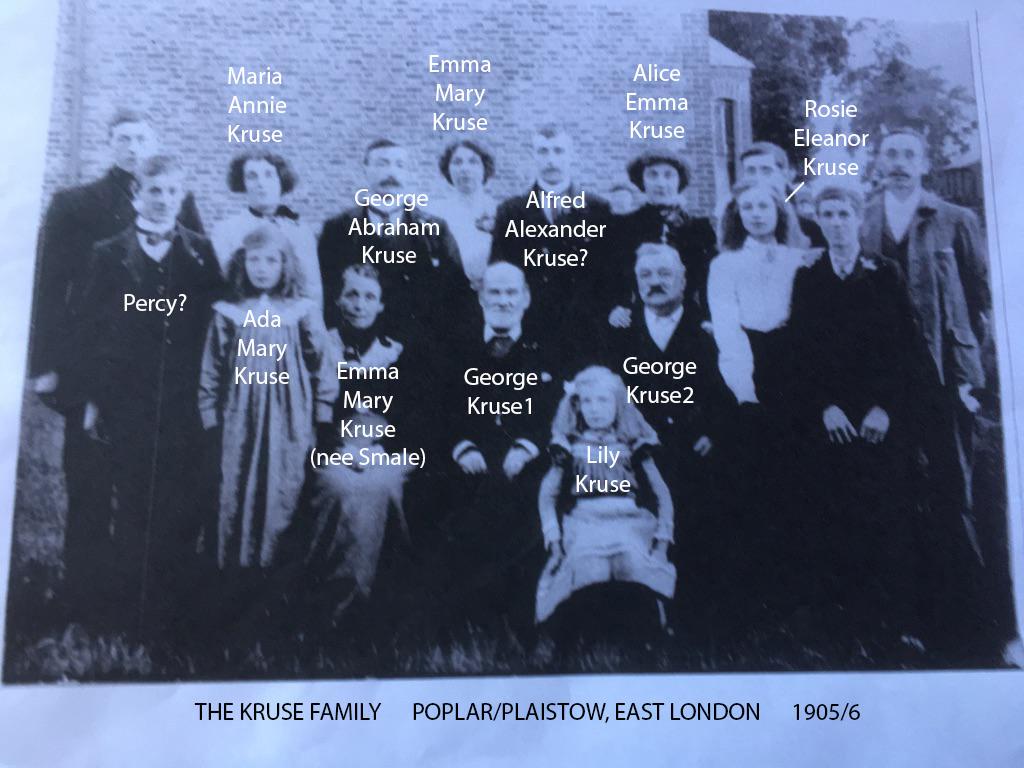
As I had previously mentioned, my father said very little about his parents and English family while I was growing up in Rhodesia. Strangely enough, one thing I do remember him saying is that his mother, Emma Mary Kruse was of German origin and she had to hush it up during WW1 and WW2 due to anti German sentiment in England. during those years . Every time I asked him anything about his family he would say, “ So you want to dig up the family skeletons, do you!!!!!”. I do remember asking him how WW2 started while we were sitting in the beer garden of the Stamford Hill Hotel in Durban in 1964ish when I was 12 years old and he told me it “started as a brawl in a public bar” and I believed that for a long time!!!!! We had a strange relationship, my dad and I!!!!!! The earliest Kruse record I have is that of George Kruse born in 1792 in Hamburg, Germany. He came to England from Hamburg sometime before 1828 where he married Mary Margaret Green at St Pancras, London.
I started tracing the Kruse family tree backwards from my father’s mother (Emma Mary Kruse) who was born in Poplar, London in 1884. Her parents George James Kruse2 and Emma Mary Smale had moved from Battersea to Poplar where Emma Mary was born. Her three elder siblings, George Abraham, Alfred Alexander and Alice were born in Battersea before the family moved to Poplar.
I gleaned a lot of background info on the Kruse family from Mary Sage in England. She is a descendant of Emma’s older brother Alfred Alexander Kruse and wrote an interesting book on the Kruse family which is full of interesting history.
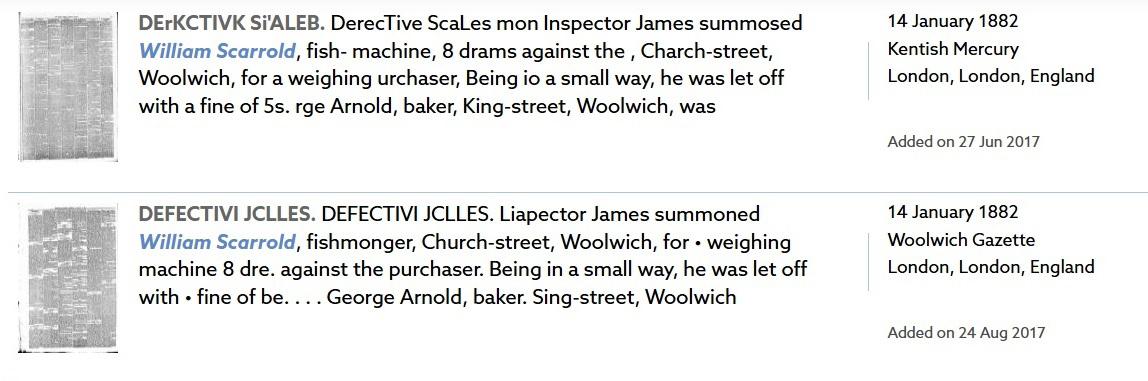
A newspaper article of William Henry Scarrold with defective scales at his Fishmonger shop in Woolwich, London in 1882. He was fined 5 shillings!!!!
Early CAPE History
Bartolomeu Dias the Portuguese navigator was the first European to sight the Cape of Good Hope in 1488 before turning back and returning to Portugal. He was engaged in finding out how far south the African continent stretched. His countryman Vasco Da Gama was the first person to round the Cape and continue sailing onto Calicut in India in 1497.
In the 1400s it was the Portuguese who established shipping routes for trade to the East. One can write many posts about their attempts to trade or collect refreshments here, but it ended in a devastating battle in 1510 with the indigenous Khoi people, in which Captain Antonio Almeida and 64 of his men died. The Portuguese returned 2 years later and erected a cross at the site of the massacre. Consequently, European ships mostly avoided the Cape for the next 100 years.
When Britain and the Netherlands began to dominate the shipping routes in the 1600s, their need for a halfway stop increased. For a long time, they used Robben (Seal) Island for this purpose. Passing ship crews hunted seals and literally herded penguins onto their boats. They also collected penguin eggs. But the Dutch eventually introduced Dassies to the island which overgrazed the landscape completely, wiping out the ecology in many ways. In 1601, an English ship captain left convicts with sheep on the island. Their mission was to fatten the sheep for passing ships. In 1607 a Dutch ship dropped off sheep again.
Then, in 1613, the British kidnapped a Khoi person named Coree, from the Cape mainland and took him to England. He returned a year later to act as a Khoi interpreter and trade agent, but by 1620 Dutch shipmen killed him when he refused to barter cattle with them. Before that, in 1616, Britain had also dropped 10 convicts on the Cape mainland, led by John Crosse, a convicted highway man. However, they soon fled to Robben Island to escape the Khoi.
In 1631, British ship captain John Hall, took another Khoi man, Autshumato (who became known as Herry the Strandloper (Beachcomber), to Java in the East Indies. Herry returned to Robben Island where he and 20 other men acted as agents for passing British and Dutch ships. Then in 1638 passing Dutch ships attempted to plant coconuts on Robben Island but these tropical trees never survived in the harsh, stormy Cape weather! For more info on the VOC voyages check out the Huygens website.
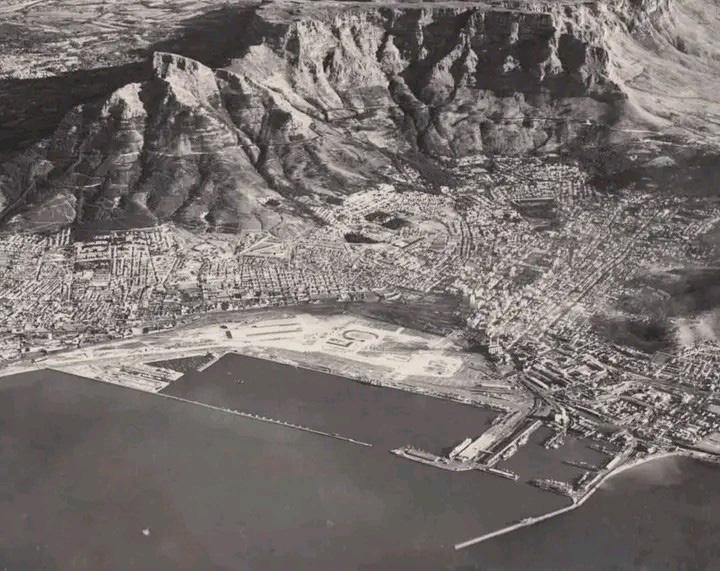
ancestors arrived in the 1600-1700s. Of course, it wasn’t as built up as above photo depicts. I worked at these docks in 1975 but never realised my ancestors had arrived there.
harbour
Afrikaner
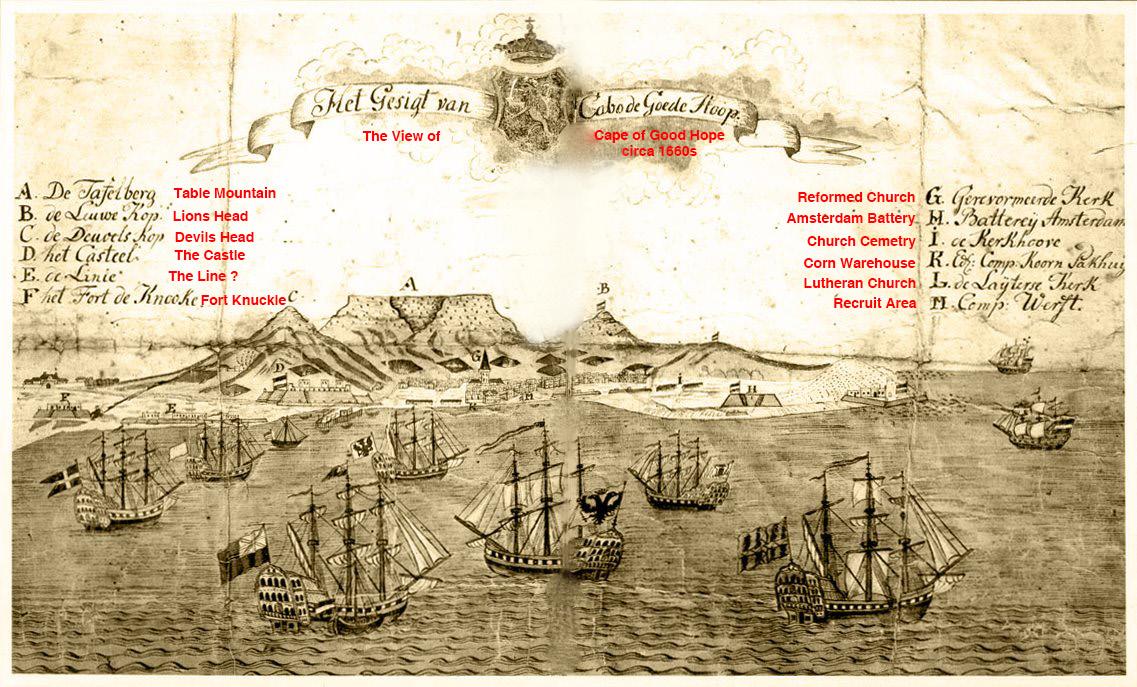
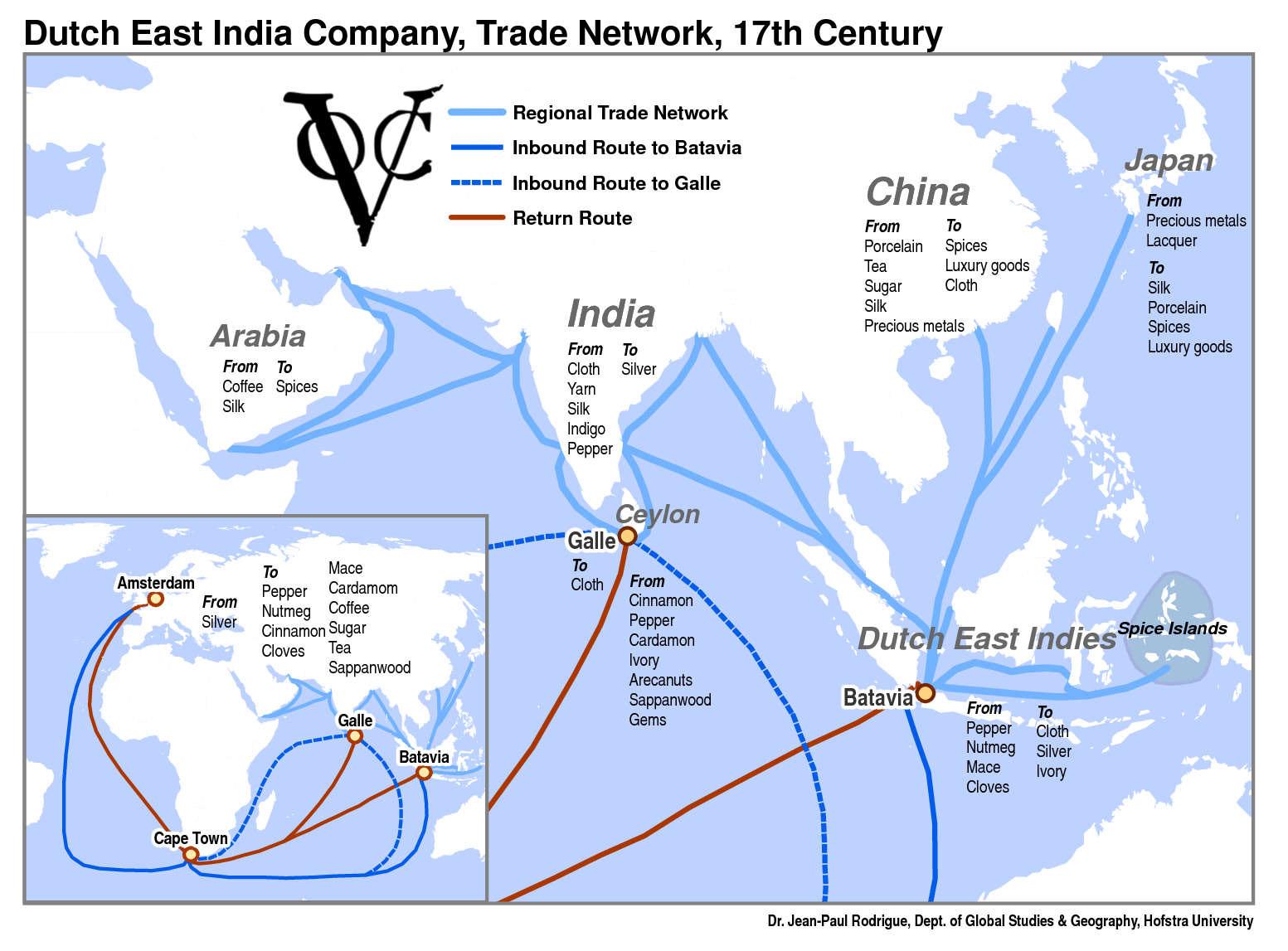
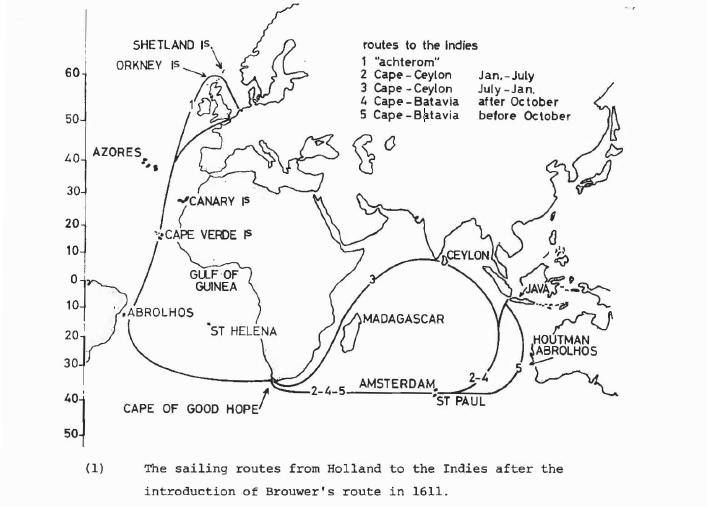
The Dutch VOC (Vereenigde Oost~Indische Compagnie \ Dutch East India Company) first started rounding the Cape of Good Hope in 1596 then started stopping off regularly for fresh water and supplies in 1606. Eventually the Cape developed into a half way station to Java (Batavia, now Indonesia) where the Dutch sought spices for the European market. The Cape of Good Hope eventually developed into Cape Town and became an official Dutch Colony in 1652 under Governor Jan Van Riebeck.
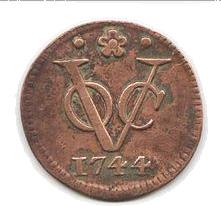
The Dutch East India Company logo. Their motto was: “Jesus is Good but Trade is Better”.
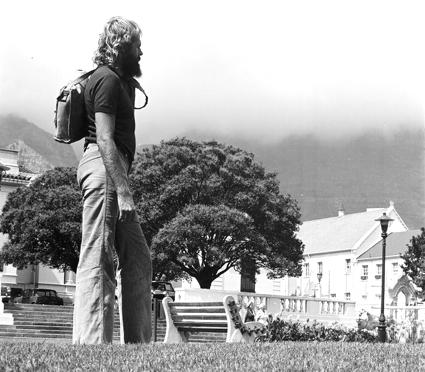
A photo of me in Cape Town in 1975. The building behind me in the background is the South African Parliament and behind that is Table Mountain covered in clouds.
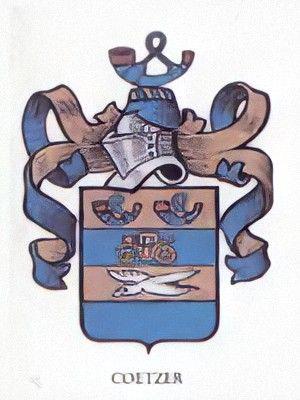
Coetzer Family Tree
Jacob Coetzer (1682-1742)
Zakupy, Bohemia (Czek Republic)
Johannes Jacobus Coetzer (1716 -1787) Paarl, Cape
Jacobus Johannes Coetzer (1765 -1845), Cape, South Africa
Pieter Willem Coetzer (1799 -1836), Cape, South Africa
Lourens Erasmus Coetzer (1822 -1894), Cradock, Cape, South Africa
Lourens Jacobus Coetzer (1845 -1924), Klas Smits River, South Africa
Johanna Hendrica Coetzer (1882 -1915), Reddersburg, OFS,
John James Scarrold (1919 -1981) Shoeburyness England
Vera Scarrold (1947)
married 1714
Stellenbosch, Cape
married 1746 Paarl, Cape
married 1789 Drakenstein, Cape
married 1821 Cradock, Cape
Cornelia Helms (1673 -1720)
Cape of Good Hope
Johanna Nel (1730 -1772) Stellenbosch, Cape
Magdalena Elizabeth Jordaan (1772 -1847), Paarl, Cape, South Africa
Margaretha Johanna Smit (1781 -1856), Cape, South Africa
married 1841 Cradock Cape
married 1866 Reddersburg, OFS married 1902 Kroonstad, OFS
Helena Dorothea van Heerden (1823 -1898), Cradock, Cape, South Africa
Johanna Hendrica Buys (1849 - 1922), Bethlehem, OFS,
Herculas Petrus Spangenberg (1871-1948) Kroonstad, OFS, South Africa
Evelyn Scarrold (1954) married 1945 Pietersburg, South Africa
Philip Scarrold (1952)
Johanna Spangenberg (1913 -1996)
Vereeniging South Africa
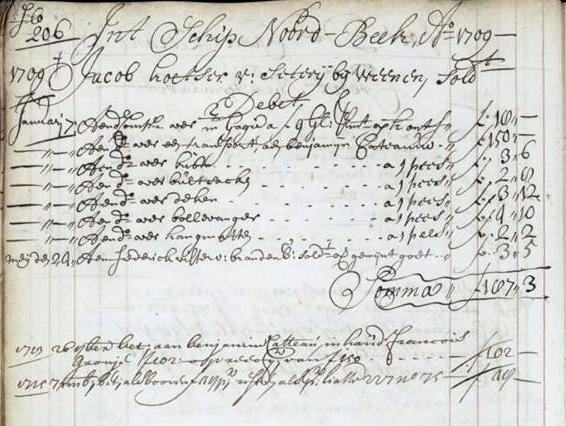
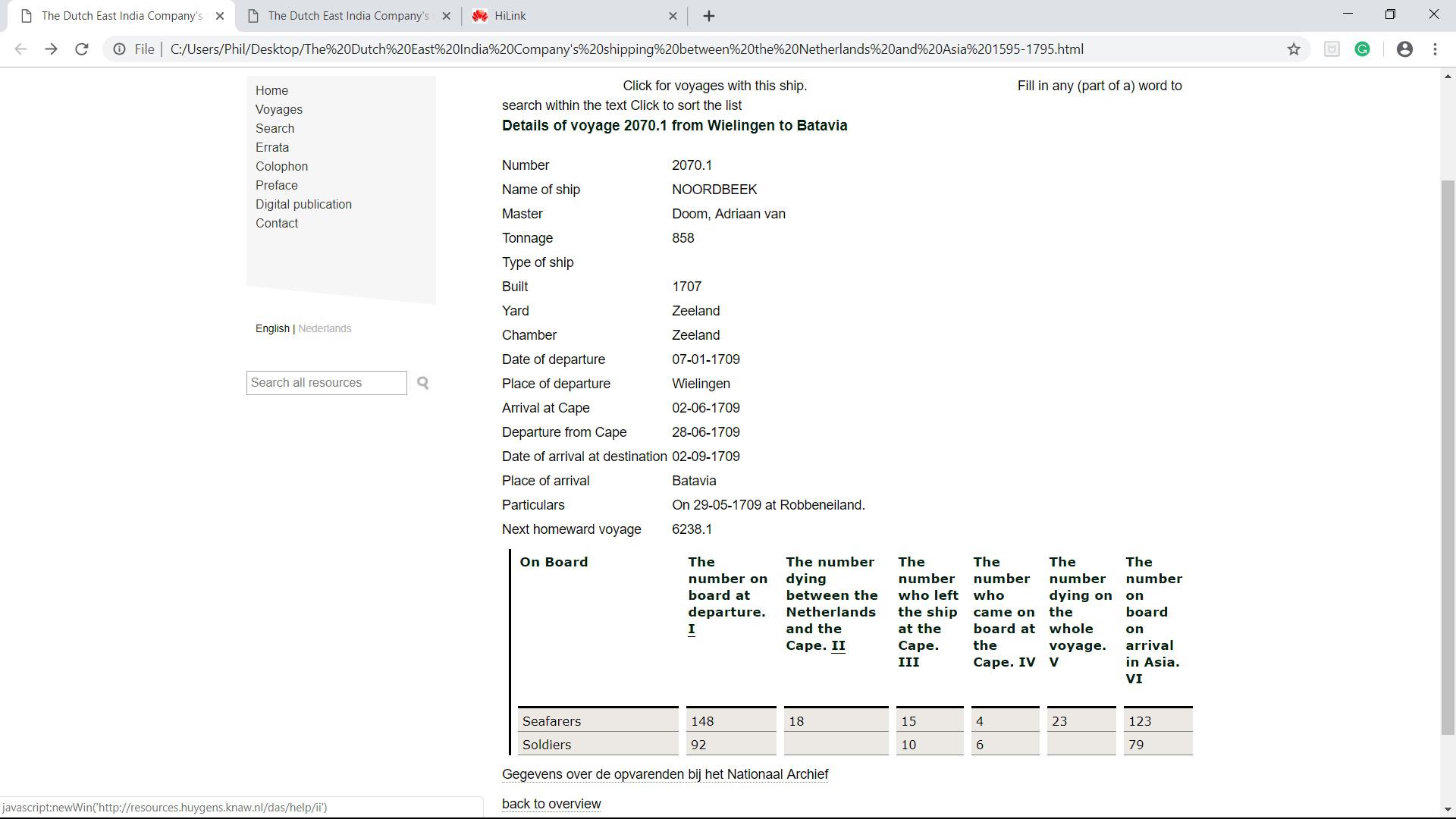
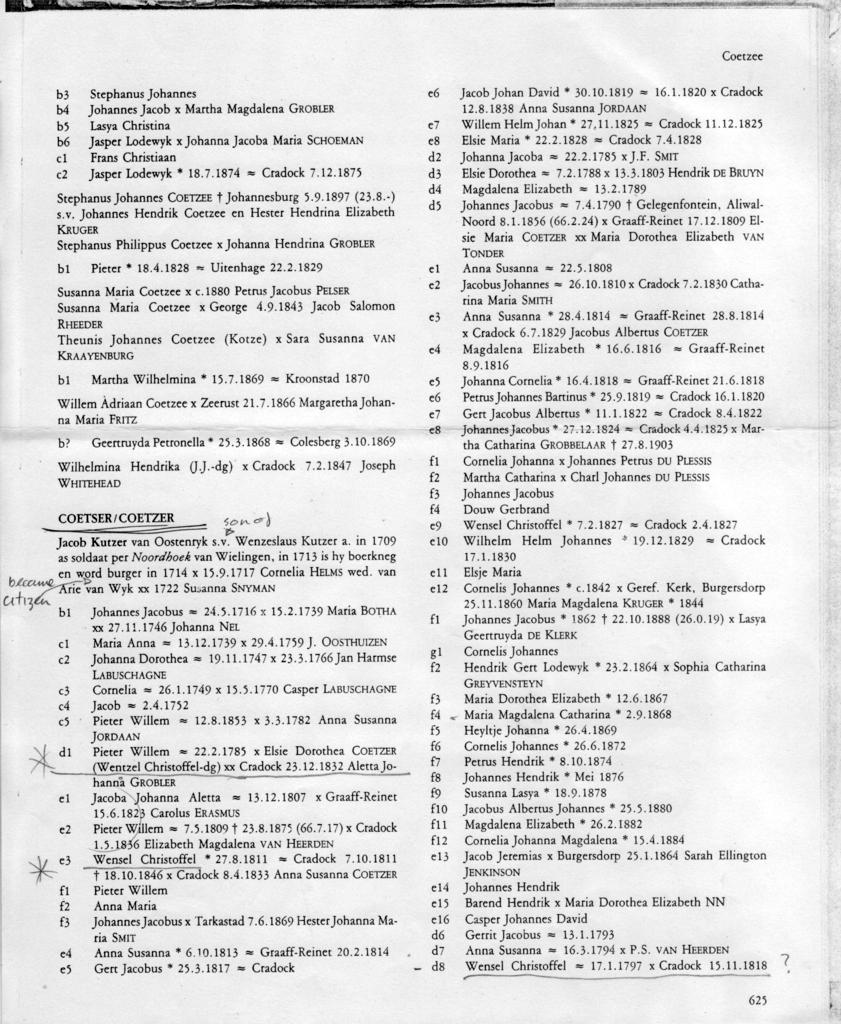
My mother’s early Afrikaner ancestors came to the Cape of Good Hope with the VOC in the 1600 - 1700s. One of my earliest ancestors was Hans Helm who arrived at the Cape in 1670 from Lubecke, Germany. His daughter Cornelia (1673-1720) married my 7X Gt Grandfather, Jacobus Coetzer (Kutzer 1682-1742) in 1714 at the Cape. Jacob came to the Cape in 1709 as a soldier. He was born in Zakupy, Bohemia (now Czeck Republic) in 1682 and his family fled to Austria due to religious persecution. As far as I know he became a Dragoon in the Austrian army at Setry, where he was probably recruited by the VOC and sailed to the Cape on the ship “Noord-Beek” from Wielingen in 1709 according to his recruitment documents I got from the VOC archives in the Hague.
Jacob Coetzer’s VOC recruitment document 1709.
Details of the VOC ship Noordbeek. Jacob Coetzer travelled to the Cape in 1709 on this ship.
Spangenberg Family Tree
Hans Michael Spangenberg (1670 -1721), Sangerhausen, Germany
Johannes Marthinus Spangenberg (1708 -1779?) Sangerhausen, Germany
Johannes Lodewyk Spangenberg (1741-1769) Cape, South Africa
David Frederik Spangenberg (1769 -1816), Stellenbosch, Cape,
Marthinus Hendrik Spangenberg (1813 -1906) Paarl, Cape, South Africa
David Frederik Spangenberg (1841-1901) Winburg, OFS, South Africa
Herculas Petrus Spangenberg (1871-1948?), Kroonstad, OFS, South Africa
married 1694 Sangerhausen
Maria Heydenbluths (1670 -1721)
Sangerhausen, Germany
Johanna Spangenberg (1913-1996) Vereeniging Tvl, South Africa
Vera Scarrold (1947)
married 1740 Paarl, Cape
married 1769 Tulbagh, Cape
married 1796 Stellenbosch, Cape
Cornelia Mouton (1715-1762?) Cape, South Africa
Martha Francina Mouton (1746 -1818) Paarl, Cape, South Africa
Maria Margaretha Ras (1746 -1818) Cape, South Africa
married 1836? Stellenbosch, Cape married 1868 Kroonstad, OFS married 1902 Kroonstad, OFS
Anna Magdalena van Zyl (1819 -1889) Cape, South Africa
Johanna Maria Venter (1851-1921)
Potchefstroom, Tvl, South Africa
Johanna Hendrica Coetzer (1882-1915), Reddersburg, OFS, SA
married 1945 Pietersburg, South Africa
Philip Scarrold (1952)
Evelyn Scarrold (1954)
John James Scarrold (1919-1981) Shoeburyness, Essex, England
The Spangenberg Family Tree has a very interesting history starting with my 5X Gt grandfather, Johannes Marthinus Spangenberg. He was born in Sangerhausen, Germany in 1708 and arrived at the Cape of Good Hope with the VOC (Vereenigde Oost-Indische Compagnie / Dutch East India Company) as a soldier in 1736. He became a Burger (Citizen) at the Cape in 1740 and married Cornelia Mouton (1715-1762?) the same year. He is listed as a “boukneg” (builder’s mate) after he had been demobbed from the VOC. The record I have from the Cape Archives states he was exiled from Cape Town in 1774 for “killing a slave” but I have no more information on the matter. I suspect he was exiled to Thien River in the Oliphant’s River Valley, NW of Cape Town. He is listed as working on Plaas Van Alewijn which I think was a wine estate. A record I have states he died in 1779 and is buried in Citusdal north of Cape Town. This information is vague and I can’t confirm it. Cornelia is listed as dying in 1762.
Johannes Marthinus Spangenberg had 2 children with Cornelia Mouton (Johannes Lodewyk Spangenberg (1741-1779) and Suzanna Jacoba Spangenberg (1743-1779)).
Cornelia had an affair with Jurgen Keyser and they had an illegitimate son (Jacobus 17571842) whom Johannes Marthinus Spangenberg adopted.
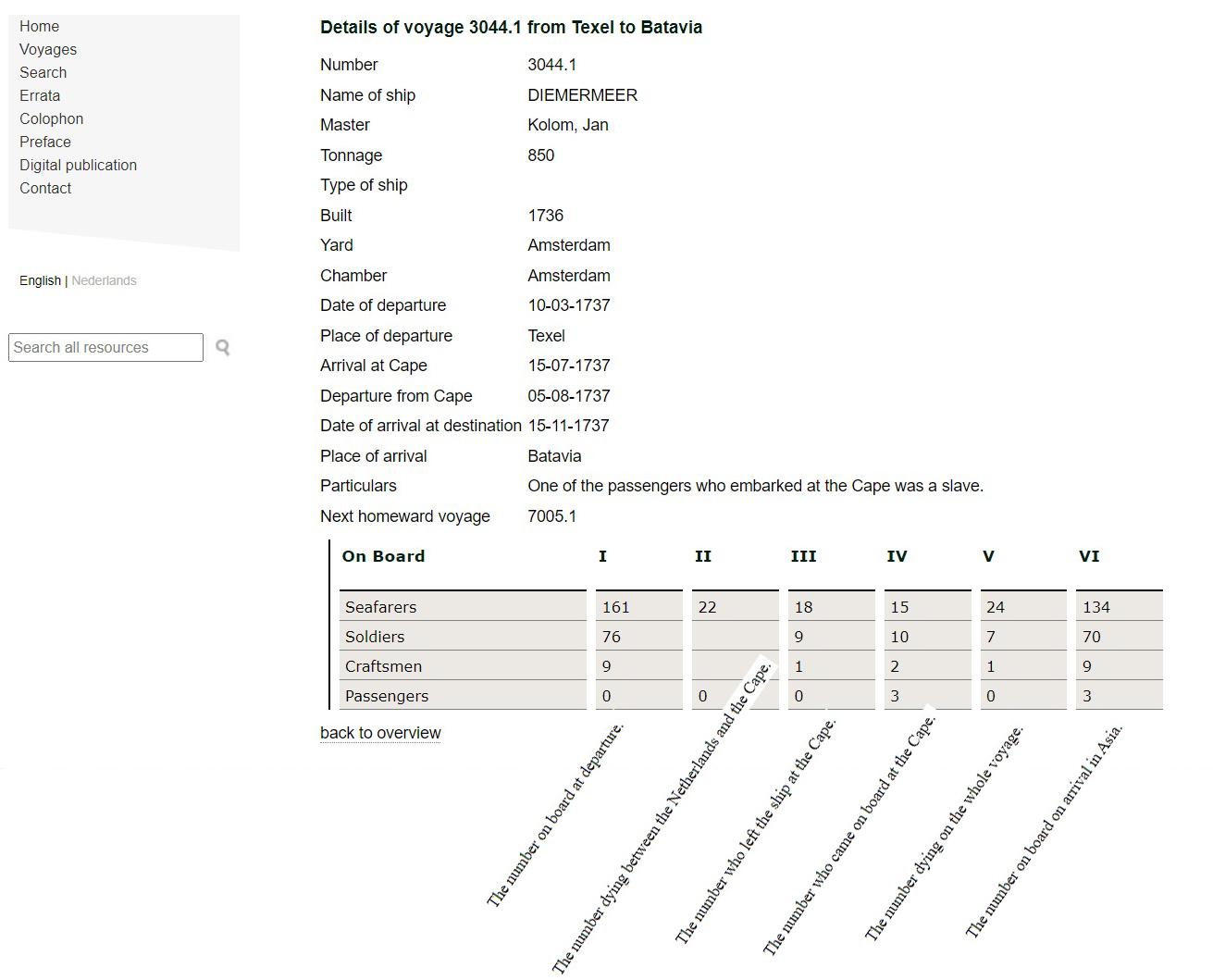
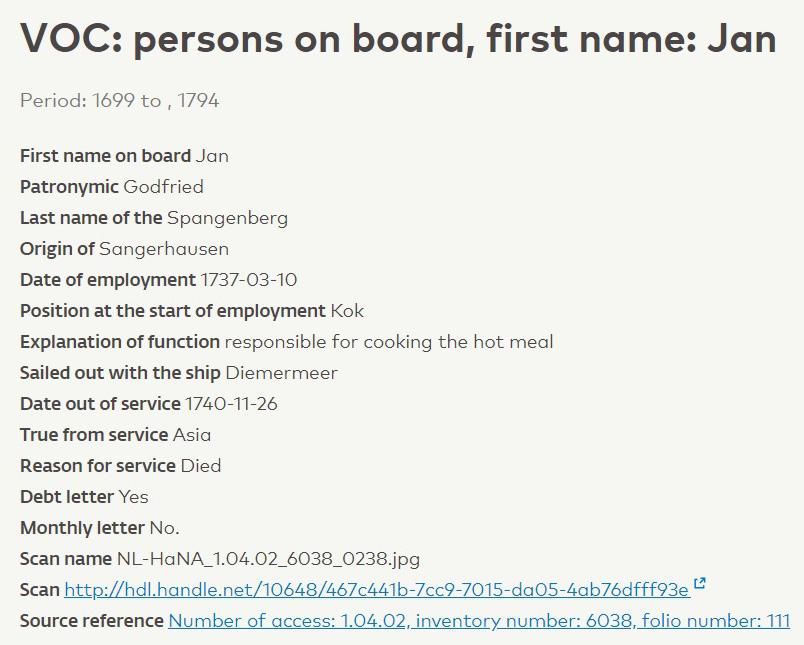
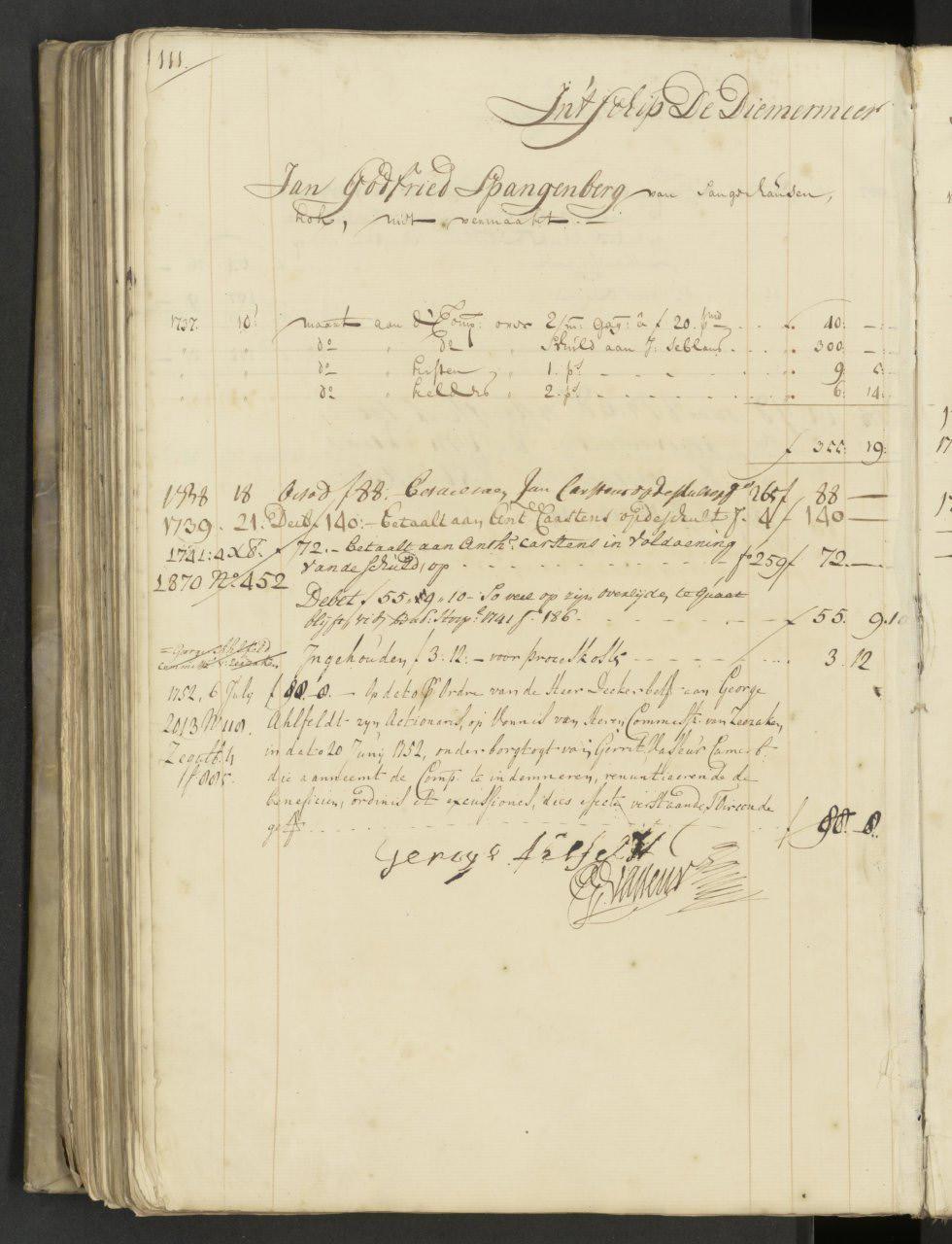
I did write to the VOC Huygens archives website in the Netherlands for more information on Johannes Marthinus Spangenberg but they stated his documents were either lost or destroyed. They did however have the enlistment papers of his older brother Jan Godfried Spangenberg (born 1699) enlisted as a cook on board the VOC ship the “Diemermeer” in 1737. He arrived in Cape Town on 15-03-1737 a year after his brother Johannes Marthinus had arrived so I suspect they met up for a reunion at a local tavern. Jan Godfried is listed as dying in Asia in 1741 (probably in Batavia, now called Jakarta).
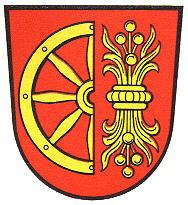
The Spangenberg Family Crest.
Jan Godfried Spangenberg was the brother of my 5X gt grandfather (Johannes Marthinus Spangenberg). Jan Godfried sailed from Holland on the VOC ship “Diemermier” in 1737 as a cook and probably continued on to Batavia. He served for 3 years with the VOC and is listed as dying in Asia in 1740. There was a high attrition rate amongst the seafarers as can be seen on the above chart.
Snyman Family Tree
Hans Christoffel Snyman (1645-1668) Hanover, Germany
Christoffel Snyman (1669-1705)
Cape Town
Phillipus Snyman (1701-1733)
Cape Town
Jacobus Snyman (1731-1771)
Cape Town
Phillipus Snyman (1757-1808
Cape Town
Johannes Hendrik Snyman (1796-1865) Bethuli, OFS
Anna Sophia Snyman (1830 -1901)
Bethuli, OFS
Johanna Hendrica Buys (1842-1922) Bethlehem OFS
Johanna Hendrica Coetzer (1882-1915) Reddersberg OFS
Johanna Magdalena Spangenberg (1913-1996) Vereeniging SA
Groote Catherina van Palicat (1631-1683) born Palicat, India arrived 1657 on Prins Willem
Teresa de Savoye (1672-1742) born Flanders Arrived 1688 on Oosterland
Johanna van de Venter (1701-1752) born Stellenbosch
Anna van der Merwe (1781-1856) born Cape
Anna Sophia Venter (1769-1836) born Cape
Cecelia Maria Van der Walt (1801-1842)
Phillipus Buys (1820-1892) OFS, South Africa
Lourens Jacobus Coetzer (1845-1924) Klaas Smits River
Herculas Petrus Spangenberg (1871-1946?) Kroonstad, OFS
John James Scarrold (1919-1981) Shoeburyness, England
Mansell Upham, “In Hevigen Woede incorrectly assumes that Hans Christoffel Snijder who hailed from Heidelberg in the Palatinate was the same man as HANS CHRISTOFFEL SNIJMAN from HARTZBURG, HANOVER, GERMANY. He is first mentioned in the records as a soldier under the Chamber of Rotterdam in 1665 together with Arnoldus Willemsz. Date estimated by compiler. Hereinafter cited as “In Hevigen Woede . . .”
Mansell Upham, “In Hevigen Woede . . .”, Regular nocturnal activity on the part of a distracted sentry inside the living quarters of the Fort’s washerwoman - the Company slave familiarly known to all as Groote Catrijnresulted in the conviction on 30 July 1667 of Hans Christoffel Snijman
Mansell Upham, “In Hevigen Woede . . .”, Groote Catrijn’s illegitimate son was baptised Christoffel on 9 March 1669 and witnessed by Mooij Ansela. The child’s paternity was no secret. He was named directly after the father. Throughout his life he identified himself by his father’s surname, as did his own children.
The evidentiary facts in relation to Christoffel Snijman are:
1665: 18 August; ‘Hans Christoffel Snijder’ admitted to the church in Cape Town. See the first membership registry (lidmaatregister) for Cape Town. (eGGSA transcription)
1665: 6 September; Petronella daughter of Catharina is baptised in Cape Town. Referred to by Pieter Evrard in his testament as his unborn child. (Upham 2014, Cape Mothers)
1665: 3 October: ‘Hans Christoffel Snijman’ convicted of fighting with Diedeloff Tim. (Upham, Cape Mothers, Appendix 3; CA: CJ 1, p. 292)
1665: 4 December; VOC soldier ‘Christoffel Snijman’ in attendance (CJ 1, p. 296 Anna Böeseken, Uit Raad van Justisie, pp.159-160)
1666: 15 May: Monsterrol p.66: ‘Hans Christoffel Snijman van Hartsb. Sold:[ae]t.’ (Upham 2014, Cape Mothers: CA, VC 39, II, (Monsterrol, 15 May 1666), pp. 66 & 77.)
1666: 15 May: Monsterrol p.77: ‘Hans Christoffel Snijder van Heydelberg soldaat’ under the Chamber of Enckhuizen is enumerated together with ‘Arnoldus Willemsz:’ [Basson]. (Upham 2014, Cape Mothers: CA, VC 39, II, (Monsterrol, 15 May 1666), pp. 66 & 77.)
1667: 30 July; ‘Hans Christoffel Snijman’ convicted of dereliction of duty and sleeping with the fort’s washerwoman. (Upham 2014, Cape Mothers, Appendix 3)
1668: Monsterrol: ‘ ... op’t Robben eylant gecommandeert als gebannen: Hans Christophel Snijman’ [CA: VC 39, vol. II (muster roll, 1668), p. 110]. (Upham 2014, Cape Mothers)
1669: 9 March; Christoffel, son of Groote Catrijn is baptised in Cape Town. (Have record)
1671: 20 December; marriage of Groote Catharina and Anthonij van Bengale in Cape Town. (Have record). Also on this day, Catharina is pardoned and manumitted by Joan Maetsuijcker the Governor-General (Upham)
1672: Monsterrol: ‘Anthonij de Later v. Bengale en Catrina van Palicat’ (eGGSA transcription) No Snijman or variant.
1673: Monsterrol: ‘Anthonij van Bengale en Catrijn van do. 2k. (eGGSA transcription) No Snijman or variant.
1674: Monsterrol: ‘Anthony de la Torre en Catrijn van Paliacat 2k.’ (eGGSA transcription) No Snijman or variant.
1675: Monsterrol: ‘Antoni van Bengale en Cat. van Paliacate 2k.’ (eGGSA transcription) No Snijman
1677: Monsterrol: ‘Ant. van Bengalen en Catria v. Paliacata 2k.’ (eGGSA transcription) No roll for 1676 available. No Snijman or variant.
1678: Monsterrol: ‘Anthonie van Bengale en Catrijn van do. 2k.’ (eGGSA transcript) No Snijman or variant.
1679: Monsterrol: Antoni van Bengale en Catharina van Paliacatta 2k.’ (eGGSA transcript) No Snijman or variant.
1679: June; Jan Wittebol sues Anthonij to repay the sum of f222 that Anthonij had borrowed from Manuel van Angola. (Upham with Cape Archive reference)
1682: Monsterrol: Anthonij van Bengale en Catrijn van Paliacatta 1k.’ (eGGSA transcript) No rolls between 1679 and 1682 or between 1682 and 1685 available. No Snijman or variant.
1682: 17 December; All of Anthonij’s property (absolutely everything) is liquidated (sold) on the orders of the Orphan Chamber because Anthonij is dead. (Upham provides detailed records with Cape Archive reference)
1683: April; List of items drawn up by the messenger of the court Godfriedt Meijhuijsen used for the burials of Groote Catrijn and her daughter Petronella (Upham with Cape Archive reference).
1683: 20 April; Lijsbeth van Angola received payment for looking after Petronella in Anthonij’s home: ‘. . . voor negen dagen oppassen by de dogter ten tuysen van Anthonie van Bengale’. (Upham with Cape Archive reference)
1683: 1 Sept; J. Smit was paid by the Orphan Chamber from the deceased estates of Anthonie v. Bengale (†1682) and Jan Wittebol (†1681) for having schooled Christoffel (≈1669) and the young Johan Wittebol (*1675). Upham states that no further payments for Christoffel’s education appear to have been made. (Upham with Cape Archive reference)
1690: Monsterrol: ‘Christoffel Snijman’ (aan Drakenstein) (eGGSA transcript). This is the first mention of a Snijman in the muster roll since 1668.
1690: 2 January; First instalment paid to Christoffel by Orphan Chamber. It is paid to him as an inheritance as Anthonij’s son. (Upham with Cape Archive reference)
1691: Monsterrol: ‘Christoffel Snijman’ (‘an Stellenbosch 1691’). (eGGSA transcript) - no other Snijman or variant.
1691: 8 April; Fifth and last instalment paid to Christoffel by Orphan Chamber. It is paid to him as an inheritance as Anthonij’s son. (Upham with Cape Archive reference)
1692: Monsterrol: eGGSA transcription: ‘Ernst Frederick Walter en Christoffel Suyrman en Marga. de Savoyer } maats’. No other Snijman or variant.
1692: 14 August: Admitted to the Stellenbosch church member register ‘aen Stellenbosch tot het gebruijk van des Heeren H: Avondmael overgekoomen’, ‘Christoffel Snijman van de Caep’, ‘Willem Schalk van Outbeierlant’, ‘Jacobus Schalk van de Caep’. (Have record, eGGSA transcript)
1693: Monsterrol: eGGSA transcription: ‘District Drakestein . . . Christoffel Sneijman en Margriet de Savoij 3k.’ No other Snijman or variant.
1695: Monsterrol: ‘Christoffel Snijman & Margrita de Savoye 4k.’ (eGGSA transcript) No other Snijman or variant.
1696: Monsterrol: ‘Christoffel Snijman en Margarita de Savoije.’ (eGGSA transcript) No other Snijman or variant.
1698: Monsterrol: ‘Christoffel Snijman en Maria de Savoij 2 k.’ (eGGSA transcript) No other Snijman or variant.
1700: Monsterrol: ‘Christoffel Snyman en Margriet Savoijen.’ (eGGSA transcript) No other Snijman or variant.
1701: Monsterrol: Christoffel Snijman & Margarita de Savoije 8 k.’ (eGGSA transcript) No other Snijman or variant.
1702: Monsterrol: ‘Christoffel Snijman en Margarita de Savoije.’ (eGGSA transcript) No other Snijman or variant.
1703: Monsterrol: ‘Christoffel Snijman en Margaritha de Savoijen.’ (eGGSA transcript) No other Snijman or variant.
1704: Monsterrol: Christoffel Snijman en Margaretha de Savoije.’ (eGGSA transcript) No other Snijman or variant.
1705: Monsterrol: ‘Margrieta de Savoijen wed. Christoffel Snijman.’ (eGGSA transcript) No other Snijman or variant.
Also baptismal records showing Christoffel Snijman as father and Marguerite de Savoye as mother are as
follows:
1690: 10 December: Jacobus Christoffel (Have record, quoted verbatim in Upham). This baptism followed a failed attempt to baptise the child at Drakenstein on 19 November 1690 when the minister, Pierre Simond refused to accept the child’s grandfather, Jacques de Savoye, as godfather which resulted in an acrimonious incident and the child being taken to Stellenbosch for baptism. (Upham, Cape Mothers, p. 103)
1692: 27 January: Catharina (Have record, quoted verbatim in Upham)
1693: 9 August: Maria Magdalena (Have record, quoted verbatim in Upham)
1695: 22 July: eGGSA transcription: ‘Cristina fille de christoffle senaymant - Et Margerite, Savoye. le temoins Et - jacobus Vanas Et Laina basson’.
1697: 1 August: eGGSA transcription: ‘Elsij fille de Christoffel Scniman Et de marguerite Savoye, Le temoins Et hercules depret Et Elsij jacob’.
1699: 25 October: eGGSA transcription: ‘Janne fille de christoffel senaymant Et de Marguerite Savoije le temoins Et Chrisians debacre Et marie delanoy pour Marraine’.
1701: 24 July: eGGSA transcription: ‘Philippe fils de Christoffle Senaiman Et de Marguerite Savoye, Le temoins Et philippe Rodolf Et alleta Savoye, mais Claude marais á Repondu pour Le garson Et La mere a Repondu pour sa fille’.
1703: 28 October: Susanna (Have record, Upham has reference)
1706: 21 March: Elizabeth (Have record, Upham has reference) Christoffel was dead, but is shown as the father.
And finally there is the reference to Christoffel Snijman’s death and being replaced as corporal of the militia. Leibrandt: Précis of Letters 1696-1708. Page 272.
Hans Christoffel Snyman died about 1668 on Robben Island to which he had been banished for dereliction of duty which was that he was not on guard because he was with Catharine in her quarters, she was his lover.
Hans Christoffel Snijman a. as soldaat v. Hartzburg, Duitsland voor 1665, na Robbeneiland verban, geen rekord gevind na 1668, het voorkind gehad by Catharina, vrygestelde kompanjieslavin, v. Paliacatta, Indië (ook bekend as Groote Catrijn) a. 21.2.1657 aan boord Prins Willem, bej. » Kaapstad 29.4.1668. Catharina x Kaapstad 20.12.1671 Anthonij v. Bengale bej. » Kaapstad 12.9.1670 eerste “vryswarte” wat eiendom besit in Tafelvallei † c. 1682. Met die uitsondering v. Christoffel, sterf die hele gesin in ‘n tragedie tussen Des. 1682 en Feb. 1683.
First name variants: Hans Christoffel (also known as Christoffel)
Surname variants: Snijman
In 1667 Hans Christoffel Snijman was convicted (30.
Hans Christoffel Snyman died about 1668 on Robben Island to which he had been banished for dereliction of duty. (not on guard because he was with his lover, Catharina in her quarters.
Which is all made up.
Mouton Family Tree
Hans Michael Spangenberg (1670 -1721), Sangerhausen, Germany
Johannes Marthinus Spangenberg (1708 -1774?) Sangerhausen, Germany
Johannes Lodewyk Spangenberg (1741- 1779) Cape, South Africa
David Frederik Spangenberg (1769 - 1816), Stellenbosch, Cape, South Africa
Marthinus Hendrik Spangenberg (1813 - 1906) Paarl, Cape, South Africa
David Frederik Spangenberg (1841 - 1901) Winburg, OFS, South Africa
Herculas Petrus Spangenberg (1871 - 1948?), Kroonstad, OFS, South Africa
John James Scarrold (1919-1981) Shoeburyness, Essex, England
Vera Scarrold (b.1947)
married 1694 Sangerhausen
married 1740 Paarl, Cape
Maria Heydenbluths (1670 - 1721) Sangerhausen, Germany
Cornelia Mouton (1715 - 1762) Cape, South Africa
married 1769 Tulbagh, Cape
married 1796 Stellenbosch, Cape
Martha Francina Mouton (1746 - 1818) Paarl, Cape, South Africa
Maria Margaretha Ras (1746 - 1818) Cape, South Africa
married 1836? Stellenbosch, Cape
married 1868 Winburg, OFS
married 1902 Kroonstad, OFS
married 1945 Pietersburg, South Africa
Anna Magdalena van Zyl (1819 - 1889) Cape, South Africa
Johanna Maria Venter (1851 - 1921) Potchefstroom, Tvl, South Africa
Johanna Hendrica Coetzer (1882 - 1915), Reddersburg, OFS, SA
Johanna Spangenberg (1913-1996) Vereeniging Tvl, South Africa