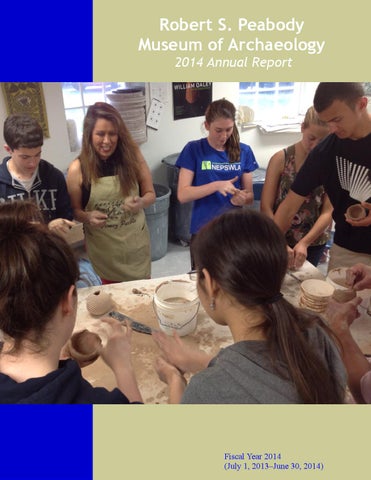
Robert S. Peabody Museum of Archaeology 2014 Annual Report
Fiscal Year 2014 (July 1, 2013–June 30, 2014)
Contents Introduction……………………………….3 The Peabody Vision………………………4 Peabody Gala in New York……………….5
Museum Staff Ryan J. Wheeler, PhD, Director Lindsay A. Randall, Museum Educator Donald A. Slater, Museum Educator Bonnie K. Sousa, Senior Collections Manager and Registrar Marla L. Taylor, Collections Manager Lesley A. Shahbazian, Administrative Assistant
Collaborative Learning…………………...6
Peabody Advisory Committee Daniel H. Sandweiss ’75, PhD, Chair Jeremiah C. Hagler, PhD, P’16 Heather Dunbar Lucas ’88, Vice-Chair Tristin Moone ’10 Barbara Callahan, Secretary James B. Richardson III, PhD Elizabeth Artz Beim ’58, P’88 Kuni S. Schmertzler, P’05, ’07 Meg Conkey, PhD Abigail Seldin ’05 Marcelle A. Doheny, P’18 Peter T. Hetzler, MD, ‘72
Collections Stewardship…………………10 Campus and Alumni Events……………..16 Libraries, Archives, and Museums………19 Outreach and Partnerships……………….20 Summary of Giving……………………...25 People……………………………………27 In Memoriam…………………………….29
Peabody Collections Oversight Committee Emerson W. “Tad” Baker II 76 Elizabeth Artz Beim ‘58 Marshall P. Cloyd ‘58 Susan Faxon, Addison Gallery of American Art Ramona Peters, Mashpee Wampanoag Tribe James B. Richardson III Chris Toya, Pueblo of Jemez
Emeriti Members Marshall P. Cloyd ’58, P’88, ’95, ’03 Rebecca M. Sykes, P’92, ’97, ’01 David Hurst Thomas, PhD
Ex Officio Members Hillary D. Repucci, Director of Parent Giving Thomas P. Lockerby, Secretary of the Academy Patricia C. Russell, Dean of Studies
2
Robert S. Peabody Museum of Archaeology
Dear Friends, In 1901, Robert S. Peabody (Class of 1857) established the institution that now bears his name with three goals in mind: to provide space for Phillips Academy student groups (there were few common spaces at the school in his time), to promote the study of archaeology and anthropology at Phillips Academy, and to foster archaeological research. Over time, the Peabody Museum became concerned primarily with research, producing cutting-edge scientific archaeology through much of the 20th century. The result, however, was an unintentional disconnect from the Academy’s faculty and students. Throughout the 1990s, a recharged museum developed significant relationships with Native American communities and instituted professional exhibits and publications. Despite noteworthy gains, a financial crisis in 2002 required further refocusing and a return to Robert Peabody’s original vision: a teaching museum dedicated to the faculty and students of the Academy. This report provides a summary of the Peabody Museum’s major activities during fiscal year 2014, including classes for 1,742 Academy students and learning opportunities for 3,021 individuals in the Andover community and beyond.
Ryan J. Wheeler, PhD Director
The Peabody Museum anchors collaborative learning in its significant archaeology and anthropology collections, embraces Native American voices, and empowers students to engage in cultural discourse.
180 Main Street
Phillips Academy
Andover, Massachusetts 01810-4161
3
978-749-4490
The Peabody Vision Peabody Museum staff and advisory committee members have dedicated time to formulating a new strategic vision for the next five years, closely following the lead of the Academy’s strategic planning efforts. The strategic plan being developed for fiscal years 2015 through 2020 addresses four major themes: enhancing our collections stewardship, expanding relationships with Native American communities, providing more opportunities for collaborative learning, and developing partnerships that help us share our knowledge and skills with a broader community of educators. At the center of the plan are five core values that characterize the Peabody Museum’s approach to collections, learning, and community engagement:
Focus on students—When considering a new or existing program, we ask, “Are students engaged in this endeavor? Do they benefit in some way?” If the answers are “no,” we rethink the project. This is a core approach of community-based archaeology, which seeks to find how archaeology can serve a community.
Innovation in collaborative learning—The strategic plan for fiscal years 2009 through 2013 emphasized that the Peabody should catalyze collaborative learning. The pedagogy of collaborative learning emphasizes hands-on learning, project- and problem-based learning, experiential learning, and informed discussion. Research on collaborative learning indicates a direct and positive correlation with psychological well-being and self-esteem— characteristics that are emphasized in the Academy-wide strategic plan.
Decolonizing practices—Decolonizing museum practices acknowledges the long shadow of psychological and emotional trauma inflicted on Native American communities by archaeological excavations, especially of ancestral human remains and funerary objects. To “decolonize,” we must articulate this and work with Native communities to heal long-open wounds. Decolonizing practices touch all aspects of museum operations, including governance, collections management, interpretation, and education.
Active care and management of the collections—The Peabody’s archives, photographs, and object collections are the cornerstone of our engagement with the curriculum at the Academy and our connection to the broader community of archaeologists, anthropologists, and Native Americans. Activities and practices that improve our physical and intellectual control over collections are paramount.
Value of anthropological perspectives—As archaeologists and anthropologists, we recognize that our disciplines have something to offer high school students in terms of cross-cultural perspectives, cultural literacy, and an understanding of the world through non-Western perspectives.
Polychrome water jar, Zia Pueblo, New Mexico, circa 1880s (141/17477)
4
Special Event Peabody Gala in New York
Phillips Academy alumni, parents, grandparents, faculty, and friends came together on October 29, 2013, for a spectacular celebration of the Peabody Museum, held at the American Museum of Natural History in New York. The event was held in honor of the Peabody’s journey over the past decade. The museum was on the verge of closure in 2002, but today it thrives as an unparalleled educational resource for PA students and the greater community. The evening also was an opportunity to pay tribute to three very special individuals: Marshall P. Cloyd ’58, David Hurst Thomas, and the late Linda S. Cordell, each of whom contributed significantly to the renaissance of the Peabody. Click here to view pictures from the event, and click here to watch the video presentation, which recounts the story of the museum.
5
Collaborative Learning The Peabody Museum widely supported coursework across disciplines during fiscal year 2014. Museum educators taught 135 lessons, serving 32 faculty members and approximately 1,742 students (this number includes students who visited the museum with multiple classes). In spring 2014, Peabody educators also participated in the Human Origins course led by Jerry Hagler, instructor and chair of the biology department and head of the Division of Natural Sciences.
Museum educators taught 135 lessons, serving 32 faculty members and approximately 1,742 students.
The following faculty members utilized the museum during fiscal year 2014: Art: Thayer Zaeder ’83; Therese Zemlin Biology: Willa Abel; Jerry Hagler, P’16; Marc Koolen, P’03; Anna Milkowski ’93; Keith Robinson ’96; Trish Russell, P’11 English: Tom Kane; Flavia Vidal, P’16 History and Social Science: Nile Blunt; Kathy Dalton, P’00, ’05; Marcelle Doheny, P’18; Damany Fisher; Emma Frey, P’09, ’13; Mary Mulligan, P’09, ’12; Tedd Parker; Megan Paulson; Noah Rachlin; Graham Rosby; Anthony Rotundo, P’00, ’05; Chris Shaw ’78, P’11; Murphy Temple ’08 Math: Joel Jacob Physics: Mika Latva-Kokko; Caroline Odden Spanish: Yasmine Allen; Rachel Hyland; Mark Cutler, Clara Isaza-Bishop, P’17; Diana Zawil Independent Project: Carlos Hoyt, P’11
6
Collaborative Learning Dominique Toya and Maxine Toya Visit Andover Jemez Pueblo potters Dominique Toya and her mother, Maxine Toya, visited campus the week of May 19, 2014, to share their knowledge of contemporary Pueblo pottery making with students in Thayer Zaeder’s Clay and the Ancestral Pot course and with Peabody work duty students. During the visit, students helped mix native clay and temper from Jemez, New Mexico, and experimented with their own small pottery pieces. They also observed Dominique demonstrate her blend of traditional and contemporary styles, which features a distinctive spiral effect and layers of sparkling mineral clay slips. Dominique is a fifth-generation potter and part of a well-known Jemez pottery-making family; she learned pottery making from her mother; her grandmother, Marie G. Romero; and her aunt. She has received numerous awards for her pottery, including Best of Class at the Heard Museum Guild Indian Fair & Market, and both Best of Show and Best of Class distinctions at the annual Santa Fe Indian Market. Dominique and Maxine also talked with students about some of the pieces in the Peabody collection, including one that was made by Dominique’s grandmother. In addition, Dominique discussed the business side of pottery making, wowing students with the prices that collectors have paid for her work.
Summer Session 2013 Peabody staff participated in Summer Session 2013, offering a variety of lessons and activities. Highlights include a class on the skeletal remains of a German mercenary, acquired in the 19th century by Abbot Academy, as part of Mike Sormrude’s Dynamic Body course, and activities involving the museum’s tarps and pseudomorphs for Matt Oosting’s Lower School Institute (LSI) history course.
7
Collaborative Learning NASA Scientist Visits the Peabody In October 2013, the Peabody Museum welcomed special guest Everett Gibson, PhD, a senior scientist in the Astromaterials Research Office at the NASA Johnson Space Center in Houston. Gibson regaled instructor Caroline Odden’s Physics 440 classes with stories of his research on meteorites, space science, and lunar samples. He also conducted preliminary analysis on several meteorite-like specimens from the museum’s collection. Despite the samples turning out to be “meteor-wrongs,” having the opportunity to meet Gibson was a thrill for the Peabody staff and students. Gibson’s expansive list of publications and awards is too long to enumerate here, but it does include two Aviation Week Laurel Awards (1973 and 1996) for outstanding scientific discoveries, as well as NASA’s Exceptional Scientific Achievement Medal (1997). In 1996, Gibson was the coleader of a research team that announced the possible presence of past biogenic activity in the ALH84001 Martian meteorite. Gibson began working for NASA on splashdown day of Apollo 11 in 1969 and was Mission Science Advisor in the Lunar Receiving Laboratory for Apollo 14.
Elizabeth Rao ’14, Abbot Independent Scholar Elizabeth Rao ’14 conducted an Abbot Independent Scholar research project at the Peabody Museum. Under the mentorship of Peabody educator Donald Slater and history and social science instructor Nile Blunt, Elizabeth investigated the transition from the dart thrower (aka atlatl) to the bow and arrow among ancient cultures. She compared two case studies: one from western Paleolithic Europe and one from the Great Basin of the United States. Her findings demonstrate that the factors that led to this technological transition in Paleolithic Europe differed from those driving the later change across the Americas. On March 5, 2014, Elizabeth gave a presentation at the Peabody on the results of her research project. Using an interactive whiteboard and Google Earth Pro, Elizabeth took her enthusiastic audience on an interactive global tour through time and space, highlighting archaeological and ethnographic sites where physical examples and iconographic representations of dart throwers have been documented.
8
Collaborative Learning Piette Program in France At the end of June 2014, nine PA students and their chaperones returned from their 17-day sojourn through France as participants in the Academy’s new Piette Program. The trip was organized by Claire Gallou, instructor in French; Nile Blunt, instructor in history and social science; and museum director Ryan Wheeler, and was funded by a generous grant from the Abbot Academy Association. The Piette Program was inspired by the Peabody’s collection of Upper Paleolithic and Mesolithic artifacts, including three painted pebbles from Mas d’Azil Cave, which were returned to the Musée d’Archéologie nationale in 2012 and 2014. The Piette travelers documented their exploration of French history, language, culture, and archaeology in blog posts, which give some insight into the depth and complexity of the trip. Highlights included investigating museums and cultural sites in Paris, reflecting on the D-Day invasion of 1944 in Normandy, exploring French chateaux andMonet’s Garden at Giverny, and studying the Upper Paleolithic archaeology of the Dordogne and Pyrenees. Our encounter with the decorated caves of the Upper Paleolithic Magdalenian culture, dating to some 15,000 years ago, was brought into sharper focus as we excavated alongside archaeologists Meg Conkey, Sebastien Lacombe, Kathleen Sterling, and their team at the open-air site of Peyre Blanque. The Piette students will present their projects this fall. “As we traveled deeper, we began to see traces of human life—finger markings on the ceiling, some faint outlines of woolly mammoths. Soon it seemed every cavern held some drawing. Woolly mammoths, wooly rhinoceros, bisons, and horses were depicted in incredible detail.” —Camille P. ’15
9
Collections Stewardship Recognizing that the Peabody Museum’s collaborative learning offerings at Andover and beyond are anchored in our significant collections we have begun an ambitious project to improve both physical and intellectual control over our holdings. This includes cataloging of the collections, online access, opportunities for scholars and researchers, and a focus on the Museum’s work duty program.
“Collections to the Classroom: Peabody Museum Online” In July 2013, we began our “Collections to the Classroom: Peabody Museum Online” project in earnest. With a generous grant from the Abbot Academy Association (AAA), we purchased PastPerfect collection and contact management software to replace our old collections database system. A new server was acquired, the software was installed, and museum staff members Bonnie Sousa and Marla Taylor worked diligently on migrating data from the old system.
The initial phases of the project focused on the internal version of the database and included cleaning up existing data prior to going online and taking additional photographs of artifacts. Peabody staffers also received training to become expert users of PastPerfect. The AAA grant also allowed us to hire interns to aid in cataloging. Keely Lewis, graduate student at the University of Massachusetts–Boston, and Jillian Holmberg, completing her bachelor’s degree at the University of Southern Maine, worked to catalog artifacts for inclusion in the database. The public version of the database was launched this past spring. The first group of artifacts posted online represents what museum educators utilize for lesson units taught in partnership with Phillips Academy faculty. The catalog is a work in progress, and artifacts will continue to be added. The online catalog is hosted by PastPerfect Online and is part of a larger project designed to enable better intellectual and physical control of Peabody collections. 10
Collections Stewardship Research, Scholar Visits, and Loans Scholars have long sought out the significant collections of the Peabody Museum. During fiscal year 2014 there were 53 total research requests. Some highlights include:
James E. Snead, PhD (California State University), plans to use a museum image of Warren K. Moorehead in “Relic Hunters in the White City: Artifacts, Authority, and Ambition at the World’s Columbian Exposition,” to be published in The 1893 World’s Fair and the Coalescence of American Anthropology (David R. Wilcox and Curtis M. Hinsley Jr., [Eds.]: University of Chicago Press).
April Beisaw, PhD, and her Vassar College under graduates conducted research on the archives and collections associated with Warren K. Moorehead’s Susquehanna River expedition in Pennsylvania.
Elizabeth James-Perry and Jonathan Perry (Cultural Resources Office of the Wampanoag Tribe of Gay Head, Aquinnah, Mass.) made two visits to examine collections from eastern Massachusetts.
University of Connecticut PhD candidate Zac Singer, along with James Bradley and Jon Lothrop (New York State Museum), visited to examine Paleoindian collections from the Neponset site.
Marcelle Doheny, instructor in history and social science, made several visits to research the Peabody’s Warren K. Moorehead and A.V. Kidder archives for a class she is planning.
David Hurst Thomas, PhD (American Museum of Natural History), requested photographs of the mission bells from Pecos Pueblo.
Robert Welsch, PhD (Franklin Pierce University), visited to conduct research on the Peabody’s Warren K. Moorehead papers.
Beverly Johnson, PhD (Bates College), submitted a request for destructive sampling on swordfish bills from Maine shell mounds.
11
Collections Stewardship Linda S. Cordell Memorial Research Award The Cordell Award Endowment was established in 2013 in honor of the late Linda S. Cordell, eminent archaeologist of the American Southwest and member of the Peabody Advisory Committee (PAC). The award encourages research on the collections of the Peabody Museum. University of Connecticut PhD candidate Zac Singer is the first recipient of the Linda S. Cordell Memorial Research , which will support his reanalysis of the Neponset site collection, specifically focusing on the middle Paleoindian (circa 10,000 to 11,000 years ago) assemblage from the site. Singer will use the data to complement his excavation and analysis of a Paleoindian site on the Mashantucket Pequot Reservation in southeastern Connecticut. This research will expand understanding of Paleoindian life in the Northeast, including study of lithic sources and stone tool manufacture; the work also will document a significant but littlestudied Peabody Museum collection. Peabody educators already are looking for ways to connect Singer’s research with ongoing and future classes. The award encourages research on the collections of the Peabody Museum.
Peabody Collections by the Numbers Archaeology Collections: 500,000+ Ethnographic Collections: 2,200+ Images: 46,000+ Archives: 570+ linear feet Library: 9,000+ books Geographic Scope: 5,092 sites and locations in 38 countries, with principal collections from the United States and Canada
Roving Archivist Program The Peabody Museum was selected to receive the services of the Massachusetts State Historic Records Advisory Board’s Roving Archivist Program. In May 2014, professional archivist Rachel Ornuff reviewed the Peabody’s extensive archival holdings and met with museum staff members and with Paige Roberts, director of Phillips Academy’s Archives and Special Collections, regarding our particular challenges and the short-term and long-term steps to make the museum archive more accessible and organized. Ornuff’s final recommendations will help guide our policies and practice, and will allow us to apply for future phases of the Roving Archivist Program, including processing an archival collection. 12
Collections Stewardship Adopt A Drawer Program The Peabody Museum launched a fundraising promotion called Adopt A Drawer that invites donors to support the cataloging of one of more than 1,700 artifact storage drawers at the Peabody. A gift of $1,000 supports the professional cataloging of one drawer, including data entry, archival storage supplies, photography, and inclusion in the museum’s online catalog, hosted by PastPerfect Online. Work duty students and interns are heavily involved in the cataloging work. Donors receive updates on the cataloging, including before and after photos, as well as acknowledgment in our online catalog. Click here to view the Adopt A Drawer promotional video produced by the Polk-Lillard Electronic Imaging Center. The Adopt A Drawer program complements the ongoing “Collections to the Classroom: Peabody Museum Online” project funded by the Abbot Academy Association, which supported the installation of a new computer server and PastPerfect cataloging software.
A gift of $1,000 supports the professional cataloging of one drawer.
Student Exhibits Artifacts associated with Lucy Foster, an African American woman from Andover who spent the earlier part of her life as a slave and the latter part of her life as a free woman, are now on display in a student-curated exhibit on the second floor of the Peabody. Helen Simpson ’16 spent six months researching Foster, the excavation of her home in 1944, and the artifacts that were recovered. To provide a glimpse into Foster’s life, Helen carefully curated a selection of pottery from the excavation. Work duty students created a small exhibit of the Peabody’s arctic collection to coincide with the April 5, 2014, meeting of the Massachusetts Archaeological Society (MAS) and New Hampshire Archaeological Society (NHAS). The exhibit features nine artifacts, including a bone disk from a whale’s backbone, a baleen eyepiece for snow goggles, and a wooden net needle, that archaeologist Patricia Hume had surface-collected over six summers (from 1959 to 1969) in Barrow, Alaska. A former member of NHAS, Hume attended the meeting, and was delighted by the display and thrilled that her collection is used regularly for classwork and by work duty students. The exhibit will be modified and displayed at the Oliver Wendell Holmes Library.
13
Collections Stewardship Work Duty 2013–2014 Work duty at the Peabody is a primary portal through which students can interact with the museum. During fiscal year 2014, 26 students performed their work duty with the Peabody collections department, with nearly 75 percent of them choosing to return the following term. Collectively, the students provided 521 hours of work over the school year.
“Through the Peabody and the opportunity to study archaeology, I’ve come to have a greater understanding and appreciation for the interconnectivity of all humans, past and present. Not until I handled an artifact and imagined the hands that created it, did I realize that all humans are more or less the same.” —Jessica Gammon ’14
Work duty students assisted the collections department in researching Mexican and Mesoamerican masks in the collection to support an art classroom unit. Students were essential in sorting through several large donations to the Peabody library. Students also have contributed to the ongoing Adopt A Drawer fundraising campaign by photographing and cataloging artifacts.
Peabody Publications Online Thanks to a generous grant from the Abbot Academy Association and the efforts of Paige Roberts, director of Archives and Special Collections, the Peabody was able to send 60 out-of-print publications to the Internet Archive for digitization, thereby enabling anyone to browse these publications online, free of charge. Click here for details.
14
Collections Stewardship Volunteers 2013–2014 Volunteers worked on a variety of projects to help staff care for collections, such as inspecting and vacuuming textiles, developing inventories, and pulling and returning artifacts used in classes. Highlights include the following:
Leah Kaplan and Susan Rosefsky vacuumed and/or inspected 105 textiles as part of the museum’s integrated pest management program. Quinn Rosefsky ’59 inventoried nine boxes of photographs. Only three boxes remain to be inventoried. Ann Campbell identified, numbered, and pro vided preliminary cataloging for 212 lots of stone artifacts totaling 5,934 items from the Gills Farm site in Randolph, Mass. The items are part of the Fred Carty collection received in 1995 (other Carty donations were made in 1994, 1996, 1998, and 1999). Approximately 20 boxes remain out of an estimated 100 total. Leah Kaplan, Susan Rosefsky, and Quinn Rosefsky ’59 updated locations or feature information for 301 artifacts as part of the museum’s migration to PastPerfect.
NAGPRA The Peabody has been in the forefront of Native American Graves Protection and Repatriation Act (NAGPRA) compliance since the inception of the federal act in the 1990s. Peabody collections include ancestral human remains and funerary objects from 112 sites in 28 states. Collections have been affiliated with 60 tribes, though the Peabody houses ancestral remains from 44 sites considered to be Culturally Unidentified under the NAGPRA act and rule. Major consultations resulting in affiliation of human remains and funerary objects include the Pecos Pueblo (New Mexico), Etowah (Georgia), and Maine sites. Requests for repatriation and consultation with tribes continue today. Revisions to the NAGPRA rule in May 2010 addressed the Culturally Unidentified remains; to date the museum has had only one request to repatriate Culturally Unidentified remains and funerary objects under the new rule. Peabody collections include ancestral human remains and funerary objects from 112 sites in 28 states.
During fiscal year 2014, the Peabody repatriated human remains and funerary objects from seven sites to the Gila River Indian Community and the Salt River Pima-Maricopa Indian Community, both of Arizona. Notices were published in the Federal Register on April 15, 2013, and May 29, 2008, for the items returned, which include the ancestral remains of seven individuals, 201 associated funerary objects, and six unassociated funerary objects. Museum personnel also prepared draft NAGPRA notices of inventory completion for ancestral human remains and associated funerary objects from the Nevin and McCain sites in Maine in consultation with the Wabanaki tribes of Maine.
15
Campus and Alumni Events Visitors to campus during special weekend events have come to expect interesting and unusual offerings from the Peabody Museum. The Museum also has begun offering off-campus alumni events. Highlights from fiscal year 2014 include:
Family Weekend open house and campus dig (October 18 & 19, 2013; 80 attendees) Peabody Gala at the American Museum of Natural History in New York (October 29, 2013; 340 attendees) Phillips Academy Off-Campus Learning “Science Fair” (December 11, 2013; 25 attendees) Phillips Academy’s annual “Day with Andover” open house for prospective students, their parents, and their family members (January 18, 2014; 73 attendees) Prospective students’ Spring Visit days; Archaeology of LEGOs (March 31, April 1 & April 4, 2014; 50 attendees) Andover and the Arctic in Bethesda, Maryland (April 2, 2014; 32 attendees) Grandparents’ Day open house and class (May 10, 2014; 100 attendees) Commencement weekend open house (June 8, 2014; 30 attendees) Reunion Weekend, Class of 1959 dinner, open house, and tour (June 12–14, 2014; 207 attendees)
A Day with Andover On January 18, 2014, the Peabody opened its doors to prospective students, their parents, and their family members during the Academy’s annual “Day with Andover” open house. More than 70 people visited to learn how PA students are involved with the museum. Younger siblings enjoyed making colorful puzzles based on ancient pottery, creating replicas of split twig figurines from the Grand Canyon area, and examining touchable artifacts.
16
Campus and Alumni Events Grandparents’ Day The Peabody hosted scores of students, siblings, parents, and grandparents, including numerous work duty students and their families, on May 10, 2014, during the annual Grandparents’ Day celebration at Phillips Academy. One of the highlights of the day was a master class, taught by museum director Ryan Wheeler, in which participants were invited to explore the identity of an anatomical specimen originally acquired by Abbot Academy in the 19th century and now housed in PA’s biology department. Participants considered contemporary forensic anthropology techniques and how they measured up against the legend that purports that the remains belong to a Prussian mercenary who was executed for desertion during the Revolutionary War. Nearly 100 people joined us for this fascinating lesson and enjoyed learning what the Peabody is all about.
Archaeology of LEGOs LEGOs, a favorite childhood toy of many in the PA community, are now at the Peabody Museum. Director Ryan Wheeler and museum educator Lindsay Randall created an activity, called “Building Blocks of History: Using LEGOs to Understand Architecture in the Ancient World,” in which participants are invited to use LEGOs to explore how people in the past and in other cultures designed and built structures that are both useful and beautiful. During Spring Visit days in April, the parents and siblings of prospective Andover students conducted a trial run of the activity, building Maya pyramids, the Sphinx, and the Parthenon. We look forward to offering this activity at future Family Weekend, Grandparents’ Day, and Alumni Weekend events.
17
Campus and Alumni Events Campus Archaeology—The Mansion House Dig Archaeologists from the Peabody, aided by Alexia Hagler ’16 and PA community members Barbara Callahan, Ariel Krasner-Tipton, William Flynn, and Gail Ralston, conducted a metal detector survey and excavated two small test units to aid in their search for the remains of Judge Samuel Phillips’s Mansion House. The Samuel Phillips Mansion House has an interesting pedigree. Maps and historical documents indicate that the house—a large three-story, Federal-style building constructed from 1782 to 1785—was situated on Main Street, across from the Memorial Bell Tower (built much later, in 1923). George Washington reportedly had tea with Mrs. Phillips at the house on November 5, 1789, during his visit to the Academy. The house also served as an inn and occasional dormitory from 1812 until 1887. During that time, the inn and tavern hosted a number of notable visitors, including Marquis de Lafayette, Ralph Waldo Emerson, Mark Twain, and Presidents Andrew Jackson, Martin van Buren, and Franklin Pierce. The house burned to the ground in November 1887. The team’s excavations have revealed a dense, 40 cm-thick layer of burned debris from the house, including charcoal, window glass, cut nails, brick fragments, and ceramic sherds. Further work will assess the extent of the burned deposit and focus on locating the house’s foundation and associated outbuildings.
Andover and the Arctic Event in Bethesda, Maryland Heather Lucas ’88 and John Lucas hosted “Andover, the Arctic, and Archaeology” at their home in Bethesda, Md. Stephen Loring of the Smithsonian Institution provided a program that looked at Andover faculty, student, and alumni participation in his community-based archaeology projects in Labrador. The event was well attended by Peabody Advisory committee (PAC) members, alumni, parents, and recent graduates.
Reunion Weekend During Reunion Weekend (June 13–15, 2014), the museum welcomed 80 visitors, some of whom were alumni of Peabody trips and work duty assignments.
18
Libraries, Archives, and Museums (LAMs) The Peabody Museum is an integral part of the campus LAMs initiative, joining with the Addison Gallery of American Art, the Oliver Wendell Holmes Library, the Knafel Map Collection, and the Archives & Special Collections to provide collaborative learning opportunities for Andover faculty and students using the available collections. Some highlights from fiscal year 2014 include:
LAMs Event for New Faculty The Peabody and other campus Libraries, Archives, and Museums (LAMs) hosted a progressive open house for new faculty. New faculty started the evening with beverages at the Peabody, then visited the Addison, Oliver Wendell Holmes Library, and Archives & Special Collections to learn what these unique resources offered to faculty and students, (September 4, 2013; 30 attendees)
LAMs Collaborative Reunion Weekend On June 14, 2014, Alexia Hagler ’16 represented the Peabody Museum for a joint LAMs (Library, Archives, and Museums) presentation at the Addison Gallery of American Art about artifacts and documents related to Phillips Academy founder Samuel Phillips Jr. and his family. In 2013, Alexia participated in an on-campus excavation led by museum director Ryan Wheeler at the location of the Phillips family Mansion House, which was destroyed by fire in 1887. At her presentation, Alexia talked about the various items on display, such as bricks, charcoal (most likely from the Mansion House fire), and some ceramics. In addition to these objects, the Addison Gallery, Archives and Special Collections, and PA’s Art & Antiques collection exhibited other items, including a desk that was believed to have been in the Mansion House at one time, as well as documents, images, and maps of the Mansion House.
PA Faculty Explore Teaching with Objects On June 16 and 17, 2014, eight Phillips Academy faculty members participated in a joint LAMs workshop to learn more about the resources of the Peabody Museum, Addison Gallery, Knafel Map Collection, and PA’s Archives and Special Collections. The participants also learned about the various techniques used to examine objects, documents, and paintings in ways that can support numerous class topics and skills.
19
Outreach and Partnerships The Peabody Museum has offered an increasing number of outreach and partnership opportunities beyond the Andover community for learners of all ages. Significant partnerships include our relationship with the Massachusetts Archaeological Society-Northeast Chapter and the Massachusetts Archaeological Education Consortium, which works to provide resources for educators who want to use archaeology in the classroom.
Outreach The following is a summary of the outreach activities conducted at the Peabody Museum during the 2013–2014 academic year:
Museum educator Lindsay Randall met students and teachers from a seventh-grade team at Wood Hill Middle School in Andover at the town’s South Church Cemetery. The students were learning about Greece and Rome in their history class and were taking a tour of Andover to see how various aspects of ancient Greece and Rome were represented in the town (April 9, 2014; 55 attendees).
Students from the High Mowing School in Wilton, N.H., visited the Peabody and worked with museum educator Lindsay Randall to learn about the various ways that native people in New England utilized the resources available to them (October 3, 2013; 10 attendees).
Museum educator Lindsay Randall worked with Phillips Academy’s PALS program and taught middle school students from Lawrence, Mass., and students from Phillips Academy and Andover High School how to read a mock archaeological site and how to throw the atlatl (April 30, 2014; 18 attendees).
Museum educator Donald Slater served as the guest lecturer for the monthly Massachusetts Archaeological Society’s Northeast Chapter meeting. He shared his most current archaeological interpretations based on his doctoral research through the Central Yucatan Archaeology Cave Project (October 15, 2013; 20 attendees).
The Peabody participated in the Boston Museum of Science/American Institute for Archaeology’s annual archaeology fair. Museum educator Donald Slater brought the Peabody’s growing collection of human and other hominid skull casts and guided students through hands-on activities to learn about human evolution (October 18, 2013; 1,000–1,500 attendees).
20
Outreach and Partnerships Outreach (continued)
Museum director Ryan Wheeler served as a panelist at the ArtCalusa: Reflections on Representation exhibit in Fort Myers, Fla. (November 1 & 2, 2013; 50 attendees).
Pike School pre-K classes visited the Peabody and worked with museum educator Lindsay Randall to learn more about Native American tribes (February 19, 2014; 32 attendees).
Collections manager Marla Taylor and museum educator Lindsay Randall gave a lecture on the Bull Brook site at the Ipswich Historical Society (February 19, 2014; 35 attendees).
Museum educator Lindsay Randall worked with homeschoolers ages 4 to 13 who were studying local history of the Merrimack Valley (February 25, 2014; 15 attendees).
Museum educator Lindsay Randall served as the guest lecturer for the monthly Massachusetts Archaeological Society’s Northeast Chapter meeting. She presented her graduate work on the Allerton-Cushman site, a 17th-century site from Plymouth Colony, and the role that dairying played in the lives of the colonists (November 29, 2013; 25 attendees).
Tour for Andover High School/Hengshui High School exchange students and chaperones (Hengshui, Hebei province, China), (June 9, 2014; 20 attendees)
Partnerships The following is a summary of partnerships that the Peabody Museum participated in during fiscal year 2014:
Collections manager Marla Taylor served as a chaperone on Phillips Academy’s Alternative Spring Break in Johns Island, S.C. (March 8–15, 2014).
The Peabody hosted the joint spring meeting of the Massachusetts Archaeological Society and New Hampshire Archaeological Society (April 5, 2014; 100 attendees).
The Peabody hosted “Consultation, Coordination, and Collaboration: Native American Voices in 21stCentury Archaeological Practice,” the annual meeting of the Conference on New England Archaeology (May 17, 2014; 35 attendees).
PA faculty members participated in a joint LAMs (Library, Archives, and Museums) workshop to learn more about the resources of the Peabody Museum, Addison Gallery, Knafel Map Collection, and PA’s Archives and Special Collections (June 16 & 17, 2014; 8 attendees).
21
Outreach and Partnerships Joint Annual Meeting of MAS and NHAS More than 90 avocational, professional, and student archaeologists converged on Kemper Auditorium on April 5, 2014, for the joint spring meeting of the Massachusetts and New Hampshire archaeological societies (MAS and NHAS, respectively). The meeting featured eight speakers who presented their research to other scholars and members of the public. Presentations ranged from an analysis of bricks in New York to excavations of the Halls Swamp Site in Kingston, Mass., to a discussion of a 3,500-year-old American Indian stone dam in New Hampshire.
Meetings and Conferences
Museum educator Lindsay Randall presented her paper, “Udder Destruction: The Role of the Dairy,” at the 17th Century Warfare, Diplomacy, & Society in the American Northeast conference at the Mashantucket Pequot Research Center and Museum (October 18 & 19, 2013; 100 attendees).
Collections manager Marla Taylor attended the New England Museums Association annual meeting in Newport, Rhode Island (November 13 –15, 2013).
Museum educator Lindsay Randall presented her paper, “Udder Destruction: The Role of the Dairy,” at the Dension Homestead Museum in Mystic, Connecticut (April 17, 2014; 20 attendees).
Redware vessels, such as these, were the focus of Lindsay Randall’s lectures about dairying in colonial New England
22
Outreach and Partnerships Society for American Archaeology, Austin, Texas Thousands of archaeologists from around the world, including museum director Ryan Wheeler and museum educators Donald Slater and Lindsay Randall, gathered for the annual Society for American Archaeology (SAA) meeting, which took place April 23–27, 2014, in Austin, Texas. Lindsay and Donny joined Ryan Wheeler for Marshall Cloyd ’58’s annual celebratory SAA dinner. Additional participants included SAA President Jeff Altschul, Daniel Sandweiss ’75, Tobi Brimsek, Larry Coben ’75, Meg Conkey, Barbara Arroyo, April Beisaw, Richard Burger, Lucy Salazar, Susan de France, Jeff Quilter, and Kathleen Sterling.
Massachusetts Archaeological Society—NE Chapter The Peabody Museum hosts the monthly meetings of the Massachusetts Archaeological Society-NE Chapter (now the Eugene C. Winter Chapter), which include lectures on all topics of archaeology and history. Meetings are held September through May, weather permitting. The lectures are open to all, including faculty, staff, and students. In 2013-2014 six meetings were convened, including several lectures by Peabody personnel:
Colm J. Donnelly, PhD, “From Tyrone to Lowell: Transatlantic Archaeological Research,” (September 19, 2013; 35 attendees).
Donald Slater, “From the Jaws of the Earth: The Central Yucatan Archaeological Cave Project,” (October 15, 2013; 30 attendees).
Lindsay Randall, “The Udder White Meat: Dairying in 17th Century Plymouth Colony,” (November 19, 2013; 30 attendees).
David Carballo, PhD, “In the Shadow of the Pyramids: Daily Life in Teotihuacan, Mexico,” (March 18, 2014; 30 attendees).
David McKeena, “Archaeological Collections at the Danvers Historical Society,” (April 8, 2014, 20 attendees).
John Rempelakis, “Transportation and Archaeology: One Needed a Conscience, the Other a Practical Cause,” (May 20, 2014; 17 attendees).
23
Outreach and Partnerships Massachusetts Archaeology Education Consortium (MAECON) The Peabody Museum joined with the Archaeological Institute of America; the Museum of Science, Boston; the Massachusetts Historical Commission; and Boston’s city archaeologist to found the Massachusetts Archaeology Education Consortium (MAECON). The mission of this group is to provide Massachusetts educators with tools for using archaeology and anthropology in the classroom in a manner that supports existing goals, objectives, and assessment. The mission of MAECON is to provide Massachusetts educators with The following is a summary tools for using archaeology and anthropology in the classroom. of MAECON events held during the past year: MAECON hosted its first workshop, “Beginning Conversations between Archaeologists and Educators,” at the Museum of Science, Boston (August 16, 2013; 33 participants). MAECON worked with the Saugus Iron Works National Historic Site and the Essex National Heritage Commission to provide professional development for teachers from the Haverhill Public School District. The activity, “alterNATIVE Uses: How Iron Helped to Shape English and Native Interactions in Colonial New England,” asked participants to “read” two objects from the Peabody’s collections (November 5, 2013; 23 attendees). Museum educator Lindsay Randall and MAECON participated in “Making History on the Common,” an event hosted by the Friends of the Public Garden that is designed to teach about the Native American history of Boston Common (June 2, 2014; 500 attendees). Museum educator Lindsay Randall and MAECON’s Jen Poulsen attended Boston’s ParkSCIENCE program in Franklin Park. They brought examples of prehistoric pottery, stone tools, and real animal furs for people to learn about and touch (February 20, 2014; 300 attendees).
24
Summary of Giving The Peabody Museum is a world-class teaching museum and unparalleled educational resource for Phillips Academy and the community. All gifts to the Peabody support the museum’s core programs and benefit Andover students in immediate and tangible ways. All gifts to the Peabody support the museum’s core programs
ENDOWMENT( New Gifts & Pledges)
# of Gifts
Total
Hiram Bingham Fund
3
5,333
Linda S. Cordell Memorial Research Award
7
60,100
Elizabeth A. Steinert Fund
1
5,000
Endowment—Total
11
$ 70,433
Current Use Gifts Current Use—Total
$ 60,691
Total Endowment & Current Use Gifts
$131,124
New Acquisitions Long-time friend, volunteer, and Honorary Curator Gene Winter (1927-2014) bequeathed his extensive library and archive to the Peabody Museum. Gene’s archive includes his extensive research and historical files on Northeastern archaeology and American Indians, colonial history, and place names, as well as detailed information about the Massachusetts and New Hampshire archaeological societies (46 linear feet). Hand written notes and note cards, typescripts, bibliography, photographs, and maps form the bulk of the archival material. Field notes and photos from excavations also are included. A selection of 402 books and journals from Gene’s collection will augment the Peabody Museum’s library holdings on Northeastern archaeology and artifact typology, American Indians of the Northeast, as well as broader topics in archaeology and local history. Books from Gene’s library also will be going to the Massachusetts Archaeological Society’s Robbins Museum in Middleborough.
25
Summary of Giving We gratefully acknowledge the following donors who generously supported the museum’s enterprise during FY2013–2014 through gifts to both operations and endowment.
Contributors Mr. & Mrs. Howard C. Appleby, P’11, ’13, ’17 Paula A. Atwood ’68 Elizabeth E. Barlow ’76, P’06 Elizabeth Artz Beim ’58, P’88 Harold R. Benson Jr. ’48 Mr. & Mrs. David Braslua Charles A. Brennan ’58, P’89 Barbara & Leslie G. Callahan III ’68 Michael T. Cannell ’78 Louisa D. Chafee ’09 Nancy P. Clark, P’68 Marshall P. Cloyd ’58, P’88, ’95, ’03 Lawrence S. Coben, PhD ’75 Claire Collery ’06 Declan B. Cummings ’09 James L. Downey, MD ’52 Patricia H. Edmonds & George H. Edmonds, P’79, ’82 Jenny F. Elkus ’92 Mary Wilkes Eubanks ’65, P’99 Emilia N. Figliomeni ’14 Jameson S. French ’71 Jessica I. Gammon ’14 Dr. & Mrs. Daniel Gammon, P’14 Peter J. Grillo, MD ’61, P’05 Henry H. Hammond ’54 Paula Rand Hornbostel ’88 Mr. & Mrs. David M. Hornik, P’15 Sierra Mari R. Jamir ’14 J.C. Jefferds III ’61 David L. Kaliner Mr. & Mrs. Richard E. Kaplan, P’00, ’15 Paul L. Kelly ’58 Tasfia Khan ’14 Mr. Martin Klein & Ms. Sharon L. Magnuson, P’95 Ernest H. Latham Jr., PhD ’56, P’98 Heather Dunbar Lucas ’88, P’13 Mr. & Mrs. James Mansfield
Bruno D. Marino ’73 & Anne Henshaw, P’18 Victor Mastone Victor A. Morris, MD ’82 Debra Myers, P’10 David A. Othmer ’59 Mr. & Mrs. Andrew S. Parlin, P’11, ’14 Richard S. Pieters Jr. ’66 Andrew R. Pohly ’09 Elizabeth Parker Powell ’56, P’84, ’90 Mr. Peter R. Ramsey & Dr. Isabel B. Phillips, P’14 Mr. & Mrs. Corey Repucci Richard L. Reynolds, PhD ’64 Matthew G. Roehrig ’64 Barry V. Rolett ’76, P’13 Robert B. & Gabriela Romanow, P’10 Susan & Quinn B. Rosefsky, MD ’59 Patricia C. Russell, P’11 Joseph J. Salvo, PhD ’76, P’14 Daniel H. Sandweiss, PhD ’75 Kuni & Michael Schmertzler ’70, P’05, ’07 Abigail P. Seldin ’05 Nicolas V. Serna ’10 Roger F. Steinert, MD ’69, P’97, ’00, ’02 William F. Stiles ’58 Mr. & Mrs. Elwin Sykes, P’92, ’97, ’01 Oscar L. Tang ’56 Mr. & Mrs. Michael L. Terry, P’11 John Lowell Thorndike ’45 Sandra A. Urie ’70 & Frank F. Herron ’70, P’00 William L. Vandeventer ’78 Katherine N. Vega ’14 Bradford S. Wellman ’48, P’76 Ryan Wheeler, PhD & Natalya Baldyga, PhD Kira E. Wyckoff ’12 The Oak Foundation Anonymous (2)
26
People There have been some major changes in the museum’s personnel, including Donny Slater’s imminent transition to the Department of History & Social Sciences and the addition of Hillary Repucci to our fundraising team.
Donny Slater This fall, museum educator Donald Slater joined the faculty of Andover’s Department of History and Social Science. Donny joined the Peabody crew in 2002, working with collections, but quickly developed an interest in teaching. His considerable passion for teaching and learning played a significant role in the new vision of the Peabody as a teaching museum. He led the Pecos Pathways program before Lindsay Randall came on board, and he has codirected the BALAM and HUACA travel programs to Central America and Peru with Spanish instructor Mark Cutler—something that he plans to continue in his new role.
Hillary Repucci Hillary Repucci became director of Peabody Museum development, in 2013, helping the museum secure funding current use and endowment funding. Hillary has worked at Andover for three years as director of parent giving, focusing on raising endowment and capital support for the Academy from current parents, parents of alumni, and grandparents. Prior to this role, Hillary was principal of sales and marketing for State Street Global Advisors’ Charitable Asset Management division (the asset management arm of SSgA dedicated to the management and oversight of life income vehicles such as trusts and gift annuities). Before State Street, Hillary spent four years as a development professional at Boston College.
Marla Taylor In spring, 2014, collections manager Marla Taylor completed the Museum Exhibit Content Development course through the Harvard Extension School. This course explores the issues and processes involved in the development and planning of exhibition content in a variety of museum settings. Marla won the opportunity to attend this term-long course while attending the New England Museums Association meeting. Her final project involved reimagining interactive archaeology exhibits for the Peabody’s first floor.
27
People Peabody Advisory Committee Members of the Peabody Advisory Committee guide all aspects of museum policy and provide leadership in fundraising and advocacy. During 2013–2014, Elizabeth Artz Beim ’58 served as chair of the committee and spearheaded the effort to develop the PAC Member Handbook, which provides guidance on all aspects of the committee. Elizabeth also continued a decade-long tradition and graciously hosted a July 2013 planning retreat at her Martha’s Vineyard home, where committee members launched work on a new strategic plan. PAC members also played a critical role in the Peabody Gala at the American Museum of Natural History and the conception and development of the new Adopt A Drawer fundraising campaign, which supports cataloging of Peabody collections. Barbara Callahan (Atlanta) and Abigail Seldin ’05 (Washington, D.C.) both joined the PAC in 2013–2014 and bring considerable enthusiasm and knowledge to the group. In July 2013, the PAC conferred emeriti status on David Hurst Thomas, PhD, Marshall Cloyd ’58, and Becky Sykes, acknowledging their long and meaningful service to the Peabody. PAC members also staff the Peabody Collections Oversight Committee, along with other archaeologists, museum professionals, and Native Americans, providing guidance on collections policy and procedure. Dan Sandweiss, PhD ’75, noted archaeology faculty member at the University of Maine, will serve as chair of the PAC in 2014–2015.
From left: Bonnie Sousa, Lindsay Randall, Ryan Wheeler, Marla Taylor, Lesley Shahbazian, and Donald Slater
28
Back row, from left: Michael Schmertzler ’70, P’05, ’07; Marshall P. Cloyd ’58, P’88, ’95, ’03; Jeremiah C. Hagler, PhD, P’16; Ryan J. Wheeler. Second row from back: Cori Field ’83, P’15; James B. Richardson III, PhD; Peter Ramsey; Leslie Callahan ’68. Second row from front: Rebecca M. Sykes, P’92, ’97, ’01; Patricia C. Russell, Dean of Studies, P’11; Barbara Callahan. Front row: Heather Dunbar Lucas ’88; Elizabeth Artz Beim ’58; Kuni S. Schmertzler, P’05, ’07.
People Peabody Collections Oversight Committee The PCOC provides expert guidance on accessions, deaccessions, and loans of the Peabody’s holdings, including requests for destructive analysis. This subgroup of the Peabody Advisory Committee includes historic preservationists, museum professionals, and Tribal Historic Preservation Officers from the Mashpee Wampanoag Tribe, the Pueblo of Jemez, and the Andover community, and works closely with museum personnel. During fiscal year 2014 the PCOC met twice (we also met during the November, 2013 telephone meeting) in conjunction with the Peabody Advisory Committee and considered two potential acquisitions, including a whale bone artifact from Martha’s Vineyard and a collection of pottery vessels and artifacts from Mexico. The whale bone artifact was recommended for accession, while the Mexican collection lacked provenance and was not recommended for accession. Throughout the course of the year PCOC members also were consulted regarding NAGPRA and other collections queries.
In Memoriam Eugene C. Winter (1927–2014)
Honorary curator and longtime Peabody volunteer Eugene C. Winter Jr. died February 24, 2014, after a prolonged illness. Gene’s boyhood interest in archaeology and history led him to become a prominent figure in archaeology of the Northeast and renowned for his knowledge of local artifacts, archaeology, and history. Gene’s incredible life of service to our field earned him the Society for American Archaeology’s Crabtree Award in 2005, as well as the eponymous Eugene C. Winter Award from the Peabody Museum and Phillips Academy. At the time of his death, Gene was analyzing and organizing collections from the Johnson Spring site in the Peabody/Middleton area. 29