
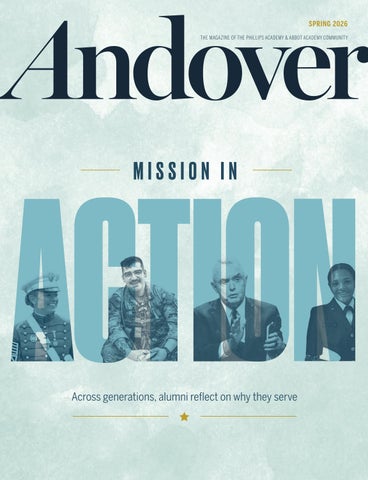
Across generations, alumni reflect on why they serve
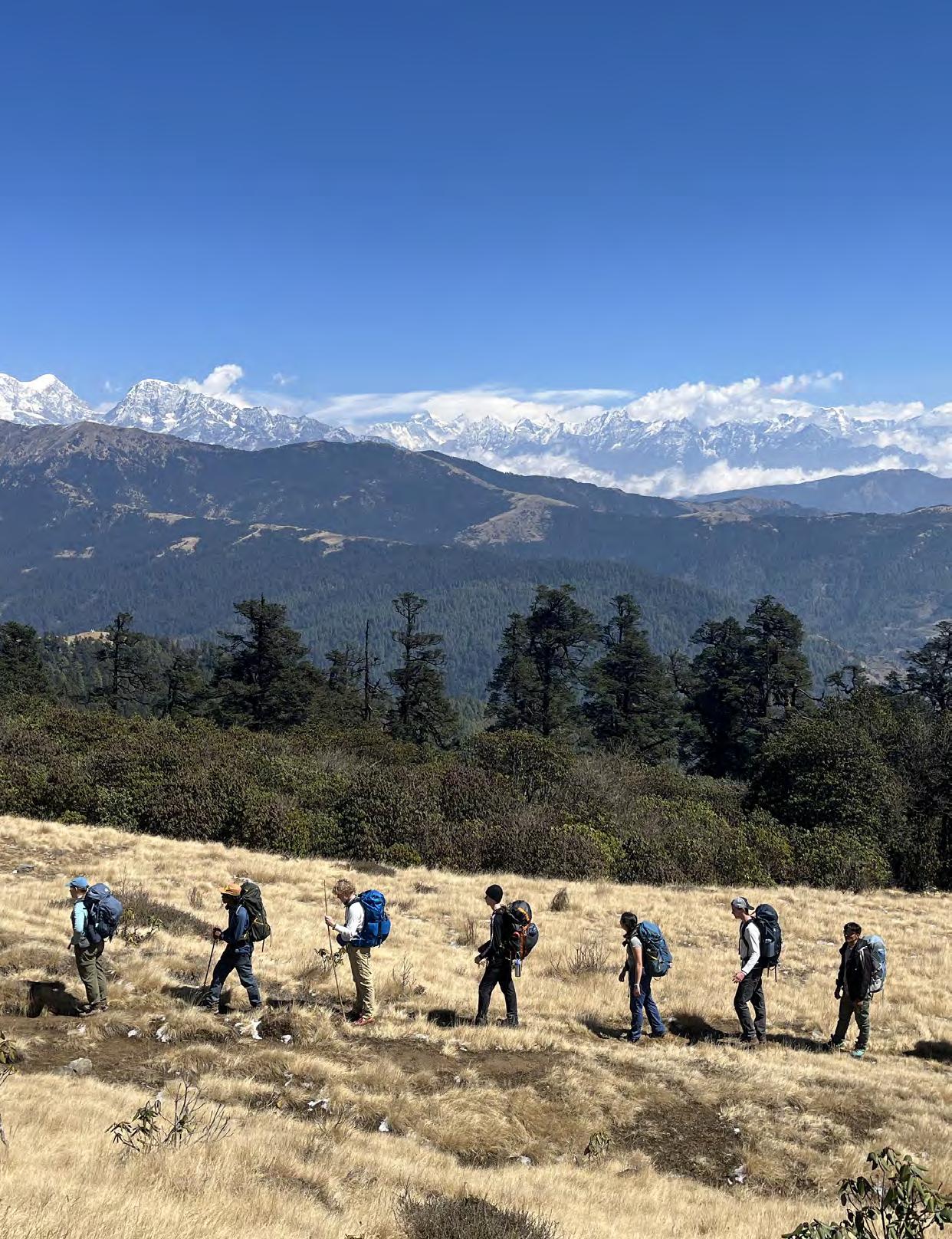
Waking at 4 a.m. to begin their final ascent, a determined cohort of 10 students—accompanied by Andover faculty and local guides—trekked through Nepal’s lower Everest region and joyously summited Pikey Peak (13,337 ft / 4,065 m) on March 15. More than 50 students participated in spring Learning in the World programs in five countries.
PHOTO BY SANTIAGO MORGAN
Each spring Andover welcomes a new class of bright, promising students. Together with their families, they gather on campus, wide-eyed and eager. Some feel pangs of self-doubt, while others feel remarkably self-assured. They all want to know: What will Andover require of them? Some might doubt their ability to measure up. Others want to know how quickly they can vault to the highest levels of calculus. “I’m really a STEM student, so I plan to concentrate in those areas and skip the language requirement.” While this is not an actual quote, the spirit of it is real.
The need to label oneself, skip the line, and carve a path early seems to be gaining momentum.
As our Class of 2026 seniors prepare to attend more than 100 different colleges and universities, they may be feeling similar pressure. I often hear these students talk about their airtight plan for the future. They’re ready to declare a major (maybe a dual major or honors track); they’re lining up internships; they’re looking at grad school requirements before they arrive for orientation—all while building a resume and professional network to launch their chosen career, one that will get them to retirement before age 55.
While I fully support pursuing a passion and focusing on a goal, I also hope that our students will give themselves permission to pause and enjoy the process (and struggle) of acquiring new knowledge. Change course if that preloaded plan is not serving them well. Retain the wonder and curiosity asso-
ciated with their time at Andover. I hope they will examine new ideas, understand alternate viewpoints, and remain open to analysis and reflection that can lead them to change their mind.
When these college and career conversations come up, I encourage students to pave a way forward with their navigation turned off. That doesn’t mean abandoning their goal. It means taking detours that may lead to unexpected opportunities.
This magazine’s cover story, “Mission in Action,” is rich with examples of unpredictable outcomes and career pivots. These experiences—whether serving one’s country, leading a team, or preserving history—make life fulfilling.
No matter how many decades separate them, Andover’s youngest students and oldest alumni all share the wonderful consequence of having a great education. A mind, once opened, can go anywhere— traveling previously unimaginable pathways. That is precisely the type of education that Andover provides: one that prepares students for the path ahead and encourages them to take the detours.
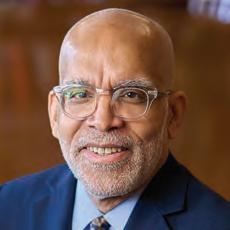
Raynard S. Kington, MD, PhD, P’24, ’27 Head of School
Andover magazine reinforces the special connection alumni have with Phillips Academy and Abbot Academy. Through thought-provoking stories, contemporary design, and inspiring profiles of alumni, students, and faculty, we aim to highlight the school’s enduring values, recognize our unique history, and celebrate the rich diversity of our community.
CHIEF COMMUNICATIONS
OFFICER
Tracy M. Sweet
EDITOR
Allyson Irish
MANAGING EDITOR
Rita Savard
DESIGN
Harshetha Girish
Stephanie Testa
CLASS NOTES EDITOR
Katie Fiermonti
CONTRIBUTORS
Erin Altemus ’97
Matthew Bellico
Jill Clerkin
Nancy Hitchcock
Hector Membreño-Canales
Andover, the magazine of the Phillips Academy and Abbot Academy community, is published four times per year. It is produced by the Office of Communication at Phillips Academy, 180 Main Street, Andover, MA 01810.
Main PA phone: 978-749-4000
Changes of address and death notices: alumni-records@andover.edu
Phillips Academy website: www.andover.edu Andover magazine phone: 978-749-4677 Email: magazine@andover.edu
Postmasters: Send address changes to Phillips Academy 180 Main Street Andover MA 01810 ISSN-0735-5718
© 2026 Phillips Academy, Andover, MA All rights reserved. No part of this publication may be reproduced or transmitted in any form or by any means, electronic or mechanical, including photocopying, recording, or information storage or retrieval system, without permission in writing from the publisher.
Spring is the season of transition—the buds on the trees, the emergence of songbirds and chipmunks, and the promise of better weather.
On campus, there’s a buzz in the air. Kids play Spikeball on the Great Lawn, there’s an uptick in campus activities and—of course—nearly everyone is preparing for Commencement.
This issue reflects that same sense of movement and change.
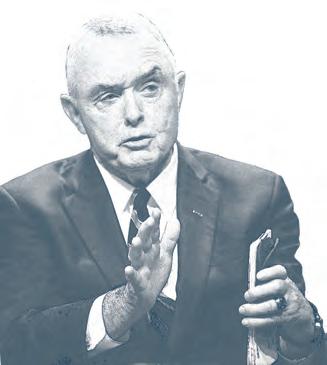
Our cover story, “Mission in Action” (page 14), shares the experiences of alumni such as Ret. Army Gen. Barry McCaffrey ’60, who spoke with us about choosing a profession where every decision carries consequence and a responsibility to something larger than oneself. When McCaffrey arrived as a firstyear student, he quickly discovered he had much to learn—and found faculty and peers who expanded the way he thought, learned, and led.
“It turns out, I was not one of the smartest boys in the world,” McCaffrey says. This realization, and the humility it inspired, is one of McCaffrey's most formative experiences, and is something he carried into leadership roles throughout his military career.
I hope you enjoy this story, along with many others, including changes in Academy leadership (page 8), reflections from five retiring faculty (page 26), and musher Erin Altemus ’97’s account of competing in one of the nation's most demanding dogsled races (page 32). Until summer …
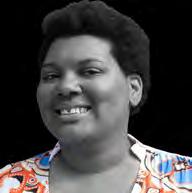
“We want first-gen students to learn they are not alone and that there is much they can learn from each other.”
LATASHA BOYD
PAGE 10
Allyson Irish Editor
magazine@andover.edu @andovermagazine

“The Student Wellness Council will bring hidden struggles into light.”
EVAN DEMAYO ’26
PAGE 7



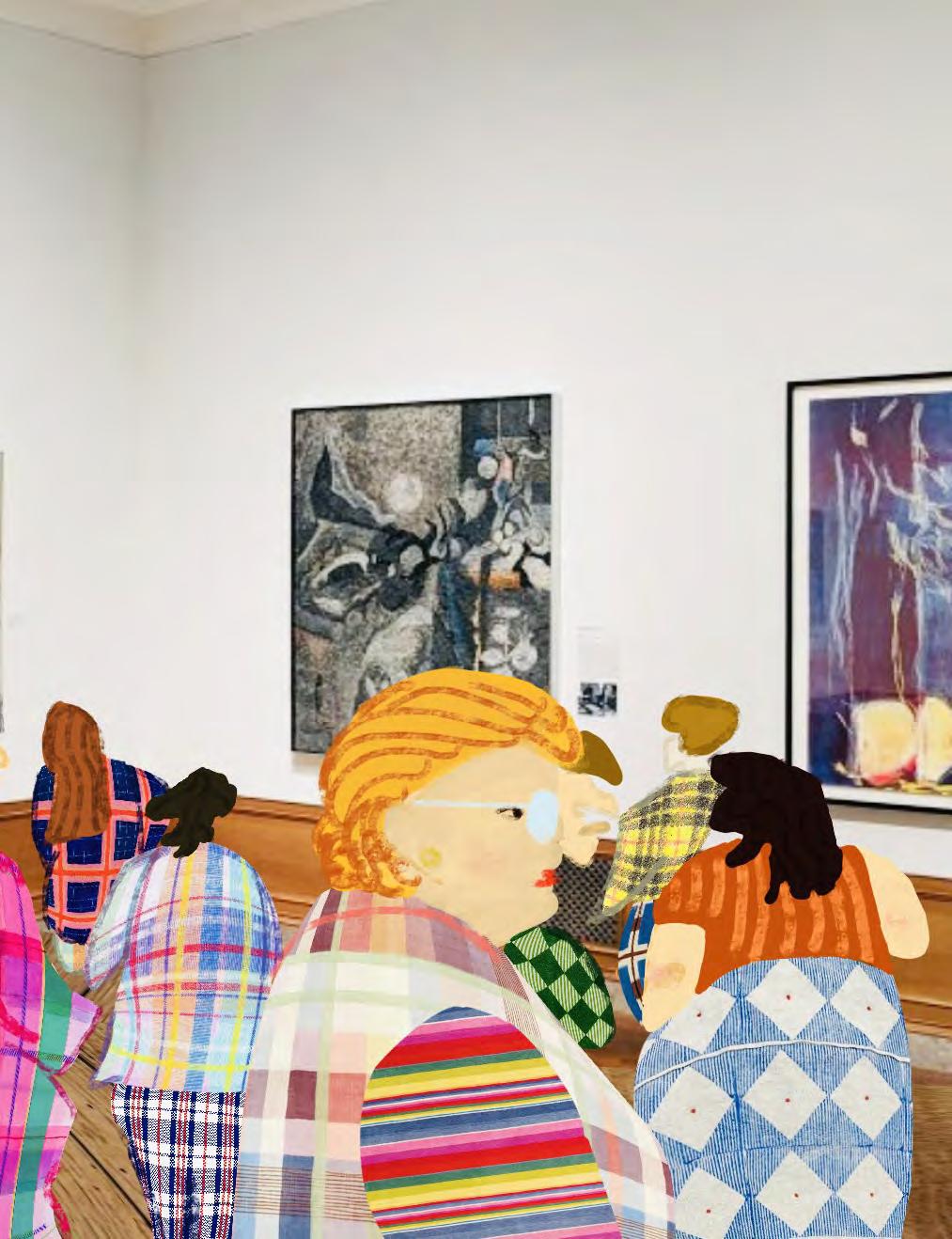
Artist Sophia Kim ’29 loves using mixed media, as seen in this eye-catching piece she created depicting visitors to the Addison Gallery of American Art. A native of Korea, Kim draws inspiration from Claude Monet and animated films like Coraline and The Little Prince, which use visual storytelling, vivid color palettes, and stop-motion techniques.
Raynard S. Kington, MD, PhD, P’24, ’27, Andover’s 16th head of school, announced in January that he will be leaving Andover in June 2027.
Kington was named head of school in 2019, following John Palfrey’s seven-year tenure. Prior to Andover, Kington was president of Grinnell College in Iowa for 10 years.
Andover’s Board of Trustees expressed gratitude for Kington’s leadership, which has guided Andover through a period of significant change and achievement. He has advanced initiatives that build on the school’s founding values while expanding its commitment to academic excellence, innovative programs, and financial support, which attracts talented students from a wide range of backgrounds.
“Dr. Kington has achieved all of this amid a challenging pandemic, the completion of the school’s most extensive capital campaign, and numerous essential building projects to enhance our facilities,” said Trustee President Amy Falls ’82, P’19, ’21.
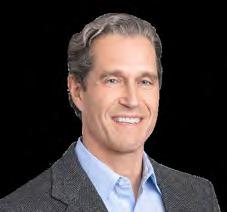
Eric Zinterhofer ’89, P’18, ’19
President-Elect
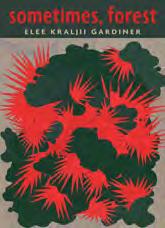
It’s been a good year so far for Elee Kraljii Gardiner ’88. She recently was named Poet Laureate of Vancouver, and her new poetry collection, sometimes, forest, was published this spring.
Unlike Team USA hockey player Jack Hughes, Bill Zito ’84 came home with a gold medal and all of his teeth intact! Zito was assistant general manager of the USA men’s ice hockey team this past winter, helping the team win its first Olympic gold since 1980.
The Head of School Search Committee, led by Eric Zinterhofer ’89, P’18, ’19, is working with consultants Carney Sandoe and Associates. They are currently assessing feedback from campus visits and a survey sent to parents, employees, alumni, trustees, and friends, and reviewing candidates in order to decide finalists.
In April, the Board of Trustees announced that Zinterhofer, a trustee since 2016, will become the new board president July 1. He will be joined by Christopher Auguste ’76, P’09, ’12, as the board’s first vice president. Both received unanimous support from fellow charter trustees.
“The new vice president role recognizes the increasing complexity and scope of the Academy and its leadership in global education,” says Falls, who completes her term June 30. "With the election of a president and vice president, the board has taken great care to ensure a smooth transition, while also focusing on Andover's future."
In other hockey news, Maggie Averill ’27 won a gold medal at the 2026 IIHF U18 Women’s World Championship and was one of three players named best defender in the tournament. And boys’ hockey captain David O’Neill ’26 competed in his 108th game with the Big Blue this past season, setting a record for most games played in the program’s 128-year history.


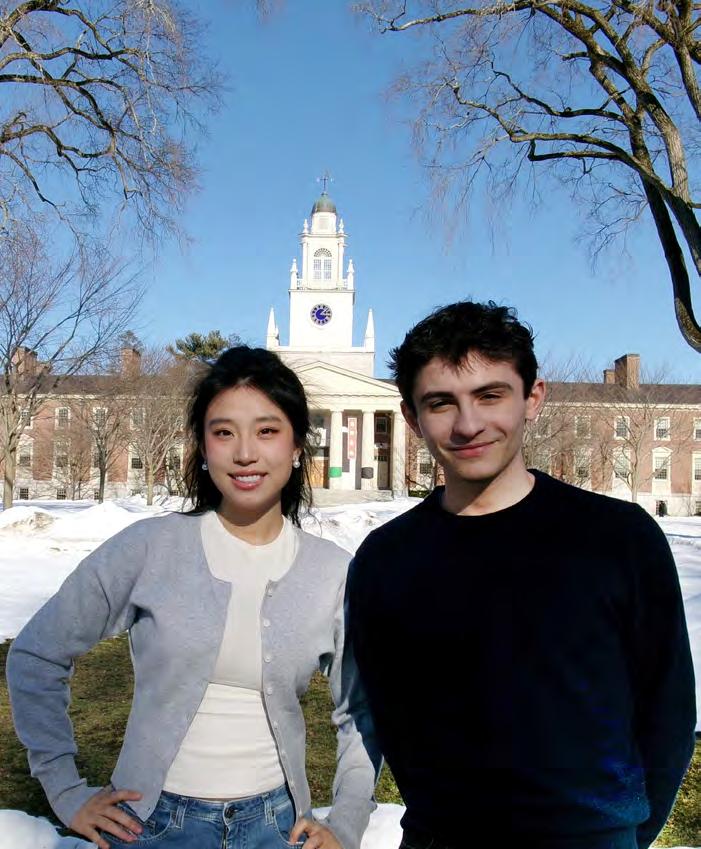
Student council aims to prompt conversation & action
If Evan DeMayo ’26 and Anny Wang ’26 (pictured above) could wave a wand and magically change anything at PA, it would be that students could better recognize signs of overwhelm and feel comfortable talking about their problems.
“Andover is a place where everyone is talented and driven; that energy is exciting, but it can also be exhausting,” says DeMayo. “Student wellness should never be treated as miscellaneous, nor should we ever be afraid to talk about it.”
DeMayo and Wang feel so strongly about this that the pair launched the Academy’s first formal student-driven initiative focused on student health and well-being. Proposed in October, the Student Wellness Council kicked off this spring with programming and
a special Paresky Commons dinner event that included free T-shirts and special activities.
Even though DeMayo and Wang will not be able to see the fruits of their labor next year, the seniors are nonetheless excited about the opportunity for future students to better understand mental health and wellness. They want students to be able to share their struggles without stigma and to build resilience and happiness in the process.
“This is a historic moment for Andover,” says DeMayo. “Anny and I are proud to have helped build something we believe fills a real need in our community.”
For many high schoolers, speaking openly about mental health, family pressures, academics, or social life can make them feel vulnerable and embarrassed. The new council aims to destigmatize these conversations, making wellness visible and normal.
The council officially kicked off this spring with a special dinner at Paresky Commons. Incoming student leaders already are planning for next year. Initiatives will include workshops and programs, collaborations with the Sykes Wellness Center, and a speaker series.
Students are barraged with information and options every day, so building awareness and promoting the council will be a top priority. The council has launched an Instagram page, and there are plans for an awareness campaign next year that will include posters and swag.
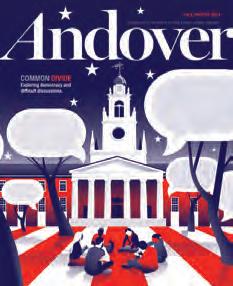

Andover magazine recently received two international gold marketing awards from InspirED School Marketers. The awards were for Magazine Overall Design (spring 2024 “Make More Future”) and Magazine Writing (fall 2024 “Common Divide”).
The annual InspirED Brilliance Awards is the only international competition that honors excellence in private and independent school marketing and communications.
Judges commented on the visual engagement of Andover magazine and the “great use of photography and typography.” For the “Common Divide” story, they noted the focus on a timely and important topic, the variety of interview subjects, and strong writing. “It all adds up to a superlative magazine.”
Launched by the Class of 1965, the Youth From Every Quarter Fund is expanding the Academy’s commitment to access and opportunity.
Conceived as “one big reunion push,” the effort supports the student experience, helping ensure that talented young people from rural areas across the United States can access an Andover education regardless of geography or circumstance.
“Our classmates benefited from the connections and friendships, as well as the academics, that Andover gave us,” says Randy Evans ’65. “Now we want to pay that forward.”
In its first year, the fund has strengthened financial aid support, opening new pathways for students who might not otherwise have considered Phillips Academy.
In response to the fund’s momentum, the Office of Admission helped create an alumni network of volunteers who represent PA in regions where staff are unable to travel. Alumni ambassadors attend school fairs, meet with prospective families, and extend the Academy’s reach into new communities.
“This initiative allows us to help the school recruit deserving students from diverse backgrounds—and financially support them so they’ve got every opportunity to thrive while they’re on the Hill, just as we did,” Evans adds. “And that’s incredibly rewarding.”
Kudos to Christian Parker ’89, who directed The First Line of Dante’s Inferno, which was performed at the New York City La MaMa Experimental Theatre Club in February.
And the Oscar goes to … Robin Hessman ’90 was part of the executive producer team that received “the golden trophy” for Best Documentary Feature for Mr Nobody Against . Hessman was on stage during the ceremony in March and served as an English translator for the film’s protagonist, Pavel Talankin, as he accepted the award.

“Dare to dream big—and know that dream can become a reality.”
Tessa Hulls Novelist, Journalist
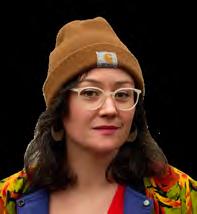
After a decade of work, Hulls published her debut graphic memoir, Feeding Ghosts, which won a 2025 Pulitzer Prize. Through art and storytelling, she explores how three generations of Chinese women—her grandmother, mother, and herself—were shaped by Chinese history, including inherited trauma, mental illness, identity, and—importantly—love.
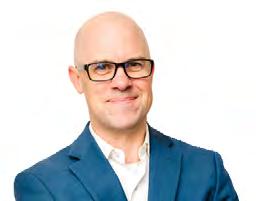
Peter Nilsson ’95
Educator, Consultant
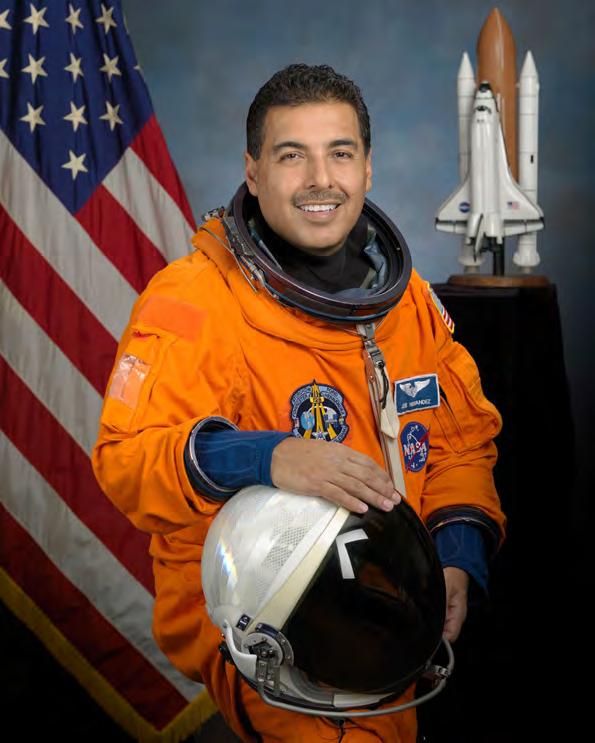
Dr. José Hernandez | NASA Astronaut, Engineer
At age 10, while working alongside his family as a migrant field worker, Hernandez dreamed of becoming a NASA astronaut. Driven by that goal, he persevered through years of striving, disappointment, and rejection. His story is told in the film A Million Miles Away.
Dr. Susan Schulten | Cartologist, Historian
A professor at the University of Denver, Schulten explores how maps shape our understanding of the past, providing deeper historical meaning. Her book Mapping the Nation and its companion website bring to light the wealth of information—ranging from disease and weather to population— that can be revealed by maps.
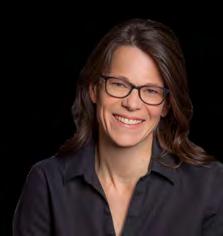
Drawing from his recently released, co-authored book, Irreplaceable: How AI Changes Everything (and Nothing) in Teaching and Learning, Nilsson visited campus as a winter term Tang Institute speaker. As AI reshapes nearly every facet of our lives, Nilsson offers compelling insights about its place in education.
Dr. Christopher Winter
Neurologist, Sleep Specialist
Success is often attributed to hard work and discipline, yet one of the most critical factors is far simpler: sleep. A sleep specialist since 1993, Winter has written books and hosted podcasts about the importance of sleep and consults with professional sports teams, including the Boston Red Sox, Oklahoma City Thunder, and Chicago Bulls.
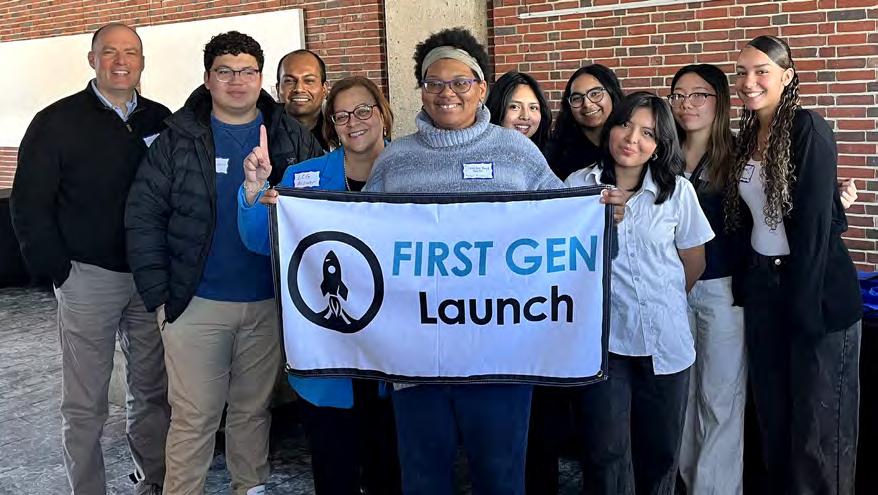
Learning from community, sharing experiences, and celebrating one another. These are some of the goals of Andover’s First Gen Fellowship Program, which officially kicked off this academic year by hosting a special multi-school gathering in January—the first of its kind focused on high school students.
With support from the organization First Gen Leadership, the day-long event included workshops, speakers, and networking opportunities with adults and students from eight peer schools, such as Northfield Mount Hermon, St. Paul’s School, and Concord Academy.
“It was exciting to bring together students to proudly bond over
their first-gen identity,” says Latasha Boyd, director of Andover’s First Gen Fellowship.
Defined as those who are the first in their family to attend college (or plan to attend college), first-gen students often face a set of unique challenges that include difficulty navigating campus resources and bias related to socioeconomic status.
Support for Andover’s first-gen students has been in the works for several years, says Linda Carter Griffith, associate head of school for equity, inclusion, and wellness. Previously, as director of the Office of Community and Multicultural Development (CAMD), Griffith provided workshops and train-
The ultimate battle of scientific wits unfolded at PA during the annual U.S. Invitational Young Physicists Tournament, held this past winter term. Teams from 15 high schools presented college-level investigations in fast-paced “physics fights,” debating four research problems. Andover advanced to the playoffs against Exeter, with Rye Country Day School emerging as this year’s champion.
ings for first-gen students, and she is excited by the opportunities becoming available through the fellowship.
“It has always been a dream of mine to bring first-gen identity out of the dark and into the light and for Andover to provide the appropriate and necessary resources for first-gen students,” Griffith says.
The fellowship group, based in CAMD, is currently composed of 12 students and seven adults who gather monthly for discussions and other events, such as a winter term ice cream social. Plans for future programming include a group discussion of the book Rising Class, workshops to better prepare first-gen seniors as they head to college, and a panel with first-gen alums.
Tony Award–winning director Christopher Ashley ’82 has been appointed artistic director of the New York City-based Roundabout Theatre Company. Ashley will assume his new role this summer.
Known for its robust collection of Native American cultural objects, the Robert S. Peabody Institute of Archaeology—celebrating its 125th anniversary this year—is the only archaeological institute in the U.S. located on a high school campus.
Robert Singleton Peabody, Class of 1857, is the institute’s namesake. Born in Ohio, Peabody cultivated a talent for classical languages at PA and eventually became a lawyer, practicing in Vermont and Pennsylvania. He also developed an interest in archaeology and amassed nearly 40,000 items— most of them Native American in origin. The museum was founded in 1901 to house his collection and help foster an interest in archaeology among students.
More than 600,000 artifacts, photographs, and documents make up the Peabody’s collection.
3
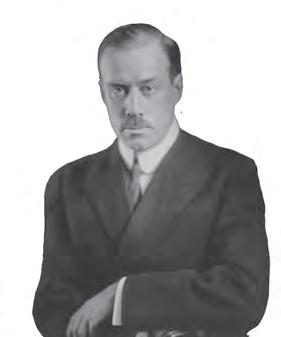
The Peabody was designed in the Beaux-Arts style by renowned Boston architect Guy Lowell (pictured above), who also designed several other campus buildings, including the former Isham Infirmary, the Memorial Bell Tower, and Samuel Phillips Hall.
In recent years, the Peabody has been recognized for its leading role in returning cultural materials as required under the federal Native American Graves Protection and Repatriation Act (NAGPRA). Peabody staff members have worked closely with tribes to identify collections and facilitate repatriation, particularly involving materials
The Peabody hosts a number of community events and workshops each year. One that has become very popular is a fused glass workshop with Ramson Lomatewama, an award-winning Hopi glass artist.

4

So much for retirement. Ernie Adams ’71, former New England Patriots director of football research, has a new gig—at Andover! Adams was recently named interim head football coach for the 2026 season.
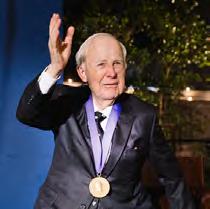
Dr. Paul McHugh ’48’s lifelong work in psychiatry was recognized with the 2025 Zimmer Medal for Intellectual Freedom from the American Academy of Sciences and Letters. For 26 years, McHugh was the psychiatrist-in-chief at Johns Hopkins Hospital, researching psychiatric genetics, epidemiology, and neuropsychiatry.
Author & ASM speaker encourages self-awareness, grace
For many years, Joshua Steiner ’83, P’17, ’19, operated with the philosophy “repress for success.” Moving on from mistakes quickly, putting his head down, and focusing on work enabled him to graduate from Yale and Oxford, co-found two investment firms, and land a spot on Andover’s Board of Trustees. What it didn’t do was provide him with the tools to process hard experiences.
“I would have been far healthier and happier if I had allowed myself to talk about mistakes,” Steiner said in April during a candid conversation with Dean of Studies Caroline Odden P’26, ’28, at All-School Meeting.
The visit came amid a flurry of media attention on his first book, From Mistakes to Meaning: Owning Your Past So It Doesn’t Own You . Written with his friend, former Sony CEO Michael Lynton, the book provides a structured way of assessing mistakes through personal vignettes shared by successful executives, artists, authors, and others.
Steiner’s “big mistake” occurred in his late 20s when he was chief of staff for the U.S. Department of the Treasury. During this time, President Clinton was being investigated for questionable real estate and financial dealings as part of the Whitewater Scandal, and Steiner’s personal letters and diary were subpoenaed—both of which contained references to colleagues and the scandal itself.
After surviving scrutiny across global media, Steiner kept his job and moved on. For many years he attempted to ignore this embarrassing past incident, making jokes about the scandal and trying to forget. But during COVID, Steiner and Lynton had the opportunity to dive
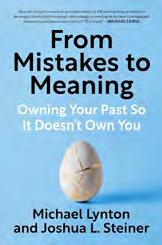
In addition to speaking at ASM, Josh Steiner dined with student leaders and attended two classes: History 300 and Creative Non-Fiction
A friend of Steiner’s also generously donated copies of his book for the Andover community.
more deeply into their past; the pair realized that a book focusing on mistakes could give others permission and a framework for talking about their own misadventures.
During All-School Meeting, Steiner shared some of the research from the book, including various ways that students can learn to have a healthier relationship with their own mistakes, have them sting less acutely, and ultimately make fewer of them.
Steiner acknowledged that Andover can be a difficult environment, and students can often feel overwhelmed. Thankfully, today’s culture is more open to conversations about things such as therapy, mental health, and wellness, and students have more support, such as the new Wellness Council (see page 7).
His advice to students: recognize that mistakes reveal hidden aspects of your personalities, have empathy for yourself and others, and truly listen when a friend opens up to you. “Find someone you trust and talk your mistakes to death.”

White Pines
JANE ENGLISH ’60
Earth Heart
A photographer, artist, and physicist, English blends memoir, natural history, and Indigenous wisdom in White Pines. Through photographs, dreams, and shared stories, she invites readers into a reciprocal relationship with Eastern White Pines—experienced not as resources but as living relatives—offering a quiet, radical vision of belonging, sufficiency, and care for the land.
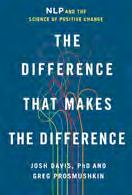
JOSH DAVIS ’92
St. Martin’s Essentials
The Difference That Makes the Difference offers a clear, practical introduction to Neurolinguistic Programming (NLP), grounding its tools in the science of positive change. Davis and co-author Greg Prosmushkin translate complex ideas into actionable strategies for communication, goal setting, and skill development, empowering readers to move from intention to action.
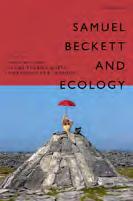
NICHOLAS E. JOHNSON ’99
Bloomsbury Publishing
Johnson is co-editor of this complete exploration of Samuel Beckett’s work in relation to the environment today. While Beckett—an Irish writer who won the Nobel Prize in Literature in 1969—was not an environmental writer, these essays show how his plays and prose speak to fragility, survival, and human responsibility as the climate crisis intensifies.

DAN MURPHY ’00
University of Utah Press
Winner of the Agha Shahid Ali Prize in Poetry, Murphy meditates on God, man, and eviction—on Irish Coffee in Winter, memory, and shadow boxing. Moving through life’s phases, he searches for meaning while reckoning with fragility and loss, reminding us, “There is only so much sweetness in this world.”
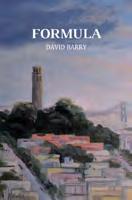
DAVID BARRY ’10
Belmont Press
In this debut novel, a young man living in San Francisco works in Big Tech and launches a new business with an unlikely partner: a local rapper. As Timothy Mainwaring pursues the American Dream and yearns for the best life has to offer, the worlds of sports, art, and music merge with those of competitive technology companies, politics, and yacht clubs.

JULIE DOAR ’13
Zibby Publishing
In this gripping murder mystery, Marlowe, an illustrator living in New York City, visits her family’s Hudson Valley estate for the holidays and discovers a dead body on the property. She starts unraveling the small town’s secrets and scars, including the disappearance of her teenage best friend 20 years earlier.
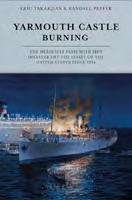
RANDALL PEFFER P’96, ’17
Schiffer Publishing
Faculty Emeritus Peffer, a PA English instructor for 37 years, co-wrote this meticulously researched account of the 1965 Yarmouth Castle disaster—“the deadliest passenger ship disaster off the coast of the United States since 1934”—with Eric Takakjian, a professional mariner. Drawing on survivor testimony, official investigations, and more, they reconstruct a night of catastrophic failure and examine the regulatory and corporate aftermath.
To be considered for “Bookshelf,” please send a brief summary of your recently published book to magazine@andover.edu
BY RITA SAVARD







THE
TOOK THE CONTROLS OF A HELICOPTER IN FLIGHT, SHE UNDERSTOOD THE DIFFERENCE BETWEEN TRAINING FOR RESPONSIBILITY AND CARRYING IT.
“There’s this moment when the aircraft lifts and you realize you’re doing this—a thing that once seemed impossible,” recalls Bales, an Army strategist and former Black Hawk pilot with deployments to Iraq and Afghanistan. “It’s surreal to finally have that opportunity and then to be trusted with something that carries real purpose.”
Long before that moment, Bales sat with peers in Andover classrooms, learning to test ideas, defend positions, and listen closely to perspectives different from her own. In the military, the stakes changed. The through line, she says, did not: a belief that leadership begins with responsibility to something larger than oneself.
At Phillips Academy, that idea has a name: non sibi.
Choosing military service today means stepping into a world defined by active conflict, difficult decisions, and consequences that extend far beyond any one individual.
The groundwork for those decisions is often laid before a person ever puts on a uniform.
The following pages bring together voices from across generations of Andover alumni who chose a path of non sibi through military service: a Naval Academy midshipman just beginning her career, an art instructor serving as a civil affairs officer in the Army Reserve, aviators who broke barriers in military flight, a Vietnam veteran whose best-selling memoir has helped thousands of veterans living with post-traumatic stress, cyber security officers at the intersection of artificial intelligence and military operations, and a four-star general reflecting on the education that shaped his understanding of leadership at the highest levels. Their stories explore what service looks like when leadership carries consequence—and when decisions ripple far beyond the moment they’re made.
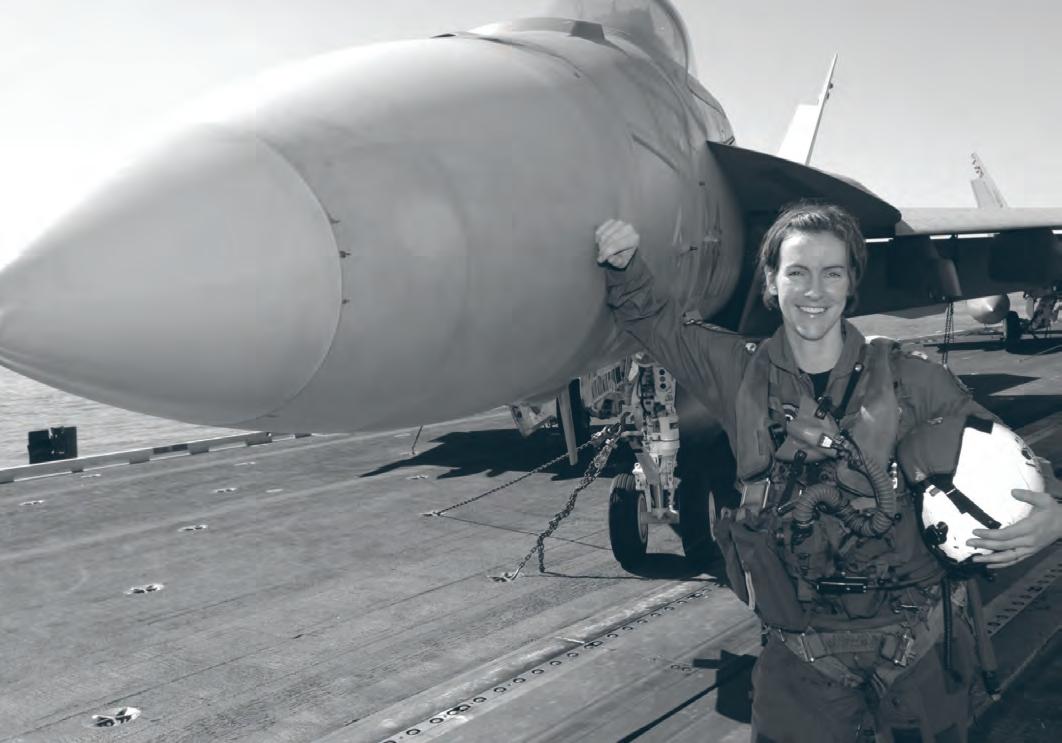
Four pilots on breaking barriers and inspiring the next generation
THEY CAME UP A GENERATION
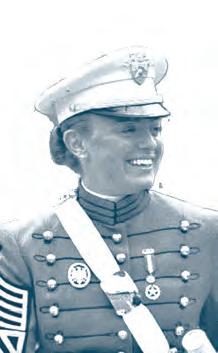
APART—one navigating a Navy that kept women out of combat, one flying F-18s over Afghanistan and Iraq after 9/11, one returning to the air just 12 weeks after giving birth, another piloting Black Hawks in Army operations. Sali Gear ’79, Becky Dowling Calder ’94, Laurie Coffey ’95, and Jennifer Bales ’04 entered systems still catching up to them. Determined to serve, they set new standards for those who followed.
Why did you choose a career path of service to country?
SALI: It felt like a natural extension of the way I was raised. After my father passed away, my mom raised us with clear values: God, country, and family. She taught
us to be grateful for opportunity and always to contribute where and when we could. When I reached the point of deciding what I was going to do with my life at Andover, the military just felt like a place where those values could be lived in a very direct way.
BECKY: A military career wasn't something I always wanted, but looking back I realize the concept of non sibi was foundational to who I would become. The Naval Academy recruited me for basketball, but what shaped me the most wasn't sport—it was the mindset to work hard for something bigger than myself, to sacrifice for the success of a team. It was ingrained in me by my family, my coaches, and my time at Andover. Serving in the Navy
felt like a continuation of who I was becoming.
LAURIE: I got involved with Andover’s community service programs and found it fulfilling. That non sibi ethos blended seamlessly into the challenge of embarking on a military career in service of my country.
JENN: My first day of lower year at Andover was 9/11. We were in All-School Meeting when everything unfolded. I went to West Point intending to become a doctor but during the height of the wars in Iraq and Afghanistan, the names of graduates killed in combat were announced at lunch as over 4,000 cadets would silently stand at attention. Eventually, the names were people I knew. That’s when I realized I wanted to be as close to combat as possible and aviation felt like the right path.
How would you describe the landscape for women pilots in the military when you entered?
SALI: It wasn’t welcoming, but I
didn’t expect it to be. I was the first woman in an A-4 squadron. On my second day, a student control officer told me, “You're the first woman here, and I'm going to make sure you're the last.” Who do you take that to? And if you did, who would believe you?
BECKY: I graduated from the Academy with a class of about 8 percent women. When I started flight school, there were only a couple of women in my class. When I selected jets, I was the only woman. What I understand now, is that I had incredible self-efficacy. I never wanted anyone to question why I was there or if I belonged.
LAURIE: Even in the late ’90s, the fighter community was still less than 1 percent women. I never had women in my squadron or in leadership. The hardest part came when I returned to flying when my daughter was 12 weeks old. They said they treated everyone the same—but that meant no flexibility for a single parent with an infant.
JENN: Women couldn’t serve in certain combat roles. Aviation was one of the closest paths to combat. Because of the women who came before me, I felt like I was standing on the shoulders of giants. I didn’t have to break the ceiling—they already had.
What did you feel knowing your performance might shape the experience of other women?
SALI: How you presented yourself would impact the generation of women pilots behind you. Nobody would say it, but you knew. I was the only woman there so falling short in any way was never an option.
BECKY: When you are the model minority, you carry the weight of an entire gender. It's heavy. We
were at war, and I had a job to do, so I focused on doing it the best I could.
JENN: Being average as a woman often doesn’t feel like enough. You feel pressure to outperform because your reputation follows you. You always have to be at the top of your game.
In combat, decisions must be made in real time—sometimes with incomplete information and lives on the line. What does that demand of a person?
LAURIE: You’re constantly weighing your mission, protecting your people, and protecting civilians. Sometimes you can’t do all three. You have to be decisive, but also have the moral courage to say no. You have to be able to live with what you authorize.
BECKY: Every mission is different, and it demands your best. What you fall back on is everything that came before—every hard thing you survived. You make the best decision you can in the moment, and you trust others to do the same.
JENN: Combat is unforgiving. In aviation you're not just dealing with the enemy—you’re also dealing with the immutable force that is gravity. Regardless of what else is happening around you, you must aviate, navigate, and communicate. As a Black Hawk pilot, what I did, or failed to do, directly affected soldiers on the ground. That humbling reality stays with you.
What kept you going?
SALI: My mother taught me: when things get tough, you put your head down and you do better. I found the grit at Andover—it asked me what my very best actually was. That served me in the military when the chips were down and I just had to dig
NAVY CMDR. SALI GEAR ’79
Born into a Navy family, Gear pursued her dream of flying jets despite policies barring women from combat squadrons. She was a commercial airline pilot for more than 30 years, and is the founder of Island Dog Rescue, which orchestrated the largest mass rescue of shelter animals ever—flying over 350 dogs and cats to safety after Hurricanes Irma and Maria.
NAVY CAPT. BECKY DOWLING CALDER ’94
The first female pilot to graduate Top Gun, the Navy’s elite Strike Fighter Tactics Instructor program. An F/A-18 Hornet pilot and Andover 12-letter athlete, Calder was inducted into the New England Basketball Hall of Fame and Andover Athletics Hall of Honor. In 2014, her No. 32 became the first women’s jersey retired by Navy.
NAVY CAPT. LAURIE COFFEY ’95
F/A-18 Hornet fighter pilot with more than 2,000 flight hours and 400 carrier landings, Coffey is a Naval Academy graduate and Andover Athletics Hall of Honor inductee. She holds an MA in national security and strategic studies and now serves as a prosecutor for the Department of Children and Family Services in New York.
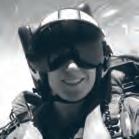
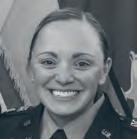
A UH-60 Black Hawk helicopter pilot with combat deployments to Iraq and Afghanistan in support of Operations Inherent Resolve and Enduring Freedom, she currently serves as an Army strategist with the U.S. Army Futures and Concepts Command.
in. And I always had faith. Even when my dad wasn't living, I felt like he was with me.
BECKY: My faith, my family, and the idea that I was doing my part to serve our country and protect the troops on the ground that were fighting on the front lines. Preparation was my superpower.
JENN: Stubbornness and tenacity. A fixed resolve that I wasn’t going to quit. Rowing crew also helped shape that mindset—and it’s where I met my husband.
What did you learn at Andover that you carried into service?
SALI: Besides finding grit at Andover, the service component was always looked upon so highly—to serve and support your community in whatever way you could. That planted something in me that never left.
BECKY: The concept of non sibi at Andover became non sibi sed patriae (not for self, but for country) at the Naval Academy. Service to others is the through line. I learned at Andover that true leadership means serving others first.
JENN: Confidence and humility. There’s always someone who knows more than you. Andover gave me the confidence to seek those people out and the humility to learn from them.
What did military service teach you about yourself that you couldn’t have learned any other way?
SALI: That I was part of something bigger than myself. I'd done a lot of athletics—tennis, sailing, equestrian—where I was often the solo person relying only on myself. The military grounded me in a different way. Unit cohesion, shared responsibility—the
understanding that the mission is never just yours alone.
BECKY: Resilience isn't optional— it's required. I learned I could endure more than I ever imagined, make decisions under pressure, and keep moving forward when I wanted to give up. But I also learned resilience comes at a cost. It asks something of you—emotionally, mentally, even physically. And real strength is not just pushing through; it's knowing how to recover and reset, so you can give your best.
LAURIE: It gives you a permanent sense of equanimity. Nothing else in life is ever quite as stressful as making decisions daily where the consequences can be dire for others. Now I’m a prosecutor. People say my courtroom demeanor is so calm. I just think—the stakes are pretty low here. No one’s shooting at me. That perspective, if you can hold onto it, is one of the great gifts of service.
JENN: Leadership isn’t one-sizefits-all. Reading an article about (former Army Capt.) Tammy Duckworth helped change my perspective. She focused on small things—like making sure her
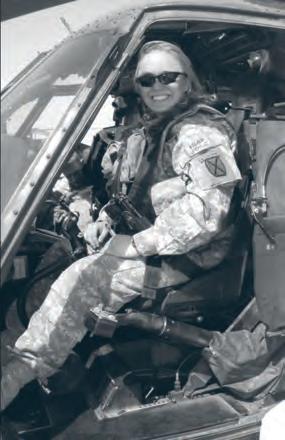
soldiers had hot chocolate during cold mornings in training. People joked, but she led authentically and that made all the difference in her ability to lead her soldiers to perform their very best. I took that to heart. Being able to use the unique strengths we each bring—that diversity of people and ideas—is what is beautiful about the military and what makes it strong.
What do you hope for the women who come after you?
LAURIE: A four-star female Air Force general once said she’d know there was equity when a woman could just be an average pilot—median, run of the mill— and no one would think anything less of her. That’s a luxury men have always had. When women in aviation become unremarkable, we’ll know something has actually changed.
JENN: My perspective has changed since becoming a parent. When I think about the next generation, regardless of gender, I hope they have the opportunity to pursue what they love with doors open to them. I hope we reach a point where we’re no longer talking about breaking glass ceilings, but simply about people following their passions.
BECKY: I hope they feel like they belong. Doing what you love while being able to serve others—I can't think of anything better.
SALI: In aviation, we always find the sun. You take off in fog, you can’t see a thing, and at 5,000 feet you punch through the clouds and the world opens. It’s been a symbol for me. What seems dark below—if you keep pushing on, you will find the light in the world.
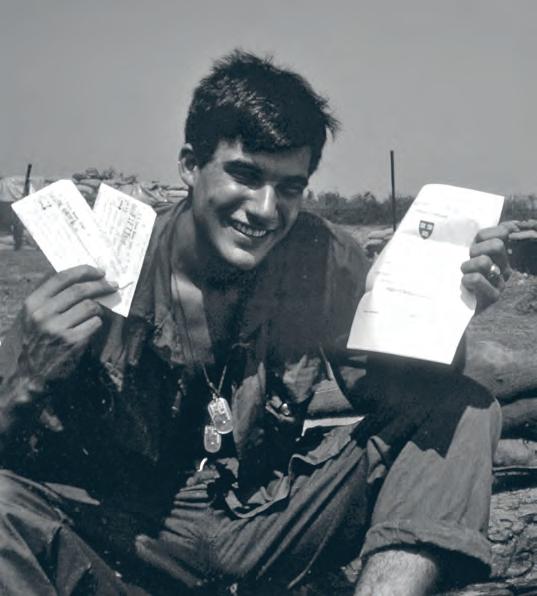
WHEN JACK MCLEAN ’66 LEFT VIETNAM in the summer of 1968, he did what many combat veterans of his generation were expected to do: he moved on.
Two weeks after returning from an infantry unit that had seen some of the war’s fiercest fighting, he stepped onto Harvard’s campus, trading jungle fatigues for lecture halls almost overnight. Publicly, the war was something he left behind.
“I came home, started school, started working, started a family,” he says. “And I never really processed anything I went through.”
Military service had not been the typical path for his classmates. Late in his senior year, McLean enlisted in the Marine Corps rather than wait to be drafted.
By 1967 he was serving with an infantry company near Con Thien and Khe Sanh, where survival depended on the men beside him—and the promise that no one would be left behind.
The defining moment came during a brutal engagement near the Laotian border in June 1968,
Best-selling author and historian Jack McLean ’66 was the first Vietnam veteran admitted to Harvard University.
when his unit was overrun. Dozens were killed. Many more were wounded. Weeks later, he returned home carrying memories he would spend decades trying to outrun.
Coming home proved almost as disorienting as combat.
“People didn’t separate the war from the people who fought it,” McLean says. “When I got home, I kept Vietnam in the rearview mirror. I didn’t even put it on my resume.”
Like many veterans, he buried his experience under work and family life. Years later, his marriage unraveled, his health declined, and the delayed emotional cost of war— along with the effects of Agent Orange—began to surface.
Nearly four decades after returning home, he sought help through the Department of Veterans Affairs. Therapy and writing became part of that recovery.
His first book, Loon: A Marine Story (2009), helped him honor the men who did not come home—and has helped thousands of veterans living with post-traumatic stress.
“Through their stories, I found a way to make peace with my own,” he says.
Today, McLean speaks openly about the long road back from war and the importance of recognizing invisible wounds. His memoir is a national bestseller and part of the U.S. Marine Corps Professional Reading List.
“I was proud to be a Marine and I’m grateful I survived,” he says. “If telling this story helps even one person feel less alone, then it was worth it.”
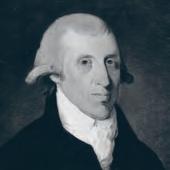
At the start of the Revolutionary War in 1775, when Gen. George Washington’s army faced dangerous shortages of gunpowder, Samuel Phillips Jr. helped finance and build a gunpowder mill along the Shawsheen River in Andover. With limited technical knowledge available, he partnered with educator Eliphalet Pearson—who would later become the Academy’s first headmaster—to experiment with production methods critical to the war effort. Without natural sources of saltpeter, a key ingredient in gunpowder, workers improvised by extracting nitrates from local soil, barns, and cellars. Despite supply challenges, inconsistent quality, and the constant danger of explosions, the Andover mill produced as much as 1,000 pounds of gunpowder per week during the Revolution’s early years, when every shipment mattered.
Phillips would go on to found Phillips Academy in 1778 to prepare young people for lives of purpose. His wartime efforts reveal a mindset that still defines Andover nearly 250 years later: solving hard problems in service of something larger than oneself.
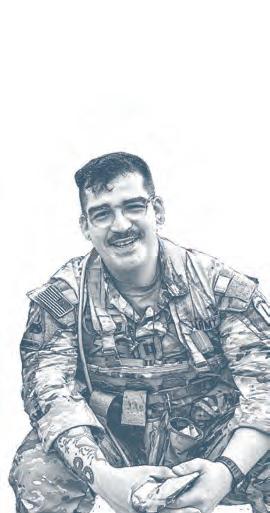
CAPT. ANNETTE “NETTE” BELL ’16 SPENDS HER DAYS THINKING about what happens when machines are trusted too much.
At the Army’s Artificial Intelligence Integration Center in Pittsburgh, where algorithms increasingly inform military decisions, her role isn’t just to build smarter systems. It’s to make sure humans remain accountable for them.
“Trust, ethics, and human-centric design have to be at the forefront of this kind of technology,” Bell says.
Her work, like that of her sister Alexi Bell Farr ’13, exists in a part of the military most people never see—the digital systems that determine whether everything else functions.
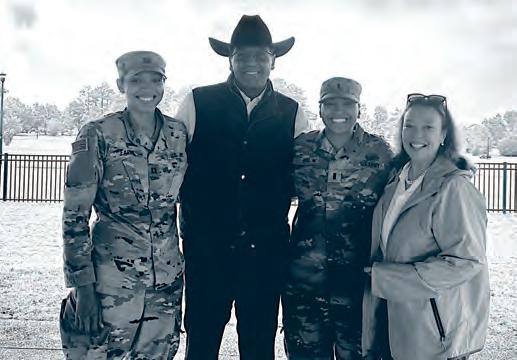
Sisters and Army captains Alexandra “Alexi” Bell Farr ’13 (left) and Annette “Nette” Bell ’16 with their father, former U.S. Army Ranger Oliver Bell, and mother, Stacee Bell.
Bell has worked on cybersecurity teams protecting infrastructure where digital breaches could quickly become physical consequences. Farr, a former military intelligence officer and data scientist, has focused on
protecting logistics systems and building tools to help analysts prioritize intelligence.
Military service was familiar territory long before either sister chose it. Their father, a former Army Ranger, made that path visible early, while their parents emphasized discipline and accountability.
At Andover, they found another kind of preparation: teachers who pushed them to think independently and take responsibility for difficult decisions.
One lesson stayed with Bell from longtime physics teacher and volleyball coach Clyfe Beckwith.
“There would be times when we’d get in our heads,” she recalls. “And he’d say, ‘I can’t do this for you. I know you can do this—but you have to get in the game and figure it out.’”
Years later, that lesson still shapes how the sisters think about AI.
“Data is a measure of the things that we have encoded into it,” Farr says. “Every dataset carries the assumptions and blind spots of the humans who built it.”
The future of defense technology, they say, depends less on what machines can do
Military service has been woven into Phillips Academy's story since 1778, when the first students arrived on campus—a tradtion that extends today to active-duty bases around the world.
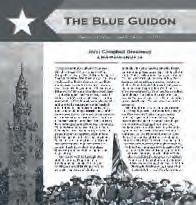
To honor that legacy, Andover and the Military was founded in 2011 to foster connections among veterans, active-duty service members, students, and the broader school community. It's newsletter, The Blue Guidon, continues to shine a light on news about alumni servicemembers.
“Leadership is a lifelong journey,” wrote Lt. Col. Rush Taylor ’96, USAF, in a recent editor’s letter. He credits Andover and its non sibi motto with the roots of his decades-long commitment to service.
Discover more at andover.edu/paserves
than on whether the humans behind them understand their limitations.
“Ethics cannot be retrofitted,” Bell says. “It has to be embedded from the start.”
“It’s very easy to say, ‘The system told me this,’” Farr adds, “but there has to be a final human decision-maker.”
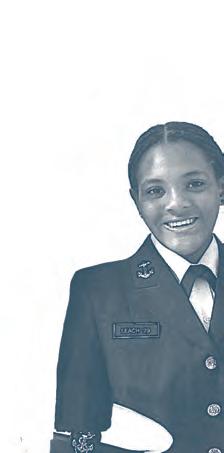
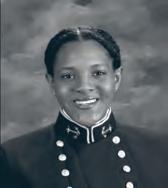
From Andover to Annapolis, Kennedy Leach ’25 is charting her course. Now a midshipman at the U.S. Naval Academy, she reflects on her decision to serve.
Why did you choose military service?
My decision didn't stem from a lifelong dream of joining the armed forces, but rather from a deepseated desire to serve in a leadership role. I was drawn to the holistic development that the Naval Academy demands—challenging me not just academically, but physically, morally, and professionally. Ultimately, I chose this path because I am willing to endure the rigors and challenges of the Academy so that one day, I can lead my future sailors and Marines with grace, fairness, and kindness.
How did your Andover experience help prepare you for the challenges and expectations of a service academy?
Andover prepared me in both practical and profound ways. Because I was already accustomed to living away from home, managing roommates, and navigating dining halls, I bypassed much of the initial culture shock that many of my peers faced. Academically, I am thriving. My Andover background made the hurdles of time and stress management much more bearable.
However, the most vital preparation was internal. The Naval Academy is an environment where some of my personal values don't always align with those around me. My time at Andover gave me a strong foundation in my own identity, allowing me to stay grounded in what I believe, even when navigating a world of vastly different perspectives.
What has surprised you most about your experience so far, and how has it shaped your understanding of leadership or service?
The stark reality of the day-to-day grind! Sometimes I still catch myself asking, “What the heck did I get myself into?” However, this friction has fundamentally shaped my understanding of leadership. It has taught me that true service requires resilience and the foresight to look beyond temporary discomfort. Ultimately, this experience has reinforced a lesson from one of my personal heroes, the late Mack Newton, a ninth-degree black belt in taekwondo and fitness coach: "Attitude is everything.” I've learned that leadership means keeping your head up through adversity, knowing you get out exactly what you put in, helping others help themselves, and always trusting that there is a solution.
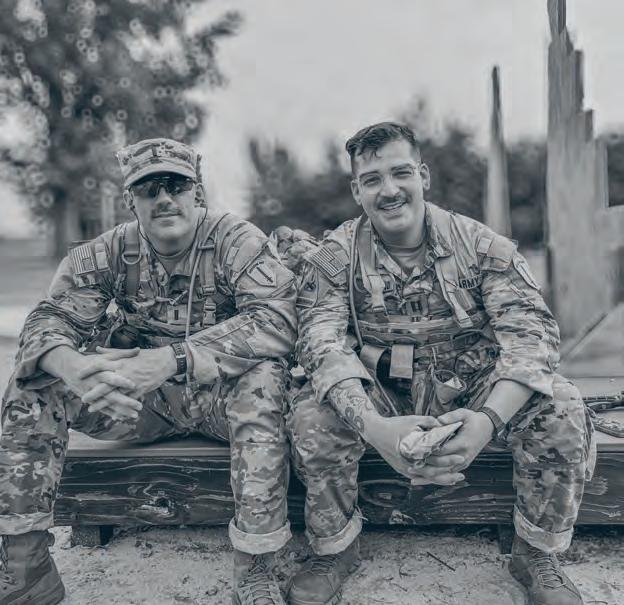
Hector Membreño-Canales on preserving cultural heritage in conflict zones
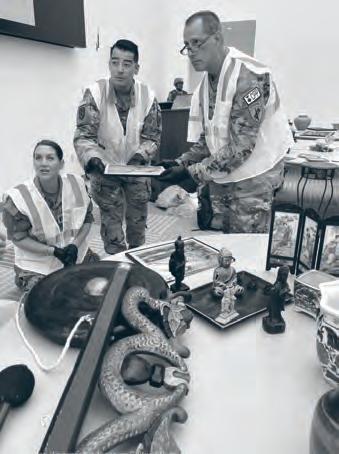
AFTER WORLD WAR II, THE U.S. ARMY’S ART EXPERTS SET OUT to find and return millions of works stolen by the Nazis. Known as the Monuments Men, they included approximately 350 men and women—museum curators, conservators, historians, and archaeologists—who tracked looted artifacts and helped preserve cultural history. The program disappeared after 1947 but was recently revived. Among the first class of heritage and preservation officers graduating in 2022: Phillips Academy art instructor Hector Membreño-Canales, who has served in the Army since 2007 and holds degrees in photography and art history.
You were already serving in the Army Reserve when the heritage and preservation program was revived. Did you immediately think, “This was made for me?” I grew up idolizing Indiana Jones, but, to me, believing the Army considered cultural property protection a real job was like believing Jurassic Park dinosaurs were real. Then one day, a friend shared the New York Times article about the Army reviving the “monuments men” program. I was excited to read the program existed at all. I was concerned, however, that I wouldn’t be accepted because it’s competitive and niche.
Speaking “Army” and speaking “art” were languages I’ve spent the past 20 years doing. The application process took almost 18 months. Eventually, I received training at the Smithsonian through a partnership they have with the U.S. Army.
The original Monuments Men protected cultural treasures during wartime. What does protecting cultural heritage look like in today’s Army?
In today’s Army, protecting cultural heritage isn’t only about safeguarding paintings or monuments in a museum. It’s really about abiding by the Law of Armed Conflict and observing the Hague Convention and Geneva Convention protocols that outline how cultural property is protected during armed conflict. It’s also about advising senior leaders operating near cultural sites and preserving archives and artifacts that are the living memory of a society. We work to prevent looting, destruction, and the misuse of cultural property in conflict zones. We’re trained to coordinate with local communities, historians, and international NGOs. The tools have changed through satellite mapping and digital documentation, but the mission remains the same: protect the people, places, and things that tell society who they are and where they come from.
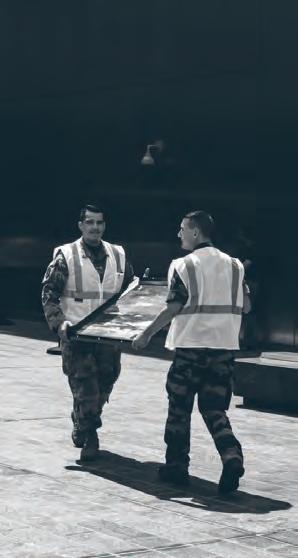
Art instructor Hector MembreñoCanales is among the new "Monuments Officers" trained to help save cultural heritage in war zones.
What does losing cultural heritage mean for a community or a nation?
It’s the erasure of memory, history, and identity. When cultural heritage and sites are lost, communities lose the anchors that connect generations and the stories that define them. It’s like losing a piece of yourself. It’s far more than the physical destruction of a building, manuscript, or painting, but the loss of knowing and seeing your ancestral past.
You teach art to students every day and protect cultural heritage as a soldier. What do you hope both roles teach the next generation?
Both roles show that creativity and stewardship are inseparable from citizenship. Art can teach observation and critical thinking; cultural heritage teaches responsibility and foresight. Both require sensitivity to context and committing to something bigger than oneself. I hope our students are better equipped not only as artists but as citizens capable of protecting what makes life meaningful.
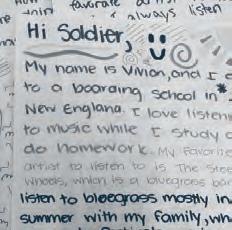
on campus life, and reminders that someone back home is thinking of them.
Platoon program has invited students to share encouragement, reflections
For Alex Havemeyer ’28, the exchange carries personal meaning. Her grandfather, Arthur, served in the Navy during WWII and often spoke about the impact of letters from strangers. “Receiving mail from students was a real bright spot for him,” she says. “There’s something really special about making this kind of connection.”
Bruce Ru ’28, who was part of the Army Cadet Corps back home in Australia, is drawn to the mix of people military service brings together. “I think about all these people in one place who are wildly different from one another but who all share a common goal,” he says. “These letters are hopefully making service members feel seen, valued, and adding a little more color to their day.”
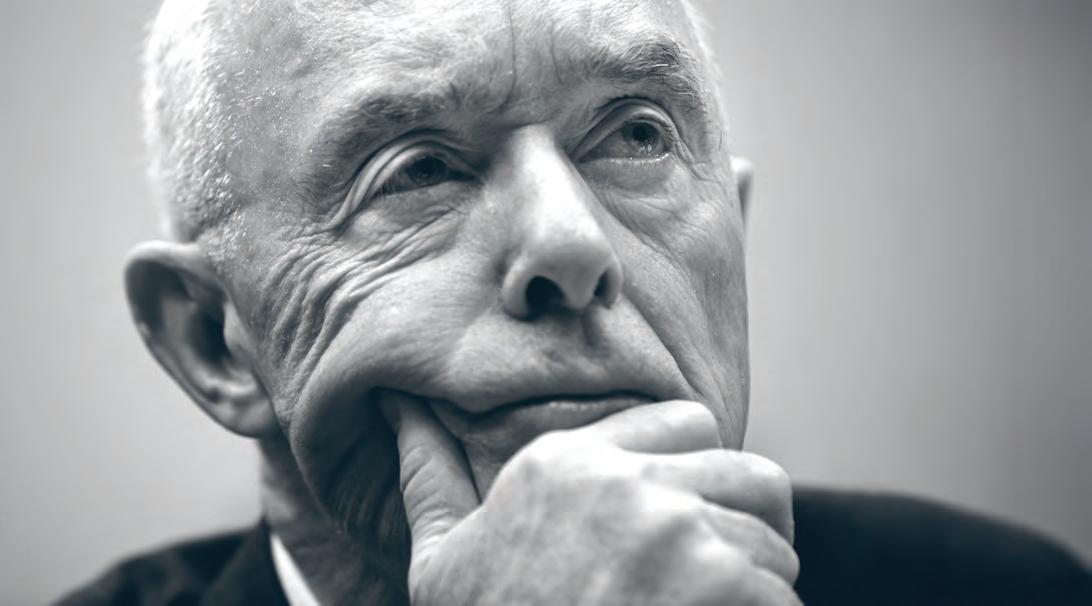
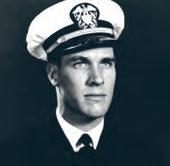
Barry McCaffrey ’60, a retired four-star Army general, on Andover and what it takes to lead through a crisis
BY HECTOR MEMBREÑO-CANALES
ON THE MORNING OF SATURDAY, FEBRUARY 28, 2026, the United States and Israel launched a coordinated military strike on Iran. By the time most Americans woke up to the news, scrolling through notifications, and toggling between feeds, smoke was already rising over Tehran. The operation, which President Trump publicly called “major combat operations,” had
been launched without formal congressional authorization for the use of military force. It was, as critics have called it, the largest unilateral executive military action in a generation. Barry McCaffrey had seen this kind of morning before. Not this morning exactly, but a particular quality about it was familiar. A reality that settles in when something that has long
been theoretically possible has finally, irrevocably, happened.
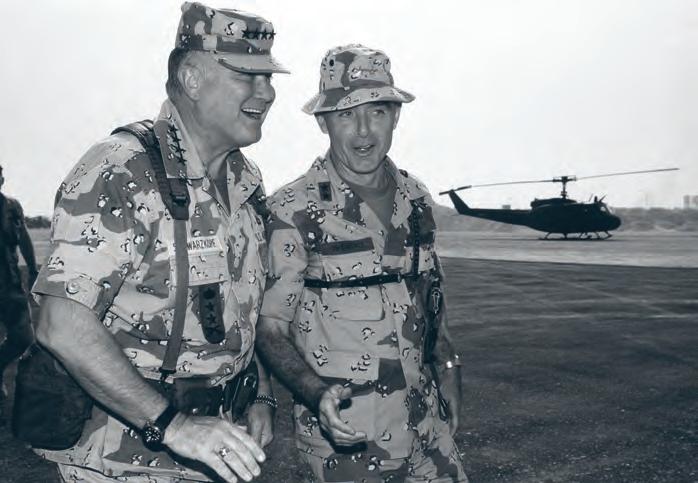
McCaffrey is one of the most accomplished soldiers in American history. His career spans three decades and four combat tours, including command of the 24th Infantry Division during the Gulf War. He received three Purple Hearts, two Distinguished Service Crosses, and two Silver Stars. He served as a cabinet-level drug policy director under President Clinton and was a senior advisor to the chairman of the Joint Chiefs of Staff, Colin Powell. He traveled with President George H.W. Bush ’42 to some of the most sensitive diplomatic negotiations of the postCold War era. For the last decade and a half, he has been one of the most sought-after national security voices in American media, appearing regularly on network news and in major newspapers during the country’s most consequential moments.
He is also, by his own jaunty admission, someone who arrived at Andover in the fall of 1959 convinced he was one of the smartest boys in the world.
He was not, as it turned out. McCaffrey was smart and sharp enough to have been elected class president at the American High School in Paris, where his father, a Boston-raised Army officer, had been stationed. He lettered in soccer and was president of the Honor Society. He had the confidence of a boy who has always, without much effort, been the most capable person in the room.
Andover changed the size of the room.
I showed up and “thought I was ready,” McCaffrey says, laughing at himself across the span of 65 years. And then he got to math and started to panic.
He had zero comprehension of what was being taught. Andover, in its characteristically resource-intensive way, addressed this by arranging for him to take math privately, at a faculty member’s home, in what he describes as “a class of one.” He can still picture the man’s face as well as the faces of his English instructor and the football coach, who was the former Chief of Staff of the Yankee Division National Guard. That instructor, he recalls, had his students’ memorizing Shakespeare and passages from Ulysses. "I don't think you can ever really appreciate Shakespeare unless you've got a guide.” McCaffrey says, “he was it.”
What Andover gave him, before it gave him anything else, was a recalibration. The experience of discovering, at age 17, that he was not exceptional, that he was good—maybe very good—but that he was surrounded by people who were also very good, had a huge impact on him. For many students at Andover, this realization can either be devastating or clarifying. For McCaffrey, it was clarifying. He calls it “a huge dose of humility.”
“It turned out,” he says, “I wasn’t one of the smartest boys in the world.” He pauses. “Bunches of others were.”
What Andover also gave him was a template for what institutions can do at their best. The math instructor’s patience. The English instructor’s rigor.
He recalls a memorable moment when a faculty member pulled him aside after he was late to his work duty at Commons (he describes himself as a scholarship student, punching a clock) and told him, with no unnecessary drama, that he needed to be a grown-up now. Without any grand gestures, the adults at Andover paid close attention to young people and responded accordingly.
McCaffrey carried that template into the military. He would later describe the best Army sergeants in the same terms: as teachers, not enforcers. People who set the example and who noticed.
But the relationship between Andover and the military was not, for many years, a comfortable one. McCaffrey graduated in 1960, went to West Point, and entered a career that, by the late 1960s, would put him on the wrong side of a cultural fault line that ran directly through institutions like Andover.
The faculty, the head of school, the student body, protests, activism, the moral weight of Vietnam, all pressed down on the moment. McCaffrey, on three combat tours as a lieutenant and captain, earned his first Distinguished Service Cross. The school and he, for a time, almost parted ways entirely.
“There was a tremendous separation,” he says.
than
3,600
It was Barbara Landis Chase, Phillips Academy's first woman head of school (1994–2012), whose name he invokes with evident warmth, who began the repair. Chase made a deliberate choice to reintegrate public service into Andover and to restore the armed forces to the list of things a young person of conscience might legitimately do with their life. Non sibi could mean wearing a uniform. It could mean choosing a form of sacrifice that made people uncomfortable.
McCaffrey went back to Andover as a Veterans Day speaker years later and found himself seated, while waiting to take the stage, between two seniors who were volunteers in Community Engagement’s Adopt-a-Platoon program—where students hand write letters to servicemembers deployed overseas.
“I was thrilled,” he says, “to see Andover come back to nurturing public service that included the Army, Navy, Air Force, and Marine Corps.”
To understand what McCaffrey brings to the analysis of a morning like February 28, 2026—the Iran strikes, the constitutional questions, the
8 were earned by Andover alumni in recognition of extraordinary heroism.
87
alumni were killed during WWI.
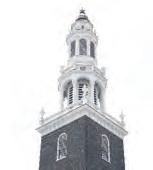
Among the many ways PA honors its veterans is the Memorial Bell Tower. Dedicated in 1923, the 159-foot tower recognizes those who died in WWI.
Learn more about Andover and the Military at andover.edu/paserves
absence of congressional approval— helps us to understand what the inside of the national security apparatus actually looks like from the senior levels. He spent years there.
Every Saturday morning, he was in the White House National Security Council working through the week’s most pressing crises. The process was slow, deliberately so: legal input from the Department of Justice, the White House counsel, the Department of Defense, and the Joint Chiefs. The State Department’s small, brilliant, multilingual staff. The Gang of Eight on Capitol Hill. The careful cultivation of the press. The interminable leaks, because everything leaked.
Everything except what the NSC staff and the JCS managed to hold together, he shares. All of it was designed, over decades of institutional accretion, to ensure that when the United States acted, it did so with the broadest possible base of legal and political legitimacy.
“In a crisis,” he says, “we could make a decision in 90 days.”
He says it not as a complaint but as a description of what deliberation actually costs and what it buys. The 90 days were not wasted. They were the price of getting everyone in the same room and making sure that when the United States did something, it meant something.
He has served under presidents of both parties. He describes George H.W. Bush ’42 as a man of integrity and caution who kept McCaffrey in the room during sensitive foreign policy meetings specifically because he wanted a military perspective present and trusted him to brief in eight minutes.
Bill Clinton, he adds, did his homework: he read the briefing books and remembered what was in them. Clinton once told a State Department official in the Oval Office, “I’ve already read the read-ahead, tell me what’s beyond it,” and meant it. Clinton, McCaffrey says, was the kind of person who walked into a room of 250 donors, senators, foreign ministers, and ambassadors and went straight to the single Black mother standing at the edge of the room, or the uniformed police officer who happened to be there. “He was just a really good person,” McCaffrey says.
What he is describing, in both cases, is a specific kind of character that he learned to recognize at Andover and spent his career watching for. The person who does the work, who pays attention, who leads by example rather than by force of position. The person whose humility is not performance but practice.
When I spoke with McCaffrey in the weeks following the Iran strikes, he was, by his own account, uncomfortable. The conversation had oscillated
from the constitutional implications of the operation over the state of democratic institutions, to what it means to govern without the deliberative infrastructure that he had spent his career inside. He is a man who says what he thinks, on television and in private, and he has said a great deal.
But Andover magazine, he felt, was not the right venue for all of it. He said so directly.
There is a version of this article that would use his name to relitigate arguments he makes elsewhere, on different stages, for different audiences. That is not what he believes the school’s publication is for.
What it is for, perhaps, is this: a four-star general, Class of 1960, who arrived on campus believing he had already figured himself out, and found that the institution had other plans for him. Who learned, in a faculty member’s home, over a mathematics textbook, that being corrected is not the same thing as being diminished. Who carried and upheld the model of Andover’s best teachers—attentive, rigorous, demanding, yet kind.
Through four combat tours, two presidential administrations, 15 years on corporate boards, and a career in front of television cameras, he still reaches for these values when describing what good leadership looks like.
“When presented with good leadership,” he told me, “young people rise to the highest potential they have.” Like the students he has watched at Andover over the years. The soldiers he has commanded. The faculty member who sat across from him in 1959, and waited while a boy who thought he was the smartest person in the world tried to understand math.
It is, McCaffrey suggests, what the moment has always required. “The question,” he offers, for all of us watching the smoke rise overseas and wondering what comes next, “is how to guide young people in a way that nurtures their highest potential in a complex world.”
BY NANCY HITCHCOCK

Nearly 250 years ago, Phillips Academy was founded to promote “true piety, virtue, and knowledge.” While much has changed since those early days, the legacy of non sibi, dedication to craft, and a deep commitment to student learning lives on.
This spring we celebrate five retiring instructors whose combined tenure totals a remarkable 175 years. Whether in classrooms or concert halls, on theatre stages or athletic fields, these teachers represent the heart of Andover, combining intellectual rigor and creativity with an abiding belief in students’ potential.
Students wander into the Large Ensemble Room of Falls Music Center, settling in quickly to play piano, drums, trombones, and horns. Music fills the beautiful space.
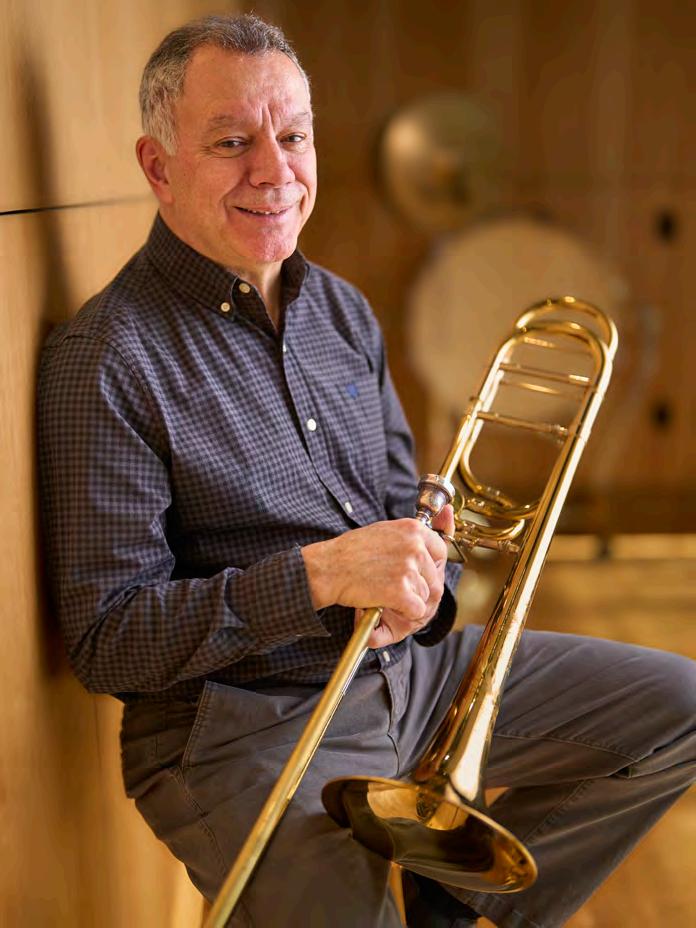
“Dynamics, everybody. Saxes, trumpets, trombones—play with a lot of feel. Listen to each other,” says instructor Peter Cirelli as he guides the 20-some musicians through their final rehearsal before the Academy Jazz Band & Ensembles winter concert.
“The most exciting thing about teaching at Phillips Academy,” says Cirelli, “is the quality of students. These kids truly want to learn. It’s wonderful to see their motivation.”
For 40 years, Cirelli has shared his musical talents at PA, teaching private lessons in trombone, euphonium (a brass instrument), and tuba, directing jazz ensembles, and serving as department chair from 2009 to 2015. In addition to teaching the gamut of music classes, he participated in many trips with Learning in the World/Performing in the World to locations such as South Africa, China, Iceland, and Italy, where music was played for—and learned from—global musicians.
Cirelli’s musical life began at age 6 when his father brought home an accordion one day. Cirelli's passion for music grew quickly. He joined high school bands, studied at the New England Conservatory, and later performed and taught in Brazil. Back in the United States, he played in symphony orchestras, Broadway shows, and jazz ensembles, even sharing the stage with Joni Mitchell, Stevie Wonder, and other well-known musicians.
“I’ve always loved a lot of different styles of music, including playing in symphony orchestras and teaching classical ensembles,” he says. “Having music instructors at PA who study a variety of musical genres helps cultivate our students’ appreciation of different traditions.”
Cirelli always strove to impart in his students a love of music and music-making. And by all accounts, he has been successful. “I think often of Monday night jazz band and miss playing awesome tunes with an awesome bunch,” says Michela Rowland ’24. “Mr. Cirelli’s wit, musicality, and dedication brought us all together in a wonderful way.”
In addition to teaching, Cirelli shared his talents by performing at Commencement, Faculty Convocation, and memorial services for campus colleagues.
Even though he won’t be in a
INSTRUCTOR IN MUSIC YEARS AT PA: 40
The most exciting thing about teaching at Phillips Academy is the quality of students. These kids truly want to learn.”
classroom, Cirelli plans to continue performing professionally in retirement, including with the Vista Philharmonic Orchestra. He and his wife, Eva (who worked in the Office of Admission for 15 years), will spend time in Brazil with Eva’s family; in Chicago with their daughter, Gabriella ’12, son-in-law, and two grandchildren; and at various venues to hear their son Marcello play in a rock band.
Cirelli instilled a lifelong love of music in countless students, and his legacy will live on in those who have been lucky enough to call him their teacher.
“I cannot fully express the impact that Mr. Cirelli’s leadership and profound understanding of jazz music have had on me,” says Jacob Kaiser ’24. “I am incredibly grateful to have had a seat in his band and will always cherish the many unforgettable moments.”
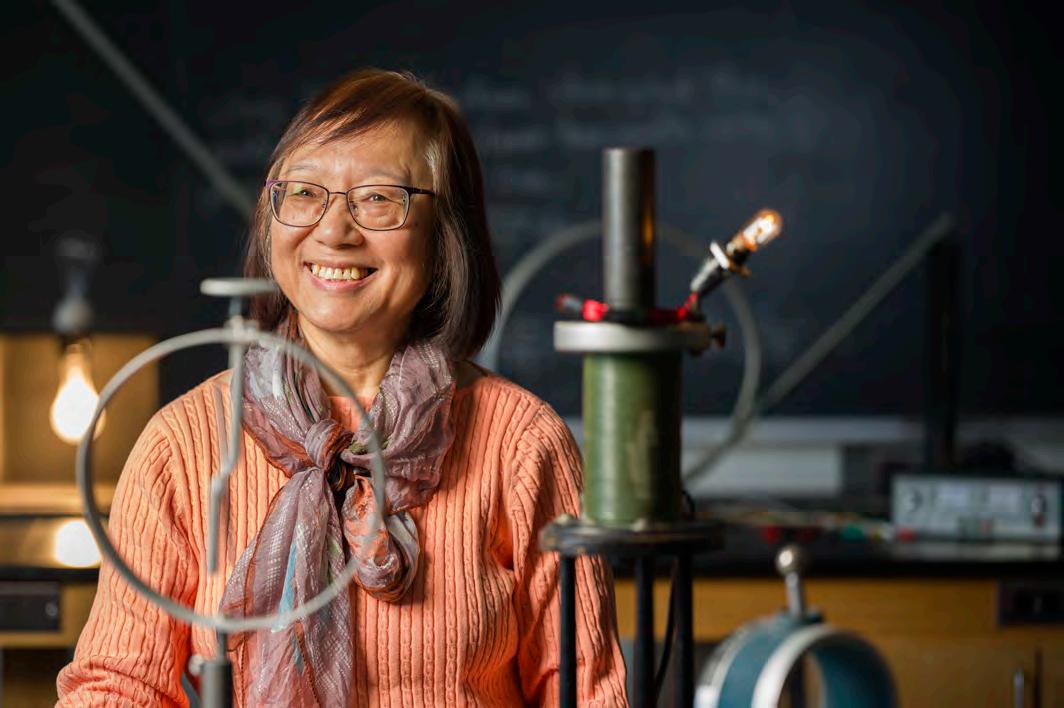
To Fei Yao, physics is a complex and fascinating system that relates to everything in the world. And for more than three decades she has invited students into her classroom “imagination world,” where science comes to life.
“Physics is not just about formulas,” she explains. “It’s about understanding the processes behind the problem.”
That philosophy has helped her demystify a subject that is often seen as intimidating. “She was the best kind of teacher—brilliant, patient, and deeply committed to her students,” says Joanne (Tao) Cheng ’95.
To make physics engaging, Yao taught students to look at the subject in a completely different manner.
“Actually, in physics class, we are on vacation,” Yao explains. “Because students need to visualize the physics process, we spend a lot of time in our ‘imagination world.’ When talking about gravitational force, for example, we might imagine the path of a football
being thrown. We can be rowing a boat on a lake, soaring on a rocket ship, or traveling on a train, all while working to understand the science behind these acts.”
Yao began teaching at Andover in the fall of 1991, directly from graduate school. Trained in physics with an early focus on condensed matter research, she realized during her doctoral studies that research was not for her. Teaching was where she found joy.
Both of Yao’s parents were teachers—in physics and chemistry. From a young age, she was included in conversations about the importance of clarity, communication, and responsibility in the classroom, lessons that have guided her throughout her career.
“I want students to enjoy the fun of learning. Physics has strong logical connections, and many students really like that,” she says. “I also want them to see how much physics relates to everyday life.”
Students thrived under her direc-
Actually, in physics class, we are on vacation. We spend a lot of time in our imagination.”
tion. In her advanced classes, including AP and college-level physics, Yao often witnessed that “clicking moment,” when students suddenly see how concepts connect. Those moments, she says, are among the most rewarding parts of teaching.
“She made every complex concept make sense,” says Meredith Rose ’94. “She was a rock in physics—unshakable, and the physics knowledge became learnable and attainable.”
Students appreciated Yao’s patient, supportive approach. And some, like Olivia Michaels ’16, were even inspired to continue their STEM studies.
“Ms. Yao taught me how to approach challenges with steady determination and genuine curiosity,” says Michaels, who is pursuing medical school. “I’ve carried this lesson with me through many other challenges, academic or otherwise.”
Whether she was coaching girls JV2 squash, living with students as a house counselor, or advising, Yao says she always appreciated the kindness of students and the support of colleagues, especially in the science department.
“Every day as students left class, they would say thank you. That kindness warms my heart.”
FEI YAO P’12, ’15, ’20
INSTRUCTOR IN PHYSICS YEARS AT PA: 35
INSTRUCTOR IN MATHEMATICS, STATISTICS, AND COMPUTER SCIENCE

YEARS AT PA: 32
Mike McHugh loves being completely engrossed in a math problem—and watching students do the same.
“Engaging with a math problem is a good time,” he says. “There are surprises and there are things that confuse you at first. That’s good, because confusion means you’re interacting with something you don’t understand yet. That’s when learning begins.”
Since 1994, McHugh has taught calculus and upper-level math, including multivariable calculus and complex analysis. Using a flipped classroom model, McHugh provides assignments early, which frees class time for McHugh to take more of a coaching approach to math. When he is writing long formulas on the wall-to-wall whiteboard, for instance, he continually seeks student input. This approach is beneficial because McHugh can meet students where they are—enabling them to learn at their own pace. It also encourages students to work together and learn from one another.
“The classroom is very collaborative,” says Gracie Aziabor ’26. “We’re not stepping into these new concepts on our own—we have our peers and Mr. McHugh, which strengthens all the concepts we’re working on. A great
thing about Mr. McHugh is that he is very kindhearted and has this skill of making everyone in the classroom feel comfortable. You can tell he wants us to succeed to our highest capability.”
First and foremost, McHugh finds math fun, and that is what many former students remember most about him.
“I was in one of your first classes at Andover and consider myself lucky to have learned calculus from you,” says Elaine Dimopoulos ’96. “You explained everything clearly, set your students up for success, and made learning hard things fun.”
Nearly 30 years later, Mary Lord ’24 had a similar experience. “Mr. McHugh has always brought so much energy and fun into the classroom. He is one of the most invested and caring teachers I have ever had.”
For McHugh, teaching strong, dedicated students in advanced classes was an unbelievable opportunity.
“Those experiences really helped me grow mathematically and as a teacher,” he says. “Many of those
students were great fun and enjoyed doing math as much as I did. Doing what you love best as part of your job is awesome.”
McHugh’s supportive nature was not reserved just for the classroom. He brought that same enthusiasm to PA sports, coaching JV baseball for 20 years and JV1 soccer for 30 years. Building community also extended to colleagues: He launched and organized a faculty soccer night that connected teachers and teaching fellows for more than two decades.
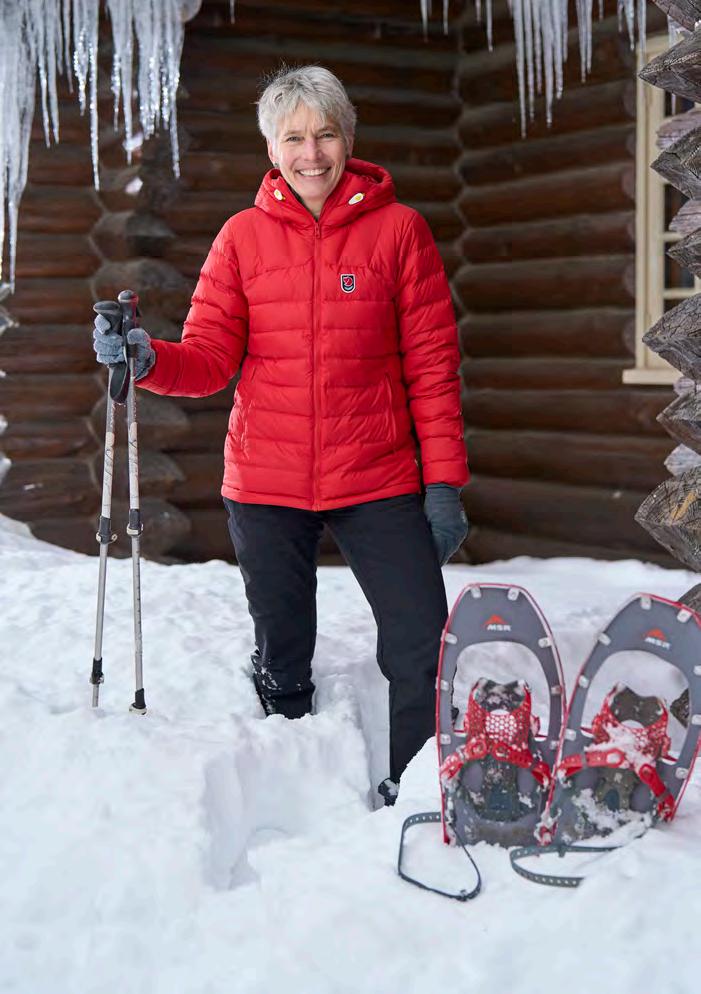
In retirement, McHugh plans to stay active—playing golf and pickleball, snowshoeing, cross-country skiing, and hiking. He hopes to complete his goal of climbing all 48 of New Hampshire’s 4,000-footers soon, with just two peaks remaining.
No matter where life takes him from here, McHugh has left a lasting impact that will remain forever etched in the memories of all he worked alongside, taught, and coached.
Engaging with a math problem is a good time. There are a lot of surprises.”
Acircle of students clap, stomp, and sing—in German—in the basement of Samuel Phillips Hall. Such activities, animated by laughter, have been a hallmark of Lisa Johnson Svec’s classroom for decades.
After 40 years and thousands of classes, Svec—chair and instructor in German—leaves behind a legacy defined by teaching excellence and joy.
“Passionate is the best word to describe her,” says Daniel Peng ’27. “She loves her job and comes here every day with a lot of energy. It’s really contagious.”
That spiritedness has shaped generations of students. In Svec’s classes, learning German rarely meant sitting still. Students might act out skits, play word games, toss a soccer ball, or even skip stones across Rabbit Pond—all with the intention of building fluency through connection and fun.
“Because of the enthusiasm she brought to the classroom, I fell in love with the German language and culture,” says Miley Kaufman ’19. “I’m just one of many examples of how a teacher’s passion can ripple outward in unpredictable ways.”
For Svec, the goal is clear: to create an interactive, enjoyable environment that brings learning to life.
“What I love most is that you can do so many things to facilitate learning in a language class,” she says. “You’ve got music, history, current events—you can use anything. If it’s pedagogically sound and students have a positive learning experience, that’s the sweet spot. The fabulous thing about language learning is that it allows us to better understand our own selves and experiences. And it builds empathy and understanding as we learn about different ways of thinking and being in the world. Those are the real lessons that transcend the mechanics of learning a language and ultimately make it so meaningful.”
Though Svec loved studying Spanish and German as a student at Andover, she never planned to teach. After graduation, she spent a gap year in Germany as an American Field Service student and then majored in German at Dartmouth College. Law school might have been the next step— until her mother encouraged her to explore teaching. A conversation with members of Andover’s German department led to a fellowship and, soon after, a lifelong career.
Svec’s contributions have extended beyond the classroom—to the athletic fields, the mountains, and across the
CHAIR AND INSTRUCTOR IN GERMAN YEARS AT PA: 40
The fabulous thing about language learning is that it builds empathy and understanding as we learn about different ways of thinking and being in the world.”
world. She has coached gymnastics, swimming, soccer, and Nordic skiing; served as a house counselor; and led many Learning in the World trips, including several to Berlin, where students were immersed in Germany’s language, history, and culture.
An avid outdoor enthusiast, Svec also has led many community hiking and mountain climbing events. “Being on the
trails with colleagues and students is such a great way to connect,” she says. Yet it is the everyday moments—like interacting with the kids and playing games—that Svec says she will miss most. “I’m so grateful for my fabulous students and colleagues and for this amazing opportunity I’ve had to do what I love.”
In the costume studio, a large Styrofoam rhinoceros head hangs on the wall presiding over the bustling activity. Some students are at counter-height cutting tables in the center of the room while others assemble garments at the sewing machines. They are creating shorts with fabric they designed and then printed on large-format printers. Tyler Miocevich ’26 just finished a pair and turns them right side out. “Not too shabby,” he says in awe. “Very, very cool.”
Throughout his three decades at Phillips Academy, Billy Murray has cherished these moments of discovery. Whether teaching costuming, lighting, or scenic design, he relishes igniting that spark of creativity. “All kids have the ability to create—and even go beyond what they thought was good,” he says. “The main thing I want them to learn is that they can create.”
Murray joined the Department of Theatre and Dance in 1996 to work with an inspiring team that included chair Mark Efinger ’74, P’02, and instructor
Kevin Heelan. It was an exciting time to be at PA. The school was launching a highly innovative performing arts program following renovations to the Tang and Steinbach theatres, and Murray brought a wealth of experience: undergraduate degrees in acting/directing and classical studies, an MFA in design for theatre and cinema, and an MEd in theatre arts K–12 and special needs. Murray had also worked at companies such as Paramount Pictures, National Opera, and Dance America as well as public and private schools.
In his first year, Murray helped produce and design lighting and costumes for The Nutcracker, which would become a beloved community tradition involving students, faculty, staff, and families.
The large and complex Mother Ginger costume is one of his most memorable designs; Murray engineered a hooped metal structure covered by an enormous 18th-century gown that hid several children. With an adult actor standing on stilts, the children—on cue—would pop out of the gown to surprise the audience.
I hope the kids will take elements of what I taught them—creativity, thinking outside the box, pushing the envelope—into whatever area they pursue.”
Another highlight was directing Big Love, which toured at Edinburgh Festival Fringe in 2018 and was awarded first runner-up for the 2018 Amnesty International Freedom of Expression Award.
“That production and tour were significant,” Murray explains, “because students were supporting the roles of costume design, sound design, projection design, stage manager, and running crews.”
The expertise and enthusiasm Murray shared with his students will endure well beyond his retirement. Just ask Leah Russell ’04, who says that her former teacher left a lasting impact.
“I came away from Mr. Murray’s class with two fantastic life lessons: first, keep an open mind, seek new things proactively, and don’t dismiss the unfamiliar; and second, it can make an enormous difference to address people personally. His care and invitation to participate have added so much value to my life.”
As he departs PA for the next phase of his life, Murray is satisfied by the knowledge that he has taught much more than creative design. “I hope the kids will take elements of what I taught them—creativity, thinking outside the box, pushing the envelope—into whatever area they pursue.”
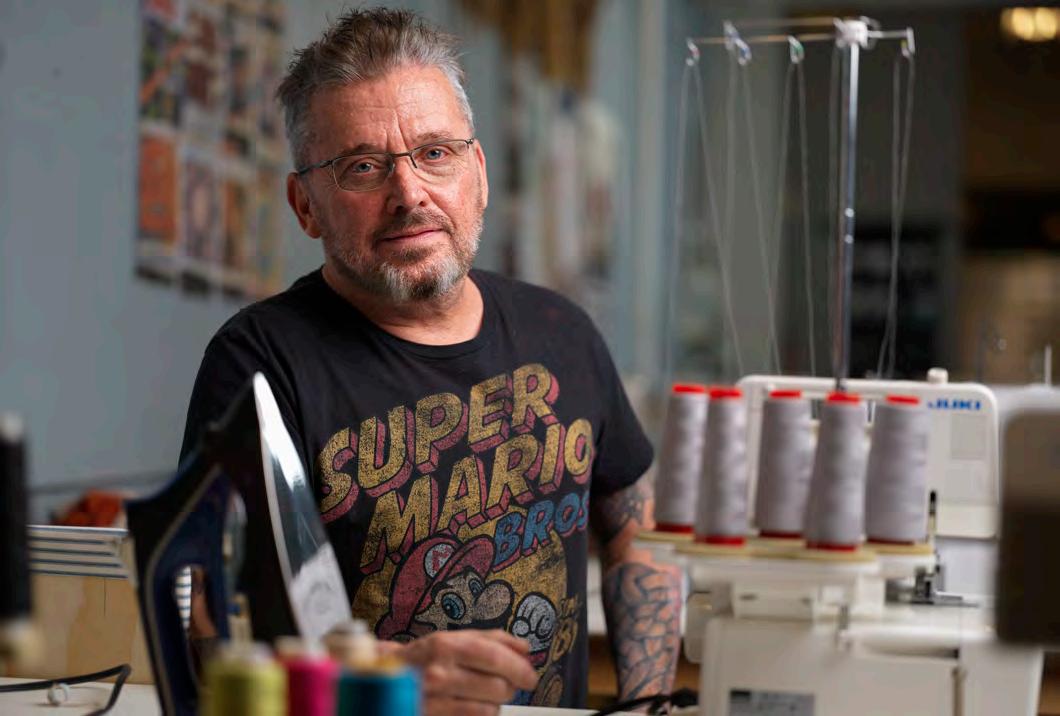
INSTRUCTOR IN THEATRE AND DANCE YEARS AT PA: 30
BY ERIN ALTEMUS ’97
Five miles from the halfway mark and the next checkpoint, I begged my dogs to move down the trail. The temperature had climbed from –20 that morning to –10 degrees. I had been cold an hour ago; now I am sweating. The Lima Grade is under foot, a 20-mile stretch of unplowed road known for being straight, flat, and monotonous. I had been trading places with another dog team, but they passed us when my dogs tangled. Now we were alone.
My team of 12 dogs and I were racing the John Beargrease Sled Dog Marathon—a 300-mile endurance test through northeastern Minnesota's Sawtooth Mountains. The race, now in its 42nd year, starts in Duluth and ends in Grand Portage, an Ojibwe community along Lake Superior's northwestern shore. It's named for John Beargrease, an Ojibwe mail carrier who delivered post by dogsled in the late 1800s—a journey that could take days, sometimes weeks.
Beargrease takes three days to run. Alaskan huskies—with enough calories and rest—can cover about 100 miles a day. They're essentially mutts, genetically bred from German shepherds, Siberian huskies, and greyhounds, carefully selected for racing traits: good appetite, tough feet, mental resilience. They can run farther, longer than any other mammal.
My husband and I have been raising and training Alaskans for 14 years. With 32 dogs in our kennel, we burn through pallets of kibble and 3,000 pounds of meat annually. Despite the costs, we’ve immersed ourselves in the lifestyle—raising puppies, watching them run in harness for the first time, maintaining miles of trails through public land. The work is endless, but it’s my reason to get outside every day, whether it’s a blizzard or 20 below.
This was my seventh Beargrease Marathon. Last year I placed second—my best finish. When I drew bib 7—my lucky number—I felt invincible. I let it go to my head. Despite telling myself every year to go slower on the first leg, I didn't listen. I let the dogs fly. Fast is fun. We pulled into the first checkpoint speedily, the dogs caked in frost, their energy high.
Running too fast was my first mistake. The second was including three females in heat on my team.


United States.
Many dogs in our kennel are fixed, but the three girls who made the race team were not. I should have known better. By the third leg, I saw my error. Dogs, with their powerful sense of smell, are keenly aware of pheromones. My run became a rodeo—dogs stopping to use the bathroom, males tangling as they vied for the females’ attention. I stopped at least three times on the way to Sawbill, switching dogs around, searching for a leader who would lead despite the distraction.
I’ve had issues in every Beargrease that kept me from succeeding. Once I finished with two dogs in my sled bag who wouldn’t run. Once I fell off my sled in the early morning hours and lost my team. Last year, though, I had a “magic carpet ride”—the dogs cruised through every leg without incident.
At the Sawbill checkpoint, I removed booties, tossed out frozen fish, and laid down straw for naps. The temperature continued to drop. I fetched water from a hole chopped through river ice and lit my cooker—a large pot fueled by methanol.
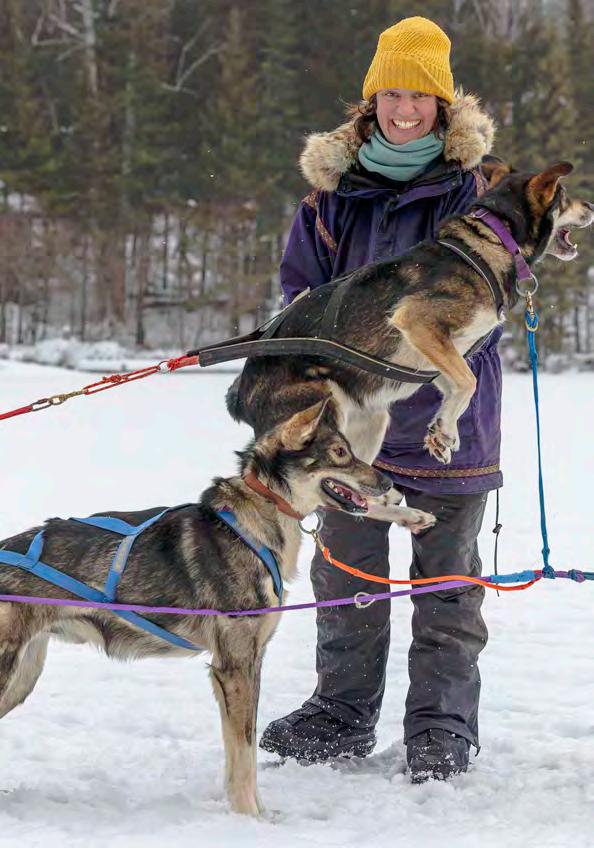
While it heated, I covered each dog in a fleece blanket. I tried to rest on the frozen ground next to Dino and Ruth, but getting comfortable at 20 below isn’t easy.
Temper, our 8-year-old leader, had been leading our Beargrease team since he was two. He ran the Iditarod with me in 2024. When Temper starts a race, he stands calmly while every other dog barks and lunges with excitement. Then he’s all business—driving hard, following directions, passing teams on command. He’s almost perfect, except for one weakness: girls. Especially females in heat.
This year, he was too distracted to lead. He kept looking back with big sad eyes that said, I just don't want to be out front right now.
When we left Sawbill after four hours’ rest, the dogs were pulling hard. The first 20 miles are endless hills, twisting and turning. The trail was unforgiving. The team knew another musher wasn’t far ahead. I felt their urgency around every corner.
We were halfway to Trail Center when we saw Nathan Schroeder and his team. We followed for several miles before I made a move to pass. Sometimes it’s easier to just chase— chasing takes the pressure off. But we were moving faster, so I passed. Within a mile, the team bunched up. Nathan passed us again. Our teams traded places repeatedly. In retrospect, I should have just followed him. But my competitive instinct kicked in. Finally, he passed us again when my dogs stopped— and everything fell apart.
Dog mushing can be the highest of highs and the lowest of lows. That morning on the Lima Grade, I reached a new low. I switched dogs frantically, finally putting Andi, one of my girls in heat, next to a neutered male. Even he wouldn’t leave her alone. Andi was mentally done. I put her in my sled bag. Then another dog, Monster, quit on me—into the sled too.
I put Temper, who’d refused to lead all race, up front. Finally, we moved. As we ran toward Trail Center, I felt like I never wanted to do a distance race again. This wasn’t fun. The dogs weren’t having fun. I pulled into Trail Center and told the judge I wanted to scratch.
The race volunteers were kind. One handed me hot coffee. Another helped me load dogs into my truck. No one asked why I was quitting. They’d all been there before.
On the drive home, I replayed every decision. The toofast start. The females in heat. The competitive instinct that wouldn’t let me just follow Nathan’s team. Each mistake compounded the next until the only choice left was to stop.
But here’s what I’ve learned over 14 years of mushing: the losses teach you more than the wins ever will.
On a good day mushing, the leaders drive down the trail, loping up hills, ears perked, the joy of curves and corners palpable like charged air in a lightning storm. At the end of a


300-mile race when the dogs are still barking to go, the pride I feel in their abilities fills me.
I’m not ready to hang up my musher hat just yet. My unfinished attempt at the Iditarod in 2024 haunts me—I want to go back and try again. Mushers often say mushing is a next-year sport. There’s always something to be done better, decisions we want to redo, countless new things to try.
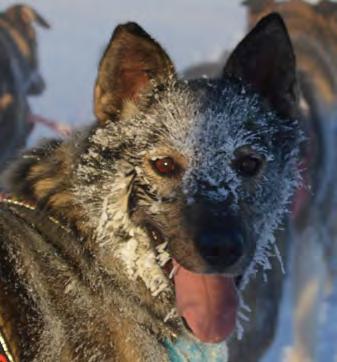
This year reminded me I still have more to learn. The dogs and I have more adventures ahead. And next time, I’ll remember what the Lima Grade taught me: sometimes the best decision is the one that keeps you moving forward, even if it means letting go of how you thought the race should unfold.
Erin Altemus lives in Grand Marais, Minnesota, with her husband, Matt, and daughter, Sylvia. When she’s not racing dogs, Erin works as a nurse at the local hospital and enjoys writing for Northern Wilds magazine. Follow her adventures at sawtoothracing.weebly.com
Milliner Richard Shon ’76 creates iconic headpieces
BY RITA SAVARD
Richard Shon doesn’t simply make hats. He makes statements—the kind that stop traffic at the Kentucky Derby and turn weddings into runway moments.
Feathers, flowers, and beading adorn hats and fascinators covering every surface behind him in his downtown Miami shop. Textures and colors beckon guests to come in and play dress up.
“Hats are fantasy,” he says. “They let people step into another version of themselves—even if it’s just for a day.”
Since the 1980s, Shon and his business partner and husband, Eliot Whittall, have been leading figures in millinery. Whittall & Shon Hats are staples at horse racing’s most prestigious events, including the Kentucky Derby, where headwear pageantry rivals the thundering hooves. Beyond Churchill Downs, Shon’s creations—known for artistic flair and exquisite detail—have crowned movie stars, television personalities, and politicians.
Congresswoman Frederica Wilson (D-Florida), featured in the Netflix docuseries Worn Stories, calls her signature bedazzled Whittall & Shon cowboy hats a “first impression tool.”
“Even before you speak, people see you,” Wilson tells the film crew. “When you stand out in a crowd of policymakers, people pay attention to what you have to say.”
Shon has used art to tell stories since his Andover days, when he spent countless hours in the former artist studios on
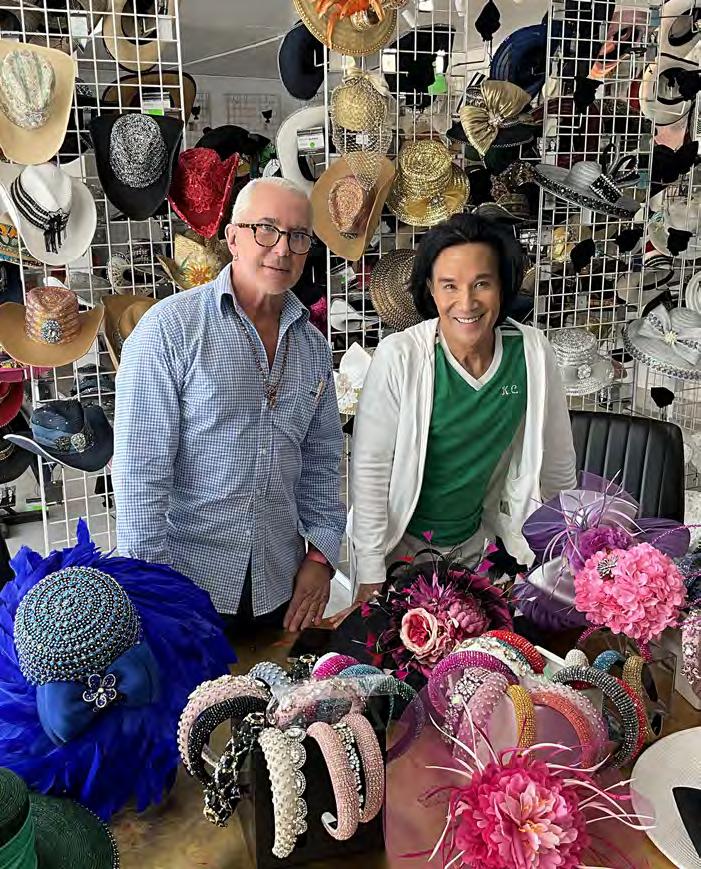
the Abbot Academy campus. He credits instructor Gil Sewall’s art history class with teaching him foundational critical thinking skills.
“Hats are fantasy. They let people step into another version of themselves.”
“Many teachers I encountered later—in my college years—did not encourage questions and often operated under the protocol that there was only one way—their way—to look at an image,” says Shon, who attended Stanford and later studied art in Paris. “My time at Andover remains formative. One of the best experiences of my life.”
After moving to New York City, Shon partnered with Whittall, and the couple’s work quickly became synonymous with American luxury millinery. Their hats were fixtures at Saks Fifth Avenue and Nordstrom and, by the early ’90s, their business had become the largest nonunion shop in Manhattan.
In 1998, they relocated to Miami, where every Whittall & Shon hat is still handmade. Some creations have earned permanent places in Smithsonian collections.
In the era of fast fashion and fleeting trends, Shon finds joy in designing hats—with purpose and intention. “I don’t need to be the biggest name in the industry,” he says. “I just want to wake up, look in the mirror, and know I didn’t compromise myself.”
Discover more at whittallandshon.com
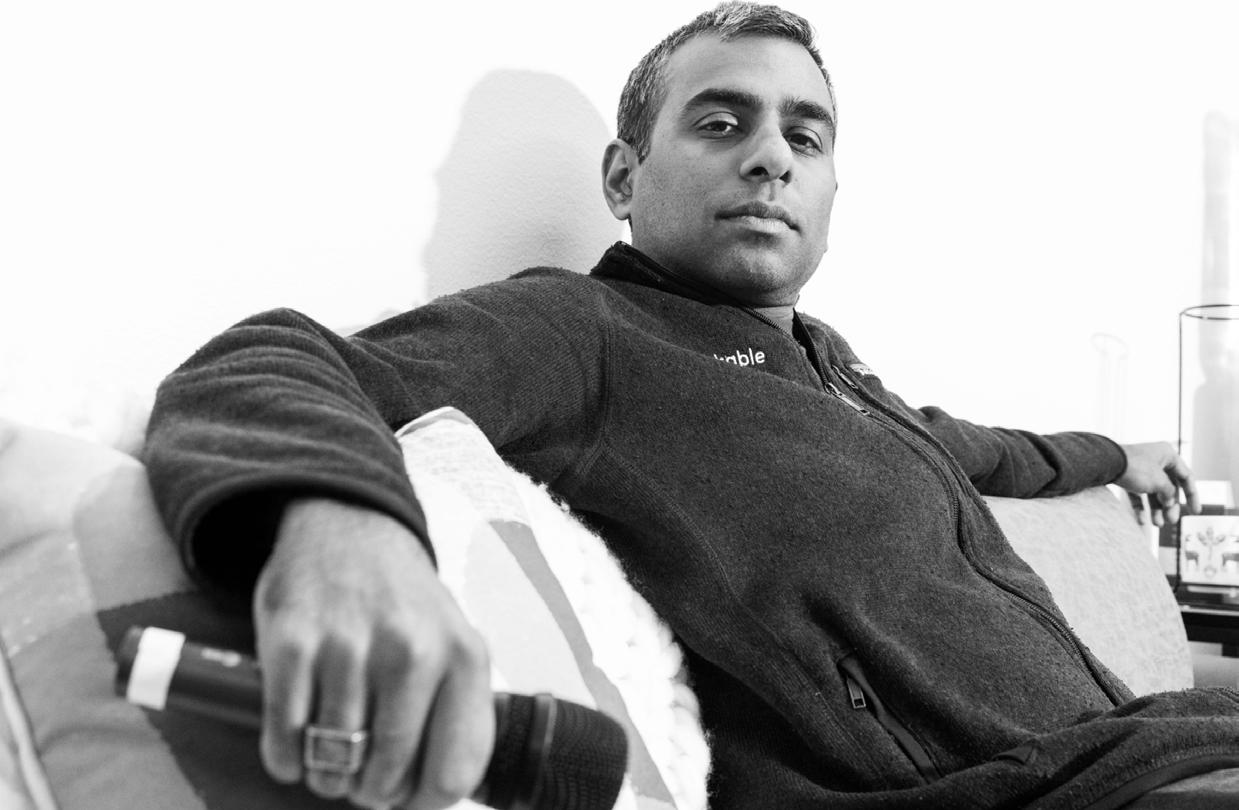
—CEO of the build-your-own-app company Thunkable, Arun Saigal ’09 is also an amateur rapper who has performed with MC Hammer, and is the conductor of the San Francisco Civic Orchestra. Read more about Saigal and Nizam at andover.edu/magazine “A GOOD INSTRUMENT MAKES YOU SOUND BETTER AND MAKES YOU WANT TO PLAY MORE.”

—After 25 years of repairing, tuning, and building violins and cellos for music shops, Cheryl Kluck Nizam ’89 is now a full-time maker, crafting each instrument almost entirely by hand in her own West Coast workshop.
BY MATTHEW BELLICO

In the world of philanthropy, as in life, impact and gratitude should be inseparable. “One kind turn deserves another,” as the axiom goes.
That’s the impetus behind Andover’s two annual giving recognition groups— the Bulfinch Loyalty Society and the Non Sibi Circle—recently rebranded and reintroduced to the PA community.
Named after one of Andover’s most cherished buildings, the Bulfinch Loyalty Society welcomes all donors who give to the school in consecutive years, while the Non Sibi Circle salutes those who invest $1,778 and above in honor of PA’s founding year, with further rec-
ognition levels beginning at $10,000 or greater and featuring dedicated entry points for young alumni.
“Andover is incredibly grateful for our annual giving donors,” says Nicole Cherubini, director of Academy advancement. “There’s a powerful camaraderie that emerges when so many band together for a common goal. We’re always proud to celebrate that.”
More than 5,400 donors comprised the Bulfinch Loyalty Society last year— with 816 joining anew and over 2,450 maintaining membership for 10 years or more. Meanwhile, the Non Sibi Circle boasted 1,252 members, including 770 freshly inducted alumni, families, and
friends who raised their annual giving level to amplify the difference they’re making on campus.
That impact is very real, and quite necessary. Andover depends on thoughtful donors to support the Academy’s mission year over year—filling a nearly 10 percent budget gap. The school’s endowment and tuition can only cover so much of the PA experience, and annual giving is that vital element that funds the rest.
In this effort, gifts of all sizes truly do matter. How? Andover Fund donations are put to immediate use, benefiting campus life and learning during the year in which they are given. Plus, an unrestricted gift to the Andover Fund always goes to the area of greatest need—financial aid, student programming, classroom innovation, and more.
“I’m still surprised, even 40 years after my graduation, at how profoundly my Andover education continues to shape who I am today,” says Ted McEnroe ’85, P’28. “My annual giving is one way I can honor that lifelong impact. And it’s how I can help ensure that PA has the resources to adapt and provide similar opportunities for its current students.”
Last year, more than $11 million was designated to the Andover Fund, the essential resource directing all yearly donations across PA’s priorities. The strength of this giving is undeniable—in fact, these gifts have 20 times the purchasing power of one to the endowment.
“Andover has given me so much, has given and continues to give others so much,” says Lucy ’26, “and I believe in both the value and the importance of that generosity. It has transformed many lives—mine included—for the better, and it has done so in a way that greatly benefits the world at large.”
This spirit of appreciation is shared across the school’s more than 1,100 students—and by all on Andover Hill.
Bulfinch Loyalty Society and Non Sibi Circle members receive the school’s annual Impact of Giving report, are placed on its yearly Honor Roll of Donors each fall, and are invited to an annual reception toasting membership in each society.
DID YOU KNOW?
Here are some of the many ways an annual gift can make a difference:
The Bulfinch Loyalty Society received a bold new look, incorporating the PA and Abbot blue colors in vivid detail. The bees on the logo are borrowed from the Academy seal as engraved by Paul Revere—symbolizing the industriousness and unity of all who give in consecutive years.
Bulfinch Loyalty Society members also receive acknowledgment for giving milestones at 5, 10, and 25 years and longer. Most recently, Non Sibi Circle members have enjoyed additional benefits, including virtual programs and an invitation to the Non Sibi Breakfast during Reunion Weekend. These events are intended to offer meaningful opportunities to engage, learn, and broaden impact, with unique access to Andover through conversations with campus leaders, faculty, and others.
“Andover simply couldn’t live its mission every day without the commitment of our annual giving donors,” says Cherubini. “It’s a special relationship— one that we foster purposefully and value deeply.” To learn more, please visit andover.edu/recognition
Up to $100
• Daily school supplies
• Athletic gear and apparel
• Sheet music for rehearsals and performances
$100–$500
• Textbooks and other course materials
• Prom tickets for students receiving financial aid
• House counselor and other student programming
$1,778+
• Community wellness speaker
• Transportation to one away game
• Student fellowships with the Tang Institute, Brace Center, CAMD, or the Peabody Institute

BY ALLYSON IRISH
The motto of Key West is “One Human Family” and for more than 20 years, Billy Kearins ’97 has made this eclectic laid-back island his home. In the Bahama Village neighborhood, he raised his children, Kristian ’27 and Naia ’30; started his business, Coast Projects; and most recently honored the legacy of past residents with a vibrant public mural.
“The project, for me, was much more than simply a mural. It became an extensive history and community-building exercise as much as it is a piece of visual public art,” Kearins says.
A former boat builder and boat captain, Kearins came to art through the side door. He describes his self-taught style as bold and experimental with a focus on storytelling. Through his business and art collective, Kearins has worked on a diverse portfolio— everything from concert promo -
tion and apparel to prints and large-scale paintings. “It Takes a Bahama Village” was his first piece of public art.
The large-scale mural (47' x 17') honors the legacy of Bahama Village, a historically Black neighborhood. Kearins can literally see the mural when he walks out his front door and says this close proximity—of the project and of the people in Bahama Village—is what drew him to the project.
“My entire existence in Key West has been in this neighborhood,” Kearins explains. “It’s very much still like a small community where everybody’s looking out for and rooting for each other.”


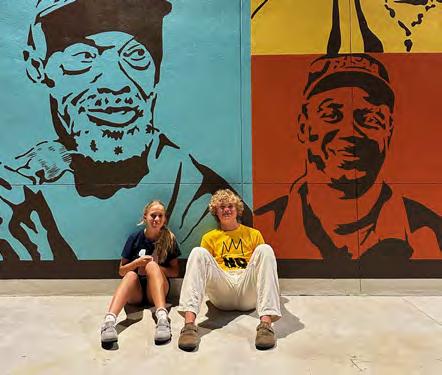
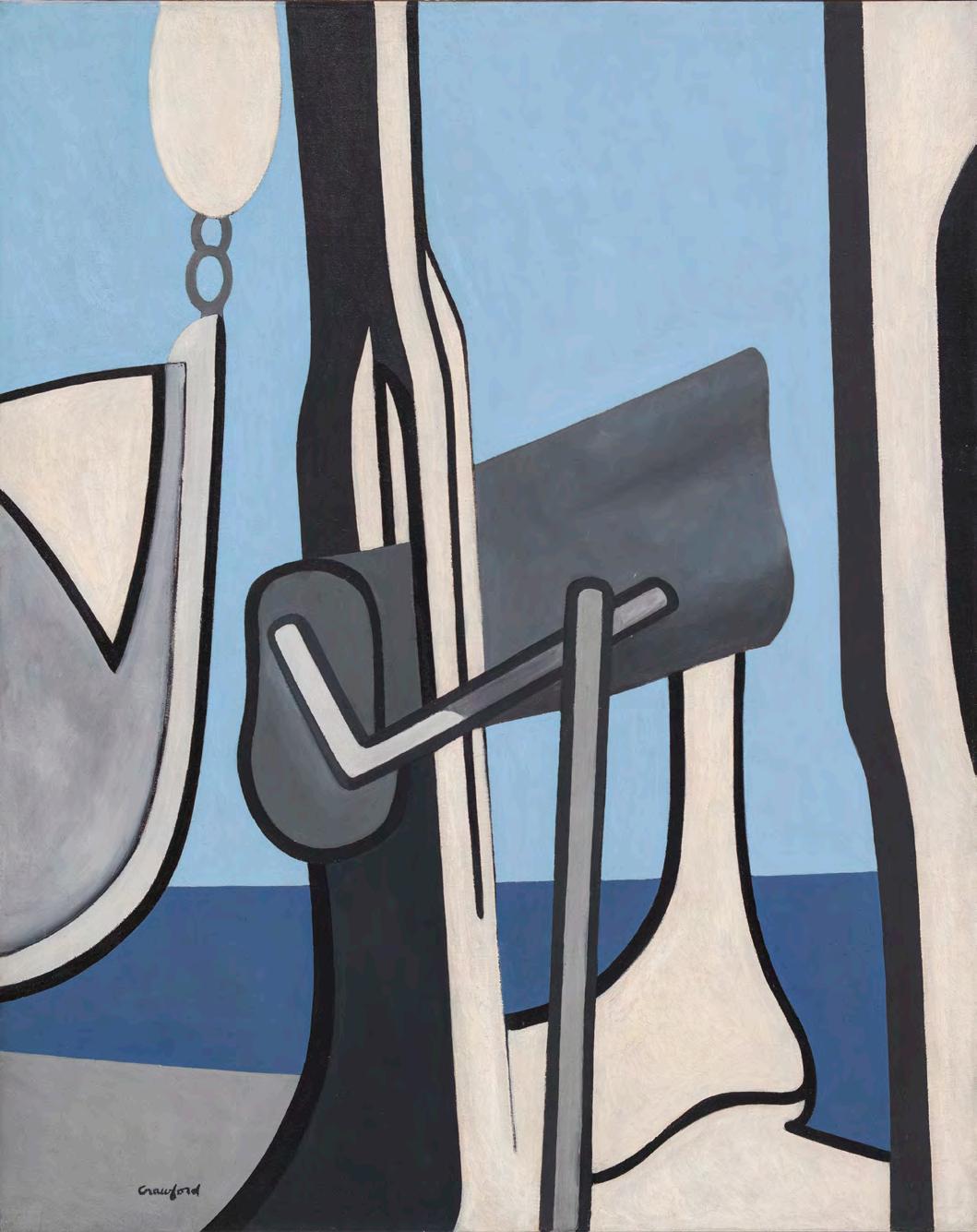
Born in Canada, artist Ralston Crawford grew up in Buffalo, New York, and became known in the 1930s for his paintings of bridges, factories, and ships using hardedged geometry, flat planes of color, and crisply articulated lines, a style that came to be known as Precisionism. Lifeboat Davit is the first large-scale painting by Crawford to enter the permanent collection of the Addison Gallery of American Art, thanks to the generosity of benefactor John. P. Axelrod ’64, who recently passed away.
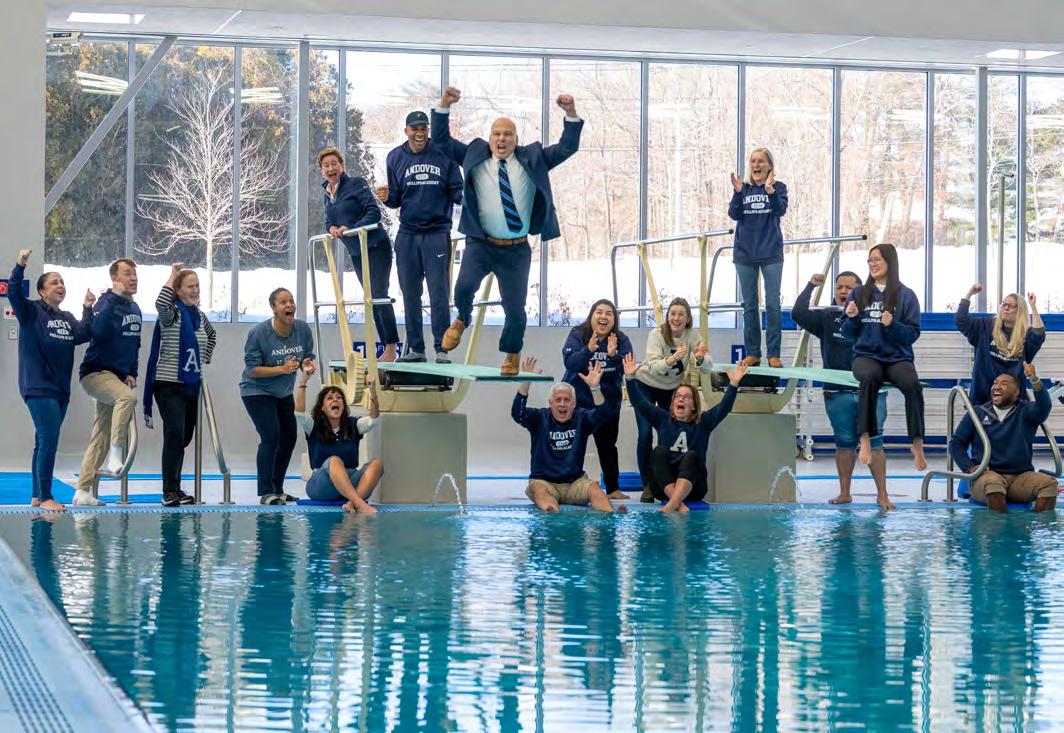
Andover, MA, and additional mailing offices ALL IN FOR ANDOVER!
Team Shuman welcomed newly admitted students this spring with personalized postcards that included the above photo. Always up for a challenge, Jim Ventre ’79, assistant head of school for admission and financial aid, showed his Big Blue spirit by eagerly taking the symbolic plunge.
BY