
1 minute read
TRAFFIC LAW

Students taking Thomas Severo’s Law and Society course didn’t plan on tipping the scales of justice. But that’s exactly what happened when the class discovered a troublesome error in Massachusetts Department of Transportation (DOT) traffic regulations.
Severo says it was business as usual as students in his 2021 Summer Session class pored over case studies to learn about relationships between laws and social forces. They were combing through a particular traffic case that had been settled out of court and while researching the details, found a discrepancy.
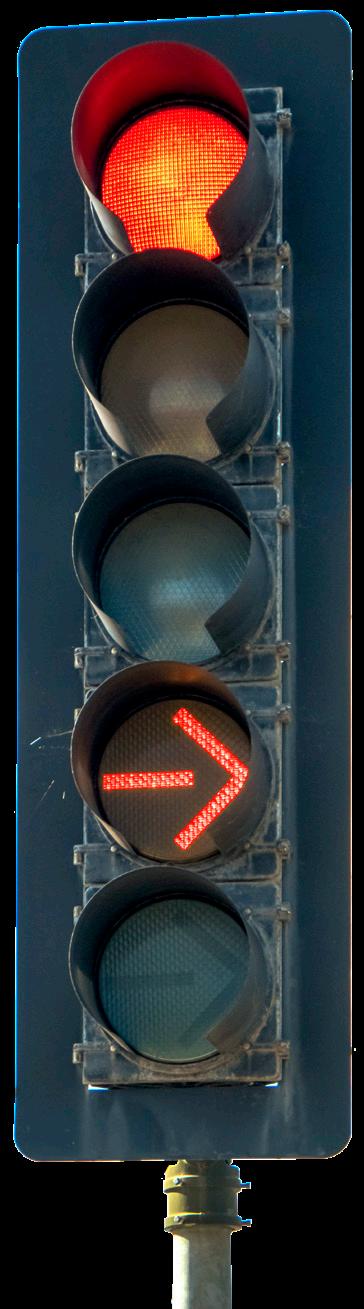
“Massachusetts General Law punts traffic regulations to a document called the Manual on Uniform Traffic Control Devices, which states that you cannot turn right on a red arrow after stopping,” Severo explains. “But, in the Code of Massachusetts Regulations [CMR] students noticed something different.”
According to the CMR, “…vehicular traffic facing a steady red arrow signal shall not enter the intersection…and shall remain standing until an indication permitting the movement.” But in the very next sentence, the turn is allowed, with the language changing to read that vehicles facing any steady red signal “may cautiously enter the intersection to turn right…after stopping.”
“We were studying traffic law, which should not be that interesting,” says Severo, a law and history instructor. “But now students had a contradiction in the law, and they were sinking their teeth into it.”
The first stage came with some healthy skepticism. The students wanted to be sure they were reading the regulations correctly and there was a lot of cross-checking, at which time they also discovered a typo in the CMR—the word “pedestrians” misspelled as “pedestrains.”
“It was an interesting lesson about law, that at the end of the day regulations are put in place by humans and humans can make mistakes,” Severo says.
The students submitted a petition in July 2021 to amend the CMR language by eliminating what they refer to as a “dangerous contradiction.”
“Several of us are motorists in the Commonwealth of Massachusetts, and thus have an additional interest in the particular safety of our roadways,” students wrote.
The DOT has since responded to the petition, thanking students and informing the class that there will be a public hearing to make changes. But the wheels of justice can move slowly, notes Severo, and the class is still awaiting a virtual hearing that they hope will take place in 2023.
“It was an unexpected journey, but an important one,” Severo says. “The students learned the impact that a person or a group can have in affecting change for the greater good.”
