THE PhD IN KEEPING ALIVE Reclaiming What We Left Behind
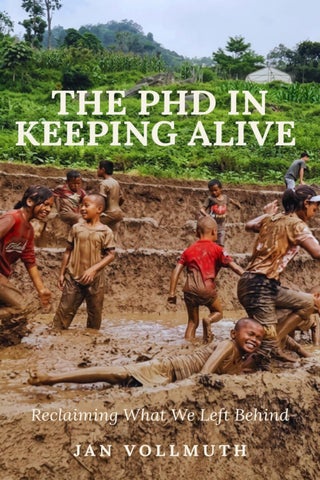
Copyright © 2026 Jan Vollmuth · All rights reserved. First published 2026 · The Human Way Cover photograph: rice-planting season in Nepal's mid-hills.
Contents Author's Note .......................................................................................... 1 1 Where Is Your PhD in Keeping Alive? ........................................... 3 2 We Domesticated Children .............................................................. 8 3 Educated Into Helplessness ............................................................ 13 4 No Classrooms, No Textbooks, No Examinations .................... 19 5 The Roots Nobody Planted ........................................................... 25 6 Capability Does Not Form in Cages ............................................. 30 7 A Certificate Cannot Feed You ..................................................... 35 8 The Current Still Runs ................................................................... 41 9 Who Is Actually Developed Here? ................................................ 47 10 What Can Your Community Sustain? ....................................... 52
If You Want to Go Deeper................................................................... 59 What to Remember............................................................................... 62 Acknowledgements ............................................................................... 67 About the Author ................................................................................. 68 Continue the Conversation ................................................................. 69
Author's Note This booklet is not a theory. It is distilled from years of immersion across Himalayan communities — living, working, farming, herding, and building alongside the children, elders, and animals who sustain life there. At the centre of those years stands one community in Nepal's mid-hills: a learning ecosystem where, for more than two decades, children have been educated without enclosed classrooms, textbooks, or examinations — and where everything, from the buildings to the enterprises that fund them, has been established, built, and managed by the students themselves. What you will read was not developed in a library. It was witnessed and lived directly — in terraced fields, cow sheds, kitchens, and construction sites — and carried home in blistered hands. I have chosen not to name the community. Its work has never depended on recognition, and this booklet is not its advertisement — it is an attempt to understand, protect, and transmit what it knows. The principles presented here are theirs before they are mine. My contribution is to have lived inside them long enough to distil them — so that what has quietly worked for over twenty years might be recognised, understood, and adapted elsewhere.
1
I came to this work as an unlikely witness: a German industrial engineer, trained in efficiency, optimisation, and supply chains. I arrived credentialed and capable on paper. On the ground, I could not light a fire. That gap — between what my education certified and what life required — is where this booklet begins. One more thing before we start. Nothing here is a model to copy. Imposing this framework from the top down would repeat the very mistake it describes. What follows is a set of conditions and principles, distilled from the ground — for you to hold against your own context and ask: what would these look like here?
2
1 Where Is Your PhD in Keeping Alive?
“We have built entire societies in which the inability to sustain life is the mark of an educated person.”
3
The question came from a goat herder. We were high in the Himalayas, moving hundreds of sheep and goats toward alpine pasture through weather that did not care about my qualifications. He had watched me struggle for days — with the terrain, with the cold, with tasks the children of these mountains performed without thinking. He knew I was an engineer. He knew I had degrees. And one evening, half playful and half piercing, he asked: "Where is your PhD in keeping alive?" I had no answer. I still remember the silence. I had spent fifteen years in formal education. I could optimise a manufacturing system, simulate an electrical circuit, identify waste in a supply chain. I held an Industrial Engineering degree from one of Germany's respected institutions and had worked for one of Europe's largest aerospace companies. By every measure my education recognised, I was a success. And I could not light a fire. One evening I tried for nearly two hours — wet wood, numb fingers, a small flame that caught and died, caught and died. What I finally coaxed alive was just enough to half-warm a pot of water: one lukewarm coffee, a packet of biscuits, and that was dinner. I could not recognise which plants heal and which poison. I could not grow food, build shelter, read the sky for weather, or keep myself warm through a Himalayan night. Every system that kept me
4
alive was one I did not understand and could not sustain. I had never noticed this, because nobody had ever told me anything was missing. The goat herder was not mocking me. He was naming something precisely. There is a form of literacy that no school I attended had ever taught, never tested, never even mentioned. Not reading and writing. Not mathematics. Something underneath all of it: the capacity to sustain life — your own, your community's, and the land's that carries both. He had it. His children had it. The farmers whose terraced fields fed me had it. And I — the most formally educated person on that mountain — did not. Sit with the question for a moment, because it is not really addressed to me. If the systems that deliver your life to you paused tomorrow — the supply chains, the supermarkets, the utilities, the institutions — what could you actually do? Could you feed yourself? Shelter yourself? Care for the people around you? Or were you, like me, never taught? Most of us were never taught. And here is the uncomfortable part: we do not experience this as a gap in our education. We experience it as normal. We have built entire societies in which the inability to sustain life is the mark of an educated person — in which distance from soil, food, and physical competence signals status, and closeness to them
5
signals backwardness. The more schooling we accumulate, the further we move from the systems that keep us alive, and we call that movement success. A certificate cannot feed you. A transcript cannot regenerate the earth. Yet we have designed entire education systems around both — and then wondered why the generations they produce feel anxious, dependent, and strangely helpless in the face of a century that demands exactly the capacities we never gave them. This booklet makes one argument. The helplessness is not an accident — it is the predictable output of a decision made generations ago, a decision I will call the domestication of children. We removed the young from participation in real life, placed them in rows, and called it education. And the crises now converging on this century — ecological
breakdown,
mental
health
collapse,
community
disintegration, the emptying of rural lands — are downstream of that one decision. They cannot be solved by the same institutions that produced them. But the connection we severed was never severed everywhere. In the mid-hills of eastern Nepal, a community has spent more than twenty years educating children through land, livelihood, and kinship — no enclosed classrooms, no textbooks, no examinations — and producing young people who can do what my fifteen years of schooling never taught me. Not as an experiment. As ordinary life,
6
refined across two decades. I lived inside it long enough to understand how it works, and the middle of this booklet is devoted to exactly that: the conditions that hold it together and the mechanisms by which capability actually forms. The goat herder's question has followed me for years now, from the Himalayas through fieldwork, research, and everything I have written since. This booklet is my attempt to answer it properly — not for myself, but for anyone responsible for a child, a classroom, a community, or a policy. The goat herder had a name coming to him all along. I call it survival literacy — and by the final chapter it will have a definition, a living proof, and a set of principles for how it forms in any child, anywhere. Beneath it sits one proposition, tested on every page that follows: capability emerges through participation in the systems that sustain life. Where is your PhD in keeping alive?
7